EP2455104A1 - Bio-functionalized stimulus-responsive dissolvable PEG-hydrogels - Google Patents
Bio-functionalized stimulus-responsive dissolvable PEG-hydrogels Download PDFInfo
- Publication number
- EP2455104A1 EP2455104A1 EP10014788A EP10014788A EP2455104A1 EP 2455104 A1 EP2455104 A1 EP 2455104A1 EP 10014788 A EP10014788 A EP 10014788A EP 10014788 A EP10014788 A EP 10014788A EP 2455104 A1 EP2455104 A1 EP 2455104A1
- Authority
- EP
- European Patent Office
- Prior art keywords
- peg
- hydrogel
- stimulus
- responsive dissolvable
- fusion protein
- Prior art date
- Legal status (The legal status is an assumption and is not a legal conclusion. Google has not performed a legal analysis and makes no representation as to the accuracy of the status listed.)
- Granted
Links
- 239000000017 hydrogel Substances 0.000 title claims abstract description 243
- 108020001507 fusion proteins Proteins 0.000 claims abstract description 171
- 102000037865 fusion proteins Human genes 0.000 claims abstract description 171
- 239000000758 substrate Substances 0.000 claims abstract description 144
- 230000027455 binding Effects 0.000 claims abstract description 141
- 108090000765 processed proteins & peptides Proteins 0.000 claims abstract description 111
- 229920000642 polymer Polymers 0.000 claims abstract description 110
- 238000011282 treatment Methods 0.000 claims abstract description 33
- 238000000034 method Methods 0.000 claims abstract description 29
- 210000004899 c-terminal region Anatomy 0.000 claims abstract description 25
- 239000011159 matrix material Substances 0.000 claims abstract description 25
- 238000000746 purification Methods 0.000 claims abstract description 24
- 206010052428 Wound Diseases 0.000 claims abstract description 22
- 208000027418 Wounds and injury Diseases 0.000 claims abstract description 22
- 208000037265 diseases, disorders, signs and symptoms Diseases 0.000 claims abstract description 19
- 201000010099 disease Diseases 0.000 claims abstract description 17
- 230000003252 repetitive effect Effects 0.000 claims abstract description 14
- 210000000214 mouth Anatomy 0.000 claims abstract description 10
- 230000017423 tissue regeneration Effects 0.000 claims abstract description 8
- 230000007547 defect Effects 0.000 claims abstract description 4
- 230000003902 lesion Effects 0.000 claims abstract description 4
- 230000003239 periodontal effect Effects 0.000 claims abstract description 4
- 210000004027 cell Anatomy 0.000 claims description 100
- 102000004196 processed proteins & peptides Human genes 0.000 claims description 45
- 235000018102 proteins Nutrition 0.000 claims description 43
- 102000004169 proteins and genes Human genes 0.000 claims description 43
- 108090000623 proteins and genes Proteins 0.000 claims description 43
- IYMAXBFPHPZYIK-BQBZGAKWSA-N Arg-Gly-Asp Chemical compound NC(N)=NCCC[C@H](N)C(=O)NCC(=O)N[C@@H](CC(O)=O)C(O)=O IYMAXBFPHPZYIK-BQBZGAKWSA-N 0.000 claims description 39
- 239000003102 growth factor Substances 0.000 claims description 37
- 150000001413 amino acids Chemical group 0.000 claims description 32
- 210000001519 tissue Anatomy 0.000 claims description 29
- 150000003573 thiols Chemical class 0.000 claims description 28
- 239000003814 drug Substances 0.000 claims description 27
- 102100030009 Azurocidin Human genes 0.000 claims description 26
- 101710154607 Azurocidin Proteins 0.000 claims description 26
- 108091008324 binding proteins Proteins 0.000 claims description 25
- 210000002950 fibroblast Anatomy 0.000 claims description 22
- 235000001014 amino acid Nutrition 0.000 claims description 14
- 238000006243 chemical reaction Methods 0.000 claims description 14
- 108091005804 Peptidases Proteins 0.000 claims description 13
- 239000004365 Protease Substances 0.000 claims description 13
- 239000003242 anti bacterial agent Substances 0.000 claims description 13
- 239000000203 mixture Substances 0.000 claims description 13
- 210000000130 stem cell Anatomy 0.000 claims description 13
- 229940088710 antibiotic agent Drugs 0.000 claims description 12
- 210000004087 cornea Anatomy 0.000 claims description 12
- 238000010348 incorporation Methods 0.000 claims description 12
- 229920001184 polypeptide Polymers 0.000 claims description 12
- 102100024746 Dihydrofolate reductase Human genes 0.000 claims description 10
- 241000588724 Escherichia coli Species 0.000 claims description 10
- 235000018417 cysteine Nutrition 0.000 claims description 10
- 108020001096 dihydrofolate reductase Proteins 0.000 claims description 10
- 230000001172 regenerating effect Effects 0.000 claims description 9
- 102000035195 Peptidases Human genes 0.000 claims description 8
- XUJNEKJLAYXESH-UHFFFAOYSA-N cysteine Natural products SCC(N)C(O)=O XUJNEKJLAYXESH-UHFFFAOYSA-N 0.000 claims description 8
- 238000000338 in vitro Methods 0.000 claims description 8
- 238000001727 in vivo Methods 0.000 claims description 8
- 238000002156 mixing Methods 0.000 claims description 8
- 229940127554 medical product Drugs 0.000 claims description 7
- 101710186984 DNA gyrase subunit B Proteins 0.000 claims description 6
- 210000002808 connective tissue Anatomy 0.000 claims description 6
- 210000003169 central nervous system Anatomy 0.000 claims description 5
- 238000012377 drug delivery Methods 0.000 claims description 5
- 210000002510 keratinocyte Anatomy 0.000 claims description 5
- 210000002379 periodontal ligament Anatomy 0.000 claims description 5
- 210000003491 skin Anatomy 0.000 claims description 5
- FWMNVWWHGCHHJJ-SKKKGAJSSA-N 4-amino-1-[(2r)-6-amino-2-[[(2r)-2-[[(2r)-2-[[(2r)-2-amino-3-phenylpropanoyl]amino]-3-phenylpropanoyl]amino]-4-methylpentanoyl]amino]hexanoyl]piperidine-4-carboxylic acid Chemical compound C([C@H](C(=O)N[C@H](CC(C)C)C(=O)N[C@H](CCCCN)C(=O)N1CCC(N)(CC1)C(O)=O)NC(=O)[C@H](N)CC=1C=CC=CC=1)C1=CC=CC=C1 FWMNVWWHGCHHJJ-SKKKGAJSSA-N 0.000 claims description 4
- 108090001008 Avidin Proteins 0.000 claims description 4
- 201000009030 Carcinoma Diseases 0.000 claims description 4
- FFFHZYDWPBMWHY-VKHMYHEASA-N L-homocysteine Chemical compound OC(=O)[C@@H](N)CCS FFFHZYDWPBMWHY-VKHMYHEASA-N 0.000 claims description 4
- PEEHTFAAVSWFBL-UHFFFAOYSA-N Maleimide Chemical compound O=C1NC(=O)C=C1 PEEHTFAAVSWFBL-UHFFFAOYSA-N 0.000 claims description 4
- 210000002889 endothelial cell Anatomy 0.000 claims description 4
- 238000000605 extraction Methods 0.000 claims description 4
- 239000007943 implant Substances 0.000 claims description 4
- 230000001537 neural effect Effects 0.000 claims description 4
- 210000002569 neuron Anatomy 0.000 claims description 4
- 210000000963 osteoblast Anatomy 0.000 claims description 4
- HVLSXIKZNLPZJJ-TXZCQADKSA-N HA peptide Chemical compound C([C@@H](C(=O)N[C@@H](CC(O)=O)C(=O)N[C@@H](C(C)C)C(=O)N1[C@@H](CCC1)C(=O)N[C@@H](CC(O)=O)C(=O)N[C@@H](CC=1C=CC(O)=CC=1)C(=O)N[C@@H](C)C(O)=O)NC(=O)[C@H]1N(CCC1)C(=O)[C@@H](N)CC=1C=CC(O)=CC=1)C1=CC=C(O)C=C1 HVLSXIKZNLPZJJ-TXZCQADKSA-N 0.000 claims description 3
- 206010028980 Neoplasm Diseases 0.000 claims description 3
- 108010090804 Streptavidin Proteins 0.000 claims description 3
- 230000003511 endothelial effect Effects 0.000 claims description 3
- 108010087904 neutravidin Proteins 0.000 claims description 3
- 238000001356 surgical procedure Methods 0.000 claims description 3
- 230000002792 vascular Effects 0.000 claims description 3
- QOPBEBWGSGFROG-UHFFFAOYSA-N 2-(1h-indol-2-yl)acetic acid Chemical compound C1=CC=C2NC(CC(=O)O)=CC2=C1 QOPBEBWGSGFROG-UHFFFAOYSA-N 0.000 claims description 2
- 201000001925 Fuchs' endothelial dystrophy Diseases 0.000 claims description 2
- 108060008539 Transglutaminase Proteins 0.000 claims description 2
- 210000001789 adipocyte Anatomy 0.000 claims description 2
- 210000004504 adult stem cell Anatomy 0.000 claims description 2
- 230000001741 anti-phlogistic effect Effects 0.000 claims description 2
- 229940111133 antiinflammatory and antirheumatic drug oxicams Drugs 0.000 claims description 2
- 229920002118 antimicrobial polymer Polymers 0.000 claims description 2
- 210000001130 astrocyte Anatomy 0.000 claims description 2
- 210000000250 cementoblast Anatomy 0.000 claims description 2
- 206010011005 corneal dystrophy Diseases 0.000 claims description 2
- 210000003239 corneal fibroblast Anatomy 0.000 claims description 2
- 229940111134 coxibs Drugs 0.000 claims description 2
- 239000003255 cyclooxygenase 2 inhibitor Substances 0.000 claims description 2
- 210000001671 embryonic stem cell Anatomy 0.000 claims description 2
- 230000002439 hemostatic effect Effects 0.000 claims description 2
- 210000002752 melanocyte Anatomy 0.000 claims description 2
- 229910021645 metal ion Inorganic materials 0.000 claims description 2
- 210000000107 myocyte Anatomy 0.000 claims description 2
- 210000003668 pericyte Anatomy 0.000 claims description 2
- 229920002704 polyhistidine Polymers 0.000 claims description 2
- 230000002265 prevention Effects 0.000 claims description 2
- 210000001626 skin fibroblast Anatomy 0.000 claims description 2
- 239000003270 steroid hormone Substances 0.000 claims description 2
- 108020003113 steroid hormone receptors Proteins 0.000 claims description 2
- 102000005969 steroid hormone receptors Human genes 0.000 claims description 2
- 230000003637 steroidlike Effects 0.000 claims description 2
- 102000003601 transglutaminase Human genes 0.000 claims description 2
- 125000005647 linker group Chemical group 0.000 claims 5
- 102000018679 Tacrolimus Binding Proteins Human genes 0.000 claims 1
- 108010027179 Tacrolimus Binding Proteins Proteins 0.000 claims 1
- 102000023732 binding proteins Human genes 0.000 claims 1
- 210000004271 bone marrow stromal cell Anatomy 0.000 claims 1
- 210000005081 epithelial layer Anatomy 0.000 claims 1
- 229920001223 polyethylene glycol Polymers 0.000 description 78
- 108010054814 DNA Gyrase Proteins 0.000 description 44
- 230000015572 biosynthetic process Effects 0.000 description 32
- 239000000499 gel Substances 0.000 description 25
- -1 poly(vinyl alcohol) Polymers 0.000 description 25
- 102000014914 Carrier Proteins Human genes 0.000 description 24
- 229960002897 heparin Drugs 0.000 description 23
- 229920000669 heparin Polymers 0.000 description 23
- WTIJXIZOODAMJT-WBACWINTSA-N [(3r,4s,5r,6s)-5-hydroxy-6-[4-hydroxy-3-[[5-[[4-hydroxy-7-[(2s,3r,4s,5r)-3-hydroxy-5-methoxy-6,6-dimethyl-4-(5-methyl-1h-pyrrole-2-carbonyl)oxyoxan-2-yl]oxy-8-methyl-2-oxochromen-3-yl]carbamoyl]-4-methyl-1h-pyrrole-3-carbonyl]amino]-8-methyl-2-oxochromen- Chemical compound O([C@@H]1[C@H](C(O[C@H](OC=2C(=C3OC(=O)C(NC(=O)C=4C(=C(C(=O)NC=5C(OC6=C(C)C(O[C@@H]7[C@@H]([C@H](OC(=O)C=8NC(C)=CC=8)[C@@H](OC)C(C)(C)O7)O)=CC=C6C=5O)=O)NC=4)C)=C(O)C3=CC=2)C)[C@@H]1O)(C)C)OC)C(=O)C1=CC=C(C)N1 WTIJXIZOODAMJT-WBACWINTSA-N 0.000 description 21
- 230000003993 interaction Effects 0.000 description 21
- 150000007523 nucleic acids Chemical class 0.000 description 21
- HTTJABKRGRZYRN-UHFFFAOYSA-N Heparin Chemical compound OC1C(NC(=O)C)C(O)OC(COS(O)(=O)=O)C1OC1C(OS(O)(=O)=O)C(O)C(OC2C(C(OS(O)(=O)=O)C(OC3C(C(O)C(O)C(O3)C(O)=O)OS(O)(=O)=O)C(CO)O2)NS(O)(=O)=O)C(C(O)=O)O1 HTTJABKRGRZYRN-UHFFFAOYSA-N 0.000 description 20
- YMWUJEATGCHHMB-UHFFFAOYSA-N Dichloromethane Chemical compound ClCCl YMWUJEATGCHHMB-UHFFFAOYSA-N 0.000 description 18
- RTZKZFJDLAIYFH-UHFFFAOYSA-N Diethyl ether Chemical compound CCOCC RTZKZFJDLAIYFH-UHFFFAOYSA-N 0.000 description 18
- 238000004132 cross linking Methods 0.000 description 18
- 125000006850 spacer group Chemical group 0.000 description 18
- 150000001875 compounds Chemical class 0.000 description 17
- 238000002360 preparation method Methods 0.000 description 15
- 108091028043 Nucleic acid sequence Proteins 0.000 description 13
- 238000011534 incubation Methods 0.000 description 13
- 229940024606 amino acid Drugs 0.000 description 12
- YJQPYGGHQPGBLI-UHFFFAOYSA-N Novobiocin Natural products O1C(C)(C)C(OC)C(OC(N)=O)C(O)C1OC1=CC=C(C(O)=C(NC(=O)C=2C=C(CC=C(C)C)C(O)=CC=2)C(=O)O2)C2=C1C YJQPYGGHQPGBLI-UHFFFAOYSA-N 0.000 description 11
- 229920003171 Poly (ethylene oxide) Polymers 0.000 description 11
- 238000005859 coupling reaction Methods 0.000 description 11
- 229960002950 novobiocin Drugs 0.000 description 11
- YJQPYGGHQPGBLI-KGSXXDOSSA-N novobiocin Chemical compound O1C(C)(C)[C@H](OC)[C@@H](OC(N)=O)[C@@H](O)[C@@H]1OC1=CC=C(C(O)=C(NC(=O)C=2C=C(CC=C(C)C)C(O)=CC=2)C(=O)O2)C2=C1C YJQPYGGHQPGBLI-KGSXXDOSSA-N 0.000 description 11
- 230000002829 reductive effect Effects 0.000 description 11
- FAPWRFPIFSIZLT-UHFFFAOYSA-M Sodium chloride Chemical compound [Na+].[Cl-] FAPWRFPIFSIZLT-UHFFFAOYSA-M 0.000 description 10
- 238000013459 approach Methods 0.000 description 10
- 230000008878 coupling Effects 0.000 description 10
- 238000010168 coupling process Methods 0.000 description 10
- AFOSIXZFDONLBT-UHFFFAOYSA-N divinyl sulfone Chemical group C=CS(=O)(=O)C=C AFOSIXZFDONLBT-UHFFFAOYSA-N 0.000 description 10
- QFJCIRLUMZQUOT-HPLJOQBZSA-N sirolimus Chemical compound C1C[C@@H](O)[C@H](OC)C[C@@H]1C[C@@H](C)[C@H]1OC(=O)[C@@H]2CCCCN2C(=O)C(=O)[C@](O)(O2)[C@H](C)CC[C@H]2C[C@H](OC)/C(C)=C/C=C/C=C/[C@@H](C)C[C@@H](C)C(=O)[C@H](OC)[C@H](O)/C(C)=C/[C@@H](C)C(=O)C1 QFJCIRLUMZQUOT-HPLJOQBZSA-N 0.000 description 10
- 239000000126 substance Substances 0.000 description 10
- 108090000385 Fibroblast growth factor 7 Proteins 0.000 description 9
- 230000010261 cell growth Effects 0.000 description 9
- RAXXELZNTBOGNW-UHFFFAOYSA-N imidazole Natural products C1=CNC=N1 RAXXELZNTBOGNW-UHFFFAOYSA-N 0.000 description 9
- 230000004048 modification Effects 0.000 description 9
- 238000012986 modification Methods 0.000 description 9
- XKRFYHLGVUSROY-UHFFFAOYSA-N Argon Chemical compound [Ar] XKRFYHLGVUSROY-UHFFFAOYSA-N 0.000 description 8
- 102100028071 Fibroblast growth factor 7 Human genes 0.000 description 8
- 108010073929 Vascular Endothelial Growth Factor A Proteins 0.000 description 8
- 108010019530 Vascular Endothelial Growth Factors Proteins 0.000 description 8
- 102000005789 Vascular Endothelial Growth Factors Human genes 0.000 description 8
- 230000003115 biocidal effect Effects 0.000 description 8
- 125000000151 cysteine group Chemical class N[C@@H](CS)C(=O)* 0.000 description 8
- 239000000463 material Substances 0.000 description 8
- ZAHRKKWIAAJSAO-UHFFFAOYSA-N rapamycin Natural products COCC(O)C(=C/C(C)C(=O)CC(OC(=O)C1CCCCN1C(=O)C(=O)C2(O)OC(CC(OC)C(=CC=CC=CC(C)CC(C)C(=O)C)C)CCC2C)C(C)CC3CCC(O)C(C3)OC)C ZAHRKKWIAAJSAO-UHFFFAOYSA-N 0.000 description 8
- 229960002930 sirolimus Drugs 0.000 description 8
- QWZHDKGQKYEBKK-UHFFFAOYSA-N 3-aminochromen-2-one Chemical compound C1=CC=C2OC(=O)C(N)=CC2=C1 QWZHDKGQKYEBKK-UHFFFAOYSA-N 0.000 description 7
- ZYGHJZDHTFUPRJ-UHFFFAOYSA-N coumarin Chemical compound C1=CC=C2OC(=O)C=CC2=C1 ZYGHJZDHTFUPRJ-UHFFFAOYSA-N 0.000 description 7
- 210000000981 epithelium Anatomy 0.000 description 7
- 125000002887 hydroxy group Chemical group [H]O* 0.000 description 7
- 108010044426 integrins Proteins 0.000 description 7
- 102000006495 integrins Human genes 0.000 description 7
- 239000000243 solution Substances 0.000 description 7
- QTBSBXVTEAMEQO-UHFFFAOYSA-N Acetic acid Chemical compound CC(O)=O QTBSBXVTEAMEQO-UHFFFAOYSA-N 0.000 description 6
- IAZDPXIOMUYVGZ-UHFFFAOYSA-N Dimethylsulphoxide Chemical compound CS(C)=O IAZDPXIOMUYVGZ-UHFFFAOYSA-N 0.000 description 6
- YXFVVABEGXRONW-UHFFFAOYSA-N Toluene Chemical compound CC1=CC=CC=C1 YXFVVABEGXRONW-UHFFFAOYSA-N 0.000 description 6
- 239000012620 biological material Substances 0.000 description 6
- 210000000988 bone and bone Anatomy 0.000 description 6
- 230000021164 cell adhesion Effects 0.000 description 6
- 238000001212 derivatisation Methods 0.000 description 6
- 238000006471 dimerization reaction Methods 0.000 description 6
- 238000009826 distribution Methods 0.000 description 6
- 229940079593 drug Drugs 0.000 description 6
- 230000003628 erosive effect Effects 0.000 description 6
- 238000002135 phase contrast microscopy Methods 0.000 description 6
- 230000035755 proliferation Effects 0.000 description 6
- 238000003786 synthesis reaction Methods 0.000 description 6
- 108010037362 Extracellular Matrix Proteins Proteins 0.000 description 5
- 102000010834 Extracellular Matrix Proteins Human genes 0.000 description 5
- 108010093488 His-His-His-His-His-His Proteins 0.000 description 5
- 102100037486 Reverse transcriptase/ribonuclease H Human genes 0.000 description 5
- QJJXYPPXXYFBGM-LFZNUXCKSA-N Tacrolimus Chemical compound C1C[C@@H](O)[C@H](OC)C[C@@H]1\C=C(/C)[C@@H]1[C@H](C)[C@@H](O)CC(=O)[C@H](CC=C)/C=C(C)/C[C@H](C)C[C@H](OC)[C@H]([C@H](C[C@H]2C)OC)O[C@@]2(O)C(=O)C(=O)N2CCCC[C@H]2C(=O)O1 QJJXYPPXXYFBGM-LFZNUXCKSA-N 0.000 description 5
- 230000015556 catabolic process Effects 0.000 description 5
- 230000001413 cellular effect Effects 0.000 description 5
- 239000003638 chemical reducing agent Substances 0.000 description 5
- 125000004122 cyclic group Chemical group 0.000 description 5
- 238000006731 degradation reaction Methods 0.000 description 5
- 229940124302 mTOR inhibitor Drugs 0.000 description 5
- 239000003628 mammalian target of rapamycin inhibitor Substances 0.000 description 5
- 238000004519 manufacturing process Methods 0.000 description 5
- 239000011780 sodium chloride Substances 0.000 description 5
- 238000002054 transplantation Methods 0.000 description 5
- YBJHBAHKTGYVGT-ZKWXMUAHSA-N (+)-Biotin Chemical compound N1C(=O)N[C@@H]2[C@H](CCCCC(=O)O)SC[C@@H]21 YBJHBAHKTGYVGT-ZKWXMUAHSA-N 0.000 description 4
- 102100024785 Fibroblast growth factor 2 Human genes 0.000 description 4
- 108090000379 Fibroblast growth factor 2 Proteins 0.000 description 4
- 108010022222 Integrin beta1 Proteins 0.000 description 4
- 102000012355 Integrin beta1 Human genes 0.000 description 4
- FBOZXECLQNJBKD-ZDUSSCGKSA-N L-methotrexate Chemical compound C=1N=C2N=C(N)N=C(N)C2=NC=1CN(C)C1=CC=C(C(=O)N[C@@H](CCC(O)=O)C(O)=O)C=C1 FBOZXECLQNJBKD-ZDUSSCGKSA-N 0.000 description 4
- 102100038895 Myc proto-oncogene protein Human genes 0.000 description 4
- KPKZJLCSROULON-QKGLWVMZSA-N Phalloidin Chemical compound N1C(=O)[C@@H]([C@@H](O)C)NC(=O)[C@H](C)NC(=O)[C@H](C[C@@](C)(O)CO)NC(=O)[C@H](C2)NC(=O)[C@H](C)NC(=O)[C@@H]3C[C@H](O)CN3C(=O)[C@@H]1CSC1=C2C2=CC=CC=C2N1 KPKZJLCSROULON-QKGLWVMZSA-N 0.000 description 4
- CDBYLPFSWZWCQE-UHFFFAOYSA-L Sodium Carbonate Chemical compound [Na+].[Na+].[O-]C([O-])=O CDBYLPFSWZWCQE-UHFFFAOYSA-L 0.000 description 4
- PZBFGYYEXUXCOF-UHFFFAOYSA-N TCEP Chemical compound OC(=O)CCP(CCC(O)=O)CCC(O)=O PZBFGYYEXUXCOF-UHFFFAOYSA-N 0.000 description 4
- HEDRZPFGACZZDS-MICDWDOJSA-N Trichloro(2H)methane Chemical compound [2H]C(Cl)(Cl)Cl HEDRZPFGACZZDS-MICDWDOJSA-N 0.000 description 4
- 150000001337 aliphatic alkines Chemical class 0.000 description 4
- 150000001412 amines Chemical class 0.000 description 4
- 230000003432 anti-folate effect Effects 0.000 description 4
- 229940127074 antifolate Drugs 0.000 description 4
- 230000006907 apoptotic process Effects 0.000 description 4
- 229910052786 argon Inorganic materials 0.000 description 4
- 229920001577 copolymer Polymers 0.000 description 4
- 229960000956 coumarin Drugs 0.000 description 4
- 235000001671 coumarin Nutrition 0.000 description 4
- 238000013461 design Methods 0.000 description 4
- 230000008030 elimination Effects 0.000 description 4
- 238000003379 elimination reaction Methods 0.000 description 4
- 239000004052 folic acid antagonist Substances 0.000 description 4
- 230000006870 function Effects 0.000 description 4
- 102000022382 heparin binding proteins Human genes 0.000 description 4
- 108091012216 heparin binding proteins Proteins 0.000 description 4
- 229920002521 macromolecule Polymers 0.000 description 4
- 229960000485 methotrexate Drugs 0.000 description 4
- 108020004707 nucleic acids Proteins 0.000 description 4
- 102000039446 nucleic acids Human genes 0.000 description 4
- 238000006116 polymerization reaction Methods 0.000 description 4
- 102000005962 receptors Human genes 0.000 description 4
- 108020003175 receptors Proteins 0.000 description 4
- 238000011084 recovery Methods 0.000 description 4
- 230000009467 reduction Effects 0.000 description 4
- 238000006722 reduction reaction Methods 0.000 description 4
- 238000011160 research Methods 0.000 description 4
- 150000003384 small molecules Chemical class 0.000 description 4
- 230000009897 systematic effect Effects 0.000 description 4
- QJJXYPPXXYFBGM-SHYZHZOCSA-N tacrolimus Natural products CO[C@H]1C[C@H](CC[C@@H]1O)C=C(C)[C@H]2OC(=O)[C@H]3CCCCN3C(=O)C(=O)[C@@]4(O)O[C@@H]([C@H](C[C@H]4C)OC)[C@@H](C[C@H](C)CC(=C[C@@H](CC=C)C(=O)C[C@H](O)[C@H]2C)C)OC QJJXYPPXXYFBGM-SHYZHZOCSA-N 0.000 description 4
- 239000013598 vector Substances 0.000 description 4
- XLYOFNOQVPJJNP-UHFFFAOYSA-N water Substances O XLYOFNOQVPJJNP-UHFFFAOYSA-N 0.000 description 4
- NTEDOEBWPRVVSG-FQUUOJAGSA-N (2s)-1-[(2r)-2-[[(2s)-2-[[2-[[(2s)-2-[(2-aminoacetyl)amino]-5-(diaminomethylideneamino)pentanoyl]amino]acetyl]amino]-3-carboxypropanoyl]amino]-3-hydroxypropanoyl]pyrrolidine-2-carboxylic acid Chemical compound NC(N)=NCCC[C@H](NC(=O)CN)C(=O)NCC(=O)N[C@@H](CC(O)=O)C(=O)N[C@H](CO)C(=O)N1CCC[C@H]1C(O)=O NTEDOEBWPRVVSG-FQUUOJAGSA-N 0.000 description 3
- PMATZTZNYRCHOR-CGLBZJNRSA-N Cyclosporin A Chemical compound CC[C@@H]1NC(=O)[C@H]([C@H](O)[C@H](C)C\C=C\C)N(C)C(=O)[C@H](C(C)C)N(C)C(=O)[C@H](CC(C)C)N(C)C(=O)[C@H](CC(C)C)N(C)C(=O)[C@@H](C)NC(=O)[C@H](C)NC(=O)[C@H](CC(C)C)N(C)C(=O)[C@H](C(C)C)NC(=O)[C@H](CC(C)C)N(C)C(=O)CN(C)C1=O PMATZTZNYRCHOR-CGLBZJNRSA-N 0.000 description 3
- 108010036949 Cyclosporine Proteins 0.000 description 3
- 102100031000 Hepatoma-derived growth factor Human genes 0.000 description 3
- 102000002274 Matrix Metalloproteinases Human genes 0.000 description 3
- 108010000684 Matrix Metalloproteinases Proteins 0.000 description 3
- 102100030350 Prolactin-inducible protein Human genes 0.000 description 3
- HEMHJVSKTPXQMS-UHFFFAOYSA-M Sodium hydroxide Chemical compound [OH-].[Na+] HEMHJVSKTPXQMS-UHFFFAOYSA-M 0.000 description 3
- 239000012298 atmosphere Substances 0.000 description 3
- 230000037444 atrophy Effects 0.000 description 3
- 210000003719 b-lymphocyte Anatomy 0.000 description 3
- 230000000975 bioactive effect Effects 0.000 description 3
- 238000004113 cell culture Methods 0.000 description 3
- 230000008859 change Effects 0.000 description 3
- 230000002860 competitive effect Effects 0.000 description 3
- 238000013270 controlled release Methods 0.000 description 3
- 229930182912 cyclosporin Natural products 0.000 description 3
- 230000001419 dependent effect Effects 0.000 description 3
- 210000002744 extracellular matrix Anatomy 0.000 description 3
- 230000004927 fusion Effects 0.000 description 3
- 238000001879 gelation Methods 0.000 description 3
- 108010053299 glycyl-arginyl-glycyl-aspartyl-seryl-proline Proteins 0.000 description 3
- 230000012010 growth Effects 0.000 description 3
- 239000001257 hydrogen Substances 0.000 description 3
- 229910052739 hydrogen Inorganic materials 0.000 description 3
- 230000001771 impaired effect Effects 0.000 description 3
- 238000011065 in-situ storage Methods 0.000 description 3
- 229920001427 mPEG Polymers 0.000 description 3
- 210000003632 microfilament Anatomy 0.000 description 3
- 239000013612 plasmid Substances 0.000 description 3
- 229920002451 polyvinyl alcohol Polymers 0.000 description 3
- 230000008929 regeneration Effects 0.000 description 3
- 238000011069 regeneration method Methods 0.000 description 3
- 230000001105 regulatory effect Effects 0.000 description 3
- 230000002441 reversible effect Effects 0.000 description 3
- 239000002904 solvent Substances 0.000 description 3
- 238000010186 staining Methods 0.000 description 3
- 230000004083 survival effect Effects 0.000 description 3
- 229920001059 synthetic polymer Polymers 0.000 description 3
- 101150024821 tetO gene Proteins 0.000 description 3
- 230000001225 therapeutic effect Effects 0.000 description 3
- 230000007704 transition Effects 0.000 description 3
- 230000029663 wound healing Effects 0.000 description 3
- NNRFRJQMBSBXGO-CIUDSAMLSA-N (3s)-3-[[2-[[(2s)-2-amino-5-(diaminomethylideneamino)pentanoyl]amino]acetyl]amino]-4-[[(1s)-1-carboxy-2-hydroxyethyl]amino]-4-oxobutanoic acid Chemical compound NC(N)=NCCC[C@H](N)C(=O)NCC(=O)N[C@@H](CC(O)=O)C(=O)N[C@@H](CO)C(O)=O NNRFRJQMBSBXGO-CIUDSAMLSA-N 0.000 description 2
- 238000005160 1H NMR spectroscopy Methods 0.000 description 2
- YCLSOMLVSHPPFV-UHFFFAOYSA-N 3-(2-carboxyethyldisulfanyl)propanoic acid Chemical compound OC(=O)CCSSCCC(O)=O YCLSOMLVSHPPFV-UHFFFAOYSA-N 0.000 description 2
- PECYZEOJVXMISF-UHFFFAOYSA-N 3-aminoalanine Chemical compound [NH3+]CC(N)C([O-])=O PECYZEOJVXMISF-UHFFFAOYSA-N 0.000 description 2
- BUROJSBIWGDYCN-GAUTUEMISA-N AP 23573 Chemical compound C1C[C@@H](OP(C)(C)=O)[C@H](OC)C[C@@H]1C[C@@H](C)[C@H]1OC(=O)[C@@H]2CCCCN2C(=O)C(=O)[C@](O)(O2)[C@H](C)CC[C@H]2C[C@H](OC)/C(C)=C/C=C/C=C/[C@@H](C)C[C@@H](C)C(=O)[C@H](OC)[C@H](O)/C(C)=C/[C@@H](C)C(=O)C1 BUROJSBIWGDYCN-GAUTUEMISA-N 0.000 description 2
- 102000004379 Adrenomedullin Human genes 0.000 description 2
- 101800004616 Adrenomedullin Proteins 0.000 description 2
- 102000004411 Antithrombin III Human genes 0.000 description 2
- 108090000935 Antithrombin III Proteins 0.000 description 2
- 239000004475 Arginine Substances 0.000 description 2
- 206010003694 Atrophy Diseases 0.000 description 2
- 102100023995 Beta-nerve growth factor Human genes 0.000 description 2
- 102000007350 Bone Morphogenetic Proteins Human genes 0.000 description 2
- 108010007726 Bone Morphogenetic Proteins Proteins 0.000 description 2
- 241000208199 Buxus sempervirens Species 0.000 description 2
- JJYCENBZIMIWTM-KGSXXDOSSA-N CO[C@@H]1[C@@H](OC(N)=O)[C@@H](O)[C@H](Oc2ccc3c(O)c(NC(=O)c4ccc(O)c(CCC(C)C)c4)c(=O)oc3c2C)OC1(C)C Chemical compound CO[C@@H]1[C@@H](OC(N)=O)[C@@H](O)[C@H](Oc2ccc3c(O)c(NC(=O)c4ccc(O)c(CCC(C)C)c4)c(=O)oc3c2C)OC1(C)C JJYCENBZIMIWTM-KGSXXDOSSA-N 0.000 description 2
- 102000001493 Cyclophilins Human genes 0.000 description 2
- 108010068682 Cyclophilins Proteins 0.000 description 2
- 229930105110 Cyclosporin A Natural products 0.000 description 2
- 108010036941 Cyclosporins Proteins 0.000 description 2
- 150000008574 D-amino acids Chemical class 0.000 description 2
- KCXVZYZYPLLWCC-UHFFFAOYSA-N EDTA Chemical compound OC(=O)CN(CC(O)=O)CCN(CC(O)=O)CC(O)=O KCXVZYZYPLLWCC-UHFFFAOYSA-N 0.000 description 2
- 102000003951 Erythropoietin Human genes 0.000 description 2
- 108090000394 Erythropoietin Proteins 0.000 description 2
- IAYPIBMASNFSPL-UHFFFAOYSA-N Ethylene oxide Chemical compound C1CO1 IAYPIBMASNFSPL-UHFFFAOYSA-N 0.000 description 2
- HKVAMNSJSFKALM-GKUWKFKPSA-N Everolimus Chemical compound C1C[C@@H](OCCO)[C@H](OC)C[C@@H]1C[C@@H](C)[C@H]1OC(=O)[C@@H]2CCCCN2C(=O)C(=O)[C@](O)(O2)[C@H](C)CC[C@H]2C[C@H](OC)/C(C)=C/C=C/C=C/[C@@H](C)C[C@@H](C)C(=O)[C@H](OC)[C@H](O)/C(C)=C/[C@@H](C)C(=O)C1 HKVAMNSJSFKALM-GKUWKFKPSA-N 0.000 description 2
- 206010063560 Excessive granulation tissue Diseases 0.000 description 2
- 102000009123 Fibrin Human genes 0.000 description 2
- 108010073385 Fibrin Proteins 0.000 description 2
- BWGVNKXGVNDBDI-UHFFFAOYSA-N Fibrin monomer Chemical compound CNC(=O)CNC(=O)CN BWGVNKXGVNDBDI-UHFFFAOYSA-N 0.000 description 2
- 102000018233 Fibroblast Growth Factor Human genes 0.000 description 2
- 108050007372 Fibroblast Growth Factor Proteins 0.000 description 2
- 108090000386 Fibroblast Growth Factor 1 Proteins 0.000 description 2
- 102100031706 Fibroblast growth factor 1 Human genes 0.000 description 2
- 102100037362 Fibronectin Human genes 0.000 description 2
- DHMQDGOQFOQNFH-UHFFFAOYSA-N Glycine Chemical compound NCC(O)=O DHMQDGOQFOQNFH-UHFFFAOYSA-N 0.000 description 2
- 239000004471 Glycine Substances 0.000 description 2
- 108010017080 Granulocyte Colony-Stimulating Factor Proteins 0.000 description 2
- 102000004269 Granulocyte Colony-Stimulating Factor Human genes 0.000 description 2
- 108010017213 Granulocyte-Macrophage Colony-Stimulating Factor Proteins 0.000 description 2
- 102100039620 Granulocyte-macrophage colony-stimulating factor Human genes 0.000 description 2
- 108010043121 Green Fluorescent Proteins Proteins 0.000 description 2
- 102000004858 Growth differentiation factor-9 Human genes 0.000 description 2
- 108090001086 Growth differentiation factor-9 Proteins 0.000 description 2
- 102100039939 Growth/differentiation factor 8 Human genes 0.000 description 2
- 108090000100 Hepatocyte Growth Factor Proteins 0.000 description 2
- 102100021866 Hepatocyte growth factor Human genes 0.000 description 2
- 101000935043 Homo sapiens Integrin beta-1 Proteins 0.000 description 2
- 101000595923 Homo sapiens Placenta growth factor Proteins 0.000 description 2
- 101000829980 Homo sapiens Ral guanine nucleotide dissociation stimulator Proteins 0.000 description 2
- 101000623857 Homo sapiens Serine/threonine-protein kinase mTOR Proteins 0.000 description 2
- UFHFLCQGNIYNRP-UHFFFAOYSA-N Hydrogen Chemical compound [H][H] UFHFLCQGNIYNRP-UHFFFAOYSA-N 0.000 description 2
- 108090000723 Insulin-Like Growth Factor I Proteins 0.000 description 2
- 102100025304 Integrin beta-1 Human genes 0.000 description 2
- 108010002386 Interleukin-3 Proteins 0.000 description 2
- 108090001005 Interleukin-6 Proteins 0.000 description 2
- 102000005741 Metalloproteases Human genes 0.000 description 2
- 108010006035 Metalloproteases Proteins 0.000 description 2
- 108010056852 Myostatin Proteins 0.000 description 2
- 238000005481 NMR spectroscopy Methods 0.000 description 2
- 206010029113 Neovascularisation Diseases 0.000 description 2
- 108010025020 Nerve Growth Factor Proteins 0.000 description 2
- PXHVJJICTQNCMI-UHFFFAOYSA-N Nickel Chemical compound [Ni] PXHVJJICTQNCMI-UHFFFAOYSA-N 0.000 description 2
- 101000935036 Ovis aries Integrin beta-1 Proteins 0.000 description 2
- 108010009711 Phalloidine Proteins 0.000 description 2
- 102100035194 Placenta growth factor Human genes 0.000 description 2
- 108010038512 Platelet-Derived Growth Factor Proteins 0.000 description 2
- 102000010780 Platelet-Derived Growth Factor Human genes 0.000 description 2
- 239000002202 Polyethylene glycol Substances 0.000 description 2
- 241001415846 Procellariidae Species 0.000 description 2
- 102100023320 Ral guanine nucleotide dissociation stimulator Human genes 0.000 description 2
- 102100023085 Serine/threonine-protein kinase mTOR Human genes 0.000 description 2
- 102000013275 Somatomedins Human genes 0.000 description 2
- 210000001744 T-lymphocyte Anatomy 0.000 description 2
- CBPNZQVSJQDFBE-FUXHJELOSA-N Temsirolimus Chemical compound C1C[C@@H](OC(=O)C(C)(CO)CO)[C@H](OC)C[C@@H]1C[C@@H](C)[C@H]1OC(=O)[C@@H]2CCCCN2C(=O)C(=O)[C@](O)(O2)[C@H](C)CC[C@H]2C[C@H](OC)/C(C)=C/C=C/C=C/[C@@H](C)C[C@@H](C)C(=O)[C@H](OC)[C@H](O)/C(C)=C/[C@@H](C)C(=O)C1 CBPNZQVSJQDFBE-FUXHJELOSA-N 0.000 description 2
- 102000036693 Thrombopoietin Human genes 0.000 description 2
- 108010041111 Thrombopoietin Proteins 0.000 description 2
- 241000723792 Tobacco etch virus Species 0.000 description 2
- 102000004887 Transforming Growth Factor beta Human genes 0.000 description 2
- 108090001012 Transforming Growth Factor beta Proteins 0.000 description 2
- 102400001320 Transforming growth factor alpha Human genes 0.000 description 2
- 101800004564 Transforming growth factor alpha Proteins 0.000 description 2
- 108060008682 Tumor Necrosis Factor Proteins 0.000 description 2
- LEHOTFFKMJEONL-UHFFFAOYSA-N Uric Acid Chemical compound N1C(=O)NC(=O)C2=C1NC(=O)N2 LEHOTFFKMJEONL-UHFFFAOYSA-N 0.000 description 2
- 102000016549 Vascular Endothelial Growth Factor Receptor-2 Human genes 0.000 description 2
- FJAQNRBDVKIIKK-LFLQOBSNSA-N [(3r,4s,5r,6s)-6-[8-chloro-4-hydroxy-3-[[4-hydroxy-3-(3-methylbut-2-enyl)benzoyl]amino]-2-oxochromen-7-yl]oxy-5-hydroxy-3-methoxy-2,2-dimethyloxan-4-yl] 5-methyl-1h-pyrrole-2-carboxylate Chemical compound O([C@@H]1[C@H](C(O[C@@H](OC=2C(=C3OC(=O)C(NC(=O)C=4C=C(CC=C(C)C)C(O)=CC=4)=C(O)C3=CC=2)Cl)[C@@H]1O)(C)C)OC)C(=O)C1=CC=C(C)N1 FJAQNRBDVKIIKK-LFLQOBSNSA-N 0.000 description 2
- 239000002253 acid Substances 0.000 description 2
- NIXOWILDQLNWCW-UHFFFAOYSA-M acrylate group Chemical group C(C=C)(=O)[O-] NIXOWILDQLNWCW-UHFFFAOYSA-M 0.000 description 2
- NIXOWILDQLNWCW-UHFFFAOYSA-N acrylic acid group Chemical group C(C=C)(=O)O NIXOWILDQLNWCW-UHFFFAOYSA-N 0.000 description 2
- ULCUCJFASIJEOE-NPECTJMMSA-N adrenomedullin Chemical compound C([C@@H](C(=O)N[C@@H](CCC(N)=O)C(=O)NCC(=O)N[C@@H]([C@@H](C)CC)C(=O)N[C@@H](CCCNC(N)=N)C(=O)N[C@@H](CO)C(=O)N[C@@H](CC=1C=CC=CC=1)C(=O)NCC(=O)N[C@@H]1C(N[C@@H](CCCNC(N)=N)C(=O)N[C@@H](CC=2C=CC=CC=2)C(=O)NCC(=O)N[C@H](C(=O)N[C@@H](CSSC1)C(=O)N[C@@H]([C@@H](C)O)C(=O)N[C@@H](C(C)C)C(=O)N[C@@H](CCC(N)=O)C(=O)N[C@@H](CCCCN)C(=O)N[C@@H](CC(C)C)C(=O)N[C@@H](C)C(=O)N[C@@H](CC=1NC=NC=1)C(=O)N[C@@H](CCC(N)=O)C(=O)N[C@@H]([C@@H](C)CC)C(=O)N[C@@H](CC=1C=CC(O)=CC=1)C(=O)N[C@@H](CCC(N)=O)C(=O)N[C@@H](CC=1C=CC=CC=1)C(=O)N[C@@H]([C@@H](C)O)C(=O)N[C@@H](CC(O)=O)C(=O)N[C@@H](CCCCN)C(=O)N[C@@H](CC(O)=O)C(=O)N[C@@H](CCCCN)C(=O)N[C@@H](CC(O)=O)C(=O)N[C@@H](CC(N)=O)C(=O)N[C@@H](C(C)C)C(=O)N[C@@H](C)C(=O)N1[C@@H](CCC1)C(=O)N[C@@H](CCCNC(N)=N)C(=O)N[C@@H](CO)C(=O)N[C@@H](CCCCN)C(=O)N[C@@H]([C@@H](C)CC)C(=O)N[C@@H](CO)C(=O)N1[C@@H](CCC1)C(=O)N[C@@H](CCC(N)=O)C(=O)NCC(=O)N[C@@H](CC=1C=CC(O)=CC=1)C(N)=O)[C@@H](C)O)=O)NC(=O)[C@H](CC(N)=O)NC(=O)[C@H](CC(N)=O)NC(=O)[C@H](CCSC)NC(=O)[C@H](CO)NC(=O)[C@H](CCC(N)=O)NC(=O)[C@H](CCCNC(N)=N)NC(=O)[C@@H](N)CC=1C=CC(O)=CC=1)C1=CC=CC=C1 ULCUCJFASIJEOE-NPECTJMMSA-N 0.000 description 2
- 150000001299 aldehydes Chemical class 0.000 description 2
- 150000001336 alkenes Chemical class 0.000 description 2
- 210000001691 amnion Anatomy 0.000 description 2
- 239000005557 antagonist Substances 0.000 description 2
- 229960005348 antithrombin iii Drugs 0.000 description 2
- ODKSFYDXXFIFQN-UHFFFAOYSA-N arginine Natural products OC(=O)C(N)CCCNC(N)=N ODKSFYDXXFIFQN-UHFFFAOYSA-N 0.000 description 2
- 108010072041 arginyl-glycyl-aspartic acid Proteins 0.000 description 2
- 239000012300 argon atmosphere Substances 0.000 description 2
- 229940009098 aspartate Drugs 0.000 description 2
- 238000010533 azeotropic distillation Methods 0.000 description 2
- 150000001540 azides Chemical class 0.000 description 2
- 235000020958 biotin Nutrition 0.000 description 2
- 229960002685 biotin Drugs 0.000 description 2
- 239000011616 biotin Substances 0.000 description 2
- 229940112869 bone morphogenetic protein Drugs 0.000 description 2
- 239000000969 carrier Substances 0.000 description 2
- 230000003915 cell function Effects 0.000 description 2
- 230000012292 cell migration Effects 0.000 description 2
- FJAQNRBDVKIIKK-UHFFFAOYSA-N chlorobiocin Natural products OC1C(OC=2C(=C3OC(=O)C(NC(=O)C=4C=C(CC=C(C)C)C(O)=CC=4)=C(O)C3=CC=2)Cl)OC(C)(C)C(OC)C1OC(=O)C1=CC=C(C)N1 FJAQNRBDVKIIKK-UHFFFAOYSA-N 0.000 description 2
- 229960001265 ciclosporin Drugs 0.000 description 2
- 230000001276 controlling effect Effects 0.000 description 2
- 239000003431 cross linking reagent Substances 0.000 description 2
- 125000000113 cyclohexyl group Chemical group [H]C1([H])C([H])([H])C([H])([H])C([H])(*)C([H])([H])C1([H])[H] 0.000 description 2
- 230000006378 damage Effects 0.000 description 2
- 239000008367 deionised water Substances 0.000 description 2
- 229910021641 deionized water Inorganic materials 0.000 description 2
- 238000011161 development Methods 0.000 description 2
- 230000018109 developmental process Effects 0.000 description 2
- 230000004069 differentiation Effects 0.000 description 2
- 239000000539 dimer Substances 0.000 description 2
- 238000004090 dissolution Methods 0.000 description 2
- 230000000694 effects Effects 0.000 description 2
- 210000003038 endothelium Anatomy 0.000 description 2
- 230000007613 environmental effect Effects 0.000 description 2
- 210000002919 epithelial cell Anatomy 0.000 description 2
- 229940105423 erythropoietin Drugs 0.000 description 2
- 229960005167 everolimus Drugs 0.000 description 2
- 229950003499 fibrin Drugs 0.000 description 2
- 238000001914 filtration Methods 0.000 description 2
- 239000012467 final product Substances 0.000 description 2
- 210000001650 focal adhesion Anatomy 0.000 description 2
- 210000000245 forearm Anatomy 0.000 description 2
- 238000007306 functionalization reaction Methods 0.000 description 2
- 238000005227 gel permeation chromatography Methods 0.000 description 2
- 210000001126 granulation tissue Anatomy 0.000 description 2
- 108010052188 hepatoma-derived growth factor Proteins 0.000 description 2
- 230000001939 inductive effect Effects 0.000 description 2
- 239000003999 initiator Substances 0.000 description 2
- 230000001788 irregular Effects 0.000 description 2
- 150000002576 ketones Chemical group 0.000 description 2
- 230000001404 mediated effect Effects 0.000 description 2
- 125000005395 methacrylic acid group Chemical group 0.000 description 2
- 238000013508 migration Methods 0.000 description 2
- 229940053128 nerve growth factor Drugs 0.000 description 2
- 235000015097 nutrients Nutrition 0.000 description 2
- 230000000704 physical effect Effects 0.000 description 2
- 238000013379 physicochemical characterization Methods 0.000 description 2
- 229920003213 poly(N-isopropyl acrylamide) Polymers 0.000 description 2
- 229920000570 polyether Polymers 0.000 description 2
- OXCMYAYHXIHQOA-UHFFFAOYSA-N potassium;[2-butyl-5-chloro-3-[[4-[2-(1,2,4-triaza-3-azanidacyclopenta-1,4-dien-5-yl)phenyl]phenyl]methyl]imidazol-4-yl]methanol Chemical compound [K+].CCCCC1=NC(Cl)=C(CO)N1CC1=CC=C(C=2C(=CC=CC=2)C2=N[N-]N=N2)C=C1 OXCMYAYHXIHQOA-UHFFFAOYSA-N 0.000 description 2
- 239000002243 precursor Substances 0.000 description 2
- 239000000047 product Substances 0.000 description 2
- 230000001737 promoting effect Effects 0.000 description 2
- 235000004252 protein component Nutrition 0.000 description 2
- 239000012460 protein solution Substances 0.000 description 2
- 229960001302 ridaforolimus Drugs 0.000 description 2
- 238000002390 rotary evaporation Methods 0.000 description 2
- 125000003607 serino group Chemical group [H]N([H])[C@]([H])(C(=O)[*])C(O[H])([H])[H] 0.000 description 2
- 229910000029 sodium carbonate Inorganic materials 0.000 description 2
- AJPJDKMHJJGVTQ-UHFFFAOYSA-M sodium dihydrogen phosphate Chemical compound [Na+].OP(O)([O-])=O AJPJDKMHJJGVTQ-UHFFFAOYSA-M 0.000 description 2
- 229910000162 sodium phosphate Inorganic materials 0.000 description 2
- 239000007858 starting material Substances 0.000 description 2
- 238000003756 stirring Methods 0.000 description 2
- 238000006467 substitution reaction Methods 0.000 description 2
- 229960000235 temsirolimus Drugs 0.000 description 2
- ZRKFYGHZFMAOKI-QMGMOQQFSA-N tgfbeta Chemical compound C([C@H](NC(=O)[C@H](C(C)C)NC(=O)CNC(=O)[C@H](CCC(O)=O)NC(=O)[C@H](CCCNC(N)=N)NC(=O)[C@H](CC(N)=O)NC(=O)[C@H](CC(C)C)NC(=O)[C@H]([C@@H](C)O)NC(=O)[C@H](CCC(O)=O)NC(=O)[C@H]([C@@H](C)O)NC(=O)[C@H](CC(C)C)NC(=O)CNC(=O)[C@H](C)NC(=O)[C@H](CO)NC(=O)[C@H](CCC(N)=O)NC(=O)[C@@H](NC(=O)[C@H](C)NC(=O)[C@H](C)NC(=O)[C@@H](NC(=O)[C@H](CC(C)C)NC(=O)[C@@H](N)CCSC)C(C)C)[C@@H](C)CC)C(=O)N[C@@H]([C@@H](C)O)C(=O)N[C@@H](C(C)C)C(=O)N[C@@H](CC=1C=CC=CC=1)C(=O)N[C@@H](C)C(=O)N1[C@@H](CCC1)C(=O)N[C@@H]([C@@H](C)O)C(=O)N[C@@H](CC(N)=O)C(=O)N[C@@H](CCC(O)=O)C(=O)N[C@@H](C)C(=O)N[C@@H](CC=1C=CC=CC=1)C(=O)N[C@@H](CCCNC(N)=N)C(=O)N[C@@H](C)C(=O)N[C@@H](CC(C)C)C(=O)N1[C@@H](CCC1)C(=O)N1[C@@H](CCC1)C(=O)N[C@@H](CCCNC(N)=N)C(=O)N[C@@H](CCC(O)=O)C(=O)N[C@@H](CCCNC(N)=N)C(=O)N[C@@H](CO)C(=O)N[C@@H](CCCNC(N)=N)C(=O)N[C@@H](CC(C)C)C(=O)N[C@@H](CC(C)C)C(O)=O)C1=CC=C(O)C=C1 ZRKFYGHZFMAOKI-QMGMOQQFSA-N 0.000 description 2
- 238000002560 therapeutic procedure Methods 0.000 description 2
- 230000008467 tissue growth Effects 0.000 description 2
- 238000013334 tissue model Methods 0.000 description 2
- 102000003390 tumor necrosis factor Human genes 0.000 description 2
- VBEQCZHXXJYVRD-GACYYNSASA-N uroanthelone Chemical compound C([C@@H](C(=O)N[C@H](C(=O)N[C@@H](CS)C(=O)N[C@@H](CC(N)=O)C(=O)N[C@@H](CS)C(=O)N[C@H](C(=O)N[C@@H]([C@@H](C)CC)C(=O)NCC(=O)N[C@@H](CC=1C=CC(O)=CC=1)C(=O)N[C@@H](CO)C(=O)NCC(=O)N[C@@H](CC(O)=O)C(=O)N[C@@H](CCCNC(N)=N)C(=O)N[C@@H](CS)C(=O)N[C@@H](CCC(N)=O)C(=O)N[C@@H]([C@@H](C)O)C(=O)N[C@@H](CCCNC(N)=N)C(=O)N[C@@H](CC(O)=O)C(=O)N[C@@H](CC(C)C)C(=O)N[C@@H](CCCNC(N)=N)C(=O)N[C@@H](CC=1C2=CC=CC=C2NC=1)C(=O)N[C@@H](CC=1C2=CC=CC=C2NC=1)C(=O)N[C@@H](CCC(O)=O)C(=O)N[C@@H](CC(C)C)C(=O)N[C@@H](CCCNC(N)=N)C(O)=O)C(C)C)[C@@H](C)O)NC(=O)[C@H](CO)NC(=O)[C@H](CC(O)=O)NC(=O)[C@H](CC(C)C)NC(=O)[C@H](CO)NC(=O)[C@H](CCC(O)=O)NC(=O)[C@@H](NC(=O)[C@H](CC=1NC=NC=1)NC(=O)[C@H](CCSC)NC(=O)[C@H](CS)NC(=O)[C@@H](NC(=O)CNC(=O)CNC(=O)[C@H](CC(N)=O)NC(=O)[C@H](CC(C)C)NC(=O)[C@H](CS)NC(=O)[C@H](CC=1C=CC(O)=CC=1)NC(=O)CNC(=O)[C@H](CC(O)=O)NC(=O)[C@H](CC=1C=CC(O)=CC=1)NC(=O)[C@H](CO)NC(=O)[C@H](CO)NC(=O)[C@H]1N(CCC1)C(=O)[C@H](CS)NC(=O)CNC(=O)[C@H]1N(CCC1)C(=O)[C@H](CC=1C=CC(O)=CC=1)NC(=O)[C@H](CO)NC(=O)[C@@H](N)CC(N)=O)C(C)C)[C@@H](C)CC)C1=CC=C(O)C=C1 VBEQCZHXXJYVRD-GACYYNSASA-N 0.000 description 2
- CGTADGCBEXYWNE-JUKNQOCSSA-N zotarolimus Chemical compound N1([C@H]2CC[C@@H](C[C@@H](C)[C@H]3OC(=O)[C@@H]4CCCCN4C(=O)C(=O)[C@@]4(O)[C@H](C)CC[C@H](O4)C[C@@H](/C(C)=C/C=C/C=C/[C@@H](C)C[C@@H](C)C(=O)[C@H](OC)[C@H](O)/C(C)=C/[C@@H](C)C(=O)C3)OC)C[C@H]2OC)C=NN=N1 CGTADGCBEXYWNE-JUKNQOCSSA-N 0.000 description 2
- 229950009819 zotarolimus Drugs 0.000 description 2
- MDNRBNZIOBQHHK-KWBADKCTSA-N (2s)-2-[[(2s)-2-[[2-[[(2s)-2-amino-5-(diaminomethylideneamino)pentanoyl]amino]acetyl]amino]-3-carboxypropanoyl]amino]-3-methylbutanoic acid Chemical compound CC(C)[C@@H](C(O)=O)NC(=O)[C@H](CC(O)=O)NC(=O)CNC(=O)[C@@H](N)CCCN=C(N)N MDNRBNZIOBQHHK-KWBADKCTSA-N 0.000 description 1
- ZRVZOBGMZWVJOS-VMXHOPILSA-N (2s)-6-amino-2-[[(2s)-1-[(2s)-2-[[(2s)-2-[[2-[[(2s)-2-[(2-aminoacetyl)amino]-5-(diaminomethylideneamino)pentanoyl]amino]acetyl]amino]-3-carboxypropanoyl]amino]-3-hydroxypropanoyl]pyrrolidine-2-carbonyl]amino]hexanoic acid Chemical compound NCCCC[C@@H](C(O)=O)NC(=O)[C@@H]1CCCN1C(=O)[C@H](CO)NC(=O)[C@H](CC(O)=O)NC(=O)CNC(=O)[C@H](CCCN=C(N)N)NC(=O)CN ZRVZOBGMZWVJOS-VMXHOPILSA-N 0.000 description 1
- JIDDDPVQQUHACU-YFKPBYRVSA-N (2s)-pyrrolidine-2-carbaldehyde Chemical group O=C[C@@H]1CCCN1 JIDDDPVQQUHACU-YFKPBYRVSA-N 0.000 description 1
- RGNVSYKVCGAEHK-GUBZILKMSA-N (3s)-3-[[2-[[(2s)-2-[(2-aminoacetyl)amino]-5-(diaminomethylideneamino)pentanoyl]amino]acetyl]amino]-4-[[(1s)-1-carboxy-2-hydroxyethyl]amino]-4-oxobutanoic acid Chemical compound NC(N)=NCCC[C@H](NC(=O)CN)C(=O)NCC(=O)N[C@@H](CC(O)=O)C(=O)N[C@@H](CO)C(O)=O RGNVSYKVCGAEHK-GUBZILKMSA-N 0.000 description 1
- VOESDNNEDODLBS-XSLAGTTESA-N (3s)-3-[[2-[[(2s)-2-[(2-aminoacetyl)amino]-5-(diaminomethylideneamino)pentanoyl]amino]acetyl]amino]-4-[[(2s)-1-[[(1s)-1-carboxy-2-(4-hydroxyphenyl)ethyl]amino]-3-hydroxy-1-oxopropan-2-yl]amino]-4-oxobutanoic acid Chemical compound NC(N)=NCCC[C@H](NC(=O)CN)C(=O)NCC(=O)N[C@@H](CC(O)=O)C(=O)N[C@@H](CO)C(=O)N[C@H](C(O)=O)CC1=CC=C(O)C=C1 VOESDNNEDODLBS-XSLAGTTESA-N 0.000 description 1
- AQWKOAKNUGDHHM-KGYLXKDPSA-N (3s)-3-[[2-[[(2s)-2-[(2-aminoacetyl)amino]-5-(diaminomethylideneamino)pentanoyl]amino]acetyl]amino]-4-[[(2s)-1-[[(1s)-1-carboxy-2-(4-hydroxyphenyl)ethyl]amino]-3-methyl-1-oxobutan-2-yl]amino]-4-oxobutanoic acid Chemical compound NC(N)=NCCC[C@H](NC(=O)CN)C(=O)NCC(=O)N[C@@H](CC(O)=O)C(=O)N[C@@H](C(C)C)C(=O)N[C@H](C(O)=O)CC1=CC=C(O)C=C1 AQWKOAKNUGDHHM-KGYLXKDPSA-N 0.000 description 1
- AUTOLBMXDDTRRT-JGVFFNPUSA-N (4R,5S)-dethiobiotin Chemical compound C[C@@H]1NC(=O)N[C@@H]1CCCCCC(O)=O AUTOLBMXDDTRRT-JGVFFNPUSA-N 0.000 description 1
- NMWKYTGJWUAZPZ-WWHBDHEGSA-N (4S)-4-[[(4R,7S,10S,16S,19S,25S,28S,31R)-31-[[(2S)-2-[[(1R,6R,9S,12S,18S,21S,24S,27S,30S,33S,36S,39S,42R,47R,53S,56S,59S,62S,65S,68S,71S,76S,79S,85S)-47-[[(2S)-2-[[(2S)-4-amino-2-[[(2S)-2-[[(2S)-2-[[(2S)-2-[[(2S)-2-[[(2S)-2-amino-3-methylbutanoyl]amino]-3-methylbutanoyl]amino]-3-hydroxypropanoyl]amino]-3-(1H-imidazol-4-yl)propanoyl]amino]-3-phenylpropanoyl]amino]-4-oxobutanoyl]amino]-3-carboxypropanoyl]amino]-18-(4-aminobutyl)-27,68-bis(3-amino-3-oxopropyl)-36,71,76-tribenzyl-39-(3-carbamimidamidopropyl)-24-(2-carboxyethyl)-21,56-bis(carboxymethyl)-65,85-bis[(1R)-1-hydroxyethyl]-59-(hydroxymethyl)-62,79-bis(1H-imidazol-4-ylmethyl)-9-methyl-33-(2-methylpropyl)-8,11,17,20,23,26,29,32,35,38,41,48,54,57,60,63,66,69,72,74,77,80,83,86-tetracosaoxo-30-propan-2-yl-3,4,44,45-tetrathia-7,10,16,19,22,25,28,31,34,37,40,49,55,58,61,64,67,70,73,75,78,81,84,87-tetracosazatetracyclo[40.31.14.012,16.049,53]heptaoctacontane-6-carbonyl]amino]-3-methylbutanoyl]amino]-7-(3-carbamimidamidopropyl)-25-(hydroxymethyl)-19-[(4-hydroxyphenyl)methyl]-28-(1H-imidazol-4-ylmethyl)-10-methyl-6,9,12,15,18,21,24,27,30-nonaoxo-16-propan-2-yl-1,2-dithia-5,8,11,14,17,20,23,26,29-nonazacyclodotriacontane-4-carbonyl]amino]-5-[[(2S)-1-[[(2S)-1-[[(2S)-3-carboxy-1-[[(2S)-1-[[(2S)-1-[[(1S)-1-carboxyethyl]amino]-4-methyl-1-oxopentan-2-yl]amino]-4-methyl-1-oxopentan-2-yl]amino]-1-oxopropan-2-yl]amino]-1-oxopropan-2-yl]amino]-3-(1H-imidazol-4-yl)-1-oxopropan-2-yl]amino]-5-oxopentanoic acid Chemical compound CC(C)C[C@H](NC(=O)[C@H](CC(C)C)NC(=O)[C@H](CC(O)=O)NC(=O)[C@H](C)NC(=O)[C@H](Cc1c[nH]cn1)NC(=O)[C@H](CCC(O)=O)NC(=O)[C@@H]1CSSC[C@H](NC(=O)[C@@H](NC(=O)[C@@H]2CSSC[C@@H]3NC(=O)[C@H](Cc4ccccc4)NC(=O)[C@H](CCC(N)=O)NC(=O)[C@@H](NC(=O)[C@H](Cc4c[nH]cn4)NC(=O)[C@H](CO)NC(=O)[C@H](CC(O)=O)NC(=O)[C@@H]4CCCN4C(=O)[C@H](CSSC[C@H](NC(=O)[C@@H](NC(=O)CNC(=O)[C@H](Cc4c[nH]cn4)NC(=O)[C@H](Cc4ccccc4)NC3=O)[C@@H](C)O)C(=O)N[C@@H](CCCNC(N)=N)C(=O)N[C@@H](Cc3ccccc3)C(=O)N[C@@H](CC(C)C)C(=O)N[C@@H](C(C)C)C(=O)N[C@@H](CCC(N)=O)C(=O)N[C@@H](CCC(O)=O)C(=O)N[C@@H](CC(O)=O)C(=O)N[C@@H](CCCCN)C(=O)N3CCC[C@H]3C(=O)N[C@@H](C)C(=O)N2)NC(=O)[C@H](CC(O)=O)NC(=O)[C@H](CC(N)=O)NC(=O)[C@H](Cc2ccccc2)NC(=O)[C@H](Cc2c[nH]cn2)NC(=O)[C@H](CO)NC(=O)[C@@H](NC(=O)[C@@H](N)C(C)C)C(C)C)[C@@H](C)O)C(C)C)C(=O)N[C@@H](Cc2c[nH]cn2)C(=O)N[C@@H](CO)C(=O)NCC(=O)N[C@@H](Cc2ccc(O)cc2)C(=O)N[C@@H](C(C)C)C(=O)NCC(=O)N[C@@H](C)C(=O)N[C@@H](CCCNC(N)=N)C(=O)N1)C(=O)N[C@@H](C)C(O)=O NMWKYTGJWUAZPZ-WWHBDHEGSA-N 0.000 description 1
- OQUXVPJVBSENGK-QXMHVHEDSA-N (z)-2,5-dicyano-3-hydroxy-n-[4-(trifluoromethyl)phenyl]pent-2-enamide Chemical compound N#CCCC(/O)=C(\C#N)C(=O)NC1=CC=C(C(F)(F)F)C=C1 OQUXVPJVBSENGK-QXMHVHEDSA-N 0.000 description 1
- BJHCYTJNPVGSBZ-YXSASFKJSA-N 1-[4-[6-amino-5-[(Z)-methoxyiminomethyl]pyrimidin-4-yl]oxy-2-chlorophenyl]-3-ethylurea Chemical compound CCNC(=O)Nc1ccc(Oc2ncnc(N)c2\C=N/OC)cc1Cl BJHCYTJNPVGSBZ-YXSASFKJSA-N 0.000 description 1
- KYNFOMQIXZUKRK-UHFFFAOYSA-N 2,2'-dithiodiethanol Chemical compound OCCSSCCO KYNFOMQIXZUKRK-UHFFFAOYSA-N 0.000 description 1
- SEFVRKXJJPMVHQ-UHFFFAOYSA-N 2-[[2-[[2-[(2-aminoacetyl)amino]-5-(diaminomethylideneamino)pentanoyl]amino]acetyl]amino]butanedioic acid Chemical compound NC(N)=NCCCC(NC(=O)CN)C(=O)NCC(=O)NC(CC(O)=O)C(O)=O SEFVRKXJJPMVHQ-UHFFFAOYSA-N 0.000 description 1
- PBVAJRFEEOIAGW-UHFFFAOYSA-N 3-[bis(2-carboxyethyl)phosphanyl]propanoic acid;hydrochloride Chemical compound Cl.OC(=O)CCP(CCC(O)=O)CCC(O)=O PBVAJRFEEOIAGW-UHFFFAOYSA-N 0.000 description 1
- ZHXRDXTYPCPBTI-UHFFFAOYSA-N 4-NAPHTHALIMIDOBUTYRIC ACID Chemical compound C1=CC(C(N(CCCC(=O)O)C2=O)=O)=C3C2=CC=CC3=C1 ZHXRDXTYPCPBTI-UHFFFAOYSA-N 0.000 description 1
- HWJPWWYTGBZDEG-UHFFFAOYSA-N 5-[(2-cyclopropyl-7,8-dimethoxy-2H-chromen-5-yl)methyl]pyrimidine-2,4-diamine Chemical compound C=12C=CC(C3CC3)OC2=C(OC)C(OC)=CC=1CC1=CN=C(N)N=C1N HWJPWWYTGBZDEG-UHFFFAOYSA-N 0.000 description 1
- JKNCSZDPWAVQAI-ZKWXMUAHSA-N 5-[(2s,3s,4r)-3,4-diaminothiolan-2-yl]pentanoic acid Chemical compound N[C@H]1CS[C@@H](CCCCC(O)=O)[C@H]1N JKNCSZDPWAVQAI-ZKWXMUAHSA-N 0.000 description 1
- NMARPFMJVCXSAV-UHFFFAOYSA-N 5-[(3,5-diethoxy-4-pyrrol-1-ylphenyl)methyl]pyrimidine-2,4-diamine Chemical compound C=1C(OCC)=C(N2C=CC=C2)C(OCC)=CC=1CC1=CN=C(N)N=C1N NMARPFMJVCXSAV-UHFFFAOYSA-N 0.000 description 1
- DEQPBRIACBATHE-FXQIFTODSA-N 5-[(3as,4s,6ar)-2-oxo-1,3,3a,4,6,6a-hexahydrothieno[3,4-d]imidazol-4-yl]-2-iminopentanoic acid Chemical compound N1C(=O)N[C@@H]2[C@H](CCCC(=N)C(=O)O)SC[C@@H]21 DEQPBRIACBATHE-FXQIFTODSA-N 0.000 description 1
- UFYABCWJPZTWHA-UHFFFAOYSA-N 5-methyl-1h-pyrrole-2-carboxylic acid Chemical compound CC1=CC=C(C(O)=O)N1 UFYABCWJPZTWHA-UHFFFAOYSA-N 0.000 description 1
- 206010067484 Adverse reaction Diseases 0.000 description 1
- 229920000936 Agarose Polymers 0.000 description 1
- 208000024827 Alzheimer disease Diseases 0.000 description 1
- 102400000068 Angiostatin Human genes 0.000 description 1
- 108010079709 Angiostatins Proteins 0.000 description 1
- 201000004569 Blindness Diseases 0.000 description 1
- 206010068975 Bone atrophy Diseases 0.000 description 1
- 206010065687 Bone loss Diseases 0.000 description 1
- 241000283690 Bos taurus Species 0.000 description 1
- 102000011727 Caspases Human genes 0.000 description 1
- 108010076667 Caspases Proteins 0.000 description 1
- 102000012422 Collagen Type I Human genes 0.000 description 1
- 108010022452 Collagen Type I Proteins 0.000 description 1
- 239000004971 Cross linker Substances 0.000 description 1
- LEVWYRKDKASIDU-QWWZWVQMSA-N D-cystine Chemical compound OC(=O)[C@H](N)CSSC[C@@H](N)C(O)=O LEVWYRKDKASIDU-QWWZWVQMSA-N 0.000 description 1
- 108020004414 DNA Proteins 0.000 description 1
- 229920002307 Dextran Polymers 0.000 description 1
- 239000004375 Dextrin Substances 0.000 description 1
- 229920001353 Dextrin Polymers 0.000 description 1
- BWGNESOTFCXPMA-UHFFFAOYSA-N Dihydrogen disulfide Chemical compound SS BWGNESOTFCXPMA-UHFFFAOYSA-N 0.000 description 1
- 108010069091 Dystrophin Proteins 0.000 description 1
- 102000001039 Dystrophin Human genes 0.000 description 1
- 101800003838 Epidermal growth factor Proteins 0.000 description 1
- 102400001368 Epidermal growth factor Human genes 0.000 description 1
- LYCAIKOWRPUZTN-UHFFFAOYSA-N Ethylene glycol Chemical group OCCO LYCAIKOWRPUZTN-UHFFFAOYSA-N 0.000 description 1
- XZWYTXMRWQJBGX-VXBMVYAYSA-N FLAG peptide Chemical compound NCCCC[C@@H](C(O)=O)NC(=O)[C@H](CC(O)=O)NC(=O)[C@H](CC(O)=O)NC(=O)[C@H](CC(O)=O)NC(=O)[C@H](CC(O)=O)NC(=O)[C@H](CCCCN)NC(=O)[C@@H](NC(=O)[C@@H](N)CC(O)=O)CC1=CC=C(O)C=C1 XZWYTXMRWQJBGX-VXBMVYAYSA-N 0.000 description 1
- 108010074860 Factor Xa Proteins 0.000 description 1
- 102100028072 Fibroblast growth factor 4 Human genes 0.000 description 1
- 102000003972 Fibroblast growth factor 7 Human genes 0.000 description 1
- 108010067306 Fibronectins Proteins 0.000 description 1
- 102100031132 Glucose-6-phosphate isomerase Human genes 0.000 description 1
- 108010070600 Glucose-6-phosphate isomerase Proteins 0.000 description 1
- 108010053070 Glutathione Disulfide Proteins 0.000 description 1
- 101001060274 Homo sapiens Fibroblast growth factor 4 Proteins 0.000 description 1
- 101001027128 Homo sapiens Fibronectin Proteins 0.000 description 1
- 101001083798 Homo sapiens Hepatoma-derived growth factor Proteins 0.000 description 1
- 101001001487 Homo sapiens Phosphatidylinositol-glycan biosynthesis class F protein Proteins 0.000 description 1
- 108010002352 Interleukin-1 Proteins 0.000 description 1
- 102100020873 Interleukin-2 Human genes 0.000 description 1
- 108010002350 Interleukin-2 Proteins 0.000 description 1
- 108090000978 Interleukin-4 Proteins 0.000 description 1
- 108010002616 Interleukin-5 Proteins 0.000 description 1
- 108010002586 Interleukin-7 Proteins 0.000 description 1
- FFEARJCKVFRZRR-BYPYZUCNSA-N L-methionine Chemical compound CSCC[C@H](N)C(O)=O FFEARJCKVFRZRR-BYPYZUCNSA-N 0.000 description 1
- COLNVLDHVKWLRT-QMMMGPOBSA-N L-phenylalanine Chemical compound OC(=O)[C@@H](N)CC1=CC=CC=C1 COLNVLDHVKWLRT-QMMMGPOBSA-N 0.000 description 1
- OUYCCCASQSFEME-QMMMGPOBSA-N L-tyrosine Chemical group OC(=O)[C@@H](N)CC1=CC=C(O)C=C1 OUYCCCASQSFEME-QMMMGPOBSA-N 0.000 description 1
- KZSNJWFQEVHDMF-BYPYZUCNSA-N L-valine Chemical compound CC(C)[C@H](N)C(O)=O KZSNJWFQEVHDMF-BYPYZUCNSA-N 0.000 description 1
- 238000006845 Michael addition reaction Methods 0.000 description 1
- HIEKJRVYXXINKH-ADVKXBNGSA-N N1([C@H]2CC[C@H](C[C@H]2OC)/C=C(\C)[C@H]2OC(=O)[C@@H]3CCCCN3C(=O)C(=O)[C@]3(O)O[C@@H]([C@H](C[C@H]3C)OC)[C@@H](OC)C[C@@H](C)C/C(C)=C/[C@H](C(C[C@H](O)[C@H]2C)=O)CC)C=NN=N1 Chemical compound N1([C@H]2CC[C@H](C[C@H]2OC)/C=C(\C)[C@H]2OC(=O)[C@@H]3CCCCN3C(=O)C(=O)[C@]3(O)O[C@@H]([C@H](C[C@H]3C)OC)[C@@H](OC)C[C@@H](C)C/C(C)=C/[C@H](C(C[C@H](O)[C@H]2C)=O)CC)C=NN=N1 HIEKJRVYXXINKH-ADVKXBNGSA-N 0.000 description 1
- 229930040373 Paraformaldehyde Natural products 0.000 description 1
- 208000018737 Parkinson disease Diseases 0.000 description 1
- 229930182555 Penicillin Natural products 0.000 description 1
- JGSARLDLIJGVTE-MBNYWOFBSA-N Penicillin G Chemical compound N([C@H]1[C@H]2SC([C@@H](N2C1=O)C(O)=O)(C)C)C(=O)CC1=CC=CC=C1 JGSARLDLIJGVTE-MBNYWOFBSA-N 0.000 description 1
- OAICVXFJPJFONN-UHFFFAOYSA-N Phosphorus Chemical compound [P] OAICVXFJPJFONN-UHFFFAOYSA-N 0.000 description 1
- 108091000080 Phosphotransferase Proteins 0.000 description 1
- 102000004211 Platelet factor 4 Human genes 0.000 description 1
- 108090000778 Platelet factor 4 Proteins 0.000 description 1
- 239000004952 Polyamide Substances 0.000 description 1
- 239000004721 Polyphenylene oxide Substances 0.000 description 1
- 239000004372 Polyvinyl alcohol Substances 0.000 description 1
- ONIBWKKTOPOVIA-UHFFFAOYSA-N Proline Natural products OC(=O)C1CCCN1 ONIBWKKTOPOVIA-UHFFFAOYSA-N 0.000 description 1
- 241000702660 Rice gall dwarf virus Species 0.000 description 1
- 108010034396 Streptogramins Proteins 0.000 description 1
- 241001518258 Streptomyces pristinaespiralis Species 0.000 description 1
- 239000004098 Tetracycline Substances 0.000 description 1
- 108010022394 Threonine synthase Proteins 0.000 description 1
- 108060008245 Thrombospondin Proteins 0.000 description 1
- 102000002938 Thrombospondin Human genes 0.000 description 1
- 101710120037 Toxin CcdB Proteins 0.000 description 1
- TVWHNULVHGKJHS-UHFFFAOYSA-N Uric acid Natural products N1C(=O)NC(=O)C2NC(=O)NC21 TVWHNULVHGKJHS-UHFFFAOYSA-N 0.000 description 1
- 108010075653 Utrophin Proteins 0.000 description 1
- 102000011856 Utrophin Human genes 0.000 description 1
- KZSNJWFQEVHDMF-UHFFFAOYSA-N Valine Natural products CC(C)C(N)C(O)=O KZSNJWFQEVHDMF-UHFFFAOYSA-N 0.000 description 1
- 108010053099 Vascular Endothelial Growth Factor Receptor-2 Proteins 0.000 description 1
- 241000607626 Vibrio cholerae Species 0.000 description 1
- 238000009825 accumulation Methods 0.000 description 1
- 150000007513 acids Chemical class 0.000 description 1
- 230000006838 adverse reaction Effects 0.000 description 1
- 150000001298 alcohols Chemical class 0.000 description 1
- 238000010640 amide synthesis reaction Methods 0.000 description 1
- 150000001408 amides Chemical class 0.000 description 1
- 230000002491 angiogenic effect Effects 0.000 description 1
- 230000003042 antagnostic effect Effects 0.000 description 1
- 230000000845 anti-microbial effect Effects 0.000 description 1
- 229940058936 antimalarials diaminopyrimidines Drugs 0.000 description 1
- 239000012736 aqueous medium Substances 0.000 description 1
- 229910052785 arsenic Inorganic materials 0.000 description 1
- RQNWIZPPADIBDY-UHFFFAOYSA-N arsenic atom Chemical compound [As] RQNWIZPPADIBDY-UHFFFAOYSA-N 0.000 description 1
- ZDQSOHOQTUFQEM-PKUCKEGBSA-N ascomycin Chemical compound C/C([C@H]1OC(=O)[C@@H]2CCCCN2C(=O)C(=O)[C@]2(O)O[C@@H]([C@H](C[C@H]2C)OC)[C@@H](OC)C[C@@H](C)C\C(C)=C/[C@H](C(C[C@H](O)[C@H]1C)=O)CC)=C\[C@@H]1CC[C@@H](O)[C@H](OC)C1 ZDQSOHOQTUFQEM-PKUCKEGBSA-N 0.000 description 1
- ZDQSOHOQTUFQEM-XCXYXIJFSA-N ascomycin Natural products CC[C@H]1C=C(C)C[C@@H](C)C[C@@H](OC)[C@H]2O[C@@](O)([C@@H](C)C[C@H]2OC)C(=O)C(=O)N3CCCC[C@@H]3C(=O)O[C@H]([C@H](C)[C@@H](O)CC1=O)C(=C[C@@H]4CC[C@@H](O)[C@H](C4)OC)C ZDQSOHOQTUFQEM-XCXYXIJFSA-N 0.000 description 1
- FZCSTZYAHCUGEM-UHFFFAOYSA-N aspergillomarasmine B Natural products OC(=O)CNC(C(O)=O)CNC(C(O)=O)CC(O)=O FZCSTZYAHCUGEM-UHFFFAOYSA-N 0.000 description 1
- 230000003190 augmentative effect Effects 0.000 description 1
- LMEKQMALGUDUQG-UHFFFAOYSA-N azathioprine Chemical compound CN1C=NC([N+]([O-])=O)=C1SC1=NC=NC2=C1NC=N2 LMEKQMALGUDUQG-UHFFFAOYSA-N 0.000 description 1
- 229960002170 azathioprine Drugs 0.000 description 1
- 230000008901 benefit Effects 0.000 description 1
- 230000001588 bifunctional effect Effects 0.000 description 1
- 230000003592 biomimetic effect Effects 0.000 description 1
- 150000001615 biotins Chemical class 0.000 description 1
- ZWPRYVATYZPCDP-UHFFFAOYSA-M bis(dibutylamino)methylidene-dibutylazanium;fluoride Chemical compound [F-].CCCCN(CCCC)C(N(CCCC)CCCC)=[N+](CCCC)CCCC ZWPRYVATYZPCDP-UHFFFAOYSA-M 0.000 description 1
- 229960000252 brodimoprim Drugs 0.000 description 1
- BFCRRLMMHNLSCP-UHFFFAOYSA-N brodimoprim Chemical compound COC1=C(Br)C(OC)=CC(CC=2C(=NC(N)=NC=2)N)=C1 BFCRRLMMHNLSCP-UHFFFAOYSA-N 0.000 description 1
- 239000000872 buffer Substances 0.000 description 1
- 229940112129 campath Drugs 0.000 description 1
- 125000003917 carbamoyl group Chemical group [H]N([H])C(*)=O 0.000 description 1
- 150000001720 carbohydrates Chemical class 0.000 description 1
- 125000002915 carbonyl group Chemical group [*:2]C([*:1])=O 0.000 description 1
- 125000003178 carboxy group Chemical group [H]OC(*)=O 0.000 description 1
- 150000001735 carboxylic acids Chemical class 0.000 description 1
- 125000002091 cationic group Chemical group 0.000 description 1
- 230000022131 cell cycle Effects 0.000 description 1
- 230000032823 cell division Effects 0.000 description 1
- 239000013592 cell lysate Substances 0.000 description 1
- 230000005754 cellular signaling Effects 0.000 description 1
- 210000003850 cellular structure Anatomy 0.000 description 1
- 238000005119 centrifugation Methods 0.000 description 1
- 238000010382 chemical cross-linking Methods 0.000 description 1
- 208000027738 cloudy cornea Diseases 0.000 description 1
- 229910017052 cobalt Inorganic materials 0.000 description 1
- 239000010941 cobalt Substances 0.000 description 1
- GUTLYIVDDKVIGB-UHFFFAOYSA-N cobalt atom Chemical compound [Co] GUTLYIVDDKVIGB-UHFFFAOYSA-N 0.000 description 1
- 229940096422 collagen type i Drugs 0.000 description 1
- 230000000295 complement effect Effects 0.000 description 1
- 238000010668 complexation reaction Methods 0.000 description 1
- 230000001268 conjugating effect Effects 0.000 description 1
- 210000000795 conjunctiva Anatomy 0.000 description 1
- 239000000470 constituent Substances 0.000 description 1
- 238000007334 copolymerization reaction Methods 0.000 description 1
- 150000004775 coumarins Chemical class 0.000 description 1
- 239000011557 critical solution Substances 0.000 description 1
- 238000012258 culturing Methods 0.000 description 1
- 125000001511 cyclopentyl group Chemical group [H]C1([H])C([H])([H])C([H])([H])C([H])(*)C1([H])[H] 0.000 description 1
- OOTFVKOQINZBBF-UHFFFAOYSA-N cystamine Chemical compound CCSSCCN OOTFVKOQINZBBF-UHFFFAOYSA-N 0.000 description 1
- 229940099500 cystamine Drugs 0.000 description 1
- 229960003067 cystine Drugs 0.000 description 1
- 210000004292 cytoskeleton Anatomy 0.000 description 1
- 230000003247 decreasing effect Effects 0.000 description 1
- 230000017858 demethylation Effects 0.000 description 1
- 238000010520 demethylation reaction Methods 0.000 description 1
- 239000004053 dental implant Substances 0.000 description 1
- 210000004207 dermis Anatomy 0.000 description 1
- 235000019425 dextrin Nutrition 0.000 description 1
- 206010012601 diabetes mellitus Diseases 0.000 description 1
- 238000009792 diffusion process Methods 0.000 description 1
- 102000004419 dihydrofolate reductase Human genes 0.000 description 1
- 230000000447 dimerizing effect Effects 0.000 description 1
- 238000010494 dissociation reaction Methods 0.000 description 1
- 230000005593 dissociations Effects 0.000 description 1
- 238000001035 drying Methods 0.000 description 1
- 239000000975 dye Substances 0.000 description 1
- 230000002500 effect on skin Effects 0.000 description 1
- 239000012636 effector Substances 0.000 description 1
- 239000012149 elution buffer Substances 0.000 description 1
- 210000000871 endothelium corneal Anatomy 0.000 description 1
- 230000007515 enzymatic degradation Effects 0.000 description 1
- 210000003979 eosinophil Anatomy 0.000 description 1
- 229940116977 epidermal growth factor Drugs 0.000 description 1
- 210000002615 epidermis Anatomy 0.000 description 1
- 238000006345 epimerization reaction Methods 0.000 description 1
- 229950011561 epiroprim Drugs 0.000 description 1
- 238000001704 evaporation Methods 0.000 description 1
- 230000008020 evaporation Effects 0.000 description 1
- 238000011124 ex vivo culture Methods 0.000 description 1
- 230000001747 exhibiting effect Effects 0.000 description 1
- 238000002474 experimental method Methods 0.000 description 1
- 239000013613 expression plasmid Substances 0.000 description 1
- 239000013604 expression vector Substances 0.000 description 1
- 238000013265 extended release Methods 0.000 description 1
- 230000008713 feedback mechanism Effects 0.000 description 1
- 229940098448 fibroblast growth factor 7 Drugs 0.000 description 1
- 229960000556 fingolimod Drugs 0.000 description 1
- KKGQTZUTZRNORY-UHFFFAOYSA-N fingolimod Chemical compound CCCCCCCCC1=CC=C(CCC(N)(CO)CO)C=C1 KKGQTZUTZRNORY-UHFFFAOYSA-N 0.000 description 1
- 239000012530 fluid Substances 0.000 description 1
- 239000007850 fluorescent dye Substances 0.000 description 1
- 238000009472 formulation Methods 0.000 description 1
- 125000000524 functional group Chemical group 0.000 description 1
- YPZRWBKMTBYPTK-BJDJZHNGSA-N glutathione disulfide Chemical compound OC(=O)[C@@H](N)CCC(=O)N[C@H](C(=O)NCC(O)=O)CSSC[C@@H](C(=O)NCC(O)=O)NC(=O)CC[C@H](N)C(O)=O YPZRWBKMTBYPTK-BJDJZHNGSA-N 0.000 description 1
- 229940045883 glutathione disulfide Drugs 0.000 description 1
- 125000003630 glycyl group Chemical group [H]N([H])C([H])([H])C(*)=O 0.000 description 1
- 108010064365 glycyl- arginyl-glycyl-aspartyl-seryl-prolyl-lysine Proteins 0.000 description 1
- 108010034892 glycyl-arginyl-glycyl-aspartyl-serine Proteins 0.000 description 1
- 108010034534 glycyl-arginyl-glycyl-aspartyl-seryl-tyrosine Proteins 0.000 description 1
- 108010034861 glycyl-arginyl-glycyl-aspartyl-valyl-tyrosine Proteins 0.000 description 1
- 229920000578 graft copolymer Polymers 0.000 description 1
- 239000000122 growth hormone Substances 0.000 description 1
- 231100001261 hazardous Toxicity 0.000 description 1
- 230000035876 healing Effects 0.000 description 1
- 229910001385 heavy metal Inorganic materials 0.000 description 1
- 108010057316 heparin-binding protein receptor Proteins 0.000 description 1
- 230000002440 hepatic effect Effects 0.000 description 1
- 210000003630 histaminocyte Anatomy 0.000 description 1
- HNDVDQJCIGZPNO-UHFFFAOYSA-N histidine Natural products OC(=O)C(N)CC1=CN=CN1 HNDVDQJCIGZPNO-UHFFFAOYSA-N 0.000 description 1
- 229940088597 hormone Drugs 0.000 description 1
- 229940042795 hydrazides for tuberculosis treatment Drugs 0.000 description 1
- 150000002429 hydrazines Chemical class 0.000 description 1
- 229920001477 hydrophilic polymer Polymers 0.000 description 1
- 230000002209 hydrophobic effect Effects 0.000 description 1
- 229960001925 iclaprim Drugs 0.000 description 1
- 150000002466 imines Chemical class 0.000 description 1
- 238000012744 immunostaining Methods 0.000 description 1
- 239000000411 inducer Substances 0.000 description 1
- 239000011261 inert gas Substances 0.000 description 1
- 206010022000 influenza Diseases 0.000 description 1
- 239000003112 inhibitor Substances 0.000 description 1
- 238000002347 injection Methods 0.000 description 1
- 239000007924 injection Substances 0.000 description 1
- 230000002427 irreversible effect Effects 0.000 description 1
- BPHPUYQFMNQIOC-NXRLNHOXSA-N isopropyl beta-D-thiogalactopyranoside Chemical compound CC(C)S[C@@H]1O[C@H](CO)[C@H](O)[C@H](O)[C@H]1O BPHPUYQFMNQIOC-NXRLNHOXSA-N 0.000 description 1
- 230000000670 limiting effect Effects 0.000 description 1
- 150000002632 lipids Chemical class 0.000 description 1
- 239000007788 liquid Substances 0.000 description 1
- 238000011068 loading method Methods 0.000 description 1
- 238000011866 long-term treatment Methods 0.000 description 1
- 230000007774 longterm Effects 0.000 description 1
- 210000004698 lymphocyte Anatomy 0.000 description 1
- 239000003120 macrolide antibiotic agent Substances 0.000 description 1
- 210000004962 mammalian cell Anatomy 0.000 description 1
- 230000007246 mechanism Effects 0.000 description 1
- 238000002844 melting Methods 0.000 description 1
- 210000002901 mesenchymal stem cell Anatomy 0.000 description 1
- CERQOIWHTDAKMF-UHFFFAOYSA-M methacrylate group Chemical group C(C(=C)C)(=O)[O-] CERQOIWHTDAKMF-UHFFFAOYSA-M 0.000 description 1
- 229930182817 methionine Natural products 0.000 description 1
- 125000000956 methoxy group Chemical group [H]C([H])([H])O* 0.000 description 1
- 230000005012 migration Effects 0.000 description 1
- 238000006011 modification reaction Methods 0.000 description 1
- 239000002808 molecular sieve Substances 0.000 description 1
- 210000003205 muscle Anatomy 0.000 description 1
- 230000035772 mutation Effects 0.000 description 1
- 210000004165 myocardium Anatomy 0.000 description 1
- 210000000822 natural killer cell Anatomy 0.000 description 1
- 229940063121 neoral Drugs 0.000 description 1
- 238000006386 neutralization reaction Methods 0.000 description 1
- 229910052759 nickel Inorganic materials 0.000 description 1
- 239000012299 nitrogen atmosphere Substances 0.000 description 1
- 231100000252 nontoxic Toxicity 0.000 description 1
- 230000003000 nontoxic effect Effects 0.000 description 1
- 230000035764 nutrition Effects 0.000 description 1
- 235000016709 nutrition Nutrition 0.000 description 1
- 230000000771 oncological effect Effects 0.000 description 1
- 238000005457 optimization Methods 0.000 description 1
- 150000002894 organic compounds Chemical class 0.000 description 1
- 150000002924 oxiranes Chemical class 0.000 description 1
- 229920002866 paraformaldehyde Polymers 0.000 description 1
- 230000007170 pathology Effects 0.000 description 1
- 238000000059 patterning Methods 0.000 description 1
- 239000008188 pellet Substances 0.000 description 1
- 229940049954 penicillin Drugs 0.000 description 1
- 239000008194 pharmaceutical composition Substances 0.000 description 1
- COLNVLDHVKWLRT-UHFFFAOYSA-N phenylalanine Natural products OC(=O)C(N)CC1=CC=CC=C1 COLNVLDHVKWLRT-UHFFFAOYSA-N 0.000 description 1
- 229910052698 phosphorus Inorganic materials 0.000 description 1
- 239000011574 phosphorus Substances 0.000 description 1
- 102000020233 phosphotransferase Human genes 0.000 description 1
- 230000004962 physiological condition Effects 0.000 description 1
- HXEACLLIILLPRG-UHFFFAOYSA-N pipecolic acid Chemical group OC(=O)C1CCCCN1 HXEACLLIILLPRG-UHFFFAOYSA-N 0.000 description 1
- 210000004180 plasmocyte Anatomy 0.000 description 1
- 229920001308 poly(aminoacid) Polymers 0.000 description 1
- 229920000058 polyacrylate Polymers 0.000 description 1
- 229920002647 polyamide Polymers 0.000 description 1
- 229920000728 polyester Polymers 0.000 description 1
- 229920000193 polymethacrylate Polymers 0.000 description 1
- 125000002924 primary amino group Chemical group [H]N([H])* 0.000 description 1
- 210000001948 pro-b lymphocyte Anatomy 0.000 description 1
- 230000008569 process Effects 0.000 description 1
- 230000002062 proliferating effect Effects 0.000 description 1
- 125000001500 prolyl group Chemical group [H]N1C([H])(C(=O)[*])C([H])([H])C([H])([H])C1([H])[H] 0.000 description 1
- 230000012846 protein folding Effects 0.000 description 1
- MISVBCMQSJUHMH-UHFFFAOYSA-N pyrimidine-4,6-diamine Chemical class NC1=CC(N)=NC=N1 MISVBCMQSJUHMH-UHFFFAOYSA-N 0.000 description 1
- 229940099538 rapamune Drugs 0.000 description 1
- 229940075993 receptor modulator Drugs 0.000 description 1
- 230000010837 receptor-mediated endocytosis Effects 0.000 description 1
- 230000008439 repair process Effects 0.000 description 1
- 230000004044 response Effects 0.000 description 1
- 230000000284 resting effect Effects 0.000 description 1
- 238000012552 review Methods 0.000 description 1
- 210000004918 root sheath Anatomy 0.000 description 1
- 150000003839 salts Chemical class 0.000 description 1
- 230000003248 secreting effect Effects 0.000 description 1
- 238000001338 self-assembly Methods 0.000 description 1
- 238000000926 separation method Methods 0.000 description 1
- URGAHOPLAPQHLN-UHFFFAOYSA-N sodium aluminosilicate Chemical compound [Na+].[Al+3].[O-][Si]([O-])=O.[O-][Si]([O-])=O URGAHOPLAPQHLN-UHFFFAOYSA-N 0.000 description 1
- 239000007787 solid Substances 0.000 description 1
- 230000009870 specific binding Effects 0.000 description 1
- 230000007480 spreading Effects 0.000 description 1
- 238000003892 spreading Methods 0.000 description 1
- BDHFUVZGWQCTTF-UHFFFAOYSA-N sulfonic acid Chemical class OS(=O)=O BDHFUVZGWQCTTF-UHFFFAOYSA-N 0.000 description 1
- 230000009469 supplementation Effects 0.000 description 1
- 230000008093 supporting effect Effects 0.000 description 1
- QFJCIRLUMZQUOT-UHFFFAOYSA-N temsirolimus Natural products C1CC(O)C(OC)CC1CC(C)C1OC(=O)C2CCCCN2C(=O)C(=O)C(O)(O2)C(C)CCC2CC(OC)C(C)=CC=CC=CC(C)CC(C)C(=O)C(OC)C(O)C(C)=CC(C)C(=O)C1 QFJCIRLUMZQUOT-UHFFFAOYSA-N 0.000 description 1
- 210000002435 tendon Anatomy 0.000 description 1
- 229960002180 tetracycline Drugs 0.000 description 1
- 229930101283 tetracycline Natural products 0.000 description 1
- 235000019364 tetracycline Nutrition 0.000 description 1
- 229940072172 tetracycline antibiotic Drugs 0.000 description 1
- 150000003522 tetracyclines Chemical class 0.000 description 1
- 231100000331 toxic Toxicity 0.000 description 1
- 230000002588 toxic effect Effects 0.000 description 1
- 230000001988 toxicity Effects 0.000 description 1
- 231100000419 toxicity Toxicity 0.000 description 1
- 230000014616 translation Effects 0.000 description 1
- 230000001960 triggered effect Effects 0.000 description 1
- IEDVJHCEMCRBQM-UHFFFAOYSA-N trimethoprim Chemical compound COC1=C(OC)C(OC)=CC(CC=2C(=NC(N)=NC=2)N)=C1 IEDVJHCEMCRBQM-UHFFFAOYSA-N 0.000 description 1
- 229960001082 trimethoprim Drugs 0.000 description 1
- OUYCCCASQSFEME-UHFFFAOYSA-N tyrosine Natural products OC(=O)C(N)CC1=CC=C(O)C=C1 OUYCCCASQSFEME-UHFFFAOYSA-N 0.000 description 1
- 238000000108 ultra-filtration Methods 0.000 description 1
- 229940116269 uric acid Drugs 0.000 description 1
- 239000004474 valine Substances 0.000 description 1
- 210000003556 vascular endothelial cell Anatomy 0.000 description 1
- 229920002554 vinyl polymer Polymers 0.000 description 1
- 239000008154 viscoelastic solution Substances 0.000 description 1
- BICRTLVBTLFLRD-PTWUADNWSA-N voclosporin Chemical compound CC[C@@H]1NC(=O)[C@H]([C@H](O)[C@H](C)C\C=C\C=C)N(C)C(=O)[C@H](C(C)C)N(C)C(=O)[C@H](CC(C)C)N(C)C(=O)[C@H](CC(C)C)N(C)C(=O)[C@@H](C)NC(=O)[C@H](C)NC(=O)[C@H](CC(C)C)N(C)C(=O)[C@H](C(C)C)NC(=O)[C@H](CC(C)C)N(C)C(=O)CN(C)C1=O BICRTLVBTLFLRD-PTWUADNWSA-N 0.000 description 1
- 239000011534 wash buffer Substances 0.000 description 1
- 229920003169 water-soluble polymer Polymers 0.000 description 1
Images






Classifications
-
- A—HUMAN NECESSITIES
- A61—MEDICAL OR VETERINARY SCIENCE; HYGIENE
- A61K—PREPARATIONS FOR MEDICAL, DENTAL OR TOILETRY PURPOSES
- A61K38/00—Medicinal preparations containing peptides
- A61K38/16—Peptides having more than 20 amino acids; Gastrins; Somatostatins; Melanotropins; Derivatives thereof
-
- A—HUMAN NECESSITIES
- A61—MEDICAL OR VETERINARY SCIENCE; HYGIENE
- A61K—PREPARATIONS FOR MEDICAL, DENTAL OR TOILETRY PURPOSES
- A61K38/00—Medicinal preparations containing peptides
- A61K38/16—Peptides having more than 20 amino acids; Gastrins; Somatostatins; Melanotropins; Derivatives thereof
- A61K38/17—Peptides having more than 20 amino acids; Gastrins; Somatostatins; Melanotropins; Derivatives thereof from animals; from humans
- A61K38/18—Growth factors; Growth regulators
-
- A—HUMAN NECESSITIES
- A61—MEDICAL OR VETERINARY SCIENCE; HYGIENE
- A61K—PREPARATIONS FOR MEDICAL, DENTAL OR TOILETRY PURPOSES
- A61K47/00—Medicinal preparations characterised by the non-active ingredients used, e.g. carriers or inert additives; Targeting or modifying agents chemically bound to the active ingredient
- A61K47/06—Organic compounds, e.g. natural or synthetic hydrocarbons, polyolefins, mineral oil, petrolatum or ozokerite
- A61K47/08—Organic compounds, e.g. natural or synthetic hydrocarbons, polyolefins, mineral oil, petrolatum or ozokerite containing oxygen, e.g. ethers, acetals, ketones, quinones, aldehydes, peroxides
- A61K47/10—Alcohols; Phenols; Salts thereof, e.g. glycerol; Polyethylene glycols [PEG]; Poloxamers; PEG/POE alkyl ethers
-
- A—HUMAN NECESSITIES
- A61—MEDICAL OR VETERINARY SCIENCE; HYGIENE
- A61K—PREPARATIONS FOR MEDICAL, DENTAL OR TOILETRY PURPOSES
- A61K47/00—Medicinal preparations characterised by the non-active ingredients used, e.g. carriers or inert additives; Targeting or modifying agents chemically bound to the active ingredient
- A61K47/50—Medicinal preparations characterised by the non-active ingredients used, e.g. carriers or inert additives; Targeting or modifying agents chemically bound to the active ingredient the non-active ingredient being chemically bound to the active ingredient, e.g. polymer-drug conjugates
- A61K47/51—Medicinal preparations characterised by the non-active ingredients used, e.g. carriers or inert additives; Targeting or modifying agents chemically bound to the active ingredient the non-active ingredient being chemically bound to the active ingredient, e.g. polymer-drug conjugates the non-active ingredient being a modifying agent
- A61K47/56—Medicinal preparations characterised by the non-active ingredients used, e.g. carriers or inert additives; Targeting or modifying agents chemically bound to the active ingredient the non-active ingredient being chemically bound to the active ingredient, e.g. polymer-drug conjugates the non-active ingredient being a modifying agent the modifying agent being an organic macromolecular compound, e.g. an oligomeric, polymeric or dendrimeric molecule
- A61K47/59—Medicinal preparations characterised by the non-active ingredients used, e.g. carriers or inert additives; Targeting or modifying agents chemically bound to the active ingredient the non-active ingredient being chemically bound to the active ingredient, e.g. polymer-drug conjugates the non-active ingredient being a modifying agent the modifying agent being an organic macromolecular compound, e.g. an oligomeric, polymeric or dendrimeric molecule obtained otherwise than by reactions only involving carbon-to-carbon unsaturated bonds, e.g. polyureas or polyurethanes
- A61K47/60—Medicinal preparations characterised by the non-active ingredients used, e.g. carriers or inert additives; Targeting or modifying agents chemically bound to the active ingredient the non-active ingredient being chemically bound to the active ingredient, e.g. polymer-drug conjugates the non-active ingredient being a modifying agent the modifying agent being an organic macromolecular compound, e.g. an oligomeric, polymeric or dendrimeric molecule obtained otherwise than by reactions only involving carbon-to-carbon unsaturated bonds, e.g. polyureas or polyurethanes the organic macromolecular compound being a polyoxyalkylene oligomer, polymer or dendrimer, e.g. PEG, PPG, PEO or polyglycerol
-
- A—HUMAN NECESSITIES
- A61—MEDICAL OR VETERINARY SCIENCE; HYGIENE
- A61K—PREPARATIONS FOR MEDICAL, DENTAL OR TOILETRY PURPOSES
- A61K47/00—Medicinal preparations characterised by the non-active ingredients used, e.g. carriers or inert additives; Targeting or modifying agents chemically bound to the active ingredient
- A61K47/50—Medicinal preparations characterised by the non-active ingredients used, e.g. carriers or inert additives; Targeting or modifying agents chemically bound to the active ingredient the non-active ingredient being chemically bound to the active ingredient, e.g. polymer-drug conjugates
- A61K47/69—Medicinal preparations characterised by the non-active ingredients used, e.g. carriers or inert additives; Targeting or modifying agents chemically bound to the active ingredient the non-active ingredient being chemically bound to the active ingredient, e.g. polymer-drug conjugates the conjugate being characterised by physical or galenical forms, e.g. emulsion, particle, inclusion complex, stent or kit
- A61K47/6903—Medicinal preparations characterised by the non-active ingredients used, e.g. carriers or inert additives; Targeting or modifying agents chemically bound to the active ingredient the non-active ingredient being chemically bound to the active ingredient, e.g. polymer-drug conjugates the conjugate being characterised by physical or galenical forms, e.g. emulsion, particle, inclusion complex, stent or kit the form being semi-solid, e.g. an ointment, a gel, a hydrogel or a solidifying gel
-
- A—HUMAN NECESSITIES
- A61—MEDICAL OR VETERINARY SCIENCE; HYGIENE
- A61P—SPECIFIC THERAPEUTIC ACTIVITY OF CHEMICAL COMPOUNDS OR MEDICINAL PREPARATIONS
- A61P1/00—Drugs for disorders of the alimentary tract or the digestive system
-
- A—HUMAN NECESSITIES
- A61—MEDICAL OR VETERINARY SCIENCE; HYGIENE
- A61P—SPECIFIC THERAPEUTIC ACTIVITY OF CHEMICAL COMPOUNDS OR MEDICINAL PREPARATIONS
- A61P1/00—Drugs for disorders of the alimentary tract or the digestive system
- A61P1/02—Stomatological preparations, e.g. drugs for caries, aphtae, periodontitis
-
- A—HUMAN NECESSITIES
- A61—MEDICAL OR VETERINARY SCIENCE; HYGIENE
- A61P—SPECIFIC THERAPEUTIC ACTIVITY OF CHEMICAL COMPOUNDS OR MEDICINAL PREPARATIONS
- A61P11/00—Drugs for disorders of the respiratory system
- A61P11/02—Nasal agents, e.g. decongestants
-
- A—HUMAN NECESSITIES
- A61—MEDICAL OR VETERINARY SCIENCE; HYGIENE
- A61P—SPECIFIC THERAPEUTIC ACTIVITY OF CHEMICAL COMPOUNDS OR MEDICINAL PREPARATIONS
- A61P17/00—Drugs for dermatological disorders
-
- A—HUMAN NECESSITIES
- A61—MEDICAL OR VETERINARY SCIENCE; HYGIENE
- A61P—SPECIFIC THERAPEUTIC ACTIVITY OF CHEMICAL COMPOUNDS OR MEDICINAL PREPARATIONS
- A61P17/00—Drugs for dermatological disorders
- A61P17/02—Drugs for dermatological disorders for treating wounds, ulcers, burns, scars, keloids, or the like
-
- A—HUMAN NECESSITIES
- A61—MEDICAL OR VETERINARY SCIENCE; HYGIENE
- A61P—SPECIFIC THERAPEUTIC ACTIVITY OF CHEMICAL COMPOUNDS OR MEDICINAL PREPARATIONS
- A61P19/00—Drugs for skeletal disorders
-
- A—HUMAN NECESSITIES
- A61—MEDICAL OR VETERINARY SCIENCE; HYGIENE
- A61P—SPECIFIC THERAPEUTIC ACTIVITY OF CHEMICAL COMPOUNDS OR MEDICINAL PREPARATIONS
- A61P27/00—Drugs for disorders of the senses
- A61P27/02—Ophthalmic agents
-
- A—HUMAN NECESSITIES
- A61—MEDICAL OR VETERINARY SCIENCE; HYGIENE
- A61P—SPECIFIC THERAPEUTIC ACTIVITY OF CHEMICAL COMPOUNDS OR MEDICINAL PREPARATIONS
- A61P27/00—Drugs for disorders of the senses
- A61P27/16—Otologicals
-
- A—HUMAN NECESSITIES
- A61—MEDICAL OR VETERINARY SCIENCE; HYGIENE
- A61P—SPECIFIC THERAPEUTIC ACTIVITY OF CHEMICAL COMPOUNDS OR MEDICINAL PREPARATIONS
- A61P35/00—Antineoplastic agents
-
- A—HUMAN NECESSITIES
- A61—MEDICAL OR VETERINARY SCIENCE; HYGIENE
- A61P—SPECIFIC THERAPEUTIC ACTIVITY OF CHEMICAL COMPOUNDS OR MEDICINAL PREPARATIONS
- A61P43/00—Drugs for specific purposes, not provided for in groups A61P1/00-A61P41/00
-
- A—HUMAN NECESSITIES
- A61—MEDICAL OR VETERINARY SCIENCE; HYGIENE
- A61K—PREPARATIONS FOR MEDICAL, DENTAL OR TOILETRY PURPOSES
- A61K9/00—Medicinal preparations characterised by special physical form
- A61K9/0012—Galenical forms characterised by the site of application
- A61K9/0014—Skin, i.e. galenical aspects of topical compositions
-
- A—HUMAN NECESSITIES
- A61—MEDICAL OR VETERINARY SCIENCE; HYGIENE
- A61K—PREPARATIONS FOR MEDICAL, DENTAL OR TOILETRY PURPOSES
- A61K9/00—Medicinal preparations characterised by special physical form
- A61K9/0012—Galenical forms characterised by the site of application
- A61K9/0043—Nose
-
- A—HUMAN NECESSITIES
- A61—MEDICAL OR VETERINARY SCIENCE; HYGIENE
- A61K—PREPARATIONS FOR MEDICAL, DENTAL OR TOILETRY PURPOSES
- A61K9/00—Medicinal preparations characterised by special physical form
- A61K9/0012—Galenical forms characterised by the site of application
- A61K9/0046—Ear
-
- A—HUMAN NECESSITIES
- A61—MEDICAL OR VETERINARY SCIENCE; HYGIENE
- A61K—PREPARATIONS FOR MEDICAL, DENTAL OR TOILETRY PURPOSES
- A61K9/00—Medicinal preparations characterised by special physical form
- A61K9/0012—Galenical forms characterised by the site of application
- A61K9/0048—Eye, e.g. artificial tears
-
- A—HUMAN NECESSITIES
- A61—MEDICAL OR VETERINARY SCIENCE; HYGIENE
- A61K—PREPARATIONS FOR MEDICAL, DENTAL OR TOILETRY PURPOSES
- A61K9/00—Medicinal preparations characterised by special physical form
- A61K9/0012—Galenical forms characterised by the site of application
- A61K9/0053—Mouth and digestive tract, i.e. intraoral and peroral administration
- A61K9/006—Oral mucosa, e.g. mucoadhesive forms, sublingual droplets; Buccal patches or films; Buccal sprays
-
- A—HUMAN NECESSITIES
- A61—MEDICAL OR VETERINARY SCIENCE; HYGIENE
- A61K—PREPARATIONS FOR MEDICAL, DENTAL OR TOILETRY PURPOSES
- A61K9/00—Medicinal preparations characterised by special physical form
- A61K9/0012—Galenical forms characterised by the site of application
- A61K9/0053—Mouth and digestive tract, i.e. intraoral and peroral administration
- A61K9/0063—Periodont
-
- A—HUMAN NECESSITIES
- A61—MEDICAL OR VETERINARY SCIENCE; HYGIENE
- A61K—PREPARATIONS FOR MEDICAL, DENTAL OR TOILETRY PURPOSES
- A61K9/00—Medicinal preparations characterised by special physical form
- A61K9/0012—Galenical forms characterised by the site of application
- A61K9/0085—Brain, e.g. brain implants; Spinal cord
-
- A—HUMAN NECESSITIES
- A61—MEDICAL OR VETERINARY SCIENCE; HYGIENE
- A61K—PREPARATIONS FOR MEDICAL, DENTAL OR TOILETRY PURPOSES
- A61K9/00—Medicinal preparations characterised by special physical form
- A61K9/06—Ointments; Bases therefor; Other semi-solid forms, e.g. creams, sticks, gels
-
- C—CHEMISTRY; METALLURGY
- C07—ORGANIC CHEMISTRY
- C07K—PEPTIDES
- C07K2319/00—Fusion polypeptide
- C07K2319/20—Fusion polypeptide containing a tag with affinity for a non-protein ligand
-
- C—CHEMISTRY; METALLURGY
- C07—ORGANIC CHEMISTRY
- C07K—PEPTIDES
- C07K2319/00—Fusion polypeptide
- C07K2319/30—Non-immunoglobulin-derived peptide or protein having an immunoglobulin constant or Fc region, or a fragment thereof, attached thereto
-
- C—CHEMISTRY; METALLURGY
- C07—ORGANIC CHEMISTRY
- C07K—PEPTIDES
- C07K2319/00—Fusion polypeptide
- C07K2319/33—Fusion polypeptide fusions for targeting to specific cell types, e.g. tissue specific targeting, targeting of a bacterial subspecies
-
- Y—GENERAL TAGGING OF NEW TECHNOLOGICAL DEVELOPMENTS; GENERAL TAGGING OF CROSS-SECTIONAL TECHNOLOGIES SPANNING OVER SEVERAL SECTIONS OF THE IPC; TECHNICAL SUBJECTS COVERED BY FORMER USPC CROSS-REFERENCE ART COLLECTIONS [XRACs] AND DIGESTS
- Y02—TECHNOLOGIES OR APPLICATIONS FOR MITIGATION OR ADAPTATION AGAINST CLIMATE CHANGE
- Y02A—TECHNOLOGIES FOR ADAPTATION TO CLIMATE CHANGE
- Y02A50/00—TECHNOLOGIES FOR ADAPTATION TO CLIMATE CHANGE in human health protection, e.g. against extreme weather
- Y02A50/30—Against vector-borne diseases, e.g. mosquito-borne, fly-borne, tick-borne or waterborne diseases whose impact is exacerbated by climate change
Definitions
- the present invention is directed to a bio-functionalized stimulus-responsive dissolvable PEG-hydrogel.
- This inventive stimulus-responsive dissolvable PEG-hydrogel comprises a matrix of PEG-polymers, which are modified to contain at least one multifunctional fusion protein, the multifunctional fusion protein preferably comprising as components a substrate binding peptide (SBP), preferably a repetitive RGD-binding peptide and/or a ZZ-binding domain, preferably a tag for purification, and at least one N- and/or C-terminal linker.
- SBP substrate binding peptide
- the present invention is furthermore directed to the use of such inventive stimulus-responsive dissolvable PEG-hydrogels in the treatment of lesions, in surgical dressings, for wound treating, for soft and hard tissue regeneration, for the treatment of wounds in the oral cavity, in the field of ophthalmology, in the field of periodontal defects, etc.
- the invention also describes a method of treatment for such diseases.
- the present invention provides a kit comprising the inventive stimulus-responsive dissolvable PEG-hydrogel and optionally further components.
- Biological systems such as the skin, the connective tissues, or the bones within the skeleton system are complex systems, the regeneration and/or repair of which occurs under spatially- and temporally-controlled orchestration.
- a myriad of signals and cells act in space and time, to heal a wound, for example, to replace a destroyed part of the skin during tissue regeneration, or to induce or support the growth of bone, etc.
- cavities have to be filled to prevent a loss of soft and/or hard tissue, or to prevent a significant reduction or even a collapse thereof.
- efficacy of many current biomaterials used to construct carriers or matrices suitable for such treatments is limited by a lack of multi-functional structures to complement the inherent dynamics of these biological systems.
- Hydrogels represent a class of materials with numerous advantages to simultaneously harbour cells and biomolecules. There are also numerous possibilities which allow one to intimately control the release characteristics through systematic changes in the gel's physical and chemical structure (see e.g. C. C. Lin, and A. T. Metters. Hydrogels in controlled release formulations: Network design and mathematical modeling. Adv. Drug Deliv. Rev. 58:1379-1408 (2006 )). Due to their variable properties, hydrogels have been used to allow for preparation of so-called synthetic "stimuli-responsive" polymers, which resemble structures of natural tissues and tissue models.
- these synthetic "stimuli-responsive" polymers have been coined with different names, e.g. 'stimuli-responsive' polymers, 'smart' polymers, 'environmental-sensitive' polymers or 'intelligent' polymers (see Brawa et al., Biomed. Mater. 4 (2009) 022001 (15pp )).
- the distinguishing characteristic of these stimuli-responsive polymers is their ability to undergo rapid changes in their microstructure from a hydrophilic to a hydrophobic state, which is triggered by small changes in the environment. The macroscopic changes that occur are reversible; therefore, the system is capable of returning to its initial state when the trigger is removed.
- Externally controlled systems rely on externally applied stimuli that are produced with the help of different stimuli-generating devices, which ultimately results in pulsed drug delivery.
- Internally regulated systems are also known as self-regulated devices, where the release rate is controlled by a feedback mechanism that is produced within the body to control the structural changes in the polymer network and to exhibit the desired drug release, without any external intervention.
- Stimuli of "stimuli-responsive" polymers may be e.g. a change of solvent, pH, temperature, electric current, magnetic fields or mechanical stress.
- Hydrogels which can be used as synthetic "stimuli-responsive" polymers may be based on synthetic polymers, such as poly (ethylene glycol) (PEG), poly(vinyl alcohol) (PVA), poly(N-isopropylacrylamide) (poly(NiPAAm)).
- PEG poly(ethylene glycol)
- PVA poly(vinyl alcohol)
- Poly(NiPAAm) poly(N-isopropylacrylamide)
- Schmaljohann et al. discloses a thermo-responsive hydrogel based on a poly(NiPAAm-co-PEGMA) precursor.
- the material has been demonstrated to show a temperature-induced change in cell adhesion and detachment behavior. It can be utilized in smart cell culture carrier with different substrate chemistry in a lateral resolution reflecting the dimensions of the cells (micrometer range).
- Voit et al. disclose a series of graft copolymers consisting of poly(N-isopropylacrylamide) as a thermoresponsive component in the polymer backbone and poly(ethyleneglycol) side chains.
- the surface-immobilized hydrogels exhibit a transition from partially collapsed to completely swollen, which is in the range of 32-35°C and corresponds to the lower critical solution temperature of the soluble polymers.
- the hydrogel-coated supports were found to permit adhesion, spreading and proliferation of cells and allow for fast and effective temperature-dependent detachment of intact cell sheets or multiple cell types.
- temperature-sensitive gels even though suitable for some cell based in vitro applications, are not suitable for in vivo administration since the temperature stimulus has to be provided within the patient or at the administration site during or subsequent to administration of the stimulus-responsive hydrogel to a patient to be treated. Similar problems will occur when utilizing stimulus-responsive hydrogels, the stimuli of which are selected from a change of solvent, pH, electric current, magnetic fields or mechanical stress.
- Such temperature-sensitive or pH-sensitive hydrogels gels are, for example, described in WO 2009/144569 and WO 2010/068728 .
- Hydrogels suitable as stimulus-responsive hydrogels, can also be formed by cross-linking.
- Cross-linking provides a suitable method to modify gels to exhibit higher viscosities due to an apparent or real increase of the molecular weight, which often results in the formation of gels.
- Cross-linking can be achieved chemically by the formation of covalent bonds or physically by the formation of e.g. hydrogen bonds or ionic interactions. Obviously, cross-linking can also be achieved both chemically and physically.
- Chemical cross-linking of hydrophilic polymers is a general and often applied route to obtain hydrogels. In order to be able to administer or process these gels, prepolymers are dissolved in water and are then polymerized resulting in in situ hydrogel formation.
- Hydrogellation procedures are often based on the use of acrylic or methacrylic macromonomers that are not preferred in (biomedical) applications, because of their inherent toxicity and because they usually require an auxiliary, potentially hazardous, initiator for polymerization.
- chemically cross-linked hydrogels lack reversibility and are limited in their degradation behavior, as poly(acrylate)s and poly(methacrylate)s are not biodissolvable.
- U.S. Pat. No. 5,410,016 discloses hydrogels based on copolymers of poly(ethylene glycol) with poly(DL-lactide) containing pendant acrylate functions that are cross-linked in situ.
- WO 01/44307 discloses hydrogels based on polyvinyl alcohol modified with pendant acrylate and methacrylate groups that are chemically cross-linked in situ.
- an irreversible cross-linked hydrogel is obtained by starting from water processable prepolymers that contain reactive groups.
- a further approach of this kind is directed to hydrogels of dextran polymers made from cross-linking acryloylated dextrin with homo-, mono- and bifunctional active molecules, e.g. peptides having one or two cysteines at their ends (see US 2007/0167354 ). More precisely, US 2007/0167354 discloses a matrix for inducing cell migration, wherein two peptides are covalently linked to the matrix, a first peptide being cleavable by natural proteases, e.g. by tissue matrix metalloproteinases (MMPs), and a second peptide comprising a cell-attracting peptide, e.g. an RGD peptide.
- MMPs tissue matrix metalloproteinases
- a specific form of cross-linked hydrogels represent the so-called heparin-functionalized hydrogels.
- Nie et al. see Ting Nie, Aaron Baldwin, Nori Yamaguchi, Kristi L. Kiick, "Production of heparin-functionalized hydrogels for the development of responsive and controlled growth factor delivery systems", Journal of Controlled Release 122 (2007) 287-296 ) report about non-covalent assembly of heparinized materials as a route to responsive, reversible, and injectable drug delivery systems, with main interests in protein delivery and the production of ECM-mimetic materials.
- poly(ethylene glycol) star polymers functionalized with heparin-binding peptides can be mixed directly with heparin to form viscoelastic solutions with tunable properties, or can be mixed with star poly (ethylene glycol)-heparin conjugates to form non-covalent hydrogels capable of growth factor delivery via hydrogel erosion.
- Such erosion strategies although passive, may offer unique opportunities for improving growth factor activity via the co-release of growth factor with the heparinized macro-molecules.
- Nie et al. have also reported that the PEG-heparin conjugates are competent for the formation of elastic hydrogels via the interaction with dimeric, heparin-binding growth factors, such as vascular endothelial growth factor (VEGF).
- VEGF vascular endothelial growth factor
- these hydrogels are capable of receptor-mediated VEGF release and hydrogel erosion upon exposure to the VEGF receptor VEGFR-2, and given the primary role of the VEGFR-2 in controlling the proliferation and migration of vascular endothelial cells, these results suggest important strategies for the targeted delivery of drugs in vascular and wound healing therapies.
- heparin-functionalized hydrogels One further example of heparin-functionalized hydrogels is disclosed in Kim et al. (2007), which utilized heparin-functionalized hydrogels for the binding and delivery of growth factors. More precisely, Kim et al. (2007) have reported the non-covalent assembly of hydrogels via interaction between heparin and heparin-binding peptides or growth factors, as well as the delivery of growth factors from these matrices via passive or receptor-mediated matrix erosion. In this context, four-arm star poly(ethylene glycol) (PEG) modified with heparin has been shown to form hydrogels when mixed with star PEGs, modified with heparin-binding peptides.
- PEG poly(ethylene glycol)
- the peptides used were derived from heparin-interacting protein (HIP), antithrombin III (ATIII), or platelet factor 4 (PF4ZIP).
- HIP heparin-interacting protein
- ATIII antithrombin III
- PF4ZIP platelet factor 4
- heparin-functionalized hydrogels can be controlled by choosing different heparin-binding peptides and polymer compositions.
- distribution of the charged heparin throughout the matrix may also facilitate homogeneous incorporation of growth factors into the delivery vehicle.
- the lack of toxic cross-linking agents in the gels, coupled with the potential for their non-invasive administration (e.g., via injection) may permit their use in multiple clinical and therapeutical applications.
- growth factors such as vascular endothelial growth factor (VEGF), can be employed as cross-links in the assembly of these hydrogel networks, since they provide two cross-linking points per molecule.
- VEGF vascular endothelial growth factor
- the growth factor may be removed from the gel via binding with its receptors, and subsequently through receptor-mediated endocytosis, which would cause erosion due to the loss of physical cross-linking points and would theoretically permit elimination of the polymer matrix if PEG molecules of appropriate molecular weight are used.
- a delivery system could be flexibly applied for numerous targets, depending on the desired growth factor employed in the matrix; in theory, multiple growth factors could also be used in a single matrix to permit delivery and erosion on multiple timescales that depend on the affinity of the growth factor for heparin. Nevertheless, even though this system provides some desirable and advantageous properties, it is exclusively directed to the provision of growth factors in vitro or in vivo. The growth of tissue and incorporation of specific factors or cells into such a hydrogel is not addressed.
- WO 2009/146929 discloses a specifically cross-linked hydrogel utilizing a polymer, a specific first polypeptide and a specific polypeptide binding partner, which may be identical or different to the first polypeptde. Both polypeptides are bound covalently or non-covalently to the polymer and allow to form the hydrogel upon interaction between the first polypeptide and the polypeptide binding partner.
- Specific polypeptides used in WO 2009/146929 are e.g. GyrB, FKBP, FRB, F M , ToxT, DHFR, and Cyp.
- WO 2009/146929 already allows to incorporate drugs and effector substances, such compounds typically leach out within a rather short time limit. Additionally, such hydrogels poorly support the inclusion of cells onto or even into the matrix. Gels according to WO 2009/146929 therefore may be less suitable for long-term treatments or at least require repeated administration, e.g. during support or reconstitution of tissue, e.g. after operations, or in general for tissue growth, or supplementation of tissue growth. In this context, only a few systems are known in the art that in fact allow, though not efficiently enough, the growth of tissue and the inclusion of cells onto or even into a matrix and application of such matrices.
- Non-ionic, hydrophilic PEG gel systems appear to provide many possibilities for such purposes with respect to tailoring gel properties.
- Non-ionic, hydrophilic PEG gel systems are additionally regarded as being non-toxic and exhibiting an excellent biocompatibility. Consequently, these poly(ethylene glycol) (PEG) hydrogels have been extensively discussed over the past few decades as matrices for controlling drug delivery, as well as cell delivery vehicles for promoting tissue regeneration. Accordingly, in the context of controlled delivery, properly designed PEG hydrogels may play an important role in directing cellular functions that are important for survival, adhesion, proliferation, matrix synthesis, secretory properties, and even differentiation.
- the objectives and design principles for this purpose are two-fold: to provide local and extended release of the loaded therapeutics, to augment the therapeutic effect; and to decrease the adverse reactions and preserve the bioactivity of the therapeutics.
- PEG hydrogels provide a unique niche as cell carrying substrate, as they are highly biocompatible to the cells under proper polymerization conditions. Through copolymerization with other macro-molecules, multiple functional moieties may be introduced to suppress or promote cell survival and function.
- the integrin binding peptide Arg-Gly-Asp (or RGD) may be introduced as a pendant functional group within otherwise bio-inert PEG hydrogels to promote the survival of adherence-dependent cells, such as osteoblasts ( J. A. Burdick, and K. S. Anseth. Photoencapsulation of osteoblasts in injectable RGD-modified PEG hydrogels for bone tissue engineering. Biomaterials. 23:4315-4323 (2002 )).
- hydrogels with both, a good suitability for in vivo applications and a sufficient flexibility for effectively binding and releasing various factors and/or cells to the hydrogel within an easy and fast approach.
- hydrogels appear to be additionally suitable as a sort of cell and/or tissue matrix for in vitro and/or in vivo applications for the purposes of cell in-growth and/or regeneration of tissues in a patient to be treated.
- the object underlying the present invention is solved by a stimulus-responsive dissolvable PEG-hydrogel, comprising a matrix of PEG-polymers, which are modified to contain at least one multifunctional fusion protein, the multifunctional fusion protein preferably comprising as components a substrate binding peptide (SBP), preferably a repetitive RGD-binding peptide, and/or a ZZ-binding domain, preferably a tag for purification, and at least one N- and/or C-terminal linker.
- SBP substrate binding peptide
- RGD-binding peptide preferably a repetitive RGD-binding peptide
- ZZ-binding domain preferably a tag for purification
- the inventive stimulus-responsive dissolvable PEG-hydrogel can be produced cost efficiently and provides a great variability. It may be prepared on the basis of a pharmaceutically licensed polyethylene glycol polymer covalently grafted with a substrate binding peptide (SBP). Gel formation is easily achieved by interaction of substrate binding peptides (SBP) as defined herein, preferably via a specific substrate or by binding of the substrate binding peptide (SBP) to its specific substrate, e.g. dimerization of two GyrB subunits via coumermycin or binding of GyrB to coumermycin. Addition of an antagonistic compound or the substrate in excess, e.g. novobiocin in the case of GyrB, allows for adjustable dissolution of the hydrogel.
- SBP substrate binding peptides
- Addition of an antagonistic compound or the substrate in excess, e.g. novobiocin in the case of GyrB allows for adjustable dissolution of the hydrogel.
- cell adhesion motifs e.g. in form of a repetitive RGD-binding peptide (RGD n ) into the fusion protein sequence, allows for cell growth on the hydrogel.
- Embedded growth factors e.g. FGF-7 (Fibroblast Growth Factor-7, or KGF, keratinocyte growth factor) in the hydrogel, e.g. via a ZZ-binding domain, can be released time controlled, and in a dose-responsive manner by the inducer novobiocin.
- FGF-7 Fibroblast Growth Factor-7, or KGF, keratinocyte growth factor
- the inventive multifunctional fusion protein used to modify the PEG-polymers of the PEG-matrix preferably comprises as components a substrate binding peptide (SBP), preferably a repetitive RGD-binding peptide, such as (RGD n ), and/or a ZZ-binding domain, preferably a tag for purification, and at least one N-and/or C-terminal linker.
- SBP substrate binding peptide
- RGD n repetitive RGD-binding peptide
- ZZ-binding domain preferably a tag for purification
- the substrate binding peptide (SBP) of the inventive multifunctional fusion protein may be a protein or a polypeptide selected from proteins or polypeptides, capable to bind to its specific substrate or to the same or a different substrate binding peptide (SBP).
- a substrate binding peptide (SBP) may be selected from proteins or polypeptides, which interact with each other, e.g. via a specific substrate, or directly bind a specific substrate.
- substrate binding peptides when bound to a PEG-polymer, at least two such substrate binding peptides (SBP), optionally via a specific substrate, thus allow formation of an intricate molecular assembly or a sol-to-gel transition and hydrogel formation due to "cross-linking" the single PEG-polymer strains.
- hydrogel formation may be possible upon binding of a substrate binding peptide (SBP), which is already bound to a PEG-polymer, to its specific substrate, which is likewise bound to a further PEG-polymer.
- suitable substrate binding peptides may be selected from peptides, which preferably have a tendency to form homo- or heteromultimers, e.g.
- suitable substrate binding peptides may be selected from proteins or polypeptides, which preferably bind specifically to a specific substrate. More preferably, in both cases the interaction of two or more substrate binding peptides (SBP) via a specific substrate or of a substrate binding peptide (SBP) to its specific substrate may be induced or dissolved again upon addition or removal (or replacement) of specific substrates.
- a specific substrate may be, e.g. a nucleic acid molecule, a peptide, a small organic molecule, etc, and is preferably specifically bound by the substrate binding peptides (SBP) as defined herein.
- binding partners include binding partners within the above meaning, wherein at least two or more substrate binding peptides (SBP) interact with each other, are preferably selected, without being limited thereto, from e.g. substrate binding peptide (SBP) - substrate binding peptide (SBP) combinations or from substrate binding peptide (SBP) - specific substrate combinations.
- the substrate binding peptide (SBP) represents a component of the inventive multifunctional fusion protein and confers its binding properties to the entire multifunctional fusion protein.
- Such substrate binding peptide (SBP) - substrate binding peptide (SBP) combinations or substrate binding peptide (SBP) - specific substrate combinations may be selected, without being limited thereto, from e.g.
- HBP heparin binding protein
- HBP heparin binding protein
- HBP heparin binding protein
- HBP heparin binding protein
- GyrB GyrB
- FKBP - FRB FK-binding protein - a domain (FRB) of the lipid kinase protein homologue FRAP (FKBP-rapamycin-associated protein)
- F M - F M F36M mutation of FK-binding protein
- ToxT - ToxT ToxT Protein of V.
- binding partners may be as well homomultimers or heteromultimers of at least two of the above-listed substrate binding peptides (SBP).
- SBP substrate binding peptides
- the corresponding specific substrates may be selected, without being limited thereto, from e.g. heparin, coumarin antibiotics (for GyrB - GyrB), rapamycin or FK506 and derivatives (e.g.
- rapalogs, mTOR inhibitors for FKBP - FRB and F M
- cyclosporins and derivatives for Cyp
- FK506 for FKBP - FRB and F M
- virtstatin for ToxT
- methotrexate and derivatives thereof e.g. antifolates
- DHFR - DHFR small organic compounds, for example compounds of a molecular weight between 100 and 5,000 g/mol, in particular between 100 and 2,000 g/mol.
- substrate binding peptides may be selected from substrate binding peptides (SBP) having a tendency to form dimers.
- SBP substrate binding peptides
- Particular examples of such substrate binding peptides (SBP), are preferably selected, without being limited thereto, from e.g. GyrB, F M , ToxT, FKBP, and DHFR.
- Specific substrates, which allow inducing dimerization of these substrate binding peptides (SBP) may be selected, without being limited thereto, from coumarin antibiotics, rapamycin and derivatives, virstatin, FK1012, and methotrexate and derivatives thereof.
- These specific substrates may also be selected from compounds, which allow to induce and/or to dissolve the interaction between these substrate binding peptides (SBP) and thereby to neutralize the interaction between both binding partners as the neutralization may lead to substantial reduction of the interaction of both substrate binding peptides (SBP), e.g. in a competitive way.
- SBP substrate binding peptides
- Such compounds are, for example, specific substrates as mentioned above when used in a substantial excess, or preferably other, different representatives of the same class of dimerizing compounds, e.g. the class of coumarin antibiotics, rapamycin and derivatives, and methotrexate, antifolates and derivatives thereof, and also FK506.
- Binding partners of substrate binding peptides (SBP) as defined herein and nucleic acids as their specific substrates are for example, E - ETR (MphR(A) protein and its operator ETR of E. coli), PIP - PIR (PIP protein of Streptomyces pristinaespiralis and its operator PIR), TetR - tetO (Tn10-derived tetracycline repressor TetR and its operator tetO), ArgR - argO (arginine-responsive repressor and its operator argO), ArsR - arsO (arsenic-responsive repressor and its operator arsO), and HucR - hucO (uric acid- responsive repressor and its operator hucO).
- E - ETR MphR(A) protein and its operator ETR of E. coli
- PIP - PIR PIP - PIR
- Specific compounds suitable to dissolve the interaction and thus the inventive stimulus-responsive dissolvable PEG-hydrogel when utilizing such binding partners are, for example, macrolide antibiotics (for E - ETR), streptogramin antibiotics (for PIP - PIR), tetracycline antibiotics (for TetR - tetO), arginine (for ArgR - argO), heavy metals (for ArsR - arsO), and uric acid (for HucR - hucO).
- macrolide antibiotics for E - ETR
- streptogramin antibiotics for PIP - PIR
- tetracycline antibiotics for TetR - tetO
- arginine for ArgR - argO
- heavy metals for ArsR - arsO
- uric acid for HucR - hucO
- Binding partners of substrate binding peptides (SBP) as defined herein and small molecules as their specific substrates are for example, GyrB - coumarin antibiotics, FKBP - mTOR inhibitors, FRB - mTOR inhibitors, F M - mTOR inhibitors, Cyp - cyclosporins, Cyp-ascomycins, DHFR - antifolate, streptavidin - biotin analog, avidin - biotin analog, neutravidin - biotin analog, steroid hormone receptors - steroid hormones and analogs thereof, and ToxT - virstatin.
- SBP substrate binding peptides
- the small molecule preferably has a molecular weight of preferably ⁇ 5,000 g/mol, in particular between 100 and 5,000 g/mol.
- coumarin and aminocoumarin antibiotics may include, for example, novobiocin, chlorobiocin, coumermycin and dihydronovobiocin.
- a cyclosporin or an ascomycin can be, for example, Cyclosporin A (NEORAL(R)), ISAtx-247, FK506 (tacrolimus), FK778, ABT-281 or ASM981.
- An mTOR inhibitor can be, for example, rapamycin or a derivative thereof, e.g.
- Sirolimus (RAPAMUNE(R)), Deforolimus, Temsirolimus, Zotarolimus, Everolimus (Certican(R)), CCI779, ABT578, biolimus-7, biolimus-9, a rapalog, e.g.AP23573, azathioprine, campath 1 H, a S1 P receptor modulator, e.g. FTY720, or an analogue thereof.
- Rapalogs may include, among others, variants of rapamycin having one or more of the following modifications relative to rapamycin: demethylation, elimination or replacement of the methoxy group at C7, C42 and/or C29; elimination, derivatization or replacement of the hydroxy group at C13, C43 and/or C28; reduction, elimination or derivatization of the ketone function at C14, C24 and/or C30; replacement of the 6-membered pipecolate ring with a 5-membered prolinyl ring; and alternative substitution on the cyclohexyl ring or replacement of the cyclohexyl ring with a substituted cyclopentyl ring. Further modifications considered are presented in the background sections of U.S. Pat.
- Antifolates may include, for example, compounds binding to DHFR like, for example, methotrexate, trimethoprim, diaminopyrimidines like brodimoprim and epiroprim, or iclaprim.
- DHFR inhibitors considered are those described in Hawser S. et al., Biochemical Pharmacology 71, 941-948, 2006 .
- Biotin analogs may include, for example, compounds binding to streptavidin, neutravidin or avidin like, for example, biotin, HABA, desthiobiotin, iminobiotin or diaminobiotin.
- the above-listed small molecules as specific substrates of substrate binding peptides (SBP) as defined herein may be subjected to derivatization suitable for binding same to the PEG polymer as used herein for the inventive stimulus-responsice dissolvable PEG-hydrogel.
- derivatization may include the introduction of an amine, an amide, a thiol, a hydroxyl, an aldehyde, an azide, an alkine, a ketone, an epoxide or a carboxy function.
- substrate binding peptides SBP
- SBP substrate binding peptides
- GyrB - GyrB and as their specific substrate aminocoumarin antibiotics e.g. coumermycin, novobiocin, etc.
- F M - F M and FKBP - FRB and as their specific substrate rapamycin, FK506 and its derivatives AP21998 and AP22542, etc. more preferably when using the combinations GyrB - GyrB, F M - F M and/or FKBP - FRB, most preferably GyrB - GyrB and/or F M - F M .
- the substrate binding peptide (SBP) as a component of the inventive multifunctional fusion protein of the present invention may be GyrB.
- GyrB is preferably a protein derived from DNA gyrase subunit B from Escherichia coli and binds specifically to its substrates, preferably selected from aminocoumarin antibiotics including, for example, novobiocin, chlorobiocin, coumermycin and dihydronovobiocin, preferably coumermycin.
- Coumermycin is a long aminocoumarin molecule with two GyrB binding sites and finds use as an antibiotic.
- coumermycin comprises two binding sites for GyrB
- coumermycin allows dimerization of two GyrB subunits by simultaneously binding two GyrB subunits at the same time.
- This specific property can be utilized to cross-link two substrates coupled to a GyrB protein or peptide with each other utilizing the coumermycin dimerization of GyrB.
- the formed "dimer” can be dissolved again into its two monomeric GyrB subunits by adding e.g.
- the antibiotic novobiocin a further aminocoumarin antibiotic, having the systematic IUPAC-name 4-Hydroxy-3-[4-hydroxy-3-(3-methylbut-2-enyl)benzamido]-8-methylcoumarin-7-yl 3-O-carbamoyl-5,5-di-C-methyl- ⁇ -I-lyxofuranoside.
- Novobiocin comprises only one binding site for GyrB .
- the GyrB/coumermycin system may be used to effectively cross-link PEG polymers modified with the inventive multifunctional fusion protein containing GyrB subunits upon addition of coumermycin, resulting in gelation of the PEG-polymers and formation of a stimulus-responsive dissolvable PEG-hydrogel only on the basis of protein-substrate-protein interactions.
- a stimulus-responsive dissolvable PEG-hydrogel can also be specifically dissolved again when adding the antibiotic novobiocin, or other aminocoumarin antibiotics, since these aminocoumarin antibiotics specifically displace coumermycin in a competitive manner and thus interrupt the protein-substrate-protein interactions.
- GyrB as the substrate binding peptide (SBP) of the present invention is selected from DNA gyrase subunit B from Escherichia coli, more preferably from the N-terminal sequence of DNA gyrase subunit B from Escherichia coli, even more preferably from the N-terminal sequence of DNA gyrase subunit B from Escherichia coli according to SEQ ID NO: 2 (see also Fig.
- nucleic acid sequence according to SEQ ID NO: 1 may be encoded by a nucleic acid sequence according to SEQ ID NO: 1 (see also Fig. 5 ) or a nucleic acid sequence showing at least 50, 60, 70, or 80%, preferably at least 90%, more preferably at least 95%, and even more preferably at least 97,5% identity to the sequence according to SEQ ID NO: 1.
- the substrate binding peptide (SBP) of the present invention may be a heparin binding protein (HBP).
- HBP heparin binding protein
- Such a heparin binding protein may be selected from e.g. (human) heparin-binding growth factor 1 (HBGF-1), (human) heparin-binding growth factor 2 (HBGF-2), (human) heparin-binding growth factor 2 (HBGF-2, Genbank NM_002006), FGF4 (Genbank NM_002007), azurocidin (Genbank NM_001700) or cationic antimicrobial protein of 37 kDa (CAP37), etc.
- a heparin binding protein (HBP) as defined before is preferably part of the inventive multifunctional fusion protein and typically binds heparin as a substrate.
- a heparin binding protein (HBP) as defined before thus allows dimerization or even multimerization of two or more heparin binding proteins with one (or more) heparin molecule(s) as (a) substrate(s).
- such a heparin binding molecule if contained in the inventive multifunctional fusion protein, may be used to effectively cross-link PEG polymers, modified with a fusion protein containing heparin binding proteins upon addition of heparin, resulting in gelation of the PEG-polymers and formation of a stimulus-responsive dissolvable PEG-hydrogel only on the basis of protein-substrate-protein interactions.
- a stimulus-responsive dissolvable PEG-hydrogel can also be specifically degraded again when adding a competing substrate, e.g. heparin in excess, i.e. in a sufficient amount to saturate each heparin binding site of a heparin binding protein.
- the stimulus-responsive dissolvable PEG-hydrogel can further be specifically dissolved, when adding a competing heparin binding protein, such as any of the above-mentioned heparin binding proteins or e.g. heparin binding protein receptor 2 (HBPR2), which specifically binds the heparin used for multimerization.
- a competing heparin binding protein such as any of the above-mentioned heparin binding proteins or e.g. heparin binding protein receptor 2 (HBPR2), which specifically binds the heparin used for multimerization.
- HBPR2 heparin binding protein receptor 2
- the multifunctional fusion protein used to modify the PEG-polymers of the inventive stimulus-responsive dissolvable PEG-hydrogel may furthermore comprise a repetitive RGD-binding peptide, more preferably having the formula (RGD n ).
- a repetitive RGD-binding peptide of formula (RGD n ) of the multifunctional fusion protein may be a peptide containing at least one RGD-peptide sequence, preferably at least two RGD-peptide sequences, or even three, four five or more RGD-peptide sequences, i.e. n may be 1, 2, 3, 4, 5 or even more, preferably, n is 1 to 5, 1 to 4, 1 to 3, 2 to 5, 2 to 4, 2 or 3 or 3 to 5, 3 to 4 or 4 to 5.
- a RGD peptide sequence is typically a sequence containing the three (consecutive) amino acids RGD, which is the one-letter amino acid code abbreviation for "Arginine-Glycine-Aspartate", in preferably the indicated order.
- RGD sequence typically represents a part of the recognition sequence for integrins to extracellular matrix proteins.
- integrins are known as receptors that mediate attachment between a cell and the tissues surrounding it, e.g. other cells or the extracellular matrix (ECM). Integrins also play a role in cell signaling and thereby define cellular shape, mobility, and regulate the cell cycle.
- RGD-sequences which may be utilized for the inventive purpose to allow binding of a cell to the multivalent fusion protein via integrins, are typically derived from an ECM protein or peptide comprising an RGD peptide sequence, or a synthetic sequence, in each case comprising the amino acid sequence Arginine-Glycine-Aspartate ("RGD" in the one-letter amino acid code).
- RGD Arginine-Glycine-Aspartate
- RGD sequences may be selected, without being limited thereto, from at least one of the following amino acid sequences:
- RGD (SEQ ID NO: 3), RGDS (SEQ ID NO: 4), (RGDS) n (SEQ ID NO: 5), wherein n is preferably 1, 2, 3, 4, 5, 6, 7, 8, 9, 10 or even more, GRGD (SEQ ID NO: 6), RGDV (SEQ ID NO: 7), RGDT (SEQ ID NO: 8), GRGDG (SEQ ID NO: 9), GRGDS (SEQ ID NO: 10), GRGDY (SEQ ID NO: 11), GRGDF (SEQ ID NO: 12), YRGDS (SEQ ID NO: 13),YRGDG (SEQ ID NO: 14), YGRGD (SEQ ID NO: 15), GRGDSP (SEQ ID NO: 16), GRGDSG (SEQ ID NO: 17), GRGDSP (SEQ ID NO: 18), GRGDSY (SEQ ID NO: 19), GRGDVY (SEQ ID NO: 20), GRGDSPK (SEQ ID NO: 21), CGRGDSPK (SEQ ID NO: 22),
- the inventive multifunctional fusion protein used to modify the PEG-polymers of the inventive stimulus-responsive dissolvable PEG-hydrogel may furthermore comprise at least one N- and/or C-terminal linker. Accordingly, the linker may be located at the N-terminal end, at the C-terminal end or at the N- and the C-terminal end of the inventive multifunctional fusion protein.
- Such an N- and/or C-terminal linker may be used to bind the inventive multifunctional fusion protein to a PEG-polymer as defined herein (or (additionally) to a further component as defined herein) by a covalent or a (strong, specific and) non-covalent bond.
- a (strong and specific) non-covalent bond in the sense of the present invention is a bond with a dissociation constant of below 10 5 M under physiological conditions.
- Suitable linkers in the context of the present invention preferably include, for example, chelate-forming entities like NTA and polyhistidine binding to a multivalent metal ion, amino acids, a thiol-containing moiety, such as e.g.
- the PEG polymer as employed according to the present invention has preferably been correspondingly modified prior to introducing the inventive multifunctional fusion protein, to allow covalent or non-covalent binding of such a linker to the inventive multifunctional fusion protein,
- the linker or the inventive multifunctional fusion protein is a thiol-containing moiety, such as e.g. a thiol-modified or a thiol-containing amino acid, a cysteine, a homocysteine, any further thiol-containing moiety, a thiol coupled to maleimide, a vinylsulfone-moiety, etc.
- a thiol-containing moiety binding preferably to the PEG-polymer or a further component occurs covalently and preferably via a thioether bond.
- binding preferably to the PEG-polymer or a further component occurs covalently and preferably via a thioether bond.
- a thioether bond e.g.
- the PEG polymer as employed according to the present invention has preferably been correspondingly modified prior to introducing the inventive multifunctional fusion protein, to allow covalent binding of the thiol-containing moiety to a corresponding reactive group of the inventive multifunctional fusion protein, e.g. via a thioether bond.
- the at least one N- and/or C-terminal thiol-containing moiety may also be used to covalently bind a further component to the inventive multifunctional fusion protein, e.g. via a thioether bond.
- the inventive multifunctional fusion protein comprises only one thiol-containing moiety, e.g.
- the thiol-containing moiety is preferably used to covalently bind the multifunctional fusion protein according to the present invention to the PEG polymer via a thioether bond.
- the inventive multifunctional fusion protein used to modify the PEG-polymers of the inventive stimulus-responsive dissolvable PEG-hydrogel comprises two thiol-containing moieties, i.e.
- the first thiol-containing moiety is preferably used to covalently bind the multifunctional fusion protein, according to the present invention to the PEG polymer via a thioether bond
- the second thiol-containing moiety is preferably used to covalently bind a further component to the inventive multifunctional fusion protein via a thioether bond.
- such a further component may be either a cell as defined herein, a protein as defined herein, a fusion protein as defined herein, a further PEG-polymer as defined herein, or any other component as defined herein, wherein the further component has preferably been correspondingly modified prior to preparing such a linkage to allow covalent binding to the thiol-containing-moiety of the inventive multifunctional fusion protein, e.g. via a thioether bond.
- the inventive multifunctional fusion protein may also contain a tag for purification (purification tag or tag), i.e. a stretch of amino acids added to the inventive multifunctional fusion protein, which enables the recovery of the fusion protein by its unique affinity.
- a tag for purification i.e. a stretch of amino acids added to the inventive multifunctional fusion protein, which enables the recovery of the fusion protein by its unique affinity.
- the purification tag is added either at the N- or the C-terminus of the fusion protein or peptide (or close thereto, e.g. as a second component of the fusion peptide when determined from either the N- or C-terminal end) to ensure its accessibility and not to disturb the protein folding of the different components of the fusion protein or peptide.
- Purification tags within the context of the present invention comprise e.g.
- a His tag is preferably a tag consisting of 6 histidine (His) residues (His 6 -tag), which allows the inventive multifunctional fusion protein to be recovered by affinity to nickel or cobalt column.
- a FLAG tag preferably comprises e.g. the sequence DYKDDDDK (SEQ ID NO: 34) or a further sequence and allows recovery of the inventive multifunctional fusion protein with a specific antibody.
- An HA tag within the context of the present invention is typically a fusion with an epitope derived from the Influenza protein haemagglutinin (HA): e.g.
- YPYDVP (SEQ ID NO: 35) and allows recovery with an HA antibody.
- MYC tag is usually a fusion with an epitope derived from the human proto-oncoprotein MYC: e.g. ILKKATAYIL (SEQ ID NO:36), EQKLISEEDL (SEQ ID NO: 37) and allows recovery with an MYC antibody.
- Further purification tags are known to a skilled person and may be adapted and used as suitable in the context of the inventive multifunctional fusion protein.
- the multifunctional fusion protein used to modify the PEG-polymers of the inventive stimulus-responsive dissolvable PEG-hydrogel may also comprise a further binding domain, e.g. a ZZ domain, which allows binding of a F c -domain and thus conjugating a further (peptide or protein) component to the ZZ domain via an F c -domain.
- a ZZ-domain suitable for the present inventive purpose, may be selected from a ZZ domain as e.g. defined in vector pEZZ-18, GE healthcare, or as defined in Ishikawa-Sakurai et al. (2004) (see Ishikawa-Sakurai et al., Human Molecular Genetics, 2004, Vol. 13, No.
- Binding the inventive multifunctional fusion protein as defined according to the present invention (and optionally a specific substrate or any further compound) to a PEG-polymer as defined herein, e.g. via a linker as defined above, may occur by mixing the components and preferably varying the concentration of the components to be bound in the ranges as defined herein. This preferably allows the components to interact with each other thereby forming a bond.
- linkers as defined above, which are suitable to bind the inventive multifunctional fusion protein, optionally a specific substrate or any further compound to a PEG-polymer and thereby cross-link the polymers to form a PEG-hydrogel
- further (cross-)linkers can be introduced into the inventive stimulus-responsive PEG-hydrogel, into the PEG polymers used therefore or into the multifunctional fusion protein as defined according to the present invention. This may allow for further (chemical) cross-linking the inventive stimulus-responsive PEG-hydrogel.
- Suitable cross-linkers are e.g. any homo- or heterofunctional compounds showing at least two sites for binding to another molecule like the ones described in Bioconjugate Techniques (2nd Edition by Greg T. Hermanson, Academic Press, 2008 ) .
- the components of the inventive multifunctional fusion protein used to modify the PEG-polymers may be located at every position of the fusion protein, when determined with respect to the N- and/or C-terminal end of the inventive multifunctional fusion protein.
- the inventive multifunctional fusion protein is composed to allow for both, effective multimerization of substrate binding peptides (SBP) due to interaction with their specific substrate, or binding of the substrate binding peptide (SBP) to its specific substrate, and in parallel the effective binding of cells.
- SBP substrate binding peptides
- SBP substrate binding peptides
- SBP substrate binding peptide
- the inventive multifunctional fusion protein may contain, without being limited thereto, the substrate binding peptide (SBP), a repetitive RGD-binding peptide as defined above and at least one N- and/or C-terminal linker, e.g. in at least one of the following orders (from N- to C-terminus (defined as N - or - C)): etc.
- SBP substrate binding peptide
- N- and/or C-terminal linker e.g. in at least one of the following orders (from N- to C-terminus (defined as N - or - C): etc.
- inventive multifunctional fusion protein may contain, without being limited thereto, the substrate binding peptide (SBP), a repetitive RGD-binding peptide and at least one N- and/or C-terminal linker and a tag for purification, e.g. in at least one of the following orders (from N- to C-terminus (defined as N - or - C)): etc.
- SBP substrate binding peptide
- RGD-binding peptide e.g., a repetitive RGD-binding peptide and at least one N- and/or C-terminal linker and a tag for purification, e.g. in at least one of the following orders (from N- to C-terminus (defined as N - or - C)): etc.
- the inventive multifunctional fusion protein may also contain, without being limited thereto, the substrate binding peptide (SBP), a repetitive RGD-binding peptide and at least one N- and/or C-terminal linker, a ZZ binding domain as defined herein and optionally a tag for purification, e.g. in at least one of the following orders (from N- to C-terminus (defined as N - or - C)): or etc.
- SBP substrate binding peptide
- RGD-binding peptide repetitive RGD-binding peptide and at least one N- and/or C-terminal linker
- ZZ binding domain as defined herein
- optionally a tag for purification e.g. in at least one of the following orders (from N- to C-terminus (defined as N - or - C)): or etc.
- the at least one multifunctional fusion protein used to modify the PEG-polymers may comprise as components a substrate binding peptide (SBP) as defined above, preferably a ZZ domain as defined above, preferably a tag for purification as defined above and at least one N- and/or C-terminal linker.
- the inventive multifunctional fusion protein may contain, without being limited thereto, as components a substrate binding peptide (SBP) as defined above, preferably a ZZ domain as defined above, preferably a tag for purification as defined above and at least one N- and/or C-terminal linker, e.g. in at least one of the following orders (from N- to C-terminus (defined as N - or - C)): etc.
- the different components of the at least one multifunctional fusion protein as defined according to the present invention are preferably directly linked with each other or via a spacer.
- the spacer is preferably a peptidic spacer.
- a peptidic spacer typically has a length of 1 to 20, preferably 1 to 10 amino acids, more preferably 1 to 5, even more preferably 1 to 3 amino acids. In some cases the peptidic spacer sequence may be even longer, comprising 21 to 50 amino acids.
- a peptidic spacer may be composed of various amino acid sequences.
- such a peptidic spacer is preferably inserted via peptide bonds between at least two components of the multifunctional fusion protein as defined according to the present invention, more preferably between three, four or even five or all components of the multifunctional fusion protein, as defined according to the present invention.
- a peptidic spacer will introduce some structural flexibility between the single components of the multifunctional fusion protein to be linked. Introducing such a spacer, structural flexibility is achieved, e.g.
- a peptidic spacer containing various glycine or proline residues and optionally serine residues, preferably at least 30%, more preferably at least 40% and even more preferably at least 60, 70, 75, 80, 85, 90 or even 95 or 100% proline and/or glycine residues within the peptidic spacer sequence and optionally 1 to 10, 1 to 20, 1 to 30 or 1 to 40 % serine residues within the peptidic spacer sequence, e.g. a spacer showing a sequence e.g. according to (SGGG) n (SEQ ID NO: 41), (SGGGG) n (SEQ ID NO: 42), or (SGGGGG), (SEQ ID NO: 43), wherein n is preferably 1, 2, 3, 4, 5, etc..
- spacer may provide a sufficient distance to the other components of the multifunctional fusion protein, if required. Irrespective from its structure (peptidic spacer), the spacer may preferably be immunologically inactive. Appropriate spacers can be easily selected and prepared by a person skilled in the art.
- Particularly preferred inventive multifunctional fusion proteins as defined herein may be selected from multifunctional fusion proteins according to pRG107 (coding nucleic acid sequence: SEQ ID NO: 44, protein sequence: SEQ ID NO: 45), pRG111 (coding nucleic acid sequence: SEQ ID NO: 46, protein sequence: SEQ ID NO: 47) or pRG116 (coding nucleic acid sequence: SEQ ID NO: 48, protein sequence: SEQ ID NO: 49) or an amino acid sequence showing at least 80%, preferably at least 90%, more preferably at least 95%, and even more preferably at least 97,5% identity to the sequence of any of SEQ ID NO's 45, 47 or 49, or as encoded by a nucleic acid sequence showing at least 80%, preferably at least 90%, more preferably at least 95%, and even more preferably at least 97,5% identity to the sequence of any of SEQ ID NO's 44, 46 or 48 (see also Figures 6 , 7 and 8 ).
- the sequences can be aligned in order to be subsequently compared to one another. Therefore, e.g. gaps can be inserted into the sequence of the first sequence and the component at the corresponding position of the second sequence can be compared. If a position in the first sequence is occupied by the same component as is the case at a position in the second sequence, the two sequences are identical at this position.
- the percentage to which two sequences are identical is a function of the number of identical positions divided by the total number of positions.
- the percentage to which two sequences are identical can be determined using a mathematical algorithm. A preferred, but not limiting, example of a mathematical algorithm which can be used is the algorithm of Karlin et al.
- the present invention also provides nucleic acid sequences encoding a multifunctional fusion protein, as defined above, vector sequences, in particular expression vectors, and cells, transfected with such nucleic acid sequences.
- the nucleic acid sequences may be DNA, RNA, single-stranded, double-stranded, circular and/or linear.
- any of the above alternatives of the multifunctional fusion protein, as defined above may be used to modify the PEG-polymers and to form the inventive stimulus-responsive dissolvable PEG-hydrogel, e.g. a multifunctional fusion protein, comprising as components a substrate binding peptide (SBP), preferably a repetitive RGD-binding peptide, such as (RGD n ), and/or a ZZ-binding domain, preferably a tag for purification, and at least one N- and/or C-terminal Cysteine moiety, or a multifunctional fusion protein, comprising as components a substrate binding peptide (SBP) as defined above, preferably a ZZ domain as defined above, preferably a tag for purification as defined above and at least one N- and/or C-terminal Cysteine moiety as defined above, etc.
- SBP substrate binding peptide
- RGD n repetitive RGD-binding peptide
- ZZ-binding domain preferably a tag for purification
- the degree of cross-linking of the inventive stimulus-responsive dissolvable PEG-hydrogel may be influenced.
- the content of further components in the inventive stimulus-responsive dissolvable PEG-hydrogel may be modified accordingly.
- an inventive multifunctional fusion protein to modify the degree of cross-linking of the inventive stimulus-responsive dissolvable PEG-hydrogel are multifunctional fusion proteins as defined above and even more preferably as selected from the following:
- multifunctional fusion proteins as defined herein having only one linker as defined above, and multifunctional fusion proteins as defined herein, having two linkers as defined above, even though multifunctional fusion proteins as defined herein, having only one linker as defined above, and multifunctional fusion proteins as defined herein, having two linkers may be used alone.
- multifunctional fusion proteins as defined in option c) may be selected from any of the above-mentioned multifunctional fusion proteins, more preferably from a mixture or combination of multifunctional fusion proteins as defined herein, having only one linker as defined above, and containing a substrate binding protein (SBP), an RGD-sequence, such as (RGD n ), optionally a tag for purification and an N- or C-terminal linker, and such multifunctional fusion proteins as defined herein, having two linkers as defined above, and containing a substrate binding protein (SBP), an RGD-sequence , such as (RGD n ), optionally a tag for purification and an N-terminal and a C-terminal linker.
- SBP substrate binding protein
- RGD n RGD-sequence
- exemplary multifunctional fusion proteins as defined herein having only one linker as defined above may be selected, without being limited thereto, from one of the following: more preferably selected from
- exemplary multifunctional fusion proteins as defined herein having two linkers as defined above may be selected, without being limited thereto, from one of the following: more preferably from
- the inventive stimulus-responsive dissolvable PEG-hydrogel according to the present invention preferably comprises a matrix of PEG-polymers, which are modified to contain at least one multifunctional fusion protein as defined above.
- PEG is defined as polyethylene glycol (PEG), a polyether compound with many applications from industrial manufacturing to medicine.
- PEG is also known as polyethylene oxide (PEO) or polyoxyethylene (POE), preferably depending on its molecular weight.
- PEG, PEO, or POE are sometimes used synonymously and refer to an oligomer or polymer of ethylene oxide.
- PEG and PEO are typically liquids or low-melting solids, depending on their molecular weights.
- PEGs are prepared by polymerization of ethylene oxide and are commercially available over a wide range of molecular weights from 300 g/mol to 10,000,000 g/mol.
- PEG and PEO with different molecular weights find use in different applications and have different physical properties, e.g., viscosity, due to chain length effects, their chemical properties are nearly identical.
- Different forms of PEG are also available, dependent on the initiator used for the polymerization process, the most common of which is a monofunctional methyl ether PEG (methoxypoly(ethylene glycol)), abbreviated mPEG.
- Lower-molecular-weight PEGs are also available as pure oligomers, referred to as monodisperse, uniform or discrete.
- PEGs are also available with different geometries.
- Branchedor Star PEGs have about 3 - 100 PEG chains (arms) emanating from a central core group.
- Comb PEGs have multiple PEG chains, normally grafted to a polymer backbone. Any such PEG-polymers may be utilized in the inventive stimulus-responsive dissolvable PEG-hydrogel as defined above.
- PEG-polymers for use in the inventive stimulus-responsive dissolvable PEG-hydrogel as defined above may be preferably selected from PEG polymers, PEO polymers or POE polymers as defined above, preferably within a molecular weight of about 300 g/mol to 10,000,000 g/mol, more preferably within a molecular weight of about 300-50,000 Da, even more preferably within a molecular weight of about 300-38,000 Da, etc., most preferably within a molecular weight of about 10 to about 50 kDa, e.g. within a molecular weight of about 20 to about 40 kDa, within a molecular weight of about 30 to about 40 kDa, e.g.
- PEG-polymers for use in the inventive stimulus-responsive dissolvable PEG-hydrogel as defined above may be selected from any PEG-polymer as defined above, and preferably having different geometries, such as branched PEGs, e.g. having about 3 to 10 PEG chains emanating from a central core group, or e.g. having Star- PEGs have about 10 - 100 PEG chains emanating from a central core group as defined herein.
- PEG-polymers for use in the inventive stimulus-responsive dissolvable PEG-hydrogel as defined above may be selected from any such PEG-polymer as defined herein, more preferably from PEG-polymers, having a molecular weight as defined above, and preferably, having different geometries as defined herein, such as Star -PEGs, e.g. having about 3 to about 100 PEG chains (arms) emanating from a central core group, preferably having about 3 to about 50, 3 to about 30, or 3 to about 20 PEG chains (arms), emanating from a central core group.
- Star -PEGs e.g. having about 3 to about 100 PEG chains (arms) emanating from a central core group, preferably having about 3 to about 50, 3 to about 30, or 3 to about 20 PEG chains (arms), emanating from a central core group.
- Star -PEGs being particularly preferred for use in the inventive stimulus-responsive dissolvable PEG-hydrogel as defined above may be a PEG polymer as defined above, having 3, 4, 5, 6, 7, 8, 9, 10, 11, 12, 13, 14, or 15 or more chains (arms) emanating from a central core group, i.e. being a 3, 4, 5, 6, 7, 8, 9, 10, 11, 12, 13, 14, or 15-armed Star -PEG-polymer.
- PEG-polymers are also referred to as multiarm Star -PEGs, e.g. 3 to 15 multiarm Star -PEGs.
- PEG-polymers for use in the inventive stimulus-responsive dissolvable PEG-hydrogel as defined above may be modified to allow a covalent or non-covalent bond to the inventive multifunctional fusion protein as defined herein.
- a covalent or non-covalent bond is preferably as defined above.
- such a bond is a covalent bond.
- a thioether bond is a thioether bond.
- Such a thioether bond may be formed by reaction of a SH- or Thiol-containing moiety of the inventive multifunctional fusion protein as defined above, e.g.
- the SH- or Thiol-containing moiety of the inventive multifunctional fusion protein as defined above has been reduced prior to reaction with the vinylsulfone moiety or the further moiety using a reducing agent, preferably TCEP. This step prevents the thiol moiety to react to a disulfide bond and allows formation of a thioether bond.
- the PEG-polymers for use in the inventive stimulus-responsive dissolvable PEG-hydrogel preferably provide at least one free vinylsulfone moiety for the thioether bond or any further moiety, which allows formation of a thioether bond.
- the inventive stimulus-responsive dissolvable PEG-hydrogel may be modified prior to cross-linking to introduce such a modification. Modification may e.g. start from a PEG-OH polymer of a PEG polymer as defined above, preferably from a multiarm Star -PEGs as defined above. An exemplary modification reaction is shown in the following:
- such a modification may occur by sulfonating PEG-OH polymer of a PEG polymer as defined above, preferably a multiarm Star -PEG as defined above, typically leading to a Star -PEG-vinylsulfone (PEG-VS).
- PEG-VS Star -PEG-vinylsulfone
- a multiarm Star -PEG-vinylsulfone (PEG-VS) may be synthesized according to Lutolf et al. (2003) (see Lutolf MP, Hubbell JA., 2003, Synthesis and physicochemical characterization of end-linked poly(ethylene glycol)-co-peptide hydrogels formed by Michael-type addition.
- Multiarm PEG-VSs may be synthesized e.g. by coupling PEG-OHs with an excess of divinyl sulfone (Aldrich, Buchs, Switzerland).
- PEG-OH may be dissolved in a solvent, e.g. dichloromethane or, in some cases PEG may be dried by azeotropic distillation, e.g. in toluene, e.g. using a Dean Stark trap before starting the reaction.
- NaOH sodium hydroxyanisole
- a molar excess over OH groups e.g. 4 to 6-fold, e.g. 5-fold.
- divinylsulfone may be added then at molar excess over OH groups, preferably at 50- to 1 00-fold.
- the reaction is typically carried out at room temperature, preferably for 1 to 3 days, e.g. 2 to 3 or even 3 days, preferably under argon atmosphere with constant stirring. Afterwards the reaction solution is typically neutralized, preferably with concentrated acid, e.g. acetic acid, filtered and reduced to a small volume.
- PEG may then be precipitated by adding the remaining solution into ice-cold diethyl ether.
- the polymer may then be recovered by filtration, washed with e.g. diethyl ether, and dried, preferably under vacuum.
- the dry polymer may then be dissolved in deionized water, containing sodium chloride and extracted dichloromethane. This solution may be dried with sodium carbonate and the volume may be reduced by evaporation.
- the product may be reprecipitated and washed, e.g. with diethyl ether, to remove all remaining divinyl sulfone.
- the final product may be dried under vacuum and stored under inert gas, e.g. argon, preferably at 20 °C.
- Derivatization may be confirmed with 1 H NMR (CDCl 3 ).
- the degree of end group conversion, as shown by NMR, is preferably in a range from 90 to 99%, more preferably in a range from 95 to 98%.
- Gel permeation chromatography may furthermore be used to confirm that the starting material (PEG-OH) and the end-functionalized PEG-VS have identical molecular weight distributions.
- alkenes or alkines alkenes or alkines
- imine or hydrozone formation aldehydes or ketons, hydrazins, hydroxylamins, amines
- complexation reactions avidin, biotin, protein G
- Sn-type substitution reactions e.g halogenalkans, thiols, alcohols, amines, hydrazines, hydrazides, sulphonic acid esters, oxyphosphonium salts
- Such other possible chemical attachments may also be used to covalently bind further components as defined herein, such as the inventive multifunctional fusion protein, further components, cells, etc. to PEG polymers as defined herein.
- inventive stimulus-responsive dissolvable PEG-hydrogel preferably a stimulus-responsive dissolvable PEG-hydrogel as defined above.
- inventive stimulus-responsive dissolvable PEG-hydrogel comprising a matrix of PEG-polymers as defined above, may be prepared according to the following steps:
- step a) of the method for preparation of the inventive stimulus-responsive dissolvable PEG-hydrogel at least one multifunctional fusion protein is provided.
- the degree of cross-linking of the inventive stimulus-responsive dissolvable PEG-hydrogel may be influenced by selectively using a specific type and/or amount of different multifunctional fusion proteins as defined according to the present invention, more precisely by using multifunctional fusion proteins as defined herein, having only one or two linkers as defined herein, e.g. one or two thiol-containing moieties, cysteines or homocysteines.
- multifunctional fusion proteins as defined herein, having only one linker usually will lead to a different type of cross-linking than multifunctional fusion proteins as defined herein, having two linkers.
- step a) of the method for preparation of the inventive stimulus-responsive dissolvable PEG-hydrogel different inventive multifunctional fusion proteins as defined herein may be provided, preferably to modify the type and degree of cross-linking of the inventive stimulus-responsive dissolvable PEG-hydrogel. Accordingly, in step a) of the method for preparation of the inventive stimulus-responsive dissolvable PEG-hydrogel, preferably
- exemplary multifunctional fusion proteins as defined herein for step a) of the method for preparation of the inventive stimulus-responsive dissolvable PEG-hydrogel, having only one linker as defined above may be most preferably selected e.g. from the following:
- exemplary multifunctional fusion proteins as defined herein for step a) of the method for preparation of the inventive stimulus-responsive dissolvable PEG-hydrogel, having two linkers as defined above may be most preferably selected from the following:
- the molar ratio of multifunctional fusion proteins, having only one linker to multifunctional fusion proteins, having two linkers, as may be used in step a) of the inventive method is preferably about 20 to about 1, about 10 to about 1, about 5 to about 1, about 4 to about 1, about 3 to about 1, about 2 to about 1, about 1 to about 1, about 1 to about 2, about 1 to about 3, about 1 to about 4, about 1 to about 5, about 1 to about 10 or even about 1 to about 20. More preferably, the molar ratio of multifunctional fusion proteins, having only one linker to multifunctional fusion proteins, having two linkers is about 10 to about 1, about 5 to about 1, about 4 to about 1, about 3 to about 1, about 2 to about 1 or about 1 to about 1, most preferably about 5 to about 1.
- protein end concentrations (preferably in solution prior to hydrogel formation) of these multifunctional fusion protein(s) to be provided in step a) of the method for preparation of the inventive stimulus-responsive dissolvable PEG-hydrogel may be, without being limited thereto, in a range of about 1 to about 500 ⁇ g/ ⁇ l, in a range of about 10 to about 300 ⁇ g/ ⁇ l, in a range of about 20 to about 250 ⁇ g/ ⁇ l, in a range of about 30 to about 200 ⁇ g/ ⁇ l, in a range of about 40 to about 175 ⁇ g/ ⁇ l, in a range of about 50 to about 150 ⁇ g/ ⁇ l, more preferably in a range of about 60 to about 140 ⁇ g/ ⁇ l, in a range of about 70 to about 130 ⁇ g/ ⁇ l, in a range of about 80 to about 120 ⁇ g/ ⁇ l, or in a range of about 90 to about 110 ⁇ g/ ⁇ l.
- inventive stimulus-responsive dissolvable PEG-hydrogel such as such as cells binding to an RGD-sequence as defined herein within the inventive multifunctional fusion protein or of further peptide or protein components, e.g. binding to the ZZ domain via an F c -domain, may be modified accordingly.
- inventive multifunctional fusion proteins comprising a ZZ domain as defined above into the inventive PEG hydrogel.
- inventive multifunctional fusion proteins may be provided in addition, which contain a ZZ domain as defined herein.
- any multifunctional fusion proteins containing a ZZ domain as defined herein may be used for this purpose.
- exemplary multifunctional fusion proteins as defined herein for step a) of the method for preparation of the inventive stimulus-responsive dissolvable PEG-hydrogel containing a ZZ domain may be most preferably selected from one of the following:
- inventive multifunctional fusion proteins comprising a ZZ domain as defined above are incorporated into the inventive PEG-hydrogel
- protein end concentrations of (all) multifunctional fusion protein(s) to be provided in step a) of the inventive method for preparation of the inventive stimulus-responsive dissolvable PEG-hydrogel may be in about the same range as already defined above.
- inventive multifunctional fusion proteins comprising a ZZ domain separately, e.g., without being limited thereto, in a range of about 0.001 to about 100 ⁇ g/ ⁇ l, in a range of about 0.001 to about 50 ⁇ g/ ⁇ l, in a range of about 0.001 to about 25 ⁇ g/ ⁇ l, in a range of about 0.001 to about 20 ⁇ g/ ⁇ l, in a range of about 0.001 to about 10 ⁇ g/ ⁇ l, in a range of about 0.001 to about 5 ⁇ g/ ⁇ l, more preferably in a range of about 0.01 to about 2.5 ⁇ g/ ⁇ l, or in a range of about 0.1 to about 2 ⁇ g/ ⁇ l.
- the degree of cross-linking of the inventive stimulus-responsive dissolvable PEG-hydrogel may be influenced.
- the content of further components in the inventive stimulus-responsive dissolvable PEG-hydrogel may be modified accordingly.
- step b) of the inventive method for preparation of the inventive stimulus-responsive dissolvable PEG-hydrogel the at least one multifunctional fusion protein, as provided according to step a) and a substrate, as defined above for the substrate binding protein (SBP) are mixed with each other.
- SBP substrate binding protein
- the specific substrate for the substrate binding protein (SBP) as defined above may be any suitable substrate as defined herein, which can be bound by at least one, preferably by at least two substrate binding proteins (SBP), as defined above, to allow dimerization or multimerization of the covalently bound PEG polymers or just specific binding of the substrate by the substrate binding protein (SBP).
- a specific substrate for the substrate binding protein GyrB as defined above is the antibiotic coumermycin, which can be bound by (one or) two GyrB subunits.
- a heparin binding protein (HBP) may bind heparin as its substrate, wherein preferably at least one, preferably at least two heparin binding proteins (HBP) may bind to the same substrate.
- step b) of the inventive method for preparation of the inventive stimulus-responsive dissolvable PEG-hydrogel it may be necessary in step b) of the inventive method for preparation of the inventive stimulus-responsive dissolvable PEG-hydrogel, to use the substrate binding protein (SBP) in equal or even double molar excess with respect to its substrate.
- the molar ratio between heparin binding protein (HBP) and its substrate is preferably about 1:1 or 2:1.
- the molar ratio between a GyrB containing multifunctional fusion protein to be used and its substrate coumermycin is preferably about 2:1.
- the molar ratio between a heparin binding protein (HBP) containing multifunctional fusion protein to be used and its substrate coumermycin is preferably about 2:1 or even 1:1.
- the mixture obtained in step b) is preferably incubated after mixing, to allow thorough mixing of the components of the mixture.
- incubation may allow binding of the substrate binding protein (SBP) to its specific substrate, e.g. to allow binding of one or two or more multifunctional fusion proteins, each containing a GyrB subunit to its specific substrate, the antibiotic coumermycin, or e.g. to allow binding of one or two multifunctional fusion proteins, each containing a heparin binding protein to its specific substrate heparin.
- SBP substrate binding protein
- step c) of the method for preparation of the inventive stimulus-responsive dissolvable PEG-hydrogel the mixture as provided in step b), i.e. of at least one multifunctional fusion protein as defined herein and a substrate as defined above for the substrate binding protein (SBP), is preferably added to a PEG-polymer as defined herein.
- Adding of the mixture as provided in step b) to a PEG-polymer as defined herein is typically carried out in a temperature range of about 15 °C to about 50 °C, more preferably in a temperature range of about 15°C to about 40 °C, e.g. at about room temperature (RT, e.g. about 20 to 25 °C, e.g.
- the PEG-polymer may be modified to comprise a thiol-containing moiety or any further moiety, which allows formation of a thioether bond, e.g. vinylsulfone moieties.
- the molar ratio of the multifunctional fusion protein as defined herein (containing the substrate binding protein (SBP)) to the reactive (thioether-forming) moieties of the PEG polymer as provided in step c) of the inventive method is preferably about 1:1, e.g. between about 0.75:1 and about 1:0.75, between about 0.8:1 and about 1:0.8, between about 0.85:1 and about 1:0.85, between about 0.9:1 and about 1:0.9, between about 0.95:1 and about 1:0.95, or about 1:1.
- the concentration of the PEG polymer might be between 0.5-15 %, e.g.
- Hydrogel formation according to step c) of the inventive method for preparing the inventive stimulus-responsive dissolvable PEG-hydrogels is preferably carried out in a humidified atmosphere, to prevent drying and thus shrinking of the newly formed PEG-hydrogel.
- the inventive stimulus-responsive dissolvable PEG-hydrogels may be prepared by providing at least one inventive multifunctional fusion protein, e.g. in a first step a) of the inventive method.
- the at least one inventive multifunctional fusion protein preferably comprises one inventive multifunctional fusion protein as defined above with one linker and a further inventive multifunctional fusion protein, comprising two linkers as defined above, typically in a molar amount of about 10 to about 1, about 5 to about 1, about 4 to about 1, about 3 to about 1, about 2 to about 1, about 1 to about 1, e.g.
- a protein end concentration in a range of about 60 to about 140 ⁇ g/ ⁇ l, in a range of about 70 to about 130 ⁇ g/ ⁇ l, in a range of about 80 to about 120 ⁇ g/ ⁇ l, or in a range of about 90 to about 110 ⁇ g/ ⁇ l, e.g. about 100 ⁇ g/ ⁇ l.
- a multifunctional fusion protein containing a ZZ domain as defined herein may be added during step a) in an end concentration in a range of about 0.001 to about 10 ⁇ g/ ⁇ l, in a range of about 0.001 to about 5 ⁇ g/ ⁇ l, more preferably in a range of about 0.01 to about 2.5 ⁇ g/ ⁇ l, or in a range of about 0.1 to about 2 ⁇ g/ ⁇ l, e.g. 1 ⁇ g/ ⁇ l.
- the protein solution is then preferably mixed with the substrate of the substrate binding protein (SBP), e.g. with coumermycin (Sigma Aldrich, St. Louis, MO, cat. no.
- a PEG polymer as defined herein may be added in third step c) of the very preferred alternative.
- the multifunctional fusion protein as defined herein, containing the substrate binding protein (SBP) and the reactive (thioether-forming) moieties of the PEG polymer are preferably in a molar ratio of about 1:1.
- Hydrogel formation is then preferably achieved by incubation of the mixture obtained according to step c), preferably in a temperature range of about 15°C to about 40 °C, e.g. at RT or at 37°C, preferably for about 5 to 15 h, e.g. 10 h, preferably in a humidified atmosphere.
- inventive stimulus-responsive dissolvable PEG-hydrogel may also be prepared by alternating the steps as identified above, e.g. by
- the conditions of reaction are preferably as described above.
- inventive stimulus-responsive dissolvable PEG-hydrogel may also be prepared by alternating the steps as identified above, e.g.
- the conditions of reaction are preferably as described above.
- inventive stimulus-responsive dissolvable PEG-hydrogel may be further modified by incorporating further components, selected from e.g. cells, proteins, polypeptides, antibiotics, antibodies, antimicrobial polymers, and non-steroidal clinically permitted antiphlogistics, such as derivates of (i) acelylsalicylacid, (ii) arylpropionacid, (iii) arylacticacid, (iv) indolaceticacid, (v) anthranilacid, and Oxicams, as well as selective COX-2-inhibitors.
- further components selected from e.g. cells, proteins, polypeptides, antibiotics, antibodies, antimicrobial polymers, and non-steroidal clinically permitted antiphlogistics, such as derivates of (i) acelylsalicylacid, (ii) arylpropionacid, (iii) arylacticacid, (iv) indolaceticacid, (v) anthranilacid, and
- Proteins which may be incorporated into the inventive stimulus-responsive dissolvable PEG-hydrogel may be selected, without being limited thereto, e.g. from growth factors.
- growth factors may be selected from e.g. adrenomedullin (AM), autocrine motility factor, bone morphogenetic proteins (BMPs), epidermal growth factor (EGF), erythropoietin (EPO), fibroblast growth factors (FGFs), e.g.
- FGF-7 granulocyte-colony stimulating factor (G-CSF), granulocyte-macrophage colony stimulating factor (GM-CSF), growth differentiation factor-9 (GDF9), hepatocyte growth factor (HGF), hepatoma derived growth factor (HDGF),heparin binding growth factor (HBGF), insulin-like growth factor (IGF), migration-stimulating factor, myostatin (GDF-8), nerve growth factor (NGF) and other neutrophins, platelet-derived growth factor (PDGF), thrombopoietin (TPO), thrombospondin (TPS), transforming growth factor alpha(TGF- ⁇ ), transforming growth factor beta (TGF- ⁇ ), vascular endothelial growth factor (VEGF), placental growth factor (PIGF), [(Foetal Bovine Somatotrophin)] (FBS), IL-1- Cofactor for IL-3 and IL-6 (activates T cells), IL-2- T-cell growth factor (stimulates IL-1
- a particularly preferred growth factor is e.g. FFG-7, more preferably as defined according to SEQ ID NO: 50 (see also Figure 9 , aa 1 to 106).
- a protein as defined above which may be incorporated into the inventive stimulus-responsive dissolvable PEG-hydrogel, is selected from a fusion protein comprising a growth factor as defined above, optionally a linker as defined above, preferably an F c -domain as defined herein, and optionally a tag for purification as defined above.
- such a fusion protein is selected from a sequence according to SEQ ID NO: 52 (herein termed FGF-7-Fc-His) or an amino acid sequence showing at least 50, 60, 70, or 80%, preferably at least 90%, more preferably at least 95%, and even more preferably at least 97.5% identity to the sequence according to SEQ ID NO: 52 (see also Figure 9 ).
- such a fusion protein is encoded by a nucleic acid sequence according to SEQ ID NO: 51 or a nucleic acid sequence showing at least 50, 60, 70, or 80%, preferably at least 90%, more preferably at least 95%, and even more preferably at least 97.5% identity to the sequence according to SEQ ID NO: 51 (see also Figure 9 ).
- Proteins as defined above, which may be incorporated into the inventive stimulus-responsive dissolvable PEG-hydrogel may be bound to the PEG-hydrogel e.g. via the ZZ-domain of the incorporated inventive multifunctional fusion protein as defined above.
- the proteins to be incorporated are typically fused to a binding partner of the ZZ-domain, e.g. an F c -domain, e.g. according to SEQ ID NO: 53 or an amino acid sequence showing at least 50, 60, 70, or 80%, preferably at least 90%, more preferably at least 95%, and even more preferably at least 97.5% identity to the sequence according to SEQ ID NO: 53 (see also Figure 9 , aa 123 to 354).
- the proteins to be incorporated into the inventive stimulus-responsive dissolvable PEG-hydrogel may additionally be fused to a specific protease recognition sequence, which is preferably located between the protein as defined above and the binding partner of the ZZ-domain, as defined above.
- a specific protease recognition sequence which is preferably located between the protein as defined above and the binding partner of the ZZ-domain, as defined above.
- This approach allows for incorporation of the proteins into the inventive stimulus-responsive dissolvable PEG-hydrogel, and specific release of specific proteins, e.g. a specific growth factor, from the inventive hydrogel upon a specific trigger.
- a trigger may be a protease, having as a specific protease recognition sequence an amino acid sequence used to link the protein as defined above and the binding partner of the ZZ-domain, as defined above.
- protease recognition sequences might be either specific for endogenously produced proteases like matrix metalloproteases (MMPs as, for example, described in Ehrbar et al. (2007) Biomaterials 28, 3856-3866 ) or to proteases that might be added externally either together from the hydrogel administration or at another point in time.
- proteases as used in this aspect may include such endogenously produced proteases or matrix metalloproteases, or preferably proteases selected from, for example, factor Xa, caspases or the tobacco etch virus (TEV) protease.
- TSV tobacco etch virus
- proteins in the inventive context to be incorporated into the inventive stimulus-responsive dissolvable PEG-hydrogel may be proteases as mentioned above.
- the proteins may be incorporated into the inventive stimulus-responsive dissolvable PEG-hydrogel prior or parallel to forming the inventive hydrogel or by incubating the proteins with the (readily formed) PEG-hydrogel as defined herein.
- Incubation may occur preferably in a temperature range of about 15°C to about 40 °C, e.g. at RT or at 37°C.
- Incubation may furthermore occur preferably at a protein end concentration in a range of about 60 to about 140 ⁇ g/ ⁇ l, in a range of about 70 to about 130 ⁇ g/ ⁇ l, in a range of about 80 to about 120 ng/ ⁇ l, or in a range of about 90 to about 110 ng/ ⁇ l, e.g. about 100 ⁇ g/ ⁇ l.
- Cells which may be used to be incorporated into the inventive stimulus-responsive dissolvable PEG-hydrogel may be selected, without being limited thereto, e.g. from stem cells, such as human stem cells, adult stem cells , embryonic stem cells, engineered or non-engineered stem cells, primary or immortalized (cell-lines) stem cells, preferably mesenchymal stem cells, osteoblasts, cementoblasts, fibroblast cells of all connective tissues, e.g. gingival and/or skin and corneal fibroblasts, either alone or together with periodontal ligament fibroblasts, keratinozytes, e.g.
- stem cells such as human stem cells, adult stem cells , embryonic stem cells, engineered or non-engineered stem cells, primary or immortalized (cell-lines) stem cells, preferably mesenchymal stem cells, osteoblasts, cementoblasts, fibroblast cells of all connective tissues, e.g. gingival and/or skin and corneal fibroblasts, either alone or together with
- gingival keratinozytes and keratinocytes from the oral cavity and upper aerodigestive tract, as well as from the skin and the ocular surface, cells of the central nervous system, neuronal cells, endothelial cells of vascular and corneal tissue, pericytes, myocytes, adipocytes, astrocytes, melanocytes etc.
- Cells as defined above are preferably autologous cells, i.e. cells derived from the patient to be treated.
- the inventive stimulus-responsive dissolvable PEG-hydrogel may be dissolved/degraded upon a specific stimulus.
- a specific stimulus may be e.g. the addition of a specific substrate or an antagonist of a substrate binding protein (SBP) as defined above.
- SBP substrate binding protein
- the PEG-hydrogel may be degraded upon addition of the specific antibiotic novobiocin.
- Dissolvation/degradation may occur, if envisaged, also in a time staggered manner, e.g. via slow administration of a substrate or an antagonist of a substrate binding protein (SBP) as defined above to the inventive stimulus-responsive dissolvable PEG-hydrogel.
- Dissolvation/degradation is usually carried out at the application site of the inventive stimulus-responsive dissolvable PEG-hydrogel.
- the object underlying the present invention is furthermore solved by the use of the inventive stimulus-responsive dissolvable PEG-hydrogel as a medicament, medical device or medical product.
- inventive stimulus-responsive dissolvable PEG-hydrogels may be used in multiple clinical applications.
- such clinical applications of the inventive stimulus-responsive dissolvable PEG-hydrogel include e.g. treatments in the field of implantology, dermatology and of carcinomas in the upper aerodigestive tract (e.g. during otorhinolaryngology or ear nose throat medicine) as well as wounds of the oral cavity (e.g. during oral and maxillofacial surgery). More precisely, such clinical applications of the inventive stimulus-responsive dissolvable PEG-hydrogel include e.g. wound dressings, tissue-supporting or tissue regenerating applications in the field of regenerative medicine, dental medicine and dentistry.
- chronically ulcerating wounds may be treated within the field of dermatology as well as wounds in the field of regenerative medicine, in particular wounds, which may occur during surgical excision of carcinomas of the upper aerodigestive tract (e.g. during otorhinolaryngology or ear nose throat medicine) as well as wounds of the oral cavity (e.g. during oral and maxillofacial surgery).
- wounds which may occur during surgical excision of carcinomas of the upper aerodigestive tract (e.g. during otorhinolaryngology or ear nose throat medicine) as well as wounds of the oral cavity (e.g. during oral and maxillofacial surgery).
- autologous keratinozytes may be cultivated in vitro on the inventive stimulus-responsive dissolvable PEG-hydrogels in the presence of irradiated cell division inactivated dermal fibroblasts, until a preformed epithelium is obtained.
- Such autologous keratinozytes typically originate for example from the external hair root sheath, and are thus readily available.
- the inventive stimulus-responsive dissolvable PEG-hydrogels which have been cultivated accordingly with such autologous cells, are preferably administered onto a preferably pretreated wound of the same patient the cells were derived from.
- Administration of the inventive stimulus-responsive dissolvable PEG-hydrogels onto the preferably pretreated wound of the patient typically occurs in a density and size, which preferably initiates healing of the wound and preferably allows support of the cells with nutrients from the surrounding tissue and fluids.
- Administration of the inventive stimulus-responsive dissolvable PEG-hydrogels also support occlusion of the wound due to a directed and systematic degradation of the PEG-hydrogel and the resulting release of specific proteins, such as keratinocyte promoting growth factors, such as EGF or FGF-7 (KGF).
- EGF EGF
- FGF-7 FGF-7
- the keratinozytes applied with the inventive stimulus-responsive dissolvable PEG-hydrogels are typically derived from a so-called "forearm flap".
- a piece of the entire skin of a part of the inner side of the forearm is removed and the fibroblasts of the connective tissue and the epithelial keratinozytes are grown in vitro. Since patients with such tumours typically suffer from impaired wound healing and accordingly show a correspondingly problematic granulation tissue, treatment of such patients and surgical dressing advantageously occurs under administration of "staggered" inventive stimulus-responsive dissolvable PEG-hydrogels containing epithelial cells and fibroblasts.
- Such "staggered" inventive stimulus-responsive dissolvable PEG-hydrogels may contain epithelial cells and fibroblast either in one or in two different stimulus-responsive dissolvable PEG-hydrogels as defined herein as a "sandwich".
- a "sandwich” may be prepared e.g. by pre-culturing cells as defined herein, e.g. fibroblasts, initially on the surface, which may then be termed “undersurface", while the keratinocytes, seeded with a time delay of one day, grow on the "upper surface” of the hydrogel. Interactions of both cell types via diffusible growth factors yields stratified epithelial formation over time, while both cell types lack direct cell-to-cell contacts.
- inventive stimulus-responsive dissolvable PEG-hydrogels also termed “sandwich” stimulus-responsive dissolvable PEG-hydrogels
- vascular growth factors such as VEGF may be incorporated into the inventive stimulus-responsive dissolvable PEG-hydrogel, which positively influence neovascularization of the wound tissue or the granulation tissue upon degradation of the gel.
- inventive stimulus-responsive dissolvable PEG-hydrogels preferably in form of a medicament, medical device or medical product
- Such applications may decisively contribute to the aesthetically and functionally successful application of dental implants in the dental medicine and dentistry.
- dental medicine and dentistry In Germany over 14 million teeth are extracted each year. Subsequent to dental extraction or dental loss the supporting bone of the lost tooth more or less collapses to some extent (atrophy). Accordingly, different degrees of bone loss or atrophy can be observed in this context. With an atrophy of the alveolar bone the aesthetic appearance may be impaired. Even worse, the prerequisites for implantology and further prosthetic rehabilitation are impaired.
- Additional advantageous clinical applications of the inventive stimulus-responsive dissolvable PEG-hydrogels include the treatment of diseases of the human cornea in a patient to be treated.
- Such applications may be carried out in the treatment of diseases of the cornea, i.e. epithelium, connective tissue/fibroblasts, and endothelium.
- diseases of the limbus i.e. epithelium, connective tissue/fibroblasts, and endothelium.
- the vessel carrying cloudy epithelium of the connective tissue grows into the clear cornea typically resulting in blindness of the affected patient.
- Conventional treatment of such diseases typically requires a replacement of the limbus stem cells, which represent precursor cells of the clear cornea epithelium.
- a confluent cell layer may be grown on a suitable carrier matrix such as the inventive stimulus-responsive dissolvable PEG-hydrogels based on a small cell sample. The confluent cell layer may then be transferred to the affected eye.
- a human amnion membrane or a fibrin gel was used as a carrier matrix, wherein the number of proliferating cells (stem cells) grown from the extracted cell sample represented the most critical aspect of such an ex vivo culture.
- the inventive stimulus-responsive dissolvable PEG-hydrogels provide an optimal environment due to their individually adaptable properties, which can be designed with respect to the requirement of these stem cells.
- inventive stimulus-responsive dissolvable PEG-hydrogels include the treatment of diseases of the endothelium of the cornea.
- a specific application in this context is e.g. treatment of Fuchs' endothelial dystrophy of the cornea. In this disease but also in the context of other diseases, a drastic reduction of the cells of the corneal endothelium occurs due to apoptosis leading to a cloudy cornea.
- the present therapy includes transplantation of the cornea including transplantation or replacement of all layers of the cornea.
- An alternative treatment includes replacement of diseased cells by a specific transplantation of the endothelial layer from a donor.
- the inventive stimulus-responsive dissolvable PEG-hydrogels provide the possibility to extract endothelial cells from the patient to be treated and to enrich these endothelial cells similar to the above by growing a confluent cell layer on a suitable carrier matrix such as the inventive stimulus-responsive dissolvable PEG-hydrogels based on a small cell sample.
- the inventive stimulus-responsive dissolvable PEG-hydrogels provide an optimal environment for these cells due to their individually adaptable properties, which can be designed with respect to the requirement of these stem cells.
- the cells may then be transferred together with the inventive stimulus-responsive dissolvable PEG-hydrogel as a carrier to the backside of the cornea and thus to avoid rejection of the graft.
- inventive stimulus-responsive dissolvable PEG-hydrogel preferably in form of a medicament, medical device or medical product, may furthermore be used, e.g. in burn dressings, hemostatic patches, in the treatment of lesions, in the surgical dressing, for wound treating, for soft and hard tissue regeneration, e.g. in the field of implantology, for the treatment of wounds in the oral cavity, e.g.
- a cell implant for, integrally or partially, regenerating or reconstructing damaged or ill or removed tissues, in particular muscle, myocardium, connective, bone, tendon or ligamentous, hepatic, renal, corneal, dermis or epidermis, articular cartilagenous tissue, for preparing an implant of central nervous system cells as neuronal cells for, integrally or partially, regenerating or reconstructing neuronal tissue, in particular central nervous system tissue, nervous tissue, such as neuronal tissue, damaged as a result of Parkinson's disease or spinal marrow damages or oncologic pathologies or Alzheimer's disease, nervous tissue, such as neuronal tissue, removed or ablated, following an surgical operation.
- the inventive stimulus-responsive dissolvable PEG-hydrogels may furthermore be used as drug delivery devices, cell matrices for in vitro, in vivo and/or ex vivo applications,
- the object underlying the present invention is furthermore solved by the use of the inventive stimulus-responsive dissolvable PEG-hydrogel in the treatment of diseases, disease states or treatments in general as defined herein as mentioned above.
- the inventive stimulus-responsive dissolvable PEG-hydrogel as defined herein may be used in the preparation of a medicament, a medical device or a medical product for the treatment of diseases as defined above.
- kits preferably kits of parts, comprising the inventive stimulus-responsive dissolvable PEG-hydrogel, optionally further components for incorporation into the PEG-hydrogel as defined above, and optionally instructions for use.
- kits may be used in the treatment of diseases, disease states or treatments in general as defined herein and as mentioned above.
- the kit preferably comprises the different components in different parts of the kit, e.g. one part comprising the inventive stimulus-responsive dissolvable PEG-hydrogel, and at least one or more parts comprising one or more of the further components.
- Multiarm PEG-VSs were synthesized by coupling PEG-OHs with an excess of divinyl sulfone (Aldrich, Buchs, Switzerland).
- PEG-OH (ca. 5 g) was either used as received and dissolved directly in 300 mL of dry dichloromethane (previously dried over molecular sieves) or, in some cases, PEG was dried by azeotropic distillation in toluene using a Dean Stark trap before starting the reaction.
- NaH was added under argon, at 5-fold molar excess over OH groups.
- divinyl sulfone was added very quickly at 50- to 100-fold molar excess over OH groups.
- the reaction was carried out at room temperature for 3 days under argon atmosphere with constant stirring. Afterward the reaction solution was neutralized with concentrated acetic acid, filtered through paper until clear, and reduced to a small volume (ca. 10 mL) by rotary evaporation. PEG was precipitated by adding the remaining solution dropwise into ice-cold diethyl ether. The polymer was recovered by filtration, washed with diethyl ether, and dried under vacuum. The dry polymer was then dissolved in 200 mL of deionized water containing ca. 5 g of sodium chloride and extracted three times with 200 mL of dichloromethane. This solution was dried with sodium carbonate, and the volume was again reduced by rotary evaporation.
- GyrB variants The following specific multifunctional fusion proteins (herein also determined as GyrB variants) were cloned and expressed:
- the plasmid pRG116 contains the N-terminal sequence of E.coli Gyrase B (aa 1-220) followed a double RGD-sequence (2x GRGDSP), a hexahistidine-tag for purication and a cysteine residue for coupling to the PEG-VS.
- the plasmid pRG1 07 contains, additionally to pRG116, an N-terminal cysteine residue.
- the plasmid pRG111 contains 2 synthetic Fc-binding Z-domains from protein A (ZZ, derived from vector pEZZ-18, GE healthcare) followed by the N-terminal sequence of E.coli Gyrase B (aa 1-220), a hexahistidine-tag for purification and a cysteine residue for coupling to the PEG-VS.
- the cell pellet was resuspended in PBS (40 ml per 1000 ml initial culture volume, 50 mM NaH 2 PO, 300 mM NaCl, 10 mM imidazole, pH 8.0), disrupted using a French press (Thermo Fisher Scientific, Waltham, MA) and cell debris was eliminated by centrifugation at 30,000 x g for 30 min.
- the cleared cell lysate was loaded onto an NTA-agarose Superflow column (Qiagen, Hilden, Germany, cat. no. 30210) which was subsequently washed with 10 column volumes PBS, 10 column volumes wash buffer (50 mM NaH 2 PO 4 , 300 mM NaCl, 20 mM imidazole, pH 8.0) and eluted with 2 column volumes elution buffer (50 mM NaH 2 PO 4 , 300 mM NaCl, 250 mM imidazole, pH 8.0). To the eluate, 500mM EDTA pH8 was added to a final concentration of 10mM.
- the inventive multifunctional fusion proteins Prior to coupling the inventive multifunctional fusion proteins to the PEG-VS polymer the inventive multifunctional fusion proteins were reduced using a reducing agent, preferably with TCEP. This step prevents the thiol moiety to react to a disulfide bond and is necessary for coupling the inventive multifunctional fusion proteins to the PEG-VS. Subsequently to reacting the inventive multifunctional fusion proteins with the reducing agent, the inventive multifunctional fusion proteins is preferably purified to remove or at least substantially remove the reducing agent, to prevent interference of the reducing agent, e.g. TCEP, with the reduced multifunctional fusion proteins and/or the PEG-VS polymer during the coupling reaction.
- a reducing agent preferably with TCEP.
- TCEP Tris(2-carboxyethyl)phosphine hydrochloride, Sigma Aldrich, St. Louis, MO, cat. no. C4706) was added to the corresponding protein eluate and incubated at room temperature for 1 h. Subsequently, the buffer of the reduced protein samples was exchanged to PBS, 2mM EDTA pH 8 by 2x separation on a size-exclusion column (Thermo Fisher Scientific, Waltham, MA, cat. No. 43233) and concentrated up to a concentration of 150 ⁇ g/u) by ultrafiltration (10 kDa MWCO, Sartorius, Göttingen, Germany, cat. no. VS0202) under continuous nitrogen atmosphere.
- the growth factors are produced in mammalian cells (HEK293-T) with a C-terminal hexahistidine and an Fc-tag. Via its Fc-subunit, the growth factor can be incorporated into the hydrogel by binding to the ZZ-domain of GyrB 111 . Upon addition of novobiocin leading to hydrogel dissolution, the growth factor will also be released.
- hGF and IHGK cultivated on both hydrogel configurations (+/- RGD) were fixed with paraformaldehyde and subjected to immunostaining protocols.
- cells were treated with the staining dye (phalloidin) which specifically intercalates into the actin filaments of the cytoskeleton.
- phalloidin the staining dye which specifically intercalates into the actin filaments of the cytoskeleton.
- Comparison of the red fluorescent staining pattern of hGF and IHGK on the hydrogel configurations (+/- RGD) confirmed the observation from the phase contrast microscopy and revealed the irregular rotund shaped cell morphology on the hydrogels without RGD-sequences ( Fig. 2 , left column).
- hGF and IHGK cultivated on hydrogels + RGD-sequences displayed again their regular cell morphology, which was highlighted by the observation of the actin filament orientation at the cell's periphery ( Fig. 2 , right column).
- RGD-sequences are cellular adhesion points in the extracellular matrix and are constituents of the matrix molecules collagen type I and fibronectin. Cells can adhere to these RGD-sequences via certain integrin subunits including the integrin subunit ⁇ 1. Therefore, the integrin subunit ⁇ 1 distribution in hGF and IHGK seeded on the two hydrogel configurations (+/- RGD) was analyzed. The comparison of the integrin ⁇ 1-specific green fluorescent signal distribution revealed again the accumulation at the cell periphery on the + RGD hydrogel configuration which points to proper cell adhesion, the formation of focal contacts and the development of a regular cell morphology ( Fig. 3 , right column).
- the integrin ⁇ 1 distribution in cells cultivated on the -RGD hyrogel configuration suggest that the cells cannot find proper adhesion points at the surface and therefore remained as an irregular rotund shaped morphology ( Fig. 3 , left column).
- the integrin ⁇ 1-specific green fluorescent signal remained very weak which points to a decreased integrin ⁇ 1 expression due to the lack of adhesion sites ( Fig. 3 , left column).
- the RGD-sequence incorporation into the hydrogel represents an optimization of the invented medical device with respect to proliferation and adhesion of hGF and IHGK.
Landscapes
- Health & Medical Sciences (AREA)
- Life Sciences & Earth Sciences (AREA)
- Chemical & Material Sciences (AREA)
- Medicinal Chemistry (AREA)
- Veterinary Medicine (AREA)
- Pharmacology & Pharmacy (AREA)
- Animal Behavior & Ethology (AREA)
- General Health & Medical Sciences (AREA)
- Public Health (AREA)
- Engineering & Computer Science (AREA)
- Bioinformatics & Cheminformatics (AREA)
- Chemical Kinetics & Catalysis (AREA)
- General Chemical & Material Sciences (AREA)
- Epidemiology (AREA)
- Nuclear Medicine, Radiotherapy & Molecular Imaging (AREA)
- Organic Chemistry (AREA)
- Proteomics, Peptides & Aminoacids (AREA)
- Immunology (AREA)
- Gastroenterology & Hepatology (AREA)
- Oil, Petroleum & Natural Gas (AREA)
- Zoology (AREA)
- Dermatology (AREA)
- Physical Education & Sports Medicine (AREA)
- Pulmonology (AREA)
- Otolaryngology (AREA)
- Ophthalmology & Optometry (AREA)
- Medicinal Preparation (AREA)
- Peptides Or Proteins (AREA)
- Medicines That Contain Protein Lipid Enzymes And Other Medicines (AREA)
- Micro-Organisms Or Cultivation Processes Thereof (AREA)
Abstract
Description
- The present invention is directed to a bio-functionalized stimulus-responsive dissolvable PEG-hydrogel. This inventive stimulus-responsive dissolvable PEG-hydrogel comprises a matrix of PEG-polymers, which are modified to contain at least one multifunctional fusion protein, the multifunctional fusion protein preferably comprising as components a substrate binding peptide (SBP), preferably a repetitive RGD-binding peptide and/or a ZZ-binding domain, preferably a tag for purification, and at least one N- and/or C-terminal linker. The present invention is furthermore directed to the use of such inventive stimulus-responsive dissolvable PEG-hydrogels in the treatment of lesions, in surgical dressings, for wound treating, for soft and hard tissue regeneration, for the treatment of wounds in the oral cavity, in the field of ophthalmology, in the field of periodontal defects, etc. The invention also describes a method of treatment for such diseases. Additionally, the present invention provides a kit comprising the inventive stimulus-responsive dissolvable PEG-hydrogel and optionally further components.
- Biological systems, such as the skin, the connective tissues, or the bones within the skeleton system are complex systems, the regeneration and/or repair of which occurs under spatially- and temporally-controlled orchestration. A myriad of signals and cells act in space and time, to heal a wound, for example, to replace a destroyed part of the skin during tissue regeneration, or to induce or support the growth of bone, etc. In many of these cases, cavities have to be filled to prevent a loss of soft and/or hard tissue, or to prevent a significant reduction or even a collapse thereof. However, efficacy of many current biomaterials used to construct carriers or matrices suitable for such treatments is limited by a lack of multi-functional structures to complement the inherent dynamics of these biological systems.
- In this context, multiple physical, chemical, and biological cues are known to act cooperatively and/or synergistically to affect cellular function during tissue regeneration in vitro and in vivo. To design successful biomaterials for facilitating tissue regeneration, one must therefore thoughtfully consider the interplay between the targeted cells/tissues and these environmental cues. Important factors are usually soluble growth factors, cell-cell and cell-material interactions, and mechanical properties of the microenvironment (see e.g. Lin and Anseth, Expert Review, "PEG hydrogels for the controlled Release of Biomolecules in Regenerative Medicine", Pharmaceutical Research, Vol. 26, No. 3, March 2009).
- Bearing in mind these requirements, the delivery of bioactive molecules and the search for suitable carriers has been the subject of intensive research, as the targeted molecules are diverse, including low molecular weight drugs, nucleic acids, peptides, growth factors and hormones, and proteins, for the accelerated regeneration of tissues.
- One promising approach in this area is based on the use of so-called hydrogels. Hydrogels represent a class of materials with numerous advantages to simultaneously harbour cells and biomolecules. There are also numerous possibilities which allow one to intimately control the release characteristics through systematic changes in the gel's physical and chemical structure (see e.g. C. C. Lin, and A. T. Metters. Hydrogels in controlled release formulations: Network design and mathematical modeling. Adv. Drug Deliv. Rev. 58:1379-1408 (2006)). Due to their variable properties, hydrogels have been used to allow for preparation of so-called synthetic "stimuli-responsive" polymers, which resemble structures of natural tissues and tissue models. Based on their chemical and physical properties, these synthetic "stimuli-responsive" polymers have been coined with different names, e.g. 'stimuli-responsive' polymers, 'smart' polymers, 'environmental-sensitive' polymers or 'intelligent' polymers (see Brawa et al., Biomed. Mater. 4 (2009) 022001 (15pp)). The distinguishing characteristic of these stimuli-responsive polymers is their ability to undergo rapid changes in their microstructure from a hydrophilic to a hydrophobic state, which is triggered by small changes in the environment. The macroscopic changes that occur are reversible; therefore, the system is capable of returning to its initial state when the trigger is removed. Common stimuli that drive these changes are further categorized as either external or internal stimuli. Externally controlled systems rely on externally applied stimuli that are produced with the help of different stimuli-generating devices, which ultimately results in pulsed drug delivery. Internally regulated systems are also known as self-regulated devices, where the release rate is controlled by a feedback mechanism that is produced within the body to control the structural changes in the polymer network and to exhibit the desired drug release, without any external intervention. Stimuli of "stimuli-responsive" polymers may be e.g. a change of solvent, pH, temperature, electric current, magnetic fields or mechanical stress. Responses to these stimuli may be manifested as changes in shape, surface characteristics, solubility, and formation of an intricate molecular assembly or a sol-to-gel transition (see Brawa et al., Biomed. Mater. 4 (2009) 022001 (15pp)).
- Hydrogels, which can be used as synthetic "stimuli-responsive" polymers may be based on synthetic polymers, such as poly (ethylene glycol) (PEG), poly(vinyl alcohol) (PVA), poly(N-isopropylacrylamide) (poly(NiPAAm)). Such hydrogels have been used in numerous regenerative medicine applications (see e.g. N. A. Peppas, P. Bures, W. Leobandung, and H. Ichikawa. Hydrogels in pharmaceutical formulations. Eur. J. Pharm. Biopharm. 50:27-46 (2000)).
- In this context, Schmaljohann et al. (Schmaljohann, D., Nitschke, M., Schulze, R., Werner, C., Eichhorn, K.-J., "Patterning of stimuli-responsive hydrogels", Polymer Preprints 45, 380-381, December 2004) discloses a thermo-responsive hydrogel based on a poly(NiPAAm-co-PEGMA) precursor. The material has been demonstrated to show a temperature-induced change in cell adhesion and detachment behavior. It can be utilized in smart cell culture carrier with different substrate chemistry in a lateral resolution reflecting the dimensions of the cells (micrometer range).
- Likewise, Voit et al. (Voit, B.; Schmaljohann, D.; Gramm, S., Nitschke, M., Werner, C., "Stimuli-responsive polymer layers for advanced cell culture technologies", International Journal of Materials Research 98, 646-650, August 2007) disclose a series of graft copolymers consisting of poly(N-isopropylacrylamide) as a thermoresponsive component in the polymer backbone and poly(ethyleneglycol) side chains. The surface-immobilized hydrogels exhibit a transition from partially collapsed to completely swollen, which is in the range of 32-35°C and corresponds to the lower critical solution temperature of the soluble polymers. The hydrogel-coated supports were found to permit adhesion, spreading and proliferation of cells and allow for fast and effective temperature-dependent detachment of intact cell sheets or multiple cell types.
- However, temperature-sensitive gels, even though suitable for some cell based in vitro applications, are not suitable for in vivo administration since the temperature stimulus has to be provided within the patient or at the administration site during or subsequent to administration of the stimulus-responsive hydrogel to a patient to be treated. Similar problems will occur when utilizing stimulus-responsive hydrogels, the stimuli of which are selected from a change of solvent, pH, electric current, magnetic fields or mechanical stress. Such temperature-sensitive or pH-sensitive hydrogels gels are, for example, described in
WO 2009/144569 andWO 2010/068728 . - Hydrogels, suitable as stimulus-responsive hydrogels, can also be formed by cross-linking. Cross-linking provides a suitable method to modify gels to exhibit higher viscosities due to an apparent or real increase of the molecular weight, which often results in the formation of gels. Cross-linking can be achieved chemically by the formation of covalent bonds or physically by the formation of e.g. hydrogen bonds or ionic interactions. Obviously, cross-linking can also be achieved both chemically and physically. Chemical cross-linking of hydrophilic polymers is a general and often applied route to obtain hydrogels. In order to be able to administer or process these gels, prepolymers are dissolved in water and are then polymerized resulting in in situ hydrogel formation. Hydrogellation procedures are often based on the use of acrylic or methacrylic macromonomers that are not preferred in (biomedical) applications, because of their inherent toxicity and because they usually require an auxiliary, potentially hazardous, initiator for polymerization. Moreover, chemically cross-linked hydrogels lack reversibility and are limited in their degradation behavior, as poly(acrylate)s and poly(methacrylate)s are not biodissolvable.
- For example,
U.S. Pat. No. 5,410,016 discloses hydrogels based on copolymers of poly(ethylene glycol) with poly(DL-lactide) containing pendant acrylate functions that are cross-linked in situ.WO 01/44307 - One further cross-linking approach was shown in
US 2009/0117656 , which used reversible disulfide linkages to interconnect synthetic polymer strains, such as water-soluble polymers including polyamino acids, saccharides, polyesters, polyamides, polyethers, vinyl polymers, and the copolymers thereof (see e.g.US 2009/0117656 ). For this purpose reactive compounds, such as, e.g. cystamine, cystine, 2-hydroxyethyldisulfide, 3,3'-dithiodipropionic acid (DTDP), glutathione disulfide, 3,3'-dithiopropiohydrazide, the derivatives thereof, and the like, may be used as a cross-linking agent. The peptide is then usually formed by self-assembly in an aqueous medium subsequent to modification of the synthetic polymer with the reactive compound. - A further approach of this kind is directed to hydrogels of dextran polymers made from cross-linking acryloylated dextrin with homo-, mono- and bifunctional active molecules, e.g. peptides having one or two cysteines at their ends (see
US 2007/0167354 ). More precisely,US 2007/0167354 discloses a matrix for inducing cell migration, wherein two peptides are covalently linked to the matrix, a first peptide being cleavable by natural proteases, e.g. by tissue matrix metalloproteinases (MMPs), and a second peptide comprising a cell-attracting peptide, e.g. an RGD peptide. These two peptides promote cell-induced adhesion and enzymatic degradation of the hydrogel. By changing the percentage compositions of these two peptides with respect to the total available cross-links, the extent of cell adhesion and migration through the gel can be regulated. However, this approach again utilizes acrylic or methacrylic macromonomers that are not preferred in biomedical applications. - A specific form of cross-linked hydrogels represent the so-called heparin-functionalized hydrogels. Nie et al. (see Ting Nie, Aaron Baldwin, Nori Yamaguchi, Kristi L. Kiick, "Production of heparin-functionalized hydrogels for the development of responsive and controlled growth factor delivery systems", Journal of Controlled Release 122 (2007) 287-296) report about non-covalent assembly of heparinized materials as a route to responsive, reversible, and injectable drug delivery systems, with main interests in protein delivery and the production of ECM-mimetic materials. In this context, poly(ethylene glycol) star polymers functionalized with heparin-binding peptides can be mixed directly with heparin to form viscoelastic solutions with tunable properties, or can be mixed with star poly (ethylene glycol)-heparin conjugates to form non-covalent hydrogels capable of growth factor delivery via hydrogel erosion. Such erosion strategies, although passive, may offer unique opportunities for improving growth factor activity via the co-release of growth factor with the heparinized macro-molecules. Nie et al. have also reported that the PEG-heparin conjugates are competent for the formation of elastic hydrogels via the interaction with dimeric, heparin-binding growth factors, such as vascular endothelial growth factor (VEGF). Importantly, these hydrogels are capable of receptor-mediated VEGF release and hydrogel erosion upon exposure to the VEGF receptor VEGFR-2, and given the primary role of the VEGFR-2 in controlling the proliferation and migration of vascular endothelial cells, these results suggest important strategies for the targeted delivery of drugs in vascular and wound healing therapies.
- One further example of heparin-functionalized hydrogels is disclosed in Kim et al. (2007), which utilized heparin-functionalized hydrogels for the binding and delivery of growth factors. More precisely, Kim et al. (2007) have reported the non-covalent assembly of hydrogels via interaction between heparin and heparin-binding peptides or growth factors, as well as the delivery of growth factors from these matrices via passive or receptor-mediated matrix erosion. In this context, four-arm star poly(ethylene glycol) (PEG) modified with heparin has been shown to form hydrogels when mixed with star PEGs, modified with heparin-binding peptides. The peptides used were derived from heparin-interacting protein (HIP), antithrombin III (ATIII), or platelet factor 4 (PF4ZIP). Such modified polymers form hydrogels through non-covalent primarily electrostatic) interactions, and the hydrogels can be loaded with therapeutically relevant growth factors.
- The mechanical strength of such heparin-functionalized hydrogels can be controlled by choosing different heparin-binding peptides and polymer compositions. In addition, the distribution of the charged heparin throughout the matrix may also facilitate homogeneous incorporation of growth factors into the delivery vehicle. Advantageously, the lack of toxic cross-linking agents in the gels, coupled with the potential for their non-invasive administration (e.g., via injection) may permit their use in multiple clinical and therapeutical applications. In addition, growth factors, such as vascular endothelial growth factor (VEGF), can be employed as cross-links in the assembly of these hydrogel networks, since they provide two cross-linking points per molecule. Upon administration at a target site, the growth factor may be removed from the gel via binding with its receptors, and subsequently through receptor-mediated endocytosis, which would cause erosion due to the loss of physical cross-linking points and would theoretically permit elimination of the polymer matrix if PEG molecules of appropriate molecular weight are used. Such a delivery system could be flexibly applied for numerous targets, depending on the desired growth factor employed in the matrix; in theory, multiple growth factors could also be used in a single matrix to permit delivery and erosion on multiple timescales that depend on the affinity of the growth factor for heparin. Nevertheless, even though this system provides some desirable and advantageous properties, it is exclusively directed to the provision of growth factors in vitro or in vivo. The growth of tissue and incorporation of specific factors or cells into such a hydrogel is not addressed.
- Another specific form of cross-linked hydrogels is shown in
WO 2009/146929 .WO 2009/146929 discloses a specifically cross-linked hydrogel utilizing a polymer, a specific first polypeptide and a specific polypeptide binding partner, which may be identical or different to the first polypeptde. Both polypeptides are bound covalently or non-covalently to the polymer and allow to form the hydrogel upon interaction between the first polypeptide and the polypeptide binding partner. Specific polypeptides used inWO 2009/146929 are e.g. GyrB, FKBP, FRB, FM, ToxT, DHFR, and Cyp. However, even thoughWO 2009/146929 already allows to incorporate drugs and effector substances, such compounds typically leach out within a rather short time limit. Additionally, such hydrogels poorly support the inclusion of cells onto or even into the matrix. Gels according toWO 2009/146929 therefore may be less suitable for long-term treatments or at least require repeated administration, e.g. during support or reconstitution of tissue, e.g. after operations, or in general for tissue growth, or supplementation of tissue growth. In this context, only a few systems are known in the art that in fact allow, though not efficiently enough, the growth of tissue and the inclusion of cells onto or even into a matrix and application of such matrices. - Among the different hydrogels the non-ionic, hydrophilic PEG gel systems appear to provide many possibilities for such purposes with respect to tailoring gel properties. Non-ionic, hydrophilic PEG gel systems are additionally regarded as being non-toxic and exhibiting an excellent biocompatibility. Consequently, these poly(ethylene glycol) (PEG) hydrogels have been extensively discussed over the past few decades as matrices for controlling drug delivery, as well as cell delivery vehicles for promoting tissue regeneration. Accordingly, in the context of controlled delivery, properly designed PEG hydrogels may play an important role in directing cellular functions that are important for survival, adhesion, proliferation, matrix synthesis, secretory properties, and even differentiation. The objectives and design principles for this purpose are two-fold: to provide local and extended release of the loaded therapeutics, to augment the therapeutic effect; and to decrease the adverse reactions and preserve the bioactivity of the therapeutics. To achieve these goals, one has to carefully consider several critical factors, including the physiological environments of the target cells and tissues, gelation and molecule loading/release mechanisms, molecular characteristics of the therapeutics to be delivered, as well as potential interactions with the polymeric hydrogels.
- PEG hydrogels provide a unique niche as cell carrying substrate, as they are highly biocompatible to the cells under proper polymerization conditions. Through copolymerization with other macro-molecules, multiple functional moieties may be introduced to suppress or promote cell survival and function. For example, the integrin binding peptide Arg-Gly-Asp (or RGD) may be introduced as a pendant functional group within otherwise bio-inert PEG hydrogels to promote the survival of adherence-dependent cells, such as osteoblasts (J. A. Burdick, and K. S. Anseth. Photoencapsulation of osteoblasts in injectable RGD-modified PEG hydrogels for bone tissue engineering. Biomaterials. 23:4315-4323 (2002)).
- However, even though PEG hydrogel environments are generally highly permissible and allow for facile diffusion of nutrients, this property often hinders the localized delivery and therapeutic efficacy of soluble factors targeted to the encapsulated cells, as the inert gel networks are equally permeable to the co-encapsulated therapeutics. The means by which bioactive molecules are presented to encapsulated cells within PEG hydrogel networks, both temporally and spatially, is therefore still a major challenge in the design of hydrogel delivery systems, and is currently a subject of intense research.
- Summarizing the above, many advantageous and promising approaches have been discussed in the recent years. Nevertheless, none of these approaches appears to provide hydrogels with both, a good suitability for in vivo applications and a sufficient flexibility for effectively binding and releasing various factors and/or cells to the hydrogel within an easy and fast approach. Furthermore, none of these hydrogels appear to be additionally suitable as a sort of cell and/or tissue matrix for in vitro and/or in vivo applications for the purposes of cell in-growth and/or regeneration of tissues in a patient to be treated.
- Accordingly, it was the object underlying the present invention to provide novel means, preferably a novel stimulus-responsive dissolvable PEG-hydrogel matrix, and methods of producing same, which exhibit both, a good suitability for in vivo applications and a sufficient flexibility for effectively binding and releasing various factors and/or cells to the hydrogel within an easy and fast approach.
- This object is solved by the subject matter of the attached claims.
- According to a first specific embodiment, the object underlying the present invention is solved by a stimulus-responsive dissolvable PEG-hydrogel, comprising a matrix of PEG-polymers, which are modified to contain at least one multifunctional fusion protein, the multifunctional fusion protein preferably comprising as components a substrate binding peptide (SBP), preferably a repetitive RGD-binding peptide, and/or a ZZ-binding domain, preferably a tag for purification, and at least one N- and/or C-terminal linker.
- Advantageously, the inventive stimulus-responsive dissolvable PEG-hydrogel can be produced cost efficiently and provides a great variability. It may be prepared on the basis of a pharmaceutically licensed polyethylene glycol polymer covalently grafted with a substrate binding peptide (SBP). Gel formation is easily achieved by interaction of substrate binding peptides (SBP) as defined herein, preferably via a specific substrate or by binding of the substrate binding peptide (SBP) to its specific substrate, e.g. dimerization of two GyrB subunits via coumermycin or binding of GyrB to coumermycin. Addition of an antagonistic compound or the substrate in excess, e.g. novobiocin in the case of GyrB, allows for adjustable dissolution of the hydrogel. The incorporation of cell adhesion motifs, e.g. in form of a repetitive RGD-binding peptide (RGDn) into the fusion protein sequence, allows for cell growth on the hydrogel. Embedded growth factors, e.g. FGF-7 (Fibroblast Growth Factor-7, or KGF, keratinocyte growth factor) in the hydrogel, e.g. via a ZZ-binding domain, can be released time controlled, and in a dose-responsive manner by the inducer novobiocin.
- According to the first embodiment, the inventive multifunctional fusion protein used to modify the PEG-polymers of the PEG-matrix, preferably comprises as components a substrate binding peptide (SBP), preferably a repetitive RGD-binding peptide, such as (RGDn), and/or a ZZ-binding domain, preferably a tag for purification, and at least one N-and/or C-terminal linker.
- Typically, the substrate binding peptide (SBP) of the inventive multifunctional fusion protein may be a protein or a polypeptide selected from proteins or polypeptides, capable to bind to its specific substrate or to the same or a different substrate binding peptide (SBP). In the context of the present invention, such a substrate binding peptide (SBP) may be selected from proteins or polypeptides, which interact with each other, e.g. via a specific substrate, or directly bind a specific substrate. Accordingly, when bound to a PEG-polymer, at least two such substrate binding peptides (SBP), optionally via a specific substrate, thus allow formation of an intricate molecular assembly or a sol-to-gel transition and hydrogel formation due to "cross-linking" the single PEG-polymer strains. Alternatively, hydrogel formation may be possible upon binding of a substrate binding peptide (SBP), which is already bound to a PEG-polymer, to its specific substrate, which is likewise bound to a further PEG-polymer. Accordingly, suitable substrate binding peptides (SBP) may be selected from peptides, which preferably have a tendency to form homo- or heteromultimers, e.g. homo- or heterodimers or even homo- or heterotrimers, etc. Alternatively, suitable substrate binding peptides (SBP) may be selected from proteins or polypeptides, which preferably bind specifically to a specific substrate. More preferably, in both cases the interaction of two or more substrate binding peptides (SBP) via a specific substrate or of a substrate binding peptide (SBP) to its specific substrate may be induced or dissolved again upon addition or removal (or replacement) of specific substrates. Such a specific substrate may be, e.g. a nucleic acid molecule, a peptide, a small organic molecule, etc, and is preferably specifically bound by the substrate binding peptides (SBP) as defined herein. Combinations of two or more substrate binding peptides (SBP), which have a tendency to form homo- or heteromultimers, either without or via binding to a specific substrate, or combinations of a substrate binding peptide (SBP) and their specific substrate, may be termed "binding partners" for the purposes of the present invention. Accordingly, binding partners within the above meaning, wherein at least two or more substrate binding peptides (SBP) interact with each other, are preferably selected, without being limited thereto, from e.g. substrate binding peptide (SBP) - substrate binding peptide (SBP) combinations or from substrate binding peptide (SBP) - specific substrate combinations. Preferably, in both cases, the substrate binding peptide (SBP) represents a component of the inventive multifunctional fusion protein and confers its binding properties to the entire multifunctional fusion protein. Such substrate binding peptide (SBP) - substrate binding peptide (SBP) combinations or substrate binding peptide (SBP) - specific substrate combinations may be selected, without being limited thereto, from e.g. heparin binding protein (HBP) - heparin binding protein (HBP), heparin binding protein (HBP) - heparin, GyrB - GyrB (gyrase subunit B), FKBP - FRB (FK-binding protein - a domain (FRB) of the lipid kinase protein homologue FRAP (FKBP-rapamycin-associated protein)), FM - FM (F36M mutation of FK-binding protein), ToxT - ToxT (ToxT Protein of V. cholerae), DHFR - DHFR (dihydrofolate reductase), FKBP - FKBP (FK-binding protein), FKBP - Cyp (FK-binding protein - cyclophilin) and Cyp - Cyp (Cyclophilin). Such binding partners may be as well homomultimers or heteromultimers of at least two of the above-listed substrate binding peptides (SBP). The corresponding specific substrates may be selected, without being limited thereto, from e.g. heparin, coumarin antibiotics (for GyrB - GyrB), rapamycin or FK506 and derivatives (e.g. rapalogs, mTOR inhibitors) (for FKBP - FRB and FM), cyclosporins and derivatives (for Cyp), FK506 (for FKBP - FRB and FM), virtstatin (for ToxT), and methotrexate and derivatives thereof (e.g. antifolates) (for DHFR - DHFR) and/or from small organic compounds, for example compounds of a molecular weight between 100 and 5,000 g/mol, in particular between 100 and 2,000 g/mol.
- According to a particular aspect, substrate binding peptides (SBP) may be selected from substrate binding peptides (SBP) having a tendency to form dimers. Particular examples of such substrate binding peptides (SBP), are preferably selected, without being limited thereto, from e.g. GyrB, FM, ToxT, FKBP, and DHFR. Specific substrates, which allow inducing dimerization of these substrate binding peptides (SBP), may be selected, without being limited thereto, from coumarin antibiotics, rapamycin and derivatives, virstatin, FK1012, and methotrexate and derivatives thereof. These specific substrates may also be selected from compounds, which allow to induce and/or to dissolve the interaction between these substrate binding peptides (SBP) and thereby to neutralize the interaction between both binding partners as the neutralization may lead to substantial reduction of the interaction of both substrate binding peptides (SBP), e.g. in a competitive way. Such compounds are, for example, specific substrates as mentioned above when used in a substantial excess, or preferably other, different representatives of the same class of dimerizing compounds, e.g. the class of coumarin antibiotics, rapamycin and derivatives, and methotrexate, antifolates and derivatives thereof, and also FK506.
- Binding partners of substrate binding peptides (SBP) as defined herein and nucleic acids as their specific substrates are for example, E - ETR (MphR(A) protein and its operator ETR of E. coli), PIP - PIR (PIP protein of Streptomyces pristinaespiralis and its operator PIR), TetR - tetO (Tn10-derived tetracycline repressor TetR and its operator tetO), ArgR - argO (arginine-responsive repressor and its operator argO), ArsR - arsO (arsenic-responsive repressor and its operator arsO), and HucR - hucO (uric acid- responsive repressor and its operator hucO). Other such pairs are the ones described by Ramos J. L. et al. (Microbiol Mol Biol Rev 69, 326-56, 2005), Martinez-Bueno M. et al. (Bioinformatics 20, 2787-91, 2004), and the ones that are listed in the database BacT regulators (http://www.bactregulators.org/). When utilizing such substrate binding peptides (SBP) as components of the inventive multifunctional fusion protein, the specific substrates are preferably bound to the PEG-polymer as used herein. Specific compounds suitable to dissolve the interaction and thus the inventive stimulus-responsive dissolvable PEG-hydrogel when utilizing such binding partners are, for example, macrolide antibiotics (for E - ETR), streptogramin antibiotics (for PIP - PIR), tetracycline antibiotics (for TetR - tetO), arginine (for ArgR - argO), heavy metals (for ArsR - arsO), and uric acid (for HucR - hucO).
- Binding partners of substrate binding peptides (SBP) as defined herein and small molecules as their specific substrates, are for example, GyrB - coumarin antibiotics, FKBP - mTOR inhibitors, FRB - mTOR inhibitors, FM - mTOR inhibitors, Cyp - cyclosporins, Cyp-ascomycins, DHFR - antifolate, streptavidin - biotin analog, avidin - biotin analog, neutravidin - biotin analog, steroid hormone receptors - steroid hormones and analogs thereof, and ToxT - virstatin. In case that the specific substrate is a small molecule, the small molecule preferably has a molecular weight of preferably < 5,000 g/mol, in particular between 100 and 5,000 g/mol. In this context, coumarin and aminocoumarin antibiotics may include, for example, novobiocin, chlorobiocin, coumermycin and dihydronovobiocin. A cyclosporin or an ascomycin can be, for example, Cyclosporin A (NEORAL(R)), ISAtx-247, FK506 (tacrolimus), FK778, ABT-281 or ASM981. An mTOR inhibitor can be, for example, rapamycin or a derivative thereof, e.g. Sirolimus (RAPAMUNE(R)), Deforolimus, Temsirolimus, Zotarolimus, Everolimus (Certican(R)), CCI779, ABT578, biolimus-7, biolimus-9, a rapalog, e.g.AP23573, azathioprine, campath 1 H, a S1 P receptor modulator, e.g. FTY720, or an analogue thereof. Rapalogs may include, among others, variants of rapamycin having one or more of the following modifications relative to rapamycin: demethylation, elimination or replacement of the methoxy group at C7, C42 and/or C29; elimination, derivatization or replacement of the hydroxy group at C13, C43 and/or C28; reduction, elimination or derivatization of the ketone function at C14, C24 and/or C30; replacement of the 6-membered pipecolate ring with a 5-membered prolinyl ring; and alternative substitution on the cyclohexyl ring or replacement of the cyclohexyl ring with a substituted cyclopentyl ring. Further modifications considered are presented in the background sections of
U.S. Pat. Nos. 5,525,610 ;5,310,903 and5,362,718 , and also inU.S. Pat. No. 5,527,907 . Further considered is selective epimerization of the C28 hydroxy group (WO 01/14387 WO 03/064383 WO 05/16252 US Pat. No. 6,984,635 ,US Pat. No. 6,649,595 andUS Pat. No. 7,091,213 . Antifolates may include, for example, compounds binding to DHFR like, for example, methotrexate, trimethoprim, diaminopyrimidines like brodimoprim and epiroprim, or iclaprim. Other DHFR inhibitors considered are those described in Hawser S. et al., Biochemical Pharmacology 71, 941-948, 2006. Finally, Biotin analogs may include, for example, compounds binding to streptavidin, neutravidin or avidin like, for example, biotin, HABA, desthiobiotin, iminobiotin or diaminobiotin. Preferably, the above-listed small molecules as specific substrates of substrate binding peptides (SBP) as defined herein may be subjected to derivatization suitable for binding same to the PEG polymer as used herein for the inventive stimulus-responsice dissolvable PEG-hydrogel. Such derivatization may include the introduction of an amine, an amide, a thiol, a hydroxyl, an aldehyde, an azide, an alkine, a ketone, an epoxide or a carboxy function. - In the context of the present invention, particular preferred substrate binding peptides (SBP) and combinations thereof and their specific substrates are preferably selected from following combinations of substrate binding peptides (SBP) and their specific substrates:
- GyrB - GyrB and as their specific substrate aminocoumarin antibiotics (e.g. coumermycin, novobiocin, etc.), FM - FM and FKBP - FRB and as their specific substrate rapamycin, FK506 and its derivatives AP21998 and AP22542, etc., more preferably when using the combinations GyrB - GyrB, FM - FM and/or FKBP - FRB, most preferably GyrB - GyrB and/or FM - FM.
- According to a very specific alternative, the substrate binding peptide (SBP) as a component of the inventive multifunctional fusion protein of the present invention may be GyrB. In the context of the present invention, GyrB is preferably a protein derived from DNA gyrase subunit B from Escherichia coli and binds specifically to its substrates, preferably selected from aminocoumarin antibiotics including, for example, novobiocin, chlorobiocin, coumermycin and dihydronovobiocin, preferably coumermycin. Coumermycin is a long aminocoumarin molecule with two GyrB binding sites and finds use as an antibiotic. Its systematic IUPAC-name is [(3R,4S,5R)-5-Hydroxy-6-[2-hydroxy-3-[[4-[[2-hydroxy-7-[(3R,4S,5R)-3-hydroxy-5-methoxy-6,6-dimethyl-4-(5-methyl-1H-pyrrole-2-carbonyl)oxyoxan-2-yl]oxy-8-methyl-4-oxochro-men-3-yl]carbamoyl]-3-methyl-1H-pyrrole-2-carbonyl]amino]-8-methyl-4-oxochromen-7-yl]oxy-3-methoxy-2,2-dimethyloxan-4-yl] 5-methyl-1H-pyrrole-2-carboxylate. As coumermycin comprises two binding sites for GyrB, coumermycin allows dimerization of two GyrB subunits by simultaneously binding two GyrB subunits at the same time. This specific property can be utilized to cross-link two substrates coupled to a GyrB protein or peptide with each other utilizing the coumermycin dimerization of GyrB. The formed "dimer" can be dissolved again into its two monomeric GyrB subunits by adding e.g. the antibiotic novobiocin, a further aminocoumarin antibiotic, having the systematic IUPAC-name 4-Hydroxy-3-[4-hydroxy-3-(3-methylbut-2-enyl)benzamido]-8-methylcoumarin-7-yl 3-O-carbamoyl-5,5-di-C-methyl-α-I-lyxofuranoside. Novobiocin comprises only one binding site for GyrB . Accordingly, the GyrB/coumermycin system may be used to effectively cross-link PEG polymers modified with the inventive multifunctional fusion protein containing GyrB subunits upon addition of coumermycin, resulting in gelation of the PEG-polymers and formation of a stimulus-responsive dissolvable PEG-hydrogel only on the basis of protein-substrate-protein interactions. Such a stimulus-responsive dissolvable PEG-hydrogel can also be specifically dissolved again when adding the antibiotic novobiocin, or other aminocoumarin antibiotics, since these aminocoumarin antibiotics specifically displace coumermycin in a competitive manner and thus interrupt the protein-substrate-protein interactions.
- In the context of the present invention, GyrB as the substrate binding peptide (SBP) of the present invention, is selected from DNA gyrase subunit B from Escherichia coli, more preferably from the N-terminal sequence of DNA gyrase subunit B from Escherichia coli, even more preferably from the N-terminal sequence of DNA gyrase subunit B from Escherichia coli according to SEQ ID NO: 2 (see also
Fig. 5 ), or an amino acid sequence showing at least 50, 60, 70, or 80%, preferably at least 90%, more preferably at least 95%, and even more preferably at least 97,5% identity to the sequence according to SEQ ID NO: 2, or may be encoded by a nucleic acid sequence according to SEQ ID NO: 1 (see alsoFig. 5 ) or a nucleic acid sequence showing at least 50, 60, 70, or 80%, preferably at least 90%, more preferably at least 95%, and even more preferably at least 97,5% identity to the sequence according to SEQ ID NO: 1. - According to a further very specific alternative, the substrate binding peptide (SBP) of the present invention may be a heparin binding protein (HBP). Such a heparin binding protein may be selected from e.g. (human) heparin-binding growth factor 1 (HBGF-1), (human) heparin-binding growth factor 2 (HBGF-2), (human) heparin-binding growth factor 2 (HBGF-2, Genbank NM_002006), FGF4 (Genbank NM_002007), azurocidin (Genbank NM_001700) or cationic antimicrobial protein of 37 kDa (CAP37), etc. A heparin binding protein (HBP) as defined before is preferably part of the inventive multifunctional fusion protein and typically binds heparin as a substrate. A heparin binding protein (HBP) as defined before thus allows dimerization or even multimerization of two or more heparin binding proteins with one (or more) heparin molecule(s) as (a) substrate(s). Accordingly, such a heparin binding molecule, if contained in the inventive multifunctional fusion protein, may be used to effectively cross-link PEG polymers, modified with a fusion protein containing heparin binding proteins upon addition of heparin, resulting in gelation of the PEG-polymers and formation of a stimulus-responsive dissolvable PEG-hydrogel only on the basis of protein-substrate-protein interactions. Such a stimulus-responsive dissolvable PEG-hydrogel can also be specifically degraded again when adding a competing substrate, e.g. heparin in excess, i.e. in a sufficient amount to saturate each heparin binding site of a heparin binding protein. The stimulus-responsive dissolvable PEG-hydrogel can further be specifically dissolved, when adding a competing heparin binding protein, such as any of the above-mentioned heparin binding proteins or e.g. heparin binding protein receptor 2 (HBPR2), which specifically binds the heparin used for multimerization. When such a competitive substrate and/or a heparin binding protein is added, the protein-substrate-protein interactions are interrupted, and the gel will be degraded.
- The multifunctional fusion protein used to modify the PEG-polymers of the inventive stimulus-responsive dissolvable PEG-hydrogel may furthermore comprise a repetitive RGD-binding peptide, more preferably having the formula (RGDn). Typically, such a repetitive RGD-binding peptide of formula (RGDn) of the multifunctional fusion protein may be a peptide containing at least one RGD-peptide sequence, preferably at least two RGD-peptide sequences, or even three, four five or more RGD-peptide sequences, i.e. n may be 1, 2, 3, 4, 5 or even more, preferably, n is 1 to 5, 1 to 4, 1 to 3, 2 to 5, 2 to 4, 2 or 3 or 3 to 5, 3 to 4 or 4 to 5. In this context, a RGD peptide sequence is typically a sequence containing the three (consecutive) amino acids RGD, which is the one-letter amino acid code abbreviation for "Arginine-Glycine-Aspartate", in preferably the indicated order. Such a RGD sequence typically represents a part of the recognition sequence for integrins to extracellular matrix proteins. In this context, integrins are known as receptors that mediate attachment between a cell and the tissues surrounding it, e.g. other cells or the extracellular matrix (ECM). Integrins also play a role in cell signaling and thereby define cellular shape, mobility, and regulate the cell cycle. RGD-sequences, which may be utilized for the inventive purpose to allow binding of a cell to the multivalent fusion protein via integrins, are typically derived from an ECM protein or peptide comprising an RGD peptide sequence, or a synthetic sequence, in each case comprising the amino acid sequence Arginine-Glycine-Aspartate ("RGD" in the one-letter amino acid code). Such cell-specific adhesion sequences which might be incorporated in the inventive multifunctional fusion protein are e.g. as reviewed and listed by Hersel et al. (2003) (see Hersel et al., Biomaterials 24 (2003), 4385-4415). The respective disclosure in Hersel et al. (2003, supra) directed to such specific RGD peptide sequences and the specific RGD sequences as disclosed therein are preferably incorporated herein in their entirety by reference. Even more preferably, such RGD sequences may be selected, without being limited thereto, from at least one of the following amino acid sequences:
- RGD (SEQ ID NO: 3), RGDS (SEQ ID NO: 4), (RGDS)n (SEQ ID NO: 5), wherein n is preferably 1, 2, 3, 4, 5, 6, 7, 8, 9, 10 or even more, GRGD (SEQ ID NO: 6), RGDV (SEQ ID NO: 7), RGDT (SEQ ID NO: 8), GRGDG (SEQ ID NO: 9), GRGDS (SEQ ID NO: 10), GRGDY (SEQ ID NO: 11), GRGDF (SEQ ID NO: 12), YRGDS (SEQ ID NO: 13),YRGDG (SEQ ID NO: 14), YGRGD (SEQ ID NO: 15), GRGDSP (SEQ ID NO: 16), GRGDSG (SEQ ID NO: 17), GRGDSP (SEQ ID NO: 18), GRGDSY (SEQ ID NO: 19), GRGDVY (SEQ ID NO: 20), GRGDSPK (SEQ ID NO: 21), CGRGDSPK (SEQ ID NO: 22), CGRGDSY (SEQ ID NO: 23), YAVTGRGDS (SEQ ID NO: 24) (RGD mimetic tyrosine scaffold), AcCGGNGEPRGD (SEQ ID NO: 25), YRAY-NH2 (SEQ ID NO: 26), AcGCGYGRGDSPG (SEQ ID NO: 27), RGDSPASSKP (SEQ ID NO: 28), AcGRGDSPASSKG (SEQ ID NO: 29),
or may be selected from cyclic RGD-sequences, such as
β AXEPRGDNYRC (SEQ ID NO: 30), wherein X represents the modified amino acid Dap (2,3-diamino propionic acid), βA represents b-alanine and this cyclic RGD-sequence has the following structure:


- The inventive multifunctional fusion protein used to modify the PEG-polymers of the inventive stimulus-responsive dissolvable PEG-hydrogel may furthermore comprise at least one N- and/or C-terminal linker. Accordingly, the linker may be located at the N-terminal end, at the C-terminal end or at the N- and the C-terminal end of the inventive multifunctional fusion protein. Such an N- and/or C-terminal linker may be used to bind the inventive multifunctional fusion protein to a PEG-polymer as defined herein (or (additionally) to a further component as defined herein) by a covalent or a (strong, specific and) non-covalent bond. A (strong and specific) non-covalent bond in the sense of the present invention is a bond with a dissociation constant of below 105 M under physiological conditions. Suitable linkers in the context of the present invention preferably include, for example, chelate-forming entities like NTA and polyhistidine binding to a multivalent metal ion, amino acids, a thiol-containing moiety, such as e.g. a thiol-modified or a thiol-containing amino acid, a cysteine, a homocysteine, any further thiol-containing moiety, a thiol coupled to maleimide, a vinylsulfone-moiety, peptide sequences, peptide bonds, a halotag (Los G.V. et al., Methods Mol Biol. 356, 195-208, 2007), a SNAP-tag or a CLIP-tag (Gautier A. et al., Chem Biol. 15, 128-36, 2008) or a transglutaminase reaction bond (Ehrbar M. et al., Biomaterials 29, 1720-9, 2008). For this purpose, the PEG polymer as employed according to the present invention has preferably been correspondingly modified prior to introducing the inventive multifunctional fusion protein, to allow covalent or non-covalent binding of such a linker to the inventive multifunctional fusion protein,
- According to a very specific aspect the linker or the inventive multifunctional fusion protein is a thiol-containing moiety, such as e.g. a thiol-modified or a thiol-containing amino acid, a cysteine, a homocysteine, any further thiol-containing moiety, a thiol coupled to maleimide, a vinylsulfone-moiety, etc. When using a thiol-containing moiety, binding preferably to the PEG-polymer or a further component occurs covalently and preferably via a thioether bond. For this purpose, e.g. the PEG polymer as employed according to the present invention (or a further component) has preferably been correspondingly modified prior to introducing the inventive multifunctional fusion protein, to allow covalent binding of the thiol-containing moiety to a corresponding reactive group of the inventive multifunctional fusion protein, e.g. via a thioether bond. The at least one N- and/or C-terminal thiol-containing moiety may also be used to covalently bind a further component to the inventive multifunctional fusion protein, e.g. via a thioether bond. In the case, that the inventive multifunctional fusion protein comprises only one thiol-containing moiety, e.g. a Cysteine moiety, the thiol-containing moiety is preferably used to covalently bind the multifunctional fusion protein according to the present invention to the PEG polymer via a thioether bond. In the case, that the inventive multifunctional fusion protein used to modify the PEG-polymers of the inventive stimulus-responsive dissolvable PEG-hydrogel comprises two thiol-containing moieties, i.e. at the N- and the C-terminal end of the inventive multifunctional fusion protein, the first thiol-containing moiety is preferably used to covalently bind the multifunctional fusion protein, according to the present invention to the PEG polymer via a thioether bond, and the second thiol-containing moiety is preferably used to covalently bind a further component to the inventive multifunctional fusion protein via a thioether bond. In this context, such a further component may be either a cell as defined herein, a protein as defined herein, a fusion protein as defined herein, a further PEG-polymer as defined herein, or any other component as defined herein, wherein the further component has preferably been correspondingly modified prior to preparing such a linkage to allow covalent binding to the thiol-containing-moiety of the inventive multifunctional fusion protein, e.g. via a thioether bond.
- The inventive multifunctional fusion protein may also contain a tag for purification (purification tag or tag), i.e. a stretch of amino acids added to the inventive multifunctional fusion protein, which enables the recovery of the fusion protein by its unique affinity. Preferably, the purification tag is added either at the N- or the C-terminus of the fusion protein or peptide (or close thereto, e.g. as a second component of the fusion peptide when determined from either the N- or C-terminal end) to ensure its accessibility and not to disturb the protein folding of the different components of the fusion protein or peptide. Purification tags within the context of the present invention comprise e.g. a His6-tag, a FLAG-tag, a HA-tag, a MYC tag, etc. In this context, a His tag is preferably a tag consisting of 6 histidine (His) residues (His6-tag), which allows the inventive multifunctional fusion protein to be recovered by affinity to nickel or cobalt column. A FLAG tag preferably comprises e.g. the sequence DYKDDDDK (SEQ ID NO: 34) or a further sequence and allows recovery of the inventive multifunctional fusion protein with a specific antibody. An HA tag within the context of the present invention is typically a fusion with an epitope derived from the Influenza protein haemagglutinin (HA): e.g. YPYDVP (SEQ ID NO: 35) and allows recovery with an HA antibody. Finally a MYC tag is usually a fusion with an epitope derived from the human proto-oncoprotein MYC: e.g. ILKKATAYIL (SEQ ID NO:36), EQKLISEEDL (SEQ ID NO: 37) and allows recovery with an MYC antibody. Further purification tags are known to a skilled person and may be adapted and used as suitable in the context of the inventive multifunctional fusion protein.
- The multifunctional fusion protein used to modify the PEG-polymers of the inventive stimulus-responsive dissolvable PEG-hydrogel may also comprise a further binding domain, e.g. a ZZ domain, which allows binding of a Fc-domain and thus conjugating a further (peptide or protein) component to the ZZ domain via an Fc-domain. Such a ZZ-domain, suitable for the present inventive purpose, may be selected from a ZZ domain as e.g. defined in vector pEZZ-18, GE healthcare, or as defined in Ishikawa-Sakurai et al. (2004) (see Ishikawa-Sakurai et al., Human Molecular Genetics, 2004, Vol. 13, No. 7 693-702), preferably a sequence according to AKHQAKCNICKECPIIGFRYRSLKHFNYDICQSCFFSGR (SEQ ID NO: 38), or a sequence according to AKHQAKCNICKECPIVGFRYRSLKHFNYDVCQSCFFSGR (SEQ ID NO: 39), displaying the ZZ-domains of dystrophin (SEQ ID NO: 38) and utrophin (SEQ ID NO: 39), or a sequence according to (M)AQHDEAVDNKFNKEQQNAFYEILHLPNLNEEQRNAFIQSLKDDPSQSANLL AEAKKLNDAQAPKVDNKFNKEQQNAFYEILHLPNLNEEQRNAFIQSLKDDPSQSANLLAEAKK LNDAQAPKVDANSS (SEQ ID NO: 40 (see also
amino acids 1 or 2 to 129 ofFigure 7 )), or an amino acid sequence showing at least 80%, preferably at least 90%, more preferably at least 95%, and even more preferably at least 97,5% identity to the sequence of any of SEQ ID NO's 38 to 40. - Binding the inventive multifunctional fusion protein as defined according to the present invention (and optionally a specific substrate or any further compound) to a PEG-polymer as defined herein, e.g. via a linker as defined above, may occur by mixing the components and preferably varying the concentration of the components to be bound in the ranges as defined herein. This preferably allows the components to interact with each other thereby forming a bond.
- Additional to such linkers as defined above, which are suitable to bind the inventive multifunctional fusion protein, optionally a specific substrate or any further compound to a PEG-polymer and thereby cross-link the polymers to form a PEG-hydrogel, further (cross-)linkers can be introduced into the inventive stimulus-responsive PEG-hydrogel, into the PEG polymers used therefore or into the multifunctional fusion protein as defined according to the present invention. This may allow for further (chemical) cross-linking the inventive stimulus-responsive PEG-hydrogel. Suitable cross-linkers are e.g. any homo- or heterofunctional compounds showing at least two sites for binding to another molecule like the ones described in Bioconjugate Techniques (2nd Edition by Greg T. Hermanson, Academic Press, 2008) .
- The components of the inventive multifunctional fusion protein used to modify the PEG-polymers may be located at every position of the fusion protein, when determined with respect to the N- and/or C-terminal end of the inventive multifunctional fusion protein. However, it is preferred that the inventive multifunctional fusion protein is composed to allow for both, effective multimerization of substrate binding peptides (SBP) due to interaction with their specific substrate, or binding of the substrate binding peptide (SBP) to its specific substrate, and in parallel the effective binding of cells. Furthermore, it shall allow optionally binding of further molecules, e.g. via further binding sequences.
- Accordingly, the inventive multifunctional fusion protein may contain, without being limited thereto, the substrate binding peptide (SBP), a repetitive RGD-binding peptide as defined above and at least one N- and/or C-terminal linker, e.g. in at least one of the following orders (from N- to C-terminus (defined as N - or - C)):etc.

- Furthermore, the inventive multifunctional fusion protein may contain, without being limited thereto, the substrate binding peptide (SBP), a repetitive RGD-binding peptide and at least one N- and/or C-terminal linker and a tag for purification, e.g. in at least one of the following orders (from N- to C-terminus (defined as N - or - C)):etc.

- The inventive multifunctional fusion protein may also contain, without being limited thereto, the substrate binding peptide (SBP), a repetitive RGD-binding peptide and at least one N- and/or C-terminal linker, a ZZ binding domain as defined herein and optionally a tag for purification, e.g. in at least one of the following orders (from N- to C-terminus (defined as N - or - C)):
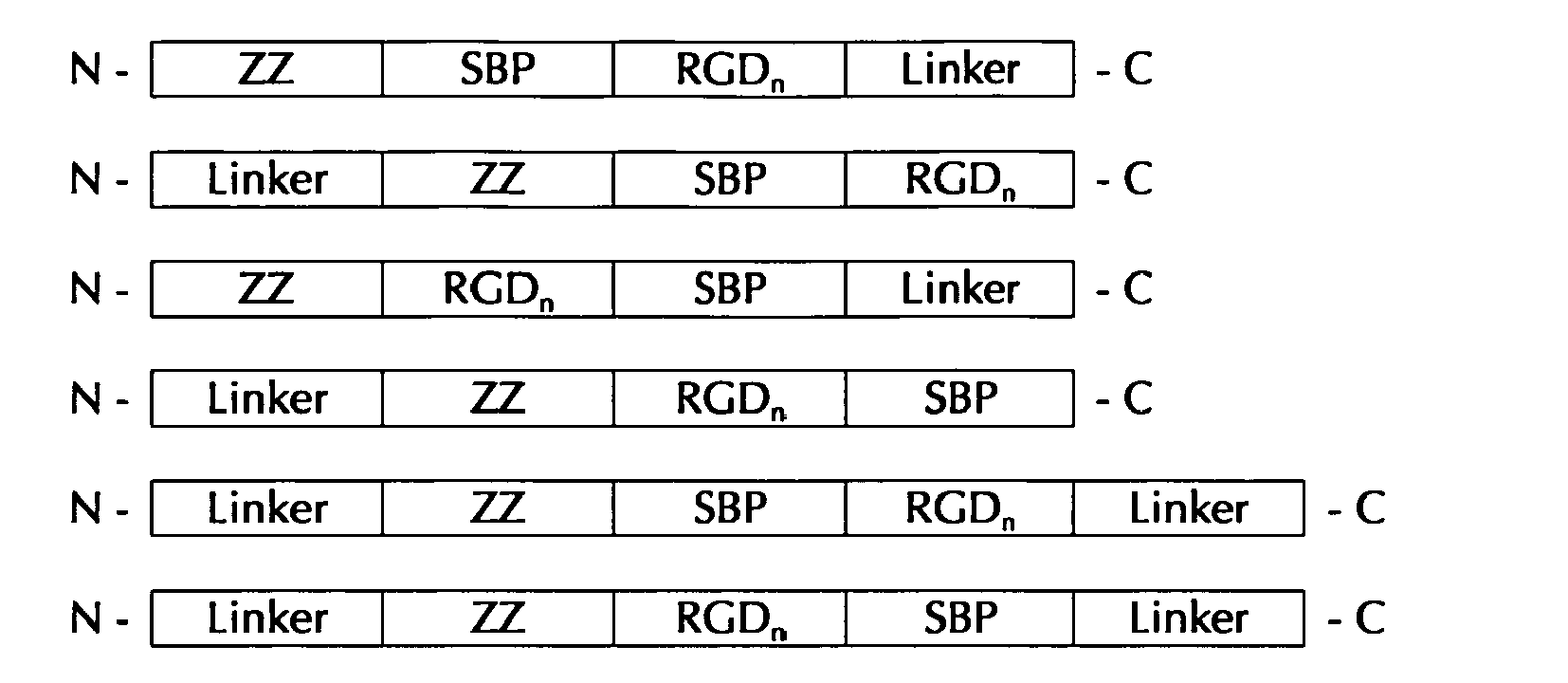 or
or
 etc.
etc.
- Additionally or alternatively, the at least one multifunctional fusion protein used to modify the PEG-polymers may comprise as components a substrate binding peptide (SBP) as defined above, preferably a ZZ domain as defined above, preferably a tag for purification as defined above and at least one N- and/or C-terminal linker. Accordingly, the inventive multifunctional fusion protein may contain, without being limited thereto, as components a substrate binding peptide (SBP) as defined above, preferably a ZZ domain as defined above, preferably a tag for purification as defined above and at least one N- and/or C-terminal linker, e.g. in at least one of the following orders (from N- to C-terminus (defined as N - or - C)):etc.

- The different components of the at least one multifunctional fusion protein as defined according to the present invention are preferably directly linked with each other or via a spacer. If the different components of the multifunctional fusion protein are linked via a spacer, the spacer is preferably a peptidic spacer. A peptidic spacer typically has a length of 1 to 20, preferably 1 to 10 amino acids, more preferably 1 to 5, even more preferably 1 to 3 amino acids. In some cases the peptidic spacer sequence may be even longer, comprising 21 to 50 amino acids. A peptidic spacer may be composed of various amino acid sequences. Accordingly, such a peptidic spacer is preferably inserted via peptide bonds between at least two components of the multifunctional fusion protein as defined according to the present invention, more preferably between three, four or even five or all components of the multifunctional fusion protein, as defined according to the present invention. Preferably, a peptidic spacer will introduce some structural flexibility between the single components of the multifunctional fusion protein to be linked. Introducing such a spacer, structural flexibility is achieved, e.g. by having a peptidic spacer containing various glycine or proline residues and optionally serine residues, preferably at least 30%, more preferably at least 40% and even more preferably at least 60, 70, 75, 80, 85, 90 or even 95 or 100% proline and/or glycine residues within the peptidic spacer sequence and optionally 1 to 10, 1 to 20, 1 to 30 or 1 to 40 % serine residues within the peptidic spacer sequence, e.g. a spacer showing a sequence e.g. according to (SGGG)n (SEQ ID NO: 41), (SGGGG)n (SEQ ID NO: 42), or (SGGGGG), (SEQ ID NO: 43), wherein n is preferably 1, 2, 3, 4, 5, etc.. Furthermore, such a spacer may provide a sufficient distance to the other components of the multifunctional fusion protein, if required. Irrespective from its structure (peptidic spacer), the spacer may preferably be immunologically inactive. Appropriate spacers can be easily selected and prepared by a person skilled in the art.
- Particularly preferred inventive multifunctional fusion proteins as defined herein may be selected from multifunctional fusion proteins according to pRG107 (coding nucleic acid sequence: SEQ ID NO: 44, protein sequence: SEQ ID NO: 45), pRG111 (coding nucleic acid sequence: SEQ ID NO: 46, protein sequence: SEQ ID NO: 47) or pRG116 (coding nucleic acid sequence: SEQ ID NO: 48, protein sequence: SEQ ID NO: 49) or an amino acid sequence showing at least 80%, preferably at least 90%, more preferably at least 95%, and even more preferably at least 97,5% identity to the sequence of any of SEQ ID NO's 45, 47 or 49, or as encoded by a nucleic acid sequence showing at least 80%, preferably at least 90%, more preferably at least 95%, and even more preferably at least 97,5% identity to the sequence of any of SEQ ID NO's 44, 46 or 48 (see also
Figures 6 ,7 and8 ). - In order to determine the percentage to which two peptide or protein sequences as defined herein, are identical, the sequences can be aligned in order to be subsequently compared to one another. Therefore, e.g. gaps can be inserted into the sequence of the first sequence and the component at the corresponding position of the second sequence can be compared. If a position in the first sequence is occupied by the same component as is the case at a position in the second sequence, the two sequences are identical at this position. The percentage to which two sequences are identical is a function of the number of identical positions divided by the total number of positions. The percentage to which two sequences are identical can be determined using a mathematical algorithm. A preferred, but not limiting, example of a mathematical algorithm which can be used is the algorithm of Karlin et al. (1993), PNAS USA, 90:5873-5877 or Altschul et al. (1997), Nucleic Acids Res., 25:3389-3402. Such an algorithm is integrated in the BLAST program. Sequences which are identical to the sequences as described in the present invention to a certain extent can be identified by this program. The same applies analogously to nucleic acid sequences.
- The present invention also provides nucleic acid sequences encoding a multifunctional fusion protein, as defined above, vector sequences, in particular expression vectors, and cells, transfected with such nucleic acid sequences. The nucleic acid sequences may be DNA, RNA, single-stranded, double-stranded, circular and/or linear.
- Any of the above alternatives of the multifunctional fusion protein, as defined above may be used to modify the PEG-polymers and to form the inventive stimulus-responsive dissolvable PEG-hydrogel, e.g. a multifunctional fusion protein, comprising as components a substrate binding peptide (SBP), preferably a repetitive RGD-binding peptide, such as (RGDn), and/or a ZZ-binding domain, preferably a tag for purification, and at least one N- and/or C-terminal Cysteine moiety, or a multifunctional fusion protein, comprising as components a substrate binding peptide (SBP) as defined above, preferably a ZZ domain as defined above, preferably a tag for purification as defined above and at least one N- and/or C-terminal Cysteine moiety as defined above, etc.
- Depending on the type and/or the amount of different multifunctional fusion proteins, as defined according to the present invention, more precisely on the number of the specific linkers contained in each of the different multifunctional fusion proteins, the degree of cross-linking of the inventive stimulus-responsive dissolvable PEG-hydrogel may be influenced. Additionally, the content of further components in the inventive stimulus-responsive dissolvable PEG-hydrogel, the content of e.g. components, such as cells binding to an RGD-sequence as defined herein within the inventive multifunctional fusion protein, or binding of further components, such as a further component (peptide or protein) to the ZZ domain via its Fc-domain, may be modified accordingly.
- Particularly preferred as an inventive multifunctional fusion protein to modify the degree of cross-linking of the inventive stimulus-responsive dissolvable PEG-hydrogel are multifunctional fusion proteins as defined above and even more preferably as selected from the following:
- a) multifunctional fusion proteins as defined herein, having only one linker as defined above;
- b) multifunctional fusion proteins as defined herein, having two linkers as defined above;
- c) a combination of multifunctional fusion proteins as defined herein, having only one linker as defined above, and of multifunctional fusion proteins as defined herein, having two linkers as defined above.
- Highly preferred is a combination of multifunctional fusion proteins as defined herein, having only one linker as defined above, and multifunctional fusion proteins as defined herein, having two linkers as defined above, even though multifunctional fusion proteins as defined herein, having only one linker as defined above, and multifunctional fusion proteins as defined herein, having two linkers may be used alone.
- Preferably, multifunctional fusion proteins as defined in option c) may be selected from any of the above-mentioned multifunctional fusion proteins, more preferably from a mixture or combination of multifunctional fusion proteins as defined herein, having only one linker as defined above, and containing a substrate binding protein (SBP), an RGD-sequence, such as (RGDn), optionally a tag for purification and an N- or C-terminal linker, and such multifunctional fusion proteins as defined herein, having two linkers as defined above, and containing a substrate binding protein (SBP), an RGD-sequence , such as (RGDn), optionally a tag for purification and an N-terminal and a C-terminal linker.
- In this context, exemplary multifunctional fusion proteins as defined herein having only one linker as defined above may be selected, without being limited thereto, from one of the following:more preferably selected from


- Furthermore, exemplary multifunctional fusion proteins as defined herein having two linkers as defined above may be selected, without being limited thereto, from one of the following:more preferably from


- The inventive stimulus-responsive dissolvable PEG-hydrogel according to the present invention preferably comprises a matrix of PEG-polymers, which are modified to contain at least one multifunctional fusion protein as defined above. As defined herein, PEG is defined as polyethylene glycol (PEG), a polyether compound with many applications from industrial manufacturing to medicine. PEG is also known as polyethylene oxide (PEO) or polyoxyethylene (POE), preferably depending on its molecular weight. PEG, PEO, or POE are sometimes used synonymously and refer to an oligomer or polymer of ethylene oxide. The three names are chemically synonymous, even though historically PEG has tended to refer to oligomers and polymers with a molecular mass below 20,000 g/mol, PEO to polymers with a molecular mass above 20,000 g/mol, and POE to a polymer of any molecular mass. PEG and PEO are typically liquids or low-melting solids, depending on their molecular weights. PEGs are prepared by polymerization of ethylene oxide and are commercially available over a wide range of molecular weights from 300 g/mol to 10,000,000 g/mol. While PEG and PEO with different molecular weights find use in different applications and have different physical properties, e.g., viscosity, due to chain length effects, their chemical properties are nearly identical. Different forms of PEG are also available, dependent on the initiator used for the polymerization process, the most common of which is a monofunctional methyl ether PEG (methoxypoly(ethylene glycol)), abbreviated mPEG. Lower-molecular-weight PEGs are also available as pure oligomers, referred to as monodisperse, uniform or discrete. PEGs are also available with different geometries. Branchedor Star PEGs have about 3 - 100 PEG chains (arms) emanating from a central core group. Comb PEGs have multiple PEG chains, normally grafted to a polymer backbone. Any such PEG-polymers may be utilized in the inventive stimulus-responsive dissolvable PEG-hydrogel as defined above.
- In the context of the present invention, PEG-polymers for use in the inventive stimulus-responsive dissolvable PEG-hydrogel as defined above may be preferably selected from PEG polymers, PEO polymers or POE polymers as defined above, preferably within a molecular weight of about 300 g/mol to 10,000,000 g/mol, more preferably within a molecular weight of about 300-50,000 Da, even more preferably within a molecular weight of about 300-38,000 Da, etc., most preferably within a molecular weight of about 10 to about 50 kDa, e.g. within a molecular weight of about 20 to about 40 kDa, within a molecular weight of about 30 to about 40 kDa, e.g. within a molecular weight of about 35 to about 40 kDa, e.g. 37.5 kDa. More preferably, PEG-polymers for use in the inventive stimulus-responsive dissolvable PEG-hydrogel as defined above may be selected from any PEG-polymer as defined above, and preferably having different geometries, such as branched PEGs, e.g. having about 3 to 10 PEG chains emanating from a central core group, or e.g. having Star-PEGs have about 10 - 100 PEG chains emanating from a central core group as defined herein. Even more preferably, PEG-polymers for use in the inventive stimulus-responsive dissolvable PEG-hydrogel as defined above may be selected from any such PEG-polymer as defined herein, more preferably from PEG-polymers, having a molecular weight as defined above, and preferably, having different geometries as defined herein, such as Star-PEGs, e.g. having about 3 to about 100 PEG chains (arms) emanating from a central core group, preferably having about 3 to about 50, 3 to about 30, or 3 to about 20 PEG chains (arms), emanating from a central core group. Star-PEGs, being particularly preferred for use in the inventive stimulus-responsive dissolvable PEG-hydrogel as defined above may be a PEG polymer as defined above, having 3, 4, 5, 6, 7, 8, 9, 10, 11, 12, 13, 14, or 15 or more chains (arms) emanating from a central core group, i.e. being a 3, 4, 5, 6, 7, 8, 9, 10, 11, 12, 13, 14, or 15-armed Star-PEG-polymer. Such PEG-polymers are also referred to as multiarm Star-PEGs, e.g. 3 to 15 multiarm Star-PEGs.
- In the context of the present invention, PEG-polymers for use in the inventive stimulus-responsive dissolvable PEG-hydrogel as defined above may be modified to allow a covalent or non-covalent bond to the inventive multifunctional fusion protein as defined herein. Such a covalent or non-covalent bond is preferably as defined above. In a preferred case, such a bond is a covalent bond. More preferably, such a bond is a thioether bond. Such a thioether bond may be formed by reaction of a SH- or Thiol-containing moiety of the inventive multifunctional fusion protein as defined above, e.g. of a Cysteine, with a vinylsulfone moiety, or any further moiety, which allows formation of a thioether bond. For this purpose, the SH- or Thiol-containing moiety of the inventive multifunctional fusion protein as defined above has been reduced prior to reaction with the vinylsulfone moiety or the further moiety using a reducing agent, preferably TCEP. This step prevents the thiol moiety to react to a disulfide bond and allows formation of a thioether bond. In this context, the PEG-polymers for use in the inventive stimulus-responsive dissolvable PEG-hydrogel preferably provide at least one free vinylsulfone moiety for the thioether bond or any further moiety, which allows formation of a thioether bond. Accordingly, the inventive stimulus-responsive dissolvable PEG-hydrogel may be modified prior to cross-linking to introduce such a modification. Modification may e.g. start from a PEG-OH polymer of a PEG polymer as defined above, preferably from a multiarm Star-PEGs as defined above. An exemplary modification reaction is shown in the following:

- According to one specific aspect, such a modification may occur by sulfonating PEG-OH polymer of a PEG polymer as defined above, preferably a multiarm Star-PEG as defined above, typically leading to a Star-PEG-vinylsulfone (PEG-VS). According to a very specific protocol, a multiarm Star-PEG-vinylsulfone (PEG-VS) may be synthesized according to Lutolf et al. (2003) (see Lutolf MP, Hubbell JA., 2003, Synthesis and physicochemical characterization of end-linked poly(ethylene glycol)-co-peptide hydrogels formed by Michael-type addition. Bio-macromolecules 4(3):713-22) starting from 8-arm PEG-OH (Shearwater polymers, Huntsville, AL): Multiarm PEG-VSs may be synthesized e.g. by coupling PEG-OHs with an excess of divinyl sulfone (Aldrich, Buchs, Switzerland). As an example, PEG-OH may be dissolved in a solvent, e.g. dichloromethane or, in some cases PEG may be dried by azeotropic distillation, e.g. in toluene, e.g. using a Dean Stark trap before starting the reaction. To the PEG dissolved in dichloromethane, NaOH may be added, preferably under argon, preferably with a molar excess over OH groups, e.g. 4 to 6-fold, e.g. 5-fold. After hydrogen evolution, divinylsulfone may be added then at molar excess over OH groups, preferably at 50- to 1 00-fold. The reaction is typically carried out at room temperature, preferably for 1 to 3 days, e.g. 2 to 3 or even 3 days, preferably under argon atmosphere with constant stirring. Afterwards the reaction solution is typically neutralized, preferably with concentrated acid, e.g. acetic acid, filtered and reduced to a small volume. PEG may then be precipitated by adding the remaining solution into ice-cold diethyl ether. The polymer may then be recovered by filtration, washed with e.g. diethyl ether, and dried, preferably under vacuum. The dry polymer may then be dissolved in deionized water, containing sodium chloride and extracted dichloromethane. This solution may be dried with sodium carbonate and the volume may be reduced by evaporation. Finally, the product may be reprecipitated and washed, e.g. with diethyl ether, to remove all remaining divinyl sulfone. The final product may be dried under vacuum and stored under inert gas, e.g. argon, preferably at 20 °C. Derivatization may be confirmed with 1H NMR (CDCl3). The degree of end group conversion, as shown by NMR, is preferably in a range from 90 to 99%, more preferably in a range from 95 to 98%. Gel permeation chromatography may furthermore be used to confirm that the starting material (PEG-OH) and the end-functionalized PEG-VS have identical molecular weight distributions.
- Further chemical compounds may also be attached to PEG polymers as defined herein by any bond as indicated above or any other possible chemical attachment, e.g. by amide formation (e.g. carboxylic acids, sulphonic acids, amines, etc.), by Michael addition (e.g maleinimide moieties, unsatured carbonyls, etc.), by click chemistry (e.g. azides or alkines), by alkene/alkine methatesis (e.g. alkenes or alkines), imine or hydrozone formation (aldehydes or ketons, hydrazins, hydroxylamins, amines), complexation reactions (avidin, biotin, protein G) or components which allow Sn-type substitution reactions (e.g halogenalkans, thiols, alcohols, amines, hydrazines, hydrazides, sulphonic acid esters, oxyphosphonium salts), or other chemical moieties which can be utilized in the attachment of further components. Such other possible chemical attachments may also be used to covalently bind further components as defined herein, such as the inventive multifunctional fusion protein, further components, cells, etc. to PEG polymers as defined herein.
- The object underlying the present invention is furthermore solved by a method for preparing the inventive stimulus-responsive dissolvable PEG-hydrogel, preferably a stimulus-responsive dissolvable PEG-hydrogel as defined above. Typically, the inventive stimulus-responsive dissolvable PEG-hydrogel, comprising a matrix of PEG-polymers as defined above, may be prepared according to the following steps:
- a) providing at least one multifunctional fusion protein as defined herein
- b) mixing the at least one multifunctional fusion protein according to step a) with a substrate for the substrate binding protein (SBP) as defined above;
- c) adding the mixture obtained according to step b) to a PEG-polymer as defined herein; and thereby preferably forming the PEG-hydrogel.
- In step a) of the method for preparation of the inventive stimulus-responsive dissolvable PEG-hydrogel at least one multifunctional fusion protein is provided. As already discussed above, the degree of cross-linking of the inventive stimulus-responsive dissolvable PEG-hydrogel may be influenced by selectively using a specific type and/or amount of different multifunctional fusion proteins as defined according to the present invention, more precisely by using multifunctional fusion proteins as defined herein, having only one or two linkers as defined herein, e.g. one or two thiol-containing moieties, cysteines or homocysteines. As can be easily understood, multifunctional fusion proteins as defined herein, having only one linker usually will lead to a different type of cross-linking than multifunctional fusion proteins as defined herein, having two linkers.
- Accordingly, in step a) of the method for preparation of the inventive stimulus-responsive dissolvable PEG-hydrogel different inventive multifunctional fusion proteins as defined herein may be provided, preferably to modify the type and degree of cross-linking of the inventive stimulus-responsive dissolvable PEG-hydrogel. Accordingly, in step a) of the method for preparation of the inventive stimulus-responsive dissolvable PEG-hydrogel, preferably
- a) multifunctional fusion proteins as defined herein, having only one linker as defined above;
- b) multifunctional fusion proteins as defined herein, having two linkers as defined above; and/or
- c) multifunctional fusion proteins as defined herein, having only one linker as defined above, and multifunctional fusion proteins as defined herein, having two linkers as defined above,
- In this context, without being limited thereto, exemplary multifunctional fusion proteins as defined herein for step a) of the method for preparation of the inventive stimulus-responsive dissolvable PEG-hydrogel, having only one linker as defined above may be most preferably selected e.g. from the following:

- Furthermore, without being limited thereto, exemplary multifunctional fusion proteins as defined herein for step a) of the method for preparation of the inventive stimulus-responsive dissolvable PEG-hydrogel, having two linkers as defined above may be most preferably selected from the following:

- Preferably the molar ratio of multifunctional fusion proteins, having only one linker to multifunctional fusion proteins, having two linkers, as may be used in step a) of the inventive method, is preferably about 20 to about 1, about 10 to about 1, about 5 to about 1, about 4 to about 1, about 3 to about 1, about 2 to about 1, about 1 to about 1, about 1 to about 2, about 1 to about 3, about 1 to about 4, about 1 to about 5, about 1 to about 10 or even about 1 to about 20. More preferably, the molar ratio of multifunctional fusion proteins, having only one linker to multifunctional fusion proteins, having two linkers is about 10 to about 1, about 5 to about 1, about 4 to about 1, about 3 to about 1, about 2 to about 1 or about 1 to about 1, most preferably about 5 to about 1.
- Furthermore, protein end concentrations (preferably in solution prior to hydrogel formation) of these multifunctional fusion protein(s) to be provided in step a) of the method for preparation of the inventive stimulus-responsive dissolvable PEG-hydrogel may be, without being limited thereto, in a range of about 1 to about 500 µg/µl, in a range of about 10 to about 300 µg/µl, in a range of about 20 to about 250 µg/µl, in a range of about 30 to about 200 µg/µl, in a range of about 40 to about 175 µg/µl, in a range of about 50 to about 150 µg/µl, more preferably in a range of about 60 to about 140 µg/µl, in a range of about 70 to about 130 µg/µl, in a range of about 80 to about 120 µg/µl, or in a range of about 90 to about 110 µg/µl.
- Additional to the degree of cross-linking the content of further components in the inventive stimulus-responsive dissolvable PEG-hydrogel, such as such as cells binding to an RGD-sequence as defined herein within the inventive multifunctional fusion protein or of further peptide or protein components, e.g. binding to the ZZ domain via an Fc-domain, may be modified accordingly. Thus, it may be also preferred to additionally introduce such inventive multifunctional fusion proteins comprising a ZZ domain as defined above into the inventive PEG hydrogel.
- Accordingly, in step a) of the method for preparation of the inventive stimulus-responsive dissolvable PEG-hydrogel such inventive multifunctional fusion proteins may be provided in addition, which contain a ZZ domain as defined herein. Generally, any multifunctional fusion proteins containing a ZZ domain as defined herein may be used for this purpose. In this context, without being limited thereto, exemplary multifunctional fusion proteins as defined herein for step a) of the method for preparation of the inventive stimulus-responsive dissolvable PEG-hydrogel containing a ZZ domain may be most preferably selected from one of the following:


- If inventive multifunctional fusion proteins comprising a ZZ domain as defined above are incorporated into the inventive PEG-hydrogel, protein end concentrations of (all) multifunctional fusion protein(s) to be provided in step a) of the inventive method for preparation of the inventive stimulus-responsive dissolvable PEG-hydrogel may be in about the same range as already defined above. However, it may be preferable to determine protein end concentrations of inventive multifunctional fusion proteins comprising a ZZ domain separately, e.g., without being limited thereto, in a range of about 0.001 to about 100 µg/µl, in a range of about 0.001 to about 50 µg/µl, in a range of about 0.001 to about 25 µg/µl, in a range of about 0.001 to about 20 µg/µl, in a range of about 0.001 to about 10 µg/µl, in a range of about 0.001 to about 5 µg/µl, more preferably in a range of about 0.01 to about 2.5 µg/µl, or in a range of about 0.1 to about 2 µg/µl.
- Depending on the type and/or the amount of different multifunctional fusion proteins as defined according to the present invention, more precisely on the number of the specific linkers contained different multifunctional fusion proteins, the degree of cross-linking of the inventive stimulus-responsive dissolvable PEG-hydrogel may be influenced. Additionally, the content of further components in the inventive stimulus-responsive dissolvable PEG-hydrogel, the content of e.g. components, such as cells binding to an RGD-sequence as defined herein within the inventive multifunctional fusion protein, or binding of further components, such as a further peptide or protein component to the ZZ domain via its F c -domain, may be modified accordingly.
- In step b) of the inventive method for preparation of the inventive stimulus-responsive dissolvable PEG-hydrogel the at least one multifunctional fusion protein, as provided according to step a) and a substrate, as defined above for the substrate binding protein (SBP) are mixed with each other.
- The specific substrate for the substrate binding protein (SBP) as defined above may be any suitable substrate as defined herein, which can be bound by at least one, preferably by at least two substrate binding proteins (SBP), as defined above, to allow dimerization or multimerization of the covalently bound PEG polymers or just specific binding of the substrate by the substrate binding protein (SBP). For example, a specific substrate for the substrate binding protein GyrB as defined above is the antibiotic coumermycin, which can be bound by (one or) two GyrB subunits. Furthermore, a heparin binding protein (HBP), as defined above may bind heparin as its substrate, wherein preferably at least one, preferably at least two heparin binding proteins (HBP) may bind to the same substrate. Accordingly, it may be necessary in step b) of the inventive method for preparation of the inventive stimulus-responsive dissolvable PEG-hydrogel, to use the substrate binding protein (SBP) in equal or even double molar excess with respect to its substrate. In other words, the molar ratio between heparin binding protein (HBP) and its substrate is preferably about 1:1 or 2:1. As a particular example, the molar ratio between a GyrB containing multifunctional fusion protein to be used and its substrate coumermycin is preferably about 2:1. Likewise, the molar ratio between a heparin binding protein (HBP) containing multifunctional fusion protein to be used and its substrate coumermycin is preferably about 2:1 or even 1:1.
- The mixture obtained in step b) is preferably incubated after mixing, to allow thorough mixing of the components of the mixture. In particular, incubation may allow binding of the substrate binding protein (SBP) to its specific substrate, e.g. to allow binding of one or two or more multifunctional fusion proteins, each containing a GyrB subunit to its specific substrate, the antibiotic coumermycin, or e.g. to allow binding of one or two multifunctional fusion proteins, each containing a heparin binding protein to its specific substrate heparin.
- In step c) of the method for preparation of the inventive stimulus-responsive dissolvable PEG-hydrogel the mixture as provided in step b), i.e. of at least one multifunctional fusion protein as defined herein and a substrate as defined above for the substrate binding protein (SBP), is preferably added to a PEG-polymer as defined herein. Adding of the mixture as provided in step b) to a PEG-polymer as defined herein, is typically carried out in a temperature range of about 15 °C to about 50 °C, more preferably in a temperature range of about 15°C to about 40 °C, e.g. at about room temperature (RT, e.g. about 20 to 25 °C, e.g. 20°C or 25°C), or at about 37°C. As already defined above, the PEG-polymer may be modified to comprise a thiol-containing moiety or any further moiety, which allows formation of a thioether bond, e.g. vinylsulfone moieties.
- The molar ratio of the multifunctional fusion protein as defined herein (containing the substrate binding protein (SBP)) to the reactive (thioether-forming) moieties of the PEG polymer as provided in step c) of the inventive method is preferably about 1:1, e.g. between about 0.75:1 and about 1:0.75, between about 0.8:1 and about 1:0.8, between about 0.85:1 and about 1:0.85, between about 0.9:1 and about 1:0.9, between about 0.95:1 and about 1:0.95, or about 1:1. Preferably, the concentration of the PEG polymer might be between 0.5-15 %, e.g. between about 0.5 to about 5%, between about 2.5 to about 7.5%, between about 5 to about 10%, between about 7.5 to about 12.5%, or between about 10 to about 15%, either w/v or v/v or w/w. or may be in a range formed by any two of these values.
- Hydrogel formation according to step c) of the inventive method for preparing the inventive stimulus-responsive dissolvable PEG-hydrogels is preferably carried out in a humidified atmosphere, to prevent drying and thus shrinking of the newly formed PEG-hydrogel.
- According to a very preferred alternative of the inventive method, the inventive stimulus-responsive dissolvable PEG-hydrogels may be prepared by providing at least one inventive multifunctional fusion protein, e.g. in a first step a) of the inventive method. The at least one inventive multifunctional fusion protein preferably comprises one inventive multifunctional fusion protein as defined above with one linker and a further inventive multifunctional fusion protein, comprising two linkers as defined above, typically in a molar amount of about 10 to about 1, about 5 to about 1, about 4 to about 1, about 3 to about 1, about 2 to about 1, about 1 to about 1, e.g. about 5 to about 1, preferably at a protein end concentration in a range of about 60 to about 140 µg/µl, in a range of about 70 to about 130 µg/µl, in a range of about 80 to about 120 µg/µl, or in a range of about 90 to about 110 µg/µl, e.g. about 100 µg/µl. For further modification, a multifunctional fusion protein containing a ZZ domain as defined herein may be added during step a) in an end concentration in a range of about 0.001 to about 10 µg/µl, in a range of about 0.001 to about 5 µg/µl, more preferably in a range of about 0.01 to about 2.5 µg/µl, or in a range of about 0.1 to about 2 µg/µl, e.g. 1 µg/µl. In a second step b) of the very preferred alternative, the protein solution is then preferably mixed with the substrate of the substrate binding protein (SBP), e.g. with coumermycin (Sigma Aldrich, St. Louis, MO, cat. no. C9270, 50 mg/ml in DMSO), if GyrB is used as a substrate binding protein in the multifunctional fusion protein, preferably at a molar ratio of SBB : substrate of about 2:1. After incubation, preferably in a temperature range of about 15°C to about 40 °C, e.g. at RT or at 37°C, preferably for about 1 h, a PEG polymer as defined herein may be added in third step c) of the very preferred alternative. The multifunctional fusion protein as defined herein, containing the substrate binding protein (SBP) and the reactive (thioether-forming) moieties of the PEG polymer are preferably in a molar ratio of about 1:1. Hydrogel formation is then preferably achieved by incubation of the mixture obtained according to step c), preferably in a temperature range of about 15°C to about 40 °C, e.g. at RT or at 37°C, preferably for about 5 to 15 h, e.g. 10 h, preferably in a humidified atmosphere.
- Alternatively, the inventive stimulus-responsive dissolvable PEG-hydrogel, may also be prepared by alternating the steps as identified above, e.g. by
- a) providing at least one multifunctional fusion protein as defined herein and a PEG-polymer as defined herein
- b) mixing the at least one multifunctional fusion protein as defined herein and a PEG-polymer obtained according to step a) with a substrate for the substrate binding protein (SBP) as defined herein, and thereby preferably forming the PEG hydrogel.
- The conditions of reaction are preferably as described above.
- According to a further alternative, the inventive stimulus-responsive dissolvable PEG-hydrogel, may also be prepared by alternating the steps as identified above, e.g.
- a) providing at least one multifunctional fusion protein as defined herein and a PEG-polymer as defined herein, wherein a substrate for the substrate binding protein (SBP) as defined herein has been bound to the PEG-polymer;
- b) mixing the at least one multifunctional fusion protein as defined herein and a PEG-polymer obtained according to step a) with a substrate for the substrate binding protein (SBP) as defined herein and thereby preferably forming the PEG hydrogel.
- The conditions of reaction are preferably as described above.
- The inventive stimulus-responsive dissolvable PEG-hydrogel, preferably as defined above and preferably as prepared above according to the inventive method, may be further modified by incorporating further components, selected from e.g. cells, proteins, polypeptides, antibiotics, antibodies, antimicrobial polymers, and non-steroidal clinically permitted antiphlogistics, such as derivates of (i) acelylsalicylacid, (ii) arylpropionacid, (iii) arylacticacid, (iv) indolaceticacid, (v) anthranilacid, and Oxicams, as well as selective COX-2-inhibitors.
- Proteins, which may be incorporated into the inventive stimulus-responsive dissolvable PEG-hydrogel may be selected, without being limited thereto, e.g. from growth factors. In this context, without being limited thereto, growth factors may be selected from e.g. adrenomedullin (AM), autocrine motility factor, bone morphogenetic proteins (BMPs), epidermal growth factor (EGF), erythropoietin (EPO), fibroblast growth factors (FGFs), e.g. FGF-7, granulocyte-colony stimulating factor (G-CSF), granulocyte-macrophage colony stimulating factor (GM-CSF), growth differentiation factor-9 (GDF9), hepatocyte growth factor (HGF), hepatoma derived growth factor (HDGF),heparin binding growth factor (HBGF), insulin-like growth factor (IGF), migration-stimulating factor, myostatin (GDF-8), nerve growth factor (NGF) and other neutrophins, platelet-derived growth factor (PDGF), thrombopoietin (TPO), thrombospondin (TPS), transforming growth factor alpha(TGF-α), transforming growth factor beta (TGF-β), vascular endothelial growth factor (VEGF), placental growth factor (PIGF), [(Foetal Bovine Somatotrophin)] (FBS), IL-1- Cofactor for IL-3 and IL-6 (activates T cells), IL-2- T-cell growth factor (stimulates IL-1 synthesis, activates B-cells and NK cells), IL-3 (stimulates production of all non-lymphoid cells), IL-4 (growth factor for activated B cells, resting T cells and mast cells), IL-5 (induces differentiation of activated B cells and eosinophils), IL-6 (stimulates Ig synthesis, Growth factor for plasma cells), IL-7 (growth factor for pre-B cells), Tumor necrosis factor (TNF-a), angiostatin (inhibits neovascularization), etc. A particularly preferred growth factor is e.g. FFG-7, more preferably as defined according to SEQ ID NO: 50 (see also
Figure 9 ,aa 1 to 106). Even more preferred, a protein as defined above, which may be incorporated into the inventive stimulus-responsive dissolvable PEG-hydrogel, is selected from a fusion protein comprising a growth factor as defined above, optionally a linker as defined above, preferably an Fc-domain as defined herein, and optionally a tag for purification as defined above. Most preferably, such a fusion protein is selected from a sequence according to SEQ ID NO: 52 (herein termed FGF-7-Fc-His) or an amino acid sequence showing at least 50, 60, 70, or 80%, preferably at least 90%, more preferably at least 95%, and even more preferably at least 97.5% identity to the sequence according to SEQ ID NO: 52 (see alsoFigure 9 ). Alternatively, such a fusion protein is encoded by a nucleic acid sequence according to SEQ ID NO: 51 or a nucleic acid sequence showing at least 50, 60, 70, or 80%, preferably at least 90%, more preferably at least 95%, and even more preferably at least 97.5% identity to the sequence according to SEQ ID NO: 51 (see alsoFigure 9 ). - Proteins as defined above, which may be incorporated into the inventive stimulus-responsive dissolvable PEG-hydrogel may be bound to the PEG-hydrogel e.g. via the ZZ-domain of the incorporated inventive multifunctional fusion protein as defined above. For this purpose, the proteins to be incorporated are typically fused to a binding partner of the ZZ-domain, e.g. an Fc-domain, e.g. according to SEQ ID NO: 53 or an amino acid sequence showing at least 50, 60, 70, or 80%, preferably at least 90%, more preferably at least 95%, and even more preferably at least 97.5% identity to the sequence according to SEQ ID NO: 53 (see also
Figure 9 , aa 123 to 354). - The proteins to be incorporated into the inventive stimulus-responsive dissolvable PEG-hydrogel may additionally be fused to a specific protease recognition sequence, which is preferably located between the protein as defined above and the binding partner of the ZZ-domain, as defined above. This approach allows for incorporation of the proteins into the inventive stimulus-responsive dissolvable PEG-hydrogel, and specific release of specific proteins, e.g. a specific growth factor, from the inventive hydrogel upon a specific trigger. Such a trigger may be a protease, having as a specific protease recognition sequence an amino acid sequence used to link the protein as defined above and the binding partner of the ZZ-domain, as defined above. Such protease recognition sequences might be either specific for endogenously produced proteases like matrix metalloproteases (MMPs as, for example, described in Ehrbar et al. (2007) Biomaterials 28, 3856-3866) or to proteases that might be added externally either together from the hydrogel administration or at another point in time. Accordingly, proteases as used in this aspect may include such endogenously produced proteases or matrix metalloproteases, or preferably proteases selected from, for example, factor Xa, caspases or the tobacco etch virus (TEV) protease.
- Likewise, proteins in the inventive context to be incorporated into the inventive stimulus-responsive dissolvable PEG-hydrogel may be proteases as mentioned above.
- The proteins may be incorporated into the inventive stimulus-responsive dissolvable PEG-hydrogel prior or parallel to forming the inventive hydrogel or by incubating the proteins with the (readily formed) PEG-hydrogel as defined herein. Incubation may occur preferably in a temperature range of about 15°C to about 40 °C, e.g. at RT or at 37°C. Incubation may furthermore occur preferably at a protein end concentration in a range of about 60 to about 140 µg/µl, in a range of about 70 to about 130 µg/µl, in a range of about 80 to about 120 ng/µl, or in a range of about 90 to about 110 ng/µl, e.g. about 100 µg/µl.
- Cells, which may be used to be incorporated into the inventive stimulus-responsive dissolvable PEG-hydrogel may be selected, without being limited thereto, e.g. from stem cells, such as human stem cells, adult stem cells , embryonic stem cells, engineered or non-engineered stem cells, primary or immortalized (cell-lines) stem cells, preferably mesenchymal stem cells, osteoblasts, cementoblasts, fibroblast cells of all connective tissues, e.g. gingival and/or skin and corneal fibroblasts, either alone or together with periodontal ligament fibroblasts, keratinozytes, e.g. gingival keratinozytes and keratinocytes from the oral cavity and upper aerodigestive tract, as well as from the skin and the ocular surface, cells of the central nervous system, neuronal cells, endothelial cells of vascular and corneal tissue, pericytes, myocytes, adipocytes, astrocytes, melanocytes etc. Cells as defined above are preferably autologous cells, i.e. cells derived from the patient to be treated.
- Advantageously, the inventive stimulus-responsive dissolvable PEG-hydrogel may be dissolved/degraded upon a specific stimulus. Such a specific stimulus may be e.g. the addition of a specific substrate or an antagonist of a substrate binding protein (SBP) as defined above. As an example, if GyrB is contained in the multifunctional fusion protein used to cross-link the PEG-hydrogel, the PEG-hydrogel may be degraded upon addition of the specific antibiotic novobiocin. Dissolvation/degradation may occur, if envisaged, also in a time staggered manner, e.g. via slow administration of a substrate or an antagonist of a substrate binding protein (SBP) as defined above to the inventive stimulus-responsive dissolvable PEG-hydrogel. Dissolvation/degradation is usually carried out at the application site of the inventive stimulus-responsive dissolvable PEG-hydrogel.
- According to a further specific embodiment, the object underlying the present invention is furthermore solved by the use of the inventive stimulus-responsive dissolvable PEG-hydrogel as a medicament, medical device or medical product. Especially their chemical composition, their possibility to adjust their bioactive and biomimetic parameters with integrin recognition sequences as well as the incorporation of target specific growth factors render the inventive stimulus-responsive dissolvable PEG-hydrogels to an important and valuable tool in multiple clinical applications. Advantageously, the inventive stimulus-responsive dissolvable PEG-hydrogels may be used in multiple clinical applications.
- Without being limited thereto, such clinical applications of the inventive stimulus-responsive dissolvable PEG-hydrogel, preferably in form of a medicament, medical device or medical product, include e.g. treatments in the field of implantology, dermatology and of carcinomas in the upper aerodigestive tract (e.g. during otorhinolaryngology or ear nose throat medicine) as well as wounds of the oral cavity (e.g. during oral and maxillofacial surgery). More precisely, such clinical applications of the inventive stimulus-responsive dissolvable PEG-hydrogel include e.g. wound dressings, tissue-supporting or tissue regenerating applications in the field of regenerative medicine, dental medicine and dentistry. Among such applications, for example chronically ulcerating wounds may be treated within the field of dermatology as well as wounds in the field of regenerative medicine, in particular wounds, which may occur during surgical excision of carcinomas of the upper aerodigestive tract (e.g. during otorhinolaryngology or ear nose throat medicine) as well as wounds of the oral cavity (e.g. during oral and maxillofacial surgery). In case of ulcerating wounds, which arise frequently in the lower part of the leg extremities with diabetes patients, autologous keratinozytes may be cultivated in vitro on the inventive stimulus-responsive dissolvable PEG-hydrogels in the presence of irradiated cell division inactivated dermal fibroblasts, until a preformed epithelium is obtained. Such autologous keratinozytes typically originate for example from the external hair root sheath, and are thus readily available. Subsequently, the inventive stimulus-responsive dissolvable PEG-hydrogels, which have been cultivated accordingly with such autologous cells, are preferably administered onto a preferably pretreated wound of the same patient the cells were derived from. Administration of the inventive stimulus-responsive dissolvable PEG-hydrogels onto the preferably pretreated wound of the patient typically occurs in a density and size, which preferably initiates healing of the wound and preferably allows support of the cells with nutrients from the surrounding tissue and fluids. Administration of the inventive stimulus-responsive dissolvable PEG-hydrogels also support occlusion of the wound due to a directed and systematic degradation of the PEG-hydrogel and the resulting release of specific proteins, such as keratinocyte promoting growth factors, such as EGF or FGF-7 (KGF). With respect to carcinomas of the upper aerodigestive tract (e.g. during otorhinolaryngology or ear nose throat medicine) as mentioned above, the keratinozytes applied with the inventive stimulus-responsive dissolvable PEG-hydrogels are typically derived from a so-called "forearm flap". In this case a piece of the entire skin of a part of the inner side of the forearm is removed and the fibroblasts of the connective tissue and the epithelial keratinozytes are grown in vitro. Since patients with such tumours typically suffer from impaired wound healing and accordingly show a correspondingly problematic granulation tissue, treatment of such patients and surgical dressing advantageously occurs under administration of "staggered" inventive stimulus-responsive dissolvable PEG-hydrogels containing epithelial cells and fibroblasts. Such "staggered" inventive stimulus-responsive dissolvable PEG-hydrogels may contain epithelial cells and fibroblast either in one or in two different stimulus-responsive dissolvable PEG-hydrogels as defined herein as a "sandwich". Such a "sandwich" may be prepared e.g. by pre-culturing cells as defined herein, e.g. fibroblasts, initially on the surface, which may then be termed "undersurface", while the keratinocytes, seeded with a time delay of one day, grow on the "upper surface" of the hydrogel. Interactions of both cell types via diffusible growth factors yields stratified epithelial formation over time, while both cell types lack direct cell-to-cell contacts. Advantageously, such "staggered" inventive stimulus-responsive dissolvable PEG-hydrogels, also termed "sandwich" stimulus-responsive dissolvable PEG-hydrogels, preferably provide for nutrition of the preformed epithelial tissue due to interaction with the fibroblasts via diffusible growth factors. Utilizing this approach, wound healing under occlusion of the epithelium shows a better outcome with respect to the pure preformed epithelium. In this case angiogenic growth factors such as VEGF may be incorporated into the inventive stimulus-responsive dissolvable PEG-hydrogel, which positively influence neovascularization of the wound tissue or the granulation tissue upon degradation of the gel.
- Further advantageous clinical applications of the inventive stimulus-responsive dissolvable PEG-hydrogels, preferably in form of a medicament, medical device or medical product, include alveolar crest prevention after tooth extraction in a patient to be treated. Such applications may decisively contribute to the aesthetically and functionally successful application of dental implants in the dental medicine and dentistry. In Germany over 14 million teeth are extracted each year. Subsequent to dental extraction or dental loss the supporting bone of the lost tooth more or less collapses to some extent (atrophy). Accordingly, different degrees of bone loss or atrophy can be observed in this context. With an atrophy of the alveolar bone the aesthetic appearance may be impaired. Even worse, the prerequisites for implantology and further prosthetic rehabilitation are impaired. Augmentative measures to improve the function and the aesthetic appearance are therefore usually necessary and thus usually increase financial expenses and the surgical workload with respect to invasive operation procedures. Accordingly, the specific application of the inventive stimulus-responsive dissolvable PEG-hydrogels directly subsequent to tooth extraction or loss represents an adequate and cost efficient tool to avoid such expenses and subsequent treatments.
- Additional advantageous clinical applications of the inventive stimulus-responsive dissolvable PEG-hydrogels, preferably in form of a medicament, medical device or medical product, include the treatment of diseases of the human cornea in a patient to be treated. Such applications may be carried out in the treatment of diseases of the cornea, i.e. epithelium, connective tissue/fibroblasts, and endothelium. In diseases of the limbus ("limbus stem cell insufficiency") the vessel carrying cloudy epithelium of the connective tissue (conjunctiva) grows into the clear cornea typically resulting in blindness of the affected patient. Conventional treatment of such diseases typically requires a replacement of the limbus stem cells, which represent precursor cells of the clear cornea epithelium. In cases of one-sided diseases of the limbus the treatment may be carried out by transferring vital limbus tissue from the unaffected eye to the affected eye. In cases of an ambilateral such a treatment is not possible and much more problematic. In these cases, provided there is a remaining limbal function at least in one eye, a confluent cell layer may be grown on a suitable carrier matrix such as the inventive stimulus-responsive dissolvable PEG-hydrogels based on a small cell sample. The confluent cell layer may then be transferred to the affected eye. Until today a human amnion membrane or a fibrin gel was used as a carrier matrix, wherein the number of proliferating cells (stem cells) grown from the extracted cell sample represented the most critical aspect of such an ex vivo culture. Unfortunately, long term observations revealed poor number of stem cells on both of the carrier matrices presently used, i.e. the human amnion membrane or the fibrin gel. The reason for this failure is most likely the fact that none of these carrier matrices provide the optimal extracellular environment for such stem cells. Accordingly, these stem cells can not form a niche required for an optimal cell growth. In this context, the inventive stimulus-responsive dissolvable PEG-hydrogels provide an optimal environment due to their individually adaptable properties, which can be designed with respect to the requirement of these stem cells.
- Further clinical applications of the inventive stimulus-responsive dissolvable PEG-hydrogels, preferably in form of a medical device, include the treatment of diseases of the endothelium of the cornea. A specific application in this context is e.g. treatment of Fuchs' endothelial dystrophy of the cornea. In this disease but also in the context of other diseases, a drastic reduction of the cells of the corneal endothelium occurs due to apoptosis leading to a cloudy cornea. The present therapy includes transplantation of the cornea including transplantation or replacement of all layers of the cornea. An alternative treatment includes replacement of diseased cells by a specific transplantation of the endothelial layer from a donor. Since the transplantation material is no HLA identical material the tissue graft may be rejected resulting in a significant damage of the endothelial layer. In this context, the inventive stimulus-responsive dissolvable PEG-hydrogels provide the possibility to extract endothelial cells from the patient to be treated and to enrich these endothelial cells similar to the above by growing a confluent cell layer on a suitable carrier matrix such as the inventive stimulus-responsive dissolvable PEG-hydrogels based on a small cell sample. Again, the inventive stimulus-responsive dissolvable PEG-hydrogels provide an optimal environment for these cells due to their individually adaptable properties, which can be designed with respect to the requirement of these stem cells. The cells may then be transferred together with the inventive stimulus-responsive dissolvable PEG-hydrogel as a carrier to the backside of the cornea and thus to avoid rejection of the graft.
- The inventive stimulus-responsive dissolvable PEG-hydrogel, preferably in form of a medicament, medical device or medical product, may furthermore be used, e.g. in burn dressings, hemostatic patches, in the treatment of lesions, in the surgical dressing, for wound treating, for soft and hard tissue regeneration, e.g. in the field of implantology, for the treatment of wounds in the oral cavity, e.g. due to tumour diseases, in the field of ophthalmology, in the field of periodontal defects, including periodontal ligament etc., for preparing a cell implant for, integrally or partially, regenerating or reconstructing damaged or ill or removed tissues, in particular muscle, myocardium, connective, bone, tendon or ligamentous, hepatic, renal, corneal, dermis or epidermis, articular cartilagenous tissue, for preparing an implant of central nervous system cells as neuronal cells for, integrally or partially, regenerating or reconstructing neuronal tissue, in particular central nervous system tissue, nervous tissue, such as neuronal tissue, damaged as a result of Parkinson's disease or spinal marrow damages or oncologic pathologies or Alzheimer's disease, nervous tissue, such as neuronal tissue, removed or ablated, following an surgical operation. The inventive stimulus-responsive dissolvable PEG-hydrogels may furthermore be used as drug delivery devices, cell matrices for in vitro, in vivo and/or ex vivo applications, for preparation of tissue models and as cell transplantation matrices.
- According to another specific embodiment, the object underlying the present invention is furthermore solved by the use of the inventive stimulus-responsive dissolvable PEG-hydrogel in the treatment of diseases, disease states or treatments in general as defined herein as mentioned above. More preferably, the inventive stimulus-responsive dissolvable PEG-hydrogel as defined herein may be used in the preparation of a medicament, a medical device or a medical product for the treatment of diseases as defined above.
- According to final specific embodiment, the object underlying the present invention is furthermore solved by kits, preferably kits of parts, comprising the inventive stimulus-responsive dissolvable PEG-hydrogel, optionally further components for incorporation into the PEG-hydrogel as defined above, and optionally instructions for use. Such kits may be used in the treatment of diseases, disease states or treatments in general as defined herein and as mentioned above. The kit preferably comprises the different components in different parts of the kit, e.g. one part comprising the inventive stimulus-responsive dissolvable PEG-hydrogel, and at least one or more parts comprising one or more of the further components.
- In the present invention, if not otherwise indicated, different features of alternatives and embodiments may be combined with each other. Furthermore, the term "comprising" shall not be construed as meaning "consisting of", if not specifically mentioned. However, in the context of the present invention, term "comprising" may be substituted with the term "consisting of", where applicable.
- The following Figures shall illustrate the afore described invention in further detail and are not intended to limit the scope of the claims thereto.
- Figure 1:
- shows the inventive stimulus-responsive dissolvable PEG-hydrogel with RGD sequences and the incorporation of human gingival fibroblasts on the hydrogel subsequent to phase contrast microscopy and the specific morphology of the seeded cells. As can be seen, the gingival fibroblasts continuously spread over the inventive stimulus-responsive dissolvable PEGhydrogel with RGD sequences, leading to a continuously grown cell lawn within an incubation time of 24 hours. In particular, a significant increase of cell growth can be observed for gingival fibroblasts, which maintain their natural spindle-shaped morphology. In contrast, cells seeded on stimulusresponsive dissolvable PEG-hydrogel with RGD sequences show no continuous growth of cells within the incubation time of 24 hours. These cells are repelled from the gel and subsequently undergo apoptosis.
- Figure 2:
- shows the inventive stimulus-responsive dissolvable PEG-hydrogel with RGD sequences and the incorporation of human gingival fibroblasts on the hydrogel subsequent to phalloidin staining and the actin filaments formed thereby. As can be seen, the gingival fibroblasts continuously spread over the inventive stimulus-responsive dissolvable PEG-hydrogel with RGD sequences, leading to a continuously grown cell lawn within an incubation time of 24 hours. In particular, a significant increase of cell growth can be observed for gingival fibroblasts, which maintain their natural spindle-shaped morphology. In contrast, cells seeded on stimulus-responsive dissolvable PEG-hydrogel with RGD sequences show no continuous growth of cells within the incubation time of 24 hours. These cells are repelled from the gel and subsequently undergo apoptosis.
- Figure 3:
- shows the inventive stimulus-responsive dissolvable PEG-hydrogel with RGD sequences and the incorporation of human gingival fibroblasts on the hydrogel subsequent to integrin-b1-staining and the binding of the cells to the RGD-sequences (focal contacts). As can be seen, the gingival fibroblasts continuously spread over the inventive stimulus-responsive dissolvable PEGhydrogel with RGD sequences, leading to a continuously grown cell lawn within an incubation time of 24 hours. In particular, a significant increase of cell growth can be observed for gingival fibroblasts, which maintain their natural spindle-shaped morphology. In contrast, cells seeded on stimulusresponsive dissolvable PEG-hydrogel with RGD sequences show no continuous growth of cells within the incubation time of 24 hours. These cells are repelled from the gel and subsequently undergo apoptosis
- Figure 4:
- shows an exemplary formation of the inventive stimulus-responsive dissolvable PEG-hydrogel, when using GyrB in the inventive multifunctional fusion protein to modify the underlying PEG-gel. Formation of the PEGhydrogel is induced by adding the substrate coumermycin, whereas the PEGhydrogel can be degraded again in a controlled manner using the antibiotic compound novobiocin.
- Figure 5:
- shows nucleic acid sequence and the corresponding amino acid sequence of GyrB (11 1-220).
- Figure 6:
- shows the nucleic acid sequence and the corresponding amino acid sequence of the inventive multimeric fusion protein pRG107. The subunits are as indicated in the following: AA1: Methionine start AA2:
cysteine 1 for coupling to the PEG-VS AA3-221: GyrB(1-220) AA222-233: double-GRGDSP-motif AA234-239: hexahistidine tag AA240: cysteine 2 for coupling to PEG-VS - Figure 7:
- shows the nucleic acid sequence and the corresponding amino acid sequence of the inventive multimeric fusion protein pRG111. The subunits are as indicated in the following: AA1-129: ZZ-binding domain, derived from pEZZ-18 (commercial vector, GE healthcare) AA130-349: GyrB(1-220) AA350-355: hexahistidine tag AA356: cysteine for coupling to PEG-VS
- Figure 8:
- shows the nucleic acid sequence and the corresponding amino acid sequence of the inventive multimeric fusion protein pRG116. The subunits are as indicated in the following: Subunits: AA1-220: GyrB(1-220) AA221-232: double-GRGDSP-motif AA233-238: hexahistidine tag AA239: cysteine 2 for coupling to PEG-VS
- Figure 9:
- shows the nucleic acid sequence and the corresponding amino acid sequence of fusion protein FGF-7-Fc-His. The subunits are as indicated in the following: Subunits: AA1-106: FGF-7 (=KGF) AA107-122: serine-glycine linker AA123-354: Fc domain AA355-360: hexahistidine tag
- The following Examples shall illustrate the afore described invention in further detail and are not intended to limit the scope of the claims thereto.
- 8-arm-Polyethylene-glycol-vinylsulfone (PEG-VS, molecular weight 37.5 kDa) was synthesized according to Lutolf MP, Hubbell JA. 2003. Synthesis and physicochemical characterization of end-linked poly(ethylene glycol)-co-peptide hydrogels formed by Michael-type addition. Bio-macromolecules 4(3):713-22) starting from 8-arm PEG-OH (Shearwater polymers, Huntsville, AL):
- Multiarm PEG-VSs were synthesized by coupling PEG-OHs with an excess of divinyl sulfone (Aldrich, Buchs, Switzerland). PEG-OH (ca. 5 g) was either used as received and dissolved directly in 300 mL of dry dichloromethane (previously dried over molecular sieves) or, in some cases, PEG was dried by azeotropic distillation in toluene using a Dean Stark trap before starting the reaction. To the PEG dissolved in dichloromethane, NaH was added under argon, at 5-fold molar excess over OH groups. After hydrogen evolution, divinyl sulfone was added very quickly at 50- to 100-fold molar excess over OH groups. The reaction was carried out at room temperature for 3 days under argon atmosphere with constant stirring. Afterward the reaction solution was neutralized with concentrated acetic acid, filtered through paper until clear, and reduced to a small volume (ca. 10 mL) by rotary evaporation. PEG was precipitated by adding the remaining solution dropwise into ice-cold diethyl ether. The polymer was recovered by filtration, washed with diethyl ether, and dried under vacuum. The dry polymer was then dissolved in 200 mL of deionized water containing ca. 5 g of sodium chloride and extracted three times with 200 mL of dichloromethane. This solution was dried with sodium carbonate, and the volume was again reduced by rotary evaporation. Finally, the product was reprecipitated and thoroughly washed with diethyl ether to remove all remaining divinyl sulfone. The final product was dried under vacuum and stored under argon at -20 °C. Derivatization was confirmed with 1H NMR (CDCl3): 3.6 ppm (PEG backbone), 6.1 ppm (d, 1H, =CH 2), 6.4 ppm (d, 1H, =CH 2), and 6.8 ppm (dd, 1 H, -SO2CH=). The degree of end group conversion, as shown by NMR, was found to range from 95 to 98%. Gel permeation chromatography was used to confirm that the starting material (PEG-OH) and the end-functionalized PEG-VS have identical molecular weight distributions.
- The following specific multifunctional fusion proteins (herein also determined as GyrB variants) were cloned and expressed:

- The plasmid pRG116 contains the N-terminal sequence of E.coli Gyrase B (aa 1-220) followed a double RGD-sequence (2x GRGDSP), a hexahistidine-tag for purication and a cysteine residue for coupling to the PEG-VS.
- The plasmid pRG1 07 contains, additionally to pRG116, an N-terminal cysteine residue.
- The plasmid pRG111 contains 2 synthetic Fc-binding Z-domains from protein A (ZZ, derived from vector pEZZ-18, GE healthcare) followed by the N-terminal sequence of E.coli Gyrase B (aa 1-220), a hexahistidine-tag for purification and a cysteine residue for coupling to the PEG-VS.
- The corresponding GyrB expression plasmid (pRG107, pRG111, pRG116) was transformed into E.coli BL21 STAR™ (DE3) (Invitrogen, Carlsbad, CA, cat. no. C601003) and protein production was induced at OD600 = 1 with 1 mM IPTG for 3 h at 37 °C. The cell pellet was resuspended in PBS (40 ml per 1000 ml initial culture volume, 50 mM NaH2PO, 300 mM NaCl, 10 mM imidazole, pH 8.0), disrupted using a French press (Thermo Fisher Scientific, Waltham, MA) and cell debris was eliminated by centrifugation at 30,000 x g for 30 min. The cleared cell lysate was loaded onto an NTA-agarose Superflow column (Qiagen, Hilden, Germany, cat. no. 30210) which was subsequently washed with 10 column volumes PBS, 10 column volumes wash buffer (50 mM NaH2PO4, 300 mM NaCl, 20 mM imidazole, pH 8.0) and eluted with 2 column volumes elution buffer (50 mM NaH2PO4, 300 mM NaCl, 250 mM imidazole, pH 8.0). To the eluate, 500mM EDTA pH8 was added to a final concentration of 10mM.
- Prior to coupling the inventive multifunctional fusion proteins to the PEG-VS polymer the inventive multifunctional fusion proteins were reduced using a reducing agent, preferably with TCEP. This step prevents the thiol moiety to react to a disulfide bond and is necessary for coupling the inventive multifunctional fusion proteins to the PEG-VS. Subsequently to reacting the inventive multifunctional fusion proteins with the reducing agent, the the inventive multifunctional fusion proteins is preferably purified to remove or at least substantially remove the reducing agent, to prevent interference of the reducing agent, e.g. TCEP, with the reduced multifunctional fusion proteins and/or the PEG-VS polymer during the coupling reaction.
- In this context, a 20-fold molar excess of TCEP (Tris(2-carboxyethyl)phosphine hydrochloride, Sigma Aldrich, St. Louis, MO, cat. no. C4706) was added to the corresponding protein eluate and incubated at room temperature for 1 h. Subsequently, the buffer of the reduced protein samples was exchanged to PBS, 2mM EDTA pH 8 by 2x separation on a size-exclusion column (Thermo Fisher Scientific, Waltham, MA, cat. No. 43233) and concentrated up to a concentration of 150µg/u) by ultrafiltration (10 kDa MWCO, Sartorius, Göttingen, Germany, cat. no. VS0202) under continuous nitrogen atmosphere.
- The hydrogels were prepared by mixing 5 molar amounts of reduced GyrB116 with 1 molar amount of reduced GyrB107 to a protein end concentration of 100µg/µl. Reduced GyrB111 was added to an end concentration of 1µg/µl. The protein solution was then mixed with coumermycin (Sigma Aldrich, St. Louis, MO, cat. no. C9270, 50 mg/ml in DMSO) at a molar ratio of GyrB : coumermycin = 2:1. After incubation at RT for 1 h, PEG-VS was added at a molar ratio of GyrB : VS groups =1:1. Hydrogel formation was achieved by incubation at 37°C in a humidified atmosphere for 10h.
- The growth factors are produced in mammalian cells (HEK293-T) with a C-terminal hexahistidine and an Fc-tag. Via its Fc-subunit, the growth factor can be incorporated into the hydrogel by binding to the ZZ-domain of GyrB111. Upon addition of novobiocin leading to hydrogel dissolution, the growth factor will also be released.
- In order to evaluate the optimized cellular adhesion capacity of the developed RGD-functionalized hydrogel, two cell types of the oral cavity, human gingival fibroblasts (hGF) and immortalized human gingival keratinocytes (IHGK), were seeded at a cell density of 5x10⁴ per hydrogel and cultivated for 24h under standard cell culture conditions. Documentation of cellular growth behaviour and morphology was performed by phase contrast microscopy (PCM). The experimental setup includes comparison of the two different cell types cultivated on hydrogels with or without RGD-functionalization. PCM on hydrogels without RGD-sequences revealed an atypical morphology for hGF and IHGK. Both cell types appeared less attached to the hydrogel surface as indicated by their morphology and showed a very low proliferation rate which was corroborated by the formation of only small cell islands (
Fig. 1 , left column). In clear contrast, the cellular behaviour on hydrogels with RGD-sequences (RGD-functionalization) illustrated that this type of modification results in a comfortable environment for the cell types under study. In more detail, hGF and IHGK showed their natural cellular morphology and in contrast to the cells growing on hydrogels without RGD-sequences, they displayed a drastic increase in proliferation rate, which was evidence by a nearly complete cell carpet revealed by the PCM mode (Fig. 1 , right column). To verify proper cell adhesion and regular cell morphology, hGF and IHGK cultivated on both hydrogel configurations (+/- RGD) were fixed with paraformaldehyde and subjected to immunostaining protocols. To illustrate cell morphology, cells were treated with the staining dye (phalloidin) which specifically intercalates into the actin filaments of the cytoskeleton. Comparison of the red fluorescent staining pattern of hGF and IHGK on the hydrogel configurations (+/- RGD) confirmed the observation from the phase contrast microscopy and revealed the irregular rotund shaped cell morphology on the hydrogels without RGD-sequences (Fig. 2 , left column). In contrast, hGF and IHGK cultivated on hydrogels + RGD-sequences displayed again their regular cell morphology, which was highlighted by the observation of the actin filament orientation at the cell's periphery (Fig. 2 , right column). - RGD-sequences are cellular adhesion points in the extracellular matrix and are constituents of the matrix molecules collagen type I and fibronectin. Cells can adhere to these RGD-sequences via certain integrin subunits including the integrin subunit β1. Therefore, the integrin subunit β1 distribution in hGF and IHGK seeded on the two hydrogel configurations (+/- RGD) was analyzed. The comparison of the integrin β1-specific green fluorescent signal distribution revealed again the accumulation at the cell periphery on the + RGD hydrogel configuration which points to proper cell adhesion, the formation of focal contacts and the development of a regular cell morphology (
Fig. 3 , right column). In contrast, the integrin β1 distribution in cells cultivated on the -RGD hyrogel configuration suggest that the cells cannot find proper adhesion points at the surface and therefore remained as an irregular rotund shaped morphology (Fig. 3 , left column). Moreover, the integrin β1-specific green fluorescent signal remained very weak which points to a decreased integrin β1 expression due to the lack of adhesion sites (Fig. 3 , left column). In summary, the RGD-sequence incorporation into the hydrogel represents an optimization of the invented medical device with respect to proliferation and adhesion of hGF and IHGK.


Claims (15)
- Stimulus-responsive dissolvable PEG-hydrogel, comprising a matrix of PEG-polymers, which are modified to contain at least one multifunctional fusion protein, the multifunctional fusion protein comprising as components a substrate binding peptide (SBP), a repetitive RGD-binding peptide, preferably a tag for purification, and at least one N- and/or C-terminal linker.
- The stimulus-responsive dissolvable PEG-hydrogel according to claim 1, wherein the substrate binding peptide (SBP) is selected from the N-terminal sequence of DNA gyrase subunit B from Escherichia coli (GyrB), from the N-terminal sequence of DNA gyrase subunit B from Escherichia coli according to SEQ ID NO: 2, or an amino acid sequence showing at least 80%, preferably at least 90%, more preferably at least 95%, and even more preferably at least 97,5% identity to the sequence according to SEQ ID NO: 2, or from proteins FKBP, FM, ToxT, DHFR, Cyp, E, PIP, TetR, ArgR, ArsR, HucR, FRB, streptavidin, avidin, neutravidin, steroid hormone receptor, a steroid hormone, or an heparin binding protein.
- The stimulus-responsive dissolvable PEG-hydrogel according to claims 1 or 2, wherein the repetitive RGD-binding peptide has the formula (RGDn), wherein n is 1, 2, 3, 4, or 5, and wherein the RGD sequence is selected from an amino acid sequence according to any of SEQ ID NO: 3 to 33, or an amino acid sequence showing at least 80%, preferably at least 90%, more preferably at least 95%, and even more preferably at least 97,5% identity to the sequence according to any of SEQ ID NO's 3 to 33.
- The stimulus-responsive dissolvable PEG-hydrogel according to one of claims 1 to 3, wherein the PEG-polymer is a multiarm Star-PEG, preferably a 3 to 15-armed Star-PEG-polymer.
- The stimulus-responsive dissolvable PEG-hydrogel according to one of claims 1 to 4, wherein the PEG-polymer is modified to allow a covalent linkage (cross-link) to the at least one multifunctional fusion protein via a thioether bond.
- The stimulus-responsive dissolvable PEG-hydrogel according to claim one of claims 1 to 5, wherein the linker is selected from a thiol-containing moiety, a thiol-modified or a thiol-containing amino acid, a cysteine, a homocysteine, a thiol coupled to maleimide, a vinylsulfone-moiety, peptide sequences, peptide bonds, a halotag, a SNAP-tag, a CLIP-tag, a transglutaminase reaction bond, amino acids, or chelate-forming entities NTA or polyhistidine binding to a multivalent metal ion.
- The stimulus-responsive dissolvable PEG-hydrogel according to one of claims 1 to 6, wherein the tag for purification is selected from a His6-tag, a FLAG-tag, an HA-tag, or a MYC tag.
- The stimulus-responsive dissolvable PEG-hydrogel according to one of claims 1 to 7, wherein the multifunctional fusion protein comprises as components a substrate binding peptide (SBP), a repetitive RGD-binding peptide (RGDn), a tag for purification, and at least one N- and/or C-terminal linker moiety.
- The stimulus-responsive dissolvable PEG-hydrogel according to claim one of claims 1 to 8, wherein the PEG-hydrogel is further modified with a fusion protein comprising as components a substrate binding peptide (SBP), a ZZ domain, a tag for purification and at least one N- and/or C-terminal linker and/or a fusion protein comprising as components a growth factor, optionally a linker, optionally an Fc-domain, and optionally a tag for purification.
- The stimulus-responsive dissolvable PEG-hydrogel according to one of claims 1 to 9, wherein cells are incorporated into the stimulus-responsive dissolvable PEG-hydrogel selected from stem cells, human stem cells, adult stem cells , embryonic stem cells, engineered or non-engineered stem cells, primary or immortalized stem cells, mesenchymal stem cells, osteoblasts, cementoblasts, fibroblast cells derived from connective tissues, gingival-, skin or corneal fibroblasts, alone or together with periodontal ligament fibroblasts, periodontal ligament fibroblasts, keratinozytes, gingival keratinozytes, keratinocytes from the oral cavity or the upper aerodigestive tract, the skin or the ocular surface, cells of the central nervous system, neuronal cells, endothelial cells of vascular and corneal tissue, pericytes, myocytes, adipocytes, astrocytes and melanocytes.
- The stimulus-responsive dissolvable PEG-hydrogel according to one of claims 1 to 10, wherein further components are incorporated into the stimulus-responsive dissolvable PEG-hydrogel selected from cells, proteins, polypeptides, growth factors, proteases, antibiotics, antibodies, antimicrobial polymers, and non-steroidal clinically permitted antiphlogistics, including derivates of (i) acelylsalicylacid, (ii) arylpropionacid, (iii) arylacticacid, (iv) indolaceticacid, (v) anthranilacid, and Oxicams, and selective COX-2-inhibitors.
- Method for preparing the stimulus-responsive dissolvable PEG-hydrogel according to one of claims 1 to 11 comprising the following steps:a) providing at least one multifunctional fusion protein as defined according to one of claims 1 to 11b) mixing the at least one multifunctional fusion protein according to step a) with a substrate for the substrate binding protein (SBP) as defined according to one of claims 1 to 11;c) adding the mixture obtained according to step b) to a PEG-polymer as defined according to one of claims 1 to 11, thereby forming the PEG-hydrogel.
- Stimulus-responsive dissolvable PEG-hydrogel according to one of claims 1 to 11 for use as a medicament, a medical device or a medical product.
- Stimulus-responsive dissolvable PEG-hydrogel according to one of claims 1 to 11 for use in the implantology, dermatology in the treatment of carcinomas in the upper aerodigestive tract, during otorhinolaryngology or ear nose throat medicine, for the treatment of wounds of the oral cavity, for the treatment of wounds in the oral cavity due to tumour diseases, during oral and maxillofacial surgery, for alveolar crest prevention after tooth extraction, in the treatment of periodontal defects, including periodontal ligament, for treatment of diseases in the field of ophthalmology, for the treatment of diseases of the (human) cornea in a patient to be treated, preferably of the endothelial or epithelial layer of the cornea and for the treatment of Fuchs' endothelial dystrophy of the cornea, for use in burn dressings, hemostatic patches, in the treatment of lesions, in the surgical dressing, for wound treating, for soft and hard tissue regeneration, in the field of implantology, for preparing a cell implant for, integrally or partially, regenerating or reconstructing damaged or ill or removed tissues, for preparing an implant of central nervous system cells as neuronal cells for, integrally or partially, regenerating or reconstructing neuronal tissue, or as drug delivery devices or cell matrices for in vitro, in vivo and/or ex vivo applications.
- Kits, preferably kits of parts, comprising the stimulus-responsive dissolvable PEG-hydrogel as defined according to one of claims 1 to 11, optionally further components for incorporation into the PEG-hydrogel as defined according to one of claims 1 to 11, and optionally instructions for use.
Priority Applications (10)
| Application Number | Priority Date | Filing Date | Title |
|---|---|---|---|
| EP10014788.3A EP2455104B1 (en) | 2010-11-19 | 2010-11-19 | Bio-functionalized stimulus-responsive dissolvable PEG-hydrogels |
| PL10014788T PL2455104T3 (en) | 2010-11-19 | 2010-11-19 | Bio-functionalized stimulus-responsive dissolvable PEG-hydrogels |
| DK10014788.3T DK2455104T3 (en) | 2010-11-19 | 2010-11-19 | Biofunctionalized stimulus-dependent soluble PEG hydrogels |
| ES10014788T ES2423798T3 (en) | 2010-11-19 | 2010-11-19 | Dissolvable PEG hydrogels sensitive to biofunctionalized stimuli |
| RU2013127669/10A RU2013127669A (en) | 2010-11-19 | 2011-11-18 | BIO-FUNCTIONALIZED STIMULUM-RESOLVING SOLUBLE PEG HYDROGELS |
| PCT/EP2011/005820 WO2012065751A1 (en) | 2010-11-19 | 2011-11-18 | Bio-functionalized stimulus-responsive dissolvable peg-hydrogels |
| EP11788373.6A EP2648758A1 (en) | 2010-11-19 | 2011-11-18 | Bio-functionalized stimulus-responsive dissolvable peg-hydrogels |
| JP2013539169A JP2013544248A (en) | 2010-11-19 | 2011-11-18 | Biofunctional stimulation-responsive soluble PEG hydrogel |
| US13/988,252 US8980278B2 (en) | 2010-11-19 | 2011-11-18 | Bio-functionalized stimulus-responsive dissolvable PEG-hydrogels |
| CN2011800555616A CN103249433A (en) | 2010-11-19 | 2011-11-18 | Bio-functionalized stimulus-esponsive dissolvable peg-hydrogels |
Applications Claiming Priority (1)
| Application Number | Priority Date | Filing Date | Title |
|---|---|---|---|
| EP10014788.3A EP2455104B1 (en) | 2010-11-19 | 2010-11-19 | Bio-functionalized stimulus-responsive dissolvable PEG-hydrogels |
Publications (3)
| Publication Number | Publication Date |
|---|---|
| EP2455104A1 true EP2455104A1 (en) | 2012-05-23 |
| EP2455104A8 EP2455104A8 (en) | 2012-11-14 |
| EP2455104B1 EP2455104B1 (en) | 2013-07-17 |
Family
ID=43708001
Family Applications (2)
| Application Number | Title | Priority Date | Filing Date |
|---|---|---|---|
| EP10014788.3A Not-in-force EP2455104B1 (en) | 2010-11-19 | 2010-11-19 | Bio-functionalized stimulus-responsive dissolvable PEG-hydrogels |
| EP11788373.6A Withdrawn EP2648758A1 (en) | 2010-11-19 | 2011-11-18 | Bio-functionalized stimulus-responsive dissolvable peg-hydrogels |
Family Applications After (1)
| Application Number | Title | Priority Date | Filing Date |
|---|---|---|---|
| EP11788373.6A Withdrawn EP2648758A1 (en) | 2010-11-19 | 2011-11-18 | Bio-functionalized stimulus-responsive dissolvable peg-hydrogels |
Country Status (9)
| Country | Link |
|---|---|
| US (1) | US8980278B2 (en) |
| EP (2) | EP2455104B1 (en) |
| JP (1) | JP2013544248A (en) |
| CN (1) | CN103249433A (en) |
| DK (1) | DK2455104T3 (en) |
| ES (1) | ES2423798T3 (en) |
| PL (1) | PL2455104T3 (en) |
| RU (1) | RU2013127669A (en) |
| WO (1) | WO2012065751A1 (en) |
Cited By (4)
| Publication number | Priority date | Publication date | Assignee | Title |
|---|---|---|---|---|
| EP2878312A1 (en) * | 2013-12-02 | 2015-06-03 | Albert-Ludwigs-Universität Freiburg | Reversible PEGylation of nanocarriers |
| US9862750B2 (en) | 2012-06-11 | 2018-01-09 | University Of Newcastle Upon Tyne | Recombinant polypeptide |
| WO2018177554A1 (en) * | 2017-03-31 | 2018-10-04 | Ophthorobotics Ag | Stimuli-responsive hydrogel and method for a piercing intervention into a mammalian eye |
| US10451896B2 (en) | 2012-08-27 | 2019-10-22 | Tangible Science, Llc | Contact lens with a hydrophilic layer |
Families Citing this family (29)
| Publication number | Priority date | Publication date | Assignee | Title |
|---|---|---|---|---|
| US9993577B2 (en) | 2013-07-01 | 2018-06-12 | Trustees Of Boston University | Dissolvable hydrogel compositions for wound management and methods of use |
| AU2014348502B2 (en) | 2013-11-15 | 2019-08-15 | Tangible Science, Inc. | Contact lens with a hydrophilic layer |
| EP3084433B1 (en) | 2013-12-20 | 2020-03-18 | Roche Diagnostics GmbH | Method of immobilizing a cell on a support using compounds comprising a polyethylene glycol moiety |
| JP6461973B2 (en) | 2013-12-20 | 2019-01-30 | エフ.ホフマン−ラ ロシュ アーゲーF. Hoffmann−La Roche Aktiengesellschaft | Use of a compound comprising a hydrophilic domain comprising two or more hydrophobic domains and a PEG moiety for cell stabilization |
| ES2708360T3 (en) | 2013-12-20 | 2019-04-09 | Hoffmann La Roche | Compounds comprising one or more hydrophobic domains and a hydrophilic domain comprising PEG residues, useful for joining cells |
| WO2015134589A1 (en) * | 2014-03-06 | 2015-09-11 | The Regents Of The University Of California | Compositions and methods for measuring cellular mechanical stress |
| EP3131566B1 (en) | 2014-04-15 | 2022-10-05 | The Regents of the University of California | Bi-terminal pegylated integrin-binding peptides and methods of use thereof |
| US10023735B2 (en) | 2014-08-18 | 2018-07-17 | International Business Machines Corporation | 3D printing with PHT/PHA based materials and polymerizable monomers |
| US9957345B2 (en) | 2014-08-18 | 2018-05-01 | International Business Machines Corporation | 3D printing with PHT based materials |
| EP3229851A4 (en) | 2014-12-09 | 2018-08-01 | Tangible Science LLC | Medical device coating with a biocompatible layer |
| US9758620B2 (en) | 2015-09-03 | 2017-09-12 | International Business Machines Corporation | Tailorable viscoelastic properties of PEG-hemiaminal organogel networks |
| WO2017036533A1 (en) * | 2015-09-03 | 2017-03-09 | Ecole Polytechnique Federale De Lausanne (Epfl) | Three-dimensional hydrogels for culturing adult epithelial stem cells and organoids |
| US9873766B2 (en) | 2015-11-24 | 2018-01-23 | International Business Machines Corporation | Systems chemistry approach to polyhexahydrotriazine polymeric structures |
| US20190247546A1 (en) * | 2016-05-17 | 2019-08-15 | Leibniz-Institut Für Polymerforschung Dresden E.V. | Method for forming a functional network of human neuronal and glial cells |
| CN109844124B (en) * | 2016-05-20 | 2023-10-03 | 哈佛学院董事及会员团体 | Gene therapy for age-related diseases and disorders |
| WO2018102715A1 (en) * | 2016-12-02 | 2018-06-07 | Indiana University Research And Technology Corporation | Compositions and methods for treating and/or reducing corneal dystrophy |
| CN106754673A (en) * | 2016-12-09 | 2017-05-31 | 北京雨泽瑞清生物科技有限公司 | The method of modifying and mescenchymal stem cell at a kind of culture medium bottom separate amplification method |
| CN109824779B (en) * | 2017-11-23 | 2023-05-26 | 中山大学 | A fusion protein comprising IgG Fc domain and Epstein-Barr virus envelope glycoprotein ectodomain |
| FR3078261B1 (en) * | 2018-02-28 | 2020-02-07 | Universite de Bordeaux | HYDROGEL TO STIMULATE NEUROTISATION, OSTEOGENESIS AND ANGIOGENESIS |
| WO2019225600A1 (en) * | 2018-05-22 | 2019-11-28 | 学校法人東京理科大学 | Method for evaluating hydrogel |
| EP3881072A4 (en) * | 2018-11-16 | 2022-11-09 | President And Fellows Of Harvard College | MOLECULES AND METHODS FOR IMPROVED IMMUNE DETECTION OF SMALL MOLECULES LIKE HISTAMINE |
| CN110721315B (en) * | 2019-09-18 | 2023-01-06 | 温州医科大学 | Preparation method of FK506 sustained-release nano-micelle and application of FK506 sustained-release nano-micelle in preparation of dry eye medicine |
| JP7679939B2 (en) * | 2020-01-28 | 2025-05-20 | 国立大学法人 東京大学 | Gel materials for regenerative medicine |
| FR3110838B1 (en) * | 2020-05-28 | 2022-06-24 | Commissariat Energie Atomique | IMMUNOMODULATOR COMPLEX AND ITS APPLICATIONS FOR THERAPY |
| EP3919091A1 (en) * | 2020-06-05 | 2021-12-08 | Albert-Ludwigs-Universität Freiburg | Bioink for reversibly forming a hydrogel by light |
| CN112933293B (en) * | 2020-11-06 | 2022-06-10 | 浙江大学 | Injectable hydrogel for treating central nerve injury and preparation method thereof |
| CN114652903A (en) * | 2022-05-06 | 2022-06-24 | 上海益思妙医疗器械有限公司 | Rapid polymerization medical hydrogel and preparation method thereof |
| CN115806736B (en) * | 2022-12-29 | 2024-03-26 | 中国科学院长春应用化学研究所 | MMP enzyme-responsive injectable polyamino acid hydrogel and preparation method and application thereof |
| WO2025184228A1 (en) * | 2024-02-26 | 2025-09-04 | Smartweave, Inc. | Smart customizable therapeutic mechanisms and systems for tissue regeneration and growth |
Citations (16)
| Publication number | Priority date | Publication date | Assignee | Title |
|---|---|---|---|---|
| US5310903A (en) | 1993-03-05 | 1994-05-10 | Merck & Co., Inc. | Imidazolidyl rapamycin derivatives |
| US5362718A (en) | 1994-04-18 | 1994-11-08 | American Home Products Corporation | Rapamycin hydroxyesters |
| US5410016A (en) | 1990-10-15 | 1995-04-25 | Board Of Regents, The University Of Texas System | Photopolymerizable biodegradable hydrogels as tissue contacting materials and controlled-release carriers |
| US5525610A (en) | 1994-03-31 | 1996-06-11 | American Home Products Corporation | 42-Epi-rapamycin and pharmaceutical compositions thereof |
| US5527907A (en) | 1993-11-19 | 1996-06-18 | Abbott Laboratories | Macrolide immunomodulators |
| WO2001014387A1 (en) | 1999-08-24 | 2001-03-01 | Ariad Gene Therapeutics, Inc. | 28-epirapalogs |
| WO2001044307A2 (en) | 1999-11-15 | 2001-06-21 | Biocure, Inc. | Degradable poly(vinyl alcohol) hydrogels |
| WO2003064383A2 (en) | 2002-02-01 | 2003-08-07 | Ariad Gene Therapeutics, Inc. | Phosphorus-containing compounds & uses thereof |
| US6649595B2 (en) | 1995-06-07 | 2003-11-18 | Ariad Gene Therapeutics, Inc. | Regulation of biological events using novel compounds |
| WO2005016252A2 (en) | 2003-07-11 | 2005-02-24 | Ariad Gene Therapeutics, Inc. | Phosphorus-containing macrocycles |
| US6984635B1 (en) | 1998-02-13 | 2006-01-10 | Board Of Trustees Of The Leland Stanford Jr. University | Dimerizing agents, their production and use |
| US20070167354A1 (en) | 2003-08-28 | 2007-07-19 | Kennedy Chad E | Hydrogels for modulating cell migration and matrix deposition |
| US20090117656A1 (en) | 2005-11-24 | 2009-05-07 | Mitsuru Akashi | Stimuli-responsive degradable gel |
| WO2009144569A2 (en) | 2008-05-29 | 2009-12-03 | Politecnico Di Milano | Hydrogel capable of containing and conveying cells |
| WO2009146929A1 (en) | 2008-06-06 | 2009-12-10 | ETH Zürich | Stimuli-responsive hydrogel |
| WO2010068728A2 (en) | 2008-12-11 | 2010-06-17 | The Brigham And Women's Hospital, Inc. | Engineering functional tissue from cultured cells |
Family Cites Families (1)
| Publication number | Priority date | Publication date | Assignee | Title |
|---|---|---|---|---|
| US7112668B2 (en) * | 2001-01-23 | 2006-09-26 | Curagen Corporation | Polypeptides and nucleic acids encoded thereby |
-
2010
- 2010-11-19 PL PL10014788T patent/PL2455104T3/en unknown
- 2010-11-19 EP EP10014788.3A patent/EP2455104B1/en not_active Not-in-force
- 2010-11-19 DK DK10014788.3T patent/DK2455104T3/en active
- 2010-11-19 ES ES10014788T patent/ES2423798T3/en active Active
-
2011
- 2011-11-18 US US13/988,252 patent/US8980278B2/en not_active Expired - Fee Related
- 2011-11-18 CN CN2011800555616A patent/CN103249433A/en active Pending
- 2011-11-18 JP JP2013539169A patent/JP2013544248A/en active Pending
- 2011-11-18 EP EP11788373.6A patent/EP2648758A1/en not_active Withdrawn
- 2011-11-18 WO PCT/EP2011/005820 patent/WO2012065751A1/en not_active Ceased
- 2011-11-18 RU RU2013127669/10A patent/RU2013127669A/en not_active Application Discontinuation
Patent Citations (17)
| Publication number | Priority date | Publication date | Assignee | Title |
|---|---|---|---|---|
| US5410016A (en) | 1990-10-15 | 1995-04-25 | Board Of Regents, The University Of Texas System | Photopolymerizable biodegradable hydrogels as tissue contacting materials and controlled-release carriers |
| US5310903A (en) | 1993-03-05 | 1994-05-10 | Merck & Co., Inc. | Imidazolidyl rapamycin derivatives |
| US5527907A (en) | 1993-11-19 | 1996-06-18 | Abbott Laboratories | Macrolide immunomodulators |
| US5525610A (en) | 1994-03-31 | 1996-06-11 | American Home Products Corporation | 42-Epi-rapamycin and pharmaceutical compositions thereof |
| US5362718A (en) | 1994-04-18 | 1994-11-08 | American Home Products Corporation | Rapamycin hydroxyesters |
| US6649595B2 (en) | 1995-06-07 | 2003-11-18 | Ariad Gene Therapeutics, Inc. | Regulation of biological events using novel compounds |
| US6984635B1 (en) | 1998-02-13 | 2006-01-10 | Board Of Trustees Of The Leland Stanford Jr. University | Dimerizing agents, their production and use |
| WO2001014387A1 (en) | 1999-08-24 | 2001-03-01 | Ariad Gene Therapeutics, Inc. | 28-epirapalogs |
| WO2001044307A2 (en) | 1999-11-15 | 2001-06-21 | Biocure, Inc. | Degradable poly(vinyl alcohol) hydrogels |
| WO2003064383A2 (en) | 2002-02-01 | 2003-08-07 | Ariad Gene Therapeutics, Inc. | Phosphorus-containing compounds & uses thereof |
| US7091213B2 (en) | 2002-02-01 | 2006-08-15 | Ariad Gene Therapeutics, Inc. | Phosphorus-containing compounds and uses thereof |
| WO2005016252A2 (en) | 2003-07-11 | 2005-02-24 | Ariad Gene Therapeutics, Inc. | Phosphorus-containing macrocycles |
| US20070167354A1 (en) | 2003-08-28 | 2007-07-19 | Kennedy Chad E | Hydrogels for modulating cell migration and matrix deposition |
| US20090117656A1 (en) | 2005-11-24 | 2009-05-07 | Mitsuru Akashi | Stimuli-responsive degradable gel |
| WO2009144569A2 (en) | 2008-05-29 | 2009-12-03 | Politecnico Di Milano | Hydrogel capable of containing and conveying cells |
| WO2009146929A1 (en) | 2008-06-06 | 2009-12-10 | ETH Zürich | Stimuli-responsive hydrogel |
| WO2010068728A2 (en) | 2008-12-11 | 2010-06-17 | The Brigham And Women's Hospital, Inc. | Engineering functional tissue from cultured cells |
Non-Patent Citations (25)
| Title |
|---|
| "Bioconjugate Techniques", 2008, ACADEMIC PRESS |
| ALTSCHUL ET AL., NUCLEIC ACIDS RES., vol. 25, 1997, pages 3389 - 3402 |
| BRAWA ET AL., BIOMED. MATER., vol. 4, 2009 |
| BRAWA, BIOMED. MATER., vol. 4, 2009 |
| C. C. LIN; A. T. METTERS: "Hydrogels in controlled release formulations: Network design and mathematical modeling", ADV. DRUG DELIV. REV., vol. 58, 2006, pages 1379 - 1408 |
| EHRBAR ET AL., BIOMATERIALS, vol. 28, 2007, pages 3856 - 3866 |
| EHRBAR M. ET AL., BIOMATERIALS, vol. 29, 2008, pages 1720 - 9 |
| GAUTIER A. ET AL., CHEM BIOL., vol. 15, 2008, pages 128 - 36 |
| HAWSER S ET AL., BIOCHEMICAL PHARMACOLOGY, vol. 71, 2006, pages 941 - 948 |
| HERSEL ET AL., BIOMATERIALS, vol. 24, 2003, pages 4385 - 4415 |
| ISHIKAWA-SAKURAI ET AL., HUMAN MOLECULAR GENETICS, vol. 13, no. 7, 2004, pages 693 - 702 |
| ITO F ET AL: "Reversible hydrogel formation driven by protein-peptide-specific interaction and chondrocyte entrapment", BIOMATERIALS 2010 ELSEVIER LTD GBR LNKD- DOI:10.1016/J.BIOMATERIALS.2009.09.026, vol. 31, no. 1, January 2010 (2010-01-01), pages 58 - 66, XP002628885, ISSN: 0142-9612 * |
| J. A. BURDICK; K. S. ANSETH: "Photoencapsulation of osteoblasts in injectable RGD-modified PEG hydrogels for bone tissue engineering", BIOMATERIALS, vol. 23, 2002, pages 4315 - 4323 |
| KARLIN ET AL., PNAS, vol. 90, 1993, pages 5873 - 5877 |
| LIN; ANSETH: "PEG hydrogels for the controlled Release of Biomolecules in Regenerative Medicine", PHARMACEUTICAL RESEARCH, vol. 26, no. 3, March 2009 (2009-03-01) |
| LOS G.V. ET AL., METHODS MOL BIOL, vol. 356, 2007, pages 195 - 208 |
| LUTOLF M P ET AL: "Repair of bone defects using synthetic mimetics of collagenous extracellular matrices", NATURE BIOTECHNOLOGY, NATURE PUBLISHING GROUP, NEW YORK, NY, US, vol. 21, no. 5, 1 May 2003 (2003-05-01), pages 513 - 518, XP002508395, ISSN: 1087-0156, [retrieved on 20030421], DOI: 10.1038/NBT818 * |
| LUTOLF MP; HUBBELL JA.: "Synthesis and physicochemical characterization of end-linked poly(ethylene glycol)-co-peptide hydrogels formed by Michael-type addition", BIO-MACROMOLECULES, vol. 4, no. 3, 2003, pages 713 - 22 |
| MARTINEZ-BUENO M. ET AL., BIOINFORMATICS, vol. 20, 2004, pages 2787 - 91 |
| N. A. PEPPAS; P. BURES; W. LEOBANDUNG; H. ICHIKAWA: "Hydrogels in pharmaceutical formulations", EUR. J. PHARM. BIOPHARM., vol. 50, 2000, pages 27 - 46 |
| RAMOS J. L. ET AL., MICROBIOL MOL BIOL REV, vol. 69, 2005, pages 326 - 56 |
| SCHMALJOHANN, D.; NITSCHKE, M.; SCHULZE, R.; WERNER, C.; EICHHORN, K.-J.: "Patterning of stimuli-responsive hydrogels", POLYMER PREPRINTS, vol. 45, December 2004 (2004-12-01), pages 380 - 381 |
| TING NIE; AARON BALDWIN; NORI YAMAGUCHI; KRISTI L. KIICK: "Production of heparin-functionalized hydrogels for the development of responsive and controlled growth factor delivery systems", JOURNAL OF CONTROLLED RELEASE, vol. 122, 2007, pages 287 - 296 |
| VALDERRAMA PILAR ET AL: "Evaluation of Parathyroid Hormone Bound to a Synthetic Matrix for Guided Bone Regeneration Around Dental Implants: A Histomorphometric Study in Dogs", JOURNAL OF PERIODONTOLOGY, vol. 81, no. 5, May 2010 (2010-05-01), pages 737 - 747, XP008134407, ISSN: 0022-3492 * |
| VOIT, B.; SCHMALJOHANN, D.; GRAMM, S.; NITSCHKE, M.; WERNER, C.: "Stimuli-responsive polymer layers for advanced cell culture technologies", INTERNATIONAL JOURNAL OF MATERIALS RESEARCH, vol. 98, August 2007 (2007-08-01), pages 646 - 650 |
Cited By (5)
| Publication number | Priority date | Publication date | Assignee | Title |
|---|---|---|---|---|
| US9862750B2 (en) | 2012-06-11 | 2018-01-09 | University Of Newcastle Upon Tyne | Recombinant polypeptide |
| US10451896B2 (en) | 2012-08-27 | 2019-10-22 | Tangible Science, Llc | Contact lens with a hydrophilic layer |
| EP2878312A1 (en) * | 2013-12-02 | 2015-06-03 | Albert-Ludwigs-Universität Freiburg | Reversible PEGylation of nanocarriers |
| WO2015082396A1 (en) * | 2013-12-02 | 2015-06-11 | Albert-Ludwigs-Universität Freiburg | Reversible pegylation of nanocarriers |
| WO2018177554A1 (en) * | 2017-03-31 | 2018-10-04 | Ophthorobotics Ag | Stimuli-responsive hydrogel and method for a piercing intervention into a mammalian eye |
Also Published As
| Publication number | Publication date |
|---|---|
| WO2012065751A1 (en) | 2012-05-24 |
| US8980278B2 (en) | 2015-03-17 |
| PL2455104T3 (en) | 2013-12-31 |
| EP2648758A1 (en) | 2013-10-16 |
| RU2013127669A (en) | 2014-12-27 |
| CN103249433A (en) | 2013-08-14 |
| JP2013544248A (en) | 2013-12-12 |
| ES2423798T3 (en) | 2013-09-24 |
| EP2455104A8 (en) | 2012-11-14 |
| EP2455104B1 (en) | 2013-07-17 |
| DK2455104T3 (en) | 2013-10-14 |
| US20130315996A1 (en) | 2013-11-28 |
Similar Documents
| Publication | Publication Date | Title |
|---|---|---|
| EP2455104B1 (en) | Bio-functionalized stimulus-responsive dissolvable PEG-hydrogels | |
| Guo et al. | The construction of elastin-like polypeptides and their applications in drug delivery system and tissue repair | |
| US7291673B2 (en) | Conjugate addition reactions for the controlled delivery of pharmaceutically active compounds | |
| CA2410526C (en) | Conjugate addition reactions for the controlled delivery of pharmaceutically active compounds | |
| Zisch et al. | Cell‐demanded release of VEGF from synthetic, biointeractive cell‐ingrowth matrices for vascularized tissue growth | |
| Kulkarni et al. | Emerging role of injectable dipeptide hydrogels in biomedical applications | |
| US7413739B2 (en) | Conjugate addition reactions for the controlled delivery of pharmaceutically active compounds | |
| JP4954370B2 (en) | Biocompatible materials made by nucleophilic addition reactions to conjugated unsaturated groups | |
| ES2720368T3 (en) | Synthetic collagen binding peptidoglycans, preparation and method of use | |
| Van Hove et al. | Depot-based delivery systems for pro-angiogenic peptides: a review | |
| JP2025157376A (en) | Sustained release CNP agonists with increased NEP stability | |
| CN109789189A (en) | Dosage regimen for controlled release PTH compounds | |
| AU2001275226A1 (en) | Conjugate addition reactions for the controlled delivery of pharmaceutically active compounds | |
| KR20190062498A (en) | Combination therapy with controlled release CNP agonist | |
| CN109789188A (en) | PTH compounds having low peak-to-valley ratios | |
| CA2726949A1 (en) | Stimuli-responsive hydrogel | |
| Yang et al. | Design Principles, Synthetic Strategies, and Biomedical Applications of Peptide–Polymer Conjugates | |
| JP2024540178A (en) | Modified alginates and methods of making and using same | |
| JP2024511537A (en) | Synthetic peptide shuttle vehicle bioconjugates for intracellular cargo delivery | |
| WO2014184564A1 (en) | Novel polymer conjugates | |
| US20240409672A1 (en) | Modified alginates and methods of making and using thereof | |
| JP2026082916A (en) | Gradual dose setting for release-controlled PTH compounds | |
| CN118434448A (en) | Modified alginates and methods of making and using the same | |
| Zhu | Promoting Wound Healing by Engineering Enzyme-Responsive Delivery of Multiple Proteins and Amphiphilic Injectable Hydrogel | |
| Brown | Biomaterials in Their Role in Creating New Approaches for the Delivery of Drugs, Proteins, Nucleic Acids, and Mammalian Cells |
Legal Events
| Date | Code | Title | Description |
|---|---|---|---|
| PUAI | Public reference made under article 153(3) epc to a published international application that has entered the european phase |
Free format text: ORIGINAL CODE: 0009012 |
|
| 17P | Request for examination filed |
Effective date: 20120124 |
|
| AK | Designated contracting states |
Kind code of ref document: A1 Designated state(s): AL AT BE BG CH CY CZ DE DK EE ES FI FR GB GR HR HU IE IS IT LI LT LU LV MC MK MT NL NO PL PT RO RS SE SI SK SM TR |
|
| AX | Request for extension of the european patent |
Extension state: BA ME |
|
| 17Q | First examination report despatched |
Effective date: 20121004 |
|
| RIN1 | Information on inventor provided before grant (corrected) |
Inventor name: STEINBERG, TORSTEN Inventor name: LAIRD, DOUGAL Inventor name: GUEBELI, RAPHAEL Inventor name: WEBER, WILFRIED Inventor name: TOMAKIDI, PASCAL |
|
| GRAP | Despatch of communication of intention to grant a patent |
Free format text: ORIGINAL CODE: EPIDOSNIGR1 |
|
| RIC1 | Information provided on ipc code assigned before grant |
Ipc: A61K 9/06 20060101ALI20130118BHEP Ipc: A61K 47/48 20060101AFI20130118BHEP Ipc: A61L 26/00 20060101ALI20130118BHEP Ipc: A61P 17/02 20060101ALI20130118BHEP Ipc: C07K 19/00 20060101ALI20130118BHEP Ipc: A61P 43/00 20060101ALI20130118BHEP Ipc: A61K 9/00 20060101ALI20130118BHEP |
|
| GRAS | Grant fee paid |
Free format text: ORIGINAL CODE: EPIDOSNIGR3 |
|
| GRAA | (expected) grant |
Free format text: ORIGINAL CODE: 0009210 |
|
| AK | Designated contracting states |
Kind code of ref document: B1 Designated state(s): AL AT BE BG CH CY CZ DE DK EE ES FI FR GB GR HR HU IE IS IT LI LT LU LV MC MK MT NL NO PL PT RO RS SE SI SK SM TR |
|
| REG | Reference to a national code |
Ref country code: GB Ref legal event code: FG4D |
|
| REG | Reference to a national code |
Ref country code: CH Ref legal event code: EP Ref country code: CH Ref legal event code: NV Representative=s name: E. BLUM AND CO. AG PATENT- UND MARKENANWAELTE , CH |
|
| REG | Reference to a national code |
Ref country code: IE Ref legal event code: FG4D |
|
| REG | Reference to a national code |
Ref country code: AT Ref legal event code: REF Ref document number: 621766 Country of ref document: AT Kind code of ref document: T Effective date: 20130815 |
|
| REG | Reference to a national code |
Ref country code: DE Ref legal event code: R096 Ref document number: 602010008539 Country of ref document: DE Effective date: 20130912 |
|
| REG | Reference to a national code |
Ref country code: SE Ref legal event code: TRGR Ref country code: ES Ref legal event code: FG2A Ref document number: 2423798 Country of ref document: ES Kind code of ref document: T3 Effective date: 20130924 |
|
| REG | Reference to a national code |
Ref country code: NL Ref legal event code: T3 |
|
| REG | Reference to a national code |
Ref country code: DK Ref legal event code: T3 Effective date: 20131009 |
|
| REG | Reference to a national code |
Ref country code: NO Ref legal event code: T2 Effective date: 20130717 |
|
| REG | Reference to a national code |
Ref country code: LT Ref legal event code: MG4D |
|
| REG | Reference to a national code |
Ref country code: PL Ref legal event code: T3 |
|
| PG25 | Lapsed in a contracting state [announced via postgrant information from national office to epo] |
Ref country code: IS Free format text: LAPSE BECAUSE OF FAILURE TO SUBMIT A TRANSLATION OF THE DESCRIPTION OR TO PAY THE FEE WITHIN THE PRESCRIBED TIME-LIMIT Effective date: 20131117 Ref country code: LT Free format text: LAPSE BECAUSE OF FAILURE TO SUBMIT A TRANSLATION OF THE DESCRIPTION OR TO PAY THE FEE WITHIN THE PRESCRIBED TIME-LIMIT Effective date: 20130717 Ref country code: HR Free format text: LAPSE BECAUSE OF FAILURE TO SUBMIT A TRANSLATION OF THE DESCRIPTION OR TO PAY THE FEE WITHIN THE PRESCRIBED TIME-LIMIT Effective date: 20130717 Ref country code: CY Free format text: LAPSE BECAUSE OF FAILURE TO SUBMIT A TRANSLATION OF THE DESCRIPTION OR TO PAY THE FEE WITHIN THE PRESCRIBED TIME-LIMIT Effective date: 20130828 Ref country code: PT Free format text: LAPSE BECAUSE OF FAILURE TO SUBMIT A TRANSLATION OF THE DESCRIPTION OR TO PAY THE FEE WITHIN THE PRESCRIBED TIME-LIMIT Effective date: 20131118 |
|
| PGFP | Annual fee paid to national office [announced via postgrant information from national office to epo] |
Ref country code: MC Payment date: 20131125 Year of fee payment: 4 Ref country code: CZ Payment date: 20131106 Year of fee payment: 4 Ref country code: NO Payment date: 20131122 Year of fee payment: 4 |
|
| PG25 | Lapsed in a contracting state [announced via postgrant information from national office to epo] |
Ref country code: LV Free format text: LAPSE BECAUSE OF FAILURE TO SUBMIT A TRANSLATION OF THE DESCRIPTION OR TO PAY THE FEE WITHIN THE PRESCRIBED TIME-LIMIT Effective date: 20130717 Ref country code: SI Free format text: LAPSE BECAUSE OF FAILURE TO SUBMIT A TRANSLATION OF THE DESCRIPTION OR TO PAY THE FEE WITHIN THE PRESCRIBED TIME-LIMIT Effective date: 20130717 Ref country code: GR Free format text: LAPSE BECAUSE OF FAILURE TO SUBMIT A TRANSLATION OF THE DESCRIPTION OR TO PAY THE FEE WITHIN THE PRESCRIBED TIME-LIMIT Effective date: 20131018 |
|
| PGFP | Annual fee paid to national office [announced via postgrant information from national office to epo] |
Ref country code: PL Payment date: 20131108 Year of fee payment: 4 |
|
| PG25 | Lapsed in a contracting state [announced via postgrant information from national office to epo] |
Ref country code: CY Free format text: LAPSE BECAUSE OF FAILURE TO SUBMIT A TRANSLATION OF THE DESCRIPTION OR TO PAY THE FEE WITHIN THE PRESCRIBED TIME-LIMIT Effective date: 20130717 |
|
| PG25 | Lapsed in a contracting state [announced via postgrant information from national office to epo] |
Ref country code: SK Free format text: LAPSE BECAUSE OF FAILURE TO SUBMIT A TRANSLATION OF THE DESCRIPTION OR TO PAY THE FEE WITHIN THE PRESCRIBED TIME-LIMIT Effective date: 20130717 Ref country code: EE Free format text: LAPSE BECAUSE OF FAILURE TO SUBMIT A TRANSLATION OF THE DESCRIPTION OR TO PAY THE FEE WITHIN THE PRESCRIBED TIME-LIMIT Effective date: 20130717 Ref country code: RO Free format text: LAPSE BECAUSE OF FAILURE TO SUBMIT A TRANSLATION OF THE DESCRIPTION OR TO PAY THE FEE WITHIN THE PRESCRIBED TIME-LIMIT Effective date: 20130717 |
|
| PLBE | No opposition filed within time limit |
Free format text: ORIGINAL CODE: 0009261 |
|
| STAA | Information on the status of an ep patent application or granted ep patent |
Free format text: STATUS: NO OPPOSITION FILED WITHIN TIME LIMIT |
|
| 26N | No opposition filed |
Effective date: 20140422 |
|
| REG | Reference to a national code |
Ref country code: DE Ref legal event code: R097 Ref document number: 602010008539 Country of ref document: DE Effective date: 20140422 |
|
| PG25 | Lapsed in a contracting state [announced via postgrant information from national office to epo] |
Ref country code: SM Free format text: LAPSE BECAUSE OF FAILURE TO SUBMIT A TRANSLATION OF THE DESCRIPTION OR TO PAY THE FEE WITHIN THE PRESCRIBED TIME-LIMIT Effective date: 20130717 |
|
| PG25 | Lapsed in a contracting state [announced via postgrant information from national office to epo] |
Ref country code: TR Free format text: LAPSE BECAUSE OF FAILURE TO SUBMIT A TRANSLATION OF THE DESCRIPTION OR TO PAY THE FEE WITHIN THE PRESCRIBED TIME-LIMIT Effective date: 20130717 Ref country code: MC Free format text: LAPSE BECAUSE OF NON-PAYMENT OF DUE FEES Effective date: 20141201 |
|
| PG25 | Lapsed in a contracting state [announced via postgrant information from national office to epo] |
Ref country code: NO Free format text: LAPSE BECAUSE OF NON-PAYMENT OF DUE FEES Effective date: 20141130 Ref country code: CZ Free format text: LAPSE BECAUSE OF NON-PAYMENT OF DUE FEES Effective date: 20141119 Ref country code: RS Free format text: LAPSE BECAUSE OF FAILURE TO SUBMIT A TRANSLATION OF THE DESCRIPTION OR TO PAY THE FEE WITHIN THE PRESCRIBED TIME-LIMIT Effective date: 20131017 Ref country code: HU Free format text: LAPSE BECAUSE OF FAILURE TO SUBMIT A TRANSLATION OF THE DESCRIPTION OR TO PAY THE FEE WITHIN THE PRESCRIBED TIME-LIMIT; INVALID AB INITIO Effective date: 20101119 Ref country code: BG Free format text: LAPSE BECAUSE OF FAILURE TO SUBMIT A TRANSLATION OF THE DESCRIPTION OR TO PAY THE FEE WITHIN THE PRESCRIBED TIME-LIMIT Effective date: 20130717 Ref country code: MK Free format text: LAPSE BECAUSE OF FAILURE TO SUBMIT A TRANSLATION OF THE DESCRIPTION OR TO PAY THE FEE WITHIN THE PRESCRIBED TIME-LIMIT Effective date: 20130717 |
|
| REG | Reference to a national code |
Ref country code: FR Ref legal event code: PLFP Year of fee payment: 6 |
|
| PGFP | Annual fee paid to national office [announced via postgrant information from national office to epo] |
Ref country code: FI Payment date: 20151126 Year of fee payment: 6 Ref country code: LU Payment date: 20151125 Year of fee payment: 6 Ref country code: DK Payment date: 20151124 Year of fee payment: 6 |
|
| PG25 | Lapsed in a contracting state [announced via postgrant information from national office to epo] |
Ref country code: PL Free format text: LAPSE BECAUSE OF NON-PAYMENT OF DUE FEES Effective date: 20141119 |
|
| PGFP | Annual fee paid to national office [announced via postgrant information from national office to epo] |
Ref country code: NL Payment date: 20151124 Year of fee payment: 6 Ref country code: SE Payment date: 20151123 Year of fee payment: 6 Ref country code: ES Payment date: 20151124 Year of fee payment: 6 Ref country code: BE Payment date: 20151124 Year of fee payment: 6 |
|
| PGFP | Annual fee paid to national office [announced via postgrant information from national office to epo] |
Ref country code: MT Payment date: 20141202 Year of fee payment: 5 |
|
| REG | Reference to a national code |
Ref country code: DE Ref legal event code: R079 Ref document number: 602010008539 Country of ref document: DE Free format text: PREVIOUS MAIN CLASS: A61K0047480000 Ipc: A61K0047500000 |
|
| REG | Reference to a national code |
Ref country code: FR Ref legal event code: PLFP Year of fee payment: 7 |
|
| PGFP | Annual fee paid to national office [announced via postgrant information from national office to epo] |
Ref country code: IE Payment date: 20161124 Year of fee payment: 7 |
|
| PG25 | Lapsed in a contracting state [announced via postgrant information from national office to epo] |
Ref country code: BE Free format text: LAPSE BECAUSE OF NON-PAYMENT OF DUE FEES Effective date: 20161130 |
|
| PGFP | Annual fee paid to national office [announced via postgrant information from national office to epo] |
Ref country code: AT Payment date: 20161122 Year of fee payment: 7 Ref country code: IT Payment date: 20161124 Year of fee payment: 7 |
|
| REG | Reference to a national code |
Ref country code: DK Ref legal event code: EBP Effective date: 20161130 |
|
| REG | Reference to a national code |
Ref country code: SE Ref legal event code: EUG |
|
| REG | Reference to a national code |
Ref country code: NL Ref legal event code: MM Effective date: 20161201 |
|
| PG25 | Lapsed in a contracting state [announced via postgrant information from national office to epo] |
Ref country code: FI Free format text: LAPSE BECAUSE OF NON-PAYMENT OF DUE FEES Effective date: 20161119 |
|
| PG25 | Lapsed in a contracting state [announced via postgrant information from national office to epo] |
Ref country code: SE Free format text: LAPSE BECAUSE OF NON-PAYMENT OF DUE FEES Effective date: 20161120 Ref country code: MT Free format text: LAPSE BECAUSE OF NON-PAYMENT OF DUE FEES Effective date: 20151130 |
|
| PG25 | Lapsed in a contracting state [announced via postgrant information from national office to epo] |
Ref country code: NL Free format text: LAPSE BECAUSE OF NON-PAYMENT OF DUE FEES Effective date: 20161201 Ref country code: LU Free format text: LAPSE BECAUSE OF NON-PAYMENT OF DUE FEES Effective date: 20161130 |
|
| REG | Reference to a national code |
Ref country code: FR Ref legal event code: PLFP Year of fee payment: 8 |
|
| PG25 | Lapsed in a contracting state [announced via postgrant information from national office to epo] |
Ref country code: DK Free format text: LAPSE BECAUSE OF NON-PAYMENT OF DUE FEES Effective date: 20161130 |
|
| PGFP | Annual fee paid to national office [announced via postgrant information from national office to epo] |
Ref country code: DE Payment date: 20171124 Year of fee payment: 8 Ref country code: FR Payment date: 20171124 Year of fee payment: 8 |
|
| REG | Reference to a national code |
Ref country code: BE Ref legal event code: MM Effective date: 20161130 |
|
| PGFP | Annual fee paid to national office [announced via postgrant information from national office to epo] |
Ref country code: GB Payment date: 20171124 Year of fee payment: 8 Ref country code: CH Payment date: 20171124 Year of fee payment: 8 |
|
| PG25 | Lapsed in a contracting state [announced via postgrant information from national office to epo] |
Ref country code: ES Free format text: LAPSE BECAUSE OF NON-PAYMENT OF DUE FEES Effective date: 20161120 |
|
| REG | Reference to a national code |
Ref country code: ES Ref legal event code: FD2A Effective date: 20180627 |
|
| REG | Reference to a national code |
Ref country code: AT Ref legal event code: MM01 Ref document number: 621766 Country of ref document: AT Kind code of ref document: T Effective date: 20171119 |
|
| PG25 | Lapsed in a contracting state [announced via postgrant information from national office to epo] |
Ref country code: AT Free format text: LAPSE BECAUSE OF NON-PAYMENT OF DUE FEES Effective date: 20171119 |
|
| REG | Reference to a national code |
Ref country code: IE Ref legal event code: MM4A |
|
| PG25 | Lapsed in a contracting state [announced via postgrant information from national office to epo] |
Ref country code: MT Free format text: LAPSE BECAUSE OF NON-PAYMENT OF DUE FEES Effective date: 20151119 |
|
| PG25 | Lapsed in a contracting state [announced via postgrant information from national office to epo] |
Ref country code: IT Free format text: LAPSE BECAUSE OF NON-PAYMENT OF DUE FEES Effective date: 20171119 Ref country code: AL Free format text: LAPSE BECAUSE OF FAILURE TO SUBMIT A TRANSLATION OF THE DESCRIPTION OR TO PAY THE FEE WITHIN THE PRESCRIBED TIME-LIMIT Effective date: 20130717 Ref country code: IE Free format text: LAPSE BECAUSE OF NON-PAYMENT OF DUE FEES Effective date: 20171119 |
|
| REG | Reference to a national code |
Ref country code: DE Ref legal event code: R119 Ref document number: 602010008539 Country of ref document: DE |
|
| REG | Reference to a national code |
Ref country code: CH Ref legal event code: PL |
|
| GBPC | Gb: european patent ceased through non-payment of renewal fee |
Effective date: 20181119 |
|
| PG25 | Lapsed in a contracting state [announced via postgrant information from national office to epo] |
Ref country code: LI Free format text: LAPSE BECAUSE OF NON-PAYMENT OF DUE FEES Effective date: 20181130 Ref country code: CH Free format text: LAPSE BECAUSE OF NON-PAYMENT OF DUE FEES Effective date: 20181130 |
|
| PG25 | Lapsed in a contracting state [announced via postgrant information from national office to epo] |
Ref country code: DE Free format text: LAPSE BECAUSE OF NON-PAYMENT OF DUE FEES Effective date: 20190601 Ref country code: FR Free format text: LAPSE BECAUSE OF NON-PAYMENT OF DUE FEES Effective date: 20181130 |
|
| PG25 | Lapsed in a contracting state [announced via postgrant information from national office to epo] |
Ref country code: GB Free format text: LAPSE BECAUSE OF NON-PAYMENT OF DUE FEES Effective date: 20181119 |