EP2453041A1 - Solution and process for the pre-treatment of copper surfaces using an N-alkoxylated adhesion-promoting compound - Google Patents
Solution and process for the pre-treatment of copper surfaces using an N-alkoxylated adhesion-promoting compound Download PDFInfo
- Publication number
- EP2453041A1 EP2453041A1 EP10190611A EP10190611A EP2453041A1 EP 2453041 A1 EP2453041 A1 EP 2453041A1 EP 10190611 A EP10190611 A EP 10190611A EP 10190611 A EP10190611 A EP 10190611A EP 2453041 A1 EP2453041 A1 EP 2453041A1
- Authority
- EP
- European Patent Office
- Prior art keywords
- chr
- solution
- nitrogen
- hydrogen
- moiety
- Prior art date
- Legal status (The legal status is an assumption and is not a legal conclusion. Google has not performed a legal analysis and makes no representation as to the accuracy of the status listed.)
- Granted
Links
- 150000001875 compounds Chemical class 0.000 title claims abstract description 87
- 229910052802 copper Inorganic materials 0.000 title claims abstract description 78
- 239000010949 copper Substances 0.000 title claims abstract description 78
- RYGMFSIKBFXOCR-UHFFFAOYSA-N Copper Chemical compound [Cu] RYGMFSIKBFXOCR-UHFFFAOYSA-N 0.000 title claims abstract description 77
- 238000000034 method Methods 0.000 title claims abstract description 42
- 238000002203 pretreatment Methods 0.000 title claims abstract description 11
- 229910052739 hydrogen Inorganic materials 0.000 claims abstract description 78
- 239000001257 hydrogen Substances 0.000 claims abstract description 78
- 150000001412 amines Chemical class 0.000 claims abstract description 59
- QJGQUHMNIGDVPM-UHFFFAOYSA-N nitrogen group Chemical group [N] QJGQUHMNIGDVPM-UHFFFAOYSA-N 0.000 claims abstract description 55
- 125000004432 carbon atom Chemical group C* 0.000 claims abstract description 50
- MHAJPDPJQMAIIY-UHFFFAOYSA-N Hydrogen peroxide Chemical compound OO MHAJPDPJQMAIIY-UHFFFAOYSA-N 0.000 claims abstract description 47
- 239000002253 acid Substances 0.000 claims abstract description 44
- 125000004435 hydrogen atom Chemical group [H]* 0.000 claims abstract description 42
- 150000003951 lactams Chemical class 0.000 claims abstract description 40
- 150000002391 heterocyclic compounds Chemical class 0.000 claims abstract description 36
- 229920002647 polyamide Polymers 0.000 claims abstract description 33
- 239000004952 Polyamide Substances 0.000 claims abstract description 32
- 150000001408 amides Chemical class 0.000 claims abstract description 27
- 125000004433 nitrogen atom Chemical group N* 0.000 claims abstract description 20
- 239000000758 substrate Substances 0.000 claims abstract description 17
- 239000004033 plastic Substances 0.000 claims abstract description 12
- 229920003023 plastic Polymers 0.000 claims abstract description 12
- 125000001183 hydrocarbyl group Chemical group 0.000 claims abstract 18
- 125000001997 phenyl group Chemical group [H]C1=C([H])C([H])=C(*)C([H])=C1[H] 0.000 claims description 28
- 125000000217 alkyl group Chemical group 0.000 claims description 23
- 229910052711 selenium Inorganic materials 0.000 claims description 20
- BUGBHKTXTAQXES-UHFFFAOYSA-N Selenium Chemical compound [Se] BUGBHKTXTAQXES-UHFFFAOYSA-N 0.000 claims description 18
- NINIDFKCEFEMDL-UHFFFAOYSA-N Sulfur Chemical compound [S] NINIDFKCEFEMDL-UHFFFAOYSA-N 0.000 claims description 18
- 229910052714 tellurium Inorganic materials 0.000 claims description 18
- PORWMNRCUJJQNO-UHFFFAOYSA-N tellurium atom Chemical compound [Te] PORWMNRCUJJQNO-UHFFFAOYSA-N 0.000 claims description 18
- 239000011669 selenium Substances 0.000 claims description 16
- 125000000623 heterocyclic group Chemical group 0.000 claims description 15
- 239000005864 Sulphur Substances 0.000 claims description 14
- 150000007513 acids Chemical class 0.000 claims description 14
- 230000015572 biosynthetic process Effects 0.000 claims description 11
- 239000000463 material Substances 0.000 claims description 11
- 125000000547 substituted alkyl group Chemical group 0.000 claims description 11
- 125000001931 aliphatic group Chemical group 0.000 claims description 10
- 238000004026 adhesive bonding Methods 0.000 claims description 8
- 150000007522 mineralic acids Chemical class 0.000 claims description 8
- 125000002947 alkylene group Chemical group 0.000 claims description 7
- 125000000753 cycloalkyl group Chemical group 0.000 claims description 6
- SPVXKVOXSXTJOY-UHFFFAOYSA-O selenonium Chemical class [SeH3+] SPVXKVOXSXTJOY-UHFFFAOYSA-O 0.000 claims description 6
- VTLHPSMQDDEFRU-UHFFFAOYSA-O telluronium Chemical class [TeH3+] VTLHPSMQDDEFRU-UHFFFAOYSA-O 0.000 claims description 6
- RWSOTUBLDIXVET-UHFFFAOYSA-O sulfonium Chemical compound [SH3+] RWSOTUBLDIXVET-UHFFFAOYSA-O 0.000 claims description 4
- 239000000057 synthetic resin Substances 0.000 claims description 4
- 229920003002 synthetic resin Polymers 0.000 claims description 4
- RWSOTUBLDIXVET-UHFFFAOYSA-N Dihydrogen sulfide Chemical class S RWSOTUBLDIXVET-UHFFFAOYSA-N 0.000 claims description 3
- REYJJPSVUYRZGE-UHFFFAOYSA-N Octadecylamine Chemical compound CCCCCCCCCCCCCCCCCCN REYJJPSVUYRZGE-UHFFFAOYSA-N 0.000 claims description 3
- 125000003342 alkenyl group Chemical group 0.000 claims description 3
- 125000001797 benzyl group Chemical group [H]C1=C([H])C([H])=C(C([H])=C1[H])C([H])([H])* 0.000 claims description 3
- QYHFIVBSNOWOCQ-UHFFFAOYSA-N selenic acid Chemical class O[Se](O)(=O)=O QYHFIVBSNOWOCQ-UHFFFAOYSA-N 0.000 claims description 3
- 150000001450 anions Chemical class 0.000 claims description 2
- XLYOFNOQVPJJNP-UHFFFAOYSA-M hydroxide Chemical compound [OH-] XLYOFNOQVPJJNP-UHFFFAOYSA-M 0.000 claims description 2
- 150000007524 organic acids Chemical class 0.000 claims description 2
- 125000005346 substituted cycloalkyl group Chemical group 0.000 claims description 2
- 229910052717 sulfur Inorganic materials 0.000 claims description 2
- 239000000243 solution Substances 0.000 description 127
- 239000010410 layer Substances 0.000 description 52
- 238000011282 treatment Methods 0.000 description 35
- QAOWNCQODCNURD-UHFFFAOYSA-N Sulfuric acid Chemical compound OS(O)(=O)=O QAOWNCQODCNURD-UHFFFAOYSA-N 0.000 description 31
- 239000000203 mixture Substances 0.000 description 28
- -1 aminobenzothiazole compound Chemical class 0.000 description 25
- 150000002430 hydrocarbons Chemical group 0.000 description 24
- 125000002496 methyl group Chemical group [H]C([H])([H])* 0.000 description 22
- UFHFLCQGNIYNRP-UHFFFAOYSA-N Hydrogen Chemical compound [H][H] UFHFLCQGNIYNRP-UHFFFAOYSA-N 0.000 description 21
- 235000014113 dietary fatty acids Nutrition 0.000 description 18
- 229930195729 fatty acid Natural products 0.000 description 18
- 239000000194 fatty acid Substances 0.000 description 18
- 150000004665 fatty acids Chemical class 0.000 description 18
- 150000002431 hydrogen Chemical class 0.000 description 15
- 239000003760 tallow Substances 0.000 description 14
- 238000003475 lamination Methods 0.000 description 13
- 125000001495 ethyl group Chemical group [H]C([H])([H])C([H])([H])* 0.000 description 11
- 229920006395 saturated elastomer Polymers 0.000 description 11
- 239000000126 substance Substances 0.000 description 9
- 125000004178 (C1-C4) alkyl group Chemical group 0.000 description 8
- 125000003118 aryl group Chemical group 0.000 description 7
- VEXZGXHMUGYJMC-UHFFFAOYSA-N Hydrochloric acid Chemical compound Cl VEXZGXHMUGYJMC-UHFFFAOYSA-N 0.000 description 6
- 238000004519 manufacturing process Methods 0.000 description 6
- ZBJVLWIYKOAYQH-UHFFFAOYSA-N naphthalen-2-yl 2-hydroxybenzoate Chemical compound OC1=CC=CC=C1C(=O)OC1=CC=C(C=CC=C2)C2=C1 ZBJVLWIYKOAYQH-UHFFFAOYSA-N 0.000 description 6
- 125000001424 substituent group Chemical group 0.000 description 6
- 239000000080 wetting agent Substances 0.000 description 6
- RAIPHJJURHTUIC-UHFFFAOYSA-N 1,3-thiazol-2-amine Chemical compound NC1=NC=CS1 RAIPHJJURHTUIC-UHFFFAOYSA-N 0.000 description 5
- ULRPISSMEBPJLN-UHFFFAOYSA-N 2h-tetrazol-5-amine Chemical compound NC1=NN=NN1 ULRPISSMEBPJLN-UHFFFAOYSA-N 0.000 description 5
- 229920002292 Nylon 6 Polymers 0.000 description 5
- 229910052757 nitrogen Inorganic materials 0.000 description 5
- 238000007747 plating Methods 0.000 description 5
- 229920000642 polymer Polymers 0.000 description 5
- 239000011347 resin Substances 0.000 description 5
- 229920005989 resin Polymers 0.000 description 5
- 239000004593 Epoxy Substances 0.000 description 4
- NBIIXXVUZAFLBC-UHFFFAOYSA-N Phosphoric acid Chemical compound OP(O)(O)=O NBIIXXVUZAFLBC-UHFFFAOYSA-N 0.000 description 4
- 125000003545 alkoxy group Chemical group 0.000 description 4
- 125000000732 arylene group Chemical group 0.000 description 4
- QRUDEWIWKLJBPS-UHFFFAOYSA-N benzotriazole Chemical compound C1=CC=C2N[N][N]C2=C1 QRUDEWIWKLJBPS-UHFFFAOYSA-N 0.000 description 4
- 239000012964 benzotriazole Substances 0.000 description 4
- 125000004181 carboxyalkyl group Chemical group 0.000 description 4
- 238000006243 chemical reaction Methods 0.000 description 4
- 125000004663 dialkyl amino group Chemical group 0.000 description 4
- KEMQGTRYUADPNZ-UHFFFAOYSA-N heptadecanoic acid Chemical compound CCCCCCCCCCCCCCCCC(O)=O KEMQGTRYUADPNZ-UHFFFAOYSA-N 0.000 description 4
- IPCSVZSSVZVIGE-UHFFFAOYSA-N hexadecanoic acid Chemical compound CCCCCCCCCCCCCCCC(O)=O IPCSVZSSVZVIGE-UHFFFAOYSA-N 0.000 description 4
- 125000002887 hydroxy group Chemical group [H]O* 0.000 description 4
- VKOBVWXKNCXXDE-UHFFFAOYSA-N icosanoic acid Chemical compound CCCCCCCCCCCCCCCCCCCC(O)=O VKOBVWXKNCXXDE-UHFFFAOYSA-N 0.000 description 4
- WQEPLUUGTLDZJY-UHFFFAOYSA-N n-Pentadecanoic acid Natural products CCCCCCCCCCCCCCC(O)=O WQEPLUUGTLDZJY-UHFFFAOYSA-N 0.000 description 4
- 125000002924 primary amino group Chemical group [H]N([H])* 0.000 description 4
- QRHDSDJIMDCCKE-UHFFFAOYSA-N 4-ethyl-2h-benzotriazole Chemical compound CCC1=CC=CC2=C1N=NN2 QRHDSDJIMDCCKE-UHFFFAOYSA-N 0.000 description 3
- CMGDVUCDZOBDNL-UHFFFAOYSA-N 4-methyl-2h-benzotriazole Chemical compound CC1=CC=CC2=NNN=C12 CMGDVUCDZOBDNL-UHFFFAOYSA-N 0.000 description 3
- MARUHZGHZWCEQU-UHFFFAOYSA-N 5-phenyl-2h-tetrazole Chemical compound C1=CC=CC=C1C1=NNN=N1 MARUHZGHZWCEQU-UHFFFAOYSA-N 0.000 description 3
- QGZKDVFQNNGYKY-UHFFFAOYSA-N Ammonia Chemical compound N QGZKDVFQNNGYKY-UHFFFAOYSA-N 0.000 description 3
- UHOVQNZJYSORNB-UHFFFAOYSA-N Benzene Chemical compound C1=CC=CC=C1 UHOVQNZJYSORNB-UHFFFAOYSA-N 0.000 description 3
- QPLDLSVMHZLSFG-UHFFFAOYSA-N Copper oxide Chemical compound [Cu]=O QPLDLSVMHZLSFG-UHFFFAOYSA-N 0.000 description 3
- 239000005751 Copper oxide Substances 0.000 description 3
- YTPLMLYBLZKORZ-UHFFFAOYSA-N Thiophene Chemical compound C=1C=CSC=1 YTPLMLYBLZKORZ-UHFFFAOYSA-N 0.000 description 3
- 239000000853 adhesive Substances 0.000 description 3
- 230000001070 adhesive effect Effects 0.000 description 3
- 125000004453 alkoxycarbonyl group Chemical group 0.000 description 3
- 229950003476 aminothiazole Drugs 0.000 description 3
- 125000003917 carbamoyl group Chemical group [H]N([H])C(*)=O 0.000 description 3
- 125000003178 carboxy group Chemical group [H]OC(*)=O 0.000 description 3
- 239000004020 conductor Substances 0.000 description 3
- 229910000431 copper oxide Inorganic materials 0.000 description 3
- 125000002993 cycloalkylene group Chemical group 0.000 description 3
- 239000003925 fat Substances 0.000 description 3
- 235000019197 fats Nutrition 0.000 description 3
- 125000001188 haloalkyl group Chemical group 0.000 description 3
- 239000007788 liquid Substances 0.000 description 3
- 239000002184 metal Substances 0.000 description 3
- 229910052751 metal Inorganic materials 0.000 description 3
- 125000002950 monocyclic group Chemical group 0.000 description 3
- 229920001223 polyethylene glycol Polymers 0.000 description 3
- 229920001451 polypropylene glycol Polymers 0.000 description 3
- 150000003455 sulfinic acids Chemical class 0.000 description 3
- 150000003512 tertiary amines Chemical class 0.000 description 3
- 229930192474 thiophene Natural products 0.000 description 3
- 150000003852 triazoles Chemical class 0.000 description 3
- 235000015112 vegetable and seed oil Nutrition 0.000 description 3
- 239000008158 vegetable oil Substances 0.000 description 3
- XLYOFNOQVPJJNP-UHFFFAOYSA-N water Substances O XLYOFNOQVPJJNP-UHFFFAOYSA-N 0.000 description 3
- YWWVWXASSLXJHU-AATRIKPKSA-N (9E)-tetradecenoic acid Chemical compound CCCC\C=C\CCCCCCCC(O)=O YWWVWXASSLXJHU-AATRIKPKSA-N 0.000 description 2
- LUBJCRLGQSPQNN-UHFFFAOYSA-N 1-Phenylurea Chemical compound NC(=O)NC1=CC=CC=C1 LUBJCRLGQSPQNN-UHFFFAOYSA-N 0.000 description 2
- KJUGUADJHNHALS-UHFFFAOYSA-N 1H-tetrazole Substances C=1N=NNN=1 KJUGUADJHNHALS-UHFFFAOYSA-N 0.000 description 2
- DIZBQMTZXOUFTD-UHFFFAOYSA-N 2-(furan-2-yl)-3h-benzimidazole-5-carboxylic acid Chemical compound N1C2=CC(C(=O)O)=CC=C2N=C1C1=CC=CO1 DIZBQMTZXOUFTD-UHFFFAOYSA-N 0.000 description 2
- TWJNQYPJQDRXPH-UHFFFAOYSA-N 2-cyanobenzohydrazide Chemical compound NNC(=O)C1=CC=CC=C1C#N TWJNQYPJQDRXPH-UHFFFAOYSA-N 0.000 description 2
- CQSJDKGNONPQOQ-UHFFFAOYSA-N 3-aminothiophene-2-carboxylic acid Chemical class NC=1C=CSC=1C(O)=O CQSJDKGNONPQOQ-UHFFFAOYSA-N 0.000 description 2
- IJGRMHOSHXDMSA-UHFFFAOYSA-N Atomic nitrogen Chemical group N#N IJGRMHOSHXDMSA-UHFFFAOYSA-N 0.000 description 2
- VEXZGXHMUGYJMC-UHFFFAOYSA-M Chloride anion Chemical compound [Cl-] VEXZGXHMUGYJMC-UHFFFAOYSA-M 0.000 description 2
- IAYPIBMASNFSPL-UHFFFAOYSA-N Ethylene oxide Chemical compound C1CO1 IAYPIBMASNFSPL-UHFFFAOYSA-N 0.000 description 2
- FFEARJCKVFRZRR-BYPYZUCNSA-N L-methionine Chemical class CSCC[C@H](N)C(O)=O FFEARJCKVFRZRR-BYPYZUCNSA-N 0.000 description 2
- 235000021360 Myristic acid Nutrition 0.000 description 2
- TUNFSRHWOTWDNC-UHFFFAOYSA-N Myristic acid Natural products CCCCCCCCCCCCCC(O)=O TUNFSRHWOTWDNC-UHFFFAOYSA-N 0.000 description 2
- UFWIBTONFRDIAS-UHFFFAOYSA-N Naphthalene Chemical compound C1=CC=CC2=CC=CC=C21 UFWIBTONFRDIAS-UHFFFAOYSA-N 0.000 description 2
- GRYLNZFGIOXLOG-UHFFFAOYSA-N Nitric acid Chemical compound O[N+]([O-])=O GRYLNZFGIOXLOG-UHFFFAOYSA-N 0.000 description 2
- 235000021314 Palmitic acid Nutrition 0.000 description 2
- 239000002202 Polyethylene glycol Substances 0.000 description 2
- GOOHAUXETOMSMM-UHFFFAOYSA-N Propylene oxide Chemical compound CC1CO1 GOOHAUXETOMSMM-UHFFFAOYSA-N 0.000 description 2
- 235000021355 Stearic acid Nutrition 0.000 description 2
- FZWLAAWBMGSTSO-UHFFFAOYSA-N Thiazole Chemical compound C1=CSC=N1 FZWLAAWBMGSTSO-UHFFFAOYSA-N 0.000 description 2
- WNLRTRBMVRJNCN-UHFFFAOYSA-N adipic acid Chemical compound OC(=O)CCCCC(O)=O WNLRTRBMVRJNCN-UHFFFAOYSA-N 0.000 description 2
- 150000001298 alcohols Chemical class 0.000 description 2
- 125000003282 alkyl amino group Chemical group 0.000 description 2
- 229910000147 aluminium phosphate Inorganic materials 0.000 description 2
- 239000007864 aqueous solution Substances 0.000 description 2
- JEHKKBHWRAXMCH-UHFFFAOYSA-N benzenesulfinic acid Chemical compound O[S@@](=O)C1=CC=CC=C1 JEHKKBHWRAXMCH-UHFFFAOYSA-N 0.000 description 2
- 125000002619 bicyclic group Chemical group 0.000 description 2
- 229920001400 block copolymer Polymers 0.000 description 2
- 125000000484 butyl group Chemical group [H]C([*])([H])C([H])([H])C([H])([H])C([H])([H])[H] 0.000 description 2
- 125000002837 carbocyclic group Chemical group 0.000 description 2
- 229910000365 copper sulfate Inorganic materials 0.000 description 2
- ARUVKPQLZAKDPS-UHFFFAOYSA-L copper(II) sulfate Chemical compound [Cu+2].[O-][S+2]([O-])([O-])[O-] ARUVKPQLZAKDPS-UHFFFAOYSA-L 0.000 description 2
- 230000007797 corrosion Effects 0.000 description 2
- 238000005260 corrosion Methods 0.000 description 2
- 238000000354 decomposition reaction Methods 0.000 description 2
- 230000007547 defect Effects 0.000 description 2
- UKMSUNONTOPOIO-UHFFFAOYSA-N docosanoic acid Chemical compound CCCCCCCCCCCCCCCCCCCCCC(O)=O UKMSUNONTOPOIO-UHFFFAOYSA-N 0.000 description 2
- 150000002148 esters Chemical class 0.000 description 2
- 150000002196 fatty nitriles Chemical class 0.000 description 2
- 229910052736 halogen Inorganic materials 0.000 description 2
- 125000005843 halogen group Chemical group 0.000 description 2
- 150000002367 halogens Chemical class 0.000 description 2
- NAQMVNRVTILPCV-UHFFFAOYSA-N hexane-1,6-diamine Chemical compound NCCCCCCN NAQMVNRVTILPCV-UHFFFAOYSA-N 0.000 description 2
- RAXXELZNTBOGNW-UHFFFAOYSA-N imidazole Natural products C1=CNC=N1 RAXXELZNTBOGNW-UHFFFAOYSA-N 0.000 description 2
- 239000003112 inhibitor Substances 0.000 description 2
- 150000002484 inorganic compounds Chemical class 0.000 description 2
- 229910052500 inorganic mineral Inorganic materials 0.000 description 2
- YAQXGBBDJYBXKL-UHFFFAOYSA-N iron(2+);1,10-phenanthroline;dicyanide Chemical compound [Fe+2].N#[C-].N#[C-].C1=CN=C2C3=NC=CC=C3C=CC2=C1.C1=CN=C2C3=NC=CC=C3C=CC2=C1 YAQXGBBDJYBXKL-UHFFFAOYSA-N 0.000 description 2
- 125000000959 isobutyl group Chemical group [H]C([H])([H])C([H])(C([H])([H])[H])C([H])([H])* 0.000 description 2
- 125000001449 isopropyl group Chemical group [H]C([H])([H])C([H])(*)C([H])([H])[H] 0.000 description 2
- 230000007774 longterm Effects 0.000 description 2
- 229930182817 methionine Chemical class 0.000 description 2
- 239000011707 mineral Substances 0.000 description 2
- 125000001624 naphthyl group Chemical group 0.000 description 2
- 229910017604 nitric acid Inorganic materials 0.000 description 2
- QIQXTHQIDYTFRH-UHFFFAOYSA-N octadecanoic acid Chemical compound CCCCCCCCCCCCCCCCCC(O)=O QIQXTHQIDYTFRH-UHFFFAOYSA-N 0.000 description 2
- OQCDKBAXFALNLD-UHFFFAOYSA-N octadecanoic acid Natural products CCCCCCCC(C)CCCCCCCCC(O)=O OQCDKBAXFALNLD-UHFFFAOYSA-N 0.000 description 2
- 150000002894 organic compounds Chemical class 0.000 description 2
- 239000003960 organic solvent Substances 0.000 description 2
- 230000003647 oxidation Effects 0.000 description 2
- 238000007254 oxidation reaction Methods 0.000 description 2
- SECPZKHBENQXJG-FPLPWBNLSA-N palmitoleic acid Chemical compound CCCCCC\C=C/CCCCCCCC(O)=O SECPZKHBENQXJG-FPLPWBNLSA-N 0.000 description 2
- 239000000047 product Substances 0.000 description 2
- 125000001436 propyl group Chemical group [H]C([*])([H])C([H])([H])C([H])([H])[H] 0.000 description 2
- 125000001453 quaternary ammonium group Chemical group 0.000 description 2
- 229930195734 saturated hydrocarbon Natural products 0.000 description 2
- CHQMHPLRPQMAMX-UHFFFAOYSA-L sodium persulfate Chemical compound [Na+].[Na+].[O-]S(=O)(=O)OOS([O-])(=O)=O CHQMHPLRPQMAMX-UHFFFAOYSA-L 0.000 description 2
- 239000002904 solvent Substances 0.000 description 2
- 239000008117 stearic acid Substances 0.000 description 2
- 238000003860 storage Methods 0.000 description 2
- 125000000999 tert-butyl group Chemical group [H]C([H])([H])C(*)(C([H])([H])[H])C([H])([H])[H] 0.000 description 2
- 150000003536 tetrazoles Chemical class 0.000 description 2
- CUWHXIJMTMMRTI-UHFFFAOYSA-N thiadiazol-4-amine Chemical class NC1=CSN=N1 CUWHXIJMTMMRTI-UHFFFAOYSA-N 0.000 description 2
- 150000003557 thiazoles Chemical class 0.000 description 2
- 150000003577 thiophenes Chemical class 0.000 description 2
- 229920003169 water-soluble polymer Polymers 0.000 description 2
- 125000004169 (C1-C6) alkyl group Chemical group 0.000 description 1
- WRIDQFICGBMAFQ-UHFFFAOYSA-N (E)-8-Octadecenoic acid Natural products CCCCCCCCCC=CCCCCCCC(O)=O WRIDQFICGBMAFQ-UHFFFAOYSA-N 0.000 description 1
- QGLWBTPVKHMVHM-KTKRTIGZSA-N (z)-octadec-9-en-1-amine Chemical compound CCCCCCCC\C=C/CCCCCCCCN QGLWBTPVKHMVHM-KTKRTIGZSA-N 0.000 description 1
- RBACIKXCRWGCBB-UHFFFAOYSA-N 1,2-Epoxybutane Chemical compound CCC1CO1 RBACIKXCRWGCBB-UHFFFAOYSA-N 0.000 description 1
- HYZJCKYKOHLVJF-UHFFFAOYSA-N 1H-benzimidazole Chemical compound C1=CC=C2NC=NC2=C1 HYZJCKYKOHLVJF-UHFFFAOYSA-N 0.000 description 1
- KAESVJOAVNADME-UHFFFAOYSA-N 1H-pyrrole Natural products C=1C=CNC=1 KAESVJOAVNADME-UHFFFAOYSA-N 0.000 description 1
- VDLWSAISTMYDDE-UHFFFAOYSA-N 2-chlorobenzenesulfinic acid Chemical class OS(=O)C1=CC=CC=C1Cl VDLWSAISTMYDDE-UHFFFAOYSA-N 0.000 description 1
- 125000005916 2-methylpentyl group Chemical group 0.000 description 1
- BOJXVYVIGCXZJY-UHFFFAOYSA-N 2-nitrobenzenesulfinic acid Chemical class OS(=O)C1=CC=CC=C1[N+]([O-])=O BOJXVYVIGCXZJY-UHFFFAOYSA-N 0.000 description 1
- KRSZKHITONYRDD-UHFFFAOYSA-N 2-sulfinobenzoic acid Chemical class OC(=O)C1=CC=CC=C1S(O)=O KRSZKHITONYRDD-UHFFFAOYSA-N 0.000 description 1
- LQJBNNIYVWPHFW-UHFFFAOYSA-N 20:1omega9c fatty acid Natural products CCCCCCCCCCC=CCCCCCCCC(O)=O LQJBNNIYVWPHFW-UHFFFAOYSA-N 0.000 description 1
- 125000005917 3-methylpentyl group Chemical group 0.000 description 1
- NYYSPVRERVXMLJ-UHFFFAOYSA-N 4,4-difluorocyclohexan-1-one Chemical compound FC1(F)CCC(=O)CC1 NYYSPVRERVXMLJ-UHFFFAOYSA-N 0.000 description 1
- HXICLUNGKDYXRL-UHFFFAOYSA-N 4,5-dimethyl-2h-benzotriazole Chemical compound CC1=CC=C2NN=NC2=C1C HXICLUNGKDYXRL-UHFFFAOYSA-N 0.000 description 1
- ALYNCZNDIQEVRV-UHFFFAOYSA-N 4-aminobenzoic acid Chemical compound NC1=CC=C(C(O)=O)C=C1 ALYNCZNDIQEVRV-UHFFFAOYSA-N 0.000 description 1
- QSBYPNXLFMSGKH-UHFFFAOYSA-N 9-Heptadecensaeure Natural products CCCCCCCC=CCCCCCCCC(O)=O QSBYPNXLFMSGKH-UHFFFAOYSA-N 0.000 description 1
- YWWVWXASSLXJHU-UHFFFAOYSA-N 9E-tetradecenoic acid Natural products CCCCC=CCCCCCCCC(O)=O YWWVWXASSLXJHU-UHFFFAOYSA-N 0.000 description 1
- 241001133760 Acoelorraphe Species 0.000 description 1
- 206010001488 Aggression Diseases 0.000 description 1
- QGZKDVFQNNGYKY-UHFFFAOYSA-O Ammonium Chemical compound [NH4+] QGZKDVFQNNGYKY-UHFFFAOYSA-O 0.000 description 1
- 235000017060 Arachis glabrata Nutrition 0.000 description 1
- 244000105624 Arachis hypogaea Species 0.000 description 1
- 235000010777 Arachis hypogaea Nutrition 0.000 description 1
- 235000018262 Arachis monticola Nutrition 0.000 description 1
- 235000021357 Behenic acid Nutrition 0.000 description 1
- 240000002791 Brassica napus Species 0.000 description 1
- 235000004977 Brassica sinapistrum Nutrition 0.000 description 1
- 244000020518 Carthamus tinctorius Species 0.000 description 1
- 244000060011 Cocos nucifera Species 0.000 description 1
- 235000013162 Cocos nucifera Nutrition 0.000 description 1
- 240000007582 Corylus avellana Species 0.000 description 1
- 244000068988 Glycine max Species 0.000 description 1
- 235000010469 Glycine max Nutrition 0.000 description 1
- 235000019487 Hazelnut oil Nutrition 0.000 description 1
- OYHQOLUKZRVURQ-HZJYTTRNSA-N Linoleic acid Chemical compound CCCCC\C=C/C\C=C/CCCCCCCC(O)=O OYHQOLUKZRVURQ-HZJYTTRNSA-N 0.000 description 1
- 240000006240 Linum usitatissimum Species 0.000 description 1
- 229920002302 Nylon 6,6 Polymers 0.000 description 1
- 240000007817 Olea europaea Species 0.000 description 1
- 239000005642 Oleic acid Substances 0.000 description 1
- ZQPPMHVWECSIRJ-UHFFFAOYSA-N Oleic acid Natural products CCCCCCCCC=CCCCCCCCC(O)=O ZQPPMHVWECSIRJ-UHFFFAOYSA-N 0.000 description 1
- 235000021319 Palmitoleic acid Nutrition 0.000 description 1
- 235000019774 Rice Bran oil Nutrition 0.000 description 1
- 235000019485 Safflower oil Nutrition 0.000 description 1
- AWMVMTVKBNGEAK-UHFFFAOYSA-N Styrene oxide Chemical compound C1OC1C1=CC=CC=C1 AWMVMTVKBNGEAK-UHFFFAOYSA-N 0.000 description 1
- GSEJCLTVZPLZKY-UHFFFAOYSA-N Triethanolamine Chemical compound OCCN(CCO)CCO GSEJCLTVZPLZKY-UHFFFAOYSA-N 0.000 description 1
- 240000008042 Zea mays Species 0.000 description 1
- 235000005824 Zea mays ssp. parviglumis Nutrition 0.000 description 1
- 235000002017 Zea mays subsp mays Nutrition 0.000 description 1
- 238000010306 acid treatment Methods 0.000 description 1
- 230000002378 acidificating effect Effects 0.000 description 1
- 239000001361 adipic acid Substances 0.000 description 1
- 235000011037 adipic acid Nutrition 0.000 description 1
- 230000001476 alcoholic effect Effects 0.000 description 1
- 150000003973 alkyl amines Chemical class 0.000 description 1
- DTOSIQBPPRVQHS-PDBXOOCHSA-N alpha-linolenic acid Chemical compound CC\C=C/C\C=C/C\C=C/CCCCCCCC(O)=O DTOSIQBPPRVQHS-PDBXOOCHSA-N 0.000 description 1
- 235000020661 alpha-linolenic acid Nutrition 0.000 description 1
- 229960004050 aminobenzoic acid Drugs 0.000 description 1
- 229910021529 ammonia Inorganic materials 0.000 description 1
- 239000013011 aqueous formulation Substances 0.000 description 1
- QVGXLLKOCUKJST-UHFFFAOYSA-N atomic oxygen Chemical group [O] QVGXLLKOCUKJST-UHFFFAOYSA-N 0.000 description 1
- MNFORVFSTILPAW-UHFFFAOYSA-N azetidin-2-one Chemical class O=C1CCN1 MNFORVFSTILPAW-UHFFFAOYSA-N 0.000 description 1
- 235000015278 beef Nutrition 0.000 description 1
- 229940116226 behenic acid Drugs 0.000 description 1
- UENWRTRMUIOCKN-UHFFFAOYSA-N benzyl thiol Chemical compound SCC1=CC=CC=C1 UENWRTRMUIOCKN-UHFFFAOYSA-N 0.000 description 1
- NVSONFIVLCXXDH-UHFFFAOYSA-N benzylsulfinic acid Chemical class O[S@@](=O)CC1=CC=CC=C1 NVSONFIVLCXXDH-UHFFFAOYSA-N 0.000 description 1
- IAQRGUVFOMOMEM-UHFFFAOYSA-N butene Natural products CC=CC IAQRGUVFOMOMEM-UHFFFAOYSA-N 0.000 description 1
- 150000001732 carboxylic acid derivatives Chemical class 0.000 description 1
- 239000007795 chemical reaction product Substances 0.000 description 1
- SECPZKHBENQXJG-UHFFFAOYSA-N cis-palmitoleic acid Natural products CCCCCCC=CCCCCCCCC(O)=O SECPZKHBENQXJG-UHFFFAOYSA-N 0.000 description 1
- 238000005253 cladding Methods 0.000 description 1
- 238000004140 cleaning Methods 0.000 description 1
- 239000011248 coating agent Substances 0.000 description 1
- 238000000576 coating method Methods 0.000 description 1
- 239000003240 coconut oil Substances 0.000 description 1
- 230000000052 comparative effect Effects 0.000 description 1
- 239000000470 constituent Substances 0.000 description 1
- 229920001577 copolymer Polymers 0.000 description 1
- 238000007334 copolymerization reaction Methods 0.000 description 1
- 235000005822 corn Nutrition 0.000 description 1
- 239000002285 corn oil Substances 0.000 description 1
- 239000002537 cosmetic Substances 0.000 description 1
- 239000002385 cottonseed oil Substances 0.000 description 1
- 235000012343 cottonseed oil Nutrition 0.000 description 1
- 125000004122 cyclic group Chemical group 0.000 description 1
- 125000001995 cyclobutyl group Chemical group [H]C1([H])C([H])([H])C([H])(*)C1([H])[H] 0.000 description 1
- 125000000582 cycloheptyl group Chemical group [H]C1([H])C([H])([H])C([H])([H])C([H])([H])C([H])(*)C([H])([H])C1([H])[H] 0.000 description 1
- 125000000596 cyclohexenyl group Chemical group C1(=CCCCC1)* 0.000 description 1
- 125000000113 cyclohexyl group Chemical group [H]C1([H])C([H])([H])C([H])([H])C([H])(*)C([H])([H])C1([H])[H] 0.000 description 1
- 125000002433 cyclopentenyl group Chemical group C1(=CCCC1)* 0.000 description 1
- 125000001511 cyclopentyl group Chemical group [H]C1([H])C([H])([H])C([H])([H])C([H])(*)C1([H])[H] 0.000 description 1
- 125000001559 cyclopropyl group Chemical group [H]C1([H])C([H])([H])C1([H])* 0.000 description 1
- 230000003247 decreasing effect Effects 0.000 description 1
- 239000008367 deionised water Substances 0.000 description 1
- 229910021641 deionized water Inorganic materials 0.000 description 1
- 230000032798 delamination Effects 0.000 description 1
- 230000001934 delay Effects 0.000 description 1
- 230000001419 dependent effect Effects 0.000 description 1
- 150000004985 diamines Chemical class 0.000 description 1
- 150000001991 dicarboxylic acids Chemical class 0.000 description 1
- 238000007598 dipping method Methods 0.000 description 1
- 238000002845 discoloration Methods 0.000 description 1
- 230000002708 enhancing effect Effects 0.000 description 1
- 239000003822 epoxy resin Substances 0.000 description 1
- 238000005530 etching Methods 0.000 description 1
- 230000002349 favourable effect Effects 0.000 description 1
- 239000011152 fibreglass Substances 0.000 description 1
- 238000009472 formulation Methods 0.000 description 1
- 229940087559 grape seed Drugs 0.000 description 1
- 239000008169 grapeseed oil Substances 0.000 description 1
- 239000010468 hazelnut oil Substances 0.000 description 1
- 125000005842 heteroatom Chemical group 0.000 description 1
- 125000004051 hexyl group Chemical group [H]C([H])([H])C([H])([H])C([H])([H])C([H])([H])C([H])([H])C([H])([H])* 0.000 description 1
- 238000005984 hydrogenation reaction Methods 0.000 description 1
- 150000002460 imidazoles Chemical class 0.000 description 1
- QXJSBBXBKPUZAA-UHFFFAOYSA-N isooleic acid Natural products CCCCCCCC=CCCCCCCCCC(O)=O QXJSBBXBKPUZAA-UHFFFAOYSA-N 0.000 description 1
- 125000001972 isopentyl group Chemical group [H]C([H])([H])C([H])(C([H])([H])[H])C([H])([H])C([H])([H])* 0.000 description 1
- ZLTPDFXIESTBQG-UHFFFAOYSA-N isothiazole Chemical compound C=1C=NSC=1 ZLTPDFXIESTBQG-UHFFFAOYSA-N 0.000 description 1
- 238000010030 laminating Methods 0.000 description 1
- 235000020778 linoleic acid Nutrition 0.000 description 1
- OYHQOLUKZRVURQ-IXWMQOLASA-N linoleic acid Natural products CCCCC\C=C/C\C=C\CCCCCCCC(O)=O OYHQOLUKZRVURQ-IXWMQOLASA-N 0.000 description 1
- 229960004488 linolenic acid Drugs 0.000 description 1
- KQQKGWQCNNTQJW-UHFFFAOYSA-N linolenic acid Natural products CC=CCCC=CCC=CCCCCCCCC(O)=O KQQKGWQCNNTQJW-UHFFFAOYSA-N 0.000 description 1
- 239000000944 linseed oil Substances 0.000 description 1
- 235000021388 linseed oil Nutrition 0.000 description 1
- TWEQNZZOOFKOER-UHFFFAOYSA-N methyl 3-aminothiophene-2-carboxylate Chemical compound COC(=O)C=1SC=CC=1N TWEQNZZOOFKOER-UHFFFAOYSA-N 0.000 description 1
- 238000001000 micrograph Methods 0.000 description 1
- 238000002156 mixing Methods 0.000 description 1
- 239000000178 monomer Substances 0.000 description 1
- 125000001971 neopentyl group Chemical group [H]C([*])([H])C(C([H])([H])[H])(C([H])([H])[H])C([H])([H])[H] 0.000 description 1
- 229910000069 nitrogen hydride Inorganic materials 0.000 description 1
- ZQPPMHVWECSIRJ-KTKRTIGZSA-N oleic acid Chemical compound CCCCCCCC\C=C/CCCCCCCC(O)=O ZQPPMHVWECSIRJ-KTKRTIGZSA-N 0.000 description 1
- 239000004006 olive oil Substances 0.000 description 1
- FXADMRZICBQPQY-UHFFFAOYSA-N orthotelluric acid Chemical compound O[Te](O)(O)(O)(O)O FXADMRZICBQPQY-UHFFFAOYSA-N 0.000 description 1
- 239000007800 oxidant agent Substances 0.000 description 1
- 125000006353 oxyethylene group Chemical group 0.000 description 1
- 229910052760 oxygen Inorganic materials 0.000 description 1
- 239000001301 oxygen Substances 0.000 description 1
- 239000003346 palm kernel oil Substances 0.000 description 1
- 235000020232 peanut Nutrition 0.000 description 1
- 239000000312 peanut oil Substances 0.000 description 1
- 125000001147 pentyl group Chemical group C(CCCC)* 0.000 description 1
- 125000005561 phenanthryl group Chemical group 0.000 description 1
- 239000000088 plastic resin Substances 0.000 description 1
- 125000003367 polycyclic group Chemical group 0.000 description 1
- 229920000647 polyepoxide Polymers 0.000 description 1
- 229920002451 polyvinyl alcohol Polymers 0.000 description 1
- 235000019422 polyvinyl alcohol Nutrition 0.000 description 1
- 230000001737 promoting effect Effects 0.000 description 1
- 239000011241 protective layer Substances 0.000 description 1
- 125000000561 purinyl group Chemical class N1=C(N=C2N=CNC2=C1)* 0.000 description 1
- 150000003217 pyrazoles Chemical class 0.000 description 1
- 125000000714 pyrimidinyl group Chemical group 0.000 description 1
- 229920005604 random copolymer Polymers 0.000 description 1
- 239000008165 rice bran oil Substances 0.000 description 1
- 238000007151 ring opening polymerisation reaction Methods 0.000 description 1
- 238000007142 ring opening reaction Methods 0.000 description 1
- 239000003813 safflower oil Substances 0.000 description 1
- 235000005713 safflower oil Nutrition 0.000 description 1
- 150000003839 salts Chemical class 0.000 description 1
- 238000007127 saponification reaction Methods 0.000 description 1
- 125000000467 secondary amino group Chemical class [H]N([*:1])[*:2] 0.000 description 1
- 230000035945 sensitivity Effects 0.000 description 1
- 239000008159 sesame oil Substances 0.000 description 1
- 235000011803 sesame oil Nutrition 0.000 description 1
- 239000007921 spray Substances 0.000 description 1
- 230000000087 stabilizing effect Effects 0.000 description 1
- 239000007858 starting material Substances 0.000 description 1
- 235000020238 sunflower seed Nutrition 0.000 description 1
- 125000001973 tert-pentyl group Chemical group [H]C([H])([H])C([H])([H])C(*)(C([H])([H])[H])C([H])([H])[H] 0.000 description 1
- 238000010998 test method Methods 0.000 description 1
- VLLMWSRANPNYQX-UHFFFAOYSA-N thiadiazole Chemical compound C1=CSN=N1.C1=CSN=N1 VLLMWSRANPNYQX-UHFFFAOYSA-N 0.000 description 1
- YGNGABUJMXJPIJ-UHFFFAOYSA-N thiatriazole Chemical compound C1=NN=NS1 YGNGABUJMXJPIJ-UHFFFAOYSA-N 0.000 description 1
- NRZWQKGABZFFKE-UHFFFAOYSA-N trimethylsulfonium Chemical class C[S+](C)C NRZWQKGABZFFKE-UHFFFAOYSA-N 0.000 description 1
- WLOQLWBIJZDHET-UHFFFAOYSA-N triphenylsulfonium Chemical class C1=CC=CC=C1[S+](C=1C=CC=CC=1)C1=CC=CC=C1 WLOQLWBIJZDHET-UHFFFAOYSA-N 0.000 description 1
- 239000012953 triphenylsulfonium Chemical class 0.000 description 1
- 229960004418 trolamine Drugs 0.000 description 1
- 229930195735 unsaturated hydrocarbon Natural products 0.000 description 1
- 239000011800 void material Substances 0.000 description 1
Classifications
-
- H—ELECTRICITY
- H05—ELECTRIC TECHNIQUES NOT OTHERWISE PROVIDED FOR
- H05K—PRINTED CIRCUITS; CASINGS OR CONSTRUCTIONAL DETAILS OF ELECTRIC APPARATUS; MANUFACTURE OF ASSEMBLAGES OF ELECTRICAL COMPONENTS
- H05K3/00—Apparatus or processes for manufacturing printed circuits
- H05K3/38—Improvement of the adhesion between the insulating substrate and the metal
- H05K3/382—Improvement of the adhesion between the insulating substrate and the metal by special treatment of the metal
- H05K3/383—Improvement of the adhesion between the insulating substrate and the metal by special treatment of the metal by microetching
-
- H—ELECTRICITY
- H05—ELECTRIC TECHNIQUES NOT OTHERWISE PROVIDED FOR
- H05K—PRINTED CIRCUITS; CASINGS OR CONSTRUCTIONAL DETAILS OF ELECTRIC APPARATUS; MANUFACTURE OF ASSEMBLAGES OF ELECTRICAL COMPONENTS
- H05K3/00—Apparatus or processes for manufacturing printed circuits
- H05K3/38—Improvement of the adhesion between the insulating substrate and the metal
-
- C—CHEMISTRY; METALLURGY
- C23—COATING METALLIC MATERIAL; COATING MATERIAL WITH METALLIC MATERIAL; CHEMICAL SURFACE TREATMENT; DIFFUSION TREATMENT OF METALLIC MATERIAL; COATING BY VACUUM EVAPORATION, BY SPUTTERING, BY ION IMPLANTATION OR BY CHEMICAL VAPOUR DEPOSITION, IN GENERAL; INHIBITING CORROSION OF METALLIC MATERIAL OR INCRUSTATION IN GENERAL
- C23F—NON-MECHANICAL REMOVAL OF METALLIC MATERIAL FROM SURFACE; INHIBITING CORROSION OF METALLIC MATERIAL OR INCRUSTATION IN GENERAL; MULTI-STEP PROCESSES FOR SURFACE TREATMENT OF METALLIC MATERIAL INVOLVING AT LEAST ONE PROCESS PROVIDED FOR IN CLASS C23 AND AT LEAST ONE PROCESS COVERED BY SUBCLASS C21D OR C22F OR CLASS C25
- C23F1/00—Etching metallic material by chemical means
- C23F1/10—Etching compositions
- C23F1/14—Aqueous compositions
- C23F1/16—Acidic compositions
- C23F1/18—Acidic compositions for etching copper or alloys thereof
-
- H—ELECTRICITY
- H05—ELECTRIC TECHNIQUES NOT OTHERWISE PROVIDED FOR
- H05K—PRINTED CIRCUITS; CASINGS OR CONSTRUCTIONAL DETAILS OF ELECTRIC APPARATUS; MANUFACTURE OF ASSEMBLAGES OF ELECTRICAL COMPONENTS
- H05K3/00—Apparatus or processes for manufacturing printed circuits
-
- H—ELECTRICITY
- H05—ELECTRIC TECHNIQUES NOT OTHERWISE PROVIDED FOR
- H05K—PRINTED CIRCUITS; CASINGS OR CONSTRUCTIONAL DETAILS OF ELECTRIC APPARATUS; MANUFACTURE OF ASSEMBLAGES OF ELECTRICAL COMPONENTS
- H05K2203/00—Indexing scheme relating to apparatus or processes for manufacturing printed circuits covered by H05K3/00
- H05K2203/12—Using specific substances
- H05K2203/122—Organic non-polymeric compounds, e.g. oil, wax or thiol
- H05K2203/124—Heterocyclic organic compounds, e.g. azole, furan
Definitions
- the invention concerns a solution and a process to pretreat copper surfaces so that a tight bond can be subsequently formed between the pretreated copper surfaces and plastic substrates.
- the solution preferably serves to pretreat copper-coated inner layers of printed circuit boards to subsequently allow a tight bond between the inner layers of the printed circuit board and the board's inner layers made of artificial resins.
- Microetching solutions such as sulfuric acid solutions of hydrogen peroxide or sodium peroxodisulfate.
- insulating artificial resin layers e.g., epoxide resin films reinforced with fiberglass nets.
- prepregs e.g., epoxide resin films reinforced with fiberglass nets.
- the inner bonds of the laminate must hold throughout the entire life of the printed circuit board.
- the copper layers (preferably the conductor line structures) on the inner layers must be surface-treated.
- Various procedures have been developed to solve this problem.
- the normal procedure for pretreating the materials before lamination is to form an oxide layer on the copper surfaces. In this process, known as the brown or black oxide process, very aggressive reaction conditions are used to form the oxide.
- a disadvantage of this procedure is that the oxide layer used for enhancing adhesion to the artificial resin layer is not very resistant to acid and especially to hydrochloric treatment solutions.
- pink ring An externally-visible attack on the black oxide layer directly next to a hole in printed circuit boards with the discoloration of the originally black oxide layer.
- the pink copper coating of the inner layer is recognizable as an annular defect; wedge void: A defect (recognizable in a micrograph of a treated hole) in a printed circuit board in the form of a crack between a copper inner layer and the neighboring printed circuit board resin from the attack of acid treatment solutions on the black oxide layer).
- the above-cited problem is solved by reducing the oxide layer surface before lamination.
- the reduced black oxide is more stable than normal black oxide against chemicals used in plating the through-holes.
- the additional reduction step costs a great deal, however.
- the chemicals used for reduction are not very resistant to oxidation from air, so that the useful life of the baths and storage life of the supplementary chemicals are limited.
- An attempt to eliminate this problem is made in JP A 08097559 .
- the reduced copper oxide layers are provided with a protective layer by treating them with an aqueous solution containing an aminothiazole and/or aminobenzothiazole compound.
- the problems of expensive reduction chemicals, their low resistance to oxidation and the layer's sensitivity to acid are not completely eliminated.
- Another option for promoting adhesion is to treat the copper surfaces with an aqueous or alcoholic solution of an azole compound. Such a procedure is e.g. presented in WO 96/19097 A1 .
- the copper surfaces are treated with a solution that contains 0.1-20 weight percent hydrogen peroxide, an inorganic acid (e.g. sulfuric acid), an organic corrosion inhibitor (e.g. benzotrizole), and a wetting agent.
- the hydrogen peroxide etches the copper surface to produce microrough surfaces.
- U.S. Pat. No. 4,917,758 discloses etching solutions that, however, serve to etch copper cladding on the materials of the printed circuit board. Hydrogen peroxide, sulfuric acid and a nitrogen-containing compound (preferably amino benzoic acid, amino tetrazole or phenylurea) are also in these solutions.
- U.S. Pat. No. 5,869,130 describes a process for treating metal surfaces with a composition comprising an oxidizer, an acid, a corrosion inhibitor, a source of halide ions and optionally a water soluble polymer in order to increase the adhesion of polymeric materials to the metal surface.
- the water soluble polymer is a polymer of ethylene oxide, an ethylene oxide-propylene oxide copolymer, polyethylene glycols, polypropylene glycols or polyvinyl alcohols. Such polymers decompose rapidly in said composition, leading to a strongly decreasing peel strength during the process.
- WO9940764 concerns solutions for the preliminary treatment of copper surfaces which are subsequently to be firmly bonded to organic substrates.
- the solution is used, in particular, for firmly bonding laminated multilayered printed circuit boards and for firmly bonding resists to the copper surfaces of printed circuit boards.
- the solutions contain (a) hydrogen peroxide; (b) at least one acid; (c) at least one nitrogen-containing, five-membered heterocyclic compound which does not contain any sulphur, selenium or tellurium atom in the heterocycle; and (d) at least one adhesive compound from the group consisting of sulfinic acids, seleninic acids, tellurinic acids, which are not identical to the acid (b), heterocyclic compounds containing at least one sulphur, selenium and/or tellurium atom in the heterocycle, and sulfonium, selenonium and telluronium salts.
- WO9940764 describes a process to pretreat copper surfaces to allow a tight bond to be subsequently formed between the copper surfaces and plastic substrates in which the copper surfaces are brought into contact with the above-mentioned solution.
- WO9940765 describes, in comparison to WO9940764 , an alternative process for the preliminary treatment of copper surfaces which are subsequently to be firmly bonded to organic substrates. Copper surfaces are first brought into contact with a first solution containing hydrogen peroxide, at least one acid and at least one nitrogen-containing, five-membered heterocyclic compound which does not contain any sulphur, selenium or tellurium atom in the heterocycle.
- the copper surfaces are then brought into contact with a second solution containing at least one adhesive compound from the group consisting of sulfinic acids, seleninic acids, tellurinic acids, heterocyclic compounds containing at least one sulphur, selenium and/or tellurium atom in the heterocycle, as well as sulfonium, selenonium and telluronium salts.
- the process is used, in particular, for firmly bonding laminated multilayered printed circuit boards and for firmly bonding resists to the copper surfaces of printed circuit boards.
- the object of the present invention was to provide a pretreatment solution and a process that can create a tight bond between the copper surfaces and plastic surfaces. A higher peel strength should be reached that is stable during the whole process.
- the process should be simple, easy to use, and inexpensive. It is also important that treatment with the solutions produce a material bond that is not problematic (no pink ring,wedge voids or resin flaws) in the subsequent printed circuit board manufacturing processes, e.g. plating through-holes in board materials.
- the used pretreatment solutions should therefore be suitable for manufacturing printed circuit boards.
- the pretreatment solution according to the invention is for pretreating copper surfaces to allow a tight bond to be formed with plastic substrates, and it comprises:
- At least one nitrogen containing, adhesion-promoting compound selected from the group comprising, or consisting of, lactams, fatty amines, amides and polyamides means mixtures of different lactams, different fatty amines, different amides, and different polyamides as well as mixtures of two or more of a lactam, non-quaternary fatty amine, amide and polyamide.
- Adhesion-promoting compounds are to be selected that are sufficiently soluble in the acidic, preferably sulfuric acid solution.
- the pretreatment solution according to the invention containing components a) - d), is hereinafter also abbreviated as "solution”.
- the problem on which the invention is based is solved in particular by the use of the solution according to claim 15, wherein the solution is used in the pre-treatment of printed circuit board inner layers, which have copper layers, for the formation of a firmly adhesive bonding between the printed circuit inner layers and synthetic resin layers.
- the cited solution is preferably used to pretreat copper-coated inner layers of printed circuit boards to allow a tight bond to be formed between the inner layers of the printed circuit boards and plastic resin layers.
- the cited solution can also be used for the pre-treatment of printed circuit boards, which have copper layers, for the formation of a firmly adhesive bonding between the copper layers and resists formed from plastic materials.
- the present invention moreover discloses the use of the compound d) as defined above for for preparing a solution for the pre-treatment of printed circuit board inner layers, which have copper layers, for the formation of a firmly adhesive bonding between the printed circuit inner layers and synthetic resin layers.
- the nitrogen-containing, five-membered, heterocyclic compound selected for component c) of the solution is not identical to the nitrogen-containing, adhesion-promoting compound selected for component d). There is at least the difference that the nitrogen-containing, five-membered, heterocyclic compound selected for component c) is not connected at any of its nitrogen atoms with a residue of above-cited formula (I).
- aliphatic means a hydrocarbon moiety characterized by a straight or branched chain arrangement of constituent carbon atoms and may be saturated or partially unsaturated with one, two or more double or triple bonds.
- alkyl means a monovalent linear or branched saturated hydrocarbon moiety, having in the skeleton thereof but carbon atoms, wherein an alkyl moiety comprises all conceivable isomers thereof.
- C1-C6 alkyl means methyl, ethyl, propyl, isopropyl, butyl, isobutyl, tert-butyl, pentyl, isopentyl, tert-pentyl, neo-pentyl, hexyl, 2- methyl pentyl, 3-methyl pentyl, 2,3-diethyl butyl and C1-C4 alkyl means methyl, ethyl, propyl, isopropyl, butyl, isobutyl, tert-butyl.
- alkylene means a divalent linear or branched saturated hydrocarbon moiety, having in the skeleton thereof but carbon atoms, wherein an alkylene moiety comprises all conceivable isomers thereof.
- cycloalkyl means a monovalent saturated or partially unsaturated, non-aromatic, carbocyclic moiety consisting of mono- or bicyclic rings. Cycloalkyl can optionally be substituted with one or more substituents, wherein each substituent is independently hydroxy, alkyl, alkoxy, halo, haloalkyl, amino, monoalkylamino, or dialkylamino, unless otherwise specifically indicated.
- cycloalkyl moieties include, but are not limited to, cyclopropyl, cyclobutyl, cyclopentyl, cyclohexyl, cycloheptyl, and the like, including partially unsaturated derivatives thereof such as cyclohexenyl, cyclopentenyl, and the like.
- cycloalkylene means a divalent saturated or partially unsaturated, non-aromatic, carbocyclic moiety consisting of mono- or bicyclic rings.
- Cycloalkyl can optionally be substituted with one or more substituents, wherein each substituent is independently hydroxy, alkyl, alkoxy, halo, haloalkyl, amino, monoalkylamino, or dialkylamino, unless otherwise specifically indicated.
- alkenyl means a monovalent linear or branched unsaturated hydrocarbon moiety, having in the skeleton thereof but carbon atoms, wherein an alkyl moiety comprises all conceivable isomers thereof.
- Aryl means a monovalent cyclic aromatic hydrocarbon moiety consisting of a mono-, bi- or tricyclic aromatic ring.
- the aryl group can be optionally substituted.
- Examples of aryl moieties include, but are not limited to, phenyl, naphthyl, naphthalenyl, phenanthryl.
- Arylene means a divalent cyclic aromatic hydrocarbon moiety consisting of a mono-, bi- or tricyclic aromatic ring.
- the arylene group can be optionally substituted.
- n is an integer from 1 to about 100, preferably 1 to about 50.
- each R 1 and R 2 in a -(CHR 1 -CHR 2 -O)- moiety can be selected independently of each R 1 and R 2 in another -(CHR 1 -CHR 2 -O)- moiety.
- block-copolymer and random copolymer structures can occur.
- a block copolymer structure can for example occur, if first -(CHR 1 -CHR 2 -O)- moieties follow to each other, followed by second - (CHR 1 -CHR 2 -O)- moieties, wherein in the first moieties R 1 and/or R 2 are different from R 1 and/or R 2 in the second moieties.
- R 1 is in one embodiment selected from hydrogen, alkyl, phenyl.
- R 1 is preferably C 1 -C 4 alkyl or hydrogen, still more preferably methyl or ethyl or hydrogen, and most preferably methyl or hydrogen, and these can be combined with all above-cited values for n.
- R 2 is in one embodiment selected from hydrogen, alkyl, phenyl.
- R 2 is preferably C 1 -C 4 alkyl or hydrogen, still more preferably methyl or ethyl or hydrogen, and most preferably methyl or hydrogen, and these can be combined with all above-cited values for n and all above-cited R 1 .
- R 1 in the residue of formula (I) is hydrogen and R 2 is a hydrocarbon residue with 1 to about 6 carbon atoms, preferably alkyl or phenyl, more preferably C 1 -C 4 alkyl, still more preferably methyl or ethyl, and most preferably methyl.
- each R 1 and R 2 in a -(CHR 1 -CHR 2 -O)-moiety can be selected independently of each R 1 and R 2 in another -(CHR 1 -CHR 2 -O)-moiety.
- R 1 in all -(CHR 1 -CHR 2 -O)- moieties is hydrogen and R 2 in all -(CHR 1 -CHR 2 -O)- moieties is methyl.
- R 1 in all -(CHR 1 -CHR 2 -O)- moieties is hydrogen and R 2 in all -(CHR 1 -CHR 2 -O)- moieties is ethyl.
- R 1 in formula (I) is a hydrocarbon residue with 1 to about 6 carbon atoms, preferably alkyl, or phenyl, more preferably C 1 -C 4 alkyl, still more preferably methyl or ethyl, and most preferably methyl
- R 2 is hydrogen.
- R 2 in all -(CHR 1 -CHR 2 -O)- moieties is hydrogen and R 1 in all -(CHR 1 -CHR 2 -O)- moieties is methyl.
- R 2 in all -(CHR 1 -CHR 2 -O)- moieties is hydrogen and R 1 in all -(CHR 1 -CHR 2 -O)- moieties is ethyl.
- R 1 plus R 2 contain 6 carbon atoms in maximum, more preferably 4 carbon atoms in maximum.
- R 1 is hydrogen or methyl and R 2 is hydrogen or methyl
- each R 1 and R 2 in a -(CHR 1 -CHR 2 -O)- moiety can be selected independently of each R 1 and R 2 in another -(CHR 1 -CHR 2 -O)- moiety, and with the proviso that, in each moiety, R 1 is hydrogen if R 2 is methyl, and with the proviso that R 2 is hydrogen if R 1 is methyl.
- R 1 and R 2 in all -(CHR 1 -CHR 2 -O)- moieties are hydrogen.
- the residue of formula (I) is in highly preferred embodiments a polyethylene glycol (PEG) or a polypropylene glycol (PPG) residue.
- the invention also discloses a pretreatment solution for pretreating copper surfaces to allow a tight bond to be formed with plastic substrates, which comprises:
- R 1 in formula (Ia) is in one embodiment selected from hydrogen, alkyl, phenyl.
- R 1 is preferably C 1 -C 4 alkyl or hydrogen, still more preferably methyl or ethyl or hydrogen, and most preferably methyl or hydrogen.
- R 2 in formula (Ia) is in one embodiment, which can be combined with the all embodiments of R 1 , selected from hydrogen, alkyl, phenyl.
- R 2 is preferably C 1 -C 4 alkyl or hydrogen, still more preferably methyl or ethyl or hydrogen, and most preferably methyl or hydrogen.
- one of R 1 or R 2 in formula (Ia) is hydrogen and the other is a hydrocarbon residue with 1 to about 6 carbon atoms, preferably alkyl or phenyl, more preferably C 1 -C 4 alkyl, still more preferably methyl or ethyl, and most preferably methyl.
- R 1 and R 2 in formula (Ia) are hydrogen.
- Preferred compounds of formula (Ia) contain 2 to about 8 carbon atoms, and most preferred are ethylene oxide (also called oxyethylene), propylene oxide (also called oxypropylene), 1-butylene oxide, 2-butylene oxide, or styreneoxide.
- alkoxylation means reacting nitrogen atom(s) of a lactam, polyamide or fatty amine with a compound of formula (Ia).
- alkoxylation in the present invention means N-alkoxylation.
- an alkoxylated lactam, polyamide, fatty amine, or amide is the reaction product which can be obtained by alkoxylation of the respective compound. Alkoxylation is known to a person skilled in the art and widely described in scientific and patent literature.
- Alkoxylated lactams, fatty amines, amides or polyamides can be prepared by using more than one compound of formula (Ia) for alkoxylation.
- Alkoxylated lactams, fatty amines, amides or polyamides can be prepared by sequential alkoxylation with two or more of the aforementioned compounds, as for example described in US6552091 .
- the nitrogen containing, adhesion-promoting compound can be selected from one or more of alkoxylated lactams, alkoxylated fatty amines, alkoxylated amides and alkoxylated polyamides, wherein alkoxylation was performed with one or more compounds of formula (Ia).
- the nitrogen-containing, adhesion-promoting compound selected for component d) of a solution of the invention is a lactam of formula (II) wherein n is an integer from 1 to about 100, R 1 is hydrogen or a hydrocarbon residue with 1 to about 6 carbon atoms, R 2 is hydrogen or a hydrocarbon residue with 1 to about 6 carbon atoms, each R 1 and R 2 in a -(CHR 1 -CHR 2 -O)- moiety can be selected independently of each R 1 and R 2 in another -(CHR 1 -CHR 2 -O)- moiety, and R 3 is a hydrocarbon residue with 2 to about 20 carbon atoms.
- formula (II) wherein n is an integer from 1 to about 100, R 1 is hydrogen or a hydrocarbon residue with 1 to about 6 carbon atoms, R 2 is hydrogen or a hydrocarbon residue with 1 to about 6 carbon atoms, each R 1 and R 2 in a -(CHR 1 -CHR 2 -O)- moiety
- R 1 and R 2 , R 3 is C 2 -C 20 -alkylene, preferably C 2 -C 12 -alkylene, unsubstituted or substituted by 1, 2, 3, 4, 5 or 6 substituents selected independently of one another from the group consisting of alkylene, cycloalkylene and arylene.
- R 3 is an alkylene residue of the formula -(CH 2 ) y -, wherein y is an integer from 2 to about 20, more preferably 2 to about 12, and most preferably 2 to about 7.
- the lactam selected for component d) of the solution is ethoxylated beta-propiolactam, hexaethoxylated-gamma-butyrolactam, octaethoxylated-delta-valerolactam, pentapropoxylated-delta-valerolactam, hexaethoxylated-epsilon-caprolactam, dodecaethoxylated-epsilon-caprolactam, or a mixture of two or more from these compounds.
- the nitrogen-containing, adhesion-promoting compound selected for component d) of a solution of the invention is a polyamide of formula (III) wherein n is an integer from 1 to about 100, R 1 is hydrogen or a hydrocarbon residue with 1 to about 6 carbon atoms, R 2 is hydrogen or a hydrocarbon residue with 1 to about 6 carbon atoms, each R 1 and R 2 in a -(CHR 1 -CHR 2 -O)- moiety can be selected independently of each R 1 and R 2 in another -(CHR 1 -CHR 2 -O)- moiety, R 3 is a hydrocarbon residue with 1 to about 20 carbon atoms, each R 3 in a -(N-R 3 -CO)- moiety can be selected independently of each R 3 in another -(N-R 3 -CO)- moiety, and each n in a -(CHR 1 -CHR 2 -O) n - moiety or chain can be selected independently of each n in another
- R 3 is C 2 -C 20 -alkylene, preferably C 2 -C 12 -alkylene, unsubstituted or substituted by 1, 2, 3, 4, 5 or 6 substituents selected independently of one another from the group consisting of alkylene, cycloalkylene and arylene.
- R 3 is an alkylene residue of the formula -(CH 2 ) y -, wherein y is an integer form 2 to about 20, more preferably 2 to about 12, and most preferably 2 to about 7.
- a polyamide as decribed above can, for example, be prepared by ring-opening polymerization of a previously described lactam, or by ring-opening co-polymerization of at least two of the previously described lactams.
- An example is, without restriction, N-alkoxylated Polyamide 6,6, prepared from adipic acid and hexamethylene diamine.
- N-alkoxylated Polyamide 6 particularly N-ethoxylated Polyamide 6, which can be prepared from N-alkoxylated, particularly N-ethoxylated ⁇ -caprolactame.
- Polyamides of formula (III) can be prepared from alkoxylated lactams. Alkoxylated lactams are described in DE3836521 , which is incorporated by reference in its entirety.
- the nitrogen containing adhesion-promoting compound that is used as component d) in the solution of the invention can be a fatty amine which is connected at one or more of its nitrogen atoms with a residue of formula (I) as described above.
- the fatty amine in the present invention is a fatty amine of the general formula R 7 NH 2 or a fatty amine with the general formula R 7 R 8 NH, wherein R 7 and R 8 are independently from each other aliphatic residues, preferably with 2 to about 40 carbon atoms.
- Fatty amines are obtainable from fatty acids, i.e. by reacting fatty acids with ammonia to obtain fatty nitriles, and reacting the fatty nitriles with hydrogen to obtain fatty amines.
- fatty acid means, in the meaning of the present invention, a carboxylic acid with an aliphatic chain, which can, according to the above definition, be saturated or unsaturated, and branched or unbranched.
- a fatty acid in the meaning of the present invention contains at least 2 carbon atoms, including the carboxyl C-atom.
- Fatty acids can encompass naturally occurring fatty acids, hardened fatty acids, modified naturally fatty acids, and synthetically produced fatty acids.
- a secondary amine After introduction of one residue of formula (I) to a fatty amine of formula R 7 NH 2 , a secondary amine is formed as the adhesion-promoting compound. After introduction of two residues of formula (I) to a fatty amine of formula R 7 NH 2 , a tertiary amine is formed as the final adhesion-promoting compound. After introduction of one residue of formula (I) to a secondary fatty amine (R 7 R 8 NH), a tertiary amine is formed as the adhesion-promoting compound.
- the nitrogen containing, adhesion-promoting compound particularly the fatty amine which is connected at its nitrogen atom with at least one residue of above formula (I), is a non-quaternary amine compound.
- a fatty amine as employed in the present invention which is connected at its nitrogen atom with at least one residue of formula (I), does not contain, or is not, a quaternary ammonium cation.
- Quaternary amine compounds contain a quaternary ammonium cation, which is positively charged and has the general structure N (R')(R")(R"')(R"") + , wherein R', R", R'" and R"" are hydrocarbon residues, which can be equal or different from each other and which may contain heteroatoms such as oxygen and nitrogen.
- the quaternary ammonium cations are permanently charged, independent of pH.
- the nitrogen-containing, adhesion-promoting compound selected for component d) of a solution of the invention is in one embodiment of the present invention a fatty amine of formula (IV) wherein n and m are independently from each other an integer from 1 to about 100, R 1 is hydrogen or a hydrocarbon residue with 1 to about 6 carbon atoms, R 2 is hydrogen or a hydrocarbon residue with 1 to about 6 carbon atoms, each R 1 and R 2 in a -(CHR 1 -CHR 2 -O)- moiety can be selected independently of each R 1 and R 2 in another -(CHR1-CHR2-O)- moiety, and R 4 is an aliphatic residue with 2 to about 40 carbon atoms,
- n and m are independently from each other preferably 1 to about 50.
- R 4 is a C 12 to C 24 aliphatic residue, wherein the term aliphatic, as already defined above, encompasses saturated and unsaturated, straight chain and branched residues. Most preferably, R 4 is a saturated or unsaturated straight chain C 12 to C 24 aliphatic residue.
- a mixture of compounds of formula (IV) with different residues R 4 is employed wherein the compounds of formula (IV) can be prepared by alkoxylation of a mixture of primary fatty amines with different residues R 4 .
- the mixture of amines can be obtained from a mixture of different fatty acids which is reacted to fatty amines in known manner.
- a mixture of different fatty acids can be obtained from a natural source, as for example animal fats or vegetable oils. Examples for vegetable oils are Palm, Soybean, Rapeseed, Sunflower seed, Peanut, Cottonseed, Palm kernel, coconut, Olive, Corn, Grape seed, Hazelnut, Linseed, Rice bran, Safflower and Sesame oil. Examples for animal fats are tallow, as for example beef tallow, mutton tallow, hardened tallow, and (pig) lard.
- the compound of formula (IV) is an alkoxylated tallowamine, or an alkoxylated hydrogenated tallowamine.
- the term "hydrogenated" tallowamine means a tallowamine, wherein unsaturated bonds in fatty acid residues have been transformed to saturated bonds by hydrogenation.
- n and m in formula (IV) are preferably independently from each other an integer from 1 to about 50 and R 1 and R 2 are preferably hydrogen.
- tallowamine means a mixture of fatty amines which is obtained from tallow.
- tallowamines For producing tallowamines tallow is converted to fatty acids by reactions that are known to an expert skilled in the art, i.e. saponification, and the thus obtained fatty acids are in another step converted to fatty amines by reactions that are known to an expert skilled in the art (c.f. "Fettamine” in Römpp Chemielexikon, Thieme, 1989-1992, ISBN 3-13-102759-2 ).
- the tallowamine which is basis for the compound of formula (IV) is made from a fatty acid composition obtained from tallow, comprising in weight-%: Oleic acid: 38-47% Palmitic acid: 22-28% Stearic acid: 14-22% Palmitoleic acid: 2-5% Myristic acid: 2-5% Linoleic acid: 2-5% Margaric acid: 1-4% Pentadecanoic acid: 1-2% Myristoleic acid: 0-1% Linolenic acid: 0-1% Arachidic acid: 0-1% Behenic acid: 0-1%
- the tallowamine which is basis for the compound of formula (IV) is made from a fatty acid composition obtained from hydrogenated tallow, comprising in weight-%: Stearic acid: 50-55% Palmitic acid: 28-32% Myristic acid: 2-6% Margaric acid: 1-4% Pentadecanoic acid: 0.5-2% Arachidic acid: 0.5-2%
- Preferred fatty amines and tallowamines that can be employed in the present invention Berol 387 TM , Ethomeen OV/22 TM and Ethomeen HT/60 TM , Products and Trademarks by Akzo-Nobel. Details as to these compounds are presented in the examples.
- the nitrogen-containing, adhesion-promoting compound selected for component d) of a solution of the invention is in another embodiment of the present invention a fatty amine of formula (V) wherein n is an integer from 1 to about 100, R 1 is hydrogen or a hydrocarbon residue with 1 to about 6 carbon atoms, R 2 is hydrogen or a hydrocarbon residue with 1 to about 6 carbon atoms, each R 1 and R 2 in a -(CHR 1 -CHR 2 -O)- moiety can be selected independently of each R 1 and R 2 in another -(CHR1-CHR2-O)- moiety, and R 4 and R 5 are independently from each other an aliphatic residue with 2 to about 40 carbon atoms.
- V a fatty amine of formula (V) wherein n is an integer from 1 to about 100, R 1 is hydrogen or a hydrocarbon residue with 1 to about 6 carbon atoms, R 2 is hydrogen or a hydrocarbon residue with 1 to about 6 carbon atoms, each R 1 and R 2 in
- R 1 and R 2 , R 4 and R 5 are independently from each other a C 12 to C 24 aliphatic residue, wherein the term aliphatic, as already defined above, encompasses saturated and unsaturated, straight chain and branched, residues. Most preferably, R 4 and R 5 are independently from each other a saturated or unsaturated straight chain C 12 to C 24 aliphatic residue.
- a mixture of compounds of formula (V) is employed wherein the compounds of formula (V) can be prepared by alkoxylation of a mixture of different secondary fatty amines.
- a mixture of secondary fatty acid amines can be obtained from a mixture of different fatty acids which is reacted to secondary fatty amines in known manner.
- a mixture of different fatty acids can be obtained from a natural source, as for example the above mentioned animal fats or vegetable oils.
- the compound of formula (V) is an alkoxylated tallowamine or an alkoxylated hydrogenated tallowamine.
- n in formula (V) is preferably an integer from 1 to about 50 and R 1 and R 2 are preferably hydrogen.
- tallows as described above can be employed as starting material for producing tallowamine.
- the nitrogen-containing, adhesion-promoting compound selected for component d) of a solution of the invention is in still another embodiment of the present invention an amide of formula (VI): wherein n and m are independently from each other an integer from 1 to about 100, R 1 is hydrogen or a hydrocarbon residue with 1 to about 6 carbon atoms, R 2 is hydrogen or a hydrocarbon residue with 1 to about 6 carbon atoms, each R 1 and R 2 in a -(CHR 1 -CHR 2 -O)- moiety can be selected independently of each R 1 and R 2 in another -(CHR 1 -CHR 2 -O)- moiety, and R 6 is an aliphatic residue with 1 to about 39 carbon atoms,
- n and m are independently from each other preferably 1 to about 50.
- R 6 is a C 11 to C 23 aliphatic residue, wherein the term aliphatic, as already defined above, encompasses saturated and unsaturated, straight chain and branched residues. Most preferably, R6 is a saturated or unsaturated straight chain C 11 to C 23 aliphatic residue.
- the acid which is used as component b) of the solution of the invention is preferably an inorganic acid or mineral acid, as sulfuric acid, hydrochloric acid, nitric acid, phosphoric acid, most preferably sulfuric acid. Other acids can also be employed.
- the acid is no sulphinic, selenic or telluric acid.
- the nitrogen-containing, five-member heterocyclic compounds which is employed as component c) of the solution of the invention can be monocyclic and polycyclic condensed ring systems.
- the compounds can contain an anellated benzene, naphthalene or pyrimidine ring. When selecting these compounds, make sure that they are sufficiently soluble in the acid solution. It is preferable for the solution to contain triazoles, tetrazoles, imidazoles, pyrazoles and purines or their derivatives.
- Benzotriazole, methylbenzotriazole, ethylbenzotriazole and dimethylbenzotriazole are particularly preferable.
- Preferred tetrazole compounds may be 5-aminotetrazole and 5-phenyltetrazole.
- a preferred imidazole compound may be benzimidazole.
- 5-aminotetrazole, 5-phenyltetrazole, benzotriazole, methylbenzotriazole and ethylbenzotriazole are preferred compounds given their favorable solubility in the pretreatment solution and their availability.
- Preferred combinations are benzotriazole, methylbenzotriazole, ethylbenzotriazole, 5-aminotetrazole and 5-phenyltetrazole as the nitrogen-containing, heterocyclic compounds with aminothiophene carboxylic acids, their esters and amides, aminothiazoles and substituted aminothiazoles as the heterocyclic compounds.
- the nitrogen-containing, five-membered, heterocyclic compound selected for component c) in the solution preferably contains no sulphur atom, no selenium atom or tellurium atom in the heterocycle.
- the acid selected for component b) in the solution is in any case not identical to the sulphinic, selenic or telluric acids selected for the sulphur, selenium or tellurium containing bonding compound, and the nitrogen-containing, five-membered, heterocyclic compound selected for component c) in the solution contains no sulphur atom, no selenium atom or tellurium atom in the heterocycle.
- the solution it is preferable for the solution to contain formamidine sulfinic acid as the bonding compound.
- aromatic sulfinic acids are benzene sulfinic acid, toluene sulfinic acids, chlorobenzene sulfinic acids, nitrobenzene sulfinic acids and carboxybenzene sulfinic acids.
- heterocyclic bonding compounds are thiophene, thiazole, isothiazole, thiadiazole and thiatriazole.
- Particularly preferred thiophenes are aminothiophene carboxylic acids, their esters and amides.
- 3-aminothiophene-2-carboxylic acid methyl ester can be advantageously used.
- Particularly suitable thiazoles are aminothiazole and substituted aminothiazole.
- thiadiazole bonding compounds are from the group, consisting of aminothiadiazoles and substituted aminothiadiazoles.
- the preferred sulfonium salts used as bonding compounds are salts of trimethylsulfonium, triphenylsulfonium, methionine alkylsulfonium and methionine benzylsulfonium.
- a further optional component in the solution of the present invention are chloride ions, preferably in concentration of Cl - of 5 - 500 mg/l, more preferably 10 - 50 mg/l.
- a preferred solvent for the solution is water.
- Other organic solvents like alcohols, can be added, e.g. to increase the solubility of the contained components, especially the nitrogen-containing, five-member heterocyclic compounds and the sulphur, selenium or tellurium-containing bonding compound.
- the solution can contain stabilizing compounds, such as p-phenolsulfonic acid.
- inorganic and organic compounds can be in the solutions, e.g., copper sulfate and wetting agents.
- the present invention is directed to a method for the pre-treatment of a copper surface for the subsequent formation of a firmly adhesive bonding between the copper surfaces and plastics material substrates, wherein the copper surface is brought into contact with
- copper surface is intended to also include multiple copper surfaces.
- the method of the present invention encompasses simultaneous treatment of multiple copper surfaces.
- the process according to the invention is an extremely easy way to pretreat copper surfaces to allow them to tightly bond with plastics.
- the adhesion does not decrease even after a long time. If the adhesion-promoting compound(s) as described above is not in the solution, such bond strength cannot be attained.
- the long-term stability of the bond after treating the copper with solution without the invention's adhesion-promoting compounds is substantially lower than when the adhesion-promoting compound is used.
- the problems that arise in conjunction with plating through-holes in printed circuit boards are avoided by using the additional adhesion-promoting compound in the treatment solution.
- the adhesion-promoting layers created using the solution according to the invention have an excellent acid resistance, whereas black oxide and reduced black oxide layers are somewhat sensitive to hydrochloric acid solutions. It has even been shown that the adhesion of copper to organic substrates can be improved in certain cases when the copper surfaces are treated with diluted acid after being treated with components a) - d) as described above and before the bond is created. It is preferable to use an inorganic acid or mineral acid, as sulfuric acid, hydrochloric acid, nitric acid, phosphoric acid, most preferably sulfuric acid.
- the copper surface is preferably cleaned to ensure that the pretreatment according to the invention is effective. Any conventional cleaning solution can be used. Normally, wetting agents and sometimes complexer (such as triethanol-amine)-containing aqueous solutions are used.
- predipping solution also abbreviated as "predip” that contains one of the five-member heterocyclic compounds (component c), preferably at a concentration of 0.1-10 g/l, and especially 0.5-2 g/l.
- predip contains one of the five-member heterocyclic compounds (component c), preferably at a concentration of 0.1-10 g/l, and especially 0.5-2 g/l.
- This treatment helps the adhesion-promoting layer to be formed in the subsequent treatment step. In particular, any delays in the formation of the layer are avoided.
- the surface(s) is/are then treated with components a) - d) without being rinsed beforehand.
- the present invention discloses two preferred embodiments how the pre-treatment with components a) - d) can be performed.
- a copper surface is treated with all components a)- d) at the same time with one solution.
- a copper surface is treated sequentially with two solutions, the first solution comprising or containing components a)-c) and the second solution comprising or containing component d).
- the copper surface is brought into contact with the above-described solution comprising components a) - d).
- the solution comprising components a) - d).
- all embodiments and preferred embodiments of the solution can be employed in the method.
- basically one step is necessary, i.e., treating the copper surface with the solution according to the invention to allow them to bond with organic substrates.
- the copper surfaces change color, usually from pink to a brown tint, depending on the combination of nitrogen-containing, five-member heterocyclic and adhesion-promoting compounds.
- microetching by the hydrogen peroxide in connection with the acid yields microrough copper surfaces. Since this increases the surface area, the subsequent adhesion of the copper surfaces to the plastic substrate also increases. The change in color of the surface during treatment is caused by a thin copper oxide layer. It is also suspected that the adhesion is also improved by the formation of a copper organic compound that forms on the copper surface and probably consists of copper or copper oxide, the five-membered, heterocyclic compound, and the nitrogen-containing adhesion-promoting compound. It is preferable for the acid in the solution according to the invention to be an inorganic acid, and especially sulfuric acid. Other acids can of course be used.
- the treatment is preferably carried out at 20-60 °C.
- the treatment time is preferably 10-600 sec. The higher the temperature, the faster-acting the solution. The treatment times can hence even be much shorter. From a practical standpoint, a preferable average temperature would be 25-45°C to better control the reaction. Average treatment times are 20-90 seconds.
- a top temperature limit may have to be set due to possible incompatibilities between certain solution components at high temperatures, e.g., wetting agents that have difficulty dissolving at high temperatures.
- the preferable concentration ranges in the solution are: Acid, preferably sulfuric acid conc. 10 - 250 g/l Hydrogen peroxide, 30 weight percent 1 - 100 g/l (corresponds to hydrogen peroxide concentration of 0.3 - 30 g/l) N-containing, five-membered, heterocyclic compound 0.5 - 50 g/l Nitrogen-containing, adhesion-promoting compound lactam 0.05 - 10 g/l, preferably 0.1 - 6 g/l non-quaternary fatty amine 0.05 - 10 g/l, preferably 0.1 - 6 g/l amide 0.05 - 10 g/l, preferably 0.1 - 6 g/l polyamide 0.05 - 10 g/l, preferably 0.1 - 6 g/l, preferably 0.1 - 6 g/l
- the above concentration range of a component means the total concentration range of the component or mixture of components (e.g. lactam or mixture of lactams).
- the total concentration of a nitrogen-containing adhesion-promoting compound does not exceed 10 g/I.
- the optimum concentrations for the cited bath components depend on the type of five-membered heterocyclic compounds and nitrogen-containing adhesion-promoting compounds.
- hydrogen peroxide can be mixed with a sulfuric acid solution of the five-membered heterocyclic compound and the nitrogen-containing adhesion-promoting compound, or a prepared solution can be supplemented directly before use to set the desired concentrations of individual components.
- a copper surface is in a first step brought into contact with a first solution, comprising
- the nitrogen-containing, adhesion-promoting compound of the second solution is equal to component d) as described above. Therefore it is referred to all embodiments and preferred embodiments of component d).
- the substrates are treated with second solution comprising component d).
- the second solution is in the present invention and in the appended examples also called “postdipping solution” or just “postdip”.
- the copper surfaces can also be treated with the second solution directly after being treated with the first solution without being rinsed.
- the copper surfaces change color from pink to brown as an adhesion-promoting layer is formed depending on the combination of nitrogen-containing, five-member heterocycle in the first solution and adhesion-promoting compounds in the second solution.
- the acid in the first solution prefferably be an inorganic acid, especially sulfuric acid. Of course other acids can be used.
- Both solutions can contain solvents such as water and additional other organic solvents like alcohols, e.g. to increase the solubility of the contained components, especially the nitrogen-containing, five-member heterocyclic compounds and the adhesion-promoting compounds.
- inorganic and organic compounds can be in the solutions, e.g., wetting agents. Copper sulfate can also be in the second solution.
- the treatment with the two solutions is preferably carried out at 20-60 °C.
- the treatment time is preferably 5-600 s.
- the treatment times may hence be even much shorter.
- an average temperature is preferably selected such as 25-45°C to better control the reaction. Average treatment times are 10-60 seconds.
- a top temperature limit may have to be set due to possible incompatibilities between certain components in the solution at high temperatures, e.g., wetting agents that dissolve with difficulty at high temperatures.
- First solution Acid, preferably sulfuric acid conc. 10 - 250 g/l Hydrogen peroxide, 30 weight percent 1 - 100 g/l (corresponds to hydrogen peroxide concentration of 0.3 - 30 g/l) N-containing, five-membered, heterocyclic compound 0.5-50 g/l
- Second solution Nitrogen-containing, adhesion-promoting compound lactam 0.05 - 10 g/I, preferably 0.1 - 6 g/l non-quaternary fatty amine 0.05 - 10 g/I, preferably 0.1 - 6 g/l amide 0.05 - 10 g/I, preferably 0.1 - 6 g/l polyamide 0.05 - 10 g/I, preferably 0.1 - 6 g/l and optionally an acid, preferably an inorganic acid, most preferably sulfuric acid, in a concentration of 10 - 250 g/l.
- the above concentration range of a component means the total concentration range of the component or mixture of components (e.g. lactam or mixture of lactams).
- the total concentration of a nitrogen-containing, adhesion-promoting compound does not exceed 10 g/l.
- the optimum concentrations for the cited bath components depend on the type of nitrogen-containing heterocyclic compounds and adhesion-promoting compounds.
- the first solution can be created by mixing hydrogen peroxide with a sulfuric acid solution of the nitrogen-containing heterocyclic compound, or a prepared solution can be supplemented directly before use to reach the desired concentrations of individual components.
- the copper surfaces are rinsed, preferably with warm, deionized water. Then they are dried, e.g. with hot air.
- the workpieces with the copper surfaces can be treated in conventional dipping systems.
- the boards are guided along a horizontal transport path through the system. They are brought into contact with the treatment solutions by guiding them through a liquid bed between squeezing rollers located at the beginning and end of the treatment path, and/or bringing them into contact with the treatment liquid using suitable nozzles such as spray or surge nozzles.
- the printed circuit boards can be held in a horizontal or vertical position or at any other angle.
- Duraver 104 ML epoxy based 18 ⁇ m copper layer cladded innerlayer material (manufacturer: Isola) was treated according to the following process sequence.
- the samples were treated with a cleaner solution BondFilm ® Cleaner Alk (Atotech Deutschland GmbH) for 5 min at 50 °C. Afterwards the sample was rinsed and etched with an alternative oxide composition according to the formulations in the following examples for 60-70 seconds at 35 °C. The treatment time was adjusted in order to have a comparable etch depth of 1.2 ⁇ m for all test specimen. After rinsing again the sample is dried. The complete set of etched samples showed a brown to dark brown surface cosmetic.
- Peel strength values were measured according to the method described in IPC-TM-650 Test Methods Manual Number 2.4.8 revision C.
- a peel strength value of 7.5 N/cm was measured after using a treatment time of 60 seconds and successive lamination of a prepreg layer.
- a sample treated with a solution according to example 1 was then immersed into an aqueous post dip solution of 1.25 g N-ethoxylated Polyamide 6, obtainable from ⁇ -Caprolactamhexaethoxylate for 30 seconds at 25 °C.
- a sample treated with a solution according to example 1 was then immersed into an aqueous post dip solution of 0.2 g N-ethoxylated Polyamide 6, obtainable from ⁇ -Caprolactamhexaethoxylate for 30 seconds at 25 °C.
Landscapes
- Engineering & Computer Science (AREA)
- Chemical & Material Sciences (AREA)
- Microelectronics & Electronic Packaging (AREA)
- Manufacturing & Machinery (AREA)
- General Chemical & Material Sciences (AREA)
- Materials Engineering (AREA)
- Mechanical Engineering (AREA)
- Metallurgy (AREA)
- Organic Chemistry (AREA)
- Chemical Kinetics & Catalysis (AREA)
- Adhesives Or Adhesive Processes (AREA)
- ing And Chemical Polishing (AREA)
- Manufacturing Of Printed Wiring (AREA)
Abstract
a) hydrogen peroxide,
b) at least one acid, and
c) at least one nitrogen-containing, five-membered, heterocyclic compound, and
d) additionally at least one nitrogen containing, adhesion-promoting compound selected from the group comprising, or consisting of, lactams, non-quaternary fatty amines, amides and polyamides, which is connected at one or more of its nitrogen atoms with at least one residue of formula (I)
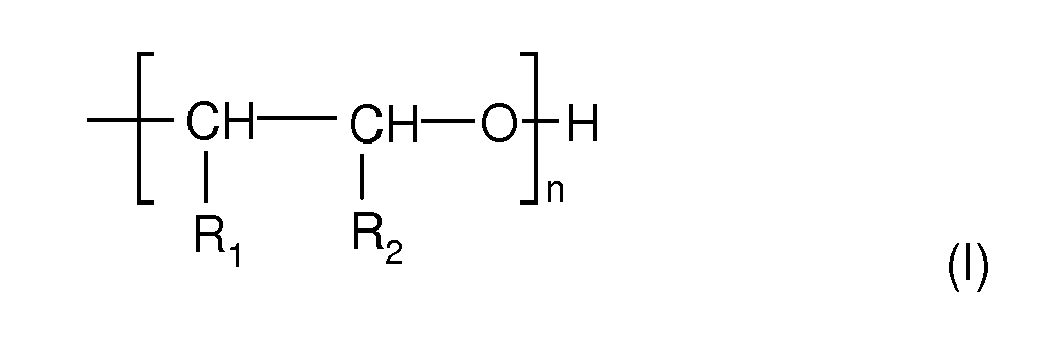
wherein
n is an integer from 1 to about 100,
R1 is hydrogen or a hydrocarbon residue with 1 to about 6 carbon atoms,
R2 is hydrogen or a hydrocarbon residue with 1 to about 6 carbon atoms, and
each R1 and R2 in a -(CHR1-CHR2-O)- moiety can be selected independently of each R1 and R2 in another -(CHR1-CHR2-O)- moiety, with the proviso that the nitrogen-containing, five-membered, heterocyclic compound selected for component c) is not connected at any of its nitrogen atoms with a residue of formula (I).
Description
- The invention concerns a solution and a process to pretreat copper surfaces so that a tight bond can be subsequently formed between the pretreated copper surfaces and plastic substrates. The solution preferably serves to pretreat copper-coated inner layers of printed circuit boards to subsequently allow a tight bond between the inner layers of the printed circuit board and the board's inner layers made of artificial resins.
- In manufacturing printed circuit boards, various steps are carried out in which copper surfaces must be tightly bonded to an organic substrate. In some cases, the required adhesion of the formed bonds must be ensured over a long period. In other cases, a tight bond only has to exist for a short period, e.g. when the organic substrate only remains on the copper surfaces during manufacture of the printed circuit board. For example, the tight bond of dry film plating resists (for structuring conductor lines on printed circuit boards) to the copper surfaces only has to exist while manufacturing the printed circuit board. After the conductor line structures are formed, the resists can be removed.
- The easiest way to increase the adhesion is to etch and hence roughen the copper surfaces before forming the bond. Microetching solutions are used such as sulfuric acid solutions of hydrogen peroxide or sodium peroxodisulfate.
- Another procedure is described in
U.S. Pat. No. 3,645,772 . A pretreatment solution is used for the copper surfaces that e.g. contains 5-aminotetrazole. - Long-term stability is especially necessary when laminating multilayer printed circuit boards. Other treatments for the copper surfaces are required in this case.
- When manufacturing multilayer boards, several inner layers are laminated to insulating artificial resin layers (so-called prepregs: e.g., epoxide resin films reinforced with fiberglass nets). The inner bonds of the laminate must hold throughout the entire life of the printed circuit board. The copper layers (preferably the conductor line structures) on the inner layers must be surface-treated. Various procedures have been developed to solve this problem. The normal procedure for pretreating the materials before lamination is to form an oxide layer on the copper surfaces. In this process, known as the brown or black oxide process, very aggressive reaction conditions are used to form the oxide. A disadvantage of this procedure is that the oxide layer used for enhancing adhesion to the artificial resin layer is not very resistant to acid and especially to hydrochloric treatment solutions. They are hence attacked in subsequent processes for plating the through-holes in the boards. The adhesive bond is eliminated, and delamination occurs at the attacked sites (pink ring: An externally-visible attack on the black oxide layer directly next to a hole in printed circuit boards with the discoloration of the originally black oxide layer. The pink copper coating of the inner layer is recognizable as an annular defect; wedge void: A defect (recognizable in a micrograph of a treated hole) in a printed circuit board in the form of a crack between a copper inner layer and the neighboring printed circuit board resin from the attack of acid treatment solutions on the black oxide layer).
- The above-cited problem is solved by reducing the oxide layer surface before lamination. The reduced black oxide is more stable than normal black oxide against chemicals used in plating the through-holes. The additional reduction step costs a great deal, however. In addition, the chemicals used for reduction are not very resistant to oxidation from air, so that the useful life of the baths and storage life of the supplementary chemicals are limited. An attempt to eliminate this problem is made in
JP A 08097559 - Another option for promoting adhesion is to treat the copper surfaces with an aqueous or alcoholic solution of an azole compound. Such a procedure is e.g. presented in
WO 96/19097 A1 -
U.S. Pat. No. 4,917,758 discloses etching solutions that, however, serve to etch copper cladding on the materials of the printed circuit board. Hydrogen peroxide, sulfuric acid and a nitrogen-containing compound (preferably amino benzoic acid, amino tetrazole or phenylurea) are also in these solutions. -
U.S. Pat. No. 5,869,130 describes a process for treating metal surfaces with a composition comprising an oxidizer, an acid, a corrosion inhibitor, a source of halide ions and optionally a water soluble polymer in order to increase the adhesion of polymeric materials to the metal surface. Most preferably, the water soluble polymer is a polymer of ethylene oxide, an ethylene oxide-propylene oxide copolymer, polyethylene glycols, polypropylene glycols or polyvinyl alcohols. Such polymers decompose rapidly in said composition, leading to a strongly decreasing peel strength during the process. -
WO9940764 WO9940764 -
WO9940765 WO9940764 - The object of the present invention was to provide a pretreatment solution and a process that can create a tight bond between the copper surfaces and plastic surfaces. A higher peel strength should be reached that is stable during the whole process. The process should be simple, easy to use, and inexpensive. It is also important that treatment with the solutions produce a material bond that is not problematic (no pink ring,wedge voids or resin flaws) in the subsequent printed circuit board manufacturing processes, e.g. plating through-holes in board materials. The used pretreatment solutions should therefore be suitable for manufacturing printed circuit boards.
- These problems are is solved by the pretreatment solution cited in claim 1 and the treatment process cited in claim 8.
- The pretreatment solution according to the invention is for pretreating copper surfaces to allow a tight bond to be formed with plastic substrates, and it comprises:
- a) hydrogen peroxide,
- b) at least one acid, and
- c) at least one nitrogen-containing, five-membered, heterocyclic compound
and - d) additionally at least one nitrogen containing, adhesion-promoting compound selected from the group comprising, or consisting of, lactams, non-quaternary fatty amines, amides and polyamides, which is connected at one or more of its nitrogen atoms with at least one residue of formula (I)

n is an integer from 1 to about 100,
R1 is hydrogen or a hydrocarbon residue with 1 to about 6 carbon atoms,
R2 is hydrogen or a hydrocarbon residue with 1 to about 6 carbon atoms, and each R1 and R2 in a -(CHR1-CHR2-O)- moiety can be selected independently of each R1 and R2 in another -(CHR1-CHR2-O)- moiety,
with the proviso that the nitrogen-containing, five-membered, heterocyclic compound selected for component c) is not connected at any of its nitrogen atoms with a residue of formula (I). - With the pretreatment solution and the process of the invention a peel strength that is comparable to peel strengths known from the state of the art can be reached at lower etch depths than in the state of the art, which means shorter processing times and economic benefit.
- The expression "at least one nitrogen containing, adhesion-promoting compound selected from the group comprising, or consisting of, lactams, fatty amines, amides and polyamides" means mixtures of different lactams, different fatty amines, different amides, and different polyamides as well as mixtures of two or more of a lactam, non-quaternary fatty amine, amide and polyamide.
- Adhesion-promoting compounds are to be selected that are sufficiently soluble in the acidic, preferably sulfuric acid solution.
- The pretreatment solution according to the invention, containing components a) - d), is hereinafter also abbreviated as "solution".
- The problem on which the invention is based is solved in particular by the use of the solution according to claim 15, wherein the solution is used in the pre-treatment of printed circuit board inner layers, which have copper layers, for the formation of a firmly adhesive bonding between the printed circuit inner layers and synthetic resin layers. The cited solution is preferably used to pretreat copper-coated inner layers of printed circuit boards to allow a tight bond to be formed between the inner layers of the printed circuit boards and plastic resin layers.
- The cited solution can also be used for the pre-treatment of printed circuit boards, which have copper layers, for the formation of a firmly adhesive bonding between the copper layers and resists formed from plastic materials.
- The present invention moreover discloses the use of the compound d) as defined above for for preparing a solution for the pre-treatment of printed circuit board inner layers, which have copper layers, for the formation of a firmly adhesive bonding between the printed circuit inner layers and synthetic resin layers.
- Preferred embodiments of the invention are found in the dependent claims.
- The nitrogen-containing, five-membered, heterocyclic compound selected for component c) of the solution is not identical to the nitrogen-containing, adhesion-promoting compound selected for component d). There is at least the difference that the nitrogen-containing, five-membered, heterocyclic compound selected for component c) is not connected at any of its nitrogen atoms with a residue of above-cited formula (I).
- In the present invention the term "aliphatic" means a hydrocarbon moiety characterized by a straight or branched chain arrangement of constituent carbon atoms and may be saturated or partially unsaturated with one, two or more double or triple bonds.
- For the purpose of the present invention the term "alkyl" means a monovalent linear or branched saturated hydrocarbon moiety, having in the skeleton thereof but carbon atoms, wherein an alkyl moiety comprises all conceivable isomers thereof. For example, C1-C6 alkyl means methyl, ethyl, propyl, isopropyl, butyl, isobutyl, tert-butyl, pentyl, isopentyl, tert-pentyl, neo-pentyl, hexyl, 2- methyl pentyl, 3-methyl pentyl, 2,3-diethyl butyl and C1-C4 alkyl means methyl, ethyl, propyl, isopropyl, butyl, isobutyl, tert-butyl.
- For the purpose of the present invention the term "alkylene" means a divalent linear or branched saturated hydrocarbon moiety, having in the skeleton thereof but carbon atoms, wherein an alkylene moiety comprises all conceivable isomers thereof.
- The term "cycloalkyl" means a monovalent saturated or partially unsaturated, non-aromatic, carbocyclic moiety consisting of mono- or bicyclic rings. Cycloalkyl can optionally be substituted with one or more substituents, wherein each substituent is independently hydroxy, alkyl, alkoxy, halo, haloalkyl, amino, monoalkylamino, or dialkylamino, unless otherwise specifically indicated. Examples of cycloalkyl moieties include, but are not limited to, cyclopropyl, cyclobutyl, cyclopentyl, cyclohexyl, cycloheptyl, and the like, including partially unsaturated derivatives thereof such as cyclohexenyl, cyclopentenyl, and the like. The term "cycloalkylene" means a divalent saturated or partially unsaturated, non-aromatic, carbocyclic moiety consisting of mono- or bicyclic rings. Cycloalkyl can optionally be substituted with one or more substituents, wherein each substituent is independently hydroxy, alkyl, alkoxy, halo, haloalkyl, amino, monoalkylamino, or dialkylamino, unless otherwise specifically indicated.
- For the purpose of the present invention the term "alkenyl" means a monovalent linear or branched unsaturated hydrocarbon moiety, having in the skeleton thereof but carbon atoms, wherein an alkyl moiety comprises all conceivable isomers thereof.
- "Aryl" means a monovalent cyclic aromatic hydrocarbon moiety consisting of a mono-, bi- or tricyclic aromatic ring. The aryl group can be optionally substituted. Examples of aryl moieties include, but are not limited to, phenyl, naphthyl, naphthalenyl, phenanthryl.
- "Arylene" means a divalent cyclic aromatic hydrocarbon moiety consisting of a mono-, bi- or tricyclic aromatic ring. The arylene group can be optionally substituted.
- As to formula (I) n is an integer from 1 to about 100, preferably 1 to about 50.
- As stated above, each R1 and R2 in a -(CHR1-CHR2-O)- moiety can be selected independently of each R1 and R2 in another -(CHR1-CHR2-O)- moiety. Thereby, block-copolymer and random copolymer structures can occur. A block copolymer structure can for example occur, if first -(CHR1-CHR2-O)- moieties follow to each other, followed by second - (CHR1-CHR2-O)- moieties, wherein in the first moieties R1 and/or R2 are different from R1 and/or R2 in the second moieties.
- R1 is in one embodiment selected from hydrogen, alkyl, phenyl. R1 is preferably C1-C4 alkyl or hydrogen, still more preferably methyl or ethyl or hydrogen, and most preferably methyl or hydrogen, and these can be combined with all above-cited values for n.
- R2 is in one embodiment selected from hydrogen, alkyl, phenyl. R2 is preferably C1-C4 alkyl or hydrogen, still more preferably methyl or ethyl or hydrogen, and most preferably methyl or hydrogen, and these can be combined with all above-cited values for n and all above-cited R1.
- In one embodiment, which can be combined with all above-cited values for n, R1 in the residue of formula (I) is hydrogen and R2 is a hydrocarbon residue with 1 to about 6 carbon atoms, preferably alkyl or phenyl, more preferably C1-C4 alkyl, still more preferably methyl or ethyl, and most preferably methyl. As stated above, each R1 and R2 in a -(CHR1-CHR2-O)-moiety can be selected independently of each R1 and R2 in another -(CHR1-CHR2-O)-moiety. In a special embodiment, R1 in all -(CHR1-CHR2-O)- moieties is hydrogen and R2 in all -(CHR1-CHR2-O)- moieties is methyl. In another special embodiment, R1 in all -(CHR1-CHR2-O)- moieties is hydrogen and R2 in all -(CHR1-CHR2-O)- moieties is ethyl.
- In another embodiment, which can be combined with all above-cited values for n, R1 in formula (I) is a hydrocarbon residue with 1 to about 6 carbon atoms, preferably alkyl, or phenyl, more preferably C1-C4 alkyl, still more preferably methyl or ethyl, and most preferably methyl, and R2 is hydrogen. In a special embodiment, R2 in all -(CHR1-CHR2-O)- moieties is hydrogen and R1 in all -(CHR1-CHR2-O)- moieties is methyl. In another special embodiment, R2 in all -(CHR1-CHR2-O)- moieties is hydrogen and R1 in all -(CHR1-CHR2-O)- moieties is ethyl.
- In a further embodiment, which can be combined with the aforementioned embodiments, R1 plus R2 contain 6 carbon atoms in maximum, more preferably 4 carbon atoms in maximum.
- In a highly preferred embodiment R1 is hydrogen or methyl and R2 is hydrogen or methyl, wherein each R1 and R2 in a -(CHR1-CHR2-O)- moiety can be selected independently of each R1 and R2 in another -(CHR1-CHR2-O)- moiety, and with the proviso that, in each moiety, R1 is hydrogen if R2 is methyl, and with the proviso that R2 is hydrogen if R1 is methyl.
- In another highly preferred embodiment, R1 and R2 in all -(CHR1-CHR2-O)- moieties are hydrogen.
- In view of the above disclosure, the residue of formula (I) is in highly preferred embodiments a polyethylene glycol (PEG) or a polypropylene glycol (PPG) residue.
- The invention also discloses a pretreatment solution for pretreating copper surfaces to allow a tight bond to be formed with plastic substrates, which comprises:
- a) hydrogen peroxide,
- b) at least one acid, and
- c) at least one nitrogen-containing, five-membered, heterocyclic compound
and - d) additionally at least one nitrogen containing, adhesion-promoting compound, obtainable, or obtained, by alkoxylation of a lactam, fatty amine, amide or polyamide with one or more compounds of formula (Ia),

R1 is hydrogen or a hydrocarbon residue with 1 to about 6 carbon atoms,
R2 is hydrogen or a hydrocarbon residue with 1 to about 6 carbon atoms, and
with the proviso that the nitrogen-containing, five-membered, heterocyclic compound selected for component c) is not alkoxylated at any of its nitrogen atoms with a compound of formula (Ia), and that the product obtainable, or obtained, by alkoxylation of a fatty amine is a non-quaternary fatty amine. - R1 in formula (Ia) is in one embodiment selected from hydrogen, alkyl, phenyl. R1 is preferably C1-C4 alkyl or hydrogen, still more preferably methyl or ethyl or hydrogen, and most preferably methyl or hydrogen.
- R2 in formula (Ia) is in one embodiment, which can be combined with the all embodiments of R1, selected from hydrogen, alkyl, phenyl. R2 is preferably C1-C4 alkyl or hydrogen, still more preferably methyl or ethyl or hydrogen, and most preferably methyl or hydrogen.
- In one embodiment, one of R1 or R2 in formula (Ia) is hydrogen and the other is a hydrocarbon residue with 1 to about 6 carbon atoms, preferably alkyl or phenyl, more preferably C1-C4 alkyl, still more preferably methyl or ethyl, and most preferably methyl.
- In another preferred embodiment, R1 and R2 in formula (Ia) are hydrogen.
- Preferred compounds of formula (Ia) contain 2 to about 8 carbon atoms, and most preferred are ethylene oxide (also called oxyethylene), propylene oxide (also called oxypropylene), 1-butylene oxide, 2-butylene oxide, or styreneoxide.
- The term alkoxylation means reacting nitrogen atom(s) of a lactam, polyamide or fatty amine with a compound of formula (Ia). Thus, alkoxylation in the present invention means N-alkoxylation. Thus, an alkoxylated lactam, polyamide, fatty amine, or amide is the reaction product which can be obtained by alkoxylation of the respective compound. Alkoxylation is known to a person skilled in the art and widely described in scientific and patent literature.
- Alkoxylated lactams, fatty amines, amides or polyamides can be prepared by using more than one compound of formula (Ia) for alkoxylation. Alkoxylated lactams, fatty amines, amides or polyamides can be prepared by sequential alkoxylation with two or more of the aforementioned compounds, as for example described in
US6552091 . - The nitrogen containing, adhesion-promoting compound can be selected from one or more of alkoxylated lactams, alkoxylated fatty amines, alkoxylated amides and alkoxylated polyamides, wherein alkoxylation was performed with one or more compounds of formula (Ia).
- In one embodiment, the nitrogen-containing, adhesion-promoting compound selected for component d) of a solution of the invention is a lactam of formula (II)

n is an integer from 1 to about 100,
R1 is hydrogen or a hydrocarbon residue with 1 to about 6 carbon atoms,
R2 is hydrogen or a hydrocarbon residue with 1 to about 6 carbon atoms,
each R1 and R2 in a -(CHR1-CHR2-O)- moiety can be selected independently of each R1 and R2 in another -(CHR1-CHR2-O)- moiety, and
R3 is a hydrocarbon residue with 2 to about 20 carbon atoms. - With respect to special embodiments and combinations of n, R1 and R2 it is referred to the above disclosure as to formula (I).
- In one embodiment, which can be combined with all special embodiments and combinations of n, R1 and R2, R3 is C2-C20-alkylene, preferably C2-C12-alkylene, unsubstituted or substituted by 1, 2, 3, 4, 5 or 6 substituents selected independently of one another from the group consisting of alkylene, cycloalkylene and arylene.
- In a preferred embodiment, R3 is an alkylene residue of the formula -(CH2)y-, wherein y is an integer from 2 to about 20, more preferably 2 to about 12, and most preferably 2 to about 7.
- In a very preferred embodiment, the lactam selected for component d) of the solution is ethoxylated beta-propiolactam, hexaethoxylated-gamma-butyrolactam, octaethoxylated-delta-valerolactam, pentapropoxylated-delta-valerolactam, hexaethoxylated-epsilon-caprolactam, dodecaethoxylated-epsilon-caprolactam, or a mixture of two or more from these compounds.
- Suitable lactams of formula (II) are described in
DE3836521 , which is incorporated by reference in its entirety. - In a further embodiment, the nitrogen-containing, adhesion-promoting compound selected for component d) of a solution of the invention is a polyamide of formula (III)

each n in a -(CHR1-CHR2-O)n- moiety or chain can be selected independently of each n in another -(CHR1-CHR2-O)n- moiety or chain. - The term "-(CHR1-CHR2-O)n- moiety" is used when n = 1 and term "-(CHR1-CHR2-O)n-chain" is used when n < 1.
- The (*) signs in formula (III) are intended to show that the moieties -(N-R3-CO)n form a polymeric chain and "x" in formula (III) is the number of repeating -(CHR1-CHR2-O)- moieties in a polymeric chain, wherein chains with different x can be present.
- With respect to special embodiments and combinations of n, R1 and R2 it is referred to the above disclosure as to formula (I).
- In one embodiment, which can be combined with all special embodiments and combinations of n, R1, and R2, R3 is C2-C20-alkylene, preferably C2-C12-alkylene, unsubstituted or substituted by 1, 2, 3, 4, 5 or 6 substituents selected independently of one another from the group consisting of alkylene, cycloalkylene and arylene.
- In a preferred embodiment, R3 is an alkylene residue of the formula -(CH2)y-, wherein y is an integer form 2 to about 20, more preferably 2 to about 12, and most preferably 2 to about 7. A polyamide as decribed above can, for example, be prepared by ring-opening polymerization of a previously described lactam, or by ring-opening co-polymerization of at least two of the previously described lactams.
- Other polyamides which can be employed in the present invention are polyamides which are prepared from dicarboxylic acids and diamines and which are alkoxylated at one or more of their nitrogen atoms with one or more residues of formula (I) as described above. An example is, without restriction, N-alkoxylated Polyamide 6,6, prepared from adipic acid and hexamethylene diamine.
- Another suitable polyamide is N-alkoxylated Polyamide 6, particularly N-ethoxylated Polyamide 6, which can be prepared from N-alkoxylated, particularly N-ethoxylated ε-caprolactame.
- Polyamides of formula (III) can be prepared from alkoxylated lactams. Alkoxylated lactams are described in
DE3836521 , which is incorporated by reference in its entirety. - The nitrogen containing adhesion-promoting compound that is used as component d) in the solution of the invention can be a fatty amine which is connected at one or more of its nitrogen atoms with a residue of formula (I) as described above.
- Before the residue of formula (I) is attached to the nitrogen atom of the fatty amine, the fatty amine in the present invention is a fatty amine of the general formula R7NH2 or a fatty amine with the general formula R7R8NH, wherein R7 and R8 are independently from each other aliphatic residues, preferably with 2 to about 40 carbon atoms. Fatty amines are obtainable from fatty acids, i.e. by reacting fatty acids with ammonia to obtain fatty nitriles, and reacting the fatty nitriles with hydrogen to obtain fatty amines.
- The term "fatty acid" means, in the meaning of the present invention, a carboxylic acid with an aliphatic chain, which can, according to the above definition, be saturated or unsaturated, and branched or unbranched. Preferably a fatty acid in the meaning of the present invention contains at least 2 carbon atoms, including the carboxyl C-atom. Fatty acids can encompass naturally occurring fatty acids, hardened fatty acids, modified naturally fatty acids, and synthetically produced fatty acids.
- After introduction of one residue of formula (I) to a fatty amine of formula R7NH2, a secondary amine is formed as the adhesion-promoting compound. After introduction of two residues of formula (I) to a fatty amine of formula R7NH2, a tertiary amine is formed as the final adhesion-promoting compound. After introduction of one residue of formula (I) to a secondary fatty amine (R7R8NH), a tertiary amine is formed as the adhesion-promoting compound.
- The nitrogen containing, adhesion-promoting compound, particularly the fatty amine which is connected at its nitrogen atom with at least one residue of above formula (I), is a non-quaternary amine compound. In other words, a fatty amine as employed in the present invention, which is connected at its nitrogen atom with at least one residue of formula (I), does not contain, or is not, a quaternary ammonium cation.
- Quaternary amine compounds contain a quaternary ammonium cation, which is positively charged and has the general structure N (R')(R")(R"')(R"")+, wherein R', R", R'" and R"" are hydrocarbon residues, which can be equal or different from each other and which may contain heteroatoms such as oxygen and nitrogen. Unlike the ammonium ion (NH4 +) and the primary (NH3(R')+), secondary (NH2(R')(R")+), or tertiary (NH(R')(R")(R"')+) ammonium cations, the quaternary ammonium cations are permanently charged, independent of pH.
- The nitrogen-containing, adhesion-promoting compound selected for component d) of a solution of the invention is in one embodiment of the present invention a fatty amine of formula (IV)

n and m are independently from each other an integer from 1 to about 100, R1 is hydrogen or a hydrocarbon residue with 1 to about 6 carbon atoms, R2 is hydrogen or a hydrocarbon residue with 1 to about 6 carbon atoms,
each R1 and R2 in a -(CHR1-CHR2-O)- moiety can be selected independently of each R1 and R2 in another -(CHR1-CHR2-O)- moiety, and
R4 is an aliphatic residue with 2 to about 40 carbon atoms, - With respect to special embodiments and combinations of R1 and R2 it is referred to the above disclosure of formula (I). n and m are independently from each other preferably 1 to about 50.
- In one embodiment, which can be combined with all special embodiments and combinations of n, m, R1 and R2, R4 is a C12 to C24 aliphatic residue, wherein the term aliphatic, as already defined above, encompasses saturated and unsaturated, straight chain and branched residues. Most preferably, R4 is a saturated or unsaturated straight chain C12 to C24 aliphatic residue.
- Compounds of formula (IV) can be obtained by alkoxylation of primary fatty amines with the general formula R4-NH2, wherein R4 is defined as above.
- In one embodiment a mixture of compounds of formula (IV) with different residues R4 is employed wherein the compounds of formula (IV) can be prepared by alkoxylation of a mixture of primary fatty amines with different residues R4. The mixture of amines can be obtained from a mixture of different fatty acids which is reacted to fatty amines in known manner. A mixture of different fatty acids can be obtained from a natural source, as for example animal fats or vegetable oils. Examples for vegetable oils are Palm, Soybean, Rapeseed, Sunflower seed, Peanut, Cottonseed, Palm kernel, Coconut, Olive, Corn, Grape seed, Hazelnut, Linseed, Rice bran, Safflower and Sesame oil. Examples for animal fats are tallow, as for example beef tallow, mutton tallow, hardened tallow, and (pig) lard.
- In a special embodiment, the compound of formula (IV) is an alkoxylated tallowamine, or an alkoxylated hydrogenated tallowamine. The term "hydrogenated" tallowamine means a tallowamine, wherein unsaturated bonds in fatty acid residues have been transformed to saturated bonds by hydrogenation. In this embodiment n and m in formula (IV) are preferably independently from each other an integer from 1 to about 50 and R1 and R2 are preferably hydrogen.
- The term "tallowamine" means a mixture of fatty amines which is obtained from tallow. For producing tallowamines tallow is converted to fatty acids by reactions that are known to an expert skilled in the art, i.e. saponification, and the thus obtained fatty acids are in another step converted to fatty amines by reactions that are known to an expert skilled in the art (c.f. "Fettamine" in Römpp Chemielexikon, Thieme, 1989-1992, ISBN 3-13-102759-2).
- In one embodiment, the tallowamine which is basis for the compound of formula (IV) is made from a fatty acid composition obtained from tallow, comprising in weight-%:
Oleic acid: 38-47% Palmitic acid: 22-28% Stearic acid: 14-22% Palmitoleic acid: 2-5% Myristic acid: 2-5% Linoleic acid: 2-5% Margaric acid: 1-4% Pentadecanoic acid: 1-2% Myristoleic acid: 0-1% Linolenic acid: 0-1% Arachidic acid: 0-1% Behenic acid: 0-1% - In another embodiment, the tallowamine which is basis for the compound of formula (IV) is made from a fatty acid composition obtained from hydrogenated tallow, comprising in weight-%:
Stearic acid: 50-55% Palmitic acid: 28-32% Myristic acid: 2-6% Margaric acid: 1-4% Pentadecanoic acid: 0.5-2% Arachidic acid: 0.5-2% - Preferred fatty amines and tallowamines that can be employed in the present invention Berol 387™, Ethomeen OV/22™ and Ethomeen HT/60™, Products and Trademarks by Akzo-Nobel. Details as to these compounds are presented in the examples.
- The nitrogen-containing, adhesion-promoting compound selected for component d) of a solution of the invention is in another embodiment of the present invention a fatty amine of formula (V)

n is an integer from 1 to about 100,
R1 is hydrogen or a hydrocarbon residue with 1 to about 6 carbon atoms,
R2 is hydrogen or a hydrocarbon residue with 1 to about 6 carbon atoms,
each R1 and R2 in a -(CHR1-CHR2-O)- moiety can be selected independently of each R1 and R2 in another -(CHR1-CHR2-O)- moiety, and
R4 and R5 are independently from each other an aliphatic residue with 2 to about 40 carbon atoms. - With respect to special embodiments and combinations of n, R1 and R2 it is referred to the above disclosure of formula (I).
- In one embodiment, which can be combined with all special embodiments and combinations of n, R1 and R2, R4 and R5 are independently from each other a C12 to C24 aliphatic residue, wherein the term aliphatic, as already defined above, encompasses saturated and unsaturated, straight chain and branched, residues. Most preferably, R4 and R5 are independently from each other a saturated or unsaturated straight chain C12 to C24 aliphatic residue.
- Compounds of formula (V) can be obtained by alkoxylation of secondary fatty amines with the general formula (R4)(R5)NH, wherein R4 and R5 are defined as above.
- In one embodiment a mixture of compounds of formula (V) is employed wherein the compounds of formula (V) can be prepared by alkoxylation of a mixture of different secondary fatty amines. A mixture of secondary fatty acid amines can be obtained from a mixture of different fatty acids which is reacted to secondary fatty amines in known manner. As stated above a mixture of different fatty acids can be obtained from a natural source, as for example the above mentioned animal fats or vegetable oils.
- In a special embodiment, the compound of formula (V) is an alkoxylated tallowamine or an alkoxylated hydrogenated tallowamine. In this embodiment n in formula (V) is preferably an integer from 1 to about 50 and R1 and R2 are preferably hydrogen. In this connection tallows as described above can be employed as starting material for producing tallowamine.
- The nitrogen-containing, adhesion-promoting compound selected for component d) of a solution of the invention is in still another embodiment of the present invention an amide of formula (VI):

n and m are independently from each other an integer from 1 to about 100,
R1 is hydrogen or a hydrocarbon residue with 1 to about 6 carbon atoms,
R2 is hydrogen or a hydrocarbon residue with 1 to about 6 carbon atoms,
each R1 and R2 in a -(CHR1-CHR2-O)- moiety can be selected independently of each R1 and R2 in another -(CHR1-CHR2-O)- moiety, and
R6 is an aliphatic residue with 1 to about 39 carbon atoms, - With respect to special embodiments and combinations of R1 and R2 it is referred to the above disclosure of formula (I). n and m are independently from each other preferably 1 to about 50.
- In one embodiment, which can be combined with all cited embodiments and combinations of n, m, R1 and R2, R6 is a C11 to C23 aliphatic residue, wherein the term aliphatic, as already defined above, encompasses saturated and unsaturated, straight chain and branched residues. Most preferably, R6 is a saturated or unsaturated straight chain C11 to C23 aliphatic residue.
- The acid which is used as component b) of the solution of the invention is preferably an inorganic acid or mineral acid, as sulfuric acid, hydrochloric acid, nitric acid, phosphoric acid, most preferably sulfuric acid. Other acids can also be employed. The acid is no sulphinic, selenic or telluric acid.
- The nitrogen-containing, five-member heterocyclic compounds which is employed as component c) of the solution of the invention can be monocyclic and polycyclic condensed ring systems. For example, the compounds can contain an anellated benzene, naphthalene or pyrimidine ring. When selecting these compounds, make sure that they are sufficiently soluble in the acid solution. It is preferable for the solution to contain triazoles, tetrazoles, imidazoles, pyrazoles and purines or their derivatives.
- In particular, the solution contains triazoles of chemical formula (VIIa):
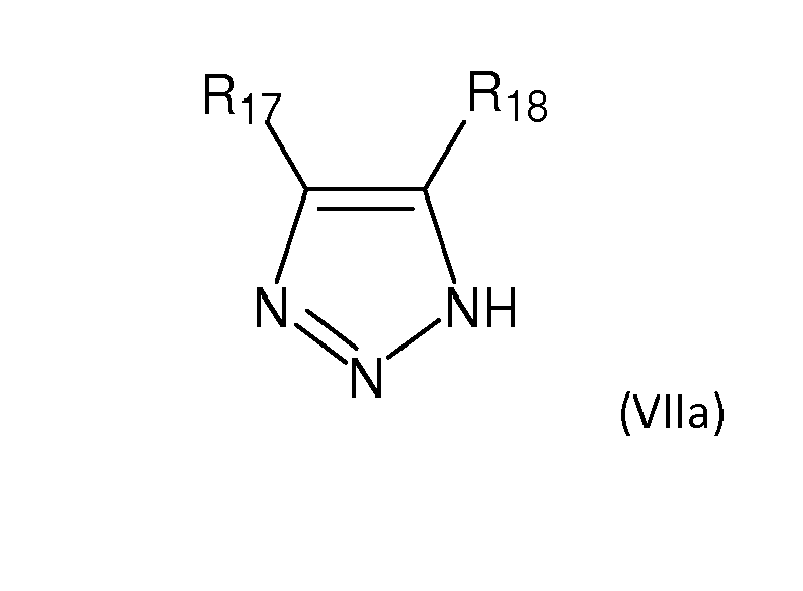
- Benzotriazole, methylbenzotriazole, ethylbenzotriazole and dimethylbenzotriazole are particularly preferable.
- In addition, the solution can contain tetrazoles of chemical formula (VIIb):

- Preferred tetrazole compounds may be 5-aminotetrazole and 5-phenyltetrazole. A preferred imidazole compound may be benzimidazole. 5-aminotetrazole, 5-phenyltetrazole, benzotriazole, methylbenzotriazole and ethylbenzotriazole are preferred compounds given their favorable solubility in the pretreatment solution and their availability.
- Preferred combinations are benzotriazole, methylbenzotriazole, ethylbenzotriazole, 5-aminotetrazole and 5-phenyltetrazole as the nitrogen-containing, heterocyclic compounds with aminothiophene carboxylic acids, their esters and amides, aminothiazoles and substituted aminothiazoles as the heterocyclic compounds.
- The nitrogen-containing, five-membered, heterocyclic compound selected for component c) in the solution preferably contains no sulphur atom, no selenium atom or tellurium atom in the heterocycle.
- The solution of the present invention can comprise, as a further component in addition to above mentioned components a)-d), at least one sulphur, selenium or tellurium-containing bonding compound which is selected from the group comprising sulphinic acids, selenic acids, telluric acids, heterocyclic compounds which contain at least one sulphur, selenium and/or tellurium atom in the heterocycle, sulphonium salts, selenonium salts and telluronium salts, the sulphonium, selenonium and telluronium salts being compounds having the general formula (VIII):
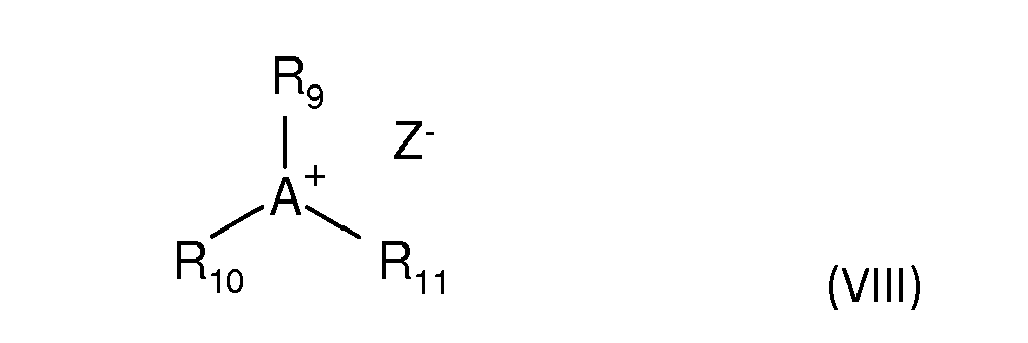
A = S, Se or Te,
R9, R10 and R11 are alkyl, substituted alkyl, alkenyl, phenyl, substituted phenyl, benzyl,
cycloalkyl, substituted cycloalkyl, R9, R10 and R11 being identical or different, and Z- =
anion of an inorganic or organic acid or hydroxide. - If a sulphur, selenium or tellurium-containing bonding compound as mentioned above is added as a further component, the acid selected for component b) in the solution is in any case not identical to the sulphinic, selenic or telluric acids selected for the sulphur, selenium or tellurium containing bonding compound, and the nitrogen-containing, five-membered, heterocyclic compound selected for component c) in the solution contains no sulphur atom, no selenium atom or tellurium atom in the heterocycle.
- Preferred sulfinic acids are compounds of chemical formula (IX)

and aromatic sulfinic acids. - It is preferable for the solution to contain formamidine sulfinic acid as the bonding compound. Preferable aromatic sulfinic acids are benzene sulfinic acid, toluene sulfinic acids, chlorobenzene sulfinic acids, nitrobenzene sulfinic acids and carboxybenzene sulfinic acids.
- Other preferable heterocyclic bonding compounds are thiophene, thiazole, isothiazole, thiadiazole and thiatriazole.
- Suitable thiophenes are compounds of chemical formula (X):

- Particularly preferred thiophenes are aminothiophene carboxylic acids, their esters and amides. For example, 3-aminothiophene-2-carboxylic acid methyl ester can be advantageously used.
- Suitable thiazoles are compounds of chemical formula (XI):

- Particularly suitable thiazoles are aminothiazole and substituted aminothiazole.
- Other preferred thiadiazole bonding compounds are from the group, consisting of aminothiadiazoles and substituted aminothiadiazoles.
- In addition, the preferred sulfonium salts used as bonding compounds are salts of trimethylsulfonium, triphenylsulfonium, methionine alkylsulfonium and methionine benzylsulfonium.
- A further optional component in the solution of the present invention are chloride ions, preferably in concentration of Cl- of 5 - 500 mg/l, more preferably 10 - 50 mg/l.
- A preferred solvent for the solution is water. Other organic solvents like alcohols, can be added, e.g. to increase the solubility of the contained components, especially the nitrogen-containing, five-member heterocyclic compounds and the sulphur, selenium or tellurium-containing bonding compound.
- To stabilize hydrogen peroxide against decomposition, the solution can contain stabilizing compounds, such as p-phenolsulfonic acid.
- In addition, other inorganic and organic compounds can be in the solutions, e.g., copper sulfate and wetting agents.
- In a further aspect the present invention is directed to a method for the pre-treatment of a copper surface for the subsequent formation of a firmly adhesive bonding between the copper surfaces and plastics material substrates, wherein the copper surface is brought into contact with
- a) hydrogen peroxide,
- b) at least one acid,
- c) at least one nitrogen-containing, five-membered, heterocyclic compound, and
- d) at least one nitrogen-containing, adhesion-promoting compound which is selected from the group comprising lactams, non-quaternary fatty amines, amides and polyamides, which is connected at one or more of its nitrogen atoms with at least one residue of formula (I) as defined above.
- With respect to components a) - d) that are employed in the method of the invention it is referred to the previous disclosure, including all specific and preferred embodiments.
- The term "copper surface" is intended to also include multiple copper surfaces. Thus, the method of the present invention encompasses simultaneous treatment of multiple copper surfaces.
- The process according to the invention is an extremely easy way to pretreat copper surfaces to allow them to tightly bond with plastics. The adhesion does not decrease even after a long time. If the adhesion-promoting compound(s) as described above is not in the solution, such bond strength cannot be attained. In addition, the long-term stability of the bond after treating the copper with solution without the invention's adhesion-promoting compounds is substantially lower than when the adhesion-promoting compound is used.
- In addition, the problems that arise in conjunction with plating through-holes in printed circuit boards (i.e., the formation of pink ring and wedge voids) are avoided by using the additional adhesion-promoting compound in the treatment solution. The adhesion-promoting layers created using the solution according to the invention have an excellent acid resistance, whereas black oxide and reduced black oxide layers are somewhat sensitive to hydrochloric acid solutions. It has even been shown that the adhesion of copper to organic substrates can be improved in certain cases when the copper surfaces are treated with diluted acid after being treated with components a) - d) as described above and before the bond is created. It is preferable to use an inorganic acid or mineral acid, as sulfuric acid, hydrochloric acid, nitric acid, phosphoric acid, most preferably sulfuric acid.
- The copper surface is preferably cleaned to ensure that the pretreatment according to the invention is effective. Any conventional cleaning solution can be used. Normally, wetting agents and sometimes complexer (such as triethanol-amine)-containing aqueous solutions are used.
- After the cleaned copper surface is rinsed, it can be brought into contact with a so-called predipping solution, also abbreviated as "predip", that contains one of the five-member heterocyclic compounds (component c), preferably at a concentration of 0.1-10 g/l, and especially 0.5-2 g/l. This treatment helps the adhesion-promoting layer to be formed in the subsequent treatment step. In particular, any delays in the formation of the layer are avoided. The surface(s) is/are then treated with components a) - d) without being rinsed beforehand.
- The present invention discloses two preferred embodiments how the pre-treatment with components a) - d) can be performed. In the first preferred embodiment, a copper surface is treated with all components a)- d) at the same time with one solution. In the second preferred embodiment, a copper surface is treated sequentially with two solutions, the first solution comprising or containing components a)-c) and the second solution comprising or containing component d).
- In the first preferred embodiment of the method of the invention the copper surface is brought into contact with the above-described solution comprising components a) - d). In this connection, all embodiments and preferred embodiments of the solution can be employed in the method. In the first embodiment of the method of the invention, basically one step is necessary, i.e., treating the copper surface with the solution according to the invention to allow them to bond with organic substrates.
- As the adhesion-promoting layer is formed, the copper surfaces change color, usually from pink to a brown tint, depending on the combination of nitrogen-containing, five-member heterocyclic and adhesion-promoting compounds.
- The microetching by the hydrogen peroxide in connection with the acid yields microrough copper surfaces. Since this increases the surface area, the subsequent adhesion of the copper surfaces to the plastic substrate also increases. The change in color of the surface during treatment is caused by a thin copper oxide layer. It is also suspected that the adhesion is also improved by the formation of a copper organic compound that forms on the copper surface and probably consists of copper or copper oxide, the five-membered, heterocyclic compound, and the nitrogen-containing adhesion-promoting compound. It is preferable for the acid in the solution according to the invention to be an inorganic acid, and especially sulfuric acid. Other acids can of course be used.
- The treatment is preferably carried out at 20-60 °C. The treatment time is preferably 10-600 sec. The higher the temperature, the faster-acting the solution. The treatment times can hence even be much shorter. From a practical standpoint, a preferable average temperature would be 25-45°C to better control the reaction. Average treatment times are 20-90 seconds. In addition, a top temperature limit may have to be set due to possible incompatibilities between certain solution components at high temperatures, e.g., wetting agents that have difficulty dissolving at high temperatures.
- The preferable concentration ranges in the solution are:
Acid, preferably sulfuric acid conc. 10 - 250 g/l Hydrogen peroxide, 30 weight percent 1 - 100 g/l (corresponds to hydrogen peroxide concentration of 0.3 - 30 g/l) N-containing, five-membered, heterocyclic compound 0.5 - 50 g/l Nitrogen-containing, adhesion-promoting compound lactam 0.05 - 10 g/l, preferably 0.1 - 6 g/l non-quaternary fatty amine 0.05 - 10 g/l, preferably 0.1 - 6 g/l amide 0.05 - 10 g/l, preferably 0.1 - 6 g/l polyamide 0.05 - 10 g/l, preferably 0.1 - 6 g/l - As stated before, mixtures of different lactams, different fatty amines, different amides, and different polyamides as well as mixtures of two or more of a lactam, non-quaternary fatty amine, amide and polyamide can be employed. If different lactams, fatty amines, different amides, or polyamides are employed, the above concentration range of a component (e.g. lactam) means the total concentration range of the component or mixture of components (e.g. lactam or mixture of lactams). Preferably, the total concentration of a nitrogen-containing adhesion-promoting compound does not exceed 10 g/I.
- The optimum concentrations for the cited bath components depend on the type of five-membered heterocyclic compounds and nitrogen-containing adhesion-promoting compounds.
- To increase the useful life of the solution, it is a good idea to prepare the ready-for-use treatment solution right before carrying out the procedure. For example, hydrogen peroxide can be mixed with a sulfuric acid solution of the five-membered heterocyclic compound and the nitrogen-containing adhesion-promoting compound, or a prepared solution can be supplemented directly before use to set the desired concentrations of individual components.
- In the second preferred embodiment of the method of the invention a copper surface is in a first step brought into contact with a first solution, comprising
- a) hydrogen peroxide,
- b) at least one acid, and
- c) at least one nitrogen-containing, five-membered, heterocyclic compound
and
in a second step a copper surface is brought into contact with a second solution, comprising - d) at least one nitrogen-containing, adhesion-promoting compound which is selected from the group comprising lactams, non-quaternary fatty amines, amides and polyamides, which is connected at one or more of its nitrogen atoms with at least one residue of formula (I) as defined above.
- The nitrogen-containing, adhesion-promoting compound of the second solution is equal to component d) as described above. Therefore it is referred to all embodiments and preferred embodiments of component d).
- Surfaces are treated with the first solution according to the invention containing components a), b) and c) without being rinsed. The substrates can then be rinsed to remove any adhering liquid from the substrate. Subsequently, the surface is treated with second solution comprising component d). The second solution is in the present invention and in the appended examples also called "postdipping solution" or just "postdip". The copper surfaces can also be treated with the second solution directly after being treated with the first solution without being rinsed.
- With this treatment, the copper surfaces change color from pink to brown as an adhesion-promoting layer is formed depending on the combination of nitrogen-containing, five-member heterocycle in the first solution and adhesion-promoting compounds in the second solution.
- It is preferable for the acid in the first solution to be an inorganic acid, especially sulfuric acid. Of course other acids can be used.
- To stabilize hydrogen peroxide against decomposition, other additional compounds can be used in the first solution such as p-phenolsulfonic acid.
- Both solutions can contain solvents such as water and additional other organic solvents like alcohols, e.g. to increase the solubility of the contained components, especially the nitrogen-containing, five-member heterocyclic compounds and the adhesion-promoting compounds.
- In addition, other inorganic and organic compounds can be in the solutions, e.g., wetting agents. Copper sulfate can also be in the second solution.
- The treatment with the two solutions is preferably carried out at 20-60 °C. The treatment time is preferably 5-600 s. The higher the temperature, the faster-acting the solution. The treatment times may hence be even much shorter. From a practical standpoint, an average temperature is preferably selected such as 25-45°C to better control the reaction. Average treatment times are 10-60 seconds. In addition, a top temperature limit may have to be set due to possible incompatibilities between certain components in the solution at high temperatures, e.g., wetting agents that dissolve with difficulty at high temperatures.
- The preferable concentration ranges in the solutions are:
First solution: Acid, preferably sulfuric acid conc. 10 - 250 g/l Hydrogen peroxide, 30 weight percent 1 - 100 g/l (corresponds to hydrogen peroxide concentration of 0.3 - 30 g/l) N-containing, five-membered, heterocyclic compound 0.5-50 g/l Second solution: Nitrogen-containing, adhesion-promoting compound lactam 0.05 - 10 g/I, preferably 0.1 - 6 g/l non-quaternary fatty amine 0.05 - 10 g/I, preferably 0.1 - 6 g/l amide 0.05 - 10 g/I, preferably 0.1 - 6 g/l polyamide 0.05 - 10 g/I, preferably 0.1 - 6 g/l - As stated before, mixtures of different lactams, different fatty amines, different amides, and different polyamides as well as mixtures of two or more of a lactam, non-quaternary fatty amine, amide and polyamide can be employed. If different lactams, fatty amines, different amides, or polyamides are employed, the above concentration range of a component (e.g. lactam) means the total concentration range of the component or mixture of components (e.g. lactam or mixture of lactams). Preferably, the total concentration of a nitrogen-containing, adhesion-promoting compound does not exceed 10 g/l.
- The optimum concentrations for the cited bath components depend on the type of nitrogen-containing heterocyclic compounds and adhesion-promoting compounds.
- To increase the storage life of the first and second solution of the invention, it is a good idea to prepare the ready-for-use treatment solutions right before carrying out the procedure. For example, the first solution can be created by mixing hydrogen peroxide with a sulfuric acid solution of the nitrogen-containing heterocyclic compound, or a prepared solution can be supplemented directly before use to reach the desired concentrations of individual components.
- After having carried out the method of the invention the copper surfaces are rinsed, preferably with warm, deionized water. Then they are dried, e.g. with hot air.
- The workpieces with the copper surfaces can be treated in conventional dipping systems. In an alternative for treating the printed circuit boards, it is particularly good to use so-called continuous systems. The boards are guided along a horizontal transport path through the system. They are brought into contact with the treatment solutions by guiding them through a liquid bed between squeezing rollers located at the beginning and end of the treatment path, and/or bringing them into contact with the treatment liquid using suitable nozzles such as spray or surge nozzles. The printed circuit boards can be held in a horizontal or vertical position or at any other angle.
- The following examples serve further to clarify the invention:
- Duraver 104 ML epoxy based 18 µm copper layer cladded innerlayer material (manufacturer: Isola) was treated according to the following process sequence.
- At first the samples were treated with a cleaner solution BondFilm® Cleaner Alk (Atotech Deutschland GmbH) for 5 min at 50 °C. Afterwards the sample was rinsed and etched with an alternative oxide composition according to the formulations in the following examples for 60-70 seconds at 35 °C. The treatment time was adjusted in order to have a comparable etch depth of 1.2 µm for all test specimen. After rinsing again the sample is dried. The complete set of etched samples showed a brown to dark brown surface cosmetic.
- All samples were laminated in a multilayer press with a Duraver 104 ML epoxy based prepreg layer according to the material data sheet (manufacturer: Isola). During this procedure the semi cured epoxy prepreg layer is cured and bonded to the treated copper metal surface.
- Finally, the adhesion between the micro roughend copper surface and the epoxy polymer was measured. Peel strength values were measured according to the method described in IPC-TM-650 Test Methods Manual Number 2.4.8 revision C.
- The following aqueous formulation was prepared:
Benzotriazole 10 g/l Hydrogen peroxide 35 % 30 g/l Sulfuric acid 50 % 186 g/l Chloride ions 20 mg/l - A peel strength value of 7.5 N/cm was measured after using a treatment time of 60 seconds and successive lamination of a prepreg layer.
- The solution of example 1 was used except that 1.25 g/l N-ethoxylated Polyamide 6, obtainable from ε-Caprolactamhexaethoxylate monomer, was added to said solution.
- After using a treatment time of 70 seconds and successive lamination of a prepreg layer a peel strength value of 9.5 N/cm was measured.
- The solution of example 1 was used except that 0.01 g/l of a tallow amine having a residue according to formula (I) with R1 and R2 = hydrogen and n = 40 (Berol 387®, Akzo Nobel) was added to said solution.
- After using a treatment time of 70 seconds and successive lamination of a prepreg layer a peel strength value of 8.0 N/cm was measured.
- The solution of example 1 was used except that 0.05 g/l of a tallow amine having a residue according to formula (I) with R1 and R2 = hydrogen and n = 40 (Berol 387®, Akzo Nobel) was added to said solution.
- After using a treatment time of 70 seconds and successive lamination of a prepreg layer a peel strength value of 8.3 N/cm was measured.
- The solution of example 1 was used except that 0.1 g/l of a tallow amine having a residue according to formula (I) with R1 and R2 = hydrogen and n = 40 (Berol 387®, Akzo Nobel) was added to said solution.
- After using a treatment time of 70 seconds and successive lamination of a prepreg layer a peel strength value of 8.7 N/cm was measured.
- The solution of example 1 was used except that 0.2 g/I of a tallow amine having a residue according to formula (I) with R1 and R2 = hydrogen and n = 40 (Berol 387®, Akzo Nobel) was added to said solution.
- After using a treatment time of 70 seconds and successive lamination of a prepreg layer a peel strength value of 9.5 N/cm was measured.
- The solution of example 1 was used except that 0.5 g/I of a tallow amine having a residue according to formula (I) with R1 and R2 = hydrogen and n = 40 (Berol 387®, Akzo Nobel) was added to said solution.
- After using a treatment time of 70 seconds and successive lamination of a prepreg layer a peel strength value of 10.3 N/cm was measured.
- The solution of example 1 was used except that 0.5 g/l of a hydrogenated tallow alkylamine having a residue according to formula (I) with R1 and R2 = hydrogen and n = 50 (Ethomeen HT/60®, Akzo Nobel) was added to said solution.
- After using a treatment time of 70 seconds and successive lamination of a prepreg layer a peel strength value of 10.3 N/cm was measured.
- The solution of example 1 was used except that 0.5 g/l of a oleylaminethoxylate (a tertiary amine based on a primary oleyl amine having a residue according to formula (I) with R1 and R2 = hydrogen and n = 12) (Ethomeen® OV/22, Akzo Nobel) was added to said solution.
- After using a treatment time of 70 seconds and successive lamination of a prepreg layer a peel strength value of 9.4 N/cm was measured.
- A sample treated with a solution according to example 1 was then immersed into an aqueous post dip solution of 1.25 g N-ethoxylated Polyamide 6, obtainable from ε-Caprolactamhexaethoxylate for 30 seconds at 25 °C.
- After successive lamination of a prepreg layer a peel strength value of 8.9 N/cm was measured.
- A sample treated with a solution according to example 1 was then immersed into an aqueous post dip solution of 0.2 g N-ethoxylated Polyamide 6, obtainable from ε-Caprolactamhexaethoxylate for 30 seconds at 25 °C.
- After successive lamination of a prepreg layer a peel strength value of 8.3 N/cm was measured.
Claims (16)
- A solution for the pre-treatment of copper surfaces for the subsequent formation of a firmly adhesive bonding between the copper surfaces and plastics material substrates, comprisinga) hydrogen peroxide,b) at least one acid, andc) at least one nitrogen-containing, five-membered, heterocyclic compound characterised in thatd) the solution additionally comprises at least one nitrogen containing, adhesion-promoting compound selected from the group comprising lactams, non-quaternary fatty amines, amides and polyamides, which is connected at one or more of its nitrogen atoms with at least one residue of formula (I)with the proviso that the nitrogen-containing, five-membered, heterocyclic compound selected for component c) is not connected at any of its nitrogen atoms with a residue of formula (I).

n is an integer from 1 to about 100,
R1 is hydrogen or a hydrocarbon residue with 1 to about 6 carbon atoms,
R2 is hydrogen or a hydrocarbon residue with 1 to about 6 carbon atoms, and
each R1 and R2 in a -(CHR1-CHR2-O)- moiety can be selected independently of each R1 and R2 in another -(CHR1-CHR2-O)- moiety, - Solution according to claim 1, characterised in that the solution comprises as nitrogen
containing, adhesion-promoting compound at least one lactam of formula (II)
n is an integer from 1 to about 100,
R1 is hydrogen or a hydrocarbon residue with 1 to about 6 carbon atoms,
R2 is hydrogen or a hydrocarbon residue with 1 to about 6 carbon atoms,
each R1 and R2 in a -(CHR1-CHR2-O)- moiety can be selected independently of each R1 and R2 in another -(CHR1-CHR2-O)- moiety, and
R3 is a hydrocarbon residue with 1 to about 20 carbon atoms. - Solution according to claim 1, characterised in that the solution comprises nitrogen containing, adhesion-promoting compound at least one polyamide of formula (III):

n is an integer from 1 to about 100,
R1 is hydrogen or a hydrocarbon residue with 1 to about 6 carbon atoms, R2 is hydrogen or a hydrocarbon residue with 1 to about 6 carbon atoms,
each R1 and R2 in a -(CHR1-CHR2-O)- moiety can be selected independently of each R1 and R2 in another -(CHR1-CHR2-O)- moiety,
R3 is a hydrocarbon residue with 1 to about 20 carbon atoms,
each R3 in a -(N-R3-CO)- moiety can be selected independently of each R3 in another -(N-R3-CO)- moiety, and each n in a -(CHR1-CHR2-O)n- moiety or chain can be selected independently of each n in another -(CHR1-CHR2-O)n- moiety or chain. - Solution according to claim 2 or 3, characterised in that R3 is an alkylene residue with the formula -(CH2)y-, wherein y is an integer from 2 to about 12.
- Solution according to one of the preceding claims, characterised in that the solution comprises at least one fatty amine of formula (IV):

n and m are independently from each other an integer from 1 to about 100,
R1 is hydrogen or a hydrocarbon residue with 1 to about 6 carbon atoms,
R2 is hydrogen or a hydrocarbon residue with 1 to about 6 carbon atoms,
each R1 and R2 in a -(CHR1-CHR2-O)- moiety can be selected independently of each R1 and R2 in another -(CHR1-CHR2-O)- moiety, and
R4 is an aliphatic residue with 1 to about 40 carbon atoms, - Solution according to claim 5, characterised in that the fatty amine is an alkoxylated tallowamine or an alkoxylated hydrogenated tallowamine.
- Solution according to one of the preceding claims, characterizing in that the solution comprises at least one sulphur, selenium or tellurium-containing adhesion-promoting compound which is selected from the group comprising sulphinic acids, selenic acids, telluric acids, heterocyclic compounds which contain at least one sulphur, selenium and/or tellurium atom in the heterocycle, sulphonium salts, selenonium salts and telluronium salts, the sulphonium, selenonium and telluronium salts being compounds having the general formula (VIII)

A = S, Se or Te,
R9, R10 and R11 are alkyl, substituted alkyl, alkenyl, phenyl, substituted phenyl, benzyl, cycloalkyl, substituted cycloalkyl, R9, R10 and R11 being identical or different, and Z- = anion of an inorganic or organic acid or hydroxide,
with the proviso that the acid selected for component b) in the solution is not identical to the sulphinic, selenic or telluric acids selected for the sulphur, selenium or tellurium containing adhesion-promoting compound, and
that the nitrogen-containing, five-membered, heterocyclic compound selected for component c) in the solution contains no sulphur atom, no selenium atom or tellurium atom in the heterocycle. - A method for the pre-treatment of a copper surface for the subsequent formation of a firmly adhesive bonding between the copper surface and a plastics material substrate, wherein the copper surface is brought into contact witha) hydrogen peroxide,b) at least one acid,c) at least one nitrogen-containing, five-membered, heterocyclic compound, andd) at least one nitrogen-containing, adhesion-promoting compound which is selected from the group comprising lactams, non-quaternary fatty amines, amides and polyamides, which is connected at one or more of its nitrogen atoms with at least one residue of formula (I)with the proviso that the nitrogen-containing, five-membered, heterocyclic compound selected for component c) is not connected at any of its nitrogen atoms with a residue of formula (I).

n is an integer from 1 to about 100,
R1 is hydrogen or a hydrocarbon residue with 1 to about 6 carbon atoms,
R2 is hydrogen or a hydrocarbon residue with 1 to about 6 carbon atoms, and
each R1 and R2 in a -(CHR1-CHR2-O)- moiety can be selected independently of each R1 and R2 in another -(CHR1-CHR2-O)- moiety, - Method according to claim 8, wherein the copper surface is brought into contact with the solution according to claim 1-7.
- Method according to claim 8, wherein in a first step the copper surface is brought into contact with a first solution, comprisinga) hydrogen peroxide,b) at least one acid, andc) at least one nitrogen-containing, five-membered, heterocyclic compound
and
in a second step the copper surface is brought into contact with a second solution, comprisingd) at least one nitrogen-containing, adhesion-promoting compound selected from the group comprising lactams, non-quaternary fatty amines, amides and polyamides, which is connected at one or more of its nitrogen atoms with at least one residue of formula (I)
n is an integer from 1 to about 100,
R1 is hydrogen or a hydrocarbon residue with 1 to about 6 carbon atoms,
R2 is hydrogen or a hydrocarbon residue with 1 to about 6 carbon atoms, and
each R1 and R2 in a -(CHR1-CHR2-O)- moiety can be selected independently of each R1 and R2 in another -(CHR1-CHR2-O)- moiety. - Method according to claim 10, wherein the second solution comprises a lactam as defined in claim 2 or 4.
- Method according to claim 10 or 11, wherein the second solution comprises a polyamide as defined in claim 3 or 4.
- Method according to one of claims 10 to 12, wherein the second solution comprises a fatty amine as defined in claims 5 or 6.
- Method according to one of claims 10 to 13, wherein in the second solution at least one sulphur, selenium or tellurium containing adhesion-promoting compound as defined in claim 7 is included with the proviso
that the acid selected for component b) in the first solution is not identical to the sulphinic, selenic or telluric acids selected for the sulphur, selenium or tellurium containing adhesion-promoting compound, and
that the nitrogen-containing, five-membered, heterocyclic compound selected for component c) in the first solution contains no sulphur atom, no selenium atom or tellurium atom in the heterocycle. - Use of the solution according to one of claims 1 to 7 for the pre-treatment of printed circuit board inner layers, which have copper layers, for the formation of a firmly adhesive bonding between the printed circuit inner layers and synthetic resin layers.
- Use a of compound selected from the group comprising lactams, non-quaternary fatty amines, amides and polyamides, which is connected at one or more of its nitrogen atoms with at least one residue of formula (I)

n is an integer from 1 to about 100,
R1 is hydrogen or a hydrocarbon residue with 1 to about 6 carbon atoms,
R2 is hydrogen or a hydrocarbon residue with 1 to about 6 carbon atoms, and
each R1 and R2 in a -(CHR1-CHR2-O)- moiety can be selected independently of each R1 and R2 in another -(CHR1-CHR2-O)- moiety,
for preparing a solution for the pre-treatment of printed circuit board inner layers, which have copper layers, for the formation of a firmly adhesive bonding between the printed circuit inner layers and synthetic resin layers.
Priority Applications (8)
| Application Number | Priority Date | Filing Date | Title |
|---|---|---|---|
| EP10190611.3A EP2453041B1 (en) | 2010-11-10 | 2010-11-10 | Solution and process for the pre-treatment of copper surfaces using an N-alkoxylated adhesion-promoting compound |
| CN201180053817.XA CN103228818B (en) | 2010-11-10 | 2011-10-24 | Solutions and methods for pretreating copper surfaces with N-alkoxylated adhesion promoting compounds |
| PCT/EP2011/068510 WO2012062557A1 (en) | 2010-11-10 | 2011-10-24 | Solution and process for the pre-treatment of copper surfaces using an n-alkoxylated adhesion-promoting compound |
| US13/884,711 US9504161B2 (en) | 2010-11-10 | 2011-10-24 | Solution and process for the pre-treatment of copper surfaces using an N-alkoxylated adhesion-promoting compound |
| JP2013538118A JP5945546B2 (en) | 2010-11-10 | 2011-10-24 | Solutions and methods for pretreatment of copper surfaces by using N-alkoxylated adhesion promoting compounds |
| KR1020137012049A KR101803999B1 (en) | 2010-11-10 | 2011-10-24 | Solution and process for the pre-treatment of copper surfaces using an n-alkoxylated adhesion-promoting compound |
| TW100139105A TWI572744B (en) | 2010-11-10 | 2011-10-27 | Solution and process for the pre-treatment of copper surfaces using an n-alkoxylated adhesion-promoting compound |
| US15/285,752 US10219391B2 (en) | 2010-11-10 | 2016-10-05 | Solution and process for the pre-treatment of copper surfaces using an N-alkoxylated adhesion-promoting compound |
Applications Claiming Priority (1)
| Application Number | Priority Date | Filing Date | Title |
|---|---|---|---|
| EP10190611.3A EP2453041B1 (en) | 2010-11-10 | 2010-11-10 | Solution and process for the pre-treatment of copper surfaces using an N-alkoxylated adhesion-promoting compound |
Publications (2)
| Publication Number | Publication Date |
|---|---|
| EP2453041A1 true EP2453041A1 (en) | 2012-05-16 |
| EP2453041B1 EP2453041B1 (en) | 2014-02-12 |
Family
ID=43662078
Family Applications (1)
| Application Number | Title | Priority Date | Filing Date |
|---|---|---|---|
| EP10190611.3A Not-in-force EP2453041B1 (en) | 2010-11-10 | 2010-11-10 | Solution and process for the pre-treatment of copper surfaces using an N-alkoxylated adhesion-promoting compound |
Country Status (7)
| Country | Link |
|---|---|
| US (2) | US9504161B2 (en) |
| EP (1) | EP2453041B1 (en) |
| JP (1) | JP5945546B2 (en) |
| KR (1) | KR101803999B1 (en) |
| CN (1) | CN103228818B (en) |
| TW (1) | TWI572744B (en) |
| WO (1) | WO2012062557A1 (en) |
Families Citing this family (5)
| Publication number | Priority date | Publication date | Assignee | Title |
|---|---|---|---|---|
| EP2594662B1 (en) * | 2011-11-21 | 2014-04-09 | Atotech Deutschland GmbH | Aqueous composition for etching of copper and copper alloys |
| JP6494254B2 (en) * | 2014-11-18 | 2019-04-03 | 関東化學株式会社 | Copper / molybdenum metal laminated film etching solution composition, etching method using the composition, and method for extending the life of the composition |
| ES2639300T3 (en) * | 2014-12-16 | 2017-10-26 | Atotech Deutschland Gmbh | Plating bath compositions for non-electrolytic plating of metals and metal alloys |
| EP3184669B1 (en) * | 2015-12-23 | 2018-07-18 | ATOTECH Deutschland GmbH | Etching solution for copper and copper alloy surfaces |
| JP7066365B2 (en) | 2017-10-16 | 2022-05-13 | 株式会社日立製作所 | Timetable creation device and automatic train control system |
Citations (15)
| Publication number | Priority date | Publication date | Assignee | Title |
|---|---|---|---|---|
| US3645772A (en) | 1970-06-30 | 1972-02-29 | Du Pont | Process for improving bonding of a photoresist to copper |
| US4051057A (en) * | 1974-12-13 | 1977-09-27 | Harry Ericson | Solutions for cleaning surfaces of copper and its alloys |
| US4557898A (en) * | 1978-05-01 | 1985-12-10 | Sterling Drug Inc. | Method of disinfecting and sterilizing with hydrogen peroxide compositions |
| US4917758A (en) | 1988-05-20 | 1990-04-17 | Mitsubishi Gas Chemical Company, Inc. | Method for preparing thin copper foil-clad substrate for circuit boards |
| DE3836521A1 (en) | 1988-10-24 | 1990-04-26 | Schering Ag | WAESSER SOUR BATHROOM FOR GALVANIC SEPARATION OF GLAZING AND CROSS-FREE COPPER COVER AND USE OF THIS BATH |
| JPH0897559A (en) | 1994-09-26 | 1996-04-12 | Okuno Chem Ind Co Ltd | Method and solution for treating copper foil of circuit board for inner layer of multilayer printed wiring board |
| WO1996019097A1 (en) | 1994-12-12 | 1996-06-20 | Alpha Fry Ltd. | Copper coating |
| US5869130A (en) | 1997-06-12 | 1999-02-09 | Mac Dermid, Incorporated | Process for improving the adhesion of polymeric materials to metal surfaces |
| EP0926265A1 (en) * | 1997-12-19 | 1999-06-30 | McGean-Rohco, Inc. | Method and compositions for producing copper surfaces for improved bonding and articles made therefrom |
| WO1999040764A1 (en) | 1998-02-03 | 1999-08-12 | Atotech Deutschland Gmbh | Process and solution for the preliminary treatment of copper surfaces |
| WO1999040765A1 (en) | 1998-02-03 | 1999-08-12 | Atotech Deutschland Gmbh | Process for the preliminary treatment of copper surfaces |
| WO2001049805A1 (en) * | 2000-01-07 | 2001-07-12 | Electrochemicals Inc. | Method for roughening copper surfaces for bonding to substrates |
| US6552091B1 (en) | 1999-08-27 | 2003-04-22 | Goldschmidt Ag | Block-copolymeric polyalkylene oxides containing styrene oxide, obtained by alkoxylation, and their use |
| EP1310142A2 (en) * | 2000-07-27 | 2003-05-14 | ATOTECH Deutschland GmbH | Improved adhesion of polymeric materials to metal surfaces |
| EP1331287A2 (en) * | 2002-01-24 | 2003-07-30 | Shipley Co. L.L.C. | Treating metal surfaces with a modified oxide replacement composition |
Family Cites Families (13)
| Publication number | Priority date | Publication date | Assignee | Title |
|---|---|---|---|---|
| US3756957A (en) * | 1971-03-15 | 1973-09-04 | Furukawa Electric Co Ltd | Solutions for chemical dissolution treatment of metallic materials |
| JPS5418228B2 (en) * | 1973-03-02 | 1979-07-05 | ||
| US4437930A (en) * | 1983-08-22 | 1984-03-20 | Dart Industries Inc. | Dissolution of metals utilizing ε-caprolactam |
| JPS61159580A (en) * | 1985-01-08 | 1986-07-19 | Tamagawa Kikai Kinzoku Kk | Method for dissolving and removing tin or tin-lead alloy layer on surface of copper or copper alloy material |
| US5411670A (en) * | 1990-11-05 | 1995-05-02 | Halliburton Company | Method and composition for protecting metal surfaces from oxidative environments |
| CN1216516C (en) * | 2000-09-21 | 2005-08-24 | 麦克德米德有限公司 | Method for increasing adhesion property of macromolecular material and metal surface |
| JP2003183693A (en) * | 2001-12-13 | 2003-07-03 | Lion Corp | Polyoxyethylene fatty acid amide type surfactant, cosmetic, and detergent composition |
| EP1245697A3 (en) * | 2002-07-17 | 2003-02-19 | ATOTECH Deutschland GmbH | Process for electroles silver plating |
| US7186305B2 (en) * | 2002-11-26 | 2007-03-06 | Donald Ferrier | Process for improving the adhesion of polymeric materials to metal surfaces |
| JP2008097559A (en) | 2006-10-07 | 2008-04-24 | Kenji Nojima | Sound-sensing alert system |
| US8961898B2 (en) * | 2007-03-30 | 2015-02-24 | Tokyo Institute Of Technology | Method for producing bilayer membrane and planar bilayer membrane |
| KR20100092937A (en) * | 2007-10-23 | 2010-08-23 | 우베 고산 가부시키가이샤 | Method for manufacturing printed wiring board |
| US8518281B2 (en) * | 2008-06-03 | 2013-08-27 | Kesheng Feng | Acid-resistance promoting composition |
-
2010
- 2010-11-10 EP EP10190611.3A patent/EP2453041B1/en not_active Not-in-force
-
2011
- 2011-10-24 US US13/884,711 patent/US9504161B2/en not_active Expired - Fee Related
- 2011-10-24 KR KR1020137012049A patent/KR101803999B1/en not_active Expired - Fee Related
- 2011-10-24 WO PCT/EP2011/068510 patent/WO2012062557A1/en not_active Ceased
- 2011-10-24 JP JP2013538118A patent/JP5945546B2/en not_active Expired - Fee Related
- 2011-10-24 CN CN201180053817.XA patent/CN103228818B/en not_active Expired - Fee Related
- 2011-10-27 TW TW100139105A patent/TWI572744B/en not_active IP Right Cessation
-
2016
- 2016-10-05 US US15/285,752 patent/US10219391B2/en not_active Expired - Fee Related
Patent Citations (15)
| Publication number | Priority date | Publication date | Assignee | Title |
|---|---|---|---|---|
| US3645772A (en) | 1970-06-30 | 1972-02-29 | Du Pont | Process for improving bonding of a photoresist to copper |
| US4051057A (en) * | 1974-12-13 | 1977-09-27 | Harry Ericson | Solutions for cleaning surfaces of copper and its alloys |
| US4557898A (en) * | 1978-05-01 | 1985-12-10 | Sterling Drug Inc. | Method of disinfecting and sterilizing with hydrogen peroxide compositions |
| US4917758A (en) | 1988-05-20 | 1990-04-17 | Mitsubishi Gas Chemical Company, Inc. | Method for preparing thin copper foil-clad substrate for circuit boards |
| DE3836521A1 (en) | 1988-10-24 | 1990-04-26 | Schering Ag | WAESSER SOUR BATHROOM FOR GALVANIC SEPARATION OF GLAZING AND CROSS-FREE COPPER COVER AND USE OF THIS BATH |
| JPH0897559A (en) | 1994-09-26 | 1996-04-12 | Okuno Chem Ind Co Ltd | Method and solution for treating copper foil of circuit board for inner layer of multilayer printed wiring board |
| WO1996019097A1 (en) | 1994-12-12 | 1996-06-20 | Alpha Fry Ltd. | Copper coating |
| US5869130A (en) | 1997-06-12 | 1999-02-09 | Mac Dermid, Incorporated | Process for improving the adhesion of polymeric materials to metal surfaces |
| EP0926265A1 (en) * | 1997-12-19 | 1999-06-30 | McGean-Rohco, Inc. | Method and compositions for producing copper surfaces for improved bonding and articles made therefrom |
| WO1999040764A1 (en) | 1998-02-03 | 1999-08-12 | Atotech Deutschland Gmbh | Process and solution for the preliminary treatment of copper surfaces |
| WO1999040765A1 (en) | 1998-02-03 | 1999-08-12 | Atotech Deutschland Gmbh | Process for the preliminary treatment of copper surfaces |
| US6552091B1 (en) | 1999-08-27 | 2003-04-22 | Goldschmidt Ag | Block-copolymeric polyalkylene oxides containing styrene oxide, obtained by alkoxylation, and their use |
| WO2001049805A1 (en) * | 2000-01-07 | 2001-07-12 | Electrochemicals Inc. | Method for roughening copper surfaces for bonding to substrates |
| EP1310142A2 (en) * | 2000-07-27 | 2003-05-14 | ATOTECH Deutschland GmbH | Improved adhesion of polymeric materials to metal surfaces |
| EP1331287A2 (en) * | 2002-01-24 | 2003-07-30 | Shipley Co. L.L.C. | Treating metal surfaces with a modified oxide replacement composition |
Also Published As
| Publication number | Publication date |
|---|---|
| TW201226629A (en) | 2012-07-01 |
| US9504161B2 (en) | 2016-11-22 |
| WO2012062557A1 (en) | 2012-05-18 |
| US20140076461A1 (en) | 2014-03-20 |
| KR101803999B1 (en) | 2017-12-01 |
| TWI572744B (en) | 2017-03-01 |
| US10219391B2 (en) | 2019-02-26 |
| CN103228818B (en) | 2015-11-25 |
| EP2453041B1 (en) | 2014-02-12 |
| US20170086305A1 (en) | 2017-03-23 |
| JP2013543930A (en) | 2013-12-09 |
| JP5945546B2 (en) | 2016-07-05 |
| CN103228818A (en) | 2013-07-31 |
| KR20130139283A (en) | 2013-12-20 |
Similar Documents
| Publication | Publication Date | Title |
|---|---|---|
| US10219391B2 (en) | Solution and process for the pre-treatment of copper surfaces using an N-alkoxylated adhesion-promoting compound | |
| JP5184699B2 (en) | Composition for imparting acid resistance to metal surface and method for improving acid resistance of metal surface | |
| US6562149B1 (en) | Solution and process to pretreat copper surfaces | |
| EP3680363B1 (en) | Microetching agent for copper, copper surface roughening method and wiring board production method | |
| TWI707984B (en) | Surface treatment agent for copper and copper alloy surfaces and method for treating copper or copper alloy surfaces | |
| CN101351090A (en) | Ultra-roughening treating agent for cuprum surface | |
| EP1820884B1 (en) | Solution and process to treat surfaces of copper alloys in order to improve the adhesion between the metal surface and the bonded polymeric material | |
| MXPA02012902A (en) | Acidic treatment liquid and method of treating copper surfaces. | |
| US6723385B1 (en) | Process for the preliminary treatment of copper surfaces | |
| KR100587241B1 (en) | Solution and process to pretreat copper surfaces | |
| JP4074885B1 (en) | Post-dip aqueous solution and metal surface treatment method | |
| KR101494618B1 (en) | Conversion coating composition for flexible print circuit board and surface treating method using the same | |
| JP2016204679A (en) | Etching liquid of copper and copper alloy | |
| DE19830037C2 (en) | Process for pretreating copper surfaces | |
| HK1030717B (en) | Process and solution for the preliminary treatment of copper surfaces | |
| HK1032507B (en) | Process for the preliminary treatment of copper surfaces | |
| KR20000006484A (en) | Process to pretreat copper surfaces | |
| KR20100125993A (en) | Metal product cleaner and metal product cleaning method using the same |
Legal Events
| Date | Code | Title | Description |
|---|---|---|---|
| PUAI | Public reference made under article 153(3) epc to a published international application that has entered the european phase |
Free format text: ORIGINAL CODE: 0009012 |
|
| AK | Designated contracting states |
Kind code of ref document: A1 Designated state(s): AL AT BE BG CH CY CZ DE DK EE ES FI FR GB GR HR HU IE IS IT LI LT LU LV MC MK MT NL NO PL PT RO RS SE SI SK SM TR |
|
| AX | Request for extension of the european patent |
Extension state: BA ME |
|
| RAP1 | Party data changed (applicant data changed or rights of an application transferred) |
Owner name: ATOTECH DEUTSCHLAND GMBH |
|
| 17P | Request for examination filed |
Effective date: 20121108 |
|
| 17Q | First examination report despatched |
Effective date: 20121211 |
|
| GRAP | Despatch of communication of intention to grant a patent |
Free format text: ORIGINAL CODE: EPIDOSNIGR1 |
|
| INTG | Intention to grant announced |
Effective date: 20130909 |
|
| GRAS | Grant fee paid |
Free format text: ORIGINAL CODE: EPIDOSNIGR3 |
|
| GRAA | (expected) grant |
Free format text: ORIGINAL CODE: 0009210 |
|
| RIN1 | Information on inventor provided before grant (corrected) |
Inventor name: ZEE, ADRIAN Inventor name: BROOKS, PATRICK Inventor name: CLIQUE, ARNO Inventor name: SPARING, CHRISTIAN Inventor name: BRUNNER, HEIKO Inventor name: HUELSMANN, THOMAS |
|
| AK | Designated contracting states |
Kind code of ref document: B1 Designated state(s): AL AT BE BG CH CY CZ DE DK EE ES FI FR GB GR HR HU IE IS IT LI LT LU LV MC MK MT NL NO PL PT RO RS SE SI SK SM TR |
|
| REG | Reference to a national code |
Ref country code: GB Ref legal event code: FG4D |
|
| REG | Reference to a national code |
Ref country code: CH Ref legal event code: EP |
|
| REG | Reference to a national code |
Ref country code: AT Ref legal event code: REF Ref document number: 652211 Country of ref document: AT Kind code of ref document: T Effective date: 20140215 |
|
| RIN2 | Information on inventor provided after grant (corrected) |
Inventor name: ZEE, ADRIAN Inventor name: HUELSMANN, THOMAS Inventor name: CLICQUE, ARNO Inventor name: BROOKS, PATRICK Inventor name: BRUNNER, HEIKO Inventor name: SPARING, CHRISTIAN |
|
| REG | Reference to a national code |
Ref country code: IE Ref legal event code: FG4D |
|
| REG | Reference to a national code |
Ref country code: DE Ref legal event code: R096 Ref document number: 602010013477 Country of ref document: DE Effective date: 20140327 |
|
| REG | Reference to a national code |
Ref country code: DE Ref legal event code: R083 Ref document number: 602010013477 Country of ref document: DE |
|
| REG | Reference to a national code |
Ref country code: NL Ref legal event code: VDEP Effective date: 20140212 |
|
| REG | Reference to a national code |
Ref country code: LT Ref legal event code: MG4D |
|
| PG25 | Lapsed in a contracting state [announced via postgrant information from national office to epo] |
Ref country code: NO Free format text: LAPSE BECAUSE OF FAILURE TO SUBMIT A TRANSLATION OF THE DESCRIPTION OR TO PAY THE FEE WITHIN THE PRESCRIBED TIME-LIMIT Effective date: 20140512 Ref country code: IS Free format text: LAPSE BECAUSE OF FAILURE TO SUBMIT A TRANSLATION OF THE DESCRIPTION OR TO PAY THE FEE WITHIN THE PRESCRIBED TIME-LIMIT Effective date: 20140612 Ref country code: LT Free format text: LAPSE BECAUSE OF FAILURE TO SUBMIT A TRANSLATION OF THE DESCRIPTION OR TO PAY THE FEE WITHIN THE PRESCRIBED TIME-LIMIT Effective date: 20140212 |
|
| PG25 | Lapsed in a contracting state [announced via postgrant information from national office to epo] |
Ref country code: NL Free format text: LAPSE BECAUSE OF FAILURE TO SUBMIT A TRANSLATION OF THE DESCRIPTION OR TO PAY THE FEE WITHIN THE PRESCRIBED TIME-LIMIT Effective date: 20140212 Ref country code: FI Free format text: LAPSE BECAUSE OF FAILURE TO SUBMIT A TRANSLATION OF THE DESCRIPTION OR TO PAY THE FEE WITHIN THE PRESCRIBED TIME-LIMIT Effective date: 20140212 Ref country code: CY Free format text: LAPSE BECAUSE OF FAILURE TO SUBMIT A TRANSLATION OF THE DESCRIPTION OR TO PAY THE FEE WITHIN THE PRESCRIBED TIME-LIMIT Effective date: 20140212 Ref country code: PT Free format text: LAPSE BECAUSE OF FAILURE TO SUBMIT A TRANSLATION OF THE DESCRIPTION OR TO PAY THE FEE WITHIN THE PRESCRIBED TIME-LIMIT Effective date: 20140612 Ref country code: SE Free format text: LAPSE BECAUSE OF FAILURE TO SUBMIT A TRANSLATION OF THE DESCRIPTION OR TO PAY THE FEE WITHIN THE PRESCRIBED TIME-LIMIT Effective date: 20140212 Ref country code: ES Free format text: LAPSE BECAUSE OF FAILURE TO SUBMIT A TRANSLATION OF THE DESCRIPTION OR TO PAY THE FEE WITHIN THE PRESCRIBED TIME-LIMIT Effective date: 20140212 |
|
| PG25 | Lapsed in a contracting state [announced via postgrant information from national office to epo] |
Ref country code: LV Free format text: LAPSE BECAUSE OF FAILURE TO SUBMIT A TRANSLATION OF THE DESCRIPTION OR TO PAY THE FEE WITHIN THE PRESCRIBED TIME-LIMIT Effective date: 20140212 Ref country code: RS Free format text: LAPSE BECAUSE OF FAILURE TO SUBMIT A TRANSLATION OF THE DESCRIPTION OR TO PAY THE FEE WITHIN THE PRESCRIBED TIME-LIMIT Effective date: 20140212 Ref country code: HR Free format text: LAPSE BECAUSE OF FAILURE TO SUBMIT A TRANSLATION OF THE DESCRIPTION OR TO PAY THE FEE WITHIN THE PRESCRIBED TIME-LIMIT Effective date: 20140212 Ref country code: BE Free format text: LAPSE BECAUSE OF FAILURE TO SUBMIT A TRANSLATION OF THE DESCRIPTION OR TO PAY THE FEE WITHIN THE PRESCRIBED TIME-LIMIT Effective date: 20140212 |
|
| PG25 | Lapsed in a contracting state [announced via postgrant information from national office to epo] |
Ref country code: CZ Free format text: LAPSE BECAUSE OF FAILURE TO SUBMIT A TRANSLATION OF THE DESCRIPTION OR TO PAY THE FEE WITHIN THE PRESCRIBED TIME-LIMIT Effective date: 20140212 Ref country code: RO Free format text: LAPSE BECAUSE OF FAILURE TO SUBMIT A TRANSLATION OF THE DESCRIPTION OR TO PAY THE FEE WITHIN THE PRESCRIBED TIME-LIMIT Effective date: 20140212 Ref country code: EE Free format text: LAPSE BECAUSE OF FAILURE TO SUBMIT A TRANSLATION OF THE DESCRIPTION OR TO PAY THE FEE WITHIN THE PRESCRIBED TIME-LIMIT Effective date: 20140212 Ref country code: DK Free format text: LAPSE BECAUSE OF FAILURE TO SUBMIT A TRANSLATION OF THE DESCRIPTION OR TO PAY THE FEE WITHIN THE PRESCRIBED TIME-LIMIT Effective date: 20140212 |
|
| REG | Reference to a national code |
Ref country code: DE Ref legal event code: R097 Ref document number: 602010013477 Country of ref document: DE |
|
| PG25 | Lapsed in a contracting state [announced via postgrant information from national office to epo] |
Ref country code: SK Free format text: LAPSE BECAUSE OF FAILURE TO SUBMIT A TRANSLATION OF THE DESCRIPTION OR TO PAY THE FEE WITHIN THE PRESCRIBED TIME-LIMIT Effective date: 20140212 Ref country code: PL Free format text: LAPSE BECAUSE OF FAILURE TO SUBMIT A TRANSLATION OF THE DESCRIPTION OR TO PAY THE FEE WITHIN THE PRESCRIBED TIME-LIMIT Effective date: 20140212 |
|
| PLBE | No opposition filed within time limit |
Free format text: ORIGINAL CODE: 0009261 |
|
| STAA | Information on the status of an ep patent application or granted ep patent |
Free format text: STATUS: NO OPPOSITION FILED WITHIN TIME LIMIT |
|
| 26N | No opposition filed |
Effective date: 20141113 |
|
| REG | Reference to a national code |
Ref country code: DE Ref legal event code: R097 Ref document number: 602010013477 Country of ref document: DE Effective date: 20141113 |
|
| PG25 | Lapsed in a contracting state [announced via postgrant information from national office to epo] |
Ref country code: SI Free format text: LAPSE BECAUSE OF FAILURE TO SUBMIT A TRANSLATION OF THE DESCRIPTION OR TO PAY THE FEE WITHIN THE PRESCRIBED TIME-LIMIT Effective date: 20140212 |
|
| PG25 | Lapsed in a contracting state [announced via postgrant information from national office to epo] |
Ref country code: LU Free format text: LAPSE BECAUSE OF FAILURE TO SUBMIT A TRANSLATION OF THE DESCRIPTION OR TO PAY THE FEE WITHIN THE PRESCRIBED TIME-LIMIT Effective date: 20141110 Ref country code: MC Free format text: LAPSE BECAUSE OF FAILURE TO SUBMIT A TRANSLATION OF THE DESCRIPTION OR TO PAY THE FEE WITHIN THE PRESCRIBED TIME-LIMIT Effective date: 20140212 |
|
| REG | Reference to a national code |
Ref country code: CH Ref legal event code: PL |
|
| GBPC | Gb: european patent ceased through non-payment of renewal fee |
Effective date: 20141110 |
|
| PG25 | Lapsed in a contracting state [announced via postgrant information from national office to epo] |
Ref country code: CH Free format text: LAPSE BECAUSE OF NON-PAYMENT OF DUE FEES Effective date: 20141130 Ref country code: LI Free format text: LAPSE BECAUSE OF NON-PAYMENT OF DUE FEES Effective date: 20141130 |
|
| REG | Reference to a national code |
Ref country code: IE Ref legal event code: MM4A |
|
| PG25 | Lapsed in a contracting state [announced via postgrant information from national office to epo] |
Ref country code: IE Free format text: LAPSE BECAUSE OF NON-PAYMENT OF DUE FEES Effective date: 20141110 Ref country code: GB Free format text: LAPSE BECAUSE OF NON-PAYMENT OF DUE FEES Effective date: 20141110 |
|
| REG | Reference to a national code |
Ref country code: FR Ref legal event code: PLFP Year of fee payment: 6 |
|
| PG25 | Lapsed in a contracting state [announced via postgrant information from national office to epo] |
Ref country code: SM Free format text: LAPSE BECAUSE OF FAILURE TO SUBMIT A TRANSLATION OF THE DESCRIPTION OR TO PAY THE FEE WITHIN THE PRESCRIBED TIME-LIMIT Effective date: 20140212 |
|
| PG25 | Lapsed in a contracting state [announced via postgrant information from national office to epo] |
Ref country code: GR Free format text: LAPSE BECAUSE OF FAILURE TO SUBMIT A TRANSLATION OF THE DESCRIPTION OR TO PAY THE FEE WITHIN THE PRESCRIBED TIME-LIMIT Effective date: 20140513 Ref country code: BG Free format text: LAPSE BECAUSE OF FAILURE TO SUBMIT A TRANSLATION OF THE DESCRIPTION OR TO PAY THE FEE WITHIN THE PRESCRIBED TIME-LIMIT Effective date: 20140212 |
|
| PG25 | Lapsed in a contracting state [announced via postgrant information from national office to epo] |
Ref country code: MT Free format text: LAPSE BECAUSE OF FAILURE TO SUBMIT A TRANSLATION OF THE DESCRIPTION OR TO PAY THE FEE WITHIN THE PRESCRIBED TIME-LIMIT Effective date: 20140212 Ref country code: HU Free format text: LAPSE BECAUSE OF FAILURE TO SUBMIT A TRANSLATION OF THE DESCRIPTION OR TO PAY THE FEE WITHIN THE PRESCRIBED TIME-LIMIT; INVALID AB INITIO Effective date: 20101110 Ref country code: TR Free format text: LAPSE BECAUSE OF FAILURE TO SUBMIT A TRANSLATION OF THE DESCRIPTION OR TO PAY THE FEE WITHIN THE PRESCRIBED TIME-LIMIT Effective date: 20140212 |
|
| REG | Reference to a national code |
Ref country code: FR Ref legal event code: PLFP Year of fee payment: 7 |
|
| REG | Reference to a national code |
Ref country code: FR Ref legal event code: PLFP Year of fee payment: 8 |
|
| PG25 | Lapsed in a contracting state [announced via postgrant information from national office to epo] |
Ref country code: MK Free format text: LAPSE BECAUSE OF FAILURE TO SUBMIT A TRANSLATION OF THE DESCRIPTION OR TO PAY THE FEE WITHIN THE PRESCRIBED TIME-LIMIT Effective date: 20140212 |
|
| PG25 | Lapsed in a contracting state [announced via postgrant information from national office to epo] |
Ref country code: AL Free format text: LAPSE BECAUSE OF FAILURE TO SUBMIT A TRANSLATION OF THE DESCRIPTION OR TO PAY THE FEE WITHIN THE PRESCRIBED TIME-LIMIT Effective date: 20140212 |
|
| PGFP | Annual fee paid to national office [announced via postgrant information from national office to epo] |
Ref country code: DE Payment date: 20201119 Year of fee payment: 11 Ref country code: FR Payment date: 20201120 Year of fee payment: 11 Ref country code: IT Payment date: 20201124 Year of fee payment: 11 Ref country code: AT Payment date: 20201119 Year of fee payment: 11 |
|
| REG | Reference to a national code |
Ref country code: DE Ref legal event code: R119 Ref document number: 602010013477 Country of ref document: DE |
|
| REG | Reference to a national code |
Ref country code: AT Ref legal event code: MM01 Ref document number: 652211 Country of ref document: AT Kind code of ref document: T Effective date: 20211110 |
|
| PG25 | Lapsed in a contracting state [announced via postgrant information from national office to epo] |
Ref country code: AT Free format text: LAPSE BECAUSE OF NON-PAYMENT OF DUE FEES Effective date: 20211110 |
|
| PG25 | Lapsed in a contracting state [announced via postgrant information from national office to epo] |
Ref country code: DE Free format text: LAPSE BECAUSE OF NON-PAYMENT OF DUE FEES Effective date: 20220601 |
|
| PG25 | Lapsed in a contracting state [announced via postgrant information from national office to epo] |
Ref country code: FR Free format text: LAPSE BECAUSE OF NON-PAYMENT OF DUE FEES Effective date: 20211130 |
|
| PG25 | Lapsed in a contracting state [announced via postgrant information from national office to epo] |
Ref country code: IT Free format text: LAPSE BECAUSE OF NON-PAYMENT OF DUE FEES Effective date: 20211110 |