EP2451820B1 - Hydrosilylation catalysts - Google Patents
Hydrosilylation catalysts Download PDFInfo
- Publication number
- EP2451820B1 EP2451820B1 EP10744762.5A EP10744762A EP2451820B1 EP 2451820 B1 EP2451820 B1 EP 2451820B1 EP 10744762 A EP10744762 A EP 10744762A EP 2451820 B1 EP2451820 B1 EP 2451820B1
- Authority
- EP
- European Patent Office
- Prior art keywords
- substituted
- alkyl
- formula
- optionally
- occurrence
- Prior art date
- Legal status (The legal status is an assumption and is not a legal conclusion. Google has not performed a legal analysis and makes no representation as to the accuracy of the status listed.)
- Active
Links
- 0 **(*)*1c(C(*)=*(*)Cc2c(*)c(*)c(*)c(*)c2*)c(*)c(*)c(*)c1C(*)=*(*)I Chemical compound **(*)*1c(C(*)=*(*)Cc2c(*)c(*)c(*)c(*)c2*)c(*)c(*)c(*)c1C(*)=*(*)I 0.000 description 2
- PBVMIPXCKZYJMA-UHFFFAOYSA-N C1C2=CCCC1C2 Chemical compound C1C2=CCCC1C2 PBVMIPXCKZYJMA-UHFFFAOYSA-N 0.000 description 1
Classifications
-
- C—CHEMISTRY; METALLURGY
- C07—ORGANIC CHEMISTRY
- C07F—ACYCLIC, CARBOCYCLIC OR HETEROCYCLIC COMPOUNDS CONTAINING ELEMENTS OTHER THAN CARBON, HYDROGEN, HALOGEN, OXYGEN, NITROGEN, SULFUR, SELENIUM OR TELLURIUM
- C07F7/00—Compounds containing elements of Groups 4 or 14 of the Periodic Table
- C07F7/02—Silicon compounds
- C07F7/08—Compounds having one or more C—Si linkages
- C07F7/18—Compounds having one or more C—Si linkages as well as one or more C—O—Si linkages
- C07F7/1804—Compounds having Si-O-C linkages
- C07F7/1872—Preparation; Treatments not provided for in C07F7/20
- C07F7/1876—Preparation; Treatments not provided for in C07F7/20 by reactions involving the formation of Si-C linkages
-
- C—CHEMISTRY; METALLURGY
- C07—ORGANIC CHEMISTRY
- C07F—ACYCLIC, CARBOCYCLIC OR HETEROCYCLIC COMPOUNDS CONTAINING ELEMENTS OTHER THAN CARBON, HYDROGEN, HALOGEN, OXYGEN, NITROGEN, SULFUR, SELENIUM OR TELLURIUM
- C07F15/00—Compounds containing elements of Groups 8, 9, 10 or 18 of the Periodic Table
- C07F15/02—Iron compounds
-
- B—PERFORMING OPERATIONS; TRANSPORTING
- B01—PHYSICAL OR CHEMICAL PROCESSES OR APPARATUS IN GENERAL
- B01J—CHEMICAL OR PHYSICAL PROCESSES, e.g. CATALYSIS OR COLLOID CHEMISTRY; THEIR RELEVANT APPARATUS
- B01J23/00—Catalysts comprising metals or metal oxides or hydroxides, not provided for in group B01J21/00
- B01J23/70—Catalysts comprising metals or metal oxides or hydroxides, not provided for in group B01J21/00 of the iron group metals or copper
- B01J23/74—Iron group metals
- B01J23/755—Nickel
-
- C—CHEMISTRY; METALLURGY
- C07—ORGANIC CHEMISTRY
- C07F—ACYCLIC, CARBOCYCLIC OR HETEROCYCLIC COMPOUNDS CONTAINING ELEMENTS OTHER THAN CARBON, HYDROGEN, HALOGEN, OXYGEN, NITROGEN, SULFUR, SELENIUM OR TELLURIUM
- C07F15/00—Compounds containing elements of Groups 8, 9, 10 or 18 of the Periodic Table
- C07F15/02—Iron compounds
- C07F15/025—Iron compounds without a metal-carbon linkage
-
- C—CHEMISTRY; METALLURGY
- C07—ORGANIC CHEMISTRY
- C07F—ACYCLIC, CARBOCYCLIC OR HETEROCYCLIC COMPOUNDS CONTAINING ELEMENTS OTHER THAN CARBON, HYDROGEN, HALOGEN, OXYGEN, NITROGEN, SULFUR, SELENIUM OR TELLURIUM
- C07F7/00—Compounds containing elements of Groups 4 or 14 of the Periodic Table
- C07F7/02—Silicon compounds
- C07F7/08—Compounds having one or more C—Si linkages
- C07F7/18—Compounds having one or more C—Si linkages as well as one or more C—O—Si linkages
-
- C—CHEMISTRY; METALLURGY
- C07—ORGANIC CHEMISTRY
- C07B—GENERAL METHODS OF ORGANIC CHEMISTRY; APPARATUS THEREFOR
- C07B2200/00—Indexing scheme relating to specific properties of organic compounds
- C07B2200/11—Compounds covalently bound to a solid support
-
- Y—GENERAL TAGGING OF NEW TECHNOLOGICAL DEVELOPMENTS; GENERAL TAGGING OF CROSS-SECTIONAL TECHNOLOGIES SPANNING OVER SEVERAL SECTIONS OF THE IPC; TECHNICAL SUBJECTS COVERED BY FORMER USPC CROSS-REFERENCE ART COLLECTIONS [XRACs] AND DIGESTS
- Y10—TECHNICAL SUBJECTS COVERED BY FORMER USPC
- Y10S—TECHNICAL SUBJECTS COVERED BY FORMER USPC CROSS-REFERENCE ART COLLECTIONS [XRACs] AND DIGESTS
- Y10S71/00—Chemistry: fertilizers
- Y10S71/02—Chelating agent
Definitions
- aryl herein is meant a non-limiting group of any aromatic hydrocarbon from which one hydrogen atom has been removed.
- An aryl may have one or more aromatic rings, which may be fused, connected by single bonds or other groups.
- Specific and non-limiting examples of aryls include, but are not limited to, tolyl, xylyl, phenyl and naphthalenyl.
- alkenyl herein is meant any straight, branched, or cyclic alkenyl group containing one or more carbon-carbon double bonds, where the point of substitution can be either a carbon-carbon double bonds or elsewhere in the group.
- alkenyls include, but are not limited to, vinyl, propenyl, allyl, methallyl, ethylidenyl norbornane.
- alkynyl is meant any straight, branched, or cyclic alkynyl group containing one or more carbon-carbon triple bonds, where the point of substitution can be either at a carbon-carbon triple bond or elsewhere in the group.
- inert functional group herein is meant a group other than hydrocarbyl or substituted hydrocarbyl which is inert under the process conditions to which the compound containing the group is subjected.
- the inert functional groups also do not substantially interfere with any process described herein that the compound in which they are present may take part in.
- examples of inert functional groups include halo (fluoro, chloro, bromo, and iodo), ether such as -OR 30 wherein R 30 is hydrocarbyl or substituted hydrocarbyl.
- the complexes disclosed herein include those of Formulae (I), (II), (III) and (IV) having the following substituents: (1) R 23 is and/or (2) R 1 is hydrogen, methyl, ethyl, n-propyl or isopropyl; and/or (3) R 1 and R 2 are both methyl, ethyl, n-propyl or isopropyl groups; and/or (4) R 3 is methyl; and/or (5) R 4 -R 9 are hydrogen; and/or (6) R 10 , R 11 , R 13 , R 14 , R 15 , and R 16 are hydrogen; and/or (7) R 22 is -CH 2 SiR 20 3 , wherein each occurrence of R 20 is C1-C18 alkyl, C1-C18 substituted alkyl, aryl or substituted aryl, preferably R 20 is a methyl group.
- a complex according to Formula (II) is:
- a preferred complex according to Formula (VI) is represented by structural Formula (VII) wherein G, R 1 -R 9 and R 23 are as defined above in connection with Formula (VI).
- L 1 -L 2 typically contains at least two unsaturated sites per molecule. Further examples of L 1 -L 2 include, but are not limited to, butadienes, 1,5-cyclooctadienes, dicyclopentadienes and norbornadienes.
- L 1 -L 2 contains at least four unsaturated sites per molecule.
- a metal-PDI dimer (PDI-metal-L 1 -L 2 -metal-PDI) with each metal bonding to two unsaturated sites of L 1 -L 2 .
- Exemplary L 1 -L 2 for the metal-PDI dimer is tetravinyltetramethylcyclotetrasiloxane.
- the reducing agent has a reduction potential more negative than -0.6 v (versus ferrocene, as described in Chem. Rev. 1996, 96, 877-910 . A larger negative number represents a larger reduction potential).
- the most preferred reducing agents have a reduction potential in the range of -2.8 to -3.1 v.
- An exemplary reducing agent includes, but is not limited to, sodium naphthalenide.
- the metal complexes of Formulae (I), (II), (III), (IV), (VI) and (VII) are useful for catalyzing industrially practiced hydrosilylation reactions.
- the metal complexes of the invention have utility in the preparation of useful silicone products, including, but not limited to, coatings, for example release coatings, room temperature vulcanizates, sealants, adhesives, products for agricultural and personal care applications, and silicone surfactants for stabilizing polyurethane foams.
- the complexes of Formulae (I), (II), (III), (IV), (VI), and (VII) can be unsupported or immobilized on a support material, for example, carbon, silica, alumina, MgCl 2 or zirconia, or on a polymer or prepolymer, for example polyethylene, polypropylene, polystyrene, or poly(aminostyrene).
- a support material for example, carbon, silica, alumina, MgCl 2 or zirconia, or on a polymer or prepolymer, for example polyethylene, polypropylene, polystyrene, or poly(aminostyrene).
- the metal complexes can also be supported on dendrimers.
- At least one of R 1 to R 9 of the metal complexes, preferably R 6 has a functional group that is effective to covalently bond to the support.
- exemplary functional groups include but are not limited to SH, COOH, NH 2 or OH groups.
- silica supported catalyst may be prepared via Ring-Opening Metathesis Polymerization (ROMP) technology as discussed in the literature, for example Macromol. Chem. Phys. 2001, 202, No. 5, pages 645-653 ; Journal of Chromatography A, 1025 (2003) 65-71 .
- REP Ring-Opening Metathesis Polymerization
- the silyl hydride employed in the hydrosilylation reaction is not particularly limited. It can be any compound selected from the group consisting of R a SiH 4-a , (RO) a SiH 4-a , Q u T v T p H D w D H x M H y M z , and combinations thereof.
- the silyl hydride can contain linear, branched or cyclic structures, or combinations thereof.
- each occurrence of R is independently C1-C18 alkyl, C1-C18 substituted alkyl, wherein R optionally contains at least one heteroatom, each occurrence of a independently has a value from 1 to 3, each of p, u, v, y and z independently has a value from 0 to 20, w and x are from 0 to 500, provided that p + x + y equals 1 to 500 and the valences of the all the elements in the silyl hydride are satisfied.
- p, u, v, y, and z are from 0 to 10
- w and x are from 0 to 100, wherein p+ x + y equals 1 to 100.
- an "M” group represents a monofunctional group of formula R' 3 SiO 1/2
- a "D” group represents a difunctional group of formula R' 2 SiO 2/2
- a "T” group represents a trifunctional group of formula R'SiO 3/2
- a "Q” group represents a tetrafunctional group of formula SiO 4/2
- an "M H “ group represents H g R' 3-g SiO 1/2
- a "T H " represents HSiO 3/2
- a "D H “ group represents R'HSiO 2/2
- g is an integer from 0 to 3.
- Each occurrence of R' is independently C1-C18 alkyl, C1-C18 substituted alkyl, wherein R' optionally contains at least one heteroatom.
- the compound containing an unsaturated group employed in the hydrosilylation reaction includes, but is not limited to, unsaturated polyethers such as alkyl-capped allyl polyethers, vinyl functionalized alkyl capped allyl or methylallyl polyethers; terminally unsaturated amines; alkynes; C2-C18 olefins, preferably alpha olefins; unsaturated cycloalkyl epoxide such as vinyl cyclohexyl epoxide; terminally unsaturated acrylates or methyl acrylates; unsaturated aryl ethers; unsaturated aromatic hydrocarbons; unsaturated cycloalkanes such as trivinyl cyclohexane; vinyl-functionalized polymer; and vinyl-functionalized silanes and vinyl-functionalized silicones.
- unsaturated polyethers such as alkyl-capped allyl polyethers, vinyl functionalized alkyl capped allyl or methylallyl polyethers
- R 2 is hydrogen, vinyl, or a polyether capping group of from 1 to 8 carbon atoms such as the alkyl groups: CH 3 , n-C 4 H 9 , t-C 4 H 9 or i-C 8 H 17 , the acyl groups such as CH 3 COO, t-C 4 H 9 COO, the beta-ketoester group such as CH 3 C(O)CH 2 C(O)O, or a trialkylsilyl group.
- R 3 and R 4 are monovalent hydrocarbon groups such as the C1 - C20 alkyl groups, for example, methyl, ethyl, isopropyl, 2-ethylhexyl, dodecyl and stearyl, or the aryl groups, for example, phenyl and naphthyl, or the alkaryl groups, for example, benzyl, phenylethyl and nonylphenyl, or the cycloalkyl groups, for example, cyclohexyl and cyclooctyl.
- R 4 may also be hydrogen.
- Methyl is the most preferred R 3 and R 4 groups.
- Each occurrence of z is 0 to 100 inclusive and each occurrence of w is 0 to 100 inclusive. Preferred values of z and w are 1 to 50 inclusive.
- the metal complexes of the invention are efficient and selective in catalyzing hydrosilylation reactions.
- the reaction products are essentially free of unreacted alkyl-capped allyl polyether and its isomerization products.
- the reaction products do not contain the unreacted alkyl-capped allyl polyether and its isomerization products.
- the hydrosilylation product is essentially free of internal addition products and isomerization products of the unsaturated amine compound.
- "essentially free” is meant no more than 10 wt%, preferably 5 wt% based on the total weight of the hydrosilylation product.
- "Essentially free of internal addition products” is meant that silicon is added to the terminal carbon.
- the metal complexes of the invention can also be used in a process for preparing a silylated polyurethane, which includes the step of contacting terminally unsaturated polyurethane polymer with a silyl hydride in the presence of a complex of Formula (I), (II), (III), (IV), (VI), or (VII).
- a 3 L 3-neck round bottomed flask was charged with 54.6 g (0.802 mol) of sodium ethoxide. While stirring vigorously with a mechanical stirrer, a solution of 35.5 g (0.159 mol) of 2,6-diethyl pyridinedicarboxylic ester in 300 mL of ethyl acetate was added dropwise to the flask. The resulting slurry was refluxed for 20 h, followed by cooling to 0 °C, and addition of 350 mL (4.2 mol) of concentrated HCl. The mixture was then refluxed for 20 h, forming a white precipitate and a clear yellow solution.
- M (CH 3 ) 3 SiO 1 ⁇ 2
- D H CH 3 SiHO.
- To the stirring solution of polyether and silane was added 10 mg (0.01 mmol) of [( 2,6Me PDI)Fe(N 2 )][ ⁇ -(N 2 )].
- the scintillation vial was sealed and removed from the drybox and placed in a 60 °C oil bath.
- the reaction was stirred for 1 hour, at which time the vial was removed from the oil bath and the reaction was quenched by the addition of moist ether.
- the solution was analyzed by 1 H NMR spectroscopy. The spectra established that the starting material methyl capped allyl polyether resonances were absent and resonances for the hydrosilylated product were present. There was no indication of propenyl resonances formed in the reaction within the detection limits of 1 H NMR spectroscopy.
- the resonance associated with the Si-H in the 1 H NMR was observed to disappear during the course of the reaction, and a new resonance upfield at 0.41 ppm assignable to methylene attached to silicon appeared, indicating the formation of the desired hydrosilylated product.
- the reaction was performed in a 250 ml 4-necked round bottom flask fitted with a mechanical stirrer, water-cooled Friedrich condenser, heating mantle and temperature controller, and a sparge tube connected to a dry nitrogen source.
- the flask was purged with nitrogen prior to and after addition of the reagents.
- the reaction mixture was stirred and heated to 80°C, at which point the nitrogen sparge was discontinued and the reaction was catalyzed with 0.4 cc of a 10 mg Pt/ml solution of chloroplatinic acid in ethanol.
- a 20°C temperature increase was observed after ⁇ 2 minutes and the reaction mixture changed from creamy opaque to a clear amber color. Heating was discontinued and stirring continued for another hour until the reaction mixture had cooled to 23°C.
Landscapes
- Chemical & Material Sciences (AREA)
- Organic Chemistry (AREA)
- Chemical Kinetics & Catalysis (AREA)
- Engineering & Computer Science (AREA)
- Materials Engineering (AREA)
- Catalysts (AREA)
- Pyridine Compounds (AREA)
- Low-Molecular Organic Synthesis Reactions Using Catalysts (AREA)
- Compositions Of Macromolecular Compounds (AREA)
- Organic Low-Molecular-Weight Compounds And Preparation Thereof (AREA)
Description
- This application claims priority to
U.S. provisional application No. 61/224,598, filed July 10, 2009 - This invention relates generally to transition metal-containing compounds, more specifically to manganese, iron, cobalt, or nickel complexes containing pyridine di-imine ligands and their use as efficient and selective hydrosilylation catalysts.
- Hydrosilylation chemistry, typically involving a reaction between a silyl hydride and an unsaturated organic group, is the basis for synthesis routes to produce commercial silicone-based products like silicone surfactants, silicone fluids and silanes as well as many addition cured products like sealants, adhesives, and silicone-based coating products. Heretofore, hydrosilylation reactions have been typically catalyzed by precious metal catalysts, such as platinum or rhodium metal complexes.
- Various precious metal complex catalysts are known in the art. For example,
US Patent No. 3,775,452 discloses a platinum complex containing unsaturated siloxanes as ligands. This type of catalyst is known as Karstedt's-catalyst. Other exemplary platinum-based hydrosilylation catalysts that have been described in the literature include Ashby's catalyst as disclosed inUS Patent No. 3,159,601 , Lamoreaux's catalyst as disclosed inUS Patent No. 3,220,972 , and Speier's catalyst as disclosed in Speier, J.L, Webster J.A. and Barnes G.H., J. Am. Chem. Soc. 79, 974 (1957). - Although these precious metal complex catalysts are widely accepted as catalysts for hydrosilylation reactions, they have several distinct disadvantages. One disadvantage is that the precious metal complex catalysts are inefficient in catalyzing certain reactions. For example, in the case of hydrosilylations of allyl polyethers with silicone hydrides using precious metal complex catalysts, use of an excess amount of allyl polyether, relative to the amount of silicone hydride, is needed to compensate for the lack of efficiency of the catalyst in order to ensure complete conversion of the silicone hydride to a useful product. When the hydrosilylation reaction is completed, this excess allyl polyether must either be: (A) removed by an additional step, which is not cost-effective, or (B) left in the product which results in reduced performance of this product in end-use applications. Additionally, the use of an excess amount of allyl polyether typically results in a significant amount of undesired side products such as olefin isomers, which in turn can lead to the formation of undesirably odoriferous byproduct compounds.
- Another disadvantage of the precious metal complex catalysts is that sometimes they are not effective in catalyzing hydrosilylation reactions involving certain type of reactants. It is known that precious metal complex catalysts are susceptible to catalyst poisons such as phosphorous and amine compounds. Accordingly, for a hydrosilylation involving unsaturated amine compounds, the precious metal catalysts known in the art are normally less effective in promoting a direct reaction between these unsaturated amine compounds with Si-hydride substrates, and will often lead to the formation of mixtures of undesired isomers.
- Further, due to the high price of precious metals, the precious metal-containing catalysts can constitute a significant proportion of the cost of silicone formulations. Recently, global demand for precious metals, including platinum, has increased, driving prices for platinum to record highs, creating a need for effective, low cost replacement catalysts.
- As an alternative to precious metals, recently, certain iron complexes have gained attention for use as hydrosilylation catalysts. Illustratively, technical journal articles have disclosed that that Fe(CO)5 catalyzes hydrosilylation reactions at high temperatures. (Nesmeyanov, A.N. et al., Tetrahedron 1962, 17, 61), (Corey, J.Y et al., J. Chem. Rev. 1999, 99, 175), (C. Randolph, M.S. Wrighton, J. Am. Chem. Soc. 108 (1986) 3366). However, unwanted by-products such as the unsaturated silyl olefins, which are resulted from dehydrogenative silylation, were formed as well.
- A five-coordinate Fe(II) complex containing a pyridine di-imine (PDI) ligand with isopropyl substitution at the ortho positions of the aniline rings has been used to hydrosilate an unsaturated hydrocarbon (1-hexene) with primary and secondary silanes such as PhSiH3 or Ph2SiH2 (Bart et al., J. Am. Chem. Soc., 2004, 126, 13794) (Archer, A.M. et al. Organometallics 2006, 25, 4269). However, one of the limitations of these catalysts is that they are only effective with the aforementioned primary and secondary phenyl-substituted silanes, and not with, for example, tertiary or alkyl-substituted silanes such as Et3SiH, or with alkoxy substituted silanes such as (EtO)3SiH.
- Other Fe-PDI complexes have also been disclosed.
US Patent No. 5,955,555 discloses the synthesis of certain iron or cobalt PDI dianion complexes. The preferred anions are chloride, bromide and tetrafluoroborate.US Patent No. 7,442,819 discloses iron and cobalt complexes of certain tricyclic ligands containing a "pyridine" ring substituted with two imino groups.US Patent Nos. 6,461,994 ,6,657,026 and7,148,304 disclose several catalyst systems containing certain transitional metal-PDI complexes.US Patent No. 7,053,020 discloses a catalyst system containing, inter alia, one or more bisarylimino pyridine iron or cobalt catalyst. However, the catalysts and catalyst systems disclosed in these references are described for use in the context of olefin polymerizations and/or oligomerisations, not in the context of hydrosilylation reactions. - There is a continuing need in the hydrosilation industry for non-precious metal-based catalysts that are effective for efficiently and selectively catalyzing hydrosilylation reactions. The present invention provides one answer to that need.
- In one aspect, the present invention is directed to a compound of Formula (I) or Formula (II) as defined in claim 1, thus with the exception of the compound excluded by the proviso of claim 1.

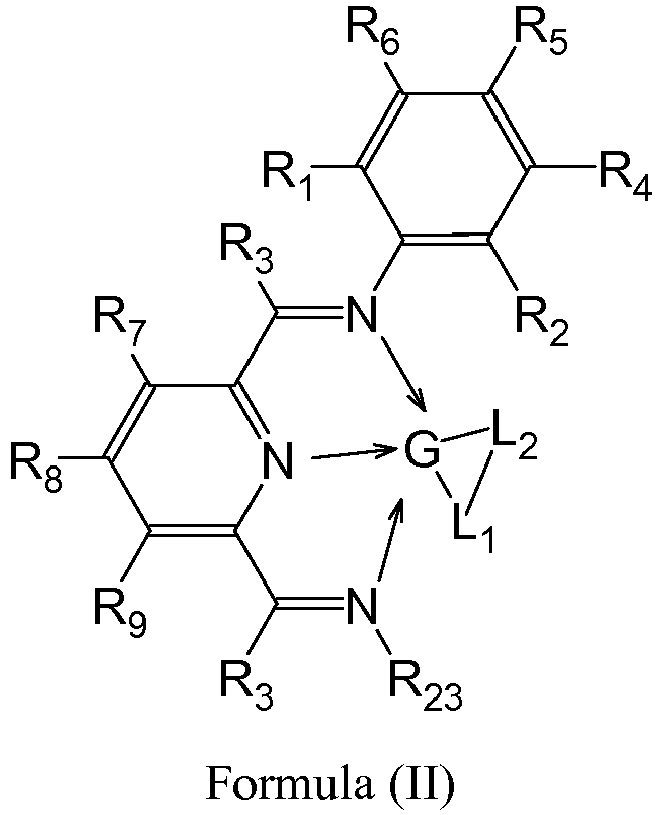
- G is Mn, Fe, Ni, or Co;
- each occurrence of R1, R2, R3, R4, R5, R6, R7, R8, and R9 is independently hydrogen, C1-C18 alkyl, C1-C18 substituted alkyl, aryl, substituted aryl, or an inert functional group, wherein R2-R9, other than hydrogen, optionally contain at least one heteroatom;
- each occurrence R23 is independently C1-C18 alkyl, C1-C18 substituted alkyl, aryl or substituted aryl, wherein R23 optionally contains at least one heteroatom;
- optionally any two of R1, R2, R3, R4, R5, R6, R7, R8, R9 and R23 vicinal to one another taken together may form a ring being a substituted or unsubstituted, saturated, or unsaturated cyclic structure;
- L1-L2 is


- wherein each occurrence of R10, R11, R13, R14, R15 and R16 is independently hydrogen, C1-C18 alkyl, C2-C18 alkenyl, or C2-C18 alkynyl, wherein R10, R11, R13, R14, R15 and R16, other than hydrogen, optionally contain at least one heteroatom, and R10, R11, R13, R14, R15 and R16, other than hydrogen, are optionally substituted;
- each occurrence of R12 is independently C1-C18 alkyl, C1-C18 substituted alkyl, C2-C18 alkenyl, C2-C18 substituted alkenyl, C2-C18 alkynyl, C2-C18 substituted alkynyl, aryl, substituted aryl, wherein R12 optionally contains at least one heteroatom;
- optionally any two of R10, R11, R12, R13, R14, R15, R16 taken together may form a ring being a substituted or unsubstituted, saturated or unsaturated cyclic structure;
- each occurrence of R17 and R18 is independently alkyl, substituted alkyl, aryl, or substituted aryl, wherein each of R17 and R18 optionally contains at least one heteroatom, and wherein R17 and R18 taken together may form a ring being a substituted or unsubstituted, saturated or unsaturated cyclic structure;
- each occurrence of R19 and R20 is independently a covalent bond that connects Si and C, an alkyl, substituted alkyl, or a heteroatom, wherein R19, and R20 optionally contain at least one heteroatom; wherein L1-L2 bonds with G through unsaturated sites S1 and S2.
- In another aspect, the present invention is directed to a process for the hydrosilylation of a composition containing a silyl hydride and a compound containing at least one unsaturated group. The process includes: (i) contacting the composition with a metal complex of Formula (I), Formula (II), Formula (III) or Formula (IV), optionally in the presence of a solvent, to cause the silyl hydride to react with the compound containing at least one unsaturated group to produce a hydrosilylation product containing the metal complex; (ii) optionally removing the metal complex from the hydrosilylation product. Formula (III) is:


- G is Mn, Fe, Ni, or Co;
- each occurrence of R1, R2, R3, R4, R5, R6, R7, R8 and R9 is independently H, C1-18 alkyl, C1-C18 substituted alkyl, aryl, substituted aryl, or an inert functional group, wherein R2-R9, other than hydrogen, optionally contain at least one heteroatom;
- each occurrence of R22 and R23 is independently C1-C18 alkyl, C1-C18 substituted alkyl, aryl or substituted aryl group, wherein R22 and R23 optionally contain at least one heteroatom, preferably R22 does not contain beta hydrogen (G-alpha C-beta C-beta hydrogen);
- optionally any two of any two of R1, R2, R3, R4, R5, R6, R7, R8, R9 and R23 vicinal to one another taken together may form a ring being a substituted or unsubstituted, saturated, or unsaturated cyclic structure,
- L1 is R10R11C=CR12R13 or R18C CR19 and L2 is R14R15C=CR16R17 or R20C
 CR21, wherein each occurrence of R10-R21 is independently hydrogen, C1-C18 alkyl, C1-C18 alkenyl, or C1-C18 alkynyl, wherein optionally R18-R19 and/or R20-R21, and/or any two of R10, R11, R12, R13 and/or any two of R14, R15, R16 R17 taken together may form a ring being a substituted or unsubstituted, saturated, or unsaturated cyclic structure, wherein R10-R21, other than hydrogen, optionally contain at least one heteroatom, and R10-R21, other than hydrogen, are optionally substituted, and wherein L1 and L2 bond with G through unsaturated sites.
 - In one embodiment of the invention, there is provided a complex of the Formulae (I), (II), (III) or (IV) as illustrated above. In connection with these formulae, G can be Mn, Fe, Ni, or Co in all the valence states. Preferably G is iron or cobalt. More preferably M is Fe, such as Fe (II) and Fe (III).
- As used herein, "alkyl" includes straight, branched and cyclic alkyl groups. Specific and non-limiting examples of alkyls include, but are not limited to, methyl, ethyl, propyl and isobutyl.
- By "substituted alkyl" herein is meant an alkyl group that contains one or more substituent groups that are inert under the process conditions to which the compound containing these groups is subjected. The substituent groups also do not substantially interfere with the process.
- By "aryl" herein is meant a non-limiting group of any aromatic hydrocarbon from which one hydrogen atom has been removed. An aryl may have one or more aromatic rings, which may be fused, connected by single bonds or other groups. Specific and non-limiting examples of aryls include, but are not limited to, tolyl, xylyl, phenyl and naphthalenyl.
- By "substituted aryl" herein is meant an aromatic group substituted as set forth in the above definition of "substituted alkyl." Similar to an aryl, a substituted aryl may have one or more aromatic rings, which may be fused, connected by single bonds or other groups; however, when the substituted aryl has a heteroaromatic ring, the free valence in the substituted aryl group can be to a heteroatom (such as nitrogen) of the heteroaromatic ring instead of a carbon. If not otherwise stated, it is preferred that substituted aryl groups herein contain 1 to about 30 carbon atoms.
- By "alkenyl" herein is meant any straight, branched, or cyclic alkenyl group containing one or more carbon-carbon double bonds, where the point of substitution can be either a carbon-carbon double bonds or elsewhere in the group. Specific and non-limiting examples of alkenyls include, but are not limited to, vinyl, propenyl, allyl, methallyl, ethylidenyl norbornane.
- By "alkynyl" is meant any straight, branched, or cyclic alkynyl group containing one or more carbon-carbon triple bonds, where the point of substitution can be either at a carbon-carbon triple bond or elsewhere in the group.
- By "unsaturated" is meant one or more double or triple bonds. In a preferred embodiment, it refers to carbon-carbon double or triple bonds.
- By "inert functional group" herein is meant a group other than hydrocarbyl or substituted hydrocarbyl which is inert under the process conditions to which the compound containing the group is subjected. The inert functional groups also do not substantially interfere with any process described herein that the compound in which they are present may take part in. Examples of inert functional groups include halo (fluoro, chloro, bromo, and iodo), ether such as -OR30 wherein R30 is hydrocarbyl or substituted hydrocarbyl.
- "Hetero atoms" herein is meant any of the Group 13-17 elements except carbon, and can include for example oxygen, nitrogen, silicon, sulfur, phosphorus, fluorine, chlorine, bromine, and iodine.
- In some embodiments, the complexes disclosed herein include those of Formulae (I), (II), (III) and (IV) having the following substituents: (1) R23 is

- In some embodiments, a complex according to Formula (II) is:

- wherein G is Mn, Fe, Ni, or Co, each occurrence of R1, R2, R3, R4, R5, R6, R7, R8, and R9 is independently hydrogen, C1-18 alkyl, C1-C18 substituted alkyl, aryl, substituted aryl, or an inert functional group, wherein R2-R9, other than hydrogen, optionally contain at least one heteroatom;
- each occurrence of R17 and R18 is independently alkyl, substituted alkyl, aryl, or substituted aryl, wherein each of R17 and R18 optionally contains at least one heteroatom, wherein R17 and R18 taken together optionally form a ring being a substituted or unsubstituted, saturated, or unsaturated cyclic structure;
- each occurrence of R23 is independently C1-C18 alkyl, C1-C18 substituted alkyl, aryl or substituted aryl, wherein R23 optionally contains at least one heteroatom;
- optionally any two of R1, R2, R3, R4, R5, R6, R7, R8, R9 and R23 vicinal to one another taken together may form a ring being a substituted or unsubstituted, saturated, or unsaturated cyclic structure.
- The complexes represented by the structural Formula (VI) preferably have the following substituents: (1) R23 is

- A preferred complex according to Formula (VI) is represented by structural Formula (VII)

- In connection with Formula (II), L1-L2 typically contains at least two unsaturated sites per molecule. Further examples of L1-L2 include, but are not limited to, butadienes, 1,5-cyclooctadienes, dicyclopentadienes and norbornadienes.
- In some embodiments, L1-L2 contains at least four unsaturated sites per molecule. In this circumstance, it is possible to form a metal-PDI dimer (PDI-metal-L1-L2-metal-PDI) with each metal bonding to two unsaturated sites of L1-L2. Exemplary L1-L2 for the metal-PDI dimer is tetravinyltetramethylcyclotetrasiloxane.
- Various methods can be used to prepare complexes of Formula (I). In one embodiment of the invention, there is provided a process for the synthesis of a complex of Formula (I). The process includes the step of reacting a compound of Formula (V) with a reducing agent in the presence of nitrogen, wherein Formula (V) is

- wherein G is Mn, Fe, Ni, or Co;
- each occurrence of R1, R2, R3, R4, R5, R6, R7, R8 and R9 is independently H, C1-18 alkyl, C1-C18 substituted alkyl, aryl, substituted aryl, or an inert group, wherein R2-R9, other than hydrogen, optionally contain at least one heteroatom;
- R23 is C1-C18 alkyl group or C1-C18 substituted alkyl, aryl or substituted aryl group, wherein R23 optionally contains at least one heteroatom;
- optionally any two of R1, R2, R3, R4, R5, R6, R7, R8, R9 and R23 vicinal to one another taken together may form a ring being a substituted or unsubstituted, saturated, or unsaturated cyclic structure,
- X is an anion, preferably F, Cl, Br, I, CF3R40SO3 - or R50COO-, wherein R40 is a covalent bond or a C1-C6 alkyl group, and R50 is a C1-C10 hydrocarbyl group.
- Preferably, the reducing agent has a reduction potential more negative than -0.6 v (versus ferrocene, as described in Chem. Rev. 1996, 96, 877-910. A larger negative number represents a larger reduction potential). The most preferred reducing agents have a reduction potential in the range of -2.8 to -3.1 v. An exemplary reducing agent includes, but is not limited to, sodium naphthalenide.
- The methods to prepare the compounds represented by structural Formula (V) are known to a person skilled in the field. For example, the compounds of Formula (V) can be prepared by reacting a PDI ligand with a metal halide, such as FeBr2. Typically, the PDI ligands are produced through condensation of an appropriate amine or aniline with 2,6-diacetylpyridine and its derivatives. If desired, the PDI ligands can be further modified by known aromatic substitution chemistry.
- The complex of Formula (II) can be prepared by the step of reacting a complex of Formula (V) as defined above in the context of preparing the complex of Formula (I) with L1-L2, wherein L1-L2 is


- wherein each occurrence of R10, R11, R13, R14, R15 and R16 is independently hydrogen, C1-C18 alkyl, C2-C18 alkenyl, C2-C18 alkynyl, or aryl, wherein R10, R11, R13, R14, R15 and R16, other than hydrogen, optionally contain at least one heteroatom, and R10, R11, R13, R14, R15 and R16, other than hydrogen, are optionally substituted,
- each occurrence of R12 is independently C1-C18 alkyl, C1-C18 substituted alkyl, C2-C18 alkenyl, C2-C18 substituted alkenyl, C2-C18 alkynyl, C2-C18 substituted alkynyl, aryl, substituted aryl, wherein R12 optionally contains at least one heteroatom;
- optionally any two of R10, R11, R12, R13, R14, R15, R16 taken together form a ring being a substituted or unsubstituted, saturated or unsaturated cyclic structure;
- each occurrence of R17 and R18 is independently alkyl, substituted alkyl, aryl, or substituted aryl, wherein each of R17 and R18 optionally contains at least one heteroatom; wherein R17 and R18 taken together may form a ring being a substituted or unsubstituted, saturated or unsaturated cyclic structure;
- each occurrence of R19 and R20 is independently a covalent bond that connects Si and C, an alkyl, substituted alkyl, or a heteroatom, wherein R19, and R20 optionally contain at least one heteroatom.
- Complexes of Formula (III) can be prepared by reacting a compound of Formula (V) such as PDIFeCl2 with L1 and L2 as defined above in connection with Formula (III). Complexes of Formula (IV) may be prepared by reacting a compound of Formula (V) with alkylating agents, such as alkali metal salts, alkaline earth metal salts, Grignards, aluminum alkyls, mercury alkyls, and thallium alkyls.
- As used herein, alkali metal salts include for example monoalkyl salts of lithium, sodium, potassium, rubidium and cesium. Alkaline earth metal salts include for example dialkyl salts of beryllium, magnesium, calcium, strontium and barium. Grignards suitable for the present invention include alkyl magnesium halides. Aluminum alkyls include for example trialkyl aluminum salts. Mercury alkyls refer to dialkyl mercury salts. Thallium alkyls include monoalkyl and trialkyl thallium salts.
- The metal complexes of Formulae (I), (II), (III), (IV), (VI) and (VII) are useful for catalyzing industrially practiced hydrosilylation reactions. For example, (1) the crosslinking of silicone hydride fluids with terminally unsaturated polymers, and (2) hydrosilylation of terminally unsaturated amines with tertiary silanes. Accordingly, the metal complexes of the invention have utility in the preparation of useful silicone products, including, but not limited to, coatings, for example release coatings, room temperature vulcanizates, sealants, adhesives, products for agricultural and personal care applications, and silicone surfactants for stabilizing polyurethane foams.
- When used as catalysts for the hydrosilylation reactions, the complexes of Formulae (I), (II), (III), (IV), (VI), and (VII) can be unsupported or immobilized on a support material, for example, carbon, silica, alumina, MgCl2 or zirconia, or on a polymer or prepolymer, for example polyethylene, polypropylene, polystyrene, or poly(aminostyrene). The metal complexes can also be supported on dendrimers.
- In some embodiments, for the purposes of attaching the metal complexes of the invention to a support, it is desirable that at least one of R1 to R9 of the metal complexes, preferably R6, has a functional group that is effective to covalently bond to the support. Exemplary functional groups include but are not limited to SH, COOH, NH2 or OH groups.
- In one embodiment, silica supported catalyst may be prepared via Ring-Opening Metathesis Polymerization (ROMP) technology as discussed in the literature, for example Macromol. Chem. Phys. 2001, 202, No. 5, pages 645-653; Journal of Chromatography A, 1025 (2003) 65-71.
- One way to immobilize catalysts on the surface of dendrimers is by the reaction of Si-Cl bonded parent dendrimers and functionalized PDI in the presence of a base is as illustrated by Kim et al. in Journal of Organometallic Chemistry 673 (2003) 77-83.
- In one embodiment, the complexes of Formulae (I), (II), (III), (IV), (VI), (VII) are used as catalysts for the hydrosilylation of a composition containing a silyl hydride and a compound having at least one unsaturated group. The process includes contacting the composition with a metal complex of Formula (I), (II), (III), (IV), (VI) or (VII), either supported or unsupported, to cause the silyl hydride to react with the compound having at least one unsaturated group to produce a hydrosilylation product which may contain the metal complex catalyst. The hydrosilylation reaction can be conducted optionally in the presence of a solvent. If desired, when the hydrosilylation reaction is completed, the metal complex can be removed from the reaction product by magnetic separation and/or filtration.
- The silyl hydride employed in the hydrosilylation reaction is not particularly limited. It can be any compound selected from the group consisting of RaSiH4-a, (RO)aSiH4-a, QuTvTp HDwDH xMH yMz, and combinations thereof. The silyl hydride can contain linear, branched or cyclic structures, or combinations thereof. As used herein, each occurrence of R is independently C1-C18 alkyl, C1-C18 substituted alkyl, wherein R optionally contains at least one heteroatom, each occurrence of a independently has a value from 1 to 3, each of p, u, v, y and z independently has a value from 0 to 20, w and x are from 0 to 500, provided that p + x + y equals 1 to 500 and the valences of the all the elements in the silyl hydride are satisfied. Preferably, p, u, v, y, and z are from 0 to 10, w and x are from 0 to 100, wherein p+ x + y equals 1 to 100.
- As used herein , an "M" group represents a monofunctional group of formula R'3SiO1/2, a "D" group represents a difunctional group of formula R'2SiO2/2, a "T" group represents a trifunctional group of formula R'SiO3/2, and a "Q" group represents a tetrafunctional group of formula SiO4/2, an "MH" group represents HgR'3-gSiO1/2, a "TH" represents HSiO3/2, and a "DH" group represents R'HSiO2/2. As used herein, g is an integer from 0 to 3. Each occurrence of R' is independently C1-C18 alkyl, C1-C18 substituted alkyl, wherein R' optionally contains at least one heteroatom.
- The compound containing an unsaturated group employed in the hydrosilylation reaction includes, but is not limited to, unsaturated polyethers such as alkyl-capped allyl polyethers, vinyl functionalized alkyl capped allyl or methylallyl polyethers; terminally unsaturated amines; alkynes; C2-C18 olefins, preferably alpha olefins; unsaturated cycloalkyl epoxide such as vinyl cyclohexyl epoxide; terminally unsaturated acrylates or methyl acrylates; unsaturated aryl ethers; unsaturated aromatic hydrocarbons; unsaturated cycloalkanes such as trivinyl cyclohexane; vinyl-functionalized polymer; and vinyl-functionalized silanes and vinyl-functionalized silicones.
- Unsaturated polyethers suitable for the hydrosilylation reaction preferably are polyoxyalkylenes having the general formula:
R1(OCH2CH2)z(OCH2CHR3)w-OR2 (Formula VIII)
or
R2O(CHR3CH2O)w(CH2CH2O)z-CR4 2-C≡C-CR4 2-(OCH2CH2)z(OCH2CHR3)wR2 (Formula X)
or
H2C=CR4CH2O(CH2OCH2)z(CH2OCHR3)wCH2CR4=CH2 (Formula XI)
wherein R1 denotes an unsaturated organic group containing from 2 to 10 carbon atoms such as allyl, methylallyl , propargyl or 3-pentynyl. When the unsaturation is olefinic, it is desirably terminal to facilitate smooth hydrosilylation. However, when the unsaturation is a triple bond, it may be internal. R2 is hydrogen, vinyl, or a polyether capping group of from 1 to 8 carbon atoms such as the alkyl groups: CH3, n-C4H9, t-C4H9 or i-C8H17, the acyl groups such as CH3COO, t-C4H9COO, the beta-ketoester group such as CH3C(O)CH2C(O)O, or a trialkylsilyl group. R3 and R4 are monovalent hydrocarbon groups such as the C1 - C20 alkyl groups, for example, methyl, ethyl, isopropyl, 2-ethylhexyl, dodecyl and stearyl, or the aryl groups, for example, phenyl and naphthyl, or the alkaryl groups, for example, benzyl, phenylethyl and nonylphenyl, or the cycloalkyl groups, for example, cyclohexyl and cyclooctyl. R4 may also be hydrogen. Methyl is the most preferred R3 and R4 groups. Each occurrence of z is 0 to 100 inclusive and each occurrence of w is 0 to 100 inclusive. Preferred values of z and w are 1 to 50 inclusive. - The metal complexes of the invention are efficient and selective in catalyzing hydrosilylation reactions. For example, when the metal complexes of the invention are employed in the hydrosilylation of an alkyl-capped allyl polyether and a compound containing
an unsaturated group, the reaction products are essentially free of unreacted alkyl-capped allyl polyether and its isomerization products. In one embodiment, the reaction products do not contain the unreacted alkyl-capped allyl polyether and its isomerization products. Further, when the compound containing an unsaturated group is unsaturated amine compound, the hydrosilylation product is essentially free of internal addition products and isomerization products of the unsaturated amine compound. As used herein, "essentially free" is meant no more than 10 wt%, preferably 5 wt% based on the total weight of the hydrosilylation product. "Essentially free of internal addition products" is meant that silicon is added to the terminal carbon. - The metal complexes of the invention can also be used in a process for preparing a silylated polyurethane, which includes the step of contacting terminally unsaturated polyurethane polymer with a silyl hydride in the presence of a complex of Formula (I), (II), (III), (IV), (VI), or (VII).
- The following examples are intended to illustrate the present invention. All parts and percentages are by weight and all temperatures are in degrees Celsius unless explicitly stated otherwise.
- All air- and moisture-sensitive manipulations were carried out using standard vacuum line, Schlenk, and cannula techniques or in an MBraun inert atmosphere drybox containing an atmosphere of purified nitrogen. Solvents for air- and moisture-sensitive manipulations were initially dried and deoxygenated using literature procedures. See for example Pangborn et al., J. Organometallics 1996, 15, 1518.
- The following abbreviations and terms are used:
- bs - broad singlet
- s - singlet
- t - triplet
- bm - broad multiple
- GC - Gas Chromatography
- MS - Mass Spectroscopy
- THF - tetrahydrofuran
- A 3 L 3-neck round bottomed flask was charged with 54.6 g (0.802 mol) of sodium ethoxide. While stirring vigorously with a mechanical stirrer, a solution of 35.5 g (0.159 mol) of 2,6-diethyl pyridinedicarboxylic ester in 300 mL of ethyl acetate was added dropwise to the flask. The resulting slurry was refluxed for 20 h, followed by cooling to 0 °C, and addition of 350 mL (4.2 mol) of concentrated HCl. The mixture was then refluxed for 20 h, forming a white precipitate and a clear yellow solution. Upon cooling, the mixture was added to a separatory funnel containing ∼1 L of water. The organic layer was separated; and the aqueous layer was extracted with CH2Cl2. The organic layers were combined, washed with saturated Na2CO3, dried over Na2SO4, and concentrated using rotary evaporation. The resulting brown solid was dissolved in a minimal amount of CH2Cl2 (30-50 mL), followed by the addition of an excess (∼1 L) of pentane. A dark red-brown side-product was precipitated, and the solution was decanted. This solution was cooled to -78 °C and scraped to produce a tan solid. This was collected on a buchner funnel, and the filtrate repeatedly concentrated and crystallized to yield 16.7 g (65%, 0.102 mol) of the desired product.
- A 250 mL round bottom flask was charged with 4.0 g of 2,6-diacetylpyridine, 6.09 g (2.05 eq.) of 2,6-dimethylaniline, and 100 mL of methanol. A catalytic amount of p-toluenesulfonic acid was added; and the reaction mixture was refluxed overnight into a Dean-Stark trap containing potassium sulfate. The reaction mixture was then cooled; and the methanol was reduced to approximately half of its starting volume. The mixture was cooled to -35 °C and the solid was filtered yielding 4.5 g (50%) of the desired product. The filtrate can be concentrated and cooled to yield more ligand. 1H NMR (benzene-d6 , 20°C): δ = 8.50 (d, 2H, m-Py), 7.28 (t, 1H, p-Py)), 7.08 (d, 4H, m-Ar), 6.99 (t, 2H, p-Ar), 2.17 (s, 6H, CH3), 2.05 (s, 12H, Ar-CH3).
- A round bottom flask was charged with 2.0 grams of 2,6-Me2PDI and 1.16 g of FeBr2, followed by 30 mL of THF. This mixture immediately turned dark blue, and was stirred overnight. The THF was then removed; and pentane was added. The slurry was filtered on a glass frit; and the solid was dried yielding 3.03 g (96 %) of paramagnetic 2,6-Me2PDIFeBr2. 1H NMR (benzene-d6 , 20 °C): δ = 77.71, 52.48, 15.92, 14.80, -12.50, -22.37.
- In an inert atmosphere, to a 50 mL round bottom flask was added 500 mg (0.85 mmol) of (2,6-Me2PDI)FeBr2, 41 mg (1.79 mmol) of sodium, and 5 mg (0.04 mmol) of naphthalene. To the stirring mixture was added approximately 25 mL of THF. The reaction mixture was stirred until the sodium was completely consumed, about 2 hours, and the THF was removed in vacuo. Diethyl ether was added to the residue and the solution was filtered through Celite®. The volatiles were again removed and the solid was dissolved in a minimal amount of diethyl ether and recrystallized at -35 °C yielding 278 mg (70 %) of the desired red brown compound. Elemental Analysis for C50H54N12Fe: Calc. C, 64.25 wt%; H, 5.82 wt%; N, 17.98 wt%. Found C, 63.87 wt%; H, 6.19 wt%; N, 17.80 wt%. 1H NMR (benzene-d6 , 20°C): δ = 1.35 (bs, 24H, Ar CH3 ), 1.78 (bs, 12H, C(CH3 )), 6.92 (bs, 12H, m- and p-Ar), 7.52 (bs, 2H, p-py), 8.10 (bs, 4H, m-py). 13C NMR (benzene-d6 , 20°C): δ = 16.17 (Ar CH3 ), 19.50 (C(CH3)), 115.92 (m- or p- py), 125.35 (m- or p- Ar), 130.93 (m- or p- Ar), 148.76 (m- or p- py), 153.05. 15N NMR (toluene-d8 ,-80°C) δ = -355.5 (bs), -334.2 (bs), -322.4 (bs). IR(toluene): v(N2) = 2102, 2085 cm-1.
- A procedure similar to that used for [(2,6-Me2PDI)Fe(N2)]2[µ-(N2)] was followed using 500 mg (0.78 mmol) of 2,6-Et2PDIFeBr2, 38 mg (1.64 mmol) of sodium, and 5 mg (0.04 mmol) of naphthalene. Approximately 305 mg (79 %) of a red brown product was obtained. Elemental Analysis for C58H70N12Fe2: Calc. C, 66.54 wt%; H, 6.74 wt%; N, 16.05 wt%. Found C, 66.27 wt%; H, 7.10 wt%; N, 15.65 wt%. 1H NMR (benzene-d6 , 20 °C): δ = 0.72 (bs, 24H, CH2CH3 ), 1.65 (bs, 28H, C(CH3 )) and CH2 CH3), 7.04 (bm, 12H, m- and p-Ar), 7.64 (bs, 2H, p-py), 8.16 (bs, 4H, m-py). 13C NMR (benzene-d6 , 20 °C): δ = 14.79 (CH2 CH3), 18.07 (C(CH3)), 24.68 (CH2CH3), 117.04 (m- or p- py), 125.77 (m- or p-Ar), 126.19 (m- or p- Ar), 135.94 (m- or p- py). 15N NMR (toluene-d8 , -80 °C) δ = -356.7 (bs), -331.5 (bs), -324.1 (bs). IR (toluene): v(N2) = 2101, 2086 cm-1.
- In an inert atmosphere, to a 50 mL round bottom flask was added 500 mg (0.85 mmol) of (2,6-Me2PDI)FeBr2, 41 mg (1.79 mmol) of sodium, and 5 mg (0.04 mmol) of naphthalene. To the stirring mixture was added approximately 25 mL of THF. The reaction mixture was stirred until the sodium was completely consumed, about 2 hours, and 475 mg (2.55 mmol) of 1,1'-divinyltetramethyldisiloxane was added to the solution. The THF and excess vinyl silane were removed on a high vacuum line; and ether was added to the residue. The solution was filtered through Celite®. The volatiles were removed and the solid was recrystallized from ether yielding 460 mg (88 %) of a dark red paramagnetic powder that gave broad peaks in the 1H NMR spectrum. 1H NMR (benzene-d6, 20 °C): δ = 171.22, 36.99, 6.00, 2.11, 0.69, 0.16, -4.24, -18.34, -112.68.
- In an inert atmosphere, to a diethyl ether solution of 100 mg (0.11 mmol) of [(2,6-Me2PDI)Fe(N2)]2[µ-(N2)] was added 60 mg (0.32 mmol) of 1,1'-divinyltetramethyldisiloxane. The addition was accompanied by gas evolution and a color change of the solution to red. The volatiles were removed and the residue was crystallized from the addition of a small amount of pentane. The yield was 95 mg (72 %).
- The procedure similar to that of (2,6-Me2PDI)Fe(1,1'-Divinyltetramethyldisiloxane) was followed with 418 mg (0.68 mmol) of (2-iPrPDI)FeBr2, 33 mg (1.43 mmol) of sodium, 5 mg (0.04 mmol) of naphthalene, and 381 mg (2.04 mmol) 1,1'-divinyltetramethyldisiloxane. Approximately 309 mg (71 %) of a dark purple powder was obtained. This compound exhibits an 1H NMR spectrum that has broadened peaks but a rather narrow range, and seems most consistent with at least two isomers of the compound, most likely the C2 and Cs symmetric molecules. 1H NMR (benzene-d6 , 20 °C): δ = -5.76, -2.30, 0.10, 0.58, 0.87, 0.99, 1.25, 2.52, 2.70, 3.25, 3.94, 4.45, 4.52, 5.62, 5.84, 6.09, 6.53, 8.30, 10.51.
- In an inert atmosphere, a 20 mL scintillation vial was charged with 0.443 g (1.00 mmol) of (2,6-Me2PDI)FeCl2. Pentane (∼10 mL) was added forming a slurry. The solution was cooled to -35 °C for approximately 30 minutes after which time a pentane solution of LiCH2SiMe3 (0.188 g, 2.00 mmol) was added dropwise. The yellow slurry turned dark purple as it warmed. The reaction was stirred for 1-2 hours at room temperature, then it was filtered through Celite® and the solution was transferred into a new 20 mL scintillation vial. A pentane slurry of 2,6-Me2PDI (0.379 g, 1.00 mmol) was added dropwise to the stirring solution. The purple solution immediately turned dark violet. This mixture was stirred for 1-2 hours at room temperature. The mixture was then cooled to -35 °C and filtered to afford 0.425 g (71 %) of (2,6-Me2PDI)Fe(CH2SiMe3)2 as a paramagnetic dark purple crystalline solid.
- A 250 mL round bottom flask was charged with 5.00 g (30.64 mmol) of 2,6-diacetylpyridine, 6.00 g (33.84 mmol) of 2,6-diisopropylaniline, and 100 mL of methanol. A catalytic amount of p-toluenesulfonic acid was added and the reaction mixture was refluxed overnight. The reaction mixture was then cooled to approximately 35 °C to 40 °C and filtered to remove 2,6-bis[1-(2,6-diisopropylphenylimino)ethyl]pyridine. The reaction solution was then placed at 0 °C for 24 hours, and the solid was filtered, yielding 4.25 g (43 %) of the desired product as a yellow powder. 1H NMR (benzene-d6 , 20 °C): δ = 1.21-1.14 (2 d, 12H, CH2 CH3 ), 2.19 (s, 3H, CH3 ), 2.52 (s, 3H, CH3 ), 2.88(sep, 2H, CH2 CH3), 7.05-7.13 (m, 3H, Ar) and CH2 CH3), 7.21 (t, 1H, p-py), 7.94 (d, 1H, py), 8.45 (d, 1H, py).
- A round bottom flask was charged with 3.10 grams (9.61 mmol) of 1-{6-[(2,6-diisopropylphenyl)ethanimidoyl]-2-pyridinyl}-1-ethanone, 1.5 g of (R)-(-)-2-amino-3-methylbutane (1.5 eq.), 100 mL of methanol, and a catalytic amount of p-toluenesulfonic acid. The solution was refluxed overnight into a Dean-Stark trap containing sodium sulfate and then cooled to 0 °C and filtered. The white powder was washed with cold methanol and dried on a high vacuum line overnight yielding 2.95 g (76%) of the desired compound. 1H NMR (benzene-d6 , 20 °C): δ = 0.96 (s, 9H, tBu), 1.08-1.16 (2 dd, 12H, CH2 CH3 ), 2.20 (s, 3H, CH3 ), 2.25 (s, 3H, CH3 ), 2.88 (2 sep, 2H, CH2 CH3), 2.94 (s, 3H, tBuCHCH3 ), 3.30(q, 1H, tBu-CH-CH3), 7.11-7.16 (m, 3H, Ar), 7.21 (t, 1H, p-py), 8.28 (d, 1H, py), 8.39 (d, 1H, py).
- In an inert atmosphere, a round bottom flask was charged with 2.5 g (6.61 mmol) of 2,6-diisopropyl-N-{(E)-1-[6-{[(1R)-1-tert-butylethyl]ethanimidoyl}-2-pyridinyl]ethylidene}aniline, 1.33 g (6.60 mmol) of FeBr2 and 50 mL of THF. The reaction was stirred for twelve hours, at which time an equal volume of pentane was added resulting in the precipitation of the desired product which was collected on a sintered glass frit and dried under reduced pressure to yield 3.6 g (94 %) of a blue paramagnetic powder. 1H NMR (CD2Cl2, 20 °C): δ = -19.43, -15.21, -11.97, -7.08, -4.52, -2.59, -1.40, 5.47, 14.51, 16.52, 23.15, 44.85, 70.32, 83.38, 187.03.
- A procedure similar to that used for 2,6-Me2FePDIBr2 as shown in example 1 was followed to make 2,6-iPr2FePDIBr2. In an inert atmosphere, a scintillation vial containing 0.200 g (0.29 mmol) 2,6-iPr2PDIFeBr2 and 0.095 g (0.43 mmol, 1.5 eq.) of (THF)2Mg(Butadiene) was placed on a stir plate with a stir bar. While stirring, 10 mL of diethyl ether was added, yielding a red solution. The reaction was stirred for ten minutes, at which time 5 mL of pentane was added and the reaction mixture was filtered through Celite®. The volatiles were removed, and the residue was taken up into a minimum amount of diethyl ether and placed in a freezer at 35 °C for 12 hours. Filtration left 0.120 g (70 %) of a red powder identified as 2,6-iPr2PDIFe(butadiene) on the filter frit.
- In an inert atmosphere, to a scintillation vial was added 1.0 g of MviD120Mvi, in which Mvi is vinyl dimethyl SiO2/2, and 44 mg of MD15DH 30M. Another vial was prepared containing a stock solution of 2 mg of [(2,6-Me2PDI)Fe(N2)]2[µ-(N2)] dissolved in 200 mg of ether. The catalyst solution was added at once to a stirring solution of 1 gram of 1.0 g of MviD120Mvi and 44 mg of MD15DH 30M. Almost immediately the solution gelled and became a solid. This gellation was indistinguishable from that observed for the reaction that uses the same silyl hydride and the unsaturated compound but employing a conventional platinum catalyst.
- In a nitrogen filled drybox, to a scintillation vial was added 150 mg (1.33 mmol) of 1-octene and 229 mg (1.03 mmol) of MDHM. To a separate vial was added 5 mg of [(2,6-Me2PDI)Fe(N2)]2[µ-(N2)] and 200 mg of toluene. To the stirring solution of olefin and silane was added 19 mg of the catalyst solution (0.48 mg, 0.1 mole % to silane). The reaction was allowed to stir at room temperature in the drybox for about 1 hour. The resonance associated with the Si-H in the 1H NMR was observed to disappear during the course of the reaction, and a new resonance upfield at 0.41 ppm assignable to methylene attached to silicon appeared, giving a spectrum consistent with that of the previously reported compound.
- Gas chromatography was performed on a Shimadzu GC- 2010 gas chromatograph. GC analyses were performed using a Supelco 30 m x 0.25 mm BETA DEX 120 capillary column. Temperature program for the reaction of MDHM and 1-octene was as follows: 80 °C, 2 min.; 15 °C /min to 180 °C, 2 min. The retention time of the hydrosilylated product was 7.83 minutes.
- In a nitrogen filled atmosphere, to a scintillation vial was added 150 mg (1.33 mmol) of 1-octene and 170 mg (1.03 mmol), of triethoxysilane. To a separate vial was added 5 mg of [(2,6-Me2PDI)Fe(N2)]2[µ-(N2)] and 200 mg of toluene. To the stirring solution of olefin and silane was added 19 mg of the catalyst solution (0.48 mg, 0.1 mole % to silane). The reaction was allowed to stir at room temperature in the drybox for about one hour. The resonance associated with the Si-H in the 1H NMR was observed to disappear during the course of the reaction, and a new resonance upfield at 0.62 ppm assignable to methylene attached to silicon appeared, giving a spectrum consistent with that of the previously reported compound.
- In a nitrogen filled drybox, a scintillation vial was charged with 1.00 g of methyl capped allyl polyether having nominal structure H2C=CHCH2O(C2H4O)8CH3 (2.09 mmol) and 0.465 g (2.09 mmol) of MDHM, in which M = (CH3)3SiO½ and DH = CH3SiHO. To the stirring solution of polyether and silane was added 10 mg (0.01 mmol) of [(2,6MePDI)Fe(N2)][µ-(N2)]. The scintillation vial was sealed and removed from the drybox and placed in a 60 °C oil bath. The reaction was stirred for 1 hour, at which time the vial was removed from the oil bath and the reaction was quenched by the addition of moist ether. The solution was analyzed by 1H NMR spectroscopy. The spectra established that the starting material methyl capped allyl polyether resonances were absent and resonances for the hydrosilylated product were present. There was no indication of propenyl resonances formed in the reaction within the detection limits of 1H NMR spectroscopy. The resonance associated with the Si-H in the 1H NMR was observed to disappear during the course of the reaction, and a new resonance upfield at 0.41 ppm assignable to methylene attached to silicon appeared, indicating the formation of the desired hydrosilylated product.
- In a nitrogen filled drybox, to a scintillation vial was added 150 mg (1.33 mmol) of 1-octene and 229 mg (1.03 mmol) of MDHM. To a separate vial was added 2 mg of (2,6-iPr2PDI)Fe(1,1'-divinyltetramethyldisiloxane) and 200 mg of toluene. To the stirring solution of olefin and silane was added the catalyst solution (0.5 mole % to silane). The reaction was allowed to stir at room temperature in the drybox for 1 hour. The resonance associated with the Si-H in the 1H NMR was observed to disappear during the course of the reaction, and a new resonance upfield at 0.41 ppm assignable to methylene attached to silicon appeared, giving a spectrum consistent with that of the previously reported compound.
- The allylpolyether was a commercial methyl-capped sample with nominal structure H2C=CHCH2O(C2H4O)8CH3. The hydridosiloxane was bis(trimethylsiloxy)methylsilane, abbreviated MDHM, in which M = (CH3)3SiO½ and DH = CH3SiHO. 55.1g polyether (0.13 mole) and 22.2 g MDHM (0.1 mole) were used in the hydrosilylation.
- The reaction was performed in a 250 ml 4-necked round bottom flask fitted with a mechanical stirrer, water-cooled Friedrich condenser, heating mantle and temperature controller, and a sparge tube connected to a dry nitrogen source. The flask was purged with nitrogen prior to and after addition of the reagents. The reaction mixture was stirred and heated to 80°C, at which point the nitrogen sparge was discontinued and the reaction was catalyzed with 0.4 cc of a 10 mg Pt/ml solution of chloroplatinic acid in ethanol. A 20°C temperature increase was observed after ∼ 2 minutes and the reaction mixture changed from creamy opaque to a clear amber color. Heating was discontinued and stirring continued for another hour until the reaction mixture had cooled to 23°C. The test for SiH was negative. Completeness of utilization of the hydridosiloxane was determined by measuring the volume of H2 produced when the reaction mixture was treated with alcoholic KOH as described by A. L. Smith, Analysis Of Silicones, John Wiley and Sons, NY 1974, pp 145-149. 1H NMR analysis confirmed the absence of SiH functionality in the product and 13C NMR showed the presence of propenyl (13C = 8.1 & 11.4 ppm) and allyl (13C = 115.6 & 133.8 ppm).
Claims (22)
- A complex of Formula (I)

 G is Mn, Fe, Ni, or Co;each occurrence of R1, R2, R3, R4, R5, R6, R7, R8, and R9 is independently hydrogen, C1-18 alkyl, C1-C18 substituted alkyl, aryl, substituted aryl, or an inert functional group, wherein R2-R9, other than hydrogen, optionally contain at least one heteroatom; each occurrence of R23is independently C1-C18 alkyl, C1-C18 substituted alkyl, aryl or substituted aryl, wherein R23 optionally contains at least one heteroatom; optionally any two ofR1, R2, R3, R4, R5, R6, R7, R8, R9 and R23 vicinal to one another taken together may form a ring being a substituted or unsubstituted, saturated, or unsaturated cyclic structure;L1-L2 is


 wherein each occurrence of R10, R11, R13, R14, R15 and R16 is independently hydrogen, C1-C18 alkyl, C2-C18 alkenyl, or C2-C18 alkynyl, wherein R10, R11, R13, R14, R15 and R16, other than hydrogen, optionally contain at least one heteroatom, and R10, R11, R13, R14, R15 and R16, other than hydrogen, are optionally substituted,each occurrence of R12 is independently C1-C18 alkyl, C1-C18 substituted alkyl, C2-C18 alkenyl, C2-C18 substituted alkenyl, C2-C18 alkynyl, C2-C18 substituted alkynyl, aryl, substituted aryl, wherein R12 optionally contains at least one heteroatom;optionally any two of R10, R11, R12, R13, R14, R15, R16 taken together form a ring being a substituted or unsubstituted, saturated or unsaturated cyclic structure;each occurrence of R17 and R18 is independently alkyl, substituted alkyl, aryl, or substituted aryl, wherein each of R17 and R18 optionally contains at least one heteroatom, and wherein R17 and R18 taken together optionally form a ring being a substituted or unsubstituted, saturated or unsaturated cyclic structure;each occurrence of R19 and R20 is independently a covalent bond that connects Si and C, an alkyl, substituted alkyl, or a heteroatom, wherein R19 and R20 optionally contain at least one heteroatom; wherein L1-L2 bonds with G through unsaturated sites S1 and S2. with the exception of the following bis(imino)pyridine iron complex
 wherein E is CH2 or SiMe2 and iPrPDI is 2,6-(2,6-iPr2C6H3NCMe)2C5H3N.
 - A complex according to Formula (I) or Formula (II) of claim 1 wherein(i) R23 is
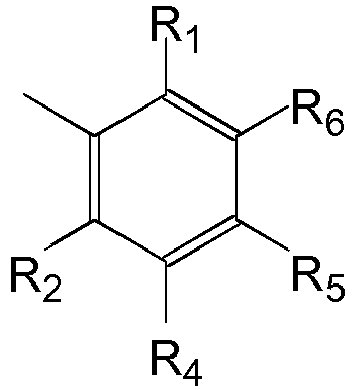 (ii) R1 and R2 are both methyl, ethyl, propyl or isopropyl groups; or(iii) R3 is methyl; or(iv) R10, R11, R13, R14, R15, and R16 are hydrogen; or(v) G is Fe; or(vi) the complex is immobilized on a support.
 - A complex according to Formula (II) of claim 1(i) wherein the complex is represented by formula (VI):
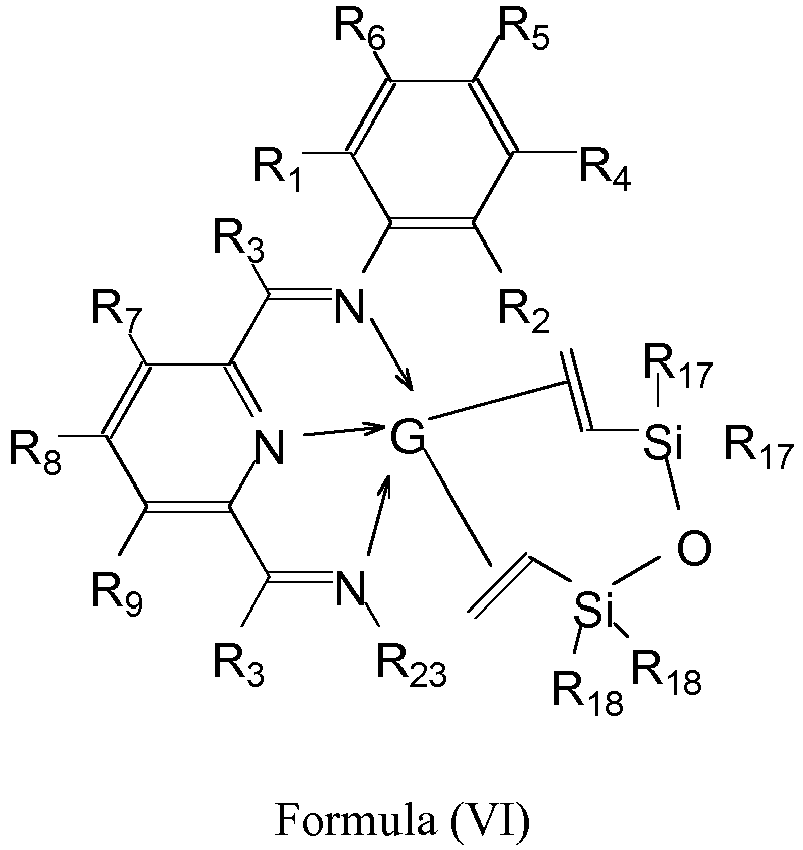 (ii) the complex of is represented by Formula (VII)
 (iii) the complex is a dimer wherein L1-L2 is an organosiloxane having at least four unsaturated sites.
 - The complex of claim 2(vi) wherein the support is selected from the group consisting of carbon, silica, alumina, MgCl2, zirconia, polyethylene, polypropylene, polystyrene, poly(aminostyrene), dendrimers, and combinations thereof.
- The complex of claim 2(vi) wherein at least one of R1-R9 contains a functional group that covalently bonds with the support.
- A process for the hydrosilylation of a composition containing a silyl hydride and a compound containing at least one unsaturated group, the process comprising: (i) contacting the composition with a complex according to Formula (I) of claim 1, or a complex of Formula (II), (III), or (IV), optionally in the presence of a solvent, to cause the silyl hydride to react with the compound containing at least one unsaturated group to produce a hydrosilylation product containing said complex, and (ii) optionally removing the complex from the hydrosilylation product, wherein
Formula (II) is:

 G is Mn, Fe, Ni, or Co;each occurrence of R1, R2, R3, R4, R5, R6, R7, R8 and R9 is independently H, C1-18 alkyl, C1-C18 substituted alkyl, aryl, substituted aryl, or an inert functional group, wherein R2-R9, other than hydrogen, optionally contain at least one heteroatom; each occurrence of R22 and R23 is independently C1-C18 alkyl, C1-C18 substituted alkyl, aryl or substituted aryl group, wherein R22 and R23 optionally contain at least one heteroatom; optionally any two of R1, R2, R3, R4, R5, R6, R7, R8, R9 and R23 vicinal to one another taken
together may form a ring being a substituted or unsubstituted, saturated, or unsaturated cyclic structure;L1-L2 is


 wherein each occurrence of R10, R11, R13, R14, R15 and R16 is independently hydrogen, C1-C18 alkyl, C2-C18 alkenyl, or C2-C18 alkynyl, wherein R10, R11, R13, R14, R15 and R16, other than hydrogen, optionally contain at least one heteroatom, and R10, R11, R13, R14, R15 and R16, other than hydrogen, are optionally substituted,each occurrence of R12 is independently C1-C18 alkyl, C1-C18 substituted alkyl, C2-C18 alkenyl, C2-C18 substituted alkenyl, C2-C18 alkynyl, C2-C18 substituted alkynyl, aryl, substituted aryl, wherein R12 optionally contains at least one heteroatom;optionally any two of R10, R11, R12, R13, R14, R15, R16 taken together form a ring being a substituted or unsubstituted, saturated or unsaturated cyclic structure;each occurrence of R17 and R18 is independently alkyl, substituted alkyl, aryl, or substituted aryl, wherein each of R17 and R18 optionally contains at least one heteroatom, and wherein R17 and R18 taken together optionally form a ring being a substituted or unsubstituted, saturated or unsaturated cyclic structure;each occurrence of R19 and R20 is independently a covalent bond that connects Si and C, an alkyl, substituted alkyl, or a heteroatom, wherein R19 and R20 optionally contain at least one heteroatom;wherein L1-L2 bonds with G through unsaturated sites S1 and S2;L1 is R10R11C=CR12R13 or R18CCR19 and L2 is R14R15C=CR16R17 or R20C
 CR21, wherein each occurrence of R10-R21 is independently hydrogen, C1-C18 alkyl, C1C18 alkenyl, or C1-C18 alkynyl, wherein optionally R18-R19 and/or R20-R21, and/or any two of R10, R11, R12, R13 and/or any two of R14, R15, R16 R17 taken together may form a ring being a substituted or unsubstituted, saturated, or unsaturated cyclic structure, wherein R10-R21, other than hydrogen, optionally contain at least one heteroatom, and R10-R21, other than hydrogen, are optionally substituted, and wherein L1 and L2 bond with G through unsaturated sites.
 - The process of claim 6 comprising the step of removing the complex from the hydrosilylation product by magnetic separation and/or filtration.
- The process of claim 6 wherein(i) each occurrence of R23 is independently
 (ii) R1 and R2 are both methyl, ethyl, propyl or isopropyl groups; or(iii) R3 is methyl; or(iv) R10, R11, R14, R15, R18 and R20 are hydrogen; or(v) R17 and R18 are methyl groups; or(vi) G is Fe; or(vii) the complex is immobilized on a support.
 - The process of claim 6 wherein the complex is

- The process of claim 8(vii) wherein the support is selected from the group consisting of carbon, silica, alumina, MgCl2, zirconia, polyethylene, polypropylene, polystyrene, poly(aminostyrene), dendrimers, and combinations thereof.
- The process of claim 8(vii) wherein at least one of R1-R9 contains a functional group that covalently bonds with the support.
- The process of claim 6, wherein the silyl hydride is selected from the group consisting of RaSiH4-a, (RO)aSiH4-a, QuTvTp HDwDH xMH yMz, and combinations thereof, wherein Q is SiO4/2, T is R'SiO3/2, TH is HSiO3/2, D is R'2SiO2/2, DH is R'HSiO2/2, MH is HgR'3-gSiO1/2, M is R'3SiO1/2, each occurrence of R and R' is independently C1-C18 alkyl, C1-C18 substituted alkyl, wherein R and R' optionally contain at least one heteroatom, each occurrence of a independently has a value of from 1 to 3, g has a value of from 0 to 3, each of p, u, v, y and z is independently from 0 to 20, w and x are independently from 0 to 500, provided that p + x + y equals 1 to 500, and the valences of the all the elements in the silyl hydride are satisfied.
- The process of claim 12, wherein each of p, u, v, y, and z is independently from 0 to 10, w and x are independently from 0 to 100, wherein p + x + y equals 1 to 100.
- The process of claim 6, wherein the compound containing an unsaturated group is selected from the group consisting of an alkyl-capped allyl polyether, a vinyl functionalized alkyl-capped allyl or methylallyl polyether, a terminally unsaturated amine, an alkyne, a C2-C18 olefin, an unsaturated cycloalkyl epoxide, a terminally unsaturated acrylate or methyl acrylate, an unsaturated aryl ether, an unsaturated aromatic hydrocarbon, an unsaturated cycloalkane, a vinyl-functionalized polymer, a vinyl-functionalized silane, a vinyl-functionalized silicone, and combinations thereof.
- The process of claim 6, wherein the compound containing an unsaturated group is a polyoxyalkylene having the generic formula:
R1(OCH2CH2)z(OCH2CHR3)w-OR2, Formula (VIII)
R2O(CHR3CH2O)w(CH2CH2O)z-CR4 2-C≡C-CR4 2-(OCH2CH2)z(OCH2CHR3)wR2 or Formula (X)
H2C=CR4CH2O(CH2OCH2)z(CH2OCHR3)wCH2CR4=CH2 Formula (XI)
wherein each occurrence of R1 is an unsaturated organic group containing from 2 to 10 carbon atoms, each occurrence of R2 is independently hydrogen, vinyl, or a polyether capping group of from 1 to 8 carbon atoms, each occurrence of R3 and R4 are independently monovalent hydrocarbon groups, each occurrence of z is 0 to 100 inclusive, and each occurrence of w is 0 to 100 inclusive. - A process for preparing a silylated polyurethane comprising contacting a terminally unsaturated polyurethane polymer with a silyl hydride in the presence of a complex as defined in claim 6.
- A composition produced from the process of claim 6 wherein the compound containing an unsaturated group is an alkyl-capped allyl polyether; wherein the composition is essentially free of unreacted alkyl-capped allyl polyether and its isomerization products, and wherein the composition further contains a complex according to Formula (I) of claim 1 or a complex of Formula (II), (III), or (IV) as defined in claim 6.
- A composition produced from the process of claim 6 wherein the compound containing an unsaturated group is a terminally unsaturated amine, wherein the composition is essentially free of unreacted terminally unsaturated amine and isomerization products, and wherein the product is essentially free of internal addition products and wherein the composition further contains a complex according to Formula (I) of claim 1 or a complex of Formula (II), (III), or (IV) as defined in claim 6.
- A composition produced from the process of claim 6 wherein the compound containing at least one unsaturated group is a vinyl-functional silicone and wherein the composition further contains a complex according to Formula (I) of claim 1 or a complex of Formula (II), (III), or (IV) as defined in claim 6.
- A process for the synthesis of a complex of Formula (I) as defined in claim 1 comprising the step of reacting a compound of Formula (V) with a reducing agent having a reduction potential more negative than -0.6 v versus ferrocene in the presence of nitrogen, wherein Formula (V) is
 G is Mn, Fe, Ni, or Co;each occurrence of R1, R2, R3, R4, R5, R6, R7, R8 and R9 is independently H, C1-18 alkyl, C1-C18 substituted alkyl, aryl, substituted aryl, or an inert group, wherein R2-R9, other than hydrogen, optionally contain at least one heteroatom;R23 is C1-C18 alkyl group or C1-C18 substituted alkyl, aryl or substituted aryl group, wherein R23 optionally contains at least one heteroatom; optionally any two of R1, R2, R3, R4, R5, R6, R7, R8, R9 and R23 vicinal to one another taken together may form a ring being a substituted or unsubstituted, saturated, or unsaturated cyclic structure; andX is an anion.
 - The process of claim 20 wherein(i) the reducing agent is sodium naphthalenide(ii) X is F, Cl, Br, I, CF3R40SO3 - or R50COO-, wherein R40 is a covalent bond or a C1-C6 alkyl group, and R50 is a C1-C10 hydrocarbyl group.
- A process for the synthesis of a complex of Formula (II) as defined in claim 1 comprising the step of reacting a complex of Formula (V) with L1-L2 wherein Formula (V) is
 G is Mn, Fe, Ni, or Co;each occurrence of R1, R2, R3, R4, R5, R6, R7, R8 and R9 is independently H, C1-18 alkyl, C1-C18 substituted alkyl, aryl, substituted aryl, or an inert group, wherein R2-R9, other than hydrogen, optionally contain at least one heteroatom;R23 is C1-C18 alkyl group or C1-C18 substituted alkyl, aryl or substituted aryl group, wherein R23 optionally contains at least one heteroatom; optionally any two of R1, R2, R3, R4, R5, R6, R7, R8, R9 and R23 vicinal to one another taken
together may form a ring being a substituted or unsubstituted, saturated, or unsaturated cyclic structure;X is F, Cl, Br, I, CF3R40SO3 - or R50COO-, wherein R40 is a covalent bond or a C1-C6 alkyl group, and R50 is a C1-C10 hydrocarbyl group; andL1-L2 is


 wherein each occurrence of R10, R11, R13, R14, R15 and R16 is independently hydrogen, C1-C18 alkyl, C2-C18 alkenyl, C2-C18 alkynyl, or aryl, wherein R10, R11, R13, R14, R15 and R16, other than hydrogen, optionally contain at least one heteroatom, and R10, R11, R13, R14, R15 and R16, other than hydrogen, are optionally substituted,each occurrence of R12 is independently C1-C18 alkyl, C1-C18 substituted alkyl, C2-C18 alkenyl, C2-C18 substituted alkenyl, C2-C18 alkynyl, C2-C18 substituted alkynyl, aryl, or substituted aryl, wherein R12 optionally contains at least one heteroatom;optionally any two of R10, R11, R12, R13, R14, R15, R16 taken together form a ring being a substituted or unsubstituted, saturated or unsaturated cyclic structure;each occurrence of R17 and R18 is independently alkyl, substituted alkyl, aryl, or substituted aryl, wherein each of R17 and R18 optionally contains at least one heteroatom, and wherein R17 and R18 taken together may optionally form a ring being a substituted or unsubstituted, saturated or unsaturated cyclic structure;
each occurrence of R19 and R20 is independently a covalent bond that connects Si and C, an alkyl, substituted alkyl or an heteroatom, wherein R19, and R20 optionally contain at least one heteroatom.
Applications Claiming Priority (3)
| Application Number | Priority Date | Filing Date | Title |
|---|---|---|---|
| US22459809P | 2009-07-10 | 2009-07-10 | |
| US12/832,627 US8236915B2 (en) | 2009-07-10 | 2010-07-08 | Hydrosilylation catalysts |
| PCT/US2010/041487 WO2011006044A2 (en) | 2009-07-10 | 2010-07-09 | Hydrosilylation catalysts |
Publications (2)
| Publication Number | Publication Date |
|---|---|
| EP2451820A2 EP2451820A2 (en) | 2012-05-16 |
| EP2451820B1 true EP2451820B1 (en) | 2020-03-18 |
Family
ID=43427966
Family Applications (1)
| Application Number | Title | Priority Date | Filing Date |
|---|---|---|---|
| EP10744762.5A Active EP2451820B1 (en) | 2009-07-10 | 2010-07-09 | Hydrosilylation catalysts |
Country Status (8)
| Country | Link |
|---|---|
| US (1) | US8236915B2 (en) |
| EP (1) | EP2451820B1 (en) |
| JP (2) | JP6059987B2 (en) |
| KR (2) | KR101710043B1 (en) |
| CN (3) | CN109289923B (en) |
| BR (1) | BR112012000169A2 (en) |
| TW (1) | TWI492789B (en) |
| WO (1) | WO2011006044A2 (en) |
Families Citing this family (48)
| Publication number | Priority date | Publication date | Assignee | Title |
|---|---|---|---|---|
| WO2012071358A2 (en) | 2010-11-24 | 2012-05-31 | Momentive Performance Materials Inc. | In-situ activation of metal complexes containing terdentate nitrogen ligands used as hydrosilylation catalysts |
| CN103347889A (en) | 2010-11-24 | 2013-10-09 | 莫门蒂夫性能材料股份有限公司 | Hydrosilylation catalyst |
| WO2012071360A1 (en) | 2010-11-24 | 2012-05-31 | Momentive Performance Materials Inc. | Metal - catalyzed mono - hydrosilylation of polyunsaturated compounds |
| US9394325B2 (en) * | 2011-08-19 | 2016-07-19 | The Trustees Of Princeton University | Enantiopure base-metal catalysts for asymmetric catalysis and bis(imino)pyridine iron alkyl complexes for catalysis |
| EP2758416B8 (en) | 2011-09-20 | 2018-08-01 | Dow Silicones Corporation | Nickel containing hydrosilylation catalysts and compositions containing the catalysts |
| WO2013043912A2 (en) * | 2011-09-20 | 2013-03-28 | Dow Corning Corporation | Iron containing hydrosilylation catalysts and compositions containing the catalysts |
| CN103946228A (en) * | 2011-09-20 | 2014-07-23 | 道康宁公司 | Cobalt containing hydrosilylation catalysts and compositions containing the catalysts |
| US9139699B2 (en) | 2012-10-04 | 2015-09-22 | Dow Corning Corporation | Metal containing condensation reaction catalysts, methods for preparing the catalysts, and compositions containing the catalysts |
| CN103827215B (en) * | 2011-10-04 | 2016-12-21 | 道康宁公司 | Iron content (II) complex and condensation catalyst, prepare the method for this catalyst and the compositions containing this catalyst |
| US9073950B2 (en) * | 2011-12-01 | 2015-07-07 | Dow Corning Corporation | Hydrosilylation reaction catalysts and curable compositions and methods for their preparation and use |
| US9782763B2 (en) | 2011-12-14 | 2017-10-10 | Momentive Performance Materials Inc. | Non-precious metal-based hyrdosilylation catalysts exhibiting improved selectivity |
| US9447125B2 (en) | 2012-08-16 | 2016-09-20 | Momentive Performance Materials Inc. | Reusable homogeneous cobalt pyridine diimine catalysts for dehydrogenative silylation and tandem dehydrogenative-silylation-hydrogenation |
| US8927674B2 (en) | 2012-08-16 | 2015-01-06 | Princeton University | Dehydrogenative silylation and crosslinking using cobalt catalysts |
| US9371340B2 (en) | 2012-08-16 | 2016-06-21 | Momentive Performance Materials Inc. | Dehydrogenative silylation, hydrosilylation and crosslinking using cobalt catalysts |
| JP6125222B2 (en) * | 2012-08-16 | 2017-05-10 | モメンティブ パフォーマンス マテリアルズ インコーポレイテッド | Dehydrogenated silylation and crosslinking using cobalt catalysts |
| FR3000069B1 (en) | 2012-12-21 | 2015-02-06 | Bluestar Silicones France | METHOD FOR HYDROSILYLATION OF A SILOXANE PHOTOCATALYSIS BY A POLYOXOMETALLATE COMPOUND |
| WO2014182670A2 (en) | 2013-05-06 | 2014-11-13 | Momentive Performance Materials Inc. | Selective 1,2-hydrosilylation of terminally unsaturated 1,3-dienes using iron catalysts |
| US9371339B2 (en) * | 2013-05-06 | 2016-06-21 | Momentive Performance Materials Inc. | Saturated and unsaturated silahydrocarbons via iron and cobalt pyridine diimine catalyzed olefin silylation |
| TWI623544B (en) | 2013-05-15 | 2018-05-11 | 摩曼帝夫特性材料公司 | Activation of metal salts using hydrazine and its use in hydrazine hydrogenation |
| US9708355B2 (en) | 2013-06-12 | 2017-07-18 | Arizona Board Of Regents On Behalf Of Arizona State University | First-row transition metal hydrogenation and hydrosilylation catalysts |
| WO2015023328A1 (en) | 2013-08-14 | 2015-02-19 | Momentive Performance Materials Inc. | Reusable homogeneous cobalt pyridine dimine catalysts for dehydrogenative silylation and tandem dehydrogenative-silylation-hydrogenation |
| KR20160065850A (en) * | 2013-10-02 | 2016-06-09 | 바스프 에스이 | Use of poly(oxyalkylene)oxy- and/or poly(oxyalkylene)aminoalkyltrialkoxysilanes as dispersants |
| JP6486925B2 (en) * | 2013-11-19 | 2019-03-20 | モメンティブ パフォーマンス マテリアルズ インコーポレイテッド | Cobalt catalyst and its use for hydrosilylation and dehydrogenation silylation |
| WO2015077344A1 (en) | 2013-11-19 | 2015-05-28 | The Trustees Of Princeton University | Hydroboration and borylation with cobalt catalysts |
| JP6486924B2 (en) * | 2013-11-19 | 2019-03-20 | モメンティブ パフォーマンス マテリアルズ インコーポレイテッド | Cobalt catalyst and its use for hydrosilylation and dehydrogenation silylation |
| JP2016537377A (en) | 2013-11-19 | 2016-12-01 | モメンティブ パフォーマンス マテリアルズ インコーポレイテッド | Dehydrogenated silylation, hydrosilylation, and crosslinking using cobalt catalysts |
| WO2015171881A1 (en) * | 2014-05-08 | 2015-11-12 | Momentive Performance Materials Inc. | Dialkyl cobalt catalysts and their use for hydrosilylation and dehydrogenative silylation |
| WO2016024611A1 (en) | 2014-08-12 | 2016-02-18 | 国立大学法人九州大学 | Hydrosilylation reaction catalyst |
| KR102443609B1 (en) | 2014-08-12 | 2022-09-15 | 고쿠리쓰다이가쿠호진 규슈다이가쿠 | Hydrosilylation reaction catalyst |
| JP6761997B2 (en) | 2014-08-19 | 2020-09-30 | 国立大学法人九州大学 | Hydrosilylated iron catalyst |
| CN104478919B (en) * | 2014-11-18 | 2018-02-02 | 浙江大学 | A kind of method of synthesis of chiral silane compound |
| US10046318B2 (en) | 2014-12-19 | 2018-08-14 | Dow Silicones Corporation | Ligand components, associated reaction products, activated reaction products, hydrosilylation catalysts and hydrosilylation curable compositions including the ligand components, and associated methods for preparing same |
| CN107847921B (en) | 2015-07-14 | 2022-01-14 | 国立大学法人九州大学 | Hydrosilylation reaction catalyst |
| CN108026126B (en) * | 2015-07-24 | 2021-04-20 | 莫门蒂夫性能材料股份有限公司 | Dehydrosilylation, hydrosilylation and crosslinking using cobalt pyridinediimine carboxylate catalyst |
| JP6585298B2 (en) * | 2015-12-07 | 2019-10-02 | ダウ シリコーンズ コーポレーション | Methods and compositions for hydrosilylation of carboxylic acid alkenyl esters and hydrogen-terminated organosiloxane oligomers using iridium complex catalysts |
| KR102607033B1 (en) | 2016-01-22 | 2023-11-29 | 신에쓰 가가꾸 고교 가부시끼가이샤 | New isocyanide compounds and hydrosilylation reaction catalysts |
| JP6933835B2 (en) * | 2017-01-25 | 2021-09-08 | 公立大学法人大阪 | Method for producing alkoxysilane by hydrosilylation reaction of carbonyl compound using iron complex catalyst |
| EP3590596B1 (en) | 2017-02-28 | 2023-07-12 | Kyushu University, National University Corporation | Catalyst for hydrosilylation reaction, hydrogenation reaction, and hydrosilane reduction reaction |
| FR3068699B1 (en) * | 2017-07-05 | 2019-08-16 | Elkem Silicones France Sas | USEFUL IRON COMPOUND AS A CATALYST FOR HYDROSILYLATION, DEHYDROGENANT SILYLATION AND CROSSLINKING OF SILICONE COMPOSITIONS |
| JP2019064950A (en) | 2017-09-29 | 2019-04-25 | 国立大学法人九州大学 | Cobalt complex, manufacturing method therefor, and catalyst for hydrosilylation reaction |
| US11273432B2 (en) | 2018-05-31 | 2022-03-15 | Arizona Board Of Regents On Behalf Of Arizona State University | Beta-diketiminate manganese catalysts for hydrosilylation, hydroboration, and dehydrogenative pnictogen-silicon and pnictogen-boron bond formation |
| CN109046463B (en) * | 2018-08-16 | 2021-05-04 | 中山大学 | Manganese bidentate azacarbene catalyst and preparation method thereof and application in alkylation synthesis |
| CN112739787B (en) | 2018-09-13 | 2023-07-25 | 迈图高新材料有限责任公司 | Functional polysiloxanes |
| JP6806299B2 (en) * | 2019-02-15 | 2021-01-06 | 国立大学法人九州大学 | Method for preparing a hydrosilylated iron catalyst |
| EP3915995B1 (en) | 2020-05-29 | 2025-11-26 | Momentive Performance Materials Inc. | Process for the stepwise synthesis of silahydrocarbons |
| CN114015055B (en) * | 2021-11-17 | 2023-04-14 | 江西晨光新材料股份有限公司 | A kind of synthetic method and application of functional silane-terminated polysiloxane |
| US20230250200A1 (en) * | 2022-02-08 | 2023-08-10 | Exxonmobil Chemical Patents Inc. | Improved catalysts for intermolecular cycloaddition |
| CN119751516B (en) * | 2024-12-27 | 2025-11-28 | 南京杰运医药科技有限公司 | PDI catalyst for preparing cresyl trazotrisiloxane, preparation method and preparation method of cresyl trazotrisiloxane |
Family Cites Families (45)
| Publication number | Priority date | Publication date | Assignee | Title |
|---|---|---|---|---|
| US3220972A (en) | 1962-07-02 | 1965-11-30 | Gen Electric | Organosilicon process using a chloroplatinic acid reaction product as the catalyst |
| US3159601A (en) | 1962-07-02 | 1964-12-01 | Gen Electric | Platinum-olefin complex catalyzed addition of hydrogen- and alkenyl-substituted siloxanes |
| US3775452A (en) | 1971-04-28 | 1973-11-27 | Gen Electric | Platinum complexes of unsaturated siloxanes and platinum containing organopolysiloxanes |
| US4550152A (en) * | 1983-10-28 | 1985-10-29 | General Electric Company | Nickel complex catalyst for hydrosilation reactions |
| CA2079308A1 (en) * | 1991-09-30 | 1993-03-31 | Lenin J. Petroff | Herbicidal compositions containing a silicone adjuvant |
| JPH05295269A (en) | 1991-11-29 | 1993-11-09 | General Electric Co <Ge> | Heat-curable organopolysiloxane composition, preformed latent platinum catalyst, and preparation thereof |
| CA2080153A1 (en) | 1991-11-29 | 1993-05-30 | Chris A. Sumpter | Heat curable organopolysiloxane compositions, preformed latent platinum catalysts, and methods for making |
| US5880241A (en) | 1995-01-24 | 1999-03-09 | E. I. Du Pont De Nemours And Company | Olefin polymers |
| IL129929A0 (en) | 1996-12-17 | 2000-02-29 | Du Pont | Polymerization of ethylene with specific iron or cobalt complexes novel pyridinebis (imines) and novel complexes of pyridinebis(imines) with iron and cobalt |
| US6417305B2 (en) | 1996-12-17 | 2002-07-09 | E. I. Du Pont De Nemours And Company | Oligomerization of ethylene |
| US6423848B2 (en) | 1996-12-17 | 2002-07-23 | E. I. Du Pont De Nemours And Company | Tridentate ligand |
| US6432862B1 (en) | 1996-12-17 | 2002-08-13 | E. I. Du Pont De Nemours And Company | Cobalt catalysts for the polymerization of olefins |
| US6214761B1 (en) | 1996-12-17 | 2001-04-10 | E. I. Du Pont De Nemours And Company | Iron catalyst for the polymerization of olefins |
| US6103946A (en) | 1997-07-15 | 2000-08-15 | E. I. Du Pont De Nemours And Company | Manufacture of α-olefins |
| PT1015501E (en) | 1997-09-05 | 2002-11-29 | Bp Chem Int Ltd | POLYMERIZATION CATALYSTS |
| DZ2739A1 (en) | 1998-03-12 | 2003-09-01 | Bp Chem Int Ltd | Polyethylene composition. |
| ES2229683T3 (en) | 1998-03-12 | 2005-04-16 | Bp Chemicals Limited | POLYMERIZATION CATALYSTS. |
| ID27209A (en) | 1998-03-12 | 2001-03-08 | Bp Chem Int Ltd | POLYMERIZATION CATALYSTS |
| WO1999046303A1 (en) | 1998-03-12 | 1999-09-16 | Bp Chemicals Limited | Polymerisation catalysts |
| US6297338B1 (en) | 1998-03-30 | 2001-10-02 | E. I. Du Pont De Nemours And Company | Polymerization of olefins |
| US7906451B2 (en) | 1998-03-30 | 2011-03-15 | E.I. Du Pont De Nemours And Company | Mixed polymerization catalyst component for polymerizing olefins |
| US5986022A (en) * | 1998-04-01 | 1999-11-16 | Witco Corporation | Continuous manufacture of silicone coploymers |
| GB9819847D0 (en) | 1998-09-12 | 1998-11-04 | Bp Chem Int Ltd | Novel compounds |
| US6181303B1 (en) * | 1998-10-05 | 2001-01-30 | The United States Of America As Represented By The Secretary Of The Army | Flat panel three-dimensional display unit |
| US6620895B1 (en) | 1999-03-22 | 2003-09-16 | E. I. Du Pont De Nemours And Company | Processing polyethylenes |
| DE19931873A1 (en) * | 1999-04-14 | 2000-10-19 | Bayer Ag | Catalyst system for olefin polymerization |
| US6281303B1 (en) | 1999-07-27 | 2001-08-28 | Eastman Chemical Company | Olefin oligomerization and polymerization catalysts |
| US6458905B1 (en) | 1999-08-16 | 2002-10-01 | Phillips Petroleum Company | Complexes of pyridldiimines with vanadium and other transition metals, and their use as olefin oligomerization and polymerization catalysts |
| JP4883253B2 (en) * | 2001-01-11 | 2012-02-22 | 信越化学工業株式会社 | Polyurethane resin coating agent for silicone rubber and silicone rubber member |
| EP1383857B1 (en) | 2001-04-30 | 2006-05-31 | Ciba SC Holding AG | Use of metal complex compounds as oxidation catalysts |
| FR2825707B1 (en) * | 2001-06-07 | 2004-11-26 | Rhodia Chimie Sa | PROCESS FOR THE PREPARATION OF CARBEN-BASED METAL CATALYSTS FOR THE HYDROSILYLATION OF UNSATURATED COMPOUNDS AND CATALYSTS OF THIS TYPE |
| WO2003042131A1 (en) | 2001-11-15 | 2003-05-22 | Stichting Voor De Technische Wetenschappen | Hydrogenation catalyst and catalysed hydrogenation process |
| AU2003259148A1 (en) | 2002-07-17 | 2004-02-02 | Exxonmobil Chemical Patents Inc. | Late transition metal catalysts for olefin polymerization and oligomerization |
| AU2003293320A1 (en) | 2002-09-25 | 2004-05-13 | Shell Internationale Research Maatschappij B.V. | Catalyst systems for ethylene oligomerisation to linear alpha olefins |
| WO2005103118A1 (en) * | 2004-04-20 | 2005-11-03 | Dow Corning Corporation | Aqueous dispersions of silicone polyether block copolymers |
| WO2006010065A2 (en) | 2004-07-09 | 2006-01-26 | E.I. Dupont De Nemours And Company | Catalysts for olefin polymerization or oligomerization |
| WO2006112943A1 (en) * | 2005-04-12 | 2006-10-26 | Dow Corning Corporation | Epoxy-functional polysiloxanes, silicone composition, and coated optical fiber |
| US8062552B2 (en) | 2005-05-19 | 2011-11-22 | Brookhaven Science Associates, Llc | Electrocatalyst for oxygen reduction with reduced platinum oxidation and dissolution rates |
| CN100378111C (en) * | 2005-07-01 | 2008-04-02 | 中国科学院上海有机化学研究所 | Carboxyether bond-containing organosilicon compound, synthesis method and application thereof |
| US7268096B2 (en) | 2005-07-21 | 2007-09-11 | Chevron Phillips Chemical Company Lp | Diimine metal complexes, methods of synthesis, and methods of using in oligomerization and polymerization |
| WO2007048721A1 (en) | 2005-10-26 | 2007-05-03 | Ciba Holding Inc. | Coloured particles for electrophoretic displays |
| US20080226708A1 (en) * | 2005-11-01 | 2008-09-18 | Shaow Burn Lin | Silicone Vesicles Containing Actives |
| DE102005057460A1 (en) | 2005-12-01 | 2007-06-06 | Wacker Chemie Ag | Crosslinkable to high-strength elastomers ionically and / or organometallic functionalized silicone polymers |
| US7407666B2 (en) * | 2006-02-23 | 2008-08-05 | Siltech Llc | Linear silicone resins in personal care applications |
| JP5071931B2 (en) * | 2007-07-19 | 2012-11-14 | 独立行政法人産業技術総合研究所 | Solid catalyst |
-
2010
- 2010-07-08 US US12/832,627 patent/US8236915B2/en active Active
- 2010-07-09 EP EP10744762.5A patent/EP2451820B1/en active Active
- 2010-07-09 BR BR112012000169A patent/BR112012000169A2/en not_active Application Discontinuation
- 2010-07-09 KR KR1020147035506A patent/KR101710043B1/en active Active
- 2010-07-09 CN CN201811054969.1A patent/CN109289923B/en active Active
- 2010-07-09 WO PCT/US2010/041487 patent/WO2011006044A2/en not_active Ceased
- 2010-07-09 CN CN201080030539.1A patent/CN102471358B/en active Active
- 2010-07-09 CN CN201510530811.7A patent/CN105085580B/en active Active
- 2010-07-09 JP JP2012519752A patent/JP6059987B2/en active Active
- 2010-07-09 KR KR1020117031667A patent/KR20120023149A/en not_active Ceased
- 2010-07-12 TW TW099122882A patent/TWI492789B/en active
-
2016
- 2016-11-02 JP JP2016215022A patent/JP6389220B2/en active Active
Non-Patent Citations (1)
| Title |
|---|
| None * |
Also Published As
| Publication number | Publication date |
|---|---|
| CN105085580A (en) | 2015-11-25 |
| TWI492789B (en) | 2015-07-21 |
| JP6389220B2 (en) | 2018-09-12 |
| KR20150013833A (en) | 2015-02-05 |
| TW201111040A (en) | 2011-04-01 |
| CN105085580B (en) | 2018-10-09 |
| JP2017078068A (en) | 2017-04-27 |
| BR112012000169A2 (en) | 2017-08-22 |
| JP6059987B2 (en) | 2017-01-11 |
| WO2011006044A2 (en) | 2011-01-13 |
| KR101710043B1 (en) | 2017-03-08 |
| CN109289923B (en) | 2021-09-07 |
| WO2011006044A3 (en) | 2011-03-03 |
| CN102471358B (en) | 2015-09-30 |
| JP2012532884A (en) | 2012-12-20 |
| EP2451820A2 (en) | 2012-05-16 |
| KR20120023149A (en) | 2012-03-12 |
| CN102471358A (en) | 2012-05-23 |
| CN109289923A (en) | 2019-02-01 |
| US8236915B2 (en) | 2012-08-07 |
| US20110009573A1 (en) | 2011-01-13 |
Similar Documents
| Publication | Publication Date | Title |
|---|---|---|
| US8236915B2 (en) | Hydrosilylation catalysts | |
| US8415443B2 (en) | Hydrosilylation catalysts | |
| EP2643329B1 (en) | In-situ activation of metal complexes used as hydrosilylation catalysts | |
| US8637626B2 (en) | Non-precious metal-containing 2,8-bis(imino)quinoline complexes and their use as hydrosilylation catalysts | |
| US11052383B2 (en) | Non-precious metal-based hyrdosilylation catalysts exhibiting improved selectivity | |
| WO2014182670A2 (en) | Selective 1,2-hydrosilylation of terminally unsaturated 1,3-dienes using iron catalysts | |
| EP3071585B1 (en) | Cobalt catalysts and their use for hydrosilylation and dehydrogenative silylation |
Legal Events
| Date | Code | Title | Description |
|---|---|---|---|
| PUAI | Public reference made under article 153(3) epc to a published international application that has entered the european phase |
Free format text: ORIGINAL CODE: 0009012 |
|
| 17P | Request for examination filed |
Effective date: 20120130 |
|
| AK | Designated contracting states |
Kind code of ref document: A2 Designated state(s): AL AT BE BG CH CY CZ DE DK EE ES FI FR GB GR HR HU IE IS IT LI LT LU LV MC MK MT NL NO PL PT RO SE SI SK SM TR |
|
| DAX | Request for extension of the european patent (deleted) | ||
| RAP1 | Party data changed (applicant data changed or rights of an application transferred) |
Owner name: MOMENTIVE PERFORMANCE MATERIALS INC. Owner name: CORNELL UNIVERSITY |
|
| RAP1 | Party data changed (applicant data changed or rights of an application transferred) |
Owner name: MOMENTIVE PERFORMANCE MATERIALS INC. Owner name: CORNELL UNIVERSITY |
|
| STAA | Information on the status of an ep patent application or granted ep patent |
Free format text: STATUS: EXAMINATION IS IN PROGRESS |
|
| 17Q | First examination report despatched |
Effective date: 20170227 |
|
| REG | Reference to a national code |
Ref country code: DE Ref legal event code: R079 Ref document number: 602010063555 Country of ref document: DE Free format text: PREVIOUS MAIN CLASS: C07F0015020000 Ipc: C07F0007180000 |
|
| GRAP | Despatch of communication of intention to grant a patent |
Free format text: ORIGINAL CODE: EPIDOSNIGR1 |
|
| STAA | Information on the status of an ep patent application or granted ep patent |
Free format text: STATUS: GRANT OF PATENT IS INTENDED |
|
| RIC1 | Information provided on ipc code assigned before grant |
Ipc: C07F 7/18 20060101AFI20190906BHEP Ipc: C07F 15/02 20060101ALI20190906BHEP |
|
| INTG | Intention to grant announced |
Effective date: 20190924 |
|
| GRAS | Grant fee paid |
Free format text: ORIGINAL CODE: EPIDOSNIGR3 |
|
| GRAA | (expected) grant |
Free format text: ORIGINAL CODE: 0009210 |
|
| STAA | Information on the status of an ep patent application or granted ep patent |
Free format text: STATUS: THE PATENT HAS BEEN GRANTED |
|
| AK | Designated contracting states |
Kind code of ref document: B1 Designated state(s): AL AT BE BG CH CY CZ DE DK EE ES FI FR GB GR HR HU IE IS IT LI LT LU LV MC MK MT NL NO PL PT RO SE SI SK SM TR |
|
| REG | Reference to a national code |
Ref country code: GB Ref legal event code: FG4D |
|
| REG | Reference to a national code |
Ref country code: DE Ref legal event code: R096 Ref document number: 602010063555 Country of ref document: DE |
|
| REG | Reference to a national code |
Ref country code: AT Ref legal event code: REF Ref document number: 1245793 Country of ref document: AT Kind code of ref document: T Effective date: 20200415 Ref country code: IE Ref legal event code: FG4D |
|
| REG | Reference to a national code |
Ref country code: NL Ref legal event code: FP |
|
| PG25 | Lapsed in a contracting state [announced via postgrant information from national office to epo] |
Ref country code: FI Free format text: LAPSE BECAUSE OF FAILURE TO SUBMIT A TRANSLATION OF THE DESCRIPTION OR TO PAY THE FEE WITHIN THE PRESCRIBED TIME-LIMIT Effective date: 20200318 Ref country code: NO Free format text: LAPSE BECAUSE OF FAILURE TO SUBMIT A TRANSLATION OF THE DESCRIPTION OR TO PAY THE FEE WITHIN THE PRESCRIBED TIME-LIMIT Effective date: 20200618 |
|
| PG25 | Lapsed in a contracting state [announced via postgrant information from national office to epo] |
Ref country code: LV Free format text: LAPSE BECAUSE OF FAILURE TO SUBMIT A TRANSLATION OF THE DESCRIPTION OR TO PAY THE FEE WITHIN THE PRESCRIBED TIME-LIMIT Effective date: 20200318 Ref country code: HR Free format text: LAPSE BECAUSE OF FAILURE TO SUBMIT A TRANSLATION OF THE DESCRIPTION OR TO PAY THE FEE WITHIN THE PRESCRIBED TIME-LIMIT Effective date: 20200318 Ref country code: GR Free format text: LAPSE BECAUSE OF FAILURE TO SUBMIT A TRANSLATION OF THE DESCRIPTION OR TO PAY THE FEE WITHIN THE PRESCRIBED TIME-LIMIT Effective date: 20200619 Ref country code: SE Free format text: LAPSE BECAUSE OF FAILURE TO SUBMIT A TRANSLATION OF THE DESCRIPTION OR TO PAY THE FEE WITHIN THE PRESCRIBED TIME-LIMIT Effective date: 20200318 Ref country code: BG Free format text: LAPSE BECAUSE OF FAILURE TO SUBMIT A TRANSLATION OF THE DESCRIPTION OR TO PAY THE FEE WITHIN THE PRESCRIBED TIME-LIMIT Effective date: 20200618 |
|
| REG | Reference to a national code |
Ref country code: LT Ref legal event code: MG4D |
|
| PG25 | Lapsed in a contracting state [announced via postgrant information from national office to epo] |
Ref country code: EE Free format text: LAPSE BECAUSE OF FAILURE TO SUBMIT A TRANSLATION OF THE DESCRIPTION OR TO PAY THE FEE WITHIN THE PRESCRIBED TIME-LIMIT Effective date: 20200318 Ref country code: SM Free format text: LAPSE BECAUSE OF FAILURE TO SUBMIT A TRANSLATION OF THE DESCRIPTION OR TO PAY THE FEE WITHIN THE PRESCRIBED TIME-LIMIT Effective date: 20200318 Ref country code: LT Free format text: LAPSE BECAUSE OF FAILURE TO SUBMIT A TRANSLATION OF THE DESCRIPTION OR TO PAY THE FEE WITHIN THE PRESCRIBED TIME-LIMIT Effective date: 20200318 Ref country code: PT Free format text: LAPSE BECAUSE OF FAILURE TO SUBMIT A TRANSLATION OF THE DESCRIPTION OR TO PAY THE FEE WITHIN THE PRESCRIBED TIME-LIMIT Effective date: 20200812 Ref country code: CZ Free format text: LAPSE BECAUSE OF FAILURE TO SUBMIT A TRANSLATION OF THE DESCRIPTION OR TO PAY THE FEE WITHIN THE PRESCRIBED TIME-LIMIT Effective date: 20200318 Ref country code: RO Free format text: LAPSE BECAUSE OF FAILURE TO SUBMIT A TRANSLATION OF THE DESCRIPTION OR TO PAY THE FEE WITHIN THE PRESCRIBED TIME-LIMIT Effective date: 20200318 Ref country code: SK Free format text: LAPSE BECAUSE OF FAILURE TO SUBMIT A TRANSLATION OF THE DESCRIPTION OR TO PAY THE FEE WITHIN THE PRESCRIBED TIME-LIMIT Effective date: 20200318 Ref country code: IS Free format text: LAPSE BECAUSE OF FAILURE TO SUBMIT A TRANSLATION OF THE DESCRIPTION OR TO PAY THE FEE WITHIN THE PRESCRIBED TIME-LIMIT Effective date: 20200718 |
|
| REG | Reference to a national code |
Ref country code: AT Ref legal event code: MK05 Ref document number: 1245793 Country of ref document: AT Kind code of ref document: T Effective date: 20200318 |
|
| REG | Reference to a national code |
Ref country code: DE Ref legal event code: R097 Ref document number: 602010063555 Country of ref document: DE |
|
| PLBE | No opposition filed within time limit |
Free format text: ORIGINAL CODE: 0009261 |
|
| STAA | Information on the status of an ep patent application or granted ep patent |
Free format text: STATUS: NO OPPOSITION FILED WITHIN TIME LIMIT |
|
| PG25 | Lapsed in a contracting state [announced via postgrant information from national office to epo] |
Ref country code: ES Free format text: LAPSE BECAUSE OF FAILURE TO SUBMIT A TRANSLATION OF THE DESCRIPTION OR TO PAY THE FEE WITHIN THE PRESCRIBED TIME-LIMIT Effective date: 20200318 Ref country code: DK Free format text: LAPSE BECAUSE OF FAILURE TO SUBMIT A TRANSLATION OF THE DESCRIPTION OR TO PAY THE FEE WITHIN THE PRESCRIBED TIME-LIMIT Effective date: 20200318 Ref country code: AT Free format text: LAPSE BECAUSE OF FAILURE TO SUBMIT A TRANSLATION OF THE DESCRIPTION OR TO PAY THE FEE WITHIN THE PRESCRIBED TIME-LIMIT Effective date: 20200318 |
|
| 26N | No opposition filed |
Effective date: 20201221 |
|
| PG25 | Lapsed in a contracting state [announced via postgrant information from national office to epo] |
Ref country code: MC Free format text: LAPSE BECAUSE OF FAILURE TO SUBMIT A TRANSLATION OF THE DESCRIPTION OR TO PAY THE FEE WITHIN THE PRESCRIBED TIME-LIMIT Effective date: 20200318 Ref country code: PL Free format text: LAPSE BECAUSE OF FAILURE TO SUBMIT A TRANSLATION OF THE DESCRIPTION OR TO PAY THE FEE WITHIN THE PRESCRIBED TIME-LIMIT Effective date: 20200318 |
|
| REG | Reference to a national code |
Ref country code: CH Ref legal event code: PL |
|
| REG | Reference to a national code |
Ref country code: BE Ref legal event code: MM Effective date: 20200731 |
|
| PG25 | Lapsed in a contracting state [announced via postgrant information from national office to epo] |
Ref country code: LU Free format text: LAPSE BECAUSE OF NON-PAYMENT OF DUE FEES Effective date: 20200709 Ref country code: LI Free format text: LAPSE BECAUSE OF NON-PAYMENT OF DUE FEES Effective date: 20200731 Ref country code: CH Free format text: LAPSE BECAUSE OF NON-PAYMENT OF DUE FEES Effective date: 20200731 |
|
| PG25 | Lapsed in a contracting state [announced via postgrant information from national office to epo] |
Ref country code: SI Free format text: LAPSE BECAUSE OF FAILURE TO SUBMIT A TRANSLATION OF THE DESCRIPTION OR TO PAY THE FEE WITHIN THE PRESCRIBED TIME-LIMIT Effective date: 20200318 Ref country code: BE Free format text: LAPSE BECAUSE OF NON-PAYMENT OF DUE FEES Effective date: 20200731 |
|
| PG25 | Lapsed in a contracting state [announced via postgrant information from national office to epo] |
Ref country code: IE Free format text: LAPSE BECAUSE OF NON-PAYMENT OF DUE FEES Effective date: 20200709 |
|
| PG25 | Lapsed in a contracting state [announced via postgrant information from national office to epo] |
Ref country code: TR Free format text: LAPSE BECAUSE OF FAILURE TO SUBMIT A TRANSLATION OF THE DESCRIPTION OR TO PAY THE FEE WITHIN THE PRESCRIBED TIME-LIMIT Effective date: 20200318 Ref country code: MT Free format text: LAPSE BECAUSE OF FAILURE TO SUBMIT A TRANSLATION OF THE DESCRIPTION OR TO PAY THE FEE WITHIN THE PRESCRIBED TIME-LIMIT Effective date: 20200318 Ref country code: CY Free format text: LAPSE BECAUSE OF FAILURE TO SUBMIT A TRANSLATION OF THE DESCRIPTION OR TO PAY THE FEE WITHIN THE PRESCRIBED TIME-LIMIT Effective date: 20200318 |
|
| PG25 | Lapsed in a contracting state [announced via postgrant information from national office to epo] |
Ref country code: MK Free format text: LAPSE BECAUSE OF FAILURE TO SUBMIT A TRANSLATION OF THE DESCRIPTION OR TO PAY THE FEE WITHIN THE PRESCRIBED TIME-LIMIT Effective date: 20200318 Ref country code: AL Free format text: LAPSE BECAUSE OF FAILURE TO SUBMIT A TRANSLATION OF THE DESCRIPTION OR TO PAY THE FEE WITHIN THE PRESCRIBED TIME-LIMIT Effective date: 20200318 |
|
| P01 | Opt-out of the competence of the unified patent court (upc) registered |
Effective date: 20230513 |
|
| PGFP | Annual fee paid to national office [announced via postgrant information from national office to epo] |
Ref country code: NL Payment date: 20250724 Year of fee payment: 16 |
|
| PGFP | Annual fee paid to national office [announced via postgrant information from national office to epo] |
Ref country code: DE Payment date: 20250728 Year of fee payment: 16 |
|
| PGFP | Annual fee paid to national office [announced via postgrant information from national office to epo] |
Ref country code: IT Payment date: 20250721 Year of fee payment: 16 |
|
| PGFP | Annual fee paid to national office [announced via postgrant information from national office to epo] |
Ref country code: GB Payment date: 20250722 Year of fee payment: 16 |
|
| PGFP | Annual fee paid to national office [announced via postgrant information from national office to epo] |
Ref country code: FR Payment date: 20250725 Year of fee payment: 16 |