EP2451780B1 - Intermediates and processes for the preparation of 4-(acetylamino))-3-[(4-chloro-phenyl)thio]-2-methyl-1h-indole-1-acetic acid - Google Patents
Intermediates and processes for the preparation of 4-(acetylamino))-3-[(4-chloro-phenyl)thio]-2-methyl-1h-indole-1-acetic acid Download PDFInfo
- Publication number
- EP2451780B1 EP2451780B1 EP10752114.8A EP10752114A EP2451780B1 EP 2451780 B1 EP2451780 B1 EP 2451780B1 EP 10752114 A EP10752114 A EP 10752114A EP 2451780 B1 EP2451780 B1 EP 2451780B1
- Authority
- EP
- European Patent Office
- Prior art keywords
- formula
- compound
- alkyl
- salt
- hydrogen
- Prior art date
- Legal status (The legal status is an assumption and is not a legal conclusion. Google has not performed a legal analysis and makes no representation as to the accuracy of the status listed.)
- Not-in-force
Links
- 238000000034 method Methods 0.000 title claims description 59
- 230000008569 process Effects 0.000 title claims description 36
- 239000000543 intermediate Substances 0.000 title claims description 18
- 238000002360 preparation method Methods 0.000 title claims description 15
- 125000003854 p-chlorophenyl group Chemical group [H]C1=C([H])C(*)=C([H])C([H])=C1Cl 0.000 title 1
- 125000000446 sulfanediyl group Chemical group *S* 0.000 title 1
- 150000001875 compounds Chemical class 0.000 claims description 152
- 238000006243 chemical reaction Methods 0.000 claims description 78
- -1 cyano, hydroxy Chemical group 0.000 claims description 71
- 150000003839 salts Chemical class 0.000 claims description 67
- WFDIJRYMOXRFFG-UHFFFAOYSA-N Acetic anhydride Chemical group CC(=O)OC(C)=O WFDIJRYMOXRFFG-UHFFFAOYSA-N 0.000 claims description 62
- 229910052739 hydrogen Inorganic materials 0.000 claims description 59
- 239000001257 hydrogen Substances 0.000 claims description 59
- 125000004169 (C1-C6) alkyl group Chemical group 0.000 claims description 42
- FVAUCKIRQBBSSJ-UHFFFAOYSA-M sodium iodide Chemical compound [Na+].[I-] FVAUCKIRQBBSSJ-UHFFFAOYSA-M 0.000 claims description 36
- 125000001997 phenyl group Chemical group [H]C1=C([H])C([H])=C(*)C([H])=C1[H] 0.000 claims description 29
- 125000002924 primary amino group Chemical group [H]N([H])* 0.000 claims description 29
- CTQNGGLPUBDAKN-UHFFFAOYSA-N O-Xylene Chemical compound CC1=CC=CC=C1C CTQNGGLPUBDAKN-UHFFFAOYSA-N 0.000 claims description 27
- 125000004435 hydrogen atom Chemical group [H]* 0.000 claims description 27
- 239000008096 xylene Substances 0.000 claims description 27
- 125000001797 benzyl group Chemical group [H]C1=C([H])C([H])=C(C([H])=C1[H])C([H])([H])* 0.000 claims description 22
- UFHFLCQGNIYNRP-UHFFFAOYSA-N Hydrogen Chemical compound [H][H] UFHFLCQGNIYNRP-UHFFFAOYSA-N 0.000 claims description 19
- 125000004397 aminosulfonyl group Chemical group NS(=O)(=O)* 0.000 claims description 18
- 125000003917 carbamoyl group Chemical group [H]N([H])C(*)=O 0.000 claims description 18
- 125000000882 C2-C6 alkenyl group Chemical group 0.000 claims description 16
- 125000003601 C2-C6 alkynyl group Chemical group 0.000 claims description 16
- 125000005913 (C3-C6) cycloalkyl group Chemical group 0.000 claims description 15
- 125000001309 chloro group Chemical group Cl* 0.000 claims description 15
- 125000001183 hydrocarbyl group Chemical group 0.000 claims description 15
- 150000002431 hydrogen Chemical class 0.000 claims description 15
- 238000005886 esterification reaction Methods 0.000 claims description 13
- 125000000623 heterocyclic group Chemical group 0.000 claims description 12
- 235000009518 sodium iodide Nutrition 0.000 claims description 12
- 239000012345 acetylating agent Substances 0.000 claims description 11
- 238000004519 manufacturing process Methods 0.000 claims description 10
- 125000004191 (C1-C6) alkoxy group Chemical group 0.000 claims description 9
- 125000005843 halogen group Chemical group 0.000 claims description 9
- 239000012450 pharmaceutical intermediate Substances 0.000 claims description 9
- 125000000449 nitro group Chemical group [O-][N+](*)=O 0.000 claims description 8
- 125000001495 ethyl group Chemical group [H]C([H])([H])C([H])([H])* 0.000 claims description 7
- 239000003795 chemical substances by application Substances 0.000 claims description 6
- XMBWDFGMSWQBCA-UHFFFAOYSA-M iodide Chemical compound [I-] XMBWDFGMSWQBCA-UHFFFAOYSA-M 0.000 claims description 6
- 239000002841 Lewis acid Substances 0.000 claims description 4
- 150000001732 carboxylic acid derivatives Chemical class 0.000 claims description 4
- 239000006184 cosolvent Substances 0.000 claims description 4
- 150000007517 lewis acids Chemical class 0.000 claims description 4
- LFQSCWFLJHTTHZ-UHFFFAOYSA-N Ethanol Chemical compound CCO LFQSCWFLJHTTHZ-UHFFFAOYSA-N 0.000 description 123
- XEKOWRVHYACXOJ-UHFFFAOYSA-N Ethyl acetate Chemical compound CCOC(C)=O XEKOWRVHYACXOJ-UHFFFAOYSA-N 0.000 description 116
- 239000000203 mixture Substances 0.000 description 98
- QTBSBXVTEAMEQO-UHFFFAOYSA-N Acetic acid Chemical compound CC(O)=O QTBSBXVTEAMEQO-UHFFFAOYSA-N 0.000 description 87
- XLYOFNOQVPJJNP-UHFFFAOYSA-N water Substances O XLYOFNOQVPJJNP-UHFFFAOYSA-N 0.000 description 47
- 238000003556 assay Methods 0.000 description 45
- 238000003756 stirring Methods 0.000 description 44
- 235000019439 ethyl acetate Nutrition 0.000 description 43
- 238000001914 filtration Methods 0.000 description 41
- 239000007787 solid Substances 0.000 description 35
- 238000004128 high performance liquid chromatography Methods 0.000 description 30
- HEMHJVSKTPXQMS-UHFFFAOYSA-M Sodium hydroxide Chemical compound [OH-].[Na+] HEMHJVSKTPXQMS-UHFFFAOYSA-M 0.000 description 27
- WTDHULULXKLSOZ-UHFFFAOYSA-N Hydroxylamine hydrochloride Chemical compound Cl.ON WTDHULULXKLSOZ-UHFFFAOYSA-N 0.000 description 24
- 239000012265 solid product Substances 0.000 description 22
- 239000000047 product Substances 0.000 description 18
- 238000005160 1H NMR spectroscopy Methods 0.000 description 15
- CSCPPACGZOOCGX-UHFFFAOYSA-N Acetone Chemical compound CC(C)=O CSCPPACGZOOCGX-UHFFFAOYSA-N 0.000 description 15
- VEXZGXHMUGYJMC-UHFFFAOYSA-N Hydrochloric acid Chemical compound Cl VEXZGXHMUGYJMC-UHFFFAOYSA-N 0.000 description 15
- KWYUFKZDYYNOTN-UHFFFAOYSA-M Potassium hydroxide Chemical compound [OH-].[K+] KWYUFKZDYYNOTN-UHFFFAOYSA-M 0.000 description 15
- NJAHLZZJVRKNSE-UHFFFAOYSA-N ethyl 2-[4-acetamido-3-(4-chlorophenyl)sulfanyl-2-methylindol-1-yl]acetate Chemical compound C12=C(NC(C)=O)C=CC=C2N(CC(=O)OCC)C(C)=C1SC1=CC=C(Cl)C=C1 NJAHLZZJVRKNSE-UHFFFAOYSA-N 0.000 description 15
- 239000002002 slurry Substances 0.000 description 15
- ICSNYEOMOVSDFC-UHFFFAOYSA-N ethyl 2-(2-methyl-4-oxo-6,7-dihydro-5h-indol-1-yl)acetate Chemical compound C1CCC(=O)C2=C1N(CC(=O)OCC)C(C)=C2 ICSNYEOMOVSDFC-UHFFFAOYSA-N 0.000 description 14
- 150000001408 amides Chemical class 0.000 description 13
- 239000010410 layer Substances 0.000 description 13
- 239000011541 reaction mixture Substances 0.000 description 13
- WEVYAHXRMPXWCK-UHFFFAOYSA-N Acetonitrile Chemical compound CC#N WEVYAHXRMPXWCK-UHFFFAOYSA-N 0.000 description 12
- YMWUJEATGCHHMB-UHFFFAOYSA-N Dichloromethane Chemical compound ClCCl YMWUJEATGCHHMB-UHFFFAOYSA-N 0.000 description 12
- 230000015572 biosynthetic process Effects 0.000 description 12
- 239000000706 filtrate Substances 0.000 description 12
- 239000002904 solvent Substances 0.000 description 12
- 238000005481 NMR spectroscopy Methods 0.000 description 11
- 238000001816 cooling Methods 0.000 description 11
- 238000010992 reflux Methods 0.000 description 11
- 238000003786 synthesis reaction Methods 0.000 description 11
- IJGRMHOSHXDMSA-UHFFFAOYSA-N Atomic nitrogen Chemical compound N#N IJGRMHOSHXDMSA-UHFFFAOYSA-N 0.000 description 10
- BZLVMXJERCGZMT-UHFFFAOYSA-N Methyl tert-butyl ether Chemical compound COC(C)(C)C BZLVMXJERCGZMT-UHFFFAOYSA-N 0.000 description 10
- 238000006640 acetylation reaction Methods 0.000 description 10
- 239000012035 limiting reagent Substances 0.000 description 10
- BDERNNFJNOPAEC-UHFFFAOYSA-N propan-1-ol Chemical compound CCCO BDERNNFJNOPAEC-UHFFFAOYSA-N 0.000 description 10
- GOJUJUVQIVIZAV-UHFFFAOYSA-N 2-amino-4,6-dichloropyrimidine-5-carbaldehyde Chemical group NC1=NC(Cl)=C(C=O)C(Cl)=N1 GOJUJUVQIVIZAV-UHFFFAOYSA-N 0.000 description 9
- OKKJLVBELUTLKV-UHFFFAOYSA-N Methanol Chemical compound OC OKKJLVBELUTLKV-UHFFFAOYSA-N 0.000 description 9
- 230000021736 acetylation Effects 0.000 description 9
- BFGJBLAFXJQAOG-UHFFFAOYSA-N ethyl 2-[3-(4-chlorophenyl)sulfanyl-4-hydroxyimino-2-methyl-6,7-dihydro-5h-indol-1-yl]acetate Chemical compound C1CCC(=NO)C2=C1N(CC(=O)OCC)C(C)=C2SC1=CC=C(Cl)C=C1 BFGJBLAFXJQAOG-UHFFFAOYSA-N 0.000 description 9
- 238000004817 gas chromatography Methods 0.000 description 9
- 150000003949 imides Chemical class 0.000 description 9
- ZIXXRXGPBFMPFD-UHFFFAOYSA-N 1-chloro-4-[(4-chlorophenyl)disulfanyl]benzene Chemical compound C1=CC(Cl)=CC=C1SSC1=CC=C(Cl)C=C1 ZIXXRXGPBFMPFD-UHFFFAOYSA-N 0.000 description 8
- AXMUMWUDWVIQMZ-UHFFFAOYSA-N 2-(2-oxopropyl)cyclohexane-1,3-dione Chemical compound CC(=O)CC1C(=O)CCCC1=O AXMUMWUDWVIQMZ-UHFFFAOYSA-N 0.000 description 7
- HCISKOUSZIJNET-UHFFFAOYSA-N 2-methyl-4-nitro-1h-indole Chemical compound C1=CC=C2NC(C)=CC2=C1[N+]([O-])=O HCISKOUSZIJNET-UHFFFAOYSA-N 0.000 description 7
- NTIZESTWPVYFNL-UHFFFAOYSA-N Methyl isobutyl ketone Chemical compound CC(C)CC(C)=O NTIZESTWPVYFNL-UHFFFAOYSA-N 0.000 description 7
- UIHCLUNTQKBZGK-UHFFFAOYSA-N Methyl isobutyl ketone Natural products CCC(C)C(C)=O UIHCLUNTQKBZGK-UHFFFAOYSA-N 0.000 description 7
- 229940043265 methyl isobutyl ketone Drugs 0.000 description 7
- 239000000725 suspension Substances 0.000 description 7
- ZWEHNKRNPOVVGH-UHFFFAOYSA-N 2-Butanone Chemical compound CCC(C)=O ZWEHNKRNPOVVGH-UHFFFAOYSA-N 0.000 description 6
- IMNFDUFMRHMDMM-UHFFFAOYSA-N N-Heptane Chemical class CCCCCCC IMNFDUFMRHMDMM-UHFFFAOYSA-N 0.000 description 6
- VMHLLURERBWHNL-UHFFFAOYSA-M Sodium acetate Chemical compound [Na+].CC([O-])=O VMHLLURERBWHNL-UHFFFAOYSA-M 0.000 description 6
- FAPWRFPIFSIZLT-UHFFFAOYSA-M Sodium chloride Chemical compound [Na+].[Cl-] FAPWRFPIFSIZLT-UHFFFAOYSA-M 0.000 description 6
- WYURNTSHIVDZCO-UHFFFAOYSA-N Tetrahydrofuran Chemical compound C1CCOC1 WYURNTSHIVDZCO-UHFFFAOYSA-N 0.000 description 6
- ZMANZCXQSJIPKH-UHFFFAOYSA-N Triethylamine Chemical compound CCN(CC)CC ZMANZCXQSJIPKH-UHFFFAOYSA-N 0.000 description 6
- 239000006227 byproduct Substances 0.000 description 6
- 229910052757 nitrogen Inorganic materials 0.000 description 6
- YBBRCQOCSYXUOC-UHFFFAOYSA-N sulfuryl dichloride Chemical compound ClS(Cl)(=O)=O YBBRCQOCSYXUOC-UHFFFAOYSA-N 0.000 description 6
- IMFACGCPASFAPR-UHFFFAOYSA-N tributylamine Chemical compound CCCCN(CCCC)CCCC IMFACGCPASFAPR-UHFFFAOYSA-N 0.000 description 6
- YRIZYWQGELRKNT-UHFFFAOYSA-N 1,3,5-trichloro-1,3,5-triazinane-2,4,6-trione Chemical compound ClN1C(=O)N(Cl)C(=O)N(Cl)C1=O YRIZYWQGELRKNT-UHFFFAOYSA-N 0.000 description 5
- DTQVDTLACAAQTR-UHFFFAOYSA-N Trifluoroacetic acid Chemical compound OC(=O)C(F)(F)F DTQVDTLACAAQTR-UHFFFAOYSA-N 0.000 description 5
- 125000002777 acetyl group Chemical group [H]C([H])([H])C(*)=O 0.000 description 5
- 229940040526 anhydrous sodium acetate Drugs 0.000 description 5
- 239000008346 aqueous phase Substances 0.000 description 5
- 239000002585 base Substances 0.000 description 5
- BULLHNJGPPOUOX-UHFFFAOYSA-N chloroacetone Chemical compound CC(=O)CCl BULLHNJGPPOUOX-UHFFFAOYSA-N 0.000 description 5
- HJSLFCCWAKVHIW-UHFFFAOYSA-N cyclohexane-1,3-dione Chemical compound O=C1CCCC(=O)C1 HJSLFCCWAKVHIW-UHFFFAOYSA-N 0.000 description 5
- 230000032050 esterification Effects 0.000 description 5
- 238000004895 liquid chromatography mass spectrometry Methods 0.000 description 5
- 230000009466 transformation Effects 0.000 description 5
- 238000001195 ultra high performance liquid chromatography Methods 0.000 description 5
- 238000005406 washing Methods 0.000 description 5
- TXTWXQXDMWILOF-UHFFFAOYSA-N (2-ethoxy-2-oxoethyl)azanium;chloride Chemical compound [Cl-].CCOC(=O)C[NH3+] TXTWXQXDMWILOF-UHFFFAOYSA-N 0.000 description 4
- ROSDSFDQCJNGOL-UHFFFAOYSA-N Dimethylamine Chemical compound CNC ROSDSFDQCJNGOL-UHFFFAOYSA-N 0.000 description 4
- DHMQDGOQFOQNFH-UHFFFAOYSA-N Glycine Chemical compound NCC(O)=O DHMQDGOQFOQNFH-UHFFFAOYSA-N 0.000 description 4
- WMFOQBRAJBCJND-UHFFFAOYSA-M Lithium hydroxide Chemical compound [Li+].[OH-] WMFOQBRAJBCJND-UHFFFAOYSA-M 0.000 description 4
- BAVYZALUXZFZLV-UHFFFAOYSA-N Methylamine Chemical compound NC BAVYZALUXZFZLV-UHFFFAOYSA-N 0.000 description 4
- YNAVUWVOSKDBBP-UHFFFAOYSA-N Morpholine Chemical compound C1COCCN1 YNAVUWVOSKDBBP-UHFFFAOYSA-N 0.000 description 4
- NQRYJNQNLNOLGT-UHFFFAOYSA-N Piperidine Chemical compound C1CCNCC1 NQRYJNQNLNOLGT-UHFFFAOYSA-N 0.000 description 4
- UIIMBOGNXHQVGW-UHFFFAOYSA-M Sodium bicarbonate Chemical compound [Na+].OC([O-])=O UIIMBOGNXHQVGW-UHFFFAOYSA-M 0.000 description 4
- HEDRZPFGACZZDS-MICDWDOJSA-N Trichloro(2H)methane Chemical compound [2H]C(Cl)(Cl)Cl HEDRZPFGACZZDS-MICDWDOJSA-N 0.000 description 4
- 125000000217 alkyl group Chemical group 0.000 description 4
- 238000004458 analytical method Methods 0.000 description 4
- 238000005899 aromatization reaction Methods 0.000 description 4
- 238000002425 crystallisation Methods 0.000 description 4
- 238000010511 deprotection reaction Methods 0.000 description 4
- JKQAYKXQBVMWDA-UHFFFAOYSA-N ethyl 2-[3-(4-chlorophenyl)sulfanyl-2-methyl-4-oxo-6,7-dihydro-5h-indol-1-yl]acetate Chemical compound C1CCC(=O)C2=C1N(CC(=O)OCC)C(C)=C2SC1=CC=C(Cl)C=C1 JKQAYKXQBVMWDA-UHFFFAOYSA-N 0.000 description 4
- 239000012044 organic layer Substances 0.000 description 4
- 239000012074 organic phase Substances 0.000 description 4
- 229920006395 saturated elastomer Polymers 0.000 description 4
- 229950009390 symclosene Drugs 0.000 description 4
- 238000000844 transformation Methods 0.000 description 4
- GETQZCLCWQTVFV-UHFFFAOYSA-N trimethylamine Chemical compound CN(C)C GETQZCLCWQTVFV-UHFFFAOYSA-N 0.000 description 4
- 125000006273 (C1-C3) alkyl group Chemical group 0.000 description 3
- CVPYWZLGRGEGHN-UHFFFAOYSA-N 2-(2-methyl-4-oxo-6,7-dihydro-5h-indol-1-yl)acetic acid Chemical compound OC(=O)CN1C(C)=CC2=C1CCCC2=O CVPYWZLGRGEGHN-UHFFFAOYSA-N 0.000 description 3
- YXFVVABEGXRONW-UHFFFAOYSA-N Toluene Chemical compound CC1=CC=CC=C1 YXFVVABEGXRONW-UHFFFAOYSA-N 0.000 description 3
- 239000002253 acid Substances 0.000 description 3
- 239000012455 biphasic mixture Substances 0.000 description 3
- 239000003054 catalyst Substances 0.000 description 3
- 238000005119 centrifugation Methods 0.000 description 3
- 238000010438 heat treatment Methods 0.000 description 3
- 230000007062 hydrolysis Effects 0.000 description 3
- 238000006460 hydrolysis reaction Methods 0.000 description 3
- 238000011031 large-scale manufacturing process Methods 0.000 description 3
- 150000002923 oximes Chemical class 0.000 description 3
- 235000017281 sodium acetate Nutrition 0.000 description 3
- 239000011780 sodium chloride Substances 0.000 description 3
- 239000011343 solid material Substances 0.000 description 3
- 239000007858 starting material Substances 0.000 description 3
- 239000012258 stirred mixture Substances 0.000 description 3
- DPKBAXPHAYBPRL-UHFFFAOYSA-M tetrabutylazanium;iodide Chemical compound [I-].CCCC[N+](CCCC)(CCCC)CCCC DPKBAXPHAYBPRL-UHFFFAOYSA-M 0.000 description 3
- YLQBMQCUIZJEEH-UHFFFAOYSA-N tetrahydrofuran Natural products C=1C=COC=1 YLQBMQCUIZJEEH-UHFFFAOYSA-N 0.000 description 3
- 238000000825 ultraviolet detection Methods 0.000 description 3
- 125000004454 (C1-C6) alkoxycarbonyl group Chemical group 0.000 description 2
- BDKLKNJTMLIAFE-UHFFFAOYSA-N 2-(3-fluorophenyl)-1,3-oxazole-4-carbaldehyde Chemical compound FC1=CC=CC(C=2OC=C(C=O)N=2)=C1 BDKLKNJTMLIAFE-UHFFFAOYSA-N 0.000 description 2
- SFVJZPNQBKUOCO-UHFFFAOYSA-N 2-(4-acetamido-2-methylindol-1-yl)acetic acid Chemical compound CC(=O)NC1=CC=CC2=C1C=C(C)N2CC(O)=O SFVJZPNQBKUOCO-UHFFFAOYSA-N 0.000 description 2
- UPXZLQCKZWLZRO-UHFFFAOYSA-N 2-(4-hydroxyimino-2-methyl-6,7-dihydro-5h-indol-1-yl)acetic acid Chemical compound OC(=O)CN1C(C)=CC2=C1CCCC2=NO UPXZLQCKZWLZRO-UHFFFAOYSA-N 0.000 description 2
- HKZCPIVDDMKRSH-UHFFFAOYSA-N 2-[3-(4-chlorophenyl)sulfanyl-2-methyl-4-oxo-6,7-dihydro-5h-indol-1-yl]acetic acid Chemical compound C1CCC(=O)C2=C1N(CC(O)=O)C(C)=C2SC1=CC=C(Cl)C=C1 HKZCPIVDDMKRSH-UHFFFAOYSA-N 0.000 description 2
- JWYIGNODXSRKGP-UHFFFAOYSA-N 2-[4-acetamido-3-(4-chlorophenyl)sulfanyl-2-methylindol-1-yl]acetic acid Chemical compound C1=2C(NC(=O)C)=CC=CC=2N(CC(O)=O)C(C)=C1SC1=CC=C(Cl)C=C1 JWYIGNODXSRKGP-UHFFFAOYSA-N 0.000 description 2
- VFYYYGIAHQFFAU-UHFFFAOYSA-N 3-(4-chlorophenyl)sulfanyl-2-methyl-1,5,6,7-tetrahydroindol-4-one Chemical compound CC=1NC=2CCCC(=O)C=2C=1SC1=CC=C(Cl)C=C1 VFYYYGIAHQFFAU-UHFFFAOYSA-N 0.000 description 2
- OYPRJOBELJOOCE-UHFFFAOYSA-N Calcium Chemical compound [Ca] OYPRJOBELJOOCE-UHFFFAOYSA-N 0.000 description 2
- 0 Cc1c(*)c(C(CCC2)=*)c2[n]1 Chemical compound Cc1c(*)c(C(CCC2)=*)c2[n]1 0.000 description 2
- ZAMOUSCENKQFHK-UHFFFAOYSA-N Chlorine atom Chemical compound [Cl] ZAMOUSCENKQFHK-UHFFFAOYSA-N 0.000 description 2
- 239000004471 Glycine Substances 0.000 description 2
- AVXURJPOCDRRFD-UHFFFAOYSA-N Hydroxylamine Chemical compound ON AVXURJPOCDRRFD-UHFFFAOYSA-N 0.000 description 2
- DGAQECJNVWCQMB-PUAWFVPOSA-M Ilexoside XXIX Chemical compound C[C@@H]1CC[C@@]2(CC[C@@]3(C(=CC[C@H]4[C@]3(CC[C@@H]5[C@@]4(CC[C@@H](C5(C)C)OS(=O)(=O)[O-])C)C)[C@@H]2[C@]1(C)O)C)C(=O)O[C@H]6[C@@H]([C@H]([C@@H]([C@H](O6)CO)O)O)O.[Na+] DGAQECJNVWCQMB-PUAWFVPOSA-M 0.000 description 2
- 229910021578 Iron(III) chloride Inorganic materials 0.000 description 2
- CSNNHWWHGAXBCP-UHFFFAOYSA-L Magnesium sulfate Chemical compound [Mg+2].[O-][S+2]([O-])([O-])[O-] CSNNHWWHGAXBCP-UHFFFAOYSA-L 0.000 description 2
- IFKYPEQBDMJNOZ-UHFFFAOYSA-N N-[3-(4-chlorophenyl)sulfanyl-2-methyl-1,5,6,7-tetrahydroindol-4-ylidene]hydroxylamine Chemical compound CC=1NC=2CCCC(=NO)C=2C=1SC1=CC=C(Cl)C=C1 IFKYPEQBDMJNOZ-UHFFFAOYSA-N 0.000 description 2
- NBIIXXVUZAFLBC-UHFFFAOYSA-N Phosphoric acid Chemical compound OP(O)(O)=O NBIIXXVUZAFLBC-UHFFFAOYSA-N 0.000 description 2
- VYPSYNLAJGMNEJ-UHFFFAOYSA-N Silicium dioxide Chemical compound O=[Si]=O VYPSYNLAJGMNEJ-UHFFFAOYSA-N 0.000 description 2
- CDBYLPFSWZWCQE-UHFFFAOYSA-L Sodium Carbonate Chemical compound [Na+].[Na+].[O-]C([O-])=O CDBYLPFSWZWCQE-UHFFFAOYSA-L 0.000 description 2
- GSEJCLTVZPLZKY-UHFFFAOYSA-N Triethanolamine Chemical compound OCCN(CCO)CCO GSEJCLTVZPLZKY-UHFFFAOYSA-N 0.000 description 2
- 230000002378 acidificating effect Effects 0.000 description 2
- 229910052783 alkali metal Inorganic materials 0.000 description 2
- 229910052784 alkaline earth metal Inorganic materials 0.000 description 2
- 150000003863 ammonium salts Chemical class 0.000 description 2
- 230000009286 beneficial effect Effects 0.000 description 2
- 229910052791 calcium Inorganic materials 0.000 description 2
- 239000011575 calcium Substances 0.000 description 2
- 125000004432 carbon atom Chemical group C* 0.000 description 2
- 150000001735 carboxylic acids Chemical class 0.000 description 2
- 239000012320 chlorinating reagent Substances 0.000 description 2
- 239000000460 chlorine Substances 0.000 description 2
- 229910052801 chlorine Inorganic materials 0.000 description 2
- KRKNYBCHXYNGOX-UHFFFAOYSA-N citric acid Substances OC(=O)CC(O)(C(O)=O)CC(O)=O KRKNYBCHXYNGOX-UHFFFAOYSA-N 0.000 description 2
- 238000004821 distillation Methods 0.000 description 2
- 239000003814 drug Substances 0.000 description 2
- 238000000132 electrospray ionisation Methods 0.000 description 2
- 125000004185 ester group Chemical group 0.000 description 2
- 150000002148 esters Chemical class 0.000 description 2
- VYDINPVJZJGDHQ-UHFFFAOYSA-N ethyl 2-(4-acetamido-2-methylindol-1-yl)acetate Chemical compound C1=CC=C2N(CC(=O)OCC)C(C)=CC2=C1NC(C)=O VYDINPVJZJGDHQ-UHFFFAOYSA-N 0.000 description 2
- GBNAXQKBXIPLLC-UHFFFAOYSA-N ethyl 2-[3-(4-chlorophenyl)sulfanyl-4-(diacetylamino)-2-methylindol-1-yl]acetate Chemical compound C12=C(N(C(C)=O)C(C)=O)C=CC=C2N(CC(=O)OCC)C(C)=C1SC1=CC=C(Cl)C=C1 GBNAXQKBXIPLLC-UHFFFAOYSA-N 0.000 description 2
- WGLPRWPGKVPXBQ-UHFFFAOYSA-N ethyl 2-[4-(diacetylamino)-2-methylindol-1-yl]acetate Chemical compound C1=CC=C2N(CC(=O)OCC)C(C)=CC2=C1N(C(C)=O)C(C)=O WGLPRWPGKVPXBQ-UHFFFAOYSA-N 0.000 description 2
- 239000012065 filter cake Substances 0.000 description 2
- 239000005457 ice water Substances 0.000 description 2
- 150000002475 indoles Chemical class 0.000 description 2
- RBTARNINKXHZNM-UHFFFAOYSA-K iron trichloride Chemical compound Cl[Fe](Cl)Cl RBTARNINKXHZNM-UHFFFAOYSA-K 0.000 description 2
- 125000001449 isopropyl group Chemical group [H]C([H])([H])C([H])(*)C([H])([H])[H] 0.000 description 2
- 159000000003 magnesium salts Chemical class 0.000 description 2
- 230000014759 maintenance of location Effects 0.000 description 2
- 238000004949 mass spectrometry Methods 0.000 description 2
- AUHZEENZYGFFBQ-UHFFFAOYSA-N mesitylene Substances CC1=CC(C)=CC(C)=C1 AUHZEENZYGFFBQ-UHFFFAOYSA-N 0.000 description 2
- 125000001827 mesitylenyl group Chemical group [H]C1=C(C(*)=C(C([H])=C1C([H])([H])[H])C([H])([H])[H])C([H])([H])[H] 0.000 description 2
- 125000004170 methylsulfonyl group Chemical group [H]C([H])([H])S(*)(=O)=O 0.000 description 2
- 238000002156 mixing Methods 0.000 description 2
- LZAWBAOXTMQDPO-UHFFFAOYSA-N n-[3-(4-chlorophenyl)sulfanyl-2-methyl-1h-indol-4-yl]acetamide Chemical compound C1=2C(NC(=O)C)=CC=CC=2NC(C)=C1SC1=CC=C(Cl)C=C1 LZAWBAOXTMQDPO-UHFFFAOYSA-N 0.000 description 2
- 150000007530 organic bases Chemical class 0.000 description 2
- 239000013618 particulate matter Substances 0.000 description 2
- 239000012071 phase Substances 0.000 description 2
- HDGICZVUXOQTPV-UHFFFAOYSA-N phenylsulfanyl acetate Chemical compound CC(=O)OSC1=CC=CC=C1 HDGICZVUXOQTPV-UHFFFAOYSA-N 0.000 description 2
- XAEFZNCEHLXOMS-UHFFFAOYSA-M potassium benzoate Chemical compound [K+].[O-]C(=O)C1=CC=CC=C1 XAEFZNCEHLXOMS-UHFFFAOYSA-M 0.000 description 2
- BWHMMNNQKKPAPP-UHFFFAOYSA-L potassium carbonate Chemical compound [K+].[K+].[O-]C([O-])=O BWHMMNNQKKPAPP-UHFFFAOYSA-L 0.000 description 2
- 125000001436 propyl group Chemical group [H]C([*])([H])C([H])([H])C([H])([H])[H] 0.000 description 2
- 229910052708 sodium Inorganic materials 0.000 description 2
- 239000011734 sodium Substances 0.000 description 2
- 229940087562 sodium acetate trihydrate Drugs 0.000 description 2
- 229910000030 sodium bicarbonate Inorganic materials 0.000 description 2
- AKHNMLFCWUSKQB-UHFFFAOYSA-L sodium thiosulfate Chemical compound [Na+].[Na+].[O-]S([O-])(=O)=S AKHNMLFCWUSKQB-UHFFFAOYSA-L 0.000 description 2
- 235000019345 sodium thiosulphate Nutrition 0.000 description 2
- 125000005000 thioaryl group Chemical group 0.000 description 2
- 125000006594 (C1-C3) alkylsulfony group Chemical group 0.000 description 1
- 125000006274 (C1-C3)alkoxy group Chemical group 0.000 description 1
- 125000004178 (C1-C4) alkyl group Chemical group 0.000 description 1
- 125000004739 (C1-C6) alkylsulfonyl group Chemical group 0.000 description 1
- LMDZBCPBFSXMTL-UHFFFAOYSA-N 1-Ethyl-3-(3-dimethylaminopropyl)carbodiimide Substances CCN=C=NCCCN(C)C LMDZBCPBFSXMTL-UHFFFAOYSA-N 0.000 description 1
- NOGFHTGYPKWWRX-UHFFFAOYSA-N 2,2,6,6-tetramethyloxan-4-one Chemical compound CC1(C)CC(=O)CC(C)(C)O1 NOGFHTGYPKWWRX-UHFFFAOYSA-N 0.000 description 1
- PGZVFRAEAAXREB-UHFFFAOYSA-N 2,2-dimethylpropanoyl 2,2-dimethylpropanoate Chemical compound CC(C)(C)C(=O)OC(=O)C(C)(C)C PGZVFRAEAAXREB-UHFFFAOYSA-N 0.000 description 1
- BCXKSEAIKBPVSP-UHFFFAOYSA-N 2-[3-(4-chlorophenyl)sulfanyl-4-hydroxyimino-2-methyl-6,7-dihydro-5h-indol-1-yl]acetic acid Chemical compound C1CCC(=NO)C2=C1N(CC(O)=O)C(C)=C2SC1=CC=C(Cl)C=C1 BCXKSEAIKBPVSP-UHFFFAOYSA-N 0.000 description 1
- HJIYEKHYUGHTAC-UHFFFAOYSA-N 2-methyl-1,5,6,7-tetrahydroindol-4-one Chemical compound N1C(C)=CC2=C1CCCC2=O HJIYEKHYUGHTAC-UHFFFAOYSA-N 0.000 description 1
- JWUJQDFVADABEY-UHFFFAOYSA-N 2-methyltetrahydrofuran Chemical compound CC1CCCO1 JWUJQDFVADABEY-UHFFFAOYSA-N 0.000 description 1
- FPQQSJJWHUJYPU-UHFFFAOYSA-N 3-(dimethylamino)propyliminomethylidene-ethylazanium;chloride Chemical compound Cl.CCN=C=NCCCN(C)C FPQQSJJWHUJYPU-UHFFFAOYSA-N 0.000 description 1
- MTJGVAJYTOXFJH-UHFFFAOYSA-N 3-aminonaphthalene-1,5-disulfonic acid Chemical compound C1=CC=C(S(O)(=O)=O)C2=CC(N)=CC(S(O)(=O)=O)=C21 MTJGVAJYTOXFJH-UHFFFAOYSA-N 0.000 description 1
- BMYNFMYTOJXKLE-UHFFFAOYSA-N 3-azaniumyl-2-hydroxypropanoate Chemical compound NCC(O)C(O)=O BMYNFMYTOJXKLE-UHFFFAOYSA-N 0.000 description 1
- PXRKCOCTEMYUEG-UHFFFAOYSA-N 5-aminoisoindole-1,3-dione Chemical compound NC1=CC=C2C(=O)NC(=O)C2=C1 PXRKCOCTEMYUEG-UHFFFAOYSA-N 0.000 description 1
- USFZMSVCRYTOJT-UHFFFAOYSA-N Ammonium acetate Chemical compound N.CC(O)=O USFZMSVCRYTOJT-UHFFFAOYSA-N 0.000 description 1
- 239000005695 Ammonium acetate Substances 0.000 description 1
- BFGJBLAFXJQAOG-RCCKNPSSSA-N CCOC(C[n](c(C)c1Sc(cc2)ccc2Cl)c(CCC2)c1/C2=N/O)=O Chemical compound CCOC(C[n](c(C)c1Sc(cc2)ccc2Cl)c(CCC2)c1/C2=N/O)=O BFGJBLAFXJQAOG-RCCKNPSSSA-N 0.000 description 1
- ZFIQGRISGKSVAG-UHFFFAOYSA-N CNc(cc1)ccc1O Chemical compound CNc(cc1)ccc1O ZFIQGRISGKSVAG-UHFFFAOYSA-N 0.000 description 1
- OFOBLEOULBTSOW-UHFFFAOYSA-N Propanedioic acid Natural products OC(=O)CC(O)=O OFOBLEOULBTSOW-UHFFFAOYSA-N 0.000 description 1
- QAOWNCQODCNURD-UHFFFAOYSA-N Sulfuric acid Chemical compound OS(O)(=O)=O QAOWNCQODCNURD-UHFFFAOYSA-N 0.000 description 1
- WETWJCDKMRHUPV-UHFFFAOYSA-N acetyl chloride Chemical compound CC(Cl)=O WETWJCDKMRHUPV-UHFFFAOYSA-N 0.000 description 1
- 239000012346 acetyl chloride Substances 0.000 description 1
- HSFWRNGVRCDJHI-UHFFFAOYSA-N alpha-acetylene Natural products C#C HSFWRNGVRCDJHI-UHFFFAOYSA-N 0.000 description 1
- 125000003368 amide group Chemical group 0.000 description 1
- 150000001412 amines Chemical class 0.000 description 1
- 229940043376 ammonium acetate Drugs 0.000 description 1
- 235000019257 ammonium acetate Nutrition 0.000 description 1
- UKFWSNCTAHXBQN-UHFFFAOYSA-N ammonium iodide Chemical class [NH4+].[I-] UKFWSNCTAHXBQN-UHFFFAOYSA-N 0.000 description 1
- 239000011260 aqueous acid Substances 0.000 description 1
- 150000004945 aromatic hydrocarbons Chemical class 0.000 description 1
- 125000004369 butenyl group Chemical group C(=CCC)* 0.000 description 1
- 125000000480 butynyl group Chemical group [*]C#CC([H])([H])C([H])([H])[H] 0.000 description 1
- 239000012159 carrier gas Substances 0.000 description 1
- 239000003153 chemical reaction reagent Substances 0.000 description 1
- 238000004587 chromatography analysis Methods 0.000 description 1
- 238000003776 cleavage reaction Methods 0.000 description 1
- 239000012141 concentrate Substances 0.000 description 1
- 239000007822 coupling agent Substances 0.000 description 1
- 230000008025 crystallization Effects 0.000 description 1
- 125000004122 cyclic group Chemical group 0.000 description 1
- 238000006073 displacement reaction Methods 0.000 description 1
- 238000001035 drying Methods 0.000 description 1
- 230000007613 environmental effect Effects 0.000 description 1
- 239000004210 ether based solvent Substances 0.000 description 1
- 125000003754 ethoxycarbonyl group Chemical group C(=O)(OCC)* 0.000 description 1
- OMNIRUGTFLSGGK-UHFFFAOYSA-N ethyl 2-(4-hydroxyimino-2-methyl-6,7-dihydro-5h-indol-1-yl)acetate Chemical compound C1CCC(=NO)C2=C1N(CC(=O)OCC)C(C)=C2 OMNIRUGTFLSGGK-UHFFFAOYSA-N 0.000 description 1
- XCCHPLWPZQKSJH-UHFFFAOYSA-N ethyl 2-[4-acetyloxyimino-3-(4-chlorophenyl)sulfanyl-2-methyl-6,7-dihydro-5h-indol-1-yl]acetate Chemical compound C1CCC(=NOC(C)=O)C2=C1N(CC(=O)OCC)C(C)=C2SC1=CC=C(Cl)C=C1 XCCHPLWPZQKSJH-UHFFFAOYSA-N 0.000 description 1
- PQJJJMRNHATNKG-UHFFFAOYSA-N ethyl bromoacetate Chemical compound CCOC(=O)CBr PQJJJMRNHATNKG-UHFFFAOYSA-N 0.000 description 1
- VEUUMBGHMNQHGO-UHFFFAOYSA-N ethyl chloroacetate Chemical compound CCOC(=O)CCl VEUUMBGHMNQHGO-UHFFFAOYSA-N 0.000 description 1
- 125000006125 ethylsulfonyl group Chemical group 0.000 description 1
- 125000004705 ethylthio group Chemical group C(C)S* 0.000 description 1
- 125000002534 ethynyl group Chemical group [H]C#C* 0.000 description 1
- 238000001704 evaporation Methods 0.000 description 1
- 230000008020 evaporation Effects 0.000 description 1
- 238000002124 flame ionisation detection Methods 0.000 description 1
- 125000002485 formyl group Chemical group [H]C(*)=O 0.000 description 1
- 239000007789 gas Substances 0.000 description 1
- 230000002140 halogenating effect Effects 0.000 description 1
- 125000005842 heteroatom Chemical group 0.000 description 1
- 239000008241 heterogeneous mixture Substances 0.000 description 1
- XMBWDFGMSWQBCA-UHFFFAOYSA-N hydrogen iodide Chemical compound I XMBWDFGMSWQBCA-UHFFFAOYSA-N 0.000 description 1
- 238000005984 hydrogenation reaction Methods 0.000 description 1
- 125000005462 imide group Chemical group 0.000 description 1
- 150000007529 inorganic bases Chemical class 0.000 description 1
- 239000002198 insoluble material Substances 0.000 description 1
- 239000013067 intermediate product Substances 0.000 description 1
- 150000004694 iodide salts Chemical class 0.000 description 1
- 238000002955 isolation Methods 0.000 description 1
- 125000005932 isopentyloxycarbonyl group Chemical group 0.000 description 1
- 125000005928 isopropyloxycarbonyl group Chemical group [H]C([H])([H])C([H])(OC(*)=O)C([H])([H])[H] 0.000 description 1
- 150000002576 ketones Chemical class 0.000 description 1
- 239000007788 liquid Substances 0.000 description 1
- 239000007791 liquid phase Substances 0.000 description 1
- 229910052943 magnesium sulfate Inorganic materials 0.000 description 1
- 235000019341 magnesium sulphate Nutrition 0.000 description 1
- VZCYOOQTPOCHFL-UPHRSURJSA-N maleic acid Chemical compound OC(=O)\C=C/C(O)=O VZCYOOQTPOCHFL-UPHRSURJSA-N 0.000 description 1
- 239000011976 maleic acid Substances 0.000 description 1
- 239000000463 material Substances 0.000 description 1
- 229910000000 metal hydroxide Inorganic materials 0.000 description 1
- 150000004692 metal hydroxides Chemical class 0.000 description 1
- 229910001511 metal iodide Inorganic materials 0.000 description 1
- 125000000956 methoxy group Chemical group [H]C([H])([H])O* 0.000 description 1
- 125000001160 methoxycarbonyl group Chemical group [H]C([H])([H])OC(*)=O 0.000 description 1
- 125000002496 methyl group Chemical group [H]C([H])([H])* 0.000 description 1
- 150000007522 mineralic acids Chemical class 0.000 description 1
- 125000002950 monocyclic group Chemical group 0.000 description 1
- QJGQUHMNIGDVPM-UHFFFAOYSA-N nitrogen group Chemical group [N] QJGQUHMNIGDVPM-UHFFFAOYSA-N 0.000 description 1
- 150000007524 organic acids Chemical class 0.000 description 1
- 239000003960 organic solvent Substances 0.000 description 1
- 229910052760 oxygen Inorganic materials 0.000 description 1
- 229910000027 potassium carbonate Inorganic materials 0.000 description 1
- 238000001556 precipitation Methods 0.000 description 1
- 125000001501 propionyl group Chemical group O=C([*])C([H])([H])C([H])([H])[H] 0.000 description 1
- 125000002568 propynyl group Chemical group [*]C#CC([H])([H])[H] 0.000 description 1
- 239000000376 reactant Substances 0.000 description 1
- 230000035484 reaction time Effects 0.000 description 1
- 230000009467 reduction Effects 0.000 description 1
- 239000012925 reference material Substances 0.000 description 1
- 208000023504 respiratory system disease Diseases 0.000 description 1
- 230000000717 retained effect Effects 0.000 description 1
- 230000007017 scission Effects 0.000 description 1
- 239000000741 silica gel Substances 0.000 description 1
- 229910002027 silica gel Inorganic materials 0.000 description 1
- 239000001632 sodium acetate Substances 0.000 description 1
- 235000017557 sodium bicarbonate Nutrition 0.000 description 1
- 229910000029 sodium carbonate Inorganic materials 0.000 description 1
- 239000011877 solvent mixture Substances 0.000 description 1
- 238000010561 standard procedure Methods 0.000 description 1
- 125000001424 substituent group Chemical group 0.000 description 1
- 229910052717 sulfur Inorganic materials 0.000 description 1
- 239000001117 sulphuric acid Substances 0.000 description 1
- 125000000999 tert-butyl group Chemical group [H]C([H])([H])C(*)(C([H])([H])[H])C([H])([H])[H] 0.000 description 1
- IXZDIALLLMRYOU-UHFFFAOYSA-N tert-butyl hypochlorite Chemical compound CC(C)(C)OCl IXZDIALLLMRYOU-UHFFFAOYSA-N 0.000 description 1
- 229940124597 therapeutic agent Drugs 0.000 description 1
- 150000007970 thio esters Chemical class 0.000 description 1
- VZCYOOQTPOCHFL-UHFFFAOYSA-N trans-butenedioic acid Natural products OC(=O)C=CC(O)=O VZCYOOQTPOCHFL-UHFFFAOYSA-N 0.000 description 1
- 238000001946 ultra-performance liquid chromatography-mass spectrometry Methods 0.000 description 1
- 239000003643 water by type Substances 0.000 description 1
- 238000010626 work up procedure Methods 0.000 description 1
Classifications
-
- A—HUMAN NECESSITIES
- A61—MEDICAL OR VETERINARY SCIENCE; HYGIENE
- A61P—SPECIFIC THERAPEUTIC ACTIVITY OF CHEMICAL COMPOUNDS OR MEDICINAL PREPARATIONS
- A61P11/00—Drugs for disorders of the respiratory system
-
- C—CHEMISTRY; METALLURGY
- C07—ORGANIC CHEMISTRY
- C07D—HETEROCYCLIC COMPOUNDS
- C07D209/00—Heterocyclic compounds containing five-membered rings, condensed with other rings, with one nitrogen atom as the only ring hetero atom
- C07D209/02—Heterocyclic compounds containing five-membered rings, condensed with other rings, with one nitrogen atom as the only ring hetero atom condensed with one carbocyclic ring
- C07D209/04—Indoles; Hydrogenated indoles
- C07D209/08—Indoles; Hydrogenated indoles with only hydrogen atoms or radicals containing only hydrogen and carbon atoms, directly attached to carbon atoms of the hetero ring
-
- C—CHEMISTRY; METALLURGY
- C07—ORGANIC CHEMISTRY
- C07D—HETEROCYCLIC COMPOUNDS
- C07D209/00—Heterocyclic compounds containing five-membered rings, condensed with other rings, with one nitrogen atom as the only ring hetero atom
- C07D209/02—Heterocyclic compounds containing five-membered rings, condensed with other rings, with one nitrogen atom as the only ring hetero atom condensed with one carbocyclic ring
- C07D209/04—Indoles; Hydrogenated indoles
- C07D209/30—Indoles; Hydrogenated indoles with hetero atoms or with carbon atoms having three bonds to hetero atoms with at the most one bond to halogen, directly attached to carbon atoms of the hetero ring
-
- C—CHEMISTRY; METALLURGY
- C07—ORGANIC CHEMISTRY
- C07D—HETEROCYCLIC COMPOUNDS
- C07D209/00—Heterocyclic compounds containing five-membered rings, condensed with other rings, with one nitrogen atom as the only ring hetero atom
- C07D209/02—Heterocyclic compounds containing five-membered rings, condensed with other rings, with one nitrogen atom as the only ring hetero atom condensed with one carbocyclic ring
- C07D209/04—Indoles; Hydrogenated indoles
- C07D209/30—Indoles; Hydrogenated indoles with hetero atoms or with carbon atoms having three bonds to hetero atoms with at the most one bond to halogen, directly attached to carbon atoms of the hetero ring
- C07D209/32—Oxygen atoms
-
- C—CHEMISTRY; METALLURGY
- C07—ORGANIC CHEMISTRY
- C07D—HETEROCYCLIC COMPOUNDS
- C07D209/00—Heterocyclic compounds containing five-membered rings, condensed with other rings, with one nitrogen atom as the only ring hetero atom
- C07D209/02—Heterocyclic compounds containing five-membered rings, condensed with other rings, with one nitrogen atom as the only ring hetero atom condensed with one carbocyclic ring
- C07D209/04—Indoles; Hydrogenated indoles
- C07D209/30—Indoles; Hydrogenated indoles with hetero atoms or with carbon atoms having three bonds to hetero atoms with at the most one bond to halogen, directly attached to carbon atoms of the hetero ring
- C07D209/40—Nitrogen atoms, not forming part of a nitro radical, e.g. isatin semicarbazone
-
- C—CHEMISTRY; METALLURGY
- C07—ORGANIC CHEMISTRY
- C07D—HETEROCYCLIC COMPOUNDS
- C07D403/00—Heterocyclic compounds containing two or more hetero rings, having nitrogen atoms as the only ring hetero atoms, not provided for by group C07D401/00
- C07D403/02—Heterocyclic compounds containing two or more hetero rings, having nitrogen atoms as the only ring hetero atoms, not provided for by group C07D401/00 containing two hetero rings
- C07D403/06—Heterocyclic compounds containing two or more hetero rings, having nitrogen atoms as the only ring hetero atoms, not provided for by group C07D401/00 containing two hetero rings linked by a carbon chain containing only aliphatic carbon atoms
Definitions
- the present invention relates to the technical field concerned with the large-scale manufacture of pharmaceutical compounds.
- the prior art process involves the use of very low temperatures (-78°C). Such low temperatures can be difficult to achieve on large scale, requiring specialist plant equipment and a lot of energy.
- the prior art process involves the use of tert -butyl hypochlorite, which is seen as undesirable for a large-scale manufacturing process.
- the present inventors have established that one or more of the prior art reactions occur relatively quickly. Fast exothermic reactions can be disadvantageous for larger scale manufacture in a batch mode because of the need to control and adequately remove the heat evolved.
- 2-methyl-4-nitroindole itself has been found to be a highly energetic molecule (positive result in a Koenen tube test at 2 mm), a significant hurdle to its use on large scale.
- 2-methyl-4-nitroindole has been found to be relatively expensive as a starting material, partly due to the large solvent volumes required and the need for multiple crystallisations to remove by products. Therefore the "cost of goods" for the prior art syntheses of the compound of formula (I) from 2-methyl-4-nitroindole is potentially disadvantageously high.
- the compound of formula (I) is being developed as an active pharmaceutical compound. Appropriate methods for safe, cost-effective, efficient and environmentally sensitive manufacture of the compound of formula (I) are therefore desirable.
- the pharmaceutical compound of formula (I) may be prepared efficiently on large scale from the compound of formula (X) even though the compound of formula (X) does not even contain the core benzene ring that is ultimately present in the compound of formula (I).
- R 1 groups may be used for carrying out the present invention since the R 1 group is only a temporary feature that is not expected to play a key part in the process of the present invention. It is to be understood that the R 1 group may be removed using basic conditions, to release R 1 OH and the compound of formula (I), or a salt thereof. In certain cases the R 1 group may be cleaved under acidic conditions or using hydrogen gas with a hydrogenation catalyst or using other established conditions for cleavage of a given type of ester group. The skilled person understands which of the aforementioned conditions might be preferable depending on the nature of the R 1 group.
- variable groups are described below, and it is to be understood that such variable groups in any aspect or embodiment may be combined with any other variable groups or aspect or embodiment described hereinbefore or hereinafter. Embodiments and aspects of the invention encompass all such combinations of variable groups.
- R 1 is selected from hydrogen, optionally substituted hydrocarbyl and optionally substituted heterocyclyl; or a salt thereof.
- the compound of formula (IIa) may be prepared by reacting a compound of formula (III): with 2-(2-oxopropyl)cyclohexane-1,3-dione; wherein the values of R 1 are as defined herein.
- 2-(2-Oxopropyl)cyclohexane-1,3-dione is a known compound, and may be prepared using cyclohexane-1,3-dione and chloroacetone under basic conditions, as described hereinafter.
- the compound of formula (III) is either commercially available or it may be prepared using well-known chemistry from commercially available starting materials.
- the NH 2 -group of the compound of formula (III) may be introduced via displacement of a halo group from a 2-haloacetate ester, for example ethyl 2-chloroacetate.
- a nitrogen protecting group may be beneficial for such a transformation.
- N -protected glycine may be coupled to an alcohol of formula R 1 OH using a coupling agent such as EDCI or using other esterification conditions that are well known in the art.
- the compound of formula (IIa) may be converted into the compound of formula (I) by carrying out the following transformations:
- R 1 is selected from hydrogen, optionally substituted hydrocarbyl and optionally substituted heterocyclyl; or a salt thereof.
- the compound of formula (IIb) may be prepared by reacting a compound of formula (IIa) as defined herein, with a compound of formula (IVa) or (IVb): using a halogenating agent to activate the reactant or to convert to the sulfenyl halide.
- a chlorinating agent may be used.
- suitable chlorinating agents include trichloroisocyanuric acid (TCCA), sulphuryl chloride and chlorine.
- the compound of formula (IIa) may be converted into the compound of formula (I) by carrying out the following transformations:
- the compound of formula (IIc) may be prepared by reacting a compound of formula (IIb) with hydroxylamine or a salt thereof, for example hydroxylamine hydrochloride.
- the compound of formula (IIc) may be converted into the compound of formula (I) by carrying out the following transformations:
- R 1 is selected from hydrogen, optionally substituted hydrocarbyl and optionally substituted heterocyclyl; or a salt thereof.
- the compound of formula (IId) may be prepared by reacting a compound of formula (IIa) with hydroxylamine or a salt thereof, for example hydroxylamine hydrochloride.
- the compound of formula (IId) may be converted into the compound of formula (I) by carrying out the following transformations:
- a compound of the formula (XI) may be used to prepare a compound of the formula (I), using, for example, the route described in Scheme VI below.
- a compound of the formula (XIa) may be prepared from a compound of formula (XII): using similar methods to those described in the preparation of a compound of the formula (IIb) from a compound of the formula (IIa) and (IVa) or (IVb).
- a compound of formula (XIb) may be prepared from a compound of formula (XIa), using similar methods to those described for the preparation of a compound of formula (IIc) from (IIb).
- hydrocarbyl is a radical consisting of hydrogen atoms and from 1 to 15 carbon atoms, wherein the hydrocarbyl may be saturated, partially saturated or fully unsaturated, and may contain linear, branched or cyclic elements.
- a “heterocyclyl” is a 4-12 membered monocyclic or bicyclic ring system, wherein the heterocyclyl contains 1-4 heteroatoms each selected from N, S and O, wherein the heterocyclyl may be fully saturated, partially saturated or fully unsaturated.
- alkyl includes both straight and branched chain alkyl groups.
- references to individual alkyl groups such as "propyl” are specific for the straight chain version only, and references to individual branched chain alkyl groups such as “isopropyl” are specific for the branched chain version only. This convention applies to other radicals described within this specification such as alkenyl radicals, alkynyl radicals, alkoxy radicals and alkanoyl radicals.
- C 1-6 alkyl includes C 1-4 alkyl, C 1-3 alkyl, methyl, ethyl, propyl, isopropyl and t -butyl.
- C 2-6 alkenyl includes C 2-3 alkenyl, butenyl, isobutenyl, 1,5-hexadien-3-yl.
- C 2-6 alkynyl examples include C 2-3 alkynyl, butynyl, propynyl and ethynyl.
- C 1-6 alkoxy examples include C 1-3 alkoxy, t-butyloxy, isopropoxy, butoxy, ethoxy and methoxy.
- Examples of the term "(C 1-6 alkyl)-S(O) a - wherein a is 0 to 2" include "(C 1-6 alkyl)-S", (C 1-3 alkyl)-S(O) a - wherein a is 0 to 2", “(C 1-3 alkyl)-S(O) 2 -", isopropylsulfanyl, propylsulfonyl, mesyl and ethylsulfanyl, butanesulfinyl and isopentylsulfinyl.
- C 1-6 alkoxycarbonyl examples include C 1-3 alkoxycarbonyl, methoxycarbonyl, ethoxycarbonyl, isopropoxycarbonyl and isopentoxycarbonyl.
- C 1-6 alkylsulfonyl examples include C 1-3 alkylsulfonyl, mesyl, ethylsulfonyl, isopropylsulfonyl and isobutylsulfonyl.
- C 1-6 alkanoyl examples include C 1-3 alkanoyl, formyl, acetyl and propionyl.
- N -(C 1-6 alkyl)amino examples include N -(C 1-3 alkyl)amino, methylamino, isopropylamino and isohexylamino.
- N , N -(C 1-6 alkyl) 2 amino examples include N , N -(C 1-3 alkyl) 2 amino, N , N -dimethylamino, N -isopropyl- N -methylamino and N -pentyl- N -ethylamino.
- N -(C 1-6 alkanoyl)- N -(C 1-6 alkyl)amino examples include N -(C 1-3 alkanoyl)- N -(C 1-6 alkyl)amino, N -propionoyl- N -(C 1-6 alkyl)amino, N -propionoylamino, N -acetyl- N -methylamino and N -acetyl- N -cyclopropylamino.
- N -(C 1-6 alkyl)carbamoyl examples include N -(C 1-3 alkyl)carbamoyl, N -isopentylaminocarbonyl, N -methylaminocarbonyl and N -ethylaminocarbonyl.
- N , N -(C 1-6 alkyl) 2 carbamoyl examples include N , N -(C 1-3 alkyl) 2 carbamoyl, N -isopentyl- N -ethylaminocarbonyl, N , N -dimethylaminocarbonyl and N -methyl- N -ethylaminocarbonyl.
- N -(C 1-6 alkyl)sulfamoyl examples include N -(C 1-3 alkyl)sulfamoyl, N -isopentylsulfamoyl, N -methylsulfamoyl and N -ethylsulfamoyl.
- N , N -(C 1-6 alkyl) 2 sulfamoyl examples include N , N -(C 1-3 alkyl) 2 sulfamoyl, N -isopentyl- N -ethylsulfamoyl, N , N -dimethylsulfamoyl and N -methyl- N -ethylsulfamoyl.
- a salt formed from a compound of the invention where R 1 is hydrogen may be an alkali metal salt, for example a sodium or potassium salt, an alkaline earth metal salt, for example a calcium or magnesium salt, an ammonium salt or a salt with an organic base, for example a salt with methylamine, dimethylamine, trimethylamine, piperidine, morpholine or triethanolamine.
- an alkali metal salt for example a sodium or potassium salt
- an alkaline earth metal salt for example a calcium or magnesium salt
- an ammonium salt or a salt with an organic base for example a salt with methylamine, dimethylamine, trimethylamine, piperidine, morpholine or triethanolamine.
- a salt of a compound of the invention where R 1 contains a basic group is for example, an acid-addition salt with, for example, an inorganic or organic acid, for example hydrochloric, hydrobromic, sulphuric, phosphoric, trifluoroacetic, citric or maleic acid.
- an inorganic or organic acid for example hydrochloric, hydrobromic, sulphuric, phosphoric, trifluoroacetic, citric or maleic acid.
- a salt of a compound of the invention where R 1 contains an acidic group is for example an alkali metal salt, for example a sodium or potassium salt, an alkaline earth metal salt, for example a calcium or magnesium salt, an ammonium salt or a salt with an organic base, for example a salt with methylamine, dimethylamine, trimethylamine, piperidine, morpholine or triethanolamine.
- an alkali metal salt for example a sodium or potassium salt
- an alkaline earth metal salt for example a calcium or magnesium salt
- an ammonium salt or a salt with an organic base for example a salt with methylamine, dimethylamine, trimethylamine, piperidine, morpholine or triethanolamine.
- R 1 is hydrogen or an optionally substituted hydrocarbyl.
- the optional substituents on a "hydrocarbyl” and “heterocyclyl” are selected from halo, nitro, cyano, hydroxy, C 1-6 alkyl, C 1-6 alkoxy, C 1-6 alkanoyl, N -(C 1-6 alkyl)amino, N , N -(C 1-6 alkyl) 2 amino, N -(C 1-6 alkanoyl)amino, C 1-6 alkoxycarbonyl, N -(C 1-6 alkanoyl)- N -(C 1-6 alkyl)amino, carbamoyl, sulfamoyl, N -(C 1-6 alkyl)carbamoyl, N , N -(C 1-6 alkyl) 2 carbamoyl, N -(C 1-6 alkyl)sulfamoyl, N , N -(C 1-6 alkyl) 2 sulfamoyl and (C
- R 1 is hydrogen or an unsubstituted hydrocarbyl.
- R 1 is hydrogen
- R 1 is an optionally substituted hydrocarbyl.
- R 1 is an unsubstituted hydrocarbyl.
- R 1 is selected from hydrogen, C 1-6 alkyl, C 2-6 alkenyl, C 2-6 alkynyl, C 3-6 cycloalkyl, optionally substituted phenyl and optionally substituted benzyl;
- R 1 is selected from hydrogen, C 1-6 alkyl, C 2-6 alkenyl, C 2-6 alkynyl, C 3-6 cycloalkyl, phenyl and benzyl; wherein the phenyl and benzyl are optionally substituted by one or more halo, nitro, cyano, hydroxy, C 1-6 alkyl, C 1-6 alkoxy, C 1-6 alkanoyl, N -(C 1-6 alkyl)amino, N , N -(C 1-6 alkyl) 2 amino, N -(C 1-6 alkanoyl)amino, N -(C 1-6 alkanoyl)- N -(C 1-6 alkyl)amino, carbamoyl, sulfamoyl, N -(C 1-6 alkyl)carbamoyl, N , N -(C 1-6 alkyl) 2 carbamoyl, N -(C 1-6 alkyl) 2 carb
- R 1 is selected from C 1-6 alkyl, C 2-6 alkenyl, C 2-6 alkynyl, C 3-6 cycloalkyl, phenyl and benzyl; wherein the phenyl and benzyl are optionally substituted by one or more halo, nitro, cyano, hydroxy, C 1-6 alkyl, C 1-6 alkoxy, C 1-6 alkanoyl, N -(C 1-6 alkyl)amino, N , N -(C 1-6 alkyl) 2 amino, N -(C 1-6 alkanoyl)amino, N -(C 1-6 alkanoyl)- N -(C 1-4 alkyl)amino, carbamoyl, sulfamoyl, N -(C 1-6 alkyl)carbamoyl, N , N -(C 1-6 alkyl) 2 carbamoyl, N -(C 1-6 alkyl)
- R 1 is selected from hydrogen, C 1-6 alkyl, C 2-6 alkenyl, C 2-6 alkynyl, C 3-6 cycloalkyl, phenyl and benzyl.
- R 1 is selected from C 1-6 alkyl, C 2-6 alkenyl, C 2-6 alkynyl, C 3-6 cycloalkyl, phenyl and benzyl.
- R 1 is selected from hydrogen and C 1-6 alkyl.
- R 1 is selected from hydrogen and ethyl.
- R 1 is C 1-6 alkyl.
- R 1 is ethyl
- Q is chloro
- X N-OC(O)Me.
- X O
- X N-OH.
- a further aspect of the invention provides a process for the preparation of the pharmaceutical compound of formula (I), or a salt or ester thereof, comprising reaction of a compound of formula (IIc), as depicted hereinbefore, with an acetylating agent; wherein the values of R 1 is as defined hereinabove and wherein Q is chloro; and thereafter, optionally reacting with acid or base.
- reaction with an acid or base achieves hydrolysis of the ester group (when R 1 is other than hydrogen) to provide the compound of formula (I) or a salt thereof.
- the intermediate product mixture may contain predominantly the desired amide of formula (V) or it may comprise a mixture of the amide of formula (V) and the imide of formula (VI) as shown in Scheme (II):
- the mixture of amide (V) and imide (VI) may be converted to predominantly amide (V) by treatment with aqueous acid in the presence of an organic co-solvent, for example ethanol.
- an organic co-solvent for example ethanol.
- the mixture may be subjected to de-esterification (hydrolysis) conditions under which the imide group is converted to the amide, and the product isolated is the compound of formula (I) or a salt thereof.
- Amide (V) may optionally be recrystallised from a solvent such as ethanol to increase purity prior to de-esterification.
- a process for the preparation of the pharmaceutical compound of formula (I), or a salt thereof comprising reaction of a compound of formula (IIc), as depicted hereinbefore, with an acetylating agent; wherein the values of R 1 is as defined hereinabove and wherein Q is chloro; and thereafter de-esterifying to provide the compound of formula (I), or a salt thereof.
- the process to de-esterify may involve reaction with a base or with an acid or with hydrogen in the presence of a catalyst.
- the process to de-esterify may involve reaction with a base.
- reaction conditions advantageously disfavour the formation of imide. For example, by reducing the amount of acetic anhydride to 4 molar eq. and using sodium iodide at 85 °C in order to keep the reaction time around 4.5 h.
- suitable bases are inorganic bases, for example metal hydroxides, for example LiOH, NaOH or KOH.
- the compound of formula (IId) has been found to be surprisingly useful as an intermediate for the preparation of pharmaceutical compound (I) or salts thereof.
- a process comprising the reaction of a compound of formula (IId) as depicted hereinbefore, with an acetylating agent, wherein R 1 is as defined herein.
- amide (VI) and imide (VII) are amide (VI) and imide (VII): These products may be carried forward as a mixture to the next stage and the hydrolysis conditions used later in the synthesis causes conversion of imide to desired amide to deliver the compound of formula (I) or a salt thereof.
- acetylation processes involving the compound of formula (IIc) and (IId) may be carried out in a solvent such as an aromatic hydrocarbon solvent, for example toluene, xylene or mesitylene, or a ketone solvent, for example methylisobutylketone (MIBK), methylethylketone (MEK), carboxylic acid solvents, for example acetic acid, or ether solvents, for example 2-methyltetrahydrofuran.
- a solvent such as an aromatic hydrocarbon solvent, for example toluene, xylene or mesitylene
- a ketone solvent for example methylisobutylketone (MIBK), methylethylketone (MEK), carboxylic acid solvents, for example acetic acid, or ether solvents, for example 2-methyltetrahydrofuran.
- MIBK methylisobutylketone
- MEK methylethylketone
- a further aspect of the present invention provides an improved process wherein the reaction of a compound of formula (IIc) or (IId) with an acetylating agent is carried out in the presence of an iodide salt.
- iodide salts are metal iodides, for example KI, NaI, LiI, and ammonium iodide salts, for example (C 1-6 alkyl) 4 NI, for example tetra- N -butylammonium iodide.
- the reaction temperature required for these processes can be reduced to 80-100°C from the usual much higher temperatures by inclusion of an iodide salt in the reaction mixture.
- a sub-stoichiometric quantity of iodide salt is sufficient to provide the beneficial effect.
- a further aspect of the invention provides an improved process wherein the reaction of a compound of formula (IIc) or (IId) with an acetylating agent is carried out in the presence of a carboxylic acid co-solvent.
- Suitable carboxylic acids co-solvents may be carboxylic acids containing from 1 to 7 carbon atoms, for example acetic acid.
- reaction for example, use of a 50:50 mixture of xylene or mesitylene and acetic acid allows the reaction to proceed in the absence of an iodide catalyst at a temperature of 105 - 110 °C whereas in the same solvent mixture in the presence of 5 mol% of either sodium iodide or tetrabutylammonium iodide, the reaction proceeds at the lower temperature of 95 - 100 °C.
- a further aspect of the present invention provides an improved process wherein the acetylation process involving compound (IIc) or (IId) is carried out in the presence of a Lewis acid.
- a Lewis acid is FeCl 3 .
- the presence of a Lewis acid has been found to allow the acetylation reaction to proceed efficiently at much lower temperature than is otherwise required.
- the presence of FeCl 3 allows the reaction to proceed at a temperature as low as 70°C.
- Acetylating agents are well known to the skilled person. Acetylating agents that may be used for the acetylation process involving the compound of formula (IIc) and (IId) include acetic anhydride, acetyl halides such as acetyl chloride, and thioesters such as phenyl thioacetate. Phenyl thioacetate was found to give better conversion than with acetic anydride alone under comparable conditions. Alternatively the process may make use of other acylating agents, for example benzoic anhydride or pivalic anhydride. The amide groups in the products of such reactions would then need to be hydrolysed and the resulting amines then acetylated using an acetylation agent.
- the invention provides a process for the preparation of a compound of formula (I): which comprises reaction of a compound of formula (IIAA): where R 1' is hydrogen or C 1-6 alkyl with an acylating agent followed by de-esterification.
- R 1' is hydrogen or ethyl.
- the acylating aggent is Ac 2 O.
- the process is carried out in the presence of xylene and sodium iodide.
- the analytical techniques used include gas chromatography (GC), high performance liquid chromatography (HPLC), liquid chromatography - mass spectrometry (LC-MS) and ultrahigh performance liquid chromatography - mass spectroscopy (UHPLC-MS).
- Mass spectrometry data ( m / z ) is provided together with an assignment of the peak(s) observed.
- Solvents used include ethanol (EtOH), methanol (MeOH), tetrahydrofuran (THF), ethyl acetate (EtOAc), methylisobutylketone (MIBK), methyl tert -butyl ether (MTBE) and acetic acid (AcOH).
- EtOH ethanol
- MeOH methanol
- EtOAc tetrahydrofuran
- MIBK methylisobutylketone
- MTBE methyl tert -butyl ether
- AcOH acetic acid
- Rel vol represents the amount of solvent relative to a unit mass of the specified limiting reagent e.g. L/kg.
- Rel wt represents the amount of a material by weight relative to a unit weight of the specified limiting reagent e.g. kg/kg.
- Assays by HPLC, GC and NMR were performed against fully characterised reference standards using standard procedures that are well known in the art.
- TCCA trichloroisocyanuric acid.
- GC analysis can be performed on a DB-1 column (30m x 0.25mm id, 0.25 ⁇ m) using nitrogen as carrier gas using an appropriate temperature gradient and flame ionisation detection.
- HPLC analysis can be performed on either a Waters Symmetry C18 column (150mm x 3.0mm, 3.5 ⁇ m) or Zorbax SB-C8 column (150mm x 3.0mm, 3.5 ⁇ m) or Hichrom Ace Phenyl column (50mm x 3.0mm, 3 ⁇ m) eluting with an appropriate aqueous acetonitrile gradient buffered with TFA and UV detection (230 or 250nm).
- UHPLC was performed on either a BEH C18 column (100mm x 2.1mm, 1.7 ⁇ m) or BEH Phenyl (100mm x 2.1mm, 1.7 ⁇ m) eluting with an appropriate aqueous acetonitrile gradient buffered with TFA or ammonium acetate respectively with UV detection (250nm).
- UHPLC-MS can be done using +ve or -ve electrospray ionisation at a capillary voltage of 3.5kV and a cone voltage increasing from 10 to 60V.
- LC-MS can be performed on a Hichrom Ace Phenyl column (50mm x 3.0mm, 3 ⁇ m) eluting with an appropriate aqueous acetonitrile gradient buffered with TFA and UV detection (230 nm) using combined APCI / +ve electrospray ionisation.
- reaction vessel 1 potassium hydroxide (11.78g, 10.0g corrected for assay, 178mmol)) was dissolved in water (72mL) with stirring (highly exothermic) then the solution was cooled back to 20°C. 1,3-cyclohexanedione (20.0g, 178 mmol) was added (exothermic addition) and the resulting dark red solution was stirred at 20°C for 5 mins. Redistilled chloroacetone (18.9g, 17.0g corrected for assay, 184 mmol) was added in one portion, rinsing in with ethanol (18mL) and the reaction mixture was stirred overnight at 20°C.
- the reaction mixture was heated at 60°C for 2h, then cooled to 50°C where the aqueous phase was separated off and discarded.
- MTBE (4 rel vol) was added to the organic phase, the solution was warmed back up to 50°C and then cooled to 35°C over 20mins.
- a seed of ethyl (2-methyl-4-oxo-4,5,6,7-tetrahydro-1 H -indol-1-yl)acetate (0.0001 mole equiv) was added and the mixture cooled to 5°C over 60mins and aged overnight.
- the solid product was collected by filtration, washed with water (2 rel vol), followed by MTBE (2 x 2 rel vol) and then dried at 40°C under vacuum to provide the title compound in 62% yield; purity 98% w/w.
- ethyl 2-(2-methyl-4-oxo-4,5,6,7-tetrahydro-1 H -indol-1-yl)acetate (8.65 g, 36.8 mmol) was slurried in EtOAc (34.6mL) with stirring whilst cooling the mixture to 5 °C.
- the precooled solution in reaction vessel 1 prepared above was added to the second vessel in 4 equal portions over 10 mins maintaining the temperature within the range 5-10 °C, resulting in formation of a dark brown solution containing a small amount of insoluble material.
- the mixture was then allowed to warm to r.t. over 90 mins with stirring.
- acetic anhydride (4.2mL, 44.5 mmol) was added to a stirred slurry of ethyl [3-(4-chlorophenylsulfanyl)-4-(hydroxyimino)-2-methyl-4,5,6,7-tetrahydro-1 H -indol-1-yl]acetate (10g, 22.3 mmol corrected for assay) in xylene (12.5mL) and acetic acid (12.5ml) at ambient temperature.
- the mixture in flask 2 was added to the mixture in flask 1 over 2-3 hours maintaining the temperature at 97°C. The reaction was held at this temperature for a further 2 hours following the end of the addition.
- acetic anhydride (1.3 mole equiv) was added to a stirred slurry of ethyl [3-(4-chlorophenylsulfanyl)-4-(hydroxyimino)-2-methyl-4,5,6,7-tetrahydro-1 H- indol-1-yl]acetate (1 mole equiv, limiting reagent) in xylene (1.0 rel vol) and acetic acid (1.0 rel vol) at 19 - 25°C. After stirring at this temperature for 2h, this mixture was added to the solution in reaction vessel 1 over 2.5h, maintaining the temperature at between 98 and 102°C.
- Vessel 2 was rinsed with a mixture of xylene (0.25 rel vol) and acetic acid (0.25 rel vol) which was added to vessel 1. The reaction was held at 98 to 102°C for a further 1.5h then cooled to 60°C. Xylene (0.9 rel vol) was added followed by a warm (60°C) solution of sodium chloride (0.19 rel wt) in water (1.5 rel vol) and the temperature adjusted to 60°C. The aqueous layer was separated and discarded. A warm (60 °C) solution of sodium thiosulfate (0.1 mole equiv) in water (0.5 rel vol) was added and after mixing, the aqueous layer was separated and discarded.
- the product was precipitated by the addition of heptanes (3 rel vol) to the organic layer, whilst maintaining the temperature at between 57 and 63 °C.
- the resulting slurry was cooled to 20°C over 1h then the solid product was collected by centrifugation, washed with ethanol (3.0 rel vol) and dried to afford crude ethyl [4-acetylamino-3-(4-chlorophenylsulfanyl)-2-methyl-1H-indol-1-yl]acetate as a solid in 77% yield; purity by UHPLC 97.4 area%.
- acetic anhydride (1.27 mole equiv) was added to a stirred slurry of ethyl [3-(4-chlorophenylsulfanyl)-4-(hydroxyimino)-2-methyl-4,5,6,7-tetrahydro-1 H- indol-1-yl]acetate (1 mole equiv, limiting reagent) in xylene (2.24 rel vol) and acetic acid (0.27 rel vol) at 22°C. After stirring at this temperature for 30mins, this mixture was added to the contents of reaction vessel 1 over 50mins maintaining the temperature at 102.5°C. The reaction was held at this temperature for a further 2.5h.
- the reaction was cooled to 60°C and sodium thiosulfate (0.05 mole equiv) and water (0.5 rel vol) were added. After mixing, and allowing the layers to separate, the lower aqueous layer was discarded then the organic layer was distilled under vacuum, removing 1.8 rel vol distillate. The temperature was adjusted to 95°C and the product precipitated by the addition of heptanes (3 rel vol).
- Acetic anhydride (4.33mL, 45.8mmol) was added to a slurry of ethyl [3-(4-chlorophenylsulfanyl)-4-(hydroxyimino)-2-methyl-4,5,6,7-tetrahydro-1 H -indol-1-yl]acetate (15g, 38.2mmol) in xylene (33.75mL) and acetic acid (3.75mL) and the mixture stirred at r.t. for around 20mins. A sample of the title compound was isolated by filtration and dried at 40°C.
- aqueous hydrochloric acid (1M, 13.4L) was added to the solution over a period of 45mins then the resulting slurry was cooled to 15°C over 1h and stirring continued at this temperature for a further 30mins.
- Aqueous hydrochloric acid (1M, 60.0kg) was added to the hot solution over a period of around 15 mins, maintaining the reaction temperature between 83 and 87°C followed by two further portions of the same (52.6kg over approximately 20mins and 52.6kg over approximately 20mins).
- the resulting slurry was cooled to between 13 and 17°C over 2h and stirring continued at this temperature for a further 15mins.
- the solid product was collected by filtration, washed with water (2 ⁇ 60kg) followed by EtOAc (81.1kg) then dried on the filter using nitrogen at 40°C to give the title compound as a white solid; 25.2kg (90%)
- reaction flask 1 The contents of reaction flask 1 were then added over a period of 5mins to a stirred suspension of 2-(2-methyl-4-oxo-4,5,6,7-tetrahydro-1 H -indol-1-yl)acetic acid (0.9g, 4.3mmol) in ethyl acetate (7.5mL) in reaction flask 2 at r.t. Reaction flask 1 was rinsed with ethyl acetate (2mL) which was transferred into reaction flask 2. Stirring was continued for 1h then the reaction was quenched by the addition of water (15mL).
- aqueous sodium hydroxide (1M, 25mL) was added to the biphasic mixture with stirring followed by a small amount of 10M sodium hydroxide to bring the pH to 14.
- the layers were separated, the aqueous phase was washed with ethyl acetate (25mL), then acidified using aqueous hydrochloric acid (5M, 7 ml).
- Aqueous sodium hydroxide (1M, 10mL, 10mmol) and water (20mL) were added to a stirred suspension of ethyl [3-(4-chloro-phenylsulfanyl)-4-(hydroxyimino)-2-methyl-4,5,6,7-tetrahydro-1 H -indol-1-yl]acetate (4.0g, 10.2mmol) and ethanol 40mL) and the mixture was warmed up to 40°C. After 1.5h at this temperature, the reaction mixture was allowed to cool to r.t. and held overnight. The suspension was reheated to 33°C and acetic acid (1.7mL, 29.7mmol) added to the resulting solution.
- Acetic anhydride (1.0mL, 10.6mmol) was added to a stirred slurry of 2-[4-(hydroxyimino)-2-methyl-4,5,6,7-tetrahydro-1 H -indol-1-yl]acetic acid (2.0g, 9.0mmol) in a mixture of acetic acid (10mL) and xylene (10mL) at r.t. in reaction flask 1 (mildly exothermic addition) then the mixture was held with stirring for 75mins.
- reaction flask 2 was charged with acetic acid (5mL), xylene (5mL), acetic anhydride (2.6mL, 27.5mmol), and sodium iodide (270mg, 1.80mmol) and the mixture was heated to 90-100°C with stirring.
- the contents of reaction flask 1 were transferred to reaction flask 2 in aliquots over a period of 1.5h, whilst maintaining the reaction temperature at 90-100 °C.
- Reaction flask 1 was rinsed with a mixture of xylene (2mL) and acetic acid (2mL) which was transferred into reaction flask 2. Subsequently, the reaction mixture was maintained at 100°C for a further 2.5h and was then allowed to cool to r.t.
- reaction flask 1 The contents of reaction flask 1 were then added over a period of 1h to a stirred suspension of 2-methyl-4,5,6,7-tetrahydro-1 H -indol-4-one (5.0g, 33.5mmol) in ethyl acetate (22.5mL) in reaction flask 2, cooled in an ice-water bath, adding further ethyl acetate during the course of the addition to keep the heterogeneous reaction mixture mobile. Reaction flask 1 was rinsed with ethyl acetate (10mL) which was transferred into reaction flask 2. Stirring was continued overnight whilst the thick, heterogeneous mixture was allowed to warm to r.t.
- Tributylamine (6.6mL 28mmol) was added to a stirred suspension of 3-(4-chlorophenylsulfanyl)-2-methyl-4,5,6,7-tetrahydro-1 H -indol-4-one (8.0g, 27mmol) and hydroxylamine hydrochloride (1.9g, 27mmol) in ethanol (40mL). The mixture was heated to 65°C and maintained at this temperature for 4h then allowed to cool to r.t. and left overnight. Additional hydroxylamine hydrochloride (0.15g, 2.2mmol) and tributylamine (1.0mL, 4.2mmol) were added and the mixture was re-heated to 65°C for a further 2h.
- Acetic anhydride (1.1mL, 11.6mmol) was added to a stirred slurry of N -[-3-(4-chlorophenylsulfanyl)-2-methyl-4,5,6,7-tetrahydro-1 H -indol-4-ylidene]hydroxylamine (3.0g, 9.8mmol) in a mixture of acetic acid (15mL) and xylene (15mL) at r.t. in reaction flask 1 (mildly exothermic addition) then the mixture was held with stirring for 45mins.
- reaction flask 2 was charged with acetic acid (7.5mL), xylene (7.5mL), acetic anhydride (1.1mL, 11.6mmol), and sodium iodide (70mg, 0.47mmol) and the mixture was heated to 110°C with stirring.
- the contents of reaction flask 1 were transferred to reaction flask 2 in aliquots over a period of 2h, whilst maintaining the reaction temperature at 110 °C.
- Reaction flask 1 was rinsed with a mixture of xylene (2mL) and acetic acid (2mL) which was transferred to reaction flask 2. Subsequently, the reaction mixture was maintained at 110°C for a further 3h then allowed to cool to r.t. and held overnight.
Landscapes
- Chemical & Material Sciences (AREA)
- Organic Chemistry (AREA)
- Health & Medical Sciences (AREA)
- Pharmacology & Pharmacy (AREA)
- Animal Behavior & Ethology (AREA)
- Pulmonology (AREA)
- Chemical Kinetics & Catalysis (AREA)
- General Chemical & Material Sciences (AREA)
- Medicinal Chemistry (AREA)
- Nuclear Medicine, Radiotherapy & Molecular Imaging (AREA)
- Engineering & Computer Science (AREA)
- Life Sciences & Earth Sciences (AREA)
- Bioinformatics & Cheminformatics (AREA)
- General Health & Medical Sciences (AREA)
- Public Health (AREA)
- Veterinary Medicine (AREA)
- Pharmaceuticals Containing Other Organic And Inorganic Compounds (AREA)
- Indole Compounds (AREA)
- Organic Low-Molecular-Weight Compounds And Preparation Thereof (AREA)
- Low-Molecular Organic Synthesis Reactions Using Catalysts (AREA)
Description
- The present invention relates to the technical field concerned with the large-scale manufacture of pharmaceutical compounds.
- International patent application
PCT/SE2004/000808 WO2004/106302 ) is concerned with substituted indoles useful as pharmaceutical compounds for treating respiratory disorders, pharmaceuticals containing them and processes for their preparation. More specifically, page 25 ofWO2004/106302 discloses 4-(acetylamino)-3-[(4-chlorophenyl)thio]-2-methyl-1H-indole-1-acetic acid, (hereafter referred to as the compound of formula (I)) as Example 1.
- The route disclosed on pages 25 and 26 of
WO2004/106302 for the preparation of the compound of formula (I) is shown in Scheme (I), below.
- The synthesis of the compound of formula (I) disclosed in
WO2004/106302 has a number of potential disadvantages. - For example, the prior art process involves the use of very low temperatures (-78°C). Such low temperatures can be difficult to achieve on large scale, requiring specialist plant equipment and a lot of energy.
- The prior art process involves the use of tert-butyl hypochlorite, which is seen as undesirable for a large-scale manufacturing process.
- The prior art process involves the use of dichloromethane, which is an undesirable solvent for large-scale use because of its environmental impact.
- The present inventors have established that one or more of the prior art reactions occur relatively quickly. Fast exothermic reactions can be disadvantageous for larger scale manufacture in a batch mode because of the need to control and adequately remove the heat evolved.
- International patent application
PCT/GB2006/000060 WO2006/075139 ) is concerned with a novel process for the preparation of substituted indoles that are useful as therapeutic agents. More specifically,WO2006/075139 discloses processes for the preparation of the compound of formula (I), where each process starts from 2-methyl-4-nitroindole. - The synthesis of the compound of formula (I) disclosed in
WO2006/075139 has a number of disadvantages. - There is evidence to suggest that 2-methyl-4-nitroindole is not a good starting material for use in a large-scale manufacturing process. One of the methods known for the synthesis of 2-methyl-4-nitroindole appears to provide a low yield of the desired product (Tetrahedron, 1990, 46(17), 6085; and Tetrahedron Letters, 1983, 24(34), 3665-8). Another known method of synthesis of 2-methyl-4-nitroindole requires conditions that are undesirable for larger-scale synthesis because it involves the use of an atmosphere of air in the presence of organic solvents which may present control and safety difficulties. (Tetrahedron Letters, 1999, 40, 5395; and Tetrahedron, 2004, 60, 347). Indeed, 2-methyl-4-nitroindole itself has been found to be a highly energetic molecule (positive result in a Koenen tube test at 2 mm), a significant hurdle to its use on large scale. Furthermore, 2-methyl-4-nitroindole has been found to be relatively expensive as a starting material, partly due to the large solvent volumes required and the need for multiple crystallisations to remove by products. Therefore the "cost of goods" for the prior art syntheses of the compound of formula (I) from 2-methyl-4-nitroindole is potentially disadvantageously high.
- The compound of formula (I) is being developed as an active pharmaceutical compound. Appropriate methods for safe, cost-effective, efficient and environmentally sensitive manufacture of the compound of formula (I) are therefore desirable.
- The present invention provides a solution to one or more of the above-mentioned disadvantages. Additional technical advantages of different aspects of the invention are described herein below.
In the first aspect of the invention there is provided a compound of formula (X):
- X is =O, =N-OH or =N-OC(O)Me;
- Y is hydrogen or

- Q is hydrogen or chloro;
- and Z is hydrogen or -CH2COOR1 where in R1 is selected from hydrogen, optionally substituted hydrocarbyl and optionally substituted heterocyclyl; or a salt thereof.
- In a further aspect there is provided a compound of formula (X) as defined herein.
- In yet a further aspect of the invention there is provided a compound of formula (II):

- R1 is selected from hydrogen, optionally substituted hydrocarbyl and optionally substituted heterocyclyl;
- X is =O, =N-OH or =N-OC(O)Me;
- Y is hydrogen or

- Q is hydrogen or chloro;
- Surprisingly the inventors have found that the pharmaceutical compound of formula (I) may be prepared efficiently on large scale from the compound of formula (X) even though the compound of formula (X) does not even contain the core benzene ring that is ultimately present in the compound of formula (I).
- In a further aspect there is provided the use of the compound of formula (II), or a salt thereof, as defined herein, as a pharmaceutical intermediate.
- In one embodiment there is provided the use of the compound of formula (II), or a salt thereof, as defined herein, as an intermediate for the manufacture of the compound of formula (I), or a salt thereof.
- In a further aspect there is provided a compound of formula (II) as defined herein.
- The skilled person will appreciate that a wide range of R1 groups may be used for carrying out the present invention since the R1 group is only a temporary feature that is not expected to play a key part in the process of the present invention. It is to be understood that the R1 group may be removed using basic conditions, to release R1OH and the compound of formula (I), or a salt thereof. In certain cases the R1 group may be cleaved under acidic conditions or using hydrogen gas with a hydrogenation catalyst or using other established conditions for cleavage of a given type of ester group. The skilled person understands which of the aforementioned conditions might be preferable depending on the nature of the R1 group.
- Alternative embodiments and values of variable groups are described below, and it is to be understood that such variable groups in any aspect or embodiment may be combined with any other variable groups or aspect or embodiment described hereinbefore or hereinafter. Embodiments and aspects of the invention encompass all such combinations of variable groups.
- In one embodiment there is provided a compound of formula (II) of formula (IIa):

- In one embodiment there is provided the use of a compound of formula (II) of formula (IIa), or a salt thereof, as defined herein, as a pharmaceutical intermediate.
- In one embodiment there is provided the use of a compound of formula (II) of formula (IIa), or a salt thereof, as defined herein, as an intermediate for the manufacture of the compound of formula (I), or a salt thereof.
- The compound of formula (IIa) may be prepared by reacting a compound of formula (III):

- 2-(2-Oxopropyl)cyclohexane-1,3-dione is a known compound, and may be prepared using cyclohexane-1,3-dione and chloroacetone under basic conditions, as described hereinafter.
- The compound of formula (III) is either commercially available or it may be prepared using well-known chemistry from commercially available starting materials. For example the NH2-group of the compound of formula (III) may be introduced via displacement of a halo group from a 2-haloacetate ester, for example ethyl 2-chloroacetate. The skilled person understands and that the use of a nitrogen protecting group may be beneficial for such a transformation.
- Alternatively N-protected glycine may be coupled to an alcohol of formula R1OH using a coupling agent such as EDCI or using other esterification conditions that are well known in the art.
- The compound of formula (IIa) may be converted into the compound of formula (I) by carrying out the following transformations:
- when R1 is hydrogen:
- (i) esterification - incorporating the R1 group;
- and then in all cases:
- (ii) thioarylation - incorporating the thioaryl group;
- (iii) acetylation and aromatisation - creating the core benzene ring and incorporating the acetyl group;
- and subsequently:
- (iv) deprotection (de-esterification)- removing the R1 group;
- In one embodiment there is provided a compound of formula (II) of formula (IIb):

or a salt thereof. - In one embodiment there is provided the use of a compound of formula (II) of formula (IIb), or a salt thereof, as defined herein, as a pharmaceutical intermediate.
- In one embodiment there is provided the use of a compound of formula (II) of formula (IIb), or a salt thereof, as defined herein, as an intermediate for the manufacture of the compound of formula (I), or a salt thereof.
- The compound of formula (IIb) may be prepared by reacting a compound of formula (IIa) as defined herein, with a compound of formula (IVa) or (IVb):

- The compound of formula (IIa) may be converted into the compound of formula (I) by carrying out the following transformations:
- when R1 is hydrogen:
- (i) esterification - incorporating an R1 group;
- and then in all cases:
- (ii) acetylation and aromatisation - creating the core benzene ring and incorporating the acetyl group;
- and subsequently:
- (iii) deprotection (i.e. de-esterification)- removing the R1 group.
- In one embodiment there is provided a compound of formula (II) of formula (IIc):

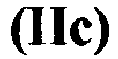
or a salt thereof. - In one embodiment there is provided the use of a compound of formula (II) of formula (IIc), or a salt thereof, as defined herein, as a pharmaceutical intermediate.
- In one embodiment there is provided the use of a compound of formula (II) of formula (IIc), or a salt thereof, as defined herein, as an intermediate for the manufacture of the compound of formula (I), or a salt thereof.
- The compound of formula (IIc) may be prepared by reacting a compound of formula (IIb) with hydroxylamine or a salt thereof, for example hydroxylamine hydrochloride.
- The compound of formula (IIc) may be converted into the compound of formula (I) by carrying out the following transformations:
- when R1 is hydrogen:
- (i) esterification - incorporating the R1 group;
- and then in all cases:
- (ii) acetylation and aromatisation - creating the core benzene ring and incorporating the acetyl group;
- and subsequently:
- (iv) deprotection (de-esterification)- removing the R1 group.
- In one embodiment there is provided a compound of formula (II) of formula (IId):

or a salt thereof. - In one embodiment there is provided the use of a compound of formula (II) of formula (IId), or a salt thereof, as defined herein, as a pharmaceutical intermediate.
- In one embodiment there is provided the use of a compound of formula (II) of formula (IId), or a salt thereof, as defined herein, as an intermediate for the manufacture of the compound of formula (I), or a salt thereof.
- The compound of formula (IId) may be prepared by reacting a compound of formula (IIa) with hydroxylamine or a salt thereof, for example hydroxylamine hydrochloride.
- The compound of formula (IId) may be converted into the compound of formula (I) by carrying out the following transformations:
- when R1 is hydrogen:
- (i) esterification - incorporating the R1 group;
- and then in all cases:
- (ii) thioarylation - incorporating the thioaryl group;
- (iii) acetylation and aromatisation - creating the core benzene ring and incorporating the acetyl group;
- and subsequently:
- (iv) deprotection (de-esterification) - removing the R1 group;
- In another aspect, there is provided a compound of the formula (XI):

- X is =O, =N-OH or =N-OC(O)Me;
- Y is

- Q is hydrogen or chloro; or a salt thereof.
- A compound of the formula (XI) may be used to prepare a compound of the formula (I), using, for example, the route described in Scheme VI below.
- In one embodiment, there is provided a compound of formula (XIa):

- A compound of the formula (XIa) may be prepared from a compound of formula (XII):

- In another embodiment, there is provided a compound of formula (XIb):

- A compound of formula (XIb) may be prepared from a compound of formula (XIa), using similar methods to those described for the preparation of a compound of formula (IIc) from (IIb).
- In one embodiment a "hydrocarbyl" is a radical consisting of hydrogen atoms and from 1 to 15 carbon atoms, wherein the hydrocarbyl may be saturated, partially saturated or fully unsaturated, and may contain linear, branched or cyclic elements.
- In one embodiment a "heterocyclyl" is a 4-12 membered monocyclic or bicyclic ring system, wherein the heterocyclyl contains 1-4 heteroatoms each selected from N, S and O, wherein the heterocyclyl may be fully saturated, partially saturated or fully unsaturated.
- Those skilled in the art will appreciate that certain compounds of the invention can exist as isomers, for example compounds of formula (II). The invention encompasses all isomeric forms of compounds depicted herein and mixtures thereof unless indicated otherwise.
- In this specification, the term "alkyl" includes both straight and branched chain alkyl groups.
- References to individual alkyl groups such as "propyl" are specific for the straight chain version only, and references to individual branched chain alkyl groups such as "isopropyl" are specific for the branched chain version only. This convention applies to other radicals described within this specification such as alkenyl radicals, alkynyl radicals, alkoxy radicals and alkanoyl radicals.
- For example, "C1-6alkyl" includes C1-4alkyl, C1-3alkyl, methyl, ethyl, propyl, isopropyl and t-butyl.
- In this specification "C2-6alkenyl" includes C2-3alkenyl, butenyl, isobutenyl, 1,5-hexadien-3-yl.
- Examples of the term "C2-6alkynyl" include C2-3alkynyl, butynyl, propynyl and ethynyl.
- Examples of the term "C1-6alkoxy" include C1-3alkoxy, t-butyloxy, isopropoxy, butoxy, ethoxy and methoxy.
- Examples of the term "(C1-6alkyl)-S(O)a- wherein a is 0 to 2" include "(C1-6alkyl)-S", (C1-3alkyl)-S(O)a- wherein a is 0 to 2", "(C1-3alkyl)-S(O)2-", isopropylsulfanyl, propylsulfonyl, mesyl and ethylsulfanyl, butanesulfinyl and isopentylsulfinyl.
- Examples of the term "C1-6alkoxycarbonyl" include C1-3alkoxycarbonyl, methoxycarbonyl, ethoxycarbonyl, isopropoxycarbonyl and isopentoxycarbonyl.
- Examples of the term "C1-6alkylsulfonyl" include C1-3alkylsulfonyl, mesyl, ethylsulfonyl, isopropylsulfonyl and isobutylsulfonyl.
- Examples of the term "C1-6alkanoyl" include C1-3alkanoyl, formyl, acetyl and propionyl.
- Examples of the term "N-(C1-6alkyl)amino" include N-(C1-3alkyl)amino, methylamino, isopropylamino and isohexylamino.
- Examples of the term "N,N-(C1-6alkyl)2amino" include N,N-(C1-3alkyl)2amino, N,N-dimethylamino, N-isopropyl-N-methylamino and N-pentyl-N-ethylamino.
- Examples of the term "N-(C1-6alkanoyl)-N-(C1-6alkyl)amino" include N-(C1-3alkanoyl)-N-(C1-6alkyl)amino, N-propionoyl-N-(C1-6alkyl)amino, N-propionoylamino, N-acetyl-N-methylamino and N-acetyl-N-cyclopropylamino.
- Examples of "N-(C1-6alkyl)carbamoyl" include N-(C1-3alkyl)carbamoyl, N-isopentylaminocarbonyl, N-methylaminocarbonyl and N-ethylaminocarbonyl.
- Examples of "N,N-(C1-6alkyl)2carbamoyl" include N,N-(C1-3alkyl)2carbamoyl, N-isopentyl-N-ethylaminocarbonyl, N,N-dimethylaminocarbonyl and N-methyl-N-ethylaminocarbonyl.
- Examples of "N-(C1-6alkyl)sulfamoyl" include N-(C1-3alkyl)sulfamoyl, N-isopentylsulfamoyl, N-methylsulfamoyl and N-ethylsulfamoyl.
- Examples of "N,N-(C1-6alkyl)2sulfamoyl" include N,N-(C1-3alkyl)2sulfamoyl, N-isopentyl-N-ethylsulfamoyl, N,N-dimethylsulfamoyl and N-methyl-N-ethylsulfamoyl.
- A salt formed from a compound of the invention where R1 is hydrogen may be an alkali metal salt, for example a sodium or potassium salt, an alkaline earth metal salt, for example a calcium or magnesium salt, an ammonium salt or a salt with an organic base, for example a salt with methylamine, dimethylamine, trimethylamine, piperidine, morpholine or triethanolamine.
- A salt of a compound of the invention where R1 contains a basic group, is for example, an acid-addition salt with, for example, an inorganic or organic acid, for example hydrochloric, hydrobromic, sulphuric, phosphoric, trifluoroacetic, citric or maleic acid.
- A salt of a compound of the invention where R1 contains an acidic group, is for example an alkali metal salt, for example a sodium or potassium salt, an alkaline earth metal salt, for example a calcium or magnesium salt, an ammonium salt or a salt with an organic base, for example a salt with methylamine, dimethylamine, trimethylamine, piperidine, morpholine or triethanolamine.
- In one embodiment R1 is hydrogen or an optionally substituted hydrocarbyl.
- In one embodiment the optional substituents on a "hydrocarbyl" and "heterocyclyl" are selected from halo, nitro, cyano, hydroxy, C1-6alkyl, C1-6alkoxy, C1-6alkanoyl, N-(C1-6alkyl)amino, N,N-(C1-6alkyl)2amino, N-(C1-6alkanoyl)amino, C1-6alkoxycarbonyl, N-(C1-6alkanoyl)-N-(C1-6alkyl)amino, carbamoyl, sulfamoyl, N-(C1-6alkyl)carbamoyl, N,N-(C1-6alkyl)2carbamoyl, N-(C1-6alkyl)sulfamoyl, N,N-(C1-6alkyl)2sulfamoyl and (C1-6alkyl)-S(O)a- wherein a is 0-2.
- In a further embodiment R1 is hydrogen or an unsubstituted hydrocarbyl.
- In a further embodiment R1 is hydrogen.
- In a further embodiment R1 is an optionally substituted hydrocarbyl.
- In a further embodiment R1 is an unsubstituted hydrocarbyl.
- In a further embodiment R1 is selected from hydrogen, C1-6alkyl, C2-6alkenyl, C2-6alkynyl, C3-6cycloalkyl, optionally substituted phenyl and optionally substituted benzyl;
- In a further embodiment R1 is selected from hydrogen, C1-6alkyl, C2-6alkenyl, C2-6alkynyl, C3-6cycloalkyl, phenyl and benzyl; wherein the phenyl and benzyl are optionally substituted by one or more halo, nitro, cyano, hydroxy, C1-6alkyl, C1-6alkoxy, C1-6alkanoyl, N-(C1-6alkyl)amino, N,N-(C1-6alkyl)2amino, N-(C1-6alkanoyl)amino, N-(C1-6alkanoyl)-N-(C1-6alkyl)amino, carbamoyl, sulfamoyl, N-(C1-6alkyl)carbamoyl, N,N-(C1-6alkyl)2carbamoyl, N-(C1-6alkyl)sulfamoyl, N,N-(C1-6alkyl)2sulfamoyl or (C1-6alkyl)-S(O)a- wherein a is 0-2.
- In a further embodiment R1 is selected from C1-6alkyl, C2-6alkenyl, C2-6alkynyl, C3-6cycloalkyl, phenyl and benzyl; wherein the phenyl and benzyl are optionally substituted by one or more halo, nitro, cyano, hydroxy, C1-6alkyl, C1-6alkoxy, C1-6alkanoyl, N-(C1-6alkyl)amino, N,N-(C1-6alkyl)2amino, N-(C1-6alkanoyl)amino, N-(C1-6alkanoyl)-N-(C1-4alkyl)amino, carbamoyl, sulfamoyl, N-(C1-6alkyl)carbamoyl, N,N-(C1-6alkyl)2carbamoyl, N-(C1-6alkyl)sulfamoyl, N,N-(C1-6alkyl)2sulfamoyl or (C1-6alkyl)-S(O)a- wherein a is 0-2.
- In a further embodiment R1 is selected from hydrogen, C1-6alkyl, C2-6alkenyl, C2-6alkynyl, C3-6cycloalkyl, phenyl and benzyl.
- In a further embodiment R1 is selected from C1-6alkyl, C2-6alkenyl, C2-6alkynyl, C3-6cycloalkyl, phenyl and benzyl.
- In a further embodiment R1 is selected from hydrogen and C1-6alkyl.
- In a further embodiment R1 is selected from hydrogen and ethyl.
- In a further embodiment R1 is C1-6alkyl.
- In a further embodiment R1 is ethyl.
- In a further embodiment Q is chloro.
- In a further embodiment X is =O or =N-OH.
- In a further embodiment X is =N-OC(O)Me.
- In a further embodiment X is =O.
- In a further embodiment X is =N-OH.
- Therefore, in one embodiment there is provided a compound of formula (II), as depicted hereinabove, wherein:
- R1 is selected from hydrogen, C1-6alkyl, C2-6alkenyl, C2-6alkynyl, C3-6cycloalkyl, phenyl and benzyl; wherein the phenyl and benzyl are optionally substituted by one or more halo, nitro, cyano, hydroxy, C1-6alkyl, C1-6alkoxy, C1-6alkanoyl, N-(C1-6alkyl)amino, N,N-(C1-6alkyl)2amino, N-(C1-6alkanoyl)amino, N-(C1-6alkanoyl)-N-(C1-6alkyl)amino, carbamoyl, sulfamoyl, N-(C1-6alkyl)carbamoyl, N,N-(C1-6alkyl)2carbamoyl, N-(C1-6-alkyl)sulfamoyl, N,N-(C1-6alkyl)2sulfamoyl or (C1-6alkyl)-S(O)a- wherein a is 0-2;
- X is =O or =N-OH;
- Y is hydrogen or
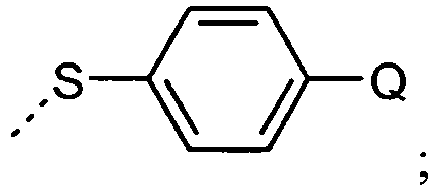
- Q is hydrogen or chloro;
- In a further embodiment there is provided a compound of formula (II), as depicted hereinabove, wherein:
- R1 is selected from C1-6alkyl, C2-6alkenyl, C2-6alkynyl, C3-6cycloalkyl, phenyl and benzyl; wherein the phenyl and benzyl are optionally substituted by one or more halo, nitro, cyano, hydroxy, C1-6alkyl, C1-6alkoxy, C1-6alkanoyl, N-(C1-6alkyl)amino, N,N-(C1-6alkyl)2amino, N-(C1-6alkanoyl)amino, N-(C1-6alkanoyl)-N-(C1-6alkyl)amino, carbamoyl, sulfamoyl, N-(C1-6alkyl)carbamoyl, N,N-(C1-6alkyl)2carbamoyl, N-(C1-6alkyl)sulfamoyl, N,N-(C1-6alkyl)2sulfamoyl or (C1-6alkyl)-S(O)a- wherein a is 0-2;
- X is =O or =N-OH;
- Y is hydrogen or

- Q is hydrogen or chloro;
- In a further embodiment there is provided the use of a compound of formula (II), as depicted hereinabove, wherein:
- R1 is selected from C1-6alkyl, C2-6alkenyl, C2-6alkynyl, C3-6cycloalkyl, phenyl and benzyl; wherein the phenyl and benzyl are optionally substituted by one or more halo, nitro, cyano, hydroxy, C1-6alkyl, C1-6alkoxy, C1-6alkanoyl, N-(C1-6alkyl)amino, N,N-(C1-6-alkyl)2amino, N-(C1-6alkanoyl)amino, N-(C1-6alkanoyl)-N-(C1-6alkyl)amino, carbamoyl, sulfamoyl, N-(C1-6alkyl)carbamoyl, N,N-(C1-6alkyl)2carbamoyl, N-(C1-6alkyl)sulfamoyl, N,N-(C1-6alkyl)2sulfamoyl or (C1-6alkyl)-S(O)a- wherein a is 0-2;
- X is =O or =N-OH;
- Y is hydrogen or

- Q is hydrogen or chloro;
- In a further embodiment there is provided the use of a compound of formula (II), as depicted hereinabove, wherein:
- R1 is selected from C1-6alkyl, C2-6alkenyl, C2-6alkynyl, C3-6cycloalkyl, phenyl and benzyl; wherein the phenyl and benzyl are optionally substituted by one or more halo, nitro, cyano, hydroxy, C1-6alkyl, C1-6alkoxy, C1-6alkanoyl, N-(C1-6alkyl)amino, N,N-(C1-6alkyl)2amino, N-(C1-6alkanoyl)amino, N-(C1-6alkanoyl)-N-(C1-6alkyl)amino, carbamoyl, sulfamoyl, N-(C1-6alkyl)carbamoyl, N,N-(C1-6alkyl)2carbamoyl, N-(C1-6alkyl)sulfamoyl, N,N-(C1-6alkyl)2sulfamoyl or (C1-6alkyl)-S(O)a- wherein a is 0-2;
- X is =O or =N-OH;
- Y is hydrogen or
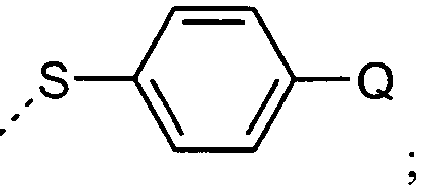
- Q is hydrogen or chloro;
- In a further embodiment there is provided a compound of formula (II), as depicted hereinabove, wherein:
- R1 is selected from C1-6alkyl, C2-6alkenyl, C2-6alkynyl, C3-6cycloalkyl, phenyl and benzyl;
- X is =O or =N-OH;
- Y is hydrogen or 4-chlorophenylsulfanyl;
- In a further embodiment there is provided the use of a compound of formula (II), as depicted hereinabove, wherein:
- R1 is selected from C1-6alkyl, C2-6alkenyl, C2-6alkynyl, C3-6cycloalkyl, phenyl and benzyl;
- X is =O or =N-OH;
- Y is hydrogen or 4-chlorophenylsulfanyl;
- In a further embodiment there is provided the use of a compound of formula (II), as depicted hereinabove, wherein:
- R1 is selected from C1-6alkyl, C2-6alkenyl, C2-6alkynyl, C3-6cycloalkyl, phenyl and benzyl;
- X is =O or =N-OH;
- Y is hydrogen or 4-chlorophenylsulfanyl;
- In a further embodiment there is provided a compound of formula (II), as depicted hereinabove, wherein:
- R1 is selected from C1-6alkyl;
- X is =O or =N-OH;
- Y is hydrogen or 4-chlorophenylsulfanyl;
- In a further embodiment there is provided the use of a compound of formula (II), as depicted hereinabove, wherein:
- R1 is selected from C1-6alkyl;
- X is =O or =N-OH;
- Y is hydrogen or 4-chlorophenylsulfanyl;
- In a further embodiment there is provided the use of a compound of formula (II), as depicted hereinabove, wherein:
- R1 is selected from C1-6alkyl;
- X is =O or =N-OH;
- Y is hydrogen or 4-chlorophenylsulfanyl;
- A further aspect of the invention provides a process for the preparation of the pharmaceutical compound of formula (I), or a salt or ester thereof, comprising reaction of a compound of formula (IIc), as depicted hereinbefore, with an acetylating agent; wherein the values of R1 is as defined hereinabove and wherein Q is chloro; and thereafter, optionally reacting with acid or base.
- The reaction with an acid or base achieves hydrolysis of the ester group (when R1 is other than hydrogen) to provide the compound of formula (I) or a salt thereof.
- The intermediate product mixture may contain predominantly the desired amide of formula (V) or it may comprise a mixture of the amide of formula (V) and the imide of formula (VI) as shown in Scheme (II):

- In one embodiment there is provided a process comprising reaction of a compound of formula (II) of formula (IIc), as depicted hereinbefore, with an acetylating agent; wherein the values of R1 are as defined in claims 1 to 8, and wherein Q is chloro.
- Therefore in one embodiment there is provided a process for the preparation of the pharmaceutical compound of formula (I), or a salt thereof, comprising reaction of a compound of formula (IIc), as depicted hereinbefore, with an acetylating agent; wherein the values of R1 is as defined hereinabove and wherein Q is chloro; and thereafter de-esterifying to provide the compound of formula (I), or a salt thereof.
- The process to de-esterify may involve reaction with a base or with an acid or with hydrogen in the presence of a catalyst.
- In one embodiment the process to de-esterify may involve reaction with a base.
- Surprisingly it has been found that certain reaction conditions advantageously disfavour the formation of imide. For example, by reducing the amount of acetic anhydride to 4 molar eq. and using sodium iodide at 85 °C in order to keep the reaction time around 4.5 h.
- Examples of suitable bases are inorganic bases, for example metal hydroxides, for example LiOH, NaOH or KOH.
- As discussed hereinabove, the compound of formula (IId) has been found to be surprisingly useful as an intermediate for the preparation of pharmaceutical compound (I) or salts thereof. In a further aspect of the invention there is provided a process comprising the reaction of a compound of formula (IId) as depicted hereinbefore, with an acetylating agent, wherein R1 is as defined herein.
- The products of this reaction are amide (VI) and imide (VII):

- The acetylation processes involving the compound of formula (IIc) and (IId) may be carried out in a solvent such as an aromatic hydrocarbon solvent, for example toluene, xylene or mesitylene, or a ketone solvent, for example methylisobutylketone (MIBK), methylethylketone (MEK), carboxylic acid solvents, for example acetic acid, or ether solvents, for example 2-methyltetrahydrofuran.
- The acetylation process involving the compound of formula (IIc) and (IId) works best at an elevated temperature, for example up to around 140°C.
- A further aspect of the present invention provides an improved process wherein the reaction of a compound of formula (IIc) or (IId) with an acetylating agent is carried out in the presence of an iodide salt.
- Surprisingly, the presence of an iodide salt in the reaction has been found to allow a reduction in the temperature required for the reaction to proceed efficiently. Examples of iodide salts are metal iodides, for example KI, NaI, LiI, and ammonium iodide salts, for example (C1-6alkyl)4NI, for example tetra-N-butylammonium iodide. The reaction temperature required for these processes can be reduced to 80-100°C from the usual much higher temperatures by inclusion of an iodide salt in the reaction mixture. A sub-stoichiometric quantity of iodide salt is sufficient to provide the beneficial effect.
- Other conditions have been invented that allow efficient reaction at an advantageously reduced temperature without the presence of an iodide salt. Surprisingly the use of a carboxylic acid as a co-solvent in the reaction results in an efficient reaction at an advantageously reduced temperature.
- Therefore, a further aspect of the invention provides an improved process wherein the reaction of a compound of formula (IIc) or (IId) with an acetylating agent is carried out in the presence of a carboxylic acid co-solvent.
- Suitable carboxylic acids co-solvents may be carboxylic acids containing from 1 to 7 carbon atoms, for example acetic acid.
- For example, use of a 50:50 mixture of xylene or mesitylene and acetic acid allows the reaction to proceed in the absence of an iodide catalyst at a temperature of 105 - 110 °C whereas in the same solvent mixture in the presence of 5 mol% of either sodium iodide or tetrabutylammonium iodide, the reaction proceeds at the lower temperature of 95 - 100 °C.
- A further aspect of the present invention provides an improved process wherein the acetylation process involving compound (IIc) or (IId) is carried out in the presence of a Lewis acid. One example of a Lewis acid is FeCl3. Surprisingly the presence of a Lewis acid has been found to allow the acetylation reaction to proceed efficiently at much lower temperature than is otherwise required. The presence of FeCl3 allows the reaction to proceed at a temperature as low as 70°C.
- Acetylating agents are well known to the skilled person. Acetylating agents that may be used for the acetylation process involving the compound of formula (IIc) and (IId) include acetic anhydride, acetyl halides such as acetyl chloride, and thioesters such as phenyl thioacetate. Phenyl thioacetate was found to give better conversion than with acetic anydride alone under comparable conditions. Alternatively the process may make use of other acylating agents, for example benzoic anhydride or pivalic anhydride. The amide groups in the products of such reactions would then need to be hydrolysed and the resulting amines then acetylated using an acetylation agent.
- In a still further embodiment the invention provides a process for the preparation of a compound of formula (I):


- In one embodiment R1' is hydrogen or ethyl.
- In one embodiment the acylating aggent is Ac2O.
- In one embodiment the process is carried out in the presence of xylene and sodium iodide.
- The various aspects of the invention are illustrated by the following Examples. Three routes are illustrated in Schemes (III), (IV), (V) and (VI), below.
- The analytical techniques used include gas chromatography (GC), high performance liquid chromatography (HPLC), liquid chromatography - mass spectrometry (LC-MS) and ultrahigh performance liquid chromatography - mass spectroscopy (UHPLC-MS). Mass spectrometry data ( m/z ) is provided together with an assignment of the peak(s) observed. Nuclear magnetic resonance (NMR) data was obtained at 300MHz, 400Mz or 500Mhz in d6-dimethylsulfoxide unless otherwise specified. Standard abbreviations are used (s = singlet, d = doublet, m = multiplet, dd = doublet of doublets, t = triplet, q = quartet, br = broad). Solvents used include ethanol (EtOH), methanol (MeOH), tetrahydrofuran (THF), ethyl acetate (EtOAc), methylisobutylketone (MIBK), methyl tert-butyl ether (MTBE) and acetic acid (AcOH). Generally, reactions were carried out under an atmosphere of nitrogen. Unless otherwise stated, procedures were carried out at ambient temperature (room temperature, r.t.), with stirring, for a number of hours (h) or minutes (mins). Mole equiv represents the molar equivalents of the reagent relative to the specified limiting reagent. Rel vol (relative volume) represents the amount of solvent relative to a unit mass of the specified limiting reagent e.g. L/kg. Rel wt (relative weight) represents the amount of a material by weight relative to a unit weight of the specified limiting reagent e.g. kg/kg. Assays by HPLC, GC and NMR were performed against fully characterised reference standards using standard procedures that are well known in the art. TCCA = trichloroisocyanuric acid. GC analysis can be performed on a DB-1 column (30m x 0.25mm id, 0.25 µm) using nitrogen as carrier gas using an appropriate temperature gradient and flame ionisation detection. HPLC analysis can be performed on either a Waters Symmetry C18 column (150mm x 3.0mm, 3.5µm) or Zorbax SB-C8 column (150mm x 3.0mm, 3.5µm) or Hichrom Ace Phenyl column (50mm x 3.0mm, 3µm) eluting with an appropriate aqueous acetonitrile gradient buffered with TFA and UV detection (230 or 250nm). UHPLC was performed on either a BEH C18 column (100mm x 2.1mm, 1.7µm) or BEH Phenyl (100mm x 2.1mm, 1.7µm) eluting with an appropriate aqueous acetonitrile gradient buffered with TFA or ammonium acetate respectively with UV detection (250nm). UHPLC-MS can be done using +ve or -ve electrospray ionisation at a capillary voltage of 3.5kV and a cone voltage increasing from 10 to 60V. LC-MS can be performed on a Hichrom Ace Phenyl column (50mm x 3.0mm, 3µm) eluting with an appropriate aqueous acetonitrile gradient buffered with TFA and UV detection (230 nm) using combined APCI / +ve electrospray ionisation.
-

-

- A solution of KOH (2.54kg, 2.26kg corrected for assay, 40.2 moles) in water (4.0L) was added over 30mins to a solution of cyclohexane-1,3-dione (4.53kg, 4.51kg corrected for assay, 40.2 moles) in EtOH (16.2L), while maintaining the temperature below 30°C. After stirring for 15mins at r.t., freshly distilled chloroacetone (4.39kg, 3.83kg corrected for assay, 41.4mol) was then added slowly to the mixture, maintaining a temperature of 25-28°C. The resulting slurry was stirred at r.t. for 19h. Inorganic by-products were then removed by filtration and were washed on the filter with EtOH (4.5L). The filtrates were combined to provide 2-(2-oxopropyl)cyclo-hexane-1,3-dione as a solution in EtOH. Assay by GC 26.5% w/w; purity by GC: 82.3 area%). This solution was transferred to a reactor and glycine ethyl ester hydrochloride salt (6.41kg, 6.17kg corrected for assay, 44.2 moles) was added at r.t. with stirring followed by sodium acetate trihydrate (6.04kg, 6.02kg corrected for assay, 44.3 moles). The mixture was diluted with ethanol (28.9 L) then heated under reflux for 2h. EtOH was removed in vacuo (-0.850 to -0.900 bar) at 30°C until 40L of distillate had been collected. After cooling the residue to 0°C, water (15L) was added, while maintaining a temperature of 0-5°C. After stirring for a further 1h at this temperature, the solid that separated out was collected by filtration and was then dried in vacuo at 35°C with a nitrogen bleed to give the title compound as a solid; 6.7kg; assay by 1H NMR: 86.6% w/w; weight corrected for assay: 5.80kg (61% over 2 steps); purity by GC: 96.0 area%; m/z : 235 (MH+); 1 H NMR: (CDCl3) 1.27-1.32 (3H, t), 2.10-2.17 (2H, m), 2.19 (3H, s), 2.42-2.46 (2H, t), 2.65-2.69 (2H, t), 4.21-4.28 (2H, m), 4.51 (2H, s) and 6.27 (1H, s).
- A solution of potassium hydroxide (23.58g, 20.0g corrected for assay, 357 mmol) in water (36mL) at r.t. was added to a solution of 1,3-cyclohexanedione (39.97g, 356 mmol) in ethanol (144mL) with stirring (exothermic addition). After stirring for 15mins at 20°C, redistilled chloroacetone (37.62g, 33.9g corrected for assay, 366 mmol) was added in one portion and the reaction mixture stirred for 20h at 20°C. The inorganic by products were removed by filtration, washing the filter cake with ethanol (40mL) and the filtrates were combined to provide 2-(2-oxo-propyl)cyclohexane-1,3-dione as a solution in aqueous ethanol. To this solution were added glycine ethyl ester hydrochloride (54.73g, 392 mmol) and anhydrous sodium acetate (32.19g, 392 mmol). The reaction mixture was heated to reflux (75°C internal temperature) for 1h then cooled to 20°C and stirred for 19h. The mixture was heated to reflux (internal temperature 75°C) and water (116mL) added, then cooled to 20°C over 30 mins. A small amount of 2-methyl-4-oxo-4,5,6,7-tetrahydro-1H-indol-1-yl)-acetic acid, ethyl ester was added as a seed (10mg) and, after a few minutes, crystallization of the product was observed. The slurry was stirred for 30mins, then cooled to 5°C and stirred for 18h. The solid was collected by filtration, washed with water (2 x 80mL) followed by tert-butyl methyl ether (2 x 80mL) and then dried in vacuo at 40°C for 20h to provide ethyl (2-methyl-4-oxo-4,5,6,7-tetrahydro-1H-indol-1-yl)acetate as a pale yellow crystalline solid, 41.77g (49.8% yield). MP 105.1 to 105.4°C. Assay by 1H-NMR 99.3% w/w. Purity by GC 100 area%.
- In reaction vessel 1, potassium hydroxide (11.78g, 10.0g corrected for assay, 178mmol)) was dissolved in water (72mL) with stirring (highly exothermic) then the solution was cooled back to 20°C. 1,3-cyclohexanedione (20.0g, 178 mmol) was added (exothermic addition) and the resulting dark red solution was stirred at 20°C for 5 mins. Redistilled chloroacetone (18.9g, 17.0g corrected for assay, 184 mmol) was added in one portion, rinsing in with ethanol (18mL) and the reaction mixture was stirred overnight at 20°C. The resulting solution of 2-(2-oxopropyl)cyclohexane-1,3-dione, volume 124mL, was split into 4 equal portions. Glycine ethyl ester hydrochloride (6.85g, 49.0 mmol), anhydrous sodium acetate (4.02g, 49.0 mmol), water (26.5mL) and ethanol (5.0mL) were charged to reaction vessel 2 and stirring started. One portion of the solution of 2-(2-oxopropyl)cyclohexane-1,3-dione prepared above (31mL) was then added to the contents of reaction vessel 2 with stirring and the resulting mixture was heated to 75°C, held at this temperature for 2h, then cooled to 20°C over 55 mins. After stirring overnight at 20°C, the solid was collected by filtration, washed with water (10mL), tert-butyl methyl ether (2 x 10mL) and then dried in vacuo 40°C for 20h to provide (2-methyl-4-oxo-4,5,6,7-tetrahydro-1H-indol-1-yl)-acetic acid ethyl ester as a beige solid, 5.88g (56.0% yield). MP 101.2 to 103.5°C. Assay by 1H-NMR 95.3%w/w. Purity by GC 99.25 area%.
- A solution of potassium hydroxide (1.0 mole equiv) in water (0.9 rel vol) was added to a suspension of 1,3-cyclohexanedione (1.0 mole equiv, limiting reagent) in water (1.1 rel vol) with stirring over approximately 1 hour maintaining the temperature below 30 °C. After a further 15mins, chloroacetone (1.03 mole equiv) was added over approximately 4 hours then the reaction mixture was stirred overnight at 20°C. Glycine ethyl ester hydrochloride (1.1 mole equiv) and ethyl acetate (2 rel vol) were added followed by sodium acetate (1.1 mole equiv) and water (2 rel vol). The reaction mixture was heated at 60°C for 2h, then cooled to 50°C where the aqueous phase was separated off and discarded. MTBE (4 rel vol) was added to the organic phase, the solution was warmed back up to 50°C and then cooled to 35°C over 20mins. A seed of ethyl (2-methyl-4-oxo-4,5,6,7-tetrahydro-1H-indol-1-yl)acetate (0.0001 mole equiv) was added and the mixture cooled to 5°C over 60mins and aged overnight. The solid product was collected by filtration, washed with water (2 rel vol), followed by MTBE (2 x 2 rel vol) and then dried at 40°C under vacuum to provide the title compound in 62% yield; purity 98% w/w.
-

- TCCA (1.16kg, 5.01 moles) was added to a solution of bis-(4-chloro-phenyl)disulfide (4.83kg, 4.80kg corrected for assay, 16.7 moles) in EtOAc (56L). The mixture was cooled to 0°C and held at this temperature for 45mins. Ethyl (2-methyl-4-oxo-4,5,6,7-tetrahydro-1H-indol-1-yl)acetate (6.48kg, 5.61kg corrected for assay, 23.9 moles) was then added in three portions (mildly exothermic). After stirring for 30mins a sample was removed for analysis by HPLC then a solution of NaHCO3 (1.12kg, 13.3 moles) in water (22.5L) was added. The mixture was warmed to r.t. over 30mins and after stirring for a further 15mins, a solid by-product was removed by filtration and washed with EtOAc (6.5L). The filtrates were combined and the phases were allowed to separate. The aqueous layer was separated and extracted with EtOAc (11.2L). The organic layers were combined and analysed which showed an assay by HPLC of 9.2% w/w and a purity by HPLC of 77.7 area%. The organic solution was then concentrated in vacuo until a volume of ∼10-12L remained (distillate volume ∼60L). EtOH (38.9L) was added to the residue and distillation continued until ∼35L of distillate had been collected to leave the intermediate ethyl [3-(4-chlorophenylsulfanyl)-2-methyl-4-xo-4,5,6,7-tetrahydro-1H-indol-1-yl]acetate as a solution in EtOH. Further EtOH (6.5L) was added to this solution followed by hydroxylamine hydrochloride (2.15kg, 30.9 moles) and anhydrous sodium acetate (2.60kg, 2.55kg corrected for assay, 31.1 moles) and the mixture was heated under reflux for 4h. After cooling to r.t. over 1h, the solid product was collected by filtration. , The reactor was rinsed with 50% v/v ethanol:water (13L) which was transferred to the filter. After drying briefly on the filter, the damp product was then transferred to a reactor and water (42L) was added. The mixture was heated to 50°C and stirred for 30mins, then cooled back to r.t. The solid product was collected by filtration then charged back into the reactor damp and slurried in ethanol (19.4L) at r.t for 30mins. The solid was collected by filtration, washed with ethanol (9.7L) followed by fresh ethanol (6.5L) and then dried in vacuo at 40°C to give the title compound as a solid; 7.00kg; assay by 1H NMR 87.5% w/w; 6.1kg corrected for assay (65% over 2 steps); purity by HPLC: 88.4 area%; m/z : 393 (MH+); 1 H NMR: 1.20-1.25 (3H, t), 1.79-1.86 (2H, m), 2.14 (3H, s), 2.50-2.51 (2H, t), 2.54-2.59 (2H, t), 4.15-4.22 (2H, m), 4.83 (2H, s), 6.92-6.95 (2H, d), 7.21-7.24 (2H, d) and 10.22 (1H, s). Data for an isolated sample of the intermediate ethyl [3-(4-chlorophenylsulfanyl)-2-methyl-4-oxo-4,5,6,7-tetrahydro-1H-indol-1-yl]acetate: 1 H NMR: (CDCl3) 1.33-1.37 (3H, t), 2.14-2.23 (2H, m), 2.27 (3H, s), 2.45-2.49 (2H, t), 2.74-2.78 (2H, t), 4.27-4.35 (2H, m), 4.64 (2H, s), 7.03-7.08 (2H, d) and 7.13-717 (2H, d).
- Bis-(4-chlorophenyl)disulfide (7.39g, 25.7 mmol) was dissolved in EtOAc (86.5mL) in reaction vessel 1 whilst cooling the mixture to 5°C with stirring, resulting in a pale yellow solution. Sulfuryl chloride (2.1mL, 25.7 mmol) was then added in a single portion (slightly exothermic) giving an orange-coloured solution after 15 mins. In a second reaction vessel, ethyl 2-(2-methyl-4-oxo-4,5,6,7-tetrahydro-1H-indol-1-yl)acetate (8.65 g, 36.8 mmol) was slurried in EtOAc (34.6mL) with stirring whilst cooling the mixture to 5 °C. The precooled solution in reaction vessel 1 prepared above was added to the second vessel in 4 equal portions over 10 mins maintaining the temperature within the range 5-10 °C, resulting in formation of a dark brown solution containing a small amount of insoluble material. The mixture was then allowed to warm to r.t. over 90 mins with stirring. A solution of sodium hydrogen carbonate (1.73 g, 20.6 mmol) in water (34.6mL) was added and the resulting biphasic mixture was stirred for 15 mins. The layers were allowed to separate and the aqueous phase was discarded. The upper organic phase was dried over magnesium sulfate, which was subsequently removed by filtration to provide a solution of ethyl 2-(2-methyl-4-oxo-4,5,6,7-tetrahydro-1H-indol-1-yl)acetate in ethyl acetate, weight 132.6 g. Assay by HPLC 8.4 % w/w, therefore 11.1 g ethyl 2-(2-methyl-4-oxo-4,5,6,7-tetrahydro-1H-indol-1-yl)acetate present (80%) yield.
- In vessel 1, bis-(4-chlorobenzene)disulfide (0.53 mole equiv) was suspended in ethyl acetate (3.5 rel vol) with stirring and the mixture was cooled to 0°C. Sulfuryl chloride (0.53 mole equiv) was added in one portion, the residues were washed in with ethyl acetate (0.5 rel vol) and the mixture stirred at 0°C for approximately 1h. Ethyl (2-methyl-4-oxo-4,5,6,7-tetrahydro-1H-indol-1-yl)acetate (1.0 mole equiv, limiting reagent) and ethyl acetate (5 rel vol) were charged to vessel 2 and the mixture stirred at 20°C. The contents of vessel 1 were added to the mixture in vessel 2 over approximately 30mins, washing the residues in with ethyl acetate (0.5 rel vol). Aqueous sodium carbonate (1M, 1.45 mole equiv) was added slowly (gas evolution), the mixture was stirred then the layers were allowed to separate, discarding the lower aqueous phase. A solution of sodium chloride (1.45 mole equiv) in water (5 rel vol) was added to the organic phase, the mixture was stirred then the layers allowed to separate, discarding the lower aqueous phase. The organic layer was concentrated by distillation at atmospheric pressure to around 4 rel vol. Hydroxylamine hydrochloride (1.0 mole equiv) was charged to the concentrate at 20°C followed by tributylamine (1.0 mole equiv) and ethanol (2 rel vol) and the resulting mixture was heated at 60°C for 4h. The mixture was cooled to 20°C, the solid was collected by filtration, washed with ethyl acetate (2 x 2 rel vol) then dried at 40°C under vacuum to provide the title compound in 87.3 % yield; purity 99 % w/w.
- In vessel 1, bis-(4-chlorobenzene)disulfide (0.53 mole equiv) was suspended in ethyl acetate (4 rel vol) with stirring and the mixture cooled to 5°C. Sulfuryl chloride (0.53 mole equiv) was added in one portion and the mixture stirred at 5°C for approximately 1h. Ethyl (2-methyl-4-oxo-4,5,6,7-tetrahydro-1H-indol-1-yl)acetate (1.0 equiv, limiting reagent) and ethyl acetate (5 rel vol) were charged to vessel 2 and the mixture stirred at 20°C. The contents of vessel 1 were added to the mixture in vessel 2 over approximately 30mins, washing in the residues with ethyl acetate (0.5 rel vol). Triethylamine (1.0 mole equiv) was added and the mixture stirred overnight. The solid by product was removed by filtration, the filter cake was washed with ethyl acetate (1 rel vol) and the combined filtrates evaporated in vacuo. The residue was dissolved in a mixture of ethyl acetate (4 rel vol) and ethanol (2 rel vol) then hydroxylamine hydrochloride (1.0 mole equiv) and tributylamine (1.0 mole equiv) added. The mixture was heated at 60°C for 4h, then cooled to 20°C. The product was collected by filtration, washed with ethyl acetate (2 x 2 rel vol) then dried at 40°C under vacuum to provide the title compound in 83% yield; purity by HPLC 95.95 area%.
- In vessel 1, bis-(4-chlorobenzene)disulfide (0.53 mole equiv) was suspended in ethyl acetate (4 rel vol) and cooled to 5°C. The mixture was treated with chlorine at 5°C for 15 minutes, then purged with nitrogen and degassed under vacuum. Ethyl (2-methyl-4-oxo-4,5,6,7-tetrahydro-1H-indol-1-yl)acetate (1.0 equiv, limiting reagent) and ethyl acetate (4.5 rel vol) were charged to vessel 2 and the mixture stirred at 20°C. The contents of vessel 1 were added to the mixture in vessel 2 over approximately 30mins, washing in the residues were with ethyl acetate (0.5 rel vol). Triethylamine (1.5 mole equiv) was added and the mixture stirred overnight. The solid by product was removed by filtration and washed with ethyl acetate (1 rel vol). Hydroxylamine hydrochloride (1.0 mole equiv) was charged to another vessel followed by the combined filtrates. Tributylamine (1.0 mole equiv) and ethanol (2 L/kg) were added and the resulting mixture was heated at 60°C for 4h. Further hydroxylamine hydrochloride (0.5 mole equiv) and tributylamine (0.5 mole equiv) were added then the mixture was heated at 60°C for 4h. The mixture was cooled to 20°C, the solid product was collected by filtration, washed with ethyl acetate (2 x 2 rel vol) then dried at 40°C under vacuum to provide the title compound in 80.1% yield; purity by HPLC 96.5 area%.
-

- A stirred slurry of ethyl [3-(4-chloro-phenylsulfanyl)-4-(hydroxyimino)-2-methyl-4,5,6,7-tetrahydro-1H-indol-1-yl]acetate (1.15kg, 1.00kg corrected for assay, 2.56 moles) and powdered NaI (191.5g, 1.28 moles) in xylene (7.0L) was heated to 85°C. Acetic anhydride (1.06kg, 1.05kg corrected for assay, 10.2 moles) was then added over 1h at 83-85°C. The acetylated oxime is expected to be an intermediate formed in this reaction. After maintaining at this temperature for 4.5h, the mixture was cooled to 45-50°C and solvent was removed in vacuo (-830 to -850 mbar). Xylene (7.0L) was added to the residue, followed by water (2.0L), and the mixture was heated to 60°C to give 2 clear phases. The aqueous layer was separated off, and the organic phase was concentrated in vacuo at 45-50°C until ∼10L of distillate had been collected and crystallisation was observed in the residue. EtOH (2.0L) was added to the residue which was then concentrated in vacuo at 45-50°C. Further EtOH (2.0L) was added to the residue which was then cooled to 10°C over 30mins and held at this temperature for 1h. The solid product was collected by filtration, washed with EtOH (1.0L) then dried in vacuo at 40°C for 12h to afford crude ethyl [4-acetylamino-3-(4-chlorophenylsulfanyl)-2-methyl-1H-indol-1-yl]acetate as a solid; 0.70kg; assay by 1H NMR: 96.8% w/w; 0.68kg corrected for assay (64%); purity by HPLC: 97.9 area%. Crude ethyl [4-acetylamino-3-(4-chlorophenylsulfanyl)-2-methyl-1H-indol-1-yl]acetate (0.50kg) was combined with the damp products from two similar preparations carried out at 2.00kg (corrected input) scale (4.88kg total weight) in EtOH (42.8L) and the mixture was heated to 75°C. After holding for 15 mins at this temperature, the resulting solution was then cooled to 15°C over 2.5h causing crystallisation. The solid product was collected by filtration, washed on the filter with EtOH (4.76L) then dried in vacuo at 40°C to give the title compound as a solid; 3.25kg; assay by 1H NMR 96.8% w/w; yield corrected for assay: 3.15kg (63%); purity by HPLC: 98.6 area%; m/z : 417 (MH+); 1 H NMR: 1.12-1.24 (3H, t), 1.87 (3H, s), 2.40 (3H, s), 4.15-4.22 (2H, q), 5.23 (2H, s), 6.97-7.00 (2H, d), 7.09-7.12 (1H, m), 7.28-7.38 (3H, m), 7.48-7.51 (1H, d), 9.50 (1H, br s).
- A stirred slurry of ethyl [3-(4-chloro-phenylsulfanyl)-4-(hydroxyimino)-2-methyl-4,5,6,7-tetrahydro-1H-indol-1-yl]acetate (571mg, 500mg corrected for assay, 1.11mmol) in xylene (2.5mL) and acetic acid (2.5ml) was heated to 107°C. Acetic anhydride (481µl, 4.45mmol) was then added. After heating to 95-100°C for 2h, analysis by HPLC indicated presence of 79 area% of ethyl [4-acetylamino-3-(4-chlorophenylsulfanyl)-2-methyl-1H-indol-1-yl]acetate in the reaction mixture (identified by comparison of retention time with a reference material).
- In flask 1, a mixture of sodium iodide (171.6mg, 1.14 mmol) in xylene (12.5mL), acetic acid (12.5ml) and acetic anhydride (4.2mL, 44.54mmoles) was heated to 97°C. In flask 2, acetic anhydride (4.2mL, 44.5 mmol) was added to a stirred slurry of ethyl [3-(4-chlorophenylsulfanyl)-4-(hydroxyimino)-2-methyl-4,5,6,7-tetrahydro-1H-indol-1-yl]acetate (10g, 22.3 mmol corrected for assay) in xylene (12.5mL) and acetic acid (12.5ml) at ambient temperature. The mixture in flask 2 was added to the mixture in flask 1 over 2-3 hours maintaining the temperature at 97°C. The reaction was held at this temperature for a further 2 hours following the end of the addition. The reaction was cooled to 60°C and split into 2 equal size portions. One of these portions was cooled to r.t. and propan-1-ol (25mL) was added, following by water (25mL), added over 15 minutes, effecting a precipitation. After stirring for 1h, the solid product was collected by filtration, washed with propan-1-ol (2 x 10 mL) and dried in vacuo at 40°C to afford crude ethyl [4-acetylamino-3-(4-chlorophenylsulfanyl)-2-methyl-1H-indol-1-yl]acetate as a solid; 4.32g (91% based on work up of half of the reaction mixture). Purity by HPLC 97.15 area%.
- A mixture of sodium iodide (0.05 mol equiv) in xylene (1.0 rel vol), acetic acid (1.0 rel vol) and acetic anhydride (1.2 mole equiv) was heated to 97-103°C in vessel 1 with stirring. In vessel 2, acetic anhydride (1.3 mole equiv) was added to a stirred slurry of ethyl [3-(4-chlorophenylsulfanyl)-4-(hydroxyimino)-2-methyl-4,5,6,7-tetrahydro-1H-indol-1-yl]acetate (1 mole equiv, limiting reagent) in xylene (1.0 rel vol) and acetic acid (1.0 rel vol) at 19 - 25°C. After stirring at this temperature for 2h, this mixture was added to the solution in reaction vessel 1 over 2.5h, maintaining the temperature at between 98 and 102°C. Vessel 2 was rinsed with a mixture of xylene (0.25 rel vol) and acetic acid (0.25 rel vol) which was added to vessel 1. The reaction was held at 98 to 102°C for a further 1.5h then cooled to 60°C. Xylene (0.9 rel vol) was added followed by a warm (60°C) solution of sodium chloride (0.19 rel wt) in water (1.5 rel vol) and the temperature adjusted to 60°C. The aqueous layer was separated and discarded. A warm (60 °C) solution of sodium thiosulfate (0.1 mole equiv) in water (0.5 rel vol) was added and after mixing, the aqueous layer was separated and discarded. The product was precipitated by the addition of heptanes (3 rel vol) to the organic layer, whilst maintaining the temperature at between 57 and 63 °C. The resulting slurry was cooled to 20°C over 1h then the solid product was collected by centrifugation, washed with ethanol (3.0 rel vol) and dried to afford crude ethyl [4-acetylamino-3-(4-chlorophenylsulfanyl)-2-methyl-1H-indol-1-yl]acetate as a solid in 77% yield; purity by UHPLC 97.4 area%.
- Crude ethyl [4-acetylamino-3-(4-chlorophenylsulfanyl)-2-methyl-1H-indol-1-yl]acetate (limiting reagent) was dissolved in a mixture of acetonitrile (9.1 rel vol) and water (4.5 rel vol) by heating to 80°C with stirring. The solution was cooled to 15 °C, after which the resulting solid product was collected by centrifugation, washed with ethanol (1.7 rel vol) then dried to afford ethyl [4-acetylamino-3-(4-chlorophenylsulfanyl)-2-methyl-1H-indol-1-yl]acetate as a solid in 92% yield; purity by UHPLC 99.4 area%.
- A mixture of sodium iodide (0.0625 mol equiv) in xylene (1.99 rel vol), acetic acid (0.27 rel vol) and acetic anhydride (1.27 mole equiv) was heated to 102.5°C in vessel 1 with stirring. In vessel 2, acetic anhydride (1.27 mole equiv) was added to a stirred slurry of ethyl [3-(4-chlorophenylsulfanyl)-4-(hydroxyimino)-2-methyl-4,5,6,7-tetrahydro-1H-indol-1-yl]acetate (1 mole equiv, limiting reagent) in xylene (2.24 rel vol) and acetic acid (0.27 rel vol) at 22°C. After stirring at this temperature for 30mins, this mixture was added to the contents of reaction vessel 1 over 50mins maintaining the temperature at 102.5°C. The reaction was held at this temperature for a further 2.5h. The reaction was cooled to 60°C and sodium thiosulfate (0.05 mole equiv) and water (0.5 rel vol) were added. After mixing, and allowing the layers to separate, the lower aqueous layer was discarded then the organic layer was distilled under vacuum, removing 1.8 rel vol distillate. The temperature was adjusted to 95°C and the product precipitated by the addition of heptanes (3 rel vol). The suspension was cooled to 20°C over 1h then the solid product was collected by filtration, washed with ethanol (2 rel vol) and dried in vacuo at 40°C to afford crude ethyl [4-acetylamino-3-(4-chlorophenylsulfanyl)-2-methyl-1H-indol-1-yl]acetate as a solid; 81% yield; purity by UHPLC 98.3 area%.
- Acetic anhydride (4.33mL, 45.8mmol) was added to a slurry of ethyl [3-(4-chlorophenylsulfanyl)-4-(hydroxyimino)-2-methyl-4,5,6,7-tetrahydro-1H-indol-1-yl]acetate (15g, 38.2mmol) in xylene (33.75mL) and acetic acid (3.75mL) and the mixture stirred at r.t. for around 20mins. A sample of the title compound was isolated by filtration and dried at 40°C. m/ z 435/437 (MH+); 1 H NMR: 7.27 - 7.23 (2H, m), 7.00 - 6.96 (2H, m), 4.92 (2H, s), 4.19 (2H, q, J = 7.1Hz), 2.68 - 2.59 (4H, m), 2.19 (3H, s), 1.90 (3H, s), 1.89 - 1.81 (2H, m), 1.22 (3H, t, J = 7.1Hz).
-

- To a stirred slurry of ethyl [4-acetylamino-3-(4-chlorophenylsulfanyl)-2-methyl-1H-indol-1-yl]acetate (3.16kg, 3.05keg corrected for assay, 7.3moles) in 1-propanol (15.3L) was added aqueous NaOH (1M, 15.3L). The mixture was then heated at 70°C for 2h, cooled to 40°C then MIBK (30.5L) was added and the mixture reheated to 80°C. Approximately 20% of the resulting biphasic mixture was removed from the reaction vessel to be processed separately. To the remainder, aqueous hydrochloric acid (1M, 13.4L) was added to the solution over a period of 45mins then the resulting slurry was cooled to 15°C over 1h and stirring continued at this temperature for a further 30mins. The solid product was collected by filtration, washed with water (2 × 9.8L) followed by EtOAc (7.3L) then dried on the filter for 10mins then in vacuo at 45°C to give the title compound as a solid; 2.15kg; assay by 1H NMR: 99.4% w/w; 2.14g corrected for assay (94%); purity: 99.5 area% by HPLC; m/ z: 389 (MH+); 1 H NMR: 1.86 (3H, s), 2.34 (3H, s), 5.11 (2H, s), 6.97-7.00 (2H, d), 7.08-7.11 (1H, m), 7.27-7.30 (3H, m), 7.47-7.50 (1H, d), 9.50 (1H, br s).
- A mixture of ethyl [4-acetylamino-3-(4-chlorophenylsulfanyl)-2-methyl-1H-indol-1-yl]acetate (30.0kg, 72.0moles), 1-propanol (120.6kg) and aqueous NaOH (1M, 150.1kg) was heated to 68-72°C and held at this temperature for 16 mins. The resulting solution was cooled to 18-22°C then filtered to remove particulate matter and the filter rinsed with water (15.0kg). MIBK (240.3kg) was added to the combined filtrates and the bi-phasic mixture heated to 83-87°C. Aqueous hydrochloric acid (1M, 60.0kg) was added to the hot solution over a period of around 15 mins, maintaining the reaction temperature between 83 and 87°C followed by two further portions of the same (52.6kg over approximately 20mins and 52.6kg over approximately 20mins). The resulting slurry was cooled to between 13 and 17°C over 2h and stirring continued at this temperature for a further 15mins. The solid product was collected by filtration, washed with water (2 × 60kg) followed by EtOAc (81.1kg) then dried on the filter using nitrogen at 40°C to give the title compound as a white solid; 25.2kg (90%)
- A mixture of ethyl [4-acetylamino-3-(4-chlorophenylsulfanyl)-2-methyl-1H-indol-1-yl]acetate (99.9kg, 240moles), ethanol (393kg), water (450kg) and aqueous NaOH (10M, 72.3kg) was heated to 59-65°C and held at this temperature for 30mins. The resulting solution was cooled to 17-23°C then filtered to remove particulate matter and the filter rinsed with water (50.9kg). MIBK (403kg) was added to the combined filtrates and the mixture heated to 55-65°C. A mixture of aqueous hydrochloric acid (10M, 65.0kg) and water (496kg) was added to the hot solution over a period of around 45mins, maintaining the reaction temperature within the specified range. The resulting slurry was cooled to between 12 and 18°C over approximately 60mins and held at this temperature overnight. The solid product was collected by centrifugation, washed with water (396kg) followed by ethanol (249kg) then dried under vacuum at a maximum jacket temperature of 60°C to give the title compound as a white solid; 79.1kg (94%); purity: 99.5 area% by HPLC .
-

-

- A stirred mixture of ethyl (2-methyl-4-oxo4,5,6,7-tetrahydro-1H-indol-1-yl)acetate (59.55g, 54.06g corrected for purity, 0.23 moles), hydroxylamine hydrochloride (24.44g, 23.95g corrected for purity, 0.345 moles) and sodium acetate trihydrate (47.14g, 46.90g corrected for purity, 0.345 moles) in water (108mL) and EtOH (540mL) was heated under reflux for 2.5h. The mixture was then cooled to 10°C, the solid product was collected by filtration then dried in vacuo at 40°C to give the title compound.as a mixture of E- and Z-isomers; 55.4g; assay by HPLC: 99.0% w/w; yield corrected for assay: 54.8g (95.3%); purity by HPLC: 98.9 area% as the sum of the 2 product peaks; LC-MS m/z : 250 for each of the product peaks.
- A stirred mixture of ethyl [4-(hydroxyimino)-2-methyl-4,5,6,7-tetrahydro-1H-indol-1-yl]-acetate (2.068g, 2.00g corrected for purity, 8.0 mmol), acetic anhydride (12.37g, 12.24g corrected for purity, 0.120 moles) and tetrabutylammonium iodide (2.997g, 2.953g corrected for purity, 8.0 mmol) in xylene (16mL) was heated under reflux for 2h. The acetylated oxime is expected to be an intermediate formed in this reaction.After cooling to r.t. acetic anhydride and xylene were removed in vacuo at 50°C. Water (10mL) was added to the sticky residue and the mixture was evaporated to dryness in vacuo at 50°C. After cooling to r.t., CH2Cl2 (20mL) was added to the residue and stirring continued for 10mins. Insoluble solid material was removed by filtration and the filtrate was concentrated in vacuo. Xylene (20mL) was added to the residue, stirring was continued for 10mins before some additional solid material was removed by filtration. The filtrate was concentrated in vacuo at 50°C and EtOAc (20mL) was added to the residue to give the product mixture as a solution in EtOAc; purity by HPLC: 9.67 area% ethyl (4-acetylamino-2-methyl-1H-indol-1-yl)acetate, and 74.79 area% ethyl (4-diacetylamino-2-methyl-1H indol-1-yl)acetate; LC-MS showed m/z : 275 and 317, both consistent for MH+.
- To a solution of TCCA (0.326g, 0.316g corrected for purity, 1.36 mmol) in EtOAc (10mL) was added bis(4-chlorophenyl) disulfide (1.18g, 1.14g corrected for purity, 4.0 mmol). The solution of ethyl (4-acetylamino-2-methyl-1H-indol-1-yl)acetate and ethyl (4-diacetylamino-2-methyl-1H-indol-1-yl)acetate prepared above was added to the mixture, dropwise, over 10mins. After stirring for 1h, the insoluble solid material was removed by filtration. The filtrate was concentrated in vacuo at 40°C and EtOH (10mL) was added to the residue to give the product mixture as a solution in EtOH; purity by HPLC: 87.47 area% as a mixture of ethyl [4-acetylamino-3-(4-chlorophenylsulfanyl)-2-methyl-1H-indol-1-yl]acetate and ethyl [3-(4-chlorophenylsulfanyl)4-diacetylamino-2-methyl-1H-indol-1-yl]acetate; m/z : 417 and 459, both consistent for MH+. A solution ofNaOH (0.326g, 0.319g corrected for purity, 8.0 mmol) in water (10mL) was added to the mixture of ethyl [4-acetylamino-3-(4-chlorophenylsulfanyl)-2-methyl-1H-indol-1-yl]acetate and ethyl [3-(4-chlorophenylsulfanyl)-4-diacetylamino-2-methyl-1H-indol-1-yl]acetate in EtOH prepared above. After 2h, EtOH was removed in vacuo at 35°C. The residual aqueous layer was washed with EtOAc (10mL), diluted with water (10mL) then acidified to pH 4 with aqueous hydrochloric acid. The resulting product was collected by filtration then slurried in EtOH (10mL) at 50°C for 15mins. After cooling back to r.t., the solid was collected by filtration, washed with EtOH (4.0mL) then dried in vacuo at 40°C to give the title compound as a solid; 1.1g (35.4% over 3 steps); purity by HPLC: 98.24 area%.
-

-

- A solution of LiOH (1.79g, 1.77g corrected for assay, 42.2 mmol) was added to a stirred solution of ethyl [3-(4-chlorophenylsulfanyl)-2-methyl-4-oxo-4,5,6,7-tetrahydro-1H indol-1-yl]acetate (7.5g, 5.33g corrected for assay, 14.1mmol) in a mixture of THF (27mL) and MeOH (27mL). The mixture was stirred for 1h. The solvents were removed in vacuo (45 mbar) at 45°C until the volume of the mixture was ∼20mL. Water (27mL) and CH2Cl2 (27mL) was added and the mixture stirred for 5mins. The layers were allowed to separate, concentrated aqueous hydrochloric acid (5mL) was added to the aqueous layer and the resulting solid product was collected by filtration and washed with water (5mL). This crude damp product was slurried in a mixture of EtOAc (20mL), CH2Cl2 (20mL) and heptane (20mL) at r.t. The product was dried briefly on the filter to give the title compound; 4.64g; assay by 1H NMR: 89.3% w/w; yield corrected for assay: 4.14g (84%); purity by LC 99.1 area%; m/z : 350 (MH+); 1 H NMR: 1.99-2.05 (2H, m), 2.16 (3H, s), 2.26-2.31 (2H, t), 2.73-2.77 (2H, t), 4.83 (2H, s), 6.95-6.99 (2H, d), 7.23-7.27(2H, d).
-

-

- A stirred mixture of 2-(2-oxopropyl)cyclohexane-1,3-dione (prepared by evaporation of an ethanolic solution to dryness under vacuum) (20.0g, 119mmol) and glycine (17.9g, 238mmol) in acetic acid (100mL) was heated under reflux for 1.5h then allowed to cool to r.t. Water (100mL) was then added and the mixture evaporated to a thick oil in vacuo. Acetone (200mL) and water (40mL) were added to the residue and the mixture stirred for 30mins at r.t., after which the solid was collected by filtration and the filtrates retained. The solid was slurried with further acetone (100mL) and water (20mL) at r.t. then removed by filtration. The combined filtrates were concentrated in vacuo then dissolved in aqueous sodium hydroxide (1M, 200mL), adding a small amount of 10M sodium hydroxide to bring the pH to 14. After washing with ethyl acetate (2 x 100mL), the mixture was acidified by the addition of aqueous hydrochloric acid (5M, 60mL) then sodium chloride (50g) was added. After stirring for 4h, the solid product was collected by filtration, washed with acetone (2 x 25mL) then dried under vacuum at 40°C to afford the title compound as an orange-brown solid; 7.45g (30%); purity 99.1 area% by HPLC; m/ z: 208 (MH+); 1 H-NMR: 13.2 (1H, br s), 6.02 (1H, s), 4.67 (2H, s), 2.65 (2H, t, J = 6.2Hz), 2.29 - 2.24 (2H, m), 2.10 (3H, s), 2.02 - 1.95 (2H, m).
-

- Sulfuryl chloride (0.2mL, 2.5mmol) was added slowly with stirring to a solution of bis-(4-chlorobenzene)disulfide (0.72g, 2.5mmol) in ethyl acetate (7.5mL) in reaction flask 1 at r.t. On completion of the addition, the mixture was allowed to stir for a further 60mins. The contents of reaction flask 1 were then added over a period of 5mins to a stirred suspension of 2-(2-methyl-4-oxo-4,5,6,7-tetrahydro-1H-indol-1-yl)acetic acid (0.9g, 4.3mmol) in ethyl acetate (7.5mL) in reaction flask 2 at r.t. Reaction flask 1 was rinsed with ethyl acetate (2mL) which was transferred into reaction flask 2. Stirring was continued for 1h then the reaction was quenched by the addition of water (15mL). After leaving overnight, aqueous sodium hydroxide (1M, 25mL) was added to the biphasic mixture with stirring followed by a small amount of 10M sodium hydroxide to bring the pH to 14. The layers were separated, the aqueous phase was washed with ethyl acetate (25mL), then acidified using aqueous hydrochloric acid (5M, 7 ml). After stirring at r.t., the oil which had initially separated out solidified and was collected by filtration, then washed with water (2 x 10mL) and dried under vacuum at 40°C to leave the title compound as a pale brown solid; 1.0g (66%); purity: 79.5 area% by HPLC; m/z:350/352 (MH+); 1 H-NMR: 13.3 (1H, br s), 7.25 (2H, d, J = 8.3Hz), 6.96 (2H, d, J = 8.3Hz), 4.84 (2H, s), 2.75 (2H, t, J = 5.9Hz), 2.28 (2H, t, J = 6.1Hz), 2.16 (3H, s), 2.03 - 1.97 (2H, m).
-

- A mixture of [3-(4-chlorophenylsulfanyl)-2-methyl-4-oxo-4,5,6,7-tetrahydro-1H-indol-1-yl]acetic acid (4.0g, 3.57g corrected for assay, 10.2mmol), hydroxylamine hydrochloride (1.05g, 1.04g corrected for assay, 15.0mmol) and anhydrous sodium acetate (1.24g, 1.23g corrected for assay, 15.0mmol) in EtOH (40mL) was heated under reflux for 6h. After cooling to 0°C, the solid product was collected by filtration then slurried in a mixture of EtOH (14mL) and water (14mL) for 15mins at r.t. The solid was collected by filtration, washed with acetone (14mL) then dried on the filter to give the title compound; 3.42g; assay by NMR: 95.3% w/w; yield corrected for assay: 3.26g (87%); mz: 365 (MH+); 1.79-1.83 (2H, m), 2.13 (3H, s), 2.54-2.59 (4H, t), 4.73 (2H, s), 6.91-6.98 (2H, d), 7.20-7.25 (2H, d), 10.23 (1H, br s).
-

- Aqueous sodium hydroxide (1M, 10mL, 10mmol) and water (20mL) were added to a stirred suspension of ethyl [3-(4-chloro-phenylsulfanyl)-4-(hydroxyimino)-2-methyl-4,5,6,7-tetrahydro-1H-indol-1-yl]acetate (4.0g, 10.2mmol) and ethanol 40mL) and the mixture was warmed up to 40°C. After 1.5h at this temperature, the reaction mixture was allowed to cool to r.t. and held overnight. The suspension was reheated to 33°C and acetic acid (1.7mL, 29.7mmol) added to the resulting solution. The mixture was allowed to cool to r.t., the solid product was collected by filtration, washed with water (2 x 20mL), then dried under vacuum at 30°C to provide the title compound as a solid; 2.94g (79%); purity by HPLC 98.9 area%
-

- A mixture of [3-(4-chloro-phenylsulfanyl)-4-(hydroxyimino)-2-methyl-4,5,6,7-tetrahydro-1H-indol-1-yl]acetic acid (1.0g, 0.9 g corrected for assay, 2.6 mmol), NaI (0.20g, 1.3mmol) and acetic anhydride (1.0mL, 10.6mmol) in xylene (6.7mL) was heated at 85°C for 5h. The acetylated oxime is expected to be an intermediate formed in this reaction. After cooling to r.t., a sample was analysed by UPLC-MS showing 39 area% [4-acetylamino-3-(4-chlorophenylsulfanyl)-2-methyl-1H-indol-1-yl]acetic acid, at a retention time consistent with an authentic sample.
-

-

- A mixture of 2-(2-methyl-4-oxo-4,5,6,7-tetrahydro-1H-indol-1-yl)acetic acid (4.0g, 19mmol), hydroxylamine hydrochloride (2.0g, 29mmol) and anhydrous sodium acetate (2.4g, 29mmol) in ethanol (40mL) was heated under reflux for 6h with stirring. After cooling to r.t. and holding overnight, the mixture was further cooled to 4 °C. The solid product was collected by filtration, washed with water (15mL) followed by ethanol (15mL) then dried under vacuum at 40 °C to afford the title compound as a pale brown solid; 3.68g (86%); purity: 96.7 area% by HPLC; m/z :223 (MH+); 1 H-NMR: 9.82 (1H, br s), 6.48 (1H, d, J = 0.90Hz), 4.58 (2H, s), 2.56 - 2.51 (2H, m), 2.29 - 2.24 (2H, m), 2.09 (3H, s), 1.86 - 1.79 (2H, m).
-

- Acetic anhydride (1.0mL, 10.6mmol) was added to a stirred slurry of 2-[4-(hydroxyimino)-2-methyl-4,5,6,7-tetrahydro-1H-indol-1-yl]acetic acid (2.0g, 9.0mmol) in a mixture of acetic acid (10mL) and xylene (10mL) at r.t. in reaction flask 1 (mildly exothermic addition) then the mixture was held with stirring for 75mins. Meanwhile, reaction flask 2 was charged with acetic acid (5mL), xylene (5mL), acetic anhydride (2.6mL, 27.5mmol), and sodium iodide (270mg, 1.80mmol) and the mixture was heated to 90-100°C with stirring. The contents of reaction flask 1 were transferred to reaction flask 2 in aliquots over a period of 1.5h, whilst maintaining the reaction temperature at 90-100 °C. Reaction flask 1 was rinsed with a mixture of xylene (2mL) and acetic acid (2mL) which was transferred into reaction flask 2. Subsequently, the reaction mixture was maintained at 100°C for a further 2.5h and was then allowed to cool to r.t. The liquid phase was decanted off from a thick residue in the reaction flask and the residue was washed with acetic acid (5mL) followed by xylene (5mL). The decanted liquid and washes were combined and evaporated to dryness in vacuo to leave a dark brown residue. Analysis by HPLC and LC-MS showed 29.2 area% of a peak giving m/ z 247 (MH+).
-

-

- Sulfuryl chloride (1.7mL, 21mmol) was added slowly with stirring to a solution of bis-(4-chlorobenzene)disulfide (6.0g, 21mmol) in ethyl acetate (45mL) in reaction flask 1, which was cooled in an ice-water bath. On completion of the addition, the mixture was allowed to stir at r.t. for 30mins. The contents of reaction flask 1 were then added over a period of 1h to a stirred suspension of 2-methyl-4,5,6,7-tetrahydro-1H-indol-4-one (5.0g, 33.5mmol) in ethyl acetate (22.5mL) in reaction flask 2, cooled in an ice-water bath, adding further ethyl acetate during the course of the addition to keep the heterogeneous reaction mixture mobile. Reaction flask 1 was rinsed with ethyl acetate (10mL) which was transferred into reaction flask 2. Stirring was continued overnight whilst the thick, heterogeneous mixture was allowed to warm to r.t. The solid product was collected by filtration, washed with ethyl acetate (2 x 15mL) then dried under vacuum at 40°C to provide the title compound as a pale yellow solid; 8.62g (88%); purity: 94.3 area% by HPLC; m/z :292/294 (MH+); 1 H-NMR: 11.77 (1H, s), 7.24 (2H, d, J = 8.1Hz), 6.95 (2H, d, J = 8.1Hz), 2.80 - 2.74 (2H, m), 2.29 - 2.21 (2H, m), 2.16 (3H, s), 2.05 - 1.95 (2H, m).
-

- Tributylamine (6.6mL 28mmol) was added to a stirred suspension of 3-(4-chlorophenylsulfanyl)-2-methyl-4,5,6,7-tetrahydro-1H-indol-4-one (8.0g, 27mmol) and hydroxylamine hydrochloride (1.9g, 27mmol) in ethanol (40mL). The mixture was heated to 65°C and maintained at this temperature for 4h then allowed to cool to r.t. and left overnight. Additional hydroxylamine hydrochloride (0.15g, 2.2mmol) and tributylamine (1.0mL, 4.2mmol) were added and the mixture was re-heated to 65°C for a further 2h. After cooling to r.t., the solid product was collected by filtration, washed with ethanol (2 x 10mL) then dried in a vacuum oven at 40°C to give the title compound as an off-white solid; 5.71g (68%); purity: 96.3 area% by HPLC; m/ z: 307/309 (MH+); 1 H-NMR: 11.26 (1H, s), 10.20 (1H, s), 7.23 (2H, m), 6.92 (2H, m), 2.62 - 2.58 (2H, m), 2.56 - 2.52 (2H, m), 2.12 (3H, s), 2.83 - 1.76 (2H, m).
-

- Acetic anhydride (1.1mL, 11.6mmol) was added to a stirred slurry of N-[-3-(4-chlorophenylsulfanyl)-2-methyl-4,5,6,7-tetrahydro-1H-indol-4-ylidene]hydroxylamine (3.0g, 9.8mmol) in a mixture of acetic acid (15mL) and xylene (15mL) at r.t. in reaction flask 1 (mildly exothermic addition) then the mixture was held with stirring for 45mins. Meanwhile, reaction flask 2 was charged with acetic acid (7.5mL), xylene (7.5mL), acetic anhydride (1.1mL, 11.6mmol), and sodium iodide (70mg, 0.47mmol) and the mixture was heated to 110°C with stirring. The contents of reaction flask 1 were transferred to reaction flask 2 in aliquots over a period of 2h, whilst maintaining the reaction temperature at 110 °C. Reaction flask 1 was rinsed with a mixture of xylene (2mL) and acetic acid (2mL) which was transferred to reaction flask 2. Subsequently, the reaction mixture was maintained at 110°C for a further 3h then allowed to cool to r.t. and held overnight. The reaction mixture was evaporated to dryness in vacuo to leave a dark brown solid residue. This was purified by chromatography on silica gel, eluting with dichloromethane / ethyl acetate to provide the title compound as an off-white solid; 2.74g (85%); purity 95.6 area% by HPLC; m/z : 331/333 (MH + ); 1 H-NMR: 11.84 (1H, s), 9.45 (1H, s), 7.45 (1H, d, J = 7.7Hz), 7.29 (2H, d, J = 8.3Hz), 7.17 (1H, d, J = 8.0Hz), 7.04 (1H, t, J = 7.9Hz), 6.98 (2H, d, J = 8.2Hz), 2.40 (3H, s), 1.84 (3H, s).
-

- A mixture of N-[3-(4-chlorophenylsulfanyl)-2-methyl-1H-indol-4-yl]acetamide (1.0g, 3.0mmol), anhydrous potassium carbonate (0.63g, 4.6mmol), acetone (10mL) and ethyl bromoacetate (0.50mL, 4.5mmol) was heated under reflux for 1.5h then cooled to r.t. and left stirring at this temperature overnight. After heating under reflux for an additional 1h, the mixture was cooled to r.t. Water (2 x 10mL) was added, the solid product was collected by filtration, washed with water (10mL), then dried in a vacuum oven at 40°C to afford the title compound as an off-white solid; 1.16g (92%); purity 95.4 area% by HPLC; m/ z: 417/419 (MH+); 1 H-NMR: 9.52 (1H, s), 7.45 (1H, d, J = 7.9Hz), 7.33 (1H, d, J = 8.2Hz), 7.29 (2H, d, J = 8.6Hz), 7.11 (1H, t, J = 8.0Hz), 6.97 (1H, d, J = 8.6Hz), 5.24 (2H, s), 4.18 (2H, q, J = 7.1Hz), 2.39 (3H, s), 1.86 (3H, s), 1.22 (3H, t, J = 7.1Hz).
as a pharmaceutical intermediate.
as an intermediate for the preparation of the compound of formula (I), or a salt thereof.
as a pharmaceutical intermediate.
as an intermediate for the manufacture of the compound of formula (I), or a salt thereof.
as a pharmaceutical intermediate.
as an intermediate for the manufacture of the compound of formula (I), or a salt thereof.
Claims (24)
- A compound of formula (X):
 X is =O, =N-OH or =N-OC(O)Me;Y is hydrogen or
 Q is hydrogen or chloro; andZ is hydrogen or -CH2COOR1 wherein R1 is selected from hydrogen, optionally substituted hydrocarbyl and optionally substituted heterocyclyl;provided that when Y is hydrogen, Z is not hydrogen.
or a salt thereof. - A compound according to claim 1 of formula (II):
 R1 is selected from hydrogen, optionally substituted hydrocarbyl and optionally substituted heterocyclyl;X is =O, =N-OH or =N-OC(O)Me;Y is hydrogen or
 Q is hydrogen or chloro;or a salt thereof.
 - The compound of formula (II), or a salt thereof, as claimed in claim 2, wherein:R1 is selected from hydrogen, C1-6alkyl, C2-6alkenyl, C2-6alkynyl, C3-6cycloalkyl, optionally substituted phenyl and optionally substituted benzyl.
- The compound of formula (II), or a salt thereof, as claimed in claim 2, wherein:R1 is selected from hydrogen, C1-6alkyl, C2-6alkenyl, C2-6alkynyl, C3-6cycloalkyl, phenyl and benzyl; wherein the phenyl and benzyl are optionally substituted by one or more halo, nitro, cyano, hydroxy, C1-6alkyl, C1-6alkoxy, C1-6alkanoyl, N-(C1-6alkyl)amino, N,N-(C1-6alkylhamino, N-(C1-6alkanoyl)amino, N-(C1-6alkanoyl)-N-(C1-6alkyl)amino, carbamoyl, sulfamoyl, N-(C1-6alkyl)carbamoyl, N,N-(C1-6alkylhcarbamoyl, N-(C1-6alkyl)sulfamoyl, N,N-(C1-6alkyl)2sulfamoyl or (C1-6alkyl)-S(O)a- wherein a is 0-2.
- The compound of formula (II), or a salt thereof, as claimed in claim 2, wherein:R1 is selected from C1-6alkyl, C2-6alkenyl, C2-6alkynyl, C3-6cycloalkyl, phenyl and benzyl.
- The compound of formula (II), or a salt thereof, as claimed in any of claims 2 to 5, wherein Y is hydrogen.
- The compound of formula (II), or a salt thereof, as claimed in any of claims 2 to 5, wherein Y is 4-chlorophenylsulfanyl.
- The compound of formula (II), or a salt thereof, as claimed in any of claims 2 to 5, wherein X is =O.
- The compound of formula (II), or a salt thereof, as claimed in any of claims 2 to 5, wherein X is =N-OH.
- A compound according to claim 1, which is of formula (XI):
 X is =O, =N-OH or =N-OC(O)Me;Y is
 Q is hydrogen or chloro;or a salt thereof.
 - The compound of formula (XI), or salt thereof, as claimed in claim 10, wherein Y is 4-chlorophenylsulfanyl.
- The compound of formula (XI), or salt thereof, as claimed in claim 10, wherein X is =O or =N-OH.
- Use of the compound of formula (II), or a salt thereof, as claimed in any of claims 2 to 9 as a pharmaceutical intermediate.
- Use of the compound of formula (II), or a salt thereof, as claimed in any of claims 2 to 9 as an intermediate in the manufacture of the compound of formula (I).
- A process comprising reaction of a compound of formula (II) of formula (IIc):

wherein the values of R1 are as defined in claims 2 to 9, and wherein Q is chloro. - A process comprising the reaction of a compound of formula (II) of formula (IId):

wherein R1 is as defined in claims 2 to 9. - The process as claimed in claim 15 or claim 16 wherein the acetylating agent is acetic anhydride.
- The process as claimed in any of claims 15 to 17, wherein the reaction is carried out in the presence of an iodide salt.
- The process as claimed in any of claims 15 to 17, wherein the reaction is carried out in the presence of a Lewis acid.
- The process as claimed in any of claims 15 to 17, wherein the reaction is carried out in the presence of a carboxylic acid co-solvent.
- A process for the preparation of a compound of formula (I):


- A process according to claim 21 in which R1' is hydrogen or ethyl.
- A process according to claim 21 or 22 in which the acylating agent is acetic anhydride.
- A process according to any one of claims 21 to 23 which is carried out in the presence of xylene and sodium iodide.
Applications Claiming Priority (2)
| Application Number | Priority Date | Filing Date | Title |
|---|---|---|---|
| US22316309P | 2009-07-06 | 2009-07-06 | |
| PCT/GB2010/051100 WO2011004182A1 (en) | 2009-07-06 | 2010-07-05 | Intermediates and processes for the preparation of 4- (acetylamino) ) -3- [ (4-chloro-phenyl) thio] -2-methyl-1h-indole-1-acetic acid |
Publications (2)
| Publication Number | Publication Date |
|---|---|
| EP2451780A1 EP2451780A1 (en) | 2012-05-16 |
| EP2451780B1 true EP2451780B1 (en) | 2013-06-19 |
Family
ID=42780497
Family Applications (1)
| Application Number | Title | Priority Date | Filing Date |
|---|---|---|---|
| EP10752114.8A Not-in-force EP2451780B1 (en) | 2009-07-06 | 2010-07-05 | Intermediates and processes for the preparation of 4-(acetylamino))-3-[(4-chloro-phenyl)thio]-2-methyl-1h-indole-1-acetic acid |
Country Status (16)
| Country | Link |
|---|---|
| US (1) | US8227622B2 (en) |
| EP (1) | EP2451780B1 (en) |
| JP (1) | JP5675800B2 (en) |
| KR (1) | KR101752932B1 (en) |
| CN (1) | CN102482214B (en) |
| AR (1) | AR077457A1 (en) |
| AU (1) | AU2010270050B9 (en) |
| BR (1) | BR112012000353B1 (en) |
| CA (1) | CA2767132C (en) |
| ES (1) | ES2426679T3 (en) |
| IL (1) | IL217088A0 (en) |
| MX (1) | MX2012000229A (en) |
| RU (1) | RU2551852C2 (en) |
| SG (1) | SG177286A1 (en) |
| TW (1) | TW201118067A (en) |
| WO (1) | WO2011004182A1 (en) |
Families Citing this family (3)
| Publication number | Priority date | Publication date | Assignee | Title |
|---|---|---|---|---|
| CN104817544B (en) * | 2015-03-23 | 2017-05-10 | 三峡大学 | Tetrahydroindole-4-ketoxime drug, preparation method and application thereof |
| JP6472419B2 (en) * | 2015-09-30 | 2019-02-20 | 富士フイルム株式会社 | Method for producing aromatic compound |
| JP6452584B2 (en) * | 2015-09-30 | 2019-01-16 | 富士フイルム株式会社 | Method for producing aromatic compound |
Family Cites Families (14)
| Publication number | Priority date | Publication date | Assignee | Title |
|---|---|---|---|---|
| US6916841B2 (en) | 1998-02-25 | 2005-07-12 | Genetics Institute, Llc | Inhibitors of phospholipase enzymes |
| WO2001032621A1 (en) | 1999-10-29 | 2001-05-10 | Wakunaga Pharmaceutical Co., Ltd. | Novel indole derivatives and drugs containing the same as the active ingredient |
| TWI317634B (en) | 2001-12-13 | 2009-12-01 | Nat Health Research Institutes | Aroyl indoles compounds |
| TW200307542A (en) | 2002-05-30 | 2003-12-16 | Astrazeneca Ab | Novel compounds |
| SE0202241D0 (en) | 2002-07-17 | 2002-07-17 | Astrazeneca Ab | Novel Compounds |
| SE0301569D0 (en) | 2003-05-27 | 2003-05-27 | Astrazeneca Ab | Novel compounds |
| SE0302232D0 (en) | 2003-08-18 | 2003-08-18 | Astrazeneca Ab | Novel Compounds |
| GB0428100D0 (en) | 2004-12-23 | 2005-01-26 | Astrazeneca Ab | Chemical processes & intermediates |
| GB0500604D0 (en) | 2005-01-13 | 2005-02-16 | Astrazeneca Ab | Novel process |
| GB0500643D0 (en) | 2005-01-13 | 2005-02-23 | Renovo Ltd | Medicaments |
| GB2422831A (en) | 2005-02-04 | 2006-08-09 | Oxagen Ltd | Pyrrolopyridines and their use in the treatment of diseases mediated by PGD2 at the CRTH2 receptor |
| JP2009538289A (en) | 2006-05-26 | 2009-11-05 | アストラゼネカ・アクチエボラーグ | Biaryl or heteroaryl substituted indoles |
| CA2654026A1 (en) | 2006-06-08 | 2007-12-13 | Neurokey A/S | Use of cannabinoid receptor agonists as hypothermia inducing drugs for the treatment of ischemia |
| CA2656150A1 (en) | 2006-06-28 | 2008-01-03 | Sanofi-Aventis | New cxcr2 inhibitors |
-
2010
- 2010-07-05 BR BR112012000353-4A patent/BR112012000353B1/en not_active IP Right Cessation
- 2010-07-05 SG SG2011094166A patent/SG177286A1/en unknown
- 2010-07-05 CA CA2767132A patent/CA2767132C/en not_active Expired - Fee Related
- 2010-07-05 EP EP10752114.8A patent/EP2451780B1/en not_active Not-in-force
- 2010-07-05 MX MX2012000229A patent/MX2012000229A/en active IP Right Grant
- 2010-07-05 CN CN201080039492.5A patent/CN102482214B/en not_active Expired - Fee Related
- 2010-07-05 KR KR1020127000311A patent/KR101752932B1/en not_active Expired - Fee Related
- 2010-07-05 WO PCT/GB2010/051100 patent/WO2011004182A1/en not_active Ceased
- 2010-07-05 TW TW099122052A patent/TW201118067A/en unknown
- 2010-07-05 ES ES10752114T patent/ES2426679T3/en active Active
- 2010-07-05 AU AU2010270050A patent/AU2010270050B9/en not_active Ceased
- 2010-07-05 RU RU2012103466/04A patent/RU2551852C2/en active
- 2010-07-05 JP JP2012519061A patent/JP5675800B2/en not_active Expired - Fee Related
- 2010-07-06 AR ARP100102423A patent/AR077457A1/en unknown
- 2010-07-06 US US12/830,577 patent/US8227622B2/en not_active Expired - Fee Related
-
2011
- 2011-12-19 IL IL217088A patent/IL217088A0/en unknown
Also Published As
| Publication number | Publication date |
|---|---|
| TW201118067A (en) | 2011-06-01 |
| JP2012532186A (en) | 2012-12-13 |
| BR112012000353A2 (en) | 2017-06-13 |
| JP5675800B2 (en) | 2015-02-25 |
| IL217088A0 (en) | 2012-02-29 |
| US8227622B2 (en) | 2012-07-24 |
| WO2011004182A1 (en) | 2011-01-13 |
| AU2010270050A1 (en) | 2012-02-02 |
| CA2767132C (en) | 2017-06-20 |
| SG177286A1 (en) | 2012-02-28 |
| AU2010270050B9 (en) | 2013-06-27 |
| US20110046394A1 (en) | 2011-02-24 |
| CN102482214B (en) | 2014-08-27 |
| AU2010270050B2 (en) | 2013-06-06 |
| CN102482214A (en) | 2012-05-30 |
| ES2426679T3 (en) | 2013-10-24 |
| RU2012103466A (en) | 2013-08-20 |
| KR101752932B1 (en) | 2017-07-03 |
| RU2551852C2 (en) | 2015-05-27 |
| EP2451780A1 (en) | 2012-05-16 |
| AR077457A1 (en) | 2011-08-31 |
| MX2012000229A (en) | 2012-01-25 |
| HK1169404A1 (en) | 2013-01-25 |
| CA2767132A1 (en) | 2011-01-13 |
| BR112012000353B1 (en) | 2020-06-02 |
| KR20120030525A (en) | 2012-03-28 |
Similar Documents
| Publication | Publication Date | Title |
|---|---|---|
| KR102441177B1 (en) | Process for the preparation of 4-alkoxy-3-hydroxypicolinic acids | |
| HU195182B (en) | Process for production of /z/-1-phenil-1-diethil-amino-carbonil-2-amino-methil-cyclopropan hcl | |
| KR100289912B1 (en) | Carbazolone derivatives and preparation method thereof | |
| CA2767132C (en) | Intermediates and processes for the preparation of 4-(acetylamino))-3-[(4-chloro-phenyl)thio]-2-methyl-1h-indole-1-acetic acid | |
| KR101216285B1 (en) | Dibenzo[b,f]Azepine Intermediates | |
| US6706890B2 (en) | Method for producing oxindoles | |
| AU735516B2 (en) | Process for preparing 4-substituted-1H-indole-3-glyoxamides | |
| HK1169404B (en) | Intermediates and processes for the preparation of 4- (acetylamino)) -3-[(4-chloro-phenyl) thio]-2-methyl-1h-indole-1-acetic acid | |
| FI75805B (en) | OIL MELLAN PRODUCTS FOR FRAMSTAELLNING AV 7-ACYL-INDOLIN-2-ONER. | |
| US6407261B1 (en) | Process for preparing 4-hdyroxy indole, indazole and carbazole compounds | |
| WO2007052309A2 (en) | Improved process for manufacturing statins | |
| WO2012098563A2 (en) | One-pot preparation of cyclobenzaprine hydrochloride | |
| WO2008072257A2 (en) | Process for the preparation of indole derivatives | |
| NO337892B1 (en) | Process for the preparation of perindopril and its salts | |
| EP1200404B1 (en) | Process for the preparation of spiro[(4-cyclohexanone)- [3h] indol-2'[1'h]-one derivatives | |
| CN1329360C (en) | Preparation of substituted phthalic anhydrides | |
| JPWO2008050570A1 (en) | Method for producing succinimide compound | |
| US4925958A (en) | Process for the preparation of N-alkoxycarbonylmethyl-N-formyl-amines and -anilines | |
| US20040186300A1 (en) | Process for the preparation of zafirlukast | |
| NO115783B (en) | ||
| SU438258A1 (en) | Method for producing 3,5-dialkyl-(aryl)-4-oxy-n-benzylamides or respective imides | |
| MXPA99011973A (en) | Process for preparing 4-substituted-1h-indole-3-glyoxamides |
Legal Events
| Date | Code | Title | Description |
|---|---|---|---|
| PUAI | Public reference made under article 153(3) epc to a published international application that has entered the european phase |
Free format text: ORIGINAL CODE: 0009012 |
|
| 17P | Request for examination filed |
Effective date: 20120206 |
|
| AK | Designated contracting states |
Kind code of ref document: A1 Designated state(s): AL AT BE BG CH CY CZ DE DK EE ES FI FR GB GR HR HU IE IS IT LI LT LU LV MC MK MT NL NO PL PT RO SE SI SK SM TR |
|
| RIN1 | Information on inventor provided before grant (corrected) |
Inventor name: THOMSON, COLIN Inventor name: RAMAKRISHNAN, RAVI Inventor name: MERIFIELD, ERIC C/O ASTRAZENECA INTELLECTUAL PROPE Inventor name: SHARMA, PARHALAD RAY Inventor name: BUTTERS, MICHAEL Inventor name: RAYAPATI, RAVI NAIDU Inventor name: AINGE, DEBRA |
|
| DAX | Request for extension of the european patent (deleted) | ||
| REG | Reference to a national code |
Ref country code: HK Ref legal event code: DE Ref document number: 1169404 Country of ref document: HK |
|
| GRAP | Despatch of communication of intention to grant a patent |
Free format text: ORIGINAL CODE: EPIDOSNIGR1 |
|
| GRAS | Grant fee paid |
Free format text: ORIGINAL CODE: EPIDOSNIGR3 |
|
| GRAA | (expected) grant |
Free format text: ORIGINAL CODE: 0009210 |
|
| AK | Designated contracting states |
Kind code of ref document: B1 Designated state(s): AL AT BE BG CH CY CZ DE DK EE ES FI FR GB GR HR HU IE IS IT LI LT LU LV MC MK MT NL NO PL PT RO SE SI SK SM TR |
|
| REG | Reference to a national code |
Ref country code: GB Ref legal event code: FG4D |
|
| REG | Reference to a national code |
Ref country code: CH Ref legal event code: EP |
|
| REG | Reference to a national code |
Ref country code: AT Ref legal event code: REF Ref document number: 617576 Country of ref document: AT Kind code of ref document: T Effective date: 20130715 |
|
| REG | Reference to a national code |
Ref country code: IE Ref legal event code: FG4D |
|
| REG | Reference to a national code |
Ref country code: DE Ref legal event code: R096 Ref document number: 602010007973 Country of ref document: DE Effective date: 20130814 |
|
| REG | Reference to a national code |
Ref country code: SE Ref legal event code: TRGR |
|
| REG | Reference to a national code |
Ref country code: NL Ref legal event code: T3 |
|
| REG | Reference to a national code |
Ref country code: ES Ref legal event code: FG2A Ref document number: 2426679 Country of ref document: ES Kind code of ref document: T3 Effective date: 20131024 |
|
| PG25 | Lapsed in a contracting state [announced via postgrant information from national office to epo] |
Ref country code: GR Free format text: LAPSE BECAUSE OF FAILURE TO SUBMIT A TRANSLATION OF THE DESCRIPTION OR TO PAY THE FEE WITHIN THE PRESCRIBED TIME-LIMIT Effective date: 20130920 Ref country code: SI Free format text: LAPSE BECAUSE OF FAILURE TO SUBMIT A TRANSLATION OF THE DESCRIPTION OR TO PAY THE FEE WITHIN THE PRESCRIBED TIME-LIMIT Effective date: 20130619 Ref country code: FI Free format text: LAPSE BECAUSE OF FAILURE TO SUBMIT A TRANSLATION OF THE DESCRIPTION OR TO PAY THE FEE WITHIN THE PRESCRIBED TIME-LIMIT Effective date: 20130619 Ref country code: LT Free format text: LAPSE BECAUSE OF FAILURE TO SUBMIT A TRANSLATION OF THE DESCRIPTION OR TO PAY THE FEE WITHIN THE PRESCRIBED TIME-LIMIT Effective date: 20130619 Ref country code: NO Free format text: LAPSE BECAUSE OF FAILURE TO SUBMIT A TRANSLATION OF THE DESCRIPTION OR TO PAY THE FEE WITHIN THE PRESCRIBED TIME-LIMIT Effective date: 20130919 |
|
| REG | Reference to a national code |
Ref country code: AT Ref legal event code: MK05 Ref document number: 617576 Country of ref document: AT Kind code of ref document: T Effective date: 20130619 |
|
| REG | Reference to a national code |
Ref country code: LT Ref legal event code: MG4D |
|
| PG25 | Lapsed in a contracting state [announced via postgrant information from national office to epo] |
Ref country code: HR Free format text: LAPSE BECAUSE OF FAILURE TO SUBMIT A TRANSLATION OF THE DESCRIPTION OR TO PAY THE FEE WITHIN THE PRESCRIBED TIME-LIMIT Effective date: 20130619 Ref country code: BG Free format text: LAPSE BECAUSE OF FAILURE TO SUBMIT A TRANSLATION OF THE DESCRIPTION OR TO PAY THE FEE WITHIN THE PRESCRIBED TIME-LIMIT Effective date: 20130919 |
|
| PG25 | Lapsed in a contracting state [announced via postgrant information from national office to epo] |
Ref country code: LV Free format text: LAPSE BECAUSE OF FAILURE TO SUBMIT A TRANSLATION OF THE DESCRIPTION OR TO PAY THE FEE WITHIN THE PRESCRIBED TIME-LIMIT Effective date: 20130619 |
|
| PG25 | Lapsed in a contracting state [announced via postgrant information from national office to epo] |
Ref country code: SK Free format text: LAPSE BECAUSE OF FAILURE TO SUBMIT A TRANSLATION OF THE DESCRIPTION OR TO PAY THE FEE WITHIN THE PRESCRIBED TIME-LIMIT Effective date: 20130619 Ref country code: BE Free format text: LAPSE BECAUSE OF FAILURE TO SUBMIT A TRANSLATION OF THE DESCRIPTION OR TO PAY THE FEE WITHIN THE PRESCRIBED TIME-LIMIT Effective date: 20130619 Ref country code: IS Free format text: LAPSE BECAUSE OF FAILURE TO SUBMIT A TRANSLATION OF THE DESCRIPTION OR TO PAY THE FEE WITHIN THE PRESCRIBED TIME-LIMIT Effective date: 20131019 Ref country code: PT Free format text: LAPSE BECAUSE OF FAILURE TO SUBMIT A TRANSLATION OF THE DESCRIPTION OR TO PAY THE FEE WITHIN THE PRESCRIBED TIME-LIMIT Effective date: 20131021 Ref country code: AT Free format text: LAPSE BECAUSE OF FAILURE TO SUBMIT A TRANSLATION OF THE DESCRIPTION OR TO PAY THE FEE WITHIN THE PRESCRIBED TIME-LIMIT Effective date: 20130619 Ref country code: CZ Free format text: LAPSE BECAUSE OF FAILURE TO SUBMIT A TRANSLATION OF THE DESCRIPTION OR TO PAY THE FEE WITHIN THE PRESCRIBED TIME-LIMIT Effective date: 20130619 Ref country code: CY Free format text: LAPSE BECAUSE OF FAILURE TO SUBMIT A TRANSLATION OF THE DESCRIPTION OR TO PAY THE FEE WITHIN THE PRESCRIBED TIME-LIMIT Effective date: 20130821 Ref country code: EE Free format text: LAPSE BECAUSE OF FAILURE TO SUBMIT A TRANSLATION OF THE DESCRIPTION OR TO PAY THE FEE WITHIN THE PRESCRIBED TIME-LIMIT Effective date: 20130619 |
|
| PG25 | Lapsed in a contracting state [announced via postgrant information from national office to epo] |
Ref country code: RO Free format text: LAPSE BECAUSE OF FAILURE TO SUBMIT A TRANSLATION OF THE DESCRIPTION OR TO PAY THE FEE WITHIN THE PRESCRIBED TIME-LIMIT Effective date: 20130619 Ref country code: PL Free format text: LAPSE BECAUSE OF FAILURE TO SUBMIT A TRANSLATION OF THE DESCRIPTION OR TO PAY THE FEE WITHIN THE PRESCRIBED TIME-LIMIT Effective date: 20130619 |
|
| REG | Reference to a national code |
Ref country code: HK Ref legal event code: GR Ref document number: 1169404 Country of ref document: HK |
|
| PG25 | Lapsed in a contracting state [announced via postgrant information from national office to epo] |
Ref country code: CY Free format text: LAPSE BECAUSE OF FAILURE TO SUBMIT A TRANSLATION OF THE DESCRIPTION OR TO PAY THE FEE WITHIN THE PRESCRIBED TIME-LIMIT Effective date: 20130619 Ref country code: MC Free format text: LAPSE BECAUSE OF FAILURE TO SUBMIT A TRANSLATION OF THE DESCRIPTION OR TO PAY THE FEE WITHIN THE PRESCRIBED TIME-LIMIT Effective date: 20130619 |
|
| REG | Reference to a national code |
Ref country code: IE Ref legal event code: MM4A |
|
| PLBE | No opposition filed within time limit |
Free format text: ORIGINAL CODE: 0009261 |
|
| STAA | Information on the status of an ep patent application or granted ep patent |
Free format text: STATUS: NO OPPOSITION FILED WITHIN TIME LIMIT |
|
| PG25 | Lapsed in a contracting state [announced via postgrant information from national office to epo] |
Ref country code: DK Free format text: LAPSE BECAUSE OF FAILURE TO SUBMIT A TRANSLATION OF THE DESCRIPTION OR TO PAY THE FEE WITHIN THE PRESCRIBED TIME-LIMIT Effective date: 20130619 |
|
| 26N | No opposition filed |
Effective date: 20140320 |
|
| REG | Reference to a national code |
Ref country code: DE Ref legal event code: R097 Ref document number: 602010007973 Country of ref document: DE Effective date: 20140320 |
|
| PG25 | Lapsed in a contracting state [announced via postgrant information from national office to epo] |
Ref country code: IE Free format text: LAPSE BECAUSE OF NON-PAYMENT OF DUE FEES Effective date: 20130705 |
|
| PG25 | Lapsed in a contracting state [announced via postgrant information from national office to epo] |
Ref country code: SM Free format text: LAPSE BECAUSE OF FAILURE TO SUBMIT A TRANSLATION OF THE DESCRIPTION OR TO PAY THE FEE WITHIN THE PRESCRIBED TIME-LIMIT Effective date: 20130619 |
|
| REG | Reference to a national code |
Ref country code: FR Ref legal event code: PLFP Year of fee payment: 6 |
|
| PG25 | Lapsed in a contracting state [announced via postgrant information from national office to epo] |
Ref country code: MT Free format text: LAPSE BECAUSE OF FAILURE TO SUBMIT A TRANSLATION OF THE DESCRIPTION OR TO PAY THE FEE WITHIN THE PRESCRIBED TIME-LIMIT Effective date: 20130619 |
|
| PG25 | Lapsed in a contracting state [announced via postgrant information from national office to epo] |
Ref country code: LU Free format text: LAPSE BECAUSE OF NON-PAYMENT OF DUE FEES Effective date: 20130705 Ref country code: MK Free format text: LAPSE BECAUSE OF FAILURE TO SUBMIT A TRANSLATION OF THE DESCRIPTION OR TO PAY THE FEE WITHIN THE PRESCRIBED TIME-LIMIT Effective date: 20130619 Ref country code: HU Free format text: LAPSE BECAUSE OF FAILURE TO SUBMIT A TRANSLATION OF THE DESCRIPTION OR TO PAY THE FEE WITHIN THE PRESCRIBED TIME-LIMIT; INVALID AB INITIO Effective date: 20100705 |
|
| REG | Reference to a national code |
Ref country code: FR Ref legal event code: PLFP Year of fee payment: 7 |
|
| REG | Reference to a national code |
Ref country code: FR Ref legal event code: PLFP Year of fee payment: 8 |
|
| REG | Reference to a national code |
Ref country code: FR Ref legal event code: PLFP Year of fee payment: 9 |
|
| PG25 | Lapsed in a contracting state [announced via postgrant information from national office to epo] |
Ref country code: AL Free format text: LAPSE BECAUSE OF FAILURE TO SUBMIT A TRANSLATION OF THE DESCRIPTION OR TO PAY THE FEE WITHIN THE PRESCRIBED TIME-LIMIT Effective date: 20130619 |
|
| PGFP | Annual fee paid to national office [announced via postgrant information from national office to epo] |
Ref country code: FR Payment date: 20200612 Year of fee payment: 11 |
|
| PGFP | Annual fee paid to national office [announced via postgrant information from national office to epo] |
Ref country code: GB Payment date: 20200624 Year of fee payment: 11 |
|
| PGFP | Annual fee paid to national office [announced via postgrant information from national office to epo] |
Ref country code: NL Payment date: 20200715 Year of fee payment: 11 |
|
| PGFP | Annual fee paid to national office [announced via postgrant information from national office to epo] |
Ref country code: ES Payment date: 20200803 Year of fee payment: 11 Ref country code: DE Payment date: 20200624 Year of fee payment: 11 Ref country code: TR Payment date: 20200703 Year of fee payment: 11 |
|
| PGFP | Annual fee paid to national office [announced via postgrant information from national office to epo] |
Ref country code: SE Payment date: 20200710 Year of fee payment: 11 Ref country code: CH Payment date: 20200716 Year of fee payment: 11 Ref country code: IT Payment date: 20200610 Year of fee payment: 11 |
|
| REG | Reference to a national code |
Ref country code: DE Ref legal event code: R119 Ref document number: 602010007973 Country of ref document: DE |
|
| REG | Reference to a national code |
Ref country code: CH Ref legal event code: PL |
|
| REG | Reference to a national code |
Ref country code: NL Ref legal event code: MM Effective date: 20210801 |
|
| GBPC | Gb: european patent ceased through non-payment of renewal fee |
Effective date: 20210705 |
|
| PG25 | Lapsed in a contracting state [announced via postgrant information from national office to epo] |
Ref country code: LI Free format text: LAPSE BECAUSE OF NON-PAYMENT OF DUE FEES Effective date: 20210731 Ref country code: GB Free format text: LAPSE BECAUSE OF NON-PAYMENT OF DUE FEES Effective date: 20210705 Ref country code: DE Free format text: LAPSE BECAUSE OF NON-PAYMENT OF DUE FEES Effective date: 20220201 Ref country code: CH Free format text: LAPSE BECAUSE OF NON-PAYMENT OF DUE FEES Effective date: 20210731 |
|
| PG25 | Lapsed in a contracting state [announced via postgrant information from national office to epo] |
Ref country code: SE Free format text: LAPSE BECAUSE OF NON-PAYMENT OF DUE FEES Effective date: 20210706 Ref country code: NL Free format text: LAPSE BECAUSE OF NON-PAYMENT OF DUE FEES Effective date: 20210801 Ref country code: FR Free format text: LAPSE BECAUSE OF NON-PAYMENT OF DUE FEES Effective date: 20210731 |
|
| PG25 | Lapsed in a contracting state [announced via postgrant information from national office to epo] |
Ref country code: TR Free format text: LAPSE BECAUSE OF NON-PAYMENT OF DUE FEES Effective date: 20210705 |
|
| PG25 | Lapsed in a contracting state [announced via postgrant information from national office to epo] |
Ref country code: IT Free format text: LAPSE BECAUSE OF NON-PAYMENT OF DUE FEES Effective date: 20210705 |
|
| REG | Reference to a national code |
Ref country code: ES Ref legal event code: FD2A Effective date: 20220905 |
|
| PG25 | Lapsed in a contracting state [announced via postgrant information from national office to epo] |
Ref country code: ES Free format text: LAPSE BECAUSE OF NON-PAYMENT OF DUE FEES Effective date: 20210706 |