EP2450363A2 - Norbornane skeleton structure-containing organosilicon compound and method of producing same - Google Patents
Norbornane skeleton structure-containing organosilicon compound and method of producing same Download PDFInfo
- Publication number
- EP2450363A2 EP2450363A2 EP11195262A EP11195262A EP2450363A2 EP 2450363 A2 EP2450363 A2 EP 2450363A2 EP 11195262 A EP11195262 A EP 11195262A EP 11195262 A EP11195262 A EP 11195262A EP 2450363 A2 EP2450363 A2 EP 2450363A2
- Authority
- EP
- European Patent Office
- Prior art keywords
- group
- organosilicon compound
- skeleton structure
- atom
- norbornane skeleton
- Prior art date
- Legal status (The legal status is an assumption and is not a legal conclusion. Google has not performed a legal analysis and makes no representation as to the accuracy of the status listed.)
- Withdrawn
Links
- 150000003961 organosilicon compounds Chemical class 0.000 title claims abstract description 153
- UMRZSTCPUPJPOJ-KNVOCYPGSA-N norbornane Chemical group C1C[C@H]2CC[C@@H]1C2 UMRZSTCPUPJPOJ-KNVOCYPGSA-N 0.000 title claims abstract description 110
- 238000000034 method Methods 0.000 title claims abstract description 32
- 125000001188 haloalkyl group Chemical group 0.000 claims abstract description 94
- 125000003808 silyl group Chemical group [H][Si]([H])([H])[*] 0.000 claims abstract description 49
- 125000005842 heteroatom Chemical group 0.000 claims abstract description 45
- 125000004432 carbon atom Chemical group C* 0.000 claims abstract description 43
- -1 phenyloxy group Chemical group 0.000 claims description 60
- 238000006459 hydrosilylation reaction Methods 0.000 claims description 25
- 125000005843 halogen group Chemical group 0.000 claims description 18
- 150000002848 norbornenes Chemical class 0.000 claims description 18
- 239000003054 catalyst Substances 0.000 claims description 17
- 125000002887 hydroxy group Chemical group [H]O* 0.000 claims description 15
- BLRPTPMANUNPDV-UHFFFAOYSA-N Silane Chemical compound [SiH4] BLRPTPMANUNPDV-UHFFFAOYSA-N 0.000 claims description 14
- 125000003545 alkoxy group Chemical group 0.000 claims description 14
- 229910000077 silane Inorganic materials 0.000 claims description 14
- 125000004435 hydrogen atom Chemical group [H]* 0.000 claims description 13
- 125000003518 norbornenyl group Chemical group C12(C=CC(CC1)C2)* 0.000 claims description 13
- 150000002894 organic compounds Chemical class 0.000 claims description 13
- BASFCYQUMIYNBI-UHFFFAOYSA-N platinum Chemical compound [Pt] BASFCYQUMIYNBI-UHFFFAOYSA-N 0.000 claims description 12
- 229910052757 nitrogen Inorganic materials 0.000 claims description 11
- 125000004433 nitrogen atom Chemical group N* 0.000 claims description 11
- 125000004430 oxygen atom Chemical group O* 0.000 claims description 11
- 229910052717 sulfur Inorganic materials 0.000 claims description 11
- 125000004434 sulfur atom Chemical group 0.000 claims description 11
- KDLHZDBZIXYQEI-UHFFFAOYSA-N Palladium Chemical group [Pd] KDLHZDBZIXYQEI-UHFFFAOYSA-N 0.000 claims description 10
- 125000003668 acetyloxy group Chemical group [H]C([H])([H])C(=O)O[*] 0.000 claims description 10
- 125000002947 alkylene group Chemical group 0.000 claims description 10
- XUIMIQQOPSSXEZ-UHFFFAOYSA-N Silicon Chemical group [Si] XUIMIQQOPSSXEZ-UHFFFAOYSA-N 0.000 claims description 8
- 125000000217 alkyl group Chemical group 0.000 claims description 8
- 229910052801 chlorine Inorganic materials 0.000 claims description 8
- 125000001309 chloro group Chemical group Cl* 0.000 claims description 8
- 229910052710 silicon Inorganic materials 0.000 claims description 8
- WKBOTKDWSSQWDR-UHFFFAOYSA-N Bromine atom Chemical group [Br] WKBOTKDWSSQWDR-UHFFFAOYSA-N 0.000 claims description 7
- 229910052697 platinum Inorganic materials 0.000 claims description 6
- 229910052763 palladium Inorganic materials 0.000 claims description 5
- 125000000524 functional group Chemical group 0.000 abstract description 83
- 229910052799 carbon Inorganic materials 0.000 abstract description 14
- 239000006087 Silane Coupling Agent Substances 0.000 abstract description 9
- 239000000203 mixture Substances 0.000 description 54
- 239000007795 chemical reaction product Substances 0.000 description 45
- 238000006243 chemical reaction Methods 0.000 description 34
- HEDRZPFGACZZDS-MICDWDOJSA-N Trichloro(2H)methane Chemical compound [2H]C(Cl)(Cl)Cl HEDRZPFGACZZDS-MICDWDOJSA-N 0.000 description 32
- 150000001875 compounds Chemical class 0.000 description 28
- OKKJLVBELUTLKV-UHFFFAOYSA-N Methanol Chemical compound OC OKKJLVBELUTLKV-UHFFFAOYSA-N 0.000 description 24
- YXFVVABEGXRONW-UHFFFAOYSA-N Toluene Chemical compound CC1=CC=CC=C1 YXFVVABEGXRONW-UHFFFAOYSA-N 0.000 description 15
- 238000001644 13C nuclear magnetic resonance spectroscopy Methods 0.000 description 14
- 238000005160 1H NMR spectroscopy Methods 0.000 description 14
- 238000005133 29Si NMR spectroscopy Methods 0.000 description 13
- 150000001721 carbon Chemical group 0.000 description 13
- 125000000956 methoxy group Chemical group [H]C([H])([H])O* 0.000 description 13
- 239000011541 reaction mixture Substances 0.000 description 13
- ZMXDDKWLCZADIW-UHFFFAOYSA-N N,N-Dimethylformamide Chemical compound CN(C)C=O ZMXDDKWLCZADIW-UHFFFAOYSA-N 0.000 description 12
- 239000002904 solvent Substances 0.000 description 12
- 230000009257 reactivity Effects 0.000 description 11
- 150000003839 salts Chemical class 0.000 description 11
- 238000010586 diagram Methods 0.000 description 10
- 239000007788 liquid Substances 0.000 description 9
- 150000007524 organic acids Chemical class 0.000 description 9
- 235000005985 organic acids Nutrition 0.000 description 9
- 229910052783 alkali metal Inorganic materials 0.000 description 8
- 229910052784 alkaline earth metal Inorganic materials 0.000 description 8
- 125000005647 linker group Chemical group 0.000 description 8
- 239000000047 product Substances 0.000 description 7
- 239000002994 raw material Substances 0.000 description 7
- 239000011347 resin Substances 0.000 description 7
- 229920005989 resin Polymers 0.000 description 7
- VAPQAGMSICPBKJ-UHFFFAOYSA-N 2-nitroacridine Chemical compound C1=CC=CC2=CC3=CC([N+](=O)[O-])=CC=C3N=C21 VAPQAGMSICPBKJ-UHFFFAOYSA-N 0.000 description 6
- UHOVQNZJYSORNB-UHFFFAOYSA-N Benzene Chemical compound C1=CC=CC=C1 UHOVQNZJYSORNB-UHFFFAOYSA-N 0.000 description 6
- UMRZSTCPUPJPOJ-UHFFFAOYSA-N C(C1)C2CC1CC2 Chemical compound C(C1)C2CC1CC2 UMRZSTCPUPJPOJ-UHFFFAOYSA-N 0.000 description 6
- RTZKZFJDLAIYFH-UHFFFAOYSA-N Diethyl ether Chemical compound CCOCC RTZKZFJDLAIYFH-UHFFFAOYSA-N 0.000 description 6
- XEKOWRVHYACXOJ-UHFFFAOYSA-N Ethyl acetate Chemical compound CCOC(C)=O XEKOWRVHYACXOJ-UHFFFAOYSA-N 0.000 description 6
- 125000004429 atom Chemical group 0.000 description 6
- 230000015572 biosynthetic process Effects 0.000 description 6
- 238000011033 desalting Methods 0.000 description 6
- 238000004519 manufacturing process Methods 0.000 description 6
- VLKZOEOYAKHREP-UHFFFAOYSA-N n-Hexane Chemical compound CCCCCC VLKZOEOYAKHREP-UHFFFAOYSA-N 0.000 description 6
- SYSQUGFVNFXIIT-UHFFFAOYSA-N n-[4-(1,3-benzoxazol-2-yl)phenyl]-4-nitrobenzenesulfonamide Chemical class C1=CC([N+](=O)[O-])=CC=C1S(=O)(=O)NC1=CC=C(C=2OC3=CC=CC=C3N=2)C=C1 SYSQUGFVNFXIIT-UHFFFAOYSA-N 0.000 description 6
- 239000003960 organic solvent Substances 0.000 description 6
- 125000005372 silanol group Chemical group 0.000 description 6
- 238000003786 synthesis reaction Methods 0.000 description 6
- NIXOWILDQLNWCW-UHFFFAOYSA-N 2-Propenoic acid Natural products OC(=O)C=C NIXOWILDQLNWCW-UHFFFAOYSA-N 0.000 description 5
- 238000004821 distillation Methods 0.000 description 5
- 125000001183 hydrocarbyl group Chemical group 0.000 description 5
- 229910010272 inorganic material Inorganic materials 0.000 description 5
- 239000011147 inorganic material Substances 0.000 description 5
- 238000006198 methoxylation reaction Methods 0.000 description 5
- 238000000655 nuclear magnetic resonance spectrum Methods 0.000 description 5
- RRHPTXZOMDSKRS-PHFPKPIQSA-L (1z,5z)-cycloocta-1,5-diene;dichloropalladium Chemical compound Cl[Pd]Cl.C\1C\C=C/CC\C=C/1 RRHPTXZOMDSKRS-PHFPKPIQSA-L 0.000 description 4
- QIGBRXMKCJKVMJ-UHFFFAOYSA-N Hydroquinone Chemical compound OC1=CC=C(O)C=C1 QIGBRXMKCJKVMJ-UHFFFAOYSA-N 0.000 description 4
- CERQOIWHTDAKMF-UHFFFAOYSA-N Methacrylic acid Chemical compound CC(=C)C(O)=O CERQOIWHTDAKMF-UHFFFAOYSA-N 0.000 description 4
- OFBQJSOFQDEBGM-UHFFFAOYSA-N Pentane Chemical compound CCCCC OFBQJSOFQDEBGM-UHFFFAOYSA-N 0.000 description 4
- WYURNTSHIVDZCO-UHFFFAOYSA-N Tetrahydrofuran Chemical compound C1CCOC1 WYURNTSHIVDZCO-UHFFFAOYSA-N 0.000 description 4
- 125000003647 acryloyl group Chemical group O=C([*])C([H])=C([H])[H] 0.000 description 4
- ZSWFCLXCOIISFI-UHFFFAOYSA-N cyclopentadiene Chemical compound C1C=CC=C1 ZSWFCLXCOIISFI-UHFFFAOYSA-N 0.000 description 4
- 238000010438 heat treatment Methods 0.000 description 4
- 238000002329 infrared spectrum Methods 0.000 description 4
- 239000003112 inhibitor Substances 0.000 description 4
- 125000002496 methyl group Chemical group [H]C([H])([H])* 0.000 description 4
- 125000001570 methylene group Chemical group [H]C([H])([*:1])[*:2] 0.000 description 4
- 238000006116 polymerization reaction Methods 0.000 description 4
- LLLCSBYSPJHDJX-UHFFFAOYSA-M potassium;2-methylprop-2-enoate Chemical compound [K+].CC(=C)C([O-])=O LLLCSBYSPJHDJX-UHFFFAOYSA-M 0.000 description 4
- 239000002516 radical scavenger Substances 0.000 description 4
- ZDHXKXAHOVTTAH-UHFFFAOYSA-N trichlorosilane Chemical compound Cl[SiH](Cl)Cl ZDHXKXAHOVTTAH-UHFFFAOYSA-N 0.000 description 4
- 239000005052 trichlorosilane Substances 0.000 description 4
- WLPUWLXVBWGYMZ-UHFFFAOYSA-N tricyclohexylphosphine Chemical compound C1CCCCC1P(C1CCCCC1)C1CCCCC1 WLPUWLXVBWGYMZ-UHFFFAOYSA-N 0.000 description 4
- XLYOFNOQVPJJNP-UHFFFAOYSA-N water Substances O XLYOFNOQVPJJNP-UHFFFAOYSA-N 0.000 description 4
- NAWXUBYGYWOOIX-SFHVURJKSA-N (2s)-2-[[4-[2-(2,4-diaminoquinazolin-6-yl)ethyl]benzoyl]amino]-4-methylidenepentanedioic acid Chemical compound C1=CC2=NC(N)=NC(N)=C2C=C1CCC1=CC=C(C(=O)N[C@@H](CC(=C)C(O)=O)C(O)=O)C=C1 NAWXUBYGYWOOIX-SFHVURJKSA-N 0.000 description 3
- JRZJOMJEPLMPRA-UHFFFAOYSA-N 1-nonene Chemical group CCCCCCCC=C JRZJOMJEPLMPRA-UHFFFAOYSA-N 0.000 description 3
- ZWEHNKRNPOVVGH-UHFFFAOYSA-N 2-Butanone Chemical compound CCC(C)=O ZWEHNKRNPOVVGH-UHFFFAOYSA-N 0.000 description 3
- CSCPPACGZOOCGX-UHFFFAOYSA-N Acetone Chemical compound CC(C)=O CSCPPACGZOOCGX-UHFFFAOYSA-N 0.000 description 3
- WEVYAHXRMPXWCK-UHFFFAOYSA-N Acetonitrile Chemical compound CC#N WEVYAHXRMPXWCK-UHFFFAOYSA-N 0.000 description 3
- YMWUJEATGCHHMB-UHFFFAOYSA-N Dichloromethane Chemical compound ClCCl YMWUJEATGCHHMB-UHFFFAOYSA-N 0.000 description 3
- LFQSCWFLJHTTHZ-UHFFFAOYSA-N Ethanol Chemical compound CCO LFQSCWFLJHTTHZ-UHFFFAOYSA-N 0.000 description 3
- XSQUKJJJFZCRTK-UHFFFAOYSA-N Urea Chemical compound NC(N)=O XSQUKJJJFZCRTK-UHFFFAOYSA-N 0.000 description 3
- GGPVUBUQDHADCO-UHFFFAOYSA-N [2-(bromomethyl)-4-bicyclo[2.2.1]heptanyl]-trimethoxysilane Chemical compound C1CC2C(CBr)CC1([Si](OC)(OC)OC)C2 GGPVUBUQDHADCO-UHFFFAOYSA-N 0.000 description 3
- 150000001340 alkali metals Chemical class 0.000 description 3
- 150000001342 alkaline earth metals Chemical class 0.000 description 3
- 239000004202 carbamide Substances 0.000 description 3
- 238000001460 carbon-13 nuclear magnetic resonance spectrum Methods 0.000 description 3
- 125000002915 carbonyl group Chemical group [*:2]C([*:1])=O 0.000 description 3
- 230000000694 effects Effects 0.000 description 3
- 125000001301 ethoxy group Chemical group [H]C([H])([H])C([H])([H])O* 0.000 description 3
- 125000001495 ethyl group Chemical group [H]C([H])([H])C([H])([H])* 0.000 description 3
- 125000004836 hexamethylene group Chemical group [H]C([H])([*:2])C([H])([H])C([H])([H])C([H])([H])C([H])([H])C([H])([H])[*:1] 0.000 description 3
- 125000001841 imino group Chemical group [H]N=* 0.000 description 3
- 125000001820 oxy group Chemical group [*:1]O[*:2] 0.000 description 3
- 125000004817 pentamethylene group Chemical group [H]C([H])([*:2])C([H])([H])C([H])([H])C([H])([H])C([H])([H])[*:1] 0.000 description 3
- 238000000425 proton nuclear magnetic resonance spectrum Methods 0.000 description 3
- 230000005855 radiation Effects 0.000 description 3
- 238000001228 spectrum Methods 0.000 description 3
- 238000003756 stirring Methods 0.000 description 3
- 125000000383 tetramethylene group Chemical group [H]C([H])([*:1])C([H])([H])C([H])([H])C([H])([H])[*:2] 0.000 description 3
- 125000004149 thio group Chemical group *S* 0.000 description 3
- RYHBNJHYFVUHQT-UHFFFAOYSA-N 1,4-Dioxane Chemical compound C1COCCO1 RYHBNJHYFVUHQT-UHFFFAOYSA-N 0.000 description 2
- PQUXFUBNSYCQAL-UHFFFAOYSA-N 1-(2,3-difluorophenyl)ethanone Chemical compound CC(=O)C1=CC=CC(F)=C1F PQUXFUBNSYCQAL-UHFFFAOYSA-N 0.000 description 2
- SMZOUWXMTYCWNB-UHFFFAOYSA-N 2-(2-methoxy-5-methylphenyl)ethanamine Chemical compound COC1=CC=C(C)C=C1CCN SMZOUWXMTYCWNB-UHFFFAOYSA-N 0.000 description 2
- XCDJEPZLSGMJSM-UHFFFAOYSA-N 5-(bromomethyl)bicyclo[2.2.1]hept-2-ene Chemical compound C1C2C(CBr)CC1C=C2 XCDJEPZLSGMJSM-UHFFFAOYSA-N 0.000 description 2
- UVFFMASFIIKUOD-UHFFFAOYSA-N 5-(chloromethyl)bicyclo[2.2.1]hept-2-ene Chemical compound C1C2C(CCl)CC1C=C2 UVFFMASFIIKUOD-UHFFFAOYSA-N 0.000 description 2
- ZCYVEMRRCGMTRW-UHFFFAOYSA-N 7553-56-2 Chemical group [I] ZCYVEMRRCGMTRW-UHFFFAOYSA-N 0.000 description 2
- DKPFZGUDAPQIHT-UHFFFAOYSA-N Butyl acetate Natural products CCCCOC(C)=O DKPFZGUDAPQIHT-UHFFFAOYSA-N 0.000 description 2
- OYPRJOBELJOOCE-UHFFFAOYSA-N Calcium Chemical compound [Ca] OYPRJOBELJOOCE-UHFFFAOYSA-N 0.000 description 2
- HEDRZPFGACZZDS-UHFFFAOYSA-N Chloroform Chemical compound ClC(Cl)Cl HEDRZPFGACZZDS-UHFFFAOYSA-N 0.000 description 2
- XDTMQSROBMDMFD-UHFFFAOYSA-N Cyclohexane Chemical compound C1CCCCC1 XDTMQSROBMDMFD-UHFFFAOYSA-N 0.000 description 2
- 238000005698 Diels-Alder reaction Methods 0.000 description 2
- ZHNUHDYFZUAESO-UHFFFAOYSA-N Formamide Chemical compound NC=O ZHNUHDYFZUAESO-UHFFFAOYSA-N 0.000 description 2
- DGAQECJNVWCQMB-PUAWFVPOSA-M Ilexoside XXIX Chemical compound C[C@@H]1CC[C@@]2(CC[C@@]3(C(=CC[C@H]4[C@]3(CC[C@@H]5[C@@]4(CC[C@@H](C5(C)C)OS(=O)(=O)[O-])C)C)[C@@H]2[C@]1(C)O)C)C(=O)O[C@H]6[C@@H]([C@H]([C@@H]([C@H](O6)CO)O)O)O.[Na+] DGAQECJNVWCQMB-PUAWFVPOSA-M 0.000 description 2
- IMNFDUFMRHMDMM-UHFFFAOYSA-N N-Heptane Chemical compound CCCCCCC IMNFDUFMRHMDMM-UHFFFAOYSA-N 0.000 description 2
- 238000005481 NMR spectroscopy Methods 0.000 description 2
- CTQNGGLPUBDAKN-UHFFFAOYSA-N O-Xylene Chemical compound CC1=CC=CC=C1C CTQNGGLPUBDAKN-UHFFFAOYSA-N 0.000 description 2
- ZLMJMSJWJFRBEC-UHFFFAOYSA-N Potassium Chemical compound [K] ZLMJMSJWJFRBEC-UHFFFAOYSA-N 0.000 description 2
- LCGNQSBUSISXGP-UHFFFAOYSA-N [2-(chloromethyl)-4-bicyclo[2.2.1]heptanyl]-trimethoxysilane Chemical compound C1CC2C(CCl)CC1([Si](OC)(OC)OC)C2 LCGNQSBUSISXGP-UHFFFAOYSA-N 0.000 description 2
- VYWQTJWGWLKBQA-UHFFFAOYSA-N [amino(hydroxy)methylidene]azanium;chloride Chemical compound Cl.NC(N)=O VYWQTJWGWLKBQA-UHFFFAOYSA-N 0.000 description 2
- 230000001133 acceleration Effects 0.000 description 2
- 239000002253 acid Substances 0.000 description 2
- BHELZAPQIKSEDF-UHFFFAOYSA-N allyl bromide Chemical compound BrCC=C BHELZAPQIKSEDF-UHFFFAOYSA-N 0.000 description 2
- 238000004458 analytical method Methods 0.000 description 2
- 239000012752 auxiliary agent Substances 0.000 description 2
- 238000009835 boiling Methods 0.000 description 2
- 125000000484 butyl group Chemical group [H]C([*])([H])C([H])([H])C([H])([H])C([H])([H])[H] 0.000 description 2
- 229910052791 calcium Inorganic materials 0.000 description 2
- 239000011575 calcium Substances 0.000 description 2
- 239000011203 carbon fibre reinforced carbon Substances 0.000 description 2
- 238000007796 conventional method Methods 0.000 description 2
- 150000004696 coordination complex Chemical class 0.000 description 2
- DMEGYFMYUHOHGS-UHFFFAOYSA-N cycloheptane Chemical group C1CCCCCC1 DMEGYFMYUHOHGS-UHFFFAOYSA-N 0.000 description 2
- DIOQZVSQGTUSAI-UHFFFAOYSA-N decane Chemical compound CCCCCCCCCC DIOQZVSQGTUSAI-UHFFFAOYSA-N 0.000 description 2
- 125000002704 decyl group Chemical group [H]C([H])([H])C([H])([H])C([H])([H])C([H])([H])C([H])([H])C([H])([H])C([H])([H])C([H])([H])C([H])([H])C([H])([H])* 0.000 description 2
- 230000002708 enhancing effect Effects 0.000 description 2
- 239000003759 ester based solvent Substances 0.000 description 2
- XEQQKESPDZRKQB-UHFFFAOYSA-N ethenyl-dimethyl-silyloxysilane Chemical compound [SiH3]O[Si](C)(C)C=C XEQQKESPDZRKQB-UHFFFAOYSA-N 0.000 description 2
- 239000004210 ether based solvent Substances 0.000 description 2
- 125000000816 ethylene group Chemical group [H]C([H])([*:1])C([H])([H])[*:2] 0.000 description 2
- 238000001914 filtration Methods 0.000 description 2
- 229910052731 fluorine Inorganic materials 0.000 description 2
- 125000001153 fluoro group Chemical group F* 0.000 description 2
- 229910001385 heavy metal Inorganic materials 0.000 description 2
- 125000003187 heptyl group Chemical group [H]C([*])([H])C([H])([H])C([H])([H])C([H])([H])C([H])([H])C([H])([H])C([H])([H])[H] 0.000 description 2
- FUZZWVXGSFPDMH-UHFFFAOYSA-N hexanoic acid Chemical compound CCCCCC(O)=O FUZZWVXGSFPDMH-UHFFFAOYSA-N 0.000 description 2
- 125000004051 hexyl group Chemical group [H]C([H])([H])C([H])([H])C([H])([H])C([H])([H])C([H])([H])C([H])([H])* 0.000 description 2
- 229910052740 iodine Inorganic materials 0.000 description 2
- 125000000959 isobutyl group Chemical group [H]C([H])([H])C([H])(C([H])([H])[H])C([H])([H])* 0.000 description 2
- 125000001449 isopropyl group Chemical group [H]C([H])([H])C([H])(*)C([H])([H])[H] 0.000 description 2
- 125000000449 nitro group Chemical group [O-][N+](*)=O 0.000 description 2
- 125000001400 nonyl group Chemical group [H]C([*])([H])C([H])([H])C([H])([H])C([H])([H])C([H])([H])C([H])([H])C([H])([H])C([H])([H])C([H])([H])[H] 0.000 description 2
- 125000002347 octyl group Chemical group [H]C([*])([H])C([H])([H])C([H])([H])C([H])([H])C([H])([H])C([H])([H])C([H])([H])C([H])([H])[H] 0.000 description 2
- 125000001147 pentyl group Chemical group C(CCCC)* 0.000 description 2
- 229910052700 potassium Inorganic materials 0.000 description 2
- 239000011591 potassium Substances 0.000 description 2
- IOLCXVTUBQKXJR-UHFFFAOYSA-M potassium bromide Chemical compound [K+].[Br-] IOLCXVTUBQKXJR-UHFFFAOYSA-M 0.000 description 2
- 125000001436 propyl group Chemical group [H]C([*])([H])C([H])([H])C([H])([H])[H] 0.000 description 2
- 125000004805 propylene group Chemical group [H]C([H])([H])C([H])([*:1])C([H])([H])[*:2] 0.000 description 2
- 238000010992 reflux Methods 0.000 description 2
- 229910052708 sodium Inorganic materials 0.000 description 2
- 239000011734 sodium Substances 0.000 description 2
- 229940047670 sodium acrylate Drugs 0.000 description 2
- SONHXMAHPHADTF-UHFFFAOYSA-M sodium;2-methylprop-2-enoate Chemical compound [Na+].CC(=C)C([O-])=O SONHXMAHPHADTF-UHFFFAOYSA-M 0.000 description 2
- 239000000243 solution Substances 0.000 description 2
- 239000000126 substance Substances 0.000 description 2
- 125000000999 tert-butyl group Chemical group [H]C([H])([H])C(*)(C([H])([H])[H])C([H])([H])[H] 0.000 description 2
- YLQBMQCUIZJEEH-UHFFFAOYSA-N tetrahydrofuran Natural products C=1C=COC=1 YLQBMQCUIZJEEH-UHFFFAOYSA-N 0.000 description 2
- 125000003258 trimethylene group Chemical group [H]C([H])([*:2])C([H])([H])C([H])([H])[*:1] 0.000 description 2
- 239000008096 xylene Substances 0.000 description 2
- VGIUSUQRXVMYSY-UHFFFAOYSA-N (4-trimethoxysilyl-2-bicyclo[2.2.1]heptanyl)methyl 2-methylprop-2-enoate Chemical compound C1CC2C(COC(=O)C(C)=C)CC1([Si](OC)(OC)OC)C2 VGIUSUQRXVMYSY-UHFFFAOYSA-N 0.000 description 1
- MCXZDNOKVRGMMP-UHFFFAOYSA-N (4-trimethoxysilyl-2-bicyclo[2.2.1]heptanyl)methyl prop-2-enoate Chemical compound C1CC2C(COC(=O)C=C)CC1([Si](OC)(OC)OC)C2 MCXZDNOKVRGMMP-UHFFFAOYSA-N 0.000 description 1
- ZGEGCLOFRBLKSE-UHFFFAOYSA-N 1-Heptene Chemical group CCCCCC=C ZGEGCLOFRBLKSE-UHFFFAOYSA-N 0.000 description 1
- KWKAKUADMBZCLK-UHFFFAOYSA-N 1-octene Chemical group CCCCCCC=C KWKAKUADMBZCLK-UHFFFAOYSA-N 0.000 description 1
- HECLRDQVFMWTQS-RGOKHQFPSA-N 1755-01-7 Chemical compound C1[C@H]2[C@@H]3CC=C[C@@H]3[C@@H]1C=C2 HECLRDQVFMWTQS-RGOKHQFPSA-N 0.000 description 1
- KNENSDLFTGIERH-UHFFFAOYSA-N 2,2,4,4-tetramethyl-3-phenylpentan-3-ol Chemical compound CC(C)(C)C(O)(C(C)(C)C)C1=CC=CC=C1 KNENSDLFTGIERH-UHFFFAOYSA-N 0.000 description 1
- OSDWBNJEKMUWAV-UHFFFAOYSA-N Allyl chloride Chemical compound ClCC=C OSDWBNJEKMUWAV-UHFFFAOYSA-N 0.000 description 1
- 239000004215 Carbon black (E152) Substances 0.000 description 1
- 238000004566 IR spectroscopy Methods 0.000 description 1
- WHXSMMKQMYFTQS-UHFFFAOYSA-N Lithium Chemical compound [Li] WHXSMMKQMYFTQS-UHFFFAOYSA-N 0.000 description 1
- NTIZESTWPVYFNL-UHFFFAOYSA-N Methyl isobutyl ketone Chemical compound CC(C)CC(C)=O NTIZESTWPVYFNL-UHFFFAOYSA-N 0.000 description 1
- UIHCLUNTQKBZGK-UHFFFAOYSA-N Methyl isobutyl ketone Natural products CCC(C)C(C)=O UIHCLUNTQKBZGK-UHFFFAOYSA-N 0.000 description 1
- ISWSIDIOOBJBQZ-UHFFFAOYSA-N Phenol Chemical compound OC1=CC=CC=C1 ISWSIDIOOBJBQZ-UHFFFAOYSA-N 0.000 description 1
- 239000004721 Polyphenylene oxide Substances 0.000 description 1
- 239000000654 additive Substances 0.000 description 1
- 230000002411 adverse Effects 0.000 description 1
- 150000001298 alcohols Chemical class 0.000 description 1
- 229910001508 alkali metal halide Inorganic materials 0.000 description 1
- 150000008045 alkali metal halides Chemical class 0.000 description 1
- 229910001615 alkaline earth metal halide Inorganic materials 0.000 description 1
- 150000004703 alkoxides Chemical class 0.000 description 1
- 150000001408 amides Chemical class 0.000 description 1
- 125000003277 amino group Chemical group 0.000 description 1
- 239000003849 aromatic solvent Substances 0.000 description 1
- 229910052788 barium Inorganic materials 0.000 description 1
- DSAJWYNOEDNPEQ-UHFFFAOYSA-N barium atom Chemical compound [Ba] DSAJWYNOEDNPEQ-UHFFFAOYSA-N 0.000 description 1
- 125000004106 butoxy group Chemical group [*]OC([H])([H])C([H])([H])C(C([H])([H])[H])([H])[H] 0.000 description 1
- 150000001735 carboxylic acids Chemical class 0.000 description 1
- 238000006555 catalytic reaction Methods 0.000 description 1
- 239000007810 chemical reaction solvent Substances 0.000 description 1
- 150000008280 chlorinated hydrocarbons Chemical class 0.000 description 1
- 238000004440 column chromatography Methods 0.000 description 1
- 238000009833 condensation Methods 0.000 description 1
- WJTCGQSWYFHTAC-UHFFFAOYSA-N cyclooctane Chemical group C1CCCCCCC1 WJTCGQSWYFHTAC-UHFFFAOYSA-N 0.000 description 1
- 125000006612 decyloxy group Chemical group 0.000 description 1
- 238000010790 dilution Methods 0.000 description 1
- 239000012895 dilution Substances 0.000 description 1
- 230000005670 electromagnetic radiation Effects 0.000 description 1
- 238000010894 electron beam technology Methods 0.000 description 1
- 125000003700 epoxy group Chemical group 0.000 description 1
- 238000001704 evaporation Methods 0.000 description 1
- 230000008020 evaporation Effects 0.000 description 1
- 238000004817 gas chromatography Methods 0.000 description 1
- 239000011521 glass Substances 0.000 description 1
- 125000005446 heptyloxy group Chemical group [H]C([H])([H])C([H])([H])C([H])([H])C([H])([H])C([H])([H])C([H])([H])C([H])([H])O* 0.000 description 1
- 125000003707 hexyloxy group Chemical group [H]C([H])([H])C([H])([H])C([H])([H])C([H])([H])C([H])([H])C([H])([H])O* 0.000 description 1
- 229930195733 hydrocarbon Natural products 0.000 description 1
- 150000002430 hydrocarbons Chemical class 0.000 description 1
- 239000001257 hydrogen Substances 0.000 description 1
- 229910052739 hydrogen Inorganic materials 0.000 description 1
- 239000012433 hydrogen halide Substances 0.000 description 1
- 229910000039 hydrogen halide Inorganic materials 0.000 description 1
- 230000007062 hydrolysis Effects 0.000 description 1
- 238000006460 hydrolysis reaction Methods 0.000 description 1
- 238000010348 incorporation Methods 0.000 description 1
- 238000011835 investigation Methods 0.000 description 1
- 125000002510 isobutoxy group Chemical group [H]C([H])([H])C([H])(C([H])([H])[H])C([H])([H])O* 0.000 description 1
- 125000003253 isopropoxy group Chemical group [H]C([H])([H])C([H])(O*)C([H])([H])[H] 0.000 description 1
- 239000005453 ketone based solvent Substances 0.000 description 1
- 229910052744 lithium Inorganic materials 0.000 description 1
- RLQOUIUVEQXDPW-UHFFFAOYSA-M lithium;2-methylprop-2-enoate Chemical compound [Li+].CC(=C)C([O-])=O RLQOUIUVEQXDPW-UHFFFAOYSA-M 0.000 description 1
- XSAOIFHNXYIRGG-UHFFFAOYSA-M lithium;prop-2-enoate Chemical compound [Li+].[O-]C(=O)C=C XSAOIFHNXYIRGG-UHFFFAOYSA-M 0.000 description 1
- 239000000463 material Substances 0.000 description 1
- 229910052751 metal Inorganic materials 0.000 description 1
- 239000002184 metal Substances 0.000 description 1
- 125000005395 methacrylic acid group Chemical group 0.000 description 1
- ARYZCSRUUPFYMY-UHFFFAOYSA-N methoxysilane Chemical compound CO[SiH3] ARYZCSRUUPFYMY-UHFFFAOYSA-N 0.000 description 1
- 239000003607 modifier Substances 0.000 description 1
- AFFLGGQVNFXPEV-UHFFFAOYSA-N n-decene Natural products CCCCCCCCC=C AFFLGGQVNFXPEV-UHFFFAOYSA-N 0.000 description 1
- 125000006611 nonyloxy group Chemical group 0.000 description 1
- 125000005574 norbornylene group Chemical group 0.000 description 1
- 125000005447 octyloxy group Chemical group [H]C([H])([H])C([H])([H])C([H])([H])C([H])([H])C([H])([H])C([H])([H])C([H])([H])C([H])([H])O* 0.000 description 1
- 125000000962 organic group Chemical group 0.000 description 1
- 229920000620 organic polymer Polymers 0.000 description 1
- 150000002903 organophosphorus compounds Chemical class 0.000 description 1
- 239000002245 particle Substances 0.000 description 1
- 125000004115 pentoxy group Chemical group [*]OC([H])([H])C([H])([H])C([H])([H])C(C([H])([H])[H])([H])[H] 0.000 description 1
- 150000002989 phenols Chemical class 0.000 description 1
- 231100000572 poisoning Toxicity 0.000 description 1
- 230000000607 poisoning effect Effects 0.000 description 1
- 239000003495 polar organic solvent Substances 0.000 description 1
- 239000002798 polar solvent Substances 0.000 description 1
- 229920000570 polyether Polymers 0.000 description 1
- 229920000642 polymer Polymers 0.000 description 1
- 239000002243 precursor Substances 0.000 description 1
- 125000002572 propoxy group Chemical group [*]OC([H])([H])C(C([H])([H])[H])([H])[H] 0.000 description 1
- 238000000746 purification Methods 0.000 description 1
- 229910052703 rhodium Inorganic materials 0.000 description 1
- 239000010948 rhodium Substances 0.000 description 1
- MHOVAHRLVXNVSD-UHFFFAOYSA-N rhodium atom Chemical compound [Rh] MHOVAHRLVXNVSD-UHFFFAOYSA-N 0.000 description 1
- 229930195734 saturated hydrocarbon Natural products 0.000 description 1
- 229910052712 strontium Inorganic materials 0.000 description 1
- CIOAGBVUUVVLOB-UHFFFAOYSA-N strontium atom Chemical compound [Sr] CIOAGBVUUVVLOB-UHFFFAOYSA-N 0.000 description 1
- 125000005504 styryl group Chemical group 0.000 description 1
- 238000004381 surface treatment Methods 0.000 description 1
- 125000004213 tert-butoxy group Chemical group [H]C([H])([H])C(O*)(C([H])([H])[H])C([H])([H])[H] 0.000 description 1
- 150000003512 tertiary amines Chemical class 0.000 description 1
- 125000003396 thiol group Chemical group [H]S* 0.000 description 1
- YFNKIDBQEZZDLK-UHFFFAOYSA-N triglyme Chemical compound COCCOCCOCCOC YFNKIDBQEZZDLK-UHFFFAOYSA-N 0.000 description 1
- 125000000391 vinyl group Chemical group [H]C([*])=C([H])[H] 0.000 description 1
Images




Classifications
-
- C—CHEMISTRY; METALLURGY
- C07—ORGANIC CHEMISTRY
- C07F—ACYCLIC, CARBOCYCLIC OR HETEROCYCLIC COMPOUNDS CONTAINING ELEMENTS OTHER THAN CARBON, HYDROGEN, HALOGEN, OXYGEN, NITROGEN, SULFUR, SELENIUM OR TELLURIUM
- C07F7/00—Compounds containing elements of Groups 4 or 14 of the Periodic Table
- C07F7/02—Silicon compounds
- C07F7/08—Compounds having one or more C—Si linkages
- C07F7/12—Organo silicon halides
-
- C—CHEMISTRY; METALLURGY
- C07—ORGANIC CHEMISTRY
- C07F—ACYCLIC, CARBOCYCLIC OR HETEROCYCLIC COMPOUNDS CONTAINING ELEMENTS OTHER THAN CARBON, HYDROGEN, HALOGEN, OXYGEN, NITROGEN, SULFUR, SELENIUM OR TELLURIUM
- C07F7/00—Compounds containing elements of Groups 4 or 14 of the Periodic Table
- C07F7/02—Silicon compounds
- C07F7/08—Compounds having one or more C—Si linkages
- C07F7/18—Compounds having one or more C—Si linkages as well as one or more C—O—Si linkages
- C07F7/1804—Compounds having Si-O-C linkages
Definitions
- the present invention relates to a novel organosilicon compound comprising a radiation-polymerizable functional group or a haloalkyl group, a norbornane skeleton structure, and a hydrolyzable silyl group, as well as a method of producing such an organosilicon compound.
- Organosilicon compounds having a hydrolyzable silyl group generally generate a silanol group in the presence of water, and this silanol group is able to react with a hydroxyl group on the surface of an inorganic material, meaning the organosilicon compound can be used for surface treatment of the inorganic material.
- organosilicon compounds of this type that also comprise an organic functional group that reacts with organic resins are widely used as silane coupling agents, organic and inorganic resin modifiers, adhesion assistants and additives, and the use and application of such compounds is well known, with numerous patent applications having been filed.
- the hydrolyzable silyl group site that reacts with inorganic materials and the organic functional group site that reacts with organic resins are almost always linked via a linear hydrocarbon chain.
- the treated item obtained by conducting treatment with the silane coupling agent is frequently used under high-temperature conditions, and the low heat resistance of the linear hydrocarbon chain under such conditions often creates problems.
- a norbornane skeleton structure which is a polycyclic hydrocarbon skeleton structure, is a three dimensionally rigid structure, and it is known that incorporating this skeleton structure into the structure of an organic polymer increases the heat resistance of the polymer.
- silane coupling agents In conventional silane coupling agents, the incorporation of a functional group such as an acryloyl group, methacryloyl group, epoxy group, amino group or mercapto group as an organic group that reacts with organic resins is well known, and such silane coupling agents are used in all manner of applications.
- a functional group such as an acryloyl group, methacryloyl group, epoxy group, amino group or mercapto group
- the present invention has been developed in light of the above circumstances, and has an object of providing a novel organosilicon compound in which a norbornane skeleton structure that contributes to heat resistance stability is incorporated into the linking region between a hydrolyzable silyl group and a radiation-polymerizable functional group or haloalkyl group that functions as an organic functional group, as well as providing a method of producing the organosilicon compound.
- the inventors of the present invention developed an organosilicon compound in which a hydrolyzable silyl group and either a radiation-polymerizable functional group or a haloalkyl group are linked via a norbornane skeleton structure.
- the inventors also developed a method of producing such a compound, and they were thus able to complete the present invention.
- a radiation-polymerizable functional group-containing organosilicon compound comprising:
- a second aspect of the present invention provides a method of producing a radiation-polymerizable functional group-containing organosilicon compound comprising
- a third aspect of the present invention provides a haloalkyl group-containing organosilicon compound, comprising:
- a fourth aspect of the present invention provides a method of producing a haloalkyl group-containing organosilicon compound comprising
- the radiation-polymerizable functional group-containing organosilicon compound of the present invention includes a rigid polycyclic hydrocarbon skeleton structure, namely a norbornane skeleton structure, as the unit that links the hydrolyzable silyl group and the radiation-polymerizable functional group
- the organosilicon compound exhibits superior heat resistance stability to conventional compounds containing a linear hydrocarbon chain as this linking unit.
- the radiation-polymerizable functional group-containing organosilicon compound of the present invention contains a radiation-polymerizable functional group that functions as an organic functional group having superior reactivity with organic resins. Accordingly, the radiation-polymerizable functional group-containing organosilicon compound of the present invention is useful as a silane coupling agent having improved heat resistance stability.
- the haloalkyl group-containing organosilicon compound of the present invention also includes a rigid polycyclic hydrocarbon skeleton structure, namely a norbornane skeleton structure, as the unit that links the hydrolyzable silyl group and the haloalkyl group, this organosilicon compound also exhibits superior heat resistance stability to conventional compounds containing a linear hydrocarbon chain as this linking unit. Accordingly, the haloalkyl group-containing organosilicon compound of the present invention is itself useful as a silane coupling agent having improved heat resistance stability.
- this organosilicon compound is also useful as a precursor to a multitude of silane coupling agents having excellent heat resistance stability.
- a radiation-polymerizable functional group-containing organosilicon compound of the present invention comprises:
- the structure (A) is a norbornane skeleton structure.
- a "norbornane skeleton structure” refers to an atom grouping that remains when 2 to 12 hydrogen atoms are removed from norbornane, and provided this definition is satisfied, there are no limitations on the number of hydrogen atoms removed or the positions of those hydrogen atoms.
- Examples of this norbornane skeleton structure of the structure (A) include norbornylene groups represented by a structural formula shown below: namely, divalent hydrocarbon groups generated by removing the hydrogen atoms from position 2 or 3, and position 5 or 6 of norbornane.
- the structure (B) is a hydrolyzable silyl group that is bonded directly to the norbornane skeleton structure of the structure (A).
- the hydrolyzable silyl group there are no particular limitations on the hydrolyzable silyl group, provided it is a silyl group that contains at least one of a monovalent hydrolyzable atom bonded directly to the silicon atom (an atom that generates a silanol group upon reaction with water) and a monovalent hydrolyzable group bonded directly to the silicon atom (a group that generates a silanol group upon reaction with water).
- the radiation-polymerizable functional group-containing organosilicon compound of the present invention may include either a single hydrolyzable silyl group of the structure (B), or two or more such hydrolyzable silyl groups, and if two or more hydrolyzable silyl groups exist, these groups may be either the same or different.
- hydrolyzable silyl group of the structure (B) examples include silyl groups represented by a general formula (1') shown below, as well as a chlorosilyl group, bromosilyl group, methoxysilyl group, ethoxysilyl group, propoxysilyl group, butoxysilyl group or phenoxysilyl group.
- the structure (C) is a radiation-polymerizable functional group bonded to the norbornane skeleton structure of the structure (A), either directly or via a carbon atom, a hetero atom, or a combination thereof. Upon irradiation, the radiation-polymerizable functional group of the structure (C) reacts or copolymerizes with an organic resin to form a bond.
- the radiation-polymerizable functional group-containing organosilicon compound of the present invention may include either a single radiation-polymerizable functional group of the structure (C), or two or more such radiation-polymerizable functional groups, and if two or more radiation-polymerizable functional groups exist, the groups may be either the same or different.
- linking group is used to describe the structure that links the structures (A) and (C).
- radiation includes electromagnetic radiation such as microwaves, infrared radiation, ultraviolet (UV) radiation, X-rays and ⁇ -rays, as well as particle beams such as ⁇ -beams, proton beams, electron beams and neutron beams.
- Examples of the radiation-polymerizable functional group include an acryloyl group, methacryloyl group, styryl group or vinyl group, and of these, an acryloyl group or methacryloyl group or the like is preferred.
- hetero atom examples include an oxygen atom, sulfur atom or nitrogen atom.
- the linking group may include either a single hetero atom or two or more hetero atoms, and in the case of two or more hetero atoms, these atoms may be either the same or different.
- linking group examples include divalent groups such as alkylene groups that either contain or do not contain a hetero atom, a carbonyl group, an oxy group, a thio group, an imino group, or combinations thereof.
- Examples of the combination of the radiation-polymerizable functional group of the structure (C) and the linking group include monovalent groups represented by a general formula (1") shown below.
- the radiation-polymerizable functional group-containing organosilicon compound of the present invention may also include other structures besides the structures (A) to (C), provided the inclusion of these other structures does not impair the object of the present invention. If such other structures are included, then the radiation-polymerizable functional group-containing organosilicon compound of the present invention may include either a single such structure, or two or more such structures, and if two or more such other structures exist, these structures may be either the same or different.
- alkyl groups of 1 to 10 carbon atoms such as a methyl group, ethyl group, propyl group, isopropyl group, butyl group, isobutyl group, tert-butyl group, pentyl group, hexyl group, heptyl group, octyl group, nonyl group or decyl group.
- the radiation-polymerizable functional group-containing organosilicon compound of the present invention includes all of the structures (A) to (C).
- the carbon atom within the structure (A) to which the structure (B) is directly bonded is preferably different from the carbon atom within the structure (A) to which the structure (C) is bonded, either directly or via the linking group.
- Particularly preferred compounds include those in which the structure (B) is bonded to either the carbon atom at position 2 or position 3, or the carbon atom at position 5 or position 6 of the structure (A), and the structure (C) is bonded, either directly or via the linking group, to the other position to which the structure (B) is not bonded.
- the silyl group portion represented by the general formula (1') shown below corresponds with the hydrolyzable silyl group of the structure (B): (wherein, X, R 1 and m are as defined above), whereas the portion represented by the general formula (1") shown below corresponds with the combination of the radiation-polymerizable functional group of the structure (C) and the linking group: -R 2 -Y (1") (wherein, Y and R 2 are as defined above).
- examples include a fluorine atom, chlorine atom, bromine atom or iodine atom.
- the group contains from 1 to 10 carbon atoms, typically from 1 to 8 carbon atoms, preferably from 1 to 6 carbon atoms, and more preferably from 1 to 4 carbon atoms.
- the alkoxy group include a methoxy group, ethoxy group, propoxy group, isopropoxy group, butoxy group, isobutoxy group, tert-butoxy group, pentyloxy group, hexyloxy group, heptyloxy group, octyloxy group, nonyloxy group or decyloxy group.
- the group X is preferably a methoxy group or ethoxy group.
- the group R 1 contains from 1 to 10 carbon atoms, typically from 1 to 8 carbon atoms, preferably from 1 to 6 carbon atoms, and more preferably from 1 to 4 carbon atoms.
- R 1 include a methyl group, ethyl group, propyl group, isopropyl group, butyl group, isobutyl group, tert-butyl group, pentyl group, hexyl group, heptyl group, octyl group, nonyl group or decyl group. Of these, a methyl group or ethyl group is preferred.
- the group R 2 contains from 1 to 10 carbon atoms, typically from 1 to 8 carbon atoms, preferably from 1 to 6 carbon atoms, and more preferably from 1 to 3 carbon atoms.
- R 2 does not include an oxygen atom, sulfur atom, nitrogen atom or a combination thereof
- R 2 include alkylene groups such as a methylene group, ethylene group, methylmethylene group, propylene group (trimethylene group or methylethylene group), butylene group (such as a tetramethylene group, 1,2-butylene group, 1,3-butylene group or 2,3-butylene group), pentene group (such as a pentamethylene group), hexene group (such as a hexamethylene group), heptene group (such as a heptamethylene group), octene group (such as an octamethylene group), nonene group (such as a nonamethylene group) or decene group (such as a decamethylene group).
- alkylene groups such as a methylene group, ethylene group, methylmethylene group, propylene group (trimethylene group or methylethylene group), butylene group (such as a
- linear alkylene groups such as methylene group, ethylene group, trimethylene group, tetramethylene group, pentamethylene group, hexamethylene group, heptamethylene group, octamethylene group, nonamethylene group or decamethylene group are preferred, and a methylene group is particularly desirable.
- R 2 contains an oxygen atom, sulfur atom, nitrogen atom or a combination thereof
- R 2 include divalent groups represented by the formulas shown below.
- -(CH 2)a -C( O)-(CH 2 ) b - -(CH 2 ) c -O-(CH 2 ) d -, -(CH 2)c -S-(CH 2 ) d - -(CH 2 ) e -N((CH 2 ) f H)-(CH 2 ) g -
- a and b each represents an integer from 1 to 8, provided that a+b is an integer from 2 to 9
- c and d each represents an integer from 1 to 9, provided that c+d is an integer from 2 to 10
- e and g each represents an integer from 1 to 9, and
- f represents an integer from 0 to 8, provided that e+f+g is an integer from 2 to 10.
- n is an integer from 0 to 2, and is typically 0.
- n represents an integer from 1 to 10, preferably an integer from 1 to 8, more preferably an integer from 1 to 6, and even more preferably an integer from 1 to 3.
- radiation-polymerizable functional group-containing organosilicon compound of the present invention include the compounds shown below. (wherein, R represents a hydrogen atom or a methyl group.)
- the radiation-polymerizable functional group-containing organosilicon compound of the present invention may be either a pure compound or a mixture of isomers.
- Examples of possible isomeric mixtures include mixtures containing an endo isomer and an exo isomer, and mixtures of regioisomers.
- Examples of regioisomeric mixtures include a mixture of isomers in which, in the general formula (1), the position on the norbornane skeleton structure to which the hydrolyzable silyl group of the structure (B) is directly bonded is a mixture of position 2 and position 3, and a mixture of isomers in which, in the general formula (1), the position on the norbornane skeleton structure to which the radiation-polymerizable functional group of the structure (C) is directly or indirectly bonded is a mixture of position 5 and position 6.
- a haloalkyl group-containing organosilicon compound of the present invention comprises:
- the structure (E) is a hydrolyzable silyl group that is bonded directly to the norbornane skeleton structure of the structure (D).
- the haloalkyl group-containing organosilicon compound of the present invention may include either a single hydrolyzable silyl group of the structure (E), or two or more such hydrolyzable silyl groups, and if two or more hydrolyzable silyl groups exist, these groups may be either the same or different.
- Specific examples of the hydrolyzable silyl group of the structure (E) are as described above in the section entitled " ⁇ (B) Hydrolyzable Silyl Group>".
- the structure (F) is a haloalkyl group that is bonded directly to the norbornane skeleton structure of the structure (D), and either contains or does not contain a hetero atom.
- the haloalkyl group of the structure (F) reacts or copolymerizes with an organic resin to form a bond.
- the haloalkyl group-containing organosilicon compound of the present invention may include either a single haloalkyl group of the structure (F), or two or more such haloalkyl groups, and if two or more haloalkyl groups exist, the groups may be either the same or different.
- hetero atom examples include an oxygen atom, sulfur atom or nitrogen atom.
- the haloalkyl group of the structure (F) may include either a single hetero atom or two or more hetero atoms, and in the case of two or more hetero atoms, these atoms may be either the same or different.
- the hetero atom may exist between three carbon atoms in the form of a nitro group (-N ⁇ ) or the like.
- haloalkyl group of the structure (F) examples include haloalkyl groups represented by a general formula (4") shown below.
- the haloalkyl group-containing organosilicon compound of the present invention may also include other structures besides the structures (D) to (F), provided the inclusion of these other structures does not impair the object of the present invention. If such other structures are included, then the haloalkyl group-containing organosilicon compound of the present invention may include either a single such structure, or two or more such structures, and if two or more such other structures exist, these structures may be either the same or different. Specific examples of these other structures are as described above in the section entitled " ⁇ Other Structures>" within the description of the "[Radiation-polymerizable Functional Group-containing Organosilicon Compound]".
- the haloalkyl group-containing organosilicon compound of the present invention includes all of the structures (D) to (F).
- the hydrolyzable silyl group of the structure (E) and the haloalkyl group of the structure (F) are preferably bonded directly to mutually different carbon atoms on the norbornane skeleton structure of the structure (D).
- Compounds in which one of the structures (E) and (F) is bonded directly to the carbon atom at position 2 or position 3, and the other structure is bonded directly to the carbon atom at position 5 or position 6 are particularly desirable.
- haloalkyl group-containing organosilicon compound of the present invention examples include organosilicon compounds represented by a general formula (4) shown below: (wherein, X, R 1 , R 2 and m are as defined above, and Z represents a halogen atom).
- the silyl group portion represented by the general formula (4') shown below corresponds with the hydrolyzable silyl group of the structure (E): (wherein, X, R 1 and m are as defined above), whereas the portion represented by the general formula (4") shown below corresponds with the haloalkyl group of the structure (F): -R 2 -Z (4") (wherein, Z and R 2 are as defined above).
- the group X is preferably a chlorine atom, a methoxy group or an ethoxy group.
- Examples of the group Z include a fluorine atom, chlorine atom, bromine atom or iodine atom, and of these, a chlorine atom or bromine atom is preferred.
- haloalkyl group-containing organosilicon compound of the present invention include organosilicon compounds represented by a general formula (5) shown below: (wherein, X, Z, R 1 , m and n are as defined above).
- haloalkyl group-containing organosilicon compound of the present invention include organosilicon compounds represented by a general formula (6) shown below: (wherein, X, R 1 and m are as defined above, and Z' represents a bromine atom or a chlorine atom).
- haloalkyl group-containing organosilicon compound of the present invention include the compounds shown below.
- the haloalkyl group-containing organosilicon compound of the present invention may be either a pure compound or a mixture of isomers.
- Examples of possible isomeric mixtures include mixtures containing an endo isomer and an exo isomer, and mixtures of regioisomers.
- Examples of regioisomeric mixtures include a mixture of isomers in which, in the general formula (4), the position on the norbornane skeleton structure to which the hydrolyzable silyl group of the structure (E) is directly bonded is a mixture of position 2 and position 3, and a mixture of isomers in which, in the general formula (4), the position on the norbornane skeleton structure to which the haloalkyl group of the structure (F) is directly bonded is a mixture of position 5 and position 6.
- the radiation-polymerizable functional group-containing organosilicon compound of the present invention comprising the structures (A) to (C) can be produced, for example, by conducting a desalting reaction between a haloalkyl group-containing organosilicon compound, comprising
- the haloalkyl group-containing organosilicon compound is as described above. There are no particular restrictions on the haloalkyl group of the structure (F), provided it is capable of producing a radiation-polymerizable functional group of the structure (C) via the desalting reaction with the salt having a radiation-polymerizable functional group.
- the targeted organosilicon compound is an organosilicon compound represented by the above general formula (1)
- a compound represented by the above general formula (4) can be used as the haloalkyl group-containing organosilicon compound.
- a compound represented by the above general formula (5) can be used as the haloalkyl group-containing organosilicon compound.
- a compound represented by the above general formula (6) can be used as the haloalkyl group-containing organosilicon compound.
- the salt having a radiation-polymerizable functional group is at least one salt selected from the group consisting of alkali metal salts of organic acids having a radiation-polymerizable functional group and alkaline earth metal salts of organic acids having a radiation-polymerizable functional group.
- the organic acids having a radiation-polymerizable functional group include acrylic acid and methacrylic acid.
- the alkali metals include lithium, sodium and potassium, and sodium and potassium are preferred.
- Examples of the alkaline earth metals include calcium, strontium and barium, and calcium is preferred.
- Examples of the salt having a radiation-polymerizable functional group include acrylic acid salts and methacrylic acid salts represented by a general formula (10) shown below: Y-M (10) (wherein, Y is as defined above, and M represents an alkali metal atom or an alkaline earth metal atom), namely, alkali metal salts and alkaline earth metal salts of acrylic acid and methacrylic acid.
- Specific examples of the acrylic acid salts and methacrylic acid salts represented by the general formula (10) include potassium acrylate, potassium methacrylate, sodium acrylate, sodium methacrylate, lithium acrylate and lithium methacrylate. Of these, from the viewpoint of reactivity, potassium acrylate, potassium methacrylate, sodium acrylate and sodium methacrylate are preferred, and potassium acrylate and potassium methacrylate are particularly desirable.
- the reaction is preferably conducted using a quantity of the salt having a radiation-polymerizable functional group that is within a range from 0.8 to 2 mols, and preferably from 0.8 to 1.2 mols, per 1 mol of the haloalkyl group-containing organosilicon compound.
- the desalting reaction is preferably conducted under heating and within an organic solvent in order to accelerate the reaction rate.
- the organic solvent is preferably an organic solvent that contains no active hydrogen, and of such solvents, polar organic solvents are particularly desirable.
- the organic solvent include saturated hydrocarbon-based solvents such as pentane, hexane, cyclohexane, heptane and decane; ether-based solvents such as diethyl ether, tetrahydrofuran and dioxane; ester-based solvents such as ethyl acetate and butyl acetate; polyether-based solvents such as triethylene glycol dimethyl ether; aromatic solvents such as benzene, toluene and xylene; ketone-based solvents such as acetone, methyl ethyl ketone, and methyl isobutyl ketone; and amide-based solvents such as formamide and dimethylformamide.
- dimethylformamide and toluene are particularly preferred in terms of the degree of polarity and the boiling point.
- the reaction temperature must be set within the range from 50 to 150°C, and is preferably from 80 to 130°C. If the temperature is lower than 50°C, then the desalting reaction tends to proceed poorly, whereas if the temperature exceeds 150°C, there is a possibility that the produced radiation-polymerizable functional group-containing organosilicon compound may polymerize.
- a polymerization inhibitor is preferably used to stabilize the produced radiation-polymerizable functional group-containing organosilicon compound.
- Typical commercially available products may be used as this polymerization inhibitor, and hindered phenol-based compounds are particularly desirable.
- the quantity added of the polymerization inhibitor need only be a typical quantity for a polymerization inhibitor. For example, a quantity of 0.001 to 1.0% by mass relative to the radiation-polymerizable functional group-containing organosilicon compound is preferred.
- the alkali metal halide or alkaline earth metal halide generated as a result of the desalting reaction can be separated from the target radiation-polymerizable functional group-containing organosilicon compound using techniques such as filtration that are well known to those skilled in the art.
- the radiation-polymerizable functional group-containing organosilicon compound can be further purified using methods such as distillation under reduced pressure or liquid column chromatography that are also well known to those skilled in the art.
- the haloalkyl group-containing organosilicon compound comprising the structures (D) to (F) can be produced, for example, by subjecting a hydrolyzable silane having a hydrogen atom bonded directly to the silicon atom (hereafter also referred to as a "SiH group"), and a norbornene derivative having a norbornene skeleton structure and a haloalkyl group that is bonded directly to the norbornene skeleton structure and either contains or does not contain a hetero atom, to a hydrosilylation reaction in the presence of a catalyst.
- a hydrolyzable silane having a hydrogen atom bonded directly to the silicon atom hereafter also referred to as a "SiH group”
- a norbornene derivative having a norbornene skeleton structure and a haloalkyl group that is bonded directly to the norbornene skeleton structure and either contains or does not contain a hetero atom to a hydrosilylation reaction in
- hydrolyzable silane having a SiH group there are no particular restrictions on the hydrolyzable silane having a SiH group, provided it is capable of generating a hydrolyzable silyl group of the structure (E) via a hydrosilylation reaction with the above norbornene derivative.
- examples of the hydrolyzable silane having a SiH group include compounds represented by a general formula shown below: (wherein, X, R 1 and m are as defined above).
- the norbornene derivative has a norbornene skeleton structure and a haloalkyl group that is bonded directly to the norbornene skeleton structure and either contains or does not contain a hetero atom.
- a "norbornene skeleton structure” refers to an atom grouping that remains when at least one hydrogen atom are removed from a structure in which a carbon-carbon double bond is formed between at least one pair of adjacent carbon atoms within norbornane. Provided the valency of the norbornene skeleton structure is monovalent or higher, there are no particular restrictions on the number of carbon-carbon double bonds or on the position of each double bond.
- the norbornene derivative may include either a single haloalkyl group or two or more haloalkyl groups within the norbornene skeleton structure, and if two or more haloalkyl groups exist, these groups may be either the same or different.
- haloalkyl group-containing organosilicon compound is an organosilicon compound represented by the above general formula (4)
- examples of the norbornene derivative include compounds represented by a general formula (7) shown below: (wherein, R 2 and Z are as defined above).
- haloalkyl group-containing organosilicon compound is an organosilicon compound represented by the above general formula (5)
- compounds represented by the general formula (7) in which R 2 is a -(CH 2 ) n - group can be used as the norbornene derivative.
- compounds represented by the general formula (7) in which R 2 is a -CH 2 - group and Z is Z' can be used as the norbornene derivative.
- the norbornene derivative may use a compound commercially available from any of the various chemical manufacturers, or may use a reaction product obtained using a conventional method in which an olefin compound capable of generating the haloalkyl group and cyclopentadiene are subjected to a Diels Alder reaction.
- an organosilicon compound comprising:
- the organosilicon compound comprising the structures (D), (E') and (F) is the same as the organosilicon compound comprising the structures (D) to (F).
- the structure (E') is an organooxysilyl group that is bonded directly to the norbornane skeleton structure of the structure (D).
- the organosilicon compound comprising the structures (D), (E') and (F) may include either a single organooxysilyl group of the structure (E'), or two or more such organooxysilyl groups, and if two or more organooxysilyl groups exist, the groups may be either the same or different.
- organosilicon compound comprising the structures (D), (E') and (F) include compounds represented by a general formula (8) shown below: (wherein, each X' represents, independently, an alkoxy group of 1 to 10 carbon atoms, a phenyloxy group or an acetoxy group, and Z, R 1 , R 2 and m are as defined above).
- X' represents an alkoxy group
- the typical and preferred ranges for the number of carbon atoms within the group, and specific examples of the alkoxy group are as described above for the group X.
- halosilane having a SiH group there are no particular restrictions on the halosilane having a SiH group, provided it is capable of generating a halosilyl group of the structure (E") via a hydrosilylation reaction with the above norbornene derivative.
- haloalkyl group-containing organosilicon compound is an organosilicon compound represented by the above general formula (8)
- compounds represented by a general formula shown below can be used as the halosilane. (wherein, X" represents a halogen atom, and R 1 and m are as defined above.)
- the organosilicon compound comprising the structures (D), (E") and (F) is the same as the organosilicon compound comprising the structures (D) to (F).
- the structure (E") is an halosilyl group that is bonded directly to the norbornane skeleton structure of the structure (D).
- the organosilicon compound comprising the structures (D), (E") and (F) may include either a single halosilyl group of the structure (E"), or two or more such halosilyl groups, and if two or more halosilyl groups exist, the groups may be either the same or different.
- organosilicon compound represented by the above general formula (8)
- organosilicon compound comprising the structures (D), (E") and (F)
- organosilicon compound comprising the structures (D), (E") and (F)
- organosilicon compound comprising the structures (D), (E") and (F)
- organosilicon compound comprising the structures (D), (E") and (F)
- organosilicon compound comprising the structures (D), (E") and (F) include compounds represented by a general formula (9) shown below: (wherein, X", Z, R 1 , R 2 and m are as defined above).
- hydroxyl group-containing organic compound there are no particular restrictions on the hydroxyl group-containing organic compound, provided it reacts with the halosilyl group of the structure (E") to generate the organooxysilyl group of the structure (E').
- examples of the hydroxyl group-containing compound include alcohols, phenols and carboxylic acids.
- haloalkyl group-containing organosilicon compound is an organosilicon compound represented by the above general formula (8)
- examples of the hydroxyl group-containing organic compound include compounds represented by a general formula shown below: X'-H (wherein, X' is as defined above).
- a catalyst composed of a heavy metal complex or the like In a hydrosilylation reaction, the use of a catalyst composed of a heavy metal complex or the like is conventional, and in the hydrosilylation reaction within the production method of the present invention, a heavy metal complex such as a palladium complex, platinum complex or rhodium complex is typically used as a catalyst.
- a palladium complex or a platinum complex is preferred, and from the viewpoint of reactivity, a palladium complex is particularly desirable.
- the quantity of catalyst used is typically within a range from 0.000001 to 0.01 mols, and preferably from 0.00001 to 0.001 mols, per 1 mol of the norbornene derivative. Provided the quantity of the catalyst is within this range, a satisfactory reaction acceleration effect that corresponds with the quantity of the catalyst is readily obtained.
- an auxiliary agent that controls the catalyzed reaction may also be added.
- Conventional materials may be used as this auxiliary agent, and specific examples include organophosphorus compounds, phosphite ester compounds, and organonitrogen compounds.
- the hydrosilylation reaction is usually conducted as a solventless reaction, although solvent dilution may be used to facilitate reaction control. In such cases, there are no particular restrictions on the solvent, provided it exhibits no reactivity with the raw materials used and has no other adverse effects such as catalyst poisoning.
- the solvent include hydrocarbon-based solvents such as pentane, hexane, cyclohexane, benzene, toluene and xylene; ether-based solvents such as diethyl ether, tetrahydrofuran and dioxane; ester-based solvents such as ethyl acetate and butyl acetate; aprotic polar solvents such as acetonitrile and dimethylformamide; and chlorinated hydrocarbon solvents such as dichloromethane and chloroform.
- hydrocarbon-based solvents such as pentane, hexane, cyclohexane, benzene, toluene and xylene
- ether-based solvents such as diethyl ether, tetrahydrofuran and dioxane
- ester-based solvents such as ethyl acetate and butyl acetate
- aprotic polar solvents such as
- reaction temperature a temperature at which the hydrosilylation proceeds
- the temperature is typically within a range from 0 to 200°C, and preferably from 10 to 150°C.
- organooxylation reaction describes the reaction following the hydrosilylation reaction of the above production method 2, wherein the organosilicon compound comprising the structures (D), (E") and (F) is reacted with the hydroxyl group-containing organic compound, thereby converting the halosilyl group of the structure (E") to the organooxysilyl group of the structure (E').
- the organooxylation reaction refers to an alkoxylation reaction. More specifically, if the hydroxyl group-containing organic compound is methanol, then the organooxylation reaction refers to a methoxylation reaction.
- the organooxylation reaction proceeds spontaneously even without a catalyst, although from the viewpoints of reactivity and productivity, the reaction is preferably conducted in the presence of urea, a tertiary amine or a metal alkoxide or the like, which acts as a scavenger for the generated hydrogen halide.
- the quantity of this scavenger is typically within a range from 0.5 to 1.5 mols, and preferably from 0.8 to 1.2 mols, per 1 mol of halogen atoms within the structure (E") of the organosilicon compound comprising the structures (D), (E") and (F). Provided the quantity of the scavenger is within this range, a satisfactory reaction acceleration effect that corresponds with the quantity of the scavenger is readily obtained.
- the blend quantity is preferably adjusted so that the quantity of hydroxyl groups within the hydroxyl group-containing organic compound is within a range from 1 to 3 mols, and particularly from 1 to 2 mols, per 1 mol of halogen atoms within the structure (E") of the organosilicon compound.
- reaction temperature a temperature at which the organooxylation reaction proceeds satisfactorily, the temperature is typically within a range from 50 to 80°C, and preferably from 60 to 70°C.
- GC is an abbreviation for Gas Chromatography
- NMR is an abbreviation for Nuclear Magnetic Resonance spectroscopy
- IR is an abbreviation for Infra Red spectroscopy
- bp is an abbreviation for boiling point.
- reaction and subsequent distillation under reduced pressure were conducted in the same manner as the synthesis example 1, yielding a colorless transparent liquid (bp: 80 to 82°C, 50 mmHg) at a yield of 57%.
- GC confirmed that the purity of the reaction product was 98%.
- 1 H NMR and 13 C NMR confirmed that the reaction product was 5-chloromethyl-2-norbornene, and was a mixture of the endo and exo isomers.
- a 1-liter separable flask fitted with a stirrer, a reflux condenser, a dropping funnel and a thermometer was charged with 150 g (0.802 mols) of 5-bromomethyl-2-norbornene, 45.6 mg of dichloro(1,5-cyclooctadiene) palladium and 89.6 mg of tricyclohexylphosphine, and the mixture was heated to 135°C. Once the internal temperature had stabilized, 130.4 g (0.963 mols) of trichlorosilane was added dropwise over a period of 4 hours. Following completion of the dropwise addition, the reaction mixture was stirred at 135°C.
- reaction mixture Upon standing, the reaction mixture separated into a layer containing a methanol solution of urea hydrochloride and a layer containing the reaction product. The layer containing the reaction product was collected, and then analyzed by GC. This analysis confirmed that the raw material peak had disappeared and a new peak attributable to the reaction product had appeared, and the methoxylation reaction was halted at this point.
- the reaction product was distilled under reduced pressure, yielding a colorless transparent liquid (bp: 110 to 116°C, 3 to 5 mmHg) at a yield of 93%. GC confirmed that the purity of the reaction product was 95%.
- a 1-liter separable flask fitted with a stirrer, a reflux condenser, a dropping funnel and a thermometer was charged with 290 g (2.03 mols) of 5-chloromethyl-2-norbornene, 0.32 g of dichloro(1,5-cyclooctadiene) palladium and 0.62 g of tricyclohexylphosphine, and the mixture was heated to 135°C. Once the internal temperature had stabilized, 302 g (2.23 mols) of trichlorosilane was added dropwise over a period of 4 hours. Following completion of the dropwise addition, the reaction mixture was stirred at 135°C.
- reaction mixture Upon standing, the reaction mixture separated into a layer containing a methanol solution of urea hydrochloride and a layer containing the reaction product. The layer containing the reaction product was collected, and then analyzed by GC. This analysis confirmed that the raw material peak had disappeared and a new peak attributable to the reaction product had appeared, and the methoxylation reaction was halted at this point.
- the reaction product was distilled under reduced pressure, yielding a colorless transparent liquid (bp: 106 to 108°C, 3 to 5 mmHg) at a yield of 92%. GC confirmed that the purity of the reaction product was 95%.
- a 1-liter separable glass flask fitted with a thermometer, a water-cooled condenser and a dropping funnel was charged with 110 g (1.0 mols) of potassium acrylate, 200 g of dimethylformamide, 200 g of toluene and 2.7 g of bis-t-butylhydroxytoluene, the resulting mixture was heated to 140°C, and the water contained within the toluene and potassium acrylate was distilled and removed from the reaction system. Subsequently, the temperature was lowered to 110°C, and 309 g (1.0 mols) of 5-bromomethyl-norbornyltrimethoxysilane was added dropwise to the reaction system.
- the reaction mixture was then refluxed at 110°C under constant stirring, while the progress of the reaction was tracked using GC. After 5 hours, GC confirmed that the peak attributable to the raw material methoxysilane had disappeared completely, and a new peak attributable to the reaction product had appeared, and the reaction was halted at this point. Subsequently, the generated potassium bromide was removed by filtration, the reaction solvent was then removed by evaporation under reduced pressure, and the product was then purified by distillation under reduced pressure, yielding a colorless transparent liquid (purified yield: 43%). GC confirmed that the purity of the reaction product was at least 94%.
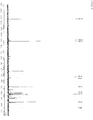
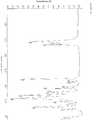
- the 1 H NMR, 13 C NMR, 29 Si NMR and IR spectra confirmed that the reaction product was 5-acryloyloxymethyl-norbornyltrimethoxysilane, was a mixture of endo and exo isomers, and was a mixture of an isomer in which the trimethoxysilyl group was bonded directly to position 2 on the norbornane skeleton structure and an isomer in which the trimethoxysilyl group was bonded directly to position 3 on the norbornane skeleton structure.
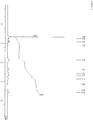
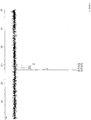
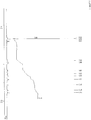
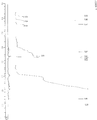
- the NMR spectra of this reaction product are shown in FIG. 7 to FIG. 9 , and the IR spectrum is shown in FIG. 10 .
- the 1 H NMR, 13 C NMR, 29 Si NMR and IR spectra confirmed that the reaction product was 5-methacryloyloxymethyl-norbornyltrimethoxysilane, was a mixture of endo and exo isomers, and was a mixture of an isomer in which the trimethoxysilyl group was bonded directly to position 2 on the norbornane skeleton structure and an isomer in which the trimethoxysilyl group was bonded directly to position 3 on the norbornane skeleton structure.
Landscapes
- Chemical & Material Sciences (AREA)
- Organic Chemistry (AREA)
Abstract
Description
- The present invention relates to a novel organosilicon compound comprising a radiation-polymerizable functional group or a haloalkyl group, a norbornane skeleton structure, and a hydrolyzable silyl group, as well as a method of producing such an organosilicon compound.
- Organosilicon compounds having a hydrolyzable silyl group generally generate a silanol group in the presence of water, and this silanol group is able to react with a hydroxyl group on the surface of an inorganic material, meaning the organosilicon compound can be used for surface treatment of the inorganic material. Furthermore, organosilicon compounds of this type that also comprise an organic functional group that reacts with organic resins are widely used as silane coupling agents, organic and inorganic resin modifiers, adhesion assistants and additives, and the use and application of such compounds is well known, with numerous patent applications having been filed.
- In a typical silane coupling agent, the hydrolyzable silyl group site that reacts with inorganic materials and the organic functional group site that reacts with organic resins are almost always linked via a linear hydrocarbon chain. However, the treated item obtained by conducting treatment with the silane coupling agent is frequently used under high-temperature conditions, and the low heat resistance of the linear hydrocarbon chain under such conditions often creates problems.
- Against this background, a norbornane skeleton structure, which is a polycyclic hydrocarbon skeleton structure, is a three dimensionally rigid structure, and it is known that incorporating this skeleton structure into the structure of an organic polymer increases the heat resistance of the polymer.
- In conventional silane coupling agents, the incorporation of a functional group such as an acryloyl group, methacryloyl group, epoxy group, amino group or mercapto group as an organic group that reacts with organic resins is well known, and such silane coupling agents are used in all manner of applications.
- The present invention has been developed in light of the above circumstances, and has an object of providing a novel organosilicon compound in which a norbornane skeleton structure that contributes to heat resistance stability is incorporated into the linking region between a hydrolyzable silyl group and a radiation-polymerizable functional group or haloalkyl group that functions as an organic functional group, as well as providing a method of producing the organosilicon compound.
- As a result of intensive investigation aimed at achieving the above object, the inventors of the present invention developed an organosilicon compound in which a hydrolyzable silyl group and either a radiation-polymerizable functional group or a haloalkyl group are linked via a norbornane skeleton structure. The inventors also developed a method of producing such a compound, and they were thus able to complete the present invention.
- In other words, a first aspect of the present invention provides a radiation-polymerizable functional group-containing organosilicon compound, comprising:
- (A) a norbornane skeleton structure,
- (B) a hydrolyzable silyl group bonded directly to the norbornane skeleton structure, and
- (C) a radiation-polymerizable functional group bonded to the norbornane skeleton structure, either directly or via a carbon atom, a hetero atom, or a combination thereof.
- A second aspect of the present invention provides a method of producing a radiation-polymerizable functional group-containing organosilicon compound comprising
- (A) a norbornane skeleton structure,
- (B) a hydrolyzable silyl group bonded directly to the norbornane skeleton structure, and
- (C) a radiation-polymerizable functional group bonded to the norbornane skeleton structure, either directly or via a carbon atom, a hetero atom, or a combination thereof,
the method comprising:- reacting a haloalkyl group-containing organosilicon compound, comprising
- (D) a norbornane skeleton structure,
- (E) a hydrolyzable silyl group bonded directly to the norbornane skeleton structure, and
- (F) a haloalkyl group, which is bonded directly to the norbornane skeleton structure, and either contains or does not contain a hetero atom, with
at least one salt having a radiation-polymerizable functional group, selected from the group consisting of alkali metal salts of organic acids having a radiation-polymerizable functional group and alkaline earth metal salts of organic acids having a radiation-polymerizable functional group,
at a temperature within a range from 50 to 150°C. - A third aspect of the present invention provides a haloalkyl group-containing organosilicon compound, comprising:
- (D) a norbornane skeleton structure,
- (E) a hydrolyzable silyl group bonded directly to the norbornane skeleton structure, and
- (F) a haloalkyl group, which is bonded directly to the norbornane skeleton structure, and either contains or does not contain a hetero atom.
- A fourth aspect of the present invention provides a method of producing a haloalkyl group-containing organosilicon compound comprising
- (D) a norbornane skeleton structure,
- (E) a hydrolyzable silyl group bonded directly to the norbornane skeleton structure, and
- (F) a haloalkyl group, which is bonded directly to the norbornane skeleton structure, and either contains or does not contain a hetero atom, the method comprising:
- subjecting a hydrolyzable silane having a hydrogen atom bonded directly to a silicon atom, and a norbornene derivative having a norbornene skeleton structure and a haloalkyl group that is bonded directly to the norbornene skeleton structure and either contains or does not contain a hetero atom, to a hydrosilylation reaction in the presence of a catalyst.
- Because the radiation-polymerizable functional group-containing organosilicon compound of the present invention includes a rigid polycyclic hydrocarbon skeleton structure, namely a norbornane skeleton structure, as the unit that links the hydrolyzable silyl group and the radiation-polymerizable functional group, the organosilicon compound exhibits superior heat resistance stability to conventional compounds containing a linear hydrocarbon chain as this linking unit. Furthermore, the radiation-polymerizable functional group-containing organosilicon compound of the present invention contains a radiation-polymerizable functional group that functions as an organic functional group having superior reactivity with organic resins. Accordingly, the radiation-polymerizable functional group-containing organosilicon compound of the present invention is useful as a silane coupling agent having improved heat resistance stability.
- Similarly, because the haloalkyl group-containing organosilicon compound of the present invention also includes a rigid polycyclic hydrocarbon skeleton structure, namely a norbornane skeleton structure, as the unit that links the hydrolyzable silyl group and the haloalkyl group, this organosilicon compound also exhibits superior heat resistance stability to conventional compounds containing a linear hydrocarbon chain as this linking unit. Accordingly, the haloalkyl group-containing organosilicon compound of the present invention is itself useful as a silane coupling agent having improved heat resistance stability. Moreover, because all manner of organic functional groups can be introduced at the haloalkyl group of the haloalkyl group-containing organosilicon compound of the present invention, this organosilicon compound is also useful as a precursor to a multitude of silane coupling agents having excellent heat resistance stability.
-
-
FIG. 1 is a diagram showing the 1H NMR spectrum of the reaction product of an example 1. -
FIG. 2 is a diagram showing the 13C NMR spectrum of the reaction product of the example 1. -
FIG. 3 is a diagram showing the 29Si NMR spectrum of the reaction product of the example 1. -
FIG. 4 is a diagram showing the 1H NMR spectrum of the reaction product of an example 3. -
FIG. 5 is a diagram showing the 13C NMR spectrum of the reaction product of the example 3. -
FIG. 6 is a diagram showing the 29Si NMR spectrum of the reaction product of the example 3. -
FIG. 7 is a diagram showing the 1H NMR spectrum of the reaction product of an example 5. -
FIG. 8 is a diagram showing the 13C NMR spectrum of the reaction product of the example 5. -
FIG. 9 is a diagram showing the 29Si NMR spectrum of the reaction product of the example 5. -
FIG. 10 is a diagram showing the IR spectrum of the reaction product of the example 5. - A more detailed description of the present invention is provided below.
- A radiation-polymerizable functional group-containing organosilicon compound of the present invention comprises:
- (A) a norbornane skeleton structure,
- (B) a hydrolyzable silyl group bonded directly to the norbornane skeleton structure, and
- (C) a radiation-polymerizable functional group bonded to the norbornane skeleton structure, either directly or via a carbon atom, a hetero atom, or a combination thereof.
- The structure (A) is a norbornane skeleton structure. In this description, a "norbornane skeleton structure" refers to an atom grouping that remains when 2 to 12 hydrogen atoms are removed from norbornane, and provided this definition is satisfied, there are no limitations on the number of hydrogen atoms removed or the positions of those hydrogen atoms.
- Examples of this norbornane skeleton structure of the structure (A) include norbornylene groups represented by a structural formula shown below:

position - The structure (B) is a hydrolyzable silyl group that is bonded directly to the norbornane skeleton structure of the structure (A). In this description, there are no particular limitations on the hydrolyzable silyl group, provided it is a silyl group that contains at least one of a monovalent hydrolyzable atom bonded directly to the silicon atom (an atom that generates a silanol group upon reaction with water) and a monovalent hydrolyzable group bonded directly to the silicon atom (a group that generates a silanol group upon reaction with water). This type of hydrolyzable silyl group generates a silanol group upon hydrolysis, and this silanol group undergoes a dehydration-condensation with an inorganic material, forming a chemical bond represented by a formula: Si-O-M (wherein, M represents the inorganic material). The radiation-polymerizable functional group-containing organosilicon compound of the present invention may include either a single hydrolyzable silyl group of the structure (B), or two or more such hydrolyzable silyl groups, and if two or more hydrolyzable silyl groups exist, these groups may be either the same or different.
- Examples of the hydrolyzable silyl group of the structure (B) include silyl groups represented by a general formula (1') shown below, as well as a chlorosilyl group, bromosilyl group, methoxysilyl group, ethoxysilyl group, propoxysilyl group, butoxysilyl group or phenoxysilyl group.
- The structure (C) is a radiation-polymerizable functional group bonded to the norbornane skeleton structure of the structure (A), either directly or via a carbon atom, a hetero atom, or a combination thereof. Upon irradiation, the radiation-polymerizable functional group of the structure (C) reacts or copolymerizes with an organic resin to form a bond. The radiation-polymerizable functional group-containing organosilicon compound of the present invention may include either a single radiation-polymerizable functional group of the structure (C), or two or more such radiation-polymerizable functional groups, and if two or more radiation-polymerizable functional groups exist, the groups may be either the same or different. In this description, in those cases where the radiation-polymerizable functional group of the structure (C) is bonded to the norbornane skeleton structure of the structure (A) via a carbon atom, a hetero atom or a combination thereof, the term "linking group" is used to describe the structure that links the structures (A) and (C).
- In this description, "radiation" includes electromagnetic radiation such as microwaves, infrared radiation, ultraviolet (UV) radiation, X-rays and γ-rays, as well as particle beams such as α-beams, proton beams, electron beams and neutron beams.
- Examples of the radiation-polymerizable functional group include an acryloyl group, methacryloyl group, styryl group or vinyl group, and of these, an acryloyl group or methacryloyl group or the like is preferred.
- Examples of the hetero atom include an oxygen atom, sulfur atom or nitrogen atom. In those cases where the linking group includes a hetero atom, the linking group may include either a single hetero atom or two or more hetero atoms, and in the case of two or more hetero atoms, these atoms may be either the same or different. The hetero atom exists within a structure such as a carbonyl group (-C(=O)-), oxy group (-O-), thio group (-S-), imino group (-NH-) or nitro group (-N<).
- Specific examples of the linking group include divalent groups such as alkylene groups that either contain or do not contain a hetero atom, a carbonyl group, an oxy group, a thio group, an imino group, or combinations thereof.
- Examples of the combination of the radiation-polymerizable functional group of the structure (C) and the linking group include monovalent groups represented by a general formula (1") shown below.
- The radiation-polymerizable functional group-containing organosilicon compound of the present invention may also include other structures besides the structures (A) to (C), provided the inclusion of these other structures does not impair the object of the present invention. If such other structures are included, then the radiation-polymerizable functional group-containing organosilicon compound of the present invention may include either a single such structure, or two or more such structures, and if two or more such other structures exist, these structures may be either the same or different. Specific examples of these other structures include alkyl groups of 1 to 10 carbon atoms such as a methyl group, ethyl group, propyl group, isopropyl group, butyl group, isobutyl group, tert-butyl group, pentyl group, hexyl group, heptyl group, octyl group, nonyl group or decyl group.
- There are no particular restrictions on the radiation-polymerizable functional group-containing organosilicon compound of the present invention, provided it includes all of the structures (A) to (C). However, in terms of enhancing the heat resistance stability of the organosilicon compound of the present invention, the carbon atom within the structure (A) to which the structure (B) is directly bonded is preferably different from the carbon atom within the structure (A) to which the structure (C) is bonded, either directly or via the linking group. Particularly preferred compounds include those in which the structure (B) is bonded to either the carbon atom at
position 2 orposition 3, or the carbon atom at position 5 or position 6 of the structure (A), and the structure (C) is bonded, either directly or via the linking group, to the other position to which the structure (B) is not bonded. - Examples of preferred forms of the radiation-polymerizable functional group-containing organosilicon compound of the present invention include organosilicon compounds represented by a general formula (1) shown below:
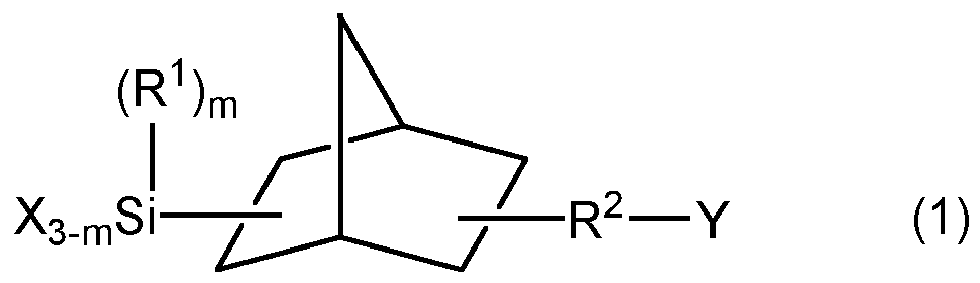
- Y represents an acryloyloxy group or a methacryloyloxy group,
- R1 represents an alkyl group of 1 to 10 carbon atoms,
- R2 represents an alkylene group of 1 to 10 carbon atoms that either contains, or does not contain, an oxygen atom, a sulfur atom, a nitrogen atom, or a combination thereof, and
- m represents an integer from 0 to 2).
- Of the compounds represented by the general formula (1), the silyl group portion represented by the general formula (1') shown below corresponds with the hydrolyzable silyl group of the structure (B):
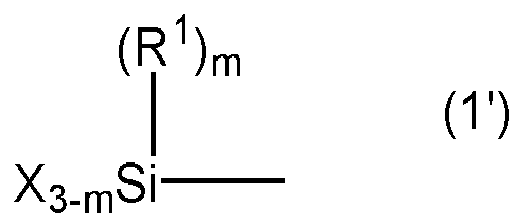
whereas the portion represented by the general formula (1") shown below corresponds with the combination of the radiation-polymerizable functional group of the structure (C) and the linking group:
-R2-Y (1")
(wherein, Y and R2 are as defined above). - In those cases where X is a halogen atom, examples include a fluorine atom, chlorine atom, bromine atom or iodine atom.
- In those cases where X is an alkoxy group, the group contains from 1 to 10 carbon atoms, typically from 1 to 8 carbon atoms, preferably from 1 to 6 carbon atoms, and more preferably from 1 to 4 carbon atoms. Specific examples of the alkoxy group include a methoxy group, ethoxy group, propoxy group, isopropoxy group, butoxy group, isobutoxy group, tert-butoxy group, pentyloxy group, hexyloxy group, heptyloxy group, octyloxy group, nonyloxy group or decyloxy group.
- The group X is preferably a methoxy group or ethoxy group.
- The group R1 contains from 1 to 10 carbon atoms, typically from 1 to 8 carbon atoms, preferably from 1 to 6 carbon atoms, and more preferably from 1 to 4 carbon atoms. Examples of R1 include a methyl group, ethyl group, propyl group, isopropyl group, butyl group, isobutyl group, tert-butyl group, pentyl group, hexyl group, heptyl group, octyl group, nonyl group or decyl group. Of these, a methyl group or ethyl group is preferred.
- The group R2 contains from 1 to 10 carbon atoms, typically from 1 to 8 carbon atoms, preferably from 1 to 6 carbon atoms, and more preferably from 1 to 3 carbon atoms.
- In those cases where R2 does not include an oxygen atom, sulfur atom, nitrogen atom or a combination thereof, specific examples of R2 include alkylene groups such as a methylene group, ethylene group, methylmethylene group, propylene group (trimethylene group or methylethylene group), butylene group (such as a tetramethylene group, 1,2-butylene group, 1,3-butylene group or 2,3-butylene group), pentene group (such as a pentamethylene group), hexene group (such as a hexamethylene group), heptene group (such as a heptamethylene group), octene group (such as an octamethylene group), nonene group (such as a nonamethylene group) or decene group (such as a decamethylene group). Of these, linear alkylene groups such as methylene group, ethylene group, trimethylene group, tetramethylene group, pentamethylene group, hexamethylene group, heptamethylene group, octamethylene group, nonamethylene group or decamethylene group are preferred, and a methylene group is particularly desirable.
- In those cases where R2 contains an oxygen atom, sulfur atom, nitrogen atom or a combination thereof, specific examples of R2 include divalent groups represented by the formulas shown below.
-(CH2)a-C(=O)-(CH2)b-
-(CH2)c-O-(CH2)d-,
-(CH2)c-S-(CH2)d-
-(CH2)e-N((CH2)fH)-(CH2)g-
(wherein, a and b each represents an integer from 1 to 8, provided that a+b is an integer from 2 to 9, c and d each represents an integer from 1 to 9, provided that c+d is an integer from 2 to 10, e and g each represents an integer from 1 to 9, and f represents an integer from 0 to 8, provided that e+f+g is an integer from 2 to 10.) - m is an integer from 0 to 2, and is typically 0.
- More preferred examples of the radiation-polymerizable functional group-containing organosilicon compound of the present invention include organosilicon compounds represented by a general formula (2) shown below:

- n represents an integer from 1 to 10, preferably an integer from 1 to 8, more preferably an integer from 1 to 6, and even more preferably an integer from 1 to 3.
- Particularly preferred examples of the radiation-polymerizable functional group-containing organosilicon compound of the present invention include organosilicon compounds represented by a general formula (3) shown below:

- Specific examples of the radiation-polymerizable functional group-containing organosilicon compound of the present invention include the compounds shown below.


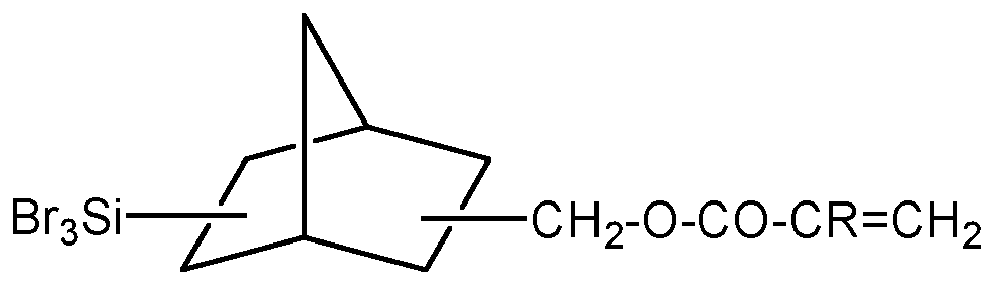
- The radiation-polymerizable functional group-containing organosilicon compound of the present invention may be either a pure compound or a mixture of isomers. Examples of possible isomeric mixtures include mixtures containing an endo isomer and an exo isomer, and mixtures of regioisomers. Examples of regioisomeric mixtures include a mixture of isomers in which, in the general formula (1), the position on the norbornane skeleton structure to which the hydrolyzable silyl group of the structure (B) is directly bonded is a mixture of
position 2 andposition 3, and a mixture of isomers in which, in the general formula (1), the position on the norbornane skeleton structure to which the radiation-polymerizable functional group of the structure (C) is directly or indirectly bonded is a mixture of position 5 and position 6. - A haloalkyl group-containing organosilicon compound of the present invention comprises:
- (D) a norbornane skeleton structure,
- (E) a hydrolyzable silyl group bonded directly to the norbornane skeleton structure, and
- (F) a haloalkyl group, which is bonded directly to the norbornane skeleton structure, and either contains or does not contain a hetero atom.
- The definition, configuration, and specific examples of the norbornane skeleton structure of the structure (D) are as described above in the section entitled "<(A) Norbornane Skeleton Structure>".
- The structure (E) is a hydrolyzable silyl group that is bonded directly to the norbornane skeleton structure of the structure (D). The haloalkyl group-containing organosilicon compound of the present invention may include either a single hydrolyzable silyl group of the structure (E), or two or more such hydrolyzable silyl groups, and if two or more hydrolyzable silyl groups exist, these groups may be either the same or different. Specific examples of the hydrolyzable silyl group of the structure (E) are as described above in the section entitled "<(B) Hydrolyzable Silyl Group>".
- The structure (F) is a haloalkyl group that is bonded directly to the norbornane skeleton structure of the structure (D), and either contains or does not contain a hetero atom. The haloalkyl group of the structure (F) reacts or copolymerizes with an organic resin to form a bond. The haloalkyl group-containing organosilicon compound of the present invention may include either a single haloalkyl group of the structure (F), or two or more such haloalkyl groups, and if two or more haloalkyl groups exist, the groups may be either the same or different.
- Examples of the hetero atom include an oxygen atom, sulfur atom or nitrogen atom. The haloalkyl group of the structure (F) may include either a single hetero atom or two or more hetero atoms, and in the case of two or more hetero atoms, these atoms may be either the same or different. The hetero atom exists between two of the carbon atoms that constitute the haloalkyl group of the structure (F), for example, in the form of a carbonyl group (-C(=O)-), oxy group (-O-), thio group (-S-) or imino group (-NH-). Alternatively, the hetero atom may exist between three carbon atoms in the form of a nitro group (-N<) or the like.
- Examples of the haloalkyl group of the structure (F) include haloalkyl groups represented by a general formula (4") shown below.
- The haloalkyl group-containing organosilicon compound of the present invention may also include other structures besides the structures (D) to (F), provided the inclusion of these other structures does not impair the object of the present invention. If such other structures are included, then the haloalkyl group-containing organosilicon compound of the present invention may include either a single such structure, or two or more such structures, and if two or more such other structures exist, these structures may be either the same or different. Specific examples of these other structures are as described above in the section entitled "<Other Structures>" within the description of the "[Radiation-polymerizable Functional Group-containing Organosilicon Compound]".
- There are no particular restrictions on the haloalkyl group-containing organosilicon compound of the present invention, provided it includes all of the structures (D) to (F). However, in terms of enhancing the heat resistance stability of the organosilicon compound of the present invention, the hydrolyzable silyl group of the structure (E) and the haloalkyl group of the structure (F) are preferably bonded directly to mutually different carbon atoms on the norbornane skeleton structure of the structure (D). Compounds in which one of the structures (E) and (F) is bonded directly to the carbon atom at
position 2 orposition 3, and the other structure is bonded directly to the carbon atom at position 5 or position 6 are particularly desirable. - Examples of preferred forms of the haloalkyl group-containing organosilicon compound of the present invention include organosilicon compounds represented by a general formula (4) shown below:
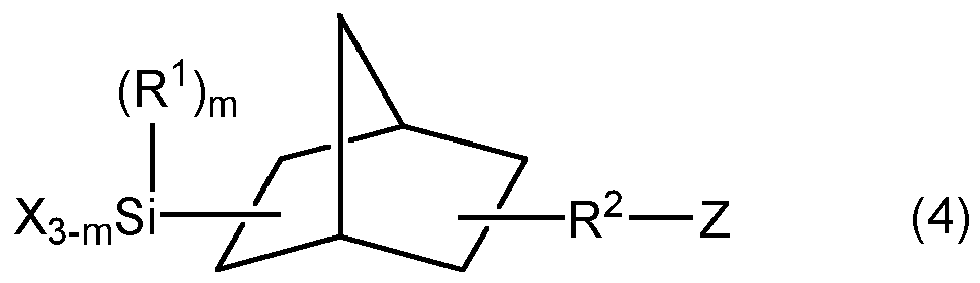
- Of the compounds represented by the general formula (4), the silyl group portion represented by the general formula (4') shown below corresponds with the hydrolyzable silyl group of the structure (E):

whereas the portion represented by the general formula (4") shown below corresponds with the haloalkyl group of the structure (F):
-R2-Z (4")
(wherein, Z and R2 are as defined above). - The group X is preferably a chlorine atom, a methoxy group or an ethoxy group.
- Examples of the group Z include a fluorine atom, chlorine atom, bromine atom or iodine atom, and of these, a chlorine atom or bromine atom is preferred.
- More preferred examples of the haloalkyl group-containing organosilicon compound of the present invention include organosilicon compounds represented by a general formula (5) shown below:
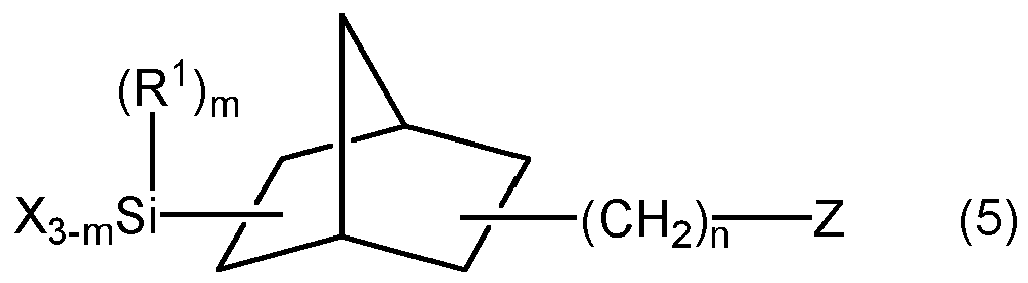
- Particularly preferred examples of the haloalkyl group-containing organosilicon compound of the present invention include organosilicon compounds represented by a general formula (6) shown below:

- Specific examples of the haloalkyl group-containing organosilicon compound of the present invention include the compounds shown below.


- The haloalkyl group-containing organosilicon compound of the present invention may be either a pure compound or a mixture of isomers. Examples of possible isomeric mixtures include mixtures containing an endo isomer and an exo isomer, and mixtures of regioisomers. Examples of regioisomeric mixtures include a mixture of isomers in which, in the general formula (4), the position on the norbornane skeleton structure to which the hydrolyzable silyl group of the structure (E) is directly bonded is a mixture of
position 2 andposition 3, and a mixture of isomers in which, in the general formula (4), the position on the norbornane skeleton structure to which the haloalkyl group of the structure (F) is directly bonded is a mixture of position 5 and position 6. - The radiation-polymerizable functional group-containing organosilicon compound of the present invention comprising the structures (A) to (C) can be produced, for example, by conducting a desalting reaction between a haloalkyl group-containing organosilicon compound, comprising
- (D) a norbornane skeleton structure,
- (E) a hydrolyzable silyl group bonded directly to the norbornane skeleton structure, and
- (F) a haloalkyl group, which is bonded directly to the norbornane skeleton structure, and either contains or does not contain a hetero atom, and
- The haloalkyl group-containing organosilicon compound is as described above. There are no particular restrictions on the haloalkyl group of the structure (F), provided it is capable of producing a radiation-polymerizable functional group of the structure (C) via the desalting reaction with the salt having a radiation-polymerizable functional group. In those cases where the targeted organosilicon compound is an organosilicon compound represented by the above general formula (1), a compound represented by the above general formula (4) can be used as the haloalkyl group-containing organosilicon compound. In those cases where the targeted organosilicon compound is an organosilicon compound represented by the above general formula (2), a compound represented by the above general formula (5) can be used as the haloalkyl group-containing organosilicon compound. In those cases where the targeted organosilicon compound is an organosilicon compound represented by the above general formula (3), a compound represented by the above general formula (6) can be used as the haloalkyl group-containing organosilicon compound.
- The salt having a radiation-polymerizable functional group is at least one salt selected from the group consisting of alkali metal salts of organic acids having a radiation-polymerizable functional group and alkaline earth metal salts of organic acids having a radiation-polymerizable functional group. Examples of the organic acids having a radiation-polymerizable functional group include acrylic acid and methacrylic acid. Examples of the alkali metals include lithium, sodium and potassium, and sodium and potassium are preferred. Examples of the alkaline earth metals include calcium, strontium and barium, and calcium is preferred.
- Examples of the salt having a radiation-polymerizable functional group include acrylic acid salts and methacrylic acid salts represented by a general formula (10) shown below:
Y-M (10)
(wherein, Y is as defined above, and M represents an alkali metal atom or an alkaline earth metal atom), namely, alkali metal salts and alkaline earth metal salts of acrylic acid and methacrylic acid. Specific examples of the acrylic acid salts and methacrylic acid salts represented by the general formula (10) include potassium acrylate, potassium methacrylate, sodium acrylate, sodium methacrylate, lithium acrylate and lithium methacrylate. Of these, from the viewpoint of reactivity, potassium acrylate, potassium methacrylate, sodium acrylate and sodium methacrylate are preferred, and potassium acrylate and potassium methacrylate are particularly desirable. - There are no particular restrictions on the blend ratio between the haloalkyl group-containing organosilicon compound and the salt having a radiation-polymerizable functional group, although in terms of reactivity and productivity, the reaction is preferably conducted using a quantity of the salt having a radiation-polymerizable functional group that is within a range from 0.8 to 2 mols, and preferably from 0.8 to 1.2 mols, per 1 mol of the haloalkyl group-containing organosilicon compound.
- In the synthesis of the radiation-polymerizable functional group-containing organosilicon compound of the present invention, the desalting reaction is preferably conducted under heating and within an organic solvent in order to accelerate the reaction rate.
- The organic solvent is preferably an organic solvent that contains no active hydrogen, and of such solvents, polar organic solvents are particularly desirable. Specific examples of the organic solvent include saturated hydrocarbon-based solvents such as pentane, hexane, cyclohexane, heptane and decane; ether-based solvents such as diethyl ether, tetrahydrofuran and dioxane; ester-based solvents such as ethyl acetate and butyl acetate; polyether-based solvents such as triethylene glycol dimethyl ether; aromatic solvents such as benzene, toluene and xylene; ketone-based solvents such as acetone, methyl ethyl ketone, and methyl isobutyl ketone; and amide-based solvents such as formamide and dimethylformamide. Of these organic solvents, dimethylformamide and toluene are particularly preferred in terms of the degree of polarity and the boiling point. A single organic solvent may be used alone, or a combination of two or more different solvents may be used.
- The reaction temperature must be set within the range from 50 to 150°C, and is preferably from 80 to 130°C. If the temperature is lower than 50°C, then the desalting reaction tends to proceed poorly, whereas if the temperature exceeds 150°C, there is a possibility that the produced radiation-polymerizable functional group-containing organosilicon compound may polymerize.
- When conducting the reaction, a polymerization inhibitor is preferably used to stabilize the produced radiation-polymerizable functional group-containing organosilicon compound. Typical commercially available products may be used as this polymerization inhibitor, and hindered phenol-based compounds are particularly desirable. The quantity added of the polymerization inhibitor need only be a typical quantity for a polymerization inhibitor. For example, a quantity of 0.001 to 1.0% by mass relative to the radiation-polymerizable functional group-containing organosilicon compound is preferred.
- The alkali metal halide or alkaline earth metal halide generated as a result of the desalting reaction can be separated from the target radiation-polymerizable functional group-containing organosilicon compound using techniques such as filtration that are well known to those skilled in the art. The radiation-polymerizable functional group-containing organosilicon compound can be further purified using methods such as distillation under reduced pressure or liquid column chromatography that are also well known to those skilled in the art.
- The haloalkyl group-containing organosilicon compound comprising the structures (D) to (F) can be produced, for example, by subjecting a hydrolyzable silane having a hydrogen atom bonded directly to the silicon atom (hereafter also referred to as a "SiH group"), and a norbornene derivative having a norbornene skeleton structure and a haloalkyl group that is bonded directly to the norbornene skeleton structure and either contains or does not contain a hetero atom, to a hydrosilylation reaction in the presence of a catalyst.
- There are no particular restrictions on the hydrolyzable silane having a SiH group, provided it is capable of generating a hydrolyzable silyl group of the structure (E) via a hydrosilylation reaction with the above norbornene derivative.
- In those cases where the haloalkyl group-containing organosilicon compound is an organosilicon compound represented by one of the general formulas (4) to (6) shown above, examples of the hydrolyzable silane having a SiH group include compounds represented by a general formula shown below:

- The norbornene derivative has a norbornene skeleton structure and a haloalkyl group that is bonded directly to the norbornene skeleton structure and either contains or does not contain a hetero atom. In this description, a "norbornene skeleton structure" refers to an atom grouping that remains when at least one hydrogen atom are removed from a structure in which a carbon-carbon double bond is formed between at least one pair of adjacent carbon atoms within norbornane. Provided the valency of the norbornene skeleton structure is monovalent or higher, there are no particular restrictions on the number of carbon-carbon double bonds or on the position of each double bond.
- The norbornene derivative may include either a single haloalkyl group or two or more haloalkyl groups within the norbornene skeleton structure, and if two or more haloalkyl groups exist, these groups may be either the same or different.
- Examples of the hetero atom and its configuration within the haloalkyl group are as described above in the section entitled "<(F) Haloalkyl Group>".
- In those cases where the haloalkyl group-containing organosilicon compound is an organosilicon compound represented by the above general formula (4), examples of the norbornene derivative include compounds represented by a general formula (7) shown below:

- In those cases where the haloalkyl group-containing organosilicon compound is an organosilicon compound represented by the above general formula (5), compounds represented by the general formula (7) in which R2 is a -(CH2)n- group can be used as the norbornene derivative. Furthermore, in those cases where the haloalkyl group-containing organosilicon compound is an organosilicon compound represented by the above general formula (6), compounds represented by the general formula (7) in which R2 is a -CH2- group and Z is Z' can be used as the norbornene derivative.
- The norbornene derivative may use a compound commercially available from any of the various chemical manufacturers, or may use a reaction product obtained using a conventional method in which an olefin compound capable of generating the haloalkyl group and cyclopentadiene are subjected to a Diels Alder reaction. For example, a norbornene derivative represented by the above general formula (7) can be prepared in accordance with this conventional method by subjecting an olefin compound represented by a general formula shown below:
CH2=CH-R2-Z
and cyclopentadiene to a Diels Alder reaction. - Among the haloalkyl group-containing organosilicon compound comprising the structures (D) to (F), an organosilicon compound comprising:
- (D) a norbornane skeleton structure,
- (E') an organooxysilyl group bonded directly to the norbornane skeleton structure, and
- (F) a haloalkyl group, which is bonded directly to the norbornane skeleton structure, and either contains or does not contain a hetero atom can be produced by:
- using a halosilane having a SiH group as the hydrolyzable silane having a SiH group from the
production method 1, conducting the hydrosilylation reaction of theproduction method 1 to obtain an organosilicon compound comprising:
- using a halosilane having a SiH group as the hydrolyzable silane having a SiH group from the
- (D) a norbornane skeleton structure,
- (E") a halosilyl group bonded directly to the norbornane skeleton structure, and
- (F) a haloalkyl group, which is bonded directly to the norbornane skeleton structure, and either contains or does not contain a hetero atom,
- With the exception of restricting the structure (E) to the structure (E'), the organosilicon compound comprising the structures (D), (E') and (F) is the same as the organosilicon compound comprising the structures (D) to (F).
- The structure (E') is an organooxysilyl group that is bonded directly to the norbornane skeleton structure of the structure (D). The organosilicon compound comprising the structures (D), (E') and (F) may include either a single organooxysilyl group of the structure (E'), or two or more such organooxysilyl groups, and if two or more organooxysilyl groups exist, the groups may be either the same or different.
- Examples of the organosilicon compound comprising the structures (D), (E') and (F) include compounds represented by a general formula (8) shown below:

- In those cases where X' represents an alkoxy group, the typical and preferred ranges for the number of carbon atoms within the group, and specific examples of the alkoxy group are as described above for the group X.
- There are no particular restrictions on the halosilane having a SiH group, provided it is capable of generating a halosilyl group of the structure (E") via a hydrosilylation reaction with the above norbornene derivative.
- In those cases where the haloalkyl group-containing organosilicon compound is an organosilicon compound represented by the above general formula (8), compounds represented by a general formula shown below can be used as the halosilane.

- With the exception of restricting the structure (E) to the structure (E"), the organosilicon compound comprising the structures (D), (E") and (F) is the same as the organosilicon compound comprising the structures (D) to (F).
- The structure (E") is an halosilyl group that is bonded directly to the norbornane skeleton structure of the structure (D). The organosilicon compound comprising the structures (D), (E") and (F) may include either a single halosilyl group of the structure (E"), or two or more such halosilyl groups, and if two or more halosilyl groups exist, the groups may be either the same or different.
- In those cases where the haloalkyl group-containing organosilicon compound is an organosilicon compound represented by the above general formula (8), examples of the organosilicon compound comprising the structures (D), (E") and (F) include compounds represented by a general formula (9) shown below:

- There are no particular restrictions on the hydroxyl group-containing organic compound, provided it reacts with the halosilyl group of the structure (E") to generate the organooxysilyl group of the structure (E'). Examples of the hydroxyl group-containing compound include alcohols, phenols and carboxylic acids.
- In those cases where the haloalkyl group-containing organosilicon compound is an organosilicon compound represented by the above general formula (8), examples of the hydroxyl group-containing organic compound include compounds represented by a general formula shown below:
X'-H
(wherein, X' is as defined above). - Of these compounds, methanol and ethanol are preferred.
- In a hydrosilylation reaction, the use of a catalyst composed of a heavy metal complex or the like is conventional, and in the hydrosilylation reaction within the production method of the present invention, a heavy metal complex such as a palladium complex, platinum complex or rhodium complex is typically used as a catalyst. Of these complexes, in terms of the reactivity and the quantity of catalyst used, a palladium complex or a platinum complex is preferred, and from the viewpoint of reactivity, a palladium complex is particularly desirable.
- Although there are no particular restrictions on the quantity of catalyst used, from the viewpoints of reactivity and productivity, the quantity is typically within a range from 0.000001 to 0.01 mols, and preferably from 0.00001 to 0.001 mols, per 1 mol of the norbornene derivative. Provided the quantity of the catalyst is within this range, a satisfactory reaction acceleration effect that corresponds with the quantity of the catalyst is readily obtained.
- There are no particular restrictions on the blend ratio between the hydrolyzable silane having a SiH group and the norbornene derivative, but from the viewpoints of reactivity and productivity, a quantity of the hydrolyzable silane having a SiH group within a range from 0.5 to 2 mols, and particularly from 0.8 to 1.2 mols, is preferably reacted with each 1 mol of the norbornene derivative.
- During the hydrosilylation reaction, in addition to the catalyst described above, an auxiliary agent that controls the catalyzed reaction may also be added. Conventional materials may be used as this auxiliary agent, and specific examples include organophosphorus compounds, phosphite ester compounds, and organonitrogen compounds.
- The hydrosilylation reaction is usually conducted as a solventless reaction, although solvent dilution may be used to facilitate reaction control. In such cases, there are no particular restrictions on the solvent, provided it exhibits no reactivity with the raw materials used and has no other adverse effects such as catalyst poisoning. Specific examples of the solvent include hydrocarbon-based solvents such as pentane, hexane, cyclohexane, benzene, toluene and xylene; ether-based solvents such as diethyl ether, tetrahydrofuran and dioxane; ester-based solvents such as ethyl acetate and butyl acetate; aprotic polar solvents such as acetonitrile and dimethylformamide; and chlorinated hydrocarbon solvents such as dichloromethane and chloroform. A single solvent may be used alone, or a combination of a plurality of different solvents may be used.
- Although there are no particular restrictions on the reaction temperature, provided it is a temperature at which the hydrosilylation proceeds, the temperature is typically within a range from 0 to 200°C, and preferably from 10 to 150°C.
- In this description, the term "organooxylation reaction" describes the reaction following the hydrosilylation reaction of the
above production method 2, wherein the organosilicon compound comprising the structures (D), (E") and (F) is reacted with the hydroxyl group-containing organic compound, thereby converting the halosilyl group of the structure (E") to the organooxysilyl group of the structure (E'). Specifically, in those cases where the hydroxyl group-containing organic compound is an alcohol, the organooxylation reaction refers to an alkoxylation reaction. More specifically, if the hydroxyl group-containing organic compound is methanol, then the organooxylation reaction refers to a methoxylation reaction. - The organooxylation reaction proceeds spontaneously even without a catalyst, although from the viewpoints of reactivity and productivity, the reaction is preferably conducted in the presence of urea, a tertiary amine or a metal alkoxide or the like, which acts as a scavenger for the generated hydrogen halide.
- Although there are no particular restrictions on the quantity of this scavenger, from the viewpoints of reactivity and productivity, the quantity is typically within a range from 0.5 to 1.5 mols, and preferably from 0.8 to 1.2 mols, per 1 mol of halogen atoms within the structure (E") of the organosilicon compound comprising the structures (D), (E") and (F). Provided the quantity of the scavenger is within this range, a satisfactory reaction acceleration effect that corresponds with the quantity of the scavenger is readily obtained.
- There are no particular restrictions on the blend ratio between the organosilicon compound comprising the structures (D), (E") and (F) and the hydroxyl group-containing organic compound, but from the viewpoints of reactivity and productivity, the blend quantity is preferably adjusted so that the quantity of hydroxyl groups within the hydroxyl group-containing organic compound is within a range from 1 to 3 mols, and particularly from 1 to 2 mols, per 1 mol of halogen atoms within the structure (E") of the organosilicon compound.
- Although there are no particular restrictions on the reaction temperature, provided it is a temperature at which the organooxylation reaction proceeds satisfactorily, the temperature is typically within a range from 50 to 80°C, and preferably from 60 to 70°C.
- A description of specifics of the present invention is provided below based on a series of synthesis examples and examples, although the present invention is in no way limited by the examples presented below. In the examples, GC is an abbreviation for Gas Chromatography, NMR is an abbreviation for Nuclear Magnetic Resonance spectroscopy, IR is an abbreviation for Infra Red spectroscopy, and bp is an abbreviation for boiling point.
- A 2-liter autoclave fitted with a stirrer, a thermometer and a heater was charged with 488.5 g (3.7 mols) of dicyclopentadiene, 1074.7 g (8.9 mols) of allyl bromide and 3.1 g of hydroquinone, and the resulting mixture was stirred under heating at 150°C, under sealed conditions and at normal pressure. After 20 hours, GC was used to confirm that the raw material peaks had disappeared and a new peak attributable to the reaction product had appeared, and the reaction was halted at this point. The reaction product was distilled under reduced pressure, yielding a pale yellow transparent liquid (bp: 54 to 56°C, 3 mmHg) at a yield of 70%. GC confirmed that the purity of the reaction product was 98%. Furthermore, 1H NMR and 13C NMR confirmed that the reaction product was 5-bromomethyl-2-norbornene, and was a mixture of the endo and exo isomers.
- 1H NMR (300 MHz, CDCl3, δ (ppm)): main isomer (the endo isomer) 0.56 (m, 1H), 1.27 (d, J=8.2 Hz, 1H), 1.45 (m, 1H), 1.91 (m, 1H), 2.48 (m, 1H), 2.84 (s, 1H), 2.96 (s, 1H), 3.00 (dd, J=6.9 Hz, 9.6 Hz, 1H), 3.17 (dd, J=6.9 Hz, 9.6 Hz, 1H), 5.96 (m, 1H), 6.17 (m, 1H).
- 13C NMR (75 MHz, CDCl3, δ (ppm)): main isomer (the endo isomer) 32.6, 38.0, 42.0, 43.0, 45.3, 49.5, 131.4, 138.0.
- With the exceptions of using 679.5 g (8.9 mols) of allyl chloride instead of the 1074.7 g (8.9 mols) of allyl bromide used in the synthesis example 1, and altering the quantity of hydroquinone from 3.1 g to 2.4 g, reaction and subsequent distillation under reduced pressure were conducted in the same manner as the synthesis example 1, yielding a colorless transparent liquid (bp: 80 to 82°C, 50 mmHg) at a yield of 57%. GC confirmed that the purity of the reaction product was 98%. Furthermore, 1H NMR and 13C NMR confirmed that the reaction product was 5-chloromethyl-2-norbornene, and was a mixture of the endo and exo isomers.
- 1H NMR (300 MHz, CDCl3, δ (ppm)): main isomer (the endo isomer) 0.56 (m, 1H), 1.27 (d, J=8.2 Hz, 1H), 1.45 (m, 1H), 1.91 (m, 1H), 2.48 (m, 1H), 2.84 (s, 1H), 2.96 (s, 1H), 3.00 (dd, J=6.9 Hz, 9.6 Hz, 1H), 3.17 (dd, J=6.9 Hz, 9.6 Hz, 1H), 5.96 (m, 1H), 6.17 (m, 1H).
- 13C NMR (75 MHz, CDCl3, δ (ppm)): main isomer (the endo isomer) 31.2, 41.8, 42.6, 44.5, 48.5, 49.3, 131.6, 137.9.
- A 1-liter separable flask fitted with a stirrer, a reflux condenser, a dropping funnel and a thermometer was charged with 150 g (0.802 mols) of 5-bromomethyl-2-norbornene, 45.6 mg of dichloro(1,5-cyclooctadiene) palladium and 89.6 mg of tricyclohexylphosphine, and the mixture was heated to 135°C. Once the internal temperature had stabilized, 130.4 g (0.963 mols) of trichlorosilane was added dropwise over a period of 4 hours. Following completion of the dropwise addition, the reaction mixture was stirred at 135°C. After 2 hours, GC was used to confirm that the raw material peak had disappeared and a new peak attributable to the reaction product had appeared, and the hydrosilylation reaction was halted at this point. The temperature of the reaction mixture was then cooled to 80°C, and 61.6 g (1.92 mols) of methanol was added dropwise to the mixture. Following completion of the dropwise addition, the reaction mixture was stirred for one hour at 75°C. Subsequently, 69.3 g (1.16 mols) of urea was added to the reaction mixture, and a further 46.2 g (1.44 mols) of methanol was added dropwise. The reaction mixture was stirred for a further 2 hours at 75°C, and the stirring and heating were then halted. Upon standing, the reaction mixture separated into a layer containing a methanol solution of urea hydrochloride and a layer containing the reaction product. The layer containing the reaction product was collected, and then analyzed by GC. This analysis confirmed that the raw material peak had disappeared and a new peak attributable to the reaction product had appeared, and the methoxylation reaction was halted at this point. The reaction product was distilled under reduced pressure, yielding a colorless transparent liquid (bp: 110 to 116°C, 3 to 5 mmHg) at a yield of 93%. GC confirmed that the purity of the reaction product was 95%. Furthermore, 1H NMR, 13C NMR and 29Si NMR confirmed that the reaction product was 5-bromomethyl-norbornyltrimethoxysilane, was a mixture of endo and exo isomers, and was a mixture of an isomer in which the trimethoxysilyl group was bonded directly to
position 2 on the norbornane skeleton structure and an isomer in which the trimethoxysilyl group was bonded directly toposition 3 on the norbornane skeleton structure. The NMR spectra of this reaction product are shown inFIG. 1 to FIG. 3 . - 1H NMR (300 MHz, CDCl3, δ (ppm)): isomeric mixture 0.45 to 3.27 (m, 12H), 3.35 (s, 6H, Si-OCH3), 3.37 (s, 3H, Si-OCH3).
- 13C NMR (75 MHz, CDCl3, δ (ppm)): isomeric mixture (main product only listed) 14.2, 23.4, 24.4, 36.1, 38.2, 39.0, 39.8, 42.2, 50.2 (Si-OCH3).
- 29Si NMR (60 MHz, CDCl3, δ (ppm)): isomeric mixture -45.1, -45.5, -45.8, - 46.4.
- With the exceptions of using 40 mg of a platinum complex composed of vinyldimethyldisiloxane coordinated to chloroplatinic acid as the hydrosilylation catalyst instead of the 45.6 mg of dichloro(1,5-cyclooctadiene) palladium used in the example 1, not using the tricyclohexylphosphine, and altering the temperature prior to the dropwise addition of the trichlorosilane from 135°C to 120°C, a hydrosilylation reaction, methoxylation reaction, and distillation under reduced pressure were conducted in the same manner as the example 1, yielding a colorless transparent liquid (bp: 110 to 116°C, 3 to 5 mmHg) at a yield of 67%. GC confirmed that the purity of the reaction product was 95%. Furthermore, 1H NMR, 13C NMR and 29Si NMR confirmed that the reaction product was 5-bromomethyl-norbornyltrimethoxysilane, was a mixture of endo and exo isomers, and was a mixture of an isomer in which the trimethoxysilyl group was bonded directly to
position 2 on the norbornane skeleton structure and an isomer in which the trimethoxysilyl group was bonded directly toposition 3 on the norbornane skeleton structure. The NMR spectra of this reaction product were the same as those shown inFIG. 1 to FIG. 3 . - A 1-liter separable flask fitted with a stirrer, a reflux condenser, a dropping funnel and a thermometer was charged with 290 g (2.03 mols) of 5-chloromethyl-2-norbornene, 0.32 g of dichloro(1,5-cyclooctadiene) palladium and 0.62 g of tricyclohexylphosphine, and the mixture was heated to 135°C. Once the internal temperature had stabilized, 302 g (2.23 mols) of trichlorosilane was added dropwise over a period of 4 hours. Following completion of the dropwise addition, the reaction mixture was stirred at 135°C. After 2 hours, GC was used to confirm that the raw material peak had disappeared and a new peak attributable to the reaction product had appeared, and the hydrosilylation reaction was halted at this point. The temperature of the reaction mixture was then cooled to 80°C, and 142.7 g (4.46 mols) of methanol was added dropwise to the mixture. Following completion of the dropwise addition, the reaction mixture was stirred for one hour at 75°C. Subsequently, 160.6 g (2.67 mols) of urea was added to the reaction mixture, and a further 107.0 g (3.35 mols) of methanol was added dropwise. The reaction mixture was stirred for a further 2 hours at 75°C, and the stirring and heating were then halted. Upon standing, the reaction mixture separated into a layer containing a methanol solution of urea hydrochloride and a layer containing the reaction product. The layer containing the reaction product was collected, and then analyzed by GC. This analysis confirmed that the raw material peak had disappeared and a new peak attributable to the reaction product had appeared, and the methoxylation reaction was halted at this point. The reaction product was distilled under reduced pressure, yielding a colorless transparent liquid (bp: 106 to 108°C, 3 to 5 mmHg) at a yield of 92%. GC confirmed that the purity of the reaction product was 95%. Furthermore, 1H NMR, 13C NMR and 29Si NMR confirmed that the reaction product was 5-chloromethyl-norbornyltrimethoxysilane, was a mixture of endo and exo isomers, and was a mixture of an isomer in which the trimethoxysilyl group was bonded directly to
position 2 on the norbornane skeleton structure and an isomer in which the trimethoxysilyl group was bonded directly toposition 3 on the norbornane skeleton structure. The NMR spectra of this reaction product are shown inFIG. 4 to FIG. 6 . - 1H NMR (300 MHz, CDCl3, δ (ppm)): isomeric mixture 0.45 to 3.26 (m, 12H), 3.38 (s, 6H, Si-OCH3), 3.39 (s, 3H, Si-OCH3).
- 13C NMR (75 MHz, CDCl3, δ (ppm)): isomeric mixture (main product only listed) 14.4, 23.7, 24.5, 37.0, 37.9, 38.9, 42.2, 46.9, 50.3 (Si-OCH3).
- 29Si NMR (60 MHz, CDCl3, δ (ppm)): isomeric mixture -45.1, -45.6, -45.9, - 46.5.
- With the exceptions of using 40 mg of a platinum complex composed of vinyldimethyldisiloxane coordinated to chloroplatinic acid as the hydrosilylation catalyst instead of the 0.32 g of dichloro(1,5-cyclooctadiene) palladium used in the example 3, not using the tricyclohexylphosphine, and altering the temperature prior to the dropwise addition of the trichlorosilane from 135°C to 120°C, a hydrosilylation reaction, methoxylation reaction, and distillation under reduced pressure were conducted in the same manner as the example 3, yielding a colorless transparent liquid (bp: 106 to 108°C, 3 to 5 mmHg) at a yield of 66%. GC confirmed that the purity of the reaction product was 95%. Furthermore, 1H NMR, 13C NMR and 29Si NMR confirmed that the reaction product was 5-chloromethyl-norbornyltrimethoxysilane, was a mixture of endo and exo isomers, and was a mixture of an isomer in which the trimethoxysilyl group was bonded directly to
position 2 on the norbornane skeleton structure and an isomer in which the trimethoxysilyl group was bonded directly toposition 3 on the norbornane skeleton structure. The NMR spectra of this reaction product were the same as those shown inFIG. 4 to FIG. 6 . - A 1-liter separable glass flask fitted with a thermometer, a water-cooled condenser and a dropping funnel was charged with 110 g (1.0 mols) of potassium acrylate, 200 g of dimethylformamide, 200 g of toluene and 2.7 g of bis-t-butylhydroxytoluene, the resulting mixture was heated to 140°C, and the water contained within the toluene and potassium acrylate was distilled and removed from the reaction system. Subsequently, the temperature was lowered to 110°C, and 309 g (1.0 mols) of 5-bromomethyl-norbornyltrimethoxysilane was added dropwise to the reaction system. The reaction mixture was then refluxed at 110°C under constant stirring, while the progress of the reaction was tracked using GC. After 5 hours, GC confirmed that the peak attributable to the raw material methoxysilane had disappeared completely, and a new peak attributable to the reaction product had appeared, and the reaction was halted at this point. Subsequently, the generated potassium bromide was removed by filtration, the reaction solvent was then removed by evaporation under reduced pressure, and the product was then purified by distillation under reduced pressure, yielding a colorless transparent liquid (purified yield: 43%). GC confirmed that the purity of the reaction product was at least 94%. Furthermore, the 1H NMR, 13C NMR, 29Si NMR and IR spectra confirmed that the reaction product was 5-acryloyloxymethyl-norbornyltrimethoxysilane, was a mixture of endo and exo isomers, and was a mixture of an isomer in which the trimethoxysilyl group was bonded directly to
position 2 on the norbornane skeleton structure and an isomer in which the trimethoxysilyl group was bonded directly toposition 3 on the norbornane skeleton structure. The NMR spectra of this reaction product are shown inFIG. 7 to FIG. 9 , and the IR spectrum is shown inFIG. 10 . - 1H NMR (300 MHz, CDCl3, δ (ppm)): isomeric mixture 0.43 to 3.22 (m, 12H), 3.32 (s, 9H, Si-OCH3), 5.57 to 6.15 (m, 3H, acrylic group)
- 13C NMR (75 MHz, CDCl3, δ (ppm)): isomeric mixture (main product only listed) 14.6, 24.0, 24.2, 36.7, 37.4, 38.8, 40.6, 50.1 (Si-OCH3), 67.2, 128.2, 129.7, 165.4.
- 29Si NMR (60 MHz, CDCl3, δ (ppm)): isomeric mixture -44.9, -45.6, -45.9, - 46.3.
- With the exception of using 124 g (1.0 mols) of potassium methacrylate instead of the 110 g (1.0 mols) of potassium acrylate used in the example 5, a colorless transparent liquid (purified yield: 35%) was produced in the same manner as the example 5. GC confirmed that the purity of the reaction product was at least 93%. Furthermore, the 1H NMR, 13C NMR, 29Si NMR and IR spectra confirmed that the reaction product was 5-methacryloyloxymethyl-norbornyltrimethoxysilane, was a mixture of endo and exo isomers, and was a mixture of an isomer in which the trimethoxysilyl group was bonded directly to
position 2 on the norbornane skeleton structure and an isomer in which the trimethoxysilyl group was bonded directly toposition 3 on the norbornane skeleton structure. - 1H NMR (300 MHz, CDCl3, δ (ppm)): isomeric mixture 0.41 to 3.25 (m, 12H), 1.96 (s, 3H), 3.30 (s, 9H, Si-OCH3), 5.55 to 6.10 (m, 2H, methacrylic group)
- 13C NMR (75 MHz, CDCl3, δ (ppm)): isomeric mixture (main product only listed) 14.3, 18.1, 23.8, 24.7, 36.3, 37.4, 38.2, 40.8, 50.9 (Si-OCH3), 66.2, 125.2, 136.7, 167.4.
- 29Si NMR (60 MHz, CDCl3, δ (ppm)): isomeric mixture -44.8, -45.1, -45.7, - 46.8.
-
- 1. A radiation-polymerizable functional group-containing organosilicon compound, comprising:
- (A) a norbornane skeleton structure,
- (B) a hydrolyzable silyl group bonded directly to the norbornane skeleton structure, and
- (C) a radiation-polymerizable functional group bonded to the norbornane skeleton structure, either directly or via a carbon atom, a hetero atom, or a combination thereof.
- 2. The organosilicon compound according to
clause 1, wherein the radiation-polymerizable functional group is an acryloyl group, a methacryloyl group, or a combination thereof. - 3. The organosilicon compound according to
clause 1, represented by a general formula (1) shown below:
- Y represents an acryloyloxy group or a methacryloyloxy group,
- R1 represents an alkyl group of 1 to 10 carbon atoms,
- R2 represents an alkylene group of 1 to 10 carbon atoms that either contains, or does not contain, an oxygen atom, a sulfur atom, a nitrogen atom, or a combination thereof, and
- m represents an integer from 0 to 2.
- 4. The organosilicon compound according to
clause 1, represented by a general formula (2) shown below:
- 5. The organosilicon compound according to
clause 1, represented by a general formula (3) shown below:
- 6. A method of producing a radiation-polymerizable functional group-containing organosilicon compound comprising
- (A) a norbornane skeleton structure,
- (B) a hydrolyzable silyl group bonded directly to the norbornane skeleton structure, and
- (C) a radiation-polymerizable functional group bonded to the norbornane skeleton structure, either directly or via a carbon atom, a hetero atom, or a combination thereof,
the method comprising:- reacting a haloalkyl group-containing organosilicon compound, comprising
- (D) a norbornane skeleton structure,
- (E) a hydrolyzable silyl group bonded directly to the norbornane skeleton structure, and
- (F) a haloalkyl group, which is bonded directly to the norbornane skeleton structure, and either contains or does not contain a hetero atom, with
at a temperature within a range from 50 to 150°C. - 7. The method according to clause 6, wherein the haloalkyl group-containing organosilicon compound is represented by a general formula (4) shown below:

- R1 represents an alkyl group of 1 to 10 carbon atoms,
- R2 represents an alkylene group of 1 to 10 carbon atoms that either contains, or does not contain, an oxygen atom, a sulfur atom, a nitrogen atom, or a combination thereof,
- m represents an integer from 0 to 2, and
- Z represents a halogen atom,
Y-M (10)
wherein, Y represents an acryloyloxy group or a methacryloyloxy group, and M represents an alkali metal atom or an alkaline earth metal atom, and
the radiation-polymerizable functional group-containing organosilicon compound is represented by a general formula (1) shown below:
- 8. The method according to clause 7, wherein the haloalkyl group-containing organosilicon compound represented by the general formula (4) is represented by a general formula (5) shown below:

the radiation-polymerizable functional group-containing organosilicon compound represented by the general formula (1) is represented by a general formula (2) shown below:
- 9. The method according to clause 8, wherein the haloalkyl group-containing organosilicon compound represented by the general formula (5) is represented by a general formula (6) shown below:

the radiation-polymerizable functional group-containing organosilicon compound represented by the general formula (2) is represented by a general formula (3) shown below:
- 10. A haloalkyl group-containing organosilicon compound, comprising:
- (D) a norbornane skeleton structure,
- (E) a hydrolyzable silyl group bonded directly to the norbornane skeleton structure, and
- (F) a haloalkyl group, which is bonded directly to the norbornane skeleton structure, and either contains or does not contain a hetero atom.
- 11. The organosilicon compound according to clause 10, represented by a general formula (4) shown below:

- R1 represents an alkyl group of 1 to 10 carbon atoms,
- R2 represents an alkylene group of 1 to 10 carbon atoms that either contains, or does not contain, an oxygen atom, a sulfur atom, a nitrogen atom, or a combination thereof,
- m represents an integer from 0 to 2, and
- Z represents a halogen atom.
- 12. The organosilicon compound according to clause 10, represented by a general formula (5) shown below:
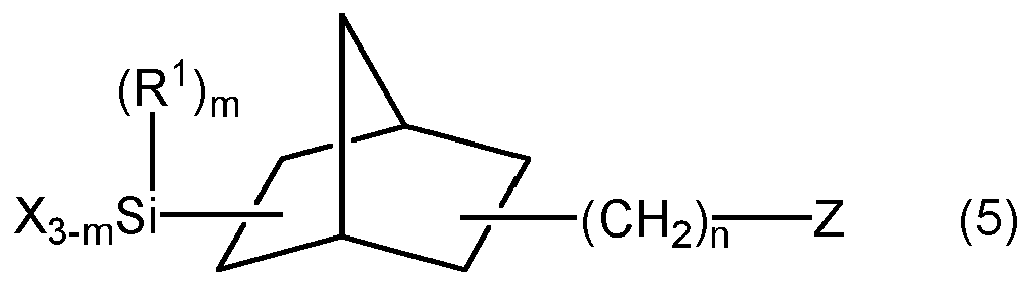
- 13. The organosilicon compound according to clause 10, represented by a general formula (6) shown below:

- 14. A method of producing a haloalkyl group-containing organosilicon compound comprising
- (D) a norbornane skeleton structure,
- (E) a hydrolyzable silyl group bonded directly to the norbornane skeleton structure, and
- (F) a haloalkyl group, which is bonded directly to the norbornane skeleton structure, and either contains or does not contain a hetero atom, the method comprising:
- subjecting a hydrolyzable silane having a hydrogen atom bonded directly to a silicon atom, and a norbornene derivative having a norbornene skeleton structure and a haloalkyl group that is bonded directly to the norbornene skeleton structure and either contains or does not contain a hetero atom, to a hydrosilylation reaction in presence of a catalyst.
- 15. The method according to clause 14, wherein the hydrolyzable silane is represented by a general formula shown below:

- R1 represents an alkyl group of 1 to 10 carbon atoms, and
- m represents an integer from 0 to 2,
- the norbornene derivative is represented by a general formula (7) shown below:

the organosilicon compound is represented by a general formula (4) shown below:
- 16. The method according to clause 14, wherein
the hydrolyzable silane is a halosilane having a hydrogen atom bonded directly to a silicon atom,
a product of the hydrosilylation reaction is an organosilicon compound comprising:- (D) a norbornane skeleton structure,
- (E") a halosilyl group bonded directly to the norbornane skeleton structure, and
- (F) a haloalkyl group, which is bonded directly to the norbornane skeleton structure, and either contains or does not contain a hetero atom, and
following the hydrosilylation reaction, the organosilicon compound comprising (D), (E") and (F) is reacted with a hydroxyl group-containing organic compound, so that the organosilicon compound comprising (D), (E) and (F) is an organosilicon compound comprising: - (D) a norbornane skeleton structure,
- (E') an organooxysilyl group bonded directly to the norbornane skeleton structure, and
- (F) a haloalkyl group, which is bonded directly to the norbornane skeleton structure, and either contains or does not contain a hetero atom.
- 17. The method according to clause 16, wherein the halosilane is represented by a general formula shown below:

the organosilicon compound comprising (D), (E") and (F) is represented by a general formula (9) shown below:
the hydroxyl group-containing organic compound is represented by a general formula shown below:
X'-H
wherein, X' represents an alkoxy group of 1 to 10 carbon atoms, a phenyloxy group, or an acetoxy group, and
the organosilicon compound comprising (D), (E') and (F) is represented by a general formula (8) shown below:
- 18. The method according to clause 14, wherein the catalyst is a palladium complex, a platinum complex, or a combination thereof.
at a temperature within a range from 50 to 150°C.
Claims (8)
- A haloalkyl group-containing organosilicon compound, comprising:(D) a norbornane skeleton structure,(E) a hydrolyzable silyl group bonded directly to the norbornane skeleton structure, and(F) a haloalkyl group, which is bonded directly to the norbornane skeleton structure, and either contains or does not contain at least one hetero atom;wherein, each X represents, independently, an alkoxy group of 1 to 10 carbon atoms, a phenyloxy group, or an acetoxy group,
of formula (4) shown below: R1 represents an alkyl group of 1 to 10 carbon atoms,R2 represents an alkylene group of 1 to 10 carbon atoms that either contains, or does not contain, an oxygen atom, a sulfur atom, a nitrogen atom, or a combination thereof,m represents an integer from 0 to 2, andZ represents a halogen atom.
 - The organosilicon compound according to claim 1, of formula (5) shown below:

- The organosilicon compound according to claim 1, of formula (6) shown below:

- A method of producing a haloalkyl group-containing organosilicon compound comprising(D) a norbornane skeleton structure,(E) a hydrolyzable silyl group bonded directly to the norbornane skeleton structure, and(F) a haloalkyl group, which is bonded directly to the norbornane skeleton structure, and either contains or does not contain at least one hetero atom, the method comprising:subjecting a hydrolyzable silane having a hydrogen atom bonded directly to a silicon atom, and a norbornene derivative having a norbornene skeleton structure and a haloalkyl group that is bonded directly to the norbornene skeleton structure and either contains or does not contain at least one hetero atom, to a hydrosilylation reaction in presence of a catalyst.
- The method according to claim 4, wherein the hydrolyzable silane is of formula shown below:
 R1 represents an alkyl group of 1 to 10 carbon atoms, andm represents an integer from 0 to 2,the norbornene derivative is of formula (7) shown below:the organosilicon compound is of formula (4) shown below:

- The method according to claim 4, wherein
the hydrolyzable silane is a halosilane having a hydrogen atom bonded directly to a silicon atom,
a product of the hydrosilylation reaction is an organosilicon compound comprising:(D) a norbornane skeleton structure,(E") a halosilyl group bonded directly to the norbornane skeleton structure, and(F) a haloalkyl group, which is bonded directly to the norbornane skeleton structure, and either contains or does not contain at least one hetero atom, and
following the hydrosilylation reaction, the organosilicon compound comprising (D), (E") and (F) is reacted with a hydroxyl group-containing organic compound, so that the organosilicon compound comprising (D), (E) and (F) is an organosilicon compound comprising:(D) a norbornane skeleton structure,(E') an organooxysilyl group bonded directly to the norbornane skeleton structure, and(F) a haloalkyl group, which is bonded directly to the norbornane skeleton structure, and either contains or does not contain at least one hetero atom. - The method according to claim 9, wherein the halosilane is of formula shown below:

the organosilicon compound comprising (D), (E") and (F) is of formula (9) shown below:
the hydroxyl group-containing organic compound is of formula shown below:
X'-H
wherein, X' represents an alkoxy group of 1 to 10 carbon atoms, a phenyloxy group, or an acetoxy group, and
the organosilicon compound comprising (D), (E') and (F) is of formula (8) shown below:
- The method according to claim 7, wherein the catalyst is a palladium complex, a platinum complex, or a combination thereof.
Applications Claiming Priority (3)
| Application Number | Priority Date | Filing Date | Title |
|---|---|---|---|
| JP2007292579A JP4542128B2 (en) | 2007-11-09 | 2007-11-09 | Norbornane skeleton-containing organosilicon compound and method for producing the same |
| JP2007298494A JP4520497B2 (en) | 2007-11-16 | 2007-11-16 | Radiation-polymerizable functional group-containing organosilicon compound and method for producing the same |
| EP08253651.7A EP2058316B1 (en) | 2007-11-09 | 2008-11-07 | Norbornane skeleton structure-containing organosilicon compound and method of producing same |
Related Parent Applications (2)
| Application Number | Title | Priority Date | Filing Date |
|---|---|---|---|
| EP08253651.7A Division-Into EP2058316B1 (en) | 2007-11-09 | 2008-11-07 | Norbornane skeleton structure-containing organosilicon compound and method of producing same |
| EP08253651.7 Division | 2008-11-07 |
Publications (2)
| Publication Number | Publication Date |
|---|---|
| EP2450363A2 true EP2450363A2 (en) | 2012-05-09 |
| EP2450363A3 EP2450363A3 (en) | 2012-09-19 |
Family
ID=40348043
Family Applications (2)
| Application Number | Title | Priority Date | Filing Date |
|---|---|---|---|
| EP11195262A Withdrawn EP2450363A3 (en) | 2007-11-09 | 2008-11-07 | Norbornane skeleton structure-containing organosilicon compound and method of producing same |
| EP08253651.7A Not-in-force EP2058316B1 (en) | 2007-11-09 | 2008-11-07 | Norbornane skeleton structure-containing organosilicon compound and method of producing same |
Family Applications After (1)
| Application Number | Title | Priority Date | Filing Date |
|---|---|---|---|
| EP08253651.7A Not-in-force EP2058316B1 (en) | 2007-11-09 | 2008-11-07 | Norbornane skeleton structure-containing organosilicon compound and method of producing same |
Country Status (2)
| Country | Link |
|---|---|
| US (2) | US8034965B2 (en) |
| EP (2) | EP2450363A3 (en) |
Families Citing this family (1)
| Publication number | Priority date | Publication date | Assignee | Title |
|---|---|---|---|---|
| JP4325337B2 (en) * | 2003-09-19 | 2009-09-02 | 日立化成工業株式会社 | Resin composition, prepreg, laminate and multilayer printed wiring board using the same |
Family Cites Families (18)
| Publication number | Priority date | Publication date | Assignee | Title |
|---|---|---|---|---|
| US3664403A (en) * | 1969-07-07 | 1972-05-23 | Ppg Industries Inc | A vulcanized rubber comprising a siliceous pigment, a rubber and an organic coupling agent having an active olefinic linkage |
| US3922436A (en) * | 1974-09-13 | 1975-11-25 | Owens Corning Fiberglass Corp | Silanes useful as coupling agents and flame retardants |
| DE3423608A1 (en) * | 1984-06-27 | 1986-01-02 | Th. Goldschmidt Ag, 4300 Essen | FLUORALKYLSILANES OR -SILOXANES, THEIR PRODUCTION AND USE |
| JPS61275283A (en) | 1985-05-31 | 1986-12-05 | Toshiba Silicone Co Ltd | Ethylidenenorbornyldimethylmethacryloxysilane |
| JPH01132591A (en) | 1987-11-18 | 1989-05-25 | Toshiba Silicone Co Ltd | Dimerized vinylcycloheptyl group-containing silicon compound and its production |
| JP2664974B2 (en) * | 1989-01-27 | 1997-10-22 | 東芝シリコーン株式会社 | Vehicle for slowly soluble coating material |
| RU2065443C1 (en) * | 1994-07-06 | 1996-08-20 | Российский химико-технологический университет им. Д.И.Менделеева | Method of synthesis of organosilicon acrylate and methacrylate |
| NZ303624A (en) | 1995-03-08 | 1999-01-28 | Du Pont | Reactive organosilicons as coatings, adhesives, and sealants |
| JP4009335B2 (en) * | 1996-04-26 | 2007-11-14 | 東レ・ダウコーニング株式会社 | Method for producing organosilicon compound containing acryloxy group or methacryloxy group |
| JP3856090B2 (en) | 2000-09-08 | 2006-12-13 | 信越化学工業株式会社 | Process for producing 5-vinylnorbornyltrichlorosilane |
| AU2003230576A1 (en) * | 2002-03-01 | 2003-09-16 | Value Recovery, Inc. | Process for making organic products from non-product streams using a catalyst |
| JP2004212946A (en) * | 2002-10-21 | 2004-07-29 | Rohm & Haas Electronic Materials Llc | Photoresist containing Si polymer |
| JP3925473B2 (en) | 2003-07-11 | 2007-06-06 | Jsr株式会社 | Polysiloxane and radiation-sensitive resin composition |
| EP1679314A4 (en) * | 2003-10-15 | 2008-12-24 | Jsr Corp | Silane compound, polysiloxane and radiation-sensitive resin composition |
| JP2005139169A (en) | 2003-10-15 | 2005-06-02 | Jsr Corp | Silane compound, polysiloxane and radiation-sensitive resin composition |
| JP4423539B2 (en) | 2003-10-16 | 2010-03-03 | 荒川化学工業株式会社 | Hydrosilylated norbornene polymerizable monomer and process for producing the same |
| JP4687898B2 (en) * | 2006-03-14 | 2011-05-25 | 信越化学工業株式会社 | Fluorine-containing silicon compound, silicone resin, resist composition using the same, and pattern forming method |
| JP5374949B2 (en) * | 2007-08-21 | 2013-12-25 | 信越化学工業株式会社 | Process for producing radiation-polymerizable functional group-containing organosilylamine and radiation-polymerizable functional group-containing organosilylamine |
-
2008
- 2008-11-06 US US12/265,802 patent/US8034965B2/en active Active
- 2008-11-07 EP EP11195262A patent/EP2450363A3/en not_active Withdrawn
- 2008-11-07 EP EP08253651.7A patent/EP2058316B1/en not_active Not-in-force
-
2011
- 2011-06-14 US US13/160,127 patent/US8283486B2/en not_active Expired - Fee Related
Non-Patent Citations (1)
| Title |
|---|
| None |
Also Published As
| Publication number | Publication date |
|---|---|
| US20090124821A1 (en) | 2009-05-14 |
| EP2058316B1 (en) | 2014-04-09 |
| US20110245525A1 (en) | 2011-10-06 |
| EP2058316A3 (en) | 2009-12-30 |
| EP2450363A3 (en) | 2012-09-19 |
| EP2058316A2 (en) | 2009-05-13 |
| US8034965B2 (en) | 2011-10-11 |
| US8283486B2 (en) | 2012-10-09 |
Similar Documents
| Publication | Publication Date | Title |
|---|---|---|
| CA2061107C (en) | Organopentasiloxane and method for its preparation | |
| US6822109B2 (en) | Silicon ether compound, a method for the preparation thereof and use thereof | |
| US20120004437A1 (en) | Method for producing (meth)acrylosilanes | |
| JP5115729B2 (en) | Organosilicon compound containing acetoacetate group protected with trialkylsilyl group and process for producing the same | |
| Dudziec et al. | New mono-and diethynylsiloxysilsesquioxanes–efficient procedures for their synthesis | |
| EP2028184A1 (en) | Method of producing organosilylamine containing radiation-polymerizable functional group and organosilylamine containing radiation-polymerizable functional group | |
| EP2058316B1 (en) | Norbornane skeleton structure-containing organosilicon compound and method of producing same | |
| US10329313B2 (en) | Organosilicon compounds having (meth)acrylate groups and a process for preparation thereof | |
| JP4542128B2 (en) | Norbornane skeleton-containing organosilicon compound and method for producing the same | |
| JPH07285973A (en) | Process for producing 2,2-difluoroketenesilyl O, S-acetal and α, α-difluoro-β-silyloxy-1,3-dioxolane-4-propanoic acid O, S-ester | |
| JP4520497B2 (en) | Radiation-polymerizable functional group-containing organosilicon compound and method for producing the same | |
| EP3202768B1 (en) | Fluorinated alkyl silane compound, and production method for same | |
| US11198666B2 (en) | Method for preparing (meth)acrylic acid ester based compound | |
| JP2676524B2 (en) | Adamantane derivative | |
| CN113260622B (en) | Method for preparing functionalized organosilanol compounds | |
| US10125069B2 (en) | Polyfluoroalkyl allyl compound and method for producing the same | |
| US20060183873A1 (en) | Silicon ether compounds and a method for the preparation thereof | |
| US20030097015A1 (en) | Norbornyl-substituted silanes and the use thereof | |
| US9073952B1 (en) | Synthesis method for carbosilanes | |
| JP4868104B2 (en) | (Meth) acrylate compound of cyclobutanetetracarboxylic acid and process for producing the same | |
| JP2002012597A (en) | Organic silicon compound | |
| RU2375370C2 (en) | Silicon ethers and method of producing said esters | |
| JPH05230071A (en) | Dibenzoylmethane derivative | |
| JP2805998B2 (en) | Acid anhydride group-containing silane compound and method for producing the same | |
| TW202024104A (en) | Method for producing iodine-containing silicon compound |
Legal Events
| Date | Code | Title | Description |
|---|---|---|---|
| PUAI | Public reference made under article 153(3) epc to a published international application that has entered the european phase |
Free format text: ORIGINAL CODE: 0009012 |
|
| AC | Divisional application: reference to earlier application |
Ref document number: 2058316 Country of ref document: EP Kind code of ref document: P |
|
| AK | Designated contracting states |
Kind code of ref document: A2 Designated state(s): DE FR GB |
|
| PUAL | Search report despatched |
Free format text: ORIGINAL CODE: 0009013 |
|
| AK | Designated contracting states |
Kind code of ref document: A3 Designated state(s): DE FR GB |
|
| RIC1 | Information provided on ipc code assigned before grant |
Ipc: C07F 7/08 20060101AFI20120816BHEP Ipc: C07F 7/18 20060101ALI20120816BHEP Ipc: C07F 7/12 20060101ALI20120816BHEP |
|
| STAA | Information on the status of an ep patent application or granted ep patent |
Free format text: STATUS: THE APPLICATION IS DEEMED TO BE WITHDRAWN |
|
| 18D | Application deemed to be withdrawn |
Effective date: 20130320 |