EP2448315A1 - Estimating the number of mobile stations in a geographical area - Google Patents
Estimating the number of mobile stations in a geographical area Download PDFInfo
- Publication number
- EP2448315A1 EP2448315A1 EP11186616A EP11186616A EP2448315A1 EP 2448315 A1 EP2448315 A1 EP 2448315A1 EP 11186616 A EP11186616 A EP 11186616A EP 11186616 A EP11186616 A EP 11186616A EP 2448315 A1 EP2448315 A1 EP 2448315A1
- Authority
- EP
- European Patent Office
- Prior art keywords
- sms
- time interval
- probability
- mobile stations
- iho
- Prior art date
- Legal status (The legal status is an assumption and is not a legal conclusion. Google has not performed a legal analysis and makes no representation as to the accuracy of the status listed.)
- Granted
Links
- 238000000034 method Methods 0.000 claims abstract description 38
- 238000012545 processing Methods 0.000 claims abstract description 16
- 238000005516 engineering process Methods 0.000 claims abstract description 11
- 208000034188 Stiff person spectrum disease Diseases 0.000 claims description 68
- 238000012423 maintenance Methods 0.000 claims description 9
- 230000008569 process Effects 0.000 claims description 5
- 238000013507 mapping Methods 0.000 claims description 3
- CIWBSHSKHKDKBQ-JLAZNSOCSA-N Ascorbic acid Chemical compound OC[C@H](O)[C@H]1OC(=O)C(O)=C1O CIWBSHSKHKDKBQ-JLAZNSOCSA-N 0.000 description 11
- 230000000694 effects Effects 0.000 description 7
- 238000012360 testing method Methods 0.000 description 3
- 238000013024 troubleshooting Methods 0.000 description 3
- 238000012544 monitoring process Methods 0.000 description 2
- 230000000737 periodic effect Effects 0.000 description 2
- 230000003466 anti-cipated effect Effects 0.000 description 1
- 238000013476 bayesian approach Methods 0.000 description 1
- 125000004122 cyclic group Chemical group 0.000 description 1
- 230000003203 everyday effect Effects 0.000 description 1
- 238000010295 mobile communication Methods 0.000 description 1
- 238000012986 modification Methods 0.000 description 1
- 230000004048 modification Effects 0.000 description 1
- 230000004044 response Effects 0.000 description 1
- 238000004088 simulation Methods 0.000 description 1
- 238000004677 spark ionization mass spectrometry Methods 0.000 description 1
Images
Classifications
-
- H—ELECTRICITY
- H04—ELECTRIC COMMUNICATION TECHNIQUE
- H04W—WIRELESS COMMUNICATION NETWORKS
- H04W24/00—Supervisory, monitoring or testing arrangements
- H04W24/08—Testing, supervising or monitoring using real traffic
-
- H—ELECTRICITY
- H04—ELECTRIC COMMUNICATION TECHNIQUE
- H04W—WIRELESS COMMUNICATION NETWORKS
- H04W4/00—Services specially adapted for wireless communication networks; Facilities therefor
- H04W4/02—Services making use of location information
-
- H—ELECTRICITY
- H04—ELECTRIC COMMUNICATION TECHNIQUE
- H04W—WIRELESS COMMUNICATION NETWORKS
- H04W64/00—Locating users or terminals or network equipment for network management purposes, e.g. mobility management
Definitions
- the present invention relates to a method for estimating the number of mobile stations within a geographic area according to the preamble of Claim 1.
- OMCs Operations and Maintenance Centres
- BTS Base Transceiver Station
- GB 2 392 348 for example describes a method to determine the number of mobile stations within a mobile radio cell or within a determined geographic area by the sending of a request to the mobile stations and of a corresponding response from them.
- the method provides for arranging a controller assigned to send a threshold signal to all the stations present in the region in question (cell). By setting reception only at the mobile stations which have a threshold value less than a predetermined value, it is possible to statistically determine the number of mobile stations served by a cell.
- WO 2006 079252 describes a simulation method for determining the presence of mobile stations within a geographic area and the corresponding number of mobile stations present at a given moment.
- the method provides for the checking of a parameter stored in the mobile station and the storing of this parameter in a base transceiver station simulator.
- the base transceiver station simulator provides for subsequently transmitting a signal to the mobile station as a function of the fixed parameter.
- the mobile station thus connects to the base transceiver station while the base transceiver station confirms the presence of the mobile station as a function of the received parameter.
- An object of the present invention is therefore to provide a method for estimating the number of mobile stations within a geographic area having characteristics so as to meet the abovementioned requirements and at the same time to address the drawbacks which have been mentioned with reference to the prior art.
- This object is achieved by a method for estimating the number of mobile stations within a geographic area according to Claim 1.
- the invention relates to a system for estimating the number of mobile stations within a geographic area according to Claim 8.
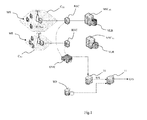
- the reference 1 indicates in an overall sense an example of an architecture able to implement the method for estimating the number of mobile stations MS within a geographic area A according to the invention.
- the geographic area A in question comprises a part of the region served by at least one Base Transceiver Station (BTS) able to transmit mobile radio signals in a portion of the geographic area A, called cell C, and able to transmit/receive radio signals to/from a plurality of mobile stations MS.
- BTS Base Transceiver Station
- a geographic area can comprise one or more Cells C.
- each BTS can transmit mobile radio signals in 2G (GSM, EDGE, etc), 3G (CDMA, UMTS, HSDPA, etc) and/or 4G (LTE, HSOPA, etc) wireless technology.
- GSM Global System for Mobile communications
- EDGE EDGE
- 3G CDMA, UMTS, HSDPA, etc
- 4G LTE, HSOPA, etc
- each BTS can be connected, respectively, to at least one Base Station Controller (BSC) or to at least one Radio Network Controller (RNC).
- BSC Base Station Controller
- RNC Radio Network Controller
- the method according to the invention must use at least one Operations and Maintenance Centre OMC.
- the Operations and Maintenance Centre OMC is able to measure and store, at every time interval T k , for each cell C, at least one of the following network operating parameters:
- the network operating parameters represent, in essence, the activities of each mobile station MS which take place within a determined geographic area A or a portion of a geographic area served by at least one Base Transceiver Station BTS in the time interval T k .
- At least one OMC can be connected to a Base Station Controller BSC and/or a Radio Network Controller RNC.
- the Operations and Maintenance Centre OMC is capable of storing and providing information regarding the mobile stations MS present at a determined instant in the geographic area A.
- Idle Mode indicates a condition in which a mobile station MS does not make/receive calls and does not generate SMSs.
- the number of mobile stations in Idle Mode N IMk,C can be determined by the sum of the number of Location Updates N LU,K generated and the number of Incoming Handovers to the cell C N IHO,k minus the sum of the number of Outgoing Handovers N OHO,k and the number of Cancel Locations generated N CL,k : N IMk , C ⁇ N LU , K + N IHO , k - N OHO , k - N CL , k .
- the method provides for processing, by means of, for example, first processing means 10, at least one of the network operating parameters (listed above) for the purposes of calculating the number of mobile stations MS present within a cell C during a time interval T k .
- the probability parameter ⁇ represents the probability that a user stays within a given cell
- N IMk,C the number of mobile stations MS in Idle Mode
- N IMk,C the number of mobile stations MS in Idle Mode
- ⁇ i , ⁇ ii , ⁇ i , ⁇ ii and ⁇ i are functions that determine, respectively, the total number of mobile stations MS which have originated calls in the time interval between T k-1 and T k as a function of the total number of calls N M-OC , the total number of mobile stations MS which have received calls in the time interval between T k-1 and T k as a function of the total number of calls N M-TC , the total number of mobile stations MS which have originated SMSs in the time interval between T k-1 and T k as a function of the total number of originated SMSs N SMS-MO , the total number of mobile stations MS which have received SMSs in the time interval between T k-1 and T k as a function of the number of terminated SMSs N SMS-MT and the total number of mobile stations MS which in the time interval between T k-1 and T k have remained in Idle Mode IM.
- the total number of originated calls N M-OC (the same applies for the total number of terminated calls N M-TC , the total number of originated SMSs N SMS-Mo , the total number of terminated SMSs N SMS-MT , the total number of Location Updates N LU , the total number of Incoming Handovers N IHO , and the total number of Outgoing Handovers N OHO ) exhibits an exponential type probability density.
- the values n, m, s and w are chosen so as to cover a preset percentage of activities associated with each mobile station MS.
- n, m, s or w it is possible to choose a value n, m, s or w between 0 and 50. In one version, it is possible to choose a value n, m, s or w between 1 and 40.
- the method according to the invention provides for the use of a software algorithm to calculate the number of mobile stations MS in a geographic area A.
- a software algorithm to calculate the number of mobile stations MS in a geographic area A.
- the method provides for calculating the number of mobile stations MS considering the average value ⁇ [p M-OC,i ( k )] of the probability that a user originates at least i calls in the time interval T k , the average value P[p M-TC,i ( k )] of the probability that a user receives at least i calls in the time interval T k , the average value ⁇ [p SMS-MO,i( k ) ] of the probability that a user originates at least i SMSs in the time interval T k , the average value ⁇ [p SMS-MT,i(k) ] of the probability that a user receives at least i SMSs in the time interval T k and the average value ⁇ [p 0 ( k )] of the probability that a user is in Idle Mode IM in the time interval T k .
- the average value ⁇ [p M-OC,i ( k )] of the probability that a user originates at least i calls in the time interval T k , within a geographic area A is calculated by means of the following relationship: E ⁇ p MOC , i k ⁇ T MOC T MS , where T MOC represents the number of distinct users who have made i calls and T MS represents the total quantity of mobile stations MS.
- the Operations and Maintenance Centre OMC stored the following network operating parameters:
- coefficients associated with the probability functions ⁇ i , ⁇ ii , ⁇ i , ⁇ ii and ⁇ 1 are determined on the basis of network usage statistics collected over a determined period of time.
- T MOC represents the number of distinct users who have made i calls in the geographic area of Milan at 12:00 hours of the first day of the twentieth week of 2010 and T MS represents the total quantity of mobile stations MS.
- the method according to the invention provides for graphically representing the distribution of the mobile stations MS on a geographic map.
- the method uses a mapping service WP containing the geographic coordinates indicating the area of coverage of each Base Transceiver Station BTS 2G installed in the region.
- WP Geographic Information System
- the method according to the invention provides for graphically representing the distribution of mobile stations MS in a geographic map by means of a Geographic Information System (GIS).
- GIS Geographic Information System
- the estimate of the number of mobile stations MS is based on the probability that determined activities in a telecommunications network occur, for example, on the probability that a call is made/received, that an SMS is sent, etc within a geographic area A of interest taken as reference.
- the method according to the invention provides for estimating the number of mobile stations MS within a geographic area A, which are served by at least one Base Transceiver Station BTS 3G able to transmit 3G technology radio signals.
- the Operations and Maintenance Centre OMC is not capable of measuring the same network operating parameters for the 2G service and the 3G service.
- the Operations and Maintenance Centre OMC is capable of storing the traffic intensity V k,C (in Erlangs) generated for each cell C 3G in a time interval T k .
- V k,C corresponds to the traffic intensity measured for the cell C 3G in a time interval T k and ⁇ [V k ] corresponds to the average statistical value of the traffic intensity.
- a mobile station MS served by a Base Transceiver Station BTS 3G able to transmit 3G technology radio signals substantially carries out the same activities as a mobile station MS served by a Base Transceiver Station BTS 2G able to transmit 2G technology radio signals, and so it is possible to link the network operating parameters related to the cells C 2G with the network operating parameters related to the cells C 3G which overlap one another in a given geographic area.
- the method according to the invention therefore provides for considering that a mobile station MS served by a Base Transceiver Station BTS 3G makes substantially the same number of originated calls N M-OC , terminated calls N M-TC , originated SMSs N SMS-MO , terminated SMSs N SMS-MT , Location Updates N LU , Incoming Handovers N IHO , and Outgoing Handovers N OHO as a mobile station MS served by a Base Transceiver Station BTS 2G
- C ⁇ 3 ⁇ G u ⁇ C 3 ⁇ G : ⁇ u ⁇ ⁇ ⁇ c ⁇ ⁇ 0 , c ⁇ C 2 ⁇ G
- C xG is the set of the cells C 2G and C 3G
- ⁇ is the geographic area covered by a cell.
- the method according to the invention provides for estimating the number of individuals within a geographic area A. Indeed, considering, for example, that in Italy the number of mobile stations MS is in the ratio 1 to 1 with the number of individuals of the population, the method of the present invention provides for determining the number of individuals P in a geographic area A in the time interval T k .
- the method according to present invention provides for meeting the requirements and overcoming the drawbacks referred to in the introductory part of the present description with reference to the prior art.
Landscapes
- Engineering & Computer Science (AREA)
- Computer Networks & Wireless Communication (AREA)
- Signal Processing (AREA)
- Mobile Radio Communication Systems (AREA)
Abstract
Description
- The present invention relates to a method for estimating the number of mobile stations within a geographic area according to the preamble of Claim 1.
- As is known, in a telecommunications network, Operations and Maintenance Centres (OMCs) are present which provide for monitoring some network operating parameters such as, for example, the total number of originated calls, the number of terminated calls, the number of originated SMSs and the number of terminated SMSs within an area served by a Base Transceiver Station (BTS). Such information is stored and can be used for statistical purposes regarding the use of the network over a determined period of time.
-
GB 2 392 348 -
WO 2006 079252 describes a simulation method for determining the presence of mobile stations within a geographic area and the corresponding number of mobile stations present at a given moment. In particular, the method provides for the checking of a parameter stored in the mobile station and the storing of this parameter in a base transceiver station simulator. The base transceiver station simulator provides for subsequently transmitting a signal to the mobile station as a function of the fixed parameter. The mobile station thus connects to the base transceiver station while the base transceiver station confirms the presence of the mobile station as a function of the received parameter. Thus, it is possible to monitor the connections between terminal and base transceiver station for the purposes of measuring the number of mobile stations registered in the network. - Although the solutions listed above provide for determining the number of mobile stations within a geographic area, they use intrusive systems which alter the regular operation of the mobile station, sometimes requiring the use of hardware additional to the mobile communications network.
- From the above-described, there emerges a need for making available a method for determining the number of mobile stations using a passive system, allowing the distribution of mobile stations in a geographic area to be estimated without the need for interacting directly with the mobile station.
- An object of the present invention is therefore to provide a method for estimating the number of mobile stations within a geographic area having characteristics so as to meet the abovementioned requirements and at the same time to address the drawbacks which have been mentioned with reference to the prior art.
- This object is achieved by a method for estimating the number of mobile stations within a geographic area according to Claim 1.
- According to a further aspect, the invention relates to a system for estimating the number of mobile stations within a geographic area according to Claim 8.
- Other features and advantages of the method and system for estimating the number of mobile stations according to the present invention will emerge from the description cited below of its preferred example embodiments, given by way of indication and in a non-limiting manner, with reference to the appended drawings, in which:
-
Figure 1 represents an example of an architecture able to implement the method for estimating the number of mobile stations MS within a geographic area A according to the invention. - With reference to the appended drawings, the reference 1 indicates in an overall sense an example of an architecture able to implement the method for estimating the number of mobile stations MS within a geographic area A according to the invention.
- The geographic area A in question comprises a part of the region served by at least one Base Transceiver Station (BTS) able to transmit mobile radio signals in a portion of the geographic area A, called cell C, and able to transmit/receive radio signals to/from a plurality of mobile stations MS. For example, a geographic area can comprise one or more Cells C.
- It is worth noting that each BTS can transmit mobile radio signals in 2G (GSM, EDGE, etc), 3G (CDMA, UMTS, HSDPA, etc) and/or 4G (LTE, HSOPA, etc) wireless technology.
- As illustrated in the example of
Figure 1 , depending on the 2G or 3G technology telecommunications service provided, each BTS can be connected, respectively, to at least one Base Station Controller (BSC) or to at least one Radio Network Controller (RNC). - Hereafter in the present description, the following components will be used:
- Base Station Controller (BSC): component to control each BTS which transmits mobile radio signals in 2G wireless technology (in particular GSM).
- Radio Network Controller (RNC): component to control each BTS which transmits mobile radio signals in 3G wireless technology (in particular UMTS).
- Mobile Switching Centre (MSC): primary node responsible for all call-related, SMS-related and/or data-related services on mobile stations MS in a telecommunications network,
- Home Location Register (HLR): central database containing all the registration information of each mobile station MS. In particular, each HLR unambiguously stores each SIM card associated with the corresponding mobile stations MS registered and authorised to use the various services provided by the telecommunications network operator,
- Cell Identifier (CI): identification number of a Cell,
- Location Area Identifier (LAI): identification number of a Location Area LA distributed in a geographic area A,
- Cell Global Identifier (CGI) which forms the unambiguous identification of a cell within the entire mobile radio network and is given by the concatenation of the Location Area Identifier LAI and the Cell Identifier CI,
- Location Update (LU): process by which a mobile station MS provides its own position within the mobile radio network; the Location Update LU can be determined also when a mobile station MS switches off or on, or following a Handover,
- Periodic Location Update (PLU): process by which a mobile station MS provides at Location Update intervals TLU (generally every two hours) its own position within the mobile radio network,
- Handover (HO): condition of movement of a mobile station MS during a call from one cell C to an adjacent cell. In particular, Incoming Handover (IHO) is defined as a condition of movement of a mobile station MS to a cell C, while Outgoing Handover (OHO) is defined as a condition of movement of a mobile station MS from a cell C;
- Visitor Location Register (VLR): database which stores the information of all the mobile stations MS which at a given moment are connected to the Mobile Switching Centre that serves them,
- Network Troubleshooting Tool (NTT): component for taking and monitoring data from the telecommunications network,
- Cancel Location (CL): procedure which allows the profile of a mobile station MS to be updated in a Visitor Location Register VLR following a Location Update LU.
- For the purposes of being able to estimate the number of mobile stations MS within a geographic area A, or within a portion of a geographic area such as for example a Cell C, served by a 2G technology telecommunications service, the method according to the invention must use at least one Operations and Maintenance Centre OMC. The Operations and Maintenance Centre OMC is able to measure and store, at every time interval Tk, for each cell C, at least one of the following network operating parameters:
- the total number of originated calls NM-OC,
- the total number of terminated calls NM-OC,
- the total number of originated SMSs NSMS-MO,
- the total number of terminated SMSs NSMS-MT,
- the total number of Location Updates NLU,
- the total number of Incoming Handovers NIHO,
- the total number of Outgoing Handovers NOHO.
- It is worth noting that the network operating parameters represent, in essence, the activities of each mobile station MS which take place within a determined geographic area A or a portion of a geographic area served by at least one Base Transceiver Station BTS in the time interval Tk.
- As illustrated in the example of
Figure 1 , at least one OMC can be connected to a Base Station Controller BSC and/or a Radio Network Controller RNC. Thus, the Operations and Maintenance Centre OMC is capable of storing and providing information regarding the mobile stations MS present at a determined instant in the geographic area A. - To this end, hereafter in the present description, the term Idle Mode (IM) indicates a condition in which a mobile station MS does not make/receive calls and does not generate SMSs. In particular, for each cell C, at every time interval Tk, the number of mobile stations in Idle Mode NIMk,C can be determined by the sum of the number of Location Updates NLU,K generated and the number of Incoming Handovers to the cell C NIHO,k minus the sum of the number of Outgoing Handovers NOHO,k and the number of Cancel Locations generated NCL,k:

- According to a first embodiment, the method provides for processing, by means of, for example, first processing means 10, at least one of the network operating parameters (listed above) for the purposes of calculating the number of mobile stations MS present within a cell C during a time interval Tk.
- In one version, provision is made for introducing a probability parameter σ proportional to the amount of users in Idle Mode IM present within a cell C. The probability parameter σ represents the probability that a user stays within a given cell
- C, for example for a time interval Tk greater than or equal to 1 hour. The probability parameter σ can be determined by means of the following relationship:


- Considering the network operating parameters and the assumptions listed above, it is to be noted that the number of mobile stations MSk,C to be estimated turns out to be a function of the total number of originated calls NM-OC, the number of terminated calls NM-TC, the total number of originated SMSs NSMS-MO, the total number of terminated SMSs NSMS-MT and the total number of mobile stations MS in Idle Mode NIM:

- By considering the functions relating to each network parameter to be independent, it is possible to express [3] as a linear combination of functions:

- It is to be noted that using for example a Bayesian approach, the network operating parameters NM-OC, NM-TC, NSMS-MO, NSMS-MT and NIM can be obtained from the probability distribution a posteriori. For example, assuming that the activities of each mobile station MS are cyclic in a particular day of the week in a time interval Tk = 1 hour, it is possible to evaluate all the average values E[] for every hour and for every day of the week. Therefore, [4] can be approximated by calculating the number of mobile stations are MS as follows:

- The value corresponding to each upper limit n, m, s and w of the summations associated with formula [5] can be considered to be a function of the probabilities of the associated network operating parameters. This entails introducing an appropriate approximation in formula [5] which provides its practical resolution.
- Since the abovementioned network operating parameters can be modelled, for example, by Poisson processes, the total number of originated calls NM-OC (the same applies for the total number of terminated calls NM-TC, the total number of originated SMSs NSMS-Mo, the total number of terminated SMSs NSMS-MT, the total number of Location Updates NLU, the total number of Incoming Handovers NIHO, and the total number of Outgoing Handovers NOHO) exhibits an exponential type probability density.
- Consequently, it is possible to choose the values n, m, s and w so as to cover a preset percentage of activities associated with each mobile station MS.
- In one version, the values n, m, s and w are chosen so as to cover a preset percentage of activities associated with each mobile station MS.
- For example, it has been confirmed that the probability that each mobile station MS, in a time interval Tk= 1 hour, has originated a number of calls between 1 and 40 is 95%. Therefore, it is possible to set a value of n, m, s and w, corresponding for example to 40, in order to check that 90% and 95% of the originated/terminated activities of each user terminal is confirmed.
- In one version, it is possible to choose a value n, m, s or w between 0 and 50. In one version, it is possible to choose a value n, m, s or w between 1 and 40.
- It is to be noted that the use of mobile telephony services can vary during the day. It is therefore necessary to consider that the probability function of each network operating parameter depends on the time interval Tk.
- In one version, the method according to the invention provides for the use of a software algorithm to calculate the number of mobile stations MS in a geographic area A. To this end, as anticipated above, assuming that the quantity of network operating parameters generated can have a periodic pattern, in order to implement formula [5] it is possible to consider the average value E[] as a substitute for the probability in the time interval Tk.
- Considering the above, the method provides for calculating the number of mobile stations MS considering the average value Ė[pM-OC,i(k)] of the probability that a user originates at least i calls in the time interval Tk, the average value P[pM-TC,i(k)] of the probability that a user receives at least i calls in the time interval Tk, the average value Ė[pSMS-MO,i(k)] of the probability that a user originates at least i SMSs in the time interval Tk, the average value Ė[pSMS-MT,i(k)] of the probability that a user receives at least i SMSs in the time interval Tk and the average value Ė[p0(k)] of the probability that a user is in Idle Mode IM in the time interval Tk. Therefore formula [6] can be rewritten as follows:

- It is worth noting that the average value Ė[pM-OC,i(k)] of the probability that a user originates at least i calls in the time interval Tk, within a geographic area A, is calculated by means of the following relationship:

- Similarly, to calculate the remaining average values associated with relationship [6], the following relationships apply:



- In a test carried out on the first day of the twentieth week of the year 2010 in the geographic area of Milan on cell number C-10 served by Base Transceiver Station BTS-10 present in the geographic area of Milan in the time interval Tk between the hours 12:00 and 13:00, the Operations and Maintenance Centre OMC stored the following network operating parameters:
- total number of originated calls NM-OC = 68,
- number of terminated calls NM-TC= 47,
- total number of originated SMSs NSMS-MO =18,
- total number of terminated SMSs NSMS-MT= 22,
- number of Location Updates NLU=161,
- number of Incoming Handovers NIHO = 139,
- number of Outgoing Handovers NOHO = 121,
- number of Cancel Locations NCL = 0,
- number of users in Idle Mode NIM in the time interval Tk-1 between the hours 11:00 and 12:00 = 30,
while the Network Troubleshooting Tool recorded the following values: - total number of mobile stations THO-MOC, within the geographic area of Milan, moving during a call from cell number C-10 to adjacent cell number C-11 = 680,
- total number of mobile stations TMOC within the geographic area of Milan = 1704.
- By applying formula [1], the number of user terminals in Idle Mode NIM present in cell number C-10 served by Base Transceiver Station BTS-10 in the geographic area of Milan turned out to be equal to:

- Considering the average value E[] of the ratio between THO-MOC and TMOC, by applying relationship [1.1], the probability parameter σ turned out to be equal to:

- Therefore, by applying relationship [2], the number of user terminals MS in Idle Mode NIM turned out overall to be equal to:

- By substituting the network operating parameters determined from the test into [6], the following result is obtained:

- The number of mobile stations MS present in cell number C-10 and served by Base Transceiver Station BTS-10 installed in the geographic area of Milan in one hour turned out to be 282.
- It is worth noting that the coefficients associated with the probability functions σi, αii, βi, βii and γ1 are determined on the basis of network usage statistics collected over a determined period of time.
- For example, in the test described above, by applying relationship [6.1], the average value Ė[pM-OC,i(k)] of the probability that a user has originated 68 calls in the time interval Tk between the hours 12:00 and 13:00 turned out to be equal to:

- Similarly, by applying relationships [6.2], [6.3] and [6.4], the following probabilities resulted:


- In one version, the method according to the invention provides for graphically representing the distribution of the mobile stations MS on a geographic map.
- To this end, the method uses a mapping service WP containing the geographic coordinates indicating the area of coverage of each Base Transceiver Station BTS2G installed in the region. By processing, by means, for example, of second processing means 11, the values of the geographic coordinates with the values obtained by means of formula [6], the method according to the invention provides for graphically representing the distribution of mobile stations MS in a geographic map by means of a Geographic Information System (GIS). Thus, it is possible to use the results of the distribution of mobile stations MS for security, emergency, geomarketing, planning, etc services.
- It is worth noting that the estimate of the number of mobile stations MS is based on the probability that determined activities in a telecommunications network occur, for example, on the probability that a call is made/received, that an SMS is sent, etc within a geographic area A of interest taken as reference.
- According to a second embodiment, the method according to the invention provides for estimating the number of mobile stations MS within a geographic area A, which are served by at least one Base Transceiver Station BTS3G able to transmit 3G technology radio signals.
- Due to the different network architecture, it is to be noted that the Operations and Maintenance Centre OMC is not capable of measuring the same network operating parameters for the 2G service and the 3G service. In particular, for the 3G service, the Operations and Maintenance Centre OMC is capable of storing the traffic intensity Vk,C (in Erlangs) generated for each cell C3G in a time interval Tk.
- By using the available traffic intensity value Vk,C and the average traffic intensity value Ė[Vk], it is possible to estimate the number of mobile stations MS as follows:

- According to the present invention, it is assumed that a mobile station MS served by a Base Transceiver Station BTS3G able to transmit 3G technology radio signals substantially carries out the same activities as a mobile station MS served by a Base Transceiver Station BTS2G able to transmit 2G technology radio signals, and so it is possible to link the network operating parameters related to the cells C2G with the network operating parameters related to the cells C3G which overlap one another in a given geographic area. Considering this, provision is made for considering a cell C3G, the area of which intersects that of a cell C2G.
- In the area of intersection between a cell C3G and a cell C2G, the method according to the invention therefore provides for considering that a mobile station MS served by a Base Transceiver Station BTS3G makes substantially the same number of originated calls NM-OC, terminated calls NM-TC, originated SMSs NSMS-MO, terminated SMSs NSMS-MT, Location Updates NLU, Incoming Handovers NIHO, and Outgoing Handovers NOHO as a mobile station MS served by a Base Transceiver Station BTS2G
- Considering the above-described assumptions, the set of all the cells C3G which intersect the cells C2G is defined by the following relationship:

- In particular, considering the set of all the cells C3G which intersect the cells C2G, it is possible to calculate the number of mobile stations MS thus:

- λij,k is defined as the weight which depends on the i-th cell C2G and can be calculated as follows:

- By substituting [10] into [9], the number of mobile stations MS in a geographic area A which are served by a cell C3G can therefore be determined in the following way:

- In one version, the method according to the invention provides for estimating the number of individuals within a geographic area A. Indeed, considering, for example, that in Italy the number of mobile stations MS is in the ratio 1 to 1 with the number of individuals of the population, the method of the present invention provides for determining the number of individuals P in a geographic area A in the time interval Tk.
- It is therefore possible to estimate the number of individuals who are located within the cell Ci in the time interval Tk by means of following relationship:

- As can be appreciated from that described, the method according to present invention provides for meeting the requirements and overcoming the drawbacks referred to in the introductory part of the present description with reference to the prior art.
- Clearly, a technician skilled in the art, with the aim of meeting the contingent and specific requirements, may bring about numerous modifications and variations to the method according to the present invention described above, all of which however falling within the scope of protection of the invention, which scope is defined by the following claims.
Claims (10)
- A method for estimating the number of mobile stations (MS) in a geographic area (A), comprising the stages of:- receiving at least one network operating parameter (NM-OC, NM-TC, NSMS-MO, NSMS-MT, NLU, NIHO, NOHO) generated by each mobile station (MS) served in a time interval (Tk) by at least one 2G Base Transceiver Station (BTS2G) able to transmit/receive 2G technology radio signals in a 2G cell (C2G) of the geographic area (A),- processing the network operating parameters generated by each mobile station in order to estimate the number of mobile stations (MS) served in the time interval (Tk) by the at least one 2G Base Transceiver Station (BTS2G),
in which the stage of processing the network operating parameters (NM-OC, NM-TC, NSMS-MO, NSMS-MT, NLU, NIHO, NOHO) comprises the stages of:- setting a value of probability that each mobile station (MS) generates the at least one network operating parameter (NM-OC, NM-TC, NSMS-MO, NSMS-MT, NLU, NIHO, NOHO), and- multiplying each generated network operating parameter (NM-OC, NM-TC, NSMS-MO, NSMS-MT, NLU, NIHO, NOHO) by the corresponding probability value for the purposes of determining the quantity of mobile stations (MS) present in the geographic area (A) in the time interval (Tk). - A method according to Claim 1, in which the stage of receiving at least one network operating parameter comprises the stage of storing for each 2G Base Transceiver Station (BTS2G) at least one of the following network operating parameters:the total number of originated calls (NM-OC), the total number of terminated calls (NM- TC), the total number of originated SMSs (NSMS-MO), the total number of terminated SMSs (NSMS-MT), the total number of Location Updates (NLU), the total number of Incoming Handovers (NIHO), and the total number of Outgoing Handovers (NOHO).
- A method according to Claim 2, comprising the stage of calculating the number of mobile stations (MS) in Idle Mode (IM) by means of the following relationship:

where NIMk,C represents the number of mobile stations in Idle Mode, σ represents the probability parameter proportional to the amount of users in Idle Mode (IM), NLU,k represents the number of Location Updates generated, NIHO,k represents the number of Incoming Handovers, NOHO,k represents the number of Outgoing Handovers and NCL,K represents the number of Cancel Locations. - A method according to any one of Claims 1 to 3, in which the stage of processing the at least one network operating parameter (NM-OC, NM-TC, NSMS-MO, NSMS-MT, NLU, NIHO, NOHO) is carried out by means of the following relationship:

where pM-OC,i(k) is the probability that a user originates at least i calls in the time interval (Tk), pM-TC,i(k) is the probability that a user receives at least i calls in the time interval (Tk), pSMS-MO,i(k) is the probability that a user originates at least i SMSs in the time interval (Tk), pSMS-MT,i(k) is the probability that a user receives at least i SMSs in the time interval (Tk) and p0(k) is the probability that a user is in Idle Mode (IM) in the time interval (Tk). - A method according to Claim 4, comprising the stage of processing the at least one network operating parameter (NM-OC, NM-TC, NSMS-MO, NSMS-MT, NLU, NIHO, NOHO) by means of the following relationship:

where Ė[pM-OC,i(k)] corresponds to the average value of the probability that a user originates at least i calls in the time interval (Tk), Ė[pM-TC,i(k)] corresponds to the average value of the probability that a user receives at least i calls in the time interval (Tk), Ė[pSMS-MO,i(k)] corresponds to the average value of the probability that a user originates at least i SMSs in the time interval (Tk), Ė[pSMS-MT,i(k)] corresponds to the average value of the probability that a user receives at least i SMSs in the time interval (Tk) and Ė[p0(k)] corresponds to the average value of the probability that a user is in Idle Mode (IM) in the time interval (Tk). - A method according to Claim 5, comprising the stages of:- using a mapping service (WP) containing the geographic coordinates of the 2G cell (C2G) served by each 2G Base Transceiver Station (BTS2G),- processing the values of the geographic coordinates of the 2G cell (C2G) served by each 2G Base Transceiver Station (BTS2G) with the Location Update (LU) values associated with the mobile stations (MS) for the purposes of graphically representing the distribution of the mobile stations (MS) in a geographic map.
- A method according to any one of Claims 1 to 5, comprising the stages of:- receiving at least one traffic intensity value (Vk,C) generated by each mobile station (MS) served in the time interval (Tk) by at least one 3G Base Transceiver Station (BTS3G) able to transmit/receive 3G radio signals in a second portion (3G cell) of the geographic area (A),- calculating the average value (Ė(Vk,C)) of the traffic intensity (Vk,c),- dividing the value of the traffic intensity (Vk,c) by the average value (Ė(Vk,C)) of the traffic intensity (Vk,C) for the purposes of calculating the number of mobile stations (MS) served by the 3G Base Transceiver Station (BTS3G) in the time interval (Tk).
- A system for estimating the number of mobile stations (MS) in a geographic area (A), comprising:- at least one 2G Base Transceiver Station (BTS2G) able to transmit/receive 2G technology radio signals in a 2G cell (C2G) of the geographic area (A) to a plurality of mobile stations (MS),- a Base Station Controller (BSC) intended to control the at least one 2G Base Transceiver Station (BTS2G),- an Operations and Maintenance Centre (OMC) connected to the Base Station Controller (BSC) and able to store, at every time interval (Tk), for each 2G cell (C2G), at least one network operating parameter (NM-OC, NM-TC, NSMS-MO, NSMS-MT, NLU, NIHO, NOHO) generated by each mobile station (MS) served in the time interval (Tk) by at least the 2G Base Transceiver Station (BTS2G),- processing means (10) connected to the Operations and Maintenance Centre (OMC) in order to process the at least one network operating parameter (NM-OC, NM-TC, NSMS-MO, NSMS-MT, NLU, NIHO, NOHO) for the purposes of estimating the number of mobile stations (MS) served in the time interval (Tk) by the at least one 2G Base Transceiver Station (BTS2G),
characterised in that the processing means (10) are able to set the value of probability that each mobile station (MS) generates the at least one network operating parameter (NM-OC, NM-TC, NSMS-MO, NSMS-MT, NLU, NIHO, NOHO) and are able to multiply the at least one generated network operating parameter (NM-OC, NM-TC, NSMS-MO, NSMS-MT, NLU, NIHO, NOHO) by the corresponding value of probability that each mobile station (MS) generates the at least one network operating parameter (NM-OC, NM-TC, NSMS-MO, NSMS-MT, NLU, NIHO, NOHO) for the purposes of determining the quantity of mobile stations (MS) present in the geographic area (A) in the time interval (Tk). - A system according to Claim 8, in which the processing means are able to determine the quantity of mobile stations (MS) by processing the following relationship:
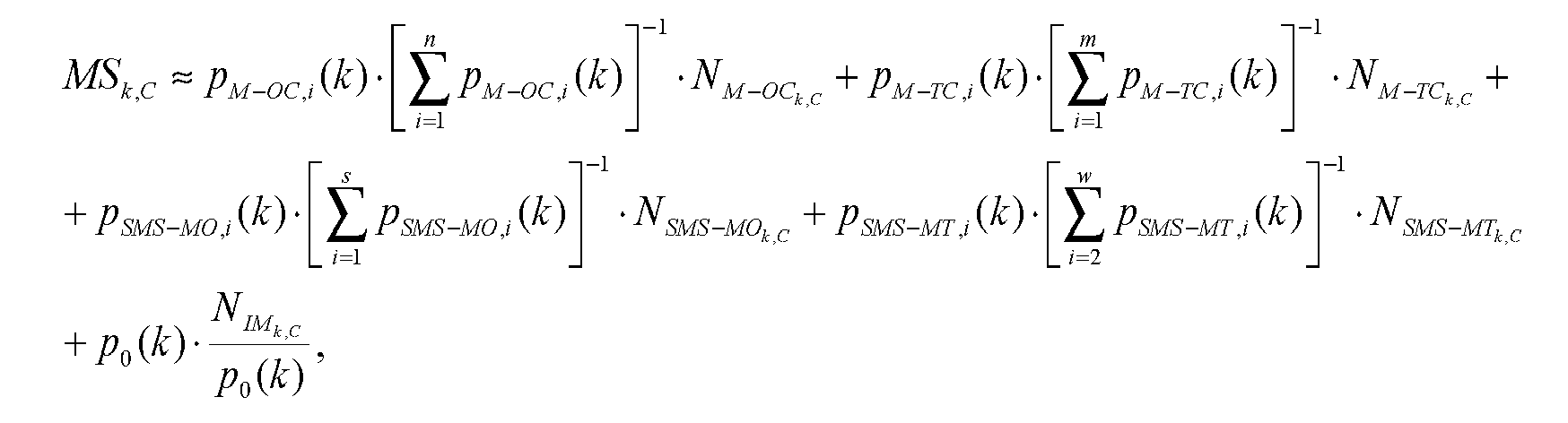
where pM-OC,i(k) is the probability that a user originates at least i calls in the time interval (Tk), pM-TC,i(k) is the probability that a user receives at least i calls in the time interval (Tk), pSMS-MO,i(k) is the probability that a user originates at least i SMSs in the time interval (Tk), pSMS-MT,i(k) is the probability that a user receives at least i SMSs in the time interval (Tk) and p0(k) is the probability that a user is in Idle Mode (IM) in the time interval (Tk). - A system according to either Claim 8 or Claim 9, comprising:- a mapping service (WP) containing the geographic coordinates indicating the area of coverage of each 2G Base Transceiver Station (BTS2G) installed in the region,- second processing means (11) able to process the values of the geographic coordinates of the 2G cell (C2G) served by each 2G Base Transceiver Station (BTS2G) with at least one Location Update (LU) value associated with the mobile station (MS) for the purposes of graphically representing the distribution of the mobile stations (MS) in a geographic map.
Applications Claiming Priority (1)
| Application Number | Priority Date | Filing Date | Title |
|---|---|---|---|
| ITMI2010A002025A IT1402750B1 (en) | 2010-10-29 | 2010-10-29 | METHOD AND SYSTEM TO ESTIMATE THE NUMBER OF MOBILE TERMINALS INSIDE A GEOGRAPHICAL AREA. |
Publications (2)
| Publication Number | Publication Date |
|---|---|
| EP2448315A1 true EP2448315A1 (en) | 2012-05-02 |
| EP2448315B1 EP2448315B1 (en) | 2014-06-25 |
Family
ID=43738142
Family Applications (1)
| Application Number | Title | Priority Date | Filing Date |
|---|---|---|---|
| EP11186616.6A Not-in-force EP2448315B1 (en) | 2010-10-29 | 2011-10-26 | Estimating the number of mobile stations in a geographical area |
Country Status (3)
| Country | Link |
|---|---|
| EP (1) | EP2448315B1 (en) |
| ES (1) | ES2496415T3 (en) |
| IT (1) | IT1402750B1 (en) |
Cited By (1)
| Publication number | Priority date | Publication date | Assignee | Title |
|---|---|---|---|---|
| EP2663117A3 (en) * | 2012-05-07 | 2015-07-01 | Deutsche Telekom AG | Method for determining the number and/or capabilities of user equipments in a geographic area of an access network and corresponding user equipment, base station and computer program product |
Citations (5)
| Publication number | Priority date | Publication date | Assignee | Title |
|---|---|---|---|---|
| EP1377094A1 (en) * | 2002-06-20 | 2004-01-02 | Electronics and Telecommunications Research Institute | System for estimating traffic rate of calls in wireless personal communication environment and method for the same |
| GB2392348A (en) | 2002-08-21 | 2004-02-25 | Vodafone Ltd | Estimating number of mobile terminals in a region to determine suitable means for downlinking |
| WO2005079101A1 (en) * | 2004-02-11 | 2005-08-25 | Telefonaktiebolaget Lm Ericsson (Publ) | Mobility handling |
| WO2006079252A1 (en) | 2005-01-31 | 2006-08-03 | Beijing Zhi Cheng Tian Ze Network Technology Co., Ltd. | Method of confirming the present of mobile user terminal and accounting the number of the present terminals by using base station simulator |
| WO2010090570A1 (en) * | 2009-02-03 | 2010-08-12 | Telefonaktiebolaget L M Ericsson (Publ) | Method and apparatus for measurement of active user devices per quality-of-service class inducator |
-
2010
- 2010-10-29 IT ITMI2010A002025A patent/IT1402750B1/en active
-
2011
- 2011-10-26 EP EP11186616.6A patent/EP2448315B1/en not_active Not-in-force
- 2011-10-26 ES ES11186616.6T patent/ES2496415T3/en active Active
Patent Citations (5)
| Publication number | Priority date | Publication date | Assignee | Title |
|---|---|---|---|---|
| EP1377094A1 (en) * | 2002-06-20 | 2004-01-02 | Electronics and Telecommunications Research Institute | System for estimating traffic rate of calls in wireless personal communication environment and method for the same |
| GB2392348A (en) | 2002-08-21 | 2004-02-25 | Vodafone Ltd | Estimating number of mobile terminals in a region to determine suitable means for downlinking |
| WO2005079101A1 (en) * | 2004-02-11 | 2005-08-25 | Telefonaktiebolaget Lm Ericsson (Publ) | Mobility handling |
| WO2006079252A1 (en) | 2005-01-31 | 2006-08-03 | Beijing Zhi Cheng Tian Ze Network Technology Co., Ltd. | Method of confirming the present of mobile user terminal and accounting the number of the present terminals by using base station simulator |
| WO2010090570A1 (en) * | 2009-02-03 | 2010-08-12 | Telefonaktiebolaget L M Ericsson (Publ) | Method and apparatus for measurement of active user devices per quality-of-service class inducator |
Cited By (1)
| Publication number | Priority date | Publication date | Assignee | Title |
|---|---|---|---|---|
| EP2663117A3 (en) * | 2012-05-07 | 2015-07-01 | Deutsche Telekom AG | Method for determining the number and/or capabilities of user equipments in a geographic area of an access network and corresponding user equipment, base station and computer program product |
Also Published As
| Publication number | Publication date |
|---|---|
| EP2448315B1 (en) | 2014-06-25 |
| ES2496415T3 (en) | 2014-09-19 |
| IT1402750B1 (en) | 2013-09-18 |
| ITMI20102025A1 (en) | 2012-04-30 |
Similar Documents
| Publication | Publication Date | Title |
|---|---|---|
| US6208866B1 (en) | System and method for location-based marketing to mobile stations within a cellular network | |
| US8682335B2 (en) | System and method for constructing a carrier to interference matrix based on subscriber calls | |
| US6603976B1 (en) | Architecture for TOA positioning with LMU control functionality in BSC | |
| US20040203717A1 (en) | Method, system and radio network management functionality for radio data mapping to physical location in a cellular telecommunications network | |
| US8526961B2 (en) | Method and apparatus for mapping operating parameter in coverage area of wireless network | |
| US20030087647A1 (en) | Methods and apparatus for providing data for enabling location of a mobile communications device | |
| EP2517495B1 (en) | Method and system for automatic coverage assessment for cooperating wireless access networks | |
| US20100048224A1 (en) | Method for network identification acquisition by regular users for supporting automated planning and optimization processes in cellular mobile radio networks | |
| EP2005404B1 (en) | Method and system for measuring traffic information in cdma network | |
| US7885664B2 (en) | Method for generating triggers based on the position of a terminal in a mobile communication network, related network and computer program product therefor | |
| EP2168391B1 (en) | Method and arrangement for positioning in a mobile telecommunication network | |
| EP1859293B1 (en) | Enhanced mobile location method and system | |
| EP2770772A1 (en) | Cell failure compensation method and network node | |
| EP2154546A2 (en) | determining the position of a mobile station | |
| EP2448315B1 (en) | Estimating the number of mobile stations in a geographical area | |
| EP2134111B1 (en) | System and method for reconfiguring a cellular network | |
| Vieira et al. | A SON enhanced algorithm for observed time differences based geolocation in real 3G networks | |
| KR100779376B1 (en) | Traffic information measuring method and system using asynchronous BCDMA network | |
| Samuel et al. | Location-based performance-measuring techniques in UMTS | |
| US20070111729A1 (en) | Network support for mobility system capacity planning using real-time snapshot across networked mobile switching centers for roaming mobile terminals | |
| KR20180046759A (en) | Method for providing voice disconnect call location and radio quality by in-building site, and communication quality analysis system | |
| EP2003466B1 (en) | Mobile phone localization method | |
| KR20040058429A (en) | Device and Method Estimating Shadow Area in Mobile Communication System | |
| EP1937020A2 (en) | Device for sending/receiving and method for emergency communication in a mobile radio network | |
| EP1937019A2 (en) | Device for sending/receiving and method for emergency communication in a mobile radio network |
Legal Events
| Date | Code | Title | Description |
|---|---|---|---|
| PUAI | Public reference made under article 153(3) epc to a published international application that has entered the european phase |
Free format text: ORIGINAL CODE: 0009012 |
|
| AK | Designated contracting states |
Kind code of ref document: A1 Designated state(s): AL AT BE BG CH CY CZ DE DK EE ES FI FR GB GR HR HU IE IS IT LI LT LU LV MC MK MT NL NO PL PT RO RS SE SI SK SM TR |
|
| AX | Request for extension of the european patent |
Extension state: BA ME |
|
| 17P | Request for examination filed |
Effective date: 20121031 |
|
| GRAP | Despatch of communication of intention to grant a patent |
Free format text: ORIGINAL CODE: EPIDOSNIGR1 |
|
| RIC1 | Information provided on ipc code assigned before grant |
Ipc: H04W 64/00 20090101ALN20140129BHEP Ipc: H04L 29/08 20060101ALI20140129BHEP Ipc: H04W 4/02 20090101ALN20140129BHEP Ipc: H04W 24/08 20090101AFI20140129BHEP Ipc: H04W 68/00 20090101ALN20140129BHEP |
|
| INTG | Intention to grant announced |
Effective date: 20140226 |
|
| GRAS | Grant fee paid |
Free format text: ORIGINAL CODE: EPIDOSNIGR3 |
|
| GRAA | (expected) grant |
Free format text: ORIGINAL CODE: 0009210 |
|
| AK | Designated contracting states |
Kind code of ref document: B1 Designated state(s): AL AT BE BG CH CY CZ DE DK EE ES FI FR GB GR HR HU IE IS IT LI LT LU LV MC MK MT NL NO PL PT RO RS SE SI SK SM TR |
|
| REG | Reference to a national code |
Ref country code: GB Ref legal event code: FG4D |
|
| REG | Reference to a national code |
Ref country code: CH Ref legal event code: EP |
|
| REG | Reference to a national code |
Ref country code: AT Ref legal event code: REF Ref document number: 675325 Country of ref document: AT Kind code of ref document: T Effective date: 20140715 |
|
| REG | Reference to a national code |
Ref country code: IE Ref legal event code: FG4D |
|
| REG | Reference to a national code |
Ref country code: DE Ref legal event code: R096 Ref document number: 602011007896 Country of ref document: DE Effective date: 20140807 |
|
| REG | Reference to a national code |
Ref country code: ES Ref legal event code: FG2A Ref document number: 2496415 Country of ref document: ES Kind code of ref document: T3 Effective date: 20140919 |
|
| PG25 | Lapsed in a contracting state [announced via postgrant information from national office to epo] |
Ref country code: LT Free format text: LAPSE BECAUSE OF FAILURE TO SUBMIT A TRANSLATION OF THE DESCRIPTION OR TO PAY THE FEE WITHIN THE PRESCRIBED TIME-LIMIT Effective date: 20140625 Ref country code: CY Free format text: LAPSE BECAUSE OF FAILURE TO SUBMIT A TRANSLATION OF THE DESCRIPTION OR TO PAY THE FEE WITHIN THE PRESCRIBED TIME-LIMIT Effective date: 20140625 Ref country code: FI Free format text: LAPSE BECAUSE OF FAILURE TO SUBMIT A TRANSLATION OF THE DESCRIPTION OR TO PAY THE FEE WITHIN THE PRESCRIBED TIME-LIMIT Effective date: 20140625 Ref country code: NO Free format text: LAPSE BECAUSE OF FAILURE TO SUBMIT A TRANSLATION OF THE DESCRIPTION OR TO PAY THE FEE WITHIN THE PRESCRIBED TIME-LIMIT Effective date: 20140925 Ref country code: GR Free format text: LAPSE BECAUSE OF FAILURE TO SUBMIT A TRANSLATION OF THE DESCRIPTION OR TO PAY THE FEE WITHIN THE PRESCRIBED TIME-LIMIT Effective date: 20140926 |
|
| REG | Reference to a national code |
Ref country code: AT Ref legal event code: MK05 Ref document number: 675325 Country of ref document: AT Kind code of ref document: T Effective date: 20140625 |
|
| REG | Reference to a national code |
Ref country code: NL Ref legal event code: VDEP Effective date: 20140625 |
|
| REG | Reference to a national code |
Ref country code: LT Ref legal event code: MG4D |
|
| PG25 | Lapsed in a contracting state [announced via postgrant information from national office to epo] |
Ref country code: HR Free format text: LAPSE BECAUSE OF FAILURE TO SUBMIT A TRANSLATION OF THE DESCRIPTION OR TO PAY THE FEE WITHIN THE PRESCRIBED TIME-LIMIT Effective date: 20140625 Ref country code: RS Free format text: LAPSE BECAUSE OF FAILURE TO SUBMIT A TRANSLATION OF THE DESCRIPTION OR TO PAY THE FEE WITHIN THE PRESCRIBED TIME-LIMIT Effective date: 20140625 Ref country code: SE Free format text: LAPSE BECAUSE OF FAILURE TO SUBMIT A TRANSLATION OF THE DESCRIPTION OR TO PAY THE FEE WITHIN THE PRESCRIBED TIME-LIMIT Effective date: 20140625 Ref country code: LV Free format text: LAPSE BECAUSE OF FAILURE TO SUBMIT A TRANSLATION OF THE DESCRIPTION OR TO PAY THE FEE WITHIN THE PRESCRIBED TIME-LIMIT Effective date: 20140625 |
|
| PG25 | Lapsed in a contracting state [announced via postgrant information from national office to epo] |
Ref country code: SK Free format text: LAPSE BECAUSE OF FAILURE TO SUBMIT A TRANSLATION OF THE DESCRIPTION OR TO PAY THE FEE WITHIN THE PRESCRIBED TIME-LIMIT Effective date: 20140625 Ref country code: EE Free format text: LAPSE BECAUSE OF FAILURE TO SUBMIT A TRANSLATION OF THE DESCRIPTION OR TO PAY THE FEE WITHIN THE PRESCRIBED TIME-LIMIT Effective date: 20140625 Ref country code: RO Free format text: LAPSE BECAUSE OF FAILURE TO SUBMIT A TRANSLATION OF THE DESCRIPTION OR TO PAY THE FEE WITHIN THE PRESCRIBED TIME-LIMIT Effective date: 20140625 Ref country code: CZ Free format text: LAPSE BECAUSE OF FAILURE TO SUBMIT A TRANSLATION OF THE DESCRIPTION OR TO PAY THE FEE WITHIN THE PRESCRIBED TIME-LIMIT Effective date: 20140625 Ref country code: PT Free format text: LAPSE BECAUSE OF FAILURE TO SUBMIT A TRANSLATION OF THE DESCRIPTION OR TO PAY THE FEE WITHIN THE PRESCRIBED TIME-LIMIT Effective date: 20141027 |
|
| PG25 | Lapsed in a contracting state [announced via postgrant information from national office to epo] |
Ref country code: IS Free format text: LAPSE BECAUSE OF FAILURE TO SUBMIT A TRANSLATION OF THE DESCRIPTION OR TO PAY THE FEE WITHIN THE PRESCRIBED TIME-LIMIT Effective date: 20141025 Ref country code: PL Free format text: LAPSE BECAUSE OF FAILURE TO SUBMIT A TRANSLATION OF THE DESCRIPTION OR TO PAY THE FEE WITHIN THE PRESCRIBED TIME-LIMIT Effective date: 20140625 Ref country code: NL Free format text: LAPSE BECAUSE OF FAILURE TO SUBMIT A TRANSLATION OF THE DESCRIPTION OR TO PAY THE FEE WITHIN THE PRESCRIBED TIME-LIMIT Effective date: 20140625 Ref country code: AT Free format text: LAPSE BECAUSE OF FAILURE TO SUBMIT A TRANSLATION OF THE DESCRIPTION OR TO PAY THE FEE WITHIN THE PRESCRIBED TIME-LIMIT Effective date: 20140625 |
|
| REG | Reference to a national code |
Ref country code: DE Ref legal event code: R097 Ref document number: 602011007896 Country of ref document: DE |
|
| PG25 | Lapsed in a contracting state [announced via postgrant information from national office to epo] |
Ref country code: DK Free format text: LAPSE BECAUSE OF FAILURE TO SUBMIT A TRANSLATION OF THE DESCRIPTION OR TO PAY THE FEE WITHIN THE PRESCRIBED TIME-LIMIT Effective date: 20140625 |
|
| PLBE | No opposition filed within time limit |
Free format text: ORIGINAL CODE: 0009261 |
|
| STAA | Information on the status of an ep patent application or granted ep patent |
Free format text: STATUS: NO OPPOSITION FILED WITHIN TIME LIMIT |
|
| PG25 | Lapsed in a contracting state [announced via postgrant information from national office to epo] |
Ref country code: LU Free format text: LAPSE BECAUSE OF FAILURE TO SUBMIT A TRANSLATION OF THE DESCRIPTION OR TO PAY THE FEE WITHIN THE PRESCRIBED TIME-LIMIT Effective date: 20141026 Ref country code: MC Free format text: LAPSE BECAUSE OF FAILURE TO SUBMIT A TRANSLATION OF THE DESCRIPTION OR TO PAY THE FEE WITHIN THE PRESCRIBED TIME-LIMIT Effective date: 20140625 |
|
| REG | Reference to a national code |
Ref country code: CH Ref legal event code: PL |
|
| 26N | No opposition filed |
Effective date: 20150326 |
|
| REG | Reference to a national code |
Ref country code: IE Ref legal event code: MM4A |
|
| PG25 | Lapsed in a contracting state [announced via postgrant information from national office to epo] |
Ref country code: LI Free format text: LAPSE BECAUSE OF NON-PAYMENT OF DUE FEES Effective date: 20141031 Ref country code: CH Free format text: LAPSE BECAUSE OF NON-PAYMENT OF DUE FEES Effective date: 20141031 |
|
| REG | Reference to a national code |
Ref country code: FR Ref legal event code: PLFP Year of fee payment: 5 |
|
| PG25 | Lapsed in a contracting state [announced via postgrant information from national office to epo] |
Ref country code: IE Free format text: LAPSE BECAUSE OF NON-PAYMENT OF DUE FEES Effective date: 20141026 |
|
| PG25 | Lapsed in a contracting state [announced via postgrant information from national office to epo] |
Ref country code: SI Free format text: LAPSE BECAUSE OF FAILURE TO SUBMIT A TRANSLATION OF THE DESCRIPTION OR TO PAY THE FEE WITHIN THE PRESCRIBED TIME-LIMIT Effective date: 20140625 |
|
| PG25 | Lapsed in a contracting state [announced via postgrant information from national office to epo] |
Ref country code: SM Free format text: LAPSE BECAUSE OF FAILURE TO SUBMIT A TRANSLATION OF THE DESCRIPTION OR TO PAY THE FEE WITHIN THE PRESCRIBED TIME-LIMIT Effective date: 20140625 |
|
| PG25 | Lapsed in a contracting state [announced via postgrant information from national office to epo] |
Ref country code: BG Free format text: LAPSE BECAUSE OF FAILURE TO SUBMIT A TRANSLATION OF THE DESCRIPTION OR TO PAY THE FEE WITHIN THE PRESCRIBED TIME-LIMIT Effective date: 20140625 |
|
| PG25 | Lapsed in a contracting state [announced via postgrant information from national office to epo] |
Ref country code: HU Free format text: LAPSE BECAUSE OF FAILURE TO SUBMIT A TRANSLATION OF THE DESCRIPTION OR TO PAY THE FEE WITHIN THE PRESCRIBED TIME-LIMIT; INVALID AB INITIO Effective date: 20111026 Ref country code: MT Free format text: LAPSE BECAUSE OF FAILURE TO SUBMIT A TRANSLATION OF THE DESCRIPTION OR TO PAY THE FEE WITHIN THE PRESCRIBED TIME-LIMIT Effective date: 20140625 Ref country code: BE Free format text: LAPSE BECAUSE OF FAILURE TO SUBMIT A TRANSLATION OF THE DESCRIPTION OR TO PAY THE FEE WITHIN THE PRESCRIBED TIME-LIMIT Effective date: 20140625 Ref country code: TR Free format text: LAPSE BECAUSE OF FAILURE TO SUBMIT A TRANSLATION OF THE DESCRIPTION OR TO PAY THE FEE WITHIN THE PRESCRIBED TIME-LIMIT Effective date: 20140625 |
|
| REG | Reference to a national code |
Ref country code: FR Ref legal event code: PLFP Year of fee payment: 6 |
|
| PGFP | Annual fee paid to national office [announced via postgrant information from national office to epo] |
Ref country code: FR Payment date: 20161020 Year of fee payment: 6 Ref country code: GB Payment date: 20161020 Year of fee payment: 6 Ref country code: DE Payment date: 20161020 Year of fee payment: 6 |
|
| PGFP | Annual fee paid to national office [announced via postgrant information from national office to epo] |
Ref country code: ES Payment date: 20161011 Year of fee payment: 6 Ref country code: IT Payment date: 20161024 Year of fee payment: 6 |
|
| REG | Reference to a national code |
Ref country code: DE Ref legal event code: R119 Ref document number: 602011007896 Country of ref document: DE |
|
| GBPC | Gb: european patent ceased through non-payment of renewal fee |
Effective date: 20171026 |
|
| PG25 | Lapsed in a contracting state [announced via postgrant information from national office to epo] |
Ref country code: MK Free format text: LAPSE BECAUSE OF FAILURE TO SUBMIT A TRANSLATION OF THE DESCRIPTION OR TO PAY THE FEE WITHIN THE PRESCRIBED TIME-LIMIT Effective date: 20140625 |
|
| REG | Reference to a national code |
Ref country code: FR Ref legal event code: ST Effective date: 20180629 |
|
| PG25 | Lapsed in a contracting state [announced via postgrant information from national office to epo] |
Ref country code: GB Free format text: LAPSE BECAUSE OF NON-PAYMENT OF DUE FEES Effective date: 20171026 Ref country code: DE Free format text: LAPSE BECAUSE OF NON-PAYMENT OF DUE FEES Effective date: 20180501 |
|
| PG25 | Lapsed in a contracting state [announced via postgrant information from national office to epo] |
Ref country code: FR Free format text: LAPSE BECAUSE OF NON-PAYMENT OF DUE FEES Effective date: 20171031 |
|
| PG25 | Lapsed in a contracting state [announced via postgrant information from national office to epo] |
Ref country code: IT Free format text: LAPSE BECAUSE OF NON-PAYMENT OF DUE FEES Effective date: 20171026 Ref country code: AL Free format text: LAPSE BECAUSE OF FAILURE TO SUBMIT A TRANSLATION OF THE DESCRIPTION OR TO PAY THE FEE WITHIN THE PRESCRIBED TIME-LIMIT Effective date: 20140625 |
|
| REG | Reference to a national code |
Ref country code: ES Ref legal event code: FD2A Effective date: 20181221 |
|
| PG25 | Lapsed in a contracting state [announced via postgrant information from national office to epo] |
Ref country code: ES Free format text: LAPSE BECAUSE OF NON-PAYMENT OF DUE FEES Effective date: 20171027 |