EP2447958A1 - Iron-based superconducting wire and manufacturing method therefor - Google Patents
Iron-based superconducting wire and manufacturing method therefor Download PDFInfo
- Publication number
- EP2447958A1 EP2447958A1 EP10783376A EP10783376A EP2447958A1 EP 2447958 A1 EP2447958 A1 EP 2447958A1 EP 10783376 A EP10783376 A EP 10783376A EP 10783376 A EP10783376 A EP 10783376A EP 2447958 A1 EP2447958 A1 EP 2447958A1
- Authority
- EP
- European Patent Office
- Prior art keywords
- iron
- superconducting wire
- wire
- tubular material
- based superconducting
- Prior art date
- Legal status (The legal status is an assumption and is not a legal conclusion. Google has not performed a legal analysis and makes no representation as to the accuracy of the status listed.)
- Granted
Links
Images



Classifications
-
- C—CHEMISTRY; METALLURGY
- C01—INORGANIC CHEMISTRY
- C01B—NON-METALLIC ELEMENTS; COMPOUNDS THEREOF; METALLOIDS OR COMPOUNDS THEREOF NOT COVERED BY SUBCLASS C01C
- C01B19/00—Selenium; Tellurium; Compounds thereof
- C01B19/007—Tellurides or selenides of metals
-
- H—ELECTRICITY
- H10—SEMICONDUCTOR DEVICES; ELECTRIC SOLID-STATE DEVICES NOT OTHERWISE PROVIDED FOR
- H10N—ELECTRIC SOLID-STATE DEVICES NOT OTHERWISE PROVIDED FOR
- H10N60/00—Superconducting devices
- H10N60/01—Manufacture or treatment
-
- H—ELECTRICITY
- H10—SEMICONDUCTOR DEVICES; ELECTRIC SOLID-STATE DEVICES NOT OTHERWISE PROVIDED FOR
- H10N—ELECTRIC SOLID-STATE DEVICES NOT OTHERWISE PROVIDED FOR
- H10N60/00—Superconducting devices
- H10N60/20—Permanent superconducting devices
-
- H—ELECTRICITY
- H10—SEMICONDUCTOR DEVICES; ELECTRIC SOLID-STATE DEVICES NOT OTHERWISE PROVIDED FOR
- H10N—ELECTRIC SOLID-STATE DEVICES NOT OTHERWISE PROVIDED FOR
- H10N60/00—Superconducting devices
- H10N60/80—Constructional details
- H10N60/85—Superconducting active materials
- H10N60/855—Ceramic superconductors
-
- C—CHEMISTRY; METALLURGY
- C01—INORGANIC CHEMISTRY
- C01P—INDEXING SCHEME RELATING TO STRUCTURAL AND PHYSICAL ASPECTS OF SOLID INORGANIC COMPOUNDS
- C01P2002/00—Crystal-structural characteristics
- C01P2002/80—Crystal-structural characteristics defined by measured data other than those specified in group C01P2002/70
- C01P2002/85—Crystal-structural characteristics defined by measured data other than those specified in group C01P2002/70 by XPS, EDX or EDAX data
-
- C—CHEMISTRY; METALLURGY
- C01—INORGANIC CHEMISTRY
- C01P—INDEXING SCHEME RELATING TO STRUCTURAL AND PHYSICAL ASPECTS OF SOLID INORGANIC COMPOUNDS
- C01P2004/00—Particle morphology
- C01P2004/01—Particle morphology depicted by an image
- C01P2004/03—Particle morphology depicted by an image obtained by SEM
-
- Y—GENERAL TAGGING OF NEW TECHNOLOGICAL DEVELOPMENTS; GENERAL TAGGING OF CROSS-SECTIONAL TECHNOLOGIES SPANNING OVER SEVERAL SECTIONS OF THE IPC; TECHNICAL SUBJECTS COVERED BY FORMER USPC CROSS-REFERENCE ART COLLECTIONS [XRACs] AND DIGESTS
- Y10—TECHNICAL SUBJECTS COVERED BY FORMER USPC
- Y10S—TECHNICAL SUBJECTS COVERED BY FORMER USPC CROSS-REFERENCE ART COLLECTIONS [XRACs] AND DIGESTS
- Y10S505/00—Superconductor technology: apparatus, material, process
- Y10S505/70—High TC, above 30 k, superconducting device, article, or structured stock
- Y10S505/704—Wire, fiber, or cable
-
- Y—GENERAL TAGGING OF NEW TECHNOLOGICAL DEVELOPMENTS; GENERAL TAGGING OF CROSS-SECTIONAL TECHNOLOGIES SPANNING OVER SEVERAL SECTIONS OF THE IPC; TECHNICAL SUBJECTS COVERED BY FORMER USPC CROSS-REFERENCE ART COLLECTIONS [XRACs] AND DIGESTS
- Y10—TECHNICAL SUBJECTS COVERED BY FORMER USPC
- Y10T—TECHNICAL SUBJECTS COVERED BY FORMER US CLASSIFICATION
- Y10T29/00—Metal working
- Y10T29/49—Method of mechanical manufacture
- Y10T29/49002—Electrical device making
- Y10T29/49014—Superconductor
Definitions
- the present invention relates to an iron-based superconducting wire using an iron-based superconductor mainly made of iron and a method for producing the same.
- the iron-based superconductors have a high critical current density and a high critical magnetic field, and are increasingly expected to be applied to practical use.
- the iron-based superconductors ones having a simplest structure, such as FeSe, FeTe, FeSe 1-x Te x (0 ⁇ x ⁇ 1), and FeTe 1-x S x (0 ⁇ x ⁇ 1), have been developed by the present inventors (for example, non-patent documents 2 and 3). Further, it has been known that, in the molar ratio of Fe and a chalcogen in the compound, Fe is slightly excess. These iron-based superconductors are considered suitable for practical application due to their relatively low toxicity or simple structure.
- a task of the present invention is to apply an iron-based superconductor to practical use, and to provide an iron-based superconducting wire using an iron-based superconducting substance, such as FeSe, FeTe, FeSe 1-x Te x (0 ⁇ x ⁇ 1), or FeTe 1-x S x (0 ⁇ x ⁇ 1), and a method for producing the same.
- an iron-based superconducting substance such as FeSe, FeTe, FeSe 1-x Te x (0 ⁇ x ⁇ 1), or FeTe 1-x S x (0 ⁇ x ⁇ 1)
- the iron-based superconducting wire of the invention is characterized in that the iron-based superconducting wire comprises a tubular material formed mainly from iron, and an iron-based superconductor formed in the tubular material, wherein the iron-based superconductor contains the iron forming the tubular material as a chemical constituent element of the iron-based superconductor.
- the tubular material is a sheath for superconducting wire.
- the iron-based superconductor has a chemical composition which is FeSe, FeTe, FeSe 1-x Te x (0 ⁇ x ⁇ 1), or FeTe 1 - x S x (0 ⁇ x ⁇ 1).
- iron-based superconducting wire a plurality of the iron-based superconducting wires can be unified to form a multicore wire.
- the method for producing an iron-based superconducting wire of the invention is characterized in that the method comprises filling a tubular material formed mainly from iron with a raw material which comprises a chemical constituent element other than iron for constituting an iron-based superconductor, and then subjecting the resultant material to mechanical processing to form a wire material, and subjecting the wire material to heating treatment at 100 to 1,000°C for one minute to 500 hours so that the iron forming the tubular material and the raw material filling the tubular material are reacted with each other to form an iron-based superconductor, obtaining an iron-based superconducting wire.
- the iron-based superconducting wire of the invention and a method for producing the same are advantageous in that, by filling a tubular material formed mainly from iron with a raw material other than iron for constituting an iron-based superconductor, an iron-based superconducting wire can be produced with ease, and the iron-based superconducting wire exhibits stable superconductivity.
- an iron-based superconductor is formed from the iron forming the tubular material, and a raw material which fills the tubular material and which comprises a chemical constituent element constituting the iron-based superconductor other than iron. That is, in a tubular material formed mainly from iron, an iron-based superconductor containing the iron forming the tubular material as a chemical constituent element of the iron-based superconductor is formed.
- the tubular material is formed mainly from iron for making a contribution to the formation of an iron-based superconductor, and the tubular material can contain an additive or inevitably contained impurity other than iron in such an amount that it does not inhibit the formation of an iron-based superconductor.
- an additive or inevitably contained impurity other than iron in such an amount that it does not inhibit the formation of an iron-based superconductor.
- the addition of a hexagonal phase, a pyrite phase, silver, iron oxide, bismuth, or the like is allowable.
- iron-based superconducting wire of the invention as typical examples of chemical compositions of the iron-based superconductor, there can be mentioned FeSe, FeTe, FeSe 1-x Te x (0 ⁇ x ⁇ 1), and FeTe 1-x S x (0 ⁇ x ⁇ 1), which have already been developed, but with respect to the chemical composition of the iron-based superconductor, there is no particular limitation as long as a wire can be formed from the iron-based superconductor.
- the composition ratio of the chemical constituent elements constituting the iron-based superconductor can be appropriately changed.
- the Se:Te ratio or Te:S ratio can be appropriately changed within the range: 0 ⁇ x ⁇ 1.
- the tubular material formed mainly from iron can function and serve as a sheath for superconducting wire.
- a single substance of Se, Te, or S or a mixture thereof, or a compound preliminarily synthesized, such as SeTe or TeS, can be used.
- a method for producing the iron-based superconducting wire of the invention is, for example, shown below.
- Se or S when conducting the heating treatment in an inert gas atmosphere in a dosed state, Se or S can be effectively prevented from diffusing.
- an additive for example, a hexagonal phase, a pyrite phase, silver, iron oxide, or bismuth can be incorporated in such an amount that the superconductivity is not sacrificed.
- the invention has been completed by succeeding in observing a critical current of the iron-based superconducting wire in an electrical conduction test for the first time, and possibly gives an effective technical guideline on the future wire formation from the iron-based superconductor.
- a multicore iron-based superconducting wire comprising a plurality of the iron-based superconducting wires which are unified to form a multicore wire can be realized.
- a test preparation of a wire was conducted using a Powder-in-Tube method.
- An iron tube having an outer diameter of 6 mm and an inner diameter of 3.5 mm was used as a sheath, and filled with Se or preliminarily synthesized SeTe, and the both ends of the iron tube were sealed up.
- the sealed tube was rolled using a groove roll until the outer diameter became 2 mm, and further rolled using a flat roll until the width became 4 to 5 mm and the thickness became about 0.55 mm.
- the resultant wire was cut into about 4 cm, and the cut short-length wire was sealed in a quartz tube in an argon gas atmosphere (equivalent to atmospheric pressure).
- the wire was subjected to heating treatment under the conditions shown in Table 1.
- the heating temperature is 450 to 550°C, and the heating time is 3 to 4 hours including the temperature increase time.
- a voltage-current measurement was performed by an electrical conduction test to estimate a critical current (Ic).
- Fig. 1(a) is a photograph of the wire obtained by rolling an iron tube (sheath) filled with SeTe powder, which has not been calcined
- Fig. 1 (b) is a photograph of the wire which has been calcined by a heating treatment in an argon gas atmosphere.
- SeTe used as a raw material other than iron is obtained by vacuum-sealing Se and Te weighed in a 1:1 molar ratio in a quartz tube and then calcining them at 500°C for 8 hours to synthesize SeTe, and subsequently grinding the synthesized SeTe.
- the Se and Te used are as follows.
- the Se used is Se powder having a purity of 99.9% up and an average particle size of 75 ⁇ m, manufactured by Kojundo Chemical Laboratory Co., Ltd.
- the Te used is Te powder having a purity of 99.9% and an average particle size of 150 ⁇ m, manufactured by Kojundo Chemical Laboratory Co., Ltd. Table 1 Experiment No. Starting material powder Heat treatment temperature Temperature increase time Retention time 1 SeTe 500°C 2h 2h 2 SeTe 500°C 2h 1h
- the cross-section of the wire was polished, and the polished cross-section was observed by means of an optical microscope and an SEM (scanning electron microscope), and further, using EDX (energy dispersive X-ray spectroscopy), surface mapping for elements was conducted.
- Fig. 3 is a photograph taken by an optical microscope of the cross-section of the wire obtained by embedding in a resin the wire prepared under the conditions for Experiment No. 1 shown in Table 1 and polishing it.
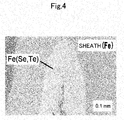
- Fig. 4 is a scanning electron microscope image of the cross-section of the wire prepared under the conditions for Experiment No. 1 shown in Table 1.
- Fig. 5 is surface mapping as measured by EDX (energy dispersive X-ray spectroscopy) with respect to the cross-section of the wire prepared under the conditions for Experiment No. 1 shown in Table 1. The analysis was performed using an Fe-K ⁇ ray, an Se-L ⁇ ray, and a Te-L ⁇ ray. The results of the analysis have confirmed that an iron-based superconductor having a chemical composition which is FeSe 1-x Te x (0 ⁇ x ⁇ 1) is formed in the iron sheath.
- Iron-based superconducting wires respectively having FeSe and FeTe 1-x S x (0 ⁇ x ⁇ 1) chemical compositions were able to be prepared under the same conditions as those for Experiment Nos. 1 and 2 shown in Table 1.
- Te 1-x S x which had been preliminarily synthesized by reacting Te with S and changing the composition ratio of Te and S, was used as a raw material other than iron.
- an iron tube (sheath) was filled with the above-obtained TeS, together with Te, and formed into a wire, followed by a heating treatment at 450 to 600°C, to obtain an iron-based superconducting wire in which the chemical composition of the iron-based superconductor is FeTe 1-x S x (0 ⁇ x ⁇ 1).
- a critical current was observed in each of the iron-based superconducting wires.
- the iron-based superconducting wire of the invention and a method for producing the same are not limited to the above-mentioned Examples needless to say.
- the iron-based superconducting wire of the invention and a method for producing the same are advantageous in that an iron-based superconducting wire using an iron-based superconducting substance, such as FeSe, FeTe, FeSe 1-x Te x (0 ⁇ x ⁇ 1), or FeTe 1-x S x (0 ⁇ x ⁇ 1), can be produced with ease. It is expected that the iron-based superconductor is put into practical use and the use thereof is advanced and developed.
Landscapes
- Chemical & Material Sciences (AREA)
- Organic Chemistry (AREA)
- Engineering & Computer Science (AREA)
- Inorganic Chemistry (AREA)
- Manufacturing & Machinery (AREA)
- Ceramic Engineering (AREA)
- Superconductors And Manufacturing Methods Therefor (AREA)
- Inorganic Compounds Of Heavy Metals (AREA)
Abstract
Description
- The present invention relates to an iron-based superconducting wire using an iron-based superconductor mainly made of iron and a method for producing the same.
- An iron-based superconductor was discovered early in 2008 (non-patent document 1). Since this discovery of the iron-based superconductor, superconductors of the related compounds have been successively found, and the iron-based superconductor is expected to be a vein of new high-temperature superconductor.
- The iron-based superconductors have a high critical current density and a high critical magnetic field, and are increasingly expected to be applied to practical use. Among the iron-based superconductors, ones having a simplest structure, such as FeSe, FeTe, FeSe1-xTex (0 < x < 1), and FeTe1-xSx (0 < x < 1), have been developed by the present inventors (for example,
non-patent documents 2 and 3). Further, it has been known that, in the molar ratio of Fe and a chalcogen in the compound, Fe is slightly excess. These iron-based superconductors are considered suitable for practical application due to their relatively low toxicity or simple structure. - [Non-patent document 1] J. Am. Chem. Soc., 130, 3296 (2008)
- [Non-patent document 2] Appl. Phys. Lett., 94, 012503 (2009)
- [Non-patent document 3] Appl. Phys. Lett., 93, 152505 (2008)
- A task of the present invention is to apply an iron-based superconductor to practical use, and to provide an iron-based superconducting wire using an iron-based superconducting substance, such as FeSe, FeTe, FeSe1-xTex (0 < x < 1), or FeTe1-xSx (0 < x < 1), and a method for producing the same.
- For solving the above problems, the iron-based superconducting wire of the invention is characterized in that the iron-based superconducting wire comprises a tubular material formed mainly from iron, and an iron-based superconductor formed in the tubular material, wherein the iron-based superconductor contains the iron forming the tubular material as a chemical constituent element of the iron-based superconductor.
- In the iron-based superconducting wire, it is preferred that the tubular material is a sheath for superconducting wire.
- Further, in the iron-based superconducting wire, it is preferred that the iron-based superconductor has a chemical composition which is FeSe, FeTe, FeSe1-xTex (0 < x < 1), or FeTe1-xSx(0<x<1).
- Further, in the iron-based superconducting wire, a plurality of the iron-based superconducting wires can be unified to form a multicore wire.
- The method for producing an iron-based superconducting wire of the invention is characterized in that the method comprises filling a tubular material formed mainly from iron with a raw material which comprises a chemical constituent element other than iron for constituting an iron-based superconductor, and then subjecting the resultant material to mechanical processing to form a wire material, and subjecting the wire material to heating treatment at 100 to 1,000°C for one minute to 500 hours so that the iron forming the tubular material and the raw material filling the tubular material are reacted with each other to form an iron-based superconductor, obtaining an iron-based superconducting wire.
- The iron-based superconducting wire of the invention and a method for producing the same are advantageous in that, by filling a tubular material formed mainly from iron with a raw material other than iron for constituting an iron-based superconductor, an iron-based superconducting wire can be produced with ease, and the iron-based superconducting wire exhibits stable superconductivity.
-
-
Fig. 1 shows photographs of (a) the wire after rolled and (b) the wire after subjected to heat treatment in the Example. -
Fig. 2 is a graph showing the current-voltage characteristics of the FeSe1-xTex (0 < x < 1) superconducting wire prepared in the Example. -
Fig. 3 is a photograph taken by an optical microscope of the cross-section of the FeSe1-xTex (0 < x < 1) superconducting wire prepared in the Example. -
Fig. 4 is a scanning electron microscope image of the FeSe1-xTex (0 < x < 1) superconducting wire prepared in the Example. -
Fig. 5 shows photographs showing the results of surface mapping measured with respect to the cross-section of the FeSe1-xTex (0 < x < 1) superconducting wire prepared in the Example. - In the iron-based superconducting wire of the invention, using a tubular material formed mainly from iron, an iron-based superconductor is formed from the iron forming the tubular material, and a raw material which fills the tubular material and which comprises a chemical constituent element constituting the iron-based superconductor other than iron. That is, in a tubular material formed mainly from iron, an iron-based superconductor containing the iron forming the tubular material as a chemical constituent element of the iron-based superconductor is formed.
- The tubular material is formed mainly from iron for making a contribution to the formation of an iron-based superconductor, and the tubular material can contain an additive or inevitably contained impurity other than iron in such an amount that it does not inhibit the formation of an iron-based superconductor. For example, the addition of a hexagonal phase, a pyrite phase, silver, iron oxide, bismuth, or the like is allowable.
- In the iron-based superconducting wire of the invention, as typical examples of chemical compositions of the iron-based superconductor, there can be mentioned FeSe, FeTe, FeSe1-xTex (0 < x < 1), and FeTe1-xSx (0 < x < 1), which have already been developed, but with respect to the chemical composition of the iron-based superconductor, there is no particular limitation as long as a wire can be formed from the iron-based superconductor.
- On the other hand, the composition ratio of the chemical constituent elements constituting the iron-based superconductor can be appropriately changed. For example, in FeSe1-xTex (0 < x < 1) or FeTe1-xSx (0 < x < 1), the Se:Te ratio or Te:S ratio can be appropriately changed within the range: 0 < x < 1.
- The tubular material formed mainly from iron can function and serve as a sheath for superconducting wire.
- With respect to the element raw material other than iron, which fills the tubular material, a single substance of Se, Te, or S or a mixture thereof, or a compound preliminarily synthesized, such as SeTe or TeS, can be used.
- A method for producing the iron-based superconducting wire of the invention is, for example, shown below.
- 1) A tubular material formed mainly from iron is filled with a raw material which comprises a chemical constituent element other than iron for constituting an iron-based superconductor.
- 2) The resultant material is subjected to mechanical processing, such as rolling, to form a wire material.
- 3) The wire material is subjected to heat treatment at 100 to 1,000°C for one minute to 500 hours to form an iron-based superconductor.
- The use of preliminarily synthesized SeTe or TeS as a raw material filling the tubular material is effective in preventing Se or S from evaporating during the heat treatment.
- Further, when conducting the heating treatment in an inert gas atmosphere in a dosed state, Se or S can be effectively prevented from diffusing.
- Further, for introducing a pinning center, into a raw material other than iron for filling the tubular material, such as SeTe, an additive, for example, a hexagonal phase, a pyrite phase, silver, iron oxide, or bismuth can be incorporated in such an amount that the superconductivity is not sacrificed.
- The invention has been completed by succeeding in observing a critical current of the iron-based superconducting wire in an electrical conduction test for the first time, and possibly gives an effective technical guideline on the future wire formation from the iron-based superconductor. For example, a multicore iron-based superconducting wire comprising a plurality of the iron-based superconducting wires which are unified to form a multicore wire can be realized.
- A test preparation of a wire was conducted using a Powder-in-Tube method. An iron tube having an outer diameter of 6 mm and an inner diameter of 3.5 mm was used as a sheath, and filled with Se or preliminarily synthesized SeTe, and the both ends of the iron tube were sealed up. Then, the sealed tube was rolled using a groove roll until the outer diameter became 2 mm, and further rolled using a flat roll until the width became 4 to 5 mm and the thickness became about 0.55 mm. The resultant wire was cut into about 4 cm, and the cut short-length wire was sealed in a quartz tube in an argon gas atmosphere (equivalent to atmospheric pressure). Then, the wire was subjected to heating treatment under the conditions shown in Table 1. The heating temperature is 450 to 550°C, and the heating time is 3 to 4 hours including the temperature increase time. After the heating treatment, a voltage-current measurement was performed by an electrical conduction test to estimate a critical current (Ic).
-
Fig. 1(a) is a photograph of the wire obtained by rolling an iron tube (sheath) filled with SeTe powder, which has not been calcined, andFig. 1 (b) is a photograph of the wire which has been calcined by a heating treatment in an argon gas atmosphere. - SeTe used as a raw material other than iron is obtained by vacuum-sealing Se and Te weighed in a 1:1 molar ratio in a quartz tube and then calcining them at 500°C for 8 hours to synthesize SeTe, and subsequently grinding the synthesized SeTe.
- The Se and Te used are as follows.
- The Se used is Se powder having a purity of 99.9% up and an average particle size of 75 µm, manufactured by Kojundo Chemical Laboratory Co., Ltd.
- The Te used is Te powder having a purity of 99.9% and an average particle size of 150 µm, manufactured by Kojundo Chemical Laboratory Co., Ltd.
Table 1 Experiment No. Starting material powder Heat treatment temperature Temperature increase time Retention time 1 SeTe 500°C 2h 2h 2 SeTe 500°C 2h 1h - As can be seen from
Samples Fig. 2 , with respect to the FeSe1-xTex (0 < x < 1) wires prepared by calcination under the conditions for Experiment Nos. 1 and 2 shown in Table 1 (whereinSample 1 corresponds to Experiment No. 1 andSample 2 corresponds to Experiment No. 2), the zero resistance state has been confirmed until a certain current, and a critical current at a threshold of 0.1 µV has been successfully estimated. An iron-based superconductor wire has been realized. - The cross-section of the wire was polished, and the polished cross-section was observed by means of an optical microscope and an SEM (scanning electron microscope), and further, using EDX (energy dispersive X-ray spectroscopy), surface mapping for elements was conducted.
-
Fig. 3 is a photograph taken by an optical microscope of the cross-section of the wire obtained by embedding in a resin the wire prepared under the conditions for Experiment No. 1 shown in Table 1 and polishing it.Fig. 4 is a scanning electron microscope image of the cross-section of the wire prepared under the conditions for Experiment No. 1 shown in Table 1.Fig. 5 is surface mapping as measured by EDX (energy dispersive X-ray spectroscopy) with respect to the cross-section of the wire prepared under the conditions for Experiment No. 1 shown in Table 1. The analysis was performed using an Fe-Kα ray, an Se-Lα ray, and a Te-Lα ray. The results of the analysis have confirmed that an iron-based superconductor having a chemical composition which is FeSe1-xTex (0 < x < 1) is formed in the iron sheath. - Iron-based superconducting wires respectively having FeSe and FeTe1-xSx (0 < x < 1) chemical compositions were able to be prepared under the same conditions as those for Experiment Nos. 1 and 2 shown in Table 1. In the preparation of the Fe Te1-xSx (0 < x < 1) superconducting wire, Te1-xSx, which had been preliminarily synthesized by reacting Te with S and changing the composition ratio of Te and S, was used as a raw material other than iron. From the studies on polycrystals of FeSe, FeSe1-xTex (0 < x < 1), and FeTe1-xSx (0 < x < 1), it has been known that a synthesis in the solid solution system is possible. For example, Te and S were mixed in a 1:1 molar ratio and vacuum-sealed in a quartz glass tube, and then calcined at 400°C for 1/2 day, so that all the Te and S were reacted with each other, thus obtaining TeS.
- For changing the composition ratio, an iron tube (sheath) was filled with the above-obtained TeS, together with Te, and formed into a wire, followed by a heating treatment at 450 to 600°C, to obtain an iron-based superconducting wire in which the chemical composition of the iron-based superconductor is FeTe1-xSx (0 < x < 1). In each of the iron-based superconducting wires, a critical current was observed.
- The iron-based superconducting wire of the invention and a method for producing the same are not limited to the above-mentioned Examples needless to say.
- The iron-based superconducting wire of the invention and a method for producing the same are advantageous in that an iron-based superconducting wire using an iron-based superconducting substance, such as FeSe, FeTe, FeSe1-xTex (0 < x < 1), or FeTe1-xSx (0 < x < 1), can be produced with ease. It is expected that the iron-based superconductor is put into practical use and the use thereof is advanced and developed.
Claims (5)
- An iron-based superconducting wire characterized in that the iron-based superconducting wire comprises a tubular material formed mainly from iron, and an iron-based superconductor formed in the tubular material, the iron-based superconductor containing the iron forming the tubular material as a chemical constituent element of the iron-based superconductor.
- The iron-based superconducting wire according to claim 1, characterized in that the tubular material is a sheath for superconducting wire.
- The iron-based superconducting wire according to claim 1 or 2, characterized in that the iron-based superconductor has a chemical composition which is FeSe, FeTe, FeSe1-xTex (0 < x < 1), or FeTe1-xSx (0 < x < 1).
- A multicore iron-based superconducting wire characterized by comprising a plurality of the iron-based superconducting wires according to any one of claims 1 to 3 which are unified to form a multicore wire.
- A method for producing an iron-based superconducting wire, characterized in that the method comprises filling a tubular material formed mainly from iron with a raw material which comprises a chemical constituent element other than iron for constituting an iron-based superconductor, and then subjecting the resultant material to mechanical processing to form a wire material, and subjecting the wire material to heating treatment at 100 to 1,000°C for one minute to 500 hours so that the iron forming the tubular material and the raw material filling the tubular material are reacted with each other to form an iron-based superconductor, obtaining an iron-based superconducting wire.
Applications Claiming Priority (2)
| Application Number | Priority Date | Filing Date | Title |
|---|---|---|---|
| JP2009136662 | 2009-06-05 | ||
| PCT/JP2010/059278 WO2010140593A1 (en) | 2009-06-05 | 2010-06-01 | Iron-based superconducting wire and manufacturing method therefor |
Publications (3)
| Publication Number | Publication Date |
|---|---|
| EP2447958A1 true EP2447958A1 (en) | 2012-05-02 |
| EP2447958A4 EP2447958A4 (en) | 2015-04-15 |
| EP2447958B1 EP2447958B1 (en) | 2017-09-20 |
Family
ID=43297727
Family Applications (1)
| Application Number | Title | Priority Date | Filing Date |
|---|---|---|---|
| EP10783376.6A Not-in-force EP2447958B1 (en) | 2009-06-05 | 2010-06-01 | Iron-based superconducting wire and manufacturing method therefor |
Country Status (5)
| Country | Link |
|---|---|
| US (1) | US8871684B2 (en) |
| EP (1) | EP2447958B1 (en) |
| JP (1) | JP5626658B2 (en) |
| CN (1) | CN102498528B (en) |
| WO (1) | WO2010140593A1 (en) |
Cited By (1)
| Publication number | Priority date | Publication date | Assignee | Title |
|---|---|---|---|---|
| CN114566326A (en) * | 2022-03-29 | 2022-05-31 | 中国科学院电工研究所 | Method for obtaining composite sheathed iron-based superconducting wire strip by extrusion molding |
Families Citing this family (9)
| Publication number | Priority date | Publication date | Assignee | Title |
|---|---|---|---|---|
| JP5626991B2 (en) * | 2011-01-18 | 2014-11-19 | 独立行政法人物質・材料研究機構 | Method for superconducting FeTe1-xSx compound synthesized by solid phase reaction |
| RU2522591C2 (en) * | 2012-07-13 | 2014-07-20 | Федеральное государственное бюджетное образовательное учреждение высшего профессионального образования "Московский государственный университет имени М.В. Ломоносова" (МГУ) | Method of synthesising monocrystalline iron selenides |
| CN110061367B (en) * | 2019-04-23 | 2020-08-11 | 中国科学院电工研究所 | A kind of iron-based superconducting joint and preparation method thereof |
| CN112010270B (en) * | 2019-05-31 | 2022-07-15 | 中国科学院物理研究所 | FeBi(Te,Se) polycrystalline superconducting material and its preparation method and application |
| CN110867283B (en) * | 2019-11-29 | 2020-11-24 | 西北有色金属研究院 | A kind of preparation method of FeSe-based superconducting wire |
| CN113345640B (en) * | 2021-06-03 | 2022-08-02 | 西北有色金属研究院 | Preparation method of Fe (Se, Te) superconducting wire |
| CN114242333B (en) * | 2021-12-23 | 2023-03-14 | 上海交通大学 | Iron-selenium-tellurium-sulfur superconducting target material and preparation method and application thereof |
| WO2023146540A1 (en) * | 2022-01-30 | 2023-08-03 | Fermi Research Alliance, Llc | Bi-layer barrier assembly for iron-based superconductor and associated methods |
| CN114822991B (en) * | 2022-05-26 | 2023-01-31 | 西北有色金属研究院 | Preparation method of Fe (Se, te) superconducting wire |
Family Cites Families (7)
| Publication number | Priority date | Publication date | Assignee | Title |
|---|---|---|---|---|
| JP3945600B2 (en) * | 1998-03-04 | 2007-07-18 | 学校法人東海大学 | Method for producing Nb 3 Sn superconducting wire |
| US20030036482A1 (en) * | 2001-07-05 | 2003-02-20 | American Superconductor Corporation | Processing of magnesium-boride superconductors |
| JP4476800B2 (en) * | 2004-12-28 | 2010-06-09 | 株式会社神戸製鋼所 | Method for producing Nb3Sn superconducting wire |
| CN1933036A (en) * | 2005-09-13 | 2007-03-21 | 中国科学院电工研究所 | MgBz superconducting material and producing method thereof |
| CN1865457A (en) * | 2006-06-13 | 2006-11-22 | 中国科学院电工研究所 | Heat treatment method for iron base MgB2 superconductor wire and belt |
| CN101271747B (en) * | 2008-05-07 | 2013-05-01 | 中国科学院电工研究所 | Iron based compounds superconducting wire, belt material and method for producing the same |
| JP5376499B2 (en) * | 2008-11-04 | 2013-12-25 | 独立行政法人物質・材料研究機構 | Iron-based superconducting material |
-
2010
- 2010-06-01 US US13/376,248 patent/US8871684B2/en not_active Expired - Fee Related
- 2010-06-01 CN CN201080024126.2A patent/CN102498528B/en not_active Expired - Fee Related
- 2010-06-01 EP EP10783376.6A patent/EP2447958B1/en not_active Not-in-force
- 2010-06-01 JP JP2011518457A patent/JP5626658B2/en not_active Expired - Fee Related
- 2010-06-01 WO PCT/JP2010/059278 patent/WO2010140593A1/en not_active Ceased
Cited By (1)
| Publication number | Priority date | Publication date | Assignee | Title |
|---|---|---|---|---|
| CN114566326A (en) * | 2022-03-29 | 2022-05-31 | 中国科学院电工研究所 | Method for obtaining composite sheathed iron-based superconducting wire strip by extrusion molding |
Also Published As
| Publication number | Publication date |
|---|---|
| EP2447958A4 (en) | 2015-04-15 |
| WO2010140593A1 (en) | 2010-12-09 |
| CN102498528A (en) | 2012-06-13 |
| JP5626658B2 (en) | 2014-11-19 |
| US8871684B2 (en) | 2014-10-28 |
| CN102498528B (en) | 2014-04-16 |
| EP2447958B1 (en) | 2017-09-20 |
| JPWO2010140593A1 (en) | 2012-11-22 |
| US20120135869A1 (en) | 2012-05-31 |
Similar Documents
| Publication | Publication Date | Title |
|---|---|---|
| EP2447958B1 (en) | Iron-based superconducting wire and manufacturing method therefor | |
| Dou et al. | Mechanism of enhancement in electromagnetic properties of MgB 2 by nano SiC doping | |
| Wu et al. | Transport properties and superconductivity in Ba1-xMxFe2As2 (M= La and K) with double FeAs layers | |
| Hong et al. | Enhancement of the thermoelectric performance of n− type Bi2O2Se by Ce4+ doping | |
| US20050163644A1 (en) | Processing of magnesium-boride superconductor wires | |
| Flahaut et al. | Role of Ag in textured-annealed Bi2Ca2Co1. 7Ox thermoelectric ceramic | |
| TWI910444B (en) | Superconducting compounds and methods for making the same | |
| EP2361879B1 (en) | Iron-containing superconductive substance | |
| Fu et al. | High critical current density in Ti-doped MgB 2/Ta/Cu tape by powder-in-tube process | |
| US5354535A (en) | Synthesis of highly phase pure (Bi, Pb)-Sr-Ca-Cu-O superconductor | |
| JP6814007B2 (en) | Mixed anion compound Iron-based superconducting wire and its manufacturing method | |
| Nakamura et al. | Phase formation mechanism and properties of Ag-sheathed (Bi, Pb)-2223 tapes prepared by two-powder method | |
| Sauer et al. | Fluorination of the high-Tc superconductors YBa2Cu3O7− δ and GdBa2Cu3O7− δ | |
| CA2579733A1 (en) | Process for producing bismuth-based oxide superconductor, and superconductive wire | |
| EP0588240B1 (en) | Bi-type high-temperature superconducting oxide material and method of producing the same | |
| EP1780734A1 (en) | Method for producing superconducting wire | |
| Ritonga et al. | Effect of dopant on superconductor Bi1. 6Pb0. 4Sr2Ca2-x MxCu3Oy (M= Ce, Na, Mg) phase 2223 by solid method | |
| Bovone et al. | The Influence of Wire Heat Treatment on PIT $\hbox {MgB} _ {2} $ Conductors Manufactured Using Laboratory-Made Boron | |
| Eckert et al. | High Critical Fields and Currents in Mechanically Alloyed MgB _2 | |
| Guo et al. | Influence of Ca2PbO4 on phase formation and electrical properties of (Bi, Pb) 2Sr2Ca2Cu3O10/Ag superconducting composites | |
| Hong et al. | Developmental Studies on Powder-Processed Nb3A1 Superconducting Wire | |
| JPH11199232A (en) | Calcined powder for superconductor and superconducting polycrystal | |
| JP4261568B2 (en) | Manufacturing method of oxide superconducting wire | |
| Baca et al. | Altering Self‐Assembly of Second Phase Additions in YBa2Cu3O7‐x for Pinning Enhancement | |
| JPH11180765A (en) | Oxide superconductor containing silver and method for producing the same |
Legal Events
| Date | Code | Title | Description |
|---|---|---|---|
| PUAI | Public reference made under article 153(3) epc to a published international application that has entered the european phase |
Free format text: ORIGINAL CODE: 0009012 |
|
| 17P | Request for examination filed |
Effective date: 20111220 |
|
| AK | Designated contracting states |
Kind code of ref document: A1 Designated state(s): AL AT BE BG CH CY CZ DE DK EE ES FI FR GB GR HR HU IE IS IT LI LT LU LV MC MK MT NL NO PL PT RO SE SI SK SM TR |
|
| DAX | Request for extension of the european patent (deleted) | ||
| RA4 | Supplementary search report drawn up and despatched (corrected) |
Effective date: 20150318 |
|
| RIC1 | Information provided on ipc code assigned before grant |
Ipc: C01G 1/00 20060101ALI20150312BHEP Ipc: C01B 19/04 20060101ALI20150312BHEP Ipc: C01B 19/00 20060101ALI20150312BHEP Ipc: H01B 12/10 20060101AFI20150312BHEP |
|
| GRAP | Despatch of communication of intention to grant a patent |
Free format text: ORIGINAL CODE: EPIDOSNIGR1 |
|
| STAA | Information on the status of an ep patent application or granted ep patent |
Free format text: STATUS: GRANT OF PATENT IS INTENDED |
|
| INTG | Intention to grant announced |
Effective date: 20170407 |
|
| GRAS | Grant fee paid |
Free format text: ORIGINAL CODE: EPIDOSNIGR3 |
|
| GRAA | (expected) grant |
Free format text: ORIGINAL CODE: 0009210 |
|
| STAA | Information on the status of an ep patent application or granted ep patent |
Free format text: STATUS: THE PATENT HAS BEEN GRANTED |
|
| AK | Designated contracting states |
Kind code of ref document: B1 Designated state(s): AL AT BE BG CH CY CZ DE DK EE ES FI FR GB GR HR HU IE IS IT LI LT LU LV MC MK MT NL NO PL PT RO SE SI SK SM TR |
|
| REG | Reference to a national code |
Ref country code: GB Ref legal event code: FG4D |
|
| REG | Reference to a national code |
Ref country code: CH Ref legal event code: EP |
|
| REG | Reference to a national code |
Ref country code: AT Ref legal event code: REF Ref document number: 930755 Country of ref document: AT Kind code of ref document: T Effective date: 20171015 |
|
| REG | Reference to a national code |
Ref country code: IE Ref legal event code: FG4D |
|
| REG | Reference to a national code |
Ref country code: DE Ref legal event code: R096 Ref document number: 602010045416 Country of ref document: DE |
|
| REG | Reference to a national code |
Ref country code: NL Ref legal event code: MP Effective date: 20170920 |
|
| PG25 | Lapsed in a contracting state [announced via postgrant information from national office to epo] |
Ref country code: NO Free format text: LAPSE BECAUSE OF FAILURE TO SUBMIT A TRANSLATION OF THE DESCRIPTION OR TO PAY THE FEE WITHIN THE PRESCRIBED TIME-LIMIT Effective date: 20171220 Ref country code: HR Free format text: LAPSE BECAUSE OF FAILURE TO SUBMIT A TRANSLATION OF THE DESCRIPTION OR TO PAY THE FEE WITHIN THE PRESCRIBED TIME-LIMIT Effective date: 20170920 Ref country code: FI Free format text: LAPSE BECAUSE OF FAILURE TO SUBMIT A TRANSLATION OF THE DESCRIPTION OR TO PAY THE FEE WITHIN THE PRESCRIBED TIME-LIMIT Effective date: 20170920 Ref country code: LT Free format text: LAPSE BECAUSE OF FAILURE TO SUBMIT A TRANSLATION OF THE DESCRIPTION OR TO PAY THE FEE WITHIN THE PRESCRIBED TIME-LIMIT Effective date: 20170920 Ref country code: SE Free format text: LAPSE BECAUSE OF FAILURE TO SUBMIT A TRANSLATION OF THE DESCRIPTION OR TO PAY THE FEE WITHIN THE PRESCRIBED TIME-LIMIT Effective date: 20170920 |
|
| REG | Reference to a national code |
Ref country code: LT Ref legal event code: MG4D |
|
| REG | Reference to a national code |
Ref country code: AT Ref legal event code: MK05 Ref document number: 930755 Country of ref document: AT Kind code of ref document: T Effective date: 20170920 |
|
| PG25 | Lapsed in a contracting state [announced via postgrant information from national office to epo] |
Ref country code: LV Free format text: LAPSE BECAUSE OF FAILURE TO SUBMIT A TRANSLATION OF THE DESCRIPTION OR TO PAY THE FEE WITHIN THE PRESCRIBED TIME-LIMIT Effective date: 20170920 Ref country code: BG Free format text: LAPSE BECAUSE OF FAILURE TO SUBMIT A TRANSLATION OF THE DESCRIPTION OR TO PAY THE FEE WITHIN THE PRESCRIBED TIME-LIMIT Effective date: 20171220 Ref country code: GR Free format text: LAPSE BECAUSE OF FAILURE TO SUBMIT A TRANSLATION OF THE DESCRIPTION OR TO PAY THE FEE WITHIN THE PRESCRIBED TIME-LIMIT Effective date: 20171221 |
|
| PG25 | Lapsed in a contracting state [announced via postgrant information from national office to epo] |
Ref country code: NL Free format text: LAPSE BECAUSE OF FAILURE TO SUBMIT A TRANSLATION OF THE DESCRIPTION OR TO PAY THE FEE WITHIN THE PRESCRIBED TIME-LIMIT Effective date: 20170920 |
|
| PG25 | Lapsed in a contracting state [announced via postgrant information from national office to epo] |
Ref country code: PL Free format text: LAPSE BECAUSE OF FAILURE TO SUBMIT A TRANSLATION OF THE DESCRIPTION OR TO PAY THE FEE WITHIN THE PRESCRIBED TIME-LIMIT Effective date: 20170920 Ref country code: CZ Free format text: LAPSE BECAUSE OF FAILURE TO SUBMIT A TRANSLATION OF THE DESCRIPTION OR TO PAY THE FEE WITHIN THE PRESCRIBED TIME-LIMIT Effective date: 20170920 Ref country code: RO Free format text: LAPSE BECAUSE OF FAILURE TO SUBMIT A TRANSLATION OF THE DESCRIPTION OR TO PAY THE FEE WITHIN THE PRESCRIBED TIME-LIMIT Effective date: 20170920 Ref country code: ES Free format text: LAPSE BECAUSE OF FAILURE TO SUBMIT A TRANSLATION OF THE DESCRIPTION OR TO PAY THE FEE WITHIN THE PRESCRIBED TIME-LIMIT Effective date: 20170920 |
|
| PG25 | Lapsed in a contracting state [announced via postgrant information from national office to epo] |
Ref country code: EE Free format text: LAPSE BECAUSE OF FAILURE TO SUBMIT A TRANSLATION OF THE DESCRIPTION OR TO PAY THE FEE WITHIN THE PRESCRIBED TIME-LIMIT Effective date: 20170920 Ref country code: IS Free format text: LAPSE BECAUSE OF FAILURE TO SUBMIT A TRANSLATION OF THE DESCRIPTION OR TO PAY THE FEE WITHIN THE PRESCRIBED TIME-LIMIT Effective date: 20180120 Ref country code: AT Free format text: LAPSE BECAUSE OF FAILURE TO SUBMIT A TRANSLATION OF THE DESCRIPTION OR TO PAY THE FEE WITHIN THE PRESCRIBED TIME-LIMIT Effective date: 20170920 Ref country code: SK Free format text: LAPSE BECAUSE OF FAILURE TO SUBMIT A TRANSLATION OF THE DESCRIPTION OR TO PAY THE FEE WITHIN THE PRESCRIBED TIME-LIMIT Effective date: 20170920 Ref country code: SM Free format text: LAPSE BECAUSE OF FAILURE TO SUBMIT A TRANSLATION OF THE DESCRIPTION OR TO PAY THE FEE WITHIN THE PRESCRIBED TIME-LIMIT Effective date: 20170920 |
|
| REG | Reference to a national code |
Ref country code: FR Ref legal event code: PLFP Year of fee payment: 9 |
|
| REG | Reference to a national code |
Ref country code: DE Ref legal event code: R097 Ref document number: 602010045416 Country of ref document: DE |
|
| PLBE | No opposition filed within time limit |
Free format text: ORIGINAL CODE: 0009261 |
|
| STAA | Information on the status of an ep patent application or granted ep patent |
Free format text: STATUS: NO OPPOSITION FILED WITHIN TIME LIMIT |
|
| PG25 | Lapsed in a contracting state [announced via postgrant information from national office to epo] |
Ref country code: DK Free format text: LAPSE BECAUSE OF FAILURE TO SUBMIT A TRANSLATION OF THE DESCRIPTION OR TO PAY THE FEE WITHIN THE PRESCRIBED TIME-LIMIT Effective date: 20170920 |
|
| 26N | No opposition filed |
Effective date: 20180621 |
|
| PG25 | Lapsed in a contracting state [announced via postgrant information from national office to epo] |
Ref country code: SI Free format text: LAPSE BECAUSE OF FAILURE TO SUBMIT A TRANSLATION OF THE DESCRIPTION OR TO PAY THE FEE WITHIN THE PRESCRIBED TIME-LIMIT Effective date: 20170920 |
|
| REG | Reference to a national code |
Ref country code: CH Ref legal event code: PL |
|
| GBPC | Gb: european patent ceased through non-payment of renewal fee |
Effective date: 20180601 |
|
| REG | Reference to a national code |
Ref country code: BE Ref legal event code: MM Effective date: 20180630 |
|
| REG | Reference to a national code |
Ref country code: IE Ref legal event code: MM4A |
|
| PG25 | Lapsed in a contracting state [announced via postgrant information from national office to epo] |
Ref country code: LU Free format text: LAPSE BECAUSE OF NON-PAYMENT OF DUE FEES Effective date: 20180601 Ref country code: MC Free format text: LAPSE BECAUSE OF FAILURE TO SUBMIT A TRANSLATION OF THE DESCRIPTION OR TO PAY THE FEE WITHIN THE PRESCRIBED TIME-LIMIT Effective date: 20170920 |
|
| PG25 | Lapsed in a contracting state [announced via postgrant information from national office to epo] |
Ref country code: IE Free format text: LAPSE BECAUSE OF NON-PAYMENT OF DUE FEES Effective date: 20180601 Ref country code: GB Free format text: LAPSE BECAUSE OF NON-PAYMENT OF DUE FEES Effective date: 20180601 Ref country code: CH Free format text: LAPSE BECAUSE OF NON-PAYMENT OF DUE FEES Effective date: 20180630 Ref country code: LI Free format text: LAPSE BECAUSE OF NON-PAYMENT OF DUE FEES Effective date: 20180630 |
|
| PG25 | Lapsed in a contracting state [announced via postgrant information from national office to epo] |
Ref country code: BE Free format text: LAPSE BECAUSE OF NON-PAYMENT OF DUE FEES Effective date: 20180630 |
|
| PG25 | Lapsed in a contracting state [announced via postgrant information from national office to epo] |
Ref country code: MT Free format text: LAPSE BECAUSE OF NON-PAYMENT OF DUE FEES Effective date: 20180601 |
|
| PG25 | Lapsed in a contracting state [announced via postgrant information from national office to epo] |
Ref country code: TR Free format text: LAPSE BECAUSE OF FAILURE TO SUBMIT A TRANSLATION OF THE DESCRIPTION OR TO PAY THE FEE WITHIN THE PRESCRIBED TIME-LIMIT Effective date: 20170920 |
|
| PG25 | Lapsed in a contracting state [announced via postgrant information from national office to epo] |
Ref country code: PT Free format text: LAPSE BECAUSE OF FAILURE TO SUBMIT A TRANSLATION OF THE DESCRIPTION OR TO PAY THE FEE WITHIN THE PRESCRIBED TIME-LIMIT Effective date: 20170920 Ref country code: HU Free format text: LAPSE BECAUSE OF FAILURE TO SUBMIT A TRANSLATION OF THE DESCRIPTION OR TO PAY THE FEE WITHIN THE PRESCRIBED TIME-LIMIT; INVALID AB INITIO Effective date: 20100601 |
|
| PG25 | Lapsed in a contracting state [announced via postgrant information from national office to epo] |
Ref country code: CY Free format text: LAPSE BECAUSE OF FAILURE TO SUBMIT A TRANSLATION OF THE DESCRIPTION OR TO PAY THE FEE WITHIN THE PRESCRIBED TIME-LIMIT Effective date: 20170920 Ref country code: MK Free format text: LAPSE BECAUSE OF NON-PAYMENT OF DUE FEES Effective date: 20170920 |
|
| PG25 | Lapsed in a contracting state [announced via postgrant information from national office to epo] |
Ref country code: AL Free format text: LAPSE BECAUSE OF FAILURE TO SUBMIT A TRANSLATION OF THE DESCRIPTION OR TO PAY THE FEE WITHIN THE PRESCRIBED TIME-LIMIT Effective date: 20170920 |
|
| PGFP | Annual fee paid to national office [announced via postgrant information from national office to epo] |
Ref country code: DE Payment date: 20200618 Year of fee payment: 11 Ref country code: FR Payment date: 20200619 Year of fee payment: 11 |
|
| PGFP | Annual fee paid to national office [announced via postgrant information from national office to epo] |
Ref country code: IT Payment date: 20200625 Year of fee payment: 11 |
|
| REG | Reference to a national code |
Ref country code: DE Ref legal event code: R119 Ref document number: 602010045416 Country of ref document: DE |
|
| PG25 | Lapsed in a contracting state [announced via postgrant information from national office to epo] |
Ref country code: DE Free format text: LAPSE BECAUSE OF NON-PAYMENT OF DUE FEES Effective date: 20220101 |
|
| PG25 | Lapsed in a contracting state [announced via postgrant information from national office to epo] |
Ref country code: FR Free format text: LAPSE BECAUSE OF NON-PAYMENT OF DUE FEES Effective date: 20210630 |
|
| PG25 | Lapsed in a contracting state [announced via postgrant information from national office to epo] |
Ref country code: IT Free format text: LAPSE BECAUSE OF NON-PAYMENT OF DUE FEES Effective date: 20210601 |