EP2447957A2 - Superconducting cable system - Google Patents
Superconducting cable system Download PDFInfo
- Publication number
- EP2447957A2 EP2447957A2 EP11186265A EP11186265A EP2447957A2 EP 2447957 A2 EP2447957 A2 EP 2447957A2 EP 11186265 A EP11186265 A EP 11186265A EP 11186265 A EP11186265 A EP 11186265A EP 2447957 A2 EP2447957 A2 EP 2447957A2
- Authority
- EP
- European Patent Office
- Prior art keywords
- conductor
- cable
- tapered
- tuning inductor
- superconducting
- Prior art date
- Legal status (The legal status is an assumption and is not a legal conclusion. Google has not performed a legal analysis and makes no representation as to the accuracy of the status listed.)
- Withdrawn
Links
Images


Classifications
-
- H—ELECTRICITY
- H01—ELECTRIC ELEMENTS
- H01B—CABLES; CONDUCTORS; INSULATORS; SELECTION OF MATERIALS FOR THEIR CONDUCTIVE, INSULATING OR DIELECTRIC PROPERTIES
- H01B12/00—Superconductive or hyperconductive conductors, cables, or transmission lines
- H01B12/02—Superconductive or hyperconductive conductors, cables, or transmission lines characterised by their form
- H01B12/06—Films or wires on bases or cores
-
- H—ELECTRICITY
- H02—GENERATION; CONVERSION OR DISTRIBUTION OF ELECTRIC POWER
- H02J—ELECTRIC POWER NETWORKS; CIRCUIT ARRANGEMENTS OR SYSTEMS FOR SUPPLYING OR DISTRIBUTING ELECTRIC POWER; SYSTEMS FOR STORING ELECTRIC ENERGY
- H02J3/00—Circuit arrangements for AC mains or AC distribution networks
- H02J3/36—Arrangements for transfer of electric power between AC networks via high-voltage DC [HVDC] links; Arrangements for transfer of electric power between generators and networks via HVDC links
-
- Y—GENERAL TAGGING OF NEW TECHNOLOGICAL DEVELOPMENTS; GENERAL TAGGING OF CROSS-SECTIONAL TECHNOLOGIES SPANNING OVER SEVERAL SECTIONS OF THE IPC; TECHNICAL SUBJECTS COVERED BY FORMER USPC CROSS-REFERENCE ART COLLECTIONS [XRACs] AND DIGESTS
- Y02—TECHNOLOGIES OR APPLICATIONS FOR MITIGATION OR ADAPTATION AGAINST CLIMATE CHANGE
- Y02E—REDUCTION OF GREENHOUSE GAS [GHG] EMISSIONS, RELATED TO ENERGY GENERATION, TRANSMISSION OR DISTRIBUTION
- Y02E40/00—Technologies for an efficient electrical power generation, transmission or distribution
- Y02E40/60—Superconducting electric elements or equipment; Power systems integrating superconducting elements or equipment
-
- Y—GENERAL TAGGING OF NEW TECHNOLOGICAL DEVELOPMENTS; GENERAL TAGGING OF CROSS-SECTIONAL TECHNOLOGIES SPANNING OVER SEVERAL SECTIONS OF THE IPC; TECHNICAL SUBJECTS COVERED BY FORMER USPC CROSS-REFERENCE ART COLLECTIONS [XRACs] AND DIGESTS
- Y02—TECHNOLOGIES OR APPLICATIONS FOR MITIGATION OR ADAPTATION AGAINST CLIMATE CHANGE
- Y02E—REDUCTION OF GREENHOUSE GAS [GHG] EMISSIONS, RELATED TO ENERGY GENERATION, TRANSMISSION OR DISTRIBUTION
- Y02E60/00—Enabling technologies; Technologies with a potential or indirect contribution to GHG emissions mitigation
- Y02E60/60—Arrangements for transfer of electric power between AC networks or generators via a high voltage DC link [HVCD]
Definitions
- the present invention relates generally to a superconducting cable system, and more particularly to a superconducting cable system including tapered conductors.
- a first aspect of the invention provides an apparatus comprising: a cable, the cable comprising at least two conductors, wherein a first conductor is concentric within a second conductor, and wherein the first conductor is tapered at a first end of the cable and the second conductor is tapered at a second end of the cable.
- a second aspect of the invention provides a system comprising: a cable, the cable comprising at least two conductors, wherein a first conductor is concentric within a second conductor, and wherein the first conductor is tapered at a first end of the cable and the second conductor is tapered at a second end of the cable; at least two tuning inductors, wherein a first tuning inductor is connected to the first conductor at a second end of the cable and a second tuning inductor is connected to the second conductor at a first end of the cable; and at least two adjustable frequency converters, a first adjustable frequency converter connected to the first tuning inductor and the second adjustable frequency converter connected to the second tuning inductor.
- a third aspect of the invention provides an apparatus comprising: a cable, the cable comprising at least two conductors, each conductor comprising a high-temperature superconductor material, wherein a first conductor is concentric within a second conductor, the second conductor is concentric within a third conductor, and the third conductor is concentric within a fourth conductor, and wherein the first conductor and the third conductor are tapered at a first end of the cable and the second conductor and the fourth conductor are tapered at a second end of the cable
- FIG. 1 shows a schematic illustration of a superconducting cable system according to an embodiment of the invention.
- FIG. 2 shows a partial perspective view of a conductor for a superconducting cable system according to an embodiment of the invention.
- FIG. 3 shows a schematic illustration of a superconducting cable system according to an embodiment of the invention.
- FIG. 4 shows a schematic illustration of a superconducting cable system according to an embodiment of the invention.
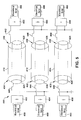
- FIG. 5 shows a schematic illustration of a superconducting cable system according to an embodiment of the invention.
- FIG. 1 a schematic illustration of a superconducting cable system 100 according to an embodiment of the invention is shown.
- System 100 is shown including a superconducting cable 110.
- superconducting refers to exhibiting superconductivity, which is a property of a material whereby the material has no resistance to the flow of an electric current.
- Superconducting cable 110 may include at least two conductors, a first conductor 121 and a second conductor 122.
- First conductor 121 may be wound around a supporting "former" 120 ( FIG. 2 ), which may be a hollow tube through which liquid nitrogen or another cooling medium may flow.
- First conductor 121 may be concentric within second conductor 122.
- Between first conductor 121 and second conductor 122 may be a cryogenic dielectric material 125, such as, but not limited to kapton polyimide film, araldite 5808 epoxy resin, cryoflex, and a nano-filled polymer.
- first conductor 121 may also be tapered at a first end 130 of superconducting cable 110 and second conductor 122 may be tapered at a second end 135 of superconducting cable 110.
- the other layer of conductors 121, 122 in cable system 100 may be surrounded by an additional layer of cryogenic dielectric material, then a space for liquid nitrogen or another cooling material to flow, then by a "cryostat" or thermal insulation pipe, and fmally by an outer protective jacket.
- FIG. 2 shows a partial perspective view of conductor 121, 122 for system 100 according to an embodiment of the invention.
- conductor 121, 122 may be a superconducting material 121, 122 that is wrapped around former 120.
- Superconducting cable 110 is formed by winding in a spiral fashion superconducting material 121 (i.e., tapes) around former 120.
- the superconducting material includes tapes of all the same length.
- superconducting material/tapes 121, 122 may be a range of lengths.
- Superconducting material/tapes 121, 122 start at opposite ends of former 120, such that over the length of former 12, the amount of superconducting material 121, 122 decreases. That is, in the embodiment shown in FIG. 1 , first conductor 121 may be tapered at first end 130 of superconducting cable 110, such that first conductor 121 includes more superconducting material at second end 135 and less superconducting material at first end 130.
- second conductor 120 may be tapered at second end 135 of superconducting cable 110, such that second conductor 122 includes less superconducting material at second end 135.
- conductor 121, 122 may be formed by connecting, in series, a plurality conductors with varying numbers of tapes.
- Superconducting material may include any now known or later developed high-temperature superconducting material, such as, but not limited to, Bismuth Strontium Calcium Copper Oxide (BSCCO) Bi 2 Sr 2 Ca 2 Cu 3 O 10 .
- BSCCO Bismuth Strontium Calcium Copper Oxide
- Other materials include Yttrium-Bariam-Coppper-Oxide (YBCO) YBa 2 Cu 3 O 7 , La 1.85 Ba 0.85 CuO 4 , and HgBa 2 Ca Cu 3O x .
- Superconducting material may be provided in several forms, including, but not limited to: deposted on a coated conductor flexible metal tape, drawn into wire using the power in tube (PIT) method, or bulk powder formed into shapes, such as rings, rods, and tubes.
- System 100 may also include at least two tuning inductors, a first tuning inductor 140 and a second tuning inductor 142.
- Tuning inductors 140, 142 are each connected to a conductor 120, 122 and are connected to the end 130, 135 that includes the most superconducting material.
- first tuning inductor 140 may be connected to first conductor 120 at second end 135 of superconducting cable 110, such that first tuning inductor 140 is connected to the end of first conductor 120 including the most superconducting material.
- Second tuning inductor 142 may be connected to second conductor 122 at first end 130 of superconducting cable 110, such that second tuning inductor 142 is connected to the end of second conductor 122 including the most superconducting material.
- System 100 may further include at least two adjustable frequency converters, a first adjustable frequency converter 150 and a second adjustable frequency converter 152.
- First adjustable frequency converter 150 may be connected to first tuning inductor 140 and second adjustable frequency converter 152 may be connected to second tuning inductor 142.
- Adjustable frequency converters 150, 152 may be connected to an electrical grid 160.
- adjustable frequency converters 150, 152 may change the operation frequency of system 100 to one that is best suited for the transmission of power for electrical grid 160. Normally, a lower frequency results in lower A/C losses; however a high frequency results in a smaller overall component system.
- Tuning inductors 140, 142 resonate at the frequency adjustable frequency converters 150, 152 are operating at.
- superconducting cable system 100 may operate at at least approximately 60 Hz, such that it is operating in resonant mode, at a higher frequency than power frequency, which is approximately 50 Hz to 60 Hz.
- tuning inductors 140, 142 and adjustable frequency converters 150, 152 are able to cancel out the inductance and capacitance of superconducting cable 110, such that there is zero impedance in the transmission of power within electrical grid 160.
- FIGS. 3-5 other embodiments of the invention are shown. These embodiments can be used with different systems.
- the embodiment shown in FIG. 5 may be used in a three-phase system.
- System 200 may include several components of system 100, as discussed above with respect to FIG. 1 .
- system 200 includes a four-conductor concentric superconducting cable 210. That is, in addition to first conductor 220 and second conductor 222, discussed above in FIG. 1 , superconducting cable 210 may include a third conductor 224 and a fourth conductor 226. Second conductor 222 may be concentric within third conductor 224 and third conductor 224 may be concentric within fourth conductor 226. Third conductor 224, similar to first conductor 220, may be tapered at first end 230 of superconducting cable 210. Fourth conductor 226, similar to second conductor 222, may be tapered at second end 235 of superconducting cable 210.
- System 200 may also include a third tuning inductor 244 and a fourth tuning inductor 246, in addition to first tuning inductor 240 and second tuning inductor 242.
- First tuning inductor 240 and second tuning inductor 242 may be connected to first conductor 220 and second conductor 222, respectively, as described above with respect to FIG. 1 .
- Third tuning inductor 244 may be connected to third conductor 224 at second end 235 of superconducting cable 210, such that third tuning inductor 244 is connected to the end of third conductor 224 including the most superconducting material.
- Fourth tuning inductor 246 may be connected to fourth conductor 226 at first end 230 of superconducting cable 210, such that fourth tuning inductor 246 is connected to the end of fourth conductor 226 including the most superconducting material.
- System 200 may further include at least two adjustable frequency converters, a first adjustable frequency converter 250 and a second adjustable frequency converter 252.
- First adjustable frequency converter 250 may be connected to first tuning inductor 240 and third tuning inductor 244.
- Second adjustable frequency converter 252 may be connected to second tuning inductor 242 and fourth tuning inductor 246.
- Adjustable frequency converters 250,252 may be connected to an electrical grid 260.
- System 300 may include several components of system 100, as discussed above with respect to FIG. 1 . However, system 300 may also include a second superconducting cable 312 connected in parallel to first superconducting cable 310.
- First superconducting cable 310 may include all the features that superconducting cable 110 includes in FIG. 1 , such as first conductor 230 and second conductor 322.
- second superconducting cable 312 may also include all the features that superconducting cable 110 includes in FIG. 1 . That is, second superconducting cable 312 may include a first conductor 324 and a second conductor 326.
- First conductor 324 of second superconducting cable 312 may be concentric within second conductor 326.
- first conductor 320, 324 of both first superconducting cable 310 and second superconducting cable 312 may be tapered at a first end 330 of cables 310, 312 and second conductor 322, 326 may be tapered at a second end 335 of cables 310, 312.
- System 300 may also include a third tuning inductor 344 and a fourth tuning inductor 346, in addition to first tuning inductor 340 and second tuning inductor 342.
- First tuning inductor 340 and second tuning inductor 342 may be connected to first conductor 320 and second conductor 322, respectively, of first superconducting cable 310, as described above with respect to FIG. 1 .
- Third tuning inductor 344 may be connected to first conductor 324 of second superconducting cable 312, such that third tuning inductor 344 is connected to the end of first conductor 324 including the most superconducting material.
- Fourth tuning inductor 346 may be connected to second conductor 326 of second superconducting cable 312, such that fourth tuning inductor 346 is connected to the end of second conductor 326 including the most superconducting material.
- System 300 may further include at least two adjustable frequency converters, a first adjustable frequency converter 350 and a second adjustable frequency converter 352.
- First adjustable frequency converter 350 may be connected to first tuning inductor 340 and third tuning inductor 344.
- Second adjustable frequency converter 352 may be connected to second tuning inductor 342 and fourth tuning inductor 346.
- Adjustable frequency converters 350, 352 may be connected to an electrical grid 360.
- System 400 may include several components of system 100, as discussed above with respect to FIG. 1 . That is, first superconducting cable 410 is similar to first superconducting cable 110 in FIG. 1 However, system 400 may include a second superconducting cable 412 and a third superconducting cable 414, both cables 412, 414 connected in parallel with first superconducting cable 410. Second superconducting cable 412 and third superconducting cable may be identical to first superconducting cable 410.
- Second superconducting cable 412 may include first conductor 424 concentric within second conductor 426.
- First conductor 424 may also be tapered at first end 430 of second superconducting cable 412 and second conductor 426 may be tapered at second end 435 of second superconducting cable 412.
- System 400 may also include third tuning inductor 444 and fourth tuning inductor 446.
- Third tuning inductor 444 may be connected to first conductor 424 of third superconducting cable 412, such that third tuning inductor 444 is connected to the end of first conductor 424 including the most superconducting material.
- Fourth tuning inductor 446 may be connected to second conductor 426 of second superconducting cable 412, such that fourth tuning inductor 446 is connected to the end of second conductor 426 including the most superconducting material.
- Third adjustable frequency converter 454 may be connected to third tuning inductor 444 and fourth adjustable frequency converter 456 may be connected to fourth tuning inductor 446.
- third superconducting cable 414 may include first conductor 428 concentric within second conductor 429.
- First conductor 428 may also be tapered at first end 430 of third superconducting cable 414 and second conductor 429 may be tapered at second end 435 of third superconducting cable 414.
- System 400 may also include fifth tuning inductor 448 and sixth tuning inductor 449.
- Fifth tuning inductor 448 may be connected to first conductor 428 of third superconducting cable 414, such that fifth tuning inductor 448 is connected to the end of first conductor 428 including the most superconducting material.
- Sixth tuning inductor 449 may be connected to second conductor 429 of third superconducting cable 414, such that sixth tuning inductor 449 is connected to the end of second conductor 429 including the most superconducting material.
- Fifth adjustable frequency converter 458 may be connected to fifth tuning inductor 448 and sixth adjustable frequency converter 459 may be connected to sixth tuning inductor 449.
Landscapes
- Engineering & Computer Science (AREA)
- Power Engineering (AREA)
- Superconductors And Manufacturing Methods Therefor (AREA)
Abstract
Description
- The present invention relates generally to a superconducting cable system, and more particularly to a superconducting cable system including tapered conductors.
- Current superconducting cables for power transmission within an electrical grid have high capacitance, which makes long distance power transmission difficult due to charging currents. Also, superconducting material is expensive. To be able to carry significant current, while concurrently being able to withstand fault currents, requires the cable to contain excessive amounts of superconducting material.
- A first aspect of the invention provides an apparatus comprising: a cable, the cable comprising at least two conductors, wherein a first conductor is concentric within a second conductor, and wherein the first conductor is tapered at a first end of the cable and the second conductor is tapered at a second end of the cable.
- A second aspect of the invention provides a system comprising: a cable, the cable comprising at least two conductors, wherein a first conductor is concentric within a second conductor, and wherein the first conductor is tapered at a first end of the cable and the second conductor is tapered at a second end of the cable; at least two tuning inductors, wherein a first tuning inductor is connected to the first conductor at a second end of the cable and a second tuning inductor is connected to the second conductor at a first end of the cable; and at least two adjustable frequency converters, a first adjustable frequency converter connected to the first tuning inductor and the second adjustable frequency converter connected to the second tuning inductor.
- A third aspect of the invention provides an apparatus comprising: a cable, the cable comprising at least two conductors, each conductor comprising a high-temperature superconductor material, wherein a first conductor is concentric within a second conductor, the second conductor is concentric within a third conductor, and the third conductor is concentric within a fourth conductor, and wherein the first conductor and the third conductor are tapered at a first end of the cable and the second conductor and the fourth conductor are tapered at a second end of the cable
- These and other features of this invention will be more readily understood from the following detailed description of the various aspects of the invention taken in conjunction with the accompanying drawings that depict various embodiments of the invention, in which:
-
FIG. 1 shows a schematic illustration of a superconducting cable system according to an embodiment of the invention. -
FIG. 2 shows a partial perspective view of a conductor for a superconducting cable system according to an embodiment of the invention. -
FIG. 3 shows a schematic illustration of a superconducting cable system according to an embodiment of the invention. -
FIG. 4 shows a schematic illustration of a superconducting cable system according to an embodiment of the invention. -
FIG. 5 shows a schematic illustration of a superconducting cable system according to an embodiment of the invention. - It is noted that the drawings of the invention are not to scale. The drawings are intended to depict only typical aspects of the invention, and therefore should not be considered as limiting the scope of the invention. In the drawings, like numbering represents like elements between the drawings.
- Turning to
FIG. 1 , a schematic illustration of asuperconducting cable system 100 according to an embodiment of the invention is shown.System 100 is shown including asuperconducting cable 110. As used herein, "superconducting" refers to exhibiting superconductivity, which is a property of a material whereby the material has no resistance to the flow of an electric current. -
Superconducting cable 110 may include at least two conductors, a first conductor 121 and asecond conductor 122. First conductor 121 may be wound around a supporting "former" 120 (FIG. 2 ), which may be a hollow tube through which liquid nitrogen or another cooling medium may flow. First conductor 121 may be concentric withinsecond conductor 122. Between first conductor 121 andsecond conductor 122 may be a cryogenicdielectric material 125, such as, but not limited to kapton polyimide film, araldite 5808 epoxy resin, cryoflex, and a nano-filled polymer. Although it is not shown inFIG. 1 , first conductor 121 may also be tapered at afirst end 130 ofsuperconducting cable 110 andsecond conductor 122 may be tapered at asecond end 135 ofsuperconducting cable 110. - The other layer of
conductors 121, 122 incable system 100 may be surrounded by an additional layer of cryogenic dielectric material, then a space for liquid nitrogen or another cooling material to flow, then by a "cryostat" or thermal insulation pipe, and fmally by an outer protective jacket. - As used herein,
conductors 121, 122 and other conductors are "tapered", such that from one end to the other end of the conductor, there may be gradual decreasing amount of superconducting material, such that there is less superconducting material on one end, which may be zero.FIG. 2 shows a partial perspective view ofconductor 121, 122 forsystem 100 according to an embodiment of the invention. As shown,conductor 121, 122 may be asuperconducting material 121, 122 that is wrapped around former 120.Superconducting cable 110 is formed by winding in a spiral fashion superconducting material 121 (i.e., tapes) around former 120. In a conventional (non-tapered) superconducting cable, the superconducting material includes tapes of all the same length. In a tapered superconducting cable, such assuperconducting cable 110, superconducting material/tapes 121, 122 may be a range of lengths. Superconducting material/tapes 121, 122 start at opposite ends of former 120, such that over the length of former 12, the amount ofsuperconducting material 121, 122 decreases. That is, in the embodiment shown inFIG. 1 , first conductor 121 may be tapered atfirst end 130 ofsuperconducting cable 110, such that first conductor 121 includes more superconducting material atsecond end 135 and less superconducting material atfirst end 130. Additionally,second conductor 120 may be tapered atsecond end 135 ofsuperconducting cable 110, such thatsecond conductor 122 includes less superconducting material atsecond end 135. In an alternative embodiment (not shown),conductor 121, 122 may be formed by connecting, in series, a plurality conductors with varying numbers of tapes. - Superconducting material may include any now known or later developed high-temperature superconducting material, such as, but not limited to, Bismuth Strontium Calcium Copper Oxide (BSCCO) Bi2Sr2Ca2Cu3O10. Other materials include Yttrium-Bariam-Coppper-Oxide (YBCO) YBa2Cu3O7, La1.85Ba0.85CuO4, and HgBa2CaCu3Ox. Superconducting material may be provided in several forms, including, but not limited to: deposted on a coated conductor flexible metal tape, drawn into wire using the power in tube (PIT) method, or bulk powder formed into shapes, such as rings, rods, and tubes.
-
System 100 may also include at least two tuning inductors, afirst tuning inductor 140 and asecond tuning inductor 142.Tuning inductors conductor end FIG. 1 ,first tuning inductor 140 may be connected tofirst conductor 120 atsecond end 135 ofsuperconducting cable 110, such thatfirst tuning inductor 140 is connected to the end offirst conductor 120 including the most superconducting material.Second tuning inductor 142 may be connected tosecond conductor 122 atfirst end 130 ofsuperconducting cable 110, such thatsecond tuning inductor 142 is connected to the end ofsecond conductor 122 including the most superconducting material. -
System 100 may further include at least two adjustable frequency converters, a firstadjustable frequency converter 150 and a secondadjustable frequency converter 152. Firstadjustable frequency converter 150 may be connected tofirst tuning inductor 140 and secondadjustable frequency converter 152 may be connected tosecond tuning inductor 142.Adjustable frequency converters electrical grid 160. In operation,adjustable frequency converters system 100 to one that is best suited for the transmission of power forelectrical grid 160. Normally, a lower frequency results in lower A/C losses; however a high frequency results in a smaller overall component system.Tuning inductors adjustable frequency converters superconducting cable system 100 may operate at at least approximately 60 Hz, such that it is operating in resonant mode, at a higher frequency than power frequency, which is approximately 50 Hz to 60 Hz. In combination,tuning inductors adjustable frequency converters superconducting cable 110, such that there is zero impedance in the transmission of power withinelectrical grid 160. - Referring now to
FIGS. 3-5 , other embodiments of the invention are shown. These embodiments can be used with different systems. For example, the embodiment shown inFIG. 5 may be used in a three-phase system. - Turning now to
FIG. 3 , a schematic illustration of asuperconducting cable system 200 according to an embodiment of the invention is shown.System 200 may include several components ofsystem 100, as discussed above with respect toFIG. 1 . However,system 200 includes a four-conductor concentricsuperconducting cable 210. That is, in addition to first conductor 220 andsecond conductor 222, discussed above inFIG. 1 ,superconducting cable 210 may include athird conductor 224 and afourth conductor 226.Second conductor 222 may be concentric withinthird conductor 224 andthird conductor 224 may be concentric withinfourth conductor 226.Third conductor 224, similar to first conductor 220, may be tapered atfirst end 230 ofsuperconducting cable 210.Fourth conductor 226, similar tosecond conductor 222, may be tapered atsecond end 235 ofsuperconducting cable 210. -
System 200 may also include athird tuning inductor 244 and afourth tuning inductor 246, in addition tofirst tuning inductor 240 andsecond tuning inductor 242.First tuning inductor 240 andsecond tuning inductor 242 may be connected to first conductor 220 andsecond conductor 222, respectively, as described above with respect toFIG. 1 .Third tuning inductor 244 may be connected tothird conductor 224 atsecond end 235 ofsuperconducting cable 210, such thatthird tuning inductor 244 is connected to the end ofthird conductor 224 including the most superconducting material.Fourth tuning inductor 246 may be connected tofourth conductor 226 atfirst end 230 ofsuperconducting cable 210, such thatfourth tuning inductor 246 is connected to the end offourth conductor 226 including the most superconducting material. -
System 200 may further include at least two adjustable frequency converters, a firstadjustable frequency converter 250 and a secondadjustable frequency converter 252. Firstadjustable frequency converter 250 may be connected tofirst tuning inductor 240 andthird tuning inductor 244. Secondadjustable frequency converter 252 may be connected tosecond tuning inductor 242 andfourth tuning inductor 246. Adjustable frequency converters 250,252 may be connected to anelectrical grid 260. - Turning now to
FIG. 4 , a schematic illustration of asuperconducting cable system 300 according to an embodiment of the invention is shown.System 300 may include several components ofsystem 100, as discussed above with respect toFIG. 1 . However,system 300 may also include asecond superconducting cable 312 connected in parallel tofirst superconducting cable 310.First superconducting cable 310 may include all the features that superconductingcable 110 includes inFIG. 1 , such asfirst conductor 230 andsecond conductor 322. Further,second superconducting cable 312 may also include all the features that superconductingcable 110 includes inFIG. 1 . That is,second superconducting cable 312 may include afirst conductor 324 and asecond conductor 326.First conductor 324 ofsecond superconducting cable 312 may be concentric withinsecond conductor 326. As mentioned above with respect toFIG. 1 , although it is not shown inFIG. 3 ,first conductor 320, 324 of bothfirst superconducting cable 310 andsecond superconducting cable 312 may be tapered at afirst end 330 ofcables second conductor second end 335 ofcables -
System 300 may also include athird tuning inductor 344 and afourth tuning inductor 346, in addition tofirst tuning inductor 340 andsecond tuning inductor 342.First tuning inductor 340 andsecond tuning inductor 342 may be connected to first conductor 320 andsecond conductor 322, respectively, offirst superconducting cable 310, as described above with respect toFIG. 1 .Third tuning inductor 344 may be connected tofirst conductor 324 ofsecond superconducting cable 312, such thatthird tuning inductor 344 is connected to the end offirst conductor 324 including the most superconducting material.Fourth tuning inductor 346 may be connected tosecond conductor 326 ofsecond superconducting cable 312, such thatfourth tuning inductor 346 is connected to the end ofsecond conductor 326 including the most superconducting material. -
System 300 may further include at least two adjustable frequency converters, a firstadjustable frequency converter 350 and a secondadjustable frequency converter 352. Firstadjustable frequency converter 350 may be connected tofirst tuning inductor 340 andthird tuning inductor 344. Secondadjustable frequency converter 352 may be connected tosecond tuning inductor 342 andfourth tuning inductor 346.Adjustable frequency converters electrical grid 360. - Turning now to
FIG. 5 , a schematic illustration of asuperconducting cable system 400 according to an embodiment of the invention is shown.System 400 may include several components ofsystem 100, as discussed above with respect toFIG. 1 . That is,first superconducting cable 410 is similar tofirst superconducting cable 110 inFIG. 1 However,system 400 may include asecond superconducting cable 412 and athird superconducting cable 414, bothcables first superconducting cable 410.Second superconducting cable 412 and third superconducting cable may be identical tofirst superconducting cable 410. -
Second superconducting cable 412 may includefirst conductor 424 concentric withinsecond conductor 426.First conductor 424 may also be tapered atfirst end 430 ofsecond superconducting cable 412 andsecond conductor 426 may be tapered atsecond end 435 ofsecond superconducting cable 412.System 400 may also includethird tuning inductor 444 andfourth tuning inductor 446.Third tuning inductor 444 may be connected tofirst conductor 424 ofthird superconducting cable 412, such thatthird tuning inductor 444 is connected to the end offirst conductor 424 including the most superconducting material.Fourth tuning inductor 446 may be connected tosecond conductor 426 ofsecond superconducting cable 412, such thatfourth tuning inductor 446 is connected to the end ofsecond conductor 426 including the most superconducting material. Thirdadjustable frequency converter 454 may be connected tothird tuning inductor 444 and fourthadjustable frequency converter 456 may be connected tofourth tuning inductor 446. - Similarly to
first cable 410 andsecond cable 412,third superconducting cable 414 may includefirst conductor 428 concentric withinsecond conductor 429.First conductor 428 may also be tapered atfirst end 430 ofthird superconducting cable 414 andsecond conductor 429 may be tapered atsecond end 435 ofthird superconducting cable 414.System 400 may also includefifth tuning inductor 448 andsixth tuning inductor 449.Fifth tuning inductor 448 may be connected tofirst conductor 428 ofthird superconducting cable 414, such thatfifth tuning inductor 448 is connected to the end offirst conductor 428 including the most superconducting material.Sixth tuning inductor 449 may be connected tosecond conductor 429 ofthird superconducting cable 414, such thatsixth tuning inductor 449 is connected to the end ofsecond conductor 429 including the most superconducting material. Fifthadjustable frequency converter 458 may be connected tofifth tuning inductor 448 and sixthadjustable frequency converter 459 may be connected tosixth tuning inductor 449. - The terminology used herein is for the purpose of describing particular embodiments only and is not intended to be limiting of the invention. As used herein, the singular forms "a", "an" and "the" are intended to include the plural forms as well, unless the context clearly indicates otherwise. It will be further understood that the terms "comprises" and/or "comprising," when used in this specification, specify the presence of stated features, integers, steps, operations, elements, and/or components, but do not preclude the presence or addition of one or more other features, integers, steps, operations, elements, components, and/or groups thereof.
- This written description uses examples to disclose the various embodiments of the present invention, including the best mode, and also to enable any person skilled in the art to practice the invention, including making and using any devices or systems and performing any incorporated methods. The patentable scope of the various embodiments of the present invention is defined by the claims, and may include other examples that occur to those skilled in the art. Such other examples are intended to be within the scope of the claims if they have structural elements that do not differ from the literal language of the claims, or if they include equivalent structural elements with insubstantial differences from the literal languages of the claims.
- Various aspects and embodiments of the present invention are defined by the following numbered clauses:
- 1. An apparatus comprising:
- a cable, the cable comprising at least two conductors, each conductor comprising a high-temperature superconductor material, wherein a first conductor is concentric within a second conductor, and wherein the first conductor is tapered at a first end of the cable and the second conductor is tapered at a second end of the cable.
- 2. The apparatus of clause 1, further comprising a third conductor and a fourth conductor, the second conductor concentric within the third conductor, and the third conductor concentric within the fourth conductor.
- 3. The apparatus of clause 1 or clause 2, wherein the third conductor is tapered at the first end of the cable and the fourth conductor tapered at the second end of the cable.
- 4. The apparatus of any preceding clause, further comprising a second cable connected in parallel to the first cable, wherein the second cable comprises at least two conductors, each conductor comprising a high-temperature superconductor material, wherein a first conductor is concentric within a second conductor, and wherein the first conductor is tapered at a first end of the second cable and the second conductor is tapered at a second end of the second cable.
- 5. The apparatus of any preceding clause, further comprising a third cable connected in parallel to the first and second cables, wherein the third cable comprises at least two conductors, each conductor comprising a high-temperature superconductor material, wherein a first conductor is concentric within a second conductor, and wherein the first conductor is tapered at a first end of the third cable and the second conductor is tapered at a second end of the third cable.
- 6. The apparatus of any preceding clause, wherein an operating frequency for the cable is at least approximately 60 Hz.
- 7. The apparatus of any preceding clause, further comprising a cryogenic material between the first and second conductors.
- 8. A system comprising:
- a cable, the cable comprising at least two conductors, each conductor comprising a high-temperature superconductor material, wherein a first conductor is concentric within a second conductor, and wherein the first conductor is tapered at a first end of the cable and the second conductor is tapered at a second end of the cable;
- at least two tuning inductors, wherein a first tuning inductor is connected to the first conductor at a second end of the cable and a second tuning inductor is connected to the second conductor at a first end of the cable; and
- at least two adjustable frequency converters, a first adjustable frequency converter connected to the first tuning inductor and the second adjustable frequency converter connected to the second tuning inductor.
- 9. The system of any preceding clause, further comprising a third conductor and a fourth conductor, the second conductor concentric within the third conductor, and the third conductor concentric within the fourth conductor.
- 10. The system of any preceding clause, wherein the third conductor is tapered at the first end of the cable and the fourth conductor tapered at the second end of the cable.
- 11. The system of any preceding clause, further comprising a third tuning inductor and a fourth tuning inductor, wherein the third tuning inductor is connected the third conductor at the second end of the cable, and the fourth tuning inductor is connected to the fourth conductor at the first end of the cable.
- 12. The system of any preceding clause, further comprising a second cable connected in parallel to the first cable, wherein the second cable comprises at least two conductors, each conductor comprising a high-temperature superconductor material, wherein a first conductor is concentric within a second conductor, and wherein the first conductor is tapered at a first end of the second cable and the second conductor is tapered at a second end of the second cable.
- 13. The system of any preceding clause, further comprising a third tuning inductor and a fourth tuning inductor, wherein the third tuning inductor is connected to a first conductor of the second cable at a second end of the second cable, and the fourth tuning inductor is connected to a second conductor of the second cable at a first end of the second cable.
- 14. The system of any preceding clause, wherein the third tuning inductor is connected to the first adjustable frequency converter and the fourth tuning inductor is connected to the second adjustable frequency converter.
- 15. The system of any preceding clause, further comprising a third cable connected in parallel to the first and second cables, wherein the third cable comprises at least two conductors, each conductor comprising a high-temperature superconductor material, wherein a first conductor is concentric within a second conductor, and wherein the first conductor is tapered at a first end of the third cable and the second conductor is tapered at a second end of the third cable.
- 16. The system of any preceding clause, further comprising a fifth tuning inductor and a sixth tuning inductor, wherein the fifth tuning inductor is connected to a first conductor of the third cable at a second end of the second cable, and the fourth tuning inductor is connected to a second conductor of the second cable at a first end of the second cable.
- 17. The system of any preceding clause, wherein an operating frequency for the cable is approximately 60 Hz.
- 18. The system of any preceding clause, further comprising a cryogenic material between the first and second conductors.
- 19. The system of any preceding clause, wherein the at least two adjustable frequency converters are connected to an electric grid.
- 20. An apparatus comprising:
- a cable, the cable comprising at least two conductors, each conductor comprising a high-temperature superconductor material, wherein a first conductor is concentric within a second conductor, the second conductor is concentric within a third conductor, and the third conductor is concentric within a fourth conductor, and wherein the first conductor and the third conductor are tapered at a first end of the cable and the second conductor and the fourth conductor are tapered at a second end of the cable.
Claims (10)
- An apparatus comprising:a cable (110, 210, 310, 410), the cable comprising at least two conductors, each conductor comprising a high-temperature superconductor material, wherein a first conductor (121) is concentric within a second conductor (122), and wherein the first conductor is tapered at a first end (130) of the cable and the second conductor is tapered at a second end (135) of the cable.
- The apparatus of claim 1, further comprising a third conductor (224) and a fourth conductor (226), the second conductor concentric within the third conductor, and the third conductor concentric within the fourth conductor.
- The apparatus of claim 1 or claim 2, wherein the third conductor (224) is tapered at the first end (130) of the cable and the fourth conductor (226) tapered at the second (135) end of the cable.
- The apparatus of any preceding claim, further comprising a second cable (312, 412) connected in parallel to the first cable (110, 210, 310, 410), wherein the second cable comprises at least two conductors, each conductor comprising a high-temperature superconductor material, wherein a first conductor (324) is concentric within a second conductor (326), and wherein the first conductor is tapered at a first end (330) of the second cable and the second conductor is tapered at a second end (335) of the second cable.
- The apparatus of any preceding claim, further comprising a third cable (414) connected in parallel to the first (410) and second cables (412), wherein the third cable comprises at least two conductors, each conductor comprising a high-temperature superconductor material, wherein a first conductor (428) is concentric within a second conductor (429), and wherein the first conductor is tapered at a first end (430) of the third cable and the second conductor is tapered at a second end (435) of the third cable.
- The apparatus of any preceding claim, wherein an operating frequency for the cable (110, 210, 310, 410) is at least approximately 60 Hz.
- The apparatus of any preceding claim, further comprising a cryogenic material (125) between the first and second conductors.
- A system (100, 200, 300, 400) comprising:a cable (110, 210, 310, 410), the cable comprising at least two conductors, each conductor comprising a high-temperature superconductor material, wherein a first conductor (121) is concentric within a second conductor (122), and wherein the first conductor is tapered at a first end (130) of the cable and the second conductor is tapered at a second end (135) of the cable;at least two tuning inductors, wherein a first tuning inductor (140) is connected to the first conductor at a second end (135) of the cable and a second tuning inductor (142) is connected to the second conductor at a first end (130) of the cable; andat least two adjustable frequency converters, a first adjustable frequency converter (150) connected to the first tuning inductor and the second adjustable frequency converter (152) connected to the second tuning inductor.
- The system of claim 8, further comprising a second cable (312) connected in parallel to the first cable (310), wherein the second cable comprises at least two conductors, each conductor comprising a high-temperature superconductor material, wherein a first conductor (324) is concentric within a second conductor (326), and wherein the first conductor is tapered at a first end (330) of the second cable and the second conductor is tapered at a second end (335) of the second cable.
- An apparatus comprising:a cable (210), the cable comprising at least two conductors, each conductor comprising a high-temperature superconductor material, wherein a first conductor (221) is concentric within a second conductor (222), the second conductor is concentric within a third conductor (224), and the third conductor is concentric within a fourth conductor (226), and wherein the first conductor and the third conductor are tapered at a first end (230) of the cable and the second conductor and the fourth conductor are tapered at a second end (235) of the cable.
Applications Claiming Priority (1)
| Application Number | Priority Date | Filing Date | Title |
|---|---|---|---|
| US12/914,139 US20120103659A1 (en) | 2010-10-28 | 2010-10-28 | Superconducting cable system |
Publications (2)
| Publication Number | Publication Date |
|---|---|
| EP2447957A2 true EP2447957A2 (en) | 2012-05-02 |
| EP2447957A3 EP2447957A3 (en) | 2014-04-16 |
Family
ID=44862643
Family Applications (1)
| Application Number | Title | Priority Date | Filing Date |
|---|---|---|---|
| EP11186265.2A Withdrawn EP2447957A3 (en) | 2010-10-28 | 2011-10-21 | Superconducting cable system |
Country Status (3)
| Country | Link |
|---|---|
| US (1) | US20120103659A1 (en) |
| EP (1) | EP2447957A3 (en) |
| CN (1) | CN102568695A (en) |
Families Citing this family (3)
| Publication number | Priority date | Publication date | Assignee | Title |
|---|---|---|---|---|
| JP6205489B2 (en) * | 2014-05-28 | 2017-09-27 | シャープ株式会社 | Discriminator for touch sensor system and touch sensor system |
| EP2978091B1 (en) * | 2014-07-22 | 2020-04-01 | Nexans | Method for the transmission of electric power |
| US10345836B1 (en) | 2015-08-21 | 2019-07-09 | Rambus Inc. | Bidirectional signaling with asymmetric termination |
Family Cites Families (3)
| Publication number | Priority date | Publication date | Assignee | Title |
|---|---|---|---|---|
| ES2399842T3 (en) * | 2006-07-21 | 2013-04-03 | American Superconductor Corporation | Flexible compact conductors, high amperage, containing high temperature superconducting tapes |
| WO2008148390A1 (en) * | 2007-06-04 | 2008-12-11 | Nkt Cables Ultera A/S | A power cable comprising hts tape(s) |
| US8437819B2 (en) * | 2008-10-08 | 2013-05-07 | Massachusetts Institute Of Technology | Superconductor cable |
-
2010
- 2010-10-28 US US12/914,139 patent/US20120103659A1/en not_active Abandoned
-
2011
- 2011-10-21 EP EP11186265.2A patent/EP2447957A3/en not_active Withdrawn
- 2011-10-26 CN CN2011103559201A patent/CN102568695A/en active Pending
Non-Patent Citations (1)
| Title |
|---|
| None |
Also Published As
| Publication number | Publication date |
|---|---|
| CN102568695A (en) | 2012-07-11 |
| US20120103659A1 (en) | 2012-05-03 |
| EP2447957A3 (en) | 2014-04-16 |
Similar Documents
| Publication | Publication Date | Title |
|---|---|---|
| EP1743345B1 (en) | A system for transmitting current including magnetically decoupled superconducting conductors | |
| EP1441366B1 (en) | Superconducting cable and superconducting cable line | |
| JP6155195B2 (en) | Superconducting cable connection structure | |
| US20050173149A1 (en) | Triaxial superconducting cable and termination therefor | |
| US7009104B2 (en) | Superconducting cable | |
| KR20040110081A (en) | Superconducting cable and Superconducting cable line using the same | |
| US20110294669A1 (en) | Superconducting direct-current electrical cable | |
| WO2002025672A2 (en) | Superconducting cable | |
| US20030183410A1 (en) | Superconducting cable | |
| EP2447957A2 (en) | Superconducting cable system | |
| Miura et al. | 66 kV-2 kA peak load test of high-Tc superconducting model cable | |
| EP1220239B1 (en) | Superconducting cable | |
| Mukoyama et al. | Test results of a 30 m high-Tc superconducting power cable | |
| Klaudy et al. | First field trials of a superconducting power cable within the power grid of a public utility | |
| JP6345995B2 (en) | Superconducting cable manufacturing method | |
| Miura et al. | A 66kV-2kAp Load Test of High-Tc Superconducting Power Cable | |
| Bogner et al. | The 35 m superconducting cable test facility | |
| Bogner | EUROPEAN PROGRESS IN CRYOPOWER | |
| Yagi et al. | The development of 275 kV–3 kA YBCO high-Tc superconducting power cable | |
| Masuda et al. | Development of a prototype high Tc superconducting cable | |
| WO2018197427A1 (en) | Device and method for direct current transmission with a high nominal power | |
| Sinha | 5. Test Results of Southwire's High Temperature Superconducting (HTS) Cables Prototypes and |
Legal Events
| Date | Code | Title | Description |
|---|---|---|---|
| PUAI | Public reference made under article 153(3) epc to a published international application that has entered the european phase |
Free format text: ORIGINAL CODE: 0009012 |
|
| AK | Designated contracting states |
Kind code of ref document: A2 Designated state(s): AL AT BE BG CH CY CZ DE DK EE ES FI FR GB GR HR HU IE IS IT LI LT LU LV MC MK MT NL NO PL PT RO RS SE SI SK SM TR |
|
| AX | Request for extension of the european patent |
Extension state: BA ME |
|
| PUAL | Search report despatched |
Free format text: ORIGINAL CODE: 0009013 |
|
| AK | Designated contracting states |
Kind code of ref document: A3 Designated state(s): AL AT BE BG CH CY CZ DE DK EE ES FI FR GB GR HR HU IE IS IT LI LT LU LV MC MK MT NL NO PL PT RO RS SE SI SK SM TR |
|
| AX | Request for extension of the european patent |
Extension state: BA ME |
|
| RIC1 | Information provided on ipc code assigned before grant |
Ipc: H02J 3/36 20060101ALI20140311BHEP Ipc: H01B 12/06 20060101AFI20140311BHEP |
|
| STAA | Information on the status of an ep patent application or granted ep patent |
Free format text: STATUS: THE APPLICATION IS DEEMED TO BE WITHDRAWN |
|
| 18D | Application deemed to be withdrawn |
Effective date: 20140501 |