EP2444398A2 - Novel intermediates of voriconazole and preparation method of voriconazole using the same - Google Patents
Novel intermediates of voriconazole and preparation method of voriconazole using the same Download PDFInfo
- Publication number
- EP2444398A2 EP2444398A2 EP10789629A EP10789629A EP2444398A2 EP 2444398 A2 EP2444398 A2 EP 2444398A2 EP 10789629 A EP10789629 A EP 10789629A EP 10789629 A EP10789629 A EP 10789629A EP 2444398 A2 EP2444398 A2 EP 2444398A2
- Authority
- EP
- European Patent Office
- Prior art keywords
- compound
- formula
- voriconazole
- methyl
- preparation
- Prior art date
- Legal status (The legal status is an assumption and is not a legal conclusion. Google has not performed a legal analysis and makes no representation as to the accuracy of the status listed.)
- Withdrawn
Links
- ZIQCPHNNYXWEBA-UHFFFAOYSA-N C1C=C2CNC1C2 Chemical compound C1C=C2CNC1C2 ZIQCPHNNYXWEBA-UHFFFAOYSA-N 0.000 description 1
- 0 CC(*C(F)=CN=CN)[C@](C[n]1ncnc1)(C(C(F)=*1)=CCC*1F)O Chemical compound CC(*C(F)=CN=CN)[C@](C[n]1ncnc1)(C(C(F)=*1)=CCC*1F)O 0.000 description 1
Images

Classifications
-
- C—CHEMISTRY; METALLURGY
- C07—ORGANIC CHEMISTRY
- C07D—HETEROCYCLIC COMPOUNDS
- C07D403/00—Heterocyclic compounds containing two or more hetero rings, having nitrogen atoms as the only ring hetero atoms, not provided for by group C07D401/00
- C07D403/02—Heterocyclic compounds containing two or more hetero rings, having nitrogen atoms as the only ring hetero atoms, not provided for by group C07D401/00 containing two hetero rings
- C07D403/10—Heterocyclic compounds containing two or more hetero rings, having nitrogen atoms as the only ring hetero atoms, not provided for by group C07D401/00 containing two hetero rings linked by a carbon chain containing aromatic rings
-
- C—CHEMISTRY; METALLURGY
- C07—ORGANIC CHEMISTRY
- C07D—HETEROCYCLIC COMPOUNDS
- C07D401/00—Heterocyclic compounds containing two or more hetero rings, having nitrogen atoms as the only ring hetero atoms, at least one ring being a six-membered ring with only one nitrogen atom
- C07D401/02—Heterocyclic compounds containing two or more hetero rings, having nitrogen atoms as the only ring hetero atoms, at least one ring being a six-membered ring with only one nitrogen atom containing two hetero rings
- C07D401/06—Heterocyclic compounds containing two or more hetero rings, having nitrogen atoms as the only ring hetero atoms, at least one ring being a six-membered ring with only one nitrogen atom containing two hetero rings linked by a carbon chain containing only aliphatic carbon atoms
-
- A—HUMAN NECESSITIES
- A61—MEDICAL OR VETERINARY SCIENCE; HYGIENE
- A61K—PREPARATIONS FOR MEDICAL, DENTAL OR TOILETRY PURPOSES
- A61K31/00—Medicinal preparations containing organic active ingredients
- A61K31/33—Heterocyclic compounds
- A61K31/395—Heterocyclic compounds having nitrogen as a ring hetero atom, e.g. guanethidine or rifamycins
- A61K31/41—Heterocyclic compounds having nitrogen as a ring hetero atom, e.g. guanethidine or rifamycins having five-membered rings with two or more ring hetero atoms, at least one of which being nitrogen, e.g. tetrazole
- A61K31/4196—1,2,4-Triazoles
-
- A—HUMAN NECESSITIES
- A61—MEDICAL OR VETERINARY SCIENCE; HYGIENE
- A61K—PREPARATIONS FOR MEDICAL, DENTAL OR TOILETRY PURPOSES
- A61K31/00—Medicinal preparations containing organic active ingredients
- A61K31/33—Heterocyclic compounds
- A61K31/395—Heterocyclic compounds having nitrogen as a ring hetero atom, e.g. guanethidine or rifamycins
- A61K31/495—Heterocyclic compounds having nitrogen as a ring hetero atom, e.g. guanethidine or rifamycins having six-membered rings with two or more nitrogen atoms as the only ring heteroatoms, e.g. piperazine or tetrazines
- A61K31/505—Pyrimidines; Hydrogenated pyrimidines, e.g. trimethoprim
- A61K31/506—Pyrimidines; Hydrogenated pyrimidines, e.g. trimethoprim not condensed and containing further heterocyclic rings
-
- A—HUMAN NECESSITIES
- A61—MEDICAL OR VETERINARY SCIENCE; HYGIENE
- A61K—PREPARATIONS FOR MEDICAL, DENTAL OR TOILETRY PURPOSES
- A61K47/00—Medicinal preparations characterised by the non-active ingredients used, e.g. carriers or inert additives; Targeting or modifying agents chemically bound to the active ingredient
- A61K47/30—Macromolecular organic or inorganic compounds, e.g. inorganic polyphosphates
- A61K47/36—Polysaccharides; Derivatives thereof, e.g. gums, starch, alginate, dextrin, hyaluronic acid, chitosan, inulin, agar or pectin
- A61K47/40—Cyclodextrins; Derivatives thereof
-
- C—CHEMISTRY; METALLURGY
- C07—ORGANIC CHEMISTRY
- C07D—HETEROCYCLIC COMPOUNDS
- C07D239/00—Heterocyclic compounds containing 1,3-diazine or hydrogenated 1,3-diazine rings
- C07D239/02—Heterocyclic compounds containing 1,3-diazine or hydrogenated 1,3-diazine rings not condensed with other rings
- C07D239/24—Heterocyclic compounds containing 1,3-diazine or hydrogenated 1,3-diazine rings not condensed with other rings having three or more double bonds between ring members or between ring members and non-ring members
- C07D239/28—Heterocyclic compounds containing 1,3-diazine or hydrogenated 1,3-diazine rings not condensed with other rings having three or more double bonds between ring members or between ring members and non-ring members with hetero atoms or with carbon atoms having three bonds to hetero atoms with at the most one bond to halogen, directly attached to ring carbon atoms
- C07D239/32—One oxygen, sulfur or nitrogen atom
- C07D239/38—One sulfur atom
-
- C—CHEMISTRY; METALLURGY
- C07—ORGANIC CHEMISTRY
- C07D—HETEROCYCLIC COMPOUNDS
- C07D403/00—Heterocyclic compounds containing two or more hetero rings, having nitrogen atoms as the only ring hetero atoms, not provided for by group C07D401/00
- C07D403/02—Heterocyclic compounds containing two or more hetero rings, having nitrogen atoms as the only ring hetero atoms, not provided for by group C07D401/00 containing two hetero rings
- C07D403/06—Heterocyclic compounds containing two or more hetero rings, having nitrogen atoms as the only ring hetero atoms, not provided for by group C07D401/00 containing two hetero rings linked by a carbon chain containing only aliphatic carbon atoms
Definitions
- the present invention relates to a novel intermediate of voriconazole and a process for the preparation of voriconazole using the same.
- Voriconazole is a triazole-based antifungal agent disclosed in Korean Patent Application Publication No. 1993-0011039 B1 and is a broad-spectrum antifungal agent which exhibits antifungal activity against various Candida spp. including fluconazole-resistant Candida krusei, Candida glabrata and Candida albicans and fungicidal activity against all of Aspergillus spp.
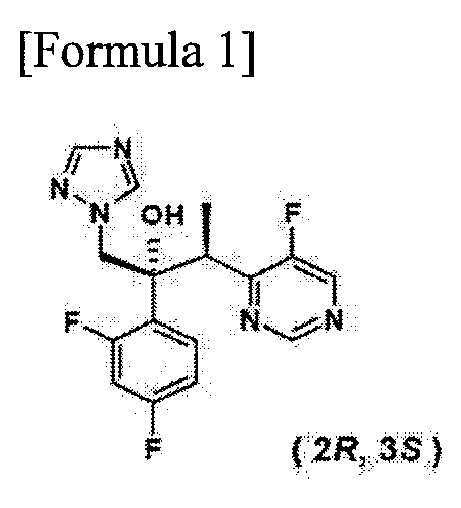
- Voriconazole has the chemical name of (2R,3S)-2-(2,4-difluorophenyl)-3-(5-fluoropyrimidin-4-yl)-1-(1H-1,2,4-triazol-1-yl)butan-2-ol and is represented by the structural formula 1 below.
- Voriconazole is currently marketed under the trade name of VFEND TM by Pfizer Inc.
- voriconazole has two asymmetric carbon atoms. Therefore, two diastereoisomeric pairs are involved in the synthesis of voriconazole, and the presence of two optical stereoisomers in each diastereoisomer finally gives rise to four stereoisomers.
- voriconazole is prepared by separating an enantiomeric pair having a preferred configuration (2R,3S/2S,3R) from among four stereoisomers, and then optically resolving only the pure (2R,3S)-stereoisomer using an optically active acid, R-(-)-10-camphorsulfonic acid.
- Such a known process for the preparation of voriconazole is as follows.
- Patent No. 0011039 Korean Patent Application Publication No. 1993-0011039 B1 (hereinafter, referred to as Patent No. 0011039 ), as shown in Reaction Scheme 1 below, discloses a process for the preparation of voriconazole in which four isomers are synthesized by reacting 4-chloro-6-ethyl-5-fluoropyrimidine and 1-(2,4-difluorophenyl)-2-(1H-1,2,4-triazol-1-yl)ethanone using lithium diisopropylamide (LDA) which is a strong base, column chromatographic separation is carried out to yield a desired enantiomeric pair (2R,3S/2S,3R), a reaction to remove the chlorine substituent is carried out in the presence of hydrogen gas and palladium, and then the resulting product is subjected to optical resolution using camphorsulfonic acid.
- LDA lithium diisopropylamide
- WO 2006/065726 discloses a process for preparing a desired enantiomeric pair (2R,3S/2S,3R) of voriconazole in which only the conditions of a reaction solvent are different from those described in Korean Patent Application Publication No. 1993-0011039 B1 and which does not involve column chromatographic purification.
- the process of WO 2006/065726 still has a low yield of 26% and has disadvantages of conventional production processes, such as subsequent reaction to remove the chlorine substituent in the presence of palladium and high-pressure hydrogen.
- Korean Patent No. 10-0269048 addresses an improvement of conventional problems encountered in the reaction using an organic lithium salt and discloses a process for the preparation of voriconazole, which enhances stereoselectivity of an isomeric pair and improves a reaction yield through the Reformatsky reaction using an activated zinc metal, as shown in Reaction Scheme 2 below.
- a (2R,3S/2S,3R) enantiomeric pair and a (2R,3R/2S,3S) enantiomeric pair of the product are formed in a molar ratio of 9:1 in terms of selectivity after the Reformatsky reaction, total 4 unseparated isomers in the form of a hydrochloride are separated in a 65% yield by way of crystallization separation, the chlorine substituent is removed using a palladium metal and hydrogen gas, and then a desired isomeric pair (2R,3S/2S,3R) is separated. Thereafter, optical resolution is carried out by separating only the pure (2R,3S) stereoisomer using R-(-)-10-camphorsulfonic acid as in a conventional method.
- This reaction does not need maintenance of an ultralow temperature and exhibits a significantly improved stereoselectivity of 9:1 of a (2R,3S/2S,3R) enantiomeric pair and a (2R,3R/2S,3S) enantiomeric pair as compared to 1:1 of Korean Patent Application Publication No. 1993-0011039 B1 , in conjunction with an improved yield of 65%, thus being industrially applicable.
- the compound of formula 10 (approximately 10%) produced during the reaction is responsible for the inhibition of the reproduction of a facile crystallization process for a mixture of four isomers which are the products of the Reformatsky reaction.
- expensive palladium and explosive risk of a high-pressure hydrogen reaction used for the removal of the chlorine substituent restrict industrial application of the production process.
- Korean Patent No. 10-0889937 discloses a process for the preparation of voriconazole using a voriconazole intermediate with substitution of a thio group introduced in place of chloro at the 6-position of 4-(1-bromoethyl)-6-chloro-5-fluoropyrimidine which is a reactant conventionally used in the Reformatsky reaction.
- phenylthio compounds used in the preparation of a phenylthiopyrimidine derivative which is a novel intermediate of this process have a limitation in terms of industrial-scale production due to very irritative and offensive odor inherent thereto.
- the present invention is intended to provide a novel intermediate which is environmentally-friendly and enables the production of voriconazole with high purity and high yield while not causing emission of unique irritative and offensive odor in a production process and a process for the preparation of voriconazole using the same.
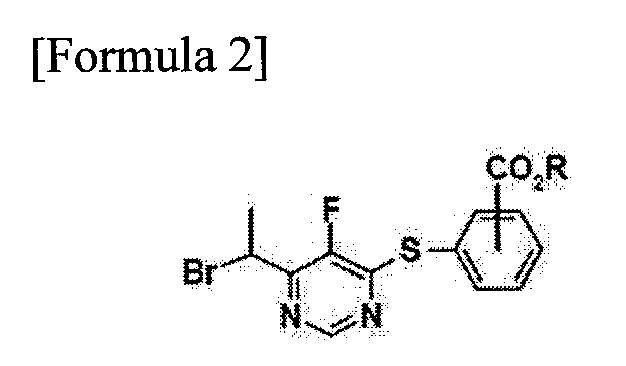
- the present invention provides a compound represented by formula 2. wherein R is C 1 -C 6 alkyl or C 3 -C 6 cycloalkyl.
- a preferred compound of formula 2 is methyl 2-[6-(1-bromo-ethyl)-5-fluoropyrimidin-4-yl-sulfanyl]benzoate.
- the compound of formula 2 in accordance with the present invention may be prepared according to the method of Reaction Scheme 3 using 2-mercaptobenzoic acid, 3-mercaptobenzoic acid or 4-mercaptobenzoic acid as a starting material.
- R is C 1 -C 6 alkyl or C 3 -C 6 cycloalkyl, and preferably methyl.
- the compound of formula 2 is methyl 2-[6-(1-bromo-ethyl)-5-fluoropyrimidin-4-yl-sulfanyl]benzoate
- the compound is prepared according to the following method including: a) reacting 2-mercaptobenzoic acid with methanol in the presence of acid to obtain methyl 2-mercaptobenzoate; b) reacting the product of Step a) with 4-chloro-6-ethyl-5-fluoro-pyrimidine in the presence of a base to obtain methyl 2-(6-ethyl-5-fluoropyrimidin-4-yl-sulfanyl)benzoate; and c) reacting the product of Step b) with N-bromosuccinimide and azobisisobutyronitrile to prepare methyl 2-[6-(1-bromo-ethyl)-5-fluoropyrimidin-4-yl-sulfanyl]benzoate.
- the present invention provides a process for the preparation of a compound represented by formula 4, including subjecting a compound of formula 2 and 1-(2,4-difluorophenyl)-2-(1H-1,2,4-triazol-1-yl)ethanone to Reformatsky reaction.
- R is C 1 -C 6 alkyl or C 3 -C 6 cycloalkyl.
- 1-(2,4-difluorophenyl)-2-(1H-1,2,4-triazol-1-yl)ethanone is commercially available or otherwise may be prepared by a known method.
- the Reformatsky reaction is preferably carried out in the presence of activated zinc and iodine or in the presence of activated zinc/lead and iodine.
- the activated zinc is zinc prepared by treating the commercial zinc powder with an acid aqueous solution, followed by drying.
- the activated zinc may be in the form of zinc which was washed with dilute hydrochloric acid and then dried.
- Lead may be in the form of a powder which is commonly commercially available.
- the content of the activated zinc is in the range of 3 equivalents to 10 equivalents, and preferably about 8 equivalents, based on 1-(2,4-difluorophenyl)-2-(1H-1,2,4-triazol-1-yl)ethanone.
- the content of iodine used for initiation of the reaction is in the range of 1 equivalent to 3 equivalents, and preferably about 2 equivalents, based on 1-(2,4-difluorophenyl)-2-(1H-1,2,4-triazol-1-yl)ethanone.
- reaction temperature is preferably in the range of 0 to 30 ⁇
- reaction solvent is preferably an ether solvent such as tetrahydrofuran (THF), diethyl ether or 1,4-dioxane, and more preferably THF.
- an undesirable enantiomeric pair (1R,2R/1S,1S) is dissolved to be removed in the solution taking advantage of a difference in physical properties with a preferred enantiomeric pair (1R,2S/1S,2R)
- the compound of formula 4 which is the preferred enantiomeric pair (1R,2S/1S,2R) can be obtained with a high yield of more than 75%.
- the difference in physical properties between diastereoisomers means a difference in terms of solubility thereof in a solvent.
- the compound of formula 4 can be obtained taking advantage of a difference in terms of solubility in a solvent such as ethyl acetate, isopropanol or n-hexane.
- the present invention provides a compound of formula 4. wherein R is C 1 -C 6 alkyl or C 3 -C 6 cycloalkyl.
- the compound of formula 4 in accordance with the present invention is preferably methyl 2- ⁇ 6-[(1S,2R/1R,2S)-2-(2,4-difluorophenyl)-2-hydroxy-1-methyl-3-[1,2,4]triazo-1-yl-propyl]-5-fluoropyrimidin-4-yl-sulfanyl ⁇ benzoate.
- the present invention provides a process for the preparation of voriconazole, including a) removing a thiol derivative which is the substituent of the compound of formula 4 in the presence of zinc and organic acid to obtain racemic voriconazole that is (2R,3S/2S,3R)-2-(2,4-difluorophenyl)-3-(5-fluoropyrimidin-4-yl)-1-(1H-1,2,4-triazol-1-yl)butan-2-ol; and b) subjecting the racemic voriconazole which is the product of Step a) to optical resolution with R-(-)-camphorsulfonic acid, thereby obtaining voriconazole which is the compound of formula 1.
- R is C 1 -C 6 alkyl or C 3 -C 6 cycloalkyl.
- the compound of formula 4 is preferably prepared by subjecting a compound of formula 2 and 1-(2,4-difluorophenyl)-2-(1H-1,2,4-triazol-1-yl)ethanone to Reformatsky reaction.
- R is C 1 -C 6 alkyl or C 3 -C 6 cycloalkyl.
- the compound of formula 4 is preferably methyl 2- ⁇ 6-[(1S,2R/1R,2S)-2-(2,4-difluorophenyl)-2-hydroxy-1-methyl-3-[1,2,4]triazo-1-yl-propyl]-5-fluoropyrimidin-4-yl-sulfanyl ⁇ benzoate.
- the organic acid used in Step a) is preferably selected from ammonium formate, formic acid, ammonium acetate, acetic acid and a mixture thereof and is more preferably ammonium formate.
- the content of activated zinc used is preferably 1 equivalents relative to 7 equivalent of the compound of formula 4, and the content of ammonium formate used is preferably 1 equivalents relative to 10 equivalent of the compound of formula 4.
- the reaction solvent is preferably selected from hydrophilic organic solvents, ethers, ketones and alcohols and is more preferably THF.
- optical resolution of the racemic voriconazole of Step a) with R-(-)-camphorsulfonic acid is carried out by a known method described in Korean Patent Application Publication No. 1993-0011039 B1 , Korean Patent No. 10-0269048 , Korean Patent No. 10-0889937 or the like.
- racemic voriconazole and R-(-)-10-camphorsulfonic acid are reacted with reflux in an organic solvent to prepare voriconazole R-(-)-10-camphorsulfonic acid, a base such as sodium hydroxide is added to the resulting product, and then voriconazole is separated and obtained.
- reagents and solvents used in the present invention were purchased from Aldrich, Lancaster, Daejeong Chemical Co., Ltd., Samchun Chemical Co., Ltd., or the like.
- activated zinc referred to hereinafter was a zinc powder (purchased from Daejeong Chemical Co., Ltd.) which was treated according to the method described in the literature [ W.L.F. Armarego and D.D., Perrin, "Purification of Laboratory Chemicals", 4th edition, p 452, published by Butterworth Heinemann ].
- Example 1 Preparation of methyl 2-[6-(1-bromo-ethyl)-5-fluoropyrimidin-4-yl-sulfanyl]benzoate (Preparation of compound of formula 2 with substitution of -CO 2 CH 3 at the ortho position)
- Example 2 Preparation of methyl 2- ⁇ 6-[(1S,2R/1R,2S)-2-(2,4-difluorophenyl)-2-hydroxy-1-methyl-3-[1,2,4]triazo-1-yl-propyl]-5-fluoropyrimidin-4-yl-sulfanyl ⁇ benzoate (Preparation of compound of formula 4 with substitution of -CO 2 CH 3 at the ortho position)
- Tetrahydrofuran in the solution was removed by distillation under reduced pressure, and the residual solution was diluted with 500mL of ethyl acetate. Thereafter, this solution was washed with 500mL of a saturated ammonium chloride aqueous solution and was successively washed with 500mL of a 5% disodium ethylenediaminetetraacetate dihydrate solution and 500mL of saturated brine. The organic layer was concentrated under reduced pressure, crystallized from 100mL of isopropanol and 100mL of hexane at 25 ⁇ , filtered and dried to afford 26.9g (yield: 77.6%) of the pale yellow title compound.
- reaction liquid prior to crystallization was subjected to HPLC analysis using an internal standard material.
- Example 3 Preparation of methyl 2- ⁇ 6-[(1S,2R/1R,2S)-2-(2,4-difluorophenyl)-2-hydroxy-1-methyl-3-[1,2,4]triazo-1-yl-propyl]-5-fluoropyrimidin-4-yl-sulfanyl ⁇ benzoate: no addition of lead powder. (Preparation of compound of formula 4 with substitution of-CO 2 CH 3 at the ortho position)
- Tetrahydrofuran in the solution was removed by distillation under reduced pressure, followed by dilution with 100mL of ethyl acetate. This solution was washed with 100mL of a saturated ammonium chloride aqueous solution and was successively washed with 100mL of a 5% disodium ethylenediaminetetraacetate dihydrate solution and 100mL of saturated brine. The organic layer was concentrated under reduced pressure, crystallized from 20mL of isopropanol and 20mL of hexane at 25 ⁇ , filtered and dried to afford 4.2g (yield: 60.6%) of a pale yellow compound.
- Step 1 Preparation of 4-ethyl-5-fluoro-6-(1-methyl-1H-tetrazol-5-yl-sulfanyl)pyrimidine
- a mixed solution of 14.5g of 5-mercapto-1-methyltetrazole and 200mL of tetrahydrofuran was cooled to 5 ⁇ and 3.3g of sodium hydride was added thereto, followed by stirring for 10 minutes. After being stirred at 25 ⁇ for 30 minutes, the mixed solution was cooled to 5 ⁇ . 20g of 4-chloro-6-ethyl-5-fluoropyrimidine was added dropwise thereto at a temperature of below 20 ⁇ over 15 minutes, followed by elevation to 25 ⁇ and stirring for 30 minutes. The resulting mixture was concentrated under reduced pressure and diluted with 300mL of ethyl acetate. The organic layer was successively washed with 200mL of a saturated ammonium chloride solution and 200mL of purified water.
- Step 2 Preparation of 4-(1-bromoethyl)-5-fluoro-6-(1-methyl-1H-tetrazol-5-yl-sulfanyl)pyrimidine
- Step 3 Reformatsky reaction of 4-(1-bromoethyl)-5-fluoro-6-(1-methyl-1H-tetrazol-5-yl-sulfanyl)pyrimidine
- reaction mixture was cooled to 5 ⁇ , and a mixed solution of 10mL of tetrahydrofuran, 0.45g of 1-(2,4-difluorophenyl)-2-(1H-1,2,4-triazol-1-yl)ethanone, 1.27g of 4-(1-bromoethyl)-5-fluoro-6-(1-methyl-1H-tetrazol-5-yl-sulfanyl)pyrimidine prepared in Step 2 and 0.5g of iodine was slowly added thereto over 10 minutes, followed by elevation to 25 ⁇ and stirring for 2 hours.
- the solid metal residue was filtered through Celite and tetrahydrofuran was removed by distillation, followed by dilution with 40mL of ethyl acetate.
- the reaction liquid was successively washed with 30mL of a 5% disodium ethylenediaminetetraacetate dihydrate solution and 30mL of saturated brine.
- the reaction liquid was concentrated under reduced pressure, and the reaction product was separated by column chromatography.
- the resulting product was 0.9g of 4-ethyl-5-fluoro-6-(1-methyl-1H-tetrazol-5-yl-sulfanyl)pyrimidine and 0.38g of 1-(2,4-difluorophenyl)-2-(1H-1,2,4-triazol-1-yl)ethanone. It was confirmed that Reformatsky reaction using zinc did not proceed and debromination of the starting material 4-(1-bromoethyl)-5-fluoro-6-(1-methyl-1H-tetrazol-5-yl-sulfanyl)pyrimidine took place as a side reaction.
Landscapes
- Chemical & Material Sciences (AREA)
- Organic Chemistry (AREA)
- Health & Medical Sciences (AREA)
- Epidemiology (AREA)
- Medicinal Chemistry (AREA)
- Pharmacology & Pharmacy (AREA)
- Life Sciences & Earth Sciences (AREA)
- Animal Behavior & Ethology (AREA)
- General Health & Medical Sciences (AREA)
- Public Health (AREA)
- Veterinary Medicine (AREA)
- Inorganic Chemistry (AREA)
- Plural Heterocyclic Compounds (AREA)
- Pharmaceuticals Containing Other Organic And Inorganic Compounds (AREA)
Abstract
Description
- The present invention relates to a novel intermediate of voriconazole and a process for the preparation of voriconazole using the same.
- Voriconazole is a triazole-based antifungal agent disclosed in Korean Patent Application Publication No.
1993-0011039 B1 
- As shown in the above structural formula, voriconazole has two asymmetric carbon atoms. Therefore, two diastereoisomeric pairs are involved in the synthesis of voriconazole, and the presence of two optical stereoisomers in each diastereoisomer finally gives rise to four stereoisomers.
- For this reason, voriconazole is prepared by separating an enantiomeric pair having a preferred configuration (2R,3S/2S,3R) from among four stereoisomers, and then optically resolving only the pure (2R,3S)-stereoisomer using an optically active acid, R-(-)-10-camphorsulfonic acid. Such a known process for the preparation of voriconazole is as follows.
- Korean Patent Application Publication No.
1993-0011039 B1 0011039 
- International Publication No.
WO 2006/065726 discloses a process for preparing a desired enantiomeric pair (2R,3S/2S,3R) of voriconazole in which only the conditions of a reaction solvent are different from those described in Korean Patent Application Publication No.1993-0011039 B1 WO 2006/065726 still has a low yield of 26% and has disadvantages of conventional production processes, such as subsequent reaction to remove the chlorine substituent in the presence of palladium and high-pressure hydrogen. - Further, International Publication No.
WO 2007/013096 also discloses a process for preparing a desired enantiomeric pair of voriconazole in which an ultralow temperature of below -50□ is maintained as shown in Reaction Scheme 1 above, an organic lithium salt is used and a solvent composition is changed to a mixed solvent of tetrahydrofuran and n-hexane. However, a yield of the product through the crystallization method of this reaction is not more than 30%, and the ratio of an isomeric pair is also merely (2R,3S/2S,3R):(2R,3R/2S,3S)= 75:25. Further, since the removal of the chlorine substituent in the presence of Raney-nickel and hydrogen gas subsequent to this reaction is also a conventional method using an expensive metal catalyst such as palladium and a high-pressure hydrogen reaction is necessary as in the conventional method, there is a limitation in terms of industrial application. - Korean Patent No.
10-0269048 

- This reaction does not need maintenance of an ultralow temperature and exhibits a significantly improved stereoselectivity of 9:1 of a (2R,3S/2S,3R) enantiomeric pair and a (2R,3R/2S,3S) enantiomeric pair as compared to 1:1 of Korean Patent Application Publication No.
1993-0011039 B1 
- In addition, Korean Patent No.
10-0889937 - To this end, in order to search for a thio derivative which does not give off irritative odor and is low in terms of production costs, inventors of the present invention have synthesized and investigated a variety of thio derivatives which do not smell of the odor peculiar to thiols. Unfortunately, with these thio derivative compounds, the Reformatsky reaction using a zinc metal did not proceed and only a debromination reaction took place as a side reaction (Comparative Example 1). Inter alia, the present inventors have surprisingly discovered that the compound of formula 2 obtained by the esterification of a thiosalicylic acid derivative is outstandingly high in terms of reactivity of Reformatsky reaction and selectivity of stereoisomers in conjunction with no emission of odor inherent to thiols. The present invention has been completed based on these findings.

- Therefore, the present invention is intended to provide a novel intermediate which is environmentally-friendly and enables the production of voriconazole with high purity and high yield while not causing emission of unique irritative and offensive odor in a production process and a process for the preparation of voriconazole using the same.
- The present invention provides a compound represented by formula 2.


- A preferred compound of formula 2 is methyl 2-[6-(1-bromo-ethyl)-5-fluoropyrimidin-4-yl-sulfanyl]benzoate.
- The compound of formula 2 in accordance with the present invention may be prepared according to the method of Reaction Scheme 3 using 2-mercaptobenzoic acid, 3-mercaptobenzoic acid or 4-mercaptobenzoic acid as a starting material.

- In the above Reaction Scheme, R is C1-C6 alkyl or C3-C6 cycloalkyl, and preferably methyl.
- For example, where the compound of formula 2 is methyl 2-[6-(1-bromo-ethyl)-5-fluoropyrimidin-4-yl-sulfanyl]benzoate, the compound is prepared according to the following method including: a) reacting 2-mercaptobenzoic acid with methanol in the presence of acid to obtain methyl 2-mercaptobenzoate; b) reacting the product of Step a) with 4-chloro-6-ethyl-5-fluoro-pyrimidine in the presence of a base to obtain methyl 2-(6-ethyl-5-fluoropyrimidin-4-yl-sulfanyl)benzoate; and c) reacting the product of Step b) with N-bromosuccinimide and azobisisobutyronitrile to prepare methyl 2-[6-(1-bromo-ethyl)-5-fluoropyrimidin-4-yl-sulfanyl]benzoate.
- Further, the present invention provides a process for the preparation of a compound represented by formula 4, including subjecting a compound of formula 2 and 1-(2,4-difluorophenyl)-2-(1H-1,2,4-triazol-1-yl)ethanone to Reformatsky reaction.


- In the process for the preparation of the compound of formula 4 in accordance with the present invention, 1-(2,4-difluorophenyl)-2-(1H-1,2,4-triazol-1-yl)ethanone is commercially available or otherwise may be prepared by a known method.
- In the process for the preparation of the compound of formula 4 in accordance with the present invention, the Reformatsky reaction is preferably carried out in the presence of activated zinc and iodine or in the presence of activated zinc/lead and iodine. Here, the activated zinc is zinc prepared by treating the commercial zinc powder with an acid aqueous solution, followed by drying. For example, the activated zinc may be in the form of zinc which was washed with dilute hydrochloric acid and then dried.
- Lead may be in the form of a powder which is commonly commercially available. The content of the activated zinc is in the range of 3 equivalents to 10 equivalents, and preferably about 8 equivalents, based on 1-(2,4-difluorophenyl)-2-(1H-1,2,4-triazol-1-yl)ethanone. The content of iodine used for initiation of the reaction is in the range of 1 equivalent to 3 equivalents, and preferably about 2 equivalents, based on 1-(2,4-difluorophenyl)-2-(1H-1,2,4-triazol-1-yl)ethanone. Here, the reaction temperature is preferably in the range of 0 to 30□, and the reaction solvent is preferably an ether solvent such as tetrahydrofuran (THF), diethyl ether or 1,4-dioxane, and more preferably THF.
- In the process for the preparation of the compound of formula 4 in accordance with the present invention, the enantiomeric pair which is a stereoisomer of the compound of formula 4 is formed in a molar ratio of (1R,2S/1S,2R):(1R,2R/1S,2S) = about 8:2 to about 10:1. At this time, since an undesirable enantiomeric pair (1R,2R/1S,1S) is dissolved to be removed in the solution taking advantage of a difference in physical properties with a preferred enantiomeric pair (1R,2S/1S,2R), the compound of formula 4 which is the preferred enantiomeric pair (1R,2S/1S,2R) can be obtained with a high yield of more than 75%. That is, the difference in physical properties between diastereoisomers means a difference in terms of solubility thereof in a solvent. For example, the compound of formula 4 can be obtained taking advantage of a difference in terms of solubility in a solvent such as ethyl acetate, isopropanol or n-hexane.
- Further, the present invention provides a compound of formula 4.

- The compound of formula 4 in accordance with the present invention is preferably methyl 2-{6-[(1S,2R/1R,2S)-2-(2,4-difluorophenyl)-2-hydroxy-1-methyl-3-[1,2,4]triazo-1-yl-propyl]-5-fluoropyrimidin-4-yl-sulfanyl}benzoate.
- Further, the present invention provides a process for the preparation of voriconazole, including a) removing a thiol derivative which is the substituent of the compound of formula 4 in the presence of zinc and organic acid to obtain racemic voriconazole that is (2R,3S/2S,3R)-2-(2,4-difluorophenyl)-3-(5-fluoropyrimidin-4-yl)-1-(1H-1,2,4-triazol-1-yl)butan-2-ol; and b) subjecting the racemic voriconazole which is the product of Step a) to optical resolution with R-(-)-camphorsulfonic acid, thereby obtaining voriconazole which is the compound of formula 1.


- In the process for the preparation of voriconazole in accordance with the present invention, the compound of formula 4 is preferably prepared by subjecting a compound of formula 2 and 1-(2,4-difluorophenyl)-2-(1H-1,2,4-triazol-1-yl)ethanone to Reformatsky reaction.
- In the process for the preparation of voriconazole in accordance with the present invention, the Reformatsky reaction conditions are as mentioned in the process for the preparation of the compound of formula 4 in accordance with the present invention.
- In the process for the preparation of voriconazole in accordance with the present invention, the compound of formula 4 is preferably methyl 2-{6-[(1S,2R/1R,2S)-2-(2,4-difluorophenyl)-2-hydroxy-1-methyl-3-[1,2,4]triazo-1-yl-propyl]-5-fluoropyrimidin-4-yl-sulfanyl}benzoate.
- In the process for the preparation of voriconazole in accordance with the present invention, the organic acid used in Step a) is preferably selected from ammonium formate, formic acid, ammonium acetate, acetic acid and a mixture thereof and is more preferably ammonium formate.
- Here, the content of activated zinc used is preferably 1 equivalents relative to 7 equivalent of the compound of formula 4, and the content of ammonium formate used is preferably 1 equivalents relative to 10 equivalent of the compound of formula 4. The reaction solvent is preferably selected from hydrophilic organic solvents, ethers, ketones and alcohols and is more preferably THF.
- In the process for the preparation of voriconazole in accordance with the present invention, optical resolution of the racemic voriconazole of Step a) with R-(-)-camphorsulfonic acid is carried out by a known method described in Korean Patent Application Publication No.
1993-0011039 B1 10-0269048 10-0889937 - The process for the preparation of voriconazole in accordance with the present invention is outlined as in Reaction Scheme 4 below.

- The process for the preparation of voriconazole in accordance with the present invention using a novel compound of formula 2 and a novel compound of formula 4 provides voriconazole with high purity and high yield while not giving off irritative and offensive odor unique to thiols and is therefore capable of achieving mass production of voriconazole on an industrial scale.
-
-
Fig. 1 shows the hydrogen nuclear magnetic resonance spectroscopy (1H-NMR) spectrum of methyl 2-{6-[(1S,2R/1R,2S)-2-(2,4-difluorophenyl)-2-hydroxy-1-methyl-3-[1,2,4]triazo-1-yl-propyl]-5-fluoropyrimidin-4-yl-sulfanyl}benzoate prepared in Example 2 of the present invention. - Now, the present invention will be described in more detail with reference to the following Examples, but the present invention is not limited thereto.
- Unless otherwise specified, reagents and solvents used in the present invention were purchased from Aldrich, Lancaster, Daejeong Chemical Co., Ltd., Samchun Chemical Co., Ltd., or the like.
- In addition, activated zinc referred to hereinafter was a zinc powder (purchased from Daejeong Chemical Co., Ltd.) which was treated according to the method described in the literature [W.L.F. Armarego and D.D., Perrin, "Purification of Laboratory Chemicals", 4th edition, p 452, published by Butterworth Heinemann].
- 1H-NMR given hereinafter was measured by using VARIAN GEMINI 200 having a resolution of 200MHz. Chemical purity analysis of products was carried out by HPLC (Model No.: L-2130, manufactured by Hitachi). Ratiometric analysis of an enantiomeric pair was carried out under the following conditions: Column: Kromasil C18 reversed phase column (25cm x 4.6mm, 5µm); Detection wavelength: 254nm; Mobile phase: acetonitrile:water=65:35 (v/v); Flow rate: 1.0mL/min. In addition, ratiometric analysis of stereoisomers was carried out under the following conditions: Chiral column: Daicel OD-H column (25cm x 4.6mm); Detection wavelength: 254nm; Mobile phase: n-hexane:ethanol=7:3(v/v); Flow rate: 1.0mL/min.
- A mixed solution of 40g of 2-mercaptobenzoic acid and 600mL of methanol was cooled to 5□ and 42mL of sulfuric acid was added dropwise thereto over 10 minutes. After being refluxed for 14 hours, the reaction liquid was concentrated under reduced pressure. The concentrate was diluted with 400mL of methylene chloride and 400mL of purified water and then the organic layer was separated. The organic layer was successively washed with 200mL of a saturated sodium bicarbonate solution and 400mL of brine and then dried over anhydrous sodium sulfate. After the organic layer was concentrated, the resulting residue was subjected to fractional distillation (118□/7mmHg) to afford 42g (yield: 96%) of the title compound as a clear oil.
- 1H-NMR (200MHz, CDCl3) δ (ppm): 8.01 (d,1H), 7.30 (d,2H), 7.14 (m,1H), 4.68 (s,SH), 3.91 (S,3H)
- A mixed solution of 31.7g of methyl 2-mercaptobenzoate prepared in Step 1) and 300mL of tetrahydrofuran was cooled to 5□ and 5.0g of sodium hydride was added dropwise thereto over 10 minutes. After being stirred at 5□ for 30 minutes, 30g of 4-chloro-6-ethyl-5-fluoropyrimidine was added dropwise over 20 minutes. The temperature during addition was maintained below 20□. The temperature of the reaction liquid was elevated to 25□, followed by stirring for 30 minutes. The resulting mixture was concentrated under reduced pressure and diluted with 300mL of ethyl acetate. The organic layer was successively washed with 200mL of a saturated ammonium chloride solution and 200mL of purified water. The organic layer was dried over anhydrous sodium sulfate and concentrated under reduced pressure to afford 52.5g (yield: 96%) of the title compound as an oil.
- 1H-NMR (200MHz, CDCl3) δ (ppm): 8.52 (d,1H), 8.01 (m,1H), 7.65-7.50 (m,3H), 3.82 (s,3H), 2.83 (q,2H), 1.32 (t,3H)
- 52.0g of methyl 2-(6-ethyl-5-fluoropyrimidin-4-yl-sulfanyl)benzoate prepared in Step 2), 36.4g of N-bromosuccinimide and 2.9g of azobisisobutyronitrile were dissolved in 500mL of chloroform. The mixture was refluxed for 12 hours. The reaction liquid was cooled to 25□ and successively washed with 500mL of purified water, 500mL of a 5% sodium metabisulfite solution and 300mL of saturated brine. The residue was dried over anhydrous sodium sulfate and concentrated under reduced pressure to afford 60.5g (yield: 91.6%) of the title compound as an oil.
- 1H-NMR (200MHz, CDCl3) δ (ppm): 8.61 (d,1H), 8.03 (m,1H), 7.60-7.53 (m,3H), 5.36 (q,2H), 3.82 (s,3H), 2.05 (d,3H)
- 34.4g of an activated zinc powder, 2.36g of a lead powder (trade name: LEAD (powder), manufactured by Samchun Chemical Co., Ltd., lead content: 90%) and 240mL of tetrahydrofuran were mixed by stirring and cooled to 5□ in nitrogen gas. To the solution was slowly added a solution of 12.8g of iodine in 100mL of tetrahydrofuran at a temperature of below 45□ over 10 minutes. The resulting solution was cooled to 5□, and a mixed solution of 200mL of tetrahydrofuran, 15g of 1-(2,4-difluorophenyl)-2-(1H-1,2,4-triazol-1-yl)ethanone, 43.4g of methyl 2-[6-(1-bromo-ethyl)-5-fluoropyrimidin-4-yl-sulfanyl]benzoate prepared in Example 1 and 17.6g of iodine was slowly added thereto over 20 minutes. Then, the mixture was warmed to 25□ and stirred for 2 hours, and the solid metal residue was filtered through Celite. Tetrahydrofuran in the solution was removed by distillation under reduced pressure, and the residual solution was diluted with 500mL of ethyl acetate. Thereafter, this solution was washed with 500mL of a saturated ammonium chloride aqueous solution and was successively washed with 500mL of a 5% disodium ethylenediaminetetraacetate dihydrate solution and 500mL of saturated brine. The organic layer was concentrated under reduced pressure, crystallized from 100mL of isopropanol and 100mL of hexane at 25□, filtered and dried to afford 26.9g (yield: 77.6%) of the pale yellow title compound.
- 1H-NMR (200MHz, CDCl3) δ (ppm): 8.49 (s,1H), 8.04 (m,1H), 7.98 (s,1H), 7.70-7.51 (m,4H), 6.79-6.89 (m,2H), 6.60 (s,1H), 4.73 (d,1H), 4.30 (d,1H), 4.08 (q,1H), 3.83 (s,3H), 1.70 (s,OH), 1.08 (d,3H)
- In addition, the reaction liquid prior to crystallization was subjected to HPLC analysis using an internal standard material. As a result, the reaction conversion was 95.0% and the ratio of an isomeric pair of the reaction liquid was (1R,2S/1S,2R):(1R,2R/1S,2S)=10:1. The ratio of an enantiomeric pair of the title compound obtained by crystallization was (1R,2S/1S,2R):(1R,2R/1S,2S) =99.6%:0.4%.
- A stirred mixture of 6.9g of an activated zinc powder (trade name: ZINC, manufactured by Daejeong Chemical Co., Ltd., content: 99%) and 48mL of tetrahydrofuran was cooled to 5□ in nitrogen gas. To the solution was slowly added a solution of 2.6g of iodine in 20mL of tetrahydrofuran at a temperature of below 45□ over 10 minutes. This solution was cooled to 5□, and a mixed solution of 40mL of tetrahydrofuran, 3.0g of 1-(2,4-difluorophenyl)-2-(1H-1,2,4-triazol-1-yl)ethanone, 8.7g of methyl 2-[6-(1-bromo-ethyl)-5-fluoropyrimidin-4-yl-sulfanyl]benzoate prepared in Example 1 and 3.5g of iodine was slowly added thereto over 20 minutes. The resulting solution was warmed to 25□ and stirred for 2 hours, and the solid metal residue was filtered through Celite. Tetrahydrofuran in the solution was removed by distillation under reduced pressure, followed by dilution with 100mL of ethyl acetate. This solution was washed with 100mL of a saturated ammonium chloride aqueous solution and was successively washed with 100mL of a 5% disodium ethylenediaminetetraacetate dihydrate solution and 100mL of saturated brine. The organic layer was concentrated under reduced pressure, crystallized from 20mL of isopropanol and 20mL of hexane at 25□, filtered and dried to afford 4.2g (yield: 60.6%) of a pale yellow compound.
- The reaction liquid was subjected to HPLC analysis using an internal standard material. As a result, the total conversion was 90.5% and the ratio of an isomeric pair was (1R,2S/1S,2R):(1R,2R/1S,2S)=8:2. The ratio of an enantiomeric pair of the title compound obtained by crystallization was (1R,2S/1S,2R):(1R,2R/1S,2S)= 99.5%:0.5%.
- To 18.7g of an activated zinc powder was added 500mL of tetrahydrofuran, followed by reflux at 64□ for 1 hour. The temperature was lowered and maintained at 50□. To this solution was added 21.0g of methyl 2-{6-[(1S,2R/1R,2S)-2-(2,4-difluorophenyl)-2-hydroxy-1-methyl-3-[1,2,4]triazo-1-yl-propyl]-5-fluoropyrimidin-4-yl-sulfanyl}benzoate prepared in Example 2. 25.7g of ammonium formate in 350mL of water was slowly added thereto over 30 minutes, followed by reflux for 4 hours. After the reaction liquid was cooled to room temperature, the solid metal residue was filtered through Celite and washed with 500mL of ethyl acetate. The filtrate was washed with 300mL of a saturated ammonium chloride aqueous solution and was successively washed with 300mL of sodium bicarbonate, 300mL of a 5% sodium hydroxide aqueous solution and 300mL of brine. The organic layer was dried over anhydrous sodium sulfate, filtered and concentrated. To the concentrate were added 250mL of ethyl acetate and 500mL of n-hexane, followed by stirring for 30 minutes. The resulting solid was removed by filtration. The filtrate was concentrated to afford 15.1g (content: 85%, yield: 90%) of (2R,3S/2S,3R)-2-(2,4-difluorophenyl)-3-(5-fluoropyrimidin-4-yl)-1-(1H-1,2,4-triazol-1-yl)butan-2-ol (hereinafter, referred to as racemic voriconazole) as a crude oil.
- 15.1g (content: 85%) of racemic voriconazole prepared in Example 4 was dissolved in 288mL of acetone and 8.51g of R-(-)-10-camphorsulfonic acid dissolved in 96mL of methanol was added thereto. This was followed by reflux at 50□ until the reaction liquid became a clear solution, and the reaction liquid was slowly cooled to 20□. The reaction liquid was stirred at 20□ for 18 hours, filtered and dried to afford 7.46g (yield: 35%) of the white title compound as (2R,3S)-2-(2,4-difluorophenyl)-3-(5-fluoropyrimidin-4-yl)-1-(1H-1,2,4-triazol-1-yl)butan-2-ol R-(-)-10-camphorsulfonate (hereinafter, referred to as voriconazole R-(-)-camsylate).
- According to the HPLC analysis results, there was no enantiomeric pair of (2R,3R/2S,3S), and an isomeric ratio of the compound was (2R,3S):(2S,3R)=99.9%:0.1%. The optical purity of the product was more than 99.8%.
- 7.4g of voriconazole R-(-)-camsylate prepared in Example 5, 50mL of dichloromethane and 50mL of purified water were mixed, and 1.3mL of a 40% sodium hydroxide solution was added thereto. The mixture was adjusted to a pH of 11 to 12. The organic layer was separated, and the aqueous layer was extracted with 15mL of dichloromethane. The combined organic layer was dried over anhydrous sodium sulfate, filtered and concentrated. 13mL of isopropanol was added thereto, followed by stirring at 0□ for 3 hours. The resulting solid was filtered and dried to afford 4.1g (yield: 92%) of the white title compound.
- 1H-NMR (200MHz, DMSO-d6) δ (ppm): 9.04 (s,1H), 8.84 (s,1H), 8.23 (s,1H), 7.62 (s,1H), 7.28 to 7.17 (m,2H), 6.91 (m,1H), 6.02 (bs,1H), 4.80 (d,1H), 4.34 (d,1H), 3.93 (q,1H), 1.1 (d,3H)
- According to the HPLC analysis results, the enantiomeric ratio was (2R,3S):(2S,3R)=100%:0%, and the optical purity of the product was more than 99.9%.
- A mixed solution of 14.5g of 5-mercapto-1-methyltetrazole and 200mL of tetrahydrofuran was cooled to 5□ and 3.3g of sodium hydride was added thereto, followed by stirring for 10 minutes. After being stirred at 25□ for 30 minutes, the mixed solution was cooled to 5□. 20g of 4-chloro-6-ethyl-5-fluoropyrimidine was added dropwise thereto at a temperature of below 20□ over 15 minutes, followed by elevation to 25□ and stirring for 30 minutes. The resulting mixture was concentrated under reduced pressure and diluted with 300mL of ethyl acetate. The organic layer was successively washed with 200mL of a saturated ammonium chloride solution and 200mL of purified water. The organic layer was dried over anhydrous sodium sulfate and concentrated under reduced pressure. The concentrate was crystallized from 30mL of isopropanol and 30mL of hexane, filtered and dried to afford 19g (yield: 63.4%) of a pale yellow compound.
- 1H-NMR (200MHz, CDCl3) δ (ppm): 8.52 (s,1H), 4.11 (s,3H), 2.86 (q,2H), 1.32 (t,3H)
- 10.0g of 4-ethyl-5-fluoro-6-(1-methyl-1H-tetrazol-5-yl-sulfanyl)pyrimidine prepared in Step 1, 11.1g of N-bromosuccinimide and 0.7g of azobisisobutyronitrile were dissolved in 100mL of chloroform, followed by reflux at 62□ for 3 hours. The reaction liquid was cooled to 25□ and successively washed with 100mL of purified water, 100mL of a 5% sodium metabisulfite solution and 100mL of saturated brine. The reaction liquid was dried over anhydrous sodium sulfate and concentrated under reduced pressure. The concentrate was crystallized from 20mL of isopropanol and 10mL of hexane, filtered and dried to afford 11.8g (yield: 89.0%) of a pale yellow compound.
- 1H-NMR (200MHz, CDCl3) δ (ppm): 8.61 (s,1H), 5.34 (q,1H), 4.14 (s,3H), 2.06 (d,3H)
- A stirred mixture of 1.0g of an activated zinc powder, 0.08g of a lead powder and 10mL of tetrahydrofuran was cooled to 5□ in nitrogen gas. A solution of 0.5g of iodine in 10mL of tetrahydrofuran was slowly added thereto at a temperature of below 45□ over 5 minutes. Then, the reaction mixture was cooled to 5□, and a mixed solution of 10mL of tetrahydrofuran, 0.45g of 1-(2,4-difluorophenyl)-2-(1H-1,2,4-triazol-1-yl)ethanone, 1.27g of 4-(1-bromoethyl)-5-fluoro-6-(1-methyl-1H-tetrazol-5-yl-sulfanyl)pyrimidine prepared in Step 2 and 0.5g of iodine was slowly added thereto over 10 minutes, followed by elevation to 25 □ and stirring for 2 hours. The solid metal residue was filtered through Celite and tetrahydrofuran was removed by distillation, followed by dilution with 40mL of ethyl acetate. The reaction liquid was successively washed with 30mL of a 5% disodium ethylenediaminetetraacetate dihydrate solution and 30mL of saturated brine. The reaction liquid was concentrated under reduced pressure, and the reaction product was separated by column chromatography. The resulting product was 0.9g of 4-ethyl-5-fluoro-6-(1-methyl-1H-tetrazol-5-yl-sulfanyl)pyrimidine and 0.38g of 1-(2,4-difluorophenyl)-2-(1H-1,2,4-triazol-1-yl)ethanone. It was confirmed that Reformatsky reaction using zinc did not proceed and debromination of the starting material 4-(1-bromoethyl)-5-fluoro-6-(1-methyl-1H-tetrazol-5-yl-sulfanyl)pyrimidine took place as a side reaction.
Claims (12)
- A compound represented by formula 2.

- The compound according to claim 1, wherein the compound of formula 2 is methyl 2-[6-(1-bromo-ethyl)-5-fluoropyrimidin-4-yl-sulfanyl]benzoate.
- A process for the preparation of a compound represented by formula 4, comprising subjecting a compound of formula 2 and 1-(2,4-difluorophenyl)-2-(1H-1,2,4-triazol-1-yl)ethanone to Reformatsky reaction.


- The process according to claim 3, wherein the Reformatsky reaction is carried out in the presence of activated zinc/lead and iodine.
- A compound represented by formula 4.


- The compound according to claim 5, wherein the compound of formula 4 is methyl 2-{6-[(1S,2R/1R,2S)-2-(2,4-difluorophenyl)-2-hydroxy-1-methyl-3-[1,2,4]triazo-1-yl-propyl]-5-fluoropyrimidin-4-yl-sulfanyl}benzoate.
- A process for the preparation of voriconazole, comprising:a) removing a thiol derivative which is the substituent of the compound of formula 4 in the presence of zinc and organic acid to obtain racemic voriconazole that is (2R,3S/2S,3R)-2-(2,4-difluorophenyl)-3-(5-fluoropyrimidin-4-yl)-1-(1H-1,2,4-triazol-1-yl)butan-2-ol; andb) subjecting the racemic voriconazole which is the product of Step a) to optical resolution with R-(-)-camphorsulfonic acid, thereby obtaining voriconazole which is the compound of formula 1.

- The process according to claim 7, wherein the organic acid is selected from ammonium formate, formic acid, ammonium acetate, acetic acid and a mixture thereof.
- The process according to claim 7, wherein the compound of formula 4 is obtained by subjecting a compound of formula 2 and 1-(2,4-difluorophenyl)-2-(1H-1,2,4-triazol-1-yl)ethanone to Reformatsky reaction.

- The process according to claim 9, wherein the Reformatsky reaction is carried out in the presence of activated zinc/lead and iodine.
- The process according to any one of claims 7 to 10, wherein the compound of formula 4 is methyl 2-{6-[(1S,2R/1R,2S)-2-(2,4-difluorophenyl)-2-hydroxy-1-methyl-3-[1,2,4]triazo-1-yl-propyl]-5-fluoropyrimidin-4-yl-sulfanyl}benzoate.
- The process according to any one of claims 7 to 10, wherein the removal of a thiol derivative which is the substituent of the compound of formula 4 in Step a) is carried out in the presence of zinc and ammonium formate.
Applications Claiming Priority (2)
| Application Number | Priority Date | Filing Date | Title |
|---|---|---|---|
| KR1020090053670A KR101109215B1 (en) | 2009-06-17 | 2009-06-17 | Novel Intermediates of Barley Conazole and Method for Producing Barley Conazole Using the Same |
| PCT/KR2010/002715 WO2010147302A2 (en) | 2009-06-17 | 2010-04-29 | Novel intermediates of voriconazole and preparation method of voriconazole using the same |
Publications (2)
| Publication Number | Publication Date |
|---|---|
| EP2444398A2 true EP2444398A2 (en) | 2012-04-25 |
| EP2444398A4 EP2444398A4 (en) | 2013-04-10 |
Family
ID=43356847
Family Applications (1)
| Application Number | Title | Priority Date | Filing Date |
|---|---|---|---|
| EP10789629.2A Withdrawn EP2444398A4 (en) | 2009-06-17 | 2010-04-29 | Novel intermediates of voriconazole and preparation method of voriconazole using the same |
Country Status (3)
| Country | Link |
|---|---|
| EP (1) | EP2444398A4 (en) |
| KR (1) | KR101109215B1 (en) |
| WO (1) | WO2010147302A2 (en) |
Cited By (4)
| Publication number | Priority date | Publication date | Assignee | Title |
|---|---|---|---|---|
| CN103788073A (en) * | 2013-12-18 | 2014-05-14 | 北京华禧联合科技发展有限公司 | Novel method for preparing voriconazole key intermediate |
| JP2018522821A (en) * | 2015-05-18 | 2018-08-16 | ヴィアメット ファーマスーティカルズ(エヌシー),インコーポレイテッド | Antifungal compound |
| CN111440152A (en) * | 2020-05-18 | 2020-07-24 | 浙江诚意药业股份有限公司 | Preparation method of voriconazole |
| EP4019509A1 (en) | 2016-09-08 | 2022-06-29 | Zhejiang Huahai Pharmaceutical Co., Ltd | Method for preparing voriconazole l-camphorsulphonate |
Families Citing this family (13)
| Publication number | Priority date | Publication date | Assignee | Title |
|---|---|---|---|---|
| EP3119746A4 (en) | 2014-03-19 | 2017-08-16 | Viamet Pharmaceuticals, Inc. | Antifungal compound process |
| JP6509897B2 (en) | 2014-03-19 | 2019-05-08 | ヴィアメット ファーマスーティカルズ(エヌシー),インコーポレイテッド | Process for the preparation of antifungal compounds |
| US10000465B2 (en) | 2014-03-19 | 2018-06-19 | Mycovia Pharmaceuticals, Inc. | Antifungal compound process |
| JP6613391B2 (en) | 2014-03-19 | 2019-12-04 | ブイピーエス‐3,インコーポレイテッド | 2- (2,4-difluorophenyl) -1,1-difluoro-1- (5-substituted pyridin-2-yl) -3- (1H-tetrazol-1-yl) propan-2-ol and process for its preparation |
| EP3119754A4 (en) | 2014-03-19 | 2017-12-13 | Viamet Pharmaceuticals, Inc. | Antifungal compound process |
| CN109678791B (en) | 2014-03-19 | 2022-07-01 | 美国陶氏益农公司 | 1- (2, 4-difluorophenyl) -2, 2-difluoro-2- (5-substituted pyridine-2-yl) ethanone and preparation method thereof |
| EP3119748A4 (en) | 2014-03-19 | 2017-08-30 | Viamet Pharmaceuticals, Inc. | Antifungal compound process |
| US9981943B2 (en) | 2014-03-19 | 2018-05-29 | Mycovia Pharmaceuticals, Inc. | Antifungal compound process |
| US10077250B2 (en) | 2014-03-19 | 2018-09-18 | Mycovia Pharmaceuticals, Inc. | Antifungal compound process |
| KR101709543B1 (en) * | 2014-12-09 | 2017-02-23 | (주) 에프엔지리서치 | Novel voriconazole intermediate and synthesis of voriconazole |
| EP3349753A4 (en) | 2015-09-18 | 2019-01-23 | VPS-3, Inc. | ANTIFUNGAL COMPOUNDS AND METHODS OF PREPARATION |
| CN114292238B (en) * | 2022-01-07 | 2024-04-12 | 河北工业大学 | C6-alkylthio/amino substituted pyrimidine derivative and preparation method thereof |
| EP4722214A1 (en) * | 2023-05-31 | 2026-04-08 | JW Pharmaceutical Corporation | Method of preparing finerenone, intermediate compound of finerenone, and method of preparing the intermediate compound |
Family Cites Families (5)
| Publication number | Priority date | Publication date | Assignee | Title |
|---|---|---|---|---|
| GB9002375D0 (en) | 1990-02-02 | 1990-04-04 | Pfizer Ltd | Triazole antifungal agents |
| GB9516121D0 (en) | 1995-08-05 | 1995-10-04 | Pfizer Ltd | Organometallic addition to ketones |
| EP1828170A4 (en) | 2004-12-14 | 2009-11-11 | Reddys Lab Ltd Dr | Process for preparing voriconazole |
| WO2007013096A1 (en) | 2005-06-30 | 2007-02-01 | Msn Laboratories Limited | Improved process for the preparation of 2r, 3s-2-(2,4-difluorophenyl)-3-(5-fluoropyrimidin-4-yl)-1-(1h-1,2,4-triazol-1-yl) butan-2-ol (voriconazole) |
| KR100889937B1 (en) | 2007-08-06 | 2009-03-20 | 한미약품 주식회사 | Method of preparing barleyconazole |
-
2009
- 2009-06-17 KR KR1020090053670A patent/KR101109215B1/en not_active Expired - Fee Related
-
2010
- 2010-04-29 EP EP10789629.2A patent/EP2444398A4/en not_active Withdrawn
- 2010-04-29 WO PCT/KR2010/002715 patent/WO2010147302A2/en not_active Ceased
Cited By (6)
| Publication number | Priority date | Publication date | Assignee | Title |
|---|---|---|---|---|
| CN103788073A (en) * | 2013-12-18 | 2014-05-14 | 北京华禧联合科技发展有限公司 | Novel method for preparing voriconazole key intermediate |
| CN103788073B (en) * | 2013-12-18 | 2017-11-03 | 北京华禧联合科技发展有限公司 | A kind of new method for preparing key intermediate of voriconazole |
| JP2018522821A (en) * | 2015-05-18 | 2018-08-16 | ヴィアメット ファーマスーティカルズ(エヌシー),インコーポレイテッド | Antifungal compound |
| EP4019509A1 (en) | 2016-09-08 | 2022-06-29 | Zhejiang Huahai Pharmaceutical Co., Ltd | Method for preparing voriconazole l-camphorsulphonate |
| CN111440152A (en) * | 2020-05-18 | 2020-07-24 | 浙江诚意药业股份有限公司 | Preparation method of voriconazole |
| CN111440152B (en) * | 2020-05-18 | 2022-09-27 | 浙江诚意药业股份有限公司 | Preparation method of voriconazole |
Also Published As
| Publication number | Publication date |
|---|---|
| WO2010147302A2 (en) | 2010-12-23 |
| WO2010147302A3 (en) | 2011-03-10 |
| EP2444398A4 (en) | 2013-04-10 |
| KR20100135349A (en) | 2010-12-27 |
| KR101109215B1 (en) | 2012-01-30 |
Similar Documents
| Publication | Publication Date | Title |
|---|---|---|
| KR101109215B1 (en) | Novel Intermediates of Barley Conazole and Method for Producing Barley Conazole Using the Same | |
| KR100889937B1 (en) | Method of preparing barleyconazole | |
| US8394961B2 (en) | Method for the preparation of dabigatran | |
| DE102010046720A1 (en) | Process for the preparation of pan-CDK inhibitors of the formula (I), as well as intermediates of the preparation | |
| WO2017087592A1 (en) | 4-((6-(2,4-difluorophenyl)-1,1-difluoro-2-hydroxy-3-(1h-1,2,4-triazol-1-yl)propyl)pyridin-3-yl)oxy)benzonitrile and processes of preparation | |
| US20100179319A1 (en) | Process for production of optically active mirtazapine | |
| EP1838697B1 (en) | Processes for preparing 4-(phenoxy-5-methyl-pyrimidin-4-yloxy)piperidine-1-carboxylic acid derivatives and related compounds | |
| EP3915981B1 (en) | Method for preparation of efinaconazole in ionic liquid medium | |
| EP1466905B1 (en) | Process for producing optically active oxoheptenoic acid ester | |
| JP5553911B2 (en) | Method for producing voriconazole using novel intermediate | |
| US9738607B2 (en) | Scalable process for the preparation of Sorafenib tosylate ethanol solvate and Sorafenib tosylate form III | |
| JP6375374B2 (en) | Method for producing pyrimidine intermediate | |
| WO2009142194A1 (en) | Method for producing optically active aminoalcohol derivative | |
| EP2545039A1 (en) | A process for making voriconazole | |
| US10626102B2 (en) | Process for the synthesis of efinaconazol | |
| EP2174940A1 (en) | Process for production of optically active mirtazapine | |
| EP3339300B1 (en) | Method for preparing thienyl alanine having optical activity | |
| KR20230155447A (en) | Method for producing 3-bromo-1-(3-chloropyridin-2-yl)-1H-pyrazole-5-carboxylic acid ester | |
| AU2023251989A1 (en) | Methods for the preparation of 5-chloro-2- ((ethoxycarbonyl)amino)-3-methylbenzoic acid | |
| CN117088829A (en) | Synthesis method of 1-isopropyl-4-(p-methoxyphenyl)piperazine or its hydrohalide | |
| HK1230509A1 (en) | Clomiphene synthesis using a single solvent |
Legal Events
| Date | Code | Title | Description |
|---|---|---|---|
| PUAI | Public reference made under article 153(3) epc to a published international application that has entered the european phase |
Free format text: ORIGINAL CODE: 0009012 |
|
| 17P | Request for examination filed |
Effective date: 20111213 |
|
| AK | Designated contracting states |
Kind code of ref document: A2 Designated state(s): AT BE BG CH CY CZ DE DK EE ES FI FR GB GR HR HU IE IS IT LI LT LU LV MC MK MT NL NO PL PT RO SE SI SK SM TR |
|
| DAX | Request for extension of the european patent (deleted) | ||
| A4 | Supplementary search report drawn up and despatched |
Effective date: 20130313 |
|
| RIC1 | Information provided on ipc code assigned before grant |
Ipc: C07D 403/10 20060101ALI20130307BHEP Ipc: A61K 47/40 20060101ALI20130307BHEP Ipc: A61K 31/506 20060101ALI20130307BHEP Ipc: C07D 401/06 20060101AFI20130307BHEP Ipc: A61K 31/4196 20060101ALI20130307BHEP |
|
| STAA | Information on the status of an ep patent application or granted ep patent |
Free format text: STATUS: THE APPLICATION IS DEEMED TO BE WITHDRAWN |
|
| 18D | Application deemed to be withdrawn |
Effective date: 20131101 |