EP2444374A1 - Moisture-proof film for electronic devices - Google Patents
Moisture-proof film for electronic devices Download PDFInfo
- Publication number
- EP2444374A1 EP2444374A1 EP10789521A EP10789521A EP2444374A1 EP 2444374 A1 EP2444374 A1 EP 2444374A1 EP 10789521 A EP10789521 A EP 10789521A EP 10789521 A EP10789521 A EP 10789521A EP 2444374 A1 EP2444374 A1 EP 2444374A1
- Authority
- EP
- European Patent Office
- Prior art keywords
- clay
- film
- moisture
- proof film
- modified clay
- Prior art date
- Legal status (The legal status is an assumption and is not a legal conclusion. Google has not performed a legal analysis and makes no representation as to the accuracy of the status listed.)
- Granted
Links
Images

Classifications
-
- B—PERFORMING OPERATIONS; TRANSPORTING
- B82—NANOTECHNOLOGY
- B82Y—SPECIFIC USES OR APPLICATIONS OF NANOSTRUCTURES; MEASUREMENT OR ANALYSIS OF NANOSTRUCTURES; MANUFACTURE OR TREATMENT OF NANOSTRUCTURES
- B82Y30/00—Nanotechnology for materials or surface science, e.g. nanocomposites
-
- C—CHEMISTRY; METALLURGY
- C01—INORGANIC CHEMISTRY
- C01B—NON-METALLIC ELEMENTS; COMPOUNDS THEREOF; METALLOIDS OR COMPOUNDS THEREOF NOT COVERED BY SUBCLASS C01C
- C01B33/00—Silicon; Compounds thereof
- C01B33/20—Silicates
- C01B33/36—Silicates having base-exchange properties but not having molecular sieve properties
- C01B33/38—Layered base-exchange silicates, e.g. clays, micas or alkali metal silicates of kenyaite or magadiite type
- C01B33/44—Products obtained from layered base-exchange silicates by ion-exchange with organic compounds such as ammonium, phosphonium or sulfonium compounds or by intercalation of organic compounds, e.g. organoclay material
-
- C—CHEMISTRY; METALLURGY
- C08—ORGANIC MACROMOLECULAR COMPOUNDS; THEIR PREPARATION OR CHEMICAL WORKING-UP; COMPOSITIONS BASED THEREON
- C08J—WORKING-UP; GENERAL PROCESSES OF COMPOUNDING; AFTER-TREATMENT NOT COVERED BY SUBCLASSES C08B, C08C, C08F, C08G or C08H
- C08J5/00—Manufacture of articles or shaped materials containing macromolecular substances
- C08J5/18—Manufacture of films or sheets
-
- C—CHEMISTRY; METALLURGY
- C09—DYES; PAINTS; POLISHES; NATURAL RESINS; ADHESIVES; COMPOSITIONS NOT OTHERWISE PROVIDED FOR; APPLICATIONS OF MATERIALS NOT OTHERWISE PROVIDED FOR
- C09C—TREATMENT OF INORGANIC MATERIALS, OTHER THAN FIBROUS FILLERS, TO ENHANCE THEIR PIGMENTING OR FILLING PROPERTIES ; PREPARATION OF CARBON BLACK ; PREPARATION OF INORGANIC MATERIALS WHICH ARE NO SINGLE CHEMICAL COMPOUNDS AND WHICH ARE MAINLY USED AS PIGMENTS OR FILLERS
- C09C1/00—Treatment of specific inorganic materials other than fibrous fillers; Preparation of carbon black
- C09C1/40—Compounds of aluminium
- C09C1/42—Clays
-
- C—CHEMISTRY; METALLURGY
- C01—INORGANIC CHEMISTRY
- C01P—INDEXING SCHEME RELATING TO STRUCTURAL AND PHYSICAL ASPECTS OF SOLID INORGANIC COMPOUNDS
- C01P2002/00—Crystal-structural characteristics
- C01P2002/80—Crystal-structural characteristics defined by measured data other than those specified in group C01P2002/70
- C01P2002/88—Crystal-structural characteristics defined by measured data other than those specified in group C01P2002/70 by thermal analysis data, e.g. TGA, DTA, DSC
-
- C—CHEMISTRY; METALLURGY
- C01—INORGANIC CHEMISTRY
- C01P—INDEXING SCHEME RELATING TO STRUCTURAL AND PHYSICAL ASPECTS OF SOLID INORGANIC COMPOUNDS
- C01P2004/00—Particle morphology
- C01P2004/60—Particles characterised by their size
- C01P2004/64—Nanometer sized, i.e. from 1-100 nanometer
-
- C—CHEMISTRY; METALLURGY
- C01—INORGANIC CHEMISTRY
- C01P—INDEXING SCHEME RELATING TO STRUCTURAL AND PHYSICAL ASPECTS OF SOLID INORGANIC COMPOUNDS
- C01P2006/00—Physical properties of inorganic compounds
- C01P2006/22—Rheological behaviour as dispersion, e.g. viscosity, sedimentation stability
-
- C—CHEMISTRY; METALLURGY
- C08—ORGANIC MACROMOLECULAR COMPOUNDS; THEIR PREPARATION OR CHEMICAL WORKING-UP; COMPOSITIONS BASED THEREON
- C08J—WORKING-UP; GENERAL PROCESSES OF COMPOUNDING; AFTER-TREATMENT NOT COVERED BY SUBCLASSES C08B, C08C, C08F, C08G or C08H
- C08J2300/00—Characterised by the use of unspecified polymers
-
- C—CHEMISTRY; METALLURGY
- C08—ORGANIC MACROMOLECULAR COMPOUNDS; THEIR PREPARATION OR CHEMICAL WORKING-UP; COMPOSITIONS BASED THEREON
- C08L—COMPOSITIONS OF MACROMOLECULAR COMPOUNDS
- C08L77/00—Compositions of polyamides obtained by reactions forming a carboxylic amide link in the main chain; Compositions of derivatives of such polymers
-
- C—CHEMISTRY; METALLURGY
- C08—ORGANIC MACROMOLECULAR COMPOUNDS; THEIR PREPARATION OR CHEMICAL WORKING-UP; COMPOSITIONS BASED THEREON
- C08L—COMPOSITIONS OF MACROMOLECULAR COMPOUNDS
- C08L79/00—Compositions of macromolecular compounds obtained by reactions forming in the main chain of the macromolecule a linkage containing nitrogen with or without oxygen or carbon only, not provided for in groups C08L61/00 - C08L77/00
- C08L79/04—Polycondensates having nitrogen-containing heterocyclic rings in the main chain; Polyhydrazides; Polyamide acids or similar polyimide precursors
- C08L79/08—Polyimides; Polyester-imides; Polyamide-imides; Polyamide acids or similar polyimide precursors
Definitions
- the invention relates to a moisture-proof film for electronic devices. More particularly, the invention relates to a moisture-proof film for electronic devices which has flexibility, excellent water vapor barrier properties and gas barrier properties, and a mechanical strength that enables it to be used as a self-supporting film.
- the invention provides new art and a novel product relating to a moisture-proof film for electronic devices which can be used as a self-supporting film and, even at elevated temperatures exceeding 150°C for example, is chemically stable and capable of maintaining gas barrier properties, and is therefore ideal for use as a substrate or protective film for electronic devices, such as a substrate film for LCD's, a film for LED's, or a backsheet for solar cells.
- Films with gas barrier properties are generally manufactured by a process in which a polymer resin film is used as the base and a gas barrier layer is formed on one or both sides of the polymer resin film.
- a film of aluminum oxide, silicon oxide or silicon nitride is formed as the gas barrier layer by any of various techniques such as chemical vapor deposition (CVD) or physical vapor deposition (PVD).
- inorganic sheets are obtained by shaping a natural or synthetic mineral such as mica or vermiculite into the form of a sheet.
- Such sheets have a high heat resistance and do find some use as gas sealing members, such as gland packings.
- gas sealing members such as gland packings.
- metal sheets do have excellent gas barrier properties, owing to drawbacks in weather resistance, electrical insulating properties and chemical resistance, applications for these are limited.
- Properties desired of protective films and backsheets for devices used in harsh environments include not only UV resistance, moisture resistance, heat resistance and salt resistance, but also water vapor barrier properties, electrical insulating properties, mechanical strength, chemical resistance, and good adhesion to sealants.
- gas barrier properties as well, there exists a desire for films capable of being used in harsher environments than is possible with conventional materials.
- compositions made up of a carboxyl group-containing resin (Resin A) having two or more carboxyl groups on the molecule e.g., polyacrylic acid and a high hydrogen gas bonding ability, a hydroxyl group-containing resin (Resin B) having two or more hydroxyl groups on the molecular chain e.g., starches and a high hydrogen gas bonding ability, and a clay mineral or the like.
- Resin A carboxyl group-containing resin
- Resin B hydroxyl group-containing resin having two or more hydroxyl groups on the molecular chain e.g., starches and a high hydrogen gas bonding ability
- clay mineral or the like e.g., clay mineral or the like.
- a multilayer film which has excellent moisture-proof properties and gas barrier properties, and which can be employed in food packaging and the like (see Patent Document 2).
- the layer of the resin composition containing an inorganic layered compound can only be used as part of a multilayer film; use of it alone as a self-supporting film is not possible.
- the heat resistance of this type of multilayer film is determined by the organic material having the lowest heat resistance which is included in the multilayer film, in this case, a polyolefin, this type of material is generally unable to achieve a high heat resistance.
- smectite which has a high dispersibility in water, is hydrophilic, it has a low affinity for hydrophobic plastic, making high dispersion in plastic and the formation of a composite therewith difficult.
- Non-Patent Document 1 In cases where clay is to be formed into a composite with a hydrophobic plastic, the use of a modified clay which is obtained by the modification of clay so as to control the hydrophilicity/hydrophobicity is known (see Non-Patent Document 1).
- One method is ion exchange by means of quaternary ammonium cations or quaternary phosphonium cations.
- the hydrophilicity/hydrophobicity can be controlled by means of the type of these organic cations and the proportions in which the cations are introduced (see Non-Patent Document 2).
- the other method is silylation. Hydroxyl groups are present at the ends of the clay crystals. These hydroxyl groups react with the silylating agent that has been added, enabling the ends to be rendered hydrophobic. In this case as well, the hydrophilicity/hydrophobicity can be controlled by means of the type of silylating agent and the proportion in which the silylating agent is introduced. Both of these two types of modifying methods may also be used together.
- Non-Patent Document 3 a method of forming an inorganic layered compound thin film by employing the Langmuir-Blodgett method.
- various methods of preparing functional inorganic layered compound thin-films and the like have been reported in the literature.
- One example is a method of forming a clay thin-film by forming an aqueous dispersion of a hydrotalcite intercalation compound into a film and drying the film (see Patent Document 3).
- Patent Document 4 a method of producing a clay mineral thin-film in which the bond structure of the clay mineral has been oriented and fixed, by utilizing a reaction between the clay mineral and phosphoric acid or phosphate radicals, and administering heat treatment which promotes the reaction
- Patent Document 5 an aqueous composition for film treatment which contains a complex compound of smectite-type clay mineral and a metal having a valence of 2 or more
- the inventors have previously disclosed a material made of a modified clay film composed primarily of modified clay and containing a small amount of additive, which film has gas barrier properties, water vapor barrier properties, water resistance, and a mechanical strength that enables use as a self-supporting film in such applications as packaging materials, sealing materials and electrical insulating materials (see Patent Document 7).
- a material made of a modified clay film composed primarily of modified clay and containing a small amount of additive which film has gas barrier properties, water vapor barrier properties, water resistance, and a mechanical strength that enables use as a self-supporting film in such applications as packaging materials, sealing materials and electrical insulating materials (see Patent Document 7).
- Patent Document 7 Japanese Patent Document 7
- Clay films capable of fulfilling such requirements remain to be developed, and therefore have not yet achieved practical use.
- the inventors have conducted extensive investigations with the aim of developing a novel gas barrier membrane which has a mechanical strength enabling its use as a self-supporting film, is weather resistant, has an excellent flexibility and can be used at elevated temperatures in excess of 200°C.
- the inventors have succeeded in developing a moisture-proof film for electronic devices having a significantly increased film flexibility, water resistance and heat resistance by greatly enhancing the earlier disclosed film material in which a modified clay has been used and by adding major improvements, including a good modified clay and a suitable additive, suitable mixing proportions for the modified clay and the additive, a suitable solid-liquid ratio in the dispersion, a good support material and a good method of dispersion.
- the invention for resolving the above problems provides the following technical means.
- the invention relates to a moisture-proof film for electronic devices which is a clay film containing modified clay as a principal ingredient, and which is characterized by (1) being formed of modified clay and an additive, and (2) possessing water vapor barrier properties, and having a water vapor transmission rate of less than 0.2 g/m 2 /day (at 40°C and 90% relative humidity).
- the moisture-proof film has a flexibility and a mechanical strength that enable use of the film as a self-supporting film, can be used at a bending radius of 3 mm without generating cracks, and has a coefficient of permeability to oxygen gas of less than 4.0 ⁇ 10 -15 cm 2 /s ⁇ cmHg at room temperature.
- the clay film has a thickness of at least 0.003 mm and not more than 0.1 mm.
- the modified clay is obtained by reacting a silylating agent with clay; in the modified clay, the amount of the silylating agent relative to the clay and the silylating agent is less than 30 wt%; the additive is a polyamide or a polyimide; at least 90 mol% of exchangeable ions in the modified clay are lithium ions; following 1 hour of immersion treatment in superheated water having a temperature of 150°C, damage to a film shape is not visually observable; and, in thermogravimetric measurement of the modified clay film, the 5% weight loss temperature is at least 300°C and at most 760°C.
- the invention in a second aspect, relates to a method of manufacturing the foregoing moisture-proof film for electronic devices, the method including adding a pre-gel solvent to modified clay, kneading the same to form a modified clay pre-gel, then adding a polar solvent and also adding an additive.
- a clay paste obtained by adding the polar solvent, then adding an additive and mixing the same has a viscosity of from 1 to 30 Pa.s; the pre-gel solvent is water; and the polar solvent is ethanol or dimethylacetamide.
- the invention also provides a method of manufacturing a moisture-proof film for electronic devices wherein, by employing, for example, the process of dispersing an organic clay having a high water resistance and a small amount of an additive having a high water resistance in a solvent to obtain a uniform dispersion free of lumps, applying the dispersion to a support having a flat surface, separating off the solvent serving as the dispersant by a suitable solid-liquid separation process so as to form the solid into a film, and releasing the film from the support by drying, heating or cooling as required, there is obtained a modified clay film in which the clay crystals are oriented, and which has a high water resistance, excellent flexibility, excellent gas barrier properties and a high heat resistance.
- non-limiting examples of the above method of solid-liquid separation include centrifugal separation, filtration, vacuum drying, vacuum freeze-drying and evaporation by heating.
- the suitable modified clay and additive, the mixing proportions of the modified clay and the additive, the solid-liquid ratio of the dispersion, the suitable support material and the suitable dispersion method, etc. may be set as desired. In this way, there can be obtained a film material having improved film flexibility, water resistance and heat resistance.
- modified clay having a high water resistance and a small amount of additive having a high water resistance it is important to use modified clay having a high water resistance and a small amount of additive having a high water resistance, to shape the surface so as to be flat, to orient and densely stack the modified clay, to minimize non-uniformity which causes internal cracks and lumps, and to employ production conditions preferable for obtaining a uniform thickness and a mechanical strength that enables use as a self-supporting film.
- a flexible film having water resistance and having excellent heat stability and gas barrier properties can be obtained as a self-supporting film.
- the clay used as the modified clay in the invention is a natural or synthetic material.
- Preferred examples include one or more type selected from among mica, vermiculite, montmorillonite, beidellite, saponite, hectorite, stevensite, magadiite, ilerite, kanemite, illite and sericite.
- the use of any one of these natural or synthetic materials, or a mixture thereof, is even more preferred.
- the modified clay is exemplified by a clay reacting with a silylating agent.
- the amount of the silylating agent relative to the combined weight of the clay and the silylating agent is less than 30 wt%.
- Illustrative, non-limiting, examples of the silylating agent included in the modified clay of the invention include methyltrimethoxysilane, methyltriethoxysilane, propyltrimethoxysilane, butyltrimethoxysilane, hexyltrimethoxysilane, octyltrimethoxysilane, dodecyltrimethoxysilane and octadecyltrimethoxysilane.
- the introduction may be carried out by mixing 2 wt% (based on the starting clay) of silylating agent with the starting clay, and then milling these materials for 1 hour in a ball mill.
- the additive is exemplified by polyamides and polyimides, but is not limited thereto.
- major plastics including general-purpose plastics such as the thermoplastic resins polyethylene, polypropylene, polyvinyl chloride, polystyrene, ABC resins and PET resins; engineering plastics such as polycarbonates, fluoroplastics and acetal resins; and thermoset resins such as phenolic resins, melamine resins, urea resins, polyurethanes, epoxy resins and unsaturated polyesters are effective as the additive in this invention.
- general-purpose plastics such as the thermoplastic resins polyethylene, polypropylene, polyvinyl chloride, polystyrene, ABC resins and PET resins
- engineering plastics such as polycarbonates, fluoroplastics and acetal resins
- thermoset resins such as phenolic resins, melamine resins, urea resins, polyurethanes, epoxy resins and unsaturated polyesters are effective as the additive in
- Heat treatment is generally carried out following film formation, with the temperature conditions typically being set to preferably at least 230°C, more preferably at least 300°C, and most preferably at least 350°C. Temperatures above 800°C are undesirable because the clay deteriorates.
- the heat treatment time is at least 20 minutes and not more than 24 hours. At low temperatures, longer heat treatment tends to be required.
- silylating agent when preparing silylated clay, some having reactive functional groups such as epoxy groups, acryl groups, amino groups or halogen groups. Silylated clays which have been prepared using silylating agents with such reactive ends have reactive ends themselves.
- the light transmittance, gas barrier properties, water vapor barrier properties or mechanical strength can be improved by carrying out a chemical reaction, such as an addition reaction, condensation reaction or polymerization reaction, via treatment during or after film formation so as to form a new chemical bond.
- a chemical reaction such as an addition reaction, condensation reaction or polymerization reaction
- covalent bonds can be formed between clay molecules by carrying out an epoxy reaction in treatment during or after film formation.
- silylated clays having various different reactive ends can be prepared, by mixing a silylated clay A having one type of reactive end with a silylated clay B having another type of reactive end and forming a film using this mixture as the starting material, it is possible to have the respective reactive ends of clay A and clay B chemically bond with each other in treatment during or after film formation, enabling the light transmittance, gas barrier properties, water vapor barrier properties or mechanical strength to be improved.
- modified clay used in this invention disperses well in an organic solvent.
- additives and modified clay have a mutual affinity; when both are mixed in an organic solvent, they readily bond and form a composite.
- inventive method of producing a clay film first a uniform dispersion is prepared by adding the modified clay and the additive to an organic solvent.
- Examples of methods for preparing this dispersion include the method of dispersing the modified clay, then adding the additive; the method of dispersing the modified clay in an additive-containing solution; the method of preparing a dispersion by adding the modified clay and the additive to the dispersant at the same time; and the method of preparing separate dispersions of the modified clay and the additive, then mixing these together. From the standpoint of the ease of dispersion, it is preferable either to disperse the modified clay in an organic solvent, then add the additive, or to prepare separate dispersions of the modified clay and the additive, then mix these together.
- the modified clay is added to a solvent, and a dilute, uniform modified clay dispersion is prepared.
- the concentration of modified clay in this modified clay dispersion is preferably from 0.3 to 15 wt%, and more preferably from 1 to 10 wt%. If the concentration of modified clay is too low, drying will take too long. Conversely, if the concentration of modified clay is too high, the modified clay will not disperse well. As a result, lumps tend to arise and a uniform film does not form, leading to problems such as cracking and surface roughness on account of shrinkage during drying, and a non-uniform film thickness.
- the modified clay dispersion prior to film formation has a viscosity of preferably from 1 to 30 Pa.s, and more preferably from 1 to 20 Pays .
- the additive or the solution containing the additive is weighted and then added to the modified clay dispersion so as to prepare a uniform dispersion containing both the modified clay and the additive.
- the modified clay and the additive thoroughly disperse in certain types of organic solvents. Also, because the modified clay and additive have affinity to each other, when both are mixed in a solvent, they easily interact to form a composite.
- the weight ratio of the additive relative to the total solids is less than 30 wt%, and preferably from 5 wt% to 20 wt%.
- the solvent used is not subject to any particular limitation, provided it is one that disperses the modified clay and dissolves the additive.
- Various polar solvents may be used for this purpose. Preferred examples include ethanol, ether, dimethylformamide, tetrahydrofuran, acetone and toluene. If the proportion of additive at this time is too low, the desirable effects of additive use will not appear; on the other hand, if the proportion of additive is too high, the heat resistance of the resulting film will decrease.
- the dispersion is subjected to deaeration.
- Methods of deaeration include drawing a vacuum, heating and centrifugation, although a method which includes drawing a vacuum is more preferred.
- the dispersion is then applied onto the surface of a support at a uniform thickness.
- the solvent serving as the dispersant is slowly evaporated so that the solid matter remaining forms a film.
- the composite inorganic layered compound film that has been formed in this way is preferably dried by, for example, centrifugal separation, filtration, vacuum drying, vacuum freeze-drying or evaporation by heating, or by some combination of these methods.
- the dispersion when use is made of evaporation by heating, for example, the dispersion is applied onto a support such as a flat tray, e.g., a tray made of brass, polypropylene or Teflon@ and, with the tray held in a horizontal state, the solvent is gradually evaporated within a forced-draft oven under temperature conditions of from 30°C to 90°C, preferably from 30°C to 60°C, and for a period of from about 10 minutes to 24 hours.
- a support such as a flat tray, e.g., a tray made of brass, polypropylene or Teflon@ and, with the tray held in a horizontal state, the solvent is gradually evaporated within a forced-draft oven under temperature conditions of from 30°C to 90°C, preferably from 30°C to 60°C, and for a period of from about 10 minutes to 24 hours.
- releasability with the film materials is inadequate, the film will remain attached to the support, making release difficult.
- some type of surface treatment may be carried out on the surface of the support, such as fluorine film treatment on a metal material. It is desirable for the support surface to be as flat as possible. If the surface of the support is not flat, the support surface roughness will be transferred to the film surface, lowering the smoothness of the film surface.
- a film of the desired thickness can be obtained by increasing or decreasing the weight of the solids used in the dispersion.
- the surface smoothness tends to be excellent.
- making the film thicker has the drawback of lowering the flexibility. It is desirable for the thickness to be not more than 0.2 mm.
- "highly orienting" the lamination of the modified clay particles is defined as stacking unit structural layers (having a thickness of from about 1 nm to about 1.5 nm) of the modified clay particles in the direction of the layer face, and imparting a high periodicity in the direction perpendicular to the layer face.
- stacking unit structural layers having a thickness of from about 1 nm to about 1.5 nm
- the liquid serving as the dispersant to be slowly evaporated so that the modified clay particles form into a densely stacked layer.
- the preferred production conditions for such film formation include a concentration of modified clay in the modified clay dispersion of preferably from 0.3 to 15 wt%, and more preferably from 1 to 10 wt%.
- a concentration of modified clay in the modified clay dispersion preferably from 0.3 to 15 wt%, and more preferably from 1 to 10 wt%.
- drying conditions depend also on the type of solvent used, drying is carried out at from room temperature to 90°C, and preferably from 30°C to 60°C, for a period of from about 10 minutes to 24 hours until the solvent completely evaporates.
- the additive-containing composite modified clay film does not release spontaneously from the tray or other support, it is preferable to obtain a self-supporting film by drying under temperature conditions of about 80°C to 200°C to facilitate release. A drying time of 1 hour is sufficient. If the temperature at this time is too low, release may not readily occur. On the other hand, if the temperature is too high, the additive may deteriorate, leading to such undesirable results as film coloration, a decrease in mechanical strength, and a decline in the gas barrier properties.
- this a clay film which uses modified clay as the main starting material and is basically constructed so as to have a layer thickness of about 1 to 2 nm and to include up to 30 wt% of a natural or synthetic low-molecular-weight or high-molecular-weight additive having a particle size of up to 5 ⁇ m and a molecular size of up to several nanometers.
- This clay film may be fabricated by orienting in the same direction and densely stacking modified clay layered crystals having a thickness of about 1 to 1.5 nm.
- the resulting clay film has a film thickness of from 3 to 100 ⁇ m, and preferably from 3 to 80 ⁇ m.
- the coefficient of permeability to oxygen gas is less than 4.0 ⁇ 10 -15 cm 2 /s ⁇ cmHg at room temperature.
- the film may be given a large surface area of 10 ⁇ 40 cm or more.
- the film has a high heat resistance, and does not exhibit a decline in gas barrier properties even after 1 hour of heat treatment at 150°C. Moreover, it has a high water resistance, and does not exhibit a decline in gas barrier properties even after 1 hour of immersion in water at room temperature. Also, it has a high resistance to hot water, and does not exhibit a decrease in gas barrier properties even after 1 hour of immersion in 150°C water.
- This clay film has a volume resistivity in the film perpendicular direction of at least 10 M ⁇ .
- the moisture-proof film of the invention has an excellent flexibility and processability, it is also possible to apply a roll-to-roll process.
- the film can easily be cut into any desired size and shape, such as a circular, square or rectangular shape, with scissors or a cutter, and also has an excellent punchability.
- the inventive film has a better resistance to radiation than plastic materials, and may be used as a packaging material for pharmaceutical products which are subjected to radiation sterilization with gamma rays, electron beams or the like.
- the moisture-proof film of the invention readily bonds to other materials, enabling the use of common adhesives and enabling surface coating. By means of surface coating and lamination, gas barrier properties, water vapor barrier properties, water resistance, heat resistance and fire retardance can be improved.
- multilayer films include films obtained by laminating the moisture-proof film of the invention with a metal foil, plastic film, paper or the like.
- plastic films which may be used in such cases include films made of polyethylene, polypropylene, polyethylene terephthalate, polyamide, fluoroplastic, acrylic resin or polyimide.
- Illustrative examples of the material on which the inventive film may be surface coated include metals, metal oxides, ceramics, plastics, expanded plastics, wood, gypsum board and rubber.
- the inventive film onto such materials the oxidation resistance, corrosion resistance, weather resistance, gas barrier properties, water vapor barrier properties, water resistance, heat resistance, chemical resistance and flameproof properties of the materials can be improved.
- the moisture-proof film of the invention may be used in a broad range of applications as a self-supporting film having an excellent flexibility and excellent gas barrier and water vapor barrier properties under high-temperature conditions.
- the moisture-proof film of the invention may be used as, for example, flexible packaging materials, sealing materials, insulating materials and fuel cell membranes which are chemically stable and capable of maintaining water resistance even at elevated temperatures above 150°C, for example.
- the additive and the modified clay interact to form a thin film of excellent flexibility, strength and water resistance. For this reason, ready failure of the modified clay thin-film by pulling, torsion or the like is suppressed, making it possible to obtain a moisture-proof film that can be used as a self-supporting film and has excellent properties.
- the moisture-proof film of the invention may be used as, for example, a substrate film for LCD's, a substrate film for organic EL devices, a substrate film for electronic paper, a sealing film for electronic devices, a film for PDP's, a film for LED's, a component for optical communications, a substrate film for various types of functional films, a film for IC tags, and flexible films for other electronic equipment.
- the moisture-proof film of the invention may be used as substrate, sealing and protective films associated with electronic devices and electronic equipment, such as sealing films for fuel cells, protective films for solar cells, and backsheets for solar cells; and as films for packaging various types of products, such as films for packaging foods, films for packaging beverages, films for packaging pharmaceuticals, films for packaging household commodities, and films for packaging industrial products.
- the moisture-proof film of the invention may be used in a broad range of applications as gas barrier sealants for gaseous species, including carbon dioxide and hydrogen.
- the invention achieves effects such as the following.
- Kunipia F (from Kunimine Industries Co., Ltd.), a natural purified bentonite, was thoroughly dried in an oven at a temperature of at least 110°C. This bentonite (300 g) was placed, together with alumina balls, in a pot for ball mill. Next, 6 g of a silylating agent (Sila-Ace S330, from Chisso Corporation) was added thereto, the pot interior was substituted with nitrogen gas, and was treated with the ball mill for 1 hour to give a modified clay.
- a silylating agent Sila-Ace S330, from Chisso Corporation
- silylating agent with an amino group at the end was used as the silylating agent.
- To 400 mL of an 0.5N aqueous solution of lithium nitrate was added 24 g of modified clay, and was shaken and dispersed to effect mixture and dispersion.
- the intercalated ions of the clay were exchanged with lithium ions by carrying out of the shaking and dispersing for 2 hours.
- the dispersion was centrifugally separated to effect solid-liquid separation, and the resulting solid was washed with a mixed solution composed of 280 g of distilled water and 120 g of ethanol, thereby removing surplus salt. This washing operation was repeated two or more times. The resulting product was thoroughly dried in an oven and then crushed, yielding a lithium-exchanged modified clay.
- the treatment was carried out for 10 minutes at 2,000 rpm in the mixing mode. Compared with the first mixing treatment, all of the material formed into a single mass of clay pre-gel. All of the remaining 50 mL of the pure was added thereto, and the material was thoroughly kneaded with a stainless steel spatula. Any large lumps (gel masses) that remained were crushed as much as possible. Mixing treatment was again carried out for 10 minutes at 2,000 rpm.
- the resulting gel was dispersed in ethanol using a homogenizer (ULUTRA TURRAX T50, from IKA), wherein ethanol in an amount (250 g) corresponding to 25 times the weight of the clay was placed in a suitable vessel, and, as the ethanol was being agitated in the homogenizer, the clay pre-gel was added thereto. This agitation was continued at about 7,000 rpm for about 30 minutes.
- a homogenizer UUVTRA TURRAX T50, from IKA
- the viscosity at this time was from 1.0 to 1.2 Pa.s, the average value being 1.1 Pa ⁇ s (TVB-22L, from Toki Sangyo Co., Ltd.).
- the paste was then cast onto a Teflon@ sheet, and the paste was spread to a uniform thickness with a casting knife.
- the paste thickness here was set to 2 mm.
- the above paste was dried overnight in a forced convection oven at a temperature of 60°C, released from the Teflon® sheet, and heat-treated in a heating oven.
- the temperature was ramped up to 300°C at a rate of 100°C/hour, and then held at 300°C for 2 hours.
- a moisture-proof film composed of a lithium-exchanged modified clay film having a thickness of about 30 ⁇ m was obtained.
- the flexibility of the resulting moisture-proof film was measured using a mandrel-type flex testing machine (ISO 1519). No cracks or other defects arose in this film even when curved to a diameter of 2 mm. Moreover, the water vapor transmission rate was less than 0.17 g/m 2 /day (measured with a MOCON Aquatran Model 1; equal pressure method).
- the tensile strength at room temperature was 39.5 MPa and the extensibility was 2.6% (test pieces: 1 cm wide strip specimens).
- the coefficient of permeability to oxygen gas at room temperature was confirmed to be less than 3.05 ⁇ 10 -15 cm 2 /s ⁇ cmHg (as measured with a Gasperm-100, from JASCO Corporation).
- FIG. 1 shows the TG-DTA chart. From the TG curve, a weight loss of about 2% due to the removal of adsorbed water was observed from room temperature to 250°C, a sharp peak in the DTA curve was observed near 500°C, and a weight loss of about 20% accompanying thermal degradation of the organic matter was observed from 300°C to 700°C. The 5% weight loss temperature was about 350°C.
- a lithium-exchanged modified clay was obtained in the same way as in Example 1.
- a clay pre-gel was prepared by adding 9 parts by weight of pure water to 1 part by weight of this modified clay, and mixing and kneading the clay and water together.
- the resulting gel was dispersed in dimethylacetamide using a homogenizer (ULUTRA TURRAX T50, from IKA; the shaft was S50N-G45F, also from IKA)
- Dimethylacetamide in an amount (350 g) corresponding to 35 times the weight of the clay was placed in a suitable vessel and, as the dimethylacetamide was being agitated in the homogenizer, the clay pre-gel was added thereto. This agitation was continued at about 7,000 rpm for about 30 minutes. Following homogenizer treatment, about 120 g of the dispersion was collected and placed in a separate vessel, and 4.76 g of polyimide varnish (U-Varnish A, from Ube Industries, Ltd.) was added.
- Deaeration was carried out with a mixer at 2,000 rpm for 10 minutes in the mixing mode, and at 2,200 rpm for 10 minutes in the deaeration mode.
- the viscosity at this time was from 1.3 to 2.0 Pa.s, the average value being 1.4 Pa ⁇ s (TVB-22L, from Toki Sangyo Co., Ltd.).
- the paste was cast onto a Teflon@ sheet, and the paste was spread to a uniform thickness with a casting knife.
- the paste thickness here was set to 1 mm.
- the above paste was dried overnight in a forced convection oven at a temperature of 60°C, released from the Teflon@ sheet, and heat-treated in a heating oven.
- the temperature was ramped up to 150°C at a rate of 100°C/hour, then held at 150°C for 2 hours.
- the temperature was ramped up to 230°C at 100°C/hour, then held at 230°C for 24 hours.
- a moisture-proof film composed of a lithium-exchanged modified clay film having a thickness of about 20 ⁇ m was obtained.
- the flexibility of the resulting moisture-proof film was measured using a mandrel-type flex testing machine (ISO 1519). No cracks or other defects arose in this film even when curved to a diameter of 2 mm. Moreover, the water vapor transmission rate was less than 3.0 ⁇ 10 -2 g/m 2 /day (measured with a MOCON Aquatran Model 1; equal pressure method). Also, following treatment at 200°C for 1 hour, the tensile strength at room temperature was 60.6 MPa and the extensibility was 5.5% (test pieces: 1 cm wide strip specimens).
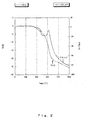
- FIG. 2 shows the TG-DTA chart. From the TG curve, no weight loss was observed from room temperature to 300°C, and a weight loss of about 20% accompanying thermal degradation of the organic matter was observed from 400°C to 700°C. The 5% weight loss temperature was 500°C.
- test-produced moisture-proof film was placed in an autoclave and distilled water was poured in so as to immerse the film.
- the autoclave was then set in an electric furnace and heated. The temperature was raised from room temperature to 150°C in about 20 minutes.
- the autoclave was subsequently held at 150°C for 1 hour, then allowed to cool within the furnace. This was immersed in distilled water for 1 hour.
- the coefficient of permeability to oxygen gas by this film was measured with a Gasperm-100 from JASCO Corporation. As a result, the coefficient of permeability to oxygen gas at room temperature was confirmed to be less than 3.05 ⁇ 10 -15 cm 2 /s ⁇ cmHg.
- a uniform dispersion was prepared by adding 2.5 g of natural montmorillonite (Kunipia P, from Kunimine Industries Co., Ltd.) and 0.7 g of synthetic mica (Somasif ME-100, from Co-op Chemical Co., Ltd.) as the clay to 94 mL of distilled water, placing these materials together with a Teflon@ rotor in a plastic sealed vessel, and vigorously shaking at 25°C for 2 hours.
- the clay paste was then cast onto a Teflon® sheet and spread with a casting knife so as to form a clay paste film having a uniform thickness of 2 mm.
- the tray was dried for 1 hour in a forced convection oven at a temperature of 60°C, thereby giving a uniform additive-clay film having a thickness of about 40 ⁇ m.
- the clay film thus formed was released from the tray, giving a self-supporting clay film having an excellent flexibility.
- the resulting clay film was immersed for 1 hour in distilled water, whereupon the clay making up the film redispersed in water, and the film shape was lost.
- the water vapor transmission rate as measured by the cup method (JIS Z0208-1976), was 71.9 g/m 2 /day at 40°C and 90% relative humidity.
- the invention relates to a moisture-proof film in which modified clay serves as the principal ingredient.
- the inventive film is characterized by being capable of use as a self-supporting film, being capable of use at elevated temperatures above 150°C, having an excellent water resistance, having an excellent flexibility, having excellent gas barrier and water vapor barrier properties, and being capable of use as a multilayer film by lamination with films composed of other materials or as a surface protecting film on other materials.
- the moisture-proof film of the invention has ionic conductivity.
- the moisture-proof film of the invention can be used in numerous products, including as electronic device-related films such as substrate films for LCD's, substrate films for organic EL devices, substrate films for electronic paper, sealing films for electronic devices, films for PDP's, films for LED's, films for IC tags, backsheets for solar cells and protective films for solar cells; components for optical communications and flexible films for other electronics equipment; fuel cell membranes, sealing films for fuel cells, and substrate films for various types of functional films; packaging films for various types of products, including films for packaging foods, films for packaging beverages, films for packaging pharmaceuticals, films for packaging household commodities and films for packaging industrial products; and also gas barrier sealing tape for gaseous species including carbon dioxide and hydrogen, multilayer packaging films, antioxidation films, corrosion resistant films, weathering resistant films, nonflammable films, heat-resistant films and chemical-resistant films.
- electronic device-related films such as substrate films for LCD's, substrate films for organic EL devices, substrate films for electronic paper, sealing films for electronic devices, films for PDP's, films for LED's, films
Landscapes
- Chemical & Material Sciences (AREA)
- Engineering & Computer Science (AREA)
- Organic Chemistry (AREA)
- Materials Engineering (AREA)
- Nanotechnology (AREA)
- Health & Medical Sciences (AREA)
- Manufacturing & Machinery (AREA)
- Polymers & Plastics (AREA)
- General Physics & Mathematics (AREA)
- Medicinal Chemistry (AREA)
- Inorganic Chemistry (AREA)
- Physics & Mathematics (AREA)
- Composite Materials (AREA)
- Condensed Matter Physics & Semiconductors (AREA)
- Chemical Kinetics & Catalysis (AREA)
- Crystallography & Structural Chemistry (AREA)
- General Health & Medical Sciences (AREA)
- Dispersion Chemistry (AREA)
- Silicates, Zeolites, And Molecular Sieves (AREA)
- Manufacture Of Macromolecular Shaped Articles (AREA)
- Compositions Of Macromolecular Compounds (AREA)
- Pigments, Carbon Blacks, Or Wood Stains (AREA)
Abstract
Description
- The invention relates to a moisture-proof film for electronic devices. More particularly, the invention relates to a moisture-proof film for electronic devices which has flexibility, excellent water vapor barrier properties and gas barrier properties, and a mechanical strength that enables it to be used as a self-supporting film. The invention provides new art and a novel product relating to a moisture-proof film for electronic devices which can be used as a self-supporting film and, even at elevated temperatures exceeding 150°C for example, is chemically stable and capable of maintaining gas barrier properties, and is therefore ideal for use as a substrate or protective film for electronic devices, such as a substrate film for LCD's, a film for LED's, or a backsheet for solar cells.
- Up until now, moisture-proof films for electronic devices endowed with an excellent flexibility and excellent gas barrier properties and water vapor barrier properties have, in almost all cases, been manufactured using an organic polymer material as the base. Films with gas barrier properties are generally manufactured by a process in which a polymer resin film is used as the base and a gas barrier layer is formed on one or both sides of the polymer resin film. For example, a film of aluminum oxide, silicon oxide or silicon nitride is formed as the gas barrier layer by any of various techniques such as chemical vapor deposition (CVD) or physical vapor deposition (PVD).
- However, in films with gas barrier properties, the water vapor barrier properties and gas barrier properties are not perfect. The temperature for the heat resistance of engineering plastics which have the highest heat resistance is about 350°C. At higher temperatures, it has been necessary to use an inorganic sheet or metal sheet as the gas barrier material.
- Of these, inorganic sheets are obtained by shaping a natural or synthetic mineral such as mica or vermiculite into the form of a sheet. Such sheets have a high heat resistance and do find some use as gas sealing members, such as gland packings. However, because they cannot be densely formed, it is impossible to completely block paths through which tiny gas molecules flow, as a result of which the gas barrier properties are not all that high. Although metal sheets do have excellent gas barrier properties, owing to drawbacks in weather resistance, electrical insulating properties and chemical resistance, applications for these are limited.
- Properties desired of protective films and backsheets for devices used in harsh environments, such as solar cells, include not only UV resistance, moisture resistance, heat resistance and salt resistance, but also water vapor barrier properties, electrical insulating properties, mechanical strength, chemical resistance, and good adhesion to sealants. With regard to gas barrier properties as well, there exists a desire for films capable of being used in harsher environments than is possible with conventional materials.
- Various polymeric resins are compounded as molding materials, dispersants, thickeners or binding agents with inorganic materials and used as gas barrier materials. By way of illustration, there exists compositions made up of a carboxyl group-containing resin (Resin A) having two or more carboxyl groups on the molecule e.g., polyacrylic acid and a high hydrogen gas bonding ability, a hydroxyl group-containing resin (Resin B) having two or more hydroxyl groups on the molecular chain e.g., starches and a high hydrogen gas bonding ability, and a clay mineral or the like.
- For example, it is known that by forming a composition of 100 parts by weight of a mixture of above resin A and resin B in a weight ratio A/B = 80/20 to 60/40 and 1 to 10 parts by weight of an inorganic layered compound such as a clay mineral, producing a film having a thickness of 0.1 to 50 µm from this composition, and subjecting the film to heat treatment or electron beam treatment, the treated film exhibits gas barrier properties (see Patent Document 1). However, in this case, because the resins used as additives are the principal ingredients, the film has an inferior heat resistance.
- Also, by laminating a film made of a resin composition containing an inorganic layered compound and a resin between two polyolefin-based resin layers, there can be obtained a multilayer film which has excellent moisture-proof properties and gas barrier properties, and which can be employed in food packaging and the like (see Patent Document 2). However, in this case, the layer of the resin composition containing an inorganic layered compound can only be used as part of a multilayer film; use of it alone as a self-supporting film is not possible. Moreover, because the heat resistance of this type of multilayer film is determined by the organic material having the lowest heat resistance which is included in the multilayer film, in this case, a polyolefin, this type of material is generally unable to achieve a high heat resistance.
- Various types of clay, such as smectite, mica, talc and vermiculite, are added as fillers to plastic in order to enhance the heat resistance and gas barrier properties of the plastic, which is an organic polymer. Because smectite, which has a high dispersibility in water, is hydrophilic, it has a low affinity for hydrophobic plastic, making high dispersion in plastic and the formation of a composite therewith difficult.
- In cases where clay is to be formed into a composite with a hydrophobic plastic, the use of a modified clay which is obtained by the modification of clay so as to control the hydrophilicity/hydrophobicity is known (see Non-Patent Document 1). There are two types of methods for producing modified clay. One method is ion exchange by means of quaternary ammonium cations or quaternary phosphonium cations. The hydrophilicity/hydrophobicity can be controlled by means of the type of these organic cations and the proportions in which the cations are introduced (see Non-Patent Document 2).
- The other method is silylation. Hydroxyl groups are present at the ends of the clay crystals. These hydroxyl groups react with the silylating agent that has been added, enabling the ends to be rendered hydrophobic. In this case as well, the hydrophilicity/hydrophobicity can be controlled by means of the type of silylating agent and the proportion in which the silylating agent is introduced. Both of these two types of modifying methods may also be used together.
- Among film-forming methods, there exists a method of forming an inorganic layered compound thin film by employing the Langmuir-Blodgett method (see, for example, Non-Patent Document 3). In addition, various methods of preparing functional inorganic layered compound thin-films and the like have been reported in the literature. One example is a method of forming a clay thin-film by forming an aqueous dispersion of a hydrotalcite intercalation compound into a film and drying the film (see Patent Document 3).
- Many other examples exist in the prior art, including a method of producing a clay mineral thin-film in which the bond structure of the clay mineral has been oriented and fixed, by utilizing a reaction between the clay mineral and phosphoric acid or phosphate radicals, and administering heat treatment which promotes the reaction (see Patent Document 4); and an aqueous composition for film treatment which contains a complex compound of smectite-type clay mineral and a metal having a valence of 2 or more (see Patent Document 5).
- However, none of these methods has thus far yielded an inorganic layered compound oriented self-supporting film which has a mechanical strength that enables it to be used as a self-supporting film and wherein the layers of clay particles are highly oriented, conferring the film with gas barrier properties. The inventors have previously disclosed the following basic method for producing a clay self-supporting film by a simple process (see, for example, Patent Document 6).
-
- (1) Clay particles are dispersed in a liquid which is a dispersant so as to prepare a uniform clay dispersion.
- (2) The uniform clay dispersion is made to flow into a tray or the like and then left at rest, allowing the clay particles to settle, thus separating the liquid which is the dispersant by a solid-liquid separation means to form a clay film.
- (3) The clay film is optionally dried under temperature conditions of 110 to 300°C, thereby forming a clay self-supporting film.
- The inventors have previously disclosed a material made of a modified clay film composed primarily of modified clay and containing a small amount of additive, which film has gas barrier properties, water vapor barrier properties, water resistance, and a mechanical strength that enables use as a self-supporting film in such applications as packaging materials, sealing materials and electrical insulating materials (see Patent Document 7). However, in the field of electronic devices such as displays, fuel cells and solar cells, even further gas barrier properties, water vapor barrier properties, elasticity, mechanical strength, high heat resistance, water resistance and weather resistance are desired. Clay films capable of fulfilling such requirements remain to be developed, and therefore have not yet achieved practical use.
-
- Patent Document 1: Japanese Patent Application Laid-open No.
H10-231434 - Patent Document 2: Japanese Patent Application Laid-open No.
H7-251489 - Patent Document 3: Japanese Patent Application Laid-open No.
H6-95290 - Patent Document 4: Japanese Patent Application Laid-open No.
H5-254824 - Patent Document 5: Japanese Patent Application Laid-open No.
2002-30255 - Patent Document 6: Japanese Patent Application Laid-open No.
2005-110550 - Patent Document 7: Japanese Patent Application Laid-open No.
2007-277078 -
- Non-Patent Document 1: Onigata, M.: Smectite, 8, No. 2, 8-13 (1998)
- Non-Patent Document 2: Onigata, M.: Smectite, 13, No. 1, 2-15 (2003)
- Non-Patent Document 3: Umezawa, Y: Nendo Kagaku (Clay Science), 42, No. 4, 218-222 (2003)
- In light of such circumstances, and bearing in mind the foregoing prior art, the inventors have conducted extensive investigations with the aim of developing a novel gas barrier membrane which has a mechanical strength enabling its use as a self-supporting film, is weather resistant, has an excellent flexibility and can be used at elevated temperatures in excess of 200°C. In the course of such investigations, the inventors have succeeded in developing a moisture-proof film for electronic devices having a significantly increased film flexibility, water resistance and heat resistance by greatly enhancing the earlier disclosed film material in which a modified clay has been used and by adding major improvements, including a good modified clay and a suitable additive, suitable mixing proportions for the modified clay and the additive, a suitable solid-liquid ratio in the dispersion, a good support material and a good method of dispersion.
- It is therefore an object of the invention to provide a moisture-proof film for electronic devices which has a mechanical strength enabling its use as a self-supporting film, which has also improved gas barrier properties, water vapor barrier properties and water resistance, and moreover which has an excellent heat stability by orienting modified clay crystals and densely stacking the crystals.
- The invention for resolving the above problems provides the following technical means.
- (1) A moisture-proof film comprising a clay film containing modified clay as a principal ingredient,
- 1) the moisture-proof film formed of modified clay and an additive; and 2) possesses water vapor barrier properties, and has a water vapor transmission rate of less than 0.2 g/m2/day at 40°C and 90% relative humidity.
- (2) The moisture-proof film according to (1) above, wherein the film has a flexibility and a mechanical strength that enable use of the film as a self-supporting film, can be used at a bending radius of 3 mm without generating cracks, and has a coefficient of permeability to oxygen gas of less than 4.0 × 10⁻¹⁵cm2/s·cmHg at room temperature.
- (3) The moisture-proof film according to (1) above, wherein the clay film has a thickness of at least 0.003 mm and not more than 0.1 mm.
- (4) The moisture-proof film according to (1) above, wherein the modified clay is formed of using natural clay or synthetic clay.
- (5) The moisture-proof film according to (1) above, wherein the clay used as the modified clay is of at least one type selected from among mica, vermiculite, montmorillonite, beidellite, saponite, hectorite, stevensite, magadiite, ilerite, kanemite, illite and sericite.
- (6) The moisture-proof film according to any one of (1) to (5) above, wherein the modified clay is the clay reacted with a silylating agent.
- (7) The moisture-proof film according to (6) above wherein, the amount of the silylating agent in the modified clay relative to the clay and the silylating agent is less than 30 wt%.
- (8) The moisture-proof film according to (1) above, wherein the additive is a polyamide or a polyimide.
- (9) The moisture-proof film according to (1) above, wherein at least 90 mol% of exchangeable ions in the modified clay are lithium ions.
- (10) The moisture-proof film according to any one of (1) to (9) above, wherein any damage to a film shape is not visually observable after 1 hour of immersion treatment in superheated water having a temperature of 150°C.
- (11) The moisture-proof film according to any one of (1) to (10) above, wherein the 5% weight loss temperature is at least 300°C and at most 760°C in thermogravimetric measurement of the modified clay film.
- (12) A moisture-proof film for electronic devices, comprising the moisture-proof film according to any one of (1) to (11) above.
- (13) A method of manufacturing the moisture-proof film comprising a clay film containing modified clay as a principal ingredient defined in (1) above, comprising adding a solvent for a pre-gel to a modified clay, kneading the solvent and modified clay to form a modified clay pre-gel, then adding a polar solvent and also adding an additive thereto to form a clay paste for the film.
- (14) The moisture-proof film manufacturing method according to (13) above, wherein the polar solvent is added, then also the additive added to the modified clay pre-gel to obtain a mixed clay paste having a viscosity of from 1 to 30 Pa.s.
- (15) The moisture-proof film manufacturing method according to (13) or (14) above, wherein the solvent for pre-gel is water.
- (16) The moisture-proof film manufacturing method according to (13) or (14) above, wherein the polar solvent is ethanol or dimethylacetamide.
- The invention is described below in greater detail.
In a first aspect, the invention relates to a moisture-proof film for electronic devices which is a clay film containing modified clay as a principal ingredient, and which is characterized by (1) being formed of modified clay and an additive, and (2) possessing water vapor barrier properties, and having a water vapor transmission rate of less than 0.2 g/m2/day (at 40°C and 90% relative humidity). In one preferred embodiment of this aspect of the invention, the moisture-proof film has a flexibility and a mechanical strength that enable use of the film as a self-supporting film, can be used at a bending radius of 3 mm without generating cracks, and has a coefficient of permeability to oxygen gas of less than 4.0 × 10⁻¹⁵cm2/s·cmHg at room temperature. In another preferred embodiment, the clay film has a thickness of at least 0.003 mm and not more than 0.1 mm. - In other preferred embodiments of the first aspect of the invention, the modified clay is obtained by reacting a silylating agent with clay; in the modified clay, the amount of the silylating agent relative to the clay and the silylating agent is less than 30 wt%; the additive is a polyamide or a polyimide; at least 90 mol% of exchangeable ions in the modified clay are lithium ions; following 1 hour of immersion treatment in superheated water having a temperature of 150°C, damage to a film shape is not visually observable; and, in thermogravimetric measurement of the modified clay film, the 5% weight loss temperature is at least 300°C and at most 760°C.
- In a second aspect, the invention relates to a method of manufacturing the foregoing moisture-proof film for electronic devices, the method including adding a pre-gel solvent to modified clay, kneading the same to form a modified clay pre-gel, then adding a polar solvent and also adding an additive. In preferred embodiments of the second aspect of the invention, a clay paste obtained by adding the polar solvent, then adding an additive and mixing the same has a viscosity of from 1 to 30 Pa.s; the pre-gel solvent is water; and the polar solvent is ethanol or dimethylacetamide.
- The invention also provides a method of manufacturing a moisture-proof film for electronic devices wherein, by employing, for example, the process of dispersing an organic clay having a high water resistance and a small amount of an additive having a high water resistance in a solvent to obtain a uniform dispersion free of lumps, applying the dispersion to a support having a flat surface, separating off the solvent serving as the dispersant by a suitable solid-liquid separation process so as to form the solid into a film, and releasing the film from the support by drying, heating or cooling as required, there is obtained a modified clay film in which the clay crystals are oriented, and which has a high water resistance, excellent flexibility, excellent gas barrier properties and a high heat resistance.
- In this case, non-limiting examples of the above method of solid-liquid separation include centrifugal separation, filtration, vacuum drying, vacuum freeze-drying and evaporation by heating. In the invention, the suitable modified clay and additive, the mixing proportions of the modified clay and the additive, the solid-liquid ratio of the dispersion, the suitable support material and the suitable dispersion method, etc. may be set as desired. In this way, there can be obtained a film material having improved film flexibility, water resistance and heat resistance.
- That is, in the invention, it is important to use modified clay having a high water resistance and a small amount of additive having a high water resistance, to shape the surface so as to be flat, to orient and densely stack the modified clay, to minimize non-uniformity which causes internal cracks and lumps, and to employ production conditions preferable for obtaining a uniform thickness and a mechanical strength that enables use as a self-supporting film. In this way, a flexible film having water resistance and having excellent heat stability and gas barrier properties can be obtained as a self-supporting film.
- The clay used as the modified clay in the invention is a natural or synthetic material. Preferred examples include one or more type selected from among mica, vermiculite, montmorillonite, beidellite, saponite, hectorite, stevensite, magadiite, ilerite, kanemite, illite and sericite. The use of any one of these natural or synthetic materials, or a mixture thereof, is even more preferred. In the invention, the modified clay is exemplified by a clay reacting with a silylating agent. The amount of the silylating agent relative to the combined weight of the clay and the silylating agent is less than 30 wt%.
- Illustrative, non-limiting, examples of the silylating agent included in the modified clay of the invention include methyltrimethoxysilane, methyltriethoxysilane, propyltrimethoxysilane, butyltrimethoxysilane, hexyltrimethoxysilane, octyltrimethoxysilane, dodecyltrimethoxysilane and octadecyltrimethoxysilane. With regard to the method of introducing the silylating agent into the clay, the introduction may be carried out by mixing 2 wt% (based on the starting clay) of silylating agent with the starting clay, and then milling these materials for 1 hour in a ball mill.
- In the invention, the additive is exemplified by polyamides and polyimides, but is not limited thereto. For example, major plastics, including general-purpose plastics such as the thermoplastic resins polyethylene, polypropylene, polyvinyl chloride, polystyrene, ABC resins and PET resins; engineering plastics such as polycarbonates, fluoroplastics and acetal resins; and thermoset resins such as phenolic resins, melamine resins, urea resins, polyurethanes, epoxy resins and unsaturated polyesters are effective as the additive in this invention.
- By exchanging intercalation ions in the clay with lithium then heat-treating, the intercalated lithium migrates into the clay's octahedral layer and interlayer ionic components decrease, thereby increasing the water resistance. This increase in water resistance becomes striking when the lithium ions are made to account for at least 90 mol% of the interlayer ionic matter. Heat treatment is generally carried out following film formation, with the temperature conditions typically being set to preferably at least 230°C, more preferably at least 300°C, and most preferably at least 350°C. Temperatures above 800°C are undesirable because the clay deteriorates. The heat treatment time is at least 20 minutes and not more than 24 hours. At low temperatures, longer heat treatment tends to be required.
- Various products are commercially available for use as the silylating agent when preparing silylated clay, some having reactive functional groups such as epoxy groups, acryl groups, amino groups or halogen groups. Silylated clays which have been prepared using silylating agents with such reactive ends have reactive ends themselves.
- In this case, the light transmittance, gas barrier properties, water vapor barrier properties or mechanical strength can be improved by carrying out a chemical reaction, such as an addition reaction, condensation reaction or polymerization reaction, via treatment during or after film formation so as to form a new chemical bond. In particular, when the silylated clay has epoxy ends, covalent bonds can be formed between clay molecules by carrying out an epoxy reaction in treatment during or after film formation.
- In this invention, as described above, because silylated clays having various different reactive ends can be prepared, by mixing a silylated clay A having one type of reactive end with a silylated clay B having another type of reactive end and forming a film using this mixture as the starting material, it is possible to have the respective reactive ends of clay A and clay B chemically bond with each other in treatment during or after film formation, enabling the light transmittance, gas barrier properties, water vapor barrier properties or mechanical strength to be improved.
- There are cases in which the modified clay used in this invention disperses well in an organic solvent. Such additives and modified clay have a mutual affinity; when both are mixed in an organic solvent, they readily bond and form a composite. In the inventive method of producing a clay film, first a uniform dispersion is prepared by adding the modified clay and the additive to an organic solvent.
- Examples of methods for preparing this dispersion include the method of dispersing the modified clay, then adding the additive; the method of dispersing the modified clay in an additive-containing solution; the method of preparing a dispersion by adding the modified clay and the additive to the dispersant at the same time; and the method of preparing separate dispersions of the modified clay and the additive, then mixing these together. From the standpoint of the ease of dispersion, it is preferable either to disperse the modified clay in an organic solvent, then add the additive, or to prepare separate dispersions of the modified clay and the additive, then mix these together.
- In this case, first the modified clay is added to a solvent, and a dilute, uniform modified clay dispersion is prepared. The concentration of modified clay in this modified clay dispersion is preferably from 0.3 to 15 wt%, and more preferably from 1 to 10 wt%. If the concentration of modified clay is too low, drying will take too long. Conversely, if the concentration of modified clay is too high, the modified clay will not disperse well. As a result, lumps tend to arise and a uniform film does not form, leading to problems such as cracking and surface roughness on account of shrinkage during drying, and a non-uniform film thickness. The modified clay dispersion prior to film formation has a viscosity of preferably from 1 to 30 Pa.s, and more preferably from 1 to 20 Pays .
- Next, the additive or the solution containing the additive is weighted and then added to the modified clay dispersion so as to prepare a uniform dispersion containing both the modified clay and the additive. As mentioned above, the modified clay and the additive thoroughly disperse in certain types of organic solvents. Also, because the modified clay and additive have affinity to each other, when both are mixed in a solvent, they easily interact to form a composite. The weight ratio of the additive relative to the total solids is less than 30 wt%, and preferably from 5 wt% to 20 wt%.
- The solvent used is not subject to any particular limitation, provided it is one that disperses the modified clay and dissolves the additive. Various polar solvents may be used for this purpose. Preferred examples include ethanol, ether, dimethylformamide, tetrahydrofuran, acetone and toluene. If the proportion of additive at this time is too low, the desirable effects of additive use will not appear; on the other hand, if the proportion of additive is too high, the heat resistance of the resulting film will decrease.
- No particular limitation is imposed on the method of dispersion, provided it is a method which is capable of the most vigorous possible dispersion. Methods involving the use of an agitator equipped with an agitating element, a shaking-type agitator, or a homogenizer are preferred. In particular, to eliminate small lumps, a method which uses a homogenizer at the final stage of dispersion is preferred. When lumps remain in the dispersion, this causes roughness of the film surface or non-uniformity in the film composition.
- Next, if necessary, the dispersion is subjected to deaeration. Methods of deaeration include drawing a vacuum, heating and centrifugation, although a method which includes drawing a vacuum is more preferred. The dispersion is then applied onto the surface of a support at a uniform thickness. Next, the solvent serving as the dispersant is slowly evaporated so that the solid matter remaining forms a film. The composite inorganic layered compound film that has been formed in this way is preferably dried by, for example, centrifugal separation, filtration, vacuum drying, vacuum freeze-drying or evaporation by heating, or by some combination of these methods.
- Of these methods, when use is made of evaporation by heating, for example, the dispersion is applied onto a support such as a flat tray, e.g., a tray made of brass, polypropylene or Teflon@ and, with the tray held in a horizontal state, the solvent is gradually evaporated within a forced-draft oven under temperature conditions of from 30°C to 90°C, preferably from 30°C to 60°C, and for a period of from about 10 minutes to 24 hours.
- If releasability with the film materials is inadequate, the film will remain attached to the support, making release difficult. To improve the releasability, some type of surface treatment may be carried out on the surface of the support, such as fluorine film treatment on a metal material. It is desirable for the support surface to be as flat as possible. If the surface of the support is not flat, the support surface roughness will be transferred to the film surface, lowering the smoothness of the film surface.
- In cases where the dispersion is not subjected to deaeration beforehand, holes due to air bubbles may form in the resulting composite inorganic layered compound film. If bubbles are present in the composite modified clay film, the film uniformity decreases, in addition to which the bubbles cause the internal scattering of light, clouding the film.
The drying conditions are set so as to be sufficient to remove the liquid content by evaporation. If the temperature at this time is too low, drying will take a long time. On the other hand, if the temperature is too high, dispersant convection will arise, preventing a uniform film thickness from being achieved, and the degree of orientation by the modified clay particles will decrease. - With regard to the thickness of the inventive film, a film of the desired thickness can be obtained by increasing or decreasing the weight of the solids used in the dispersion. When a thin film has been formed, the surface smoothness tends to be excellent. On the other hand, making the film thicker has the drawback of lowering the flexibility. It is desirable for the thickness to be not more than 0.2 mm.
- In the invention, "highly orienting" the lamination of the modified clay particles is defined as stacking unit structural layers (having a thickness of from about 1 nm to about 1.5 nm) of the modified clay particles in the direction of the layer face, and imparting a high periodicity in the direction perpendicular to the layer face. In order to obtain such a modified clay particle orientation, it is important for a dilute, uniform dispersion containing the modified clay and the additive to be applied to a support, and for the liquid serving as the dispersant to be slowly evaporated so that the modified clay particles form into a densely stacked layer.
- The preferred production conditions for such film formation include a concentration of modified clay in the modified clay dispersion of preferably from 0.3 to 15 wt%, and more preferably from 1 to 10 wt%. When an evaporation by drying process is used, although the drying conditions depend also on the type of solvent used, drying is carried out at from room temperature to 90°C, and preferably from 30°C to 60°C, for a period of from about 10 minutes to 24 hours until the solvent completely evaporates.
- In cases where the additive-containing composite modified clay film does not release spontaneously from the tray or other support, it is preferable to obtain a self-supporting film by drying under temperature conditions of about 80°C to 200°C to facilitate release. A drying time of 1 hour is sufficient. If the temperature at this time is too low, release may not readily occur. On the other hand, if the temperature is too high, the additive may deteriorate, leading to such undesirable results as film coloration, a decrease in mechanical strength, and a decline in the gas barrier properties.
- With regard to the inventive moisture-proof film itself, this a clay film which uses modified clay as the main starting material and is basically constructed so as to have a layer thickness of about 1 to 2 nm and to include up to 30 wt% of a natural or synthetic low-molecular-weight or high-molecular-weight additive having a particle size of up to 5 µm and a molecular size of up to several nanometers. This clay film may be fabricated by orienting in the same direction and densely stacking modified clay layered crystals having a thickness of about 1 to 1.5 nm.
- The resulting clay film has a film thickness of from 3 to 100 µm, and preferably from 3 to 80 µm. As for the gas barrier performance, the coefficient of permeability to oxygen gas is less than 4.0 × 10⁻¹⁵cm2/s·cmHg at room temperature. The film may be given a large surface area of 10 × 40 cm or more.
- The film has a high heat resistance, and does not exhibit a decline in gas barrier properties even after 1 hour of heat treatment at 150°C. Moreover, it has a high water resistance, and does not exhibit a decline in gas barrier properties even after 1 hour of immersion in water at room temperature. Also, it has a high resistance to hot water, and does not exhibit a decrease in gas barrier properties even after 1 hour of immersion in 150°C water. This clay film has a volume resistivity in the film perpendicular direction of at least 10 MΩ. By taking advantage of these electrical insulating properties, the film can be used in a broad range of applications as an insulating film.
- Because the moisture-proof film of the invention has an excellent flexibility and processability, it is also possible to apply a roll-to-roll process. For example, the film can easily be cut into any desired size and shape, such as a circular, square or rectangular shape, with scissors or a cutter, and also has an excellent punchability.
- Because silicates are the principal ingredient of the film, the inventive film has a better resistance to radiation than plastic materials, and may be used as a packaging material for pharmaceutical products which are subjected to radiation sterilization with gamma rays, electron beams or the like. The moisture-proof film of the invention readily bonds to other materials, enabling the use of common adhesives and enabling surface coating. By means of surface coating and lamination, gas barrier properties, water vapor barrier properties, water resistance, heat resistance and fire retardance can be improved.
- Examples of multilayer films include films obtained by laminating the moisture-proof film of the invention with a metal foil, plastic film, paper or the like. Examples of plastic films which may be used in such cases include films made of polyethylene, polypropylene, polyethylene terephthalate, polyamide, fluoroplastic, acrylic resin or polyimide.
- Illustrative examples of the material on which the inventive film may be surface coated include metals, metal oxides, ceramics, plastics, expanded plastics, wood, gypsum board and rubber. By surface coating the inventive film onto such materials, the oxidation resistance, corrosion resistance, weather resistance, gas barrier properties, water vapor barrier properties, water resistance, heat resistance, chemical resistance and flameproof properties of the materials can be improved.
- Hence, the moisture-proof film of the invention may be used in a broad range of applications as a self-supporting film having an excellent flexibility and excellent gas barrier and water vapor barrier properties under high-temperature conditions. The moisture-proof film of the invention may be used as, for example, flexible packaging materials, sealing materials, insulating materials and fuel cell membranes which are chemically stable and capable of maintaining water resistance even at elevated temperatures above 150°C, for example.
- Moreover, in the moisture-proof film of the invention, the additive and the modified clay interact to form a thin film of excellent flexibility, strength and water resistance. For this reason, ready failure of the modified clay thin-film by pulling, torsion or the like is suppressed, making it possible to obtain a moisture-proof film that can be used as a self-supporting film and has excellent properties.
- The moisture-proof film of the invention may be used as, for example, a substrate film for LCD's, a substrate film for organic EL devices, a substrate film for electronic paper, a sealing film for electronic devices, a film for PDP's, a film for LED's, a component for optical communications, a substrate film for various types of functional films, a film for IC tags, and flexible films for other electronic equipment.
- The moisture-proof film of the invention may be used as substrate, sealing and protective films associated with electronic devices and electronic equipment, such as sealing films for fuel cells, protective films for solar cells, and backsheets for solar cells; and as films for packaging various types of products, such as films for packaging foods, films for packaging beverages, films for packaging pharmaceuticals, films for packaging household commodities, and films for packaging industrial products. In addition, the moisture-proof film of the invention may be used in a broad range of applications as gas barrier sealants for gaseous species, including carbon dioxide and hydrogen.
- The invention achieves effects such as the following.
- (1) The moisture-proof film of the invention makes it possible to fulfill all the requirements of excellent weather resistance, gas barrier properties, water vapor barrier properties, flexibility, heat resistance, electrical insulating properties and water resistance.
- (2) The moisture-proof film of the invention can be used as a self-supporting film. For example, even at elevated temperatures exceeding 150°C, it has chemical stability and can maintain gas barrier properties.
- (3) The moisture-proof film of the invention can be advantageously used as a substrate or protective film for an electronic device, such as a substrate film for a LCD, a film for a LED, and a backsheet for a solar cell.
- (4) The moisture-proof film of the invention can also be advantageously used as a flexible gas sheet material, packaging material, sealing material or electrical insulating material.
- (5) The moisture-proof film of the invention, by being applied onto the surface of, for example, metal, plastic, rubber, paper or ceramic, can be rendered into a multilayer film and used in a wide range of applications.
- (6) The moisture-proof film of the invention, by being applied to the surface of, for example, metal, metal oxide, ceramic, plastic, expanded plastics, wood, gypsum board or rubber, can be used in a wide range of applications as a surface-protecting film.
- (7) The moisture-proof film of the invention has an excellent heat resistance, and thus can be directly laminated with various types of plastic films by hot pressing.
- (8) The moisture-proof film of the invention can be laminated as a base film with resins by an extrusion laminating process.
-
-
FIG. 1 shows a TG-DTA chart in Example 1 according to the invention. -
FIG. 2 shows a TG-DTA chart in Example 2 according to the invention. - Next, the invention is illustrated more concretely by way of examples. However, the invention is not in any way limited by the following examples.
- Kunipia F (from Kunimine Industries Co., Ltd.), a natural purified bentonite, was thoroughly dried in an oven at a temperature of at least 110°C. This bentonite (300 g) was placed, together with alumina balls, in a pot for ball mill. Next, 6 g of a silylating agent (Sila-Ace S330, from Chisso Corporation) was added thereto, the pot interior was substituted with nitrogen gas, and was treated with the ball mill for 1 hour to give a modified clay.
- A silylating agent with an amino group at the end was used as the silylating agent. To 400 mL of an 0.5N aqueous solution of lithium nitrate was added 24 g of modified clay, and was shaken and dispersed to effect mixture and dispersion. The intercalated ions of the clay were exchanged with lithium ions by carrying out of the shaking and dispersing for 2 hours.
- Next, the dispersion was centrifugally separated to effect solid-liquid separation, and the resulting solid was washed with a mixed solution composed of 280 g of distilled water and 120 g of ethanol, thereby removing surplus salt. This washing operation was repeated two or more times. The resulting product was thoroughly dried in an oven and then crushed, yielding a lithium-exchanged modified clay.
- Ten grams of the above lithium-exchanged modified clay was weighed out and placed in a vessel. Next, 20 mL of pure water was added thereto and left to stand for about 10 minutes so as to allow the water to blend with the clay. Next, the contents were lightly mixed with a stainless steel spatula. Mixing treatment was then carried out with a mixer at 2,000 rpm for 10 minutes. To this was again added 20 mL of pure water, after which kneading was carried out in such a way that the pure water disperses throughout the material, and the material was worked until it gathered entirely into a single mass.
- The treatment was carried out for 10 minutes at 2,000 rpm in the mixing mode. Compared with the first mixing treatment, all of the material formed into a single mass of clay pre-gel. All of the remaining 50 mL of the pure was added thereto, and the material was thoroughly kneaded with a stainless steel spatula. Any large lumps (gel masses) that remained were crushed as much as possible. Mixing treatment was again carried out for 10 minutes at 2,000 rpm.
- The resulting gel was dispersed in ethanol using a homogenizer (ULUTRA TURRAX T50, from IKA), wherein ethanol in an amount (250 g) corresponding to 25 times the weight of the clay was placed in a suitable vessel, and, as the ethanol was being agitated in the homogenizer, the clay pre-gel was added thereto. This agitation was continued at about 7,000 rpm for about 30 minutes.
- Following homogenizer treatment, about 120 g of this dispersion was collected and placed in a separate vessel, and 4.71 g of N-methoxymethylated nylon (Toresin FS350, from Nagase ChemteX Corporation) was added. Deaeration was carried out with a mixer at 2,000 rpm for 10 minutes in the mixing mode, and at 2,200 rpm for 10 minutes in the deaeration mode.
- The viscosity at this time was from 1.0 to 1.2 Pa.s, the average value being 1.1 Pa·s (TVB-22L, from Toki Sangyo Co., Ltd.). The paste was then cast onto a Teflon@ sheet, and the paste was spread to a uniform thickness with a casting knife. The paste thickness here was set to 2 mm.
- Next, the above paste was dried overnight in a forced convection oven at a temperature of 60°C, released from the Teflon® sheet, and heat-treated in a heating oven. In this heat treatment, the temperature was ramped up to 300°C at a rate of 100°C/hour, and then held at 300°C for 2 hours. By means of this heat treatment, a moisture-proof film composed of a lithium-exchanged modified clay film having a thickness of about 30 µm was obtained.
- The flexibility of the resulting moisture-proof film was measured using a mandrel-type flex testing machine (ISO 1519). No cracks or other defects arose in this film even when curved to a diameter of 2 mm. Moreover, the water vapor transmission rate was less than 0.17 g/m2/day (measured with a MOCON Aquatran Model 1; equal pressure method).
- Also, following treatment at 200°C for 1 hour, the tensile strength at room temperature was 39.5 MPa and the extensibility was 2.6% (test pieces: 1 cm wide strip specimens). In addition, the coefficient of permeability to oxygen gas at room temperature was confirmed to be less than 3.05 × 10⁻¹⁵cm2/s·cmHg (as measured with a Gasperm-100, from JASCO Corporation).
- Thermal analysis (Rigaku Thermoplus TG8120) was carried out at a ramp-up rate of 10°C/min in a normal air flow atmosphere.
FIG. 1 shows the TG-DTA chart. From the TG curve, a weight loss of about 2% due to the removal of adsorbed water was observed from room temperature to 250°C, a sharp peak in the DTA curve was observed near 500°C, and a weight loss of about 20% accompanying thermal degradation of the organic matter was observed from 300°C to 700°C. The 5% weight loss temperature was about 350°C. - A lithium-exchanged modified clay was obtained in the same way as in Example 1. A clay pre-gel was prepared by adding 9 parts by weight of pure water to 1 part by weight of this modified clay, and mixing and kneading the clay and water together. The resulting gel was dispersed in dimethylacetamide using a homogenizer (ULUTRA TURRAX T50, from IKA; the shaft was S50N-G45F, also from IKA)
- Dimethylacetamide in an amount (350 g) corresponding to 35 times the weight of the clay was placed in a suitable vessel and, as the dimethylacetamide was being agitated in the homogenizer, the clay pre-gel was added thereto. This agitation was continued at about 7,000 rpm for about 30 minutes. Following homogenizer treatment, about 120 g of the dispersion was collected and placed in a separate vessel, and 4.76 g of polyimide varnish (U-Varnish A, from Ube Industries, Ltd.) was added.
- Deaeration was carried out with a mixer at 2,000 rpm for 10 minutes in the mixing mode, and at 2,200 rpm for 10 minutes in the deaeration mode. The viscosity at this time was from 1.3 to 2.0 Pa.s, the average value being 1.4 Pa·s (TVB-22L, from Toki Sangyo Co., Ltd.). Next, the paste was cast onto a Teflon@ sheet, and the paste was spread to a uniform thickness with a casting knife. The paste thickness here was set to 1 mm.
- Next, the above paste was dried overnight in a forced convection oven at a temperature of 60°C, released from the Teflon@ sheet, and heat-treated in a heating oven. In this heat treatment, the temperature was ramped up to 150°C at a rate of 100°C/hour, then held at 150°C for 2 hours. Next, the temperature was ramped up to 230°C at 100°C/hour, then held at 230°C for 24 hours. By means of this heat treatment, a moisture-proof film composed of a lithium-exchanged modified clay film having a thickness of about 20 µm was obtained.
- The flexibility of the resulting moisture-proof film was measured using a mandrel-type flex testing machine (ISO 1519). No cracks or other defects arose in this film even when curved to a diameter of 2 mm. Moreover, the water vapor transmission rate was less than 3.0 × 10⁻² g/m2/day (measured with a MOCON Aquatran Model 1; equal pressure method). Also, following treatment at 200°C for 1 hour, the tensile strength at room temperature was 60.6 MPa and the extensibility was 5.5% (test pieces: 1 cm wide strip specimens).
- Thermal analysis (Rigaku Thermoplus TG8120) was carried out at a ramp-up rate of 10°C/min in a normal air flow atmosphere.
FIG. 2 shows the TG-DTA chart. From the TG curve, no weight loss was observed from room temperature to 300°C, and a weight loss of about 20% accompanying thermal degradation of the organic matter was observed from 400°C to 700°C. The 5% weight loss temperature was 500°C. - The test-produced moisture-proof film was placed in an autoclave and distilled water was poured in so as to immerse the film. The autoclave was then set in an electric furnace and heated. The temperature was raised from room temperature to 150°C in about 20 minutes. The autoclave was subsequently held at 150°C for 1 hour, then allowed to cool within the furnace. This was immersed in distilled water for 1 hour.
- Following the above treatment, no abnormalities such as pinholes or cracks were visually observed. The coefficient of permeability to oxygen gas by this film was measured with a Gasperm-100 from JASCO Corporation. As a result, the coefficient of permeability to oxygen gas at room temperature was confirmed to be less than 3.05 × 10⁻¹⁵cm2/s·cmHg.
- A uniform dispersion was prepared by adding 2.5 g of natural montmorillonite (Kunipia P, from Kunimine Industries Co., Ltd.) and 0.7 g of synthetic mica (Somasif ME-100, from Co-op Chemical Co., Ltd.) as the clay to 94 mL of distilled water, placing these materials together with a Teflon@ rotor in a plastic sealed vessel, and vigorously shaking at 25°C for 2 hours.
- To this dispersion was added 0.18 g of methyl vinyl ether-maleic anhydride copolymer (from Daicel Chemical Industries, Ltd.) as the additive, and the materials were vigorously shaken to give a uniform dispersion containing natural montmorillonite and ε-caprolactam. This was gradually dried, giving a clay paste. Next, the clay paste was deaerated with a vacuum deaerator.
- The clay paste was then cast onto a Teflon® sheet and spread with a casting knife so as to form a clay paste film having a uniform thickness of 2 mm. The tray was dried for 1 hour in a forced convection oven at a temperature of 60°C, thereby giving a uniform additive-clay film having a thickness of about 40 µm. The clay film thus formed was released from the tray, giving a self-supporting clay film having an excellent flexibility.
- The resulting clay film was immersed for 1 hour in distilled water, whereupon the clay making up the film redispersed in water, and the film shape was lost. The water vapor transmission rate, as measured by the cup method (JIS Z0208-1976), was 71.9 g/m2/day at 40°C and 90% relative humidity.
- As described in detail above, the invention relates to a moisture-proof film in which modified clay serves as the principal ingredient. The inventive film is characterized by being capable of use as a self-supporting film, being capable of use at elevated temperatures above 150°C, having an excellent water resistance, having an excellent flexibility, having excellent gas barrier and water vapor barrier properties, and being capable of use as a multilayer film by lamination with films composed of other materials or as a surface protecting film on other materials. Moreover, the moisture-proof film of the invention has ionic conductivity.
- The moisture-proof film of the invention can be used in numerous products, including as electronic device-related films such as substrate films for LCD's, substrate films for organic EL devices, substrate films for electronic paper, sealing films for electronic devices, films for PDP's, films for LED's, films for IC tags, backsheets for solar cells and protective films for solar cells; components for optical communications and flexible films for other electronics equipment; fuel cell membranes, sealing films for fuel cells, and substrate films for various types of functional films; packaging films for various types of products, including films for packaging foods, films for packaging beverages, films for packaging pharmaceuticals, films for packaging household commodities and films for packaging industrial products; and also gas barrier sealing tape for gaseous species including carbon dioxide and hydrogen, multilayer packaging films, antioxidation films, corrosion resistant films, weathering resistant films, nonflammable films, heat-resistant films and chemical-resistant films.
Claims (16)
- A moisture-proof film comprising a clay film containing modified clay as a principal ingredient,(1) the moisture-proof film formed of modified clay and an additive; and (2) possesses water vapor barrier properties, and has a water vapor transmission rate of less than 0.2 g/m2/day at 40°C and 90% relative humidity.
- The moisture-proof film according to claim 1,
wherein the film has a flexibility and a mechanical strength that enable use of the film as a self-supporting film, can be used at a bending radius of 3 mm without generating cracks, and has a coefficient of permeability to oxygen gas of less than 4.0 × 10⁻¹⁵cm2/s·cmHg at room temperature. - The moisture-proof film according to claim 1,
wherein the clay film has a thickness of at least 0.003 mm and not more than 0.1 mm. - The moisture-proof film according to claim 1,
wherein the modified clay is formed of using natural clay or synthetic clay. - The moisture-proof film according to claim 1,
wherein the clay used as the modified clay is of at least one type selected from among mica, vermiculite, montmorillonite, beidellite, saponite, hectorite, stevensite, magadiite, ilerite, kanemite, illite and sericite. - The moisture-proof film according to any one of claims 1 to 5, wherein the modified clay is the clay reacted with a silylating agent.
- The moisture-proof film according to claim 6 wherein, the amount of the silylating agent in the modified clay relative to the clay and the silylating agent is less than 30 wt%.
- The moisture-proof film according to claim 1,
wherein the additive is a polyamide or a polyimide. - The moisture-proof film according to claim 1,
wherein at least 90 mol% of exchangeable ions in the modified clay are lithium ions. - The moisture-proof film according to any one of claims 1 to 9, wherein any damage to a film shape is not visually observable after 1 hour of immersion treatment in superheated water having a temperature of 150°C.
- The moisture-proof film according to any one of claims 1 to 10, wherein the 5% weight loss temperature is at least 300°C and at most 760°C in thermogravimetric measurement of the modified clay film.
- A moisture-proof film for electronic devices, comprising the moisture-proof film according to any one of claims 1 to 11.
- A method of manufacturing the moisture-proof film comprising a clay film containing modified clay as a principal ingredient defined in claim 1, comprising adding a solvent for a pre-gel to a modified clay, kneading the solvent and modified clay to form a modified clay pre-gel, then adding a polar solvent and also adding an additive thereto to form a clay paste for the film.
- The moisture-proof film manufacturing method according to claim 13, wherein the polar solvent is added, then also the additive added to the modified clay pre-gel to obtain a mixed clay paste having a viscosity of from 1 to 30 Pa·s.
- The moisture-proof film manufacturing method according to claim 13 or 14, wherein the solvent for pre-gel is water.
- The moisture-proof film manufacturing method according to claim 13 or 14, wherein the polar solvent is ethanol or dimethylacetamide.
Applications Claiming Priority (2)
| Application Number | Priority Date | Filing Date | Title |
|---|---|---|---|
| JP2009147055A JP5553330B2 (en) | 2009-06-19 | 2009-06-19 | Moisture-proof film for electronic device and method for producing the same |
| PCT/JP2010/060209 WO2010147147A1 (en) | 2009-06-19 | 2010-06-16 | Moisture-proof film for electronic devices |
Publications (3)
| Publication Number | Publication Date |
|---|---|
| EP2444374A1 true EP2444374A1 (en) | 2012-04-25 |
| EP2444374A4 EP2444374A4 (en) | 2013-09-25 |
| EP2444374B1 EP2444374B1 (en) | 2021-05-26 |
Family
ID=43356463
Family Applications (1)
| Application Number | Title | Priority Date | Filing Date |
|---|---|---|---|
| EP10789521.1A Active EP2444374B1 (en) | 2009-06-19 | 2010-06-16 | Moisture-proof film for electronic devices |
Country Status (4)
| Country | Link |
|---|---|
| EP (1) | EP2444374B1 (en) |
| JP (1) | JP5553330B2 (en) |
| CN (1) | CN102448884A (en) |
| WO (1) | WO2010147147A1 (en) |
Cited By (3)
| Publication number | Priority date | Publication date | Assignee | Title |
|---|---|---|---|---|
| JP2012240868A (en) * | 2011-05-17 | 2012-12-10 | National Institute Of Advanced Industrial Science & Technology | Water vapor barrier material |
| US20140251426A1 (en) * | 2011-08-29 | 2014-09-11 | Sumitomo Seika Chemicals Co., Ltd. | Vapor barrier film, dispersion for vapor barrier film, method for producing vapor barrier film, solar cell back sheet, and solar cell |
| EP2517874A4 (en) * | 2009-12-24 | 2016-06-22 | Tomoegawa Co Ltd | CLAY FILM COMPOSITE |
Families Citing this family (10)
| Publication number | Priority date | Publication date | Assignee | Title |
|---|---|---|---|---|
| JP2011165908A (en) * | 2010-02-10 | 2011-08-25 | Kaneka Corp | Back sheet for solar cell, and solar cell module |
| EP2433704A1 (en) * | 2010-09-27 | 2012-03-28 | Stichting IMEC Nederland | Humidity barrier |
| JPWO2018123734A1 (en) * | 2016-12-26 | 2019-10-31 | Dic株式会社 | Resin composition, molded body, laminate, gas barrier material, coating material and adhesive |
| WO2018168945A1 (en) * | 2017-03-14 | 2018-09-20 | Dic株式会社 | Resin composition, molded article, laminate, gas barrier material, coating material and adhesive |
| US20200002465A1 (en) * | 2017-03-14 | 2020-01-02 | Dic Corporation | Resin composition, molded article, laminate, coating material, and adhesive |
| JP6545407B2 (en) * | 2017-03-14 | 2019-07-17 | Dic株式会社 | Resin composition, molded article, laminate, gas barrier material, coating material and adhesive |
| JP2019026813A (en) * | 2017-08-03 | 2019-02-21 | Dic株式会社 | Resin composition, molded body, laminate, gas barrier material, coating material and adhesive |
| JP7123336B2 (en) * | 2018-06-25 | 2022-08-23 | Dic株式会社 | Resin compositions, moldings, laminates, coating materials and adhesives |
| US12448328B2 (en) | 2022-02-08 | 2025-10-21 | Knauf Gips Kg | Gypsum panel containing ammonium-exchanged vermiculite and methods |
| CN117247283B (en) * | 2023-08-24 | 2025-01-03 | 江苏卫星新材料股份有限公司 | Porous ceramic powder, preparation method thereof and application thereof in packaging |
Family Cites Families (10)
| Publication number | Priority date | Publication date | Assignee | Title |
|---|---|---|---|---|
| JP3302394B2 (en) | 1992-03-12 | 2002-07-15 | 科学技術振興事業団 | Method for producing layered clay mineral thin film |
| JPH0695290A (en) | 1992-09-10 | 1994-04-08 | Tdk Corp | Thin clay film and its production |
| JPH07251489A (en) | 1994-01-25 | 1995-10-03 | Sumitomo Chem Co Ltd | Moisture-proof laminated film |
| JPH10231434A (en) | 1997-02-20 | 1998-09-02 | Asahi Chem Ind Co Ltd | Gas barrier resin composition, multilayer structure and method for producing the same |
| JP2002030255A (en) | 2000-07-14 | 2002-01-31 | Nippon Parkerizing Co Ltd | Aqueous composition for film treatment and industrial material having formed film |
| JP4366498B2 (en) | 2003-10-06 | 2009-11-18 | 独立行政法人産業技術総合研究所 | Peroxidase composite clay membrane and method for producing the same |
| JP2006265517A (en) * | 2004-08-10 | 2006-10-05 | National Institute Of Advanced Industrial & Technology | Gas shielding material and gas shielding method |
| KR101018273B1 (en) * | 2005-09-22 | 2011-03-04 | 독립행정법인 산업기술종합연구소 | Clay thin film substrate, clay thin film substrate with electrodes and display device using them |
| JP5099412B2 (en) * | 2006-03-11 | 2012-12-19 | 独立行政法人産業技術総合研究所 | Membrane using modified clay |
| JP5375055B2 (en) * | 2008-12-02 | 2013-12-25 | 電気化学工業株式会社 | Protective sheet for solar power generation module and manufacturing method thereof, solar power generation module and protection method thereof, and solar power generation system |
-
2009
- 2009-06-19 JP JP2009147055A patent/JP5553330B2/en active Active
-
2010
- 2010-06-16 EP EP10789521.1A patent/EP2444374B1/en active Active
- 2010-06-16 WO PCT/JP2010/060209 patent/WO2010147147A1/en not_active Ceased
- 2010-06-16 CN CN201080022847XA patent/CN102448884A/en active Pending
Cited By (4)
| Publication number | Priority date | Publication date | Assignee | Title |
|---|---|---|---|---|
| EP2517874A4 (en) * | 2009-12-24 | 2016-06-22 | Tomoegawa Co Ltd | CLAY FILM COMPOSITE |
| JP2012240868A (en) * | 2011-05-17 | 2012-12-10 | National Institute Of Advanced Industrial Science & Technology | Water vapor barrier material |
| US20140251426A1 (en) * | 2011-08-29 | 2014-09-11 | Sumitomo Seika Chemicals Co., Ltd. | Vapor barrier film, dispersion for vapor barrier film, method for producing vapor barrier film, solar cell back sheet, and solar cell |
| EP2752443A4 (en) * | 2011-08-29 | 2015-05-06 | Sumitomo Seika Chemicals | STEAM BRAKE FOIL, DISPERSION FOR STEAM BRAKE FOIL, METHOD FOR PRODUCING STEAM BRAKE FOIL, REPLACEMENT FOIL FOR SOLAR CELLS AND SOLAR CELL |
Also Published As
| Publication number | Publication date |
|---|---|
| JP5553330B2 (en) | 2014-07-16 |
| EP2444374B1 (en) | 2021-05-26 |
| CN102448884A (en) | 2012-05-09 |
| JP2011001237A (en) | 2011-01-06 |
| EP2444374A4 (en) | 2013-09-25 |
| WO2010147147A1 (en) | 2010-12-23 |
Similar Documents
| Publication | Publication Date | Title |
|---|---|---|
| EP2444374B1 (en) | Moisture-proof film for electronic devices | |
| JP5648814B2 (en) | Water vapor barrier film and method for producing the same | |
| JP5099412B2 (en) | Membrane using modified clay | |
| US8206814B2 (en) | Film made from denatured clay | |
| Shang et al. | Compatibility of soluble polyimide/silica hybrids induced by a coupling agent | |
| CN103764730B (en) | Vapor water barriers film, vapor water barriers film dispersion liquid, the manufacture method of vapor water barriers film, solar cell backboard and solaode | |
| JP5688783B2 (en) | Clay film and method for producing the same | |
| Ra et al. | Effects of size and aspect ratio of zirconium phosphate (ZrP) on barrier properties of epoxy-ZrP nanocomposites | |
| Xavier et al. | RETRACTED: Carbon nanotube‐based polymer nanocomposites: Evaluation of barrier, hydrophobic, and mechanical properties for aerospace applications | |
| JP6795802B2 (en) | Heat-resistant gas barrier film and its manufacturing method | |
| JP5920693B2 (en) | Non-combustible water vapor barrier film, method for producing non-combustible water vapor barrier film, solar cell back sheet, and solar cell | |
| JP5219059B2 (en) | Protective film composed of clay alignment film | |
| JP5577539B2 (en) | Resin composition and thin film using the same | |
| JP2003231098A (en) | Composite comprising thin film-like particles having carbon skeleton and method for producing the same | |
| JP6661410B2 (en) | Coating agent, method for producing coating agent, and method for forming coating film | |
| JP2011165908A (en) | Back sheet for solar cell, and solar cell module | |
| TW201033286A (en) | Flame retardant organoplysiloxane compositon | |
| CA2620021C (en) | Film made from denatured clay | |
| JP6491912B2 (en) | Clay slurry and clay film | |
| JP5190905B2 (en) | Surface treated clay film | |
| JP5614524B2 (en) | Clay dispersion, method for producing the same, and clay film | |
| JP5652672B2 (en) | Surface treated clay film | |
| JP2006265517A (en) | Gas shielding material and gas shielding method | |
| Pammi | Effect of NanoFillers on the properties and corrosion performance of epoxy coatings |
Legal Events
| Date | Code | Title | Description |
|---|---|---|---|
| PUAI | Public reference made under article 153(3) epc to a published international application that has entered the european phase |
Free format text: ORIGINAL CODE: 0009012 |
|
| 17P | Request for examination filed |
Effective date: 20111221 |
|
| AK | Designated contracting states |
Kind code of ref document: A1 Designated state(s): AL AT BE BG CH CY CZ DE DK EE ES FI FR GB GR HR HU IE IS IT LI LT LU LV MC MK MT NL NO PL PT RO SE SI SK SM TR |
|
| DAX | Request for extension of the european patent (deleted) | ||
| A4 | Supplementary search report drawn up and despatched |
Effective date: 20130827 |
|
| RIC1 | Information provided on ipc code assigned before grant |
Ipc: C08L 79/08 20060101ALN20130821BHEP Ipc: C08L 77/00 20060101ALN20130821BHEP Ipc: C01B 33/44 20060101ALI20130821BHEP Ipc: C09C 3/12 20060101ALI20130821BHEP Ipc: C09C 1/42 20060101ALI20130821BHEP Ipc: C08K 9/06 20060101ALI20130821BHEP Ipc: C08J 5/18 20060101ALI20130821BHEP Ipc: C01B 33/40 20060101AFI20130821BHEP |
|
| STAA | Information on the status of an ep patent application or granted ep patent |
Free format text: STATUS: EXAMINATION IS IN PROGRESS |
|
| 17Q | First examination report despatched |
Effective date: 20170818 |
|
| RIC1 | Information provided on ipc code assigned before grant |
Ipc: C08K 9/06 20060101ALI20201209BHEP Ipc: C01B 33/44 20060101ALI20201209BHEP Ipc: C08J 5/18 20060101ALI20201209BHEP Ipc: C08L 77/00 20060101ALN20201209BHEP Ipc: C09C 3/12 20060101ALI20201209BHEP Ipc: C09C 1/42 20060101ALI20201209BHEP Ipc: C08L 79/08 20060101ALN20201209BHEP Ipc: C01B 33/40 20060101AFI20201209BHEP |
|
| GRAP | Despatch of communication of intention to grant a patent |
Free format text: ORIGINAL CODE: EPIDOSNIGR1 |
|
| STAA | Information on the status of an ep patent application or granted ep patent |
Free format text: STATUS: GRANT OF PATENT IS INTENDED |
|
| INTG | Intention to grant announced |
Effective date: 20210118 |
|
| GRAS | Grant fee paid |
Free format text: ORIGINAL CODE: EPIDOSNIGR3 |
|
| GRAA | (expected) grant |
Free format text: ORIGINAL CODE: 0009210 |
|
| STAA | Information on the status of an ep patent application or granted ep patent |
Free format text: STATUS: THE PATENT HAS BEEN GRANTED |
|
| AK | Designated contracting states |
Kind code of ref document: B1 Designated state(s): AL AT BE BG CH CY CZ DE DK EE ES FI FR GB GR HR HU IE IS IT LI LT LU LV MC MK MT NL NO PL PT RO SE SI SK SM TR |
|
| REG | Reference to a national code |
Ref country code: GB Ref legal event code: FG4D |
|
| REG | Reference to a national code |
Ref country code: CH Ref legal event code: EP |
|
| REG | Reference to a national code |
Ref country code: DE Ref legal event code: R096 Ref document number: 602010067047 Country of ref document: DE |
|
| REG | Reference to a national code |
Ref country code: AT Ref legal event code: REF Ref document number: 1396068 Country of ref document: AT Kind code of ref document: T Effective date: 20210615 |
|
| REG | Reference to a national code |
Ref country code: IE Ref legal event code: FG4D |
|
| REG | Reference to a national code |
Ref country code: LT Ref legal event code: MG9D |
|
| REG | Reference to a national code |
Ref country code: AT Ref legal event code: MK05 Ref document number: 1396068 Country of ref document: AT Kind code of ref document: T Effective date: 20210526 |
|
| PG25 | Lapsed in a contracting state [announced via postgrant information from national office to epo] |
Ref country code: BG Free format text: LAPSE BECAUSE OF FAILURE TO SUBMIT A TRANSLATION OF THE DESCRIPTION OR TO PAY THE FEE WITHIN THE PRESCRIBED TIME-LIMIT Effective date: 20210826 Ref country code: AT Free format text: LAPSE BECAUSE OF FAILURE TO SUBMIT A TRANSLATION OF THE DESCRIPTION OR TO PAY THE FEE WITHIN THE PRESCRIBED TIME-LIMIT Effective date: 20210526 Ref country code: HR Free format text: LAPSE BECAUSE OF FAILURE TO SUBMIT A TRANSLATION OF THE DESCRIPTION OR TO PAY THE FEE WITHIN THE PRESCRIBED TIME-LIMIT Effective date: 20210526 Ref country code: FI Free format text: LAPSE BECAUSE OF FAILURE TO SUBMIT A TRANSLATION OF THE DESCRIPTION OR TO PAY THE FEE WITHIN THE PRESCRIBED TIME-LIMIT Effective date: 20210526 Ref country code: LT Free format text: LAPSE BECAUSE OF FAILURE TO SUBMIT A TRANSLATION OF THE DESCRIPTION OR TO PAY THE FEE WITHIN THE PRESCRIBED TIME-LIMIT Effective date: 20210526 |
|
| REG | Reference to a national code |
Ref country code: NL Ref legal event code: MP Effective date: 20210526 |
|
| PG25 | Lapsed in a contracting state [announced via postgrant information from national office to epo] |
Ref country code: PT Free format text: LAPSE BECAUSE OF FAILURE TO SUBMIT A TRANSLATION OF THE DESCRIPTION OR TO PAY THE FEE WITHIN THE PRESCRIBED TIME-LIMIT Effective date: 20210927 Ref country code: PL Free format text: LAPSE BECAUSE OF FAILURE TO SUBMIT A TRANSLATION OF THE DESCRIPTION OR TO PAY THE FEE WITHIN THE PRESCRIBED TIME-LIMIT Effective date: 20210526 Ref country code: NO Free format text: LAPSE BECAUSE OF FAILURE TO SUBMIT A TRANSLATION OF THE DESCRIPTION OR TO PAY THE FEE WITHIN THE PRESCRIBED TIME-LIMIT Effective date: 20210826 Ref country code: SE Free format text: LAPSE BECAUSE OF FAILURE TO SUBMIT A TRANSLATION OF THE DESCRIPTION OR TO PAY THE FEE WITHIN THE PRESCRIBED TIME-LIMIT Effective date: 20210526 Ref country code: IS Free format text: LAPSE BECAUSE OF FAILURE TO SUBMIT A TRANSLATION OF THE DESCRIPTION OR TO PAY THE FEE WITHIN THE PRESCRIBED TIME-LIMIT Effective date: 20210926 Ref country code: LV Free format text: LAPSE BECAUSE OF FAILURE TO SUBMIT A TRANSLATION OF THE DESCRIPTION OR TO PAY THE FEE WITHIN THE PRESCRIBED TIME-LIMIT Effective date: 20210526 Ref country code: GR Free format text: LAPSE BECAUSE OF FAILURE TO SUBMIT A TRANSLATION OF THE DESCRIPTION OR TO PAY THE FEE WITHIN THE PRESCRIBED TIME-LIMIT Effective date: 20210827 |
|
| PG25 | Lapsed in a contracting state [announced via postgrant information from national office to epo] |
Ref country code: NL Free format text: LAPSE BECAUSE OF FAILURE TO SUBMIT A TRANSLATION OF THE DESCRIPTION OR TO PAY THE FEE WITHIN THE PRESCRIBED TIME-LIMIT Effective date: 20210526 |
|
| PG25 | Lapsed in a contracting state [announced via postgrant information from national office to epo] |
Ref country code: SK Free format text: LAPSE BECAUSE OF FAILURE TO SUBMIT A TRANSLATION OF THE DESCRIPTION OR TO PAY THE FEE WITHIN THE PRESCRIBED TIME-LIMIT Effective date: 20210526 Ref country code: SM Free format text: LAPSE BECAUSE OF FAILURE TO SUBMIT A TRANSLATION OF THE DESCRIPTION OR TO PAY THE FEE WITHIN THE PRESCRIBED TIME-LIMIT Effective date: 20210526 Ref country code: EE Free format text: LAPSE BECAUSE OF FAILURE TO SUBMIT A TRANSLATION OF THE DESCRIPTION OR TO PAY THE FEE WITHIN THE PRESCRIBED TIME-LIMIT Effective date: 20210526 Ref country code: DK Free format text: LAPSE BECAUSE OF FAILURE TO SUBMIT A TRANSLATION OF THE DESCRIPTION OR TO PAY THE FEE WITHIN THE PRESCRIBED TIME-LIMIT Effective date: 20210526 Ref country code: CZ Free format text: LAPSE BECAUSE OF FAILURE TO SUBMIT A TRANSLATION OF THE DESCRIPTION OR TO PAY THE FEE WITHIN THE PRESCRIBED TIME-LIMIT Effective date: 20210526 Ref country code: RO Free format text: LAPSE BECAUSE OF FAILURE TO SUBMIT A TRANSLATION OF THE DESCRIPTION OR TO PAY THE FEE WITHIN THE PRESCRIBED TIME-LIMIT Effective date: 20210526 Ref country code: ES Free format text: LAPSE BECAUSE OF FAILURE TO SUBMIT A TRANSLATION OF THE DESCRIPTION OR TO PAY THE FEE WITHIN THE PRESCRIBED TIME-LIMIT Effective date: 20210526 |
|
| REG | Reference to a national code |
Ref country code: CH Ref legal event code: PL |
|
| REG | Reference to a national code |
Ref country code: DE Ref legal event code: R097 Ref document number: 602010067047 Country of ref document: DE |
|
| REG | Reference to a national code |
Ref country code: BE Ref legal event code: MM Effective date: 20210630 |
|
| PLBE | No opposition filed within time limit |
Free format text: ORIGINAL CODE: 0009261 |
|
| STAA | Information on the status of an ep patent application or granted ep patent |
Free format text: STATUS: NO OPPOSITION FILED WITHIN TIME LIMIT |
|
| PG25 | Lapsed in a contracting state [announced via postgrant information from national office to epo] |
Ref country code: MC Free format text: LAPSE BECAUSE OF FAILURE TO SUBMIT A TRANSLATION OF THE DESCRIPTION OR TO PAY THE FEE WITHIN THE PRESCRIBED TIME-LIMIT Effective date: 20210526 Ref country code: LU Free format text: LAPSE BECAUSE OF NON-PAYMENT OF DUE FEES Effective date: 20210616 |
|
| GBPC | Gb: european patent ceased through non-payment of renewal fee |
Effective date: 20210826 |
|
| PG25 | Lapsed in a contracting state [announced via postgrant information from national office to epo] |
Ref country code: LI Free format text: LAPSE BECAUSE OF NON-PAYMENT OF DUE FEES Effective date: 20210630 Ref country code: IE Free format text: LAPSE BECAUSE OF NON-PAYMENT OF DUE FEES Effective date: 20210616 Ref country code: CH Free format text: LAPSE BECAUSE OF NON-PAYMENT OF DUE FEES Effective date: 20210630 |
|
| 26N | No opposition filed |
Effective date: 20220301 |
|
| PG25 | Lapsed in a contracting state [announced via postgrant information from national office to epo] |
Ref country code: IS Free format text: LAPSE BECAUSE OF FAILURE TO SUBMIT A TRANSLATION OF THE DESCRIPTION OR TO PAY THE FEE WITHIN THE PRESCRIBED TIME-LIMIT Effective date: 20210926 Ref country code: FR Free format text: LAPSE BECAUSE OF NON-PAYMENT OF DUE FEES Effective date: 20210726 Ref country code: AL Free format text: LAPSE BECAUSE OF FAILURE TO SUBMIT A TRANSLATION OF THE DESCRIPTION OR TO PAY THE FEE WITHIN THE PRESCRIBED TIME-LIMIT Effective date: 20210526 |
|
| PG25 | Lapsed in a contracting state [announced via postgrant information from national office to epo] |
Ref country code: IT Free format text: LAPSE BECAUSE OF FAILURE TO SUBMIT A TRANSLATION OF THE DESCRIPTION OR TO PAY THE FEE WITHIN THE PRESCRIBED TIME-LIMIT Effective date: 20210526 Ref country code: GB Free format text: LAPSE BECAUSE OF NON-PAYMENT OF DUE FEES Effective date: 20210826 Ref country code: BE Free format text: LAPSE BECAUSE OF NON-PAYMENT OF DUE FEES Effective date: 20210630 |
|
| PG25 | Lapsed in a contracting state [announced via postgrant information from national office to epo] |
Ref country code: HU Free format text: LAPSE BECAUSE OF FAILURE TO SUBMIT A TRANSLATION OF THE DESCRIPTION OR TO PAY THE FEE WITHIN THE PRESCRIBED TIME-LIMIT; INVALID AB INITIO Effective date: 20100616 Ref country code: CY Free format text: LAPSE BECAUSE OF FAILURE TO SUBMIT A TRANSLATION OF THE DESCRIPTION OR TO PAY THE FEE WITHIN THE PRESCRIBED TIME-LIMIT Effective date: 20210526 |
|
| PG25 | Lapsed in a contracting state [announced via postgrant information from national office to epo] |
Ref country code: MK Free format text: LAPSE BECAUSE OF FAILURE TO SUBMIT A TRANSLATION OF THE DESCRIPTION OR TO PAY THE FEE WITHIN THE PRESCRIBED TIME-LIMIT Effective date: 20210526 |
|
| PGFP | Annual fee paid to national office [announced via postgrant information from national office to epo] |
Ref country code: DE Payment date: 20240422 Year of fee payment: 15 |
|
| PG25 | Lapsed in a contracting state [announced via postgrant information from national office to epo] |
Ref country code: MT Free format text: LAPSE BECAUSE OF FAILURE TO SUBMIT A TRANSLATION OF THE DESCRIPTION OR TO PAY THE FEE WITHIN THE PRESCRIBED TIME-LIMIT Effective date: 20210526 |
|
| PG25 | Lapsed in a contracting state [announced via postgrant information from national office to epo] |
Ref country code: TR Free format text: LAPSE BECAUSE OF FAILURE TO SUBMIT A TRANSLATION OF THE DESCRIPTION OR TO PAY THE FEE WITHIN THE PRESCRIBED TIME-LIMIT Effective date: 20210526 |
|
| REG | Reference to a national code |
Ref country code: DE Ref legal event code: R119 Ref document number: 602010067047 Country of ref document: DE |
|
| PG25 | Lapsed in a contracting state [announced via postgrant information from national office to epo] |
Ref country code: DE Free format text: LAPSE BECAUSE OF NON-PAYMENT OF DUE FEES Effective date: 20260101 |