EP2443077B2 - Dental application coating - Google Patents
Dental application coating Download PDFInfo
- Publication number
- EP2443077B2 EP2443077B2 EP10729784.8A EP10729784A EP2443077B2 EP 2443077 B2 EP2443077 B2 EP 2443077B2 EP 10729784 A EP10729784 A EP 10729784A EP 2443077 B2 EP2443077 B2 EP 2443077B2
- Authority
- EP
- European Patent Office
- Prior art keywords
- oxide
- coating
- bulk material
- mol
- yttrium oxide
- Prior art date
- Legal status (The legal status is an assumption and is not a legal conclusion. Google has not performed a legal analysis and makes no representation as to the accuracy of the status listed.)
- Active
Links
Images



Classifications
-
- C—CHEMISTRY; METALLURGY
- C04—CEMENTS; CONCRETE; ARTIFICIAL STONE; CERAMICS; REFRACTORIES
- C04B—LIME, MAGNESIA; SLAG; CEMENTS; COMPOSITIONS THEREOF, e.g. MORTARS, CONCRETE OR LIKE BUILDING MATERIALS; ARTIFICIAL STONE; CERAMICS; REFRACTORIES; TREATMENT OF NATURAL STONE
- C04B41/00—After-treatment of mortars, concrete, artificial stone or ceramics; Treatment of natural stone
- C04B41/45—Coating or impregnating, e.g. injection in masonry, partial coating of green or fired ceramics, organic coating compositions for adhering together two concrete elements
- C04B41/50—Coating or impregnating, e.g. injection in masonry, partial coating of green or fired ceramics, organic coating compositions for adhering together two concrete elements with inorganic materials
- C04B41/5025—Coating or impregnating, e.g. injection in masonry, partial coating of green or fired ceramics, organic coating compositions for adhering together two concrete elements with inorganic materials with ceramic materials
- C04B41/5042—Zirconium oxides or zirconates; Hafnium oxides or hafnates
-
- A—HUMAN NECESSITIES
- A61—MEDICAL OR VETERINARY SCIENCE; HYGIENE
- A61K—PREPARATIONS FOR MEDICAL, DENTAL OR TOILETRY PURPOSES
- A61K6/00—Preparations for dentistry
- A61K6/80—Preparations for artificial teeth, for filling teeth or for capping teeth
- A61K6/802—Preparations for artificial teeth, for filling teeth or for capping teeth comprising ceramics
- A61K6/818—Preparations for artificial teeth, for filling teeth or for capping teeth comprising ceramics comprising zirconium oxide
-
- A—HUMAN NECESSITIES
- A61—MEDICAL OR VETERINARY SCIENCE; HYGIENE
- A61K—PREPARATIONS FOR MEDICAL, DENTAL OR TOILETRY PURPOSES
- A61K6/00—Preparations for dentistry
- A61K6/80—Preparations for artificial teeth, for filling teeth or for capping teeth
- A61K6/802—Preparations for artificial teeth, for filling teeth or for capping teeth comprising ceramics
- A61K6/822—Preparations for artificial teeth, for filling teeth or for capping teeth comprising ceramics comprising rare earth metal oxides
-
- C—CHEMISTRY; METALLURGY
- C04—CEMENTS; CONCRETE; ARTIFICIAL STONE; CERAMICS; REFRACTORIES
- C04B—LIME, MAGNESIA; SLAG; CEMENTS; COMPOSITIONS THEREOF, e.g. MORTARS, CONCRETE OR LIKE BUILDING MATERIALS; ARTIFICIAL STONE; CERAMICS; REFRACTORIES; TREATMENT OF NATURAL STONE
- C04B41/00—After-treatment of mortars, concrete, artificial stone or ceramics; Treatment of natural stone
- C04B41/009—After-treatment of mortars, concrete, artificial stone or ceramics; Treatment of natural stone characterised by the material treated
-
- C—CHEMISTRY; METALLURGY
- C04—CEMENTS; CONCRETE; ARTIFICIAL STONE; CERAMICS; REFRACTORIES
- C04B—LIME, MAGNESIA; SLAG; CEMENTS; COMPOSITIONS THEREOF, e.g. MORTARS, CONCRETE OR LIKE BUILDING MATERIALS; ARTIFICIAL STONE; CERAMICS; REFRACTORIES; TREATMENT OF NATURAL STONE
- C04B41/00—After-treatment of mortars, concrete, artificial stone or ceramics; Treatment of natural stone
- C04B41/45—Coating or impregnating, e.g. injection in masonry, partial coating of green or fired ceramics, organic coating compositions for adhering together two concrete elements
- C04B41/52—Multiple coating or impregnating multiple coating or impregnating with the same composition or with compositions only differing in the concentration of the constituents, is classified as single coating or impregnation
-
- C—CHEMISTRY; METALLURGY
- C04—CEMENTS; CONCRETE; ARTIFICIAL STONE; CERAMICS; REFRACTORIES
- C04B—LIME, MAGNESIA; SLAG; CEMENTS; COMPOSITIONS THEREOF, e.g. MORTARS, CONCRETE OR LIKE BUILDING MATERIALS; ARTIFICIAL STONE; CERAMICS; REFRACTORIES; TREATMENT OF NATURAL STONE
- C04B41/00—After-treatment of mortars, concrete, artificial stone or ceramics; Treatment of natural stone
- C04B41/80—After-treatment of mortars, concrete, artificial stone or ceramics; Treatment of natural stone of only ceramics
- C04B41/81—Coating or impregnation
- C04B41/85—Coating or impregnation with inorganic materials
- C04B41/87—Ceramics
-
- C—CHEMISTRY; METALLURGY
- C04—CEMENTS; CONCRETE; ARTIFICIAL STONE; CERAMICS; REFRACTORIES
- C04B—LIME, MAGNESIA; SLAG; CEMENTS; COMPOSITIONS THEREOF, e.g. MORTARS, CONCRETE OR LIKE BUILDING MATERIALS; ARTIFICIAL STONE; CERAMICS; REFRACTORIES; TREATMENT OF NATURAL STONE
- C04B41/00—After-treatment of mortars, concrete, artificial stone or ceramics; Treatment of natural stone
- C04B41/80—After-treatment of mortars, concrete, artificial stone or ceramics; Treatment of natural stone of only ceramics
- C04B41/81—Coating or impregnation
- C04B41/89—Coating or impregnation for obtaining at least two superposed coatings having different compositions
-
- A—HUMAN NECESSITIES
- A61—MEDICAL OR VETERINARY SCIENCE; HYGIENE
- A61C—DENTISTRY; APPARATUS OR METHODS FOR ORAL OR DENTAL HYGIENE
- A61C8/00—Means to be fixed to the jaw-bone for consolidating natural teeth or for fixing dental prostheses thereon; Dental implants; Implanting tools
- A61C8/0012—Means to be fixed to the jaw-bone for consolidating natural teeth or for fixing dental prostheses thereon; Dental implants; Implanting tools characterised by the material or composition, e.g. ceramics, surface layer, metal alloy
-
- C—CHEMISTRY; METALLURGY
- C04—CEMENTS; CONCRETE; ARTIFICIAL STONE; CERAMICS; REFRACTORIES
- C04B—LIME, MAGNESIA; SLAG; CEMENTS; COMPOSITIONS THEREOF, e.g. MORTARS, CONCRETE OR LIKE BUILDING MATERIALS; ARTIFICIAL STONE; CERAMICS; REFRACTORIES; TREATMENT OF NATURAL STONE
- C04B2111/00—Mortars, concrete or artificial stone or mixtures to prepare them, characterised by specific function, property or use
- C04B2111/00241—Physical properties of the materials not provided for elsewhere in C04B2111/00
- C04B2111/0025—Compositions or ingredients of the compositions characterised by the crystal structure
-
- C—CHEMISTRY; METALLURGY
- C04—CEMENTS; CONCRETE; ARTIFICIAL STONE; CERAMICS; REFRACTORIES
- C04B—LIME, MAGNESIA; SLAG; CEMENTS; COMPOSITIONS THEREOF, e.g. MORTARS, CONCRETE OR LIKE BUILDING MATERIALS; ARTIFICIAL STONE; CERAMICS; REFRACTORIES; TREATMENT OF NATURAL STONE
- C04B2111/00—Mortars, concrete or artificial stone or mixtures to prepare them, characterised by specific function, property or use
- C04B2111/00474—Uses not provided for elsewhere in C04B2111/00
- C04B2111/00836—Uses not provided for elsewhere in C04B2111/00 for medical or dental applications
-
- Y—GENERAL TAGGING OF NEW TECHNOLOGICAL DEVELOPMENTS; GENERAL TAGGING OF CROSS-SECTIONAL TECHNOLOGIES SPANNING OVER SEVERAL SECTIONS OF THE IPC; TECHNICAL SUBJECTS COVERED BY FORMER USPC CROSS-REFERENCE ART COLLECTIONS [XRACs] AND DIGESTS
- Y10—TECHNICAL SUBJECTS COVERED BY FORMER USPC
- Y10T—TECHNICAL SUBJECTS COVERED BY FORMER US CLASSIFICATION
- Y10T428/00—Stock material or miscellaneous articles
- Y10T428/25—Web or sheet containing structurally defined element or component and including a second component containing structurally defined particles
- Y10T428/252—Glass or ceramic [i.e., fired or glazed clay, cement, etc.] [porcelain, quartz, etc.]
-
- Y—GENERAL TAGGING OF NEW TECHNOLOGICAL DEVELOPMENTS; GENERAL TAGGING OF CROSS-SECTIONAL TECHNOLOGIES SPANNING OVER SEVERAL SECTIONS OF THE IPC; TECHNICAL SUBJECTS COVERED BY FORMER USPC CROSS-REFERENCE ART COLLECTIONS [XRACs] AND DIGESTS
- Y10—TECHNICAL SUBJECTS COVERED BY FORMER USPC
- Y10T—TECHNICAL SUBJECTS COVERED BY FORMER US CLASSIFICATION
- Y10T428/00—Stock material or miscellaneous articles
- Y10T428/26—Web or sheet containing structurally defined element or component, the element or component having a specified physical dimension
- Y10T428/263—Coating layer not in excess of 5 mils thick or equivalent
- Y10T428/264—Up to 3 mils
- Y10T428/265—1 mil or less
Definitions
- the present invention relates to a dental application body, comprising an oxide ceramic, containing a bulk material containing an oxide ceramic and at least one coating, as defined in the claims.
- ceramic prostheses in dental application is known for many years, and the applications for sintered products encompass dental implants, bridges, abutments or the like.
- ceramic material In general and compared to metal materials, ceramic material have improved properties, in particular with respect to strength, body compatibility, and have usually a colour almost like the denture surrounding the implant.
- a further advantage of ceramic material used as dental implants is its low heat conductivity. Long-term studies, however, reveal that these ceramic materials are subject to aging, and that the fatigue strength of the material is of major importance.
- the implant has to provide a sufficient resistance to repeated stress over a time period of more than ten years without falling under a specific threshold value for their strength.
- Blanks made from zirconium oxide ceramic are for instance disclosed in EP 1 210 054 using a mixture mainly comprising zirconium oxide, and minor amounts of hafnium oxide, yttrium oxide as well as oxides of aluminium, gallium, germanium, indium and the like. These blanks have a pore volume of between 50 and 65% and a pore size in the area of between 0.1 and 3 micrometres.
- the mixture is preformed into a desired shape, particularly by pressing the material into the blank form, and subsequently sintered in a temperature range of between 850 and 1000°C.
- ceramic materials provide the possibility of applying a coating on top of a bulk, wherein this coating has an increased porosity with respect to the bulk material. This more porous structure at the outer surface of the implant provides for a bigger surface, thus resulting in an improved osseointegration of the implant itself.
- This specific coating contains zirconium oxide as a main component.
- Preventing aging of the dental implant's material is of major importance for the producers of dental implants made of ceramics. Aging may lead to decreased fatigue strength of the implant or at least its surface, possibly resulting in parts of the implant's surface flaking off the implant body.
- embodiments of the present invention preferably seek to mitigate, alleviate or eliminate one or more deficiencies, disadvantages or issues in the art, such as the above-identified, singly or in any combination by providing an oxide ceramic-based body as a precursor material for dental applications, which has an improved aging capability, and which provides a sufficient strength, especially fatigue strength, over its entire lifetime, even if a porous coating is applied for providing an improved long-term stability.
- a dental application body comprising a bulk material containing an oxide ceramic, preferably a zirconium oxide, most preferably a zirconium oxide having a tetragonal microstructure as a main phase, and at least one coating containing an yttrium oxide and/or cerium oxide stabilised zirconium oxide, wherein the content of the stabilising compounds (c [yttrium oxide] , c [cerium oxide] ) within the coating with respect to the zirconium oxide (in mol-%) satisfies the formula c [yttrium oxide] + 0.6 x c [cerium oxide] ⁇ 4, which body is a precursor material for any one of an implant, bridge, abutment, crown and crown for use in the maxillofacial region.
- an oxide ceramic preferably a zirconium oxide, most preferably a zirconium oxide having a tetragonal microstructure as a main phase
- the content of the stabilising compounds (c [yttrium oxide] , c [cerium oxide] ) within the coating with respect to the zirconium oxide (in mol-%) satisfies the formula c [yttrium oxide] + 0.6 x c [cerium oxide] ⁇ 6.
- the coating of the invention may be stabilised merely by adding at least 4 mol-% yttrium oxide, preferably at least 6 mol-% yttrium oxide, or by merely adding at least 6.7 mol-% cerium oxide, preferably at least 10 mol-% cerium oxide, or by selecting suitable mixtures of yttrium oxide and cerium oxide, as long as the formula pointing to a required weighting of both stabilising compounds is satisfied.
- the invention is based on the perception that ceramic oxide, for instance a zirconium oxide bulk material of a dental implant, can be covered with a preferably porous outer layer without deteriorating the aging resistance of the implant as a whole, as long as the bulk is coated with a coating containing an yttrium oxide and/or cerium oxide stabilised zirconium oxide, as long as the content of cerium oxide and yttrium oxide satisfies the formula c [yttrium oxide] + 0.6 x c [cerium oxide] ⁇ 4, preferably c [yttrium oxide] + 0.6 x c [cerium oxide] ⁇ 6.
- a zirconium oxide stabilised with cerium and/or yttrium oxide having a content satisfying the formula c [yttrium oxide] + 0.6 x c [cerium oxide] ⁇ 4, preferably ⁇ 6, can prevent mostly any water molecule penetration into the bulk material, which is considered to be a basic cause for aging of tetragonal zirconia materials, since this chemical composition remains intact without micro-cracking.
- cerium and/or yttrium oxide fully stabilised zirconium oxide itself is not aging sensitive compared to, e.g., tetragonal zirconium oxide, in particular with respect to aging induced by the biosphere surrounding the ceramic material when used as a dental implant.
- zirconium oxide coating provides for a better surface and interface for application of an outer layer on top of the at least one coating.
- a dental application body provides for a better visual appearance compared to metal dental applications, for an accurate osseointegration, and for a ceramic dental implant with a decreased aging sensitivity, thus having an improved fatigue strength over its entire lifetime.
- the bulk material according to the invention contains an oxide ceramic of the type already known in the prior art.
- the oxide ceramic used for the bulk material contains zirconium oxide, preferably having a tetragonal microstructure, as a main phase.
- the tetragonal zirconium oxide is an alumina toughened zirconia.
- Zirconia composite may comprise of about 80% vol or even about 50% of zirconium oxide with 3 mol-% yttrium oxide, and the remaining part mainly comprising aluminium oxide.
- the composite comprises zirconium oxide ranging between 50% vol and 100% vol and the remaining portion with aluminium oxide.
- the compound may be stabilised with ceria.
- main phase is meant to encompass compositions in which at least 50% and preferably 60%, most preferably more than 75% of the microstructure consist of one single phase having a homogenous chemical composition.
- alumina content of the bulk material results in a stiffer matrix and, thus, in a stronger material. Furthermore, a material having increased alumina content is less prone to aging, since alumina is inert in contact with the environment typically surrounding dental implants. Increasing the alumina content above 50%, however, may lead to a weaker material, since such composite turns to get the characteristics of aluminium oxide, rather than zirconium oxide.
- the coating covers at least 50% of the bulk material's surface, preferably more than 75% of the surface.
- the coating is applied to the surface of the bulk material, which surface during use is in contact with a wet environment.
- the coating comprises zirconium oxide having a ceria content between 10-20 weight-%, preferably between 12-15 weight-%, based on the zirconium oxide content.
- the coating material comprises up to 50 vol-% of Al 2 O 3 .
- the coating material comprises a cerium oxide stabilised zirconium oxide in amounts between 50 and 100 vol-%.
- compositions preferably provide for a stable cubic phase of the zirconium oxide forming the main member of the coating, and allow for the production of a bulk material providing all improved properties of the dental implant, in particular with respect to fatigue strength, colour of the coating and the body as a whole, and for the connection with further outer layers, preferably of those layers having a more porous structure than the bulk and the coating, optionally to be applied on top of the coating, such as hydroxy apatite (HA), bone growth promoting substances (BMP), or other relevant bio substances for promoting osseointegration.
- HA hydroxy apatite
- BMP bone growth promoting substances
- the thickness of the coating according to the invention is not limited to specific ranges as long as the support capacity of the bulk material and the structural integrity of the dental implant are not detrimentally affected. In a preferred embodiment of the invention, however, the thickness of the coating lies in the range of between 5 and 300 ⁇ m, most preferably between 10 and 150 ⁇ m.
- a coating having a thickness in this preferred range provides an improved combination of the material properties of the bulk material on the one hand and the coating material on the other hand.
- a coating having such a preferred thickness prevents a substantial moisture penetration into the bulk material and, furthermore, allows for a reliable connection with any further layer on top of the coating.
- the yttrium oxide and/or cerium oxide stabilised zirconium oxide coating powder forming the basic raw material for the coating has a particle size of between 0,20 and 1,00 ⁇ m, preferably between 0,40 and 0,90 ⁇ m.
- particle sizes allow for an improved and exhaustive sintering reaction within the precursor material when producing the sintered compact without the need of applying sinter regimes (holding time and temperatures) being remarkably different from those applied in the production of other ceramic bodies of the same size.
- At least one further (outer) layer is applied to the coating, it provides a structure being more porous than the coating. This allows for a better bonding of any outer or top layer onto the body without affecting the improved properties provided by the stabilised zirconium oxide forming the coating on top of the bulk material.
- oxide ceramics of the kind described above are pre-shaped and subsequently sintered at elevated temperatures.
- Precursor materials containing the chemical compositions as set out above are used as a precursor material for a sintered product.
- the precursor material may comprise a green or pre-sintered body, which is machined, such as by milling, before application of a coating and final sintering.
- the sintering temperatures to be applied to this precursor material are dependent on the microstructure and the mechanical properties to be achieved.
- the sintering temperature for the body according to the invention is in the range of 1300-1600°C, preferably in the range of 1400-1500°C.
- the sintering treatment can be accomplished in conventional furnaces at ambient pressure.
- the precursor material is transformed into the sintered product by applying a sintering and/or hot isostatic pressing treatment in which the sintering is performed while an isostatic elevated pressure being applied onto the precursor material. This allows for a stable connection of the sintered coating on top of the sintered bulk material.
- the sintering treatment can be carried out after applying the coating on top of a non-sintered bulk material.
- the bulk material is pre-sintered in a first step, and the coating is applied to the pre-sintered bulk body, and subsequently sintered, preferably at temperatures being higher than those already applied in the first pre-sintering step.
- the sintering operation is performed taking appropriate sintering temperatures depending on the chemical composition, the thickness of the precursor material and the microstructure and/or strength to be achieved by the sintering treatment into account.
- the sintered product thus achieved preferably is a precursor material for dental implants.
- Other applications such as bridges, abutments, crowns or copings etc may be formed having a composition according to the invention.
- the details in manufacturing may deviate to some extent due to different desired characteristics.
- performing the sintering of the precursor material preferably leads to a sintered product containing an interface between the bulk material and the coating, thus leading to an improved bonding or connection between the bulk material and the coating, preferably providing a smooth transition from the coating to the bulk material without inner pores or other defects in the boundary between both materials.
- the method for the production of a body comprises the steps of providing a bulk material containing an oxide ceramic, preferably a zirconium oxide having a tetragonal microstructure as a main phase, and applying at least one coating containing an yttrium oxide and/or cerium oxide stabilised zirconium oxide, wherein the content of the stabilising compounds (c [yttrium oxide] , c [cerium oxide] ) within the coating with respect to the zirconium oxide (in mol-%) satisfies the formula c [yttrium oxide] + 0.6 x c [cerium oxide] ⁇ 4, preferably ⁇ 6.
- the bulk material is preformed and subsequently sintered.
- the coating is applied to the sintered bulk body by, firstly, providing a slurry containing the coating material and, secondly, spraying this slurry onto the bulk's surface, followed by a drying treatment.
- the coating is applied to the bulk in a series of alternating spraying and drying steps, until the desired thickness of the coating is reached.
- Table 1 Material No. Bulk Material Coating Material Sintering temperature (°C) HIP temperature (°C) 1 - reference Zirconium oxide, stabilised with 3 mol-% yttrium oxide Zirconium oxide, stabilised with 3 mol-% yttrium oxide, dense 1400 1400 2 - reference Zirconium oxide, stabilised with 3 mol-% yttrium oxide Zirconium oxide, stabilised with 3 mol-% yttrium oxide, porous 1400 1400 3 - example 1 Zirconium oxide, stabilised with 3 mol-% yttrium oxide Zirconium oxide, stabilised with 6 mol-% yttrium oxide, dense 1400 1400 4 - example 2 Zirconium oxide, stabilised with 3 mol-% yttrium oxide Zirconium oxide, stabilised with 6 mol-% yttrium oxide, porous 1400 1400 3 - example 1 Zirconium oxide, stabilised with 3 mol-% yttrium
- Figure 1a illustrates a diagram showing the monoclinic content (%) of distinct of test samples subjected to the first aging test dependent on the amount of doping of the zirconia base material with yttrium oxide.
- the powders were compacted at uni-axially applied pressure of 700 kg/cm 2 and sintered at a temperature of 1500°C over 2 hours, resulting in a fully tetragonal structure of the sintered samples.
- the aging test conditions comprised immerging the samples into hot water of a temperature of about 140°C for 24 hours.
- the test samples were dried, surface ground and etched in order to perform a microstructure inspection.
- the amount of aging realised in each sample coincides with the amount of monoclinic phase within each sample resulting from a phase transformation from tetragonal to monoclinic.
- samples showing a small monoclinic phase content have been considered as not being aging sensitive, whereas those samples having an increased content of monoclinic phase within their microstructures were considered having a decreased aging resistance.
- the diagram refers to the grade of the yttrium oxide stabilised zirconia, in which grade 2 coincides with an yttrium content of about 4 mol-%, grade 5 coincides with an yttrium content of about 5 mol-%, and so on.
- the diagram shows that an yttria content of 3 mol-% leads to an amount of monoclinic phase after the aging test of 80.8 %, an yttria content of 4 mol-% leads to an amount of monoclinic phase after the aging test of 42.4 %, an yttria content of 5 mol-% leads to an amount of monoclinic phase after the aging test of 3.5 %, and that an yttria content of 8 mol-% or more leads to an amount of monoclinic phase after the aging test of 0 %.
- an yttrium content of at least 4 mol-% is required, since such doping of the zirconia base material leads to a remarkably decreased phase transformation within the material at elevated temperatures, thus demonstrating an improved aging resistance.
- the content of yttrium oxide used for stabilising a zirconia base material is 6 mol-% in order to suppress the aging within a bulk material 2 in a sufficient manner.
- samples A-D and first batch of samples was prepared, wherein each sample had a first type of outer layer.
- samples E-H a second batch of samples was prepared, wherein each sample had a second type of outer layer.
- the outer layer had different amounts of doping material.
- the outer layer of the first batch was denser than the outer layer of the second batch.
- the first outer layer is referred to as a dense layer, meaning that it was denser than the second outer layer.
- the second outer layer is referred to as a porous outer layer, meaning that it was more porous than the first outer layer.
- simulated aging was performed for 6 weeks and 12 weeks, respectively.
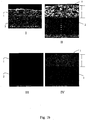
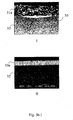
- Fig. 1b comprises four pictures of a sample of a bulk material 2 comprising a zirconia stabilized with 3 mol-% yttrium oxide.
- the bulk material 2 is coated with a substantially dense outer layer 1 comprising a zirconia stabilized with 6 mol-% yttrium oxide.
- the sample of Fig. 1b corresponds to material No. 3 in table 1.
- Pictures I and II show different resolutions of SEM pictures of the sample.
- Pictures III and IV are EDX mappings of the sample, wherein picture III show the relative zirconium content of the sample and picture IV show the relative yttrium content of the sample.
- the substantially dense outer layer has a thickness t, as can be seen in difference in brightness in said layer 1. The thickness can also be seen in picture IV, also evident from the difference in brightness.
- the sample of Fig. 1b has not been exposed to simulated aging and is comparable to the samples of Figs 2A and 2B before aging.
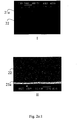
- Figures 2a:1-2a:2 are synopses of four SEM micrographs from two samples of the first batch, sample A and sample B, showing the intermediate results of a long term aging test (after 6 weeks) applied to bulk material 22 each having a substantially dense outer layer 21a, 21b with different contents of yttrium oxide.
- the bulk material 22 of sample A ( Fig. 2a:1 , pictures I and II) is a zirconia stabilized with 3 mol-% yttrium oxide.
- the substantially dense outer layer 21a of sample A is a zirconia stabilized with 6 mol-% yttrium oxide.
- Sample A corresponds to material No. 3 in table 1.
- sample B which is used as a reference, ( FIG. 2a:2 , pictures III and IV) has a bulk material 22 comprising a zirconia stabilized with 3 mol-% yttrium oxide, and a substantially dense outer layer 21b containing 3 mol-% yttrium oxide as well.
- Sample B corresponds to material No. 1 of table 1. All pictures I to IV of Figs. 2a:1-2a:2 show micrographs of samples A and B being subjected to the same simulated aging treatment performed by immerging the samples into hot water having an elevated temperature of about 90°C for 6 weeks.
- the substantially dense outer layer 21a, 21b is applied to the upper side of the bulk material 22, as shown in pictures I and III, and no dense outer layer 21a, 21b is applied to the bulk material's 22 bottom side, as shown in pictures II and IV.
- the bottom side of the bulk material 22 was directly exposed to the water having the elevated temperature, whereas the bulk material 22 was protected from the water of elevated temperature at the upper side of the sample.
- the amount of phase transformation in the substantially dense outer layer 21b and, thus, aging is comparable irrespectively whether the bulk material 22 is protected by a substantially dense outer layer 21b containing 3 mol-% yttrium oxide.
- the phase transformation from tetragonal to monoclinic microstructure of the bulk material 22 is substantially not deferred by covering the bulk material 22 with the substantially dense outer layer 21b comprising zirconia having an yttrium oxide content of 3 mol-% (sample B, pictures III and IV) since the substantially dense layer is prune to aging as such, whereas more or less no aging of the bulk material 22 induced by the water of elevated temperature can be observed when covered by the substantially dense outer layer 21a comprising an yttria stabilized zirconia having an yttrium oxide content of 6 mol-% (sample A, picture I), although such aging actually takes place in the bulk material's 22 bottom side (picture II) directly exposed to the water of elevated temperature.
- the aging test indicates that with the latter coating initiation of aging is at least deferred.
- the substantially dense outer layer 21a, 21b is a surface coating.
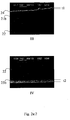
- Figs. 2b:1-2b:2 are synopses of four micrographs from two samples, sample C and sample D of the first batch, showing the final results of a long term aging test (after 12 weeks).
- the same bulk material and substantially dense outer layer as in Fig. 2a:1-2a:2 was used and exposed to a prolonged simulated aging.
- the bulk material 32 of sample C and sample D each has a substantially dense outer layer 31a, 31b with different contents of yttrium oxide.
- the bulk material 32 of sample C (pictures I and II) is a zirconia stabilized with 3 mol-% yttrium oxide.
- the substantially dense outer layer 31a of sample C is a zirconia stabilized with 6 mol-% yttrium oxide.
- Sample C corresponds to material No. 3 in table 1.
- Sample D (pictures III and IV) has a bulk material 32 comprising a zirconia stabilized with 3 mol-% yttrium oxide, and a substantially dense outer layer 31b comprising is a zirconia stabilized with 3 mol-% yttrium oxide as well.
- Sample D corresponds to material No. 1 of table 1. All pictures I to IV of Fig. 2b:1-2b:2 show micrographs of samples C and D being subjected to the same simulated aging treatment performed by immerging the samples into hot water having an elevated temperature of about 90°C for 12 weeks.
- the substantially dense outer layer 31a, 31b is applied to the upper side of the bulk material 32, shown in pictures I and III and no dense outer layer 31a, 31b is applied to the bulk material's 32 bottom side, shown in pictures II and IV.
- the bottom side of the bulk material 32 was directly exposed to the water having the elevated temperature.
- the bulk material 32 on the upper side (picture I) at the interface between the substantially dense outer layer and the bulk material 32 is dark grey
- the bulk material 32 on the bottom side (picture II) that was exposed to the water of elevated temperature has layer 33a with a lighter grey colour and a substantially uniform thickness t3, and is darker grey further away from the surface exposed to said water.
- Layer 34 and layer 33b have substantially the same colour and thickness t4, t5. Hence, it is evident that a phase transformation took place in the bulk material 32 protected by substantially dense outer layer 31b as well as the surface that was directly exposed to said water. Hence, the amount of phase transformation and, thus, aging is comparable irrespectively whether the bulk material is coated by the substantially dense outer layer 31b comprising a zirconia stabilized with 3 mol-% yttrium oxide or not. As a result of the analysis of the pictures of Figs.
- phase transformation from tetragonal to monoclinic microstructure of the bulk material 32 is substantially not deferred by covering the bulk material 32 with the substantially dense outer layer 31b comprising zirconia having an yttrium oxide content of 3 mol-% (sample D, pictures III and IV), whereas more or less no aging of the bulk material 32 induced by the water of elevated temperature can be observed when the bulk material 32 is covered by the substantially dense outer layer 31a comprising an yttria stabilized zirconia having an yttrium oxide content of 6 mol-% (sample C, picture I), although such aging actually takes place in the bulk material's 32 bottom side (Sample C, picture II) exposed to the water of elevated temperature, which does not have any dense outer layer at all and is directly exposed to said water.
- the prolonged aging test of 12 weeks confirms that with the latter coating initiation of aging is at least deferred.
- the substantially dense outer layer 31a, 31b is a surface coating.
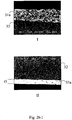
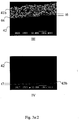
- Figs. 3a:1-3a:2 synopses of four SEM micrographs from two samples of the second batch, sample E and sample F, showing the intermediate results of a long term aging test (after 6 weeks) applied to bulk material 42 each having a porous outer layer 41a, 41b with different contents of yttrium oxide.
- the bulk material 42 of sample A ( Fig. 3a:1 , pictures I and II) is a zirconia stabilized with 3 mol-% yttrium oxide.
- the porous outer layer 41a of sample E is a zirconia stabilized with 6 mol-% yttrium oxide.
- Sample E corresponds to material No. 4 of table 1.
- sample F Fig.
- the porous outer layer 41a, 41b is applied to the upper side of the bulk material 42, as shown in pictures I and III, and no porous outer layer 41 a, 41b is applied to the bulk's 42 bottom side, as shown in pictures II and IV.
- the bottom side of the bulk material 42 was directly exposed to the water having the elevated tempertaure, whereas the bulk material 42 was partly protected from the water of elevated temperature at the upper side of the sample.
- the bulk material 42 has a lighter grey layer 44 with a thickness t6 at the interface between the porous outer layer 41b and the bulk material 42 and a darker grey colour further away from the porous outer layer 41b.
- the bulk material 42 on the bottom side that was exposed to the water of elevated temperature has a layer 43b with a thickness t7 and a lighter grey colour and is darker grey further away from the surface exposed to said water.
- Layer 43b and layer 44 have similar colours.
- the thickness of layer 44 is substantially the same as the thickness of layer 43b.
- the phase transformation from tetragonal to monoclinic microstructure of the bulk material 42 is substantially not prevented by covering the bulk material 42 with the porous outer layer 41b comprising zirconia having an yttrium oxide content of 3 mol-% (sample F, pictures III and IV), whereas more or less no aging of the bulk material 42 induced by the water of elevated temperature can be observed when covered by the porous outer layer 41a comprising an yttria stabilized zirconia having an yttrium oxide content of 6 mol-% (sample E, picture I), although such aging actually takes place in the bulk material's 42 bottom side (picture II) directly exposed to the water of elevated temperature.
- the aging test indicates that with the latter coating initiation of aging is at least deferred.
- the porous outer layer 41a, 41b is a surface coating.
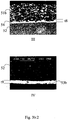
- Figs. 3b:1-3b:2 is a synopsis of four micrographs from two samples of the second batch, showing the final results of a long term aging test (after 12 weeks).
- the same bulk material and porous outer layer as in Fig. 3b:1-3b:2 was used and exposed to a prolonged simulated aging.
- the bulk material 52 of sample G and sample H each has a porous outer layer 51a, 51b with different contents of yttrium oxide.
- the bulk material 52 of sample G (pictures I and II) is a zirconia stabilized with 3 mol-% yttrium oxide.
- the porous outer layer 51a of sample G is a zirconia stabilized with 6 mol-% yttrium oxide.
- Sample G corresponds to material No. 4 of table 1.
- Sample H (pictures III and IV) has a bulk material 52 comprising a zirconia stabilized with 3 mol-% yttrium oxide, and a porous outer layer 51b comprising is a zirconia stabilized with 3 mol-% yttrium oxide as well.
- Sample H corresponds to material No. 2 of table 1. All pictures I to IV of Figs. 3b:1-3b:2 show micrographs of samples G and H being subjected to the same simulated aging treatment performed by immerging the samples into hot water having an elevated temperature of about 90°C for 12 weeks.
- the porous outer layer 51a, 51b is applied to the upper side of the bulk material 52, shown in pictures I and III, and no porous outer layer 51a, 51b is applied to the bulk material's 52 bottom side, shown in pictures II and IV. Hence, the bottom side of the bulk material 52 was directly exposed to the water having the elevated tempertaure.
- the bulk material 52 on the upper side (picture I) at the interface between the porous outer layer and the bulk material 52 is dark grey expect for a convex, as seen from the porous outer layer 51a, lighter grey area 55 in the center of picture I, whereas the bulk material 52 on the bottom side (picture II) that was exposed to the water of elevated temperature has layer 53a with a lighter grey colour and a substantially uniform thickness, and is darker grey further away from the surface exposed to said water. Also, the layer 53a is thicker, as measured from the surface of the sample, than the area 55.
- Layer 54 and layer 53b have substantially the same colour and thickness t8, t9. Hence, it is evident that a phase transformation took place in the bulk material 52 partly protected by porous outer layer 51b as well as the surface that was dirctly exposed to said water. Hence, the amount of phase transformation and, thus, aging is comparable irrespectively whether the bulk material is coated by the porous outer layer 51b comprising a zirconia stabilized with 3 mol-% yttrium oxide or not. As a result of the analysis of the pictures of Figs.
- the prolonged aging test of 12 weeks confirms that with the latter coating initiation of aging is at least deferred.
- the substantially dense outer layer 31a, 31b is a surface coating.
- the porous outer layer 51a, 51b is a surface coating.
- a bulk material of a body comprising an oxide ceramic, such as a zirconium oxide, protective by at least one coating containing an yttrium oxide and/or cerium oxide stabilised zirconium oxide, wherein the content of the stabilising compound (c [yttrium oxide] , c [cerium oxide] ) within the coating with respect to the zirconium oxide (in mol-%) satisfies the formula c [yttrium oxide] + 0.6 x c [cerium oxide] ⁇ 4 can at least defer initiation of aging.
- an oxide ceramic such as a zirconium oxide
- the deferment of initiation is dependent on the porosity of the coating or layer.
- a denser coating or layer defers the initiation of the aging more than a more porous layer or coating having the same material composition.
- a dental application body is useful in applications wherein aging is an issue.
- aging can for example be relevant for clinical use in human tissue, such as bone anchored implant.
- Such implant may e.g. comprise implants that are subject to loading, e.g. dental implants including the bone anchored dental fixture including, e.g., a threaded structure to anchor the implant.
- it may be desired to at least defer initiation of aging, such as beyond what is clinically relevant. What is clinically relevant depends on the actual application.
- the porosity of the coating or layer on top of the bulk material can be used to control the deferment of the initiation of the aging.
Landscapes
- Chemical & Material Sciences (AREA)
- Ceramic Engineering (AREA)
- Engineering & Computer Science (AREA)
- Health & Medical Sciences (AREA)
- Organic Chemistry (AREA)
- Structural Engineering (AREA)
- Materials Engineering (AREA)
- Oral & Maxillofacial Surgery (AREA)
- Inorganic Chemistry (AREA)
- Plastic & Reconstructive Surgery (AREA)
- Public Health (AREA)
- Veterinary Medicine (AREA)
- General Health & Medical Sciences (AREA)
- Animal Behavior & Ethology (AREA)
- Life Sciences & Earth Sciences (AREA)
- Epidemiology (AREA)
- Dental Preparations (AREA)
- Compositions Of Oxide Ceramics (AREA)
- Dental Prosthetics (AREA)
- Manufacturing & Machinery (AREA)
- Dispersion Chemistry (AREA)
- Materials For Medical Uses (AREA)
- Composite Materials (AREA)
Description
- The present invention relates to a dental application body, comprising an oxide ceramic, containing a bulk material containing an oxide ceramic and at least one coating, as defined in the claims.
- The use of ceramic prostheses in dental application is known for many years, and the applications for sintered products encompass dental implants, bridges, abutments or the like. In general and compared to metal materials, ceramic material have improved properties, in particular with respect to strength, body compatibility, and have usually a colour almost like the denture surrounding the implant. A further advantage of ceramic material used as dental implants is its low heat conductivity. Long-term studies, however, reveal that these ceramic materials are subject to aging, and that the fatigue strength of the material is of major importance. Especially when used as an implant replacing molar teeth, the implant has to provide a sufficient resistance to repeated stress over a time period of more than ten years without falling under a specific threshold value for their strength.
- Especially when using zirconia ceramics, the effect of the tetragonal to monoclinic transformation of zirconia ceramics stabilised with 3 mol-% yttria has a detrimental effect on aging resistance and has already been investigated. For instance, Jérôme Chevalier et al. have described the significant effect of the presence of a cubic phase in hip prosthesis in the article "Critical effect of cubic phase on aging in 3 mol%-yttria-stabilised zirconia ceramic for hip replacement prosthesis", issued by Elsevier, Biomaterials, in the year 2004 (Biomaterials 25, 5539). Blanks made from zirconium oxide ceramic are for instance disclosed in
EP 1 210 054 - In the field of dental implants, ceramic materials provide the possibility of applying a coating on top of a bulk, wherein this coating has an increased porosity with respect to the bulk material. This more porous structure at the outer surface of the implant provides for a bigger surface, thus resulting in an improved osseointegration of the implant itself.
- Among those porous coatings that have been developed or tested by the applicant, one showed particularly advantageous results. This specific coating contains zirconium oxide as a main component.
- Preventing aging of the dental implant's material is of major importance for the producers of dental implants made of ceramics. Aging may lead to decreased fatigue strength of the implant or at least its surface, possibly resulting in parts of the implant's surface flaking off the implant body.
- Tests performed with ceramic bodies coated with a porous outer layer, however, revealed that, under specific circumstances, such coating may lead to an accelerated aging performance of at least the interface between the bulk and a coating.
- Accordingly, embodiments of the present invention preferably seek to mitigate, alleviate or eliminate one or more deficiencies, disadvantages or issues in the art, such as the above-identified, singly or in any combination by providing an oxide ceramic-based body as a precursor material for dental applications, which has an improved aging capability, and which provides a sufficient strength, especially fatigue strength, over its entire lifetime, even if a porous coating is applied for providing an improved long-term stability.
- This is and other issues are achieved by a dental application body comprising the features of
claim 1. Preferred embodiments of the invention are defined in the dependent claims. - According to the invention, a dental application body comprising a bulk material containing an oxide ceramic, preferably a zirconium oxide, most preferably a zirconium oxide having a tetragonal microstructure as a main phase, and at least one coating containing an yttrium oxide and/or cerium oxide stabilised zirconium oxide, wherein the content of the stabilising compounds (c[yttrium oxide], c[cerium oxide]) within the coating with respect to the zirconium oxide (in mol-%) satisfies the formula c[yttrium oxide] + 0.6 x c[cerium oxide] ≥ 4, which body is a precursor material for any one of an implant, bridge, abutment, crown and crown for use in the maxillofacial region.
- In a preferred embodiment of the invention, the content of the stabilising compounds (c[yttrium oxide], c[cerium oxide]) within the coating with respect to the zirconium oxide (in mol-%) satisfies the formula c[yttrium oxide] + 0.6 x c[cerium oxide] ≥ 6.
- The coating of the invention may be stabilised merely by adding at least 4 mol-% yttrium oxide, preferably at least 6 mol-% yttrium oxide, or by merely adding at least 6.7 mol-% cerium oxide, preferably at least 10 mol-% cerium oxide, or by selecting suitable mixtures of yttrium oxide and cerium oxide, as long as the formula pointing to a required weighting of both stabilising compounds is satisfied.
- The invention is based on the perception that ceramic oxide, for instance a zirconium oxide bulk material of a dental implant, can be covered with a preferably porous outer layer without deteriorating the aging resistance of the implant as a whole, as long as the bulk is coated with a coating containing an yttrium oxide and/or cerium oxide stabilised zirconium oxide, as long as the content of cerium oxide and yttrium oxide satisfies the formula c[yttrium oxide] + 0.6 x c[cerium oxide] ≥ 4, preferably c[yttrium oxide] + 0.6 x c[cerium oxide] ≥ 6.
- These stabilised zirconium oxide materials having an yttrium and/or cerium oxide content within the above-mentioned ranges up to now have been considered to be too brittle and not strong enough for dental applications of the kind explained above. However, studies performed by the inventors reveal that providing such a coating on top of an oxide ceramic bulk material provide for bodies having the strength and stability sufficient for a body used in dental applications, and at the same time preventing aging characteristics in the dental implant as a whole. In this context, the bulk material provides for the overall strength of the body, and the coating applied to the bulk material is suitable to add specific improvements compared to the usual uncoated bodies.
- The effect observed in the bodies according to the invention is not fully understood yet. However, it is believed that, first of all, a zirconium oxide stabilised with cerium and/or yttrium oxide having a content satisfying the formula c[yttrium oxide] + 0.6 x c[cerium oxide] ≥ 4, preferably ≥ 6, can prevent mostly any water molecule penetration into the bulk material, which is considered to be a basic cause for aging of tetragonal zirconia materials, since this chemical composition remains intact without micro-cracking. Secondly, cerium and/or yttrium oxide fully stabilised zirconium oxide itself, such as cubic zirconium oxide, is not aging sensitive compared to, e.g., tetragonal zirconium oxide, in particular with respect to aging induced by the biosphere surrounding the ceramic material when used as a dental implant. Thirdly, such zirconium oxide coating provides for a better surface and interface for application of an outer layer on top of the at least one coating.
- In general, a dental application body according to the invention provides for a better visual appearance compared to metal dental applications, for an accurate osseointegration, and for a ceramic dental implant with a decreased aging sensitivity, thus having an improved fatigue strength over its entire lifetime.
- The bulk material according to the invention contains an oxide ceramic of the type already known in the prior art. Preferably, the oxide ceramic used for the bulk material contains zirconium oxide, preferably having a tetragonal microstructure, as a main phase. Most preferably, the tetragonal zirconium oxide is an alumina toughened zirconia. Zirconia composite may comprise of about 80% vol or even about 50% of zirconium oxide with 3 mol-% yttrium oxide, and the remaining part mainly comprising aluminium oxide. Alternatively, the composite comprises zirconium oxide ranging between 50% vol and 100% vol and the remaining portion with aluminium oxide. The compound may be stabilised with ceria.
- This results in a bulk material comprising zirconium oxide having an Y2O3 content of 5.5 weight-% or less.
- The term "main phase" is meant to encompass compositions in which at least 50% and preferably 60%, most preferably more than 75% of the microstructure consist of one single phase having a homogenous chemical composition.
- In general, increasing the alumina content of the bulk material results in a stiffer matrix and, thus, in a stronger material. Furthermore, a material having increased alumina content is less prone to aging, since alumina is inert in contact with the environment typically surrounding dental implants. Increasing the alumina content above 50%, however, may lead to a weaker material, since such composite turns to get the characteristics of aluminium oxide, rather than zirconium oxide.
- According to the invention, at least one coating containing an yttrium oxide and/or cerium oxide stabilised zirconium oxide, wherein the content of the stabilising compounds (c[yttrium oxide], c[cerium oxide]) within the coating with respect to the zirconium oxide (in mol-%) satisfies the formula c[yttrium oxide] + 0.6 x c[cerium oxide] ≥ 4, is applied on top of the bulk material. According to the invention, the coating covers at least 50% of the bulk material's surface, preferably more than 75% of the surface. In a highly preferred embodiment, the coating is applied to the surface of the bulk material, which surface during use is in contact with a wet environment.
- The method of producing a coated ceramic body is for instance disclosed in the International Patent Application having the publication number
WO 2005/027771 A1 filed by the same applicant. It is realised that the subject matter in this publication can be applied for manufacturing and making dental applications in addition to a coating with the herein claimed composition. - In a preferred embodiment of the invention, the coating comprises zirconium oxide having a ceria content between 10-20 weight-%, preferably between 12-15 weight-%, based on the zirconium oxide content. In a further preferred embodiment of the invention, the coating material comprises up to 50 vol-% of Al2O3. Furthermore, it is preferred that the coating material comprises a cerium oxide stabilised zirconium oxide in amounts between 50 and 100 vol-%.
- These compositions preferably provide for a stable cubic phase of the zirconium oxide forming the main member of the coating, and allow for the production of a bulk material providing all improved properties of the dental implant, in particular with respect to fatigue strength, colour of the coating and the body as a whole, and for the connection with further outer layers, preferably of those layers having a more porous structure than the bulk and the coating, optionally to be applied on top of the coating, such as hydroxy apatite (HA), bone growth promoting substances (BMP), or other relevant bio substances for promoting osseointegration.
- The thickness of the coating according to the invention is not limited to specific ranges as long as the support capacity of the bulk material and the structural integrity of the dental implant are not detrimentally affected. In a preferred embodiment of the invention, however, the thickness of the coating lies in the range of between 5 and 300 µm, most preferably between 10 and 150 µm. A coating having a thickness in this preferred range provides an improved combination of the material properties of the bulk material on the one hand and the coating material on the other hand. In particular, a coating having such a preferred thickness prevents a substantial moisture penetration into the bulk material and, furthermore, allows for a reliable connection with any further layer on top of the coating.
- In a further preferred embodiment of the invention, the yttrium oxide and/or cerium oxide stabilised zirconium oxide coating powder forming the basic raw material for the coating has a particle size of between 0,20 and 1,00 µm, preferably between 0,40 and 0,90 µm. Such particle sizes allow for an improved and exhaustive sintering reaction within the precursor material when producing the sintered compact without the need of applying sinter regimes (holding time and temperatures) being remarkably different from those applied in the production of other ceramic bodies of the same size.
- It is, furthermore, preferred that if at least one further (outer) layer is applied to the coating, it provides a structure being more porous than the coating. This allows for a better bonding of any outer or top layer onto the body without affecting the improved properties provided by the stabilised zirconium oxide forming the coating on top of the bulk material.
- As already mentioned above, oxide ceramics of the kind described above are pre-shaped and subsequently sintered at elevated temperatures. Precursor materials containing the chemical compositions as set out above are used as a precursor material for a sintered product. The precursor material may comprise a green or pre-sintered body, which is machined, such as by milling, before application of a coating and final sintering. The sintering temperatures to be applied to this precursor material are dependent on the microstructure and the mechanical properties to be achieved. In a preferred embodiment of the invention, the sintering temperature for the body according to the invention is in the range of 1300-1600°C, preferably in the range of 1400-1500°C.
- In this context, the skilled person is fully aware of the fact that desired reactions within the green compact during sintering, such as phase transformations, in general result from the product of temperature and pressure to be applied to the material, wherein an elevated pressure allows for a decreased sintering temperature, and vice versa. In any case, performing the sintering at temperatures within the preferred ranges secures a microstructure of the coating having characteristics required for the desired application.
- The sintering treatment can be accomplished in conventional furnaces at ambient pressure. In a preferred embodiment of the invention, however, the precursor material is transformed into the sintered product by applying a sintering and/or hot isostatic pressing treatment in which the sintering is performed while an isostatic elevated pressure being applied onto the precursor material. This allows for a stable connection of the sintered coating on top of the sintered bulk material.
- It is to be noted that the sintering treatment can be carried out after applying the coating on top of a non-sintered bulk material. In a preferred embodiment of the invention, however, the bulk material is pre-sintered in a first step, and the coating is applied to the pre-sintered bulk body, and subsequently sintered, preferably at temperatures being higher than those already applied in the first pre-sintering step. Furthermore, the sintering operation is performed taking appropriate sintering temperatures depending on the chemical composition, the thickness of the precursor material and the microstructure and/or strength to be achieved by the sintering treatment into account.
- The sintered product thus achieved preferably is a precursor material for dental implants. Other applications such as bridges, abutments, crowns or copings etc may be formed having a composition according to the invention. Although the details in manufacturing may deviate to some extent due to different desired characteristics. In any case, performing the sintering of the precursor material preferably leads to a sintered product containing an interface between the bulk material and the coating, thus leading to an improved bonding or connection between the bulk material and the coating, preferably providing a smooth transition from the coating to the bulk material without inner pores or other defects in the boundary between both materials.
- The method for the production of a body according to the invention comprises the steps of providing a bulk material containing an oxide ceramic, preferably a zirconium oxide having a tetragonal microstructure as a main phase, and applying at least one coating containing an yttrium oxide and/or cerium oxide stabilised zirconium oxide, wherein the content of the stabilising compounds (c[yttrium oxide], c[cerium oxide]) within the coating with respect to the zirconium oxide (in mol-%) satisfies the formula c[yttrium oxide] + 0.6 x c[cerium oxide] ≥ 4, preferably ≥ 6.
- Performing these method steps will lead to a dental application body as a precursor material for a sintered product providing the advantageous properties and property combinations already discussed above.
- In a preferred embodiment of the method employed for preparing the dental application body of the invention, the bulk material is preformed and subsequently sintered. In a further step, the coating is applied to the sintered bulk body by, firstly, providing a slurry containing the coating material and, secondly, spraying this slurry onto the bulk's surface, followed by a drying treatment. In a highly preferred embodiment the coating is applied to the bulk in a series of alternating spraying and drying steps, until the desired thickness of the coating is reached.
- Material samples having the compositions given in Table 1 below have been produced and were tested with respect to their density, strength, and aging characteristics.
Table 1 Material No. Bulk Material Coating Material Sintering temperature (°C) HIP temperature (°C) 1 - reference Zirconium oxide, stabilised with 3 mol-% yttrium oxide Zirconium oxide, stabilised with 3 mol-% yttrium oxide, dense 1400 1400 2 - reference Zirconium oxide, stabilised with 3 mol-% yttrium oxide Zirconium oxide, stabilised with 3 mol-% yttrium oxide, porous 1400 1400 3 - example 1 Zirconium oxide, stabilised with 3 mol-% yttrium oxide Zirconium oxide, stabilised with 6 mol-% yttrium oxide, dense 1400 1400 4 - example 2 Zirconium oxide, stabilised with 3 mol-% yttrium oxide Zirconium oxide, stabilised with 6 mol-% yttrium oxide, porous 1400 1400 5- example 13 ATZ (available from INCERCO, USA) 80 vol-% of zirconium oxide stabilised with 6 mol-% yttrium oxide, 20 vol-% aluminium oxide, porous or dense 1500 1500 6 - example 4 20 vol-% of zirconium oxide stabilised with 3 mol-% yttrium oxide, 80 vol-% aluminium oxide 20 vol-% of zirconium oxide stabilised with 6 mol-% yttrium oxide, 80 vol-% aluminium oxide, porous or dense 1500 1500 7 - example 5 50 vol-% of zirconium oxide stabilised with 12 mol-% cerium oxide, 50 vol-% aluminium oxide 50 vol-% of zirconium oxide stabilised with 12 mol-% cerium oxide, 50 vol-% aluminium oxide, porous or dense 1500 1500 8 - example 6 Zirconium oxide, stabilised with 12 mol-% yttrium oxide Zirconium oxide, stabilised with 12 mol-% yttrium oxide, porous or dense 1400 1400 9- example 7 50 vol-% of zirconium oxide stabilised with 3 mol-% yttrium oxide, 50 vol-% aluminium oxide 50 vol-% of zirconium oxide stabilised with 6 mol-% yttrium oxide, 50 vol-% aluminium oxide, porous or dense 1500 1500 - All material samples were sintered at the given temperatures and ground, and visually examined by using an electron microscope. Furthermore, the material samples were examined with respect to their microstructure, their density of the bulk material, and with respect to their strength in a biaxial strength test.
- Furthermore, all material samples were subjected to aging tests, wherein one sample was tested in hot water having a temperature of about 140°C over a time of 24 hours, the other one (long-term) being conducted in hot water having an elevated temperature of about 90°C over a time period of 6 weeks. The microstructures of the material samples were investigated in order to evaluate their content of monoclinic microstructure which was expected to originate from a phase transition from tetragonal to monoclinic, and which is considered to be an indication for the amount of aging which took place in the material sample in the course of the aging tests. A second investigation was conducted after a time period of 12 weeks under the same conditions.
- The invention will be explained in more detail below with reference to the appending Figures showing the results of tests performed with exemplifying samples. These Figures are not considered to be limiting for the invention, but are given for illustrative purposes only.
-
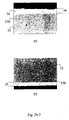
Fig. 1a is a diagram showing the monoclinic content (%) of distinct samples subjected to aging test dependent on the amount of doping the zirconia (zirconium oxide) base material with yttria (yttrium oxide); -
Fig. 1b is a synopsis of four pictures of a sample of abulk material 2 comprising a zirconia stabilized with 3 mol-% yttrium oxide before simulated aging test. -
Figs. 2a:1-2a:2 are synopses of four SEM micrographs from two samples showing the intermediate results after 6 weeks of a long term aging test applied to bulk material each having a substantially dense outer layer with different contents of yttrium oxide. -
Figs. 2b:1-2b:2 are synopses of four SEM micrographs from two samples showing the results after 12 weeks of a long term aging test applied to bulk material each having a substantially dense outer layer with different contents of yttrium oxide. -
Figs. 3a:1-3a:2 are synopses of four SEM micrographs from two samples showing the intermediate results of a long term aging test after 6 weeks applied to bulk material each having a porous outer layer with different contents of yttrium oxide. -
Figs. 3b:1-3b:2 are synopses of four SEM micrographs from two samples showing the results after 12 weeks of a long term aging test applied to bulk material each having a porous outer layer with different contents of yttrium oxide. -
Fig. 4 is an enlarged SEM micrograph of the sample ofFig. 3b:1 . -
Figure 1a illustrates a diagram showing the monoclinic content (%) of distinct of test samples subjected to the first aging test dependent on the amount of doping of the zirconia base material with yttrium oxide. The powders were compacted at uni-axially applied pressure of 700 kg/cm2 and sintered at a temperature of 1500°C over 2 hours, resulting in a fully tetragonal structure of the sintered samples. The aging test conditions comprised immerging the samples into hot water of a temperature of about 140°C for 24 hours. The test samples were dried, surface ground and etched in order to perform a microstructure inspection. The amount of aging realised in each sample coincides with the amount of monoclinic phase within each sample resulting from a phase transformation from tetragonal to monoclinic. As a consequence, samples showing a small monoclinic phase content have been considered as not being aging sensitive, whereas those samples having an increased content of monoclinic phase within their microstructures were considered having a decreased aging resistance. The diagram refers to the grade of the yttrium oxide stabilised zirconia, in whichgrade 2 coincides with an yttrium content of about 4 mol-%, grade 5 coincides with an yttrium content of about 5 mol-%, and so on. The diagram shows that an yttria content of 3 mol-% leads to an amount of monoclinic phase after the aging test of 80.8 %, an yttria content of 4 mol-% leads to an amount of monoclinic phase after the aging test of 42.4 %, an yttria content of 5 mol-% leads to an amount of monoclinic phase after the aging test of 3.5 %, and that an yttria content of 8 mol-% or more leads to an amount of monoclinic phase after the aging test of 0 %. For the purposes of the invention, an yttrium content of at least 4 mol-% is required, since such doping of the zirconia base material leads to a remarkably decreased phase transformation within the material at elevated temperatures, thus demonstrating an improved aging resistance. - Tests on the basis of this finding finally resulted in the teaching according to the invention that the content of yttrium oxide used for stabilising a zirconia base material is 6 mol-% in order to suppress the aging within a
bulk material 2 in a sufficient manner. For samples A-D, and first batch of samples was prepared, wherein each sample had a first type of outer layer. For samples E-H, a second batch of samples was prepared, wherein each sample had a second type of outer layer. Also, for each batch the outer layer had different amounts of doping material. The outer layer of the first batch was denser than the outer layer of the second batch. The first outer layer is referred to as a dense layer, meaning that it was denser than the second outer layer. Correspondingly, the second outer layer is referred to as a porous outer layer, meaning that it was more porous than the first outer layer. For each batch, simulated aging was performed for 6 weeks and 12 weeks, respectively. -
Fig. 1b comprises four pictures of a sample of abulk material 2 comprising a zirconia stabilized with 3 mol-% yttrium oxide. Thebulk material 2 is coated with a substantially denseouter layer 1 comprising a zirconia stabilized with 6 mol-% yttrium oxide. The sample ofFig. 1b corresponds to material No. 3 in table 1. Pictures I and II show different resolutions of SEM pictures of the sample. Pictures III and IV are EDX mappings of the sample, wherein picture III show the relative zirconium content of the sample and picture IV show the relative yttrium content of the sample. As can be seen in picture II, the substantially dense outer layer has a thickness t, as can be seen in difference in brightness in saidlayer 1. The thickness can also be seen in picture IV, also evident from the difference in brightness. The sample ofFig. 1b has not been exposed to simulated aging and is comparable to the samples ofFigs 2A and2B before aging. -
Figures 2a:1-2a:2 are synopses of four SEM micrographs from two samples of the first batch, sample A and sample B, showing the intermediate results of a long term aging test (after 6 weeks) applied tobulk material 22 each having a substantially denseouter layer 21a, 21b with different contents of yttrium oxide. Thebulk material 22 of sample A (Fig. 2a:1 , pictures I and II) is a zirconia stabilized with 3 mol-% yttrium oxide. The substantially denseouter layer 21a of sample A is a zirconia stabilized with 6 mol-% yttrium oxide. Sample A corresponds to material No. 3 in table 1. In contrast to the composition according to sample A, sample B, which is used as a reference, (Fig. 2a:2 , pictures III and IV) has abulk material 22 comprising a zirconia stabilized with 3 mol-% yttrium oxide, and a substantially dense outer layer 21b containing 3 mol-% yttrium oxide as well. Sample B corresponds to material No. 1 of table 1. All pictures I to IV ofFigs. 2a:1-2a:2 show micrographs of samples A and B being subjected to the same simulated aging treatment performed by immerging the samples into hot water having an elevated temperature of about 90°C for 6 weeks. In both samples A and B, the substantially denseouter layer 21a, 21b is applied to the upper side of thebulk material 22, as shown in pictures I and III, and no denseouter layer 21a, 21b is applied to the bulk material's 22 bottom side, as shown in pictures II and IV. Hence, the bottom side of thebulk material 22 was directly exposed to the water having the elevated temperature, whereas thebulk material 22 was protected from the water of elevated temperature at the upper side of the sample. When comparing pictures I and II ofFig. 2a:1 , it is evident that thebulk material 22 on the upper side (picture I) at the interface between the substantially dense outer layer and thebulk material 22 is continuous darker grey, whereas thebulk material 2 on the bottom side (picture II) that was exposed to the water of elevated temperature appears with alighter grey layer 23a darker grey further away from the surface exposed to said water. Further analyses performed with sample A revealed that this difference in brightness shows that phase transformation took place in the lighter grey area, i.e. at the bulk material's 22 bottom side. In contrast hereto, no phase transformation appeared in the bulk material's 22 upper side coated with the substantially denseouter layer 21a containing 6 mol-% yttrium oxide. Turning now to pictures III and IV ofFig. 2a:2 illustrating sample B, in picture III thebulk material 22 has alighter grey layer 24 at the substantially dense outer layer 21b and thebulk material 22 and a darker grey colour further away from the substantially denseouter layer 21a. In picture IV, thebulk material 22 on the bottom side that was exposed to the water of elevated temperature has alayer 23b with lighter grey colour and is darker grey further away from the surface exposed to said water.Layer 23a andlayer 24 have similar colours. Furthermore, the thickness t1 oflayer 24 is substantially the same as the thickness t2 oflayer 23b. Hence, it is evident that a phase transformation took place in the substantially dense outer layer 21b, which is shown bylayer 24. Furthermore, the amount of phase transformation in the substantially dense outer layer 21b and, thus, aging is comparable irrespectively whether thebulk material 22 is protected by a substantially dense outer layer 21b containing 3 mol-% yttrium oxide. As a result of the analysis of the pictures ofFigs. 2a:1-2a:2 , it can be concluded that the phase transformation from tetragonal to monoclinic microstructure of thebulk material 22 is substantially not deferred by covering thebulk material 22 with the substantially dense outer layer 21b comprising zirconia having an yttrium oxide content of 3 mol-% (sample B, pictures III and IV) since the substantially dense layer is prune to aging as such, whereas more or less no aging of thebulk material 22 induced by the water of elevated temperature can be observed when covered by the substantially denseouter layer 21a comprising an yttria stabilized zirconia having an yttrium oxide content of 6 mol-% (sample A, picture I), although such aging actually takes place in the bulk material's 22 bottom side (picture II) directly exposed to the water of elevated temperature. Hence, the aging test indicates that with the latter coating initiation of aging is at least deferred. In some embodiments of the substantially denseouter layer 21a, 21b is a surface coating. -
Figs. 2b:1-2b:2 are synopses of four micrographs from two samples, sample C and sample D of the first batch, showing the final results of a long term aging test (after 12 weeks). In this test, the same bulk material and substantially dense outer layer as inFig. 2a:1-2a:2 was used and exposed to a prolonged simulated aging. Hence, thebulk material 32 of sample C and sample D each has a substantially denseouter layer bulk material 32 of sample C (pictures I and II) is a zirconia stabilized with 3 mol-% yttrium oxide. The substantially denseouter layer 31a of sample C is a zirconia stabilized with 6 mol-% yttrium oxide. Sample C corresponds to material No. 3 in table 1. Sample D (pictures III and IV) has abulk material 32 comprising a zirconia stabilized with 3 mol-% yttrium oxide, and a substantially denseouter layer 31b comprising is a zirconia stabilized with 3 mol-% yttrium oxide as well. Sample D corresponds to material No. 1 of table 1. All pictures I to IV ofFig. 2b:1-2b:2 show micrographs of samples C and D being subjected to the same simulated aging treatment performed by immerging the samples into hot water having an elevated temperature of about 90°C for 12 weeks. In both samples C and d, the substantially denseouter layer bulk material 32, shown in pictures I and III and no denseouter layer bulk material 32 was directly exposed to the water having the elevated temperature. When comparing pictures I and II, it is evident that thebulk material 32 on the upper side (picture I) at the interface between the substantially dense outer layer and thebulk material 32 is dark grey, whereas thebulk material 32 on the bottom side (picture II) that was exposed to the water of elevated temperature haslayer 33a with a lighter grey colour and a substantially uniform thickness t3, and is darker grey further away from the surface exposed to said water. Further analyses performed with sample C revealed that phase transformation took place in the bulk material's 32 bottom side whereas substantially no phase transformation took place in thebulk material 32 that was protected by the substantially denseouter layer 31a containing 6 mol-% yttrium oxide. Turning now to pictures III and IV ofFig. 2b:2 showing sample D, in picture IIIlayer 31b protecting thebulk material 32 from the water of elevated temperature has alayer 34 having a thickness t4 and a lighter grey colour and is darker grey further away from the surface oflayer 31b. In picture IV, thebulk material 32 on the bottom side that was exposed to the water of elevated temperature has alighter grey layer 33b with a thickness t5 and is darker grey colour further away from the surface exposed to said water.Layer 34 andlayer 33b have substantially the same colour and thickness t4, t5. Hence, it is evident that a phase transformation took place in thebulk material 32 protected by substantially denseouter layer 31b as well as the surface that was directly exposed to said water. Hence, the amount of phase transformation and, thus, aging is comparable irrespectively whether the bulk material is coated by the substantially denseouter layer 31b comprising a zirconia stabilized with 3 mol-% yttrium oxide or not. As a result of the analysis of the pictures ofFigs. 2b:1-2b:2 , it can be concluded that the phase transformation from tetragonal to monoclinic microstructure of thebulk material 32 is substantially not deferred by covering thebulk material 32 with the substantially denseouter layer 31b comprising zirconia having an yttrium oxide content of 3 mol-% (sample D, pictures III and IV), whereas more or less no aging of thebulk material 32 induced by the water of elevated temperature can be observed when thebulk material 32 is covered by the substantially denseouter layer 31a comprising an yttria stabilized zirconia having an yttrium oxide content of 6 mol-% (sample C, picture I), although such aging actually takes place in the bulk material's 32 bottom side (Sample C, picture II) exposed to the water of elevated temperature, which does not have any dense outer layer at all and is directly exposed to said water. Hence, the prolonged aging test of 12 weeks confirms that with the latter coating initiation of aging is at least deferred. In some embodiments of the substantially denseouter layer Fig. 1b not exposed to aging with sample I ofFig. 2b:1 , the difference in brightness in thelayer bulk material -
Figs. 3a:1-3a:2 synopses of four SEM micrographs from two samples of the second batch, sample E and sample F, showing the intermediate results of a long term aging test (after 6 weeks) applied tobulk material 42 each having a porousouter layer bulk material 42 of sample A (Fig. 3a:1 , pictures I and II) is a zirconia stabilized with 3 mol-% yttrium oxide. The porousouter layer 41a of sample E is a zirconia stabilized with 6 mol-% yttrium oxide. Sample E corresponds to material No. 4 of table 1. In contrast to the composition according to sample E, sample F (Fig. 3a:2 , pictures III and IV) has abulk material 42 comprising a zirconia stabilized with 3 mol-% yttrium oxide, and a porousouter layer 41b containing 3 mol-% yttrium oxide as well. Sample F corresponds to material No. 2 of table 1. All pictures I to IV ofFig.s 3a:1-3a:2 show micrographs of samples E and F being subjected to the same simulated aging treatment performed by immerging the samples into hot water having an elevated temperature of about 90°C for 6 weeks. In both samples E and F, the porousouter layer bulk material 42, as shown in pictures I and III, and no porousouter layer bulk material 42 was directly exposed to the water having the elevated tempertaure, whereas thebulk material 42 was partly protected from the water of elevated temperature at the upper side of the sample. When comparing pictures I and II ofFig. 3a:1 , it is evident that thebulk material 42 on the upper side (picture I) at the interface between the porous outer layer and thebulk material 42 is continuous darker grey, whereas thebulk material 42 on the bottom side (picture II) that was exposed to the water of elevated temperature appears in darker grey colour with alighter grey layer 43a. Further analyses performed with sample E revealed that this difference in brightness shows that phase transformation took place in the lighter grey area, i.e. at the bulk material's 42 bottom side. In contrast hereto, no phase transformation appeared in the bulk material's 42 upper side coated with the porousouter layer 41a containing 6 mol-% yttrium oxide. Turning now to pictures III and IV ofFig. 3a:2 illustrating sample F, in picture III thebulk material 42 has alighter grey layer 44 with a thickness t6 at the interface between the porousouter layer 41b and thebulk material 42 and a darker grey colour further away from the porousouter layer 41b. In picture IV, thebulk material 42 on the bottom side that was exposed to the water of elevated temperature has alayer 43b with a thickness t7 and a lighter grey colour and is darker grey further away from the surface exposed to said water.Layer 43b andlayer 44 have similar colours. Furthermore, the thickness oflayer 44 is substantially the same as the thickness oflayer 43b. Hence, it is evident that a phase transformation took place in thebulk material 2 at the surface directly exposed to said water, which is shown bylayer 43b, as well as in thebulk material 42 partly protected by porousouter layer 41b, which is shown bylayer 44. Furthermore, the amount of phase transformation in thebulk material 42 and, thus, aging is comparable irrespectively whether the bulk material is partly protected by a porousouter layer 41b containing 3 mol-% yttrium oxide. As a result of the analysis of the pictures ofFigs. 3a:1-3a:2 , it can be concluded that the phase transformation from tetragonal to monoclinic microstructure of thebulk material 42 is substantially not prevented by covering thebulk material 42 with the porousouter layer 41b comprising zirconia having an yttrium oxide content of 3 mol-% (sample F, pictures III and IV), whereas more or less no aging of thebulk material 42 induced by the water of elevated temperature can be observed when covered by the porousouter layer 41a comprising an yttria stabilized zirconia having an yttrium oxide content of 6 mol-% (sample E, picture I), although such aging actually takes place in the bulk material's 42 bottom side (picture II) directly exposed to the water of elevated temperature. Hence, the aging test indicates that with the latter coating initiation of aging is at least deferred. In some embodiments of the porousouter layer -
Figs. 3b:1-3b:2 is a synopsis of four micrographs from two samples of the second batch, showing the final results of a long term aging test (after 12 weeks). In this test, the same bulk material and porous outer layer as inFig. 3b:1-3b:2 was used and exposed to a prolonged simulated aging. Hence, thebulk material 52 of sample G and sample H each has a porousouter layer bulk material 52 of sample G (pictures I and II) is a zirconia stabilized with 3 mol-% yttrium oxide. The porousouter layer 51a of sample G is a zirconia stabilized with 6 mol-% yttrium oxide. Sample G corresponds to material No. 4 of table 1. Sample H (pictures III and IV) has abulk material 52 comprising a zirconia stabilized with 3 mol-% yttrium oxide, and a porousouter layer 51b comprising is a zirconia stabilized with 3 mol-% yttrium oxide as well. Sample H corresponds to material No. 2 of table 1. All pictures I to IV ofFigs. 3b:1-3b:2 show micrographs of samples G and H being subjected to the same simulated aging treatment performed by immerging the samples into hot water having an elevated temperature of about 90°C for 12 weeks. In both samples G and H, the porousouter layer bulk material 52, shown in pictures I and III, and no porousouter layer bulk material 52 was directly exposed to the water having the elevated tempertaure. When comparing pictures I and II, it is evident that thebulk material 52 on the upper side (picture I) at the interface between the porous outer layer and thebulk material 52 is dark grey expect for a convex, as seen from the porousouter layer 51a,lighter grey area 55 in the center of picture I, whereas thebulk material 52 on the bottom side (picture II) that was exposed to the water of elevated temperature haslayer 53a with a lighter grey colour and a substantially uniform thickness, and is darker grey further away from the surface exposed to said water. Also, thelayer 53a is thicker, as measured from the surface of the sample, than thearea 55. Further analyses performed with sample G revealed that this difference in width betweenarea 55 and porousouter layer 53a shows the amount of phase transformation which took place in the bulk material's 52 bottom side is larger than the the amount of phase transformation that took place inarea 55 of thebulk material 52 that was partly protected by the porousouter layer 51 a containing 6 mol-% yttrium oxide. The phase transformation that took place at the interface between the porous outer layer and thebulk material 52 is substantially retarded compared to a zirconia stabilized with 3 mol-% yttrium oxide and a porousouter layer 51b comprising is a zirconia stabilized with 3 mol-% yttrium oxide. This is further illustrated inFig. 4 , where a wider portion of sample G is shown, wherein a plurality ofconvex areas Fig. 3b:2 showing sample H, in picture III the bulk material that was partly protected from the water of elevated temperature has alayer 54 with a thickness t8 and having a lighter grey colour towards saidlayer 51b and is darker grey further away from the surface of saidlayer 51b. In picture IV, thebulk material 52 on the bottom side that was exposed to the water of elevated temperature has alighter grey layer 53b with a thickness t9 and a darker grey colour further away from the surface exposed to said water.Layer 54 andlayer 53b have substantially the same colour and thickness t8, t9. Hence, it is evident that a phase transformation took place in thebulk material 52 partly protected by porousouter layer 51b as well as the surface that was dirctly exposed to said water. Hence, the amount of phase transformation and, thus, aging is comparable irrespectively whether the bulk material is coated by the porousouter layer 51b comprising a zirconia stabilized with 3 mol-% yttrium oxide or not. As a result of the analysis of the pictures ofFigs. 3b:1-3b:2 , it can be concluded that the phase transformation from tetragonal to monoclinic microstructure of thebulk material 52 is not prevented by covering thebulk material 52 with the porousouter layer 51b comprising zirconia having an yttrium oxide content of 3 mol-% (sample F, pictures III and IV), whereas more or less no aging of thebulk material 52 induced by the water of elevated temperatur can be observed when thebulk material 52 is covered by the porousouter layer 51a comprising an yttria stabilized zirconia having an yttrium oxide content of 6 mol-% (sample G, picture I), although such aging actually takes place in the bulk material's 52 bottom side (Sample G, picture II) exposed to the water of elevated temperature, which does not have any porous outer layer at all and is directly exposed to said water. Hence, the prolonged aging test of 12 weeks confirms that with the latter coating initiation of aging is at least deferred. In some embodiments of the substantially denseouter layer outer layer - As can be concluded from the above embodiments, a bulk material of a body, comprising an oxide ceramic, such as a zirconium oxide, protective by at least one coating containing an yttrium oxide and/or cerium oxide stabilised zirconium oxide, wherein the content of the stabilising compound (c[yttrium oxide], c[cerium oxide]) within the coating with respect to the zirconium oxide (in mol-%) satisfies the formula c[yttrium oxide] + 0.6 x c[cerium oxide] ≥ 4 can at least defer initiation of aging.
- It can also be concluded from the above embodiments that the deferment of initiation is dependent on the porosity of the coating or layer. A denser coating or layer defers the initiation of the aging more than a more porous layer or coating having the same material composition.
- A dental application body according to embodiments of the invention is useful in applications wherein aging is an issue. Such aging can for example be relevant for clinical use in human tissue, such as bone anchored implant. Such implant may e.g. comprise implants that are subject to loading, e.g. dental implants including the bone anchored dental fixture including, e.g., a threaded structure to anchor the implant. In such applications, it may be desired to at least defer initiation of aging, such as beyond what is clinically relevant. What is clinically relevant depends on the actual application. As has been discussed above, the porosity of the coating or layer on top of the bulk material can be used to control the deferment of the initiation of the aging.
- The present invention has been described above with reference to specific embodiments. However, other embodiments than the above described are equally possible within the scope of the invention. The different features and steps of the invention may be combined in other combinations than those described. The scope of the invention is only limited by the appended patent claims.
Claims (13)
- A dental application body, comprising an oxide ceramic, containing:- a bulk material containing an oxide ceramic, preferably a zirconium oxide, and- at least one coating containing an yttrium oxide and/or cerium oxide stabilised zirconium oxide, characterized in that the content of the stabilising compound (C[yttrium oxide), c[cerium oxide]) within the coating with respect to the zirconium oxide (in mol-%) satisfies the following formula:
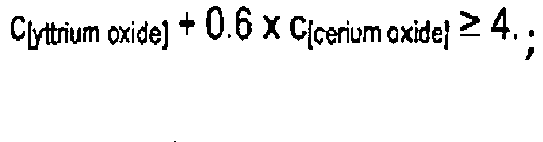
the body is a precursor material for any one of an implant, bridge, abutment, crown and crown for use in the maxillofacial region. - A dental application body according to claim 1, characterised in that the content of the stabilising compound within the coating with respect to the zirconium oxide (in mol-%) satisfies the following formula:

- A dental application body according to one of the preceding claims, characterised in that the coating comprises yttrium oxide stabilised zirconium oxide, and that the yttrium oxide content within the coating with respect to the zirconium oxide is at least 6 mol-%.
- A dental application body according to one of the preceding claims, characterised in that the coating comprises cerium oxide stabilised zirconium oxide, and that the cerium oxide content within the coating with respect to the zirconium oxide is at least 10 mol-%.
- A dental application body according to one of the preceding claims, characterised in that the coating comprises zirconium oxide having an Y2O3 content between 10-20 weight-%, preferably between 12-15 weight-%, based on the zirconium oxide content.
- A dental application body according to one of the preceding claims, characterised in that the coating material comprises up to 50 weight-% of Al2O3.
- A dental application body according to one of the preceding claims, characterised in that the coating material comprises a cerium oxide stabilized zirconium oxide in amounts of up to 50 weight-%.
- A dental application body according to one of the preceding claims, characterised in that the thickness of the coating is in the range of between 5 and 300 µm, preferably between 10 and 150 µm.
- A dental application body according to one of the preceding claims, characterised in that the yttrium oxide stabilised zirconium oxide coating has cubic phase as a main phase.
- A dental application body according to one of the preceding claims, characterised in that the yttrium oxide or cerium oxide stabilised zirconium oxide coating is made from a powder, which has a particle size of between 0,20 and 1,00 µm, preferably between 0,40 and 0,90 µm.
- A dental application body according to one of the preceding claims, characterised in that the body comprises at least one further layer on top of the coating.
- A dental application body according to claim 11, characterised in that the at least one further layer has an increased porosity with respect to the bulk and the coating.
- A dental application body according to claim 1, wherein the at least one coating is porous.
Priority Applications (1)
| Application Number | Priority Date | Filing Date | Title |
|---|---|---|---|
| EP10729784.8A EP2443077B2 (en) | 2009-06-19 | 2010-06-17 | Dental application coating |
Applications Claiming Priority (3)
| Application Number | Priority Date | Filing Date | Title |
|---|---|---|---|
| EP09008015A EP2263991A1 (en) | 2009-06-19 | 2009-06-19 | Dental application coating |
| EP10729784.8A EP2443077B2 (en) | 2009-06-19 | 2010-06-17 | Dental application coating |
| PCT/EP2010/003636 WO2010145822A1 (en) | 2009-06-19 | 2010-06-17 | Dental application coating |
Publications (3)
| Publication Number | Publication Date |
|---|---|
| EP2443077A1 EP2443077A1 (en) | 2012-04-25 |
| EP2443077B1 EP2443077B1 (en) | 2017-08-23 |
| EP2443077B2 true EP2443077B2 (en) | 2021-01-27 |
Family
ID=41279527
Family Applications (2)
| Application Number | Title | Priority Date | Filing Date |
|---|---|---|---|
| EP09008015A Withdrawn EP2263991A1 (en) | 2009-06-19 | 2009-06-19 | Dental application coating |
| EP10729784.8A Active EP2443077B2 (en) | 2009-06-19 | 2010-06-17 | Dental application coating |
Family Applications Before (1)
| Application Number | Title | Priority Date | Filing Date |
|---|---|---|---|
| EP09008015A Withdrawn EP2263991A1 (en) | 2009-06-19 | 2009-06-19 | Dental application coating |
Country Status (5)
| Country | Link |
|---|---|
| US (1) | US9045378B2 (en) |
| EP (2) | EP2263991A1 (en) |
| JP (2) | JP5950817B2 (en) |
| ES (1) | ES2641211T5 (en) |
| WO (1) | WO2010145822A1 (en) |
Families Citing this family (11)
| Publication number | Priority date | Publication date | Assignee | Title |
|---|---|---|---|---|
| EP2611382A1 (en) * | 2010-08-30 | 2013-07-10 | 3M Innovative Properties Company | Coated dental articles and related methods of manufacture |
| US20130017511A1 (en) * | 2011-07-15 | 2013-01-17 | Shofu, Inc. | Implant fixture |
| TWI449545B (en) * | 2012-02-17 | 2014-08-21 | Univ Nat Taipei Technology | Composite coating layer formed on a surface of ceramic and method of forming the same |
| US10028809B2 (en) | 2012-10-17 | 2018-07-24 | 3M Innovative Properties Company | Multi sectional dental zirconia milling block, process of production and use thereof |
| JP6357145B2 (en) * | 2013-03-11 | 2018-07-11 | クラレノリタケデンタル株式会社 | Zirconia sintered body, zirconia composition and calcined body |
| EP3988517A1 (en) | 2013-05-10 | 2022-04-27 | Kuraray Noritake Dental Inc. | A zirconia pre-sintered body |
| US20160120765A1 (en) * | 2014-10-30 | 2016-05-05 | Sagemax Bioceramics, Inc. | Zirconia Dental Articles and Methods Thereof |
| DE102016009730A1 (en) * | 2016-07-28 | 2018-02-01 | Forschungszentrum Jülich GmbH | Process for reinforcing transparent ceramics and ceramics |
| EP3539502B1 (en) * | 2016-11-10 | 2021-10-13 | Nantoh. Co., Ltd | Biological tissue adhesion surface, implant, method of forming biological tissue adhesion surface, and method of manufacturing implant |
| WO2018100251A1 (en) * | 2016-11-30 | 2018-06-07 | Abdelmadjid Djemai | Titanium-zirconium alloy and method for the production thereof by means of additive manufacturing |
| US12178679B2 (en) | 2018-07-24 | 2024-12-31 | Straumann Holding Ag | Dental article with a coating comprising nanostructures made of yttria-stabilized zirconia |
Citations (7)
| Publication number | Priority date | Publication date | Assignee | Title |
|---|---|---|---|---|
| US4525464A (en) † | 1984-06-12 | 1985-06-25 | Max-Planck-Gesellschaft Zur Forderung Der Wissenschaften | Ceramic body of zirconium dioxide (ZrO2) and method for its preparation |
| WO2003035014A1 (en) † | 2001-10-25 | 2003-05-01 | Vita Zahnfabrik H. Rauter Gmbh & Co. Kg | System for producing a veneering ceramic |
| US20050266270A1 (en) † | 2004-05-25 | 2005-12-01 | Lasater Brian J | Material and method to prevent low temperature degradation of zirconia in biomedical implants |
| WO2007090529A1 (en) † | 2006-02-03 | 2007-08-16 | Maxon Motor Gmbh | Implant and method for producing an implant |
| DE102006053260A1 (en) † | 2006-07-20 | 2008-01-24 | Clinical House Europe Gmbh | Implant for anchoring dentures |
| DE102006044210A1 (en) † | 2006-09-15 | 2008-03-27 | Auriga Medical Products Gmbh | Tooth implant for anchoring e.g. crown, in patient`s jaw, has jamb with mold part cooperating with complementarily formed front side section in wall that surrounds retainer, and gold layer that is arranged between mold part and side section |
| DE102006044209A1 (en) † | 2006-09-15 | 2008-03-27 | Auriga Medical Products Gmbh | Implant for anchoring dental prosthesis in jaw of patient, has wall surrounding retainer and provided with rounded section, and jamb including shoulder with curve, where section and curve provides gap-free connection of base and jamb |
Family Cites Families (50)
| Publication number | Priority date | Publication date | Assignee | Title |
|---|---|---|---|---|
| US3091014A (en) | 1962-05-07 | 1963-05-28 | Harbison Walker Refractories | Cradle |
| US3421914A (en) | 1968-01-08 | 1969-01-14 | Du Pont | Process for making porous light-weight zirconia bodies |
| US4073999A (en) | 1975-05-09 | 1978-02-14 | Minnesota Mining And Manufacturing Company | Porous ceramic or metallic coatings and articles |
| JPS6060980A (en) * | 1983-06-16 | 1985-04-08 | マツクス−プランク−ゲゼルシヤフト・ツ−ル・フエルデルング・デル・ヴイツセンシヤフテン・エ−・フアウ | Ceramic formed body comprising zirconium dioxide (zro2) and manufacture |
| DE3345659A1 (en) * | 1983-06-16 | 1984-12-20 | Max-Planck-Gesellschaft zur Förderung der Wissenschaften e.V., 3400 Göttingen | ZIRCONIUM DIOXIDE CERAMIC BODY (ZRO (DOWN ARROW) 2 (DOWN ARROW)) AND METHOD FOR PRODUCING THE SAME |
| JPS61146757A (en) | 1984-12-05 | 1986-07-04 | 品川白煉瓦株式会社 | Zirconia implant member for artificial tooth root |
| JPS63156063A (en) * | 1986-12-17 | 1988-06-29 | 株式会社ノリタケカンパニーリミテド | High temperature strength and hot water stability zirconia base ceramics |
| US5192325A (en) | 1988-02-08 | 1993-03-09 | Mitsubishi Kasei Corporation | Ceramic implant |
| EP0328041B1 (en) * | 1988-02-08 | 1994-09-07 | Mitsubishi Chemical Corporation | Ceramic implant and process for its production |
| US4892846A (en) | 1988-11-17 | 1990-01-09 | National Research Development Corporation | Reinforceable sintered glass-ceramics |
| SE8804588D0 (en) | 1988-12-20 | 1988-12-20 | Sandvik Ab | ARTIFICIAL DENTAL CHRONICLE |
| SE464908B (en) | 1989-03-23 | 1991-07-01 | Nobelpharma Ab | METHOD FOR MANUFACTURING ARTIFICIAL DENTAL CHRONICLES OF ONLINE TYPE OR INPUT |
| JP2997809B2 (en) | 1989-12-18 | 2000-01-11 | 京セラ株式会社 | Biological implant components |
| DE4114792A1 (en) | 1991-05-07 | 1992-11-12 | Wall Giselher | Prodn. of ceramic dental prosthesis - by reacting metal model with metalloid to form ceramic material |
| SE470346B (en) | 1992-06-23 | 1994-01-31 | Sandvik Ab | Method for making ceramic artificial tooth restorations |
| JP3186272B2 (en) | 1992-12-10 | 2001-07-11 | 株式会社日立製作所 | Disk array device |
| JPH07275276A (en) | 1994-04-06 | 1995-10-24 | Nikon Corp | Intraosseous implant |
| JP3287952B2 (en) | 1994-05-31 | 2002-06-04 | 京セラ株式会社 | Artificial root |
| DK72194A (en) | 1994-06-20 | 1995-12-21 | Dirk Leonhardt | Process for the preparation of ceramic tooth restorations and distance, separation and substructure material for carrying out the method |
| JPH0833701A (en) * | 1994-07-21 | 1996-02-06 | Shinagawa Refract Co Ltd | Zirconia medical material and manufacture therefor |
| JP3287956B2 (en) | 1994-07-29 | 2002-06-04 | 京セラ株式会社 | Artificial root |
| US6149688A (en) | 1995-06-07 | 2000-11-21 | Surgical Dynamics, Inc. | Artificial bone graft implant |
| US5902429A (en) | 1995-07-25 | 1999-05-11 | Westaim Technologies, Inc. | Method of manufacturing intermetallic/ceramic/metal composites |
| US6059949A (en) | 1997-04-23 | 2000-05-09 | Cerel (Ceramic Technologies) Ltd. | Method of electrophoretic deposition of ceramic bodies for use in manufacturing dental appliances |
| US5961329A (en) | 1997-07-02 | 1999-10-05 | Stucki-Mccormick; Suzanne U. | Combination distraction dental implant and method of use |
| DE19825094C1 (en) * | 1998-06-05 | 1999-11-25 | Heraeus Electro Nite Int | Production of ceramic, diffusion-limiting coating used as diffusion and/or oxygen ion conducting layer in oxygen probe |
| NL1011659C2 (en) | 1999-02-05 | 2000-08-08 | Cicero Dental Systems B V | Ceramic material, substructure for a dental restoration of this ceramic material and dental restoration. |
| DE19938143A1 (en) | 1999-08-16 | 2001-02-22 | Espe Dental Ag | Use of zirconium oxide ceramics with sintering additive for the production of dentures |
| NL1013536C2 (en) | 1999-11-09 | 2001-05-11 | Johannes Cornelis Stanislas Be | Dental implant. |
| JP4377507B2 (en) | 2000-02-24 | 2009-12-02 | パナソニック電工株式会社 | Calcium phosphate-coated zirconia-based biomaterial and method for producing the same |
| JP4091728B2 (en) | 2000-03-27 | 2008-05-28 | 京セラ株式会社 | Bioimplant material and its manufacturing method |
| BR0115981B1 (en) | 2000-12-07 | 2010-06-01 | retention device for ceramic blanks. | |
| FR2817860B1 (en) | 2000-12-07 | 2003-09-12 | Air Liquide | PROCESS FOR THE PREPARATION OF A LOW THICKNESS CERAMIC MATERIAL WITH CONTROLLED SURFACE POROSITY GRADIENT, CERAMIC MATERIAL OBTAINED, ELECTROCHEMICAL CELL AND CERAMIC MEMBRANE COMPRISING THE SAME |
| DE10107451B4 (en) | 2001-02-14 | 2004-04-15 | 3M Espe Ag | Process for the production of dental prostheses, dental prosthetic item which can be produced by the process and pre-sintered blank |
| DE10159683A1 (en) | 2001-11-30 | 2003-06-18 | Michael Gahlert | Dantalimplantat |
| SE0200007D0 (en) | 2002-01-03 | 2002-01-03 | Sandvik Ab | Method of making ceramic artificial dental bridges |
| EP1396237A1 (en) | 2002-09-05 | 2004-03-10 | Elephant Dental B.V. | Strengthened ceramic restoration |
| DE10244439A1 (en) * | 2002-09-24 | 2004-03-25 | Mathys Orthopädie GmbH | Endoprosthesis component used as an artificial joint comprises a ceramic material containing aluminum oxide and zirconium (di)oxide |
| JP4701654B2 (en) | 2003-08-22 | 2011-06-15 | パナソニック電工株式会社 | Zirconia-alumina composite ceramic material |
| SE525787C2 (en) | 2003-09-24 | 2005-04-26 | Nobel Biocare Ab | Procedure and apparatus for dental installation |
| ATE404228T1 (en) | 2003-10-27 | 2008-08-15 | Straumann Holding Ag | IMPLANT WITH A CERAMIC COATING |
| PT1529498E (en) | 2003-11-05 | 2014-09-17 | Dentsply Implants Mfg Gmbh | Multi part non metal implant |
| JP4548020B2 (en) * | 2004-07-06 | 2010-09-22 | 株式会社デンソー | Zirconia structure and manufacturing method thereof |
| US8785008B2 (en) | 2006-07-25 | 2014-07-22 | Tosoh Corporation | Zirconia sintered bodies with high total light transmission and high strength, uses of the same, and process for producing the same |
| JP5400317B2 (en) * | 2007-04-17 | 2014-01-29 | 菊水化学工業株式会社 | Implant material |
| WO2008138644A1 (en) | 2007-05-16 | 2008-11-20 | Nobel Biocare Services Ag | Ceramic one-piece dental implant |
| ATE507796T1 (en) | 2007-06-07 | 2011-05-15 | Nobel Biocare Services Ag | METHOD FOR PRODUCING A DENTAL PRODUCT |
| EP2014254B1 (en) | 2007-06-07 | 2018-10-31 | Nobel Biocare Services AG | Method and sintered product for forming a dental bridge |
| EP2072020A1 (en) | 2007-12-17 | 2009-06-24 | Nobel Biocare Services AG | A method of producing a dental ceramic product |
| US20110003083A1 (en) * | 2009-04-13 | 2011-01-06 | Quanzu Yang | Method for making functional ceramic films on ceramic materials |
-
2009
- 2009-06-19 EP EP09008015A patent/EP2263991A1/en not_active Withdrawn
-
2010
- 2010-06-17 ES ES10729784T patent/ES2641211T5/en active Active
- 2010-06-17 WO PCT/EP2010/003636 patent/WO2010145822A1/en not_active Ceased
- 2010-06-17 US US13/378,951 patent/US9045378B2/en active Active
- 2010-06-17 EP EP10729784.8A patent/EP2443077B2/en active Active
- 2010-06-17 JP JP2012515393A patent/JP5950817B2/en not_active Expired - Fee Related
-
2016
- 2016-06-07 JP JP2016113481A patent/JP6170594B2/en not_active Expired - Fee Related
Patent Citations (7)
| Publication number | Priority date | Publication date | Assignee | Title |
|---|---|---|---|---|
| US4525464A (en) † | 1984-06-12 | 1985-06-25 | Max-Planck-Gesellschaft Zur Forderung Der Wissenschaften | Ceramic body of zirconium dioxide (ZrO2) and method for its preparation |
| WO2003035014A1 (en) † | 2001-10-25 | 2003-05-01 | Vita Zahnfabrik H. Rauter Gmbh & Co. Kg | System for producing a veneering ceramic |
| US20050266270A1 (en) † | 2004-05-25 | 2005-12-01 | Lasater Brian J | Material and method to prevent low temperature degradation of zirconia in biomedical implants |
| WO2007090529A1 (en) † | 2006-02-03 | 2007-08-16 | Maxon Motor Gmbh | Implant and method for producing an implant |
| DE102006053260A1 (en) † | 2006-07-20 | 2008-01-24 | Clinical House Europe Gmbh | Implant for anchoring dentures |
| DE102006044210A1 (en) † | 2006-09-15 | 2008-03-27 | Auriga Medical Products Gmbh | Tooth implant for anchoring e.g. crown, in patient`s jaw, has jamb with mold part cooperating with complementarily formed front side section in wall that surrounds retainer, and gold layer that is arranged between mold part and side section |
| DE102006044209A1 (en) † | 2006-09-15 | 2008-03-27 | Auriga Medical Products Gmbh | Implant for anchoring dental prosthesis in jaw of patient, has wall surrounding retainer and provided with rounded section, and jamb including shoulder with curve, where section and curve provides gap-free connection of base and jamb |
Non-Patent Citations (1)
| Title |
|---|
| M.T. HERNANDEZ ET AL.: "Subeutectoid Degradation of Yttria-Stabilized Tetragonal Zirconia Polycrystal and Ceria-Doped Yttria-Stabilized Tetragonal Zirconia Polycrystal Ceramics", J. AM. CERAM. SOC., vol. 74, no. 6, June 1991 (1991-06-01), pages 1254 - 1258 † |
Also Published As
| Publication number | Publication date |
|---|---|
| WO2010145822A1 (en) | 2010-12-23 |
| EP2263991A1 (en) | 2010-12-22 |
| ES2641211T5 (en) | 2021-09-23 |
| JP2012530091A (en) | 2012-11-29 |
| ES2641211T3 (en) | 2017-11-08 |
| US9045378B2 (en) | 2015-06-02 |
| JP5950817B2 (en) | 2016-07-13 |
| JP2016193920A (en) | 2016-11-17 |
| US20120156472A1 (en) | 2012-06-21 |
| EP2443077B1 (en) | 2017-08-23 |
| JP6170594B2 (en) | 2017-07-26 |
| EP2443077A1 (en) | 2012-04-25 |
Similar Documents
| Publication | Publication Date | Title |
|---|---|---|
| EP2443077B1 (en) | Dental application coating | |
| JP7277495B2 (en) | Dental zirconia sintered body, laminated body, calcined zirconia body for dental processing, and dental prosthesis | |
| EP1670378B1 (en) | Method and arrangement for a dental installation | |
| CZ20023898A3 (en) | Material for biological and medicinal purposes | |
| Willems et al. | Iron oxide colouring of highly-translucent 3Y-TZP ceramics for dental restorations | |
| US11161789B2 (en) | Highly translucent zirconia material, device, methods of making the same, and use thereof | |
| EP3636621B1 (en) | Zirconia mill blank for dental cutting and machining and preparing method thereof | |
| EP2826762A1 (en) | Medical ceramic material and manufacturing method thereof | |
| US20240059617A1 (en) | Highly Translucent Zirconia Material, Device, Methods of Making the Same, and Use Thereof | |
| Pereira et al. | Improvement of 3Y-TZP aging behavior by means of zirconia-based protective layers | |
| JP4398840B2 (en) | Zirconia composite sintered body and biomaterial using the same | |
| KR20180101787A (en) | Complex sintered body and method for producing thereof | |
| EP2934368B1 (en) | Process for preparing a body made of a zirconia material with a surface region comprising a calcium-containing phase | |
| Kim et al. | Effect of solid loading on the sintered properties of 3 mol% yttria-stabilized tetragonal zirconia polycrystals (3Y-TZP) ceramics via slip casting | |
| EP4480935A1 (en) | Calcined object and sintered object of zirconia | |
| Seesala et al. | A novel strategy for fabricating zirconia implants with a trabecular biomimetic porous surface | |
| US20230202931A1 (en) | Method and composition to produce high translucency dental ceramics | |
| JP7568234B2 (en) | Zirconia sintered body | |
| EP3929170B1 (en) | Sintering process for electrical feedthroughs | |
| Kim et al. | Fabrication of an All-Ceramic Implant by Slip Casting of Nanoscale Zirconia Powder | |
| KR20240074206A (en) | Multilayer gradation zirconia dental block having high strength and high permeability and manufacturing method thereof | |
| Ekşi et al. | Production and Characterization of ZrO2-Si3N4 Ceramics | |
| WO2026024620A1 (en) | Zirconia green body with submicron grain control for rapid sintering and high-throughput dental restorations | |
| Oberbach et al. | Development of an alumina ceramic with a gradient of concentration and microstructure for the application of load bearing implants |
Legal Events
| Date | Code | Title | Description |
|---|---|---|---|
| PUAI | Public reference made under article 153(3) epc to a published international application that has entered the european phase |
Free format text: ORIGINAL CODE: 0009012 |
|
| 17P | Request for examination filed |
Effective date: 20120119 |
|
| AK | Designated contracting states |
Kind code of ref document: A1 Designated state(s): AL AT BE BG CH CY CZ DE DK EE ES FI FR GB GR HR HU IE IS IT LI LT LU LV MC MK MT NL NO PL PT RO SE SI SK SM TR |
|
| DAX | Request for extension of the european patent (deleted) | ||
| 17Q | First examination report despatched |
Effective date: 20121004 |
|
| GRAP | Despatch of communication of intention to grant a patent |
Free format text: ORIGINAL CODE: EPIDOSNIGR1 |
|
| STAA | Information on the status of an ep patent application or granted ep patent |
Free format text: STATUS: GRANT OF PATENT IS INTENDED |
|
| INTG | Intention to grant announced |
Effective date: 20170314 |
|
| GRAS | Grant fee paid |
Free format text: ORIGINAL CODE: EPIDOSNIGR3 |
|
| GRAA | (expected) grant |
Free format text: ORIGINAL CODE: 0009210 |
|
| STAA | Information on the status of an ep patent application or granted ep patent |
Free format text: STATUS: THE PATENT HAS BEEN GRANTED |
|
| AK | Designated contracting states |
Kind code of ref document: B1 Designated state(s): AL AT BE BG CH CY CZ DE DK EE ES FI FR GB GR HR HU IE IS IT LI LT LU LV MC MK MT NL NO PL PT RO SE SI SK SM TR |
|
| REG | Reference to a national code |
Ref country code: GB Ref legal event code: FG4D |
|
| REG | Reference to a national code |
Ref country code: CH Ref legal event code: EP |
|
| REG | Reference to a national code |
Ref country code: AT Ref legal event code: REF Ref document number: 921158 Country of ref document: AT Kind code of ref document: T Effective date: 20170915 |
|
| REG | Reference to a national code |
Ref country code: IE Ref legal event code: FG4D |
|
| REG | Reference to a national code |
Ref country code: DE Ref legal event code: R096 Ref document number: 602010044618 Country of ref document: DE |
|
| REG | Reference to a national code |
Ref country code: SE Ref legal event code: TRGR |
|
| REG | Reference to a national code |
Ref country code: ES Ref legal event code: FG2A Ref document number: 2641211 Country of ref document: ES Kind code of ref document: T3 Effective date: 20171108 |
|
| REG | Reference to a national code |
Ref country code: NL Ref legal event code: MP Effective date: 20170823 |
|
| REG | Reference to a national code |
Ref country code: LT Ref legal event code: MG4D |
|
| REG | Reference to a national code |
Ref country code: AT Ref legal event code: MK05 Ref document number: 921158 Country of ref document: AT Kind code of ref document: T Effective date: 20170823 |
|
| PG25 | Lapsed in a contracting state [announced via postgrant information from national office to epo] |
Ref country code: NL Free format text: LAPSE BECAUSE OF FAILURE TO SUBMIT A TRANSLATION OF THE DESCRIPTION OR TO PAY THE FEE WITHIN THE PRESCRIBED TIME-LIMIT Effective date: 20170823 Ref country code: AT Free format text: LAPSE BECAUSE OF FAILURE TO SUBMIT A TRANSLATION OF THE DESCRIPTION OR TO PAY THE FEE WITHIN THE PRESCRIBED TIME-LIMIT Effective date: 20170823 Ref country code: FI Free format text: LAPSE BECAUSE OF FAILURE TO SUBMIT A TRANSLATION OF THE DESCRIPTION OR TO PAY THE FEE WITHIN THE PRESCRIBED TIME-LIMIT Effective date: 20170823 Ref country code: HR Free format text: LAPSE BECAUSE OF FAILURE TO SUBMIT A TRANSLATION OF THE DESCRIPTION OR TO PAY THE FEE WITHIN THE PRESCRIBED TIME-LIMIT Effective date: 20170823 Ref country code: LT Free format text: LAPSE BECAUSE OF FAILURE TO SUBMIT A TRANSLATION OF THE DESCRIPTION OR TO PAY THE FEE WITHIN THE PRESCRIBED TIME-LIMIT Effective date: 20170823 Ref country code: NO Free format text: LAPSE BECAUSE OF FAILURE TO SUBMIT A TRANSLATION OF THE DESCRIPTION OR TO PAY THE FEE WITHIN THE PRESCRIBED TIME-LIMIT Effective date: 20171123 |
|
| PG25 | Lapsed in a contracting state [announced via postgrant information from national office to epo] |
Ref country code: LV Free format text: LAPSE BECAUSE OF FAILURE TO SUBMIT A TRANSLATION OF THE DESCRIPTION OR TO PAY THE FEE WITHIN THE PRESCRIBED TIME-LIMIT Effective date: 20170823 Ref country code: BG Free format text: LAPSE BECAUSE OF FAILURE TO SUBMIT A TRANSLATION OF THE DESCRIPTION OR TO PAY THE FEE WITHIN THE PRESCRIBED TIME-LIMIT Effective date: 20171123 Ref country code: IS Free format text: LAPSE BECAUSE OF FAILURE TO SUBMIT A TRANSLATION OF THE DESCRIPTION OR TO PAY THE FEE WITHIN THE PRESCRIBED TIME-LIMIT Effective date: 20171223 Ref country code: GR Free format text: LAPSE BECAUSE OF FAILURE TO SUBMIT A TRANSLATION OF THE DESCRIPTION OR TO PAY THE FEE WITHIN THE PRESCRIBED TIME-LIMIT Effective date: 20171124 Ref country code: PL Free format text: LAPSE BECAUSE OF FAILURE TO SUBMIT A TRANSLATION OF THE DESCRIPTION OR TO PAY THE FEE WITHIN THE PRESCRIBED TIME-LIMIT Effective date: 20170823 |
|
| PG25 | Lapsed in a contracting state [announced via postgrant information from national office to epo] |
Ref country code: DK Free format text: LAPSE BECAUSE OF FAILURE TO SUBMIT A TRANSLATION OF THE DESCRIPTION OR TO PAY THE FEE WITHIN THE PRESCRIBED TIME-LIMIT Effective date: 20170823 Ref country code: CZ Free format text: LAPSE BECAUSE OF FAILURE TO SUBMIT A TRANSLATION OF THE DESCRIPTION OR TO PAY THE FEE WITHIN THE PRESCRIBED TIME-LIMIT Effective date: 20170823 Ref country code: RO Free format text: LAPSE BECAUSE OF FAILURE TO SUBMIT A TRANSLATION OF THE DESCRIPTION OR TO PAY THE FEE WITHIN THE PRESCRIBED TIME-LIMIT Effective date: 20170823 |
|
| REG | Reference to a national code |
Ref country code: DE Ref legal event code: R026 Ref document number: 602010044618 Country of ref document: DE |
|
| PLBI | Opposition filed |
Free format text: ORIGINAL CODE: 0009260 |
|
| PG25 | Lapsed in a contracting state [announced via postgrant information from national office to epo] |
Ref country code: SK Free format text: LAPSE BECAUSE OF FAILURE TO SUBMIT A TRANSLATION OF THE DESCRIPTION OR TO PAY THE FEE WITHIN THE PRESCRIBED TIME-LIMIT Effective date: 20170823 Ref country code: EE Free format text: LAPSE BECAUSE OF FAILURE TO SUBMIT A TRANSLATION OF THE DESCRIPTION OR TO PAY THE FEE WITHIN THE PRESCRIBED TIME-LIMIT Effective date: 20170823 Ref country code: SM Free format text: LAPSE BECAUSE OF FAILURE TO SUBMIT A TRANSLATION OF THE DESCRIPTION OR TO PAY THE FEE WITHIN THE PRESCRIBED TIME-LIMIT Effective date: 20170823 |
|
| PLAX | Notice of opposition and request to file observation + time limit sent |
Free format text: ORIGINAL CODE: EPIDOSNOBS2 |
|
| REG | Reference to a national code |
Ref country code: FR Ref legal event code: PLFP Year of fee payment: 9 |
|
| 26 | Opposition filed |
Opponent name: STRAUMANN HOLDING AG Effective date: 20180523 |
|
| PG25 | Lapsed in a contracting state [announced via postgrant information from national office to epo] |
Ref country code: SI Free format text: LAPSE BECAUSE OF FAILURE TO SUBMIT A TRANSLATION OF THE DESCRIPTION OR TO PAY THE FEE WITHIN THE PRESCRIBED TIME-LIMIT Effective date: 20170823 |
|
| PLAF | Information modified related to communication of a notice of opposition and request to file observations + time limit |
Free format text: ORIGINAL CODE: EPIDOSCOBS2 |
|
| PLBB | Reply of patent proprietor to notice(s) of opposition received |
Free format text: ORIGINAL CODE: EPIDOSNOBS3 |
|
| REG | Reference to a national code |
Ref country code: BE Ref legal event code: MM Effective date: 20180630 |
|
| REG | Reference to a national code |
Ref country code: IE Ref legal event code: MM4A |
|
| PG25 | Lapsed in a contracting state [announced via postgrant information from national office to epo] |
Ref country code: LU Free format text: LAPSE BECAUSE OF NON-PAYMENT OF DUE FEES Effective date: 20180617 Ref country code: MC Free format text: LAPSE BECAUSE OF FAILURE TO SUBMIT A TRANSLATION OF THE DESCRIPTION OR TO PAY THE FEE WITHIN THE PRESCRIBED TIME-LIMIT Effective date: 20170823 |
|
| PG25 | Lapsed in a contracting state [announced via postgrant information from national office to epo] |
Ref country code: IE Free format text: LAPSE BECAUSE OF NON-PAYMENT OF DUE FEES Effective date: 20180617 |
|
| PG25 | Lapsed in a contracting state [announced via postgrant information from national office to epo] |
Ref country code: BE Free format text: LAPSE BECAUSE OF NON-PAYMENT OF DUE FEES Effective date: 20180630 |
|
| PG25 | Lapsed in a contracting state [announced via postgrant information from national office to epo] |
Ref country code: MT Free format text: LAPSE BECAUSE OF NON-PAYMENT OF DUE FEES Effective date: 20180617 |
|
| APBM | Appeal reference recorded |
Free format text: ORIGINAL CODE: EPIDOSNREFNO |
|
| APBP | Date of receipt of notice of appeal recorded |
Free format text: ORIGINAL CODE: EPIDOSNNOA2O |
|
| APAH | Appeal reference modified |
Free format text: ORIGINAL CODE: EPIDOSCREFNO |
|
| APBU | Appeal procedure closed |
Free format text: ORIGINAL CODE: EPIDOSNNOA9O |
|
| PG25 | Lapsed in a contracting state [announced via postgrant information from national office to epo] |
Ref country code: TR Free format text: LAPSE BECAUSE OF FAILURE TO SUBMIT A TRANSLATION OF THE DESCRIPTION OR TO PAY THE FEE WITHIN THE PRESCRIBED TIME-LIMIT Effective date: 20170823 |
|
| PG25 | Lapsed in a contracting state [announced via postgrant information from national office to epo] |
Ref country code: HU Free format text: LAPSE BECAUSE OF FAILURE TO SUBMIT A TRANSLATION OF THE DESCRIPTION OR TO PAY THE FEE WITHIN THE PRESCRIBED TIME-LIMIT; INVALID AB INITIO Effective date: 20100617 Ref country code: PT Free format text: LAPSE BECAUSE OF FAILURE TO SUBMIT A TRANSLATION OF THE DESCRIPTION OR TO PAY THE FEE WITHIN THE PRESCRIBED TIME-LIMIT Effective date: 20170823 |
|
| PG25 | Lapsed in a contracting state [announced via postgrant information from national office to epo] |
Ref country code: CY Free format text: LAPSE BECAUSE OF FAILURE TO SUBMIT A TRANSLATION OF THE DESCRIPTION OR TO PAY THE FEE WITHIN THE PRESCRIBED TIME-LIMIT Effective date: 20170823 Ref country code: MK Free format text: LAPSE BECAUSE OF NON-PAYMENT OF DUE FEES Effective date: 20170823 |
|
| PG25 | Lapsed in a contracting state [announced via postgrant information from national office to epo] |
Ref country code: AL Free format text: LAPSE BECAUSE OF FAILURE TO SUBMIT A TRANSLATION OF THE DESCRIPTION OR TO PAY THE FEE WITHIN THE PRESCRIBED TIME-LIMIT Effective date: 20170823 |
|
| PUAH | Patent maintained in amended form |
Free format text: ORIGINAL CODE: 0009272 |
|
| STAA | Information on the status of an ep patent application or granted ep patent |
Free format text: STATUS: PATENT MAINTAINED AS AMENDED |
|
| 27A | Patent maintained in amended form |
Effective date: 20210127 |
|
| AK | Designated contracting states |
Kind code of ref document: B2 Designated state(s): AL AT BE BG CH CY CZ DE DK EE ES FI FR GB GR HR HU IE IS IT LI LT LU LV MC MK MT NL NO PL PT RO SE SI SK SM TR |
|
| REG | Reference to a national code |
Ref country code: DE Ref legal event code: R102 Ref document number: 602010044618 Country of ref document: DE |
|
| REG | Reference to a national code |
Ref country code: SE Ref legal event code: RPEO |
|
| REG | Reference to a national code |
Ref country code: ES Ref legal event code: DC2A Ref document number: 2641211 Country of ref document: ES Kind code of ref document: T5 Effective date: 20210923 |
|
| REG | Reference to a national code |
Ref country code: FR Ref legal event code: PLFP Year of fee payment: 14 |
|
| PGFP | Annual fee paid to national office [announced via postgrant information from national office to epo] |
Ref country code: SE Payment date: 20230314 Year of fee payment: 14 |
|
| P01 | Opt-out of the competence of the unified patent court (upc) registered |
Effective date: 20230515 |
|
| PGFP | Annual fee paid to national office [announced via postgrant information from national office to epo] |
Ref country code: IT Payment date: 20230510 Year of fee payment: 14 |
|
| PGFP | Annual fee paid to national office [announced via postgrant information from national office to epo] |
Ref country code: GB Payment date: 20230427 Year of fee payment: 14 |
|
| PGFP | Annual fee paid to national office [announced via postgrant information from national office to epo] |
Ref country code: DE Payment date: 20240328 Year of fee payment: 15 |
|
| PGFP | Annual fee paid to national office [announced via postgrant information from national office to epo] |
Ref country code: FR Payment date: 20240408 Year of fee payment: 15 |
|
| PGFP | Annual fee paid to national office [announced via postgrant information from national office to epo] |
Ref country code: CH Payment date: 20240701 Year of fee payment: 15 Ref country code: ES Payment date: 20240704 Year of fee payment: 15 |
|
| REG | Reference to a national code |
Ref country code: SE Ref legal event code: EUG |
|
| GBPC | Gb: european patent ceased through non-payment of renewal fee |
Effective date: 20240617 |
|
| PG25 | Lapsed in a contracting state [announced via postgrant information from national office to epo] |
Ref country code: GB Free format text: LAPSE BECAUSE OF NON-PAYMENT OF DUE FEES Effective date: 20240617 Ref country code: IT Free format text: LAPSE BECAUSE OF NON-PAYMENT OF DUE FEES Effective date: 20240617 |
|
| PG25 | Lapsed in a contracting state [announced via postgrant information from national office to epo] |
Ref country code: SE Free format text: LAPSE BECAUSE OF NON-PAYMENT OF DUE FEES Effective date: 20240618 |
|
| REG | Reference to a national code |
Ref country code: DE Ref legal event code: R119 Ref document number: 602010044618 Country of ref document: DE |
|
| REG | Reference to a national code |
Ref country code: CH Ref legal event code: H13 Free format text: ST27 STATUS EVENT CODE: U-0-0-H10-H13 (AS PROVIDED BY THE NATIONAL OFFICE) Effective date: 20260127 |
|
| PG25 | Lapsed in a contracting state [announced via postgrant information from national office to epo] |
Ref country code: DE Free format text: LAPSE BECAUSE OF NON-PAYMENT OF DUE FEES Effective date: 20260101 |
|
| PG25 | Lapsed in a contracting state [announced via postgrant information from national office to epo] |
Ref country code: FR Free format text: LAPSE BECAUSE OF NON-PAYMENT OF DUE FEES Effective date: 20250630 |
|
| PG25 | Lapsed in a contracting state [announced via postgrant information from national office to epo] |
Ref country code: CH Free format text: LAPSE BECAUSE OF NON-PAYMENT OF DUE FEES Effective date: 20250630 |