EP2442669B1 - A slush - Google Patents
A slush Download PDFInfo
- Publication number
- EP2442669B1 EP2442669B1 EP10727497.9A EP10727497A EP2442669B1 EP 2442669 B1 EP2442669 B1 EP 2442669B1 EP 10727497 A EP10727497 A EP 10727497A EP 2442669 B1 EP2442669 B1 EP 2442669B1
- Authority
- EP
- European Patent Office
- Prior art keywords
- fructose
- slush
- ingredient
- abv
- ice
- Prior art date
- Legal status (The legal status is an assumption and is not a legal conclusion. Google has not performed a legal analysis and makes no representation as to the accuracy of the status listed.)
- Active
Links
Images

Classifications
-
- C—CHEMISTRY; METALLURGY
- C12—BIOCHEMISTRY; BEER; SPIRITS; WINE; VINEGAR; MICROBIOLOGY; ENZYMOLOGY; MUTATION OR GENETIC ENGINEERING
- C12G—WINE; PREPARATION THEREOF; ALCOHOLIC BEVERAGES; PREPARATION OF ALCOHOLIC BEVERAGES NOT PROVIDED FOR IN SUBCLASSES C12C OR C12H
- C12G3/00—Preparation of other alcoholic beverages
-
- A—HUMAN NECESSITIES
- A23—FOODS OR FOODSTUFFS; TREATMENT THEREOF, NOT COVERED BY OTHER CLASSES
- A23G—COCOA; COCOA PRODUCTS, e.g. CHOCOLATE; SUBSTITUTES FOR COCOA OR COCOA PRODUCTS; CONFECTIONERY; CHEWING GUM; ICE-CREAM; PREPARATION THEREOF
- A23G9/00—Frozen sweets, e.g. ice confectionery, ice-cream; Mixtures therefor
- A23G9/04—Production of frozen sweets, e.g. ice-cream
- A23G9/045—Production of frozen sweets, e.g. ice-cream of slush-ice, e.g. semi-frozen beverage
-
- B—PERFORMING OPERATIONS; TRANSPORTING
- B65—CONVEYING; PACKING; STORING; HANDLING THIN OR FILAMENTARY MATERIAL
- B65D—CONTAINERS FOR STORAGE OR TRANSPORT OF ARTICLES OR MATERIALS, e.g. BAGS, BARRELS, BOTTLES, BOXES, CANS, CARTONS, CRATES, DRUMS, JARS, TANKS, HOPPERS, FORWARDING CONTAINERS; ACCESSORIES, CLOSURES, OR FITTINGS THEREFOR; PACKAGING ELEMENTS; PACKAGES
- B65D1/00—Rigid or semi-rigid containers having bodies formed in one piece, e.g. by casting metallic material, by moulding plastics, by blowing vitreous material, by throwing ceramic material, by moulding pulped fibrous material or by deep-drawing operations performed on sheet material
- B65D1/02—Bottles or similar containers with necks or like restricted apertures, designed for pouring contents
- B65D1/0223—Bottles or similar containers with necks or like restricted apertures, designed for pouring contents characterised by shape
-
- C—CHEMISTRY; METALLURGY
- C12—BIOCHEMISTRY; BEER; SPIRITS; WINE; VINEGAR; MICROBIOLOGY; ENZYMOLOGY; MUTATION OR GENETIC ENGINEERING
- C12G—WINE; PREPARATION THEREOF; ALCOHOLIC BEVERAGES; PREPARATION OF ALCOHOLIC BEVERAGES NOT PROVIDED FOR IN SUBCLASSES C12C OR C12H
- C12G3/00—Preparation of other alcoholic beverages
- C12G3/04—Preparation of other alcoholic beverages by mixing, e.g. for preparation of liqueurs
- C12G3/06—Preparation of other alcoholic beverages by mixing, e.g. for preparation of liqueurs with flavouring ingredients
-
- A—HUMAN NECESSITIES
- A23—FOODS OR FOODSTUFFS; TREATMENT THEREOF, NOT COVERED BY OTHER CLASSES
- A23V—INDEXING SCHEME RELATING TO FOODS, FOODSTUFFS OR NON-ALCOHOLIC BEVERAGES AND LACTIC OR PROPIONIC ACID BACTERIA USED IN FOODSTUFFS OR FOOD PREPARATION
- A23V2002/00—Food compositions, function of food ingredients or processes for food or foodstuffs
Definitions
- the present invention relates to slush, primarily edible beverage slush, formed by freezing such as might be experienced in a domestic freezer.
- the product formulation technology described herein allows the creation of beverages that, even when distributed and sold at ambient temperatures, can be placed in a home freezer to become frozen slush beverage products that maintain the characteristic of being a dispensable, i.e. pourable, slush.
- the frozen beverage market is a global market, with frozen soft drinks and cocktails being popular choices of drink across many markets. Preparation of such frozen beverages can be quite tedious, requiring the use of equipment such as scrape-surface slush machines (e.g. Slush PuppyTM) to produce small ice crystals or a blender to reduce ice cubes to small ice particles. This equipment is inconvenient and often avoided by consumers.
- Scrape-surface slush machines e.g. Slush PuppyTM
- a blender to reduce ice cubes to small ice particles. This equipment is inconvenient and often avoided by consumers.
- Several products have been marketed to address convenience, with the ability to freeze in a static domestic freezer and deliver a soft-ice. However, all of these products have suffered from the variation in domestic freezer temperatures.
- WO96/11578 refers to an improvement in the form of an alcoholic soft-ice; however, the product described is not freely pourable and must be removed from the container by a hand-operated utensil, such as a spoon, whereas an ideal frozen beverage should be easily pourable.
- a hand-operated utensil such as a spoon
- an ideal frozen beverage should be easily pourable.
- EP0268097 reported a similar spoonable, not pourable, frozen product.
- Prior-art frozen soft-ice formulations use stabilisers and gums (e.g. CMCs), which can impede pourability and can have a negative organoleptic effect on frozen beverages.
- a quiescently frozen slush must both deliver on the promise of convenience and provide acceptable product performance to the widest possible consumer audience. This means a commercially attractive product must have characteristic and desired properties in a range of freezer temperatures.
- the invention presents a formulation for a pourable slush beverage that will meet an acceptance standard in the majority of domestic freezers and is ready for consumption, once it has frozen and reached a steady-state temperature. It should remain in a pourable/flowable state for an extended period of many months in a freezer, and generally be able to be thawed and "re-set" after purchase, should the ice crystals become undesirably large.
- An alternate expression of the invention is to provide a table of reciprocal values from the above table wherein, for every 1g of actual ingredient, the amount contributing to the total ingredient content is given by given by the equations:
- Ingredient 1/F Fructose 1.0 Glucose 0.83 Sucrose 0.71 Acid (e.g. citric or malic) 0.50 Emulsion 0.45 Gelatin Hydrolysate 0.56 Propylene Glycol 0.80 Betaine 1.49 Trehalose 0.70 Erythritol 0.70 Sorbitol 0.70 Isomaltulose 0.50 Glycerol 0.80 Maltodextrin 0.35
- the slush product is most typically made using a domestic freezer, but can be produced in any appropriate cooling apparatus.
- fructose as a base unit, to which all other ingredients are compared. Once an equivalent ratio for a particular ingredient is established it is possible to determine the "fructose equivalent loading" as defined by the equation. However, it would also be possible to use another base unit (or an arbitrary unit) and assign values for different ingredients.
- the invention involves adding a prescribed amount of fructose (or other ingredient), dependent on alcohol content, that will allow formulation of a slush beverage that will remain pourable in a domestic freezer. Since, in practice, there is variation in the average operating temperatures of domestic freezers in a given market, the formulation must produce a pourable slush, after it reaches a steady-state temperature within at least a continuous five Celsius degrees of a freezer temperature range between -11 and -20°C. Most preferably, the formulation will have pourability characteristics over the entire -11 to -20°C range (i.e. a nine Celsius degree window).
- the formulation of the invention produces an ice content, such that the product, once frozen at a steady-state temperature, is a pourable slush.
- an ice-nucleating agent may be added. While an ice-nucleating agent is not an essential ingredient, in practice an ice nucleator is desirable, because the melting temperature of the formulation may be close to the warmest freezer temperature, and assuming some degree of supercooling could occur, the presence of an ice nucleator further ensures ice formation, as the beverage reaches a steady-state temperature in a domestic freezer.
- An ice-nucleating agent is defined herein as an additive/ingredient present in the solution, or in contact with the solution, which serves the purpose of reducing the effect of supercooling by causing ice crystal formation, when the solution is at any temperature between (below) the melting point and (above) the homogeneous nucleation temperature of that solution.
- the ice-nucleating agent is stigmasterol.
- an ice-crystal-morphology-modifying ingredient may be added.
- a preferred ingredient to achieve this aspect is gelatin hydrolysate of average molecular weight in the range 3000 Da to 15000 Da.
- the present invention also provides a method of formulating an alcoholic beverage for forming a pourable slush using a freezer with a temperature range of between -11 to -20°C, including the steps of:
- substitution involves determining permanent ratios for ingredients compared to fructose so that the contribution of any ingredient for obtaining a pourable slush can be calculated.
- the product of the invention forms a flowable/pourable slush over at least a continuous range of 5 Celsius degrees between -11 and -20°C. Such a slush is also pumpable in a dynamic system.
- a “pourable slush” is defined by the following characteristics:
- a slush should have no less than 100g/L and no more than 350g/L ice content as will be discussed in more detail below.
- the slush after forming in a (preferably flexible) plastic bottle, can be easily squeezed and have a few shakes applied to break the brittle ice structure that forms therein. Then the bottle can be inverted into a glass, and with minor agitation, the slush can be poured into a glass. At its thickest consistency, the slush may require a few extra squeezes to remove it from the bottle ( ⁇ 10% of the slush should remain in the bottle). A spoon is not required to remove the product from its container.
- a key advantage of the invention can be described as providing a formulation that conveniently takes the uncertainty out of preparing a pourable frozen beverage and is ready to use straight out of the freezer.
- the formulation ensures reliable and consistent reproducibility of the frozen beverage, and offers that within a format that is simple for the consumer to prepare, i.e. placing a bottle of the product into any of the broad range of domestic freezer temperatures.
- the product is ready to consume, removing the need and mess of a blender, or the need for specific ingredient knowledge required to make a perfect frozen cocktail (or similar beverage), or the need for a thaw step after removing it from the freezer.
- With a minor agitation i.e. a squeeze and a shake to loosen the statically formed ice structure
- the product can be consumed, directly from the bottle or after being dispensed, as a frozen beverage.
- the product can be prepared well in advance of required usage, and the pourability of the slush remains as consistent as the temperature of the freezer it is stored within.
- the product in terms of ease of pourability, will retain its characteristics for several years.
- the ice crystals in the frozen product accrete, i.e. a noticeable increase in the average ice crystal size occurs, which leads to a change in the ideal frozen-mouthfeel texture.
- a thaw and refreeze resets the product with its original desired crystal size.
- the formulations benefit from being able to be served from a semi-rigid bottle, giving the impression of being a beverage unlike other 'pouch' products on the market, which can appear cheap and undesirable to consumers who wish to feel they have purchased a premium-quality branded cocktail.
- WO 96/11578 describes changing the alcoholic content of a spoonable slushy product, in order to have significant impact on freezing.
- WO 96/11578 describes a spoonable alcoholic soft-ice with either low alcohol content, producing a product that becomes too rigid to be pourable, or with a higher -alcohol -content, producing a product that would not freeze or would only freeze in a small percentage of the domestic-market freezers.
- the invention described herein refers to the liquid-formulation ("slush”) product, both before and after quiescent freezing. Whilst this product is suitable to be distributed in a frozen state, for ease of distribution, the product is preferably distributed at ambient temperature (unfrozen), and forms a slush after placement in a domestic freezer, at any time prior to consumption.
- the "pre-slush” product at ambient temperature will contain no ice, as it is above the melting temperature of the formulation, and will be free-flowing.
- the scope of the invention covers this "pre-slush" product, regardless of its temperature/state.
- Ranges of ingredients had to be determined based on what has been defined as a pourable slush; any level of ice content falling outside that definition would be too thin/watery or too thick, the latter becoming unpourable/spoonable.
- the slush product made with a fructose content as defined in Table 1-1, is pourable across the entire temperature range from -11 to -20°C.
- the range of fructose contents needed to be added to, for example, a 9% ABV beverage formulation is 230 to 305 g/L, to result in a beverage with a minimum amount of ice to be considered an acceptable slush, but not so much ice as to be unpourable.
- Using less than 230 g/L fructose will result in a beverage that is too thick to be considered pourable in the coldest freezers (-20°C) and using more than 305 g/L fructose will result in a beverage that does not form sufficient ice to be considered a slush in warmest freezers (-11°C).
- Table 1-1 can be plotted, as shown in Figure 1 .
- Figure 1 linear relationships can be seen, which enable numerical formulas to be generated for predicting required fructose upper- and lower-range content values for a given ABV.
- an ABV of 19 represents a practical limit for formulations to achieve a pourable slush at the most desirable nine Celsius degrees operating window.
- a beverage cannot form enough ice to be considered a slush at -11°C.
- higher ABV beverages could be formulated.
- table 1-2B above provides additional data for fructose content needed to achieve a pourable slush at these temperatures for an ABV up to 29.
- a formulation must contain a minimum amount of fructose so it is still pourable at -16°C.
- a formulation may not contain more than a maximum amount before there is not sufficient ice formation for a slush at -15°C. Any formulation between these two extremes must have more than a minimum amount required for -11 to -16°C and less than a maximum amount required for -15 to -20°C. Therefore, the results of Tables 1-2A and 1-2B can be summarised in Table 1-3 below.
- Figure 3 includes the extended ABV range from Table 1-2B, in addition to the smaller ranges in Table 1-2A.
- the R-squared value is 0.9927.
- Example 1 gives preferred data for fructose sugar only. It was then necessary to look at the use of other food sugars, e.g. glucose and sucrose. It was discovered that different sugars have different effects on the amount of ice that forms, in the production of a pourable slush.
- glucose an "equivalence" value of 1.2g for 1g of fructose, i.e. 1.2g of glucose can substitute for 1g of fructose in a beverage slush formulation.
- fructose for example, is considered to be twice as sweet tasting as glucose
- glucose for example, is considered to be twice as sweet tasting as glucose
- an "equivalence-to-fructose” value would further allow blends of fructose and glucose (and other ingredients outlined below) to be determined for producing a beverage formulation according to the invention.
- sucrose The amount of sucrose required to achieve comparable levels of pourability (related to ice content) follows a similar trend to those for fructose and glucose, except that an even higher loading of sucrose is necessary.
- sucrose an "equivalence" value of 1.4g per 1g of fructose, i.e. 1.4g of sucrose can substitute for 1g of fructose in a beverage slush formulation.
- sucrose predominantly for ABV values less than 4 the products become too thick to remain pourable at the coldest freezer temperatures. Therefore, other sugars should be used in place of sucrose for these ABV values.
- sucrose in an acidic environment (which will be the case in a large proportion of cocktail-type slush formulations), sucrose can be split by acid-catalysed hydrolysis into equal parts of fructose and glucose. Therefore, in such an acidic formulation, the contribution of sucrose to the freezing properties should be considered as that of a 50/50 blend of fructose and glucose.
- Slush beverages are likely to be formulated from a variety of ingredients, many of which will have an impact, in conjunction with the carbohydrates, on the properties of the beverage as it freezes. Accordingly, further ingredients were analysed.
- Example 1 Fructose loading after adding 10g Citric Acid Reduction in Fructose (g) from Example 1 Fructose loading after adding 10g Malic Acid Reduction in Fructose (g) from Example 1 1 Fructose 1 330 325 5 325 5 2 Fructose 2 315 310 5 310 5 3 Fructose 3 305 300 5 300 5 4 Fructose 4 293 288 5 288 5 5 Fructose 5 280 275 5 275 5 6 Fructose 6 263 258 5 260 3 7 Fructose 7 255 250 5 250 5 8 Fructose 8 245 240 5 240 5 9 Fructose 9 230 225 5 225 5 10 Fructose 10 220 215 5 215 5 11 Fructose 11 210 205 5 205 5 12 Fructose 12 195 190 5 190 5 13 Fructose 13 185
- Table 4-1 includes a column where a minimum amount of fructose that must be added to achieve a pourable slush at -20°C according to Table 1-1 and compares this with how much fructose must be removed to restore the same pourability characteristics after 10g of acid is added.
- Table 4-1 illustrates two points: firstly, that both citric acid and malic acid have an equivalent overall effect on fructose loading, and secondly, that the effect of an acid on fructose loading is approximately 2 for 1, i.e. for every 1g of acid added to a formulation, the fructose loading must be adjusted (reduced) by 0.5g. Therefore, within the accuracy of the invention, it is appropriate to assign such food acids an "equivalence" value of 2g per 1g of fructose.
- an ice-morphology-modification ingredient can improve mouthfeel and flow characteristics of the slush, due to the way ice crystals pack during freezing.
- the preferred additive is gelatin hydrolysate. Therefore, the effect of this ingredient on freeze characteristics needed to be assessed, i.e. determining how much fructose must be removed to compensate for the addition of gelatine hydrolysate in a formulation that otherwise has the same pourability characteristics.
- Table 5-1 (including data for a minimum amount of fructose that must be added to achieve a pourable slush at -20°C according to Table 1-1) reveals that the effect of gelatin hydrolysate on fructose loading is equivalent to 14/25, i.e. an addition of 25g of gelatin required the removal of 14g of fructose, in order to achieve the same slush pourability characteristics. In other words, for every 1g of gelatin added to a formulation, the corresponding fructose loading must be adjusted (reduced) by 0.56g.
- Example 1 Fructose loading after adding 25g Gelatin Hydrolysate Reduction in Fructose (g) from Example 1 1 Fructose 1 330 315 15 2 Fructose 2 315 302 13 3 Fructose 3 305 292 13 4 Fructose 4 293 280 13 5 Fructose 5 280 265 15 6 Fructose 6 263 252 11 7 Fructose 7 255 242 13 8 Fructose 8 245 232 13 9 Fructose 9 230 218 12 10 Fructose 10 220 208 12 11 Fructose 11 210 198 12 12 Fructose 12 195 183 12 13 Fructose 13 185 172 13 14 Fructose 14 170 158 12 15 Fructose 15 155 140 15 16 Fructose 16 145 130 15 17 Fructose 17 130 115 15 18 Fructose 18 120
- Example 1 Fructose loading after adding 25g Gelatin Hydrolysate and 10g Citric Acid Reduction in Fructose from Example 1 1 Fructose 1 330 308 22 2 Fructose 2 315 295 20 3 Fructose 3 305 287 18 4 Fructose 4 293 272 21 5 Fructose 5 280 258 22 6 Fructose 6 263 245 18 7 Fructose 7 255 235 20 8 Fructose 8 245 225 20 9 Fructose 9 230 210 20 10 Fructose 10 220 200 20 11 Fructose 11 210 190 20 12 Fructose 12 195 175 20 13 Fructose 13 185 165 20 14 Fructose 14 170 150 20 15 Fructose 15 155 132 23 16 Fructose 16 145 122 23 17 Fructose 17 130 107 23 18 Fructos
- Tables 7-1 and 7-2 include data for an added emulsion (e.g. fat) content of 5, 10 or 20% (i.e. 50, 100 or 200 mL of emulsion in one litre of total formulation).
- the corresponding modification to the fructose content shows how emulsion content affects total fructose loading.
- an 'emulsion' can include any water insoluble ingredient.
- fructose loading is linear, as with previous ingredients in general. It can be seen that the addition of 100mL of emulsion requires the removal of 46g of fructose, in order to achieve equivalent effect on slush pourability for the same ABV value. Accordingly, the equivalence value for emulsion is 2.2g per 1g of fructose, within the accuracy of the invention. This result can be included with the set of previous fructose-equivalent values.
- Fructose 440 415 25 395 45 350 90 2 Fructose 425 400 25 380 45 335 90 3 Fructose 410 388 22 365 45 320 90 4 Fructose 395 370 25 350 45 305 90 5 Fructose 380 360 20 335 45 290 90 6 Fructose 360 340 20 320 40 270 90 7 Fructose 345 320 25 300 45 253 92 8 Fructose 320 295 25 275 45 228 92 9 Fructose 305 280 25 260 45 210 95 10 Fructose 285 260 25 240 45 190 95 11 Fructose 260 240 20 215 45 170 90 12 Fructose 248 225 23 200
- Table 8-1 includes the fructose equivalent loading values for several such alternative additives.
- Table 8-1 Additive Amount Added (g/L) Fructose Removed (g/L) Equivalence (substitution value) Propylene Glycol 10 8 1.25 Betaine 10 15 0.67 Trehalose 10 7 1.43 Erythritol 10 7 1.43 Sorbitol 10 7 1.43 Isomaltulose 10 5 2.00 Maltodextrin 10 3.5 2.86 Glycerol 10 8 1.25
- Table 8-1 shows substitution values for a range of ingredients.
- a knowledgeable beverage developer will know that there are common-sense limits on the useable amounts of sugar alcohols. Therefore, the addition of such ingredients may be limited in practice by regulations in connection with daily allowances of food additives.
- Tables 7-1, 7-2 and 8-1 also suggest how to deal with the effect of flavour additives on a formulation, because flavours are typically either emulsion-based or ethanol- and/or propylene glycol-based. Therefore, the above data for emulsions or propylene glycol can be applied.
- the 2.86 substitution value for maltodextrin from Table 8-1 can be used for all maltodextrins between 30,000 to 80,000 da (e.g. Cargill C*01915; C*01955; C*01958). If maltodextrins outside these ranges are used it may be necessary to make adjustments to the substitution value.
- step 1 is derived from Table 1-2, based on a continuous five degree range of freezer temperatures.
- the equation could be derived from the more desirable nine degree range of Table 1-1.
- Step 2 can be carried out by assessing the amount of a new ingredient needed to form a desirable slush at a given ABV and comparing this amount to fructose.
- the ingredient is assessed (as in Examples 2 and 3) in a system where it is combined with alcohol and water only.
- the ingredient can be assessed (as in Examples 4 to 7) by using a fructose based slush formulation system and removing some fructose to be substituted with the new ingredient to restore it to the same slush pourability at a given ABV.
- the amount of ingredient needed to replace the fructose and restore the formulation to achieve a pourable slush gives its fructose equivalent value and enables a ratio to be determined.
- fructose has been chosen as the primary "reference ingredient" in development of the present invention.
- another sugar e.g. glucose or sucrose.
- the minimum amount equation referred to at step 1 above would be minimum equations found in Examples 2 and 3. All ratios would then be determined by comparison to the new reference ingredient.
- an aqueous solution During cooling, an aqueous solution will reach its melting point, which is influenced by freezing-point depression, and typically will begin to supercool. It will continue to remain as a liquid during cooling, until either heterogeneous or homogeneous ice nucleation occurs.
- An ice nucleator is an additive that induces heterogeneous nucleation of ice, once the temperature of an aqueous solution is lowered below its melting point, but is still at a temperature above its homogeneous ice nucleation point.
- the present invention recommends the use of such ingredients to obtain a commercially viable product, through ensuring that ice formation occurs within a broad range of freezer temperatures.
- Plant phytosterols have been identified as a preferred source of ice nucleators for the invention.
- Phytosterols such as beta-sitosterol, diosgenin, and blended phytosterols (beta-sitosterol, campesterol, stigmasterol) all show ice-nucleation activity. However, within a fixed time period, none is as efficient as stigmasterol alone.
- nucleation functionality is retained, as long as the nucleator is in contact with the water in the liquid phase during the freezing process.
- the plant sterol could be:
- Stigmasterol is a preferred nucleator for the system of the present invention
- any material capable of reducing the extent of supercooling is of benefit to the invention.
- antifreeze peptides AFP
- antifreeze peptides see A.C. DeVries, Annu. Rev. Physiol., 1983, 45, 245-260 ; C.L. Hew, D.S.C. Yang, Eur. J. Biochem., 1992, 203, 33-42 ).
- antifreeze peptide is somewhat misleading; these peptides do not depress the freezing point of an aqueous system at the very low concentrations typically observed, but rather act to control ice growth.
- These proteins were included in the formulation of the invention, so as to convert the morphology of the ice crystals from large plate and dendrite structures to smaller, regular needle-shaped crystals. These proteins function to provide an ice-crystal structure that packs more regularly and thus aids dispensability, when generated under quiescent conditions.
- Hydrolysates with molecular weight ranges of 2000 - 5000 Da, 5000 - 10000 Da, and 10000 - 20000 Da were obtained and added to the slush formulations at dosing levels of 1 to 50 g/L.
- a variety of ice morphologies was reproducibly observed in the formulations, but only for relatively high dosing levels (20 - 50 g/L).
- an ingredient to modify ice-crystal morphology allows for variation of mouthfeel textures, within a beverage application across the domestic freezer-temperature range, and within slush formulations that have been designed to maintain the characteristic of being a pourable slush across a targeted freezer-temperature range. Adding higher amounts (15 - 50g) of such an ingredient can aid in pourability of the slush of the invention.
- a pourable slush beverage according to the invention can be formulated in line with the foregoing description. For example, if a 10% ABV Frozen Citrus Cocktail is desired, using the equations and in reference to Table 1-1 it can be seen that 220 - 285g/L of fructose is necessary to obtain a pourable slush in domestic freezers. By formulating to the lower end of the range a slightly thicker slush across the 9 Celsius degree range will result which, for a citrus drink, may be desired. Accordingly the formulation will perform with 230g/L fructose as in Formulation A below. It is also preferable to include an ice nucleator to ensure freezing.
- flavours e.g. lemon/orange
- Flavours are usually delivered with propylene glycol as a solvent and, accordingly, further fructose (or an equivalent amount of another ingredient) must be removed to compensate.
- propylene glycol based flavours there must be a corresponding reduction of 4g fructose (5/1.25) to result in Formulation D.
- This formulation can then be bottled, placed in a domestic freezer and left for sufficient time to establish a steady-state temperature to become a pourable slush.
- Emulsion-Containing Formulation E (13% ABV):
- This fructose value is within the ranges for 13%ABV shown in Tables 1-1 and 1-3; hence, it can be expected to result in a pourable slush in the freezer-temperature range between -11 and - 20°C.
- the procedure for blending of ingredients would be as follows. Dissolve the required sugar(s) in a minimum volume of demineralised water. Use of a shear mixer such as a Silverson L5M aids rapid hydration of powdered ingredients, and/or gentle heating can be applied if necessary. The emulsion would then be added at this point; this could be as simple as adding a commercially available, pre-made emulsion or adding a fat source such as butterfat, or other food oil, along with a suitable emulsification agent, and applying high pressure and mixing to create an emulsion with stable particle size.
- a shear mixer such as a Silverson L5M aids rapid hydration of powdered ingredients, and/or gentle heating can be applied if necessary.
- the emulsion would then be added at this point; this could be as simple as adding a commercially available, pre-made emulsion or adding a fat source such as butterfat, or other food oil, along with a suitable emulsification agent
- the gelatin hydrolysate, pre-dissolved in demineralised water using gentle heat if required, can be added along with all the other ingredients, including acids. It should be noted that. care must be taken to avoid detrimental acidification of gelatin hydrolysate and/or any other protein being incorporated. If care is not taken, with respect to the isoelectric point of the protein, decomposition can occur.
- the required amount of ethanol should then be added, with any flavours pre-dissolved in the ethanol (if it is an ethanol-based flavour) or added separately, if a flavour dissolved in an oil or propylene glycol is used.
- the solution should then be taken to its full 1000mL volume using demineralised water, with gentle stirring applied to ensure homogeneity.
- the sample would then be poured into a plastic bottle and have 0.1g of stigmasterol added as a powder (as one dosing option).
- Ethanol 96.4%) 145.2mL Fructose, Crystalline 140g Glucose, Crystalline 40g Gelatin, Gelita Sol D 20g Maltodextrin (Fibresol 2) 10g Citric Acid (Anhydrous) 6g Citrus Flavours 5mL Stigmasterol 0.1g Demineralised Water to 1000mL
- This fructose value is within the ranges for 14%ABV shown in Tables 1-1 and 1-3; hence, it can be expected to result in a pourable slush in the freezer-temperature range between -11 and -20°C.
- the procedure for blending of ingredients would include dissolving the sugars and any gelatin hydrolysate in the minimum possible amount of demineralised water.
- a shear mixer such as a Silverson L5M aids rapid hydration of powdered ingredients, and/or gentle heating can be applied if necessary.
- any acids can be added, along with other ingredients. It should be noted, as above, that care must be taken to avoid detrimental acidification of gelatin hydrolysates.
- the required ethanol should then be added, with any flavours pre-dissolved in the ethanol (if it is an ethanol-based flavour) or added separately, if the flavour is oil- or propylene glycol-based.
- the solution should then be taken to its full 1000mL volume using demineralised water, with gentle stirring applied to ensure homogeneity.
- the sample would be poured into a plastic bottle and have 0.1g of stigmasterol added as a powder (as one dosing option). Enough headspace must be left in the bottle to allow suitable space for shaking of the product.
- Formulations according to the invention are preferably packaged in suitable flexible plastic bottles with an opening of at least 25mm diameter - ideally, a lot wider opening of 38mm diameter - with a neck and shoulder shaped to aid dispensing of slush.
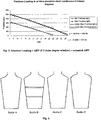
- Figure 4 illustrates a series of preferred bottle profiles. In bottle A, it can be seen that the shoulder is bowed into the bottle interior, which has the effect of aiding dispensing, as it enables slush to be extruded through the neck. The same can be noticed for bottle C, which has a 'funnel'-type neck (straight-walled).
- bottle D may serve with requirement for extra squeezing or shaking in the coldest freezers, where the product would be least pourable, as a 'catching area' between the shoulder of the design and the neck fitment exists (inverted bowl shape).
- a second feature is shown, i.e. an indented rib, which serves to aid one's grip on the frozen block of product, when removing the product from the freezer and giving it an initial squeeze.
- This indented rib stops the frozen block from moving up and down inside the pack, without fracturing the brittle network of ice.
- the typical serving amount is likely to be between 300 and 800mL.
- fructose as the base-value ingredient
- all other ingredients are related back to fructose's base value.
- an arbitrary unit e.g. a "Sugar Unit", SU or simply F
- base value preferably, equal to 1g fructose
- ingredients not mentioned herein may have an impact on pourability of a beverage formulation but are more likely to be added in such small amounts as to not have any major effect.
- the invention provides the capability to formulate slush beverages for a practical "window" of freezer temperatures (i.e. over a five Celsius degree or greater range), and produces an acceptable, pourable slush, once the beverage has reached a steady-state freezer temperature (generally after twelve hours and almost always within twenty-four hours, dependent on the efficiency of the freezer). This is achieved through managing the content of fructose and other ingredients with particular fructose-equivalent values with respect to alcohol content of the formulation, and optionally using an ice nucleator and ice-crystal-morphology control.
Landscapes
- Chemical & Material Sciences (AREA)
- Engineering & Computer Science (AREA)
- Organic Chemistry (AREA)
- Life Sciences & Earth Sciences (AREA)
- Genetics & Genomics (AREA)
- Wood Science & Technology (AREA)
- Biochemistry (AREA)
- Bioinformatics & Cheminformatics (AREA)
- General Engineering & Computer Science (AREA)
- General Health & Medical Sciences (AREA)
- Health & Medical Sciences (AREA)
- Zoology (AREA)
- Food Science & Technology (AREA)
- Polymers & Plastics (AREA)
- Ceramic Engineering (AREA)
- Mechanical Engineering (AREA)
- Non-Alcoholic Beverages (AREA)
- Alcoholic Beverages (AREA)
- Coloring Foods And Improving Nutritive Qualities (AREA)
- Confectionery (AREA)
Description
- The present invention relates to slush, primarily edible beverage slush, formed by freezing such as might be experienced in a domestic freezer.
- The product formulation technology described herein allows the creation of beverages that, even when distributed and sold at ambient temperatures, can be placed in a home freezer to become frozen slush beverage products that maintain the characteristic of being a dispensable, i.e. pourable, slush.
- The frozen beverage market is a global market, with frozen soft drinks and cocktails being popular choices of drink across many markets. Preparation of such frozen beverages can be quite tedious, requiring the use of equipment such as scrape-surface slush machines (e.g. Slush Puppy™) to produce small ice crystals or a blender to reduce ice cubes to small ice particles. This equipment is inconvenient and often avoided by consumers. Several products have been marketed to address convenience, with the ability to freeze in a static domestic freezer and deliver a soft-ice. However, all of these products have suffered from the variation in domestic freezer temperatures. These products fail in the warmer domestic freezers, due to failure to form ice, or to formation of insufficient amounts of ice, resulting in a cold beverage with a small amount of floating ice particles. They also fail in the colder freezers, due to over-hardening, which can occur in as little time as leaving the products in the freezer overnight, thus requiring a thaw step prior to dispensing. This could involve waiting for the product to partially melt, or inducing such melting through adding heat by microwave treatment or manipulation by hand, e.g. as described in
US Patent 5,853,785 . -
WO96/11578 EP0268097 reported a similar spoonable, not pourable, frozen product. Prior-art frozen soft-ice formulations use stabilisers and gums (e.g. CMCs), which can impede pourability and can have a negative organoleptic effect on frozen beverages. - Even if products perform after adding heat, they are frequently judged as failures by consumers who expect the convenience of a ready-to-consume, pourable, frozen cocktail. The failure rate of such products can be as high as 40 - 50%, resulting in ultimate consumer rejection of such products. Thus a clear opportunity exists for a ready-to-serve slush beverage that is pourable after freezing from a wide range of domestic freezer temperatures.
- To be a success, a quiescently frozen slush must both deliver on the promise of convenience and provide acceptable product performance to the widest possible consumer audience. This means a commercially attractive product must have characteristic and desired properties in a range of freezer temperatures.
- Nearly all freezers (and specifically, US domestic freezers) operate within a working range of -11 to -20°C. Depending on the market, most (i.e. a substantial proportion of) freezers may operate in a more limited 5 Celsius degree range between -11 and - 20°C. In order to produce a product that is acceptable to consumers, that product must perform in a substantial number of freezers within the market (and therefore, over a continuous range of temperatures). Most preferably, that range would be the full 9 Celsius degrees; however, for the purpose of a particular market, it may be acceptable if a product can perform in a more limited five degree range, within the broader range from -11 to - 20°C, for that market.
- The above restrictions have implications on the performance of a commercially viable frozen product. The challenge of supplying a commercially attractive product becomes more pronounced, when the product supplied to the consumer will not start off in its final consumption state, i.e. supplied at ambient temperature, but then quiescently frozen by the consumer. As described, domestic freezers represent a varied environment that is beyond the control of a beverage product developer.
- The invention presents a formulation for a pourable slush beverage that will meet an acceptance standard in the majority of domestic freezers and is ready for consumption, once it has frozen and reached a steady-state temperature. It should remain in a pourable/flowable state for an extended period of many months in a freezer, and generally be able to be thawed and "re-set" after purchase, should the ice crystals become undesirably large.
- In a broad aspect of the invention, there is provided an alcoholic beverage formulation that forms a pourable slush across a range of at least five Celsius degrees between -11 and -20°C, that comprises:
a total ingredient content for a given ABV (Alcohol By Volume) within a range calculated from the equations:

where ingredients in g/L, accumulate to contribute to the total ingredient content but are first divided by a value F dependent on the ingredient, the ingredients being selected from the group consisting of:Ingredient F Fructose 1.0 Glucose 1.2 Sucrose 1.4 Acid (e.g. citric or malic) 2.0 Emulsion 2.2 Gelatin Hydrolysate 1.8 Propylene Glycol 1.25 Betaine 0.67 Trehalose 1.43 Erythritol 1.43 Sorbitol 1.43 Isomaltulose 2.0 Glycerol 1.25 Maltodextrin 2.86 - An alternate expression of the invention is to provide a table of reciprocal values from the above table wherein, for every 1g of actual ingredient, the amount contributing to the total ingredient content is given by given by the equations:
Ingredient 1/F Fructose 1.0 Glucose 0.83 Sucrose 0.71 Acid (e.g. citric or malic) 0.50 Emulsion 0.45 Gelatin Hydrolysate 0.56 Propylene Glycol 0.80 Betaine 1.49 Trehalose 0.70 Erythritol 0.70 Sorbitol 0.70 Isomaltulose 0.50 Glycerol 0.80 Maltodextrin 0.35 - Any further, unlisted, ingredients could be added to a formulation according to the invention, but would not contribute to the ingredient content calculation.
- The slush product is most typically made using a domestic freezer, but can be produced in any appropriate cooling apparatus.
- It was discovered that different ingredients have different effects on slush pourability. Therefore, if a given ingredient is substituted for another ingredient, the other ingredients may need adjustment to achieve the same degree of slush pourability. The extent of adjustment depends on the specific ingredient. To simplify application of the invention, it was decided to use fructose as a base unit, to which all other ingredients are compared. Once an equivalent ratio for a particular ingredient is established it is possible to determine the "fructose equivalent loading" as defined by the equation. However, it would also be possible to use another base unit (or an arbitrary unit) and assign values for different ingredients.
- The same modifying principles apply to the addition of food acids such as citric, malic and tartaric acids to a slush formulation.
- The invention involves adding a prescribed amount of fructose (or other ingredient), dependent on alcohol content, that will allow formulation of a slush beverage that will remain pourable in a domestic freezer. Since, in practice, there is variation in the average operating temperatures of domestic freezers in a given market, the formulation must produce a pourable slush, after it reaches a steady-state temperature within at least a continuous five Celsius degrees of a freezer temperature range between -11 and -20°C. Most preferably, the formulation will have pourability characteristics over the entire -11 to -20°C range (i.e. a nine Celsius degree window).
- The formulation of the invention produces an ice content, such that the product, once frozen at a steady-state temperature, is a pourable slush.
- Optionally, an ice-nucleating agent may be added. While an ice-nucleating agent is not an essential ingredient, in practice an ice nucleator is desirable, because the melting temperature of the formulation may be close to the warmest freezer temperature, and assuming some degree of supercooling could occur, the presence of an ice nucleator further ensures ice formation, as the beverage reaches a steady-state temperature in a domestic freezer.
- An ice-nucleating agent is defined herein as an additive/ingredient present in the solution, or in contact with the solution, which serves the purpose of reducing the effect of supercooling by causing ice crystal formation, when the solution is at any temperature between (below) the melting point and (above) the homogeneous nucleation temperature of that solution.
- Preferably, the ice-nucleating agent is stigmasterol.
- As a further option, dependent on the desired mouthfeel of the product, an ice-crystal-morphology-modifying ingredient may be added. A preferred ingredient to achieve this aspect is gelatin hydrolysate of average molecular weight in the range 3000 Da to 15000 Da.
- Accordingly, in a further aspect, the present invention also provides a method of formulating an alcoholic beverage for forming a pourable slush using a freezer with a temperature range of between -11 to -20°C, including the steps of:
- adding at least a minimum amount of fructose dependent on alcohol content (ABV) according to the equation:

- optionally substituting an amount of fructose with an amount of another ingredient(s) that has an equivalent effect on slush pourability at the ABV, by observing the effect on slush pourability of the addition of a given quantity of an ingredient at a given ABV and then relating this to the amount of fructose that achieves the same effect. However, in alternative embodiments, the substitution step could be performed by comparison to sucrose or glucose as the reference ingredient. This would require an alternative equation.
- In practice substitution involves determining permanent ratios for ingredients compared to fructose so that the contribution of any ingredient for obtaining a pourable slush can be calculated.
- The product of the invention forms a flowable/pourable slush over at least a continuous range of 5 Celsius degrees between -11 and -20°C. Such a slush is also pumpable in a dynamic system. A "pourable slush" is defined by the following characteristics:
- To be "pourable" a slush should have no less than 100g/L and no more than 350g/L ice content as will be discussed in more detail below. The slush, after forming in a (preferably flexible) plastic bottle, can be easily squeezed and have a few shakes applied to break the brittle ice structure that forms therein. Then the bottle can be inverted into a glass, and with minor agitation, the slush can be poured into a glass. At its thickest consistency, the slush may require a few extra squeezes to remove it from the bottle (<10% of the slush should remain in the bottle). A spoon is not required to remove the product from its container.
- A key advantage of the invention can be described as providing a formulation that conveniently takes the uncertainty out of preparing a pourable frozen beverage and is ready to use straight out of the freezer. The formulation ensures reliable and consistent reproducibility of the frozen beverage, and offers that within a format that is simple for the consumer to prepare, i.e. placing a bottle of the product into any of the broad range of domestic freezer temperatures. Once frozen, the product is ready to consume, removing the need and mess of a blender, or the need for specific ingredient knowledge required to make a perfect frozen cocktail (or similar beverage), or the need for a thaw step after removing it from the freezer. With a minor agitation (i.e. a squeeze and a shake to loosen the statically formed ice structure), the product can be consumed, directly from the bottle or after being dispensed, as a frozen beverage.
- The product can be prepared well in advance of required usage, and the pourability of the slush remains as consistent as the temperature of the freezer it is stored within. The product, in terms of ease of pourability, will retain its characteristics for several years. However, if stored for an excessive time period (several months) the ice crystals in the frozen product accrete, i.e. a noticeable increase in the average ice crystal size occurs, which leads to a change in the ideal frozen-mouthfeel texture. However, a thaw and refreeze resets the product with its original desired crystal size. The formulations benefit from being able to be served from a semi-rigid bottle, giving the impression of being a beverage unlike other 'pouch' products on the market, which can appear cheap and undesirable to consumers who wish to feel they have purchased a premium-quality branded cocktail.
- Previous inventions in this field have failed. E.g.,
WO 96/11578 WO 96/11578 - It should be noted that the invention described herein refers to the liquid-formulation ("slush") product, both before and after quiescent freezing. Whilst this product is suitable to be distributed in a frozen state, for ease of distribution, the product is preferably distributed at ambient temperature (unfrozen), and forms a slush after placement in a domestic freezer, at any time prior to consumption. The "pre-slush" product at ambient temperature will contain no ice, as it is above the melting temperature of the formulation, and will be free-flowing. Clearly, the scope of the invention covers this "pre-slush" product, regardless of its temperature/state.
- In order to determine the range of ingredients suitable for use in carrying out the invention, it was necessary to establish the limits at which the slush beverage could remain pourable, once at a steady-state temperature corresponding to the boundaries of the preferred freezer temperature range, i.e. -11 and -20°C.
- Ranges of ingredients had to be determined based on what has been defined as a pourable slush; any level of ice content falling outside that definition would be too thin/watery or too thick, the latter becoming unpourable/spoonable.
- It was surprising to find that, for a given slush consistency, the relationship between ingredient and alcohol content is approximately linear.
- General observations made during the course of experimental formulation were as follows:
- If too much total ingredient (based on fructose equivalence) is added at a given ABV, then at the warmer end of the range (-11°C) the beverage either will not form ice or will not form enough ice (i.e. it will be too 'thin') to be considered a pourable slush.
- If too little total ingredient is added (based on fructose equivalence), then at the colder end of the range (-20°C) the beverage will form too much ice (i.e. it will be too 'thick') to be a pourable slush.
- As alcohol concentration increases, a lesser amount of total ingredients (based on fructose equivalence) are needed to make a pourable slush.
- It was found, at a specific ABV, that particular minimum and maximum amounts of fructose resulted in pourable slushes, as indicated in Table 1-1.
Table 1-1 ABV Min g/L fructose added to achieve pourable slush at -20°C Max g/L fructose added to achieve pourable slush at -11° C 1 Fructose 1 330 440 2 Fructose 2 315 425 3 Fructose 3 305 410 4 Fructose 4 293 395 5 Fructose 5 280 380 6 Fructose 6 258 360 7 Fructose 7 255 345 8 Fructose 8 245 320 9 Fructose 9 230 305 10 Fructose 10 220 285 11 Fructose 11 210 260 12 Fructose 12 195 248 13 Fructose 13 185 225 14 Fructose 14 170 210 15 Fructose 15 155 190 16 Fructose 16 145 170 17 Fructose 17 130 150 18 Fructose 18 120 125 19 Fructose 19 105 105 - The slush product, made with a fructose content as defined in Table 1-1, is pourable across the entire temperature range from -11 to -20°C.
- Therefore, according to the data in Table 1-1, the range of fructose contents needed to be added to, for example, a 9% ABV beverage formulation is 230 to 305 g/L, to result in a beverage with a minimum amount of ice to be considered an acceptable slush, but not so much ice as to be unpourable. Using less than 230 g/L fructose will result in a beverage that is too thick to be considered pourable in the coldest freezers (-20°C) and using more than 305 g/L fructose will result in a beverage that does not form sufficient ice to be considered a slush in warmest freezers (-11°C).
- The values in Table 1-1 can be plotted, as shown in
Figure 1 . In this Figure, linear relationships can be seen, which enable numerical formulas to be generated for predicting required fructose upper- and lower-range content values for a given ABV. - Lower-range ingredient loading (fructose) g/L:

- Upper-range ingredient loading (fructose) g/L:

- Where -12.3 and -18.7 are the respective graph gradients, 341.1 and 468.9 are the respective theoretical zero-intercept points with the y axis, x is the ABV value, and y is the amount of fructose to be used to achieve a pourable slush (at that ABV). For completeness, the R-squared values for the respective equations are 0.9983 and 0.9979.
- Using these formulas, one can calculate the desired fructose content range for any % ABV formula. For example, for 7.8%ABV:
- (-12.3 x 7.8) + 341.1 = 245.3 g/L fructose (lower content)
- (-18.7 x 7.8) + 468.9 = 322.7 g/L fructose (upper content)
- Comparing these results with the data in Table 1-1 for 8%ABV reveals fairly good agreement.
- It should be noted that an ABV of 19 represents a practical limit for formulations to achieve a pourable slush at the most desirable nine Celsius degrees operating window. At higher ABVs, it is not possible to produce a beverage that forms a pourable slush over the full nine Celsius degree range between -11 and -20°C. For example, at 20 ABV, a beverage cannot form enough ice to be considered a slush at -11°C. However, if a narrower operating temperature window were acceptable, then higher ABV beverages could be formulated.
- It is sufficient, and still commercially useful, to determine ingredient content ranges coinciding with a continuous 5 Celsius degree temperature range between -11 and -20°C. To do this it is necessary to look at the two five Celsius degree ranges at the limits of the broader -11 to -20°C range, i.e. -11 to -16°C and -15 to -20°C. The dataset for this expanded range (a five Celsius degree range is a less strict condition than a nine Celsius degree range) is provided in Tables 1-2A and 1-2B below.
Table 1-2A ABV Min g/L fructose added to achieve pourable slush over a range of -11 to -16°C Max g/L fructose added to achieve pourable slush over a range of -11 to -16°C 1 Fructose 1 312 440 2 Fructose 2 302 425 3 Fructose 3 288 410 4 Fructose 4 272 395 5 Fructose 5 258 380 6 Fructose 6 245 360 7 Fructose 7 230 345 8 Fructose 8 220 320 9 Fructose 9 210 305 10 Fructose 10 192 285 11 Fructose 11 175 260 12 Fructose 12 165 248 13 Fructose 13 148 225 14 Fructose 14 130 210 15 Fructose 15 120 190 16 Fructose 16 105 170 17 Fructose 17 90 150 18 Fructose 18 75 125 19 Fructose 19 58 105 20 Fructose 20 40 80 21 Fructose 21 25 60 22 Fructose 22 15 35 Table 1-2B ABV Min g/L fructose added to achieve pourable slush over a range of -15 to -20°C Max g/L fructose added to achieve pourable slush over a range of -15 to -20°C 1 Fructose 1 330 490 2 Fructose 2 315 475 3 Fructose 3 305 460 4 Fructose 4 293 450 5 Fructose 5 280 435 6 Fructose 6 258 420 7 Fructose 7 255 405 8 Fructose 8 245 395 9 Fructose 9 230 380 10 Fructose 10 220 365 11 Fructose 11 210 350 12 Fructose 12 195 335 13 Fructose 13 185 320 14 Fructose 14 170 300 15 Fructose 15 155 285 16 Fructose 16 145 270 17 Fructose 17 130 250 18 Fructose 18 120 235 19 Fructose 19 105 215 20 Fructose 20 90 200 21 Fructose 21 80 180 22 Fructose 22 60 165 23 Fructose 23 50 140 24 Fructose 24 40 120 25 Fructose 25 20 95 26 Fructose 26 8 70 27 Fructose 27 0 50 28 Fructose 28 - 35 29 Fructose 29 - 15 - It was found that at the colder five Celsius degree freezer-temperature range (-15 to -20°C) it is possible to formulate pourable slushes at a higher ABV. Therefore table 1-2B above provides additional data for fructose content needed to achieve a pourable slush at these temperatures for an ABV up to 29.
- At the warmest end of the range (-11 to -16°C; Table 1-2A) a formulation must contain a minimum amount of fructose so it is still pourable at -16°C. At the coldest end of the range (-15 to -20°C; Table 1-2B) a formulation may not contain more than a maximum amount before there is not sufficient ice formation for a slush at -15°C. Any formulation between these two extremes must have more than a minimum amount required for -11 to -16°C and less than a maximum amount required for -15 to -20°C. Therefore, the results of Tables 1-2A and 1-2B can be summarised in Table 1-3 below.
Table 1-3 ABV Min g/L fructose added to achieve pourable slush over a range of -11 to -16°C Max g/L fructose added to achieve pourable slush over a range of -15 to -20° C 1 Fructose 1 312 490 2 Fructose 2 302 475 3 Fructose 3 288 460 4 Fructose 4 272 450 5 Fructose 5 258 435 6 Fructose 6 245 420 7 Fructose 7 230 405 8 Fructose 8 220 395 9 Fructose 9 210 380 10 Fructose 10 192 365 11 Fructose 11 175 350 12 Fructose 12 165 335 13 Fructose 13 148 320 14 Fructose 14 130 300 15 Fructose 15 120 285 16 Fructose 16 105 270 17 Fructose 17 90 250 18 Fructose 18 75 235 19 Fructose 19 58 215 20 Fructose 20 40 200 21 Fructose 21 25 180 22 Fructose 22 15 165 - The results in Table 1-3 are plotted as shown in
Figure 2 . It can be generally seen that the fructose loading values cover a broader range, when the slush of the invention is only required to perform within a five Celsius degree "window" of temperature between -11 to -20°C. Specifically, for the limits of -11 to -16°C, where the slush can form no more than 350g/L ice to still be pourable at -16°C, and -15 to -20°C where the slush can form no less than 100g/L ice to still be thick enough at -15°C, the following equations apply. - Lower-range fructose load:

- Upper-range fructose load:

- Using these formulas, one can calculate the desired fructose content range for any % ABV formula. For example, for 14.2%ABV:


- The amount of fructose required to make a pourable slush, for any other continuous five Celsius degree range within the target domestic freezer-temperature range of -11 to -20°C (e.g. -13 to - 18°C), will obviously fall within the broad ranges outlined in Table 1-3 and
Figure 2 . - It should be apparent from Tables 1-2A and 1-2B that the use of higher levels of fructose within the overall range in Table 1-3 will result in better performance as a pourable slush in colder-temperature freezers. Conversely, lower levels of fructose will be sufficient to produce performance as a pourable slush at warmer freezer temperatures. Such behaviour will aid a developer in formulating slush beverages for a range of freezer temperatures in a particular market.
- For comparison,
Figure 3 includes the extended ABV range from Table 1-2B, in addition to the smaller ranges in Table 1-2A. The predictive formula for the extended ABV range is y = -16.9x + 526.3, where y = fructose content (g/L) and x = ABV. The R-squared value is 0.9927. - Example 1 gives preferred data for fructose sugar only. It was then necessary to look at the use of other food sugars, e.g. glucose and sucrose. It was discovered that different sugars have different effects on the amount of ice that forms, in the production of a pourable slush.
- A similar set of data was generated as for Example 1, except with glucose substituted for fructose, but otherwise similarly resulting in a pourable slush at the extremes of freezer temperature, -11 and -20°C. These results are set out in Table 2-1 below.
Table 2-1 ABV Min g/L glucose added to achieve pourable slush at -20°C Max g/L glucose added to achieve pourable slush at -11° C 1 Glucose 1 435 530 2 Glucose 2 420 500 3 Glucose 3 405 480 4 Glucose 4 390 460 5 Glucose 5 375 435 6 Glucose 6 350 410 7 Glucose 7 340 390 8 Glucose 8 320 365 9 Glucose 9 305 340 10 Glucose 10 280 315 11 Glucose 11 265 290 12 Glucose 12 245 265 13 Glucose 13 230 240 14 Glucose 14 210 215 15 Glucose 15 195 195 - The amount of glucose required to achieve comparable levels of pourability follows a similar trend to that for fructose, but a higher loading of glucose is necessary.
- It is possible to generate the following prediction formulas from plots of glucose content against ABV, as in Example 1:


- However, because there is a direct linear relationship between the effects of the fructose and glucose contents, and to simplify the invention, it was believed most important to determine an equivalent ingredient loading for glucose, compared to that for fructose. This can be done by determining the proportional amount of glucose required to achieve an equivalent sugar loading of fructose.
- Given the accuracy of the invention, it is appropriate to assign glucose an "equivalence" value of 1.2g for 1g of fructose, i.e. 1.2g of glucose can substitute for 1g of fructose in a beverage slush formulation.
- For taste (fructose, for example, is considered to be twice as sweet tasting as glucose) or economic reasons, it may be desirable to substitute sugars in a formulation, as is well known in the art. Therefore, an "equivalence-to-fructose" value would further allow blends of fructose and glucose (and other ingredients outlined below) to be determined for producing a beverage formulation according to the invention.
- It was desirable to determine the impact of other ingredients (carbohydrates and otherwise) on a slush formulation.
- A similar set of data was generated as for Examples 1 and 2, except with sucrose substituted for fructose, but otherwise similarly resulting in a pourable slush at the extremes of freezer temperature, -11 and -20°C. These results are set out in Table 3-1 below.
Table 3-1 ABV Min g/L sucrose added to achieve pourable slush at -20°C Max g/L sucrose added to achieve pourable slush at -11° C 1 Sucrose 1 465 630 2 Sucrose 2 453 615 3 Sucrose 3 440 590 4 Sucrose 4 425 575 5 Sucrose 5 410 560 6 Sucrose 6 385 540 7 Sucrose 7 370 515 8 Sucrose 8 350 480 9 Sucrose 9 335 450 10 Sucrose 10 315 415 11 Sucrose 11 295 385 12 Sucrose 12 275 355 13 Sucrose 13 255 320 14 Sucrose 14 235 295 15 Sucrose 15 220 265 16 Sucrose 16 220 235 17 Sucrose 17 180 210 18 Sucrose 18 160 175 19 Sucrose 19 140 145 20 Sucrose 20 120 120 - The amount of sucrose required to achieve comparable levels of pourability (related to ice content) follows a similar trend to those for fructose and glucose, except that an even higher loading of sucrose is necessary. When plotted, the equations of the respective trend lines are: ylower = -18.4 + 495.5 and yupper = -28.1 + 688.7, where y = sucrose content and x = ABV value.
- Within the accuracy of the invention, it is appropriate to assign sucrose an "equivalence" value of 1.4g per 1g of fructose, i.e. 1.4g of sucrose can substitute for 1g of fructose in a beverage slush formulation.
- It has been observed that, when using sucrose predominantly for ABV values less than 4, the products become too thick to remain pourable at the coldest freezer temperatures. Therefore, other sugars should be used in place of sucrose for these ABV values.
- The foregoing now allows suitable blends of fructose, glucose and sucrose to be determined, because, as has been surprisingly observed, these ingredients have an additive effect, namely each ingredient has a different, linear relationship with pourability so they can be easily substituted.
- However, it is important to note that, in an acidic environment (which will be the case in a large proportion of cocktail-type slush formulations), sucrose can be split by acid-catalysed hydrolysis into equal parts of fructose and glucose. Therefore, in such an acidic formulation, the contribution of sucrose to the freezing properties should be considered as that of a 50/50 blend of fructose and glucose.
- Slush beverages are likely to be formulated from a variety of ingredients, many of which will have an impact, in conjunction with the carbohydrates, on the properties of the beverage as it freezes. Accordingly, further ingredients were analysed.
-
Table 4-1 ABV Fructose Loading Example 1 Fructose loading after adding 10g Citric Acid Reduction in Fructose (g) from Example 1 Fructose loading after adding 10g Malic Acid Reduction in Fructose (g) from Example 1 1 Fructose 1 330 325 5 325 5 2 Fructose 2 315 310 5 310 5 3 Fructose 3 305 300 5 300 5 4 Fructose 4 293 288 5 288 5 5 Fructose 5 280 275 5 275 5 6 Fructose 6 263 258 5 260 3 7 Fructose 7 255 250 5 250 5 8 Fructose 8 245 240 5 240 5 9 Fructose 9 230 225 5 225 5 10 Fructose 10 220 215 5 215 5 11 Fructose 11 210 205 5 205 5 12 Fructose 12 195 190 5 190 5 13 Fructose 13 185 180 5 180 5 14 Fructose 14 170 165 5 165 5 15 Fructose 15 155 150 5 150 5 16 Fructose 16 145 140 5 138 7 17 Fructose 17 130 122 8 122 8 18 Fructose 18 120 110 10 110 10 19 Fructose 19 105 100 5 100 5 Average 5.4 Average 5.4 +/- 2 +/- 2 - Table 4-1 includes a column where a minimum amount of fructose that must be added to achieve a pourable slush at -20°C according to Table 1-1 and compares this with how much fructose must be removed to restore the same pourability characteristics after 10g of acid is added. Table 4-1 illustrates two points: firstly, that both citric acid and malic acid have an equivalent overall effect on fructose loading, and secondly, that the effect of an acid on fructose loading is approximately 2 for 1, i.e. for every 1g of acid added to a formulation, the fructose loading must be adjusted (reduced) by 0.5g. Therefore, within the accuracy of the invention, it is appropriate to assign such food acids an "equivalence" value of 2g per 1g of fructose.
- In accordance with the invention, it has been found that the addition of an ice-morphology-modification ingredient can improve mouthfeel and flow characteristics of the slush, due to the way ice crystals pack during freezing. The preferred additive is gelatin hydrolysate. Therefore, the effect of this ingredient on freeze characteristics needed to be assessed, i.e. determining how much fructose must be removed to compensate for the addition of gelatine hydrolysate in a formulation that otherwise has the same pourability characteristics.
- Table 5-1 (including data for a minimum amount of fructose that must be added to achieve a pourable slush at -20°C according to Table 1-1) reveals that the effect of gelatin hydrolysate on fructose loading is equivalent to 14/25, i.e. an addition of 25g of gelatin required the removal of 14g of fructose, in order to achieve the same slush pourability characteristics. In other words, for every 1g of gelatin added to a formulation, the corresponding fructose loading must be adjusted (reduced) by 0.56g.
Table 5-1 ABV Fructose Loading Example 1 Fructose loading after adding 25g Gelatin Hydrolysate Reduction in Fructose (g) from Example 1 1 Fructose 1 330 315 15 2 Fructose 2 315 302 13 3 Fructose 3 305 292 13 4 Fructose 4 293 280 13 5 Fructose 5 280 265 15 6 Fructose 6 263 252 11 7 Fructose 7 255 242 13 8 Fructose 8 245 232 13 9 Fructose 9 230 218 12 10 Fructose 10 220 208 12 11 Fructose 11 210 198 12 12 Fructose 12 195 183 12 13 Fructose 13 185 172 13 14 Fructose 14 170 158 12 15 Fructose 15 155 140 15 16 Fructose 16 145 130 15 17 Fructose 17 130 115 15 18 Fructose 18 120 104 16 19 Fructose 19 105 90 15 Average 14 +/- 2 - Therefore, in line with the above, and within the accuracy of the invention, it is appropriate to assign gelatin hydrolysate an "equivalence" value of 1.8g per 1g of fructose.
- Multiple additives generally have a cumulative effect on the equivalent fructose loading; therefore, it was desired to determine the freeze characteristics of a formulation that contained both a food acid, as in Example 4, and an ice-crystal-morphology-modifying ingredient, as in Example 5. The results are shown in Table 6-1.
Table 6-1 ABV Fructose Loading Example 1 Fructose loading after adding 25g Gelatin Hydrolysate and 10g Citric Acid Reduction in Fructose from Example 1 1 Fructose 1 330 308 22 2 Fructose 2 315 295 20 3 Fructose 3 305 287 18 4 Fructose 4 293 272 21 5 Fructose 5 280 258 22 6 Fructose 6 263 245 18 7 Fructose 7 255 235 20 8 Fructose 8 245 225 20 9 Fructose 9 230 210 20 10 Fructose 10 220 200 20 11 Fructose 11 210 190 20 12 Fructose 12 195 175 20 13 Fructose 13 185 165 20 14 Fructose 14 170 150 20 15 Fructose 15 155 132 23 16 Fructose 16 145 122 23 17 Fructose 17 130 107 23 18 Fructose 18 120 96 24 19 Fructose 19 105 82 23 Average 21 +/- 2 - Table 6-1 (again, including data for a minimum amount of fructose that must be added to achieve a pourable slush at -20°C according to Table 1-1) shows the cumulative effect of added gelatin hydrolysate and citric acid. From the results for Examples 4 and 5, it would be expected that the effect of adding 25g of gelatin hydrolysate and 10g of citric acid would calculate (25/1.8 + 10/2 = ) to a correction value of 19 for the reduction in fructose content. The observed value was 21, which is acceptable within the accuracy of the invention, especially since sugars will be in considerably higher concentrations in the formulation, and therefore, will have the most significant impact on its ability to form a pourable slush.
- Tables 7-1 and 7-2 include data for an added emulsion (e.g. fat) content of 5, 10 or 20% (i.e. 50, 100 or 200 mL of emulsion in one litre of total formulation). The corresponding modification to the fructose content shows how emulsion content affects total fructose loading. For the purposes of the invention, an 'emulsion' can include any water insoluble ingredient.
- The effect on fructose loading is linear, as with previous ingredients in general. It can be seen that the addition of 100mL of emulsion requires the removal of 46g of fructose, in order to achieve equivalent effect on slush pourability for the same ABV value. Accordingly, the equivalence value for emulsion is 2.2g per 1g of fructose, within the accuracy of the invention. This result can be included with the set of previous fructose-equivalent values.
Table 7-1 +50mL Emulsion +100mL Emulsion +200mL Emulsion Min g/L fruct only - from example 1 (-20) g/L fruct added Reduction in Fructose from Example 1 g/L fruct added Reduction in Fructose (g) from Example 1 g/L fruct added Reduction in Fructose (g) from Example 1 1 Fructose 330 308 22 285 45 238 92 2 Fructose 315 295 20 270 45 225 90 3 Fructose 305 285 20 261 44 215 90 4 Fructose 293 270 23 247 46 200 93 5 Fructose 280 255 4 233 47 185 95 6 Fructose 263 242 21 220 43 173 90 7 Fructose 255 235 20 210 45 162 93 8 Fructose 245 225 20 200 45 152 93 9 Fructose 230 210 20 185 45 140 90 10 Fructose 220 200 20 175 45 128 92 11 Fructose 210 190 20 165 45 118 92 12 Fructose 195 175 20 150 45 100 95 13 Fructose 185 160 25 140 45 90 95 14 Fructose 170 148 22 125 45 75 95 15 Fructose 155 130 25 108 47 60 95 16 Fructose 145 120 25 98 47 50 95 17 Fructose 130 105 25 80 50 30 100 18 Fructose 120 95 25 70 50 20 100 19 Fructose 105 82 23 58 47 10 95 Average 22 Average 46 Average 92 +/- 6 +/- 2 +/- 2 Table 7-2 +50mL Emulsion +100mL Emulsion +200mL Emulsion Max g/L fruct. only - from example 1 (-11) g/L fruct added Reduction in Fructose from Example 1 g/L fruct added Reduction in Fructose from Example 1 g/L fruct added Reduction in Fructose from Example 1 1 Fructose 440 415 25 395 45 350 90 2 Fructose 425 400 25 380 45 335 90 3 Fructose 410 388 22 365 45 320 90 4 Fructose 395 370 25 350 45 305 90 5 Fructose 380 360 20 335 45 290 90 6 Fructose 360 340 20 320 40 270 90 7 Fructose 345 320 25 300 45 253 92 8 Fructose 320 295 25 275 45 228 92 9 Fructose 305 280 25 260 45 210 95 10 Fructose 285 260 25 240 45 190 95 11 Fructose 260 240 20 215 45 170 90 12 Fructose 248 225 23 200 48 155 93 13 Fructose 225 200 25 180 45 130 95 14 Fructose 210 185 25 160 50 115 95 15 Fructose 190 165 25 140 50 95 95 16 Fructose 170 145 25 125 45 75 95 17 Fructose 150 125 25 100 50 55 95 18 Fructose 125 102 23 80 45 30 95 19 Fructose 105 80 25 55 50 10 95 Average 46 Average 93 +/- 3 +/- 2 - A number of other food-grade ingredients are commonly used in beverage formulations and possible for use with the invention. Table 8-1 below includes the fructose equivalent loading values for several such alternative additives.
Table 8-1 Additive Amount Added (g/L) Fructose Removed (g/L) Equivalence (substitution value) Propylene Glycol 10 8 1.25 Betaine 10 15 0.67 Trehalose 10 7 1.43 Erythritol 10 7 1.43 Sorbitol 10 7 1.43 Isomaltulose 10 5 2.00 Maltodextrin 10 3.5 2.86 Glycerol 10 8 1.25 - Table 8-1 shows substitution values for a range of ingredients. However, a knowledgeable beverage developer will know that there are common-sense limits on the useable amounts of sugar alcohols. Therefore, the addition of such ingredients may be limited in practice by regulations in connection with daily allowances of food additives.
- The data contained in Tables 7-1, 7-2 and 8-1 also suggest how to deal with the effect of flavour additives on a formulation, because flavours are typically either emulsion-based or ethanol- and/or propylene glycol-based. Therefore, the above data for emulsions or propylene glycol can be applied.
- The 2.86 substitution value for maltodextrin from Table 8-1 can be used for all maltodextrins between 30,000 to 80,000 da (e.g. Cargill C*01915; C*01955; C*01958). If maltodextrins outside these ranges are used it may be necessary to make adjustments to the substitution value.
- In connection with formulation and determining fructose equivalent substitution values it will be apparent that the foregoing examples follow a general method that can be utilised for formulating a slush beverage for use in a domestic freezer. The method involves:
- 1. Calculating a minimum amount of fructose dependent on a decided or determined alcohol content (ABV), according to the equation:

- 2. Optional substitution of fructose by other ingredients at ratios established by observing desirable slush forming characteristics for a given ingredient compared to fructose, thereby determining a fructose equivalent value for any other ingredient;
- 3. Calculating the contribution of each ingredient to the amount of total ingredients according to its fructose equivalent value;
- 4. Formulating the beverage with ingredients as needed and ensuring the total ingredient value (g/L) does not fall below the calculated minimum and ABV is maintained at the determined or decided level.
- It will be apparent that the equation from
step 1 is derived from Table 1-2, based on a continuous five degree range of freezer temperatures. The equation could be derived from the more desirable nine degree range of Table 1-1. - Step 2 can be carried out by assessing the amount of a new ingredient needed to form a desirable slush at a given ABV and comparing this amount to fructose. In other words the ingredient is assessed (as in Examples 2 and 3) in a system where it is combined with alcohol and water only. Alternatively, the ingredient can be assessed (as in Examples 4 to 7) by using a fructose based slush formulation system and removing some fructose to be substituted with the new ingredient to restore it to the same slush pourability at a given ABV. The amount of ingredient needed to replace the fructose and restore the formulation to achieve a pourable slush gives its fructose equivalent value and enables a ratio to be determined.
- It should be noted that fructose has been chosen as the primary "reference ingredient" in development of the present invention. However, it would be possible to perform the method by reference to another sugar, e.g. glucose or sucrose. In this case, the minimum amount equation referred to at
step 1 above would be minimum equations found in Examples 2 and 3. All ratios would then be determined by comparison to the new reference ingredient. - During cooling, an aqueous solution will reach its melting point, which is influenced by freezing-point depression, and typically will begin to supercool. It will continue to remain as a liquid during cooling, until either heterogeneous or homogeneous ice nucleation occurs.
- During experimental development of the present invention for the US market and its specific freezer-temperature distribution, regular occurrences of supercooling were observed over a forty-eight-hour period, resulting in product failure. The slush beverage formulations in the freezer had reached a steady-state temperature below the theoretical melting temperature, but contained no ice. Agitating a sample could induce ice formation in the product, but due to the energy released as heat through the ice-crystallisation process, the product temperature would be raised. The result of this heating was an unacceptable product performance, due to low ice content, with the appearance of an ice layer on top of a liquid beverage, but not a uniform slush. Supercooling of up to 12 Celsius degrees below the melting temperature was observed in test formulations, with 10 Celsius degrees of supercooling occurring in up to 60% of all samples.
- An ice nucleator is an additive that induces heterogeneous nucleation of ice, once the temperature of an aqueous solution is lowered below its melting point, but is still at a temperature above its homogeneous ice nucleation point. The present invention recommends the use of such ingredients to obtain a commercially viable product, through ensuring that ice formation occurs within a broad range of freezer temperatures.
- Plant phytosterols have been identified as a preferred source of ice nucleators for the invention. Phytosterols such as beta-sitosterol, diosgenin, and blended phytosterols (beta-sitosterol, campesterol, stigmasterol) all show ice-nucleation activity. However, within a fixed time period, none is as efficient as stigmasterol alone.
- It has been found that the addition of very low levels of pure stigmasterol (1 to 10mg per 250mL sample of liquid) is able to induce consistent ice nucleation in test formulations. Stigmasterol has been shown to limit supercooling to a maximum of 4 Celsius degrees below the melting point in test systems, performance similar to that of commercial Snowmax™ (which is not allowable in an edible product) in the test formulations.
- Nucleation functionality is retained, as long as the nucleator is in contact with the water in the liquid phase during the freezing process. To be functional, the plant sterol could be:
- added directly as a solid (e.g. in powder form);
- dissolved in absolute ethanol and then precipitated upon addition to a formulation, thus lowering the ethanol concentration below 80% ABV;
- embedded within a solid material, which has some portion of the nucleator at the surface of the material that is in contact with the liquid.
- Whilst Stigmasterol is a preferred nucleator for the system of the present invention, any material capable of reducing the extent of supercooling is of benefit to the invention. This could include, but is not limited to: sterols, phytosterols, cholesterol, beta-sitosterol, diosgenin, campesterol, calcium silicate, kaolin (aluminium silicate), bentonite, triacontanol, microcrystalline cellulose, tocopherol, silver iodide, calcium carbonate, titanium dioxide, silicon dioxide, calcium phosphate, and ice-nucleating bacteria.
- Consideration was given to the structure of the ice that forms in a slush. Different ice-crystal shapes will enable different packing densities and thus alter textural properties of a slush.
- In test formulations in colder freezers, without ice-growth-control ingredients, various plates, needles, and dendritic ice structures were observed to form, potentially all in the same test sample. The result of this was to inhibit the ability to dispense a slush product, or more importantly, to provide the wrong mouthfeel for a product.
- In nature, many organisms, including fish and plants such as winter-hardy crops, are able to exist in sub-zero environments, such as in Arctic waters, by evolution of a series of antifreeze peptides (AFP) that control ice-crystal morphology (see A.C. DeVries, Annu. Rev. Physiol., 1983, 45, 245-260; C.L. Hew, D.S.C. Yang, Eur. J. Biochem., 1992, 203, 33-42). The term antifreeze peptide is somewhat misleading; these peptides do not depress the freezing point of an aqueous system at the very low concentrations typically observed, but rather act to control ice growth. This occurs by a mechanism by which ice formation occurring in the cellular structures of fish or plants does not cause rupturing of tissue, which would lead to cell death. These peptides have been shown (see M.M. Harding, L.G. Ward, A.D.D. Haymet, Eur. J. Biochem., 1999, 264, 653-665) to interact with the growing face of an ice crystal, creating point defects and slowing the ice growth on specific ice-crystal faces, thus kinetically hindering growth and altering crystal morphology.
- These proteins were included in the formulation of the invention, so as to convert the morphology of the ice crystals from large plate and dendrite structures to smaller, regular needle-shaped crystals. These proteins function to provide an ice-crystal structure that packs more regularly and thus aids dispensability, when generated under quiescent conditions.
- The incorporation of Fish AFP Type I or Fish AFP Type III (10mg - 25mg (per litre of product), sourced from A/F Protein Canada), in formulations according to the foregoing examples, results in a more granular ice structure, noticeable even audibly by showing different acoustic properties during shaking after reaching a steady-state temperature, after having frozen in a container. The dosing level of the AFP must be adjusted slightly, based on the activity of a given AFP batch.
- The observed benefit shows a concentration-dependent effect, and overdosing with antifreeze peptides (>50mg/L) leads to significant over-hardening of the ice structure. Insufficient dosing with AFPs (<6mg/L) also leads to a loss of optimal activity, as there is limited modification of ice-crystal shape; however, reduction in the extent of over-hardening was observed.
- There is literature evidence showing that the activity of antifreeze peptides lies in a repeat peptide region rich in glycine content (see L.A. Graham, P.L. Davis, Science, 2005, 310, 461). Consideration of other proteins that would contain such peptide regions led to gelatin, the denatured form of collagen. Use of gelatin hydrolysate is believed to provide better ice-crystal control than that from anti-freeze peptides, and that functionality is displayed to some degree by commercially available gelatin hydrolysates. Samples of pig gelatin hydrolysates were received from Gelita and Rousselot, and had a variety of molecular weight distributions. Hydrolysates with molecular weight ranges of 2000 - 5000 Da, 5000 - 10000 Da, and 10000 - 20000 Da were obtained and added to the slush formulations at dosing levels of 1 to 50 g/L. A variety of ice morphologies was reproducibly observed in the formulations, but only for relatively high dosing levels (20 - 50 g/L).
- It was discovered that, by varying the gelatin concentration, several reproducible textures could be obtained. At lower addition levels (approx. 1 - 15 g/L, depending on the gelatin hydrolysate selected), a coarse-plate structure was produced, typical of a 'shale' ice product that usually relies on a cutting blade to produce plates. At higher addition levels (approx. 15 - 50 g/L, depending on the gelatin hydrolysate selected), a very smooth texture was obtained; the ice particles were small enough to be described as unnoticeable. This texture resembled that produced in a highly blended frozen product, yet without the residual few ice chunks that sometimes persist. The variation in effect of dosing level was observed when switching between different commercial samples of hydrolysate from porcine, bovine or fish gelatin, and was attributed to differences in hydrolysate production methods. Limitations on usage of some commercial gelatin hydrolysates exist, due to carryover taste taints, which were only discoverable within specific designs of beverage flavours; those systems with lighter flavours are more susceptible to noticeable gelatin hydrolysate flavour taint.
- The addition of an ingredient to modify ice-crystal morphology allows for variation of mouthfeel textures, within a beverage application across the domestic freezer-temperature range, and within slush formulations that have been designed to maintain the characteristic of being a pourable slush across a targeted freezer-temperature range. Adding higher amounts (15 - 50g) of such an ingredient can aid in pourability of the slush of the invention.
- A pourable slush beverage according to the invention can be formulated in line with the foregoing description. For example, if a 10% ABV Frozen Citrus Cocktail is desired, using the equations and in reference to Table 1-1 it can be seen that 220 - 285g/L of fructose is necessary to obtain a pourable slush in domestic freezers. By formulating to the lower end of the range a slightly thicker slush across the 9 Celsius degree range will result which, for a citrus drink, may be desired. Accordingly the formulation will perform with 230g/L fructose as in Formulation A below. It is also preferable to include an ice nucleator to ensure freezing.
-
- Ethanol (Grain Neutral Spirit @ 96.4%) 103.7mL
- Fructose (crystalline) 230g
- Stigmasterol 0.05g
- Demineralised Water (to volume 1L)
- All fruit drinks have acidic characteristics so extra ingredients must be incorporated with a corresponding reduction in the fructose content according to the ratios described. For example, it may be desirable to add 8g of citric acid; a common component of fruit. As citric acid has an equivalence ratio of 2.0, 4g of fructose (8/2.0) must be removed to maintain the same pouring characteristics. Building on Formulation A, at 230g/L fructose, fructose content needs to be reduced to 226g/L as exemplified by Formulation B.
-
- Ethanol (Grain Neutral Spirit @ 96.4%) 103.7mL
- Fructose (crystalline) 226g
- Citric acid (anhydrous) 8g
- Stigmasterol 0.05g
- Demineralised Water (to volume 1L)
- Upon tasting it could be considered that this formulation is perceived as too sweet. To reduce sweetness a beverage developer would normally reduce sugar content, however, it is not possible to simply remove some fructose as a minimum level of ingredients are required for pourability in a freezer. Accordingly an alternative, lower sweetness, sugar could be used, such as glucose which is perceived as at least half as sweet as fructose. According to the invention, if 50g of fructose is to be replaced by glucose, it must be scaled up by 1.2 (the equivalence ratio for glucose to fructose). This results in 60g glucose as in Formulation C.
-
- Ethanol (Grain Neutral Spirit @ 96.4%) 103.7mL
- Fructose (crystalline) 176g
- Glucose (crystalline) 60g
- Citric acid (anhydrous) 8g
- Stigmasterol 0.05g
- Demineralised Water (to volume 1L)
- It is then likely that flavours, e.g. lemon/orange, would be added to give the desired product profile. Flavours are usually delivered with propylene glycol as a solvent and, accordingly, further fructose (or an equivalent amount of another ingredient) must be removed to compensate. Through the addition of 5g of propylene glycol based flavours there must be a corresponding reduction of 4g fructose (5/1.25) to result in Formulation D.
-
- Ethanol (Grain Neutral Spirit @ 96.4%) 103.7mL
- Fructose (crystalline) 172g
- Glucose (crystalline) 60g
- Citric acid (anhydrous) 8g
- Flavours (citrus) 5g
- Stigmasterol 0.05g
- Demineralised Water (to volume 1L)
- This formulation can then be bottled, placed in a domestic freezer and left for sufficient time to establish a steady-state temperature to become a pourable slush.
- Further illustrative formulations below also meet the requirements of the invention, i.e. they produce a pourable slush across a desired freezer-temperature range of -11 to -20°C.
-
Ethanol (96.4%) 134.8mL (105g) Emulsion 25mL Sucrose 240g Sol D Gelatin Hydrolysate (Gelita) 50g Chocolate Flavours 3mL Stigmasterol 0.1g Demineralised Water to 1000mL total volume - Applying the fructose-equivalent conversion factors for each of the ingredients, the total fructose value is (11.4+171+27+2.4 =) 212 g/L, assuming the flavour is dissolved in propylene glycol. This fructose value is within the ranges for 13%ABV shown in Tables 1-1 and 1-3; hence, it can be expected to result in a pourable slush in the freezer-temperature range between -11 and - 20°C.
- For an emulsion-containing formulation, the procedure for blending of ingredients would be as follows. Dissolve the required sugar(s) in a minimum volume of demineralised water. Use of a shear mixer such as a Silverson L5M aids rapid hydration of powdered ingredients, and/or gentle heating can be applied if necessary. The emulsion would then be added at this point; this could be as simple as adding a commercially available, pre-made emulsion or adding a fat source such as butterfat, or other food oil, along with a suitable emulsification agent, and applying high pressure and mixing to create an emulsion with stable particle size. The gelatin hydrolysate, pre-dissolved in demineralised water using gentle heat if required, can be added along with all the other ingredients, including acids. It should be noted that. care must be taken to avoid detrimental acidification of gelatin hydrolysate and/or any other protein being incorporated. If care is not taken, with respect to the isoelectric point of the protein, decomposition can occur. The required amount of ethanol should then be added, with any flavours pre-dissolved in the ethanol (if it is an ethanol-based flavour) or added separately, if a flavour dissolved in an oil or propylene glycol is used. The solution should then be taken to its full 1000mL volume using demineralised water, with gentle stirring applied to ensure homogeneity. The sample would then be poured into a plastic bottle and have 0.1g of stigmasterol added as a powder (as one dosing option).
-
Ethanol (96.4%) 145.2mL Fructose, Crystalline 140g Glucose, Crystalline 40g Gelatin, Gelita Sol D 20g Maltodextrin (Fibresol 2) 10g Citric Acid (Anhydrous) 6g Citrus Flavours 5mL Stigmasterol 0.1g Demineralised Water to 1000mL - Applying the fructose-equivalent conversion factors for each of the above ingredients, the total fructose value is (33.33+11.11+3.5+3+4 =) 195 g/L, assuming flavour is dissolved in propylene glycol. This fructose value is within the ranges for 14%ABV shown in Tables 1-1 and 1-3; hence, it can be expected to result in a pourable slush in the freezer-temperature range between -11 and -20°C.
- For a non-emulsion-containing formulation, the procedure for blending of ingredients would include dissolving the sugars and any gelatin hydrolysate in the minimum possible amount of demineralised water. Use of a shear mixer such as a Silverson L5M aids rapid hydration of powdered ingredients, and/or gentle heating can be applied if necessary. After this, any acids can be added, along with other ingredients. It should be noted, as above, that care must be taken to avoid detrimental acidification of gelatin hydrolysates. The required ethanol should then be added, with any flavours pre-dissolved in the ethanol (if it is an ethanol-based flavour) or added separately, if the flavour is oil- or propylene glycol-based. The solution should then be taken to its full 1000mL volume using demineralised water, with gentle stirring applied to ensure homogeneity.
- When substituting for fructose with other sugars, some common sense is required. For the lowest ABV values, when replacing 300g of fructose with 420g of sucrose, whilst the sweetness may be on a par (due to the lower relative sweetness of sucrose), other product development issues arise, such as concern about caloric count and cloying mouthfeel. It has been found beneficial to use glucose to lower the overall sweetness of a formulation, as glucose has a lower fructose-equivalent value than sucrose, thereby reducing sweetness while not increasing calories excessively. It is known that there are intake limitations on the usage of sugar alcohols, due to possible digestive discomfort.
- The sample would be poured into a plastic bottle and have 0.1g of stigmasterol added as a powder (as one dosing option). Enough headspace must be left in the bottle to allow suitable space for shaking of the product.
- Formulations according to the invention are preferably packaged in suitable flexible plastic bottles with an opening of at least 25mm diameter - ideally, a lot wider opening of 38mm diameter - with a neck and shoulder shaped to aid dispensing of slush.
Figure 4 illustrates a series of preferred bottle profiles. In bottle A, it can be seen that the shoulder is bowed into the bottle interior, which has the effect of aiding dispensing, as it enables slush to be extruded through the neck. The same can be noticed for bottle C, which has a 'funnel'-type neck (straight-walled). However, bottle D may serve with requirement for extra squeezing or shaking in the coldest freezers, where the product would be least pourable, as a 'catching area' between the shoulder of the design and the neck fitment exists (inverted bowl shape). In bottle B, a second feature is shown, i.e. an indented rib, which serves to aid one's grip on the frozen block of product, when removing the product from the freezer and giving it an initial squeeze. This indented rib stops the frozen block from moving up and down inside the pack, without fracturing the brittle network of ice. The typical serving amount is likely to be between 300 and 800mL. - The foregoing description refers to fructose as the base-value ingredient, and all other ingredients are related back to fructose's base value. However, it is-also possible to define an arbitrary unit (e.g. a "Sugar Unit", SU or simply F) with a base value of 1 (preferably, equal to 1g fructose), for the purposes of simplification. The remaining ingredients would relate back to this F value, e.g. glucose = 1.2 F, sucrose = 1.4 F, etc.
- Any ingredients not mentioned herein (e.g. preservatives, artificial sweeteners) may have an impact on pourability of a beverage formulation but are more likely to be added in such small amounts as to not have any major effect.
- Effectively, the invention provides the capability to formulate slush beverages for a practical "window" of freezer temperatures (i.e. over a five Celsius degree or greater range), and produces an acceptable, pourable slush, once the beverage has reached a steady-state freezer temperature (generally after twelve hours and almost always within twenty-four hours, dependent on the efficiency of the freezer). This is achieved through managing the content of fructose and other ingredients with particular fructose-equivalent values with respect to alcohol content of the formulation, and optionally using an ice nucleator and ice-crystal-morphology control.
Claims (15)
- An alcoholic beverage formulation that forms a pourable slush across a range of at least five Celsius degrees between -11 and -20°C, that comprises:a total ingredient content for a given ABV (Alcohol By Volume) within a range calculated from the equations:


where ingredients in g/L accumulate to contribute to the total ingredient content but are first divided by a value F dependent on the ingredient, the ingredients being selected from the group consisting of:Ingredient F Fructose 1.0 Glucose 1.2 Sucrose 1.4 Acid (e.g. citric or malic) 2.0 Emulsion 2.2 Gelatin Hydrolysate 1.8 Propylene Glycol 1.25 Betaine 0.67 Trehalose 1.43 Erythritol 1.43 Sorbitol 1.43 Isomaltulose 2.0 Glycerol 1.25 Maltodextrin 2.86 - The alcoholic beverage formulation of claim 1 wherein the slush is pourable across the full nine Celsius degrees range between -11 and -20°C, and the equations are substituted for the narrowed range of:minimum total ingredient content (g/L) = (-12.3 x ABV) + 341.1maximum total ingredient content (g/L) = (-18.7 x ABV) + 468.9
- The alcoholic beverage formulation of any preceding claim, including an ice-nucleator ingredient.
- The alcoholic beverage formulation of claim 3, wherein the ice-nucleator ingredient is stigmasterol.
- The alcoholic beverage formulation of any preceding claim, including an ice-crystal-morphology-modifying ingredient.
- The alcoholic beverage formulation of claim 5, wherein the ice-crystal-morphology-modifying ingredient is gelatin hydrolysate.
- The alcoholic beverage formulation of claim 1 comprised of, per Litre of aqueous solution:
Ethanol 120 to 140 mL Fructose 169 to 244 g Acid 2 to 10 g - The alcoholic beverage formulation of claim 7, wherein fructose is substituted partially or totally by glucose and/or sucrose, which have substitution values of 1.2 and 1.4 grams, respectively, for 1 gram of fructose, used alone or blended.
- The alcoholic beverage formulation of claim 7 or 8, further including (per Litre of aqueous solution):
Gelatin Hydrolysate 5 to 30g - The alcoholic beverage formulation of any of claims 7 to 9, further including (per Litre of aqueous solution):
Flavours 0 to 20 mL - The alcoholic beverage formulation of any of claims 7 to 10, further including (per Litre of aqueous solution):
Stigmasterol 0.005 to 0.1 g - The alcoholic beverage formulation of claim 1 comprising, per Litre aqueous solution:
Ethanol 120 to 140mL Emulsion 10 to 50g Sugar 150F to 214F grams Where F= 1 for Fructose, 1.2 Glucose, 1.4 Sucrose Gelatin Hydrolysate 0 to 30g Flavours 2 to 10mL - Use of an alcoholic beverage formulation, according to any preceding claim, to form a pourable slush beverage in a freezer, where the freezer falls within the temperature range of -11 to -20°C.
- A method of formulating an alcoholic beverage for forming a pourable slush over a temperature range between -11 to -20°C, including the steps of:adding at least a minimum amount of fructose dependent on alcohol content (ABV) according to the equation:
 optionally substituting an amount of fructose in the total ingredient content with an amount of another ingredient(s) that has an equivalent effect on slush pourability at the ABV;determining or deciding an ABV for the beverage and determining or deciding the minimum total ingredient content according to the equation;formulating the beverage by accumulating ingredients in g/L selected from the group consisting of:
Ingredient F Fructose 1.0 Glucose 1.2 Sucrose 1.4 Acid (e.g. citric or malic) 2.0 Emulsion 2.2 Gelatin Hydrolysate 1.8 Propylene Glycol 1.25 Betaine 0.67 Trehalose 1.43 Erythritol 1.43 Sorbitol 1.43 Isomaltulose 2.0 Glycerol 1.25 Maltodextrin 2.86 and calculating the contribution to the total ingredient content by dividing each ingredient by its F value, wherein said total must not fall below the minimum determined by the equation. - An alcoholic beverage formulation obtainable according to the method of claim 14.
Priority Applications (1)
| Application Number | Priority Date | Filing Date | Title |
|---|---|---|---|
| PL10727497T PL2442669T3 (en) | 2009-06-19 | 2010-06-15 | A slush |
Applications Claiming Priority (3)
| Application Number | Priority Date | Filing Date | Title |
|---|---|---|---|
| GBGB0910624.6A GB0910624D0 (en) | 2009-06-19 | 2009-06-19 | A slush |
| GBGB0922152.4A GB0922152D0 (en) | 2009-06-19 | 2009-12-18 | A slush |
| PCT/GB2010/050994 WO2010146392A1 (en) | 2009-06-19 | 2010-06-15 | A slush |
Publications (2)
| Publication Number | Publication Date |
|---|---|
| EP2442669A1 EP2442669A1 (en) | 2012-04-25 |
| EP2442669B1 true EP2442669B1 (en) | 2014-11-19 |
Family
ID=40972462
Family Applications (1)
| Application Number | Title | Priority Date | Filing Date |
|---|---|---|---|
| EP10727497.9A Active EP2442669B1 (en) | 2009-06-19 | 2010-06-15 | A slush |
Country Status (19)
| Country | Link |
|---|---|
| US (1) | US11814611B2 (en) |
| EP (1) | EP2442669B1 (en) |
| JP (1) | JP5684248B2 (en) |
| KR (1) | KR101573481B1 (en) |
| CN (1) | CN102480991B (en) |
| AP (1) | AP3079A (en) |
| AU (1) | AU2010261496B2 (en) |
| BR (1) | BRPI1011778B1 (en) |
| CA (1) | CA2764519C (en) |
| CO (1) | CO6480919A2 (en) |
| DK (1) | DK2442669T3 (en) |
| ES (1) | ES2529102T3 (en) |
| GB (2) | GB0910624D0 (en) |
| MX (1) | MX2011013882A (en) |
| PL (1) | PL2442669T3 (en) |
| PT (1) | PT2442669E (en) |
| RU (1) | RU2506806C2 (en) |
| WO (1) | WO2010146392A1 (en) |
| ZA (1) | ZA201109263B (en) |
Cited By (1)
| Publication number | Priority date | Publication date | Assignee | Title |
|---|---|---|---|---|
| EP3101113A1 (en) | 2015-06-01 | 2016-12-07 | Friedrich Wagle | Fruit agent containing alcohol snack product |
Families Citing this family (17)
| Publication number | Priority date | Publication date | Assignee | Title |
|---|---|---|---|---|
| US8920859B2 (en) | 2011-03-21 | 2014-12-30 | Diageo Great Britain Ltd. | Stigmasterol-rich phytosterol composition and use |
| US20130017299A1 (en) | 2011-07-12 | 2013-01-17 | E I Du Pont De Nemours And Company | Stable dispersion of sterols in aqueous solutions comprising an oil |
| US20130034648A1 (en) * | 2011-08-03 | 2013-02-07 | Ashokan Bharani K | Partially frozen beverages including betaine |
| RU2515381C1 (en) * | 2012-10-01 | 2014-05-10 | Леонид Леонидович Клопотенко | Ice cream containing trehalose, agarose and erythrulose |
| US20140106033A1 (en) * | 2012-10-12 | 2014-04-17 | Matthew P. Roberts | Beverage Supplement and Method for Making the Same |
| US9989300B1 (en) | 2013-10-28 | 2018-06-05 | Supercooler Technologies, Inc. | Modular refrigeration device |
| US10149487B2 (en) | 2014-02-18 | 2018-12-11 | Supercooler Technologies, Inc. | Supercooled beverage crystallization slush device with illumination |
| US10302354B2 (en) | 2013-10-28 | 2019-05-28 | Supercooler Technologies, Inc. | Precision supercooling refrigeration device |
| JP6502060B2 (en) * | 2013-11-14 | 2019-04-17 | サントリーホールディングス株式会社 | Drinks with a taste like sake or enhanced |
| USD778687S1 (en) | 2015-05-28 | 2017-02-14 | Supercooler Technologies, Inc. | Supercooled beverage crystallization slush device with illumination |
| CN105996004A (en) * | 2016-06-08 | 2016-10-12 | 北京蓝丹医药科技有限公司 | Energy-supplementing agent |
| US10487252B2 (en) | 2018-01-24 | 2019-11-26 | Microtek Laboratories, Inc. | Water based thermal cooling gels comprising a viscosity modifier and ice nucleating protein |
| CN111770689A (en) * | 2018-02-28 | 2020-10-13 | 大塚制药株式会社 | Composition for cold spot |
| US11191289B2 (en) | 2018-04-30 | 2021-12-07 | Kraft Foods Group Brands Llc | Spoonable smoothie and methods of production thereof |
| ES2745338A1 (en) * | 2019-07-29 | 2020-02-28 | Granizados Maresme S L L | Neutral base applicable in the elaboration of individually packaged slushies (Machine-translation by Google Translate, not legally binding) |
| US11772869B2 (en) * | 2020-02-13 | 2023-10-03 | Slim Chillers, Inc. | Multi-chamber pouch |
| JP2023167802A (en) * | 2022-05-13 | 2023-11-24 | アサヒビール株式会社 | Composition for packed sherbet-like beverage, and method for producing composition for packed sherbet-like beverage |
Family Cites Families (32)
| Publication number | Priority date | Publication date | Assignee | Title |
|---|---|---|---|---|
| GB1331518A (en) * | 1970-01-09 | 1973-09-26 | Gen Foods Corp | Preparation os slush beverages |
| JPS62285773A (en) | 1986-06-05 | 1987-12-11 | Kanegafuchi Chem Ind Co Ltd | Agent for controlling ice crystal |
| US4790999A (en) * | 1986-10-31 | 1988-12-13 | Heublein, Inc. | Alcoholic soft ice |
| JPH02100665A (en) * | 1988-10-06 | 1990-04-12 | Ueda Seiyu Kk | Creamy frozen sake |
| JPH04252171A (en) * | 1990-12-26 | 1992-09-08 | Oozeki Kk | Alcoholic drink freezable by pouring |
| AU1673692A (en) * | 1991-05-03 | 1992-12-30 | Elizabeth Acton | Method and apparatus for the control of solidification in liquids |
| US5239819A (en) * | 1992-03-06 | 1993-08-31 | Kinneberg Bruce I | Sterol ice nucleation catalysts |
| JPH0619500A (en) | 1992-07-01 | 1994-01-28 | Nec Corp | Speech encoding device |
| JPH086480Y2 (en) * | 1992-07-02 | 1996-02-28 | 株式会社永谷園 | Semi frozen alcoholic beverage pack |
| CN1038849C (en) * | 1994-08-27 | 1998-06-24 | 王勇 | Method for preparation of clear thick wine |
| CN1088751C (en) * | 1994-09-02 | 2002-08-07 | 郭崇华 | Powdered thick wine and its producing method |
| CA2166626A1 (en) | 1994-10-14 | 1996-04-15 | Shari Klose | Alcoholic, ready-to-freeze beverage |
| US20010041210A1 (en) * | 1995-03-08 | 2001-11-15 | Michael Kauffeld | Method and a refrigerating apparatus for making a slush ice |
| WO1996037120A1 (en) | 1995-05-08 | 1996-11-28 | Herbert J Michael | Frozen cocktails made from a flavor concentrate |
| US5853785A (en) | 1996-08-28 | 1998-12-29 | Kraft Foods Inc. | Dry mix for producing a slush beverage |
| CN1069922C (en) * | 1996-06-24 | 2001-08-22 | 西北大学 | Semi-solid thick wine and production technology thereof |
| JP3371063B2 (en) * | 1996-10-21 | 2003-01-27 | 日研化学株式会社 | Sherbet containing erythritol and method for producing the same |
| WO1998016120A1 (en) * | 1996-10-16 | 1998-04-23 | Nikken Chemicals Co., Ltd. | Sherbets and processes for the production thereof |
| JPH1132689A (en) * | 1997-07-16 | 1999-02-09 | Takara Shuzo Co Ltd | Seed solution for alcohol-containing frozen sweet and frozen sweet |
| RU2218805C1 (en) * | 2002-05-08 | 2003-12-20 | Гельм Сергей Андреевич | Alcoholic ice-cream production method |
| US20030219517A1 (en) * | 2002-05-23 | 2003-11-27 | Scott Purcell | Alcoholic popsicle-style frozen confection/beverage |
| CN1566314A (en) * | 2003-06-24 | 2005-01-19 | 赵其 | Novel thick wine and its production process |
| JP5102934B2 (en) | 2004-05-19 | 2012-12-19 | 株式会社ロッテ | New liquor |
| US8929228B2 (en) * | 2004-07-01 | 2015-01-06 | Honeywell International Inc. | Latency controlled redundant routing |
| BRPI0513627A (en) * | 2004-07-19 | 2008-05-13 | Unilever Nv | method for serving a viscous drink and frozen product in a container |
| CN1737097B (en) * | 2004-08-17 | 2010-08-25 | 烟台张裕集团有限公司 | Brewing method of wine of low or free alcohol |
| CN1740302A (en) * | 2005-09-21 | 2006-03-01 | 德钦县东方酒业有限责任公司 | Ice grape wine producing process |
| WO2006109200A2 (en) * | 2006-03-07 | 2006-10-19 | Sezgin Yildizhan | Low alcohol drink |
| CN101041797B (en) * | 2007-01-10 | 2012-10-03 | 新疆库尔勒香梨股份有限公司 | Apricot ice wine artifcial refrigeration technology |
| JP5024666B2 (en) * | 2007-05-29 | 2012-09-12 | 大日本印刷株式会社 | Plastic bottle container and constricted part of plastic bottle container |
| JP2007269407A (en) | 2007-07-26 | 2007-10-18 | Mitsubishi Plastics Ind Ltd | Bottle container |
| CN101438757A (en) * | 2007-11-23 | 2009-05-27 | 刘国华 | Ice cream |
-
2009
- 2009-06-19 GB GBGB0910624.6A patent/GB0910624D0/en not_active Ceased
- 2009-12-18 GB GBGB0922152.4A patent/GB0922152D0/en not_active Ceased
-
2010
- 2010-06-15 BR BRPI1011778A patent/BRPI1011778B1/en not_active IP Right Cessation
- 2010-06-15 CA CA2764519A patent/CA2764519C/en active Active
- 2010-06-15 PT PT107274979T patent/PT2442669E/en unknown
- 2010-06-15 EP EP10727497.9A patent/EP2442669B1/en active Active
- 2010-06-15 ES ES10727497.9T patent/ES2529102T3/en active Active
- 2010-06-15 MX MX2011013882A patent/MX2011013882A/en active IP Right Grant
- 2010-06-15 PL PL10727497T patent/PL2442669T3/en unknown
- 2010-06-15 WO PCT/GB2010/050994 patent/WO2010146392A1/en not_active Ceased
- 2010-06-15 DK DK10727497.9T patent/DK2442669T3/en active
- 2010-06-15 KR KR1020127001352A patent/KR101573481B1/en active Active
- 2010-06-15 US US13/379,105 patent/US11814611B2/en active Active
- 2010-06-15 JP JP2012515563A patent/JP5684248B2/en active Active
- 2010-06-15 AP AP2012006078A patent/AP3079A/en active
- 2010-06-15 RU RU2012101783/13A patent/RU2506806C2/en active
- 2010-06-15 AU AU2010261496A patent/AU2010261496B2/en active Active
- 2010-06-15 CN CN201080036458.2A patent/CN102480991B/en not_active Expired - Fee Related
-
2011
- 2011-12-15 ZA ZA2011/09263A patent/ZA201109263B/en unknown
- 2011-12-22 CO CO11176906A patent/CO6480919A2/en active IP Right Grant
Cited By (2)
| Publication number | Priority date | Publication date | Assignee | Title |
|---|---|---|---|---|
| EP3101113A1 (en) | 2015-06-01 | 2016-12-07 | Friedrich Wagle | Fruit agent containing alcohol snack product |
| WO2016193210A1 (en) | 2015-06-01 | 2016-12-08 | Friedrich Wagle | Alcohol snack product containing fruit |
Also Published As
| Publication number | Publication date |
|---|---|
| BRPI1011778B1 (en) | 2019-01-29 |
| EP2442669A1 (en) | 2012-04-25 |
| MX2011013882A (en) | 2012-06-01 |
| JP2012529905A (en) | 2012-11-29 |
| CA2764519C (en) | 2015-06-02 |
| CO6480919A2 (en) | 2012-07-16 |
| CN102480991A (en) | 2012-05-30 |
| BRPI1011778A2 (en) | 2016-06-21 |
| CN102480991B (en) | 2014-01-22 |
| AU2010261496B2 (en) | 2013-10-24 |
| GB0910624D0 (en) | 2009-08-05 |
| CA2764519A1 (en) | 2010-12-23 |
| ZA201109263B (en) | 2012-08-29 |
| DK2442669T3 (en) | 2015-02-16 |
| RU2506806C2 (en) | 2014-02-20 |
| GB0922152D0 (en) | 2010-02-03 |
| WO2010146392A1 (en) | 2010-12-23 |
| JP5684248B2 (en) | 2015-03-11 |
| RU2012101783A (en) | 2013-07-27 |
| AU2010261496A1 (en) | 2012-01-12 |
| KR101573481B1 (en) | 2015-12-01 |
| AP3079A (en) | 2015-01-31 |
| AP2012006078A0 (en) | 2012-02-29 |
| ES2529102T3 (en) | 2015-02-16 |
| KR20120040195A (en) | 2012-04-26 |
| US11814611B2 (en) | 2023-11-14 |
| PL2442669T3 (en) | 2015-07-31 |
| PT2442669E (en) | 2015-02-10 |
| US20130196044A1 (en) | 2013-08-01 |
Similar Documents
| Publication | Publication Date | Title |
|---|---|---|
| CA2764519C (en) | A slush | |
| US20100203214A1 (en) | Frozen dessert product | |
| DK173236B1 (en) | Process for making a milk-shake product | |
| US10716318B2 (en) | Alcohol containing frozen dessert product | |
| CA2565039C (en) | Novel alcoholic beverage | |
| KR20090108010A (en) | Particulate frozen food | |
| US20100062134A1 (en) | Alcohol based frozen dessert product | |
| AU667111B2 (en) | Frozen gas-containing conference | |
| JPH1175693A (en) | Cold and hot coffee drinks | |
| CN101416677A (en) | Frozen drink containing soybean peptide and production method thereof | |
| JP4072178B2 (en) | Sherbet beverage composition | |
| US8173190B2 (en) | Non-settling fruit beverages and methods of making non-settling fruit beverages | |
| CN101427725B (en) | Freezing beverage containing collagen peptide and producing method thereof | |
| US20050281933A1 (en) | Hard frozen food containing alcohol | |
| JP2008011835A (en) | Sherbet-like drink composition | |
| JP5686658B2 (en) | Food composition for preparing semi-frozen food | |
| JP2005006513A (en) | Concentrated juice ice confection and its manufacturing method | |
| JP2002078453A (en) | Frozen dessert using momordica charantia | |
| JPH11225680A (en) | Containerized ice confection and method for producing the same | |
| BRPI1100755A2 (en) | process for preparing fruit sachet for cocktails | |
| JPH0339046A (en) | Ice cream and preparation thereof |
Legal Events
| Date | Code | Title | Description |
|---|---|---|---|
| PUAI | Public reference made under article 153(3) epc to a published international application that has entered the european phase |
Free format text: ORIGINAL CODE: 0009012 |
|
| 17P | Request for examination filed |
Effective date: 20111219 |
|
| AK | Designated contracting states |
Kind code of ref document: A1 Designated state(s): AL AT BE BG CH CY CZ DE DK EE ES FI FR GB GR HR HU IE IS IT LI LT LU LV MC MK MT NL NO PL PT RO SE SI SK SM TR |
|
| DAX | Request for extension of the european patent (deleted) | ||
| 17Q | First examination report despatched |
Effective date: 20130904 |
|
| GRAP | Despatch of communication of intention to grant a patent |
Free format text: ORIGINAL CODE: EPIDOSNIGR1 |
|
| INTG | Intention to grant announced |
Effective date: 20140912 |
|
| GRAS | Grant fee paid |
Free format text: ORIGINAL CODE: EPIDOSNIGR3 |
|
| GRAA | (expected) grant |
Free format text: ORIGINAL CODE: 0009210 |
|
| AK | Designated contracting states |
Kind code of ref document: B1 Designated state(s): AL AT BE BG CH CY CZ DE DK EE ES FI FR GB GR HR HU IE IS IT LI LT LU LV MC MK MT NL NO PL PT RO SE SI SK SM TR |
|
| REG | Reference to a national code |
Ref country code: GB Ref legal event code: FG4D |
|
| REG | Reference to a national code |
Ref country code: CH Ref legal event code: EP |
|
| REG | Reference to a national code |
Ref country code: AT Ref legal event code: REF Ref document number: 696463 Country of ref document: AT Kind code of ref document: T Effective date: 20141215 |
|
| REG | Reference to a national code |
Ref country code: IE Ref legal event code: FG4D |
|
| REG | Reference to a national code |
Ref country code: DE Ref legal event code: R096 Ref document number: 602010020371 Country of ref document: DE Effective date: 20141231 |
|
| REG | Reference to a national code |
Ref country code: SE Ref legal event code: TRGR |
|
| REG | Reference to a national code |
Ref country code: PT Ref legal event code: SC4A Free format text: AVAILABILITY OF NATIONAL TRANSLATION Effective date: 20150202 |
|
| REG | Reference to a national code |
Ref country code: ES Ref legal event code: FG2A Ref document number: 2529102 Country of ref document: ES Kind code of ref document: T3 Effective date: 20150216 Ref country code: DK Ref legal event code: T3 Effective date: 20150209 |
|
| REG | Reference to a national code |
Ref country code: NL Ref legal event code: T3 |
|
| REG | Reference to a national code |
Ref country code: CH Ref legal event code: NV Representative=s name: MICHELI AND CIE SA, CH |
|
| REG | Reference to a national code |
Ref country code: GR Ref legal event code: EP Ref document number: 20150400328 Country of ref document: GR Effective date: 20150318 |
|
| REG | Reference to a national code |
Ref country code: NO Ref legal event code: T2 Effective date: 20141119 Ref country code: LT Ref legal event code: MG4D |
|
| PG25 | Lapsed in a contracting state [announced via postgrant information from national office to epo] |
Ref country code: IS Free format text: LAPSE BECAUSE OF FAILURE TO SUBMIT A TRANSLATION OF THE DESCRIPTION OR TO PAY THE FEE WITHIN THE PRESCRIBED TIME-LIMIT Effective date: 20150319 Ref country code: LT Free format text: LAPSE BECAUSE OF FAILURE TO SUBMIT A TRANSLATION OF THE DESCRIPTION OR TO PAY THE FEE WITHIN THE PRESCRIBED TIME-LIMIT Effective date: 20141119 |
|
| PG25 | Lapsed in a contracting state [announced via postgrant information from national office to epo] |
Ref country code: HR Free format text: LAPSE BECAUSE OF FAILURE TO SUBMIT A TRANSLATION OF THE DESCRIPTION OR TO PAY THE FEE WITHIN THE PRESCRIBED TIME-LIMIT Effective date: 20141119 Ref country code: LV Free format text: LAPSE BECAUSE OF FAILURE TO SUBMIT A TRANSLATION OF THE DESCRIPTION OR TO PAY THE FEE WITHIN THE PRESCRIBED TIME-LIMIT Effective date: 20141119 Ref country code: CY Free format text: LAPSE BECAUSE OF FAILURE TO SUBMIT A TRANSLATION OF THE DESCRIPTION OR TO PAY THE FEE WITHIN THE PRESCRIBED TIME-LIMIT Effective date: 20141119 |
|
| PG25 | Lapsed in a contracting state [announced via postgrant information from national office to epo] |
Ref country code: EE Free format text: LAPSE BECAUSE OF FAILURE TO SUBMIT A TRANSLATION OF THE DESCRIPTION OR TO PAY THE FEE WITHIN THE PRESCRIBED TIME-LIMIT Effective date: 20141119 Ref country code: SK Free format text: LAPSE BECAUSE OF FAILURE TO SUBMIT A TRANSLATION OF THE DESCRIPTION OR TO PAY THE FEE WITHIN THE PRESCRIBED TIME-LIMIT Effective date: 20141119 Ref country code: RO Free format text: LAPSE BECAUSE OF FAILURE TO SUBMIT A TRANSLATION OF THE DESCRIPTION OR TO PAY THE FEE WITHIN THE PRESCRIBED TIME-LIMIT Effective date: 20141119 |
|
| REG | Reference to a national code |
Ref country code: PL Ref legal event code: T3 |
|
| REG | Reference to a national code |
Ref country code: DE Ref legal event code: R097 Ref document number: 602010020371 Country of ref document: DE |
|
| PLBE | No opposition filed within time limit |
Free format text: ORIGINAL CODE: 0009261 |
|
| STAA | Information on the status of an ep patent application or granted ep patent |
Free format text: STATUS: NO OPPOSITION FILED WITHIN TIME LIMIT |
|
| 26N | No opposition filed |
Effective date: 20150820 |
|
| PG25 | Lapsed in a contracting state [announced via postgrant information from national office to epo] |
Ref country code: MC Free format text: LAPSE BECAUSE OF FAILURE TO SUBMIT A TRANSLATION OF THE DESCRIPTION OR TO PAY THE FEE WITHIN THE PRESCRIBED TIME-LIMIT Effective date: 20141119 |
|
| REG | Reference to a national code |
Ref country code: AT Ref legal event code: UEP Ref document number: 696463 Country of ref document: AT Kind code of ref document: T Effective date: 20141119 |
|
| PG25 | Lapsed in a contracting state [announced via postgrant information from national office to epo] |
Ref country code: SI Free format text: LAPSE BECAUSE OF FAILURE TO SUBMIT A TRANSLATION OF THE DESCRIPTION OR TO PAY THE FEE WITHIN THE PRESCRIBED TIME-LIMIT Effective date: 20141119 |
|
| REG | Reference to a national code |
Ref country code: DE Ref legal event code: R082 Ref document number: 602010020371 Country of ref document: DE Representative=s name: HERNANDEZ, YORCK, DIPL.-ING., DE |
|
| REG | Reference to a national code |
Ref country code: FR Ref legal event code: PLFP Year of fee payment: 7 |
|
| PG25 | Lapsed in a contracting state [announced via postgrant information from national office to epo] |
Ref country code: MT Free format text: LAPSE BECAUSE OF FAILURE TO SUBMIT A TRANSLATION OF THE DESCRIPTION OR TO PAY THE FEE WITHIN THE PRESCRIBED TIME-LIMIT Effective date: 20141119 |
|
| PG25 | Lapsed in a contracting state [announced via postgrant information from national office to epo] |
Ref country code: HU Free format text: LAPSE BECAUSE OF FAILURE TO SUBMIT A TRANSLATION OF THE DESCRIPTION OR TO PAY THE FEE WITHIN THE PRESCRIBED TIME-LIMIT; INVALID AB INITIO Effective date: 20100615 Ref country code: BG Free format text: LAPSE BECAUSE OF FAILURE TO SUBMIT A TRANSLATION OF THE DESCRIPTION OR TO PAY THE FEE WITHIN THE PRESCRIBED TIME-LIMIT Effective date: 20141119 Ref country code: SM Free format text: LAPSE BECAUSE OF FAILURE TO SUBMIT A TRANSLATION OF THE DESCRIPTION OR TO PAY THE FEE WITHIN THE PRESCRIBED TIME-LIMIT Effective date: 20141119 |
|
| REG | Reference to a national code |
Ref country code: FR Ref legal event code: PLFP Year of fee payment: 8 |
|
| REG | Reference to a national code |
Ref country code: FR Ref legal event code: PLFP Year of fee payment: 9 |
|
| PG25 | Lapsed in a contracting state [announced via postgrant information from national office to epo] |
Ref country code: MK Free format text: LAPSE BECAUSE OF FAILURE TO SUBMIT A TRANSLATION OF THE DESCRIPTION OR TO PAY THE FEE WITHIN THE PRESCRIBED TIME-LIMIT Effective date: 20141119 |
|
| PG25 | Lapsed in a contracting state [announced via postgrant information from national office to epo] |
Ref country code: AL Free format text: LAPSE BECAUSE OF FAILURE TO SUBMIT A TRANSLATION OF THE DESCRIPTION OR TO PAY THE FEE WITHIN THE PRESCRIBED TIME-LIMIT Effective date: 20141119 |
|
| REG | Reference to a national code |
Ref country code: NO Ref legal event code: CHAD Owner name: DIAGEO GREAT BRITAIN LIMITED, GB |
|
| REG | Reference to a national code |
Ref country code: LU Ref legal event code: HC Owner name: DIAGEO GREAT BRITAIN LIMITED; GB Free format text: FORMER OWNER: DIAGEO GREAT BRITAIN LIMITED Effective date: 20220615 |
|
| P01 | Opt-out of the competence of the unified patent court (upc) registered |
Effective date: 20230523 |
|
| PGFP | Annual fee paid to national office [announced via postgrant information from national office to epo] |
Ref country code: PT Payment date: 20230612 Year of fee payment: 14 Ref country code: NO Payment date: 20230623 Year of fee payment: 14 Ref country code: NL Payment date: 20230627 Year of fee payment: 14 Ref country code: DK Payment date: 20230626 Year of fee payment: 14 Ref country code: CZ Payment date: 20230615 Year of fee payment: 14 |
|
| PGFP | Annual fee paid to national office [announced via postgrant information from national office to epo] |
Ref country code: TR Payment date: 20230612 Year of fee payment: 14 Ref country code: SE Payment date: 20230626 Year of fee payment: 14 Ref country code: PL Payment date: 20230602 Year of fee payment: 14 Ref country code: LU Payment date: 20230627 Year of fee payment: 14 Ref country code: GR Payment date: 20230630 Year of fee payment: 14 Ref country code: FI Payment date: 20230630 Year of fee payment: 14 Ref country code: AT Payment date: 20230627 Year of fee payment: 14 |
|
| PGFP | Annual fee paid to national office [announced via postgrant information from national office to epo] |
Ref country code: BE Payment date: 20230626 Year of fee payment: 14 |
|
| PGFP | Annual fee paid to national office [announced via postgrant information from national office to epo] |
Ref country code: CH Payment date: 20230702 Year of fee payment: 14 |
|
| PG25 | Lapsed in a contracting state [announced via postgrant information from national office to epo] |
Ref country code: FI Free format text: LAPSE BECAUSE OF NON-PAYMENT OF DUE FEES Effective date: 20240615 Ref country code: PT Free format text: LAPSE BECAUSE OF NON-PAYMENT OF DUE FEES Effective date: 20241216 |
|
| PG25 | Lapsed in a contracting state [announced via postgrant information from national office to epo] |
Ref country code: CZ Free format text: LAPSE BECAUSE OF NON-PAYMENT OF DUE FEES Effective date: 20240615 |
|
| REG | Reference to a national code |
Ref country code: DK Ref legal event code: EBP Effective date: 20240630 |
|
| REG | Reference to a national code |
Ref country code: SE Ref legal event code: EUG |
|
| PG25 | Lapsed in a contracting state [announced via postgrant information from national office to epo] |
Ref country code: PT Free format text: LAPSE BECAUSE OF NON-PAYMENT OF DUE FEES Effective date: 20241216 Ref country code: FI Free format text: LAPSE BECAUSE OF NON-PAYMENT OF DUE FEES Effective date: 20240615 Ref country code: CZ Free format text: LAPSE BECAUSE OF NON-PAYMENT OF DUE FEES Effective date: 20240615 |
|
| REG | Reference to a national code |
Ref country code: CH Ref legal event code: PL |
|
| REG | Reference to a national code |
Ref country code: NL Ref legal event code: MM Effective date: 20240701 |
|
| REG | Reference to a national code |
Ref country code: AT Ref legal event code: MM01 Ref document number: 696463 Country of ref document: AT Kind code of ref document: T Effective date: 20240615 |
|
| PG25 | Lapsed in a contracting state [announced via postgrant information from national office to epo] |
Ref country code: LU Free format text: LAPSE BECAUSE OF NON-PAYMENT OF DUE FEES Effective date: 20240615 |
|
| PG25 | Lapsed in a contracting state [announced via postgrant information from national office to epo] |
Ref country code: NL Free format text: LAPSE BECAUSE OF NON-PAYMENT OF DUE FEES Effective date: 20240701 |
|
| PG25 | Lapsed in a contracting state [announced via postgrant information from national office to epo] |
Ref country code: NL Free format text: LAPSE BECAUSE OF NON-PAYMENT OF DUE FEES Effective date: 20240701 |
|
| PG25 | Lapsed in a contracting state [announced via postgrant information from national office to epo] |
Ref country code: NO Free format text: LAPSE BECAUSE OF NON-PAYMENT OF DUE FEES Effective date: 20240630 |
|
| PG25 | Lapsed in a contracting state [announced via postgrant information from national office to epo] |
Ref country code: AT Free format text: LAPSE BECAUSE OF NON-PAYMENT OF DUE FEES Effective date: 20240615 Ref country code: GR Free format text: LAPSE BECAUSE OF NON-PAYMENT OF DUE FEES Effective date: 20250108 Ref country code: CH Free format text: LAPSE BECAUSE OF NON-PAYMENT OF DUE FEES Effective date: 20240630 Ref country code: BE Free format text: LAPSE BECAUSE OF NON-PAYMENT OF DUE FEES Effective date: 20240630 |
|
| REG | Reference to a national code |
Ref country code: BE Ref legal event code: MM Effective date: 20240630 |
|
| PG25 | Lapsed in a contracting state [announced via postgrant information from national office to epo] |
Ref country code: DK Free format text: LAPSE BECAUSE OF NON-PAYMENT OF DUE FEES Effective date: 20240630 |
|
| PGFP | Annual fee paid to national office [announced via postgrant information from national office to epo] |
Ref country code: ES Payment date: 20250710 Year of fee payment: 16 |
|
| PG25 | Lapsed in a contracting state [announced via postgrant information from national office to epo] |
Ref country code: SE Free format text: LAPSE BECAUSE OF NON-PAYMENT OF DUE FEES Effective date: 20240616 |
|
| PG25 | Lapsed in a contracting state [announced via postgrant information from national office to epo] |
Ref country code: PL Free format text: LAPSE BECAUSE OF NON-PAYMENT OF DUE FEES Effective date: 20240615 |
|
| PG25 | Lapsed in a contracting state [announced via postgrant information from national office to epo] |
Ref country code: TR Free format text: LAPSE BECAUSE OF NON-PAYMENT OF DUE FEES Effective date: 20240615 |
|
| PGFP | Annual fee paid to national office [announced via postgrant information from national office to epo] |
Ref country code: GB Payment date: 20260604 Year of fee payment: 17 |
|
| PGFP | Annual fee paid to national office [announced via postgrant information from national office to epo] |
Ref country code: IT Payment date: 20260623 Year of fee payment: 17 |
|
| PGFP | Annual fee paid to national office [announced via postgrant information from national office to epo] |
Ref country code: DE Payment date: 20260623 Year of fee payment: 17 |
|
| PGFP | Annual fee paid to national office [announced via postgrant information from national office to epo] |
Ref country code: IE Payment date: 20260617 Year of fee payment: 17 |
|
| PGFP | Annual fee paid to national office [announced via postgrant information from national office to epo] |
Ref country code: FR Payment date: 20260622 Year of fee payment: 17 |