EP2439588A1 - Method and device for forming a panoramic image - Google Patents
Method and device for forming a panoramic image Download PDFInfo
- Publication number
- EP2439588A1 EP2439588A1 EP10306066A EP10306066A EP2439588A1 EP 2439588 A1 EP2439588 A1 EP 2439588A1 EP 10306066 A EP10306066 A EP 10306066A EP 10306066 A EP10306066 A EP 10306066A EP 2439588 A1 EP2439588 A1 EP 2439588A1
- Authority
- EP
- European Patent Office
- Prior art keywords
- current
- image
- panoramic image
- area
- current panoramic
- Prior art date
- Legal status (The legal status is an assumption and is not a legal conclusion. Google has not performed a legal analysis and makes no representation as to the accuracy of the status listed.)
- Withdrawn
Links
Images


Classifications
-
- G—PHYSICS
- G03—PHOTOGRAPHY; CINEMATOGRAPHY; ANALOGOUS TECHNIQUES USING WAVES OTHER THAN OPTICAL WAVES; ELECTROGRAPHY; HOLOGRAPHY
- G03B—APPARATUS OR ARRANGEMENTS FOR TAKING PHOTOGRAPHS OR FOR PROJECTING OR VIEWING THEM; APPARATUS OR ARRANGEMENTS EMPLOYING ANALOGOUS TECHNIQUES USING WAVES OTHER THAN OPTICAL WAVES; ACCESSORIES THEREFOR
- G03B37/00—Panoramic or wide-screen photography; Photographing extended surfaces, e.g. for surveying; Photographing internal surfaces, e.g. of pipe
- G03B37/04—Panoramic or wide-screen photography; Photographing extended surfaces, e.g. for surveying; Photographing internal surfaces, e.g. of pipe with cameras or projectors providing touching or overlapping fields of view
-
- G—PHYSICS
- G06—COMPUTING OR CALCULATING; COUNTING
- G06T—IMAGE DATA PROCESSING OR GENERATION, IN GENERAL
- G06T3/00—Geometric image transformations in the plane of the image
- G06T3/40—Scaling of whole images or parts thereof, e.g. expanding or contracting
- G06T3/4038—Image mosaicing, e.g. composing plane images from plane sub-images
Definitions
- the present invention generally relates to methods and apparatuses for forming panoramic images.
- Panoramic images are larger images formed by assembling smaller still or video images according to a single given direction (e.g. left to right) imposed by the movement of the camera that captured the sequence of images.
- a current image is superimposed on the preceding image in the sequence.
- a first area of the current image typically corresponds to a common part between the current and one or more of the preceding images.
- a second area of the current image corresponds to a part of the current image that is not common with any of the preceding images and will complete the preceding image for forming the panoramic image.
- the definition of the first and second areas thus comprises dividing the current image into two parts (the area being the left part and the second area being the right part, in case of a left to right movement of the camera).
- the superimposition of the current image on the preceding image is performed by analysis of all the pixels of each image, or by analysis of the movement of the camera.
- the pixels of the current image in the first area are typically mixed or blended with the pixels of the preceding image in the first area, and the second area is added to the preceding image to complete the panoramic image comprising the previous image.
- the forming of panoramic images is limited to a one direction movement of the camera because of the definition of the areas by dividing the current image into two parts.
- a first aspect of the invention relates to a method of forming a panoramic image by assembling images according to at least two non parallel directions, the method being performed by an image processing device, and the method comprising the following steps of:
- a second aspect of the present invention relates to a computer program product comprising a computer readable medium, having thereon a computer program comprising program instructions adapted to, when loaded and run on computer means of an image processing device, cause the computer means to implement the steps of a method according to the first aspect.
- a third aspect of the invention relates to a circuit configured for implementing a method according to the first aspect
- a fourth aspect of the present invention relates to a device comprising a circuit according to the third aspect.
- a fifth aspect of the present invention relates to an image capturing device, such as a camera or a mobile telephone, comprising an image capturing arrangement and an image processing device according to the fourth aspect.
- the amount of data to process is reduced since only information relating to the edges of the current panoramic image and the current image is used. Thus, the amount of memory needed in the image processing device is also reduced.
- Figure 1 shows a series of images that have been captured by a camera.
- the images may be still images that have been successively captured or images that originate from a video sequence.
- the images have been taken to show the Eiffel Tower from the bottom to the top. Since during the movement of the camera, the field of view of the camera cannot capture an image that shows the base of the Eiffel tower in its entirety, the camera has to make a first movement from the bottom to the top (as shown by arrow 11) and take images 1, 2, 3, 4, 5, 6, and then make another movement from the top to the bottom that slightly deviates from the left to the right (shown by arrow 12), and take images 7, 8, 9, and 10.
- the set of images 1-10 represents a complete panorama of the Eiffel Tower.
- the images may be taken in any direction; the camera may have any movement (left-right, right-left, top-down, bottom-up, passing several times on a same view, coming back to a same view etc.).
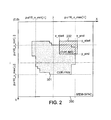
- Figure 2 illustrates the forming of a panoramic image according to an embodiment.
- a panoramic space 200 is defined for storing the panoramic image.
- the panoramic space may have the size and the shape that is contemplated for the final panoramic image.
- the panoramic space has a rectangular shape.
- a two dimensional coordinates system (X, Y) is associated to the panoramic space and to the images that are stored in the panoramic space.
- Each point of the mosaic space has an abscissa j, and an ordinate i.
- the origin of the panoramic space is placed in the top left corner of the panoramic space.
- Each pixel of the panoramic space is associated to a couple of coordinates (x,y).
- the coordinates system is orthonormal.
- the panoramic space comprises a current panoramic image 201 that results from the aggregation of several previous images or to the first image when the forming of the panoramic image has just been initiated.
- a new image 202 When a new image 202 is captured, it is superimposed on the current panoramic image 201. For example, it is superimposed on the current panoramic image based on an analysis of the movement of the camera which captured the images, or based on an analysis of the content of the current image 202 and the current panoramic image 201.
- the current panoramic image may have any shape, and the current image may be superimposed on the current panoramic image at any position in the coordinate system.
- the current panoramic image has a convex shape.
- the panoramic image is not limited to a linear panoramic view, but may result from any movement of the camera.
- the image processing device stores a definition of the edges of the current panoramic image 201, and a definition of the edges of the current image when already superimposed on the current panoramic image.
- the edges are defined according to the directions of the X axis and the Y axis.
- the image processing device For each abscissa j of the coordinates system, the image processing device stores the value53016_y_min[j] which represents the least ordinate of the current panoramic image at abscissa i, and the value53016_y_max[j] which represents the greatest ordinate of the current panoramic image at abscissa j.
- vectors For storing these values, vectors meme16_y_min and meme16_y_max are defined. These vectors have the same size as the panoramic space length in the Y direction. In order to store vectors of a lower size, only the values for abscissas of the current panoramic image may be stored.
- the image processing device For each ordinate i of the coordinates system, the image processing device stores the value53016_x_min[i] which represents the least abscissa of the current panoramic image at ordinate i, and the value53016_x_max[i] which represents the greatest abscissa of the current panoramic image at ordinate i.
- vectors For storing these values, vectors meme16_x_min and meme16_x_max are defined. These vectors have the same size as the panoramic space length in the X direction. In order to store vectors of a lower size, only the values for ordinates of the current panoramic image may be stored.
- the image processing device For defining the edges of the current image 202, the image processing device stores the following values:
- margin value hor_margin is used for deciding whether the current image provides enough information in the X direction to the current panoramic image for being integrated to it.
- margin value ver_margin is used for deciding whether the current image provides enough information in the Y direction to the current panoramic image for being integrated to it.
- image_width representing the length of the current image (in pixels) according to the X axis
- image_height represents the length of the image (in pixels) according to the Y axis.
- the current image is selected for integration in the current panoramic image.
- a maximum of only 2x(image_width + image_height) comparisons are to be performed, which is less than the image_width x image_height comparisons to perform when comparing the current image and the current panoramic image according to techniques of the prior art.
- a first area (or zone) 304 corresponds to an area that is not overlapping with the current panoramic image.
- a second area 306 corresponds to an area that is overlapping with the current panoramic image.
- a third area 305 corresponds to an area included in the second area that is adjacent to the first area 304 and that extends along the line of separation of areas 304 and 306.
- the set consisting of the pixels of area 304, and the pixels of the current panoramic image including those that have been blended with the pixels of area 305, constitutes the new current panoramic image.
- the vectors may consist in modifying values of the greatest/lowest abscissas/ordinates or adding new values when the current panoramic image has been extended.
- the update process is made simple in the present embodiment since less data are to be processed.
- Figure 4 is a flowchart illustrating steps of a method performed according to an embodiment.
- a panoramic space is created by allocating a dedicated memory space.
- the panoramic space may be defined according a size of the contemplated panoramic image, so that the panoramic image can be stored therein.
- step S401 a first image is received for commencing the process of formation of the panoramic space.
- the first image is inserted in the panoramic space in step S402. No assumption is made on the position of the first image in the final panoramic image. Hence, for example, the first image is positioned at the centre of the panoramic space.
- step S403 the first image is stored in the panoramic space as the current panoramic image, and vectors defining the edges of the current panoramic image are created and stored.
- step T404 it is determined whether there are incoming images for insertion (addition) in the panoramic space for completing the current panoramic image.
- a new current image When a new current image is received, it is placed during step S405 in the panoramic space by superimposition on the current panoramic image so as to complete the current panoramic image.
- the superimposition of the current image on the current panoramic image may be performed according to several techniques, such as a motion analysis of the field of view of the camera that captured the images or other techniques.
- the edges of the current image are then defined and stored.
- step T406 it is decided whether the current image should be inserted in the panoramic image or not. It is decided whether the current image brings enough information the current panoramic image, based on the coordinates of the edges of the current panoramic image and the coordinates of the edges of the current image as described in details above, for example using equations eq1, eq2, eq3, and eq4.
- step T404 If it is decided that the current image does not bring enough information, the current image is discarded and the process turns back to step T404.
- step S407 If it is decided that the current image brings enough information, the insertion of the non overlapping part of the current image with the current panoramic image is performed during step S407.
- the blending process presented above may also be performed.
- step S408 the vectors defining the edges of the current panoramic image are updated for taking into account the part of the current image that has been added.
- step T404 for verifying whether there are other images to add.
- the process goes to a termination step S409 during which the current panoramic image is stored as the final panoramic image.
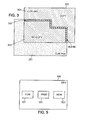
- Figure 5 illustrates an image processing device 500 according to embodiments.
- the image processing device comprises a communication unit 501 for receiving image data to be assembled in a panoramic image.
- the image processing device also comprises a control unit 502 for implementing a method according to embodiments of the invention.
- the control unit may comprise a circuit configured for implementing a method according to embodiments.
- the device comprises a memory unit 503.
- the memory unit may comprise several types of memory.
- the memory unit may comprise a memory for storing processing data.
- the memory unit may also comprise a memory for storing a computer program according to embodiments of the invention.
- the image processing device may be comprised in an image capturing device, such as a camera or a mobile telephone.
- Embodiments of the present invention can be embedded in a computer program product, which comprises all the features enabling the implementation of the methods described herein, and which - when loaded in an information processing system - is able to carry out these methods.
- Computer program means or computer program in the present context mean any expression, in any language, code or notation, of a set of instructions intended to cause a system having an information processing capability to perform a particular function either directly or after a conversion to another language.
- Such a computer program can be designed based on the flowchart of Figure 4 and the present description.
- the computer program can be stored on a computer or machine readable medium allowing data, instructions, messages or message packets, and other machine readable information to be read from the medium.
- the computer or machine readable medium may include non-volatile memory, such as ROM, Flash memory, Disk drive memory, CD-ROM, and other permanent storage. Additionally, a computer or machine readable medium may include, for example, volatile storage such as RAM, buffers, cache memory, and network circuits. Furthermore, the computer or machine readable medium may comprise computer or machine readable information in a transitory state medium such as a network link and/or a network interface, including a wired network or a wireless network, that allow a device to read such computer or machine readable information.
- a transitory state medium such as a network link and/or a network interface, including a wired network or a wireless network, that allow a device to read such computer or machine readable information.
Landscapes
- Physics & Mathematics (AREA)
- General Physics & Mathematics (AREA)
- Engineering & Computer Science (AREA)
- Theoretical Computer Science (AREA)
- Studio Devices (AREA)
- Image Processing (AREA)
Abstract
Description
- The present invention generally relates to methods and apparatuses for forming panoramic images.
- Panoramic images are larger images formed by assembling smaller still or video images according to a single given direction (e.g. left to right) imposed by the movement of the camera that captured the sequence of images.
- Typically, a current image is superimposed on the preceding image in the sequence. Hence, a first area of the current image typically corresponds to a common part between the current and one or more of the preceding images. Also, a second area of the current image corresponds to a part of the current image that is not common with any of the preceding images and will complete the preceding image for forming the panoramic image.
- The definition of the first and second areas thus comprises dividing the current image into two parts (the area being the left part and the second area being the right part, in case of a left to right movement of the camera).
- The superimposition of the current image on the preceding image is performed by analysis of all the pixels of each image, or by analysis of the movement of the camera.
- Once the current image has been superimposed on the preceding image, the pixels of the current image in the first area are typically mixed or blended with the pixels of the preceding image in the first area, and the second area is added to the preceding image to complete the panoramic image comprising the previous image.
- The comparison of the images in order to define the above described areas necessitates a lot of processing, especially with high quality images of several megapixels.
- Also, the forming of panoramic images is limited to a one direction movement of the camera because of the definition of the areas by dividing the current image into two parts.
- Further, if a subsequent image (following the current image) is to be inserted in the panoramic image and if that subsequent image has a part overlapping with the previous common parts of the current and preceding images, then, another mixing of pixels of this common part with pixels of the overlapping part of the subsequent image is performed and decreases quality of the panoramic image.
- These are some drawbacks that may be addressed.
- A first aspect of the invention relates to a method of forming a panoramic image by assembling images according to at least two non parallel directions, the method being performed by an image processing device, and the method comprising the following steps of:
- storing first coordinates defining in a two dimensional space, edges of a current panoramic image,
- superimposing a current image on said current panoramic image for completing the current panoramic image, the current image thus having at least a first area which is not common with the current panoramic area,
- storing second coordinates defining in the two dimensional space, edges of the current image superimposed on the current panoramic image,
- deciding whether the first area should be added to the current panoramic image, based on the first and second stored coordinates,
- adding, at least partially, the first area of the current image to the current panoramic image, if it has been decided to add the first area.
- Embodiments of the invention are recited in the dependent claims attached hereto.
- A second aspect of the present invention relates to a computer program product comprising a computer readable medium, having thereon a computer program comprising program instructions adapted to, when loaded and run on computer means of an image processing device, cause the computer means to implement the steps of a method according to the first aspect.
- A third aspect of the invention relates to a circuit configured for implementing a method according to the first aspect
- A fourth aspect of the present invention relates to a device comprising a circuit according to the third aspect.
- A fifth aspect of the present invention relates to an image capturing device, such as a camera or a mobile telephone, comprising an image capturing arrangement and an image processing device according to the fourth aspect.
- Some advantages of some embodiments of the invention are as follows.
- It is possible to assemble images in two non parallel directions and thus generating a two dimensions panorama.
- The amount of data to process is reduced since only information relating to the edges of the current panoramic image and the current image is used. Thus, the amount of memory needed in the image processing device is also reduced.
- The decision as to whether to incorporate an image to the panoramic image is facilitated, since the amount of data to process is reduced and the occupation of the calculation means is reduced. The forming of the panoramic image is thus accelerated.
- In addition, useless blending of pixels is avoided notably because images that do not provide information may be easily and rapidly discarded. Also, when incorporation of data is decided, only relevant parts of it may be added to the panoramic image.
- The present invention is illustrated by way of example, and not by way of limitation, in the figures of the accompanying drawings, in which like reference numerals refer to similar elements and in which:
-
Figure 1 is a schematic illustration of images captured for being assembled as a panoramic image according to some embodiments of the invention; -
Figure 2 is a schematic illustration of the forming of a panoramic image according to some embodiments of the invention; -
Figure 3 is a schematic illustration of the addition of a current image to a current panoramic image according to some embodiments of the invention; -
Figure 4 is a flowchart of steps performed according to according to some embodiments of the invention; and -
Figures 5 is an illustration of an image processing device according to according to some embodiments of the invention. -
Figure 1 shows a series of images that have been captured by a camera. The images may be still images that have been successively captured or images that originate from a video sequence. - The images have been taken to show the Eiffel Tower from the bottom to the top. Since during the movement of the camera, the field of view of the camera cannot capture an image that shows the base of the Eiffel tower in its entirety, the camera has to make a first movement from the bottom to the top (as shown by arrow 11) and take
images images - Hence, the set of images 1-10 represents a complete panorama of the Eiffel Tower.
- According to other embodiments, the images may be taken in any direction; the camera may have any movement (left-right, right-left, top-down, bottom-up, passing several times on a same view, coming back to a same view etc.).
-
Figure 2 illustrates the forming of a panoramic image according to an embodiment. - A
panoramic space 200 is defined for storing the panoramic image. The panoramic space may have the size and the shape that is contemplated for the final panoramic image. In the present embodiment, the panoramic space has a rectangular shape. - A two dimensional coordinates system (X, Y) is associated to the panoramic space and to the images that are stored in the panoramic space. Each point of the mosaic space has an abscissa j, and an ordinate i. In this example embodiment, the origin of the panoramic space is placed in the top left corner of the panoramic space. Each pixel of the panoramic space is associated to a couple of coordinates (x,y). For example, the coordinates system is orthonormal.
- The panoramic space comprises a current
panoramic image 201 that results from the aggregation of several previous images or to the first image when the forming of the panoramic image has just been initiated. - When a
new image 202 is captured, it is superimposed on the currentpanoramic image 201. For example, it is superimposed on the current panoramic image based on an analysis of the movement of the camera which captured the images, or based on an analysis of the content of thecurrent image 202 and the currentpanoramic image 201. - As illustrated on
Figure 2 , the current panoramic image may have any shape, and the current image may be superimposed on the current panoramic image at any position in the coordinate system. In the Example offigure 2 , the current panoramic image has a convex shape. - According to this embodiment, the panoramic image is not limited to a linear panoramic view, but may result from any movement of the camera.
- The image processing device according to the embodiment stores a definition of the edges of the current
panoramic image 201, and a definition of the edges of the current image when already superimposed on the current panoramic image. - In the embodiment, the edges are defined according to the directions of the X axis and the Y axis.
- For each abscissa j of the coordinates system, the image processing device stores the value pui16_y_min[j] which represents the least ordinate of the current panoramic image at abscissa i, and the value pui16_y_max[j] which represents the greatest ordinate of the current panoramic image at abscissa j.
- For storing these values, vectors pui16_y_min and pui16_y_max are defined. These vectors have the same size as the panoramic space length in the Y direction. In order to store vectors of a lower size, only the values for abscissas of the current panoramic image may be stored.
- For each ordinate i of the coordinates system, the image processing device stores the value pui16_x_min[i] which represents the least abscissa of the current panoramic image at ordinate i, and the value pui16_x_max[i] which represents the greatest abscissa of the current panoramic image at ordinate i.
- For storing these values, vectors pui16_x_min and pui16_x_max are defined. These vectors have the same size as the panoramic space length in the X direction. In order to store vectors of a lower size, only the values for ordinates of the current panoramic image may be stored.
- For defining the edges of the
current image 202, the image processing device stores the following values: - x_start representing the least abscissa of the current image,
- y_start representing the least ordinate of the current image,
- x_end representing the greatest abscissa of the current image, and
- y_end representing the greatest ordinate of the current image.
- These values may be defined for several abscissas and ordinates of the current image. However, due to the rectangular shape of the current image and the fact that the edges of the current image are parallel to the axes of the coordinate system, the four values described above may suffice to define the current image.
- In order to determine whether the
current image 202 brings enough information to the current mosaic image, two margin values hor_margin and ver_margin are defined. The margin value hor_margin is used for deciding whether the current image provides enough information in the X direction to the current panoramic image for being integrated to it. The margin value ver_margin is used for deciding whether the current image provides enough information in the Y direction to the current panoramic image for being integrated to it. - For example, hor_margin = image_width/32 and ver_margin = image_height/32, image_width representing the length of the current image (in pixels) according to the X axis, and image_height represents the length of the image (in pixels) according to the Y axis.
- The following equations define conditions for a current image to be considered for integration in the current panoramic image:


- If at least one of the preceding equations is satisfied for at least one abscissa and/or ordinate, the current image is selected for integration in the current panoramic image.
- In the present embodiment, a maximum of only 2x(image_width + image_height) comparisons are to be performed, which is less than the image_width x image_height comparisons to perform when comparing the current image and the current panoramic image according to techniques of the prior art.
- The integration of the current image according to some embodiments of the invention is described with reference to
Figure 3 . - Three areas are defined in the
current image 202. - A first area (or zone) 304 corresponds to an area that is not overlapping with the current panoramic image. A
second area 306 corresponds to an area that is overlapping with the current panoramic image. Athird area 305 corresponds to an area included in the second area that is adjacent to thefirst area 304 and that extends along the line of separation ofareas - According to the present embodiment, when
current image 202 has been selected for integration in the current panoramic image: - the pixels of
area 304 are copied in the panoramic space at the location where they have been superimposed, thus completing the current image, - the pixels of the
area 305 are blended with the pixels of the current panoramic image, thus smoothing the addition of the current image to the current panoramic image, and - the pixels of the
area 306 that are not part of thearea 305 are discarded because they do not bring information to the current panoramic image. - The set consisting of the pixels of
area 304, and the pixels of the current panoramic image including those that have been blended with the pixels ofarea 305, constitutes the new current panoramic image. The vectors pui16_x_min, pui16_x_max, puil6_y_min, and pui16_y_max are then updated. The update may consist in modifying values of the greatest/lowest abscissas/ordinates or adding new values when the current panoramic image has been extended. - The update process is made simple in the present embodiment since less data are to be processed.
- If a new image is considered for integration in the panoramic image, the same process as the one disclosed here above is performed.
-
Figure 4 is a flowchart illustrating steps of a method performed according to an embodiment. - In step S400, a panoramic space is created by allocating a dedicated memory space. The panoramic space may be defined according a size of the contemplated panoramic image, so that the panoramic image can be stored therein.
- In step S401, a first image is received for commencing the process of formation of the panoramic space.
- The first image is inserted in the panoramic space in step S402. No assumption is made on the position of the first image in the final panoramic image. Hence, for example, the first image is positioned at the centre of the panoramic space.
- Then, in step S403, the first image is stored in the panoramic space as the current panoramic image, and vectors defining the edges of the current panoramic image are created and stored.
- In step T404, it is determined whether there are incoming images for insertion (addition) in the panoramic space for completing the current panoramic image.
- When a new current image is received, it is placed during step S405 in the panoramic space by superimposition on the current panoramic image so as to complete the current panoramic image. The superimposition of the current image on the current panoramic image may be performed according to several techniques, such as a motion analysis of the field of view of the camera that captured the images or other techniques. The edges of the current image are then defined and stored.
- Then, in step T406, it is decided whether the current image should be inserted in the panoramic image or not. It is decided whether the current image brings enough information the current panoramic image, based on the coordinates of the edges of the current panoramic image and the coordinates of the edges of the current image as described in details above, for example using equations eq1, eq2, eq3, and eq4.
- If it is decided that the current image does not bring enough information, the current image is discarded and the process turns back to step T404.
- If it is decided that the current image brings enough information, the insertion of the non overlapping part of the current image with the current panoramic image is performed during step S407. The blending process presented above may also be performed.
- After that, during step S408, the vectors defining the edges of the current panoramic image are updated for taking into account the part of the current image that has been added.
- Then, the process turns back to step T404 for verifying whether there are other images to add.
- If no other image is to be inserted, the process goes to a termination step S409 during which the current panoramic image is stored as the final panoramic image.
-
Figure 5 illustrates animage processing device 500 according to embodiments. - The image processing device comprises a
communication unit 501 for receiving image data to be assembled in a panoramic image. The image processing device also comprises acontrol unit 502 for implementing a method according to embodiments of the invention. The control unit may comprise a circuit configured for implementing a method according to embodiments. The device comprises amemory unit 503. The memory unit may comprise several types of memory. For example, the memory unit may comprise a memory for storing processing data. The memory unit may also comprise a memory for storing a computer program according to embodiments of the invention. - The image processing device may be comprised in an image capturing device, such as a camera or a mobile telephone.
- Embodiments of the present invention can be embedded in a computer program product, which comprises all the features enabling the implementation of the methods described herein, and which - when loaded in an information processing system - is able to carry out these methods. Computer program means or computer program in the present context mean any expression, in any language, code or notation, of a set of instructions intended to cause a system having an information processing capability to perform a particular function either directly or after a conversion to another language. Such a computer program can be designed based on the flowchart of
Figure 4 and the present description. The computer program can be stored on a computer or machine readable medium allowing data, instructions, messages or message packets, and other machine readable information to be read from the medium. The computer or machine readable medium may include non-volatile memory, such as ROM, Flash memory, Disk drive memory, CD-ROM, and other permanent storage. Additionally, a computer or machine readable medium may include, for example, volatile storage such as RAM, buffers, cache memory, and network circuits. Furthermore, the computer or machine readable medium may comprise computer or machine readable information in a transitory state medium such as a network link and/or a network interface, including a wired network or a wireless network, that allow a device to read such computer or machine readable information. - Expressions such as "comprise", "include", "incorporate", "contain", "is" and "have" are to be construed in a non-exclusive manner when interpreting the description and its associated claims, namely construed to allow for other items or components which are not explicitly defined also to be present. Reference to the singular is also to be construed in be a reference to the plural and vice versa.
- While there has been illustrated and described what are presently considered to be the preferred embodiments of the present invention, it will be understood by those skilled in the art that various other modifications may be made, and equivalents may be substituted, without departing from the true scope of the present invention. Additionally, many modifications may be made to adapt a particular situation to the teachings of the present invention without departing from the central inventive concept described herein. Furthermore, an embodiment of the present invention may not include all of the features described above. Therefore, it is intended that the present invention not be limited to the particular embodiments disclosed, but that the invention include all embodiments falling within the scope of the appended claims.
- A person skilled in the art will readily appreciate that various parameters disclosed in the description may be modified and that various embodiments disclosed may be combined without departing from the scope of the invention.
Claims (15)
- A method of forming a panoramic image by assembling images according to at least two non parallel directions (X, Y), the method being performed by an image processing device, and the method comprising the following steps of:- storing (S403) first coordinates defining in a two dimensional space, edges of a current panoramic image (201),- superimposing (S405) a current image (202) on said current panoramic image for completing the current panoramic image, the current image thus having a first area (304) which is not common with the current panoramic area,- storing (S405) second coordinates defining in the two dimensional space, edges of the current image superimposed on the current panoramic image,- deciding (T406) whether the first area should be added to the current panoramic image, based on the first and second stored coordinates,- adding (S407), at least partially, the first area of the current image in the current panoramic image, if it has been decided to add the first area.
- A method according to claim 1, wherein the steps are iterated for several images.
- A method according to any of claims 1-2, wherein the current image has a second area (306) common with the current panoramic image, the method further comprising the following steps, when it has been decided to add the first area:- defining a third area (305) in the current image, said third area being included in the second area in a vicinity of the first area and extending along a line of separation of the first and second areas, and- performing a blending of pixels of the current panoramic image comprised in an area of the current panoramic image on which the third area is superimposed with pixels of the current image comprised in the third area.
- A method according to any of claims 1-3, wherein the step of storing the first coordinates comprises defining:- a first vector that stores for each abscissa of the current panoramic image the greatest ordinate of the current panoramic image at the said abscissa,- a second vector that stores for each abscissa of the current panoramic image the lowest ordinate of the current panoramic image at the said abscissa,- a third vector that stores for each ordinate of the current panoramic image the greatest abscissa of the current panoramic image at the said ordinate, and- a fourth vector that stores for each ordinate of the current panoramic image the lowest abscissa of the current panoramic image at the said ordinate.
- A method according to claim 4, further comprising updating at least one of the vectors after the first area has been added to the current panoramic image.
- A method according to any of claims 1-5, wherein the step of storing the second coordinates comprises storing:- for at least one abscissa of the current image, the lowest and the greatest ordinates of the current image at the said abscissa, and- for at least one ordinate of the current image, the lowest and the greatest abscissas of the current image at the said ordinate.
- A method according to any of claims 1-6, wherein the decision step comprises checking the following conditions:- whether there exists at least one ordinate of the current panoramic image for which the sum of the lowest abscissa of the current image and a first margin value is inferior to the lowest abscissa of the current panoramic image at the said ordinate,- whether there exists at least one ordinate of the current panoramic image for which the sum of the greatest abscissa of the current panoramic image at the said ordinate and the first margin value is inferior to the greatest abscissa of the current image,- whether there exists at least one abscissa of the current panoramic image for which the sum of a second margin value and the lowest ordinate of the current image is inferior to the lowest ordinate of the current panoramic image at the said abscissa, and- whether there exists at least one abscissa of the current panoramic image for which the sum of the second margin value and the greatest ordinate of the current panoramic image at the said abscissa is inferior to the greatest ordinate of the current image,and wherein it is decided to add the first area to the current panoramic image if at least one of the said conditions is fulfilled.
- A method according to claim 7, wherein it is decided to add the first area to the current panoramic image if at least two of the said conditions are fulfilled.
- A method according to any of claims 1-8, wherein the current panoramic image corresponds to a set of previously assembled images.
- A method according to any one of the preceding claims, wherein the current panoramic image has a convex shape.
- A computer program product comprising a computer readable medium, having thereon a computer program comprising program instructions adapted to, when loaded and run on computer means of an image processing device, cause the computer means to implement the steps of a method according to any one of claims 1 to 10.
- A circuit configured to form a panoramic image by assembling images according to at least two non parallel directions by:- storing first coordinates defining in a two dimensional space, edges of a current panoramic image,- superimposing a current image on said current panoramic image for completing the current panoramic image, the current image thus having a first area which is not common with the current panoramic area,- storing second coordinates defining in the two dimensional space, edges of the current image superimposed on the current panoramic image,- deciding whether the first area should be added to the current panoramic image, based on the first and second stored coordinates,- adding, at least partially, the first area of the current image in the current panoramic image, if it has been decided to add the first area.
- A circuit according to claim 12, wherein the current image has a second area common with the current panoramic image, the circuit further being configured for:- defining a third area in the current image, said third area being included in the second area in a vicinity of the first area and extending along a line of separation of the first and second areas, and- performing a blending of pixels of the current panoramic image comprised in an area of the current panoramic image on which the third area is superimposed with pixels of the current image comprised in the third area,when it has been decided to integrate the first area.
- An image processing device (500) comprising at least one memory (503) and a control unit (502) for forming a panoramic image by assembling images according to at least two non parallel directions, the control unit comprising a circuit according to any one of claims 12 to 13.
- An image capturing device, such as a camera or a mobile telephone, comprising an image capturing arrangement and the image processing device of claim 14.
Priority Applications (3)
| Application Number | Priority Date | Filing Date | Title |
|---|---|---|---|
| EP10306066A EP2439588A1 (en) | 2010-09-30 | 2010-09-30 | Method and device for forming a panoramic image |
| PCT/EP2011/067094 WO2012042011A1 (en) | 2010-09-30 | 2011-09-30 | Method and device for forming a panoramic image |
| US13/876,694 US9042676B2 (en) | 2010-09-30 | 2011-09-30 | Method and device for forming a panoramic image |
Applications Claiming Priority (1)
| Application Number | Priority Date | Filing Date | Title |
|---|---|---|---|
| EP10306066A EP2439588A1 (en) | 2010-09-30 | 2010-09-30 | Method and device for forming a panoramic image |
Publications (1)
| Publication Number | Publication Date |
|---|---|
| EP2439588A1 true EP2439588A1 (en) | 2012-04-11 |
Family
ID=43566704
Family Applications (1)
| Application Number | Title | Priority Date | Filing Date |
|---|---|---|---|
| EP10306066A Withdrawn EP2439588A1 (en) | 2010-09-30 | 2010-09-30 | Method and device for forming a panoramic image |
Country Status (3)
| Country | Link |
|---|---|
| US (1) | US9042676B2 (en) |
| EP (1) | EP2439588A1 (en) |
| WO (1) | WO2012042011A1 (en) |
Families Citing this family (11)
| Publication number | Priority date | Publication date | Assignee | Title |
|---|---|---|---|---|
| US8957944B2 (en) | 2011-05-17 | 2015-02-17 | Apple Inc. | Positional sensor-assisted motion filtering for panoramic photography |
| US9762794B2 (en) | 2011-05-17 | 2017-09-12 | Apple Inc. | Positional sensor-assisted perspective correction for panoramic photography |
| US9088714B2 (en) | 2011-05-17 | 2015-07-21 | Apple Inc. | Intelligent image blending for panoramic photography |
| US9247133B2 (en) | 2011-06-01 | 2016-01-26 | Apple Inc. | Image registration using sliding registration windows |
| US10306140B2 (en) | 2012-06-06 | 2019-05-28 | Apple Inc. | Motion adaptive image slice selection |
| US9098922B2 (en) | 2012-06-06 | 2015-08-04 | Apple Inc. | Adaptive image blending operations |
| US8902335B2 (en) * | 2012-06-06 | 2014-12-02 | Apple Inc. | Image blending operations |
| US20140300686A1 (en) * | 2013-03-15 | 2014-10-09 | Tourwrist, Inc. | Systems and methods for tracking camera orientation and mapping frames onto a panoramic canvas |
| US9832378B2 (en) | 2013-06-06 | 2017-11-28 | Apple Inc. | Exposure mapping and dynamic thresholding for blending of multiple images using floating exposure |
| RU2626551C1 (en) * | 2016-06-07 | 2017-07-28 | Общество с ограниченной ответственностью "СИАМС" | Method for generating panoramic images from video stream of frames in real time mode |
| RU2647645C1 (en) * | 2016-12-29 | 2018-03-16 | Общество с ограниченной ответственностью "СИАМС" | Method of eliminating seams when creating panoramic images from video stream of frames in real-time |
Citations (2)
| Publication number | Priority date | Publication date | Assignee | Title |
|---|---|---|---|---|
| US20030194149A1 (en) * | 2002-04-12 | 2003-10-16 | Irwin Sobel | Imaging apparatuses, mosaic image compositing methods, video stitching methods and edgemap generation methods |
| WO2007122584A1 (en) * | 2006-04-24 | 2007-11-01 | Nxp B.V. | Method and device for generating a panoramic image from a video sequence |
Family Cites Families (6)
| Publication number | Priority date | Publication date | Assignee | Title |
|---|---|---|---|---|
| US5649032A (en) * | 1994-11-14 | 1997-07-15 | David Sarnoff Research Center, Inc. | System for automatically aligning images to form a mosaic image |
| US6038348A (en) * | 1996-07-24 | 2000-03-14 | Oak Technology, Inc. | Pixel image enhancement system and method |
| US6173087B1 (en) * | 1996-11-13 | 2001-01-09 | Sarnoff Corporation | Multi-view image registration with application to mosaicing and lens distortion correction |
| JP2003510932A (en) * | 1999-09-28 | 2003-03-18 | コーニンクレッカ フィリップス エレクトロニクス エヌ ヴィ | Filter processing apparatus and method |
| US20100097444A1 (en) * | 2008-10-16 | 2010-04-22 | Peter Lablans | Camera System for Creating an Image From a Plurality of Images |
| FR2969353A1 (en) * | 2010-12-20 | 2012-06-22 | St Ericsson Sa | METHOD FOR PRODUCING A PANORAMIC IMAGE FROM A VIDEO SEQUENCE AND APPARATUS FOR IMPLEMENTING SAID METHOD |
-
2010
- 2010-09-30 EP EP10306066A patent/EP2439588A1/en not_active Withdrawn
-
2011
- 2011-09-30 WO PCT/EP2011/067094 patent/WO2012042011A1/en not_active Ceased
- 2011-09-30 US US13/876,694 patent/US9042676B2/en not_active Expired - Fee Related
Patent Citations (2)
| Publication number | Priority date | Publication date | Assignee | Title |
|---|---|---|---|---|
| US20030194149A1 (en) * | 2002-04-12 | 2003-10-16 | Irwin Sobel | Imaging apparatuses, mosaic image compositing methods, video stitching methods and edgemap generation methods |
| WO2007122584A1 (en) * | 2006-04-24 | 2007-11-01 | Nxp B.V. | Method and device for generating a panoramic image from a video sequence |
Also Published As
| Publication number | Publication date |
|---|---|
| US9042676B2 (en) | 2015-05-26 |
| US20130236122A1 (en) | 2013-09-12 |
| WO2012042011A1 (en) | 2012-04-05 |
Similar Documents
| Publication | Publication Date | Title |
|---|---|---|
| US9042676B2 (en) | Method and device for forming a panoramic image | |
| KR101899877B1 (en) | Apparatus and method for improving quality of enlarged image | |
| JP5988119B2 (en) | Backlight detection method and device | |
| CN103688292B (en) | Image display device and image display method | |
| CN105247567B (en) | An image refocusing apparatus, method, system, and non-transitory program storage device | |
| US11194536B2 (en) | Image processing method and apparatus for displaying an image between two display screens | |
| CN103209291A (en) | Method, apparatus and device for controlling automatic image shooting | |
| KR20070093995A (en) | Motion vector calculation method and image stabilization device, image pickup device, and video generation device using the method | |
| CN104735348B (en) | Double-camera photographing method and system | |
| JP2005309560A (en) | Image processing method, device and program | |
| CN111105434A (en) | Motion trajectory synthesis method and electronic equipment | |
| CN108810326B (en) | Photographing method and device and mobile terminal | |
| US20130051679A1 (en) | Image processing apparatus and image processing method | |
| JP4990876B2 (en) | Image processing device | |
| CN113099248A (en) | Panoramic video filling method, device, equipment and storage medium | |
| KR20110138162A (en) | Recording medium recording image processing apparatus, image processing method and program | |
| CN114881840B (en) | Image stitching method, device, system and computer-readable storage medium | |
| CN114449303B (en) | Live broadcast picture generation method and device, storage medium and electronic device | |
| CN110536087A (en) | Electronic equipment and its motion profile picture synthesis method, device and embedded equipment | |
| CN104796615B (en) | A kind of big pixel image pickup method, system and the mobile terminal of OIS anti-vibration motor | |
| CN116958164A (en) | Image processing method, device, electronic equipment and storage medium | |
| KR20170077018A (en) | Image processing method and image processing apparatus thereof | |
| CN108924510B (en) | Data processing method and device for real-time image, terminal and network equipment | |
| CN113658229B (en) | Abnormal object determination method and device, storage medium, electronic device | |
| CN110807729A (en) | Image data processing method and device |
Legal Events
| Date | Code | Title | Description |
|---|---|---|---|
| AK | Designated contracting states |
Kind code of ref document: A1 Designated state(s): AL AT BE BG CH CY CZ DE DK EE ES FI FR GB GR HR HU IE IS IT LI LT LU LV MC MK MT NL NO PL PT RO SE SI SK SM TR |
|
| AX | Request for extension of the european patent |
Extension state: BA ME RS |
|
| PUAI | Public reference made under article 153(3) epc to a published international application that has entered the european phase |
Free format text: ORIGINAL CODE: 0009012 |
|
| 17P | Request for examination filed |
Effective date: 20120927 |
|
| RAP1 | Party data changed (applicant data changed or rights of an application transferred) |
Owner name: OCT CIRCUIT TECHNOLOGIES INTERNATIONAL LIMITED |
|
| RIC1 | Information provided on ipc code assigned before grant |
Ipc: G06K 9/36 20060101AFI20170202BHEP Ipc: G06T 3/40 20060101ALI20170202BHEP Ipc: G03B 37/04 20060101ALI20170202BHEP |
|
| GRAP | Despatch of communication of intention to grant a patent |
Free format text: ORIGINAL CODE: EPIDOSNIGR1 |
|
| INTG | Intention to grant announced |
Effective date: 20170321 |
|
| STAA | Information on the status of an ep patent application or granted ep patent |
Free format text: STATUS: THE APPLICATION IS DEEMED TO BE WITHDRAWN |
|
| 18D | Application deemed to be withdrawn |
Effective date: 20170801 |