EP2438694B1 - Techniques for detecting beacons on wireless channels - Google Patents
Techniques for detecting beacons on wireless channels Download PDFInfo
- Publication number
- EP2438694B1 EP2438694B1 EP10783745.2A EP10783745A EP2438694B1 EP 2438694 B1 EP2438694 B1 EP 2438694B1 EP 10783745 A EP10783745 A EP 10783745A EP 2438694 B1 EP2438694 B1 EP 2438694B1
- Authority
- EP
- European Patent Office
- Prior art keywords
- radio
- beacon
- scan
- channel
- channels
- Prior art date
- Legal status (The legal status is an assumption and is not a legal conclusion. Google has not performed a legal analysis and makes no representation as to the accuracy of the status listed.)
- Not-in-force
Links
- 238000000034 method Methods 0.000 title claims description 19
- 230000005540 biological transmission Effects 0.000 claims description 6
- 125000004122 cyclic group Chemical group 0.000 claims description 2
- 238000004891 communication Methods 0.000 description 16
- 230000015654 memory Effects 0.000 description 10
- 238000005516 engineering process Methods 0.000 description 5
- 230000003287 optical effect Effects 0.000 description 3
- 230000001413 cellular effect Effects 0.000 description 2
- 230000001419 dependent effect Effects 0.000 description 2
- 230000006870 function Effects 0.000 description 2
- 230000015556 catabolic process Effects 0.000 description 1
- 238000004590 computer program Methods 0.000 description 1
- 238000006731 degradation reaction Methods 0.000 description 1
- 238000001514 detection method Methods 0.000 description 1
- 238000010586 diagram Methods 0.000 description 1
- 230000000694 effects Effects 0.000 description 1
- 239000000835 fiber Substances 0.000 description 1
- 230000007774 longterm Effects 0.000 description 1
- 239000000463 material Substances 0.000 description 1
- 230000003068 static effect Effects 0.000 description 1
- 230000001360 synchronised effect Effects 0.000 description 1
Images


Classifications
-
- H—ELECTRICITY
- H04—ELECTRIC COMMUNICATION TECHNIQUE
- H04W—WIRELESS COMMUNICATION NETWORKS
- H04W88/00—Devices specially adapted for wireless communication networks, e.g. terminals, base stations or access point devices
- H04W88/02—Terminal devices
- H04W88/06—Terminal devices adapted for operation in multiple networks or having at least two operational modes, e.g. multi-mode terminals
-
- H—ELECTRICITY
- H04—ELECTRIC COMMUNICATION TECHNIQUE
- H04W—WIRELESS COMMUNICATION NETWORKS
- H04W48/00—Access restriction; Network selection; Access point selection
- H04W48/16—Discovering, processing access restriction or access information
-
- H—ELECTRICITY
- H04—ELECTRIC COMMUNICATION TECHNIQUE
- H04W—WIRELESS COMMUNICATION NETWORKS
- H04W48/00—Access restriction; Network selection; Access point selection
- H04W48/18—Selecting a network or a communication service
Definitions
- the subject matter disclosed herein relates generally to techniques for detecting wireless communications channels.
- MRPs Multi-Radio Platforms
- FIG. 1 depicts a scenario involving a multi-radio mobile terminal that performs a network scan to establish a wireless local area network (WLAN) connection with a WLAN access point (AP) while attempting to maintain continuous service over an active wireless wide area network (WWAN) connection with a WWAN base station (BS).
- WLAN wireless local area network
- AP WLAN access point
- WWAN active wireless wide area network
- Time Division Multiplex is a common solution for the coexistence of multiple radios on the same device.
- TDM prevents inter-radio interference or resource conflict by interleaving co-located radio activities over time.
- WWAN operations are blocked during a network scan to establish a WLAN connection and vice versa.
- a WLAN radio tries to discover the neighboring WLAN access points by scanning a list of channels while trying to co-exist with a WWAN radio with an active WWAN connection.
- An absence duration and an absence period respectively indicate how long a WWAN radio is silent and how often the absence durations repeat.
- the absence duration and absence period are negotiated with a WWAN base station.
- the absence duration is set long enough for a WLAN radio to complete at least one active scan.
- a WLAN radio uses a passive scan whereby a WLAN radio does not transmit signals but instead waits to receive a beacon broadcast by an access point.
- IEEE 802.1 1 -2007 describes a manner in which an access point transmits beacon frames at regular intervals to announce the presence of a WLAN network.
- the WLAN radio must stay on one channel for multiple absence periods to receive signals from an access point over a full beacon interval.
- a WWAN radio is not able to be absent for too long a time without causing significant performance degradation in the WWAN connection. It is desirable for a WLAN radio to detect a beacon while avoiding excessive WWAN radio silence.
- WO 2009/009453 A2 discloses an ad hoc peer-to-peer network in which a transmitter wireless terminal is configured to establish a peer-to-peer communication link with a receiver wireless terminal over a shared communication channel.
- the transmitter wireless terminal may scale its transmit power as a function of a channel gain for the communication channel between the transmitter and receiver wireless terminals.
- the scaled transmit power may be utilized by the transmitter and receiver wireless terminals to perform link scheduling over the communication channel. For instance, the scaled transmit power may be used by the transmitter wireless terminal to perform a transmitter yielding with other neighboring transmitter wireless terminals utilizing the shared communication channel. Similarly, the scaled transmit power may be used by the receiver wireless terminal to perform receiver yielding with other neighboring receiver wireless terminal utilizing the shared communication channel.
- US2009/0003278 discloses a system and method for maintaining a first connection to a first network and a second connection to a second network by a communication device.
- Embodiments of the invention may be used in a variety of applications. Some embodiments of the invention may be used in conjunction with various devices and systems, for example, a transmitter, a receiver, a transceiver, a transmitter-receiver, a wireless communication station, a wireless communication device, a wireless Access Point (AP), a modem, a wireless modem, a Personal Computer (PC), a desktop computer, a mobile computer, a laptop computer, a notebook computer, a tablet computer, a server computer, a handheld computer, a handheld device, a Personal Digital Assistant (PDA) device, a handheld PDA device, a network, a wireless network, a Local Area Network (LAN), a Wireless LAN (WLAN), a Metropolitan Area Network (MAN), a Wireless MAN (WMAN), a Wide Area Network (WAN), a Wireless WAN (WWAN), devices and/or networks operating in accordance with existing IEEE 802.11, 802.11a, 802.11b, 802.11e, 802.11g, 802.
- Some embodiments of the invention may be used in conjunction with one or more types of wireless communication signals and/or systems, for example, Radio Frequency (RF), Infra Red (IR), Frequency-Division Multiplexing (FDM), Orthogonal FDM (OFDM), Orthogonal Frequency Division Multiple Access (OFDMA), Time-Division Multiplexing (TDM), Time-Division Multiple Access (TDMA), Extended TDMA (E-TDMA), General Packet Radio Service (GPRS), Extended GPRS, Code-Division Multiple Access (CDMA), Wideband CDMA (WCDMA), CDMA 2000, MultiCarrier Modulation (MDM), Discrete Multi-Tone (DMT), Bluetooth (RTM), ZigBee (TM), or the like.
- RF Radio Frequency
- IR Frequency-Division Multiplexing
- OFDM Orthogonal FDM
- OFDM Orthogonal Frequency Division Multiple Access
- TDM Time-Division Multiplexing
- TDMA Time-Di
- IEEE 802.11x may refer to any existing IEEE 802.11 specification, including but not limited to 802.11a, 802.11 b, 802.11 e, 802.11g, 802.11 h, 802.11 i, and 802.11 n.
- the WLAN radio reduces the time the WLAN radio performs a passive scan for beacons on channels while coexisting with a WWAN radio.
- the WLAN radio listens for a beacon for a period of time. Periodically, the WLAN radio changes the channel on which the WLAN radio listens for a beacon.
- the WLAN radio identifies a beacon by detecting an incomplete portion of a beacon.
- Various embodiments reduce a total scan time for beacons by minimizing time overlap between successive beacon detecting times on the same channel.
- FIG. 2 depicts a process to detect at least one beacon, in accordance with an embodiment.
- Blocks 202 and 204 include a WLAN radio awaiting receipt of a beacon on a channel for a period of time and periodically switching to a different channel to listen for a beacon. Blocks 202 and 204 may take place in a manner described with regard to FIGs. 3 and 4 .
- the WLAN radio attempts to detect a beacon on each channel using a passive scan.
- the WLAN radio may identify a beacon on a channel by detecting less than an entire beacon. For example, the WLAN radio may identify a beacon by detecting a portion of a media access control (MAC) header of the beacon.
- the WLAN radio may determine received signal strength indicator (RSSI) values for each channel on which a beacon is detected.
- the WLAN radio may identify a list of selected channels for which at least a portion of a beacon has been detected.
- RSSI received signal strength indicator
- Block 206 includes the WLAN radio sorting the selected channel list based on RSSI levels.
- the WLAN radio may sort the channels by increasing RSSI levels.
- Block 206 may also include the WLAN radio using an active scan for each channel on the sorted list. An active scan can be used now because the active access point is already detected through partial beacon detection. In some embodiments, block 206 may be avoided if the WLAN radio finds the preferred access points in blocks 202 and 204.
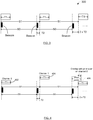
- FIG. 3 illustrates a period of a beacon transmission, S0, and a period of a WLAN radio's passive scan for a beacon on a channel, S1.
- a WLAN radio may passively scan for a beacon in a manner described in IEEE 802.11-2007.
- a time gap exists between S0 and S1.
- the time gap is represented as T2, where T2 is
- a WLAN radio passively scans a different channel for a duration of T1.
- the WWAN radio does not transmit signals to any WWAN base station.
- Period S1 is sometimes called an "absence period.” For example, at the beginning of the first absence period, the WLAN radio listens to channel 1 and then at the beginning of the second absence period, the WLAN radio listens to channel 2.
- the radio switches to channel M.
- the radio At the beginning of the M+1th period, the radio will listen to channel 1 again. Such procedure will continue until the radio completes a passive scan for all M channels.
- FIG. 4 depicts an example of three scans, in accordance with an embodiment.
- a WLAN radio performs a first passive scan of channel 0 for a beacon during time region T1.
- the WLAN radio performs a passive scan of another channel, channel 1, during time region T1.
- the WLAN radio scans for a beacon for time region T1 that overlaps with the time region scanned in a previous scan, scan 402.
- the value of M (i.e., a number of channels for which a scan is repeated at least once) is chosen to lessen or, in some cases, minimize the overlap of scan that takes place between two successive scans on the same channel.
- An entire beacon interval, S0, of any channel may not be listened-to during time region T1.
- the WLAN radio cycles through M channels for N number of rounds.
- the minimum number of rounds N to cover a full beacon interval S0 is based on the following criteria: M ⁇ T 2 ⁇ N ⁇ 1 + T 1 > S 0.
- N ceiling S 0 ⁇ T 1 / M ⁇ T 2 + 1 .
- the ceiling function rounds up a value to the nearest integer.
- the total number of channels a radio is to scan may be more than M channels.
- the K channels are divided into groups of M channels. After scanning M channels for N rounds, the WLAN radio scans the next group of M channels for N rounds, and so forth.
- FIG. 5 depicts a comparison of the total scan time S2 of the interleaved scan techniques with the traditional continuous scan. A significant reduction in total scan time S2, is shown particularly when the absence period (S1) is set to 90, 95, 100, 105, 110, and 115 ms.
- Scanning a beacon during a time region T1 may not detect an entire beacon.
- a beacon can be very long such as, for example, 2 ms or 5 ms.
- Various embodiments detect a partial beacon without receiving an entire beacon.
- FIG. 6 depicts an IEEE 802.11 compliant MAC header.
- the frame control portion of the MAC header is enlarged.
- a WLAN radio detects a partial beacon if the cyclic redundancy check (CRC) of the physical layer (PHY) header is correct or the frame control portion of the media access control (MAC) header indicates that the frame is beacon.
- CRC can be performed on an incomplete portion of a beacon.
- a WLAN radio may detect a partial beacon in such a manner.
- Table 1 shows an example of a frame control portion associated with a beacon frame based on the IEEE 802.1 1 standard.
- a WLAN radio determines a received signal strength indicator (RSSI) for a WLAN frame if both the CRC of the PHY header is correct and the frame control portion of the MAC header indicates that the frame is beacon. A channel that does not have any RSSI will not be included in the list of selected channels.
- RSSI received signal strength indicator
- the channels are prioritized based on RSSI values.
- the WLAN radio may order the RSSI values based on increasing RSSI values.
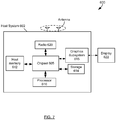
- FIG. 7 depicts an example system that can use embodiments of the present invention.
- Computer system 600 may include host system 602 and display 622. Computer system 600 can be implemented in a handheld personal computer, mobile telephone, set top box, or any computing device.
- Host system 602 may include chipset 605, processor 610, host memory 612, storage 614, graphics subsystem 615, and radio 620.
- Chipset 605 may provide intercommunication among processor 610, host memory 612, storage 614, graphics subsystem 615, and radio 620.
- chipset 605 may include a storage adapter (not depicted) capable of providing intercommunication with storage 614.
- the storage adapter may be capable of communicating with storage 614 in conformance with any of the following protocols: Small Computer Systems Interface (SCSI), Fibre Channel (FC), and/or Serial Advanced Technology Attachment (S-ATA).
- SCSI Small Computer Systems Interface
- FC Fibre Channel
- S-ATA Serial Advanced Technology Attachment
- Processor 610 may be implemented as Complex Instruction Set Computer (CISC) or Reduced Instruction Set Computer (RISC) processors, multi-core, or any other microprocessor or central processing unit.
- CISC Complex Instruction Set Computer
- RISC Reduced Instruction Set Computer
- Host memory 612 may be implemented as a volatile memory device such as but not limited to a Random Access Memory (RAM), Dynamic Random Access Memory (DRAM), or Static RAM (SRAM).
- Storage 614 may be implemented as a non-volatile storage device such as but not limited to a magnetic disk drive, optical disk drive, tape drive, an internal storage device, an attached storage device, flash memory, battery backed-up SDRAM (synchronous DRAM), and/or a network accessible storage device.
- Graphics subsystem 615 may perform processing of images such as still or video for display.
- An analog or digital interface may be used to communicatively couple graphics subsystem 615 and display 622.
- the interface may be any of a High-Definition Multimedia Interface, DisplayPort, wireless HDMI, and/or wireless HD compliant techniques.
- Graphics subsystem 615 could be integrated into processor 610 or chipset 605.
- Graphics subsystem 615 could be a stand-alone card communicatively coupled to chipset 605.
- Radio 620 may include one or more radios capable of transmitting and receiving signals in accordance with applicable wireless standards such as but not limited to any version of IEEE 802.3, IEEE 802.11, and IEEE 802.16. In various embodiments, radio 620 performs techniques described with regard to FIGs. 2-4 to detect active WLAN channels.
- Embodiments of the present invention may be provided, for example, as a computer program product which may include one or more machine-readable media having stored thereon machine-executable instructions that, when executed by one or more machines such as a computer, network of computers, or other electronic devices, may result in the one or more machines carrying out operations in accordance with embodiments of the present invention.
- a machine-readable medium may include, but is not limited to, floppy diskettes, optical disks, CD-ROMs (Compact Disc-Read Only Memories), and magneto-optical disks, ROMs (Read Only Memories), RAMs (Random Access Memories), EPROMs (Erasable Programmable Read Only Memories), EEPROMs (Electrically Erasable Programmable Read Only Memories), magnetic or optical cards, flash memory, or other type of media / machine-readable medium suitable for storing machine-executable instructions.
Landscapes
- Engineering & Computer Science (AREA)
- Computer Networks & Wireless Communication (AREA)
- Signal Processing (AREA)
- Computer Security & Cryptography (AREA)
- Mobile Radio Communication Systems (AREA)
Description
- The subject matter disclosed herein relates generally to techniques for detecting wireless communications channels.
- With the increasing availability of wireless technology and connectivity, devices carrying multiple radios are not uncommon. As one example, combinations of Bluetooth, WiFi, and WiMAX technologies may be made available on computation and communication platforms such as laptops and handheld devices. These types of platforms may be equipped with multiple co-located radios. Such platforms may be referred to as a Multi-Radio Platforms (MRPs). MRPs may include the co-location of Bluetooth, WiMAX, and even WiFi radios to accommodate various uses and conveniences.
-
FIG. 1 depicts a scenario involving a multi-radio mobile terminal that performs a network scan to establish a wireless local area network (WLAN) connection with a WLAN access point (AP) while attempting to maintain continuous service over an active wireless wide area network (WWAN) connection with a WWAN base station (BS). - Time Division Multiplex (TDM) is a common solution for the coexistence of multiple radios on the same device. TDM prevents inter-radio interference or resource conflict by interleaving co-located radio activities over time. Typically, WWAN operations are blocked during a network scan to establish a WLAN connection and vice versa.
- In the scenario of
FIG. 1 , a WLAN radio tries to discover the neighboring WLAN access points by scanning a list of channels while trying to co-exist with a WWAN radio with an active WWAN connection. An absence duration and an absence period respectively indicate how long a WWAN radio is silent and how often the absence durations repeat. The absence duration and absence period are negotiated with a WWAN base station. Usually, the absence duration is set long enough for a WLAN radio to complete at least one active scan. In many cases, a WLAN radio uses a passive scan whereby a WLAN radio does not transmit signals but instead waits to receive a beacon broadcast by an access point. IEEE 802.1 1 -2007 describes a manner in which an access point transmits beacon frames at regular intervals to announce the presence of a WLAN network. - In some cases, the WLAN radio must stay on one channel for multiple absence periods to receive signals from an access point over a full beacon interval. However, a WWAN radio is not able to be absent for too long a time without causing significant performance degradation in the WWAN connection. It is desirable for a WLAN radio to detect a beacon while avoiding excessive WWAN radio silence.
- Reference is made to
WO 2009/009453 A2 , which discloses an ad hoc peer-to-peer network in which a transmitter wireless terminal is configured to establish a peer-to-peer communication link with a receiver wireless terminal over a shared communication channel. The transmitter wireless terminal may scale its transmit power as a function of a channel gain for the communication channel between the transmitter and receiver wireless terminals. The scaled transmit power may be utilized by the transmitter and receiver wireless terminals to perform link scheduling over the communication channel. For instance, the scaled transmit power may be used by the transmitter wireless terminal to perform a transmitter yielding with other neighboring transmitter wireless terminals utilizing the shared communication channel. Similarly, the scaled transmit power may be used by the receiver wireless terminal to perform receiver yielding with other neighboring receiver wireless terminal utilizing the shared communication channel. -
US2009/0003278 discloses a system and method for maintaining a first connection to a first network and a second connection to a second network by a communication device. - Embodiments of the present invention are illustrated by way of example, and not by way of limitation, in the drawings and in which like reference numerals refer to similar elements.
-
FIG. 1 depicts a multi-radio mobile terminal that performs a network scan to establish a wireless local area network connection with a WLAN access point while attempting to maintain continuous service over an active wireless wide area network connection with a WWAN base station. -
FIG. 2 depicts a process to detect at least one beacon, in accordance with an embodiment. -
FIG. 3 illustrates a period of a beacon transmission, SO, and a period of a WLAN radio's passive scan for a beacon on a channel, S1. -
FIG. 4 depicts an example of three scans, in accordance with an embodiment. -
FIG. 5 depicts a comparison of the total scan time S2 of the proposed interleaved scan with the traditional continuous scan. -
FIG. 6 depicts an IEEE 802.11 compliant MAC header. -
FIG. 7 depicts an example system that can use embodiments of the present invention. - The invention is defined by the subject-matter of the independent claims. Particular embodiments of the invention are set out in the dependent claims. Reference throughout this specification to "one embodiment" or "an embodiment" means that a particular feature, structure, or characteristic described in connection with the embodiment is included in at least one embodiment of the present invention. Thus, the appearances of the phrase "in one embodiment" or "an embodiment" in various places throughout this specification are not necessarily all referring to the same embodiment. Furthermore, the particular features, structures, or characteristics may be combined in one or more embodiments.
- Embodiments of the invention may be used in a variety of applications. Some embodiments of the invention may be used in conjunction with various devices and systems, for example, a transmitter, a receiver, a transceiver, a transmitter-receiver, a wireless communication station, a wireless communication device, a wireless Access Point (AP), a modem, a wireless modem, a Personal Computer (PC), a desktop computer, a mobile computer, a laptop computer, a notebook computer, a tablet computer, a server computer, a handheld computer, a handheld device, a Personal Digital Assistant (PDA) device, a handheld PDA device, a network, a wireless network, a Local Area Network (LAN), a Wireless LAN (WLAN), a Metropolitan Area Network (MAN), a Wireless MAN (WMAN), a Wide Area Network (WAN), a Wireless WAN (WWAN), devices and/or networks operating in accordance with existing IEEE 802.11, 802.11a, 802.11b, 802.11e, 802.11g, 802.11 h, 802.11i, 802.11n, 802.16, 802.16d, 802.16e, 802.16m, or 3GPP standards and/or future versions and/or derivatives and/or Long Term Evolution (LTE) of the above standards, a Personal Area Network (PAN), a Wireless PAN (WPAN), units and/or devices which are part of the above WLAN and/or PAN and/or WPAN networks, one way and/or two-way radio communication systems, cellular radio-telephone communication systems, a cellular telephone, a wireless telephone, a Personal Communication Systems (PCS) device, a PDA device which incorporates a wireless communication device, a Multiple Input Multiple Output (MIMO) transceiver or device, a Single Input Multiple Output (SIMO) transceiver or device, a Multiple Input Single Output (MISO) transceiver or device, a Multi Receiver Chain (MRC) transceiver or device, a transceiver or device having "smart antenna" technology or multiple antenna technology, or the like.
- Some embodiments of the invention may be used in conjunction with one or more types of wireless communication signals and/or systems, for example, Radio Frequency (RF), Infra Red (IR), Frequency-Division Multiplexing (FDM), Orthogonal FDM (OFDM), Orthogonal Frequency Division Multiple Access (OFDMA), Time-Division Multiplexing (TDM), Time-Division Multiple Access (TDMA), Extended TDMA (E-TDMA), General Packet Radio Service (GPRS), Extended GPRS, Code-Division Multiple Access (CDMA), Wideband CDMA (WCDMA), CDMA 2000, MultiCarrier Modulation (MDM), Discrete Multi-Tone (DMT), Bluetooth (RTM), ZigBee (TM), or the like. Embodiments of the invention may be used in various other apparatuses, devices, systems and/or networks. IEEE 802.11x may refer to any existing IEEE 802.11 specification, including but not limited to 802.11a, 802.11 b, 802.11 e, 802.11g, 802.11 h, 802.11 i, and 802.11 n.
- Various embodiments reduce the time the WLAN radio performs a passive scan for beacons on channels while coexisting with a WWAN radio. In various embodiments, the WLAN radio listens for a beacon for a period of time. Periodically, the WLAN radio changes the channel on which the WLAN radio listens for a beacon. In some embodiments, the WLAN radio identifies a beacon by detecting an incomplete portion of a beacon. Various embodiments reduce a total scan time for beacons by minimizing time overlap between successive beacon detecting times on the same channel.
-
FIG. 2 depicts a process to detect at least one beacon, in accordance with an embodiment.Blocks 202 and 204 include a WLAN radio awaiting receipt of a beacon on a channel for a period of time and periodically switching to a different channel to listen for a beacon.Blocks 202 and 204 may take place in a manner described with regard toFIGs. 3 and 4 . In some embodiments, the WLAN radio attempts to detect a beacon on each channel using a passive scan. In various embodiments, the WLAN radio may identify a beacon on a channel by detecting less than an entire beacon. For example, the WLAN radio may identify a beacon by detecting a portion of a media access control (MAC) header of the beacon. The WLAN radio may determine received signal strength indicator (RSSI) values for each channel on which a beacon is detected. The WLAN radio may identify a list of selected channels for which at least a portion of a beacon has been detected. -
Block 206 includes the WLAN radio sorting the selected channel list based on RSSI levels. The WLAN radio may sort the channels by increasing RSSI levels.Block 206 may also include the WLAN radio using an active scan for each channel on the sorted list. An active scan can be used now because the active access point is already detected through partial beacon detection. In some embodiments,block 206 may be avoided if the WLAN radio finds the preferred access points inblocks 202 and 204. -
FIG. 3 illustrates a period of a beacon transmission, S0, and a period of a WLAN radio's passive scan for a beacon on a channel, S1. For example, a WLAN radio may passively scan for a beacon in a manner described in IEEE 802.11-2007. A time gap exists between S0 and S1. The time gap is represented as T2, where T2 is |S0-S1|. Every period of S1, the lack of overlap increases by T2. - In various embodiments, at the beginning of each period S1, a WLAN radio passively scans a different channel for a duration of T1. During the duration T1, the WWAN radio does not transmit signals to any WWAN base station. Period S1 is sometimes called an "absence period." For example, at the beginning of the first absence period, the WLAN radio listens to channel 1 and then at the beginning of the second absence period, the WLAN radio listens to channel 2. At the beginning of the M-th period, the radio switches to channel M. At the beginning of the M+1th period, the radio will listen to
channel 1 again. Such procedure will continue until the radio completes a passive scan for all M channels. -
FIG. 4 depicts an example of three scans, in accordance with an embodiment. Inscan 402, a WLAN radio performs a first passive scan ofchannel 0 for a beacon during time region T1. Duringscan 404, at the start of a second period S1, the WLAN radio performs a passive scan of another channel,channel 1, during time region T1. In a second scan ofchannel 0, shown asscan 406, the WLAN radio scans for a beacon for time region T1 that overlaps with the time region scanned in a previous scan, scan 402. - In various embodiments, the value of M (i.e., a number of channels for which a scan is repeated at least once) is chosen to lessen or, in some cases, minimize the overlap of scan that takes place between two successive scans on the same channel. In various embodiments, M is calculated as:

- T1 represents a time period in which a WLAN passively scans for a beacon and
- T2 represents a time shift per absence period, given by |S0-S1|.
- An entire beacon interval, S0, of any channel may not be listened-to during time region T1. For the region T1 to shift enough for the WLAN radio to listen to an entire beacon interval S0 for every channel, the WLAN radio cycles through M channels for N number of rounds. The minimum number of rounds N to cover a full beacon interval S0 is based on the following criteria:


- In addition, the total number of channels a radio is to scan may be more than M channels. For example, there may be K number of available channels. In such case, the K channels are divided into groups of M channels. After scanning M channels for N rounds, the WLAN radio scans the next group of M channels for N rounds, and so forth. The total scan time S2 to scan all K channels can be determined as:

- When M = 1, a traditional continuous scan takes place and the total scan time is calculated by

- For a scenario in which S0 = 102.4 ms, T1 = 30 ms, and K=12,
FIG. 5 depicts a comparison of the total scan time S2 of the interleaved scan techniques with the traditional continuous scan. A significant reduction in total scan time S2, is shown particularly when the absence period (S1) is set to 90, 95, 100, 105, 110, and 115 ms. - Scanning a beacon during a time region T1 may not detect an entire beacon. A beacon can be very long such as, for example, 2 ms or 5 ms. Various embodiments detect a partial beacon without receiving an entire beacon.
-
FIG. 6 depicts an IEEE 802.11 compliant MAC header. The frame control portion of the MAC header is enlarged. In various embodiments, a WLAN radio detects a partial beacon if the cyclic redundancy check (CRC) of the physical layer (PHY) header is correct or the frame control portion of the media access control (MAC) header indicates that the frame is beacon. A CRC can be performed on an incomplete portion of a beacon. In blocks 202 and 204 ofFIG. 2 , a WLAN radio may detect a partial beacon in such a manner. Table 1 shows an example of a frame control portion associated with a beacon frame based on the IEEE 802.1 1 standard.Table 1 : Beacon Frame Control Template B0 B1 B2 B3 B4 B5 B6 B7 B8 B9 B10 B11 B12 B13 B14 B15 0 0 0 0 0 0 0 1 0 0 0 0 0 0 0 0 - In various embodiments, a WLAN radio determines a received signal strength indicator (RSSI) for a WLAN frame if both the CRC of the PHY header is correct and the frame control portion of the MAC header indicates that the frame is beacon. A channel that does not have any RSSI will not be included in the list of selected channels.
- In various embodiments, for channels in which an entire or partial beacon is detected, the channels are prioritized based on RSSI values. In
block 206 ofFIG. 2 , the WLAN radio may order the RSSI values based on increasing RSSI values. -
FIG. 7 depicts an example system that can use embodiments of the present invention.Computer system 600 may includehost system 602 anddisplay 622.Computer system 600 can be implemented in a handheld personal computer, mobile telephone, set top box, or any computing device.Host system 602 may includechipset 605,processor 610,host memory 612,storage 614,graphics subsystem 615, andradio 620.Chipset 605 may provide intercommunication amongprocessor 610,host memory 612,storage 614,graphics subsystem 615, andradio 620. For example,chipset 605 may include a storage adapter (not depicted) capable of providing intercommunication withstorage 614. For example, the storage adapter may be capable of communicating withstorage 614 in conformance with any of the following protocols: Small Computer Systems Interface (SCSI), Fibre Channel (FC), and/or Serial Advanced Technology Attachment (S-ATA). -
Processor 610 may be implemented as Complex Instruction Set Computer (CISC) or Reduced Instruction Set Computer (RISC) processors, multi-core, or any other microprocessor or central processing unit. -
Host memory 612 may be implemented as a volatile memory device such as but not limited to a Random Access Memory (RAM), Dynamic Random Access Memory (DRAM), or Static RAM (SRAM).Storage 614 may be implemented as a non-volatile storage device such as but not limited to a magnetic disk drive, optical disk drive, tape drive, an internal storage device, an attached storage device, flash memory, battery backed-up SDRAM (synchronous DRAM), and/or a network accessible storage device. - Graphics subsystem 615 may perform processing of images such as still or video for display. An analog or digital interface may be used to communicatively
couple graphics subsystem 615 anddisplay 622. For example, the interface may be any of a High-Definition Multimedia Interface, DisplayPort, wireless HDMI, and/or wireless HD compliant techniques. Graphics subsystem 615 could be integrated intoprocessor 610 orchipset 605. Graphics subsystem 615 could be a stand-alone card communicatively coupled tochipset 605. -
Radio 620 may include one or more radios capable of transmitting and receiving signals in accordance with applicable wireless standards such as but not limited to any version of IEEE 802.3, IEEE 802.11, and IEEE 802.16. In various embodiments,radio 620 performs techniques described with regard toFIGs. 2-4 to detect active WLAN channels. - Embodiments of the present invention may be provided, for example, as a computer program product which may include one or more machine-readable media having stored thereon machine-executable instructions that, when executed by one or more machines such as a computer, network of computers, or other electronic devices, may result in the one or more machines carrying out operations in accordance with embodiments of the present invention. A machine-readable medium may include, but is not limited to, floppy diskettes, optical disks, CD-ROMs (Compact Disc-Read Only Memories), and magneto-optical disks, ROMs (Read Only Memories), RAMs (Random Access Memories), EPROMs (Erasable Programmable Read Only Memories), EEPROMs (Electrically Erasable Programmable Read Only Memories), magnetic or optical cards, flash memory, or other type of media / machine-readable medium suitable for storing machine-executable instructions.
- The drawings and the forgoing description gave examples of the present invention. Although depicted as a number of disparate functional items, those skilled in the art will appreciate that one or more of such elements may well be combined into single functional elements. Alternatively, certain elements may be split into multiple functional elements. Elements from one embodiment may be added to another embodiment. For example, orders of processes described herein may be changed and are not limited to the manner described herein. Moreover, the actions of any flow diagram need not be implemented in the order shown; nor do all of the acts necessarily need to be performed. Also, those acts that are not dependent on other acts may be performed in parallel with the other acts. The scope of the present invention, however, is by no means limited by these specific examples. Numerous variations, whether explicitly given in the specification or not, such as differences in structure, dimension, and use of material, are possible. The scope of the invention is at least as broad as given by the following claims.
Claims (7)
- A method for establishing a number of channels M in a group of channels to reduce time overlap of scanned time regions of a period between beacon transmissions S0 for successive passive scans by a radio of the same channel, wherein the method is performed by a multi-radio mobile terminal (600) comprising a radio (620) that includes at least a WLAN radio and a WWAN radio, and wherein the WWAN radio does not transmit signals during an absence period S1, the method comprising:permitting a radio to passively scan (402) for a beacon on a first channel of the group of M channels for a scan duration, T1, of an absence period, S1;wherein the scan duration, T1, covers a first time region of a period between beacon transmissions, S0;permitting the radio to passively scan (404) for a beacon on a different channel of the group of M channels for the scan duration, T1, of a repetition of the absence period, S1, until the radio completes a passive scan for all M channels;permitting the radio to passively scan again (406) for a beacon on the first channel during the scan duration, T1, of a further repetition of the absence period, S1, wherein the scan duration, T1, covers a different time region of a repetition of the period between beacon transmissions, S0, that partially overlaps with the first time region; andidentifying a beacon in any channel based in part on an incomplete portion of the beacon;wherein the number of channels M is:

T2 represents a time shift that occurs per absence period given by T2 = |S0-S1|. - The method of claim 1, wherein the radio passively scans for a beacon for a first time duration and further comprising:
permitting the radio to repeatedly passively scan the first channel for the scan duration until successive scan durations encompass an entire period between beacon transmissions. - The method of any of the preceding claims, wherein the incomplete portion comprises a frame control portion of a received MAC header.
- The method of any of the preceding claims, wherein the identifying a beacon in any channel comprises verifying a cyclic redundancy check value of a received PHY header.
- The method of any of the preceding claims, further comprising:
determining a received signal strength indicator 'RSSI' for each channel and prioritizing each channel based in part on an RSSI value associated with the channel. - A mobile station (600) comprising:an antenna to receive and transmit signals;a wireless wide area network radio; anda wireless local area network radio (620);wherein the mobile station (600) is adapted to perform the method of any one of claims 1-5.
- Machine-readable instructions stored on a machine-readable medium, the instructions being arranged upon execution by processing hardware to perform the method of any one of claims 1-5.
Applications Claiming Priority (2)
| Application Number | Priority Date | Filing Date | Title |
|---|---|---|---|
| US12/455,745 US8300613B2 (en) | 2009-06-05 | 2009-06-05 | Techniques for detecting beacons on wireless channels |
| PCT/US2010/030809 WO2010141152A2 (en) | 2009-06-05 | 2010-04-13 | Techniques for detecting beacons on wireless channels |
Publications (3)
| Publication Number | Publication Date |
|---|---|
| EP2438694A2 EP2438694A2 (en) | 2012-04-11 |
| EP2438694A4 EP2438694A4 (en) | 2015-10-21 |
| EP2438694B1 true EP2438694B1 (en) | 2018-09-19 |
Family
ID=43298382
Family Applications (1)
| Application Number | Title | Priority Date | Filing Date |
|---|---|---|---|
| EP10783745.2A Not-in-force EP2438694B1 (en) | 2009-06-05 | 2010-04-13 | Techniques for detecting beacons on wireless channels |
Country Status (7)
| Country | Link |
|---|---|
| US (1) | US8300613B2 (en) |
| EP (1) | EP2438694B1 (en) |
| JP (1) | JP5805631B2 (en) |
| KR (1) | KR101401935B1 (en) |
| CN (1) | CN102461008B (en) |
| TW (1) | TWI420953B (en) |
| WO (1) | WO2010141152A2 (en) |
Families Citing this family (18)
| Publication number | Priority date | Publication date | Assignee | Title |
|---|---|---|---|---|
| US8005061B2 (en) * | 2007-06-28 | 2011-08-23 | Research In Motion Limited | System and method of maintaining a connection with a first network while processing communications with a second network by a communication device |
| US8300613B2 (en) | 2009-06-05 | 2012-10-30 | Intel Corporation | Techniques for detecting beacons on wireless channels |
| US9225559B2 (en) * | 2010-09-24 | 2015-12-29 | Intel Corporation | Apparatus and method to process signals from one or more transmission sources |
| US10880907B2 (en) | 2011-11-04 | 2020-12-29 | Sharp Kabushiki Kaisha | In-device coexistence interference avoidance (IDC) |
| US9491607B2 (en) * | 2012-02-16 | 2016-11-08 | Apple Inc. | Wireless scan and advertisement in electronic devices |
| EP2680645B1 (en) * | 2012-06-28 | 2015-09-09 | ST-Ericsson SA | Method and wireless mobile station for beacon scanning in wlan |
| US9113398B2 (en) | 2012-07-09 | 2015-08-18 | Texas Instruments Incorporated | Multirole device muxing channel scan with channel scan time slices |
| CN104041134B (en) | 2012-12-26 | 2018-09-28 | 华为技术有限公司 | Method, device and system for searching wireless local area network access points |
| US20140314003A1 (en) * | 2013-04-19 | 2014-10-23 | Qualcomm Incorporated | Access point discovery channel |
| US9332453B2 (en) * | 2013-06-27 | 2016-05-03 | Qualcomm Incorporated | WWAN almanac integrity monitoring system |
| CN103415026A (en) * | 2013-07-03 | 2013-11-27 | 深圳Tcl新技术有限公司 | Networking method and device of wireless local area network |
| US9204341B2 (en) | 2014-03-05 | 2015-12-01 | Apple Inc. | Synchronization beacon detection |
| KR102243027B1 (en) * | 2014-05-07 | 2021-04-21 | 에스케이플래닛 주식회사 | Apparatus, method and system for local wireless data communication of hybrid form |
| CN105873092A (en) * | 2015-12-14 | 2016-08-17 | 乐视移动智能信息技术(北京)有限公司 | Obtaining method and device of access devices of wireless local area networks |
| WO2018141354A1 (en) | 2017-01-31 | 2018-08-09 | Huawei Technologies Co., Ltd. | Method for improving the scan time for low energy, sub-noise-floor signals by interleaving scans across multiple channels |
| CN106851690A (en) * | 2017-02-28 | 2017-06-13 | 广东欧珀移动通信有限公司 | Wireless network scanning method, device and computer equipment |
| JP2018018530A (en) * | 2017-08-29 | 2018-02-01 | カシオ計算機株式会社 | Communication device, communication method, and program |
| CN108064035B (en) * | 2017-11-28 | 2020-10-13 | Oppo广东移动通信有限公司 | Communication control method, device and electronic device for electronic equipment |
Citations (1)
| Publication number | Priority date | Publication date | Assignee | Title |
|---|---|---|---|---|
| US20090003278A1 (en) * | 2007-06-28 | 2009-01-01 | Research In Motion Limited | System and method of communicating with a first and second network by a communication device |
Family Cites Families (14)
| Publication number | Priority date | Publication date | Assignee | Title |
|---|---|---|---|---|
| US7103314B2 (en) * | 2002-12-27 | 2006-09-05 | Atheros Communications, Inc. | System and method of conforming wireless devices to worldwide regulations |
| EP2182678B1 (en) * | 2003-05-14 | 2017-04-05 | Intel Corporation | Method and apparatus for network management using periodic measurements of indicators |
| US7260393B2 (en) * | 2003-09-23 | 2007-08-21 | Intel Corporation | Systems and methods for reducing communication unit scan time in wireless networks |
| US7675878B2 (en) * | 2003-09-30 | 2010-03-09 | Motorola, Inc. | Enhanced passive scanning |
| US20060221914A1 (en) * | 2005-03-31 | 2006-10-05 | Shai Waxman | Passive scanning apparatus, system, and methods |
| US7515577B2 (en) | 2006-06-29 | 2009-04-07 | Motorola, Inc. | System and method for communicating beacon transmissions in wireless local area network (WLAN) systems |
| ATE473613T1 (en) | 2006-07-14 | 2010-07-15 | Koninkl Philips Electronics Nv | SYSTEM AND METHOD FOR BEACON TRANSMISSION AND RECEPTION |
| US8467784B2 (en) | 2006-07-14 | 2013-06-18 | Qualcomm Incorporated | WLAN system scanning and selection |
| EP2101535A1 (en) * | 2006-08-29 | 2009-09-16 | Qualcomm Incorporated | Concurrent operation in multiple wireless local area networks |
| EP2176504B1 (en) | 2007-07-06 | 2019-07-17 | Halliburton Energy Services, Inc. | Multi-purpose well servicing apparatus |
| US8140103B2 (en) * | 2007-07-10 | 2012-03-20 | Qualcomm Incorporated | Method and apparatus for power scaling in peer-to-peer communications |
| WO2009016800A1 (en) * | 2007-07-31 | 2009-02-05 | Nec Corporation | Wireless lan terminal and access point searching method |
| JP4856736B2 (en) * | 2009-05-18 | 2012-01-18 | 株式会社バッファロー | Wireless communication apparatus, wireless communication system, and wireless communication method |
| US8300613B2 (en) | 2009-06-05 | 2012-10-30 | Intel Corporation | Techniques for detecting beacons on wireless channels |
-
2009
- 2009-06-05 US US12/455,745 patent/US8300613B2/en not_active Expired - Fee Related
-
2010
- 2010-04-13 EP EP10783745.2A patent/EP2438694B1/en not_active Not-in-force
- 2010-04-13 CN CN201080025838.6A patent/CN102461008B/en not_active Expired - Fee Related
- 2010-04-13 JP JP2012513946A patent/JP5805631B2/en not_active Expired - Fee Related
- 2010-04-13 KR KR1020117028873A patent/KR101401935B1/en not_active Expired - Fee Related
- 2010-04-13 WO PCT/US2010/030809 patent/WO2010141152A2/en not_active Ceased
- 2010-04-15 TW TW099111833A patent/TWI420953B/en not_active IP Right Cessation
Patent Citations (1)
| Publication number | Priority date | Publication date | Assignee | Title |
|---|---|---|---|---|
| US20090003278A1 (en) * | 2007-06-28 | 2009-01-01 | Research In Motion Limited | System and method of communicating with a first and second network by a communication device |
Also Published As
| Publication number | Publication date |
|---|---|
| CN102461008A (en) | 2012-05-16 |
| CN102461008B (en) | 2015-04-08 |
| JP5805631B2 (en) | 2015-11-04 |
| KR20120023738A (en) | 2012-03-13 |
| WO2010141152A2 (en) | 2010-12-09 |
| TW201132215A (en) | 2011-09-16 |
| JP2012529224A (en) | 2012-11-15 |
| US20100309893A1 (en) | 2010-12-09 |
| EP2438694A2 (en) | 2012-04-11 |
| KR101401935B1 (en) | 2014-05-30 |
| EP2438694A4 (en) | 2015-10-21 |
| TWI420953B (en) | 2013-12-21 |
| WO2010141152A3 (en) | 2011-01-27 |
| US8300613B2 (en) | 2012-10-30 |
Similar Documents
| Publication | Publication Date | Title |
|---|---|---|
| US8300613B2 (en) | Techniques for detecting beacons on wireless channels | |
| US12035367B2 (en) | Channel sensing indication when COT sharing in NR systems operating in unlicensed spectrum | |
| US10925092B2 (en) | Request to send (RTS)/clear to send (CTS) using a self-contained slot | |
| US10285069B2 (en) | Techniques for transmitting patterns of signal transmissions or reference signals over an unlicensed radio frequency spectrum band | |
| US11683208B2 (en) | Different numerology for signal transmission | |
| US10200872B2 (en) | DC subcarrier handling in narrowband devices | |
| US12317282B2 (en) | Resource selection method and terminal device | |
| US7697481B2 (en) | Device, system and method of layer 2 handover between hereogenous networks | |
| US20150271840A1 (en) | Scheduling assignment content and transmission in wireless communications | |
| US20070238482A1 (en) | Device, system and method of coordination among multiple transceivers | |
| WO2019193238A1 (en) | Wideband pdcch for unlicensed band useful for new radio | |
| CN104822149A (en) | Wi-Fi Signaling by Cellular Devices for Coexistence in Unlicensed Frequency Bands | |
| US11019624B2 (en) | Licensed band fallback for wireless devices that operate in unlicensed bands | |
| US20140328271A1 (en) | Methods for preventing in-device coexistence interference and communications apparatus utilizing the same | |
| US11343709B2 (en) | Hidden WLAN detection for better ecosystem design in 5G | |
| CN116349307B (en) | A cell measurement method and related device | |
| US8036670B2 (en) | Method and apparatus for concurrent WiMAX and GSM operation | |
| WO2024164180A1 (en) | Slot structures and starting symbols for unlicensed spectrum sidelink operations |
Legal Events
| Date | Code | Title | Description |
|---|---|---|---|
| PUAI | Public reference made under article 153(3) epc to a published international application that has entered the european phase |
Free format text: ORIGINAL CODE: 0009012 |
|
| 17P | Request for examination filed |
Effective date: 20111031 |
|
| AK | Designated contracting states |
Kind code of ref document: A2 Designated state(s): AT BE BG CH CY CZ DE DK EE ES FI FR GB GR HR HU IE IS IT LI LT LU LV MC MK MT NL NO PL PT RO SE SI SK SM TR |
|
| DAX | Request for extension of the european patent (deleted) | ||
| RIC1 | Information provided on ipc code assigned before grant |
Ipc: H04W 48/18 20090101ALN20150528BHEP Ipc: H04W 48/16 20090101AFI20150528BHEP |
|
| A4 | Supplementary search report drawn up and despatched |
Effective date: 20150923 |
|
| RIC1 | Information provided on ipc code assigned before grant |
Ipc: H04W 48/18 20090101ALN20150917BHEP Ipc: H04W 48/16 20090101AFI20150917BHEP |
|
| STAA | Information on the status of an ep patent application or granted ep patent |
Free format text: STATUS: EXAMINATION IS IN PROGRESS |
|
| 17Q | First examination report despatched |
Effective date: 20170726 |
|
| REG | Reference to a national code |
Ref country code: DE Ref legal event code: R079 Ref document number: 602010053730 Country of ref document: DE Free format text: PREVIOUS MAIN CLASS: H04B0007260000 Ipc: H04W0048160000 |
|
| GRAP | Despatch of communication of intention to grant a patent |
Free format text: ORIGINAL CODE: EPIDOSNIGR1 |
|
| STAA | Information on the status of an ep patent application or granted ep patent |
Free format text: STATUS: GRANT OF PATENT IS INTENDED |
|
| RIC1 | Information provided on ipc code assigned before grant |
Ipc: H04W 48/18 20090101ALN20180329BHEP Ipc: H04W 48/16 20090101AFI20180329BHEP |
|
| INTG | Intention to grant announced |
Effective date: 20180424 |
|
| RIC1 | Information provided on ipc code assigned before grant |
Ipc: H04W 48/18 20090101ALN20180413BHEP Ipc: H04W 48/16 20090101AFI20180413BHEP |
|
| GRAS | Grant fee paid |
Free format text: ORIGINAL CODE: EPIDOSNIGR3 |
|
| GRAA | (expected) grant |
Free format text: ORIGINAL CODE: 0009210 |
|
| STAA | Information on the status of an ep patent application or granted ep patent |
Free format text: STATUS: THE PATENT HAS BEEN GRANTED |
|
| AK | Designated contracting states |
Kind code of ref document: B1 Designated state(s): AT BE BG CH CY CZ DE DK EE ES FI FR GB GR HR HU IE IS IT LI LT LU LV MC MK MT NL NO PL PT RO SE SI SK SM TR |
|
| REG | Reference to a national code |
Ref country code: GB Ref legal event code: FG4D |
|
| REG | Reference to a national code |
Ref country code: CH Ref legal event code: EP |
|
| REG | Reference to a national code |
Ref country code: AT Ref legal event code: REF Ref document number: 1044786 Country of ref document: AT Kind code of ref document: T Effective date: 20181015 |
|
| REG | Reference to a national code |
Ref country code: IE Ref legal event code: FG4D |
|
| REG | Reference to a national code |
Ref country code: DE Ref legal event code: R096 Ref document number: 602010053730 Country of ref document: DE |
|
| REG | Reference to a national code |
Ref country code: NL Ref legal event code: FP |
|
| PG25 | Lapsed in a contracting state [announced via postgrant information from national office to epo] |
Ref country code: GR Free format text: LAPSE BECAUSE OF FAILURE TO SUBMIT A TRANSLATION OF THE DESCRIPTION OR TO PAY THE FEE WITHIN THE PRESCRIBED TIME-LIMIT Effective date: 20181220 Ref country code: FI Free format text: LAPSE BECAUSE OF FAILURE TO SUBMIT A TRANSLATION OF THE DESCRIPTION OR TO PAY THE FEE WITHIN THE PRESCRIBED TIME-LIMIT Effective date: 20180919 Ref country code: SE Free format text: LAPSE BECAUSE OF FAILURE TO SUBMIT A TRANSLATION OF THE DESCRIPTION OR TO PAY THE FEE WITHIN THE PRESCRIBED TIME-LIMIT Effective date: 20180919 Ref country code: NO Free format text: LAPSE BECAUSE OF FAILURE TO SUBMIT A TRANSLATION OF THE DESCRIPTION OR TO PAY THE FEE WITHIN THE PRESCRIBED TIME-LIMIT Effective date: 20181219 Ref country code: BG Free format text: LAPSE BECAUSE OF FAILURE TO SUBMIT A TRANSLATION OF THE DESCRIPTION OR TO PAY THE FEE WITHIN THE PRESCRIBED TIME-LIMIT Effective date: 20181219 Ref country code: LT Free format text: LAPSE BECAUSE OF FAILURE TO SUBMIT A TRANSLATION OF THE DESCRIPTION OR TO PAY THE FEE WITHIN THE PRESCRIBED TIME-LIMIT Effective date: 20180919 |
|
| REG | Reference to a national code |
Ref country code: LT Ref legal event code: MG4D |
|
| PG25 | Lapsed in a contracting state [announced via postgrant information from national office to epo] |
Ref country code: HR Free format text: LAPSE BECAUSE OF FAILURE TO SUBMIT A TRANSLATION OF THE DESCRIPTION OR TO PAY THE FEE WITHIN THE PRESCRIBED TIME-LIMIT Effective date: 20180919 Ref country code: LV Free format text: LAPSE BECAUSE OF FAILURE TO SUBMIT A TRANSLATION OF THE DESCRIPTION OR TO PAY THE FEE WITHIN THE PRESCRIBED TIME-LIMIT Effective date: 20180919 |
|
| REG | Reference to a national code |
Ref country code: AT Ref legal event code: MK05 Ref document number: 1044786 Country of ref document: AT Kind code of ref document: T Effective date: 20180919 |
|
| PG25 | Lapsed in a contracting state [announced via postgrant information from national office to epo] |
Ref country code: ES Free format text: LAPSE BECAUSE OF FAILURE TO SUBMIT A TRANSLATION OF THE DESCRIPTION OR TO PAY THE FEE WITHIN THE PRESCRIBED TIME-LIMIT Effective date: 20180919 Ref country code: IS Free format text: LAPSE BECAUSE OF FAILURE TO SUBMIT A TRANSLATION OF THE DESCRIPTION OR TO PAY THE FEE WITHIN THE PRESCRIBED TIME-LIMIT Effective date: 20190119 Ref country code: CZ Free format text: LAPSE BECAUSE OF FAILURE TO SUBMIT A TRANSLATION OF THE DESCRIPTION OR TO PAY THE FEE WITHIN THE PRESCRIBED TIME-LIMIT Effective date: 20180919 Ref country code: AT Free format text: LAPSE BECAUSE OF FAILURE TO SUBMIT A TRANSLATION OF THE DESCRIPTION OR TO PAY THE FEE WITHIN THE PRESCRIBED TIME-LIMIT Effective date: 20180919 Ref country code: EE Free format text: LAPSE BECAUSE OF FAILURE TO SUBMIT A TRANSLATION OF THE DESCRIPTION OR TO PAY THE FEE WITHIN THE PRESCRIBED TIME-LIMIT Effective date: 20180919 Ref country code: RO Free format text: LAPSE BECAUSE OF FAILURE TO SUBMIT A TRANSLATION OF THE DESCRIPTION OR TO PAY THE FEE WITHIN THE PRESCRIBED TIME-LIMIT Effective date: 20180919 Ref country code: IT Free format text: LAPSE BECAUSE OF FAILURE TO SUBMIT A TRANSLATION OF THE DESCRIPTION OR TO PAY THE FEE WITHIN THE PRESCRIBED TIME-LIMIT Effective date: 20180919 Ref country code: PL Free format text: LAPSE BECAUSE OF FAILURE TO SUBMIT A TRANSLATION OF THE DESCRIPTION OR TO PAY THE FEE WITHIN THE PRESCRIBED TIME-LIMIT Effective date: 20180919 |
|
| PG25 | Lapsed in a contracting state [announced via postgrant information from national office to epo] |
Ref country code: PT Free format text: LAPSE BECAUSE OF FAILURE TO SUBMIT A TRANSLATION OF THE DESCRIPTION OR TO PAY THE FEE WITHIN THE PRESCRIBED TIME-LIMIT Effective date: 20190119 Ref country code: SK Free format text: LAPSE BECAUSE OF FAILURE TO SUBMIT A TRANSLATION OF THE DESCRIPTION OR TO PAY THE FEE WITHIN THE PRESCRIBED TIME-LIMIT Effective date: 20180919 Ref country code: SM Free format text: LAPSE BECAUSE OF FAILURE TO SUBMIT A TRANSLATION OF THE DESCRIPTION OR TO PAY THE FEE WITHIN THE PRESCRIBED TIME-LIMIT Effective date: 20180919 |
|
| REG | Reference to a national code |
Ref country code: DE Ref legal event code: R097 Ref document number: 602010053730 Country of ref document: DE |
|
| PLBE | No opposition filed within time limit |
Free format text: ORIGINAL CODE: 0009261 |
|
| STAA | Information on the status of an ep patent application or granted ep patent |
Free format text: STATUS: NO OPPOSITION FILED WITHIN TIME LIMIT |
|
| PG25 | Lapsed in a contracting state [announced via postgrant information from national office to epo] |
Ref country code: DK Free format text: LAPSE BECAUSE OF FAILURE TO SUBMIT A TRANSLATION OF THE DESCRIPTION OR TO PAY THE FEE WITHIN THE PRESCRIBED TIME-LIMIT Effective date: 20180919 |
|
| 26N | No opposition filed |
Effective date: 20190620 |
|
| PG25 | Lapsed in a contracting state [announced via postgrant information from national office to epo] |
Ref country code: SI Free format text: LAPSE BECAUSE OF FAILURE TO SUBMIT A TRANSLATION OF THE DESCRIPTION OR TO PAY THE FEE WITHIN THE PRESCRIBED TIME-LIMIT Effective date: 20180919 |
|
| REG | Reference to a national code |
Ref country code: CH Ref legal event code: PL |
|
| REG | Reference to a national code |
Ref country code: BE Ref legal event code: MM Effective date: 20190430 |
|
| PG25 | Lapsed in a contracting state [announced via postgrant information from national office to epo] |
Ref country code: MC Free format text: LAPSE BECAUSE OF FAILURE TO SUBMIT A TRANSLATION OF THE DESCRIPTION OR TO PAY THE FEE WITHIN THE PRESCRIBED TIME-LIMIT Effective date: 20180919 Ref country code: LU Free format text: LAPSE BECAUSE OF NON-PAYMENT OF DUE FEES Effective date: 20190413 |
|
| PG25 | Lapsed in a contracting state [announced via postgrant information from national office to epo] |
Ref country code: CH Free format text: LAPSE BECAUSE OF NON-PAYMENT OF DUE FEES Effective date: 20190430 Ref country code: LI Free format text: LAPSE BECAUSE OF NON-PAYMENT OF DUE FEES Effective date: 20190430 |
|
| PG25 | Lapsed in a contracting state [announced via postgrant information from national office to epo] |
Ref country code: BE Free format text: LAPSE BECAUSE OF NON-PAYMENT OF DUE FEES Effective date: 20190430 |
|
| PG25 | Lapsed in a contracting state [announced via postgrant information from national office to epo] |
Ref country code: TR Free format text: LAPSE BECAUSE OF FAILURE TO SUBMIT A TRANSLATION OF THE DESCRIPTION OR TO PAY THE FEE WITHIN THE PRESCRIBED TIME-LIMIT Effective date: 20180919 |
|
| PG25 | Lapsed in a contracting state [announced via postgrant information from national office to epo] |
Ref country code: IE Free format text: LAPSE BECAUSE OF NON-PAYMENT OF DUE FEES Effective date: 20190413 |
|
| PGFP | Annual fee paid to national office [announced via postgrant information from national office to epo] |
Ref country code: FR Payment date: 20200326 Year of fee payment: 11 |
|
| PGFP | Annual fee paid to national office [announced via postgrant information from national office to epo] |
Ref country code: DE Payment date: 20200331 Year of fee payment: 11 Ref country code: NL Payment date: 20200417 Year of fee payment: 11 |
|
| PGFP | Annual fee paid to national office [announced via postgrant information from national office to epo] |
Ref country code: GB Payment date: 20200401 Year of fee payment: 11 |
|
| PG25 | Lapsed in a contracting state [announced via postgrant information from national office to epo] |
Ref country code: CY Free format text: LAPSE BECAUSE OF FAILURE TO SUBMIT A TRANSLATION OF THE DESCRIPTION OR TO PAY THE FEE WITHIN THE PRESCRIBED TIME-LIMIT Effective date: 20180919 |
|
| PG25 | Lapsed in a contracting state [announced via postgrant information from national office to epo] |
Ref country code: MT Free format text: LAPSE BECAUSE OF FAILURE TO SUBMIT A TRANSLATION OF THE DESCRIPTION OR TO PAY THE FEE WITHIN THE PRESCRIBED TIME-LIMIT Effective date: 20180919 Ref country code: HU Free format text: LAPSE BECAUSE OF FAILURE TO SUBMIT A TRANSLATION OF THE DESCRIPTION OR TO PAY THE FEE WITHIN THE PRESCRIBED TIME-LIMIT; INVALID AB INITIO Effective date: 20100413 |
|
| REG | Reference to a national code |
Ref country code: DE Ref legal event code: R119 Ref document number: 602010053730 Country of ref document: DE |
|
| REG | Reference to a national code |
Ref country code: NL Ref legal event code: MM Effective date: 20210501 |
|
| GBPC | Gb: european patent ceased through non-payment of renewal fee |
Effective date: 20210413 |
|
| PG25 | Lapsed in a contracting state [announced via postgrant information from national office to epo] |
Ref country code: FR Free format text: LAPSE BECAUSE OF NON-PAYMENT OF DUE FEES Effective date: 20210430 Ref country code: GB Free format text: LAPSE BECAUSE OF NON-PAYMENT OF DUE FEES Effective date: 20210413 Ref country code: DE Free format text: LAPSE BECAUSE OF NON-PAYMENT OF DUE FEES Effective date: 20211103 |
|
| PG25 | Lapsed in a contracting state [announced via postgrant information from national office to epo] |
Ref country code: NL Free format text: LAPSE BECAUSE OF NON-PAYMENT OF DUE FEES Effective date: 20210501 |
|
| PG25 | Lapsed in a contracting state [announced via postgrant information from national office to epo] |
Ref country code: MK Free format text: LAPSE BECAUSE OF FAILURE TO SUBMIT A TRANSLATION OF THE DESCRIPTION OR TO PAY THE FEE WITHIN THE PRESCRIBED TIME-LIMIT Effective date: 20180919 |