EP2437798B1 - Osteosynthesis with nano-silver - Google Patents
Osteosynthesis with nano-silver Download PDFInfo
- Publication number
- EP2437798B1 EP2437798B1 EP10782995.4A EP10782995A EP2437798B1 EP 2437798 B1 EP2437798 B1 EP 2437798B1 EP 10782995 A EP10782995 A EP 10782995A EP 2437798 B1 EP2437798 B1 EP 2437798B1
- Authority
- EP
- European Patent Office
- Prior art keywords
- medical device
- electrode
- colloid
- particles
- dispersed system
- Prior art date
- Legal status (The legal status is an assumption and is not a legal conclusion. Google has not performed a legal analysis and makes no representation as to the accuracy of the status listed.)
- Active
Links
Images









Classifications
-
- C—CHEMISTRY; METALLURGY
- C25—ELECTROLYTIC OR ELECTROPHORETIC PROCESSES; APPARATUS THEREFOR
- C25D—PROCESSES FOR THE ELECTROLYTIC OR ELECTROPHORETIC PRODUCTION OF COATINGS; ELECTROFORMING; APPARATUS THEREFOR
- C25D11/00—Electrolytic coating by surface reaction, i.e. forming conversion layers
- C25D11/02—Anodisation
- C25D11/024—Anodisation under pulsed or modulated current or potential
-
- A—HUMAN NECESSITIES
- A61—MEDICAL OR VETERINARY SCIENCE; HYGIENE
- A61L—METHODS OR APPARATUS FOR STERILISING MATERIALS OR OBJECTS IN GENERAL; DISINFECTION, STERILISATION OR DEODORISATION OF AIR; CHEMICAL ASPECTS OF BANDAGES, DRESSINGS, ABSORBENT PADS OR SURGICAL ARTICLES; MATERIALS FOR BANDAGES, DRESSINGS, ABSORBENT PADS OR SURGICAL ARTICLES
- A61L27/00—Materials for grafts or prostheses or for coating grafts or prostheses
- A61L27/28—Materials for coating prostheses
- A61L27/30—Inorganic materials
- A61L27/306—Other specific inorganic materials not covered by A61L27/303 - A61L27/32
-
- A—HUMAN NECESSITIES
- A61—MEDICAL OR VETERINARY SCIENCE; HYGIENE
- A61L—METHODS OR APPARATUS FOR STERILISING MATERIALS OR OBJECTS IN GENERAL; DISINFECTION, STERILISATION OR DEODORISATION OF AIR; CHEMICAL ASPECTS OF BANDAGES, DRESSINGS, ABSORBENT PADS OR SURGICAL ARTICLES; MATERIALS FOR BANDAGES, DRESSINGS, ABSORBENT PADS OR SURGICAL ARTICLES
- A61L27/00—Materials for grafts or prostheses or for coating grafts or prostheses
- A61L27/50—Materials characterised by their function or physical properties, e.g. injectable or lubricating compositions, shape-memory materials, surface modified materials
- A61L27/54—Biologically active materials, e.g. therapeutic substances
-
- A—HUMAN NECESSITIES
- A61—MEDICAL OR VETERINARY SCIENCE; HYGIENE
- A61L—METHODS OR APPARATUS FOR STERILISING MATERIALS OR OBJECTS IN GENERAL; DISINFECTION, STERILISATION OR DEODORISATION OF AIR; CHEMICAL ASPECTS OF BANDAGES, DRESSINGS, ABSORBENT PADS OR SURGICAL ARTICLES; MATERIALS FOR BANDAGES, DRESSINGS, ABSORBENT PADS OR SURGICAL ARTICLES
- A61L31/00—Materials for other surgical articles, e.g. stents, stent-grafts, shunts, surgical drapes, guide wires, materials for adhesion prevention, occluding devices, surgical gloves, tissue fixation devices
- A61L31/08—Materials for coatings
- A61L31/082—Inorganic materials
- A61L31/088—Other specific inorganic materials not covered by A61L31/084 or A61L31/086
-
- A—HUMAN NECESSITIES
- A61—MEDICAL OR VETERINARY SCIENCE; HYGIENE
- A61L—METHODS OR APPARATUS FOR STERILISING MATERIALS OR OBJECTS IN GENERAL; DISINFECTION, STERILISATION OR DEODORISATION OF AIR; CHEMICAL ASPECTS OF BANDAGES, DRESSINGS, ABSORBENT PADS OR SURGICAL ARTICLES; MATERIALS FOR BANDAGES, DRESSINGS, ABSORBENT PADS OR SURGICAL ARTICLES
- A61L31/00—Materials for other surgical articles, e.g. stents, stent-grafts, shunts, surgical drapes, guide wires, materials for adhesion prevention, occluding devices, surgical gloves, tissue fixation devices
- A61L31/14—Materials characterised by their function or physical properties, e.g. injectable or lubricating compositions, shape-memory materials, surface modified materials
- A61L31/16—Biologically active materials, e.g. therapeutic substances
-
- C—CHEMISTRY; METALLURGY
- C25—ELECTROLYTIC OR ELECTROPHORETIC PROCESSES; APPARATUS THEREFOR
- C25D—PROCESSES FOR THE ELECTROLYTIC OR ELECTROPHORETIC PRODUCTION OF COATINGS; ELECTROFORMING; APPARATUS THEREFOR
- C25D11/00—Electrolytic coating by surface reaction, i.e. forming conversion layers
- C25D11/005—Apparatus specially adapted for electrolytic conversion coating
-
- C—CHEMISTRY; METALLURGY
- C25—ELECTROLYTIC OR ELECTROPHORETIC PROCESSES; APPARATUS THEREFOR
- C25D—PROCESSES FOR THE ELECTROLYTIC OR ELECTROPHORETIC PRODUCTION OF COATINGS; ELECTROFORMING; APPARATUS THEREFOR
- C25D11/00—Electrolytic coating by surface reaction, i.e. forming conversion layers
- C25D11/02—Anodisation
- C25D11/022—Anodisation on selected surface areas
-
- A—HUMAN NECESSITIES
- A61—MEDICAL OR VETERINARY SCIENCE; HYGIENE
- A61L—METHODS OR APPARATUS FOR STERILISING MATERIALS OR OBJECTS IN GENERAL; DISINFECTION, STERILISATION OR DEODORISATION OF AIR; CHEMICAL ASPECTS OF BANDAGES, DRESSINGS, ABSORBENT PADS OR SURGICAL ARTICLES; MATERIALS FOR BANDAGES, DRESSINGS, ABSORBENT PADS OR SURGICAL ARTICLES
- A61L2300/00—Biologically active materials used in bandages, wound dressings, absorbent pads or medical devices
- A61L2300/10—Biologically active materials used in bandages, wound dressings, absorbent pads or medical devices containing or releasing inorganic materials
- A61L2300/102—Metals or metal compounds, e.g. salts such as bicarbonates, carbonates, oxides, zeolites, silicates
-
- A—HUMAN NECESSITIES
- A61—MEDICAL OR VETERINARY SCIENCE; HYGIENE
- A61L—METHODS OR APPARATUS FOR STERILISING MATERIALS OR OBJECTS IN GENERAL; DISINFECTION, STERILISATION OR DEODORISATION OF AIR; CHEMICAL ASPECTS OF BANDAGES, DRESSINGS, ABSORBENT PADS OR SURGICAL ARTICLES; MATERIALS FOR BANDAGES, DRESSINGS, ABSORBENT PADS OR SURGICAL ARTICLES
- A61L2300/00—Biologically active materials used in bandages, wound dressings, absorbent pads or medical devices
- A61L2300/10—Biologically active materials used in bandages, wound dressings, absorbent pads or medical devices containing or releasing inorganic materials
- A61L2300/102—Metals or metal compounds, e.g. salts such as bicarbonates, carbonates, oxides, zeolites, silicates
- A61L2300/104—Silver, e.g. silver sulfadiazine
-
- A—HUMAN NECESSITIES
- A61—MEDICAL OR VETERINARY SCIENCE; HYGIENE
- A61L—METHODS OR APPARATUS FOR STERILISING MATERIALS OR OBJECTS IN GENERAL; DISINFECTION, STERILISATION OR DEODORISATION OF AIR; CHEMICAL ASPECTS OF BANDAGES, DRESSINGS, ABSORBENT PADS OR SURGICAL ARTICLES; MATERIALS FOR BANDAGES, DRESSINGS, ABSORBENT PADS OR SURGICAL ARTICLES
- A61L2300/00—Biologically active materials used in bandages, wound dressings, absorbent pads or medical devices
- A61L2300/60—Biologically active materials used in bandages, wound dressings, absorbent pads or medical devices characterised by a special physical form
- A61L2300/606—Coatings
-
- A—HUMAN NECESSITIES
- A61—MEDICAL OR VETERINARY SCIENCE; HYGIENE
- A61L—METHODS OR APPARATUS FOR STERILISING MATERIALS OR OBJECTS IN GENERAL; DISINFECTION, STERILISATION OR DEODORISATION OF AIR; CHEMICAL ASPECTS OF BANDAGES, DRESSINGS, ABSORBENT PADS OR SURGICAL ARTICLES; MATERIALS FOR BANDAGES, DRESSINGS, ABSORBENT PADS OR SURGICAL ARTICLES
- A61L2300/00—Biologically active materials used in bandages, wound dressings, absorbent pads or medical devices
- A61L2300/80—Biologically active materials used in bandages, wound dressings, absorbent pads or medical devices characterised by a special chemical form
- A61L2300/802—Additives, excipients, e.g. cyclodextrins, fatty acids, surfactants
-
- A—HUMAN NECESSITIES
- A61—MEDICAL OR VETERINARY SCIENCE; HYGIENE
- A61L—METHODS OR APPARATUS FOR STERILISING MATERIALS OR OBJECTS IN GENERAL; DISINFECTION, STERILISATION OR DEODORISATION OF AIR; CHEMICAL ASPECTS OF BANDAGES, DRESSINGS, ABSORBENT PADS OR SURGICAL ARTICLES; MATERIALS FOR BANDAGES, DRESSINGS, ABSORBENT PADS OR SURGICAL ARTICLES
- A61L2400/00—Materials characterised by their function or physical properties
- A61L2400/12—Nanosized materials, e.g. nanofibres, nanoparticles, nanowires, nanotubes; Nanostructured surfaces
-
- A—HUMAN NECESSITIES
- A61—MEDICAL OR VETERINARY SCIENCE; HYGIENE
- A61L—METHODS OR APPARATUS FOR STERILISING MATERIALS OR OBJECTS IN GENERAL; DISINFECTION, STERILISATION OR DEODORISATION OF AIR; CHEMICAL ASPECTS OF BANDAGES, DRESSINGS, ABSORBENT PADS OR SURGICAL ARTICLES; MATERIALS FOR BANDAGES, DRESSINGS, ABSORBENT PADS OR SURGICAL ARTICLES
- A61L2400/00—Materials characterised by their function or physical properties
- A61L2400/18—Modification of implant surfaces in order to improve biocompatibility, cell growth, fixation of biomolecules, e.g. plasma treatment
-
- A—HUMAN NECESSITIES
- A61—MEDICAL OR VETERINARY SCIENCE; HYGIENE
- A61L—METHODS OR APPARATUS FOR STERILISING MATERIALS OR OBJECTS IN GENERAL; DISINFECTION, STERILISATION OR DEODORISATION OF AIR; CHEMICAL ASPECTS OF BANDAGES, DRESSINGS, ABSORBENT PADS OR SURGICAL ARTICLES; MATERIALS FOR BANDAGES, DRESSINGS, ABSORBENT PADS OR SURGICAL ARTICLES
- A61L2420/00—Materials or methods for coatings medical devices
- A61L2420/06—Coatings containing a mixture of two or more compounds
-
- Y—GENERAL TAGGING OF NEW TECHNOLOGICAL DEVELOPMENTS; GENERAL TAGGING OF CROSS-SECTIONAL TECHNOLOGIES SPANNING OVER SEVERAL SECTIONS OF THE IPC; TECHNICAL SUBJECTS COVERED BY FORMER USPC CROSS-REFERENCE ART COLLECTIONS [XRACs] AND DIGESTS
- Y10—TECHNICAL SUBJECTS COVERED BY FORMER USPC
- Y10T—TECHNICAL SUBJECTS COVERED BY FORMER US CLASSIFICATION
- Y10T428/00—Stock material or miscellaneous articles
- Y10T428/12—All metal or with adjacent metals
- Y10T428/12493—Composite; i.e., plural, adjacent, spatially distinct metal components [e.g., layers, joint, etc.]
- Y10T428/12535—Composite; i.e., plural, adjacent, spatially distinct metal components [e.g., layers, joint, etc.] with additional, spatially distinct nonmetal component
- Y10T428/12583—Component contains compound of adjacent metal
- Y10T428/1259—Oxide
Definitions
- the present invention relates generally to a multifunctional antibacterial coating which is composed of silver, to implants and/or to medical tools comprising such a coating and to a method as well to an apparatus for the production of such a coating.
- silver ions strongly inhibit the growth of bacteria and other microorganisms. Silver ions destroy important cell components of microorganisms, so that their vital functions do not work anymore. Silver shows a broad-spectrum antibacterial activity and is even efficient against antibiotic-resistant strains. Moreover, silver targets numerous sites within the bacterial cell, thus decreasing the chance for the bacteria to develop any kind of resistance.
- silver With increasing resistance of most of the pathogen germs against the usually used antibiotics, silver was recently rediscovered as an antibacterial active substance. In fact, due to his disinfectant property, silver has long been used for hygienic and medicinal purposes.
- silver compounds were major weapons against wound infection in World War I until the advent of antibiotics.
- German obstetrician C.S.F. Crede introduced 1% silver nitrate as an eye solution for prevention of Gonococcal ophthalmia neonatorum, which is perhaps the first scientifically documented medical use of silver.
- silver sulfadiazine cream was a standard antibacterial treatment for serious burn wounds and is still widely used in burns units.
- One known coating fabrication method bases on a vacuum coating method which offers reliable protection for the surfaces of medical implants against bacterial contamination.
- a pure silver coating is applied via a PVD (Physical Vapor Deposition) process followed by a silicon oxide coating deposited via a PECVD (Plasma Enhanced Chemical Vapor Deposition) process.
- the coating thickness is generally below 200 nm.
- PVD and CVD processes usually require highly expensive coating systems. Further, they are also energy consuming due to the high vacuum requirements. Furthermore, the PVD technique is a "line-of-sight" technique, which means that complex surfaces would be very hard to coat homogeneously.
- irreversible pigmentation of the skin and/or the eye i.e. argyria or argyrosis, due to possible "excessive" silver deposition, may develop after prolonged exposure to silver or silver compounds.
- a medical device for instance embodied as an implant, having a coating of advanced properties.
- such a coating should be provided as an antibacterial coating, for instance on metallic implants.
- the ingrowth of human tissue and/or bone should be promoted by such a coating on an implant.
- the invention proposes a method for treating a surface of a medical device, as defined in claim 1, in particular a metallic medical device, preferably of a non-biodegradable material, comprising the following steps:
- the invention also proposes a medical device comprising a, preferably non-biodegradable, metal or metal alloy having a treated surface wherein
- a porous oxide film or layer is grown by the plasma electrolytic oxidation (PEO) process.
- the metallic substrate is provided as the first electrode, preferably as an anode, in an "electrolytic cell". Its surface is converted into the corresponding metal oxide under the applied electrical field.
- the oxide film consists of crystalline phases, with a highly porous surface and with components derived from both the colloid-dispersed system and the medical device, for instance an implant, as a substrate. It is provided a synthesis of a metal-oxide-particle-nanocomposite-coatings by in situ deposition. The particles are applied onto the surface of the medical device when oxidizing the medical device surface.
- the present invention enables the formation of a coating onto any type of shape of a medical device.
- the colloid-dispersed system also can be called dispersion. It is a liquid containing dispersed particles, in particular the colloid-dispersed-particles.
- the colloid-dispersed-particles have a mean average diameter of less than or equal to 100 nm, preferably less than or equal to 50 nm, most preferably less than or equal to 30 nm.
- the particles are also named as nano-particles. The particles are dispersed and not dissolved in the colloid-dispersed system.
- the particles are not provided as a powder having generally a broad size distribution.
- the particles have a narrow size distribution with a FWHM (full width at half maximum) of ⁇ 25 nm.
- FWHM full width at half maximum
- the particles are provided by silver-particles (Ag-particles or Ag-nano-particles).
- a nanoSilver coating on medical device surface shows several beneficial effects: a reduction of bacterial adhesion, and an inhibition of bacterial growth. So far, no resistance mechanism was reported and detected against silver effect. Since silver acts more like an antiseptic than an antibiotic.
- Such a nanoSilver coating shows excellent properties in terms of antibacterial efficacy (even against multi-resistant strains), adhesion and biocompatibility (for further benefits see the detailed description of the invention).
- This nanoSilver containing layer is provided by a surface chemical conversion of the implant induced by means of the plasma electrolytic oxidation.
- the particles are provided by apatite-particles, preferably HA-particles ( h ydroxy a patite).
- the apatite is at least one apatite selected from a group consisting of hydroxyapatite, Si-substituted hydroxyapatite, flourapatite and carbonated apatites.
- At least one Ca-atom of an apatite can be replaced by a Mg, Zn, Cu, Na, K and Sr.
- Hydroxyapatite improves osteoconduction. This enables for instance a strong fixation of an implant inserted in a human or animal body.
- the HA-particles according to the invention also cover HA-Si-compounds (Si-substituted hydroxyapatite).
- a HA-Si-compound is HA-compound in which at least one PO 4 3- group is replaced by a SiO 4 3- group. Such a HA-Si-compound is characterized by an enhanced biocompatibility.
- the particles are provided by at least one type of particles selected from a group consisting of copper and zinc. This type of particles also shows an antibacterial effect.
- an additive preferably a nano-sized additive, is provided in the dispersion.
- the particles comprise an additive wherein the additive is at least one material selected from a group consisting of metals, oxides, earth minerals and phosphates. Some typical examples are magnesia, calcium phosphate, ⁇ -TCP (tricalcium-phosphate), sodium water glass, potassium water glass and/or silicon. Glass water is effective in bone mineralization.
- the additive is dissolved or dispersed in the colloid-dispersed system. It is emphasized that above mentioned additives are exemplary and not restricted to this enumeration.
- the colloid-dispersed system can be based on any kind of liquid, in particular of low or zero conductivity.
- the colloid-dispersed system is provided as a water-based dispersion.
- the dispersion means are pure water or ion-exchanged water.
- the used water essentially comprises no electrolytes. In a preferred embodiment intentionally no additional electrolytes are introduced in the distilled water.
- the ph-value of the used water is less than or equal to 7 or the ph-value of the used water is less than or equal to 7,4.
- the particles as the dispersed phase of the dispersion are provided with a concentration of less than or equal to 100 mg/l, preferably less than or equal to 20 mg/l, most preferably less than or equal to 2 mg/l. In the most preferred embodiment the concentration is less than or equal to 2 mg/l.
- This value is in particular suitable for metallic particles, in particular for Ag-particles to avoid cytotoxic effects.
- these values are in particular suitable for metallic particles, in particular Ag-particles, to provide a sufficient conductivity in the colloid-dispersed system.
- the conductivity in the colloid-dispersed system is essentially only or only provided by the colloid-dispersed-particles themselves.
- metallic particles as for instance Ag-particles, in particular in combination with an emulsifier.
- the particles for instance Ag-nano-particles, are the only carrier or the most active carrier for the electrical charge in the dispersion.
- the particles or metallic particles are provided by a material, forming the islands on the oxide film.
- One material example represents silver.
- the metallic particles or the dispersed metallic particles are provided by a component which is a component of the substrate material.
- the particles are provided by Ti-particles if the substrate (representing the medical device) comprises titanium.
- a contamination can be avoided.
- dissolved material as for instance dissolved material of an immersed medical device, can contribute to the conductivity in the colloid-dispersed system.
- At least one electrolyte is provided in the colloid-dispersed system.
- the electrolyte is dissolved in the colloid-dispersed system.
- the electrolyte comprises at least one material selected from a group consisting of metals, oxides, earth minerals and phosphates.
- the electrolyte comprises at least one electrolyte selected from a component of the substrate material. I.e. the electrolyte is adapted to the substrate material.
- the electrolyte is provided by Ti-ions if the substrate (representing the implant) comprises titanium. A contamination can be avoided. It is emphasized that above mentioned electrolytes are exemplary and not restricted to this enumeration.
- a gas is provided in the colloid-dispersed system.
- the gas is for instance provided by a kind of bubbling.
- the gas is provided such to influence the PEO and/or to participate in the PEO.
- the gas comprises at least one type of gas selected from a group consisting of N 2 , Ar, Kr and Xe.
- the mentioned noble gases are in particular suitable to achieve an enhanced densification of the converted layer.
- the converted medical device surface for instance the converted implant surface, is uniformly covered with the oxide layer.
- the converted surface is continuously covered with the oxide layer.
- the oxide film has a thickness of 1 ⁇ m to 100 ⁇ m, preferably 10 ⁇ m to 100 ⁇ m, most preferably of 20 ⁇ m to 40 ⁇ m.
- the oxide film is characterized by hills and/or plateaus separated by grooves and/or channels. Such an appearance represents a typical feature of a PEO process. Such a structure results in a medical device surface or implant surface of large specific surface area.
- the particles are applied onto the surface of the medical device when oxidizing the medical device surface.
- a small fraction of the particles are also embedded in the oxide layer.
- the main fraction of the particles is deposited onto the surface of the oxide layer forming the islands.
- the particle concentration in the surface converted medical device is decreasing, preferably continuously decreasing, with increasing depth.
- the islands are provided by means of micro-arcs in the PEO process, for instance by implantation and/or deposition and/or agglomeration of the dispersed particles.
- the islands are surrounded by the oxide layer.
- the islands have a typical average-size of less than 300 nm.
- An average thickness is in the range of 5 nm to 400 nm.
- Some islands also can be connected to each other. Typically, there is essentially no or only few porosity in the islands, in particular forming nano-areas.
- the medical device surface is a TiO-Ag-nano-composite-coating. Accordingly, the elements or compounds Ti, TiO 2 , Ag and AgO are directly "visible” respectively detectable on the surface.
- the treated surface has an average island cover amount of below or equal to 20%, preferably below or equal to 10%.
- a chemical characterization of a treated surface results in a composition of colloid-dispersed-particles, preferably silver, of 0.5 to 10 at. %, preferably 1 to 10 at. % most preferably 2 to 6 at. %.
- the controlling of the covering amount of the islands can be used to adjust the "effect" of the islands.
- the antibacterial efficacy can be adjusted.
- One parameter for the antibacterial efficacy represents the leaching rate for instance of silver ions.
- the treated surface has an Ag ions leaching rate of less than 120 ng.cm -2 .day -1 .
- a surface treatment with silver respectively nanoSilver shows a very high antimicrobial efficacy with very small potential side effects. Due to the high surface on volume ratio of nanoparticles (size preferably between 2 and 50 nm), a high efficiency is expected even at small doses, thus, reducing the risk of noxious effect on cells.
- the AC voltage or alternating voltage is applied to the first electrode and/or the second electrode.
- the AC voltage is provided with a frequency of 0,01 Hz to 1200 Hz.
- the AC voltage is provided as an asymmetric AC voltage.
- the asymmetric AC voltage difference or asymmetric AC voltage represents an unbalanced AC voltage. This is an alternating voltage with different amplitudes to the negative and the positive components. It is emphasized that a pulsed DC voltage can be also interpreted as the AC voltage.
- the negative component is provided with an amplitude ranging from -1200 V to -0,1 V.
- the negative component is provided with an amplitude ranging from -350 V to -0,1 V.
- the negative component is provided with an amplitude below -180 V or ranging from -350 V to -180 V.
- the positive component is provided with an amplitude ranging from 0,1 V to 4800 V.
- the positive component is provided with an amplitude ranging from 0,1 V to 1400 V.
- the positive component is provided with an amplitude above +250 V or ranging from + 250 V to 1400 V.
- the quotient of the positive amplitude divided by the negative amplitude needs to be adjusted.
- the absolute value of the quotient ranges from larger 1 to 4.
- the AC voltage is provided as a symmetric AC voltage.
- the negative component of the AC voltage is provided with an amplitude ranging from -2400 V to -0,1 V.
- the negative component is provided with an amplitude ranging from -1200 V to -0,1 V.
- the positive component of the AC voltage is provided with an amplitude ranging from +0,1 V to +2400 V.
- the positive component is provided with an amplitude ranging from 0,1 V to 1200 V.
- a combination of both an asymmetric and a symmetric AC voltage is also possible.
- Such a voltage distribution is for instance suitable for a step-by-step-process or a multi-step-process for the fabrication of one coating.
- a first step an asymmetric voltage or a symmetric voltage is applied to form the coating.
- a further or second step in particular after an interruption, the formation of the coating is continued by the application of a symmetric voltage or an asymmetric voltage respectively.
- the voltage difference is provided with a magnitude which is sufficient for carrying out PEO.
- the voltage is above a breakdown voltage of the oxide film growing on the surface of the implant.
- the maximum of the AC voltage difference is provided in the range of 0.1 V to 4800 V.
- the maximum of the AC voltage difference is provided in the range of 100 V to 1400 V.
- the applied voltage difference results to a current density of 0,00001 to 500 A/dm 2 , preferably of 0,00001 to 100 A/dm 2 .
- the applied voltage or voltage distribution is essentially constant or unchanged and the current density is adjusted during the PEO process.
- a deposition rate in the range of 0,01 ⁇ m/s to 1 ⁇ m/s is achieved. Accordingly, with respect to the advantageous thickness of the oxide layer and/or the particles islands a deposition time in the range of 1 s to 1200 s, preferred 1 s to 300 s, most preferred 20 s to 260 s, is achievable.
- the colloid-dispersed system is provided with a temperature of -20°C to +150°C, preferably -20°C to +100°C, most preferably between 0°C to 75°C.
- the colloid-dispersed system is circulated with a circulation rate of 0 to 5000 liter/min, preferably 0,01 to 500 liter/min. This is for instance achieved by a mixer or mixing means or stirring means.
- an emulsifying agent or emulsifier is provided in the colloid-dispersed system, in particular to avoid or to reduce an agglomeration of particles.
- a typical volume of the colloid-dispersed system is in the order of 0,001 liter to 500 liter, preferably 0,1 liter to 500 liter, most preferably 3 to 20 liter. Such volumes support an improved electrical field distribution in the dispersed system.
- An initial medical device surface without any polishing is sufficient to achieve a suitable uniform converted surface and a suitable stable bonding of the converted surface to the bulk material.
- the initial surface describes the surface before subjecting the medical device to the PEO process.
- a mechanically polishing of the initial surface is sufficient to achieve enhanced properties.
- a cost-intensive electro-polishing resulting in a very smooth surface is not necessary.
- the invention also proposes an apparatus for the treatment of a surface of a medical device, in particular a metallic medical device, by plasma electrolytic oxidation comprising following components:
- the cross section ratio represents the quotient of the medical device cross section divided by the cross section of the means for connecting the first electrode.
- the adapted ratio is particularly determined in the vicinity of the interface between the medical device and the means for connecting.
- the means for connecting the first electrode are embodied to provide an essentially uniform electric field distribution between the first electrode and the second electrode, in particular in the vicinity of the treated surface of the medical device.
- a uniform electric field distribution between the first electrode and the second electrode is advantageous to achieve a surface conversion of enhanced uniformity.
- the inventors surprisingly discovered that the electric field distribution between the first electrode and the second electrode is strongly influenced by the embodiment of the means for connecting the first electrode. In detail, the electric field distribution is strongly dependent on the design and/or the dimensions of the means for connecting the first electrode.
- the required uniform electric field distribution is achieved by means for connecting the first electrode having an adapted reduced or an adapted increased cross section with respect to the cross section of the connected medical device.
- the means for connecting the first electrode have a, preferably circular, cross section with an average diameter of less than or equal to 5 mm, preferably less than or equal to 1,5 mm.
- the means for connecting the first electrode are provided as a wire.
- the wire is metallic.
- the wire is embodied to carry an electric current and is for instance embodied as a thread, a rod or a strand.
- the wire can be flexible or non-flexible.
- the means for connecting the first electrode are fixed to the medical device as the first electrode.
- the means for connecting the first electrode in particular the wire, can be fixed by welding, gluing, clamping and/or screwing.
- the means for connecting the first electrode are provided with the same material as a connected medical device.
- the means for connecting the first electrode can be also provided by the means for holding the medical device. I.e. the means for holding the medical device and the means for connecting the medical device are provided by only one component.
- the means for connecting the first electrode are at least partially provided with a thread.
- means for adapting the electrical field are provided.
- the means for adapting the electrical field are provided as a component to avoid edges and therefore to avoid regions of enhanced electrical field density.
- the means for adapting the electrical field are embodied as a cap. This cap can be screwed on the thread.
- a gas supply to the colloid-dispersed system is provided.
- the antibacterial coatings according to the invention could be used in the field of traumatology, orthopaedic, osteosynthesis and/or endoprothesis, especially where high infection risk exists. A high number of currently existing implants or products could benefit from such a anti-bactericidal coating.
- the medical device is a medical device which is at least partially inserted or positioned in a human body and/or an animal body.
- the medical device can be any kind of a medical device.
- the medical device is an implant.
- the implant is a dental implant or an orthopaedic implant.
- Exemplary embodiments of such an implant according to the invention are plates, screws, nails, pins, and/or all, preferably external, fixation systems. It is emphasized that these applications are exemplary and not restricted to this enumeration.
- the medical device is a medical instrument or tool.
- exemplary embodiments of such a medical instrument are surgical instruments and/or diagnostic instruments.
- One example of a surgical instrument represents a scalpel.
- One example of a diagnostic instrument represents an endoscope. It is emphasized that these applications are exemplary and not restricted to this enumeration.
- the surface converted implants according to the invention base in a preferred embodiment on biocompatible materials but preferably not on biodegradable materials. They are intended for long-term application, for instance for several days up to months, and/or for quasi-permanent application, as for instance for long term implantation of surgical implants and/or prothesises. However, the present invention is also applicable for biodegradable materials.
- the implant comprises at least one metal selected from the group consisting of titanium, titanium alloys, chromium alloys, cobalt alloys and stainless steel.
- An alloy comprises at least 50 weight-% of the named main element.
- titanium alloys are TiAl6V4, TiAl6Nb7 and/or TiZr.
- chromium alloys are CrNi and/or CrNiMo.
- cobalt alloys are CoCr and/or CoCrMo.
- Some typical examples for stainless steel are types 316L and/or 304. It is emphasized that above mentioned alloys are exemplary and not restricted to this enumeration.
- the apparatus according to the invention is adapted to execute any of the method steps according to the invention.
- the method according to the present invention is feasible by means of the apparatus according to the invention.
- the medical device for instance an implant, according to the invention is producible, preferably is produced, by means of the apparatus according to the invention and/or with the method according to the invention.
- the or a medical device for instance embodied as an implant, comprises a surface composed of an oxide film which is partially covered with islands of an antimicrobial material, preferably silver, and/or with an apatite, preferably HA.
- FIG. 1 illustrates an apparatus for the fabrication of a coating according to the invention.
- the subsequent detailed description is only directed to an implant as one exemplary embodiment of a medical device.
- PEO Plasma electrolytic oxidation
- PEO is an electrochemical surface treatment process for generating oxide coatings on metals.
- a pulsed alternating current with a high voltage, is passed through the colloid-dispersed system 4 or the electrolyte bath 4, a controlled plasma discharge is formed and sparks are generated on the substrate surface.
- This plasma discharge converts the surface of the metal into an oxide coating.
- the coating is in fact a chemical conversion of the substrate and grows both inwards and outwards from the original metal surface. Because it is a conversion coating, rather than a deposited coating (such as a coating formed by plasma spraying), it has excellent adhesion to the substrate metal (see figures 9a and 9b ).
- a wide range of substrate alloys can be coated with this technique.
- the dispersed system 4 is provided in a bath 5.
- An implant 20 as a first electrode 1 is provided in the dispersed system 4.
- the implant 20 is completely immersed in the liquid 4 respectively the dispersed system 4.
- a second electrode 2 is provided as a cup also immersed or provided in the colloid-dispersed system 4. The second electrode 2 "surrounds" the first electrode 1.
- the temperature of the dispersed system 4 is maintained or controlled by a heat exchanger 6 and/or a pumping system 7 and/or means for mixing 8.
- a circulation and/or mixing of the dispersed system 4 is achieved by the means for mixing 8.
- the means for mixing 8 are for instance provided by an acoustic hydrodynamic generator.
- a gas supply 9, for instance for air, can be also provided to the means for mixing 8.
- the circulation of the liquid avoids an agglomeration of the nano-particles contained in the dispersed system 4.
- the second electrode 2 is provided by the bath 5 or the container 5 itself. This is for instance suitable for a container 5 which is provided by a conductive material. In such an embodiment the bath 5 and the second electrode 2 are provided as one-piece.
- the first electrode 1 is approximately positioned in the center of the second electrode 2 to achieve a uniform electrical field distribution.
- the design of the means for connecting 3 the first electrode 1 is chosen to preserve an essential uniform or adapted electric field distribution between the first electrode 1 and the second electrode 2.
- the cross section and/or the geometry of the means for connecting 3 the implant 20 is/are adapted to the cross section and/or the geometry of the implant 20.
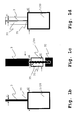
- Figures 1b to 1d schematically show three exemplary embodiments of the means for connecting 3 the implant 20.
- Figures 1b to 1d illustrate possible embodiments of the means for connecting 3 each having an adapted reduced cross section with respect to the implant 20.
- the cross section ratio (representing the quotient of the medical device cross section divided by the cross section of the means for connecting the first electrode) is greater than 1 and less than 4.
- the reduced cross section of the means for connecting 3 is illustrated by the diameters d1 and d2 with d1 ⁇ d2.
- the adapted reduced cross section is particularly determined in the vicinity or the area of the interface 35 between the implant 20 and the means for connecting 3.
- the means for connecting 3 the first electrode 1 are embodied as a wire 3.
- the wire 3 is embodied as a, preferably cylindrical, rod 3.
- the rod 3 is embodied both for enabling the electrical contact and for holding the implant 20.
- Figure 1c illustrates the coating configuration for a nut as an implant 20. Since nuts 20 are generally quite small, for instance below or equal to 1 cm, the coating of a nut 20 is quite "complicated".
- the means for connecting 3 the first electrode 1 are also embodied as a wire 3.
- the wire 3 is partially embodied as a, preferably cylindrical, rod 3.
- the end-section of the rod 3 is embodied with a thread 31.
- the nut 20 is screwed on the thread 31.
- a cap 32 is applied or screwed to the end-section of the thread 31.
- the gaps above and below the nut 20 have a size of about 1 mm.
- the application of such a cap 32 enables the formation of a uniform coating also on the upper and the lower front side of the nut 20.
- the cap 32 represents means for adapting the electrical field.
- the rod 3 is embodied both for enabling the electrical contact and for holding the implant 20.
- the means for connecting 3 the first electrode 1 (respectively the implant 20) are embodied as well as a wire 3.
- the wire 3 is now embodied as a strand 3.
- the strand 3 enables only the electrical contact. It is fedthrough a holder 33 which is preferably non-conductive.
- the holder 33 mechanically holds the implant 20.
- the AC voltage is provided by the power supply 10 (see figure 1a ).
- the application of an asymmetric pulsed AC voltage results in a dense coating.
- the positive part of the pulse enables the growing of the converted surface.
- the converted surface is characterized by a dense structure. With increasing oxide layer coating thickness the coating is getting more and more porous. The particles of the coating are getting more and more loosen. These loosen particles are removed in the negative part of the pulse. Accordingly, the negative part of the pulse is a so-called etching part.
- An asymmetric AC voltage is a voltage with different amplitudes to the positive and negative components. In particular the quotient of the positive amplitude divided by the negative amplitude needs to be adjusted.
- the absolute value of the quotient ranges from > 1 to 4.
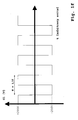
- figure 1e schematically shows an asymmetric AC voltage distribution for amplitudes U1 of +200 V and -50V. These voltages are for instance applied to the implant 20 as the first electrode 1 (see figure 1a ). In this embodiment the voltage of the second electrode 2 is for instance on ground potential.
- the shape is illustrated as being approximately rectangular-shaped. The shape can also be, in particular partially, a kind of a sinus or a sinus. For some applications also a symmetric AC voltage distribution is suitable. One exemplary application is the obtaining of a coating with a very high surface roughness for improved implant-bone bonding.
- figure 1f schematically shows a symmetric AC voltage distribution for amplitudes U1 of -200 V and +200V.
- Nanosilver particles with a particle size of about 1 to 20 nm, preferably 15 nm, are very suitable. This leads to an enhanced specific surface area and therefore to a high amount of dissolvable silver ions.
- the silver ions are responsible for the specific activity against a broad variety of bacteria, fungi and yeasts.
- Silver ions inactivate critical physiological functions like cell-wall synthesis, trans-membrane transport, nucleic acid reproduction or protein functions. All of these actions result in a short-term death of microorganisms. Because of this multiple modes of antimicrobial action, it is very improbable, that the microorganisms develop a resistance to silver. Beyond the antimicrobial activity of the silver ions, new research projects show, that nanosilver in particular shows an activity against viruses like HIV or hepatitis.
- FIGS 2a to 11b show experimental results of an Ag-TiO 2 coating according to the invention.
- the used substrate or implant material is TiAl6V4 ELI alloy.
- TiAl6V4 ELI alloy (Extra Low Interstitials, ISO 5832-3) is a higher purity grade of TiAl6V4 alloy. This grade has lower oxygen, carbon, and iron content. It is commonly used in biomedical applications such as surgical instruments and orthopedic implants.
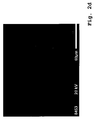
- figures 2a to 2d show the results of a topographical characterization (according to ISO/TS 10993-19:2006).
- a screw having a coating according to the invention was analyzed.
- the coating surface topography has been investigated by stereo light microscopy ( figure 2a ) and scanning electron microscopy (SEM) in topography contrast mode ( figures 2b to 2d ).
- the images show a uniform and homogeneous coating of the surface ( figures 2a and 2b ). At higher magnification the characteristic features of the PEO coatings are revealed: flat elevated plateaus with some deepening between them ( figure 2c ). The average deepening is 20 ⁇ m deep ( figure 2d ). The topographical characterization reveals a dense coating with a high specific surface area.
- Figures 2c and 2d show the typical features of a converted surface by PEO.
- figure 2e schematically shows a converted surface in a cross sectional view.
- the converted surface is continuously covered with the oxide layer.
- a typical thickness is below 25 ⁇ m.
- the oxide film is characterized by hills and/or plateaus separated by grooves and/or channels.
- On top of the oxide layer said islands are developed forming a non-continuous layer of metallic Ag and partially Ag0.
- the islands can be formed on the plateaus and in the grooves.
- the islands have a typical thickness below 100 nm and a typical diameter ranging from 5 nm to 200 nm.
- Figures 3a and 3b show the results of a physico-chemical characterization (according to ISO/TS 10993-19:2006).
- the SEM images in chemical contrast mode show the presence of a heavy element on the coating surface, in particular embodied as island (bright areas on figure 3b ).
- Energy-dispersive spectrometry (EDS) confirms the presence of silver ( figure 3a ).
- Silver is homogeneously or uniformly distributed all over the coating surface. The typical silver-containing areas are much less than 1 ⁇ m.
- the coating surface is mostly composed of titanium oxide with silver and carbon. Extremely low amount of nitrogen, chlorine and sulfur has also been found as contaminants.
- XPS depth profiling (sputtering with a 3 keV Ar ions beam, surface area 3,8 x 4,2 mm) was performed on the coating to investigate its in-depth composition uniformity; an estimation of the thickness of the silver containing part of the coating was thus obtained: ⁇ 100 nm.
- the O binding spectra refer mainly to TiO 2 , with a small amount of other metal oxides (mainly Al and Ag).
- the Ag binding spectra shows the presence of silver oxides and metallic silver, no silver chloride was observed.
- nanoSilver-coating is the prevention of problematic bacterial growth on the surface of coated materials for osteosynthesis.
- One task of the invention is to find an optimal silver concentration for the coating, which shows a high antibacterial activity without any cytotoxic effect (according to ISO 10993-5).
- the bacteria strain was used for every test: Staphylococcus epidermidis ATCC 35984.
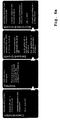
- FIG. 5a illustrates the steps to prepare the samples and figure 5b shows the results of said biofilm formation test:
- test is conducted with exponentially growing bacteria with commercially available 96-well-microtiter-plate.
- the test specimens ideally have a cylindrical shape with 4 mm diameter and a length of 12 mm.
- the bacterial proliferation is determined by measuring the optical density at 578 nm in a special designed 64-fold-photometer.
- the antibacterial efficacy of the nanoSilver coating is estimated by comparing the bacterial growth on that surface with an untreated surface (Blank).
- a test for antimicrobial activity and efficacy is performed according to JIS Z2801.
- the JIS Z 2801 standard specifies the testing methods to evaluate antimicrobial activity and antimicrobial efficacy on bacteria on the surface of antimicrobial products.
- the value of antimicrobial activity shows the difference in the logarithmic value of viable cell counts between antimicrobial products and untreated products after inoculation and incubation of bacteria. So in contrast to the Proliferation test the antibacterial activity can be quantified.
- This testing method is applicable to products other than textile products, such as plastic products, metal products, and ceramic products.
- test samples were inoculated with a certain number of bacteria after preparation. To assure a good distribution of the inoculum, the test piece is covered with a special film (PE-foil). The test pieces are incubated at 37°C for 18 h. After incubation, the bacteria were washed out with nutrient solution. With this washing suspension a viable cell count (agar plate culture method) is conducted.
- PE-foil a special film
- test procedure is as following:
- test steps are analogue in both test series:
- Figure 7 shows analytical results obtained by GF-AAS of released Ag amount (ng) from the sample surface (mm 2 ) as a function of immersion time (days) at RT in PBS.
- the displayed error bars show the variance of three independent analyses.
- the leaching rate is essentially uniform as a function of immersion time.
- the antibacterial activity corresponds to the amount of released silver ions.
- Test series B According to our kinetics-test-conditions an equilibrium is reached after 24 hours. Ag aq + ⁇ Ag solid + from oxidized Ag AgCl , Ag 2 ⁇ O ...
- Figure 8 shows GF-AAS results of released Ag (ng) from the sample surface (mm 2 ) as a function of time (days) at 37°C in PBS.
- the analytical data are a mean value of three independent analyses.
- the leaching rate is essentially uniform or constant as a function of immersion time.
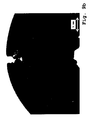
- Figures 9a and 9b show the results of a mechanical testing. Stereo light microscopy images of a coated rod after bending test are presented. The Ag-TiO 2 coating adhesion has been investigated according to the ASTM B571-97 standard. The coated samples have been bent at various angles and the deformed area has been observed by stereo light microscopy for any sign of peeling or flaking of the coating from the substrate. No peeling or flaking of the coating has been observed even after failure of the substrate has occurred. The adhesion strength of the coating is greater than the cohesion strength of the substrate, which reveals a perfect adhesion according to the used standard.
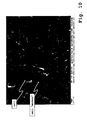
- Figure 10 shows the experimental results with respect to biocompatibility evaluation: ZK20 cells growing on nanoSilver/TiAl6V4 disks.
- the two types of cell present a good adhesion and proliferation on the two types of surfaces (TiAl6V4 and nanoSilver).
- the two types of cell tend to agglomerate on the nanoSilver coating surface.
- an Ag-TiO 2 coating according to the invention shows excellent properties in terms of antibacterial efficacy (even against multi-resistant strains), adhesion and biocompatibility.
- figure 11 presents a XRD image of a Ti-screw with a HA coating (hydroxyapatite). In detail it is presented the detected number of counts as a function of the angle 2 theta.
- the sample contains mostly Titanium and Anatase (TiO 2 ). Titanium and TiO 2 originate from the bulk respectively the converted surface. Also a very small quantity of HA is detected. The intensity differences of certain HA peak is due to a preferential orientation of the crystallites on the surface of the screw. However, these are the first hints that it is possible to detect HA itself on the converted surface and not only constituents of HA.
- the small amount of detected HA can be explained by the selected configuration of the experimental set-up.
- the chosen angular range of the analysis beam results in an enhanced sensitivity to the bulk material (Ti) covered with a layer of TiO 2 (thickness of several ⁇ m) and to a reduced sensitivity to a surface and a near surface composition of HA (thickness of some 100 nm or below).
Landscapes
- Health & Medical Sciences (AREA)
- Chemical & Material Sciences (AREA)
- Life Sciences & Earth Sciences (AREA)
- Engineering & Computer Science (AREA)
- General Health & Medical Sciences (AREA)
- Medicinal Chemistry (AREA)
- Veterinary Medicine (AREA)
- Public Health (AREA)
- Epidemiology (AREA)
- Animal Behavior & Ethology (AREA)
- Organic Chemistry (AREA)
- Metallurgy (AREA)
- Materials Engineering (AREA)
- Electrochemistry (AREA)
- Chemical Kinetics & Catalysis (AREA)
- Inorganic Chemistry (AREA)
- Dermatology (AREA)
- Oral & Maxillofacial Surgery (AREA)
- Transplantation (AREA)
- Biomedical Technology (AREA)
- Molecular Biology (AREA)
- Heart & Thoracic Surgery (AREA)
- Surgery (AREA)
- Vascular Medicine (AREA)
- Materials For Medical Uses (AREA)
- Prostheses (AREA)
Description
- The present invention relates generally to a multifunctional antibacterial coating which is composed of silver, to implants and/or to medical tools comprising such a coating and to a method as well to an apparatus for the production of such a coating.
- It is known that silver ions strongly inhibit the growth of bacteria and other microorganisms. Silver ions destroy important cell components of microorganisms, so that their vital functions do not work anymore. Silver shows a broad-spectrum antibacterial activity and is even efficient against antibiotic-resistant strains. Moreover, silver targets numerous sites within the bacterial cell, thus decreasing the chance for the bacteria to develop any kind of resistance.
- With increasing resistance of most of the pathogen germs against the usually used antibiotics, silver was recently rediscovered as an antibacterial active substance. In fact, due to his disinfectant property, silver has long been used for hygienic and medicinal purposes.
- For instance, silver compounds were major weapons against wound infection in World War I until the advent of antibiotics. In 1884 German obstetrician C.S.F. Crede introduced 1% silver nitrate as an eye solution for prevention of Gonococcal ophthalmia neonatorum, which is perhaps the first scientifically documented medical use of silver. Further, silver sulfadiazine cream was a standard antibacterial treatment for serious burn wounds and is still widely used in burns units.
- Currently, many silver containing products are available on the market such as wound dressings, catheters and/or tumor prosthetic systems.
- One known coating fabrication method bases on a vacuum coating method which offers reliable protection for the surfaces of medical implants against bacterial contamination. A pure silver coating is applied via a PVD (Physical Vapor Deposition) process followed by a silicon oxide coating deposited via a PECVD (Plasma Enhanced Chemical Vapor Deposition) process. The coating thickness is generally below 200 nm.
- PVD and CVD processes usually require highly expensive coating systems. Further, they are also energy consuming due to the high vacuum requirements. Furthermore, the PVD technique is a "line-of-sight" technique, which means that complex surfaces would be very hard to coat homogeneously.
- Moreover, irreversible pigmentation of the skin and/or the eye, i.e. argyria or argyrosis, due to possible "excessive" silver deposition, may develop after prolonged exposure to silver or silver compounds.
- Besides, leukopenias and neuromuscular damages could be caused by increased silver concentrations. Allergic reactions were described in the literature. Past coating attempts with silver salts or elementary silver were reported to cause significant increases of silver concentrations in the serum of the concerned patients.
- Accordingly, it is an object of the present invention to provide a medical device, for instance embodied as an implant, having a coating of advanced properties.
- Preferably such a coating should be provided as an antibacterial coating, for instance on metallic implants.
- In particular it should be possible to control or to adapt the antibacterial efficacy, for instance the leaching rate, of such a coating.
- Preferably the ingrowth of human tissue and/or bone should be promoted by such a coating on an implant.
- The fabrication of such a coating should base on an easy and cost reduced concept.
- The inventive solution of the object is surprisingly achieved by each of the subject matter of the respective attached independent claims.
- Advantageous and/or preferred embodiments or refinements are the subject matter of the respective attached dependent claims.
- Accordingly, the invention proposes a method for treating a surface of a medical device, as defined in
claim 1, in particular a metallic medical device, preferably of a non-biodegradable material, comprising the following steps: - providing a colloid-dispersed system,
- subjecting a medical device to the colloid-dispersed system such that a surface of the medical device which is to be treated is immersed in the colloid-dispersed system,
- generating a, preferably asymmetric or symmetric or a combination of both asymmetric and symmetric, AC voltage difference between the medical device as a first electrode and/or a second electrode positioned in the colloid-dispersed system
- The invention also proposes a medical device comprising a, preferably non-biodegradable, metal or metal alloy having a treated surface wherein
- the treated surface is at least partially converted to an oxide film by plasma electrolytic oxidation using a colloid-dispersed system and wherein
- the converted surface is partially covered by islands formed by colloid-dispersed particles of the colloid-dispersed system.
- A porous oxide film or layer is grown by the plasma electrolytic oxidation (PEO) process. By the PEO process, the metallic substrate is provided as the first electrode, preferably as an anode, in an "electrolytic cell". Its surface is converted into the corresponding metal oxide under the applied electrical field. The oxide film consists of crystalline phases, with a highly porous surface and with components derived from both the colloid-dispersed system and the medical device, for instance an implant, as a substrate. It is provided a synthesis of a metal-oxide-particle-nanocomposite-coatings by in situ deposition. The particles are applied onto the surface of the medical device when oxidizing the medical device surface. The present invention enables the formation of a coating onto any type of shape of a medical device.
- The colloid-dispersed system also can be called dispersion. It is a liquid containing dispersed particles, in particular the colloid-dispersed-particles. The colloid-dispersed-particles have a mean average diameter of less than or equal to 100 nm, preferably less than or equal to 50 nm, most preferably less than or equal to 30 nm. The particles are also named as nano-particles. The particles are dispersed and not dissolved in the colloid-dispersed system.
- Preferably the particles are not provided as a powder having generally a broad size distribution. In a preferred embodiment the particles have a narrow size distribution with a FWHM (full width at half maximum) of ≤ 25 nm. Such a size distribution enables the formation of uniform islands and an improved conductivity in the dispersion.
- In one preferred embodiment the particles are provided by silver-particles (Ag-particles or Ag-nano-particles). Such a nanoSilver coating on medical device surface, for instance an implant surfaces, shows several beneficial effects: a reduction of bacterial adhesion, and an inhibition of bacterial growth. So far, no resistance mechanism was reported and detected against silver effect. Since silver acts more like an antiseptic than an antibiotic. Such a nanoSilver coating shows excellent properties in terms of antibacterial efficacy (even against multi-resistant strains), adhesion and biocompatibility (for further benefits see the detailed description of the invention). This nanoSilver containing layer is provided by a surface chemical conversion of the implant induced by means of the plasma electrolytic oxidation.
- As a supplement or as an alternative, the particles are provided by apatite-particles, preferably HA-particles (hydroxyapatite). The apatite is at least one apatite selected from a group consisting of hydroxyapatite, Si-substituted hydroxyapatite, flourapatite and carbonated apatites. At least one Ca-atom of an apatite can be replaced by a Mg, Zn, Cu, Na, K and Sr.
- Hydroxyapatite improves osteoconduction. This enables for instance a strong fixation of an implant inserted in a human or animal body. The HA-particles according to the invention also cover HA-Si-compounds (Si-substituted hydroxyapatite). A HA-Si-compound is HA-compound in which at least one PO4 3- group is replaced by a SiO4 3- group. Such a HA-Si-compound is characterized by an enhanced biocompatibility.
- As a further supplement or as a further alternative, the particles are provided by at least one type of particles selected from a group consisting of copper and zinc. This type of particles also shows an antibacterial effect.
- In a further embodiment an additive, preferably a nano-sized additive, is provided in the dispersion. Accordingly, the particles comprise an additive wherein the additive is at least one material selected from a group consisting of metals, oxides, earth minerals and phosphates. Some typical examples are magnesia, calcium phosphate, α-TCP (tricalcium-phosphate), sodium water glass, potassium water glass and/or silicon. Glass water is effective in bone mineralization. The additive is dissolved or dispersed in the colloid-dispersed system. It is emphasized that above mentioned additives are exemplary and not restricted to this enumeration.
- The colloid-dispersed system can be based on any kind of liquid, in particular of low or zero conductivity. In one embodiment the colloid-dispersed system is provided as a water-based dispersion. Preferably the dispersion means are pure water or ion-exchanged water. The used water essentially comprises no electrolytes. In a preferred embodiment intentionally no additional electrolytes are introduced in the distilled water. The ph-value of the used water is less than or equal to 7 or the ph-value of the used water is less than or equal to 7,4.
- The particles as the dispersed phase of the dispersion are provided with a concentration of less than or equal to 100 mg/l, preferably less than or equal to 20 mg/l, most preferably less than or equal to 2 mg/l. In the most preferred embodiment the concentration is less than or equal to 2 mg/l. This value is in particular suitable for metallic particles, in particular for Ag-particles to avoid cytotoxic effects. Moreover, these values are in particular suitable for metallic particles, in particular Ag-particles, to provide a sufficient conductivity in the colloid-dispersed system.
- In a preferred embodiment the conductivity in the colloid-dispersed system is essentially only or only provided by the colloid-dispersed-particles themselves. This is in particular suitable for metallic particles, as for instance Ag-particles, in particular in combination with an emulsifier. Preferably the particles, for instance Ag-nano-particles, are the only carrier or the most active carrier for the electrical charge in the dispersion. In a preferred embodiment the particles or metallic particles are provided by a material, forming the islands on the oxide film. One material example represents silver. As a supplement or as an alternative the metallic particles or the dispersed metallic particles are provided by a component which is a component of the substrate material. For instance the particles are provided by Ti-particles if the substrate (representing the medical device) comprises titanium. A contamination can be avoided. Also dissolved material, as for instance dissolved material of an immersed medical device, can contribute to the conductivity in the colloid-dispersed system.
- As an alternative or as a supplement at least one electrolyte is provided in the colloid-dispersed system. The electrolyte is dissolved in the colloid-dispersed system. In one embodiment the electrolyte comprises at least one material selected from a group consisting of metals, oxides, earth minerals and phosphates. In another embodiment the electrolyte comprises at least one electrolyte selected from a component of the substrate material. I.e. the electrolyte is adapted to the substrate material. For instance the electrolyte is provided by Ti-ions if the substrate (representing the implant) comprises titanium. A contamination can be avoided. It is emphasized that above mentioned electrolytes are exemplary and not restricted to this enumeration.
- In a further embodiment a gas is provided in the colloid-dispersed system. The gas is for instance provided by a kind of bubbling. Particularly the gas is provided such to influence the PEO and/or to participate in the PEO. The gas comprises at least one type of gas selected from a group consisting of N2, Ar, Kr and Xe. The mentioned noble gases are in particular suitable to achieve an enhanced densification of the converted layer.
- The converted medical device surface, for instance the converted implant surface, is uniformly covered with the oxide layer. Preferably the converted surface is continuously covered with the oxide layer. The oxide film has a thickness of 1 µm to 100 µm, preferably 10 µm to 100 µm, most preferably of 20 µm to 40 µm. The oxide film is characterized by hills and/or plateaus separated by grooves and/or channels. Such an appearance represents a typical feature of a PEO process. Such a structure results in a medical device surface or implant surface of large specific surface area.
- As already stated in the preceding description the particles are applied onto the surface of the medical device when oxidizing the medical device surface. A small fraction of the particles are also embedded in the oxide layer. The main fraction of the particles is deposited onto the surface of the oxide layer forming the islands.
- There exists no sharp interface between the oxide layer and the deposited particle layer. The particle concentration in the surface converted medical device, for instance the surface converted implant, is decreasing, preferably continuously decreasing, with increasing depth.
- The islands are provided by means of micro-arcs in the PEO process, for instance by implantation and/or deposition and/or agglomeration of the dispersed particles. The islands are surrounded by the oxide layer. The islands have a typical average-size of less than 300 nm. An average thickness is in the range of 5 nm to 400 nm. Some islands also can be connected to each other. Typically, there is essentially no or only few porosity in the islands, in particular forming nano-areas.
- However, the islands represent a non-continuous layer or film, for instance of silver, on the oxide film. In one embodiment the medical device surface is a TiO-Ag-nano-composite-coating. Accordingly, the elements or compounds Ti, TiO2, Ag and AgO are directly "visible" respectively detectable on the surface. The treated surface has an average island cover amount of below or equal to 20%, preferably below or equal to 10%.
- A chemical characterization of a treated surface results in a composition of colloid-dispersed-particles, preferably silver, of 0.5 to 10 at. %, preferably 1 to 10 at. % most preferably 2 to 6 at. %.
- The chemical characterization of nano-silver on titanium or on a titanium alloy results in the following composition:
Ag Ti Al V O at. % 1-10 5-40 0-5 0-2 30-70 - The controlling of the covering amount of the islands can be used to adjust the "effect" of the islands. For instance the antibacterial efficacy can be adjusted. One parameter for the antibacterial efficacy represents the leaching rate for instance of silver ions.
- In the embodiment of Ag-particles the treated surface has an Ag ions leaching rate of less than 120 ng.cm-2.day-1. A surface treatment with silver respectively nanoSilver shows a very high antimicrobial efficacy with very small potential side effects. Due to the high surface on volume ratio of nanoparticles (size preferably between 2 and 50 nm), a high efficiency is expected even at small doses, thus, reducing the risk of noxious effect on cells.
- The AC voltage or alternating voltage is applied to the first electrode and/or the second electrode. The AC voltage is provided with a frequency of 0,01 Hz to 1200 Hz.
- In a preferred embodiment the AC voltage is provided as an asymmetric AC voltage. The asymmetric AC voltage difference or asymmetric AC voltage represents an unbalanced AC voltage. This is an alternating voltage with different amplitudes to the negative and the positive components. It is emphasized that a pulsed DC voltage can be also interpreted as the AC voltage. The negative component is provided with an amplitude ranging from -1200 V to -0,1 V. Preferably, the negative component is provided with an amplitude ranging from -350 V to -0,1 V. In one embodiment, the negative component is provided with an amplitude below -180 V or ranging from -350 V to -180 V. The positive component is provided with an amplitude ranging from 0,1 V to 4800 V. Preferably, the positive component is provided with an amplitude ranging from 0,1 V to 1400 V. In one embodiment, the positive component is provided with an amplitude above +250 V or ranging from + 250 V to 1400 V. In particular the quotient of the positive amplitude divided by the negative amplitude needs to be adjusted. The absolute value of the quotient ranges from larger 1 to 4.
- In another embodiment the AC voltage is provided as a symmetric AC voltage. The negative component of the AC voltage is provided with an amplitude ranging from -2400 V to -0,1 V. Preferably, the negative component is provided with an amplitude ranging from -1200 V to -0,1 V. The positive component of the AC voltage is provided with an amplitude ranging from +0,1 V to +2400 V. Preferably, the positive component is provided with an amplitude ranging from 0,1 V to 1200 V.
- A combination of both an asymmetric and a symmetric AC voltage is also possible. Such a voltage distribution is for instance suitable for a step-by-step-process or a multi-step-process for the fabrication of one coating. In a first step an asymmetric voltage or a symmetric voltage is applied to form the coating. In a further or second step, in particular after an interruption, the formation of the coating is continued by the application of a symmetric voltage or an asymmetric voltage respectively.
- The voltage difference is provided with a magnitude which is sufficient for carrying out PEO. The voltage is above a breakdown voltage of the oxide film growing on the surface of the implant. Preferably the maximum of the AC voltage difference is provided in the range of 0.1 V to 4800 V. Most preferably the maximum of the AC voltage difference is provided in the range of 100 V to 1400 V. In dependence on the conductivity of the colloid-dispersed system and an optional additional electrolyte, the applied voltage difference results to a current density of 0,00001 to 500 A/dm2, preferably of 0,00001 to 100 A/dm2. Preferably, the the applied voltage or voltage distribution is essentially constant or unchanged and the current density is adjusted during the PEO process.
- A deposition rate in the range of 0,01 µm/s to 1 µm/s is achieved. Accordingly, with respect to the advantageous thickness of the oxide layer and/or the particles islands a deposition time in the range of 1 s to 1200 s, preferred 1 s to 300 s, most preferred 20 s to 260 s, is achievable.
- To enable a stable dispersion, the colloid-dispersed system is provided with a temperature of -20°C to +150°C, preferably -20°C to +100°C, most preferably between 0°C to 75°C. The colloid-dispersed system is circulated with a circulation rate of 0 to 5000 liter/min, preferably 0,01 to 500 liter/min. This is for instance achieved by a mixer or mixing means or stirring means. As an optional supplement an emulsifying agent or emulsifier is provided in the colloid-dispersed system, in particular to avoid or to reduce an agglomeration of particles. A typical volume of the colloid-dispersed system is in the order of 0,001 liter to 500 liter, preferably 0,1 liter to 500 liter, most preferably 3 to 20 liter. Such volumes support an improved electrical field distribution in the dispersed system.
- An initial medical device surface without any polishing is sufficient to achieve a suitable uniform converted surface and a suitable stable bonding of the converted surface to the bulk material. The initial surface describes the surface before subjecting the medical device to the PEO process. A mechanically polishing of the initial surface is sufficient to achieve enhanced properties. A cost-intensive electro-polishing resulting in a very smooth surface is not necessary.
- The invention also proposes an apparatus for the treatment of a surface of a medical device, in particular a metallic medical device, by plasma electrolytic oxidation comprising following components:
- a bath for containing a colloid-dispersed system,
- preferably means for mixing a colloid-dispersed system in the bath,
- means for holding a medical device such that a surface of a medical device which is to be treated is immersed in a colloid-dispersed system wherein a medical device provides a first electrode,
- means for providing a second electrode in a colloid-dispersed system contained in the bath,
- a power supply unit for generating an AC voltage which is supplied to the first electrode and/or the second electrode,
- means for connecting the first electrode and/or the second electrode to the power supply unit wherein
- the means for connecting the first electrode are adapted to an immersed medical device such that the cross section ratio ranges from 0,1 to 10. Preferably, the cross section ratio ranges from 0,75 to 4.
- The cross section ratio represents the quotient of the medical device cross section divided by the cross section of the means for connecting the first electrode. The adapted ratio is particularly determined in the vicinity of the interface between the medical device and the means for connecting.
- Preferably the means for connecting the first electrode are embodied to provide an essentially uniform electric field distribution between the first electrode and the second electrode, in particular in the vicinity of the treated surface of the medical device.
- A uniform electric field distribution between the first electrode and the second electrode is advantageous to achieve a surface conversion of enhanced uniformity. The inventors surprisingly discovered that the electric field distribution between the first electrode and the second electrode is strongly influenced by the embodiment of the means for connecting the first electrode. In detail, the electric field distribution is strongly dependent on the design and/or the dimensions of the means for connecting the first electrode.
- The required uniform electric field distribution is achieved by means for connecting the first electrode having an adapted reduced or an adapted increased cross section with respect to the cross section of the connected medical device. In one embodiment the means for connecting the first electrode have a, preferably circular, cross section with an average diameter of less than or equal to 5 mm, preferably less than or equal to 1,5 mm. In a preferred embodiment the means for connecting the first electrode are provided as a wire. The wire is metallic. The wire is embodied to carry an electric current and is for instance embodied as a thread, a rod or a strand. The wire can be flexible or non-flexible. The means for connecting the first electrode are fixed to the medical device as the first electrode. The means for connecting the first electrode, in particular the wire, can be fixed by welding, gluing, clamping and/or screwing. Preferably, the means for connecting the first electrode are provided with the same material as a connected medical device. It is emphasized that the means for connecting the first electrode can be also provided by the means for holding the medical device. I.e. the means for holding the medical device and the means for connecting the medical device are provided by only one component. In one embodiment the means for connecting the first electrode are at least partially provided with a thread.
- In a further embodiment means for adapting the electrical field are provided. For instance the means for adapting the electrical field are provided as a component to avoid edges and therefore to avoid regions of enhanced electrical field density. In one variant according to the invention the means for adapting the electrical field are embodied as a cap. This cap can be screwed on the thread.
- In another embodiment a gas supply to the colloid-dispersed system is provided.
- The antibacterial coatings according to the invention could be used in the field of traumatology, orthopaedic, osteosynthesis and/or endoprothesis, especially where high infection risk exists. A high number of currently existing implants or products could benefit from such a anti-bactericidal coating.
- The medical device is a medical device which is at least partially inserted or positioned in a human body and/or an animal body. The medical device can be any kind of a medical device.
- In one embodiment the medical device is an implant. The implant is a dental implant or an orthopaedic implant. Exemplary embodiments of such an implant according to the invention are plates, screws, nails, pins, and/or all, preferably external, fixation systems. It is emphasized that these applications are exemplary and not restricted to this enumeration.
- In another embodiment the medical device is a medical instrument or tool. Exemplary embodiments of such a medical instrument are surgical instruments and/or diagnostic instruments. One example of a surgical instrument represents a scalpel. One example of a diagnostic instrument represents an endoscope. It is emphasized that these applications are exemplary and not restricted to this enumeration.
- The surface converted implants according to the invention base in a preferred embodiment on biocompatible materials but preferably not on biodegradable materials. They are intended for long-term application, for instance for several days up to months, and/or for quasi-permanent application, as for instance for long term implantation of surgical implants and/or prothesises. However, the present invention is also applicable for biodegradable materials.
- The implant comprises at least one metal selected from the group consisting of titanium, titanium alloys, chromium alloys, cobalt alloys and stainless steel. An alloy comprises at least 50 weight-% of the named main element. Some typical examples for titanium alloys are TiAl6V4, TiAl6Nb7 and/or TiZr. Some typical examples for chromium alloys are CrNi and/or CrNiMo. Some typical examples for cobalt alloys are CoCr and/or CoCrMo. Some typical examples for stainless steel are types 316L and/or 304. It is emphasized that above mentioned alloys are exemplary and not restricted to this enumeration.
- In particular the apparatus according to the invention is adapted to execute any of the method steps according to the invention. In particular the method according to the present invention is feasible by means of the apparatus according to the invention. In particular the medical device, for instance an implant, according to the invention is producible, preferably is produced, by means of the apparatus according to the invention and/or with the method according to the invention. The or a medical device, for instance embodied as an implant, comprises a surface composed of an oxide film which is partially covered with islands of an antimicrobial material, preferably silver, and/or with an apatite, preferably HA.
- The invention is explained subsequently in more detail on the basis of preferred embodiments and with reference to the appended figures. The features of the different embodiments are able to be combined with one another. Identical reference numerals in the figures denote identical or similar parts.
- It is shown in
- Fig. 1a
- schematically an apparatus for the fabrication of a coating according to the invention,
- Fig. 1b
- schematically a first embodiment of the means for electrically connecting the medical device,
- Fig. 1c
- schematically a second embodiment of the means for electrically connecting the medical device,
- Fig. 1d
- schematically a third embodiment of the means for electrically connecting the medical device,
- Fig. 1e
- schematically one embodiment of an asymmetric AC voltage distribution
- Fig. 1f
- schematically one embodiment of a symmetric AC voltage distribution and
- Fig. 2a to 10
- show results of an Ag-TiO2 coating according to the invention.
- In detail, it is shown in
- Figures 2a-e:
- images of the nanoSilver coating using Stereo Light Microscopy (a), SEM in topography contrast mode (b-c), tilted SEM in topography contrast mode (d), a schematic cross sectional view of the converted surface (e),
- Figures 3a-b:
- (a) an SEM image of the nanoSilver coating in chemical contrast mode, (b) an EDX spectra of the bright region,
- Figures 4a-b:
- XPS depth profile analysis of the nanoSilver coating,
- Figure 5a:
- the method steps for the preparation of the biofilm test,
- Figure 5b:
- bacteria amount found on the nanoSilver, Ag-rods and Ti-alloy rods after 12h of incubation,
- Figures 6a-6e:
- the method steps for the preparation of the proliferation test (a), the interpretation of the growth curves (b-d), the achieved experimental results (e),
- Figures 7:
- analytical results obtained by GF-AAS, in a pseudo-dynamic model,
- Figure 8:
- analytical results obtained by GF-AAS, in a static model,
- Figures 9a-9b:
- Stereo Light Microscopy images of a coated rod after bending test,
- Figure 10:
- SEM image of ZK20 cells on nanoSilver coating and
- Figure 11:
- XRD image of a converted Ti-surface with a HA coating.
- Subsequently, preferred but exemplar embodiments of the invention are described in more detail with regard to the figures.
-
Figure 1 illustrates an apparatus for the fabrication of a coating according to the invention. The subsequent detailed description is only directed to an implant as one exemplary embodiment of a medical device. For instance for the coating of long term implantation surgical implants the present innovative technique based on the Plasma electrolytic oxidation (PEO) has been developed. PEO is an electrochemical surface treatment process for generating oxide coatings on metals. As a pulsed alternating current, with a high voltage, is passed through the colloid-dispersedsystem 4 or theelectrolyte bath 4, a controlled plasma discharge is formed and sparks are generated on the substrate surface. This plasma discharge converts the surface of the metal into an oxide coating. The coating is in fact a chemical conversion of the substrate and grows both inwards and outwards from the original metal surface. Because it is a conversion coating, rather than a deposited coating (such as a coating formed by plasma spraying), it has excellent adhesion to the substrate metal (seefigures 9a and9b ). A wide range of substrate alloys can be coated with this technique. - The dispersed
system 4 is provided in abath 5. Animplant 20 as afirst electrode 1 is provided in the dispersedsystem 4. In the illustrated embodiment theimplant 20 is completely immersed in theliquid 4 respectively the dispersedsystem 4. Asecond electrode 2 is provided as a cup also immersed or provided in the colloid-dispersedsystem 4. Thesecond electrode 2 "surrounds" thefirst electrode 1. - The temperature of the dispersed
system 4 is maintained or controlled by aheat exchanger 6 and/or a pumping system 7 and/or means for mixing 8. A circulation and/or mixing of the dispersedsystem 4 is achieved by the means for mixing 8. The means for mixing 8 are for instance provided by an acoustic hydrodynamic generator. As a possible and shown supplement agas supply 9, for instance for air, can be also provided to the means for mixing 8. The circulation of the liquid avoids an agglomeration of the nano-particles contained in the dispersedsystem 4. - In a further non-shown embodiment the
second electrode 2 is provided by thebath 5 or thecontainer 5 itself. This is for instance suitable for acontainer 5 which is provided by a conductive material. In such an embodiment thebath 5 and thesecond electrode 2 are provided as one-piece. - In a preferred embodiment the
first electrode 1 is approximately positioned in the center of thesecond electrode 2 to achieve a uniform electrical field distribution. The design of the means for connecting 3 thefirst electrode 1 is chosen to preserve an essential uniform or adapted electric field distribution between thefirst electrode 1 and thesecond electrode 2. For this the cross section and/or the geometry of the means for connecting 3 theimplant 20 is/are adapted to the cross section and/or the geometry of theimplant 20.Figures 1b to 1d schematically show three exemplary embodiments of the means for connecting 3 theimplant 20. -
Figures 1b to 1d illustrate possible embodiments of the means for connecting 3 each having an adapted reduced cross section with respect to theimplant 20. Accordingly, the cross section ratio (representing the quotient of the medical device cross section divided by the cross section of the means for connecting the first electrode) is greater than 1 and less than 4. The reduced cross section of the means for connecting 3 is illustrated by the diameters d1 and d2 with d1 < d2. The adapted reduced cross section is particularly determined in the vicinity or the area of theinterface 35 between theimplant 20 and the means for connecting 3. - In
figure 1b the means for connecting 3 the first electrode 1 (respectively the implant 20) are embodied as awire 3. Thewire 3 is embodied as a, preferably cylindrical,rod 3. Therod 3 is embodied both for enabling the electrical contact and for holding theimplant 20. -
Figure 1c illustrates the coating configuration for a nut as animplant 20. Sincenuts 20 are generally quite small, for instance below or equal to 1 cm, the coating of anut 20 is quite "complicated". The means for connecting 3 thefirst electrode 1 are also embodied as awire 3. Thewire 3 is partially embodied as a, preferably cylindrical,rod 3. The end-section of therod 3 is embodied with athread 31. Thenut 20 is screwed on thethread 31. Acap 32 is applied or screwed to the end-section of thethread 31. The gaps above and below thenut 20 have a size of about 1 mm. The application of such acap 32 enables the formation of a uniform coating also on the upper and the lower front side of thenut 20. Thecap 32 represents means for adapting the electrical field. Therod 3 is embodied both for enabling the electrical contact and for holding theimplant 20. - In
figure 1d the means for connecting 3 the first electrode 1 (respectively the implant 20) are embodied as well as awire 3. Thewire 3 is now embodied as astrand 3. Thestrand 3 enables only the electrical contact. It is fedthrough aholder 33 which is preferably non-conductive. Theholder 33 mechanically holds theimplant 20. - The AC voltage is provided by the power supply 10 (see
figure 1a ). The application of an asymmetric pulsed AC voltage results in a dense coating. The positive part of the pulse enables the growing of the converted surface. At the beginning of the oxide layer growing process the converted surface is characterized by a dense structure. With increasing oxide layer coating thickness the coating is getting more and more porous. The particles of the coating are getting more and more loosen. These loosen particles are removed in the negative part of the pulse. Accordingly, the negative part of the pulse is a so-called etching part. An asymmetric AC voltage is a voltage with different amplitudes to the positive and negative components. In particular the quotient of the positive amplitude divided by the negative amplitude needs to be adjusted. The absolute value of the quotient ranges from > 1 to 4. For illustration purposesfigure 1e schematically shows an asymmetric AC voltage distribution for amplitudes U1 of +200 V and -50V. These voltages are for instance applied to theimplant 20 as the first electrode 1 (seefigure 1a ). In this embodiment the voltage of thesecond electrode 2 is for instance on ground potential. The shape is illustrated as being approximately rectangular-shaped. The shape can also be, in particular partially, a kind of a sinus or a sinus. For some applications also a symmetric AC voltage distribution is suitable. One exemplary application is the obtaining of a coating with a very high surface roughness for improved implant-bone bonding. For illustration purposesfigure 1f schematically shows a symmetric AC voltage distribution for amplitudes U1 of -200 V and +200V. - Nanosilver particles with a particle size of about 1 to 20 nm, preferably 15 nm, are very suitable. This leads to an enhanced specific surface area and therefore to a high amount of dissolvable silver ions. The silver ions are responsible for the specific activity against a broad variety of bacteria, fungi and yeasts.
- Silver ions inactivate critical physiological functions like cell-wall synthesis, trans-membrane transport, nucleic acid reproduction or protein functions. All of these actions result in a short-term death of microorganisms. Because of this multiple modes of antimicrobial action, it is very improbable, that the microorganisms develop a resistance to silver. Beyond the antimicrobial activity of the silver ions, new research projects show, that nanosilver in particular shows an activity against viruses like HIV or hepatitis.
-
Figures 2a to 11b show experimental results of an Ag-TiO2 coating according to the invention. The used substrate or implant material is TiAl6V4 ELI alloy. TiAl6V4 ELI alloy (Extra Low Interstitials, ISO 5832-3) is a higher purity grade of TiAl6V4 alloy. This grade has lower oxygen, carbon, and iron content. It is commonly used in biomedical applications such as surgical instruments and orthopedic implants. - First,
figures 2a to 2d show the results of a topographical characterization (according to ISO/TS 10993-19:2006). As an example a screw having a coating according to the invention was analyzed. The coating surface topography has been investigated by stereo light microscopy (figure 2a ) and scanning electron microscopy (SEM) in topography contrast mode (figures 2b to 2d ). - The images show a uniform and homogeneous coating of the surface (
figures 2a and2b ). At higher magnification the characteristic features of the PEO coatings are revealed: flat elevated plateaus with some deepening between them (figure 2c ). The average deepening is 20 µm deep (figure 2d ). The topographical characterization reveals a dense coating with a high specific surface area. -
Figures 2c and2d show the typical features of a converted surface by PEO. For illustration purposesfigure 2e schematically shows a converted surface in a cross sectional view. The converted surface is continuously covered with the oxide layer. A typical thickness is below 25 µm. The oxide film is characterized by hills and/or plateaus separated by grooves and/or channels. On top of the oxide layer said islands are developed forming a non-continuous layer of metallic Ag and partially Ag0. The islands can be formed on the plateaus and in the grooves. The islands have a typical thickness below 100 nm and a typical diameter ranging from 5 nm to 200 nm. -
Figures 3a and3b show the results of a physico-chemical characterization (according to ISO/TS 10993-19:2006). The SEM images in chemical contrast mode show the presence of a heavy element on the coating surface, in particular embodied as island (bright areas onfigure 3b ). Energy-dispersive spectrometry (EDS) confirms the presence of silver (figure 3a ). Silver is homogeneously or uniformly distributed all over the coating surface. The typical silver-containing areas are much less than 1 µm. - In
figures 4a and4b results of a chemical characterization (according to ISO 10993-18:2005) are presented. The surface elemental composition was more precisely assessed by X-ray Photoelectron Spectroscopy (XPS) using a PHI 5500 ESCA spectrometer (monochromatic Al Kα radiation), each values reported below are the mean value of three independent analyses.Ag Ti Al V C O N Cl S at. % 3,6 14,7 1,2 0,3 30,3 47,7 1,4 0,5 0,3 wt % 16,8 30,4 1,4 0,7 15,7 33,0 0,8 0,8 0,4 - The coating surface is mostly composed of titanium oxide with silver and carbon. Extremely low amount of nitrogen, chlorine and sulfur has also been found as contaminants.
- XPS depth profiling (sputtering with a 3 keV Ar ions beam,
surface area 3,8 x 4,2 mm) was performed on the coating to investigate its in-depth composition uniformity; an estimation of the thickness of the silver containing part of the coating was thus obtained: < 100 nm. - After 2 min of sputtering the carbon content sharply decreases revealing the presence of a small organic surface contamination (
figure 4a ). This carbon surface contamination is often found by XPS and is probably due to the transport and the handling of the samples prior to the analysis. It's, also, after 2 min of sputtering that the highest concentration of Ag is detected (figure 4b ). - Afterwards a continuous decrease of the Ag concentration is observed, revealing a diffusion pattern of the silver into the oxide layer. This observation is also consistent with the SEM results which indicate that the silver is present as small particles and not as a continuous layer. There is no sharp interface between the oxide layer and the Ag island. For instance, this is in contrast to surfaces converted to an oxide and deposited with an Ag coating.
- High resolution binding spectra were also recorded (results are not shown). The O binding spectra refer mainly to TiO2, with a small amount of other metal oxides (mainly Al and Ag). The Ag binding spectra shows the presence of silver oxides and metallic silver, no silver chloride was observed.
- Subsequently are shown the results for the anti-microbial efficacy assessment of the coating according to the present invention. Materials for osteosynthesis (for instance pins, screws etc.) require for good biointegration a very specific surface, which allows human tissue cells to settle on them at the same time. This surface enables bacteria to settle, so that they compete with the human cells for proliferation on the surface.
- The purpose of a nanoSilver-coating is the prevention of problematic bacterial growth on the surface of coated materials for osteosynthesis. One task of the invention is to find an optimal silver concentration for the coating, which shows a high antibacterial activity without any cytotoxic effect (according to ISO 10993-5).
- The bacteria strain was used for every test: Staphylococcus epidermidis ATCC 35984.
- This bacteria strain has the following characteristics:
- Primary occupant of the skin.
- Colonizes surfaces of prosthetic devices.
- Biofilm formation ⇒ shield against the patient's immune system ⇒ use of antibiotics necessary.
- Antibiotic resistant strains are spreading (actual rate of MRSE related to all Staphylococcus epidermidis strains in Germany: ca. 70%.).
- No relevant standard has been found in common literature to assess the inhibition of a biofilm formation. Consequently a custom-made test was developed: The tests were performed using the Staphylococcus epidermidis ATCC 35984 strains. Pure silver rods were used as positive control and pure titanium alloy rods were used as negative control.
-
Figure 5a illustrates the steps to prepare the samples andfigure 5b shows the results of said biofilm formation test: - The Bacteria amount found on the nanoSilver, Ag-rods and Ti-alloy rods depending on the incubation time. A sharp reduction of the bacteria amount has been observed on the Ag-TiO2 coating compare to titanium-alloy (>
log 3 reduction) after 12h of incubation. The nanoSilver coating even shows better results than pure silver (figure 5b ). After 18h of incubation, no more bacteria were found on the surface of the Ag-TiO2 coating. One explanation bases on an enhanced ratio of surface/volume of a nano-silver coating. - There exist several standard-test methods to determine the antimicrobial activity of coated surfaces. For screening purposes, a proliferation test is used. Bacteria commonly attend to adhere on surfaces. This ambition is mainly disturbed by antimicrobial and/or hydrophobic functionalization of surfaces, leading to a strong decrease in bacteria adhesion. The proliferation test shows this effect by the help of a specific test procedure. The bacterial growth behavior leads to an estimation of an antimicrobial effect on treated surfaces compared to an untreated surface.
Figure 6a shows the steps to perform the proliferation test. - The test is conducted with exponentially growing bacteria with commercially available 96-well-microtiter-plate. The test specimens ideally have a cylindrical shape with 4 mm diameter and a length of 12 mm.
- The bacterial proliferation is determined by measuring the optical density at 578 nm in a special designed 64-fold-photometer.
- For each sample an individual growth curve is displayed (see
figure 6e ). The interpretation of the growth curves is illustrated infigures 6b to 6d : (b) exponential growth - no antibacterial activity, (c) lag phase growth - slight antibacterial activity and (d) no detectable growth - strong antibacterial activity. - Samples (in each test round, internal controls were also tested):
- Negative control: HDPE-rods (have to show exponential growth).
- Medium growth control: Some wells of the microtiter-plate were filled up with contaminated nutrient solution to control the bacterial growth under optimal conditions.
- Sterility control: blank wells and uncontaminated samples shall not show any bacterial growth.
- Positive control: Pure Ag-rods (no growth should be detectable).
- The antibacterial efficacy of the nanoSilver coating is estimated by comparing the bacterial growth on that surface with an untreated surface (Blank).
- Blank samples: TiAl6V4 Eli Alloy rods.
- Samples with nanoSilver coating: TiAl6V4 Eli Alloy rods with Ag-TiO2 coating (5% recipe).
- The results are presented in
figure 6e . All controls show the expected growth curves, the test is valid. Compared to pure titanium rods, the Ag-TiO2 coated rods show a strong antibacterial efficacy, which is as high as of pure silver rods. - A test for antimicrobial activity and efficacy is performed according to JIS Z2801. The JIS Z 2801 standard specifies the testing methods to evaluate antimicrobial activity and antimicrobial efficacy on bacteria on the surface of antimicrobial products. The value of antimicrobial activity shows the difference in the logarithmic value of viable cell counts between antimicrobial products and untreated products after inoculation and incubation of bacteria. So in contrast to the Proliferation test the antibacterial activity can be quantified.
- This testing method is applicable to products other than textile products, such as plastic products, metal products, and ceramic products.
- The test samples were inoculated with a certain number of bacteria after preparation. To assure a good distribution of the inoculum, the test piece is covered with a special film (PE-foil). The test pieces are incubated at 37°C for 18 h. After incubation, the bacteria were washed out with nutrient solution. With this washing suspension a viable cell count (agar plate culture method) is conducted.
- Samples:
- Blank sample: TiAl6V4 Eli Alloy disks.
- Sample with nanoSilver coating: TiAl6V4 Eli Alloy disks with Ag-TiO2 coating (5% recipe).
- Negative control: Polystyrene-surface (a certain number of bacteria have to survive, otherwise the test has to be rejected).
- The results show a strong antimicrobial activity of the nanoSilver, with more than
log 4 reduction compared to TiAl6V4 Eli Alloy. - Further investigations were directed to silver leaching (according to ISO 10993-17:2002). The intention of this work package includes the correlation between antimicrobial activity and amount of released silver ions from the sample surface. It is developed a method of silver trace and species analysis with an appropriate method of sample preparation. The analysis is performed by graphite furnace atomic absorption spectrometry (GF-AAS). The main focus has been laid on silver release mechanisms under physiological conditions. A test set up has to be created, which simulates conditions similar to the environment of the coating in a patients tissue. Therefore Phosphate Buffered Saline (PBS) was chosen as a leaching agent.
- The test procedure is as following:
- Test series A (pseudo-dynamic model):
- Samples are immersed in 1 ml PBS.
- After 1 day gently shaking at 20 °C samples are transferred into the next vial with new PBS.
- Test series B (static model):
- Samples are immersed in 10 ml PBS.
- After certain intervals of gently shaking at 37 °C an aliquot (0.5 ml) is transferred into a fresh vial.
- The following test steps are analogue in both test series:
- Ag content in PBS is analyzed after addition of nitric acid.
- Silver analysis, done by graphite furnace atomic absorption spectrometry (GF-AAS).
- Tested samples:
- Blank samples: TiAl6V4 Eli Alloy rods (Ti rod).
- Samples with nanoSilver coating: TiAl6V4 Eli Alloy rods with Ag-TiO2 coating.
- Positive control: pure silver rods (Ag rod)
- The following results are achieved:
- Test series A: The nanoSilver coating shows silver release quite similar to pure silver rods.
-
Figure 7 shows analytical results obtained by GF-AAS of released Ag amount (ng) from the sample surface (mm2) as a function of immersion time (days) at RT in PBS. The displayed error bars show the variance of three independent analyses. The leaching rate is essentially uniform as a function of immersion time. - After 15 days:
- Daily release from pure silver rod remains constant after a decrease in the first days.
- Daily release from nanoSilver rod constant.
- Sum of leached Ag amounts during 15 days of leaching: 6.3 µg.
- The antibacterial activity (shown in the proliferation test) corresponds to the amount of released silver ions.
- Test series B: According to our kinetics-test-conditions an equilibrium is reached after 24 hours.

- In this case the silver release at the equilibrium is about 0.4 ng.g-1.mm-2
- If the 10 ml solution would be changed daily for 8 weeks, one can expect a total silver release of about 22.4 ng.g-1.mm-2.
-
Figure 8 shows GF-AAS results of released Ag (ng) from the sample surface (mm2) as a function of time (days) at 37°C in PBS. The analytical data are a mean value of three independent analyses. The leaching rate is essentially uniform or constant as a function of immersion time. -
Figures 9a and9b show the results of a mechanical testing. Stereo light microscopy images of a coated rod after bending test are presented. The Ag-TiO2 coating adhesion has been investigated according to the ASTM B571-97 standard. The coated samples have been bent at various angles and the deformed area has been observed by stereo light microscopy for any sign of peeling or flaking of the coating from the substrate. No peeling or flaking of the coating has been observed even after failure of the substrate has occurred. The adhesion strength of the coating is greater than the cohesion strength of the substrate, which reveals a perfect adhesion according to the used standard. -
Figure 10 shows the experimental results with respect to biocompatibility evaluation: ZK20 cells growing on nanoSilver/TiAl6V4 disks. - Cell culture has been performed using coated and uncoated TiAl6V4 disks as substrates. For this study two cell lines have been selected: the Osteosarcoma cell line (HOS TE85) and a primary mesenchymal stem cells from human bone dust (ZK20).The samples incubation has been performed at 37°C in a 95% air - 5% CO2 atmosphere. After various incubation times (days or weeks, depending on the cell lines) the samples were prepared for light microscopy analysis and cells viability and proliferation have been investigated.
- The two types of cell present a good adhesion and proliferation on the two types of surfaces (TiAl6V4 and nanoSilver). The two types of cell tend to agglomerate on the nanoSilver coating surface.
- After a special fixation procedure, aimed at killing the cells with the least distortion of structure possible, the samples have been analyzed by electron microscopy. An SEM image of ZK20 cells on nanoSilver coating is presented. The SEM image confirms the good cell adhesion and proliferation on the nanoSilver coating surface. Even a kind of cell anchor is visible.
- Summarizing, it was shown that an Ag-TiO2 coating according to the invention shows excellent properties in terms of antibacterial efficacy (even against multi-resistant strains), adhesion and biocompatibility.
- Finally,
figure 11 presents a XRD image of a Ti-screw with a HA coating (hydroxyapatite). In detail it is presented the detected number of counts as a function of theangle 2 theta. - The parameters for this analysis are as follows:
- Apparatus: Bruker D8 GADDS XRD (voltage: 40 KV and intensity: 40 mA)
- Measurement range: Theta angle: 17- 93,7° increment: 0,02° and steptime: 60s
- Measuring point: Top of the titanium screw.
- The sample contains mostly Titanium and Anatase (TiO2). Titanium and TiO2 originate from the bulk respectively the converted surface. Also a very small quantity of HA is detected. The intensity differences of certain HA peak is due to a preferential orientation of the crystallites on the surface of the screw. However, these are the first hints that it is possible to detect HA itself on the converted surface and not only constituents of HA.
- The small amount of detected HA can be explained by the selected configuration of the experimental set-up. The chosen angular range of the analysis beam results in an enhanced sensitivity to the bulk material (Ti) covered with a layer of TiO2 (thickness of several µm) and to a reduced sensitivity to a surface and a near surface composition of HA (thickness of some 100 nm or below).
- It is expected to detect an increasing amount of HA in a so-called grazing incidence geometry. In this geometry the analysis beam is directed to the surface in a small angle (for instance of about 1.5 degree) with respect to the surface which is to be analyzed. The sensitivity for the surface composition and the near surface composition is enhanced in this grazing incidence geometry.
Claims (15)
- A method for treating a surface of medical device, in particular a metallic medical device, comprising the following steps:- providing a colloid-dispersed system,- subjecting a medical device to the colloid-dispersed system such that a surface of the medical device which is to be treated is immersed in the colloid-dispersed system,- generating an AC voltage difference between the medical device as a first electrode and/or a second electrode positioned in the colloid-dispersed systemto convert the immersed surface to an oxide film by plasma electrolytic oxidation wherein the converted surface is partially covered by islands formed by colloid-dispersed particles of the colloid-dispersed system,
wherein the AC voltage is provided as an asymmetric AC voltage and/or as a sinus-shaped AC voltage,
and wherein the AC voltage difference is generated by a power supply unit and supplied to the first electrode and/or the second electrode
such that a uniform electric field distribution is achieved by providing means for connecting the first electrode having an adapted reduced or an adapted increased cross section with respect to the cross section of the connected medical device, wherein the cross section ratio, which is the quotient of the medical device cross section divided by the cross section of the means for connecting the first electrode, ranges from 0,75 to 4. - The method according to claim 1, wherein the quotient of the positive amplitude divided by the negative amplitude is adjusted to the absolute value of the quotient ranging from > 1 to 4.
- The method according to any of the preceding claims wherein the colloid-dispersed system is a water-based dispersion.
- The method according to any of the preceding claims wherein at least one electrolyte, in particular being at least one component of a material of the medical device, is provided in the colloid-dispersed system.
- The method according to any of the preceding claims wherein a deposition rate is in the range of 0,01 µm/s to 1 µm/s.
- The method according to any of the preceding claims wherein a deposition time is in the range of 1 s to 1200 s.
- The method according to any of the preceding claims wherein the particles are provided as Ag-particles.
- The method according to any of the preceding claims wherein the particles are provided as apatite-particles.
- The method according to any of the preceding claims wherein the particles are provided with a concentration of less than or equal to 100 mg/l.
- A medical device, in particular a medical tool or a dental implant or an orthopaedic implant, producible, preferably produced, with the method according to any of the preceding claims, having a treated surface,
wherein the treated surface is at least partially converted to an oxide film by plasma electrolytic oxidation using a colloid-dispersed system,
wherein the coating surface topography investigated by stereo light microscopy or scanning electron microscopy in topography contrast mode shows a uniform and homogeneous coating of the surface. - A medical device according to claim 10 comprising a non-biodegradable metal or metal alloy having a treated surface , and wherein- the treated surface has an average island cover amount of less than 20%,and wherein the treated surface has a chemical characterization comprising 1 to 10 at. % colloid-dispersed-particles.
- The medical device according to the preceding claim wherein the islands have an average area size of less than 1000 nm, preferably less than 300 nm.
- The medical device according to any of the preceding claims wherein the islands have an average thickness of 1 nm to 1000 nm, preferably 5 nm to 400 nm.
- The medical device according to any of the preceding claims wherein the oxide film has thickness of 1 µm to 100 µm.
- An apparatus for the treatment of a surface of a medical device, in particular a metallic medical device, by plasma electrolytic oxidation comprising following components:- a bath for containing a colloid-dispersed system,- means for mixing a colloid-dispersed system in the bath,- means for holding a medical device such that a surface of a medical device which is to be treated is immersed in a colloid-dispersed system wherein a medical device provides a first electrode,- means for providing a second electrode in a colloid-dispersed system contained in the bath,- a power supply unit for generating an AC voltage which is supplied to the first electrode and/or the second electrode,- means for connecting the first electrode and/or the second electrode to the power supply unit wherein- the means for connecting the first electrode are adapted to an immersed medical device such that the cross section ratio, which is the quotient of the medical device cross section divided by the cross section of the means for connecting the first electrode, ranges from 0,75 to 4.
Priority Applications (1)
| Application Number | Priority Date | Filing Date | Title |
|---|---|---|---|
| PL10782995T PL2437798T3 (en) | 2009-06-02 | 2010-06-01 | Osteosynthesis with nano-silver |
Applications Claiming Priority (3)
| Application Number | Priority Date | Filing Date | Title |
|---|---|---|---|
| US18326109P | 2009-06-02 | 2009-06-02 | |
| DE102009023459.4A DE102009023459B4 (en) | 2009-06-02 | 2009-06-02 | Osteosynthesis with nanosilver |
| PCT/EP2010/003308 WO2010139451A2 (en) | 2009-06-02 | 2010-06-01 | Osteosynthesis with nano-silver |
Publications (2)
| Publication Number | Publication Date |
|---|---|
| EP2437798A2 EP2437798A2 (en) | 2012-04-11 |
| EP2437798B1 true EP2437798B1 (en) | 2015-03-18 |
Family
ID=43049120
Family Applications (1)
| Application Number | Title | Priority Date | Filing Date |
|---|---|---|---|
| EP10782995.4A Active EP2437798B1 (en) | 2009-06-02 | 2010-06-01 | Osteosynthesis with nano-silver |
Country Status (12)
| Country | Link |
|---|---|
| US (2) | US8652645B2 (en) |
| EP (1) | EP2437798B1 (en) |
| JP (1) | JP5777609B2 (en) |
| CN (1) | CN102497892B (en) |
| AU (1) | AU2010255982B2 (en) |
| BR (1) | BRPI1013015B1 (en) |
| CA (1) | CA2763946C (en) |
| DE (1) | DE102009023459B4 (en) |
| ES (1) | ES2536781T3 (en) |
| PL (1) | PL2437798T3 (en) |
| RU (1) | RU2557938C2 (en) |
| WO (1) | WO2010139451A2 (en) |
Cited By (1)
| Publication number | Priority date | Publication date | Assignee | Title |
|---|---|---|---|---|
| CN108815571A (en) * | 2018-07-02 | 2018-11-16 | 河北工业大学 | A kind of preparation method of modified by silver crystal form titanium dioxide nanotube layer |
Families Citing this family (34)
| Publication number | Priority date | Publication date | Assignee | Title |
|---|---|---|---|---|
| DE102008054920A1 (en) * | 2008-12-18 | 2010-07-01 | Biotronik Vi Patent Ag | Implant and method for producing a layer structure |
| DE102009023459B4 (en) | 2009-06-02 | 2017-08-31 | Aap Implantate Ag | Osteosynthesis with nanosilver |
| EP2504041B1 (en) | 2009-11-25 | 2017-04-12 | Difusion Technologies Inc. | Post-charging of zeolite doped plastics with antimicrobial metal ions |
| BR112012016027B1 (en) | 2009-12-11 | 2019-01-15 | Difusion Technologies, Inc. | production method of polyetheretherketone antimicrobial implants |
| MX2012012710A (en) | 2010-05-07 | 2013-02-26 | Difusion Technologies Inc | Medical implants with increased hydrophilicity. |
| US9297090B2 (en) | 2010-07-16 | 2016-03-29 | Aap Implantate Ag | PEO coating on Mg screws |
| DE102010027532B8 (en) * | 2010-07-16 | 2014-09-18 | Aap Biomaterials Gmbh | Process for PEO coating |
| KR101677204B1 (en) * | 2010-07-16 | 2016-11-17 | 아아프 임플란타테 아게 | Apatite coatings on mg screws |
| KR101304990B1 (en) * | 2011-09-20 | 2013-09-06 | 한양대학교 에리카산학협력단 | Method for forming hydroxyapatite coating layer on titanium implant surface and titanium implant having coating layer formed by the same |
| DE102011121687A1 (en) | 2011-12-14 | 2013-06-20 | Gmbu E.V., Fachsektion Dresden | Depositing silver, useful e.g. for producing electrically conductive surface, comprises preparing silver compound solution in solvent, applying on a substrate, evaporating solvent and plasma treating substrate with applied silver compound |
| SI24094B (en) | 2012-06-15 | 2021-07-30 | Institut "Jožef Stefan" | Composites materials based on ceramic phase and metal with functionalized surface as environmentally-friendly materials with antibacterial activity, a process for preparing and use thereof |
| US9353453B2 (en) * | 2012-07-19 | 2016-05-31 | Politecnico Di Milano | Metal substrate modified with silicon based biomimetic treatment having antibacterial property for the osteointegration thereof |
| CN102846386B (en) * | 2012-09-19 | 2015-02-25 | 四川大学 | Intelligent dental implant body capable of controllably releasing anti-microbial ingredients and preparation method |
| ES2482612B1 (en) * | 2012-10-25 | 2015-05-11 | Universitat Pompeu Fabra | System for the prevention of bacterial infections in needle paths |
| EP2999430B1 (en) * | 2013-05-21 | 2019-11-13 | Novartis AG | Flow promoting ocular implant device and methods |
| HUP1300343A2 (en) | 2013-05-27 | 2014-11-28 | Bay Zoltan Koezhasznu Nonprofit Kft | Method for production of biocompatibile metal implant with antimicrobal feature and the metal implant |
| DE102013215835A1 (en) * | 2013-08-09 | 2015-02-12 | Fraunhofer-Gesellschaft zur Förderung der angewandten Forschung e.V. | Process for the deposition of color markers from titanium oxides on medical products, coating system for the production of coated materials |
| ITPR20130068A1 (en) * | 2013-09-13 | 2015-03-14 | Borrozzino Carlo | METHOD FOR THE PREPARATION OF SURFACES OF TITANIUM-CERAMIC-ZIRCONIA DEVICES IMPLANTABLE IN THE HUMAN OR ANIMAL BODY, HAVING A RESULT OF NANOMETRIC ROUGHNESS, FORMATION OF SELF-INDUCED SURFACE TITANIUM DIOXIDE, HIGH ANTI ME CLEANING |
| WO2016043682A1 (en) * | 2014-09-17 | 2016-03-24 | Olgun Ugursoy | Antibacterial nano-silver coating |
| CN108136065A (en) * | 2015-06-29 | 2018-06-08 | 3M创新有限公司 | Antimicrobial articles and its application method |
| DE102015115878B4 (en) | 2015-09-21 | 2018-03-29 | Aap Implantate Ag | A method of treating a metallic surface and bodies having a treated metallic surface |
| CN105559948B (en) * | 2015-12-14 | 2018-12-18 | 北京大学第一医院 | artificial joint prosthesis |
| RU170273U1 (en) * | 2016-04-14 | 2017-04-19 | Ильдар Фуатович Ахтямов | External fixation device |
| RU2632702C1 (en) * | 2016-10-28 | 2017-10-09 | Арчил Важаевич Цискарашвили | Anti-adhesive antibacterial coating for orthopedic implants from titanium and stainless steel |
| RU2632761C1 (en) * | 2016-10-28 | 2017-10-09 | Арчил Важаевич Цискарашвили | Orthopedic implant from titanium and stainless steel with antiadhesive antibacterial coating |
| DE102017110398B4 (en) | 2017-05-12 | 2023-01-26 | Jürgen Degreif | Method for providing medical implants |
| DE102017116827A1 (en) | 2017-07-25 | 2019-01-31 | Karl Storz Se & Co. Kg | Videoscope |
| CN111330070B (en) * | 2020-02-25 | 2022-04-19 | 北京爱康宜诚医疗器材有限公司 | Antibacterial three-dimensional porous bone implant material |
| US20210402052A1 (en) | 2020-06-30 | 2021-12-30 | Difusion, Inc. | Medical Implants And Methods Of Manufacture |
| KR102695476B1 (en) * | 2021-12-29 | 2024-08-16 | 오스템임플란트 주식회사 | Dental implant with excellent antibacterial properties and antibacterial coating method |
| DE112024002640T5 (en) | 2023-06-21 | 2026-04-16 | Aap Implantate Ag | Method for manufacturing an implant with a silver particle-containing coating and implant with silver particle-containing coating |
| WO2024260651A1 (en) | 2023-06-21 | 2024-12-26 | Aap Implantate Ag | Implant comprising a coating with silver particles and method for producing an implant |
| CN117482299A (en) * | 2023-06-21 | 2024-02-02 | Aap培植股份公司 | Implant comprising a coating with silver particles and method for producing an implant |
| WO2025263511A1 (en) * | 2024-06-20 | 2025-12-26 | 京セラ株式会社 | Biological implant and method for manufacturing same |
Family Cites Families (21)
| Publication number | Priority date | Publication date | Assignee | Title |
|---|---|---|---|---|
| SU1731880A1 (en) * | 1989-08-22 | 1992-05-07 | Уральский политехнический институт им.С.М.Кирова | Method of electrolysis with alternating current |
| RU2038672C1 (en) * | 1992-09-21 | 1995-06-27 | Юрий Михайлович Гуляев | Device for charging chemical power source with unbalanced current |
| US6033582A (en) * | 1996-01-22 | 2000-03-07 | Etex Corporation | Surface modification of medical implants |
| DK1050606T3 (en) * | 1997-12-17 | 2003-09-29 | Isle Coat Ltd | Process for producing hard protective coatings on aluminum alloy units |
| CN1276840A (en) * | 1997-12-17 | 2000-12-13 | 岛屿涂层有限公司 | Method for producing hard protection coatings on articles made of aluminium alloy |
| US6039568A (en) * | 1998-06-02 | 2000-03-21 | Hinds; Kenneth F. | Tooth shaped dental implants |
| CA2382164A1 (en) * | 1999-08-17 | 2001-02-22 | Alexandr Sergeevich Shatrov | Light alloy-based composite protective multifunction coating |
| GB2386907B (en) * | 2002-03-27 | 2005-10-26 | Isle Coat Ltd | Process and device for forming ceramic coatings on metals and alloys, and coatings produced by this process |
| GB0210786D0 (en) * | 2002-05-10 | 2002-06-19 | Plasma Coatings Ltd | Orthopaedic and dental implants |
| DE10243132B4 (en) * | 2002-09-17 | 2006-09-14 | Biocer Entwicklungs Gmbh | Anti-infective, biocompatible titanium oxide coatings for implants and methods of making them |
| CN101146935A (en) * | 2005-01-24 | 2008-03-19 | 丹福斯有限公司 | Method for coating an object |
| MX2008009511A (en) * | 2006-01-27 | 2008-09-26 | Chameleon Scient Corp | Antimicrobial coating methods. |
| EP1852497A1 (en) * | 2006-05-03 | 2007-11-07 | Carl Freudenberg KG | Antimicrobial layer and use thereof |
| WO2008045184A1 (en) * | 2006-10-05 | 2008-04-17 | Boston Scientific Limited | Polymer-free coatings for medical devices formed by plasma electrolytic deposition |
| CN100572610C (en) * | 2007-02-10 | 2009-12-23 | 青岛科技大学 | Method for preparing hydroxyapatite bioceramic film by plasma micro-arc oxidation |
| CN101677530B (en) * | 2007-04-04 | 2014-03-26 | 佩伦转化股份公司 | antimicrobial material |
| GB0720982D0 (en) * | 2007-10-25 | 2007-12-05 | Plasma Coatings Ltd | Method of forming a bioactive coating |
| DE102008008517B4 (en) * | 2008-02-11 | 2014-12-31 | Stryker Trauma Gmbh | Antimicrobial finish of titanium and titanium alloys with silver |
| EP2204199B1 (en) * | 2009-01-05 | 2011-10-26 | DOT GmbH | Method for manufacturing an anti-infection coating on implants |
| US20100249783A1 (en) * | 2009-03-24 | 2010-09-30 | Warsaw Orthopedic, Inc. | Drug-eluting implant cover |
| DE102009023459B4 (en) | 2009-06-02 | 2017-08-31 | Aap Implantate Ag | Osteosynthesis with nanosilver |
-
2009
- 2009-06-02 DE DE102009023459.4A patent/DE102009023459B4/en not_active Expired - Fee Related
-
2010
- 2010-06-01 WO PCT/EP2010/003308 patent/WO2010139451A2/en not_active Ceased
- 2010-06-01 JP JP2012513507A patent/JP5777609B2/en not_active Expired - Fee Related
- 2010-06-01 ES ES10782995.4T patent/ES2536781T3/en active Active
- 2010-06-01 CA CA2763946A patent/CA2763946C/en not_active Expired - Fee Related
- 2010-06-01 PL PL10782995T patent/PL2437798T3/en unknown
- 2010-06-01 CN CN201080029470.0A patent/CN102497892B/en active Active
- 2010-06-01 BR BRPI1013015-2A patent/BRPI1013015B1/en not_active IP Right Cessation
- 2010-06-01 RU RU2011153237/15A patent/RU2557938C2/en active
- 2010-06-01 AU AU2010255982A patent/AU2010255982B2/en not_active Ceased
- 2010-06-01 EP EP10782995.4A patent/EP2437798B1/en active Active
- 2010-06-02 US US12/792,234 patent/US8652645B2/en active Active
-
2014
- 2014-01-06 US US14/148,341 patent/US20150114840A2/en not_active Abandoned
Cited By (1)
| Publication number | Priority date | Publication date | Assignee | Title |
|---|---|---|---|---|
| CN108815571A (en) * | 2018-07-02 | 2018-11-16 | 河北工业大学 | A kind of preparation method of modified by silver crystal form titanium dioxide nanotube layer |
Also Published As
| Publication number | Publication date |
|---|---|
| AU2010255982A1 (en) | 2012-01-19 |
| JP5777609B2 (en) | 2015-09-09 |
| WO2010139451A2 (en) | 2010-12-09 |
| RU2557938C2 (en) | 2015-07-27 |
| JP2012528612A (en) | 2012-11-15 |
| CN102497892A (en) | 2012-06-13 |
| US20150114840A2 (en) | 2015-04-30 |
| US20140166493A1 (en) | 2014-06-19 |
| CN102497892B (en) | 2015-11-25 |
| CA2763946A1 (en) | 2010-12-09 |
| AU2010255982B2 (en) | 2014-04-03 |
| US20100316686A1 (en) | 2010-12-16 |
| BRPI1013015A2 (en) | 2016-03-29 |
| BRPI1013015B1 (en) | 2018-09-04 |
| PL2437798T3 (en) | 2015-08-31 |
| DE102009023459B4 (en) | 2017-08-31 |
| EP2437798A2 (en) | 2012-04-11 |
| US8652645B2 (en) | 2014-02-18 |
| WO2010139451A3 (en) | 2011-05-26 |
| CA2763946C (en) | 2018-08-21 |
| US20140332394A2 (en) | 2014-11-13 |
| DE102009023459A1 (en) | 2010-12-09 |
| RU2011153237A (en) | 2013-07-20 |
| ES2536781T3 (en) | 2015-05-28 |
Similar Documents
| Publication | Publication Date | Title |
|---|---|---|
| US8652645B2 (en) | Osteosynthesis with nano-silver | |
| Huang et al. | Strontium and copper co-substituted hydroxyapatite-based coatings with improved antibacterial activity and cytocompatibility fabricated by electrodeposition | |
| JP6400753B2 (en) | Coating and coating method | |
| Huang et al. | Osteoblastic cell responses and antibacterial efficacy of Cu/Zn co-substituted hydroxyapatite coatings on pure titanium using electrodeposition method | |
| Hempel et al. | Antimicrobial surface modification of titanium substrates by means of plasma immersion ion implantation and deposition of copper | |
| Yang et al. | TC4/Ag metal matrix nanocomposites modified by friction stir processing: Surface characterization, antibacterial property, and cytotoxicity in vitro | |
| Furko et al. | Electrochemical and morphological investigation of silver and zinc modified calcium phosphate bioceramic coatings on metallic implant materials | |
| Huang et al. | Nanostructured Ag+-substituted fluorhydroxyapatite-TiO2 coatings for enhanced bactericidal effects and osteoinductivity of Ti for biomedical applications | |
| de Viteri et al. | Structure, tribocorrosion and biocide characterization of Ca, P and I containing TiO2 coatings developed by plasma electrolytic oxidation | |
| EP3509650B1 (en) | Implantable medical devices having a coating layer with antimicrobial properties based on nanostructured hydroxyapatite | |
| Ribeiro et al. | Dense and porous titanium substrates with a biomimetic calcium phosphate coating | |
| Leśniak-Ziółkowska et al. | Plasma electrolytic oxidation as an effective tool for production of copper incorporated bacteriostatic coatings on Ti-15Mo alloy | |
| Furko et al. | Development and characterization of silver and zinc doped bioceramic layer on metallic implant materials for orthopedic application | |
| Ferraris et al. | Antibacterial inorganic coatings on metallic surfaces for temporary fixation devices | |
| Aryan et al. | Evaluation of sodium alendronate drug released from TiO2 nanoparticle doped with hydroxyapatite and silver–strontium for enhancing antibacterial effect and osteoinductivity | |
| Masahashi et al. | Study of bioactivity on a TiNbSn alloy surface | |
| Kuśmierczyk et al. | Cu/HA/ZnS/PEEK multicomponent coatings with varied copper content for biomedical applications | |
| Kaliaraj et al. | Silver-ceria stabilized zirconia composite coatings on titanium for potential implant applications | |
| Phruekthayanon et al. | Biofunctionalization of 3D printed PEEK using integrated cathodic arc plasma coating: a one-step solution to antimicrobial and bioactive PEEK Implant | |
| Malisz et al. | Biological and mechanical research of titanium implants covered with bactericidal coating | |
| Panda et al. | Coating of Ti-6Al-4V alloy with chitosan and BSA for enhanced biocompatibility | |
| Zhang | Corrosion of titanium, zirconium and their alloys for biomedical applications | |
| TW201338817A (en) | Biomedical implant material with composite antibacterium coating layer and manufacturing method thereof | |
| Gümüş et al. | Biodegradation of anti-microbial titanium-magnesium-silver coatings on polyetheretherketone for bone-contact applications | |
| Mohammed et al. | Noble metals role in autocatalytic phosphate coatings on TAV alloys. I. Ag functionalization of autocatalytic phosphate deposition on TAV alloys |
Legal Events
| Date | Code | Title | Description |
|---|---|---|---|
| PUAI | Public reference made under article 153(3) epc to a published international application that has entered the european phase |
Free format text: ORIGINAL CODE: 0009012 |
|
| 17P | Request for examination filed |
Effective date: 20111223 |
|
| AK | Designated contracting states |
Kind code of ref document: A2 Designated state(s): AL AT BE BG CH CY CZ DE DK EE ES FI FR GB GR HR HU IE IS IT LI LT LU LV MC MK MT NL NO PL PT RO SE SI SK SM TR |
|
| DAX | Request for extension of the european patent (deleted) | ||
| 17Q | First examination report despatched |
Effective date: 20121031 |
|
| GRAP | Despatch of communication of intention to grant a patent |
Free format text: ORIGINAL CODE: EPIDOSNIGR1 |
|
| INTG | Intention to grant announced |
Effective date: 20141014 |
|
| GRAS | Grant fee paid |
Free format text: ORIGINAL CODE: EPIDOSNIGR3 |
|
| GRAA | (expected) grant |
Free format text: ORIGINAL CODE: 0009210 |
|
| RAP1 | Party data changed (applicant data changed or rights of an application transferred) |
Owner name: AAP IMPLANTATE AG |
|
| AK | Designated contracting states |
Kind code of ref document: B1 Designated state(s): AL AT BE BG CH CY CZ DE DK EE ES FI FR GB GR HR HU IE IS IT LI LT LU LV MC MK MT NL NO PL PT RO SE SI SK SM TR |
|
| REG | Reference to a national code |
Ref country code: GB Ref legal event code: FG4D |
|
| REG | Reference to a national code |
Ref country code: CH Ref legal event code: EP |
|
| REG | Reference to a national code |
Ref country code: IE Ref legal event code: FG4D |
|
| REG | Reference to a national code |
Ref country code: AT Ref legal event code: REF Ref document number: 716121 Country of ref document: AT Kind code of ref document: T Effective date: 20150415 |
|
| REG | Reference to a national code |
Ref country code: DE Ref legal event code: R096 Ref document number: 602010023244 Country of ref document: DE Effective date: 20150430 |
|
| REG | Reference to a national code |
Ref country code: CH Ref legal event code: NV Representative=s name: BOVARD AG, CH |
|
| REG | Reference to a national code |
Ref country code: ES Ref legal event code: FG2A Ref document number: 2536781 Country of ref document: ES Kind code of ref document: T3 Effective date: 20150528 |
|
| REG | Reference to a national code |
Ref country code: NL Ref legal event code: T3 |
|
| PG25 | Lapsed in a contracting state [announced via postgrant information from national office to epo] |
Ref country code: NO Free format text: LAPSE BECAUSE OF FAILURE TO SUBMIT A TRANSLATION OF THE DESCRIPTION OR TO PAY THE FEE WITHIN THE PRESCRIBED TIME-LIMIT Effective date: 20150618 Ref country code: LT Free format text: LAPSE BECAUSE OF FAILURE TO SUBMIT A TRANSLATION OF THE DESCRIPTION OR TO PAY THE FEE WITHIN THE PRESCRIBED TIME-LIMIT Effective date: 20150318 Ref country code: FI Free format text: LAPSE BECAUSE OF FAILURE TO SUBMIT A TRANSLATION OF THE DESCRIPTION OR TO PAY THE FEE WITHIN THE PRESCRIBED TIME-LIMIT Effective date: 20150318 Ref country code: SE Free format text: LAPSE BECAUSE OF FAILURE TO SUBMIT A TRANSLATION OF THE DESCRIPTION OR TO PAY THE FEE WITHIN THE PRESCRIBED TIME-LIMIT Effective date: 20150318 Ref country code: HR Free format text: LAPSE BECAUSE OF FAILURE TO SUBMIT A TRANSLATION OF THE DESCRIPTION OR TO PAY THE FEE WITHIN THE PRESCRIBED TIME-LIMIT Effective date: 20150318 |
|
| REG | Reference to a national code |
Ref country code: LT Ref legal event code: MG4D |
|
| PG25 | Lapsed in a contracting state [announced via postgrant information from national office to epo] |
Ref country code: GR Free format text: LAPSE BECAUSE OF FAILURE TO SUBMIT A TRANSLATION OF THE DESCRIPTION OR TO PAY THE FEE WITHIN THE PRESCRIBED TIME-LIMIT Effective date: 20150619 Ref country code: LV Free format text: LAPSE BECAUSE OF FAILURE TO SUBMIT A TRANSLATION OF THE DESCRIPTION OR TO PAY THE FEE WITHIN THE PRESCRIBED TIME-LIMIT Effective date: 20150318 |
|
| REG | Reference to a national code |
Ref country code: PL Ref legal event code: T3 |
|
| PG25 | Lapsed in a contracting state [announced via postgrant information from national office to epo] |
Ref country code: SK Free format text: LAPSE BECAUSE OF FAILURE TO SUBMIT A TRANSLATION OF THE DESCRIPTION OR TO PAY THE FEE WITHIN THE PRESCRIBED TIME-LIMIT Effective date: 20150318 Ref country code: EE Free format text: LAPSE BECAUSE OF FAILURE TO SUBMIT A TRANSLATION OF THE DESCRIPTION OR TO PAY THE FEE WITHIN THE PRESCRIBED TIME-LIMIT Effective date: 20150318 Ref country code: PT Free format text: LAPSE BECAUSE OF FAILURE TO SUBMIT A TRANSLATION OF THE DESCRIPTION OR TO PAY THE FEE WITHIN THE PRESCRIBED TIME-LIMIT Effective date: 20150720 Ref country code: RO Free format text: LAPSE BECAUSE OF FAILURE TO SUBMIT A TRANSLATION OF THE DESCRIPTION OR TO PAY THE FEE WITHIN THE PRESCRIBED TIME-LIMIT Effective date: 20150318 |
|
| PG25 | Lapsed in a contracting state [announced via postgrant information from national office to epo] |
Ref country code: IS Free format text: LAPSE BECAUSE OF FAILURE TO SUBMIT A TRANSLATION OF THE DESCRIPTION OR TO PAY THE FEE WITHIN THE PRESCRIBED TIME-LIMIT Effective date: 20150718 |
|
| REG | Reference to a national code |
Ref country code: DE Ref legal event code: R097 Ref document number: 602010023244 Country of ref document: DE |
|
| PLBE | No opposition filed within time limit |
Free format text: ORIGINAL CODE: 0009261 |
|
| STAA | Information on the status of an ep patent application or granted ep patent |
Free format text: STATUS: NO OPPOSITION FILED WITHIN TIME LIMIT |
|
| PG25 | Lapsed in a contracting state [announced via postgrant information from national office to epo] |
Ref country code: DK Free format text: LAPSE BECAUSE OF FAILURE TO SUBMIT A TRANSLATION OF THE DESCRIPTION OR TO PAY THE FEE WITHIN THE PRESCRIBED TIME-LIMIT Effective date: 20150318 Ref country code: MC Free format text: LAPSE BECAUSE OF FAILURE TO SUBMIT A TRANSLATION OF THE DESCRIPTION OR TO PAY THE FEE WITHIN THE PRESCRIBED TIME-LIMIT Effective date: 20150318 Ref country code: IT Free format text: LAPSE BECAUSE OF NON-PAYMENT OF DUE FEES Effective date: 20150601 |
|
| REG | Reference to a national code |
Ref country code: AT Ref legal event code: UEP Ref document number: 716121 Country of ref document: AT Kind code of ref document: T Effective date: 20150318 |
|
| 26N | No opposition filed |
Effective date: 20151221 |
|
| PG25 | Lapsed in a contracting state [announced via postgrant information from national office to epo] |
Ref country code: SI Free format text: LAPSE BECAUSE OF FAILURE TO SUBMIT A TRANSLATION OF THE DESCRIPTION OR TO PAY THE FEE WITHIN THE PRESCRIBED TIME-LIMIT Effective date: 20150318 Ref country code: LU Free format text: LAPSE BECAUSE OF FAILURE TO SUBMIT A TRANSLATION OF THE DESCRIPTION OR TO PAY THE FEE WITHIN THE PRESCRIBED TIME-LIMIT Effective date: 20150601 |
|
| REG | Reference to a national code |
Ref country code: IE Ref legal event code: MM4A |
|
| PG25 | Lapsed in a contracting state [announced via postgrant information from national office to epo] |
Ref country code: IE Free format text: LAPSE BECAUSE OF NON-PAYMENT OF DUE FEES Effective date: 20150601 |
|
| PGRI | Patent reinstated in contracting state [announced from national office to epo] |
Ref country code: IT Effective date: 20160412 |
|
| REG | Reference to a national code |
Ref country code: FR Ref legal event code: PLFP Year of fee payment: 7 |
|
| PG25 | Lapsed in a contracting state [announced via postgrant information from national office to epo] |
Ref country code: BE Free format text: LAPSE BECAUSE OF FAILURE TO SUBMIT A TRANSLATION OF THE DESCRIPTION OR TO PAY THE FEE WITHIN THE PRESCRIBED TIME-LIMIT Effective date: 20150318 |
|
| PG25 | Lapsed in a contracting state [announced via postgrant information from national office to epo] |
Ref country code: MT Free format text: LAPSE BECAUSE OF FAILURE TO SUBMIT A TRANSLATION OF THE DESCRIPTION OR TO PAY THE FEE WITHIN THE PRESCRIBED TIME-LIMIT Effective date: 20150318 |
|
| PG25 | Lapsed in a contracting state [announced via postgrant information from national office to epo] |
Ref country code: SM Free format text: LAPSE BECAUSE OF FAILURE TO SUBMIT A TRANSLATION OF THE DESCRIPTION OR TO PAY THE FEE WITHIN THE PRESCRIBED TIME-LIMIT Effective date: 20150318 Ref country code: HU Free format text: LAPSE BECAUSE OF FAILURE TO SUBMIT A TRANSLATION OF THE DESCRIPTION OR TO PAY THE FEE WITHIN THE PRESCRIBED TIME-LIMIT; INVALID AB INITIO Effective date: 20100601 Ref country code: BG Free format text: LAPSE BECAUSE OF FAILURE TO SUBMIT A TRANSLATION OF THE DESCRIPTION OR TO PAY THE FEE WITHIN THE PRESCRIBED TIME-LIMIT Effective date: 20150318 |
|
| REG | Reference to a national code |
Ref country code: FR Ref legal event code: PLFP Year of fee payment: 8 |
|
| PG25 | Lapsed in a contracting state [announced via postgrant information from national office to epo] |
Ref country code: CY Free format text: LAPSE BECAUSE OF FAILURE TO SUBMIT A TRANSLATION OF THE DESCRIPTION OR TO PAY THE FEE WITHIN THE PRESCRIBED TIME-LIMIT Effective date: 20150318 |
|
| REG | Reference to a national code |
Ref country code: FR Ref legal event code: PLFP Year of fee payment: 9 |
|
| PG25 | Lapsed in a contracting state [announced via postgrant information from national office to epo] |
Ref country code: MK Free format text: LAPSE BECAUSE OF FAILURE TO SUBMIT A TRANSLATION OF THE DESCRIPTION OR TO PAY THE FEE WITHIN THE PRESCRIBED TIME-LIMIT Effective date: 20150318 |
|
| PG25 | Lapsed in a contracting state [announced via postgrant information from national office to epo] |
Ref country code: AL Free format text: LAPSE BECAUSE OF FAILURE TO SUBMIT A TRANSLATION OF THE DESCRIPTION OR TO PAY THE FEE WITHIN THE PRESCRIBED TIME-LIMIT Effective date: 20150318 |
|
| REG | Reference to a national code |
Ref country code: DE Ref legal event code: R082 Ref document number: 602010023244 Country of ref document: DE Representative=s name: AUGSPURGER - TESCH - FRIDERICHS PATENT- UND RE, DE |
|
| PGFP | Annual fee paid to national office [announced via postgrant information from national office to epo] |
Ref country code: CZ Payment date: 20190524 Year of fee payment: 10 Ref country code: PL Payment date: 20190523 Year of fee payment: 10 Ref country code: NL Payment date: 20190619 Year of fee payment: 10 |
|
| PGFP | Annual fee paid to national office [announced via postgrant information from national office to epo] |
Ref country code: TR Payment date: 20190527 Year of fee payment: 10 |
|
| PGFP | Annual fee paid to national office [announced via postgrant information from national office to epo] |
Ref country code: AT Payment date: 20190618 Year of fee payment: 10 Ref country code: GB Payment date: 20190624 Year of fee payment: 10 |
|
| PG25 | Lapsed in a contracting state [announced via postgrant information from national office to epo] |
Ref country code: CZ Free format text: LAPSE BECAUSE OF NON-PAYMENT OF DUE FEES Effective date: 20200601 |
|
| REG | Reference to a national code |
Ref country code: NL Ref legal event code: MM Effective date: 20200701 |
|
| REG | Reference to a national code |
Ref country code: AT Ref legal event code: MM01 Ref document number: 716121 Country of ref document: AT Kind code of ref document: T Effective date: 20200601 |
|
| GBPC | Gb: european patent ceased through non-payment of renewal fee |
Effective date: 20200601 |
|
| PG25 | Lapsed in a contracting state [announced via postgrant information from national office to epo] |
Ref country code: GB Free format text: LAPSE BECAUSE OF NON-PAYMENT OF DUE FEES Effective date: 20200601 Ref country code: NL Free format text: LAPSE BECAUSE OF NON-PAYMENT OF DUE FEES Effective date: 20200701 |
|
| PG25 | Lapsed in a contracting state [announced via postgrant information from national office to epo] |
Ref country code: AT Free format text: LAPSE BECAUSE OF NON-PAYMENT OF DUE FEES Effective date: 20200601 |
|
| PG25 | Lapsed in a contracting state [announced via postgrant information from national office to epo] |
Ref country code: TR Free format text: LAPSE BECAUSE OF NON-PAYMENT OF DUE FEES Effective date: 20200601 |
|
| PG25 | Lapsed in a contracting state [announced via postgrant information from national office to epo] |
Ref country code: PL Free format text: LAPSE BECAUSE OF NON-PAYMENT OF DUE FEES Effective date: 20200601 |
|
| P01 | Opt-out of the competence of the unified patent court (upc) registered |
Effective date: 20230525 |
|
| PGFP | Annual fee paid to national office [announced via postgrant information from national office to epo] |
Ref country code: FR Payment date: 20240627 Year of fee payment: 15 |
|
| PGFP | Annual fee paid to national office [announced via postgrant information from national office to epo] |
Ref country code: IT Payment date: 20240626 Year of fee payment: 15 |
|
| PGFP | Annual fee paid to national office [announced via postgrant information from national office to epo] |
Ref country code: CH Payment date: 20240701 Year of fee payment: 15 Ref country code: ES Payment date: 20240718 Year of fee payment: 15 |
|
| PGFP | Annual fee paid to national office [announced via postgrant information from national office to epo] |
Ref country code: DE Payment date: 20250618 Year of fee payment: 16 |
|
| REG | Reference to a national code |
Ref country code: CH Ref legal event code: H13 Free format text: ST27 STATUS EVENT CODE: U-0-0-H10-H13 (AS PROVIDED BY THE NATIONAL OFFICE) Effective date: 20260127 |
|
| PG25 | Lapsed in a contracting state [announced via postgrant information from national office to epo] |
Ref country code: FR Free format text: LAPSE BECAUSE OF NON-PAYMENT OF DUE FEES Effective date: 20250630 |
|
| PG25 | Lapsed in a contracting state [announced via postgrant information from national office to epo] |
Ref country code: CH Free format text: LAPSE BECAUSE OF NON-PAYMENT OF DUE FEES Effective date: 20250630 |