EP2437344A1 - Rechargeable battery system - Google Patents
Rechargeable battery system Download PDFInfo
- Publication number
- EP2437344A1 EP2437344A1 EP11180530A EP11180530A EP2437344A1 EP 2437344 A1 EP2437344 A1 EP 2437344A1 EP 11180530 A EP11180530 A EP 11180530A EP 11180530 A EP11180530 A EP 11180530A EP 2437344 A1 EP2437344 A1 EP 2437344A1
- Authority
- EP
- European Patent Office
- Prior art keywords
- discharge
- battery
- internal resistance
- rechargeable battery
- lithium ion
- Prior art date
- Legal status (The legal status is an assumption and is not a legal conclusion. Google has not performed a legal analysis and makes no representation as to the accuracy of the status listed.)
- Withdrawn
Links
- HBBGRARXTFLTSG-UHFFFAOYSA-N Lithium ion Chemical compound [Li+] HBBGRARXTFLTSG-UHFFFAOYSA-N 0.000 claims abstract description 51
- 229910001416 lithium ion Inorganic materials 0.000 claims abstract description 50
- 238000001514 detection method Methods 0.000 claims abstract description 30
- 239000000725 suspension Substances 0.000 claims abstract description 24
- 230000005611 electricity Effects 0.000 claims description 17
- 230000001186 cumulative effect Effects 0.000 claims description 16
- WHXSMMKQMYFTQS-UHFFFAOYSA-N Lithium Chemical compound [Li] WHXSMMKQMYFTQS-UHFFFAOYSA-N 0.000 claims description 5
- 229910052744 lithium Inorganic materials 0.000 claims description 5
- 238000005259 measurement Methods 0.000 claims description 5
- 238000009792 diffusion process Methods 0.000 claims description 4
- 239000007773 negative electrode material Substances 0.000 claims description 4
- 239000007774 positive electrode material Substances 0.000 claims description 4
- OKTJSMMVPCPJKN-UHFFFAOYSA-N Carbon Chemical compound [C] OKTJSMMVPCPJKN-UHFFFAOYSA-N 0.000 description 12
- 239000000463 material Substances 0.000 description 11
- 238000004804 winding Methods 0.000 description 10
- 239000003792 electrolyte Substances 0.000 description 9
- 229920002981 polyvinylidene fluoride Polymers 0.000 description 7
- -1 lithium oxide compound Chemical class 0.000 description 6
- 239000011230 binding agent Substances 0.000 description 5
- 230000015556 catabolic process Effects 0.000 description 5
- 238000006731 degradation reaction Methods 0.000 description 5
- 239000011883 electrode binding agent Substances 0.000 description 5
- 238000000034 method Methods 0.000 description 5
- 239000006229 carbon black Substances 0.000 description 4
- 239000004020 conductor Substances 0.000 description 4
- 239000002245 particle Substances 0.000 description 4
- VAYTZRYEBVHVLE-UHFFFAOYSA-N 1,3-dioxol-2-one Chemical compound O=C1OC=CO1 VAYTZRYEBVHVLE-UHFFFAOYSA-N 0.000 description 3
- NIXOWILDQLNWCW-UHFFFAOYSA-M acrylate group Chemical group C(C=C)(=O)[O-] NIXOWILDQLNWCW-UHFFFAOYSA-M 0.000 description 3
- HHNHBFLGXIUXCM-GFCCVEGCSA-N cyclohexylbenzene Chemical compound [CH]1CCCC[C@@H]1C1=CC=CC=C1 HHNHBFLGXIUXCM-GFCCVEGCSA-N 0.000 description 3
- 229920001971 elastomer Polymers 0.000 description 3
- 239000005060 rubber Substances 0.000 description 3
- 238000004088 simulation Methods 0.000 description 3
- 239000007787 solid Substances 0.000 description 3
- 229920003048 styrene butadiene rubber Polymers 0.000 description 3
- OIFBSDVPJOWBCH-UHFFFAOYSA-N Diethyl carbonate Chemical compound CCOC(=O)OCC OIFBSDVPJOWBCH-UHFFFAOYSA-N 0.000 description 2
- KMTRUDSVKNLOMY-UHFFFAOYSA-N Ethylene carbonate Chemical compound O=C1OCCO1 KMTRUDSVKNLOMY-UHFFFAOYSA-N 0.000 description 2
- XEEYBQQBJWHFJM-UHFFFAOYSA-N Iron Chemical compound [Fe] XEEYBQQBJWHFJM-UHFFFAOYSA-N 0.000 description 2
- PXHVJJICTQNCMI-UHFFFAOYSA-N Nickel Chemical compound [Ni] PXHVJJICTQNCMI-UHFFFAOYSA-N 0.000 description 2
- 239000004698 Polyethylene Substances 0.000 description 2
- 239000004743 Polypropylene Substances 0.000 description 2
- 239000006230 acetylene black Substances 0.000 description 2
- 239000011149 active material Substances 0.000 description 2
- 239000012461 cellulose resin Substances 0.000 description 2
- 239000006231 channel black Substances 0.000 description 2
- 239000011248 coating agent Substances 0.000 description 2
- 238000000576 coating method Methods 0.000 description 2
- 238000000354 decomposition reaction Methods 0.000 description 2
- 238000010586 diagram Methods 0.000 description 2
- 238000007599 discharging Methods 0.000 description 2
- 229920006351 engineering plastic Polymers 0.000 description 2
- 239000006232 furnace black Substances 0.000 description 2
- 229910002804 graphite Inorganic materials 0.000 description 2
- 239000010439 graphite Substances 0.000 description 2
- 239000003273 ketjen black Substances 0.000 description 2
- 239000006233 lamp black Substances 0.000 description 2
- 229910000625 lithium cobalt oxide Inorganic materials 0.000 description 2
- BFZPBUKRYWOWDV-UHFFFAOYSA-N lithium;oxido(oxo)cobalt Chemical compound [Li+].[O-][Co]=O BFZPBUKRYWOWDV-UHFFFAOYSA-N 0.000 description 2
- URIIGZKXFBNRAU-UHFFFAOYSA-N lithium;oxonickel Chemical compound [Li].[Ni]=O URIIGZKXFBNRAU-UHFFFAOYSA-N 0.000 description 2
- 239000007769 metal material Substances 0.000 description 2
- MJFJKKXQDNNUJF-UHFFFAOYSA-N metixene Chemical compound C1N(C)CCCC1CC1C2=CC=CC=C2SC2=CC=CC=C21 MJFJKKXQDNNUJF-UHFFFAOYSA-N 0.000 description 2
- 229920000573 polyethylene Polymers 0.000 description 2
- 229920001155 polypropylene Polymers 0.000 description 2
- 239000011347 resin Substances 0.000 description 2
- 229920005989 resin Polymers 0.000 description 2
- 239000006234 thermal black Substances 0.000 description 2
- 229910052720 vanadium Inorganic materials 0.000 description 2
- 229910000838 Al alloy Inorganic materials 0.000 description 1
- 229920002134 Carboxymethyl cellulose Polymers 0.000 description 1
- 229910002992 LiNi0.33Mn0.33Co0.33O2 Inorganic materials 0.000 description 1
- FYYHWMGAXLPEAU-UHFFFAOYSA-N Magnesium Chemical compound [Mg] FYYHWMGAXLPEAU-UHFFFAOYSA-N 0.000 description 1
- 239000002174 Styrene-butadiene Substances 0.000 description 1
- SOXUFMZTHZXOGC-UHFFFAOYSA-N [Li].[Mn].[Co].[Ni] Chemical compound [Li].[Mn].[Co].[Ni] SOXUFMZTHZXOGC-UHFFFAOYSA-N 0.000 description 1
- IDSMHEZTLOUMLM-UHFFFAOYSA-N [Li].[O].[Co] Chemical class [Li].[O].[Co] IDSMHEZTLOUMLM-UHFFFAOYSA-N 0.000 description 1
- 229910052782 aluminium Inorganic materials 0.000 description 1
- XAGFODPZIPBFFR-UHFFFAOYSA-N aluminium Chemical compound [Al] XAGFODPZIPBFFR-UHFFFAOYSA-N 0.000 description 1
- 229910021383 artificial graphite Inorganic materials 0.000 description 1
- 230000007175 bidirectional communication Effects 0.000 description 1
- 230000005540 biological transmission Effects 0.000 description 1
- 230000015572 biosynthetic process Effects 0.000 description 1
- MTAZNLWOLGHBHU-UHFFFAOYSA-N butadiene-styrene rubber Chemical class C=CC=C.C=CC1=CC=CC=C1 MTAZNLWOLGHBHU-UHFFFAOYSA-N 0.000 description 1
- 238000004364 calculation method Methods 0.000 description 1
- 239000001768 carboxy methyl cellulose Substances 0.000 description 1
- 235000010948 carboxy methyl cellulose Nutrition 0.000 description 1
- 239000008112 carboxymethyl-cellulose Substances 0.000 description 1
- 229910017052 cobalt Inorganic materials 0.000 description 1
- 239000010941 cobalt Substances 0.000 description 1
- GUTLYIVDDKVIGB-UHFFFAOYSA-N cobalt atom Chemical group [Co] GUTLYIVDDKVIGB-UHFFFAOYSA-N 0.000 description 1
- 230000006854 communication Effects 0.000 description 1
- 238000004891 communication Methods 0.000 description 1
- 239000002131 composite material Substances 0.000 description 1
- 239000006258 conductive agent Substances 0.000 description 1
- 239000000470 constituent Substances 0.000 description 1
- 230000003247 decreasing effect Effects 0.000 description 1
- IEJIGPNLZYLLBP-UHFFFAOYSA-N dimethyl carbonate Chemical compound COC(=O)OC IEJIGPNLZYLLBP-UHFFFAOYSA-N 0.000 description 1
- 239000007772 electrode material Substances 0.000 description 1
- JBTWLSYIZRCDFO-UHFFFAOYSA-N ethyl methyl carbonate Chemical compound CCOC(=O)OC JBTWLSYIZRCDFO-UHFFFAOYSA-N 0.000 description 1
- 125000000524 functional group Chemical group 0.000 description 1
- 229910052742 iron Inorganic materials 0.000 description 1
- 238000010030 laminating Methods 0.000 description 1
- 150000002642 lithium compounds Chemical class 0.000 description 1
- 229910001500 lithium hexafluoroborate Inorganic materials 0.000 description 1
- 229910002102 lithium manganese oxide Inorganic materials 0.000 description 1
- QEXMICRJPVUPSN-UHFFFAOYSA-N lithium manganese(2+) oxygen(2-) Chemical class [O-2].[Mn+2].[Li+] QEXMICRJPVUPSN-UHFFFAOYSA-N 0.000 description 1
- 229910001947 lithium oxide Inorganic materials 0.000 description 1
- 229910001496 lithium tetrafluoroborate Inorganic materials 0.000 description 1
- VLXXBCXTUVRROQ-UHFFFAOYSA-N lithium;oxido-oxo-(oxomanganiooxy)manganese Chemical compound [Li+].[O-][Mn](=O)O[Mn]=O VLXXBCXTUVRROQ-UHFFFAOYSA-N 0.000 description 1
- 229910052749 magnesium Inorganic materials 0.000 description 1
- 239000011777 magnesium Substances 0.000 description 1
- CXHHBNMLPJOKQD-UHFFFAOYSA-M methyl carbonate Chemical compound COC([O-])=O CXHHBNMLPJOKQD-UHFFFAOYSA-M 0.000 description 1
- 239000000203 mixture Substances 0.000 description 1
- 239000000178 monomer Substances 0.000 description 1
- 238000000491 multivariate analysis Methods 0.000 description 1
- 229910052759 nickel Inorganic materials 0.000 description 1
- 229910021470 non-graphitizable carbon Inorganic materials 0.000 description 1
- 239000004033 plastic Substances 0.000 description 1
- 229920003023 plastic Polymers 0.000 description 1
- 229920001343 polytetrafluoroethylene Polymers 0.000 description 1
- 239000004810 polytetrafluoroethylene Substances 0.000 description 1
- 238000010248 power generation Methods 0.000 description 1
- 230000002028 premature Effects 0.000 description 1
- 150000003839 salts Chemical class 0.000 description 1
- 229910021332 silicide Inorganic materials 0.000 description 1
- FVBUAEGBCNSCDD-UHFFFAOYSA-N silicide(4-) Chemical compound [Si-4] FVBUAEGBCNSCDD-UHFFFAOYSA-N 0.000 description 1
- 150000003377 silicon compounds Chemical class 0.000 description 1
- 239000002904 solvent Substances 0.000 description 1
- 239000010935 stainless steel Substances 0.000 description 1
- 229910001220 stainless steel Inorganic materials 0.000 description 1
Images



Classifications
-
- H—ELECTRICITY
- H01—ELECTRIC ELEMENTS
- H01M—PROCESSES OR MEANS, e.g. BATTERIES, FOR THE DIRECT CONVERSION OF CHEMICAL ENERGY INTO ELECTRICAL ENERGY
- H01M10/00—Secondary cells; Manufacture thereof
- H01M10/42—Methods or arrangements for servicing or maintenance of secondary cells or secondary half-cells
- H01M10/44—Methods for charging or discharging
- H01M10/441—Methods for charging or discharging for several batteries or cells simultaneously or sequentially
-
- H—ELECTRICITY
- H01—ELECTRIC ELEMENTS
- H01M—PROCESSES OR MEANS, e.g. BATTERIES, FOR THE DIRECT CONVERSION OF CHEMICAL ENERGY INTO ELECTRICAL ENERGY
- H01M10/00—Secondary cells; Manufacture thereof
- H01M10/42—Methods or arrangements for servicing or maintenance of secondary cells or secondary half-cells
- H01M10/425—Structural combination with electronic components, e.g. electronic circuits integrated to the outside of the casing
-
- H—ELECTRICITY
- H01—ELECTRIC ELEMENTS
- H01M—PROCESSES OR MEANS, e.g. BATTERIES, FOR THE DIRECT CONVERSION OF CHEMICAL ENERGY INTO ELECTRICAL ENERGY
- H01M10/00—Secondary cells; Manufacture thereof
- H01M10/42—Methods or arrangements for servicing or maintenance of secondary cells or secondary half-cells
- H01M10/44—Methods for charging or discharging
-
- H—ELECTRICITY
- H01—ELECTRIC ELEMENTS
- H01M—PROCESSES OR MEANS, e.g. BATTERIES, FOR THE DIRECT CONVERSION OF CHEMICAL ENERGY INTO ELECTRICAL ENERGY
- H01M10/00—Secondary cells; Manufacture thereof
- H01M10/42—Methods or arrangements for servicing or maintenance of secondary cells or secondary half-cells
- H01M10/48—Accumulators combined with arrangements for measuring, testing or indicating the condition of cells, e.g. the level or density of the electrolyte
-
- H—ELECTRICITY
- H01—ELECTRIC ELEMENTS
- H01M—PROCESSES OR MEANS, e.g. BATTERIES, FOR THE DIRECT CONVERSION OF CHEMICAL ENERGY INTO ELECTRICAL ENERGY
- H01M10/00—Secondary cells; Manufacture thereof
- H01M10/42—Methods or arrangements for servicing or maintenance of secondary cells or secondary half-cells
- H01M10/48—Accumulators combined with arrangements for measuring, testing or indicating the condition of cells, e.g. the level or density of the electrolyte
- H01M10/482—Accumulators combined with arrangements for measuring, testing or indicating the condition of cells, e.g. the level or density of the electrolyte for several batteries or cells simultaneously or sequentially
-
- H—ELECTRICITY
- H01—ELECTRIC ELEMENTS
- H01M—PROCESSES OR MEANS, e.g. BATTERIES, FOR THE DIRECT CONVERSION OF CHEMICAL ENERGY INTO ELECTRICAL ENERGY
- H01M10/00—Secondary cells; Manufacture thereof
- H01M10/42—Methods or arrangements for servicing or maintenance of secondary cells or secondary half-cells
- H01M10/44—Methods for charging or discharging
- H01M10/448—End of discharge regulating measures
-
- Y—GENERAL TAGGING OF NEW TECHNOLOGICAL DEVELOPMENTS; GENERAL TAGGING OF CROSS-SECTIONAL TECHNOLOGIES SPANNING OVER SEVERAL SECTIONS OF THE IPC; TECHNICAL SUBJECTS COVERED BY FORMER USPC CROSS-REFERENCE ART COLLECTIONS [XRACs] AND DIGESTS
- Y02—TECHNOLOGIES OR APPLICATIONS FOR MITIGATION OR ADAPTATION AGAINST CLIMATE CHANGE
- Y02E—REDUCTION OF GREENHOUSE GAS [GHG] EMISSIONS, RELATED TO ENERGY GENERATION, TRANSMISSION OR DISTRIBUTION
- Y02E60/00—Enabling technologies; Technologies with a potential or indirect contribution to GHG emissions mitigation
- Y02E60/10—Energy storage using batteries
Definitions
- the present invention relates to a rechargeable battery system achieved by using, for instance, a lithium ion rechargeable battery.
- lithium ion rechargeable batteries are extensively utilized in various applications as drive power sources for vehicles such as hybrid vehicles and electric vehicles and as drive power sources for portable electronic devices such as notebook type computers and digital cameras.
- Japanese Laid Open Patent Publication No. 2009-129644 discloses an invention related to charge/discharge of a lithium ion rechargeable battery, its object is to achieve stable output characteristics (IV characteristics) with minimum output fluctuations, and is thus not intended to address the issue of degradation of lithium ion rechargeable batteries.
- the present invention provides a battery system that makes it possible to keep the battery internal resistance within an optimal range by deterring or reducing any increase in the internal resistance.
- a rechargeable battery system that controls charge/discharge of a lithium ion rechargeable battery, comprises: an internal resistance detection means that detects or estimates an internal resistance value indicating an internal resistance at the lithium ion rechargeable battery; and a discharge control means that executes control so as to set a discharge suspension period while the lithium ion rechargeable battery is discharged if the internal resistance value detected via the internal resistance detection means during discharge of the lithium ion rechargeable battery exceeds a first threshold value.
- the rechargeable battery system further comprises a battery condition detection means that detects a battery voltage, a charge/discharge current, a charge/discharge time length and a battery surface temperature at the lithium ion rechargeable battery; and the internal resistance detection means estimates the internal resistance at the lithium ion rechargeable battery based upon a cumulative charge/discharge electricity quantity calculated based upon the battery voltage, the charge/discharge current, the charge/discharge time length and the battery surface temperature.
- the internal resistance detection means detects the internal resistance through measurement of a DC resistance or an AC impedance at the lithium ion rechargeable battery.
- the discharge control means calculates a length of the discharge suspension period based upon the cumulative charge/discharge electricity quantity.
- the discharge control means calculates a length of the discharge suspension period based upon the cumulative charge/discharge electricity quantity and coefficients of lithium diffusion corresponding to a positive electrode material and a negative electrode material used in the lithium ion rechargeable battery.
- the discharge control means executes control so as to resume the discharge if the battery voltage detected via the battery condition detection means after the discharge suspension period elapses is higher than a second threshold value.
- the lithium ion rechargeable battery is constituted with a plurality of battery packs;
- the internal resistance detection means is disposed in correspondence to each of the plurality of battery packs to detect or estimate the internal resistance value indicating the internal resistance at the corresponding battery pack or the internal resistance of a battery cell constituting part of the corresponding battery pack;
- the discharge control means is disposed in correspondence to each of the plurality of battery packs so as to execute control to individually set a discharge suspension period for the corresponding battery pack.
- the inventors of the present invention have discovered that even after the internal resistance in a lithium ion rechargeable battery (secondary battery) increases, the internal resistance in the lithium ion rechargeable battery can be gradually lowered under optimal charge/discharge cycle conditions, e.g., by sustaining a no-load state for approximately 10 days following the internal resistance increase.
- the lithium ion concentration in the electrolyte held between the power generation elements i.e., between the positive electrode and the negative electrode
- the internal resistance is assumed to rise as the lithium ion electrolyte constituents in the electrolyte decompose/recompose, inorganic matter constituted of the products resulting from the decomposition of the electrolyte is deposited onto the surfaces of the negative electrode and the positive electrode and the transmission of lithium ions at the electrode surfaces is blocked by the deposits.
- the inventors of the present invention have found that there is a positive correlation in that, as the ratio of the decomposed electrolyte products present at the surfaces of the positive electrode and the negative electrode increases, the internal resistance, too, increases.
- the battery internal resistance can be kept within an optimal range by deterring any increase in the internal resistance and even by decreasing the extent of internal resistance increase through control of charge/discharge parameters in a lithium ion rechargeable battery.
- Parameters critical in estimating the internal resistance at a lithium ion rechargeable battery may include the battery voltage, the charge/discharge current, the charge/discharge electricity quantity and the battery temperature.
- the battery voltage which indicates the state of charge in the lithium ion rechargeable battery
- the process of self-discharge of lithium ions present on the negative electrode side advances, resulting in a loss of lithium ions and accelerated degradation.
- the process whereby the electrolyte within the lithium ion rechargeable battery becomes decomposed and decomposition products are formed is assumed to accelerate, leading to premature degradation.
- the charge/discharge current and the charge/discharge electricity quantity respectively indicate the speed with which lithium ions enter/depart the electrodes and the quantity of lithium ions entering/departing the electrodes.
- the process of degradation is considered to be speeded up if either parameter takes a greater value.
- FIG 1 shows a non-aqueous rechargeable battery (secondary battery) (hereafter may be simply referred to as a battery) achieved in the embodiment.
- An electrode winding assembly 22 manufactured by winding a positive plate with an active material thereof constituted of a lithium oxide compound and a negative plate 12 with an active material thereof constituted with a material that holds lithium ions via a separator 13 in a coil, is housed inside a cylindrical battery case 26 having a solid bottom.
- a negative electrode tab 24, led out from the bottom of the electrode winding assembly 22, is welded to the bottom of the battery case 26 and then, a positive electrode tab 23 led out from the top end of the electrode winding assembly 22 is welded to a battery lid 25.
- a specific type of electrolyte is charged into the battery case 26 and then the battery lid 25 with an insulating gasket (not shown) attached to the outer edge thereof is set and caulked so as to close off the opening at the battery case 26.
- the side where a winding axis 21 is present will be referred to as an inner circumferential side 31 and the outer side of the winding assembly will be referred to as an outer circumferential side 32.
- the positive electrode active material coating the positive plate 11 may be, for instance, lithium cobalt oxide or modified lithium cobalt oxide (e.g., with aluminum or magnesium dissolved in lithium cobalt oxide), lithium nickel oxide or modified lithium nickel oxide (with nickel partially replaced with cobalt), lithium manganese oxide or modified lithium manganese oxide, or a lithium nickel manganese cobalt compound oxide.
- lithium cobalt oxide or modified lithium cobalt oxide e.g., with aluminum or magnesium dissolved in lithium cobalt oxide
- lithium nickel oxide or modified lithium nickel oxide with nickel partially replaced with cobalt
- lithium manganese oxide or modified lithium manganese oxide lithium nickel manganese cobalt compound oxide.
- the electrically conductive agent used in conjunction with the positive plate may be a single-component material constituted of a carbon black, such as acetylene black, ketjen black, channel black, furnace black, lamp black or thermal black, or any of various types of graphite.
- a carbon black such as acetylene black, ketjen black, channel black, furnace black, lamp black or thermal black, or any of various types of graphite.
- multiple-component material constituted with some of these materials may be used as the electrically conductive material used in conjunction with the positive plate.
- PVdF Polyvinylidene difluoride
- modified polyvinylidene difluoride polytetrafluoroethylene
- a rubber particulate binder with an acrylate unit or the like may be used as the positive electrode binding agent.
- a binding agent may contain an acrylate monomer with a reactive functional group incorporated therein or an acrylate oligomer may be mixed in the binder.
- the negative electrode active material coating the negative plate 12 may be, for instance, any of various natural graphites, artificial graphite, a silicon compound material such as silicide, or any of various plastic metal materials.
- binders including PVdF and modified PVdF may be used as the negative electrode binding agent
- SBR styrene-butadiene copolymer rubber particles
- the electrically conductive material used in conjunction with the negative plate may be a single-component material constituted of a carbon black, such as acetylene black, ketjen black, channel black, furnace black, lamp black or thermal black, or any of various types of graphite.
- a multiple-component material constituted with some of these materials may be used.
- Electrolytic salts constituted of any of various lithium compounds such as LiBF 6 or LiBF 4 may be used for the electrolyte.
- ethylene carbonate (EC), dimethyl carbonate (DMC), diethyl carbonate (DEC) or ethyl methyl carbonate (MEC) may be used alone or some of them may be used in combination as the solvent.
- stability in the event of overcharge/discharge may be assured through solid formation of a good film on the positive electrode and the negative electrode achieved by using vinylene carbonate (VC), cyclohexyl benzene (CHB) or modified vinylene carbonate or modified cyclohexyl benzene.
- the electrode winding assembly in the embodiment does not need to achieve a true cylindrical shape and it may instead assume the shape of a tubular oval with an elliptical section or it may assume a prismatic shape with a rectangular section. While it is desirable to adopt a mode of use in which the electrode winding assembly is housed within a tubular battery case with a solid bottom, which is filled with the electrolyte, and the battery case is sealed with the tabs through which a current is extracted from the electrode plates, welded to the lid and the battery case, the present invention is not limited to this mode either.
- the battery case housing the electrode winding assembly it is desirable to use a battery case assuring reliable strength, superior anti-corrosive characteristics and machinability, such as a battery case constituted with plated iron, a stainless steel battery case or the like.
- the battery case may be manufactured by using an aluminum alloy or any of various types of engineering plastic materials to achieve lighter weight or it may be manufactured by using both an engineering plastic material and a metal material.
- FIG 2 shows a rechargeable battery (secondary battery) system.
- a plurality of batteries each made up with a battery, such as that shown in FIG 1 , are connected in series and in parallel in each battery pack (assembled batteries) 41.
- the rechargeable battery system includes a battery controller 51 installed so as to detect the conditions of a specific battery pack 41.
- the battery controller 51 detects the battery voltage, the charge/discharge current and the battery surface temperature at the corresponding battery pack 41 and also measures the cumulative charge/discharge time, the cumulative charge/discharge electricity quantity and the cumulative total time.
- the battery packs 41 are each constituted with a plurality of lithium batteries (battery cells) electrically connected in series, in parallel or in series/parallel.
- a plurality of battery pack, battery controller sets each made up with a battery pack 41 and a corresponding battery controller 51 are installed in parallel and data obtained at the battery controllers 51 are all transmitted to an overall controller 61.
- a charge/discharge current value and the corresponding length of charge/discharge time for each battery, determined in correspondence to the data obtained from each battery controller, are indicated in data transmitted from the overall controller 61 to the battery controller.
- the battery controller 51 includes a microcomputer constituted with a CPU, a ROM and a RAM, which is engaged in operation based upon a specific program.
- the battery controller 51 executes charge/discharge control for the battery pack 41 based upon the data transmitted from the overall controller 61.
- a section achieving part of the control executed by the battery controller 51, which is equivalent to a control function (mechanism) whereby the internal resistance value is detected or estimated will be referred to as an internal resistance detection unit in the description.
- a section achieving a control function (mechanism) pertaining to the discharge will be referred to as a discharge control unit.
- the overall controller 61 includes a microcomputer constituted with a CPU, a ROM and RAM, which is engaged in operation based upon a specific program.
- the overall controller 61 is connected with each battery controller 51 through a communication cable 52 that enables bidirectional communication, and executes various types of control in correspondence to the conditions of the corresponding battery pack 41.
- a voltage detection unit 42 detects the voltage at the battery pack. While the detection target battery voltage may be, for instance, the voltage at one of the batteries constituting the battery pack, the voltage of a group of batteries connected in series or the voltage of the battery pack achieved by connecting a plurality of batteries in series/parallel, there are no special limitations imposed with regard to the measurement target battery voltage.
- a current detection unit 43 detects a value indicating the charge/discharge current. While the charge/discharge current value may be detected via a galvanometer, a meter that detects a current by using a shunt resistor or a clamp meter, the present invention is not limited to these options and any means capable of detecting a current value may be used in conjunction with the present invention.
- a temperature detection unit 44 detects the temperature of the battery pack 41. While the temperature may be detected by a means such as a thermocouple or a thermistor, no special limitations are imposed. In addition, the temperature detection site may be, for instance, a battery surface, the inside of a battery, the surface of the casing housing the battery pack or the environment surrounding the battery pack.
- the voltage detection unit 42, the current detection unit 43 and the temperature detection unit 44 described above are collectively referred to as a battery condition detection unit.
- a timer 45 which is installed within the battery controller, counts a length of time pertaining to charge/discharge of the battery pack 41. It may count, for instance, the length of time elapsing after a discharge start.
- an electric load 71 may be, for instance, a heater, a dynamo-electric braking system, an electric power steering system or an electric motor.
- a battery controller 51 is installed in correspondence to each battery pack 41.
- the battery controller 51 detects the conditions of the particular battery pack 41 and executes control in correspondence to the conditions of the battery pack 41 thus detected.
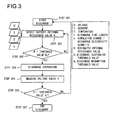
- FIG 3 presents a flowchart pertaining to the rechargeable battery system achieved in the embodiment of the present invention.
- the overall controller 61 transmits an instruction for the battery controllers 51 so as to start discharging the lithium ion rechargeable batteries and, in response, the battery controllers 51 each start discharging the corresponding battery pack 41 (step 301).
- each battery controller 51 measures the battery voltage V, the discharge current I and the battery temperature T respectively via the voltage detection unit 42, the current detection unit 43 and the temperature detection unit 44, and also measures the length of discharge time t (the length of time elapsing after the discharge start) via the timer 45.
- the battery controller 51 calculates a cumulative charge/discharge electricity quantity x by incorporating these four parameters (V, I, T, t) in the following expression (step 302). It then estimates a value indicating the battery internal resistance based upon the cumulative charge/discharge electricity quantity x thus calculated.
- the battery internal resistance value estimated as explained above will be referred to as an estimated internal resistance value R.
- the internal resistance value may be estimated as expressed in (1) below, for example.
- ⁇ R x ⁇ 1 x ⁇ V ave + ⁇ 2 x ⁇ T + ⁇ 3 x ⁇ It + ⁇ 4 x ⁇ I
- ⁇ R(x) indicates the extent of increase in the battery internal resistance at a given cumulative charge/discharge electricity quantity
- ⁇ i(x) indicates a coefficient corresponding to a specific variable, which assumes the form of a function of the cumulative charge/discharge electricity quantity.
- V ave indicates the average voltage calculated for a specific period (e.g., a single cycle period starting at the discharge start elapsing through the discharge end and the charge start and culminating in the charge end). It indicates a charge/discharge depth (DOD) calculated as; current x time, or a charge/discharge electricity quantity ( ⁇ SOC).
- DOD charge/discharge depth
- the battery controller 51 compares the estimated internal resistance value R with a discharge suspension threshold value R k (step 303). If the estimated internal resistance value R is greater than the discharge suspension threshold value R k , the battery controller 51 suspends the discharge and transmits the discharge suspension signal to the overall controller 61 (step 304). However, if the estimated internal resistance value R is less than the discharge suspension threshold value R k , the discharge is continuously executed.
- the length of a discharge suspension period t rest may be set to a predetermined value or to a value representing a length of time determined in correspondence to the conditions of the battery pack. For instance, a value calculated based upon the cumulative charge/discharge electricity quantity x, the particle radius r of the particles in the electrode active material used in the battery pack, a coefficient D of lithium diffusion at the positive electrode and the like may be set as the length of the discharge suspension period t rest .
- ⁇ (x) in the expression below is a coefficient assuming the form of a function of the cumulative charge/discharge electricity quantity.
- the value of the lithium diffusion constant D changes in correspondence to the post-discharge battery voltage.
- the discharge suspension period should last anywhere from several tens of seconds to several tens of minutes.
- t rest x ⁇ x ⁇ r 2 / 4 ⁇ D
- the battery controller 51 continues to measure the battery voltage V via the voltage detection unit 42 (step 305) and compares the battery voltage V thus measured with a predetermined threshold value V k (step 306). If the battery voltage V is lower than the predetermined threshold value V k , the operation proceeds to step 307 to end the discharge and accordingly, the battery controller 51 transmits a discharge end signal to the overall controller 61.
- the operation returns to step 302 to resume the discharge.
- step 307 the operation proceeds to step 307 to end the discharge if the battery voltage V obtained through the measurement to be used in step S302, is already lower than the predetermined threshold value V k .
- the battery controllers 51 each disposed in conjunction with one of the battery packs 41 detect the conditions of the corresponding battery packs 41. Each battery controller 51 then controls the battery pack so as to suspend the discharge depending upon the conditions of the particular battery pack 41.
- the plurality of battery packs 41 are each individually controlled by the corresponding battery controller 51 among the plurality of battery controllers. This means that discharge operations in progress at all the battery packs 41 are never simultaneously suspended and the optimal discharge suspension control is executed as necessary for each battery pack 41.
- the internal resistance can be lessened by setting the length of the discharge suspension period in correspondence to the conditions of the battery pack 41, thereby contributing to lengthening the service life of the rechargeable battery system.
- the internal resistance value is estimated by calculating the cumulative charge/discharge electricity quantity x based upon the four parameters (V, I, T, t) in the flowchart in reference to which the embodiment has been described, the internal resistance may be detected by measuring the DC resistance or the AC impedance at the battery pack 41, instead.
- the lithium ion rechargeable battery used in the test conducted to verify the advantages of the present invention was manufactured by using LiNi 0.33 Mn 0 . 33 Co 0.33 O 2 as the positive electrode active material, carbon black as the position electrode conductive material and polyvinylidene difluoride as the positive electrode binding agent.
- non-graphitizable carbon was used as the negative electrode active material
- carbon black was used as the negative electrode conductive material
- polyvinylidene difluoride was used as the negative electrode binding agent. It is to be noted that the dimensions of a cylindrical battery used in the test were 18 mm in diameter and 65 mm in length (hereafter to be notated as a 18650 battery).
- FIG. 4 shows the charge/discharge pattern with which the test was conducted in order to verify the advantages of the present invention.
- lithium ion rechargeable batteries are charged/discharged with predetermined charge/discharge currents over predetermined lengths of charge/discharge time.
- the present invention is distinguishable from the related art in that the battery internal resistance is detected or estimated and the discharge phase is controlled accordingly in the rechargeable battery system.
- a charge/discharge pattern whereby the discharge phase is divided into two blocks and a discharge suspension period is set between the two blocks, is adopted so as to verify through simulation the advantages of the rechargeable battery system achieved in the embodiment of the present invention.
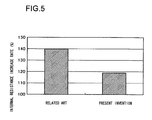
- FIG. 5 presents the results of internal resistance measurements taken after rechargeable batteries had undergone 10,000 cycles of charge/discharge with the charge/discharge pattern in the related art shown in FIG. 4 and the charge/discharge pattern simulating the control having been described in reference to the embodiment of the present invention.
- the rate of increase relative to the initial internal resistance set at 100% is indicated along the vertical axis.
- FIG 5 indicates that the rate of increase in the internal resistance measured in conjunction with the charge/discharge pattern simulating the control according to the present invention is lower than that measured in conjunction with the charge/discharge pattern in the related art by approximately 20 points, substantiating the assertion that any increase in the internal resistance can be deterred in the rechargeable battery system proposed in the embodiment of the present invention.
- the present invention is not limited to this example and it may be adopted in conjunction with laminated lithium ion rechargeable batteries each made up with a plurality of positive plates and a plurality of negative plates and manufactured by alternately laminating a positive plate and a negative plate via a separator.
Landscapes
- Engineering & Computer Science (AREA)
- Manufacturing & Machinery (AREA)
- Chemical & Material Sciences (AREA)
- Chemical Kinetics & Catalysis (AREA)
- Electrochemistry (AREA)
- General Chemical & Material Sciences (AREA)
- Microelectronics & Electronic Packaging (AREA)
- Secondary Cells (AREA)
- Charge And Discharge Circuits For Batteries Or The Like (AREA)
- Tests Of Electric Status Of Batteries (AREA)
Abstract
Description
- The disclosure of the following priority application is herein incorporated by reference: Japanese Patent Application No.
2010-220247 filed September 30, 2010 - The present invention relates to a rechargeable battery system achieved by using, for instance, a lithium ion rechargeable battery.
- Today, lithium ion rechargeable batteries are extensively utilized in various applications as drive power sources for vehicles such as hybrid vehicles and electric vehicles and as drive power sources for portable electronic devices such as notebook type computers and digital cameras.
- As a battery system achieved by using lithium ion batteries undergoes repeated charge/discharge cycles, it is known to become degraded, which manifests as a phenomenon whereby the internal resistance in the batteries gradually increases. This degradation phenomena tends to occur more readily in a battery system that undergoes large-current, large-capacity charge/discharge cycles.
- It is to be noted that while Japanese Laid Open Patent Publication No.
2009-129644 - The present invention provides a battery system that makes it possible to keep the battery internal resistance within an optimal range by deterring or reducing any increase in the internal resistance.
- According to the 1 st aspect of the present invention, a rechargeable battery system that controls charge/discharge of a lithium ion rechargeable battery, comprises: an internal resistance detection means that detects or estimates an internal resistance value indicating an internal resistance at the lithium ion rechargeable battery; and a discharge control means that executes control so as to set a discharge suspension period while the lithium ion rechargeable battery is discharged if the internal resistance value detected via the internal resistance detection means during discharge of the lithium ion rechargeable battery exceeds a first threshold value.
- According to the 2nd aspect of the present invention, in the rechargeable battery system according to the 1 st aspect, it is preferred that the rechargeable battery system further comprises a battery condition detection means that detects a battery voltage, a charge/discharge current, a charge/discharge time length and a battery surface temperature at the lithium ion rechargeable battery; and the internal resistance detection means estimates the internal resistance at the lithium ion rechargeable battery based upon a cumulative charge/discharge electricity quantity calculated based upon the battery voltage, the charge/discharge current, the charge/discharge time length and the battery surface temperature.
- According to the 3rd aspect of the present invention, in the rechargeable battery system according to the 1 st aspect, it is preferred that the internal resistance detection means detects the internal resistance through measurement of a DC resistance or an AC impedance at the lithium ion rechargeable battery.
- According to the 4th aspect of the present invention, in the rechargeable battery system according to the 2nd aspect, it is preferred that the discharge control means calculates a length of the discharge suspension period based upon the cumulative charge/discharge electricity quantity.
- According to the 5th aspect of the present invention, in the rechargeable battery system according to the 2nd aspect, it is preferred that the discharge control means calculates a length of the discharge suspension period based upon the cumulative charge/discharge electricity quantity and coefficients of lithium diffusion corresponding to a positive electrode material and a negative electrode material used in the lithium ion rechargeable battery.
- According to the 6th aspect of the present invention, in the rechargeable battery system according to any one of the 1st through 5th aspects, it is preferred that the discharge control means executes control so as to resume the discharge if the battery voltage detected via the battery condition detection means after the discharge suspension period elapses is higher than a second threshold value.
- According to the 7th aspect of the present invention, in the rechargeable battery system according to any one of the 1 st through 6th aspects, it is preferred that: the lithium ion rechargeable battery is constituted with a plurality of battery packs; the internal resistance detection means is disposed in correspondence to each of the plurality of battery packs to detect or estimate the internal resistance value indicating the internal resistance at the corresponding battery pack or the internal resistance of a battery cell constituting part of the corresponding battery pack; and the discharge control means is disposed in correspondence to each of the plurality of battery packs so as to execute control to individually set a discharge suspension period for the corresponding battery pack.
-
-
FIG 1 is a cutaway perspective of a cylindrical non-aqueous rechargeable battery achieved in an embodiment of the present invention. -
FIG 2 is a schematic block diagram of the rechargeable battery system achieved in the embodiment of the present invention. -
FIG 3 presents a system flowchart pertaining to the rechargeable battery system achieved in the embodiment of the present invention. -
FIG 4 shows the charge/discharge pattern used in the test conducted for the rechargeable battery system achieved in the embodiment of the present invention. -
FIG 5 is a diagram comparing the charge/discharge pattern used in the embodiment of the present invention with a charge/discharge pattern of the related art. - The inventors of the present invention have discovered that even after the internal resistance in a lithium ion rechargeable battery (secondary battery) increases, the internal resistance in the lithium ion rechargeable battery can be gradually lowered under optimal charge/discharge cycle conditions, e.g., by sustaining a no-load state for approximately 10 days following the internal resistance increase.
- In addition, there is a tendency whereby as the internal resistance increases over the course of charge/discharge cycles, the lithium ion concentration in the electrolyte held between the power generation elements, i.e., between the positive electrode and the negative electrode, becomes lower. The internal resistance is assumed to rise as the lithium ion electrolyte constituents in the electrolyte decompose/recompose, inorganic matter constituted of the products resulting from the decomposition of the electrolyte is deposited onto the surfaces of the negative electrode and the positive electrode and the transmission of lithium ions at the electrode surfaces is blocked by the deposits. The inventors of the present invention have found that there is a positive correlation in that, as the ratio of the decomposed electrolyte products present at the surfaces of the positive electrode and the negative electrode increases, the internal resistance, too, increases.
- According to the present invention, achieved based upon the findings outlined above, the battery internal resistance can be kept within an optimal range by deterring any increase in the internal resistance and even by decreasing the extent of internal resistance increase through control of charge/discharge parameters in a lithium ion rechargeable battery.
- Parameters critical in estimating the internal resistance at a lithium ion rechargeable battery may include the battery voltage, the charge/discharge current, the charge/discharge electricity quantity and the battery temperature. Under normal circumstances, when the battery voltage, which indicates the state of charge in the lithium ion rechargeable battery, is high, the process of self-discharge of lithium ions present on the negative electrode side advances, resulting in a loss of lithium ions and accelerated degradation. In addition, at a high battery temperature, the process whereby the electrolyte within the lithium ion rechargeable battery becomes decomposed and decomposition products are formed is assumed to accelerate, leading to premature degradation. The charge/discharge current and the charge/discharge electricity quantity respectively indicate the speed with which lithium ions enter/depart the electrodes and the quantity of lithium ions entering/departing the electrodes. The process of degradation is considered to be speeded up if either parameter takes a greater value.
- It is surmised that the internal resistance of a lithium ion rechargeable battery can be reliably estimated through calculation by handling the variables representing the various parameters as a function through multivariate analysis of the parameters. An expression for internal resistance estimation proposed in the present invention will be described in detail later.
- Next, in reference to drawings, an embodiment of the present invention is described.
-
FIG 1 shows a non-aqueous rechargeable battery (secondary battery) (hereafter may be simply referred to as a battery) achieved in the embodiment. Anelectrode winding assembly 22, manufactured by winding a positive plate with an active material thereof constituted of a lithium oxide compound and anegative plate 12 with an active material thereof constituted with a material that holds lithium ions via aseparator 13 in a coil, is housed inside acylindrical battery case 26 having a solid bottom. Anegative electrode tab 24, led out from the bottom of theelectrode winding assembly 22, is welded to the bottom of thebattery case 26 and then, apositive electrode tab 23 led out from the top end of theelectrode winding assembly 22 is welded to abattery lid 25. A specific type of electrolyte is charged into thebattery case 26 and then thebattery lid 25 with an insulating gasket (not shown) attached to the outer edge thereof is set and caulked so as to close off the opening at thebattery case 26. In the following description, the side where awinding axis 21 is present will be referred to as an innercircumferential side 31 and the outer side of the winding assembly will be referred to as an outercircumferential side 32. The positive electrode active material coating thepositive plate 11 may be, for instance, lithium cobalt oxide or modified lithium cobalt oxide (e.g., with aluminum or magnesium dissolved in lithium cobalt oxide), lithium nickel oxide or modified lithium nickel oxide (with nickel partially replaced with cobalt), lithium manganese oxide or modified lithium manganese oxide, or a lithium nickel manganese cobalt compound oxide. - The electrically conductive agent used in conjunction with the positive plate may be a single-component material constituted of a carbon black, such as acetylene black, ketjen black, channel black, furnace black, lamp black or thermal black, or any of various types of graphite. As an alternative, multiple-component material constituted with some of these materials may be used as the electrically conductive material used in conjunction with the positive plate.
- Polyvinylidene difluoride (PVdF), modified polyvinylidene difluoride, polytetrafluoroethylene, a rubber particulate binder with an acrylate unit or the like may be used as the positive electrode binding agent. Such a binding agent may contain an acrylate monomer with a reactive functional group incorporated therein or an acrylate oligomer may be mixed in the binder.
- The negative electrode active material coating the
negative plate 12 may be, for instance, any of various natural graphites, artificial graphite, a silicon compound material such as silicide, or any of various plastic metal materials. - While any of various binders including PVdF and modified PVdF may be used as the negative electrode binding agent, it is more desirable, in order to allow lithium ions to enter the negative electrode with better efficiency, to use a binder constituted with styrene-butadiene copolymer rubber particles (SBR) or modified styrene-butadiene copolymer rubber particles in conjunction with a cellulose resin such as carboxymethyl cellulose or to add a small quantity of cellulose resin or the like into the negative electrode binding agent.
- The electrically conductive material used in conjunction with the negative plate may be a single-component material constituted of a carbon black, such as acetylene black, ketjen black, channel black, furnace black, lamp black or thermal black, or any of various types of graphite. As an alternative, a multiple-component material constituted with some of these materials may be used.
- While there are no special limitations imposed with regard to the material constituting the separator as long as it assumes a composition robust enough to withstand use within the expected range of conditions of operation for lithium ion rechargeable batteries, it is desirable to use a micro-porous film constituted of a single olefinic resin such as polyethylene or polypropylene or a composite olefinic resin containing polyethylene and polypropylene in combination, as in standard practice. In addition, while there are no specific limitations imposed with regard to the thickness of the separator, it is desirable to assume a 10 to 40 µm thickness for the separator.
- Electrolytic salts constituted of any of various lithium compounds such as LiBF6 or LiBF4 may be used for the electrolyte. In addition, ethylene carbonate (EC), dimethyl carbonate (DMC), diethyl carbonate (DEC) or ethyl methyl carbonate (MEC) may be used alone or some of them may be used in combination as the solvent. Furthermore, stability in the event of overcharge/discharge may be assured through solid formation of a good film on the positive electrode and the negative electrode achieved by using vinylene carbonate (VC), cyclohexyl benzene (CHB) or modified vinylene carbonate or modified cyclohexyl benzene.
- The electrode winding assembly in the embodiment does not need to achieve a true cylindrical shape and it may instead assume the shape of a tubular oval with an elliptical section or it may assume a prismatic shape with a rectangular section. While it is desirable to adopt a mode of use in which the electrode winding assembly is housed within a tubular battery case with a solid bottom, which is filled with the electrolyte, and the battery case is sealed with the tabs through which a current is extracted from the electrode plates, welded to the lid and the battery case, the present invention is not limited to this mode either.
- Furthermore, while there are no special limitations imposed with regard to the battery case housing the electrode winding assembly, it is desirable to use a battery case assuring reliable strength, superior anti-corrosive characteristics and machinability, such as a battery case constituted with plated iron, a stainless steel battery case or the like. In addition, the battery case may be manufactured by using an aluminum alloy or any of various types of engineering plastic materials to achieve lighter weight or it may be manufactured by using both an engineering plastic material and a metal material.
-
FIG 2 shows a rechargeable battery (secondary battery) system. A plurality of batteries, each made up with a battery, such as that shown inFIG 1 , are connected in series and in parallel in each battery pack (assembled batteries) 41. The rechargeable battery system includes abattery controller 51 installed so as to detect the conditions of aspecific battery pack 41. Thebattery controller 51 detects the battery voltage, the charge/discharge current and the battery surface temperature at thecorresponding battery pack 41 and also measures the cumulative charge/discharge time, the cumulative charge/discharge electricity quantity and the cumulative total time. Thebattery packs 41 are each constituted with a plurality of lithium batteries (battery cells) electrically connected in series, in parallel or in series/parallel. - A plurality of battery pack, battery controller sets each made up with a
battery pack 41 and acorresponding battery controller 51 are installed in parallel and data obtained at thebattery controllers 51 are all transmitted to anoverall controller 61. A charge/discharge current value and the corresponding length of charge/discharge time for each battery, determined in correspondence to the data obtained from each battery controller, are indicated in data transmitted from theoverall controller 61 to the battery controller. - The
battery controller 51 includes a microcomputer constituted with a CPU, a ROM and a RAM, which is engaged in operation based upon a specific program. Thebattery controller 51 executes charge/discharge control for thebattery pack 41 based upon the data transmitted from theoverall controller 61. - A section achieving part of the control executed by the
battery controller 51, which is equivalent to a control function (mechanism) whereby the internal resistance value is detected or estimated will be referred to as an internal resistance detection unit in the description. In addition, in the description of the present invention, which is characterized in the discharge control method adopted therein, a section achieving a control function (mechanism) pertaining to the discharge will be referred to as a discharge control unit. - As does the battery controller, the
overall controller 61 includes a microcomputer constituted with a CPU, a ROM and RAM, which is engaged in operation based upon a specific program. Theoverall controller 61 is connected with eachbattery controller 51 through a communication cable 52 that enables bidirectional communication, and executes various types of control in correspondence to the conditions of thecorresponding battery pack 41. - A
voltage detection unit 42 detects the voltage at the battery pack. While the detection target battery voltage may be, for instance, the voltage at one of the batteries constituting the battery pack, the voltage of a group of batteries connected in series or the voltage of the battery pack achieved by connecting a plurality of batteries in series/parallel, there are no special limitations imposed with regard to the measurement target battery voltage. - A
current detection unit 43 detects a value indicating the charge/discharge current. While the charge/discharge current value may be detected via a galvanometer, a meter that detects a current by using a shunt resistor or a clamp meter, the present invention is not limited to these options and any means capable of detecting a current value may be used in conjunction with the present invention. - A
temperature detection unit 44 detects the temperature of thebattery pack 41. While the temperature may be detected by a means such as a thermocouple or a thermistor, no special limitations are imposed. In addition, the temperature detection site may be, for instance, a battery surface, the inside of a battery, the surface of the casing housing the battery pack or the environment surrounding the battery pack. - The
voltage detection unit 42, thecurrent detection unit 43 and thetemperature detection unit 44 described above are collectively referred to as a battery condition detection unit. - A
timer 45, which is installed within the battery controller, counts a length of time pertaining to charge/discharge of thebattery pack 41. It may count, for instance, the length of time elapsing after a discharge start. - Assuming that the rechargeable battery system is installed in a vehicle, an
electric load 71 may be, for instance, a heater, a dynamo-electric braking system, an electric power steering system or an electric motor. - In the rechargeable battery system achieved in the embodiment by connecting a plurality of battery packs 41 in parallel as described above, a
battery controller 51 is installed in correspondence to eachbattery pack 41. Thebattery controller 51 detects the conditions of theparticular battery pack 41 and executes control in correspondence to the conditions of thebattery pack 41 thus detected. As a result, a rechargeable battery system assuring long service life can be provided by deterring any increase in the internal resistance at each lithium ion rechargeable battery. - Next, a specific charge/discharge control method adopted in the
battery controllers 51 is described. -
FIG 3 presents a flowchart pertaining to the rechargeable battery system achieved in the embodiment of the present invention. - First, the
overall controller 61 transmits an instruction for thebattery controllers 51 so as to start discharging the lithium ion rechargeable batteries and, in response, thebattery controllers 51 each start discharging the corresponding battery pack 41 (step 301). - Following the discharge start, each
battery controller 51 measures the battery voltage V, the discharge current I and the battery temperature T respectively via thevoltage detection unit 42, thecurrent detection unit 43 and thetemperature detection unit 44, and also measures the length of discharge time t (the length of time elapsing after the discharge start) via thetimer 45. - The
battery controller 51 calculates a cumulative charge/discharge electricity quantity x by incorporating these four parameters (V, I, T, t) in the following expression (step 302). It then estimates a value indicating the battery internal resistance based upon the cumulative charge/discharge electricity quantity x thus calculated. In the following description, the battery internal resistance value estimated as explained above will be referred to as an estimated internal resistance value R. - The internal resistance value may be estimated as expressed in (1) below, for example.

- ΔR(x) indicates the extent of increase in the battery internal resistance at a given cumulative charge/discharge electricity quantity, and αi(x) indicates a coefficient corresponding to a specific variable, which assumes the form of a function of the cumulative charge/discharge electricity quantity. In addition, Vave indicates the average voltage calculated for a specific period (e.g., a single cycle period starting at the discharge start elapsing through the discharge end and the charge start and culminating in the charge end). It indicates a charge/discharge depth (DOD) calculated as; current x time, or a charge/discharge electricity quantity (ΔSOC).
- Following
step 302, thebattery controller 51 compares the estimated internal resistance value R with a discharge suspension threshold value Rk (step 303). If the estimated internal resistance value R is greater than the discharge suspension threshold value Rk, thebattery controller 51 suspends the discharge and transmits the discharge suspension signal to the overall controller 61 (step 304). However, if the estimated internal resistance value R is less than the discharge suspension threshold value Rk, the discharge is continuously executed. - The length of a discharge suspension period trest may be set to a predetermined value or to a value representing a length of time determined in correspondence to the conditions of the battery pack. For instance, a value calculated based upon the cumulative charge/discharge electricity quantity x, the particle radius r of the particles in the electrode active material used in the battery pack, a coefficient D of lithium diffusion at the positive electrode and the like may be set as the length of the discharge suspension period trest. β(x) in the expression below is a coefficient assuming the form of a function of the cumulative charge/discharge electricity quantity. In addition, the value of the lithium diffusion constant D changes in correspondence to the post-discharge battery voltage. In more specific terms, the discharge suspension period should last anywhere from several tens of seconds to several tens of minutes.

- During the discharge phase, the
battery controller 51 continues to measure the battery voltage V via the voltage detection unit 42 (step 305) and compares the battery voltage V thus measured with a predetermined threshold value Vk (step 306). If the battery voltage V is lower than the predetermined threshold value Vk, the operation proceeds to step 307 to end the discharge and accordingly, thebattery controller 51 transmits a discharge end signal to theoverall controller 61. - If, on the other hand, the battery voltage V is higher than the predetermined threshold value Vk, the operation returns to step 302 to resume the discharge.
- It is to be noted that although not clearly indicated in the flowchart presented in
FIG 3 , the operation proceeds to step 307 to end the discharge if the battery voltage V obtained through the measurement to be used in step S302, is already lower than the predetermined threshold value Vk. - In the rechargeable battery system achieved in the embodiment as described above by connecting a plurality of battery packs 41 in parallel, the
battery controllers 51 each disposed in conjunction with one of the battery packs 41 detect the conditions of the corresponding battery packs 41. Eachbattery controller 51 then controls the battery pack so as to suspend the discharge depending upon the conditions of theparticular battery pack 41. As a result, a rechargeable battery system assuring an extended service life can be provided by deterring any increase in the internal resistance of each lithium ion rechargeable battery. The plurality of battery packs 41 are each individually controlled by the correspondingbattery controller 51 among the plurality of battery controllers. This means that discharge operations in progress at all the battery packs 41 are never simultaneously suspended and the optimal discharge suspension control is executed as necessary for eachbattery pack 41. - In addition, the internal resistance can be lessened by setting the length of the discharge suspension period in correspondence to the conditions of the
battery pack 41, thereby contributing to lengthening the service life of the rechargeable battery system. - It is to be noted that while the internal resistance value is estimated by calculating the cumulative charge/discharge electricity quantity x based upon the four parameters (V, I, T, t) in the flowchart in reference to which the embodiment has been described, the internal resistance may be detected by measuring the DC resistance or the AC impedance at the
battery pack 41, instead. - Next, the results of a simulation test conducted to verify the advantages of the present invention will be described.
- The lithium ion rechargeable battery used in the test conducted to verify the advantages of the present invention was manufactured by using LiNi0.33Mn0.33Co0.33O2 as the positive electrode active material, carbon black as the position electrode conductive material and polyvinylidene difluoride as the positive electrode binding agent. In addition, non-graphitizable carbon was used as the negative electrode active material, carbon black was used as the negative electrode conductive material and polyvinylidene difluoride was used as the negative electrode binding agent. It is to be noted that the dimensions of a cylindrical battery used in the test were 18 mm in diameter and 65 mm in length (hereafter to be notated as a 18650 battery).
-
FIG. 4 shows the charge/discharge pattern with which the test was conducted in order to verify the advantages of the present invention. In the related art, lithium ion rechargeable batteries are charged/discharged with predetermined charge/discharge currents over predetermined lengths of charge/discharge time. The present invention is distinguishable from the related art in that the battery internal resistance is detected or estimated and the discharge phase is controlled accordingly in the rechargeable battery system. In the test, a charge/discharge pattern whereby the discharge phase is divided into two blocks and a discharge suspension period is set between the two blocks, is adopted so as to verify through simulation the advantages of the rechargeable battery system achieved in the embodiment of the present invention. - Namely, in the simulation test, a discharge suspension period was included in each cycle on the assumption that each cycle required a discharge suspension period included therein, instead of setting a discharge suspension period by actually measuring the internal resistance.
-
FIG. 5 presents the results of internal resistance measurements taken after rechargeable batteries had undergone 10,000 cycles of charge/discharge with the charge/discharge pattern in the related art shown inFIG. 4 and the charge/discharge pattern simulating the control having been described in reference to the embodiment of the present invention. The rate of increase relative to the initial internal resistance set at 100% is indicated along the vertical axis.FIG 5 indicates that the rate of increase in the internal resistance measured in conjunction with the charge/discharge pattern simulating the control according to the present invention is lower than that measured in conjunction with the charge/discharge pattern in the related art by approximately 20 points, substantiating the assertion that any increase in the internal resistance can be deterred in the rechargeable battery system proposed in the embodiment of the present invention. - While the invention has been particularly shown and described with respect to a preferred embodiment thereof by referring to the attached drawings, the present invention is not limited to this example and it will be understood by those skilled in the art that various changes in form and detail may be made therein without departing from the scope and teaching of the invention.
- For instance, while the embodiment has been described by assuming that the rechargeable battery system is constituted with core-winding type lithium ion rechargeable batteries, the present invention is not limited to this example and it may be adopted in conjunction with laminated lithium ion rechargeable batteries each made up with a plurality of positive plates and a plurality of negative plates and manufactured by alternately laminating a positive plate and a negative plate via a separator.
Claims (7)
- A rechargeable battery system that controls charge/discharge of a lithium ion rechargeable battery, comprising:an internal resistance detection means for detecting or estimating an internal resistance value indicating an internal resistance at the lithium ion rechargeable battery; anda discharge control means for executing control so as to set a discharge suspension period while the lithium ion rechargeable battery is discharged if the internal resistance value detected via the internal resistance detection means during discharge of the lithium ion rechargeable battery exceeds a first threshold value.
- A rechargeable battery system according to claim 1, further comprising:a battery condition detection means for detecting a battery voltage, a charge/discharge current, a charge/discharge time length and a battery surface temperature at the lithium ion rechargeable battery, wherein:the internal resistance detection means estimates the internal resistance at the lithium ion rechargeable battery based upon a cumulative charge/discharge electricity quantity calculated based upon the battery voltage, the charge/discharge current, the charge/discharge time length and the battery surface temperature.
- A rechargeable battery system according to claim 1, wherein:the internal resistance detection means detects the internal resistance through measurement of a DC resistance or an AC impedance at the lithium ion rechargeable battery.
- A rechargeable battery system according to claim 2, wherein:the discharge control means calculates a length of the discharge suspension period based upon the cumulative charge/discharge electricity quantity.
- A rechargeable battery system according to claim 2, wherein:the discharge control means calculates a length of the discharge suspension period based upon the cumulative charge/discharge electricity quantity and coefficients of lithium diffusion corresponding to a positive electrode material and a negative electrode material used in the lithium ion rechargeable battery.
- A rechargeable battery system according to any one of claims 1 through 5, wherein:the discharge control means executes control so as to resume the discharge if the battery voltage detected via the battery condition detection means after the discharge suspension period elapses is higher than a second threshold value.
- A rechargeable battery system according to any one of claims 1 through 6, wherein:the lithium ion rechargeable battery is constituted with a plurality of battery packs;the internal resistance detection means is disposed in correspondence to each of the plurality of battery packs to detect or estimate the internal resistance value indicating the internal resistance at the corresponding battery pack or the internal resistance of a battery cell constituting part of the corresponding battery pack; andthe discharge control means is disposed in correspondence to each of the plurality of battery packs so as to execute control to individually set a discharge suspension period for the corresponding battery pack.
Applications Claiming Priority (1)
| Application Number | Priority Date | Filing Date | Title |
|---|---|---|---|
| JP2010220247A JP5298095B2 (en) | 2010-09-30 | 2010-09-30 | Secondary battery system |
Publications (1)
| Publication Number | Publication Date |
|---|---|
| EP2437344A1 true EP2437344A1 (en) | 2012-04-04 |
Family
ID=45093313
Family Applications (1)
| Application Number | Title | Priority Date | Filing Date |
|---|---|---|---|
| EP11180530A Withdrawn EP2437344A1 (en) | 2010-09-30 | 2011-09-08 | Rechargeable battery system |
Country Status (3)
| Country | Link |
|---|---|
| US (1) | US8742728B2 (en) |
| EP (1) | EP2437344A1 (en) |
| JP (1) | JP5298095B2 (en) |
Cited By (2)
| Publication number | Priority date | Publication date | Assignee | Title |
|---|---|---|---|---|
| CN116699420A (en) * | 2023-05-30 | 2023-09-05 | 深蓝汽车科技有限公司 | Lithium-ion battery internal resistance calculation method, device, electronic equipment and storage medium |
| EP4734325A1 (en) | 2024-10-28 | 2026-04-29 | Skeleton Technologies GmbH | A computer-implemented method for discharging energy storage cells |
Families Citing this family (14)
| Publication number | Priority date | Publication date | Assignee | Title |
|---|---|---|---|---|
| JP5841827B2 (en) * | 2011-12-16 | 2016-01-13 | 株式会社日立製作所 | Secondary battery system and control method of secondary battery system |
| JP6233856B2 (en) * | 2013-08-09 | 2017-11-22 | 日立オートモティブシステムズ株式会社 | Battery control system, vehicle control system |
| CN106170904A (en) * | 2014-03-03 | 2016-11-30 | 罗伯特·博世有限公司 | Mixing storage system |
| JP6414460B2 (en) * | 2014-12-18 | 2018-10-31 | 株式会社デンソー | Battery deterioration state determination device and deterioration state determination method |
| JP6324332B2 (en) * | 2015-02-18 | 2018-05-16 | 三菱電機株式会社 | Charge / discharge control device and control method for lithium ion battery |
| JP2017100644A (en) * | 2015-12-04 | 2017-06-08 | 株式会社オートネットワーク技術研究所 | In-vehicle power supply device and in-vehicle power supply system |
| JP6649834B2 (en) * | 2016-03-31 | 2020-02-19 | 株式会社マキタ | Inspection device for battery pack for power tool |
| US10985591B2 (en) * | 2018-03-19 | 2021-04-20 | Dell Products L.P. | System and method to improve battery performance with cycled current transfer |
| CN110568365B (en) * | 2019-08-08 | 2024-07-30 | 深圳职业技术学院 | Lithium battery monitoring system |
| CN110907842B (en) * | 2019-12-02 | 2021-09-07 | 深圳市欧瑞博科技股份有限公司 | Smart door lock power detection device, method and smart door lock |
| CN111157907B (en) * | 2019-12-30 | 2022-07-05 | Oppo广东移动通信有限公司 | Detection method and device, charging method and device, electronic device and storage medium |
| US12062937B2 (en) * | 2020-09-15 | 2024-08-13 | Panasonic Intellectual Property Management Co., Ltd. | Method of controlling secondary battery and battery system |
| JP7090949B1 (en) * | 2021-05-19 | 2022-06-27 | 東洋システム株式会社 | Battery status determination method and battery status determination device |
| JP7297339B2 (en) * | 2021-05-19 | 2023-06-26 | 東洋システム株式会社 | BATTERY STATE DETERMINATION METHOD AND BATTERY STATE DETERMINATION DEVICE |
Citations (4)
| Publication number | Priority date | Publication date | Assignee | Title |
|---|---|---|---|---|
| WO2009066782A2 (en) * | 2007-11-21 | 2009-05-28 | Toyota Jidosha Kabushiki Kaisha | Lithium ion secondary battery, battery pack, hybrid electric vehicle, battery pack system, and charge-discharge control method |
| US20100085015A1 (en) * | 2008-01-24 | 2010-04-08 | Hiroshi Hamaguchi | Battery system, vehicle, and battery mounted device |
| JP2010220247A (en) | 2010-05-20 | 2010-09-30 | Sanyo Electric Co Ltd | Digital broadcast receiving apparatus |
| EP2362482A1 (en) * | 2010-01-29 | 2011-08-31 | Hitachi, Ltd. | Secondary battery system |
Family Cites Families (4)
| Publication number | Priority date | Publication date | Assignee | Title |
|---|---|---|---|---|
| JP2000021455A (en) * | 1998-07-03 | 2000-01-21 | Nissan Motor Co Ltd | Method for detecting internal resistance of hybrid vehicle battery |
| JP5130608B2 (en) * | 2005-05-31 | 2013-01-30 | 日産自動車株式会社 | Battery control device |
| JP2006352970A (en) * | 2005-06-14 | 2006-12-28 | Nissan Motor Co Ltd | Power device control unit |
| JP2011257314A (en) * | 2010-06-10 | 2011-12-22 | Toyota Motor Corp | Method for determining deterioration of secondary battery and control system for secondary battery |
-
2010
- 2010-09-30 JP JP2010220247A patent/JP5298095B2/en not_active Expired - Fee Related
-
2011
- 2011-09-08 EP EP11180530A patent/EP2437344A1/en not_active Withdrawn
- 2011-09-08 US US13/227,890 patent/US8742728B2/en not_active Expired - Fee Related
Patent Citations (5)
| Publication number | Priority date | Publication date | Assignee | Title |
|---|---|---|---|---|
| WO2009066782A2 (en) * | 2007-11-21 | 2009-05-28 | Toyota Jidosha Kabushiki Kaisha | Lithium ion secondary battery, battery pack, hybrid electric vehicle, battery pack system, and charge-discharge control method |
| JP2009129644A (en) | 2007-11-21 | 2009-06-11 | Toyota Motor Corp | Lithium ion secondary battery, assembled battery, hybrid vehicle, assembled battery system, and charge / discharge control method |
| US20100085015A1 (en) * | 2008-01-24 | 2010-04-08 | Hiroshi Hamaguchi | Battery system, vehicle, and battery mounted device |
| EP2362482A1 (en) * | 2010-01-29 | 2011-08-31 | Hitachi, Ltd. | Secondary battery system |
| JP2010220247A (en) | 2010-05-20 | 2010-09-30 | Sanyo Electric Co Ltd | Digital broadcast receiving apparatus |
Cited By (2)
| Publication number | Priority date | Publication date | Assignee | Title |
|---|---|---|---|---|
| CN116699420A (en) * | 2023-05-30 | 2023-09-05 | 深蓝汽车科技有限公司 | Lithium-ion battery internal resistance calculation method, device, electronic equipment and storage medium |
| EP4734325A1 (en) | 2024-10-28 | 2026-04-29 | Skeleton Technologies GmbH | A computer-implemented method for discharging energy storage cells |
Also Published As
| Publication number | Publication date |
|---|---|
| JP5298095B2 (en) | 2013-09-25 |
| US8742728B2 (en) | 2014-06-03 |
| JP2012075298A (en) | 2012-04-12 |
| US20120081077A1 (en) | 2012-04-05 |
Similar Documents
| Publication | Publication Date | Title |
|---|---|---|
| US8742728B2 (en) | System for controlling charging and discharging of lithium ion battery | |
| JP5637878B2 (en) | Secondary battery system | |
| CN104103851B (en) | Lithium rechargable battery with the reference electrode for state of health monitoring | |
| EP2541667B1 (en) | Secondary battery system | |
| US10591550B2 (en) | Secondary-battery monitoring device and prediction method of battery capacity of secondary battery | |
| JP5940145B2 (en) | Secondary battery system, secondary battery deterioration state judgment method | |
| US20120158330A1 (en) | Monitoring system for lithium ion secondary battery and monitoring method thereof | |
| JP5699970B2 (en) | Lithium ion secondary battery system and deposition determination method | |
| KR20130124326A (en) | Electrochemical cell based on lithium technology with internal reference electrode, process for its production and methods for simultaneous monitoring of the voltage or impedance of the anode and the cathode thereof | |
| JP5771512B2 (en) | Secondary battery system, secondary battery module using the secondary battery system, and secondary battery control method | |
| JP5841827B2 (en) | Secondary battery system and control method of secondary battery system | |
| EP3659197B1 (en) | Energy storage apparatus and method of using the same | |
| WO2015019427A1 (en) | Battery system | |
| JP2013073756A (en) | Lithium-ion secondary battery | |
| Fang | Fundamental modeling the performance and degradation of HEV Li-ion battery | |
| WO2015049777A1 (en) | Lithium ion secondary battery system and lithium ion secondary battery degradation diagnosis method | |
| JP2015149308A (en) | Lithium-ion secondary battery |
Legal Events
| Date | Code | Title | Description |
|---|---|---|---|
| PUAI | Public reference made under article 153(3) epc to a published international application that has entered the european phase |
Free format text: ORIGINAL CODE: 0009012 |
|
| AK | Designated contracting states |
Kind code of ref document: A1 Designated state(s): AL AT BE BG CH CY CZ DE DK EE ES FI FR GB GR HR HU IE IS IT LI LT LU LV MC MK MT NL NO PL PT RO RS SE SI SK SM TR |
|
| AX | Request for extension of the european patent |
Extension state: BA ME |
|
| 17P | Request for examination filed |
Effective date: 20121004 |
|
| 17Q | First examination report despatched |
Effective date: 20160704 |
|
| GRAP | Despatch of communication of intention to grant a patent |
Free format text: ORIGINAL CODE: EPIDOSNIGR1 |
|
| STAA | Information on the status of an ep patent application or granted ep patent |
Free format text: STATUS: GRANT OF PATENT IS INTENDED |
|
| INTG | Intention to grant announced |
Effective date: 20161223 |
|
| RIC1 | Information provided on ipc code assigned before grant |
Ipc: H01M 10/42 20060101ALI20161209BHEP Ipc: H01M 10/48 20060101ALI20161209BHEP Ipc: H01M 10/44 20060101AFI20161209BHEP |
|
| STAA | Information on the status of an ep patent application or granted ep patent |
Free format text: STATUS: THE APPLICATION IS DEEMED TO BE WITHDRAWN |
|
| 18D | Application deemed to be withdrawn |
Effective date: 20170503 |