EP2436439A1 - Ruthenium complex intercalated N-doped or N,S-codoped titania pillared montmorillonite and a process for the preparation thereof - Google Patents
Ruthenium complex intercalated N-doped or N,S-codoped titania pillared montmorillonite and a process for the preparation thereof Download PDFInfo
- Publication number
- EP2436439A1 EP2436439A1 EP20110183612 EP11183612A EP2436439A1 EP 2436439 A1 EP2436439 A1 EP 2436439A1 EP 20110183612 EP20110183612 EP 20110183612 EP 11183612 A EP11183612 A EP 11183612A EP 2436439 A1 EP2436439 A1 EP 2436439A1
- Authority
- EP
- European Patent Office
- Prior art keywords
- montmorillonite
- doped
- ruthenium
- catalyst
- ruthenium complex
- Prior art date
- Legal status (The legal status is an assumption and is not a legal conclusion. Google has not performed a legal analysis and makes no representation as to the accuracy of the status listed.)
- Granted
Links
Images


Classifications
-
- B—PERFORMING OPERATIONS; TRANSPORTING
- B01—PHYSICAL OR CHEMICAL PROCESSES OR APPARATUS IN GENERAL
- B01J—CHEMICAL OR PHYSICAL PROCESSES, e.g. CATALYSIS OR COLLOID CHEMISTRY; THEIR RELEVANT APPARATUS
- B01J35/00—Catalysts, in general, characterised by their form or physical properties
- B01J35/30—Catalysts, in general, characterised by their form or physical properties characterised by their physical properties
- B01J35/39—Photocatalytic properties
-
- B—PERFORMING OPERATIONS; TRANSPORTING
- B01—PHYSICAL OR CHEMICAL PROCESSES OR APPARATUS IN GENERAL
- B01J—CHEMICAL OR PHYSICAL PROCESSES, e.g. CATALYSIS OR COLLOID CHEMISTRY; THEIR RELEVANT APPARATUS
- B01J21/00—Catalysts comprising the elements, oxides, or hydroxides of magnesium, boron, aluminium, carbon, silicon, titanium, zirconium, or hafnium
- B01J21/06—Silicon, titanium, zirconium or hafnium; Oxides or hydroxides thereof
-
- B—PERFORMING OPERATIONS; TRANSPORTING
- B01—PHYSICAL OR CHEMICAL PROCESSES OR APPARATUS IN GENERAL
- B01J—CHEMICAL OR PHYSICAL PROCESSES, e.g. CATALYSIS OR COLLOID CHEMISTRY; THEIR RELEVANT APPARATUS
- B01J23/00—Catalysts comprising metals or metal oxides or hydroxides, not provided for in group B01J21/00
- B01J23/38—Catalysts comprising metals or metal oxides or hydroxides, not provided for in group B01J21/00 of noble metals
- B01J23/40—Catalysts comprising metals or metal oxides or hydroxides, not provided for in group B01J21/00 of noble metals of the platinum group metals
- B01J23/46—Ruthenium, rhodium, osmium or iridium
- B01J23/462—Ruthenium
-
- B—PERFORMING OPERATIONS; TRANSPORTING
- B01—PHYSICAL OR CHEMICAL PROCESSES OR APPARATUS IN GENERAL
- B01J—CHEMICAL OR PHYSICAL PROCESSES, e.g. CATALYSIS OR COLLOID CHEMISTRY; THEIR RELEVANT APPARATUS
- B01J37/00—Processes, in general, for preparing catalysts; Processes, in general, for activation of catalysts
- B01J37/02—Impregnation, coating or precipitation
- B01J37/03—Precipitation; Co-precipitation
Definitions
- This present invention relates to a Ruthenium complex intercalated N doped or N,S-codoped titania pillared montmorillonite, a multifunctional photocatalyst and a process for the preparation thereof. More particularly, the present invention provides a green photochemical route towards a variety of light driven redox reactions such as organic dye degradation, photocatalytic water splitting and various organic transformation reactions oriented to the synthesis of fine chemicals.
- the present invention particularly relates to the synthesis of N-doped titania pillared montmorillonite (NTP); N,S-codoped titania pillared montmorillonite (NSTP); Ruthenium bipyridyl complex intercalated N-doped titania pillared montmorillonite (RNTP); and Ruthenium bipyridyl complex intercalated N,S-codoped titania pillared montmorillonite (RNSTP).
- NTP N-doped titania pillared montmorillonite
- NTP N,S-codoped titania pillared montmorillonite
- RNTP Ruthenium bipyridyl complex intercalated N-doped titania pillared montmorillonite
- RNSTP Ruthenium bipyridyl complex intercalated N,S-codoped titania pillared montmorillonite
- Titanium dioxide (Ti0 2 ) has been proven one of the most promising photocatalysts for its interesting properties like high chemical stability, strong oxidizing power, environment-friendliness, relative economy [ H. Li, J. Li, Y. Huo, J. Phys. Chem. B 110 (2006) 1559 ; M.-S. Wong, H. P. Chou, T.-S. Yang, Thin Solid Films 494 (2006) 244 ] and so on. Though it is chemically and photochemically stable, at the same time Ti0 2 photocatalyst is a ultra-violet absorber due to its large energy band gap (3.2 eV for anatase) so that the light utilization efficiency to solar irradiation is very low. Again demerits like low surface area and little adsorbability makes Ti0 2 an unsuitable candidate for photocatalysis.
- non-metal doping into Ti0 2 may be more appropriate for the extension of its photocatalytic activity into the visible region because their impurity states are near the valence band edge, and their role as recombination centres might be minimized as compared to metal cation doping [ D. Chen, Z. Jiang, J. Geng, Q. Wang, D. Yang, Ind. Eng. Chem. Res. 46 (2007) 2741 ]. Meanwhile, codoped titania with multiple non-metal elements has attracted more attention, such as N,S-codoped Ti0 2 as a decent visible light photocatalyst [ J. Yu, M. Zhou, B. Cheng, X. Zhao, J. Mol. Catal. A: Chem. 246 (2006) 176 ].
- the multiple non-metal doping can narrow the band gap of Ti0 2 photocatalysts and improve the utilization of the solar spectrum, the surface area and adsorbability of the catalyst cannot be increased in this process. Therefore to overcome these difficulties some more modifications to the N,S-codoped Ti0 2 is required.
- Tris-(2, 2'-bipyridyl) ruthenium (II) complex is one of the molecule studied most extensively because of its unique combination of chemical stability, luminescence etc. It is well known for its property as a good photo sensitizer in the water splitting system to produce hydrogen.
- Various researchers have reported the synthesis of intercalation compounds using this complex in inorganic layered ion-exchanger matrices possessing a non rigid structure such as clay [ R.A. DellaGuardia, J.K. Thomas, J. Phys. Chem. 87 (1983) 990 ; R.A. Schoonheydt, P. De Pauw, D. Vliers, F.C. De Schrijver, J. Phys. Chem. 88 (1984) 5113 ; V. Joshi, D. Kothar, P.K. Ghosh, J. Am. Chem. Soc. 108 (1986) 4650 ].
- the main objective of the present invention is to provide Ruthenium complex intercalated N-doped or N,S-codoped titania pillared montmorillonite useful as photocatalyst and a process for the preparation thereof which obviates the drawbacks of the hitherto known prior art as detailed above.
- Another objective of the present invention is to provide a new preparation approach that furnishes an appealing pathway to prepare the catalyst under mild conditions utilizing various organic and inorganic materials.
- Still another objective of the present invention is to provide a material showing synergistic effect of nonmetal doping, pillaring and complex intercalation that open up opportunities for green photocatalytic routes.
- the present invention provides Ruthenium complex intercalated N-doped or N,S-codoped titania pillared montmorillonite useful as photocatalyst and a process for the preparation thereof.
- Ruthenium complex intercalated doped titania pillared montmorillonite comprising Ruthenium complex in the range of 3 to 6 wt/wt %, titania in the range of 40 to 50 wt/wt % and montmorillonite in the range of 50-55 wt/wt %, dopant is in the range of 0.5-1.5 wt/wt % selected from the group consisting of N or N, S source, wherein N or N and S source is selected from the group consisting of urea, thiourea and their derivatives.
- Ruthenium complex is selected from the group consisting from Ruthenium bipyridyl, Ruthenium phenanthroline.
- Ruthenium complex intercalated co-doped titania pillared montmorillonite is useful as photo catalyst.
- the invention provides a process for the preparation of Ruthenium complex intercalated doped titania pillared montmorillonite, wherein the said process comprising the steps of;
- montmorillonite used in step (a) is K10 montmorillonite and KSF montmorillonite.
- N or N and S source used in step (b) is selected from the group consisting of urea, thiourea and their derivatives.
- mol ratio of montmorillonite, titanium (IV) oxysulfate sulfuric acid complex hydrate, N or N and S source and Ruthenium bipyridyl complex is in the range of 1.25:1.0:0.1:0.015 to 1.23:1.1:0.09:0.016.
- 20mg to 50 mg photocatalyst is used to liberate 1694 to 4510 ⁇ mol H 2 in 150 to 180 min of light illumination.
- complete photodegradation of methyl orange occurs by using said photocatalyst in the range of 50 mg to 100 mg for period in the range of 45 min. to 120 min.
- phenol conversion is done by using said photocatalyst is in the range of 14-26%.
- This invention relates to Ruthenium bipyridyl complex intercalated N-doped or N,S-codoped titania pillared montmorillonite, and process for preparation thereof.
- the present invention also provides comparative analysis of the catalytic efficiency (arising due to the synergistic effect of photosensitization of the Ruthenium complex and photochemically more ameliorated pillared montmorillonite) among the aforesaid catalysts by applying them in various reactions for instance photo catalytic degradation of methyl orange; in photo catalytic phenol hydroxylation and in UV-Vis photo catalytic water splitting.
- NTP N-doped titania pillared montmorillonite
- An aqueous suspension of montmorillonite is prepared by adding 5.5 g montmorillonite to 750 ml water under vigorous stirring for 5 h at 30 °C. Another solution is prepared by stirring 13.8 g of titanium (IV) oxysulfate sulfuric acid complex hydrate with 90 g urea, 69.5 ml ethanol and 77.5 ml water for 5 h at 30°C. This clear solution is then added drop-wise into the suspension of montmorillonite with vigorous stirring for 8 h at 80 °C. The precipitate is recovered from the mixture by centrifuging and washed with deionized water for several times.
- the material is characterized by X-ray diffraction (XRD), UV-vis diffused reflectance spectroscopy (UV-vis DRS) and FT-IR spectroscopy.
- Chemical composition of the sample is determined by X-ray Fluorescence spectroscopy (XRF) and CHN analysis. The composition of the materials (in wt%) is found to be SiO 2 :40, Al 2 O 3 :3, Fe 2 O 3 :1.6, Ca0:2.2, Mg0:2. 5, Na 2 0:0. 09, K 2 O:1. 5, TiO 2 :42 with 0. 2 wt% N content.
- An aqueous suspension of montmorillonite is prepared by adding 5.5 g montmorillonite to 750 ml water under vigorous stirring for 5 h at 30 °C. Another solution is prepared by stirring 13.8 g of titanium (IV) oxysulfate sulfuric acid complex hydrate with 7.6 g thiourea, 69.5 ml ethanol and 77.5 ml water for 5 h under ice cold condition (4°C). This clear solution is then added drop-wise into the suspension of montmorillonite , under vigorous stirring for 8 h at 80 °C. The precipitate is recovered from the mixture by centrifuging and washed with deionized water for several times.
- the material is characterized by X-ray diffraction (XRD), N 2 adsorption-desorption, UV-vis diffused reflectance spectroscopy (UV-vis DRS) and FT-IR spectroscopy.
- Chemical composition of the sample is determined by X-ray Fluorescence spectroscopy (XRF) and CHN analysis. The composition of the materials (in wt%) is found to be SiO 2 :42, Al 2 O 3 :4, Fe 2 0 3 :1. 8, CaO:2. 2, Mg0:2. 5, Na 2 0:0. 1, K 2 0:1. 5, Ti0 2 : 40 with 0. 31 wt% N and 0. 9 wt% S .
- a tris bipyridyl ruthenium (II) complex is prepared by refluxing a mixture of ethanolic solution ( 80 ml) of 0.415 g of RuCl 3 , 0.997 g of 2, 2' -bipyridyl and 0.074 g of sodium borohydrate in a 250 ml two necked round bottom flask for 6 h at 70 °C. Then the excess ethanol is evaporated to leave the crystalline complex.
- the complex was characterized by CHN analysis and Fourier-transform infrared spectroscopy (FT-IR).
- the material is characterized by X-ray diffraction (XRD), N 2 adsorption-desorption, UV-vis diffused reflectance spectroscopy (UV-vis DRS) and FT-IR spectroscopy.
- Chemical composition of the sample is determined by X-ray Fluorescence spectroscopy (XRF) and atomic absorption spectroscopy.
- the composition of the materials (in wt%) is found to be SiO 2 :41, Al 2 O 3 :3, Fe 2 0 3 :1. 8, CaO:2. 2, Mg0:2. 5, Na 2 O:0. 09, K 2 O:1. 5, TiO 2 :42 with N:0.2 and ruthenium complex:5.
- the material is characterized by X-ray diffraction (XRD), N 2 adsorption-desorption, UV-vis diffused reflectance spectroscopy (UV-vis DRS) and FT-IR spectroscopy.
- Chemical composition of the sample is determined by X-ray Fluorescence spectroscopy (XRF) and atomic absorption spectroscopy.
- the composition of the materials (in wt%) is found to be SiO 2 :41, Al 2 O 3 :4, Fe 2 0 3 :1. 8, Ca0:2. 1, MgO:2.5, Na 2 0:0. 1, K 2 O:1. 5, TiO 2 : 40 with N:0. 31, S:1. 0 and ruthenium complex : 4.9.
- Photochemical hydrogen generation experiments are carried out using a quartz batch reactor that is exposed to the light of medium pressure 125 W mercury visible lamp.
- the photon flux in the quartz flask is found to be 7 x 10 19 photons/s for the 254 nm spectral region, as determined with ferrioxalate chemical actinometry.
- the glass flask is charged with 20 mg of catalyst in 20 ml of 10 vol % methanol.
- the H 2 liberated is observed to be 1694.8 ⁇ mol using 0.02 g of catalyst in 3 h of light illumination.
- the evolved gas is collected by water displacement technique and is analysed by an offline gas chromatograph.
- Photochemical hydrogen generation experiments are carried out using a quartz batch reactor that is exposed to the light of medium pressure 125 W mercury visible lamp.
- the glass flask is charged with 20 mg of catalyst in 20 ml of 10 vol % methanol.
- the H 2 liberated is observed to be 2010.3 ⁇ mol using 0.02 g of catalyst in 3 h of light illumination.
- Photochemical hydrogen generation experiments are carried out using a quartz batch reactor that is exposed to the light of medium pressure 125 W mercury visible lamp.
- the glass flask is charged with 20 mg of catalyst in 20 ml of 10 vol % methanol.
- the H 2 liberated is observed to be 3808.2 ⁇ mol using 0.02 g of catalyst in 3 h of light illumination.
- Photochemical hydrogen generation experiments are carried out using a quartz batch reactor that is exposed to the light of medium pressure 125 W mercury visible lamp.
- the glass flask is charged with 20 mg of catalyst in 20 ml of 10 vol % methanol.
- the H 2 liberated is observed to be 4510.0 ⁇ mol using 0.02 g of catalyst in 3 h of light illumination.
- Photocatalytic degradation of methyl orange is studied using sunlight as the energy source. Prior to the start of light experiment, dark adsorption experiments are carried out for 30 min under continuous stirring. For catalytic measurement, a 100 ml flask is charged with 0.05 g of catalyst in 20 ml of 100 ppm methyl orange solution at 38 °C. It is then analysed by a UV-vis spectrophotometer at 500 nm wave length. The complete degradation of the dye is achieved in 120 min using 0.05 g of catalyst.
- Photocatalytic degradation of methyl orange is studied using sunlight as the energy source. Prior to the start of light experiment, dark adsorption experiments are carried out for 30 min under continuous stirring. For catalytic measurement, a 100 ml flask is charged with 0.05 g of catalyst in 20 ml of 100 ppm methyl orange solution at 40 °C. It is then analysed by a UV-vis spectrophotometer at 500 nm wave length. The complete degradation of the dye is achieved in 90 min using 0.05 g of catalyst.
- Photocatalytic degradation of methyl orange is studied using sunlight as the energy source. Prior to the start of light experiment dark, adsorption experiments are carried out for 30 min under continuous stirring. For catalytic measurement, a 100 ml flask is charged with 0.05 g of catalyst in 20 ml of 100 ppm methyl orange solution at 40 °C. It is then analysed by a UV-vis spectrophotometer at 500 nm wave length. The complete degradation of the dye is achieved in 75 min using 0.05 g of catalyst.
- Photocatalytic degradation of methyl orange is studied using sunlight as the energy source. Prior to the start of light experiment, dark adsorption experiments are carried out for 30 min under continuous stirring. For catalytic measurement, a 100 ml flask is charged with 0.05 g of catalyst in 20 ml of 100 ppm methyl orange solution at 40 °C. It is then analysed by a UV-vis spectrophotometer at 500 nm wave length. The complete degradation of the dye is achieved in 45 min using 0.05 g of catalyst.
- Photochemical phenol hydroxylation experiments are carried out in presence of sunlight.
- the glass flask is charged with 40 mg of catalyst in 40 ml of 10 ppm phenol solution at 42 °C.
- the reaction mixture is stirred with a magnetic impeller.
- the product is analysed by an offline gas chromatograph.
- the main products obtained are catechol and hydroquinone with a small trace of benzoquinone.
- the phenol conversion is observed to be 14 % with 59 % catechol and 39.7 % hydroquinone selectivity respectively using 0.04 g of catalyst in 120 min of light illumination.
- Photochemical phenol hydroxylation experiments are carried out in presence of sunlight.
- the glass flask is charged with 40 mg of catalyst in 40 ml of 10 ppm phenol solution at 42 °C.
- the reaction mixture is stirred with a magnetic impeller.
- the product is analysed by an offline gas chromatograph.
- the main products obtained are catechol and hydroquinone with a small trace of benzoquinone.
- the phenol conversion is observed to be 18 % with 63 % catechol and 36.5 % hydroquinone selectivity respectively using 0.04 g of catalyst in 120 min of light illumination.
- Photochemical phenol hydroxylation experiments are carried out in presence of sunlight.
- the glass flask is charged with 40 mg of catalyst in 40 ml of 10 ppm phenol solution at 42 °C.
- the reaction mixture is stirred with a magnetic impeller.
- the product is analysed by an offline gas chromatograph..
- the main products obtained are catechol and hydroquinone with a small trace of benzoquinone.
- the phenol conversion is observed to be 23 % with 68 % catechol and 32 % hydroquinone selectivity respectively using 0.04 g of catalyst in 120 min of light illumination.
- Photochemical phenol hydroxylation experiments are carried out in presence of sunlight.
- the glass flask is charged with 40 mg of catalyst in 40 ml of 10 ppm phenol solution at 42 °C.
- the reaction mixture is stirred with a magnetic impeller.
- the product is analysed by an offline gas chromatograph.
- the main products obtained are catechol and hydroquinone with a small trace of benzoquinone.
- the phenol conversion is observed to be 26 % with 63 % catechol and 37 % hydroquinone selectivity respectively using 0.04 g of catalyst in 120 min of light illumination.
Landscapes
- Chemical & Material Sciences (AREA)
- Engineering & Computer Science (AREA)
- Materials Engineering (AREA)
- Organic Chemistry (AREA)
- Chemical Kinetics & Catalysis (AREA)
- Catalysts (AREA)
Abstract
Description
- This present invention relates to a Ruthenium complex intercalated N doped or N,S-codoped titania pillared montmorillonite, a multifunctional photocatalyst and a process for the preparation thereof. More particularly, the present invention provides a green photochemical route towards a variety of light driven redox reactions such as organic dye degradation, photocatalytic water splitting and various organic transformation reactions oriented to the synthesis of fine chemicals.
- The present invention particularly relates to the synthesis of N-doped titania pillared montmorillonite (NTP); N,S-codoped titania pillared montmorillonite (NSTP); Ruthenium bipyridyl complex intercalated N-doped titania pillared montmorillonite (RNTP); and Ruthenium bipyridyl complex intercalated N,S-codoped titania pillared montmorillonite (RNSTP).
- Titanium dioxide (Ti02) has been proven one of the most promising photocatalysts for its intriguing properties like high chemical stability, strong oxidizing power, environment-friendliness, relative economy [H. Li, J. Li, Y. Huo, J. Phys. Chem. B 110 (2006) 1559; M.-S. Wong, H. P. Chou, T.-S. Yang, Thin Solid Films 494 (2006) 244] and so on. Though it is chemically and photochemically stable, at the same time Ti02 photocatalyst is a ultra-violet absorber due to its large energy band gap (3.2 eV for anatase) so that the light utilization efficiency to solar irradiation is very low. Again demerits like low surface area and little adsorbability makes Ti02 an unsuitable candidate for photocatalysis.
- To effectively utilize visible light, which represents about 42% energy of the solar spectrum, much attention has been paid to improve the photocatalytic property and visible light response of Ti02 [
Y. -M. Lin, Y.-H. Tseng, C. -C. Chen, US Patent 20060034752A1 (2006 )]. Among all the methods, a main approach is to dope transition metals into Ti02 [S. Chang, R. Doong, J. Phys. Chem. B 110 (2006) 20808; A. V. Emeline, Y. Furubayashi, X. Zhang, M. Jin, T. Murakami, A. Fujishima, J. Phys. Chem. B 109 (2005) 24441; J. Zhou, Y. Zhang, X. S. Zhao, A. K. Ray, Ind. Eng. Chem. Res. 45 (2006) 3503; H. Liu, T. Peng, D. Ke, Z. Peng, C. Yan, Mater. Chem. Phys. 104 (2007) 377; H. M. Yang, R.R. Shi, K. Zhang, Y.H. Hua, A.D. Tang, X. W. Li, J. Alloys Compd. 398 (2005) 200]. But the non metal doping trend, first discovered by Sato in 1986 and rekindled by Asahi et al. in 2001, seems to be more successful than the transition metal doping [R. Asahi, T. Morikawa, T. Ohwaki, K. Aoki, Y. Taga, Science 293 (2001) 269; T. Umebayashi, T. Yamaki, H. Itoh, K. Asai, Appl. Phys. Lett. 81 (2002) 454; S. Sato, Chem. Phys. Lett. 123 (1986) 126]. It is because the metal ion doped Ti02 suffers from thermal instability and the increase of carrier-recombination centres [M.-C. Yang, T.-S. Yang, M. -S. Wong, Thin Solid Films 469-470 (2004) 1]. Therefore non-metal doping into Ti02 may be more appropriate for the extension of its photocatalytic activity into the visible region because their impurity states are near the valence band edge, and their role as recombination centres might be minimized as compared to metal cation doping [D. Chen, Z. Jiang, J. Geng, Q. Wang, D. Yang, Ind. Eng. Chem. Res. 46 (2007) 2741]. Meanwhile, codoped titania with multiple non-metal elements has attracted more attention, such as N,S-codoped Ti02 as a decent visible light photocatalyst [J. Yu, M. Zhou, B. Cheng, X. Zhao, J. Mol. Catal. A: Chem. 246 (2006) 176]. - Although the multiple non-metal doping can narrow the band gap of Ti02 photocatalysts and improve the utilization of the solar spectrum, the surface area and adsorbability of the catalyst cannot be increased in this process. Therefore to overcome these difficulties some more modifications to the N,S-codoped Ti02 is required.
- For many years clay minerals have been the focus of intensive research due to their ability to intercalate various organic, organometallic or inorganic species into their interlamellar spaces and due to their catalytic properties. Montmorillonite K10 clay is a ubiquitous, inexpensive and nontoxic powder having a high cation exchange capacity (CEC), swelling and intercalation property. These profitable features of the cationic clay make it useful in the move towards establishing environmentally friendly catalysts [A. Vaccari, Catalysis Today 41 (1998) 53]. Due to the features like high CEC and expandable interlayer space, it can accommodate large inorganic metal hydroxycations that are oligomeric and formed by hydrolysis of metal oxides or salts [C.F. Baes, R.E. Meisner, The Hydrolysis of Cations, Wiley, New York, 1976]. There are inventions relating to this type of intercalation [
J. R. McCauley, US patent 4,980,047 (1990 )]. After calcination the metal hydroxy cations are decomposed into oxide pillars and the materials as a whole get converted to pillared clays. In pillared clays, the oxide pillars keep the clay layers apart and create interlayer and interpillar spaces, thereby exposing the internal surfaces of the clay layer. - Baes and Meisner had reported that any metal oxide or salt that forms polynuclear species upon hydrolysis can be inserted as pillars. Titanium is known to form polymeric species in solution for quite some time [B.I. Nabivanets, L.N. Kudritskaya, Russ. J. Inorg. Chem. 12 (1967) 616; H. Einaga, J. Chem. Soc. Dalton Trans. 12 (1979) 1917]. A number of literatures were reported regarding the various methods to create titania complexes suitable for pillaring processes [J. Sterte, Clays and Clay Minerals 34 (1986) 658; A. Bernier, L.F. Admaiai, P. Grange, Appl. Catalysis 77 (1991) 269; R.T. Yang, J. P. Chen, E. S. Kikkinides, L. S. Cheng, J. E. Cichanowicz, Ind. Eng. Chem. Res. 31 (1992) 1440; N.N. Binitha, S. Sugunan, Micropor. and Mesopor. Mater. 93 (2006) 82; E. Dvininov, E. Popovici, R. Pode, L. Cocheci, P. Barvinschi, V. Nica, J. Hazard. Mater. 167 (2009) 1050; Y. Kitayama, T. Kodama, M. Abe, H. Shimotsuma, Y. Matsuda, J. Porous Mater. 5 (1998) 121; T. Kaneko, H. Shimotsuma, M. Kajikawa, J. Porous Mater. 8 (2001) 295].
- Tris-(2, 2'-bipyridyl) ruthenium (II) complex is one of the molecule studied most extensively because of its unique combination of chemical stability, luminescence etc. It is well known for its property as a good photo sensitizer in the water splitting system to produce hydrogen. Various researchers have reported the synthesis of intercalation compounds using this complex in inorganic layered ion-exchanger matrices possessing a non rigid structure such as clay [R.A. DellaGuardia, J.K. Thomas, J. Phys. Chem. 87 (1983) 990; R.A. Schoonheydt, P. De Pauw, D. Vliers, F.C. De Schrijver, J. Phys. Chem. 88 (1984) 5113; V. Joshi, D. Kothar, P.K. Ghosh, J. Am. Chem. Soc. 108 (1986) 4650].
- A number of literatures have already been cited regarding the improvement of visible light response of titania by non-metal doping along with pillaring it in clay matrix to improve its surface area as well as adsorbability and applying the modified catalyst in photocatalytic degradation of organic pollutants [G. Zhang, X. Ding, Y. Hu, B. Huang, X. Zhang, X. Qin, J. Zhou, J. Xie, J. Phys. Chem. C 112 (2008) 17994; Z. An-ning, C. You-mei, Y. Zhan-jiang, J. of Coal Sci. & Eng. (China) 14 (2008) 517]. But till date neither any report has been published or patented on ruthenium bipyridyl complex intercalated N-doped or N,S-codoped titania pillared montmorillonite.
- Thus the scientific literature for the first time discloses a Ruthenium bipyridyl complex intercalated N-doped or N,S-codoped titania pillared montmorillonite, acting as a proficient multifunctional catalyst in various light driven redox reactions. Every reaction involves two reaction pathways that occur under visible light irradiation. One is ascribed to complex photosensitization and the other to the band gap narrowing by only N or N and S doping.
- The main objective of the present invention is to provide Ruthenium complex intercalated N-doped or N,S-codoped titania pillared montmorillonite useful as photocatalyst and a process for the preparation thereof which obviates the drawbacks of the hitherto known prior art as detailed above.
- Another objective of the present invention is to provide a new preparation approach that furnishes an appealing pathway to prepare the catalyst under mild conditions utilizing various organic and inorganic materials.
- Still another objective of the present invention is to provide a material showing synergistic effect of nonmetal doping, pillaring and complex intercalation that open up opportunities for green photocatalytic routes.
- Accordingly, the present invention provides Ruthenium complex intercalated N-doped or N,S-codoped titania pillared montmorillonite useful as photocatalyst and a process for the preparation thereof.
- In one embodiment of the present invention, Ruthenium complex intercalated doped titania pillared montmorillonite comprising Ruthenium complex in the range of 3 to 6 wt/wt %, titania in the range of 40 to 50 wt/wt % and montmorillonite in the range of 50-55 wt/wt %, dopant is in the range of 0.5-1.5 wt/wt % selected from the group consisting of N or N, S source, wherein N or N and S source is selected from the group consisting of urea, thiourea and their derivatives.
- In another embodiment of the present invention, Ruthenium complex is selected from the group consisting from Ruthenium bipyridyl, Ruthenium phenanthroline. In another embodiment of the present invention, Ruthenium complex intercalated co-doped titania pillared montmorillonite is useful as photo catalyst.
- In another embodiment of the present invention, the invention provides a process for the preparation of Ruthenium complex intercalated doped titania pillared montmorillonite, wherein the said process comprising the steps of;
- (a) preparing suspension of Montmorillonite in water;
- (b) preparing a solution of N or N and S source, titanium (IV) oxysulfate sulfuric acid complex hydrate, ethanol, water under stirring at temperature ranging between 0 to 30°C;
- (c) adding solution as obtained in step (b) dropwise into the montmorillonite suspension as obtained in step (a) at temperature ranging between 80 °C to 90 °C for a period ranging between 8-9 h to obtain precipitate;
- (d) washing of the precipitate as obtained in step (c) with water and drying for a period ranging between 12 h to 15 h at temperature ranging between 120 °C to 150 °C followed by activation of precipitate at temperature ranging between 450 °C to 600 °C_for a period ranging between 4-5 h to obtain N or N, S doped Titania pillared montmorillonite;
- (e) adding aqueous solution of Ruthenium complex selected from group consisting of Ruthenium bipyridyl or Ruthenium phenanthroline into the aqueous slurry of N or N, S doped Titania pillared montmorillonite as obtained in step (d) and drying the filtered materials under vacuum at temperature ranging between 80 °C to 90 °C for a period ranging between 5 h to 8 h to obtain Ruthenium complex intercalated N or N,S-co doped titania pillared montmorillonite.
- In another embodiment of the present invention, montmorillonite used in step (a) is K10 montmorillonite and KSF montmorillonite.
- In another embodiment of the present invention, N or N and S source used in step (b) is selected from the group consisting of urea, thiourea and their derivatives.
- In another embodiment of the present invention, mol ratio of montmorillonite, titanium (IV) oxysulfate sulfuric acid complex hydrate, N or N and S source and Ruthenium bipyridyl complex is in the range of 1.25:1.0:0.1:0.015 to 1.23:1.1:0.09:0.016.
- In another embodiment of the present invention, 20mg to 50 mg photocatalyst is used to liberate 1694 to 4510 µmol H2 in 150 to 180 min of light illumination.
- In another embodiment of the present invention, complete photodegradation of methyl orange occurs by using said photocatalyst in the range of 50 mg to 100 mg for period in the range of 45 min. to 120 min.
- In another embodiment of the present invention, phenol conversion is done by using said photocatalyst is in the range of 14-26%.
-
-
Figure 1 . UV-Vis Diffuse Reflectance Spectroscopy (DRS) of NSTP(a), RNSTP (b), NTP (c), RNTP (d). The inset denotes the specific absorption band edges of RNTP (a) and NTP (c). -
Figure 2 . FT-IR spectra of Ruthenium bipyridyl complex (a), NTP (b), NSTP (c), RNTP (d), RNSTP(e). -
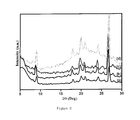
Figure 3 . XRD spectra of (a) NTP , (b) NSTP, (c) RNTP, (d) RNSTP. - This invention relates to Ruthenium bipyridyl complex intercalated N-doped or N,S-codoped titania pillared montmorillonite, and process for preparation thereof. The present invention also provides comparative analysis of the catalytic efficiency (arising due to the synergistic effect of photosensitization of the Ruthenium complex and photochemically more ameliorated pillared montmorillonite) among the aforesaid catalysts by applying them in various reactions for instance photo catalytic degradation of methyl orange; in photo catalytic phenol hydroxylation and in UV-Vis photo catalytic water splitting.
- The following examples are given by way of illustration for the working of the invention in actual practice and therefore, should not be construed to limit the scope of the present invention.
- An aqueous suspension of montmorillonite is prepared by adding 5.5 g montmorillonite to 750 ml water under vigorous stirring for 5 h at 30 °C. Another solution is prepared by stirring 13.8 g of titanium (IV) oxysulfate sulfuric acid complex hydrate with 90 g urea, 69.5 ml ethanol and 77.5 ml water for 5 h at 30°C. This clear solution is then added drop-wise into the suspension of montmorillonite with vigorous stirring for 8 h at 80 °C. The precipitate is recovered from the mixture by centrifuging and washed with deionized water for several times. It is then dried at 120 °C overnight (12 h) and calcined at 450 °C for 5 h, which resulted in the formation of N-doped titania pillared montmorillonite (yield = 78%). The material is characterized by X-ray diffraction (XRD), UV-vis diffused reflectance spectroscopy (UV-vis DRS) and FT-IR spectroscopy. Chemical composition of the sample is determined by X-ray Fluorescence spectroscopy (XRF) and CHN analysis. The composition of the materials (in wt%) is found to be SiO2:40, Al2O3:3, Fe2O3:1.6, Ca0:2.2, Mg0:2. 5, Na20:0. 09, K2O:1. 5, TiO2:42 with 0. 2 wt% N content.
- An aqueous suspension of montmorillonite is prepared by adding 5.5 g montmorillonite to 750 ml water under vigorous stirring for 5 h at 30 °C. Another solution is prepared by stirring 13.8 g of titanium (IV) oxysulfate sulfuric acid complex hydrate with 7.6 g thiourea, 69.5 ml ethanol and 77.5 ml water for 5 h under ice cold condition (4°C). This clear solution is then added drop-wise into the suspension of montmorillonite , under vigorous stirring for 8 h at 80 °C. The precipitate is recovered from the mixture by centrifuging and washed with deionized water for several times. It is then dried at 120 °C overnight (12 h) and calcined at 450 °C for 5 h, which resulted in the formation of N,S-codoped titania pillared montmorillonite (yield = 80 %). The material is characterized by X-ray diffraction (XRD), N2 adsorption-desorption, UV-vis diffused reflectance spectroscopy (UV-vis DRS) and FT-IR spectroscopy. Chemical composition of the sample is determined by X-ray Fluorescence spectroscopy (XRF) and CHN analysis. The composition of the materials (in wt%) is found to be SiO2:42, Al2O3:4, Fe203:1. 8, CaO:2. 2, Mg0:2. 5, Na20:0. 1, K20:1. 5, Ti02: 40 with 0. 31 wt% N and 0. 9 wt% S .
- A tris bipyridyl ruthenium (II) complex is prepared by refluxing a mixture of ethanolic solution ( 80 ml) of 0.415 g of RuCl3, 0.997 g of 2, 2' -bipyridyl and 0.074 g of sodium borohydrate in a 250 ml two necked round bottom flask for 6 h at 70 °C. Then the excess ethanol is evaporated to leave the crystalline complex. The complex was characterized by CHN analysis and Fourier-transform infrared spectroscopy (FT-IR).
- About 1 g N-doped titania pillared montmorillonite prepared in Example 1 is stirred with 50 ml deionized water for 1 h at 30 °C. Then 0. 7 g of ruthenium complex prepared in Example 3 in 10 ml deionized water is added to it under reflux accompanied by stirring. An additional 25 ml of deionized water is added to the solution and it is refluxed overnight (12 h) at 100 °C. The solution is filtered and the filtered material is dried under vacuum at 80 °C for 5 h (yield = 88%). The material is characterized by N2 adsorption-desorption isotherm, FT-IR analysis and TG-DTA analysis. (yield =75 %). The material is characterized by X-ray diffraction (XRD), N2 adsorption-desorption, UV-vis diffused reflectance spectroscopy (UV-vis DRS) and FT-IR spectroscopy. Chemical composition of the sample is determined by X-ray Fluorescence spectroscopy (XRF) and atomic absorption spectroscopy. The composition of the materials (in wt%) is found to be SiO2:41, Al2O3:3, Fe203:1. 8, CaO:2. 2, Mg0:2. 5, Na2O:0. 09, K2O:1. 5, TiO2:42 with N:0.2 and ruthenium complex:5.
- 1g N,S-codoped titania pillared montmorillonite prepared in Example 2 is stirred with 50 ml deionized water for 1 h at 30 °C. Then 0.7 g of ruthenium complex prepared in Example 3 in 10 ml deionized water is added to it under reflux accompanied by stirring. An additional 25 ml of deionized water is added to the solution and it is refluxed overnight (12 h) at 100 °C. The solution is filtered and the filtered material is dried under vacuum at 80 °C for 5 h (yield = 78 %). The material is characterized by X-ray diffraction (XRD), N2 adsorption-desorption, UV-vis diffused reflectance spectroscopy (UV-vis DRS) and FT-IR spectroscopy. Chemical composition of the sample is determined by X-ray Fluorescence spectroscopy (XRF) and atomic absorption spectroscopy. The composition of the materials (in wt%) is found to be SiO2:41, Al2O3:4, Fe203:1. 8, Ca0:2. 1, MgO:2.5, Na20:0. 1, K2O:1. 5, TiO2: 40 with N:0. 31, S:1. 0 and ruthenium complex : 4.9.
- Photochemical hydrogen generation experiments are carried out using a quartz batch reactor that is exposed to the light of medium pressure 125 W mercury visible lamp. The photon flux in the quartz flask is found to be 7 x 10¹⁹ photons/s for the 254 nm spectral region, as determined with ferrioxalate chemical actinometry. For catalytic measurements, the glass flask is charged with 20 mg of catalyst in 20 ml of 10 vol % methanol. The H2 liberated is observed to be 1694.8 µmol using 0.02 g of catalyst in 3 h of light illumination. (The evolved gas is collected by water displacement technique and is analysed by an offline gas chromatograph.)
- Photochemical hydrogen generation experiments are carried out using a quartz batch reactor that is exposed to the light of medium pressure 125 W mercury visible lamp. For catalytic measurements, the glass flask is charged with 20 mg of catalyst in 20 ml of 10 vol % methanol. The H2 liberated is observed to be 2010.3 µmol using 0.02 g of catalyst in 3 h of light illumination.
- Photochemical hydrogen generation experiments are carried out using a quartz batch reactor that is exposed to the light of medium pressure 125 W mercury visible lamp. For catalytic measurements, the glass flask is charged with 20 mg of catalyst in 20 ml of 10 vol % methanol. The H2 liberated is observed to be 3808.2 µmol using 0.02 g of catalyst in 3 h of light illumination.
- Photochemical hydrogen generation experiments are carried out using a quartz batch reactor that is exposed to the light of medium pressure 125 W mercury visible lamp. For catalytic measurements, the glass flask is charged with 20 mg of catalyst in 20 ml of 10 vol % methanol. The H2 liberated is observed to be 4510.0 µmol using 0.02 g of catalyst in 3 h of light illumination.
- Photocatalytic degradation of methyl orange is studied using sunlight as the energy source. Prior to the start of light experiment, dark adsorption experiments are carried out for 30 min under continuous stirring. For catalytic measurement, a 100 ml flask is charged with 0.05 g of catalyst in 20 ml of 100 ppm methyl orange solution at 38 °C. It is then analysed by a UV-vis spectrophotometer at 500 nm wave length. The complete degradation of the dye is achieved in 120 min using 0.05 g of catalyst.
- Photocatalytic degradation of methyl orange is studied using sunlight as the energy source. Prior to the start of light experiment, dark adsorption experiments are carried out for 30 min under continuous stirring. For catalytic measurement, a 100 ml flask is charged with 0.05 g of catalyst in 20 ml of 100 ppm methyl orange solution at 40 °C. It is then analysed by a UV-vis spectrophotometer at 500 nm wave length. The complete degradation of the dye is achieved in 90 min using 0.05 g of catalyst.
- Photocatalytic degradation of methyl orange is studied using sunlight as the energy source. Prior to the start of light experiment dark, adsorption experiments are carried out for 30 min under continuous stirring. For catalytic measurement, a 100 ml flask is charged with 0.05 g of catalyst in 20 ml of 100 ppm methyl orange solution at 40 °C. It is then analysed by a UV-vis spectrophotometer at 500 nm wave length. The complete degradation of the dye is achieved in 75 min using 0.05 g of catalyst.
- Photocatalytic degradation of methyl orange is studied using sunlight as the energy source. Prior to the start of light experiment, dark adsorption experiments are carried out for 30 min under continuous stirring. For catalytic measurement, a 100 ml flask is charged with 0.05 g of catalyst in 20 ml of 100 ppm methyl orange solution at 40 °C. It is then analysed by a UV-vis spectrophotometer at 500 nm wave length. The complete degradation of the dye is achieved in 45 min using 0.05 g of catalyst.
- Photochemical phenol hydroxylation experiments are carried out in presence of sunlight. For catalytic measurements, the glass flask is charged with 40 mg of catalyst in 40 ml of 10 ppm phenol solution at 42 °C. The reaction mixture is stirred with a magnetic impeller. The product is analysed by an offline gas chromatograph. The main products obtained are catechol and hydroquinone with a small trace of benzoquinone. The phenol conversion is observed to be 14 % with 59 % catechol and 39.7 % hydroquinone selectivity respectively using 0.04 g of catalyst in 120 min of light illumination.
- Photochemical phenol hydroxylation experiments are carried out in presence of sunlight. For catalytic measurements, the glass flask is charged with 40 mg of catalyst in 40 ml of 10 ppm phenol solution at 42 °C. The reaction mixture is stirred with a magnetic impeller. The product is analysed by an offline gas chromatograph. The main products obtained are catechol and hydroquinone with a small trace of benzoquinone. The phenol conversion is observed to be 18 % with 63 % catechol and 36.5 % hydroquinone selectivity respectively using 0.04 g of catalyst in 120 min of light illumination.
- Photochemical phenol hydroxylation experiments are carried out in presence of sunlight. For catalytic measurements, the glass flask is charged with 40 mg of catalyst in 40 ml of 10 ppm phenol solution at 42 °C. The reaction mixture is stirred with a magnetic impeller. The product is analysed by an offline gas chromatograph.. The main products obtained are catechol and hydroquinone with a small trace of benzoquinone. The phenol conversion is observed to be 23 % with 68 % catechol and 32 % hydroquinone selectivity respectively using 0.04 g of catalyst in 120 min of light illumination.
- Photochemical phenol hydroxylation experiments are carried out in presence of sunlight. For catalytic measurements, the glass flask is charged with 40 mg of catalyst in 40 ml of 10 ppm phenol solution at 42 °C. The reaction mixture is stirred with a magnetic impeller. The product is analysed by an offline gas chromatograph. The main products obtained are catechol and hydroquinone with a small trace of benzoquinone. The phenol conversion is observed to be 26 % with 63 % catechol and 37 % hydroquinone selectivity respectively using 0.04 g of catalyst in 120 min of light illumination.
-
- 1. The above mentioned inventions are novel and cost effective process of preparation of Ruthenium bipyridyl complex intercalated N-doped or N,S-co doped titania pillared montmorillonite.
- 2. The preparation of Ruthenium bipyridyl complex intercalated N-doped or N, S-co doped titania pillared montmorillonite includes the use of very cheap and easily available chemicals.
- 3. The preparation of Ruthenium bipyridyl complex intercalated N-doped or N,S-co doped titania pillared montmorillonite includes easy steps.
- 4. Along with all other facts, it behaves as a multifunctional photocatalyst utilizing visible light as the energy source.
Claims (9)
- Ruthenium complex intercalated co-doped titania pillared montmorillonite catalyst comprising ruthenium complex in the range of 3 to 6 wt/wt %, titania in the range of 40 to 50 wt/wt % and montmorillonite in the range of 50-55 wt/wt %, N or N, S dopant in the range of 0. 5-1.5 wt/wt % wherein N or N, S dopant source is selected from the group consisting of urea, thiourea and their derivatives .
- The Ruthenium complex intercalated co-doped titania pillared montmorillonite catalyst as claimed in claim 1, wherein ruthenium complex is selected from the group consisting from Ruthenium bipyridyl and Ruthenium phenanthroline.
- The Ruthenium complex intercalated co-doped titania pillared montmorillonite catalyst as claimed in claim 1, wherein said catalyst is useful as photo catalyst.
- A process for the preparation of Ruthenium complex intercalated co doped titania pillared montmorillonite as claimed in claim 1, wherein the said process comprising the steps of;(a) Preparing suspension of Montmorillonite selected from group the group consisting of K10 montmorillonite and KSF montmorillonite in water;(b) making a solution of N or N and S source, titanium (IV) oxysulfate sulfuric acid complex hydrate, ethanol, water under stirring at temperature ranging between 0 to 30°C;(c) adding solution as obtained in step ( b) dropwise into the montmorillonite suspension as obtained in step (a) at temperature ranging between 80 °C to 90 °C for a period ranging between 8-9 h to obtain precipitate;(d) washing of the precipitates as obtained in step (c) with water and drying for a period ranging between 12 h to 15 h at temperature ranging between 120 °C to 150 °C followed by activation of precipitate at temperature ranging between 450 °C to 600 °C_for a period ranging between 4-5 h to obtain N-doped or N, S co-doped Titania pillared monmorillonite;(e) adding aqueous solution of Ruthenium complex selected from the group consisting of Ruthenium bipyridyl or Ruthenium phenanthroline into the aqueous slurry of N-doped or N, S doped Titania pillared monmorillonite as obtained in step (d) and drying the filtered materials under vacuum at temperature ranging between 80 °C to 90 °C for a period ranging between 5 h to 8 h to obtain Ruthenium complex intercalated N doped or N and S-co doped titania pillared montmorillonite catalyst.
- The process as claimed in claim 4, wherein N or N and S source used in step (b) is selected from the group consisting of urea, thiourea and their derivatives.
- The process as claimed in claim 4, wherein mol ratio of montmorillonite, titanium (IV) oxysulfate sulfuric acid complex hydrate, N or N and S source and Ruthenium bipyridyl complex is in the range of 1.25:1.0:0. 1:0.015 to 1.23:1. 1:0.09:0.016.
- The Ruthenium complex intercalated codoped titania pillared montmorillonite as claimed in claim 1, wherein 20mg to 50 mg photocatalyst is used to liberate 1694 to 4510 µmol H2 in 150 to 180 min of light illumination.
- The Ruthenium complex intercalated codoped titania pillared montmorillonite as claimed in claim 1, wherein complete photodegradation of methyl orange occurs by using said photocatalyst is in the range of 50 mg to 100 mg for period in the range of 45 min. to 120 min.
- The Ruthenium complex intercalated codoped titania pillared montmorillonite as claimed in claim 1, wherein phenol conversion by using said photocatalyst is in the range of 14-26%.
Applications Claiming Priority (1)
| Application Number | Priority Date | Filing Date | Title |
|---|---|---|---|
| IN2362DE2010 | 2010-10-01 |
Publications (2)
| Publication Number | Publication Date |
|---|---|
| EP2436439A1 true EP2436439A1 (en) | 2012-04-04 |
| EP2436439B1 EP2436439B1 (en) | 2013-05-22 |
Family
ID=44799689
Family Applications (1)
| Application Number | Title | Priority Date | Filing Date |
|---|---|---|---|
| EP20110183612 Not-in-force EP2436439B1 (en) | 2010-10-01 | 2011-09-30 | Ruthenium complex intercalated N-doped or N,S-codoped titania pillared montmorillonite and a process for the preparation thereof |
Country Status (2)
| Country | Link |
|---|---|
| US (1) | US9023750B2 (en) |
| EP (1) | EP2436439B1 (en) |
Cited By (7)
| Publication number | Priority date | Publication date | Assignee | Title |
|---|---|---|---|---|
| CN103263940A (en) * | 2013-05-08 | 2013-08-28 | 上海纳米技术及应用国家工程研究中心有限公司 | Preparation method of titanium dioxide for anion surfactant degradation |
| CN103990455A (en) * | 2014-06-11 | 2014-08-20 | 常州大学 | Preparation method of bentonite supported silver vanadate photo-catalyst |
| CN108640123A (en) * | 2018-05-02 | 2018-10-12 | 贵州大学 | A kind of preparation method of bismuth titanium intercalation montmorillonite |
| CN109192997A (en) * | 2018-08-13 | 2019-01-11 | 湘潭大学 | A kind of nitrogen sulphur codope carbon carries non noble metal oxygen reduction catalyst and preparation method thereof |
| CN113457706A (en) * | 2021-06-23 | 2021-10-01 | 江苏大学 | Synthesis of N-BiOBr/CQDs/Fe by pollutant template element filling strategy3O4And applications thereof |
| CN113737217A (en) * | 2021-09-29 | 2021-12-03 | 天津理工大学 | High-load metal Co monatomic catalyst and preparation method and application thereof |
| CN116273088A (en) * | 2023-03-30 | 2023-06-23 | 深圳先进技术研究院 | A kind of phosphorus-doped titanium dioxide and its preparation method and application |
Families Citing this family (3)
| Publication number | Priority date | Publication date | Assignee | Title |
|---|---|---|---|---|
| US11515552B2 (en) * | 2018-03-22 | 2022-11-29 | Kabushiki Kaisha Toshiba | Catalyst laminate, membrane electrode assembly, electrochemical cell, stack, water electrolyzer, and hydrogen utilizing system |
| CN111468185A (en) * | 2020-04-16 | 2020-07-31 | 江苏星诺新材料科技有限公司 | Supported photocatalyst and preparation method and application thereof |
| CN113351202B (en) * | 2021-06-01 | 2024-01-26 | 广东天原新材料有限公司 | Titanium dioxide/ruthenium monoatomic noble metal nano catalytic material for degrading pollutants and preparation method thereof |
Citations (3)
| Publication number | Priority date | Publication date | Assignee | Title |
|---|---|---|---|---|
| EP0248907A1 (en) * | 1985-11-06 | 1987-12-16 | Research Development Corporation of Japan | Photochromic material, photochromic element and method of recording and erasing data |
| US4980047A (en) | 1987-03-05 | 1990-12-25 | Uop | Stable intercalated clays and preparation method |
| US20060034752A1 (en) | 2004-06-30 | 2006-02-16 | Industrial Technology Research Institute | Visible-light-activated photocatalyst and method for producing the same |
-
2011
- 2011-09-30 US US13/250,316 patent/US9023750B2/en not_active Expired - Fee Related
- 2011-09-30 EP EP20110183612 patent/EP2436439B1/en not_active Not-in-force
Patent Citations (3)
| Publication number | Priority date | Publication date | Assignee | Title |
|---|---|---|---|---|
| EP0248907A1 (en) * | 1985-11-06 | 1987-12-16 | Research Development Corporation of Japan | Photochromic material, photochromic element and method of recording and erasing data |
| US4980047A (en) | 1987-03-05 | 1990-12-25 | Uop | Stable intercalated clays and preparation method |
| US20060034752A1 (en) | 2004-06-30 | 2006-02-16 | Industrial Technology Research Institute | Visible-light-activated photocatalyst and method for producing the same |
Non-Patent Citations (32)
| Title |
|---|
| A. BERNIER, L.F. ADMAIAI, P. GRANGE, APPL. CATALYSIS, vol. 77, 1991, pages 269 |
| A. VACCARI, CATALYSIS TODAY, vol. 41, 1998, pages 53 |
| A.V. EMELINE, Y. FURUBAYASHI, X. ZHANG, M. JIN, T. MURAKAMI, A. FUJISHIMA, J. PHYS. CHEM. B, vol. 109, 2005, pages 24441 |
| B.I. NABIVANETS, L.N. KUDRITSKAYA, RUSS. J. INORG. CHEM., vol. 12, 1967, pages 616 |
| BINITHA N N ET AL: "Preparation, characterization and catalytic activity of titania pillared montmorillonite clays", MICROPOROUS AND MESOPOROUS MATERIALS, ELSEVIER SCIENCE PUBLISHING, NEW YORK, US, vol. 93, no. 1-3, 28 July 2006 (2006-07-28), pages 82 - 89, XP028038963, ISSN: 1387-1811, [retrieved on 20060728] * |
| C.F. BAES, R.E. MEISNER: "The Hydrolysis of Cations", 1976, WILEY |
| D. CHEN, Z. JIANG, J. GENG, Q. WANG, D. YANG, IND. ENG. CHEM. RES., vol. 46, 2007, pages 2741 |
| E. DVININOV, E. POPOVICI, R. PODE, L. COCHECI, P. BARVINSCHI, V. NICA, J. HAZARD. MATER., vol. 167, 2009, pages 1050 |
| G. ZHANG, X. DING, Y. HU, B. HUANG, X. ZHANG, X. QIN, J. ZHOU, J. XIE, J. PHYS. CHEM. C, vol. 112, 2008, pages 17994 |
| GAOKE ZHANG ET AL: "Photocatalytic Degradation of 4BS Dye by N,S-Codoped TiO2 Pillared Montmorillonite Photocatalysts under Visible-Light Irradiation", JOURNAL OF PHYSICAL CHEMISTRY C, vol. 112, no. 46, 20 November 2008 (2008-11-20), pages 17994 - 17997, XP055013091, ISSN: 1932-7447, DOI: 10.1021/jp803939z * |
| H. EINAGA, J. CHEM. SOC. DALTON TRANS., vol. 12, 1979, pages 1917 |
| H. LI, J. LI, Y. HUO, J. PHYS. CHEM. B, vol. 110, 2006, pages 1559 |
| H. LIU, T. PENG, D. KE, Z. PENG, C. YAN, MATER. CHEM. PHYS., vol. 104, 2007, pages 377 |
| H.M. YANG, R.R. SHI, K. ZHANG, Y.H. HUA, A.D. TANG, X.W. LI, J. ALLOYS COMPD., vol. 398, 2005, pages 200 |
| J. STERTE, CLAYS AND CLAY MINERALS, vol. 34, 1986, pages 658 |
| J. YU, M. ZHOU, B. CHENG, X. ZHAO, J. MOL. CATAL. A: CHEM., vol. 246, 2006, pages 176J |
| J. ZHOU, Y. ZHANG, X.S. ZHAO, A.K. RAY, IND. ENG. CHEM. RES., vol. 45, 2006, pages 3503 |
| M.-C. YANG, T.-S. YANG, M.-S. WONG, THIN SOLID FILMS, vol. 1, 2004, pages 469 - 470 |
| M.-S. WONG, H. P. CHOU, T.-S. YANG, THIN SOLID FILMS, vol. 494, 2006, pages 244 |
| N.N. BINITHA, S. SUGUNAN, MICROPOR. AND MESOPOR. MATER., vol. 93, 2006, pages 82 |
| R. A. DELLAGUARDIA, J.K. THOMAS, J. PHYS. CHEM., vol. 87, 1983, pages 990 |
| R. ASAHI, T. MORIKAWA, T. OHWAKI, K. AOKI, Y. TAGA, SCIENCE, vol. 293, 2001, pages 269 |
| R.A. SCHOONHEYDT, P. DE PAUW, D. VLIERS, F.C. DE SCHRIJVER, J. PHYS. CHEM., vol. 88, 1984, pages 5113 |
| R.T. YANG, J. P. CHEN, E. S. KIKKINIDES, L. S. CHENG, J. E. CICHANOWICZ, IND. ENG. CHEM. RES., vol. 31, 1992, pages 1440 |
| S. CHANG, R. DOONG, J. PHYS. CHEM. B, vol. 110, 2006, pages 20808 |
| S. SATO, CHEM. PHYS. LETT., vol. 123, 1986, pages 126 |
| T. KANEKO, H. SHIMOTSUMA, M. KAJIKAWA, J. POROUS MATER., vol. 8, 2001, pages 295 |
| T. UMEBAYASHI, T. YAMAKI, H. ITOH, K. ASAI, APPL. PHYS. LETT., vol. 81, 2002, pages 454 |
| V. JOSHI, D. KOTHAR, P.K. GHOSH, J. AM. CHEM. SOC., vol. 108, 1986, pages 4650 |
| Y. KITAYAMA, T. KODAMA, M. ABE, H. SHIMOTSUMA, Y. MATSUDA, J. POROUS MATER., vol. 5, 1998, pages 121 |
| YU J ET AL: "Preparation, characterization and photocatalytic activity of in situ N,S-codoped TiO2 powders", JOURNAL OF MOLECULAR CATALYSIS A: CHEMICAL, ELSEVIER, AMSTERDAM, NL, vol. 246, no. 1-2, 1 March 2006 (2006-03-01), pages 176 - 184, XP028015488, ISSN: 1381-1169, [retrieved on 20060301] * |
| Z. AN-NING, C. YOU-MEI, Y. ZHAN- JIANG, J. OF COAL SCI. & ENG., vol. 14, 2008, pages 517 |
Cited By (11)
| Publication number | Priority date | Publication date | Assignee | Title |
|---|---|---|---|---|
| CN103263940A (en) * | 2013-05-08 | 2013-08-28 | 上海纳米技术及应用国家工程研究中心有限公司 | Preparation method of titanium dioxide for anion surfactant degradation |
| CN103990455A (en) * | 2014-06-11 | 2014-08-20 | 常州大学 | Preparation method of bentonite supported silver vanadate photo-catalyst |
| CN103990455B (en) * | 2014-06-11 | 2015-12-30 | 常州大学 | A kind of preparation method of alta-mud load silver vanadate photochemical catalyst |
| CN108640123A (en) * | 2018-05-02 | 2018-10-12 | 贵州大学 | A kind of preparation method of bismuth titanium intercalation montmorillonite |
| CN108640123B (en) * | 2018-05-02 | 2021-12-03 | 贵州大学 | Preparation method of bismuth-titanium intercalated montmorillonite |
| CN109192997A (en) * | 2018-08-13 | 2019-01-11 | 湘潭大学 | A kind of nitrogen sulphur codope carbon carries non noble metal oxygen reduction catalyst and preparation method thereof |
| CN109192997B (en) * | 2018-08-13 | 2020-07-14 | 湘潭大学 | Nitrogen-sulfur co-doped carbon-supported non-noble metal oxygen reduction catalyst and preparation method thereof |
| CN113457706A (en) * | 2021-06-23 | 2021-10-01 | 江苏大学 | Synthesis of N-BiOBr/CQDs/Fe by pollutant template element filling strategy3O4And applications thereof |
| CN113737217A (en) * | 2021-09-29 | 2021-12-03 | 天津理工大学 | High-load metal Co monatomic catalyst and preparation method and application thereof |
| CN113737217B (en) * | 2021-09-29 | 2024-06-11 | 天津理工大学 | High-load metal Co monoatomic catalyst and preparation method and application thereof |
| CN116273088A (en) * | 2023-03-30 | 2023-06-23 | 深圳先进技术研究院 | A kind of phosphorus-doped titanium dioxide and its preparation method and application |
Also Published As
| Publication number | Publication date |
|---|---|
| US20120178614A1 (en) | 2012-07-12 |
| EP2436439B1 (en) | 2013-05-22 |
| US9023750B2 (en) | 2015-05-05 |
Similar Documents
| Publication | Publication Date | Title |
|---|---|---|
| EP2436439B1 (en) | Ruthenium complex intercalated N-doped or N,S-codoped titania pillared montmorillonite and a process for the preparation thereof | |
| Zhang et al. | Self-assembly of CdS/CdIn2S4 heterostructure with enhanced photocascade synthesis of schiff base compounds in an aromatic alcohols and nitrobenzene system with visible light | |
| Van Dang et al. | Z-scheme photocatalyst Pt/GaP-TiO2-SiO2: Rh for the separated H2 evolution from photocatalytic seawater splitting | |
| Wang et al. | MoS2/CQDs obtained by photoreduction for assembly of a ternary MoS2/CQDs/ZnIn2S4 nanocomposite for efficient photocatalytic hydrogen evolution under visible light | |
| Naik et al. | Facile synthesis of N-and S-incorporated nanocrystalline TiO2 and direct solar-light-driven photocatalytic activity | |
| CN103240130B (en) | TiO2/MIL-101 composite catalyst for photocatalytic water splitting and its preparation method and application | |
| Navalón et al. | Photocatalytic CO2 reduction using non‐titanium metal oxides and sulfides | |
| Adhikari et al. | Enhanced visible light photocatalytic water reduction from a g-C3N4/SrTa2O6 heterojunction | |
| Chen et al. | Bi2O2CO3/BiOI photocatalysts with heterojunctions highly efficient for visible-light treatment of dye-containing wastewater | |
| Bhom et al. | Photocatalytic hydrogen production using TiO2‐based catalysts: a review | |
| Etacheri et al. | Nanostructured ti1-x S x O2-y N y heterojunctions for efficient visible-light-induced photocatalysis | |
| Kumar et al. | Review on modified TiO2 photocatalysis under UV/visible light: selected results and related mechanisms on interfacial charge carrier transfer dynamics | |
| Wang et al. | Synthesis of Pt-loaded self-interspersed anatase TiO2 with a large fraction of (001) facets for efficient photocatalytic nitrobenzene degradation | |
| Zhang et al. | Atomically precise dinuclear Ni2 active site-modified MOF-derived ZnO@ NC heterojunction toward high-performance N2 photofixation | |
| JP4803414B2 (en) | Novel Z-scheme-type photocatalytic system for complete decomposition of visible light active water and method for complete decomposition of water using said catalyst | |
| Pan et al. | Synthesis and photocatalytic hydrogen production of a novel photocatalyst LaCO3OH | |
| Li et al. | Carbon black-doped anatase TiO2 nanorods for solar light-induced photocatalytic degradation of methylene blue | |
| Do et al. | Preparation of basalt fiber@ perovskite PbTiO3 core–shell composites and their effects on CH4 production from CO2 photoreduction | |
| Li et al. | Precipitation synthesis of mesoporous photoactive Al2O3 for constructing g-C3N4-based heterojunctions with enhanced photocatalytic activity | |
| Zhang et al. | Striving toward visible light photocatalytic water splitting based on natural silicate clay mineral: the interface modification of attapulgite at the atomic-molecular level | |
| CN104399509B (en) | Hydrogen-free precursor synthesized carbon nitride photocatalyst | |
| CN108404959B (en) | Rod-like g-C3N4@SnIn4S8Composite photocatalyst and preparation method thereof | |
| Zhang et al. | Mixed-valent cobalt-modulated tungsten trioxide nanorod arrays for improved photocatalytic N2 fixation | |
| Han et al. | An ion exchange strategy to BiOI/CH3COO (BiO) heterojunction with enhanced visible-light photocatalytic activity | |
| Song et al. | Modification of porphyrin/dipyridine metal complexes on the surface of TiO2 nanotubes with enhanced photocatalytic activity for photoreduction of CO2 into methanol |
Legal Events
| Date | Code | Title | Description |
|---|---|---|---|
| PUAI | Public reference made under article 153(3) epc to a published international application that has entered the european phase |
Free format text: ORIGINAL CODE: 0009012 |
|
| AK | Designated contracting states |
Kind code of ref document: A1 Designated state(s): AL AT BE BG CH CY CZ DE DK EE ES FI FR GB GR HR HU IE IS IT LI LT LU LV MC MK MT NL NO PL PT RO RS SE SI SK SM TR |
|
| AX | Request for extension of the european patent |
Extension state: BA ME |
|
| 17P | Request for examination filed |
Effective date: 20121004 |
|
| GRAP | Despatch of communication of intention to grant a patent |
Free format text: ORIGINAL CODE: EPIDOSNIGR1 |
|
| GRAS | Grant fee paid |
Free format text: ORIGINAL CODE: EPIDOSNIGR3 |
|
| GRAA | (expected) grant |
Free format text: ORIGINAL CODE: 0009210 |
|
| AK | Designated contracting states |
Kind code of ref document: B1 Designated state(s): AL AT BE BG CH CY CZ DE DK EE ES FI FR GB GR HR HU IE IS IT LI LT LU LV MC MK MT NL NO PL PT RO RS SE SI SK SM TR |
|
| REG | Reference to a national code |
Ref country code: GB Ref legal event code: FG4D |
|
| REG | Reference to a national code |
Ref country code: CH Ref legal event code: EP |
|
| REG | Reference to a national code |
Ref country code: AT Ref legal event code: REF Ref document number: 612906 Country of ref document: AT Kind code of ref document: T Effective date: 20130615 |
|
| REG | Reference to a national code |
Ref country code: IE Ref legal event code: FG4D |
|
| REG | Reference to a national code |
Ref country code: DE Ref legal event code: R096 Ref document number: 602011001727 Country of ref document: DE Effective date: 20130718 |
|
| REG | Reference to a national code |
Ref country code: AT Ref legal event code: MK05 Ref document number: 612906 Country of ref document: AT Kind code of ref document: T Effective date: 20130522 |
|
| REG | Reference to a national code |
Ref country code: LT Ref legal event code: MG4D |
|
| PG25 | Lapsed in a contracting state [announced via postgrant information from national office to epo] |
Ref country code: AT Free format text: LAPSE BECAUSE OF FAILURE TO SUBMIT A TRANSLATION OF THE DESCRIPTION OR TO PAY THE FEE WITHIN THE PRESCRIBED TIME-LIMIT Effective date: 20130522 Ref country code: PT Free format text: LAPSE BECAUSE OF FAILURE TO SUBMIT A TRANSLATION OF THE DESCRIPTION OR TO PAY THE FEE WITHIN THE PRESCRIBED TIME-LIMIT Effective date: 20130923 Ref country code: NO Free format text: LAPSE BECAUSE OF FAILURE TO SUBMIT A TRANSLATION OF THE DESCRIPTION OR TO PAY THE FEE WITHIN THE PRESCRIBED TIME-LIMIT Effective date: 20130822 Ref country code: GR Free format text: LAPSE BECAUSE OF FAILURE TO SUBMIT A TRANSLATION OF THE DESCRIPTION OR TO PAY THE FEE WITHIN THE PRESCRIBED TIME-LIMIT Effective date: 20130823 Ref country code: FI Free format text: LAPSE BECAUSE OF FAILURE TO SUBMIT A TRANSLATION OF THE DESCRIPTION OR TO PAY THE FEE WITHIN THE PRESCRIBED TIME-LIMIT Effective date: 20130522 Ref country code: ES Free format text: LAPSE BECAUSE OF FAILURE TO SUBMIT A TRANSLATION OF THE DESCRIPTION OR TO PAY THE FEE WITHIN THE PRESCRIBED TIME-LIMIT Effective date: 20130902 Ref country code: LT Free format text: LAPSE BECAUSE OF FAILURE TO SUBMIT A TRANSLATION OF THE DESCRIPTION OR TO PAY THE FEE WITHIN THE PRESCRIBED TIME-LIMIT Effective date: 20130522 Ref country code: SI Free format text: LAPSE BECAUSE OF FAILURE TO SUBMIT A TRANSLATION OF THE DESCRIPTION OR TO PAY THE FEE WITHIN THE PRESCRIBED TIME-LIMIT Effective date: 20130522 Ref country code: SE Free format text: LAPSE BECAUSE OF FAILURE TO SUBMIT A TRANSLATION OF THE DESCRIPTION OR TO PAY THE FEE WITHIN THE PRESCRIBED TIME-LIMIT Effective date: 20130522 |
|
| REG | Reference to a national code |
Ref country code: NL Ref legal event code: VDEP Effective date: 20130522 |
|
| PG25 | Lapsed in a contracting state [announced via postgrant information from national office to epo] |
Ref country code: PL Free format text: LAPSE BECAUSE OF FAILURE TO SUBMIT A TRANSLATION OF THE DESCRIPTION OR TO PAY THE FEE WITHIN THE PRESCRIBED TIME-LIMIT Effective date: 20130522 Ref country code: HR Free format text: LAPSE BECAUSE OF FAILURE TO SUBMIT A TRANSLATION OF THE DESCRIPTION OR TO PAY THE FEE WITHIN THE PRESCRIBED TIME-LIMIT Effective date: 20130522 Ref country code: RS Free format text: LAPSE BECAUSE OF FAILURE TO SUBMIT A TRANSLATION OF THE DESCRIPTION OR TO PAY THE FEE WITHIN THE PRESCRIBED TIME-LIMIT Effective date: 20130522 Ref country code: BG Free format text: LAPSE BECAUSE OF FAILURE TO SUBMIT A TRANSLATION OF THE DESCRIPTION OR TO PAY THE FEE WITHIN THE PRESCRIBED TIME-LIMIT Effective date: 20130822 |
|
| PG25 | Lapsed in a contracting state [announced via postgrant information from national office to epo] |
Ref country code: LV Free format text: LAPSE BECAUSE OF FAILURE TO SUBMIT A TRANSLATION OF THE DESCRIPTION OR TO PAY THE FEE WITHIN THE PRESCRIBED TIME-LIMIT Effective date: 20130522 |
|
| PG25 | Lapsed in a contracting state [announced via postgrant information from national office to epo] |
Ref country code: EE Free format text: LAPSE BECAUSE OF FAILURE TO SUBMIT A TRANSLATION OF THE DESCRIPTION OR TO PAY THE FEE WITHIN THE PRESCRIBED TIME-LIMIT Effective date: 20130522 Ref country code: BE Free format text: LAPSE BECAUSE OF FAILURE TO SUBMIT A TRANSLATION OF THE DESCRIPTION OR TO PAY THE FEE WITHIN THE PRESCRIBED TIME-LIMIT Effective date: 20130522 Ref country code: DK Free format text: LAPSE BECAUSE OF FAILURE TO SUBMIT A TRANSLATION OF THE DESCRIPTION OR TO PAY THE FEE WITHIN THE PRESCRIBED TIME-LIMIT Effective date: 20130522 Ref country code: CZ Free format text: LAPSE BECAUSE OF FAILURE TO SUBMIT A TRANSLATION OF THE DESCRIPTION OR TO PAY THE FEE WITHIN THE PRESCRIBED TIME-LIMIT Effective date: 20130522 Ref country code: SK Free format text: LAPSE BECAUSE OF FAILURE TO SUBMIT A TRANSLATION OF THE DESCRIPTION OR TO PAY THE FEE WITHIN THE PRESCRIBED TIME-LIMIT Effective date: 20130522 |
|
| PG25 | Lapsed in a contracting state [announced via postgrant information from national office to epo] |
Ref country code: IT Free format text: LAPSE BECAUSE OF FAILURE TO SUBMIT A TRANSLATION OF THE DESCRIPTION OR TO PAY THE FEE WITHIN THE PRESCRIBED TIME-LIMIT Effective date: 20130522 Ref country code: RO Free format text: LAPSE BECAUSE OF FAILURE TO SUBMIT A TRANSLATION OF THE DESCRIPTION OR TO PAY THE FEE WITHIN THE PRESCRIBED TIME-LIMIT Effective date: 20130522 Ref country code: NL Free format text: LAPSE BECAUSE OF FAILURE TO SUBMIT A TRANSLATION OF THE DESCRIPTION OR TO PAY THE FEE WITHIN THE PRESCRIBED TIME-LIMIT Effective date: 20130522 |
|
| PLBE | No opposition filed within time limit |
Free format text: ORIGINAL CODE: 0009261 |
|
| STAA | Information on the status of an ep patent application or granted ep patent |
Free format text: STATUS: NO OPPOSITION FILED WITHIN TIME LIMIT |
|
| 26N | No opposition filed |
Effective date: 20140225 |
|
| PG25 | Lapsed in a contracting state [announced via postgrant information from national office to epo] |
Ref country code: MC Free format text: LAPSE BECAUSE OF FAILURE TO SUBMIT A TRANSLATION OF THE DESCRIPTION OR TO PAY THE FEE WITHIN THE PRESCRIBED TIME-LIMIT Effective date: 20130522 |
|
| REG | Reference to a national code |
Ref country code: DE Ref legal event code: R097 Ref document number: 602011001727 Country of ref document: DE Effective date: 20140225 |
|
| REG | Reference to a national code |
Ref country code: IE Ref legal event code: MM4A |
|
| PG25 | Lapsed in a contracting state [announced via postgrant information from national office to epo] |
Ref country code: IE Free format text: LAPSE BECAUSE OF NON-PAYMENT OF DUE FEES Effective date: 20130930 |
|
| REG | Reference to a national code |
Ref country code: CH Ref legal event code: PL |
|
| PG25 | Lapsed in a contracting state [announced via postgrant information from national office to epo] |
Ref country code: SM Free format text: LAPSE BECAUSE OF FAILURE TO SUBMIT A TRANSLATION OF THE DESCRIPTION OR TO PAY THE FEE WITHIN THE PRESCRIBED TIME-LIMIT Effective date: 20130522 |
|
| PG25 | Lapsed in a contracting state [announced via postgrant information from national office to epo] |
Ref country code: TR Free format text: LAPSE BECAUSE OF FAILURE TO SUBMIT A TRANSLATION OF THE DESCRIPTION OR TO PAY THE FEE WITHIN THE PRESCRIBED TIME-LIMIT Effective date: 20130522 Ref country code: CY Free format text: LAPSE BECAUSE OF FAILURE TO SUBMIT A TRANSLATION OF THE DESCRIPTION OR TO PAY THE FEE WITHIN THE PRESCRIBED TIME-LIMIT Effective date: 20130522 Ref country code: MT Free format text: LAPSE BECAUSE OF FAILURE TO SUBMIT A TRANSLATION OF THE DESCRIPTION OR TO PAY THE FEE WITHIN THE PRESCRIBED TIME-LIMIT Effective date: 20130522 |
|
| PG25 | Lapsed in a contracting state [announced via postgrant information from national office to epo] |
Ref country code: LU Free format text: LAPSE BECAUSE OF NON-PAYMENT OF DUE FEES Effective date: 20130930 Ref country code: MK Free format text: LAPSE BECAUSE OF FAILURE TO SUBMIT A TRANSLATION OF THE DESCRIPTION OR TO PAY THE FEE WITHIN THE PRESCRIBED TIME-LIMIT Effective date: 20130522 Ref country code: HU Free format text: LAPSE BECAUSE OF FAILURE TO SUBMIT A TRANSLATION OF THE DESCRIPTION OR TO PAY THE FEE WITHIN THE PRESCRIBED TIME-LIMIT; INVALID AB INITIO Effective date: 20110930 Ref country code: LI Free format text: LAPSE BECAUSE OF NON-PAYMENT OF DUE FEES Effective date: 20140930 Ref country code: CH Free format text: LAPSE BECAUSE OF NON-PAYMENT OF DUE FEES Effective date: 20140930 |
|
| GBPC | Gb: european patent ceased through non-payment of renewal fee |
Effective date: 20150930 |
|
| PG25 | Lapsed in a contracting state [announced via postgrant information from national office to epo] |
Ref country code: IS Free format text: LAPSE BECAUSE OF FAILURE TO SUBMIT A TRANSLATION OF THE DESCRIPTION OR TO PAY THE FEE WITHIN THE PRESCRIBED TIME-LIMIT Effective date: 20130522 |
|
| PG25 | Lapsed in a contracting state [announced via postgrant information from national office to epo] |
Ref country code: GB Free format text: LAPSE BECAUSE OF NON-PAYMENT OF DUE FEES Effective date: 20150930 |
|
| REG | Reference to a national code |
Ref country code: FR Ref legal event code: PLFP Year of fee payment: 6 |
|
| PGFP | Annual fee paid to national office [announced via postgrant information from national office to epo] |
Ref country code: DE Payment date: 20160922 Year of fee payment: 6 |
|
| PGFP | Annual fee paid to national office [announced via postgrant information from national office to epo] |
Ref country code: FR Payment date: 20160921 Year of fee payment: 6 |
|
| REG | Reference to a national code |
Ref country code: DE Ref legal event code: R119 Ref document number: 602011001727 Country of ref document: DE |
|
| REG | Reference to a national code |
Ref country code: FR Ref legal event code: ST Effective date: 20180531 |
|
| PG25 | Lapsed in a contracting state [announced via postgrant information from national office to epo] |
Ref country code: DE Free format text: LAPSE BECAUSE OF NON-PAYMENT OF DUE FEES Effective date: 20180404 |
|
| PG25 | Lapsed in a contracting state [announced via postgrant information from national office to epo] |
Ref country code: FR Free format text: LAPSE BECAUSE OF NON-PAYMENT OF DUE FEES Effective date: 20171002 |
|
| PG25 | Lapsed in a contracting state [announced via postgrant information from national office to epo] |
Ref country code: AL Free format text: LAPSE BECAUSE OF FAILURE TO SUBMIT A TRANSLATION OF THE DESCRIPTION OR TO PAY THE FEE WITHIN THE PRESCRIBED TIME-LIMIT Effective date: 20130522 |