EP2434290A1 - Blood coagulation time prolonging agent - Google Patents
Blood coagulation time prolonging agent Download PDFInfo
- Publication number
- EP2434290A1 EP2434290A1 EP10777581A EP10777581A EP2434290A1 EP 2434290 A1 EP2434290 A1 EP 2434290A1 EP 10777581 A EP10777581 A EP 10777581A EP 10777581 A EP10777581 A EP 10777581A EP 2434290 A1 EP2434290 A1 EP 2434290A1
- Authority
- EP
- European Patent Office
- Prior art keywords
- blood coagulation
- coagulation time
- blood
- measuring
- alkyl group
- Prior art date
- Legal status (The legal status is an assumption and is not a legal conclusion. Google has not performed a legal analysis and makes no representation as to the accuracy of the status listed.)
- Granted
Links
Images



Classifications
-
- G—PHYSICS
- G01—MEASURING; TESTING
- G01N—INVESTIGATING OR ANALYSING MATERIALS BY DETERMINING THEIR CHEMICAL OR PHYSICAL PROPERTIES
- G01N33/00—Investigating or analysing materials by specific methods not covered by groups G01N1/00 - G01N31/00
- G01N33/48—Biological material, e.g. blood, urine; Haemocytometers
- G01N33/50—Chemical analysis of biological material, e.g. blood, urine; Testing involving biospecific ligand binding methods; Immunological testing
- G01N33/86—Chemical analysis of biological material, e.g. blood, urine; Testing involving biospecific ligand binding methods; Immunological testing involving blood coagulating time or factors, or their receptors
-
- A—HUMAN NECESSITIES
- A61—MEDICAL OR VETERINARY SCIENCE; HYGIENE
- A61K—PREPARATIONS FOR MEDICAL, DENTAL OR TOILETRY PURPOSES
- A61K31/00—Medicinal preparations containing organic active ingredients
- A61K31/13—Amines
- A61K31/155—Amidines (), e.g. guanidine (H2N—C(=NH)—NH2), isourea (N=C(OH)—NH2), isothiourea (—N=C(SH)—NH2)
-
- A—HUMAN NECESSITIES
- A61—MEDICAL OR VETERINARY SCIENCE; HYGIENE
- A61P—SPECIFIC THERAPEUTIC ACTIVITY OF CHEMICAL COMPOUNDS OR MEDICINAL PREPARATIONS
- A61P7/00—Drugs for disorders of the blood or the extracellular fluid
- A61P7/02—Antithrombotic agents; Anticoagulants; Platelet aggregation inhibitors
-
- C—CHEMISTRY; METALLURGY
- C07—ORGANIC CHEMISTRY
- C07C—ACYCLIC OR CARBOCYCLIC COMPOUNDS
- C07C279/00—Derivatives of guanidine, i.e. compounds containing the group, the singly-bound nitrogen atoms not being part of nitro or nitroso groups
- C07C279/02—Guanidine; Salts, complexes or addition compounds thereof
-
- C—CHEMISTRY; METALLURGY
- C07—ORGANIC CHEMISTRY
- C07C—ACYCLIC OR CARBOCYCLIC COMPOUNDS
- C07C279/00—Derivatives of guanidine, i.e. compounds containing the group, the singly-bound nitrogen atoms not being part of nitro or nitroso groups
- C07C279/04—Derivatives of guanidine, i.e. compounds containing the group, the singly-bound nitrogen atoms not being part of nitro or nitroso groups having nitrogen atoms of guanidine groups bound to acyclic carbon atoms of a carbon skeleton
- C07C279/14—Derivatives of guanidine, i.e. compounds containing the group, the singly-bound nitrogen atoms not being part of nitro or nitroso groups having nitrogen atoms of guanidine groups bound to acyclic carbon atoms of a carbon skeleton being further substituted by carboxyl groups
-
- C—CHEMISTRY; METALLURGY
- C07—ORGANIC CHEMISTRY
- C07C—ACYCLIC OR CARBOCYCLIC COMPOUNDS
- C07C281/00—Derivatives of carbonic acid containing functional groups covered by groups C07C269/00 - C07C279/00 in which at least one nitrogen atom of these functional groups is further bound to another nitrogen atom not being part of a nitro or nitroso group
- C07C281/16—Compounds containing any of the groups, e.g. aminoguanidine
-
- C—CHEMISTRY; METALLURGY
- C12—BIOCHEMISTRY; BEER; SPIRITS; WINE; VINEGAR; MICROBIOLOGY; ENZYMOLOGY; MUTATION OR GENETIC ENGINEERING
- C12Q—MEASURING OR TESTING PROCESSES INVOLVING ENZYMES, NUCLEIC ACIDS OR MICROORGANISMS; COMPOSITIONS OR TEST PAPERS THEREFOR; PROCESSES OF PREPARING SUCH COMPOSITIONS; CONDITION-RESPONSIVE CONTROL IN MICROBIOLOGICAL OR ENZYMOLOGICAL PROCESSES
- C12Q1/00—Measuring or testing processes involving enzymes, nucleic acids or microorganisms; Compositions therefor; Processes of preparing such compositions
- C12Q1/56—Measuring or testing processes involving enzymes, nucleic acids or microorganisms; Compositions therefor; Processes of preparing such compositions involving blood clotting factors, e.g. involving thrombin, thromboplastin, fibrinogen
-
- G—PHYSICS
- G01—MEASURING; TESTING
- G01N—INVESTIGATING OR ANALYSING MATERIALS BY DETERMINING THEIR CHEMICAL OR PHYSICAL PROPERTIES
- G01N2333/00—Assays involving biological materials from specific organisms or of a specific nature
- G01N2333/435—Assays involving biological materials from specific organisms or of a specific nature from animals; from humans
- G01N2333/745—Assays involving non-enzymic blood coagulation factors
Definitions
- the present invention relates to a reagent for measuring blood coagulability typified by a reagent for measuring fibrinogen; specifically relates to a blood coagulation time prolonging agent used in a blood coagulation activator-containing reagent and/or in a specimen diluent for measuring blood coagulability, and to a reagent for measuring blood coagulability using this blood coagulation time prolonging agent.
- a blood coagulation mechanism is broadly divided into two pathways in general.
- One is an intrinsic pathway, which is initiated by contact activation of blood coagulation factor XII with a foreign substance,andfinally produces thrombin through multistep reactions
- the other is an extrinsic pathway, which is initiated by activation of blood coagulation factor X with blood coagulation factor VII and tissue thromboplastin, and produces thrombin in the same manner as described above ( FIG. 1 ) .
- coagulation eventually occurs by conversion of fibrinogen to fibrin through an action of produced thrombin.
- some blood coagulability tests using a blood coagulation activator are available and widely used in actual clinical examinations.
- the blood coagulation activator and the blood coagulability tests using the same are as follows:
- the mechanical detection method refers to a method including: monitoring by a magnetic force or the like a magnetic substance or the like loaded into a reaction solution; and detecting a decrease in mobility of the magnetic substance due to an increase in viscosity by coagulation.
- the optical detection method refers to a method including detecting white turbidity of a reaction solution due to coagulation as a change in transmitted light or scattered light, and is most widely used because the method is relatively simple. These are generally detected by an automated analyzer at present.
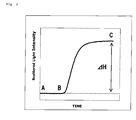
- FIG. 2 One example of a change curve for scattered light intensity obtained in a scattered light detection method is shown in FIG. 2 .
- the point A indicates a point at which the coagulation is initiated by mixing a reagent including a blood coagulation activator, subsequently fibrin deposition is initiated through multistep reactions, and as a result, a change in scattered light intensity appears after the point B. Fibrinogen is in turn consumed and almost depleted in the reaction solution. Then, the scattered light intensity exhibits no change, the curve becomes flat as shown at the point C, and the coagulation is terminated.
- a coagulation time is calculated with known calculation parameters based on such change curve for the scattered light intensity (Patent document 1).
- the reagent for measuring blood coagulability desirably has a property in which an optical change is largely displayed.
- a substance for prolonging the coagulation time is generally added to adjust the coagulation time to a desired time.
- Ablood coagulation time prolonging agent is exemplified by halide salts of alkali metals and alkali earth metals, including sodium chloride in Patent document 2, and by sodium propionate in Patent document 3.
- halide salts of alkali metals and alkali earth metals including sodium chloride in Patent document 2, and by sodium propionate in Patent document 3.
- Patent documents 4 and 5 For the purpose of solving the problems in those conventional methods, there is proposed a method including using a reagent supplemented with a high molecular material such as polyethylene glycol, polyvinyl alcohol or high molecular polysaccharide.
- the inventors of the present invention have searched a blood coagulation time prolonging agent which enhances an optical change using various compounds, and have found that a guanidine compound having a specific structure or a salt thereof has not only an action of prolonging a blood coagulation time but also an action of enhancing an optical change upon coagulation, and the use thereof as an additive for a reagent for measuring blood coagulability allows the blood coagulability to be measured correctly with high sensitivity, and have completed the present invention.
- the present invention provides a blood coagulation time prolonging agent, including, as an active ingredient, a guanidine compound represented by the following formula (1) or an acid addition salt thereof:
- R 1 represents a hydrogen atom, an amino group, or an alkyl group which may have a substituent.
- the present invention provides a blood coagulation activator-containing reagent or a specimen diluent for measuring blood coagulability, including the above-mentioned blood coagulation time prolonging agent.
- the present invention provides a blood coagulation activator-containing reagent for measuring fibrinogen including thrombin as the blood coagulation activator or a specimen diluent for measuring fibrinogen, containing the above-mentioned blood coagulation time prolonging agent.
- the present invention provides a use of a guanidine compound represented by the following formula (1) or an acid addition salt thereof for prolonging a blood coagulation time: (in the formula, R 1 represents a hydrogen atom, an amino group, or an alkyl group which may have a substituent).
- R 1 represents a hydrogen atom, an amino group, or an alkyl group which may have a substituent.
- the above-mentioned guanidine compound or acid addition salt thereof is used in combination with the blood coagulation activator.
- the above-mentioned guanidine compound or acid addition salt thereof is used in combination with the specimen diluent for measuring blood coagulability.
- the present invention provides a method of prolonging a blood coagulation time, including adding to a plasma specimen a guanidine compound represented by the following formula (1) or an acid addition salt thereof: (in the formula, R 1 represents a hydrogen atom, an amino group, or an alkyl group which may have a substituent).
- R 1 represents a hydrogen atom, an amino group, or an alkyl group which may have a substituent.
- the addition of the above-mentioned guanidine compound or acid addition salt thereof is carried out in combination with the specimen diluent for measuring blood coagulability.
- the addition of the above-mentioned guanidine compound or acid addition salt thereof is carried out in combination with the blood coagulation activator.
- the present invention provides a method of measuring blood coagulability, including the steps of: preparing a reaction solution containing a plasma specimen, a blood coagulation activator, and the above-mentioned guanidine compound or acid addition salt thereof; and measuring a coagulation time of the reaction solution. Further, in one aspect, the present invention provides a method of determining a fibrinogen concentration in the plasma specimen by comparing a measured value of the coagulation time using the plasma specimen with a measured value obtained by similarly measuring the coagulation time using a diluted standard solution in place of the plasma specimen.
- fibrinogen level, PT, and APTT for blood coagulability can be measured correctively because the optical change is enhanced.
- a blood coagulation time prolonging agent of the present invention contains a compound represented by the formula (1) or a salt thereof as an active ingredient.
- R 1 represents a hydrogen atom, an amino group, or an alkyl group which may have a substituent.
- the alkyl group is preferably an alkyl group having 1 to 6 carbon atoms, particularly preferably an alkyl group having 2 to 5 carbon atoms.
- a group which may serve as a substituent of the alkyl group is exemplified by a carboxy group, an alkoxycarbonyl group, and an amino group.
- the alkyl group is preferably substituted with both of the carboxy group and the amino group or with both of the alkoxycarbonyl group and the amino group.
- the compound represented by the formula (1) examples include guanidine, aminoguanidine, arginine, and an arginine alkyl ester. Of those, aminoguanidine is particularly preferred because an action of enhancing an optical change is large and the correct measurement can be performed.
- the acid addition salt of the compound of the formula (1) include a hydrochloride, a sulfate, a nitrate, a phosphate, and a sulfamate.
- the blood coagulation time prolonging agent of the present invention has not only an action of prolonging a blood coagulation time but also an action of enhancing a turbidity change of a reaction solution in the measurement of blood coagulability. This indicates that a network of fibrin, which is a final product of blood coagulation, is more firmly formed. Therefore, the blood coagulation time prolonging agent of the present invention can be used in, for example, an optical detection method including directly detecting a turbidity change and a mechanical detection method including monitoring a formation state of a network of fibrin with a magnetic substance or the like. Of those, it is preferred to use the blood coagulation time prolonging agent in the optical detection method.
- amethod of detecting a scattered light amount and a method of detecting a transmitted light amount are available as the optical detection method. Of those, it is preferred to use the blood coagulation time prolonging agent in the method of detecting a scattered light amount.
- a blood coagulability test to which the blood coagulation time prolonging agent of the present invention can be applied may be any test including measuring a time from the initiation of coagulation by mixing a reagent containing a blood coagulation activator and the like with a patient specimen to the final conversion of fibrinogen into fibrin to be deposited.
- Examples thereof include a fibrinogen measurement, an ATIII measurement, a thrombin time measurement, a prothrombin time measurement, an activity measurement of factor II, V, VII, or X using a prothrombin time, a measurement of complex factors (a thrombo test, a hepaplastin test, and the like), a partial thromboplastin time measurement, an activated partial thromboplastin time measurement, an activity measurement of factor VIII, IX, XI, or XII, prekallikrein, or high molecular kininogen using the activated partial thromboplastin time measurement, a viper venom time measurement, a quantitative determination of factor X using the viper venom time measurement, a lupus anti-coagulant (LA) measurement using a diluted viper venom time measurement, a protein C activity measurement, a thromboplastin generation test, and any other detection of abnormal coagulation.
- a fibrinogen measurement an ATIII measurement, a thrombin
- a time from the addition of a blood coagulation activator-containing reagent e.g., a thrombin-containing reagent in the fibrinogen measurement
- the specimen is appropriately diluted with a specimen diluent if necessary.
- the blood coagulation time prolonging agent of the present invention has only to be contained in a measurement system.
- the blood coagulation time prolonging agent may be contained in the blood coagulation activator-containing reagent, or may be contained in the specimen diluent.
- the blood coagulation time prolonging agent of the present invention may be contained in the thrombin-containing reagent, or may be contained in the specimen diluent.
- the above-mentioned blood coagulation activator-containing reagent has only to be one used for the above-mentioned blood coagulability test, and examples thereof include a thrombin-containing reagent, a tissue thromboplastin-containing reagent, and a phospholipid-containing reagent.
- the above-mentioned specimen diluent has only to be one used for the above-mentioned blood coagulability test, and examples thereof include Good's buffers such as MES, Bis-Tris, ADA, PIPES, ACES, MOPSO, BES, MOPS, TES, HEPES, DIPSO, TAPSO, POPSO, HEPPSO, EPPS, Tricine, Bicine, TAPS, andCHES, acitratebuffer, aphosphatebuffer, an acetate buffer, an imidazole buffer, a barbital buffer, saline, and water.
- Good's buffers such as MES, Bis-Tris, ADA, PIPES, ACES, MOPSO, BES, MOPS, TES, HEPES, DIPSO, TAPSO, POPSO, HEPPSO, EPPS, Tricine, Bicine, TAPS, andCHES, acitratebuffer, aphosphatebuffer, an acetate buffer, an imidazo
- the blood coagulation time prolonging agent of the present invention is preferably contained in the reaction solution so that a coagulation time which is measurable with high accuracy is obtained in the blood coagulability test.
- the blood coagulation time prolonging agent is preferably contained in the reaction solution so that the coagulation time is 5 to 50 seconds, preferably 7 to 20 seconds, more preferably 9 to 15 seconds when normal plasma (concentration: about 300 mg/dL) is measured.
- the concentration of aminoguanidine in the reaction solution for the fibrinogen measurement i.e., the concentration of aminoguanidine in a mixed solution of a specimen, a specimen diluent, and a thrombin-containing reagent is 10 to 500 mM, preferably 20 to 200 mM, more preferably 30 to 120 mM.
- the concentration of aminoguanidine in the specimen diluent is 10 to 900 mM, preferably 30 to 400 mM, more preferably 50 to 200 mM.
- the blood coagulation time prolonging agent is preferably contained in the reaction solution so that the coagulation time is 9 to 60 seconds, preferably 9 to 30 seconds, more preferably 10 to 16 seconds when normal plasma (activity: about 100%) is measured.
- the blood coagulation time prolonging agent is preferably contained in the reaction solution so that the coagulation time is 15 to 80 seconds, preferably 15 to 60 seconds, more preferably 20 to 50 seconds when normal plasma is measured.
- the blood coagulation time prolonging agent has to be contained in the reaction solution so that a coagulation time suitable for a measurement method is obtained.
- known high molecular polysaccharides and synthetic polymers can be contained in the reagent for measuring blood coagulability including the specimen diluent and the blood coagulation activator-containing reagent used for the blood coagulability test.
- high molecular polysaccharides include dextran such as dextran 40, dextran 70, dextran 200000, or dextran 500000, and Ficoll, and the like.
- dextran such as dextran 40, dextran 70, dextran 200000, or dextran 500000, and Ficoll, and the like.
- One kind of those high molecular polysaccharides may be used alone, or two or more kinds thereof may be used in combination.
- Those high molecular polysaccharides are each added in an amount so that the concentration in the reagent for measuring blood coagulability is suitably 0.01 to 10 W/V%, more preferably 0.1 to 5 W/V%.
- the synthetic polymers include: polyvinyl alcohol such as polyvinyl alcohol 500, polyvinyl alcohol 1500, or polyvinyl alcohol 2000; polyethylene glycol such as polyethylene glycol 1500, polyethylene glycol 2000, polyethylene glycol 4000, polyethylene glycol 6000, polyethylene glycol 8000, or polyethylene glyco120000;and polyvinylpyrrolidone.
- polyvinyl alcohol such as polyvinyl alcohol 500, polyvinyl alcohol 1500, or polyvinyl alcohol 2000
- polyethylene glycol such as polyethylene glycol 1500, polyethylene glycol 2000, polyethylene glycol 4000, polyethylene glycol 6000, polyethylene glycol 8000, or polyethylene glyco120000
- polyvinylpyrrolidone One kind of those synthetic polymers may be used alone, or two or more kinds thereof may be used in combination.
- the amount of each of those synthetic polymers to be added is not particularly limited, and the concentration thereof in the reagent for measuring blood coagulability is preferably 0.01 to 10W/V%, more preferably
- the reagent for measuring blood coagulability can also contain a buffer, a calcium ion, an antagonist of an anticoagulant, and the like in addition to the blood coagulation time prolonging agent of the present invention.
- the buffer As a specific example of the buffer, a buffer having a buffering ability in the range of pH 4 to 9 is appropriately selected and used.
- the buffer can be selected from Good's buffers such as MES, Bis-Tris, ADA, PIPES, ACES, MOPSO, BES, MOPS, TES, HEPES, DIPSO, TAPSO, POPSO, HEPPSO, EPPS, Tricine, Bicine, TAPS, and CHES, citric acid, phosphoric acid, acetic acid, imidazole, barbital, GTA, and the like, and one kind thereof may be used alone, or two or more or kinds thereof may be used in combination.
- the amount of the buffer to be added is not particularly limited as long as the buffer has a buffering ability, and the concentration in the reagent for measuring blood coagulability is preferably 1 to 1,000 mM, more preferably 5 to 500 mM.
- Water-soluble calcium compounds such as calcium chloride, calciumlactate,calcium gluconate,calcium glucuronate,and calcium tartrate are used as the calcium ion.
- One kind of those calcium compounds may be used alone, or two or more kinds thereof may be used in combination.
- the amount of each of the calcium compounds to be used is not particularly limited as long as the calcium compounds can help a coagulation reaction, and the concentration thereof in the reagent for measuring blood coagulability is preferably 5 mM to 100 mM, and more preferably 10 mM to 50 mM.
- Protamine, polybrene (hexadimethrine bromide), and the like are used as the antagonist of the anticoagulant.
- One kind of those antagonists of the anticoagulant may be used alone, or two or more kinds thereof may be used in combination.
- the amount of the antagonist of the anticoagulant tobe used is not particularly limited as long as the antagonist can sufficiently neutralize an anticoagulant such as heparin contained in specimen plasma, and the concentration in the reagent for measuring blood coagulability is preferably 10 -5 to 10 -2 W/V%, more preferably 5 ⁇ 10 -4 to 5 ⁇ 10 -3 W/V%.
- the reagent for measuring blood coagulability may be a liquid product, a frozen product, or a dried product, and the dried product is dissolved by adding purified water or a buffer.
- an appropriate preservative may be added to the reagent for measuring blood coagulability.
- the preservative can be selected from ciprofloxacin, propionic acid, sodium benzoate, sodium azide, ProClin 300, and the like, and one kind thereof may be used alone, or two or more kinds thereof may be used in combination.
- salts such as sodium chloride, common stabilizers such as amino acids and sugars, and the like may be contained as needed.
- the concentration described above is the concentration in the solution, and the concentration of the dried product or the like is the concentration when dissolved in water, a buffer, or the like before use.
- the measurement of blood coagulability of the present invention can be conducted with a usual method. Taking the fibrinogen measurement as an example, a standard solution is diluted with a specimen diluent 5-fold, 10-fold, and 20-fold (a dilution rate can be adjusted appropriately). Next, two volumes of each diluted standard solution is warmed at 37°C for 3 minutes, one volume of a thrombin reagent previously warmed at 37°C is added, and a coagulation time is measured. Subsequently, a measured value of the each diluted standard solution is plotted on a graph. A plasma specimen is diluted with a specimen diluent 10-fold (a dilution rate can be adjusted appropriately), the diluted specimen is measured likewise, and the concentration can be obtained from the graph based on the obtained coagulation time.
- thrombin time method When a fibrinogen concentration in a plasma specimen is measured by a thrombin time method, in general, thrombin is added to plasma to measure a coagulation time, and the concentration is determined from a standard curve prepared using standard solutions having known fibrinogen concentrations.
- 90 ⁇ L of a specimen diluent are added to and mixed with 10 ⁇ L of specimen plasma, subsequently 50 ⁇ L of a thrombin-containing reagent are added as a blood coagulation activator-containing reagent, and a coagulation time is measured.
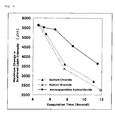
- a maximum of a change in scattered light intensity was calculated as ⁇ H, and its relationship with the coagulation time was shown in FIG. 4 .
- ⁇ H was remarkably decreased along with the prolonged coagulation time in the conventional methods using sodium chloride and sodium bromide, while large ⁇ H was kept in the present invention.
- the change in scattered light intensity is larger in the present invention than in the conventional methods, and it is found that the coagulation time can be measured more correctly in the present invention.
- Example 1 Commercially available normal plasma was measured in the same manner as in Example 1 using the specimen diluent (HEPES buffer, pH 7.5) in which the amount of the blood coagulation time prolonging agent added was adjusted so as to obtain the similar coagulation time.
- the comparative results of the maximum of a change ⁇ H in scattered light intensity and of the simultaneous reproducibility of the measurements between in the conventional method and in the present invention were shown in Table 1.
- the blood coagulation time prolonging agent of the present invention i.e., arginine hydrochloride, arginine methyl ester, guanidine hydrochloride, guanidine phosphate, guanidine sulfamate, or aminoguanidine hydrochloride drastically enhances ⁇ H and further enhances the accuracy of the measurement (simultaneous reproducibility or the like). It was also found that aminoguanidine hydrochloride had a particularly excellent effect of improving the accuracy of the measurement (simultaneous reproducibility or the like).
- a specimen diluent containing sodium chloride as the blood coagulation time prolonging agent was defined as a conventional method A and a specimen diluent further containing polyethylene glycol (molecular weight: 20000) (hereinafter, referred to as PEG 20000) as an enhancer of a change in light intensity in the conventional method A was defined as a conventional method B, and the specimen diluents were compared with a specimen diluent employing aminoguanidine hydrochloride (present invention) which served as both of the blood coagulation time prolonging agent and the enhancer of a change in light intensity.
- an HEPES buffer pH 7.5
- the concentration of PEG 20000 to be added in the conventional method B was set to 0.1%, because a large amount of PEG 20000 could increase the viscosity of diluent and reduce the accuracy of sampling.
- the coagulation time of commercially available normal plasma was measured in the same manner as in Example 1 using each specimen diluent. As a result, a change curve for scattered light intensity as shown in FIG. 5 was obtained. Further, the coagulation time and ⁇ h were shown in Table 2.
- the change of the scattered light intensity in the conventional method B with the addition of PEG 20000 became larger than in the conventional method A without the addition. However, it is found that, by employing the present invention, the change of the scattered light intensity is more drastically enhanced and the coagulation time can be measured more correctly.
Landscapes
- Chemical & Material Sciences (AREA)
- Organic Chemistry (AREA)
- Health & Medical Sciences (AREA)
- Life Sciences & Earth Sciences (AREA)
- Engineering & Computer Science (AREA)
- Hematology (AREA)
- General Health & Medical Sciences (AREA)
- Immunology (AREA)
- Molecular Biology (AREA)
- Medicinal Chemistry (AREA)
- Biomedical Technology (AREA)
- Urology & Nephrology (AREA)
- Biochemistry (AREA)
- Physics & Mathematics (AREA)
- Biotechnology (AREA)
- Analytical Chemistry (AREA)
- Microbiology (AREA)
- Zoology (AREA)
- Proteomics, Peptides & Aminoacids (AREA)
- Wood Science & Technology (AREA)
- Veterinary Medicine (AREA)
- Bioinformatics & Cheminformatics (AREA)
- Public Health (AREA)
- Animal Behavior & Ethology (AREA)
- Pharmacology & Pharmacy (AREA)
- General Physics & Mathematics (AREA)
- Pathology (AREA)
- Cell Biology (AREA)
- Food Science & Technology (AREA)
- Neurosurgery (AREA)
- Biophysics (AREA)
- Epidemiology (AREA)
- General Engineering & Computer Science (AREA)
- Genetics & Genomics (AREA)
- Diabetes (AREA)
- Chemical Kinetics & Catalysis (AREA)
- General Chemical & Material Sciences (AREA)
- Nuclear Medicine, Radiotherapy & Molecular Imaging (AREA)
- Investigating Or Analysing Biological Materials (AREA)
- Medicines That Contain Protein Lipid Enzymes And Other Medicines (AREA)
Abstract
Description
- The present invention relates to a reagent for measuring blood coagulability typified by a reagent for measuring fibrinogen; specifically relates to a blood coagulation time prolonging agent used in a blood coagulation activator-containing reagent and/or in a specimen diluent for measuring blood coagulability, and to a reagent for measuring blood coagulability using this blood coagulation time prolonging agent.
- A blood coagulation mechanism is broadly divided into two pathways in general. One is an intrinsic pathway, which is initiated by contact activation of blood coagulation factor XII with a foreign substance,andfinally produces thrombin through multistep reactions, and the other is an extrinsic pathway, which is initiated by activation of blood coagulation factor X with blood coagulation factor VII and tissue thromboplastin, and produces thrombin in the same manner as described above (
FIG. 1 ) . In both of the pathways, coagulation eventually occurs by conversion of fibrinogen to fibrin through an action of produced thrombin. In order to clarify the presence or absence of abnormality or a cause of the abnormality in such blood coagulation mechanism, some blood coagulability tests using a blood coagulation activator are available and widely used in actual clinical examinations. - The blood coagulation activator and the blood coagulability tests using the same are as follows:
- 1) blood coagulability tests using thrombin
a fibrinogen measurement, an ATIII measurement, and a thrombin time measurement; - 2) blood coagulability tests using tissue thromboplastin
a prothrombin time measurement, an activity measurement of factor II, V, VII, or X using the prothrombin time measurement, and a measurement of complex factors (a thrombo test, a hepaplastin test, and the like); and - 3) blood coagulability tests using phospholipids
a partial thromboplastin time measurement, an activated partial thromboplastin time measurement, an activity measurement of factor VIII, IX, XI, or XII, prekallikrein, or high molecular kininogen using the activated partial thromboplastin time measurement, a viper venom time measurement, a quantitative determination of factor X using the viper venom time measurement, a lupus anti-coagulant (LA) measurement using a diluted viper venom time measurement, a protein C activity measurement, and a thromboplastin generation test. - Methods of detecting coagulation in the blood coagulability test can be broadly divided into a mechanical detection method and an optical detection method. The mechanical detection method refers to a method including: monitoring by a magnetic force or the like a magnetic substance or the like loaded into a reaction solution; and detecting a decrease in mobility of the magnetic substance due to an increase in viscosity by coagulation. The optical detection method refers to a method including detecting white turbidity of a reaction solution due to coagulation as a change in transmitted light or scattered light, and is most widely used because the method is relatively simple. These are generally detected by an automated analyzer at present. One example of a change curve for scattered light intensity obtained in a scattered light detection method is shown in
FIG. 2 . In the figure, the point A indicates a point at which the coagulation is initiated by mixing a reagent including a blood coagulation activator, subsequently fibrin deposition is initiated through multistep reactions, and as a result, a change in scattered light intensity appears after the point B. Fibrinogen is in turn consumed and almost depleted in the reaction solution. Then, the scattered light intensity exhibits no change, the curve becomes flat as shown at the point C, and the coagulation is terminated. A coagulation time is calculated with known calculation parameters based on such change curve for the scattered light intensity (Patent document 1). Here, it is obvious that when a maximum of the change in scattered light intensity is defined as ΔH, as the ΔH is larger, the coagulation is detected more sharply and more correct detection becomes possible. Thus, the reagent for measuring blood coagulability desirably has a property in which an optical change is largely displayed. However, when the change from the point A to the point C occurs in an extremely short period of time, it is impossible to measure a coagulation time with good accuracy. Thus, a substance for prolonging the coagulation time is generally added to adjust the coagulation time to a desired time. Ablood coagulation time prolonging agent is exemplified by halide salts of alkali metals and alkali earth metals, including sodium chloride in Patent document 2, and by sodium propionate in Patent document 3. However, there has been a problem in that such conventional blood coagulation time prolonging agent also has a large negative effect of reducing ΔH in an addition dose-dependent manner. - For the purpose of solving the problems in those conventional methods, there is proposed a method including using a reagent supplemented with a high molecular material such as polyethylene glycol, polyvinyl alcohol or high molecular polysaccharide (
Patent documents 4 and 5). -
- Patent Document 1:
JP-08-15263 A - Patent Document 2:
JP2994557 B2 - Patent Document 3:
JP3330685 B2 - Patent Document 4:
JP3074611 B2 - Patent Document 5:
JP05-60763 A - However, there are problems in that, in the method including adding a high molecular material to a reagent, the viscosity of the reagent itself is increased to reduce the accuracy of sampling the reagent with a pipette or a reagent probe, and in that a difference in turbidity between non-coagulated and coagulated solutions is not obtained sufficiently and consequently an optical change is not sufficiently enhanced.
Therefore, it is an object of the present invention to provide a reagent having a composition that prolongs a blood coagulation time to a desired time and enhances an optical change. This can contribute to enhancement of correctness in a blood coagulability test. - Thus, the inventors of the present invention have searched a blood coagulation time prolonging agent which enhances an optical change using various compounds, and have found that a guanidine compound having a specific structure or a salt thereof has not only an action of prolonging a blood coagulation time but also an action of enhancing an optical change upon coagulation, and the use thereof as an additive for a reagent for measuring blood coagulability allows the blood coagulability to be measured correctly with high sensitivity, and have completed the present invention.
- That is, the present invention provides a blood coagulation time prolonging agent, including, as an active ingredient, a guanidine compound represented by the following formula (1) or an acid addition salt thereof:
-

- (in the formula, R1 represents a hydrogen atom, an amino group, or an alkyl group which may have a substituent).
- Further, the present invention provides a blood coagulation activator-containing reagent or a specimen diluent for measuring blood coagulability, including the above-mentioned blood coagulation time prolonging agent.
- In addition, the present invention provides a blood coagulation activator-containing reagent for measuring fibrinogen including thrombin as the blood coagulation activator or a specimen diluent for measuring fibrinogen, containing the above-mentioned blood coagulation time prolonging agent.
- Further, in one aspect, the present invention provides a use of a guanidine compound represented by the following formula (1) or an acid addition salt thereof for prolonging a blood coagulation time:

In one embodiment, the above-mentioned guanidine compound or acid addition salt thereof is used in combination with the blood coagulation activator. In another embodiment, the above-mentioned guanidine compound or acid addition salt thereof is used in combination with the specimen diluent for measuring blood coagulability. - Further, in one aspect, the present invention provides a method of prolonging a blood coagulation time, including adding to a plasma specimen a guanidine compound represented by the following formula (1) or an acid addition salt thereof:

In one embodiment, the addition of the above-mentioned guanidine compound or acid addition salt thereof is carried out in combination with the specimen diluent for measuring blood coagulability. In another embodiment, the addition of the above-mentioned guanidine compound or acid addition salt thereof is carried out in combination with the blood coagulation activator. - Further, in one aspect, the present invention provides a method of measuring blood coagulability, including the steps of: preparing a reaction solution containing a plasma specimen, a blood coagulation activator, and the above-mentioned guanidine compound or acid addition salt thereof; and measuring a coagulation time of the reaction solution.
Further, in one aspect, the present invention provides a method of determining a fibrinogen concentration in the plasma specimen by comparing a measured value of the coagulation time using the plasma specimen with a measured value obtained by similarly measuring the coagulation time using a diluted standard solution in place of the plasma specimen. - When the blood coagulation time prolonging agent of the present invention is used, fibrinogen level, PT, and APTT for blood coagulability can be measured correctively because the optical change is enhanced.
-
-
FIG. 1 is a view schematically showing a blood coagulation mechanism in a clinical examination. -
FIG. 2 is a graph showing one example of a change curve for scattered light intensity obtained by a scattered light detection method when blood coagulability is measured. -
FIG.3 is a graph showing a relationship between an addition amount and a coagulation time of each compound. -
FIG. 4 is a graph showing a relationship between a coagulation time and a maximum of a change in scattered light intensity when the coagulation time is controlled by the addition of each compound. -
FIG. 5 is a graph showing change curves for scattered light intensity obtained by using reagents according to conventional methods and a reagent of the present invention. - A blood coagulation time prolonging agent of the present invention contains a compound represented by the formula (1) or a salt thereof as an active ingredient. In the formula (1), R1 represents a hydrogen atom, an amino group, or an alkyl group which may have a substituent. Here, the alkyl group is preferably an alkyl group having 1 to 6 carbon atoms, particularly preferably an alkyl group having 2 to 5 carbon atoms. A group which may serve as a substituent of the alkyl group is exemplified by a carboxy group, an alkoxycarbonyl group, and an amino group. The alkyl group is preferably substituted with both of the carboxy group and the amino group or with both of the alkoxycarbonyl group and the amino group.
- Specific examples of the compound represented by the formula (1) include guanidine, aminoguanidine, arginine, and an arginine alkyl ester. Of those, aminoguanidine is particularly preferred because an action of enhancing an optical change is large and the correct measurement can be performed. Further, examples of the acid addition salt of the compound of the formula (1) include a hydrochloride, a sulfate, a nitrate, a phosphate, and a sulfamate.
- The blood coagulation time prolonging agent of the present invention has not only an action of prolonging a blood coagulation time but also an action of enhancing a turbidity change of a reaction solution in the measurement of blood coagulability. This indicates that a network of fibrin, which is a final product of blood coagulation, is more firmly formed. Therefore, the blood coagulation time prolonging agent of the present invention can be used in, for example, an optical detection method including directly detecting a turbidity change and a mechanical detection method including monitoring a formation state of a network of fibrin with a magnetic substance or the like. Of those, it is preferred to use the blood coagulation time prolonging agent in the optical detection method. Here, amethod of detecting a scattered light amount and a method of detecting a transmitted light amount are available as the optical detection method. Of those, it is preferred to use the blood coagulation time prolonging agent in the method of detecting a scattered light amount.
- A blood coagulability test to which the blood coagulation time prolonging agent of the present invention can be applied may be any test including measuring a time from the initiation of coagulation by mixing a reagent containing a blood coagulation activator and the like with a patient specimen to the final conversion of fibrinogen into fibrin to be deposited. Examples thereof include a fibrinogen measurement, an ATIII measurement, a thrombin time measurement, a prothrombin time measurement, an activity measurement of factor II, V, VII, or X using a prothrombin time, a measurement of complex factors (a thrombo test, a hepaplastin test, and the like), a partial thromboplastin time measurement, an activated partial thromboplastin time measurement, an activity measurement of factor VIII, IX, XI, or XII, prekallikrein, or high molecular kininogen using the activated partial thromboplastin time measurement, a viper venom time measurement, a quantitative determination of factor X using the viper venom time measurement, a lupus anti-coagulant (LA) measurement using a diluted viper venom time measurement, a protein C activity measurement, a thromboplastin generation test, and any other detection of abnormal coagulation.
- In the measurement in the above-mentioned blood coagulability test, a time from the addition of a blood coagulation activator-containing reagent (e.g., a thrombin-containing reagent in the fibrinogen measurement) to a specimen to the deposition of fibrin is measured. The specimen is appropriately diluted with a specimen diluent if necessary. The blood coagulation time prolonging agent of the present invention has only to be contained in a measurement system. The blood coagulation time prolonging agent may be contained in the blood coagulation activator-containing reagent, or may be contained in the specimen diluent. That is, for example, in the fibrinogen measurement, the blood coagulation time prolonging agent of the present invention may be contained in the thrombin-containing reagent, or may be contained in the specimen diluent.
The above-mentioned blood coagulation activator-containing reagent has only to be one used for the above-mentioned blood coagulability test, and examples thereof include a thrombin-containing reagent, a tissue thromboplastin-containing reagent, and a phospholipid-containing reagent. Further, the above-mentioned specimen diluent has only to be one used for the above-mentioned blood coagulability test, and examples thereof include Good's buffers such as MES, Bis-Tris, ADA, PIPES, ACES, MOPSO, BES, MOPS, TES, HEPES, DIPSO, TAPSO, POPSO, HEPPSO, EPPS, Tricine, Bicine, TAPS, andCHES, acitratebuffer, aphosphatebuffer, an acetate buffer, an imidazole buffer, a barbital buffer, saline, and water. - The blood coagulation time prolonging agent of the present invention is preferably contained in the reaction solution so that a coagulation time which is measurable with high accuracy is obtained in the blood coagulability test. For example, in the fibrinogen measurement, the blood coagulation time prolonging agent is preferably contained in the reaction solution so that the coagulation time is 5 to 50 seconds, preferably 7 to 20 seconds, more preferably 9 to 15 seconds when normal plasma (concentration: about 300 mg/dL) is measured. When aminoguanidine is used as the blood coagulation time prolonging agent, the concentration of aminoguanidine in the reaction solution for the fibrinogen measurement, i.e., the concentration of aminoguanidine in a mixed solution of a specimen, a specimen diluent, and a thrombin-containing reagent is 10 to 500 mM, preferably 20 to 200 mM, more preferably 30 to 120 mM. When aminoguanidine is contained in the specimen diluent, the concentration of aminoguanidine in the specimen diluent is 10 to 900 mM, preferably 30 to 400 mM, more preferably 50 to 200 mM.
In the prothrombin time measurement, the blood coagulation time prolonging agent is preferably contained in the reaction solution so that the coagulation time is 9 to 60 seconds, preferably 9 to 30 seconds, more preferably 10 to 16 seconds when normal plasma (activity: about 100%) is measured. In the activated partial thromboplastin time measurement, the blood coagulation time prolonging agent is preferably contained in the reaction solution so that the coagulation time is 15 to 80 seconds, preferably 15 to 60 seconds, more preferably 20 to 50 seconds when normal plasma is measured. Also in the other blood coagulability tests, the blood coagulation time prolonging agent has to be contained in the reaction solution so that a coagulation time suitable for a measurement method is obtained. - In addition to the blood coagulation time prolonging agent of the present invention, known high molecular polysaccharides and synthetic polymers can be contained in the reagent for measuring blood coagulability including the specimen diluent and the blood coagulation activator-containing reagent used for the blood coagulability test.
- Specific examples of the high molecular polysaccharides include dextran such as dextran 40, dextran 70, dextran 200000, or dextran 500000, and Ficoll, and the like. One kind of those high molecular polysaccharides may be used alone, or two or more kinds thereof may be used in combination. Those high molecular polysaccharides are each added in an amount so that the concentration in the reagent for measuring blood coagulability is suitably 0.01 to 10 W/V%, more preferably 0.1 to 5 W/V%.
Specific examples of the synthetic polymers include: polyvinyl alcohol such as polyvinyl alcohol 500, polyvinyl alcohol 1500, orpolyvinyl alcohol 2000; polyethylene glycol such as polyethylene glycol 1500,polyethylene glycol 2000,polyethylene glycol 4000,polyethylene glycol 6000, polyethylene glycol 8000, or polyethylene glyco120000;and polyvinylpyrrolidone. One kind of those synthetic polymers may be used alone, or two or more kinds thereof may be used in combination. The amount of each of those synthetic polymers to be added is not particularly limited, and the concentration thereof in the reagent for measuring blood coagulability is preferably 0.01 to 10W/V%, more preferably 0.1 to 5W/V%. - The reagent for measuring blood coagulability can also contain a buffer, a calcium ion, an antagonist of an anticoagulant, and the like in addition to the blood coagulation time prolonging agent of the present invention.
- As a specific example of the buffer, a buffer having a buffering ability in the range of
pH 4 to 9 is appropriately selected and used. For example, the buffer can be selected from Good's buffers such as MES, Bis-Tris, ADA, PIPES, ACES, MOPSO, BES, MOPS, TES, HEPES, DIPSO, TAPSO, POPSO, HEPPSO, EPPS, Tricine, Bicine, TAPS, and CHES, citric acid, phosphoric acid, acetic acid, imidazole, barbital, GTA, and the like, and one kind thereof may be used alone, or two or more or kinds thereof may be used in combination. The amount of the buffer to be added is not particularly limited as long as the buffer has a buffering ability, and the concentration in the reagent for measuring blood coagulability is preferably 1 to 1,000 mM, more preferably 5 to 500 mM. - Water-soluble calcium compounds such as calcium chloride, calciumlactate,calcium gluconate,calcium glucuronate,and calcium tartrate are used as the calcium ion. One kind of those calcium compounds may be used alone, or two or more kinds thereof may be used in combination. The amount of each of the calcium compounds to be used is not particularly limited as long as the calcium compounds can help a coagulation reaction, and the concentration thereof in the reagent for measuring blood coagulability is preferably 5 mM to 100 mM, and more preferably 10 mM to 50 mM.
- Protamine, polybrene (hexadimethrine bromide), and the like are used as the antagonist of the anticoagulant. One kind of those antagonists of the anticoagulant may be used alone, or two or more kinds thereof may be used in combination. The amount of the antagonist of the anticoagulant tobe used is not particularly limited as long as the antagonist can sufficiently neutralize an anticoagulant such as heparin contained in specimen plasma, and the concentration in the reagent for measuring blood coagulability is preferably 10-5 to 10-2 W/V%, more preferably 5×10⁻⁴ to 5×10⁻³ W/V%.
- Further, the reagent for measuring blood coagulability may be a liquid product, a frozen product, or a dried product, and the dried product is dissolved by adding purified water or a buffer.
Further, an appropriate preservative may be added to the reagent for measuring blood coagulability. The preservative can be selected from ciprofloxacin, propionic acid, sodium benzoate, sodium azide, ProClin 300, and the like, and one kind thereof may be used alone, or two or more kinds thereof may be used in combination. Further, salts such as sodium chloride, common stabilizers such as amino acids and sugars, and the like may be contained as needed.
The concentration described above is the concentration in the solution, and the concentration of the dried product or the like is the concentration when dissolved in water, a buffer, or the like before use. - The measurement of blood coagulability of the present invention can be conducted with a usual method. Taking the fibrinogen measurement as an example, a standard solution is diluted with a specimen diluent 5-fold, 10-fold, and 20-fold (a dilution rate can be adjusted appropriately). Next, two volumes of each diluted standard solution is warmed at 37°C for 3 minutes, one volume of a thrombin reagent previously warmed at 37°C is added, and a coagulation time is measured. Subsequently, a measured value of the each diluted standard solution is plotted on a graph. A plasma specimen is diluted with a specimen diluent 10-fold (a dilution rate can be adjusted appropriately), the diluted specimen is measured likewise, and the concentration can be obtained from the graph based on the obtained coagulation time.
- Hereinafter, the present invention is described in more detail by way of examples, but the present invention is not limited to these examples.
- When a fibrinogen concentration in a plasma specimen is measured by a thrombin time method, in general, thrombin is added to plasma to measure a coagulation time, and the concentration is determined from a standard curve prepared using standard solutions having known fibrinogen concentrations. In the procedure, 90 µL of a specimen diluent are added to and mixed with 10 µL of specimen plasma, subsequently 50 µL of a thrombin-containing reagent are added as a blood coagulation activator-containing reagent, and a coagulation time is measured.
- In this example, commercially available normal plasma (Coagtrol N, manufactured by Sysmex Corporation) as the plasma specimen, a Coagpia Fbg thrombin reagent (manufactured by Sekisui Medical Co., Ltd.) as the thrombin-containing reagent, and a full-automated blood coagulation time analyzer Coagrex 800 (manufactured by Sysmex Corporation) as a coagulation time measurement apparatus were used. This apparatus employs a scattered light detection method, and change data of scattered light intensity with time can also be obtained along with the coagulation time.
- When an HEPES buffer (pH 7.5) was used as the specimen diluent, the commercially available normal plasma coagulated in several seconds (4.6 seconds). When aminoguanidine hydrochloride as the blood coagulation time prolonging agent was added to the HEPES buffer (pH 7.5), the coagulation time was prolonged in an addition concentration-dependent manner in the same manner as in conventional methods using sodium chloride and sodium bromide (results are shown in
FIG. 3 ). That is, it is found that the present invention has the same coagulation time prolonging action as the conventional methods. - A maximum of a change in scattered light intensity was calculated as ΔH, and its relationship with the coagulation time was shown in
FIG. 4 . ΔH was remarkably decreased along with the prolonged coagulation time in the conventional methods using sodium chloride and sodium bromide, while large ΔH was kept in the present invention. In other words, when the changes are compared in the similar coagulation time, the change in scattered light intensity is larger in the present invention than in the conventional methods, and it is found that the coagulation time can be measured more correctly in the present invention. - Commercially available normal plasma was measured in the same manner as in Example 1 using the specimen diluent (HEPES buffer, pH 7.5) in which the amount of the blood coagulation time prolonging agent added was adjusted so as to obtain the similar coagulation time. The comparative results of the maximum of a change ΔH in scattered light intensity and of the simultaneous reproducibility of the measurements between in the conventional method and in the present invention were shown in Table 1. As compared with the conventional methods, it is found that the blood coagulation time prolonging agent of the present invention, i.e., arginine hydrochloride, arginine methyl ester, guanidine hydrochloride, guanidine phosphate, guanidine sulfamate, or aminoguanidine hydrochloride drastically enhances ΔH and further enhances the accuracy of the measurement (simultaneous reproducibility or the like). It was also found that aminoguanidine hydrochloride had a particularly excellent effect of improving the accuracy of the measurement (simultaneous reproducibility or the like).
-
[Table 1] ΔH Coagulation time Variation coefficient of measured values Conventional method (1) Sodium chloride: 145 mM 2,348 10.7 4.47% Conventional method (2) Sodium bromide: 110 mM 2,174 11.3 * Conventional method (3) Potassium bromide: 105 mM 2,127 11.4 * Conventional method (4) Potassium chloride: 135 mM 2,170 10.8 * Conventional method (5) Lithium chloride: 135 mM 2,305 10.8 * Method of the present invention (1) Guanidine hydrochloride: 90 mM 4,575 10.3 3.39% Method of the present invention (2) Guanidine phosphate: 30 mM 4,217 10.4 2.36% Method of the present invention (3) Guanidine sulfamate: 55 mM 5,167 11.2 3.29% Method of the present invention (4) Aminoguanidine hydrochloride: 90 mM 3,480 9.7 1.94% Method of the present invention (5) Arginine hydrochloride: 55 mM 3,529 10.3 2.77% Method of present invention (6) Arginine methyl ester: 17 mM 6,130 11.0 3.22% Single measurement was used in conventional methods (2) to (5) and ten times measurement was used in the others.
*Cannot be calculated - A specimen diluent containing sodium chloride as the blood coagulation time prolonging agent was defined as a conventional method A and a specimen diluent further containing polyethylene glycol (molecular weight: 20000) (hereinafter, referred to as PEG 20000) as an enhancer of a change in light intensity in the conventional method A was defined as a conventional method B, and the specimen diluents were compared with a specimen diluent employing aminoguanidine hydrochloride (present invention) which served as both of the blood coagulation time prolonging agent and the enhancer of a change in light intensity. It should be noted that an HEPES buffer (pH 7.5) was used as a buffer in all of the cases. Further, the concentration of PEG 20000 to be added in the conventional method B was set to 0.1%, because a large amount of PEG 20000 could increase the viscosity of diluent and reduce the accuracy of sampling. The coagulation time of commercially available normal plasma was measured in the same manner as in Example 1 using each specimen diluent. As a result, a change curve for scattered light intensity as shown in
FIG. 5 was obtained. Further, the coagulation time and Δh were shown in Table 2. The change of the scattered light intensity in the conventional method B with the addition of PEG 20000 became larger than in the conventional method A without the addition. However, it is found that, by employing the present invention, the change of the scattered light intensity is more drastically enhanced and the coagulation time can be measured more correctly. -
[Table 2] Conventional method A Conventional method B The present invention Coagulation time prolonging agent NaCl 15OmM NaCl 150mM Aminoguanidine hydrochloride 90 mM Enhancer of change in light intensity - PEG 20000 0.1% Coagulation time 11.6 seconds 10.4 seconds 10.4 seconds Change in light intensity ΔH 2,194 2,244 3,444 Mean of three times measurement
Claims (21)
- A blood coagulation time prolonging agent, comprising, as an active ingredient, a guanidine compound represented by the following formula (1) or an acid addition salt thereof:
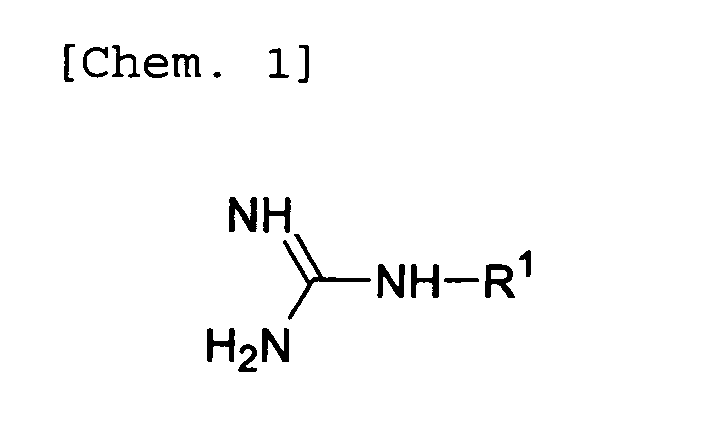
- The blood coagulation time prolonging agent according to claim 1, wherein the blood coagulation time prolonging agent comprises a blood coagulation time prolonging agent for measuring fibrinogen.
- The blood coagulation time prolonging agent according to claim 1 or 2, wherein R1 represents a hydrogen atom, an amino group, an alkyl group, an alkyl group substituted with a carboxy group and an amino group, or an alkyl group substituted with an alkoxycarbonyl group and an amino group.
- A blood coagulation activator-containing reagent, comprising the blood coagulation time prolonging agent according to any one of claims 1 to 3.
- The blood coagulation activator-containing reagent according to claim 4, wherein the blood coagulation activator-containing reagent contains thrombin as a blood coagulation activator and is used for measuring fibrinogen.
- A specimen diluent for measuring blood coagulability , comprising the blood coagulation time prolonging agent according to any one of claims 1 to 3.
- The specimen diluent for measuring blood coagulability according to claim 6, wherein the specimen diluent for measuring blood coagulability comprises a specimen diluent for measuring fibrinogen.
- A use of a guanidine compound represented by the following formula (1) or an acid addition salt thereof for prolonging a blood coagulation time:

- The use according to claim 8, for prolonging a blood coagulation time in fibrinogen measurement.
- The use according to claim 8 or 9, wherein R1 represents a hydrogen atom, an amino group, an alkyl group, an alkyl group substituted with a carboxy group and an amino group, or an alkyl group substituted with an alkoxycarbonyl group and an amino group.
- The use according to any one of claims 8 to 10, wherein the guanidine compound or the acid addition salt thereof is used in combination with a blood coagulation activator.
- The use according to claim 11, wherein the blood coagulation activator comprises thrombin.
- The use according to any one of claims 8 to 10, wherein the guanidine compound or the acid addition salt thereof is used in combination with a specimen diluent for measuring blood coagulability .
- The use according to claim 13, wherein the specimen diluent comprises a specimen diluent for measuring fibrinogen.
- A method of prolonging a blood coagulation time, comprising adding to a plasma specimen a guanidine compound represented by the following formula (1) or an acid addition salt thereof:

- The method according to claim 15, wherein R1 represents a hydrogen atom, an amino group, an alkyl group, an alkyl group substituted with a carboxy group and an amino group, or an alkyl group substituted with an alkoxycarbonyl group and an amino group.
- The method according to claim 15, wherein the addition of the guanidine compound or the acid addition salt thereof is carried out in combination with a specimen diluent for measuring blood coagulability.
- The method according to claim 17, wherein the specimen diluent comprises a specimen diluent for measuring fibrinogen.
- The method according to claim 15, wherein the addition of the guanidine compound or the acid addition salt thereof is carried out in combination with a blood coagulation activator.
- The method according to claim 19, wherein the blood coagulation activator comprises a thrombin-containing reagent.
- A method of measuring blood coagulability , comprising the following steps of:preparing a reaction solution containing a plasma specimen, a blood coagulation activator, the guanidine compound or the acid addition salt thereof according to claim 15; andmeasuring a coagulation time of the reaction solution.
Priority Applications (1)
| Application Number | Priority Date | Filing Date | Title |
|---|---|---|---|
| EP15196430.1A EP3018481B1 (en) | 2009-05-20 | 2010-05-20 | Blood coagulation time prolonging agent |
Applications Claiming Priority (2)
| Application Number | Priority Date | Filing Date | Title |
|---|---|---|---|
| JP2009121834 | 2009-05-20 | ||
| PCT/JP2010/003401 WO2010134345A1 (en) | 2009-05-20 | 2010-05-20 | Blood coagulation time prolonging agent |
Related Child Applications (2)
| Application Number | Title | Priority Date | Filing Date |
|---|---|---|---|
| EP15196430.1A Division-Into EP3018481B1 (en) | 2009-05-20 | 2010-05-20 | Blood coagulation time prolonging agent |
| EP15196430.1A Division EP3018481B1 (en) | 2009-05-20 | 2010-05-20 | Blood coagulation time prolonging agent |
Publications (3)
| Publication Number | Publication Date |
|---|---|
| EP2434290A1 true EP2434290A1 (en) | 2012-03-28 |
| EP2434290A4 EP2434290A4 (en) | 2013-01-30 |
| EP2434290B1 EP2434290B1 (en) | 2016-02-10 |
Family
ID=43126036
Family Applications (2)
| Application Number | Title | Priority Date | Filing Date |
|---|---|---|---|
| EP15196430.1A Active EP3018481B1 (en) | 2009-05-20 | 2010-05-20 | Blood coagulation time prolonging agent |
| EP10777581.9A Active EP2434290B1 (en) | 2009-05-20 | 2010-05-20 | Blood coagulation time prolonging agent |
Family Applications Before (1)
| Application Number | Title | Priority Date | Filing Date |
|---|---|---|---|
| EP15196430.1A Active EP3018481B1 (en) | 2009-05-20 | 2010-05-20 | Blood coagulation time prolonging agent |
Country Status (7)
| Country | Link |
|---|---|
| US (3) | US20120064553A1 (en) |
| EP (2) | EP3018481B1 (en) |
| JP (2) | JPWO2010134345A1 (en) |
| KR (2) | KR20120024610A (en) |
| CN (1) | CN102428372A (en) |
| CA (1) | CA2762611C (en) |
| WO (1) | WO2010134345A1 (en) |
Cited By (1)
| Publication number | Priority date | Publication date | Assignee | Title |
|---|---|---|---|---|
| CN105372424A (en) * | 2015-11-12 | 2016-03-02 | 武汉景川诊断技术股份有限公司 | Hepaplastin test determination kit and preparation method thereof |
Families Citing this family (7)
| Publication number | Priority date | Publication date | Assignee | Title |
|---|---|---|---|---|
| JP5903215B2 (en) * | 2011-02-28 | 2016-04-13 | シスメックス株式会社 | Reagent kit for detecting lupus anticoagulant and method for determining the presence or absence of lupus anticoagulant |
| IL312865B2 (en) | 2013-09-11 | 2025-06-01 | Eagle Biologics Inc | Liquid protein formulations containing viscosity-reducing agents |
| CA2949236C (en) | 2014-05-15 | 2023-06-13 | Incube Labs, Llc | Pharmaceutical compositions and methods for fabrication of solid masses comprising polypeptides and/or proteins |
| SG11201702614SA (en) | 2014-10-01 | 2017-04-27 | Eagle Biolog Inc | Polysaccharide and nucleic acid formulations containing viscosity-lowering agents |
| US20240218344A1 (en) * | 2022-12-23 | 2024-07-04 | Instrumentation Laboratory Company | Liquid thrombin reagent |
| US20250389737A1 (en) * | 2024-06-20 | 2025-12-25 | Instrumentation Laboratory Company | FACTOR Xa REAGENT |
| EP4667582A1 (en) * | 2024-06-20 | 2025-12-24 | Instrumentation Laboratory Company | Factor xa reagent |
Family Cites Families (13)
| Publication number | Priority date | Publication date | Assignee | Title |
|---|---|---|---|---|
| JP3180824B2 (en) | 1991-08-30 | 2001-06-25 | シスメックス株式会社 | Blood coagulation reagent |
| JP3074611B2 (en) | 1991-08-30 | 2000-08-07 | シスメックス株式会社 | Blood coagulation measurement method |
| US5358853A (en) | 1992-08-03 | 1994-10-25 | Akzo Av | Liquid thromboplastin reagent |
| JPH0815263A (en) | 1994-06-24 | 1996-01-19 | Shimadzu Corp | Blood coagulation analyzer |
| JP2994557B2 (en) * | 1994-09-02 | 1999-12-27 | 株式会社アズウェル | Fibrinogen measuring method and its measuring reagent |
| DE19549118C2 (en) * | 1995-12-29 | 2000-07-13 | Thomas W Stief | Hemostasis activation inhibitor and method for inhibiting hemostasis activation in blood or other biological fluids |
| TW499412B (en) * | 1996-11-26 | 2002-08-21 | Dimensional Pharm Inc | Aminoguanidines and alkoxyguanidines as protease inhibitors |
| JP2001524467A (en) * | 1997-11-26 | 2001-12-04 | 3−ディメンショナル ファーマシューティカルズ, インコーポレイテッド | Heteroarylaminoguanidines and alkoxyguanidines and their use as protease inhibitors |
| DE10222234A1 (en) * | 2002-05-16 | 2003-11-27 | Roche Diagnostics Gmbh | Control and calibration material for blood coagulation tests |
| JP2004191367A (en) * | 2002-11-28 | 2004-07-08 | Sysmex Corp | Thrombin reagent and test reagent kit |
| CN1504580A (en) * | 2002-11-28 | 2004-06-16 | 希森美康株式会社 | Combination comprising thrombin agent and examining agent |
| DE10325173B4 (en) * | 2003-06-04 | 2007-11-08 | Stief, Thomas, Dr.med. | Detection method for fibrinogen and / or fibrinogen derivatives |
| EP1672369A1 (en) * | 2004-12-16 | 2006-06-21 | Roche Diagnostics GmbH | Method of determination of blood coagulation parameters, especially in flow through systems |
-
2010
- 2010-05-20 EP EP15196430.1A patent/EP3018481B1/en active Active
- 2010-05-20 CN CN2010800220995A patent/CN102428372A/en active Pending
- 2010-05-20 US US13/321,732 patent/US20120064553A1/en not_active Abandoned
- 2010-05-20 WO PCT/JP2010/003401 patent/WO2010134345A1/en not_active Ceased
- 2010-05-20 JP JP2011514341A patent/JPWO2010134345A1/en active Pending
- 2010-05-20 KR KR1020117027191A patent/KR20120024610A/en not_active Ceased
- 2010-05-20 CA CA2762611A patent/CA2762611C/en active Active
- 2010-05-20 KR KR1020187004669A patent/KR101882408B1/en active Active
- 2010-05-20 EP EP10777581.9A patent/EP2434290B1/en active Active
-
2014
- 2014-01-13 US US14/153,739 patent/US20140127727A1/en not_active Abandoned
- 2014-10-06 JP JP2014205566A patent/JP5840273B2/en active Active
-
2015
- 2015-03-16 US US14/658,911 patent/US9733262B2/en active Active
Cited By (1)
| Publication number | Priority date | Publication date | Assignee | Title |
|---|---|---|---|---|
| CN105372424A (en) * | 2015-11-12 | 2016-03-02 | 武汉景川诊断技术股份有限公司 | Hepaplastin test determination kit and preparation method thereof |
Also Published As
| Publication number | Publication date |
|---|---|
| US20140127727A1 (en) | 2014-05-08 |
| US20150185236A1 (en) | 2015-07-02 |
| EP2434290B1 (en) | 2016-02-10 |
| JPWO2010134345A1 (en) | 2012-11-08 |
| US20120064553A1 (en) | 2012-03-15 |
| EP3018481A1 (en) | 2016-05-11 |
| KR101882408B1 (en) | 2018-07-27 |
| KR20120024610A (en) | 2012-03-14 |
| US9733262B2 (en) | 2017-08-15 |
| KR20180019781A (en) | 2018-02-26 |
| CA2762611A1 (en) | 2010-11-25 |
| JP2015042652A (en) | 2015-03-05 |
| CN102428372A (en) | 2012-04-25 |
| JP5840273B2 (en) | 2016-01-06 |
| EP3018481B1 (en) | 2018-02-21 |
| EP2434290A4 (en) | 2013-01-30 |
| CA2762611C (en) | 2017-03-28 |
| WO2010134345A1 (en) | 2010-11-25 |
Similar Documents
| Publication | Publication Date | Title |
|---|---|---|
| US9733262B2 (en) | Method for measuring blood coagulation | |
| EP0632270A1 (en) | Method of assaying activity of blood coagulation factor xiii and reagent kit therefor | |
| WO2002079375A1 (en) | Rapid assessment of coagulation activity in whole blood | |
| CN114277089B (en) | Detection reagent and kit for dabigatran | |
| CN108195783A (en) | Heparin Activity Assay Kit | |
| EP1402052A2 (en) | Automated method for correcting blood analysis parameter results affected by interference from exogenous blood substitutes in whole blood, plasma, and serum | |
| EP4603841A1 (en) | Reagent for measuring activated partial thromboplastin time, and blood coagulation time regulator for lupus anticoagulant-positive blood specimen or heparin-containing blood specimen | |
| CN115219486B (en) | Detection kit for anti-Xa activity of heparin and low molecular heparin and non-disease diagnosis detection method thereof | |
| JP2004191367A (en) | Thrombin reagent and test reagent kit | |
| JP6058726B2 (en) | Blood coagulation time extender in blood coagulation reaction | |
| EP2722674B1 (en) | Method for detecting lupus anticoagulants | |
| JP7473282B1 (en) | Agent for shortening blood clotting time in blood samples deficient in coagulation factor XII | |
| JP7473281B1 (en) | Regulator of blood coagulation time for blood samples deficient in coagulation factor VIII, IX or XI, and reagent for measuring activated partial thromboplastin time | |
| Inada et al. | Faster determination of clottable fibrinogen in human plasma: an improved method and kinetic study. | |
| EP0324027A4 (en) | Improved assays for t-plasminogen activator and plasminogen activator inhibitor | |
| JP2011069718A (en) | Blood coagulation time extension agent in blood coagulation reaction | |
| CN106596981A (en) | Kit for determining blood coagulation function | |
| US20040077092A1 (en) | Control and calibration material for blood coagulation tests | |
| JP2014197019A (en) | Blood coagulation time extension reagent in blood coagulation reaction | |
| US20260133211A1 (en) | Reagent for measuring activated partial thromboplastin time, and blood coagulation time regulator for lupus anticoagulant-positive blood specimen or heparin-containing blood specimen | |
| CN118731335A (en) | A dabigatran content detection kit with strong anti-interference | |
| EP3889613A1 (en) | Method for measuring a blood coagulation activity | |
| AU7234600A (en) | Plasma reference | |
| CN106770061A (en) | Tartrate as c reactive protein screener application, coagulation diagnostic reagent |
Legal Events
| Date | Code | Title | Description |
|---|---|---|---|
| PUAI | Public reference made under article 153(3) epc to a published international application that has entered the european phase |
Free format text: ORIGINAL CODE: 0009012 |
|
| 17P | Request for examination filed |
Effective date: 20111115 |
|
| AK | Designated contracting states |
Kind code of ref document: A1 Designated state(s): AL AT BE BG CH CY CZ DE DK EE ES FI FR GB GR HR HU IE IS IT LI LT LU LV MC MK MT NL NO PL PT RO SE SI SK SM TR |
|
| DAX | Request for extension of the european patent (deleted) | ||
| A4 | Supplementary search report drawn up and despatched |
Effective date: 20130107 |
|
| RIC1 | Information provided on ipc code assigned before grant |
Ipc: A61K 31/155 20060101ALI20121224BHEP Ipc: C07C 281/16 20060101ALI20121224BHEP Ipc: G01N 33/86 20060101AFI20121224BHEP Ipc: C07C 279/14 20060101ALI20121224BHEP Ipc: C12Q 1/56 20060101ALI20121224BHEP Ipc: C07C 279/02 20060101ALI20121224BHEP |
|
| 17Q | First examination report despatched |
Effective date: 20150218 |
|
| GRAP | Despatch of communication of intention to grant a patent |
Free format text: ORIGINAL CODE: EPIDOSNIGR1 |
|
| INTG | Intention to grant announced |
Effective date: 20150812 |
|
| GRAS | Grant fee paid |
Free format text: ORIGINAL CODE: EPIDOSNIGR3 |
|
| GRAA | (expected) grant |
Free format text: ORIGINAL CODE: 0009210 |
|
| AK | Designated contracting states |
Kind code of ref document: B1 Designated state(s): AL AT BE BG CH CY CZ DE DK EE ES FI FR GB GR HR HU IE IS IT LI LT LU LV MC MK MT NL NO PL PT RO SE SI SK SM TR |
|
| REG | Reference to a national code |
Ref country code: GB Ref legal event code: FG4D |
|
| REG | Reference to a national code |
Ref country code: AT Ref legal event code: REF Ref document number: 774905 Country of ref document: AT Kind code of ref document: T Effective date: 20160215 Ref country code: CH Ref legal event code: EP |
|
| REG | Reference to a national code |
Ref country code: IE Ref legal event code: FG4D |
|
| REG | Reference to a national code |
Ref country code: DE Ref legal event code: R096 Ref document number: 602010030576 Country of ref document: DE |
|
| REG | Reference to a national code |
Ref country code: FR Ref legal event code: PLFP Year of fee payment: 7 |
|
| REG | Reference to a national code |
Ref country code: LT Ref legal event code: MG4D |
|
| REG | Reference to a national code |
Ref country code: NL Ref legal event code: MP Effective date: 20160210 |
|
| REG | Reference to a national code |
Ref country code: AT Ref legal event code: MK05 Ref document number: 774905 Country of ref document: AT Kind code of ref document: T Effective date: 20160210 |
|
| PG25 | Lapsed in a contracting state [announced via postgrant information from national office to epo] |
Ref country code: ES Free format text: LAPSE BECAUSE OF FAILURE TO SUBMIT A TRANSLATION OF THE DESCRIPTION OR TO PAY THE FEE WITHIN THE PRESCRIBED TIME-LIMIT Effective date: 20160210 Ref country code: NO Free format text: LAPSE BECAUSE OF FAILURE TO SUBMIT A TRANSLATION OF THE DESCRIPTION OR TO PAY THE FEE WITHIN THE PRESCRIBED TIME-LIMIT Effective date: 20160510 Ref country code: HR Free format text: LAPSE BECAUSE OF FAILURE TO SUBMIT A TRANSLATION OF THE DESCRIPTION OR TO PAY THE FEE WITHIN THE PRESCRIBED TIME-LIMIT Effective date: 20160210 Ref country code: GR Free format text: LAPSE BECAUSE OF FAILURE TO SUBMIT A TRANSLATION OF THE DESCRIPTION OR TO PAY THE FEE WITHIN THE PRESCRIBED TIME-LIMIT Effective date: 20160511 Ref country code: FI Free format text: LAPSE BECAUSE OF FAILURE TO SUBMIT A TRANSLATION OF THE DESCRIPTION OR TO PAY THE FEE WITHIN THE PRESCRIBED TIME-LIMIT Effective date: 20160210 |
|
| PG25 | Lapsed in a contracting state [announced via postgrant information from national office to epo] |
Ref country code: NL Free format text: LAPSE BECAUSE OF FAILURE TO SUBMIT A TRANSLATION OF THE DESCRIPTION OR TO PAY THE FEE WITHIN THE PRESCRIBED TIME-LIMIT Effective date: 20160210 Ref country code: AT Free format text: LAPSE BECAUSE OF FAILURE TO SUBMIT A TRANSLATION OF THE DESCRIPTION OR TO PAY THE FEE WITHIN THE PRESCRIBED TIME-LIMIT Effective date: 20160210 Ref country code: LT Free format text: LAPSE BECAUSE OF FAILURE TO SUBMIT A TRANSLATION OF THE DESCRIPTION OR TO PAY THE FEE WITHIN THE PRESCRIBED TIME-LIMIT Effective date: 20160210 Ref country code: PT Free format text: LAPSE BECAUSE OF FAILURE TO SUBMIT A TRANSLATION OF THE DESCRIPTION OR TO PAY THE FEE WITHIN THE PRESCRIBED TIME-LIMIT Effective date: 20160613 Ref country code: PL Free format text: LAPSE BECAUSE OF FAILURE TO SUBMIT A TRANSLATION OF THE DESCRIPTION OR TO PAY THE FEE WITHIN THE PRESCRIBED TIME-LIMIT Effective date: 20160210 Ref country code: BE Free format text: LAPSE BECAUSE OF NON-PAYMENT OF DUE FEES Effective date: 20160531 Ref country code: SE Free format text: LAPSE BECAUSE OF FAILURE TO SUBMIT A TRANSLATION OF THE DESCRIPTION OR TO PAY THE FEE WITHIN THE PRESCRIBED TIME-LIMIT Effective date: 20160210 Ref country code: IS Free format text: LAPSE BECAUSE OF FAILURE TO SUBMIT A TRANSLATION OF THE DESCRIPTION OR TO PAY THE FEE WITHIN THE PRESCRIBED TIME-LIMIT Effective date: 20160610 Ref country code: LV Free format text: LAPSE BECAUSE OF FAILURE TO SUBMIT A TRANSLATION OF THE DESCRIPTION OR TO PAY THE FEE WITHIN THE PRESCRIBED TIME-LIMIT Effective date: 20160210 |
|
| PG25 | Lapsed in a contracting state [announced via postgrant information from national office to epo] |
Ref country code: EE Free format text: LAPSE BECAUSE OF FAILURE TO SUBMIT A TRANSLATION OF THE DESCRIPTION OR TO PAY THE FEE WITHIN THE PRESCRIBED TIME-LIMIT Effective date: 20160210 Ref country code: DK Free format text: LAPSE BECAUSE OF FAILURE TO SUBMIT A TRANSLATION OF THE DESCRIPTION OR TO PAY THE FEE WITHIN THE PRESCRIBED TIME-LIMIT Effective date: 20160210 |
|
| REG | Reference to a national code |
Ref country code: DE Ref legal event code: R097 Ref document number: 602010030576 Country of ref document: DE |
|
| PG25 | Lapsed in a contracting state [announced via postgrant information from national office to epo] |
Ref country code: SK Free format text: LAPSE BECAUSE OF FAILURE TO SUBMIT A TRANSLATION OF THE DESCRIPTION OR TO PAY THE FEE WITHIN THE PRESCRIBED TIME-LIMIT Effective date: 20160210 Ref country code: RO Free format text: LAPSE BECAUSE OF FAILURE TO SUBMIT A TRANSLATION OF THE DESCRIPTION OR TO PAY THE FEE WITHIN THE PRESCRIBED TIME-LIMIT Effective date: 20160210 Ref country code: SM Free format text: LAPSE BECAUSE OF FAILURE TO SUBMIT A TRANSLATION OF THE DESCRIPTION OR TO PAY THE FEE WITHIN THE PRESCRIBED TIME-LIMIT Effective date: 20160210 Ref country code: CZ Free format text: LAPSE BECAUSE OF FAILURE TO SUBMIT A TRANSLATION OF THE DESCRIPTION OR TO PAY THE FEE WITHIN THE PRESCRIBED TIME-LIMIT Effective date: 20160210 |
|
| PLBE | No opposition filed within time limit |
Free format text: ORIGINAL CODE: 0009261 |
|
| STAA | Information on the status of an ep patent application or granted ep patent |
Free format text: STATUS: NO OPPOSITION FILED WITHIN TIME LIMIT |
|
| PG25 | Lapsed in a contracting state [announced via postgrant information from national office to epo] |
Ref country code: BE Free format text: LAPSE BECAUSE OF FAILURE TO SUBMIT A TRANSLATION OF THE DESCRIPTION OR TO PAY THE FEE WITHIN THE PRESCRIBED TIME-LIMIT Effective date: 20160210 Ref country code: LU Free format text: LAPSE BECAUSE OF FAILURE TO SUBMIT A TRANSLATION OF THE DESCRIPTION OR TO PAY THE FEE WITHIN THE PRESCRIBED TIME-LIMIT Effective date: 20160520 |
|
| REG | Reference to a national code |
Ref country code: CH Ref legal event code: PL |
|
| 26N | No opposition filed |
Effective date: 20161111 |
|
| PG25 | Lapsed in a contracting state [announced via postgrant information from national office to epo] |
Ref country code: CH Free format text: LAPSE BECAUSE OF NON-PAYMENT OF DUE FEES Effective date: 20160531 Ref country code: LI Free format text: LAPSE BECAUSE OF NON-PAYMENT OF DUE FEES Effective date: 20160531 |
|
| REG | Reference to a national code |
Ref country code: IE Ref legal event code: MM4A |
|
| PG25 | Lapsed in a contracting state [announced via postgrant information from national office to epo] |
Ref country code: SI Free format text: LAPSE BECAUSE OF FAILURE TO SUBMIT A TRANSLATION OF THE DESCRIPTION OR TO PAY THE FEE WITHIN THE PRESCRIBED TIME-LIMIT Effective date: 20160210 Ref country code: BG Free format text: LAPSE BECAUSE OF FAILURE TO SUBMIT A TRANSLATION OF THE DESCRIPTION OR TO PAY THE FEE WITHIN THE PRESCRIBED TIME-LIMIT Effective date: 20160510 |
|
| REG | Reference to a national code |
Ref country code: FR Ref legal event code: PLFP Year of fee payment: 8 |
|
| PG25 | Lapsed in a contracting state [announced via postgrant information from national office to epo] |
Ref country code: IE Free format text: LAPSE BECAUSE OF NON-PAYMENT OF DUE FEES Effective date: 20160520 |
|
| REG | Reference to a national code |
Ref country code: FR Ref legal event code: PLFP Year of fee payment: 9 |
|
| PG25 | Lapsed in a contracting state [announced via postgrant information from national office to epo] |
Ref country code: CY Free format text: LAPSE BECAUSE OF FAILURE TO SUBMIT A TRANSLATION OF THE DESCRIPTION OR TO PAY THE FEE WITHIN THE PRESCRIBED TIME-LIMIT Effective date: 20160210 Ref country code: HU Free format text: LAPSE BECAUSE OF FAILURE TO SUBMIT A TRANSLATION OF THE DESCRIPTION OR TO PAY THE FEE WITHIN THE PRESCRIBED TIME-LIMIT; INVALID AB INITIO Effective date: 20100520 |
|
| PG25 | Lapsed in a contracting state [announced via postgrant information from national office to epo] |
Ref country code: MK Free format text: LAPSE BECAUSE OF FAILURE TO SUBMIT A TRANSLATION OF THE DESCRIPTION OR TO PAY THE FEE WITHIN THE PRESCRIBED TIME-LIMIT Effective date: 20160210 Ref country code: MC Free format text: LAPSE BECAUSE OF FAILURE TO SUBMIT A TRANSLATION OF THE DESCRIPTION OR TO PAY THE FEE WITHIN THE PRESCRIBED TIME-LIMIT Effective date: 20160210 Ref country code: MT Free format text: LAPSE BECAUSE OF NON-PAYMENT OF DUE FEES Effective date: 20160531 Ref country code: TR Free format text: LAPSE BECAUSE OF FAILURE TO SUBMIT A TRANSLATION OF THE DESCRIPTION OR TO PAY THE FEE WITHIN THE PRESCRIBED TIME-LIMIT Effective date: 20160210 |
|
| PG25 | Lapsed in a contracting state [announced via postgrant information from national office to epo] |
Ref country code: AL Free format text: LAPSE BECAUSE OF FAILURE TO SUBMIT A TRANSLATION OF THE DESCRIPTION OR TO PAY THE FEE WITHIN THE PRESCRIBED TIME-LIMIT Effective date: 20160210 |
|
| REG | Reference to a national code |
Ref country code: FR Ref legal event code: PLFP Year of fee payment: 14 |
|
| P01 | Opt-out of the competence of the unified patent court (upc) registered |
Effective date: 20230522 |
|
| PGFP | Annual fee paid to national office [announced via postgrant information from national office to epo] |
Ref country code: DE Payment date: 20250402 Year of fee payment: 16 |
|
| PGFP | Annual fee paid to national office [announced via postgrant information from national office to epo] |
Ref country code: IT Payment date: 20250422 Year of fee payment: 16 |
|
| PGFP | Annual fee paid to national office [announced via postgrant information from national office to epo] |
Ref country code: FR Payment date: 20250401 Year of fee payment: 16 |
|
| PGFP | Annual fee paid to national office [announced via postgrant information from national office to epo] |
Ref country code: GB Payment date: 20260323 Year of fee payment: 17 |