EP2433940A1 - Spiroimidazolone derivative - Google Patents
Spiroimidazolone derivative Download PDFInfo
- Publication number
- EP2433940A1 EP2433940A1 EP10769728A EP10769728A EP2433940A1 EP 2433940 A1 EP2433940 A1 EP 2433940A1 EP 10769728 A EP10769728 A EP 10769728A EP 10769728 A EP10769728 A EP 10769728A EP 2433940 A1 EP2433940 A1 EP 2433940A1
- Authority
- EP
- European Patent Office
- Prior art keywords
- phenyl
- spiro
- triaza
- dec
- methyl
- Prior art date
- Legal status (The legal status is an assumption and is not a legal conclusion. Google has not performed a legal analysis and makes no representation as to the accuracy of the status listed.)
- Granted
Links
- 0 CC1C*(*)CCC1 Chemical compound CC1C*(*)CCC1 0.000 description 109
- GRJZJFUBQYULKL-UHFFFAOYSA-N Brc1cccc2c1cc[nH]2 Chemical compound Brc1cccc2c1cc[nH]2 GRJZJFUBQYULKL-UHFFFAOYSA-N 0.000 description 2
- CXBLQEIODBBSQD-UHFFFAOYSA-N CC1(CCNCC1)O Chemical compound CC1(CCNCC1)O CXBLQEIODBBSQD-UHFFFAOYSA-N 0.000 description 2
- YTARNUAKUXBXKX-UHFFFAOYSA-O Bc(c(C)c1)c(C)cc1C(N[NH3+])=O Chemical compound Bc(c(C)c1)c(C)cc1C(N[NH3+])=O YTARNUAKUXBXKX-UHFFFAOYSA-O 0.000 description 1
- TWKVPENLFNOPIL-UHFFFAOYSA-N Bc(cc1)c(C)cc1OCCCCC(CO)O Chemical compound Bc(cc1)c(C)cc1OCCCCC(CO)O TWKVPENLFNOPIL-UHFFFAOYSA-N 0.000 description 1
- MEIIVHFURPCEPQ-UHFFFAOYSA-N C#CC(CC1)CCC1C(O)=O Chemical compound C#CC(CC1)CCC1C(O)=O MEIIVHFURPCEPQ-UHFFFAOYSA-N 0.000 description 1
- IVPBIAHUCRODMV-UHFFFAOYSA-N C#CC(CC1)CCC1C(OCc1ccccc1)=O Chemical compound C#CC(CC1)CCC1C(OCc1ccccc1)=O IVPBIAHUCRODMV-UHFFFAOYSA-N 0.000 description 1
- LSISUBKZVFQUCV-QHHAFSJGSA-N C/C=C/C(c(c(N1)ccc2)c2Br)(C1=O)F Chemical compound C/C=C/C(c(c(N1)ccc2)c2Br)(C1=O)F LSISUBKZVFQUCV-QHHAFSJGSA-N 0.000 description 1
- INZCJIOMYJYEIB-WMDWSJEKSA-N C/C=S(/CCc1ccc(CCC(C)=O)cc1C)\N(CC1)CCC11NC([C@H]2CC[C@@H](CC(F)F)CC2)NC1=O Chemical compound C/C=S(/CCc1ccc(CCC(C)=O)cc1C)\N(CC1)CCC11NC([C@H]2CC[C@@H](CC(F)F)CC2)NC1=O INZCJIOMYJYEIB-WMDWSJEKSA-N 0.000 description 1
- HLPDMDZFYAPLHA-FRKPEAEDSA-N C/C=S(\C=C\c(c(C)c1)c(C)cc1C(N(CC1)CCC1(CO)O)=O)/N(CC1)CCC11N=C(c(cc2)cc(C(F)(F)F)c2F)NC1=O Chemical compound C/C=S(\C=C\c(c(C)c1)c(C)cc1C(N(CC1)CCC1(CO)O)=O)/N(CC1)CCC11N=C(c(cc2)cc(C(F)(F)F)c2F)NC1=O HLPDMDZFYAPLHA-FRKPEAEDSA-N 0.000 description 1
- UGFDHSFHFFLSTQ-SSDOTTSWSA-N C=CCO[C@H]1CNCC1 Chemical compound C=CCO[C@H]1CNCC1 UGFDHSFHFFLSTQ-SSDOTTSWSA-N 0.000 description 1
- IFSSSYDVRQSDSG-UHFFFAOYSA-N C=Cc1cc(N)ccc1 Chemical compound C=Cc1cc(N)ccc1 IFSSSYDVRQSDSG-UHFFFAOYSA-N 0.000 description 1
- MCFQBGYKRVZFOW-FOWTUZBSSA-N CC(C(N1c2cc(C)c(/C=C/S(CCC(CC3)CCC33N=C(C4CCC(C)CC4)NC3=O)(O)=O)c(C)c2)=O)NC1=O Chemical compound CC(C(N1c2cc(C)c(/C=C/S(CCC(CC3)CCC33N=C(C4CCC(C)CC4)NC3=O)(O)=O)c(C)c2)=O)NC1=O MCFQBGYKRVZFOW-FOWTUZBSSA-N 0.000 description 1
- PMLBPSHSKJSGEG-UHFFFAOYSA-N CC(C(OC)(F)F)F Chemical compound CC(C(OC)(F)F)F PMLBPSHSKJSGEG-UHFFFAOYSA-N 0.000 description 1
- NQWFICAVUOKIGU-UHFFFAOYSA-N CC(C)(C(N1c(cc2C)cc(C)c2Br)=O)N(C)C1=O Chemical compound CC(C)(C(N1c(cc2C)cc(C)c2Br)=O)N(C)C1=O NQWFICAVUOKIGU-UHFFFAOYSA-N 0.000 description 1
- MTAPDSQMSUNNAP-UHFFFAOYSA-N CC(C)(C(N1c(cc2C)cc(C)c2Br)=O)NC1=O Chemical compound CC(C)(C(N1c(cc2C)cc(C)c2Br)=O)NC1=O MTAPDSQMSUNNAP-UHFFFAOYSA-N 0.000 description 1
- XSRWCOYZMSBWQX-NTEUORMPSA-N CC(C)(C(N1c2cc(C)c(/C=C/S(N(CC3)CCC33N=C(c4cccc(OC(F)(F)F)c4)NC3=O)(O)O)c(C)c2)=O)N(C)C1=O Chemical compound CC(C)(C(N1c2cc(C)c(/C=C/S(N(CC3)CCC33N=C(c4cccc(OC(F)(F)F)c4)NC3=O)(O)O)c(C)c2)=O)N(C)C1=O XSRWCOYZMSBWQX-NTEUORMPSA-N 0.000 description 1
- HMZHEECHJWHZJX-UHFFFAOYSA-N CC(C)(C(OC)=O)N Chemical compound CC(C)(C(OC)=O)N HMZHEECHJWHZJX-UHFFFAOYSA-N 0.000 description 1
- DPTRFUSQELDXQP-QGOAFFKASA-N CC(C)(C)CNC(Cc1ccc(/C=C/S(N(CC2)CCC22N=C(C3CCCCC3)NC2=O)(=O)=O)cc1)=O Chemical compound CC(C)(C)CNC(Cc1ccc(/C=C/S(N(CC2)CCC22N=C(C3CCCCC3)NC2=O)(=O)=O)cc1)=O DPTRFUSQELDXQP-QGOAFFKASA-N 0.000 description 1
- DGCOGCBZQOOOPD-UHFFFAOYSA-N CC(C)(C)OC(N(C)CC(NCCOCCO)=O)=O Chemical compound CC(C)(C)OC(N(C)CC(NCCOCCO)=O)=O DGCOGCBZQOOOPD-UHFFFAOYSA-N 0.000 description 1
- RFDSJHHLGFFVHD-UHFFFAOYSA-N CC(C)(C)OC(N(C)CCO)=O Chemical compound CC(C)(C)OC(N(C)CCO)=O RFDSJHHLGFFVHD-UHFFFAOYSA-N 0.000 description 1
- OBLSSCSRTVWEKU-UHFFFAOYSA-N CC(C)(C)OC(N(C)CCOCC(C(C(CO)(F)F)(F)F)(F)F)=O Chemical compound CC(C)(C)OC(N(C)CCOCC(C(C(CO)(F)F)(F)F)(F)F)=O OBLSSCSRTVWEKU-UHFFFAOYSA-N 0.000 description 1
- IRBUVVDDHMGKAT-UHFFFAOYSA-N CC(C)(C)OC(N(C)CCOCC(CF)(F)F)=O Chemical compound CC(C)(C)OC(N(C)CCOCC(CF)(F)F)=O IRBUVVDDHMGKAT-UHFFFAOYSA-N 0.000 description 1
- DJHBWZKCSUUTGH-UHFFFAOYSA-N CC(C)(C)OC(N(C)CCOS(C)(=O)=O)=O Chemical compound CC(C)(C)OC(N(C)CCOS(C)(=O)=O)=O DJHBWZKCSUUTGH-UHFFFAOYSA-N 0.000 description 1
- ZOFCBUCVSQKFEC-UHFFFAOYSA-N CC(C)(C)OC(N(C)c(cc1C)cc(C)c1Br)=O Chemical compound CC(C)(C)OC(N(C)c(cc1C)cc(C)c1Br)=O ZOFCBUCVSQKFEC-UHFFFAOYSA-N 0.000 description 1
- OMRHNYDOAWZJJV-UHFFFAOYSA-N CC(C)(C)OC(N(C)c(cc1C)cc(OC)c1Br)=O Chemical compound CC(C)(C)OC(N(C)c(cc1C)cc(OC)c1Br)=O OMRHNYDOAWZJJV-UHFFFAOYSA-N 0.000 description 1
- JSOOEMCQVVTTPH-UHFFFAOYSA-N CC(C)(C)OC(N(C)c1cc(C)c(CCS[N](CC2)(CCC2(CCC(c2cc(CCCC3)c3cc2)=[NH+][O-])C(N)=[O]=C)O)c(C)c1)=O Chemical compound CC(C)(C)OC(N(C)c1cc(C)c(CCS[N](CC2)(CCC2(CCC(c2cc(CCCC3)c3cc2)=[NH+][O-])C(N)=[O]=C)O)c(C)c1)=O JSOOEMCQVVTTPH-UHFFFAOYSA-N 0.000 description 1
- VMKIXWAFFVLJCK-UHFFFAOYSA-N CC(C)(C)OC(N(C1)CC1=O)=O Chemical compound CC(C)(C)OC(N(C1)CC1=O)=O VMKIXWAFFVLJCK-UHFFFAOYSA-N 0.000 description 1
- ZDAOYEIIJSEFSW-UHFFFAOYSA-N CC(C)(C)OC(N(CC1)CCC1(C#N)N)=O Chemical compound CC(C)(C)OC(N(CC1)CCC1(C#N)N)=O ZDAOYEIIJSEFSW-UHFFFAOYSA-N 0.000 description 1
- WSYFIVOVZLWUCR-UHFFFAOYSA-N CC(C)(C)OC(N(CC1)CCC1(C(N1)=O)N=[IH]1SC)=O Chemical compound CC(C)(C)OC(N(CC1)CCC1(C(N1)=O)N=[IH]1SC)=O WSYFIVOVZLWUCR-UHFFFAOYSA-N 0.000 description 1
- JIJGEBZREPLGMU-UHFFFAOYSA-N CC(C)(C)OC(N(CC1)CCC1(C(N1)O)NC1=S)=O Chemical compound CC(C)(C)OC(N(CC1)CCC1(C(N1)O)NC1=S)=O JIJGEBZREPLGMU-UHFFFAOYSA-N 0.000 description 1
- MEZSGPIVOICEHT-UHFFFAOYSA-N CC(C)(C)OC(N(CC1)CCC11NC(c2cc(OC(F)(F)F)ccc2)N=C1NCC1CCCCC1)=O Chemical compound CC(C)(C)OC(N(CC1)CCC11NC(c2cc(OC(F)(F)F)ccc2)N=C1NCC1CCCCC1)=O MEZSGPIVOICEHT-UHFFFAOYSA-N 0.000 description 1
- MQIIVKFWBPFQSO-SNVBAGLBSA-N CC(C)(C)OC(N(CC1)C[C@@H]1OCC=C)=O Chemical compound CC(C)(C)OC(N(CC1)C[C@@H]1OCC=C)=O MQIIVKFWBPFQSO-SNVBAGLBSA-N 0.000 description 1
- CMNVKVHPODARGJ-UHFFFAOYSA-N CC(C)(C)OC(Nc(cc1C)cc(C)c1Br)=O Chemical compound CC(C)(C)OC(Nc(cc1C)cc(C)c1Br)=O CMNVKVHPODARGJ-UHFFFAOYSA-N 0.000 description 1
- OJGWFJNINLBQOJ-UHFFFAOYSA-N CC(C)(C)OC(Nc(cc1C)cc(OC)c1Br)=O Chemical compound CC(C)(C)OC(Nc(cc1C)cc(OC)c1Br)=O OJGWFJNINLBQOJ-UHFFFAOYSA-N 0.000 description 1
- MCIJZSHNFZZWHD-UHFFFAOYSA-N CC(C)(C)OC(c1ccc(CCS(N(CC2)CCC2(C#N)N)(=O)=O)c(C)c1)=O Chemical compound CC(C)(C)OC(c1ccc(CCS(N(CC2)CCC2(C#N)N)(=O)=O)c(C)c1)=O MCIJZSHNFZZWHD-UHFFFAOYSA-N 0.000 description 1
- CGJFYMXXQNKXSS-UHFFFAOYSA-N CC(C)(C)OC(c1ccc(CCS(N(CC2)CCC2=O)(=O)=O)c(C)c1)=O Chemical compound CC(C)(C)OC(c1ccc(CCS(N(CC2)CCC2=O)(=O)=O)c(C)c1)=O CGJFYMXXQNKXSS-UHFFFAOYSA-N 0.000 description 1
- VUCIUIHZDGWCBW-UHFFFAOYSA-N CC(C)C(CC1)CCC1C(N1)=NC(CC2)(CCN2S(C=C)(=O)=O)C1=O Chemical compound CC(C)C(CC1)CCC1C(N1)=NC(CC2)(CCN2S(C=C)(=O)=O)C1=O VUCIUIHZDGWCBW-UHFFFAOYSA-N 0.000 description 1
- JNFKHDXBODYKNR-UHFFFAOYSA-O CC(C)C(CC1)CCC1C(N1)=NC(CC2)(CC[NH+]2S(C=Cc(c(C)c2)ccc2N(CNC2)C2=O)(=O)=O)C1=O Chemical compound CC(C)C(CC1)CCC1C(N1)=NC(CC2)(CC[NH+]2S(C=Cc(c(C)c2)ccc2N(CNC2)C2=O)(=O)=O)C1=O JNFKHDXBODYKNR-UHFFFAOYSA-O 0.000 description 1
- IZFGOMPBIZBEQX-XNTDXEJSSA-N CC(C)N(C(C)=O)c1ccc(/C=C/S(N(CC2)CCC22N=C(c3cccc(OC(F)(F)F)c3)NC2=O)(=O)=O)c(C)c1 Chemical compound CC(C)N(C(C)=O)c1ccc(/C=C/S(N(CC2)CCC22N=C(c3cccc(OC(F)(F)F)c3)NC2=O)(=O)=O)c(C)c1 IZFGOMPBIZBEQX-XNTDXEJSSA-N 0.000 description 1
- FJNQFXFMSNRCDF-UHFFFAOYSA-N CC(C)OCC(CC1)CCC1C(N1)=NC(CC2)(CCN2S(CCc(c(C)c2)ccc2NC(C)=O)=O)C1=O Chemical compound CC(C)OCC(CC1)CCC1C(N1)=NC(CC2)(CCN2S(CCc(c(C)c2)ccc2NC(C)=O)=O)C1=O FJNQFXFMSNRCDF-UHFFFAOYSA-N 0.000 description 1
- KKSCZEPCTGKMNM-UHFFFAOYSA-N CC(CC1(CC2)CC[N]22S(CCc(c(C)c3)c(C)cc3N(C)C(N)=O)=C2)=C(c2ccc(CCCC3)c3c2)NC1=O Chemical compound CC(CC1(CC2)CC[N]22S(CCc(c(C)c3)c(C)cc3N(C)C(N)=O)=C2)=C(c2ccc(CCCC3)c3c2)NC1=O KKSCZEPCTGKMNM-UHFFFAOYSA-N 0.000 description 1
- ZYZQIEQESFUXNW-NTEUORMPSA-N CC(CC1)(CCN1C(c1cc(C)c(/C=C/S(CC(CC2)CCC2=O)(=O)=[O]C)c(C)c1)=O)O Chemical compound CC(CC1)(CCN1C(c1cc(C)c(/C=C/S(CC(CC2)CCC2=O)(=O)=[O]C)c(C)c1)=O)O ZYZQIEQESFUXNW-NTEUORMPSA-N 0.000 description 1
- UKDDKXGWBIABEI-CNHKJKLMSA-N CC(CC1)(CCN1C(c1cc(C)c(/C=C/S(N(CC2)CCC22N=C(c(cc3)cc(OCCCC(F)(F)F)c3F)NC2=O)(=O)=O)c(C)c1)=O)O Chemical compound CC(CC1)(CCN1C(c1cc(C)c(/C=C/S(N(CC2)CCC22N=C(c(cc3)cc(OCCCC(F)(F)F)c3F)NC2=O)(=O)=O)c(C)c1)=O)O UKDDKXGWBIABEI-CNHKJKLMSA-N 0.000 description 1
- WHZXUXNCTWBJJP-UHFFFAOYSA-N CC(CC1)(CCN1C(c1cc(C)c(C)c(C)c1)=O)O Chemical compound CC(CC1)(CCN1C(c1cc(C)c(C)c(C)c1)=O)O WHZXUXNCTWBJJP-UHFFFAOYSA-N 0.000 description 1
- QBOYEPVIACTPKX-UHFFFAOYSA-N CC(CC1)(CCN1C(c1cc(C)c(C=CS(C2)CC2C(CC2)CCC2(C(N)=O)NC(c2cccc(OC(C(F)F)(F)F)c2)=[NH+][O-])c(C)c1)=O)O Chemical compound CC(CC1)(CCN1C(c1cc(C)c(C=CS(C2)CC2C(CC2)CCC2(C(N)=O)NC(c2cccc(OC(C(F)F)(F)F)c2)=[NH+][O-])c(C)c1)=O)O QBOYEPVIACTPKX-UHFFFAOYSA-N 0.000 description 1
- KWOCZCFNOANNGP-UHFFFAOYSA-N CC(CC1)(CCN1C(c1cc(C)c(C=CS(C2)[N]2(CC2)CCC2(C(N)=O)N)c(C)c1)=O)O Chemical compound CC(CC1)(CCN1C(c1cc(C)c(C=CS(C2)[N]2(CC2)CCC2(C(N)=O)N)c(C)c1)=O)O KWOCZCFNOANNGP-UHFFFAOYSA-N 0.000 description 1
- NZEPXWZBNHLDBJ-BJMVGYQFSA-N CC(CC1)(CCN1S(/C=C/c(c(C)c1)c(C)cc1NC)(=O)=O)N Chemical compound CC(CC1)(CCN1S(/C=C/c(c(C)c1)c(C)cc1NC)(=O)=O)N NZEPXWZBNHLDBJ-BJMVGYQFSA-N 0.000 description 1
- PCPLRBYPJWKNOS-XDHOZWIPSA-N CC(CC1)CCC1C(N1)=NC(CC2)(CCN2S(/C=C/c(c(C)c2)ccc2N(CCN(C2)C(OC(C)(C)C)=O)C2=O)(=O)=O)C1=O Chemical compound CC(CC1)CCC1C(N1)=NC(CC2)(CCN2S(/C=C/c(c(C)c2)ccc2N(CCN(C2)C(OC(C)(C)C)=O)C2=O)(=O)=O)C1=O PCPLRBYPJWKNOS-XDHOZWIPSA-N 0.000 description 1
- OQYQXJFCLLVUDI-NTEUORMPSA-O CC(CC1)CCC1C(N1)=NC(CC2)(CCN2S(/C=C/c2ccc(CC(N)=O)cc2C)([OH2+])=O)C1=O Chemical compound CC(CC1)CCC1C(N1)=NC(CC2)(CCN2S(/C=C/c2ccc(CC(N)=O)cc2C)([OH2+])=O)C1=O OQYQXJFCLLVUDI-NTEUORMPSA-O 0.000 description 1
- YYADCEOJKOEYNL-UHFFFAOYSA-N CC(CC1)CCC1C(N1)=NC(CC2)(CCN2S(CCc2c(C)cc(CNC(C)=O)cc2C)(O)O)C1=O Chemical compound CC(CC1)CCC1C(N1)=NC(CC2)(CCN2S(CCc2c(C)cc(CNC(C)=O)cc2C)(O)O)C1=O YYADCEOJKOEYNL-UHFFFAOYSA-N 0.000 description 1
- PLYGHNYGXOAYRO-UHFFFAOYSA-N CC(CCCC(O)=O)CC(C(F)(F)F)(F)F Chemical compound CC(CCCC(O)=O)CC(C(F)(F)F)(F)F PLYGHNYGXOAYRO-UHFFFAOYSA-N 0.000 description 1
- PMJVMSIVXBUHJU-UHFFFAOYSA-N CC(N(C(CC1)CCC1O)c(cc1C)cc(C)c1Br)=O Chemical compound CC(N(C(CC1)CCC1O)c(cc1C)cc(C)c1Br)=O PMJVMSIVXBUHJU-UHFFFAOYSA-N 0.000 description 1
- DVMMWXNXLQZZOV-UHFFFAOYSA-N CC(N(C(CC1)CCC1O[S+](C)C)c1cc(C)cc(C)c1)=O Chemical compound CC(N(C(CC1)CCC1O[S+](C)C)c1cc(C)cc(C)c1)=O DVMMWXNXLQZZOV-UHFFFAOYSA-N 0.000 description 1
- SYRQXLQEWDMORS-UHFFFAOYSA-N CC(N(CCO)c(cc(C)c(CCS(N(CC1)CCC11NC(c2cc(OC(F)(F)F)ccc2)NC1=O)(=O)=O)c1)c1F)=O Chemical compound CC(N(CCO)c(cc(C)c(CCS(N(CC1)CCC11NC(c2cc(OC(F)(F)F)ccc2)NC1=O)(=O)=O)c1)c1F)=O SYRQXLQEWDMORS-UHFFFAOYSA-N 0.000 description 1
- BGTGHTGTOPSBAI-UHFFFAOYSA-N CC(N(CCOCCF)c1cc(C)c(C=CS(N(CC2)CCC22N=C(C3CCC(CCC(F)(F)F)CC3)NC2=O)O)c(C)c1)=O Chemical compound CC(N(CCOCCF)c1cc(C)c(C=CS(N(CC2)CCC22N=C(C3CCC(CCC(F)(F)F)CC3)NC2=O)O)c(C)c1)=O BGTGHTGTOPSBAI-UHFFFAOYSA-N 0.000 description 1
- PHWHDHFFAMQPTP-UHFFFAOYSA-N CC(N(CCOCCF)c1ccc(CCS(N(CC2)CCC22N=C(C3CCC(CCC(F)(F)F)CC3)NC2=O)(=O)=O)c(C)c1)=O Chemical compound CC(N(CCOCCF)c1ccc(CCS(N(CC2)CCC22N=C(C3CCC(CCC(F)(F)F)CC3)NC2=O)(=O)=O)c(C)c1)=O PHWHDHFFAMQPTP-UHFFFAOYSA-N 0.000 description 1
- LRCJWAVLZCHOBD-UHFFFAOYSA-N CC(N(CCOCCO)c1cc(C)c(CCS(N(CC2)CCC22N=C(C3CCC(CCC(F)(F)F)CC3)NC2=O)(=O)=O)c(C)c1)=O Chemical compound CC(N(CCOCCO)c1cc(C)c(CCS(N(CC2)CCC22N=C(C3CCC(CCC(F)(F)F)CC3)NC2=O)(=O)=O)c(C)c1)=O LRCJWAVLZCHOBD-UHFFFAOYSA-N 0.000 description 1
- CHBCEDHVBLNEAN-LDADJPATSA-N CC(NCCc1ccc(/C=C/S(N(CC2)CCC22N=C(C3CCCCC3)NC2=O)(=O)=O)cc1)=O Chemical compound CC(NCCc1ccc(/C=C/S(N(CC2)CCC22N=C(C3CCCCC3)NC2=O)(=O)=O)cc1)=O CHBCEDHVBLNEAN-LDADJPATSA-N 0.000 description 1
- SBKSGZRFESRVON-OQLLNIDSSA-N CC(NCc1cc(C)c(/C=C/S(N(CC2)CCC22N=C(C3CCC(CCC(F)(F)F)CC3)NC2=O)(=O)=O)c(C)c1)=O Chemical compound CC(NCc1cc(C)c(/C=C/S(N(CC2)CCC22N=C(C3CCC(CCC(F)(F)F)CC3)NC2=O)(=O)=O)c(C)c1)=O SBKSGZRFESRVON-OQLLNIDSSA-N 0.000 description 1
- OBEPAJNIUQFIET-UHFFFAOYSA-N CC(Nc(cc1)cc(O)c1Br)=O Chemical compound CC(Nc(cc1)cc(O)c1Br)=O OBEPAJNIUQFIET-UHFFFAOYSA-N 0.000 description 1
- WAVZVFVYMWNKIE-DKNXBJLWSA-N CC(Nc1ccc(CCSN(CC2)CCC22N=C([C@H](CC3)CC[C@@H]3/C=C/C(F)F)NC2=O)c(C)c1)=O Chemical compound CC(Nc1ccc(CCSN(CC2)CCC22N=C([C@H](CC3)CC[C@@H]3/C=C/C(F)F)NC2=O)c(C)c1)=O WAVZVFVYMWNKIE-DKNXBJLWSA-N 0.000 description 1
- YPDAOYRNJDBJKC-UHFFFAOYSA-N CC(OCC(N(CCO)c1cc(C)c(CCS(N(CC2)CCC22N=C(c3cc(OC(F)(F)F)ccc3)NC2=O)(=O)=O)cc1)=O)=O Chemical compound CC(OCC(N(CCO)c1cc(C)c(CCS(N(CC2)CCC22N=C(c3cc(OC(F)(F)F)ccc3)NC2=O)(=O)=O)cc1)=O)=O YPDAOYRNJDBJKC-UHFFFAOYSA-N 0.000 description 1
- ZYMVIIDOHAOTPJ-WAYWQWQTSA-N CC/C=C\C(C)(OC)F Chemical compound CC/C=C\C(C)(OC)F ZYMVIIDOHAOTPJ-WAYWQWQTSA-N 0.000 description 1
- PXQHRFBFTUSNTF-RQZCQDPDSA-N CC1(C)OC(C[n](cc2)c3c2c(/C=C/S(N(CC2)CCC22N=C(C4CCOCC4)NC2=O)(=O)=O)ccc3)CO1 Chemical compound CC1(C)OC(C[n](cc2)c3c2c(/C=C/S(N(CC2)CCC22N=C(C4CCOCC4)NC2=O)(=O)=O)ccc3)CO1 PXQHRFBFTUSNTF-RQZCQDPDSA-N 0.000 description 1
- XMWPGTQMQAUDGD-NSHDSACASA-N CC1(C)O[C@@H](COc(cc2)cc(C)c2Br)CO1 Chemical compound CC1(C)O[C@@H](COc(cc2)cc(C)c2Br)CO1 XMWPGTQMQAUDGD-NSHDSACASA-N 0.000 description 1
- RSJRWTTYBJXAHG-UHFFFAOYSA-N CCC(CC1)CCC1C1=C(C)CC2(CCC(CCSCCc(c(C)c3)ccc3C(O)=O)CC2)CN1 Chemical compound CCC(CC1)CCC1C1=C(C)CC2(CCC(CCSCCc(c(C)c3)ccc3C(O)=O)CC2)CN1 RSJRWTTYBJXAHG-UHFFFAOYSA-N 0.000 description 1
- NTRGOBJSZPNVKV-UHFFFAOYSA-N CCCC(CCC)C(N1)=NC(CC2)(CCN2/S(/CCc(c(C)c2)c(C)cc2N(C)C(N)=O)=C/C)C1=O Chemical compound CCCC(CCC)C(N1)=NC(CC2)(CCN2/S(/CCc(c(C)c2)c(C)cc2N(C)C(N)=O)=C/C)C1=O NTRGOBJSZPNVKV-UHFFFAOYSA-N 0.000 description 1
- DZWFZQNUHAPDFO-UHFFFAOYSA-N CCCCC(CC1)(CCC1C(O)=O)F Chemical compound CCCCC(CC1)(CCC1C(O)=O)F DZWFZQNUHAPDFO-UHFFFAOYSA-N 0.000 description 1
- AWLBCQIIVPHXGK-UHFFFAOYSA-N CCCCC(CC1)(CCC1C(OCC)=O)F Chemical compound CCCCC(CC1)(CCC1C(OCC)=O)F AWLBCQIIVPHXGK-UHFFFAOYSA-N 0.000 description 1
- QTXRUVJVFVPLOI-UHFFFAOYSA-N CCCCC(CC1)CCC1C(N1)=C(C)CC(CC2)(CC[N]2(C2)S2C=C)C1=O Chemical compound CCCCC(CC1)CCC1C(N1)=C(C)CC(CC2)(CC[N]2(C2)S2C=C)C1=O QTXRUVJVFVPLOI-UHFFFAOYSA-N 0.000 description 1
- DZBUYNZISRNXFY-UHFFFAOYSA-O CCCCC(CC1)CCC1C(N1)=NC(CC2)(CCN2S(C=C)[OH2+])C1=O Chemical compound CCCCC(CC1)CCC1C(N1)=NC(CC2)(CCN2S(C=C)[OH2+])C1=O DZBUYNZISRNXFY-UHFFFAOYSA-O 0.000 description 1
- ABZUXVRARYEJMI-UHFFFAOYSA-N CCCCC(CC1)CCC1C(N1)=NC(CC2)(CCN2S(CCc(c(C)c2)c(C)cc2N(C(CN2)=O)C2=O)(O)=O)C1=O Chemical compound CCCCC(CC1)CCC1C(N1)=NC(CC2)(CCN2S(CCc(c(C)c2)c(C)cc2N(C(CN2)=O)C2=O)(O)=O)C1=O ABZUXVRARYEJMI-UHFFFAOYSA-N 0.000 description 1
- VNOJNFDEWHGOMG-UHFFFAOYSA-N CCCCNC(N(C)c1cc(C)c(CCS(N(CC2)CCC22N=C(C3CC(C)(C)CC(C)(C)C3)NC3OC23)(=O)=O)c(C)c1)=O Chemical compound CCCCNC(N(C)c1cc(C)c(CCS(N(CC2)CCC22N=C(C3CC(C)(C)CC(C)(C)C3)NC3OC23)(=O)=O)c(C)c1)=O VNOJNFDEWHGOMG-UHFFFAOYSA-N 0.000 description 1
- GKAFSYIRUAETJQ-UHFFFAOYSA-N CCCCc(c(O)c1)ccc1C(O)=O Chemical compound CCCCc(c(O)c1)ccc1C(O)=O GKAFSYIRUAETJQ-UHFFFAOYSA-N 0.000 description 1
- KKGYHPBSNUGANY-UHFFFAOYSA-N CCOc(cc(cc1)NC(C)=O)c1Br Chemical compound CCOc(cc(cc1)NC(C)=O)c1Br KKGYHPBSNUGANY-UHFFFAOYSA-N 0.000 description 1
- XOESARZYJCTBMO-UHFFFAOYSA-N CCc(cc(cc1)NC(C)=O)c1Br Chemical compound CCc(cc(cc1)NC(C)=O)c1Br XOESARZYJCTBMO-UHFFFAOYSA-N 0.000 description 1
- SIXMNXQXPYUZCK-UHFFFAOYSA-N CCc1c(CCS(N(CC2)CCC22N=C(C3CCC(C)CC3)NC2=O)(=O)=O)ccc(N(C)C(N)=O)c1 Chemical compound CCc1c(CCS(N(CC2)CCC22N=C(C3CCC(C)CC3)NC2=O)(=O)=O)ccc(N(C)C(N)=O)c1 SIXMNXQXPYUZCK-UHFFFAOYSA-N 0.000 description 1
- FYCYUROXXSNMPL-UHFFFAOYSA-N CCc1c(CCS(N(CC2)CCC22N=C(C3CCC(C)CC3)NC2=O)(=O)=O)ccc(NC(C)=O)c1 Chemical compound CCc1c(CCS(N(CC2)CCC22N=C(C3CCC(C)CC3)NC2=O)(=O)=O)ccc(NC(C)=O)c1 FYCYUROXXSNMPL-UHFFFAOYSA-N 0.000 description 1
- GXGSTWDXNDGXCL-UHFFFAOYSA-N CCc1cc(NC(C)=O)ccc1 Chemical compound CCc1cc(NC(C)=O)ccc1 GXGSTWDXNDGXCL-UHFFFAOYSA-N 0.000 description 1
- XUOQSEIOGVVHAS-UHFFFAOYSA-N CN(C)C(Nc1cc(C(F)(F)F)c(CCS(N(CC2)CCC22NC(C3CCCCC3)NC2=O)(=O)=O)cc1)=O Chemical compound CN(C)C(Nc1cc(C(F)(F)F)c(CCS(N(CC2)CCC22NC(C3CCCCC3)NC2=O)(=O)=O)cc1)=O XUOQSEIOGVVHAS-UHFFFAOYSA-N 0.000 description 1
- YSLFRGJPOUEGCG-UHFFFAOYSA-N COC(C(CC1)CCC1C#C)=O Chemical compound COC(C(CC1)CCC1C#C)=O YSLFRGJPOUEGCG-UHFFFAOYSA-N 0.000 description 1
- KJTIVZUMIUFNAN-NTEUORMPSA-N COC(CNc1cc(C(F)(F)F)c(/C=C/S(N(CC2)CCC22N=C(C3CCCCC3)NC2=O)(=O)=O)cc1)=O Chemical compound COC(CNc1cc(C(F)(F)F)c(/C=C/S(N(CC2)CCC22N=C(C3CCCCC3)NC2=O)(=O)=O)cc1)=O KJTIVZUMIUFNAN-NTEUORMPSA-N 0.000 description 1
- DTZSWERISDNUOQ-HWKANZROSA-N COC(c1cc(/C=C/CC(F)(F)F)ccc1)=O Chemical compound COC(c1cc(/C=C/CC(F)(F)F)ccc1)=O DTZSWERISDNUOQ-HWKANZROSA-N 0.000 description 1
- UVSBCUAQEZINCQ-UHFFFAOYSA-N COC(c1cc(C=O)ccc1)=O Chemical compound COC(c1cc(C=O)ccc1)=O UVSBCUAQEZINCQ-UHFFFAOYSA-N 0.000 description 1
- NVNRXZFHPMNQPD-UHFFFAOYSA-N COC(c1cc(CCCC(F)(F)F)ccc1)=O Chemical compound COC(c1cc(CCCC(F)(F)F)ccc1)=O NVNRXZFHPMNQPD-UHFFFAOYSA-N 0.000 description 1
- PLJUNKFWSHGRNI-UHFFFAOYSA-N COC(c1ccc(C(C(F)(F)F)O)cc1)=O Chemical compound COC(c1ccc(C(C(F)(F)F)O)cc1)=O PLJUNKFWSHGRNI-UHFFFAOYSA-N 0.000 description 1
- XDCKWPFQUXUKSC-UHFFFAOYSA-N COC(c1ccc(C(C(F)(F)F)OC(Oc2ccccc2)=S)cc1)=O Chemical compound COC(c1ccc(C(C(F)(F)F)OC(Oc2ccccc2)=S)cc1)=O XDCKWPFQUXUKSC-UHFFFAOYSA-N 0.000 description 1
- YHIVAMYAMNWDBZ-UHFFFAOYSA-N COc1cc(/C(/N2)=N/CCCCCCC2=O)ccn1 Chemical compound COc1cc(/C(/N2)=N/CCCCCCC2=O)ccn1 YHIVAMYAMNWDBZ-UHFFFAOYSA-N 0.000 description 1
- RMUOXHNXFDOISE-ZDUSSCGKSA-N C[C@@H](CN(C1)C(c2ccc(C)c(C)c2)=O)OC1=C Chemical compound C[C@@H](CN(C1)C(c2ccc(C)c(C)c2)=O)OC1=C RMUOXHNXFDOISE-ZDUSSCGKSA-N 0.000 description 1
- XQHGVELDGSJMER-NXDXOJBJSA-N C[C@@H](CS/C=C/c(c(C)c1)c(C)cc1NC)C(CC1)CCC1(C(N)=O)NC(CCCCCCCCC1(C)COC1)=[NH+][O-] Chemical compound C[C@@H](CS/C=C/c(c(C)c1)c(C)cc1NC)C(CC1)CCC1(C(N)=O)NC(CCCCCCCCC1(C)COC1)=[NH+][O-] XQHGVELDGSJMER-NXDXOJBJSA-N 0.000 description 1
- IIVNWSVOZOCIHP-OYRHEFFESA-N C[C@H](C1)O[C@@H](C)CN1C(c1ccc(CCS(N(CC2)CCC22N=C(c3cc(OC(F)(F)F)ccc3)NC2=O)(=O)=O)c(C)c1)=O Chemical compound C[C@H](C1)O[C@@H](C)CN1C(c1ccc(CCS(N(CC2)CCC22N=C(c3cc(OC(F)(F)F)ccc3)NC2=O)(=O)=O)c(C)c1)=O IIVNWSVOZOCIHP-OYRHEFFESA-N 0.000 description 1
- XBAOGPQIZWMGGP-NKVLQRHBSA-N C[C@H](CC1)CC[C@@H]1C1=NC(CC2)(CCN2S(CCc(c(C)c2)c(C)cc2N(C(C(COC(C)(C)C)N2)=O)C2=O)(=O)=O)C2OC2N1 Chemical compound C[C@H](CC1)CC[C@@H]1C1=NC(CC2)(CCN2S(CCc(c(C)c2)c(C)cc2N(C(C(COC(C)(C)C)N2)=O)C2=O)(=O)=O)C2OC2N1 XBAOGPQIZWMGGP-NKVLQRHBSA-N 0.000 description 1
- HNVIQLPOGUDBSU-OLQVQODUSA-N C[C@H]1O[C@@H](C)CNC1 Chemical compound C[C@H]1O[C@@H](C)CNC1 HNVIQLPOGUDBSU-OLQVQODUSA-N 0.000 description 1
- UOTSXEQUTVLHFC-UHFFFAOYSA-O C[NH2+]C=CC=CCCl Chemical compound C[NH2+]C=CC=CCCl UOTSXEQUTVLHFC-UHFFFAOYSA-O 0.000 description 1
- GFEVVTJXLGTWJL-UHFFFAOYSA-N Cc([o]nc1-c2ccccc2)c1S(N(CC1)CCC11N=C(C2CCCCC2)NC1=O)(=O)=O Chemical compound Cc([o]nc1-c2ccccc2)c1S(N(CC1)CCC11N=C(C2CCCCC2)NC1=O)(=O)=O GFEVVTJXLGTWJL-UHFFFAOYSA-N 0.000 description 1
- MQOKQYVPAOAQLU-UHFFFAOYSA-N Cc(c(C)c1)ccc1N(C(CN1)=O)C1=O Chemical compound Cc(c(C)c1)ccc1N(C(CN1)=O)C1=O MQOKQYVPAOAQLU-UHFFFAOYSA-N 0.000 description 1
- CCBHSEVMEIIMMV-UHFFFAOYSA-N Cc(cc(C(OC)=O)[s]1)c1S([IH]CCC1(CCI)N=C(C2CCCCC2)NC1=O)(=O)=O Chemical compound Cc(cc(C(OC)=O)[s]1)c1S([IH]CCC1(CCI)N=C(C2CCCCC2)NC1=O)(=O)=O CCBHSEVMEIIMMV-UHFFFAOYSA-N 0.000 description 1
- LNWQBDGAJMJJPR-UHFFFAOYSA-N Cc(cc(cc1)F)c1C(N1)=NC2(CCNCC2)C1=O Chemical compound Cc(cc(cc1)F)c1C(N1)=NC2(CCNCC2)C1=O LNWQBDGAJMJJPR-UHFFFAOYSA-N 0.000 description 1
- HQRSJIITTZUBTM-UHFFFAOYSA-N Cc(cc(cc1)N(COC2)C2=O)c1Br Chemical compound Cc(cc(cc1)N(COC2)C2=O)c1Br HQRSJIITTZUBTM-UHFFFAOYSA-N 0.000 description 1
- MMEGELSFOYDPQW-UHFFFAOYSA-N Cc(cc(cc1)N)c1Br Chemical compound Cc(cc(cc1)N)c1Br MMEGELSFOYDPQW-UHFFFAOYSA-N 0.000 description 1
- HWWKKJJVSFOURE-UHFFFAOYSA-N Cc(cc(cc1)S(NCC(F)(F)F)(=O)=O)c1Br Chemical compound Cc(cc(cc1)S(NCC(F)(F)F)(=O)=O)c1Br HWWKKJJVSFOURE-UHFFFAOYSA-N 0.000 description 1
- HDTWPCJOORFZCR-LLVKDONJSA-N Cc(cc(cc1C)N([C@@H](COS(C)(=O)=O)CC2)C2=O)c1Br Chemical compound Cc(cc(cc1C)N([C@@H](COS(C)(=O)=O)CC2)C2=O)c1Br HDTWPCJOORFZCR-LLVKDONJSA-N 0.000 description 1
- KMWWIJSYSIBVQV-UHFFFAOYSA-N Cc(cc(cc1C)NC(OC)=O)c1Br Chemical compound Cc(cc(cc1C)NC(OC)=O)c1Br KMWWIJSYSIBVQV-UHFFFAOYSA-N 0.000 description 1
- CRFYDZHHGAPCMG-UHFFFAOYSA-N Cc(cc1)c(C)cc1C(N(CC1)CCS1(=O)=O)=O Chemical compound Cc(cc1)c(C)cc1C(N(CC1)CCS1(=O)=O)=O CRFYDZHHGAPCMG-UHFFFAOYSA-N 0.000 description 1
- OPVAJFQBSDUNQA-UHFFFAOYSA-N Cc(cc1)c(C)cc1C(O)=O Chemical compound Cc(cc1)c(C)cc1C(O)=O OPVAJFQBSDUNQA-UHFFFAOYSA-N 0.000 description 1
- BMIPMKQAAJKBKP-UHFFFAOYSA-N Cc(cc1C)c(C)cc1N Chemical compound Cc(cc1C)c(C)cc1N BMIPMKQAAJKBKP-UHFFFAOYSA-N 0.000 description 1
- IBNPFZXBNHGLEN-UHFFFAOYSA-N Cc(cc1C)c(C)cc1N(C(CN1)=O)C1=O Chemical compound Cc(cc1C)c(C)cc1N(C(CN1)=O)C1=O IBNPFZXBNHGLEN-UHFFFAOYSA-N 0.000 description 1
- WUYNELHOTJGGHL-UHFFFAOYSA-N Cc(cc1N(C)C(N)=O)c(CCS(N(CC2)CCC22N=C(C3CCC(CC(F)(F)F)CC3)NC2=O)(=O)=O)c(C)c1Cl Chemical compound Cc(cc1N(C)C(N)=O)c(CCS(N(CC2)CCC22N=C(C3CCC(CC(F)(F)F)CC3)NC2=O)(=O)=O)c(C)c1Cl WUYNELHOTJGGHL-UHFFFAOYSA-N 0.000 description 1
- DZEPDVKHAZHHRX-UHFFFAOYSA-N Cc(ccc(NCCO)c1)c1Br Chemical compound Cc(ccc(NCCO)c1)c1Br DZEPDVKHAZHHRX-UHFFFAOYSA-N 0.000 description 1
- GKFXNADYPINBDY-UVSKUAMOSA-N Cc1c(/C=C/S(N(CC2)CCC22N=C(c3cc(OC(F)(F)F)ccc3)NC2=O)(=O)=O)c(C)cc(CN(CC2)C[C@@H]2N(C)C)c1 Chemical compound Cc1c(/C=C/S(N(CC2)CCC22N=C(c3cc(OC(F)(F)F)ccc3)NC2=O)(=O)=O)c(C)cc(CN(CC2)C[C@@H]2N(C)C)c1 GKFXNADYPINBDY-UVSKUAMOSA-N 0.000 description 1
- GVUHLMHRRXPLRR-GIDUJCDVSA-N Cc1c(/C=C/S(N(CC2)CCC22N=C(c3cc(OC(F)(F)F)ccc3)NC2=O)(=O)=O)c(C)cc(N(CCO)C(NCCO)=O)c1 Chemical compound Cc1c(/C=C/S(N(CC2)CCC22N=C(c3cc(OC(F)(F)F)ccc3)NC2=O)(=O)=O)c(C)cc(N(CCO)C(NCCO)=O)c1 GVUHLMHRRXPLRR-GIDUJCDVSA-N 0.000 description 1
- TZOROMLGQCGNKV-OQLLNIDSSA-N Cc1c(/C=C/S(N(CC2)CCC22NC(C3CCC(CCC(F)(F)F)CC3)NC2=O)(O)O)c(C)cc(CNC)c1 Chemical compound Cc1c(/C=C/S(N(CC2)CCC22NC(C3CCC(CCC(F)(F)F)CC3)NC2=O)(O)O)c(C)cc(CNC)c1 TZOROMLGQCGNKV-OQLLNIDSSA-N 0.000 description 1
- ZXZOCEYTIWJDFK-LHHJGKSTSA-P Cc1c(/C=C/[S+](N(CC2)CCC22N=C(c(cc3C(F)(F)F)ccc3F)NC2=O)(O)=O)c(C)cc(C(N2CCC3(COC3)CC2)=O)c1 Chemical compound Cc1c(/C=C/[S+](N(CC2)CCC22N=C(c(cc3C(F)(F)F)ccc3F)NC2=O)(O)=O)c(C)cc(C(N2CCC3(COC3)CC2)=O)c1 ZXZOCEYTIWJDFK-LHHJGKSTSA-P 0.000 description 1
- OWBVULKHVZHYPN-UHFFFAOYSA-N Cc1c(C)c(C)cc(C(O)=O)c1 Chemical compound Cc1c(C)c(C)cc(C(O)=O)c1 OWBVULKHVZHYPN-UHFFFAOYSA-N 0.000 description 1
- ZHZXYCMLUZIDEB-UHFFFAOYSA-N Cc1c(C)c(I)ccc1N Chemical compound Cc1c(C)c(I)ccc1N ZHZXYCMLUZIDEB-UHFFFAOYSA-N 0.000 description 1
- BGVOSZGLNJIQPY-UHFFFAOYSA-N Cc1c(CCS(N(CC2)CCC22N=C(C3CCC(CCC(F)(F)F)CC3)NC2=O)(=O)=O)ccc(N(C(CN2)=O)C2=O)c1 Chemical compound Cc1c(CCS(N(CC2)CCC22N=C(C3CCC(CCC(F)(F)F)CC3)NC2=O)(=O)=O)ccc(N(C(CN2)=O)C2=O)c1 BGVOSZGLNJIQPY-UHFFFAOYSA-N 0.000 description 1
- WXXCKBITUWMWJK-UHFFFAOYSA-N Cc1c(CCS(N(CC2)CCC22N=C(c3cc(C(F)(F)F)cc(OCCCCCOCCNC4=O)c3)NC2=O)(=O)=O)ccc4c1 Chemical compound Cc1c(CCS(N(CC2)CCC22N=C(c3cc(C(F)(F)F)cc(OCCCCCOCCNC4=O)c3)NC2=O)(=O)=O)ccc4c1 WXXCKBITUWMWJK-UHFFFAOYSA-N 0.000 description 1
- FUJRHVFQAQEAGO-UHFFFAOYSA-N Cc1c(CCS(N(CC2)CCC22N=C(c3cc(OC(F)(F)F)ccc3)NC2=O)(=O)=O)ccc(N(CCO)C(CO)=O)c1 Chemical compound Cc1c(CCS(N(CC2)CCC22N=C(c3cc(OC(F)(F)F)ccc3)NC2=O)(=O)=O)ccc(N(CCO)C(CO)=O)c1 FUJRHVFQAQEAGO-UHFFFAOYSA-N 0.000 description 1
- VHSQJUWMVRIUJZ-UHFFFAOYSA-N Cc1c(CCS(N(CC2)CCC22N=C(c3cc(OCCOCCOCCNC)cc(C(F)(F)F)c3)NC2=O)(=O)=O)ccc(C(O)=O)c1 Chemical compound Cc1c(CCS(N(CC2)CCC22N=C(c3cc(OCCOCCOCCNC)cc(C(F)(F)F)c3)NC2=O)(=O)=O)ccc(C(O)=O)c1 VHSQJUWMVRIUJZ-UHFFFAOYSA-N 0.000 description 1
- VGRJXVGPWCWSIR-UHFFFAOYSA-N Cc1c(CCS(N(CC2)CCC22N=C(c3cccc(OC(F)(F)F)c3)NC2=O)(=O)=O)cccc1C(N1CCOCC1)=O Chemical compound Cc1c(CCS(N(CC2)CCC22N=C(c3cccc(OC(F)(F)F)c3)NC2=O)(=O)=O)cccc1C(N1CCOCC1)=O VGRJXVGPWCWSIR-UHFFFAOYSA-N 0.000 description 1
- OUOHQSCJNHAAFG-UHFFFAOYSA-O Cc1c(CC[SH+](N(CC2)CCC22N=C(C3(CC3)C(F)(F)F)NC2O)=O)ccc(C(N(C)C)=O)c1 Chemical compound Cc1c(CC[SH+](N(CC2)CCC22N=C(C3(CC3)C(F)(F)F)NC2O)=O)ccc(C(N(C)C)=O)c1 OUOHQSCJNHAAFG-UHFFFAOYSA-O 0.000 description 1
- GPYHOELTYYLKQA-UHFFFAOYSA-N Cc1c(cc[n]2C(N3CCOCC3)=O)c2ccc1 Chemical compound Cc1c(cc[n]2C(N3CCOCC3)=O)c2ccc1 GPYHOELTYYLKQA-UHFFFAOYSA-N 0.000 description 1
- OUTDBLGEDFQOQC-UHFFFAOYSA-N Cc1c(cc[n]2CCC(CO)O)c2ccc1 Chemical compound Cc1c(cc[n]2CCC(CO)O)c2ccc1 OUTDBLGEDFQOQC-UHFFFAOYSA-N 0.000 description 1
- QWHUPBJFXNCQFM-UHFFFAOYSA-N Cc1c(cc[n]2CCC[S+](=O)=O)c2ccc1 Chemical compound Cc1c(cc[n]2CCC[S+](=O)=O)c2ccc1 QWHUPBJFXNCQFM-UHFFFAOYSA-N 0.000 description 1
- CUYDJVLRKMWICP-UHFFFAOYSA-N Cc1c(cc[n]2Cc3ncc[s]3)c2ccc1 Chemical compound Cc1c(cc[n]2Cc3ncc[s]3)c2ccc1 CUYDJVLRKMWICP-UHFFFAOYSA-N 0.000 description 1
- VWBHAYZGOWGWGU-UHFFFAOYSA-N Cc1cc(C(N(C)C)O)ccc1CCS(N(CC1)CCC11N=C(c(c(F)ccc2)c2F)NC1=O)(=O)=O Chemical compound Cc1cc(C(N(C)C)O)ccc1CCS(N(CC1)CCC11N=C(c(c(F)ccc2)c2F)NC1=O)(=O)=O VWBHAYZGOWGWGU-UHFFFAOYSA-N 0.000 description 1
- XNHCESZRGIUCLX-VQHVLOKHSA-N Cc1cc(C(N(C)CCCCCCC/C=C/CCOc2cc(C(N3)=NC4(CCN5CC4)C3=O)cc(C(F)(F)F)c2)=O)ccc1CCS5(=O)=O Chemical compound Cc1cc(C(N(C)CCCCCCC/C=C/CCOc2cc(C(N3)=NC4(CCN5CC4)C3=O)cc(C(F)(F)F)c2)=O)ccc1CCS5(=O)=O XNHCESZRGIUCLX-VQHVLOKHSA-N 0.000 description 1
- UGDHWONKJRPJHW-UHFFFAOYSA-N Cc1cc(C(N(C)CCCCCCCCCOc2cc(C(F)(F)F)cc(C(N3)=NC4(CCN5CC4)C3=O)c2)=O)ccc1CCS5(=O)=O Chemical compound Cc1cc(C(N(C)CCCCCCCCCOc2cc(C(F)(F)F)cc(C(N3)=NC4(CCN5CC4)C3=O)c2)=O)ccc1CCS5(=O)=O UGDHWONKJRPJHW-UHFFFAOYSA-N 0.000 description 1
- UJDCKDLLVVCKHK-HYXAFXHYSA-N Cc1cc(C(N(C)CCOC/C=C\CCCOc2cc(C(N3)=NC4(CCN5CC4)C3=O)cc(C(F)(F)F)c2)=O)ccc1CCS5(=O)=O Chemical compound Cc1cc(C(N(C)CCOC/C=C\CCCOc2cc(C(N3)=NC4(CCN5CC4)C3=O)cc(C(F)(F)F)c2)=O)ccc1CCS5(=O)=O UJDCKDLLVVCKHK-HYXAFXHYSA-N 0.000 description 1
- GDOSRVFNHSNBPE-UHFFFAOYSA-N Cc1cc(C(N(C)CCOCC=C)=O)ccc1CCS(N(CC1)CCC11N=C(c2cc(C(F)(F)F)cc(OCCCC=C)c2)N(C)C1=O)(=O)=O Chemical compound Cc1cc(C(N(C)CCOCC=C)=O)ccc1CCS(N(CC1)CCC11N=C(c2cc(C(F)(F)F)cc(OCCCC=C)c2)N(C)C1=O)(=O)=O GDOSRVFNHSNBPE-UHFFFAOYSA-N 0.000 description 1
- NHVROOWFEJKATO-UHFFFAOYSA-N Cc1cc(C(N(C)CCOCCCCCCOc2cc(C(N3)=NC4(CCN5CC4)C3=O)cc(C(F)(F)F)c2)=O)ccc1CCS5(=O)=O Chemical compound Cc1cc(C(N(C)CCOCCCCCCOc2cc(C(N3)=NC4(CCN5CC4)C3=O)cc(C(F)(F)F)c2)=O)ccc1CCS5(=O)=O NHVROOWFEJKATO-UHFFFAOYSA-N 0.000 description 1
- FQFKQLIECFDHTC-UHFFFAOYSA-N Cc1cc(C(N(C)CCOCCOCCOc2cc(C(F)(F)F)cc(C(N3)=NC4(CCN5CC4)C3=O)c2)=O)ccc1CCS5(=O)=O Chemical compound Cc1cc(C(N(C)CCOCCOCCOc2cc(C(F)(F)F)cc(C(N3)=NC4(CCN5CC4)C3=O)c2)=O)ccc1CCS5(=O)=O FQFKQLIECFDHTC-UHFFFAOYSA-N 0.000 description 1
- OFWVMDNVCADXIH-UHFFFAOYSA-N Cc1cc(C(N(C)Oc2cc(C(N3)=NC4(CCN5CC4)C3=O)cc(C(F)(F)F)c2)=O)ccc1CCS5(=O)=O Chemical compound Cc1cc(C(N(C)Oc2cc(C(N3)=NC4(CCN5CC4)C3=O)cc(C(F)(F)F)c2)=O)ccc1CCS5(=O)=O OFWVMDNVCADXIH-UHFFFAOYSA-N 0.000 description 1
- NNMGOXVRTCMRSU-GIDUJCDVSA-O Cc1cc(C(N(CC2)CCC2(CF)O)=O)cc(C)c1/C=C/S(N(CC1)CCC11NC(c(cc2)cc(C)c2F)NC1=O)([OH2+])=O Chemical compound Cc1cc(C(N(CC2)CCC2(CF)O)=O)cc(C)c1/C=C/S(N(CC1)CCC11NC(c(cc2)cc(C)c2F)NC1=O)([OH2+])=O NNMGOXVRTCMRSU-GIDUJCDVSA-O 0.000 description 1
- UMIQEDSMPYNZTH-UHFFFAOYSA-N Cc1cc(C(N2CCC2)=O)ccc1CCS(N(CC1)CCC11N=C(c2cc(C(F)(F)F)ccc2)NC1=O)(=O)=O Chemical compound Cc1cc(C(N2CCC2)=O)ccc1CCS(N(CC1)CCC11N=C(c2cc(C(F)(F)F)ccc2)NC1=O)(=O)=O UMIQEDSMPYNZTH-UHFFFAOYSA-N 0.000 description 1
- CDSZNSPWSNUEKO-UHFFFAOYSA-N Cc1cc(C(N2CCCC2)=O)ccc1CCSN(CC1)CCC11N=C(c2cc(C(F)(F)F)ccc2)NC1=O Chemical compound Cc1cc(C(N2CCCC2)=O)ccc1CCSN(CC1)CCC11N=C(c2cc(C(F)(F)F)ccc2)NC1=O CDSZNSPWSNUEKO-UHFFFAOYSA-N 0.000 description 1
- IFPZXKMXVGTVMI-NSCUHMNNSA-N Cc1cc(C(NCCOC/C=C/CCOc2cc(C(N3)=NC4(CCN5CC4)C3=O)cc(C(F)(F)F)c2)=O)ccc1CCS5(=O)=O Chemical compound Cc1cc(C(NCCOC/C=C/CCOc2cc(C(N3)=NC4(CCN5CC4)C3=O)cc(C(F)(F)F)c2)=O)ccc1CCS5(=O)=O IFPZXKMXVGTVMI-NSCUHMNNSA-N 0.000 description 1
- OKEOADKQDIJJMU-UHFFFAOYSA-N Cc1cc(C(O)=O)cc(C)c1Br Chemical compound Cc1cc(C(O)=O)cc(C)c1Br OKEOADKQDIJJMU-UHFFFAOYSA-N 0.000 description 1
- RJOQHAPIJIBDAC-UHFFFAOYSA-N Cc1cc(C)cc(NC(CC2)CCC2O)c1 Chemical compound Cc1cc(C)cc(NC(CC2)CCC2O)c1 RJOQHAPIJIBDAC-UHFFFAOYSA-N 0.000 description 1
- LJWLMQQHVUGSOO-UHFFFAOYSA-N Cc1cc(CN(C(CN2)=O)C2=O)cc(C)c1CCS(N(CC1)CCC11N=C(C2CCC(CCC(F)(F)F)CC2)NC1=O)(=O)=O Chemical compound Cc1cc(CN(C(CN2)=O)C2=O)cc(C)c1CCS(N(CC1)CCC11N=C(C2CCC(CCC(F)(F)F)CC2)NC1=O)(=O)=O LJWLMQQHVUGSOO-UHFFFAOYSA-N 0.000 description 1
- IXPXXZXQNPGQNA-UHFFFAOYSA-N Cc1cc(CN(C)CCOCCCCCCOc2cc(C(N3)=NC4(CCN5CC4)C3=O)cc(C(F)(F)F)c2)ccc1CCS5(=O)=O Chemical compound Cc1cc(CN(C)CCOCCCCCCOc2cc(C(N3)=NC4(CCN5CC4)C3=O)cc(C(F)(F)F)c2)ccc1CCS5(=O)=O IXPXXZXQNPGQNA-UHFFFAOYSA-N 0.000 description 1
- VOYKWRIMASRJBO-UHFFFAOYSA-N Cc1cc(N(C(C2)(CC3)C2O)C3=O)ccc1CCS(N(CC1)CCC11N=C(c(cc2)cc(C(F)(F)F)c2F)NC1=O)(=O)=O Chemical compound Cc1cc(N(C(C2)(CC3)C2O)C3=O)ccc1CCS(N(CC1)CCC11N=C(c(cc2)cc(C(F)(F)F)c2F)NC1=O)(=O)=O VOYKWRIMASRJBO-UHFFFAOYSA-N 0.000 description 1
- QFHZOGVOORQRON-UHFFFAOYSA-N Cc1cc(N(C(CN2)=O)C2=O)cc(C)c1C Chemical compound Cc1cc(N(C(CN2)=O)C2=O)cc(C)c1C QFHZOGVOORQRON-UHFFFAOYSA-N 0.000 description 1
- IEMDWUSXVNRELM-RCCKNPSSSA-N Cc1cc(N(C)C(N)=O)cc(C)c1/C=C/S(C)(N(CC1)CCC11N=C(CCCCCCCCCCCO)NC1=O)=O Chemical compound Cc1cc(N(C)C(N)=O)cc(C)c1/C=C/S(C)(N(CC1)CCC11N=C(CCCCCCCCCCCO)NC1=O)=O IEMDWUSXVNRELM-RCCKNPSSSA-N 0.000 description 1
- RJSTWPJJUMOWFS-UHFFFAOYSA-N Cc1cc(N(C)C(N)=O)cc(C)c1CCS(C)(N(CC1)CCC1(C(N)=O)N(C)C)(O)=O Chemical compound Cc1cc(N(C)C(N)=O)cc(C)c1CCS(C)(N(CC1)CCC1(C(N)=O)N(C)C)(O)=O RJSTWPJJUMOWFS-UHFFFAOYSA-N 0.000 description 1
- XOSONTVVWFOOGT-UHFFFAOYSA-N Cc1cc(N(C)C(N)=O)cc(C)c1CCS(C)(N(CC1)CCC11N=C(CCCCCCCCCO)NC1=O)(O)=O Chemical compound Cc1cc(N(C)C(N)=O)cc(C)c1CCS(C)(N(CC1)CCC11N=C(CCCCCCCCCO)NC1=O)(O)=O XOSONTVVWFOOGT-UHFFFAOYSA-N 0.000 description 1
- SLWAPHCBAHJPFO-UHFFFAOYSA-N Cc1cc(N(C)C(N)=O)cc(C)c1CCS(N(CC1)CCC11N=C(C2CCC(CC(F)(F)F)CC2)NC1=O)(=O)=O Chemical compound Cc1cc(N(C)C(N)=O)cc(C)c1CCS(N(CC1)CCC11N=C(C2CCC(CC(F)(F)F)CC2)NC1=O)(=O)=O SLWAPHCBAHJPFO-UHFFFAOYSA-N 0.000 description 1
- ZFJZZVZUNFDXRA-UHFFFAOYSA-N Cc1cc(N(C)C(N)=O)cc(C)c1CCS(N(CC1)CCC11N=C(CCCCCCCOC)NC1O)(=O)=O Chemical compound Cc1cc(N(C)C(N)=O)cc(C)c1CCS(N(CC1)CCC11N=C(CCCCCCCOC)NC1O)(=O)=O ZFJZZVZUNFDXRA-UHFFFAOYSA-N 0.000 description 1
- JXOIAVIJCHQETD-KPKJPENVSA-N Cc1cc(N(CC(C2)O)C2=O)ccc1/C=C/SN(CC1)CCC11N=C(c2cc(C(F)(F)F)ccc2)NC1O Chemical compound Cc1cc(N(CC(C2)O)C2=O)ccc1/C=C/SN(CC1)CCC11N=C(c2cc(C(F)(F)F)ccc2)NC1O JXOIAVIJCHQETD-KPKJPENVSA-N 0.000 description 1
- AGKRAPSHHOWDGY-RQZCQDPDSA-N Cc1cc(N(CCOC)C(N)=O)cc(C)c1/C=C/S(N(CC1)CCC11N=C(C2C=CC(CCC(F)(F)F)CC2)NC1O)(O)O Chemical compound Cc1cc(N(CCOC)C(N)=O)cc(C)c1/C=C/S(N(CC1)CCC11N=C(C2C=CC(CCC(F)(F)F)CC2)NC1O)(O)O AGKRAPSHHOWDGY-RQZCQDPDSA-N 0.000 description 1
- HQXSIBJVMYIHAI-LZYBPNLTSA-O Cc1cc(N(CCOC2)C2=O)cc(C)c1/C=C/S(N(CC1)CCC11N=C(C2CCC(CCC(F)(F)F)CC2)NC1=O)(O)[OH2+] Chemical compound Cc1cc(N(CCOC2)C2=O)cc(C)c1/C=C/S(N(CC1)CCC11N=C(C2CCC(CCC(F)(F)F)CC2)NC1=O)(O)[OH2+] HQXSIBJVMYIHAI-LZYBPNLTSA-O 0.000 description 1
- MKARNSWMMBGSHX-UHFFFAOYSA-N Cc1cc(N)cc(C)c1 Chemical compound Cc1cc(N)cc(C)c1 MKARNSWMMBGSHX-UHFFFAOYSA-N 0.000 description 1
- SIYIMMXOEYEZHK-UHFFFAOYSA-N Cc1cc(N)cc(OC)c1 Chemical compound Cc1cc(N)cc(OC)c1 SIYIMMXOEYEZHK-UHFFFAOYSA-N 0.000 description 1
- AJVVGMPXTVEDHV-UHFFFAOYSA-N Cc1cc(N=C=O)cc(C)c1Br Chemical compound Cc1cc(N=C=O)cc(C)c1Br AJVVGMPXTVEDHV-UHFFFAOYSA-N 0.000 description 1
- BVKNXWZHJZYFOJ-UHFFFAOYSA-N Cc1cc(NC(CO)=O)ccc1Br Chemical compound Cc1cc(NC(CO)=O)ccc1Br BVKNXWZHJZYFOJ-UHFFFAOYSA-N 0.000 description 1
- ITRUMVDCMUQUID-UHFFFAOYSA-N Cc1cc(NC(OC)=O)cc(C)c1[BrH]C Chemical compound Cc1cc(NC(OC)=O)cc(C)c1[BrH]C ITRUMVDCMUQUID-UHFFFAOYSA-N 0.000 description 1
- UWEVUEWWIJJAOH-RMKNXTFCSA-N Cc1cc(NC)cc(C)c1/C=C/S(N(CC1)CCC1=O)(=O)=O Chemical compound Cc1cc(NC)cc(C)c1/C=C/S(N(CC1)CCC1=O)(=O)=O UWEVUEWWIJJAOH-RMKNXTFCSA-N 0.000 description 1
- KMOSAGOROVADQJ-BJMVGYQFSA-N Cc1cc(NC)cc(C)c1/C=C/S[N](C)(CC1)CCC1(C(N)=O)N Chemical compound Cc1cc(NC)cc(C)c1/C=C/S[N](C)(CC1)CCC1(C(N)=O)N KMOSAGOROVADQJ-BJMVGYQFSA-N 0.000 description 1
- SCJMEHDBCMDOKD-UHFFFAOYSA-N Cc1cc(NCCN(C)C)ccc1Br Chemical compound Cc1cc(NCCN(C)C)ccc1Br SCJMEHDBCMDOKD-UHFFFAOYSA-N 0.000 description 1
- GPOQODYGMUTOQL-UHFFFAOYSA-N Cc1cc(O)ccc1Br Chemical compound Cc1cc(O)ccc1Br GPOQODYGMUTOQL-UHFFFAOYSA-N 0.000 description 1
- ZDEKBSANMORDKK-UHFFFAOYSA-N Cc1cc(OCCC(CO)O)cc(C)c1CCS(N(CC1)CCC11N=C(c2cccc(OC(F)(F)F)c2)NC1=O)(=O)=O Chemical compound Cc1cc(OCCC(CO)O)cc(C)c1CCS(N(CC1)CCC11N=C(c2cccc(OC(F)(F)F)c2)NC1=O)(=O)=O ZDEKBSANMORDKK-UHFFFAOYSA-N 0.000 description 1
- QLEZXUOWTKYFFT-MDWZMJQESA-N Cc1cc(S(C)(=O)=O)ccc1/C=C/S(N(CC1)CCC11N=C(c2cc(C(F)(F)F)ccc2)NC1=O)(=O)=O Chemical compound Cc1cc(S(C)(=O)=O)ccc1/C=C/S(N(CC1)CCC11N=C(c2cc(C(F)(F)F)ccc2)NC1=O)(=O)=O QLEZXUOWTKYFFT-MDWZMJQESA-N 0.000 description 1
- SVGPJQGUOGXIQX-KPKJPENVSA-N Cc1cc(S(NC(CO)(CO)CO)(O)O)ccc1/C=C/S(N(CC1)CCC11N=C(c2cc(C(F)(F)F)ccc2)NC1=O)(=O)=O Chemical compound Cc1cc(S(NC(CO)(CO)CO)(O)O)ccc1/C=C/S(N(CC1)CCC11N=C(c2cc(C(F)(F)F)ccc2)NC1=O)(=O)=O SVGPJQGUOGXIQX-KPKJPENVSA-N 0.000 description 1
- VNOACIOSXWHYRJ-KPKJPENVSA-N Cc1cc([SH-](NCC(F)(F)F)(O)O)ccc1/C=C/S(N(CC1)CCC11N=C(c2cccc(C(F)(F)F)c2)NC1=O)(=O)=O Chemical compound Cc1cc([SH-](NCC(F)(F)F)(O)O)ccc1/C=C/S(N(CC1)CCC11N=C(c2cccc(C(F)(F)F)c2)NC1=O)(=O)=O VNOACIOSXWHYRJ-KPKJPENVSA-N 0.000 description 1
- DARIIYNSQJZCPH-UHFFFAOYSA-N Cc1ccc(C(N2)=NC(CC3)(CCN3S(CCc3c(C)cc(C(N(C)C)O)cc3)O)C2=O)c(C)c1 Chemical compound Cc1ccc(C(N2)=NC(CC3)(CCN3S(CCc3c(C)cc(C(N(C)C)O)cc3)O)C2=O)c(C)c1 DARIIYNSQJZCPH-UHFFFAOYSA-N 0.000 description 1
- HNTITFAJWXSBAP-UHFFFAOYSA-N Cc1cccc(C(N2)=NC3(CCNCC3)C2=O)c1 Chemical compound Cc1cccc(C(N2)=NC3(CCNCC3)C2=O)c1 HNTITFAJWXSBAP-UHFFFAOYSA-N 0.000 description 1
- HHYOKRRMBABTQS-UHFFFAOYSA-N Cc1cccc2c1cc[n]2CCCS(O)(=O)=O Chemical compound Cc1cccc2c1cc[n]2CCCS(O)(=O)=O HHYOKRRMBABTQS-UHFFFAOYSA-N 0.000 description 1
- MYBSUWNEMXUTAX-UHFFFAOYSA-N Cc1ccccc1C#C Chemical compound Cc1ccccc1C#C MYBSUWNEMXUTAX-UHFFFAOYSA-N 0.000 description 1
- AJLIJYGWAXPEOK-UHFFFAOYSA-N FC(c(cc(cc1)Br)c1F)(F)F Chemical compound FC(c(cc(cc1)Br)c1F)(F)F AJLIJYGWAXPEOK-UHFFFAOYSA-N 0.000 description 1
- QLCDBPBUHSKXHY-UHFFFAOYSA-N FC1(Oc(cccc2)c2OC1(F)F)F Chemical compound FC1(Oc(cccc2)c2OC1(F)F)F QLCDBPBUHSKXHY-UHFFFAOYSA-N 0.000 description 1
- QXROJWBPMDWCPN-UHFFFAOYSA-N FCCN1CCNCC1 Chemical compound FCCN1CCNCC1 QXROJWBPMDWCPN-UHFFFAOYSA-N 0.000 description 1
- DYWVXMBUQBEZQT-UHFFFAOYSA-N N=C(C1CCCCC1)NCC(CC1)CCN1S(CCc1cccc2c1cc[nH]2)(=O)=O Chemical compound N=C(C1CCCCC1)NCC(CC1)CCN1S(CCc1cccc2c1cc[nH]2)(=O)=O DYWVXMBUQBEZQT-UHFFFAOYSA-N 0.000 description 1
- FEDDPKWACDQWDA-YBFXNURJSA-N NS(CCC[n](cc1)c2c1c(/C=C/S(N(CC1)CCC11N=C(C3CCCCC3)NC1=O)(=O)=O)ccc2)(=O)=O Chemical compound NS(CCC[n](cc1)c2c1c(/C=C/S(N(CC1)CCC11N=C(C3CCCCC3)NC1=O)(=O)=O)ccc2)(=O)=O FEDDPKWACDQWDA-YBFXNURJSA-N 0.000 description 1
- SQMGRBIUDVMKBJ-IZZDOVSWSA-N Nc1cc(C(F)(F)F)c(/C=C/S(N(CC2)CCC22N=C(C3CCCCC3)NC2=O)(=O)=O)c(C(F)(F)F)c1 Chemical compound Nc1cc(C(F)(F)F)c(/C=C/S(N(CC2)CCC22N=C(C3CCCCC3)NC2=O)(=O)=O)c(C(F)(F)F)c1 SQMGRBIUDVMKBJ-IZZDOVSWSA-N 0.000 description 1
- TYMCMAZSLCLYEL-UHFFFAOYSA-N O=C(CC1)C(CC2)(CCN2S(CCc2cccc3c2cccc3)(=O)=O)N=C1C1CCCCC1 Chemical compound O=C(CC1)C(CC2)(CCN2S(CCc2cccc3c2cccc3)(=O)=O)N=C1C1CCCCC1 TYMCMAZSLCLYEL-UHFFFAOYSA-N 0.000 description 1
- QTHYJWDDXOAGOH-BMRADRMJSA-N O=C(CCC1)CCNCC/N=C1/C1CCCCC1 Chemical compound O=C(CCC1)CCNCC/N=C1/C1CCCCC1 QTHYJWDDXOAGOH-BMRADRMJSA-N 0.000 description 1
- VNBKMKGBTVRAJW-UHFFFAOYSA-O O=C(CCc1ccccc1)N(CCC1)CC1C(N1)=NC(CC2)(CCN2[SH+](CCc2cccc3c2cccc3)=O)C1=O Chemical compound O=C(CCc1ccccc1)N(CCC1)CC1C(N1)=NC(CC2)(CCN2[SH+](CCc2cccc3c2cccc3)=O)C1=O VNBKMKGBTVRAJW-UHFFFAOYSA-O 0.000 description 1
- FOUSHAWXIUFGLR-UHFFFAOYSA-N O=C(N(CCC1)CC1C(N1)=NC(CC2)(CCN2S(c2cc(Cl)ccc2)(=O)=O)C1=O)OCc1ccccc1 Chemical compound O=C(N(CCC1)CC1C(N1)=NC(CC2)(CCN2S(c2cc(Cl)ccc2)(=O)=O)C1=O)OCc1ccccc1 FOUSHAWXIUFGLR-UHFFFAOYSA-N 0.000 description 1
- XMWFMEYDRNJSOO-UHFFFAOYSA-N O=C(N1CCOCC1)Cl Chemical compound O=C(N1CCOCC1)Cl XMWFMEYDRNJSOO-UHFFFAOYSA-N 0.000 description 1
- PHXAVOYNVMEALK-CTYIDZIISA-N O=C([C@H]1CC[C@H](CC=C(F)F)CC1)OCc1ccccc1 Chemical compound O=C([C@H]1CC[C@H](CC=C(F)F)CC1)OCc1ccccc1 PHXAVOYNVMEALK-CTYIDZIISA-N 0.000 description 1
- ITRAKBJPMLKWIW-UHFFFAOYSA-N O=C(c(c(N1)ccc2)c2Br)C1=O Chemical compound O=C(c(c(N1)ccc2)c2Br)C1=O ITRAKBJPMLKWIW-UHFFFAOYSA-N 0.000 description 1
- XIHSMAUYUYMZLW-UHFFFAOYSA-N O=C1NC(C2CCC(CC(F)(F)F)CC2)=NC11CCNCC1 Chemical compound O=C1NC(C2CCC(CC(F)(F)F)CC2)=NC11CCNCC1 XIHSMAUYUYMZLW-UHFFFAOYSA-N 0.000 description 1
- XHYZMCBCZPPTKE-UHFFFAOYSA-N O=C1NC(C2CCCCC2)=NC1(CC1)CCN1S(CCc(cc1S2)ccc1NC2=O)(=O)=O Chemical compound O=C1NC(C2CCCCC2)=NC1(CC1)CCN1S(CCc(cc1S2)ccc1NC2=O)(=O)=O XHYZMCBCZPPTKE-UHFFFAOYSA-N 0.000 description 1
- UFMMKCPCFLBZQT-UHFFFAOYSA-N O=C1NC(C2CCCCC2)=NC1(CC1)CCN1S(CCc1cccc2c1ccnc2)(=O)=O Chemical compound O=C1NC(C2CCCCC2)=NC1(CC1)CCN1S(CCc1cccc2c1ccnc2)(=O)=O UFMMKCPCFLBZQT-UHFFFAOYSA-N 0.000 description 1
- OWSMEBRHCZYCIA-UHFFFAOYSA-N O=C1NC(Cc2cc(C(F)(F)F)ccc2)=NC11CCNCC1 Chemical compound O=C1NC(Cc2cc(C(F)(F)F)ccc2)=NC11CCNCC1 OWSMEBRHCZYCIA-UHFFFAOYSA-N 0.000 description 1
- DNCUXRFMHGRNKF-UHFFFAOYSA-N O=C1NC(c2cc(Cl)cc(C(F)(F)F)c2)=NC11CCNCC1 Chemical compound O=C1NC(c2cc(Cl)cc(C(F)(F)F)c2)=NC11CCNCC1 DNCUXRFMHGRNKF-UHFFFAOYSA-N 0.000 description 1
- BCVIKAVSPRXGGC-CTYIDZIISA-N O=CC[C@H](CC1)CC[C@@H]1C(OCc1ccccc1)=O Chemical compound O=CC[C@H](CC1)CC[C@@H]1C(OCc1ccccc1)=O BCVIKAVSPRXGGC-CTYIDZIISA-N 0.000 description 1
- AKBDNOULPMYUIK-UHFFFAOYSA-N OBc(cc1)cc(OC2(F)F)c1OC2(F)F Chemical compound OBc(cc1)cc(OC2(F)F)c1OC2(F)F AKBDNOULPMYUIK-UHFFFAOYSA-N 0.000 description 1
- BXBJZYXQHHPVGO-UHFFFAOYSA-N OC(CC1)CCC1=O Chemical compound OC(CC1)CCC1=O BXBJZYXQHHPVGO-UHFFFAOYSA-N 0.000 description 1
- NVRVNSHHLPQGCU-UHFFFAOYSA-N OC(CCCCCBr)=O Chemical compound OC(CCCCCBr)=O NVRVNSHHLPQGCU-UHFFFAOYSA-N 0.000 description 1
- RBCPQFCWWKHQQH-UHFFFAOYSA-N OC(c1cc(CCCC(F)(F)F)ccc1)=O Chemical compound OC(c1cc(CCCC(F)(F)F)ccc1)=O RBCPQFCWWKHQQH-UHFFFAOYSA-N 0.000 description 1
- KXSUHQSIHGQDQV-UHFFFAOYSA-N OC(c1cc(OC(C(F)F)(F)F)ccc1)=O Chemical compound OC(c1cc(OC(C(F)F)(F)F)ccc1)=O KXSUHQSIHGQDQV-UHFFFAOYSA-N 0.000 description 1
- RSWXAGBBPCRION-UHFFFAOYSA-N OC(c1ccc(CCCC2)c2c1)=O Chemical compound OC(c1ccc(CCCC2)c2c1)=O RSWXAGBBPCRION-UHFFFAOYSA-N 0.000 description 1
- FNDGZSWTDQOLRV-UHFFFAOYSA-N OCC(CC1)CCC1C(O)OCc1ccccc1 Chemical compound OCC(CC1)CCC1C(O)OCc1ccccc1 FNDGZSWTDQOLRV-UHFFFAOYSA-N 0.000 description 1
- ONZALVBGXMMRCO-OVCLIPMQSA-N OCCNC(CNc1cc(C(F)(F)F)c(/C=C/S(N(CC2)CCC22N=C(C3CCCCC3)NC2=O)(=O)=O)cc1)=O Chemical compound OCCNC(CNc1cc(C(F)(F)F)c(/C=C/S(N(CC2)CCC22N=C(C3CCCCC3)NC2=O)(=O)=O)cc1)=O ONZALVBGXMMRCO-OVCLIPMQSA-N 0.000 description 1
- RWUHEBPZEYVNSJ-UHFFFAOYSA-N OCCOCCOC1CCNCC1 Chemical compound OCCOCCOC1CCNCC1 RWUHEBPZEYVNSJ-UHFFFAOYSA-N 0.000 description 1
- MLRPOXJRYSFLGB-UHFFFAOYSA-N [O-][N+](c1cc(CCS(Cl)(=O)=O)ccc1)=O Chemical compound [O-][N+](c1cc(CCS(Cl)(=O)=O)ccc1)=O MLRPOXJRYSFLGB-UHFFFAOYSA-N 0.000 description 1
Classifications
-
- C—CHEMISTRY; METALLURGY
- C07—ORGANIC CHEMISTRY
- C07D—HETEROCYCLIC COMPOUNDS
- C07D471/00—Heterocyclic compounds containing nitrogen atoms as the only ring hetero atoms in the condensed system, at least one ring being a six-membered ring with one nitrogen atom, not provided for by groups C07D451/00 - C07D463/00
- C07D471/02—Heterocyclic compounds containing nitrogen atoms as the only ring hetero atoms in the condensed system, at least one ring being a six-membered ring with one nitrogen atom, not provided for by groups C07D451/00 - C07D463/00 in which the condensed system contains two hetero rings
- C07D471/10—Spiro-condensed systems
-
- A—HUMAN NECESSITIES
- A61—MEDICAL OR VETERINARY SCIENCE; HYGIENE
- A61P—SPECIFIC THERAPEUTIC ACTIVITY OF CHEMICAL COMPOUNDS OR MEDICINAL PREPARATIONS
- A61P19/00—Drugs for skeletal disorders
-
- A—HUMAN NECESSITIES
- A61—MEDICAL OR VETERINARY SCIENCE; HYGIENE
- A61P—SPECIFIC THERAPEUTIC ACTIVITY OF CHEMICAL COMPOUNDS OR MEDICINAL PREPARATIONS
- A61P19/00—Drugs for skeletal disorders
- A61P19/02—Drugs for skeletal disorders for joint disorders, e.g. arthritis, arthrosis
-
- A—HUMAN NECESSITIES
- A61—MEDICAL OR VETERINARY SCIENCE; HYGIENE
- A61P—SPECIFIC THERAPEUTIC ACTIVITY OF CHEMICAL COMPOUNDS OR MEDICINAL PREPARATIONS
- A61P19/00—Drugs for skeletal disorders
- A61P19/08—Drugs for skeletal disorders for bone diseases, e.g. rachitism, Paget's disease
-
- A—HUMAN NECESSITIES
- A61—MEDICAL OR VETERINARY SCIENCE; HYGIENE
- A61P—SPECIFIC THERAPEUTIC ACTIVITY OF CHEMICAL COMPOUNDS OR MEDICINAL PREPARATIONS
- A61P19/00—Drugs for skeletal disorders
- A61P19/08—Drugs for skeletal disorders for bone diseases, e.g. rachitism, Paget's disease
- A61P19/10—Drugs for skeletal disorders for bone diseases, e.g. rachitism, Paget's disease for osteoporosis
-
- A—HUMAN NECESSITIES
- A61—MEDICAL OR VETERINARY SCIENCE; HYGIENE
- A61P—SPECIFIC THERAPEUTIC ACTIVITY OF CHEMICAL COMPOUNDS OR MEDICINAL PREPARATIONS
- A61P35/00—Antineoplastic agents
-
- A—HUMAN NECESSITIES
- A61—MEDICAL OR VETERINARY SCIENCE; HYGIENE
- A61P—SPECIFIC THERAPEUTIC ACTIVITY OF CHEMICAL COMPOUNDS OR MEDICINAL PREPARATIONS
- A61P43/00—Drugs for specific purposes, not provided for in groups A61P1/00-A61P41/00
-
- A—HUMAN NECESSITIES
- A61—MEDICAL OR VETERINARY SCIENCE; HYGIENE
- A61P—SPECIFIC THERAPEUTIC ACTIVITY OF CHEMICAL COMPOUNDS OR MEDICINAL PREPARATIONS
- A61P5/00—Drugs for disorders of the endocrine system
-
- A—HUMAN NECESSITIES
- A61—MEDICAL OR VETERINARY SCIENCE; HYGIENE
- A61P—SPECIFIC THERAPEUTIC ACTIVITY OF CHEMICAL COMPOUNDS OR MEDICINAL PREPARATIONS
- A61P5/00—Drugs for disorders of the endocrine system
- A61P5/18—Drugs for disorders of the endocrine system of the parathyroid hormones
-
- A—HUMAN NECESSITIES
- A61—MEDICAL OR VETERINARY SCIENCE; HYGIENE
- A61P—SPECIFIC THERAPEUTIC ACTIVITY OF CHEMICAL COMPOUNDS OR MEDICINAL PREPARATIONS
- A61P5/00—Drugs for disorders of the endocrine system
- A61P5/18—Drugs for disorders of the endocrine system of the parathyroid hormones
- A61P5/20—Drugs for disorders of the endocrine system of the parathyroid hormones for decreasing, blocking or antagonising the activity of PTH
-
- A—HUMAN NECESSITIES
- A61—MEDICAL OR VETERINARY SCIENCE; HYGIENE
- A61P—SPECIFIC THERAPEUTIC ACTIVITY OF CHEMICAL COMPOUNDS OR MEDICINAL PREPARATIONS
- A61P7/00—Drugs for disorders of the blood or the extracellular fluid
-
- A—HUMAN NECESSITIES
- A61—MEDICAL OR VETERINARY SCIENCE; HYGIENE
- A61P—SPECIFIC THERAPEUTIC ACTIVITY OF CHEMICAL COMPOUNDS OR MEDICINAL PREPARATIONS
- A61P7/00—Drugs for disorders of the blood or the extracellular fluid
- A61P7/08—Plasma substitutes; Perfusion solutions; Dialytics or haemodialytics; Drugs for electrolytic or acid-base disorders, e.g. hypovolemic shock
-
- C—CHEMISTRY; METALLURGY
- C07—ORGANIC CHEMISTRY
- C07D—HETEROCYCLIC COMPOUNDS
- C07D471/00—Heterocyclic compounds containing nitrogen atoms as the only ring hetero atoms in the condensed system, at least one ring being a six-membered ring with one nitrogen atom, not provided for by groups C07D451/00 - C07D463/00
- C07D471/12—Heterocyclic compounds containing nitrogen atoms as the only ring hetero atoms in the condensed system, at least one ring being a six-membered ring with one nitrogen atom, not provided for by groups C07D451/00 - C07D463/00 in which the condensed system contains three hetero rings
- C07D471/20—Spiro-condensed systems
-
- C—CHEMISTRY; METALLURGY
- C07—ORGANIC CHEMISTRY
- C07D—HETEROCYCLIC COMPOUNDS
- C07D491/00—Heterocyclic compounds containing in the condensed ring system both one or more rings having oxygen atoms as the only ring hetero atoms and one or more rings having nitrogen atoms as the only ring hetero atoms, not provided for by groups C07D451/00 - C07D459/00, C07D463/00, C07D477/00 or C07D489/00
- C07D491/02—Heterocyclic compounds containing in the condensed ring system both one or more rings having oxygen atoms as the only ring hetero atoms and one or more rings having nitrogen atoms as the only ring hetero atoms, not provided for by groups C07D451/00 - C07D459/00, C07D463/00, C07D477/00 or C07D489/00 in which the condensed system contains two hetero rings
- C07D491/10—Spiro-condensed systems
- C07D491/107—Spiro-condensed systems with only one oxygen atom as ring hetero atom in the oxygen-containing ring
-
- C—CHEMISTRY; METALLURGY
- C07—ORGANIC CHEMISTRY
- C07D—HETEROCYCLIC COMPOUNDS
- C07D513/00—Heterocyclic compounds containing in the condensed system at least one hetero ring having nitrogen and sulfur atoms as the only ring hetero atoms, not provided for in groups C07D463/00, C07D477/00 or C07D499/00 - C07D507/00
- C07D513/12—Heterocyclic compounds containing in the condensed system at least one hetero ring having nitrogen and sulfur atoms as the only ring hetero atoms, not provided for in groups C07D463/00, C07D477/00 or C07D499/00 - C07D507/00 in which the condensed system contains three hetero rings
- C07D513/20—Spiro-condensed systems
-
- C—CHEMISTRY; METALLURGY
- C07—ORGANIC CHEMISTRY
- C07D—HETEROCYCLIC COMPOUNDS
- C07D513/00—Heterocyclic compounds containing in the condensed system at least one hetero ring having nitrogen and sulfur atoms as the only ring hetero atoms, not provided for in groups C07D463/00, C07D477/00 or C07D499/00 - C07D507/00
- C07D513/22—Heterocyclic compounds containing in the condensed system at least one hetero ring having nitrogen and sulfur atoms as the only ring hetero atoms, not provided for in groups C07D463/00, C07D477/00 or C07D499/00 - C07D507/00 in which the condensed system contains four or more hetero rings
-
- C—CHEMISTRY; METALLURGY
- C07—ORGANIC CHEMISTRY
- C07D—HETEROCYCLIC COMPOUNDS
- C07D515/00—Heterocyclic compounds containing in the condensed system at least one hetero ring having nitrogen, oxygen, and sulfur atoms as the only ring hetero atoms, not provided for in groups C07D463/00, C07D477/00 or C07D499/00 - C07D507/00
- C07D515/12—Heterocyclic compounds containing in the condensed system at least one hetero ring having nitrogen, oxygen, and sulfur atoms as the only ring hetero atoms, not provided for in groups C07D463/00, C07D477/00 or C07D499/00 - C07D507/00 in which the condensed system contains three hetero rings
- C07D515/20—Spiro-condensed systems
Definitions
- the present invention relates to spiroimidazolone derivatives and use thereof.
- Parathyroid hormone is a major regulator of calcium homeostasis and its main target organs are considered to be the bones and kidneys.
- Native human parathyroid hormone is a polypeptide consisting of 84 amino acids. This hormone is secreted from the parathyroid gland in response to low blood calcium levels, and acts on osteoblasts (bone-building cells) in the bones and tubular epithelial cells in the kidneys. This hormone interacts with a cell surface receptor molecule called PTH-1 receptor or PTH/PTHrP receptor, which is expressed by both osteoblasts and renal tubular cells.
- PTHrP PTH-related protein
- HMM humoral hypercalcemia of malignancy
- PTHrP PTH-related protein
- PTHrP has 141 amino acids, although mutants also occur that result from alternative gene splicing mechanisms.
- PTHrP plays a key role in the formation of the skeleton through a process that also involves binding to the PTH-1 receptor (Non Patent Literature 1, Non Patent Literature 2).
- Synthesis and release of PTH are primarily controlled by the serum calcium level. Synthesis and release of PTH are stimulated at low serum calcium levels, and synthesis and release of PTH are suppressed at high serum calcium levels. PTH, in turn, maintains the serum calcium level by directly or indirectly promoting calcium entry into the blood at three calcium exchange sites: intestine, bone and kidney. PTH contributes to net gastrointestinal absorption of calcium by assisting in the renal synthesis of active vitamin D. PTH promotes calcium mobilization from the bone to serum by stimulating differentiation of osteoclasts that are bone-resorbing cells.
- PTH is considered to exert these effects primarily through receptor-mediated activation of adenylate cyclase and/or phospholipase C.
- Hypercalcemia is a condition characterized by an elevated serum calcium level. This is often associated with primary hyperparathyroidism in which excessive PTH production occurs as a result of parathyroid gland lesions (e.g., adenoma, hyperplasia or carcinoma).
- Humoral hypercalcemia of malignancy (HHM) another type of hypercalcemia, is the most common paraneoplastic syndrome.
- PTHrPs e.g., squamous cell carcinoma, renal carcinoma, ovarian carcinoma or bladder carcinoma.
- PTHrPs appear to mimic the effects of PTH on the kidney and skeleton in some degree, and are considered to interact with the PTH receptor in these tissues.
- PTHrP is usually found at low levels in many tissues including keratinocytes, brain, pituitary gland, parathyroid gland, adrenal cortex, medulla, fetal liver, osteoblast-like cells and lactating mammary tissues.
- high levels of PTHrP are observed in the circulatory system, and this leads to elevated calcium levels associated with HHM.
- Non Patent Literature 3 Non Patent Literature 4
- PTH/PTHrP receptor a common receptor expressed abundantly in the bones and kidneys
- the PTH-1 receptor is homologous in primary structure to some other receptors binding to peptide hormones, such as secretin (Non Patent Literature 6), calcitonin (Non Patent Literature 7) and glucagon (Non Patent Literature 8); these receptors together form a distinct family called receptor family B (Non Patent Literature 9). Within this family, the PTH-1 receptor is unique in that it binds to two peptide ligands and thereby regulates two separate biological processes. A recently identified PTH receptor subtype called PTH-2 receptor binds to PTH but not to PTHrP (Non Patent Literature 10). This finding has implied that the structural differences in the PTH and PTHrP ligands determine the selectivity for interaction with the PTH-2 receptor.
- the PTH-2 receptor has been detected by RNA methods in the brain, pancreas and vasculature; however, its biological functions have not been determined (Non Patent Literature 10).
- the family B receptors are assumed to use a common molecular mechanism for engagement with their own cognate peptide hormone (Non Patent Literature 11).
- the PTH-1 receptor binds to both PTH and PTHrP and causes not only intracellular cAMP accumulation and adenyl cyclase (AC) activation but also signal transduction to phospholipase C (PLC), thereby leading to the production of inositol trisphosphate (IP3), diacylglycerol (DAG) and intracellular calcium (iCa 2+ ) (Non Patent Literature 12, Non Patent Literature 13).
- Osteoporosis is a potentially crippling bone disease and is observed in a substantial portion of the elderly population, in pregnant women and even in juveniles.
- the term "osteoporosis” refers to a group of disorders consisting of different constituents. Osteoporosis is clinically classified into type I and type II. Type I osteoporosis occurs primarily in middle-aged women and is associated with menopausal estrogen loss, while type II osteoporosis is associated with the elderly. Patients with osteoporosis are considered to benefit from novel therapies designed to promote fracture repair, or therapies designed to prevent or reduce fractures associated with the disease.
- This disease is characterized by reduced bone mass, decreased bone mineral density (BMD), decreased bone strength and an increased risk of fracture.
- BMD bone mineral density
- PTH(1-34) (teriparatide) has a strong bone anabolic effect and induces significant increases in bone mineral density and bone strength.
- Subcutaneous administration of human PTH(1-34) increased the spine bone mineral density (BMD) by 8% in one year and decreased the risks of vertebral fracture and nonvertebral fracture by 65% and 55% in two years, respectively (Non Patent Literature 14).
- Subcutaneous administration of human PTH(1-84) also increased the spine bone mineral density (BMD) by 6.9% in 18 months and decreased the risk of vertebral fracture by 58% (Non Patent Literature 15).
- Parathyroid hormone is currently believed to be one of the most effective treatments for osteoporosis (Non Patent Literature 16).
- hPTH(1-34) must be administered in a pulsed manner (e.g., subcutaneous injection once daily) to achieve its bone-forming effect.
- a pulsed manner e.g., subcutaneous injection once daily
- Longer administration of PTH(1-34) such as by use of a continuous infusion pump mechanism activates bone-resorptive responses mediated by osteoclasts much stronger than bone-forming responses mediated by osteoblasts, and thus PTH(1-34) exerts a net degradation effect on the bone.
- Non Patent Literature 16 Although parathyroid hormone is believed to be one of the most effective treatments for osteoporosis, only less than 1% of patients with osteoporosis use teriparatide and the average duration of teriparatide is 12 months (Non Patent Literature 16). Teriparatide must be administered by self-injection. The fact that it is difficult to use a pen-type device for self-administration is the principal cause of the low compliance of teriparatide-administered patients.
- Non Patent Literature 17 Low molecular weight agonists have been reported for the GLP-1 receptor, calcitonin receptor and PTH1 receptor belonging to the GPCR family B; however, there is no compound used in clinical applications for the treatment of diseases.
- An object of the present invention is to provide a noninvasively, preferably orally, available low molecular weight compound having a parathyroid hormone-like effect involving bone anabolism which can considerably improve the compliance of patients as compared with a parathyroid hormone peptide agonist.
- the present invention includes:
- the compounds or pharmacologically acceptable salts thereof according to the present invention have a parathyroid hormone-like effect involving bone anabolism which can considerably improve the compliance of patients as compared with parathyroid hormone peptide agonists.
- the present invention relates to spiroimidazolone derivatives and use thereof.
- the present inventors have synthesized a compound represented by the above formula (1) or (2) or a pharmacologically acceptable salt thereof for the first time and have found that the compound or a salt thereof is a compound having a parathyroid hormone (PTH)-like effect.
- PTH parathyroid hormone
- alkyl refers to a monovalent group derived by removing any one hydrogen atom from an aliphatic hydrocarbon, and covers a subset of hydrocarbyl or hydrocarbon group structures not containing a heteroatom or an unsaturated carbon-carbon bond and containing hydrogen and carbon atoms in the backbone.
- alkyl group include those of linear or branched structures.
- the alkyl group is preferably an alkyl group having 1 to 10 carbon atoms (C1-C10; "Cp-Cq" hereinafter means that the group has p to q carbon atoms), more preferably a C1-C6 alkyl group.
- a C1-C3 alkyl group in R 38 and R 39 is preferably a C1-C3 alkyl group in R 38 and R 39 , a C1-C3 alkyl group in R 3 , a C1-C3 alkyl group in R 4 , a C1-C3 alkyl group in R 5 , a C1-C3 alkyl group in R 6 , a C1-C3 alkyl group in R 7 , a C1-C3 alkyl group in R 40 and R 41 , a C1-C3 alkyl group in R 8 , a C1-C3 alkyl group in a substituent on a heterocycle where R 7 and R 8 are bonded to each other to form the heterocycle or a substituent on a spiro ring where the spiro ring is formed with the heterocycle, a C1-C3 alkyl group in R 16 , a C1-C5 alkyl group in R 17 ,
- alkyl examples include a methyl group, an ethyl group, an n-propyl group, an isopropyl group, an n-butyl group, an isobutyl group, an s-butyl group, a t-butyl group, a pentyl group, an isopentyl group, a 2,3-dimethylpropyl group, a 3,3-dimethylbutyl group, a hexyl group, a 2,3-dimethylhexyl group, a 1,1-dimethylpentyl group, a heptyl group and an octyl group.
- alkenyl herein refers to a monovalent group having at least one double bond (two adjacent SP2 carbon atoms). Depending on the configuration of the double bond and the substituent (if present), the geometry of the double bond can be an Eagle (E) or zuzammen (Z) configuration or a cis or trans configuration.
- alkenyl group include linear or branched groups, including straight chains that include internal olefins. Preferred examples include C2-C10 alkenyl groups, and more preferred examples include C2-C6 alkenyl groups. In particular, it is preferably a C2-C5 alkenyl group in R 7 and a C1-C9 alkenyl group in R 2 .
- alkenyl examples include a vinyl group, an allyl group, a 1-propenyl group, a 2-propenyl group, a 1-butenyl group, a 2-butenyl group (including cis and trans), a 3-butenyl group, a pentenyl group and a hexenyl group.
- alkynyl herein refers to a monovalent group having at least one triple bond (two adjacent SP carbon atoms). Examples include linear or branched alkynyl groups, including internal alkylenes. Preferred examples include C2-C10 alkynyl groups, and more preferred examples include C2-C6 alkynyl groups. In particular, it is preferably a C2-C9 alkynyl group in R 2 .
- alkynyl examples include an ethynyl group, a 1-propynyl group, a propargyl group, a 3-butynyl group, a pentynyl group, a hexynyl group, a 3-phenyl-2-propynyl group, a 3-(2'-fluorophenyl)-2-propynyl group, a 2-hydroxy-2-propynyl group, a 3-(3-fluorophenyl)-2-propynyl group and a 3-methyl-(5-phenyl)-4-pentynyl group.
- the alkenyl or alkynyl can have one or more double bonds or triple bonds, respectively.
- cycloalkyl herein refers to a saturated cyclic monovalent aliphatic hydrocarbon group and includes single rings, fused rings, bicyclo rings and spiro rings. Preferred examples include C3-C10 cycloalkyl groups. Specific examples of the cycloalkyl group include a cyclopropyl group, a cyclobutyl group, a cyclopentyl group, a cyclohexyl group, a cycloheptyl group, a cyclooctyl group and a bicyclo[2.2.1]heptyl group.
- cycloalkenyl herein refers to a cyclic aliphatic hydrocarbon group having at least one double bond and includes single rings, fused rings, bicyclo rings and spiro rings. Preferred examples include C3-C10 cycloalkynyl groups, and more preferred examples include C3-C6 alkenyl groups. It is preferably C3-C5 cycloalkenyl in R 9 .
- cycloalkenyl group examples include a cyclopropenyl group, a cyclobutenyl group, a cyclopentenyl group, a cyclohexenyl group, a cycloheptenyl group, a cyclooctenyl group and a tetralinyl group.
- heteroatom herein refers to a nitrogen atom (N), an oxygen atom (O) or a sulfur atom (S).
- halogen atom herein refers to a fluorine atom, a chlorine atom, a bromine atom or an iodine atom.
- haloalkyl herein represents a group in which preferably 1 to 9, more preferably 1 to 5, of the same or different above "halogen atoms" are bonded to the above "alkyl".
- the haloalkyl is preferably C1-C10 haloalkyl, more preferably C1-C6 haloalkyl. In particular, it is preferably C1-C3 haloalkyl in R 4 and C1-C3 haloalkyl in R 44 .
- Specific examples include a fluoromethyl group, a difluoromethyl group and a trifluoromethyl group.
- haloalkenyl herein represents a group in which preferably 1 to 9, more preferably 1 to 5, of the same or different above “halogen atoms” are bonded to the above “alkenyl”.
- alkylcarbonyl herein refers to a carbonyl group to which the above-defined “alkyl” is bonded, and is preferably C1-C10 alkylcarbonyl, more preferably C1-C6 alkylcarbonyl. In particular, it is preferably C1-C3 alkylcarbonyl in R 40 and R 41 , C1-C3 alkylcarbonyl in R 19 , C1-C3 alkylcarbonyl in R 9 , C1-C3 alkylcarbonyl in R 23 , C1-C3 alkylcarbonyl in R 12 , C1-C3 alkylcarbonyl in R 35 and C1-C5 alkylcarbonyl in R 2 .
- Cn-Cm alkylcarbonyl herein means that the alkyl therein is a "Cn-Cm” alkyl in terms of the number of carbon atoms.
- alkylcarbonyl specifically examples include an acetyl group, an ethylcarbonyl group, a 1-propylcarbonyl group, a 2-propylcarbonyl group and a 2,2-dimethylpropylcarbonyl group.
- haloalkylcarbonyl herein refers to a carbonyl group to which the above-defined “haloalkyl” is bonded.
- the haloalkylcarbonyl is preferably C1-C10 haloalkylcarbonyl, more preferably C1-C6 haloalkylcarbonyl. In particular, it is preferably C1-C3 haloalkylcarbonyl in R 4 .
- cycloalkylcarbonyl herein refers to a carbonyl group to which the above-defined “cycloalkyl” is bonded.
- alkenylcarbonyl refers to a carbonyl group to which the above-defined “alkenyl” is bonded, and is preferably C2-C10 alkenyl, more preferably C2-C6 alkenylcarbonyl. In particular, it is preferably C2-C3 alkenylcarbonyl in R 2 .
- Cn-Cm alkenylcarbonyl herein means that it includes an alkenyl having "Cn-Cm" carbon atoms.
- alkenylcarbonyl hereinafter, the same applies to a group containing "alkenylcarbonyl".
- alkoxy herein refers to an oxy group to which the above-defined “alkyl” is bonded, and is preferably a C1-C10 alkoxy group, more preferably a C1-C6 alkoxy group. In particular, it is preferably a C1-C3 alkoxy group in R 37 , a C1-C3 alkoxy group in R 3 , a C1-C3 alkoxy group in R 4 , a C1-C3 alkoxy group in R 5 , a C1-C3 alkoxy group in R 7 , a C1-C3 alkoxy group in a substituent on a heterocycle where R 7 and R 8 are bonded to each other to form the heterocycle, a C1-C4 alkoxy group in R 16 , a C1-C3 alkoxy group in R 17 , a C1-C3 alkoxy group in R 11 , a C1-C4 alkoxy group in R 2 and a C1-
- Specific examples include a methoxy group, an ethoxy group, a 1-propoxy group, a 2-propoxy group, an n-butoxy group, an i-butoxy group, a sec-butoxy group, a t-butoxy group, a 1-pentyloxy group, a 2-pentyloxy group, a 3-pentyloxy group, a 2-methyl-1-butyloxy group, a 3-methyl-1-butyloxy group, a 2-methyl-2-butyloxy group, a 3-methyl-2-butyloxy group, a 2,2-dimethyl-l-propyloxy group, a 1-hexyloxy group, a 2-hexyloxy group, a 3-hexyloxy group, a 2-methyl-1-pentyloxy group, a 3-methyl-1-pentyloxy group, a 4-methyl-1-pentyloxy group, a 2-methyl-2-pentyloxy group, a 3-methyl-2-pentyloxy group,
- alkylcarbonyloxy refers to an oxy group to which the above-defined “alkylcarbonyl” is bonded, and is preferably a C1-C10 alkylcarbonyloxy group, more preferably a C1-C6 alkylcarbonyloxy group. In particular, it is preferably a C1-C3 alkylcarbonyloxy group in R 23 .
- alkoxycarbonyl herein refers to a carbonyl group to which the above-defined "alkoxy” is bonded.
- the alkoxycarbonyl is preferably C1-C10 alkoxycarbonyl, more preferably C1-C6 alkoxycarbonyl.
- Examples include -CO 2 tBu (t-butoxycarbonyl) and -CO 2 Me (methoxycarbonyl).
- Cn-Cm alkoxycarbonyl herein means that the alkyl in the alkoxy is a "Cn-Cm” alkyl in terms of the number of carbon atoms.
- alkoxycarbonyl hereinafter, the same applies to a group containing "alkoxycarbonyl".
- heteroalkyl herein refers to a group containing preferably 1 to 5 heteroatoms in the above-defined “alkyl” backbone and is preferably C1-C10 heteroalkyl, more preferably C1-C6 heteroalkyl. In particular, it is preferably C1-C5 heteroalkyl in R 9 , C1-C5 heteroalkyl in R 11 and C1-C6 heteroalkyl in R 25 . Examples include -CH 2 OCH 3 , -CH 2 OCH 2 CH 3 , -CH(Me)OCH 3 and - CH 2 CH 2 NMe 2 .
- heteroalkenyl herein refers to a group containing preferably 1 to 5 heteroatoms in the above-defined “alkenyl” backbone.
- alkylidene herein refers to a divalent group produced by removing two hydrogen atoms from the same carbon atom of a ring, the free valencies of which are part of a double bond.
- the geometry of the double bond can be an
- E or zuzammen (Z) configuration or a cis or trans configuration.
- alkenylene herein refers to a divalent group having at least one double bond (two adjacent SP2 carbon atoms). Depending on the configuration of the double bond and the substituent (if present), the geometry of the double bond can be an Eagle (E) or zuzammen (Z) configuration or a cis or trans configuration.
- alkenylene include linear or branched groups. Preferred examples include C2-C10 alkenylene, and more preferred examples include C2-C6 alkenylene. Specific examples include a vinylene group, a 1-propenylene group, a 1-butenylene group and a 1-pentenylene group. In particular, it is preferably C2-C5 alkenylene in W, C2-C9 alkenylene in X, C2-C10 alkenylene in Z and C2-C5 alkenylene in G.
- alkynylene refers to a divalent group having at least one triple bond (two adjacent SP carbon atoms). Examples include linear or branched alkynylenes. Preferred examples include C2-C10 alkynylene, and more preferred examples include C2-C6 alkynylene. In particular, it is preferably C2-C5 alkynylene in W and C2-C9 alkynylene in X.
- the "cycloalkylene” herein refers to a saturated cyclic divalent aliphatic hydrocarbon group and includes single rings, bicyclo rings and spiro rings. Preferred examples include C3-C10 cycloalkylene.
- cycloalkyl group examples include a cyclopropylene group, a cyclobutylene group, a cyclopentylene group, a cyclohexylene group, a cycloheptylene group, a cyclooctylene group and a bicyclo[2.2.1]heptylene group.
- the "oxyalkylene” herein refers to a divalent C1-C10 group in which one end of the above-defined alkylene is an oxygen atom. Examples include -CH 2 O- -C(Me) 2 O-, - CH 2 CH 2 O- -CH 2 CH (Me)O- and -CH 2 C(Me) 2 O-.
- the oxyalkylene is preferably bonded to a 1,3,8-triaza-spiro[4.5]dec-1-en-4-one ring or a 1,3,8-triaza-spiro[4.5]dec-1-ene-4-thione ring through a carbon atom in the oxyalkylene. In particular, it is preferably C1-C5 oxyalkylene in X.
- heteroalkylene herein refers to a divalent, preferably C1-C10, group containing preferably 1 to 5 heteroatoms in the above-defined “alkylene” backbone, and may contain a branched chain. Examples include -CH 2 OCH 2 -, -CH 2 OCH 2 CH 2 -, -CH(Me)OCH 2 -, -CH 2 CH 2 NHCH 2 - and - CH 2 CH 2 N(Me)CH 2 -. In particular, it is preferably C2-C5 heteroalkylene in W, C1-C8 heteroalkylene in Z and C1-C4 heteroalkylene in G.
- heteroalkenylene herein refers to a divalent, preferably C1-C10, group containing preferably 1 to 5 heteroatoms in the above-defined “alkenylene” backbone, and may contain a branched chain. In particular, it is preferably C2-C8 heteroalkenylene in Z.
- aryl herein refers to a monovalent aromatic hydrocarbon ring, and may be partially saturated insofar as it is aromatic. Preferred examples include C6-C10 aryl. Specific examples of the aryl include a phenyl group, a naphthyl group (e.g., a 1-naphthyl group, a 2-naphthyl group) and a tetrahydronaphthyl group.
- heteroaryl refers to a monovalent group of an aromatic ring containing preferably 1 to 5 heteroatoms in the ring-forming atoms, and may be partially saturated.
- the saturated carbon atom(s) may be oxidized to form carbonyl.
- the ring may be a single ring or two fused rings (e.g., a bicyclic heteroaryl obtained by fusion with a benzene ring or monocyclic heteroaryl ring).
- the number of the ring-forming carbon atoms is preferably 1 to 10 (C1-C10 heteroaryl).
- heteroaryl examples include a furyl group, a thienyl group, a pyrrolyl group, an imidazolyl group, a pyrazolyl group, a thiazolyl group, an isothiazolyl group, an oxazolyl group, an isoxazolyl group, an oxadiazolyl group, a thiadiazolyl group, a triazolyl group, a tetrazolyl group, a pyridyl group, a pyrimidyl group, a pyridazinyl group, a pyrazinyl group, a triazinyl group, a benzofuranyl group, a benzothienyl group, a benzothiadiazolyl group, a benzothiazolyl group, a benzoxazolyl group, a benzoxadiazolyl group, a benzimidazolyl group, an indolyl group,
- arylene herein refers to a divalent group derived by further removing any one hydrogen atom from the above-defined "aryl".
- Preferred examples include C6-C10 arylene.
- Specific examples include a 1,3-phenylene group and a 1,4-phenylene group.
- heteroarylene herein refers to a divalent group derived by further removing any one hydrogen atom from the above-defined "heteroaryl". Specific examples include a 2,5-thiophenediyl group and a 2,6-pyridinediyl group.
- heterocycle herein refers to a C1-10 nonaromatic cycloalkyl, wherein the cycloalkyl is a monovalent group containing preferably 1 to 5 heteroatoms in the ring-forming atoms, the cycloalkyl may have a double bond in the ring, the carbon atom(s) may be oxidized to form carbonyl, the heteroatoms may form an oxo group, and the cycloalkyl may contain two fused rings.
- heterocycle examples include azetidinyl, pyrrolidinyl, piperidinyl, piperazinyl, morpholinyl, oxazolidone, a 1,4-benzodioxanyl group, a tetrahydropyranyl group, a 1,3-dioxolanyl group, a 1,3-thiazolidinyl group, a hydantoyl group, a benzoxazolinonyl group, a benzothiazolonyl group, a 2,4-(1H,3H)quinazolinedionyl group, an indolinyl group, an oxindolyl group, a 1,3-benzoxolyl group, an imidazolidinyl group, a pyrazolidinyl group, an oxazolidinyl group, an isoxazolidinyl group, a thiomorpholinyl group, a dihydrothiazo
- the carbon atom(s) may be oxidized to form carbonyl, and the heteroatoms may have an oxo group.
- the "heterocyclic carbonyl” herein refers to a carbonyl group to which the above-defined “heterocycle” is bonded.
- alkylamino herein refers to an amino group to which one or two of the above-defined "alkyl” groups are bonded.
- Preferred examples include C1-C10 monoalkylamino and C1-C10 dialkylamino, and more preferred examples include C1-C6 monoalkylamino and C1-C6 dialkylamino.
- Two alkyl groups in the dialkylamino may be the same or different.
- C1-C3 monoalkylamino or C1-C3 dialkylamino in R 7 is preferably C1-C3 monoalkylamino or C1-C3 dialkylamino in R 7 , C1-C3 monoalkylamino or dialkylamino in a substituent on a heterocycle where R 7 and R 8 are bonded to each other to form the heterocycle, C1-C3 monoalkylamino or C1-C3 dialkylamino in R 16 , C1-C3 monoalkylamino or C1-C3 dialkylamino in R 17 , C1-C3 monoalkylamino or C1-C3 dialkylamino in R 21 , C1-C3 monoalkylamino or C1-C3 dialkylamino in R 23 , C1-C3 monoalkylamino or C1-C3 dialkylamino in R 24 , C1-C3 monoalkylamino or C1-C3 dialky
- alkyl in the alkylamino may have the above-defined "aryl” as a substituent(s).
- Examples of the alkylamino include -NHCH 3 , -N(CH 3 ) 2 , - N(CH 3 )CH 2 CH 3 and -NHCH 2 Ph.
- amino herein refers to a monovalent group having two hydrogen atoms on a nitrogen atom (a group represented by -NH 2 ).
- arylalkyl herein refers to a group in which any hydrogen atom in the above-defined “alkyl” is replaced by the above-defined "aryl”.
- Preferred examples of the arylalkyl include C6-C10 aryl C1-C10 alkyl. In particular, it is preferably C6-C10 aryl C1-C3 alkyl in R 21 , C6-C10 aryl C1-C3 alkyl in R 35 and C6-C10 aryl C1-C3 alkyl in R 25 . Specific examples include a benzyl group, a phenethyl group and a 3-phenyl-1-propyl group.
- heterocyclic alkyl herein refers to a group in which any hydrogen atom in the above-defined “alkyl” is replaced by the above-defined “heterocycle”.
- specific examples include a morpholin-4-yl-methyl group, a 2-(morpholin-4-yl)ethyl group, a 4-hydroxy-piperidin-1-yl-methyl group, a 2-(4-hydroxy-piperidin-1-yl)ethyl group, a 4-methyl-piperazin-1-yl-methyl group and a 2-(4-methyl-piperazin-1-yl-)ethyl group.
- hydroxyalkyl herein refers to a group in which any hydrogen atom(s) in the above-defined “alkyl” is replaced by preferably 1 to 4 hydroxyl groups, and it is preferably a C1-C10 hydroxyalkyl group, more preferably a C1-C6 hydroxyalkyl group. In particular, it is preferably a C1-C4 hydroxyalkyl group in R 25 . Specific examples include hydroxymethyl, 2-hydroxyethyl, 3-hydroxypropyl and 2,3-dihydroxypropyl.
- alkylcarbonylamino refers to an amino group to which one or two of the above-defined "alkylcarbonyl” groups are bonded.
- Preferred examples include C1-C10 monoalkylcarbonylamino and C1-C10 dialkylcarbonylamino,and more preferred examples include C1-C6 monoalkylcarbonylamino and C1-C6 dialkylcarbonylamino.
- Two alkyl groups in the dialkylcarbonylamino may be the same or different. In particular, it is preferably C1-C3 alkylcarbonylamino in R 17 , C1-C3 alkylcarbonylamino in R 24 and C1-C3 alkylcarbonylamino in R 35 . Examples include CH 3 CONH-.
- alkoxycarbonylamino refers to an amino group to which one or two of the above-defined "alkoxycarbonyl” groups are bonded.
- Preferred examples include C1-C10 monoalkoxycarbonylamino and C1-C10 dialkoxycarbonylamino.
- Two alkoxy groups in the dialkoxycarbonylamino may be the same or different. In particular, it is preferably C1-C4 monoalkoxycarbonyl or C1-C4 dialkoxycarbonylamino in R 42 .
- alkylaminocarbonyl refers to a carbonyl group to which the above-defined “alkylamino” is bonded, and is preferably C1-C10 alkylaminocarbonyl, more preferably C1-C6 alkylaminocarbonyl. In particular, it is preferably C1-C3 alkylaminocarbonyl in R 13 . Examples include CH 3 NHCO-.
- Cn-Cm alkylaminocarbonyl herein means that the alkyl therein is a "Cn-Cm” alkyl in terms of the number of carbon atoms. Hereinafter, the same applies to a group containing "alkylaminocarbonyl".
- arylcarbonyl herein refers to a carbonyl group to which the above-defined “aryl” is bonded.
- aryloxy herein refers to an oxy group to which the above-defined “aryl” is bonded.
- aryloxycarbonyl herein refers to a carbonyl group to which the above-defined “aryloxy” is bonded.
- heteroaryloxy herein refers to an oxy group to which the above-defined “heteroaryl” is bonded.
- heteroarylcarbonyl herein refers to a carbonyl group to which the above-defined “heteroaryl” is bonded.
- hydroxycarbonyl herein refers to -CO 2 H (carboxyl).
- aminocarbonyl herein refers to a carbonyl group to which the above-defined “amino” is bonded.
- hydroxyalkylamino refers to an amino group to which one or two of the above-defined "hydroxyalkyl” groups are bonded. Examples include mono(hydroxyalkyl)amino and di(hydroxyalkyl)amino. Two hydroxyalkyl groups in the di(hydroxyalkyl)amino may be the same or different.
- "-NHCH 2 - or -NHCH 2 CH 2 -" in W herein is preferably bonded through the nitrogen atom to the sulfonyl group in the formula (1).
- hydroxyalkylaminoalkyl herein refers to a group in which any hydrogen atom in the above-defined “alkyl” is replaced by the above-defined “hydroxyalkylamino”.
- alkoxyalkyl herein refers to a group in which any hydrogen atom in the above-defined “alkyl” is replaced by the above-defined “alkoxy”, and is preferably C1-C10 alkoxy-C1-C10 alkyl, more preferably C1-C6 alkoxy-C1-C6 alkyl. In particular, it is preferably C1-C3 alkoxy-C1-C3 alkyl in a substituent on a heterocycle where R 7 and R 8 are bonded to each other to form the heterocycle.
- hydroxyalkyloxy herein refers to a group in which any hydrogen atom in the above-defined “alkoxy” is replaced by a hydroxyl group, and is preferably C1-C10 hydroxyalkyloxy, more preferably C1-C6 hydroxyalkyloxy.
- alkylthio herein refers to a thio group to which the above-defined “alkyl” is bonded, and is preferably a C1-C10 alkylthio group, more preferably a C1-C6 alkylthio group.
- B optionally substituted with A denotes that any hydrogen atom(s) in B may be replaced with any number of As.
- the number of substituents is not limited unless otherwise indicated.
- the number of substituents may be 1 to 7, 1 to 4, 1 to 3, 1 to 2, or 1.
- PTH-like effect refers to activity of increasing intracellular CAMP (CAMP: cyclic adenosine monophosphate) by action on the PTH receptor or action on the signal transduction pathway through the PTH receptor.
- CAMP cyclic adenosine monophosphate
- salts include inorganic acid salts, organic acid salts, inorganic base salts, organic base salts and acidic or basic amino acid salts.
- Preferred examples of the inorganic acid salts include hydrochlorides, hydrobromides, sulfates, nitrates and phosphates.
- Preferred examples of the organic acid salts include acetates, succinates, fumarates, maleates, tartrates, citrates, lactates, stearates, benzoates, methanesulfonates and p-toluenesulfonates.
- Preferred examples of the inorganic base salts include alkali metal salts such as sodium salts and potassium salts, alkaline earth metal salts such as calcium salts and magnesium salts, aluminum salts and ammonium salts.
- Preferred examples of the organic base salts include diethylamine salts, diethanolamine salts, meglumine salts and N,N-dibenzylethylenediamine salts.
- Preferred examples of the acidic amino acid salts include aspartates and glutamates.
- Preferred examples of the basic amino acid salts include arginine salts, lysine salts and ornithine salts.
- the compounds of the present invention may absorb moisture, have adsorbed water or form hydrates when left in the air. Such hydrates are also included in the salts of the present invention.
- the compounds I of the present invention may absorb certain other solvents to form solvates.
- Such salts are also encompassed in the present invention as salts of the compounds of the formula (1) or (2).
- a structural formula of a compound may represent a certain isomer for the sake of convenience.
- the compounds of the present invention include all isomers such as geometric isomers, optical isomers based on asymmetric carbons, stereoisomers and tautomers as well as mixtures of these isomers which occur due to the structures of the compounds, without being limited to the formulas described for the sake of convenience, and may be either one of isomers or a mixture thereof.
- the compounds of the present invention may have an asymmetric carbon atom in the molecule and may be present as optically active forms and racemates, but the present invention is not limited to either of them and includes both of them.
- the present invention includes all isotopes of the compounds represented by the formula (1) or (2).
- the isotopes of the compounds of the present invention at least one atom is replaced by an atom having the same atomic number (proton number) but having a different mass number (sum of the number of protons and the number of neutrons).
- Examples of the isotopes contained in the compounds of the present invention include a hydrogen atom, a carbon atom, a nitrogen atom, an oxygen atom, a phosphorus atom, a sulfur atom, a fluorine atom and a chlorine atom, including 2H, 3H, 13C, 14C, 15N, 170, 180, 31P, 32P, 35S, 18F and 36Cl, respectively.
- radioisotopes that decay by emitting radioactivity such as 3H and 14C are useful in body tissue distribution tests for pharmaceuticals or compounds.
- Stable isotopes do not decay, are almost equal in abundance and do not emit radioactivity, and thus they can be used safely.
- the isotopes of the compounds of the present invention can be converted according to conventional methods by substituting a reagent containing a corresponding isotope for a reagent used for synthesis.
- the compounds according to the present invention may exhibit crystalline polymorphism, but are not particularly limited to any one of these, but may be in any one of these crystal forms or exist as a mixture of two or more crystal forms.
- the compounds according to the present invention include prodrugs thereof.
- the prodrugs are derivatives of the compounds of the present invention which have chemically or metabolically decomposable groups and are converted back to the original compounds after administration in vivo to exhibit their original efficacy, including complexes not formed with covalent bonds, and salts.
- the compounds represented by the above formula (1) or (2) according to the present invention are preferably as follows.
- W is preferably selected from:
- the above W is selected from:
- the above W is selected from:
- the above W is selected from:
- the above W is selected from:
- the above X is preferably selected from the following bond or groups:
- X is selected from the following bond or groups:
- X is selected from the following bond or groups:
- the above X is selected from the following bond or groups:
- the above X is a single bond.
- the above Y is preferably selected from:
- the above Y is an oxygen atom.
- m is preferably an integer of 0 to 2, more preferably 1.
- n is preferably an integer of 0 to 2, more preferably 1.
- R 1 is preferably selected from:
- R 1 is selected from:
- R 1 is selected from:
- R 1 is the following general formula (3) or (4).
- R 3 is preferably selected from:
- R 3 is selected from:
- R 3 is selected from:
- R 4 is preferably selected from:
- R 4 is selected from:
- R 5 is preferably selected from a halogen atom, C1-C10 alkyl, C1-C10 haloalkyl and C1-C10 alkoxy.
- R 6 is preferably selected from a halogen atom, C1-C10 alkyl and C1-C10 haloalkyl.
- R 7 is preferably selected from:
- R 8 is preferably selected from hydrogen and C1-C10 alkyl optionally substituted with a halogen atom(s) and/or a hydroxyl group(s).
- R 7 and R 8 may be bonded, to form a 4- to 7- membered heterocycle optionally containing an additional element(s) or group(s) independently selected from O, N, S, SO and SO 2 , and the heterocycle optionally contains carbonyl, and the heterocycle is optionally substituted with a substituent(s) independently selected from:
- R 16 is preferably selected from:
- R 17 is preferably selected from:
- R 18 is preferably selected from hydrogen, C1-C10 alkyl and C1-C10 hydroxyalkyl.
- R 17 and R 18 may be bonded to each other to form a ring selected from azetidinyl, pyrrolidinyl, piperidinyl, piperazinyl and morpholinyl, and the ring is optionally substituted with a group(s) selected independently of each other from C1-C10 alkyl, a halogen atom and C1-C10 alkoxycarbonyl.
- R 19 is preferably selected from hydrogen, C1-C10 alkyl, C1-C10 haloalkyl, C1-C10 alkylcarbonyl, C1-C10 hydroxyalkyl, C1-C10 aminoalkyl, C1-C10 alkoxycarbonyl and C1-C10 heteroalkyl.
- R 20 is preferably selected from hydrogen and C1-C10 alkyl.
- R 19 and R 20 may be bonded to form a ring selected from azetidinyl, pyrrolidinyl, piperidinyl, piperazinyl and morpholinyl, and the ring is optionally substituted with a group(s) selected independently of each other from C1-C10 alkyl and a halogen atom.
- R 21 is preferably selected from:
- R 9 is preferably selected from:
- R 9 is selected from:
- R 23 is preferably selected from:
- R 10 is preferably selected from:
- R 9 and R 10 may be bonded to form a 4- to 7-membered heterocycle optionally containing an additional element(s) or group(s) independently selected from N, O, S, SO, SO 2 , carbonyl and thiocarbonyl, and the heterocycle is optionally substituted with a substituent(s) independently selected from R 24 .
- R 24 is preferably selected from:
- R 24 is selected from:
- R 11 is preferably selected from:
- R 11 is selected from:
- R 22 is preferably selected from C1-C10 alkoxy, a hydroxyl group, amino and C1-C10 alkylamino.
- R 12 is preferably selected from:
- R 13 is preferably selected from:
- R 14 is preferably selected from:
- R 15 is preferably selected from:
- R 35 is preferably selected from:
- R 36 is preferably selected from:
- R 35 and R 36 may be bonded to each other to form a ring selected from azetidinyl, pyrrolidinyl, piperidinyl, piperazinyl and morpholinyl, and the ring is optionally substituted with a group(s) selected independently of each other from C1-C10 alkyl and a halogen atom.
- R 25 is preferably selected from:
- R 2 is preferably selected from:
- R 2 is selected from:
- R 2 is selected from:
- R 2 is a “cycloalkyl optionally substituted with 1 to 3 substituents" and the substituent is “alkylidene (wherein the alkylidene is bonded to the cycloalkyl by a double bond and the alkylidene is optionally substituted with 1 to 5 halogen atoms)", examples of the R 2 include the following groups.
- R 44 is preferably selected from:
- R 44 is selected from:
- R 44 is selected from:
- R 42 is preferably selected from:
- R 43 preferably represents a C1-C10 alkyl group.
- R 26 is preferably aryl, or C1-C10 alkyl optionally substituted with a halogen atom(s).
- R 27 is preferably selected from:
- R 27 is selected from:
- R 28 is preferably selected from hydrogen or C1-C10 alkyl optionally substituted with aryl.
- R 29 is preferably selected from hydrogen or C1-C10 alkyl optionally substituted with aryl.
- R 28 and R 29 may be bonded to form a ring selected from azetidinyl, pyrrolidinyl, piperidinyl, piperazinyl and morpholinyl, and the ring is optionally substituted with a group(s) selected independently of each other from C1-C10 alkyl and a halogen atom.
- R 30 is preferably selected from a hydroxyl group, C1-C10 alkoxy and -NR 31 R 32 .
- R 31 and R 32 are independently selected from:
- R 31 and R 32 may be bonded to form a ring selected from azetidinyl, pyrrolidinyl, piperidinyl, piperazinyl and morpholinyl, and the ring is optionally substituted with a group(s) selected independently of each other from C1-C10 alkyl, a halogen atom and C1-C10 alkoxycarbonyl.
- R 33 and R 34 are independently selected from:
- R 33 and R 34 are hydrogen.
- U preferably represents a bond, C1-C10 alkylene or any group selected from groups represented by the following formula.
- U is C1-C6 alkylene or any group selected from groups represented by the following formula.
- A is preferably selected from O, NH and CH 2 and is more preferably O.
- R 46 is preferably selected from hydrogen or R 44 , more preferably selected from hydrogen, C1-C10 alkyl, C1-C10 haloalkyl and C1-C10 hydroxyalkyl, and still more preferably selected from C1-C10 alkyl, C1-C10 haloalkyl and C1-C10 hydroxyalkyl.
- T is preferably selected from aryl and heteroaryl.
- V is preferably selected from:
- V is selected from:
- E is preferably a 4- to 7-membered heterocycle optionally containing 1 to 2 additional elements or groups selected from O, N, S, SO and SO 2 , and the heterocycle is optionally substituted with one substituent selected from:
- E is pyrrolidine or piperidine optionally substituted with a hydroxyl group.
- Z is preferably a divalent group selected from:
- G is preferably a divalent group selected from:
- J is preferably a divalent group selected from:
- B is preferably selected from a heterocycle or heteroaryl.
- R 45 is preferably selected from hydrogen or C1-C10 alkyl.
- R 7 is preferably selected from:
- R 7 is selected from:
- Such compounds represented by the above formula (1) or pharmacologically acceptable salts thereof according to the present invention are useful as compounds having a PTH-like effect, preferably PTH1 receptor agonists, and are useful for the prevention and/or treatment of osteoporosis, fracture, osteomalacia, arthritis, thrombocytopenia, hypoparathyroidism, hyperphosphatemia, tumoral calcinosis or the like, or stem cell mobilization.
- the compounds or salts thereof according to the present invention can be formulated by conventional methods into tablets, powders, fine granules, granules, coated tablets, capsules, syrups, troches, inhalations, suppositories, injections, ointments, ophthalmic ointments, ophthalmic preparations, nasal preparations, ear preparations, cataplasms, lotions and the like.
- excipients can be used for formulation, and they are blended with ingredients commonly used as raw materials of pharmaceutical preparations and formulated by conventional methods.
- oral preparations are manufactured by adding, to the compound or a pharmacologically acceptable salt thereof according to the present invention, an excipient, and as necessary, a binder, a disintegrant, a lubricant, a colorant, a corrective and the like and then formulating them into powder, fine granules, granules, tablets, coated tablets, capsules and the like by a conventional method.
- these ingredients include animal and vegetable oils such as soybean oil, beef tallow and synthetic glyceride; hydrocarbons such as liquid paraffin, squalane and solid paraffin; ester oils such as octyldodecyl myristate and isopropyl myristate; higher alcohols such as cetostearyl alcohol and behenyl alcohol; silicone resin; silicone oil; surfactants such as polyoxyethylene fatty acid ester, sorbitan fatty acid ester, glycerol fatty acid ester, polyoxyethylene sorbitan fatty acid ester, polyoxyethylene hydrogenated castor oil and a polyoxyethylene-polyoxypropylene block copolymer; water-soluble polymers such as hydroxyethylcellulose, polyacrylic acid, a carboxyvinyl polymer, polyethylene glycol, polyvinylpyrrolidone and methylcellulose; lower alcohols such as ethanol and isopropanol; polyhydric alcohols such as glycerol, propylene
- excipients examples include lactose, corn starch, white soft sugar, glucose, mannitol, sorbitol, microcrystalline cellulose and silicon dioxide.
- binders examples include polyvinyl alcohol, polyvinyl ether, methylcellulose, ethylcellulose, acacia, tragacanth, gelatin, shellac, hydroxypropylmethylcellulose, hydroxypropylcellulose, polyvinylpyrrolidone, a polypropylene glycolpolyoxyethylene block polymer and meglumine.
- disintegrants examples include starch, agar, gelatin powder, microcrystalline cellulose, calcium carbonate, sodium bicarbonate, calcium citrate, dextrin, pectin and carboxymethylcellulose calcium.
- lubricants examples include magnesium stearate, talc, polyethylene glycol, silica and hydrogenated vegetable oil.
- Colorants used are those approved as additives to pharmaceuticals. Correctives used are cocoa powder, peppermint camphor, empasm, mentha oil, borneol, powdered cinnamon bark and the like.
- these tablets and granules may be sugar-coated or otherwise coated appropriately as necessary.
- Liquid preparations such as syrups and injectable preparations are manufactured by adding a pH adjuster, a solubilizer, a tonicity adjusting agent and the like, and as necessary, a solubilizing agent, a stabilizer and the like to the compound or a pharmacologically acceptable salt thereof according to the present invention and formulating them by a conventional method.
- the method of manufacturing external preparations is not limited and they can be manufactured by conventional methods.
- various raw materials commonly used for pharmaceuticals, quasi drugs, cosmetics and the like can be used as base materials for formulation.
- specific examples of the base materials used include raw materials such as animal and vegetable oils, mineral oils, ester oils, waxes, higher alcohols, fatty acids, silicone oil, surfactants, phospholipids, alcohols, polyhydric alcohols, water-soluble polymers, clay minerals and purified water.
- pH adjusters, antioxidants, chelators, preservatives and fungicides, colorants, flavors and the like may be added as necessary.
- the base materials for external preparations according to the present invention are not limited to these materials.
- ingredients such as ingredients having a differentiation-inducing effect, blood flow promoters, bactericides, anti-inflammatory agents, cell activators, vitamins, amino acids, humectants and keratolytic agents may also be blended as necessary.
- the aforementioned base materials are added in an amount corresponding to the concentration usually chosen for the manufacture of external preparations.
- the mode of administration of the compounds or salts thereof, or hydrates of the compounds or salts according to the present invention is not particularly limited, and they may be orally or parenterally administered by methods commonly used.
- they can be formulated into preparations such as tablets, powders, granules, capsules, syrups, troches, inhalations, suppositories, injections, ointments, ophthalmic ointments, ophthalmic preparations, nasal preparations, ear preparations, cataplasms and lotions and administered.
- the dosage of the medicine according to the present invention can be appropriately selected depending on the severity of the symptom, the age, the sex, the body weight, the mode of administration, the type of the salt, the specific type of the disease, and the like.
- the dosage is usually about 0.03 to 1000 mg, preferably 0.1 to 500 mg and more preferably 0.1 to 100 mg per day for adults and is administered divided into one to several doses a day.
- the dosage is usually about 1 ⁇ g/kg to 3000 ⁇ g/kg, preferably about 3 ⁇ g/kg to 1000 ⁇ g/kg.
- raw material compounds and various reagents may form salts, hydrates or solvates, all vary according to the starting material, the solvent used, and the like, and are not particularly limited insofar as they do not inhibit the reaction.
- the solvent used also varies according to the starting material, the reagent and the like, and is not particularly limited insofar as it does not inhibit the reaction and dissolves the starting material to a certain extent, obviously.
- Various isomers e.g., geometric isomers, optical isomers based on asymmetric carbons, rotamers, stereoisomers and tautomers
- the compounds according to the present invention obtained as free forms can be converted to salts that may be formed by the compounds or to hydrates of the compounds according to conventional methods.
- the compounds according to the present invention obtained as salts or hydrates of the compounds can also be converted to free forms of the compounds according to conventional methods.
- the compounds according to the present invention can be isolated and purified by applying common chemical operations such as extraction, concentration, evaporation, crystallization, filtration, recrystallization and various chromatography methods.
- the compounds of the present invention can be synthesized by various methods, some of which will be described with reference to the following schemes.
- the schemes are illustrative and the present invention is not limited only by the chemical reactions and conditions explicitly indicated. Although some substituents are excluded in the following schemes for the sake of clarity, such exclusion is not intended to limit the disclosure of the schemes.
- Representative compounds of the present invention can be synthesized using appropriate intermediates, known compounds, and reagents.
- R 1 , R 2 , R 33 , R 34 , W, X, Y, m and n in the formulas in the following general synthesis methods are as defined for R 1 , R 2 , R 33 , R 34 , W, X, Y, m and n in the compounds represented by the above general formula (1) (compounds represented by the formula I in the following general synthesis methods).
- the compounds of the general formula (1) according to the present invention can be synthesized by the manufacturing methods shown below.
- Scheme 1 is a method of reacting a spiro-amine derivative (1) with various sulfonyl chlorides (2) in an appropriate solvent such as dichloromethane or tetrahydrofuran in the presence of an appropriate base such as triethylamine or pyridine.
- the reaction temperature is 0°C to room temperature, for example, and the reaction time is 0.5 to 24 hours.
- the resulting sulfonamide derivative (formula I) is isolated by a common technique and, if necessary, may be purified by crystallization or chromatography.
- the spiro-amine derivative (1) shown in Scheme 1 can be synthesized from an acylamino-nitrile derivative (3) or acylamino-amide derivative (4).
- Scheme 2 shows a method of synthesizing the spiro-amine derivative (1).
- Step 2 is a method of cyclizing an acylamino-nitrile derivative (3) in an appropriate solvent such as an aqueous ethanol solution or an aqueous dimethyl sulfoxide solution in the presence of an aqueous sodium hydroxide solution and aqueous hydrogen peroxide solution.
- the reaction temperature is reflux temperature, for example, and the reaction time is 1 to 24 hours.
- the resulting cyclized derivative (5) is isolated by a common technique and, if necessary, may be purified by crystallization or chromatography.
- the cyclized derivative (5) can also be synthesized by two-step reaction (Step 3, Step 4).
- Step 3 is a method of converting the nitrile group to an amido group under basic hydrolysis conditions in the presence of hydrogen peroxide.
- Step 4 is a method of cyclizing an acylamino-amide derivative (4) in an appropriate solvent such as ethanol, tert-butanol or dimethyl sulfoxide in the presence of an appropriate base such as an aqueous sodium hydroxide solution or potassium t-butoxide.
- the reaction temperature is room temperature to reflux temperature, for example, and the reaction time is 1 to 24 hours.
- the resulting cyclized derivative (5) is isolated by a common technique and, if necessary, may be purified by crystallization or chromatography.
- Step 5 is a reaction of deprotecting the t-butoxycarbonyl group with an appropriate acid such as trifluoroacetic acid or hydrochloric acid in an appropriate solvent such as dichloromethane, dioxane or methanol. (This reaction can be performed with reference to Protective Groups in Organic Synthesis, Wiley-Interscience , for example.)
- the acylamino-nitrile derivative (3) or acylamino-amide derivative (4) shown in Scheme 2 can be synthesized from an amino-nitrile derivative (8a) or amino-amide derivative (8b).
- Scheme 3 shows a method of synthesizing the acylamino-nitrile derivative (3) or acylamino-amide derivative (4).
- Step 6 is a method of reacting an acid chloride derivative (6) with an amino-nitrile derivative (8a) or amino-amide derivative (8b), respectively, in an appropriate solvent such as dichloromethane or tetrahydrofuran in the presence of an appropriate base such as triethylamine or pyridine.
- the reaction temperature is 0°C to room temperature, for example, and the reaction time is 0.5 to 24 hours.
- the resulting acylamino-nitrile derivative (3) or acylamino-amide derivative (4) is isolated by a common technique and, if necessary, may be purified by crystallization or chromatography.
- the acid chloride derivative (6) used for the reaction can be purchased or can be synthesized from a carboxylic acid derivative (7) by the method described in March, Advanced Organic Chemistry, 5th Eddition, John Wiley and Sons, New York, P523-P524 , for example.
- Step 7 is a method of reacting a carboxylic acid derivative (7) with amino-nitrile (8a) or amino-amide (8b).
- the coupling reagent include N,N'-dicyclohexylcarbodiimide (DCC), 1-ethyl-3-(3-dimethylaminopropyl)carbodiimide hydrochloride (EDC), O-(7-azabenzotriazol-1-yl)-1,1,3,3-tetramethyluronium hexafluorophosphate (HATU) and 4-(4,6-dimethoxy-1,3,5-triazin-2-yl)-4-methylmorpholinium chloride n-hydrate (DMT-MM).
- DCC N,N'-dicyclohexylcarbodiimide
- EDC 1-ethyl-3-(3-dimethylaminopropyl)carbodiimide hydrochloride
- HATU O-(7-azabenzotriazol-1-yl
- Examples of the base include triethylamine or N,N-diisopropylethylamine. If necessary, 4-(dimethylamino)pyridine (DMAP) may be used as a catalyst.
- Examples of the appropriate solvent include dichloromethane or N,N-dimethylformamide. Examples of the appropriate solvent used in the case of DMT-MM include methanol, ethanol and acetonitrile.
- the reaction temperature is 0°C to room temperature, for example, and the reaction time is 0.5 to 24 hours.
- the resulting acylamino-nitrile derivative (3) or acylamino-amide derivative (4) is isolated by a common technique and, if necessary, may be purified by crystallization or chromatography.
- the sulfonyl chloride derivative (2) shown in Scheme 1 can be purchased or can be synthesized as shown in Scheme 4a and Scheme 4b.
- Scheme 4a is a method of synthesizing a sulfonyl chloride derivative (2) from a bromide derivative (9) through a sodium salt derivative of sulfonic acid (10).
- This method of providing a sulfonyl chloride can be performed with reference to J. Org. Chem. 1985, 50(12), 2066-2073 or J. Org. Chem. 1984, 49(26), 5124-5131 , for example.
- Scheme 4b is a method of synthesizing a sulfonyl chloride derivative, in particular, an ethylsulfonyl chloride derivative (14) from a styrene derivative (11).
- This reaction can be performed with reference to Tetrahedron Lett., Vol 35, 1837-1840 (1994 ) or Chemistry Lett., 1483-1486 (1992 ), for example.
- the compound I is synthedized by cylizing an amide derivative represented by (15) or (16) using the above-described method of Step 2 or Step 4.
- the amide derivative ((15) or (16)) shown in Scheme 5 can be derived from a keto-amine derivative (17).
- Scheme 6 shows a method of synthesizing the amide derivative ((15) or (16)).
- Step 1 is a method of reacting a keto-amine derivative (17) with a sulfonyl chloride derivative (2).
- Step 13 is a Strecker synthesis of converting a ketone derivative (18) to an amino-nitrile derivative (19). Specifically, this is a method of reacting a ketone derivative (18) with sodium cyanide or potassium cyanide and ammonium chloride or ammonium acetate in an appropriate solvent such as methanol, ethanol or tetrahydrofuran in the presence/absence of water.
- the reaction temperature is room temperature to 80°C, for example, and the reaction time is 2 to 72 hours.
- the resulting amino-nitrile derivative (19) is isolated by a common technique and, if necessary, may be purified by crystallization or chromatography.
- Step 3 is a method of synthesizing an amido-amide compound (16) by hydrolysis of the cyano-amide derivative (15).
- Step 14 is a method of synthesizing an arylethenylsulfonamide derivative (formula II) by coupling an olefinated sulfonamide derivative (20) with an aryl halide derivative (21) in an appropriate solvent such as N,N-dimethylacetamide (DMA), N,N-dimethylformamide (DMF) or 1,4-dioxane in the presence of a palladium catalyst such as palladium(II) acetate (Pd(OAc) 2 ) or tetrakis(triphenylphosphine)palladium(0) (Pd(PPh 3 ) 4 ), in the presence or absence of a phosphine ligand such as triphenylphosphine (PPh 3 ) or tri-o-tolylphosphine ((o-tol) 3 P) and in the presence of an appropriate base such as triethylamine, respectively, in an N 2 atmosphere.
- an appropriate solvent such as
- the reaction temperature is 90°C to reflux temperature. This reaction can be performed under microwave irradiation.
- the resulting arylethenylsulfonamide derivative (formula II) is isolated by a common technique and, if necessary, may be purified by crystallization or chromatography.
- the spiro-amine derivative (formula I), in particular, the ethenylsulfonamide derivative (formula III), can also be synthesized by coupling a Horner-Wadsworth-Emmons reagent with an aldehyde derivative (24) as shown in Scheme 8.
- Step 15 is a method of synthesizing a Horner-Wadsworth-Emmons reagent (23) by coupling a methanesulfonamide derivative (22) with diethyl chlorophosphate in an appropriate solvent such as tetrahydrofuran or diethyl ether in the presence of a base such as lithium hexamethyldisilazide (LHMDS) or lithium diisopropylamide (LDA).
- LHMDS lithium hexamethyldisilazide
- LDA lithium diisopropylamide
- the reaction is performed at -78°C to room temperature for 1 to 24 hours in an N 2 atmosphere.
- the resulting Horner-Wadsworth-Emmons reagent (23) is isolated by a common technique and, if necessary, may be purified by crystallization or chromatography. This reaction can be performed with reference to Tetrahedron 2001, 57(37), 7899-7907 , for example.
- Step 16 is a method of synthesizing an ethenylsulfonamide derivative (formula III) by reacting the Horner-Wadsworth-Emmons reagent (23) with an aldehyde derivative (24) under Horner-Wadsworth-Emmons reaction conditions.
- This reaction can be performed with reference to Synlett 2005, 5, 834-838 ; Tetrahedron 2001, 57(37), 7899-7907 , for example.
- the spiro-amine derivative (formula I), in particular, the aryl-alkylsulfonamide derivative (formula IV), can be synthesized by reduction of an olefin of the formula II in Scheme 9.
- Step 17 is a method of hydrogenating an olefin of the formula II in an inert solvent such as methanol, ethanol, dimethylformamide or dimethylacetamide in the presence of a catalyst such as palladium carbon or palladium hydroxide carbon, respectively, under an H 2 atmosphere.
- the reaction temperature is room temperature to 80°C, and the reaction may be performed under pressure.
- the resulting aryl-alkylsulfonamide derivative (formula IV) is isolated by a common technique and, if necessary, may be purified by crystallization or chromatography.
- the cyclized derivative (5) amide used in the above reaction can be converted to a thioamide (Step 18) and used for the reaction of Step 5 or Step 1.
- This reaction can be performed with reference to March, Advanced Organic Chemistry, 5th Edditi on, for example.
- the ketone derivative (18) shown in Scheme 6 can be derived from a keto-amine derivative (17) through an ethenesulfonamide derivative (26). It can also be derived from a ketal-amine derivative (27) through a ketal-ethenesulfonamide derivative (28).
- Step 19 is a method of reacting a keto-amine derivative (17) or ketal-amine derivative (27) with chloroethanesulfonyl chloride in an appropriate solvent such as dichloromethane in the presence of an appropriate base such as triethylamine.
- the reaction temperature is 0°C to 40°C, for example, and the reaction time is 0.1 to 1 hour.
- the resulting ethenesulfonamide derivative (26) or ketal-ethenesulfonamide derivative (28) is isolated by a common technique and, if necessary, may be purified by crystallization or chromatography.
- the ketone derivative (18) can be synthesized from the ethenesulfonamide derivative (26) by the same method as in Step 14 in Scheme 7.
- the ketone derivative (18) can also be synthesized by converting the ketal-ethenesulfonamide derivative (28) to a ketal-sulfonamide derivative (29) by the same method as in Step 14 in Scheme 7 and then deprotecting the ketal by the method of Step 20.
- Step 20 is a method of reacting the ketal-sulfonamide derivative (29) with an acid such as trifluoroacetic acid or hydrochloric acid in an appropriate solvent such as aqueous acetone or aqueous ethanol.
- the reaction temperature is 55°C to 80°C (boiling point of the solvent), for example, and the reaction time is 1 to 24 hours.
- the resulting ketone derivative (18) is isolated by a common technique and, if necessary, may be purified by crystallization or chromatography.
- the olefinated sulfonamide derivative (20) shown in Scheme 7 can be derived from a spiro-amine derivative (1).
- Step 21 is a method of reacting a spiro-amine derivative (1) with a sulfonyl chloride reagent (e.g., chloroethanesulfonyl chloride or 2-propene-1-sulfonyl chloride) in an appropriate solvent such as dichloromethane in the presence of an appropriate base such as triethylamine.
- a sulfonyl chloride reagent e.g., chloroethanesulfonyl chloride or 2-propene-1-sulfonyl chloride
- an appropriate solvent such as dichloromethane
- the reaction temperature is 0°C to 40°C, for example, and the reaction time is 0.1 to 1 hour.
- the resulting olefinated sulfonamide derivative (20) is isolated by a common technique and, if necessary, may be purified by crystallization or chromatography.
- the methanesulfonamide derivative (22) shown in Scheme 8 can be derived from a spiro-amine derivative (1).
- Step 22 is a method of reacting a spiro-amine derivative (1) with methanesulfonyl chloride in an appropriate solvent such as dichloromethane in the presence of an appropriate base such as triethylamine.
- the reaction temperature is 0°C to room temperature, for example, and the reaction time is 0.1 to 1 hour.
- the methanesulfonamide derivative (22) is isolated by a common technique and, if necessary, may be purified by crystallization or chromatography.
- the compound of the general formula (1) wherein Y is a sulfur atom can be synthesized from a thioamide intermediate (25) in Scheme 10 by the reactions of Step 5-Step 1 as in the case of the compound wherein Y is an oxygen atom, for example. It can also be synthesized from an amide derivative wherein Y is an oxygen atom (formula V) by Step 18.
- Step 18 is a method of reacting an amide derivative (formula V) with a Lawesson's reagent in an appropriate solvent such as toluene.
- the reaction temperature is room temperature to the boiling point of the solvent, for example, and the reaction time is several hours to 24 hours.
- the thioamide derivative (formula VI) is isolated by a common technique and, if necessary, may be purified by crystallization or chromatography. This conversion reaction of carbonyl to thiocarbonyl can be performed with reference to March, Advanced Organic Chemistry, 5th Edditi on, for example.
- the compound of the general formula (1) wherein Y is a nitrogen atom can be synthesized by converting the thioamido group of a thioamide intermediate (25) to an amidino group (step 23) to provide an amidino intermediate (31, 32) and then subjecting the intermediate to the reactions of Step 5 and subsequent Step 1 as in the case of the compound of the general formula (1) wherein Y is an oxygen atom, for example.
- Step 23 is a method of reacting a thioamide intermediate (25) with a primary amine or secondary amine in an appropriate solvent such as methanol.
- the reaction temperature is room temperature to the boiling point of the solvent, for example, and the reaction time is several hours to 24 hours.
- the amidino intermediate (31, 32) is isolated by a common technique and, if necessary, may be purified by crystallization or chromatography.
- Step 24 is a method of reacting a thiohydantoin derivative (33) with an optionally substituted arylboronic acid (34) in an appropriate solvent such as N-methylpyrolidone in the presence of a copper catalyst such as CuTC or a palladium catalyst such as tetrakis(triphenylphosphine)palladium(0).
- a copper catalyst such as CuTC or a palladium catalyst such as tetrakis(triphenylphosphine)palladium(0).
- the reaction temperature is room temperature to the boiling point of the solvent, for example, and the reaction time is 0.5 to 24 hours.
- the substituted phenyl derivative (formula IX) is isolated by a common technique and, if necessary, may be purified by crystallization or chromatography.
- the thiohydantoin derivative (33) can be synthesized from an amino-nitrile derivative (19) through Step 3 and Step 25.
- Step 3 is a method of synthesizing an amino-amide derivative (35) by hydrolyzing an amino-nitrile derivative (19).
- Step 25 is a reaction of converting the amino-amide derivative (35) to a thiohydantoin derivative (33).
- Step 25 is a method of reacting the amino-amide derivative (35) with a thiocarbonylating reagent such as di(2-pyridyl) thionocarbonate in an appropriate solvent such as tetrahydrofuran.
- the reaction temperature is 0°C to room temperature, for example, and the reaction time is 0.5 hour to several hours.
- the thiohydantoin derivative (33) is isolated by a common technique and, if necessary, may be purified by crystallization or chromatography.
- alkynyl derivative of the general formula (1) wherein W is acetylene and R 1 is optionally substituted aryl or heteroaryl (formula XI) can be synthesized through an acetophenone derivative (formula X).
- Step 26 is a method of condensation with an aryl ester (36) in an appropriate solvent such as tetrahydrofuran or diethyl ether in the presence of a base such as lithium hexamethyldisilazide (LHMDS) or lithium diisopropylamide (LDA) preferably with the addition of DMPU.
- a base such as lithium hexamethyldisilazide (LHMDS) or lithium diisopropylamide (LDA) preferably with the addition of DMPU.
- LHMDS lithium hexamethyldisilazide
- LDA lithium diisopropylamide
- Step 27 is a method of synthesizing an alkynyl derivative (formula XI) by subjecting the acetophenone derivative (formula X) to dehydration reaction. Specifically, 1 to 10 equivalents of a dehydrating agent, preferably 2-chloro-1-methyl-pyridinium iodide, and an appropriate base, preferably triethylamine, are added and reacted in an appropriate solvent such as dichloromethane at 0°C to a temperature under heating. The resulting alkynyl derivative (formula XI) is isolated by a common technique and, if necessary, may be purified by crystallization or chromatography.
- a dehydrating agent preferably 2-chloro-1-methyl-pyridinium iodide
- an appropriate base preferably triethylamine
- the substituted alkylene derivative of the general formula (1) wherein W is branched alkylene or haloalkylene (formula XII) can be synthesized as follows, for example.
- the substituted alkylene derivative (formula XII) can be obtained by nucleophilic substitution reaction with a ketal-sulfonamide derivative (37) as a raw material to introduce an alkyl group or a halogen atom onto the carbon adjacent to the sulfonyl group (Step 28), ketal deprotection reaction (Step 20) and the steps shown in Schemes 5 and 6.
- Step 28 is a reaction of a ketal-alkylenesulfonamide derivative (37) with an electrophilic reagent such as an alkyl halide or NFSI (N-fluorodibenzenesulfonimide) in an appropriate solvent such as tetrahydrofuran in the presence of a base such as n-butyllithium or lithium diisopropylamide.
- an electrophilic reagent such as an alkyl halide or NFSI (N-fluorodibenzenesulfonimide)
- an appropriate solvent such as tetrahydrofuran
- a base such as n-butyllithium or lithium diisopropylamide.
- the reaction temperature is -78°C to room temperature, for example, and the reaction time is 0.5 hour to several hours.
- the ketal-sulfonamide derivative (38) is isolated by a common technique and, if necessary, may be purified by crystallization or chromatography.
- one or two substituents are introduced onto the carbon atom adjacent to the sulfonyl group, and the equivalents of the base are controlled according to need.
- two substituents can be introduced all at once using an excess of a base; however, it is desirable to once obtain a compound having one substituent introduced thereinto by purification and then introduce the other substituent.
- the guanidine derivative of the general formula (1) wherein X is a nitrogen atom can be synthesized through a guanidine intermediate (41).
- the guanidine intermediate (41) can be synthesized from a thiohydantoin derivative (39) through an isothiourea derivative (40).
- the guanidine derivative (formula XIII) can be synthesized from the guanidine intermediate (41) by the reactions of Step 5 and subsequent Step 1, for example.
- Step 29 is S-alkylation reaction of a thiohydantoin derivative (39).
- a thiohydantoin derivative (39) is a method of reacting a thiohydantoin derivative (39) with an alkyl halide reagent such as methyl iodide in an appropriate solvent such as methanol in the presence of a base such as sodium hydroxide.
- the reaction temperature is room temperature to the boiling point of the solvent, for example, and the reaction time is several hours to 24 hours.
- the isothiourea derivative (40) is isolated by a common technique and, if necessary, may be purified by crystallization or chromatography.
- Step 30 is a reaction of converting isothiourea to guanidine. Specifically, this is a method of reacting the isothiourea derivative (40) with a substituted primary amine or substituted secondary amine in an appropriate solvent such as dimethylacetamide in the presence of an acid catalyst such as acetic acid.
- the reaction temperature is room temperature to the boiling point of the solvent, for example, and the reaction time is 0.5 hour to several hours.
- the guanidine derivative (41) is isolated by a common technique and, if necessary, may be purified by crystallization or chromatography.
- the derivative compound represented by the general formula (2), wherein Z includes alkenylene can be synthesized from a diolefin derivative (formula XIV) by olefin metathesis reaction (Step 31).
- Step 31 is a method of cyclizing a diolefin derivative (formula XIV) using a Grubbs reagent in an appropriate solvent such as dichloroethane.
- the reaction temperature is room temperature to the boiling point of the solvent, for example, and the reaction time is several hours to 24 hours.
- the macrocyclic derivative (formula (2)) is isolated by a common technique and, if necessary, may be purified by crystallization or chromatography.
- the derivative compound represented by the general formula (2), wherein Z includes an amido group can also be synthesized from a derivative having a primary amine or secondary amine at one end of the compound and a carboxylic acid at the other end (formula XV) by amidation reaction (Step 7).
- the compound of the formula (2) is synthesized by cyclizing a derivative having an amine and a carboxylic acid at the ends (formula XV) using the above-described method of Step 7.
- the derivative compound represented by the general formula (2), wherein Z includes triazole can also be synthesized from a derivative (42) having an alkyne at one end of the compound and an azide at the other end using click chemistry (Step 32).
- Step 32 is a method of reacting an azide and an alkyne in a derivative (42) having the alkyne and the azide at the ends in an appropriate solvent such as acetonitrile or tetrahydrofuran in the presence of a copper catalyst such as CuI with the addition of a base such as diisopropylethylamine or 2,6-lutidine and ascorbic acid if necessary.
- the reaction temperature is room temperature to the boiling point of the solvent, for example, and the reaction time is 1 to 24 hours.
- the derivative represented by the general formula (2) is isolated by a common technique and, if necessary, may be purified by crystallization or chromatography.
- Derivatives can be synthesized from compounds obtained in Schemes 21, 22 and 23 by olefin hydrogenation reaction, olefin oxidation reaction, sulfur atom oxidation reaction, deprotection reaction of various protecting groups and the like as necessary.
- Compounds containing functional groups such as alkenyl, amine, carboxylic acid, alkynyl and azido functional groups at the ends, the raw materials used in Schemes 21, 22 and 23 and the like for synthesizing the general formula (2) may be synthesized by previously introducing these functional groups into a carboxylic acid derivative (7), a bromide derivative (9), a styrene derivative (11), an aryl halide derivative (21), an aldehyde derivative (24), a substituted phenylboronic acid (34) and the like and subjecting them to the same method as the method of manufacturing the general formula (1), or may be synthesized by synthesizing intermediates of the general formula (1), in which functional groups such as carboxylic acid and phenol
- the functional groups introduced at the ends are introduced into these derivatives by synthesizing intermediates of the general formula (1), in which a functional group such as carboxylic acid and phenol functional groups is introduced into R 1 or R 2 , and introducing the functional groups from these intermediates by an appropriate reaction, then amidation, Mitsunobu reaction or the like is preferred as such an appropriate reaction.
- the functional groups are protected and deprotected by an appropriate method as necessary. For example, to introduce alkenyl or azido into R 1 , amidation reaction is performed between a compound of the general formula (1), in which carboxylic acid is introduced into R 1 , and an alkylamine with alkenyl or azido bonded thereto.
- Mitsunobu reaction is performed between a compound of the general formula (1), in which phenol is introduced into R 2 , and an alkylamine with alkenyl, alkynyl or a protected amine bonded thereto.
- Raw materials for synthesizing the general formula (2) can be synthesized by combining these reactions of introducing functional groups into R 1 or R 2 .
- the compound (7), compound (9), compound (11), compound (21), compound (24) or compound (34) used in the above reactions can be synthesized from known compounds using appropriate reagents and reactions.
- an amino group if present in R 1 or R 2 , may be alkylated, acylated, carbamated, converted to ureas or sulfonamidated from known compounds.
- Carboxylic acids or esters if present, may be amidated under general conditions.
- Sulfonyl chlorides, if present, may be condensed with amines and sulfonamidated.
- Alcohols, if present, may be etherified or carbamated.
- Aryl halides may be coupled with arylboric acids or aryl boronates under general Suzuki conditions.
- Olefins if present, may be reduced or converted to diols.
- Thioether groups if present, may be oxidized to sulfoxides or sulfones. If ketones or carbonyl groups are present, the carbon chain may be extended by Wittig reaction, Horner-Wadsworth-Emmons reaction, aldol reaction or the like.
- reagents containing fluorine atoms may be introduced by these reactions, or aldehydes, ketones or carboxylic acids may be reacted with diethylaminosulfur trifluoride, for example.
- the techniques for introducing these groups can be performed with reference to March, Advanced Organic Chemistry, 5th Eddition, John Wiley and Sons, New York ; J. Med. Chem., 2005, 48, 6066-6083 ; Organic Syntheses (1951), 31, 8-11 ; Bioorg. Med. Chem. Lett., 2003, 13, 837-840 ; Chem. Rev. 2002, 102, 1359 ; J. Organomet. Chem. 1999, 576, 147 ; Chem. Rev. 1995, 95, 2457 , for example.
- These groups may be protected with protecting groups under general conditions, if necessary. This can be performed with reference to Protective Groups in Organic Synthesis, Wiley-Interscience , for example.
- amines may be alkylated, acylated, carbamated, converted to ureas, sulfonamidated or sulfamidated under general conditions.
- Carboxylic acid and ester moieties may be converted to amides under general conditions.
- Amido groups may be converted to thioamido groups.
- Olefins may be reduced or converted to diols.
- Thioether groups if present, may be oxidized to sulfoxides or sulfones.
- Mass spectrometry measurement was performed using a mass spectrometer, LCQ Classic (manufactured by Thermo Electron), ZQ2000 (manufactured by Waters), 3100 (manufactured by Waters), ZMD4000 (manufactured by Waters), SQD (manufactured by Waters) or 2020 (manufactured by Shimazu).
- Microwave irradiation was performed using InitiatorTM (manufactured by Biotage).
- measurement of the retention time and mass spectrometry were performed by the following apparatuses and analysis conditions.
- Ammonium chloride (790 mg, 14.77 mmol) and a 28% aqueous ammonia solution (2.2 mL) were added to a solution of 1-(3-chloro-benzenesulfonyl)-piperidin-4-one (3.11 g, 11.36 mmol) in dimethylformamide (15 mL), and the mixture was stirred at room temperature for one hour. Thereafter, sodium cyanide (724 mg, 14.77 mmol) was added, and the mixture was further stirred for 17 hours and then quenched with a saturated aqueous sodium carbonate solution. The organic layer and the aqueous layer were separated, and the aqueous layer was then further extracted with ethyl acetate:n-hexane (4:1).
- a 6 M aqueous sodium hydroxide solution (0.74 mL) and a 30% aqueous hydrogen peroxide solution (0.25 mL) were added to a solution of cyclohexanecarboxylic [1-(3-chloro-benzenesulfonyl)-4-cyano-piperidin-4-yl]-amide (100 mg, 0.244 mmol) in ethanol (1.60 mL), and the mixture was heated under reflux for 4.5 hours. The reaction mixture was cooled to room temperature and water was then added, followed by concentration under reduced pressure. The residue was neutralized with a saturated aqueous ammonium chloride solution, followed by extraction with dichloromethane.
- Example compounds shown below were synthesized by operations similar to those in Example 1 using appropriate reagents and starting materials.
- Example compounds shown below were synthesized by operations similar to those in Example 2 using appropriate reagents and starting materials.
- Trifluoroacetic acid (10 eq) was added dropwise to a solution of 3-[8-(2-naphthalen-1-yl-ethanesulfonyl)-4-oxo-1,3,8-triaza-spiro[4.5]dec-1-en-2-yl]-piperidine-1-carboxylic acid tert-butyl ester in CH 2 Cl 2 .
- the reaction mixture was stirred at room temperature overnight and then concentrated under reduced pressure to give 8-(2-naphthalen-1-yl-ethanesulfonyl)-2-piperidin-3-yl-1,3,8-triaza-spiro[4.5]dec-1-en-4-one ditrifluoroacetate as a pale yellow form (70%).
- Example compounds shown below were synthesized by operations similar to those in Example 3 and Example 4 using appropriate reagents and starting materials.
- Triethylamine (88 ⁇ l, 0.632 mmol) and 4-chlorobenzenesulfonyl chloride 70 mg, 0.332 mmol were added to a mixed solution of 2-(2,4-dichloro-phenyl)-1,3,8-triaza-spiro[4.5]dec-1-en-4-one dihydrochloride (100 mg, 0.299 mmol) in dichloromethane (3 ml).
- the reaction solution was stirred at room temperature for 16 hours and then diluted with dichloromethane, and the organic layer was washed with water. The organic layer was dried over sodium sulfate and then concentrated under reduced pressure.
- Example compounds shown below were synthesized by operations similar to those in Example 5 using appropriate reagents and starting materials.
- Example compounds shown below were synthesized by operations similar to those in Example 6 using appropriate reagents and starting materials.
- Example compounds shown below were synthesized by operations similar to those in Example 7 using appropriate reagents and starting materials.
- Example compounds shown below were synthesized by operations similar to those in Example 8 using appropriate reagents and starting materials.
- Example compounds shown below were synthesized by operations similar to those in Example 9 using appropriate reagents and starting materials.
- Citric acid monohydrate 110 mg, 0.523 mmol
- potassium carbonate 52.8 mg, 0.382 mmol
- MeOH MeOH
- the reaction mixture was concentrated under reduced pressure, and the residue was then dissolved in dichloromethane.
- the organic layer was washed with water, and then dried over MgSO 4 and concentrated under reduced pressure.
- Example compounds shown below were synthesized by operations similar to those in Example 10 using appropriate reagents and starting materials.
- Target Compound Spiroamine reagent Spiroamine reagent MS (m/z) 74 This compound was directly used in the next step (Reaction 10-6). 75 298 (M+H)+ 76 250 (M+H)+ 77 222 (M+H)+ 78 266 (M+H)+ 79 290 (M+H)+ 80 260 (M+H)+ 81 264 (M+H)+ 82 366 (M+H)+ 83 244 (M+H)+ 84 244 (M+H)+ 85 332 (M+H)+
- a 1 N aqueous NaOH solution (0.274 ml, 0.274 mmol) and a 35% aqueous H 2 O 2 solution (0.051 ml, 0.52 mmol) were added to a solution of 4-cyano-4-[(2,2-difluoro-benzo[1,3]dioxole-4-carbonyl)-amino]-piperidine-1-carboxylic acid tert-butyl ester (56.0 mg, 0.137 mmol) in THF (0.23 ml) at room temperature.
- the reaction mixture was stirred at room temperature for 43 hours, and a 35% aqueous H 2 O 2 solution (0.030 ml, 0.31 mmol) was then further added at room temperature.
- N,N,N',N'-Tetramethyl-O-(7-azabenzotriazol-1-yl)uronium hexafluorophosphate (1.60 g, 4.20 mmol) was added to a solution of 4-(1,1,2,2-tetrafluoro-ethoxy)-benzoic acid (1.00 g, 4.20 mmol), 4-amino-4-cyanopiperidine-1-carboxylic acid tert-butyl ester (995 mg, 4.42 mmol) and N,N-diisopropylethylamine (1.46 ml, 8.39 mmol) in DMF (8.8 ml) at 0°C.
- Target Compound Spiroamine reagent Spiroamine reagent MS (m/z) 100 366 (M+H)+ 101 258 (M+H)+ 102 265 (M+H)+ 103 250 (M+H)+ 104 304 (M+H)+ 105 314 (M+H)+ 106 314 (M+H)+ 107 315 (M+H)+ 108 264 (M+H)+ 109 248 (M+H)+ 110 308 (M+H)+ 111 312 (M+H)+ 112 312 (M+H)+ 113 258 (M+H)+ 114 262 (M+H)+
- the spiroamine reagent used in the synthesis of Compound 119 (2-(2-methoxy-pyridin-4-yl)-1,3,8-triaza-spiro[4.5]dec-1-en-4-one ditrifluoroacetate) was synthesized as follows.
- Target Compound Spiroamine reagent spiroamine reagent MS (m/z) 120 246 (M+H)+ 121 This compound was directly used in the next step (Reaction 10-6). 122 234 (M+H)+ 123 This compound was directly used in the next step (Reaction 10-6). 124 294 (M+H)+ 125 278 (M+H)+ 126 332 (M+H)+ 127 331 (M+H)+ 128 278 (M+H)+ 129 282 (M+H)+ 130 302 (M+H)+ 131 328 (M+H)+
- H 2 O (20 ml) was added to the reaction mixture, followed by extraction with AcOEt (40 ml and 20 ml).
- the organic layers were sequentially washed with H 2 O (20 ml), 1 N HCl (20 ml), H 2 O (20 ml) and saturated brine (20 ml), and then dried over Na 2 SO 4 and concentrated under reduced pressure.
- the resulting residue was purified by silica gel column chromatography (n-hexane/AcOEt) to give 4-cyano-4-[2-(2,4-dichloro-phenyl)-acetylamino]-piperidine-1-carboxylic acid tert-butyl ester as a white powder (285 mg, 78%).
- the spiroamine reagent used in the synthesis of Compound 136 (2-(1-trifluoromethyl-cyclopropyl)-1,3,8-triaza-spiro[4.5]dec-1-en-4-one ditrifluoroacetate) was synthesized as follows.
- Oxalyl chloride (0.20 ml, 2.3 mmol) and dimethylformamide (8 ⁇ l) were added to a solution of 1-trifluoromethyl-cyclopropanecarboxylic acid (308 mg, 2.00 mmol) in dichloromethane (2.1 ml) at 0°C .
- the mixture was stirred at 0°C for 30 minutes and then stirred at room temperature for two hours.
- the reaction mixture was concentrated under reduced pressure.
- the spiroamine reagent used in the synthesis of Compound 139 (2-(2-fluoro-4-trifluoromethyl-phenyl)-1,3,8-triaza-spiro[4.5]dec-1-en-4-one ditrifluoroacetate) was synthesized as follows.
- HATU (939 mg, 2.47 mmol) and DIPEA (525 ⁇ L, 3.09 mmol) were added to a solution of 4-amino-4-carbamoyl-piperidine-1-carboxylic acid tert-butyl ester (500 mg, 2.06 mmol) and 2-fluoro-4-trifluoromethyl-benzoic acid (514 mg, 2.47 mmol) in DMF (10 mL). The mixture was stirred at room temperature for 19 hours and then quenched with a saturated aqueous ammonium chloride solution. The reaction mixture was diluted with EtOAc, and the organic layer was then washed with H 2 O and saturated brine, dried over MgSO 4 and concentrated under reduced pressure.
- the spiroamine reagent used in the synthesis of Compound 144 (2-(4-methoxy-3-trifluoromethyl-phenyl)-1,3,8-triaza-spiro[4.5]dec-1-en-4-one ditrifluoroacetate) was synthesized as follows.
- Example compounds shown below were synthesized by operations similar to those in Example 11 using appropriate reagents and starting materials.
- Acetic acid 2- ⁇ acetyl-[4-(2-chlorosulfonyl-ethyl)-3-methyl-phenyl]-amino ⁇ -ethyl ester was synthesized by operations similar to those in Reaction 10-2, Reaction 10-3, Reaction 10-4 and Reaction 10-5 using appropriate reagents and starting material.
- MS (ESI) m/z 362 (M+H)+.
- Acetic acid (S)-1-acetoxymethyl-2- ⁇ acetyl-[4-(2-chlorosulfonyl-ethyl)-3-methyl-phenyl]-amino ⁇ -ethyl ester was synthesized by operations similar to those in Reaction 12-1, Reaction 12-2, Reaction 10-2, Reaction 10-3, Reaction 10-4 and Reaction 10-5 using appropriate reagents and starting material.
- MS (ESI) m/z 434 (M+H)+.
- Example compounds shown below were synthesized by operations similar to those in Example 13 using appropriate reagents and starting materials.
- Example compound shown below was synthesized by operations similar to those in Example 14 using appropriate reagents and starting material.
- Example compounds shown below were synthesized by operations similar to those in Example 15 using appropriate reagents and starting materials.
- Example compounds shown below were synthesized by operations similar to those in Example 16 using appropriate reagents and starting materials.
- NaBH 4 (1.45 g, 38.25 mmol) was added in small portions to a mixture of 4-bromo-3-methyl-benzonitrile (2.50 g, 12.8 mmol), NiCl 2 (1.65 g, 12.8 mmol) and BoC 2 O (5.57 g, 25.5 mmol) in anhydrous MeOH (130 ml) at 0°C.
- the mixture was stirred at room temperature for two hours and then concentrated under reduced pressure. Ethyl acetate and water were added to the resulting residue, and the mixture was filtered through celite. The two-layer solution was separated, and the aqueous layer was then further extracted with ethyl acetate.
- Example compounds shown below were synthesized by operations similar to those in Example 17 using appropriate reagents and starting materials.
- the spiroamine reagent used in the synthesis of Compound 163 (2-(4,4-difluoro-cyclohexyl)-1,3,8-triaza-spiro[4.5]dec-1-en-4-one ditrifluoroacetate) was synthesized by operations similar to those in Reaction 10-14, Reaction 5-2 and Reaction 7-2 using appropriate reagents and starting material.
- Acetic anhydride 45 mg, 0.44 mmol was added to a solution of 8-[2-(4-amino-phenyl)-ethanesulfonyl]-2-cyclohexyl-1,3,8-triaza-spiro[4.5]dec-1-en-4-one (92 mg, 0.22 mmol) in CH 2 Cl 2 (5 mL).
- Triethylamine 55 mg, 0.5 mmol
- the reaction mixture was diluted with dichloromethane, and the organic layer was then sequentially washed with water and saturated brine and dried over Na 2 SO 4 .
- Example compounds shown below were synthesized by operations similar to those in Example 20 using appropriate reagents and starting materials.
- Example compounds shown below were synthesized by operations similar to those in Example 21 using appropriate reagents and starting materials.
- Example compound shown below was synthesized by operations similar to those in Example 23 using appropriate reagents and starting material.
- Example compounds shown below were synthesized by operations similar to those in Example 25 using appropriate reagents and starting materials.
- N-(4-Bromo-3-trifluoromethyl-phenyl)-2-hydroxy-acetamide was synthesized by operations similar to those in Reaction 2-3 and Reaction 23-2 using appropriate reagents and starting material.
- MS (ESI) m/z 298, 300 (M+H)+.
- p-Nitrophenyl chloroformate (437 mg, 2.17 mmol) was added to a solution of 4-bromo-3-trifluoromethyl-aniline (400 ⁇ l, 1.67 mmol) and pyridine (202 ⁇ l, 2.50 mmol) in CH 2 Cl 2 (6.2 ml) at 0°C. The mixture was stirred at 0°C for one hour, and 2-amino-ethanol (150 ⁇ l, 2.50 mmol) was then added, followed by further stirring at 0°C for two hours. Triethylamine (210 ⁇ l, 1.51 mmol) was added to the mixture, and the mixture was stirred at 0°C for one hour.
- Triethylamine (0.28 mL, 2.00 mmol) and bromoethanol (0.14 mL, 1.98 mmol) were added to a solution of 3-bromo-4-methyl-phenylamine (240 mg, 1.29 mmol) in toluene (2 ml). The mixture was stirred at 100°C overnight and H 2 O was then added, followed by extraction with AcOEt (x 2). The organic layers were combined and sequentially washed with H 2 O and saturated brine, and then dried over Na 2 SO 4 and concentrated under reduced pressure.
- the aryl bromide reagent used in the synthesis of Compound 200 (2-(2-bromo-3-methyl-phenylamino)-ethanol) was synthesized as follows.
- Reagent A (2.85 mL, 3.709 mmol) was added dropwise to a solution of 4-bromo-3,3-difluoro-1,3-dihydro-indol-2-one (400 mg, 1.61 mmol) in tetrahydrofuran (8.1 mL) at 0°C. The mixture was stirred at 0°C for 3.5 hours and at room temperature for 16 hours. Further, Reagent A (3.0 mL) was added to the reaction mixture, followed by stirring at room temperature for three hours. The reaction mixture was quenched with 3 M HCl (4.8 mL) and then extracted with ethyl acetate (x 2).
- the aryl bromide reagent used in the synthesis of Compound 203 ((4-bromo-3-methyl-phenyl)-(3,3,4,4-tetrafluoro-pyrrolidin-1-yl)-methanone) was synthesized as follows.
- Example compounds shown below were synthesized by operations similar to those in Example 26 using appropriate reagents and starting materials.
- Benzyltrimethylammonium tribromide (BTMA-Br 3 ) (7.8 g, 20.21 mmol) was added to a solution of N-(3,5-dimethyl-phenyl)-acetamide (3.0 g, 18.38 mmol) in CH 2 Cl 2 /MeOH (90 ml/90 ml) at room temperature in an Ar atmosphere. The reaction mixture was stirred at room temperature for 10 minutes. The reaction mixture was concentrated under reduced pressure, and CH 2 Cl 2 was then added to the resulting residue. The organic layer was washed with H 2 O, and then dried over anhydrous Na 2 SO 4 and concentrated under reduced pressure.
- BTMA-Br 3 Benzyltrimethylammonium tribromide
- NaBH 4 (1.45 g, 38.25 mmol) was added in small portions to a mixture of 4-bromo-3-methyl-benzonitrile (2.50 g, 12.8 mmol), NiCl 2 (1.65 g, 12.8 mmol) and BoC 2 O (5.57 g, 25.5 mmol) in anhydrous MeOH (130 ml) at 0°C.
- the reaction mixture was stirred at room temperature for two hours and then concentrated under reduced pressure. Ethyl acetate and water were added to the resulting residue, and the mixture was filtered through celite. The organic layer and the aqueous layer were separated, and the aqueous layer was then extracted with ethyl acetate.
- the aryl bromide reagent used in the synthesis of Compound 208 (2-(4-bromo-phenyl)-N-(2-dimethylamino-ethyl)acetamide) was synthesized as follows.
- Example compounds shown below were synthesized by operations similar to those in Example 28 using appropriate reagents and starting materials.
- the aryl bromide reagent used in the synthesis of Compound 212 ((4-bromo-3-methyl-phenyl)-pyrrolidin-1-yl-methanone) was synthesized as follows.
- Example compounds shown below were synthesized by operations similar to those in Example 29 using appropriate reagents and starting materials.
- the aryl bromide reagent used in the synthesis of Compound 216 ((4-bromo-3-niethyl-phenyl)-(4-methyl-piperazin-1-yl)-methanone) was synthesized as follows.
- the aryl bromide reagent used in the synthesis of Compound 223 ((4-bromo-3,5-dimethyl-phenyl)-[3-(3-dimethylamino-propoxy)-azetidin-1-yl]-methanone) was synthesized as follows.
- Example compound shown below was synthesized by operations similar to those in Example 30 using appropriate reagents and starting material.
- Example compounds shown below were synthesized by operations similar to those in Example 31 using appropriate reagents and starting materials.
- Example compound shown below was synthesized by operations similar to those in Example 32 using appropriate reagents and starting material.
- Example compounds shown below were synthesized by operations similar to those in Example 33 using appropriate reagents and starting materials.
- Example compounds shown below were synthesized by operations similar to those in Example 34 using appropriate reagents and starting materials.
Landscapes
- Chemical & Material Sciences (AREA)
- Organic Chemistry (AREA)
- Health & Medical Sciences (AREA)
- Life Sciences & Earth Sciences (AREA)
- General Health & Medical Sciences (AREA)
- Veterinary Medicine (AREA)
- Chemical Kinetics & Catalysis (AREA)
- General Chemical & Material Sciences (AREA)
- Medicinal Chemistry (AREA)
- Nuclear Medicine, Radiotherapy & Molecular Imaging (AREA)
- Public Health (AREA)
- Pharmacology & Pharmacy (AREA)
- Animal Behavior & Ethology (AREA)
- Engineering & Computer Science (AREA)
- Bioinformatics & Cheminformatics (AREA)
- Physical Education & Sports Medicine (AREA)
- Diabetes (AREA)
- Orthopedic Medicine & Surgery (AREA)
- Rheumatology (AREA)
- Endocrinology (AREA)
- Hematology (AREA)
- Immunology (AREA)
- Pharmaceuticals Containing Other Organic And Inorganic Compounds (AREA)
- Nitrogen Condensed Heterocyclic Rings (AREA)
- Plural Heterocyclic Compounds (AREA)
Abstract

Description
- The present invention relates to spiroimidazolone derivatives and use thereof.
- Parathyroid hormone (PTH) is a major regulator of calcium homeostasis and its main target organs are considered to be the bones and kidneys. Native human parathyroid hormone is a polypeptide consisting of 84 amino acids. This hormone is secreted from the parathyroid gland in response to low blood calcium levels, and acts on osteoblasts (bone-building cells) in the bones and tubular epithelial cells in the kidneys. This hormone interacts with a cell surface receptor molecule called PTH-1 receptor or PTH/PTHrP receptor, which is expressed by both osteoblasts and renal tubular cells.
- PTHrP (PTH-related protein), the major cause of humoral hypercalcemia of malignancy (HHM), also has normal functions including developmental roles. PTHrP has 141 amino acids, although mutants also occur that result from alternative gene splicing mechanisms. PTHrP plays a key role in the formation of the skeleton through a process that also involves binding to the PTH-1 receptor (Non Patent Literature 1, Non Patent Literature 2).
- Regulation of calcium concentrations is necessary for normal functions of the gastrointestinal system, skeletal system, nervous system, neuromuscular system and cardiovascular system. Synthesis and release of PTH are primarily controlled by the serum calcium level. Synthesis and release of PTH are stimulated at low serum calcium levels, and synthesis and release of PTH are suppressed at high serum calcium levels. PTH, in turn, maintains the serum calcium level by directly or indirectly promoting calcium entry into the blood at three calcium exchange sites: intestine, bone and kidney. PTH contributes to net gastrointestinal absorption of calcium by assisting in the renal synthesis of active vitamin D. PTH promotes calcium mobilization from the bone to serum by stimulating differentiation of osteoclasts that are bone-resorbing cells. This also mediates at least three main effects in the kidney (stimulation of tubular calcium resorption; enhancement of phosphate clearance; and promotion of an increase in the enzyme that completes the synthesis of active vitamin D). PTH is considered to exert these effects primarily through receptor-mediated activation of adenylate cyclase and/or phospholipase C.
- Disruption of calcium homeostasis may produce many clinical disorders (e.g., serious bone disease, anemia, renal dysfunction, ulcers, myopathy and neuropathy), and this usually results from conditions that produce an alteration in the level of parathyroid hormone. Hypercalcemia is a condition characterized by an elevated serum calcium level. This is often associated with primary hyperparathyroidism in which excessive PTH production occurs as a result of parathyroid gland lesions (e.g., adenoma, hyperplasia or carcinoma). Humoral hypercalcemia of malignancy (HHM), another type of hypercalcemia, is the most common paraneoplastic syndrome. This appears to result in most instances from the production of a certain protein hormone that shares amino acid homology with PTH by tumors (e.g., squamous cell carcinoma, renal carcinoma, ovarian carcinoma or bladder carcinoma). These PTHrPs appear to mimic the effects of PTH on the kidney and skeleton in some degree, and are considered to interact with the PTH receptor in these tissues. PTHrP is usually found at low levels in many tissues including keratinocytes, brain, pituitary gland, parathyroid gland, adrenal cortex, medulla, fetal liver, osteoblast-like cells and lactating mammary tissues. For many HHM malignant tumors, high levels of PTHrP are observed in the circulatory system, and this leads to elevated calcium levels associated with HHM.
- The pharmacological profiles of PTH and PTHrP are nearly identical in most in vitro assay systems, and elevated blood levels of PTH (i.e., primary hyperparathyroidism) or PTHrP (i.e., HHM) have comparable effects on inorganic ion homeostasis (Non Patent Literature 3, Non Patent Literature 4). The similarities in the biological activities of the two ligands can be explained by their interaction with the PTH/PTHrP receptor, a common receptor expressed abundantly in the bones and kidneys (Non Patent Literature 5).
- The PTH-1 receptor is homologous in primary structure to some other receptors binding to peptide hormones, such as secretin (Non Patent Literature 6), calcitonin (Non Patent Literature 7) and glucagon (Non Patent Literature 8); these receptors together form a distinct family called receptor family B (Non Patent Literature 9). Within this family, the PTH-1 receptor is unique in that it binds to two peptide ligands and thereby regulates two separate biological processes. A recently identified PTH receptor subtype called PTH-2 receptor binds to PTH but not to PTHrP (Non Patent Literature 10). This finding has implied that the structural differences in the PTH and PTHrP ligands determine the selectivity for interaction with the PTH-2 receptor. The PTH-2 receptor has been detected by RNA methods in the brain, pancreas and vasculature; however, its biological functions have not been determined (Non Patent Literature 10). The family B receptors are assumed to use a common molecular mechanism for engagement with their own cognate peptide hormone (Non Patent Literature 11).
- The PTH-1 receptor binds to both PTH and PTHrP and causes not only intracellular cAMP accumulation and adenyl cyclase (AC) activation but also signal transduction to phospholipase C (PLC), thereby leading to the production of inositol trisphosphate (IP3), diacylglycerol (DAG) and intracellular calcium (iCa2+) (Non Patent Literature 12, Non Patent Literature 13).
- Osteoporosis is a potentially crippling bone disease and is observed in a substantial portion of the elderly population, in pregnant women and even in juveniles. The term "osteoporosis" refers to a group of disorders consisting of different constituents. Osteoporosis is clinically classified into type I and type II. Type I osteoporosis occurs primarily in middle-aged women and is associated with menopausal estrogen loss, while type II osteoporosis is associated with the elderly. Patients with osteoporosis are considered to benefit from novel therapies designed to promote fracture repair, or therapies designed to prevent or reduce fractures associated with the disease.
- This disease is characterized by reduced bone mass, decreased bone mineral density (BMD), decreased bone strength and an increased risk of fracture. Currently, there is no effective cure for osteoporosis, although estrogen, calcitonin, and etidronate and alendronate that are bisphosphonates are used to treat the disease with various levels of success. These agents act to decrease bone resorption.
- PTH(1-34) (teriparatide) has a strong bone anabolic effect and induces significant increases in bone mineral density and bone strength. Subcutaneous administration of human PTH(1-34) increased the spine bone mineral density (BMD) by 8% in one year and decreased the risks of vertebral fracture and nonvertebral fracture by 65% and 55% in two years, respectively (Non Patent Literature 14). Subcutaneous administration of human PTH(1-84) also increased the spine bone mineral density (BMD) by 6.9% in 18 months and decreased the risk of vertebral fracture by 58% (Non Patent Literature 15). Parathyroid hormone is currently believed to be one of the most effective treatments for osteoporosis (Non Patent Literature 16). Importantly, hPTH(1-34) must be administered in a pulsed manner (e.g., subcutaneous injection once daily) to achieve its bone-forming effect. Longer administration of PTH(1-34) such as by use of a continuous infusion pump mechanism activates bone-resorptive responses mediated by osteoclasts much stronger than bone-forming responses mediated by osteoblasts, and thus PTH(1-34) exerts a net degradation effect on the bone.
- Although parathyroid hormone is believed to be one of the most effective treatments for osteoporosis, only less than 1% of patients with osteoporosis use teriparatide and the average duration of teriparatide is 12 months (Non Patent Literature 16). Teriparatide must be administered by self-injection. The fact that it is difficult to use a pen-type device for self-administration is the principal cause of the low compliance of teriparatide-administered patients. It is obvious that noninvasively, preferably orally, available compounds having a PTH-like effect with clinical efficacy in osteoporosis similar to that of parathyroid hormone can considerably improve the compliance of patients with regard to the administration, and that the compounds can be the most useful therapeutic option for patients with osteoporosis.
- There are many low molecular weight agonists for the GPCR family A; however, only a limited number of low molecular weight ligands for the GPCR family B have been reported (Non Patent Literature 17). Low molecular weight agonists have been reported for the GLP-1 receptor, calcitonin receptor and PTH1 receptor belonging to the GPCR family B; however, there is no compound used in clinical applications for the treatment of diseases.
-
- [Non Patent Literature 1] Karaplis, A. C. et al., Genes and Dev. 8:277-289 (1994)
- [Non Patent Literature 2] Lanske, B. et al., Science 273:663-666 (1996)
- [Non Patent Literature 3] Broadus, A. E. & Stewart, A. F., "Parathyroid hormone-related protein: Structure, processing and physiological actions," in Basic and Clinical Concepts, Bilzikian, J. P. et al., eds., Raven Press, New York (1994), pp. 259-294
- [Non Patent Literature 4] Kronenberg, H. M. et al., "Parathyroid hormone: Biosynthesis, secretion, chemistry and action," in Handbook of Experimental Pharmacology, Mundy, G. R. & Martin, T. J., eds., Springer-Verlag, Heidelberg (1993), pp. 185-201
- [Non Patent Literature 5] Urena, P. et al., Endocrinology 134:451-456 (1994)
- [Non Patent Literature 6] Ishihara, T. et al., EMBO J. 10:1635-1641 (1991)
- [Non Patent Literature 7] Lin, H. Y. et al., Science 254:1022-1024 (1991)
- [Non Patent Literature 8] Jelinek, L. J. et al., Science 259:1614-1616 (1993)
- [Non Patent Literature 9] Kolakowski, L. F., Receptors and Channels 2:1-7 (1994)
- [Non Patent Literature 10] Usdin, T. et al., J. Biol. Chem. 270:15455-15458 (1995)
- [Non Patent Literature 11] Bergwitz, C. et al., J. Biol. Chem. 271:26469-26472 (1996)
- [Non Patent Literature 12] Abou-Samra, A. B et al., Pro. Natl. Acad. Sci. USA, 89:2732-2736, 1992
- [Non Patent Literature 13] Bringhurst F. R. et al., Endocrinology 132:2090-2098, 1993
- [Non Patent Literature 14] Neer RM et al., N. Eng. J. Med. 344:1434-1441, 2003
- [Non Patent Literature 15] Greenspan SL et al., Ann of Intern Med. 146:326-339, 2007
- [Non Patent Literature 16] Tashjian and Gagel, J. Bone Miner. Res 21:354-365 (2006)
- [Non Patent Literature 17] Hoare SRJ. et al., Drug Discov. Today 10:417-427 (2005)
- An object of the present invention is to provide a noninvasively, preferably orally, available low molecular weight compound having a parathyroid hormone-like effect involving bone anabolism which can considerably improve the compliance of patients as compared with a parathyroid hormone peptide agonist.
- Specifically, the present invention includes:
- [1] A compound represented by the following general formula (1):

W is selected from:- 1) a single bond,
- 2) C1-C10 alkylene optionally containing a carbonyl group, wherein the alkylene is optionally substituted with a halogen atom(s) and/or a hydroxyl group(s),
- 3) C2-C10 alkenylene optionally substituted with a halogen atom(s),
- 4) C2-C10 alkynylene,
- 5) arylene optionally substituted with a halogen atom(s),
- 6) heteroarylene optionally substituted with a halogen atom(s),
- 7) C1-C10 heteroalkylene optionally substituted with a halogen atom(s),
- 8) -NH-, -NHCH2- or -NHCH2CH2-,
- 9) cycloalkylene and
- 10) -(cycloalkylene)-CH2-;
- 1) a single bond,
- 2) C1-C10 alkylene optionally substituted with a halogen atom(s) or cycloalkyl,
- 3) C2-C10 alkenylene optionally substituted with a halogen atom(s),
- 4) C2-C10 alkynylene optionally substituted with a halogen atom(s),
- 5) C1-10 oxyalkylene optionally substituted with a halogen atom(s) and
- 6) -NR47-
- i) a hydrogen atom and
- ii) C1-C10 alkyl optionally substituted with a halogen atom(s);
- 1) an oxygen atom,
- 2) a sulfur atom and
- 3) =NR37,
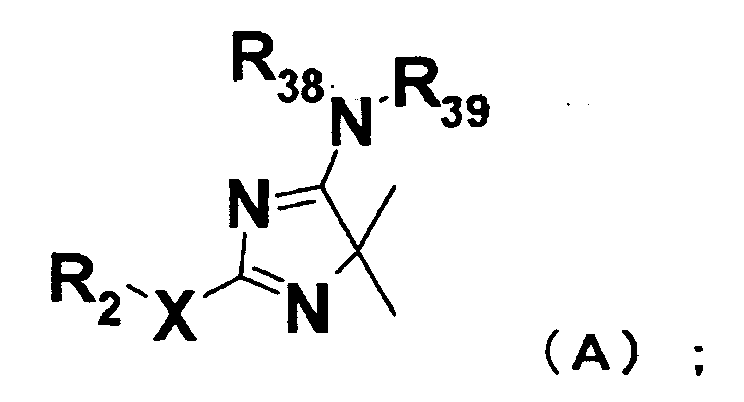
R37 is selected from:- 1) hydrogen,
- 2) hydroxy and
- 3) C1-C10 alkoxy;
n represents an integer of 0 to 2;
R1 is selected from:- 1) hydrogen,
- 2) cycloalkyl optionally substituted with a group(s) selected from R4, R5 and R6,
- 3) a heterocycle optionally substituted with a group(s) selected from R25, R4, R5 and R6,
- 4) aryl optionally substituted with a group (s) selected from R3, R4, R5 and R6 and
- 5) heteroaryl optionally substituted with a group(s) selected from R25, R4, R5 and R6;
- 1) -CONR7R8,
- 2) -OR9,
- 3) -NR9R10,
- 4) -N (R9) COR11,
- 5) -N (R9) SO2R12,
- 6) -SO2R15,
- 7) C1-10 alkyl optionally substituted with a group(s) independently selected from a halogen atom, a hydroxyl group, -COR16 and -NR13R14,
- 8) heteroaryl optionally having C1-10 alkyl and/or C1-10 alkoxy as a substituent and
- 9) -N (R9) CSR11;
- 1) a halogen atom,
- 2) cyano,
- 3) nitro,
- 4) amino,
- 5) -NHCOR26,
- 6) C1-C10 alkyl optionally substituted with a group(s) independently selected from hydroxycarbonyl, C1-C10 alkoxycarbonyl and aminocarbonyl,
- 7) C1-C10 haloalkyl,
- 8) C1-C10 alkoxy,
- 9) C1-C10 haloalkylcarbonyl,
- 10) -COR16,
- 11) C1-C10 hydroxyalkyl and
- 12) C1-C10 heteroalkyl;
R6 is selected from a halogen atom, C1-C10 alkyl and C1-C10 haloalkyl;
R7 is selected from:- 1) hydrogen,
- 2) C1-C10 alkyl optionally substituted with a group(s) independently selected from amino and C1-C10 alkylamino,
- 3) C1-C10 hydroxyalkyl,
- 4) C1-C10 haloalkyl,
- 5) C1-C10 heteroalkyl,
- 6) C1-C10 heteroalkyl optionally substituted with a group(s) selected from a hydroxyl group, C1-C10 alkylamino and C2-C10 alkenyl,
- 7) aryl,
- 8) heteroaryl,
- 9) aryl C1-C10 alkyl,
- 10) a heterocycle optionally substituted with C1-C10 alkyl,
- 11) - (CH2) LCOR16 (wherein L represents an integer of 1 to 4),
- 12) C1-C10 alkoxy,
- 13) C2-C10 alkenyl and
- 14) -NR40R41;
R8 is selected from hydrogen and C1-C10 alkyl optionally substituted with a halogen atom(s) and/or a hydroxyl group(s);
R7 and R8 may be bonded to form a 4- to 7-membered heterocycle optionally containing an additional element(s) or group(s) independently selected from O, N, S, SO and SO2, and the heterocycle optionally contains carbonyl, and the heterocycle is optionally substituted with a substituent(s) independently selected from:- 1) a halogen atom,
- 2) C1-C10 alkyl optionally having C1-C10 alkylamino as a substituent,
- 3) C1-C10 haloalkyl,
- 4) a hydroxyl group,
- 5) C1-C10 hydroxyalkyl,
- 6) C1-C10 alkoxy optionally substituted with a group(s) independently selected from a halogen atom, a hydroxyl group, amino and C1-C10 alkylamino,
- 7) aryl optionally substituted with a group(s) selected from a halogen atom, a hydroxyl group, amino and C1-C10 alkylamino,
- 8) C1-C10 heteroalkyl optionally substituted with a group(s) independently selected from a halogen atom, a hydroxyl group, amino and C1-C10 alkylamino,
- 9) a heterocycle optionally substituted with C1-C10 alkyl,
- 10) heteroaryl optionally substituted with C1-C10 alkyl,
- 11) heterocyclyl C1-C10 alkyl,
- 12) -COR16,
- 13) -NR19R20,
- 14) -SO2R21,
- 15) C1-C10 alkoxy-C1-C10 alkyl optionally having a hydroxyl group(s) as a substituent(s) and
- 16) C1-C10 hydroxyalkyloxy, wherein the hydrogen atom of the hydroxyl group is optionally replaced by C1-C10 hydroxyalkyl, and
R16 is selected from:- 1) a hydroxyl group,
- 2) C1-C10 alkoxy,
- 3) NR17R18 and
- 4) C1-C10 alkyl optionally substituted with a substituent(s) selected from a halogen atom, a hydroxyl group, C1-C10 alkoxycarbonyl or C1-C10 alkylamino;
- 1) hydrogen,
- 2) C1-C10 alkyl optionally substituted with a group(s) selected from aryl, amino, C1-C10 alkylamino, C1-C10 alkylcarbonylamino and a hydroxyl group,
- 3) heteroaryl and
- 4) C1-C10 alkoxy;
R17 and R18 may be bonded to each other to form a ring selected from azetidinyl, pyrrolidinyl, piperidinyl, piperazinyl and morpholinyl, and the ring is optionally substituted with a group(s) selected independently of each other from C1-C10 alkyl, a halogen atom and C1-C10 alkoxycarbonyl;
R19 is selected from hydrogen, C1-C10 alkyl, C1-C10 haloalkyl, C1-C10 alkylcarbonyl, C1-C10 hydroxyalkyl, C1-C10 aminoalkyl, C1-C10 alkoxycarbonyl and C1-C10 heteroalkyl;
R20 is selected from hydrogen and C1-C10 alkyl;
R19 and R20 may be bonded to form a ring selected from azetidinyl, pyrrolidinyl, piperidinyl, piperazinyl and morpholinyl, and the ring is optionally substituted with a group(s) selected independently of each other from C1-C10 alkyl and a halogen atom;
R21 is selected from:- 1) C1-C10 alkyl optionally substituted with aryl,
- 2) amino,
- 3) C1-C10 alkylamino and
- 4) aryl optionally substituted with C1-C10 alkyl;
- 1) hydrogen,
- 2) C1-C10 alkyl optionally substituted with a group(s) independently selected from R23,
- 3) aryl optionally substituted with a group(s) selected from a halogen atom, a hydroxyl group, amino and C1-C10 alkylamino,
- 4) cycloalkyl optionally substituted with a halogen atom(s) or a hydroxyl group(s),
- 5) a heterocycle optionally substituted with a group(s) independently selected from C1-C10 alkyl, C1-C10 alkylcarbonyl, C1-C10 alkoxy, C1-C10 alkoxycarbonyl, amino and a halogen atom,
- 6) C1-C10 heteroalkyl optionally substituted with a group(s) independently selected from a halogen atom and a hydroxyl group,
- 7) heteroaryl optionally substituted with a group(s) selected from C1-C10 alkyl, C1-C10 alkylcarbonyl, C1-C10 alkoxycarbonyl and a halogen atom and
- 8) cycloalkenyl optionally substituted with a group(s) selected from C1-C10 alkoxy, C1-C10 alkylamino, amino, a hydroxyl group and a halogen atom, wherein the cycloalkenyl optionally contains a carbonyl group;
- 1) a halogen atom,
- 2) a hydroxyl group,
- 3) a C1-C10 alkylcarbonyloxy group,
- 4) -COR16,
- 5) amino,
- 6) C1-C10 alkylamino,
- 7) a heterocycle optionally substituted with a group(s) selected from C1-C10 alkyl, C1-C10 alkylcarbonyl, C1-C10 alkoxycarbonyl and a halogen atom and
- 8) cyano;
- 1) hydrogen and
- 2) C1-C10 alkyl optionally substituted with a group(s) selected from a halogen atom, a hydroxyl group and aryl; R9 and R10 may be bonded to form a 4- to 7-membered heterocycle optionally containing an additional element(s) or group(s) independently selected from N, O, S, SO, SO2, carbonyl and thiocarbonyl, and the heterocycle is optionally substituted with a substituent(s) independently selected from R24;
- 1) a halogen atom,
- 2) C1-C10 alkyl optionally substituted with a group(s) independently selected from C1-C10 alkylamino and C1-C10 alkylcarbonylamino,
- 3) C1-C10 haloalkyl,
- 4) a hydroxyl group,
- 5) C1-C10 hydroxyalkyl,
- 6) C1-C10 alkoxy optionally substituted with a group(s) independently selected from a halogen atom, a hydroxyl group, amino and C1-C10 alkylamino,
- 7) aryl optionally substituted with a group(s) independently selected from a halogen atom, a hydroxyl group, amino and C1-C10 alkylamino,
- 8) C1-C10 heteroalkyl optionally substituted with a group(s) independently selected from a halogen atom, a hydroxyl group, amino and C1-C10 alkylamino,
- 9) a heterocycle optionally substituted with C1-C10 alkyl,
- 10) heteroaryl,
- 11) heterocyclyl C1-C10 alkyl,
- 12) -COR16,
- 13) -NR19R20 and
- 14) -SO2R21;
- 1) C1-C10 alkyl optionally substituted with a group(s) independently selected from:
- i) a hydroxyl group,
- ii) -NR17R18,
- iii) a C1-C10 alkoxy group,
- iv) a halogen atom,
- v) C1-C10 alkoxycarbonyl,
- vi) aminocarbonyl and
- vii) aryl optionally substituted with a group(s) independently selected from a halogen atom, a hydroxyl group, C1-C10 alkoxy, amino, C1-C10 alkylamino and -COR22,
- 2) aryl optionally substituted with a group(s) independently selected from a halogen atom, a hydroxyl group, C1-C10 alkoxy, amino, C1-C10 alkylamino and -COR22,
- 3) cycloalkyl optionally substituted with a halogen atom(s),
- 4) a heterocycle optionally substituted with a group(s) selected from C1-C10 alkyl, C1-C10 alkylcarbonyl, C1-C10 alkoxycarbonyl and a halogen atom,
- 5) C1-C10 alkoxy, wherein the alkyl group is optionally substituted with a group(s) independently selected from C1-C10 alkylcarbonylamino, amino, C1-C10 alkylamino and a hydroxyl group,
- 6) amino,
- 7) C1-C10 alkylamino, wherein the alkyl group is optionally substituted with a group(s) independently selected from C1-C10 alkylcarbonylamino, amino, C1-C10 alkylamino, hydroxycarbonyl and a hydroxyl group and
- 8) C2-C10 alkenyl;
R12 is selected from:- 1) C1-C10 alkyl,
- 2) amino and
- 3) C1-C10 alkylamino, wherein the alkyl group is optionally substituted with a group(s) independently selected from amino, C1-C10 alkylamino and a hydroxyl group;
- 1) hydrogen,
- 2) C1-C10 alkyl,
- 3) C1-C10 alkylcarbonyl, wherein the alkyl is optionally substituted with a hydroxyl group(s),
- 4) C1-C10 alkoxycarbonyl,
- 5) aminocarbonyl,
- 6) C1-C10 alkylaminocarbonyl and
- 7) heterocyclic carbonyl optionally substituted with C1-C10 alkyl;
- 1) hydrogen and
- 2) C1-C10 alkyl optionally substituted with a group(s) independently selected from a halogen atom, a hydroxyl group, amino and C1-C10 alkylamino;
R15 is selected from:- 1) C1-C10 alkyl and
- 2) -NR35R36;
- 1) hydrogen,
- 2) C1-C10 alkyl optionally substituted with a group(s) independently selected from:
- i) a halogen atom,
- ii) a hydroxyl group,
- iii) C1-C10 alkylcarbonylamino,
- iv) -COR16,
- v) amino,
- vi) C1-C10 alkylamino,
- vii) C1-C10 alkoxy optionally substituted with a halogen atom(s),
- viii) heteroaryl optionally substituted with a C1-C10 alkyl group(s) and
- ix) a heterocycle,
- 3) aryl optionally substituted with a group(s) independently selected from a halogen atom, a hydroxyl group, amino and C1-C10 alkylamino,
- 4) cycloalkyl optionally substituted with a group(s) independently selected from a halogen atom and a hydroxyl group,
- 5) a heterocycle optionally substituted with a group(s) independently selected from C1-C10 alkyl, a halogen atom and aryl C1-C10 alkyl,
- 6) heteroaryl optionally substituted with C1-C10 alkyl and
- 7) C1-C10 alkylcarbonyl;
- 1) hydrogen and
- 2) C1-C10 alkyl optionally substituted with a group(s) independently selected from a halogen atom, a hydroxyl group and aryl;
R25 is selected from:- 1) a halogen atom,
- 2) C1-C10 alkyl optionally substituted with a group(s) independently selected from:
- i) a halogen atom,
- ii) aryl,
- iii) heteroaryl,
- iv) a heterocycle optionally substituted with a C1-C10 alkyl group(s),
- v) -COR16,
- vi) -NR13R14 and
- vii) -SO2R21,
- 3) C1-C10 heteroalkyl optionally substituted with a hydroxyl group(s),
- 4) C1-C10 hydroxyalkyl, wherein each hydroxyl group may be independently substituted with a group(s) selected from C1-C10 alkyl, aryl C1-C10 alkyl and C1-C10 alkylcarbonyl,
- 5) -COR16,
- 6) -SO2R21,
- 7) aryl and
- 8) cyano;
- 1) C1-C10 alkyl optionally substituted with a halogen atom(s), wherein the alkyl group is optionally further substituted with a substituent(s) independently selected from R42,
- 2) C2-C10 alkenyl optionally substituted with a halogen atom(s), wherein the alkenyl group is optionally further substituted with a substituent(s) independently selected from R42,
- 3) C2-C10 alkynyl optionally substituted with a halogen atom(s), wherein the alkynyl group is optionally further substituted with a substituent(s) independently selected from R42,
- 4) cycloalkyl optionally substituted with a group(s) independently selected from:
- i) a halogen atom,
- ii) C2-C10 alkenyl or C1-C10 alkyl,
- iii) aryl optionally substituted with 1 to 3 substituents independently selected from C1-C10 alkyl, a. halogen atom, C1-C10 alkoxy, C1-C10 alkylamino and C1-C10 alkylcarbonyl,
- iv) cycloalkyl,
- v) C2-C10 alkenyl optionally substituted with halogen,
- vi) C1-C10 alkylidene, wherein the alkylidene is bonded to the cycloalkyl by a double bond and the alkylidene is optionally substituted with a halogen atom(s),
- vii) C1-C10 alkoxy optionally substituted with a halogen atom(s),
- viii) C1-C10 alkyl optionally substituted with a group(s) independently selected from a halogen atom or C1-C10 alkoxy optionally substituted with a halogen atom(s),
- ix) C2-C10 alkynyl and
- x) -Si (R43) 3,
- 5) a heterocycle, wherein the heterocycle is optionally substituted with a group(s) independently selected from:
- i) a C1-C10 alkyl group,
- ii) C1-C10 alkylcarbonyl, wherein the alkyl group is optionally substituted with R27,
- iii) arylcarbonyl, wherein the aryl group is optionally substituted with a group(s) independently selected from a halogen atom, C1-C10 alkyl and C1-C10 alkoxy,
- iv) heteroarylcarbonyl,
- v) C1-C10 alkoxycarbonyl, wherein the alkyl group is optionally substituted with a group(s) independently selected from a halogen atom, aryl and C1-C10 alkoxy,
- vi) aryloxycarbonyl, wherein the aryl group is optionally substituted with a halogen atom(s) and/or C1-C10 alkyl,
- vii) -CONR28R29,
- viii) -SO2R21,
- ix) a halogen atom,
- x) cycloalkylcarbonyl optionally fused with an aryl group and
- xi) C2-C10 alkenylcarbonyl, wherein the alkenyl group is optionally substituted with aryl, wherein the aryl is optionally substituted with a group(s) independently selected from a halogen atom, C1-C10 alkyl or C1-C10 alkoxy,
- 6) aryl optionally substituted with a group(s) independently selected from R44,
- 7) heteroaryl optionally substituted with a group(s) independently selected from:
- i) a halogen atom,
- ii) C1-C10 alkyl and
- iii) C1-C10 alkoxy;
- 8) C1-C10 alkoxy optionally substituted with a halogen atom(s), wherein the alkoxy group is optionally further substituted with a substituent(s) independently selected from R42,
- 9) -S (O) qR43 (wherein q is an integer of 0 to 2) and
- 10) cycloalkenyl optionally substituted with C1-C10 alkyl;
- 1) a halogen atom,
- 2) cyano,
- 3) C1-C10 alkyl optionally substituted with a group(s) independently selected from:
- i) a hydroxyl group,
- ii) -OR26,
- iii) cyano,
- iv) aryloxy optionally substituted with a group(s) independently selected from a halogen atom, C1-C10 alkyl optionally substituted with a halogen atom(s) or C1-C10 alkoxy optionally substituted with a halogen atom(s) and
- v) a halogen atom,
- 4) cycloalkyl optionally substituted with a group(s) independently selected from a halogen atom or C1-C10 alkyl optionally substituted with a halogen atom(s),
- 5) C1-C10 alkoxy optionally substituted with a halogen atom(s) or a C2-C6 alkenyl group,
- 6) -COR30,
- 7) C1-C10 alkylcarbonylamino,
- 8) C1-C10 alkoxycarbonylamino, wherein the alkoxy group is optionally substituted with aryl,
- 9) C1-C10 heteroalkyl optionally substituted with a halogen atom(s),
- 10) aryl optionally substituted with a substituent(s) independently selected from:
- i) a halogen atom,
- ii) C1-C10 alkyl,
- iii) C1-C10 alkoxy and
- iv) aryl optionally substituted with aryl optionally substituted with C1-C10 alkyl,
- 11) heteroaryl optionally substituted with a C1-C10 alkyl group(s),
- 12) -SO2R43,
- 13) -SOR43,
- 14) C1-C10 alkylthio optionally substituted with a halogen atom(s),
- 15) -Si (R43) 3 and
- 16) -SF5;
- 1) hydrogen,
- 2) aryl optionally substituted with a group(s) independently selected from C1-C10 alkyl optionally substituted with halogen, a halogen atom and C1-C10 alkoxy,
- 3) hydroxycarbonyl,
- 4) C1-C10 alkoxycarbonyl,
- 5) aminocarbonyl,
- 6) C1-C10 alkylaminocarbonyl,
- 7) C1-C10 alkoxycarbonylamino,
- 8) amino,
- 9) a hydroxyl group and
- 10) oxetane, tetrahydrofuran or tetrahydropyran optionally substituted with C1-C10 alkyl;
R26 is aryl, or C1-C10 alkyl optionally substituted with a halogen atom(s);
R27 is selected from:- 1) aryl optionally substituted with a group(s) independently selected from a halogen atom, C1-C10 alkyl and C1-C10 alkoxy,
- 2) C1-C10 alkoxy, wherein the alkyl group is optionally substituted with aryl,
- 3) a hydroxyl group,
- 4) amino,
- 5) C1-C10 alkylamino,
- 6) hydroxycarbonyl,
- 7) heteroaryl optionally substituted with a group(s) independently selected from C1-C10 alkyl and/or aryl, and
- 8) heteroaryloxy;
R29 is selected from hydrogen or C1-C10 alkyl optionally substituted with aryl;
R28 and R29 may be bonded to form a ring selected from azetidinyl, pyrrolidinyl, piperidinyl, piperazinyl and morpholinyl, and the ring is optionally substituted with a group(s) selected independently of each other from C1-C10 alkyl and a halogen atom;
R30 is selected from a hydroxyl group, C1-C10 alkoxy and -NR31R32;
R31 and R32 are independently selected from:- 1) hydrogen,
- 2) C1-C10 alkyl optionally substituted with aryl and
- 3) aryl;
R33 and R34 are independently selected from:- 1) hydrogen and
- 2) C1-C10 alkyl], or a pharmacologically acceptable salt thereof;
a compound represented by the following general formula (2) :
U represents a bond, C1-C10 alkylene or any group selected from groups represented by the following formula:
T is selected from aryl and heteroaryl;
V is selected from:
- 1) hydrogen,
- 2) a halogen atom,
- 3) C1-C10 alkyl optionally having a group(s) independently selected from C1-C10 alkylamino, a halogen atom and a hydroxyl group,
- 4) a hydroxyl group,
- 5) C1-C10 alkoxy optionally substituted with a group(s) independently selected from a halogen atom, a hydroxyl group, amino and C1-C10 alkylamino,
- 6) aryl optionally substituted with a group(s) independently selected from a halogen atom, a hydroxyl group, amino and C1-C10 alkylamino,
- 7) C1-C10 heteroalkyl optionally substituted with a group(s) independently selected from a halogen atom, a hydroxyl group, amino and C1-C10 alkylamino,
- 8) a heterocycle optionally substituted with C1-C10 alkyl,
- 9) heteroaryl optionally substituted with C1-C10 alkyl,
- 10) heterocyclyl C1-C10 alkyl,
- 11) -COR16,
- 12) -NR19R20 and
- 13) -SO2R21;
- 1) C1-C10 alkylene or C1-C10 heteroalkylene optionally substituted with a halogen atom(s) and/or a hydroxyl group(s), wherein the carbon atom(s) may be oxidized to form carbonyl;
- 2) C2-C10 alkenylene or C2-C10 heteroalkenylene optionally substituted with a halogen atom(s) and/or a hydroxyl group(s), wherein the carbon atom(s) may be oxidized to form carbonyl; and
- 3) a group selected from:

- 1) C1-C10 alkylene or C1-C10 heteroalkylene optionally substituted with a halogen atom(s); and
- 2) C2-C10 alkenylene or C2-C10 heteroalkenylene optionally substituted with a halogen atom(s);
- 1) C1-C10 alkylene or C1-C10 heteroalkylene optionally substituted with a halogen atom(s); and
- 2) C2-C10 alkenylene or C2-C10 heteroalkenylene optionally substituted with a halogen atom(s);
- [2] The compound or a pharmacologically acceptable salt thereof according to [1] , wherein
W is selected from:- 1) a single bond,
- 2) C1-C10 alkylene optionally containing a carbonyl group, wherein the alkylene is optionally substituted with a halogen atom(s) or hydroxy,
- 3) C2-C10 alkenylene optionally substituted with a halogen atom(s),
- 4) C2-C10 alkynylene,
- 5) arylene,
- 6) heteroarylene,
- 7) -NH-, -NHCH2- or -NHCH2CH2-,
- 8) cycloalkylene and
- 9) - (cycloalkylene) -CH2-;
- 1) a single bond,
- 2) C1-C10 alkylene optionally substituted with cycloalkyl,
- 3) C2-C10 alkenylene,
- 4) C2-C10 alkynylene and
- 5) C1-C10 oxyalkylene;
- 1) hydrogen,
- 2) cycloalkyl optionally substituted with a group selected from R4,
- 3) a heterocycle optionally substituted with a group(s) selected from R25 and R4,
- 4) aryl optionally substituted with a group(s) selected from R3, R4, R5 and R6 and
- 5) heteroaryl optionally substituted with a group(s) selected from R25, R4 and R5;
- 1) hydrogen,
- 2) C1-C10 alkyl optionally substituted with a group(s) independently selected from R23,
- 3) cycloalkyl optionally substituted with a halogen atom(s) or a hydroxyl group(s),
- 4) a heterocycle optionally substituted with a group(s) selected from C1-C10 alkyl, C1-C10 alkylcarbonyl, C1-C10 alkoxy, C1-C10 alkoxycarbonyl, amino and a halogen atom,
- 5) C1-C10 heteroalkyl optionally substituted with a group(s) selected from a halogen atom and a hydroxyl group,
- 6) heteroaryl optionally substituted with a group(s) independently selected from C1-C10 alkyl, C1-C10 alkylcarbonyl, C1-C10 alkoxycarbonyl and a halogen atom and
- 7) cycloalkenyl optionally substituted with a group(s) selected from C1-C10 alkoxy, C1-C10 alkylamino, amino, 1 to 3 hydroxyl groups and 1 to 4 halogen atoms, wherein the cycloalkenyl optionally contains a carbonyl group;
- 1) hydrogen and
- 2) C1-C10 alkyl optionally substituted with a group(s) independently selected from a halogen atom, a hydroxyl group and aryl;
R24 is selected from:- 1) a halogen atom,
- 2) C1-C10 alkyl optionally substituted with a group(s) independently selected from C1-C10 alkylamino and C1-C10 alkylcarbonylamino,
- 3) C1-C10 haloalkyl,
- 4) a hydroxyl group,
- 5) C1-C10 hydroxyalkyl,
- 6) C1-C10 alkoxy optionally substituted with a group(s) independently selected from a halogen atom, a hydroxyl group, amino and C1-C10 alkylamino,
- 7) aryl optionally substituted with a group(s) selected from a halogen atom, a hydroxyl group, amino and C1-C10 alkylamino,
- 8) C1-C10 heteroalkyl optionally substituted with 1 to 2 groups selected from a halogen atom, a hydroxyl group, amino and C1-C10 alkylamino,
- 9) -COR16 and
- 10) -NR19R20;
- 1) C1-C10 alkyl optionally substituted with 1 to 3 substituents independently selected from:
- i) a hydroxyl group,
- ii) -NR17R18,
- iii) a C1-C10 alkoxy group,
- iv) a halogen atom,
- v) C1-C10 alkoxycarbonyl and
- vi) aminocarbonyl,
- 2) aryl,
- 3) aryl C1-C10 alkyl,
- 4) cycloalkyl optionally substituted with a halogen atom(s),
- 5) a heterocycle optionally substituted with C1-C10 alkyl,
- 6) C1-C10 alkoxy, wherein the alkyl group is optionally substituted with a group(s) independently selected from C1-C10 alkylcarbonylamino, amino, C1-C10 alkylamino and a hydroxyl group,
- 7) amino,
- 8) C1-C10 alkylamino, wherein the alkyl group is optionally substituted with a group(s) independently selected from C1-C10 alkylcarbonylamino, amino, C1-C10 alkylamino, hydroxycarbonyl and a hydroxyl group and
- 9) C2-C10 alkenyl; and
wherein R3, R4, R5, R6, R16, R17, R18, R19, R20, R23 and R25 are as defined in [1], respectively. - [3] The compound or a pharmacologically acceptable salt thereof according to [1] or [2], wherein
W is selected from:- 1) a single bond,
- 2) C1-C10 alkylene optionally substituted with a halogen atom(s),
- 3) C2-C10 alkenylene,
- 4) C2-C10 alkynylene and
- 5) heteroarylene,
- 1) a single bond,
- 2) C1-C10 alkylene,
- 3) C2-C10 alkenylene,
- 4) C2-C10 alkynylene and
- 5) C1-C10 oxyalkylene, wherein the oxyalkylene is bonded to a 1,3,8-triaza-spiro[4.5]dec-1-en-4-one ring or a 1,3,8-triaza-spiro[4.5]dec-1-ene-4-thione ring through a carbon atom in the oxyalkylene;
- 1) aryl optionally substituted with a group(s) selected from R3, R4 and R5 and
- 2) heteroaryl optionally substituted with a group(s) selected from R25 and R4;
- 1) -CONR7R8,
- 2) -OR9,
- 3) -NR9R10,
- 4) -N (R9) COR11,
- 5) -N (R9) SO2R12,
- 6) -SO2R15,
- 7) C1-C10 alkyl optionally substituted with a group(s) selected from -COR16 and -NR13R14 and
- 8) -N (R9) CSNH2;
- 1) halogen,
- 2) cyano,
- 3) amino,
- 4) C1-C10 alkyl,
- 5) C1-C10 haloalkyl,
- 6) C1-C10 alkoxy,
- 7) C1-C10 haloalkylcarbonyl,
- 8) -COR16 and
- 9) C1-C10 heteroalkyl;
- 1) C1-C10 alkyl optionally substituted with a halogen atom(s), wherein the alkyl group is optionally further substituted with a group selected from R42,
- 2) C2-C10 alkenyl optionally substituted with a halogen atom(s), wherein the alkenyl group is optionally further substituted with a group selected from R42,
- 3) C2-C10 alkynyl optionally substituted with a halogen atom(s), wherein the alkynyl group is optionally further substituted with a group selected from R42,
- 4) cycloalkyl optionally substituted with a group(s) independently selected from:
- i) a halogen atom,
- ii) C2-C10 alkenyl or C1-C10 alkyl,
- iii) aryl optionally substituted with a group(s) independently selected from C1-C10 alkyl, a halogen atom and C1-C10 alkoxy,
- iv) cycloalkyl,
- v) C2-C10 haloalkenyl or C1-C10 haloalkyl,
- vi) C1-C10 alkylidene, wherein the alkylidene is bonded to the cycloalkyl by a double bond and the alkylidene is optionally substituted with a halogen atom(s),
- vii) C1-C10 alkoxy optionally substituted with a halogen atom(s),
- viii) C1-C10 alkyl substituted with C1-C10 alkoxy, wherein the alkyl and/or the alkyl in the alkoxy is optionally substituted with a halogen atom(s),
- ix) C2-C10 alkynyl and
- x) -Si (R43) 3,
- 5) a heterocycle, wherein the heterocycle is optionally substituted with a group(s) selected from:
- i) a C1-C10 alkyl group,
- ii) C1-C10 alkylcarbonyl, wherein the alkyl group is optionally substituted with R27,
- iii) arylcarbonyl, wherein the aryl group is optionally substituted with a group(s) independently selected from a halogen atom, C1-C10 alkyl and C1-C10 alkoxy,
- iv) heteroarylcarbonyl,
- v) C1-C10 alkoxycarbonyl, wherein the alkyl group is optionally substituted with a group(s) independently selected from a halogen atom, aryl and C1-C10 alkoxy,
- vi) aryloxycarbonyl, wherein the aryl group is optionally substituted with a halogen atom(s) and/or C1-C10 alkyl,
- vii) -CONR28R29 and
- viii) -SO2R21,
- 6) aryl optionally substituted with a group(s) independently selected from R44.
- 7) heteroaryl optionally substituted with any of the following groups:
- i) C1-C10 alkyl,
- 8) C1-C10 alkoxy optionally substituted with a halogen atom(s), wherein the alkoxy group is optionally further substituted with a group selected from R42,
- 9) -S (O) qR43 (wherein q is an integer of 0 to 2) and
- 10) cycloalkenyl optionally substituted with C1-C10 alkyl,
- 1) a halogen atom,
- 2) cyano,
- 3) C1-C10 alkyl optionally substituted with any of the following groups:
- i) a hydroxyl group,
- ii) -OR26,
- iii) cyano and
- iv) aryloxy optionally substituted with a group(s) selected from a halogen atom, C1-C10 alkyl, C1-C10 haloalkyl or C1-C10 haloalkoxy,
- 4) C1-C10 haloalkyl,
- 5) cycloalkyl optionally substituted with a group(s) selected from a halogen atom and C1-C10 haloalkyl,
- 6) C1-C10 alkoxy optionally substituted with a halogen atom(s) or a C2-C6 alkenyl group,
- 7) -COR30,
- 8) C1-C10 heteroalkyl optionally substituted with a halogen atom(s),
- 9) aryl optionally substituted with a group(s) independently selected from:
- i) C1-C10 alkyl and
- ii) aryl,
- 10) heteroaryl optionally substituted with a C1-C10 alkyl group(s),
- 11) -SO2R43,
- 12) C1-C10 alkylthio optionally substituted with a halogen atom(s),
- 13) -Si (R43) 3 and
- 14) -SF5; and
- 1) aryl optionally substituted with a group(s) independently selected from a halogen atom, C1-C10 alkyl and C1-C10 alkoxy,
- 2) C1-C10 alkoxy, wherein the alkyl group is optionally substituted with aryl,
- 3) heteroaryl optionally substituted with a group(s) independently selected from C1-C10 alkyl and aryl and
- 4) heteroaryloxy,
- [4] The compound or a pharmacologically acceptable salt thereof according to any of [1] to [3], wherein W is selected from:
- 1) C1-C6 alkylene optionally substituted with a fluorine atom(s),
- 2) C1-C6 alkenylene and
- 3) thiophene,
- 1) a single bond,
- 2) C1-C6 alkylene and
- 3) C1-C6 oxyalkylene optionally substituted with a halogen atom(s), wherein the oxyalkylene is bonded to a 1,3,8-triaza-spiro[4.5]dec-1-en-4-one ring or a 1,3,8-triaza-spiro[4.5]dec-1-ene-4-thione ring through a carbon atom in the oxyalkylene;
m represents 1; and
n represents 1. - [5] The compound or a pharmacologically acceptable salt -thereof according to any of [1] to [4], wherein W is selected from:
- 1) ethylene,
- 2) vinylene and
- 3) thiophene,
R3 is selected from:- 1) -CONR7R8,
- 2) -OR9,
- 3) -NR9R10,
- 4) -N (R9) COR11,
- 5) -N (R9) SO2R12,
- 6) -SO2R15 and
- 7) C1-C6 alkyl optionally substituted with a group(s) selected from -COR16 and -NR13R14:
- 1) C1-C10 alkyl optionally substituted with a halogen atom(s), wherein the alkyl group is optionally further substituted with a group selected from R42,
- 2) C2-C10 alkenyl optionally substituted with a halogen atom(s), wherein the alkenyl group is optionally further substituted with a group selected from R42,
- 3) C2-C10 alkynyl optionally substituted with a halogen atom(s), wherein the alkynyl group is optionally further substituted with a group selected from R42,
- 4) cycloalkyl optionally substituted with a group(s) independently selected from:
- i) a halogen atom,
- ii) C2-C6 alkenyl or C1-C6 alkyl,
- iii) aryl optionally substituted with a group(s) independently selected from C1-C6 alkyl, a halogen atom, C1-C6 alkoxy, C1-C6 alkylamino and C1-C6 alkylcarbonyl,
- iv) cycloalkyl,
- v) C2-C6 haloalkenyl or C1-C6 haloalkyl,
- vi) C1-C6 alkylidene, wherein the alkylidene is bonded to the cycloalkyl by a double bond and the alkylidene is optionally substituted with a halogen atom(s),
- vii) C1-C6 alkoxy optionally substituted with a halogen atom(s),
- viii) C1-C6 alkyl substituted with C1-C6 alkoxy,
wherein the alkyl and/or the alkyl in the alkoxy is optionally substituted with halogen, - ix) C2-C6 alkynyl and
- x) -Si (R43) 3,
- 5) a group represented by the following general formula (B) :

- i) C1-C6 alkylcarbonyl, wherein the alkyl group is optionally substituted with R27,
- ii) arylcarbonyl, wherein the aryl group is optionally substituted with a group(s) independently selected from a halogen atom, C1-C6 alkyl and C1-C6 alkoxy,
- iii) C1-C6 alkoxycarbonyl, wherein the alkyl group is optionally substituted with a group(s) selected from a halogen atom, aryl and C1-C6 alkoxy,
- iv) aryloxycarbonyl, wherein the aryl group is optionally substituted with a halogen atom(s) or C1-C6 alkyl,
- v) -CONR28R29 and
- vi) -SO2R21),
- 6) aryl optionally substituted with a group(s) independently selected from R44,
- 7) heteroaryl optionally substituted with any of the following groups:
- i) a halogen atom,
- ii) C1-C6 alkyl and
- iii) C1-C6 alkoxy;
- 8) C1-C6 alkoxy optionally substituted with a halogen atom(s), wherein the alkoxy group is optionally further substituted with a group selected from R42,
- 9) -S(O) qR43 (wherein q is an integer of 0 to 2) and
- 10) cycloalkenyl optionally substituted with C1-C6 alkyl; and
- 1) a halogen atom,
- 2) cyano,
- 3) C1-C6 alkyl optionally substituted with any of the following groups:
- i) a hydroxyl group,
- ii) -OR26,
- iii) cyano and
- iv) aryloxy optionally substituted with a group(s) selected from a halogen atom, C1-C6 alkyl, C1-C6 haloalkyl or C1-C6 haloalkoxy,
- 4) C1-C6 haloalkyl,
- 5) cycloalkyl optionally substituted with a group(s) selected from a halogen atom and C1-C6 haloalkyl,
- 6) C1-C6 alkoxy optionally substituted with a halogen atom(s),
- 7) -COR30,
- 8) C1-C6 heteroalkyl optionally substituted with a halogen atom(s),
- 9) aryl optionally substituted with a group(s) independently selected from:
- i) C1-C6 alkyl and
- ii) aryl,
- 10) heteroaryl optionally substituted with a C1-C6 alkyl group(s),
- 11) -SO2R43,
- 12) C1-C6 alkylthio optionally substituted with a halogen atom(s),
- 13) -Si (R43) 3 and
- 14) -SF5,
- [6] The compound or a pharmacologically acceptable salt thereof according to [3], wherein R1 is a group represented by the following general formula (3):

- [7] The compound or a pharmacologically acceptable salt thereof according to [3], wherein R1 is a group represented by the following general formula (4):

- [8] The compound or a pharmacologically acceptable salt thereof according to [5], wherein R1 is a group represented by the following general formula (3):

- [9] The compound or a pharmacologically acceptable salt thereof according to [5], wherein R1 is a group represented by the following general formula (4):

- [10] Compounds of Compound Nos. (1) to (1446) described herein or pharmacologically acceptable salts thereof.
- [11] The compound or a pharmacologically acceptable salt thereof according to any of [1] to [5], wherein U represents C1-C6 alkylene or any group selected from groups represented by the following formula:

R46 is selected from hydrogen, C1-C10 alkyl, C1-C10 haloalkyl and C1-C10 hydroxyalkyl;
V is selected from:
R7 is selected from:- 1) hydrogen,
- 2) C1-C10 alkyl and
- 3) C1-C10 hydroxyalkyl.
- [12] A pharmaceutical composition comprising the compound or a pharmacologically acceptable salt thereof according to any of [1] to [11] as an active ingredient.
- [13] A pharmaceutical composition for activating intracellular cAMP response, comprising the compound or a pharmacologically acceptable salt thereof according to any of [1] to [11] as an active ingredient.
- [14] A prophylactic or therapeutic agent for osteoporosis, fracture, osteomalacia, arthritis, thrombocytopenia, hypoparathyroidism, hyperphosphatemia or tumoral calcinosis, or a stem cell mobilizing agent, comprising the compound or a pharmacologically acceptable salt thereof according to any of [1] to [11] as an active ingredient.
- [15] A method for the prevention or treatment of osteoporosis, fracture, osteomalacia, arthritis, thrombocytopenia, hypoparathyroidism, hyperphosphatemia or tumoral calcinosis, or stem cell mobilization, comprising administering a pharmaceutically effective amount of a composition comprising the compound or a pharmacologically acceptable salt thereof according to any of [1] to [11] to a patient in need of prevention or treatment of the disease or stem cell mobilization.
- [16] Use of the compound or a pharmacologically acceptable salt thereof according to any of [1] to [11] for the manufacture of a prophylactic or therapeutic agent for osteoporosis, fracture, osteomalacia, arthritis, thrombocytopenia, hypoparathyroidism, hyperphosphatemia or tumoral calcinosis, or a stem cell mobilizing agent.
- [17] The compound or a pharmacologically acceptable salt thereof according to any of [1] to [11] for the treatment or prevention of osteoporosis, fracture, osteomalacia, arthritis, thrombocytopenia, hypoparathyroidism, hyperphosphatemia or tumoral calcinosis, or stem cell mobilization.
- The compounds or pharmacologically acceptable salts thereof according to the present invention have a parathyroid hormone-like effect involving bone anabolism which can considerably improve the compliance of patients as compared with parathyroid hormone peptide agonists.
- The present invention relates to spiroimidazolone derivatives and use thereof. The present inventors have synthesized a compound represented by the above formula (1) or (2) or a pharmacologically acceptable salt thereof for the first time and have found that the compound or a salt thereof is a compound having a parathyroid hormone (PTH)-like effect.
- The "alkyl" herein refers to a monovalent group derived by removing any one hydrogen atom from an aliphatic hydrocarbon, and covers a subset of hydrocarbyl or hydrocarbon group structures not containing a heteroatom or an unsaturated carbon-carbon bond and containing hydrogen and carbon atoms in the backbone. Examples of the alkyl group include those of linear or branched structures. The alkyl group is preferably an alkyl group having 1 to 10 carbon atoms (C1-C10; "Cp-Cq" hereinafter means that the group has p to q carbon atoms), more preferably a C1-C6 alkyl group. In particular, it is preferably a C1-C3 alkyl group in R38 and R39, a C1-C3 alkyl group in R3, a C1-C3 alkyl group in R4, a C1-C3 alkyl group in R5, a C1-C3 alkyl group in R6, a C1-C3 alkyl group in R7, a C1-C3 alkyl group in R40 and R41, a C1-C3 alkyl group in R8, a C1-C3 alkyl group in a substituent on a heterocycle where R7 and R8 are bonded to each other to form the heterocycle or a substituent on a spiro ring where the spiro ring is formed with the heterocycle, a C1-C3 alkyl group in R16, a C1-C5 alkyl group in R17, a C1-C3 alkyl group in R18, a C1-C3 alkyl group in a substituent on a heterocycle where R17 and R18 are bonded to each other to form the heterocycle, a C1-C3 alkyl group in R19, a C1-C3 alkyl group in R20, a C1-C3 alkyl group in R21, a C1-C4 alkyl group in R9, a C1-C3 alkyl group in R23, a C1-C3 alkyl group in R10, a C1-C3 alkyl group in R24, a C1-C4 alkyl group in R11, a C1-C3 alkyl group in R12, a C1-C3 alkyl group in R13, a C1-C4 alkyl group in R14, a C1-C3 alkyl group in a substituent on a heterocycle where R13 and R14 are bonded to each other to form the heterocycle, a C1-C3 alkyl group in R15, a C1-C4 alkyl group in R35, a C1-C3 alkyl group in R36, a C1-C4 alkyl group in R25, a C1-C13 alkyl group in R2, a C1-C5 alkyl group in R44, a Cl-C3 alkyl group in R42, a C1-C3 alkyl group in R43, a C1-C3 alkyl group in R26, a C1-C3 alkyl group in R27 and a C1-C6 alkyl group in R28.
- Specific examples of the alkyl include a methyl group, an ethyl group, an n-propyl group, an isopropyl group, an n-butyl group, an isobutyl group, an s-butyl group, a t-butyl group, a pentyl group, an isopentyl group, a 2,3-dimethylpropyl group, a 3,3-dimethylbutyl group, a hexyl group, a 2,3-dimethylhexyl group, a 1,1-dimethylpentyl group, a heptyl group and an octyl group.
- The "alkenyl" herein refers to a monovalent group having at least one double bond (two adjacent SP2 carbon atoms). Depending on the configuration of the double bond and the substituent (if present), the geometry of the double bond can be an entgegen (E) or zuzammen (Z) configuration or a cis or trans configuration. Examples of the alkenyl group include linear or branched groups, including straight chains that include internal olefins. Preferred examples include C2-C10 alkenyl groups, and more preferred examples include C2-C6 alkenyl groups. In particular, it is preferably a C2-C5 alkenyl group in R7 and a C1-C9 alkenyl group in R2.
- Specific examples of such alkenyl include a vinyl group, an allyl group, a 1-propenyl group, a 2-propenyl group, a 1-butenyl group, a 2-butenyl group (including cis and trans), a 3-butenyl group, a pentenyl group and a hexenyl group.
- The "alkynyl" herein refers to a monovalent group having at least one triple bond (two adjacent SP carbon atoms). Examples include linear or branched alkynyl groups, including internal alkylenes. Preferred examples include C2-C10 alkynyl groups, and more preferred examples include C2-C6 alkynyl groups. In particular, it is preferably a C2-C9 alkynyl group in R2.
- Specific examples of the alkynyl include an ethynyl group, a 1-propynyl group, a propargyl group, a 3-butynyl group, a pentynyl group, a hexynyl group, a 3-phenyl-2-propynyl group, a 3-(2'-fluorophenyl)-2-propynyl group, a 2-hydroxy-2-propynyl group, a 3-(3-fluorophenyl)-2-propynyl group and a 3-methyl-(5-phenyl)-4-pentynyl group.
- The alkenyl or alkynyl can have one or more double bonds or triple bonds, respectively.
- The "cycloalkyl" herein refers to a saturated cyclic monovalent aliphatic hydrocarbon group and includes single rings, fused rings, bicyclo rings and spiro rings. Preferred examples include C3-C10 cycloalkyl groups. Specific examples of the cycloalkyl group include a cyclopropyl group, a cyclobutyl group, a cyclopentyl group, a cyclohexyl group, a cycloheptyl group, a cyclooctyl group and a bicyclo[2.2.1]heptyl group.
The "cycloalkenyl" herein refers to a cyclic aliphatic hydrocarbon group having at least one double bond and includes single rings, fused rings, bicyclo rings and spiro rings. Preferred examples include C3-C10 cycloalkynyl groups, and more preferred examples include C3-C6 alkenyl groups. It is preferably C3-C5 cycloalkenyl in R9. Specific examples of the cycloalkenyl group include a cyclopropenyl group, a cyclobutenyl group, a cyclopentenyl group, a cyclohexenyl group, a cycloheptenyl group, a cyclooctenyl group and a tetralinyl group. - The "heteroatom" herein refers to a nitrogen atom (N), an oxygen atom (O) or a sulfur atom (S).
- The "halogen atom" herein refers to a fluorine atom, a chlorine atom, a bromine atom or an iodine atom.
- The "haloalkyl" herein represents a group in which preferably 1 to 9, more preferably 1 to 5, of the same or different above "halogen atoms" are bonded to the above "alkyl". The haloalkyl is preferably C1-C10 haloalkyl, more preferably C1-C6 haloalkyl. In particular, it is preferably C1-C3 haloalkyl in R4 and C1-C3 haloalkyl in R44.
Specific examples include a fluoromethyl group, a difluoromethyl group and a trifluoromethyl group. - The "haloalkenyl" herein represents a group in which preferably 1 to 9, more preferably 1 to 5, of the same or different above "halogen atoms" are bonded to the above "alkenyl".
- The "alkylcarbonyl" herein refers to a carbonyl group to which the above-defined "alkyl" is bonded, and is preferably C1-C10 alkylcarbonyl, more preferably C1-C6 alkylcarbonyl. In particular, it is preferably C1-C3 alkylcarbonyl in R40 and R41, C1-C3 alkylcarbonyl in R19, C1-C3 alkylcarbonyl in R9, C1-C3 alkylcarbonyl in R23, C1-C3 alkylcarbonyl in R12, C1-C3 alkylcarbonyl in R35 and C1-C5 alkylcarbonyl in R2.
The "Cn-Cm alkylcarbonyl" herein means that the alkyl therein is a "Cn-Cm" alkyl in terms of the number of carbon atoms. Hereinafter, the same applies to a group containing "alkylcarbonyl".
Specific examples include an acetyl group, an ethylcarbonyl group, a 1-propylcarbonyl group, a 2-propylcarbonyl group and a 2,2-dimethylpropylcarbonyl group. - The "haloalkylcarbonyl" herein refers to a carbonyl group to which the above-defined "haloalkyl" is bonded. The haloalkylcarbonyl is preferably C1-C10 haloalkylcarbonyl, more preferably C1-C6 haloalkylcarbonyl. In particular, it is preferably C1-C3 haloalkylcarbonyl in R4.
- The "cycloalkylcarbonyl" herein refers to a carbonyl group to which the above-defined "cycloalkyl" is bonded.
- The "alkenylcarbonyl" herein refers to a carbonyl group to which the above-defined "alkenyl" is bonded, and is preferably C2-C10 alkenyl, more preferably C2-C6 alkenylcarbonyl. In particular, it is preferably C2-C3 alkenylcarbonyl in R2.
The "Cn-Cm alkenylcarbonyl" herein means that it includes an alkenyl having "Cn-Cm" carbon atoms. Hereinafter, the same applies to a group containing "alkenylcarbonyl". - The "alkoxy" herein refers to an oxy group to which the above-defined "alkyl" is bonded, and is preferably a C1-C10 alkoxy group, more preferably a C1-C6 alkoxy group. In particular, it is preferably a C1-C3 alkoxy group in R37, a C1-C3 alkoxy group in R3, a C1-C3 alkoxy group in R4, a C1-C3 alkoxy group in R5, a C1-C3 alkoxy group in R7, a C1-C3 alkoxy group in a substituent on a heterocycle where R7 and R8 are bonded to each other to form the heterocycle, a C1-C4 alkoxy group in R16, a C1-C3 alkoxy group in R17, a C1-C3 alkoxy group in R11, a C1-C4 alkoxy group in R2 and a C1-C4 alkoxy group in R27. Specific examples include a methoxy group, an ethoxy group, a 1-propoxy group, a 2-propoxy group, an n-butoxy group, an i-butoxy group, a sec-butoxy group, a t-butoxy group, a 1-pentyloxy group, a 2-pentyloxy group, a 3-pentyloxy group, a 2-methyl-1-butyloxy group, a 3-methyl-1-butyloxy group, a 2-methyl-2-butyloxy group, a 3-methyl-2-butyloxy group, a 2,2-dimethyl-l-propyloxy group, a 1-hexyloxy group, a 2-hexyloxy group, a 3-hexyloxy group, a 2-methyl-1-pentyloxy group, a 3-methyl-1-pentyloxy group, a 4-methyl-1-pentyloxy group, a 2-methyl-2-pentyloxy group, a 3-methyl-2-pentyloxy group, a 4-methyl-2-pentyloxy group, a 2-methyl-3-pentyloxy group, a 3-methyl-3-pentyloxy group, a 2,3-dimethyl-1-butyloxy group, a 3,3-dimethyl-1-butyloxy group, a 2,2-dimethyl-1-butyloxy group, a 2-ethyl-1-butyloxy group, a 3,3-dimethyl-2-butyloxy group, a 2,3-dimethyl-2-butyloxy group and a 1-methyl-cyclopropylmethoxy group.
- The "alkylcarbonyloxy" herein refers to an oxy group to which the above-defined "alkylcarbonyl" is bonded, and is preferably a C1-C10 alkylcarbonyloxy group, more preferably a C1-C6 alkylcarbonyloxy group. In particular, it is preferably a C1-C3 alkylcarbonyloxy group in R23.
- The "alkoxycarbonyl" herein refers to a carbonyl group to which the above-defined "alkoxy" is bonded. The alkoxycarbonyl is preferably C1-C10 alkoxycarbonyl, more preferably C1-C6 alkoxycarbonyl. It is preferably C1-C3 alkoxycarbonyl in R4, C1-C3 alkoxycarbonyl in R16, C1-C4 alkoxycarbonyl in R19, C1-C4 alkoxycarbonyl in R9, C1-C3 alkoxycarbonyl in R23, C1-C3 alkoxycarbonyl in R11, C1-C4 alkoxycarbonyl in R13, C1-C5 alkoxycarbonyl in R2 and C1-C3 alkoxycarbonyl in R42. Examples include -CO2tBu (t-butoxycarbonyl) and -CO2Me (methoxycarbonyl).
The "Cn-Cm alkoxycarbonyl" herein means that the alkyl in the alkoxy is a "Cn-Cm" alkyl in terms of the number of carbon atoms. Hereinafter, the same applies to a group containing "alkoxycarbonyl". - The "heteroalkyl" herein refers to a group containing preferably 1 to 5 heteroatoms in the above-defined "alkyl" backbone and is preferably C1-C10 heteroalkyl, more preferably C1-C6 heteroalkyl. In particular, it is preferably C1-C5 heteroalkyl in R9, C1-C5 heteroalkyl in R11 and C1-C6 heteroalkyl in R25. Examples include -CH2OCH3, -CH2OCH2CH3, -CH(Me)OCH3 and - CH2CH2NMe2.
- The "heteroalkenyl" herein refers to a group containing preferably 1 to 5 heteroatoms in the above-defined "alkenyl" backbone.
- The "alkylene" herein refers to a divalent group having a basic skeleton represented by -(CH2)n-(preferably n = 1 to 10), and may contain a branched chain. Specific examples include C1-C5 alkylene (n = 1 to 5). More specific examples include a methylene group, a dimethylmethylene group, an ethylene group, a propylene group, a butylene group and a pentamethylene group. In particular, it is preferably C2-C5 alkylene in W, C1-C9 alkylene in X, C1-C10 alkylene in U, C1-C10 alkylene in Z and C1-C5 alkylene in G.
- The "alkylidene" herein refers to a divalent group produced by removing two hydrogen atoms from the same carbon atom of a ring, the free valencies of which are part of a double bond. The geometry of the double bond can be an entgegen (E) or zuzammen (Z) configuration or a cis or trans configuration. Examples of the alkylidene include linear or branched groups. Preferred examples include C1-C10 alkylidene, and more preferred examples include C1-C6 alkylidene. In particular, it is preferably C1-C4 alkylidene in R2. Specific examples include methylene (=CH2), ethylidene (=CHCH3), isopropylidene (=C(CH3)2) and propylidene (=CHCH2CH3).
- The "alkenylene" herein refers to a divalent group having at least one double bond (two adjacent SP2 carbon atoms). Depending on the configuration of the double bond and the substituent (if present), the geometry of the double bond can be an entgegen (E) or zuzammen (Z) configuration or a cis or trans configuration. Examples of the alkenylene include linear or branched groups. Preferred examples include C2-C10 alkenylene, and more preferred examples include C2-C6 alkenylene. Specific examples include a vinylene group, a 1-propenylene group, a 1-butenylene group and a 1-pentenylene group. In particular, it is preferably C2-C5 alkenylene in W, C2-C9 alkenylene in X, C2-C10 alkenylene in Z and C2-C5 alkenylene in G.
- The "alkynylene" herein refers to a divalent group having at least one triple bond (two adjacent SP carbon atoms). Examples include linear or branched alkynylenes. Preferred examples include C2-C10 alkynylene, and more preferred examples include C2-C6 alkynylene. In particular, it is preferably C2-C5 alkynylene in W and C2-C9 alkynylene in X.
The "cycloalkylene" herein refers to a saturated cyclic divalent aliphatic hydrocarbon group and includes single rings, bicyclo rings and spiro rings. Preferred examples include C3-C10 cycloalkylene. Specific examples of the cycloalkyl group include a cyclopropylene group, a cyclobutylene group, a cyclopentylene group, a cyclohexylene group, a cycloheptylene group, a cyclooctylene group and a bicyclo[2.2.1]heptylene group. - The "oxyalkylene" herein refers to a divalent C1-C10 group in which one end of the above-defined alkylene is an oxygen atom. Examples include -CH2O- -C(Me)2O-, - CH2CH2O- -CH2CH (Me)O- and -CH2C(Me)2O-. In X, the oxyalkylene is preferably bonded to a 1,3,8-triaza-spiro[4.5]dec-1-en-4-one ring or a 1,3,8-triaza-spiro[4.5]dec-1-ene-4-thione ring through a carbon atom in the oxyalkylene. In particular, it is preferably C1-C5 oxyalkylene in X.
- The "heteroalkylene" herein refers to a divalent, preferably C1-C10, group containing preferably 1 to 5 heteroatoms in the above-defined "alkylene" backbone, and may contain a branched chain. Examples include -CH2OCH2-, -CH2OCH2CH2-, -CH(Me)OCH2-, -CH2CH2NHCH2- and - CH2CH2N(Me)CH2-. In particular, it is preferably C2-C5 heteroalkylene in W, C1-C8 heteroalkylene in Z and C1-C4 heteroalkylene in G.
The "heteroalkenylene" herein refers to a divalent, preferably C1-C10, group containing preferably 1 to 5 heteroatoms in the above-defined "alkenylene" backbone, and may contain a branched chain. In particular, it is preferably C2-C8 heteroalkenylene in Z. - The "aryl" herein refers to a monovalent aromatic hydrocarbon ring, and may be partially saturated insofar as it is aromatic. Preferred examples include C6-C10 aryl. Specific examples of the aryl include a phenyl group, a naphthyl group (e.g., a 1-naphthyl group, a 2-naphthyl group) and a tetrahydronaphthyl group.
- The "heteroaryl" herein refers to a monovalent group of an aromatic ring containing preferably 1 to 5 heteroatoms in the ring-forming atoms, and may be partially saturated. The saturated carbon atom(s) may be oxidized to form carbonyl. The ring may be a single ring or two fused rings (e.g., a bicyclic heteroaryl obtained by fusion with a benzene ring or monocyclic heteroaryl ring). The number of the ring-forming carbon atoms is preferably 1 to 10 (C1-C10 heteroaryl).
- Specific examples of the heteroaryl include a furyl group, a thienyl group, a pyrrolyl group, an imidazolyl group, a pyrazolyl group, a thiazolyl group, an isothiazolyl group, an oxazolyl group, an isoxazolyl group, an oxadiazolyl group, a thiadiazolyl group, a triazolyl group, a tetrazolyl group, a pyridyl group, a pyrimidyl group, a pyridazinyl group, a pyrazinyl group, a triazinyl group, a benzofuranyl group, a benzothienyl group, a benzothiadiazolyl group, a benzothiazolyl group, a benzoxazolyl group, a benzoxadiazolyl group, a benzimidazolyl group, an indolyl group, an isoindolyl group, an indazolyl group, a quinolyl group, an isoquinolyl group, a cinnolinyl group, a quinazolinyl group, a quinoxalinyl group, a benzodioxolyl group, an indolizinyl group and an imidazopyridyl group.
- The "arylene" herein refers to a divalent group derived by further removing any one hydrogen atom from the above-defined "aryl". Preferred examples include C6-C10 arylene. Specific examples include a 1,3-phenylene group and a 1,4-phenylene group.
- The "heteroarylene" herein refers to a divalent group derived by further removing any one hydrogen atom from the above-defined "heteroaryl". Specific examples include a 2,5-thiophenediyl group and a 2,6-pyridinediyl group.
- The "heterocycle" herein refers to a C1-10 nonaromatic cycloalkyl, wherein the cycloalkyl is a monovalent group containing preferably 1 to 5 heteroatoms in the ring-forming atoms, the cycloalkyl may have a double bond in the ring, the carbon atom(s) may be oxidized to form carbonyl, the heteroatoms may form an oxo group, and the cycloalkyl may contain two fused rings. Specific examples of the heterocycle include azetidinyl, pyrrolidinyl, piperidinyl, piperazinyl, morpholinyl, oxazolidone, a 1,4-benzodioxanyl group, a tetrahydropyranyl group, a 1,3-dioxolanyl group, a 1,3-thiazolidinyl group, a hydantoyl group, a benzoxazolinonyl group, a benzothiazolonyl group, a 2,4-(1H,3H)quinazolinedionyl group, an indolinyl group, an oxindolyl group, a 1,3-benzoxolyl group, an imidazolidinyl group, a pyrazolidinyl group, an oxazolidinyl group, an isoxazolidinyl group, a thiomorpholinyl group, a dihydrothiazolyl group, an oxetanyl group, a 2-oxa-6-aza-spiro[3.3]heptanyl group, a 1,2,3,4-tetrahydroquinolyl group, an imidazolidonyl group, a pyrazolidonyl group, an oxazolidonyl group, a succinimidyl group, a 2-azetidinoyl group, a 2-oxopiperazinyl group, a 3,5-dioxomorpholinyl group, a 2-oxomorpholinyl group, a 2,5-dehydrouracinyl group, a 2-pyrrolidonyl group, a 2-piperidonyl group, a 4-piperidonyl group, a 3-isoxazolidone group, a 1,1,3-trioxo[1,2,5]thiadiazolidinone group, a 1,1-dioxo-1λ6-thiomorphonyl group and an imidazolidine-2,4-dione group. In these groups, the carbon atom(s) may be oxidized to form carbonyl, and the heteroatoms may have an oxo group.
The "heterocyclic carbonyl" herein refers to a carbonyl group to which the above-defined "heterocycle" is bonded. - The "alkylamino" herein refers to an amino group to which one or two of the above-defined "alkyl" groups are bonded. Preferred examples include C1-C10 monoalkylamino and C1-C10 dialkylamino, and more preferred examples include C1-C6 monoalkylamino and C1-C6 dialkylamino. Two alkyl groups in the dialkylamino may be the same or different. In particular, it is preferably C1-C3 monoalkylamino or C1-C3 dialkylamino in R7, C1-C3 monoalkylamino or dialkylamino in a substituent on a heterocycle where R7 and R8 are bonded to each other to form the heterocycle, C1-C3 monoalkylamino or C1-C3 dialkylamino in R16, C1-C3 monoalkylamino or C1-C3 dialkylamino in R17, C1-C3 monoalkylamino or C1-C3 dialkylamino in R21, C1-C3 monoalkylamino or C1-C3 dialkylamino in R23, C1-C3 monoalkylamino or C1-C3 dialkylamino in R24, C1-C3 monoalkylamino or C1-C3 dialkylamino in R11, C1-C3 monoalkylamino or C1-C3 dialkylamino in R12, C1-C3 monoalkylamino or C1-C3 dialkylamino in R14 and C1-C3 monoalkylamino or C1-C3 dialkylamino in R35. The "alkyl" in the alkylamino may have the above-defined "aryl" as a substituent(s). Examples of the alkylamino include -NHCH3, -N(CH3)2, - N(CH3)CH2CH3 and -NHCH2Ph.
- The "amino" herein refers to a monovalent group having two hydrogen atoms on a nitrogen atom (a group represented by -NH2).
- The "arylalkyl" herein refers to a group in which any hydrogen atom in the above-defined "alkyl" is replaced by the above-defined "aryl". Preferred examples of the arylalkyl include C6-C10 aryl C1-C10 alkyl. In particular, it is preferably C6-C10 aryl C1-C3 alkyl in R21, C6-C10 aryl C1-C3 alkyl in R35 and C6-C10 aryl C1-C3 alkyl in R25. Specific examples include a benzyl group, a phenethyl group and a 3-phenyl-1-propyl group.
- The "heterocyclic alkyl" herein refers to a group in which any hydrogen atom in the above-defined "alkyl" is replaced by the above-defined "heterocycle". Specific examples include a morpholin-4-yl-methyl group, a 2-(morpholin-4-yl)ethyl group, a 4-hydroxy-piperidin-1-yl-methyl group, a 2-(4-hydroxy-piperidin-1-yl)ethyl group, a 4-methyl-piperazin-1-yl-methyl group and a 2-(4-methyl-piperazin-1-yl-)ethyl group.
- The "hydroxyalkyl" herein refers to a group in which any hydrogen atom(s) in the above-defined "alkyl" is replaced by preferably 1 to 4 hydroxyl groups, and it is preferably a C1-C10 hydroxyalkyl group, more preferably a C1-C6 hydroxyalkyl group. In particular, it is preferably a C1-C4 hydroxyalkyl group in R25. Specific examples include hydroxymethyl, 2-hydroxyethyl, 3-hydroxypropyl and 2,3-dihydroxypropyl.
- The "alkylcarbonylamino" herein refers to an amino group to which one or two of the above-defined "alkylcarbonyl" groups are bonded. Preferred examples include C1-C10 monoalkylcarbonylamino and C1-C10 dialkylcarbonylamino,and more preferred examples include C1-C6 monoalkylcarbonylamino and C1-C6 dialkylcarbonylamino. Two alkyl groups in the dialkylcarbonylamino may be the same or different. In particular, it is preferably C1-C3 alkylcarbonylamino in R17, C1-C3 alkylcarbonylamino in R24 and C1-C3 alkylcarbonylamino in R35. Examples include CH3CONH-.
- The "alkoxycarbonylamino" herein refers to an amino group to which one or two of the above-defined "alkoxycarbonyl" groups are bonded. Preferred examples include C1-C10 monoalkoxycarbonylamino and C1-C10 dialkoxycarbonylamino. Two alkoxy groups in the dialkoxycarbonylamino may be the same or different. In particular, it is preferably C1-C4 monoalkoxycarbonyl or C1-C4 dialkoxycarbonylamino in R42.
- The "alkylaminocarbonyl" herein refers to a carbonyl group to which the above-defined "alkylamino" is bonded, and is preferably C1-C10 alkylaminocarbonyl, more preferably C1-C6 alkylaminocarbonyl. In particular, it is preferably C1-C3 alkylaminocarbonyl in R13. Examples include CH3NHCO-.
The "Cn-Cm alkylaminocarbonyl" herein means that the alkyl therein is a "Cn-Cm" alkyl in terms of the number of carbon atoms. Hereinafter, the same applies to a group containing "alkylaminocarbonyl". - The "arylcarbonyl" herein refers to a carbonyl group to which the above-defined "aryl" is bonded.
- The "aryloxy" herein refers to an oxy group to which the above-defined "aryl" is bonded.
- The "aryloxycarbonyl" herein refers to a carbonyl group to which the above-defined "aryloxy" is bonded.
- The "heteroaryloxy" herein refers to an oxy group to which the above-defined "heteroaryl" is bonded.
- The "heteroarylcarbonyl" herein refers to a carbonyl group to which the above-defined "heteroaryl" is bonded.
- The "hydroxycarbonyl" herein refers to -CO2H (carboxyl).
- The "aminocarbonyl" herein refers to a carbonyl group to which the above-defined "amino" is bonded.
- The "hydroxyalkylamino" herein refers to an amino group to which one or two of the above-defined "hydroxyalkyl" groups are bonded. Examples include mono(hydroxyalkyl)amino and di(hydroxyalkyl)amino. Two hydroxyalkyl groups in the di(hydroxyalkyl)amino may be the same or different. "-NHCH2- or -NHCH2CH2-" in W herein is preferably bonded through the nitrogen atom to the sulfonyl group in the formula (1).
- The "hydroxyalkylaminoalkyl" herein refers to a group in which any hydrogen atom in the above-defined "alkyl" is replaced by the above-defined "hydroxyalkylamino".
- The "alkoxyalkyl" herein refers to a group in which any hydrogen atom in the above-defined "alkyl" is replaced by the above-defined "alkoxy", and is preferably C1-C10 alkoxy-C1-C10 alkyl, more preferably C1-C6 alkoxy-C1-C6 alkyl. In particular, it is preferably C1-C3 alkoxy-C1-C3 alkyl in a substituent on a heterocycle where R7 and R8 are bonded to each other to form the heterocycle.
- The "hydroxyalkyloxy" herein refers to a group in which any hydrogen atom in the above-defined "alkoxy" is replaced by a hydroxyl group, and is preferably C1-C10 hydroxyalkyloxy, more preferably C1-C6 hydroxyalkyloxy.
- The "thiocarbonyl" herein refers to a group represented by C=S.
- The "alkylthio" herein refers to a thio group to which the above-defined "alkyl" is bonded, and is preferably a C1-C10 alkylthio group, more preferably a C1-C6 alkylthio group.
- The "B optionally substituted with A" herein denotes that any hydrogen atom(s) in B may be replaced with any number of As.
In the present invention, the number of substituents is not limited unless otherwise indicated. For example, the number of substituents may be 1 to 7, 1 to 4, 1 to 3, 1 to 2, or 1. - The "PTH-like effect" herein refers to activity of increasing intracellular CAMP (CAMP: cyclic adenosine monophosphate) by action on the PTH receptor or action on the signal transduction pathway through the PTH receptor.
- Herein, "*" in a chemical formula denotes a bonding position.
- The compounds according to the present invention, whether free forms or pharmacologically acceptable salts, are included in the present invention. Examples of such "salts" include inorganic acid salts, organic acid salts, inorganic base salts, organic base salts and acidic or basic amino acid salts.
- Preferred examples of the inorganic acid salts include hydrochlorides, hydrobromides, sulfates, nitrates and phosphates. Preferred examples of the organic acid salts include acetates, succinates, fumarates, maleates, tartrates, citrates, lactates, stearates, benzoates, methanesulfonates and p-toluenesulfonates.
- Preferred examples of the inorganic base salts include alkali metal salts such as sodium salts and potassium salts, alkaline earth metal salts such as calcium salts and magnesium salts, aluminum salts and ammonium salts. Preferred examples of the organic base salts include diethylamine salts, diethanolamine salts, meglumine salts and N,N-dibenzylethylenediamine salts.
- Preferred examples of the acidic amino acid salts include aspartates and glutamates. Preferred examples of the basic amino acid salts include arginine salts, lysine salts and ornithine salts.
- The compounds of the present invention may absorb moisture, have adsorbed water or form hydrates when left in the air. Such hydrates are also included in the salts of the present invention.
- Further, the compounds I of the present invention may absorb certain other solvents to form solvates. Such salts are also encompassed in the present invention as salts of the compounds of the formula (1) or (2).
- Herein, a structural formula of a compound may represent a certain isomer for the sake of convenience. However, the compounds of the present invention include all isomers such as geometric isomers, optical isomers based on asymmetric carbons, stereoisomers and tautomers as well as mixtures of these isomers which occur due to the structures of the compounds, without being limited to the formulas described for the sake of convenience, and may be either one of isomers or a mixture thereof. Thus, the compounds of the present invention may have an asymmetric carbon atom in the molecule and may be present as optically active forms and racemates, but the present invention is not limited to either of them and includes both of them.
The present invention includes all isotopes of the compounds represented by the formula (1) or (2). In the isotopes of the compounds of the present invention, at least one atom is replaced by an atom having the same atomic number (proton number) but having a different mass number (sum of the number of protons and the number of neutrons). Examples of the isotopes contained in the compounds of the present invention include a hydrogen atom, a carbon atom, a nitrogen atom, an oxygen atom, a phosphorus atom, a sulfur atom, a fluorine atom and a chlorine atom, including 2H, 3H, 13C, 14C, 15N, 170, 180, 31P, 32P, 35S, 18F and 36Cl, respectively. In particular, radioisotopes that decay by emitting radioactivity such as 3H and 14C are useful in body tissue distribution tests for pharmaceuticals or compounds. Stable isotopes do not decay, are almost equal in abundance and do not emit radioactivity, and thus they can be used safely. The isotopes of the compounds of the present invention can be converted according to conventional methods by substituting a reagent containing a corresponding isotope for a reagent used for synthesis. - The compounds according to the present invention may exhibit crystalline polymorphism, but are not particularly limited to any one of these, but may be in any one of these crystal forms or exist as a mixture of two or more crystal forms.
- The compounds according to the present invention include prodrugs thereof. The prodrugs are derivatives of the compounds of the present invention which have chemically or metabolically decomposable groups and are converted back to the original compounds after administration in vivo to exhibit their original efficacy, including complexes not formed with covalent bonds, and salts.
- The compounds represented by the above formula (1) or (2) according to the present invention are preferably as follows.
- W is preferably selected from:
- 1) a single bond,
- 2) C1-C10 alkylene optionally containing a carbonyl group, wherein the alkylene is optionally substituted with a halogen atom(s) and/or a hydroxyl group(s),
- 3) C2-C10 alkenylene optionally substituted with a halogen atom(s),
- 4) C2-C10 alkynylene,
- 5) arylene optionally substituted with a halogen atom(s),
- 6) heteroarylene optionally substituted with a halogen atom(s),
- 7) C1-C10 heteroalkylene optionally substituted with a halogen atom(s).,
- 8) -NH-, -NHCH2- or -NHCH2CH2-,
- 9) cycloalkylene and
- 10) -(cycloalkylene)-CH2-.
- More preferably, the above W is selected from:
- 1) a single bond,
- 2) C1-C10 alkylene optionally containing a carbonyl group, wherein the alkylene is optionally substituted with a halogen atom(s) or hydroxy,
- 3) C2-C10 alkenylene optionally substituted with a halogen atom(s),
- 4) C2-C10 alkynylene,
- 5) arylene,
- 6) heteroarylene,
- 7) -NH-, -NHCH2- or -NHCH2CH2-,
- 8) cycloalkylene and
- 9) -(cycloalkylene)-CH2-.
- Still more preferably, the above W is selected from:
- 1) a single bond,
- 2) C1-C10 alkylene optionally substituted with a halogen atom(s),
- 3) C2-C10 alkenylene,
- 4) C2-C10 alkynylene and
- 5) heteroarylene.
- Particularly preferably, the above W is selected from:
- 1) C1-C6 alkylene optionally substituted with a fluorine atom(s),
- 2) C1-C6 alkenylene and
- 3) thiophene.
- More particularly preferably, the above W is selected from:
- 1) ethylene,
- 2) vinylene and
- 3) thiophene.
- The above X is preferably selected from the following bond or groups:
- 1) a single bond,
- 2) C1-C10 alkylene optionally substituted with a halogen atom(s) or cycloalkyl,
- 3) C2-C10 alkenylene optionally substituted with a halogen atom(s),
- 4) C2-C10 alkynylene optionally substituted with a halogen atom(s),
- 5) C1-10 oxyalkylene optionally substituted with a halogen atom(s) and
- 6) -NR47-
wherein R47 is selected from:- i) a hydrogen atom and
- ii) C1-C10 alkyl optionally substituted with a halogen atom(s).
- More preferably, the above X is selected from the following bond or groups:
- 1) a single bond,
- 2) C1-C10 alkylene optionally substituted with cycloalkyl,
- 3) C2-C10 alkenylene,
- 4) C2-C10 alkynylene and
- 5) C1-C10 oxyalkylene.
- Still more preferably, the above X is selected from the following bond or groups:
- 1) a single bond,
- 2) C1-C10 alkylene,
- 3) C2-C10 alkenylene,
- 4) C2-C10 alkynylene and
- 5) C1-C10 oxyalkylene, wherein the oxyalkylene is bonded to a 1,3,8-triaza-spiro[4.5]dec-1-en-4-one ring or a 1,3,8-triaza-spiro[4.5]dec-l-ene-4-thione ring through a carbon atom in the oxyalkylene.
- Particularly preferably, the above X is selected from the following bond or groups:
- 1) a single bond,
- 2) C1-C6 alkylene and
- 3) C1-C6 oxyalkylene optionally substituted with a halogen atom(s), wherein the oxyalkylene is bonded to a 1,3,8-triaza-spiro[4.5]dec-1-en-4-one ring or a 1,3,8-triaza-spiro[4.5]dec-1-ene-4-thione ring through a carbon atom in the oxyalkylene.
- More particularly preferably, the above X is a single bond.
- The above Y is preferably selected from:
- 1) an oxygen atom,
- 2) a sulfur atom and
- 3) =NR37,
or 4) Y is -NR38R39 represented by the following formula (A) :
- 1) hydrogen,
- 2) hydroxy and
- 3) C1-C10 alkoxy; and
- More preferably, the above Y is an oxygen atom.
- The above m is preferably an integer of 0 to 2, more preferably 1.
- The above n is preferably an integer of 0 to 2, more preferably 1.
- The above R1 is preferably selected from:
- 1) hydrogen,
- 2) cycloalkyl optionally substituted with a group(s) selected from R4, R5 and R6,
- 3) a heterocycle optionally substituted with a group(s) selected from R25, R4, R5 and R6,
- 4) aryl optionally substituted with a group(s) selected from R3, R4, R5 and R6 and
- 5) heteroaryl optionally substituted with a group(s) selected from R25, R4, R5 and R6.
- More preferably, the above R1 is selected from:
- 1) hydrogen,
- 2) cycloalkyl optionally substituted with a group selected from R4,
- 3) a heterocycle optionally substituted with a group(s) selected from R25 and R4,
- 4) aryl optionally substituted with a group(s) selected from R3, R4, R5 and R6 and
- 5) heteroaryl optionally substituted with a group(s) selected from R25, R4 and R5.
- Still more preferably, the above R1 is selected from:
- 1) aryl optionally substituted with a group(s) selected from R3, R4 and R5 and
- 2) heteroaryl optionally substituted with a group(s) selected from R25 and R4.
- Particularly preferably, the above R1 is the following general formula (3) or (4).

- The above R3 is preferably selected from:
- 1) -CONR7R8,
- 2) -OR9,
- 3) -NR9R10.
- 4) -N(R9)COR11,
- 5) -N(R9)SO2R12,
- 6) -SO2R15,
- 7) C1-10 alkyl optionally substituted with a group(s) independently selected from a halogen atom, a hydroxyl group, -COR16 and -NR13R14,
- 8) heteroaryl optionally having C1-10 alkyl and/or C1-10 alkoxy as a substituent(s) and
- 9) -N(R9)CSR11.
- More preferably, the above R3 is selected from:
- 1) -CONR7R8,
- 2) -OR9,
- 3) -NR9R10,
- 4) -N (R9) COR11,
- 5) -N (R9) SO2R12,
- 6) -SO2R15,
- 7) C1-C10 alkyl optionally substituted with a group(s) selected from -COR16 and -NR13R14 and
- 8) -N(R9)CSNH2.
- Still more preferably, the above R3 is selected from:
- 1) -CONR7R8,
- 2) -OR9,
- 3) -NR9R10,
- 4) -N(R9)COR11,
- 5) -N(R9)SO2R12,
- 6) -SO2R15 and
- 7) C1-C6 alkyl optionally substituted with a group(s) selected from -COR16 and -NR13R14.
- The above R4 is preferably selected from:
- 1) halogen,
- 2) cyano,
- 3) nitro,
- 4) amino,
- 5) -NHCOR26,
- 6) C1-C10 alkyl optionally substituted with a group(s) independently selected from hydroxycarbonyl, C1-C10 alkoxycarbonyl and aminocarbonyl,
- 7) C1-C10 haloalkyl,
- 8) C1-C10 alkoxy,
- 9) C1-C10 haloalkylcarbonyl,
- 10) -COR16,
- 11) C1-C10 hydroxyalkyl and
- 12) C1-C10 heteroalkyl.
- More preferably, the above R4 is selected from:
- 1) halogen,
- 2) cyano,
- 3) amino,
- 4) C1-C10 alkyl,
- 5) C1-C10 haloalkyl,
- 6) C1-C10 alkoxy,
- 7) C1-C10 haloalkylcarbonyl,
- 8) -COR16 and
- 9) C1-C10 heteroalkyl.
- The above R5 is preferably selected from a halogen atom, C1-C10 alkyl, C1-C10 haloalkyl and C1-C10 alkoxy.
- The above R6 is preferably selected from a halogen atom, C1-C10 alkyl and C1-C10 haloalkyl.
- The above R7 is preferably selected from:
- 1) hydrogen,
- 2) C1-C10 alkyl optionally substituted with a group(s) independently selected from amino and C1-C10 alkylamino,
- 3) C1-C10 hydroxyalkyl,
- 4) C1-C10 haloalkyl,
- 5) C1-C10 heteroalkyl,
- 6) C1-C10 heteroalkyl optionally substituted with a group(s) selected from a hydroxyl group, C1-C10 alkylamino and C2-C10 alkenyl,
- 7) aryl,
- 8) heteroaryl,
- 9) aryl C1-C10 alkyl,
- 10) a heterocycle optionally substituted with C1-C10 alkyl,
- 11) -(CH2)LCOR16 (wherein L represents an integer of 1 to 4),
- 12) C1-C10 alkoxy,
- 13) C2-C10 alkenyl and
- 14) -NR40R41; and
- The above R8 is preferably selected from hydrogen and C1-C10 alkyl optionally substituted with a halogen atom(s) and/or a hydroxyl group(s).
- The above R7 and R8 may be bonded, to form a 4- to 7- membered heterocycle optionally containing an additional element(s) or group(s) independently selected from O, N, S, SO and SO2, and the heterocycle optionally contains carbonyl, and the heterocycle is optionally substituted with a substituent(s) independently selected from:
- 1) a halogen atom,
- 2) C1-C10 alkyl optionally having C1-C10 alkylamino as a substituent(s),
- 3) C1-C10 haloalkyl,
- 4) a hydroxyl group,
- 5) C1-C10 hydroxyalkyl,
- 6) C1-C10 alkoxy optionally substituted with a group(s) independently selected from a halogen atom, a hydroxyl group, amino and C1-C10 alkylamino,
- 7) aryl optionally substituted with a group(s) selected -from a halogen atom, a hydroxyl group, amino and C1-C10 alkylamino,
- 8) C1-C10 heteroalkyl optionally substituted with a group(s) independently selected from a halogen atom, a hydroxyl group, amino and C1-C10 alkylamino,
- 9) a heterocycle optionally substituted with C1-C10 alkyl,
- 10) heteroaryl optionally substituted with C1-C10 alkyl,
- 11) heterocyclyl C1-C10 alkyl,
- 12) -COR16,
- 13) -NR19R20,
- 14) -SO2R21,
- 15) C1-C10 alkoxy-C1-C10 alkyl optionally having a hydroxyl group(s) as a substituent(s) and
- 16) C1-C10 hydroxyalkyloxy, wherein the hydrogen atom of the hydroxyl group may be replaced by C1-C10 hydroxyalkyl, and
- The above R16 is preferably selected from:
- 1) a hydroxyl group,
- 2) C1-C10 alkoxy,
- 3) NR17R18 and
- 4) C1-C10 alkyl optionally substituted with a substituent(s) selected from a halogen atom, a hydroxyl group, C1-C10 alkoxycarbonyl or C1-C10 alkylamino.
- The above R17 is preferably selected from:
- 1) hydrogen,
- 2) C1-C10 alkyl optionally substituted with a group(s) selected from aryl, amino, C1-C10 alkylamino, C1-C10 alkylcarbonylamino and a hydroxyl group,
- 3) heteroaryl and
- 4) C1-C10 alkoxy.
- The above R18 is preferably selected from hydrogen, C1-C10 alkyl and C1-C10 hydroxyalkyl.
- The above R17 and R18 may be bonded to each other to form a ring selected from azetidinyl, pyrrolidinyl, piperidinyl, piperazinyl and morpholinyl, and the ring is optionally substituted with a group(s) selected independently of each other from C1-C10 alkyl, a halogen atom and C1-C10 alkoxycarbonyl.
- The above R19 is preferably selected from hydrogen, C1-C10 alkyl, C1-C10 haloalkyl, C1-C10 alkylcarbonyl, C1-C10 hydroxyalkyl, C1-C10 aminoalkyl, C1-C10 alkoxycarbonyl and C1-C10 heteroalkyl.
- The above R20 is preferably selected from hydrogen and C1-C10 alkyl.
- The above R19 and R20 may be bonded to form a ring selected from azetidinyl, pyrrolidinyl, piperidinyl, piperazinyl and morpholinyl, and the ring is optionally substituted with a group(s) selected independently of each other from C1-C10 alkyl and a halogen atom.
- The above R21 is preferably selected from:
- 1) C1-C10 alkyl optionally substituted with aryl,
- 2) amino,
- 3) C1-C10 alkylamino and
- 4) aryl optionally substituted with C1-C10 alkyl.
- The above R9 is preferably selected from:
- 1) hydrogen,
- 2) C1-C10 alkyl optionally substituted with a group(s) independently selected from R23,
- 3) aryl optionally substituted with a group(s) selected from a halogen atom, a hydroxyl group, amino and C1-C10 alkylamino,
- 4) cycloalkyl optionally substituted with a halogen atom(s) or a hydroxyl group(s),
- 5) a heterocycle optionally substituted with a group(s) independently selected from C1-C10 alkyl, C1-C10 alkylcarbonyl, C1-C10 alkoxy, C1-C10 alkoxycarbonyl, amino and a halogen atom,
- 6) C1-C10 heteroalkyl optionally substituted with a group(s) independently selected from a halogen atom and a hydroxyl group,
- 7) heteroaryl optionally substituted with a group(s) selected from C1-C10 alkyl, C1-C10 alkylcarbonyl, C1-C10 alkoxycarbonyl and a halogen atom and
- 8) cycloalkenyl optionally substituted with a group(s) selected from C1-C10 alkoxy, C1-C10 alkylamino, amino, a hydroxyl group and a halogen atom, wherein the cycloalkenyl may contain a carbonyl group.
- More preferably, the above R9 is selected from:
- 1) hydrogen,
- 2) C1-C10 alkyl optionally substituted with a group(s) independently selected from R23,
- 3) cycloalkyl optionally substituted with a halogen atom(s) or a hydroxyl group(s),
- 4) a heterocycle optionally substituted with a group(s) selected from C1-C10 alkyl, C1-C10 alkylcarbonyl, C1-C10 alkoxy, C1-C10 alkoxycarbonyl, amino and a halogen atom,
- 5) C1-C10 heteroalkyl optionally substituted with a group(s) selected from a halogen atom and a hydroxyl group,
- 6) heteroaryl optionally substituted with a group(s) independently selected from C1-C10 alkyl, C1-C10 alkylcarbonyl, C1-C10 alkoxycarbonyl and a halogen atom and
- 7) cycloalkenyl optionally substituted with a group(s) selected from C1-C10 alkoxy, C1-C10 alkylamino, amino, 1 to 3 hydroxyl groups and 1 to 4 halogen atoms, wherein the cycloalkenyl may contain a carbonyl group.
- The above R23 is preferably selected from:
- 1) a halogen atom,
- 2) a hydroxyl group,
- 3) a C1-C10 alkylcarbonyloxy group,
- 4) -COR16,
- 5) amino,
- 6) C1-C10 alkylamino,
- 7) a heterocycle optionally substituted with a group(s) selected from C1-C10 alkyl, C1-C10 alkylcarbonyl, C1-C10 alkoxycarbonyl and a halogen atom and
- 8) cyano.
- The above R10 is preferably selected from:
- 1) hydrogen and
- 2) C1-C10 alkyl optionally substituted with a group(s) selected from a halogen atom, a hydroxyl group and aryl.
- R9 and R10 may be bonded to form a 4- to 7-membered heterocycle optionally containing an additional element(s) or group(s) independently selected from N, O, S, SO, SO2, carbonyl and thiocarbonyl, and the heterocycle is optionally substituted with a substituent(s) independently selected from R24.
- The above R24 is preferably selected from:
- 1) a halogen atom,
- 2) C1-C10 alkyl optionally substituted with a group(s) independently selected from C1-C10 alkylamino and C1-C10 alkylcarbonylamino,
- 3) C1-C10 haloalkyl,
- 4) a hydroxyl group,
- 5) C1-C10 hydroxyalkyl,
- 6) C1-C10 alkoxy optionally substituted with a group(s) independently selected from a halogen atom, a hydroxyl group, amino and C1-C10 alkylamino,
- 7) aryl optionally substituted with a group(s) independently selected from a halogen atom, a hydroxyl group, amino and C1-C10 alkylamino,
- 8) C1-C10 heteroalkyl optionally substituted with a group(s) independently selected from a halogen atom, a hydroxyl group, amino and C1-C10 alkylamino,
- 9) a heterocycle optionally substituted with C1-C10 alkyl,
- 10) heteroaryl,
- 11) heterocyclyl C1-C10 alkyl,
- 12) -COR16,
- 13) -NR19R20 and
- 14) -SO2R21.
- More preferably, the above R24 is selected from:
- 1) a halogen atom,
- 2) C1-C10 alkyl optionally substituted with a group(s) independently selected from C1-C10 alkylamino and C1-C10 alkylcarbonylamino,
- 3) C1-C10 haloalkyl,
- 4) a hydroxyl group,
- 5) C1-C10 hydroxyalkyl,
- 6) C1-C10 alkoxy optionally substituted with a group(s) independently selected from a halogen atom, a hydroxyl group, amino and C1-C10 alkylamino,
- 7) aryl optionally substituted with a group(s) selected from a halogen atom, a hydroxyl group, amino and C1-C10 alkylamino,
- 8) C1-C10 heteroalkyl optionally substituted with one to two types of groups selected from a halogen atom, a hydroxyl group, amino and C1-C10 alkylamino,
- 9) -COR16 and
- 10) -NR19R20.
- The above R11 is preferably selected from:
- 1) C1-C10 alkyl optionally substituted with a group(s) independently selected from:
- i) a hydroxyl group,
- ii) -NR17R18,
- iii) a C1-C10 alkoxy group,
- iv) a halogen atom,
- v) C1-C10 alkoxycarbonyl,
- vi) aminocarbonyl and
- vii) aryl optionally substituted with a group(s) independently selected from a halogen atom, a hydroxyl group, C1-C10 alkoxy, amino, C1-C10 alkylamino and -COR22,
- 2) aryl optionally substituted with a group(s) independently selected from a halogen atom, a hydroxyl group, C1-C10 alkoxy, amino, C1-C10 alkylamino and -COR22,
- 3) cycloalkyl optionally substituted with a halogen atom(s),
- 4) a heterocycle optionally substituted with a group(s) selected from C1-C10 alkyl, C1-C10 alkylcarbonyl, C1-C10 alkoxycarbonyl and a halogen atom,
- 5) C1-C10 alkoxy, wherein the alkyl group is optionally substituted with a group(s) independently selected from C1-C10 alkylcarbonylamino, amino, C1-C10 alkylamino and a hydroxyl group,
- 6) amino,
- 7) C1-C10 alkylamino, wherein the alkyl group is optionally substituted with a group(s) independently selected from C1-C10 alkylcarbonylamino, amino, C1-C10 alkylamino, hydroxycarbonyl and a hydroxyl group and
- 8) C2-C10 alkenyl.
- More preferably, the above R11 is selected from:
- 1) C1-C10 alkyl optionally substituted with 1 to 3 substituents independently selected from:
- i) a hydroxyl group,
- ii) -NR17R8,
- iii) a C1-C10 alkoxy group,
- iv) a halogen atom,
- v) C1-C10 alkoxycarbonyl and
- vi) aminocarbonyl,
- 2) aryl,
- 3) aryl C1-C10 alkyl,
- 4) cycloalkyl optionally substituted with a halogen atom(s),
- 5) a heterocycle optionally substituted with C1-C10 alkyl,
- 6) C1-C10 alkoxy, wherein the alkyl group is optionally substituted with a group(s) independently selected from C1-C10 alkylcarbonylamino, amino, C1-C10 alkylamino and a hydroxyl group,
- 7) amino,
- 8) C1-C10 alkylamino, wherein the alkyl group is optionally substituted with a group(s) independently selected from C1-C10 alkylcarbonylamino, amino, C1-C10 alkylamino, hydroxycarbonyl and a hydroxyl group and
- 9) C2-C10 alkenyl.
- The above R22 is preferably selected from C1-C10 alkoxy, a hydroxyl group, amino and C1-C10 alkylamino.
- The above R12 is preferably selected from:
- 1) C1-C10 alkyl,
- 2) amino and
- 3) C1-C10 alkylamino, wherein the alkyl group is optionally substituted with a group(s) independently selected from amino, C1-C10 alkylamino and a hydroxyl group.
- The above R13 is preferably selected from:
- 1) hydrogen,
- 2) C1-C10 alkyl,
- 3) C1-C10 alkylcarbonyl, wherein the alkyl is optionally substituted with a hydroxyl group(s),
- 4) C1-C10 alkoxycarbonyl,
- 5) aminocarbonyl,
- 6) C1-C10 alkylaminocarbonyl and
- 7) heterocyclic carbonyl optionally substituted with C1-C10 alkyl.
- The above R14 is preferably selected from:
- 1) hydrogen and
- 2) C1-C10 alkyl optionally substituted with a group(s) independently selected from a halogen atom, a hydroxyl group, amino and C1-C10 alkylamino.
- The above R15 is preferably selected from:
- 1) C1-C10 alkyl and
- 2) -NR35R36.
- The above R35 is preferably selected from:
- 1) hydrogen,
- 2) C1-C10 alkyl optionally substituted with a group(s) independently selected from:
- i) a halogen atom,
- ii) a hydroxyl group,
- iii) C1-C10 alkylcarbonylamino,
- iv) -COR16,
- v) amino,
- vi) C1-C10 alkylamino,
- vii) C1-C10 alkoxy optionally substituted with a halogen atom(s),
- viii) heteroaryl optionally substituted with a C1-C10 alkyl group(s) and
- ix) a heterocycle,
- 3) aryl optionally substituted with a group(s) independently selected from a halogen atom, a hydroxyl group, amino and C1-C10 alkylamino,
- 4) cycloalkyl optionally substituted with a group(s) independently selected from a halogen atom and a hydroxyl group,
- 5) a heterocycle optionally substituted with a group(s) independently selected from C1-C10 alkyl, a halogen atom and aryl C1-C10 alkyl,
- 6) heteroaryl optionally substituted with C1-C10 alkyl and
- 7) C1-C10 alkylcarbonyl.
- The above R36 is preferably selected from:
- 1) hydrogen and
- 2) C1-C10 alkyl optionally substituted with a group(s) independently selected from a halogen atom, a hydroxyl group and aryl.
- The above R35 and R36 may be bonded to each other to form a ring selected from azetidinyl, pyrrolidinyl, piperidinyl, piperazinyl and morpholinyl, and the ring is optionally substituted with a group(s) selected independently of each other from C1-C10 alkyl and a halogen atom.
- The above R25 is preferably selected from:
- 1) a halogen atom,
- 2) C1-C10 alkyl optionally substituted with a group(s) independently selected from:
- i) a halogen atom,
- ii) aryl,
- iii) heteroaryl,
- iv) a heterocycle optionally substituted with a C1-C10 alkyl group(s),
- v) -COR16,
- vi) -NR13R14 and
- vii) -SO2R21,
- 3) C1-C10 heteroalkyl optionally substituted with a hydroxyl group(s),
- 4) C1-C10 hydroxyalkyl, wherein each hydroxyl group may be independently substituted with a group(s) selected from C1-C10 alkyl, aryl C1-C10 alkyl and C1-C10 alkylcarbonyl,
- 5) -COR16,
- 6) -SO2R21,
- 7) aryl and
- 8) cyano.
- The above R2 is preferably selected from:
- 1) C1-C10 alkyl optionally substituted with a halogen atom(s), wherein the alkyl group is optionally further substituted with a substituent(s) independently selected from R42,
- 2) C2-C10 alkenyl optionally substituted with a halogen atom(s), wherein the alkenyl group is optionally further substituted with a substituent(s) independently selected from R42,
- 3) C2-C10 alkynyl optionally substituted with a halogen atom(s), wherein the alkynyl group is optionally further substituted with a substituent(s) independently selected from R42,
- 4) cycloalkyl optionally substituted with a group(s) independently selected from:
- i) a halogen atom,
- ii) C2-C10 alkenyl or C1-C10 alkyl,
- iii) aryl optionally substituted with 1 to 3 substituents independently selected from C1-C10 alkyl, a halogen atom, C1-C10 alkoxy, C1-C10 alkylamino and C1-C10 alkylcarbonyl,
- iv) cycloalkyl,
- v) C2-C10 alkenyl optionally substituted with halogen,
- vi) C1-C10 alkylidene, wherein the alkylidene is bonded to the cycloalkyl by a double bond and the alkylidene is optionally substituted with a halogen atom(s),
- vii) C1-C10 alkoxy optionally substituted with a halogen atom(s),
- viii) C1-C10 alkyl optionally substituted with a group(s) independently selected from a halogen atom or C1-C10 alkoxy optionally substituted with a halogen atom(s),
- ix) C2-C10 alkynyl and
- x) -Si(R43)3,
- 5) a heterocycle, wherein the heterocycle is optionally substituted with a group(s) independently selected from:
- i) a C1-C10 alkyl group,
- ii) C1-C10 alkylcarbonyl, wherein the alkyl group is optionally substituted with R27,
- iii) arylcarbonyl, wherein the aryl group is optionally substituted with a group(s) independently selected from a halogen atom, C1-C10 alkyl and C1-C10 alkoxy,
- iv) heteroarylcarbonyl,
- v) C1-C10 alkoxycarbonyl, wherein the alkyl group is optionally substituted with a group(s) independently selected from a halogen atom, aryl and C1-C10 alkoxy,
- vi) aryloxycarbonyl, wherein the aryl group is optionally substituted with a halogen atom(s) and/or C1-C10 alkyl,
- vii) -CONR28R29,
- viii) -SO2R21,
- ix) a halogen atom,
- x) cycloalkylcarbonyl optionally fused with an aryl group and
- xi) C2-C10 alkenylcarbonyl, wherein the alkenyl group is optionally substituted with aryl, wherein the aryl is optionally substituted with a group(s) independently selected from a halogen atom, C1-C10 alkyl or C1-C10 alkoxy,
- 6) aryl optionally substituted with a group(s) independently selected from R44,
- 7) heteroaryl optionally substituted with a group(s) independently selected from:
- i) a halogen atom,
- ii) C1-C10 alkyl and
- iii) C1-C10 alkoxy;
- 8) C1-C10 alkoxy optionally substituted with a halogen atom(s), wherein the alkoxy group is optionally further substituted with a substituent(s) independently selected from R42,
- 9) -S(O)qR43 (wherein q is an integer of 0 to 2) and
- 10) cycloalkenyl optionally substituted with C1-C10 alkyl.
- More preferably, the above R2 is selected from:
- 1) C1-C10 alkyl optionally substituted with a halogen atom(s), wherein the alkyl group is optionally further substituted with a group selected from R42,
- 2) C2-C10 alkenyl optionally substituted with a halogen atom(s), wherein the alkenyl group is optionally further substituted with a group selected from R42,
- 3) C2-C10 alkynyl optionally substituted with a halogen atom(s), wherein the alkynyl group is optionally further substituted with a group selected from R42,
- 4) cycloalkyl optionally substituted with a group(s) independently selected from:
- i) a halogen atom,
- ii) C2-C10 alkenyl or C1-C10- alkyl,
- iii) aryl optionally substituted with a group(s) independently selected from C1-C10 alkyl, a halogen atom and C1-C10 alkoxy,
- iv) cycloalkyl,
- v) C2-C10 haloalkenyl or C1-C10 haloalkyl,
- vi) C1-C10 alkylidene, wherein the alkylidene is bonded to the cycloalkyl by a double bond and the alkylidene is optionally substituted with a halogen atom(s),
- vii) C1-C10 alkoxy optionally substituted with a halogen atom(s),
- viii) C1-C10 alkyl substituted with C1-C10 alkoxy, wherein the alkyl and/or the alkyl in the alkoxy is optionally substituted with a halogen atom(s),
- ix) C2-C10 alkynyl and
- x) -Si(R43),
- 5) a heterocycle, wherein the heterocycle is optionally substituted with a group(s) selected from:
- i) a C1-C10 alkyl group,
- ii) C1-C10 alkylcarbonyl, wherein the alkyl group is optionally substituted with R27,
- iii) arylcarbonyl, wherein the aryl group is optionally substituted with a group(s) independently selected from a halogen atom, C1-C10 alkyl and C1-C10 alkoxy,
- iv) heteroarylcarbonyl,
- v) C1-C10 alkoxycarbonyl, wherein the alkyl group is optionally substituted with a group(s) independently selected from a halogen atom, aryl and C1-C10 alkoxy,
- vi) aryloxycarbonyl, wherein the aryl group is optionally substituted with a halogen atom(s) and/or C1-C10 alkyl,
- vii) -CONR28R29 and
- viii) -SO2R21,
- 6) aryl optionally substituted with a group(s) independently selected from R44,
- 7) heteroaryl optionally substituted with any of the following groups:
- i) C1-C10 alkyl,
- 8) C1-C10 alkoxy optionally substituted with a halogen atom(s), wherein the alkoxy group is optionally further substituted with a group selected from R42,
- 9) -S(O)qR43 (wherein q is an integer of 0 to 2) and
- 10) cycloalkenyl optionally substituted with C1-C10 alkyl.
- Still more preferably, the above R2 is selected from:
- 1) C1-C13 alkyl optionally substituted with a halogen atom(s), wherein the alkyl group is optionally further substituted with a group selected from R42,
- 2) C2-C13 alkenyl optionally substituted with a halogen atom(s), wherein the alkenyl group is optionally further substituted with a group selected from R42,
- 3) C2-C13 alkynyl optionally substituted with a halogen atom(s), wherein the alkynyl group is optionally further substituted with a group selected from R42,
- 4) cycloalkyl optionally substituted with a group(s) independently selected from:
- i) a halogen atom,
- ii) C2-C6 alkenyl or C1-C6 alkyl,
- iii) aryl optionally substituted with a group(s) independently selected from C1-C6 alkyl, a halogen atom, C1-C6 alkoxy, C1-C6 alkylamino and C1-C6 alkylcarbonyl,
- iv) cycloalkyl,
- v) C2-C6 haloalkenyl or C1-C6 haloalkyl,
- vi) C1-C6 alkylidene, wherein the alkylidene is bonded to the cycloalkyl by a double bond and the alkylidene is optionally substituted with a halogen atom(s),
- vii) C1-C6 alkoxy optionally substituted with a halogen atom(s),
- viii) C1-C6 alkyl substituted with C1-C6 alkoxy,
wherein the alkyl and/or the alkyl in the alkoxy is optionally substituted with halogen, - ix) C2-C6 alkynyl and
- x) -Si(R43)3,
- 5) a group represented by the following general formula (B) :

- i) C1-C6 alkylcarbonyl, wherein the alkyl group is optionally substituted with R27,
- ii) arylcarbonyl, wherein the aryl group is optionally substituted with a group(s) independently selected from a halogen atom, C1-C6 alkyl and C1-C6 alkoxy,
- iii) C1-C6 alkoxycarbonyl, wherein the alkyl group is optionally substituted with a group(s) selected from a halogen atom, aryl and C1-C6 alkoxy,
- iv) aryloxycarbonyl, wherein the aryl group is optionally substituted with a halogen atom(s) or C1-C6 alkyl,
- v) -CONR28R29 and
- vi) -SO2R21),
- 6) aryl optionally substituted with a group(s) independently selected from R44,
- 7) heteroaryl optionally substituted with any of the following groups:
- i) a halogen atom,
- ii) C1-C6 alkyl and
- iii) C1-C6 alkoxy;
- 8) C1-C6 alkoxy optionally substituted with a halogen atom(s), wherein the alkoxy group is optionally further substituted with a group selected from R42,
- 9) -S(O)qR43 (wherein q is an integer of 0 to 2) and
- 10) cycloalkenyl optionally substituted with C1-C6 alkyl.
- When the above R2 is a "cycloalkyl optionally substituted with 1 to 3 substituents" and the substituent is "alkylidene (wherein the alkylidene is bonded to the cycloalkyl by a double bond and the alkylidene is optionally substituted with 1 to 5 halogen atoms)", examples of the R2 include the following groups.

- R44 is preferably selected from:
- 1) a halogen atom,
- 2) cyano,
- 3) C1-C10 alkyl optionally substituted with a group(s) independently selected from:
- i) a hydroxyl group,
- ii) -OR26,
- iii) cyano,
- iv) aryloxy optionally substituted with a group(s) independently selected from a halogen atom, C1-C10 alkyl optionally substituted with a halogen atom(s) or C1-C10 alkoxy optionally substituted with a halogen atom(s) and
- v) a halogen atom,
- 4) cycloalkyl optionally substituted with a group(s) independently selected from a halogen atom or C1-C10 alkyl optionally substituted with a halogen atom(s),
- 5) C1-C10 alkoxy optionally substituted with a halogen atom(s) or a C2-C6 alkenyl group(s),
- 6) -COR30,
- 7) C1-C10 alkylcarbonylamino,
- 8) C1-C10 alkoxycarbonylamino, wherein the alkoxy group is optionally substituted with aryl,
- 9) C1-C10 heteroalkyl optionally substituted with a halogen atom(s),
- 10) aryl optionally substituted with a substituent(s) independently selected from:
- i) a halogen atom,
- ii) C1-C10 alkyl,
- iii) C1-C10 alkoxy and
- iv) aryl optionally substituted with aryl optionally substituted with C1-C10 alkyl,
- 11) heteroaryl optionally substituted with a C1-C10 alkyl group(s),
- 12) -SO2R43.
- 13) -SOR43,
- 14) C1-C10 alkylthio optionally substituted with a halogen atom(s),
- 15) -Si(R43)3 and
- 16) -SF5.
- More preferably, R44 is selected from:
- 1) a halogen atom,
- 2) cyano,
- 3) C1-C10 alkyl optionally substituted with any of the following groups:
- i) a hydroxyl group,
- ii) -OR26,
- iii) cyano and
- iv) aryloxy optionally substituted with a group(s) selected from a halogen atom, C1-C10 alkyl, C1-C10 haloalkyl or C1-C10 haloalkoxy,
- 4) C1-C10 haloalkyl,
- 5) cycloalkyl optionally substituted with a group(s) selected from a halogen atom and C1-C10 haloalkyl,
- 6) C1-C10 alkoxy optionally substituted with a halogen atom(s) or a C2-C6 alkenyl group(s),
- 7) -COR30,
- 8) C1-C10 heteroalkyl optionally substituted with a halogen atom(s),
- 9) aryl optionally substituted with a group(s) independently selected from:
- i) C1-C10 alkyl and
- ii) aryl,
- 10) heteroaryl optionally substituted with a C1-C10 alkyl group(s),
- 11) -SO2R43,
- 12) C1-C10 alkylthio optionally substituted with a halogen atom(s),
- 13) -Si(R43)3 and
- 14) -SF5.
- Still more preferably, R44 is selected from:
- 1) a halogen atom,
- 2) cyano,
- 3) C1-C6 alkyl optionally substituted with any of the following groups:
- i) a hydroxyl group,
- ii) -OR26,
- iii) cyano and
- iv) aryloxy optionally substituted with a group(s) selected from a halogen atom, C1-C6 alkyl, C1-C6 haloalkyl or C1-C6 haloalkoxy,
- 4) C1-C6 haloalkyl,
- 5) cycloalkyl optionally substituted with a group(s) selected from a halogen atom and C1-C6 haloalkyl,
- 6) C1-C6 alkoxy optionally substituted with a halogen atom(s),
- 7) -COR30,
- 8) C1-C6 heteroalkyl optionally substituted with a halogen atom(s),
- 9) aryl optionally substituted with a group(s) independently selected from:
- i) C1-C6 alkyl and
- ii) aryl,
- 10) heteroaryl optionally substituted with a C1-C6 alkyl group(s),
- 11) -SO2R43,
- 12) C1-C6 alkylthio optionally substituted with a halogen atom(s),
- 13) -Si(R43)3 and
- 14) -SF5.
- R42 is preferably selected from:
- 1) hydrogen,
- 2) aryl optionally substituted with a group(s) independently selected from C1-C10 alkyl optionally substituted with halogen, a halogen atom and C1-C10 alkoxy,
- 3) hydroxycarbonyl,
- 4) C1-C10 alkoxycarbonyl,
- 5) aminocarbonyl,
- 6) C1-C10 alkylaminocarbonyl,
- 7) C1-C10 alkoxycarbonylamino,
- 8) amino,
- 9) a hydroxyl group and
- 10) oxetane, tetrahydrofuran or tetrahydropyran optionally substituted with C1-C10 alkyl.
- R43 preferably represents a C1-C10 alkyl group.
- R26 is preferably aryl, or C1-C10 alkyl optionally substituted with a halogen atom(s).
- R27 is preferably selected from:
- 1) aryl optionally substituted with a group(s) independently selected from a halogen atom, C1-C10 alkyl and C1-C10 alkoxy,
- 2) C1-C10 alkoxy, wherein the alkyl group is optionally substituted with aryl,
- 3) a hydroxyl group,
- 4) amino,
- 5) C1-C10 alkylamino,
- 6) hydroxycarbonyl,
- 7) heteroaryl optionally substituted with a group(s) independently selected from C1-C10 alkyl and/or aryl, and
- 8) heteroaryloxy.
- More preferably, R27 is selected from:
- 1) aryl optionally substituted with a group(s) independently selected from a halogen atom, C1-C10 alkyl and C1-C10 alkoxy,
- 2) C1-C10 alkoxy, wherein the alkyl group is optionally substituted with aryl,
- 3) heteroaryl optionally substituted with a group(s) independently selected from C1-C10 alkyl and aryl and
- 4) heteroaryloxy.
- The above R28 is preferably selected from hydrogen or C1-C10 alkyl optionally substituted with aryl.
- The above R29 is preferably selected from hydrogen or C1-C10 alkyl optionally substituted with aryl.
- The above R28 and R29 may be bonded to form a ring selected from azetidinyl, pyrrolidinyl, piperidinyl, piperazinyl and morpholinyl, and the ring is optionally substituted with a group(s) selected independently of each other from C1-C10 alkyl and a halogen atom.
- The above R30 is preferably selected from a hydroxyl group, C1-C10 alkoxy and -NR31R32.
- Preferably, the above R31 and R32 are independently selected from:
- 1) hydrogen,
- 2) C1-C10 alkyl optionally substituted with aryl and
- 3) aryl.
- The above R31 and R32 may be bonded to form a ring selected from azetidinyl, pyrrolidinyl, piperidinyl, piperazinyl and morpholinyl, and the ring is optionally substituted with a group(s) selected independently of each other from C1-C10 alkyl, a halogen atom and C1-C10 alkoxycarbonyl.
- Preferably, the above R33 and R34 are independently selected from:
- 1) hydrogen and
- 2) C1-C10 alkyl.
- More preferably, the above R33 and R34 are hydrogen.
- In the above formula (2), U preferably represents a bond, C1-C10 alkylene or any group selected from groups represented by the following formula.

- More preferably, U is C1-C6 alkylene or any group selected from groups represented by the following formula.

- A is preferably selected from O, NH and CH2 and is more preferably O.
- R46 is preferably selected from hydrogen or R44, more preferably selected from hydrogen, C1-C10 alkyl, C1-C10 haloalkyl and C1-C10 hydroxyalkyl, and still more preferably selected from C1-C10 alkyl, C1-C10 haloalkyl and C1-C10 hydroxyalkyl.
- T is preferably selected from aryl and heteroaryl.
- V is preferably selected from:

- More preferably, V is selected from:

- E is preferably a 4- to 7-membered heterocycle optionally containing 1 to 2 additional elements or groups selected from O, N, S, SO and SO2, and the heterocycle is optionally substituted with one substituent selected from:
- 1) hydrogen,
- 2) a halogen atom,
- 3) C1-C10 alkyl optionally having a group(s) independently selected from C1-C10 alkylamino, a halogen atom and a hydroxyl group,
- 4) a hydroxyl group,
- 5) C1-C10 alkoxy optionally substituted with a group(s) independently selected from a halogen atom, a hydroxyl group, amino and C1-C10 alkylamino,
- 6) aryl optionally substituted with a group(s) independently selected from a halogen atom, a hydroxyl group, amino and C1-C10 alkylamino,
- 7) C1-C10 heteroalkyl optionally substituted with a group(s) independently selected from a halogen atom, a hydroxyl group, amino and C1-C10 alkylamino,
- 8) a heterocycle optionally substituted with C1-C10 alkyl,
- 9) heteroaryl optionally substituted with C1-C10 alkyl,
- 10) heterocyclyl C1-C10 alkyl,
- 11) -COR16,
- 12) -NR19R20 and
- 13) -SO2R21.
- More preferably, E is pyrrolidine or piperidine optionally substituted with a hydroxyl group.
- Z is preferably a divalent group selected from:
- 1) C1-C10 alkylene or C1-C10 heteroalkylene optionally substituted with a halogen atom(s) and/or a hydroxyl group(s), wherein the carbon atom(s) may be oxidized to form carbonyl;
- 2) C1-C10 alkenylene or C1-C10 heteroalkenylene optionally substituted with a halogen atom(s) and/or a hydroxyl group(s), wherein the carbon atom(s) may be oxidized to form carbonyl; and
- 3) a group selected from:

- G is preferably a divalent group selected from:
- 1) C1-C10 alkylene or C1-C10 heteroalkylene optionally substituted with a halogen atom(s); and
- 2) C1-C10 alkenylene or a C1-C10 heteroalkenylene optionally substituted with a halogen atom(s).
- J is preferably a divalent group selected from:
- 1) C1-C10 alkylene or C1-C10 heteroalkylene optionally substituted with a halogen atom(s); and
- 2) C1-C10 alkenylene or a C1-C10 heteroalkenylene optionally substituted with a halogen atom(s).
- B is preferably selected from a heterocycle or heteroaryl.
- R45 is preferably selected from hydrogen or C1-C10 alkyl.
- R7 is preferably selected from:
- 1) hydrogen,
- 2) C1-C10 alkyl optionally substituted with a group(s) independently selected from amino and C1-C10 alkylamino,
- 3) C1-C10 hydroxyalkyl,
- 4) C1-C10 heteroalkyl,
- 5) C1-C10 heteroalkyl optionally substituted with 1 to 3 groups selected from a hydroxyl group, C1-C10 alkylamino and C2-C10 alkenyl,
- 6) aryl,
- 7) heteroaryl,
- 8) aryl C1-C10 alkyl,
- 9) a heterocycle optionally substituted with C1-C10 alkyl,
- 10) -(CH2)LCOR16 (wherein L represents an integer of 1 to 4),
- 11) C1-C10 alkoxy,
- 12) C2-C10 alkenyl and
- 13) -NR40R41.
- More preferably, R7 is selected from:
- 1) hydrogen,
- 2) C1-C10 alkyl and
- 3) C1-C10 hydroxyalkyl.
- Specific examples of the compound represented by the formula (1) according to the present invention include the following compounds:
- (1) 8-(3-chloro-benzenesulfonyl)-2-cyclohexyl-1,3,8-triaza-spiro[4.5]dec-1-en-4-one;
- (2) 8-(3-chloro-benzenesulfonyl)-2-pyridin-4-yl-1,3,8-triaza-spiro[4.5]dec-1-en-4-one;
- (3) 8-(3-chloro-benzenesulfonyl)-2-propyl-1,3,8-triaza-spiro[4.5]dec-1-en-4-one;
- (4) 8-(3-chloro-benzenesulfonyl)-2-isopropyl-1,3,8-triaza-spiro[4.5]dec-1-en-4-one;
- (5) 8-(3-chloro-benzenesulfonyl)-2-(3-methoxy-phenyl)-1,3,8-triaza-spiro[4.5]dec-1-en-4-one;
- (6) 8-(3-chloro-benzenesulfonyl)-2-(3-chloro-phenyl)-1,3,8-triaza-spiro[4.5]dec-1-en-4-one;
- (7) 2-benzyl-8-(3-chloro-benzenesulfonyl)-1,3,8-triaza-spiro[4.5]dec-1-en-4-one;
- (8) 8-(3-chloro-benzenesulfonyl)-2-methyl-1,3,8-triaza-spiro[4.5]dec-1-en-4-one;
- (10) 2-biphenyl-2-yl-8-(3-chloro-benzenesulfonyl)-1,3,8-triaza-spiro[4.5]dec-1-en-4-one;
- (11) 8-(3-chloro-benzenesulfonyl)-2-o-tolyl-1,3,8-triaza-spiro[4.5]dec-1-en-4-one;
- (12) 8-(3-chloro-benzenesulfonyl)-2-(4-trifluoromethyl-phenyl)-1,3,8-triaza-spiro[4.5]dec-1-en-4-one;
- (13) 8-(3-chloro-benzenesulfonyl)-2-(3-trifluoromethoxy-phenyl)-1,3,8-triaza-spiro[4.5]dec-1-en-4-one;
- (14) 8-(3-chloro-benzenesulfonyl)-2-(1-methyl-cyclohexyl)-1,3,8-triaza-spiro[4.5]dec-1-en-4-one;
- (15) 2-(1-acetyl-piperidin-4-yl)-8-(3-chloro-benzenesulfonyl)-1,3,8-triaza-spiro[4.5]dec-1-en-4-one;
- (16) 2-tert-butyl-8-(3-chloro-benzenesulfonyl)-1,3,8-triaza-spiro[4.5]dec-1-en-4-one;
- (17) 8-(3-chloro-benzenesulfonyl)-2-(4-trifluoromethyl-cyclohexyl)-1,3,8-triaza-spiro[4.5]dec-1-en-4-one;
- (18) 3-[8-(3-chloro-benzenesulfonyl)-4-oxo-1,3,8-triaza-spiro[4.5]dec-1-en-2-yl]-piperidine-1-carboxylic acid tert-butyl ester;
- (19) 8-(3-chloro-benzenesulfonyl)-2-(3-methyl-cyclohexyl)-1,3,8-triaza-spiro[4.5]dec-1-en-4-one;
- (20) 8-(3-chloro-benzenesulfonyl)-2-(2-methyl-cyclohexyl)-1,3,8-triaza-spiro[4.5]dec-1-en-4-one;
- (21) 8-(3-chloro-benzenesulfonyl)-2-(4-propylcyclohexyl)-1,3,8-triaza-spiro[4.5]dec-1-en-4-one;
- (22) 2-(1R,2S,4S)-bicyclo[2.2.1]hept-2-yl-8-(3-chloro-benzenesulfonyl)-1,3,8-triaza-spiro[4.5]dec-1-en-4-one;
- (23) 2-(1R,2R,4S)-bicyclo[2.2.1]hept-2-yl-8-(3-chloro-benzenesulfonyl)-1,3,8-triaza-spiro[4.5]dec-1-en-4-one;
- (24) 8-(3-chloro-benzenesulfonyl)-2-(4-methoxy-cyclohexyl)-1,3,8-triaza-spiro[4.5]dec-1-en-4-one;
- (25) 8-(3-chloro-benzenesulfonyl)-2-(4-methoxy-cyclohexyl)-1,3,8-triaza-spiro[4.5]dec-1-en-4-one;
- (26) 2-(4-tert-butyl-cyclohexyl)-8-(3-chloro-benzenesulfonyl)-1,3,8-triaza-spiro[4.5]dec-1-en-4-one;
- (27) 8-(3-chloro-benzenesulfonyl)-2-(4-fluoromethyl-cyclohexyl)-1,3,8-triaza-spiro[4.5]dec-1-en-4-one;
- (28) 8-(3-chloro-benzenesulfonyl)-2-cyclohexylmethyl-1,3,8-triaza-spiro[4.5]dec-1-en-4-one;
- (29) 8-(3-chloro-benzenesulfonyl)-2-phenethyl-1,3,8-triaza-spiro[4.5]dec-1-en-4-one;
- (30) 8-(3-chloro-benzenesulfonyl)-2-(2-cyclohexyl-ethyl)-1,3,8-triaza-spiro[4.5]dec-1-en-4-one;
- (31) 8-(3-chloro-benzenesulfonyl)-2-(3-trifluoromethyl-phenyl)-1,3,8-triaza-spiro[4.5]dec-1-en-4-one;
- (32) 8-(3-chloro-benzenesulfonyl)-2-(3-methanesulfonylphenyl)-1,3,8-triaza-spiro[4.5]dec-1-en-4-one;
- (33) 8-(3-chloro-benzenesulfonyl)-2-(1-phenylcyclohexyl)-1,3,8-triaza-spiro[4.5]dec-1-en-4-one;
- (34) 8-(3-chloro-benzenesulfonyl)-2-(2-naphthalen-1-yl-ethyl)-1,3,8-triaza-spiro[4.5]dec-1-en-4-one;
- (35) 8-(2-naphthalen-1-yl-ethanesulfonyl)-2-(3-trifluoromethyl-phenyl)-1,3,8-triaza-spiro[4.5]dec-1-en-4-one;
- (36) 2-tert-butyl-8-(2-naphthalen-1-yl-ethanesulfonyl)-1,3,8-triaza-spiro[4.5]dec-1-en-4-one;
- (37) 8-(2-naphthalen-1-yl-ethanesulfonyl)-2-(4-trifluoromethyl-cyclohexyl)-1,3,8-triaza-spiro[4.5]dec-1-en-4-one;
- (38) 3-[8-(2-naphthalen-1-yl-ethanesulfonyl)-4-oxo-1,3,8-triaza-spiro[4.5]dec-1-en-2-yl]-piperidine-1-carboxylic acid tert-butyl ester;
- (39) 8-(2-naphthalen-1-yl-ethanesulfonyl)-2-[1-(2-naphthalen-1-yl-ethanesulfonyl)-piperidin-3-yl]-1,3,8-triaza-spiro[4.5]dec-1-en-4-one;
- (40) 8-(3-chloro-benzenesulfonyl)-2-[1-(propane-1-sulfonyl)-piperidin-3-yl]-1,3,8-triaza-spiro[4.5]dec-1-en-4-one;
- (41) 2-(1-benzenesulfonyl-piperidin-3-yl)-8-(3-chloro-benzenesulfonyl)-1,3,8-triaza-spiro[4.5]dec-1-en-4-one;
- (42) 8-(3-chloro-benzenesulfonyl)-2-(1-phenylmethanesulfonyl-piperidin-3-yl)-1,3,8-triaza-spiro[4.5]dec-1-en-4-one;
- (43) 8-(2-naphthalen-1-yl-ethanesulfonyl)-2-(1-phenylmethanesulfonyl-piperidin-3-yl)-1,3,8-triaza-spiro[4.5]dec-1-en-4-one;
- (44) 8-(4-chloro-benzenesulfonyl)-2-(2,4-dichloro-phenyl)-1,3,8-triaza-spiro[4.5]dec-1-en-4-one;
- (45) 2-(2,4-dichloro-phenyl)-8-(2-trifluoromethyl-benzenesulfonyl)-1,3,8-triaza-spiro[4.5]dec-1-en-4-one;
- (46) 8-(butane-1-sulfonyl)-2-(2,4-dichloro-phenyl)-1,3,8-triaza-spiro[4.5]dec-1-en-4-one;
- (47) 2-(2,4-dichloro-phenyl)-8-(2-naphthalen-1-yl-ethanesulfonyl)-1,3,8-triaza-spiro[4.5]dec-1-en-4-one;
- (48) 2-(2,4-dichloro-phenyl)-8-(quinoline-8-sulfonyl)-1,3,8-triaza-spiro[4.5]dec-1-en-4-one;
- (49) 8-(3-chloro-4-fluoro-benzenesulfonyl)-2-(2,4-dichloro-phenyl)-1,3,8-triaza-spiro[4.5]dec-1-en-4-one;
- (50) 8-(3-chloro-benzenesulfonyl)-2-(2,4-dichloro-phenyl)-1,3,8-triaza-spiro[4.5]dec-1-en-4-one;
- (51) 2-(2-cyclohexyl-4-oxo-1,3,8-triaza-spiro[4.5]dec-1-ene-8-sulfonyl)-benzoic acid methyl ester;
- (52) 2-cyclohexyl-8-(5-methyl-3-phenyl-isoxazole-4-sulfonyl)-1,3,8-triaza-spiro[4.5]dec-1-en-4-one;
- (53) 8-(benzo[b]thiophene-3-sulfonyl)-2-cyclohexyl-1,3,8-triaza-spiro[4.5]dec-1-en-4-one;
- (54) 8-(benzo[b]thiophene-2-sulfonyl)-2-cyclohexyl-1,3,8-triaza-spiro[4.5]dec-1-en-4-one;
- (55) 8-(5-chloro-thiophene-2-sulfonyl)-2-cyclohexyl-1,3,8-triaza-spiro[4.5]dec-1-en-4-one;
- (56) 2-cyclohexyl-8-(thiophene-2-sulfonyl)-1,3,8-triaza-spiro[4.5]dec-1-en-4-one;
- (57) 2-cyclohexyl-8-(naphthalene-1-sulfonyl)-1,3,8-triaza-spiro[4.5]dec-1-en-4-one;
- (58) 2-cyclohexyl-8-(2,4-dimethyl-thiazole-5-sulfonyl)-1,3,8-triaza-spiro[4.5]dec-1-en-4-one;
- (59) 2-cyclohexyl-8-(3,5-dimethyl-isoxazole-4-sulfonyl)-1,3,8-triaza-spiro[4.5]dec-1-en-4-one;
- (60) 2-cyclohexyl-8-(2,3-dihydro-benzo[1,4]dioxine-6-sulfonyl)-1,3,8-triaza-spiro[4.5]dec-1-en-4-one;
- (61) 2-cyclohexyl-8-(2-naphthalen-1-yl-ethanesulfonyl)-1,3,8-triaza-spiro[4.5]dec-1-en-4-one;
- (62) 3-(2-cyclohexyl-4-oxo-1,3,8-triaza-spiro[4.5]dec-1-ene-8-sulfonyl)-thiophene-2-carboxylic acid methyl ester;
- (63) 5-(2-cyclohexyl-4-oxo-1,3,8-triaza-spiro[4.5]dec-l-ene-8-sulfonyl)-4-methyl-thiophene-2-carboxylic acid methyl ester;
- (64) 2-cyclohexyl-8-(2,5-dimethyl-thiophene-3-sulfonyl)-1,3,8-triaza-spiro[4.5]dec-1-en-4-one;
- (65) 8-(5-bromo-thiophene-2-sulfonyl)-2-cyclohexyl-1,3,8-triaza-spiro[4.5]dec-1-en-4-one;
- (66) 8-(5-chloro-thiophene-2-sulfonyl)-2-(3-trifluoromethyl-phenyl)-1,3,8-triaza-spiro[4.5]dec-1-en-4-one;
- (67) 8-(naphthalene-2-sulfonyl)-2-(3-trifluoromethyl-phenyl)-1,3,8-triaza-spiro[4.5]dec-1-en-4-one;
- (68) 8-(benzo[b]thiophene-2-sulfonyl)-2-(3-trifluoromethyl-phenyl)-1,3,8-triaza-spiro[4.5]dec-1-en-4-one;
- (69) 8-(5-bromo-thiophene-2-sulfonyl)-2-(3-trifluoromethyl-phenyl)-1,3,8-triaza-spiro[4.5]dec-1-en-4-one;
- (70) 8-(3-chloro-benzenesulfonyl)-2-cyclohexyl-1,3,8-triaza-spiro[4.6]undec-1-en-4-one;
- (71) 7-(3-chloro-benzenesulfonyl)-2-cyclohexyl-1,3,7-triaza-spiro[4.5]dec-1-en-4-one;
- (72) 7-(3-chloro-benzenesulfonyl)-2-cyclohexyl-1,3,7-triaza-spiro[4.4]non-1-en-4-one;
- (73) 4-{2- [2- (2, 4-dichloro-phenyl) -4-oxo-1, 3, 8-triaza-spiro[4.5]dec-1-ene-8-sulfonyl]-ethyl}-3,N,N-trimethyl-benzamide;
- (74) 4-[2-(2-tert-butyl-4-oxo-1,3,8-triaza-spiro[4.5]dec-1-ene-8-sulfonyl)-ethyl]-3,N,N-trimethyl-benzamide;
- (75) 3,N,N-trimethyl-4-{2-[4-oxo-2-(4-trifluoromethyl-phenyl)-1,3,8-triaza-spiro[4.5]dec-1-ene-8-sulfonyl]-ethyl}-benzamide;
- (76) 3,N,N-trimethyl-4-{2-[2-(4-methyl-cyclohexyl)-4-oxo-1,3,8-triaza-spiro[4.5]dec-1-ene-8-sulfonyl]-ethyl}-benzamide;
- (77) 4-[2-(2-cyclopentyl-4-oxo-1,3,8-triaza-spiro[4.5]dec-1-ene-8-sulfonyl)-ethyl]-3,N,N-trimethyl-benzamide;
- (78) 4-{2-[2-(2,6-difluoro-phenyl)-4-oxo-1,3,8-triaza-spiro[4.5]dec-1-ene-8-sulfonyl]-ethyl}-3,N,N-trimethyl-benzamide;
- (79) 4-{2-[2-(2,6-dimethoxy-phenyl)-4-oxo-1,3,8-triaza-spiro[4.5]dec-1-ene-8-sulfonyl]-ethyl}-3,N,N-trimethyl-benzamide;
- (80) 4-{2-[2-(3-methoxy-phenyl)-4-oxo-1,3,8-triaza-spiro[4.5]dec-1-ene-8-sulfonyl]-ethyl}-3,N,N-trimethyl-benzamide;
- (81) 4-{2-[2-(3-chloro-phenyl)-4-oxo-1,3,8-triaza-spiro[4.5]dec-1-ene-8-sulfonyl]-ethyl}-3,N,N-trimethyl-benzamide;
- (82) 4-{2-[2-(3,5-bis-trifluoromethyl-phenyl)-4-oxo-1,3,8-triaza-spiro[4.5]dec-1-ene-8-sulfonyl]-ethyl}-3,N,N-trimethyl-benzamide;
- (83) 4-[2-(2-benzyl-4-oxo-1,3,8-triaza-spiro[4.5]dec-1-ene-8-sulfonyl)-ethyl]-3,N,N-trimethyl-benzamide;
- (84) 3,N,N-trimethyl-4-[2-(4-oxo-2-m-tolyl-1,3,8-triaza-spiro[4.5]dec-1-ene-8-sulfonyl)-ethyl]-benzamide;
- (85) 4-{2-[2-(2-chloro-5-trifluoromethyl-phenyl)-4-oxo-1,3,8-triaza-spiro[4.5]dec-1-ene-8-sulfonyl]-ethyl}-3,N,N-trimethyl-benzamide;
- (86) 3,N,N-trimethyl-4-{2-[4-oxo-2-(3-trifluoromethyl-phenyl)-1,3,8-triaza-spiro[4.5]dec-1-ene-8-sulfonyl]-ethyl}-benzamide;
- (87) 4-{2-[2-(4-chloro-phenyl)-4-oxo-1,3,8-triaza-spiro[4.5]dec-1-ene-8-sulfonyl]-ethyl}-3,N,N-trimethyl-benzamide;
- (88) 4-{2-[2-(2,3-dichloro-phenyl)-4-oxo-1,3,8-triaza-spiro[4.5]dec-1-ene-8-sulfonyl]-ethyl}-3,N,N-trimethyl-benzamide;
- (89) 4-{2-[2-(3-chloro-4-fluoro-phenyl)-4-oxo-1,3,8-triaza-spiro[4.5]dec-1-ene-8-sulfonyl]-ethyl}-3,N,N-trimethyl-benzamide;
- (90) 4-{2-[2-(2-chloro-4-fluoro-phenyl)-4-oxo-1,3,8-triaza-spiro[4.5]dec-1-ene-8-sulfonyl]-ethyl}-3,N,N-trimethyl-benzamide;
- (91) 4-{2-[2-(3-bromo-phenyl)-4-oxo-1,3,8-triaza-spiro[4.5]dec-1-ene-8-sulfonyl]-ethyl}-3,N,N-trimethyl-benzamide;
- (92) 4-{2-[2-(2,2-difluoro-benzo[1,3]dioxol-4-yl)-4-oxo-1,3,8-triaza-spiro[4.5]dec-1-ene-8-sulfonyl]-ethyl}-3,N,N-trimethyl-benzamide;
- (93) 4-{2-[2-(3-chloro-2-fluoro-phenyl)-4-oxo-1,3,8-triaza-spiro[4.5]dec-1-ene-8-sulfonyl]-ethyl}-3,N,N-trimethyl-benzamide;
- (94) 3,N,N-trimethyl-4-(2-{4-oxo-2-[4-(1,1,2,2-tetrafluoro-ethoxy)-phenyl]-1,3,8-triaza-spiro[4.5]dec-1-ene-8-sulfonyl}-ethyl)-benzamide;
- (95) 4-{2-[2-(4-chloro-3-methyl-phenyl)-4-oxo-1,3,8-triaza-spiro[4.5]dec-1-ene-8-sulfonyl]-ethyl}-3,N,N-trimethyl-benzamide;
- (96) 4-{2-[2-(3-fluoro-4-trifluoromethyl-phenyl)-4-oxo-1,3,8-triaza-spiro[4.5]dec-1-ene-8-sulfonyl]-ethyl}-3,N,N-trimethyl-benzamide;
- (97) 3,N,N-trimethyl-4-{2-[2-(6-methyl-pyridin-2-yl)-4-oxo-1,3,8-triaza-spiro[4.5]dec-1-ene-8-sulfonyl]-ethyl}-benzamide;
- (98) 4-{2-[2-(3,4-dichloro-phenyl)-4-oxo-1,3,8-triaza-spiro[4.5]dec-1-ene-8-sulfonyl]-ethyl}-3,N,N-trimethyl-benzamide;
- (99) 3,N,N-trimethyl-4-{2-[4-oxo-2-(3-trifluoromethoxy-phenyl)-1,3,8-triaza-spiro[4.5]dec-1-ene-8-sulfonyl]-ethyl}-benzamide;
- (100) 4-{2-[2-(2,4-bis-trifluoromethyl-phenyl)-4-oxo-1,3,8-triaza-spiro[4.5]dec-1-ene-8-sulfonyl]-ethyl}-3,N,N-trimethyl-benzamide;
- (101) 3,N,N-trimethyl-4-[2-(4-oxo-2-phenethyl-1,3,8-triaza-spiro[4.5]dec-1-ene-8-sulfonyl)-ethyl]-benzamide;
- (102) 4-{2-[2-(2,4-dimethyl-thiazol-5-yl)-4-oxo-1,3,8-triaza-spiro[4.5]dec-1-ene-8-sulfonyl]-ethyl}-3,N,N-trimethyl-benzamide;
- (103) 4-[2-(2-cyclohexylmethyl-4-oxo-1,3,8-triaza-spiro[4.5]dec-1-ene-8-sulfonyl)-ethyl]-3,N,N-trimethyl-benzamide;
- (104) 3,N,N-trimethyl-4-{2-[4-oxo-2-(4-trifluoromethyl-cyclohexyl)-1,3,8-triaza-spiro[4.5]dec-1-ene-8-sulfonyl]-ethyl}-benzamide;
- (105) 3,N,N-trimethyl-4-{2-[4-oxo-2-(2-trifluoromethoxy-phenyl)-1,3,8-triaza-spiro[4.5]dec-1-ene-8-sulfonyl]-ethyl}-benzamide;
- (106) 3,N,N-trimethyl-4-{2-[4-oxo-2-(4-trifluoromethoxy-phenyl)-1,3,8-triaza-spiro[4.5]dec-1-ene-8-sulfonyl]-ethyl}-benzamide;
- (107) 4-{2-[2-(4-fluoro-3-trifluoromethyl-phenyl)-4-oxo-1,3,8-triaza-spiro[4.5]dec-1-ene-8-sulfonyl]-ethyl}-3,N,N-trimethyl-benzamide;
- (108) 4-{2-[2-(2-cyclohexyl-ethyl)-4-oxo-1,3,8-triaza-spiro[4.5]dec-1-ene-8-sulfonyl]-ethyl}-3,N,N-trimethyl-benzamide;
- (109) 4-{2-[2-(3-fluoro-phenyl)-4-oxo-1,3,8-triaza-spiro[4.5]dec-1-ene-8-sulfonyl]-ethyl}-3,N,N-trimethyl-benzamide;
- (110) 4-{2-[2-(3-methanesulfonyl-phenyl)-4-oxo-1,3,8-triaza-spiro[4.5]dec-1-ene-8-sulfonyl]-ethyl}-3,N,N-trimethyl-benzamide;
- (111) 3,N,N-trimethyl-4-{2-[2-(2-methyl-3-trifluoromethyl-phenyl)-4-oxo-1,3,8-triaza-spiro[4.5]dec-1-ene-8-sulfonyl]-ethyl}-benzamide;
- (112) 3,N,N-trimethyl-4-{2-[2-(2-methyl-5-trifluoromethyl-phenyl)-4-oxo-1,3,8-triaza-spiro[4.5]dec-1-ene-8-sulfonyl]-ethyl}-benzamide;
- (113) 4-{2-[2-(2,3-dimethyl-phenyl)-4-oxo-1,3,8-triaza-spiro[4.5]dec-1-ene-8-sulfonyl]-ethyl}-3,N,N-trimethyl-benzamide;
- (114) 4-{2-[2-(3-fluoro-2-methyl-phenyl)-4-oxo-1,3,8-triaza-spiro[4.5]dec-1-ene-8-sulfonyl]-ethyl}-3,N,N-trimethyl-benzamide;
- (115) 4-{2-[2-(3-fluoro-5-trifluoromethyl-phenyl)-4-oxo-1,3,8-triaza-spiro[4.5]dec-1-ene-8-sulfonyl]-ethyl}-3,N,N-trimethyl-benzamide;
- (116) 4-{2-[2-(2-fluoro-3-trifluoromethyl-phenyl)-4-oxo-1,3,8-triaza-spiro[4.5]dec-1-ene-8-sulfonyl]-ethyl}-3,N,N-trimethyl-benzamide;
- (117) 4-{2-[2-(4-fluoro-3-methyl-phenyl)-4-oxo-1,3,8-triaza-spiro[4.5]dec-1-ene-8-sulfonyl]-ethyl}-3,N,N-trimethyl-benzamide;
- (118) 4-{2-[2-(4-difluoromethoxy-phenyl)-4-oxo-1,3,8-triaza-spiro[4.5]dec-1-ene-8-sulfonyl]-ethyl}-3,N,N-trimethyl-benzamide;
- (119) 4-{2-[2-(2-methoxy-pyridin-4-yl)-4-oxo-1,3,8-triaza-spiro[4.5]dec-1-ene-8-sulfonyl]-ethyl}-3,N,N-trimethyl-benzamide;
- (120) 3,N,N-trimethyl-4-{2-[2-(5-methyl-pyrazin-2-yl)-4-oxo-1,3,8-triaza-spiro[4.5]dec-1-ene-8-sulfonyl]-ethyl}-benzamide;
- (121) 3,N,N-trimethyl-4-[2-(4-oxo-2-thiazol-4-yl-1,3,8-triaza-spiro[4.5]dec-1-ene-8-sulfonyl)-ethyl]-benzamide; (122) 3,N,N-trimethyl-4-{2-[2-(1-methyl-1H-imidazol-2-yl)-4-oxo-1,3,8-triaza-spiro[4.5]dec-1-ene-8-sulfonyl]-ethyl}-benzamide;
- (123) 3,N,N-trimethyl-4-{2-[4-oxo-2-(tetrahydro-pyran-4-yl)-1,3,8-triaza-spiro[4.5]dec-1-ene-8-sulfonyl]-ethyl}-benzamide;
- (124) 4-{2-[2-(4-chloro-phenoxymethyl)-4-oxo-1,3,8-triaza-spiro[4.5]dec-1-ene-8-sulfonyl]-ethyl}-3,N,N-trimethyl-benzamide;
- (125) 4-{2-[2-(4-fluoro-phenoxymethyl)-4-oxo-1,3,8-triaza-spiro[4.5]dec-1-ene-8-sulfonyl]-ethyl}-3,N,N-trimethyl-benzamide;
- (126) 4-{2-[2-(4-chloro-3-trifluoromethyl-phenyl)-4-oxo-1,3,8-triaza-spiro[4.5]dec-1-ene-8-sulfonyl]-ethyl}-3,N,N-trimethyl-benzamide;
- (127) 4-{2-[2-(3-chloro-5-trifluoromethyl-phenyl)-4-oxo-1,3,8-triaza-spiro[4.5]dec-1-ene-8-sulfonyl]-ethyl}-3,N,N-trimethyl-benzamide;
- (128) 4-{2-[2-(4-chloro-2-methyl-phenyl)-4-oxo-1,3,8-triaza-spiro[4.5]dec-1-ene-8-sulfonyl]-ethyl}-3,N,N-trimethyl-benzamide;
- (129) 4-{2-[2-(4-chloro-2-fluoro-phenyl)-4-oxo-1,3,8-triaza-spiro[4.5]dec-1-ene-8-sulfonyl]-ethyl}-3,N,N-trimethyl-benzamide;
- (130) 4-{2-[2-(3-isopropoxymethyl-phenyl)-4-oxo-1,3,8-triaza-spiro[4.5]dec-1-ene-8-sulfonyl]-ethyl}-3,N,N-trimethyl-benzamide;
- (131) 4-{2-[2-(2,4-dichloro-phenoxymethyl)-4-oxo-1,3,8-triaza-spiro[4.5]dec-1-ene-8-sulfonyl]-ethyl}-3,N,N-trimethyl-benzamide;
- (133) 4-{2-[2-(3-chloro-2-methyl-phenyl)-4-oxo-1,3,8-triaza-spiro[4.5]dec-1-ene-8-sulfonyl]-ethyl}-3,N,N-trimethyl-benzamide;
- (134) 4-{2-[2-(2,4-dichloro-benzyl)-4-oxo-1,3,8-triaza-spiro[4.5]dec-1-ene-8-sulfonyl]-ethyl}-3,N,N-trimethyl-benzamide;
- (135) 3,N,N-trimethyl-4-{2-[4-oxo-2-(3-trifluoromethylbenzyl)-1,3,8-triaza-spiro[4.5]dec-1-ene-8-sulfonyl]-ethyl}-benzamide;
- (136) 3,N,N-trimethyl-4-{2-[4-oxo-2-(1-trifluoromethyl-cyclopropyl)-1,3,8-triaza-spiro[4.5]dec-1-ene-8-sulfonyl]-ethyl}-benzamide;
- (137) 3,N,N-trimethyl-4-{2-[4-oxo-2-(1-trifluoromethyl-cyclobutyl)-1,3,8-triaza-spiro[4.5]dec-1-ene-8-sulfonyl]-ethyl}-benzamide;
- (138) 3,N,N-trimethyl-4-{2-[4-oxo-2-(1-trifluoromethyl-cyclopentyl)-1,3,8-triaza-spiro[4.5]dec-1-ene-8-sulfonyl]-ethyl}-benzamide;
- (139) 4-{2-[2-(2-fluoro-4-trifluoromethyl-phenyl)-4-oxo-1,3,8-triaza-spiro[4.5]dec-1-ene-8-sulfonyl]-ethyl}-3,N,N-trimethyl-benzamide;
- (140) 3,N,N-trimethyl-4-(2-{4-oxo-2-[3-(1,1,2,2-tetrafluoro-ethoxy)-phenyl]-1,3,8-triaza-spiro[4.5]dec-1-ene-8-sulfonyl}-ethyl)-benzamide;
- (141) 3,N,N-trimethyl-4-{2-[4-oxo-2-((E)-propenyl)-1,3,8-triaza-spiro[4.5]dec-1-ene-8-sulfonyl]-ethyl}-benzamide;
- (142) 3,N,N-trimethyl-4-{2-[4-oxo-2-((E)-styryl)-1,3,8-triaza-spiro[4.5]dec-1-ene-8-sulfonyl]-ethyl}-benzamide;
- (143) 4-[2-(2-benzothiazol-6-yl-4-oxo-1,3,8-triaza-spiro[4.5]dec-1-ene-8-sulfonyl)-ethyl]-3,N,N-trimethyl-benzamide;
- (144) 4-{2-[2-(4-methoxy-3-trifluoromethyl-phenyl)-4-oxo-1,3,8-triaza-spiro[4.5]dec-1-ene-8-sulfonyl]-ethyl}-3,N,N-trimethyl-benzamide;
- (145) N-{3-methyl-4-[2-(4-oxo-2-m-tolyl-1,3,8-triaza-spiro[4.5]dec-1-ene-8-sulfonyl)-ethyl]-phenyl}-acetamide;
- (146) N-(4-{2-[2-(2,3-dimethyl-phenyl)-4-oxo-1,3,8-triaza-spiro[4.5]dec-1-ene-8-sulfonyl]-ethyl}-3-methylphenyl)-acetamide;
- (147) N-(4-{2-[2-(2,3-dichloro-phenyl)-4-oxo-1,3,8-triaza-spiro[4.5]dec-1-ene-8-sulfonyl]-ethyl}-3-methylphenyl)-acetamide;
- (148) N-(3-methyl-4-{2-[2-(4-methyl-cyclohexyl)-4-oxo-1,3,8-triaza-spiro[4.5]dec-1-ene-8-sulfonyl]-ethyl}-phenyl)-acetamide;
- (149) N-(2-hydroxy-ethyl)-N-(3-methyl-4-{2-[4-oxo-2-(3-trifluoromethoxy-phenyl)-1,3,8-triaza-spiro[4.5]dec-1-ene-8-sulfonyl]-ethyl}-phenyl)-acetamide;
- (150) acetic acid (S)-1-acetoxymethyl-2-[acetyl-(3-methyl-4-{2-[4-oxo-2-(3-trifluoromethyl-phenyl)-1,3,8-triaza-spiro[4.5]dec-1-ene-8-sulfonyl]-ethyl}-phenyl)-amino]-ethyl ester;
- (151) acetic acid (S)-1-acetoxymethyl-2-[acetyl-(3-methyl-4-{2-[4-oxo-2-(4-trifluoromethyl-phenyl)-1,3,8-triaza-spiro[4.5]dec-1-ene-8-sulfonyl]-ethyl}-phenyl)-amino]-ethyl ester;
- (152) acetic acid (S)-1-acetoxymethyl-2-[acetyl-(3-methyl-4-{2-[4-oxo-2-(4-trifluoromethoxy-phenyl)-1,3,8-triaza-spiro[4.5]dec-1-ene-8-sulfonyl]-ethyl}-phenyl)-amino]-ethyl ester;
- (153) acetic acid (S)-1-acetoxymethyl-2-[acetyl-(4-{2-[2-(4-fluoro-3-trifluoromethyl-phenyl)-4-oxo-1,3,8-triaza-spiro[4.5]dec-1-ene-8-sulfonyl]-ethyl}-3-methyl-phenyl)-amino]-ethyl ester;
- (154) 8-{2-[4-((S)-2,3-dihydroxy-propylamino)-2-methylphenyl]-ethanesulfonyl}-2-(4-trifluoromethyl-phenyl)-1,3,8-triaza-spiro[4.5]dec-1-en-4-one;
- (155) 8-{2-[4-((S)-2,3-dihydroxy-propylamino)-2-methylphenyl]-ethanesulfonyl}-2-(3-trifluoromethyl-phenyl)-1,3,8-triaza-spiro[4.5]dec-1-en-4-one;
- (156) 8-{2-[4-((S)-2,3-dihydroxy-propylamino)-2-methylphenyl]-ethanesulfonyl}-2-(4-trifluoromethoxy-phenyl)-1,3,8-triaza-spiro[4.5]dec-1-en-4-one;
- (157) 2-(3-chloro-phenyl)-8-{2-[4-((S)-2,3-dihydroxypropylamino)-2-methyl-phenyl]-ethanesulfonyl}-1,3,8-triaza-spiro[4.5]dec-1-en-4-one;
- (158) 2-(4-chloro-phenyl)-8-{2-[4-((S)-2,3-dihydroxypropylamino)-2-methyl-phenyl]-ethanesulfonyl}-1,3,8-triaza-spiro[4.5]dec-1-en-4-one;
- (159) 8-{2-[4-(2-hydroxy-ethylamino)-2-methyl-phenyl]-ethanesulfonyl}-2-(3-trifluoromethoxy-phenyl)-1,3,8-triaza-spiro[4.5]dec-1-en-4-one;
- (160) 8-{2-[4-(2-hydroxy-ethylamino)-2-methyl-phenyl]-ethanesulfonyl}-2-(3-trifluoromethyl-phenyl)-1,3,8-triaza-spiro[4.5]dec-1-en-4-one;
- (161) 8-{2-[4-(2-hydroxy-ethylamino)-2-methyl-phenyl]-ethanesulfonyl}-2-(4-trifluoromethyl-phenyl)-1,3,8-triaza-spiro[4.5]dec-1-en-4-one;
- (162) {4-[2-(2-tert-butyl-4-oxo-1,3,8-triaza-spiro[4.5]dec-1-ene-8-sulfonyl)-ethyl]-3-methyl-benzyl}-carbamic acid tert-butyl ester;
- (163) (4-{2-[2-(4,4-difluoro-cyclohexyl)-4-oxo-1,3,8-triaza-spiro[4.5]dec-1-ene-8-sulfonyl]-ethyl}-3-methylbenzyl)-carbamic acid tert-butyl ester;
- (164) (4-{2-[2-(4-fluoro-3-trifluoromethyl-phenyl)-4-oxo-1,3,8-triaza-spiro[4.5]dec-1-ene-8-sulfonyl]-ethyl}-3-methyl-benzyl)-carbamic acid tert-butyl ester;
- (165) (3-methyl-4-{2-[4-oxo-2-(tetrahydro-pyran-4-yl)-1,3,8-triaza-spiro[4.5]dec-l-ene-8-sulfonyl]-ethyl}-benzyl)-carbamic acid tert-butyl ester;
- (166) 8-[2-(3-amino-phenyl)-ethanesulfonyl]-2-cyclohexyl-1,3,8-triaza-spiro[4.5]dec-1-en-4-one;
- (167) N-14-[2-(2-cyclohexyl-4-oxo-1,3,8-triaza-spiro[4.5]dec-1-ene-8-sulfonyl)-ethyl]-phenyl}-acetamide;
- (168) 3,N,N-trimethyl-4-(2-{4-oxo-2-[3-(2,2,2-trifluoro-ethoxymethyl)-phenyl]-1,3,8-triaza-spiro[4.5]dec-1-ene-8-sulfonyl}-ethyl)-benzamide;
- (169) 4-(2-{2-[3-(2,2-difluoro-ethoxymethyl)-phenyl]-4-oxo-1,3,8-triaza-spiro[4.5]dec-1-ene-8-sulfonyl}-ethyl)-3,N,N-trimethyl-benzamide;
- (170) 3,N,N-trimethyl-4-(2-{4-oxo-2-[3-(2,2,3,3-tetrafluoro-propoxymethyl)-phenyl]-1,3,8-triaza-spiro[4.5]dec-1-ene-8-sulfonyl}-ethyl)-benzamide;
- (171) 4-(2-{2-[3-(3,5-dimethyl-isoxazol-4-yl)-phenyl]-4-oxo-1,3,8-triaza-spiro[4.5]dec-1-ene-8-sulfonyl}-ethyl)-3,N,N-trimethyl-benzamide;
- (172) 4-[2-(2-biphenyl-3-yl-4-oxo-1,3,8-triaza-spiro[4.5]dec-1-ene-8-sulfonyl)-ethyl]-3,N,N-trimethyl-benzamide;
- (173) 3,N,N-trimethyl-4-{2-[4-oxo-2-(3-pyridin-3-yl-phenyl)-1,3,8-triaza-spiro[4.5]dec-1-ene-8-sulfonyl]-ethyl}-benzamide;
- (174) 3-{8-[2-(4-dimethylcarbamoyl-2-methyl-phenyl)-ethanesulfonyl]-4-oxo-1,3,8-triaza-spiro[4.5]dec-1-en-2-yl}-benzoic acid methyl ester;
- (175) 4-(2-{2-[1-(2,4-dichloro-phenoxy)-1-methyl-ethyl]-4-oxo-1,3,8-triaza-spiro[4.5]dec-1-ene-8-sulfonyl}-ethyl)-3,N,N-trimethyl-benzamide;
- (176) 3,N,N-trimethyl-4-{2-[4-oxo-2-(2,3,4-trifluoro-phenoxymethyl)-1,3,8-triaza-spiro[4.5]dec-1-ene-8-sulfonyl]-ethyl}-benzamide;
- (177) 2-cyclohexyl-4-oxo-1,3,8-triaza-spiro[4.5]dec-1-ene-8-sulfonic acid (3-ethyl-phenyl)-amide;
- (178) 2-cyclohexyl-8-[(E)-2-(1H-indol-5-yl)-ethenesulfonyl]-1,3,8-triaza-spiro[4.5]dec-1-en-4-one;
- (179) 2-cyclohexyl-8-[(E)-2-(2-trifluoromethyl-phenyl)-ethenesulfonyl]-1,3,8-triaza-spiro[4.5]dec-1-en-4-one;
- (180) 2-cyclohexyl-8-[(E)-2-(3-methoxy-phenyl)-ethenesulfonyl]-1,3,8-triaza-spiro[4.5]dec-1-en-4-one;
- (181) 2-cyclohexyl-8-[(E)-2-(2-methoxy-phenyl)-ethenesulfonyl]-1,3,8-triaza-spiro[4.5]dec-1-en-4-one;
- (182) 2-cyclohexyl-8-[(E)-2-(1H-indol-4-yl)-ethenesulfonyl]-1,3,8-triaza-spiro[4.5]dec-1-en-4-one;
- (183) 2-cyclohexyl-8-[(E)-2-(2-fluoro-6-trifluoromethyl-phenyl)-ethenesulfonyl]-1,3,8-triaza-spiro[4.5]dec-1-en-4-one;
- (184) 2-cyclohexyl-8-[(E)-2-(2,3-difluoro-phenyl)-ethenesulfonyl]-1,3,8-triaza-spiro[4.5]dec-1-en-4-one;
- (185) 2-cyclohexyl-8-[(E)-2-(3-fluoro-2-trifluoromethyl-phenyl)-ethenesulfonyl]-1,3,8-triaza-spiro[4.5]dec-1-en-4-one;
- (186) 2-cyclohexyl-8-((E)-2-o-tolyl-ethenesulfonyl)-1,3,8-triaza-spiro[4.5]dec-1-en-4-one;
- (187) 2-cyclohexyl-8-{(E)-2-[4-(2-hydroxy-ethyl)-phenyl]-ethenesulfonyl}-1,3,8-triaza-spiro[4.5]dec-1-en-4-one;
- (188) 2-cyclohexyl-8-[(E)-2-(2-oxo-2,3-dihydro-benzoxazol-7-yl)-ethenesulfonyl]-1,3,8-triaza-spiro[4.5]dec-1-en-4-one;
- (189) 4-[(E)-2-(2-cyclohexyl-4-oxo-1,3,8-triaza-spiro[4.5]dec-1-ene-8-sulfonyl)-vinyl]-indole-1-carboxylic acid dimethylamide;
- (190) N-{2-[(E)-2-(2-cyclohexyl-4-oxo-1,3,8-triaza-spiro[4.5]dec-1-ene-8-sulfonyl)-vinyl]-3-methyl-phenyl}-acetamide;
- (191) 2-cyclohexyl-8-{(E)-2-[1-((S)-2,3-dihydroxy-propyl)-1H-indol-4-yl]-ethenesulfonyl}-1,3,8-triaza-spiro[4.5]dec-1-en-4-one;
- (192) 2-cyclohexyl-8-{(E)-2-[1-(2-morpholin-4-yl-ethyl)-1H-indol-4-yl]-ethenesulfonyl}-1,3,8-triaza-spiro[4.5]dec-1-en-4-one;
- (193) 2-{4-[(E)-2-(2-cyclohexyl-4-oxo-1,3,8-triaza-spiro[4.5]dec-1-ene-8-sulfonyl)-vinyl]-indol-1-yl}-N,N-dimethyl-acetamide;
- (194) 3-{4-[(E)-2-(2-cyclohexyl-4-oxo-1,3,8-triaza-spiro[4.5]dec-1-ene-8-sulfonyl)-vinyl]-3-trifluoromethyl-phenyl}-1,1-dimethyl-urea;
- (195) cyclopropanecarboxylic acid {4-[(E)-2-(2-cyclohexyl-4-oxo-1,3,8-triaza-spiro[4.5]dec-1-ene-8-sulfonyl)-vinyl]-3-trifluoromethyl-phenyl}-amide;
- (196) N-{4-[(E)-2-(2-cyclohexyl-4-oxo-1,3,8-triaza-spiro[4.5]dec-1-ene-8-sulfonyl)-vinyl]-3-trifluoromethyl-phenyl}-2-hydroxy-acetamide;
- (197) {3-[(E)-2-(2-cyclohexyl-4-oxo-1,3,8-triaza-spiro[4.5]dec-1-ene-8-sulfonyl)-vinyl]-4-methyl-phenyl}-carbamic acid methyl ester;
- (198) 1-{4-[(E)-2-(2-cyclohexyl-4-oxo-1,3,8-triaza-spiro[4.5]dec-1-ene-8-sulfonyl)-vinyl]-3-trifluoromethyl-phenyl}-3-(2-hydroxy-ethyl)-urea;
- (199) 2-cyclohexyl-8-{(E)-2-[5-(2-hydroxy-ethylamino)-2-methyl-phenyl]-ethenesulfonyl}-1,3,8-triaza-spiro[4.5]dec-1-en-4-one;
- (200) 2-cyclohexyl-8-{(E)-2-[2-(2-hydroxy-ethylamino)-6-methyl-phenyl]-ethenesulfonyl}-1,3,8-triaza-spiro[4.5]dec-1-en-4-one;
- (201) 2-{4-[(E)-2-(2-cyclohexyl-4-oxo-1,3,8-triaza-spiro[4.5]dec-1-ene-8-sulfonyl)-vinyl]-3-trifluoromethyl-phenylamino}-N,N-dimethyl-acetamide;
- (202) 2-cyclohexyl-8-{(E)-2-[1-((S)-2,2-dimethyl-[1,3]dioxolan-4-ylmethyl)-3-fluoro-1H-indol-4-yl]-ethenesulfonyl}-1,3,8-triaza-spiro[4.5]dec-1-en-4-one;
- (203) 2-cyclohexyl-8-{(E)-2-[2-methyl-4-(3,3,4,4-tetrafluoro-pyrrolidine-1-carbonyl)-phenyl]-ethenesulfonyl}-1,3,8-triaza-spiro[4.5]dec-1-en-4-one;
- (204) N-{4-[(E)-2-(2-cyclohexyl-4-oxo-1,3,8-triaza-spiro[4.5]dec-1-ene-8-sulfonyl)-vinyl]-3,5-dimethyl-phenyl}-acetamide;
- (205) {4-[(E)-2-(2-cyclohexyl-4-oxo-1,3,8-triaza-spiro[4.5]dec-1-ene-8-sulfonyl)-vinyl]-3-trifluoromethylbenzyl}-carbamic acid tert-butyl ester;
- (206) 2-cyclohexyl-8-{(E)-2-[4-((R)-2,3-dihydroxy-propoxy)-2,6-dimethyl-phenyl]-ethenesulfonyl}-1,3,8-triaza-spiro[4.5]dec-1-en-4-one;
- (207) 2-cyclohexyl-8-((E)-2-{2-methyl-4-[(2-oxo-oxazolidin-5-ylmethyl)-amino]-phenyl}-ethenesulfonyl)-1,3,8-triaza-spiro[4.5]dec-1-en-4-one;
- (208) 2-{4-[(E)-2-(2-cyclohexyl-4-oxo-1,3,8-triaza-spiro[4.5]dec-1-ene-8-sulfonyl)-vinyl]-phenyl}-N-(2-dimethylamino-ethyl)-acetamide;
- (209) 3-{(E)-2-[2-(4-methyl-cyclohexyl)-4-oxo-1,3,8-triaza-spiro[4.5]dec-1-ene-8-sulfonyl]-vinyl}-benzonitrile;
- (210) 8-{(E)-2-[4-(3,4-dihydroxy-butoxy)-2-methylphenyl]-ethenesulfonyl}-2-(3-trifluoromethyl-phenyl)-1,3,8-triaza-spiro[4.5]dec-1-en-4-one;
- (211) 8-{(E)-2-[4-(2-hydroxy-ethylamino)-2-trifluoromethyl-phenyl]-ethenesulfonyl}-2-(3-trifluoromethyl-phenyl)-1,3,8-triaza-spiro[4.5]dec-1-en-4-one;
- (212) 8-{(E)-2-[2-methyl-4-(pyrrolidine-1-carbonyl)-phenyl]-ethenesulfonyl}-2-(3-trifluoromethyl-phenyl)-1,3,8-triaza-spiro[4.5]dec-1-en-4-one;
- (213) 3-methyl-4-{(E)-2-[4-oxo-2-(3-trifluoromethyl-phenyl)-1,3,8-triaza-spiro[4.5]dec-1-ene-8-sulfonyl]-vinyl}-benzenesulfonamide;
- (214) N-(2-hydroxy-ethyl)-3,N-dimethyl-4-{(E)-2-[4-oxo-2-(3-trifluoromethyl-phenyl)-1,3,8-triaza-spiro[4.5]dec-1-ene-8-sulfonyl]-vinyl}-benzamide;
- (215) N-(3-methyl-4-{(E)-2-[4-oxo-2-(3-trifluoromethyl-phenyl)-1,3,8-triaza-spiro[4.5]dec-1-ene-8-sulfonyl]-vinyl}-phenyl)-acetamide;
- (216) 8-{(E)-2-[2-methyl-4-(4-methyl-piperazine-1-carbonyl)-phenyl]-ethenesulfonyl}-2-(3-trifluoromethyl-phenyl)-1,3,8-triaza-spiro[4.5]dec-1-en-4-one;
- (217) 3-methyl-4-{(E)-2-[4-oxo-2-(3-trifluoromethyl-phenyl)-1,3,8-triaza-spiro[4.5]dec-1-ene-8-sulfonyl]-vinyl}-N-(2,2,2-trifluoro-ethyl)-benzenesulfonamide;
- (218) 3-methyl-N-(2-morpholin-4-yl-ethyl)-4-{(E)-2-[4-oxo-2-(3-trifluoromethyl-phenyl)-1,3,8-triaza-spiro[4.5]dec-1-ene-8-sulfonyl]-vinyl}-benzenesulfonamide;
- (219) 3-methyl-4-{(E)-2-[4-oxo-2-(3-trifluoromethyl-phenyl)-1,3,8-triaza-spiro[4.5]dec-1-ene-8-sulfonyl]-vinyl}-N-pyridin-3-yl-benzenesulfonamide;
- (220) 8-{(E)-2-[4-((R)-4-hydroxy-2-oxo-pyrrolidin-1-yl)-2-methyl-phenyl]-ethenesulfonyl}-2-(3-trifluoromethyl-phenyl)-1,3,8-triaza-spiro[4.5]dec-1-en-4-one;
- (221) 8-{(E)-2-[4-((R)-2-hydroxymethyl-5-oxo-pyrrolidin-1-yl)-2-methyl-phenyl]-ethenesulfonyl}-2-(3-trifluoromethyl-phenyl)-1,3,8-triaza-spiro[4.5]dec-1-en-4-one;
- (222) 8-{(E)-2-[4-((R)-5-hydroxymethyl-2-oxo-oxazolidin-3-yl)-2-methyl-phenyl]-ethenesulfonyl}-2-(3-trifluoromethyl-phenyl)-1,3,8-triaza-spiro[4.5]dec-1-en-4-one;
- (223) 8-((E)-2-{4-[3-(3-dimethylamino-propoxy)-azetidine-1-carbonyl]-2,6-dimethyl-phenyl}-ethenesulfonyl)-2-(3-trifluoromethyl-phenyl)-1,3,8-triaza-spiro[4.5]dec-1-en-4-one;
- (224) N-(4-hydroxy-butyl)-3-methyl-4-{(E)-2-[4-oxo-2-(3-trifluoromethoxy-phenyl)-1,3,8-triaza-spiro[4.5]dec-1-ene-8-sulfonyl]-vinyl}-benzenesulfonamide;
- (225) N-methyl-N-(4-methyl-3-{(E)-2-[4-oxo-2-(3-trifluoromethoxy-phenyl)-1,3,8-triaza-spiro[4.5]dec-1-ene-8-sulfonyl]-vinyl}-phenyl)-acetamide;
- (226) 8-[(E)-2-(3-hydroxy-2-methyl-phenyl)-ethenesulfonyl]-2-(3-trifluoromethoxy-phenyl)-1,3,8-triaza-spiro[4.5]dec-1-en-4-one;
- (227) 8-[(E)-2-(5-hydroxy-2-methyl-phenyl)-ethenesulfonyl]-2-(3-trifluoromethoxy-phenyl)-1,3,8-triaza-spiro[4.5]dec-1-en-4-one;
- (228) N-(3-methyl-4-{(E)-2-[4-oxo-2-(3-trifluoromethoxy-phenyl)-1,3,8-triaza-spiro[4.5]dec-1-ene-8-sulfonyl]-vinyl}-phenyl)-N-(1-methyl-piperidin-4-yl)-acetamide;
- (229) N-(3,5-dimethyl-4-{(E)-2-[4-oxo-2-(3-trifluoromethoxy-phenyl)-1,3,8-triaza-spiro[4.5]dec-1-ene-8-sulfonyl]-vinyl}-phenyl)-methanesulfonamide;
- (230) 8-{(E)-2-[4-(4-hydroxy-piperidine-1-carbonyl)-2-methyl-phenyl]-ethenesulfonyl}-2-(3-trifluoromethoxy-phenyl)-1,3,8-triaza-spiro[4.5]dec-1-en-4-one;
- (231) 3,N,N-trimethyl-4-{(E)-2-[4-oxo-2-(3-trifluoromethoxy-phenyl)-1,3,8-triaza-spiro[4.5]dec-1-ene-8-sulfonyl]-vinyl}-benzamide;
- (232) N-(2-hydroxy-ethyl)-N-(3-methyl-4-{(E)-2-[4-oxo-2-(3-trifluoromethoxy-phenyl)-1,3,8-triaza-spiro[4.5]dec-1-ene-8-sulfonyl]-vinyl}-phenyl)-acetamide;
- (233) 3-fluoro-N,N-dimethyl-4-{(E)-2-[4-oxo-2-(3-trifluoromethoxy-phenyl)-1,3,8-triaza-spiro[4.5]dec-1-ene-8-sulfonyl]-vinyl}-benzamide;
- (234) 8-{(E)-2-[2,5-dichloro-4-(3,4-dihydroxy-butoxy)-phenyl]-ethenesulfonyl}-2-(3-trifluoromethoxy-phenyl)-1,3,8-triaza-spiro[4.5]dec-1-en-4-one;
- (235) 8-{(E)-2-[4-(3-dimethylamino-propoxy)-2-methylphenyl]-ethenesulfonyl}-2-(3-trifluoromethoxy-phenyl)-1,3,8-triaza-spiro[4.5]dec-1-en-4-one;
- (236) N-methyl-N-(2-methyl-3-{(E)-2-[4-oxo-2-(3-trifluoromethoxy-phenyl)-1,3,8-triaza-spiro[4.5]dec-1-ene-8-sulfonyl]-vinyl}-phenyl)-acetamide;
- (237) N-methyl-N-(3-methyl-4-{(E)-2-[4-oxo-2-(3-trifluoromethoxy-phenyl)-1,3,8-triaza-spiro[4.5]dec-1-ene-8-sulfonyl]-vinyl}-phenyl)-acetamide;
- (238) N-(3,5-dimethyl-4-{(E)-2-[4-oxo-2-(3-trifluoromethoxy-phenyl)-1,3,8-triaza-spiro[4.5]dec-1-ene-8-sulfonyl]-vinyl}-phenyl)-acetamide;
- (239) N-(3,5-dimethyl-4-{(E)-2-[4-oxo-2-(3-trifluoromethoxy-phenyl)-1,3,8-triaza-spiro[4.5]dec-1-ene-8-sulfonyl]-vinyl}-phenyl)-N-methyl-acetamide;
- (240) 2-cycloheptyl-8-{(E)-2-[1-((S)-2,3-dihydroxy-propyl)-1H-indol-4-yl]-ethenesulfonyl}-1,3,8-triaza-spiro[4.5]dec-1-en-4-one;
- (241) 2-(4,4-difluoro-cyclohexyl)-8-{(E)-2-[1-((S)-2,3-dihydroxy-propyl)-1H-indol-4-yl]-ethenesulfonyl}-1,3,8-triaza-spiro[4.5]dec-1-en-4-one;
- (242) 8-{(E)-2-[4-((R)-2,3-dihydroxy-propoxy)-2,6-dimethyl-phenyl]-ethenesulfonyl}-2-(4-fluoro-3-trifluoromethyl-phenyl)-1,3,8-triaza-spiro[4.5]dec-1-en-4-one;
- (243) 8-{(E)-2-[4-((R)-2,3-dihydroxy-propoxy)-2,6-dimethyl-phenyl]-ethenesulfonyl}-2-(2-fluoro-3-trifluoromethyl-phenyl)-1,3,8-triaza-spiro[4.5]dec-1-en-4-one;
- (244) 2-(2-fluoro-3-trifluoromethyl-phenyl)-8-{(E)-2-[4-(4-hydroxy-piperidine-1-carbonyl)-2,6-dimethyl-phenyl]-ethenesulfonyl}-1,3,8-triaza-spiro[4.5]dec-1-en-4-one;
- (245) 8-{(E)-2-[1-((S)-2,2-dimethyl-[1,3]dioxolan-4-ylmethyl)-1H-indol-4-yl]-ethenesulfonyl}-2-(4-trifluoromethyl-cyclohexyl)-1,3,8-triaza-spiro[4.5]dec-1-en-4-one;
- (246) 8-{(E)-2-[1-(2,2-dimethyl-[1,3]dioxolan-4-ylmethyl)-1H-indol-4-yl]-ethenesulfonyl}-2-(tetrahydropyran-4-yl)-1,3,8-triaza-spiro[4.5]dec-1-en-4-one;
- (247) 8-{(E)-2-[4-(3,4-dihydroxy-butoxy)-2-methylphenyl]-ethenesulfonyl}-2-(2-fluoro-3-trifluoromethyl-phenyl)-1,3,8-triaza-spiro[4.5]dec-1-en-4-one;
- (248) 2-(2-fluoro-3-trifluoromethyl-phenyl)-8-{(E)-2-[2-methyl-4-(pyrrolidine-1-carbonyl)-phenyl]-ethenesulfonyl}-1,3,8-triaza-spiro[4.5]dec-1-en-4-one,
- (249) 2-(2,4-dichloro-phenyl)-8-{(E)-2-[1-((S)-2,3-dihydroxy-propyl)-1H-indol-4-yl]-ethenesulfonyl}-1,3,8-triaza-spiro[4.5]dec-1-en-4-one;
- (250) 2-(4-chloro-phenyl)-8-{(E)-2-[1-((S)-2,3-dihydroxy-propyl)-1H-indol-4-yl]-ethenesulfonyl}-1,3,8-triaza-spiro[4.5]dec-1-en-4-one;
- (251) 2-cyclohexyl-8-[(E)-4-(1H-indol-4-yl)-but-3-ene-1-sulfonyl]-1,3,8-triaza-spiro[4.5]dec-1-en-4-one;
- (252) 2-cyclohexyl-8-[(E)-5-(1H-indol-4-yl)-pent-4-ene-1-sulfonyl]-1,3,8-triaza-spiro[4.5]dec-1-en-4-one;
- (253) 2-cyclohexyl-8-{(E)-3-[1-(2,3-dihydroxy-propyl)-1H-indol-4-yl]-prop-2-ene-1-sulfonyl}-1,3,8-triaza-spiro[4.5]dec-1-en-4-one;
- (254) 8-{(E)-2-[3-(3,4-dihydroxy-butoxy)-2-methylphenyl]-ethenesulfonyl}-2-(3-trifluoromethoxy-phenyl)-1,3,8-triaza-spiro[4.5]dec-1-en-4-one;
- (255) 8-{(E)-2-[5-(3,4-dihydroxy-butoxy)-2-methylphenyl]-ethenesulfonyl}-2-(3-trifluoromethoxy-phenyl)-1,3,8-triaza-spiro[4.5]dec-1-en-4-one;
- (256) 8-{(E)-2-[3-(2-hydroxy-ethoxy)-2-methyl-phenyl]-ethenesulfonyl}-2-(3-trifluoromethoxy-phenyl)-1,3,8-triaza-spiro[4.5]dec-1-en-4-one;
- (257) N-(2-hydroxy-ethyl)-N-(4-methyl-3-{(E)-2-[4-oxo-2-(3-trifluoromethoxy-phenyl)-1,3,8-triaza-spiro[4.5]dec-1-ene-8-sulfonyl]-vinyl}-phenyl)-acetamide;
- (258) 8-{(E)-2-[4-((R)-2-hydroxymethyl-5-oxo-pyrrolidin-1-yl)-2,6-dimethyl-phenyl]-ethenesulfonyl}-2-(3-trifluoromethoxy-phenyl)-1,3,8-triaza-spiro[4.5]dec-1-en-4-one;
- (259) N-(4-{(E)-2-[2-(2-fluoro-3-trifluoromethyl-phenyl)-4-oxo-1,3,8-triaza-spiro[4.5]dec-1-ene-8-sulfonyl]-vinyl}-3-methyl-phenyl)-N-(2-hydroxy-ethyl)-acetamide;
- (260) N-(3-methyl-4-{(E)-2-[4-oxo-2-(3-trifluoromethoxy-phenyl)-1,3,8-triaza-spiro[4.5]dec-1-ene-8-sulfonyl]-vinyl}-phenyl)-N-piperidin-4-yl-acetamide;
- (261) 2-cyclohexyl-8-[2-(2-oxo-2,3-dihydro-benzoxazol-7-yl)-ethanesulfonyl]-1,3,8-triaza-spiro[4.5]dec-1-en-4-one;
- (262) 2-cyclohexyl-8-[5-(1H-indol-4-yl)-pentane-1-sulfonyl]-1,3,8-triaza-spiro[4.5]dec-1-en-4-one;
- (263) 2-cyclohexyl-8-[4-(1H-indol-4-yl)-butane-1-sulfonyl]-1,3,8-triaza-spiro[4.5]dec-1-en-4-one;
- (264) N-methyl-N-(2-methyl-3-{2-[4-oxo-2-(3-trifluoromethoxy-phenyl)-1,3,8-triaza-spiro[4.5]dec-1-ene-8-sulfonyl]-ethyl}-phenyl)-acetamide;
- (265) N-methyl-N-(4-methyl-3-{2-[4-oxo-2-(3-trifluoromethoxy-phenyl)-1,3,8-triaza-spiro[4.5]dec-1-ene-8-sulfonyl]-ethyl}-phenyl)-acetamide;
- (266) 8-{2-[3-(3,4-dihydroxy-butoxy)-2-methyl-phenyl]-ethanesulfonyl}-2-(3-trifluoromethoxy-phenyl)-1,3,8-triaza-spiro[4.5]dec-1-en-4-one;
- (267) 8-{2-[5-(3,4-dihydroxy-butoxy)-2-methyl-phenyl]-ethanesulfonyl}-2-(3-trifluoromethoxy-phenyl)-1,3,8-triaza-spiro[4.5]dec-1-en-4-one;
- (268) 8-{2-[4-((R)-2-hydroxymethyl-5-oxo-pyrrolidin-1-yl)-2-methyl-phenyl]-ethanesulfonyl}-2-(3-trifluoromethyl-phenyl)-1,3,8-triaza-spiro[4.5]dec-1-en-4-one;
- (269) 2-cyclohexyl-8-[2-(1H-indol-5-yl)-ethanesulfonyl]-1,3,8-triaza-spiro[4.5]dec-1-en-4-one;
- (270) 2-14-[2-(2-cyclohexyl-4-oxo-1,3,8-triaza-spiro[4.5]dec-1-ene-8-sulfonyl)-ethyl]-3-trifluoromethyl-phenylamino}-N,N-dimethyl-acetamide;
- (271) cyclopropanecarboxylic acid {4-[2-(2-cyclohexyl-4-oxo-1,3,8-triaza-spiro[4.5]dec-1-ene-8-sulfonyl)-ethyl]-3-trifluoromethyl-phenyl}-amide;
- (272) {4-[2-(2-cyclohexyl-4-oxo-1,3,8-triaza-spiro[4.5]dec-1-ene-8-sulfonyl)-ethyl]-3-trifluoromethylbenzyl}-carbamic acid tert-butyl ester;
- (273) 3-{4-[2-(2-cyclohexyl-4-oxo-1,3,8-triaza-spiro[4.5]dec-1-ene-8-sulfonyl)-ethyl]-3-trifluoromethyl-phenyl}-1,1-dimethyl-urea;
- (274) {3-[2-(2-cyclohexyl-4-oxo-1,3,8-triaza-spiro[4.5]dec-1-ene-8-sulfonyl)-ethyl]-4-methyl-phenyl}-carbamic acid methyl ester;
- (275) 2-cyclohexyl-8-{2-[5-(2-hydroxy-ethylamino)-2-methyl-phenyl]-ethanesulfonyl}-1,3,8-triaza-spiro[4.5]dec-1-en-4-one;
- (276) N-{2-[2-(2-cyclohexyl-4-oxo-1,3,8-triaza-spiro[4.5]dec-1-ene-8-sulfonyl)-ethyl]-3-methyl-phenyl}-acetamide;
- (277) 2-cyclohexyl-8-(2-o-tolyl-ethanesulfonyl)-1,3,8-triaza-spiro[4.5]dec-1-en-4-one;
- (278) 1-14-[2-(2-cyclohexyl-4-oxo-1,3,8-triaza-spiro[4.5]dec-1-ene-8-sulfonyl)-ethyl]-3-trifluoromethyl-phenyl}-3-(2-hydroxy-ethyl)-urea;
- (279) 2-cyclohexyl-8-{2-[4-((R)-2,3-dihydroxy-propoxy)-2,6-dimethyl-phenyl]-ethanesulfonyl}-1,3,8-triaza-spiro[4.5]dec-1-en-4-one;
- (280) 2-cyclohexyl-8-{2-[4-(2-hydroxy-ethyl)-phenyl]-ethanesulfonyl}-1,3,8-triaza-spiro[4.5]dec-1-en-4-one;
- (281) 2-cyclohexyl-8-(2-{2-methyl-4-[(2-oxo-oxazolidin-5-ylmethyl)-amino]-phenyl}-ethanesulfonyl)-1,3,8-triaza-spiro[4.5]dec-1-en-4-one;
- (282) 2-{4-[2-(2-cyclohexyl-4-oxo-1,3,8-triaza-spiro[4.5]dec-1-ene-8-sulfonyl)-ethyl]-phenyl}-N-(2-dimethylamino-ethyl)-acetamide;
- (283) 2-cyclohexyl-8-{2-[2-methyl-4-(3,3,4,4-tetrafluoropyrrolidine-1-carbonyl)-phenyl]-ethanesulfonyl}-1,3,8-triaza-spiro[4.5]dec-1-en-4-one;
- (284) 8-{2-[4-(3,4-dihydroxy-butoxy)-2-methyl-phenyl]-ethanesulfonyl}-2-(3-trifluoromethyl-phenyl)-1,3,8-triaza-spiro[4.5]dec-1-en-4-one;
- (285) 8-{2-[4-(4-hydroxy-piperidine-1-carbonyl)-2-methylphenyl]-ethanesulfonyl}-2-(3-trifluoromethoxy-phenyl)-1,3,8-triaza-spiro[4.5]dec-1-en-4-one;
- (286) 8-{2-[4-(2-hydroxy-ethylamino)-2-trifluoromethyl-phenyl]-ethanesulfonyl}-2-(3-trifluoromethyl-phenyl)-1,3,8-triaza-spiro[4.5]dec-1-en-4-one;
- (287) N-(4-hydroxy-butyl)-3-methyl-4-{2-[4-oxo-2-(3-trifluoromethoxy-phenyl)-1,3,8-triaza-spiro[4.5]dec-1-ene-8-sulfonyl]-ethyl}-benzenesulfonamide;
- (288) 8-{2-[2-methyl-4-(pyrrolidine-1-carbonyl)-phenyl]-ethanesulfonyl}-2-(3-trifluoromethyl-phenyl)-1,3,8-triaza-spiro[4.5]dec-1-en-4-one;
- (289) 8-{2-[2-methyl-4-(4-methyl-piperazine-1-carbonyl)-phenyl]-ethanesulfonyl}-2-(3-trifluoromethyl-phenyl)-1,3,8-triaza-spiro[4.5]dec-1-en-4-one;
- (290) 3-methyl-4-{2-[4-oxo-2-(3-trifluoromethyl-phenyl)-1,3,8-triaza-spiro[4.5]dec-1-ene-8-sulfonyl]-ethyl}-N-(2,2,2-trifluoro-ethyl)-benzenesulfonamide;
- (291) 3-methyl-4-{2-[4-oxo-2-(3-trifluoromethyl-phenyl)-1,3,8-triaza-spiro[4.5]dec-1-ene-8-sulfonyl]-ethyl}-benzenesulfonamide;
- (292) 3-methyl-N-(2-morpholin-4-yl-ethyl)-4-{2-[4-oxo-2-(3-trifluoromethyl-phenyl)-1,3,8-triaza-spiro[4.5]dec-1-ene-8-sulfonyl]-ethyl}-benzenesulfonamide;
- (293) 3-fluoro-N,N-dimethyl-4-{2-[4-oxo-2-(3-trifluoromethoxy-phenyl)-1,3,8-triaza-spiro[4.5]dec-1-ene-8-sulfonyl]-ethyl}-benzamide;
- (294) 3-methyl-4-{2-[4-oxo-2-(3-trifluoromethyl-phenyl)-1,3,8-triaza-spiro[4.5]dec-1-ene-8-sulfonyl]-ethyl}-N-pyridin-3-yl-benzenesulfonamide;
- (295) 8-{2-[4-(3-dimethylamino-propoxy)-2-methyl-phenyl]-ethanesulfonyl}-2-(3-trifluoromethoxy-phenyl)-1,3,8-triaza-spiro[4.5]dec-1-en-4-one;
- (296) 8-{2-[4-((R)-5-hydroxymethyl-2-oxo-oxazolidin-3-yl)-2-methyl-phenyl]-ethanesulfonyl}-2-(3-trifluoromethyl-phenyl)-1,3,8-triaza-spiro[4.5]dec-1-en-4-one;
- (297) 8-{2-[4-((R)-4-hydroxy-2-oxo-pyrrolidin-1-yl)-2-methyl-phenyl]-ethanesulfonyl}-2-(3-trifluoromethyl-phenyl)-1,3,8-triaza-spiro[4.5]dec-1-en-4-one;
- (298) N-(3-methyl-4-{2-[4-oxo-2-(3-trifluoromethyl-phenyl)-1,3,8-triaza-spiro[4.5]dec-1-ene-8-sulfonyl]-ethyl}-phenyl)-acetamide;
- (299) N-methyl-N-(3-methyl-4-{2-[4-oxo-2-(3-trifluoromethoxy-phenyl)-1,3,8-triaza-spiro[4.5]dec-1-ene-8-sulfonyl]-ethyl}-phenyl)-acetamide;
- (300) 2-hydroxy-N-methyl-N-(3-methyl-4-{2-[4-oxo-2-(3-trifluoromethoxy-phenyl)-1,3,8-triaza-spiro[4.5]dec-1-ene-8-sulfonyl]-ethyl}-phenyl)-acetamide;
- (301) 1-methyl-1-(3-methyl-4-{2-[4-oxo-2-(3-trifluoromethoxy-phenyl)-1,3,8-triaza-spiro[4.5]dec-1-ene-8-sulfonyl]-ethyl}-phenyl)-urea;
- (302) N-{4-[2-(2-cyclohexyl-4-oxo-1,3,8-triaza-spiro[4.5]dec-1-ene-8-sulfonyl)-ethyl]-3,5-dimethyl-phenyl}-acetamide;
- (303) 2-cyclohexyl-8-[2-(1H-indol-4-yl)-ethanesulfonyl]-1,3,8-triaza-spiro[4.5]dec-1-en-4-one;
- (304) 2-(3-trifluoromethoxy-phenyl)-8-[2-(2-trifluoromethyl-phenyl)-ethanesulfonyl]-1,3,8-triaza-spiro[4.5]dec-1-en-4-one;
- (305) 8-[2-(1H-indol-4-yl)-ethanesulfonyl]-2-(3-trifluoromethoxy-phenyl)-1,3,8-triaza-spiro[4.5]dec-1-en-4-one;
- (306) 8-[2-(1H-indol-4-yl)-ethanesulfonyl]-2-(4-methyl-cyclohexyl)-1,3,8-triaza-spiro[4.5]dec-1-en-4-one;
- (307) 8-[2-(2,2-difluoro-benzo[1,3]dioxol-4-yl)-ethanesulfonyl]-2-(3-trifluoromethoxy-phenyl)-1,3,8-triaza-spiro[4.5]dec-1-en-4-one;
- (308) 8-[2-(1-methyl-1H-indol-7-yl)-ethanesulfonyl]-2-(3-trifluoromethoxy-phenyl)-1,3,8-triaza-spiro[4.5]dec-1-en-4-one;
- (309) 2-cyclohexyl-8-{2-[1-((S)-2,3-dihydroxy-propyl)-1H-indol-4-yl]-ethanesulfonyl}-1,3,8-triaza-spiro[4.5]dec-1-en-4-one;
- (310) 4-[2-(2-cyclohexyl-4-oxo-1,3,8-triaza-spiro[4.5]dec-1-ene-8-sulfonyl)-ethyl]-indole-1-carboxylic acid dimethylamide;
- (311) 8-[3-(1H-indol-4-yl)-propane-1-sulfonyl]-2-(4-methyl-cyclohexyl)-1,3,8-triaza-spiro[4.5]dec-1-en-4-one;
- (312) 2-cyclohexyl-8-[2-(1-methanesulfonyl-1H-indol-4-yl)-ethanesulfonyl]-1,3,8-triaza-spiro[4.5]dec-1-en-4-one;
- (313) 2-cyclohexyl-8-{2-[1-(2-dimethylamino-ethyl)-1H-indol-4-yl]-ethanesulfonyl}-1,3,8-triaza-spiro[4.5]dec-1-en-4-one;
- (314) 8-[2-(4-amino-2-trifluoromethyl-phenyl)-ethanesulfonyl]-2-cyclohexyl-1,3,8-triaza-spiro[4.5]dec-1-en-4-one;
- (315) 2-cyclohexyl-8-[3-(3-trifluoromethyl-phenyl)-propane-1-sulfonyl]-1,3,8-triaza-spiro[4.5]dec-1-en-4-one;
- (316) 2-cyclohexyl-8-(3-m-tolyl-propane-1-sulfonyl)-1,3,8-triaza-spiro[4.5]dec-1-en-4-one;
- (317) 2-cyclohexyl-8-[3-(3-hydroxy-phenyl)-propane-1-sulfonyl]-1,3,8-triaza-spiro[4.5]dec-1-en-4-one;
- (318) 2-cyclohexyl-8-[3-(2-hydroxy-phenyl)-propane-1-sulfonyl]-1,3,8-triaza-spiro[4.5]dec-1-en-4-one;
- (319) 8-(2-benzo[b]thiophen-3-yl-ethanesulfonyl)-2-cyclohexyl-1,3,8-triaza-spiro[4.5]dec-1-en-4-one;
- (320) 2-cyclohexyl-8-(2-isoquinolin-5-yl-ethanesulfonyl)-1,3,8-triaza-spiro[4.5]dec-1-en-4-one;
- (321) 2-cyclohexyl-8-{2-[4-((S)-2,3-dihydroxy-propylamino)-2-methyl-phenyl]-ethanesulfonyl}-1,3,8-triaza-spiro[4.5]dec-1-en-4-one;
- (322) 8-{2-[1-((S)-2,3-dihydroxy-propyl)-1H-indol-4-yl]-ethanesulfonyl}-2-(4-trifluoromethyl-cyclohexyl)-1,3,8-triaza-spiro[4.5]dec-1-en-4-one;
- (323) 2-cyclohexyl-8-[2-(2-trifluoromethyl-phenyl)-ethanesulfonyl]-1,3,8-triaza-spiro[4.5]dec-1-en-4-one;
- (324) 4-[3-(2-cyclohexyl-4-oxo-1,3,8-triaza-spiro[4.5]dec-1-ene-8-sulfonyl)-propyl]-N,N-dimethyl-benzamide;
- (325) 8-{2-[4-((R)-2,3-dihydroxy-propoxy)-2-methylphenyl]-ethanesulfonyl}-2-(3-trifluoromethoxy-phenyl)-1,3,8-triaza-spiro[4.5]dec-1-en-4-one;
- (326) N-(2-hydroxy-ethyl)-N-(4-methyl-3-{2-[4-oxo-2-(3-trifluoromethoxy-phenyl)-1,3,8-triaza-spiro[4.5]dec-1-ene-8-sulfonyl]-ethyl}-phenyl)-acetamide;
- (327) N-(2-hydroxy-ethyl)-N-(2-methyl-3-{2-[4-oxo-2-(3-trifluoromethoxy-phenyl)-1,3,8-triaza-spiro[4.5]dec-1-ene-8-sulfonyl]-ethyl}-phenyl)-acetamide;
- (328) 8-[3-(3-amino-phenyl)-propane-1-sulfonyl]-2-cyclohexyl-1,3,8-triaza-spiro[4.5]dec-1-en-4-one;
- (329) N,N-dimethyl-4-{5-[4-oxo-2-(3-trifluoromethyl-phenyl)-1,3,8-triaza-spiro[4.5]dec-1-ene-8-sulfonyl]-thiophen-2-yl}-benzamide;
- (330) N,N-dimethyl-3-{5-[4-oxo-2-(3-trifluoromethyl-phenyl)-1,3,8-triaza-spiro[4.5]dec-1-ene-8-sulfonyl]-thiophen-2-yl}-benzamide;
- (331) 3,N,N-trimethyl-4-{5-[4-oxo-2-(3-trifluoromethyl-phenyl)-1,3,8-triaza-spiro[4.5]dec-1-ene-8-sulfonyl]-thiophen-2-yl}-benzamide;
- (332) N-{4-[5-(2-cyclohexyl-4-oxo-1,3,8-triaza-spiro[4.5]dec-1-ene-8-sulfonyl)-thiophen-2-yl]-3-methylphenyl}-acetamide;
- (333) 4-{5-[2-(4-fluoro-3-trifluoromethyl-phenyl)-4-oxo-1,3,8-triaza-spiro[4.5]dec-1-ene-8-sulfonyl]-thiophen-2-yl}-3,N,N-trimethyl-benzamide;
- (334) 3-{5-[2-(4-fluoro-3-trifluoromethyl-phenyl)-4-oxo-1,3,8-triaza-spiro[4.5]dec-1-ene-8-sulfonyl]-thiophen-2-yl}-4,N,N-trimethyl-benzamide;
- (335) 2-methyl-3'-[4-oxo-2-(3-trifluoromethoxy-phenyl)-1,3,8-triaza-spiro[4.5]dec-1-ene-8-sulfonyl]-biphenyl-4-carboxylic acid dimethylamide;
- (336) 2-methyl-4'-[4-oxo-2-(3-trifluoromethoxy-phenyl)-1,3,8-triaza-spiro[4.5]dec-1-ene-8-sulfonyl]-biphenyl-4-carboxylic acid dimethylamide;
- (337) 3,N,N-trimethyl-4-{6-[4-oxo-2-(3-trifluoromethoxy-phenyl)-1,3,8-triaza-spiro[4.5]dec-1-ene-8-sulfonyl]-pyridin-2-yl}-benzamide;
- (338) 2-cyclohexyl-8-{2-[2-(3,5-dimethyl-isoxazol-4-yl)-phenyl]-ethanesulfonyl}-1,3,8-triaza-spiro[4.5]dec-1-en-4-one;
- (339) 2-cyclohexyl-8-{2-[2-(6-methoxy-pyridin-3-yl)-phenyll-ethanesulfonyl}-1,3,8-triaza-spiro[4.5]dec-1-en-4-one;
- (340) 2-cyclohexyl-8-{2-[2-(1-methyl-1H-pyrazol-4-yl)-phenyl]-ethanesulfonyl}-1,3,8-triaza-spiro[4.5]dec-1-en-4-one;
- (341) 8-{5-[4-(3,4-dihydroxy-butoxy)-2-methyl-phenyl]-thiophene-2-sulfonyl}-2-(4-fluoro-3-trifluoromethyl-phenyl)-1,3,8-triaza-spiro[4.5]dec-1-en-4-one;
- (342) N-(4-{5-[2-(4-fluoro-3-trifluoromethyl-phenyl)-4-oxo-1,3,8-triaza-spiro[4.5]dec-1-ene-8-sulfonyl]-thiophen-2-yl}-3-methyl-phenyl)-N-(2-hydroxy-ethyl)-acetamide;
- (343) 2-cyclohexyl-8-((E)-2-thiazol-2-yl-ethenesulfonyl)-1,3,8-triaza-spiro[4.5]dec-1-en-4-one;
- (344) 2-cyclohexyl-8-((E)-2-cyclopentyl-ethenesulfonyl)-1,3,8-triaza-spiro[4.5]dec-1-en-4-one;
- (345) 2-cyclohexyl-8-(2-thiazol-2-yl-ethanesulfonyl)-1,3,8-triaza-spiro[4.5]dec-1-en-4-one;
- (346) 2-cyclohexyl-8-[3-(4-methoxy-phenyl)-propane-1-sulfonyl]-1,3,8-triaza-spiro[4.5]dec-1-en-4-one;
- (347) N-benzyl-2-(2-cyclohexyl-4-oxo-1,3,8-triaza-spiro[4.5]dec-1-ene-8-sulfonyl)-benzamide;
- (348) 8-(3-chloro-benzenesulfonyl)-2-[3-(morpholine-4-carbonyl)-phenyl]-1,3,8-triaza-spiro[4.5]dec-1-en-4-one;
- (349) 3-[8-(3-chloro-benzenesulfonyl)-4-oxo-1,3,8-triaza-spiro[4.5]dec-1-en-2-yl]-N-methyl-N-phenyl-benzamide;
- (350) N-benzyl-3-[8-(3-chloro-benzenesulfonyl)-4-oxo-1,3,8-triaza-spiro[4.5]dec-1-en-2-yl]-benzamide;
- (351) 3-[8-(3-chloro-benzenesulfonyl)-4-oxo-1,3,8-triaza-spiro[4.5]dec-1-en-2-yl]-N,N-dimethyl-benzamide;
- (352) 8-{2-[4-(4-methanesulfonyl-piperazine-1-carbonyl)-2-methyl-phenyl]-ethanesulfonyl}-2-(3-trifluoromethyl-phenyl)-1,3,8-triaza-spiro[4.5]dec-1-en-4-one;
- (353) N-[(R)-1-(3-methyl-4-{2-[4-oxo-2-(3-trifluoromethyl-phenyl)-1,3,8-triaza-spiro[4.5]dec-1-ene-8-sulfonyl]-ethyl}-benzoyl)-pyrrolidin-3-yl]-acetamide;
- (354) 8-{2-[2-methyl-4-((S)-2-trifluoromethyl-pyrrolidine-1-carbonyl)-phenyl]-ethanesulfonyl}-2-(3-trifluoromethyl-phenyl)-1,3,8-triaza-spiro[4.5]dec-1-en-4-one;
- (355) 8-{2-[4-((R)-3-hydroxy-pyrrolidine-1-carbonyl)-2-methyl-phenyl]-ethanesulfonyl}-2-(3-trifluoromethyl-phenyl)-1,3,8-triaza-spiro[4.5]dec-1-en-4-one;
- (356) 8-{2-[4-((S)-2-hydroxymethyl-pyrrolidine-1-carbonyl)-2-methyl-phenyl]-ethanesulfonyl}-2-(3-trifluoromethyl-phenyl)-1,3,8-triaza-spiro[4.5]dec-1-en-4-one;
- (357) 8-(2-{4-[4-(2-hydroxy-ethyl)-piperidine-1-carbonyl]-2-methyl-phenyl}-ethanesulfonyl)-2-(3-trifluoromethyl-phenyl)-1,3,8-triaza-spiro[4.5]dec-1-en-4-one;
- (358) 8-(2-12-methyl-4-[4-(3-methyl-[1,2,4]oxadiazol-5-yl)-piperidine-1-carbonyl]-phenyl}-ethanesulfonyl)-2-(3-trifluoromethyl-phenyl)-1,3,8-triaza-spiro[4.5]dec-1-en-4-one;
- (359) 8-{2-[2-methyl-4-(4-pyrimidin-2-yl-piperazine-1-carbonyl)-phenyl]-ethanesulfonyl}-2-(3-trifluoromethyl-phenyl)-1,3,8-triaza-spiro[4.5]dec-1-en-4-one;
- (360) 4-(3-methyl-4-{2-[4-oxo-2-(3-trifluoromethyl-phenyl)-1,3,8-triaza-spiro[4.5]dec-1-ene-8-sulfonyl]-ethyl}-benzoyl)-piperazine-1-sulfonic acid dimethylamide;
- (361) 8-{2-[2-methyl-4-(4-pyridin-2-yl-piperazine-1-carbonyl)-phenyl]-ethanesulfonyl}-2-(3-trifluoromethyl-phenyl)-1,3,8-triaza-spiro[4.5]dec-1-en-4-one;
- (362) 8-[2-(4-{4-[2-(2-hydroxy-ethoxy)-ethyl]-piperazine-1-carbonyl}-2-methyl-phenyl)-ethanesulfonyl]-2-(3-trifluoromethyl-phenyl)-1,3,8-triaza-spiro[4.5]dec-1-en-4-one;
- (363) 8-(2-{2-methyl-4-[4-(2-morpholin-4-yl-ethyl)-piperazine-1-carbonyl]-phenyl}-ethanesulfonyl)-2-(3-trifluoromethyl-phenyl)-1,3,8-triaza-spiro[4.5]dec-1-en-4-one;
- (364) 8-{2-[2-methyl-4-(4-thiazol-2-yl-piperazine-1-carbonyl)-phenyl]-ethanesulfonyl}-2-(3-trifluoromethyl-phenyl)-1,3,8-triaza-spiro[4.5]dec-1-en-4-one;
- (365) 8-{2-[4-(4,4-difluoro-piperidine-1-carbonyl)-2-methyl-phenyl]-ethanesulfonyl}-2-(3-trifluoromethyl-phenyl)-1,3,8-triaza-spiro[4.5]dec-1-en-4-one;
- (366) 8-(2-{4-[4-(3-hydroxy-propyl)-piperazine-1-carbonyl]-2-methyl-phenyl}-ethanesulfonyl)-2-(3-trifluoromethyl-phenyl)-1,3,8-triaza-spiro[4.5]dec-1-en-4-one;
- (367) (S)-1-(3-methyl-4-{2-[4-oxo-2-(3-trifluoromethyl-phenyl)-1,3,8-triaza-spiro[4.5]dec-1-ene-8-sulfonyl]-ethyl}-benzoyl)-pyrrolidine-2-carboxylic acid amide;
- (368) 8-{2-[2-methyl-4-(3,3,4,4-tetrafluoro-pyrrolidine-1-carbonyl)-phenyl]-ethanesulfonyl}-2-(3-trifluoromethyl-phenyl)-1,3,8-triaza-spiro[4.5]dec-1-en-4-one;
- (369) (R)-1-(3-methyl-4-{2-[4-oxo-2-(3-trifluoromethyl-phenyl)-1,3,8-triaza-spiro[4.5]dec-1-ene-8-sulfonyl]-ethyl}-benzoyl)-pyrrolidine-2-carboxylic acid amide;
- (370) 8-{2-[4-((S)-3-hydroxy-pyrrolidine-1-carbonyl)-2-methyl-phenyl]-ethanesulfonyl}-2-(3-trifluoromethyl-phenyl)-1,3,8-triaza-spiro[4.5]dec-1-en-4-one;
- (371) 8-{2-[4-((R)-2-hydroxymethyl-pyrrolidine-1-carbonyl)-2-methyl-phenyl]-ethanesulfonyl}-2-(3-trifluoromethyl-phenyl)-1,3,8-triaza-spiro[4.5]dec-1-en-4-one;
- (372) 8-{2-[4-((S)-3-dimethylamino-pyrrolidine-1-carbonyl)-2-methyl-phenyl]-ethanesulfonyl}-2-(3-trifluoromethyl-phenyl)-1,3,8-triaza-spiro[4.5]dec-1-en-4-one;
- (373) 8-{2-[4-(4-tert-butyl-piperazine-1-carbonyl)-2-methyl-phenyl]-ethanesulfonyl}-2-(3-trifluoromethyl-phenyl)-1,3,8-triaza-spiro[4.5]dec-1-en-4-one;
- (374) 8-(2-{4-[4-(3-dimethylamino-propyl)-piperazine-1-carbonyl]-2-methyl-phenyl}-ethanesulfonyl)-2-(3-trifluoromethyl-phenyl)-1,3,8-triaza-spiro[4.5]dec-1-en-4-one;
- (375) 8-(2-{4-[4-(4-fluoro-phenyl)-piperazine-1-carbonyl]-2-methyl-phenyl}-ethanesulfonyl)-2-(3-trifluoromethyl-phenyl)-1,3,8-triaza-spiro[4.5]dec-1-en-4-one;
- (376) 8-{2-[4-(4-isopropyl-piperazine-1-carbonyl)-2-methyl-phenyl]-ethanesulfonyl}-2-(3-trifluoromethyl-phenyl)-1,3,8-triaza-spiro[4.5]dec-1-en-4-one;
- (377) 8-{2-[4-(3-hydroxy-azetidine-1-carbonyl)-2-methylphenyl]-ethanesulfonyl}-2-(3-trifluoromethyl-phenyl)-1,3,8-triaza-spiro[4.5]dec-1-en-4-one;
- (378) 8-{2-[4-(3-fluoro-pyrrolidine-1-carbonyl)-2-methylphenyl]-ethanesulfonyl}-2-(3-trifluoromethyl-phenyl)-1,3,8-triaza-spiro[4.5]dec-1-en-4-one;
- (379) 8-{2-[4-(3-fluoro-azetidine-1-carbonyl)-2-methylphenyl]-ethanesulfonyl}-2-(3-trifluoromethyl-phenyl)-1,3,8-triaza-spiro[4.5]dec=1-en-4-one;
- (380) 8-{2-[2-methyl-4-(piperidine-1-carbonyl)-phenyl]-ethanesulfonyl}-2-(3-trifluoromethyl-phenyl)-1,3,8-triaza-spiro[4.5]dec-1-en-4-one;
- (381) 8-{2-[4-(azetidine-1-carbonyl)-2-methyl-phenyl]-ethanesulfonyl}-2-(3-trifluoromethyl-phenyl)-1,3,8-triaza-spiro[4.5]dec-1-en-4-one;
- (382) 4-(3-methyl-4-12-[4-oxo-2-(3-trifluoromethyl-phenyl)-1,3,8-triaza-spiro[4.5]dec-1-ene-8-sulfonyl]-ethyl}-benzoyl)-piperazine-1-carboxylic acid dimethylamide;
- (383) 3,5,N,N-tetramethyl-4-{(E)-2-[4-oxo-2-(3-trifluoromethyl-phenyl)-1,3,8-triaza-spiro[4.5]dec-1-ene-8-sulfonyl]-vinyl}-benzamide;
- (384) 8-{(E)-2-[4-(4-hydroxy-piperidine-1-carbonyl)-2,6-dimethyl-phenyl]-ethenesulfonyl}-2-(3-trifluoromethyl-phenyl)-1,3,8-triaza-spiro[4.5]dec-1-en-4-one;
- (385) 8-{(E)-2-[4-(3-hydroxy-azetidine-1-carbonyl)-2,6-dimethyl-phenyl]-ethenesulfonyl}-2-(3-trifluoromethyl-phenyl)-1,3,8-triaza-spiro[4.5]dec-1-en-4-one;
- (386) 8-{(E)-2-[4-(4-hydroxy-4-hydroxymethyl-piperidine-1-carbonyl)-2,6-dimethyl-phenyl]-ethenesulfonyl}-2-(3-trifluoromethyl-phenyl)-1,3,8-triaza-spiro[4.5]dec-1-en-4-one;
- (387) 8-{(E)-2-[4-((3R,4R)-3-dimethylamino-4-hydroxy-pyrrolidine-1-carbonyl)-2,6-dimethyl-phenyl]-ethenesulfonyl}-2-(3-trifluoromethyl-phenyl)-1,3,8-triaza-spiro[4.5]dec-1-en-4-one;
- (388) 8-{(E)-2-[2,6-dimethyl-4-(pyrrolidine-1-carbonyl)-phenyl]-ethenesulfonyl}-2-(3-trifluoromethyl-phenyl)-1,3,8-triaza-spiro[4.5]dec-1-en-4-one;
- (389) N-(3-hydroxy-propyl)-3,5,N-trimethyl-4-{(E)-2-[4-oxo-2-(3-trifluoromethyl-phenyl)-1,3,8-triaza-spiro[4.5]dec-1-ene-8-sulfonyl]-vinyl}-benzamide;
- (390) N-(2-dimethylamino-ethyl)-3,5,N-trimethyl-4-{(E)-2-[4-oxo-2-(3-trifluoromethyl-phenyl)-1,3,8-triaza-spiro[4.5]dec-1-ene-8-sulfonyl]-vinyl}-benzamide;
- (391) N-(3-dimethylamino-propyl)-3,5,N-trimethyl-4-{(E)-2-[4-oxo-2-(3-trifluoromethyl-phenyl)-1,3,8-triaza-spiro[4.5]dec-1-ene-8-sulfonyl]-vinyl}-benzamide;
- (392) N-carbamoylmethyl-3,5,N-trimethyl-4-{(E)-2-[4-oxo-2-(3-trifluoromethyl-phenyl)-1,3,8-triaza-spiro[4.5]dec-1-ene-8-sulfonyl]-vinyl}-benzamide;
- (393) 3,5,N-trimethyl-N-(1-methyl-piperidin-4-yl)-4-{(E)-2-[4-oxo-2-(3-trifluoromethyl-phenyl)-1,3,8-triaza-spiro[4.5]dec-1-ene-8-sulfonyl]-vinyl}-benzamide;
- (394) 8-{(E)-2-[4-(4-acetyl-piperazine-1-carbonyl)-2,6-dimethyl-phenyl]-ethenesulfonyl}-2-(3-trifluoromethoxy-phenyl)-1,3,8-triaza-spiro[4.5]dec-1-en-4-one;
- (395) 4-(3,5-dimethyl-4-{(E)-2-[4-oxo-2-(3-trifluoromethoxy-phenyl)-1,3,8-triaza-spiro[4.5]dec-1-ene-8-sulfonyl]-vinyl}-benzoyl)-piperazine-1-carboxylic acid dimethylamide;
- (396) 4-(3,5-dime-thyl-4-{(E)-2-[4-oxo-2-(3-trifluoromethoxy-phenyl)-1,3,8-triaza-spiro[4.5]dec-l-ene-8-sulfonyl]-vinyl}-benzoyl)-piperazine-1-carboxylic acid amide;
- (397) 8-((E)-2-{4-[4-(3-dimethylamino-propyl)-piperazine-1-carbonyl]-2,6-dimethyl-phenyl}-ethenesulfonyl)-2-(3-trifluoromethoxy-phenyl)-1,3,8-triaza-spiro[4.5]dec-1-en-4-one;
- (398) 8-{(E)-2-[2,6-dimethyl-4-((R)-3-methylamino-pyrrolidine-1-carbonyl)-phenyl]-ethenesulfonyl}-2-(3-trifluoromethoxy-phenyl)-1,3,8-triaza-spiro[4.5]dec-1-en-4-one;
- (399) 8-{(E)-2-[4-((R)-3-dimethylamino-pyrrolidine-1-carbonyl)-2,6-dimethyl-phenyl]-ethenesulfonyl}-2-(3-trifluoromethoxy-phenyl)-1,3,8-triaza-spiro[4.5]dec-1-en-4-one;
- (400) 8-{(E)-2-[4-(4-hydroxy-piperidine-1-carbonyl)-2,6-dimethyl-phenyl]-ethenesulfonyl}-2-(3-trifluoromethoxy-phenyl)-1,3,8-triaza-spiro[4.5]dec-1-en-4-one;
- (401) 8-{(E)-2-[4-((R)-3-hydroxy-pyrrolidine-1-carbonyl)-2,6-dimethyl-phenyl]-ethenesulfonyl}-2-(3-trifluoromethoxy-phenyl)-1,3,8-triaza-spiro[4.5]dec-1-en-4-one;
- (402) 8-{(E)-2-[4-((S)-3-hydroxy-pyrrolidine-1-carbonyl)-2,6-dimethyl-phenyl]-ethenesulfonyl}-2-(3-trifluoromethoxy-phenyl)-1,3,8-triaza-spiro[4.5]dec-1-en-4-one;
- (403) 8-{(E)-2-[4-(4-hydroxy-4-hydroxymethyl-piperidine-1-carbonyl)-2,6-dimethyl-phenyl]-ethenesulfonyl}-2-(3-trifluoromethoxy-phenyl)-1,3,8-triaza-spiro[4.5]dec-1-en-4-one;
- (404) 8-{(E)-2-[4-((R)-3-amino-pyrrolidine-1-carbonyl)-2,6-dimethyl-phenyl]-ethenesulfonyl}-2-(3-trifluoromethoxy-phenyl)-1,3,8-triaza-spiro[4.5]dec-1-en-4-one;
- (405) 8-{(E)-2-[4-(4-dimethylamino-piperidine-1-carbonyl)-2,6-dimethyl-phenyl]-ethenesulfonyl}-2-(3-trifluoromethoxy-phenyl)-1,3,8-triaza-spiro[4.5]dec-1-en-4-one;
- (406) 8-{(E)-2-[4-((3S,4S)-3-hydroxy-4-isopropylamino-pyrrolidine-1-carbonyl)-2,6-dimethyl-phenyl]-ethenesulfonyl}-2-(3-trifluoromethoxy-phenyl)-1,3,8-triaza-spiro[4.5]dec-1-en-4-one;
- (407) 8-((E)-2-{4-[4-(2-dimethylamino-ethoxy)-piperidine-1-carbonyl]-2,6-dimethyl-phenyl}-ethenesulfonyl)-2-(3-trifluoromethoxy-phenyl)-1,3,8-triaza-spiro[4.5]dec-1-en= 4-one;
- (408) 8-{(E)-2-[4-(3-hydroxy-azetidine-1-carbonyl)-2,6-dimethyl-phenyl]-ethenesulfonyl}-2-(3-trifluoromethoxy-phenyl)-1,3,8-triaza-spiro[4.5]dec-1-en-4-one;
- (409) 2,N,N-trimethyl-3-{2-[4-oxo-2-(3-trifluoromethoxy-phenyl)-1,3,8-triaza-spiro[4.5]dec-1-ene-8-sulfonyl]-ethyl}-benzamide;
- (410) 2-methyl-3-{2-[4-oxo-2-(3-trifluoromethoxy-phenyl)-1,3,8-triaza-spiro[4.5]dec-1-ene-8-sulfonyl]-ethyl}-benzamide;
- (411) 8-{2-[2-methyl-3-(morpholine-4-carbonyl)-phenyl]-ethanesulfonyl}-2-(3-trifluoromethoxy-phenyl)-1,3,8-triaza-spiro[4.5]dec-1-en-4-one;
- (412) 4,N,N-trimethyl-3-{2-[4-oxo-2-(3-trifluoromethoxy-phenyl)-1,3,8-triaza-spiro[4.5]dec-1-ene-8-sulfonyl]-ethyl}-benzamide;
- (413) N-(2-hydroxy-ethyl)-4,N-dimethyl-3-{2-[4-oxo-2-(3-trifluoromethoxy-phenyl)-1,3,8-triaza-spiro[4.5]dec-1-ene-8-sulfonyl]-ethyl}-benzamide;
- (414) 8-{2-[2-methyl-5-(4-methyl-piperazine-1-carbonyl)-phenyl]-ethanesulfonyl}-2-(3-trifluoromethoxy-phenyl)-1,3,8-triaza-spiro[4.5]dec-1-en-4-one;
- (415) 4,N-dimethyl-3-{2-[4-oxo-2-(3-trifluoromethoxy-phenyl)-1,3,8-triaza-spiro[4.5]dec-1-ene-8-sulfonyl]-ethyl}-benzamide;
- (416) 8-(2-{4-[4-(2-hydroxy-ethyl)-piperazine-1-carbonyl]-2-methyl-phenyl}-ethanesulfonyl)-2-(3-trifluoromethoxy-phenyl)-1,3,8-triaza-spiro[4.5]dec-1-en-4-one;
- (417) 8-{2-[2-methyl-4-(thiazolidine-3-carbonyl)-phenyl]-ethanesulfonyl}-2-(3-trifluoromethoxy-phenyl)-1,3,8-triaza-spiro[4.5]dec-1-en-4-one;
- (418) 2-fluoro-5,N,N-trimethyl-4-12-[4-oxo-2-(3-trifluoromethyl-phenyl)-1,3,8-triaza-spiro[4.5]dec-1-ene-8-sulfonyl]-ethyl}-benzamide;
- (419) 8-{2-[5-fluoro-4-(4-hydroxy-piperidine-1-carbonyl)-2-methyl-phenyl]-ethanesulfonyl}-2-(3-trifluoromethyl-phenyl)-1,3,8-triaza-spiro[4.5]dec-1-en-4-one;
- (420) N-benzyl-2-{4-[2-(2-cyclohexyl-4-oxo-1,3,8-triaza-spiro[4.5]dec-1-ene-8-sulfonyl)-ethyl]-1H-indol-3-yl}-acetamide;
- (421) 2-[2-(2-cyclohexyl-4-oxo-1,3,8-triaza-spiro[4.5]dec-1-ene-8-sulfonyl)-ethyl]-N-methyl-benzamide;
- (422) 3-[2-(2-cyclohexyl-4-oxo-1,3,8-triaza-spiro[4.5]dec-1-ene-8-sulfonyl)-ethyl]-N-pyridin-4-yl-benzamide;
- (423) 8-(3-chloro-benzenesulfonyl)-2-[1-(3,3-dimethyl-butyryl)-piperidin-3-yl]-1,3,8-triaza-spiro[4.5]dec-1-en-4-one;
- (424) 8-(3-chloro-benzenesulfonyl)-2-[1-(2-hydroxyacetyl)-piperidin-3-yl]-1,3,8-triaza-spiro[4.5]dec-1-en-4-one;
- (425) 8-(3-chloro-benzenesulfonyl)-2-[1-(4-chlorobenzoyl)-piperidin-3-yl]-1,3,8-triaza-spiro[4.5]dec-1-en-4-one;
- (426) 8-(3-chloro-benzenesulfonyl)-2-[1-(3-methoxybenzoyl)-piperidin-3-yl]-1,3,8-triaza-spiro[4.5]dec-1-en-4-one;
- (428) 2-[1-(1H-indole-5-carbonyl)-piperidin-3-yl]-8-(2-naphthalen-1-yl-ethanesulfonyl)-1,3,8-triaza-spiro[4.5]dec-1-en-4-one;
- (429) 8-(2-naphthalen-1-yl-ethanesulfonyl)-2-[1-(3-phenyl-propionyl)-piperidin-3-yl]-1,3,8-triaza-spiro[4.5]dec-1-en-4-one;
- (430) 8-(2-naphthalen-1-yl-ethanesulfonyl)-2-[1-(1,2,3,4-tetrahydro-naphthalene-2-carbonyl)-piperidin-3-yl]-1,3,8-triaza-spiro[4.5]dec-1-en-4-one;
- (431) 8-(2-naphthalen-1-yl-ethanesulfonyl)-2-[1-(quinoline-6-carbonyl)-piperidin-3-yl]-1,3,8-triaza-spiro[4.5]dec-1-en-4-one;
- (432) 2-[1-(2-3H-imidazol-4-yl-acetyl)-piperidin-3-yl]-8-(2-naphthalen-1-yl-ethanesulfonyl)-1,3,8-triaza-spiro[4.5]dec-1-en-4-one;
- (433) 2-{1-[2-(2,5-dimethyl-thiazol-4-yl)-acetyl]-piperidin-3-yl}-8-(2-naphthalen-1-yl-ethanesulfonyl)-1,3,8-triaza-spiro[4.5]dec-1-en-4-one;
- (434) 2-{1-[2-(5-methyl-2-phenyl-oxazol-4-yl)-acetyl]-piperidin-3-yl}-8-(2-naphthalen-1-yl-ethanesulfonyl)-1,3,8-triaza-spiro[4.5]dec-1-en-4-one;
- (435) 8-(2-naphthalen-1-yl-ethanesulfonyl)-2-[1-(2-pyridin-2-yl-acetyl)-piperidin-3-yl]-1,3,8-triaza-spiro[4.5]dec-1-en-4-one;
- (436) 2-[1-(4-benzyloxy-butyryl)-piperidin-3-yl]-8-(2-naphthalen-1-yl-ethanesulfonyl)-1,3,8-triaza-spiro[4.5]dec-1-en-4-one;
- (437) 8-(2-naphthalen-1-yl-ethanesulfonyl)-2-[1-(4-phenyl-butyryl)-piperidin-3-yl]-1,3,8-triaza-spiro[4.5]dec-1-en-4-one;
- (438) 8-(2-naphthalen-1-yl-ethanesulfonyl)-2-[1-(2-pyridin-4-yl-acetyl)-piperidin-3-yl]-1,3,8-triaza-spiro[4.5]dec-1-en-4-one;
- (439) 2-[1-(2-tert-butoxy-acetyl)-piperidin-3-yl]-8-(2-naphthalen-1-yl-ethanesulfonyl)-1,3,8-triaza-spiro[4.5]dec-1-en-4-one;
- (441) 8-(2-naphthalen-1-yl-ethanesulfonyl)-2-{1-[(E)-(3-phenyl-acryloyl)]-piperidin-3-yl}-1,3,8-triaza-spiro[4.5]dec-1-en-4-one;
- (442) 2-[1-(2-amino-acetyl)-piperidin-3-yl]-8-(3-chloro-benzenesulfonyl)-1,3,8-triaza-spiro[4.5]dec-1-en-4-one;
- (444) 8-{2-[2-methyl-4-(3-methylamino-pyrrolidine-1-carbonyl)-phenyl]-ethanesulfonyl}-2-(3-trifluoromethyl-phenyl)-1,3,8-triaza-spiro[4.5]dec-1-en-4-one;
- (445) 8-{2-[4-(3-amino-pyrrolidine-1-carbonyl)-2-methylphenyl]-ethanesulfonyl}-2-(3-trifluoromethyl-phenyl)-1,3,8-triaza-spiro[4.5]dec-1-en-4-one hydrochloride;
- (446) 8-{(E)-2-[2,6-dimethyl-4-(piperazine-1-carbonyl)-phenyl]-ethenesulfonyl}-2-(3-trifluoromethoxy-phenyl)-1,3,8-triaza-spiro[4.5]dec-1-en-4-one hydrochloride;
- (447) 8-((E)-2-{4-[4-(2-hydroxy-acetyl)-piperazine-1-carbonyl]-2,6-dimethyl-phenyl}-ethenesulfonyl)-2-(3-trifluoromethoxy-phenyl)-1,3,8-triaza-spiro[4.5]dec-1-en-4-one;
- (448) 4-[4-(3,5-dimethyl-4-{(E)-2-[4-oxo-2-(3-trifluoromethoxy-phenyl)-1,3,8-triaza-spiro[4.5]dec-1-ene-8-sulfonyl]-vinyl}-benzoyl)-piperazin-1-yl]-4-oxo-butyric acid methyl ester;
- (449) 8-((E)-2-{4-[4-(4-dimethylamino-butyryl)-piperazine-1-carbonyl]-2,6-dimethyl-phenyl}-ethenesulfonyl)-2-(3-trifluoromethoxy-phenyl)-1,3,8-triaza-spiro[4.5]dec-1-en-4-one;
- (450) 2-methoxy-N-methyl-N-(3-methyl-4-{(E)-2-[4-oxo-2-(3-trifluoromethoxy-phenyl)-1,3,8-triaza-spiro[4.5]dec-1-ene-8-sulfonyl]-vinyl}-phenyl)-acetamide;
- (451) 2-hydroxy-N-methyl-N-(3-methyl-4-{(E)-2-[4-oxo-2-(3-trifluoromethoxy-phenyl)-1,3,8-triaza-spiro[4.5]dec-1-ene-8-sulfonyl]-vinyl}-phenyl)-acetamide;
- (452) [(3,5-dimethyl-4-{(E)-2-[4-oxo-2-(3-trifluoromethyl-phenyl)-1,3,8-triaza-spiro[4.5]dec-1-ene-8-sulfonyl]-vinyl}-benzoyl)-methyl-amino]-acetic acid;
- (453) 8-(3-chloro-benzenesulfonyl)-2-[1-(3,3-dimethyl-butyl)-piperidin-3-yl]-1,3,8-triaza-spiro[4.5]dec-1-en-4-one;
- (454) 3-[8-(3-chloro-benzenesulfonyl)-4-oxo-1,3,8-triaza-spiro[4.5]dec-1-en-2-yl]-piperidine-1-carboxylic acid tert-butylamide;
- (455) 3-[8-(2-naphthalen-1-yl-ethanesulfonyl)-4-oxo 1,3,8-triaza-spiro[4.5]dec-1-en-2-yl]-piperidine-1-carboxylic acid phenethyl-amide;
- (456) 8-(3-chloro-benzenesulfonyl)-2-[1-(piperidine-1-carbonyl)-piperidin-3-yl]-1,3,8-triaza-spiro[4.5]dec-1-en-4-one;
- (457) 3-(2-dimethylamino-ethyl)-1-methyl-1-(3-methyl-4-{(E)-2-[4-oxo-2-(3-trifluoromethoxy-phenyl)-1,3,8-triaza-spiro[4.5]dec-1-ene-8-sulfonyl]-vinyl}-phenyl)-urea;
- (458) 1-methyl-1-(3-methyl-4-{(E)-2-[4-oxo-2-(3-trifluoromethoxy-phenyl)-1,3,8-triaza-spiro[4.5]dec-1-ene-8-sulfonyl]-vinyl}-phenyl)-urea;
- (459) 1-13-[2-(2-cyclohexyl-4-oxo-1,3,8-triaza-spiro[4.5]dec-1-ene-8-sulfonyl)-ethyl]-2-methyl-phenyl}-3-methyl-urea;
- (460) 3-[8-(3-chloro-benzenesulfonyl)-4-oxo-1,3,8-triaza-spiro[4.5]dec-1-en-2-yl]-piperidine-1-carboxylic acid 2-methoxy-ethyl ester;
- (461) 3-[8-(3-chloro-benzenesulfonyl)-4-oxo-1,3,8-triaza-spiro[4.5]dec-1-en-2-yl]-piperidine-1-carboxylic acid benzyl ester;
- (462) 3-[8-(3-chloro-benzenesulfonyl)-4-oxo-1,3,8-triaza-spiro[4.5]dec-1-en-2-yl]-piperidine-1-carboxylic acid isobutyl ester;
- (463) 3-[8-(3-chloro-benzenesulfonyl)-4-oxo-1,3,8-triaza-spiro[4.5]dec-1-en-2-yl]-piperidine-1-carboxylic acid methyl ester;
- (464) 3-[8-(2-naphthalen-1-yl-ethanesulfonyl)-4-oxo-1,3,8-triaza-spiro[4.5]dec-1-en-2-yl]-piperidine-1-carboxylic acid benzyl ester;
- (465) 3-[8-(2-naphthalen-1-yl-ethanesulfonyl)-4-oxo-1,3,8-triaza-spiro[4.5]dec-1-en-2-yl]-piperidine-1-carboxylic acid 2,2-dimethyl-propyl ester;
- (466) methyl-(3-methyl-4-{(E)-2-[4-oxo-2-(3-trifluoromethoxy-phenyl)-1,3,8-triaza-spiro[4.5]dec-1-ene-8-sulfonyl]-vinyl}-phenyl)-carbamic acid 2-dimethylamino-ethyl ester;
- (467) methyl-(3-methyl-4-{(E)-2-[4-oxo-2-(3-trifluoromethoxy-phenyl)-1,3,8-triaza-spiro[4.5]dec-1-ene-8-sulfonyl]-vinyl}-phenyl)-carbamic acid methyl ester;
- (468) methyl-(3-methyl-4-{2-[4-oxo-2-(3-trifluoromethoxy-phenyl)-1,3,8-triaza-spiro[4.5]dec-1-ene-8-sulfonyl]-ethyl}-phenyl)-carbamic acid methyl ester;
- (469) 2-cyclohexyl-8-(2-o-tolyl-ethanesulfonyl)-1,3,8-triaza-spiro[4.5]dec-1-ene-4-thione;
- (470) 1-(3,5-dimethyl-4-{2-[2-(4-methyl-cyclohexyl)-4-oxo-1,3,8-triaza-spiro[4.5]dec-1-ene-8-sulfonyl]-ethyl}-phenyl)-1-methyl-urea;
- (471) 1-(3,5-dimethyl-4-{(E)-2-[4-oxo-2-(4-trifluoromethyl-cyclohexyl)-1,3,8-triaza-spiro[4.5]dec-1-ene-8-sulfonyl]-vinyl}-phenyl)-1-methyl-urea;
- (472) 1-(3,5-dimethyl-4-{2-[4-oxo-2-(4-trifluoromethyl-cyclohexyl)-1,3,8-triaza-spiro[4.5]dec-1-ene-8-sulfonyl]-ethyl}-phenyl)-1-methyl-urea;
- (474) 1-(3,5-dimethyl-4-{2-[2-(4-methyl-cyclohexyl)-4-oxo-1,3,8-triaza-spiro[4.5]dec-1-ene-8-sulfonyl]-ethyl}-phenyl)-1-methyl-thiourea;
- (475) 8-{2-[2,6-dimethyl-4-(methyl-thiazol-2-yl-amino)-phenyl]-ethanesulfonyl}-2-(4-methyl-cyclohexyl)-1,3,8-triaza-spiro[4.5]dec-1-en-4-one;
- (476) {4-[(E)-2-(2-cyclohexyl-4-oxo-1,3,8-triaza-spiro[4.5]dec-1-ene-8-sulfonyl)-vinyl]-indol-1-yl}-acetic acid methyl ester;
- (477) 2-cyclohexyl-8-{(E)-2-[1-(morpholine-4-carbonyl)-1H-indol-4-yl]-ethenesulfonyl}-1,3,8-triaza-spiro[4.5]dec-1-en-4-one;
- (478) 2-cyclohexyl-8-{(E)-2-[1-(4-hydroxy-butyl)-1H-indol-4-yl]-ethenesulfonyl}-1,3,8-triaza-spiro[4.5]dec-1-en-4-one;
- (479) 2-cyclohexyl-8-[(E)-2-(1H-indol-7-yl)-ethenesulfonyl]-1,3,8-triaza-spiro[4.5]dec-1-en-4-one;
- (480) 2-cyclohexyl-8-{(E)-2-[1-(3,4-dihydroxy-butyl)-1H-indol-4-yl]-ethenesulfonyl}-1,3,8-triaza-spiro[4.5]dec-1-en-4-one;
- (481) N-(2-{4-[(E)-2-(2-cyclohexyl-4-oxo-1,3,8-triaza-spiro[4.5]dec-1-ene-8-sulfonyl)-vinyl]-phenyl}-ethyl)-acetamide;
- (482) N-(1-{4-[(E)-2-(2-cyclohexyl-4-oxo-1,3,8-triaza-spiro[4.5]dec-1-ene-8-sulfonyl)-vinyl]-phenyl}-ethyl)-acetamide;
- (483) 2-cyclohexyl-8-[(E)-2-(1-thiazol-2-ylmethyl-1H-indol-4-yl)-ethenesulfonyl]-1,3,8-triaza-spiro[4.5]dec-1-en-4-one;
- (484) 3-{4-[(E)-2-(2-cyclohexyl-4-oxo-1,3,8-triaza-spiro[4.5]dec-1-ene-8-sulfonyl)-vinyl]-indol-1-yl}-propane-1-sulfonic acid amide;
- (485) 4-methyl-piperazine-1-carboxylic acid {4-[(E)-2-(2-cyclohexyl-4-oxo-1,3,8-triaza-spiro[4.5]dec-1-ene-8-sulfonyl)-vinyl]-3-trifluoromethyl-phenyl}-amide;
- (486) {4-[(E)-2-(2-cyclohexyl-4-oxo-1,3,8-triaza-spiro[4.5]dec-1-ene-8-sulfonyl)-vinyl]-benzyl}-carbamic acid isobutyl ester;
- (487) 2-cyclohexyl-8-((E)-2-{1-[2-(2-hydroxy-ethoxy)-ethyl]-1H-indol-5-yl}-ethenesulfonyl)-1,3,8-triaza-spiro[4.5]dec-1-en-4-one;
- (488) 2-cyclohexyl-8-[(E)-2-(6-methyl-1H-indol-5-yl)-ethenesulfonyl]-1,3,8-triaza-spiro[4.5]dec-1-en-4-one;
- (489) N-{4-[(E)-2-(2-cyclohexyl-4-oxo-1,3,8-triaza-spiro[4.5]dec-1-ene-8-sulfonyl)-vinyl]-benzyl}-2-hydroxy-acetamide;
- (490) 3-(2-{4-[(E)-2-(2-cyclohexyl-4-oxo-1,3,8-triaza-spiro[4.5]dec-1-ene-8-sulfonyl)-vinyl]-phenyl}-ethyl)-1,1-dimethyl-urea;
- (491) 8-[(E)-2-(4-amino-2,6-bis-trifluoromethyl-phenyl)-ethenesulfonyl]-2-cyclohexyl-1,3,8-triaza-spiro[4.5]dec-1-en-4-one;
- (492) 2-cyclohexyl-8-[(E)-2-(6-trifluoromethyl-1H-indol-5-yl)-ethenesulfonyl]-1,3,8-triaza-spiro[4.5]dec-1-en-4-one;
- (493) {4-[(E)-2-(2-cyclohexyl-4-oxo-1,3,8-triaza-spiro[4.5]dec-1-ene-8-sulfonyl)-vinyl]-3-trifluoromethyl-phenylamino}-acetic acid methyl ester;
- (494) 2-{4-[(E)-2-(2-cyclohexyl-4-oxo-1,3,8-triaza-spiro[4.5]dec-1-ene-8-sulfonyl)-vinyl]-3-trifluoromethylphenylamino}-N-(2-hydroxy-ethyl)-acetamide;
- (495) 4-[(E)-2-(2-cyclohexyl-4-oxo-1,3,8-triaza-spiro[4.5]dec-1-ene-8-sulfonyl)-vinyl]-N-(2-hydroxy-ethyl)-N-methyl-3-trifluoromethyl-benzenesulfonamide;
- (496) 4-[(E)-2-(2-cyclohexyl-4-oxo-1,3,8-triaza-spiro[4.5]dec-1-ene-8-sulfonyl)-vinyl]-N,N-bis-(2-hydroxy-ethyl)-3-trifluoromethyl-benzenesulfonamide;
- (497) 2-cyclohexyl-8-{(E)-2-[4-(2-dimethylamino-ethylamino)-2-methyl-phenyl]-ethenesulfonyl}-1,3,8-triaza-spiro[4.5]dec-1-en-4-one;
- (498) N-(2-acetylamino-ethyl)-2-{4-[(E)-2-(2-cyclohexyl-4-oxo-1,3,8-triaza-spiro[4.5]dec-1-ene-8-sulfonyl)-vinyl]-3-trifluoromethyl-phenylamino}-acetamide;
- (499) 2-cyclohexyl-8-[(E)-2-(6-trifluoromethyl-1H-benzimidazol-5-yl)-ethenesulfonyl]-1,3,8-triaza-spiro[4.5]dec-1-en-4-one;
- (500) 2-cyclohexyl-8-{(E)-2-[1-((S)-2,2-dimethyl-[1,3]dioxolan-4-ylmethyl)-5-fluoro-1H-indol-4-yl]-ethenesulfonyl}-1,3,8-triaza-spiro[4.5]dec-1-en-4-one;
- (501) 2-cyclohexyl-8-((E)-2-14-[(2-hydroxy-ethyl)-methyl-amino]-2-trifluoromethyl-phenyl}-ethenesulfonyl)-1,3,8-triaza-spiro[4.5]dec-1-en-4-one;
- (502) 2-cyclohexyl-8-{(E)-2-[4-(1,1-dioxo-1λ6-thiomorpholine-4-carbonyl)-2-methyl-phenyl]-ethenesulfonyl}-1,3,8-triaza-spiro[4.5]dec-1-en-4-one;
- (503) 4-[(E)-2-(2-cyclohexyl-4-oxo-1,3,8-triaza-spiro[4.5]dec-1-ene-8-sulfonyl)-vinyl]-N-(2-dimethylamino-ethyl)-3-methyl-benzenesulfonamide;
- (504) 3-(3-methyl-4-{(E)-2-[2-(4-methyl-cyclohexyl)-4-oxo-1,3,8-triaza-spiro[4.5]dec-1-ene-8-sulfonyl]-vinyl}-phenyl)-imidazolidine-2,4-dione;
- (505) 1-methyl-3-(3-methyl-4-{(E)-2-[2-(4-methyl-cyclohexyl)-4-oxo-1,3,8-triaza-spiro[4.5]dec-1-ene-8-sulfonyl]-vinyl}-phenyl)-imidazolidine-2,4-dione;
- (506) N-(3-isopropoxy-4-{(E)-2-[2-(4-methyl-cyclohexyl)-4-oxo-1,3,8-triaza-spiro[4.5]dec-1-ene-8-sulfonyl]-vinyl}-phenyl)-acetamide;
- (507) 3-(3,5-dimethyl-4-{(E)-2-[2-(4-methyl-cyclohexyl)-4-oxo-1,3,8-triaza-spiro[4.5]dec-1-ene-8-sulfonyl]-vinyl}-phenyl)-5,5-dimethyl-imidazolidine-2,4-dione;
- (508) 3-(3,5-dimethyl-4-{(E)-2-[2-(4-methyl-cyclohexyl)-4-oxo-1,3,8-triaza-spiro[4.5]dec-1-ene-8-sulfonyl]-vinyl}-phenyl)-1,5,5-trimethyl-imidazolidine-2,4-dione;
- (509) N-(3-ethoxy-4-{(E)-2-[2-(4-methyl-cyclohexyl)-4-oxo-1,3,8-triaza-spiro[4.5]dec-1-ene-8-sulfonyl]-vinyl}-phenyl)-acetamide;
- (510) N-(3-ethyl-4-{(E)-2-[2-(4-methyl-cyclohexyl)-4-oxo-1,3,8-triaza-spiro[4.5]dec-1-ene-8-sulfonyl]-vinyl}-phenyl)-acetamide;
- (511) 5,5-dimethyl-3-(3-methyl-4-{(E)-2-[2-(4-methyl-cyclohexyl)-4-oxo-1,3,8-triaza-spiro[4.5]dec-1-ene-8-sulfonyl]-vinyl}-phenyl)-imidazolidine-2,4-dione;
- (512) N-(3-methoxymethyl-4-{(E)-2-[2-(4-methyl-cyclohexyl)-4-oxo-1,3,8-triaza-spiro[4.5]dec-1-ene-8-sulfonyl]-vinyl}-phenyl)-acetamide;
- (513) 2-(4-methyl-cyclohexyl)-8-{(E)-2-[2-methyl-4-(2-oxo-oxazolidin-3-yl)-phenyl]-ethenesulfonyl}-1,3,8-triaza-spiro[4.5]dec-1-en-4-one;
- (514) N-(3,5-dimethyl-4-{(E)-2-[2-(4-methyl-cyclohexyl)-4-oxo-1,3,8-triaza-spiro[4.5]dec-1-ene-8-sulfonyl]-vinyl}-phenyl)-N-(2-methoxy-ethyl)-acetamide;
- (515) 8-{(E)-2-[2,6-dimethyl-4-(3-oxo-morpholin-4-yl)-phenyl]-ethenesulfonyl}-2-(4-methyl-cyclohexyl)-1,3,8-triaza-spiro[4.5]dec-1-en-4-one;
- (516) 8-{(E)-2-[2,6-dimethyl-4-(2-oxo-piperidin-1-yl)-phenyl]-ethenesulfonyl}-2-(4-methyl-cyclohexyl)-1,3,8-triaza-spiro[4.5]dec-1-en-4-one;
- (517) N-(3,5-dimethyl-4-{(E)-2-[2-(4-methyl-cyclohexyl)-4-oxo-1,3,8-triaza-spiro[4.5]dec-1-ene-8-sulfonyl]-vinyl}-benzyl)-N-methyl-acetamide;
- (518) 3-(3,5-dimethyl-4-{(E)-2-[2-(4-methyl-cyclohexyl)-4-oxo-1,3,8-triaza-spiro[4.5]dec-1-ene-8-sulfonyl]-vinyl}-benzyl)-imidazolidine-2,4-dione;
- (519) 3-(3,5-dimethyl-4-{(E)-2-[2-(4-methyl-cyclohexyl)-4-oxo-1,3,8-triaza-spiro[4.5]dec-1-ene-8-sulfonyl]-vinyl}-benzyl)-5,5-dimethyl-imidazolidine-2,4-dione;
- (520) 8-{(E)-2-[2,6-dimethyl-4-(2-oxo-pyrrolidin-1-ylmethyl)-phenyl]-ethenesulfonyl}-2-(4-methyl-cyclohexyl)-1,3,8-triaza-spiro[4.5]dec-1-en-4-one;
- (521) 1-(3,5-dimethyl-4-{(E)-2-[2-(4-methyl-cyclohexyl)-4-oxo-1,3,8-triaza-spiro[4.5]dec-1-ene-8-sulfonyl]-vinyl}-benzyl)-pyrrolidine-2,5-dione;
- (522) N-(3,5-dimethyl-4-{(E)-2-[2-(4-methyl-cyclohexyl)-4-oxo-1,3,8-triaza-spiro[4.5]dec-1-ene-8-sulfonyl]-vinyl}-benzyl)-acetamide;
- (523) N-(3,5-difluoro-4-{(E)-2-[2-(4-methyl-cyclohexyl)-4-oxo-1,3,8-triaza-spiro[4.5]dec-1-ene-8-sulfonyl]-vinyl}-phenyl)-N-methyl-acetamide;
- (524) 8-{(E)-2-[1-((S)-2,3-dihydroxy-propyl)-1H-indol-4-yl]-ethenesulfonyl}-2-(3-trifluoromethyl-phenyl)-1,3,8-triaza-spiro[4.5]dec-1-en-4-one;
- (525) [(S)-1-(3-methyl-4-{(E)-2-[4-oxo-2-(3-trifluoromethyl-phenyl)-1,3,8-triaza-spiro[4.5]dec-1-ene-8-sulfonyl]-vinyl}-phenyl)-2,5-dioxo-pyrrolidin-3-yl]-carbamic acid tert-butyl ester;
- (526) 8-{(E)-2-[1-((S)-2,3-dihydroxy-propyl)-1H-indol-4-yl]-ethenesulfonyl}-2-(3-trifluoromethoxy-phenyl)-1,3,8-triaza-spiro[4.5]dec-1-en-4-one;
- (527) 8-{(E)-2-[2-methyl-4-(4-methyl-piperazine-1-carbonyl)-phenyl]-ethenesulfonyl}-2-(3-trifluoromethoxy-phenyl)-1,3,8-triaza-spiro[4.5]dec-1-en-4-one;
- (528) 8-((E)-2-{2-methyl-4-[2-(4-methyl-piperazin-1-yl)-2-oxo-ethylamino]-phenyl}-ethenesulfonyl)-2-(3-trifluoromethoxy-phenyl)-1,3,8-triaza-spiro[4.5]dec-1-en-4-one;
- (529) 2-(3-methyl-4-{(E)-2-[4-oxo-2-(3-trifluoromethoxy-phenyl)-1,3,8-triaza-spiro[4.5]dec-1-ene-8-sulfonyl]-vinyl}-phenylamino)-acetamide;
- (530) 3-methyl-4-{(E)-2-[4-oxo-2-(3-trifluoromethoxy-phenyl)-1,3,8-triaza-spiro[4.5]dec-1-ene-8-sulfonyl]-vinyl}-N-pyridin-4-yl-benzenesulfonamide;
- (531) 8-{(E)-2-[4-(3,4-dihydroxy-butoxy)-2-methylphenyl]-ethenesulfonyl}-2-(3-trifluoromethoxy-phenyl)-1,3,8-triaza-spiro[4.5]dec-1-en-4-one;
- (532) 1-(3,5-dimethyl-4-{(E)-2-[4-oxo-2-(3-trifluoromethoxy-phenyl)-1,3,8-triaza-spiro[4.5]dec-1-ene-8-sulfonyl]-vinyl}-phenyl)-1,3-bis-(2-hydroxy-ethyl)-urea;
- (533) 1-(3,5-dimethyl-4-{(E)-2-[4-oxo-2-(3-trifluoromethoxy-phenyl)-1,3,8-triaza-spiro[4.5]dec-1-ene-8-sulfonyl]-vinyl}-phenyl)-1,3-bis-(2-hydroxy-ethyl)-3-methyl-urea;
- (534) N-(3,5-dimethyl-4-{(E)-2-[4-oxo-2-(3-trifluoromethoxy-phenyl)-1,3,8-triaza-spiro[4.5]dec-1-ene-8-sulfonyl]-vinyl}-phenyl)-N-(tetrahydro-pyran-4-yl)-methanesulfonamide;
- (535) 2-(4-fluoro-3-trifluoromethyl-phenyl)-8-{(E)-2-[4-(4-hydroxy-piperidine-1-carbonyl)-2,6-dimethyl-phenyl]-ethenesulfonyl}-1,3,8-triaza-spiro[4.5]dec-1-en-4-one;
- (536) 3-{3-methyl-4-[(E)-2-(2-nonyl-4-oxo-1,3,8-triaza-spiro[4.5]dec-1-ene-8-sulfonyl)-vinyl]-phenyl}-imidazolidine-2,4-dione;
- (537) 3-{4-[(E)-2-(2-nonyl-4-oxo-1,3,8-triaza-spiro[4.5]dec-1-ene-8-sulfonyl)-vinyl]-3-trifluoromethyl-phenyl}-imidazolidine-2,4-dione;
- (538) 4-13-methyl-4-[(E)-2-(2-nonyl-4-oxo-1,3,8-triaza-spiro[4.5]dec-1-ene-8-sulfonyl)-vinyl]-phenyl}-morpholine-3,5-dione;
- (539) 3-13,5-dimethyl-4-[(E)-2-(2-nonyl-4-oxo-1,3,8-triaza-spiro[4.5]dec-1-ene-8-sulfonyl)-vinyl]-phenyl}-imidazolidine-2,4-dione;
- (540) 5,5-dimethyl-3-[3-methyl-4-((E)-2-{4-oxo-2-[4-(3,3,3-trifluoro-propyl)-cyclohexyl]-1,3,8-triaza-spiro[4.5]dec-1-ene-8-sulfonyl}-vinyl)-phenyl]-imidazolidine-2,4-dione;
- (541) 8-{(E)-2-[1-((R)-2,3-dihydroxy-propyl)-1H-indol-4-yl]-ethenesulfonyl}-2-[4-(3,3,3-trifluoro-propyl)-cyclohexyl]-1,3,8-triaza-spiro[4.5]dec-1-en-4-one;
- (542) N-(2-methoxy-ethyl)-N-[3-methyl-4-((E)-2-{4-oxo-2-[4-(3,3,3-trifluoro-propyl)-cyclohexyl]-1,3,8-triaza-spiro[4.5]dec-1-ene-8-sulfonyl}-vinyl)-phenyl]-acetamide;
- (543) N-[3,5-dimethyl-4-((E)-2-{4-oxo-2-[4-(3,3,3-trifluoro-propyl)-cyclohexyl]-1,3,8-triaza-spiro[4.5]dec-1-ene-8-sulfonyl}-vinyl)-phenyl]-N-(2-methoxy-ethyl)-acetamide;
- (544) N-[2-(2-hydroxy-ethoxy)-ethyl]-N-[3-methyl-4-((E)-2-{4-oxo-2-[4-(3,3,3-trifluoro-propyl)-cyclohexyl]-1,3,8-triaza-spiro[4.5]dec-1-ene-8-sulfonyl}-vinyl)-phenyl]-acetamide;
- (545) N-[2-(2-fluoro-ethoxy)-ethyl]-N-[3-methyl-4-((E)-2-{4-oxo-2-[4-(3,3,3-trifluoro-propyl)-cyclohexyl]-1,3,8-triaza-spiro[4.5]dec-1-ene-8-sulfonyl}-vinyl)-phenyl]-acetamide;
- (546) N-[3,5-dimethyl-4-((E)-2-14-oxo-2-[4-(3,3,3-trifluoro-propyl)-cyclohexyl]-1,3,8-triaza-spiro[4.5]dec-1-ene-8-sulfonyl}-vinyl)-phenyl]-N-methyl-acetamide;
- (547) 3,5-dimethyl-4-((E)-2-{4-oxo-2-[4-(3,3,3-trifluoro-propyl)-cyclohexyl]-1,3,8-triaza-spiro[4.5]dec-1-ene-8-sulfonyl}-vinyl)-benzoic acid;
- (548) 3-[3,5-dimethyl-4-((E)-2-{4-oxo-2-[4-(3,3,3-trifluoro-propyl)-cyclohexyl]-1,3,8-triaza-spiro[4.5]dec-1-ene-8-sulfonyl}-vinyl)-phenyl]-1-methyl-imidazolidine-2,4-dione;
- (549) 8-((E)-2-{4-[4-(2-fluoro-ethyl)-piperazine-1-carbonyl]-2,6-dimethyl-phenyl}-ethenesulfonyl)-2-[4-(3,3,3-trifluoro-propyl)-cyclohexyl]-1,3,8-triaza-spiro[4.5]dec-1-en-4-one;
- (550) 8-{(E)-2-[2,6-dimethyl-4-(3-oxo-morpholin-4-yl)-phenyl]-ethenesulfonyl}-2-[4-(3,3,3-trifluoro-propyl)-cyclohexyl]-1,3,8-triaza-spiro[4.5]dec-1-en-4-one;
- (551) N-[3,5-dimethyl-4-((E)-2-{4-oxo-2-[4-(3,3,3-trifluoro-propyl)-cyclohexyl]-1,3,8-triaza-spiro[4.5]dec-1-ene-8-sulfonyl}-vinyl)-phenyl]-N-[2-(2-fluoro-ethoxy)-ethyl]-acetamide;
- (552) 3,5-dimethyl-4-((E)-2-{4-oxo-2-[4-(3,3,3-trifluoro-propyl)-cyclohexyl]-1,3,8-triaza-spiro[4.5]dec-1-ene-8-sulfonyl}-vinyl)-benzoic acid N'-acetyl-hydrazide;
- (553) 8-[(E)-2-(4-hydroxymethyl-2,6-dimethyl-phenyl)-ethenesulfonyl]-2-[4-(3,3,3-trifluoro-propyl)-cyclohexyl]-1,3,8-triaza-spiro[4.5]dec-1-en-4-one;
- (554) 3-[3,5-dimethyl-4-((E)-2-{4-oxo-2-[4-(3,3,3-trifluoro-propyl)-cyclohexyl]-1,3,8-triaza-spiro[4.5]dec-1-ene-8-sulfonyl}-vinyl)-benzyl]-imidazolidine-2,4-dione;
- (555) 3-[3,5-dimethyl-4-((E)-2-14-oxo-2-[4-(3,3,3-trifluoro-propyl)-cyclohexyl]-1,3,8-triaza-spiro[4.5]dec-1-ene-8-sulfonyl}-vinyl)-benzyl]-5,5-dimethylimidazolidine-2,4-dione;
- (556) 8-{(E)-2-[2,6-dimethyl-4-(2-oxo-pyrrolidin-1-ylmethyl)-phenyl]-ethenesulfonyl}-2-[4-(3,3,3-trifluoro-propyl)-cyclohexyl]-1,3,8-triaza-spiro[4.5]dec-1-en-4-one;
- (557) 1-[3,5-dimethyl-4-((E)-2-14-oxo-2-[4-(3,3,3-trifluoro-propyl)-cyclohexyl]-1,3,8-triaza-spiro[4.5]dec-1-ene-8-sulfonyl}-vinyl)-benzyl]-pyrrolidine-2,5-dione;
- (558) N-[3,5-dimethyl-4-((E)-2-{4-oxo-2-[4-(3,3,3-trifluoro-propyl)-cyclohexyl]-1,3,8-triaza-spiro[4.5]dec-1-ene-8-sulfonyl}-vinyl)-benzyl]-acetamide;
- (559) N-[3,5-dimethyl-4-((E)-2-{4-oxo-2-[4-(3,3,3-trifluoro-propyl)-cyclohexyl]-1,3,8-triaza-spiro[4.5]dec-1-ene-8-sulfonyl}-vinyl)-benzyl]-N-methyl-acetamide;
- (560) 3-(4-((E)-2-[2-(4-butyl-cyclohexyl)-4-oxo-1,3,8-triaza-spiro[4.5]dec-1-ene-8-sulfonyl]-vinyl}-3-methylphenyl)-imidazolidine-2,4-dione;
- (561) N-(4-{(E)-2-[2-(4-butyl-cyclohexyl)-4-oxo-1,3,8-triaza-spiro[4.5]dec-1-ene-8-sulfonyl]-vinyl}-3,5-dimethyl-phenyl)-N-[2-(2-methoxy-ethoxy)-ethyl]-acetamide;
- (562) N-(4-{(E)-2-[2-(4-butyl-cyclohexyl)-4-oxo-1,3,8-triaza-spiro[4.5]dec-1-ene-8-sulfonyl]-vinyl}-3,5-dimethyl-phenyl)-N-[2-(2-fluoro-ethoxy)-ethyl]-acetamide;
- (563) 3-(4-{(E)-2-[2-(4-isopropyl-cyclohexyl)-4-oxo-1,3,8-triaza-spiro[4.5]dec-1-ene-8-sulfonyl]-vinyl}-3-methyl-phenyl)-imidazolidine-2,4-dione;
- (564) 3-(4-{(E)-2-[2-(4-isopropyl-cyclohexyl)-4-oxo-1,3,8-triaza-spiro[4.5]dec-1-ene-8-sulfonyl]-vinyl}-3,5-dimethyl-phenyl)-imidazolidine-2,4-dione;
- (565) 3-{4-[(E)-2-(2-cyclohexyl-4-oxo-1,3,8-triaza-spiro[4.5]dec-1-ene-8-sulfonyl)-vinyl]-benzyl}-1,1-dimethyl-urea;
- (566) (2-{4-[(E)-2-(2-cyclohexyl-4-oxo-1,3,8-triaza-spiro[4.5]dec-1-ene-8-sulfonyl)-vinyl]-phenyl}-ethyl)-carbamic acid methyl ester;
- (567) 4-methyl-piperazine-l-carboxylic acid 4-[(E)-2-(2-cyclohexyl-4-oxo-1,3,8-triaza-spiro[4.5]dec-1-ene-8-sulfonyl)-vinyl]-benzylamide;
- (568) N-{4-[(E)-2-(2-cyclohexyl-4-oxo-1,3,8-triaza-spiro[4.5]dec-1-ene-8-sulfonyl)-vinyl]-3-methyl-phenyl}-N',N'-dimethyl-sulfamide;
- (569) {4-[(E)-2-(2-cyclohexyl-4-oxo-1,3,8-triaza-spiro[4.5]dec-1-ene-8-sulfonyl)-vinyl]-3-methyl-benzyl}-(3-dimethylamino-propyl)-carbamic acid tert-butyl ester;
- (570) 2-{4-[(E)-2-(2-cyclohexyl-4-oxo-1,3,8-triaza-spiro[4.5]dec-1-ene-8-sulfonyl)-vinyl]-phenyl}-N-(2,2-dimethyl-propyl)-acetamide;
- (571) 2-{4-[(E)-2-(2-cyclohexyl-4-oxo-1,3,8-triaza-spiro[4.5]dec-1-ene-8-sulfonyl)-vinyl]-phenyl}-N-(2-diisopropylamino-ethyl)-acetamide;
- (572) 2-cyclohexyl-8-{(E)-2-[2-methyl-4-(2-oxo-azetidin-1-yl)-phenyl]-ethenesulfonyl}-1,3,8-triaza-spiro[4.5]dec-1-en-4-one;
- (573) 2-cyclohexyl-8-{(E)-2-[2,6-dimethyl-4-(thiazol-2-ylamino)-phenyl]-ethenesulfonyl}-1,3,8-triaza-spiro[4.5]dec-1-en-4-one;
- (574) N-{4-[(E)-2-(2-cyclohexyl-4-oxo-1,3,8-triaza-spiro[4.5]dec-1-ene-8-sulfonyl)-vinyl]-3,5-dimethyl-phenyl}-N-(3-methyl-oxetan-3-ylmethyl)-acetamide;
- (575) 3-(3,5-dimethyl-4-{(E)-2-[2-(4-methyl-cyclohexyl)-4-oxo-1,3,8-triaza-spiro[4.5]dec-1-ene-8-sulfonyl]-vinyl}-phenyl)-imidazolidine-2,4-dione;
- (576) N-(3-ethoxymethyl-4-{(E)-2-[2-(4-methyl-cyclohexyl)-4-oxo-1,3,8-triaza-spiro[4,5]dec-1-ene-8-sulfonyl]-vinyl}-phenyl)-acetamide;
- (577) 2-(4-methyl-cyclohexyl)-8-{(E)-2-[2-methyl-4-(4-oxo-oxazolidin-3-yl)-phenyl]-ethenesulfonyl}-1,3,8-triaza-spiro[4.5]dec-1-en-4-one;
- (578) 4-(3-methyl-4-{(E)-2-[2-(4-methyl-cyclohexyl)-4-oxo-1,3,8-triaza-spiro[4.5]dec-1-ene-8-sulfonyl]-vinyl}-phenyl)-3-oxo-piperazine-1-carboxylic acid tert-butyl ester;
- (579) 2-(4-methyl-cyclohexyl)-8-{(E)-2-[2-methyl-4-(4-methyl-2-oxo-oxazolidin-3-yl)-phenyl]-ethenesulfonyl}-1,3,8-triaza-spiro[4.5]dec-1-en-4-one;
- (580) 2-(4-methyl-cyclohexyl)-8-{(E)-2-[2-methyl-4-(3-oxo-isoxazolidin-2-yl)-phenyl]-ethenesulfonyl}-1,3,8-triaza-spiro[4.5]dec-1-en-4-one;
- (581) 3-(2,5-dimethyl-4-{(E)-2-[2-(4-methyl-cyclohexyl)-4-oxo-1,3,8-triaza-spiro[4.5]dec-1-ene-8-sulfonyl]-vinyl}-phenyl)-imidazolidine-2,4-dione;
- (582) 3-(3,5-dimethyl-4-{(E)-2-[2-(4-methyl-cyclohexyl)-4-oxo-1,3,8-triaza-spiro[4.5]dec-1-ene-8-sulfonyl]-vinyl}-phenyl)-5-methyl-imidazolidine-2,4-dione;
- (583) 3-(2,6-dimethyl-4-{(E)-2-[2-(4-methyl-cyclohexyl)-4-oxo-1,3,8-triaza-spiro[4.5]dec-1-ene-8-sulfonyl]-vinyl}-phenyl)-imidazolidine-2,4-dione;
- (584) N-(2,6-dimethyl-4-{(E)-2-[2-(4-methyl-cyclohexyl)-4-oxo-1,3,8-triaza-spiro[4.5]dec-1-ene-8-sulfonyl]-vinyl}-phenyl)-N-methyl-acetamide;
- (585) 8-[(E)-2-(3-methoxy-2-methyl-phenyl)-ethenesulfonyl]-2-(4-methyl-cyclohexyl)-1,3,8-triaza-spiro[4.5]dec-1-en-4-one;
- (586) 8-((E)-2-{4-[(1H-imidazol-2-yl)-methyl-amino]-2,6-dimethyl-phenyl}-ethenesulfonyl)-2-(4-methyl-cyclohexyl)-1,3,8-triaza-spiro[4.5]dec-1-en-4-one;
- (587) 1-(3,5-dimethyl-4-{(E)-2-[2-(4-methyl-cyclohexyl)-4-oxo-1,3,8-triaza-spiro[4.5]dec-1-ene-8-sulfonyl]-vinyl}-phenyl)-dihydro-pyrimidine-2,4-dione;
- (588) 2-(4-methyl-cyclohexyl)-8-{(E)-2-[2-methyl-4-(5-oxo-pyrazolidin-1-yl)-phenyl]-ethenesulfonyl}-1,3,8-triaza-spiro[4.5]dec-1-en-4-one;
- (589) 5-tert-butoxymethyl-3-(3,5-dimethyl-4-{(E)-2-[2-(4-methyl-cyclohexyl)-4-oxo-1,3,8-triaza-spiro[4.5]dec-1-ene-8-sulfonyl]-vinyl}-phenyl)-imidazolidine-2,4-dione;
- (590) N,N-dimethyl-2-(3-methyl-4-{(E)-2-[4-oxo-2-(3-trifluoromethyl-phenyl)-1,3,8-triaza-spiro[4.5]dec-1-ene-8-sulfonyl]-vinyl}-benzenesulfonylamino)-acetamide;
- (591) 3-methyl-4-{(E)-2-[4-oxo-2-(3-trifluoromethyl-phenyl)-1,3,8-triaza-spiro[4.5]dec-1-ene-8-sulfonyl]-vinyl}-N-pyridin-3-ylmethyl-benzenesulfonamide;
- (592) N-(4-hydroxy-cyclohexyl)-3-methyl-4-{(E)-2-[4-oxo-2-(3-trifluoromethyl-phenyl)-1,3,8-triaza-spiro[4.5]dec-1-ene-8-sulfonyl]-vinyl}-benzenesulfonamide;
- (593) 8-[(E)-2-(4-methanesulfonyl-2-methyl-phenyl)-ethenesulfonyl]-2-(3-trifluoromethyl-phenyl)-1,3,8-triaza-spiro[4.5]dec-1-en-4-one;
- (594) N-acetyl-3-methyl-4-{(E)-2-[4-oxo-2-(3-trifluoromethyl-phenyl)-1,3,8-triaza-spiro[4.5]dec-1-ene-8-sulfonyl]-vinyl}-benzenesulfonamide;
- (595) N-(2-hydroxy-1,1-bis-hydroxymethyl-ethyl)-3-methyl-4-{(E)-2-[4-oxo-2-(3-trifluoromethyl-phenyl)-1,3,8-triaza-spiro[4.5]dec-1-ene-8-sulfonyl]-vinyl}-benzenesulfonamide;
- (596) N-(1-benzyl-piperidin-4-yl)-3-methyl-4-{(E)-2-[4-oxo-2-(3-trifluoromethoxy-phenyl)-1,3,8-triaza-spiro[4.5]dec-1-ene-8-sulfonyl]-vinyl}-benzenesulfonamide;
- (597) 8-{(E)-2-[1-((S)-2,3-dihydroxy-propyl)-1H-indol-5-yl]-ethenesulfonyl}-2-(3-trifluoromethoxy-phenyl)-1,3,8-triaza-spiro[4.5]dec-1-en-4-one;
- (598) 8-{(E)-2-[4-(4-isopropyl-piperazine-1-carbonyl)-2-methyl-phenyl]-ethenesulfonyl}-2-(3-trifluoromethoxy-phenyl)-1,3,8-triaza-spiro[4.5]dec-1-en-4-one;
- (599) N-((R)-2,3-dihydroxy-propyl)-3-methyl-4-{(E)-2-[4-oxo-2-(3-trifluoromethoxy-phenyl)-1,3,8-triaza-spiro[4.5]dec-1-ene-8-sulfonyl]-vinyl}-benzenesulfonamide;
- (600) 8-{(E)-2-[4-(3,4-dihydroxy-butoxy)-3,5-difluorophenyl]-ethenesulfonyl}-2-(3-trifluoromethoxy-phenyl)-1,3,8-triaza-spiro[4.5]dec-1-en-4-one;
- (601) 8-{(E)-2-[4-(3,4-dihydroxy-butoxy)-3,5-dimethyl-phenyl]-ethenesulfonyl}-2-(3-trifluoromethoxy-phenyl)-1,3,8-triaza-spiro[4.5]dec-1-en-4-one;
- (602) 4-(3-methyl-4-{(E)-2-[4-oxo-2-(3-trifluoromethoxy-phenyl)-1,3,8-triaza-spiro[4.5]dec-1-ene-8-sulfonyl]-vinyl}-phenoxy)-piperidine-1-carboxylic acid tert-butyl ester;
- (603) N-isopropyl-N-(3-methyl-4-{(E)-2-[4-oxo-2-(3-trifluoromethoxy-phenyl)-1,3,8-triaza-spiro[4.5]dec-1-ene-8-sulfonyl]-vinyl}-phenyl)-acetamide;
- (604) 4-[acetyl-(3-methyl-4-{(E)-2-[4-oxo-2-(3-trifluoromethoxy-phenyl)-1,3,8-triaza-spiro[4.5]dec-1-ene-8-sulfonyl]-vinyl}-phenyl)-amino]-piperidine-1-carboxylic acid tert-butyl ester;
- (605) 1-(3,5-dimethyl-4-1(E)-2-[4-oxo-2-(3-trifluoromethoxy-phenyl)-1,3,8-triaza-spiro[4.5]dec-1-ene-8-sulfonyl]-vinyl}-phenyl)-1-(2-hydroxy-ethyl)-urea;
- (606) 8-((E)-2-{4-[(R)-2-(isopropylamino-methyl)-5-oxopyrrolidin-1-yl]-2,6-dimethyl-phenyl}-ethenesulfonyl)-2-(3-trifluoromethoxy-phenyl)-1,3,8-triaza-spiro[4.5]dec-1-en-4-one;
- (607) N-(2-dimethylamino-ethyl)-N-(3,5-dimethyl-4-{(E)-2-[4-oxo-2-(3-trifluoromethoxy-phenyl)-1,3,8-triaza-spiro[4.5]dec-1-ene-8-sulfonyl]-vinyl}-phenyl)-acetamide;
- (608) 2-dimethylamino-N-(3,5-dimethyl-4-{(E)-2-[4-oxo-2-(3-trifluoromethoxy-phenyl)-1,3,8-triaza-spiro[4.5]dec-1-ene-8-sulfonyl]-vinyl}-phenyl)-N-methyl-acetamide;
- (609) N-(2-dimethylamino-ethyl)-N-(3,5-dimethyl-4-{(E)-2-[4-oxo-2-(3-trifluoromethoxy-phenyl)-1,3,8-triaza-spiro[4.5]dec-1-ene-8-sulfonyl]-vinyl}-phenyl)-methanesulfonamide;
- (610) N-[(R)-1-(3,5-dimethyl-4-{(E)-2-[4-oxo-2-(3-trifluoromethoxy-phenyl)-1,3,8-triaza-spiro[4.5]dec-1-ene-8-sulfonyl]-vinyl}-phenyl)-5-oxo-pyrrolidin-2-ylmethyl]-acetamide;
- (611) 8-{(E)-2-[4-((R)-2-dimethylaminomethyl-5-oxopyrrolidin-1-yl)-2,6-dimethyl-phenyl]-ethenesulfonyl}-2-(3-trifluoromethoxy-phenyl)-1,3,8-triaza-spiro[4.5]dec-1-en-4-one;
- (612) N-cyanomethyl-N-(3-methyl-4-{(E)-2-[4-oxo-2-(3-trifluoromethoxy-phenyl)-1,3,8-triaza-spiro[4.5]dec-1-ene-8-sulfonyl]-vinyl}-phenyl)-acetamide;
- (613) N-(3-methyl-4-{(E)-2-[4-oxo-2-(3-trifluoromethoxy-phenyl)-1,3,8-triaza-spiro[4.5]dec-1-ene-8-sulfonyl]-vinyl}-phenyl)-N-(2,2,2-trifluoro-ethyl)-acetamide;
- (614) 3-(3,5-dimethyl-4-{(E)-2-[4-oxo-2-(3-trifluoromethoxy-phenyl)-1,3,8-triaza-spiro[4.5]dec-1-ene-8-sulfonyl]-vinyl}-phenyl)-1,5,5-trimethyl-imidazolidine-2,4-dione;
- (615) 3-(3,5-dimethyl-4-{(E)-2-[4-oxo-2-(3-trifluoromethoxy-phenyl)-1,3,8-triaza-spiro[4.5]dec-1-ene-8-sulfonyl]-vinyl}-phenyl)-5,5-dimethyl-imidazolidine-2,4-dione;
- (616) N-(3,5-dimethyl-4-{(E)-2-[4-oxo-2-(3-trifluoromethoxy-phenyl)-1,3,8-triaza-spiro[4.5]dec-1-ene-8-sulfonyl]-vinyl}-phenyl)-N-(tetrahydro-pyran-4-yl)-acetamide;
- (617) 8-{(E)-2-[2-methyl-4-(3-oxo-morpholin-4-yl)-phenyl]-ethenesulfonyl}-2-(3-trifluoromethoxy-phenyl)-1,3,8-triaza-spiro[4.5]dec-1-en-4-one;
- (618) 3-(3-methyl-4-{(E)-2-[4-oxo-2-(3-trifluoromethoxy-phenyl)-1,3,8-triaza-spiro[4.5]dec-1-ene-8-sulfonyl]-vinyl}-phenyl)-imidazolidine-2,4-dione;
- (619) 2-(4-fluoro-3-trifluoromethyl-phenyl)-8-{(E)-2-[2-methyl-4-(pyrrolidine-1-carbonyl)-phenyl]-ethenesulfonyl}-1,3,8-triaza-spiro[4.5]dec-1-en-4-one;
- (620) 2-(4-fluoro-3-trifluoromethyl-phenyl)-8-{(E)-2-[4-((R)-2-hydroxymethyl-5-oxo-pyrrolidin-1-yl)-2-methylphenyl]-ethenesulfonyl}-1,3,8-triaza-spiro[4.5]dec-1-en-4-one;
- (621) 2-(4-fluoro-3-trifluoromethyl-phenyl)-8-{(E)-2-[4-((S)-2-hydroxymethyl-5-oxo-pyrrolidin-1-yl)-2-methylphenyl]-ethenesulfonyl}-1,3,8-triaza-spiro[4.5]dec-1-en-4-one;
- (622) 8-{(E)-2-[1-((S)-2,3-dihydroxy-propyl)-1H-indol-4-yl]-ethenesulfonyl}-2-(9,9,9-trifluoro-nonyl)-1,3,8-triaza-spiro[4.5]dec-1-en-4-one;
- (623) 8-{(E)-2-[1-((S)-2,3-dihydroxy-propyl)-1H-indol-4-yl]-ethenesulfonyl}-2-(8,8,9,9,9-pentafluoro-nonyl)-1,3,8-triaza-spiro[4.5]dec-1-en-4-one;
- (624) 1-(4-{(E)-2-[2-(4-ethyl-cyclohexyl)-4-oxo-1,3,8-triaza-spiro[4.5]dec-1-ene-8-sulfonyl]-vinyl}-3-methylphenyl)-imidazolidine-2,4-dione;
- (625) 1-(4-{(E)-2-[2-(4-ethyl-cyclohexyl)-4-oxo-1,3,8-triaza-spiro[4.5]dec-1-ene-8-sulfonyl]-vinyl}-3-methylphenyl)-5-methyl-imidazolidine-2,4-dione;
- (626) 1-(4-{(E)-2-[2-(4-ethyl-cyclohexyl)-4-oxo-1,3,8-triaza-spiro[4.5]dec-1-ene-8-sulfonyl]-vinyl}-3-methylphenyl)-5,5-dimethyl-imidazolidine-2,4-dione;
- (627) 8-{(E)-2-[4-(3,4-dihydroxy-butoxy)-2,6-dimethyl-phenyl]-ethenesulfonyl}-2-nonyl-1,3,8-triaza-spiro[4.5]dec-1-en-4-one;
- (628) 3,5-dimethyl-4-[(E)-2-(2-nonyl-4-oxo-1,3,8-triaza-spiro[4.5]dec-1-ene-8-sulfonyl)-vinyl]-benzoic acid;
- (629) 3,5-dimethyl-4-((E)-2-{4-oxo-2-[4-(3,3,3-trifluoro-propyl)-cyclohexyl]-1,3,8-triaza-spiro[4.5]dec-1-ene-8-sulfonyl}-vinyl)-benzoic acid trimethylhydrazide;
- (630) 8-{(E)-2-[1-((R)-2,3-dihydroxy-propyl)-4,6-dimethyl-1H-indol-5-yl]-ethenesulfonyl}-2-[4-(3,3,3-trifluoro-propyl)-cyclohexyl]-1,3,8-triaza-spiro[4.5]dec-1-en-4-one;
- (631) 3-(4-{(E)-2-[2-(4-butyl-cyclohexyl)-4-oxo-1,3,8-triaza-spiro[4.5]dec-1-ene-8-sulfonyl]-vinyl}-3,5-dimethyl-phenyl)-imidazolidine-2,4-dione;
- (632) N-(4-{(E)-2-[2-(4-butyl-cyclohexyl)-4-oxo-1,3,8-triaza-spiro[4.5]dec-1-ene-8-sulfonyl]-vinyl}-3,5-dimethyl-phenyl)-N-(3-methyl-oxetan-3-ylmethyl)-acetamide;
- (633) 2-cyclohexyl-8-((E)-2-quinolin-8-yl-ethenesulfonyl)-1,3,8-triaza-spiro[4.5]dec-1-en-4-one;
- (634) 2-cyclohexyl-8-[(E)-2-(2-oxo-2,3-dihydro-1H-indol-4-yl)-ethenesulfonyl]-1,3,8-triaza-spiro[4.5]dec-1-en-4-one;
- (635) 3-(3,5-dimethyl-4-{(E)-2-[4-oxo-2-(3-trifluoromethoxy-phenyl)-1,3,8-triaza-spiro[4.5]dec-1-ene-8-sulfonyl]-vinyl}-phenyl)-imidazolidine-2,4-dione;
- (636) 3-(4-{(E)-2-[2-(4-fluoro-3-trifluoromethyl-phenyl)-4-oxo-1,3,8-triaza-spiro[4.5]dec-1-ene-8-sulfonyl]-vinyl}-3,5-dimethyl-phenyl)-imidazolidine-2,4-dione;
- (637) 2-cyclohexyl-8-[(E)-2-(2-methyl-1H-indol-4-yl)-ethenesulfonyl]-1,3,8-triaza-spiro[4.5]dec-1-en-4-one;
- (638) 2-cyclohexyl-8-[(E)-2-(1-methyl-1,2,3,4-tetrahydro-quinolin-5-yl)-ethenesulfonyl]-1,3,8-triaza-spiro[4.5]dec-1-en-4-one;
- (639) 8-{(E)-2-[4-(3,4-dihydroxy-butoxy)-2,6-dimethyl-phenyl]-ethenesulfonyl}-2-(4-fluoro-3-trifluoromethyl-phenyl)-1,3,8-triaza-spiro[4.5]dec-1-en-4-one;
- (640) (4-{(E)-2-[2-(4-fluoro-3-trifluoromethyl-phenyl)-4-oxo-1,3,8-triaza-spiro[4.5]dec-1-ene-8-sulfonyl]-vinyl}-3,5-dimethyl-phenyl)-[1,1,1-2H3]methyl-carbamic acid tert-butyl ester;
- (641) 8-{(E)-2-[4-(4-fluoromethyl-4-hydroxy-piperidine-1-carbonyl)-2,6-dimethyl-phenyl]-ethenesulfonyl}-2-(4-fluoro-3-trifluoromethyl-phenyl)-1,3,8-triaza-spiro[4.5]dec-1-en-4-one;
- (642) 2-(4-fluoro-3-trifluoromethyl-phenyl)-8-{(E)-2-[4-(4-hydroxy-4-methyl-piperidine-1-carbonyl)-2,6-dimethyl-phenyl]-ethenesulfonyl}-1,3,8-triaza-spiro[4.5]dec-1-en-4-one;
- (643) 8-{(E)-2-[1-((S)-2,3-dihydroxy-propyl)-1H-indol-4-yl]-ethenesulfonyl}-2-(4-fluoro-3-trifluoromethyl-phenyl)-1,3,8-triaza-spiro[4.5]dec-1-en-4-one;
- (644) 8-{(E)-2-[2,6-dimethyl-4-(2-oxa-7-aza-spiro[3.5]nonane-7-carbonyl)-phenyl]-ethenesulfonyl}-2-(4-fluoro-3-trifluoromethyl-phenyl)-1,3,8-triaza-spiro[4.5]dec-1-en-4-one;
- (645) 2-cyclohexyl-8-[2-(1,2,3,4-tetrahydro-quinolin-5-yl)-ethanesulfonyl]-1,3,8-triaza-spiro[4.5]dec-1-en-4-one;
- (646) 4-[2-(2-cyclohexyl-4-oxo-1,3,8-triaza-spiro[4.5]dec-1-ene-8-sulfonyl)-ethyl]-1H-indole-3-carbonitrile;
- (647) 7-[2-(2-cyclohexyl-4-oxo-1,3,8-triaza-spiro[4.5]dec-1-ene-8-sulfonyl)-ethyl]-indole-1-carboxylic acid dimethylamide;
- (648) 2-cyclohexyl-8-(2-quinolin-5-yl-ethanesulfonyl)-1,3,8-triaza-spiro[4.5]dec-1-en-4-one;
- (649) 2-cyclohexyl-8-{2-[3-(2,2,2-trifluoro-acetyl)-1H-indol-4-yl]-ethanesulfonyl}-1,3,8-triaza-spiro[4.5]dec-1-en-4-one;
- (650) 2-cyclohexyl-8-[2-(1-isopropyl-1H-indol-4-yl)-ethanesulfonyl]-1,3,8-triaza-spiro[4.5]dec-1-en-4-one;
- (651) 2-cyclohexyl-8-{2-[1-(4-hydroxy-butyl)-1H-indol-4-yl]-ethanesulfonyl}-1,3,8-triaza-spiro[4.5]dec-1-en-4-one;
- (652) N-{3-cyano-4-[2-(2-cyclohexyl-4-oxo-1,3,8-triaza-spiro[4.5]dec-1-ene-8-sulfonyl)-ethyl]-phenyl}-acetamide;
- (653) 8-(2-isoquinolin-5-yl-ethanesulfonyl)-2-(3-trifluoromethoxy-phenyl)-1,3,8-triaza-spiro[4.5]dec-1-en-4-one;
- (654) 8-(2-quinolin-5-yl-ethanesulfonyl)-2-(3-trifluoromethoxy-phenyl)-1,3,8-triaza-spiro[4.5]dec-1-en-4-one;
- (655) N-(3-methoxy-4-{2-[2-(4-methyl-cyclohexyl)-4-oxo-1,3,8-triaza-spiro[4.5]dec-1-ene-8-sulfonyl]-ethyl}-phenyl)-acetamide;
- (656) 8-(2-[4-(3,3-dimethyl-1,1,4-trioxo-1λ6-[1,2,5]thiadiazolidin-2-yl)-2,6-dimethyl-phenyl]-ethanesulfonyl}-2-(4-methyl-cyclohexyl)-1,3,8-triaza-spiro[4.5]dec-1-en-4-one;
- (657) 8-{2-[2-methyl-4-(3-oxo-morpholin-4-yl)-phenyl]-ethanesulfonyl}-2-nonyl-1,3,8-triaza-spiro[4.5]dec-1-en-4-one;
- (658) {4-[2-(2-cyclohexyl-4-oxo-1,3,8-triaza-spiro[4.5]dec-1-ene-8-sulfonyl)-ethyl]-benzyl}-carbamic acid isobutyl ester;
- (659) N-14-[2-(2-cyclohexyl-4-oxo-1,3,8-triaza-spiro[4.5]dec-1-ene-8-sulfonyl)-ethyl]-benzyl}-2-hydroxy-acetamide;
- (660) 2-14-[2-(2-cyclohexyl-4-oxo-1,3,8-triaza-spiro[4.5]dec-1-ene-8-sulfonyl)-ethyl]-3-trifluoromethyl-phenylamino}-N-(4-hydroxy-butyl)-acetamide;
- (661) {4-[2-(2-cyclohexyl-4-oxo-1,3,8-triaza-spiro[4.5]dec-1-ene-8-sulfonyl)-ethyl]-3-trifluoromethyl-phenyl}-carbamic acid isobutyl ester;
- (662) N-14-[2-(2-cyclohexyl-4-oxo-1,3,8-triaza-spiro[4.5]dec-1-ene-8-sulfonyl)-ethyl]-3-trifluoromethyl-phenyl}-benzamide;
- (663) 2-cyclohexyl-8-[2-(2-oxo-2,3-dihydro-benzothiazol-6-yl)-ethanesulfonyl]-1,3,8-triaza-spiro[4.5]dec-1-en-4-one;
- (664) N-(2-14-[2-(2-cyclohexyl-4-oxo-1,3,8-triaza-spiro[4.5]dec-1-ene-8-sulfonyl)-ethyl]-3-methyl-benzenesulfonylamino}-ethyl)-acetamide;
- (665) N-(2-dimethylamino-ethyl)-2-(3-methyl-4-{2-[4-oxo-2-(3-trifluoromethoxy-phenyl)-1,3,8-triaza-spiro[4.5]dec-1-ene-8-sulfonyl]-ethyl}-phenylamino)-acetamide;
- (666) 8-{2-[4-((2R,6S)-2,6-dimethyl-morpholine-4-carbonyl)-2-methyl-phenyl]-ethanesulfonyl}-2-(3-trifluoromethoxy-phenyl)-1,3,8-triaza-spiro[4.5]dec-1-en-4-one;
- (667) N-(2,2,3,3,4,4,4-heptafluoro-butyl)-3-methyl-4-{2-[4-oxo-2-(3-trifluoromethyl-phenyl)-1,3,8-triaza-spiro[4.5]dec-1-ene-8-sulfonyl]-ethyl}-benzenesulfonamide;
- (668) 8-[2-(3-methoxy-2-methyl-phenyl)-ethanesulfonyl]-2-(4-methyl-cyclohexyl)-1,3,8-triaza-spiro[4.5]dec-1-en-4-one;
- (669) (2-methoxy-3,5-dimethyl-4-{2-[2-(4-methyl-cyclohexyl)-4-oxo-1,3,8-triaza-spiro[4.5]dec-1-ene-8-sulfonyl]-ethyl}-phenyl)-methyl-carbamic acid tert-butyl ester;
- (670) 8-{2-[4-((S)-2-hydroxymethyl-5-oxo-pyrrolidin-1-yl)-2-methyl-phenyl]-ethanesulfonyl}-2-nonyl-1,3,8-triaza-spiro[4.5]dec-1-en-4-one;
- (671) 8-[2-(5,7-dimethyl-2-oxo-2,3-dihydro-benzoxazol-6-yl)-ethanesulfonyl]-2-(4-methyl-cyclohexyl)-1,3,8-triaza-spiro[4.5]dec-1-en-4-one;
- (672) (2-{4-[2-(2-cyclohexyl-4-oxo-1,3,8-triaza-spiro[4.5]dec-1-ene-8-sulfonyl)-ethyl]-phenyl}-ethyl)-carbamic acid methyl ester;
- (673) {4-[2-(2-cyclohexyl-4-oxo-1,3,8-triaza-spiro[4.5]dec-1-ene-8-sulfonyl)-ethyl]-3-methyl-benzyl}-methyl-carbamic acid tert-butyl ester;
- (674) 8-(2-{4-[3-(2-hydroxy-ethyl)-2-oxo-imidazolidin-1-yl]-2-methyl-phenyl}-ethanesulfonyl)-2-(3-trifluoromethyl-phenyl)-1,3,8-triaza-spiro[4.5]dec-1-en-4-one;
- (675) 2-(3-methyl-4-{2-[4-oxo-2-(3-trifluoromethoxy-phenyl)-1,3,8-triaza-spiro[4.5]dec-1-ene-8-sulfonyl]-ethyl}-benzenesulfonylamino)-acetamide;
- (676) 8-{2-[4-(3,4-dihydroxy-butoxy)-2,6-dimethyl-phenyl]-ethanesulfonyl}-2-(3-trifluoromethoxy-phenyl)-1,3,8-triaza-spiro[4.5]dec-1-en-4-one;
- (677) 3-(4-12-[2-(4-butyl-cyclohexyl)-4-oxo-1,3,8-triaza-spiro[4.5]dec-1-ene-8-sulfonyl]-ethyl}-3,5-dimethyl-phenyl)-imidazolidine-2,4-dione;
- (678) N-cyclopentyl-N-(3-methyl-4-(2=[4-oxo-2-(3-trifluoromethoxy-phenyl)-1,3,8-triaza-spiro[4.5]dec-1-ene-8-sulfonyl]-ethyl}-phenyl)-acetamide;
- (679) 1-(2,3-dimethyl-4-{2-[2-(4-methyl-cyclohexyl)-4-oxo-1,3,8-triaza-spiro[4.5]dec-1-ene-8-sulfonyl]-ethyl}-phenyl)-1-methyl-urea;
- (680) 1-(2,5-dimethyl-4-{2-[2-(4-methyl-cyclohexyl)-4-oxo-1,3,8-triaza-spiro[4.5]dec-1-ene-8-sulfonyl]-ethyl}-phenyl)-1-methyl-urea;
- (681) {4-[2-(2-cyclohexyl-4-oxo-1,3,8-triaza-spiro[4.5]dec-1-ene-8-sulfonyl)-ethyl]-3-methyl-benzyl}-(2-hydroxy-ethyl)-carbamic acid tert-butyl ester;
- (682) 1-(3-methoxy-5-methyl-4-{2-[2-(4-methyl-cyclohexyl)-4-oxo-1,3,8-triaza-spiro[4.5]dec-1-ene-8-sulfonyl]-ethyl}-phenyl)-1-methyl-urea;
- (683) 1-(3-chloro-5-methyl-4-{2-[2-(4-methyl-cyclohexyl)-4-oxo-1,3,8-triaza-spiro[4.5]dec-1-ene-8-sulfonyl]-ethyl}-phenyl)-1-methyl-urea;
- (684) 1-(2-methoxy-3,5-dimethyl-4-{2-[2-(4-methyl-cyclohexyl)-4-oxo-1,3,8-triaza-spiro[4.5]dec-1-ene-8-sulfonyl]-ethyl}-phenyl)-1-methyl-urea;
- (685) 5,7-dimethyl-6-{2-[2-(4-methyl-cyclohexyl)-4-oxo-1,3,8-triaza-spiro[4.5]dec-1-ene-8-sulfonyl]-ethyl}-1H-quinazoline-2,4-dione;
- (686) 8-{(E)-2-[1-(2-amino-ethyl)-1H-indol-4-yl]-ethenesulfonyl}-2-cyclohexyl-1,3,8-triaza-spiro[4.5]dec-1-en-4-one;
- (687) 8-[(E)-2-(4-aminomethyl-phenyl)-ethenesulfonyl]-2-cyclohexyl-1,3,8-triaza-spiro[4.5]dec-1-en-4-one;
- (688) (S)-2-amino-3-hydroxy-N-(3-methyl-4-{(E)-2-[4-oxo-2-(3-trifluoromethyl-phenyl)-1,3,8-triaza-spiro[4.5]dec-1-ene-8-sulfonyl]-vinyl}-phenyl)-propionamide;
- (689) N-(3,5-dimethyl-4-{(E)-2-[4-oxo-2-(3-trifluoromethoxy-phenyl)-1,3,8-triaza-spiro[4.5]dec-1-ene-8-sulfonyl]-vinyl}-phenyl)-N-piperidin-4-yl-methanesulfonamide;
- (690) 8-[(E)-2-(2,6-dimethyl-4-methylamino-phenyl)-ethenesulfonyl]-2-(9,9,9-trifluoro-nonyl)-1,3,8-triaza-spiro[4.5]dec-1-en-4-one;
- (691) 8-[(E)-2-(2,6-dimethyl-4-methylamino-phenyl)-ethenesulfonyl]-2-(8,8,9,9,9-pentafluoro-nonyl)-1,3,8-triaza-spiro[4.5]dec-1-en-4-one;
- (692) 1-{3,5-dimethyl-4-[(E)-2-(2-nonyl-4-oxo-1,3,8-triaza-spiro[4.5]dec-1-ene-8-sulfonyl)-vinyl]-phenyl}-1-methyl-urea;
- (693) 1-(2-methoxy-3,5-dimethyl-4-{(E)-2-[2-(4-methyl-cyclohexyl)-4-oxo-1,3,8-triaza-spiro[4.5]dec-1-ene-8-sulfonyl]-vinyl}-phenyl)-1-methyl-urea;
- (694) 1-[3,5-dimethyl-4-((E)-2-{4-oxo-2-[4-(3,3,3-trifluoro-propyl)-cyclohexyl]-1,3,8-triaza-spiro[4.5]dec-1-ene-8-sulfonyl}-vinyl)-phenyl]-1-(2-fluoro-ethyl)-urea;
- (695) 1-(3-chloro-5-methyl-4-{(E)-2-[2-(4-methyl-cyclohexyl)-4-oxo-1,3,8-triaza-spiro[4.5]dec-1-ene-8-sulfonyl]-vinyl}-phenyl)-1-methyl-urea;
- (696) 1-[3,5-dimethyl-4-(2-14-oxo-2-[4-(3,3,3-trifluoro-propyl)-cyclohexyl]-1,3,8-triaza-spiro[4.5]dec-1-ene-8-sulfonyl}-ethyl)-phenyl]-1-methyl-urea;
- (697) 8-{(E)-2-[4-((R)-2,3-dihydroxy-propoxy)-2,6-dimethyl-phenyl]-ethenesulfonyl}-2-[4-(3,3,3-trifluoro-propyl)-cyclohexyl]-1,3,8-triaza-spiro[4.5]dec-1-en-4-one;
- (698) 8-((E)-2-{4-[2-((R)-2,3-dihydroxy-propoxy)-ethoxy]-2,6-dimethyl-phenyl}-ethenesulfonyl)-2-[4-(3,3,3-trifluoro-propyl)-cyclohexyl]-1,3,8-triaza-spiro[4.5]dec-1-en-4-one;
- (699) N-[3,5-dimethyl-4-((E)-2-{4-oxo-2-[4-(3,3,3-trifluoro-propyl)-cyclohexyl]-1,3,8-triaza-spiro[4.5]dec-1-ene-8-sulfonyl}-vinyl)-phenyl]-N-[2-(2-hydroxy-ethoxy)-ethyl]-acetamide;
- (700) N-[2-(2-hydroxy-ethoxy)-ethyl]-N-{3-methyl-4-[(E)-2-(2-nonyl-4-oxo-1,3,8-triaza-spiro[4.5]dec-1-ene-8-sulfonyl)-vinyl]-phenyl}-acetamide;
- (701) N-13,5-dimethyl-4-[(E)-2-(2-nonyl-4-oxo-1,3,8-triaza-spiro[4.5]dec-1-ene-8-sulfonyl)-vinyl]-phenyl}-N-(2-hydroxy-ethyl)-acetamide;
- (702) 2-cyclohexyl-8-{(E)-2-[1-((S)-2,3-dihydroxy-propyl)-lH-indol-5-yl]-ethenesulfonyll-1,3,8-triaza-spiro[4.5]dec-1-en-4-one;
- (704) 8-((E)-2-{1-[2-((S)-2,3-dihydroxy-propoxy)-ethyl]-1H-indol-4-yl}-ethenesulfonyl)-2-[4-(3,3,3-trifluoro-propyl)-cyclohexyl]-1,3,8-triaza-spiro[4.5]dec-1-en-4-one;
- (705) 8-{(E)-2-[2,6-dimethyl-4-((2S,3S)-2,3,4-trihydroxy-butoxy)-phenyl]-ethenesulfonyl}-2-[4-(3,3,3-trifluoro-propyl)-cyclohexyl]-1,3,8-triaza-spiro[4.5]dec-1-en-4-one;
- (706) 2-[4-(3,3,3-trifluoro-propyl)-cyclohexyl]-8-((E)-2-{1-[2-((2S,3S)-2,3,4-trihydroxy-butoxy)-ethyl]-1H-indol-4-yl}-ethenesulfonyl)-1,3,8-triaza-spiro[4.5]dec-1-en-4-one;
- (707) N-((S)-2,3-dihydroxy-propyl)-N-(3,5-dimethyl-4-{(E)-2-[4-oxo-2-(9,9,9-trifluoro-nonyl)-1,3,8-triaza-spiro[4.5]dec-1-ene-8-sulfonyl]-vinyl}-phenyl)-acetamide;
- (708) {4-[(E)-2-(2-cyclohexyl-4-oxo-1,3,8-triaza-spiro[4.5]dec-1-ene-8-sulfonyl)-vinyl]-3-methyl-benzyl}-(2-hydroxy-ethyl)-carbamic acid tert-butyl ester;
- (709) N-{4-[(E)-2-(2-cyclohexyl-4-oxo-1,3,8-triaza-spiro[4.5]dec-1-ene-8-sulfonyl)-vinyl]-3,5-dimethyl-phenyl}-N-(4-hydroxy-cyclohexyl)-acetamide;
- (710) 2-cyclohexyl-8-((E)-2-{4-[(R)-2-(2-hydroxyethoxymethyl)-5-oxo-pyrrolidin-1-yl]-2,6-dimethyl-phenyl}-ethenesulfonyl)-1,3,8-triaza-spiro[4.5]dec-1-en-4-one;
- (711) N-(2-hydroxy-ethyl)-N-(3-methyl-4-{(E)-2-[4-oxo-2-(3-trifluoromethoxy-phenyl)-1,3,8-triaza-spiro[4.5]dec-1-ene-8-sulfonyl]-vinyl}-phenyl)-isobutylamide;
- (712) 8-{(E)-2-[4-((R)-5-hydroxymethyl-3,3-dimethyl-2-oxo-pyrrolidin-1-yl)-2,6-dimethyl-phenyl]-ethenesulfonyl}-2-(3-trifluoromethoxy-phenyl)-1,3,8-triaza-spiro[4.5]dec-1-en-4-one;
- (713) 8-{(E)-2-[4-((R)-5-hydroxymethyl-3-methyl-2-oxopyrrolidin-1-yl)-2,6-dimethyl-phenyl]-ethenesulfonyl}-2-(3-trifluoromethoxy-phenyl)-1,3,8-triaza-spiro[4.5]dec-1-en-4-one;
- (714) 3-(3,5-dimethyl-4-{(E)-2-[4-oxo-2-(3-trifluoromethoxy-phenyl)-1,3,8-triaza-spiro[4.5]dec-1-ene-8-sulfonyl]-vinyl}-phenyl)-1-(2-hydroxy-ethyl)-5,5-dimethyl-imidazolidine-2,4-dione;
- (715) N-(3,5-dimethyl-4-{(E)-2-[4-oxo-2-(3-trifluoromethoxy-phenyl)-1,3,8-triaza-spiro[4.5]dec-1-ene-8-sulfonyl]-vinyl}-phenyl)-N-(4-hydroxy-cyclohexyl)-methanesulfonamide;
- (716) N-(4-{(E)-2-[2-(4-butyl-cyclohexyl)-4-oxo-1,3,8-triaza-spiro[4.5]dec-1-ene-8-sulfonyl]-vinyl}-3,5-dimethyl-phenyl)-N-[2-(2-hydroxy-ethoxy)-ethyl]-acetamide;
- (717) N-(2-fluoro-5-methyl-4-{(E)-2-[4-oxo-2-(3-trifluoromethoxy-phenyl)-1,3,8-triaza-spiro[4.5]dec-1-ene-8-sulfonyl]-vinyl}-phenyl)-N-(2-hydroxy-ethyl)-acetamide;
- (718) N-(4-{(E)-2-[2-(4-fluoro-3-trifluoromethyl-phenyl)-4-oxo-1,3,8-triaza-spiro[4.5]dec-1-ene-8-sulfonyl]-vinyl}-3,5-dimethyl-phenyl)-N-(2-hydroxy-ethyl)-acetamide;
- (719) N-(2-hydroxy-ethyl)-N-(3-methyl-4-{(E)-2-[4-oxo-2-(3-trifluoromethoxy-phenyl)-1,3,8-triaza-spiro[4.5]dec-1-ene-8-sulfonyl]-vinyl}-phenyl)-methanesulfonamide;
- (720) N-(2-hydroxy-ethyl)-N-{3-methyl-4-[2-(2-nonyl-4-oxo-1,3,8-triaza-spiro[4.5]dec-1-ene-8-sulfonyl)-ethyl]-phenyl}-methanesulfonamide;
- (721) N-(4-{2-[2-(4-fluoro-3-trifluoromethyl-phenyl)-4-oxo-1,3,8-triaza-spiro[4.5]dec-1-ene-8-sulfonyl]-ethyl}-3-methyl-phenyl)-N-(2-hydroxy-ethyl)-acetamide;
- (722) 2-hydroxy-N-(2-hydroxy-ethyl)-N-(3-methyl-4-{(E)-2-[4-oxo-2-(3-trifluoromethoxy-phenyl)-1,3,8-triaza-spiro[4.5]dec-1-ene-8-sulfonyl]-vinyl}-phenyl)-acetamide;
- (723) 1-[3,5-dimethyl-4-((E)-2-{4-oxo-2-[4-(3,3,3-trifluoro-propyl)-cyclohexyl]-1,3,8-triaza-spiro[4.5]dec-1-ene-8-sulfonyl}-vinyl)-phenyl]-1-methyl-urea;
- (724) 1-[3,5-dimethyl-4-((E)-2-{4-oxo-2-[4-(3,3,3-trifluoro-propyl)-cyclohexyl]-1,3,8-triaza-spiro[4.5]-dec-1-ene-8-sulfonyl}-vinyl)-phenyl]-1-[2-(2-hydroxy-ethoxy)-ethyl]-urea;
- (725) 1-[3,5-dimethyl-4-((E)-2-{4-oxo-2-[4-(3,3,3-trifluoro-propyl)-cyclohexyl]-1,3,8-triaza-spiro[4.5]dec-1-ene-8-sulfonyl}-vinyl)-phenyl]-1-(2-methoxy-ethyl)-urea;
- (726) 1-(3,5-dimethyl-4-{(E)-2-[2-(4-methyl-cyclohexyl)-4-oxo-1,3,8-triaza-spiro[4.5]dec-1-ene-8-sulfonyl]-vinyl}-phenyl)-1-isopropyl-urea;
- (727) 1-(3-ethyl-4-{(E)-2-[2-(4-methyl-cyclohexyl)-4-oxo-1,3,8-triaza-spiro[4.5]dec-1-ene-8-sulfonyl]-vinyl}-phenyl)-1-methyl-urea;
- (728) 1-(3-methoxy-5-methyl-4-{(E)-2-[2-(4-methyl-cyclohexyl)-4-oxo-1,3,8-triaza-spiro[4.5]dec-1-ene-8-sulfonyl]-vinyl}-phenyl)-1-methyl-urea;
- (729) 1-cyanomethyl-1-(3-methyl-4-{(E)-2-[4-oxo-2-(3-trifluoromethoxy-phenyl)-1,3,8-triaza-spiro[4.5]dec-1-ene-8-sulfonyl]-vinyl}-phenyl)-urea;
- (730) 1-cyclopentyl-1-(3-methyl-4-{(E)-2-[4-oxo-2-(3-trifluoromethoxy-phenyl)-1,3,8-triaza-spiro[4.5]dec-1-ene-8-sulfonyl]-vinyl}-phenyl)-urea;
- (731) 1-(3-methyl-4-{(E)-2-[4-oxo-2-(3-trifluoromethoxy-phenyl)-1,3,8-triaza-spiro[4.5]dec-1-ene-8-sulfonyl]-vinyl}-phenyl)-1-(2,2,2-trifluoro-ethyl)-urea;
- (732) 1-(4-{2-[2-(4-ethyl-cyclohexyl)-4-oxo-1,3,8-triaza-spiro[4.5]dec-1-ene-8-sulfonyl]-ethyl}-3,5-dimethyl-phenyl)-1-methyl-urea;
- (733) 1-((S)-2,3-dihydroxy-propyl)-1-(3,5-dimethyl-4-{(E)-2-[2-(4-methyl-cyclohexyl)-4-oxo-1,3,8-triaza-spiro[4.5]dec-1-ene-8-sulfonyl]-vinyl}-phenyl)-urea;
- (734) N-{4-[(E)-2-(2-cyclohexyl-4-oxo-1,3,8-triaza-spiro[4.5]dec-1-ene-8-sulfonyl)-vinyl]-3-methyl-phenyl}-N-cyclopentyl-acetamide;
- (735) (S)-2-amino-N-{4-[(E)-2-(2-cyclohexyl-4-oxo-1,3,8-triaza-spiro[4.5]dec-1-ene-8-sulfonyl)-vinyl]-3,5-dimethyl-phenyl}-3-methyl-butylamide;
- (736) 2-{4-[(E)-2-(2-cyclohexyl-4-oxo-1,3,8-triaza-spiro[4.5]dec-1-ene-8-sulfonyl)-vinyl]-indol-1-yl}-N-pyridin-4-yl-acetamide;
- (737) 2-(3-methyl-4-{(E)-2-[2-(4-methyl-cyclohexyl)-4-oxo-1,3,8-triaza-spiro[4.5]dec-1-ene-8-sulfonyl]-vinyl}-phenyl)-acetamide;
- (738) 2-cyclohexyl-8-{(E)-2-[4-(4,5-dihydro-thiazol-2-ylamino)-2,6-dimethyl-phenyl]-ethenesulfonyl}-1,3,8-triaza-spiro[4.5]dec-1-en-4-one;
- (739) 2-cyclohexyl-8-{(E)-2-[2-methyl-4-(3-methyl-oxetan-3-ylmethoxy)-phenyl]-ethenesulfonyl}-1,3,8-triaza-spiro[4.5]dec-1-en-4-one;
- (740) 1-(3,5-dimethyl-4-{2-[2-(4-methyl-cyclohexyl)-4-oxo-1,3,8-triaza-spiro[4.5]dec-1-ene-8-sulfonyl]-cyclopropyl}-phenyl)-1-methyl-urea;
- (741) 1-(3,5-dimethyl-4-{(E)-1-methyl-2-[2-(4-methyl-cyclohexyl)-4-oxo-1,3,8-triaza-spiro[4.5]dec-1-ene-8-sulfonyl]-vinyl}-phenyl)-1-methyl-urea;
- (742) N-(3-methyl-4-{(E)-2-[4-oxo-2-(3-trifluoromethoxy-phenyl)-1,3,8-triaza-spiro[4.5]dec-1-ene-8-sulfonyl]-vinyl}-phenyl)-sulfamide;
- (743) N-(3-hydroxy-propyl)-N'-(3-methyl-4-{(E)-2-[4-oxo-2-(3-trifluoromethoxy-phenyl)-1,3,8-triaza-spiro[4.5]dec-1-ene-8-sulfonyl]-vinyl}-phenyl)-sulfamide;
- (744) N-methyl-N-(3-methyl-4-{(E)-3-[2-(4-methyl-cyclohexyl)-4-oxo-1,3,8-triaza-spiro[4.5]dec-1-ene-8-sulfonyl]-propenyl}-phenyl)-acetamide;
- (745) 2-cyclohexyl-8-[2-(2-methyl-1H-indol-4-yl)-ethanesulfonyl]-1,3,8-triaza-spiro[4.5]dec-1-en-4-one;
- (746) 8-{2-[1-((S)-2,3-dihydroxy-propyl)-1H-indol-4-yl]-ethanesulfonyl}-2-(3-trifluoromethoxy-phenyl)-1,3,8-triaza-spiro[4.5]dec-1-en-4-one;
- (747) 2-cyclohexyl-8-[2-(1-methyl-1,2,3,4-tetrahydro-quinolin-5-yl)-ethanesulfonyl]-1,3,8-triaza-spiro[4.5]dec-1-en-4-one;
- (748) 2-cyclohexyl-8-{2-[1-(3,4-dihydroxy-butyl)-1H-indol-4-yl]-ethanesulfonyl}-1,3,8-triaza-spiro[4.5]dec-1-en-4-one;
- (749) 3-(2,6-dimethyl-4-{2-[2-(4-methyl-cyclohexyl)-4-oxo-1,3,8-triaza-spiro[4.5]dec-1-ene-8-sulfonyl]-ethyl}-phenyl)-imidazolidine-2,4-dione;
- (750) 2-(3-methyl-4-{2-[2-(4-methyl-cyclohexyl)-4-oxo-1,3,8-triaza-spiro[4.5]dec-1-ene-8-sulfonyl]-ethyl}-phenyl)-acetamide;
- (751) N-(3-ethoxy-4-{2-[2-(4-methyl-cyclohexyl)-4-oxo-1,3,8-triaza-spiro[4.5]dec-1-ene-8-sulfonyl]-ethyl}-phenyl)-acetamide;
- (752) N-(3-ethyl-4-{2-[2-(4-methyl-cyclohexyl)-4-oxo-1,3,8-triaza-spiro[4.5]dec-1-ene-8-sulfonyl]-ethyl}-phenyl)-acetamide;
- (753) N-(3-ethoxymethyl-4-{2-[2-(4-methyl-cyclohexyl)-4-oxo-1,3,8-triaza-spiro[4.5]dec-1-ene-8-sulfonyl]-ethyl}-phenyl)-acetamide;
- (754) N-(3-methoxymethyl-4-{2-[2-(4-methyl-cyclohexyl)-4-oxo-1,3,8-triaza-spiro[4.5]dec-1-ene-8-sulfonyl]-ethyl}-phenyl)-acetamide;
- (755) N-(2-methoxy-ethyl)-N-[3-methyl-4-(2-{4-oxo-2-[4-(3,3,3-trifluoro-propyl)-cyclohexyl]-1,3,8-triaza-spiro[4.5]dec-1-ene-8-sulfonyl}-ethyl)-phenyl]-acetamide;
- (756) N-[3,5-dimethyl-4-(2-{4-oxo-2-[4-(3,3,3-trifluoro-propyl)-cyclohexyl]-1,3,8-triaza-spiro[4.5]dec-1-ene-8-sulfonyl}-ethyl)-phenyl]-N-(2-methoxy-ethyl)-acetamide;
- (757) N-[2-(2-fluoro-ethoxy)-ethyl]-N-[3-methyl-4-(2-{4-oxo-2-[4-(3,3,3-trifluoro-propyl)-cyclohexyl]-1,3,8-triaza-spiro[4.5]dec-1-ene-8-sulfonyl}-ethyl)-phenyl]-acetamide;
- (758) N-[2-(2-hydroxy-ethoxy)-ethyl]-N-[3-methyl-4-(2-{4-oxo-2-[4-(3,3,3-trifluoro-propyl)-cyclohexyl]-1,3,8-triaza-spiro[4.5]dec-1-ene-8-sulfonyl}-ethyl)-phenyl]-acetamide;
- (759) N-[3,5-dimethyl-4-(2-{4-oxo-2-[4-(3,3,3-trifluoro-propyl)-cyclohexyl]-1,3,8-triaza-spiro[4.5]dec-1-ene-8-sulfonyl}-ethyl)-phenyl]-N-methyl-acetamide;
- (760) 3-[3,5-dimethyl-4-(2-{4-oxo-2-[4-(3,3,3-trifluoro-propyl)-cyclohexyl]-1,3,8-triaza-spiro[4.5]dec-1-ene-8-sulfonyl}-ethyl)-phenyl]-1-methyl-imidazolidine-2,4-dione;
- (761) 8-(2-{4-[4-(2-fluoro-ethyl)-piperazine-1-carbonyl]-2,6-dimethyl-phenyl}-ethanesulfonyl)-2-[4-(3,3,3-trifluoro-propyl)-cyclohexyl]-1,3,8-triaza-spiro[4.5]dec-1-en-4-one;
- (764) 8-{2-[2,6-dimethyl-4-(3-oxo-morpholin-4-yl)-phenyl]-ethanesulfonyl}-2-[4-(3,3,3-trifluoro-propyl)-cyclohexyl]-1,3,8-triaza-spiro[4.5]dec-1-en-4-one;
- (765) 8-{2-[2,6-dimethyl-4-(3-oxo-morpholin-4-yl)-phenyl]-ethanesulfonyl}-2-(4-methyl-cyclohexyl)-1,3,8-triaza-spiro[4.5]dec-1-en-4-one;
- (766) N-[3,5-dimethyl-4-(2-{4-oxo-2-[4-(3,3,3-trifluoro-propyl)-cyclohexyl]-1,3,8-triaza-spiro[4.5]dec-1-ene-8-sulfonyl}-ethyl)-phenyl]-N-[2-(2-fluoro-ethoxy)-ethyl]-acetamide;
- (767) 3-(3,5-dimethyl-4-{2-[2-(4-methyl-cyclohexyl)-4-oxo-1,3,8-triaza-spiro[4.5]dec-1-ene-8-sulfonyl]-ethyl}-phenyl)-5-methyl-imidazolidine-2,4-dione;
- (768) 3,5-dimethyl-4-(2-{4-oxo-2-[4-(3,3,3-trifluoro-propyl)-cyclohexyl]-1,3,8-triaza-spiro[4.5]dec-1-ene-8-sulfonyl}-ethyl)-benzoic acid;
- (769) 3,5-dimethyl-4-(2-{4-oxo-2-[4-(3,3,3-trifluoro-propyl)-cyclohexyl]-1,3,8-triaza-spiro[4.5]dec-1-ene-8-sulfonyl}-ethyl)-benzoic acid N'-acetyl-hydrazide;
- (770) 8-[2-(4-hydroxymethyl-2,6-dimethyl-phenyl)-ethanesulfonyl]-2-[4-(3,3,3-trifluoro-propyl)-cyclohexyl]-1,3,8-triaza-spiro[4.5]dec-1-en-4-one;
- (771) 8-{2-[2,6-dimethyl-4-(2-oxo-piperidin-1-yl)-phenyl]-ethanesulfonyl}-2-(4-methyl-cyclohexyl)-1,3,8-triaza-spiro[4.5]dec-1-en-4-one;
- (772) N-[3,5-dimethyl-4-(2-{4-oxo-2-[4-(3,3,3-trifluoro-propyl)-cyclohexyl]-1,3,8-triaza-spiro[4.5]dec-1-ene-8-sulfonyl}-ethyl)-benzyl]-acetamide;
- (773) N-(3,5-dimethyl-4-{2-[2-(4-methyl-cyclohexyl)-4-oxo-1,3,8-triaza-spiro[4.5]dec-1-ene-8-sulfonyl]-ethyl}-benzyl)-acetamide;
- (774) 3-[3,5-dimethyl-4-(2-{4-oxo-2-[4-(3,3,3-trifluoro-propyl)-cyclohexyl]-1,3,8-triaza-spiro[4.5]dec-1-ene-8-sulfonyl}-ethyl)-benzyl]-imidazolidine-2,4-dione;
- (775) 3-[3,5-dimethyl-4-(2-{4-oxo-2-[4-(3,3,3-trifluoro-propyl)-cyclohexyl]-1,3,8-triaza-spiro[4.5]dec-1-ene-8-sulfonyl}-ethyl)-benzyl]-5,5-dimethyl-imidazolidine-2,4-dione;
- (776) 8-{2-[2,6-dimethyl-4-(2-oxo-pyrrolidin-1-ylmethyl)-phenyl]-ethanesulfonyl}-2-[4-(3,3,3-trifluoro-propyl)-cyclohexyl]-1,3,8-triaza-spiro[4.5]dec-1-en-4-one;
- (777) 1-[3,5-dimethyl-4-(2-{4-oxo-2-[4-(3,3,3-trifluoro-propyl)-cyclohexyl]-1,3,8-triaza-spiro[4.5]dec-1-ene-8-sulfonyl}-ethyl)-benzyl]-pyrrolidine-2,5-dione;
- (778) 3-(2,5-dimethyl-4-{2-[2-(4-methyl-cyclohexyl)-4-oxo-1,3,8-triaza-spiro[4.5]dec-1-ene-8-sulfonyl]-ethyl}-phenyl)-imidazolidine-2,4-dione;
- (779) 3-(3,5-dimethyl-4-{2-[2-(4-methyl-cyclohexyl)-4-oxo-1,3,8-triaza-spiro[4.5]dec-1-ene-8-sulfonyl]-ethyl}-benzyl)-imidazolidine-2,4-dione;
- (780) 3-(3,5-dimethyl-4-{2-[2-(4-methyl-cyclohexyl)-4-oxo-1,3,8-triaza-spiro[4.5]dec-1-ene-8-sulfonyl]-ethyl}-benzyl)-5,5-dimethyl-imidazolidine-2,4-dione;
- (781) 8-{2-[2,6-dimethyl-4-(2-oxo-pyrrolidin-1-ylmethyl)-phenyl]-ethanesulfonyl}-2-(4-methyl-cyclohexyl)-1,3,8-triaza-spiro[4.5]dec-1-en-4-one;
- (782) 1-(3,5-dimethyl-4-{2-[2-(4-methyl-cyclohexyl)-4-oxo-1,3,8-triaza-spiro[4.5]dec-1-ene-8-sulfonyl]-ethyl}-benzyl)-pyrrolidine-2,5-dione;
- (783) N-(2,6-dimethyl-4-{2-[2-(4-methyl-cyclohexyl)-4-oxo-1,3,8-triaza-spiro[4.5]dec-1-ene-8-sulfonyl]-ethyl}-phenyl)-N-methyl-acetamide;
- (784) N-[3,5-dimethyl-4-(2-{4-oxo-2-[4-(3,3,3-trifluoro-propyl)-cyclohexyl]-1,3,8-triaza-spiro[4.5]dec-1-ene-8-sulfonyl}-ethyl)-benzyl]-N-methyl-acetamide;
- (785) N-(3,5-dimethyl-4-{2-[2-(4-methyl-cyclohexyl)-4-oxo-1,3,8-triaza-spiro[4.5]dec-1-ene-8-sulfonyl]-ethyl}-benzyl)-N-methyl-acetamide;
- (786) 1-(3,5-dimethyl-4-{2-[2-(4-methyl-cyclohexyl)-4-oxo-1,3,8-triaza-spiro[4.5]dec-1-ene-8-sulfonyl]-ethyl}-phenyl)-dihydro-pyrimidine-2,4-dione;
- (787) 3,5-dimethyl-4-(2-{4-oxo-2-[4-(3,3,3-trifluoro-propyl)-cyclohexyl]-1,3,8-triaza-spiro[4.5]dec-1-ene-8-sulfonyl}-ethyl)-benzoic acid trimethylhydrazide;
- (788) 8-{2-[1-((S)-2,3-dihydroxy-propyl)-1H-indol-4-yl]-ethanesulfonyl}-2-(8,8,9,9,9-pentafluoro-nonyl)-1,3,8-triaza-spiro[4.5]dec-1-en-4-one;
- (789) 8-{2-[1-((S)-2,3-dihydroxy-propyl)-1H-indol-4-yl]-ethanesulfonyl}-2-(9,9,9-trifluoro-nonyl)-1,3,8-triaza-spiro[4.5]dec-1-en-4-one;
- (790) 3-{3-methyl-4-[2-(2-nonyl-4-oxo-1,3,8-triaza-spiro[4.5]dec-1-ene-8-sulfonyl)-ethyl]-phenyl}-imidazolidine-2,4-dione;
- (791) 8-{2-[1-((R)-2,3-dihydroxy-propyl)-4,6-dimethyl-1H-indol-5-yl]-ethanesulfonyl}-2-[4-(3,3,3-trifluoro-propyl)-cyclohexyl]-1,3,8-triaza-spiro[4.5]dec-1-en-4-one;
- (792) 3-(3-methyl-4-12-[4-oxo-{2-(3-trifluoromethoxy-phenyl)-1,3,8-triaza-spiro[4.5]dec-1-ene-8-sulfonyl]-ethyl}-phenyl)-imidazolidine-2,4-dione;
- (793) 8-{2-[2-methyl-4-(3-oxo-morpholin-4-yl)-phenyl]-ethanesulfonyl}-2-(3-trifluoromethoxy-phenyl)-1,3,8-triaza-spiro[4.5]dec-1-en-4-one;
- (794) N-(4-{2-[2-(4-fluoro-3-trifluoromethyl-phenyl)-4-oxo-1,3,8-triaza-spiro[4.5]dec-1-ene-8-sulfonyl]-ethyl}-3,5-dimethyl-phenyl)-N-(2-hydroxy-ethyl)-acetamide;
- (795) 3-{4-[2-(2-nonyl-4-oxo-1,3,8-triaza-spiro[4.5]dec-1-ene-8-sulfonyl)-ethyl]-3-trifluoromethyl-phenyl}-imidazolidine-2,4-dione;
- (796) 3,5-dimethyl-4-[2-(2-nonyl-4-oxo-1,3,8-triaza-spiro[4.5]dec-1-ene-8-sulfonyl)-ethyl]-benzoicacid;
- (797) 2-(4-fluoro-3-trifluoromethyl-phenyl)-8-{2-[4-(4-hydroxy-piperidine-1-carbonyl)-2,6-dimethyl-phenyl]-ethanesulfonyl}-1,3,8-triaza-spiro[4.5]-dec-1-en-4-one;
- (798) 8-{2-[4-(3,4-dihydroxy-butoxy)-2,6-dimethyl-phenyl]-ethanesulfonyl}-2-nonyl-1,3,8-triaza-spiro[4.5]dec-1-en-4-one;
- (799) 3-(3,5-dimethyl-4-{2-[4-oxo-2-(3-trifluoromethoxy-phenyl)-1,3,8-triaza-spiro[4.5]dec-1-ene-8-sulfonyl]-ethyl}-phenyl)-imidazolidine-2,4-dione;
- (800) 3-(4-{2-[2-(4-fluoro-3-trifluoromethyl-phenyl)-4-oxo-1,3,8-triaza-spiro[4.5]dec-1-ene-8-sulfonyl]-ethyl}-3,5-dimethyl-phenyl)-imidazolidine-2,4-dione;
- (801) 8-{2-[4-(3,4-dihydroxy-butoxy)-2,6-dimethyl-phenyl]-ethanesulfonyl}-2-(4-fluoro-3-trifluoromethyl-phenyl)-1,3,8-triaza-spiro[4.5]dec-1-en-4-one;
- (802) 8-{2-[4-(4-fluoromethyl-4-hydroxy-piperidine-1-carbonyl)-2,6-dimethyl-phenyl]-ethanesulfonyl}-2-(4-fluoro-3-trifluoromethyl-phenyl)-1,3,8-triaza-spiro[4.5]dec-1-en-4-one;
- (803) 2-(4-fluoro-3-trifluoromethyl-phenyl)-8-{2-[4-(4-hydroxy-4-methyl-piperidine-1-carbonyl)-2,6-dimethyl-phenyl]-ethanesulfonyl}-1,3,8-triaza-spiro[4.5]dec-1-en-4-one;
- (804) 8-{2-[2,6-dimethyl-4-(2-oxa-7-aza-spiro[3.5]nonane-7-carbonyl)-phenyl]-ethanesulfonyl}-2-(4-fluoro-3-trifluoromethyl-phenyl)-1,3,8-triaza-spiro[4.5]dec-1-en-4-one;
- (812) N-(3-isopropoxy-4-{2-[2-(4-methyl-cyclohexyl)-4-oxo-1,3,8-triaza-spiro[4.5]dec-1-ene-8-sulfonyl]-ethyl}-phenyl)-acetamide;
- (817) 1-{3,5-dimethyl-4-[2-(2-nonyl-4-oxo-1,3,8-triaza-spiro[4.5]dec-1-ene-8-sulfonyl)-ethyl]-phenyl}-1-methyl-urea;
- (818) 1-[3,5-dimethyl-4-(2-{4-oxo-2-[4-(3,3,3-trifluoro-propyl)-cyclohexyl]-1,3,8-triaza-spiro[4.5]dec-1-ene-8-sulfonyl}-ethyl)-phenyl]-1-(2-fluoro-ethyl)-urea;
- (820) N-[3,5-dimethyl-4-(2-{4-oxo-2-[4-(3,3,3-trifluoro-propyl)-cyclohexyl]-1,3,8-triaza-spiro[4.5]dec-1-ene-8-sulfonyl}-ethyl)-phenyl]-N-[2-(2-hydroxy-ethoxy)-ethyl]-acetamide;
- (821) 8-{2-[4-((R)-2,3-dihydroxy-propoxy)-2,6-dimethyl-phenyl]-ethanesulfonyl}-2-[4-(3,3,3-trifluoro-propyl)-cyclohexyl]-1,3,8-triaza-spiro[4.5]dec-1-en-4-one;
- (822) 8-(2-{1-[2-((S)-2,3-dihydroxy-propoxy)-ethyl]-1H-indol-4-yl}-ethanesulfonyl)-2-[4-(3,3,3-trifluoro-propyl)-cyclohexyl]-1,3,8-triaza-spiro[4.5]dec-1-en-4-one;
- (823) 2-[4-(3,3,3-trifluoro-propyl)-cyclohexyl]-8-(2-{1-[2-((2S,3S)-2,3,4-trihydroxy-butoxy)-ethyl]-1H-indol-4-yl}-ethanesulfonyl)-1,3,8-triaza-spiro[4.5]dec-1-en-4-one;
- (824) N-((S)-2,3-dihydroxy-propyl)-N-(3,5-dimethyl-4-{2-[4-oxo-2-(9,9,9-trifluoro-nonyl)-1,3,8-triaza-spiro[4.5]dec-1-ene-8-sulfonyl]-ethyl}-phenyl)-acetamide;
- (825) N-[2-(2-hydroxy-ethoxy)-ethyl]-N-{3-methyl-4-[2-(2-nonyl-4-oxo-1,3,8-triaza-spiro[4.5]dec-1-ene-8-sulfonyl)-ethyl]-phenyl}-acetamide;
- (826) 1-[3,5-dimethyl-4-(2-{4-oxo-2-[4-(3,3,3-trifluoro-propyl)-cyclohexyl]-1,3,8-triaza-spiro[4.5]dec-1-ene-8-sulfonyl}-ethyl)-phenyl]-1-[2-(2-hydroxy-ethoxy)-ethyl]-urea;
- (827) 1-[3,5-dimethyl-4-(2-{4-oxo-2-[4-(3,3,3-trifluoro-propyl)-cyclohexyl]-1,3,8-triaza-spiro[4.5]dec-1-ene-8-sulfonyl}-ethyl)-phenyl]-1-(2-methoxy-ethyl)-urea;
- (828) 1-(3,5-dimethyl-4-{2-[2-(4-methyl-cyclohexyl)-4-oxo-1,3,8-triaza-spiro[4.5]dec-1-ene-8-sulfonyl]-ethyl}-phenyl)-1-isopropyl-urea;
- (829) 1-(3-ethyl-4-{2-[2-(4-methyl-cyclohexyl)-4-oxo-1,3,8-triaza-spiro[4.5]dec-1-ene-8-sulfonyl]-ethyl}-phenyl)-1-methyl-urea;
- (830) 1-((S)-2,3-dihydroxy-propyl)-1-(3,5-dimethyl-4-{2-[2-(4-methyl-cyclohexyl)-4-oxo-1,3,8-triaza-spiro[4.5]dec-1-ene-8-sulfonyl]-ethyl}-phenyl)-urea;
- (831) 8-{2-[4-(4-hydroxy-4-hydroxymethyl-piperidine-1-carbonyl)-2,6-dimethyl-phenyl]-ethanesulfonyl}-2-(3-trifluoromethoxy-phenyl)-1,3,8-triaza-spiro[4.5]dec-1-en-4-one;
- (832) 3-{3,5-dimethyl-4-[2-(2-nonyl-4-oxo-1,3,8-triaza-spiro[4.5]dec-1-ene-8-sulfonyl)-ethyl]-phenyl}-imidazolidine-2,4-dione;
- (833) 5-tert-butoxymethyl-3-(3,5-dimethyl-4-{2-[2-(4-methyl-cyclohexyl)-4-oxo-1,3,8-triaza-spiro[4.5]dec-1-ene-8-sulfonyl]-ethyl}-phenyl)-imidazolidine-2,4-dione;
- (834) 2-(4-methyl-cyclohexyl)-8-{2-[2-methyl-4-(5-oxo-pyrazolidin-1-yl)-phenyl]-ethanesulfonyl}-1,3,8-triaza-spiro[4.5]dec-1-en-4-one;
- (835) 2-cyclohexyl-8-[2-(1H-indol-7-yl)-ethanesulfonyl]-1,3,8-triaza-spiro[4.5]dec-1-en-4-one;
- (836) 2-cyclohexyl-8-[2-(6-trifluoromethyl-1H-indol-5-yl)-ethanesulfonyl]-1,3,8-triaza-spiro[4.5]dec-1-en-4-one;
- (837) 2-cyclohexyl-8-[2-(6-methyl-1H-indol-5-yl)-ethanesulfonyl]-1,3,8-triaza-spiro[4.5]dec-1-en-4-one;
- (838) 2-cyclohexyl-8-(2-{1-[2-(2-hydroxy-ethoxy)-ethyl]-1H-indol-5-yl}-ethanesulfonyl)-1,3,8-triaza-spiro[4.5]dec-1-en-4-one;
- (839) 2-cyclohexyl-8-[2-(6-trifluoromethyl-1H-benzimidazol-5-yl)-ethanesulfonyl]-1,3,8-triaza-spiro[4.5]dec-1-en-4-one;
- (840) 8-{2-[1-((S)-2,3-dihydroxy-propyl)-1H-indol-4-yl]-ethanesulfonyl}-2-(3-trifluoromethyl-phenyl)-1,3,8-triaza-spiro[4.5]dec-1-en-4-one;
- (841) 2-cyclohexyl-8-{2-[4-(1,1-dioxo-1λ6-thiomorpholine-4-carbonyl)-2-methyl-phenyl]-ethanesulfonyl}-1,3,8-triaza-spiro[4.5]dec-1-en-4-one;
- (842) 2-cyclohexyl-8-{2-[4-(2-dimethylamino-ethylamino)-2-methyl-phenyl]-ethanesulfonyl}-1,3,8-triaza-spiro[4.5]dec-1-en-4-one;
- (843) 8-{2-[2-methyl-4-(4-methyl-piperazine-1-carbonyl)-phenyl]-ethanesulfonyl}-2-(3-trifluoromethoxy-phenyl)-1,3,8-triaza-spiro[4.5]dec-1-en-4-one;
- (844) 4-[2-(2-cyclohexyl-4-oxo-1,3,8-triaza-spiro[4.5]dec-1-ene-8-sulfonyl)-ethyl]-N-(2-dimethylamino-ethyl)-3-methyl-benzenesulfonamide;
- (845) 8-(2-{2-methyl-4-[2-(4-methyl-piperazin-1-yl)-2-oxo-ethylamino]-phenyl}-ethanesulfonyl)-2-(3-trifluoromethoxy-phenyl)-1,3,8-triaza-spiro[4.5]dec-1-en-4-one;
- (846) 3-methyl-4-{2-[4-oxo-2-(3-trifluoromethoxy-phenyl)-1,3,8-triaza-spiro[4.5]dec-1-ene-8-sulfonyl]-ethyl}-N-pyridin-4-yl-benzenesulfonamide;
- (847) 2-(3-methyl-4-{2-[4-oxo-2-(3-trifluoromethoxy-phenyl)-1,3,8-triaza-spiro[4.5]dec-1-ene-8-sulfonyl]-ethyl}-phenylamino)-acetamide;
- (848) N-(1-benzyl-piperidin-4-yl)-3-methyl-4-{2-[4-oxo-2-(3-trifluoromethoxy-phenyl)-1,3,8-triaza-spiro[4.5]dec-1-ene-8-sulfonyl]-ethyl}-benzenesulfonamide;
- (849) 8-{2-[4-(4-isopropyl-piperazine-1-carbonyl)-2-methyl-phenyl]-ethanesulfonyl}-2-(3-trifluoromethoxy-phenyl)-1,3,8-triaza-spiro[4.5]dec-1-en-4-one;
- (850) 8-{2-[1-((S)-2,3-dihydroxy-propyl)-1H-indol-5-yl]-ethanesulfonyl}-2-(3-trifluoromethoxy-phenyl)-1,3,8-triaza-spiro[4.5]dec-1-en-4-one;
- (851) N-((R)-2,3-dihydroxy-propyl)-3-methyl-4-{2-[4-oxo-2-(3-trifluoromethoxy-phenyl)-1,3,8-triaza-spiro[4.5]dec-1-ene-8-sulfonyl]-ethyl}-benzenesulfonamide;
- (852) 3-methyl-4-{2-[4-oxo-2-(3-trifluoromethyl-phenyl)-1,3,8-triaza-spiro[4.5]dec-1-ene-8-sulfonyl]-ethyl}-N-pyridin-3-ylmethyl-benzenesulfonamide;
- (853) N-(4-hydroxy-cyclohexyl)-3-methyl-4-{2-[4-oxo-2-(3-trifluoromethyl-phenyl)-1,3,8-triaza-spiro[4.5]dec-1-ene-8-sulfonyl]-ethyl}-benzenesulfonamide;
- (854) N-(2-hydroxy-1,1-bis-hydroxymethyl-ethyl)-3-methyl-4-{2-[4-oxo-2-(3-trifluoromethyl-phenyl)-1,3,8-triaza-spiro[4.5]dec-1-ene-8-sulfonyl]-ethyl}-benzenesulfonamide;
- (855) 8-{2-[4-(3,4-dihydroxy-butoxy)-3,5-dimethyl-phenyl]-ethanesulfonyl}-2-(3-trifluoromethoxy-phenyl)-1,3,8-triaza-spiro[4.5]dec-1-en-4-one;
- (856) 2-(4-fluoro-3-trifluoromethyl-phenyl)-8-{2-[2-methyl-4-(pyrrolidine-1-carbonyl)-phenyl]-ethanesulfonyl}-1,3,8-triaza-spiro[4.5]dec-1-en-4-one;
- (857) 2-(4-fluoro-3-trifluoromethyl-phenyl)-8-{2-[4-((R)-2-hydroxymethyl-5-oxo-pyrrolidin-1-yl)-2-methyl-phenyl]-ethanesulfonyl}-1,3,8-triaza-spiro[4.5]dec-1-en-4-one;
- (858) 2-(4-fluoro-3-trifluoromethyl-phenyl)-8-{2-[4-((S)-2-hydroxymethyl-5-oxo-pyrrolidin-1-yl)-2-methyl-phenyl]-ethanesulfonyl}-1,3,8-triaza-spiro[4.5]dec-1-en-4-one;
- (859) 4-(3-methyl-4-{2-[4-oxo-2-(3-trifluoromethoxy-phenyl)-1,3,8-triaza-spiro[4.5]dec-1-ene-8-sulfonyl]-ethyl}-phenoxy)-piperidine-1-carboxylic acid tert-butyl ester;
- (860) 8-{2-[4-(3,4-dihydroxy-butoxy)-3,5-difluorophenyl]-ethanesulfonyl}-2-(3-trifluoromethoxy-phenyl)-1,3,8-triaza-spiro[4.5]dec-1-en-4-one;
- (861) 2-cyclohexyl-8-{2-[2-methyl-4-(2-oxo-azetidin-1-yl)-phenyl]-ethanesulfonyl}-1,3,8-triaza-spiro[4.5]dec-1-en-4-one;
- (862) 1-methyl-3-(3-methyl-4-{2-[2-(4-methyl-cyclohexyl)-4-oxo-1,3,8-triaza-spiro[4.5]dec-1-ene-8-sulfonyl]-ethyl}-phenyl)-imidazolidine-2,4-dione;
- (863) 5,5-dimethyl-3-(3-methyl-4-{2-[2-(4-methyl-cyclohexyl)-4-oxo-1,3,8-triaza-spiro[4.5]dec-1-ene-8-sulfonyl]-ethyl}-phenyl)-imidazolidine-2,4-dione;
- (864) 5,5-dimethyl-3-[3-methyl-4-(2-{4-oxo-2-[4-(3,3,3-trifluoro-propyl)-cyclohexyl]-1,3,8-triaza-spiro[4.5]dec-1-ene-8-sulfonyl}-ethyl)-phenyl]-imidazolidine-2,4-dione;
- (865) 2-(4-methyl-cyclohexyl)-8-{2-[2-methyl-4-(2-oxo-oxazolidin-3-yl)-phenyl]-ethanesulfonyl}-1,3,8-triaza-spiro[4.5]dec-1-en-4-one;
- (866) 2-(4-methyl-cyclohexyl)-8-{2-[2-methyl-4-(4-oxo-oxazolidin-3-yl)-phenyl]-ethanesulfonyl}-1,3,8-triaza-spiro[4.5]dec-1-en-4-one;
- (867) 8-{2-[1-((R)-2,3-dihydroxy-propyl)-1H-indol-4-yl]-ethanesulfonyl}-2-[4-(3,3,3-trifluoro-propyl)-cyclohexyl]-1,3,8-triaza-spiro[4.5]dec-1-en-4-one;
- (868) 8-(2-{4-[(1H-imidazol-2-yl)-methyl-amino]-2,6-dimethyl-phenyl}-ethanesulfonyl)-2-(4-methyl-cyclohexyl)-1,3,8-triaza-spiro[4.5]dec-1-en-4-one;
- (869) 3-(3,5-dimethyl-4-{2-[2-(4-methyl-cyclohexyl)-4-oxo-1,3,8-triaza-spiro[4.5]dec-1-ene-8-sulfonyl]-ethyl}-phenyl)-5,5-dimethyl-imidazolidine-2,4-dione;
- (870) 2-(4-methyl-cyclohexyl)-8-{2-[2-methyl-4-(2-oxo-piperazin-1-yl)-phenyl]-ethanesulfonyl}-1,3,8-triaza-spiro[4.5]dec-1-en-4-one;
- (872) 2-cyclohexyl-8-{2-[1-((S)-2,3-dihydroxy-propyl)-1H-indol-5-yl]-ethanesulfonyl}-1,3,8-triaza-spiro[4.5]dec-1-en-4-one;
- (873) N-(2-fluoro-5-methyl-4-{2-[4-oxo-2-(3-trifluoromethoxy-phenyl)-1,3,8-triaza-spiro[4.5]dec-1-ene-8-sulfonyl]-ethyl}-phenyl)-N-(2-hydroxy-ethyl)-acetamide;
- (874) N-(3-methyl-4-{2-[4-oxo-2-(3-trifluoromethoxy-phenyl)-1,3,8-triaza-spiro[4.5]dec-1-ene-8-sulfonyl]-ethyl}-phenyl)-sulfamide;
- (875) N-(3-hydroxy-propyl)-N'-(3-methyl-4-{2-[4-oxo-2-(3-trifluoromethoxy-phenyl)-1,3,8-triaza-spiro[4.5]dec-1-ene-8-sulfonyl]-ethyl}-phenyl)-sulfamide;
- (876) 1-cyanomethyl-1-(3-methyl-4-{2-[4-oxo-2-(3-trifluoromethoxy-phenyl)-1,3,8-triaza-spiro[4.5]dec-1-ene-8-sulfonyl]-ethyl}-phenyl)-urea;
- (877) 1-(3-methyl-4-{2-[4-oxo-2-(3-trifluoromethoxy-phenyl)-1,3,8-triaza-spiro[4.5]dec-1-ene-8-sulfonyl]-ethyl}-phenyl)-1-(2,2,2-trifluoro-ethyl)-urea;
- (878) 1-(4-{2-[2-(4-ethyl-cyclohexyl)-4-oxo-1,3,8-triaza-spiro[4.5]dec-1-ene-8-sulfonyl]-ethyl}-3-methyl-phenyl)-imidazolidine-2,4-dione;
- (879) 1-(4-{2-[2-(4-ethyl-cyclohexyl)-4-oxo-1,3,8-triaza-spiro[4.5]dec-1-ene-8-sulfonyl]-ethyl}-3-methyl-phenyl)-5-methyl-imidazolidine-2,4-dione;
- (880) 3-(4-{2-[2-(4-butyl-cyclohexyl)-4-oxo-1,3,8-triaza-spiro[4.5]dec-1-ene-8-sulfonyl]-ethyl}-3-methyl-phenyl)-imidazolidine-2,4-dione;
- (881) 3-(3-methyl-4-{2-[2-(4-methyl-cyclohexyl)-4-oxo-1,3,8-triaza-spiro[4.5]dec-1-ene-8-sulfonyl]-ethyl}-phenyl)-imidazolidine-2,4-dione;
- (882) 3-(4-{2-[2-(4-isopropyl-cyclohexyl)-4-oxo-1,3,8-triaza-spiro[4.5]dec-1-ene-8-sulfonyl]-ethyl}-3-methylphenyl)-imidazolidine-2,4-dione;
- (883) 3-(3,5-dimethyl-4-{2-[2-(4-methyl-cyclohexyl)-4-oxo-1,3,8-triaza-spiro[4.5]dec-1-ene-8-sulfonyl]-ethyl}-phenyl)-imidazolidine-2,4-dione;
- (884) 3-(4-{2-[2-(4-isopropyl-cyclohexyl)-4-oxo-1,3,8-triaza-spiro[4.5]dec-1-ene-8-sulfonyl]-ethyl}-3,5-dimethyl-phenyl)-imidazolidine-2,4-dione;
- (885) 3-(3,5-dimethyl-4-{2-[2-(4-methyl-cyclohexyl)-4-oxo-1,3,8-triaza-spiro[4.5]dec-1-ene-8-sulfonyl]-ethyl}-phenyl)-1,5,5-trimethyl-imidazolidine-2,4-dione;
- (886) (S)-2-amino-3-hydroxy-N-(3-methyl-4-{2-[4-oxo-2-(3-trifluoromethyl-phenyl)-1,3,8-triaza-spiro[4.5]dec-1-ene-8-sulfonyl]-ethyl}-phenyl)-propionamide;
- (887) 1-(4-{2-[2-(4-ethyl-cyclohexyl)-4-oxo-1,3,8-triaza-spiro[4.5]dec-1-ene-8-sulfonyl]-ethyl}-3-methyl-phenyl)-5,5-dimethyl-imidazolidine-2,4-dione;
- (888) 3,5-dimethyl-4-(2-{4-oxo-2-[4-(3,3,3-trifluoro-propyl)-cyclohexyl]-1,3,8-triaza-spiro[4.5]dec-1-ene-8-sulfonyl}-ethyl)-benzoic acid N,N'-dimethyl-hydrazide;
- (889) 8-{2-[2-methyl-4-(piperidin-4-yloxy)-phenyl]-ethanesulfonyl}-2-(3-trifluoromethoxy-phenyl)-1,3,8-triaza-spiro[4.5]dec-1-en-4-one hydrochloride;
- (890) 4-{2-[2-(4,4-difluoro-cyclohexyl)-4-oxo-1,3,8-triaza-spiro[4.5]dec-1-ene-8-sulfonyl]-ethyl}-3,N,N-trimethyl-benzamide;
- (891) 4-{2-[2-(4-methanesulfonyl-phenyl)-4-oxo-1,3,8-triaza-spiro[4.5]dec-1-ene-8-sulfonyl]-ethyl}-3,N,N-trimethyl-benzamide;
- (892) 3,N,N-trimethyl-4-(2-{4-oxo-2-[(E)-2-(3-trifluoromethyl-phenyl)-vinyl]-1,3,8-triaza-spiro[4.5]dec-1-ene-8-sulfonyl}-ethyl)-benzamide;
- (893) 3,N,N-trimethyl-4-[2-(4-oxo-2-phenylethynyl-1,3,8-triaza-spiro[4.5]dec-1-ene-8-sulfonyl)-ethyl]-benzamide;
- (894) 4-{2-[2-(4-butyl-cyclohexyl)-4-oxo-1,3,8-triaza-spiro[4.5]dec-1-ene-8-sulfonyl]-ethyl}-3,N,N-trimethyl-benzamide;
- (895) 4-{2-[2-(4-tert-butyl-cyclohexyl)-4-oxo-1,3,8-triaza-spiro[4.5]dec-1-ene-8-sulfonyl]-ethyl}-3,N,N-trimethyl-benzamide;
- (896) 4-{2-[2-(4-ethyl-cyclohexyl)-4-oxo-1,3,8-triaza-spiro[4.5]dec-1-ene-8-sulfonyl]-ethyl}-3,N,N-trimethyl-benzamide;
- (897) 3,N,N-trimethyl-4-(2-{4-oxo-2-[4-(4,4,4-trifluorobutyl)-cyclohexyl]-1,3,8-triaza-spiro[4.5]dec-1-ene-8-sulfonyl}-ethyl)-benzamide;
- (898) 4-{2-[4-(cyclohexylmethyl-amino)-2-(3-trifluoromethoxy-phenyl)-1,3,8-triaza-spiro[4.5]deca-1,3-diene-8-sulfonyl]-ethyl}-3,N,N-trimethyl-benzamide;
- (899) 4-{2-[4-dimethylamino-2-(3-trifluoromethoxy-phenyl)-1,3,8-triaza-spiro[4.5]deca-1,3-diene-8-sulfonyl]-ethyl}-3,N,N-trimethyl-benzamide;
- (900) 4-{2-[4-[(Z)-hydroxyimino]-2-(3-trifluoromethoxy-phenyl)-1,3,8-triaza-spiro[4.5]dec-1-ene-8-sulfonyl]-ethyl}-3,N,N-trimethyl-benzamide;
- (901) 4-12-[4-[(Z)-methoxyimino]-2-(3-trifluoromethoxy-phenyl)-1,3,8-triaza-spiro[4.5]dec-1-ene-8-sulfonyl]-ethyl}-3,N,N-trimethyl-benzamide;
- (902) 4-(2-{2-[4-(2-methoxy-ethyl)-cyclohexyl]-4-oxo-1,3,8-triaza-spiro[4.5]dec-1-ene-8-sulfonyl}-ethyl)-3,N,N-trimethyl-benzamide;
- (903) N-{4-[2-(2-cyclopentyl-4-oxo-1,3,8-triaza-spiro[4.5]dec-1-ene-8-sulfonyl)-ethyl]-3-methyl-phenyl}-acetamide;
- (904) N-(3-methyl-4-{2-[4-oxo-2-(4-trifluoromethyl-cyclohexyl)-1,3,8-triaza-spiro[4.5]dec-1-ene-8-sulfonyl]-ethyl}-phenyl)-acetamide;
- (905) N-(4-{2-[2-(4-butyl-cyclohexyl)-4-oxo-1,3,8-triaza-spiro[4.5]dec-1-ene-8-sulfonyl]-ethyl}-3-methyl-phenyl)-acetamide;
- (906) N-(4-{2-[2-(4-cyano-phenyl)-4-oxo-1,3,8-triaza-spiro[4.5]dec-1-ene-8-sulfonyl]-ethyl}-3-methyl-phenyl)-acetamide;
- (907) N-(4-{2-[2-(3-cyano-phenyl)-4-oxo-1,3,8-triaza-spiro[4.5]dec-1-ene-8-sulfonyl]-ethyl}-3-methyl-phenyl)-acetamide;
- (908) N-(4-{2-[2-(2-cyano-phenyl)-4-oxo-1,3,8-triaza-spiro[4.5]dec-1-ene-8-sulfonyl]-ethyl}-3-methyl-phenyl)-acetamide;
- (909) N-(4-{2-[2-(4-tert-butyl-cyclohexyl)-4-oxo-1,3,8-triaza-spiro[4.5]dec-1-ene-8-sulfonyl]-ethyl}-3-methylphenyl)-acetamide;
- (910) N-(4-{2-[2-(4-ethoxymethyl-cyclohexyl)-4-oxo-1,3,8-triaza-spiro[4.5]dec-1-ene-8-sulfonyl]-ethyl}-3-methylphenyl)-acetamide;
- (911) N-(3-methyl-4-{2-[4-oxo-2-(4-propoxy-cyclohexyl)-1,3,8-triaza-spiro[4.5]dec-1-ene-8-sulfonyl]-ethyl}-phenyl)-acetamide;
- (912) N-(4-{2-[2-(4-butoxy-cyclohexyl)-4-oxo-1,3,8-triaza-spiro[4.5]dec-1-ene-8-sulfonyl]-ethyl}-3-methylphenyl)-acetamide;
- (913) N-(4-{2-[2-(4-isopropoxymethyl-cyclohexyl)-4-oxo-1,3,8-triaza-spiro[4.5]dec-1-ene-8-sulfonyl]-ethyl}-3-methyl-phenyl)-acetamide;
- (914) N-[4-(2-{2-[4-(3-fluoro-propoxy)-cyclohexyl]-4-oxo-1,3,8-triaza-spiro[4.5]dec-1-ene-8-sulfonyl}-ethyl)-3-methyl-phenyl]-acetamide;
- (915) N-[4-(2-{2-[4-(3-fluoro-propoxy)-cyclohexyl]-4-oxo-1,3,8-triaza-spiro[4.5]dec-1-ene-8-sulfonyl}-ethyl)-3-methyl-phenyl]-acetamide;
- (916) N-[4-(2-{2-[4-((E)-3,3-difluoro-propenyl)-cyclohexyl]-4-oxo-1,3,8-triaza-spiro[4.5]dec-1-ene-8-sulfonyl}-ethyl)-3-methyl-phenyl]-acetamide;
- (917) N-14-[2-(2-cycloheptyl-4-oxo-1,3,8-triaza-spiro[4.5]dec-1-ene-8-sulfonyl)-ethyl]-3-methyl-phenyl}-acetamide;
- (918) N-14-[2-(2-adamantan-1-yl-4-oxo-1,3,8-triaza-spiro[4.5]dec-1-ene-8-sulfonyl)-ethyl]-3-methyl-phenyl}-acetamide;
- (919) N-[3-methyl-4-(2-{4-oxo-2-[4-(2,2,2-trifluoro-ethoxymethyl)-cyclohexyl]-1,3,8-triaza-spiro[4.5]dec-1-ene-8-sulfonyl}-ethyl)-phenyl]-acetamide;
- (920) N-[4-(2-{2-[4-(4-chloro-phenyl)-cyclohexyl]-4-oxo-1,3,8-triaza-spiro[4.5]dec-1-ene-8-sulfonyl}-ethyl)-3-methyl-phenyl]-acetamide;
- (921) N-[3-methyl-4-(2-{4-oxo-2-[4-(3,3,3-trifluoro-propoxy)-cyclohexyl]-1,3,8-triaza-spiro[4.5]dec-1-ene-8-sulfonyl}-ethyl)-phenyl]-acetamide;
- (922) N-[3-methyl-4-(2-{4-oxo-2-[4-(2,2,2-trifluoro-ethyl)-cyclohexyl]-1,3,8-triaza-spiro[4.5]dec-1-ene-8-sulfonyl}-ethyl)-phenyl]-acetamide;
- (923) N-(3-methyl-4-{2-[4-oxo-2-((1S,3R)-3-propylcyclohexyl)-1,3,8-triaza-spiro[4.5]dec-1-ene-8-sulfonyl]-ethyl}-phenyl)-acetamide;
- (924) N-(3-methyl-4-{2-[2-((1S,3R)-3-methyl-cyclohexyl)-4-oxo-1,3,8-triaza-spiro[4.5]dec-1-ene-8-sulfonyl]-ethyl}-phenyl)-acetamide;
- (925) N-(4-{2-[2-(4,4-dimethyl-cyclohexyl)-4-oxo-1,3,8-triaza-spiro[4.5]dec-1-ene-8-sulfonyl]-ethyl}-3-methylphenyl)-acetamide;
- (926) N-(3-methyl-4-{2-[4-oxo-2-(3,3,5,5-tetramethyl-cyclohexyl)-1,3,8-triaza-spiro[4.5]dec-1-ene-8-sulfonyl]-ethyl}-phenyl)-acetamide;
- (927) N-[4-(2-{2-[4-(2-methoxy-ethyl)-cyclohexyl]-4-oxo-1,3,8-triaza-spiro[4.5]dec-1-ene-8-sulfonyl}-ethyl)-3-methyl-phenyl]-acetamide;
- (928) [3-methyl-4-(2-{4-oxo-2-[4-(3,3,3-trifluoro-propyl)-cyclohexyl]-1,3,8-triaza-spiro[4.5]dec-1-ene-8-sulfonyl}-ethyl)-benzyl]-carbamic acid tert-butyl ester;
- (929) N-(2-hydroxy-ethyl)-N-(3-methyl-4-{2-[4-oxo-2-(3-trifluoromethoxy-phenyl)-1,3,8-triaza-spiro[4.5]dec-1-ene-8-sulfonyl]-ethyl}-phenyl)-isobutylamide;
- (930) 2-hydroxy-N-(2-hydroxy-ethyl)-N-(3-methyl-4-{2-[4-oxo-2-(3-trifluoromethoxy-phenyl)-1,3,8-triaza-spiro[4.5]dec-1-ene-8-sulfonyl]-ethyl}-phenyl)-acetamide;
- (931) N-(3,5-dimethyl-4-{2-[2-(4-methyl-cyclohexyl)-4-oxo-1,3,8-triaza-spiro[4.5]dec-1-ene-8-sulfonyl]-ethyl}-phenyl)-2,2,2-trifluoro-N-methyl-acetamide;
- (932) N-(3,5-dimethyl-4-{2-[2-((1S,3R)-3-methyl-cyclohexyl)-4-oxo-1,3,8-triaza-spiro[4.5]dec-1-ene-8-sulfonyl]-ethyl}-phenyl)-2,2,2-trifluoro-N-methylacetamide;
- (933) N-(3,5-dimethyl-4-{2-[4-oxo-2-(3,3,5,5-tetramethyl-cyclohexyl)-1,3,8-triaza-spiro[4.5]dec-1-ene-8-sulfonyl]-ethyl}-phenyl)-2,2,2-trifluoro-N-methyl-acetamide;
- (934) 1-14-[2-(2-cycloheptyl-4-oxo-1,3,8-triaza-spiro[4.5]dec-1-ene-8-sulfonyl)-ethyl]-3,5-dimethyl-phenyl}-1-methyl-urea;
- (935) 1-(3,5-dimethyl-4-{2-[4-oxo-2-(3-trifluoromethoxy-phenyl)-1,3,8-triaza-spiro[4.5]dec-1-ene-8-sulfonyl]-ethyl}-phenyl)-1-methyl-urea;
- (936) 1-[3,5-dimethyl-4-(2-{4-oxo-2-[4-(2,2,2-trifluoro-ethyl)-cyclohexyl]-1,3,8-triaza-spiro[4.5]dec-1-ene-8-sulfonyl}-ethyl)-phenyl]-1-methyl-urea;
- (937) 1-[2-chloro-3,5-dimethyl-4-(2-{4-oxo-2-[4-(2,2,2-trifluoro-ethyl)-cyclohexyl]-1,3,8-triaza-spiro[4.5]dec-1-ene-8-sulfonyl}-ethyl)-phenyl]-1-methyl-urea;
- (938) 1-(4-{2-[2-(4,4-dimethyl-cyclohexyl)-4-oxo-1,3,8-triaza-spiro[4.5]dec-1-ene-8-sulfonyl]-ethyl}-3,5-dimethyl-phenyl)-1-methyl-urea;
- (939) 1-[3,5-dimethyl-4-(2-{4-oxo-2-[4-(3,3,3-trifluoro-propylidene)-cyclohexyl]-1,3,8-triaza-spiro[4.5]dec-1-ene-8-sulfonyl}-ethyl)-phenyl]-1-methyl-urea;
- (940) 1-[4-(2-12-[4-(3,3-difluoro-allyl)-cyclohexyl]-4-oxo-1,3,8-triaza-spiro[4.5]dec-1-ene-8-sulfonyl}-ethyl)-3,5-dimethyl-phenyl]-1-methyl-urea;
- (941) 1-(3,5-dimethyl-4-{2-[8-oxo-6-(3-trifluoromethoxy-phenyl)-2,5,7-triaza-spiro[3.4]oct-5-ene-2-sulfonyl]-ethyl}-phenyl)-1-methyl-urea;
- (942) N-(4-{(E)-1-fluoro-2-[2-(4-methyl-cyclohexyl)-4-oxo-1,3,8-triaza-spiro[4.5]dec-1-ene-8-sulfonyl]-vinyl}-3-methyl-phenyl)-N-methyl-acetamide;
- (943) 3-[3-methyl-4-(2-{4-oxo-2-[4-(3,3,3-trifluoro-propyl)-cyclohexyl]-1,3,8-triaza-spiro[4.5]dec-1-ene-8-sulfonyl}-ethyl)-phenyl]-imidazolidine-2,4-dione;
- (944) 3-[3-methyl-4-(2-{4-oxo-2-[4-(4,4,4-trifluorobutyl)-cyclohexyl]-1,3,8-triaza-spiro[4.5]dec-1-ene-8-sulfonyl}-ethyl)-phenyl]-imidazolidine-2,4-dione;
- (945) 3-[4-(2-{2-[4-((E)-3,3-difluoro-propenyl)-cyclohexyl]-4-oxo-1,3,8-triaza-spiro[4.5]dec-1-ene-8-sulfonyl}-ethyl)-3-methyl-phenyl]-imidazolidine-2,4-dione;
- (946) 3-[4-(2-{2-[4-(3,3-difluoro-allyl)-cyclohexyl]-4-oxo-1,3,8-triaza-spiro[4.5]dec-1-ene-8-sulfonyl}-ethyl)-3-methyl-phenyl]-imidazolidine-2,4-dione;
- (947) 3-(3-methyl-4-{2-[4-oxo-2-(4-trifluoromethyl-cyclohexyl)-1,3,8-triaza-spiro[4.5]dec-1-ene-8-sulfonyl]-ethyl}-phenyl)-imidazolidine-2,4-dione;
- (948) 3-[3-methyl-4-(2-{4-oxo-2-[4-(2,2,2-trifluoro-ethyl)-cyclohexyl]-1,3,8-triaza-spiro[4.5]dec-1-ene-8-sulfonyl}-ethyl)-phenyl]-imidazolidine-2,4-dione;
- (949) 3-(3-methyl-4-{2-[4-oxo-2-((1S,3R)-3-propylcyclohexyl)-1,3,8-triaza-spiro[4.5]dec-1-ene-8-sulfonyl]-ethyl}-phenyl)-imidazolidine-2,4-dione;
- (950) 3-(3-methyl-4-{2-[2-((lS,3R)-3-methyl-cyclohexyl)-4-oxo-1,3,8-triaza-spiro[4.5]dec-1-ene-8-sulfonyl]-ethyl}-phenyl)-imidazolidine-2,4-dione;
- (951) 3-(4-{2-[2-(4,4-dimethyl-cyclohexyl)-4-oxo-1,3,8-triaza-spiro[4.5]dec-1-ene-8-sulfonyl]-ethyl}-3-methylphenyl)-imidazolidine-2,4-dione;
- (952) 3-(3-methyl-4-12-[4-oxo-2-(3,3,5,5-tetramethyl-cyclohexyl)-1,3,8-triaza-spiro[4.5]dec-1-ene-8-sulfonyl]-ethyl}-phenyl)-imidazolidine-2,4-dione;
- (953) N-(2-chloro-4-{2-[2-(4-ethyl-cyclohexyl)-4-oxo-1,3,8-triaza-spiro[4.5]dec-1-ene-8-sulfonyl]-ethyl}-5-methyl-phenyl)-acetamide;
- (954) N-(2-chloro-4-{2-[2-(4-ethyl-cyclohexyl)-4-oxo-1,3,8-triaza-spiro[4.5]dec-1-ene-8-sulfonyl]-ethyl}-3-methyl-phenyl)-acetamide;
- (955) N-[4-(2-{2-[4-(3,3-difluoro-propyl)-cyclohexyl]-4-oxo-1,3,8-triaza-spiro[4.5]dec-1-ene-8-sulfonyl}-ethyl)-3-methyl-phenyl]-acetamide;
- (956) 3-[4-(2-{2-[4-(3,3-difluoro-propyl)-cyclohexyl]-4-oxo-1,3,8-triaza-spiro[4.5]dec-1-ene-8-sulfonyl}-ethyl)-3-methyl-phenyl]-imidazolidine-2,4-dione;
- (957) 2-(2-cyclohexyl-4-oxo-1,3,8-triaza-spiro[4.5]dec-1-ene-8-sulfonyl)-N-phenyl-benzamide;
- (958) 8-(2-{2-methyl-4-[4-(1-methyl-piperidin-4-yl)-piperazine-1-carbonyl]-phenyl}-ethanesulfonyl-2-(3-trifluoromethyl-phenyl)-1,3,8-triaza-spiro[4.5]dec-1-en-4-one;
- (959) 8-{(E)-2-[4-((R)-3-fluoro-pyrrolidine-1-carbonyl)-2,6-dimethyl-phenyl]-ethenesulfonyl}-2-(3-trifluoromethoxy-phenyl)-1,3,8-triaza-spiro[4.5]dec-1-en-4-one;
- (960) 8-{(E)-2-[4-(4-hydroxymethyl-piperidine-1-carbonyl)-2,6-dimethyl-phenyl]-ethenesulfonyl}-2-(3-trifluoromethoxy-phenyl)-1,3,8-triaza-spiro[4.5]dec-1-en-4-one;
- (961) 3,5,N,N-tetramethyl-4-{(E)-2-[4-oxo-2-(3-trifluoromethoxy-phenyl)-1,3,8-triaza-spiro[4.5]dec-1-ene-8-sulfonyl]-vinyl}-benzamide;
- (962) 3,5-dimethyl-4-{(E)-2-[4-oxo-2-(3-trifluoromethoxy-phenyl)-1,3,8-triaza-spiro[4.5]dec-1-ene-8-sulfonyl]-vinyl}-benzamide;
- (963) 8-{(E)-2-[4-(3-fluoro-azetidine-1-carbonyl)-2,6-dimethyl-phenyl]-ethenesulfonyl}-2-(3-trifluoromethoxy-phenyl)-1,3,8-triaza-spiro[4.5]dec-1-en-4-one;
- (964) 8-{2-[4-(4-hydroxy-piperidine-1-carbonyl)-2,6-dimethyl-phenyl]-ethanesulfonyl}-2-(3-trifluoromethoxy-phenyl)-1,3,8-triaza-spiro[4.5]dec-1-en-4-one;
- (965) 8-{2-[4-(3-hydroxy-azetidine-1-carbonyl)-2,6-dimethyl-phenyl]-ethanesulfonyl}-2-(3-trifluoromethoxy-phenyl)-1,3,8-triaza-spiro[4.5]dec-1-en-4-one;
- (966) 8-{2-[4-(4-hydroxymethyl-piperidine-1-carbonyl)-2,6-dimethyl-phenyl]-ethanesulfonyl}-2-(3-trifluoromethoxy-phenyl)-1,3,8-triaza-spiro[4.5]dec-1-en-4-one;
- (967) 8-{(E)-2-[2,6-dimethyl-4-(2-oxa-6-aza-spiro[3.3]heptane-6-carbonyl)-phenyl]-ethenesulfonyl}-2-(4-fluoro-3-trifluoromethyl-phenyl)-1,3,8-triaza-spiro[4.5]dec-1-en-4-one;
- (968) 8-{(E)-2-[2,6-dimethyl-4-(3-oxo-piperazine-1-carbonyl)-phenyl]-ethenesulfonyl}-2-(4-fluoro-3-trifluoromethyl-phenyl)-1,3,8-triaza-spiro[4.5]dec-1-en-4-one;
- (969) 8-{(E)-2-[4-((3R,5S)-3,5-dimethyl-piperazine-1-carbonyl)-2,6-dimethyl-phenyl]-ethenesulfonyl}-2-(4-fluoro-3-trifluoromethyl-phenyl)-1,3,8-triaza-spiro[4.5]dec-1-en-4-one;
- (970) 2-(4-fluoro-3-trifluoromethyl-phenyl)-8-{(E)-2-[4-(3-hydroxy-3-methyl-azetidine-1-carbonyl)-2,6-dimethyl-phenyl]-ethenesulfonyl}-1,3,8-triaza-spiro[4.5]dec-1-en-4-one;
- (971) 2-(4-fluoro-3-trifluoromethyl-phenyl)-8-{(E)-2-[4-(4-hydroxy-4-hydroxymethyl-piperidine-1-carbonyl)-2,6-dimethyl-phenyl]-ethenesulfonyl}-1,3,8-triaza-spiro[4.5]dec-1-en-4-one;
- (972) 8-{(E)-2-[2,6-dimethyl-4-(4-oxo-piperidine-1-carbonyl)-phenyl]-ethenesulfonyl}-2-(4-fluoro-3-trifluoromethyl-phenyl)-1,3,8-triaza-spiro[4.5]dec-1-en-4-one;
- (973) 2-[4-(3,3-difluoro-allyl)-cyclohexyl]-8-{2-[4-(4-fluoro-4-hydroxymethyl-piperidine-1-carbonyl)-2-methylphenyl]-ethanesulfonyl}-1,3,8-triaza-spiro[4.5]dec-1-en-4-one;
- (974) 2-[4-(3,3-difluoro-allyl)-cyclohexyl]-8-{2-[4-(4-fluoromethyl-4-hydroxy-piperidine-1-carbonyl)-2-methylphenyl]-ethanesulfonyl}-1,3,8-triaza-spiro[4.5]dec-1-en-4-one;
- (975) 2-(4-ethyl-cyclohexyl)-8-(2-{4-[4-(2-fluoro-ethyl)-piperazine-1-carbonyl]-2-methyl-phenyl}-ethanesulfonyl)-1,3,8-triaza-spiro[4.5]dec-1-en-4-one;
- (976) 2-(4-ethyl-cyclohexyl)-8-{2-[2-methyl-4-(4-oxetan-3-yl-piperazine-1-carbonyl)-phenyl]-ethanesulfonyl}-1,3,8-triaza-spiro[4.5]dec-1-en-4-one;
- (977) 8-{2-[2-methyl-4-(pyrrolidine-1-carbonyl)-phenyl]-ethanesulfonyl}-2-nonyl-1,3,8-triaza-spiro[4.5]dec-1-en-4-one;
- (978) 8-{2-[4-(azetidine-1-carbonyl)-2-methyl-phenyl]-ethanesulfonyl}-2-nonyl-1,3,8-triaza-spiro[4.5]dec-1-en-4-one;
- (979) 8-{2-[4-((R)-3-hydroxy-pyrrolidine-1-carbonyl)-2-methyl-phenyl]-ethanesulfonyl}-2-nonyl-1,3,8-triaza-spiro[4.5]dec-1-en-4-one;
- (980) 8-{2-[2,6-dimethyl-4-(pyrrolidine-1-carbonyl)-phenyl]-ethanesulfonyl}-2-nonyl-1,3,8-triaza-spiro[4.5]dec-1-en-4-one;
- (981) 8-{2-[4-((R)-3-hydroxy-pyrrolidine-1-carbonyl)-2,6-dimethyl-phenyl]-ethanesulfonyl}-2-nonyl-1,3,8-triaza-spiro[4.5]dec-1-en-4-one;
- (982) 8-{2-[4-(azetidine-1-carbonyl)-2,6-dimethyl-phenyl]-ethanesulfonyl}-2-nonyl-1,3,8-triaza-spiro[4.5]dec-1-en-4-one;
- (983) 8-{2-[2,6-dimethyl-4-(piperidine-1-carbonyl)-phenyl]-ethanesulfonyl}-2-nonyl-1,3,8-triaza-spiro[4.5]dec-1-en-4-one;
- (984) 8-{2-[4-(4-hydroxy-piperidine-1-carbonyl)-2,6-dimethyl-phenyl]-ethanesulfonyl}-2-nonyl-1,3,8-triaza-spiro[4.5]dec-1-en-4-one;
- (985) 8-{2-[4-(3-hydroxy-azetidine-1-carbonyl)-2,6-dimethyl-phenyl]-ethanesulfonyl}-2-nonyl-1,3,8-triaza-spiro[4.5]dec-1-en-4-one;
- (986) 8-{2-[2,6-dimethyl-4-(4-methyl-piperazine-1-carbonyl)-phenyl]-ethanesulfonyl}-2-nonyl-1,3,8-triaza-spiro[4.5]dec-1-en-4-one;
- (987) N,N-dimethyl-2-(3-methyl-4-{(E)-2-[2-(4-methyl-cyclohexyl)-4-oxo-1,3,8-triaza-spiro[4.5]dec-1-ene-8-sulfonyl]-vinyl}-phenyl)-acetamide;
- (988) N-methoxy-2-(3-methyl-4-{(E)-2-[2-(4-methyl-cyclohexyl)-4-oxo-1,3,8-triaza-spiro[4.5]dec-1-ene-8-sulfonyl]-vinyl}-phenyl)-acetamide;
- (989) 8-{(E)-2-[4-(4-hydroxy-4-methyl-piperidine-1-carbonyl)-2,6-dimethyl-phenyl]-ethenesulfonyl}-2-[4-(3,3,3-trifluoro-propyl)-cyclohexyl]-1,3,8-triaza-spiro[4.5]dec-1-en-4-one;
- (990) 8-{(E)-2-[4-(4-fluoromethyl-4-hydroxy-piperidine-1-carbonyl)-2,6-dimethyl-phenyl]-ethenesulfonyl}-2-[4-(3,3,3-trifluoro-propyl)-cyclohexyl]-1,3,8-triaza-spiro[4.5]dec-1-en-4-one;
- (991) 8-{(E)-2-[2,6-dimethyl-4-(4-methyl-piperazine-1-carbonyl)-phenyl]-ethenesulfonyl}-2-[4-(3,3,3-trifluoro-propyl)-cyclohexyl]-1,3,8-triaza-spiro[4.5]dec-1-en-4-one;
- (992) 8-{(E)-2-[4-(isoxazolidine-2-carbonyl)-2,6-dimethyl-phenyl]-ethenesulfonyl}-2-[4-(3,3,3-trifluoro-propyl)-cyclohexyl]-1,3,8-triaza-spiro[4.5]dec-1-en-4-one;
- (993) 8-((E)-2-{4-[4-((R)-2,3-dihydroxy-propoxy)-piperidine-1-carbonyl]-2,6-dimethyl-phenyl}-ethenesulfonyl)-2-[4-(3,3,3-trifluoro-propyl)-cyclohexyl]-1,3,8-triaza-spiro[4.5]dec-1-en-4-one;
- (994) 3,5,N,N-tetramethyl-4-((E)-2-{4-oxo-2-[4-(3,3,3-trifluoro-propyl)-cyclohexyl]-1,3,8-triaza-spiro[4.5]dec-1-ene-8-sulfonyl}-vinyl)-benzamide;
- (995) 8-{2-[2,6-dimethyl-4-(4-methyl-piperazine-1-carbonyl)-phenyl]-ethanesulfonyl}-2-[4-(3,3,3-trifluoro-propyl)-cyclohexyl]-1,3,8-triaza-spiro[4.5]dec-1-en-4-one;
- (996) 3,5-dimethyl-4-((E)-2-{4-oxo-2-[4-(3,3,3-trifluoro-propyl)-cyclohexyl]-1,3,8-triaza-spiro[4.5]dec-1-ene-8-sulfonyl}-vinyl)-benzoic acid hydrazide;
- (997) 8-{(E)-2-[2,6-dimethyl-4-(pyrazolidine-1-carbonyl)-phenyl]-ethenesulfonyl}-2-[4-(3,3,3-trifluoro-propyl)-cyclohexyl]-1,3,8-triaza-spiro[4.5]dec-1-en-4-one;
- (998) N-methoxy-3,5,N-trimethyl-4-{(E)-2-[2-(4-methyl-cyclohexyl)-4-oxo-1,3,8-triaza-spiro[4.5]dec-1-ene-8-sulfonyl]-vinyl}-benzamide;
- (999) 8-{(E)-2-[4-(4-hydroxy-4-methyl-piperidine-1-carbonyl)-2,6-dimethyl-phenyl]-ethenesulfonyl}-2-(4-methyl-cyclohexyl)-1,3,8-triaza-spiro[4.5]dec-1-en-4-one;
- (1000) 8-{(E)-2-[4-(4-fluoromethyl-4-hydroxy-piperidine-1-carbonyl)-2,6-dimethyl-phenyl]-ethenesulfonyl}-2-(4-methyl-cyclohexyl)-1,3,8-triaza-spiro[4.5]dec-1-en-4-one;
- (1001) 8-{(E)-2-[4-(isoxazolidine-2-carbonyl)-2,6-dimethyl-phenyl]-ethenesulfonyl}-2-(4-methyl-cyclohexyl)-1,3,8-triaza-spiro[4.5]dec-1-en-4-one;
- (1002) 8-{(E)-2-[4-(1,1-dioxo-1λ6-thiomorpholine-4-carbonyl)-2,6-dimethyl-phenyl]-ethenesulfonyl}-2-(4-methyl-cyclohexyl)-1,3,8-triaza-spiro[4.5]dec-1-en-4-one;
- (1003) 3,5,N,N-tetramethyl-4-{(E)-2-[2-(4-methyl-cyclohexyl)-4-oxo-1,3,8-triaza-spiro[4.5]dec-1-ene-8-sulfonyl]-vinyl}-benzamide;
- (1006) 2-cyclohexyl-8-{(E)-2-[4-(4-hydroxy-4-trifluoromethyl-piperidine-1-carbonyl)-2,6-dimethyl-phenyl]-ethenesulfonyl}-1,3,8-triaza-spiro[4.5]dec-1-en-4-one;
- (1007) 2-cyclohexyl-8-{(E)-2-[2,6-dimethyl-4-(2-oxo-oxazolidine-3-carbonyl)-phenyl]-ethenesulfonyl}-1,3,8-triaza-spiro[4.5]dec-1-en-4-one;
- (1008) 2-(4-butyl-cyclohexyl)-8-((E)-2-{4-[4-(2-hydroxy-ethoxy)-piperidine-1-carbonyl]-2,6-dimethyl-phenyl}-ethenesulfonyl)-1,3,8-triaza-spiro[4.5]dec-1-en-4-one;
- (1009) 2-(4-butyl-cyclohexyl)-8-[(E)-2-(4-{4-[2-(2-hydroxy-ethoxy)-ethoxy]-piperidine-1-carbonyl}-2,6-dimethyl-phenyl)-ethenesulfonyl]-1,3,8-triaza-spiro[4.5]dec-1-en-4-one;
- (1010) 8-((E)-2-{4-[4-((R)-2,3-dihydroxy-propoxy)-piperidine-1-carbonyl]-2,6-dimethyl-phenyl}-ethenesulfonyl)-2-(9,9,9-trifluoro-nonyl)-1,3,8-triaza-spiro[4.5]dec-1-en-4-one;
- (1011) 2-amino-N-(3,5-dimethyl-4-{(E)-2-[4-oxo-2-(3-trifluoromethoxy-phenyl)-1,3,8-triaza-spiro[4.5]dec-1-ene-8-sulfonyl]-vinyl}-phenyl)-N-methyl-acetamide;
- (1012) (3,5-dimethyl-4-{(E)-2-[4-oxo-2-(3-trifluoromethoxy-phenyl)-1,3,8-triaza-spiro[4.5]dec-1-ene-8-sulfonyl]-vinyl}-phenyl)-methyl-carbamic acid 2-hydroxy-ethyl ester;
- (1013) 1-(3,5-dimethyl-4-{(E)-2-[4-oxo-2-(3-trifluoromethoxy-phenyl)-1,3,8-triaza-spiro[4.5]dec-1-ene-8-sulfonyl]-vinyl}-phenyl)-1,3,3-trimethyl-urea;
- (1014) 1-(3,5-dimethyl-4-{(E)-2-[4-oxo-2-(3-trifluoromethoxy-phenyl)-1,3,8-triaza-spiro[4.5]dec-1-ene-8-sulfonyl]-vinyl}-phenyl)-1,3-dimethyl-urea;
- (1015) 1-(3,5-dimethyl-4-{(E)-2-[4-oxo-2-(3-trifluoromethoxy-phenyl)-1,3,8-triaza-spiro[4.5]dec-1-ene-8-sulfonyl]-vinyl}-phenyl)-1-methyl-urea;
- (1016) 8-[(E)-2-(2,6-dimethyl-4-methylamino-phenyl)-ethenesulfonyl]-2-(3-trifluoromethylsulfanyl-phenyl)-1,3,8-triaza-spiro[4.5]dec-1-en-4-one;
- (1017) 1-(4-{(E)-2-[2-(4-fluoro-3-trifluoromethyl-phenyl)-4-oxo-1,3,8-triaza-spiro[4.5]dec-1-ene-8-sulfonyl]-vinyl}-3,5-dimethyl-phenyl)-1-methyl-urea;
- (1018) 1-[3,5-dimethyl-4-((E)-2-{4-oxo-2-[3-(1,1,2,2-tetrafluoro-ethoxy)-phenyl]-1,3,8-triaza-spiro[4.5]dec-1-ene-8-sulfonyl}-vinyl)-phenyl]-1-methyl-urea;
- (1019) 1-[3,5-dimethyl-4-((E)-2-{4-oxo-2-[3-(4,4,4-trifluoro-butoxy)-phenyl]-1,3,8-triaza-spiro[4.5]dec-1-ene-8-sulfonyl}-vinyl)-phenyl]-1-methyl-urea;
- (1020) 1-[3,5-dimethyl-4-((E)-2-{4-oxo-2-[4-(4,4,4-trifluoro-butoxy)-phenyl]-1,3,8-triaza-spiro[4.5]dec-1-ene-8-sulfonyl}-vinyl)-phenyl]-1-methyl-urea;
- (1021) 1-(3,5-dimethyl-4-{(E)-2-[4-oxo-2-(4-pentylphenyl)-1,3,8-triaza-spiro[4.5]dec-1-ene-8-sulfonyl]-vinyl}-phenyl)-1-methyl-urea;
- (1022) 1-(3,5-dimethyl-4-{(E)-2-[2-(7-methylsulfanyl-heptyl)-4-oxo-1,3,8-triaza-spiro[4.5]dec-1-ene-8-sulfonyl]-vinyl}-phenyl)-1-methyl-urea;
- (1023) 1-[3,5-dimethyl-4-((E)-2-{2-[8-(3-methyl-oxetan-3-yl)-octyl]-4-oxo-1,3,8-triaza-spiro[4.5]dec-1-ene-8-sulfonyl}-vinyl)-phenyl]-1-methyl-urea;
- (1024) 1-{3,5-dimethyl-4-[(E)-2-(2-non-4-ynyl-4-oxo-1,3,8-triaza-spiro[4.5]dec-1-ene-8-sulfonyl)-vinyl]-phenyl}-l-methyl-urea;
- (1025) 1-{3,5-dimethyl-4-[(E)-2-(2-non-3-ynyl-4-oxo-1,3,8-triaza-spiro[4.5]dec-1-ene-8-sulfonyl)-vinyl]-phenyl}-1-methyl-urea;
- (1026) 1-[3,5-dimethyl-4-((E)-2-{2-[10-(3-methyl-oxetan-3-yl)-decyl]-4-oxo-1,3,8-triaza-spiro[4.5]dec-1-ene-8-sulfonyl}-vinyl)-phenyl]-1-methyl-urea;
- (1027) 1-{3,5-dimethyl-4-[(E)-2-(2-non-1-ynyl-4-oxo-1,3,8-triaza-spiro[4.5]dec-1-ene-8-sulfonyl)-vinyl]-phenyl}-l-methyl-urea;
- (1028) 1-(4-{2-[2-(4-fluoro-3-trifluoromethoxy-phenyl)-4-oxo-1,3,8-triaza-spiro[4.5]dec-1-ene-8-sulfonyl]-ethyl}-3,5-dimethyl-phenyl)-1-methyl-urea;
- (1029) 1-(4-{2-[2-(2,2-difluoro-benzo[1,3]dioxol-5-yl)-4-oxo-1,3,8-triaza-spiro[4.5]dec-1-ene-8-sulfonyl]-ethyl}-3,5-dimethyl-phenyl)-1-methyl-urea;
- (1030) 1-(4-{2-[2-(4-tert-butyl-phenyl)-4-oxo-1,3,8-triaza-spiro[4.5]dec-1-ene-8-sulfonyl]-ethyl}-3,5-dimethyl-phenyl)-1-methyl-urea;
- (1031) 1-[3,5-dimethyl-4-(2-{2-[8-(3-methyl-oxetan-3-yl)-octyl]-4-oxo-1,3,8-triaza-spiro[4.5]dec-1-ene-8-sulfonyl}-ethyl)-phenyl]-1-methyl-urea;
- (1032) 1-[3,5-dimethyl-4-(2-{2-[10-(3-methyl-oxetan-3-yl)-decyl]-4-oxo-1,3,8-triaza-spiro[4.5]dec-1-ene-8-sulfonyl}-ethyl)-phenyl]-1-methyl-urea;
- (1033) 2-(8-{2-[4-(tert-butoxycarbonyl-methyl-amino)-2,6-dimethyl-phenyl]-ethanesulfonyl}-4-oxo-1,3,8-triaza-spiro[4.5]dec-1-en-2-yl)-pyrrolidine-1-carboxylic acid tert-butyl ester;
- (1034) (4-{2-[2-(1,1-difluoro-ethyl)-4-oxo-1,3,8-triaza-spiro[4.5]dec-1-ene-8-sulfonyl]-ethyl}-3,5-dimethyl-phenyl)-methyl-carbamic acid tert-butyl ester;
- (1035) 8-[2-(2,6-dimethyl-4-methylamino-phenyl)-ethanesulfonyl]-2-(8,8,9,9,9-pentafluoro-nonyl)-1,3,8-triaza-spiro[4.5]dec-1-en-4-one;
- (1036) 8-[2-(2,6-dimethyl-4-methylamino-phenyl)-ethanesulfonyl]-2-(3-trifluoromethylsulfanyl-phenyl)-1,3,8-triaza-spiro[4.5]dec-1-en-4-one;
- (1037) 8-[2-(2,6-dimethyl-4-methylamino-phenyl)-ethanesulfonyl]-2-(4-isopropylidene-cyclohexyl)-1,3,8-triaza-spiro[4.5]dec-1-en-4-one;
- (1038) 1-[3,5-dimethyl-4-(2-{4-oxo-2-[3-(1,1,2,2-tetrafluoro-ethoxy)-phenyl]-1,3,8-triaza-spiro[4.5]dec-1-ene-8-sulfonyl}-ethyl)-phenyl]-1-methyl-urea;
- (1039) 1-(3,5-dimethyl-4-{2-[4-oxo-2-(5,6,7,8-tetrahydro-naphthalen-2-yl)-1,3,8-triaza-spiro[4.5]dec-1-ene-8-sulfonyl]-ethyl}-phenyl)-1-methyl-urea;
- (1040) 1-(4-{2-[2-((1S,3S,5R)-3,5-dimethyl-cyclohexyl)-4-oxo-1,3,8-triaza-spiro[4.5]dec-1-ene-8-sulfonyl]-ethyl}-3,5-dimethyl-phenyl)-1-methyl-urea;
- (1041) 1-(3,5-dimethyl-4-{2-[4-oxo-2-(1-propyl-butyl)-1,3,8-triaza-spiro[4.5]dec-1-ene-8-sulfonyl]-ethyl}-phenyl)-1-methyl-urea;
- (1042) 1-[3,5-dimethyl-4-(2-14-oxo-2-{4-(2,2,3,3,3-pentafluoro-propyl)-cyclohexyl]-1,3,8-triaza-spiro[4.5]dec-1-ene-8-sulfonyl}-ethyl)-phenyl]-1-methyl-urea;
- (1043) 1-(3,5-dimethyl-4-{2-[4-oxo-2-(6,6,7,7,7-pentafluoro-heptyl)-1,3,8-triaza-spiro[4.5]dec-1-ene-8-sulfonyl]-ethyl}-phenyl)-1-methyl-urea;
- (1044) N-(3,5-dimethyl-4-{2-[4-oxo-2-(7,7,7-trifluoro-heptyl)-1,3,8-triaza-spiro[4.5]dec-1-ene-8-sulfonyl]-ethyl}-phenyl)-N-methyl-acetamide;
- (1045) 1-(3,5-dimethyl-4-{2-[4-oxo-2-(7,7,7-trifluoro-heptyl)-1,3,8-triaza-spiro[4.5]dec-1-ene-8-sulfonyl]-ethyl}-phenyl)-1-methyl-urea;
- (1046) 1-(3,5-dimethyl-4-{2-[4-oxo-2-(9,9,9-trifluoro-nonyl)-1,3,8-triaza-spiro[4.5]dec-1-ene-8-sulfonyl]-ethyl}-phenyl)-1-methyl-urea;
- (1047) N-(3,5-dimethyl-4-{2-[4-oxo-2-(9,9,9-trifluoro-nonyl)-1,3,8-triaza-spiro[4.5]dec-1-ene-8-sulfonyl]-ethyl}-phenyl)-N-methyl-acetamide;
- (1048) 1-[3,5-dimethyl-4-(2-{4-oxo-2-[1-(4,4,4-trifluorobutyl)-cyclopropyl]-1,3,8-triaza-spiro[4.5]dec-1-ene-8-sulfonyl}-ethyl)-phenyl]-1-methyl-urea;
- (1050) 1-(3,5-dimethyl-4-{2-[4-oxo-2-(3-trifluoromethyl-cyclohexyl)-1,3,8-triaza-spiro[4.5]dec-1-ene-8-sulfonyl]-ethyl}-phenyl)-1-methyl-urea;
- (1051) 1-(4-{2-[2-(cis-3,4-dimethyl-cyclopentyl)-4-oxo-1,3,8-triaza-spiro[4.5]dec-1-ene-8-sulfonyl]-ethyl}-3,5-dimethyl-phenyl)-1-methyl-urea;
- (1052) 1-{4-[2-(2-dicyclopropylmethyl-4-oxo-1,3,8-triaza-spiro[4.5]dec-1-ene-8-sulfonyl)-ethyl]-3,5-dimethyl-phenyl}-l-methyl-urea;
- (1053) 1-{4-[2-(2-bicyclo[3.3.1]non-9-yl-4-oxo-1,3,8-triaza-spiro[4.5]dec-1-ene-8-sulfonyl)-ethyl]-3,5-dimethyl-phenyl}-l-methyl-urea;
- (1054) 1-{4-[2-((1R,5S)-2-bicyclo[3.2.1]oct-3-yl-4-oxo-1,3,8-triaza-spiro[4.5]dec-1-ene-8-sulfonyl)-ethyl]-3,5-dimethyl-phenyl}-l-methyl-urea;
- (1055) 1-(3,5-dimethyl-4-{2-[2-(3-methyl-cyclopentyl)-4-oxo-1,3,8-triaza-spiro[4.5]dec-1-ene-8-sulfonyl]-ethyl}-phenyl)-1-methyl-urea;
- (1056) 1-{4-[2-(2-bicyclo[2.2.1]hept-7-yl-4-oxo-1,3,8-triaza-spiro[4.5]dec-1-ene-8-sulfonyl)-ethyl]-3,5-dimethyl-phenyl}-1-methyl-urea;
- (1057) 1-(4-{2-[2-((1S,2S)-2-hexyl-cyclohexyl)-4-oxo-1,3,8-triaza-spiro[4.5]dec-1-ene-8-sulfonyl]-ethyl}-3,5-dimethyl-phenyl)-1-methyl-urea;
- (1058) 1-{3,5-dimethyl-4-[2-(4-oxo-2-spiro[2.5]oct-6-yl-1,3,8-triaza-spiro[4.5]dec-1-ene-8-sulfonyl)-ethyl]-phenyl}-l-methyl-urea;
- (1059) 1-(4-{2-[2-(4-difluoromethylene-cyclohexyl)-4-oxo-1,3,8-triaza-spiro[4.5]dec-1-ene-8-sulfonyl]-ethyl}-3,5-dimethyl-phenyl)-1-methyl-urea;
- (1060) N-[4-(2-{2-[4-(2,2-difluoro-ethyl)-cyclohexyl]-4-oxo-1,3,8-triaza-spiro[4.5]dec-1-ene-8-sulfonyl}-ethyl)-3-methyl-phenyl]-acetamide;
- (1061) N-[4-(2-{2-[4-(2-fluoro-ethyl)-cyclohexyl]-4-oxo-1,3,8-triaza-spiro[4.5]dec-1-ene-8-sulfonyl}-ethyl)-3-methyl-phenyl]-acetamide;
- (1062) N-(4-{2-[2-(4-butyl-4-fluoro-cyclohexyl)-4-oxo-1,3,8-triaza-spiro[4.5]dec-1-ene-8-sulfonyl]-ethyl}-3-methyl-phenyl)-acetamide;
- (1063) N-[4-(2-{2-[4-((E)-3-fluoro-propenyl)-cyclohexyl]-4-oxo-1,3,8-triaza-spiro[4.5]dec-1-ene-8-sulfonyl}-ethyl)-3-methyl-phenyl]-acetamide;
- (1064) N-[4-(2-{2-[4-(3-fluoro-propyl)-cyclohexyl]-4-oxo-1,3,8-triaza-spiro[4.5]dec-1-ene-8-sulfonyl}-ethyl)-3-methyl-phenyl]-acetamide;
- (1065) N-[4-(2-{2-[4-(3-chloro-propyl)-cyclohexyl]-4-oxo-1,3,8-triaza-spiro[4.5]dec-1-ene-8-sulfonyl}-ethyl)-3-methyl-phenyl]-acetamide;
- (1066) N-[4-(2-{2-[4-(3-fluoro-propylidene)-cyclohexyl]-4-oxo-1,3,8-triaza-spiro[4.5]dec-1-ene-8-sulfonyl}-ethyl)-3-methyl-phenyl]-acetamide;
- (1067) N-[4-(2-{2-[4-(3,3-difluoro-allyl)-cyclohexyl]-4-oxo-1,3,8-triaza-spiro[4.5]dec-1-ene-8-sulfonyl}-ethyl)-3-methyl-phenyl]-acetamide;
- (1068) N-[4-(2-{2-[4-(3,3-difluoro-allyl)-cyclohexyl]-4-oxo-1,3,8-triaza-spiro[4.5]dec-1-ene-8-sulfonyl}-ethyl)-3-methyl-phenyl]-acetamide;
- (1069) N-[3-methyl-4-(2-{4-oxo-2-[4-(2,2,3,3,3-pentafluoro-propyl)-cyclohexyl]-1,3,8-triaza-spiro[4.5]dec-1-ene-8-sulfonyl}-ethyl)-phenyl]-acetamide;
- (1070) N-[4-(2-{2-[4-((E)-3-fluoro-allyl)-cyclohexyl]-4-oxo-1,3,8-triaza-spiro[4.5]dec-1-ene-8-sulfonyl}-ethyl)-3-methyl-phenyl]-acetamide;
- (1071) N-[4-(2-{2-[4-(2,2-difluoro-ethyl)-cyclohexyl]-4-oxo-1,3,8-triaza-spiro[4.5]dec-1-ene-8-sulfonyl}-ethyl)-3-methyl-phenyl]-acetamide;
- (1072) N-[4-(2-{2-[4-(2-fluoro-ethyl)-cyclohexyl]-4-oxo-1,3,8-triaza-spiro[4.5]dec-1-ene-8-sulfonyl}-ethyl)-3-methyl-phenyl]-acetamide;
- (1073) N-[4-(2-{2-[4-fluoro-4-(3-fluoro-propyl)-cyclohexyl]-4-oxo-1,3,8-triaza-spiro[4.5]dec-1-ene-8-sulfonyl}-ethyl)-3-methyl-phenyl]-acetamide;
- (1074) N-(4-{2-[2-(4-ethynyl-cyclohexyl)-4-oxo-1,3,8-triaza-spiro[4.5]dec-1-ene-8-sulfonyl]-ethyl}-3-methylphenyl)-acetamide;
- (1075) N-(4-{2-[2-(4-difluoromethyl-cyclohexyl)-4-oxo-1,3,8-triaza-spiro[4.5]dec-1-ene-8-sulfonyl]-ethyl}-3-methyl-phenyl)-acetamide;
- (1076) N-[4-(2-{2-[4-(3,3-difluoro-propylidene)-cyclohexyl]-4-oxo-1,3,8-triaza-spiro[4.5]dec-1-ene-8-sulfonyl}-ethyl)-3-methyl-phenyl]-acetamide;
- (1077) N-[4-(2-{2-[4-(2-fluoro-propyl)-cyclohexyl]-4-oxo-1,3,8-triaza-spiro[4.5]dec-1-ene-8-sulfonyl}-ethyl)-3-methyl-phenyl]-acetamide;
- (1078) N-[4-(2-{2-[4-(1-fluoro-1-methyl-ethyl)-cyclohexyl]-4-oxo-1,3,8-triaza-spiro[4.5]dec-1-ene-8-sulfonyl}-ethyl)-3-methyl-phenyl]-acetamide;
- (1079) N-(4-{2-[2-(4-butylidene-cyclohexyl)-4-oxo-1,3,8-triaza-spiro[4.5]dec-1-ene-8-sulfonyl]-ethyl}-3-methylphenyl)-acetamide;
- (1080) N-[3-methyl-4-(2-{4-oxo-2-[4-(2,2,3,3,3-pentafluoro-propyl)-cyclohexyl]-1,3,8-triaza-spiro[4.5]dec-1-ene-8-sulfonyl}-ethyl)-phenyl]-acetamide;
- (1081) 1-{3,5-dimethyl-4-[2-(2-non-4-ynyl-4-oxo-1,3,8-triaza-spiro[4..5]dec-1-ene-8-sulfonyl)-ethyl]-phenyl}-1-methyl-urea;
- (1082) 1-{3,5-dimethyl-4-[2-(2-non-3-ynyl-4-oxo-1,3,8-triaza-spiro[4.5]dec-1-ene-8-sulfonyl)-ethyl]-phenyl}-1-methyl-urea;
- (1083) 1-{3,5-dimethyl-4-[2-(2-non-1-ynyl-4-oxo-1,3,8-triaza-spiro[4.5]dec-1-ene-8-sulfonyl)-ethyl]-phenyl}-1-methyl-urea;
- (1084) 1-(3,5-dimethyl-4-{1-[4-oxo-2-(3-trifluoromethoxy-phenyl)-1,3,8-triaza-spiro[4.5]dec-1-ene-8-sulfonyl]-cyclopropylmethyl}-phenyl)-1-methyl-urea;
- (1085) 1-(4-{2,2-difluoro-2-[4-oxo-2-(3-trifluoromethoxy-phenyl)-1,3,8-triaza-spiro[4.5]dec-1-ene-8-sulfonyl]-ethyl}-3,5-dimethyl-phenyl)-1-methyl-urea;
- (1086) 1-{4-[2,2-difluoro-2-(2-nonyl-4-oxo-1,3,8-triaza-spiro[4.5]dec-1-ene-8-sulfonyl)-ethyl]-3,5-dimethyl-phenyl}-1-methyl-urea;
- (1087) 1-{3,5-dimethyl-4-[2-(4-oxo-2-[1,1';2',1"]terphenyl-3-yl-1,3,8-triaza-spiro[4.5]dec-1-ene-8-sulfonyl)-ethyl]-phenyl}-1-methyl-urea;
- (1088) 1-[3,5-dimethyl-4-((E)-2-{4-oxo-2-[4-(4,4,4-trifluoro-butyl)-phenyl]-1,3,8-triaza-spiro[4.5]dec-1-ene-8-sulfonyl}-vinyl)-phenyl]-1-methyl-urea;
- (1089) 1-[3,5-dimethyl-4-((E)-2-{4-oxo-2-[3-(4,4,4-trifluoro-butyl)-phenyl]-1,3,8-triaza-spiro[4.5]dec-1-ene-8-sulfonyl}-vinyl)-phenyl]-1-methyl-urea;
- (1090) 1-(3,5-dimethyl-4-{2-[4-oxo-2-(3-trifluoromethoxy-phenyl)-1,3,8-triaza-spiro[4.5]dec-1-ene-8-sulfonyl]-propyl}-phenyl)-1-methyl-urea;
- (1091) 2-[4-fluoro-3-(4,4,5,5,5-pentafluoro-pentyloxy)-phenyl]-8-{(E)-2-[4-(4-hydroxy-piperidine-1-carbonyl)-2,6-dimethyl-phenyl]-ethenesulfonyl}-1,3,8-triaza-spiro[4.5]dec-1-en-4-one;
- (1092) 2-[4-fluoro-3-(4,4,5,5,5-pentafluoro-pentyloxy)-phenyl]-8-{(E)-2-[4-(4-hydroxy-4-methyl-piperidine-1-carbonyl)-2,6-dimethyl-phenyl]-ethenesulfonyl}-1,3,8-triaza-spiro[4.5]dec-1-en-4-one;
- (1093) 2-(4-chloro-3-trifluoromethoxy-phenyl)-8-{(E)-2-[4-(4-hydroxy-4-methyl-piperidine-1-carbonyl)-2,6-dimethyl-phenyl]-ethenesulfonyl}-1,3,8-triaza-spiro[4.5]dec-1-en-4-one;
- (1094) 2-(3-fluoro-4-trifluoromethoxy-phenyl)-8-{(E)-2-[4-(4-hydroxy-4-methyl-piperidine-1-carbonyl)-2,6-dimethyl-phenyl]-ethenesulfonyl}-1,3,8-triaza-spiro[4.5]dec-1-en-4-one;
- (1095) 2-(3,4-bis-trifluoromethyl-phenyl)-8-{(E)-2-[4-(4-hydroxy-4-methyl-piperidine-1-carbonyl)-2,6-dimethyl-phenyl]-ethenesulfonyl}-1,3,8-triaza-spiro[4.5]dec-1-en-4-one;
- (1096) 8-{(E)-2-[4-(4-hydroxy-4-methyl-piperidine-1-carbonyl)-2,6-dimethyl-phenyl]-ethenesulfonyl}-2-[3-(4,4,5,5,5-pentafluoro-pentyloxy)-phenyl]-1,3,8-triaza-spiro[4.5]dec-1-en-4-one;
- (1097) 8-{(E)-2-[4-(4-hydroxy-4-methyl-piperidine-1-carbonyl)-2,6-dimethyl-phenyl]-ethenesulfonyl}-2-[3-(2,2,2-trifluoro-ethyl)-phenyl]-1,3,8-triaza-spiro[4.5]dec-1-en-4-one;
- (1098) 2-(4-fluoro-3-methyl-phenyl)-8-{(E)-2-[4-(4-hydroxy-4-methyl-piperidine-1-carbonyl)-2,6-dimethyl-phenyl]-ethenesulfonyl}-1,3,8-triaza-spiro[4.5]dec-1-en-4-one;
- (1099) 2-(4-fluoro-3-trifluoromethoxy-phenyl)-8-{(E)-2-[4-(4-hydroxy-4-methyl-piperidine-1-carbonyl)-2,6-dimethyl-phenyl]-ethenesulfonyl}-1,3,8-triaza-spiro[4.5]dec-1-en-4-one;
- (1100) 8-{(E)-2-[4-(4-hydroxy-4-methyl-piperidine-1-carbonyl)-2,6-dimethyl-phenyl]-ethenesulfonyl}-2-[3-(1,1,2,2-tetrafluoro-ethoxy)-phenyl]-1,3,8-triaza-spiro[4.5]dec-1-en-4-one;
- (1101) 8-{1,1-difluoro-2-[4-(4-hydroxy-piperidine-1-carbonyl)-2,6-dimethyl-phenyl]-ethanesulfonyl}-2-(3-trifluoromethoxy-phenyl)-1,3,8-triaza-spiro[4.5]dec-1-en-4-one;
- (1102) 2-(4-fluoro-3-trifluoromethoxy-phenyl)-8-{(E)-2-[4-(3-hydroxy-azetidine-1-carbonyl)-2,6-dimethyl-phenyl]-ethenesulfonyl}-1,3,8-triaza-spiro[4.5]dec-1-en-4-one;
- (1103) 8-{(E)-2-[4-((R)-2,3-dihydroxy-propoxy)-2,6-dimethyl-phenyl]-ethenesulfonyl}-2-[3-(4,4,5,5,5-pentafluoro-pentyloxy)-phenyl]-1,3,8-triaza-spiro[4.5]dec-1-en-4-one;
- (1104) 6-(4-methyl-cyclohexyl)-2-(2-naphthalen-1-yl-ethanesulfonyl)-2,5,7-triaza-spiro[3.4]oct-5-en-8-one;
- (1106) (11-{8-[(E)-2-(2,6-dimethyl-4-methylamino-phenyl)-ethenesulfonyl]-4-oxo-1,3,8-triaza-spiro[4.5]dec-1-en-2-yl}-undecyl)-carbamic acid tert-butyl ester;
- (1107) 8-[(E)-2-(2,6-dimethyl-4-methylamino-phenyl)-ethenesulfonyl]-2-(9-hydroxy-nonyl)-1,3,8-triaza-spiro[4.5]dec-1-en-4-one;
- (1108) 1-(3,5-dimethyl-4-{(E)-2-[4-oxo-2-((1S,3R)-3-propyl-cyclohexyl)-1,3,8-triaza-spiro[4.5]dec-1-ene-8-sulfonyl]-vinyl}-phenyl)-1-methyl-urea;
- (1109) 14-(8-{(E)-2-[2,6-dimethyl-4-(1-methyl-ureido)-phenyl]-ethenesulfonyl}-4-oxo-1,3,8-triaza-spiro[4.5]dec-1-en-2-yl)-tetradecanoic acid;
- (1110) 1-(3,5-dimethyl-4-{(E)-2-[2-(4-[1,1,1-2H3]methyl-[4-2H1]cyclohexyl)-4-oxo-1,3,8-triaza-spiro[4.5]dec-1-ene-8-sulfonyl]-vinyl}-phenyl)-1-methyl-urea;
- (1111) 1-(4-{(E)-2-[2-(4-fluoro-3-trifluoromethoxy-phenyl)-4-oxo-1,3,8-triaza-spiro[4.5]dec-1-ene-8-sulfonyl]-vinyl}-3,5-dimethyl-phenyl)-1-methyl-urea;
- (1112) 1-(3,5-dimethyl-4-{(E)-2-[2-(3-nonafluorobutyl-phenyl)-4-oxo-1,3,8-triaza-spiro[4.5]dec-1-ene-8-sulfonyl]-vinyl}-phenyl)-1-methyl-urea;
- (1113) 1-(4-{(E)-2-[2-(4-chloro-3-trifluoromethyl-phenyl)-4-oxo-1,3,8-triaza-spiro[4.5]dec-1-ene-8-sulfonyl]-vinyl}-3,5-dimethyl-phenyl)-1-methyl-urea;
- (1114) 1-(3,5-dimethyl-4-{(E)-2-[4-oxo-2-(4'-propyl-biphenyl-3-yl)-1,3,8-triaza-spiro[4.5]dec-1-ene-8-sulfonyl]-vinyl}-phenyl)-1-methyl-urea;
- (1115) 1-(4-{(E)-2-[2-(6-ethoxy-hexyl)-4-oxo-1,3,8-triaza-spiro[4.5]dec-1-ene-8-sulfonyl]-vinyl}-3,5-dimethyl-phenyl)-1-methyl-urea;
- (1116) 1-[3,5-dimethyl-4-((E)-2-{4-oxo-2-[3-(6,6,6-trifluoro-hexyl)-phenyl]-1,3,8-triaza-spiro[4.5]dec-1-ene-8-sulfonyl}-vinyl)-phenyl]-1-methyl-urea;
- (1117) 1-[3,5-dimethyl-4-((E)-2-{4-oxo-2-[4-(6,6,6-trifluoro-hexyl)-phenyl]-1,3,8-triaza-spiro[4.5]dec-1-ene-8-sulfonyl}-vinyl)-phenyl]-1-methyl-urea;
- (1118) 1-(4-{(E)-2-[2-(11-fluoro-undecyl)-4-oxo-1,3,8-triaza-spiro[4.5]dec-1-ene-8-sulfonyl]-vinyl}-3,5-dimethyl-phenyl)-1-methyl-urea;
- (1119) 1-{4-[(E)-2-(2-hex-5-enyl-4-oxo-1,3,8-triaza-spiro[4.5]dec-1-ene-8-sulfonyl)-vinyl]-3,5-dimethyl-phenyl}-1-methyl-urea;
- (1120) 1-(3,5-dimethyl-4-{(E)-2-[4-oxo-2-((E)-6-phenyl-hex-5-enyl)-1,3,8-triaza-spiro[4.5]dec-1-ene-8-sulfonyl]-vinyl}-phenyl)-1-methyl-urea;
- (1121) 1-(3,5-dimethyl-4-{(E)-2-[4-oxo-2-((E)-9-phenyl-non-8-enyl)-1,3,8-triaza-spiro[4.5]dec-1-ene-8-sulfonyl]-vinyl}-phenyl)-1-methyl-urea;
- (1122) 1-(3,5-dimethyl-4-{(E)-2-[4-oxo-2-(5-propylsulfanyl-pentyl)-1,3,8-triaza-spiro[4.5]dec-1-ene-8-sulfonyl]-vinyl}-phenyl)-1-methyl-urea;
- (1123) 1-(4-{(E)-2-[2-(7-methoxy-heptyl)-4-oxo-1,3,8-triaza-spiro[4.5]dec-1-ene-8-sulfonyl]-vinyl}-3,5-dimethyl-phenyl)-1-methyl-urea;
- (1124) 1-(3,5-dimethyl-4-{(E)-2-[4-oxo-2-(5-propoxy-pentyl)-1,3,8-triaza-spiro[4.5]dec-1-ene-8-sulfonyl]-vinyl}-phenyl)-1-methyl-urea;
- (1125) 1-(4-{(E)-2-[2-(11,11-difluoro-undecyl)-4-oxo-1,3,8-triaza-spiro[4.5]dec-1-ene-8-sulfonyl]-vinyl}-3,5-dimethyl-phenyl)-1-methyl-urea;
- (1126) 1-(3,5-dimethyl-4-{(E)-2-[4-oxo-2-(3-propyl-nonyl)-1,3,8-triaza-spiro[4.5]dec-1-ene-8-sulfonyl]-vinyl}-phenyl)-1-methyl-urea;
- (1127) 1-(3,5-dimethyl-4-{(E)-2-[4-oxo-2-(2-propyl-benzofuran-6-yl)-1,3,8-triaza-spiro[4.5]dec-1-ene-8-sulfonyl]-vinyl}-phenyl)-1-methyl-urea;
- (1128) 1-(4-{(E)-2-[2-(3-methoxy-4-pentyl-phenyl)-4-oxo-1,3,8-triaza-spiro[4.5]dec-1-ene-8-sulfonyl]-vinyl}-3,5-dimethyl-phenyl)-1-methyl-urea;
- (1129) 1-(4-{(E)-2-[2-(4-[1,1,2,2,2-2H5]ethyl-cyclohex-3-enyl)-4-oxo-1,3,8-triaza-spiro[4.5]dec-1-ene-8-sulfonyl]-vinyl}-3,5-dimethyl-phenyl)-1-methyl-urea;
- (1130) 1-(4-{(E)-2-[2-(4-[1,1,2,2,2-2H5]ethyl-[4-2H1]cyclohexyl)-4-oxo-1,3,8-triaza-spiro[4.5]dec-1-ene-8-sulfonyl]-vinyl}-3,5-dimethyl-phenyl)-1-methyl-urea:
- (1131) 12-(8-{(E)-2-[2,6-dimethyl-4-(1-methyl-ureido)-phenyl]-ethenesulfonyl}-4-oxo-1,3,8-triaza-spiro[4.5]dec-1-en-2-yl)-dodecanoic acid;
- (1132) 12-(8-{(E)-2-[2,6-dimethyl-4-(1-methyl-ureido)-phenyl]-ethenesulfonyl}-4-oxo-1,3,8-triaza-spiro[4.5]dec-1-en-2-yl)-dodecanoic acid ethyl ester;
- (1133) 1-(3,5-dimethyl-4-{(E)-2-[4-oxo-2-(5-phenylpentyl)-1,3,8-triaza-spiro[4.5]dec-1-ene-8-sulfonyl]-vinyl}-phenyl)-1-methyl-urea;
- (1134) 1-(3,5-dimethyl-4-{(Z)-2-[4-oxo-2-(5-phenylpentyl)-1,3,8-triaza-spiro[4.5]dec-1-ene-8-sulfonyl]-vinyl}-phenyl)-1-methyl-urea;
- (1135) 1-[3,5-dimethyl-4-(2-{4-oxo-2-[3-(4,4,5,5,5-pentafluoro-pentyloxy)-phenyl]-1,3,8-triaza-spiro[4.5]dec-1-ene-8-sulfonyl}-ethyl)-phenyl]-1-methyl-urea;
- (1136) 1-(3,5-dimethyl-4-{2-[4-oxo-2-(3'-propyl-biphenyl-3-yl)-1,3,8-triaza-spiro[4.5]dec-1-ene-8-sulfonyl]-ethyl}-phenyl)-1-methyl-urea;
- (1137) 1-(3,5-dimethyl-4-{2-[4-oxo-2-(4-trimethylsilanyl-cyclohexyl)-1,3,8-triaza-spiro[4.5]dec-1-ene-8-sulfonyl]-ethyl}-phenyl)-1-methyl-urea;
- (1138) 1-(4-{2-[2-((1R,3R,5S)-3,5-bis-trifluoromethyl-cyclohexyl)-4-oxo-1,3,8-triaza-spiro[4.5]dec-1-ene-8-sulfonyl]-ethyl}-3,5-dimethyl-phenyl)-1-methyl-urea;
- (1139) 1-(3,5-dimethyl-4-{2-[4-oxo-2-(4-trimethylsilanyl]-phenyl)-1,3,8-triaza-spiro[4.5]dec-1-ene-8-sulfonyl]-ethyl}-phenyl)-1-methyl-urea;
- (1140) 1-{3,5-dimethyl-4-[2-(4-oxo-2-tridecyl-1,3,8-triaza-spiro[4.5]dec-1-ene-8-sulfonyl)-ethyl]-phenyl}-1-methyl-urea;
- (1141) 1-{3,5-dimethyl-4-[2-(4-oxo-2-undecyl-1,3,8-triaza-spiro[4.5]dec-1-ene-8-sulfonyl)-ethyl]-phenyl}-1-methyl-urea;
- (1142) 1-{3,5-dimethyl-4-[2-(2-octyl-4-oxo-1,3,8-triaza-spiro[4.5]dec-1-ene-8-sulfonyl)-ethyl]-phenyl}-1-methyl-urea;
- (1143) 1-(4-{2-[2-((1S,3R)-3-hexyl-cyclohexyl)-4-oxo-1,3,8-triaza-spiro[4.5]dec-1-ene-8-sulfonyl]-ethyl}-3,5-dimethyl-phenyl)-1-methyl-urea;
- (1144) 1-[3,5-dimethyl-4-(2-{2-[3-(3-methyl-butyl)-phenyl]-4-oxo-1,3,8-triaza-spiro[4.5]dec-1-ene-8-sulfonyl}-ethyl)-phenyl]-1-methyl-urea;
- (1145) 1-(4-{2-[2-((1S,3R)-3-butyl-cyclohexyl)-4-oxo-1,3,8-triaza-spiro[4.5]dec-1-ene-8-sulfonyl]-ethyl}-3,5-dimethyl-phenyl)-1-methyl-urea;
- (1146) 1-[3,5-dimethyl-4-(2-{2-[(1S,3S)-3-(3-methylbutyl)-cyclohexyl]-4-oxo-1,3,8-triaza-spiro[4.5]dec-1-ene-8-sulfonyl}-ethyl)-phenyl]-1-methyl-urea;
- (1147) 1-(3,5-dimethyl-4-{2-[4-oxo-2-(3,3,9,9,9-pentafluoro-nonyl)-1,3,8-triaza-spiro[4.5]dec-1-ene-8-sulfonyl]-ethyl}-phenyl)-1-methyl-urea;
- (1148) 1-(4-{2-[2-(4-[1,1,2,2,2-2H5]ethyl-[4-2H1]cyclohexyl)-4-oxo-1,3,8-triaza-spiro[4.5]dec-1-ene-8-sulfonyl]-ethyl}-3,5-dimethyl-phenyl)-1-methyl-urea;
- (1149) 1-(4-{2-[2-(4-[1,1,2,2,2-2H5]ethyl-cyclohex-3-enyl)-4-oxo-1,3,8-triaza-spiro[4.5]dec-1-ene-8-sulfonyl]-ethyl}-3,5-dimethyl-phenyl)-1-methyl-urea;
- (1150) 1-(4-{2-[2-(4-chloro-3-trifluoromethyl-phenyl)-4-oxo-1,3,8-triaza-spiro[4.5]dec-1-ene-8-sulfonyl]-ethyl}-3,5-dimethyl-phenyl)-1-methyl-urea;
- (1151) 1-(3,5-dimethyl-4-{2-[4-oxo-2-(1,9,9,9-tetrafluoro-nonyl)-1,3,8-triaza-spiro[4.5]dec-1-ene-8-sulfonyl]-ethyl}-phenyl)-1-methyl-urea;
- (1152) 1-(3,5-dimethyl-4-{2-[4-oxo-2-(4'-propyl-biphenyl-3-yl)-1,3,8-triaza-spiro[4.5]dec-1-ene-8-sulfonyl]-ethyl}-phenyl)-1-methyl-urea;
- (1153) 1-(4-{2-[2-(11-fluoro-undecyl)-4-oxo-1,3,8-triaza-spiro[4.5]dec-1-ene-8-sulfonyl]-ethyl}-3,5-dimethyl-phenyl)-1-methyl-urea;
- (1154) 1-(4-{2-[2-(6-ethylsulfanyl-hexyl)-4-oxo-1,3,8-triaza-spiro[4.5]dec-1-ene-8-sulfonyl]-ethyl}-3,5-dimethyl-phenyl)-1-methyl-urea;
- (1155) 1-{3,5-dimethyl-4-[2-(4-oxo-2-[1,1';3',1"]terphenyl-3-yl-1,3,8-triaza-spiro[4.5]dec-1-ene-8-sulfonyl)-ethyl]-phenyl}-1-methyl-urea;
- (1156) 1-(4-{2-[2-(11,11-difluoro-undecyl)-4-oxo-1,3,8-triaza-spiro[4.5]dec-1-ene-8-sulfonyl]-ethyl}-3,5-dimethyl-phenyl)-1-methyl-urea;
- (1157) 1-{3,5-dimethyl-4-[(E)-2-(4-oxo-2-[1,1';3',1"]terphenyl-3-yl-1,3,8-triaza-spiro[4.5]dec-1-ene-8-sulfonyl)-vinyl]-phenyl}-1-methyl-urea;
- (1158) 8-{(E)-2-[4-(4-hydroxy-piperidine-1-carbonyl)-2,6-dimethyl-phenyl]-ethenesulfonyl}-2-[3-(4,4,5,5,5-pentafluoro-pentyloxy)-phenyl]-1,3,8-triaza-spiro[4.5]dec-1-en-4-one;
- (1159) 2-(4-fluoro-3-trifluoromethoxy-phenyl)-8-{(E)-2-[4-(4-hydroxy-piperidine-1-carbonyl)-2,6-dimethyl-phenyl]-ethenesulfonyl}-1,3,8-triaza-spiro[4.5]dec-1-en-4-one;
- (1160) 2-(2,2-difluoro-benzo[1,3]dioxol-5-yl)-8-{(E)-2-[4-(4-hydroxy-piperidine-1-carbonyl)-2,6-dimethyl-phenyl]-ethenesulfonyl}-1,3,8-triaza-spiro[4.5]dec-1-en-4-one;
- (1161) 2-(4-fluoro-3-trifluoromethoxy-phenyl)-8-{(E)-2-[4-(4-hydroxymethyl-piperidine-1-carbonyl)-2,6-dimethyl-phenyl]-ethenesulfonyl}-1,3,8-triaza-spiro[4.5]dec-1-en-4-one;
- (1162) 2-(4-fluoro-3-trifluoromethyl-phenyl)-8-{(E)-2-[4-(4-hydroxymethyl-piperidine-1-carbonyl)-2,6-dimethyl-phenyl]-ethenesulfonyl}-1,3,8-triaza-spiro[4.5]dec-1-en-4-one;
- (1163) 2-(2,2-difluoro-benzo[1,3]dioxol-5-yl)-8-{(E)-2-[4-(4-hydroxy-4-methyl-piperidine-1-carbonyl)-2,6-dimethyl-phenyl]-ethenesulfonyl}-1,3,8-triaza-spiro[4.5]dec-1-en-4-one;
- (1164) 8-{(E)-2-[4-((R)-2,3-dihydroxy-propoxy)-2,6-dimethyl-phenyl]-ethenesulfonyl}-2-(4-fluoro-3-trifluoromethoxy-phenyl)-1,3,8-triaza-spiro[4.5]dec-1-en-4-one;
- (1165) 2-(2,2-difluoro-benzo[1,3]dioxol-5-yl)-8-{(E)-2-[4-((R)-2,3-dihydroxy-propoxy)-2,6-dimethyl-phenyl]-ethenesulfonyl}-1,3,8-triaza-spiro[4.5]dec-1-en-4-one;
- (1166) 8-{(E)-2-[4-(3,4-dihydroxy-butoxy)-2-methylphenyl]-ethenesulfonyl}-2-(4-fluoro-3-trifluoromethoxy-phenyl)-1,3,8-triaza-spiro[4.5]dec-1-en-4-one;
- (1167) 2-(2,2-difluoro-benzo[1,3]dioxol-5-yl)-8-{(E)-2-[4-(3,4-dihydroxy-butoxy)-2-methyl-phenyl]-ethenesulfonyl}-1,3,8-triaza-spiro[4.5]dec-1-en-4-one;
- (1168) {4-[(E)-2-(2-cyclohexyl-4-oxo-1,3,8-triaza-spiro[4.5]dec-1-ene-8-sulfonyl)-vinyl]-indol-1-yl}-acetic acid;
- (1169) [3-(3-methyl-4-{(E)-2-[2-(4-methyl-cyclohexyl)-4-oxo-1,3,8-triaza-spiro[4.5]dec-1-ene-8-sulfonyl]-vinyl}-phenyl)-ureido]-acetic acid;
- (1170) 12-(8-{2-[2,6-dimethyl-4-(1-methyl-ureido)-phenyl]-ethanesulfonyl}-4-oxo-1,3,8-triaza-spiro[4.5]dec-1-en-2-yl)-dodecanoic acid;
- (1171) 10-(8-{(E)-2-[2,6-dimethyl-4-(1-methyl-ureido)-phenyl]-ethenesulfonyl}-4-oxo-1,3,8-triaza-spiro[4.5]dec-1-en-2-yl)-decanoic acid;
- (1172) 10-(8-{(E)-2-[2,6-dimethyl-4-(1-methyl-ureido)-phenyl]-ethenesulfonyl}-4-oxo-1,3,8-triaza-spiro[4.5]dec-1-en-2-yl)-decanoic acid amide;
- (1173) 12-(8-{(E)-2-[2,6-dimethyl-4-(1-methyl-ureido)-phenyl]-ethenesulfonyl}-4-oxo-1,3,8-triaza-spiro[4.5]dec-1-en-2-yl)-dodecanoic acid amide;
- (1174) 12-(8-{2-[2,6-dimethyl-4-(1-methyl-ureido)-phenyl]-ethanesulfonyl}-4-oxo-1,3,8-triaza-spiro[4.5]dec-1-en-2-yl)-dodecanoic acid amide;
- (1175) 14-(8-{(E)-2-[2,6-dimethyl-4-(1-methyl-ureido)-phenyl]-ethenesulfonyl}-4-oxo-1,3,8-triaza-spiro[4.5]dec-1-en-2-yl)-tetradecanoic acid amide;
- (1176) 14-(8-{2-[2,6-dimethyl-4-(1-methyl-ureido)-phenyl]-ethanesulfonyl}-4-oxo-1,3,8-triaza-spiro[4.5]dec-1-en-2-yl)-tetradecanoic acid amide;
- (1178) 8-[2-(2-amino-5,7-dimethyl-benzoxazol-6-yl)-ethanesulfonyl]-2-(4-methyl-cyclohexyl)-1,3,8-triaza-spiro[4.5]dec-1-en-4-one;
- (1179) 2-cyclohexyl-8-{2-[2,6-dimethyl-4-(2-oxo-oxazolidine-3-carbonyl)-phenyl]-ethanesulfonyl}-1,3,8-triaza-spiro[4.5]dec-1-en-4-one;
- (1180) N-methoxy-3,5,N-trimethyl-4-{2-[2-(4-methyl-cyclohexyl)-4-oxo-1,3,8-triaza-spiro[4.5]dec-1-ene-8-sulfonyl]-ethyl}-benzamide;
- (1181) 8-{2-[4-(isoxazolidine-2-carbonyl)-2,6-dimethyl-phenyl]-ethanesulfonyl}-2-[4-(3,3,3-trifluoro-propyl)-cyclohexyl]-1,3,8-triaza-spiro[4.5]dec-1-en-4-one;
- (1182) 8-{2-[4-(isoxazolidine-2-carbonyl)-2,6-dimethyl-phenyl]-ethanesulfonyl}-2-(4-methyl-cyclohexyl)-1,3,8-triaza-spiro[4.5]dec-1-en-4-one;
- (1183) 8-{2-[4-(1,1-dioxo-1λ6-thiomorpholine-4-carbonyl)-2,6-dimethyl-phenyl]-ethanesulfonyl}-2-(4-methyl-cyclohexyl)-1,3,8-triaza-spiro[4.5]dec-1-en-4-one;
- (1184) 8-(2-{4-[4-((R)-2,3-dihydroxy-propoxy)-piperidine-1-carbonyl]-2,6-dimethyl-phenyl}-ethanesulfonyl)-2-(9,9,9-trifluoro-nonyl)-1,3,8-triaza-spiro[4.5]dec-1-en-4-one;
- (1185) 2-(3,4-dichloro-phenyl)-8-{(E)-2-[4-(4-hydroxy-4-methyl-piperidine-1-carbonyl)-2,6-dimethyl-phenyl]-ethenesulfonyl}-1,3,8-triaza-spiro[4.5]dec-1-en-4-one;
- (1186) 2-(3-chloro-4-fluoro-phenyl)-8-{(E)-2-[4-(4-hydroxy-4-methyl-piperidine-1-carbonyl)-2,6-dimethyl-phenyl]-ethenesulfonyl}-1,3,8-triaza-spiro[4.5]dec-1-en-4-one;
- (1187) [3-(8-{(E)-2-[4-(4-hydroxy-4-methyl-piperidine-1-carbonyl)-2,6-dimethyl-phenyl]-ethenesulfonyl}-4-oxo-1,3,8-triaza-spiro[4.5]dec-1-en-2-yl)-phenyl]-acetonitrile;
- (1188) 2-(3-chloro-4-trifluoromethyl-phenyl)-8-{(E)-2-[4-(4-hydroxy-4-methyl-piperidine-1-carbonyl)-2,6-dimethyl-phenyl]-ethenesulfonyl}-1,3,8-triaza-spiro[4.5]dec-1-en-4-one;
- (1189) 8-{(E)-2-[4-(4-hydroxy-4-methyl-piperidine-1-carbonyl)-2,6-dimethyl-phenyl]-ethenesulfonyl}-2-(4-pentafluorosulfanyl-phenyl)-1,3,8-triaza-spiro[4.5]dec-1-en-4-one;
- (1190) 8-{(E)-2-[4-(4-hydroxy-4-methyl-piperidine-1-carbonyl)-2,6-dimethyl-phenyl]-ethenesulfonyl}-2-(3-pentafluorosulfanyl-phenyl)-1,3,8-triaza-spiro[4.5]dec-1-en-4-one;
- (1191) 8-{(E)-2-[4-(4-hydroxy-4-methyl-piperidine-1-carbonyl)-2,6-dimethyl-phenyl]-ethenesulfonyl}-2-[4-(3-trifluoromethyl-phenoxymethyl)-phenyl]-1,3,8-triaza-spiro[4.5]dec-1-en-4-one;
- (1192) 2-(4-fluoro-2,3-dimethyl-phenyl)-8-{(E)-2-[4-(4-hydroxy-4-methyl-piperidine-1-carbonyl)-2,6-dimethyl-phenyl]-ethenesulfonyl}-1,3,8-triaza-spiro[4.5]dec-1-en-4-one;
- (1193) 8-{(E)-2-[4-(4-hydroxy-4-methyl-piperidine-1-carbonyl)-2,6-dimethyl-phenyl]-ethenesulfonyl}-2-(3-methyl-4-trifluoromethyl-phenyl)-1,3,8-triaza-spiro[4.5]dec-1-en-4-one;
- (1194) 2-benzo[1,3]dioxol-5-yl-8-{(E)-2-[4-(4-hydroxy-4-methyl-piperidine-1-carbonyl)-2,6-dimethyl-phenyl]-ethenesulfonyl}-1,3,8-triaza-spiro[4.5]dec-1-en-4-one;
- (1195) 8-{(E)-2-[4-(4-hydroxy-4-methyl-piperidine-1-carbonyl)-2,6-dimethyl-phenyl]-ethenesulfonyl}-2-(4-pentafluoroethyl-phenyl)-1,3,8-triaza-spiro[4.5]dec-1-en-4-one;
- (1196) 8-{(E)-2-[4-(4-hydroxy-4-methyl-piperidine-1-carbonyl)-2,6-dimethyl-phenyl]-ethenesulfonyl}-2-(3-pentafluoroethyl-phenyl)-1,3,8-triaza-spiro[4.5]dec-1-en-4-one;
- (1197) 8-{(E)-2-[4-(4-hydroxy-4-methyl-piperidine-1-carbonyl)-2,6-dimethyl-phenyl]-ethenesulfonyl}-2-[4-(2,2,2-trifluoro-1,1-dimethyl-ethoxy)-3-trifluoromethyl-phenyl]-1,3,8-triaza-spiro[4.5]dec-1-en-4-one;
- (1198) 8-{(E)-2-[4-(4-hydroxy-4-methyl-piperidine-1-carbonyl)-2,6-dimethyl-phenyl]-ethenesulfonyl}-2-(4-trifluoromethoxy-phenyl)-1,3,8-triaza-spiro[4.5]dec-1-en-4-one;
- (1199) 8-{(E)-2-[4-(4-hydroxy-4-methyl-piperidine-1-carbonyl)-2,6-dimethyl-phenyl]-ethenesulfonyl}-2-[4-(2,2,3,3-tetrafluoro-propoxy)-3-trifluoromethyl-phenyl]-1,3,8-triaza-spiro[4.5]dec-1-en-4-one;
- (1200) 8-{(E)-2-[4-(4-hydroxy-4-methyl-piperidine-1-carbonyl)-2,6-dimethyl-phenyl]-ethenesulfonyl}-2-[4-(2,2,2-trifluoro-ethoxy)-3-trifluoromethyl-phenyl]-1,3,8-triaza-spiro[4.5]dec-1-en-4-one;
- (1201) 2-[3-chloro-4-(2,2,3,3-tetrafluoro-propoxy)-phenyl]-8-{(E)-2-[4-(4-hydroxy-4-methyl-piperidine-1-carbonyl)-2,6-dimethyl-phenyl]-ethenesulfonyl}-1,3,8-triaza-spiro[4.5]dec-1-en-4-one;
- (1202) 8-{(E)-2-[4-(4-hydroxy-4-methyl-piperidine-1-carbonyl)-2,6-dimethyl-phenyl]-ethenesulfonyl}-2-[4-(4,4,5,5,5-pentafluoro-pentyloxy)-3-trifluoromethyl-phenyl]-1,3,8-triaza-spiro[4.5]dec-1-en-4-one;
- (1203) 8-{(E)-2-[4-(4-hydroxy-4-methyl-piperidine-1-carbonyl)-2,6-dimethyl-phenyl]-ethenesulfonyl}-2-[4-(2,2,3,3,3-pentafluoro-propoxy)-3-trifluoromethyl-phenyl]-1,3,8-triaza-spiro[4.5]dec-1-en-4-one;
- (1204) 8-{(E)-2-[4-(4-hydroxy-4-methyl-piperidine-1-carbonyl)-2,6-dimethyl-phenyl]-ethenesulfonyl}-2-[4-(4,4,4-trifluoro-butoxy)-3-trifluoromethyl-phenyl]-1,3,8-triaza-spiro[4.5]dec-1-en-4-one;
- (1205) 8-{(E)-2-[4-(4-hydroxy-4-methyl-piperidine-1-carbonyl)-2,6-dimethyl-phenyl]-ethenesulfonyl}-2-[3-(3-trifluoromethyl-phenoxymethyl)-phenyl]-1,3,8-triaza-spiro[4.5]dec-1-en-4-one;
- (1206) 2-[3-(1,1-difluoro-ethyl)-phenyl]-8-{(E)-2-[4-(4-hydroxy-4-methyl-piperidine-1-carbonyl)-2,6-dimethyl-phenyl]-ethenesulfonyl}-1,3,8-triaza-spiro[4.5]dec-1-en-4-one;
- (1207) 2-[3-fluoro-4-(4,4,5,5,5-pentafluoro-pentyloxy)-phenyl]-8-{(E)-2-[4-(4-hydroxy-4-methyl-piperidine-1-carbonyl)-2,6-dimethyl-phenyl]-ethenesulfonyl}-1,3,8-triaza-spiro[4.5]dec-1-en-4-one;
- (1208) 8-{(E)-2-[4-(4-hydroxy-4-methyl-piperidine-1-carbonyl)-2,6-dimethyl-phenyl]-ethenesulfonyl}-2-(1H-indol-6-yl)-1,3,8-triaza-spiro[4.5]dec-1-en-4-one;
- (1209) 8-{(E)-2-[4-(4-hydroxy-4-methyl-piperidine-1-carbonyl)-2,6-dimethyl-phenyl]-ethenesulfonyl}-2-[3-(2,2,2-trifluoro-1,1-dimethyl-ethoxy)-4-trifluoromethyl-phenyl]-1,3,8-triaza-spiro[4.5]dec-1-en-4-one;
- (1210) 2-[4-chloro-3-(2,2,2-trifluoro-1,1-dimethyl-ethoxy)-phenyl]-8-{(E)-2-[4-(4-hydroxy-4-methylpiperidine-1-carbonyl)-2,6-dimethyl-phenyl]-ethenesulfonyl}-1,3,8-triaza-spiro[4.5]dec-1-en-4-one;
- (1211) 2-(3-[1,1,2,2,3,3,4,4,4-2H9]butoxy-4-fluorophenyl)-8-{(E)-2-[4-(4-hydroxy-4-methyl-piperidine-1-carbonyl)-2,6-dimethyl-phenyl]-ethenesulfonyl}-1,3,8-triaza-spiro[4.5]dec-1-en-4-one;
- (1212) 8-{(E)-2-[4-(4-hydroxy-4-methyl-piperidine-1-carbonyl)-2,6-dimethyl-phenyl]-ethenesulfonyl}-2-(2,2,3,3-tetrafluoro-2,3-dihydro-benzo[1,4]dioxin-6-yl)-1,3,8-triaza-spiro[4.5]dec-1-en-4-one;
- (1213) 8-{(E)-2-[4-(4-hydroxy-4-methyl-piperidine-1-carbonyl)-2,6-dimethyl-phenyl]-ethenesulfonyl}-2-[4-(1,1,2,2-tetrafluoro-ethoxy)-phenyl]-1,3,8-triaza-spiro[4.5]dec-1-en-4-one;
- (1214) 8-{(E)-2-[4-(4-hydroxy-4-methyl-piperidine-1-carbonyl)-2,6-dimethyl-phenyl]-ethenesulfonyl}-2-(3-methyl-4-trifluoromethoxy-phenyl)-1,3,8-triaza-spiro[4.5]dec-1-en-4-one;
- (1215) 2-[4-fluoro-3-(3-fluoro-propoxy)-phenyl]-8-{(E)-2-[4-(4-hydroxy-4-methyl-piperidine-1-carbonyl)-2,6-dimethyl-phenyl]-ethenesulfonyl}-1,3,8-triaza-spiro[4.5]dec-1-en-4-one;
- (1216) 2-[3-chloro-4-(2,2,2-trifluoro-ethoxy)-phenyl]-8-{(E)-2-[4-(4-hydroxy-4-methyl-piperidine-1-carbonyl)-2,6-dimethyl-phenyl]-ethenesulfonyl}-1,3,8-triaza-spiro[4.5]dec-1-en-4-one;
- (1217) 2-(3-difluoromethyl-4-fluoro-phenyl)-8-{(E)-2-[4-(4-hydroxy-4-methyl-piperidine-1-carbonyl)-2,6-dimethyl-phenyl]-ethenesulfonyl}-1,3,8-triaza-spiro[4.5]dec-1-en-4-one;
- (1218) 2-[4-fluoro-3-(4,4,4-trifluoro-butoxy)-phenyl]-8-{(E)-2-[4-(4-hydroxy-4-methyl-piperidine-1-carbonyl)-2,6-dimethyl-phenyl]-ethenesulfonyl}-1,3,8-triaza-spiro[4.5]dec-1-en-4-one;
- (1219) 2-(4-difluoromethyl-3-fluoro-phenyl)-8-{(E)-2-[4-(4-hydroxy-4-methyl-piperidine-1-carbonyl)-2,6-dimethyl-phenyl]-ethenesulfonyl}-1,3,8-triaza-spiro[4.5]dec-1-en-4-one;
- (1220) 2-(4-[1,1,2,2,3,3,4,4,4-2H9]butoxy-3-trifluoromethyl-phenyl)-8-{(E)-2-[4-(4-hydroxy-4-methylpiperidine-1-carbonyl)-2,6-dimethyl-phenyl]-ethenesulfonyl}-1,3,8-triaza-spiro[4.5]dec-1-en-4-one;
- (1221) 2-(4-[1,1,2,2,2-2H5]ethoxy-3-trifluoromethyl-phenyl)-8-{(E)-2-[4-(4-hydroxy-4-methyl-piperidine-1-carbonyl)-2,6-dimethyl-phenyl]-ethenesulfonyl}-1,3,8-triaza-spiro[4.5]dec-1-en-4-one;
- (1222) 8-{(E)-2-[4-(4-hydroxy-4-methyl-piperidine-1-carbonyl)-2,6-dimethyl-phenyl]-ethenesulfonyl}-2-(4-[1,2,2,2,2,2,2-2H7]isopropoxy-3-trifluoromethyl-phenyl)-1,3,8-triaza-spiro[4.5]dec-1-en-4-one;
- (1223) 8-{(E)-2-[4-(4-hydroxy-4-methyl-piperidine-1-carbonyl)-2,6-dimethyl-phenyl]-ethenesulfonyl}-2-[3-(2,2,3,3-tetrafluoro-propoxy)-4-trifluoromethyl-phenyl]-1,3,8-triaza-spiro[4.5]dec-1-en-4-one;
- (1224) 2-(3-[1,1,2,2,2-2H5]ethoxy-4-fluoro-phenyl)-8-{(E)-2-[4-(4-hydroxy-4-methyl-piperidine-1-carbonyl)-2,6-dimethyl-phenyl]-ethenesulfonyl}-1,3,8-triaza-spiro[4.5]dec-1-en-4-one;
- (1225) 2-(4-fluoro-3-[1,2,2,2,2,2,2-2H7]isopropoxyphenyl)-8-{(E)-2-[4-(4-hydroxy-4-methyl-piperidine-1-carbonyl)-2,6-dimethyl-phenyl]-ethenesulfonyl}-1,3,8-triaza-spiro[4.5]dec-1-en-4-one;
- (1226) 8-{(E)-2-[4-(4-hydroxy-4-methyl-piperidine-1-carbonyl)-2,6-dimethyl-phenyl]-ethenesulfonyl}-2-[3-(2,2,3,3-tetrafluoro-propoxy)-5-trifluoromethyl-phenyl]-1,3,8-triaza-spiro[4.5]dec-1-en-4-one;
- (1227) 2-[4-chloro-3-(4,4,4-trifluoro-butoxy)-phenyl]-8-{(E)-2-[4-(4-hydroxy-4-methyl-piperidine-1-carbonyl)-2,6-dimethyl-phenyl]-ethenesulfonyl}-1,3,8-triaza-spiro[4.5]dec-1-en-4-one;
- (1228) 8-{(E)-2-[4-(4-hydroxy-4-methyl-piperidine-1-carbonyl)-2,6-dimethyl-phenyl]-ethenesulfonyl}-2-[3-(2,2,3,3,3-pentafluoro-propoxy)-4-trifluoromethyl-phenyl]-1,3,8-triaza-spiro[4.5]dec-1-en-4-one;
- (1229) 2-[4-chloro-3-(2,2,3,3-tetrafluoro-propoxy)-phenyl]-8-{(E)-2-[4-(4-hydroxy-4-methyl-piperidine-1-carbonyl)-2,6-dimethyl-phenyl]-ethenesulfonyl}-1,3,8-triaza-spiro[4.5]dec-1-en-4-one;
- (1230) 2-[4-chloro-3-(2,2,3,3,3-pentafluoro-propoxy)-phenyl]-8-{(E)-2-[4-(4-hydroxy-4-methyl-piperidine-1-carbonyl)-2,6-dimethyl-phenyl]-ethenesulfonyl}-1,3,8-triaza-spiro[4.5]dec-1-en-4-one;
- (1231) 2-(3-[1,1,2,2,3,3,4,4,4-2H9]butoxy-4-chlorophenyl)-8-{(E)-2-[4-(4-hydroxy-4-methyl-piperidine-1-carbonyl)-2,6-dimethyl-phenyl]-ethenesulfonyl}-1,3,8-triaza-spiro[4.5]dec-1-en-4-one;
- (1232) 8-{(E)-2-[4-(4-hydroxy-4-methyl-piperidine-1-carbonyl)-2,6-dimethyl-phenyl]-ethenesulfonyl}-2-[3-(4,4,4-trifluoro-butoxy)-4-trifluoromethoxy-phenyl]-1,3,8-triaza-spiro[4.5]dec-1-en-4-one;
- (1233) 2-(3-[1,1,2,2,3,3,4,4,4-2H9]butoxy-5-trifluoromethyl-phenyl)-8-{(E)-2-[4-(4-hydroxy-4-methylpiperidine-1-carbonyl)-2,6-dimethyl-phenyl]-ethenesulfonyl}-1,3,8-triaza-spiro[4.5]dec-1-en-4-one;
- (1234) 8-{2-[4-(4-hydroxy-4-methyl-piperidine-1-carbonyl)-2,6-dimethyl-phenyl]-ethanesulfonyl}-2-(4-trifluoromethoxy-phenyl)-1,3,8-triaza-spiro[4.5]dec-1-en-4-one;
- (1235) 8-{2-[4-(4-hydroxy-4-methyl-piperidine-1-carbonyl)-2,6-dimethyl-phenyl]-ethanesulfonyl}-2-(3-methyl-4-trifluoromethyl-phenyl)-1,3,8-triaza-spiro[4.5]dec-1-en-4-one;
- (1236) 2-(3-chloro-4-trifluoromethyl-phenyl)-8-{2-[4-(4-hydroxy-4-methyl-piperidine-1-carbonyl)-2,6-dimethyl-phenyl]-ethanesulfonyl}-1,3,8-triaza-spiro[4.5]dec-1-en-4-one;
- (1237) 2-(3,4-dimethyl-phenyl)-8-{(E)-2-[4-(4-hydroxy-4-methyl-piperidine-1-carbonyl)-2,6-dimethyl-phenyl]-ethenesulfonyl}-1,3,8-triaza-spiro[4.5]de.c-1-en-4-one;
- (1238) 8-{(E)-2-[4-(4-hydroxy-4-methyl-piperidine-1-carbonyl)-2,6-dimethyl-phenyl]-ethenesulfonyl}-2-(4-methoxy-3-methyl-phenyl)-1,3,8-triaza-spiro[4.5]dec-1-en-4-one;
- (1239) 2-(4-fluoro-2,5-dimethyl-phenyl)-8-{(E)-2-[4-(4-fluoromethyl-4-hydroxy-piperidine-1-carbonyl)-2,6-dimethyl-phenyl]-ethenesulfonyl}-1,3,8-triaza-spiro[4.5]dec-1-en-4-one;
- (1240) 2-(4-fluoro-2,3-dimethyl-phenyl)-8-{(E)-2-[4-(4-fluoromethyl-4-hydroxy-piperidine-1-carbonyl)-2,6-dimethyl-phenyl]-ethenesulfonyl}-1,3,8-triaza-spiro[4.5]dec-1-en-4-one;
- (1241) 2-(3-chloro-4-trifluoromethyl-phenyl)-8-{(E)-2-[4-(4-fluoromethyl-4-hydroxy-piperidine-1-carbonyl)-2,6-dimethyl-phenyl]-ethenesulfonyl}-1,3,8-triaza-spiro[4.5]dec-1-en-4-one;
- (1242) 2-(3-chloro-4-fluoro-phenyl)-8-{(E)-2-[4-(4-fluoromethyl-4-hydroxy-piperidine-1-carbonyl)-2,6-dimethyl-phenyl]-ethenesulfonyl}-1,3,8-triaza-spiro[4.5]dec-1-en-4-one;
- (1243) 8-{(E)-2-[4-(4-fluoromethyl-4-hydroxy-piperidine-1-carbonyl)-2,6-dimethyl-phenyl]-ethenesulfonyl}-2-(3-pentafluoroethyl-phenyl)-1,3,8-triaza-spiro[4.5]dec-1-en-4-one;
- (1244) 8-{(E)-2-[4-(4-fluoromethyl-4-hydroxy-piperidine-1-carbonyl)-2,6-dimethyl-phenyl]-ethenesulfonyl}-2-(4-pentafluoroethyl-phenyl)-1,3,8-triaza-spiro[4.5]dec-1-en-4-one;
- (1245) 8-{(E)-2-[4-(4-fluoromethyl-4-hydroxy-piperidine-1-carbonyl)-2,6-dimethyl-phenyl]-ethenesulfonyl}-2-(4-pentafluorosulfanyl-phenyl)-1,3,8-triaza-spiro[4.5]dec-1-en-4-one;
- (1246) 2-[3-chloro-4-(2,2,2-trifluoro-ethoxy)-phenyl]-8-{(E)-2-[4-(4-fluoromethyl-4-hydroxy-piperidine-1-carbonyl)-2,6-dimethyl-phenyl]-ethenesulfonyl}-1,3,8-triaza-spiro[4.5]dec-1-en-4-one;
- (1247) 2-[3-chloro-4-(2,2,3,3-tetrafluoro-propoxy)-phenyl]-8-{(E)-2-[4-(4-fluoromethyl-4-hydroxy-piperidine-1-carbonyl)-2,6-dimethyl-phenyl]-ethenesulfonyl}-1,3,8-triaza-spiro[4.5]dec-1-en-4-one;
- (1248) 8-{(E)-2-[4-(4-fluoromethyl-4-hydroxy-piperidine-1-carbonyl)-2,6-dimethyl-phenyl]-ethenesulfonyl}-2-[4-(2,2,2-trifluoro-ethoxy)-3-trifluoromethyl-phenyl]-1,3,8-triaza-spiro[4.5]dec-1-en-4-one;
- (1249) 8-{(E)-2-[4-(4-fluoromethyl-4-hydroxy-piperidine-1-carbonyl)-2,6-dimethyl-phenyl]-ethenesulfonyl}-2-[4-(2,2,3,3,3-pentafluoro-propoxy)-3-trifluoromethyl-phenyl]-1,3,8-triaza-spiro[4.5]dec-1-en-4-one;
- (1250) 8-{(E)-2-[4-(4-fluoromethyl-4-hydroxy-piperidine-1-carbonyl)-2,6-dimethyl-phenyl]-ethenesulfonyl}-2-[4-(4,4,4-trifluoro-butoxy)-3-trifluoromethyl-phenyl]-1,3,8-triaza-spiro[4.5]dec-1-en-4-one;
- (1251) 8-{(E)-2-[4-(4-fluoromethyl-4-hydroxy-piperidine-1-carbonyl)-2,6-dimethyl-phenyl]-ethenesulfonyl}-2-[4-(2,2,3,3-tetrafluoro-propoxy)-3-trifluoromethyl-phenyl]-1,3,8-triaza-spiro[4.5]dec-1-en-4-one;
- (1252) 8-{(E)-2-[4-(4-fluoromethyl-4-hydroxy-piperidine-1-carbonyl)-2,6-dimethyl-phenyl]-ethenesulfonyl}-2-[4-(4,4,5,5,5-pentafluoro-pentyloxy)-3-trifluoromethyl-phenyl]-1,3,8-triaza-spiro[4.5]dec-1-en-4-one;
- (1253) 2-(4-[1,1,2,2,2-2H5]ethoxy-3-trifluoromethyl-phenyl)-8-{(E)-2-[4-(4-fluoromethyl-4-hydroxy-piperidine-1-carbonyl)-2,6-dimethyl-phenyl]-ethenesulfonyl}-1,3,8-triaza-spiro[4.5]dec-1-en-4-one;
- (1254) 8-{(E)-2-[4-(4-fluoromethyl-4-hydroxy-piperidine-1-carbonyl)-2,6-dimethyl-phenyl]-ethenesulfonyl}-2-(3-methyl-4-trifluoromethyl-phenyl)-1,3,8-triaza-spiro[4.5]dec-1-en-4-one;
- (1255) 2-(4-difluoromethyl-3-fluoro-phenyl)-8-{(E)-2-[4-(4-fluoromethyl-4-hydroxy-piperidine-1-carbonyl)-2,6-dimethyl-phenyl]-ethenesulfonyl}-1,3,8-triaza-spiro[4.5]dec-1-en-4-one;
- (1256) 2-(3-difluoromethyl-4-fluoro-phenyl)-8-{(E)-2-[4-(4-fluoromethyl-4-hydroxy-piperidine-1-carbonyl)-2,6-dimethyl-phenyl]-ethenesulfonyl}-1,3,8-triaza-spiro[4.5]dec-1-en-4-one;
- (1257) 2-(3,4-dichloro-phenyl)-8-{(E)-2-[4-(4-fluoromethyl-4-hydroxy-piperidine-1-carbonyl)-2,6-dimethyl-phenyl]-ethenesulfonyl}-1,3,8-triaza-spiro[4.5]dec-1-en-4-one;
- (1258) 8-{(E)-2-[4-(4-fluoromethyl-4-hydroxy-piperidine-1-carbonyl)-2,6-dimethyl-phenyl]-ethenesulfonyl}-2-(3-methyl-4-trifluoromethoxy-phenyl)-1,3,8-triaza-spiro[4.5]dec-1-en-4-one;
- (1259) 8-{(E)-2-[4-(4-fluoromethyl-4-hydroxy-piperidine-1-carbonyl)-2,6-dimethyl-phenyl]-ethenesulfonyl}-2-(2-methyl-4-trifluoromethyl-phenyl)-1,3,8-triaza-spiro[4.5]dec-1-en-4-one;
- (1260) 8-{(E)-2-[4-(4-fluoromethyl-4-hydroxy-piperidine-1-carbonyl)-2,6-dimethyl-phenyl]-ethenesulfonyl}-2-[3-fluoro-4-(2,2,2-trifluoro-ethoxy)-phenyl]-1,3,8-triaza-spiro[4.5]dec-1-en-4-one;
- (1261) 2-(4-[1,1,2,2,3,3,4,4,4-2H9]butoxy-3-trifluoromethyl-phenyl)-8-{(E)-2-[4-(4-fluoromethyl-4-hydroxy-piperidine-1-carbonyl)-2,6-dimethyl-phenyl]-ethenesulfonyl}-1,3,8-triaza-spiro[4.5]dec-1-en-4-one; (1262) 8-{(E)-2-[4-(4-fluoromethyl-4-hydroxy-piperidine-1-carbonyl)-2,6-dimethyl-phenyl]-ethenesulfonyl}-2-(4-[1,2,2,2,2,2,2-2H7]isopropoxy-3-trifluoromethyl-phenyl)-1,3,8-triaza-spiro[4.5]dec-1-en-4-one;
- (1263) 8-{(E)-2-[4-(4-fluoromethyl-4-hydroxy-piperidine-1-carbonyl)-2,6-dimethyl-phenyl]-ethenesulfonyl}-2-[4-fluoro-3-(4,4,5,5,5-pentafluoro-pentyloxy)-phenyl]-1,3,8-triaza-spiro[4.5]dec-1-en-4-one;
- (1264) 2-[4-fluoro-3-(3-fluoro-propoxy)-phenyl]-8-{(E)-2-[4-(4-fluoromethyl-4-hydroxy-piperidine-1-carbonyl)-2,6-dimethyl-phenyl]-ethenesulfonyl}-1,3,8-triaza-spiro[4.5]dec-1-en-4-one;
- (1265) 8-{(E)-2-[4-(4-fluoromethyl-4-hydroxy-piperidine-1-carbonyl)-2,6-dimethyl-phenyl]-ethenesulfonyl}-2-[4-(2,2,2-trifluoro-1,1-dimethyl-ethoxy)-3-trifluoromethyl-phenyl]-1,3,8-triaza-spiro[4.5]dec-1-en-4-one;
- (1266) 8-{(E)-2-[4-(4-fluoromethyl-4-hydroxy-piperidine-1-carbonyl)-2,6-dimethyl-phenyl]-ethenesulfonyl}-2-[3-(2,2,2-trifluoro-1,1-dimethyl-ethoxy)-4-trifluoromethyl-phenyl]-1,3,8-triaza-spiro[4.5]dec-1-en-4-one;
- (1267) 2-[3-(1,1-difluoro-ethyl)-phenyl]-8-{(E)-2-[4-(4-fluoromethyl-4-hydroxy-piperidine-1-carbonyl)-2,6-dimethyl-phenyl]-ethenesulfonyl}-1,3,8-triaza-spiro[4.5]dec-1-en-4-one;
- (1268) 8-{(E)-2-[4-(4-fluoromethyl-4-hydroxy-piperidine-1-carbonyl)-2,6-dimethyl-phenyl]-ethenesulfonyl}-2-(1H-indol-6-yl)-1,3,8-triaza-spiro[4.5]dec-1-en-4-one;
- (1269) 8-{(E)-2-[4-(4-fluoromethyl-4-hydroxy-piperidine-1-carbonyl)-2,6-dimethyl-phenyl]-ethenesulfonyl}-2-(4-trifluoromethoxy-phenyl)-1,3,8-triaza-spiro[4.5]dec-1-en-4-one;
- (1270) 2-[4-chloro-3-(2,2,3,3,3-pentafluoro-propoxy)-phenyl]-8-{(E)-2-[4-(4-fluoromethyl-4-hydroxy-piperidine-1-carbonyl)-2,6-dimethyl-phenyl]-ethenesulfonyl}-1,3,8-triaza-spiro[4.5]dec-1-en-4-one;
- (1271) 2-[4-chloro-3-(2,2,2-trifluoro-1,1-dimethyl-ethoxy)-phenyl]-8-{(E)-2-[4-(4-fluoromethyl-4-hydroxy-piperidine-1-carbonyl)-2,6-dimethyl-phenyl]-ethenesulfonyl}-1,3,8-triaza-spiro[4.5]dec-1-en-4-one;
- (1272) 2-(3-[1,1,2,2,2-2H5]ethoxy-4-fluoro-phenyl)-8-{(E)-2-[4-(4-fluoromethyl-4-hydroxy-piperidine-1-carbonyl)-2,6-dimethyl-phenyl]-ethenesulfonyl}-1,3,8-triaza-spiro[4.5]dec-1-en-4-one;
- (1273) 8-{(E)-2-[4-(4-fluoromethyl-4-hydroxy-piperidine-1-carbonyl)-2,6-dimethyl-phenyl]-ethenesulfonyl}-2-[3-(4,4,4-trifluoro-butoxy)-4-trifluoromethoxy-phenyl]-1,3,8-triaza-spiro[4.5]dec-1-en-4-one;
- (1274) 8-{(E)-2-[4-(4-fluoromethyl-4-hydroxy-piperidine-1-carbonyl)-2,6-dimethyl-phenyl]-ethenesulfonyl}-2-[3-(2,2,3,3-tetrafluoro-propoxy)-4-trifluoromethyl-phenyl]-1,3,8-triaza-spiro[4.5]dec-1-en-4-one;
- (1275) 2-(2,2-difluoro-benzo[1,3]dioxol-5-yl)-8-12-[4-(4-fluoromethyl-4-hydroxy-piperidine-1-carbonyl)-2,6-dimethyl-phenyl]-ethanesulfonyl}-1,3,8-triaza-spiro[4.5]dec-1-en-4-one;
- (1276) 8-{2-[4-(4-fluoromethyl-4-hydroxy-piperidine-1-carbonyl)-2,6-dimethyl-phenyl]-ethanesulfonyl}-2-(4-trifluoromethoxy-phenyl)-1,3,8-triaza-spiro[4.5]dec-1-en-4-one;
- (1277) 8-{2-[4-(4-fluoromethyl-4-hydroxy-piperidine-1-carbonyl)-2,6-dimethyl-phenyl]-ethanesulfonyl}-2-(3-methyl-4-trifluoromethyl-phenyl)-1,3,8-triaza-spiro[4.5]dec-1-en-4-one;
- (1278) 2-(3-chloro-4-trifluoromethyl-phenyl)-8-{2-[4-(4-fluoromethyl-4-hydroxy-piperidine-1-carbonyl)-2,6-dimethyl-phenyl]-ethanesulfonyl}-1,3,8-triaza-spiro[4.5]dec-1-en-4-one;
- (1279) 8-{2-[4-(4-fluoromethyl-4-hydroxy-piperidine-1-carbonyl)-2,6-dimethyl-phenyl]-ethanesulfonyl}-2-[3-(2,2,3,3-tetrafluoro-propoxy)-4-trifluoromethyl-phenyl]-1,3,8-triaza-spiro[4.5]dec-1-en-4-one;
- (1280) 2-(2,2-difluoro-benzo[1,3]dioxol-5-yl)-8-{(E)-2-[4-(4-fluoromethyl-4-hydroxy-piperidine-1-carbonyl)-2,6-dimethyl-phenyl]-ethenesulfonyl}-1,3,8-triaza-spiro[4.5]dec-1-en-4-one;
- (1281) 8-{2-[4-(4-fluoromethyl-4-hydroxy-piperidine-1-carbonyl)-2,6-dimethyl-phenyl]-ethanesulfonyl}-2-(2,2,3,3-tetrafluoro-2,3-dihydro-benzo[1,4]dioxin-6-yl)-1,3,8-triaza-spiro[4.5]dec-1-en-4-one;
- (1282) [3-(8-{(E)-2-[4-(4-hydroxy-piperidine-1-carbonyl)-2,6-dimethyl-phenyl]-ethenesulfonyl}-4-oxo-1,3,8-triaza-spiro[4.5]dec-1-en-2-yl)-phenyl]-acetonitrile;
- (1283) 8-{(E)-2-[2-methyl-4-(piperidin-4-yloxy)-phenyl]-ethenesulfonyl}-2-(3-trifluoromethoxy-phenyl)-1,3,8-triaza-spiro[4.5]dec-1-en-4-one;
- (1284) 8-[2-(4-aminomethyl-2-methyl-phenyl)-ethanesulfonyl]-2-[4-(3,3,3-trifluoro-propyl)-cyclohexyl]-1,3,8-triaza-spiro[4.5]dec-1-en-4-one;
- (1285) 2-(4-methyl-cyclohexyl)-8-{(E)-2-[2-methyl-4-(2-oxo-piperazin-1-yl)-phenyl]-ethenesulfonyl}-1,3,8-triaza-spiro[4.5]dec-1-en-4-one;
- (1286) 8-[2-(2,6-dimethyl-4-methylamino-phenyl)-ethanesulfonyl]-2-pyrrolidin-2-yl-1,3,8-triaza-spiro[4.5]dec-1-en-4-one hydrochloride;
- (1287) 2-(1,1-difluoro-ethyl)-8-[2-(2,6-dimethyl-4-methylamino-phenyl)-ethanesulfonyl]-1,3,8-triaza-spiro[4.5]dec-1-en-4-one hydrochloride;
- (1288) 8-[(E)-2-(2,6-dimethyl-4-[1,1,1-2H3]methylaminophenyl)-ethenesulfonyl]-2-(4-fluoro-3-trifluoromethyl-phenyl)-1,3,8-triaza-spiro[4.5]dec-1-en-4-one hydrochloride;
- (1289) 8-[(E)-2-(2,6-dimethyl-4-methylaminomethyl-phenyl)-ethenesulfonyl]-2-(4-methyl-cyclohexyl)-1,3,8-triaza-spiro[4.5]dec-1-en-4-one;
- (1290) 8-[(E)-2-(4-aminomethyl-2,6-dimethyl-phenyl)-ethenesulfonyl]-2-[4-(3,3,3-trifluoro-propyl)-cyclohexyl]-1,3,8-triaza-spiro[4.5]dec-1-en-4-one;
- (1291) 8-[(E)-2-(4-aminomethyl-2,6-dimethyl-phenyl)-ethenesulfonyl]-2-(4-methyl-cyclohexyl)-1,3,8-triaza-spiro[4.5]dec-1-en-4-one;
- (1292) 8-[(E)-2-(2,6-dimethyl-4-methylaminomethyl-phenyl)-ethenesulfonyl]-2-[4-(3,3,3-trifluoro-propyl)-cyclohexyl]-1,3,8-triaza-spiro[4.5]dec-1-en-4-one;
- (1293) 8-[2-(4-amino-3-chloro-2-methyl-phenyl)-ethanesulfonyl]-2-(4-ethyl-cyclohexyl)-1,3,8-triaza-spiro[4.5]dec-1-en-4-one;
- (1294) N-(1-acetyl-piperidin-4-yl)-N-(3-methyl-4-{(E)-2-[4-oxo-2-(3-trifluoromethoxy-phenyl)-1,3,8-triaza-spiro[4.5]dec-1-ene-8-sulfonyl]-vinyl}-phenyl)-acetamide;
- (1295) 8-{2-[4-(4,5-dihydro-thiazol-2-ylamino)-2-methylphenyl]-ethanesulfonyl}-2-(4-ethyl-cyclohexyl)-1,3,8-triaza-spiro[4.5]dec-1-en-4-one;
- (1296) N-[4-(2-{2-[4-(4-fluoro-butyl)-cyclohexyl]-4-oxo-1,3,8-triaza-spiro[4.5]dec-1-ene-8-sulfonyl}-ethyl)-3-methyl-phenyl]-acetamide;
- (1297) 1-(3,5-dimethyl-4-{2-[2-((1S,3R)-3-methyl-cyclohexyl)-4-oxo-1,3,8-triaza-spiro[4.5]dec-1-ene-8-sulfonyl]-ethyl}-phenyl)-1-methyl-urea;
- (1298) 1-(3,5-dimethyl-4-{2-[4-oxo-2-(3,3,5,5-tetramethyl-cyclohexyl)-1,3,8-triaza-spiro[4.5]dec-1-ene-8-sulfonyl]-ethyl}-phenyl)-1-methyl-urea;
- (1299) 3-(3,5-dimethyl-4-{2-[2-(4-methyl-cyclohexyl)-4-oxo-1,3,8-triaza-spiro[4.5]dec-1-ene-8-sulfonyl]-ethyl}-phenyl)-5-hydroxymethyl-imidazolidine-2,4-dione;
- (1300) 1-[3,5-dimethyl-4-((E)-2-{4-oxo-2-[4-(3,3,3-trifluoro-propyl)-cyclohexyl]-1,3,8-triaza-spiro[4.5]dec-1-ene-8-sulfonyl}-vinyl)-benzyl]-1-methyl-urea;
- (1301) 1-(3,5-dimethyl-4-{(E)-2-[2-(4-methyl-cyclohexyl)-4-oxo-1,3,8-triaza-spiro[4.5]dec-1-ene-8-sulfonyl]-vinyl}-benzyl)-1-methyl-urea;
- (1302) 1-(3,5-dimethyl-4-{2-[4-oxo-2-(8,8,9,9,9-pentafluoro-nonyl)-1,3,8-triaza-spiro[4.5]dec-1-ene-8-sulfonyl]-ethyl}-phenyl)-1-methyl-urea;
- (1303) 1-(3,5-dimethyl-4-{(E)-2-[4-oxo-2-(8,8,9,9,9-pentafluoro-nonyl)-1,3,8-triaza-spiro[4.5]dec-1-ene-8-sulfonyl]-vinyl}-phenyl)-1-methyl-urea;
- (1304) 1-(3,5-dimethyl-4-{(E)-2-[4-oxo-2-(9,9,9-trifluoro-nonyl)-1,3,8-triaza-spiro[4.5]dec-1-ene-8-sulfonyl]-vinyl}-phenyl)-1-methyl-urea;
- (1305) 1-(3,5-dimethyl-4-{(E)-2-[4-oxo-2-(3-trifluoromethylsulfanyl-phenyl)-1,3,8-triaza-spiro[4.5]dec-1-ene-8-sulfonyl]-vinyl}-phenyl)-1-methyl-urea;
- (1306) 1-(3,5-dimethyl-4-{2-[4-oxo-2-(3-trifluoromethylsulfanyl-phenyl)-1,3,8-triaza-spiro[4.5]dec-1-ene-8-sulfonyl]-ethyl}-phenyl)-1-methyl-urea;
- (1307) 1-(4-{(E)-2-[2-(11-hydroxy-undecyl)-4-oxo-1,3,8-triaza-spiro[4.5]dec-1-ene-8-sulfonyl]-vinyl}-3,5-dimethyl-phenyl)-1-methyl-urea;
- (1308) [11-(8-{(E)-2-[2,6-dimethyl-4-(1-methyl-ureido)-phenyl]-ethenesulfonyl}-4-oxo-1,3,8-triaza-spiro[4.5]dec-1-en-2-yl)-undecyl]-carbamic acid tert-butyl ester;
- (1309) 1-(4-{(E)-2-[2-(9-hydroxy-nonyl)-4-oxo-1,3,8-triaza-spiro[4.5]dec-1-ene-8-sulfonyl]-vinyl}-3,5-dimethyl-phenyl)-1-methyl-urea;
- (1310) 1-(4-{2-[2-(4-isopropylidene-cyclohexyl)-4-oxo-1,3,8-triaza-spiro[4.5]dec-1-ene-8-sulfonyl]-ethyl}-3,5-dimethyl-phenyl)-1-methyl-urea;
- (1311) 1-(4-{2-[2-(1,1-difluoro-ethyl)-4-oxo-1,3,8-triaza-spiro[4.5]dec-1-ene-8-sulfonyl]-ethyl}-3,5-dimethyl-phenyl)-1-methyl-urea;
- (1312) 1-(4-{(E)-2-[2-(4-fluoro-3-trifluoromethyl-phenyl)-4-oxo-1,3,8-triaza-spiro[4.5]dec-1-ene-8-sulfonyl]-vinyl}-3,5-dimethyl-phenyl)-1-[1,1,1-2H3]methyl-urea;
- (1313) [3,5-dimethyl-4-(2-{4-oxo-2-[4-(3,3,3-trifluoro-propyl)-cyclohexyl]-1,3,8-triaza-spiro[4.5]dec-1-ene-8-sulfonyl}-ethyl)-benzyl]-urea;
- (1314) (3,5-dimethyl-4-{2-[2-(4-methyl-cyclohexyl)-4-oxo-1,3,8-triaza-spiro[4.5]dec-1-ene-8-sulfonyl]-ethyl}-benzyl)-urea;
- (1315) 1-(4-{(E)-2-[2-(11-amino-undecyl)-4-oxo-1,3,8-triaza-spiro[4.5]dec-1-ene-8-sulfonyl]-vinyl}-3,5-dimethyl-phenyl)-1-methyl-urea;
- (1316) 1-[3,5-dimethyl-4-((E)-2-{4-oxo-2-[5-(propane-1-sulfinyl)-pentyl]-1,3,8-triaza-spiro[4.5]dec-1-ene-8-sulfonyl}-vinyl)-phenyl]-1-methyl-urea;
- (1317) 1-(4-{2-[2-(6-ethanesulfinyl-hexyl)-4-oxo-1,3,8-triaza-spiro[4.5]dec-1-ene-8-sulfonyl]-ethyl}-3,5-dimethyl-phenyl)-1-methyl-urea;
- (1318) 1-[3,5-dimethyl-4-((E)-2-{4-oxo-2-[5-(propane-1-sulfonyl)-pentyl]-1,3,8-triaza-spiro[4.5]dec-1-ene-8-sulfonyl}-vinyl)-phenyl]-1-methyl-urea;
- (1319) 1-(4-{(E)-2-[2-(7-methanesulfonyl-heptyl)-4-oxo-1,3,8-triaza-spiro[4.5]dec-1-ene-8-sulfonyl]-vinyl}-3,5-dimethyl-phenyl)-1-methyl-urea;
- (1320) 1-(4-{2-[2-(6-ethanesulfonyl-hexyl)-4-oxo-1,3,8-triaza-spiro[4.5]dec-1-ene-8-sulfonyl]-ethyl}-3,5-dimethyl-phenyl)-1-methyl-urea;
- (1321) 1-(4-{(E)-2-[2-(9,9-difluoro-nonyl)-4-oxo-1,3,8-triaza-spiro[4.5]dec-1-ene-8-sulfonyl]-vinyl}-3,5-dimethyl-phenyl)-1-methyl-urea;
- (1322) 1-(4-{2-[2-(9-hydroxy-nonyl)-4-oxo-1,3,8-triaza-spiro[4.5]dec-1-ene-8-sulfonyl]-ethyl}-3,5-dimethyl-phenyl)-1-methyl-urea;
- (1323) 1-(4-{2-[2-(9,9-difluoro-nonyl)-4-oxo-1,3,8-triaza-spiro[4.5]dec-1-ene-8-sulfonyl]-ethyl}-3,5-dimethyl-phenyl)-1-methyl-urea;
- (1324) 1-(4-{2-[2-(9-amino-nonyl)-4-oxo-1,3,8-triaza-spiro[4.5]dec-1-ene-8-sulfonyl]-ethyl}-3,5-dimethyl-phenyl)-1-methyl-urea;
- (1325) 1-(4-{(E)-2-[2-(9-fluoro-nonyl)-4-oxo-1,3,8-triaza-spiro[4.5]dec-1-ene-8-sulfonyl]-vinyl}-3,5-dimethyl-phenyl)-1-methyl-urea;
- (1326) 1-(4-{(Z)-2-[2-(9-fluoro-nonyl)-4-oxo-1,3,8-triaza-spiro[4.5]dec-1-ene-8-sulfonyl]-vinyl}-3,5-dimethyl-phenyl)-1-methyl-urea;
- (1327) 1-(4-{2-[2-(9-fluoro-nonyl)-4-oxo-1,3,8-triaza-spiro[4.5]dec-1-ene-8-sulfonyl]-ethyl}-3,5-dimethyl-phenyl)-1-methyl-urea;
- (1328) 8-{2-[4-((R)-2,3-dihydroxy-propoxy)-2,6-dimethyl-phenyl]-ethanesulfonyl}-2-[3-(4,4,5,5,5-pentafluoro-pentyloxy)-phenyl]-1,3,8-triaza-spiro[4.5]dec-1-en-4-one;
- (1329) 8-{2-[4-((R)-2,3-dihydroxy-propoxy)-2,6-dimethyl-phenyl]-ethanesulfonyl}-2-(4-fluoro-3-trifluoromethoxy-phenyl)-1,3,8-triaza-spiro[4.5]dec-1-en-4-one;
- (1330) 2-(2,2-difluoro-benzo[1,3]dioxol-5-yl)-8-{2-[4-((R)-2,3-dihydroxy-propoxy)-2,6-dimethyl-phenyl]-ethanesulfonyl}-1,3,8-triaza-spiro[4.5]dec-1-en-4-one;
- (1331) 2-(2,2-difluoro-benzo[1,3]dioxol-5-yl)-8-{2-[4-(3,4-dihydroxy-butoxy)-2-methyl-phenyl]-ethanesulfonyl}-1,3,8-triaza-spiro[4.5]dec-1-en-4-one;
- (1332) 8-{2-[4-(3,4-dihydroxy-butoxy)-2-methyl-phenyl]-ethanesulfonyl}-2-(4-fluoro-3-trifluoromethoxy-phenyl)-1,3,8-triaza-spiro[4.5]dec-1-en-4-one;
- (1333) 2-(2,2-difluoro-benzo[1,3]dioxol-5-yl)-8-{2-[4-(4-hydroxy-piperidine-1-carbonyl)-2,6-dimethyl-phenyl]-ethanesulfonyl}-1,3,8-triaza-spiro[4.5]dec-l-en-4-one;
- (1334) 2-(4-fluoro-3-trifluoromethoxy-phenyl)-8-{2-[4-(4-hydroxy-piperidine-1-carbonyl)-2,6-dimethyl-phenyl]-ethanesulfonyl}-1,3,8-triaza-spiro[4.5]dec-1-en-4-one;
- (1335) 2-(4-fluoro-3-trifluoromethoxy-phenyl)-8-{2-[4-(4-hydroxy-4-methyl-piperidine-1-carbonyl)-2,6-dimethyl-phenyl]-ethanesulfonyl}-1,3,8-triaza-spiro[4.5]dec-1-en-4-one;
- (1336) 2-(2,2-difluoro-benzo[1,3]dioxol-5-yl)-8-{2-[4-(4-hydroxy-4-methyl-piperidine-1-carbonyl)-2,6-dimethyl-phenyl]-ethanesulfonyl}-1,3,8-triaza-spiro[4.5]dec-1-en-4-one;
- (1337) 2-(4-fluoro-3-trifluoromethoxy-phenyl)-8-{2-[4-(3-hydroxy-azetidine-1-carbonyl)-2,6-dimethyl-phenyl]-ethanesulfonyl}-1,3,8-triaza-spiro[4.5]dec-1-en-4-one;
- (1338) 1-[3,5-dimethyl-4-(2-{4-oxo-2-[3-(4,4,4-trifluoro-butoxy)-phenyl]-1,3,8-triaza-spiro[4.5]dec-1-ene-8-sulfonyl}-ethyl)-phenyl]-1-methyl-urea;
- (1339) 1-[3,5-dimethyl-4-(2-{4-oxo-2-[4-(4,4,4-trifluoro-butoxy)-phenyl]-1,3,8-triaza-spiro[4.5]dec-1-ene-8-sulfonyl}-ethyl)-phenyl]-1-methyl-urea;
- (1340) 1-(3,5-dimethyl-4-{2-[4-oxo-2-(5-phenyl-pentyl)-1,3,8-triaza-spiro[4.5]dec-1-ene-8-sulfonyl]-ethyl}-phenyl)-1-methyl-urea;
- (1341) 1-(3,5-dimethyl-4-{2-[2-(3-nonafluorobutyl-phenyl)-4-oxo-1,3,8-triaza-spiro[4.5]dec-1-ene-8-sulfonyl]-ethyl}-phenyl)-1-methyl-urea;
- (1342) 1-(3,5-dimethyl-4-{2-[4-oxo-2-(4-pentyl-phenyl)-1,3,8-triaza-spiro[4.5]dec-1-ene-8-sulfonyl]-ethyl}-phenyl)-1-methyl-urea;
- (1343) 1-(3,5-dimethyl-4-{2-[4-oxo-2-((1S,3R)-3-propylcyclohexyl)-1,3,8-triaza-spiro[4.5]dec-1-ene-8-sulfonyl]-ethyl}-phenyl)-1-methyl-urea;
- (1344) 1-(4-{2-[2-(6-ethoxy-hexyl)-4-oxo-1,3,8-triaza-spiro[4.5]dec-1-ene-8-sulfonyl]-ethyl}-3,5-dimethyl-phenyl)-1-methyl-urea;
- (1345) 1-[3,5-dimethyl-4-(2-{4-oxo-2-[3-(6,6,6-trifluoro-hexyl)-phenyl]-1,3,8-triaza-spiro[4.5]dec-1-ene-8-sulfonyl}-ethyl)-phenyl]-1-methyl-urea;
- (1346) 1-[3,5-dimethyl-4-(2-{4-oxo-2-[4-(6,6,6-trifluoro-hexyl)-phenyl]-1,3,8-triaza-spiro[4.5]dec-1-ene-8-sulfonyl}-ethyl)-phenyl]-1-methyl-urea;
- (1347) 12-(8-{2-[2,6-dimethyl-4-(1-methyl-ureido)-phenyl]-ethanesulfonyl}-4-oxo-1,3,8-triaza-spiro[4.5]dec-1-en-2-yl)-dodecanoic acid ethyl ester;
- (1348) 1-(3,5-dimethyl-4-{2-[4-oxo-2-(9-phenyl-nonyl)-1,3,8-triaza-spiro[4.5]dec-1-ene-8-sulfonyl]-ethyl}-phenyl)-1-methyl-urea;
- (1349) 1-(3,5-dimethyl-4-{2-[4-oxo-2-(6-phenyl-hexyl)-1,3,8-triaza-spiro[4.5]dec-1-ene-8-sulfonyl]-ethyl}-phenyl)-1-methyl-urea;
- (1350) 14-(8-{2-[2,6-dimethyl-4-(1-methyl-ureido)-phenyl]-ethanesulfonyl}-4-oxo-1,3,8-triaza-spiro[4.5]dec-1-en-2-yl)-tetradecanoic acid;
- (1351) 1-(4-{2-[2-(7-methoxy-heptyl)-4-oxo-1,3,8-triaza-spiro[4.5]dec-1-ene-8-sulfonyl]-ethyl}-3,5-dimethyl-phenyl)-1-methyl-urea;
- (1352) 1-(3,5-dimethyl-4-{2-[4-oxo-2-(5-propoxy-pentyl)-1,3,8-triaza-spiro[4.5]dec-1-ene-8-sulfonyl]-ethyl}-phenyl)-1-methyl-urea;
- (1353) 1-(3,5-dimethyl-4-{2-[4-oxo-2-(3-propyl-nonyl)-1,3,8-triaza-spiro[4.5]dec-1-ene-8-sulfonyl]-ethyl}-phenyl)-1-methyl-urea;
- (1354) 1-(4-{2-[2-(3-methoxy-4-pentyl-phenyl)-4-oxo-1,3,8-triaza-spiro[4.5]dec-1-ene-8-sulfonyl]-ethyl}-3,5-dimethyl-phenyl)-1-methyl-urea;
- (1355) 1-(3,5-dimethyl-4-{2-[4-oxo-2-(2-propyl-benzofuran-6-yl)-1,3,8-triaza-spiro[4.5]dec-1-ene-8-sulfonyl]-ethyl}-phenyl)-1-methyl-urea;
- (1356) 1-[3,5-dimethyl-4-(2-{4-oxo-2-[5-(propane-1-sulfonyl)-pentyl]-1,3,8-triaza-spiro[4.5]dec-1-ene-8-sulfonyl}-ethyl)-phenyl]-1-methyl-urea;
- (1357) 1-(4-{2-[2-(7-methanesulfonyl-heptyl)-4-oxo-1,3,8-triaza-spiro[4.5]dec-1-ene-8-sulfonyl]-ethyl}-3,5-dimethyl-phenyl)-1-methyl-urea;
- (1358) 1-[3,5-dimethyl-4-(2-{4-oxo-2-[4-(4,4,4-trifluorobutyl)-phenyl]-1,3,8-triaza-spiro[4.5]dec-1-ene-8-sulfonyl}-ethyl)-phenyl]-1-methyl-urea;
- (1359) 1-[3,5-dimethyl-4-(2-{4-oxo-2-[3-(4,4,4-trifluorobutyl)-phenyl]-1,3,8-triaza-spiro[4.5]dec-1-ene-8-sulfonyl}-ethyl)-phenyl]-1-methyl-urea;
- (1360) [11-(8-{2-[2,6-dimethyl-4-(1-methyl-ureido)-phenyl]-ethanesulfonyl}-4-oxo-1,3,8-triaza-spiro[4.5]dec-1-en-2-yl)-undecyl]-carbamic acid tert-butyl ester;
- (1361) 1-(4-{2-[2-(11-hydroxy-undecyl)-4-oxo-1,3,8-triaza-spiro[4.5]dec-1-ene-8-sulfonyl]-ethyl}-3,5-dimethyl-phenyl)-1-methyl-urea;
- (1362) 10-(8-{2-[2,6-dimethyl-4-(1-methyl-ureido)-phenyl]-ethanesulfonyl}-4-oxo-1,3,8-triaza-spiro[4.5]dec-1-en-2-yl)-decanoic acid;
- (1363) 10-(8-{2-[2,6-dimethyl-4-(1-methyl-ureido)-phenyl]-ethanesulfonyl}-4-oxo-1,3,8-triaza-spiro[4.5]dec-1-en-2-yl)-decanoic acid amide;
- (1364) 1-(3,5-dimethyl-4-{2-[2-(4-[1,1,1-2H3]-methyl-[4-2H1]cyclohexyl)-4-oxo-1,3,8-triaza-spiro[4.5]dec-1-ene-8-sulfonyl]-ethyl}-phenyl)-1-methyl-urea;
- (1365) 1-(3,5-dimethyl-4-{(E)-2-[4-oxo-2-(9-phenyl-nonyl)-1,3,8-triaza-spiro[4.5]dec-1-ene-8-sulfonyl]-vinyl}-phenyl)-1-methyl-urea;
- (1366) 1-(4-{2-[2-(11-amino-undecyl)-4-oxo-1,3,8-triaza-spiro[4.5]dec-1-ene-8-sulfonyl]-ethyl}-3,5-dimethyl-phenyl)-1-methyl-urea;
- (1367) 3-[(3,5-dimethyl-4-{2-[2-(4-methyl-cyclohexyl)-4-oxo-1,3,8-triaza-spiro[4.5]dec-1-ene-8-sulfonyl]-ethyl}-phenyl)-methyl-amino]-4-ethoxy-cyclobut-3-ene-1,2-dione;
- (1368) 3-amino-4-[(3,5-dimethyl-4-{2-[2-(4-methyl-cyclohexyl)-4-oxo-1,3,8-triaza-spiro[4.5]dec-1-ene-8-sulfonyl]-ethyl}-phenyl)-methyl-amino]-cyclobut-3-ene-1,2-dione;
- (1369) 3-dimethylamino-4-[(3,5-dimethyl-4-{2-[2-(4-methyl-cyclohexyl)-4-oxo-1,3,8-triaza-spiro[4.5]dec-1-ene-8-sulfonyl]-ethyl}-phenyl)-methyl-amino]-cyclobut-3-ene-1,2-dione;
- (1370) N-(4-{2-[2-(4-ethynyl-cyclohexyl)-4-oxo-1,3,8-triaza-spiro[4.5]dec-1-ene-8-sulfonyl]-ethyl}-3-methylphenyl)-acetamide;
- (1371) 1-(4-{2-[4-[(Z)-hydroxyimino]-2-(4-methyl-cyclohexyl)-1,3,8-triaza-spiro[4.5]dec-1-ene-8-sulfonyl]-ethyl}-3,5-dimethyl-phenyl)-1-methyl-urea;
- (1372) 2-(4-methyl-cyclohexyl)-4-oxo-1,3,8-triaza-spiro[4.5]dec-1-ene-8-sulfonic acid 2-methyl-benzylamide;
- (1373) 2-(4-methyl-cyclohexyl)-4-oxo-1,3,8-triaza-spiro[4.5]dec-1-ene-8-sulfonic acid (2-o-tolyl-ethyl)-amide;
- (1374) 2-cyclohexyl-8-{2-[1-((S)-2,3-dihydroxy-propyl)-1H-indol-4-yl]-2-hydroxy-ethanesulfonyl}-1,3,8-triaza-spiro[4.5]dec-1-en-4-one;
- (1375) 2-cyclohexyl-8-(2-oxo-2-o-tolyl-ethanesulfonyl)-1,3,8-triaza-spiro[4.5]dec-1-en-4-one;
- (1376) 2-cyclohexyl-8-(2-o-tolyl-ethynesulfonyl)-1,3,8-triaza-spiro[4.5]dec-1-en-4-one;
- (1377) 2-cyclohexyl-8-[2-(1H-indol-4-yl)-ethynesulfonyl]-1,3,8-triaza-spiro[4.5]dec-1-en-4-one;
- (1378) 3,5,N,N-tetramethyl-4-(2-{4-oxo-2-[4-(3,3,3-trifluoro-propyl)-cyclohexyl]-1,3,8-triaza-spiro[4.5]dec-1-ene-8-sulfonyl}-ethyl)-benzamide;
- (1379) 3,5,N,N-tetramethyl-4-{2-[2-(4-methyl-cyclohexyl)-4-oxo-1,3,8-triaza-spiro[4.5]dec-1-ene-8-sulfonyl]-ethyl}-benzamide;
- (1380) 8-{2-[4-(4-hydroxy-4-methyl-piperidine-1-carbonyl)-2,6-dimethyl-phenyl]-ethanesulfonyl}-2-[4-(3,3,3-trifluoro-propyl)-cyclohexyl]-1,3,8-triaza-spiro[4.5]dec-1-en-4-one;
- (1381) 8-{2-[4-(4-fluoromethyl-4-hydroxy-piperidine-1-carbonyl)-2,6-dimethyl-phenyl]-ethanesulfonyl}-2-[4-(3,3,3-trifluoro-propyl)-cyclohexyl]-1,3,8-triaza-spiro[4.5]dec-1-en-4-one;
- (1382) 8-{2-[4-(4-hydroxy-4-methyl-piperidine-1-carbonyl)-2,6-dimethyl-phenyl]-ethanesulfonyl}-2-(4-methyl-cyclohexyl)-1,3,8-triaza-spiro[4.5]dec-1-en-4-one;
- (1383) 8-{2-[4-(4-fluoromethyl-4-hydroxy-piperidine-1-carbonyl)-2,6-dimethyl-phenyl]-ethanesulfonyl}-2-(4-methyl-cyclohexyl)-1,3,8-triaza-spiro[4.5]dec-1-en-4-one;
- (1384) 8-(2-{4-[4-((R)-2,3-dihydroxy-propoxy)-piperidine-1-carbonyl]-2,6-dimethyl-phenyl}-ethanesulfonyl)-2-[4-(3,3,3-trifluoro-propyl)-cyclohexyl]-1,3,8-triaza-spiro[4.5]dec-1-en-4-one;
- (1385) 3,5-dimethyl-4-(2-{4-oxo-2-[4-(3,3,3-trifluoro-propyl)-cyclohexyl]-1,3,8-triaza-spiro[4.5]dec-1-ene-8-sulfonyl}-ethyl)-benzoic acid hydrazide;
- (1386) 8-{2-[2,6-dimethyl-4-(pyrazolidine-1-carbonyl)-phenyl]-ethanesulfonyl}-2-[4-(3,3,3-trifluoro-propyl)-cyclohexyl]-1,3,8-triaza-spiro[4.5]dec-1-en-4-one;
- (1387) N,N-dimethyl-2-(3-methyl-4-{2-[2-(4-methyl-cyclohexyl)-4-oxo-1,3,8-triaza-spiro[4.5]dec-1-ene-8-sulfonyl]-ethyl}-phenyl)-acetamide;
- (1388) N-methoxy-2-(3-methyl-4-{2-[2-(4-methyl-cyclohexyl)-4-oxo-1,3,8-triaza-spiro[4.5]dec-1-ene-8-sulfonyl]-ethyl}-phenyl)-acetamide;
- (1389) 1-[3,5-dimethyl-4-(2-{4-oxo-2-[4-(3,3,3-trifluoro-propyl)-cyclohexyl]-1,3,8-triaza-spiro[4.5]dec-1-ene-8-sulfonyl}-ethyl)-benzyl]-1-methyl-urea;
- (1390) 1-(3,5-dimethyl-4-{2-[2-(4-methyl-cyclohexyl)-4-oxo-1,3,8-triaza-spiro[4.5]dec-1-ene-8-sulfonyl]-ethyl}-benzyl)-1-methyl-urea;
- (1391) 1-(4-{2-[2-(4-fluoro-3-trifluoromethyl-phenyl)-4-oxo-1,3,8-triaza-spiro[4.5]dec-1-ene-8-sulfonyl]-ethyl}-3,5-dimethyl-phenyl)-1-[1,1,1-2H3]methyl-urea;
- (1392) 2-cyclohexyl-8-{2-[1-((2S,3S)-2,3,4-trihydroxy-butyl)-1H-indol-4-yl]-ethanesulfonyl}-1,3,8-triaza-spiro[4.5]dec-1-en-4-one;
- (1393) 8-{2-[1-((2S,3S)-4-benzyloxy-2,3-dihydroxy-butyl)-1H-indol-4-yl]-ethanesulfonyl}-2-cyclohexyl-1,3,8-triaza-spiro[4.5]dec-1-en-4-one;
- (1394) N-[3-methyl-4-(2-{4-oxo-2-[4-(3,3,3-trifluoro-propyl)-cyclohexyl]-1,3,8-triaza-spiro[4.5]dec-1-ene-8-sulfonyl}-ethyl)-benzyl]-acetamide;
- (1395) 3,N,N-trimethyl-4-{2-[4-oxo-2-(3-trifluoromethyl-phenylamino)-1,3,8-triaza-spiro[4.5]dec-1-ene-8-sulfonyl]-ethyl}-benzamide;
- (1396) 3,N,N-trimethyl-4-{2-[4-oxo-2-(4-trifluoromethyl-phenylamino)-1,3,8-triaza-spiro[4.5]dec-1-ene-8-sulfonyl]-ethyl}-benzamide;
- (1397) 3,N,N-trimethyl-4-{2-[2-(methyl-phenyl-amino)-4-oxo-1,3,8-triaza-spiro[4.5]dec-1-ene-8-sulfonyl]-ethyl}-benzamide;
- (1398) 4-{2-[2-(benzyl-methyl-amino)-4-oxo-1,3,8-triaza-spiro[4.5]dec-1-ene-8-sulfonyl]-ethyl}-3,N,N-trimethyl-benzamide;
- (1399) 4-{2-[2-(cyclohexylmethyl-amino)-4-oxo-1,3,8-triaza-spiro[4.5]dec-1-ene-8-sulfonyl]-ethyl}-3,N,N-trimethyl-benzamide;
- (1400) 3,N,N-trimethyl-4-(2-{2-[methyl-(4-trifluoromethyl-phenyl)-amino]-4-oxo-1,3,8-triaza-spiro[4.5]dec-1-ene-8-sulfonyl}-ethyl)-benzamide;
- (1401) N-(3-methyl-4-{2-[4-oxo-2-(4-trifluoromethyl-phenylamino)-1,3,8-triaza-spiro[4.5]dec-1-ene-8-sulfonyl]-ethyl}-phenyl)-acetamide;
- (1402) N-(3-methyl-4-{2-[4-oxo-2-(3-trifluoromethyl-phenylamino)-1,3,8-triaza-spiro[4.5]dec-1-ene-8-sulfonyl]-ethyl}-phenyl)-acetamide;
- (1403) 4-{2-[2-(4-butyl-piperidin-1-yl)-4-oxo-1,3,8-triaza-spiro[4.5]dec-1-ene-8-sulfonyl]-ethyl}-3,N,N-trimethyl-benzamide;
- (1404) 4-{2-[2-(4-butyl-cyclohexylamino)-4-oxo-1,3,8-triaza-spiro[4.5]dec-1-ene-8-sulfonyl]-ethyl}-3,N,N-trimethyl-benzamide;
- (1405) 4-{2-[2-(3-but-3-enyloxy-5-trifluoromethyl-phenyl)-4-oxo-1,3,8-triaza-spiro[4.5]dec-1-ene-8-sulfonyl]-ethyl}-3,N-dimethyl-N-pent-4-enyl-benzamide;
- (1419) N-(2-allyloxy-ethyl)-4-{2-[2-(3-but-3-enyloxy-5-trifluoromethyl-phenyl)-4-oxo-1,3,8-triaza-spiro[4.5]dec-1-ene-8-sulfonyl]-ethyl}-3,N-dimethyl-benzamide;
- (1443) dec-9-enoic acid {4-[2-(2-hex-5-enyl-4-oxo-1,3,8-triaza-spiro[4.5]dec-1-ene-8-sulfonyl)-ethyl]-3,5-dimethyl-phenyl}-methyl-amide; or
- (1446) hept-6-enoic acid {4-[2-(2-hex-5-enyl-4-oxo-1,3,8-triaza-spiro[4.5]dec-1-ene-8-sulfonyl)-ethyl]-3,5-dimethyl-phenyl}-methyl-amide,
- Such compounds represented by the above formula (1) or pharmacologically acceptable salts thereof according to the present invention are useful as compounds having a PTH-like effect, preferably PTH1 receptor agonists, and are useful for the prevention and/or treatment of osteoporosis, fracture, osteomalacia, arthritis, thrombocytopenia, hypoparathyroidism, hyperphosphatemia, tumoral calcinosis or the like, or stem cell mobilization.
- The compounds or salts thereof according to the present invention can be formulated by conventional methods into tablets, powders, fine granules, granules, coated tablets, capsules, syrups, troches, inhalations, suppositories, injections, ointments, ophthalmic ointments, ophthalmic preparations, nasal preparations, ear preparations, cataplasms, lotions and the like. Commonly used excipients, binders, lubricants, colorants, correctives, and as necessary, stabilizers, emulsifiers, absorption promoters, surfactants, pH adjusters, preservatives, antioxidants and the like can be used for formulation, and they are blended with ingredients commonly used as raw materials of pharmaceutical preparations and formulated by conventional methods.
- For example, oral preparations are manufactured by adding, to the compound or a pharmacologically acceptable salt thereof according to the present invention, an excipient, and as necessary, a binder, a disintegrant, a lubricant, a colorant, a corrective and the like and then formulating them into powder, fine granules, granules, tablets, coated tablets, capsules and the like by a conventional method.
- Examples of these ingredients include animal and vegetable oils such as soybean oil, beef tallow and synthetic glyceride; hydrocarbons such as liquid paraffin, squalane and solid paraffin; ester oils such as octyldodecyl myristate and isopropyl myristate; higher alcohols such as cetostearyl alcohol and behenyl alcohol; silicone resin; silicone oil; surfactants such as polyoxyethylene fatty acid ester, sorbitan fatty acid ester, glycerol fatty acid ester, polyoxyethylene sorbitan fatty acid ester, polyoxyethylene hydrogenated castor oil and a polyoxyethylene-polyoxypropylene block copolymer; water-soluble polymers such as hydroxyethylcellulose, polyacrylic acid, a carboxyvinyl polymer, polyethylene glycol, polyvinylpyrrolidone and methylcellulose; lower alcohols such as ethanol and isopropanol; polyhydric alcohols such as glycerol, propylene glycol, dipropylene glycol and sorbitol; sugars such as glucose and sucrose; inorganic powders such as silicic anhydride, magnesium aluminum silicate and aluminum silicate; and purified water.
- Examples of the excipients include lactose, corn starch, white soft sugar, glucose, mannitol, sorbitol, microcrystalline cellulose and silicon dioxide.
- Examples of the binders include polyvinyl alcohol, polyvinyl ether, methylcellulose, ethylcellulose, acacia, tragacanth, gelatin, shellac, hydroxypropylmethylcellulose, hydroxypropylcellulose, polyvinylpyrrolidone, a polypropylene glycolpolyoxyethylene block polymer and meglumine.
- Examples of the disintegrants include starch, agar, gelatin powder, microcrystalline cellulose, calcium carbonate, sodium bicarbonate, calcium citrate, dextrin, pectin and carboxymethylcellulose calcium.
- Examples of the lubricants include magnesium stearate, talc, polyethylene glycol, silica and hydrogenated vegetable oil.
- Colorants used are those approved as additives to pharmaceuticals. Correctives used are cocoa powder, peppermint camphor, empasm, mentha oil, borneol, powdered cinnamon bark and the like.
- Obviously, these tablets and granules may be sugar-coated or otherwise coated appropriately as necessary. Liquid preparations such as syrups and injectable preparations are manufactured by adding a pH adjuster, a solubilizer, a tonicity adjusting agent and the like, and as necessary, a solubilizing agent, a stabilizer and the like to the compound or a pharmacologically acceptable salt thereof according to the present invention and formulating them by a conventional method.
- The method of manufacturing external preparations is not limited and they can be manufactured by conventional methods. Specifically, various raw materials commonly used for pharmaceuticals, quasi drugs, cosmetics and the like can be used as base materials for formulation. Specific examples of the base materials used include raw materials such as animal and vegetable oils, mineral oils, ester oils, waxes, higher alcohols, fatty acids, silicone oil, surfactants, phospholipids, alcohols, polyhydric alcohols, water-soluble polymers, clay minerals and purified water. Further, pH adjusters, antioxidants, chelators, preservatives and fungicides, colorants, flavors and the like may be added as necessary. The base materials for external preparations according to the present invention are not limited to these materials.
- Ingredients such as ingredients having a differentiation-inducing effect, blood flow promoters, bactericides, anti-inflammatory agents, cell activators, vitamins, amino acids, humectants and keratolytic agents may also be blended as necessary. The aforementioned base materials are added in an amount corresponding to the concentration usually chosen for the manufacture of external preparations.
- The mode of administration of the compounds or salts thereof, or hydrates of the compounds or salts according to the present invention is not particularly limited, and they may be orally or parenterally administered by methods commonly used. For example, they can be formulated into preparations such as tablets, powders, granules, capsules, syrups, troches, inhalations, suppositories, injections, ointments, ophthalmic ointments, ophthalmic preparations, nasal preparations, ear preparations, cataplasms and lotions and administered.
- The dosage of the medicine according to the present invention can be appropriately selected depending on the severity of the symptom, the age, the sex, the body weight, the mode of administration, the type of the salt, the specific type of the disease, and the like.
- Although the dosage significantly varies according to the type of the disease and the severity of the symptom of the patient, the age of the patient, the sex difference and the difference in sensitivity to drugs between the patients, and the like, the dosage is usually about 0.03 to 1000 mg, preferably 0.1 to 500 mg and more preferably 0.1 to 100 mg per day for adults and is administered divided into one to several doses a day. For injections, the dosage is usually about 1 µg/kg to 3000 µg/kg, preferably about 3 µg/kg to 1000 µg/kg.
- In the manufacture of the compounds of the present invention represented by the above formula (1), raw material compounds and various reagents may form salts, hydrates or solvates, all vary according to the starting material, the solvent used, and the like, and are not particularly limited insofar as they do not inhibit the reaction.
- The solvent used also varies according to the starting material, the reagent and the like, and is not particularly limited insofar as it does not inhibit the reaction and dissolves the starting material to a certain extent, obviously.
- Various isomers (e.g., geometric isomers, optical isomers based on asymmetric carbons, rotamers, stereoisomers and tautomers) can be purified and isolated using common separation means, e.g., recrystallization, diastereomeric salt methods, enzymatic resolution methods and various chromatography methods (e.g., thin-layer chromatography, column chromatography, high performance liquid chromatography and gas chromatography).
- The compounds according to the present invention obtained as free forms can be converted to salts that may be formed by the compounds or to hydrates of the compounds according to conventional methods. The compounds according to the present invention obtained as salts or hydrates of the compounds can also be converted to free forms of the compounds according to conventional methods.
- The compounds according to the present invention can be isolated and purified by applying common chemical operations such as extraction, concentration, evaporation, crystallization, filtration, recrystallization and various chromatography methods.
- All prior art documents cited herein are hereby incorporated by reference.
- General manufacturing methods for the compounds of the present invention and examples will be shown below.
- The compounds of the present invention can be synthesized by various methods, some of which will be described with reference to the following schemes. The schemes are illustrative and the present invention is not limited only by the chemical reactions and conditions explicitly indicated. Although some substituents are excluded in the following schemes for the sake of clarity, such exclusion is not intended to limit the disclosure of the schemes. Representative compounds of the present invention can be synthesized using appropriate intermediates, known compounds, and reagents. R1, R2, R33, R34, W, X, Y, m and n in the formulas in the following general synthesis methods are as defined for R1, R2, R33, R34, W, X, Y, m and n in the compounds represented by the above general formula (1) (compounds represented by the formula I in the following general synthesis methods).
- The compounds of the general formula (1) according to the present invention can be synthesized by the manufacturing methods shown below.
-
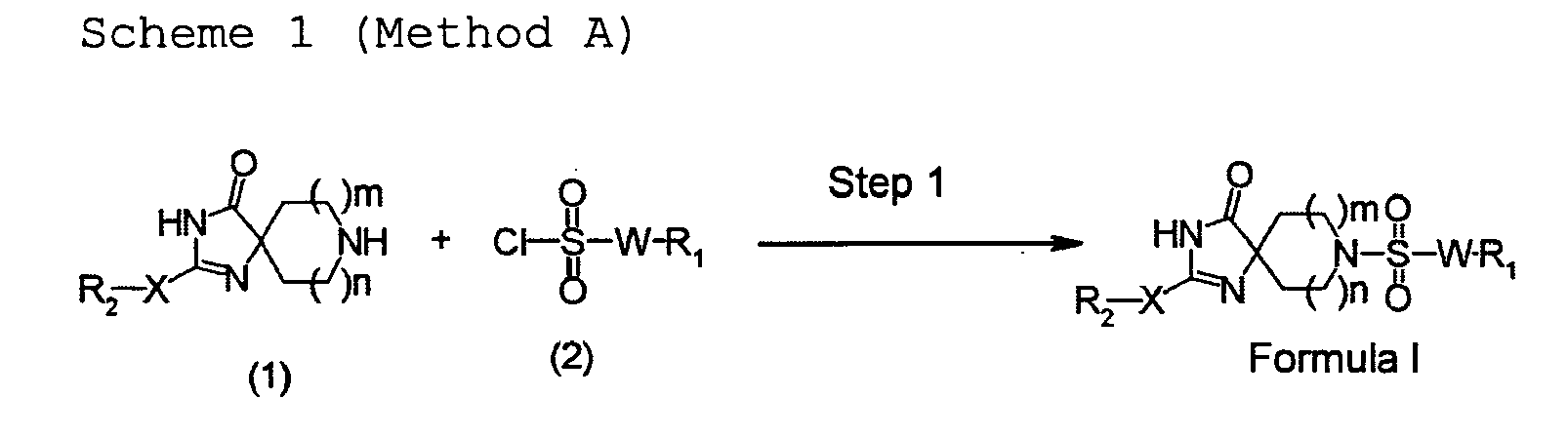
- Scheme 1 (Method A) is a method of reacting a spiro-amine derivative (1) with various sulfonyl chlorides (2) in an appropriate solvent such as dichloromethane or tetrahydrofuran in the presence of an appropriate base such as triethylamine or pyridine. The reaction temperature is 0°C to room temperature, for example, and the reaction time is 0.5 to 24 hours. The resulting sulfonamide derivative (formula I) is isolated by a common technique and, if necessary, may be purified by crystallization or chromatography.
- The spiro-amine derivative (1) shown in Scheme 1 can be synthesized from an acylamino-nitrile derivative (3) or acylamino-amide derivative (4). Scheme 2 shows a method of synthesizing the spiro-amine derivative (1).
-


- Step 2 is a method of cyclizing an acylamino-nitrile derivative (3) in an appropriate solvent such as an aqueous ethanol solution or an aqueous dimethyl sulfoxide solution in the presence of an aqueous sodium hydroxide solution and aqueous hydrogen peroxide solution. The reaction temperature is reflux temperature, for example, and the reaction time is 1 to 24 hours. The resulting cyclized derivative (5) is isolated by a common technique and, if necessary, may be purified by crystallization or chromatography.
- The cyclized derivative (5) can also be synthesized by two-step reaction (Step 3, Step 4). Step 3 is a method of converting the nitrile group to an amido group under basic hydrolysis conditions in the presence of hydrogen peroxide. (This reaction can be performed with reference to Chemistry-A European Journal (2002), 8(2), 439-450, for example.) Step 4 is a method of cyclizing an acylamino-amide derivative (4) in an appropriate solvent such as ethanol, tert-butanol or dimethyl sulfoxide in the presence of an appropriate base such as an aqueous sodium hydroxide solution or potassium t-butoxide. The reaction temperature is room temperature to reflux temperature, for example, and the reaction time is 1 to 24 hours. The resulting cyclized derivative (5) is isolated by a common technique and, if necessary, may be purified by crystallization or chromatography.
- Step 5 is a reaction of deprotecting the t-butoxycarbonyl group with an appropriate acid such as trifluoroacetic acid or hydrochloric acid in an appropriate solvent such as dichloromethane, dioxane or methanol. (This reaction can be performed with reference to Protective Groups in Organic Synthesis, Wiley-Interscience, for example.)
- The acylamino-nitrile derivative (3) or acylamino-amide derivative (4) shown in Scheme 2 can be synthesized from an amino-nitrile derivative (8a) or amino-amide derivative (8b). Scheme 3 shows a method of synthesizing the acylamino-nitrile derivative (3) or acylamino-amide derivative (4).
-
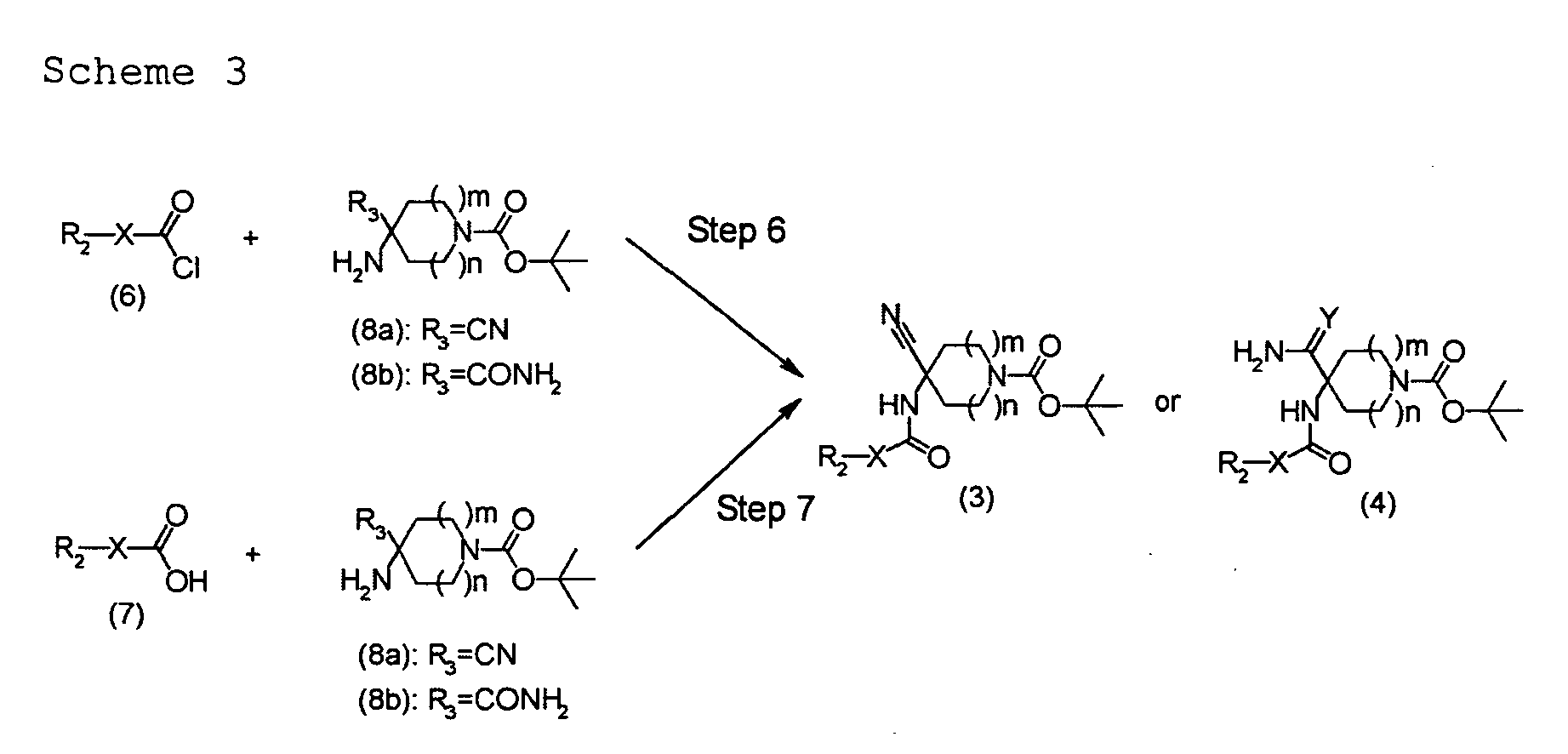
- Step 6 is a method of reacting an acid chloride derivative (6) with an amino-nitrile derivative (8a) or amino-amide derivative (8b), respectively, in an appropriate solvent such as dichloromethane or tetrahydrofuran in the presence of an appropriate base such as triethylamine or pyridine. The reaction temperature is 0°C to room temperature, for example, and the reaction time is 0.5 to 24 hours. The resulting acylamino-nitrile derivative (3) or acylamino-amide derivative (4) is isolated by a common technique and, if necessary, may be purified by crystallization or chromatography. The acid chloride derivative (6) used for the reaction can be purchased or can be synthesized from a carboxylic acid derivative (7) by the method described in March, Advanced Organic Chemistry, 5th Eddition, John Wiley and Sons, New York, P523-P524, for example.
- Step 7 is a method of reacting a carboxylic acid derivative (7) with amino-nitrile (8a) or amino-amide (8b). Examples of the coupling reagent include N,N'-dicyclohexylcarbodiimide (DCC), 1-ethyl-3-(3-dimethylaminopropyl)carbodiimide hydrochloride (EDC), O-(7-azabenzotriazol-1-yl)-1,1,3,3-tetramethyluronium hexafluorophosphate (HATU) and 4-(4,6-dimethoxy-1,3,5-triazin-2-yl)-4-methylmorpholinium chloride n-hydrate (DMT-MM). Examples of the base include triethylamine or N,N-diisopropylethylamine. If necessary, 4-(dimethylamino)pyridine (DMAP) may be used as a catalyst. Examples of the appropriate solvent include dichloromethane or N,N-dimethylformamide. Examples of the appropriate solvent used in the case of DMT-MM include methanol, ethanol and acetonitrile. The reaction temperature is 0°C to room temperature, for example, and the reaction time is 0.5 to 24 hours. The resulting acylamino-nitrile derivative (3) or acylamino-amide derivative (4) is isolated by a common technique and, if necessary, may be purified by crystallization or chromatography.
- The sulfonyl chloride derivative (2) shown in Scheme 1 can be purchased or can be synthesized as shown in Scheme 4a and Scheme 4b.
-

- Scheme 4a is a method of synthesizing a sulfonyl chloride derivative (2) from a bromide derivative (9) through a sodium salt derivative of sulfonic acid (10). This method of providing a sulfonyl chloride can be performed with reference to J. Org. Chem. 1985, 50(12), 2066-2073 or J. Org. Chem. 1984, 49(26), 5124-5131, for example.
-

- Scheme 4b is a method of synthesizing a sulfonyl chloride derivative, in particular, an ethylsulfonyl chloride derivative (14) from a styrene derivative (11). This reaction can be performed with reference to Tetrahedron Lett., Vol 35, 1837-1840 (1994) or Chemistry Lett., 1483-1486 (1992), for example.
- The spiro-amine structure of the formula I can be synthesized by cyclization of an amide derivative such as (15) or (16) of Scheme 5 (Method B).

- The compound I is synthedized by cylizing an amide derivative represented by (15) or (16) using the above-described method of Step 2 or Step 4.
- The amide derivative ((15) or (16)) shown in Scheme 5 can be derived from a keto-amine derivative (17). Scheme 6 shows a method of synthesizing the amide derivative ((15) or (16)).
-

- Step 1 is a method of reacting a keto-amine derivative (17) with a sulfonyl chloride derivative (2). Step 13 is a Strecker synthesis of converting a ketone derivative (18) to an amino-nitrile derivative (19). Specifically, this is a method of reacting a ketone derivative (18) with sodium cyanide or potassium cyanide and ammonium chloride or ammonium acetate in an appropriate solvent such as methanol, ethanol or tetrahydrofuran in the presence/absence of water. The reaction temperature is room temperature to 80°C, for example, and the reaction time is 2 to 72 hours. The resulting amino-nitrile derivative (19) is isolated by a common technique and, if necessary, may be purified by crystallization or chromatography.
- The cyano-amide derivative (15) can be synthesized by the same method as in Step 6 or Step 7 in Scheme 3. Step 3 is a method of synthesizing an amido-amide compound (16) by hydrolysis of the cyano-amide derivative (15).
- The spiro-amine derivative of the formula I, in particular, the aryl-ethenylsulfonamide derivative of the formula II (o = 0) and the aryl-propenylsulfonamide derivative of the formula II (o = 1), can be synthesized by a Heck reaction of an olefinated sulfonamide derivative (20) with an aryl halide (21) in Scheme 7.
-

- Step 14 is a method of synthesizing an arylethenylsulfonamide derivative (formula II) by coupling an olefinated sulfonamide derivative (20) with an aryl halide derivative (21) in an appropriate solvent such as N,N-dimethylacetamide (DMA), N,N-dimethylformamide (DMF) or 1,4-dioxane in the presence of a palladium catalyst such as palladium(II) acetate (Pd(OAc)2) or tetrakis(triphenylphosphine)palladium(0) (Pd(PPh3)4), in the presence or absence of a phosphine ligand such as triphenylphosphine (PPh3) or tri-o-tolylphosphine ((o-tol)3P) and in the presence of an appropriate base such as triethylamine, respectively, in an N2 atmosphere. The reaction temperature is 90°C to reflux temperature. This reaction can be performed under microwave irradiation. The resulting arylethenylsulfonamide derivative (formula II) is isolated by a common technique and, if necessary, may be purified by crystallization or chromatography.
- The spiro-amine derivative (formula I), in particular, the ethenylsulfonamide derivative (formula III), can also be synthesized by coupling a Horner-Wadsworth-Emmons reagent with an aldehyde derivative (24) as shown in Scheme 8.
-


- Step 15 is a method of synthesizing a Horner-Wadsworth-Emmons reagent (23) by coupling a methanesulfonamide derivative (22) with diethyl chlorophosphate in an appropriate solvent such as tetrahydrofuran or diethyl ether in the presence of a base such as lithium hexamethyldisilazide (LHMDS) or lithium diisopropylamide (LDA). The reaction is performed at -78°C to room temperature for 1 to 24 hours in an N2 atmosphere. The resulting Horner-Wadsworth-Emmons reagent (23) is isolated by a common technique and, if necessary, may be purified by crystallization or chromatography. This reaction can be performed with reference to Tetrahedron 2001, 57(37), 7899-7907, for example.
- Step 16 is a method of synthesizing an ethenylsulfonamide derivative (formula III) by reacting the Horner-Wadsworth-Emmons reagent (23) with an aldehyde derivative (24) under Horner-Wadsworth-Emmons reaction conditions. This reaction can be performed with reference to Synlett 2005, 5, 834-838; Tetrahedron 2001, 57(37), 7899-7907, for example.
- The spiro-amine derivative (formula I), in particular, the aryl-alkylsulfonamide derivative (formula IV), can be synthesized by reduction of an olefin of the formula II in Scheme 9.
-

- Step 17 is a method of hydrogenating an olefin of the formula II in an inert solvent such as methanol, ethanol, dimethylformamide or dimethylacetamide in the presence of a catalyst such as palladium carbon or palladium hydroxide carbon, respectively, under an H2 atmosphere. The reaction temperature is room temperature to 80°C, and the reaction may be performed under pressure. The resulting aryl-alkylsulfonamide derivative (formula IV) is isolated by a common technique and, if necessary, may be purified by crystallization or chromatography.
- The cyclized derivative (5) amide used in the above reaction can be converted to a thioamide (Step 18) and used for the reaction of Step 5 or Step 1. This reaction can be performed with reference to March, Advanced Organic Chemistry, 5th Eddition, for example.
-

- The ketone derivative (18) shown in Scheme 6 can be derived from a keto-amine derivative (17) through an ethenesulfonamide derivative (26). It can also be derived from a ketal-amine derivative (27) through a ketal-ethenesulfonamide derivative (28).
-


- Step 19 is a method of reacting a keto-amine derivative (17) or ketal-amine derivative (27) with chloroethanesulfonyl chloride in an appropriate solvent such as dichloromethane in the presence of an appropriate base such as triethylamine. The reaction temperature is 0°C to 40°C, for example, and the reaction time is 0.1 to 1 hour. The resulting ethenesulfonamide derivative (26) or ketal-ethenesulfonamide derivative (28) is isolated by a common technique and, if necessary, may be purified by crystallization or chromatography.
- The ketone derivative (18) can be synthesized from the ethenesulfonamide derivative (26) by the same method as in Step 14 in Scheme 7.
- The ketone derivative (18) can also be synthesized by converting the ketal-ethenesulfonamide derivative (28) to a ketal-sulfonamide derivative (29) by the same method as in Step 14 in Scheme 7 and then deprotecting the ketal by the method of Step 20. Step 20 is a method of reacting the ketal-sulfonamide derivative (29) with an acid such as trifluoroacetic acid or hydrochloric acid in an appropriate solvent such as aqueous acetone or aqueous ethanol. The reaction temperature is 55°C to 80°C (boiling point of the solvent), for example, and the reaction time is 1 to 24 hours. The resulting ketone derivative (18) is isolated by a common technique and, if necessary, may be purified by crystallization or chromatography.
- The olefinated sulfonamide derivative (20) shown in Scheme 7 can be derived from a spiro-amine derivative (1).
-

- Step 21 is a method of reacting a spiro-amine derivative (1) with a sulfonyl chloride reagent (e.g., chloroethanesulfonyl chloride or 2-propene-1-sulfonyl chloride) in an appropriate solvent such as dichloromethane in the presence of an appropriate base such as triethylamine. The reaction temperature is 0°C to 40°C, for example, and the reaction time is 0.1 to 1 hour. The resulting olefinated sulfonamide derivative (20) is isolated by a common technique and, if necessary, may be purified by crystallization or chromatography.
- The methanesulfonamide derivative (22) shown in Scheme 8 can be derived from a spiro-amine derivative (1).
-
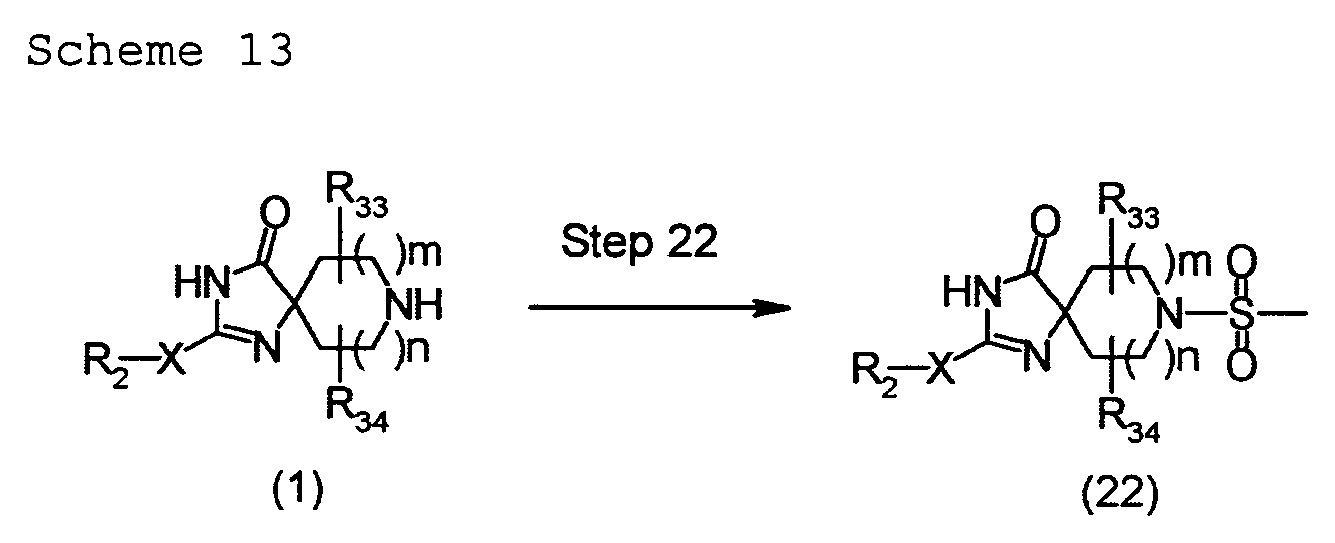
- Step 22 is a method of reacting a spiro-amine derivative (1) with methanesulfonyl chloride in an appropriate solvent such as dichloromethane in the presence of an appropriate base such as triethylamine. The reaction temperature is 0°C to room temperature, for example, and the reaction time is 0.1 to 1 hour. The methanesulfonamide derivative (22) is isolated by a common technique and, if necessary, may be purified by crystallization or chromatography.
- The compound of the general formula (1) wherein Y is a sulfur atom (formula VI) can be synthesized from a thioamide intermediate (25) in Scheme 10 by the reactions of Step 5-Step 1 as in the case of the compound wherein Y is an oxygen atom, for example. It can also be synthesized from an amide derivative wherein Y is an oxygen atom (formula V) by Step 18.
-

- Step 18 is a method of reacting an amide derivative (formula V) with a Lawesson's reagent in an appropriate solvent such as toluene. The reaction temperature is room temperature to the boiling point of the solvent, for example, and the reaction time is several hours to 24 hours. The thioamide derivative (formula VI) is isolated by a common technique and, if necessary, may be purified by crystallization or chromatography. This conversion reaction of carbonyl to thiocarbonyl can be performed with reference to March, Advanced Organic Chemistry, 5th Eddition, for example.
- The compound of the general formula (1) wherein Y is a nitrogen atom (formula VII, formula VIII) can be synthesized by converting the thioamido group of a thioamide intermediate (25) to an amidino group (step 23) to provide an amidino intermediate (31, 32) and then subjecting the intermediate to the reactions of Step 5 and subsequent Step 1 as in the case of the compound of the general formula (1) wherein Y is an oxygen atom, for example.
-


- Step 23 is a method of reacting a thioamide intermediate (25) with a primary amine or secondary amine in an appropriate solvent such as methanol. The reaction temperature is room temperature to the boiling point of the solvent, for example, and the reaction time is several hours to 24 hours. The amidino intermediate (31, 32) is isolated by a common technique and, if necessary, may be purified by crystallization or chromatography.
- The derivative of the general formula (1) wherein X is a single bond and R2 is optionally substituted aryl or heteroaryl (formula IX) can also be synthesized from a thiohydantoin derivative (33).
-


- Step 24 is a method of reacting a thiohydantoin derivative (33) with an optionally substituted arylboronic acid (34) in an appropriate solvent such as N-methylpyrolidone in the presence of a copper catalyst such as CuTC or a palladium catalyst such as tetrakis(triphenylphosphine)palladium(0). The reaction temperature is room temperature to the boiling point of the solvent, for example, and the reaction time is 0.5 to 24 hours. The substituted phenyl derivative (formula IX) is isolated by a common technique and, if necessary, may be purified by crystallization or chromatography.
- The thiohydantoin derivative (33) can be synthesized from an amino-nitrile derivative (19) through Step 3 and Step 25.
-


- Step 3 is a method of synthesizing an amino-amide derivative (35) by hydrolyzing an amino-nitrile derivative (19). Step 25 is a reaction of converting the amino-amide derivative (35) to a thiohydantoin derivative (33). Step 25 is a method of reacting the amino-amide derivative (35) with a thiocarbonylating reagent such as di(2-pyridyl) thionocarbonate in an appropriate solvent such as tetrahydrofuran. The reaction temperature is 0°C to room temperature, for example, and the reaction time is 0.5 hour to several hours. The thiohydantoin derivative (33) is isolated by a common technique and, if necessary, may be purified by crystallization or chromatography.
- The alkynyl derivative of the general formula (1) wherein W is acetylene and R1 is optionally substituted aryl or heteroaryl (formula XI) can be synthesized through an acetophenone derivative (formula X).
-
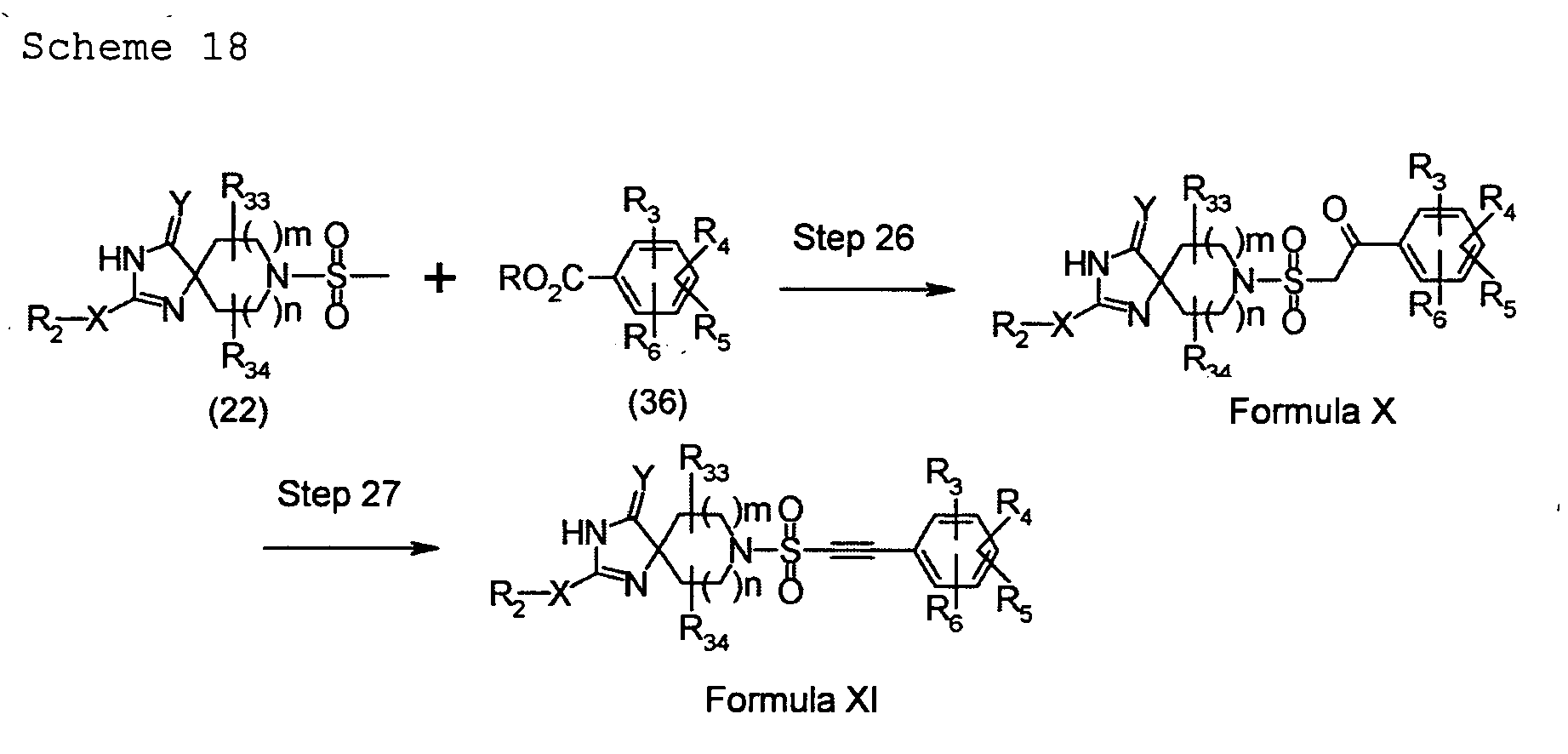
- Step 26 is a method of condensation with an aryl ester (36) in an appropriate solvent such as tetrahydrofuran or diethyl ether in the presence of a base such as lithium hexamethyldisilazide (LHMDS) or lithium diisopropylamide (LDA) preferably with the addition of DMPU. The reaction is performed at -78°C to room temperature for 1 to 24 hours in an N2 atmosphere. The resulting acetophenone derivative (formula X) is isolated by a common technique and, if necessary, may be purified by crystallization or chromatography.
- Step 27 is a method of synthesizing an alkynyl derivative (formula XI) by subjecting the acetophenone derivative (formula X) to dehydration reaction. Specifically, 1 to 10 equivalents of a dehydrating agent, preferably 2-chloro-1-methyl-pyridinium iodide, and an appropriate base, preferably triethylamine, are added and reacted in an appropriate solvent such as dichloromethane at 0°C to a temperature under heating. The resulting alkynyl derivative (formula XI) is isolated by a common technique and, if necessary, may be purified by crystallization or chromatography.
- The substituted alkylene derivative of the general formula (1) wherein W is branched alkylene or haloalkylene (formula XII) can be synthesized as follows, for example.
The substituted alkylene derivative (formula XII) can be obtained by nucleophilic substitution reaction with a ketal-sulfonamide derivative (37) as a raw material to introduce an alkyl group or a halogen atom onto the carbon adjacent to the sulfonyl group (Step 28), ketal deprotection reaction (Step 20) and the steps shown in Schemes 5 and 6. -

- Step 28 is a reaction of a ketal-alkylenesulfonamide derivative (37) with an electrophilic reagent such as an alkyl halide or NFSI (N-fluorodibenzenesulfonimide) in an appropriate solvent such as tetrahydrofuran in the presence of a base such as n-butyllithium or lithium diisopropylamide. The reaction temperature is -78°C to room temperature, for example, and the reaction time is 0.5 hour to several hours. The ketal-sulfonamide derivative (38) is isolated by a common technique and, if necessary, may be purified by crystallization or chromatography. In this reaction, one or two substituents are introduced onto the carbon atom adjacent to the sulfonyl group, and the equivalents of the base are controlled according to need. In the introduction of two substituents, two substituents can be introduced all at once using an excess of a base; however, it is desirable to once obtain a compound having one substituent introduced thereinto by purification and then introduce the other substituent.
- The guanidine derivative of the general formula (1) wherein X is a nitrogen atom (formula XIII) can be synthesized through a guanidine intermediate (41).
The guanidine intermediate (41) can be synthesized from a thiohydantoin derivative (39) through an isothiourea derivative (40). The guanidine derivative (formula XIII) can be synthesized from the guanidine intermediate (41) by the reactions of Step 5 and subsequent Step 1, for example. -

- Step 29 is S-alkylation reaction of a thiohydantoin derivative (39). Specifically, this is a method of reacting a thiohydantoin derivative (39) with an alkyl halide reagent such as methyl iodide in an appropriate solvent such as methanol in the presence of a base such as sodium hydroxide. The reaction temperature is room temperature to the boiling point of the solvent, for example, and the reaction time is several hours to 24 hours. The isothiourea derivative (40) is isolated by a common technique and, if necessary, may be purified by crystallization or chromatography.
- Step 30 is a reaction of converting isothiourea to guanidine. Specifically, this is a method of reacting the isothiourea derivative (40) with a substituted primary amine or substituted secondary amine in an appropriate solvent such as dimethylacetamide in the presence of an acid catalyst such as acetic acid. The reaction temperature is room temperature to the boiling point of the solvent, for example, and the reaction time is 0.5 hour to several hours. The guanidine derivative (41) is isolated by a common technique and, if necessary, may be purified by crystallization or chromatography.
- The derivative compound represented by the general formula (2), wherein Z includes alkenylene, can be synthesized from a diolefin derivative (formula XIV) by olefin metathesis reaction (Step 31).
-

- Step 31 is a method of cyclizing a diolefin derivative (formula XIV) using a Grubbs reagent in an appropriate solvent such as dichloroethane. The reaction temperature is room temperature to the boiling point of the solvent, for example, and the reaction time is several hours to 24 hours. The macrocyclic derivative (formula (2)) is isolated by a common technique and, if necessary, may be purified by crystallization or chromatography.
- The derivative compound represented by the general formula (2), wherein Z includes an amido group, can also be synthesized from a derivative having a primary amine or secondary amine at one end of the compound and a carboxylic acid at the other end (formula XV) by amidation reaction (Step 7).
-

- The compound of the formula (2) is synthesized by cyclizing a derivative having an amine and a carboxylic acid at the ends (formula XV) using the above-described method of Step 7.
- The derivative compound represented by the general formula (2), wherein Z includes triazole, can also be synthesized from a derivative (42) having an alkyne at one end of the compound and an azide at the other end using click chemistry (Step 32).
-

- Step 32 is a method of reacting an azide and an alkyne in a derivative (42) having the alkyne and the azide at the ends in an appropriate solvent such as acetonitrile or tetrahydrofuran in the presence of a copper catalyst such as CuI with the addition of a base such as diisopropylethylamine or 2,6-lutidine and ascorbic acid if necessary. The reaction temperature is room temperature to the boiling point of the solvent, for example, and the reaction time is 1 to 24 hours. The derivative represented by the general formula (2) is isolated by a common technique and, if necessary, may be purified by crystallization or chromatography.
- Derivatives can be synthesized from compounds obtained in Schemes 21, 22 and 23 by olefin hydrogenation reaction, olefin oxidation reaction, sulfur atom oxidation reaction, deprotection reaction of various protecting groups and the like as necessary.
Compounds containing functional groups such as alkenyl, amine, carboxylic acid, alkynyl and azido functional groups at the ends, the raw materials used in Schemes 21, 22 and 23 and the like for synthesizing the general formula (2), may be synthesized by previously introducing these functional groups into a carboxylic acid derivative (7), a bromide derivative (9), a styrene derivative (11), an aryl halide derivative (21), an aldehyde derivative (24), a substituted phenylboronic acid (34) and the like and subjecting them to the same method as the method of manufacturing the general formula (1), or may be synthesized by synthesizing intermediates of the general formula (1), in which functional groups such as carboxylic acid and phenol functional groups are introduced into R1 or R2, and introducing the functional groups from these intermediates into these derivatives by an appropriate reaction.
If the functional groups introduced at the ends are previously introduced into a carboxylic acid derivative (7), a bromide derivative (9), a styrene derivative (11), an aryl halide derivative (21), an aldehyde derivative (24), a substituted phenylboronic acid (34) and the like, then these functional groups are protected and deprotected by an appropriate method as necessary in a process of synthesis by the same method as the method of manufacturing the general formula (1). - If the functional groups introduced at the ends are introduced into these derivatives by synthesizing intermediates of the general formula (1), in which a functional group such as carboxylic acid and phenol functional groups is introduced into R1 or R2, and introducing the functional groups from these intermediates by an appropriate reaction, then amidation, Mitsunobu reaction or the like is preferred as such an appropriate reaction. The functional groups are protected and deprotected by an appropriate method as necessary. For example, to introduce alkenyl or azido into R1, amidation reaction is performed between a compound of the general formula (1), in which carboxylic acid is introduced into R1, and an alkylamine with alkenyl or azido bonded thereto. To introduce alkenyl or alkynyl into R2, Mitsunobu reaction is performed between a compound of the general formula (1), in which phenol is introduced into R2, and an alkylamine with alkenyl, alkynyl or a protected amine bonded thereto. Raw materials for synthesizing the general formula (2) can be synthesized by combining these reactions of introducing functional groups into R1 or R2.
- The compound (7), compound (9), compound (11), compound (21), compound (24) or compound (34) used in the above reactions can be synthesized from known compounds using appropriate reagents and reactions. For example, an amino group, if present in R1 or R2, may be alkylated, acylated, carbamated, converted to ureas or sulfonamidated from known compounds. Carboxylic acids or esters, if present, may be amidated under general conditions. Sulfonyl chlorides, if present, may be condensed with amines and sulfonamidated. Alcohols, if present, may be etherified or carbamated. Aryl halides, if present, may be coupled with arylboric acids or aryl boronates under general Suzuki conditions. Olefins, if present, may be reduced or converted to diols. Thioether groups, if present, may be oxidized to sulfoxides or sulfones. If ketones or carbonyl groups are present, the carbon chain may be extended by Wittig reaction, Horner-Wadsworth-Emmons reaction, aldol reaction or the like. In the introduction of fluorine atoms, reagents containing fluorine atoms may be introduced by these reactions, or aldehydes, ketones or carboxylic acids may be reacted with diethylaminosulfur trifluoride, for example.
The techniques for introducing these groups can be performed with reference to March, Advanced Organic Chemistry, 5th Eddition, John Wiley and Sons, New York; J. Med. Chem., 2005, 48, 6066-6083; Organic Syntheses (1951), 31, 8-11; Bioorg. Med. Chem. Lett., 2003, 13, 837-840; Chem. Rev. 2002, 102, 1359; J. Organomet. Chem. 1999, 576, 147; Chem. Rev. 1995, 95, 2457, for example. These groups may be protected with protecting groups under general conditions, if necessary. This can be performed with reference to Protective Groups in Organic Synthesis, Wiley-Interscience, for example. - Some of the compounds of the present invention are useful not only as compounds having a PTH-like effect but also as intermediates for the synthesis of additional compounds of the present invention. For example, amines may be alkylated, acylated, carbamated, converted to ureas, sulfonamidated or sulfamidated under general conditions. Carboxylic acid and ester moieties may be converted to amides under general conditions. Amido groups may be converted to thioamido groups. Olefins may be reduced or converted to diols. Thioether groups, if present, may be oxidized to sulfoxides or sulfones. The techniques for introducing these groups can be performed with reference to March, Advanced Organic Chemistry, 5th Eddition, John Wiley and Sons, New York; J. Med. Chem., 2005, 48, 6066-6083; Organic Syntheses (1951), 31, 8-11; Bioorg. Med. Chem. Lett., 2003, 13, 837-840, for example. Protecting groups may be deprotected under general conditions. This can be performed with reference to Protective Groups in Organic Synthesis, Wiley-Interscience, for example. Aryl halides may be coupled with arylboric acids or aryl boronates under general Suzuki conditions. This can be performed with reference to Chem. Rev. 2002, 102, 1359; J. Organomet. Chem. 1999, 576, 147; Chem. Rev. 1995, 95, 2457, for example.
- The content of the present invention will be described in more detail by the following examples and test example; however, the present invention is not limited to the content of the examples and test example. All starting materials and reagents were obtained from commercial suppliers or synthesized using known methods. 1H-NMR spectra were measured using EX270 (manufactured by JEOL), Mercury300 (manufactured by Varian), ARX-3000 (manufactured by Bruker), ECP-400 (manufactured by JEOL) or 400-MR (manufactured by Varian) with or without Me4Si as the internal standard (s = singlet, d = doublet, t = triplet, brs = broad singlet, m = multiplet). Mass spectrometry measurement was performed using a mass spectrometer, LCQ Classic (manufactured by Thermo Electron), ZQ2000 (manufactured by Waters), 3100 (manufactured by Waters), ZMD4000 (manufactured by Waters), SQD (manufactured by Waters) or 2020 (manufactured by Shimazu). Microwave irradiation was performed using InitiatorTM (manufactured by Biotage). In LCMS and HPLC, measurement of the retention time and mass spectrometry were performed by the following apparatuses and analysis conditions.
-
[Table 1] LCMS, HPLC condition No. Apparatus Column (L.D. × length) (mm) Mobile phase Gradient (A/B) Flow rate Column temperature (°C) Wavelength LCMS-A-1 Agilent 1100/ LCQ Classic Cadenza CD-C18 3um (3.0 × 30) A)0.05% TFA, H2O
B) 0.05% TFA, MeCN95/8 => 0/100 (3.5 min) 0/100 (1 min) 1.5 mL/min 35 210-400 nm PDA total LCMS-A-2 Agilent 1100/ LCQ Classic Cadenza CD-C18 3um (3.0 × 30) A)0.05% TFA, H2O
B) 0.05% TFA, MeCN95/5 => 0/100 (9.5 min) 0/100 (2.5 min) 1.0 mL/min 35 210-400 nm PDA total LCMS-B-1 Alliance 2795 HT/ 996 PDA/ ZMD4000 Cadenza CD-C18 3um (3.0 × 30) A)0.05% TFA, H2O
B) 0.05% TFA, MeCN95/5 => 0/100 (3 min) 0/100 (2 min) 1.5 mL/min 35 210-400 PDA total LCMS-C-1 2525 BGM/ 2996 PDA/ ZQ2000 Chromolith Flash RP-18e (4.6 × 25) A) 10mM AcONH4, H2O
B) MeOH95/5 => 0/100 (3 min) 0/100 (2 min) 2.0 mL/min Room temperature 210-400 PDA total LCMS-C-2 2525 BGM/ 2996 PDA/ ZQ2000 Chromolith Flash RP-18e (4.6 × 25) A) 10mM AcONH4, H2O
B) MeOH50/50 => 0/100 (3 min) 0/100 (2 min) 2.0 mL/min Room temperature 210-400 PDA total LCMS-C-3 2525 BGM/ 2996 PDA/ ZQ2000 Chromolith Flash RP-18e (4.6 × 25) A) 10mM AcONH4, H2O
B) MeOH50/50 => 0/100 (3 min) 0/100 (2 min) 2.0 mL/min Room temperature 210-400 PDA total LCMS-D-1 2545 BGM/ 2996 PDA/ 3100 SunfireTM C18 5 um (4.6 × 50) A) 0.1% TFA, H2O
B) 0.1% TFA, MeCN90/10 => 10/90 (5 min) 4.0 mL/min 25 210-400 PDA total LCMS- E-1 Agilent 1100 Waters X-Bridge C18 5um (2.1 × 50) A) 0.1% NH3, H2O
B) 0.1% NH3, MeCN5/95 => 5/95 (5 min) 1.2 mL/min 40 190-400 nm PDA total LCMS-E-2 Alliance 2795/ ZQ2000 Waters X-Bridge C18 5um (2.1 × 50) A) 0.1% TFA, H2O
B) 0.1% TFA, MeCN95/5 => 35/65 (5 min) 1.2mL/min 40 190-400 nm PDA total LCMS-E-3 Alliance 2795/ ZQ2000 Waters X-Bridge C18 5um (2.1 × 50) A) 0.1% TFA, H2O
B) 0.1% TFA, MeCN95/5 (0 min) => 95/5 (0.5 min) => 1.2 5/95 (5 min) 1.2 mL/min 45 190-400 nm PDA total LCMS-E-4 Alliance 2795/ ZQ2000 Waters X-Bridge C18 5um (2.1 × 50) A) 0.1% TFA, H2O
B) 0.1% TFA, MeCN95/5 (0 min) => 95/5 (0.5 min) => 5/95 (5 min) 1.2 mL/min 45 190-400 nm PDA total LCMS-E-5 Alliance 2795/ ZQ2000 Waters X-Bridge C18 5um (2.1 × 50) A) 0.1% TFA, H2O
B) 0.1% TFA, MeCN95/5 (0 min) => 95/5 (0.5 min) => 35/65 (5 min) => 5/95 (5.5 min) 1.2 mL/min 45 190-400 nm PDA total LCMS-E-6 Alliance 2795/ ZQ2000 Waters X-Bridge C18 5um (2.1 × 50) A) 0.1% TFA, H2O
B) 0.1% TFA, MeCN5/95 => 5/95 (5 min) 1.2 mL/min 70 40 190-400 nm PDA total LCMS-E-7 Alliance 2795/ ZQ2000 Waters X-Bridge C18 5um (2.1 × 50) A) 0.1% TFA, H2O
B) 0.1% TFA, MeCN95/5 (0 min) => 95/5 (3 min) 1.2 mL/min 45 190-400 nm PDA total LCMS-E-8 Alliance 2795/ ZQ2000 Waters X-Bridge C18 5um (2.1 × 50) A) 0.1% TFA, H2O
B) 0.1% TFA, MeCN95/5 (0 min) => 95/5 (0.5 min) => 35/65 (5 min) => 5/95 (5.5 min) 1.2 mL/min 45 190-400 nm PDA total LCMS-F-1 Acquity/ SQD Ascebtus Express C18 (2.1 × 50) A) 10mM AcONH4, H2O
B) MeOH95/5 => 0/100 (1 min) 0/100 (0.4 min) 1.0 mL/min 35 210-400 nm PDA total LCMS-F-2 Acquity/SQD Ascentis Express C18 (2.1 × 50) A) 0.1% HCO2H, H2O
B) 0.1% HCO2H, MeCN95/5 => 0/100 (1 min) 0/100 (0.4 min) 1.0 mL/min 35 210-400 nm PDA total LCMS-G-1 UFLC XR/2020 Acquity (2.1 × 50) A) 0.1% TFA, H2O
B) 0.1% TFA, MeCN95/5 => 0/100 (1.5 min) 0/100 (0.5 min) 1.0 mL/min 35 305nm, bandwidth 95nm HPLC-A-1 LC-2010A (SHIMAZU) YMC-ODSA (6.0 × 150) A) 0.1% TFA, H2O
B) 0.1% TFA, MeCN90/20 ⇒ 10/80 (40 min) 1.0 mL/min 25 UV 254, 225 nm HPLC-A-2 LC-2010A (SHIMAZU) YMC-ODSA (6.0 × 150) A) 0.1% TFA, H2O
B) 0.1% TFA, MeCN90/30 => 10/70 (40 min) 1.0 mL/min 25 UV 254, 225 nm HPLC-A-3 LC-2010A (SHIMAZU) YMC-ODSA (6.0 × 150) A) 0.1% TFA, H2O
B) 0.1% TFA, MeCN90/10 => 10/90 (25 min) 1.0 mL/min 25 UV 254, 225 nm -

- Potassium carbonate (13.96 g, 101.1 mmol) and 3-chlorobenzenesulfonyl chloride were continuously added to a two-phase solution of 4-piperidone hydrochloride hydrate (6.06 g, 39.48 mmol) in chloroform (47.4 mL) and - water (47.4 mL), and the mixture was stirred at room temperature. A saturated aqueous sodium bicarbonate solution was added, and the organic layer and the aqueous layer were separated. The aqueous layer was then further extracted with dichloromethane. The organic layers were combined, dried over anhydrous sodium sulfate and then concentrated under reduced pressure. The resulting solid was washed with n-hexane and then collected by filtration and dried under reduced pressure to give 1-(3-chloro-benzenesulfonyl)-piperidin-4-one as a white solid (10.5 g, 97% .
1H-NMR (300 MHz, CDCl3) δ 2.55 (4H, t, J = 6.3 Hz), 3.42 (4H, t, J = 6.0 Hz), 7.48 (1H, t, J = 8.0 Hz), 7.58 (1H, dt, J = 8.0, 1.7 Hz), 7.67 (1H, dt, J = 7.7, 1.7 Hz), 7.77 (1H, t, J = 1.9 Hz). -

- Ammonium chloride (790 mg, 14.77 mmol) and a 28% aqueous ammonia solution (2.2 mL) were added to a solution of 1-(3-chloro-benzenesulfonyl)-piperidin-4-one (3.11 g, 11.36 mmol) in dimethylformamide (15 mL), and the mixture was stirred at room temperature for one hour. Thereafter, sodium cyanide (724 mg, 14.77 mmol) was added, and the mixture was further stirred for 17 hours and then quenched with a saturated aqueous sodium carbonate solution. The organic layer and the aqueous layer were separated, and the aqueous layer was then further extracted with ethyl acetate:n-hexane (4:1). The organic layers were combined, washed with water (x 4), and then dried over anhydrous sodium sulfate and concentrated under reduced pressure. The residue was purified by silica gel column chromatography (n-hexane:ethyl acetate = 1:3) to give 4-amino-1-(3-chloro-benzenesulfonyl)-piperidine-4-carbonitrile as a white solid (2.41 g, 71%).
1H-NMR (300 MHz, CDCl3) δ 1.75 (2H, s), 1.80-1.90 (2H, m), 2.11-2.14 (2H, m), 2.87-2.96 (2H, m), 3.54-3.62 (2H, m), 7.47 (1H, t, J = 8.1 Hz), 7.58-7.66 (2H, m), 7.75 (1H, t, J = 1.8 Hz). -

- A solution of cyclohexanecarbonyl chloride (118 µL, 0.880 mmol) in chloroform (0.25 mL) was added to a mixed solution of 4-amino-1-(3-chloro-benzenesulfonyl)-piperidine-4-carbonitrile (120 mg, 0.400 mmol) in chloroform (1.25 mL) and a saturated aqueous sodium carbonate solution (1.25 mL), and the mixture was vigorously stirred at room temperature for 16 hours. Cyclohexanecarbonyl chloride (51 µL) was further added and the mixture was stirred for 2.5 hours. The organic layer and the aqueous layer were then separated, and the aqueous layer was further extracted with chloroform. The organic layers were combined, dried over anhydrous sodium sulfate and then concentrated under reduced pressure. The residue was washed with n-hexane to give cyclohexanecarboxylic [1-(3-chloro-benzenesulfonyl)-4-cyano-piperidin-4-yl]-amide as a white solid. This was used in the next step without further purification.
1H-NMR (300 MHz, CDCl3) δ 1.20-1.96 (14H, m), 2.04-2.14 (1H, m), 2.55 (2H, brd, J = 13 Hz), 2.76-2.87 (2H, m), 5.58 (1H, s), 7.51 (1H, t, J = 7.9 Hz), 7.60-7.66 (2H, m), 7.75 (1H, t, J = 1.8 Hz). MS (ESI) m/z = 410 (M+H)+. -

- A 6 M aqueous sodium hydroxide solution (0.74 mL) and a 30% aqueous hydrogen peroxide solution (0.25 mL) were added to a solution of cyclohexanecarboxylic [1-(3-chloro-benzenesulfonyl)-4-cyano-piperidin-4-yl]-amide (100 mg, 0.244 mmol) in ethanol (1.60 mL), and the mixture was heated under reflux for 4.5 hours. The reaction mixture was cooled to room temperature and water was then added, followed by concentration under reduced pressure. The residue was neutralized with a saturated aqueous ammonium chloride solution, followed by extraction with dichloromethane. The organic layer was dried over anhydrous sodium sulfate and concentrated under reduced pressure. The residue was purified by silica gel column chromatography (dichloromethane:methanol = 90:10) to give 8-(3-chloro-benzenesulfonyl)-2-cyclohexyl-1,3,8-triaza-spiro[4.5]dec-1-en-4-one as a white solid (52 mg, 52%).
1H-NMR (270 MHz, CDCl3) δ 1.13-1.40 (7H, m), 1.54-1.75 (7H, m), 2.22-2.30 (1H, m), 2.72-2.80 (2H, m), 3.53-3.59 (2H, m), 7.67-7.85 (4H, m), 10.80 (1H, s). MS (ESI) m/z = 410 (M+H)+. - The example compounds shown below were synthesized by operations similar to those in Example 1 using appropriate reagents and starting materials.
-
[Table 2] Compound Structure LCMS or HPLC condition Retention time (min) MS (m/z) 2 
LCMS-A-1 1.92 405 (M+H)+ 3 
LCMS-A-1 1.9 370(M+H)+ 4 
LCMS-A-1 1. 87 370(M+H)+ 5 
LCMS-A-1 2.32 434 (M+H)+ 6 
LCMS A-1 2.65 438 (M+H)+ 7 
LCMS-A-1 2.22 418 (M+H)+ 8 
LCMS-A-1 1.79 342 (M+H)+ 10 
LCMS-C-1 2.82 480 (M+H)+ 11 
LCMS-C-1 2.66 418 (M+H)+ 12 
LCMS-C-1 2.89 472 (M+H)+ 13 
LCMS-A-1 2.82 488 (M+H)+ 14 
LCMS-C-1 2.86 424 (M+H)+ 15 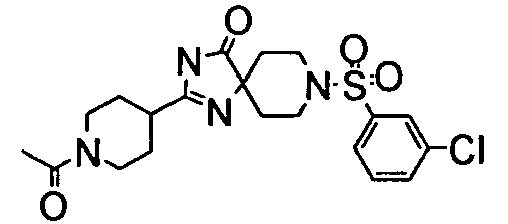
LCMS-A-1 1.84 453 (M+H)+ 16 
LCMS-A-1 1. 97 384 (M+H)+ 17 
LCMS-C-1 2.81 478 (M+H)+ 18 
LCMS-C-1 2.8 511 (M+H)+ 19 
LCMS-A-1 2.22 424 (M+H)+ 20 
LCMS-C-1 2. 78 424 (M+H)+ 21 
LCMS-1 3.1 452 (M+H)+ 22 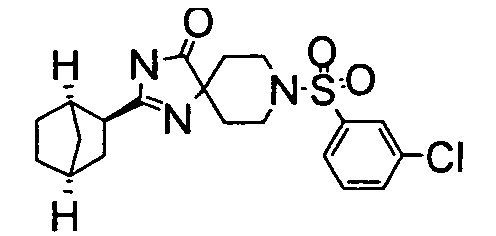
LCMS-C-1 2.76 422 (M+H)+ 23 
LCMS-C-1 2.74 422 (M+H)+ 24 
LCMS-C-1 2.47 440 (M+H)+ 25 
LCMS-C-1 2.45 440 (M+H)+ 26 
LCMS-C-1 3.14 466 (M+H)+ 27 
LCMS-C-1 2.61 442 (M+H)+ 28 
LCMS-C-1 2.81 424 (M+H)+ 29 
LCMS-C-1 2.65 432 (M+H)+ 30 
LCMS-A-1 2.4 438 (M+H)+ 31 
LCMS-A-1 2.79 472 (M+H)+ 32 
LCMS-C-1 2.3 482 (M+H)+ 33 
LCMS-C-1 3.08 486 (M+H)+ 34 
LCMS-C-1 2.87 482 (M+H)+ -

- 1-(2-Naphthalen-1-yl-ethanesulfonyl)-piperidin-4-one was synthesized by the procedure described in Reaction 1-1 of Example 1 using 2-naphthalen-1-yl-ethanesulfonyl chloride as a reagent.
MS (ESI) m/z = 318 (M+H)+. -

- 4-Amino-1-(2-naphthalen-1-yl-ethanesulfonyl)-piperidine-4-carbonitrile was synthesized by operations similar to those in Reaction 1-2 of Example 1 using THF-CH3CN as a solvent and using appropriate reagents and starting material.
MS (ESI) m/z = 344 (M+H)+. -

- 3-Trifluoromethyl-benzoyl chloride (57 µL, 0.378 mmol) was added to a solution of 4-amino-1-(2-naphthalen-1-yl-ethanesulfonyl)-piperidine-4-carbonitrile (100 mg, 0.291 mmol) and Et3N (61 µL) in CH2Cl2 (3 mL). The reaction mixture was stirred at room temperature for four hours and then diluted with CH2Cl2, and the organic layer was washed with water. The organic layer was dried over anhydrous sodium sulfate and then concentrated under reduced pressure. The residue was used in the next step without further purification.
MS (ESI) m/z = 516 (M+H)+. -

- 8-(2-Naphthalen-1-yl-ethanesulfonyl)-2-(3-trifluoromethyl-phenyl)-1,3,8-triaza-spiro[4.5]dec-1-en-4-one was synthesized by operations similar to those in Reaction 1-4 of Example 1 using appropriate reagents and starting material.
1H-NMR (400 MHz, CDCl3) δ 1.65-1.75 (2H, m), 2.07-2.16 (2H, m), 3.32-3.38 (2H, m), 3.42-3.55 (2H, m), 3.63-3.70 (2H, m), 3.82-3.90 (2H, m), 7.40-7.47 (2H, m), 7.50-7.55 (1H, m), 7.56-7.65 (2H, m), 7.77-7.7.82 (2H, m), 7.90 (1H, d, J = 4.0 Hz), 8.02-8.10 (2H, m), 8.18 (1H, s); MS (ESI) m/z = 516 (M+H)+. - The example compounds shown below were synthesized by operations similar to those in Example 2 using appropriate reagents and starting materials.
-
[Table 3] Compound Structure LCMS or HPLC condition Retention time (min) MS (m/z) 36 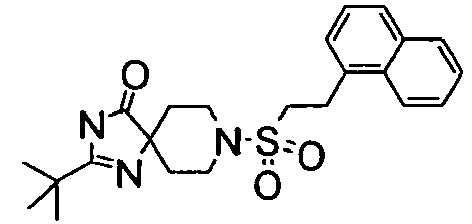
LCMS-A-1 2.24 428 (M+H)+ 37 
LCMS-A-1 2.55 522 (M+H)+ -

- DCC (1.3 eq) and DMAP (5 mol%) were added to a mixture of 4-amino-1-(2-naphthalen-1-yl-ethanesulfonyl)-piperidine-4-carbonitrile and piperidine-1,3-dicarboxylic acid 1-tert-butyl ester (1.3 eq) in DMF, and the mixture was stirred at room temperature overnight. Ethyl acetate was added to the reaction solution, and the organic layer was then sequentially washed with 1 N NaOH, water and saturated brine. The organic layer was dried over anhydrous sodium sulfate and then concentrated under reduced pressure. The residue was used in the next step without further purification.
-
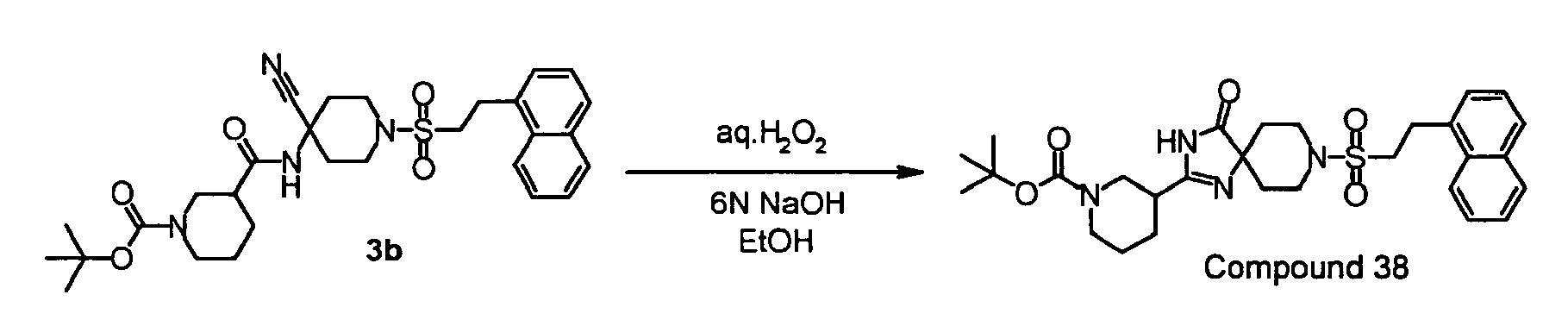
- 3-[8-(2-Naphthalen-1-yl-ethanesulfonyl)-4-oxo-1,3,8-triaza-spiro[4.5]dec-1-en-2-yl]-piperidine-1-carboxylic acid tert-butyl ester was synthesized by operations similar to those in Reaction 1-4 of Example 1 using appropriate reagents and starting material.
MS (ESI) m/z = 555 (M+H)+. -

- Trifluoroacetic acid (10 eq) was added dropwise to a solution of 3-[8-(2-naphthalen-1-yl-ethanesulfonyl)-4-oxo-1,3,8-triaza-spiro[4.5]dec-1-en-2-yl]-piperidine-1-carboxylic acid tert-butyl ester in CH2Cl2. The reaction mixture was stirred at room temperature overnight and then concentrated under reduced pressure to give 8-(2-naphthalen-1-yl-ethanesulfonyl)-2-piperidin-3-yl-1,3,8-triaza-spiro[4.5]dec-1-en-4-one ditrifluoroacetate as a pale yellow form (70%).
1H-NMR (400 MHz, CD30D) δ 0.98 (3H, t), 1.15-1.22 (1H, m), 1.44-1.52 (2H, m), 1.56-1.67 (2H, m), 1.69-1.82 (2H, m), 1.86-2.03 (3H, m), 2.63-2.71 (1H, m), 2.79-2.85 (2H, m), 2.86-3.05 (3H, m), 3.49-3.65 (3H, m), 3.65-3.76 (2H, m), 7.44 (1H, t, J = 7.83 Hz), 7.50-7.55 (1H, m), 7.61 (1H, d, J = 8.08 Hz), 7.71 (1H, t, J = 1.77 Hz). MS (ESI) m/z = 517 (M+H)+. -

- 8-(2-Naphthalen-1-yl-ethanesulfonyl)-2-[1-(2-naphthalen-1-yl-ethanesulfonyl)-piperidin-3-yl]-1,3,8-triaza-spiro[4.5]dec-1-en-4-one was synthesized by operations similar to those in Reaction 2-3 of Example 2 using appropriate reagents and starting material.
MS (ESI) m/z = 673 (M+H)+. - The example compounds shown below were synthesized by operations similar to those in Example 3 and Example 4 using appropriate reagents and starting materials.
-
[Table 4] Compound Structure LCMS or HPLC condition Retention time (min) MS (m/z) 40 
LCMS-E-2 3.76 517 (M+H)+ 41 
LCMS-E-2 4.13 551 (M+H)+ 42 
LCMS-E-2 4.11 565 (M+H)+ 43 
LCMS-E-2 3.58 609 (M+H)+ -

- 4-Cyano-4-(2,4-dichloro-benzoylamino)-piperidine-1-carboxylic acid tert-butyl ester was synthesized by operations similar to those in Reaction 2-3 of Example 2 using appropriate reagents and starting material.
1H-NMR (400 MHz, CDCl3) δ 1.47 (9H, s), 1.87-1.97 (2H, m), 2.45-2.55 (2H, m), 3.32-3.43 (2H, m), 3.90-4.05 (2H, m), 6.48 (1H, brs), 7.38 (1H, dd, J = 8.4, 2.0 Hz), 7.45 (1H, d, J = 2.0 Hz), 7.78 (1H, d, J = 8.4 Hz). -

- 2-(2,4-Dichloro-phenyl)-4-oxo-1,3,8-triaza-spiro[4.5]dec-1-ene-8-carboxylic acid tert-butyl ester was synthesized by operations similar to those in Reaction 1-4 of Example 1 using appropriate reagents and starting material.
MS (ESI) m/z = 490 (M+H)+. -

- 4 N HC1-dioxane (20 ml, 80 mmol) was added to a solution of 2-(2,4-dichloro-phenyl)-4-oxo-1,3,8-triaza-spiro[4.5]dec-1-ene-8-carboxylic acid tert-butyl ester (3.11 g, 7.81 mmol) in CH2Cl2 (60 mL), and the mixture was stirred at room temperature for four hours. The reaction mixture was diluted with CH2Cl2-hexane, and the precipitated solid was then filtered. The resulting solid was washed with ethyl acetate and then dried under reduced pressure to give 2-(2,4-dichloro-phenyl)-1,3,8-triaza-spiro[4.5]dec-1-en-4-one dihydrochloride (3.18 g) as a colorless solid.
MS (ESI) m/z = 298 (M+H)+. -

- Triethylamine (88 µl, 0.632 mmol) and 4-chlorobenzenesulfonyl chloride (70 mg, 0.332 mmol) were added to a mixed solution of 2-(2,4-dichloro-phenyl)-1,3,8-triaza-spiro[4.5]dec-1-en-4-one dihydrochloride (100 mg, 0.299 mmol) in dichloromethane (3 ml). The reaction solution was stirred at room temperature for 16 hours and then diluted with dichloromethane, and the organic layer was washed with water. The organic layer was dried over sodium sulfate and then concentrated under reduced pressure. The resulting residue was purified by silica gel column chromatography (ethyl acetate:hexane) to give 8-(4-chloro-benzenesulfonyl)-2-(2,4-dichloro-phenyl)-1,3,8-triaza-spiro[4.5]dec-1-en-4-one (70.8 mg, 96%).
1H-NMR (400 MHz, DMSO-d6) δ 1.57-1.67 (2H, m), 1.85-1.95 (2H, m), 2.74-2.83 (2H, m), 3.64-3.72 (2H, m), 7.57-7.60 (1H, m), 7.61-7.65 (1H, m), 7.75-7.79 (2H, m), 7.81-7.86 (3H, m), 11.5 (1H, brs). MS (ESI) m/z = 472 (M+H)+. - The example compounds shown below were synthesized by operations similar to those in Example 5 using appropriate reagents and starting materials.
-
[Table 5] Compound Structure LCMS or HPLC condition Retention time (min) MS (m/z) 45 
LCMS-C-3 4.59 468, 470 (M+H)+ 46 
LCMS-A-1 2.45 418 (M+H)+ 47 
LCMS-A-1 2.94 516 (M+H)+ -

- 2-(2,4-Dichloro-phenyl)-8-(quinoline-8-sulfonyl)-1,3,8-triaza-spiro[4.5]dec-1-en-4-one was synthesized by operations similar to those in Reaction 4-2 of Example 4 using appropriate reagents and starting material and using pyridine as a base and solvent.
MS (ESI) m/z = 490 (M+H)+. - The example compounds shown below were synthesized by operations similar to those in Example 6 using appropriate reagents and starting materials.
-
[Table 6] Compound Structure LCMS or HPLC condition Retention time (min) MS (m/z) 49 
LCMS-C-1 9. 77 490 (M+H)+ 50 
LCMS-C-1 9.57 472 (M+H)+ -

- 2-Cyclohexyl-4-oxo-1,3,8-triaza-spiro[4.5]dec-1-ene-8-carboxylic acid tert-butyl ester was synthesized by operations similar to those in Reaction 5-1 and Reaction 5-2 of Example 5 using appropriate reagents and starting material.
MS (ESI) m/z = 358 (M+Na)+. -

- Trifluoroacetic acid (20 ml) was added to a solution of 2-cyclohexyl-4-oxo-1,3,8-triaza-spiro[4.5]dec-1-ene-8-carboxylic acid tert-butyl ester (4.43 g, 13.2 mmol) in dichloromethane, and the mixture was stirred at room temperature for five hours. The reaction mixture was concentrated under reduced pressure, and the residue was then triturated with CH2Cl2. The resulting solid was collected by filtration and dried under reduced pressure to give 2-cyclohexyl-1,3,8-triaza-spiro[4.5]dec-1-en-4-one ditrifluoroacetate (5.66 g, 92%).
MS (ESI) m/z = 236 (M+H)+. -

- 2-(2-Cyclohexyl-4-oxo-1,3,8-triaza-spiro[4.5]dec-1-ene-8-sulfonyl)-benzoic acid methyl ester was synthesized by operations similar to those in Reaction 5-4 of Example 5 using appropriate reagents and starting material.
MS (ESI) m/z = 434 (M+H)+. - The example compounds shown below were synthesized by operations similar to those in Example 7 using appropriate reagents and starting materials.
-
[Table 7] Compound Structure LCMS or HPLC condition Retention time (min) MS (m/z) 52 
LCMS-E-1 3.584 458 (M+H) + 53 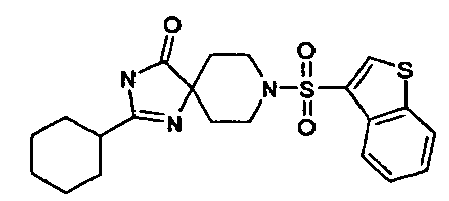
LCMS-E-1 3.587 433 (M+H)+ 54 
LCMS-E-1 3. 727 433 (M+H)+ 55 
LCMS-E-1 3.585 416 (M+H)+ 56 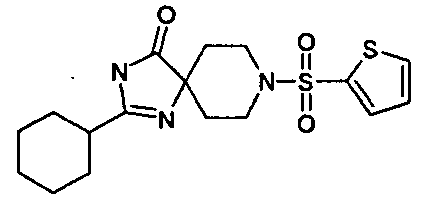
LCMS-E-1 3.143 382 (M+H)+ 57 
LCMS-E-1 3.604 427 (M+H)+ 58 
LCMS-E-2 1.22 411 (M+H)+ 59 
LCMS-E-1 3.065 396 (M+H)+ 60 
LCMS-E-1 3.141 434 (M+H)+ 61 
LCMS-E-1 3. 782 454 (M+H)+ 62 
LCMS-C-1 2.35 440 (M+H)+ 63 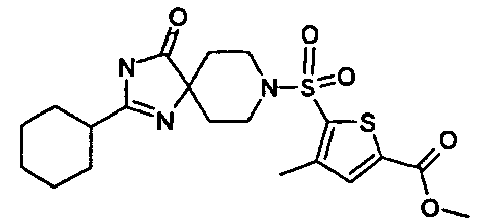
LCMS-C-1 2. 64 454 (M+H)+ 64 
LCMS-A-1 2.00 470 (M+H)+ 65 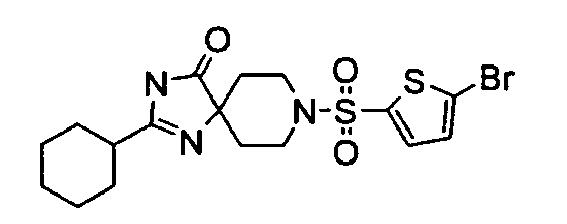
LCMS-C-2 2.13 461 (M+H)+ -

- 8-(5-Chloro-thiophene-2-sulfonyl)-2-(3-trifluoromethyl-phenyl)-1,3,8-triaza-spiro[4.5]dec-1-en-4-one was synthesized by operations similar to those in Example 5 using appropriate reagents and starting material.
MS (ESI) m/z = 478 (M+H)+. - The example compounds shown below were synthesized by operations similar to those in Example 8 using appropriate reagents and starting materials.
-
[Table 8] Compound Structure LCMS or HPLC condition Retention time (min) MS (m/z) 67 
LCMS-C-1 2.90 488 (M+H)+ 68 
LCMS-C-1 2. 92 494 (M+H)+ 69 
LCMS-C-2 2.38 523 (M+H)+ -

- 8-(3-Chloro-benzenesulfonyl)-2-cyclohexyl-1,3,8-triaza-spiro[4.6]undec-1-en-4-one was synthesized by operations similar to those in Reaction 1-2 of Example 1 and Example 7 using appropriate reagents and starting material.
MS (ESI) m/z = 424 (M+H)+. - The example compounds shown below were synthesized by operations similar to those in Example 9 using appropriate reagents and starting materials.
-
[Table 9] Compound Structure LCMS or HPLC condition Retention time (min) MS (m/z) 71 
LCMS-E-2 2. 78 410 (M+H)+ 72 
LCMS-E-2 2.81 396 (M+H)+ -

- 4-(4,6-Dimethoxy-1,3,5-triazin-2-yl)-4-methylmorpholinium chloride n-hydrate (n = about 2.7) (2.42 g, 7.53 mmol) was added to a mixture of 4-bromo-3-methylbenzoic acid (1.58 g, 7.37 mmol), EtOH (26 ml) and a 40% aqueous dimethylamine solution (0.75 ml, 7.4 mmol), and the mixture was stirred at room temperature for 24 hours. The reaction mixture was concentrated under reduced pressure, and the resulting residue was then dissolved in ethyl acetate. The organic layer was washed with water, and then dried over MgSO4 and concentrated under reduced pressure. The resulting residue was purified by silica gel column chromatography (hexane/ethyl acetate = 2/1) to give 4-bromo-3,N,N-trimethyl-benzamide as a colorless solid (1.16 g, 65%).
1H-NMR (300 MHz) (CDCl3) δ 2.42 (3H, s), 2.98 (3H, br s), 3.10 (3H, br s), 7.08 (1H, dd, J = 8.4 and 2.1 Hz), 7.30 (1H, d, J = 2.1 Hz), 7.55 (1H, d, J = 8.4 Hz). MS (ESI) m/z = 243 (M+H)+. -

- A mixture of 4-bromo-3,N,N-trimethyl-benzamide (798 mg, 3.30 mmol), potassium vinyltrifluoroborate (579 mg, 4.32 mmol), PdCl2 (59.0 mg, 0.333 mmol), PPh3 (265 mg, 1.01 mmol) and Cs2CO3 (3.22 g, 9.90 mmol) in THF (6.5 ml)-H2O (0.65 ml) was heated with stirring at 85°C for 21 hours in a sealed test tube in an N2 atmosphere. The reaction mixture was cooled to room temperature and then extracted with ether. The organic layer was washed with water, and then dried over MgSO4 and concentrated under reduced pressure. The resulting residue was purified by silica gel column chromatography (hexane/ethyl acetate = 2/1) to give 3,N,N-trimethyl-4-vinyl-benzamide (565 mg, 90%).
1H-NMR (400 MHz) (CDCl3) δ 2.36 (3H, s), 3.00 (3H, br s), 3.10 (3H, br s), 5.35 (1H, dd, J = 11.0 and 1.0 Hz), 5.68 (1H, dd, J = 17.5 and 1.0 Hz), 6.93 (1H, dd, J = 17.5 and 11.0 Hz), 7.21 (1H, d, J = 8.0 Hz), 7.22 (1H, s), 7.48 (1H, d, J = 8.0 Hz). MS (ESI) m/z = 190 (M+H)+. -

- A mixture of 3,N,N-trimethyl-4-vinyl-benzamide (706 mg, 3.73 mmol), triphenylsilanethiol (1.76 g, 6.00 mmol) and AIBN (185 mg, 1.13 mmol) in toluene (16 ml) was heated with stirring at 88°C for two hours in a sealed test tube in an N2 atmosphere. The reaction mixture was cooled to room temperature and then concentrated under reduced pressure. The resulting residue was purified by silica gel column chromatography (hexane/ethyl acetate = 2/1) to give 3,N,N-trimethyl-4-(2-triphenylsilanylsulfanyl-ethyl)-benzamide (1.24 g, 69%).
1H-NMR (400 MHz) (CDCl3) δ 2.08 (3H, s), 2.61 (2H, m), 2.75 (2H, m), 2.95 (3H, br s), 3.07 (3H, br s), 6.89 (1H, d, J = 7.8 Hz), 7.08 (1H, d, J = 7.8 Hz), 7.12 (1H, s), 7.37-7.47 (9H, m), 7.66-7.69 (6H, m). MS (ESI) m/z = 482 (M+H)+. -

- Citric acid monohydrate (110 mg, 0.523 mmol) and potassium carbonate (52.8 mg, 0.382 mmol) were added to a solution of 3,N,N-trimethyl-4-(2-triphenylsilanylsulfanyl-ethyl)-benzamide (767 mg, 1.59 mmol) in MeOH (27 ml) at room temperature, and the mixture was stirred for one hour. The reaction mixture was concentrated under reduced pressure, and the residue was then dissolved in dichloromethane. The organic layer was washed with water, and then dried over MgSO4 and concentrated under reduced pressure. The resulting residue was purified by silica gel column chromatography (hexane/ethyl acetate = 2/1) to give 4-(2-mercaptoethyl)-3,N,N-trimethyl-benzamide (351 mg, 99%).
1H-NMR (400 MHz) (CDCl3) δ 2.33 (3H, s), 2.74 (2H, dt, J = 7.5 and 7.5 Hz), 2.94 (2H, t, J = 7.5 Hz), 2.99 (3H, br s), 3.10 (3H, br s), 7.16 (1H, d, J = 7.8 Hz), 7.18 (1H, d, J = 7.8 Hz), 7.23 (1H, s). MS (ESI) m/z = 224 (M+H)+. -

- Potassium nitrate (583 mg, 5.77 mmol) was added to a solution of 4-(2-mercapto-ethyl)-3,N,N-trimethyl-benzamide (514 mg, 2.30 mmol) in MeCN (23 ml) at room temperature. The mixture was cooled to -40°C, and sulfuryl chloride (1.68 M solution in dichloromethane, 3.46 ml, 5.81 mmol) was then added dropwise over 15 minutes. After stirring at -40°C to -20°C for 2.5 hours, the reaction mixture was diluted with dichloromethane (80 ml) and quenched with a saturated aqueous sodium bicarbonate solution (20 ml). The organic layer and the aqueous layer were separated, and the organic layer was then washed with a saturated aqueous sodium chloride solution (30 ml), dried over MgSO4 and concentrated under reduced pressure. The resulting residue was purified by silica gel column chromatography (hexane/ethyl acetate = 1/1 -> 1/2) to give 2-(4-dimethylcarbamoyl-2-methylphenyl)-ethanesulfonyl chloride as a colorless solid (491 mg, 74%).
1H-NMR (300 MHz) (CDCl3) δ 2.39 (3H, s), 2.99 (3H, br s), 3.11 (3H, br s), 3.36 (2H, m), 3.83 (2H, m), 7.19 (1H, d, J = 7.5 Hz), 7.23 (1H, dd, J = 7.5 and 1.5 Hz), 7.28 (1H, d, J = 1.5 Hz). MS (ESI) m/z = 290 (M+H)+. -

- 4-{2-[2-(2,4-Dichloro-phenyl)-4-oxo-1,3,8-triaza-spiro[4.5]dec-1-ene-8-sulfonyl]-ethyl}-3,N,N-trimethyl-benzamide was synthesized by operations similar to those in Reaction 5-4 of Example 5 using appropriate reagents and starting material.
MS (ESI) m/z = 551 (M+H)+. - The example compounds shown below were synthesized by operations similar to those in Example 10 using appropriate reagents and starting materials.
-
[Table 10] Compound Structure LCMS or HPLC condition Retention time (min) MS (m/z) 74 
LCMS-C-2 1.57 463 (M+H)+ 75 
LCMS-C-1 2.58 551 (M+H)+ 76 
LCMS-C-1 2.50 503 (M+H)+ 77 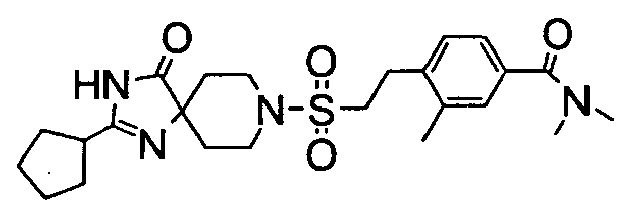
LCMS-C-1 2.22 475 (M+H)+ 78 
LCMS-C-1 2.13 519 (M+H)+ 79 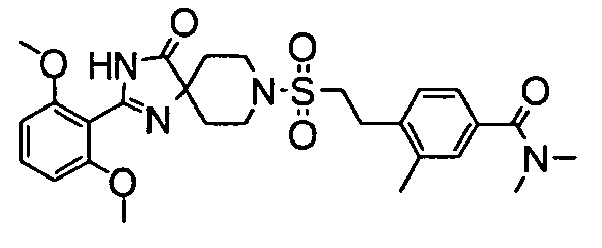
LCMS-A-1 1.88 543 (M+H)+ 80 
LCMS-C-1 2.32 513 (M+H)+ 81 
LCMS-C-1 2.50 517 (M+H)+ 82 
LCMS-A-1 2.72 619 (M+H)+ 83 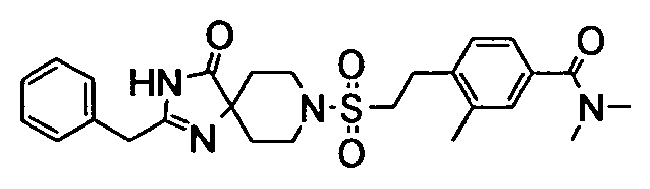
LCMS-C-1 2.23 497 (M+H)+ 84 
LCQ-01 2.01 497 (M+H)+ 85 
LCMS-C-1 2.47 585 (M+H)+ 86 
LCMS-C-1 2.57 551 (M+H)+ 87 
LCMS-C-1 2.48 517 (M+H)+ 88 
LCMS-C-1 2.43 551 (M+H)+ 89 
LCMS-C-1 2.53 535 (M+H)+ 90 
LCMS-C-1 2.30 535 (M+H)+ 91 
LCMS-B-1 2.01 561 (M+H)+ 92 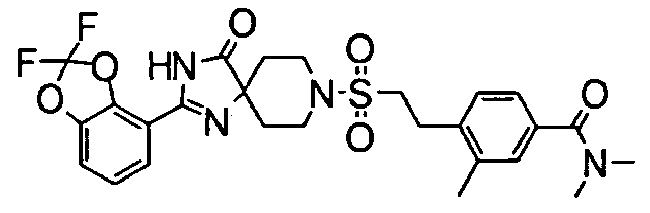
LCMS-C-2 1.87 563 (M+H)+ 93 
LCMS-B-1 1.97 535 (M+H)+ 94 
LCMS-C-1 2.52 599 (M+H)+ 95 
LCMS-C-1 2.60 531 (M+H)+ 96 
LCMS-C-1 2.38 569 (M+H)+ 97 
LCMS-C-1 2.22 498 (M+H)+ 98 
LCMS-C-1 2.67 551 (M+H)+ 99 
LCMS-C-1 2.60 567 (M+H)+ 100 
LCMS-C-1 2.63 619 (M+H)+ 101 
LCMS-C-1 2.33 511 (M+H)+ 102 
LCMS-C-1 2.07 518 (M+H)+ 103 
LCMS-A-1 2.02 503 (M+H)+ 104 
LCMS-A-1 2.12 557 (M+H)+ 105 
LCMS-C-1 2.40 567 (M+H)+ 106 
LCMS-C-1 2.62 567 (M+H)+ 107 
LCMS-C-2 1.97 569 (M+H)+ 108 
LCMS-C-1 2.65 517(M+H)+ 109 
LCMS-A-1 2.10 501 (M+H)+ 110 
LCMS-A-1 1.96 561 (M+H)+ 111 
LCMS-C-1 2.52 565 (M+H)+ 112 
LCMS-C-1 2.52 565 (M+H)+ 113 
LCMS-B-1 1.78 511 (M+H)+ 114 
LCMS-B-1 1.87 515 (M+H)+ 115 
LCMS-C-1 2.67 569 (M+H)+ 116 
LCMS-C-1 2.50 569 (M+H)+ 117 
LCMS-A-1 2.12 515 (M+H)+ 118 
LCMS-C-1 2.38 549 (M+H)+ 119 
LCMS-C-1 2.27 514 (M+H)+ 120 
LCMS-C-1 2.10 499 (M+H)+ 121 
LCMS-C-1 1.98 490 (M+H)+ 122 
LCMS-C-1 2.05 487 (M+H)+ 123 
LCMS-C-1 1.95 491 (M+H)+ 124 
LCMS-C-1 2.48 547 (M+H)+ 125 
LCMS-C-1 2.32 531 (M+H)+ 126 
LCMS-C-1 2.72 585 (M+H)+ 127 
LCMS-C-1 2.78 585 (M+H)+ 128 
LCMS-C-1 2.42 531 (M+H)+ 129 
LCMS-C-1 2.42 535 (M+H)+ 130 
LCMS-A-1 2.19 555 (M+H)+ 131 
LCMS-A-1 2.45 581 (M+H)+ 133 
LCMS-C-1 2.45 531 (M+H)+ 134 
LCMS-C-1 2.50 565 (M+H)+ 135 
LCMS-C-1 2.50 565 (M+H)+ 136 
LCMS-C-2 1.68 515 (M+H)+ 137 
LCMS-C-2 1.78 529 (M+H)+ 138 
LCMS-C-2 1.98 543 (M+H)+ 139 
LCMS-C-1 2.47 569 (M+H)+ 140 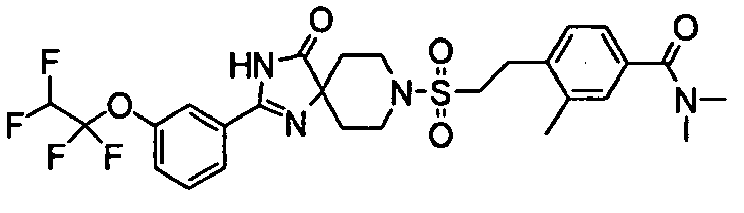
LCMS-A-1 2.41 599 (M+H)+ 141 
LCMS-C-1 2.03 447 (M+H)+ 142 
LCMS-A-1 2.00 509 (M+H)+ 143 
LCMS-C-1 2.18 540 (M+H)+ 144 
LCMS-A-1 2.26 581 (M+H)+ - The spiroamine reagents used in the synthesis of Compounds 74 to 85 and shown below were synthesized by operations similar to those in Reaction 7-1 and Reaction 7-2 using appropriate reagents and starting materials.
-
[Table 11] Target Compound Spiroamine reagent Spiroamine reagent MS (m/z) 74 
This compound was directly used in the next step (Reaction 10-6). 75 
298 (M+H)+ 76 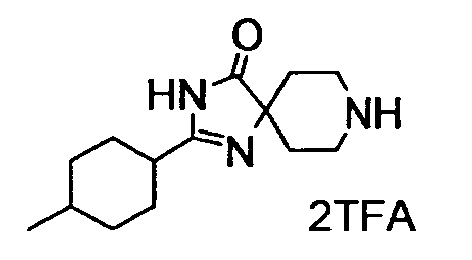
250 (M+H)+ 77 
222 (M+H)+ 78 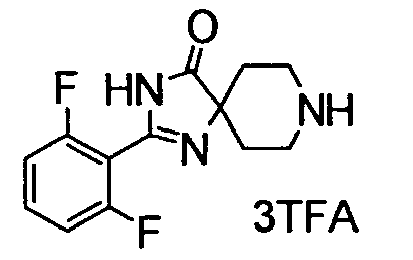
266 (M+H)+ 79 
290 (M+H)+ 80 
260 (M+H)+ 81 
264 (M+H)+ 82 
366 (M+H)+ 83 
244 (M+H)+ 84 
244 (M+H)+ 85 
332 (M+H)+ - The spiroamine reagents used in the synthesis of Compounds 86 to 91 and shown below were synthesized by operations similar to those in Example 8 using appropriate reagents and starting materials.
-
[Table 12] Target Compound Spiroamine reagent Spiroamine reagent MS (m/z) 86 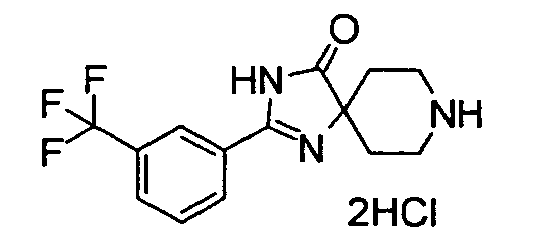
298 (M+H)+ 87 
264 (M+H)+ 88 
298 (M+H)+ 89 
282 (M+H)+ 90 
282 (M+H)+ 91 
308 (M+H)+ - The spiroamine reagent used in the synthesis of Compound 92 (2-(2,2-difluoro-benzo[1,3]dioxol-4-yl)-1,3,8-triaza-spiro[4.5]dec-1-en-4-one ditrifluoroacetate) was synthesized as follows.
-

- 4-Cyano-4-[(2,2-difluoro-benzo[1,3]dioxole-4-carbonyl)-amino]-piperidine-1-carboxylic acid tert-butyl ester was synthesized by operations similar to those in Reaction 2-3 of Example 2 using appropriate reagents and starting material.
MS (ESI) m/z = 410 (M+H)+. -

- A 1 N aqueous NaOH solution (0.274 ml, 0.274 mmol) and a 35% aqueous H2O2 solution (0.051 ml, 0.52 mmol) were added to a solution of 4-cyano-4-[(2,2-difluoro-benzo[1,3]dioxole-4-carbonyl)-amino]-piperidine-1-carboxylic acid tert-butyl ester (56.0 mg, 0.137 mmol) in THF (0.23 ml) at room temperature. The reaction mixture was stirred at room temperature for 43 hours, and a 35% aqueous H2O2 solution (0.030 ml, 0.31 mmol) was then further added at room temperature. After stirring at room temperature for 48 hours, the mixture was quenched with a 1 N aqueous HCl solution (0.2 ml) and concentrated under reduced pressure. A 6 N aqueous NaOH solution (0.33 ml, 2.0 mmol) was added to a suspension of the resulting residue in EtOH (1.2 ml) at room temperature, and the mixture was stirred at room temperature for 24 hours. The reaction mixture was quenched with a saturated aqueous NH4Cl solution (0.4 ml) and then concentrated under reduced pressure. The resulting residue was dissolved in ethyl acetate and washed with water, and then dried over MgSO4 and concentrated under reduced pressure. The residue was purified by silica gel column chromatography (hexane/ethyl acetate = 3/2) to give 2-(2,2-difluoro-benzo[1,3]dioxol-4-yl)-4-oxo-1,3,8-triaza-spiro[4.5]dec-1-ene-8-carboxylic acid tert-butyl ester (51.2 mg, 91%).
1H-NMR (300 MHz) (CDCl3) δ 1.50 (9H, s), 1.55 (2H, m), 1.95 (2H, m), 3.46 (2H, m), 4.02 (2H, br), 7.23-7.25 (2H, m), 7.88-7.94 (1H, m), 8.41 (1H, br s). -

- 2-(2,2-Difluoro-benzo[1,3]dioxol-4-yl)-1,3,8-triaza-spiro[4.5]dec-1-en-4-one ditrifluoroacetate was synthesized by operations similar to those in Reaction 7-2 of Example 7 using appropriate reagents and starting material. (This compound was directly used in the next reaction.)
- The spiroamine reagent used in the synthesis of Compound 93 (2-(3-chloro-2-fluoro-phenyl)-1,3,8-triaza-spiro[4.5]dec-1-en-4-one dihydrochloride) was synthesized as follows.
-

- 4-(3-Chloro-2-fluoro-benzoylamino)-4-cyanopiperidine-1-carboxylic acid tert-butyl ester was synthesized by operations similar to those in Reaction 2-3 of Example 2 using appropriate reagents and starting material.
MS (ESI) m/z = 404 (M+Na)+. -

- 1 N NaOH (8.60 ml, 8.60 mmol) and a 30% H2O2 solution (4.30 ml) were added to a solution of 4-(3-chloro-2-fluoro-benzoylamino)-4-cyano-piperidine-1-carboxylic acid tert-butyl ester (1.63 g, 4.28 mmol) in THF (8.60 ml) at room temperature, and the mixture was stirred at room temperature for two hours. The reaction mixture was adjusted to pH 6 by adding 2 N HCl and then extracted with ethyl acetate three times. The organic layers were sequentially washed with H2O (× 2) and saturated brine, and then dried over Na2SO4 and concentrated under reduced pressure. The resulting residue was triturated with H2O, and the solid was collected by filtration. The resulting solid was washed with Et2O and then dried under reduced pressure to give 4-carbamoyl-4-(3-chloro-2-fluoro-benzoylamino)-piperidine-1-carboxylic acid tert-butyl ester as a white powder (1.30 g, 76%).
MS (ESI) m/z = 400 (M+H)+. -

- Potassium t-butoxide (1.01 g, 8.97 mmol) was added to a solution of 4-carbamoyl-4-(3-chloro-2-fluoro-benzoylamino)-piperidine-1-carboxylic acid tert-butyl ester (1.20 g, 2.99 mmol) in tBuOH (30.0 ml) at room temperature, and the mixture was stirred at 40°C for six hours. The reaction mixture was adjusted to pH 6 by adding 2 N HCl and then extracted with AcOEt three times. The organic layers were sequentially washed with H2O (× 2) and saturated brine, and then dried over Na2SO4 and concentrated under reduced pressure. The residue was purified by column chromatography (hexane/AcOEt = 90:10 - > 50:50) to give 2-(3-chloro-2-fluoro-phenyl)-4-oxo-1,3,8-triaza-spiro[4.5]dec-1-ene-8-carboxylic acid tert-butyl ester as a colorless form (1.13 g, 99%).
MS (ESI) m/z = 382 (M+H)+. -

- 2-(3-Chloro-2-fluoro-phenyl)-1,3,8-triaza-spiro[4.5]dec-1-en-4-one dihydrochloride was synthesized by operations similar to those in Reaction 5-3 of Example 5 using appropriate reagents and starting material.
MS (ESI) m/z = 282 (M+H)+. - The spiroamine reagent used in the synthesis of Compound 94 (2-[4-(1,1,2,2-tetrafluoro-ethoxy)-phenyl]-1,3,8-triaza-spiro[4.5]dec-1-en-4-one dihydrochloride) was synthesized as follows.
-

- N,N,N',N'-Tetramethyl-O-(7-azabenzotriazol-1-yl)uronium hexafluorophosphate (1.60 g, 4.20 mmol) was added to a solution of 4-(1,1,2,2-tetrafluoro-ethoxy)-benzoic acid (1.00 g, 4.20 mmol), 4-amino-4-cyanopiperidine-1-carboxylic acid tert-butyl ester (995 mg, 4.42 mmol) and N,N-diisopropylethylamine (1.46 ml, 8.39 mmol) in DMF (8.8 ml) at 0°C. The mixture was gradually warmed to room temperature and stirred for 28.5 hours. An aqueous ammonium chloride solution was added to the reaction mixture, followed by extraction with ethyl acetate three times. The organic layers were sequentially washed with H2O (× 2) and saturated brine, and then dried over Na2SO4 and concentrated under reduced pressure. The residue was purified by column chromatography (hexane:AcOEt = 90:10 -> 30:70) to give 4-cyano-4-[4-(1,1,2,2-tetrafluoro-ethoxy)-benzoylamino]-piperidine-1-carboxylic acid tert-butyl ester as a light brown powder (1.60 g, 86%).
MS (ESI) m/z = 446 (M+H)+. -

- 2-[4-(1,1,2,2-Tetrafluoro-ethoxy)-phenyl]-1,3,8-triaza-spiro[4.5]dec-1-en-4-one dihydrochloride was synthesized by operations similar to those in Reaction 5-2 and Reaction 5-3 of Example 5 using appropriate reagents and starting material.
MS (ESI) m/z = 346 (M+H)+. - The following spiroamine reagents used in the synthesis of Compounds 95 to 99 were synthesized by operations similar to those in Reaction 10-14 and Reaction 10-15 using appropriate reagents and starting materials.
-
[Table 13] Target Compound Spiroamine reagent Spiroamine reagent MS (m/z) 95 
278 (M+H)+ 96 
316 (M+H)+ 97 
245 (M+H)+ 98 
298 (M+H)+ 99 
314 (M+H)+ - The following spiroamine reagents used in the synthesis of Compounds 100 to 114 were synthesized by operations similar to those in Reaction 10-14, Reaction 5-2 and Reaction 7-2 using appropriate reagents and starting materials.
-
[Table 14] Target Compound Spiroamine reagent Spiroamine reagent MS (m/z) 100 
366 (M+H)+ 101 
258 (M+H)+ 102 
265 (M+H)+ 103 
250 (M+H)+ 104 
304 (M+H)+ 105 
314 (M+H)+ 106 
314 (M+H)+ 107 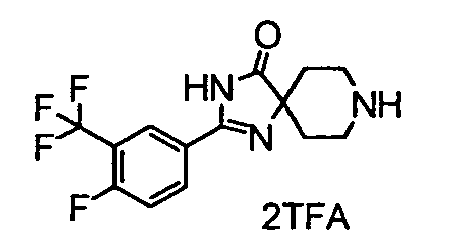
315 (M+H)+ 108 
264 (M+H)+ 109 
248 (M+H)+ 110 
308 (M+H)+ 111 
312 (M+H)+ 112 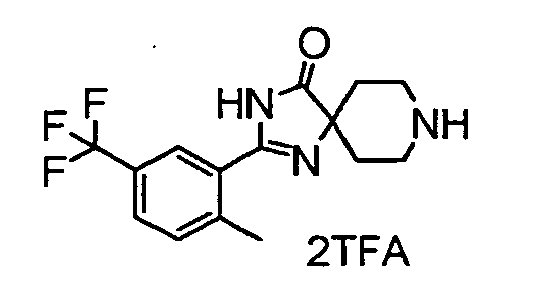
312 (M+H)+ 113 
258 (M+H)+ 114 
262 (M+H)+ - The following spiroamine reagents used in the synthesis of Compounds 115 to 117 were synthesized by operations similar to those in Reaction 10-14, Reaction 10-8 and Reaction 7-2 using appropriate reagents and starting materials.
-
[Table 15] Target Compound Spiroamine reagent Spiroamine reagent MS(m/z) 115 
315 (M+H)+ 116 
315 (M+H)+ 117 
262 (M+H)+ - The following spiroamine reagent used in the synthesis of Compound 118 (2-(4-difluoromethoxy-phenyl)-1,3,8-triaza-spiro[4.5]dec-1=en-4-one) was synthesized by operations similar to those in Reaction 10-14, Reaction 10-8 and Reaction 5-3 using appropriate reagents and starting material.
-
[Table 16] Target Compound Spiroamine reagent Spiroamine reagent MS(m/z) 118 
296 (M+H)+ - The spiroamine reagent used in the synthesis of Compound 119 (2-(2-methoxy-pyridin-4-yl)-1,3,8-triaza-spiro[4.5]dec-1-en-4-one ditrifluoroacetate) was synthesized as follows.
-

- 4-(4,6-Dimethoxy-1,3,5-triazin-2-yl)-4-methylmorpholinium chloride 2.7-hydrate (1.06 g, 3.26 mmol) was added to a solution of 2-methoxy-isonicotinic acid (500 mg, 3.26 mmol) and 4-amino-4-cyano-piperidine-1-carboxylic acid tert-butyl ester (669 mg, 2.97 mmol) in EtOH (8.0 ml) at room temperature, and the mixture was stirred for 46.5 hours. An aqueous NaHCO3 solution was added to the reaction mixture, followed by extraction with AcOEt three times. The organic layers were washed with saturated brine, and then dried over anhydrous sodium sulfate and concentrated under reduced pressure. The resulting residue was purified by column chromatography (CH2Cl2/MeOH = 99:1 to 95:5) to give 4-cyano-4-[(2-methoxy-pyridine-4-carbonyl)-amino]-piperidine-1-carboxylic acid tert-butyl ester as a colorless form (901 mg, 84%).
MS (ESI) m/z = 361 (M+H)+. -

- 2-(2-Methoxy-pyridin-4-yl)-1,3,8-triaza-spiro[4.5]dec-1-en-4-one ditrifluoroacetate was synthesized by operations similar to those in Reaction 5-2 and Reaction 7-2 using appropriate reagents and starting material. (This compound was directly used in the next reaction.)
- The following spiroamine reagents used in the synthesis of Compounds 120 to 131 were synthesized by the procedure described in Reaction 10-16 and Reaction 10-17 using appropriate reagents and starting materials.
-
[Table 17] Target Compound Spiroamine reagent spiroamine reagent MS (m/z) 120 
246 (M+H)+ 121 
This compound was directly used in the next step (Reaction 10-6). 122 
234 (M+H)+ 123 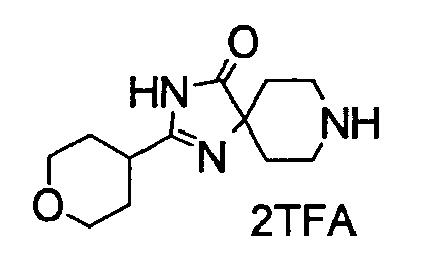
This compound was directly used in the next step (Reaction 10-6). 124 
294 (M+H)+ 125 
278 (M+H)+ 126 
332 (M+H)+ 127 
331 (M+H)+ 128 
278 (M+H)+ 129 
282 (M+H)+ 130 
302 (M+H)+ 131 
328 (M+H)+ - The following spiroamine reagent used in the synthesis of Compound 133 was synthesized by operations similar to those in Reaction 10-16, Reaction 10-8 and Reaction 5-3 using appropriate reagents and starting material.
-
[Table 18] Target Compound Spiroamine reagent Spiroamine reagent MS (m/z) 133 
378 (M+H)+ - The spiroamine reagent used in the synthesis of Compound 134 (2-(2,4-dichloro-benzyl)-1,3,8-triaza-spiro[4.5]dec-1-en-4-one ditrifluoroacetate) was synthesized as follows.
-

- (2,4-Dichloro-phenyl)-acetic acid (218 mg, 1.07 mmol), 1-ethyl-3-(3'-dimethylamino-propyl)carbodiimide hydrochloride (255 mg, 1.33 mmol), 1-hydroxybenzotriazole hydrate (136 mg, 0.88 mmol) and N,N-diisopropylethylamine (0.378 ml, 2.22 mmol) were sequentially added to a solution of 4-amino-4-cyano-piperidine-1-carboxylic acid tert-butyl ester (200 mg, 0.888 mmol) in DMF (4 ml) at room temperature, and the mixture was stirred at room temperature for 16 hours. H2O (20 ml) was added to the reaction mixture, followed by extraction with AcOEt (40 ml and 20 ml). The organic layers were sequentially washed with H2O (20 ml), 1 N HCl (20 ml), H2O (20 ml) and saturated brine (20 ml), and then dried over Na2SO4 and concentrated under reduced pressure. The resulting residue was purified by silica gel column chromatography (n-hexane/AcOEt) to give 4-cyano-4-[2-(2,4-dichloro-phenyl)-acetylamino]-piperidine-1-carboxylic acid tert-butyl ester as a white powder (285 mg, 78%).
1H-NMR (270 MHz, CDCl3) δ 1.45 (9H, s), 1.72 (2H, ddd, J = 13.2, 10.7, 3.9 Hz), 2.34-2.37 (2H, m), 3.20-3.27 (2H, m), 3.68 (2H, s), 3.81-3.97 (2H, m), 5.55 (1H, s), 7.28 (1H, dd, J = 7.8, 2.0 Hz), 7.30 (1H, d, 7.8 Hz), 7.45 (1H, d, J = 2.0 Hz). MS (ESI) m/z = 412 (M+H)+. -

- 2-(2,4-Dichloro-benzyl)-1,3,8-triaza-spiro[4.5]dec-1-en-4-one ditrifluoroacetate was synthesized by operations similar to those in Reaction 5-2 and Reaction 7-2 using appropriate reagents and starting material.
MS (ESI) m/z = 312 (M+H)+. - The following spiroamine reagent used in the synthesis of Compound 135 was synthesized by operations similar to those in Reaction 10-18 and Reaction 10-19 using appropriate reagents and starting material.
-
[Table 19] Target Compound Spiroamine reagent Spiroamine reagent MS(m/z) 135 
312 (M+H)+ - The spiroamine reagent used in the synthesis of Compound 136 (2-(1-trifluoromethyl-cyclopropyl)-1,3,8-triaza-spiro[4.5]dec-1-en-4-one ditrifluoroacetate) was synthesized as follows.
-

- Oxalyl chloride (0.20 ml, 2.3 mmol) and dimethylformamide (8 µl) were added to a solution of 1-trifluoromethyl-cyclopropanecarboxylic acid (308 mg, 2.00 mmol) in dichloromethane (2.1 ml) at 0°C . The mixture was stirred at 0°C for 30 minutes and then stirred at room temperature for two hours. The reaction mixture was concentrated under reduced pressure. A solution of the resulting residue in dichloromethane (1.5 ml) was added dropwise to a solution of 4-amino-4-cyanopiperidine-1-carboxylic acid tert-butyl ester (377 mg, 1.67 mmol) and diisopropylethylamine (0.42 ml, 2.4 mmol) in dichloromethane (2.0 ml) over three minutes at 0°C, and the mixture was stirred at room temperature for 13 hours. The reaction mixture was diluted with dichloromethane, and the organic layer was then washed with water, dried over MgSO4 and concentrated under reduced pressure. The resulting residue was purified by silica gel column chromatography (hexane/ethyl acetate = 3/1 -> 2/1) to give 4-cyano-4-[(1-trifluoromethyl-cyclopropanecarbonyl)-amino]-piperidine-1-carboxylic acid tert-butyl ester as a colorless solid (519 mg, 86%).
1H-NMR (400 MHz) (CDCl3) δ 1.46 (9H, s), 1.29 (2H, dd, J = 7.5 and 4.5 Hz), 1.56 (2H, m), 1.80 (2H, m), 2.40 (2H, m), 3.30 (2H, m), 3.93 (2H, br), 6.07 (1H, br s).
Rf = 0.62 in TLC (developer; hexane:AcOEt = 1:1). -

- 2-(1-Trifluoromethyl-cyclopropyl)-1,3,8-triaza-spiro[4.5]dec-1-en-4-one ditrifluoroacetate was synthesized by operations similar to those in Reaction 5-2 and Reaction 7-2 using appropriate reagents and starting material. (This compound was directly used in Reaction 10-6.)
- The following spiro-amine reagents used in the synthesis of Compounds 137 to 138 were synthesized by operations similar to those in Reaction 10-20 and Reaction 10-21 using appropriate reagents and starting materials. (These compounds were directly used in Reaction 10-6.)
-
[Table 20] Target Compound Spiroamine reagent Spiroamine reagent MS (m/z) 137 
This compound was directly used in the next step (Reaction 10-6). 138 
This compound was directly used in the next step (Reaction 10-6). - The spiroamine reagent used in the synthesis of Compound 139 (2-(2-fluoro-4-trifluoromethyl-phenyl)-1,3,8-triaza-spiro[4.5]dec-1-en-4-one ditrifluoroacetate) was synthesized as follows.
-

- HATU (939 mg, 2.47 mmol) and DIPEA (525 µL, 3.09 mmol) were added to a solution of 4-amino-4-carbamoyl-piperidine-1-carboxylic acid tert-butyl ester (500 mg, 2.06 mmol) and 2-fluoro-4-trifluoromethyl-benzoic acid (514 mg, 2.47 mmol) in DMF (10 mL). The mixture was stirred at room temperature for 19 hours and then quenched with a saturated aqueous ammonium chloride solution. The reaction mixture was diluted with EtOAc, and the organic layer was then washed with H2O and saturated brine, dried over MgSO4 and concentrated under reduced pressure. The resulting residue was triturated with n-hexane and EtOAc and then collected by filtration to give 4-carbamoyl-4-(2-fluoro-4-trifluoromethyl-benzoylamino)-piperidine-1-carboxylic acid tert-butyl ester as a white solid. This was used in the next step without further purification.
-

- A 6 N aqueous NaOH solution (54.8 µL, 323 µmol) was added to a solution of 4-carbamoyl-4-(2-fluoro-4-trifluoromethyl-benzoylamino)-piperidine-1-carboxylic acid tert-butyl ester (100 mg, 231 µmol) in DMSO (0.3 mL), and the mixture was stirred at room temperature for 27 hours. The reaction mixture was quenched with a saturated aqueous ammonium chloride solution and then diluted with EtOAc, and the organic layer was sequentially washed with H2O and saturated brine. The organic layer was dried over MgS04 and then concentrated under reduced pressure. The resulting residue was purified by column chromatography (CH2Cl2/MeOH = 95:5) to give 2-(2-fluoro-4-trifluoromethyl-phenyl)-4-oxo-1,3,8-triaza-spiro[4.5]dec-1-ene-8-carboxylic acid tert-butyl ester as a white solid (54.5 mg, 57%).
MS (ESI) m/z = 438 (M+Na)+. -
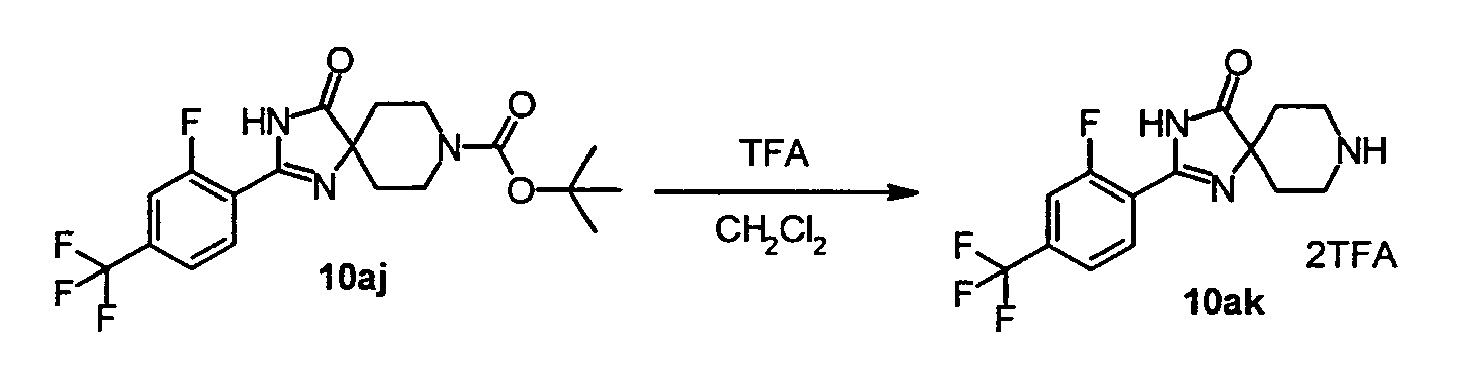
- 2-(2-Fluoro-4-trifluoromethyl-phenyl)-1,3,8-triaza-spiro[4.5]dec-1-en-4-one ditrifluoroacetate was synthesized by operations similar to those in Reaction 7-2 using appropriate reagents and starting material.
MS (ESI) m/z = 315 (M+H)+. - The following spiro-amine reagents used in the synthesis of Compounds 140 to 143 were synthesized by operations similar to those in Reaction 10-22, Reaction 10-23 and Reaction 10-24 using appropriate reagents and starting materials.
-
[Table 21] Target Compound Spiroamine reagent Spiroamine reagent MS (m/z) 140 
346 (M+H)+ 141 
194 (M+H)+ 142 
256 (M+H)+ 143 
287 (M+H)+ - The spiroamine reagent used in the synthesis of Compound 144 (2-(4-methoxy-3-trifluoromethyl-phenyl)-1,3,8-triaza-spiro[4.5]dec-1-en-4-one ditrifluoroacetate) was synthesized as follows.
-

- 4-Carbamoyl-4-(4-methoxy-3-trifluoromethyl-benzoylamino)-piperidine-1-carboxylic acid tert-butyl ester was synthesized by operations similar to those in Reaction 2-3 using 4-amino-4-carbamoyl-piperidine-1-carboxylic acid tert-butyl ester as a starting material amine.
MS (ESI) m/z = 446 (M+H)+. -
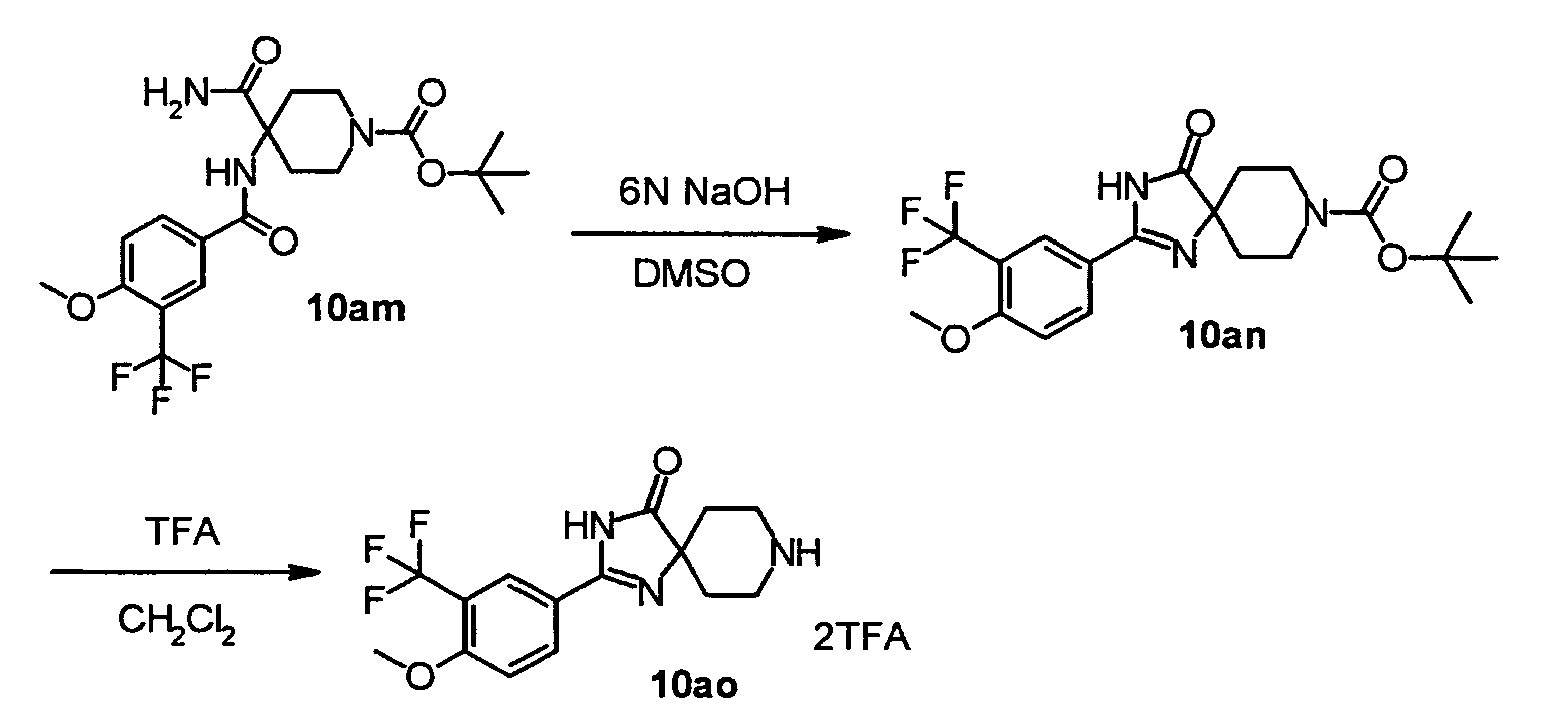
- 2-(4-Methoxy-3-trifluoromethyl-phenyl)-1,3,8-triaza-spiro[4.5]dec-1-en-4-one ditrifluoroacetate was synthesized by operations similar to those in Reaction 10-23 and Reaction 7-2 using appropriate reagents and starting material.
MS (ESI) m/z = 328 (M+H)+. -

- 2-(4-Acetylamino-2-methyl-phenyl)-ethanesulfonyl chloride was synthesized by operations similar to those in Reaction 10-2, Reaction 10-3, Reaction 10-4 and Reaction 10-5 using appropriate reagents and starting material.
MS (ESI) m/z = 276 (M+H)+. -

- N-{3-Methyl-4-[2-(4-oxo-2-m-tolyl-1,3,8-triaza-spiro[4.5]dec-1-ene-8-sulfonyl)-ethyl]-phenyl}-acetamide was synthesized by operations similar to those in Reaction 5-4 using appropriate reagents and starting material.
MS (ESI) m/z = 483 (M+H)+. - The example compounds shown below were synthesized by operations similar to those in Example 11 using appropriate reagents and starting materials.
-
[Table 22] Compound Structure LCMS or HPLC condition Retention time (min) MS (m/z) 146 
LCMS-C-1 2.33 497 (M+H)+ 147 
LCMS-C-1 2.40 537 (M+H)+ 148 
LCMS-C-1 2.45 489 (M+H)+ - The spiroamine reagent used in the synthesis of Compound 148 (2-(4-methyl-cyclohexyl)-1,3,8-triaza-spiro[4.5]dec-1-en-4-one dihydrochloride) was synthesized as follows.
-

- 2-(4-Methyl-cyclohexyl)-4-oxo-1,3,8-triaza-spiro[4.5]dec-1-ene-8-carboxylic acid tert-butyl ester was synthesized by operations similar to those in Reaction 5-1 and Reaction 5-2 using appropriate reagents and starting material.
MS (ESI) m/z = 372 (M+Na)+. -

- 2-(4-Methyl-cyclohexyl)-1,3,8-triaza-spiro[4.5]dec-1-en-4-one dihydrochloride was synthesized by operations similar to those in Reaction 7-2 and Reaction 5-3 using appropriate reagents and starting material.
MS (ESI) m/z = 250 (M+H)+. -

- A mixture of 2-bromo-5-iodotoluene (1.60 g, 5.40 mmol), 2-aminoethanol (0.49 mL, 8.14 mmol), CuI (53.3 mg, 0.28 mmol), L-proline (63.4 mg, 0.55 mmol) and K2CO3 (1.49 g, 10.8 mmol) in DMSO (3.24 mL) was stirred at 60°C for 12 hours. The reaction mixture was cooled and then diluted with AcOEt, and the organic layer was sequentially washed with H2O and saturated brine. The organic layer was dried over Na2SO4 and then concentrated under reduced pressure. The resulting residue was purified by silica gel column chromatography (hexane/AcOEt = 1/1) to give 2-(4-bromo-3-methyl-phenylamino)-ethanol as a brown solid (1.00 g, 81%).
MS (ESI) m/z = 230, 232 (M+H)+. -

- Pyridine (158.4 mL, 1.958 mol) was added to a solution of 2-(4-bromo-3-methyl-phenylamino)-ethanol (19.28 g, 83.788 mmol) in Ac2O (158.4 mL, 1.676 mol). The mixture was stirred at room temperature for 18 hours and then concentrated under reduced pressure. The resulting residue was purified by silica gel column chromatography (CH2Cl2/MeOH = 100/0 to 95/5) to give acetic acid 2-[acetyl-(4-bromo-3-methyl-phenyl)-amino]-ethyl ester as a brown viscous oil (21.44 g, 81%).
MS (ESI) m/z = 314, 316 (M+H)+. -

- Acetic acid 2-{acetyl-[4-(2-chlorosulfonyl-ethyl)-3-methyl-phenyl]-amino}-ethyl ester was synthesized by operations similar to those in Reaction 10-2, Reaction 10-3, Reaction 10-4 and Reaction 10-5 using appropriate reagents and starting material.
MS (ESI) m/z = 362 (M+H)+. -

- Acetic acid 2-[acetyl-(3-methyl-4-{2-[4-oxo-2-(3-trifluoromethoxy-phenyl)-1,3,8-triaza-spiro[4.5]dec-1-ene-8-sulfonyl]-ethyl}-phenyl)-amino]-ethyl ester was synthesized by operations similar to those in Reaction 5-4 of Example 5 using appropriate reagents and starting material.
MS (ESI) m/z = 639 (M+H)+. -

- K2CO3 (9.1 mg, 66.0 µmol) was added to a solution of acetic acid 2-[acetyl- (3-methyl-4-{2-[4-oxo-2-(3-trifluoromethoxy-phenyl)-1,3,8-triaza-spiro[4.5]dec-1-ene-8-sulfonyl]-ethyl}-phenyl)-amino]-ethyl ester (28.1 mg, 44.0 µmol) in MeOH (0.5 mL). The mixture was stirred at room temperature for two hours. H2O was then added and the mixture was diluted with CH2Cl2. The organic layer was washed with saturated brine, and then dried over MgSO4 and concentrated under reduced pressure. The resulting residue was purified by column chromatography (CH2Cl2/MeOH = 15/1) to give N-(2-hydroxy-ethyl)-N-(3-methyl-4-{2-[4-oxo-2-(3-trifluoromethoxy-phenyl)-1,3,8-triaza-spiro[4.5]dec-1-ene-8-sulfonyl]-ethyl}-phenyl)-acetamide as a white amorphous (24.0 mg, 92%).
1H-NMR (400 MHz, CDCL3) δ 1.71-1.75 (2H, m), 1.90 (3H, s), 2.09-2.04 (2H, m), 2.40 (3H, s), 3.16-3.24 (5H, m), 3.46-3.53 (4H, m), 3.77-3.87 (4H, m), 7.04-7.06 (2H, m), 7.24-7.26 (1H, m), 7.42-7.44 (1H, m), 7.58 (1H, t, J = 8.3 Hz), 7.79-7.81 (1H, m), 7.86 (1H, m). MS (ESI) m/z = 597 (M+H)+. -

- Acetic acid (S)-1-acetoxymethyl-2-{acetyl-[4-(2-chlorosulfonyl-ethyl)-3-methyl-phenyl]-amino}-ethyl ester was synthesized by operations similar to those in Reaction 12-1, Reaction 12-2, Reaction 10-2, Reaction 10-3, Reaction 10-4 and Reaction 10-5 using appropriate reagents and starting material.
MS (ESI) m/z = 434 (M+H)+. -

- Acetic acid (S)-1-acetoxymethyl-2-[acetyl-(3-methyl-4-{2-[4-oxo-2-(3-trifluoromethyl-phenyl)-1,3,8-triaza-spiro[4.5]dec-1-ene-8-sulfonyl]-ethyl}-phenyl)-amino]-ethyl ester was synthesized by operations similar to those in Reaction 5-4 using appropriate reagents and starting material.
MS (ESI) m/z = 695 (M+H)+. - The example compounds shown below were synthesized by operations similar to those in Example 13 using appropriate reagents and starting materials.
-
[Table 23] Compound Structure LCMS or HPLC condition Retention time (min) MS (m/z) MS (m/z) 151 
LCMS-A-1 2.53 695 (M+H)+ 152 
LCMS-A-1 2.50 711 (M+H) + 153 
LCMS-A-1 2.57 713 (M+H)+ -

- A 1.2 M aqueous KOH solution (0.5 mL) was added to a solution of acetic acid (S)-1-acetoxymethyl-2-[acetyl-(3-methyl-4-{2-[4-oxo-2-(4-trifluoromethyl-phenyl)-1,3,8-triaza-spiro[4.5]dec-1-ene-8-sulfonyl]-ethyl}-phenyl)-amino]-ethyl ester (40.8 mg, 0.0587 mmol) in MeOH (3 mL). The reaction mixture was stirred at 50°C for 1.5 hours and then cooled to room temperature. Dowex 50W x 4 (237.6 mg) was added. The mixture was further stirred at room temperature for two hours and then filtered, and the organic layer was concentrated under reduced pressure. The resulting residue was purified by silica gel column chromatography (CH2Cl2/MeOH = 10/1) to give 8-{2-[4-((S)-2,3-dihydroxy-propylamino)-2-methyl-phenyl]-ethanesulfonyl}-2-(4-trifluoromethyl-phenyl)-1,3,8-triaza-spiro[4.5]dec-1-en-4-one as a white powder (30.3 mg, 91%).
1H-NMR (400 MHz, CD3OD) δ 1.72-1.75 (2H, m), 1.99-2.04 (2H, m), 2.28 (3H, s), 2.98-3.06 (3H, m), 3.19-3.28 (2H, m), 3.46-3.61 (5H, m), 3.77-3.80 (3H, m), 6.49-6.53 (2H, m), 6.98 (1H, d, J = 8.3 Hz), 7.85 (2H, d, J = 8.3 Hz), 8.12 (2H, d, J = 8.3 Hz). MS (ESI) m/z = 569 (M+H)+. - The example compound shown below was synthesized by operations similar to those in Example 14 using appropriate reagents and starting material.
-
[Table 24] Compound Structure LCMS or HPLC condition Retention time (min) MS (m/z) 155 
LCMS-A-1 1.93 569 (M+H) + -

- 8-{2-[4-((S)-2,3-Dihydroxy-propylamino)-2-methylphenyl]-ethanesulfonyl}-2-(4-trifluoromethoxy-phenyl)-1,3,8-triaza-spiro[4.5]dec-1-en-4-one was synthesized by operations similar to those in Reaction 5-4 and Reaction 14-1 using appropriate reagents and starting material.
MS (ESI) m/z = 585 (M+H)+. - The example compounds shown below were synthesized by operations similar to those in Example 15 using appropriate reagents and starting materials.
-
[Table 25] Compound Structure LCMS or HPLC condition Retention time (mi n) MS (m/z) 157 
LCMS-B-1 1.54 535 (M+H)+ 158 
LCMS-C-1 2.35 535 (M+H)+ -

- 8-{2-[4-(2-Hydroxy-ethylamino)-2-methyl-phenyl]-ethanesulfonyl}-2-(3-trifluoromethoxy-phenyl)-1,3,8-triaza-spiro[4.5]dec-1-en-4-one was synthesized by operations similar to those in Reaction 5-4 and Reaction 14-1 using appropriate reagents and starting material.
MS (ESI) m/z = 555 (M+H)+. - The example compounds shown below were synthesized by operations similar to those in Example 16 using appropriate reagents and starting materials.
-
[Table 26] Compound Structure LCMS or H PLC condition Retention time (min) MS (m/z) 160 
LCMS-B-1 1.73 539 (M+H) + 161 
LCMS-B-1 1.47 539 (M+H)+ -

- NaBH4 (1.45 g, 38.25 mmol) was added in small portions to a mixture of 4-bromo-3-methyl-benzonitrile (2.50 g, 12.8 mmol), NiCl2 (1.65 g, 12.8 mmol) and BoC2O (5.57 g, 25.5 mmol) in anhydrous MeOH (130 ml) at 0°C. The mixture was stirred at room temperature for two hours and then concentrated under reduced pressure. Ethyl acetate and water were added to the resulting residue, and the mixture was filtered through celite. The two-layer solution was separated, and the aqueous layer was then further extracted with ethyl acetate. The organic layers were combined, dried over Na2SO4 and concentrated under reduced pressure. The residue was purified by silica gel column chromatography (hexane/ethyl acetate = 1/0 -> 4/1) to give (4-bromo-3-methyl-benzyl)-carbamic acid tert-butyl ester as a white solid (2.42 g, 63%).
MS (ESI) m/z = 322 (M+Na)+. -

- [4-(2-Chlorosulfonyl-ethyl)-3-methyl-benzyl]-carbamic acid tert-butyl ester was synthesized by operations similar to those in Reaction 10-2, Reaction 10-3, Reaction 10-4 and Reaction 10-5 using appropriate reagents and starting material.
MS (ESI) m/z = 292 (M-tBu+Hx2)+. -

- {4-[2-(2-tert-Butyl-4-oxo-1,3,8-triaza-spiro[4.5]dec-1-ene-8-sulfonyl)-ethyl]-3-methyl-benzyl}-carbamic acid tert-butyl ester was synthesized by operations similar to those in Reaction 5-4 using appropriate reagents and starting material.
MS (ESI) m/z = 521 (M+H)+. - The example compounds shown below were synthesized by operations similar to those in Example 17 using appropriate reagents and starting materials.
-
[Table 27] Compound Structure LCMS or HPLC condition Retention time (min) MS (m/z) 163 
LCMS-C-1 2.67 583 (M+H)+ 164 
LCMS-C-2 2.35 625 (M-H)- 165 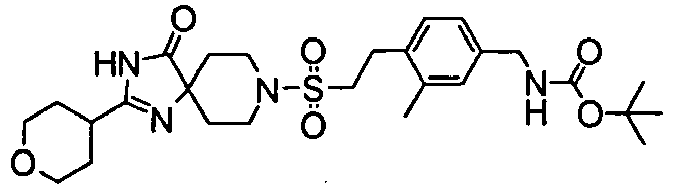
LCMS-B-1 1.92 549 (M+H)+ - The spiroamine reagent used in the synthesis of Compound 163 (2-(4,4-difluoro-cyclohexyl)-1,3,8-triaza-spiro[4.5]dec-1-en-4-one ditrifluoroacetate) was synthesized by operations similar to those in Reaction 10-14, Reaction 5-2 and Reaction 7-2 using appropriate reagents and starting material.
-

- A mixture of 1-(2-bromo-ethyl)-3-nitro-benzene (4 g, 17.4 mmol) and thiourea (1.5 g, 19.1 mmol) in ethanol (20 mL) was heated under reflux for one hour. The reaction mixture was concentrated under reduced pressure to give Compound 18b as a pale yellow solid. Further, NCS (7.66 g, 57.4 mmol) was added to a mixed solution of this solid in acetic acid (43.5 ml) and H2O (14.5 ml) on an ice bath, and the mixture was stirred at 5 to 10°C for 50 minutes. The reaction mixture was diluted with CH2Cl2, and the organic layer was then washed with water, dried over Na2SO4 and concentrated under reduced pressure. Compound 7c (5.2 g, 11.2 mmol) and Et3N (6.3 mL, 44.9 mmol) were added to a solution of the resulting Compound 18c in CH2Cl2, and the mixture was stirred at room temperature for four hours. The reaction mixture was concentrated under reduced pressure, and the residue was then purified by silica gel flash chromatography to give 2-cyclohexyl-8-[2-(3-nitro-phenyl)-ethanesulfonyl]-1,3,8-triaza-spiro[4.5]dec-1-en-4-one (18d) as a white solid (1 g, yield 20% (three steps)). This compound was directly used in the next step.
-

- 10% Pd-C (1 g) was added to a solution of Compound 18d (1 g, 2.23 mmol) in ethanol (10 ml), and the mixture was stirred at room temperature for two days in an H2 atmosphere. The reaction mixture was filtered, and the filtrate was then concentrated under reduced pressure to give 8-[2-(3-amino-phenyl)-ethanesulfonyl]-2-cyclohexyl-1,3,8-triaza-spiro[4.5]dec-1-en-4-one (920 mg, 98%).
MS (ESI) m/z = 419 (M+H)+. -

- 8-[2-(4-Amino-phenyl)-ethanesulfonyl]-2-cyclohexyl-1,3,8-triaza-spiro[4.5]dec-1-en-4-one was synthesized by operations similar to those in Reaction 5-4 and Reaction 18-2 using appropriate reagents and starting material. This compound was directly used in the next step.
-

- Acetic anhydride (45 mg, 0.44 mmol) was added to a solution of 8-[2-(4-amino-phenyl)-ethanesulfonyl]-2-cyclohexyl-1,3,8-triaza-spiro[4.5]dec-1-en-4-one (92 mg, 0.22 mmol) in CH2Cl2 (5 mL). Triethylamine (55 mg, 0.5 mmol) was then added on an ice bath, and the mixture was stirred at room temperature for one hour. The reaction mixture was diluted with dichloromethane, and the organic layer was then sequentially washed with water and saturated brine and dried over Na2SO4. The organic layer was concentrated under reduced pressure, and the resulting residue was then purified by P-TLC to give N-{4-[2-(2-cyclohexyl-4-oxo-1,3,8-triaza-spiro[4.5]dec-1-ene-8-sulfonyl)-ethyl]-phenyl}-acetamide (55 mg, 54.3%).
MS (ESI) m/z = 461 (M+H)+. -

- 4-(3-Chloromethyl-benzoylamino)-4-cyano-piperidine-1-carboxylic acid tert-butyl ester was synthesized by operations similar to those in Reaction 2-3 using appropriate reagents and starting material.
MS (ESI) m/z = 342 (M+H) +. -

- Sodium hydride (60% oil suspension, 191 mg, 4.77 mmol) was added to a solution of 2,2,2-trifluoro-ethanol (347 µl, 4.77 mmol) and 4-(3-chloromethyl-benzoylamino)-4-cyano-piperidine-1-carboxylic acid tert-butyl ester (600 mg, 1.59 mmol) in DMF (8 ml) at 0°C. The mixture was stirred at room temperature overnight, and then quenched with water and diluted with ethyl acetate. The organic layer was sequentially washed with a saturated aqueous NaHCO3 solution, water (x 2) and saturated brine, and then dried over Na2SO4 and concentrated under reduced pressure. The resulting residue was purified by silica gel column chromatography (hexane/ethyl acetate = 2/1 -> 1/2) to give 4-cyano-4-[3-(2,2,2-trifluoro-ethoxymethyl)-benzoylamino]-piperidine-1-carboxylic acid tert-butyl ester as a white solid (366 mg, 52%).
MS (ESI) m/z = 442 (M+H)+. -

- 3,N,N-Trimethyl-4-(2-{4-oxo-2-[3-(2,2,2-trifluoro-ethoxymethyl)-phenyl]-1,3,8-triaza-spiro[4.5]dec-1-ene-8-sulfonyl}-ethyl)-benzamide was synthesized by operations similar to those in Reaction 5-2, Reaction 7-2 and Reaction 5-4 using appropriate reagents and starting material.
MS (ESI) m/z = 595 (M+H)+. - The example compounds shown below were synthesized by operations similar to those in Example 20 using appropriate reagents and starting materials.
-
[Table 28] Compound Structure LCMS or HPLC condition Retention time (min) MS (m/z) 169 
LCMS-C-1 2.23 577 (M+H) + 170 
LCMS-C-1 2.53 627 (M+H) + -

- A mixture of 2-(3-bromo-phenyl)-4-oxo-1,3,8-triaza-spiro[4.5]dec-1-ene-8-carboxylic acid tert-butyl ester (100 mg, 0.245 mmol), 3,5-dimethyl-isoxazole-4-boronic acid (51.8 mg, 0.367 mmol), tetrakis-(triphenylphosphine)palladium(0) (28 mg, 0.0245 mmol) and K3PO4 (104 mg, 0.490 mmol) in dioxane (1.2 mL) was heated with stirring at 100°C for one hour in a nitrogen atmosphere. The reaction mixture was cooled, and then quenched with water and extracted with ethyl acetate (x 3). The organic layers were combined and sequentially washed with water (x 2) and saturated brine, and then dried over sodium sulfate and concentrated under reduced pressure. The resulting residue was purified by silica gel column chromatography (n-hexane:ethyl acetate = 2:1) to give 2-[3-(3,5-dimethyl-isoxazol-4-yl)-phenyl]-4-oxo-1,3,8-triaza-spiro[4.5]dec-1-ene-8-carboxylic acid tert-butyl ester as a pale yellow solid (88.3 mg, 85%).
1H-NMR (400 MHz, CDCl3) δ 1.51 (9H, s), 1.52-1.63 (2H, m), 1.89-2.27 (2H, m), 2.31 (3H, s), 2.45 (3H, s), 3.38-3.55 (2H, m), 3.94-4.12 (2H, m), 7.45 (1H, d, J = 7.8 Hz), 7.61 (1H, dd, J = 7.8, 7.8 Hz), 7.85 (1H, s), 7.92 (1H, d, J = 7.8 Hz), 10.20 (1H, brs). -

- 4-(2-{2-[3-(3,5-Dimethyl-isoxazol-4-yl)-phenyl]-4-oxo-1,3,8-triaza-spiro[4.5]dec-1-ene-8-sulfonyl}-ethyl)-3,N,N-trimethyl-benzamide was synthesized by operations similar to those in Reaction 5-3 and Reaction 5-4 using appropriate reagents and starting material.
1H-NMR (400 MHz, CD3OD) δ 1.73-1.82 (2H, m), 1.98-2.07 (2H, m), 2.27 (3H, s), 2.42 (3H, s), 2.43 (3H, s), 3.00 (3H, s), 3.09 (3H, s), 3.14-3.22 (2H, m), 3.32-3.38 (2H, m), 3.45-3.55 (2H, m), 3.75-3.84 (2H, m), 7.23 (1H, d, J = 7.8 Hz), 7.26 (1H, s), 7.34 (1H, d, J = 7.8 Hz), 7.60 (1H, d, J = 7.8 Hz), 7.66 (1H, d, J = 7.8 Hz), 7.92 (1H, s), 7.99 (1H, d, J = 7.8 Hz). MS (ESI) m/z = 578 (M+H)+. - The example compounds shown below were synthesized by operations similar to those in Example 21 using appropriate reagents and starting materials.
-
[Table 29] Compound Structure LCMS or HPLC condition Retention time (min) MS (m/z) 172 
LCMS-B-1 2.11 559 (M+H)+ 173 
LCMS-B-1 1.50 560 (M+H) + -

- 2-(3-Carboxy-phenyl)-4-oxo-1,3,8-triaza-spiro[4.5]dec-1-ene-8-carboxylic acid tert-butyl ester was synthesized by operations similar to those in Reaction 10-14 and Reaction 2-4 using appropriate reagents and starting material.
MS (ESI) m/z = 374 (M+H)+. -

- (Trimethylsilyl)diazomethane (2.0 M in hexane, 4.0 ml, 8.0 mmol) was added dropwise to a solution of 2-(3-carboxy-phenyl)-4-oxo-1,3,8-triaza-spiro[4.5]dec-1-ene-8-carboxylic acid tert-butyl ester (200 mg, 0.54 mmol) in methanol (10 ml). The mixture was stirred at room temperature for one hour, and (trimethylsilyl)diazomethane (1.0 ml, 2.0 mmol) was then further added, followed by stirring for one hour. The reaction mixture was concentrated under reduced pressure, and the resulting solid was then washed with a solution of hexane/ethyl acetate = 5/1 to give 2-(3-methoxycarbonyl-phenyl)-4-oxo-1,3,8-triaza-spiro[4.5]dec-1-ene-8-carboxylic acid tert-butyl ester (91.5 mg, 44%).
MS (ESI) m/z = 388 (M+H)+ -

- 3-{8-[2-(4-Dimethylcarbamoyl-2-methyl-phenyl)-ethanesulfonyl]-4-oxo-1,3,8-triaza-spiro[4.5]dec-1-en-2-yl}-benzoic acid methyl ester was synthesized by operations similar to those in Reaction 4-1 and Reaction 5-4 using appropriate reagents and starting material.
MS (ESI) m/z = 541 (M+H)+. -

- 2,4-Dichlorophenol (448 mg, 2.75 mmol) and K2CO3 (775 mg, 5.61 mmol) were continuously added to 2-bromo-2-methyl-propionic acid ethyl ester (800 mg, 4.10 mmol) in N,N-dimethylacetamide (4 ml) at room temperature. The mixture was stirred at 110°C for 14 hours, and saturated NH4Cl and H2O were then added, followed by extraction with AcOEt (x 2). The organic layers were combined and sequentially washed with H2O and saturated brine, and then dried over Na2SO4 and concentrated under reduced pressure. The resulting residue was purified by silica gel column chromatography (n-hexane/AcOEt) to give 2-(2,4-dichloro-phenoxy)-2-methyl-propionic acid ethyl ester (389 mg, 50%).
1H-NMR (270 MHz, CDCl3): δ. 1.28 (3H, t, J = 7.3 Hz), 1.60 (6H, s), 4.25 (2H, q, J = 7.3 Hz), 6.86 (1H, d, J = 8.8 Hz), 7.10 (1H, dd, J = 8.8, 2.4 Hz), 7.38 (1H, d, J = 2.4 Hz). -

- A 5 N aqueous NaOH solution (0.83 ml) was added to a solution of 2-(2,4-dichloro-phenoxy)-2-methyl-propionic acid ethyl ester (383 mg, 1.38 mmol) in MeOH (6 ml) at room temperature. The mixture was stirred at room temperature for four hours, and 1 N HCl (4.5 ml) and H2O were then added, followed by extraction with AcOEt (x 2). The organic layers were combined and sequentially washed with H2O and saturated brine, and then dried over Na2SO4 and concentrated under reduced pressure to give 2-(2,4-dichloro-phenoxy)-2-methyl-propionic acid (359 mg).
1H-NMR (270 MHz, DMSO-d6) δ 1.54 (6H, s), 6.94 (1H, d, J = 8.8 Hz), 7.35 (1H, dd, J = 8.8, 2.9 Hz), 7.60 (1H, d, J = 2.4 Hz), 13.29 (1H, br.s). -

- 4-(2-{2-[1-(2,4-Dichloro-phenoxy)-1-methyl-ethyl]-4-oxo-1,3,8-triaza-spiro[4.5]ded-1-ene-8-sulfonyl}-ethyl)-3,N,N-trimethyl-benzamide was synthesized by operations similar to those in Reaction 10-14, Reaction 2-4, Reaction 7-2 and Reaction 5-4 using appropriate reagents and starting material.
MS (ESI) m/z = 609 (M+H)+. - The example compound shown below was synthesized by operations similar to those in Example 23 using appropriate reagents and starting material.
-
[Table 30] Compound Structure LCMS or HPLC condition Retention time (min) MS (m/z) 176 
LCMS-C-1 2.42 567 (M+H) + -

- 2-Bromoethanol (0.28 mL, 4.00 mmol) was added to a solution of chlorosulfonyl isocyanate (0.35 mL, 4.00 mmol) in dichloromethane (1.8 mL) at 0°C. After stirring for 90 minutes, a solution of 3-ethylaniline (0.55 mL, 4.40 mmol) and triethylamine (1.23 mL, 8.80 mmol) in dichloromethane (3.6 mL) was added. The mixture was stirred for 90 minutes and then quenched with a 2 N aqueous hydrochloric acid solution. The mixed solution was separated, and the aqueous layer was then extracted with ether. The organic layers were combined and washed with water and saturated brine, and then dried over sodium sulfate and concentrated under reduced pressure. The resulting residue was washed with ether (5 mL) to give 2-oxo-oxazolidine-3-sulfonic acid (3-ethylphenyl)amide (LCMS yield 80%).
MS (ESI) m/z = 271 (M+H)+. -
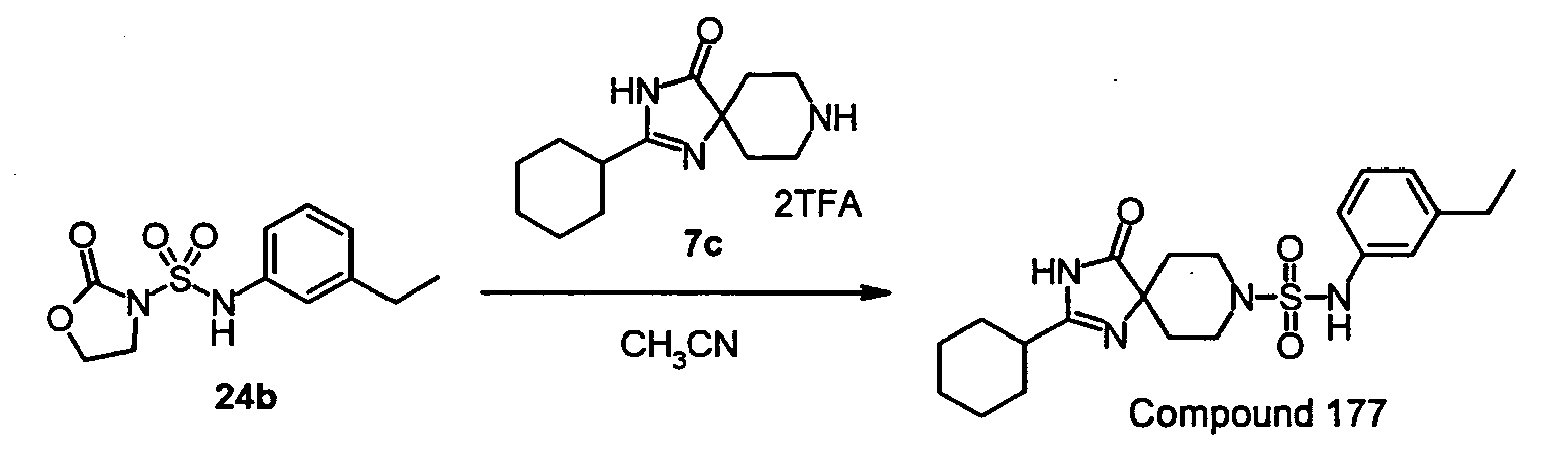
- A solution of 2-oxo-oxazolidine-3-sulfonic acid (3-ethylphenyl)amide (92 mg, 0.340 mmol) and 2-cyclohexyl-1,3,8-triaza-spiro[4.5]dec-1-en-4-one ditrifluoroacetate (93 mg, 0.395 mmol) in acetonitrile (0.80 mL) was irradiated with microwaves (150°C, 15 min). The reaction mixture was filtered, and the resulting filtrate was then concentrated under reduced pressure. Further, the resulting residue was purified by silica gel chromatography to give 2-cyclohexyl-4-oxo-1,3,8-triaza-spiro[4.5]dec-1-ene-8-sulfonic acid (3-ethylphenyl)amide as a white amorphous (33 mg, 23%).
1H-NMR (270 MHz, CDCl3) δ 1.24 (3H, t, J = 7.8 Hz), 1.31-1.93 (14H, m), 2.36-2.40 (1H, m), 2.64 (2H, q, J = 7.8 Hz), 3.34-3.44 (2H, m), 3.69-3.76 (2H, m), 6.54 (1H, s), 6.96-7.02 (3H, m), 7.20-7.24 (1H, m), 8.27 (1H, s). MS (ESI) m/z = 419 (M+H)+. -

- 2-Chloro-ethanesulfonyl chloride (440 µl, 4.21 mmol) was added to a solution of 2-cyclohexyl-1,3,8-triaza-spiro[4.5]dec-1-en-4-one dihydrochloride (1.50 g, 3.24 mmol) and triethylamine (2.7 ml, 19.4 mmol) in CH2Cl2 (30 ml) at room temperature in an N2 atmosphere. The mixture was stirred at room temperature for 30 minutes, and then washed with water, dried over sodium sulfate and concentrated under reduced pressure. The resulting residue was triturated with AcOEt-hexane, and the solid was then collected by filtration and dried to give 2-cyclohexyl-8-ethenesulfonyl-1,3,8-triaza-spiro[4.5]dec-1-en-4-one as a colorless solid (692 mg, 66%).
1H-NMR (400 MHz, CDCl3) δ 1.25-1.45 (6H, m), 1.70-2.05 (8H, m), 2.40-2.47 (1H, m), 3.21-3.30 (2H, m), 3.61-3.69 (2H, m), 6.03 (1H, d, J = 8.0 Hz), 6.26 (1H, d, J = 16.0 Hz), 6.49 (1H, dd, J = 16.0, 8.0 Hz), 8.17 (1H, brs). MS (ESI) m/z = 326 (M+H)+. -

- 2-Cyclohexyl-8-ethenesulfonyl-1,3,8-triaza-spiro[4.5]dec-1-en-4-one (60.0 mg, 0.184 mmol), 5-bromo-indole (72.0 mg, 0.367 mmol), palladium(II) acetate (4.1 mg, 0.0183 mmol), tris(o-tolyl)phosphine (11.2 mg, 0.0368 mmol), triethylamine (0.077 ml, 0.552 mmol) and DMA (0.6 ml) were mixed in a sealed test tube in an N2 atmosphere. This mixture was irradiated with microwaves (190°C, 20 min). The reaction mixture was cooled, and then quenched with saturated brine and extracted with ethyl acetate three times. The organic layers were combined, sequentially washed with water and saturated brine and concentrated under reduced pressure. The resulting residue was purified by silica gel column chromatography (CH2Cl2-MeOH) to give 2-cyclohexyl-8-[(E)-2-(1H-indol-5-yl)-ethenesulfonyl]-1,3,8-triaza-spiro[4.5]dec-1-en-4-one as a yellow form (40.6 mg, 50%).
1H-NMR (270 MHz, CDCl3) δ 1.20-1.45 (5H, m), 1.52-1.95 (7H, m), 1.98-2.11 (2H, m), 2.35-2.48 (1H, m), 3.20-3.31 (2H, m), 3.68-3.79 (2H, m), 6.59-6.63 (1H, m), 6.65 (1H, d, J = 16 Hz), 7.25-7.28 (1H, m), 7.33-7.44 (2H, m), 7.60 (1H, d, J = 16 Hz), 7.77-7.79 (1H, m), 8.33 (1H, brs), 8.37 (1H, brs). MS (ESI) m/z = 441 (M+H)+. - The example compounds shown below were synthesized by operations similar to those in Example 25 using appropriate reagents and starting materials.
-
[Table 31] Compound Structure LCMS or HPLC condition Retention time (min) MS (m/z) 179 
LCMS-E-8 3.68 470 (M+H) + 180 
LCMS-E-5 3.14 432 (M+H)+ 181 
LCMS-E-4 2.91 432 (M+H)+ 182 
LCMS-C-1 2.48 441 (M+H)+ 183 
LCMS-E-6 1.66 488 (M+H) + 184 
LCMS-E-6 1.53 438 (M+H) + 185 
LCMS-E-6 1.7 488 (M+H)+ 186 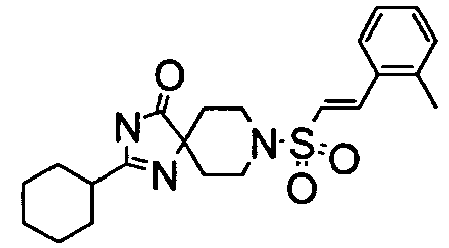
LCMS-C-1 2.73 416 (M+H)+ 187 
LCMS-C-1 2.37 446 (M+H)+ 188 
LCMS-A-1 1.84 459 (M+H)+ 189 
LCMS-C-1 2.53 512 (M+H)+ 190 
LCMS-A-1 1.87 473 (M+H)+ 191 
LCMS-C-1 2.35 515 (M+H)+ 192 
LCMS-C-1 2.65 554 (M+H)+ 193 
LCMS-C-1 2.37 526 (M+H) + 194 
LCMS-C-1 2.60 556 (M+H) + 195 
LCMS-C-1 2.75 553 (M+H)+ 196 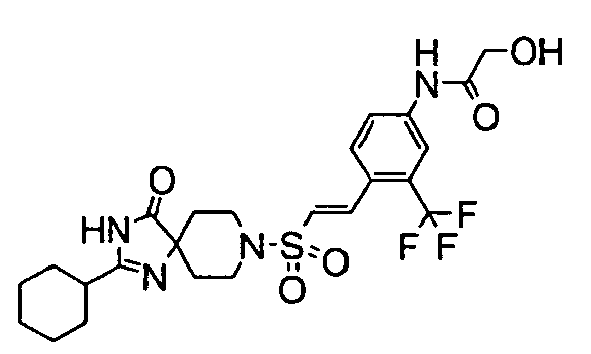
LCMS-C-1 2.48 543 (M+H)+ 197 
LCMS-A-1 2.19 489 (M+H)+ 198 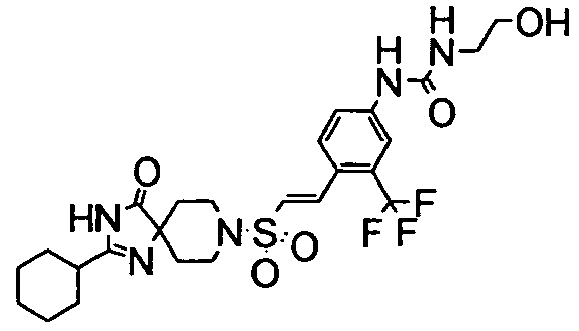
LCMS-C-1 2.48 572 (M+H)+ 199 
LCMS-A-1 1.89 475 (M+H)+ 200 
LCMS-A-1 2.09 475 (M+H)+ 201 
LCMS-A-1 2.19 570 (M+H)+ 202 
LCMS-C-1 2.44 573 (M+H)+ 203 
LCMS-A-1 2.33 585 (M+N) + - The aryl bromide reagent used in the synthesis of Compound 191 ((S)-3-(4-bromo-indol-1-yl)-propane-1,2-diol) was synthesized as follows.
-

- NaH (382 mg, 9.55 mmol, 60% oily suspension) was added to a solution of 4-bromo-indole (1.0 ml, 7.97 mmol) and (R)-(-)-2,2-dimethyl-1,3-dioxolan-4-ylmethyl p-toluenesulfonate (2.74 g, 9.57 mmol) in dimethylformamide (20 ml) at 0°C. The mixture was stirred at 0°C for two hours and at room temperature for 18 hours. NaH (190 mg, 4.75 mmol, 60% oily suspension) was further added, and the mixture was stirred at room temperature for six hours. The reaction mixture was diluted with AcOEt, and the organic layer was then washed with water (x 2), dried over sodium sulfate and concentrated under reduced pressure. The resulting 4-bromo-1-((S)-2,2-dimethyl-[1,3]dioxolan-4-ylmethyl)-1H-indole was used in the next step without further purification.
-
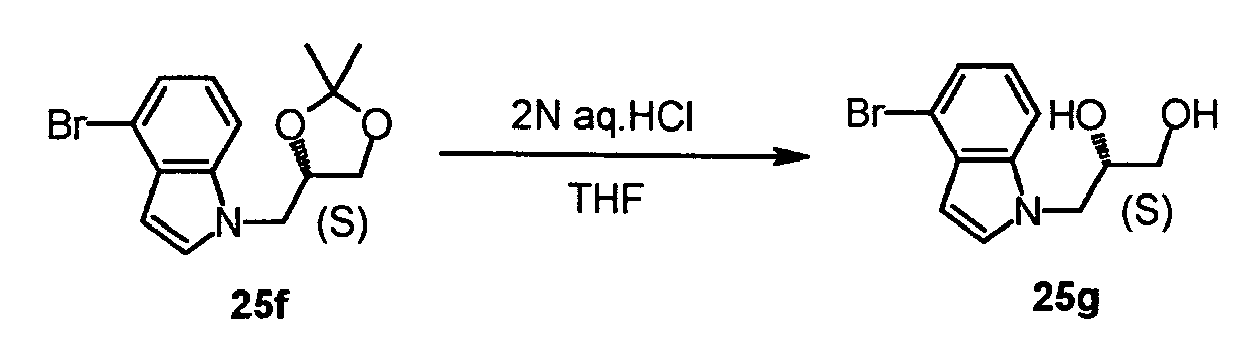
- A 2 N aqueous HCl solution (15 ml) was added to a solution of the above mixture (4-bromo-1-((S)-2,2-dimethyl-[1,3]dioxolan-4-ylmethyl)-1H-indole) in tetrahydrofuran (30 ml), and the mixture was stirred at room temperature for eight hours. The reaction mixture was concentrated, and the residue was then diluted with AcOEt. This organic layer was sequentially washed with water (x 2) and a saturated aqueous NaCl solution, and then dried and concentrated under reduced pressure. The resulting residue was purified by silica gel column chromatography (CH2Cl2-MeOH) to give (S)-3-(4-bromo-indol-1-yl)-propane-1,2-diol as a colorless solid (2.05 g, 95%).
MS (ESI) m/z = 270, 272 (M+H)+. - The aryl bromide reagent used in the synthesis of Compound 192 (4-bromo-1-(2-morpholin-4-yl-ethyl)-1H-indole) was synthesized as follows.
-

- 4-Bromo-1-(2-morpholin-4-yl-ethyl)-1H-indole was synthesized by operations similar to those in Reaction 25-3 using appropriate reagents and starting material.
MS (ESI) m/z = 309, 311 (M+H)+. - The aryl bromide reagent used in the synthesis of Compound 193 (2-(4-bromo-indol-1-yl)-N,N-dimethyl-acetamide) was synthesized as follows.
-

- 2-(4-Bromo-indol-1-yl)-N,N-dimethyl-acetamide was synthesized by operations similar to those in Reaction 25-3, Reaction 23-2 and Reaction 10-18 using appropriate reagents, solvent and starting material.
MS (ESI) m/z = 281, 283 (M+H)+. - The aryl bromide reagent used in the synthesis of Compound 194 (3-(4-bromo-3-trifluoromethyl-phenyl)-1,1-dimethyl-urea) was synthesized as follows.
-

- 3-(4-Bromo-3-trifluoromethyl-phenyl)-1,1-dimethyl-urea was synthesized by operations similar to those in Reaction 2-3 using appropriate reagents and starting material.
MS (ESI) m/z = 311, 313 (M+H)+. - The aryl bromide reagent used in the synthesis of Compound 195 (cyclopropanecarboxylic (4-bromo-3-trifluoromethyl-phenyl)-amide) was synthesized as follows.
-

- Cyclopropanecarboxylic (4-bromo-3-trifluoromethyl-phenyl)-amide was synthesized by operations similar to those in Reaction 2-3 using appropriate reagents and starting material.
MS (ESI) m/z = 308, 310 (M+H)+. - The aryl bromide reagent used in the synthesis of Compound 196 (N-(4-bromo-3-trifluoromethyl-phenyl)-2-hydroxy-acetamide) was synthesized as follows.
-

- N-(4-Bromo-3-trifluoromethyl-phenyl)-2-hydroxy-acetamide was synthesized by operations similar to those in Reaction 2-3 and Reaction 23-2 using appropriate reagents and starting material.
MS (ESI) m/z = 298, 300 (M+H)+. - The aryl bromide reagent used in the synthesis of Compound 197 ((3-bromo-4-methyl-phenyl)-carbamic acid methyl ester) was synthesized as follows.
-

- Methyl chloroformate (0.202 ml, 2.62 mmol) was added to a solution of 3-bromo-4-methyl-phenylamine (243 mg, 1.31 mmol) in pyridine (2 ml), and the mixture was stirred at room temperature overnight. H2O was added to the reaction mixture, followed by extraction with AcOEt (x 2). The organic layers were combined and sequentially washed with H2O and saturated brine, and then dried over Na2SO4 and concentrated under reduced pressure. The resulting residue was purified by silica gel chromatography (n-hexane/AcOEt) to give (3-bromo-4-methyl-phenyl)-carbamic acid methyl ester (288 mg, 90%).
1H-NMR (270 MHz, CDCl3) δ 2.34 (3H, s), 3.77 (3H, s), 6.51 (1H, br. s), 7.14 (1H, d, J = 7.2 Hz), 7.20 (1H, dd, J = 7.4, 2.0 Hz), 7.63 (1H, d, J = 2.0 Hz). - The aryl bromide reagent used in the synthesis of Compound 198 (1-(4-bromo-3-trifluoromethyl-phenyl)-3-(2-hydroxy-ethyl)-urea) was synthesized as follows.
-

- p-Nitrophenyl chloroformate (437 mg, 2.17 mmol) was added to a solution of 4-bromo-3-trifluoromethyl-aniline (400 µl, 1.67 mmol) and pyridine (202 µl, 2.50 mmol) in CH2Cl2 (6.2 ml) at 0°C. The mixture was stirred at 0°C for one hour, and 2-amino-ethanol (150 µl, 2.50 mmol) was then added, followed by further stirring at 0°C for two hours. Triethylamine (210 µl, 1.51 mmol) was added to the mixture, and the mixture was stirred at 0°C for one hour. 1 N HCl was added to the reaction mixture, followed by extraction with CH2Cl2/AcOEt. The organic layer was washed with water (x 2), and then dried over sodium sulfate and concentrated under reduced pressure. The residue was purified by silica gel column chromatography (CH2Cl2-MeOH) to give 1-(4-bromo-3-trifluoromethyl-phenyl)-3-(2-hydroxy-ethyl)-urea as a white powder (520 mg, 73%).
MS (ESI) m/z = 327, 329 (M+H)+. - The aryl bromide reagent used in the synthesis of Compound 199 (2-(3-bromo-4-methyl-phenylamino)-ethanol) was synthesized as follows.
-

- Triethylamine (0.28 mL, 2.00 mmol) and bromoethanol (0.14 mL, 1.98 mmol) were added to a solution of 3-bromo-4-methyl-phenylamine (240 mg, 1.29 mmol) in toluene (2 ml). The mixture was stirred at 100°C overnight and H2O was then added, followed by extraction with AcOEt (x 2). The organic layers were combined and sequentially washed with H2O and saturated brine, and then dried over Na2SO4 and concentrated under reduced pressure. The resulting residue was purified by silica gel column chromatography (n-hexane/AcOEt) to give 2-(3-bromo-4-methylphenylamino)-ethanol (185 mg, 62%).
1H-NMR (270 MHz, CDCl3) δ 1.68 (1H, br, OH), 2.27 (3H, s, Me), 3.26 (2H, dd, J = 5.3, 5.1 Hz), 3.82 (2H, dd, J = 5.3, 5.1 Hz), 3.90 (1H, br, NH), 6.52 (1H, dd, J = 8.2, 2.5 Hz), 6.85 (1H, d, J = 2.5 Hz), 7.01 (1H, d, J = 8.2 Hz). MS (ESI) m/z = 230, 232 (M+H)+. - The aryl bromide reagent used in the synthesis of Compound 200 (2-(2-bromo-3-methyl-phenylamino)-ethanol) was synthesized as follows.
-

- 2-(2-Bromo-3-methyl-phenylamino)-ethanol was synthesized by operations similar to those in Reaction 25-12 using appropriate reagents and starting material.
MS (ESI) m/z = 230, 232 (M+H)+. - The aryl bromide reagent used in the synthesis of Compound 201 (2-(4-bromo-3-trifluoromethyl-phenylamino)-N,N-dimethyl-acetamide) was synthesized as follows.
-

- 2-(4-Bromo-3-trifluoromethyl-phenylamino)-N,N-dimethyl-acetamide was synthesized by operations similar to those in Reaction 25-12, Reaction 14-1 and Reaction 10-14 using appropriate reagents and starting material.
MS (ESI) m/z = 325, 327 (M+H) +. - The aryl bromide reagent used in the synthesis of Compound 202 (4-bromo-1-((S)-2,2-dimethyl-[1,3]dioxolan-4-ylmethyl)-3-fluoro-1H-indole) was synthesized as follows.
-

- Diethylaminotrifluorosulfur (1.5 mL, 11.06 mmol) was added to a solution of 4-bromo-1H-indole-2,3-dione (1.0 g, 4.4 mmol) in dichloromethane (44 mL) at 0°C. The mixture was stirred at room temperature for 54 hours and then quenched with methanol-water. The organic layer and the aqueous layer were separated, and the aqueous layer was then extracted with dichloromethane. The organic layers were combined, dried over sodium sulfate and then concentrated under reduced pressure. The resulting residue was purified by silica gel column chromatography to give 4-bromo-3,3-difluoro-1,3-dihydro-indol-2-one as a yellow solid (559 mg, 51%).
MS (ESI) m/z = 246 (M-H)-. -

- Synthesis of a 1.3 M solution of BH2F in tetrahydrofuran (Reagent A): Boron trifluoride etherate (2 mL) was added dropwise to a suspension of sodium borohydride (340 mg, 4.5 mmol) in tetrahydrofuran (12 mL) at 0°C. The mixture was stirred at 0°C for 90 minutes to give Reagent A.
- Reagent A (2.85 mL, 3.709 mmol) was added dropwise to a solution of 4-bromo-3,3-difluoro-1,3-dihydro-indol-2-one (400 mg, 1.61 mmol) in tetrahydrofuran (8.1 mL) at 0°C. The mixture was stirred at 0°C for 3.5 hours and at room temperature for 16 hours. Further, Reagent A (3.0 mL) was added to the reaction mixture, followed by stirring at room temperature for three hours. The reaction mixture was quenched with 3 M HCl (4.8 mL) and then extracted with ethyl acetate (x 2). The organic layers were combined and sequentially washed with water and saturated brine, and then dried over sodium sulfate and concentrated under reduced pressure. The resulting residue was purified by silica gel column chromatography to give 4-bromo-3-fluoro-1H-indole as a yellow oil (132 mg, 38%).
MS (ESI) m/z = 212 (M-H)-. -

- 4-Bromo-1-((S)-2,2-dimethyl-[1,3]dioxolan-4-ylmethyl)-3-fluoro-1H-indole was synthesized by operations similar to those in Reaction 25-3 using appropriate reagents and starting material.
1H-NMR (400 MHz, CDCl3) δ 1.33 (3H, s), 1.40 (3H, s), 3.65 (1H, dd, J = 5.9, 8.8 Hz), 4.04 (1H, dd, J = 6.1, 8.8 Hz), 4.14 (2H, t, J = 4.9 Hz), 4.37-4.42 (1H, m), 7.02-7.07 (2H, m), 7.23-7.27 (2H, m). - The aryl bromide reagent used in the synthesis of Compound 203 ((4-bromo-3-methyl-phenyl)-(3,3,4,4-tetrafluoro-pyrrolidin-1-yl)-methanone) was synthesized as follows.
-

- (4-Bromo-3-methyl-phenyl)-(3,3,4,4-tetrafluoro-pyrrolidin-1-yl)-methanone was synthesized by operations similar to those in Reaction 10-14 using appropriate reagents and starting material.
MS (ESI) m/z = 340, 342 (M+H)+. -

- A mixture of 2-cyclohexyl-8-ethenesulfonyl-1,3,8-triaza-spiro[4.5]dec-1-en-4-one (100.0 mg, 0.307 mmol), N-(4-bromo-3,5-dimethyl-phenyl)-acetamide (112. mg, 0.461 mmol), palladium(II) acetate (10 mg, 0.0461 mmol), tris(o-tolyl)phosphine (28 mg, 0.0922 mmol), triethylamine (0.128 ml, 0.922 mmol) and DMA (1.5 ml) was added to a sealed test tube in an N2 atmosphere. This mixture was heated with stirring at 130°C for 13.5 hours. Palladium(II) acetate (10 mg, 0.0461 mmol), tris(o-tolyl)phosphine (28 mg, 0.0922 mmol) and triethylamine (0.128 ml, 0.922 mmol) were further added to the reaction mixture at room temperature in an N2 atmosphere, and the mixture was heated with stirring at 130°C for 14 hours. The reaction mixture was cooled and water was then added. The aqueous layer was extracted with ethyl acetate (x 3). The organic layers were combined and sequentially washed with water (x 2) and saturated brine, and then dried over sodium sulfate and concentrated under reduced pressure. The resulting residue was purified by silica gel column chromatography (CH2Cl2-MeOH) to give N-{4-[(E)-2-(2-cyclohexyl-4-oxo-1,3,8-triaza-spiro[4.5]dec-1-ene-8-sulfonyl)-vinyl]-3,5-dimethyl-phenyl}-acetamide (61.4 mg, 41%).
1H-NMR (400 MHz, CD3OD) δ 1.20-1.57 (6H, m), 1.59-1.79 (3H, m), 1.80-2.00 (6H, m), 2.12 (3H, s), 2.39 (6H, s), 3.20-3.40 (2H, m), 3.58-3.75 (2H, m), 6.58 (1H, d, J = 16 Hz), 7.35 (2H, s), 7.57 (1H, d, J = 16 Hz). MS (ESI) m/z = 487 (M+H)+: - The example compounds shown below were synthesized by operations similar to those in Example 26 using appropriate reagents and starting materials.
-
[Table 32] Compound Structure LCMS or HPLC condition Retention time (min) MS (m/z) 205 
LCMS-C-1 2.87 599 (M+H)+ 206 
LCMS-C-1 2.38 520 (M+H)+ 207 
LCMS-C-1 2.23 530 (M+H)+ 208 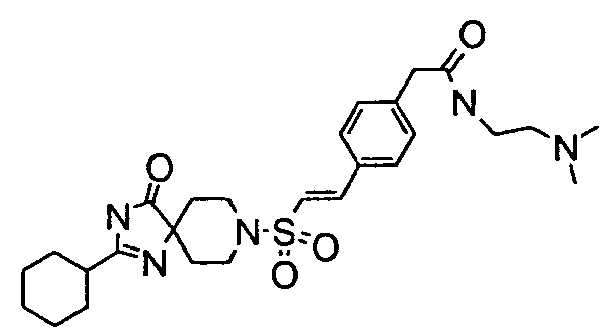
LCMS-C-1 2.12 530 (M+H)+ - The aryl bromide reagent used in the synthesis of Compound 204 (N-(4-bromo-3,5-dimethyl-phenyl)-acetamide) was synthesized as follows.
-

MS (ESI+) m/z = 242, 244 (M+H)+. - The aryl bromide reagent used in the synthesis of Compound 205 ((4-bromo-3-methyl-benzyl)-carbamic acid tert-butyl ester) was synthesized as follows.
-
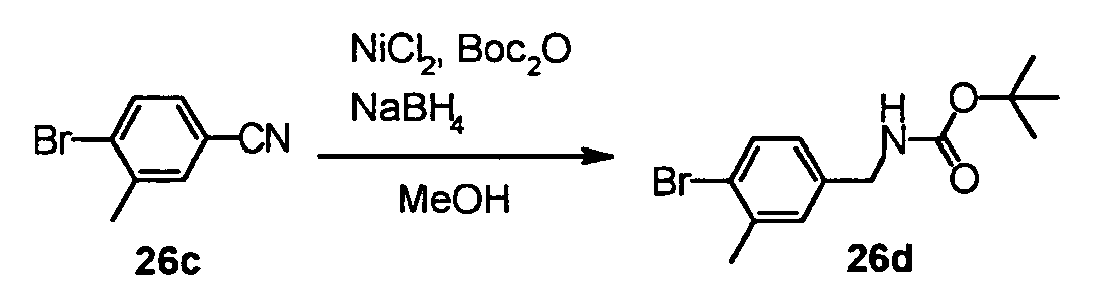
- NaBH4 (1.45 g, 38.25 mmol) was added in small portions to a mixture of 4-bromo-3-methyl-benzonitrile (2.50 g, 12.8 mmol), NiCl2 (1.65 g, 12.8 mmol) and BoC2O (5.57 g, 25.5 mmol) in anhydrous MeOH (130 ml) at 0°C. The reaction mixture was stirred at room temperature for two hours and then concentrated under reduced pressure. Ethyl acetate and water were added to the resulting residue, and the mixture was filtered through celite. The organic layer and the aqueous layer were separated, and the aqueous layer was then extracted with ethyl acetate. The organic layers were combined, dried over Na2SO4 and then concentrated under reduced pressure. The residue was purified by silica gel column chromatography (hexane/ethyl acetate = 1/0 -> 4/1) to give (4-bromo-3-methyl-benzyl)-carbamic acid tert-butyl ester as a white solid (2.42 g, 63%)
MS (ESI) m/z = 322 (M+Na)+. - The aryl bromide reagent used in the synthesis of Compound 206 ((R)-3-(4-bromo-3,5-dimethyl-phenoxy)-propane-1,2-diol) was synthesized as follows.
-

- A mixture of 4-bromo-3,5-dimethyl-phenol (500 mg, 2.49 mmol), (R)-(-)-2,2-dimethyl-1,3-dioxolan-4-ylmethyl p-toluenesulfonate (856 mg, 2.99 mmol) and K2CO3 (1.03 g, 7.45 mmol) in dimethylformamide (5 ml) was stirred at 100°C for two hours. The reaction mixture was diluted with AcOEt, and the organic layer was then washed with water (x 2), dried over sodium sulfate and concentrated under reduced pressure. The resulting residue was purified by silica gel column chromatography (AcOEt-hexane) to give (S)-4-(4-bromo-3,5-dimethyl-phenoxymethyl)-2,2-dimethyl-[1,3]dioxolane as a colorless solid (749 mg, 95%).
1H-NMR (400 MHz, CDCl3) δ 1.40 (3H, s), 1.46 (3H, s), 2.37 (6H, s), 3.85-3.92 (2H, m), 3.98-4.03 (1H, m), 4.13-4.18 (1H, m), 4.42-4.48 (1H, m), 6.66 (2H, s). -

- (R)-3-(4-Bromo-3,5-dimethyl-phenoxy)-propane-1,2-diol was synthesized by operations similar to those in Reaction 25-4 using appropriate reagents and starting material.
MS (ESI) m/z = 275, 277 (M+H)+. - The aryl bromide reagent used in the synthesis of Compound 207 (5-[(4-bromo-3-methyl-phenylamino)-methyl]-oxazolidin-2-one) was synthesized as follows.
-

- 5-[(4-Bromo-3-methyl-phenylamino)-methyl]-oxazolidin-2-one was synthesized by operations similar to those in Reaction 25-12 using appropriate reagents and starting material.
MS (ESI) m/z = 285, 287 (M+H)+. - The aryl bromide reagent used in the synthesis of Compound 208 (2-(4-bromo-phenyl)-N-(2-dimethylamino-ethyl)acetamide) was synthesized as follows.
-

- 2-(4-Bromo-phenyl)-N-(2-dimethylamino-ethyl)acetamide was synthesized by operations similar to those in Reaction 10-1 using appropriate reagents and starting material:
MS (ESI) m/z = 285, 287 (M+H)+. -

- 3-{(E)-2-[2-(4-Methyl-cyclohexyl)-4-oxo-1,3,8-triaza-spiro[4.5]dec-1-ene-8-sulfonyl]-vinyl}-benzonitrile was synthesized by operations similar to those in Reaction 25-1 and Reaction 25-2 using appropriate reagents and starting material.
MS (ESI) m/z = 441 (M+H)+. -

- 8-{(E)-2-[4-(3,4-Dihydroxy-butoxy)-2-methyl-phenyl]-ethenesulfonyl}-2-(3-trifluoromethyl-phenyl)-1,3,8-triaza-spiro[4.5]dec-1-en-4-one was synthesized by operations similar to those in Reaction 25-1 and Reaction 25-2 using appropriate reagents and starting material.
MS (ESI) m/z = 441 (M+H)+. - The example compounds shown below were synthesized by operations similar to those in Example 28 using appropriate reagents and starting materials.
-
[Table 33] Compound Structure LCMS or HPLC condition Retention time (min) MS (m/z) 211 
LCMS-C-2 2.02 591 (M+H)+ 212 
LCMS-B-1 2.25 575 (M+H)+ 213 
LCMS-C-1 2.37 557 (M+H)+ 214 
LCMS-C-1 2.42 579 (M+H)+ - The aryl bromide reagent used in the synthesis of Compound 210 (4-(4-bromo-3-methyl-phenoxy)-butane-1,2-diol) was synthesized as follows.
-

- 4-(4-Bromo-3-methyl-phenoxy)-butane-1,2-diol was synthesized by operations similar to those in Reaction 26-4 and Reaction 25-4 using appropriate reagents and starting material.
MS (ESI) m/z = 275, 277 (M+H)+. - The aryl bromide reagent used in the synthesis of Compound 211 (2-(4-bromo-3-trifluoromethyl-phenylamino)-ethanol) was synthesized as follows.
-

- 2-(4-Bromo-3-trifluoromethyl-phenylamino)-ethanol was synthesized by operations similar to those in Reaction 12-1 using appropriate reagents and starting material.
MS (ESI) m/z = 284, 286 (M+H)+. - The aryl bromide reagent used in the synthesis of Compound 212 ((4-bromo-3-methyl-phenyl)-pyrrolidin-1-yl-methanone) was synthesized as follows.
-

- (4-Bromo-3-methyl-phenyl)-pyrrolidin-1-yl-methanone was synthesized by operations similar to those in Reaction 10-1 using appropriate reagents and starting material.
MS (ESI) m/z = 268, 270 (M+H)+. - The aryl bromide reagent used in the synthesis of Compound 213 (4-bromo-3-methyl-benzenesulfonamide) was synthesized as follows.
-

- A 28% aqueous NH3 solution (2.0 ml) was added to a solution of 4-bromo-3-methyl-benzenesulfonyl chloride (250 mg, 0.927 mmol) in THF (2.0 ml) at 0°C. The mixture was stirred at 0°C for 6.5 hours. The reaction mixture was quenched with 1 N HCl and extracted with CH2Cl2. The organic layer was concentrated under reduced pressure, and the resulting residue was purified by silica gel column chromatography (CH2Cl2-AcOEt) to give 4-bromo-3-methyl-benzenesulfonamide as a white powder (126 mg, 54%).
MS (ESI) m/z = 272, 274 (M+Na)+. - The aryl bromide reagent used in the synthesis of Compound 214 (4-bromo-N-(2-hydroxy-ethyl)-3,N-dimethyl-benzamide) was synthesized as follows.
-

- 4-Bromo-N-(2-hydroxy-ethyl)-3,N-dimethyl-benzamide was synthesized by operations similar to those in Reaction 10-1 using appropriate reagents and starting material.
MS (ESI) m/z = 272, 274 (M+H)+. -

- N-(3-Methyl-4-{(E)-2-[4-oxo-2-(3-trifluoromethyl-phenyl)-1,3,8-triaza-spiro[4.5]dec-1-ene-8-sulfonyl]-vinyl}-phenyl)-acetamide was synthesized by operations similar to those in Reaction 26-1 using appropriate reagents and starting material.
MS (ESI) m/z = 535 (M+H)+. - The example compounds shown below were synthesized by operations similar to those in Example 29 using appropriate reagents and starting materials.
-
[Table 34] Compound Structure LCMS or HPLC condition Retention time (min) MS (m/z) 216 
LCMS-C-1 2.55 604 (M+H)+ 217 
LCMS-C-1 2.70 639 (M+H)+ 218 
LCMS-C-1 2.57 670 (M+H)+ 219 
LCMS-C-1 1.95 634 (M+H)+ 220 
LCMS-C-1 2.42 577 (M+H)+ 221 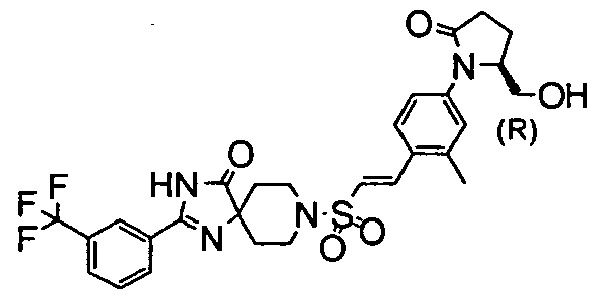
LCMS-C-1 2.42 591 (M+H)+ 222 
LCMS-C-1 2.45 593 (M+H)+ 223 
LCMS-C-1 2.50 676 (M+H)+ - The aryl bromide reagent used in the synthesis of Compound 216 ((4-bromo-3-niethyl-phenyl)-(4-methyl-piperazin-1-yl)-methanone) was synthesized as follows.
-

- (4-Bromo-3-methyl-phenyl)-(4-methyl-piperazin-1-yl)-methanone was synthesized by operations similar to those in Reaction 10-1 using appropriate reagents and starting material.
MS (ESI) m/z = 297, 299 (M+H)+. - The aryl bromide reagents used in the synthesis of Compounds 217 to 219 were synthesized by operations similar to those in Reaction 28-5 using appropriate reagents and starting materials.
[Table 35] Target Compound Aryl bromide reagent Aryl bromide reagent MS (m/z) 217 
354, 355 (M+H)+ 218 
363, 365 (M+H)+ 219 
327, 329 (M+H)+ - The aryl bromide reagent used in the synthesis of Compound 220 ((R)-1-(4-bromo-3-methyl-phenyl)-4-hydroxy-pyrrolidin-2-one) was synthesized as follows.
-

- A mixture of 2-bromo-5-iodotoluene (500 mg, 1.68 mmol), (R)-4-hydroxy-pyrrolidinone (204 mg, 2.02 mmol), 4,5-bis(diphenylphosphino)-9,9-dimethylxanthene (58.5 mg, 0.101 mmol), tris(dibenzylideneacetone)-dipalladium(0)-chloroform adduct (35.0 mg, 0.034 mmol) and cesium carbonate (769 mg, 2.36 mmol) in 1,4-dioxane (degassed, 5 ml) was stirred at 110°C overnight in a nitrogen stream. The reaction mixture was treated with H2O and extracted with AcOEt (x 2). The organic layers were combined and sequentially washed with H2O and saturated brine, and then dried over Na2SO4 and concentrated under reduced pressure. The resulting residue was purified by silica gel chromatography (n-hexane/AcOEt) to give (R)-1-(4-bromo-3-methyl-phenyl)-4-hydroxy-pyrrolidin-2-one as a pale brown solid (173 mg, 38%)
1H-NMR (400 MHz, DMSO-d6) δ 2.29 (1H, d, J = 17.1 Hz), 2.34 (3H, s), 2.82 (1H, dd, J = 17.1, 6.4 Hz), 3.57 (1H, d, J = 10.3 Hz), 4.01 (1H, dd, J = 10.3, 4.9 Hz), 4.36-4.40 (1H, m), 5.35 (1H, d, J = 3.4 Hz, OH), 7.51 (1H, dd, J = 8.8, 2.4 Hz), 7.55 (1H, d, J = 8.8 Hz), 7.62 (1H, br. s). MS (ESI) m/z = 270, 272 (M+H)+. - The aryl bromide reagent used in the synthesis of Compound 221 ((R)-1-(4-bromo-3-methyl-phenyl)-5-hydroxymethyl-pyrrolidin-2-one) was synthesized as follows.
-
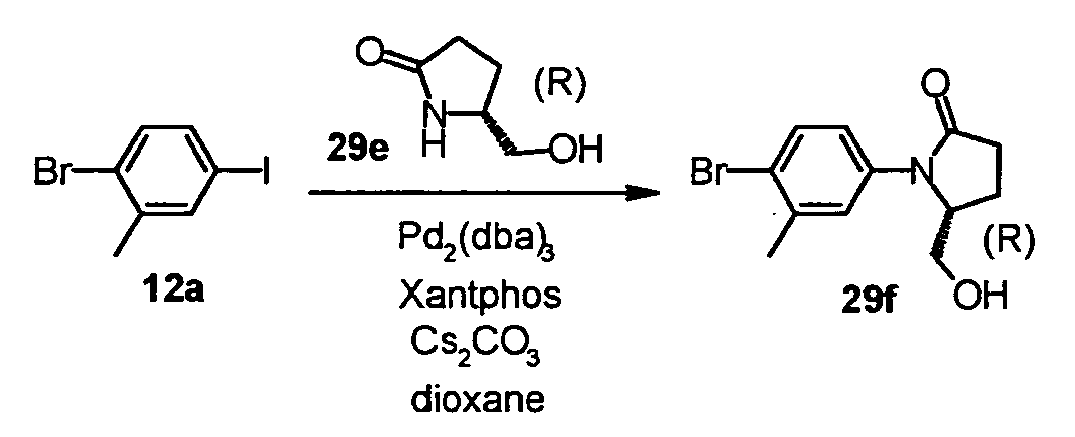
- (R)-1-(4-Bromo-3-methyl-phenyl)-5-hydroxymethyl-pyrrolidin-2-one was synthesized by operations similar to those in Reaction 29-3 using appropriate reagents and starting material.
MS (ESI) m/z = 284, 286 (M+H)+. - The aryl bromide reagent used in the synthesis of Compound 222 ((R)-3-(4-bromo-3-methyl-phenyl)-5-hydroxymethyl-oxazolidin-2-one) was synthesized as follows.
-

- A mixture of (S)-3-(4-bromo-3-methyl-phenylamino)-propane-1,2-diol (202 mg, 0.777 mmol), diethyl carbonate (3 ml), sodium methoxide (28% in MeOH, 0.160 ml) and MeOH (4 ml) was stirred at 130°C overnight. The reaction mixture was treated with saturated NH4Cl and H2O and extracted with AcOEt (x 2). The organic layers were combined and sequentially washed with H2O and saturated brine, and then dried over Na2SO4 and concentrated under reduced pressure. The resulting residue was purified by silica gel column chromatography (n-hexane/AcOEt) to give (R)-3-(4-bromo-3-methyl-phenyl)-5-hydroxymethyl-oxazolidin-2-one (170 mg, 77%).
1H-NMR (400 MHz, DMSO-d6) δ 2.35 (3H, s), 3.53-3.57 (1H, m), 3.65-3.68 (1H, m), 3.82 (1H, dd, J = 8.8, 6.4 Hz), 4.06 (1H, dd, J = 9.3, 8.8 Hz), 4.67-4.72 (1H, m), 5.22 (1H, br. s), 7.42 (1H, dd, J = 8.8, 2.9 Hz), 7.54 (1H, d, J = 2.5 Hz), 7.56 (1H, d, J = 8.8 Hz). MS (ESI) m/z = 286, 288 (M+H)+. - The aryl bromide reagent used in the synthesis of Compound 223 ((4-bromo-3,5-dimethyl-phenyl)-[3-(3-dimethylamino-propoxy)-azetidin-1-yl]-methanone) was synthesized as follows.
-

- (4-Bromo-3,5-dimethyl-phenyl)-(3-hydroxy-azetidin-1-yl)-methanone was synthesized by operations similar to those in Reaction 10-14 using appropriate reagents and starting material.
MS (ESI) m/z = 284, 286 (M+H)+. -

- NaH (110 mg, 2.75 mmol, 60% oily suspension) and NaI (274 mg, 1.83 mmol) were added to a solution of (4-bromo-3,5-dimethyl-phenyl)-(3-hydroxy-azetidin-1-yl)-methanone (130 mg, 0.458 mmol) and (3-chloro-propyl)-dimethyl-amine (289 mg, 1.83 mmol) in toluene (1.8 ml). The mixture was stirred at 110°C for 15 hours. The reaction mixture was diluted with AcOEt, and the organic layer was then sequentially washed with a saturated aqueous NaHCO3 solution, water and a saturated aqueous NaCl solution. Further, the organic layer was dried over sodium sulfate and then concentrated under reduced pressure. The resulting residue was purified by silica gel column chromatography (n-hexane/AcOEt) to give (4-bromo-3,5-dimethyl-phenyl)-[3-(3-dimethylamino-propoxy)-azetidin-1-yl]-methanone (46 mg, 27%).
MS (ESI) m/z = 369, 371 (M+H)+. -

- N-(3-Hydroxy-propyl)-3-methyl-4-{(E)-2-[4-oxo-2-(3-trifluoromethoxy-phenyl)-1,3,8-triaza-spiro[4.5]dec-1-ene-8-sulfonyl]-vinyl}-benzenesulfonamide was synthesized by operations similar to those in Reaction 25-1 and Reaction 25-2 using appropriate reagents and starting material.
MS (ESI) m/z = 645 (M+H)+. - The example compound shown below was synthesized by operations similar to those in Example 30 using appropriate reagents and starting material.
-
[Table 36] Compound Structure LCMS or HPLC condition Retention time (min) MS (m/z) 225 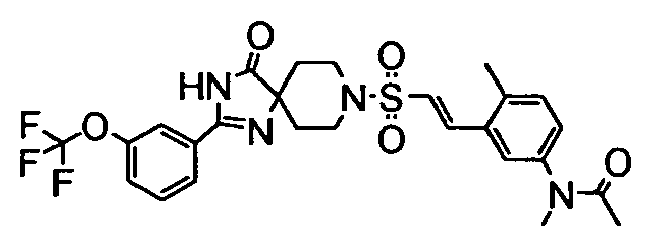
LCMS-D-1 3.3 567 (M+H)+ - The aryl bromide reagent used in the synthesis of Compound 224 (4-bromo-N-(3-hydroxy-propyl)-3-methyl-benzenesulfonamide) was synthesized as follows.
-
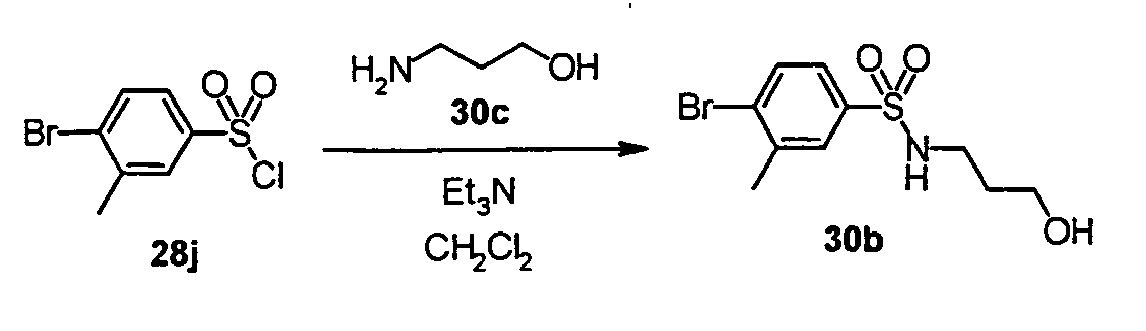
- 4-Bromo-N-(3-hydroxy-propyl)-3-methyl-benzenesulfonamide was synthesized by operations similar to those in Reaction 5-4 using appropriate reagents and starting material.
MS (ESI) m/z = 322, 324 (M+H)+. - The aryl bromide reagent used in the synthesis of Compound 225 (N-(3-bromo-4-methyl-phenyl)-N-methylacetamide) was synthesized as follows.
-
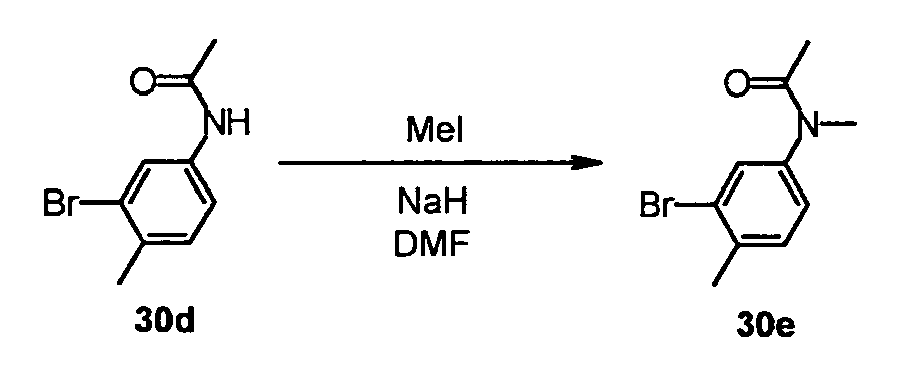
- N-(3-Bromo-4-methyl-phenyl)-N-methyl-acetamide was synthesized by operations similar to those in Reaction 25-3 using appropriate reagents and starting material.
MS (ESI) m/z = 242, 244 (M+H)+. -

- 8-[(E)-2-(3-Hydroxy-2-methyl-phenyl)-ethenesulfonyl]-2-(3-trifluoromethoxy-phenyl)-1,3,8-triaza-spiro[4.5]dec-1-en-4-one was synthesized by operations similar to those in Reaction 25-2 using appropriate reagents and starting material.
MS (ESI) m/z = 510 (M+H)+. - The example compounds shown below were synthesized by operations similar to those in Example 31 using appropriate reagents and starting materials.
-
[Table 37] Compound Structure LCMS or HPLC condition Retention time (min) MS (m/z) 227 
HPLC-A-2 11.5 510 (M+H)+ 228 
LCMS-A-1 2.12 648 (M+H)+ 229 
LCMS-D-1 3.3 601 (M+H)+ 230 
LCMS-A-1 2.25 621 (M+H)++ 231 
LCMS-C-1 2.60 565 (M+H)+ 232 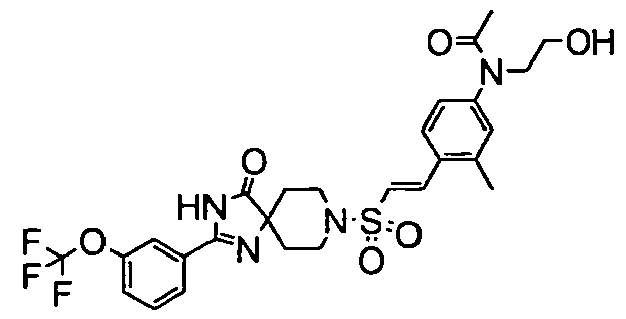
LCMS-C-1 2.52 595 (M+H)+ 233 
LCMS-C-1 2.57 567 (M+1)- 234 
LCMS-C-1 2.73 652 (M+1)+ 235 
LCMS-C-1 2.67 595 (M+H)+ 236 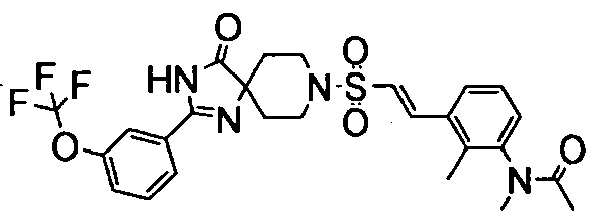
LCMS-D-1 3.1 565 (M+H)+ 237 
LCMS-C-1 2.63 565 (M+H)+ 238 
HPLC-A-2 12.8 565 (M+H)+ 239 
HPLC-A-2 14.0 579 (M+H)+ - The aryl bromide reagent used in the synthesis of Compound 230 ((4-bromo-3-methyl-phenyl)-(4-hydroxy-piperidin-1-yl)-methanone) was synthesized as follows.
-
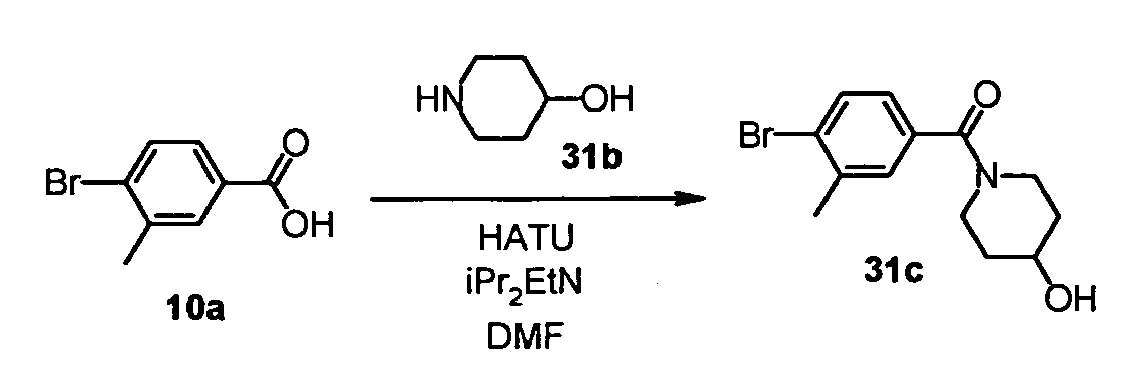
- (4-Bromo-3-methyl-phenyl)-(4-hydroxy-piperidin-1-yl)-methanone was synthesized by operations similar to those in Reaction 10-14 using appropriate reagents and starting material.
MS (ESI) m/z = 298, 300 (M+H)+. - The aryl bromide reagent used in the synthesis of Compound 231 (4-bromo-3,N,N-trimethyl-benzamide) was synthesized as follows.
-

- 4-Bromo-3,N,N-trimethyl-benzamide was synthesized by operations similar to those in Reaction 10-1 using appropriate reagents and starting material.
MS (ESI) m/z = 264, 266 (M+H)+. - The aryl bromide reagent used in the synthesis of Compound 232 (N-(4-bromo-3-methyl-phenyl)-N-(2-hydroxy-ethyl)-acetamide) was synthesized as follows.
-

- N-(4-Bromo-3-methyl-phenyl)-N-(2-hydroxy-ethyl)-acetamide was synthesized by operations similar to those in Reaction 12-5 using appropriate reagents and starting material.
MS (ESI) m/z = 272, 274 (M+H)+. - The aryl bromide reagent used in the synthesis of Compound 233 (4-bromo-3-fluoro-N,N-dimethyl-benzamide) was synthesized as follows.
-

- 4-Bromo-3-fluoro-N,N-dimethyl-benzamide was synthesized by operations similar to those in Reaction 10-1 using appropriate reagents and starting material.
MS (ESI) m/z = 246, 248 (M+H)+. - The aryl bromide reagent used in the synthesis of Compound 234 (4-(4-bromo-2,5-dichloro-phenoxy)-butane-1,2-diol) was synthesized as follows.
-

- 4-(4-Bromo-2,5-dichloro-phenoxy)-butane-1,2-diol was synthesized by operations similar to those in Reaction 26-4 and Reaction 31-6 using appropriate reagents and starting material.
MS (ESI) m/z = 351, 353 (M+H)+. - The aryl bromide reagent used in the synthesis of Compound 235 ([3-(4-bromo-3-methyl-phenoxy)-propyl]-dimethyl-amine) was synthesized as follows.
-

- 3-Dimethylamino-propan-1-ol (251 µL, 2.14 mmol) and DEAD (973 µL, 2.14 mmol) were added to a solution of 4-bromo-3-methyl-phenol (200 mg, 1.07 mmol) and PPh3 (561 mg, 2.14 mmol) in THF (10 mL) at 0°C. The mixture was stirred for two hours and then concentrated under reduced pressure. The resulting residue was purified by silica gel column chromatography to give [3-(4-bromo-3-methyl-phenoxy)-propyl]-dimethyl-amine (176 mg, 61%).
MS (ESI) m/z = 273, 275 (M+H)+. - The aryl bromide reagent used in the synthesis of Compound 236 (N-(3-bromo-2-methyl-phenyl)-N-methylacetamide) was synthesized as follows.
-

- N-(3-Bromo-2-methyl-phenyl)-N-methyl-acetamide was synthesized by operations similar to those in Reaction 25-3 using appropriate reagents and starting material.
MS (ESI) m/z = 242, 244 (M+H)+. - The aryl bromide reagent used in the synthesis of Compound 237 (N-(4-bromo-3-methyl-phenyl)-N-methylacetamide) was synthesized as follows.
-

- N-(4-Bromo-3-methyl-phenyl)-N-methyl-acetamide was synthesized by operations similar to those in Reaction 25-3 using appropriate reagents and starting material.
MS (ESI) m/z = 264, 266 (M+H)+. - The aryl bromide reagent used in the synthesis of Compound 239 (N-(4-bromo-3,5-dimethyl-phenyl)-N-methylacetamide) was synthesized as follows.
-

- N-(4-Bromo-3,5-dimethyl-phenyl)-N-methyl-acetamide was synthesized by operations similar to those in Reaction 25-3 using appropriate reagents and starting material.
MS (ESI) m/z = 256, 258 (M+H)+. -

- 2-Cycloheptyl-8-{(E)-2-[1-((S)-2,3-dihydroxy-propyl)-1H-indol-4-yl]-ethenesulfonyl}-1,3,8-triaza-spiro[4.5]dec-1-en-4-one was synthesized by operations similar to those in Reaction 10-14, Reaction 1-4, Reaction 11-4, Reaction 25-1 and Reaction 25-2 using appropriate reagents and starting material.
MS (ESI) m/z = 529 (M+H)+. - The example compound shown below was synthesized by operations similar to those in Example 32 using appropriate reagents and starting material.
-
[Table 38] Compound Structure LCMS or H PLC condition Retention time (min) MS (m/z) 241 
LCMS-A-1 1.90 551 (M+H)+ -

- 8-{(E)-2-[4-((R)-2,3-Dihydroxy-propoxy)-2,6-dimethyl-phenyl]-ethenesulfonyl}-2-(4-fluoro-3-trifluoromethyl-phenyl)-1,3,8-triaza-spiro[4.5]dec-1-en-4-one was synthesized by operations similar to those in Reaction 25-1 and Reaction 25-2 using appropriate reagents and starting material.
MS (ESI) m/z = 600 (M+H)+. - The example compounds shown below were synthesized by operations similar to those in Example 33 using appropriate reagents and starting materials.
-
[Table 39] Compound Structure LCMS or HPLC condition Retention time (min) MS (m/z) 243 
LCMS-A-1 2.36 600 (M+H)+ 244 
LCMS-C-1 2.52 637 (M+H)+ 245 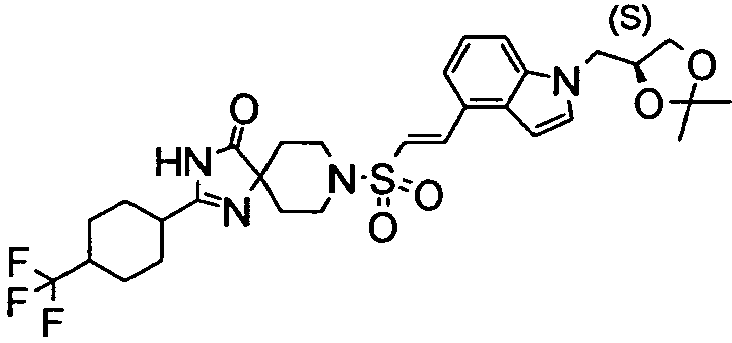
LCMS-A-1 2.92 562 (M+H)+ 246 
LCMS-E-4 2.82 557 (M+H)+ - The aryl bromide reagent used in the synthesis of Compound 244 ((4-bromo-3,5-dimethyl-phenyl)-(4-hydroxy-piperidin-1-yl)-methanone) was synthesized as follows.
-

- (4-Bromo-3,5-dimethyl-phenyl)-(4-hydroxy-piperidin-1-yl)-methanone was synthesized by operations similar to those in Reaction 10-14 using appropriate reagents and starting material.
MS (ESI) m/z = 312, 314 (M+H)+. -

- 8-{(E)-2-[4-(3,4-Dihydroxy-butoxy)-2-methyl-phenyl]-ethenesulfonyl}-2-(2-fluoro-3-trifluoromethyl-phenyl)-1,3,8-triaza-spiro[4.5]dec-1-en-4-one was synthesized by operations similar to those in Reaction 25-1 and Reaction 26-1 using appropriate reagents and starting material.
MS (ESI) m/z = 600 (M+H)+. - The example compounds shown below were synthesized by operations similar to those in Example 34 using appropriate reagents and starting materials.
-
[Table 40] Compound Structure LCMS or HPLC condition Retention time (min) MS (m/z) 248 
LCMS-C-1 2.62 593 (M+H)+ 249 
LCMS-B-1 1.96 577 (M+H)+ 250 
LCMS-B-1 1.85 543 (M+H)+ -

- 2-Cyclohexyl-8-[(E)-4-(1H-indol-4-yl)-but-3-ene-1-sulfonyl]-1,3,8-triaza-spiro[4.5]dec-1-en-4-one was synthesized by operations similar to those in Reaction 25-1 and Reaction 25-2 using appropriate reagents and starting material.
MS (ESI) m/z = 469 (M+H)+. -

- 2-Cyclohexyl-8-[(E)-5-(1H-indol-4-yl)-pent-4-ene-1-sulfonyl]-1,3,8-triaza-spiro[4.5]dec-1-en-4-one was synthesized by operations similar to those in Reaction 25-1 and Reaction 25-2 using appropriate reagents and starting material.
MS (ESI) m/z = 483 (M+H)+. -

- 2-Cyclohexyl-8-{(E)-3-[1-((S)-2,3-dihydroxy-propyl)-1H-indol-4-yl]-prop-2-ene-1-sulfonyl}-1,3,8-triaza-spiro[4.5]dec-1-en-4-one was synthesized by operations similar to those in Reaction 25-1, Reaction 25-2 and Reaction 25-4 using appropriate reagents and starting material.
MS (ESI) m/z = 529 (M+H)+. -

- 8-{(E)-2-[3-(3,4-Dihydroxy-butoxy)-2-methyl-phenyl]-ethenesulfonyl}-2-(3-trifluoromethoxy-phenyl)-1,3,8-triaza-spiro[4.5]dec-1-en-4-one was synthesized by operations similar to those in Reaction 31-7, Reaction 26-1 and Reaction 25-4 using appropriate reagents and starting material.
1H-NMR (300 MHz, CDCl3) δ 1.7 (2H, d, J = 13.73 Hz), 1.97 (1H, brs), 2.00 (2H, m), 2.18 (2H, dt, J = 3.05, 13.73 Hz), 2.30 (3H, s), 2. 51 (1H, brs), 3.35 (2H, dt, J = 3.05, 11.83 Hz), 3.59 (1H, m), 3.75 (1H, m), 3.80 (2H, d, J = 11.83 Hz), 4.06 (1H, brs), 4.18 (2H, m), 6.66 (1H, d, J = 15.64 Hz), 6.95 (1H, d, J = 7.63 Hz), 7.17 (1H, t, J = 7.63 Hz), 7.21 (1H, d, J = 7.63 Hz), 7.42 (1H, d, J = 8.01 Hz), 7.54 (1H, dd, J = 7.63, 8.01 Hz), 7.75 (1H, d, J = 7.63 Hz), 7.81 (1H, s), 7.81 (1H, d, J = 15.64 Hz), 9.75 (1H, s). MS (ESI) m/z = 598 (M+H)+. - The example compound shown below was synthesized by operations similar to those in Example 38 using appropriate reagents and starting material.
-
[Table 41] Compound Structure LCMS or HPLC condition Retention time (min) MS (m/z) 255 
HPLC-A-3 11.56 598 (M+H)+ -

- 8-((E)-2-{3-[2-(tert-Butyl-dimethyl-silanyloxy)-ethoxy]-2-methyl-phenyl}-ethenesulfonyl)-2-(3-trifluoromethoxy-phenyl)-1,3,8-triaza-spiro[4.5]dec-1-en-4-one was synthesized by operations similar to those in Reaction 26-1 using appropriate reagents and starting material. This compound was used as such in the next step without purification.
-

- Tetrabutylammonium fluoride (0.11 ml, 0.11 mmol, 1 M in THF) was added to a solution of 8-((E)-2-{3-[2-(tert-Butyl-dimethyl-silanyloxy)-ethoxy]-2-methyl-phenyl}-ethenesulfonyl)-2-(3-trifluoromethoxy-phenyl)-1,3,8-triaza-spiro[4.5]dec-1-en-4-one obtained above in anhydrous THF (1 ml) at room temperature in an Ar atmosphere. The mixture was stirred at room temperature for two hours and then concentrated under reduced pressure. The resulting residue was purified by silica gel column chromatography (hexane:EtOAc = 1:1) to give 8-{(E)-2-[3-(2-hydroxy-ethoxy)-2-methyl-phenyl]-ethenesulfonyl}-2-(3-trifluoromethoxy-phenyl)-1,3,8-triaza-spiro[4.5]dec-1-en-4-one (3.2 mg, yield in two steps: 48%).
1H-NMR (300 MHz, DMSO-d6) δ 11.75 (1H, s), 7.99 (1H, d, J = 7.5 Hz), 7.90 (1H, s), 7.63 (3H, m), 7.37 (1H, d, J = 7.5 Hz), 7.23 (2H, m), 7.06 (1H, d, J = 7.9 Hz), 4.85 (1H, t, J = 5.6 Hz), 4.00 (2H, m), 3.74 (2H, m), 3.60 (2H, m), 3.20 (2H, m), 2.27 (3H, s), 1.88 (2H, m), 1.63 (2H, m). MS (ESI+) m/z = 554 (M+H)+. - The example compounds shown below were synthesized by operations similar to those in Example 39 using appropriate reagents and starting materials.
-
[Table 42] Compound Structure LCMS or HPLC condition Retention time (min) MS (m/z) 257 
LCMS-D-1 3.1 595 (M+H)+ 258 
LCMS-D-1 3.10 621 (M+H)+ - The aryl bromide reagent used in the synthesis of Compound 257 (N-(3-bromo-4-methyl-phenyl)-N-[2-(tert-butyl-dimethyl-silanyloxy)-ethyl]-acetamide) was synthesized as follows.
-

- N-(3-Bromo-4-methyl-phenyl)-N-[2-(tert-butyl-dimethyl-silanyloxy)-ethyl]-acetamide was synthesized by operations similar to those in Reaction 25-3 using appropriate reagents and starting material.
MS (ESI) m/z = 386, 388 (M+H)+. - The aryl bromide reagent used in the synthesis of Compound 258 ((R)-1-(4-bromo-3,5-dimethyl-phenyl)-5-(tert-butyl-dimethyl-silanyloxymethyl)-pyrrolidin-2-one) was synthesized as follows.
-

- (R)-1-(4-Bromo-3,5-dimethyl-phenyl)-5-(tert-butyl-dimethyl-silanyloxymethyl)-pyrrolidin-2-one was synthesized by operations similar to those in Reaction 29-3 using appropriate reagents and starting material.
1H-NMR (300 MHz, CDCl3) δ -0.06 (3H, s), -0.03 (3H, s), 0.86 (9H, s), 2.10 (1H, m), 2.26 (1H, m), 2.40 (6H, s), 2.48 (1H, ddd, J = 4.6, 10.3, 16.8 Hz), 2.68 (1H, ddd, J = 8.0, 9.9, 17.9 Hz), 3.56 (2H, dq, J = 3.8, 10.7 Hz), 4.15 (1H, m), 7.10 (2H, s). -

- N-(4-{(E)-2-[2-(2-Fluoro-3-trifluoromethyl-phenyl)-4-oxo-1,3,8-triaza-spiro[4.5]dec-1-ene-8-sulfonyl]-vinyl}-3-methyl-phenyl)-N-(2-hydroxy-ethyl)-acetamide was synthesized by operations similar to those in Reaction 26-1 and Reaction 12-5 using appropriate reagents and starting material.
MS (ESI) m/z = 597 (M+H)+. -

- Acetic acid (4.9 eq) and sodium triacetoxyborohydride (2.0 eq) were sequentially added to a solution of 4-bromo-3-methylaniline (246 mg, 1.32 mmol) and 1-(tert-butoxycarbonyl)-4-piperidone (350 mg,1.76 mmol) in 1,2-dichloroethane (10 ml). The mixture was stirred at room temperature for 3.5 hours and then quenched with a saturated aqueous sodium carbonate solution. The reaction mixture was extracted with dichloromethane, and the organic layer was then concentrated under reduced pressure to 4-(4-bromo-3-methyl-phenylamino)-piperidine-1-carboxylic acid tert-butyl ester as a white solid (586 mg, 100%). This compound was used in the next step without further purification.
1H-NMR (400 MHz, CDCl3) δ 1.32 (m, 2H), 1.42 (s, 9H), 2.01 (d, J = 13.2 Hz, 2H), 2.31 (s, 3H), 2.92 (t, J = 11.6 Hz, 2H), 3.45 (br, 2H), 4.04 (br, 1H), 6.32 (dd, J = 2.4 Hz, 8.4 Hz, 1H), 6.48 (d, J = 2.8 Hz, 1H), 7.28 (m, 1H). MS (ESI) m/z = 369 (M+H)+. -
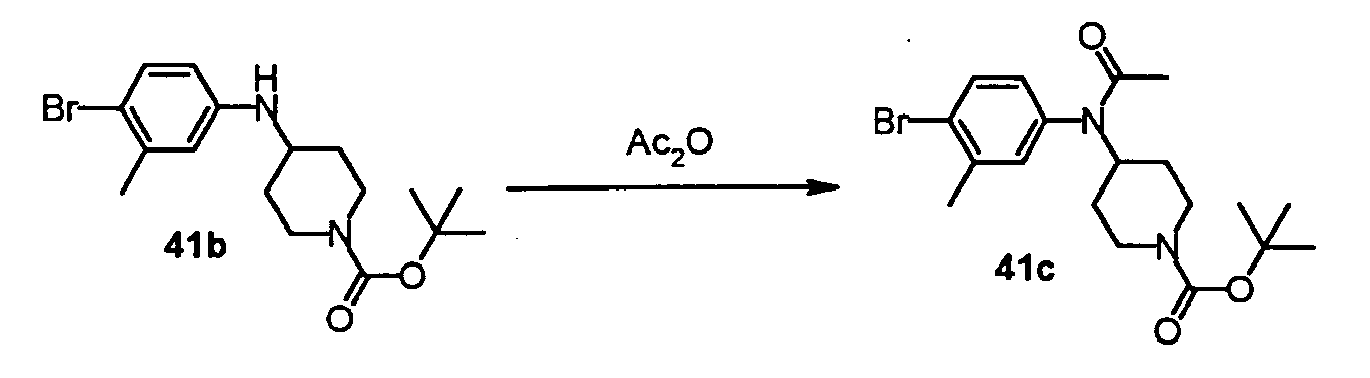
- 4-[Acetyl-(4-bromo-3-methyl-phenyl)-amino]-piperidine-1-carboxylic acid tert-butyl ester was synthesized by operations similar to those in Reaction 12-2 using the compound obtained above as a starting material.
MS (ESI) m/z = 411, 413 (M+H)+. -
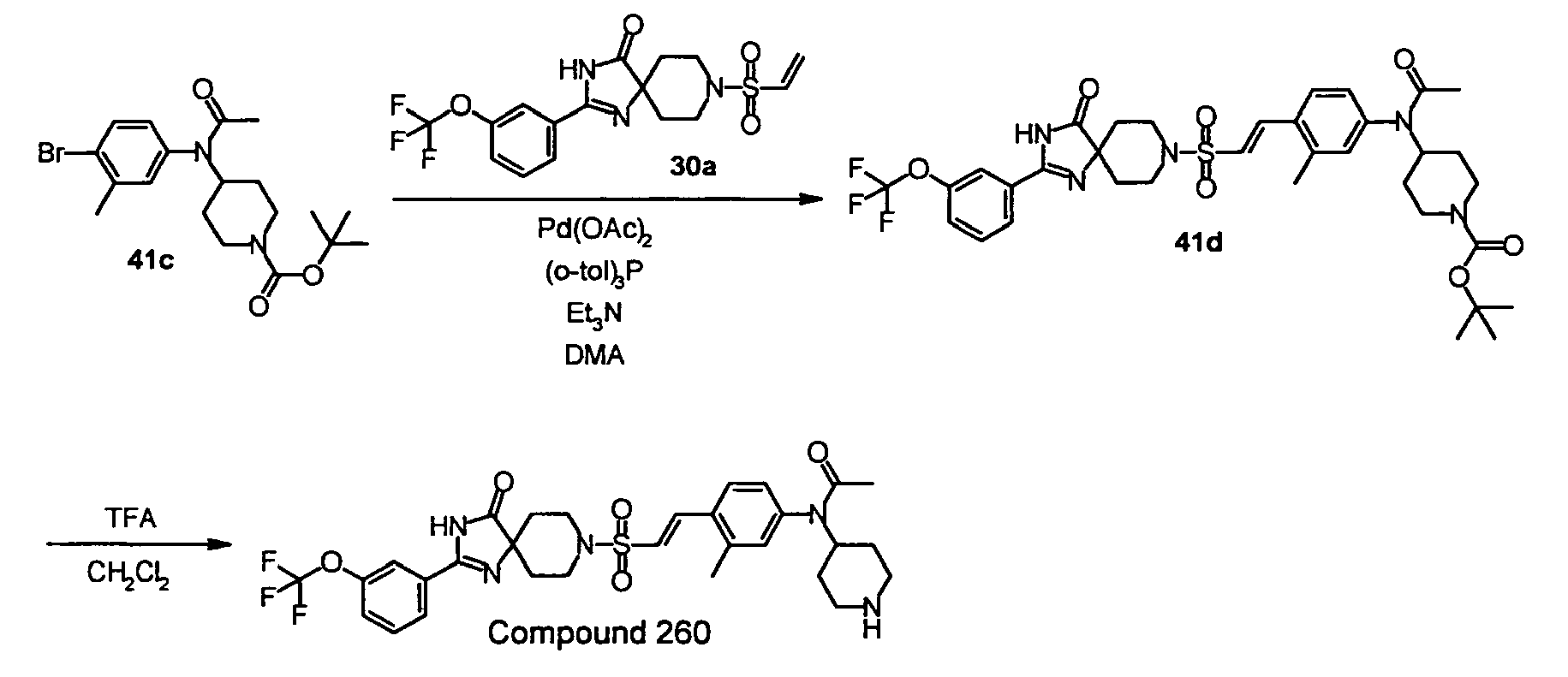
- N-(3-Methyl-4-{(E)-2-[4-oxo-2-(3-trifluoromethoxy-phenyl)-1,3,8-triaza-spiro[4.5]dec-1-ene-8-sulfonyl]-vinyl}-phenyl)-N-piperidin-4-yl-acetamide was synthesized by operations similar to those in Reaction 26-1 and Reaction 4-1 using appropriate reagents and starting material.
MS (ESI) m/z = 634 (M+H)+. -

- 10% Pd-C (28 mg) was added to a solution of 2-cyclohexyl-8-[(E)-2-(2-oxo-2,3-dihydro-benzoxazol-7-yl)-ethenesulfonyl]-1,3,8-triaza-spiro[4.5]dec-1-en-4-one (56.6 mg, 0.123 mmol) in MeOH-DMF (4 ml, 1:1). The mixture was stirred at room temperature overnight in a hydrogen atmosphere. The reaction mixture was filtered through celite, and the filtrate was then concentrated under reduced pressure. The resulting residue was diluted with ethyl acetate, and the organic layer was then washed with water (x 2), dried over anhydrous Na2SO4 and concentrated under reduced pressure. The residue was purified by column chromatography (silica gel, AcOEt-hexane) to give 2-cyclohexyl-8-[2-(2-oxo-2,3-dihydro-benzoxazol-7-yl)-ethanesulfonyl]-1,3,8-triaza-spiro[4.5]dec-1-en-4-one as a colorless foam (46.9 mg, 83%).
1H-NMR (400 MHz, CDCl3) δ 1.21-1.45 (6H, m), 1.50-1.60 (2H, m), 1.65-1.85 (4H, m), 1.90-1.96 (2H, m), 2.38-2.48 (1H, m), 3.25-3.40 (6H, m), 3.65-3.73 (2H, m), 7.01 (2H, d, J = 8.0 Hz), 7.13 (1H, t, J = 8 Hz), 8.59 (1H, brs), 9.03 (1H, brs). MS (ESI) m/z = 461 (M+H)+. - The example compounds shown below were synthesized by operations similar to those in Example 42 using appropriate reagents and starting materials.
-
[Table 43] Compound Structure LCMS or HPLC condition Retention time (min) MS (m/z) 262 
LCMS-E-5 3.3 485 (M+H)+ 263 
LCMS-E-4 2.89 471(M+H)+ 264 
LCMS-D-1 3.1 567 (M+H)+ 265 
LCMS-D-1 3.3 567 (M+H)+ 266 
HPLC-A-3 11.35 600 (M+H)+ 267 
HPLC-A-3 11.03 600 (M+H)+ -

- The following reaction was performed by utilizing a continuous-flow hydrogenation reactor H-Cube® Type HC-2 (ThalesNano Nanotechnology Inc.).
- 8-{(E)-2-[4-((R)-2-Hydroxymethyl-5-oxo-pyrrolidin-1-yl)-2-methyl-phenyl]-ethenesulfonyl}-2-(3-trifluoromethyl-phenyl)-1,3,8-triaza-spiro[4.5]dec-1-en-4-one (28.5 mg, 48.3 µmol) was dissolved in EtOH/DMF 4:1 (concentration 10 mg/ml). The mixture was allowed to pass through 10% Pd/C (CatCart™) at a flow rate of 2 ml/min under the conditions of 30 bar and 40°C in a hydrogen atmosphere, and was subjected to hydrogenation reaction. The resulting reaction solution was concentrated under reduced pressure. The residue was purified by preparative TLC (CH2Cl2/MeOH = 20:1) to give 8-{2-[4-((R)-2-hydroxymethyl-5-oxo-pyrrolidin-1-yl)-2-methyl-phenyl]-ethanesulfonyl}-2-(3-trifluoromethyl-phenyl)-1,3,8-triaza-spiro[4.5]dec-1-en-4-one as a white powder (12.9 mg, 45%).
1H-NMR (270 MHz, CDCL3) δ 1.60-1.63 (2H, m), 1.83-1.89 (2H, m), 1.97-2.04 (1H, m), 2.12-2.22 (1H, m), 2.32 (3H, s), 2.28-2.36 (1H, m), 2.52-2.59 (1H, m), 2.97-3.01 (2H, m), 3.29-3.40 (6H, m), 3.67-3.70 (2H, m), 4.24-4.29 (1H, m), 4.80 (1H, t, J = 5.4 Hz), 7.22-7.29 (2H, m), 7.79 (1H, br t, J = 7.8 Hz), 7.98 (1H, br. d, J = 7.8 Hz), 8.29 (1H, br. d, J = 7.3 Hz), 8.33 (1H, br. s), 11.81 (1H, br. s). MS (ESI) m/z = 593 (M+H)+. - The example compounds shown below were synthesized by operations similar to those in Example 43 using appropriate reagents and starting materials.
-
[Table 44] Compound Structure LCMS or HPLC condition Retention time (min) MS (m/z) 269 
LCMS-A-1 2.07 443 (M+H)+ 270 
LCMS-C-1 2.55 572 (M+H)+ 271 
LCMS-C-1 2.67 555 (M+H)+ 272 
LCMS-C-1 2.87 601 (M+H)+ 273 
LCMS-C-1 2.53 558 (M+H)+ 274 
LCMS-C-3 1.23 491 (M+H)+ 275 
LCMS-C-3 1.06 477 (M+H)+ 276 
LCMS-C-3 0.86 475 (M+H)+ 277 
LCMS-C-1 2.73 418 (M+H)+ 278 
LCMS-C-1 2.42 574 (M+H)+ 279 
LCMS-C-1 2.37 522 (M+H)+ 280 
LCMS-C-1 2.33 448 (M+H)+ 281 
LCMS-B-1 1.45 532 (M+H)+ 282 
LCMS-C-1 2.12 532 (M+H)+ 283 
LCMS-C-1 2.70 587 (M+H)+ 284 
LCMS-C-2 1.85 584 (M+H)+ 285 
LCMS-A-1 2.23 623 (M+H)+ 286 
LCMS-C-2 2.03 593 (M+H)+ 287 
LCMS-B-1 2.10 647 (M+H)+ 288 
LCMS-C-1 2.67 577 (M+H)+ 289 
LCMS-C-1 2.55 606 (M+H)+ 290 
LCMS-C-1 2.65 641 (M+H)+ 291 
LCMS-C-1 2.35 559 (M+H)+ 292 
LCMS-C-1 2.52 672 (M+H)+ 293 
LCMS-C-1 2.55 571 (M+H)+ 294 
LCMS-A-1 2.19 636 (M+H)+ 295 
LCMS-C-1 2.67 597 (M+H)+ 296 
LCMS-C-1 2.45 595 (M+H)+ 297 
LCMS-B-1 1.91 579 (M+H)+ 298 
LCMS-C-1 2.52 537 (M+H)+ 299 
LCMS-C-1 2.47 567 (M+H)+ 300 
LCMS-A-1 2.32 583 (M+H)+ 301 
LCMS-A-1 2.28 568 (M+H)+ 302 
LCMS-B-1 1. 61 489 (M+H)+ -

- 2-Cyclohexyl-8-[2-(1H-indol-4-yl)-ethanesulfonyl]-1,3,8-triaza-spiro[4.5]dec-1-en-4-one was synthesized by operations similar to those in Reaction 25-2 and Reaction 42-1 using appropriate reagents and starting material.
MS (ESI) m/z = 443 (M+H)+. - The example compounds shown below were synthesized by operations similar to those in Example 44 using appropriate reagents and starting materials.
-
[Table 45] Compound Structure LCMS or HPLC condition Retention time (min) MS (m/z) 304 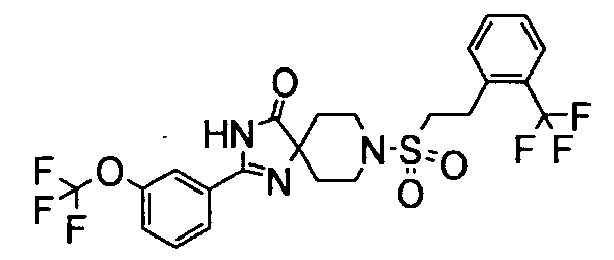
LCMS-A-1 2.92 550 (M+H)+ 305 
LCMS-A-1 2.60 521 (M+H)+ 306 
LCMS-A-1 2.15 457 (M+H)+ 307 
LCMS-A-1 2.92 562 (M+H)+ 308 
LCMS-A-1 2.89 535 (M+H)+ 309 
LCMS-C-1 2.38 517 (M+H)+ 310 
LCMS-C-1 2.52 514 (M+H)+ 311 
LCMS-E-7 1.53 471 (M+H)+ 312 
LCMS-C-1 2.57 521 (M+H)+ 313 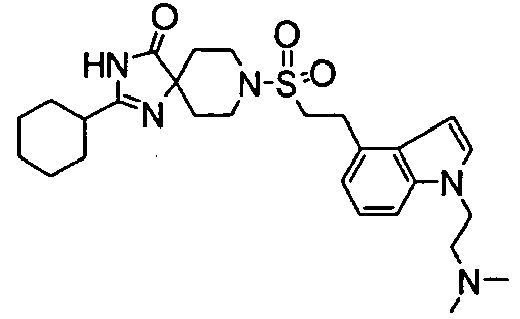
LCMS-A-1 1.65 514 (M+H)+ 314 
LCMS-C-1 2.48 487 (M+H)+ 315 
HPLC-A-1 13.4 486 (M+H)+ 316 
HPLC-A-2 11.6 432 (M+H)+ 317 
LCMS-D-1 1.8 434 (M+H)+ 318 
LCMS-D-1 3.0 434 (M+H)+ 319 
LCMS-C-1 2.87 460 (M+H)+ 320 
LCMS-A-1 1.49 455 (M+H)+ - The aryl bromide reagent used in the synthesis of Compound 313 ([2-(4-bromo-indol-1-yl)-ethyl]-dimethyl-amine) was synthesized as follows.
-

- [2-(4-Bromo-indol-1-yl)-ethyl]-dimethyl-amine was synthesized by operations similar to those in Reaction 25-3 using appropriate reagents and starting material.
MS (ESI) m/z = 267, 269 (M+H)+. -

- 2-Cyclohexyl-8-{2-[4-((S)-2,3-dihydroxy-propylamino)-2-methyl-phenyl]-ethanesulfonyl}-1,3,8-triaza-spiro[4.5]dec-1-en-4-one was synthesized by operations similar to those in Reaction 25-2 and Reaction 42-2 using appropriate reagents and starting material.
MS (ESI) m/z = 527 (M+H)+. - The example compound shown below was synthesized by operations similar to those in Example 45 using appropriate reagents and starting material.
-
[Table 46] Compound Structure LCMS or HPLC condition Retention time (min) MS (m/z) 322 
LCMS-C-1 2.48 585 (M+H)+ - The aryl bromide reagent used in the synthesis of Compound 321 ((S)-3-(4-bromo-3-methyl-phenylamino)-propane-1,2-diol) was synthesized as follows.
-
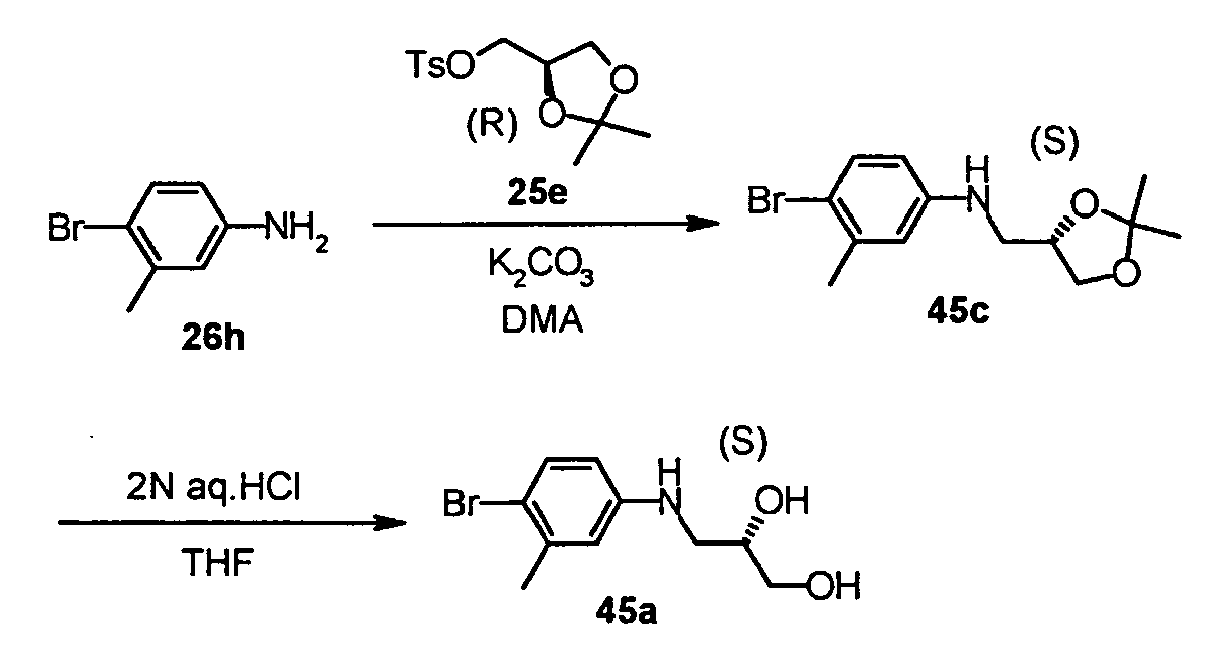
- (S)-3-(4-Bromo-3-methyl-phenylamino)-propane-1,2-diol was synthesized by operations similar to those in Reaction 26-4 and Reaction 25-4 using appropriate reagents and starting material.
MS (ESI) m/z = 260, 262 (M+H)+. -

- 2-Cyclohexyl-8-[2-(2-trifluoromethyl-phenyl)-ethanesulfonyl]-1,3,8-triaza-spiro[4.5]dec-1-en-4-one was synthesized by operations similar to those in Reaction 26-1 and Reaction 42-1 using appropriate reagents and starting material.
MS (ESI) m/z = 472 (M+H)+. - The example compound shown below was synthesized by operations similar to those in Example 46 using appropriate reagents and starting material.
-
[Table 47] Compound Structure LCMS or HPLC condition Retention time (min) MS (m/z) 324 
LCMS-D-1 2.7 489 (M+H)+ -

- 8-{2-[4-((R)-2,3-Dihydroxy-propoxy)-2-methylphenyl]-ethanesulfonyl}-2-(3-trifluoromethoxy-phenyl)-1,3,8-triaza-spiro[4.5]dec-1-en-4-one was synthesized by operations similar to those in Reaction 26-1 and Reaction 42-2 using appropriate reagents and starting material.
MS (ESI) m/z = 586 (M+H)+. - The aryl bromide reagent used in the synthesis of Compound 325 ((R)-3-(4-bromo-3-methyl-phenoxy)-propane-1,2-diol) was synthesized as follows.
-

- (R)-3-(4-Bromo-3-methyl-phenoxy)-propane-1,2-diol was synthesized by operations similar to those in Reaction 26-4 and Reaction 25-4 using appropriate reagents and starting material.
MS (ESI) m/z = 283, 285 (M+Na)+. -

- N-(2-Hydroxy-ethyl)-N-(4-methyl-3-{2-[4-oxo-2-(3-trifluoromethoxy-phenyl)-1,3,8-triaza-spiro[4.5]dec-1-ene-8-sulfonyl]-ethyl}-phenyl)-acetamide was synthesized by operations similar to those in Reaction 42-1 and Reaction 39-2 using appropriate reagents and starting material.
MS (ESI) m/z = 597 (M+H)+. -

- N-(2-Hydroxy-ethyl)-N-(2-methyl-3-{2-[4-oxo-2-(3-trifluoromethoxy-phenyl)-1,3,8-triaza-spiro[4.5]dec-1-ene-8-sulfonyl]-ethyl}-phenyl)-acetamide was synthesized by operations similar to those in Reaction 26-1, Reaction 42-1 and Reaction 39-2 using appropriate reagents and starting material.
MS (ESI) m/z = 597 (M+H)+. - The aryl bromide reagent used in the synthesis of Compound 327 (N-(3-bromo-2-methyl-phenyl)-N-[2-(tert-butyl-dimethyl-silanyloxy)-ethyl]-acetamide) was synthesized as follows.
-

- N-(3-Bromo-2-methyl-phenyl)-N-[2-(tert-butyl-dimethyl-silanyloxy)-ethyl]-acetamide was synthesized by operations similar to those in Reaction 25-3 using appropriate reagents and starting material.
MS (ESI) m/z = 386, 388 (M+H)+. -

- N-13-[3-(2-Cyclohexyl-4-oxo-1,3,8-triaza-spiro[4.5]dec-1-ene-8-sulfonyl)-propyl]-phenyl}-acetamide was synthesized by operations similar to those in Reaction 26-1 and Reaction 42-1 using appropriate reagents and starting material.
MS (ESI) m/z = 475 (M+H)+. -

-

- 8-(5-Bromo-thiophene-2-sulfonyl)-2-(3-trifluoromethyl-phenyl)-1,3,8-triaza-spiro[4.5]dec-1-en-4-one was synthesized by operations similar to those in Reaction 5-4 using appropriate reagents and starting material.
MS (ESI) m/z = 523 (M+H)+. -

- A mixture of 8-(5-bromo-thiophene-2-sulfonyl)-2-(3-trifluoromethyl-phenyl)-1,3,8-triaza-spiro[4.5]dec-1-en-4-one (11.1 mg, 0.0212 mmol), 4-(N,N-dimethylaminocarbonyl)phenylboronic acid (8.0 mg, 0.041 mmol), Pd (PPh3)4 (3.8 mg, 0.0033 mmol) and Na2CO3 (22.0 mg, 0.208 mmol) in toluene (0.12 ml)-EtOH (0.12 ml)-H2O (0.12 ml) was stirred at 85°C for 20 hours in a sealed test tube in an N2 atmosphere. The reaction mixture was cooled to room temperature and extracted with AcOEt. The organic layer was washed with a saturated aqueous NH4Cl solution, and then dried over MgSO4 and concentrated under reduced pressure. The resulting residue was purified by silica gel column chromatography (AcOEt) to give N,N-dimethyl-4-{5-[4-oxo-2-(3-trifluoromethyl-phenyl)-1,3,8-triaza-spiro[4.5]dec-1-ene-8-sulfonyl]-thiophen-2-yl}-benzamide (9.7 mg, 77%).
1H-NMR (300 MHz) (CDCl3) δ 1.74 (2H, br d, J = 13.5 Hz), 2.21 (2H, ddd, J = 13.5, 11.0, and 4.0 Hz), 3.04 (3H, br s), 3.15 (3H, br s), 3.24 (2H, ddd, J = 11.5, 11.0, and 3.0 Hz), 3.82 (2H, ddd, J = 11.5, 4.0 and 4.0 Hz), 7.38 (1H, d, J = 4.0 Hz), 7.50 (2H, d, J = 8.4 Hz), 7.57 (1H, d, J = 4.0 Hz), 7.60 (1H, t, J = 8.1 Hz), 7.66 (2H, d, J = 8.4 Hz), 7.78 (1H, d, J = 8.1 Hz), 7.99 (1H, d, J = 8.1 Hz), 8.12 (1H, s), 9.61 (1H, br s). MS (ESI) m/z = 591 (M+H)+. - The example compounds shown below were synthesized by operations similar to those in Example 51 using appropriate reagents and starting materials.
-
[Table 48] Compound Structure LCMS or H PLC condition Retention time (min) MS (m/z) 330 
LCMS-C-2 2.08 591 (M+H)+ 331 
LCMS-C-2 2.15 605 (M+H)+ 332 
LCMS-C-2 1.92 529 (M+H)+ 333 
LCMS-C-2 2.20 623 (M+H)+ 334 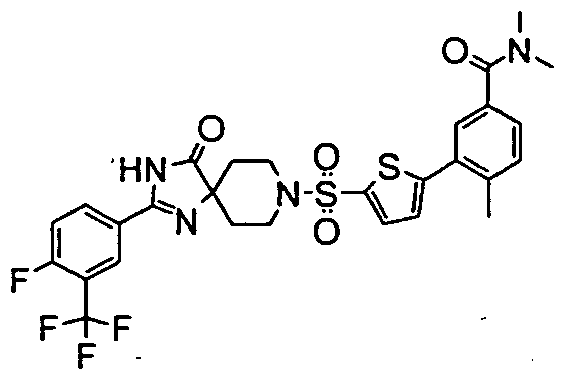
LCMS-C-2 2.20 623 (M+H)+ 335 
LCMS-D-1 3.37 615 (M+H)+ 336 
LCMS-D-1 3.35 615 (M+H)+ 337 
LCMS-D-1 3.27 616 (M+H)+ - The aryl boronate reagent used in the synthesis of Compounds 331, 333, 335, 336 and 337 (3,N,N-trimethyl-4-(4,4,5,5-tetramethyl-[1,3,2]dioxaborolan-2-yl)-benzamide) was synthesized as follows.
-

- A mixture of 4-bromo-3,N,N-trimethyl-benzamide (203 mg, 0.838 mmol), 1,1'-bis(diphenylphosphino)-ferrocene (dppf) (27.9 mg, 0.0503 mmol), PdCl2(dppf)-CH2Cl2 (41.6 mg, 0.0509 mmol), AcOK (245 mg, 2.50 mmol) and bis(pinacolato)diboron (286 mg, 1.13 mmol) in dioxane (5.5 ml) was stirred at 85°C for six hours in a sealed test tube in an N2 atmosphere. The reaction mixture was cooled to room temperature and extracted with AcOEt. The organic layer was washed with water, and then dried over MgSO4 and concentrated under reduced pressure. The resulting residue was purified by silica gel column chromatography (hexane/ethyl acetate = 2/1) to give 3,N,N-trimethyl-4-(4,4,5,5-tetramethyl-[1,3,2]dioxaborolan-2-yl)-benzamide (135 mg, 56%).
MS (ESI) m/z = 290 (M+H)+. - The aryl boronate reagent used in the synthesis of Compound 334 (4,N,N-trimethyl-3-(4,4,5,5-tetramethyl-[1,3,2]dioxaborolan-2-yl)-benzamide) was synthesized as follows.
-

- 4,N,N-Trimethyl-3-(4,4,5,5-tetramethyl-[1,3,2]dioxaborolan-2-yl)-benzamide was synthesized by operations similar to those in Reaction 51-3 using appropriate reagents and starting material.
MS (ESI) m/z = 242 (M+H)+. - The aryl boronate reagent used in the synthesis of Compound 332 (N-[3-methyl-4-(4,4,5,5-tetramethyl-[1,3,2]dioxaborolan-2-yl)-phenyl]-acetamide) was synthesized as follows.
-

- N-[3-Methyl-4-(4,4,5,5-tetramethyl-[1,3,2]dioxaborolan-2-yl)-phenyl]-acetamide was synthesized by operations similar to those in Reaction 51-3 using appropriate reagents and starting material.
MS (ESI) m/z = 276 (M+H)+. - The following aryl bromide reagents used in the synthesis of Compounds 332, 333, 334, 335, 336 and 337 were synthesized by operations similar to those in Reaction 51-1 using appropriate reagents and starting materials.
-
[Table 49] Target Compound Aryl bromide MS 332 
460, 462 ((M+H)+ 333
334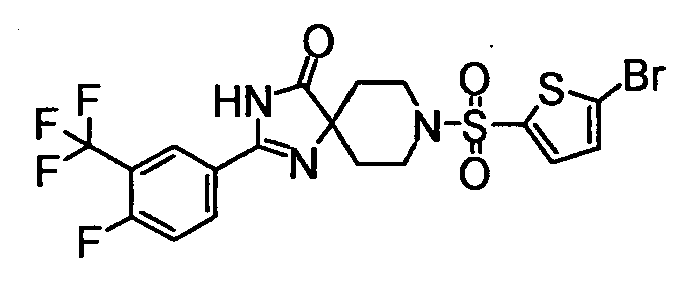
540, 542 (M+H)+ 335 
532, 534 (M+H)+ 336 
532, 534 (M+H)+ 337 
533, 535 (M+H)+ -

- Triphenylphosphine (7.83 g, 29.8 mmol) and carbon tetrabromide (12.4 g, 37.3 mmol) were added to a solution of 2-(2-bromophenyl)ethanol (5.00 g, 24.9 mmol) in dichloromethane (123 mL). The mixture was stirred at room temperature for 15 hours, and a saturated aqueous sodium carbonate solution was then added. The organic layer and the aqueous layer were separated, and the organic layer was then concentrated under reduced pressure. The resulting residue was triturated with ethyl acetate:n-hexane (1:4, 200 mL) and then filtered, and the filtrate was concentrated under reduced pressure. The residue was purified by silica gel column chromatography to give 1-bromo-2-(2-bromoethyl)benzene as a colorless oil (6.23 g, 95%).
1H-NMR (270 MHz, CDCl3) δ 3.30 (2H, t, J = 7.6 Hz), 3.60 (2H, t, J = 7.3 Hz), 7.10-7.17 (1H, m), 7.26-7.28 (2H, m), 7.55 (1H, d, J = 8.1 Hz). -

- A solution of 1-bromo-2-(2-bromoethyl)benzene (6.23 g, 23.6 mmol) in ethanol (20.5 mL) was added to a solution of sodium sulfite (3.12 g, 24.7 mmol) in water (25.0 mL). The mixture was heated at 100°C for 24 hours. The reaction mixture was filtered, and the filtrate was then left to stand at 3°C overnight. The resulting white crystals were collected by filtration and dried to give sodium 2-(2-bromo-phenyl)ethanesulfonate (4.00 g, 59%).
1H-NMR (270 MHz, d6-DMSO) δ 2.60-2.67 (2H, m), 2.94-3.00 (2H, m), 7.09-7.15 (1H, m), 7.25-7.33 (2H, m), 7.55 (1H, d, J = 8.6 Hz). -

- N,N-Dimethylformamide (4.2 mL) and thionyl chloride (5.1 mL, 69.7 mmol) were sequentially added to a suspension of sodium 2-(2-bromo-phenyl)ethanesulfonate (4.00 g, 13.9 mmol) in toluene. The mixture was stirred at 100°C for 66 hours and then poured into ice water. The organic layer and the aqueous layer were separated, and the aqueous layer was extracted with ether. The organic layers were combined and sequentially washed with water and saturated brine, and then dried over sodium sulfate and concentrated under reduced pressure to give 2-(2-bromophenyl)ethanesulfonyl chloride (4.10 g). This was used in the next step without further purification.
-

- 2-Cyclohexyl-8-{2-[2-(3,5-dimethyl-isoxazol-4-yl)-phenyl]-ethanesulfonyl}-1,3,8-triaza-spiro[4.5]dec-1-en-4-one was synthesized by operations similar to those in Reaction 5-4 and Reaction 21-1 using appropriate reagents and starting material.
MS (ESI) m/z = 499 (M+H)+. - The example compounds shown below were synthesized by operations similar to those in Example 52 using appropriate reagents and starting materials.
-
[Table 50] Compound Structure LCMS or H PLC condition Retention time (min) MS (m/z) 339 
LCMS-C-5 4.26 511 (M+H)+ 340 
LCMS-E-5 3.73 484 (M+H)+ -

- 2-14-[2-(2,2-Dimethyl-[1,3]dioxo-lan-4-yl)-ethoxy]-2-methyl-phenyl}-4,4,5,5-tetramethyl-[1,3,2]dioxaborolane was synthesized by operations similar to those in Reaction 51-3 using appropriate reagents and starting material.
MS (ESI) m/z = 257 (M-C3H6O+H)+. -

- 8-{5-[4-(3,4-Dihydroxy-butoxy)-2-methyl-phenyl]-thiophene-2-sulfonyl}-2-(4-fluoro-3-trifluoromethyl-phenyl)-1,3,8-triaza-spiro[4.5]dec-1-en-4-one was synthesized by operations similar to those in Reaction 51-2 and Reaction 25-4 using appropriate reagents and starting material.
MS (ESI) m/z = 656 (M+H)+. -

- Acetic acid 2-{acetyl-[3-methyl-4-(4,4,5,5-tetramethyl-[1,3,2]dioxaborolan-2-yl)-phenyl]-amino}-ethyl ester was synthesized by operations similar to those in Reaction 51-3 using appropriate reagents and starting material.
MS (ESI) m/z = 315 (M+H)+. -

- N-(4-{5-[2-(4-Fluoro-3-trifluoromethyl-phenyl)-4-oxo-1,3,8-triaza-spiro[4.5]dec-1-ene-8-sulfonyl]-thiophen-2-yl}-3-methyl-phenyl)-N-(2-hydroxy-ethyl)-acetamide was synthesized by operations similar to those in Reaction 51-2 and Reaction 12-5 using appropriate reagents and starting material.
MS (ESI) m/z = 653 (M+H)+. -

- 2-Cyclohexyl-8-methanesulfonyl-1,3,8-triaza-spiro[4.5]dec-1-en-4-one was synthesized by operations similar to those in Reaction 5-4 using appropriate reagents and starting material.
MS (ESI) m/z = 314 (M+H)+. -

- LHMDS (1.1 ml, 1.11 mmol) was added to a solution of 2-cyclohexyl-8-methanesulfonyl-1,3,8-triaza-spiro[4.5]dec-1-en-4-one (100 mg, 0.32 mmol) in THF (3 ml) at -20°C in an N2 atmosphere. The mixture was stirred at -20°C for 30 minutes, and diethyl chlorophosphate (48 µl, 0.34 mmol) was then added. Further, the mixture was stirred at -20°C for 60 minutes, and 2-thiazolecarboxyaldehyde (31 µl, 0.35 mmol) was then added. The reaction mixture was stirred at room temperature for one hour, and ethyl acetate (10 ml) and an aqueous NH4Cl solution (5 ml) were then added. The organic layer and the aqueous layer were separated, and the aqueous layer was then extracted with ethyl acetate (10 ml). The organic layers were combined and washed with saturated brine, and then dried over Na2SO4 and concentrated under reduced pressure. The resulting residue was recrystallized from ethyl acetate to give 2-cyclohexyl-8-((E)-2-thiazol-2-yl-ethenesulfonyl)-1,3,8-triaza-spiro[4.5]dec-1-en-4-one (87 mg, yield 67%).
1H-NMR (300 MHz, CDCl3) δ 8.38 (1H, s), 7.94 (1H, d, J = 3.4 Hz), 7.57 (1H, d, J = 15.3 Hz), 7.51 (1H, d, J = 3.3 Hz), 7.11 (1H, d, J = 15.3 Hz), 3.75 (2H, m), 3.31 (2H, m), 2.46-2.36 (1H, m), 2.07-1.97 (2H, m), 1.92-1.88 (2H, m), 1.83-1.80 (2H, m), 1.75-1.50 (4H, m), 1.50-1.20 (4H, m). - The example compound shown below was synthesized by operations similar to those in Example 55 using appropriate reagents and starting material.
-
[Table 51] Compound Structure LCMS or HPLC condition Retention time (min) MS (m/z) 344 
HPLC-A-1 13.5 394 (M+H)+ -

- 2-Cyclohexyl-8-(2-thiazol-2-yl-ethanesulfonyl)-1,3,8-triaza-spiro[4.5]dec-1-en-4-one was synthesized by operations similar to those in Reaction 42-1 using appropriate reagents and starting material.
1H-NMR (300 MHz, CDCl3) δ 9.04 (1H, s), 7.70 (1H, d, J = 3.5 Hz), 7.25 (1H, d, J = 3.0 Hz), 3.75 (2H, m), 3.57-3.44 (4H, m), 3.37 (2H, m), 2.46-2.38 (1H, m), 2.01-1.90 (4H, m), 1.84-1.70 (3H, m), 1.56-1.50 (2H, m), 1.48-1.26 (5H, m). MS (ESI) m/z = 411 (M+H)+. -

- 2-Cyclohexyl-8-[3-(4-methoxy-phenyl)-propane-1-sulfonyl]-1,3,8-triaza-spiro[4.5]dec-1-en-4-one was synthesized by operations similar to those in Reaction 25-2 and Reaction 42-1 using appropriate reagents and starting material.
MS (ESI) m/z = 448 (M+H)+. -

- N-Benzyl-2-(2-cyclohexyl-4-oxo-1,3,8-triaza-spiro[4.5]dec-1-ene-8-sulfonyl)-benzamide was synthesized by operations similar to those in Reaction 5-4, Reaction 23-2 and Reaction 10-18 using appropriate reagents and starting material.
MS (ESI) m/z = 509 (M+H)+. -

- 8-(3-Chloro-benzenesulfonyl)-2-[3-(morpholine-4-carbonyl)-phenyl]-1,3,8-triaza-spiro[4.5]dec-1-en-4-one was synthesized by operations similar to those in Reaction 10-18 using appropriate reagents and starting material.
MS (ESI) m/z = 517 (M+H)+. - The example compounds shown below were synthesized by operations similar to those in Example 59 using appropriate reagents and starting materials.
-
[Table 52] Compound Structure LCMS or HPLC condition Retention time (min) MS (m/z) 349 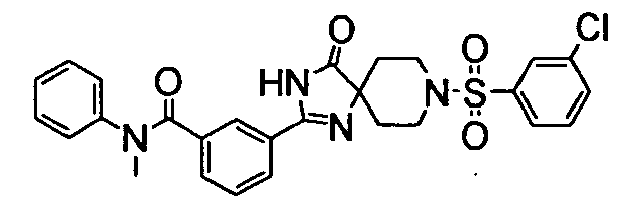
LCMS-E-2 4.11 537 (M+H)+ 350 
LCMS-E-6 1.76 537 (M+H)+ 351 
LCMS-E-6 1.42 475 (M+H)+ -

- 8-{2-[4-(4-Methanesulfonyl-piperazine-1-carbonyl)-2-methyl-phenyl]-ethanesulfonyl}-2-(3-trifluoromethyl-phenyl)-1,3,8-triaza-spiro[4.5]dec-1-en-4-one was synthesized by operations similar to those in Reaction 26-1, Reaction 18-2 and Reaction 10-14 using appropriate reagents and starting material.
MS (ESI) m/z = 670 (M+H)+. - The example compounds shown below were synthesized by operations similar to those in Example 60 using appropriate reagents and starting materials.
-
[Table 53] Compound Structure LCMS or HPLC condition Retention time (min) MS (m/z) 353 
LCMS-C-1 2.43 634 (M+H)+ 354 
LCMS-C-1 2.85 645 (M+H)+ 355 
LCMS-C-1 2.45 593 (M+H)+ 356 
LCMS-C-1 2.58 607 (M+H)+ 357 
LCMS-A-1 2.30 635 (M+H)+ 358 
LCMS-A-1 2.50 673 (M+H)+ 359 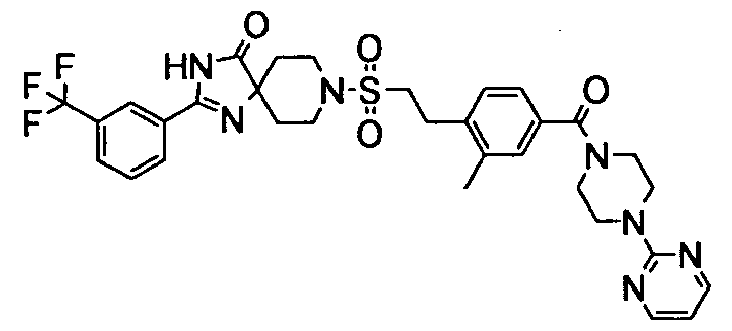
LCMS-A-1 2.45 670 (M+H)+ 360 
LCMS-C-1 2.58 699 (M+H)+ 361 
LCMS-C-1 2.78 669 (M+H)+ 362 
LCMS-C-1 2.47 680 (M+H)+ 363 
LCMS-C-1 2.53 705 (M+H)+ 364 
LCMS-C-1 2.72 675 (M+H)+ 365 
LCMS-A-1 2.67 627 (M+H)+ 366 
LCMS-A-1 1.95 650 (M+H)+ 367 
LCMS-C-1 2.42 620 (M+H)+ 368 
LCMS-A-1 2.81 649 (M+H)+ 369 
LCMS-C-1 2.42 620 (M+H)+ 370 
LCMS-C-1 2.42 593 (M+H)+ 371 
LCMS-C-1 2.55 607 (M+H)+ 372 
LCMS-C-1 2.57 620 (M+H)+ 373 
LCMS-A-1 2.08 648 (M+H)+ 374 
LCMS-C-1 2.43 677 (M+H)+ 375 
LCMS-A-1 2.79 686 (M+H)+ 376 
LCMS-A-1 2.03 634 (M+H)+ 377 
LCMS-C-1 2.40 579 (M+H)+ 378 
LCMS-B-1 2.16 595 (M+H)+ 379 
LCMS-B-1 2.15 581 (M+H)+ 380 
LCMS-B-1 2.38 591 (M+H)+ 381 
LCMS-B-1 2.12 563 (M+H)+ 382 
LCMS-C-1 2.52 663 (M+H)+ -

- 3,5,N,N-Tetramethyl-4-{(E)-2-[4-oxo-2-(3-trifluoromethyl-phenyl)-1,3,8-triaza-spiro[4.5]dec-1-ene-8-sulfonyl]-vinyl}-benzamide was synthesized by operations similar to those in Reaction 26-1 and Reaction 10-14 using appropriate reagents and starting material.
MS (ESI) m/z = 563 (M+H)+. - The example compounds shown below were synthesized by operations similar to those in Example 61 using appropriate reagents and starting materials.
-
[Table 54] Compound Structure LCMS or HPLC condition Retention time (min) MS (m/z) 384 
LCMS-C-1 2.53 619 (M+H)+ 385 
LCYS-C-1 2.52 591 (M+H)+ 386 
LCMS-C-1 2.48 649 (M+H)+ 387 
LCMS-C-1 2.50 648 (M+H)+ 388 
LCMS-C-1 2.77 589 (M+H)+ 389 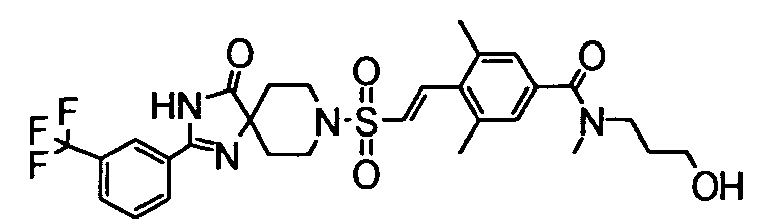
LCMS-C-1 2.53 607 (M+H)+ 390 
LCMS-C-1 2.60 620 (M+H)+ 391 
LCMS-C-1 2.48 634 (M+H)+ 392 
LCMS-C-1 2.28 606 (M+H)+ 393 
LCMS-C-1 2.62 646 (M+H)+ -

- 8-{(E)-2-[4-(4-Acetyl-piperazine-1-carbonyl)-2,6-dimethyl-phenyl]-ethenesulfonyl}-2-(3-trifluoromethoxy-phenyl)-1,3,8-triaza-spiro[4.5]dec-1-en-4-one was synthesized by operations similar to those in Reaction 26-1 and Reaction 10-14 using appropriate reagents and starting material.
MS (ESI) m/z = 662 (M+H)+. - The example compounds shown below were synthesized by operations similar to those in Example 62 using appropriate reagents and starting materials.
-
[Table 55] Compound Structure LCMS or HPLC condition Retention time (min) MS(m/z) 395 
LCMS-C-1 2.67 691 (M+H)+ 396 
LCMS-C-1 2.52 663 (M+H)+ 397 
LCMS-C-1 2.50 705 (M+H)+ 398 
LCMS-D-1 2.7 634 (M+H)+ 399 
LCMS-D-1 2.7 648 (M+H)+ 400 
LCMS-D-1 3.0 635 (M+H)+ 401 
LCMS-D-1 3.0 621 (M+H)+ 402 
LCMS-D-1 3.0 621 (M+H)+ 403 
LCMS-D-1 2.9 665 (M+H)+ 404 
LCMS-D-1 2.7 620 (M+H)+ 405 
LCMS-D-1 2.7 662 (M+H)+ 406 
LCMS-D-1 2.7 679 (M+H)+ 407 
LCMS-D-1 2.7 707 (M+H)+ 408 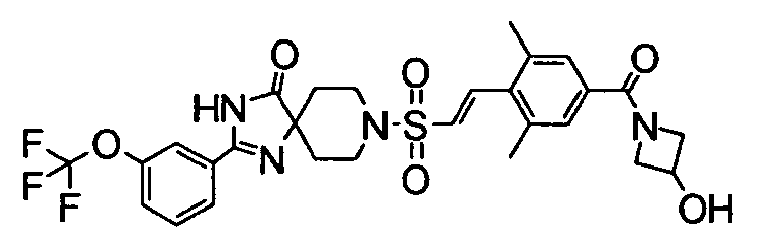
LCMS-D-1 3.0 607 (M+H)+ -

- 2,N,N-Trimethyl-3-{2-[4-oxo-2-(3-trifluoromethoxy-phenyl)-1,3,8-triaza-spiro[4.5]dec-1-ene-8-sulfonyl]-ethyl}-benzamide was synthesized by operations similar to those in Reaction 26-1, Reaction 42-1 and Reaction 10-14 using appropriate reagents and starting material.
MS (ESI) m/z = 567 (M+H)+. - The example compounds shown below were synthesized by operations similar to those in Example 63 using appropriate reagents and starting materials.
-
[Table 56] Compound Structure LCMS or HPLC condition Retention time (min) MS (m/z) 410 
LCE-D-1 2.9 539 (M+H)+ 411 
LCE-D-1 3.1 609 (M+H)+ -

- 4,N,N-Trimethyl-3-{2-[4-oxo-2-(3-trifluoromethoxy-phenyl)-1,3,8-triaza-spiro[4.5]dec-1-ene-8-sulfonyl]-ethyl}-benzamide was synthesized by operations similar to those in Reaction 26-1, Reaction 42-1 and Reaction 10-14 using appropriate reagents and starting material.
MS (ESI) m/z = 567 (M+H)+. - The example compounds shown below were synthesized by operations similar to those in Example 64 using appropriate reagents and starting materials.
-
[Table 57] Compound Structure LCMS or HPLC condition Retention time (min) MS(m/z) 413 
HPLC-A-1 11.5 597 (M+H)+ 414 
HPLC-A-1 9.4 311 (M+H)+ 415 
HPLC-A-2 9.5 553 (M+H)+ -

- 8-(2-{4-[4-(2-Hydroxy-ethyl)-piperazine-1-carbonyl]-2-methyl-phenyl}-ethanesulfonyl)-2-(3-trifluoromethoxy-phenyl)-1,3,8-triaza-spiro[4.5]dec-1-en-4-one was synthesized by operations similar to those in Reaction 26-1, Reaction 42-1 and Reaction 10-14 using appropriate reagents and starting material.
MS (ESI) m/z = 652 (M+H)+. - The example compound shown below was synthesized by operations similar to those in Example 64 using appropriate reagents and starting material.
-
[Table 58] Compound Structure LCMS or HPLC condition Retention time (min) MS (m/z) 417 
LCMS-C-2 2.31 611 (M+H)+ -

- n-BuLi (5.0 ml, 8.0 mmol, 1.6 M in hexane) was added dropwise to a solution of n-BU2Mg (8.0 ml, 8.0 mmol, 1.0 M in heptane) at room temperature for 10 minutes. The mixture was stirred at room temperature for 15 minutes and then cooled to -10 ± 2°C. A solution of 2,5-dibromo-4-fluorotoluene (5.466 g, 19.59 mmol) in toluene (30 ml)-THF (6 ml) was added dropwise to this mixed reaction solution over 30 minutes, and the mixture was then stirred at 0°C for one hour. The reaction mixture was added dropwise to a solution cooled to -10°C of DMF (2.1 ml, 27 mmol) in toluene (7.6 ml) over 15 minutes.
Further, this mixture was stirred at -10 to -5°C for 30 minutes, and then quenched with an aqueous citric acid solution (2.3 M, 16 ml, 37 mmol) and extracted with Et2O. The organic layer was washed with water, and then dried over MgSO4 and concentrated under reduced pressure to give 4-bromo-2-fluoro-5-methyl-benzaldehyde (3.74 g, 88%).
1H-NMR (300 MHz) (CDCl3) δ 2.42 (3H, s), 7.42 (1H, d, J = 9.6 Hz), 7.72 (1H, d, J = 7.2 Hz), 10.29 (1H, s). -

- NaH2PO4 (418 mg, 3.48 mmol) in H2O (17.6 ml), a 35% aqueous H2O2 solution (2.5 ml, 25.7 mmol) and NaClO2 (2.23 g, 24.7 mmol) in H2O (34.9 ml) were sequentially added to a mixture of 4-bromo-2-fluoro-5-methyl-benzaldehyde (3.74 g, 17.2 mmol) in MeCN (52 ml) at 0°C. The mixture was stirred at room temperature for 14 hours, and then made acidic (pH 3) with a 10% aqueous HCl solution and extracted with ethyl acetate (3 x 100 ml). The organic layers were washed with H2O (70 ml), and then dried over MgSO4 and concentrated under reduced pressure to give 4-bromo-2-fluoro-5-methyl-benzoic acid as a pale orange solid (4.02 g, 100%).
1H-NMR (300 MHz) (CDCl3) δ 2.42 (3H, s), 7.41 (1H, d, J = 9.9 Hz), 7.88 (1H, d, J = 7.5 Hz). MS (ESI) m/z = 231 (M-H)-. -
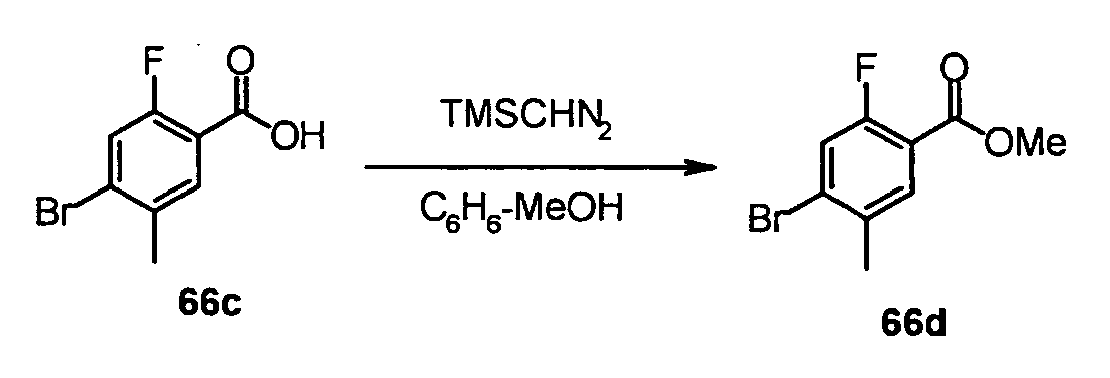
- (Trimethylsilyl)diazomethane (4.0 ml, 8.0 mmol, 2 M in Et2O) was added dropwise to a solution of 4-bromo-2-fluoro-5-methyl-benzoic acid (1.88 g, 8.05 mmol) in benzene (7.5 ml)-MeOH (5.6 ml) at 10 ± 2°C over 10 minutes. The mixture was stirred at room temperature for 30 minutes and then concentrated under reduced pressure. The resulting residue was purified by silica gel column chromatography (hexane/ethyl acetate = 40/1) to give methyl 4-bromo-2-fluoro-5-methyl-benzoate (1.62 g, 82%).
1H-NMR (300 MHz) (CDCl3) δ 2.40 (3H, s), 3.93 (3H, s), 7.37 (1H, d, J = 9.9 Hz), 7.80 (1H, d, J = 7.8 Hz). -
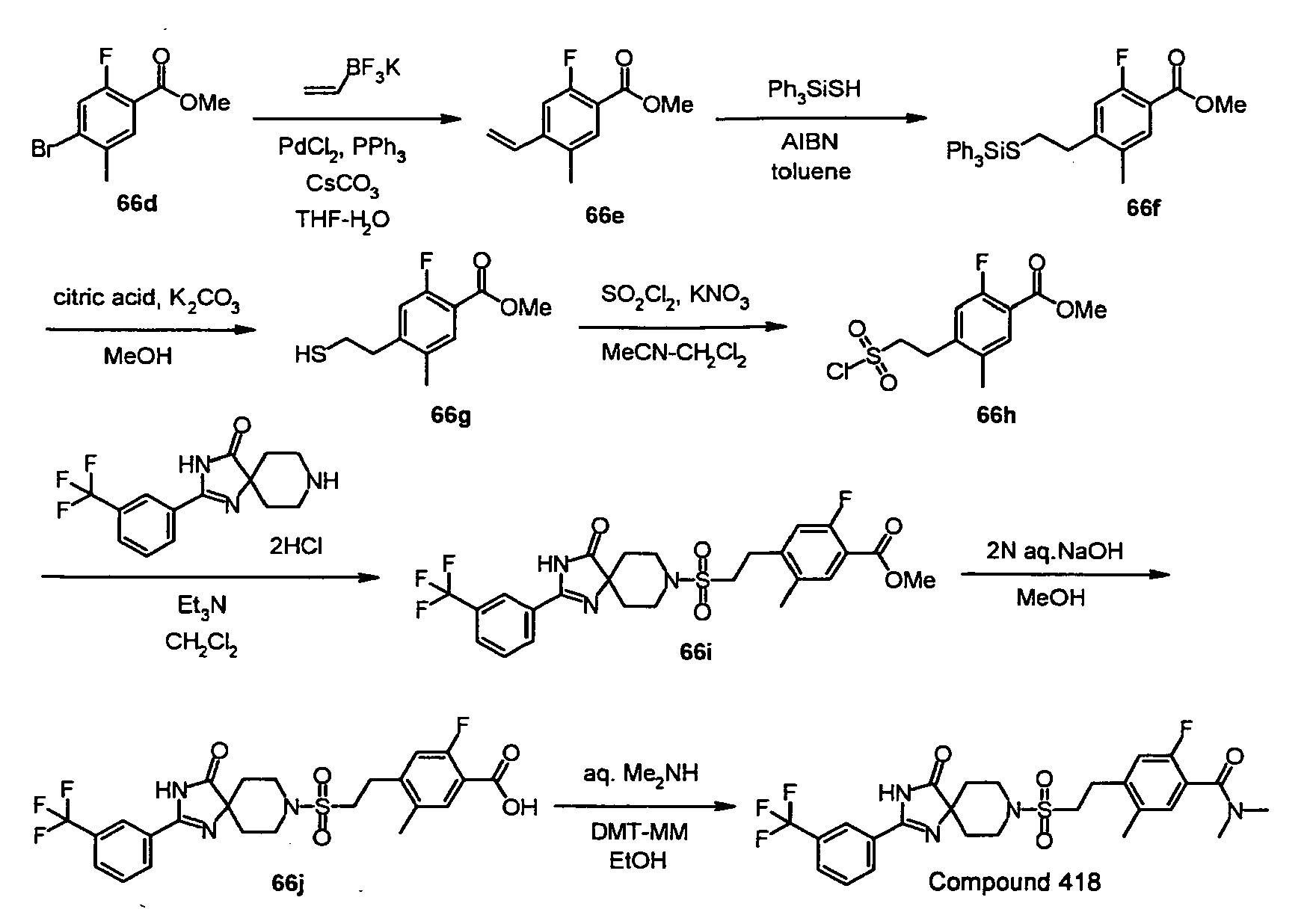
- 2-Fluoro-5,N,N-trimethyl-4-{2-[4-oxo-2-(3-trifluoromethyl-phenyl)-1,3,8-triaza-spiro[4.5]dec-1-ene-8-sulfonyl]-ethyl}-benzamide was synthesized by operations similar to those in Reaction 10-2, Reaction 10-3, Reaction 10-4, Reaction 10-5, Reaction 5-4, Reaction 23-2 and Reaction 10-1 using appropriate reagents and starting material.
MS (ESI) m/z = 569 (M+H)+. - The example compound shown below was synthesized by operations similar to those in Example 66 using appropriate reagents and starting material.
-
[Table 59] Compound Structure LCMS or HPLC condition Retention time (min) MS (m/z) 419 
LCMS-C-2 1.78 625 (M+H)+ -

- N-Benzyl-2-{4-[2-(2-cyclohexyl-4-oxo-1,3,8-triaza-spiro[4.5]dec-1-ene-8-sulfonyl)-ethyl]-1H-indol-3-yl}-acetamide was synthesized by operations similar to those in Reaction 25-2, Reaction 42-1, Reaction 23-2 and Reaction 10-1 using appropriate reagents and starting material.
MS (ESI) m/z = 590 (M+H)+. -

- 2-[2-(2-Cyclohexyl-4-oxo-1,3,8-triaza-spiro[4.5]dec-1-ene-8-sulfonyl)-ethyl]-N-methyl-benzamide was synthesized by operations similar to those in Reaction 25-2, Reaction 42-1, Reaction 23-2 and Reaction 10-18 using appropriate reagents and starting material.
MS (ESI) m/z = 461 (M+H)+. - The example compound shown below was synthesized by operations similar to those in Example 68 using appropriate reagents and starting material.
-
[Table 60] Compound Structure LCMS or HPLC condition Retention time (min) MS (m/z) 422 
LCMS-E-6 3.33 525 (M+H)+ -

- 8-(3-Chloro-benzenesulfonyl)-2-[1-(3,3-dimethyl-butyryl)-piperidin-3-yl]-1,3,8-triaza-spiro[4.5]dec-1-en-4-one was synthesized by operations similar to those in Reaction 10-18 using appropriate reagents and starting material.
MS (ESI) m/z = 509 (M+H)+. - The example compound shown below was synthesized by operations similar to those in Example 69 using appropriate reagents and starting material.
-
[Table 61] Compound Structure LCMS or HPLC condition Retention time (min) MS (m/z) 424 
LCMS-C-2 2.9 469 (M+H)+ -

- 8-(3-Chloro-benzenesulfonyl)-2-[1-(4-chlorobenzoyl)-piperidin-3-yl]-1,3,8-triaza-spiro[4.5]dec-1-en-4-one was synthesized by operations similar to those in Reaction 2-3 using appropriate reagents and starting material.
1H-NMR (400 MHz, CDCl3) δ 1.36-1.67 (m, 5 H), 1.84-2.06 (m, 4 H), 2.66-2.84 (m, 1 H), 2.90-3.10 (m, 2 H), 3.16-3.34 (m, 1 H), 3.41-3.55 (m, 1 H), 3.55-3.67 (m, 2 H), 4.04-4.27 (m, 1 H), 7.23-7.29 (m, 2 H), 7.30-7.37 (m, 2 H), 7.43 (t, J = 7.83 Hz, 1 H), 7.50-7.55 (m, 1 H), 7.59-7.65 (m, 1 H), 7.72 (t, J = 1.77 Hz, 1 H). MS (ESI) m/z = 549 (M+H)+. - The example compound shown below was synthesized by operations similar to those in Example 70 using appropriate reagents and starting material.
-
[Table 62] Compound Structure LCMS or HPLC condition Retention time (min) MS (m/z) 426 
LCMS-E-2 3.82 545 (M+H)+ -

- 2-[1-(1H-Indol-5-carbonyl)-piperidin-3-yl]-8-(2-naphthalen-1-yl-ethanesulfonyl)-1,3,8-triaza-spiro[4.5]dec-1-en-4-one was synthesized by operations similar to those in Reaction 10-18 using appropriate reagents and starting material.
MS (ESI) m/z = 598 (M+H)+. - The example compounds shown below were synthesized by operations similar to those in Example 72 using appropriate reagents and starting materials.
-
[Table 63] Compound Structure LCMS or HPLC condition Retention time (min) MS (m/z) 429 
LCMS-E-3 3.5 587 (M+H)+ 430 
LCMS-E-3 3.67 613 (M+H)+ 431 
LCMS-E-3 1.57 610 (M+H)+ 432 
LCMS-E-2 2.47 563 (M+H)+ 433 
LCMS-E-2 3.79 608 (M+H)+ 434 
LCMS-E-2 4.49 654 (M+H)+ 435 
LCMS-E-2 2.97 574 (M+H)+ 436 
LCMS-E-2 4.48 631 (M+H)+ 437 
LCMS-E-2 4.57 601 (M+H)+ 438 
LCMS-E-2 2.68 574 (M+H)+ 439 
LCMS-E-2 4.02 569 (M+H)+ -

- 8-(2-Naphthalen-1-yl-ethanesulfonyl)-2-{1-[(E)-(3-phenyl-acryloyl)]-piperidin-3-yl}-1,3,8-triaza-spiro[4.5]dec-1-en-4-one was synthesized by operations similar to those in Reaction 2-3 using appropriate reagents and starting material.
MS (ESI) m/z = 585 (M+H)+. -

- 2-[1-(2-Amino-acetyl)-piperidin-3-yl]-8-(3-chloro-benzenesulfonyl)-1,3,8-triaza-spiro[4.5]dec-1-en-4-one was synthesized by operations similar to those in Reaction 10-18 and Reaction 4-1 using appropriate reagents and starting material.
MS (ESI) m/z = 468 (M+H)+. -

- 8-{2-[2-Methyl-4-(3-methylamino-pyrrolidine-1-carbonyl)-phenyl]-ethanesulfonyl}-2-(3-trifluoromethyl-phenyl)-1,3,8-triaza-spiro[4..5]dec-1-en-4-one was synthesized by operations similar to those in Reaction 10-14 and Reaction 4-1 using appropriate reagents and starting material.
MS (ESI) m/z = 606 (M+H)+. - The example compounds shown below were synthesized by operations similar to those in Example 75 using appropriate reagents and starting materials.
-
[Table 64] Compound Structure LCMS or HPLC condition Retention time (min) MS (m/z) 445 
LCMS-B-1 1.70 592 (M+M)+ 446 
LCMS-C-1 2.50 620 (M+H)+ -

- 8-((E)-2-{4-[4-(2-Hydroxy-acetyl)-piperazine-1-carbonyl]-2,6-dimethyl-phenyl}-ethenesulfonyl)-2-(3-trifluoromethoxy-phenyl)-1,3,8-triaza-spiro[4.5]dec-1-en-4-one was synthesized by operations similar to those in Reaction 10-14 using appropriate reagents and starting material.
MS (ESI) m/z = 678 (M+H)+. - The example compounds shown below were synthesized by operations similar to those in Example 76 using appropriate reagents and starting materials.
-
[Table 65] Compound Structure LCMS or HPLC condition Retention time (min) MS (m/z) 448 
LCMS-C-1 2.62 734 (M+H)+ 449 
LCMS-C-1 2.43 733 (M+H)+ -

- 2-Methoxy-N-methyl-N-(3-methyl-4-{(E)-2-[4-oxo-2-(3-trifluoromethoxy-phenyl)-1,3,8-triaza-spiro[4.5]dec-1-ene-8-sulfonyl]-vinyl}-phenyl)-acetamide was synthesized by operations similar to those in Reaction 26-1 and Reaction 10-18 using appropriate reagents and starting material.
MS (ESI) m/z = 595 (M+H)+. -

- 2-Hydroxy-N-methyl-N-(3-methyl-4-{(E)-2-[4-oxo-2-(3-trifluoromethoxy-phenyl)-1,3,8-triaza-spiro[4.5]dec-1-ene-8-sulfonyl]-vinyl}-phenyl)-acetamide was synthesized by operations similar to those in Reaction 2-3 and Reaction 12-5 using appropriate reagents and starting material.
MS (ESI) m/z = 581 (M+H)+. -

- [(3,5-Dimethyl-4-{(E)-2-[4-oxo-2-(3-trifluoromethyl-phenyl)-1,3,8-triaza-spiro[4.5]dec-1-ene-8-sulfonyl]-vinyl}-benzoyl)-methyl-amino]-acetic acid was synthesized by operations similar to those in Reaction 10-14 and Reaction 23-2 using appropriate reagents and starting material.
MS (ESI) m/z = 607 (M+H)+. -

- Triethylamine (2 eq), 3,3-dimethyl-butylaldehyde (1 eq) and sodium triacetoxyborohydride (1.5 eq) were added to a solution of 8-(3-chloro-benzenesulfonyl)-2-piperidin-3-yl-1,3,8-triaza-spiro[4.5]dec-1-en-4-one trifluoroacetate (126 mg, 0.24 mmol) in dichloromethane (5 ml). The mixture was stirred at room temperature overnight and then concentrated under reduced pressure. The resulting residue was purified by HPLC to give 8-(3-chloro-benzenesulfonyl)-2-[1-(3,3-dimethyl-butyl)-piperidin-3-yl]-1,3,8-triaza-spiro[4.5]dec-1-en-4-one (35 mg, yield 30%).
1H-NMR (400 MHz, CDCl3) δ 0.85 (s, 9 H), 0.87-0.93 (m, 2 H), 1.43-1.56 (m, 4 H), 1.58-1.70 (m, 3 H), 1.75-1.99 (m, 6 H), 2.93-3.03 (m, 3 H), 3.54-3.63 (m, 3 H), 7.43 (t, J = 7.83 Hz, 1 H), 7.49-7.54 (m, 1 H), 7.62 (d, J = 7.58 Hz, 1 H), 7.72 (t, J = 1.77 Hz, 1 H). MS (ESI) m/z = 495 (M+H)+. -

- A solution of triphosgene (345 mg, 1.16 mmol) in CH2Cl2 (7 ml) was added to a solution of tert-butylamine (331 µl, 3.14 mmol) and triethylamine (876 µl, 6.29 mmol) in CH2Cl2 (10 ml) at -78°C. The mixture was stirred at room temperature for 10 minutes, followed by addition of a solution of 8-(3-chloro-benzenesulfonyl)-2-piperidin-3-yl-1,3,8-triaza-spiro[4.5]dec-1-en-4-one trifluoroacetate (165 mg, 0.314 mmol) and triethylamine (876 µl, 6.29 mmol) in CH2Cl2 (2 ml). Further, the reaction mixture was stirred at room temperature for 10 minutes and then concentrated under reduced pressure. The resulting residue was purified by silica gel column chromatography to give 3-[8-(3-Chloro-benzenesulfonyl)-4-oxo-1,3,8-triaza-spiro[4.5]dec-1-en-2-yl]-piperidine-1-carboxylic acid tert-butylamide as a colorless oil (40 mg, yield 25%).
1H-NMR (400 MHz, CDCl3) δ 1.25 (s, 9 H), 1.47-1.63 (m, 2 H), 1.71-1.84 (m, 2 H), 1.83-2.07 (m, 6 H), 3.02-3.13 (m, 2 H), 3.14-3.25 (m, 2 H), 3.53-3.65 (m, 2 H), 3.84-3.95 (m, 1 H), 7.43 (t, J = 7.83 Hz, 1 H), 7.49-7.55 (m, 1 H), 7.61 (d, J = 7.83 Hz, 1 H), 7.72 (t, J = 1.77 Hz, 1 H). MS (ESI) m/z = 510 (M+H)+. - The example compound shown below was synthesized by operations similar to those in Example 81 using appropriate reagents and starting material.
-
[Table 66] Compound Structure LCMS or HPLC condition Retention time (min) MS (m/z) 455 
LCMS-E-2 3.34 602 (M+H)+ -

- TEA (1.143 mmol, 3 eq) and piperidine-1-carbonyl chloride (0.457 mmol, 1.2 eq) were sequentially added to a mixed solution of 8-(3-chloro-benzenesulfonyl)-2-piperidin-3-yl-1,3,8-triaza-spiro[4.5]dec-1-en-4-one trifluoroacetate (200 mg, 0.38 mmol) in dichloromethane (3 ml). The resulting mixture was stirred at room temperature overnight and then concentrated under reduced pressure. The resulting residue was purified by HPLC to give 8-(3-chloro-benzenesulfonyl)-2-[1-(piperidine-1-carbonyl)-piperidin-3-yl]-1,3,8-triaza-spiro[4.5]dec-1-en-4-one (30 mg, yield 15%).
1H-NMR (400 MHz, CDCl3) δ 1.34-1.48 (m, 2 H), 1.49-1.66 (m, 6 H), 1.66-1.81 (m, 2 H), 1.84-1.96 (m, 1 H), 1.97-2.12 (m, 2 H), 2.79 -2.96 (m, 1 H), 2.98-3.25 (m, 8 H), 3.25-3.42 (m, 2 H), 3.62-3.89 (m, 3 H), 7.50 (t, J = 7.83 Hz, 1 H), 7.57-7.62 (m, 1 H), 7.69 (d, J = 7.58 Hz, 1 H), 7.80 (t, J = 1.77 Hz, 1 H). MS (ESI) m/z = 522 (M+H)+. -

- 4-Nitrophenyl chloroformate (35 mg, 0.17 mmol) was added to a solution of 8-[(E)-2-(2-methyl-4-methylaminophenyl)-ethenesulfonyl]-2-(3-trifluoromethoxy-phenyl)-1,3,8-triaza-spiro[4.5]dec-1-en-4-one (80 mg, 0.15 mmol) in THF (1 ml) at room temperature, and the mixture was then stirred at 70°C for 30 minutes. The reaction mixture was extracted with AcOEt, and then dried over sodium sulfate and concentrated under reduced pressure. The resulting intermediate (83a) (20 mg, 0.029 mmol) was dissolved in DMA (0.1 ml), and N,N-dimethylethylenediamine (0.1 ml, 0.91 mmol) was added. The mixture was then stirred at 140°C for one hour and at 100°C for one hour. The resulting reaction mixture was purified by silica gel column chromatography to give 3-(2-dimethylamino-ethyl)-1-methyl-1-(3-methyl-4-{(E)-2-[4-oxo-2-(3-trifluoromethoxy-phenyl)-1,3,8-triaza-spiro[4.5]dec-1-ene-8-sulfonyl]-vinyl}-phenyl)-urea as an amorphous (12 mg, yield 66%).
1H-NMR (400 MHz, DMSO-d6) δ 1.63-1.66 (m, 2H), 1.85-1.90 (m, 2H), 2.09 (s, 6H), 2.28 (t, J = 6.8 Hz, 2H), 2.40 (s, 3H), 3.06-3.17 (m, 7H), 3.58-3.61 (m, 2H), 6.18 (t, J = 5.8 Hz, 1H), 7.20 (d, J = 8.3 Hz, 1H), 7.22 (s, 1H), 7.26 (d, J = 15.6 Hz, 1H), 7.55 (d, J = 15.6 Hz, 1H), 7.57-7.67 (m, 2H), 7.82 (d, J = 8.3 Hz, 1H), 7.91 (br, 1H), 8.01 (br, 1H), 11.8 (br, 1H). MS (ESI) m/z = 637 (M+H)+. - The example compound shown below was synthesized by operations similar to those in Example 83 using appropriate reagents and starting material.
-
[Table 67] Compound Structure LCMS or HPLC condition Retention time (min) MS (m/z) 458 
LCMS-B-1 2.04 566 (M+H)+ -

- 1-{3-[2-(2-Cyclohexyl-4-oxo-1,3,8-triaza-spiro[4.5]dec-1-ene-8-sulfonyl)-ethyl]-2-methyl-phenyl}-3-methyl-urea was synthesized by operations similar to those in Reaction 25-2, Reaction 42-1 and Reaction 84-1 using appropriate reagents and starting material.
MS (ESI) m/z = 490 (M+H)+. -

- 3-[8-(3-Chloro-benzenesulfonyl)-4-oxo-1,3,8-triaza-spiro[4.5]dec-1-en-2-yl]-piperidine-1-carboxylic acid 2-methoxy-ethyl ester was synthesized by operations similar to those in Reaction 2-3 using appropriate reagents and starting material.
1H-NMR (400 MHz, CDCl3) δ 1.21-1.33 (m, 2 H), 1.34-1.51 (m, 3 H), 1.52-1.71 (m, 2 H), 1.73-2.02 (m, 3 H), 2.45-2.62 (m, 1 H), 2.81-2.95 (m, 3 H), 3.26 (s, 3 H), 3.43-3.51 (m, 2 H), 3.54-3.65 (m, 2 H), 3.95-4.04 (m, 1 H), 4.05-4.15 (m, 2 H), 7.35-7.44 (m, 1 H), 7.45-7.51 (m, 1 H), 7.56 (d, J = 7.83 Hz, 1 H), 7.66 (t, J = 1.77 Hz, 1 H). MS (ESI) m/z = 513 (M+H)+. - The example compounds shown below were synthesized by operations similar to those in Example 85 using appropriate reagents and starting materials.
-
[Table 68] Compound Structure LCMS or HPLC condition Retention time (min) MS (m/z) 461 
LCMS-E-6 1.86 545 (M+H)+ 462 
LCMS-E-6 1.84 511 (M+H)+ 463 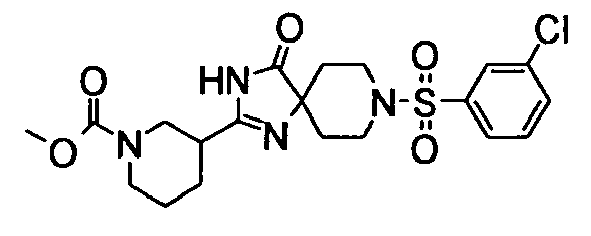
LCMS-E-6 1.46 469 (M+H)+ 464 
LCMS-E-3 3.65 589 (M+H)+ 465 
LCMS-E-3 3.75 569 (M+H)+ 569 (M+H)+ -

- Methyl-(3-methyl-4-{(E)-2-[4-oxo-2-(3-trifluoromethoxy-phenyl)-1,3,8-triaza-spiro[4.5]dec-1-ene-8-sulfonyl]-vinyl}-phenyl)-carbamic acid 2-dimethylamino-ethyl ester was synthesized by operations similar to those in Reaction 83-1 using appropriate reagents and starting material.
MS (ESI) m/z = 638 (M+H)+. - The example compound shown below was synthesized by operations similar to those in Example 86 using appropriate reagents and starting material.
-
[Table 69] Confound Structure LCMS or HPLC condition Retention time (min) MS (m/z) 467 
LCMS-A-1 2.74 581 (M+H)+ -

- Methyl-(3-methyl-4-{2-[4-oxo-2-(3-trifluoromethoxy-phenyl)-1,3,8-triaza-spiro[4.5]dec-1-ene-8-sulfonyl]-ethyl}-phenyl)-carbamic acid methyl ester was synthesized by operations similar to those in Reaction 2-3 using appropriate reagents and starting material.
MS (ESI) m/z = 583 (M+H)+. -

- 2-Cyclohexyl-8-(2-o-tolyl-ethanesulfonyl)-1,3,8-triaza-spiro[4.5]dec-1-en-4-one (24.2 mg, 0.058 mmol), Lawesson's reagent (48.3 mg, 0.116 mmol) and toluene (1.16 ml) were added to a sealed test tube and stirred at 110°C overnight. The reaction mixture was cooled to ambient temperature, and the solvent was then distilled off under reduced pressure. The residue was purified by column chromatography (silica gel, CH2Cl2-MeOH) to give 2-cyclohexyl-8-(2-o-tolyl-ethanesulfonyl)-1,3,8-triaza-spiro[4.5]dec-1-ene-4-thione (11.2 mg, 45%).
1H-NMR (400 MHz, CD3OD) δ 1.29-1.58 (7H, m), 1.73-2.15 (7H, m), 2.36 (3H, s), 2.55 (1H, tt, J = 4, 12 Hz), 3.09-3.13 (2H, m), 3.25-3.27 (2H, m), 3.30-3.31 (2H, m), 3.80-3.83 (2H, m), 7.13-7.23 (4H, m). MS (ESI) m/z = 434 (M+H)+. -

- 8-[2-(2,6-Dimethyl-4-methylamino-phenyl)-ethanesulfonyl]-2-(4-methyl-cyclohexyl)-1,3,8-triaza-spiro[4.5]dec-1-en-4-one was synthesized by operations similar to those in Reaction 25-2 using appropriate reagents and starting material.
MS (ESI) m/z = 473 (M+H)+. -

- Sodium cyanate (15 mg, 0.243 mmol) was added to a solution of 8-[2-(2,6-dimethyl-4-methylamino-phenyl)-ethanesulfonyl]-2-(4-methyl-cyclohexyl)-1,3,8-triaza-spiro[4.5]dec-1-en-4-one (23 mg, 0.0487 mmol) and acetic acid (1.3 ml) in dichloromethane (0.5 ml) at room temperature, and the mixture was then stirred for two hours. The reaction mixture was diluted with dichloromethane, and the organic layer was then washed with water and a saturated aqueous sodium bicarbonate solution, dried over anhydrous sodium sulfate and concentrated under reduced pressure. The resulting residue was purified by preparative TLC (silica gel, MeOH/AcOEt/CH2Cl2) to give 1-(3,5-dimethyl-4-{(E)-2-[2-(4-methyl-cyclohexyl)-4-oxo-1,3,8-triaza-spiro[4.5]dec-1-ene-8-sulfonyl]-vinyl}-phenyl)-1-methyl-urea (22.5 mg, 90%).
1H-NMR (400 MHz, CDCl3) δ 0.92 (3H, d, J = 4.0 Hz), 0.95-1.1 (2H, m), 1.35-1.50 (3H, m), 1.65-1.75 (2H, m), 1.80-1.85 (2H, m), 1.90-2.00 (4H, m), 2.30-2.40 (1H, m), 2.38 (6H, s), 3.26 (3H, s), 3.35-3.45 (2H, m), 3.60-3.75 (2H, m), 4.54 (2H, brs), 6.39 (1H, d, J = 16.0 Hz), 7.03 (2H, s), 7.54 (1H, d, J = 16.0 Hz), 8.10 (1H, brs). MS (ESI) m/z = 516 (M+H)+. -

- 1-(3,5-Dimethyl-4-{2-[2-(4-methyl-cyclohexyl)-4-oxo-1,3,8-triaza-spiro[4.5]dec-1-ene-8-sulfonyl]-ethyl}-phenyl)-1-methyl-urea was synthesized by operations similar to those in Reaction 42-2 using appropriate reagents and starting material.
1H-NMR (400 MHz, CD3OD) δ 0.92 (3H, d, J = 8.0 Hz), 0.95-1.06 (2H, m), 1.35-1.50 (3H, m), 1.65-1.75 (2H, m), 1.80-1.86 (2H, m), 1.88-2.00 (4H, m), 2.30-2.40 (1H, m), 2.36 (6H, s), 2.95-3.02 (2H, m), 3.15-3.22 (2H, m), 3.23 (3H, s), 3.45-3.52 (2H, m), 3.68-3.77 (2H, m), 4.47 (2H, brs), 6.95 (2H, s), 8.06 (1H, brs). MS (ESI) m/z = 518 (M+H)+. -

- 1-(3,5-Dimethyl-4-{(E)-2-[4-oxo-2-(4-trifluoromethyl-cyclohexyl)-1,3,8-triaza-spiro[4.5]dec-1-ene-8-sulfonyl]-vinyl}-phenyl)-1-methyl-urea was synthesized by operations similar to those in Reaction 5-3, Reaction 25-1, Reaction 26-1, Reaction 7-2 and Reaction 89-2 using appropriate reagents and starting material.
MS (ESI) m/z = 570 (M+H)+. -

- 1-(3,5-Dimethyl-4-{2-[4-oxo-2-(4-trifluoromethyl-cyclohexyl)-1,3,8-triaza-spiro[4.5]dec-1-ene-8-sulfonyl]-ethyl}-phenyl)-1-methyl-urea was synthesized by operations similar to those in Reaction 42-2 using appropriate reagents and starting material.
MS (ESI) m/z = 572 (M+H)+. -

- 8-[(E)-2-(4-amino-2-methyl-phenyl)-ethenesulfonyl]-2-(3-trifluoromethoxy-phenyl)-1,3,8-triaza-spiro[4.5]dec-1-en-4-one was obtained by operations similar to those in Reaction 26-1 using 8-ethenesulfonyl-2-(3-trifluoromethoxy-phenyl)-1,3,8-triaza-spiro[4.5]dec-1-en-4-one as a starting material.
MS (ESI) m/z = 509 (M+H)+. -

- A solution of tert-butanol (71.9 mg, 0.97 mmol) in dichloromethane (1.5 ml) was added to a solution of chlorosulfonyl isocyanate (137 mg, 0.97 mmol) in dichloromethane (3 ml) with stirring under ice-cooling. The mixture was stirred at 0°C for 10 minutes. A solution of 8-[(E)-2-(4-amino-2-methyl-phenyl)-ethenesulfonyl]-2-(3-trifluoromethoxy-phenyl)-1,3,8-triaza-spiro[4.5]dec-1-en-4-one (400 mg, 0.81 mmol) and triethylamine (164 mg, 1.62 mmol) in dichloromethane (3 ml) was then added, and the mixture was further stirred for one hour. The mixed reaction solution was quenched with water and then extracted with dichloromethane. The organic layer was washed with saturated brine, and then dried over anhydrous magnesium sulfate and concentrated under reduced pressure. The resulting residue was purified by silica gel column chromatography (ethyl acetate-hexane) to give N-(tert-butoxycarbonyl)-N'-(3-methyl-4-{(E)-2-[4-oxo-2-(3-trifluoromethoxy-phenyl)-1,3,8-triaza-spiro[4.5]dec-1-ene-8-sulfonyl]-vinyl}-phenyl)sulfamide (334 mg, 60.0%).
1H-NMR (400 MHz, CDCl3) δ 1.42 (9H, s), 1.78 (2H, dt, J = 14.2, 3.9 Hz), 2.04-2.14 (2H, m), 2.40 (3H, s), 3.43 (2H, ddd, J = 12.7, 9.8, 2.9 Hz), 3.74 (2H, dt, J = 12.2, 4.4 Hz), 6.64 (1H, d, J = 15.6 Hz), 7.08-7.11 (2H, m), 7.38 (1H, d, J = 8.3 Hz), 7.48-7.54 (2H, m), 7.68 (1H, d, J = 15.1 Hz), 7.73 (1H, d, J = 7.8 Hz), 7.76 (1H, s), 9.62 (1H, s);
MS (ESI) m/z = 688 (M+H)+. -

- (3-Methyl-4-{(E)-2-[4-oxo-2-(3-trifluoromethoxy-phenyl)-1,3,8-triaza-spiro[4.5]dec-1-ene-8-sulfonyl]-vinyl}-phenyl)-sulfamide was obtained by operations similar to those in Reaction 4-1 using N-(tert-butoxycarbonyl)-N'-(3-methyl-4-{(E)-2-[4-oxo-2-(3-trifluoromethoxy-phenyl)-1,3,8-triaza-spiro[4.5]dec-1-ene-8-sulfonyl]-vinyl}-phenyl)sulfamide as a starting material.
MS (ESI) m/z = 588 (M+H)+. -

- Benzoyl isothiocyanate (37.8 mg, 0.23 mmol) was added to a solution of 8-[2-(2,6-dimethyl-4-methylaminophenyl)-ethanesulfonyl]-2-(4-methyl-cyclohexyl)-1,3,8-triaza-spiro[4.5]dec-1-en-4-one (100 mg, 0.21 mmol) in acetone (3 ml) in a nitrogen stream. The mixture was heated under reflux for one hour and then concentrated under reduced pressure. The resulting residue was purified by silica gel column chromatography (dichloromethane-methanol) to give 3-benzoyl-1-(3,5-dimethyl-4-{2-[2-(4-methyl-cyclohexyl)-4-oxo-1,3,8-triaza-spiro[4.5]dec-1-ene-8-sulfonyl]-ethyl}-phenyl)-1-methyl-thiourea (140 mg).
1H-NMR (400 MHz, CDCl3) δ 0.92 (3H, d, J = 6.8 Hz), 0.94-1.07 (2H, m), 1.32-1.46 (3H, m), 1.52-1.64 (2H, m), 1.82 (2H, dd, J = 13.7, 2.4 Hz), 1.90-2.00 (4H, m), 2.28-2.33 (1H, m), 2.35 (6H, s), 2.90-3.00 (2H, m), 3.08-3.16 (2H, m), 3.36-3.45 (2H, m), 3.64-3.78 (5H, m), 7.01 (2H, s), 7.37-7.62 (5H, m);
MS (ESI) m/z = 638 (M+H)+. -

- Hydrazine monohydrate (55 mg, 1.1 mmol) was added to a solution of 3-benzoyl-1-(3,5-dimethyl-4-{2-[2-(4-methyl-cyclohexyl)-4-oxo-1,3,8-triaza-spiro[4.5]dec-1-ene-8-sulfonyl]-ethyl}-phenyl)-1-methyl-thiourea (140 mg, 0.22 mmol) in ethanol (7 ml). The mixture was stirred at room temperature for 15 hours and then concentrated under reduced pressure. The resulting residue was purified by silica gel column chromatography (dichloromethane-methanol) to give 1-(3,5-dimethyl-4-{2-[2-(4-methyl-cyclohexyl)-4-oxo-1,3,8-triaza-spiro[4.5]dec-1-ene-8-sulfonyl]-ethyl}-phenyl)-1-methyl-thiourea (119 mg).
1H-NMR (400 MHz, CDCl3) δ 0.92 (3H, d, J = 6.3 Hz), 1.00 (2H, ddd, J = 25.4, 13.7, 2.9 Hz), 1.32-1.47 (3H, m), 1.59-1.68 (2H, m), 1.82 (2H, dd, J = 10.7, 3.4 Hz), 1.90-1.98 (4H, m), 2.28-2.35 (1H, m), 2.35 (6H, s), 2.95-3.02 (2H, m), 3.15-3.22 (2H, m), 3.45 (2H, ddd, J = 12.2, 9.3, 3.4 Hz), 3.55 (3H, s), 3.74 (2H, dt, J = 13.1, 4.4 Hz), 5.63 (1H, brs), 6.94 (2H, s), 8.14 (1H, s);
MS (ESI) m/z = 534 (M+H)+. -

- Bromoacetaldehyde diethylacetal (44.2 mg, 0.224 mmol) was added to a solution of 1-(3,5-dimethyl-4-{2-[2-(4-methyl-cyclohexyl)-4-oxo-1,3,8-triaza-spiro[4.5]dec-1-ene-8-sulfonyl]-ethyl}-phenyl)-1-methyl-thiourea (100 mg, 0.187 mmol) in acetic acid (2 ml) in a nitrogen stream. The mixture was heated under reflux for two hours and then concentrated under reduced pressure. The resulting residue was diluted with dichloromethane, and the organic layer was then sequentially washed with a saturated aqueous sodium bicarbonate solution and saturated brine and dried over anhydrous magnesium sulfate. The organic layer was concentrated, and the resulting residue was then purified by silica gel column chromatography (dichloromethane-methanol) to give 8-{2-[2,6-Dimethyl-4-(methyl-thiazol-2-yl-amino)-phenyl]-ethanesulfonyl}-2-(4-methyl-cyclohexyl)-1,3,8-triaza-spiro[4.5]dec-1-en-4-one (7.1 mg).
1H-NMR (400 MHz, CDCl3) δ 0.92 (3H, d, J = 6.8 Hz), 0.95-1.07 (2H, m), 1.33-1.48 (3H, m), 1.56-1.67 (2H, m), 1.82 (2H, d, J = 11.2 Hz), 1.91-2.03 (4H, m), 2.29-2.35 (1H, m), 2.37 (6H, s), 2.99-3.06 (2H, m), 3.14-3.21 (2H, m), 3.43 (2H, ddd, J = 12.7, 9.3, 2.9 Hz), 3.49 (3H, s), 3.77 (2H, dt, J = 12.2, 4.4 Hz), 6.48 (1H, d, J = 3.4 Hz), 7.06 (2H, s), 7.22 (1H, d, J = 3.4 Hz), 8.33 (1H, s);
MS (ESI) m/z = 558 (M+H)+. - The example compounds shown below were obtained by operations similar to those in Reaction 25-2 using appropriate reagents and starting materials.
-
[Table 70] Target Compound Structure LCMS condition Retention time (min) MS (m/z) 476 
LCMS-C-1 2.53 513 (M+H)+ 477 
LCMS-C-1 2.55 554 (M+H)+ 478 
LCMS-C-1 2.62 513 (M+H)+ 479 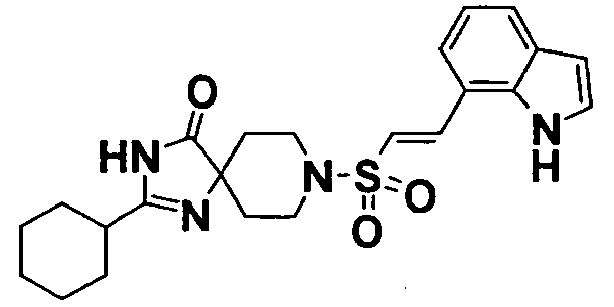
LCMS-A-1 2.25 441 (M+H)+ 480 
LCMS-C-1 2.42 529 (M+H)+ 481 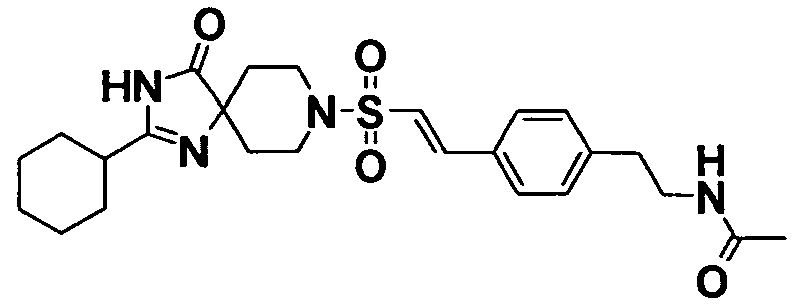
LCMS-C-1 2.30 485 (M-H) - 482 
LCMS-C-1 2.30 485 (M-H) - 483 
LCMS-C-1 2.62 536 (M-H) - 484 
LCMS-C-1 2.38 562 (M+H)+ 485 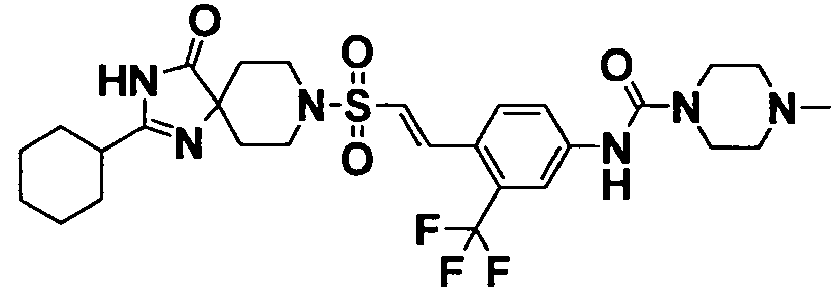
LCMS-C-1 2.68 611 (M+H)+ 486 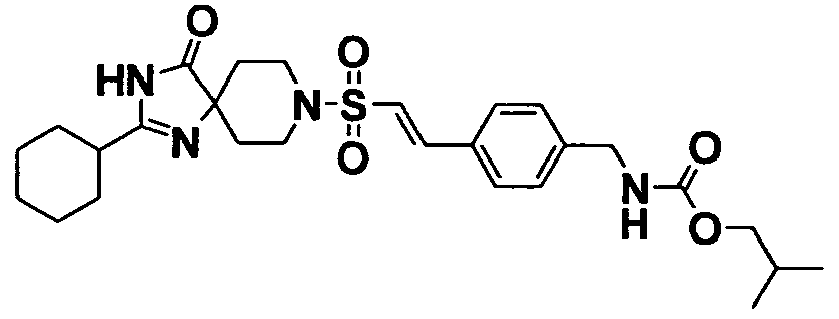
LCMS-C-1 2.75 529 (M-H) - 487 
LCMS-A-1 2.00 529 (M+H)+ 488 
LCMS-A-1 2.17 455 (M+H)+ 489 
LCMS-C-1 2.30 489 (M+H)+ 490 
LCMS-C-1 2.38 516 (M+H)+ 491 
LCMS-C-1 2.68 551 (M-H) - 492 
LCMS-A-1 2.30 509 (M+H)+ 493 
LCMS-C-1 2.65 557 (M+H)+ 494 
LCMS-A-1 1.90 586 (M+H)+ 495 
LCMS-C-1 2.60 607 (M+H)+ 496 
LCMS-C-1 2.48 637 (M+H)+ 497 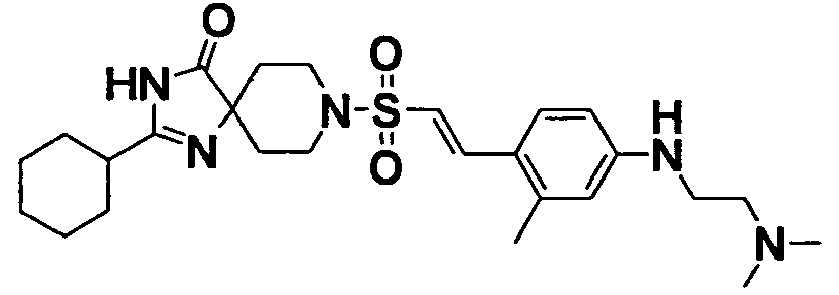
LCMS-C-1 2.32 502 (M+H)+ 498 
LCMS-C-1 2.37 627 (M+H)+ 499 
LCMS-C-1 2.55 510 (M+H)+ 500 
LCMS-A-1 2.35 573 (M+H)+ 501 
LCMS-A-1 2.14 543 (M+H)+ 502 
LCMS-C-1 2.18 577 (M+H)+ 503 
LCMS-C-1 2.28 566 (M+H)+ - The aryl bromide reagent used in the synthesis of Compound 477 ((4-bromo-indol-1-yl)-morpholin-4-yl-methanone) was synthesized as follows.
-

- (4-Bromo-indol-1-yl)-morpholin-4-yl-methanone was synthesized by operations similar to those in Reaction 25-3 using appropriate reagents and starting material.
1H-NMR (400 MHz, CDCl3) δ 3.61 (4H, t, J = 4.8 Hz), 3.78 (4H, t, J = 4.8 Hz), 6.69 (1H, d, J = 3.6 Hz), 7.17 (1H, t, J = 7.9 Hz), 7.35 (2H, d, J = 3.6 Hz), 7.38 (2H, d, J = 7.9 Hz), 7.65 (1H, d, J = 7.9 Hz). - The aryl bromide reagent used in the synthesis of Compound 478 (4-(4-bromo-indol-1-yl)-butan-1-ol) was synthesized as follows.
-

- 4-(4-Bromo-indol-1-yl)-butan-1-ol was synthesized by operations similar to those in Reaction 29-7 and Reaction 25-4 using appropriate reagents and starting material.
MS (ESI) m/z = 268, 270 (M+H)+. - The aryl bromide reagent used in the synthesis of Compound 480 (4-(4-bromo-indol-1-yl)-butane-1,2-diol) was synthesized as follows.
-

- 4-(4-Bromo-indol-1-yl)-butane-1,2-diol was synthesized by operations similar to those in Reaction 25-3 and Reaction 25-4 using appropriate reagents and starting material.
MS (ESI) m/z = 284, 286 (M+H)+. - The aryl bromide reagent used in the synthesis of Compound 483 (4-bromo-1-thiazol-2-ylmethyl-1H-indole) was synthesized as follows.
-

- 4-Bromo-1-thiazol-2-ylmethyl-1H-indole was synthesized by operations similar to those in Reaction 25-3 using appropriate reagents and starting material.
MS (ESI) m/z = 293, 295 (M+H)+. - The aryl bromide reagent used in the synthesis of Compound 484 (3-(4-bromo-indol-1-yl)-propane-1-sulfonic amide) was synthesized as follows.
-

- 3-(4-Bromo-indol-1-yl)-propane-1-sulfonyl chloride was synthesized as a crude product by operations similar to those in Reaction 25-3 and Reaction 52-3 using 4-bromoindole (0.20 ml, 1.59 mmol) as a starting material and using THF as a solvent.
-

- 3-(4-Bromo-indol-1-yl)-propane-1-sulfonyl chloride obtained as a crude product was all dissolved in diethyl ether (3.0 ml). A 28% aqueous ammonia solution (3.0 ml) was then added dropwise and the mixture was stirred at room temperature for 2.5 hours. Water was added to the reaction system, followed by extraction with ethyl acetate. The organic layer was washed with water and saturated brine and then concentrated under reduced pressure. The resulting residue was purified by silica gel column chromatography (dichloromethane-ethyl acetate) to give 3-(4-bromo-indol-1-yl)-propane-1-sulfonic amide (55.6 mg, 11% in three steps).
MS (ESI) m/z = 317, 319 (M+H)+. - The aryl bromide reagent used in the synthesis of Compound 485 (4-methyl-piperazine-1-carboxylic (4-bromo-3-trifluoromethyl-phenyl)-amide) was synthesized as follows.
-

- 4-Methyl-piperazine-1-carboxylic (4-bromo-3-trifluoromethyl-phenyl)-amide was synthesized by operations similar to those in Reaction 25-11 using appropriate reagents and starting material.
MS (ESI) m/z = 366, 368 (M+H)+. - The aryl bromide reagent used in the synthesis of Compound 486 ((4-bromo-benzyl)-carbamic acid isobutyl ester) was synthesized as follows.
-

- (4-Bromo-benzyl)-carbamic acid isobutyl ester was synthesized by operations similar to those in Reaction 25-10 using appropriate reagents and starting material. MS (ESI) m/z = 286, 288 (M+H)+.
- [1068] The aryl bromide reagent used in the synthesis of Compound 487 (2-[2-(5-bromo-indol-1-yl)-ethoxy]-ethanol) was synthesized as follows.
-

- 2-[2-(5-Bromo-indol-1-yl)-ethoxy]-ethanol was synthesized by operations similar to those in Reaction 25-3 using appropriate reagents and starting material.
1H-NMR (270 MHz, CDCl3) δ 7.74 (1H, d, J = 1.6 Hz), 7.28 (1H, dd, J = 8.7, 1.8 Hz), 7.23 (1H, d, J = 8.6 Hz), 7.15 (1H, d, J = 3.1 Hz), 6.44 (1H, d, J = 3.1 Hz), 4.29 (2H, t, J = 5.4 Hz), 3.79 (2H, t, J = 5.4 Hz), 3.65-3.59 (2H, m), 3.48-3.44 (2H, m), 1.67 (1H, t, J = 6.1 Hz). - The aryl bromide reagent used in the synthesis of Compound 488 (5-bromo-6-methyl-1H-indole) was synthesized as follows.
-

- (4-Bromo-2-iodo-5-methyl-phenyl)-carbamic acid methyl ester (605 mg, 1.64 mmol) was dissolved in THF (6 ml). (Trimethylsilyl)acetylene (0.70 ml, 4.95 mmol), copper iodide (33.5 mg, 0.175 mmol), Pd(PPh3)2Cl2 (56.5 mg, 0.081 mmol) and triethylamine (0.690 ml, 4.95 mmol) were added and the mixture was stirred at room temperature for four hours. Water was added to the reaction system, followed by extraction with ethyl acetate. The organic layer was washed with water and saturated brine, dried over anhydrous sodium sulfate and concentrated under reduced pressure. The resulting residue was purified by silica gel column chromatography (n-hexane-ethyl acetate) to give (4-bromo-5-methyl-2-trimethylsilanylethynyl-phenyl)-carbamic acid methyl ester (548 mg, 98%).
MS (ESI) m/z = 340 (M+H)+. -

- (4-Bromo-5-methyl-2-trimethylsilanylethynyl-phenyl)-carbamic acid methyl ester (506 mg, 1.49 mmol) was dissolved in ethanol (6 ml). Sodium ethoxide (20% solution in ethanol, 1.17 ml, 2.97 mmol) was added and the mixture was stirred at 70°C overnight. The reaction solution was poured into ice water, and 1 N hydrochloric acid and saturated brine were added to this mixture, followed by extraction with ethyl acetate. The organic layer was washed with water and saturated brine, dried over anhydrous sodium sulfate and concentrated under reduced pressure. The resulting residue was purified by silica gel column chromatography (n-hexane-ethyl acetate) to give 5-bromo-6-methyl-1H-indole (207 mg, 66%).
1H-NMR (270 MHz, CDCl3) δ 8.04 (1H, br s), 7.81 (1H, s), 7.27 (1H, s), 7.16-7.14 (1H, m), 6.46-6.43 (1H, m), 2.49 (3H, s). - [1076] The aryl bromide reagent used in the synthesis of Compound 489 (N-(4-bromo-benzyl)-2-hydroxy-acetamide) was synthesized as follows.
-
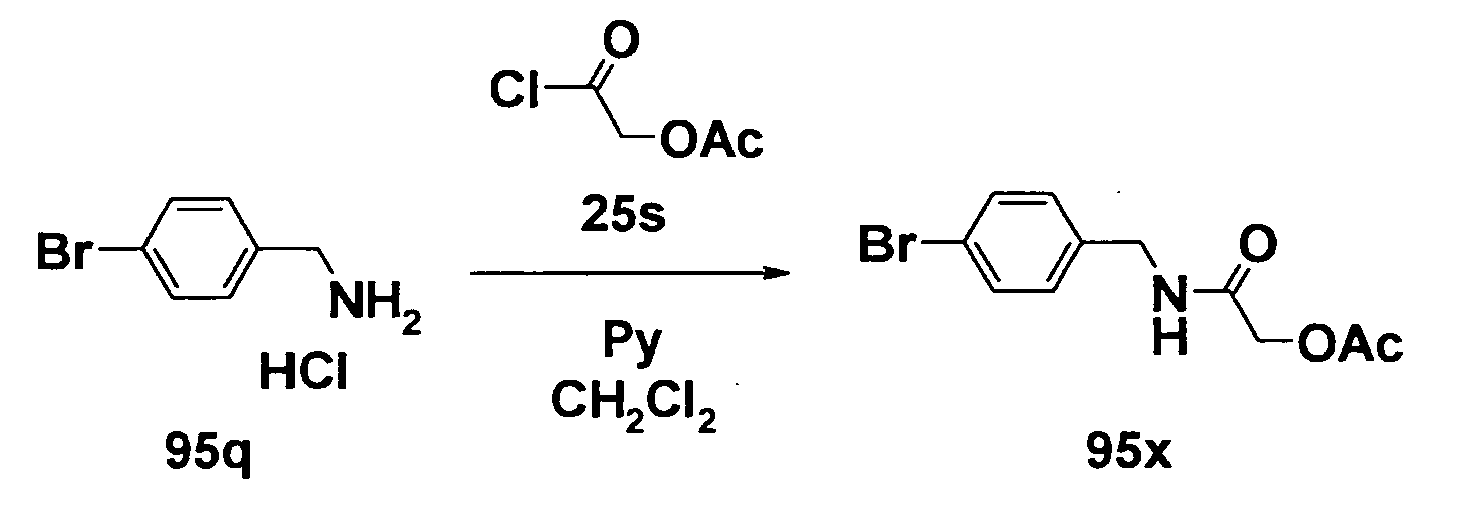
- Acetic acid (4-bromo-benzylcarbamoyl)-methyl ester was synthesized as a crude product by operations similar to those in Reaction 2-3 using 4-bromobenzylamine hydrochloride (200 mg, 0.899 mmol) as a starting material and using pyridine as a base.
-

- Acetic acid (4-bromo-benzylcarbamoyl)-methyl ester obtained as a crude product was all dissolved in THF (2.0 ml). A 2 N aqueous sodium hydroxide solution (2.0 ml) was then added and the mixture was stirred at room temperature for five hours. Water was added to the reaction system, followed by extraction with ethyl acetate. The organic layer was washed with saturated brine and then concentrated under reduced pressure. The resulting residue was purified by silica gel column chromatography (dichloromethane-methanol) to give N-(4-bromo-benzyl)-2-hydroxy-acetamide (56.0 mg, 25% for two steps).
MS (ESI) m/z = 244, 246 (M+H)+. - The aryl bromide reagent used in the synthesis of Compound 490 (3-[2-(4-bromo-phenyl)-ethyl]-1,1-dimethyl-urea) was synthesized as follows.
-
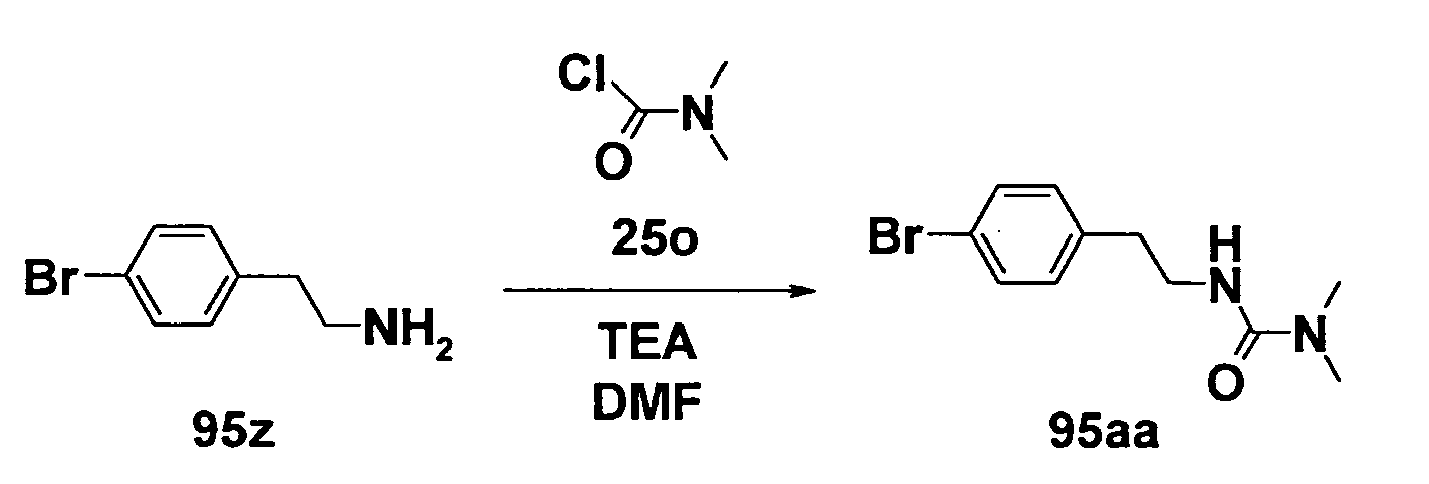
- 3-[2-(4-Bromo-phenyl)-ethyl]-1,1-dimethyl-urea was synthesized by operations similar to those in Reaction 82-1 using appropriate reagents and starting material.
MS (ESI) m/z = 271, 273 _(M+H)+. - The aryl bromide reagent used in the synthesis of Compound 492 (5-bromo-6-trifluoromethyl-1H-indole) was synthesized as follows.
-

- 4-Bromo-3-trifluoromethyl-phenylamine (1.00 g, 4.17 mmol) was dissolved in acetic acid (5 ml). Iodine monochloride (1 M solution in dichloromethane, 5 ml) was added and the mixture was stirred at 60°C overnight. The reaction solution was poured into a mixture of ice and a saturated aqueous sodium bicarbonate solution and then extracted with ethyl acetate. The organic layer was washed with an aqueous sodium bicarbonate solution, an aqueous sodium thiosulfate solution, water and saturated brine, dried over anhydrous sodium sulfate and concentrated under reduced pressure. The resulting residue was purified by silica gel column chromatography (n-hexane-ethyl acetate) to give 4-bromo-2-iodo-5-trifluoromethyl-phenylamine (889 mg, 58%).
1H-NMR (270 MHz, CDCl3) δ 7.92 (1H, s), 7.00 (1H, s), 4.31 (2H, br s). -

- 5-Bromo-6-trifluoromethyl-1H-indole was synthesized by operations similar to those in Reaction 25-10, Reaction 95-10 and Reaction 95-11 using appropriate reagents and starting material.
1H-NMR (270 MHz, CDCl3) δ 8.41 (1H, s), 7.96 (1H, s), 7.78 (1H, s), 7.38-7.36 (1H, m), 6.57-6.54 (1H, m). - The aryl bromide reagent used in the synthesis of Compound 493 ((4-bromo-3-trifluoromethyl-phenylamino)-acetic acid methyl ester) was synthesized as follows.
-
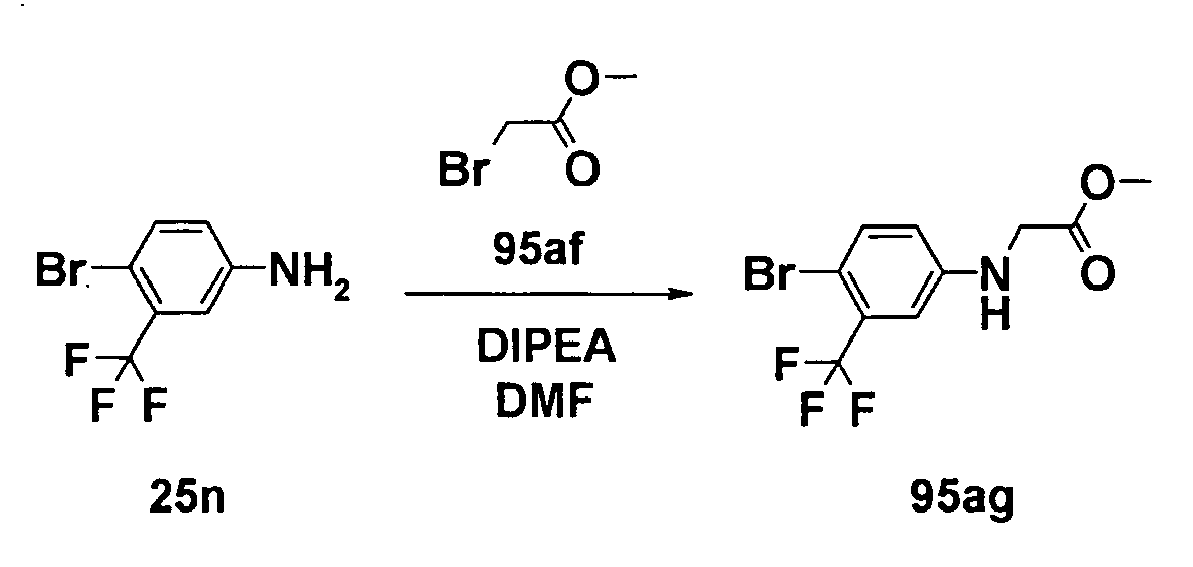
- N,N-Diisopropylethylamine (1.22 ml, 7.00 mmol) and methyl bromoacetate (1.00 g, 6.54 mmol) were sequentially added to a solution of 4-bromo-3-(trifluoromethyl)aniline (1.40 g, 5.83 mmol) in DMF (10 ml), and the mixture was heated with stirring at 80°C for 25 hours. The reaction mixture was cooled and water was then added, followed by extraction with ethyl acetate. The organic layer was sequentially washed with water and saturated brine, and then dried over MgSO4 and concentrated under reduced pressure. The resulting residue was triturated with hexane:dichloromethane = 9:1 to give (4-bromo-3-trifluoromethyl-phenylamino)-acetic acid methyl ester (1.22 g, 67%).
MS (ESI) m/z = 312, 314 (M+H)+ - The aryl bromide reagent used in the synthesis of Compound 494 (2-(4-bromo-3-trifluoromethyl-phenylamino)-N-(2-hydroxy-ethyl)-acetamide) was synthesized as follows.
-
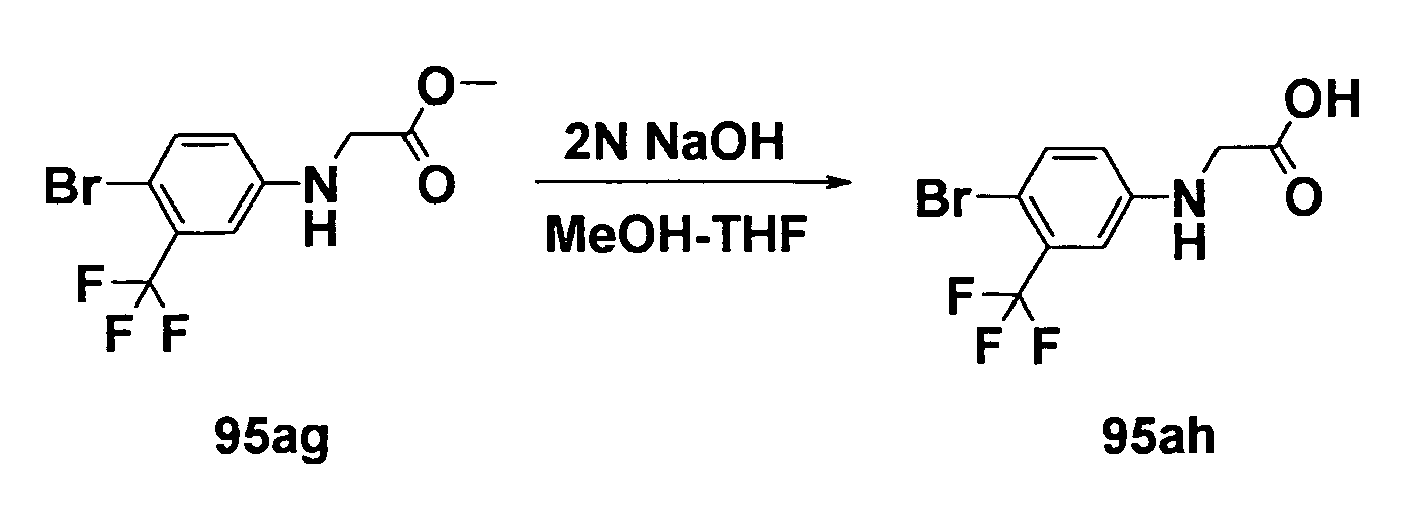
- A 2 N aqueous NaOH solution (15.0 ml, 30.0 mmol) was added to a solution of (4-bromo-3-trifluoromethyl-phenylamino)-acetic acid methyl ester (4.30 g, 13.8 mmol) in methanol-THF (6:1, 35.0 ml), and the mixture was stirred at room temperature for 18 hours. The reaction mixture was made acidic with hydrochloric acid and extracted with ethyl acetate. The organic layer was sequentially washed with water and saturated brine, and then dried over MgSO4 and concentrated under reduced pressure to give (4-bromo-3-trifluoromethyl-phenylamino)-acetic acid (4.03 g, 98%).
MS (ESI) m/z = 298, 300 (M+H)+ -

- 2-(4-Bromo-3-trifluoromethyl-phenylamino)-N-(2-hydroxy-ethyl)-acetamide was synthesized by operations similar to those in Reaction 10-14 using appropriate reagents and starting material.
1H-NMR (CDCl3) δ 2.11 (1H, t, J = 5.1 Hz), 3.48 (2H, q, J = 5.2 Hz), 3.73 (2H, q, J = 5.2 Hz), 3.84 (2H, d, J = 5.4 Hz), 4.51-4.57 (1H, m), 6.61 (1H, dd, J = 8.7, 2.9 Hz), 6.72 (1H, s), 6.93 (1H, d, J = 2.9 Hz), 7.49 (1H, d, J = 8.7 Hz). - [1097] The aryl bromide reagent used in the synthesis of Compound 495 (4-bromo-N-(2-hydroxy-ethyl)-N-methyl-3-trifluoromethyl-benzenesulfonamide) was synthesized as follows.
-

- 4-Bromo-N-(2-hydroxy-ethyl)-N-methyl-3-trifluoromethyl-benzenesulfonamide was synthesized by operations similar to those in Reaction 5-4 using appropriate reagents and starting material.
MS (ESI) m/z = 362, 364 (M+H)+. - The aryl bromide reagent used in the synthesis of Compound 496 (4-bromo-N,N-bis-(2-hydroxy-ethyl)-3-trifluoromethyl-benzenesulfonamide) was synthesized as follows.
-

- 4-Bromo-N,N-bis-(2-hydroxy-ethyl)-3-trifluoromethyl-benzenesulfonamide was synthesized by operations similar to those in Reaction 5-4 using appropriate reagents and starting material.
MS (ESI) m/z = 392, 394 (M+H)+. - The aryl bromide reagent used in the synthesis of Compound 497 (N'-(4-bromo-3-methyl-phenyl)-N,N-dimethylethane-1,2-diamine) was synthesized as follows.
-
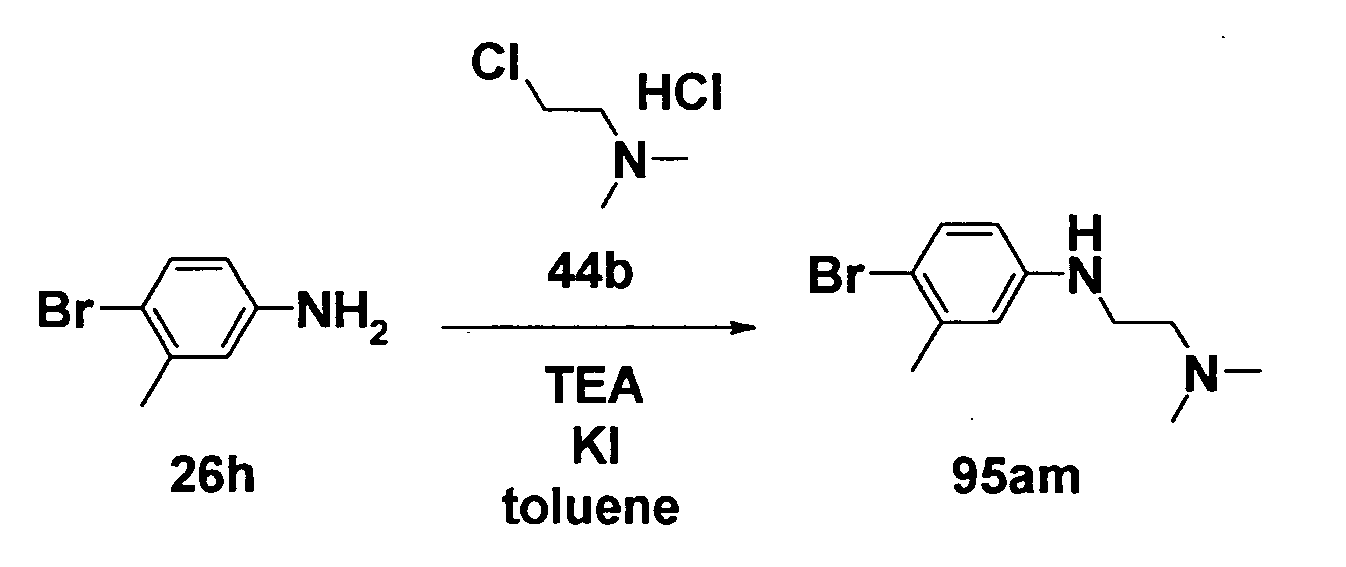
- 2-Chloro-N,N-dimethylethylamine hydrochloride (372 mg, 2.58 mmol), potassium iodide (428 mg, 2.58 mmol) and triethylamine (0.719 ml, 5.16 mmol) were added to a solution of 4-bromo-3-methylaniline (400 mg, 2.15 mmol) in toluene (5.0 ml), and the mixture was heated with stirring at 110°C for 17 hours. The reaction mixture was cooled and water was then added, followed by extraction with ethyl acetate. The organic layer was sequentially washed with water and saturated brine and then concentrated under reduced pressure. The resulting residue was purified by silica gel column chromatography (dichloromethane-methanol) to give N'-(4-bromo-3-methylphenyl)-N,N-dimethyl-ethane-1,2-diamine (100 mg, 18%).
MS (ESI) m/z = 257, 259 (M+H)+. - The aryl bromide reagent used in the synthesis of Compound 498 (N-(2-acetylamino-ethyl)-2-(4-bromo-3-trifluoromethyl-phenylamino)-acetamide) was synthesized as follows.
-

- N-(2-Acetylamino-ethyl)-2-(4-bromo-3-trifluoromethyl-phenylamino)-acetamide was synthesized by operations similar to those in Reaction 10-14 using appropriate reagents and starting material.
MS (ESI) m/z = 382, 384 (M+H)+. - The aryl bromide reagent used in the synthesis of Compound 499 (5-bromo-6-trifluoromethyl-1H-benzimidazole) was synthesized as follows.
-

- 4-Bromo-5-trifluoromethyl-benzene-1,2-diamine (200 mg, 0.785 mmol) was dissolved in formic acid (3 ml), and the mixture was stirred at 120°C for six hours. The reaction solution was concentrated, and water was added to the resulting residue, followed by extraction with ethyl acetate. The organic layer was washed with water and saturated brine, dried over anhydrous sodium sulfate and concentrated under reduced pressure to give 5-bromo-6-trifluoromethyl-1H-benzimidazole (201 mg) as a crude compound.
MS (ESI) m/z = 265 (M+H)+. - The aryl bromide reagent used in the synthesis of Compound 500 (4-bromo-1-((S)-2,2-dimethyl-[1,3]dioxolan-4-ylmethyl)-5-fluoro-1H-indole) was synthesized as follows.
-

- A solution of n-butyllithium (2.1 mL, 3.39 mmol) in tetrahydrofuran (6.8 mL) was cooled to -78°C, and 2,2,6,6-tetramethylpiperidine (0.57 mL, 3.39 mmol) and a 1.0 M solution of potassium t-butoxide in tetrahydrofuran (3.4 mL, 3.39 mmol) were added. After stirring for 15 minutes, a solution of 5-fluoro-1-triisopropylsilanyl-1H-indole (494 mg, 1.70 mmol) in tetrahydrofuran (5 ml) was added dropwise, and the mixture was stirred at -78°C for 2.5 hours. 1,2-Dibromo-1,1,2,2-tetrafluoroethane (38 mL, 0.319 mmol) was added, and the mixture was warmed to - 40°C over 35 minutes and further warmed to 22°C over 12 hours. Silica gel (17 g) was added and the solvent was then distilled off. The residue was subjected to silica gel column chromatography to give a pale yellow oily substance (380 mg) as a mixture of 4-bromo-5-fluoro-1-triisopropylsilanyl-1H-indole:5-fluoro-1-triisopropylsilanyl-1H-indole = 1:1.1.
1H-NMR (CDCl3) δ 7.37-7.33 (2H, m), 6.94 (1H, dd, J = 9.0, 4.5 Hz), 6.68 (1H, d, J = 3.9 Hz), 1.71-1.63 (3H, m), 1.14 (18H, d, J = 7.3 Hz). -

- 4-Bromo-1-((S)-2,2-dimethyl-[1,3]dioxolan-4-ylmethyl)-5-fluoro-1H-indole was synthesized by operations similar to those in Reaction 39-2 and Reaction 25-3 using appropriate reagents and starting material.
MS (ESI) m/z =328, 330 (M+H)+. - The aryl bromide reagent used in the synthesis of Compound 501 (2-[(4-bromo-3-trifluoromethyl-phenyl)-methyl-amino]-ethanol) was synthesized as follows.
-

- [(4-Bromo-3-trifluoromethyl-phenyl)-methyl-amino]-acetic acid methyl ester was synthesized by operations similar to those in Reaction 25-3 using appropriate reagents and starting material.
MS (ESI) m/z = 326, 328 (M+H)+. -

- A solution of [(4-bromo-3-trifluoromethyl-phenyl)-methyl-amino]-acetic acid methyl ester (77.6 mg, 0.238 mmol) in THF (1.0 ml) was added dropwise to a suspension of lithium aluminum hydride (372 mg, 2.58 mmol) in THF (1.5 ml) at 0°C. The mixture was stirred for 14 hours while gradually warming from 0°C to room temperature. A 2 N aqueous HCl solution was added to the reaction mixture, followed by extraction with ethyl acetate. The organic layer was sequentially washed with water and saturated brine and then concentrated under reduced pressure. The resulting residue was purified by silica gel column chromatography (dichloromethane-ethyl acetate) to give 2-[(4-bromo-3-trifluoromethyl-phenyl)-methyl-amino]-ethanol (58.0 mg, 82%).
MS (ESI) m/z = 298, 300 (M+H)+. - The aryl bromide reagent used in the synthesis of Compound 502 ((4-bromo-3-methyl-phenyl)-(1,1-dioxo-1λ6-thiomorpholin-4-yl)-methanone) was synthesized as follows.
-

- (4-Bromo-3-methyl-phenyl)-(1,1-dioxo-1λ6-thiomorpholin-4-yl)-methanone was synthesized by operations similar to those in Reaction 10-14 using appropriate reagents and starting material.
MS (ESI) m/z = 332, 334 (M+H)+. - The aryl bromide reagent used in the synthesis of Compound 503 (4-bromo-N-(2-dimethylamino-ethyl)-3-methyl-benzenesulfonamide) was synthesized as follows.
-

- 4-Bromo-N-(2-dimethylamino-ethyl)-3-methyl-benzenesulfonamide was synthesized by operations similar to those in Reaction 5-4 using appropriate reagents and starting material.
MS (ESI) m/z = 321, 323 (M+H)+. - The example compounds shown below were obtained by operations similar to those in Reaction 25-2 using appropriate reagents and starting materials.
-
[Table 71] Target Compound Structure LCMS condition Retention time (min) MS (m/z) 504 
LCMS-C-1 2.4 528 (M+H)+ 505 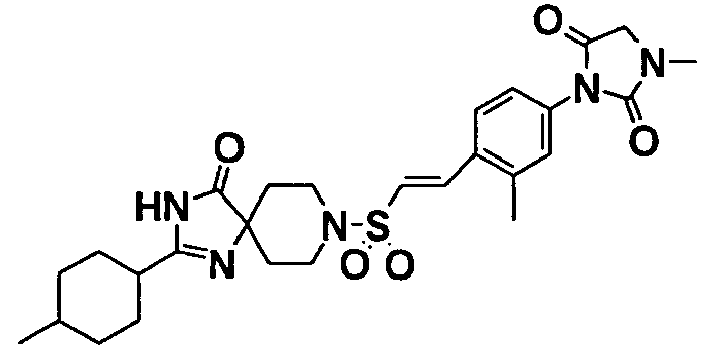
LCMS-C-1 2.47 542 (M+H)+ 506 
LCMS-D-1 1.91 531 (M+H)+ 507 
LCMS-D-1 1.9 570 (M+H)+ 508 
LCMS-D-1 1.98 584 (M+H)+ 509 
LCMS-D-1 1.9 517 (M+H)+ 510 
LCMS-D-1 1.82 501 (M+H)+ 511 
LCMS-F-1 0.92 556 (M+H)+ 512 
LCMS-D-1 1.84 517 (M+H)+ 513 
LCMS-C-1 2.47 515 (M+H)+ 514 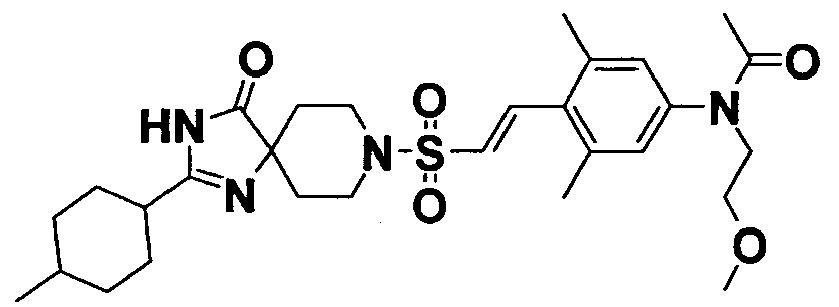
LCMS-D-1 2.09 559 (M+H)+ 515 
LCMS-D-1 1.83 543 (M+H)+ 516 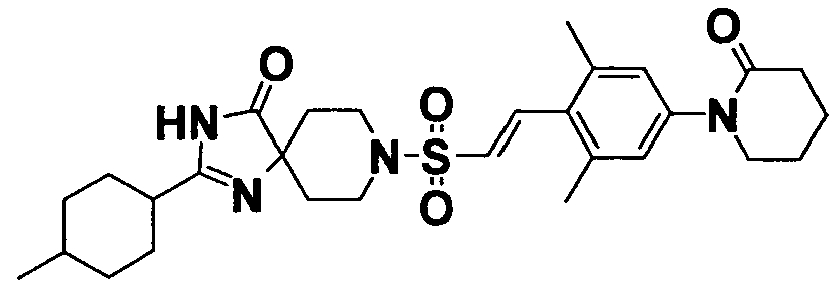
LCMS-D-1 2.22 541 (M+H)+ 517 
LCMS-D-1 2.23 529 (M+H)+ 518 
LCMS-D-1 2.13 556 (M+H)+ 519 
LCMS-D-1 2.4 584 (M+H)+ 520 
LCMS-D-1 2.28 541 (M+H)+ 521 
LCMS-D-1 2.27 555 (M+H)+ 522 
LCMS-D-1 2.45 515 (M+H)+ 523 
LCMS-D-1 2.33 523 (M+H)+ - The aryl bromide reagent used in the synthesis of Compound 504 (3-(4-bromo-3-methyl-phenyl)-imidazolidine-2,4-dione) was synthesized as follows.
-
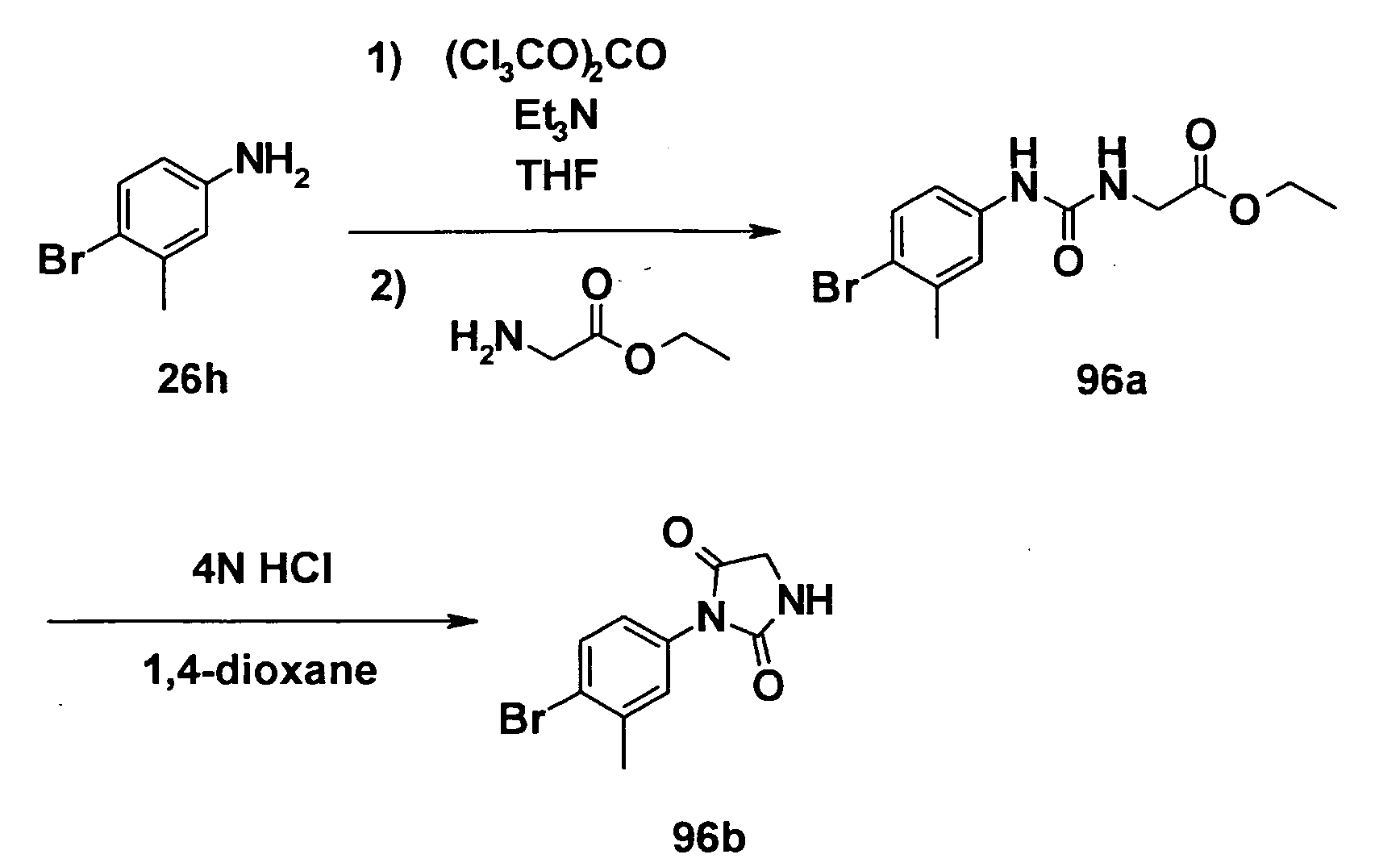
- Triethylamine (20 ml, 145 mmol) and 4-bromo-3-methyl-phenylamine (4.49 g, 24.14 mmol) were added to a solution of triphosgene (1.0 ml, 8.05 mmol) in THF (70 ml) at 0°C, and the mixture was stirred at the same temperature for 40 minutes. Further, the reaction mixture was warmed to room temperature and stirred at the same temperature for one hour. Water was added to the reaction solution, and the mixture was then concentrated under reduced pressure, followed by extraction with ethyl acetate. The organic phase was sequentially washed with water and saturated brine and then concentrated under reduced pressure to give [3-(4-bromo-3-methyl-phenyl)-ureido]-acetic acid ethyl ester (5.07 g) as a crude product. This crude product was used in the next reaction without purification.
4 N HCl-dioxane (7.5 ml, 30 mmol) was added to a solution of the crude product [3-(4-bromo-3-methylphenyl)-ureido]-acetic acid ethyl ester (5.07 g) in dioxane (60 ml), and the mixture was heated with stirring at 80°C for 17 hours. The reaction mixture was cooled to room temperature and then concentrated under reduced pressure, and water was added, followed by extraction with ethyl acetate. The organic phase was washed with saturated brine and then concentrated under reduced pressure. The resulting residue was purified by silica gel column chromatography to give 3-(4-bromo-3-methylphenyl)-imidazolidine-2,4-dione (2.40 g, 37%).
MS (ESI) m/z = 269, 271 (M+H)+. - The aryl bromide reagent used in the synthesis of Compound 505 (3-(4-bromo-3-methyl-phenyl)-1-methylimidazolidine-2,4-dione) was synthesized as follows.
-

- (3-(4-Bromo-3-methyl-phenyl)-1-methyl-imidazolidine-2,4-dione was synthesized by operations similar to those in Reaction 25-3 using appropriate reagents and starting material.
MS (ESI) m/z = 283, 285 (M+H)+. - The aryl bromide reagent used in the synthesis of Compound 506 (N-(4-bromo-3-isopropoxyphenyl)acetamide) was synthesized as follows.
-
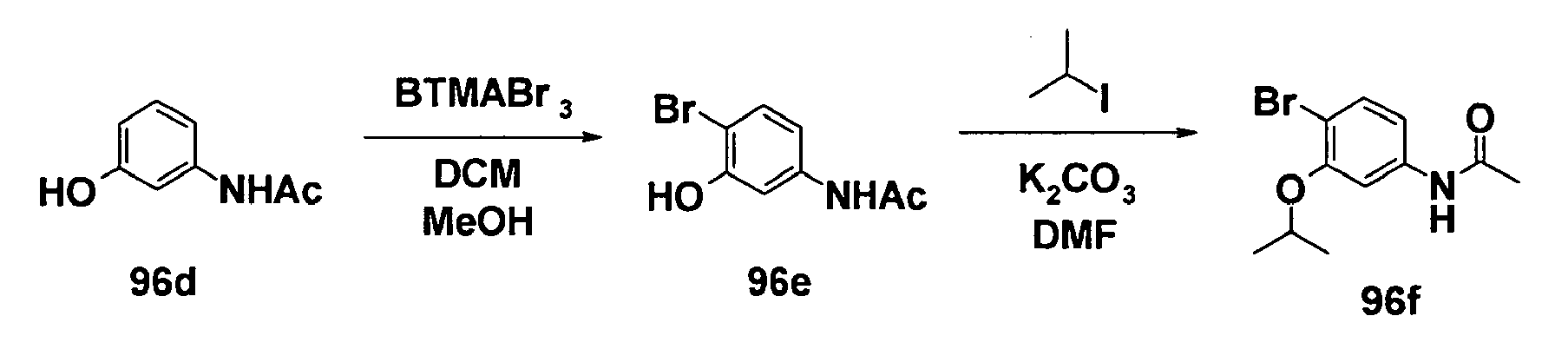
- N-(4-Bromo-3-isopropoxyphenyl)acetamide was synthesized by operations similar to those in Reaction 26-2 and Reaction 26-4 using appropriate reagents and starting material.
1H-NMR (CDCl3) δ 7.64 (d, 1H, J = 2.29 Hz), 7.42 (d, 1H, J = 8.39 Hz), 7.15 (brs, 1H), 6.72 (dd, 1H, J = 8.39 Hz, J = 2.29 Hz), 4.57 (m, 1H, J = 6.1 Hz), 2.17 (s, 3H), 1.38 (d, 6H, J = 6.1 Hz). - The aryl bromide reagents used in the synthesis of Compound 507 and Compound 508 (3-(4-bromo-3,5-dimethylphenyl)-5,5-dimethylimidazolidine-2,4-dione and 3-(4-bromo-3,5-dimethylphenyl)-1,5,5-trimethylimidazolidine-2,4-dione) were synthesized as follows.
-

- Triphosgene (2.23 g, 7.52 mmol) was added to a solution of 4-bromo-3,5-dimethyl-phenylamine (4.3 g, 21.49 mmol) in dioxane (71 ml). After stirring at 100°C for 15 hours, water was added to the reaction solution. After extraction with ethyl acetate, the organic phase was sequentially washed with water and saturated brine and concentrated under reduced pressure to give 2-bromo-5-isocyanato-1,3-dimethylbenzene (2.0 g, 41%).
MS (ESI) m/z = 226, 228 (M+H)+. -
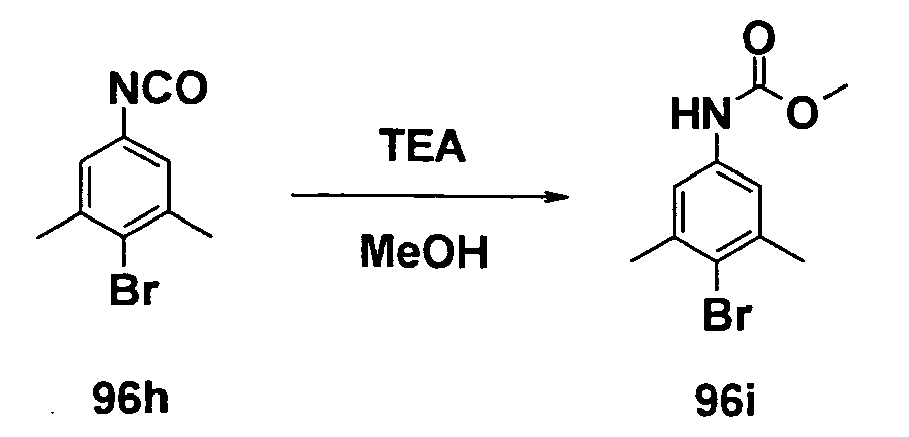
- Triethylamine (1.8 ml, 13.27 mmol) was added dropwise to a solution of 2-bromo-5-isocyanato-1,3-dimethylbenzene (2.0 g, 8.84 mmol) in anhydrous methanol (30 ml) at 0°C. The reaction solution was gradually warmed to room temperature and stirred for one hour. The reaction solution was concentrated under reduced pressure, and the residue was diluted with ethyl acetate. The organic layer was then sequentially washed with water and saturated brine and concentrated under reduced pressure. The residue was purified by silica gel column chromatography (hexane-ethyl acetate) to give methyl (4-bromo-3,5-dimethylphenyl)carbamate (1.8 g, 79%).
MS (ESI) m/z = 258, 260 (M+H)+. -

- α-Aminoisobutyric acid methyl ester (3.2 g, 20.92 mmol) and N,N-diisopropylethylamine (6.1 ml, 34.86 mmol) were added to a solution of methyl (4-bromo-3,5-dimethylphenyl)carbamate (900 mg, 3.48 mmol) in anhydrous DMA (17.5 ml, 0.2 M). After irradiation with microwaves at 170°C for 30 minutes, water was added to the reaction solution, followed by extraction with ethyl acetate. The organic phase was sequentially washed with water and saturated brine and concentrated under reduced pressure. The residue was purified by silica gel column chromatography (hexane-ethyl acetate) to give 3-(4-bromo-3,5-dimethylphenyl)-5,5-dimethylimidazolidine-2,4-dione (304 mg, 28%)
MS (ESI) m/z = 311, 313 (M+H)+
and
3-(4-bromo-3,5-dimethylphenyl)-1,5,5-trimethylimidazolidine-2,4-dione (245 mg, 23%).
MS (ESI) m/z = 325, 327 (M+H)+ - The aryl bromide reagent used in the synthesis of Compound 509 (N-(4-bromo-3-ethoxyphenyl)acetamide) was synthesized as follows.
-

- N-(4-Bromo-3-ethoxyphenyl)acetamide was synthesized by operations similar to those in Reaction 26-4 using appropriate reagents and starting material.
1H-NMR (CDCl3) δ 7.48 (d, 1H, J = 2.29 Hz), 7.42 (d, 1H, J = 8.39 Hz), 7.22 (brs, 1H), 6.72 (dd, 1H, J = 8.39 Hz, J = 2.29 Hz), 4.10 (q, 2H, J = 6.87 Hz), 2.17 (s, 3H), 1.46 (t, 3H, J = 6.87 Hz). - The aryl bromide reagent used in the synthesis of Compound 510 (N-(4-bromo-3-ethylphenyl)acetamide) was synthesized as follows.
-

- N-(4-Bromo-3-ethylphenyl)acetamide was synthesized by operations similar to those in Reaction 26-2 using appropriate reagents and starting material.
1H-NMR (CDCl3) δ 7.44 (d, 1H, J = 8.39 Hz), 7.39 (d, 1H, J = 2.29 Hz), 7.23 (dd, 1H, J = 8.39 Hz, J = 2.29 Hz), 7.17 (brs, 1H), 2.72 (q, 2H, J = 7.25 Hz), 2.17 (s, 3H), 1.21 (t, 3H, J = 7.25 Hz). - [1153] The aryl bromide reagent used in the synthesis of Compound 511 (3-(4-bromo-3-methyl-phenyl)-5,5-dimethyl-imidazolidine-2,4-dione) was synthesized as follows.
-

- 2-Amino-N-(4-bromo-3-methyl-phenyl)-2-methyl-propionamide was synthesized by operations similar to those in Reaction 10-1 and Reaction 39-2 using appropriate reagents and starting material.
1H-NMR (CDCl3) δ 1.46 (6H, s), 2.37 (3H, s), 7.29 (1H, dd, J = 8.8, 2.4 Hz), 7.44 (1H, d, J = 8.8 Hz), 7.59 (1H, d, J = 2.4 Hz), 9.84 (1H, br s). -

- Bis(trichloromethyl) carbonate (50.6 mg, 0.171 mmol) was added to a solution of 2-amino-N-(4-bromo-3-methylphenyl)-2-methyl-propionamide (132 mg, 0.487 mmol) and triethylamine (0.204 ml, 1.46 mmol) in dichloromethane (5.0 ml) at 0°C, and the mixture was stirred for 21 hours while gradually warming to room temperature. An aqueous ammonium chloride solution was added to the reaction mixture, followed by extraction with dichloromethane. The resulting residue was purified by silica gel column chromatography (dichloromethane-ethyl acetate) to give 3-(4-bromo-3-methyl-phenyl)-5,5-dimethyl-imidazolidine-2,4-dione (146 mg, 88%).
MS (ESI) m/z = 297, 299 (M+H)+. - The aryl bromide reagent used in the synthesis of Compound 512 (N-(4-bromo-3-methoxymethyl-phenyl)-acetamide) was synthesized as follows.
-

- N-(4-Bromo-3-methoxymethyl-phenyl)-acetamide was synthesized by operations similar to those in Reaction 20-2, Reaction 19-2 and Reaction 26-2 using appropriate reagents and starting material.
1H-NMR (CDCl3) δ 7.12 (t, 1H, J = 7.8 Hz), 6.70 (m, 2H), 6.60 (dd, 1H, J = 7.5 Hz, 2.1 Hz), 4.42 (s, 2H), 3.53 (s, 3H), 2.08 (s, 3H). - The aryl bromide reagent used in the synthesis of Compound 513 (3-(4-bromo-3-methyl-phenyl)-oxazolidin-2-one) was synthesized as follows.
-

- 2-(4-Bromo-3-methyl-phenylamino)-ethanol was synthesized by operations similar to those in Reaction 12-1 using appropriate reagents and starting material.
MS (ESI) m/z = 230, 232 (M+H)+. -

- Diethyl carbonate (18 ml), and a 28% solution of sodium methoxide in methanol (1.1 ml, 5.70 mmol) were added to 2-(4-bromo-3-methyl-phenylamino)-ethanol (1.21 g, 5.27 mmol), and the mixture was heated with stirring at 110°C for 15 hours. Further, methanol (16 ml) was added to the reaction solution, and the mixture was heated with stirring at 110°C for one hour. An aqueous ammonium chloride solution was added to the reaction mixture, followed by extraction with ethyl acetate. The organic phase was sequentially washed with water and saturated brine and concentrated under reduced pressure. The resulting residue was triturated with hexane to give 3-(4-bromo-3-methyl-phenyl)-oxazolidin-2-one (989 mg, 73%).
MS (ESI) m/z = 256, 258 (M+H)+. - The aryl bromide reagent used in the synthesis of Compound 514 (N-(4-bromo-3,5-dimethyl-phenyl)-N-(2-methoxy-ethyl)-acetamide) was synthesized as follows.
-

- N-(4-Bromo-3,5-dimethyl-phenyl)-N-(2-methoxy-ethyl)-acetamide was synthesized by operations similar to those in Reaction 25-3 using appropriate reagents and starting material.
MS (ESI) m/z = 300, 302 (M+H)+. - The aryl bromide reagent used in the synthesis of Compound 515 (4-(4-bromo-3,5-dimethyl-phenyl)-morpholin-3-one) was synthesized as follows.
-

- Bromo-acetic acid 2-[acetyl-(4-bromo-3,5-dimethyl-phenyl)-amino]-ethyl ester was synthesized by operations similar to those in Reaction 25-3, Reaction 39-2 and Reaction 10-1 using appropriate reagents and starting material.
1H-NMR (CDCl3) δ 6.95 (s, 2H), 4.04 (s, 2H), 3.86-3.74 (m, 4H), 2.43 (s, 6H), 1.89 (s, 3H). -

- 6 N NaOH (1.5 ml) was added to a solution of bromo-acetic acid 2-[acetyl-(4-bromo-3,5-dimethyl-phenyl)-amino]-ethyl ester (302 mg, 0.74 mmol) in EtOH (6 ml). The reaction solution was heated under reflux overnight, cooled to room temperature and then diluted with ethyl acetate. The organic phase was sequentially washed with water and saturated brine and concentrated under reduced pressure. The resulting residue was purified by silica gel column chromatography (hexane-ethyl acetate) to give 2-(4-bromo-3,5-dimethyl-phenylamino)-ethanol (181 mg, 68%).
1H-NMR (CDCl3) δ 6.41 (s, 2H), 3.82 (t, 2H, J = 5.1 Hz), 3.27 (t, 2H, J = 5.1 Hz), 2.34 (s, 6H). -

- 2-Bromo-N-(4-bromo-3,5-dimethyl-phenyl)-N-(2-hydroxy-ethyl)acetamide was synthesized by operations similar to those in Reaction 10-1 using appropriate reagents and starting material.
1H-NMR (CDCl3) δ 7.01 (s, 2H), 3.89-3.78 (m, 6H), 2.44 (s, 6H). -

- Potassium t-butoxide (53 mg, 0.44 mmol) was added to a solution of 2-bromo-N-(4-bromo-3,5-dimethyl-phenyl)-N-(2-hydroxy-ethyl)-acetamide (147 mg, 0.40 mmol) in t-BuOH (2 ml), and the mixture was heated under reflux overnight. The reaction solution was cooled to room temperature and water was then added, followed by extraction with ethyl acetate. The organic phase was washed with saturated brine and then concentrated under reduced pressure. The resulting residue was purified by silica gel column chromatography (hexane-ethyl acetate) to give 4-(4-bromo-3,5-dimethyl-phenyl)-morpholin-3-one (100%).
1H-NMR (CDCl3) δ 7.05 (s, 2H), 4.33 (s, 2H), 4.02 (t, 2H, J = 5.0 Hz), 3.72 (t, 2H, J = 5.0 Hz), 2.42 (s, 6H). - The aryl bromide reagent used in the synthesis of Compound 516 (1-(4-bromo-3,5-dimethylphenyl)piperidin-2-one) was synthesized as follows.
-

- 5-Bromo-pentanoic (4-bromo-3,5-dimethyl-phenyl)-amide was synthesized by operations similar to those in Reaction 2-3 using appropriate reagents and starting material.
1H-NMR (CDCl3) δ 7.25 (s, 2H), 7.19 (brs, 1H), 3.43 (t, 2H, J = 6.49 Hz), 2.37 (t, 2H, J = 6.87 Hz), 2.37 (s, 6H), 1.9 (m, 4H). -

- Sodium hydride (37 mg, 0.925 mmol) was added to a solution of 5-bromo-pentanoic (4-bromo-3,5-dimethyl-phenyl-amide (320 mg, 0.881 mmol) in DMF (8 ml) at 0°C, and the mixture was stirred at room temperature for two days. The reaction solution was diluted with ethyl acetate, and the organic layer was sequentially washed with water and saturated brine and concentrated under reduced pressure. The resulting residue was purified by silica gel column chromatography (dichloromethane-ethyl acetate) to give 1-(4-bromo-3,5-dimethylphenyl)piperidin-2-one (240 mg, 97%).
1H-NMR (CDCl3) δ 6.97 (s, 2H), 3.58 (t, 2H, J = 6.87 Hz), 2.55 (t, 2H, J = 6.87 Hz), 2.40 (s, 6H), 1.93 (m, 4H). - The aryl bromide reagent used in the synthesis of Compound 517 (N-(4-bromo-3,5-dimethyl-benzyl)-N-methylacetamide) was synthesized as follows.
-

- Methylamine (12.3 ml, 24.60 mmol, 2.0 M solution in methanol) was added dropwise to a solution of 2-bromo-5-iodomethyl-1,3-dimethyl-benzene (400 mg, 1.23 mmol) in anhydrous DMF (12 ml)., and the mixture was stirred at room temperature for two days. The reaction solution was concentrated under reduced pressure, and the residue was diluted with ethyl acetate. The organic layer was then sequentially washed with water and saturated brine and concentrated under reduced pressure. The resulting residue was purified by silica gel column chromatography (dichloromethane-methanol) to give 1-(4-bromo-3,5-dimethylphenyl)-N-methylmethanamine (280 mg, 100%).
MS (ESI) m/z = 228, 230 (M+H)+. -

- N-(4-Bromo-3,5-dimethyl-benzyl)-N-methyl-acetamide was synthesized by operations similar to those in Reaction 2-3 using appropriate reagents and starting material.
MS (ESI) m/z = 270, 272 (M+H)+. - The aryl bromide reagent used in the synthesis of Compound 518 (3-(4-bromo-3,5-dimethyl-benzyl)-imidazolidine-2,4-dione) was synthesized as follows.
-

- 3-(4-Bromo-3,5-dimethyl-benzyl)-imidazolidine-2,4-dione was synthesized by operations similar to those in Reaction 52-1 (using iodine as a reagent) and Reaction 25-3 using appropriate reagents and starting material.
1H-NMR (CDCl3) δ 7.10 (s, 2H), 5.63 (s, 1H), 4.55 (s, 2H), 3.97 (d, 2H, J = 1.14 Hz), 2.38 (s, 6H). - The aryl bromide reagent used in the synthesis of Compound 519 (3-(4-bromo-3,5-dimethyl-benzyl)-5,5-dimethyl-imidazolidine-2,4-dione) was synthesized as follows.
-
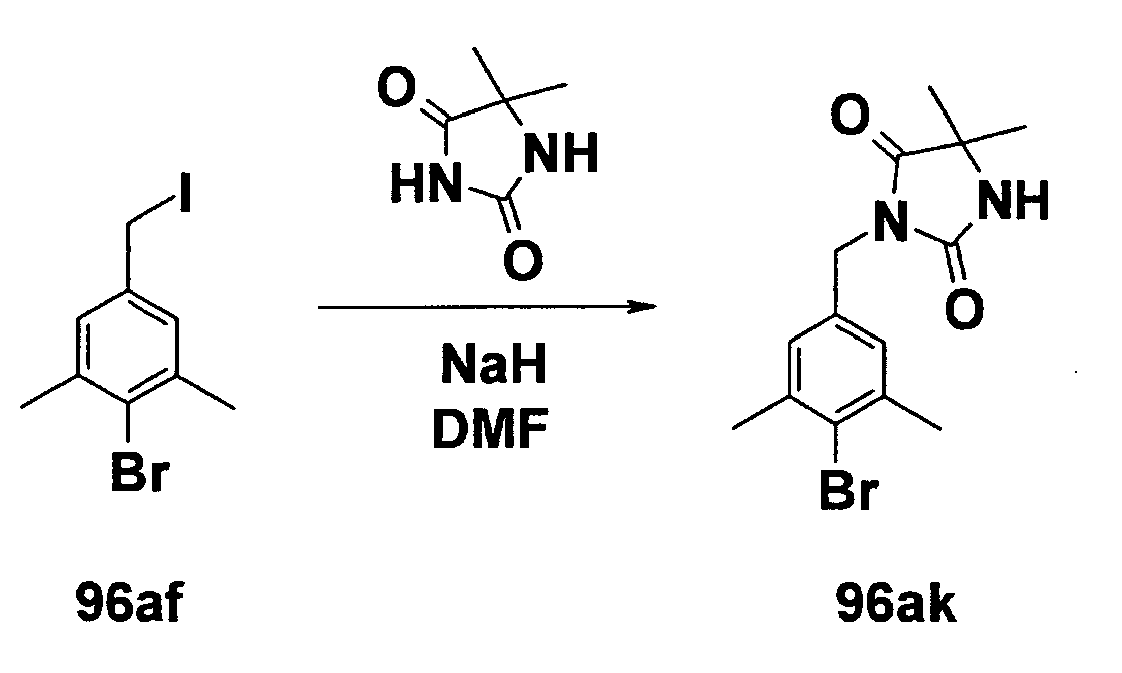
- 3-(4-Bromo-3,5-dimethyl-benzyl)-5,5-dimethyl-imidazolidine-2,4-dione was synthesized by operations similar to those in Reaction 25-3 using appropriate reagents and starting material.
MS (ESI) m/z = 325, 327 (M+H)+. - The aryl bromide reagent used in the synthesis of Compound 520 (1-(4-bromo-3,5-dimethyl-benzyl)-pyrrolidin-2-one) was synthesized as follows.
-

- 1-(4-Bromo-3,5-dimethyl-benzyl)-pyrrolidin-2-one was synthesized by operations similar to those in Reaction 25-3 using appropriate reagents and starting material.
1H-NMR (CDCl3) δ 6.94 (s, 2H), 4.33 (s, 2H), 3.25 (t, 2H, J = 7.24 Hz), 2.44 (t, 2H, J = 8.01 Hz), 2.38 (s, 6H), 2.04-1.93 (m, 2H). - The aryl bromide reagent used in the synthesis of Compound 521 (1-(4-bromo-3,5-dimethyl-benzyl)-pyrrolidine-2,5-dione) was synthesized as follows.
-

- 1-(4-Bromo-3,5-dimethyl-benzyl)-pyrrolidine-2,5-dione was synthesized by operations similar to those in Reaction 25-3 using appropriate reagents and starting material.
1H-NMR (CDCl3) δ 7.09 (s, 2H), 4.54 (s, 2H), 2.70 (s, 4H), 2.37 (s, 6H). - The aryl bromide reagent used in the synthesis of Compound 522 (N-(4-bromo-3,5-dimethyl-benzyl)-acetamide) was synthesized as follows.
-

- N-(4-Bromo-3,5-dimethyl-benzyl)-acetamide was synthesized by operations similar to those in Reaction 96-21 and Reaction 2-3 using appropriate reagents and starting material.
MS (ESI) m/z = 256, 258 (M+H)+. - The aryl bromide reagent used in the synthesis of Compound 523 (N-(4-bromo-3,5-difluoro-phenyl)-N-methylacetamide) was synthesized as follows.
-

MS (ESI) m/z = 264, 266 (M+H)+. - The example compounds shown below were obtained by operations similar to those in Reaction 25-2 using appropriate reagents and starting materials.
-
[Table 72] Target Compound Structure LCMS condition Retention time (min) MS (m/z) 524 
LCMS-B-1 2.03 577 (M+H)+ 525 
LCMS-F-1 0.98 690 (M+H)+ - The aryl bromide reagent used in the synthesis of Compound 525 ([(S)-1-(4-bromo-3-methyl-phenylcarbamoyl)-2-carbamoyl-ethyl]-carbamic acid tert-butyl ester) was synthesized as follows.
-

- [(S)-1-(4-Bromo-3-methyl-phenylcarbamoyl)-2-carbamoyl-ethyl]-carbamic acid tert-butyl ester was synthesized by operations similar to those in Reaction 10-14 using appropriate reagents and starting material.
MS (ESI) m/z = 400 (M+H)+. - The example compounds shown below were obtained by operations similar to those in Reaction 25-2 using appropriate reagents and starting materials.
-
[Table 73] Target Compound Structure LCMS condition Retention time (min) MS (m/z) 526 
LCMS-B-1 2.5 593 (M+H)+ 527 
LCMS-C-1 2.6 620 (M+H)+ 528 
LCMS-C-1 2.65 649 (M+H)+ 529 
LCMS-C-1 2.45 566 (M+H)+ 530 
LCMS-C-1 2.38 650 (M+H)+ 531 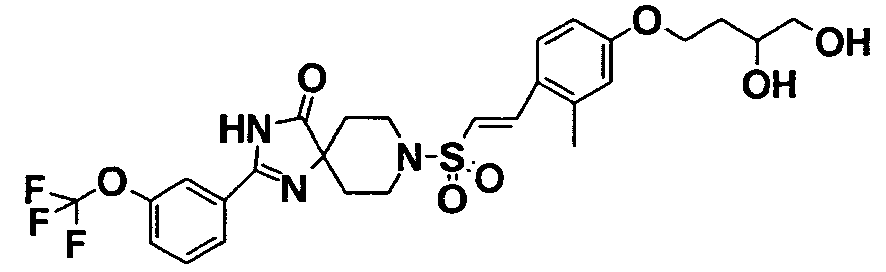
LCMS-C-1 2.63 598 (M+H)+ 532 
LCMS-D-1 2.16 654 (M+H)+ 533 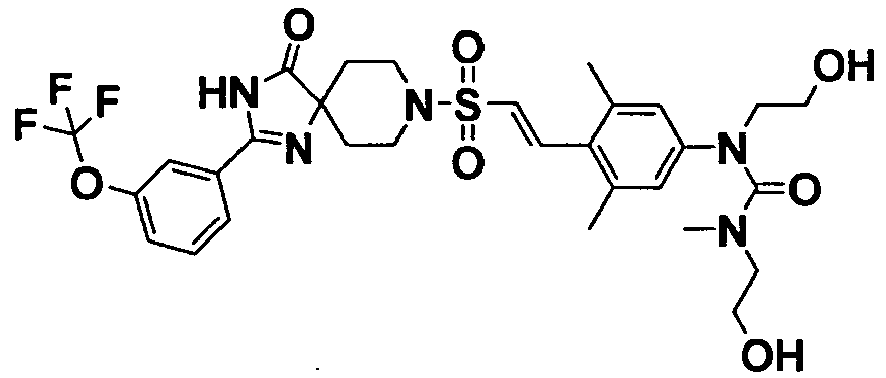
LCMS-D-1 2.35 668 (M+H)+ 534 
LCMS-D-1 3.1 685 (M+H)+ - The aryl bromide reagent used in the synthesis of Compound 528 (2-(4-bromo-3-methyl-phenylamino)-1-(4-methyl-piperazin-1-yl)-ethanone) was synthesized as follows.
-

- 2-(4-Bromo-3-methyl-phenylamino)-1-(4-methyl-piperazin-1-yl)-ethanone was synthesized by operations similar to those in Reaction 10-1 using appropriate reagents and starting material.
MS (ESI) m/z = 326 (M+H)+. - The aryl bromide reagent used in the synthesis of Compound 529 (2-(4-bromo-3-methyl-phenylamino)-acetamide) was synthesized as follows.
-
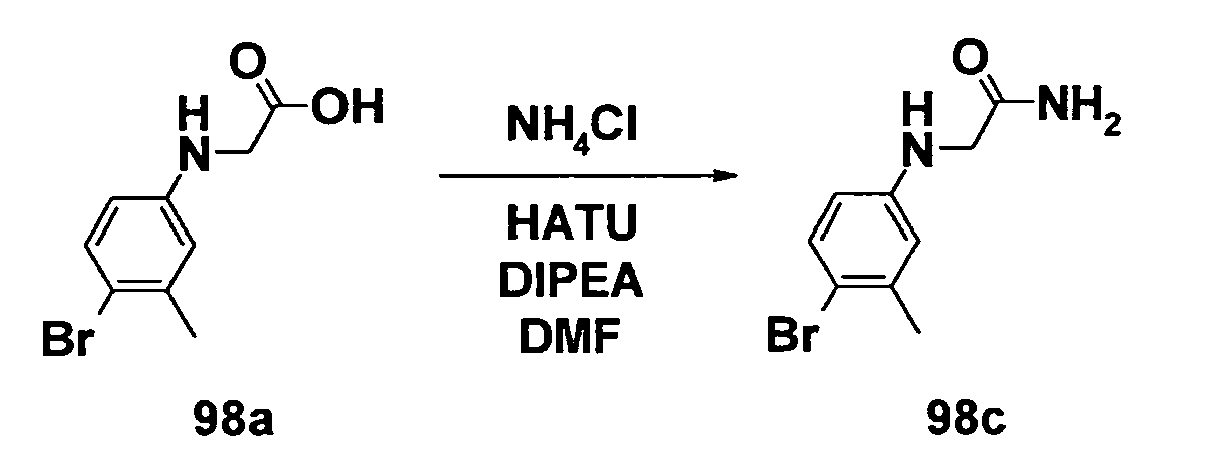
- 2-(4-Bromo-3-methyl-phenylamino)-acetamide was synthesized by operations similar to those in Reaction 10-14 using appropriate reagents and starting material.
MS (ESI) m/z = 243 (M+H)+. - The aryl bromide reagent used in the synthesis of Compound 530 (4-bromo-3-methyl-N-pyridin-4-yl-benzenesulfonamide) was synthesized as follows.
-

- 4-Bromo-3-methyl-N-pyridin-4-yl-benzenesulfonamide was synthesized by operations similar to those in Reaction 5-4 using appropriate reagents and starting material.
MS (ESI) m/z = 327 (M+H)+. - The aryl bromide reagent used in the synthesis of Compound 532 (1-(4-bromo-3,5-dimethylphenyl)-1,3-bis(2-hydroxyethyl)urea) was synthesized as follows.
-

- N-(2-(Benzyloxy)ethyl)-4-bromo-3,5-dimethylaniline was synthesized by operations similar to those in Reaction 25-3 and Reaction 96-16 using appropriate reagents and starting material.
1H-NMR (300 MHz, CDCl3) δ 2.32 (s, 6H), 3.27 (t, J = 5.39 Hz, 2H), 3.68 (t, J = 5.37 Hz, 2H), 3.95 (brs, 1H), 4.54 (s, 2H), 6.37 (s, 2H), 7.25-7.38 (m, 5H). -

- Phosgene (3.5 ml, 6.64 mmol, 20% solution in toluene) and N,N-diisopropylethylamine (1.2 ml, 6.64 mmol) were added to a solution of N-(2-(benzyloxy)ethyl)-4-bromo-3,5-dimethylaniline (740 mg, 2.21 mmol) in anhydrous toluene (11 ml) at 0°C. The reaction solution was gradually warmed to room temperature and stirred at the same temperature for three hours. Water was added to the reaction mixture, followed by extraction with ethyl acetate. The organic phase was sequentially washed with water and saturated brine and concentrated under reduced pressure. The resulting residue was purified by silica gel column chromatography (dichloromethane) to give N-(2-(benzyloxy)ethyl)-N-(4-bromo-3,5-dimethylphenyl)carbamic acid chloride (860 mg, 98%).
1H-NMR (300 MHz, CDCl3), δ 2.36 (s, 6H), 3.67 (t, J = 5.42 Hz, 2H), 3.89 (t, J = 4.95 Hz, 2H), 4.50 (s, 2H), 6.95 (s, 2H), 7.27-7.38 (m, 5H). -

- 1-(2-(Benzyloxy)ethyl)-1-(4-bromo-3,5-dimethylphenyl)-3-(2-hydroxyethyl)urea was synthesized by operations similar to those in Reaction 82-1 using appropriate reagents and starting material.
MS (ESI) m/z = 421, 423 (M+H)+. -

- Boron trichloride (0.93 ml, 0.93 mmol, 1.0 M solution in dichloromethane) was added to a solution of 1-(2-(benzyloxy)ethyl)-1-(4-bromo-3,5-dimethylphenyl)-3-(2-hydroxyethyl)urea (98 mg, 0.23 mmol) in anhydrous dichloromethane (4.6 ml) at -78°C, and the mixture was stirred at the same temperature for two hours. A saturated aqueous sodium bicarbonate solution was added to the reaction mixture, followed by extraction with ethyl acetate. The organic phase was sequentially washed with water and saturated brine and concentrated under reduced pressure. The resulting residue was purified by silica gel column chromatography (dichloromethane-methanol) to give 1-(4-bromo-3,5-dimethylphenyl)-1,3-bis(2-hydroxyethyl)urea (64 mg, 83%).
1H-NMR (300 MHz, CDCl3) δ 2.43 (s, 6H), 2.94 (t, J = 5.11 Hz, 1H), 3.33 (q, J = 5.23 Hz, 2H), 3.60 (t, J = 4.78 Hz, 1H), 3.66 (q, J = 4.91 Hz, 2H), 3.71-3.81 (m, 4H), 4.73 (brs, 1H), 7.01 (s, 2H). - The aryl bromide reagent used in the synthesis of Compound 533 (1-(4-bromo-3,5-dimethyl-phenyl)-1,3-bis-(2-hydroxy-ethyl)-3-methyl-urea) was synthesized as follows.
-

- 1-(4-Bromo-3,5-dimethyl-phenyl)-1,3-bis-(2-hydroxy-ethyl)-3-methyl-urea was synthesized by operations similar to those in Reaction 82-1 and Reaction 98-7 using appropriate reagents and starting material.
MS (ESI) m/z = 345, 347 (M+H)+. - The aryl bromide reagent used in the synthesis of Compound 534 (N-(4-bromo-3,5-dimethyl-phenyl)-N-(tetrahydro-pyran-4-yl)-methanesulfonamide) was synthesized as follows.
-

- N-(4-Bromo-3,5-dimethyl-phenyl)-N-(tetrahydro-pyran-4-yl)-methanesulfonamide was synthesized by operations similar to those in Reaction 41-1 and Reaction 6-1 using appropriate reagents and starting material.
MS (ESI) m/z = 362, 364 (M+H)+. - The example compound shown below was obtained by operations similar to those in Reaction 25-2 using appropriate reagents and starting material.
-
[Table 74] Target Compound Structure LCMS condition Retention time (min) MS (m/z) 535 
LCMS-C-1 2.52 637 (M+H) + -

- 8-Ethenesulfonyl-2-nonyl-1,3,8-triaza-spiro[4.5]dec-1-en-4-one was synthesized by operations similar to those in Reaction 10-20, Reaction 1-4, Reaction 4-1, Reaction 5-3 and reaction 25-1 using appropriate reagents and starting material.
MS (ESI) m/z = 370 (M+H)+. -

- 3-{3-Methyl-4-[(E)-2-(2-nonyl-4-oxo-1,3,8-triaza-spiro[4.5]dec-1-ene-8-sulfonyl)-vinyl]-phenyl}-imidazolidine-2,4-dione was synthesized by operations similar to those in Reaction 25-2 using appropriate reagents and starting material.
MS (ESI) m/z = 558 (M+H)+. - The example compounds shown below were synthesized by operations similar to those in Reaction 100-2 using appropriate reagents and starting materials.
-
[Table 75] Target Compound Structure LCMS condition Retention time (min) MS (m/z) 537 
LCMS-A-1 2.63 612 (M+H)+ 538 
LCMS-A-1 2.6 573 (M+H)+ 539 
LCMS-A-1 2.43 572 (M+H)+ - The aryl bromide reagent used in the synthesis of Compound 537 (3-(4-bromo-3-trifluoromethyl-phenyl)-imidazolidine-2,4-dione) was synthesized as follows.
-

- 3-(4-Bromo-3-trifluoromethyl-phenyl)-imidazolidine-2,4-dione was synthesized by operations similar to those in Reaction 84-1 and Reaction 96-1 using appropriate reagents and starting material.
MS (ESI) m/z = 321 (M-H)-. - The aryl bromide reagent used in the synthesis of Compound 538 (4-(4-bromo-3-methyl-phenyl)-morpholine-3,5-dione) was synthesized as follows.
-

- [1,4]Dioxane-2,6-dione (312 mg, 2.69 mmol) was added to a solution of 4-bromo-3-methyl-phenylamine (500 mg, 2.69 mmol) in tBuOMe (7.0 ml), and the mixture was stirred at room temperature overnight. The reaction solution was concentrated under reduced pressure. Acetic anhydride (4.0 ml, 42.3 mmol) and sodium acetate (35 mg, 0.427 mmol) were added to the resulting residue, and the mixture was heated with stirring at 60°C for three hours. Water was added to the reaction solution, and collection by filtration and trituration with water gave 4-(4-bromo-3-methyl-phenyl)-morpholine-3,5-dione (577 mg, 73%).
MS (ESI) m/z = 284, 286 (M+H)+. - The aryl bromide reagent used in the synthesis of Compound 539 (3-(4-bromo-3,5-dimethyl-phenyl)-imidazolidine-2,4-dione) was synthesized as follows.
-

- 3-(4-Bromo-3,5-dimethyl-phenyl)-imidazolidine-2,4-dione was synthesized by operations similar to those in Reaction 84-1 and Reaction 96-1 using appropriate reagents and starting material.
MS (ESI) m/z = 283, 285 (M+H)+. -

- n-Butyllithium (1.6 M solution in hexane, 26 ml, 41.6 mmol) was added to a solution of triphenyl-(3,3,3-trifluoro-propyl)-phosphonium iodide (20.25 g, 41.64 mmol) in THF (141 ml) at -78°C over 13 minutes, and the mixture was stirred at the same temperature for 20 minutes. A solution of 4-oxo-cyclohexanecarboxylic acid ethyl ester (6.56 g, 38.54 mmol) in THF (22 ml) was added to the reaction solution at -78°C over 17 minutes, and the mixture was stirred at the same temperature for one hour. A 50% saturated aqueous ammonium chloride solution was added, followed by extraction with dichloromethane. The organic layer was then dried over MgSO4 and concentrated under reduced pressure. The resulting residue was purified by silica gel column chromatography (hexane-ethyl acetate) to give ethyl 4-(3,3,3-trifluoro-propylidene)-cyclohexanecarboxylate (9.25 g, 96%).
1H-NMR (400 MHz, CDCl3) δ 1.25 (3H, t, J = 7.1 Hz), 1.57 (2H, m), 1.90 (1H, m), 2.01 (2H, m), 2.11 (1H, m), 2.31 (1H, m), 2.49 (2H, m), 2.80 (2H, m), 4.13 (2H, t, J = 7.1 Hz), 5.15 (1H, t, J = 7.6 Hz). -

1H-NMR (400 MHz, CDCl3) δ 0.98 (2H, m), 1.25-1.70 (9H, m), 1.45 (9H, s), 1.88 (4H, m), 2.10 (3H, m), 3.08 (2H, m), 3.81 (2H, m), 5.30 (1H, br), 5.40 (1H, s), 7.15 (1H, br). -

- LiOH.H2O (1.55 g, 36.9 mmol) was added to a solution of 4-carbamoyl-4-{[4-(3,3,3-trifluoro-propyl)-cyclohexanecarbonyl]-amino}-piperidine-1-carboxylic acid tert-butyl ester (5.53 g, 12.3 mmol) in ethanol (123 mL), and the mixture was stirred at 85°C for two hours. A 50% saturated aqueous ammonium chloride solution was added to the reaction mixture, followed by extraction with ethyl acetate. The organic layer was then dried over MgSO4 and concentrated under reduced pressure. The resulting residue was purified by reprecipitation with hexane-ethyl acetate = 3:1 to give 4-oxo-2-[4-(3,3,3-trifluoro-propyl)-cyclohexyl]-1,3,8-triaza-spiro[4.5]dec-1-ene-8-carboxylic acid tert-butyl ester (4.88 g, 92%).
1H-NMR (400 MHz, CDCl3) δ 1.05 (2H, m,), 1.25-1.60 (7H, m), 1.45 (9H, s), 1.81 (2H, m), 1.90 (2H, m), 2.02 (2H, m), 2.11 (2H, m), 2.36 (1H, m), 3.40 (2H, m), 3.90 (2H, m), 8.10 (1H, br) . -

- 8-Ethenesulfonyl-2-[4-(3,3,3-trifluoro-propyl)-cyclohexyl]-1,3,8-triaza-spiro[4.5]dec-1-en-4-one was synthesized by operations similar to those in Reaction 4-1, Reaction 5-3 and Reaction 25-1 using appropriate reagents and starting material.
1H-NMR (400 MHz, CDCl3) δ 1.05 (2H, m,), 1.25-1.70 (7H, m), 1.89 (2H, m), 2.00 (4H, m), 2.11 (2H, m), 2.39 (1H, m), 3.25 (2H, m), 3.67 (2H, m), 6.03 (1H, d, J = 10.0 Hz), 6.26 (1H, d, J = 16.0 Hz), 6.03 (1H, dd, J = 16.0 and 10.0 Hz), 8.50 (1H, br). -

- 5,5-Dimethyl-3-[3-methyl-4-((E)-2-{4-oxo-2-[4-(3,3,3-trifluoro-propyl)-cyclohexyl]-1,3,8-triaza-spiro[4.5]dec-1-ene-8-sulfonyl}-vinyl)-phenyl]-imidazolidine-2,4-dione was synthesized by operations similar to those in Reaction 25-2 using appropriate reagents and starting material.
MS (ESI) m/z = 638 (M+H)+. - The example compounds shown below were synthesized by operations similar to those in Example 101 using appropriate reagents and starting materials.
-
[Table 76] Target Compound Structure LCMS condition Retention time (min) MS (m/z) 541 
LCMS-F-1 0.94 611 (M+H)+ 542 
LCMS-D-1 2.30 627 (M+H)+ 543 
LCMS-D-1 2.42 641 (M+H)+ 544 
LCMS-D-1 2.11 657 (M+H)+ 545 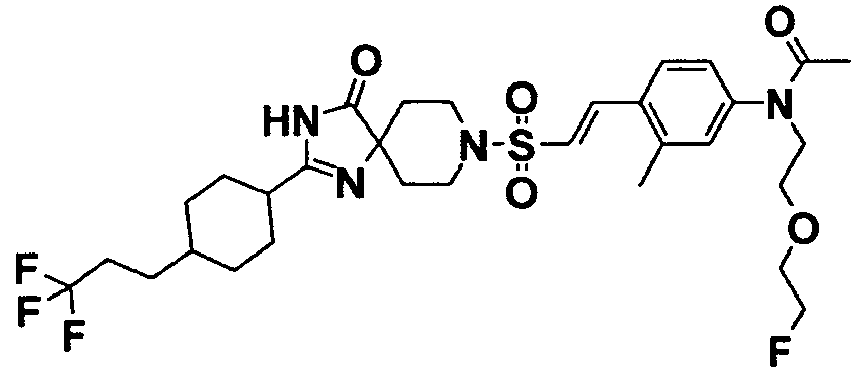
LCMS-D-1 2.30 659 (M+H)+ 546 
LCMS-D-1 1.56 597 (M+H)+ 547 
LCMS-D-1 2.45 570 (M+H)+ 548 
LCMS-D-1 2.13 638 (M+H)+ 549 
LCMS-D-1 1.63 684 (M+H)+ 550 
LCMS-D-1 2.23 625 (M+H)+ 551 
LCMS-D-1 2.55 673 (M+H)+ 552 
LCMS-D-1 2.02 626 (M+H)+ 553 
LCMS-D-1 2.40 556 (M+H)+ 554 
LCMS-D-1 2.45 638 (M+H)+ 555 
LCMS-D-1 2.67 666 (M+H)+ 556 
LGMS-D-1 2.58 623 (M+H)+ 557 
LCMS-D-1 2.42 637 (M+H)+ 558 
LCMS-D-1 2.78 597 (M+H)+ 559 
LCMS-D-1 2.45 611 (M+H) + - The aryl bromide reagent used in the synthesis of Compound 542 (N-(4-bromo-3-methyl-phenyl)-N-(2-methoxyethyl)-acetamide) was synthesized as follows.
-

- (N-(4-Bromo-3-methyl-phenyl)-N-(2-methoxy-ethyl)-acetamide was synthesized by operations similar to those in Reaction 25-3 using appropriate reagents and starting material.
MS (ESI) m/z = 286, 288 (M+H)+. - The aryl bromide reagent used in the synthesis of Compound 543 (N-(4-bromo-3,5-dimethyl-phenyl)-N-(2-methoxy-ethyl)-acetamide) was synthesized as follows.
-

- N-(4-Bromo-3,5-dimethyl-phenyl)-N-(2-methoxy-ethyl)-acetamide was synthesized by operations similar to those in Reaction 25-3 using appropriate reagents and starting material.
1H-NMR (CDCl3) δ 6.93 (s, 2H), 3.82 (t, 2H, J = 5.7 Hz), 3.49 (t, 2H, J = 5.7 Hz), 3.30 (s, 2H), 2.42 (s, 6H), 1.85 (s, 3H). - The aryl bromide reagent used in the synthesis of Compound 544 (N-(4-bromo-3-methyl-phenyl)-N-[2-(2-hydroxy-ethoxy)-ethyl]-acetamide) was synthesized as follows.
-
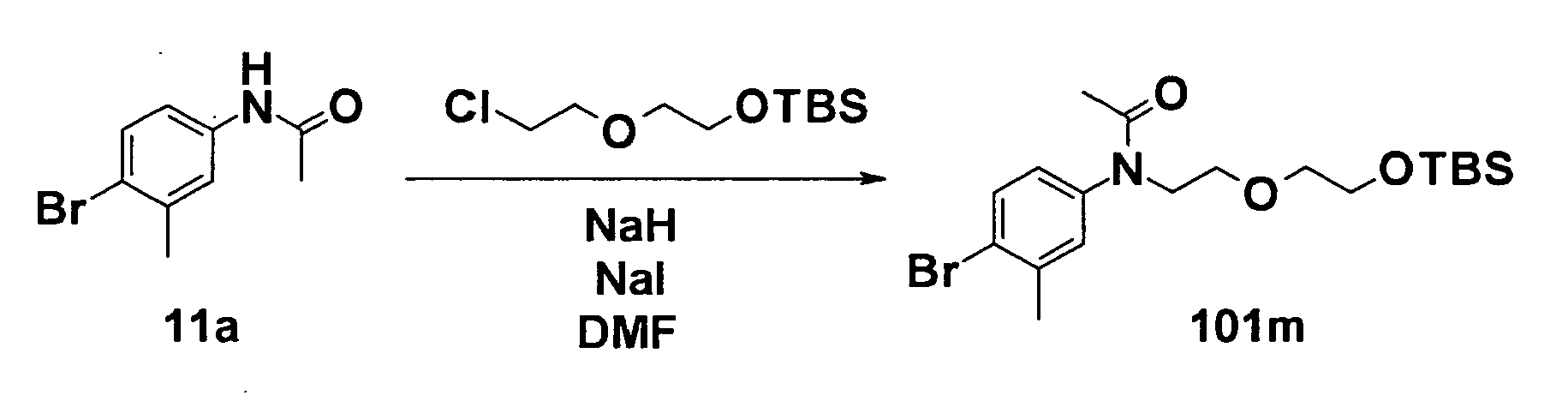
- Sodium hydride (60% oil suspension, 100 mg, 2.63 mmol) was added to a solution of 4-bromo-3-methylphenylacetamide (500 mg, 2.19 mmol), tert-butyl-[2-(2-chloro-ethoxy)-ethoxy]-dimethyl-silane (excess) and sodium iodide (324 mg, 2.19 mmol) in dimethylformamide (20 ml). The mixture was heated with stirring at 100°C for 17 hours. The reaction solution was cooled and then concentrated. The resulting residue was purified by silica gel column chromatography (ethyl acetate-hexane) to give N-(4-bromo-3-methyl-phenyl)-N-{2-[2-(tert-butyl-dimethyl-silanyloxy)-ethoxy]-ethyl}-acetamide (555 mg, 65%).
1H-NMR (CDCl3) δ 0.04 (s, 6H), 0.87 (s, 9H), 1.83 (s, 3H), 2.39 (s, 3H), 3.40-3.50 (m, 2H), 3.49-3.66 (m, 2H), 3.63-3.77 (m, 2H), 3.73-3.89 (m, 2H), 6.76-7.00 (m, 1H), 6.98-7.16 (m, 1H), 7.38-7.63 (m, 1H). -

- N-(4-Bromo-3-methyl-phenyl)-N-[2-(2-hydroxy-ethoxy)-ethyl]-acetamide was synthesized by operations similar to those in Reaction 39-2 using appropriate reagents and starting material.
MS (ESI) m/z = 316, 318 (M+H)+. - The aryl bromide reagent used in the synthesis of Compound 545 (N-(4-bromo-3-methyl-phenyl)-N-[2-(2-fluoro-ethoxy)-ethyl]-acetamide) was synthesized as follows.
-

- N-(4-Bromo-3-methyl-phenyl)-N-[2-(2-fluoro-ethoxy)-ethyl]-acetamide was synthesized by operations similar to those in Reaction 25-15 using appropriate reagents and starting material.
MS (ESI) m/z = 318, 320 (M+H)+. - The aryl bromide reagent used in the synthesis of Compound 548 (3-(4-bromo-3,5-dimethyl-phenyl)-1-methylimidazolidine-2,4-dione) was synthesized as follows.
-

- 3-(4-Bromo-3,5-dimethyl-phenyl)-1-methylimidazolidine-2,4-dione was synthesized by operations similar to those in Reaction 96-6 using appropriate reagents and starting material.
MS (ESI) m/z = 297, 299 (M+H)+. - The aryl bromide reagent used in the synthesis of Compound 549 ((4-bromo-3,5-dimethyl-phenyl)-[4-(2-fluoro-ethyl)-piperazin-1-yl]-methanone) was synthesized as follows.
-
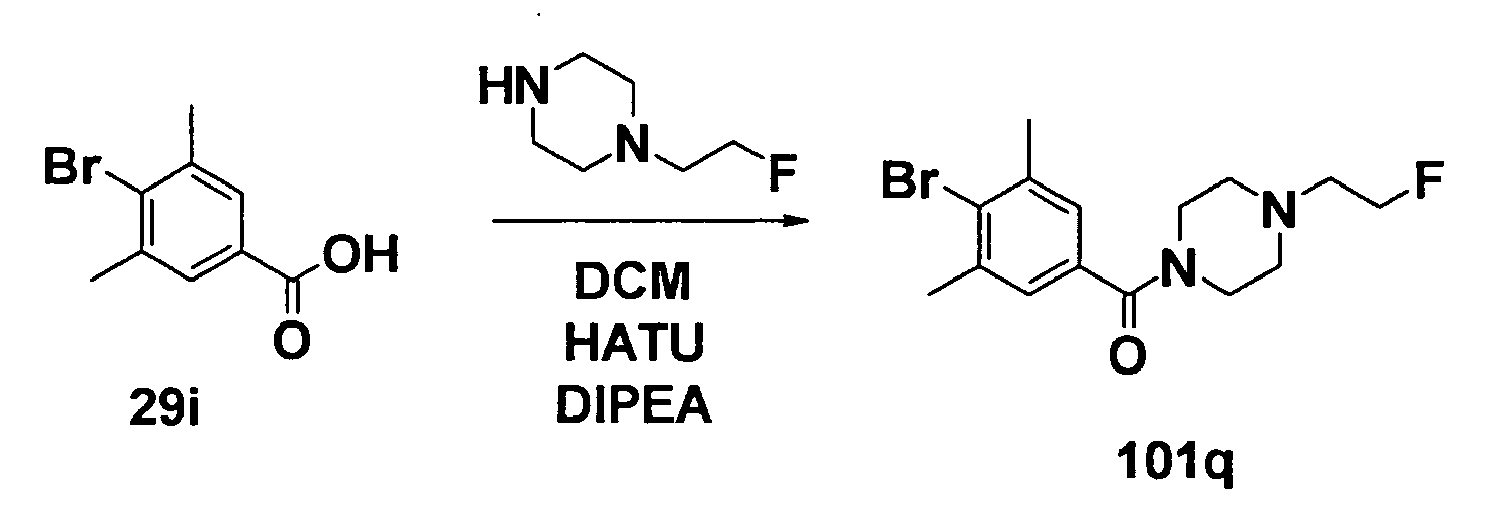
- (4-Bromo-3,5-dimethyl-phenyl)-[4-(2-fluoro-ethyl)-piperazin-1-yl]-methanone was synthesized by operations similar to those in Reaction 10-14 using appropriate reagents and starting material.
1H-NMR (CDCl3) δ 7.10 (s, 2H), 4.66 (t, 1H, J = 4.96 Hz), 4.51 (t, 1H, J = 4.96 Hz), 3.79 (s, 2H), 3.47 (s, 2H), 2.79 (t, 1H, J=4.96Hz), 2.70 (t, 1H, J=4.96Hz), 2.56 (brs, 4H), 2.43 (s, 6H). - The aryl bromide reagent used in the synthesis of Compound 551 (N-(4-bromo-3,5-dimethyl-phenyl)-N-[2-(2-fluoroethoxy)ethyl]acetamide) was synthesized as follows.
-

- 2-[2-[Acetyl-(4-bromo-3,5-dimethyl-phenyl)amino]ethoxy]ethyl methanesulfonate was synthesized by operations similar to those in Reaction 39-2 and Reaction 5-4 using appropriate reagents and starting material.
MS (ESI) m/z = 408, 410 (M+H)+. -

- Potassium fluoride (180 mg, 3.11 mmol) was added to a solution of 2-[2-[acetyl-(4-bromo-3,5-dimethyl-phenyl)amino]ethoxy]ethyl methanesulfonate (254 mg, 0.622 mmol) in PEG200 (2 ml), and the mixture was irradiated with microwaves at 100°C for 10 minutes. The reaction solution was diluted with ethyl acetate, and the organic layer was sequentially washed with water and saturated brine and concentrated under reduced pressure. The resulting residue was purified by silica gel column chromatography (hexane-ethyl acetate) to give N-(4-bromo-3,5-dimethyl-phenyl)-N-[2-(2-fluoroethoxy)ethyl]acetamide (144 mg, 70%).
MS (ESI) m/z = 332, 334 (M+H)+. - The aryl bromide reagent used in the synthesis of Compound 552 (N'-(4-bromo-3,5-dimethyl-benzoyl)-hydrazinecarboxylic acid tert-butyl ester) was synthesized as follows.
-

- N'-(4-Bromo-3,5-dimethyl-benzoyl)-hydrazinecarboxylic acid tert-butyl ester was synthesized by operations similar to those in Reaction 10-14 using appropriate reagents and starting material.
MS (ESI) m/z = 343, 345 (M+H)+. -

- 2-(4-Butyl-cyclohexyl)-8-ethenesulfonyl-1,3,8-triaza-spiro[4.5]dec-1-en-4-one was synthesized by operations similar to those in Reaction 10-14, Reaction 1-4, Reaction 4-1, Reaction 5-3 and Reaction 25-1 using appropriate reagents and starting material.
MS (ESI) m/z = 382 (M+H)+. -

- 3-(4-{(E)-2-[2-(4-Butyl-cyclohexyl)-4-oxo-1,3,8-triaza-spiro[4.5]dec-1-ene-8-sulfonyl]-vinyl}-3-methylphenyl)-imidazolidine-2,4-dione was synthesized by operations similar to those in Reaction 25-2 using appropriate reagents and starting material.
MS (ESI) m/z = 570 (M+H)+. - The example compounds shown below were synthesized by operations similar to those in Reaction 102-2 using appropriate reagents and starting materials.
-
[Table 77] Target Compound Structure LCMS condition Retention time (min) MS (m/z) 561 
LCMS-D-1 2.17 645 (M+H)+ 562 
LCMS-D-1 3.25 633 (M+H)+ - The aryl bromide reagent used in the synthesis of Compound 561 (N-(4-bromo-3,5-dimethyl-phenyl)-N-[2-(2-methoxy-ethoxy)-ethyl]-acetamide) was synthesized as follows.
-

- N-(4-Bromo-3,5-dimethyl-phenyl)-N-[2-(2-methoxy-ethoxy)-ethyl]-acetamide was synthesized by operations similar to those in Reaction 25-3 using appropriate reagents and starting material.
MS (ESI) m/z = 334, 336 (M+H)+. -

- 8-Ethenesulfonyl-2-(4-isopropyl-cyclohexyl)-1,3,8-triaza-spiro[4.5]dec-1-en-4-one was synthesized by operations similar to those in Reaction 10-14, Reaction 1-4, Reaction 4-1, Reaction 5-3 and Reaction 25-1 using appropriate reagents and starting material.
MS (ESI) m/z = 368 (M+H)+. -

- 3-(4-{(E)-2-[2-(4-Isopropyl-cyclohexyl)-4-oxo-1,3,8-triaza-spiro[4.5]dec-1-ene-8-sulfonyl]-vinyl}-3-methylphenyl)-imidazolidine-2,4-dione was synthesized by operations similar to those in Reaction 25-2 using appropriate reagents and starting material.
MS (ESI) m/z = 556 (M+H)+. - The example compound shown below was synthesized by operations similar to those in Reaction 103-2 using appropriate reagents and starting material.
-
[Table 78] Target Compound Structure LCMS condition Retention time (min) MS (m/z) 564 
LCMS-C-1 2.72 570 (M+H)+ - The example compounds shown below were obtained by operations similar to those in Reaction 26-1 using appropriate reagents and starting materials.
-
[Table 79] Target Compound Structure LCMS condition Retention time (min) MS (m/z) 565 
LCMS-C-1 2.25 502 (M+H)+ 566 
LCMS-C-1 2.47 503 (M+H)+ 567 
LCMS-C-1 2.28 555 (M-H)- 568 
LCMS-C-1 2.43 538 (M+H) + 569 
LCMS-C-1 2.8 628 (M-H) - 570 
LCMS-C-1 2.6 527 (M-H)- 571 
LCMS-C-1 2.17 584 (M-H)- 572 
LCMS-C-1 2.47 485 (M+H)+ 573 
LCMS-D-1 2.82 528 (M+H)+ 574 
LCMS-D-1 2.82 571 (M+H)+ - The aryl bromide reagent used in the synthesis of Compound 567 (4-methyl-piperazine-1-carboxylic acid 4-bromo-benzylamide) was synthesized as follows.
-

- 4-Methyl-piperazine-1-carboxylic acid 4-bromo-benzylamide was synthesized by operations similar to those in Reaction 82-1 using appropriate reagents and starting material.
MS (ESI) m/z = 312 (M+H)+. - The aryl bromide reagent used in the synthesis of Compound 568 (N'-(4-bromo-3-methyl-phenyl)-N,N-dimethyl-sulfamide) was synthesized as follows.
-

- N'-(4-Bromo-3-methyl-phenyl)-N,N-dimethyl-sulfamide was synthesized by operations similar to those in Reaction 82-1 using appropriate reagents and starting material.
MS (ESI) m/z = 293 (M+H)+. - The aryl bromide reagent used in the synthesis of Compound 569 ((4-bromo-3-methyl-benzyl)-(3-dimethylaminopropyl)-carbamic acid tert-butyl ester) was synthesized as follows.
-
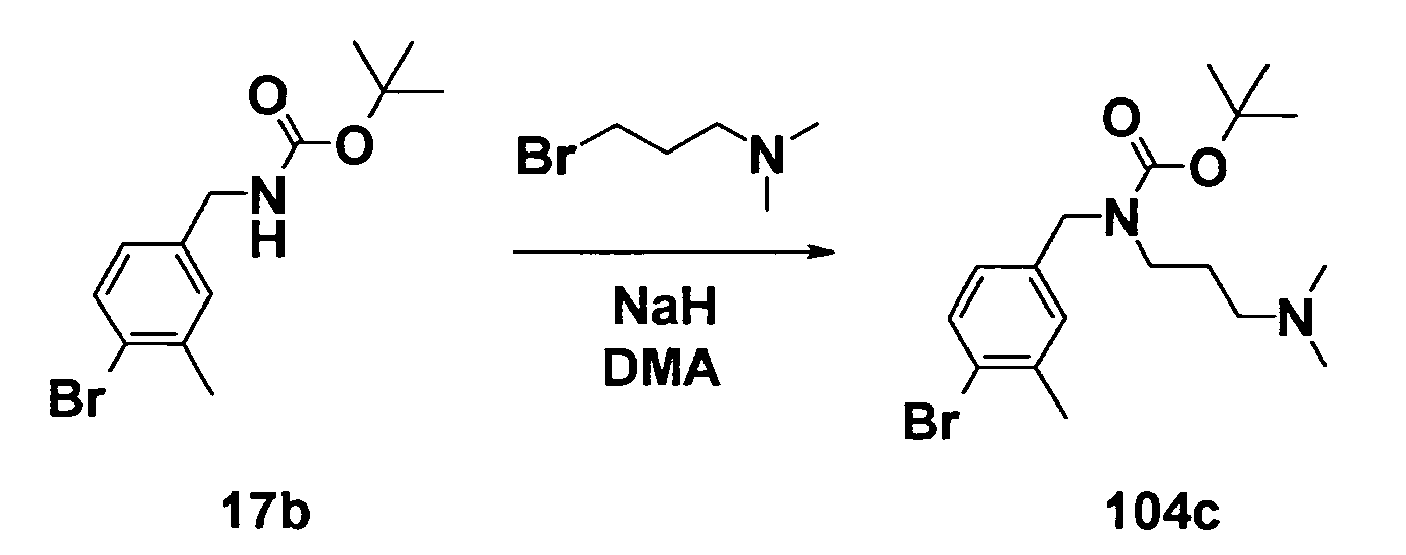
- (4-Bromo-3-methyl-benzyl)-(3-dimethylamino-propyl)-carbamic acid tert-butyl ester was synthesized by operations similar to those in Reaction 25-3 using appropriate reagents and starting material.
MS (ESI) m/z = 385, 387 (M+H)+. - The aryl bromide reagent used in the synthesis of Compound 570 (2-(4-bromo-phenyl)-N-(2,2-dimethyl-propyl)-acetamide) was synthesized as follows.
-

- 2-(4-Bromo-phenyl)-N-(2,2-dimethyl-propyl)-acetamide was synthesized by operations similar to those in Reaction 10-1 using appropriate reagents and starting material.
MS (ESI) m/z = 285, 287 (M+H)+. - The aryl bromide reagent used in the synthesis of Compound 571 (2-(4-bromo-phenyl)-N-(2-diisopropylaminoethyl)acetamide) was synthesized as follows.
-

MS (ESI) m/z = 342, 344 (M+H)+. - The aryl bromide reagent used in the synthesis of Compound 572 (1-(4-bromo-3-methyl-phenyl)-azetidin-2-one) was synthesized as follows.
-

- 1-(4-Bromo-3-methyl-phenyl)-azetidin-2-one was synthesized by operations similar to those in Reaction 29-3 using appropriate reagents and starting material.
MS (ESI) m/z = 240, 242 (M+H)+. - The aryl bromide reagent used in the synthesis of Compound 573 ((4-bromo-3,5-dimethyl-phenyl)-thiazol-2-yl-amine) was synthesized as follows.
-
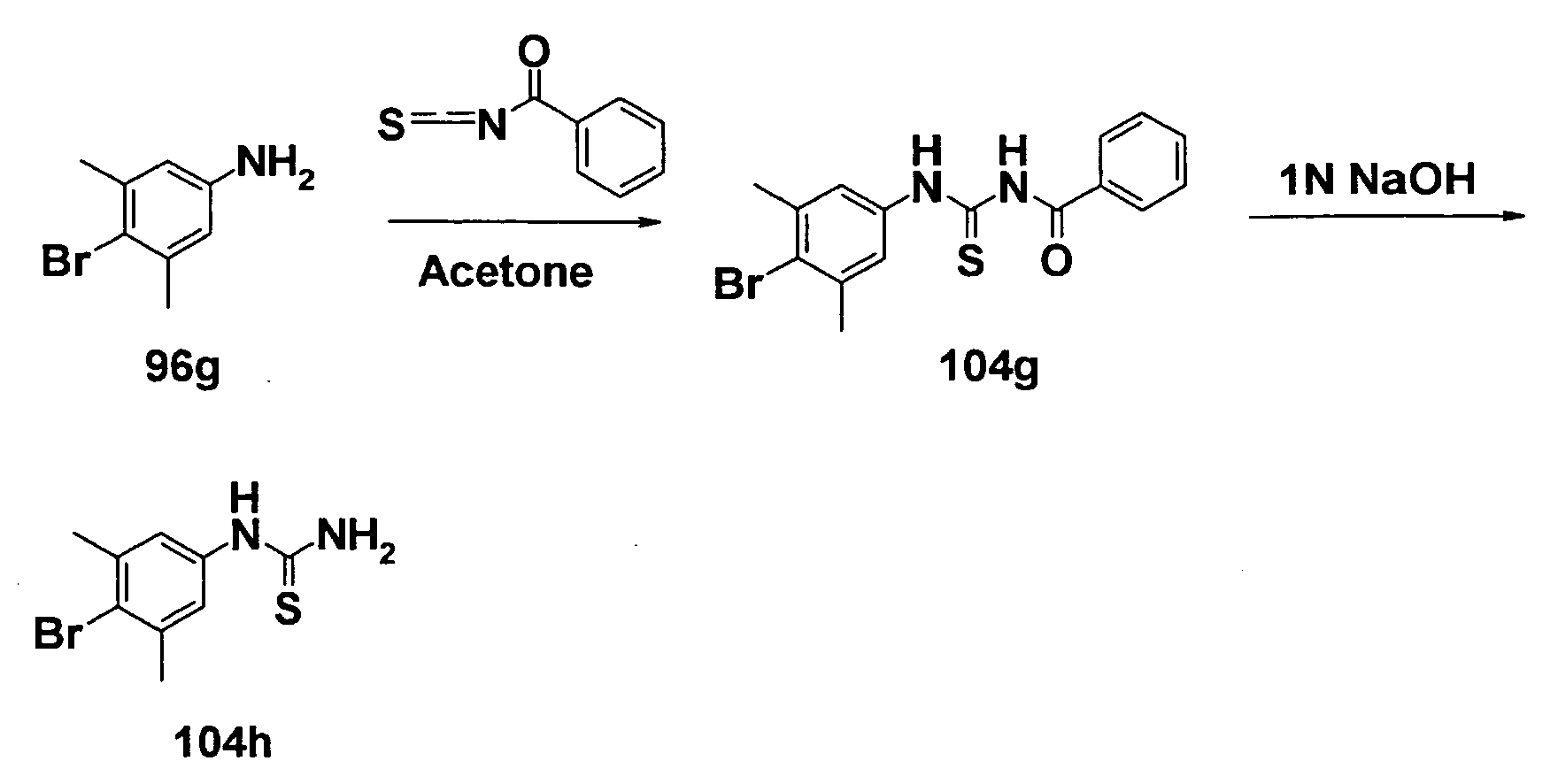
- A solution of 4-bromo-3,5-dimethyl-phenylamine (200 mg) and benzoyl isothiocyanate (0.14 ml) in acetone (2 ml) was heated under reflux for 30 minutes. After cooling the reaction solution, a 1 N aqueous sodium hydroxide solution (2.19 ml) was added and the mixture was stirred at 50°C for 12 hours. The mixture was extracted with dichloromethane, and the organic layer was then dried over anhydrous sodium sulfate and concentrated under reduced pressure. The resulting residue was triturated with hexane to give (4-bromo-3,5-dimethyl-phenyl)-thiourea (146 mg, 57%).
1H-NMR (300 MHz, DMSO-d6) δ 9.62 (1H, s), 7.8-7.2 (2H, br), 7.19 (2H, s), 2.32 (6H, s). -

- (4-Bromo-3,5-dimethyl-phenyl)-thiazol-2-yl-amine was synthesized by operations similar to those in Reaction 94-1 using appropriate reagents and starting material.
MS (ESI) m/z = 285 (M+H)+. - The aryl bromide reagent used in the synthesis of Compound 574 (N-(4-bromo-3,5-dimethyl-phenyl)-N-(3-methyl-oxetan-3-ylmethyl)-acetamide) was synthesized as follows.
-

- N-(4-Bromo-3,5-dimethyl-phenyl)-N-(3-methyl-oxetan-3-ylmethyl)-acetamide was synthesized by operations similar to those in Reaction 25-3 using appropriate reagents and starting material.
MS (ESI) m/z = 326, 328 (M+H)+. -

MS (ESI) m/z = 542 (M+H)+. - The example compounds shown below were synthesized by operations similar to those in Example 105 using appropriate reagents and starting materials.
-
[Table 80] Target Compoun Structure LCMS condition Retention time (min) MS (m/z) 576 
LCMS-D-1 2.82 531 (M+H)+ 577 
LCMS-C-1 2.62 515 (M+H) + 578 
LCMS-A-1 2.44 628 (M+H) + 579 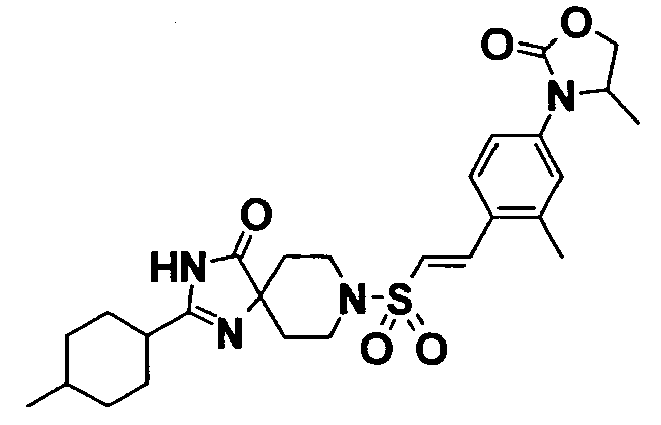
LCMS-A-1 2.23 529 (M+H) + 580 
LCMS-C-1 2.72 515 (M+H) + 581 
LCMS-C-1 2.42 542 (M+H) + 582 
LCMS-A-1 2.05 556 (M+H) + 583 
LCMS-A-1 1.95 542 (M+H) + 584 
LCMS-D-1 1.93 515 (M+H) + 585 
LCMS-F-1 1.05 460 (M+H) + 586 
LCMS-A-1 1.83 539 (M+H) + 587 
LCMS-D-1 2.02 556 (M+H) + 588 
LCMS-C-1 2.53 515 (M+H) + 589 
LCMS-C-1 2.83 628 (M+H) + - The aryl bromide reagent used in the synthesis of Compound 577 (3-(4-bromo-3-methyl-phenyl)-oxazolidin-4-one) was synthesized as follows.
-

- Acetic acid chlorocarbonylmethyl ester (1.73 ml) was added to a solution of 4-bromo-3-methyl-phenylamine (2.0 g, 10.7 mmol) and pyridine (5.21 ml) in dichloromethane (20 ml), and the mixture was stirred at 40°C for 2.5 hours. The mixture was cooled, and then quenched with water and extracted with dichloromethane. The organic layer was sequentially washed with water and saturated brine, and then dried over anhydrous sodium sulfate and concentrated under reduced pressure to give acetic acid (4-bromo-3-methyl-phenylcarbamoyl)-methyl ester (3.19 g).
1H-NMR (400 MHz, CDCl3) δ 2.24 (3H, s), 2.39 (3H, s), 4.68 (2H, s), 7.22-7.25 (1H, m), 7.46-7.50 (2H, m), 7.70 (1H, brs). -

- N-(4-Bromo-3-methyl-phenyl)-2-hydroxy-acetamide was synthesized by operations similar to those in Reaction 12-5 using appropriate reagents and starting material.
MS (ESI) m/z = 244, 246 (M+H)+. -

- Sodium hydride (81 mg, 1.80 mmol) was added to a solution of N-(4-bromo-3-methyl-phenyl)-2-hydroxy-acetamide (200 mg, 0.819 mmol) in DMF (4.0 ml), and the mixture was stirred at room temperature for 50 minutes. Further, dibromomethane (0.114 ml, 1.64 mmol) was added to the reaction solution, and the mixture was heated with stirring at 110°C for two hours. Cooling to room temperature and subsequent purification by silica gel column chromatography (hexane-ethyl acetate) gave 3-(4-bromo-3-methyl-phenyl)-oxazolidin-4-one (45 mg, 21%).
MS (ESI) m/z = 256, 258 (M+H)+. - The aryl bromide reagent used in the synthesis of Compound 578 (4-(4-bromo-3-methyl-phenyl)-3-oxo-piperazine-1-carboxylic acid tert-butyl ester) was synthesized as follows.
-

- 4-(4-Bromo-3-methyl-phenyl)-3-oxo-piperazine-1-carboxylic acid tert-butyl ester was synthesized by operations similar to those in Reaction 29-3 using appropriate reagents and starting material.
MS (ESI) m/z = 369, 371 (M+H)+. - The aryl bromide reagent used in the synthesis of Compound 579 (3-(4-bromo-3-methyl-phenyl)-4-methyl-oxazolidin-2-one) was synthesized as follows.
-

- 3-(4-Bromo-3-methyl-phenyl)-4-methyl-oxazolidin-2-one was synthesized by operations similar to those in Reaction 12-1 and Reaction 96-13 using appropriate reagents and starting material.
MS (ESI) m/z = 270, 272 (M+H) +. - The aryl bromide reagent used in the synthesis of Compound 580 (2-(4-bromo-3-methyl-phenyl)-isoxazolidin-3-one) was synthesized as follows.
-

- 3-Chloro-propionyl (157 µL, 1.65 mmol) was added to a mixture of N-m-tolyl-hydroxylamine (235 mg, 1.69 mmol) and potassium carbonate (223 mg, 1.69 mmol) in N,N-dimethylformamide (1.7 mL) at -10°C. The mixture was stirred at room temperature for 2.5 hours, and water and ethyl acetate were then added. The organic layer and the aqueous layer were separated, and the aqueous layer was repeatedly extracted with ethyl acetate three times. The organic layers were combined, washed with water twice and saturated brine, and then concentrated under reduced pressure. The resulting residue was purified by silica gel column chromatography to give 2-m-tolyl-isoxazolidin-3-one as a pale yellow solid (213 mg, 73%).
MS (ESI) m/z = 178 (M+H)+. -
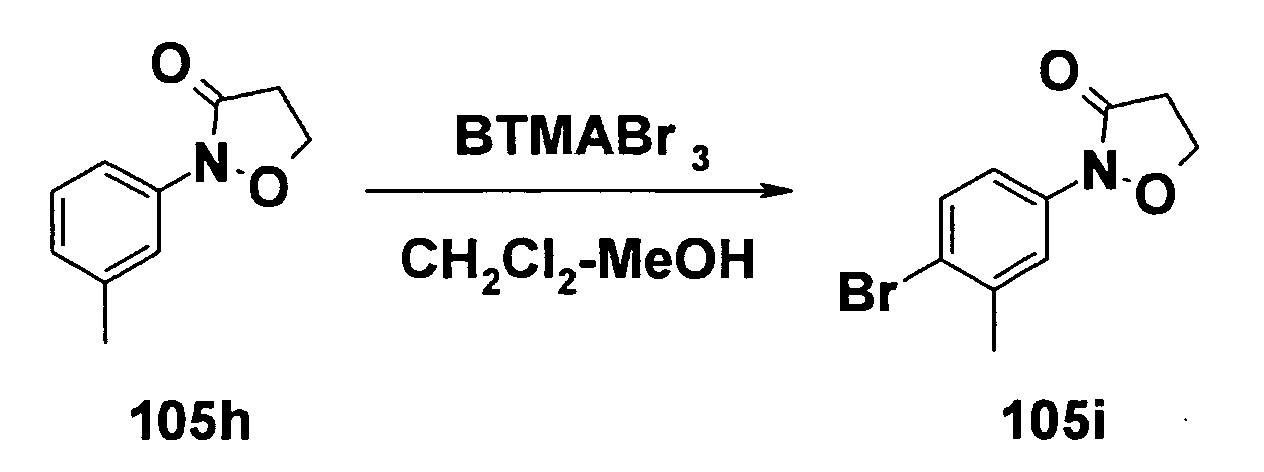
- 2-(4-Bromo-3-methyl-phenyl)-isoxazolidin-3-one was synthesized by operations similar to those in Reaction 26-2 using appropriate reagents and starting material.
MS (ESI) m/z = 297, 299 (M+H)+. - The aryl iodide reagent used in the synthesis of Compound 581 (3-(4-iodo-2,5-dimethyl-phenyl)-imidazolidine-2,4-dione) was synthesized as follows.
-

- 3-(4-Iodo-2,5-dimethyl-phenyl) -imidazolidine-2,4-dione was synthesized by operations similar to those in Reaction 84-1 and Reaction 96-1 using appropriate reagents and starting material.
MS (ESI) m/z = 331 (M+H)+. - The aryl bromide reagent used in the synthesis of Compound 582 (3-(4-bromo-3,5-dimethyl-phenyl)-5-methylimidazolidine-2,4-dione) was synthesized as follows.
-

- 3-(4-Bromo-3,5-dimethyl-phenyl)-5-methylimidazolidine-2,4-dione was synthesized by operations similar to those in Reaction 10-1, Reaction 39-2 and Reaction 96-10 using appropriate reagents and starting material.
MS (ESI) m/z = 297, 299 (M+H)+. - The aryl bromide reagent used in the synthesis of Compound 583 (3-(4-bromo-2,6-dimethyl-phenyl)-imidazolidine-2,4-dione) was synthesized as follows.
-

- Ethyl isocyanatoacetate (581 mg, 4.50 mmol) and N,N-diisopropylethylamine (426 mg, 1.65 mmol) were added to a solution of 4-bromo-2,6-dimethylaniline (600 mg, 3.00 mmol) in toluene (6 ml) with stirring in a nitrogen stream, and the mixture was heated with stirring at 120°C. After 30 minutes, the reaction solution was brought to room temperature, and the precipitate was collected by filtration, washed with toluene and then dried under reduced pressure. The resulting solid was suspended in toluene (6 ml). DBU (68.4 mg, 2.25 mmol) was added and the mixture was heated with stirring at 120°C. After 30 minutes, the reaction solution was brought to room temperature and diluted with ethyl acetate, and the organic layer was washed with a 1 N aqueous hydrochloric acid solution and saturated brine. The organic layer was dried over anhydrous magnesium sulfate, and the magnesium sulfate was then removed by filtration. The filtrate was concentrated under reduced pressure. The residue was subjected to column chromatography (hexane-ethyl acetate) to give 3-(4-bromo-2,6-dimethyl-phenyl)-imidazolidine-2,4-dione (570 mg, 67%).
MS (ESI) m/z = 283, 285 (M+H)+. - The aryl bromide reagent used in the synthesis of Compound 584 (N-(4-bromo-2,6-dimethyl-phenyl)-N-methylacetamide) was synthesized as follows.
-

- N-(4-Bromo-2,6-dimethyl-phenyl)-N-methyl-acetamide was synthesized by operations similar to those in Reaction 19-2 (using DMAP as a base) and Reaction 25-3 using appropriate reagents and starting material.
MS (ESI) m/z = 256, 258 (M+H)+. - The aryl bromide reagent used in the synthesis of Compound 586 ((4-bromo-3,5-dimethyl-phenyl)-(1H-imidazol-2-yl)-methyl-amine) was synthesized as follows.
-

- Iodomethane (260 mg, 9.15 mmol) was added to a solution of 1-(4-bromo-3,5-dimethyl-phenyl)-1-methyl-thiourea (500 mg, 1.83 mmol) in acetone (10 ml) with stirring in a nitrogen stream, and the mixture was heated with stirring at 50°C for two hours. The reaction solution was concentrated under reduced pressure, and a mixture of the resulting residue and aminoacetaldehyde dimethylacetal (250 mg, 2.38 mmol) in iso-BuOH (8.3 ml) was then heated under reflux for four hours. The reaction mixture was concentrated under reduced pressure. Concentrated hydrochloric acid (3 ml) was then added to the resulting residue, and the mixture was heated with stirring at 90°C for 30 minutes. The reaction mixture was cooled and then adjusted to pH 10 with a 2 N aqueous sodium hydroxide solution, followed by extraction with dichloromethane. The organic layer was dried over anhydrous magnesium sulfate and then concentrated under reduced pressure. The residue was purified by silica gel column chromatography (dichloromethane-methanol) to give (4-bromo-3,5-dimethyl-phenyl)-(1H-imidazol-2-yl)-methyl-amine (145 mg, 28%).
1H-NMR (400 MHz, DMSO-d6) δ 2.30 (6H, s), 3.25 (3H, s), 6.71 (1H, s), 6.83 (2H, s), 6.87 (1H, s).
MS (ESI) m/z = 280 (M+H)+. - The aryl bromide reagent used in the synthesis of Compound 587 (1-(4-bromo-3,5-dimethyl-phenyl)-dihydro-pyrimidine-2,4-dione) was synthesized as follows.
-

- 3-[1-(4-Bromo-3,5-dimethyl-phenyl)-ureido]-propionic acid ethyl ester was synthesized by operations similar to those in Reaction 25-12 (using 1,4-dioxane as a solvent and 2,6-lutidine as a base) and Reaction 89-2 using appropriate reagents and starting material.
1H-NMR (CDCl3) δ 6.99 (s, 2H), 4.43 (bars, 2H), 4.05 (q, 2H, J = 7.25 Hz), 3.94 (t, 2H, J = 7.25 Hz), 2.57 (t, 2H, J = 7.25 Hz), 2.42 (s, 6H), 1.20 (t, 3H, J = 7.25 Hz). -

1H-NMR (CDCl3) δ 7.59 (s, 1H), 7.03 (s, 2H), 3.83 (t, 2H, J = 6.49 Hz), 2.83 (t, 2H, J = 6.49 Hz), 2.42 (s, 6H). The aryl bromide reagent used in the synthesis of Compound 588 (2-(4-bromo-3-methyl-phenyl)-pyrazolidin-3-one) was synthesized as follows. -
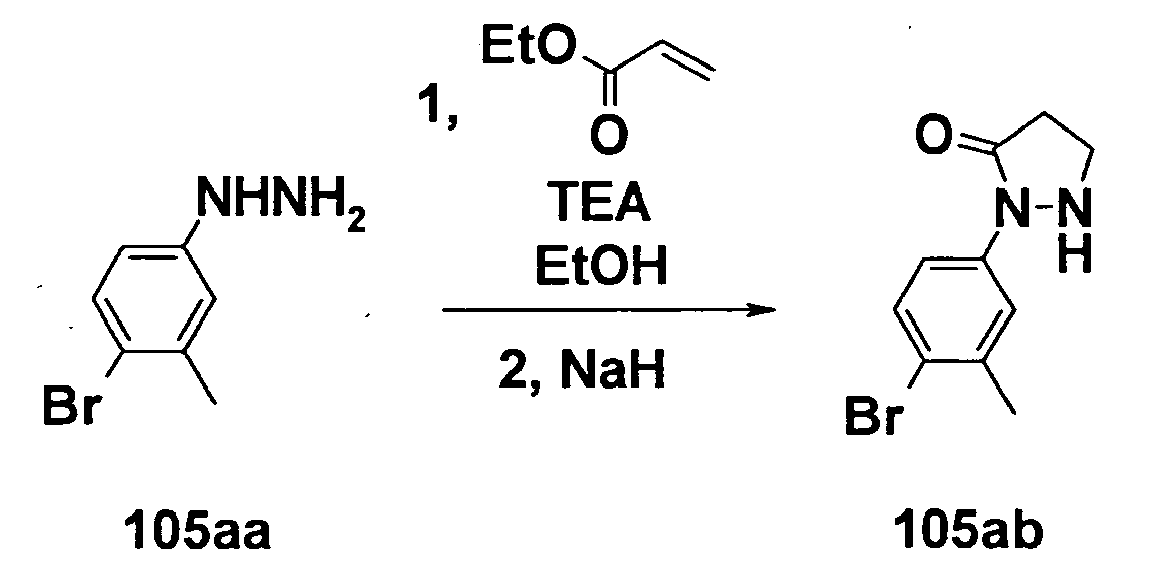
- Triethylamine (625 µL, 13.1 mmol) and acrylic acid ethyl ester (1.82 mL, 5.74 mmol) were added to a solution of (4-bromo-3-methyl-phenyl)-hydrazine (1.05 g, 5.22 mmol) in EtOH (26.1 mL) at room temperature in a nitrogen atmosphere, and the mixture was stirred at 80°C for 18 hours. The reaction solution was cooled, and 50% NaH (501 mg, 10.4 mmol) was then added to the reaction solution at 0°C. The mixture was stirred at 0°C for 30 minutes, and 50% NaH (251 mg, 5.20 mmol) was then further added, followed by further stirring for 30 minutes. The reaction mixture was quenched with a saturated aqueous ammonium chloride solution and extracted with ethyl acetate three times. The organic layers were combined and washed with a mixed solution of water:saturated brine (1:1). After separation, the organic layer was dried over sodium sulfate and concentrated under reduced pressure. The resulting residue was purified by silica gel column chromatography (hexane-ethyl acetate) to give 2-(4-bromo-3-methyl-phenyl)-pyrazolidin-3-one as a brown form (684 mg, 60%).
MS (ESI) m/z = 255, 257 (M+H)+. - The aryl bromide reagent used in the synthesis of Compound 589 (3-(4-bromo-3,5-dimethyl-phenyl)-5-tert-butoxymethyl-imidazolidine-2,4-dione) was synthesized as follows.
-

- 3-(4-Bromo-3,5-dimethyl-phenyl)-5-tert-butoxymethyl-imidazolidine-2,4-dione was synthesized by operations similar to those in Reaction 105-11 using appropriate reagents and starting material.
MS (ESI) m/z = 367, 369 (M-H)-. -

- N,N-Dimethyl-2-(3-methyl-4-{(E)-2-[4-oxo-2-(3-trifluoromethyl-phenyl)-1,3,8-triaza-spiro[4.5]dec-1-ene-8-sulfonyl]-vinyl}-benzenesulfonylamino)-acetamide was synthesized by operations similar to those in Reaction 26-1 using appropriate reagents and starting material.
MS (ESI) m/z = 642 (M+H)+. - The example compounds shown below were synthesized by operations similar to those in Example 106 using appropriate reagents and starting materials.
-
[Table 81] Target Compound Structure LCMS condition Retention time (min) MS (m/z) 591 
LCMS-C-1 2.57 648 (M+H) + 592 
LCMS-C-1 2.48 655 (M+H) + 593 
LCMS-C-1 2.48 556 (M+H) + 594 
LCMS-A-1 2.43 599 (M+H) + 595 
LCMS-C-1 2.35 661 (M+H) + - The aryl bromide reagent used in the synthesis of Compound 590 (2-(4-bromo-3-methyl-benzenesulfonylamino)-N,N-dimethyl-acetamide) was synthesized as follows.
-

- 2-(4-Bromo-3-methyl-benzenesulfonylamino)-N,N-dimethyl-acetamide was synthesized by operations similar to those in Reaction 5-4, Reaction 95-18 and Reaction 10-14 using appropriate reagents and starting material.
MS (ESI) m/z = 335, 337 (M+H)+. - The aryl bromide reagent used in the synthesis of Compound 591 (4-bromo-3-methyl-N-pyridin-3-ylmethyl-benzenesulfonamide) was synthesized as follows.
-

- 4-Bromo-3-methyl-N-pyridin-3-ylmethyl-benzenesulfonamide was synthesized by operations similar to those in Reaction 5-4 using appropriate reagents and starting material.
MS (ESI) m/z = 341, 343 (M+H)+. - The aryl bromide reagent used in the synthesis of Compound 592 (4-bromo-N-(4-hydroxy-cyclohexyl)-3-methyl-benzenesulfonamide) was synthesized as follows.
-

- 4-Bromo-N-(4-hydroxy-cyclohexyl)-3-methyl-benzenesulfonamide was synthesized by operations similar to those in Reaction 5-4 using appropriate reagents and starting material.
MS (ESI) m/z = 348, 350 (M+H)+. - The aryl bromide reagent used in the synthesis of Compound 594 (N-acetyl-4-bromo-3-methyl-benzenesulfonamide) was synthesized as follows.
-

- N-Acetyl-4-bromo-3-methyl-benzenesulfonamide was synthesized by operations similar to those in Reaction 95-6 and Reaction 12-2 using appropriate reagents and starting material.
MS (ESI) m/z = 292, 294 (M+H)+. - The aryl bromide reagent used in the synthesis of Compound 595 (4-bromo-N-(2-hydroxy-1,1-bis-hydroxymethyl-ethyl)-3-methyl-benzenesulfonamide) was synthesized as follows.
-

- 4-Bromo-N-(2-hydroxy-1,1-bis-hydroxymethyl-ethyl)-3-methyl-benzenesulfonamide was synthesized by operations similar to those in Reaction 5-4 using appropriate reagents and starting material.
MS (ESI) m/z = 354, 356 (M+H)+. -

- N-(1-Benzyl-piperidin-4-yl)-3-methyl-4-{ (E)-2-[4-oxo-2-(3-trifluoromethoxy-phenyl)-1,3,8-triaza-spiro[4.5]dec-1-ene-8-sulfonyl]-vinyl}-benzenesulfonamide was synthesized by operations similar to those in Reaction 26-1 using appropriate reagents and starting material.
MS (ESI) m/z = 746 (M+H)+. - The example compounds shown below were synthesized by operations similar to those in Example 107 using appropriate reagents and starting materials.
-
[Table 82] Target Compound Structure LCMS condition Retention time (min) MS (m/z) 597 
LCMS-C-1 2.58 593 (M+H) + 598 
LCMS-C-1 2.77 648 (M+H) + 599 
LCMS-C-1 2.45 647 (M+H) + 600 
LCMS-C-1 2.6 620 (M+H) + 601 
LCMS-C-1 2.67 612 (M+H) + 602 
LCMS-C-1 3.17 693 (M+H) + 603 
LCMS-B-1 2.4 593 (M+H) + 604 
LCMS-A-1 2.85 734 (M+H) + 605 
LCMS-D-1 2.97 610 (M+H) + 606 
LCMS-D-1 1.8 662 (M+H) + 607 
LCMS-D-1 2.32 636 (M+H) + 608 
LCMS-D-1 2.78 622 (M+H) + 609 
LCMS-D-1 1.82 672 (M+H) + 610 
LCMS-D-1 3.03 662 (M+H) + 611 
LCMS-D-1 2.7 648 (M+H) + 612 
LCMS-C-1 2.55 590 (M+H) + 613 
LCMS-C-1 2.8 633 (M+H) + 614 
LCMS-D-1 3.43 648 (M+H) + 615 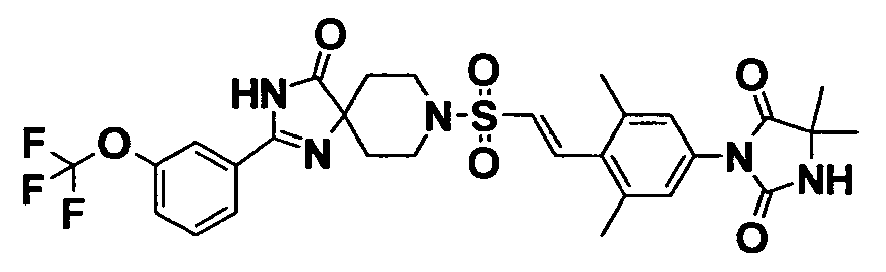
LCMS-D-1 3.27 634 (M+H) + 616 
LCMS-D-1 2.15 649 (M+H) + 617 
LCMS-F-1 0.93 593 (M+H) + 618 
LCMS-F-1 0.9 592 (M+H) + - The aryl bromide reagent used in the synthesis of Compound 596 (N-(1-benzyl-piperidin-4-yl)-4-bromo-3-methyl-benzenesulfonamide) was synthesized as follows.
-

- N-(1-Benzyl-piperidin-4-yl)-4-bromo-3-methyl-benzenesulfonamide was synthesized by operations similar to those in Reaction 5-4 using appropriate reagents and starting material.
MS (ESI) m/z = 423, 425 (M+H)+. - The aryl bromide reagent used in the synthesis of Compound 597 ((S)-3-(5-bromo-indol-1-yl)-propane-1,2-diol) was synthesized as follows.
-

- (S)-3-(5-Bromo-indol-1-yl)-propane-1,2-diol was synthesized by operations similar to those in Reaction 25-3 and Reaction 25-4 using appropriate reagents and starting material.
MS (ESI) m/z = 270, 272 (M+H)+. - The aryl bromide reagent used in the synthesis of Compound 598 ((4-bromo-3-methyl-phenyl)-(4-isopropyl-piperazin-1-yl)-methanone) was synthesized as follows.
-

- (4-Bromo-3-methyl-phenyl)-(4-isopropyl-piperazin-1-yl)-methanone was synthesized by operations similar to those in Reaction 10-1 using appropriate reagents and starting material.
MS (ESI) m/z = 325, 327 (M+H)+. - The aryl bromide reagent used in the synthesis of Compound 599 (4-bromo-N-((R)-2,3-dihydroxy-propyl)-3-methyl-benzenesulfonamide) was synthesized as follows.
-

- 4-Bromo-N-((R)-2,3-dihydroxy-propyl)-3-methyl-benzenesulfonamide was synthesized by operations similar to those in Reaction 5-4 using appropriate reagents and starting material.
MS (ESI) m/z = 324, 326 (M+H)+. - The aryl bromide reagent used in the synthesis of Compound 600 (4-(4-bromo-2,6-difluoro-phenoxy)-butane-1,2-diol) was synthesized as follows.
-

- 4-(4-Bromo-2,6-difluoro-phenoxy)-butane-1,2-dioi was synthesized by operations similar to those in Reaction 23-1 and Reaction 25-4 using appropriate reagents and starting material.
1H-NMR (400 MHz, CDCl3) δ 1.90-1.94 (2H, m), 3.57 (1H, dd, J = 12.0, 8.0 Hz), 3.74 (1H, dd, J = 12.0, 4.0 Hz), 4.06-4.26 (1H, m), 4.26-4.33 (2H, m), 7.07-7.12 (2H, m). - The aryl bromide reagent used in the synthesis of Compound 601 (4- (4-bromo-2, 6-dimethyl-phenoxy) -butane-1,2-diol) was synthesized as follows.
-

- 4-(4-Bromo-2,6-dimethyl-phenoxy)-butane-1,2-diol was synthesized by operations similar to those in Reaction 23-1 and Reaction 31-6 using appropriate reagents and starting material.
1H-NMR (400 MHz, CD3OD) δ 1.77-1.82 (1H, m), 2.00-2.09 (1H, m), 2.45 (6H, s), 3.50-3.54 (2H, m) 3.84-3.95 (3H, m). - The aryl bromide reagent used in the synthesis of Compound 602 (4-(4-bromo-3-methyl-phenoxy)-piperidine-1-carboxylic acid tert-butyl ester) was synthesized as follows.
-

- 4-(4-Bromo-3-methyl-phenoxy)-piperidine-1-carboxylic acid tert-butyl ester was synthesized by operations similar to those in Reaction 31-7 using appropriate reagents and starting material.
1H-NMR (400 MHz, CDCl3) δ 1.50 (9H, s), 1.68-1.76 (2H, m), 1.87-1.92 (2H, m), 2.35 (1H, s), 3.30-3.36 (2H, m), 3.64-3.71 (2H, m), 4.38-4.43 (1H, m), 6.61 (1H, dd, J = 8.0, 4.0 Hz), 6.81 (1H, d, J = 4.0 Hz), 7.39 (1H, d, J = 8.0 Hz). - The aryl bromide reagent used in the synthesis of Compound 603 (N-(4-bromo-3-methyl-phenyl)-N-isopropyl-acetamide) was synthesized as follows.
-

- N-(4-Bromo-3-methyl-phenyl)-N-isopropyl-acetamide was synthesized by operations similar to those in Reaction 2-3 using appropriate reagents and starting material.
MS (ESI) m/z = 270, 272 (M+H)+. - The aryl bromide reagent used in the synthesis of Compound 604 (4-[acetyl-(4-bromo-3-methyl-phenyl)-amino]-piperidine-1-carboxylic acid tert-butyl ester) was synthesized as follows.
-

- 4-[Acetyl-(4-bromo-3-methyl-phenyl)-amino]-piperidine-1-carboxylic acid tert-butyl ester was synthesized by operations similar to those in Reaction 41-1 and Reaction 12-2 using appropriate reagents and starting material.
1H-NMR (400 MHz, CDCl3) δ 1.13-1.30 (2H, m), 1.40 (9H, s), 1.70-1.80 (2H, m), 1.76 (3H, s), 2.42 (3H, s), 2.72-2.84 (2H, m), 4.07-4.20 (2H, m), 4.70-4.80 (1H, m), 6.77 (1H, dd, J = 2.8, 8.4 Hz), 6.94 (1H, d, J = 2.8 Hz), 7.57 (1H, d, J = 8.4 Hz). - The aryl bromide reagent used in the synthesis of Compound 605 (1-(4-bromo-3,5-dimethyl-phenyl)-1-(2-hydroxy-ethyl)-urea) was synthesized as follows.
-

- 1-(4-Bromo-3,5-dimethyl-phenyl)-1-(2-hydroxy-ethyl)-urea was synthesized by operations similar to those in Reaction 82-1 and Reaction 98-7 using appropriate reagents and starting material.
MS (ESI) m/z = 287, 289 (M+H)+. - The aryl bromide reagent used in the synthesis of Compound 606 ((R)-1-(4-bromo-3,5-dimethyl-phenyl)-5-(isopropylamino-methyl)-pyrrolidin-2-one) was synthesized as follows.
-

- Methanesulfonic acid (R)-1-(4-bromo-3,5-dimethyl-phenyl)-5-oxo-pyrrolidin-2-ylmethyl ester was synthesized by operations similar to those in Reaction 39-2 and Reaction 5-4 using appropriate reagents and starting material.
1H-NMR (CDCl3) δ 7.12 (s, 2H), 4.43 (m, 1H), 4.19 (m, 2H), 2.93 (s, 3H), 2.70 (m, 1H), 2.60 (m, 1H), 2.41 (s, 6H), 2.40 (m, 1H), 2.16 (m, 1H). -

- Sodium iodide (catalytic amount) and isopropylamine (1.37 g, 23 mmol) were added to a solution of methanesulfonic acid (R)-1-(4-bromo-3,5-dimethyl-phenyl)-5-oxo-pyrrolidin-2-ylmethyl ester (150 mg, 0.399 mmol) in THF (3 ml) at room temperature, and the mixture was heated with stirring at 70°C for 1.5 days. After cooling to room temperature, the reaction solution was concentrated under reduced pressure. The resulting residue was purified by silica gel column chromatography (dichloromethane-methanol) to give (R)-1-(4-bromo-3,5-dimethyl-phenyl)-5-(isopropylamino-methyl)-pyrrolidin-2-one (83 mg, 61%).
1H-NMR (CDCl3) δ 7.12 (s, 2H), 4.23 (m, 1H), 2.67 (m, 4H), 2.53 (m, 1H), 2.41 (s, 6H), 2.30 (m, 1H), 2.03 (m, 1H), 0.97 (dd, 6H, J = 2.67 Hz, J = 6.1 Hz). - The aryl bromide reagent used in the synthesis of Compound 607 (N-(4-bromo-3,5-dimethyl-phenyl)-N-(2-dimethylamino-ethyl)-acetamide) was synthesized as follows.
-

- N-(4-Bromo-3,5-dimethyl-phenyl)-N-(2-dimethylamino-ethyl)-acetamide was synthesized by operations similar to those in Reaction 25-3 using appropriate reagents and starting material.
MS (ESI) m/z = 313, 315 (M+H)+. - The aryl bromide reagent used in the synthesis of Compound 608 (N-(4-bromo-3,5-dimethyl-phenyl)-2-dimethylamino-N-methyl-acetamide) was synthesized as follows.
-

- N-(4-Bromo-3,5-dimethyl-phenyl)-2-dimethylamino-N-methyl-acetamide was synthesized by operations similar to those in Reaction 2-3 and Reaction 95-17 using appropriate reagents and starting material.
MS (ESI) m/z = 299, 301 (M+H)+. - The aryl bromide reagent used in the synthesis of Compound 609 (N-(4-bromo-3,5-dimethyl-phenyl)-N-(2-dimethylamino-ethyl)-methanesulfonamide) was synthesized as follows.
-

- N-(4-Bromo-3,5-dimethyl-phenyl)-N-(2-dimethylamino-ethyl)-methanesulfonamide was synthesized by operations similar to those in Reaction 6-1 and Reaction 25-3 using appropriate reagents and starting material.
MS (ESI) m/z = 349, 351 (M+H)+. - The aryl bromide reagent used in the synthesis of Compound 610 ((R)-5-(aminomethyl)-1-(4-bromo-3,5-dimethylphenyl)pyrrolidin-2-one) was synthesized as follows.
-

- (R)-5-(Aminomethyl)-1-(4-bromo-3,5-dimethylphenyl)pyrrolidin-2-one was synthesized by operations similar to those in Reaction 107-13 using appropriate reagents and starting material.
1H-NMR (CDCl3) δ 7.10 (s, 2H), 4.20 (m, 1H), 2.80 (m, 2H), 2.60 (m, 2H), 2.41 (s, 6H), 2.30 (m, 1H), 2.03 (m, 1H). - The aryl bromide reagent used in the synthesis of Compound 611 ((R)-1-(4-bromo-3,5-dimethyl-phenyl)-5-dimethylaminomethyl-pyrrolidin-2-one) was synthesized as follows.
-

- (R)-1-(4-Bromo-3,5-dimethyl-phenyl)-5-dimethylaminomethyl-pyrrolidin-2-one was synthesized by operations similar to those in Reaction 80-1 using appropriate reagents and starting material.
1H-NMR (CDCl3) δ 7.14 (s, 2H), 4.22 (m, 1H), 2.58 (m, 2H), 2.4 (s, 6H), 2.37 (m, 2H), 2.28 (m, 1H), 2.23 (s, 6H), 2.10 (m, 1H). - The aryl bromide reagent used in the synthesis of Compound 612 (N-(4-bromo-3-methyl-phenyl)-N-cyanomethyl-acetamide) was synthesized as follows.
-

- (4-Bromo-3-methyl-phenylamino-)-acetonitrile was synthesized by operations similar to those in Reaction 95-17 using appropriate reagents and starting material. 1H-NMR (CDCl3) δ 2.36 (3H, s), 3.86-3.93 (1H, m), 4.09 (2H, d, J = 7.8 Hz), 6.43 (1H, dd, J = 8. 8, 3.8 Hz), 6.60 (1H, d, J = 3.8 Hz), 7.38 (1H, d, J = 8.8 Hz).
-

- Acetic anhydride (4.99 ml) was added to (4-bromo-3-methyl-phenylamino)-acetonitrile (594 mg, 2.64 mmol), and the mixture was heated with stirring at 115°C for one hour. The reaction solution was cooled and then concentrated under reduced pressure. The resulting residue was purified by silica gel column chromatography (hexane-ethyl acetate) to give N-(4-bromo-3-methylphenyl)-N-cyanomethyl-acetamide (697 mg, 99%).
MS (ESI) m/z = 267, 269 (M+H)+. - The aryl bromide reagent used in the synthesis of Compound 613 (N-(4-bromo-3-methyl-phenyl)-N-(2,2,2-trifluoro-ethyl)-acetamide) was synthesized as follows.
-

- Potassium carbonate (2.50 g, 18.1 mmol) and trifluoro-methanesulfonic acid 2,2,2-trifluoro-ethyl ester (2.36 ml, 16.4 mmol) were added to a solution of 4-bromo-3-methylaniline (1.68 g, 9.03 mmol) in MeCN (39.0 ml) at room temperature, and the mixture was stirred at 80°C overnight. The reaction mixture was concentrated under reduced pressure, and the resulting residue was then purified by silica gel column chromatography (hexane-ethyl acetate) to give (4-bromo-3-methyl-phenyl)-(2,2,2-trifluoro-ethyl)-amine (2.20 g, 91%).
MS (ESI) m/z = 268, 270 (M+H)+. -
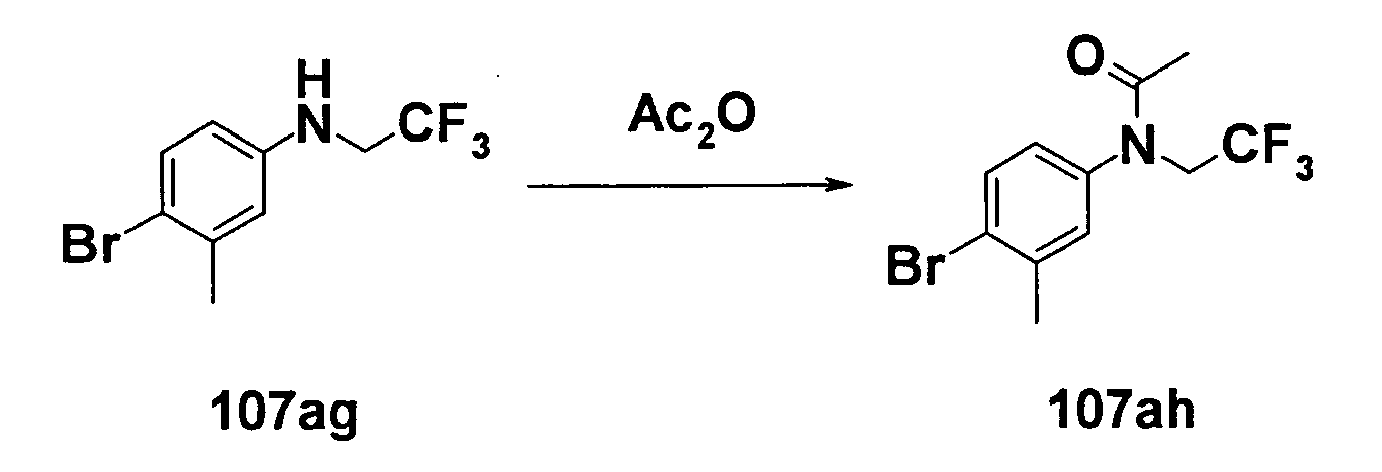
- N-(4-Bromo-3-methyl-phenyl)-N-(2,2,2-trifluoro-ethyl)-acetamide was synthesized by operations similar to those in Reaction 107-20 using appropriate reagents and starting material.
MS (ESI) m/z = 310, 312 (M+H)+. - The aryl bromide reagent used in the synthesis of Compound 616 (N-(4-bromo-3,5-dimethyl-phenyl)-N-(tetrahydro-pyran-4-yl)-acetamide) was synthesized as follows.
-

- [1480] N-(4-Bromo-3,5-dimethyl-phenyl)-N-(tetrahydro-pyran-4-yl)-acetamide was synthesized by operations similar to those in Reaction 41-1, Reaction 19-2 (using DMAP as a base) and Reaction 26-2 using appropriate reagents and starting material.
MS (ESI) m/z = 326, 328 (M+H)+. - [1481] The aryl bromide reagent used in the synthesis of Compound 617 (4-(4-bromo-3-methyl-phenyl)-morpholin-3-one) was synthesized as follows.
- [1482]
-

- 4-(4-Bromo-3-methyl-phenyl)-morpholin-3-one was synthesized by operations similar to those in Reaction 10-1 and Reaction 96-18 using appropriate reagents and starting material.
MS (ESI) m/z = 270, 272 (M+H)+. -

- 2-(4-Fluoro-3-trifluoromethyl-phenyl)-8-{(E)-2-[2-methyl-4-(pyrrolidine-1-carbonyl)-phenyl]-ethenesulfonyl}-1,3,8-triaza-spiro[4.5]dec-1-en-4-one was synthesized by operations similar to those in Reaction 26-1 using appropriate reagents and starting material.
MS (ESI) m/z = 593 (M+H)+. - The example compounds shown below were synthesized by operations similar to those in Example 108 using appropriate reagents and starting materials.
-
[Table 83] Target Compound Structure LCMS condition Retention time (min) MS (m/z) 620 
LCMS-C-1 2.48 609 (M+H) + 621 
LCMS-C-1 2.43 609 (M+H) + - The aryl bromide reagent used in the synthesis of Compound 621 ((S)-1-(4-bromo-3-methyl-phenyl)-5-hydroxymethyl-pyrrolidin-2-one) was synthesized as follows.
-

- (S)-1-(4-Bromo-3-methyl-phenyl)-5-hydroxymethyl-pyrrolidin-2-one was synthesized by operations similar to those in Reaction 29-3 using appropriate reagents and starting material.
MS (ESI) m/z = 284 (M+H)+. -

- 2,2,6,6-Tetramethylpiperidine 1-oxyl (202 mg, 1.29 mmol) and (diacetoxyiodo)benzene (3.33 g, 10.4 mmol) were added to a solution of 8,8,8-trifluoro-octanol (∼ 8.63 mmol) in dichloromethane (34.5 mL) at 0°C in an N2 atmosphere, and the mixture was stirred at 0°C for five minutes and at room temperature for 1.5 hours. The reaction solution was diluted with dichloromethane (200 mL), and the organic layer was sequentially washed with a saturated aqueous sodium sulfite solution (100 mL), a saturated aqueous sodium bicarbonate solution (100 mL) and saturated brine (100 mL). The organic layer was dried over sodium sulfate and then concentrated under reduced pressure. The resulting residue was purified by silica gel column chromatography (hexane-ethyl acetate) to give 8,8,8-trifluoro-octanal as a colorless oily substance (310 mg, two steps, 20%).
1H-NMR (400 MHz, CDCl3) δ 1.35-1.50 (4H, br-m), 1.58-1.62 (2H, br-m), 1.68-1.73 (2H, br-m), 2.05-2.17 (2H, br-m), 2.49 (2H, t, J = 7.1 Hz), 9.82 (1H, s).
19F-NMR (376 MHz, CDCl3) δ -66.3 (3F, s). -

- 1,8-Diazabicyclo[5.4.0]undec-7-ene (436 µL, 2.92 mmol) was added to a solution of (diethoxy-phosphoryl)-acetic acid ethyl ester (633 µL, 2.43 mmol) and lithium chloride (144 mg, 3.41 mmol) in acetonitrile (20.0 mL) at 0°C, and the mixture was stirred at 0°C for 10 minutes. A solution of 8,8,8-trifluoro-octanal (2.43 mmol) in acetonitrile (4.3 mL) was added dropwise to the reaction solution at 0°C, and the mixture was stirred for 10 minutes. Thereafter, the reaction mixture was stirred at room temperature for one hour and diluted with methyl tert-butyl ether (200 mL). The organic layer was sequentially washed with a saturated aqueous ammonium chloride solution (30 mL), H2O (30 mL) and saturated brine (30 mL), dried over sodium sulfate and concentrated under reduced pressure. The resulting residue was purified by silica gel column chromatography (hexane-ethyl acetate) to give (E)-10,10,10-trifluoro-dec-2-enoic acid ethyl ester as a colorless oily substance (426.6 mg, 70%).
1H-NMR (400 MHz, CDCl3) δ 1.29 (3H, t, J = 7.2 Hz), 1.31-1.41 (4H, m), 1.41-1.49 (2H, m), 1.51-1.59 (2H, m), 1.99-2.12 (2H, m), 2.20 (2H, ddd, J = 14.5, 7.2, 1.5 Hz), 4.18 (2H, q, J = 7.1 Hz), 5.81 (1H, dt, J = 15.7, 1.6 Hz), 6.95 (1H, dt, J = 15.6, 7.0 Hz).
19F-NMR (376 MHz, CDCl3) δ -66.4 (3F, s). -

- 8-Ethenesulfonyl-2-(9,9,9-trifluoro-nonyl)-1,3,8-triaza-spiro[4.5]dec-1-en-4-one was synthesized by operations similar to those in Reaction 18-2, Reaction 23-2, Reaction 10-14, Reaction 1-4, Reaction 4-1, Reaction 5-3 and Reaction 25-1 using appropriate reagents and starting material.
MS (ESI) m/z = 424 (M+H)+. -

- 8-{(E)-2-[1-((S)-2,3-Dihydroxy-propyl)-1H-indol-4-yl]-ethenesulfonyl}-2-(9,9,9-trifluoro-nonyl)-1,3,8-triaza-spiro[4.5]dec-1-en-4-one was synthesized by operations similar to those in Reaction 26-1 using appropriate reagents and starting material.
MS (ESI) m/z = 613 (M+H)+. -

- Triethylborane (43.8 mL, 438 mmol) and 1,1,1,2,2-pentafluoro-2-iodo-ethane (8.52 mL, 657 mmol) were added to a solution of hex-5-enoic acid (5.21 mL, 438 mmol) in hexane (219 mL) at room temperature, and the mixture was stirred at room temperature for five days. The reaction solution was concentrated under reduced pressure, and the resulting residue was purified by silica gel column chromatography (hexane-ethyl acetate) to give 7,7,8,8,8-pentafluoro-5-iodo-octanoic acid (purity 80%) as a colorless oily substance (2.63 g, 17%).
1H-NMR (400 MHz, CDCl3) δ 1.72-1.82 (1H, m), 1.83-1.92 (2H, m), 1.86-1.98 (1H, m), 2.36-2.46 (2H, m), 2.67-2.96 (2H, m), 4.65-4.34 (1H, m). -

- 7,7,8,8,8-Pentafluoro-octanal was synthesized by operations similar to those in Reaction 95-28 and Reaction 109-1 using appropriate reagents and starting material. This was used in the next reaction without complete purification.
-

- 1,8-Diazabicyclo[5.4.0]undec-7-ene (1.08 mL, 7.26 mmol) was added to a solution of (diethoxy-phosphoryl)-acetic acid ethyl ester (1.57 mL, 7.87 mmol) and lithium chloride (359 mg, 8.47 mmol) in acetonitrile (60.5 mL) at 0°C, and the mixture was stirred at 0°C for 10 minutes. A solution of 7,7,8,8,8-pentafluoro-octanal (1.32 g, 6.05 mmol) in acetonitrile (20.5 mL) was added dropwise to the reaction solution at 0°C, and the mixture was stirred for 10 minutes. Thereafter, the reaction mixture was stirred at room temperature for one hour and diluted with methyl tert-butyl ether (300 mL). The organic layer was sequentially washed with 2 N hydrochloric acid (50 mL), H2O (50 mL) and saturated brine (50 mL), dried over sodium sulfate and concentrated under reduced pressure. The resulting residue was purified by silica gel column chromatography (hexane-ethyl acetate) to give (E)-9,9,10,10,10-pentafluoro-dec-2-enoic acid ethyl ester (purity 80%) as a colorless oily substance (49.7 mg, 47%).
1H-NMR (400 MHz, CDCl3) δ 1.29 (3H, t, J = 7.2 Hz), 1.37-1.44 (1H, m), 1.46-1.52 (1H, m), 1.56-1.68 (2H, m), 1.93-2.08 (2H, m), 2.18-2.26 (2H, m), 4.19 (2H, q, J = 7.2 Hz), 5.79-5.86 (1H, m), 6.88-6.98 (1H, m). -

- 9,9,10,10,10-Pentafluoro-decanoic acid was synthesized by operations similar to those in Reaction 18-2 and Reaction 95-18 using appropriate reagents and starting material.
1H-NMR (400 MHz, CDCl3) δ 1.31-1.44 (6H, br-m), 1.53-1.68 (4H, m), 1.92-2.08 (2H, br-m), 2.36 (2H, t, J = 7.6 Hz). -

- 8-Ethenesulfonyl-2-(8,8,9,9,9-pentafluoro-nonyl)-1,3,8-triaza-spiro[4.5]dec-1-en-4-one was synthesized by operations similar to those in Reaction 10-14, Reaction 1-4, Reaction 4-1, Reaction 5-3 and Reaction 25-1 using appropriate reagents and starting material.
MS (ESI) m/z = 460 (M+H)+. -

- 8-{(E)-2-[1-((S)-2,3-Dihydroxy-propyl)-1H-indol-4-yl]-ethenesulfonyl}-2-(8,8,9,9,9-pentafluoro-nonyl)-1,3,8-triaza-spiro[4.5]dec-1-en-4-one was synthesized by operations similar to those in Reaction 26-1 using appropriate reagents and starting material.
MS (ESI) m/z = 649 (M+H)+. -

- 8-Ethenesulfonyl-2-(4-ethyl-cyclohexyl)-1,3,8-triaza-spiro[4.5]dec-1-en-4-one was synthesized by operations similar to those in Reaction 10-14, Reaction 10-11, Reaction 10-12, Reaction 4-1, Reaction 5-3 and Reaction 25-1 using appropriate reagents and starting material.
MS (ESI) m/z = 352 (M-H)-. -

- 1-(4-{(E)-2-[2-(4-Ethyl-cyclohexyl)-4-oxo-1,3,8-triaza-spiro[4.5]dec-1-ene-8-sulfonyl]-vinyl}-3-methylphenyl)-imidazolidine-2,4-dione was synthesized by operations similar to those in Reaction 26-1 using appropriate reagents and starting material.
MS (ESI) m/z = 542 (M+H)+. - The example compounds shown below were synthesized by operations similar to those in Reaction 111-2 using appropriate reagents and starting materials.
-
[Table 84] Target Compound Structure LCMS condition Retention time (min) MS (m/z) 625 
LCMS-C-1 2.7 556 (M+H)+ 626 
LCMS-C-1 2.73 571 (M+H)+ - The aryl bromide reagent used in the synthesis of Compound 624 (1-(4-bromo-3-methyl-phenyl)-imidazolidine-2,4-dione) was synthesized as follows.
-

- (2-Chloro-acetyl)-carbamic acid ethyl ester (356 mg, 2.15 mmol) was added to 4-bromo-3-methyl-phenylamine (400 mg, 2.15 mmol) and dimethylphenylamine (273 µL, 2.15 mmol) at room temperature. The mixture was stirred at 130°C for five hours, and the reaction solution was then cooled. The precipitate was collected by filtration and washed with CH3CN to give 1-(4-bromo-3-methyl-phenyl)-imidazolidine-2,4-dione as a colorless solid (314 mg, 54%).
MS (ESI) m/z = 267, 269 (M+H)+. - The aryl bromide reagent used in the synthesis of Compound 625 (1-(4-bromo-3-methyl-phenyl)-5-methylimidazolidine-2,4-dione) was synthesized as follows.
-

- 2-Bromo-propionic acid ethyl ester (973 mg, 5.22 mmol) was added to 4-bromo-3-methyl-phenylamine (1.00 g, 5.37 mmol) and dimethylphenylamine (682 µL, 5.37 mmol) at room temperature, and the mixture was stirred at 60°C for 15 hours. The reaction solution was then cooled and concentrated under reduced pressure. The resulting residue was purified by silica gel column chromatography (hexane-ethyl acetate) to give 2-(4-bromo-3-methylphenylamino)-propionic acid ethyl ester as a yellow form (1.38 g, 90%).
MS (ESI) m/z = 286, 288 (M+H)+. -

- KOCN (326 mg, 4.02 mmol) was added to a mixed solution of 2-(4-bromo-3-methyl-phenylamino)-propionic acid ethyl ester (383 mg, 1.34 mmol) in EtOH (5.30 mL) and H2O (2.68 mL). The mixture was stirred at room temperature for three hours and at 60°C for 11 hours, and AcOH (1 mL) was then added, followed by further stirring for two hours. KOCN (163 mg, 2.01 mmol) was added, followed by further stirring for three hours. The reaction solution was cooled. H2O (50 mL) was added to the reaction solution at room temperature, and this aqueous layer was then extracted with ethyl acetate (20 mL x 3). The organic layers were concentrated under reduced pressure, and the resulting residue was purified by silica gel column chromatography (dichloromethane-methanol) to give 1-(4-bromo-3-methyl-phenyl)-5-methylimidazolidine-2,4-dione as a yellow form (134 mg, 35%).
MS (ESI) m/z = 283, 285 (M+H)+. - The aryl bromide reagent used in the synthesis of Compound 626 (1-(4-bromo-3-methyl-phenyl)-5,5-dimethyl-imidazolidine-2,4-dione) was synthesized as follows.
-

- 1-(4-Bromo-3-methyl-phenyl)-5,5-dimethyl-imidazolidine-2,4-dione was synthesized by operations similar to those in Reaction 111-4 and Reaction 111-5 using appropriate reagents and starting material.
MS (ESI) m/z = 297, 299 (M+H)+. -

- 8-{(E)-2-[4-(3,4-Dihydroxy-butoxy)-2,6-dimethyl-phenyl]-ethenesulfonyl}-2-nonyl-1,3,8-triaza-spiro[4.5]dec-1-en-4-one was synthesized by operations similar to those in Reaction 26-1 using appropriate reagents and starting material.
MS (ESI) m/z = 578 (M+H)+. - The example compound shown below was synthesized by operations similar to those in Example 112 using appropriate reagents and starting material.
-
[Table 85] Target Compound Structure LCMS condition Retention time (min) MS (m/z) 628 
LCMS-F- 1 0.96 518 (M+H)+ -

- 3,5-Dimethyl-4-((E)-2-{4-oxo-2-[4-(3,3,3-trifluoro-propyl)-cyclohexyl]-1,3,8-triaza-spiro[4.5]dec-1-ene-8-sulfonyl}-vinyl)-benzoic acid trimethylhydrazide was synthesized by operations similar to those in Reaction 26-1 using appropriate reagents and starting material.
MS (ESI) m/z = 626 (M+H)+. - The example compound shown below was synthesized by operations similar to those in Example 113 using appropriate reagents and starting material.
-
[Table 86] Target Compound Structure LCMS condition Retention time (min) MS (m/z) 630 
LCMS-D-1 2.37 639 (M+H)+ - The aryl bromide reagent used in the synthesis of Compound 629 (4-bromo-3,5-dimethyl-benzoic acid trimethylhydrazide) was synthesized as follows.
-

- 4-Bromo-3,5-dimethyl-benzoic acid trimethylhydrazide was synthesized by operations similar to those in Reaction 10-14 and Reaction 41-1 using appropriate reagents and starting material.
1H-NMR (CDCl3) δ 7.20 (s, 2H), 3.02 (s, 2H), 2.48 (s, 6H), 2.42 (s, 6H). - The aryl bromide reagent used in the synthesis of Compound 630 ((R)-3-(5-bromo-4,6-dimethyl-indol-1-yl)-propane-1,2-diol) was synthesized as follows.
-

- N-(4-Bromo-3,5-dimethyl-phenyl)-N-(2,2-diethoxyethyl)-methanesulfonamide was synthesized by operations similar to those in Reaction 25-3 using appropriate reagents and starting material.
1H-NMR (CDCl3) δ 7.06 (s, 2H), 4.57 (t, 1H, J = 5.72 Hz), 3.71 (d, 2H, J = 5.72 Hz), 3.64 (m, 2H), 3.49 (m, 2H), 2.95 (s, 3H), 2.40 (s, 6H), 1.15 (t, 6H, J = 7.24 Hz). -

- A 1 M solution of titanium(IV) chloride in dichloroethane (5.3 ml, 5.3 mmol) was added to a solution of N-(4-bromo-3,5-dimethyl-phenyl)-N-(2,2-diethoxyethyl)-methanesulfonamide (2.09 g, 5.3 mmol) in toluene (17 ml) at room temperature, and the mixture was heated with stirring at 100°C for two hours. An aqueous sodium bicarbonate solution was added to the reaction solution, followed by extraction with ethyl acetate. The organic phase was washed with saturated brine and concentrated under reduced pressure. The resulting residue was purified by silica gel column chromatography (hexane-ethyl acetate) to give 5-bromo-4,6-dimethyl-1-methanesulfonyl-indole (1.28 g, 80%).
1H-NMR (CDCl3) δ 7.66 (s, 1H), 7.37 (d, 1H, J = 3.81 Hz), 6.69 (dd, 1H, J = 3.81, 0.76 Hz), 3.07 (s, 3H), 2.57 (d, 6H, J = 13.73 Hz). -

- (R)-3-(5-Bromo-4,6-dimethyl-indol-1-yl)-propane-1,2-diol was synthesized by operations similar to those in Reaction 14-1 and Reaction 25-3 using appropriate reagents and starting material.
MS (ESI) m/z = 298, 300 (M+H)+. -

- 3-(4-{(E)-2-[2-(4-Butyl-cyclohexyl)-4-oxo-1,3,8-triaza-spiro[4.5]dec-1-ene-8-sulfonyl]-vinyl}-3,5-dimethyl-phenyl)-imidazolidine-2,4-dione was synthesized by operations similar to those in Reaction 26-1 using appropriate reagents and starting material.
MS (ESI) m/z = 584 (M+H)+. - The example compound shown below was synthesized by operations similar to those in Example 114 using appropriate reagents and starting material.
-
[Table 87] Target Compound Structure LCMS condition Retention time (min) MS (m/z) 632 
LCMS-D-1 3.22 627 (M+H)+ -

- 2-Cyclohexyl-8-ethenesulfonyl-1,3,8-triaza-spiro[4.5]dec-1-en-4-one (20 mg, 61.5 µmol), 8-bromoquinoline (19 mg, 91.3 µmol), POPd1 (Combiphos, 2.9 mg, 3.1 µmol) and sodium acetate (7.6 mg, 92.6 µmol) in dimethylacetamide (0.6 ml) were mixed in a sealed vessel in a nitrogen atmosphere. This mixture was irradiated in a microwave apparatus (190°C, 40 min). The reaction mixture was cooled, and then quenched with water and extracted with ethyl acetate. The organic layer was washed with saturated brine, and then dried over anhydrous sodium sulfate and concentrated under reduced pressure. The resulting residue was purified by silica gel column chromatography to give 2-cyclohexyl-8-((E)-2-quinolin-8-yl-ethenesulfonyl)-1,3,8-triaza-spiro[4.5]dec-1-en-4-one (15.3 mg, 16%).
MS (ESI) m/z = 453 (M+H)+. - The example compound shown below was synthesized by operations similar to those in Example 115 using appropriate reagents and starting material.
-
[Table 88] Target Compound Structure LCMS condition Retention time (min) MS (m/z) 634 
LCMS-C-1 2.3 457 (M+H)+ -

- 3-(3,5-Dimethyl-4-{(E)-2-[4-oxo-2-(3-trifluoromethoxy-phenyl)-1,3,8-triaza-spiro[4.5]dec-1-ene-8-sulfonyl]-vinyl}-phenyl)-imidazolidine-2,4-dione was synthesized by operations similar to those in Reaction 26-1 (using NMP as a solvent) using appropriate reagents and starting material.
MS (ESI) m/z = 606 (M+H)+. -

- 3-(4-{(E)-2-[2-(4-Fluoro-3-trifluoromethyl-phenyl)-4-oxo-1,3,8-triaza-spiro[4.5]dec-1-ene-8-sulfonyl]-vinyl}-3,5-dimethyl-phenyl)-imidazolidine-2,4-dione was synthesized by operations similar to those in Reaction 26-1 (using NMP as a solvent) using appropriate reagents and starting material. MS (ESI) m/z = 608 (M+H)+.
-

- A mixture of 2-cyclohexyl-8-ethenesulfonyl-1,3,8-triaza-spiro[4.5]dec-1-en-4-one (100 mg, 0.307 mmol), trifluoro-methanesulfonic acid 2-methyl-1H-indol-4-yl ester (129 mg, 0.462 mmol), tetrakistriphenylphosphine palladium(0) (35 mg, 30.2 µmol) and triethylamine (130 µL, 0.933 mmol) in 1,4-dioxane (1.5 ml) was heated with stirring at 100°C for 18 hours. The reaction mixture was cooled, and then quenched with water and extracted with ethyl acetate. The organic layer was washed with saturated brine, and then dried over anhydrous sodium sulfate and concentrated under reduced pressure. The resulting residue was purified by silica gel column chromatography to give 2-cyclohexyl-8-[(E)-2-(2-methyl-1H-indol-4-yl)-ethenesulfonyl]-1,3,8-triaza-spiro[4.5]dec-1-en-4-one (19.3 mg, 14%).
MS (ESI) m/z = 455 (M+H)+. - The example compound shown below was synthesized by operations similar to those in Example 118 using appropriate reagents and starting material.
-
[Table 89] Target Compound Structure LCMS condition Retention time (min) MS (m/z) 638 
LCMS-A-1 1.99 471 (M+H)+ -

- Toluene-4-sulfonic acid 1-methyl-1,2,3,4-tetrahydro-quinolin-5-yl ester was synthesized by operations similar to those in Reaction 25-3 using appropriate reagents and starting material.
1H-NMR (270 MHz, CDCl3) δ 1.92-2.02 (2H, m), 2.75-2.82 (2H, m), 2.92 (3H, s), 3.22-3.28 (2H, m), 6.50-6.55 (2H, m), 7.03-7.10 (1H, dd, J = 8.1, 8.1 Hz). -

- 8-Ethenesulfonyl-2-(4-fluoro-3-trifluoromethyl-phenyl)-1,3,8-triaza-spiro[4.5]dec-1-en-4-one (57.6 mg, 0.142 mmol), 4-(4-bromo-3,5-dimethyl-phenoxy)-butane-1,2-diol (49.3 mg, 0.170 mmol), bis(dibenzylideneacetone)palladium(0) (8 mg, 0.014 mmol) and tri-tert-butylphosphine tetrafluoroborate (4 mg, 0.014 mmol) were placed in a vial. NMP (0.5 ml) and N-methyldicyclohexylamine (36.1 µl, 0.170 mmol) were sequentially added in a nitrogen atmosphere, and the mixture was heated with stirring at 100°C for 2.5 hours. A saturated aqueous NH4Cl solution was added to the reaction mixture, followed by extraction with ethyl acetate. The organic layer was sequentially washed with water and saturated brine and then concentrated under reduced pressure. The resulting residue was purified by thin layer chromatography (ethyl acetate:dichloromethane:methanol = 10:10:1) to give 8-{(E)-2-[4-(3,4-dihydroxy-butoxy)-2,6-dimethyl-phenyl]-ethenesulfonyl}-2-(4-fluoro-3-trifluoromethyl-phenyl)-1,3,8-triaza-spiro[4.5]dec-1-en-4-one (42.8 mg, 49%).
MS (ESI) m/z = 614 (M+H)+. - The example compounds shown below were synthesized by operations similar to those in Example 119 using appropriate reagents and starting materials.
-
[Table 90] Target Compound Structure LCMS condition Retention time (min) MS (m/z) 640 
LCMS-F-1 1.13 642 (M+H) + 641 
LCMS-F-1 0.99 669 (M+H)+ 642 
LCMS-C-1 2.7 651 (M+H)+ 643 
LCMS-C-1 2.6 595 (M+H)+ 644 
LCMS-F-1 1 663 (M+H)+ - The aryl bromide reagent used in the synthesis of Compound 640 ((4-bromo-3,5-dimethyl-phenyl)-[1,1,1-2H3]methyl-carbamic acid tert-butyl ester) was synthesized as follows.
-

MS (ESI) m/z = 317 (M+H)+. - The aryl bromide reagent used in the synthesis of Compound 641 ((4-bromo-3,5-dimethyl-phenyl)-(4-fluoromethyl-4-hydroxy-piperidin-1-yl)-methanone) was synthesized as follows.
-

- Tetrabutylammonium fluoride (1.0 M in THF, 5.6 ml, 5.6 mmol) was added to a solution of 1-oxa-6-aza-spiro[2.5]octane-6-carboxylic acid tert-butyl ester (400 mg, 1.87 mmol) in tetrahydrofuran (5 ml), and the mixture was heated under reflux for 36 hours. The reaction solution was cooled and then concentrated under reduced pressure. The resulting residue was purified by silica gel column chromatography (ethyl acetate-hexane) to give 4-fluoromethyl-4-hydroxy-piperidine-1-carboxylic acid tert-butyl ester (87 mg, 19%).
1H-NMR (CDCl3) δ 1.46 (s, 9H), 2.93-3.31 (m, 2H), 3.69-3.94 (m, 2H), 4.14 (s, 1H), 4.30 (s, 1H). -

- (4-Bromo-3,5-dimethyl-phenyl)-(4-fluoromethyl-4-hydroxy-piperidin-1-yl)-methanone was synthesized by operations similar to those in Reaction 5-3 and Reaction 10-14 using appropriate reagents and starting material.
MS (ESI) m/z = 344, 346 (M+H)+. - The aryl bromide reagent used in the synthesis of Compound 642 ((4-bromo-3,5-dimethyl-phenyl)-(4-hydroxy-4-methyl-piperidin-1-yl)-methanone) was synthesized as follows.
-

- (4-Bromo-3,5-dimethyl-phenyl)-(4-hydroxy-4-methyl-piperidin-1-yl)-methanone was synthesized by operations similar to those in Reaction 10-14 using appropriate reagents and starting material.
MS (ESI) m/z = 326, 328 (M+H)+. - The aryl bromide reagent used in the synthesis of Compound 644 ((4-bromo-3,5-dimethyl-phenyl)-(2-oxa-7-aza-spiro[3.5]non-7-yl)-methanone) was synthesized as follows.
-

- (4-Bromo-3,5-dimethyl-phenyl)-(2-oxa-7-aza-spiro[3.5]non-7-yl)-methanone was synthesized by operations similar to those in Reaction 10-14 using appropriate reagents and starting material.
MS (ESI) m/z = 338, 340 (M+H)+. -

- 2-Cyclohexyl-8-[2-(1,2,3,4-tetrahydro-quinolin-5-yl)-ethanesulfonyl]-1,3,8-triaza-spiro[4.5]dec-1-en-4-one was synthesized by operations similar to those in Reaction 25-2 and Reaction 42-1 using appropriate reagents and starting material.
MS (ESI) m/z = 459 (M+H)+. - The example compounds shown below were synthesized by operations similar to those in Example 120 using appropriate reagents and starting materials.
-
[Table 91] Target Compound Structure LCMS condition Retention time (min) MS (m/z) 646 
LCMS-C-1 2.42 468 (M+H)+ 647 
LCMS-C-1 2.60 514 (M+H)+ 648 
LCMS-C-1 2.47 455 (M+H)+ 649 
LCMS-C-1 2.70 539 (M+H)+ 650 
LCMS-C-1 2.88 485 (M+H)+ 651 
LCMS-A-1 2.05 515 (M+H)+ 652 
LCMS-D-1 2.07 486 (M+H)+ - The aryl bromide reagent used in the synthesis of Compound 647 ((7-bromo-indole-1-carboxylic acid dimethylamide) was synthesized as follows.
-

- 7-Bromo-indole-1-carboxylic acid dimethylamide was synthesized by operations similar to those in Reaction 25-3 using appropriate reagents and starting material. MS (ESI) m/z = 267, 269 (M+H)+.
- The aryl bromide reagent used in the synthesis of Compound 649 (1-(4-bromo-1H-indol-3-yl)-2,2,2-trifluoroethanone) was synthesized as follows.
-

- Trifluoroacetic anhydride (850 µL, 6.12 mmol) was added to a solution of 4-bromoindole (1.00 g, 5.10 mmol) in N,N-dimethylformamide (2.0 mL), and the mixture was stirred at room temperature for 1.5 hours. Water was added, followed by extraction with a mixed solvent of ethyl acetate:hexane = 4:1. The organic layers were combined, washed with a saturated aqueous sodium bicarbonate solution, water and saturated brine and dried over sodium sulfate, and the solvent was then distilled off. The residue was purified by silica gel column chromatography to give 1-(4-bromo-1H-indol-3-yl)-2,2,2-trifluoro-ethanone (353 mg, 24%).
MS (ESI) m/z = 292 (M+H)+. - The aryl bromide reagent used in the synthesis of Compound 650 (4-bromo-1-isopropyl-1H-indole) was synthesized as follows.
-

- 4-Bromo-1-isopropyl-1H-indole was synthesized by operations similar to those in Reaction 25-3 using appropriate reagents and starting material.
MS (ESI) m/z = 238, 240 (M+H)+. - The aryl bromide reagent used in the synthesis of Compound 651 (4-(4-bromo-indol-1-yl)-butan-1-ol) was synthesized as follows.
-

- 4-(4-Bromo-indol-1-yl)-butan-1-ol was synthesized by operations similar to those in Reaction 25-3 and Reaction 25-4 using appropriate reagents and starting material.
MS (ESI) m/z = 268, 270 (M+H)+. - The aryl bromide reagent used in the synthesis of Compound 652 (N-(4-bromo-3-cyano-phenyl)-acetamide) was synthesized as follows.
-

- N-(4-Bromo-3-cyano-phenyl)-acetamide was synthesized by operations similar to those in Reaction 19-2 (using DMAP as a base) using appropriate reagents and starting material.
1H-NMR (DMSO-d6) δ 10.39 (s, 1H), 8.18 (d, 1H, J = 2.28 Hz), 7.79 (d, 1H, J = 8.74 Hz), 7.70 (dd, 1H, J = 9.15, 2.67 Hz), 2.07 (s, 3H). -

- 8-(2-Isoquinolin-5-yl-ethanesulfonyl)-2-(3-trifluoromethoxy-phenyl)-1,3,8-triaza-spiro[4.5]dec-1-en-4-one was synthesized by operations similar to those in Reaction 25-2 and Reaction 42-1 using appropriate reagents and starting material.
MS (ESI) m/z = 533 (M+H)+. - The example compound shown below was synthesized by operations similar to those in Example 121 using appropriate reagents and starting material.
-
[Table 92] Target Com pou nd Structure LCMS condition Retention time (min) MS (m/z) 654 
LCMS-A-1 2.02 533 (M+H)+ -

- N-(3-Methoxy-4-{(E)-2-[2-(4-methyl-cyclohexyl)-4-oxo-1,3,8-triaza-spiro[4.5]dec-1-ene-8-sulfonyl]-vinyl}-phenyl)-acetamide was synthesized by operations similar to those in Reaction 25-2 using appropriate reagents and starting material.
MS (ESI) m/z = 503 (M+H)+. -

- 20% Pd(OH)2-C (30 mg) was placed into a solution of N-(3-methoxy-4-{(E)-2-[2-(4-methyl-cyclohexyl)-4-oxo-1,3,8-triaza-spiro[4.5]dec-1-ene-8-sulfonyl]-vinyl}-phenyl)-acetamide (31 mg, 0.0617 mmol) in methanol (5 ml), and the atmosphere was replaced with hydrogen. The mixture was stirred at room temperature for 16 hours. The reaction mixture was filtered, and the filtrate was then concentrated under reduced pressure. The resulting residue was purified by silica gel column chromatography (dichloromethane-ethyl acetate) to give N-(3-methoxy-4-{2-[2-(4-methyl-cyclohexyl)-4-oxo-1,3,8-triaza-spiro[4.5]dec-1-ene-8-sulfonyl]-ethyl}-phenyl)-acetamide (20 mg).
MS (ESI) m/z = 505 (M+H)+. - The example compound shown below was synthesized by operations similar to those in Example 122 using appropriate reagents and starting material.
-
[Table 93] Target Compound Structure LCMS condition Retention time (min) MS (m/z) 656 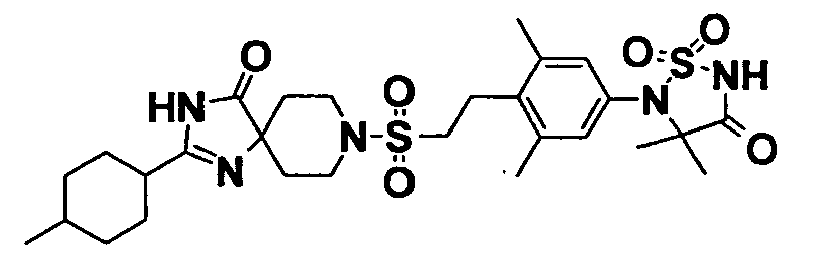
LCMS-1 1.7 608 (M+H)+ - The aryl bromide reagent used in the synthesis of Compound 656 (5-(4-bromo-3,5-dimethyl-phenyl)-4,4-dimethyl-1,1-dioxo-1λ6-[1,2,5]thiadiazolidin-3-one) was synthesized as follows.
-

- Ethyl-2-bromoisobutyric acid (3.7 ml, 24.99 mmol) and sodium bicarbonate (630 mg, 7.49 mmol) were added to 4-bromo-3,5-dimethyl-aniline (500 mg, 2.49 mmol), and the mixture was irradiated with microwaves at 130°C for 15 minutes. The reaction mixture was diluted with ethyl acetate, and the organic layer was sequentially washed with water and saturated brine and concentrated under reduced pressure. The resulting residue was purified by silica gel column chromatography (hexane-ethyl acetate) to give ethyl 2-[(4-bromo-3,5-dimethyl-phenyl)amino]-2-methyl-propanoate (230 mg, 29%).
MS (ESI) m/z = 314, 316 (M+H)+. -

- Ethyl 2-[N-(4-bromo-3,5-dimethyl-phenyl)-N-sulfamoyl-amino]-2-methyl-propanoate was synthesized by operations similar to those in Reaction 92-2 and Reaction 7-2 using appropriate reagents and starting material.
MS (ESI) m/z = 505 (M+H)+. -

- A 2 M solution of sodium methoxide in methanol (4 ml, 8 mmol) was added to a solution of ethyl 2-[N-(4-bromo-3,5-dimethyl-phenyl)-N-sulfamoyl-amino]-2-methylpropanoate (100 mg, 0.254 mmol) in methanol (12 ml), and the mixture was irradiated with microwaves at 65°C for 10 minutes. The reaction mixture was diluted with ethyl acetate, and the organic layer was sequentially washed with water and saturated brine and concentrated under reduced pressure to give 5-(4-bromo-3,5-dimethyl-phenyl)-4,4-dimethyl-1,1-dioxo-1λ6-[1,2,5]thiadiazolidin-3-one (80 mg, 90%).
1H-NMR (CDCl3) δ 7.23 (s, 2H), 2.48 (s, 6H), 1.31 (s, 6H). -

- 8-{2-[2-Methyl-4-(3-oxo-morpholin-4-yl)-phenyl]-ethanesulfonyl}-2-nonyl-1,3,8-triaza-spiro[4.5]dec-1-en-4-one was synthesized by operations similar to those in Reaction 25-2 and Reaction 122-2 using appropriate reagents and starting material.
MS (ESI) m/z = 561 (M+H)+. -

- {4-[2-(2-Cyclohexyl-4-oxo-1,3,8-triaza-spiro[4.5]dec-1-ene-8-sulfonyl)-ethyl]-benzyl}-carbamic acid isobutyl ester was synthesized by operations similar to those in Reaction 25-2 and Reaction 42-2 using appropriate reagents and starting material.
MS (ESI) m/z = 533 (M+H)+. - The example compounds shown below were synthesized by operations similar to those in Example 124 using appropriate reagents and starting materials.
-
[Table 94] Target Compound Structure LCMS condition Retention time (min) MS (m/z) 659 
LCMS-A-1 1.62 491 (M+H)+ 660 
LCMS-C-1 2.40 616 (M+H)+ 661 
LCMS-C-1 2.98 587 (M+H)+ 662 
LCMS-C-1 2.82 591 (M+H)+ 663 
LCMS-C-1 2.37 477 (M+H)+ 664 
LCMS-C-1 2.20 582 (M+H)+ - The aryl bromide reagent used in the synthesis of Compound 658 ((4-bromo-benzyl)-carbamic acid isobutyl ester) was synthesized as follows.
-

- Isobutyl chloroformate (0.152 ml, 1.17 mmol) was added to a solution of 4-bromo-benzylamine hydrochloride (200 mg, 0.899 mmol) and pyridine (0.182 ml, 2.25 mmol) in DMF (2.0 ml), and the mixture was stirred at room temperature for 1.5 hours. A 1 N aqueous HCl solution was added to the reaction mixture, followed by extraction with ethyl acetate. The organic layer was sequentially washed with water and saturated brine and then concentrated under reduced pressure. The resulting residue was purified by silica gel column chromatography (dichloromethane-ethyl acetate) to give (4-bromo-benzyl)-carbamic acid isobutyl ester (180 mg, 70%).
MS (ESI) m/z = 286, 288 (M+H)+. - The aryl bromide reagent used in the synthesis of Compound 660 (2-(4-bromo-3-trifluoromethyl-phenylamino)-N-(4-hydroxy-butyl)-acetamide) was synthesized as follows.
-

- 2-(4-Bromo-3-trifluoromethyl-phenylamino)-N-(4-hydroxy-butyl)-acetamide was synthesized by operations similar to those in Reaction 10-14 using appropriate reagents and starting material.
MS (ESI) m/z = 369 (M+H)+. - The aryl bromide reagent used in the synthesis of Compound 661 ((4-bromo-3-trifluoromethyl-phenyl)-carbamic acid isobutyl ester) was synthesized as follows.
-

- (4-Bromo-3-trifluoromethyl-phenyl)-carbamic acid isobutyl ester was synthesized by operations similar to those in Reaction 124-2 using appropriate reagents and starting material.
MS (ESI) m/z = 338 (M-H)-. - The aryl bromide reagent used in the synthesis of Compound 662 (N-(4-bromo-3-trifluoromethyl-phenyl)-benzamide) was synthesized as follows.
- [1651]
-

- N-(4-Bromo-3-trifluoromethyl-phenyl)-benzamide was synthesized by operations similar to those in Reaction 2-3 using appropriate reagents and starting material.
MS (ESI) m/z = 344 (M+H)+. - The aryl bromide reagent used in the synthesis of Compound 664 (N-[2-(4-bromo-3-methyl-benzenesulfonylamino)-ethyl]-acetamide) was synthesized as follows.
-

- N-[2-(4-Bromo-3-methyl-benzenesulfonylamino)-ethyl]-acetamide was synthesized by operations similar to those in Reaction 5-4 using appropriate reagents and starting material.
MS (ESI) m/z = 335 (M+H)+. -

- N-(2-Dimethylamino-ethyl)-2-(3-methyl-4-{2-[4-oxo-2-(3-trifluoromethoxy-phenyl)-1,3,8-triaza-spiro[4.5]dec-1-ene-8-sulfonyl]-ethyl}-phenylamino)-acetamide was synthesized by operations similar to those in Reaction 25-2 and Reaction 42-2 using appropriate reagents and starting material.
MS (ESI) m/z = 639 (M+H)+. - The example compound shown below was synthesized by operations similar to those in Example 125 using appropriate reagents and starting material.
-
[Table 95] Target Compound Structure LCMS condition Retention time (min) MS (m/z) 666 
LCMS-A-1 2.60 637 (M+H) + - The aryl bromide reagent used in the synthesis of Compound 666 ((4-bromo-3-methyl-phenyl)-(cis-2,6-dimethyl-morpholin-4-yl)-methanone) was synthesized as follows.
-

- (4-Bromo-3-methyl-phenyl)-(cis-2,6-dimethyl-morpholin-4-yl)-methanone was synthesized by operations similar to those in Reaction 10-1 using appropriate reagents and starting material.
MS (ESI) m/z = 312, 314 (M+H)+. -

- N-(2,2,3,3,4,4,4-Heptafluoro-butyl)-3-methyl-4-{2-[4-oxo-2-(3-trifluoromethyl-phenyl)-1,3,8-triaza-spiro[4.5]dec-1-ene-8-sulfonyl]-ethyl}-benzenesulfonamide was synthesized by operations similar to those in Reaction 26-1 and Reaction 42-1 using appropriate reagents and starting material.
MS (ESI) m/z = 741 (M+H)+. - The aryl bromide reagent used in the synthesis of Compound 667 (4-bromo-N-(2,2,3,3,4,4,4-heptafluoro-butyl)-3-methyl-benzenesulfonamide) was synthesized as follows.
-

- 4-Bromo-N-(2,2,3,3,4,4,4-heptafluoro-butyl)-3-methyl-benzenesulfonamide was synthesized by operations similar to those in Reaction 5-4 using appropriate reagents and starting material.
MS (ESI) m/z = 454, 456 (M+Na)+. -

- 8-[2-(3-Methoxy-2-methyl-phenyl)-ethanesulfonyl]-2-(4-methyl-cyclohexyl)-1,3,8-triaza-spiro[4.5]dec-1-en-4-one was synthesized by operations similar to those in Reaction 26-1 and Reaction 122-2 using appropriate reagents and starting material.
MS (ESI) m/z = 462 (M+H)+. - The example compound shown below was synthesized by operations similar to those in Example 127 using appropriate reagents and starting material.
-
[Table 96] Target Compound Structure LCMS condition Retention time (min) MS (m/z) 669 
LCMS-F-1 1.1 605 (M+H) + - The aryl bromide reagent used in the synthesis of Compound 669 ((4-bromo-2-methoxy-3,5-dimethyl-phenyl)-methyl-carbamic acid tert-butyl ester) was synthesized as follows.
-

- Di-tert-butyl dicarbonate (1.32 ml, 5.75 mmol) was added to a solution of 2-amino-4,6-dimethyl-phenol (731.8 mg, 5.335 mmol) in THF (3.7 ml), and the mixture was stirred at room temperature for five hours. The reaction mixture was concentrated under reduced pressure, and the resulting residue was then purified by silica gel column chromatography (hexane-ethyl acetate) to give (2-hydroxy-3,5-dimethyl-phenyl)-carbamic acid tert-butyl ester as a red purple solid (1.234 g, 97%).
1H-NMR (300 MHz, CDCl3) δ 1.52 (9H, s), 2.21 (3H, s), 2.24 (3H, s), 6.54 (1H, br), 6.71 (1H, s), 6.76 (1H, s), 7.74 (1H, br). -

- (2-Methoxy-3,5-dimethyl-phenyl)-methyl-carbamic acid tert-butyl ester was synthesized by operations similar to those in Reaction 26-4 (using cesium carbonate as a base) using appropriate reagents and starting material.
1H-NMR (400 MHz, CDCl3) δ 1.30-1.56 (9H, br), 2.24 (3H, s), 2.25 (3H, s), 3.16 (3H, s), 3.69 (3H, s), 6.76 (1H, br), 6.87 (1H, s). -

- N-Bromosuccinimide (326 mg, 1.83 mmol) was added to a solution of (2-methoxy-3,5-dimethyl-phenyl)-methyl-carbamic acid tert-butyl ester (456 mg, 1.72 mmol) in dichloromethane (1.8 ml) at 0°C, and the mixture was stirred at room temperature for 50 minutes. The reaction mixture was diluted with dichloromethane and adjusted to pH 9 and washed with water and a 1 N aqueous NaOH solution (1 ml), and the organic layer was dried over MgSO4 and concentrated under reduced pressure. The resulting residue was purified by silica gel column chromatography (hexane-ethyl acetate) to give (4-bromo-2-methoxy-3,5-dimethyl-phenyl)-methyl-carbamic acid tert-butyl ester as a colorless solid (545 mg, 92%).
1H-NMR (400 MHz, CDCl3) δ 1.30-1.56 (9H, br), 2.35 (3H, s), 2.37 (3H, s), 3.14 (3H, s), 3.69 (3H, s), 6.82-7.07 (1H, br). -

- 8-{2-[4-((S)-2-Hydroxymethyl-5-oxo-pyrrolidin-1-yl)-2-methyl-phenyl]-ethanesulfonyl}-2-nonyl-1,3,8-triaza-spiro[4.5]dec-1-en-4-one was synthesized by operations similar to those in Reaction 26-1 and Reaction 122-2 using appropriate reagents and starting material.
MS (ESI) m/z = 575 (M+H)+. -

- 8-[2-(5,7-Dimethyl-2-oxo-2,3-dihydro-benzoxazol-6-yl)-ethanesulfonyl]-2-(4-methyl-cyclohexyl)-1,3,8-triaza-spiro[4.5]dec-1-en-4-one was synthesized by operations similar to those in Reaction 26-1 and Reaction 122-2 (using MeCN-DMF as a solvent) using appropriate reagents and starting material.
MS (ESI) m/z = 503 (M+H)+. - The aryl bromide reagent used in the synthesis of Compound 129 (6-bromo-5,7-dimethyl-3H-benzoxazol-2-one) was synthesized as follows.
-

- 6-Bromo-5,7-dimethyl-3H-benzoxazol-2-one was synthesized by operations similar to those in Reaction 127-4 (using acetic acid as a solvent) using appropriate reagents and starting material.
MS (ESI) m/z = 242, 244 (M+H)+. -

- (2-{4-[2-(2-Cyclohexyl-4-oxo-1,3,8-triaza-spiro[4.5]dec-1-ene-8-sulfonyl)-ethyl]-phenyl}-ethyl)-carbamic acid methyl ester was synthesized by operations similar to those in Reaction 26-1 and Reaction 42-2 using appropriate reagents and starting material.
MS (ESI) m/z = 505 (M+H)+. - The example compound shown below was synthesized by operations similar to those in Example 130 using appropriate reagents and starting material.
-
[Table 97] Target Compound Structure LCMS condition Retention time (min) MS (m/z) 673 
LCMS-C-1 2.93 559 (M-H)- - The aryl bromide reagent used in the synthesis of Compound 673 ((4-bromo-3-methyl-benzyl)-methyl-carbamic acid tert-butyl ester) was synthesized as follows.
-

- (4-Bromo-3-methyl-benzyl)-methyl-carbamic acid tert-butyl ester was synthesized by operations similar to those in Reaction 25-3 using appropriate reagents and starting material.
MS (ESI) m/z = 336, 338 (M+Na)+. -

- 8-(2-{4-[3-(2-Hydroxy-ethyl)-2-oxo-imidazolidin-1-yl]-2-methyl-phenyl}-ethanesulfonyl)-2-(3-trifluoromethyl-phenyl)-1,3,8-triaza-spiro[4.5]dec-1-en-4-one was synthesized by operations similar to those in Reaction 26-1 and Reaction 42-2 using appropriate reagents and starting material.
MS (ESI) m/z = 608 (M+H)+. - The aryl bromide reagent used in the synthesis of Compound 674 (1-(4-bromo-3-methyl-phenyl)-3-(2-hydroxy-ethyl)-imidazolidin-2-one) was synthesized as follows.
-

- 1-(4-Bromo-3-methyl-phenyl)-3-(2-hydroxy-ethyl)-imidazolidin-2-one was synthesized by operations similar to those in Reaction 29-3 using appropriate reagents and starting material.
MS (ESI) m/z = 299, 301 (M+H)+. -

- 2-(3-Methyl-4-{2-[4-oxo-2-(3-trifluoromethoxy-phenyl)-1,3,8-triaza-spiro[4.5]dec-1-ene-8-sulfonyl]-ethyl}-benzenesulfonylamino)-acetamide was synthesized by operations similar to those in Reaction 26-1 and Reaction 42-2 using appropriate reagents and starting material.
MS (ESI) m/z = 632 (M+H)+. - The example compound shown below was synthesized by operations similar to those in Example 132 using appropriate reagents and starting material.
-
[Table 98] Target Compound Structure LCMS condition Retention time (min) MS (m/z) 676 
LCMS-C-1 2.70 614 (M+H) + - The aryl bromide reagent used in the synthesis of Compound 675 (2-(4-bromo-3-methyl-benzenesulfonylamino)-acetamide) was synthesized as follows.
-

- 2-(4-Bromo-3-methyl-benzenesulfonylamino)-acetamide was synthesized by operations similar to those in Reaction 5-4 using appropriate reagents and starting material.
MS (ESI) m/z = 307, 309 (M+H)+. -

- 3-(4-{2-[2-(4-Butyl-cyclohexyl)-4-oxo-1,3,8-triaza-spiro[4.5]dec-1-ene-8-sulfonyl]-ethyl}-3,5-dimethyl-phenyl)-imidazolidine-2,4-dione was synthesized by operations similar to those in Reaction 26-1 and Reaction 42-2 using appropriate reagents and starting material.
MS (ESI) m/z = 586 (M+H)+. -

- N-Cyclopentyl-N-(3-methyl-4-{2-[4-oxo-2-(3-trifluoromethoxy-phenyl)-1,3,8-triaza-spiro[4.5]dec-1-ene-8-sulfonyl]-ethyl}-phenyl)-acetamide was synthesized by operations similar to those in Reaction 26-1, Reaction 42-2 and Reaction 12-2 using appropriate reagents and starting material.
MS (ESI) m/z = 621 (M+H)+. - The aryl bromide reagent used in the synthesis of Compound 678 ((4-bromo-3-methyl-phenyl)-cyclopentylamine) was synthesized as follows.
-

- (4-Bromo-3-methyl-phenyl)-cyclopentyl-amine was synthesized by operations similar to those in Reaction 41-1 using appropriate reagents and starting material.
MS (ESI) m/z = 254, 256 (M+H)+. -

- 1-(2,3-Dimethyl-4-{2-[2-(4-methyl-cyclohexyl)-4-oxo-1,3,8-triaza-spiro[4.5]dec-1-ene-8-sulfonyl]-ethyl}-phenyl)-1-methyl-urea was synthesized by operations similar to those in Reaction 26-1, Reaction 42-2 and Reaction 89-2 using appropriate reagents and starting material.
MS (ESI) m/z = 518 (M+H)+. - The example compound shown below was synthesized by operations similar to those in Example 135 using appropriate reagents and starting material.
-
[Table 99] Target Compound Structure LCMS condition Retention time (min) MS (m/z) 680 
LCMS-C-1 2.58 518 (M+H) + - The aryl iodide reagent used in the synthesis of Compound 679 (4-iodo-N,2,3-trimethyl-aniline) was synthesized as follows.
-

- A 28% solution of sodium methoxide in methanol (0.694 ml, 6.07 mmol) was added to a solution of 4-iodo-2,3-dimethyl-aniline (500 mg, 2.02 mmol) and paraformaldehyde (121 mg, 4.05 mmol) in methanol (8.0 ml), and the mixture was stirred at room temperature for 17 hours. Sodium borohydride (153 mg, 4.05 mmol) was further added, and the mixture was stirred at room temperature for four hours. A 1 N aqueous NaOH solution was added to the reaction mixture, followed by extraction with dichloromethane. The resulting residue was purified by silica gel column chromatography (hexane-ethyl acetate) to give 4-iodo-N,2,3-trimethyl-aniline (146 mg, 88%).
MS (ESI) m/z = 262 (M+H)+. - The aryl iodide reagent used in the synthesis of Compound 680 ((4-iodo-2,5-dimethyl-phenyl)-methyl-amine) was synthesized as follows.
-

- (4-Iodo-2,5-dimethyl-phenyl)-methyl-amine was synthesized by operations similar to those in Reaction 135-2 using appropriate reagents and starting material.
MS (ESI) m/z = 262 (M+H)+. -

- {4-[2-(2-Cyclohexyl-4-oxo-1,3,8-triaza-spiro[4.5]dec-1-ene-8-sulfonyl)-ethyl]-3-methyl-benzyl}-(2-hydroxy-ethyl)-carbamic acid tert-butyl ester was synthesized by operations similar to those in Reaction 26-1, Reaction 42-2 and Reaction 39-2 using appropriate reagents and starting material.
MS (ESI) m/z = 589 (M-H)-. - The aryl bromide reagent used in the synthesis of Compound 681 ((4-bromo-3-methyl-benzyl)-[2-(tert-butyl-dimethyl-silanyloxy)-ethyl]-carbamic acid tert-butyl ester) was synthesized as follows.
-

- (4-Bromo-3-methyl-benzyl)-[2-(tert-butyl-dimethyl-silanyloxy)-ethyl]-carbamic acid tert-butyl ester was synthesized by operations similar to those in Reaction 25-3 using appropriate reagents and starting material.
MS (ESI) m/z = 472, 474 (M+H)+. -

- 1-(3-Methoxy-5-methyl-4-{2-[2-(4-methyl-cyclohexyl)-4-oxo-1,3,8-triaza-spiro[4.5]dec-1-ene-8-sulfonyl]-ethyl}-phenyl)-1-methyl-urea was synthesized by operations similar to those in Reaction 26-1 (using DMI as a solvent), Reaction 122-2 (using acetonitrile as a solvent), Reaction 5-3 and Reaction 89-2 (using KOCN as a reagent) using appropriate reagents and starting material.
MS (ESI) m/z = 534 (M+H)+. - The aryl bromide reagent used in the synthesis of Compound 682 ((4-bromo-3-methoxy-5-methyl-phenyl)-methyl-carbamic acid tert-butyl ester) was synthesized as follows.
-

- (4-Bromo-3-methoxy-5-methyl-phenyl)-methyl-carbamic acid tert-butyl ester was synthesized by operations similar to those in Reaction 127-2 (using toluene as a solvent), Reaction 26-2 and Reaction 26-4 (using cesium carbonate as a base) using appropriate reagents and starting material.
1H-NMR (400 MHz, CDCl3) δ 1.50 (9H, s), 2.42 (3H, s), 3.26 (3H, s), 3.90 (3H, s), 6.71 (1H, d, J = 4.0 Hz), 6.77 (1H, J = 4.0 Hz) . -

- 1-(3-Chloro-5-methyl-4-{2-[2-(4-methyl-cyclohexyl)-4-oxo-1,3,8-triaza-spiro[4.5]dec-1-ene-8-sulfonyl]-ethyl}-phenyl)-1-methyl-urea was synthesized by operations similar to those in Reaction 26-1, Reaction 42-1, Reaction 5-3 and Reaction 89-2 using appropriate reagents and starting material.
MS (ESI) m/z = 538 (M+H)+. - The aryl bromide reagent used in the synthesis of Compound 683 ((4-bromo-3-chloro-5-methyl-phenyl)-methyl-carbamic acid tert-butyl ester) was synthesized as follows.
-
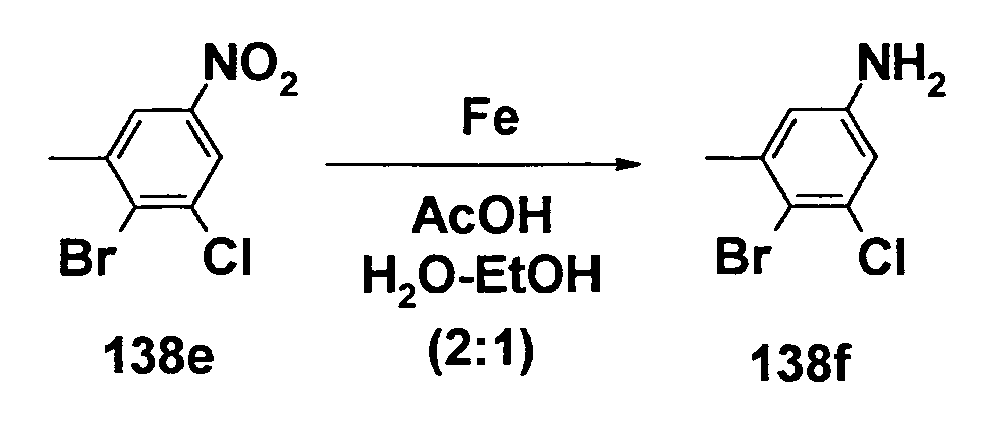
- Iron (2.34 g, 41.8 mmol) and acetic acid (0.80 mL, 14.0 mmol) were added to a mixed solution of 2-bromo-1-chloro-3-methyl-5-nitro-benzene (3.50 g, 14.0 mmol) in ethanol (15 mL)-water (31 mL) at room temperature. The mixture was stirred at 100°C for one hour, and a saturated aqueous sodium bicarbonate solution was then added at 0°C. The mixture was filtered through celite, and the filtrate was washed with ethyl acetate and water. The filtrate was concentrated under reduced pressure. Ethyl acetate was then added, and the organic layer and the aqueous layer were separated. The aqueous layer was repeatedly extracted with ethyl acetate three times, and the organic layers were then dried over sodium sulfate. The resulting residue was concentrated under reduced pressure to give 4-bromo-3-chloro-5-methyl-phenylamine as a pale brown solid (3.01 g, 98%).
MS (ESI) m/z = 220, 222 (M+H)+. -

- (4-Bromo-3-chloro-5-methyl-phenyl)-methyl-carbamic acid tert-butyl ester was synthesized by operations similar to those in Reaction 127-2 (using toluene as a solvent) and Reaction 26-4 (using cesium carbonate as a base) using appropriate reagents and starting material.
1H-NMR (400 MHz, CDCl3) δ 1.46 (9H, s), 2.44 (3H, s), 3.22 (3H, s), 7.06 (1H, d, J = 2.4 Hz), 7.23 (1H, d, J = 2.4 Hz). - The example compound shown below was synthesized by operations similar to those in Example 138 using appropriate reagents and starting material.
-
[Table 100] Target Compound Structure LCMS condition Retention time (min) MS (m/z) 684 
LCMS-F-1 0.94 548 (M+H) + -

- Benzyltrimethylammonium dichloroiodate (324 mg, 0.930 mmol) was added to a mixture of 8-[2-(4-amino-2,6-dimethyl-phenyl)-ethanesulfonyl]-2-(4-methyl-cyclohexyl)-1,3,8-triaza-spiro[4.5]dec-1-en-4-one dihydrochloride (530 mg, 1.03 mmol) and calcium carbonate (517 mg, 5.17 mmol) in methanol (6 mL)-dichloromethane (15 mL) at room temperature. The mixture was stirred at room temperature for 22 hours, and an aqueous sodium bicarbonate solution and ethyl acetate were then added. The organic layer and the aqueous layer were separated, and the aqueous layer was repeatedly extracted with ethyl acetate three times. The organic layers were combined and washed with saturated brine, and the insoluble matter was then filtered off through celite. The filtrate was concentrated under reduced pressure, and the resulting residue was purified by silica gel column chromatography to give 8-[2-(4-amino-3-iodo-2,6-dimethyl-phenyl)-ethanesulfonyl]-2-(4-methyl-cyclohexyl)-1,3,8-triaza-spiro[4.5]dec-1-en-4-one as a pale yellow solid (337 mg, 62%).
MS (ESI) m/z = 587 (M+H)+. -

- A mixture of 8-[2-(4-amino-3-iodo-2,6-dimethyl-phenyl)-ethanesulfonyl]-2-(4-methyl-cyclohexyl)-1,3,8-triaza-spiro[4.5]dec-1-en-4-one (15 mg, 0.0256 mmol), palladium acetate (1.1 mg, 5.11 µmol), 1,1'-bis(diphenylphosphino)ferrocene (2.2 mg, 5.11 µmol), tert-butyl isocyanate (12 µL, 0.0767 mmol) and N,N-diisopropylethylamine (13 µL, 0.0767 mmol) in tetrahydrofuran (1 mL) was heated with stirring for 12 hours in a pressure bottle sealed under the conditions of 4 atm and 80°C in a carbon monoxide atmosphere. After returning to room temperature, palladium acetate (2.2 mg, 10.22 µmol), 1,1'-bis(diphenylphosphino)ferrocene (4.4 mg, 10.22 µmol), tert-butyl isocyanate (24 µL, 0.153 mmol) and N,N-diisopropylethylamine (26 µL, 0.153 mmol) were added to the reaction solution, and the mixture was heated with stirring for 14 hours in a pressure bottle sealed under the conditions of 4 atm and 80°C in a carbon monoxide atmosphere. After returning to room temperature, the reaction solution was concentrated under reduced pressure, and the resulting residue was purified by preparative TLC to give 3-tert-butyl-5,7-dimethyl-6-{2-[2-(4-methyl-cyclohexyl)-4-oxo-1,3,8-triaza-spiro[4.5]dec-1-ene-8-sulfonyl]-ethyl}-1H-quinazoline-2,4-dione as a pale yellow solid (3.3 mg, 22%).
MS (ESI) m/z = 586 (M+H)+. -

- An aqueous hydrogen bromide solution (80 µL) was added to a mixed solution of 3-tert-butyl-5,7-dimethyl-6-{2-[2-(4-methyl-cyclohexyl)-4-oxo-1,3,8-triaza-spiro[4.5]dec-1-ene-8-sulfonyl]-ethyl}-1H-quinazoline-2,4-dione (3.3 mg, 3.41 µmol) in acetic acid (80 µL), and the mixture was heated with stirring at 100°C for one hour. The reaction solution was returned to room temperature and then concentrated under reduced pressure, and the resulting residue was purified by preparative TLC to give 5,7-dimethyl-6-{2-[2-(4-methyl-cyclohexyl)-4-oxo-1,3,8-triaza-spiro[4.5]dec-1-ene-8-sulfonyl]-ethyl}-1H-quinazoline-2,4-dione as a pale yellow solid (1.2 mg, 44%).
MS (ESI) m/z = 530 (M+H)+. -
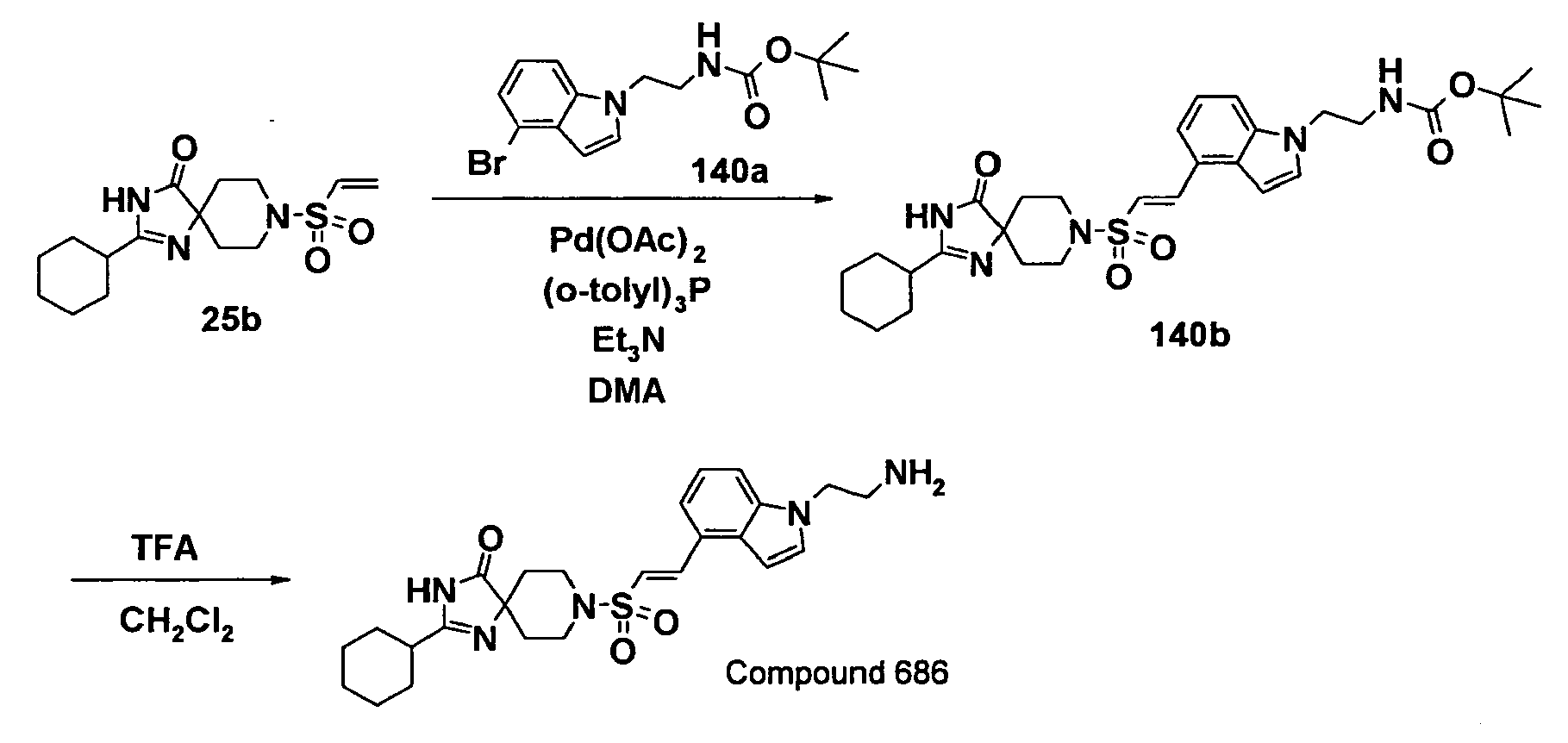
- 8-{(E)-2-[1-(2-Amino-ethyl)-1H-indol-4-yl]-ethenesulfonyl}-2-cyclohexyl-1,3,8-triaza-spiro[4.5]dec-1-en-4-one was synthesized by operations similar to those in Reaction 25-2 and Reaction 7-2 using appropriate reagents and starting material.
MS (ESI) m/z = 484 (M+H)+. - The aryl bromide reagent used in the synthesis of Compound 686 ([2-(4-bromo-indol-1-yl)-ethyl]-carbamic acid tert-butyl ester) was synthesized as follows.
-

- Tetrabutylammonium hydrogen sulfate (41.0 mg, 0.121 mmol) and sodium hydroxide (210 mg, 5.25 mmol) were added to a solution of 4-bromo-1H-indole (0.30 ml, 2.39 mmol) in acetonitrile (0.80 mL), and the mixture was stirred at room temperature for 20 minutes. Subsequently, 2-chloroethylamine hydrochloride (334 mg, 2.88 mmol) was added and the mixture was heated with stirring at 100°C for seven hours. After cooling, water was added to the reaction mixture, followed by extraction with ethyl acetate. The organic layer was sequentially washed with water and saturated brine and then concentrated under reduced pressure. The resulting residue was purified by silica gel column chromatography (dichloromethane-methanol) to give 2-(4-bromo-indol-1-yl)-ethylamine (222 mg, 39%).
MS (ESI) m/z = 239, 241 (M+H)+. -

- A 2 N aqueous NaOH solution (0.47 ml, 0.94 mmol) and di-tert-butyl dicarbonate (223 mg, 1.02 mmol) were sequentially added to a solution of 2-(4-bromo-indol-1-yl)-ethylamine (222 mg, 0.928 mmol) in dioxane (0.47 ml), and the mixture was stirred at room temperature for 19 hours. Water was added to the reaction mixture, followed by extraction with ethyl acetate. The organic layer was washed with saturated brine and then concentrated under reduced pressure. The resulting residue was purified by silica gel column chromatography (dichloromethane only) to give [2-(4-bromo-indol-1-yl)-ethyl]-carbamic acid tert-butyl ester (292 mg, 93%).
MS (ESI) m/z = 361, 363 (M+Na)+. - The example compound shown below was synthesized by operations similar to those in Example 140 using appropriate reagents and starting material.
-
[Table 101] Target Compound Structure LCMS condition Retention time (min) MS (m/z) 687 
LCMS-C-1 1.98 431 (M+H) + -

- (S)-2-Amino-3-hydroxy-N-(3-methyl-4-{(E)-2-[4-oxo-2-(3-trifluoromethyl-phenyl)-1,3,8-triaza-spiro[4.5]dec-1-ene-8-sulfonyl]-vinyl}-phenyl)-propionamide was synthesized by operations similar to those in Reaction 25-2 and Reaction 7-2 using appropriate reagents and starting material.
MS (ESI) m/z = 580 (M+H)+. - The aryl bromide reagent used in the synthesis of Compound 688 ([(S)-1-(4-bromo-3-methyl-phenylcarbamoyl)-2-hydroxy-ethyl]-carbamic acid tert-butyl ester) was synthesized as follows.
-

- [(S)-1-(4-Bromo-3-methyl-phenylcarbamoyl)-2-hydroxy-ethyl]-carbamic acid tert-butyl ester was synthesized by operations similar to those in Reaction 10-1 using appropriate reagents and starting material.
MS (ESI) m/z = 317, 219 (M-tBu+H+H)+. -

- N-(3,5-Dimethyl-4-{(E)-2-[4-oxo-2-(3-trifluoromethoxy-phenyl)-1,3,8-triaza-spiro[4.5]dec-1-ene-8-sulfonyl]-vinyl}-phenyl)-N-piperidin-4-yl-methanesulfonamide was synthesized by operations similar to those in Reaction 26-1 and Reaction 7-2 using appropriate reagents and starting material.
MS (ESI) m/z = 684 (M+H)+. - The aryl bromide reagent used in the synthesis of Compound 142 (4-[(4-bromo-3,5-dimethyl-phenyl)-methanesulfonyl-amino]-piperidine-1-carboxylic acid tert-butyl ester) was synthesized as follows.
-

- 4-[(4-Bromo-3,5-dimethyl-phenyl)-methanesulfonyl-amino]-piperidine-1-carboxylic acid tert-butyl ester was synthesized by operations similar to those in Reaction 41-1 and Reaction 6-1 using appropriate reagents and starting material.
MS (ESI) m/z = 461, 463 (M+H)+. -

- 8-[(E)-2-(2,6-Dimethyl-4-methylamino-phenyl)-ethenesulfonyl]-2-(9,9,9-trifluoro-nonyl)-1,3,8-triaza-spiro[4.5]dec-1-en-4-one was synthesized by operations similar to those in Reaction 26-1 and Reaction 7-2 using appropriate reagents and starting material.
MS (ESI) m/z = 557 (M+H)+. - The aryl bromide reagent used in the synthesis of Compound 690 ((4-bromo-3,5-dimethyl-phenyl)-methyl-carbamic acid tert-butyl ester) was synthesized as follows.
-

- Iodomethane (20.5 ml, 329 mmol) was added to a solution of (4-bromo-3,5-dimethyl-phenyl)-carbamic acid tert-butyl ester (47.5 g, 158 mmol) and cesium carbonate (80.6 g, 247 mmol) in DMF (165 ml) at room temperature, and the mixture was stirred for 27 hours. Further, cesium carbonate (26.9 g, 82.6 mmol) and iodomethane (20.5 ml, 329 mmol) were added at room temperature, and the mixture was further stirred for three days. An aqueous ammonium chloride solution was added to the reaction mixture, followed by extraction with ethyl acetate. The organic layer was sequentially washed with water and saturated brine and then concentrated under reduced pressure. The resulting residue was purified by silica gel column chromatography (hexane-ethyl acetate) to give (4-bromo-3,5-dimethyl-phenyl)-methyl-carbamic acid tert-butyl ester (9.34 g, 92%).
MS (ESI) m/z = 258, 260 (M-tBu+H+H)+. -

- 8-[(E)-2-(2,6-Dimethyl-4-methylamino-phenyl)-ethenesulfonyl]-2-(8,8,9,9,9-pentafluoro-nonyl)-1,3,8-triaza-spiro[4.5]dec-1-en-4-one was synthesized by operations similar to those in Reaction 26-1 and Reaction 7-2 using appropriate reagents and starting material.
MS (ESI) m/z = 593 (M+H)+. -

- 1-{3,5-Dimethyl-4-[(E)-2-(2-nonyl-4-oxo-1,3,8-triaza-spiro[4.5]dec-1-ene-8-sulfonyl)-vinyl]-phenyl}-1-methyl-urea was synthesized by operations similar to those in Reaction 25-2, Reaction 7-2 and Reaction 89-2 using appropriate reagents and starting material.
MS (ESI) m/z = 546 (M+H)+. -

- 1-(2-Methoxy-3,5-dimethyl-4-{(E)-2-[2-(4-methyl-cyclohexyl)-4-oxo-1,3,8-triaza-spiro[4.5]dec-1-ene-8-sulfonyl]-vinyl}-phenyl)-1-methyl-urea was synthesized by operations similar to those in Reaction 26-1, Reaction 7-2 and Reaction 89-2 using appropriate reagents and starting material.
MS (ESI) m/z = 546 (M+H)+. -

- 1-[3,5-Dimethyl-4-((E)-2-{4-oxo-2-[4-(3,3,3-trifluoro-propyl)-cyclohexyl]-1,3,8-triaza-spiro[4.5]dec-1-ene-8-sulfonyl}-vinyl)-phenyl]-1-(2-fluoro-ethyl)-urea was synthesized by operations similar to those in Reaction 26-1, Reaction 7-2 and Reaction 89-2 using appropriate reagents and starting material.
MS (ESI) m/z = 630 (M+H)+. - The aryl bromide reagent used in the synthesis of Compound 694 ((4-bromo-3,5-dimethyl-phenyl)-(2-fluoro-ethyl)-carbamic acid tert-butyl ester) was synthesized as follows.
-

- A solution of 4-bromo-3,5-dimethyl-phenylamine (400 mg, 2 mmol), toluene-4-sulfonic acid 2-fluoro-ethyl ester (567 mg, 2.6 mmol) and 2,6-lutidine (429 mg, 4.0 mmol) in DMA (5 ml) was heated with stirring at 120°C for four hours. The mixture was quenched with water and then extracted with ethyl acetate. The organic layer was sequentially washed with water and saturated brine and then concentrated under reduced pressure. The resulting residue was purified by silica gel column chromatography (ethyl acetate-hexane) to give (4-bromo-3,5-dimethyl-phenyl)-(2-fluoro-ethyl)-amine (262 mg, 53%).
1H-NMR (CDCl3) δ 6.39 (s, 2H), 4.68 (t, 1H, J = 4.96 Hz), 4.52 (t, 1H, J = 4.96 Hz), 3.92 (brd, 1H), 3.45 (t, 1H, J = 4.96 Hz), 3.36 (t, 1H, J = 4.96 Hz), 2.34 (s, 3H). -

- (4-Bromo-3,5-dimethyl-phenyl)-(2-fluoro-ethyl)-carbamic acid tert-butyl ester was synthesized by operations similar to those in Reaction 19-2 (using DMAP as a base) using appropriate reagents and starting material.
1H-NMR (CDCl3) δ 6.97 (s, 2H), 4.64 (t, 1H, J = 4.96 Hz), 4.48 (t, 1H, J = 4.96 Hz), 3.9 (t, 1H, J = 4.96 Hz), 3.82 (t, 1H, J = 4.96 Hz), 2.39 (s, 6H), 1.45 (s, 9H). -

- 1-(3-Chloro-5-methyl-4-{(E)-2-[2-(4-methyl-cyclohexyl)-4-oxo-1,3,8-triaza-spiro[4.5]dec-1-ene-8-sulfonyl]-vinyl}-phenyl)-1-methyl-urea was synthesized by operations similar to those in Reaction 26-1, Reaction 50-2 and Reaction 89-2 using appropriate reagents and starting material.
MS (ESI) m/z = 630 (M+H)+. -

- 1-[3,5-Dimethyl-4-(2-{4-oxo-2-[4-(3,3,3-trifluoro-propyl)-cyclohexyl]-1,3,8-triaza-spiro[4.5]dec-1-ene-8-sulfonyl}-ethyl)-phenyl]-1-methyl-urea was synthesized by operations similar to those in Reaction 25-2, Reaction 7-2, Reaction 89-2 and Reaction 42-2 using appropriate reagents and starting material.
MS (ESI) m/z = 600 (M+H)+. -

- 8-{(E)-2-[4-((R)-2,3-Dihydroxy-propoxy)-2,6-dimethyl-phenyl]-ethenesulfonyl}-2-[4-(3,3,3-trifluoro-propyl)-cyclohexyl]-1,3,8-triaza-spiro[4.5]dec-1-en-4-one was synthesized by operations similar to those in Reaction 25-2 and Reaction 25-4 using appropriate reagents and starting material.
MS (ESI) m/z = 616 (M+H)+. - The example compound shown below was synthesized by operations similar to those in Example 150 using appropriate reagents and starting material.
-
[Table 102] Target Compound Structure LCMS condition Retention time (min) MS (m/z) 698 
LCMS-D-1 2.56 660 (M+H) + -

- N-[3,5-Dimethyl-4-((E)-2-{4-oxo-2-[4-(3,3,3-trifluoro-propyl)-cyclohexyl]-1,3,8-triaza-spiro[4.5]dec-1-ene-8-sulfonyl}-vinyl)-phenyl]-N-[2-(2-hydroxy-ethoxy)-ethyl]-acetamide was synthesized by operations similar to those in Reaction 25-2 and Reaction 39-2 using appropriate reagents and starting material.
MS (ESI) m/z = 671 (M+H)+. - The aryl bromide reagent used in the synthesis of Compound 699 (N-(4-bromo-3,5-dimethyl-phenyl)-N-{2-[2-(tert-butyl-dimethyl-silanyloxy)-ethoxy]-ethyl}-acetamide) was synthesized as follows.
-

- N-(4-Bromo-3,5-dimethyl-phenyl)-N-{2-[2-(tert-butyl-dimethyl-silanyloxy)-ethoxy]-ethyl}-acetamide was synthesized by operations similar to those in Reaction 25-3 using appropriate reagents and starting material.
1H-NMR (CDCl3) δ 6.95 (s, 2H), 3.81 (dd, 2H, J = 6.10, 5.72 Hz), 3.70 (dd, 2H, J = 4.95, 5.34 Hz), 3.58 (dd, 2H, J = 5.72, 6.10 Hz), 3.46 (dd, 2H, J = 5.72, 4.95 Hz), 2.41 (s, 6H), 1.83 (s, 3H), 0.86 (s, 9H). -

- N-[2-(2-Hydroxy-ethoxy)-ethyl]-N-{3-methyl-4-[(E)-2-(2-nonyl-4-oxo-1,3,8-triaza-spiro[4.5]dec-1-ene-8-sulfonyl)-vinyl]-phenyl}-acetamide was synthesized by operations similar to those in Reaction 25-2 and Reaction 12-5 using appropriate reagents and starting material.
MS (ESI) m/z = 605 (M+H)+. - The example compound shown below was synthesized by operations similar to those in Example 152 using appropriate reagents and starting material.
-
[Table 103] Target Compound Structure LCMS condition Retention time (min) MS (m/z) 701 
LCMS-A-1 2.44 575 (M+H) + - The aryl bromide reagent used in the synthesis of Compound 701 (acetic acid 2-[acetyl-(4-bromo-3,5-dimethyl-phenyl)-amino]-ethyl ester) was synthesized as follows.
-

- Acetic acid 2-[acetyl-(4-bromo-3,5-dimethyl-phenyl)-amino]-ethyl ester was synthesized by operations similar to those in Reaction 25-12 and Reaction 12-2 using appropriate reagents and starting material.
MS (ESI) m/z = 328, 330 (M+H)+. -

- 2-Cyclohexyl-8-{(E)-2-[1-((S)-2,2-dimethyl-[1,3]dioxolan-4-ylmethyl)-1H-indol-5-yl]-ethenesulfonyl}-1,3,8-triaza-spiro[4.5]dec-1-en-4-one was synthesized by operations similar to those in Reaction 25-2 using appropriate reagents and starting material.
MS (ESI) m/z = 555 (M+H)+. -

- 2-Cyclohexyl-8-{(E)-2-[1-((S)-2,2-dimethyl-[1,3]dioxolan-4-ylmethyl)-1H-indol-5-yl]-ethenesulfonyl}-1,3,8-triaza-spiro[4.5]dec-1-en-4-one (41.9 mg, 0.0755 mmol) was dissolved in a methylene chloride-methanol mixed solution (1:1, 1.5 ml). Trifluoroacetic acid (0.35 ml) was added and the mixture was stirred for two days. A saturated aqueous sodium bicarbonate solution and water were added to the reaction solution, followed by extraction with ethyl acetate. The organic layer was washed with water and saturated brine, dried over anhydrous sodium sulfate and concentrated under reduced pressure. The resulting residue was purified by P-TLC (ethyl acetate-methanol) to give 2-cyclohexyl-8-{(E)-2-[1-((S)-2,3-dihydroxy-propyl)-1H-indol-5-yl]-ethenesulfonyl}-1,3,8-triaza-spiro[4.5]dec-1-en-4-one (33.4 mg, 86%).
MS (ESI) m/z = 515 (M+H)+. - The aryl bromide reagent used in the synthesis of Compound 702 (5-bromo-1-((S)-2,2-dimethyl-[1,3]dioxolan-4-ylmethyl)-1H-indole) was synthesized as follows.
-

- 5-Bromo-1-((S)-2,2-dimethyl-[1,3]dioxolan-4-ylmethyl)-1H-indole was synthesized by operations similar to those in Reaction 25-3 using appropriate reagents and starting material.
MS (ESI) m/z = 310 (M+H)+. -

- 8-((E)-2-{1-[2-((S)-2,3-Dihydroxy-propoxy)-ethyl]-1H-indol-4-yl}-ethenesulfonyl)-2-[4-(3,3,3-trifluoro-propyl)-cyclohexyl]-1,3,8-triaza-spiro[4.5]dec-1-en-4-one was synthesized by operations similar to those in Reaction 26-1 and Reaction 25-4 using appropriate reagents and starting material.
MS (ESI) m/z = 655 (M+H)+. - The example compounds shown below were synthesized by operations similar to those in Example 154 using appropriate reagents and starting materials.
-
[Table 104] Target Compound Structure LCMS condition Retention time (min) MS (m/z) 705 
LCMS-D-1 2.14 646 (M+H)+ 706 
LCMS-D-1 2.15 685 (M+H)+ - The aryl bromide reagent used in the synthesis of Compound 704 (4-bromo-1-[2-((R)-2,2-dimethyl-[1,3]dioxolan-4-ylmethoxy)-ethyl]-1H-indole) was synthesized as follows.
-

- 4-Bromo-1-[2-((R)-2,2-dimethyl-[1,3]dioxolan-4-ylmethoxy)-ethyl]-1H-indole was synthesized by operations similar to those in Reaction 25-3, Reaction 39-2 and Reaction 20-2 using appropriate reagents and starting material.
MS (ESI) m/z = 354,356 (M+H)+. - The aryl bromide reagent used in the synthesis of Compound 705 ([(4S,5S)-5-(4-bromo-3,5-dimethyl-phenoxymethyl)-2,2-dimethyl-[1,3]dioxolan-4-ylmethoxy]-tert-butyl-dimethyl-silane) was synthesized as follows.
-
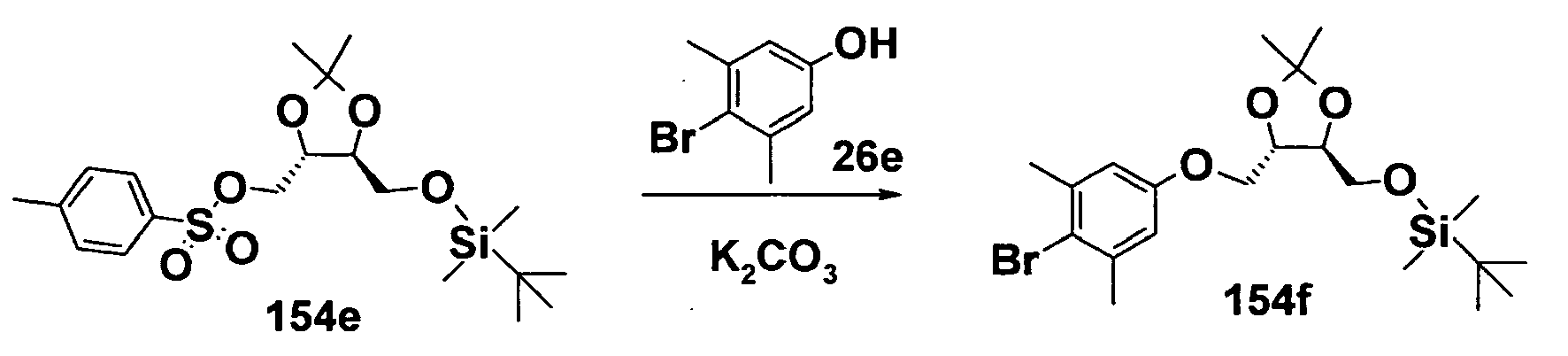
- [(4S,5S)-5-(4-Bromo-3,5-dimethyl-phenoxymethyl)-2,2-dimethyl-[1,3]dioxolan-4-ylmethoxy]-tert-butyl-dimethyl-silane was synthesized by operations similar to those in Reaction 26-4 using appropriate reagents and starting material.
1H-NMR (CDCl3) δ 6.67 (s, 2H), 4.27 (m, 1H), 4.13-3.73 (m, 5H), 2.36 (s, 6H), 1.44 (s, 3H), 1.43 (s, 3H), 0.88 (s, 9H), 0.06 (s, 6H). - The aryl bromide reagent used in the synthesis of Compound 706 ({(4S,5S)-5-[2-(4-bromo-indol-1-yl)-ethoxymethyl]-2,2-dimethyl-[1,3]dioxolan-4-yl}-methanol) was synthesized as follows.
-

- {(4S,5S)-5-[2-(4-Bromo-indol-1-yl)-ethoxymethyl]-2,2-dimethyl-[1,3]dioxolan-4-yl}-methanol was synthesized by operations similar to those in Reaction 6-1 and Reaction 20-2 using appropriate reagents and starting material.
1H-NMR (CDCl3) δ 7.28 (m, 2H), 7.20 (d, 1H, J = 3.3 Hz), 7.06 (t, 1H, J = 7.8 Hz), 6.55 (d, 1H, J = 3.0 Hz), 4.30 (t, 2H, J = 5.4 Hz), 3.94 (m, 1H), 3.84-3.41 (m, 7H), 1.91 (br s, 1H), 1.39 (s, 3H), 1.36 (s, 3H). -

- N-((S)-2,3-Dihydroxy-propyl)-N-(3,5-dimethyl-4-{(E)-2-[4-oxo-2-(9,9,9-trifluoro-nonyl)-1,3,8-triaza-spiro[4.5]dec-1-ene-8-sulfonyl]-vinyl}-phenyl)-acetamide was synthesized by operations similar to those in Reaction 26-1 and reaction 25-4 using appropriate reagents and starting material.
MS (ESI) m/z = 659 (M+H)+. -
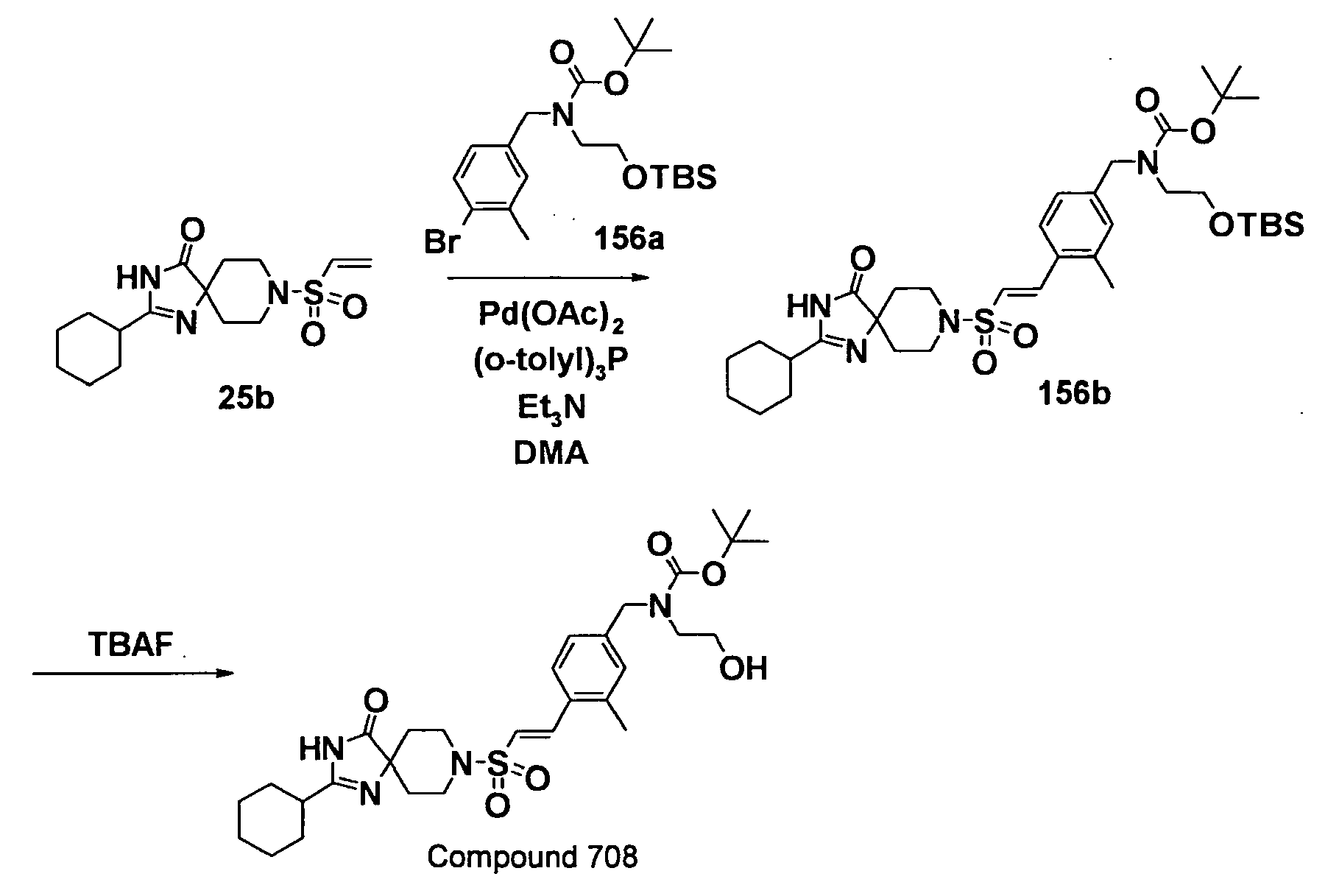
- {4-[(E)-2-(2-Cyclohexyl-4-oxo-1,3,8-triaza-spiro[4.5]dec-1-ene-8-sulfonyl)-vinyl]-3-methyl-benzyl}-(2-hydroxy-ethyl)-carbamic acid tert-butyl ester was synthesized by operations similar to those in Reaction 26-1 and Reaction 39-2 using appropriate reagents and starting material.
MS (ESI) m/z = 589 (M+H)+. - The example compounds shown below were synthesized by operations similar to those in Example 156 using appropriate reagents and starting materials.
-
[Table 105] Target Compound Structure LCMS condition Retention time (min) MS (m/z) 709 
LCMS-D-1 2.34 585 (M+H)+ 710 
LCMS-D-1 2.53 587 (M+H)+ - The aryl bromide reagent used in the synthesis of Compound 708 ((4-bromo-3-methyl-benzyl)-[2-(tert-butyl-dimethyl-silanyloxy)-ethyl]-carbamic acid tert-butyl ester) was synthesized as follows.
-
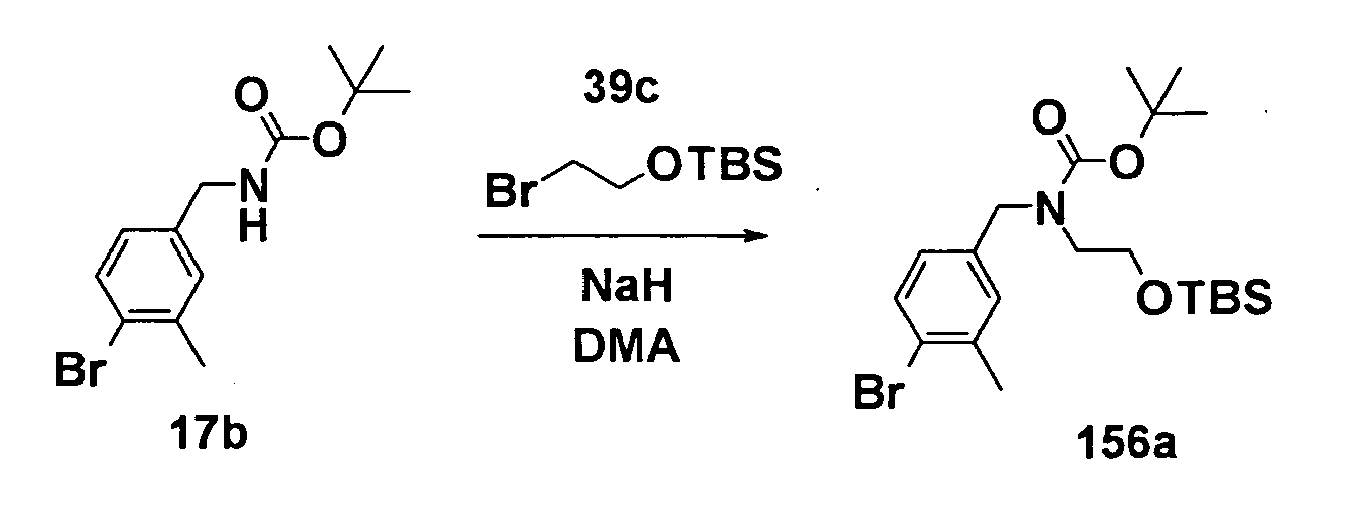
- (4-Bromo-3-methyl-benzyl)-[2-(tert-butyl-dimethyl-silanyloxy)-ethyl]-carbamic acid tert-butyl ester was synthesized by operations similar to those in Reaction 25-3 using appropriate reagents and starting material.
MS (ESI) m/z = 472, 474 (M+H)+. - The aryl bromide reagent used in the synthesis of Compound 709 (N-(4-bromo-3,5-dimethyl-phenyl)-N-[4-(tert-butyl-dimethyl-silanyloxy)-cyclohexyl]-acetamide) was synthesized as follows.
-

- N-(4-Bromo-3,5-dimethyl-phenyl)-N-[4-(tert-butyl-dimethyl-silanyloxy)-cyclohexyl]-acetamide was synthesized by operations similar to those in Reaction 41-1, Reaction 19-2 (using DMAP as a base) and Reaction 26-2 using appropriate reagents and starting material.
MS (ESI) m/z = 454, 456 (M+H)+. - The aryl bromide reagent used in the synthesis of Compound 710 ((R)-1-(4-bromo-3,5-dimethyl-phenyl)-5-[2-(tert-butyl-dimethyl-silanyloxy)-ethoxymethyl]-pyrrolidin-2-one) was synthesized as follows.
-

- (R)-1-(4-Bromo-3,5-dimethyl-phenyl)-5-[2-(tert-butyl-dimethyl-silanyloxy)-ethoxymethyl]-pyrrolidin-2-one was synthesized by operations similar to those in Reaction 20-2 using appropriate reagents and starting material.
1H-NMR (CDCl3) δ 7. 07 (s, 2H), 4. 19 (m, 1H), 3. 64 (t, 2H, J = 4.96 Hz), 3.44 (m, 2H), 3.40 (t, 2H, J = 4.96 Hz), 2.52 (m, 2H), 2.36 (s, 6H), 2.17 (m, 2H), 0.87 (s, 9H), 0.04 (s, 6H). -

- [1873] N-(2-Hydroxy-ethyl)-N-(3-methyl-4-{(E)-2-[4-oxo-2-(3-trifluoromethoxy-phenyl)-1,3,8-triaza-spiro[4.5]dec-1-ene-8-sulfonyl]-vinyl}-phenyl)-isobutylamide was synthesized by operations similar to those in Reaction 26-1 and Reaction 39-2 using appropriate reagents and starting material.
MS (ESI) m/z = 623 (M+H)+. - The example compounds shown below were synthesized by operations similar to those in Example 157 using appropriate reagents and starting materials.
-
[Table 106] Target Com pound Structure LCMS condition Retention time (min) MS (m/z) 712 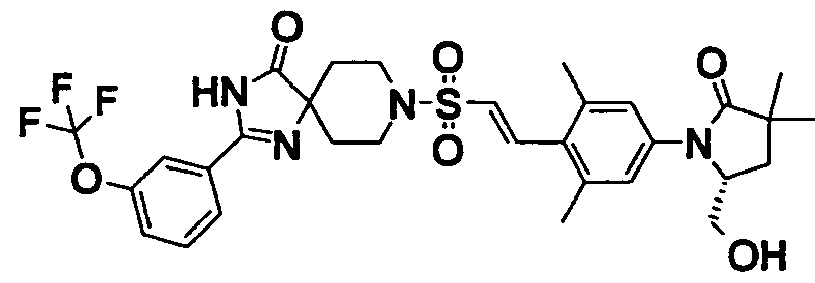
LCMS-D-1 2.90 649 (M+H)+ 713 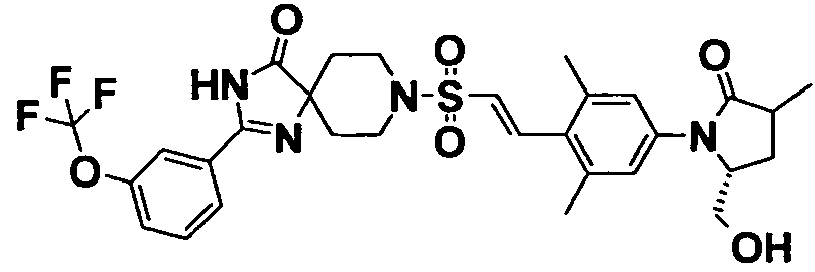
LCMS-D-1 2.90 635 (M+H)+ 714 
LCMS-D-1 3.20 678 (M+H)+ 715 
LCMS-D-1 3.30 699 (M+H)+ - The aryl bromide reagent used in the synthesis of Compound 711 (N-(4-bromo-3-methyl-phenyl)-N-[2-(tert-butyl-dimethyl-silanyloxy)-ethyl]-isobutylamide) was synthesized as follows.
-

- Triethylamine (0.39 ml, 2.80 mmol), dimethylaminopyridine (13 mg, 0.11 mmol) and tert-butyl-dimethyl-chloro-silane (319 mg, 2.11 mmol) were added to a solution of 2-(4-bromo-3-methyl-phenylamino)-ethanol (430 mg, 1.87 mmol) in dichloromethane (3.8 ml) at room temperature, and the mixture was stirred at room temperature for 24 hours. The reaction mixture was diluted with dichloromethane, and the organic layer was washed with water, dried over MgSO4 and concentrated under reduced pressure. The resulting residue was purified by silica gel column chromatography (hexane-ethyl acetate) to give (4-bromo-3-methyl-phenyl)-[2-(tert-butyl-dimethyl-silanyloxy)-ethyl]-amine (629 mg, 98%).
1H-NMR (300 MHz, CDCl3) δ 0.08 (6H, s), 0.91 (9H, s), 2.32 (3H, s), 3.18 (2H, dd, J = 5.7 and 5.1 Hz), 3.80 (2H, t, J = 5.1 Hz), 4.01 (1H, dull t, J = 5.7 Hz), 6.34 (1H, dd, J = 8.7, 2.5 Hz), 6.51 (1H, d, J = 2.5 Hz), 7.27 (1H, d, J = 8.7 Hz). -

- N-(4-Bromo-3-methyl-phenyl)-N-[2-(tert-butyl-dimethyl-silanyloxy)-ethyl]-isobutylamide was synthesized by operations similar to those in Reaction 105-2 using appropriate reagents and starting material.
1H-NMR (300 MHz, CDCl3) δ 0.04 (6H, s), 0.87 (9H, s), 1.02 (6H, d, J = 6.6 Hz), 2.41 (3H, s), 2.47 (1H, sept, J = 6.6 Hz), 3.74 (4H, s), 6.92 (1H, dd, J = 8.4, 2.3 Hz), 7.13 (1H, d, J = 2.3 Hz), 7.53 (1H, d, J = 8.4 Hz). - The aryl bromide reagents used in the synthesis of Compound 712 and Compound 713 ((R)-1-(4-bromo-3,5-dimethylphenyl)-5-(tert-butyl-dimethyl-silanyloxymethyl)-3,3-dimethylpyrrolidin-2-one and (R)-1-(4-bromo-3,5-dimethyl-phenyl)-5-(tert-butyl-dimethyl-silanyloxymethyl)-3-methyl-pyrrolidin-2-one) were synthesized as follows.
-

- 1 M LHMDS (0.61 ml, 0.61 mmol) was added dropwise to a solution of (R)-1-(4-bromo-3,5-dimethylphenyl)-5-(((tert-butyldimethylsilyl)oxy)-methyl)pyrrolidin-2-one (119 mg, 0.29 mmol) in THF (2.4 ml) at -78°C in a nitrogen atmosphere, and the mixture was stirred at -78°C for 15 minutes. A solution of iodomethane (38 µL, 0.62 mmol) in THF (0.5 ml) was added at -78°C, and the mixture was stirred at -78°C for 15 minutes, warmed to room temperature and further stirred for three hours. A saturated aqueous ammonium chloride solution was added to the reaction mixture, and the mixture was diluted with dichloromethane. The organic layer was washed with saturated brine, and then dried over MgSO4 and concentrated under reduced pressure. The resulting residue was purified by silica gel column chromatography (hexane-ethyl acetate) to give a mixture of (R)-1-(4-bromo-3,5-dimethylphenyl)-5-(tert-butyl-dimethyl-silanyloxymethyl)-3,3-dimethylpyrrolidin-2-one.(minor) and (R)-1-(4-bromo-3,5-dimethyl-phenyl)-5-(tert-butyl-dimethyl-silanyloxymethyl)-3-methyl-pyrrolidin-2-one (major) (629 mg, 98%). This was used in Heck reaction without complete separation and purification.
- The aryl bromide reagent used in the synthesis of Compound 714 ((3-(4-bromo-3,5-dimethyl-phenyl)-1-[2-(tert-butyl-dimethyl-silanyloxy)-ethyl]-5,5-dimethyl-imidazolidine-2,4-dione) was synthesized as follows.
-

- (3-(4-Bromo-3,5-dimethyl-phenyl)-1-[2-(tert-butyl-dimethyl-silanyloxy)-ethyl]-5,5-dimethyl-imidazolidine-2,4-dione was synthesized by operations similar to those in Reaction 25-3 using appropriate reagents and starting material.
1H-NMR (CDCl3) δ 7.11 (s, 2H), 3.85 (t, 2H, d = 6.0 Hz), 3.43 (t, 2H, d = 6.0 Hz), 2.42 (s, 6H), 1.49 (s, 6H), 0.90 (s, 9H), 0.07 (s, 6H). - The aryl bromide reagent used in the synthesis of Compound 715 (N-(4-bromo-3,5-dimethyl-phenyl)-N-[4-(tert-butyl-dimethyl-silanyloxy)-cyclohexyl]-methanesulfonamide) was synthesized as follows.
-
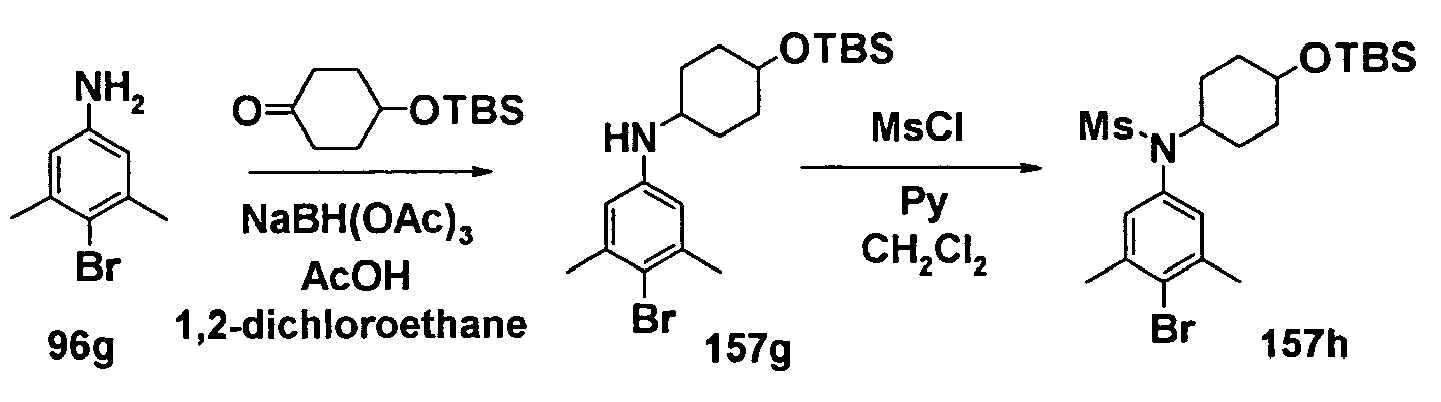
- N-(4-Bromo-3,5-dimethyl-phenyl)-N-[4-(tert-butyl-dimethyl-silanyloxy)-cyclohexyl]-methanesulfonamide was synthesized by operations similar to those in Reaction 41-1 and Reaction 6-1 using appropriate reagents and starting material.
MS (ESI) m/z = 490, 492 (M+H)+. -

- N-(4-{(E)-2-[2-(4-Butyl-cyclohexyl)-4-oxo-1,3,8-triaza-spiro[4.5]dec-1-ene-8-sulfonyl]-vinyl}-3,5-dimethyl-phenyl)-N-[2-(2-hydroxy-ethoxy)-ethyl]-acetamide was synthesized by operations similar to those in Reaction 26-1 and Reaction 39-2 using appropriate reagents and starting material.
MS (ESI) m/z = 631 (M+H)+. - The aryl bromide reagent used in the synthesis of Compound 716 (N-(4-bromo-3,5-dimethyl-phenyl)-N-{2-[2-(tert-butyl-dimethyl-silanyloxy)-ethoxy]-ethyl}-acetamide) was synthesized as follows.
-

- N-(4-Bromo-3,5-dimethyl-phenyl)-N-{2-[2-(tert-butyl-dimethyl-silanyloxy)-ethoxy]-ethyl}-acetamide was synthesized by operations similar to those in Reaction 25-3 using appropriate reagents and starting material.
1H-NMR (CDCl3) δ 6.95 (s, 2H), 3.81 (dd, 2H, J = 6.10, 5.72 Hz), 3.70 (dd, 2H, J = 4.95, 5.34 Hz), 3.58 (dd, 2H, J = 5.72, 6.10 Hz), 3.46 (dd, 2H, J = 5.72, 4.95 Hz), 2.41 (s, 6H), 1.83 (s, 3H), 0.86 (s, 9H). -

- N-(2-Fluoro-5-methyl-4-{(E)-2-[4-oxo-2-(3-trifluoromethoxy-phenyl)-1,3,8-triaza-spiro[4.5]dec-1-ene-8-sulfonyl]-vinyl}-phenyl)-N-(2-hydroxy-ethyl)-acetamide was synthesized by operations similar to those in Reaction 26-1 and Reaction 12-5 using appropriate reagents and starting material.
MS (ESI) m/z = 613 (M+H)+. - The aryl iodide reagent used in the synthesis of Compound 717 (acetic acid 2-[acetyl-(2-fluoro-4-iodo-5-methyl-phenyl)-amino]-ethyl ester) was synthesized as follows.
-

- Pyridine (0.87 mL, 10.78 mmol) was added to a solution of 2-fluoro-4-iodo-5-methyl-phenylamine (1082.9 mg, 4.314 mmol) in THF (10.8 mL). 2-Chloroethyl chloroformate (0.47 mL, 4.53 mmol) was then added dropwise and the mixture was stirred overnight. Potassium hydroxide (968.2 mg, 17.25 mmol) and ethanol (10.8 mL) were subsequently added, and the mixture was heated under reflux overnight. The reaction mixture was then quenched by adding a saturated aqueous ammonium chloride solution and extracted with ethyl acetate. The organic layer was sequentially washed with water and saturated brine, and then dried over anhydrous Na2SO4 and concentrated under reduced pressure. The resulting residue was purified by silica gel column chromatography to give 2-(2-fluoro-4-iodo-5-methyl-phenylamino)-ethanol as a pale brown solid (1217.0 mg, 96%).
MS (ESI) m/z = 296 (M+H)+. -

- Acetic acid 2-[acetyl-(2-fluoro-4-iodo-5-methylphenyl)-amino]-ethyl ester was synthesized by operations similar to those in Reaction 12-2 using appropriate reagents and starting material.
MS (ESI) m/z = 402 (M+Na)+. -

- N-(4-{(E)-2-[2-(4-Fluoro-3-trifluoromethyl-phenyl)-4-oxo-1,3,8-triaza-spiro[4.5]dec-1-ene-8-sulfonyl]-vinyl}-3,5-dimethyl-phenyl)-N-(2-hydroxy-ethyl)-acetamide was synthesized by operations similar to those in Reaction 26-1 and Reaction 12-5 using appropriate reagents and starting material.
MS (ESI) m/z = 611 (M+H)+. -

- N-[2-(tert-Butyl-dimethyl-silanyloxy)-ethyl]-N-(3-methyl-4-{(E)-2-[4-oxo-2-(3-trifluoromethoxy-phenyl)-1,3,8-triaza-spiro[4.5]dec-1-ene-8-sulfonyl]-vinyl}-phenyl)-methanesulfonamide was synthesized by operations similar to those in Reaction 26-1 using appropriate reagents and starting material.
1H-NMR (300 MHz, CDCl3) δ 0.04 (6H, s), 0.87 (9H, s), 1.70 (2H, m), 2.21 (2H, m), 2.44 (3H, s), 3.02 (3H, s), 3.32 (2H, m), 3.71 (2H, t, J = 5.7 Hz), 3.81 (4H, m), 6.67 (1H, J = 15.3 Hz), 7.27 (2H, m), 7.42 (1H, m),7.56 (2H, m), 7.71 (1H, d, J = 15.3 Hz), 7.80 (1H, d, J = 8.0 Hz), 7.84 (1H, s), 10.24 (1H, brs). -

- A 10% aqueous citric acid solution (0.14 ml, 0.067 mmol) was added to a solution of N-[2-(tert-butyl-dimethyl-silanyloxy)-ethyl]-N-(3-methyl-4-{(E)-2-[4-oxo-2-(3-trifluoromethoxy-phenyl)-1,3,8-triaza-spiro[4.5]dec-1-ene-8-sulfonyl]-vinyl}-phenyl)-methanesulfonamide (14.3 mg, 0.0192 mmol) in acetonitrile (0.2 ml), and the mixture was stirred at 60°C for 2.5 hours. The reaction mixture was diluted with ethyl acetate, and the organic layer was washed with an aqueous sodium bicarbonate solution, dried over MgSO4 and concentrated under reduced pressure. The resulting residue was purified by silica gel column chromatography (ethyl acetate) to give N-(2-hydroxy-ethyl)-N-(3-methyl-4-{(E)-2-[4-oxo-2-(3-trifluoromethoxy-phenyl)-1,3,8-triaza-spiro[4.5]dec-1-ene-8-sulfonyl]-vinyl}-phenyl)-methanesulfonamide (12.5 mg, 100%).
MS (ESI) m/z = 631 (M+H)+. - The aryl bromide reagent used in the synthesis of Compound 719 (N-(4-bromo-3-methyl-phenyl)-N-[2-(tert-butyl-dimethyl-silanyloxy)-ethyl]-methanesulfonamide) was synthesized as follows.
-
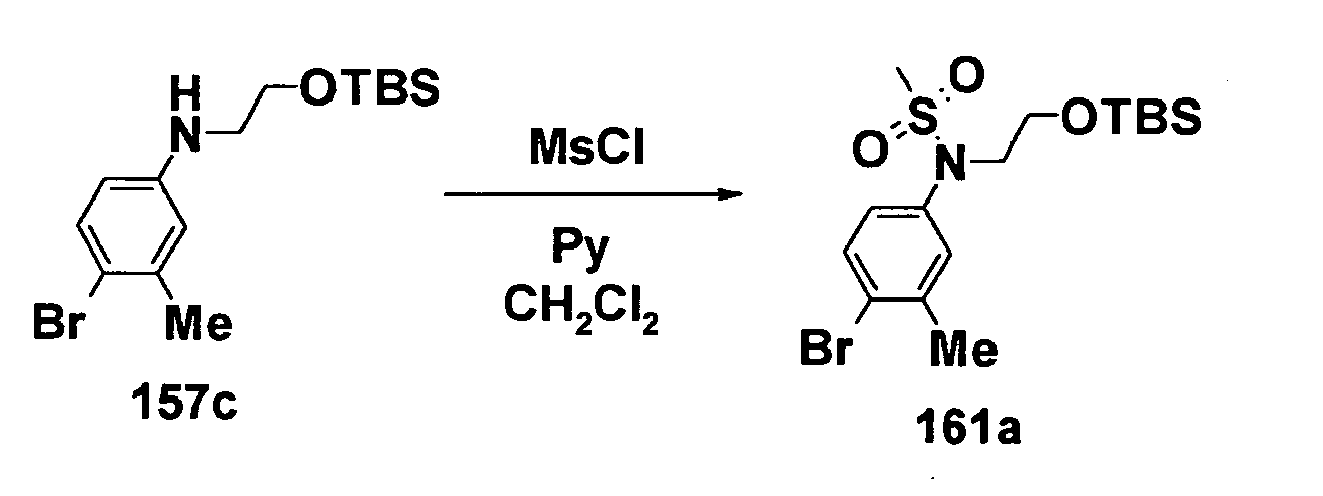
- N-(4-Bromo-3-methyl-phenyl)-N-[2-(tert-butyl-dimethyl-silanyloxy)-ethyl]-methanesulfonamide was synthesized by operations similar to those in Reaction 6-1 using appropriate reagents and starting material.
1H-NMR (300 MHz, CDCl3) δ 0.04 (6H, s), 0.87 (9H, s), 2.40 (3H, s), 2.96 (3H, s), 3.68 (2H, m), 3.75 (2H, m), 7.05 (1H, ddd, J = 8.5, 2.5, 0.6 Hz), 7.25 (1H, d, J = 2.5 Hz), 7.54 (1H, d, J = 8.5 Hz). -

- N-(2-Hydroxy-ethyl)-N-{3-methyl-4-[2-(2-nonyl-4-oxo-1,3,8-triaza-spiro[4.5]dec-1-ene-8-sulfonyl)-ethyl]-phenyl}-methanesulfonamide was synthesized by operations similar to those in Reaction 26-1, Reaction 39-2 and Reaction 122-2 using appropriate reagents and starting material.
MS (ESI) m/z = 599 (M+H)+. -

- N-(4-{2-[2-(4-Fluoro-3-trifluoromethyl-phenyl)-4-oxo-1,3,8-triaza-spiro[4.5]dec-1-ene-8-sulfonyl]-ethyl}-3-methyl-phenyl)-N-(2-hydroxy-ethyl)-acetamide was synthesized by operations similar to those in Reaction 26-1, Reaction 12-5 and Reaction 42-2 using appropriate reagents and starting material.
MS (ESI) m/z = 599 (M+H)+. -

- 2-Hydroxy-N-(2-hydroxy-ethyl)-N-(3-methyl-4-{(E)-2-[4-oxo-2-(3-trifluoromethoxy-phenyl)-1,3,8-triaza-spiro[4.5]dec-1-ene-8-sulfonyl]-vinyl}-phenyl)-acetamide was synthesized by operations similar to those in Reaction 26-1, Reaction 161-2 and Reaction 12-5 using appropriate reagents and starting material.
MS (ESI) m/z = 611 (M+H)+. - The aryl bromide reagent used in the synthesis of Compound 722 (acetic acid {(4-bromo-3-methyl-phenyl)-[2-(tert-butyl-dimethyl-silanyloxy)-ethyl]-carbamoyl}-methyl ester) was synthesized as follows.
-

- Acetic acid {(4-bromo-3-methyl-phenyl)-[2-(tert-butyl-dimethyl-silanyloxy)-ethyl]-carbamoyl}-methyl ester was synthesized by operations similar to those in Reaction 105-2 using appropriate reagents and starting material.
1H-NMR (300 MHz, CDCl3) δ 0.03 (6H, s), 0.86 (9H, s), 2.13 (3H, s), 2.41 (3H, s), 3.76 (4H, s), 4.36 (2H, s), 6.99 (1H, dd, J = 8.4, 2.4 Hz), 7.19 (1H, d, J = 2.4 Hz), 7.56 (1H, d, J = 8.4 Hz). -

- 1-[3,5-Dimethyl-4-((E)-2-{4-oxo-2-[4-(3,3,3-trifluoro-propyl)-cyclohexyl]-1,3,8-triaza-spiro[4.5]dec-1-ene-8-sulfonyl}-vinyl)-phenyl]-1-methyl-urea was synthesized by operations similar to those in Reaction 26-1 and Reaction 81-1 using appropriate reagents and starting material.
MS (ESI) m/z = 598 (M+H)+. -

- 1-[3,5-Dimethyl-4-((E)-2-{4-oxo-2-[4-(3,3,3-trifluoro-propyl)-cyclohexyl]-1,3,8-triaza-spiro[4.5]dec-1-ene-8-sulfonyl}-vinyl)-phenyl]-1-[2-(2-hydroxy-ethoxy)-ethyl]-urea was synthesized by operations similar to those in Reaction 25-2 and Reaction 81-1 using appropriate reagents and starting material.
MS (ESI) m/z = 672 (M+H)+. - The example compound shown below was synthesized by operations similar to those in Example 166 using appropriate reagents and starting material.
-
[Table 107] Target Compound Structure LCMS condition Retention time (min) MS (m/z) 725 
LCMS-D-1 2.32 642 (M+H)+ - The aryl bromide reagent used in the synthesis of Compound 724 (2-[2-(4-bromo-3,5-dimethyl-phenylamino)-ethoxy]-ethanol) was synthesized as follows.
-

- 2-[2-(4-Bromo-3,5-dimethyl-phenylamino)-ethoxy]-ethanol was synthesized by operations similar to those in Reaction 39-2 and Reaction 96-16 using appropriate reagents and starting material.
MS (ESI) m/z = 288, 290 (M+H)+. - The aryl bromide reagent used in the synthesis of Compound 725 ((4-bromo-3,5-dimethyl-phenyl)-(2-methoxyethyl)-amine) was synthesized as follows.
-

- (4-Bromo-3,5-dimethyl-phenyl)-(2-methoxy-ethyl)-amine was synthesized by operations similar to those in Reaction 25-3 and Reaction 96-16 using appropriate reagents and starting material.
MS (ESI) m/z = 258, 260 (M+H)+. -

- 1-(3,5-Dimethyl-4-{(E)-2-[2-(4-methyl-cyclohexyl)-4-oxo-1,3,8-triaza-spiro[4.5]dec-1-ene-8-sulfonyl]-vinyl}-phenyl)-1-isopropyl-urea was synthesized by operations similar to those in Reaction 25-2 and Reaction 89-2 using appropriate reagents and starting material.
MS (ESI) m/z = 544 (M+H)+. - The example compound shown below was synthesized by operations similar to those in Example 167 using appropriate reagents and starting material.
-
[Table 108] Target Compound Structure LCMS condition Retention time (min) MS (m/z) 727 
LCMS-D-1 2.68 516 (M+H)+ - The aryl bromide reagent used in the synthesis of Compound 726 ((4-bromo-3,5-dimethyl-phenyl)-isopropylamine) was synthesized as follows.
-

- (4-Bromo-3,5-dimethyl-phenyl)-isopropyl-amine was synthesized by operations similar to those in Reaction 41-1 using appropriate reagents and starting material.
1H-NMR (CDCl3) δ 6.33 (s, 2H), 3.57 (q, 1H, J = 6.6 Hz), 2.32 (s, 6H), 1.18 (d, 6H, J = 6.6 Hz). - The aryl bromide reagent used in the synthesis of Compound 727 ((4-bromo-3-ethyl-phenyl)-methyl-amine) was synthesized as follows.
-

- (4-Bromo-3-ethyl-phenyl)-methyl-amine was synthesized by operations similar to those in Reaction 25-3 and Reaction 96-16 using appropriate reagents and starting material.
MS (ESI) m/z = 214, 216 (M+H)+. -

- 1-(3-Methoxy-5-methyl-4-{(E)-2-[2-(4-methyl-cyclohexyl)-4-oxo-1,3,8-triaza-spiro[4.5]dec-1-ene-8-sulfonyl]-vinyl}-phenyl)-1-methyl-urea was synthesized by operations similar to those in Reaction 26-1 (using DMI as a solvent) and Reaction 89-2 (using KOCN as a reagent) using appropriate reagents and starting material.
MS (ESI) m/z = 532 (M+H)+. -

- 1-Cyanomethyl-1-(3-methyl-4-{(E)-2-[4-oxo-2-(3-trifluoromethoxy-phenyl)-1,3,8-triaza-spiro[4.5]dec-1-ene-8-sulfonyl]-vinyl}-phenyl)-urea was synthesized by operations similar to those in Reaction 26-1 and Reaction 89-2 using appropriate reagents and starting material.
MS (ESI) m/z = 591 (M+H)+. - The example compound shown below was synthesized by operations similar to those in Example 169 using appropriate reagents and starting material.
-
[Table 109] Target Compounc Structure LCMS condition Retention time (min) MS (m/z) 730 
LCMS-B-1 2.36 620 (M+H)+ -

- 1-(3-Methyl-4-{(E)-2-[4-oxo-2-(3-trifluoromethoxy-phenyl)-1,3,8-triaza-spiro[4.5]dec-1-ene-8-sulfonyl]-vinyl}-phenyl)-1-(2,2,2-trifluoro-ethyl)-urea was synthesized by operations similar to those in Reaction 26-1 and Reaction 81-1 using appropriate reagents and starting material.
MS (ESI) m/z = 634 (M+H)+. -

- 1-(4-{2-[2-(4-Ethyl-cyclohexyl)-4-oxo-1,3,8-triaza-spiro[4.5]dec-1-ene-8-sulfonyl]-ethyl}-3,5-dimethyl-phenyl)-1-methyl-urea was synthesized by operations similar to those in Reaction 25-2, Reaction 89-2 and Reaction 42-2 using appropriate reagents and starting material.
MS (ESI) m/z = 532 (M+H)+. -

- 1-((S)-2,3-Dihydroxy-propyl)-1-(3,5-dimethyl-4-{(E)-2-[2-(4-methyl-cyclohexyl)-4-oxo-1,3,8-triaza-spiro[4.5]dec-1-ene-8-sulfonyl]-vinyl}-phenyl)-urea was synthesized by operations similar to those in Reaction 25-2, Reaction 89-2 and Reaction 25-4 using appropriate reagents and starting material.
MS (ESI) m/z = 576 (M+H)+. - The aryl bromide reagent used in the synthesis of Compound 733 ((4-bromo-3,5-dimethyl-phenyl)-((S)-2,2-dimethyl-[1,3]dioxolan-4-ylmethyl)-amine) was synthesized as follows.
-

- (4-Bromo-3,5-dimethyl-phenyl)-((S)-2,2-dimethyl-[1,3]dioxolan-4-ylmethyl)-amine was synthesized by operations similar to those in Reaction 96-16 using appropriate reagents and starting material.
1H-NMR (CDCl3) δ 6.39 (s, 2H), 4.34 (m, 1H), 4.09 (dd, 1H, J = 8.2, 6.3 Hz), 3.75 (dd, 1H, J = 8.2, 6.3 Hz), 3.29-3.11 (m, 2H), 2.33 (s, 6H), 1.45 (s, 3H), 1.37 (s, 3H). -

- N-{4-[(E)-2-(2-Cyclohexyl-4-oxo-1,3,8-triaza-spiro[4.5]dec-1-ene-8-sulfonyl)-vinyl]-3-methyl-phenyl}-N-cyclopentyl-acetamide trifluoroacetate was synthesized by operations similar to those in Reaction 26-1 and Reaction 12-2 (using HPLC for purification) using appropriate reagents and starting material.
MS (ESI) m/z = 541 (M+H)+. -

- ((S)-1-{4-[(E)-2-(2-Cyclohexyl-4-oxo-1,3,8-triaza-spiro[4.5]dec-1-ene-8-sulfonyl)-vinyl]-3,5-dimethyl-phenylcarbamoyl}-2-methyl-propyl)-carbamic acid 9H-fluoren-9-ylmethyl ester was synthesized by operations similar to those in Reaction 26-1 and Reaction 10-1 using appropriate reagents and starting material.
MS (ESI) m/z = 766 (M+H)+. -

- Piperidine (1 ml) was added to a solution of ((S)-1-{4-[(E)-2-(2-cyclohexyl-4-oxo-1,3,8-triaza-spiro[4.5]dec-1-ene-8-sulfonyl)-vinyl]-3,5-dimethyl-phenylcarbamoyl}-2-methyl-propyl)-carbamic acid 9H-fluoren-9-ylmethyl ester (84 mg, 0.11 mmol) in dichloromethane (4 ml), and the mixture was stirred at room temperature for three hours. The reaction mixture was quenched with water and then extracted with ethyl acetate. The organic layer was sequentially washed with water and saturated brine, and then dried over anhydrous magnesium sulfate and concentrated under reduced pressure. The resulting residue was purified by silica gel column chromatography to give (S)-2-amino-N-{4-[(E)-2-(2-cyclohexyl-4-oxo-1,3,8-triaza-spiro[4.5]dec-1-ene-8-sulfonyl)-vinyl]-3,5-dimethyl-phenyl}-3-methyl-butylamide (20 mg, 33%).
MS (ESI) m/z = 544 (M+H)+. -

- 2-{4-[(E)-2-(2-Cyclohexyl-4-oxo-1,3,8-triaza-spiro[4.5]dec-1-ene-8-sulfonyl)-vinyl]-indol-1-yl}-N-pyridin-4-yl-acetamide was synthesized by operations similar to those in Reaction 25-2, Reaction 23-2 and Reaction 10-22 using appropriate reagents and starting material.
MS (ESI) m/z = 575 (M+H)+. - The aryl bromide reagent used in the synthesis of Compound 736 ((4-bromo-indol-1-yl)-acetic acid ethyl ester) was synthesized as follows.
-

- (4-Bromo-indol-1-yl)-acetic acid ethyl ester was synthesized by operations similar to those in Reaction 25-3 using appropriate reagents and starting material.
MS (ESI) m/z = 282 (M+H)+. -

- (3-Methyl-4-{(E)-2-[2-(4-methyl-cyclohexyl)-4-oxo-1,3,8-triaza-spiro[4.5]dec-1-ene-8-sulfonyl]-vinyl}-phenyl)-acetic acid was synthesized by operations similar to those in Reaction 25-2 and Reaction 23-2 using appropriate reagents and starting material.
MS (ESI) m/z = 488 (M+H)+. -

- N,N-Diisopropylethylamine (31.4 µL, 0.185 mmol) and 2-chloro-1-methylpyridinium iodide (18.9 mg, 0.074 mmol) were added to a solution of (3-methyl-4-{(E)-2-[2-(4-methyl-cyclohexyl)-4-oxo-1,3,8-triaza-spiro[4.5]dec-1-ene-8-sulfonyl]-vinyl}-phenyl)-acetic acid (30.0 mg, 0.062 mmol) in dichloromethane (0.5 mL) and DMF (0.1 mL), and the mixture was stirred for 10 minutes. A 2.0 M ammonia-methanol solution (0.15 mL, 0.308 mmol) and DMAP (0.8 mg, 0.006 mmol) were then added, and the mixture was stirred overnight. The reaction mixture was then quenched by adding a saturated aqueous ammonium chloride solution and extracted with ethyl acetate. The organic layer was sequentially washed with water and saturated brine, and then dried over anhydrous Na2SO4 and concentrated under reduced pressure. The resulting residue was purified by silica gel column chromatography to give 2-(3-methyl-4-{(E)-2-[2-(4-methyl-cyclohexyl)-4-oxo-1,3,8-triaza-spiro[4.5]dec-1-ene-8-sulfonyl]-vinyl}-phenyl)-acetamide as a white powder (18.3 mg, 61%).
MS (ESI) m/z = 487 (M+H)+. - The aryl bromide reagent used in the synthesis of Compound 737 (2-(4-bromo-3-methyl-phenyl)-malonic acid dimethyl ester) was synthesized as follows.
-

- 2-(4-Bromo-3-methyl-phenyl)-malonic acid dimethyl ester was synthesized by operations similar to those in Reaction 12-1 using appropriate reagents and starting material.
MS (ESI) m/z = 302 (M+H)+. -

- 8-[(E)-2-(4-Amino-2,6-dimethyl-phenyl)vinyl]sulfonyl-3-cyclohexyl-2,4,8-triazaspiro[4.5]dec-3-en-1-one was synthesized by operations similar to those in Reaction 26-1 using appropriate reagents and starting material.
MS (ESI) m/z = 445 (M+H)+. -

- 2-(Methylthio)-2-thiazoline (19 µL, 0.17 mmol) and acetic acid (1.2 ml) were added to a solution of 8-[(E)-2-(4-amino-2,6-dimethyl-phenyl)vinyl]sulfonyl-3-cyclohexyl-2,4,8-triazaspiro[4.5]dec-3-en-1-one (74 mg, 0.16 mmol) in EtOH (2.5 ml) at room temperature, and the mixture was heated with stirring at 80°C for 16 hours. The reaction solution was diluted with ethyl acetate, and the organic layer was then sequentially washed with water and saturated brine and concentrated under reduced pressure. The residue was purified by silica gel column chromatography (ethyl acetate) to give 2-cyclohexyl-8-{(E)-2-[4-(4,5-dihydro-thiazol-2-ylamino)-2,6-dimethyl-phenyl]-ethenesulfonyl}-1,3,8-triaza-spiro[4.5]dec-1-en-4-one (46.1 mg, 52%).
MS (ESI) m/z = 530 (M+H)+. -

- 2-Cyclohexyl-8-{(E)-2-[2-methyl-4-(3-methyl-oxetan-3-ylmethoxy)-phenyl]-ethenesulfonyl}-1,3,8-triaza-spiro[4.5]dec-1-en-4-one was synthesized by operations similar to those in Reaction 25-2 and Reaction 26-4 using appropriate reagents and starting material.
MS (ESI) m/z = 516 (M+H)+. -

- (3,5-Dimethyl-4-{(E)-2-[2-(4-methyl-cyclohexyl)-4-oxo-1,3,8-triaza-spiro[4.5]dec-1-ene-8-sulfonyl]-vinyl}-phenyl)-methyl-carbamic acid tert-butyl ester was synthesized by operations similar to those in Reaction 26-1 using appropriate reagents and starting material.
MS (ESI) m/z = 573 (M+H)+. -

- A 1 M solution of sodium bis(trimethylsilyl)amide in tetrahydrofuran (0.31 mL, 0.306 mmol) was added to a mixture of trimethylsulfoxonium iodide (29 mg, 0.131 mmol) in 1,3-dimethyl-2-imidazolidinone (2 mL) at room temperature. The reaction solution was stirred at room temperature for 0.5 hour. A mixed solution of (3,5-dimethyl-4-{(E)-2-[2-(4-methyl-cyclohexyl)-4-oxo-1,3,8-triaza-spiro[4.5]dec-1-ene-8-sulfonyl]-vinyl}-phenyl)-methyl-carbamic acid tert-butyl ester (50 mg, 0.0873 mmol) in 1,3-dimethyl-2-imidazolidinone (2 mL) was then added at room temperature, and the mixture was heated with stirring at 50°C for 15 hours. After returning to room temperature, an aqueous ammonium chloride solution and ethyl acetate were added to the reaction solution. The organic layer and the aqueous layer were separated, and the aqueous layer was repeatedly extracted with ethyl acetate three times. The organic layers were combined, washed with water twice and saturated brine, and then concentrated under reduced pressure. The resulting residue was purified by silica gel column chromatography to give a mixture of (3,5-dimethyl-4-{2-[2-(4-methyl-cyclohexyl)-4-oxo-1,3,8-triaza-spiro[4.5]dec-1-ene-8-sulfonyl]-cyclopropyl}-phenyl)-methyl-carbamic acid tert-butyl ester. This mixture was used in the next reaction as such without further purification.
MS (ESI) m/z = 587 (M+H)+. -

- 1-(3,5-Dimethyl-4-{2-[2-(4-methyl-cyclohexyl)-4-oxo-1,3,8-triaza-spiro[4.5]dec-1-ene-8-sulfonyl]-cyclopropyl}-phenyl)-1-methyl-urea
MS (ESI) m/z = 530 (M+H)+
and
1-(3,5-dimethyl-4-{1-methyl-2-[2-(4-methyl-cyclohexyl)-4-oxo-1,3,8-triaza-spiro[4.5]dec-1-ene-8-sulfonyl]-vinyl}-phenyl)-1-methyl-urea
MS (ESI) m/z = 530 (M+H)+ were synthesized by operations similar to those in Reaction 7-2 and Reaction 89-2 using appropriate reagents and starting material. -

- 8-[(E)-2-(4-Amino-2-methyl-phenyl)-ethenesulfonyl]-2-(3-trifluoromethoxy-phenyl)-1,3,8-triaza-spiro[4.5]dec-1-en-4-one was synthesized by operations similar to those in Reaction 26-1 using appropriate reagents and starting material.
MS (ESI) m/z = 509 (M+H)+ -

- A solution of tBuOH (71.9 mg, 0.97 mmol) in dichloromethane (1.5 ml) was added to a solution of chlorosulfonyl isocyanate (137 mg, 0.97 mmol) in dichloromethane (3 ml) with stirring under ice-cooling. The mixture was stirred at 0°C for 10 minutes and then added to a solution of 8-[(E)-2-(4-amino-2-methylphenyl)-ethenesulfonyl]-2-(3-trifluoromethoxy-phenyl)-1,3,8-triaza-spiro[4.5]dec-1-en-4-one (400 mg, 0.81 mmol) and triethylamine (164 mg, 1.62 mmol) in dichloromethane (3 ml). The mixture was stirred for one hour, and then quenched with water and extracted with dichloromethane. The organic layer was washed with saturated brine, and then dried over anhydrous magnesium sulfate and concentrated under reduced pressure. The resulting residue was purified by silica gel column chromatography (methyl acetate-hexane) to give N-tert-butoxycarbonyl-N'-(3-methyl-4-{(E)-2-[4-oxo-2-(3-trifluoromethoxy-phenyl)-1,3,8-triaza-spiro[4.5]dec-1-ene-8-sulfonyl]-vinyl}-phenyl)-sulfamide (334 mg, 60%).
1H-NMR (400 MHz, CDCl3) δ 1.42 (9H, s), 1.78 (2H, dt, J = 14.2, 3.9 Hz), 2.04-2.14 (2H, m), 2.40 (3H, s), 3.43 (2H, ddd, J = 12.7,9.8,2.9 Hz), 3.74 (2H, dt, J = 12.2, 4.4 Hz), 6.64 (1H, d, J = 15.6 Hz), 7.08-7.11 (2H, m), 7.38 (1H, d, J = 8.3 Hz), 7.48-7.54 (2H, m), 7.68 (1H, d, J = 15.1 Hz), 7.73 (1H, d, J = 7.8 Hz), 7.76 (1H, s), 9.62 (1H, s);
MS (ESI) m/z = 668 (M+H)+. -

- N-(3-Methyl-4-{(E)-2-[4-oxo-2-(3-trifluoromethoxy-phenyl)-1,3,8-triaza-spiro[4.5]dec-1-ene-8-sulfonyl]-vinyl}-phenyl)-sulfamide was synthesized by operations similar to those in Reaction 4-1 using appropriate reagents and starting material.
MS (ESI) m/z = 588 (M+H)+. -

- N-(3-Hydroxy-propyl)-N'-(3-methyl-4-{(E)-2-[4-oxo-2-(3-trifluoromethoxy-phenyl)-1,3,8-triaza-spiro[4.5]dec-1-ene-8-sulfonyl]-vinyl}-phenyl)-sulfamide was synthesized by operations similar to those in Reaction 31-7, Reaction 4-1 and Reaction 39-2 using appropriate reagents and starting material.
MS (ESI) m/z = 646 (M+H)+. -

- N-Methyl-N-(3-methyl-4-{(E)-3-[2-(4-methyl-cyclohexyl)-4-oxo-1,3,8-triaza-spiro[4.5]dec-1-ene-8-sulfonyl]-propenyl}-phenyl)-acetamide was synthesized by operations similar to those in Reaction 5-4, Reaction 55-2 and Reaction 26-1 using appropriate reagents and starting material.
MS (ESI) m/z = 515 (M+H)+. -

- 2-Cyclohexyl-8-[2-(2-methyl-1H-indol-4-yl)-ethanesulfonyl]-1,3,8-triaza-spiro[4.5]dec-1-en-4-one (Compound 745) was obtained by operations similar to those in Reaction 18-2 using Compound 637 as a starting material.
MS (ESI) m/z = 457 (M+H)+. - The example compounds shown below were obtained by operations similar to those in Example 183 using appropriate solvents (methanol or dimethylformamide or a methanol-dimethylformamide mixed solution) and starting compounds.
-
[Table 110] Starting Compound Target Compound Structure LCMS condition Retention time (min) MS (m/z) 526 746 
LCMS-C-1 2.58 595 (M+H)+ 638 747 
LCMS-A-1 1.40 473 (M+H)+ 480 748 
LCMS-C-1 2.43 531 (M+H)+ 583 749 
LCMS-A-1 1.91 544 (M+H)+ -
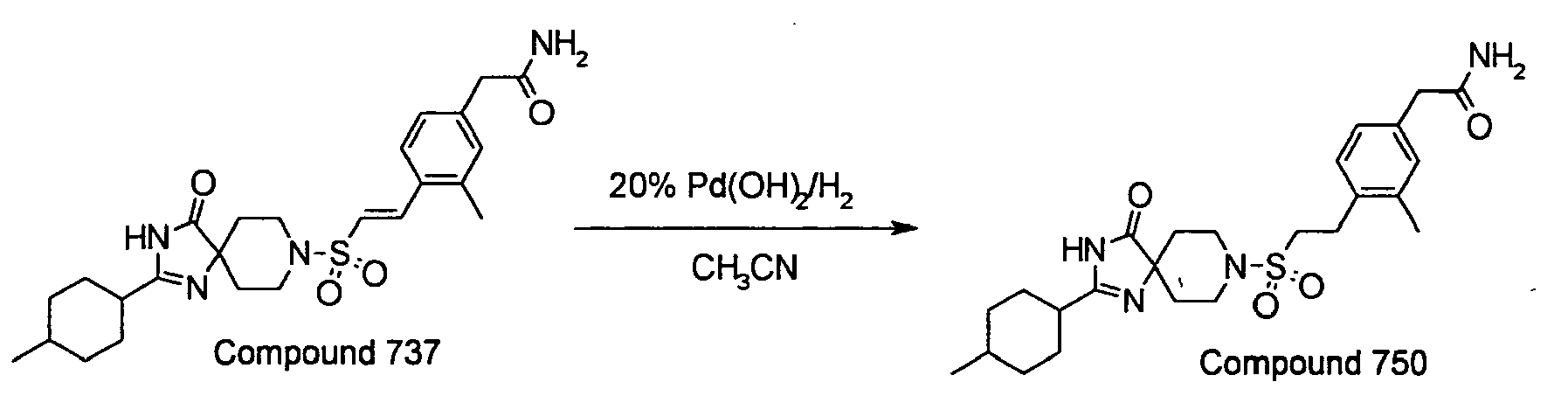
- 20% palladium hydroxide (7.4 mg) was added to a solution of Compound 737 (14.7 mg, 0.030 mmol) in acetonitrile (1.0 mL), and the mixture was stirred at room temperature for one hour in a hydrogen atmosphere. The reaction mixture was filtered through celite, and the filtrate was concentrated under reduced pressure. The resulting residue was then purified by silica gel column chromatography to give 2-(3-methyl-4-{2-[2-(4-methyl-cyclohexyl)-4-oxo-1,3,8-triaza-spiro[4.5]dec-1-ene-8-sulfonyl]-ethyl}-phenyl)-acetamide (Compound 750) as a white powder (10.6 mg, 72%).
- The example compounds shown below were obtained by operations similar to those in Example 184 using appropriate solvents (acetonitrile or methanol or an acetonitrile-methanol mixed solution) and starting compounds.
-
[Table 111] Starting Compound Target Compound Structure LCMS condition Retention time (min) MS (m/z) 509 751 
LCMS- D-1 2.57 519 (M+H)+ 510 752 
LCMS- D-1 2.53 503 (M+H)+ 576 753 
LCMS- D-1 2.48 533 (M+H)+ 512 754 
LCMS- D-1 2.33 519 (M+H)+ 542 755 
LCMS- D-1 2.30 629 (M+H)+ 543 756 
LCMS- D-1 2.43 643 (M+H)+ 545 757 
LCMS- D-1 2.30 661 (M+H)+ 544 758 
LCMS- D-1 2.11 659 (M+H)+ 546 759 
LCMS- D-1 1.56 599 (M+H)+ 548 760 
LCMS- D-1 2.08 640 (M+H)+ 549 761 
LCMS- D-1 1.62 686 (M+H)+ 550 764 
LCMS- D-1 2.22 627 (M+H)+ 515 765 
LCMS- D-1 1.80 545 (M+H)+ 551 766 
LCMS- D-1 2.42 675 (M+H)+ 582 767 
LCMS- A-1 2.03 558 (M+H)+ 547 768 
LCMS- D-1 2.57 572 (M+H)+ 552 769 
LCMS- D-1 2.03 628 (M+H)+ 553 770 
LCMS- D-1 2.38 558 (M+H)+ 516 771 
LCMS- D-1 2.58 543 (M+H)+ 554 772 
LCMS- D-1 2.47 599 (M+H)+ 552 773 
LCMS- D-1 2.08 517 (M+H)+ 554 774 
LCMS- D-1 2.32 640 (M+H)+ 555 775 
LCMS- D-1 2.57 668 (M+H)+ 556 776 
LCMS- D-1 2.50 625 (M+H)+ 557 777 
LCMS- D-1 2.45 639 (M+H)+ 581 778 
LCMS- C-1 2.42 544 (M+H)+ 518 779 
LCMS- D-1 1.93 558 (M+H)+ 519 780 
LCMS- D-1 2.20 586 (M+H)+ 520 781 
LCMS- D-1 2.10 543 (M+H)+ 557 782 
LCMS- D-1 1.98 557 (M+H)+ 584 783 
LCMS- D-1 1.96 517 (M+H)+ 559 784 
LCMS- D-1 2.47 613 (M+H)+ 517 785 
LCMS- D-1 2.10 531 (M+H)+ 587 786 
LCMS- D-1 1.72 558 (M+H)+ 629 787 
LCMS- D-1 2.40 628 (M+H)+ 623 788 
LCMS- C-1 2.85 651 (M+H)+ 622 789 
LCMS- C-1 2.80 615 (M+H)+ 536 790 
LCMS- C-1 2.82 560 (M+H)+ 630 791 
LCMS- D-1 2.45 641 (M+H)+ 618 792 
LCMS- F-1 0.89 594 (M+H)+ 617 793 
LCMS- F-1 0.93 595 (M+H)+ 718 794 
LCMS- F-1 0.94 613 (M+H)+ 537 795 
LCMS- A-1 2.53 614 (M+H)+ 628 796 
LCMS- F-1 0.96 520 (M+H)+ 535 797 
LCMS- F-1 0.94 639 (M+H)+ 627 798 
LCMS- A-1 2.43 580 (M+H)+ 635 799 
LCMS- F-1 0.91 608 (M+H)+ 636 800 
LCMS- F-1 0.91 610 (M+H)+ 639 801 
LCMS- F-1 0.99 616 (M+H)+ 641 802 
LCMS- F-1 0.99 671 (M+H)+ 642 803 
LCMS- F-1 1.00 653 (M+H)+ 644 804 
LCMS- F-1 1.00 665 (M+H)+ 506 812 
LCMS- D-1 2.20 533 (M+H)+ 692 817 
LCMS- A-1 2.47 548 (M+H)+ 694 818 
LCMS- D-1 2.37 632 (M+H)+ 699 820 
LCMS- D-1 2.25 673 (M+H)+ 697 821 
LCMS- D-1 2.21 618 (M+H)+ 704 822 
LCMS- D-1 2.28 657 (M+H)+ 706 823 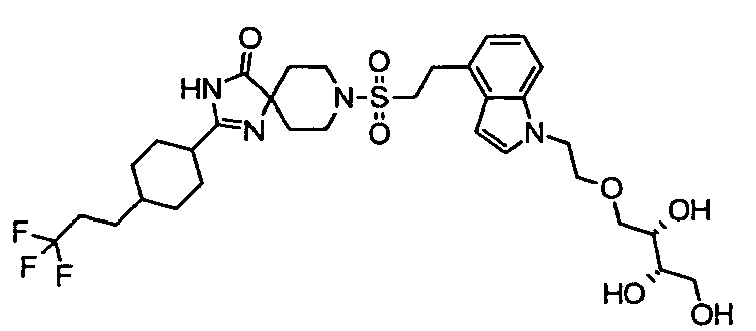
LCMS- D-1 2.25 687 (M+H)+ 707 824 
LCMS- D-1 2.40 661 (M+H)+ 700 825 
LCMS- A-1 2.35 607 (M+H)+ 724 826 
LCMS- D-1 2.12 674 (M+H)+ 725 827 
LCMS- D-1 2.37 644 (M+H)+ 726 828 
LCMS- D-1 2.32 546 (M+H)+ 727 829 
LCMS- D-1 2.68 518 (M+H)+ 733 830 
LCMS- D-1 1.52 578 (M+H)+ 403 831 
LCMS- F-1 0.91 667 (M+H)+ 539 832 
LCMS- A-1 2.43 574 (M+H)+ 589 833 
LCMS- B-2 4.38 631 (M+H)+ 588 834 
LCMS- C-1 2.47 517 (M+H)+ -

- 2-Cyclohexyl-8-[2-(1H-indol-7-yl)-ethanesulfonyl]-1,3,8-triaza-spiro[4.5]dec-1-en-4-one (Compound 835) was obtained by operations similar to those in Reaction 42-2 using Compound 479 as a starting material.
MS (ESI) m/z = 443 (M+H)+. - The example compounds shown below were obtained by operations similar to those in Example 185 using appropriate solvents (an ethanol-dimethylformamide mixed solution or ethanol) and starting compounds.
-
[Table 112] Starting Compound Target Compound Structure LCMS condition Retention time (min) MS (m/z) 492 836 
LCMS- A-1 2.25 511 (M+H)+ 488 837 
LCMS- A-1 2.12 457 (M+H)+ 487 838 
LCMS- A-1 1.95 531 (M+H)+ 499 839 
LCMS- A-1 1.66 512 (M+H)+ 524 840 
LCMS- A-1 2.25 579 (M+H)+ 502 841 
LCMS- C-1 2.15 579 (M+H)+ 497 842 
LCMS- C-1 2.22 504 (M+H)+ 527 843 
LCMS-C-1 2.63 622 (M+H)+ 844 844 
LCMS- C-1 2.20 568 (M+H)+ 528 845 
LCMS- C-1 2.58 651 (M+H)+ 530 846 
LCMS- C-1 2.37 652 (M+H)+ 529 847 
LCMS- C-1 2.48 568 (M+H)+ 596 848 
LCMS- C-1 2.90 748 (M+H)+ 598 849 
LCMS- C-1 2.77 650 (M+H)+ 597 850 
LCMS- C-1 2.58 595 (M+H)+ 599 851 
LCMS- C-1 2.42 649 (M+H)+ 591 852 
LCMS- C-1 2.53 650 (M+H)+ 592 853 
LCMS- C-1 2.43 657 (M+H)+ 595 854 
LCMS- C-1 2.35 663 (M+H)+ 601 855 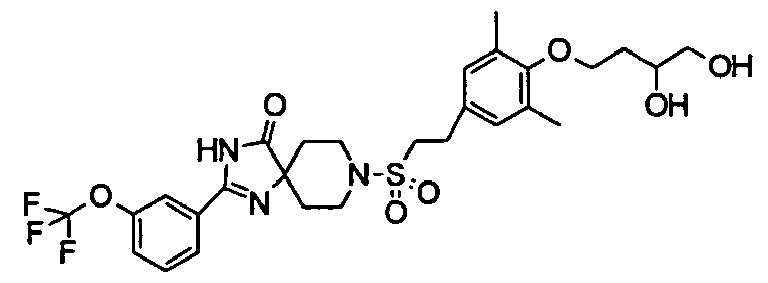
LCMS- C-1 2.68 614 (M+H)+ 619 856 
LCMS- C-1 2.72 595 (M+H)+ 620 857 
LCMS- B-1 1.95 611 (M+H)+ 621 858 
LCMS- C-1 2.47 611 (M+H)+ 602 859 
LCMS- C-1 3.15 695 (M+H)+ 600 860 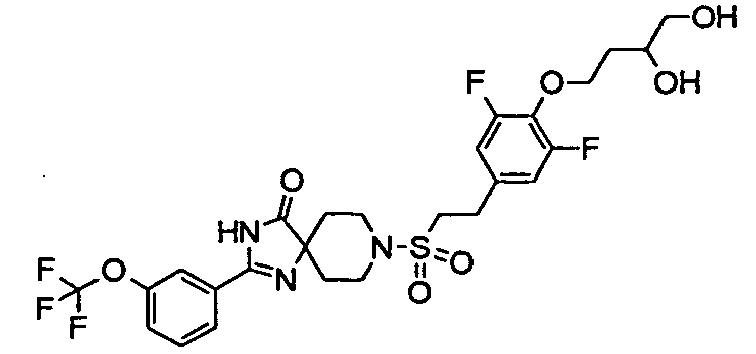
LCMS- C-1 2.58 622 (M+H)+ 572 861 
LCMS- C-1 2.47 487 (M+H)+ 505 862 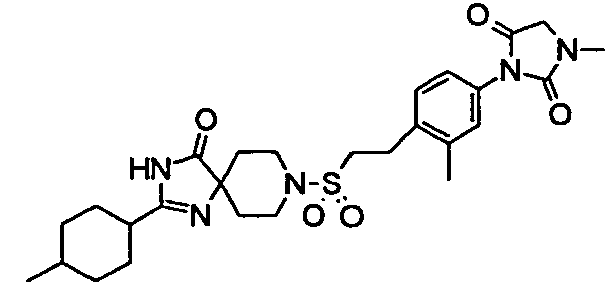
LCMS- C-1 2.45 544 (M+H)+ 511 863 
LCMS- F-1 0.93 558(M+H)+ 540 864 
LCMS- F-1 0.96 640 (M+H)+ 513 865 
LCMS- C-1 2.55 517 (M+H)+ 577 866 
LCMS- C-1 2.60 517 (M+H)+ 541 867 
LCMS- F-1 0.96 613 (M+H)+ 586 868 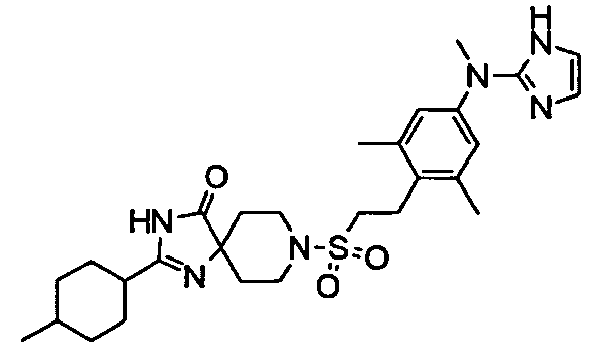
LCMS- A-1 1.84 541 (M+H)+ 507 869 
LCMS- F-1 0.96 572 (M+H)+ 1185 870 
LCMS- A-1 1.65 530 (M+H)+ 702 872 
LCMS- C-1 2.30 517 (M+H)+ 717 873 
LCMS- B-1 2.04 615 (M+H)+ 473 874 
LCMS- C-1 2.42 590 (M+H)+ 743 875 
LCMS- C-1 2.43 648 (M+H)+ 729 876 
LCMS- C-1 2.20 580 (M+H)+ 731 877 
LCMS- C-1 2.70 636 (M+H)+ 624 878 
LCMS- C-1 2.65 544 (M+H)+ 625 879 
LCMS- C-1 2.68 558 (M+H)+ -

- 3-(4-{2-[2-(4-Butyl-cyclohexyl)-4-oxo-1,3,8-triaza-spiro[4.5]dec-1-ene-8-sulfonyl]-ethyl}-3-methyl-phenyl)-imidazolidine-2,4-dione (Compound 880) was obtained by operations similar to those in Reaction 91-1 using Compound 560 as a starting material.
MS (ESI) m/z = 572 (M+H)+. - The example compounds shown below were obtained by operations similar to those in Example 186 using appropriate solvents (an ethanol-dimethylformamide mixed solution or ethanol) and starting compounds.
-
[Table 113] Starting Compound Target Compound Structure LCMS condition Retention time (min) MS (m/z) 504 881 
LCMS- C-1 2.33 530 (M+H)+ 563 882 
LCMS- C-1 2.67 558 (M+H)+ 575 883 
LCMS- C-1 2.43 544 (M+H)+ 564 884 
LCMS- C-1 2.70 572 (M+H)+ 508 885 
LCMS- F-1 0.97 586 (M+H)+ 688 886 
LCMS- F-1 0.86 582 (M+H)+ 626 887 
LCMS- C-1 2.70 572 (M+H)+ -

- 3,5-Dimethyl-4-(2-{4-oxo-2-[4-(3,3,3-trifluoro-propyl)-cyclohexyl]-1,3,8-triaza-spiro[4.5]dec-1-ene-8-sulfonyl}-ethyl)-benzoic acid N,N'-dimethyl-hydrazide (Compound 888) was obtained by operations similar to those in Reaction 10-14 using Compound 768 as a starting material and using dichloromethane as a solvent.
MS (ESI) m/z = 614 (M+H)+. -

- 8-{2-[2-Methyl-4-(piperidin-4-yloxy)-phenyl]-ethanesulfonyl}-2-(3-trifluoromethoxy-phenyl)-1,3,8-triaza-spiro[4.5]dec-1-en-4-one hydrochloride (Compound 889) was obtained by operations similar to those in Reaction 42-2 and Reaction 5-3 using Compound 602 as a starting material.
MS (ESI) m/z = 595 (M+H)+. -

- 4-{2-[2-(4,4-Difluoro-cyclohexyl)-4-oxo-1,3,8-triaza-spiro[4.5]dec-1-ene-8-sulfonyl]-ethyl}-3,N,N-trimethyl-benzamide was synthesized by operations similar to those in Reaction 5-4 using appropriate reagents and starting material.
MS (ESI) m/z = 523 (M-H)-. - The example compounds shown below were synthesized by operations similar to those in Reaction 189-1 using appropriate reagents and starting materials.
-
[Table 114] Compound Structure LCMS condition Retention time (min) MS (m/z) 891 
LCMS-C-1 2.07 561 (M+H)+ 892 
LCMS-A-1 2.28 577 (M+H)+ 893 
LCMS-C-1 2.42 507 (M+H)+ 894 
LCMS-C-1 2.93 545 (M+H)+ 895 
LCMS-C-1 2.85 545 (M+H)+ 896 
LCMS-C-1 2.63 517 (M+H)+ 897 
LCMS-B-2 4.91 599 (M+H)+ 898 
LCMS-C-2 2.88 660 (M-H)- 899 
LCMS-A-1 2.24 594 (M+H)+ 900 
LCMS-C-2 1.93 582 (M+H)+ 901 
LCMS-C-2 2.33 594 (M-H)- - The spiroamine reagents used in the synthesis of Compounds 890, 891, 895 and 897 and shown below were synthesized by operations similar to those in Reaction 10-14, Reaction 1-4 and Reaction 4-1 using appropriate reagents and Compound 5a as a starting material.
[Table 115] Target Compound Spiroamine reagent Spiroamine reagent MS (m/z) 890 
272 (M+H)+ 891 
308 (M+H)+ 895 
292 (M+H)+ 897 
346 (M+H)+ - [2061 The carboxylic acid necessary for the synthesis of the spiroamine reagent used for Compound 897 (4-(4,4,4-trifluoro-but-1-enyl)-cyclohexanecarboxylic acid methyl ester) was synthesized by the method shown below.
-

- A 1.6 M solution of n-butyllithium in hexane (2.5 mL) was added dropwise to a suspension of triphenyl-(3,3,3-trifluoro-propyl)-phosphonium iodide (1.90 g, 3.91 mmol) in tetrahydrofuran (14 mL) at 0°C. The mixture was stirred at 0°C for 35 minutes, and a solution of 4-formyl-cyclohexanecarboxylic acid methyl ester (605 mg, 3.55 mmol) in tetrahydrofuran (8.0 mL) was then added dropwise to the reaction solution at -78°C. The mixture was stirred for 45 minutes, and a saturated aqueous ammonium chloride solution was then added, followed by extraction with tert-butyl methyl ether. The organic layer was washed with water and a saturated aqueous sodium chloride solution and washed with sodium sulfate. After concentration, the residue was purified by silica gel column chromatography to give 4-(4,4,4-trifluoro-but= 1-enyl)-cyclohexanecarboxylic acid methyl ester (657 mg, 67%) as a colorless oily substance and geometric isomer mixture.
1H-NMR (CDCl3) δ 5.69 (1.0H, t, J = 10.4 Hz), 5.51 (0.2H, dt, J = 13.7, 2.9 Hz), 5.32 (1.2H, tt, J = 9.2, 3.3 Hz), 3.69 (2.8H, dd, J = 3.0,2.6 Hz), 3.67 (0.6H, d, J = 0.6 Hz), 2.90-2.78 (2.5H, m), 2.59-2.54 (1.0H, m), 2.40-2.31 (1.0H, m), 2.25-2.20 (0.5H, m), 2.06-1.98 (2.6H, m), 1.75-1.13 (8.0H, m). - [2065]
-

- 4-(4,4,4-Trifluorobutyl)-cyclohexanecarboxylic acid was synthesized by operations similar to those in Reaction 18-2 and Reaction 95-18 (using potassium hydroxide as a base) using appropriate reagents and starting material. This was used as such in the next reaction.
- The spiroamine reagent used in the synthesis of Compound 892 (2-[(E)-2-(3-trifluoromethyl-phenyl)-vinyl]-1,3,8-triaza-spiro[4.5]dec-1-en-4-one dihydrochloride) was synthesized by the method shown below.
-

- 4-Carbamoyl-4-[(E)-3-(3-trifluoromethyl-phenyl)-acryloylamino]-piperidine-1-carboxylic acid tert-butyl ester was synthesized by operations similar to those in Reaction 10-14 using appropriate reagents and starting material.
MS (ESI) m/z = 440 (M-H)-. -

- A 6 N aqueous sodium hydroxide solution was added to a solution of 4-carbamoyl-4-[(E)-3-(3-trifluoromethyl-phenyl)-acryloylamino]-piperidine-1-carboxylic acid tert-butyl ester (961 mg, 2.27.mmo1) in ethanol (20 ml), and the mixture was stirred at room temperature for 22 hours. The reaction solution was quenched with saturated ammonium chloride and then extracted with ethyl acetate. The organic layer was sequentially washed with water and saturated brine, and then dried over anhydrous magnesium sulfate and concentrated under reduced pressure. The resulting residue was purified by silica gel column chromatography to give 4-oxo-2-[(E)-2-(3-trifluoromethyl-phenyl)-vinyl]-1,3,8-triaza-spiro[4.5]dec-1-ene-8-carboxylic acid tert-butyl ester (706 mg, 73%).
MS (ESI) m/z = 422 (M-H)-. -

- 2-[(E)-2-(3-Trifluoromethyl-phenyl)-vinyl]-1,3,8-triaza-spiro[4.5]dec-1-en-4-one dihydrochloride was synthesized by operations similar to those in Reaction 5-3 using appropriate reagents and starting material.
MS (ESI) m/z = 324 (M+H)+. - The spiroamine reagent used in the synthesis of Compound 893 (2-phenylethynyl-1,3,8-triaza-spiro[4.5]dec-1-en-4-one ditrifluoroacetate) was synthesized by the method shown below.
-

- 2-Phenylethynyl-1,3,8-triaza-spiro[4.5]dec-1-en-4-one ditrifluoroacetate was synthesized by operations similar to those in Reaction 10-14, Reaction 189-5 and Reaction 4-1 using appropriate reagents and starting material.
MS (ESI) m/z = 254 (M+H)+. - The spiroamine reagent used in the synthesis of Compound 898 (cyclohexylmethyl-[2-(3-trifluoromethoxy-phenyl)-1,3,8-triaza-spiro[4.5]deca-1,3-dien-4-yl]-amine ditrifluoroacetate) was synthesized as follows.
-

- 4-Thioxo-2-(3-trifluoromethoxy-phenyl)-1,3,8-triaza-spiro[4.5]dec-1-ene-8-carboxylic acid tert-butyl ester was synthesized by operations similar to those in Reaction 88-1 using appropriate reagents and starting material.
1H-NMR (400 MHz, CDCl3) δ 1.42 (2H, dull d, J = 16.0 Hz), 1.50 (9H, s), 2.14 (2H, td, J = 16.0, 4.0 Hz), 3.33 (2H, br), 4.18 (2H, br), 7.44 (1H, m), 7.58 (1H, t, J = 8.0 Hz), 7.79 (1H, d, J = 8.0 Hz), 7.82 (1H, s), 10.30 (1H, br). -

1H-NMR (400 MHz, CDCl3) δ 1.02 (2H, m), 1.24 (3H, m), 1.44 (2H, d, J = 13.2 Hz), 1.50 (9H, s), 1.65 (4H, m), 1.76 (4H, m), 3.40 (4H, m), 4.17 (2H, br), 5.12 (1H, br), 7.28 (1H, m), 7.44 (1H, t, J = 8.0 Hz), 7.08 (1H, dull s), 8.16 (1H, m). -

- Cyclohexylmethyl-[2-(3-trifluoromethoxy-phenyl)-1,3,8-triaza-spiro[4.5]deca-1,3-dien-4-yl]-amine ditrifluoroacetate was synthesized by operations similar to those in Reaction 4-1 using appropriate reagents and starting material.
MS (ESI) m/z = 255 (M+H)+. - The spiroamine reagents used in the synthesis of Compounds 899 to 901 and shown below were synthesized by operations similar to those in Reaction 189-9 and Reaction 189-10 using appropriate reagents and starting materials.
[Table 116] Target Compound Spiroamine reagent Spiroamine reagent 1H-NMR 899 
1H NMR (400 MHz, CDCl3) δ : 2.06 (4H, m), 3.24 (2H, m), 3.60 (3H, s), 3.70 (3H, s), 4.10 (2H, br), 7.60 (1H, d, J = 8 Hz), 7.65 (1H, t, J = 8 Hz), 8.32 (1H, s), 8.49 (1H, d, J = 8 Hz). 900 
This was used in the next reaction without purification. 901 
This was used in the next reaction without purification. -

- 2-(4-Dimethylcarbamoyl-2-methyl-phenyl)-ethanesulfonyl chloride (22.2 mg) was added to a solution of 2-[4-(2-methoxy-ethyl)-cyclohexyl]-1,3,8-triaza-spiro[4.5]dec-1-en-4-one ditrifluoroacetate (63.9 µmol) and magnesium oxide (20 mg) in tetrahydrofuran-water (4:1 (v/v), 640 µL), and the mixture was stirred at room temperature for 30 minutes. 2-(4-Dimethylcarbamoyl-2-methyl-phenyl)-ethanesulfonyl chloride (22.2 mg) was further added and the mixture was stirred for one hour. The reaction mixture was quenched with water and extracted with dichloromethane. The organic layer was concentrated, and the resulting residue was purified by silica gel column chromatography (ethyl acetate-hexane) to give 4-(2-{2-[4-(2-methoxy-ethyl)-cyclohexyl]-4-oxo-1,3,8-triaza-spiro[4.5]dec-1-ene-8-sulfonyl}-ethyl)-3,N,N-trimethyl-benzamide (32.7 mg ,94%).
MS (ESI) m/z = 547 (M+H)+. - The spiroamine reagent used in the synthesis of Compound 902 and shown below (2-[4-(2-methoxy-ethyl)-cyclohexyl]-1,3,8-triaza-spiro[4.5]dec-1-en-4-one ditrifluoroacetate) was synthesized by operations similar to those in Reaction 10-14, Reaction 1-4 and Reaction 4-1 using appropriate reagents and Compound 5a as a starting material.
[Table 117] Target Compound Spiroamine reagent Spiroamine reagent MS (m/z) 902 
294 (M+H)+ - The carboxylic acid (4-(2-methoxy-ethyl)-cyclohexanecarboxylic acid) necessary for the synthesis of the spiroamine reagent used for Compound 902 (2-[4-(2-methoxy-ethyl)-cyclohexyl]-1,3,8-triaza-spiro[4.5]dec-1-en-4-one ditrifluoroacetate) was synthesized by the method shown below.
-

- Potassium carbonate (2.61 g, 18.9 mmol) and benzyl bromide (2.24 mL, 18.9 mmol) were added to a solution of 4-hydroxymethyl-cyclohexanecarboxylic acid (cis-trans = 2.9:1 mixture) (2.49 g, 15.7 mmol) in DMF (31.5 mL) at room temperature, and the mixture was stirred at 60°C for one hour. The reaction solution was cooled, and H2O (60 mL) was then added to the reaction solution, followed by extraction with hexane:ethyl acetate (2:1) (300 mL) twice. The organic layers were dried over sodium sulfate and concentrated under reduced pressure. The resulting residue was purified by silica gel column chromatography (hexane-ethyl acetate) to give 4-hydroxymethyl-cyclohexanecarboxylic acid benzyl ester (cis-trans = 3.5:1 mixture) as a colorless oily substance (3.79 g, 97%) .
MS (ESI) m/z = 249 (M+H)+. -

- 2,2,6,6-Tetramethylpiperidine 1-oxyl (309 mg, 1.98 mmol) and (diacetoxyiodo)benzene (7.01 g, 21.8 mmol) were added to a solution of 4-hydroxymethyl-cyclohexanecarboxylic acid benzyl ester (cis-trans = 4:1 mixture) (4.91 g, 19.8 mmol) at 0°C in an N2 atmosphere, and the mixture was stirred at 0°C for one hour and at room temperature for seven hours. The reaction solution was diluted with dichloromethane (200 mL), and the organic layer was sequentially washed with a saturated aqueous sodium sulfite solution (100 mL), a saturated aqueous sodium bicarbonate solution (100 mL) and saturated brine (100 mL). The organic layer was dried over sodium sulfate and then concentrated under reduced pressure. The resulting residue was purified by silica gel column chromatography (hexane-ethyl acetate) to give 4-formyl-cyclohexanecarboxylic acid benzyl ester (cis-trans = 4:1 mixture) as a colorless oily substance (4.44 g, 91%) .
MS (ESI) m/z = 247 (M+H)+. -

- NaHMDS (1.0 M in THF) (466 µL, 466 µmol) was added to a solution of methoxymethyltriphenylphosphonium chloride (160 mg, 466 µmol) in tetrahydrofuran (3.88 mL) at 0°C in an N2 atmosphere, and the mixture was stirred at 0°C for one hour. A solution of 4-formyl-cyclohexanecarboxylic acid benzyl ester (cis-trans = 4:1 mixture) (95.6 mg, 388 µmol) in tetrahydrofuran (2.00 mL) was added dropwise to the reaction solution at 0°C, and the mixture was stirred for 30 minutes. Thereafter, the reaction mixture was stirred at room temperature for 20 hours and quenched with a saturated aqueous ammonium chloride solution (5 mL). H2O (20 mL) was then added, followed by extraction with dichloromethane (50 mL). The organic layer was dried over sodium sulfate and concentrated under reduced pressure. The resulting residue was purified by silica gel column chromatography (hexane-ethyl acetate) to give 4-(2-methoxy-vinyl)-cyclohexanecarboxylic acid benzyl ester (trans-cis = 4:1 and E-Z = 2:1 mixture) as a yellow oily substance (49.7 mg, 47%).
MS (ESI) m/z = 275 (M+H)+. -

- 4-(2-Methoxy-ethyl)-cyclohexanecarboxylic acid was synthesized by operations similar to those in Reaction 18-2 using appropriate reagents and starting material.
1H-NMR (400 MHz, CDCl3) δ 0.89-1.02 (2H, ddd, J = 3.8, 13.2, 24.9 Hz), 1.30-1.62 (5H, m), 1.79-1.85 (2H, br-m), 1.92-2.04 (2H, br-m), 2.25 (0.8H, tt, J = 3.4, 12.2 Hz), 2.58 (0.2H, quintet, J = 4.9 Hz), 3.32 (0.6H, s), 3.33 (2.4H, s), 3.41 (2H, t, J = 6.8 Hz). -

- N-{4-[2-(2-Cyclopentyl-4-oxo-1,3,8-triaza-spiro[4.5]dec-1-ene-8-sulfonyl)-ethyl]-3-methyl-phenyl}-acetamide was synthesized by operations similar to those in Reaction 5-4 using appropriate reagents and starting material.
MS (ESI) m/z = 461 (M+H)+. - The example compounds shown below were synthesized by operations similar to those in Reaction 191-1 using appropriate reagents and starting materials.
-
[Table 118] Compound Structure LCMS condition Retention time (min) MS (m/z) 904 
LCMS-C-1 2.45 543 (M+H)+ 905 
LCMS-C-1 2.85 531 (M+H)+ 906 
LCMS-A-1 2.05 494 (M+H)+ 907 
LCMS-A-1 2.05 494 (M+H)+ 908 
LCMS-A-1 1.99 494 (M+H)+ 909 
LCMS-C-1 2.85 531 (M+H)+ 910 
LCMS-C-1 2.38 533 (M+H)+ 911 
LCMS-C-1 2.48 533 (M+H)+ 912 
LCMS-C-1 2.6 547 (M+H)+ 913 
LCMS-C-1 2.52 547 (M+H)+ 914 
LCMS-C-2 1.68 551 (M+H)+ 915 
LCMS-C-2 1.65 551 (M+H)+ 916 
LCMS-C-2 1.85 551 (M+H)+ - The spiroamine reagent used in the synthesis of Compound 906 (4-(4-oxo-1,3,8-triaza-spiro[4.5]dec-1-en-2-yl)-benzonitrile dihydrochloride) was synthesized by the following method.
-

- 2-(4-Carbamoyl-phenyl)-4-oxo-1,3,8-triaza-spiro[4.5]dec-1-ene-8-carboxylic acid tert-butyl ester was synthesized by operations similar to those in Reaction 10-14 and Reaction 10-12 using appropriate reagents and starting material.
MS (ESI) m/z = 373 (M+H)+. -

- Trifluoroacetic anhydride (0.287 ml, 2.07 mmol) was added to a solution of 2-(4-carbamoyl-phenyl)-4-oxo-1,3,8-triaza-spiro[4.5]dec-1-ene-8-carboxylic acid tert-butyl ester (350 mg, 0.94 mmol) and pyridine (0.303 ml) in dioxane (1.1 ml) at 0°C. The mixture was stirred for 30 minutes and then stirred at room temperature for one hour. An aqueous NaHCO3 solution was added to the reaction mixture, followed by extraction with dichloromethane. The organic layer was concentrated under reduced pressure, and the resulting residue was purified by silica gel column chromatography (dichloromethane-ethyl acetate) to give 2-(4-cyanophenyl)-4-oxo-1,3,8-triaza-spiro[4.5]dec-1-ene-8-carboxylic acid tert-butyl ester as a white powder (235 mg, 71%) .
MS (ESI) m/z = 353 (M-H)-. -

- 4-(4-Oxo-1,3,8-triaza-spiro[4.5]dec-1-en-2-yl)-benzonitrile dihydrochloride was synthesized by operations similar to those in Reaction 5-3 using appropriate reagents and starting material.
MS (ESI) m/z = 255 (M+H)+. - The spiroamine reagents used in the synthesis of Compounds 907 to 908 and shown below were synthesized by operations similar to those in Reaction 10-14, Reaction 10-12 and Reaction 5-3 using appropriate reagents and Compound 10ag as a starting material.
[Table 119] Target Compound Spiroamine reagent Spiroamine reagent MS (m/z) 907 
255 (M+H)+ 908 
255 (M+H)+ - The spiroamine reagents used in the synthesis of Compounds 910, 911, 912 and 913 and shown below were synthesized by operations similar to those in Reaction 10-14, Reaction 1-4 and Reaction 4-1 using appropriate reagents and Compound 5a as a starting material.
[Table 120] Target Compound Spiroamine reagent Spiroamine reagent MS (m/z) or 1H-NMR 910 
292 (M-H)- 911 
292 (M-H)- 912 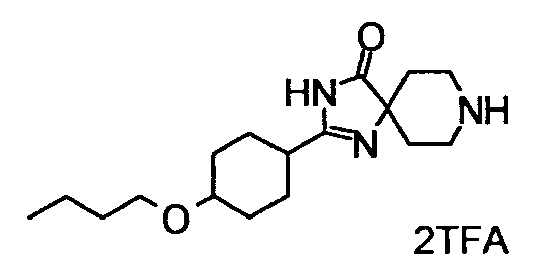
306 (M-H)- 913 
306 (M-H)- 916 
1H-NMR (400MHz, CD3OD) δ 1.24-1.33 (2H, m), 1.56-1.64 (2H, m), 1.93-1.96 (4H, m), 2.06-2.13 (5H, m), 2.50-2.70(1 H, m), 3.34-3.42 (2H, m), 3.51-3.57 (2H, m), 5.61-5.70(1H, m), 5.96-6.25 (2H, m) - The carboxylic acid necessary for the synthesis of the spiroamine reagent used for Compound 910 (4-ethoxymethyl-cyclohexanecarboxylic acid) was synthesized by the method shown below.
-

- 4-Ethoxymethyl-cyclohexanecarboxylic acid was synthesized by operations similar to those in Reaction 20-2 and Reaction 95-18 using appropriate reagents and starting material. This was used as such in the next reaction.
- The carboxylic acid necessary for the synthesis of the spiroamine reagent used for Compound 911 (4-propoxy-cyclohexanecarboxylic acid) was synthesized by the method shown below.
- [2138]

- 4-Propoxy-cyclohexanecarboxylic acid was synthesized by operations similar to those in Reaction 20-2 and Reaction 95-18 using appropriate reagents and starting material. This was used as such in the next reaction.
- The carboxylic acid necessary for the synthesis of the spiroamine reagent used for Compound 912 (4-butoxy-cyclohexanecarboxylic acid) was synthesized by the method shown below.
-

- 4-Butoxy-cyclohexanecarboxylic acid was synthesized by operations similar to those in Reaction 20-2 and Reaction 95-18 using appropriate reagents and starting material. This was used as such in the next reaction.
- The carboxylic acid necessary for the synthesis of the spiroamine reagent used for Compound 913 (4-isopropoxymethyl-cyclohexanecarboxylic acid) was synthesized by the method shown below.
-

- 4-Isopropoxymethyl-cyclohexanecarboxylic acid, was synthesized by operations similar to those in Reaction 20-2 and Reaction 95-18 using appropriate reagents and starting material. This was used as such in the next reaction.
- The spiroamine reagent used in the synthesis of Compound 914 (2-[4-(3-fluoro-propoxy)-cyclohexyl]-1,3,8-triaza-spiro[4.5]dec-1-en-4-one ditrifluoroacetate) was synthesized by the following method.
-

- N,N-Dimethylformamide di-tert-butyl acetal (7.4 ml, 31 mmol) was added to a solution of trans-4-hydroxy-cyclohexanecarboxylic acid (1.484 g, 10.29 mmol) in toluene (8.5 ml), and the mixture was stirred at 80°C for 25 hours. The reaction mixture was diluted with ether, and the organic layer was sequentially washed with water, an aqueous sodium bicarbonate solution and saturated brine, dried over MgSO4 and concentrated under reduced pressure. The resulting residue was purified by silica gel column chromatography (hexane-ethyl acetate) to give trans-4-hydroxy-cyclohexanecarboxylic acid tert-butyl ester as a colorless solid (838 m, 41%).
1H-NMR (400 MHz, CDCl3) δ 1.28 (2H, m), 1.43 (9H, s), 1.45 (2H, m), 1.99 (4H, m), 2.14 (1H, m), 3.60 (1H, m). -

- cis-4-(3-Hydroxy-propoxy)-cyclohexanecarboxylic acid tert-butyl ester was obtained by operations similar to those in Reaction 20-2 and Reaction 39-2 using the compound obtained above and appropriate reagents.
1H-NMR (400 MHz, CDCl3) δ 1.43 (9H, s), 1.53 (2H, m), 1.62 (2H, m), 1.83 (6H, m), 2.25 (1H, m), 2.60 (1H, t, J = 5.4 Hz), 3.46 (1H, m), 3.61 (2H, t, J = 5.9 Hz), 3.79 (2H, q, J = 5.4 Hz) . -

- Deoxo-Fluor (5 mg, 0.02 mmol) was added to a solution of cis-4-(3-hydroxy-propoxy)-cyclohexanecarboxylic acid tert-butyl ester (3.9 mg, 0.015 mmol) in dichloromethane (0.1 ml), and the mixture was stirred at room temperature for two hours. An aqueous sodium bicarbonate solution was added to the reaction mixture, followed by extraction with dichloromethane. The organic layer was then dried over MgSO4 and concentrated under reduced pressure. The resulting residue was purified by silica gel column chromatography (hexane-ethyl acetate) to give cis-4-(3-fluoro-propoxy)-cyclohexanecarboxylic acid tert-butyl ester (3.1 mg, 79%).
1H-NMR (400 MHz, CDCl3) δ 1.44 (9H, s), 1.51 (2H, m), 1.60 (2H, m), 1.79 (2H, m), 1.94 (2H, m), 2.25 (1H, m), 2.60 (1H, t, J = 5.4 Hz), 3.43 (1H, m), 3.51 (2H, t, J = 6.1 Hz), 4.56 (2H, dt, J = 47.4, 5.9 Hz). -

- 2-[4-(3-Fluoro-propoxy)-cyclohexyl]-1,3,8-triaza-spiro[4.5]dec-1-en-4-one ditrifluoroacetate was synthesized by operations similar to those in Reaction 4-1 (further adding water), Reaction 10-14, Reaction 10-12 and Reaction 4-1 using appropriate reagents and starting material. This was used as such in the next reaction.
- The spiroamine reagent used in the synthesis of Compound 915 and shown below was synthesized by operations similar to those in Reaction 10-14, Reaction 10-12 and Reaction 4-1 using appropriate reagents and Compound 10ag as a starting material.
[Table 121] Target Compound Spiroamine reagent Spiroamine reagent 1H-NMR 915 
This was used as such in the next reaction. - The carboxylic acid necessary for the synthesis of the spiroamine reagent used for Compound 915 (4-(3-fluoro-propoxy)-cyclohexanecarboxylic acid) was synthesized by the method shown below.
-

- 4-(3-Fluoro-propoxy)-cyclohexanecarboxylic acid was synthesized by operations similar to those in Reaction 20-2, Reaction 39-2, Reaction 191-11 and Reaction 4-1 (further adding water) using appropriate reagents and starting material. This was used as such in the next reaction.
- The spiroamine reagent used in the synthesis of Compound 916 and shown below was synthesized by operations similar to those in Reaction 10-14, Reaction 1-4 and Reaction 4-1 using appropriate reagents and Compound 5a as a starting material.
[Table 122] Target Compound Spiroamine reagent Spiroamine reagent 1H-NMR 916 
1H-NMR (400MHz, CD3OD δ 1.24-1.33 (2H, m), 1.56-1.64 (2H, m), 1.93-1.96 (4H, m), 2.06-2.13 (5H, m), 2.50-2.70(1H, m), 3.34-3.42 (2H, m), 3.51-3.57 (2H, m), 5.61-5.70(1H, m), 5.96-6.25 (2H, m) - The carboxylic acid necessary for the synthesis of the spiroamine reagent used for Compound 916 (4-((E)-3,3-difluoro-propenyl)-cyclohexanecarboxylic acid) was synthesized by the method shown below.
-

- Potassium t-butoxide (68.3 mg, 609 µmol) was added to a solution of (1,3-dioxolan-2-ylmethyl)-triphenylphosphonium bromide (267 mg, 609 µmol) in THF (2.0 ml) at 0°C, and the mixture was stirred at 0°C for 1.5 hours in an N2 atmosphere. A solution of 4-formyl-cyclohexanecarboxylic acid benzyl ester (50.0 mg, 203 µmol) in THF (1.5 ml) was added to the reaction mixture at 0°C, and the mixture was stirred at room temperature for 1.5 hours. Thereafter, the reaction mixture was quenched by adding a saturated aqueous ammonium chloride solution at 0°C and then extracted with ethyl acetate three times. The organic layers were sequentially washed with H2O (x 2) and saturated brine, and then dried over MgSO4 and concentrated under reduced pressure. The residue was used in the next step without further purification.
-

- 1 N hydrochloric acid (406 µl, 406 µl) was added to a solution of the residue obtained in Reaction 191-14 in THF (2.0 ml) at 0°C, and the mixture was stirred at room temperature for 4.5 hours. The reaction solution was quenched by adding a saturated aqueous sodium bicarbonate solution at 0°C and then extracted with ethyl acetate three times. The organic layers were sequentially washed with H2O (x 2) and saturated brine, and then dried over MgSO4 and concentrated under reduced pressure. The residue was purified by column chromatography (hexane-ethyl acetate) to give 4-((E)-3-oxo-propenyl)-cyclohexanecarboxylic acid benzyl ester as a colorless oil (38.2 mg, 69%).
MS (ESI) m/z = 273 (M+H)+. -

- 4-((E)-3,3-Difluoro-propenyl)-cyclohexanecarboxylic acid benzyl ester was synthesized by operations similar to those in Reaction 191-11 using appropriate reagents and starting material.
1H-NMR (400 MHz, CDCl3) δ 1.46-1.52 (2H, m), 1.61-1.67 (3H, m), 1.88-2.30 (4H, m), 2.60-2.70 (1H, m), 5.58-5.64 (1H, m), 5.88-6.17 (2H, m). -

- 4-((E)-3,3-Difluoro-propenyl)-cyclohexanecarboxylic acid was synthesized by operations similar to those in Reaction 95-18 using appropriate reagents and starting material.
1H-NMR (400 MHz, CDCl3) δ 1.46-1.52 (2H, m), 1.61-1.67 (3H, m), 1.88-2.30 (4H, m), 2.60-2.70 (1H, m), 5.58-5.64 (1H, m), 5.88-6.17 (2H, m). -

- N-{4-[2-(2-Cycloheptyl-4-oxo-1,3,8-triaza-spiro[4.5]dec-1-ene-8-sulfonyl)-ethyl]-3-methyl-phenyl}-acetamide was synthesized by operations similar to those in Reaction 190-1 using appropriate reagents and starting material.
MS (ESI) m/z = 489 (M+H)+. - The example compounds shown below were synthesized by operations similar to those in Reaction 192-1 using appropriate reagents and starting materials.
-
[Table 123] Compound Structure LCMS condition Retention time (min) MS (m/z) 918 
LCMS-C-1 2.65 527 (M+H)+ 919 
LCMS-B-1 2.03 587 (M+H)+ - The spiroamine reagent used in the synthesis of Compound 918 (2-adamantan-1-yl-1,3,8-triaza-spiro[4.5]dec-1-en-4-one ditrifluoroacetate) was synthesized by the following method.
-

- 2-Adamantan-1-yl-1,3,8-triaza-spiro[4.5]dec-1-en-4-one ditrifluoroacetate was synthesized by operations similar to those in Reaction 10-14, Reaction 10-11, Reaction 10-12 and Reaction 4-1 using appropriate reagents and starting material.
MS (ESI) m/z = 288 (M+H)+. - The spiroamine reagent used in the synthesis of Compound 919 was synthesized by operations similar to those in Reaction 10-14, Reaction 1-4 and Reaction 4-1 using appropriate reagents and Compound 5a as a starting material.
[Table 124] Target Compound Spiroamine reagent Spiroamine reagent MS (m/z) 919 
348 (M+H)+ - The carboxylic acid necessary for the synthesis of the spiroamine reagent used for Compound 919 (4-(2,2,2-trifluoro-ethoxymethyl)-cyclohexanecarboxylic acid) was synthesized by the method shown below.
-

- 2,2,2-Trifluoro-ethanol (288 µL, 4.03 mmol) was added to a mixed solution of 4-hydroxymethyl-cyclohexanecarboxylic acid benzyl ester (100 mg, 0.403 mmol), 1,1'-azobis(N,N-dimethylformamide) (139 mg, 0.805 mmol) and tributyl-phosphine (199 µL, 0.805 mmol) in toluene (1.2 mL) at 0°C. The mixture was stirred at 65°C for 1.5 hours and then concentrated under reduced pressure. The resulting residue was purified by silica gel column chromatography to give 4-(2,2,2-trifluoro-ethoxymethyl)-cyclohexanecarboxylic acid benzyl ester as a colorless liquid (126 mg, 95%).
1H-NMR (400 MHz, CDCl3) δ 0.94-1.06 (0.4H, m), 1.23-1.47 (1.8H, m), 1.40-1.52 (0.4H, m), 1.55-1.68 (3.2H, m), 1.69-1.80 (0.8H, m), 1.82-1.91 (0.4H, m), 1.97-2.08 (2H, m), 2.25-2.34 (0.2H, m), 2.58-2.65 (0.8H, m) 3.41 (0.4H, d, J = 6.8 Hz), 3.43 (1.6H, d, J = 6.8 Hz), 3.78 (2H, q, J = 8.8 Hz), 5.11 (0.4H, s), 5.13 (1.6H, s), 7.29-7.40 (5H, m). -

- 4-(2,2,2-Trifluoro-ethoxymethyl)-cyclohexanecarboxylic acid was synthesized by operations similar to those in Reaction 18-2 using appropriate reagents and starting material.
1H-NMR (400 MHz, CDCl3) δ 0.96-2.23 (9H, m), 2.30-2.90 (1H, m), 3.37-3.49 (2H, m), 3.79 (2H, q, J = 8.8 Hz), 9.56 (1H, brs). -

- N-[4-(2-{2-[4-(4-Chloro-phenyl)-cyclohexyl]-4-oxo-1,3,8-triaza-spiro[4.5]dec-1-ene-8-sulfonyl}-ethyl)-3-methyl-phenyl]-acetamide was synthesized by operations similar to those in Reaction 5-4 using appropriate reagents and starting material.
MS (ESI) m/z = 586 (M+H)+. - The example compounds shown below were synthesized by operations similar to those in Reaction 193-1 using appropriate reagents and starting materials.
-
[Table 125] Compound Structure LCMS condition Retention time (min) MS (m/z) 921 
LCMS-B-1 1.79 587 (M+H)+ 922 
LCMS-C-1 2.53 557 (M+H)+ 923 
LCMS-C-1 2.78 517 (M+H)+ 924 
LCMS-C-1 2.48 489 (M+H)+ 925 
LCMS-C-1 2.63 503 (M+H)+ 926 
LCMS-C-1 2.85 531 (M+H)+ - The spiroamine reagents used in the synthesis of Compounds 920 and 921 and shown below were synthesized by operations similar to those in Reaction 10-14, Reaction 1-4 and Reaction 4-1 using appropriate reagents and Compound 5a as a starting material.
[Table 126] Target Compound Spiroamine reagent Spiroamine reagent MS(m/z) 920 
346 (M+H)+ 921 
348 (M+H)+ - The carboxylic acid necessary for the synthesis of the spiroamine reagent used for Compound 921 (4-(3,3,3-trifluoro-propoxy)-cyclohexanecarboxylic acid) was synthesized by the method shown below.
-

- 4-(3,3,3-Trifluoro-propoxy)-benzoic acid benzyl ester was synthesized by operations similar to those in Reaction 31-7 using appropriate reagents and starting material.
1H-NMR (400 MHz, CDCl3) δ 2.63 (2H, qt, J = 10.4, 6.8 Hz), 4.23 (2H, t, J = 6.0 Hz), 5.32 (2H, s), 6.90 (1H, d, J = 8.8 Hz), 7.30-7.43 (5H, m), 8.02 (1H, d, J = 8.8 Hz). -

- 10% Rh-C (14.7 mg) was added to a solution of 4-(3,3,3-trifluoro-propoxy)-benzoic acid benzyl ester (147.3 mg, 0.454 mmol) in iPrOH (1.5 mL). The hydrogen pressure was adjusted to 5 atm, and the mixture was then heated with stirring at 80°C overnight. The reaction mixture was filtered through celite, and the filtrate was then diluted with ethyl acetate. A saturated aqueous sodium bicarbonate solution was added, and the organic layer and the aqueous layer were separated. The aqueous layer was adjusted to pH 1 with 1 N hydrochloric acid and then extracted with ethyl acetate. The organic layers were sequentially washed with water and saturated brine, and then dried over anhydrous Na2SO4 and concentrated under reduced pressure to give 4-(3,3,3-trifluoro-propoxy)-cyclohexanecarboxylic acid as a colorless transparent oily substance (70.2 mg, 64%).
1H-NMR (400 MHz, CDCl3) δ 1.19-2.08 (8H, m), 2.27-2.43 (3H, m), 3.23 (0.2H, tt, J = 11.2, 4.0 Hz), 3.45-3.49 (0.8H, m), 3.59 (1.6H, t, J = 6.8 Hz), 3.66 (0.4H, t, J = 6.8 Hz). - The spiroamine reagent used in the synthesis of Compound 922 (2-[4-(2,2,2-trifluoro-ethyl)-cyclohexyl]-1,3,8-triaza-spiro[4.5]dec-1-en-4-one ditrifluoroacetate) was synthesized by the method shown below.
-

- DMF (10 mL) was added to a reaction vessel containing 4-formyl-benzoic acid methyl ester (501.1 mg, 3.053 mmol) and potassium acetate (15.0 mg, 0.153 mmol), and the mixture was cooled to 0°C. Trimethyl(trifluoromethyl)silane (0.96 mL, 6.105 mmol) was added dropwise and the mixture was stirred for 50 minutes. 2 N hydrochloric acid (10 mL) was then added to the reaction mixture, and the mixture was stirred at room temperature overnight and then diluted with ethyl acetate. A saturated aqueous sodium bicarbonate solution was added, and the organic layer and the aqueous layer were separated. The organic layer was sequentially washed with water and saturated brine, and then dried over anhydrous Na2SO4 and concentrated under reduced pressure. The resulting residue was purified by silica gel column chromatography to give 4-(2,2,2-trifluoro-1-hydroxy-ethyl)-benzoic acid methyl ester (680.8 mg, 95%) .
1H-NMR (400 MHz, CDCl3) δ 2.63 (1H, d, J = 5.2 Hz), 3.92 (3H, s), 5.06-5.12 (1H, m), 7.55 (2H, d, J = 8.4 Hz), 8.07 (2H, d, J = 8.4 Hz). -

- Toluene (26 mL) was added to a reaction vessel containing 4-(2,2,2-trifluoro-1-hydroxy-ethyl)-benzoic acid methyl ester (607.2 mg, 2.593 mmol), DMAP (633.6 mg, 5.186 mmol) and Molecular Sieve 4A (916.1 mg). Phenyl chlorothioxoformate (0.54 mL, 3.889 mmol) was added dropwise and the mixture was stirred overnight. The reaction mixture was filtered through celite, and the filtrate was then concentrated under reduced pressure. The resulting residue was purified by silica gel column chromatography to give 4-(2,2,2-trifluoro-1-phenoxythiocarbonyloxy-ethyl)-benzoic acid methyl ester as a colorless oily substance (900.5 mg, 94%).
1H-NMR (400 MHz, CDCl3) δ 3.93 (3H, s), 6.62 (1H, q, J = 6.4 Hz), 7.06-7.09 (2H, m), 7.27-7.31 (1H, m), 7.38-7.42 (2H, m), 7.60 (2H, d, J = 8.4 Hz), 8.11 (2H, d, J = 8.4 Hz). -

- 4-(2,2,2-Trifluoro-1-phenoxythiocarbonyloxy-ethyl)-benzoic acid methyl ester (462.8 mg, 1.25 mmol) and AIBN (41.0 mg, 0.25 mmol) were dissolved in ultrasonically degassed toluene (12.5 mL). Tri-n-butyltin hydride (0.50 mL, 1.874 mmol) was added and the mixture was heated with stirring at 80°C for two hours. The reaction solution was concentrated under reduced pressure, and the resulting residue was purified by silica gel column chromatography to give 4-(2,2,2-trifluoro-ethyl)-benzoic acid methyl ester as white crystals (254.6 mg, 93%).
1H-NMR (400 MHz, CDCl3) δ 3.41 (2H, q, J = 10.8 Hz), 3.91 (3H, s), 7.36 (2H, d, J = 8.4 Hz), 8.02 (2H, d, J = 8.4 Hz). -

- 4-(2,2,2-Trifluoro-ethyl)-cyclohexanecarboxylic acid was synthesized by operations similar to those in Reaction 95-18 and Reaction 193-3 using appropriate reagents and starting material.
1H-NMR (400 MHz, CDCl3) δ 1.03-2.08 (11H, m), 2.28 (0.33H, tt, J = 12.0, 3.2 Hz), 2.61-2.64 (0.66H, m). -

- 2-[4-(2,2,2-Trifluoro-ethyl)-cyclohexyl]-1,3,8-triaza-spiro[4.5]dec-1-en-4-one ditrifluoroacetate was synthesized by operations similar to those in Reaction 10-14, Reaction 10-8 and Reaction 4-1 using appropriate' reagents and starting material.
MS (ESI) m/z = 318 (M+H)+. - The spiroamine reagent used in the synthesis of Compound 923 and shown below was synthesized by operations similar to those in Reaction 10-14, Reaction 10-8 and Reaction 4-1 using appropriate reagents and Compound 5a as a starting material.
[Table 127] Target Compound Spiroamine reagent Spiroamine reagent MS (m/z) 923 
278 (M+H)+ - The carboxylic acid necessary for the synthesis of the spiroamine reagent used for Compound 923 (3-propyl-cyclohexanecarboxylic acid) was synthesized by the method shown below.
-

- A suspension solution of ethyltriphenylphosphonium bromide (1079.3 mg, 2.907 mmol) in THF (10 mL) was cooled to 0°C. LHMDS (2.781 mL, 2.781 mmol, 1.0 M in THF) was added dropwise, and the mixture was stirred for 30 minutes. A solution of 3-formyl-benzoic acid methyl ester (415.0 mg, 2.528 mmol) in THF (2.5 mL) was then added dropwise, and the mixture was stirred for 10 minutes and then stirred at room temperature overnight. The reaction mixture was quenched by adding a saturated aqueous ammonium chloride solution and then extracted with ethyl acetate. The organic layer was sequentially washed with water and saturated brine, and then dried over anhydrous Na2SO4 and concentrated under reduced pressure. The resulting residue was purified by silica gel column chromatography to give 3-propenyl-benzoic acid methyl ester as a yellow transparent oily substance (218.2 mg, 49%) .
1H-NMR (400 MHz, CDCl3) δ 1. 89-1. 92 (3H, m), 3.92 (1H, s), 3.93 (2H, s), 5.86 (0.66H, dq, J = 11.6, 7.2 Hz), 6.32 (0.33H, dq, J = 15.6, 6.4 Hz), 6.41-6.47 (1H, m), 7.34-7.43 (1H, m), 7.47-7.51 (1H, m), 7.84-7.90 (1H, m), 7.97-8.01 (1H, m). -

- 3-Propyl-cyclohexanecarboxylic acid was synthesized by operations similar to those in Reaction 95-18 and Reaction 193-3 using appropriate reagents and starting material.
1H-NMR (400 MHz, CDCl3) δ 0.80-2.05 (16H, m), 2.33 (0.6H, tt, J = 12.4, 3.2 Hz), 2.67-2.70 (0.4H, m). - The spiroamine reagent used in the synthesis of Compound 924 (2-(3-methyl-cyclohexyl)-1,3,8-triaza-spiro[4.5]dec-1-en-4-one ditrifluoroacetate) was synthesized by the method shown below.
-

- 2-(3-Methyl-cyclohexyl)-1,3,8-triaza-spiro[4.5]dec-1-en-4-one ditrifluoroacetate was synthesized by operations similar to those in Reaction 176-2, Reaction 10-8 and Reaction 4-1 using appropriate reagents and starting material.
MS (ESI) m/z = 250 (M+H)+. - The spiroamine reagents used in the synthesis of Compounds 925 and 926 and shown below were synthesized by operations similar to those in Reaction 10-14, Reaction 10-8 and Reaction 4-1 using appropriate reagents and starting materials.
[Table 128] Target Compound Spiroamine reagent Spiroamine reagent MS (m/z) 925 
264 (M+H)+ 926 
292 (M+H)+ - The carboxylic acid necessary for the synthesis of the spiroamine reagent used for Compound 926 (3,3,5,5-tetramethyl-cyclohexanecarboxylic acid) was synthesized by the method shown below.
-

- A solution of [1,3]dithian-2-yl-trimethyl-silane (566.4 mg, 2.944 mmol) in THF (6 mL) was cooled to 0°C. nBuLi (1.78 mL, 2.845 mmol, 1.6 M in n-hexane) was added dropwise and then the mixture was stirred for 10 minutes. The reaction solution was cooled to -78°C. A solution of 3,3,5,5-tetramethyl-cyclohexanone (302.7 mg, 1.962 mmol) in THF (2 mL) was then added dropwise, and the mixture was stirred for two hours. The reaction mixture was quenched by adding a saturated aqueous ammonium chloride solution and extracted with ethyl acetate. The organic layer was sequentially washed with water and saturated brine, and then dried over anhydrous Na2SO4 and concentrated under reduced pressure.
The resulting residue was dissolved in acetonitrile (2.1 mL). Water (0.52 mL) and trifluoroacetic acid (0.51 mL) were added and the mixture was heated with stirring at 65°C for three hours. The reaction solution was cooled to room temperature. A 30% aqueous hydrogen peroxide solution (3.2 mL) was then added and the mixture was heated with stirring at 80°C for one hour. The reaction solution was cooled to room temperature, and a 5 M aqueous sodium hydroxide solution (15.7 mL) was then added, followed by extraction with ether. A saturated aqueous sodium bicarbonate solution was added, and the organic layer and the aqueous layer were separated. The aqueous layer was adjusted to pH 1 with 2 N hydrochloric acid and then extracted with ethyl acetate. The organic layers were sequentially washed with water and saturated brine, and then dried over anhydrous Na2SO4 and concentrated under reduced pressure to give 3,3,5,5-tetramethyl-cyclohexanecarboxylic acid as a white powder (342.3 mg, 95% in two steps).
1H-NMR (400 MHz, CDCl3) δ 0.93 (6H, s), 1.01 (6H, s), 1.06-1.28 (4H, m), 1.68-1.71 (2H, m), 2.65 (1H, tt, J = 12.8, 3.2 Hz). -

- N-[4-(2-{2-[4-(2-Methoxy-ethyl)-cyclohexyl]-4-oxo-1,3,8-triaza-spiro[4.5]dec-1-ene-8-sulfonyl}-ethyl)-3-methyl-phenyl]-acetamide was synthesized by operations similar to those in Reaction 190-1 using appropriate reagents and starting material.
MS (ESI) m/z = 533 (M+H)+. -

- [3-Methyl-4-(2-{4-oxo-2-[4-(3,3,3-trifluoro-propyl)-cyclohexyl]-1,3,8-triaza-spiro[4.5]dec-1-ene-8-sulfonyl}-ethyl)-benzyl]-carbamic acid tert-butyl ester was synthesized by operations similar to those in Reaction 5-4 using appropriate reagents and starting material.
MS (ESI) m/z = 643 (M+H) +. -

- N-(2-Hydroxy-ethyl)-N-(3-methyl-4-{2-[4-oxo-2-(3-trifluoromethoxy-phenyl)-1,3,8-triaza-spiro[4.5]dec-1-ene-8-sulfonyl]-ethyl}-phenyl)-isobutylamide was synthesized by operations similar to those in Reaction 5-4, Reaction 96-16, Reaction 157-2, Reaction 105-2 and Reaction 39-2 using appropriate reagents and starting material.
MS (ESI) m/z = 625 (M+H)+. -

- 2-Hydroxy-N-(2-hydroxy-ethyl)-N-(3-methyl-4-{2-[4-oxo-2-(3-trifluoromethoxy-phenyl)-1,3,8-triaza-spiro[4.5]dec-1-ene-8-sulfonyl]-ethyl}-phenyl)-acetamide was synthesized by operations similar to those in Reaction 105-2, Reaction 39-2 and Reaction 12-5 using appropriate reagents and starting material.
MS (ESI) m/z = 613 (M+H)+. -

- 2-{2,6-Dimethyl-4-[methyl-(2,2,2-trifluoro-acetyl)-amino]-phenyl}-ethanesulfonyl chloride was synthesized by operations similar to those in Reaction 10-2, Reaction 4-1, Reaction 19-2, Reaction 10-3, Reaction 10-4 and Reaction 10-5 using appropriate reagents and starting material.
MS (ESI) m/z = 358 (M+H)+. -

- N-(3,5-Dimethyl-4-{2-[2-(4-methyl-cyclohexyl)-4-oxo-1,3,8-triaza-spiro[4.5]dec-1-ene-8-sulfonyl]-ethyl}-phenyl)-2,2,2-trifluoro-N-methyl-acetamide was synthesized by operations similar to those in Reaction 190-1 using appropriate reagents and starting material.
MS (ESI) m/z = 571 (M+H)+. -

- N-(3,5-Dimethyl-4-{2-[2-(3-methyl-cyclohexyl)-4-oxo-1,3,8-triaza-spiro[4.5]dec-1-ene-8-sulfonyl]-ethyl}-phenyl)-2,2,2-trifluoro-N-methyl-acetamide was synthesized by operations similar to those in Reaction 5-4 using appropriate reagents and starting material.
MS (ESI) m/z = 571 (M+H)+. - The example compound shown below was synthesized by operations similar to those in Reaction 199-1 using appropriate reagents and starting material.
-
[Table 129] Compound Structure LCMS condition Retention time (min) MS (m/z) 933 
LCMS-C-1 3.13 613 (M+H)+ -

- 1-{4-[2-(2-Cycloheptyl-4-oxo-1,3,8-triaza-spiro[4.5]dec-1-ene-8-sulfonyl)-ethyl]-3,5-dimethyl-phenyl}-1-methyl-urea was synthesized by operations similar to those in Reaction 5-4, Reaction 12-5 and Reaction 89-2 (using KOCN) using appropriate reagents and starting material.
MS (ESI) m/z = 518 (M+H)+. - The example compounds shown below were synthesized by operations similar to those in Reaction 200-1 using appropriate reagents and starting materials.
-
[Table 130] Compound Structure LCMS condition Retention time (min) MS (m/z) 935 
LCMS-A-1 2.35 582 (M+H)+ 938 
LCMS-C-1 2.70 532 (M+H)+ 941 
LCMS-F-1 0.93 554 (M+H)+ - The spiroamine reagent used in the synthesis of Compound 941 (6-(3-trifluoromethoxy-phenyl)-2,5,7-triaza-spiro[3.4]oct-5-en-8-one ditrifluoroacetate) was synthesized as follows.
-

- Diallylamine (0.31 ml, 2.5 mmol) and trimethylsilylnitrile (0.155 ml, 1.25 mmol) were added to a solution of 3-oxo-azetidine-1-carboxylic acid tert-butyl ester (171 mg, 1.00 mmol) in acetic acid (1.7 ml, 30 mmol), and the mixture was stirred at 60°C for four hours. A Saturated aqueous sodium bicarbonate solution (11.5 ml) was added to the reaction mixture, followed by extraction with ethyl acetate. The organic layer was then dried over MgSO4 and concentrated under reduced pressure. The resulting residue was purified by silica gel column chromatography (hexane-ethyl acetate) to give 3-cyano-3-diallylamino-azetidine-1-carboxylic acid tert-butyl ester (212 mg, 76%).
1H-NMR (400 MHz, CDCl3) δ 1.45 (9H, s), 3.10 (4H, d, J = 7.0 Hz), 4.01 (2H, d, J = 8.6 Hz), 4.09 (2H, d, J = 8.6 Hz), 5.19 (1H, d, J = 10.2 Hz), 5.30 (1H, d, J = 17.0 Hz), 5.82 (1H, m). -

1H-NMR (400 MHz, CDCl3) δ 1.44 (9H, s), 2.03 (2H, br), 3.88 (2H, d, J = 8.8 Hz), 4.34 (2H, d, J = 8.8 Hz). -

- 6-(3-Trifluoromethoxy-phenyl)-2,5,7-triaza-spiro[3.4]oct-5-en-8-one ditrifluoroacetate was synthesized by operations similar to those in Reaction 10-11, Reaction 10-14, Reaction 10-12 and Reaction 4-1 using appropriate reagents and starting material.
1H-NMR (400 MHz, CDCl3) δ 4.31 (2H, d, J = 12.0 Hz), 4.40 (2H, d, J = 12.0 Hz), 7.56 (1H, d, J = 8.2 Hz), 7.66 (1H, t, J = 8.2 Hz), 7.95 (1H, d, J = 8.2 Hz), 7.96 (1H, s). -

- A mixture of [4-(2-chlorosulfonyl-ethyl)-3,5-dimethyl-phenyl]-methyl-carbamic acid tert-butyl ester and [2-chloro-4-(2-chlorosulfonyl-ethyl)-3,5-dimethyl-phenyl]-methyl-carbamic acid tert-butyl ester was synthesized by operations similar to those in Reaction 10-2 (using RuPhos as a ligand), Reaction 10-3, Reaction 10-4 and Reaction 10-5 using appropriate reagents and starting material.
(R=H : R=C1 = 0.6 : 0.4)
1H-NMR (400 MHz, CDCl3) δ 1.32-1.54 (9H, m), 2.32-2.47 (6H, m), 3.08-3.25 (3H, m), 3.29-3.44 (2H, m), 3.60-3.74 (2H, m), 6.96 (1.6H, m). -

- 1-[3,5-Dimethyl-4-(2-{4-oxo-2-[4-(2,2,2-trifluoro-ethyl)-cyclohexyl]-1,3,8-triaza-spiro[4.5]dec-1-ene-8-sulfonyl}-ethyl)-phenyl]-1-methyl-urea
MS (ESI) m/z = 586 (M+H)+
and
1-[2-chloro-3,5-dimethyl-4-(2-{4-oxo-2-[4-(2,2,2-trifluoro-ethyl)-cyclohexyl]-1,3,8-triaza-spiro[4.5]dec-1-ene-8-sulfonyl}-ethyl)-phenyl]-1-methyl-urea
MS (ESI) m/z = 620 (M+H)+
were obtained by operations similar to those in Reaction 5-4, Reaction 4-1 and Reaction 89-2 (using KOCN) using the starting material obtained above and appropriate reagents. -

- 1-[3,5-Dimethyl-4-(2-{4-oxo-2-[4-(3,3,3-trifluoro-propylidene)-cyclohexyl]-1,3,8-triaza-spiro[4.5]dec-1-ene-8-sulfonyl}-ethyl)-phenyl]-1-methyl-urea was synthesized by operations similar to those in Reaction 5-4, Reaction 5-3 and Reaction 89-2 (using KOCN) using appropriate reagents and starting material.
MS (ESI) m/z = 598 (M+H)+. - The example compound shown below was synthesized by operations similar to those in Reaction 202-1 using appropriate reagents and starting material.
-
[Table 131] Compound Structure LCMS condition Retention time (min) MS (m/z) 940 
LCMS-B-1 1.91 580 (M+H)+ - The spiroamine reagent used in the synthesis of Compound 939 (2-[4-(3,3,3-trifluoro-propylidene)-cyclohexyl]-1,3,8-triaza-spiro[4.5]dec-1-en-4-one dihydrochloride) was synthesized as follows.
-

- 2-[4-(3,3,3-Trifluoro-propylidene)-cyclohexyl]-1,3,8-triaza-spiro[4.5]dec-1-en-4-one dihydrochloride was synthesized by operations similar to those in Reaction 10-14, Reaction 10-12 and Reaction 5-3 using appropriate reagents and starting material.
MS (ESI) m/z = 330 (M+H)+. - The spiroamine reagent used in the synthesis of Compound 940 and shown below was synthesized by operations similar to those in Reaction 10-14, Reaction 10-12 and Reaction 5-3 using appropriate reagents and Compound 10ag as a starting material.
[Table 132] Target Compound Spiroamine reagent Spiroamine reagent MS (m/z) 940 
312 (M+H)+ - The carboxylic acid derivative necessary for the synthesis of the spiroamine reagent used in the synthesis of Compound 940 (4-(3,3-difluoro-allyl)-cyclohexanecarboxylic acid) was synthesized in the following manner.
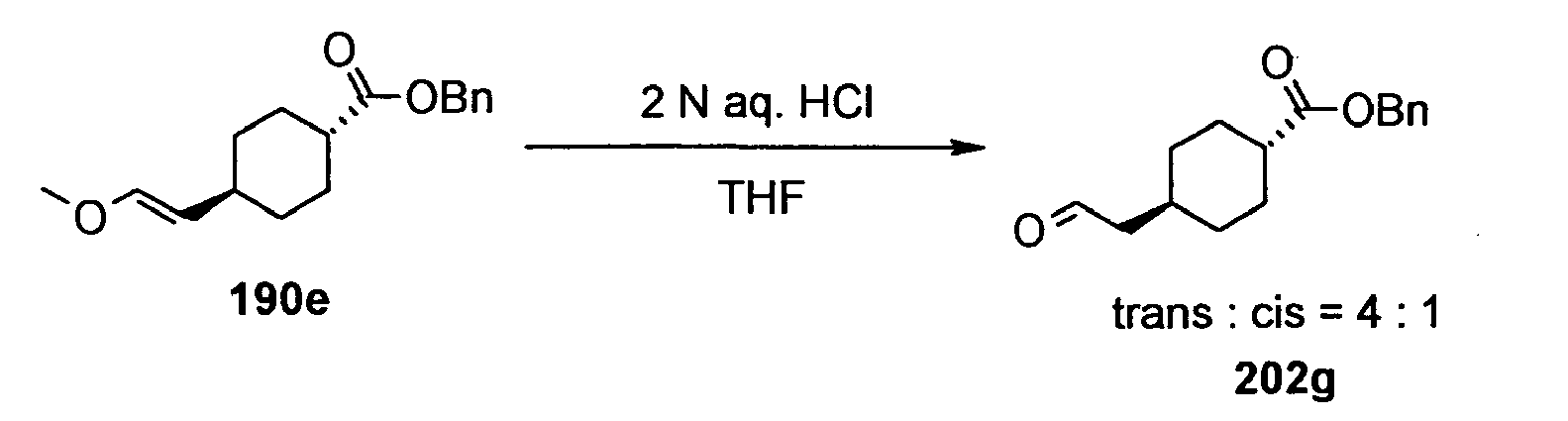
- 4-(2-Oxo-ethyl)-cyclohexanecarboxylic acid benzyl ester (trans:cis = 4:1) was synthesized by operations similar to those in Reaction 25-4 using appropriate reagents and starting material.
1H-NMR (400 MHz, CDCl3) δ 1.04 (1.6H, m), 1.30 (0.4H, m), 1.51 (1.6H, m), 1.62 (0.8H, m), 1.84 (1.6H, m), 1.89 (0.8H, m), 2.10 (2.2H, m), 2.32 (2.8H, m), 2.60 (0.2H, m), 5.11 (1.6H, s), 5.13 (0.4H, s), 7.35 (5H, m), 9.75 (0.2H, t, J = 2.0 Hz), 9.76 (0.8H, t, J = 2.0 Hz). -

- A solution of 4-(2-oxo-ethyl)-cyclohexanecarboxylic acid benzyl ester (trans:cis = 4:1) (21.4 mg, 0.082 mmol) in dimethylformamide (0.3 ml) was added to a solution of sodium chlorodifluoroacetate (34.1 mg, 0.224 mmol) and triphenylphosphine (59.9 mg, 0.228 mmol) in dimethylformamide (0.41 ml) at 90 to 95°C over five minutes, and the mixture was stirred at 130°C for four hours. Sodium chlorodifluoroacetate (34.0 mg, 0.22 mmol) was then added to the reaction mixture at the same temperature, and the mixture was further stirred for two hours. The reaction mixture was diluted with ether, and the organic layer was washed with water, dried over MgSO4 and concentrated under reduced pressure. The resulting residue was purified by silica gel column chromatography (hexane-ethyl acetate) to give 4-(3,3-difluoro-allyl)-cyclohexanecarboxylic acid benzyl ester (trans:cis = 4:1) (14.1 m, 58%).
1H-NMR (400 MHz, CDCl3) δ 0.95 (1.6H, m), 1.26 (0.4H, m), 1.44 (1.6H, m), 1.55 (0.8H, m), 1.81 (1.6H, m), 1.87 (2.2H, m), 2.20 (2 H, m), 2.28 (0.8H, m), 2.60 (0.2H, m), 4.09 (0.2H, dtd, J = 25.4, 8.3, 2.9 Hz), 4.12 (0.8H, dtd, J = 25.4, 7.8, 2.9 Hz), 5.11 (1.6H, s), 5.13 (0.4H, s), 7.34 (5H, m). -

- A 1 N aqueous NaOH solution (0.084 ml, 0.084 mmol) was added to a solution of 4-(3,3-difluoro-allyl)-cyclohexanecarboxylic acid benzyl ester (trans:cis = 4:1) (14.1 mg, 0.0478 mmol) in methanol (1.0 mL). The mixture was stirred at room temperature for 1.5 hours, and then adjusted to pH 6 with a 1 N aqueous HCl solution and concentrated under reduced pressure. The resulting residue was adjusted to pH 3 with dilute hydrochloric acid and extracted with dichloromethane, and the organic layer was dried over MgSO4 and concentrated under reduced pressure. The resulting residue was dissolved in THF (0.2 ml)-H2O (0.2 ml), and LiOH.H2O (7.7 mg, 0.18 mmol) was added. The mixture was stirred at room temperature for three hours, and then adjusted to pH 3 with a 1 N aqueous HCl solution and extracted with dichloromethane. The organic layer was then dried over MgSO4 and concentrated under reduced pressure. The resulting residue was purified by column chromatography (hexane-ethyl acetate) to give 4-(3,3-difluoro-allyl)-cyclohexanecarboxylic acid (8.3 g, 86%).
1H-NMR (400 MHz, CDCl3) δ 0.97 (1.8H, m), 1.27 (0.4H, m), 1.43 (1.8H, m), 1.58 (1H, m), 1.82 (2H, m), 1.88 (2H, m), 2.03 (2H, m), 2.25 (0.9H, m), 2.61 (0.1H, m), 4.13 (1H, dtd, J = 25.4, 7.8, 2.9 Hz). -

MS (ESI) m/z = 234 (M+H)+. -

- N-[4-(2-Bromo-1,1-difluoroethyl)-3-methylphenyl]-N-methylacetamide was synthesized by operations similar to those in Reaction 127-4 and Reaction 191-11 using appropriate reagents and starting material.
MS (ESI) m/z = 306, 308 (M+H)+. -

- t-Dodecanethiol (0.227 mL, 0.96 mmol) was added to a solution of potassium t-butoxide (108 mg, 0.96 mmol) in DMF (2 mL), and the mixture was stirred at room temperature. A solution of N-[4-(2-bromo-1,1-difluoroethyl)-3-methylphenyl]-N-methylacetamide (245 mg 0.800 mmol) in DMF (2 mL) was added to the mixture which was then stirred at room temperature for one hour. Saturated NH4Cl was added to the reaction mixture, followed by extraction with ethyl acetate. The organic layer was washed with saturated brine, and then dried over MgSO4 and concentrated under reduced pressure. The resulting residue was purified by silica gel column chromatography (hexane-ethyl acetate) to give N-{4-[2-(1,1-dimethyldecylsulfanyl)-1,1-difluoro-ethyl]-3-methylphenyl}-N-methylacetamide (287 mg, 84%).
MS (ESI) m/z = 428 (M+H)+. -

- 2 N HCl (0.4 mL) was added to a solution of N-{4-[2-(1,1-dimethyldecylsulfanyl)-1,1-difluoro-ethyl]-3-methylphenyl}-N-methylacetamide (102 mg, 0.239 mmol) in MeCN (1 mL) at 0°C. After stirring for five minutes, t-butyl hypochlorite (0.135 mL, 1.20 mmol) was added in small portions at -10°C. The mixture was stirred for 15 minutes, and saturated NH4Cl was then added, followed by extraction with ethyl acetate. The organic layer was washed with saturated brine. The organic layer was dried over MgSO4 and then concentrated under reduced pressure to give a mixture containing 2-[4-(acetylmethylamino)-2-methylphenyl]-2,2-difluoroethanesulfonyl chloride (121 mg).
1H-NMR (400 MHz, CDCl3) δ 7.72 (1H, s), 7.62 (1H, m), 7.30 (1H, m), 4.47-4.57 (2H, m), 3.18 (3H, s), 2.49-2.53 (3H, m), 1.80 and 1.82 (3H, s). -

- N-(4-{(E)-1-Fluoro-2-[2-(4-methyl-cyclohexyl)-4-oxo-1,3,8-triaza-spiro[4.5]dec-1-ene-8-sulfonyl]-vinyl}-3-methyl-phenyl)-N-methyl-acetamide was synthesized by operations similar to those in Reaction 6-1 using appropriate reagents and the starting material obtained above.
MS (ESI) m/z = 519 (M+H)+. -

- Potassium vinyltrifluoroborate (356 mg, 242 µmol), ethyldiisopropylamine (48 µL, 279 µmol) and [1,1'-bis(diphenylphosphino)ferrocene]dichloropalladium dichloromethane adduct (15.1 mg, 18.6 µmol) were added to a solution of 3-(4-bromo-3-methyl-phenyl)-imidazolidine-2,4-dione (50 mg, 186 µmol) in n-PrOH (372 µL) at room temperature in an N2 atmosphere. The mixture was stirred at 100°C for 1.5 hours, and the reaction solution was then cooled. The reaction solution was concentrated under reduced pressure. The resulting residue was purified by silica gel column chromatography (dichloromethane-methanol) to give 3-(3-methyl-4-vinyl-phenyl)-imidazolidine-2,4-dione as a yellow brown form (33 mg, 82%).
MS (ESI) m/z = 217 (M+H)+. -

- 2-[4-(2,5-Dioxo-imidazolidin-1-yl)-2-methyl-phenyl]-ethanesulfonyl chloride was synthesized by operations similar to those in Reaction 10-3, Reaction 10-4 and Reaction 10-5 using appropriate reagents and starting material.
MS (ESI) m/z = 317, 319 (M+H)+. -

- 3-[3-Methyl-4-(2-{4-oxo-2-[4-(3,3,3-trifluoro-propyl)-cyclohexyl]-1,3,8-triaza-spiro[4.5]dec-1-ene-8-sulfonyl}-ethyl)-phenyl]-imidazolidine-2,4-dione was synthesized by operations similar to those in Reaction 5-4 using appropriate reagents and the starting material obtained above.
MS (ESI) m/z = 612 (M+H)+. - The example compounds shown below were synthesized by operations similar to those in Reaction 204-3 using appropriate reagents and starting materials.
-
[Table 133] Compound Structure LCMS condition Retention time (min) MS (m/z) 944 
LCMS-F-1 0.95 626 (M+H)+ 945 
LCMS-F-1 0.85 592 (M+H)+ 946 
LCMS-B-1 1.85 592 (M+H)+ 947 
LCMS-F-1 0.84 584 (M+H)+ -
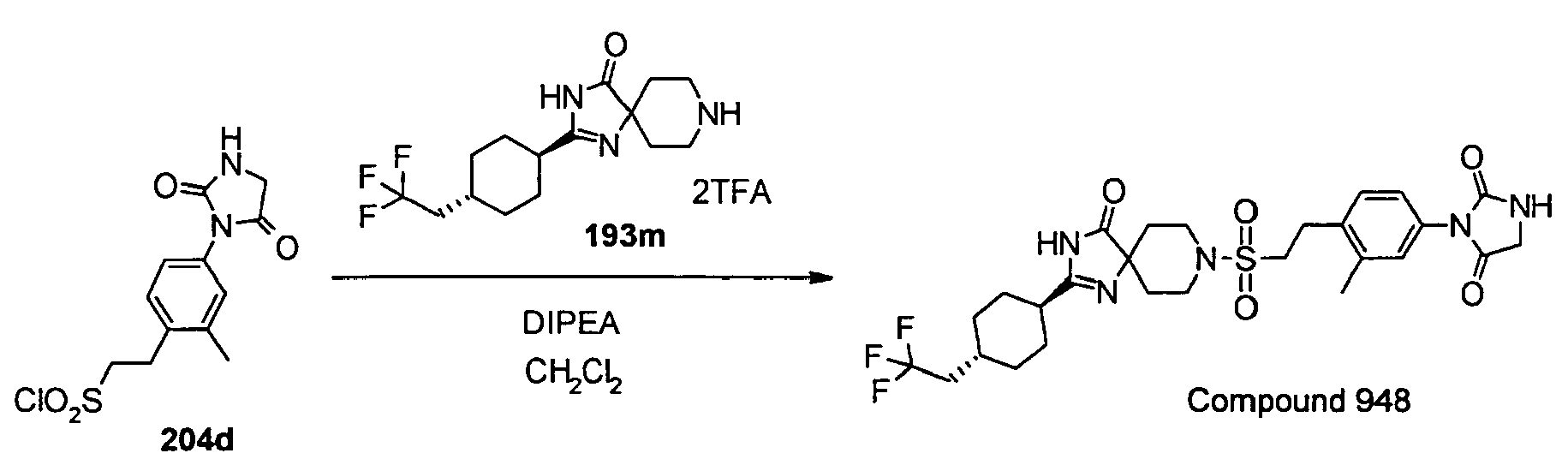
- 3-[3-Methyl-4-(2-{4-oxo-2-[4-(2,2,2-trifluoro-ethyl)-cyclohexyl]-1,3,8-triaza-spiro[4.5]dec-1-ene-8-sulfonyl}-ethyl)-phenyl]-imidazolidine-2,4-dione was synthesized by operations similar to those in Reaction 5-4 using appropriate reagents and starting material.
MS (ESI) m/z = 598 (M+H)+. - The example compounds shown below were synthesized by operations similar to those in Reaction 205-1 using appropriate reagents and starting materials.
-
[Table 134] Compound Structure LCMS condition Retention time (min) MS (m/z) 949 
LCMS-A-1 2.16 558 (M+H)+ 950 
LCMS-C-1 2.35 530 (M+H)+ 951 
LCMS-C-1 2.52 544 (M+H)+ 952 
LCMS-C-1 2.73 572 (M+H)+ -

- A sulfonyl chloride reagent (a mixture of 2-(4-acetylamino-5-chloro-2-methyl-phenyl)-ethanesulfonyl chloride and 2-(4-acetylamino-3-chloro-2-methyl-phenyl)-ethanesulfonyl chloride) was synthesized by operations similar to those in Reaction 10-5 using appropriate reagents and starting material.
MS (ESI) m/z = 310, 312, 314 (M+H)+. - [2362]

- N-(2-Chloro-4-{2-[2-(4-ethyl-cyclohexyl)-4-oxo-1,3,8-triaza-spiro[4.5]dec-1-ene-8-sulfonyl]-ethyl}-5-methyl-phenyl)-acetamide
MS (ESI) m/z = 537 (M+H)+
and
N-(2-chloro-4-{2-[2-(4-ethyl-cyclohexyl)-4-oxo-1,3,8-triaza-spiro[4.5]dec-1-ene-8-sulfonyl]-ethyl}-3-methylphenyl)-acetamide
MS (ESI) m/z = 537 (M+H)+
were obtained by operations similar to those in Reaction 5-4 using appropriate reagents and the starting material obtained above. -

- N-[4-(2-{2-[4-(3,3-Difluoro-propyl)-cyclohexyl]-4-oxo-1,3,8-triaza-spiro[4.5]dec-1-ene-8-sulfonyl}-ethyl)-3-methyl-phenyl]-acetamide (Compound 955) was obtained by operations similar to those in Reaction 18-2 using Compound as a starting material.
MS (ESI) m/z = 553 (M+H)+. - The example compound shown below was obtained by operations similar to those in Reaction 207-1 using an appropriate starting compound.
-
[Table 135] Raw material Compound Target Compound Structure LCMS condition Retention time (min) MS (m/z) 945 956 
LCMS-F-1 0.87 594 (M+H)+ -

- 2-(2-Cyclohexyl-4-oxo-1,3,8-triaza-spiro[4.5]dec-1-ene-8-sulfonyl)-N-phenyl-benzamide was synthesized by operations similar to those in Reaction 10-14 using appropriate reagents and starting material.
MS (ESI) m/z = 495 (M+H)+. -

- 8-(2-{2-Methyl-4-[4-(1-methyl-piperidin-4-yl)-piperazine-1-carbonyl]-phenyl}-ethanesulfonyl-2-(3-trifluoromethyl-phenyl)-1,3,8-triaza-spiro[4.5]dec-1-en-4-one was synthesized by operations similar to those in Reaction 10-14 using appropriate reagents and starting material.
MS (ESI) m/z = 689 (M+H)+. -
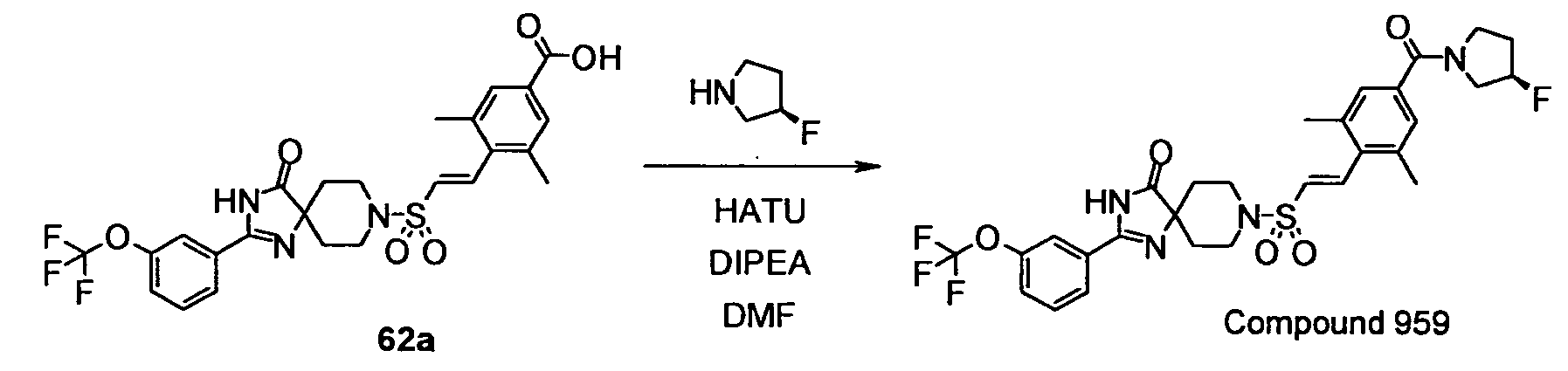
- 8-{(E)-2-[4-((R)-3-Fluoro-pyrrolidine-1-carbonyl)-2,6-dimethyl-phenyl]-ethenesulfonyl}-2-(3-trifluoromethoxy-phenyl)-1,3,8-triaza-spiro[4.5]dec-1-en-4-one was synthesized by operations similar to those in Reaction 10-14 using appropriate reagents and starting material.
MS (ESI) m/z = 623 (M+H)+. - The example compounds shown below were synthesized by operations similar to those in Reaction 210-1 using appropriate reagents and starting materials.
-
[Table 136] Compound Structure LCMS condition Retention time (min) MS (m/z) 960 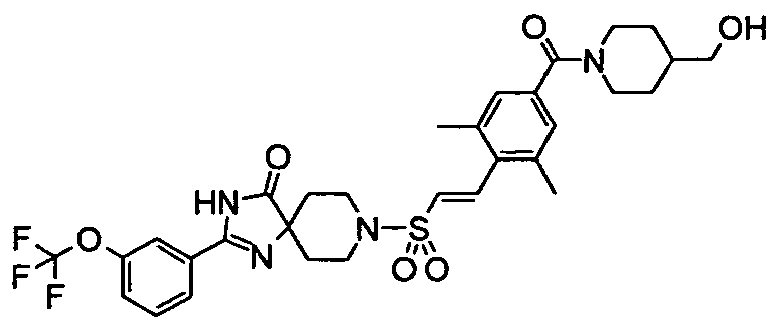
LCMS-B-1 2.15 649 (M+H)+ 961 
LCMS-C-1 2.72 579 (M+H)+ 962 
LCMS-C-1 2.62 551 (M+H)+ -

- 8-{(E)-2-[4-(3-Fluoro-azetidine-1-carbonyl)-2,6-dimethyl-phenyl]-ethenesulfonyl}-2-(3-trifluoromethoxy-phenyl)-1,3,8-triaza-spiro[4.5]dec-1-en-4-one was synthesized by operations similar to those in Reaction 10-14 and Reaction 25-15 using appropriate reagents and starting material.
MS (ESI) m/z = 609 (M+H)+. -

- 8-{2-[4-(4-Hydroxy-piperidine-1-carbonyl)-2,6-dimethyl-phenyl]-ethanesulfonyl}-2-(3-trifluoromethoxy-phenyl)-1,3,8-triaza-spiro[4.5]dec-1-en-4-one was synthesized by operations similar to those in Reaction 10-14 and Reaction 122-2 using appropriate reagents and starting material.
MS (ESI) m/z = 637 (M+H)+. - The example compounds shown below were synthesized by operations similar to those in Reaction 212-1 using appropriate reagents and starting materials.
-
[Table 137] Compound Structure LCMS condition Retention time (min) MS (m/z) 965 
LCMS-F-1 0.91 609 (M+H)+ 966 
LCMS-F-1 0.94 651 (M+H)+ -

- 4-{(E)-2-[2-(4-Fluoro-3-trifluoromethyl-phenyl)-4-oxo-1,3,8-triaza-spiro[4.5]dec-1-ene-8-sulfonyl]-vinyl}-3,5-dimethyl-benzoic acid was synthesized by operations similar to those in Reaction 26-1 using appropriate reagents and starting material.
MS (ESI) m/z = 554 (M+H)+. -

- 8-{(E)-2-[2,6-Dimethyl-4-(2-oxa-6-aza-spiro[3.3]heptane-6-carbonyl)-phenyl]-ethenesulfonyl}-2-(4-fluoro-3-trifluoromethyl-phenyl)-1,3,8-triaza-spiro[4.5]dec-1-en-4-one was synthesized by operations similar to those in Reaction 10-14 using appropriate reagents and starting material.
MS (ESI) m/z = 635 (M+H)+. -

- 8-{(E)-2-[2,6-Dimethyl-4-(3-oxo-piperazine-1-carbonyl)-phenyl]-ethenesulfonyl}-2-(4-fluoro-3-trifluoromethyl-phenyl)-1,3,8-triaza-spiro[4.5]dec-1-en-4-one was synthesized by operations similar to those in Reaction 10-18 using appropriate reagents and starting material.
MS (ESI) m/z = 636 (M+H)+. - The example compounds shown below were synthesized by operations similar to those in Reaction 214-1 using appropriate reagents and starting materials.
-
[Table 138] Compound Structure LCMS condition Retention time (min) MS (m/z) 969 
LCMS-C-1 2.67 650 (M+H)+ 970 
LCMS-C-1 2.67 623 (M+H)+ 971 
LCMS-C-1 2.55 667 (M+H)+ 972 
LCMS-G-1 1.10 635 (M+H)+ -

- 4-(2-{2-[4-(3,3-Difluoro-allyl)-cyclohexyl]-4-oxo-1,3,8-triaza-spiro[4.5]dec-1-ene-8-sulfonyl}-ethyl)-3-methyl-benzoic acid methyl ester was synthesized by operations similar to those in Reaction 5-4 using appropriate reagents and starting material.
MS (ESI) m/z = 552 (M+H)+. -

- Potassium t-butoxide (15.6 mg) was added to a solution of 4-(2-{2-[4-(3,3-difluoro-allyl)-cyclohexyl]-4-oxo-1,3,8-triaza-spiro[4.5]dec-1-ene-8-sulfonyl}-ethyl)-3-methyl-benzoic acid methyl ester (25.6 mg, 46.4 µmol) in t-butanol (464 µL) and tetrahydrofuran (464 µL), and the mixture was stirred at room temperature for two days. The reaction mixture was diluted with tert-butyl methyl ether and then adjusted to pH 1 with 2 N hydrochloric acid, followed by extraction with ethyl acetate. The organic layer was concentrated under reduced pressure, and the resulting residue was then dried to give 4-(2-{2-[4-(3,3-difluoro-allyl)-cyclohexyl]-4-oxo-1,3,8-triaza-spiro[4.5]dec-1-ene-8-sulfonyl}-ethyl)-3-methyl-benzoic acid (27.5 mg, 91%).
MS (ESI) m/z = 538 (M+H)+. -

- 2-[4-(3,3-Difluoro-allyl)-cyclohexyl]-8-{2-[4-(4-fluoro-4-hydroxymethyl-piperidine-1-carbonyl)-2-methylphenyl]-ethanesulfonyl}-1,3,8-triaza-spiro[4.5]dec-1-en-4-one was synthesized by operations similar to those in Reaction 10-14 using appropriate reagents and starting material.
MS (ESI) m/z = 653 (M+H)+. - The example compound shown below was synthesized by operations similar to those in Reaction 215-3 using appropriate reagents and starting material.
-
[Table 139] Compound Structure LCMS condition Retention time (min) MS (m/z) 974 
LCMS-B-1 1.93 653 (M+H)+ - The amine reagent used for Compound 973 ((4-fluoro-piperidin-4-yl)-methanol hydrochloride) was synthesized by the following method.
-

- 1-0xa-6-aza-spiro[2.5]octane-6-carboxylic acid tert-butyl ester (144 mg, 679 µmol), triethylamine (1.10 mL, 6.79 mmol) and triethylamine trihydrofluoride (2.85 mL, 20.4 mmol) were mixed in a sealed test tube. This mixture was stirred at 120°C for 6.5 hours. The reaction mixture was cooled, and then quenched with a 2 N aqueous NaOH solution and extracted with ethyl acetate three, times. The organic layers were combined, washed with saturated brine, dried over sodium sulfate and concentrated under reduced pressure. The resulting residue was purified by silica gel column chromatography (hexane-AcOEt) to give 4-fluoro-4-hydroxymethyl-piperidine-1-carboxylic acid tert-butyl ester (24.9 mg, 16%).
1H-NMR (400 MHz, CDCl3) δ 1.44-1.64 (2H, m), 1.82-1.96 (2H, m), 3.04-3.17 (2H, m), 3.61 (2H, d, J = 20.0 Hz),3.84-3.98 (2H, br-m). -

- A 4 N solution of hydrochloric acid in 1,4-dioxane (213 µL) was added to a solution of 4-fluoro-4-hydroxymethyl-piperidine-1-carboxylic acid tert-butyl ester (24.9 mg, 0.107 µmol) in MeOH (213 µL) at room temperature, and the mixture was stirred at room temperature for two hours. The reaction solution was concentrated under reduced pressure to give (4-fluoro-piperidin-4-yl)-methanol hydrochloride as a brown form (19.6 mg).
1H-NMR (400 MHz, CD3OD) δ 1.80-2.08 (2H, m), 2.10-2.20 (2H, m), 3.17-3.30 (2H, m), 3.30-3.45 (2H, m), 3.63 (2H, d, J = 19.6 Hz). - The sulfonyl chloride reagent used for Compound 973 (4-(2-chlorosulfonyl-ethyl)-3-methyl-benzoic acid methyl ester) was synthesized by the following method.
-

- 4-(2-Chlorosulfonyl-ethyl)-3-methyl-benzoic acid methyl ester was synthesized by operations similar to those in Reaction 10-2, Reaction 10-3, Reaction 10-4 and Reaction 10-5 using appropriate reagents and starting material.
MS (ESI) m/z = 299 (M+Na)+. -

- 4-{2-[2-(4-Ethyl-cyclohexyl)-4-oxo-1,3,8-triaza-spiro[4.5]dec-1-ene-8-sulfonyl]-ethyl}-3-methyl-benzoic acid was synthesized by operations similar to those in Reaction 5-4 and Reaction 95-18 using appropriate reagents and starting material.
MS (ESI) m/z = 490 (M+H)+. -

- 2-(4-Ethyl-cyclohexyl)-8-(2-{4-[4-(2-fluoro-ethyl)-piperazine-1-carbonyl]-2-methyl-phenyl}-ethanesulfonyl)-1,3,8-triaza-spiro[4.5]dec-1-en-4-one was synthesized by operations similar to those in Reaction 10-14 using appropriate reagents and starting material.
MS (ESI) m/z = 604 (M+H)+. - The example compound shown below was synthesized by operations similar to those in Reaction 216-2 using appropriate reagents and starting material.
-
[Table 140] Compound Structure LCMS condition Retention time (min) MS (m/z) 976 
LCMS-A-1 1.81 614 (M+H)+ - The amine reagent used for Compound 976 (1-oxetan-3-yl-piperazine) was synthesized by the following method.
-

- 1-Oxetan-3-yl-piperazine was synthesized by operations similar to those in Reaction 41-1 and Reaction 18-2 using appropriate reagents and starting material.
1H-NMR (400 MHz, CDCl3) δ 2.27 (4H, br s), 2.89-2.91 (4H, m), 3.42-3.48 (1H, m), 4.58-4.65 (4H, m). -

- 3-Methyl-4-[2-(2-nonyl-4-oxo-1,3,8-triaza-spiro[4.5]dec-1-ene-8-sulfonyl)-ethyl]-benzoic acid was synthesized by operations similar to those in Reaction 5-4 and Reaction 95-18 using appropriate reagents and starting material.
MS (ESI) m/z = 506 (M+H)+. -

- 8-{2-[2-Methyl-4-(pyrrolidine-1-carbonyl)-phenyl]-ethanesulfonyl}-2-nonyl-1,3,8-triaza-spiro[4.5]dec-1-en-4-one was synthesized by operations similar to those in Reaction 10-14 using appropriate reagents and starting material.
MS (ESI) m/z = 559 (M+H)+. - The example compounds shown below were synthesized by operations similar to those in Reaction 217-2 using appropriate reagents and starting materials.
-
[Table 141] Compound Structure LCMS condition Retention time (min) MS (m/z) 978 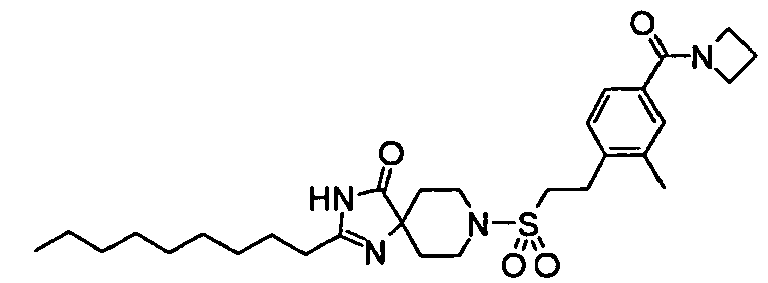
LCMS-A-1 2.47 545 (M+H)+ 979 
LCMS-A-1 2.29 575 (M+H)+ -

- 3,5-Dimethyl-4-[2-(2-nonyl-4-oxo-1,3,8-triaza-spiro[4.5]dec-1-ene-8-sulfonyl)-ethyl]-benzoic acid was synthesized by operations similar to those in Reaction 26-1 and Reaction 122-2 using appropriate reagents and starting material.
MS (ESI) m/z = 520 (M+H)+. -

- 8-{2-[2,6-Dimethyl-4-(pyrrolidine-1-carbonyl)-phenyl]-ethanesulfonyl}-2-nonyl-1,3,8-triaza-spiro[4.5]dec-1-en-4-one was synthesized by operations similar to those in Reaction 10-14 using appropriate reagents and starting material.
MS (ESI) m/z = 573 (M+H)+. - The example compounds shown below were synthesized by operations similar to those in Reaction 218-2 using appropriate reagents and starting materials.
-
[Table 142] Compound Structure LCMS condition Retention time (min) MS (m/z) 981 
LCMS-F-1 1.03 589 (M+H)+ 982 
LCMS-F-1 1.09 559 (M+H)+ 983 
LCMS-F-1 1.13 587 (M+H)+ 984 
LCMS-F-1 1.04 603 (M+H)+ 985 
LCMS-F-1 1.03 575 (M+H)+ 986 
LCMS-F-1 1.08 602 (M+H)+ -

- N,N-Dimethyl-2-(3-methyl-4-{(E)-2-[2-(4-methyl-cyclohexyl)-4-oxo-1,3,8-triaza-spiro[4.5]dec-1-ene-8-sulfonyl]-vinyl}-phenyl)-acetamide was synthesized by operations similar to those in Reaction 10-18 using appropriate reagents and starting material.
MS (ESI) m/z = 515 (M+H)+. - The example compound shown below was synthesized by operations similar to those in Reaction 219-1 using appropriate reagents and starting material.
-
[Table 143] Compound Structure LCMS condition Retention time (min) MS (m/z) 988 
LCMS-C-1 2.47 517 (M+H)+ -

- 3,5-Dimethyl-4-((E)-2-{4-oxo-2-[4-(3,3,3-trifluoro-propyl)-cyclohexyl]-1,3,8-triaza-spiro[4.5]dec-1-ene-8-sulfonyl}-vinyl)-benzoic acid was synthesized by operations similar to those in Reaction 25-2 using appropriate reagents and starting material.
MS (ESI) m/z = 570 (M+H)+. -

- 8-{(E)-2-[4-(4-Hydroxy-4-methyl-piperidine-1-carbonyl)-2,6-dimethyl-phenyl]-ethenesulfonyl}-2-[4-(3,3,3-trifluoro-propyl)-cyclohexyl]-1,3,8-triaza-spiro[4.5]dec-1-en-4-one was synthesized by operations similar to those in Reaction 10-14 using appropriate reagents and starting material.
MS (ESI) m/z = 667 (M+H)+. - The example compounds shown below were synthesized by operations similar to those in Reaction 220-2 using appropriate reagents and starting materials.
-
[Table 144] Compound Structure LCMS condition Retention time (min) MS (m/z) 990 
LCMS-D-1 2.28 685 (M+H)+ 991 
LCMS-D-1 1.60 652 (M+H)+ 992 
LCMS-D-1 2.57 625 (M+H)+ 993 
LCMS-D-1 1.88 727 (M+H)+ 994 
LCMS-D-1 1.87 597 (M+H)+ - The amine reagent used for Compound 993 ((R)-3-(piperidin-4-yloxy)-propane-1,2-diol hydrochloride) was synthesized by the following method.
-

- 4-((S)-2,2-Dimethyl-[1,3]dioxolan-4-ylmethoxy)-piperidine-1-carboxylic acid tert-butyl ester was synthesized by operations similar to those in Reaction 25-3 using appropriate reagents and starting material.
1H-NMR (CDCl3) δ 1.35 (s, 3H), 1.41 (s, 3H), 1.44 (s, 9H), 1.48-1.53 (m, 2H), 1.75-1.87 (m, 2H), 2.95-3.15 (m, 2H), 3.39-3.50 (m, 2H), 3.51-3.58 (m, 2H), 3.67-3.80 (m, 2H), 4.00-4.09 (m, 1H), 4.17-4.32 (m, 1H). -

- (R)-3-(Piperidin-4-yloxy)-propane-1,2-diol hydrochloride was synthesized by operations similar to those in Reaction 5-3 using appropriate reagents and starting material. This was used in the next reaction without purification.
-
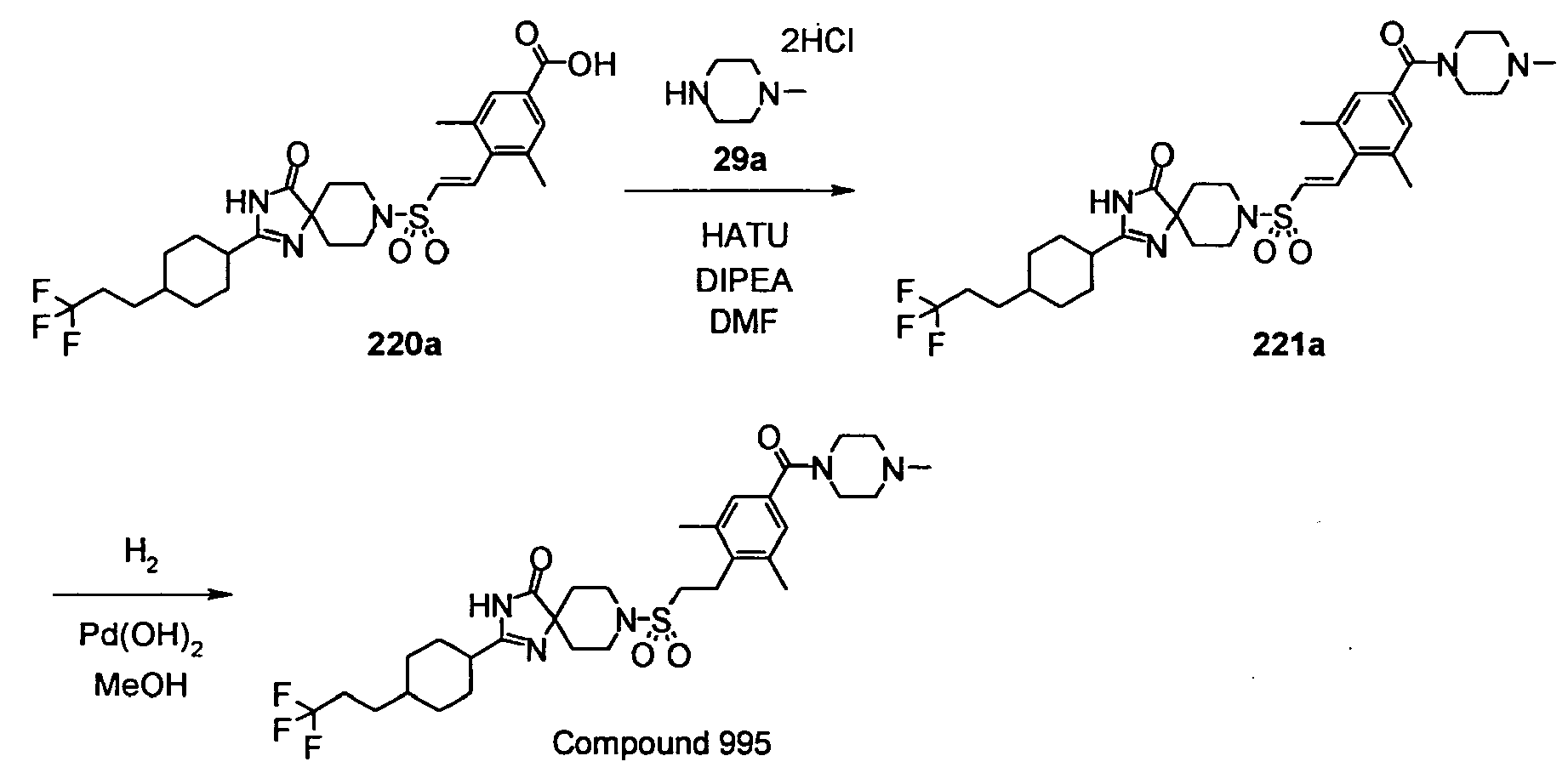
- 8-{2-[2,6-Dimethyl-4-(4-methyl-piperazine-1-carbonyl)-phenyl]-ethanesulfonyl}-2-[4-(3,3,3-trifluoro-propyl)-cyclohexyl]-1,3,8-triaza-spiro[4.5]dec-1-en-4-one was synthesized by operations similar to those in Reaction 10-14 and Reaction 122-2 using appropriate reagents and starting material.
MS (ESI) m/z = 654 (M+H)+. -

MS (ESI) m/z = 584 (M+H)+. - The example compound shown below was synthesized by operations similar to those in Reaction 222-1 using appropriate reagents and starting material.
-
[Table 145] Compound Structure LCMS condition Retention time (min) MS (m/z) 997 
LCMS-D-1 2.12 624 (M+H)+ -

- 3,5-Dimethyl-4-{(E)-2-[2-(4-methyl-cyclohexyl)-4-oxo-1,3,8-triaza-spiro[4.5]dec-1-ene-8-sulfonyl]-vinyl}-benzoic acid was synthesized by operations similar to those in Reaction 26-1 using appropriate reagents and starting material.
MS (ESI) m/z = 488 (M+H)+. -

- N-Methoxy-3,5.,N-trimethyl-4-{(E)-2-[2-(4-methyl-cyclohexyl)-4-oxo-1,3,8-triaza-spiro[4.5]dec-1-ene-8-sulfonyl]-vinyl}-benzamide was synthesized by operations similar to those in Reaction 10-14 using appropriate reagents and starting material.
MS (ESI) m/z = 531 (M+H)+. - The example compounds shown below were synthesized by operations similar to those in Reaction 223-2 using appropriate reagents and starting materials.
-
[Table 146] Compound Structure LCMS condition Retention time (min) MS (m/z) 999 
LCMS-D-1 1.99 585 (M+H)+ 1000 
LCMS-D-1 1.96 603 (M+H)+ 1001 
LCMS-D-1 2.48 543 (M+H)+ 1002 
LCMS-D-1 1.67 605 (M+H)+ 1003 
LCMS-D-1 1.91 515 (M+H)+ -

- 8-{2-[2,6-Dimethyl-4-(pyrazolidine-1-carbonyl)-phenyl]-ethanesulfonyl}-2-(4-methyl-cyclohexyl)-1,3,8-triaza-spiro[4.5]dec-1-en-4-one was synthesized by operations similar to those in Reaction 10-14, Reaction 122-2 and Reaction 4-1 using appropriate reagents and starting material.
MS (ESI) m/z = 544 (M+H)+. -

- 8-{(E)-2-[2,6-Dimethyl-4-(pyrazolidine-1-carbonyl)-phenyl]-ethenesulfonyl}-2-(4-methyl-cyclohexyl)-1,3,8-triaza-spiro[4.5]dec-1-en-4-one was synthesized by operations similar to those in Reaction 10-14 and Reaction 4-1 using appropriate reagents and starting material.
MS (ESI) m/z = 542 (M+H)+. -

- 4-[(E)-2-(2-Cyclohexyl-4-oxo-1,3,8-triaza-spiro[4.5]dec-1-ene-8-sulfonyl)-vinyl]-3,5-dimethyl-benzoic acid was synthesized by operations similar to those in Reaction 25-2 using appropriate reagents and starting material.
MS (ESI) m/z = 474 (M+H)+. -

- 2-Cyclohexyl-8-{(E)-2-[4-(4-hydroxy-4-trifluoromethyl-piperidine-1-carbonyl)-2,6-dimethyl-phenyl]-ethenesulfonyl}-1,3,8-triaza-spiro[4.5]dec-1-en-4-one was synthesized by operations similar to those in Reaction 10-14 using appropriate reagents and starting material.
MS (ESI) m/z = 625 (M+H)+. -

- DMT-MM (181 mg, 0.50 mmol) was added to a solution of 4-[(E)-2-(2-cyclohexyl-4-oxo-1,3,8-triaza-spiro[4.5]dec-1-ene-8-sulfonyl)-vinyl]-3,5-dimethyl-benzoic acid (160 mg, 0.33 mmol) in anhydrous ethanol (3.3 ml), and the mixture was stirred at room temperature for 15 hours. The mixture was concentrated under reduced pressure, and the resulting residue was then purified by silica gel column chromatography (dichloromethane-methanol) to give 4-[(E)-2-(2-cyclohexyl-4-oxo-1,3,8-triaza-spiro[4.5]dec-1-ene-8-sulfonyl)-vinyl]-3,5-dimethyl-benzoic acid 4,6-dimethoxy-[1,3,5]triazin-2-yl ester (109 mg, 53%).
MS (ESI) m/z = 613 (M+H)+. -

- Oxazolidin-2-one (47 mg, 0.53 mmol) was added to a solution of 4-[(E)-2-(2-cyclohexyl-4-oxo-1,3,8-triaza-spiro[4.5]dec-1-ene-8-sulfonyl)-vinyl]-3,5-dimethyl-benzoic acid 4,6-dimethoxy-[1,3,5]triazin-2-yl ester (109 mg, 0.17 mmol) and triethylamine (0.12 ml, 0.88 mmol) in anhydrous acetonitrile (1 ml), and the mixture was heated with stirring at 80°C for 15 hours. The mixture was cooled and water was then added, followed by extraction with ethyl acetate. The organic layer was washed with water and saturated brine, and then dried over anhydrous magnesium sulfate and concentrated under reduced pressure. The resulting residue was purified by silica gel column chromatography (dichloromethane-methanol) to give 2-cyclohexyl-8-{(E)-2-[2,6-dimethyl-4-(2-oxo-oxazolidine-3-carbonyl)-phenyl]-ethenesulfonyl}-1,3,8-triaza-spiro[4.5]dee-1-en-4-one (31 mg, 32%).
MS (ESI) m/z = 543 (M+H)+. -

- 4-{(E)-2-[2-(4-Butyl-cyclohexyl)-4-oxo-1,3,8-triaza-spiro[4.5]dec-1-ene-8-sulfonyl]-vinyl}-3,5-dimethyl-benzoic acid was synthesized by operations similar to those in Reaction 26-1 using appropriate reagents and starting material.
MS (ESI) m/z = 530 (M+H)+. -

- 2-(4-Butyl-cyclohexyl)-8-((E)-2-{4-[4-(2-hydroxy-ethoxy)-piperidine-1-carbonyl]-2,6-dimethyl-phenyl}-ethenesulfonyl)-1,3,8-triaza-spiro[4.5]dec-1-en-4-one was synthesized by operations similar to those in Reaction 10-14 using appropriate reagents and starting material.
MS (ESI) m/z = 657 (M+H)+. - The amine reagent used for Compound 1008 (2-(piperidin-4-yloxy)-ethanol hydrochloride) was synthesized by the following method.
-

- 2-(Piperidin-4-yloxy)-ethanol hydrochloride was synthesized by operations similar to those in Reaction 20-2 and Reaction 5-3 using appropriate reagents and starting material.
1H-NMR (300 MHz, DMSO-d6) δ 1.50-1.62 (m, 2H), 1.80-1.89 (m, 2H), 2.87-2.93 (m, 2H), 3.10-3.16 (m, 2H), 3.69-3.76 (m, 1H), 5.00 (s, 1H), 8.74-8.90 (m, 2H). - The example compound shown below was synthesized by operations similar to those in Reaction 228-2 using appropriate reagents and starting material.
-
[Table 147] Compound Structure LCMS condition Retention time (min) MS (m/z) 1009 
LCMS-D-1 2.42 701 (M+H)+ - The amine reagent used for Compound 1009 (2-[2-(piperidin-4-yloxy)-ethoxy]-ethanol hydrochloride) was synthesized by the following method.
-

- 4-{2-[2-(tert-Butyl-dimethyl-silanyloxy)-ethoxy]-ethoxy}-piperidine-1-carboxylic acid tert-butyl ester was synthesized by operations similar to those in Reaction 20-2 using appropriate reagents and starting material.
1H-NMR (300 MHz, CDCl3) δ 0.07 (s, 6H), 0.89 (s, 9H), 1.43-1.59 (m, 11H), 1.79-1.88 (m, 2H), 2.99-3.13 (m, 2H), 3.44-3.52 (m, 1H), 3.54-3.59 (m, 2H), 3.60-3.68 (s, 4H), 3.72-3.84 (m, 4H). -

- 2-[2-(Piperidin-4-yloxy)-ethoxy]-ethanol hydrochloride was synthesized by operations similar to those in Reaction 5-3 using appropriate reagents and starting material. This was used in the next reaction without purification.
-

- 3,5-Dimethyl-4-((E)-2-{4-oxo-2-[4-(9,9,9-trifluoro-nonyl)-cyclohexyl]-1,3,8-triaza-spiro[4.5]dec-1-ene-8-sulfonyl}-vinyl)-benzoic acid was synthesized by operations similar to those in Reaction 26-1 using appropriate reagents and starting material.
MS (ESI) m/z = 572 (M+H)+. -

- 8-((E)-2-{4-[4-((R)-2,3-Dihydroxy-propoxy)-piperidine-1-carbonyl]-2,6-dimethyl-phenyl}-ethenesulfonyl)-2-(9,9,9-trifluoro-nonyl)-1,3,8-triaza-spiro[4.5]dec-1-en-4-one was synthesized by operations similar to those in Reaction 10-14 using appropriate reagents and starting material.
MS (ESI) m/z = 729 (M+H)+. -

- 8-[(E)-2-(2,6-Dimethyl-4-methylamino-phenyl)-ethenesulfonyl]-2-(3-trifluoromethoxy-phenyl)-1,3,8-triaza-spiro[4.5]dec-1-en-4-one was synthesized by operations similar to those in Reaction 26-1 using appropriate reagents and starting material.
MS (ESI) m/z = 537 (M+H)+. -

- 2-Chloro-N-(3,5-dimethyl-4-{(E)-2-[4-oxo-2-(3-trifluoromethoxy-phenyl)-1,3,8-triaza-spiro[4.5]dec-1-ene-8-sulfonyl]-vinyl}-phenyl)-N-methyl-acetamide was synthesized by operations similar to those in Reaction 2-3 using appropriate reagents and starting material.
MS (ESI) m/z = 613 (M+H)+. -

- Ammonia (6 N solution in ethanol, 0.3 ml) was added to a solution of 2-chloro-N-(3,5-dimethyl-4-{(E)-2-[4-oxo-2-(3-trifluoromethoxy-phenyl)-1,3,8-triaza-spiro[4.5]dec-1-ene-8-sulfonyl]-vinyl}-phenyl)-N-methylacetamide (38 mg, 0.06 mmol) in anhydrous ethanol (0.5 ml), and the mixture was stirred at 50 to 60°C for five hours. The mixed solution was concentrated under reduced pressure, and the resulting residue was then purified by silica gel column chromatography (dichloromethane) to give 2-amino-N-(3,5-dimethyl-4-{(E)-2-[4-oxo-2-(3-trifluoromethoxy-phenyl)-1,3,8-triaza-spiro[4.5]dec-1-ene-8-sulfonyl]-vinyl}-phenyl)-N-methyl-acetamide (11 mg, 31%).
MS (ESI) m/z = 594 (M+H)+. -

- Phosgene (20% solution in toluene, 35 µL, 67 µmol) was added to a mixed solution of 8-[(E)-2-(2,6-dimethyl-4-methylamino-phenyl)-ethenesulfonyl]-2-(3-trifluoromethoxy-phenyl)-1,3,8-triaza-spiro[4.5]dec-1-en-4-one (30 mg, 56 µmol) and triethylamine (15 µL, 84 µmol) in dichloromethane (1.5 ml) and dimethylformamide (0.5 ml) at 0°C. The mixture was stirred at room temperature for three hours, and then quenched with water and extracted with ethyl acetate. The organic layer was sequentially washed with water and saturated brine, and then dried over anhydrous sodium sulfate and concentrated under reduced pressure. The resulting residue was purified by silica gel column chromatography (dichloromethane-ethyl acetate) to give N-(3,5-dimethyl-4-{(E)-2-[4-oxo-2-(3-trifluoromethoxy-phenyl)-1,3,8-\triaza-spiro[4.5]dec-1-ene-8-sulfonyl]-vinyl}-phenyl)-N-methyl-chloroformamide (28 mg, 85%).
MS (ESI) m/z = 599 (M+H)+. -
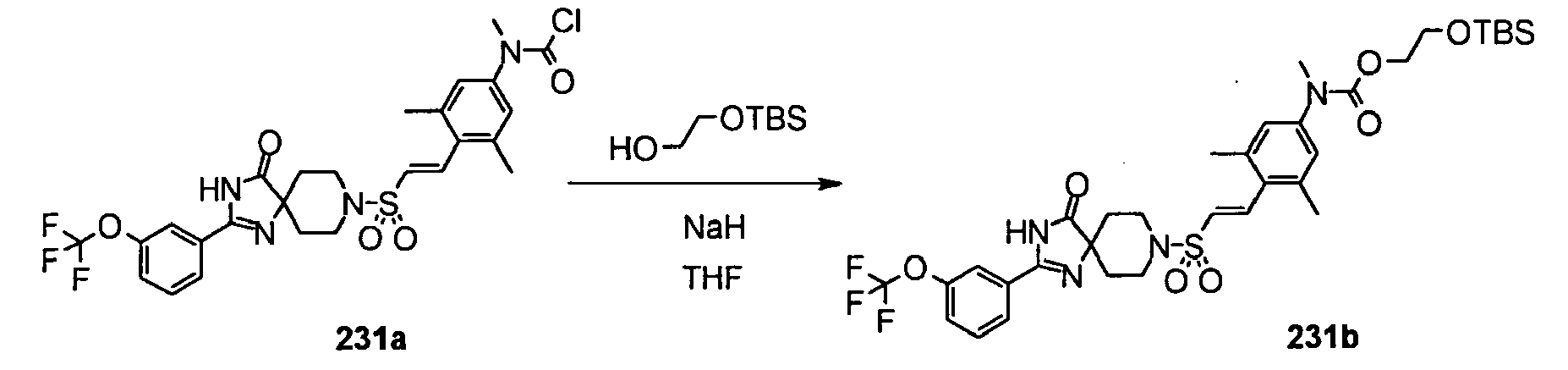
- Sodium hydride (60% oil suspension, 5.6 mg, 0.14 mmol) was added to a solution of N-(3,5-dimethyl-4-{(E)-2-[4-oxo-2-(3-trifluoromethoxy-phenyl)-1,3,8-triaza-spiro[4.5]dec-1-ene-8-sulfonyl]-vinyl}-phenyl)-N-methyl-chloroformamide (30 mg, 50.1 µmol) in tetrahydrofuran (1.0 ml) at 0°C, and the mixture was 201.20stirred for 15 minutes. 2-(tert-Butyl-dimethyl-silanyloxy)-ethanol (30 µL, 0.14 mmol) was then added and the mixture was stirred at 40°C for two hours. The mixture was cooled, and then quenched with water and extracted with ethyl acetate. The organic layer was sequentially washed with water and saturated brine, and then dried over anhydrous sodium sulfate and concentrated under reduced pressure. The resulting residue was purified by silica gel column chromatography (dichloromethane-ethyl acetate) to give (3,5-dimethyl-4-{(E)-2-[4-oxo-2-(3-trifluoromethoxy-phenyl)-1,3,8-triaza-spiro[4.5]dec-1-ene-8-sulfonyl]-vinyl}-phenyl)-methyl-carbamic acid 2-(tert-butyl-dimethyl-silanyloxy)-ethyl ester (29 mg, 78%).
MS (ESI) m/z = 739 (M+H)+. -

- (3,5-Dimethyl-4-{(E)-2-[4-oxo-2-(3-trifluoromethoxy-phenyl)-1,3,8-triaza-spiro[4.5]dec-1-ene-8-sulfonyl]-vinyl}-phenyl)-methyl-carbamic acid 2-hydroxy-ethyl ester was synthesized by operations similar to those in Reaction 39-2 using appropriate reagents and starting material.
MS (ESI) m/z = 625 (M+H)+. -

- 1-(3,5-Dimethyl-4-{(E)-2-[4-oxo-2-(3-trifluoromethoxy-phenyl)-1,3,8-triaza-spiro[4.5]dec-1--ene-8-sulfonyl]-vinyl}-phenyl)-1,3,3-trimethyl-urea was synthesized by operations similar to those in Reaction 231-2 using appropriate reagents and starting material.
MS (ESI) m/z = 608 (M+H)+. - The example compounds shown below were synthesized by operations similar to those in Reaction 232-1 using appropriate reagents and starting materials.
-
[Table 148] Compound Structure LCMS condition Retention time (min) MS (m/z) 1014 
LCMS-D-1 3.02 594 (M+H)+ 1015 
LCMS-D-1 2.92 580 (M+H)+ -

- {4-[(E)-2-(1,4-Dioxa-8-aza-spiro[4.5]decane-8-sulfonyl)-vinyl]-3,5-dimethyl-phenyl}-methyl-carbamic acid tert-butyl ester was synthesized by operations similar to those in Reaction 25-1 and Reaction 26-1 using appropriate reagents and starting material.
MS (ESI) m/z = 467 (M+H)+. -

- Trifluoroacetic acid (5.3 ml, 71.79 mmol) was added to a solution of {4-[(E)-2-(1,4-dioxa-8-aza-spiro[4.5]decane-8-sulfonyl)-vinyl]-3,5-dimethyl-phenyl}-methyl-carbamic acid tert-butyl ester (670 mg, 1.43 mmol) in acetone-water (8.0 ml-8.0 ml) at room temperature, and the mixture was heated with stirring at 50°C for 18 hours. The mixed reaction solution was cooled and then concentrated under reduced pressure. The residue was neutralized by adding a saturated aqueous sodium bicarbonate solution and extracted with ethyl acetate. The organic layer was sequentially washed with water and saturated brine, and then dried over Na2SO4 and concentrated under reduced pressure. The resulting residue was purified by silica gel column chromatography (ethyl acetate-hexane) to give 1-[(E)-2-(N,2,6-trimethylaniline)-ethenesulfonyl]-piperidin-4-one (364 mg, 78%).
MS (ESI) m/z = 323 (M+H)+. -

- Ammonium acetate (686 mg, 8.91 mmol) and potassium cyanide (541 mg, 8.31 mmol) were added to a solution of 1-[(E)-2-(2,6-dimethyl-4-methylamino-phenyl)-ethenesulfonyl]-piperidin-4-one (1.91 g, 5.94 mmol) in MeOH (20 ml), and the mixture was heated with stirring at 60°C for three hours. The mixed reaction solution was cooled and a saturated aqueous NaHCO3 solution was then added, followed by extraction with ethyl acetate. The organic layer was sequentially washed with water and saturated brine, and then dried over Na2SO4 and concentrated under reduced pressure. The resulting residue was triturated with hexane:CH2Cl2 = 7:3 to give 4-amino-1-[(E)-2-(2,6-dimethyl-4-methylamino-phenyl)-ethenesulfonyl]-piperidine-4-carbonitrile (1.86 g, 89%).
MS (ESI) m/z = 349 (M+H)+. -

- DMSO (0.9 ml, 12.8 mmol), a 1 N aqueous NaOH solution (1.06 ml, 1.06 mmol) and 30% aqueous hydrogen peroxide (0.72 ml, 6.40 mmol) were sequentially added to a solution of 4-amino-1-[(E)-2-(2,6-dimethyl-4-methylamino-phenyl)-ethenesulfonyl]-piperidine-4-carbonitrile (1.85 g, 5.33 mmol) in MeOH (30 ml) at 0°C, and the mixture was stirred at room temperature for 2.5 hours. A saturated Na2S2O3 solution was added to the reaction mixture, and the precipitated solid was obtained by suction filtration. The resulting solid was washed with water, dissolved in a CH2Cl2-MeOH (3:2) solution, dried over Na2SO4 and concentrated under reduced pressure. The resulting residue was triturated with hexane:CH2Cl2 = 4:1 to give 4-amino-1-[(E)-2-(2,6-dimethyl-4-methylaminophenyl)-ethenesulfonyl]-piperidine-4-carboxylic amide (1.36 g, 70%).
MS (ESI) m/z = 367 (M+H)+. -

- 8-[(E)-2-(2,6-Dimethyl-4-methylamino-phenyl)-ethenesulfonyl]-2-(3-trifluoromethylsulfanyl-phenyl)-1,3,8-triaza-spiro[4.5]dec-1-en-4-one was synthesized by operations similar to those in Reaction 10-14 and Reaction 189-5 using appropriate reagents and starting material.
MS (ESI) m/z = 553 (M+H)+. -
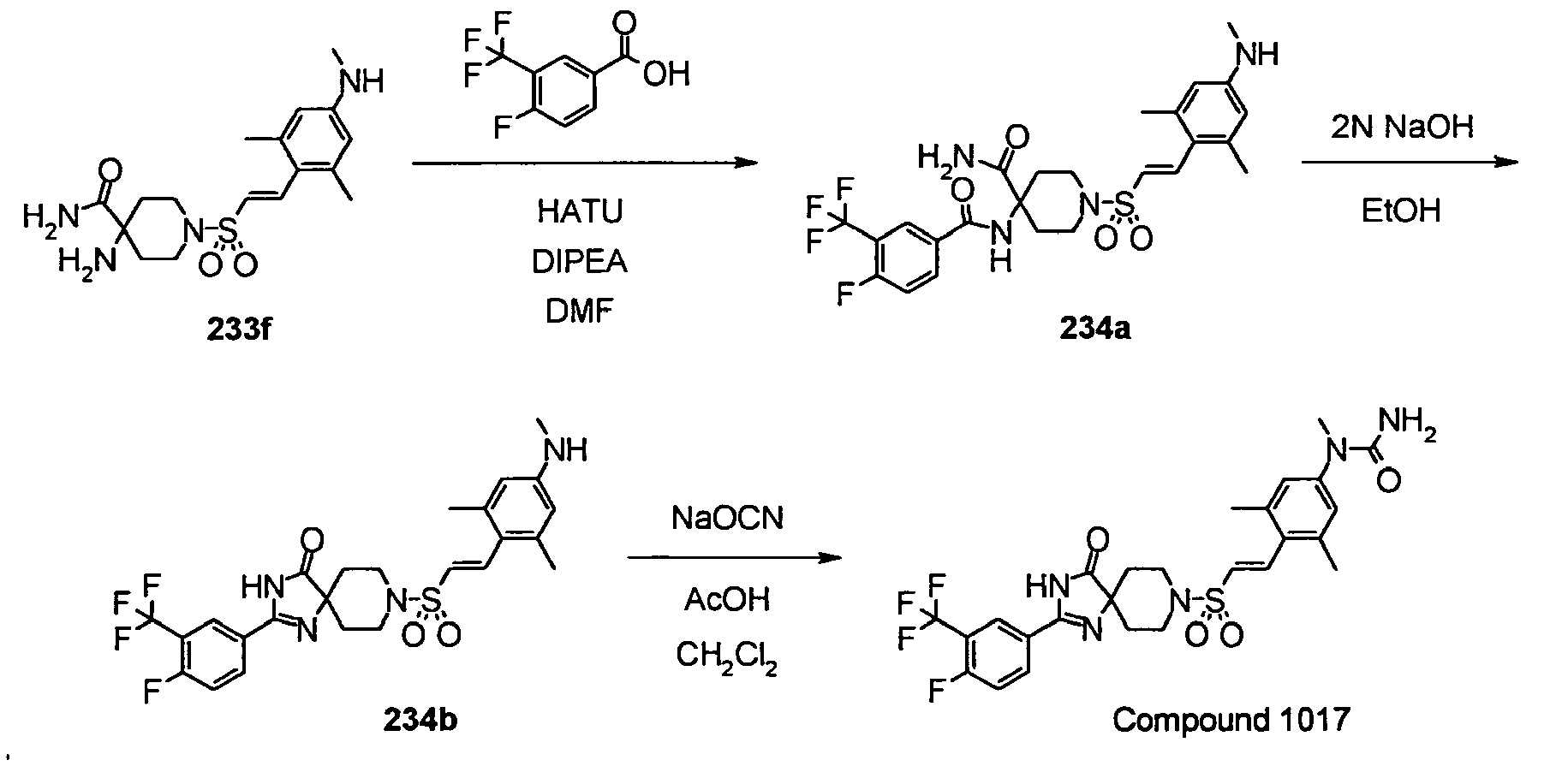
- 1-(4-{(E)-2-[2-(4-Fluoro-3-trifluoromethyl-phenyl)-4-oxo-1,3,8-triaza-spiro[4.5]dec-1-ene-8-sulfonyl]-vinyl}-3,5-dimethyl-phenyl)-1-methyl-urea was synthesized by operations similar to those in Reaction 10-14, Reaction 189-5 and Reaction 89-2 using appropriate reagents and starting material.
MS (ESI) m/z = 582 (M+H)+. - The example compounds shown below were synthesized by operations similar to those in Reaction 234-1 using appropriate reagents and starting materials.
-
[Table 149] Compound Structure LCMS condition Retention time (min) MS(m/z) 1018 
LCMS-F-1 0.95 612 (M+H)+ 1019 
LCMS-F-1 0.99 622 (M+H)+ 1020 
LCMS-F-1 0.97 622 (M+H)+ 1021 
LCMS-F-1 1.04 566 (M+H)+ - The carboxylic acid reagent used in the synthesis of Compound 1019 (3-(4,4,4-trifluoro-butoxy)-benzoic acid) was synthesized by the following method.
-

- 3-(4,4,4-Trifluoro-butoxy)-benzoic acid was synthesized by operations similar to those in Reaction 26-4 (using Cs2CO3 as a base) and Reaction 189-5 using appropriate reagents and starting material.
MS (ESI) m/z = 247 (M-H)-. - The carboxylic acid reagent used in the synthesis of Compound 1020 (4-(4,4,4-trifluoro-butoxy)-benzoic acid) was synthesized by the following method.
-
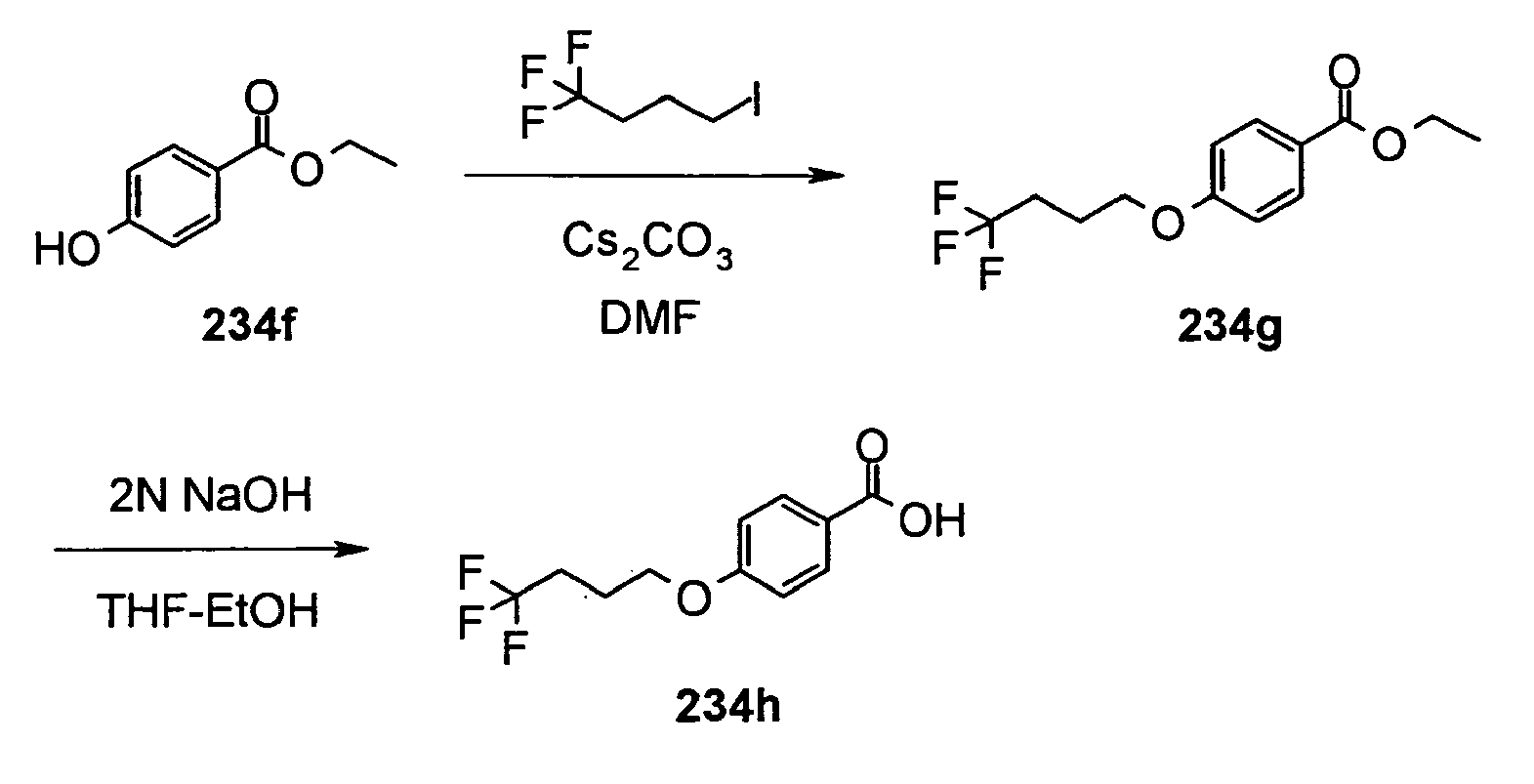
- 4-(4,4,4-Trifluoro-butoxy)-benzoic acid was synthesized by operations similar to those in Reaction 26-4 (using Cs2CO3 as a base) and Reaction 189-5 using appropriate reagents and starting material.
MS (ESI) m/z = 249 (M+H)+. -

- 1-(3,5-Dimethyl-4-{(E)-2-[2-(7-methylsulfanyl-heptyl)-4-oxo-1,3,8-triaza-spiro[4.5]dec-1-ene-8-sulfonyl]-vinyl}-phenyl)-1-methyl-urea was synthesized by operations similar to those in Reaction 10-14, Reaction 10-12 and Reaction 89-2 using appropriate reagents and starting material.
MS (ESI) m/z = 564 (M+H)+. - The carboxylic acid reagent used in the synthesis of Compound 1022 (8-(methylthio)octanoic acid) was synthesized by the following method.
-

- Sodium thiomethoxide (942 mg, 13.44 mmol) was added to a solution of 8-bromooctanoic acid (500 mg, 2.24 mmol) in methanol (5.6 mL), and the mixture was heated under reflux overnight. The reaction mixture was concentrated under reduced pressure, adjusted to pH 1 by adding 1 N hydrochloric acid and then extracted with ethyl acetate. The organic layer was washed with saturated brine, and then dried over MgSO4 and concentrated under reduced pressure. The resulting residue was purified by silica gel column chromatography (dichloromethane:methanol = 20:1) to give 8-(methylthio)octanoic acid as a colorless oily substance (426.5 mg, 100%).
1H-NMR (300 MHz, CDCl3) δ 1.31-1.41 (m, 6H), 1.54-1.66 (m, 4H), 2.09 (s, 3H), 2.35 (t, 2H, J = 7.2 Hz), 2.48 (t, 2H, J = 7.2 Hz). -

- 1-[(E)-2-(2,6-Dimethyl-4-methylamino-phenyl)-ethenesulfonyl]-4-[9-(3-methyl-oxetan-3-yl)-nonanoylamino]-piperidine-4-carboxylic amide was synthesized by operations similar to those in Reaction 10-14 using appropriate reagents and starting material. This was used in the next reaction without purification.
-

- LiOH·H2O (16.6 mg, 0.396 mmol) was added to a solution of 1-[(E)-2-(2,6-dimethyl-4-methylamino-phenyl)-ethenesulfonyl]-4-[9-(3-methyl-oxetan-3-yl)-nonanoylamino]-piperidine-4-carboxylic amide (96 mg, 0.098 mmol) in ethanol (1.0 mL), and the mixture was stirred at 50°C for two hours. A 50% saturated aqueous ammonium chloride solution was added to the reaction mixture, followed by extraction with ethyl acetate. The organic layer was then dried over MgSO4 and concentrated under reduced pressure. The resulting residue was purified by silica gel column chromatography (ethyl acetate) to give 8-[(E)-2-(2,6-Dimethyl-4-methylaminophenyl)-ethenesulfonyl]-2-[8-(3-methyl-oxetan-3-yl)-octyl]-1,3,8-triaza-spiro[4.5]dec-1-en-4-one (54.8 mg, 100%).
1H-NMR (400 MHz, CD3OD) δ 1.26 (3H, s), 1.34 (10H, m), 1.63 (6H, m), 1.95 (2H, m), 2.37 (6H, s), 2.44 (2H, m), 2.77 (3H, s), 3.15 (2H, m), 3.63 (2H, m), 4.31 (2H, d, J = 5.6 Hz), 4.40 (2H, d, J = 5.6 Hz), 6.34 (1H, d, J = 15.6 Hz), 6.34 (2H, s), 7.63 (1H, d, J = 15.6 Hz). -

- 1-[3,5-Dimethyl-4-((E)-2-{2-[8-(3-methyl-oxetan-3-yl)-octyl]-4-oxo-1,3,8-triaza-spiro[4.5]dec-1-ene-8-sulfonyl}-vinyl)-phenyl]-1-methyl-urea was synthesized by operations similar to those in Reaction 89-2 (using KOCN) using appropriate reagents and starting material.
MS (ESI) m/z = 602 (M+H)+. - The carboxylic acid reagent used in the synthesis of Compound 1023 (9-(3-methyl-oxetan-3-yl)-nonanoic acid) was synthesized by the following method.
-

- (9-Bromo-nonyloxymethyl)-benzene was synthesized by operations similar to those in Reaction 20-2 using appropriate reagents and starting material.
1H-NMR (400 MHz, CDCl3) δ 1.25-1.45 (10H, m), 1.61 (2H, m), 1.85 (2H, m), 3.40 (2H, t, J = 6.8 Hz), 3.46 (2H, t, J = 6.8 Hz), 4.50 (2H, s), 7.27-7.35 (5H, m). -

- Methyl-malonic acid diethyl ester (0.850 ml, 4.99 mmol) was added to a suspension of sodium hydride (55% oily suspension, 139.5 mg, 3.197 mmol) in THF (0.8 ml) over seven minutes under ice-cooling, and the mixture was stirred until foaming was terminated at room temperature (for about 25 minutes). A solution of (9-bromo-nonyloxymethyl)-benzene (593 mg, 1.89 mmol) in THF (0.12 ml) was added to the reaction solution at room temperature over 15 minutes, and the mixture was then stirred at 90°C for five hours. The reaction mixture was diluted with ether and water was then added, followed by extraction with ether. The organic layer was dried over MgSO4 and concentrated under reduced pressure. The resulting residue was purified by silica gel column chromatography (hexane/ethyl acetate = 30/1 -> 20/1) to give 2-(9-benzyloxy-nonyl)-2-methyl-malonic acid diethyl ester (735 mg, 96%).
1H-NMR (400 MHz, CDCl3) δ 1.24 (6H, t, J = 6.8 Hz), 1.27 (12H, m), 1.39 (3H, s), 1.60 (2H, m), 1.83 (2H, m), 3.46 (2H, t, J = 6.8 Hz), 4.20 (4H, m), 4.50 (2H, s), 7.27-7.34 (5H, m). -

- 2-(9-Benzyloxy-nonyl)-2-methyl-propane-1,3-diol was synthesized by operations similar to those in Reaction 95-28 using appropriate reagents and starting material. 1H-NMR (400 MHz, CDCl3) δ 0.82 (3H, s), 1.28 (14H, m), 1.61 (2H, m), 2.14 (2H, t, J = 4.2 Hz), 3.46 (2H, t, J = 6.6 Hz), 3.54 (4H, m), 4.50 (2H, s), 7.27-7.35 (5H, m).
-

- n-Butyllithium (2.6 M solution in hexane, 0.295 ml, 0.767 mmol) was added to a solution of 2-(9-benzyloxynonyl)-2-methyl-propane-1,3-diol (221 mg, 0.686 mmol) in THF (5.1 ml) at 0°C over three minutes, and the mixture was then stirred at the same temperature for 30 minutes. A solution of TsCl (138 mg, 0.723 mmol) in THF (0.91 ml) was added to the reaction solution at 0°C over eight minutes, and the mixture was then stirred at the same temperature for one hour. n-Butyllithium (2.6 M solution in hexane, 0.295 ml, 0.767 mmol) was added dropwise to the reaction mixture at 0°C, and the mixture was then stirred at 60°C for six hours. The reaction mixture was diluted with ether and water was then added, followed by extraction with ether. The organic layer was dried over MgSO4 and concentrated under reduced pressure. The resulting residue was purified by silica gel column chromatography (hexane/ethyl acetate = 15/1) to give 3-(9-benzyloxy-nonyl)-3-methyl-oxetane (188 mg, 90%).
1H-NMR (400 MHz, CDCl3) δ 1.27 (3H, s), 1.29 (12H, m), 1.61 (4H, m), 3.47 (2H, t, J = 6.6 Hz), 4.32 (2H, d, J = 5.4 Hz), 4.41 (2H, d, J = 5.4 Hz), 4.50 (2H, s), 7.27-7.35 (5H, m). -

- 9-(3-Methyl-oxetan-3-yl)-nonan-1-ol was synthesized by operations similar to those in Reaction 122-2 using appropriate reagents and starting material.
1H-NMR (400 MHz, CDCl3) δ 1.27 (3H, s), 1.29 (12H, m), 1.59 (4H, m), 3.64 (2H, t, J = 6.6 Hz), 4.33 (2H, d, J = 5.8 Hz), 4.41 (2H, d, J = 5.8 Hz) . -

- TEMPO (3.4 mg, 0.022 mmol) and iodobenzene diacetate (69.7 mg, 0.216 mmol) were added to a solution of 9-(3-methyl-oxetan-3-yl)-nonan-1-ol (21 mg, 0.098 mmol) in acetonitrile (0.2 ml)-water (0.1 ml) at room temperature, and the mixture was stirred at the same temperature for two hours. Water (0.1 ml) was then added to the reaction mixture at room temperature, and the mixture was stirred at the same temperature for one hour. A 10% aqueous citric acid solution (0.45 ml) was added to the reaction mixture, followed by extraction with ethyl acetate. The organic layer was sequentially washed with water, a 10% aqueous sodium thiosulfate solution and saturated brine, dried over MgSO4 and concentrated under reduced pressure to give 9-(3-methyl-oxetan-3-yl)-nonanoic acid (22 mg, 100%).
1H-NMR (400 MHz, CDCl3) δ 1.27 (3H, s), 1.31 (10H, m), 1.63 (4H, m), 2.35 (2H, t, J = 7.6 Hz), 4.33 (2H, d, J = 5.4 Hz), 4.42 (2H, d, J = 5.4 Hz). - The example compounds shown below were synthesized by operations similar to those in Reaction 236-1, Reaction 236-2 and Reaction 236-3 using appropriate reagents and starting materials.
-
[Table 150] Compound Structure LCMS condition Retention time (min) MS (m/z) 1024 
LCMS-C-2 1.97 542 (M+H)+ 1025 
LCMS-F-1 1.01 542 (M+H)+ 1026 
LCMS-C-2 2.13 630 (M+H)+ 1027 
LCMS-C-2 2.22 540 (M-H)- - The carboxylic acid reagent used in the synthesis of Compound 1024 (dec-5-ynoic acid) was synthesized by the following method.
-
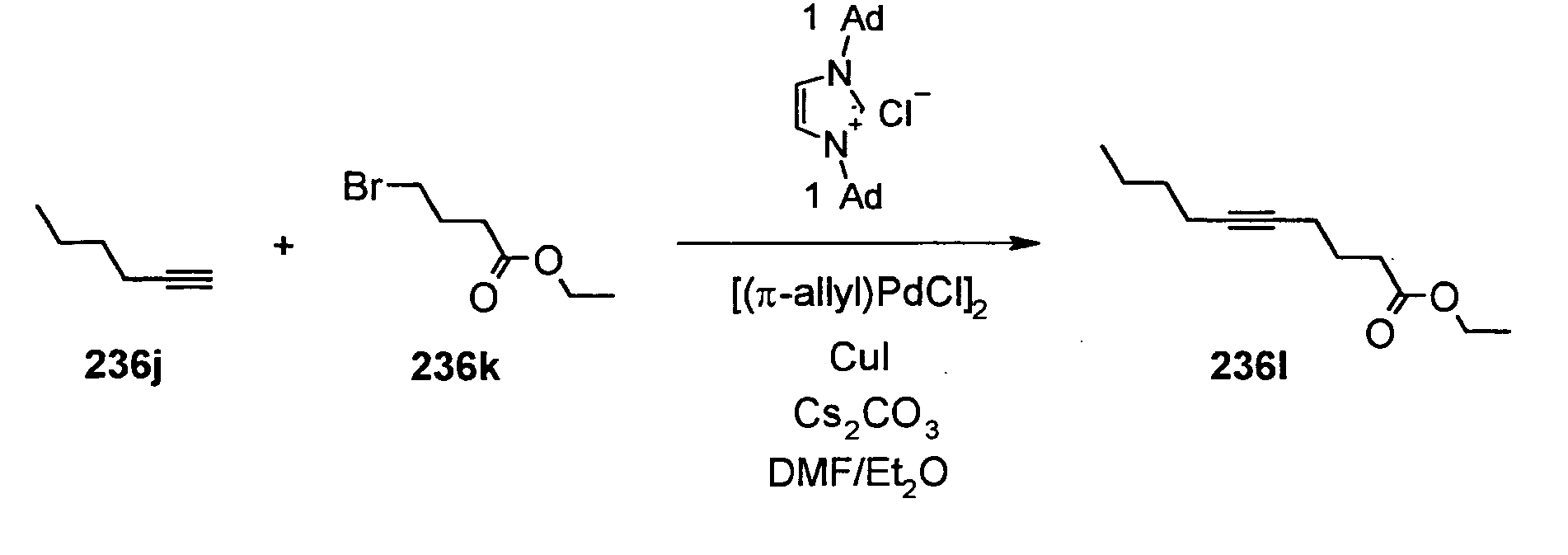
- 1-Hexyne (43 µl, 0.38 mmol) and ethyl 4-bromobutyrate (40 µl, 0.28 mmol) were added to a suspension of 1,3-bis(1-adamantyl)imidazolium chloride (5.2 mg, 0.014 mmol), copper iodide (4.1 mg, 0.022 mmol), allylpalladium(II) chloride dimer (2.6 mg, 0.071 mmol) and cesium carbonate (127 mg, 0.390 mmol) in anhydrous ether (0.37 ml)-anhydrous DMF (0.185 ml) at room temperature in a nitrogen stream, and the mixture was stirred at 45°C for 17 hours. The reaction mixture was extracted with pentane. The insoluble matter was removed by filtration, and the filtrate was then concentrated under reduced pressure. The resulting residue was purified by silica gel column chromatography (hexane/ether = 50/1) to give dec-5-ynoic acid ethyl ester (40 mg, 73%).
1H-NMR (400 MHz, CDCl3) δ 0.90 (3H, t, J = 7.2 Hz), 1.26 (3H, t, J = 7.2 Hz), 1.42 (4H, m), 1.80 (2H, m), 2.14 (2H, m), 2.22 (2H, m), 2.42 (2H, t, J = 7.6 Hz), 4.13 (2H, q, J = 7.2 Hz). -

- Dec-5-ynoic acid was synthesized by operations similar to those in Reaction 189-5 using appropriate reagents and starting material.
1H-NMR (400 MHz, CDCl3) δ 0.91 (3H, t, J = 7.2 Hz), 1.43 (4H, m), 1.82 (2H, m), 2.15 (2H, m), 2.25 (2H, m), 2.50 (2H, t, J = 7.2 Hz). - The carboxylic acid reagent used in the synthesis of Compound 1025 (dec-4-ynoic acid) was synthesized by the following method.
-

- Dec-4-ynoic acid was synthesized by operations similar to those in Example 236-10, Reaction 39-2 and Reaction 236-9 using appropriate reagents and starting material.
1H-NMR (400 MHz, CDCl3) δ 0.89 (3H, t, J = 6.8 Hz), 1.32 (4H, m), 1.47 (2H, m), 2.13 (2H, m), 2.49 (2H, m), 2.57 (2H, m). - The carboxylic acid reagent used in the synthesis of Compound 1026 (11-(3-methyl-oxetan-3-yl)-undecanoic acid) was synthesized by the following method.
-

- 11-(3-Methyl-oxetan-3-yl)-undecanoic acid was synthesized by operations similar to those in Reaction 20-2, Reaction 236-5, Reaction 95-28, Reaction 236-7, Reaction 122-2 and Reaction 236-9 using appropriate reagents and starting material.
1H-NMR (400 MHz, CDCl3) δ 1.27 (3H, s), 1.28 (14H, m), 1.62 (4H, m), 2.35 (2H, t, J = 7.6 Hz), 4.34 (2H, d, J = 5.6 Hz), 4.43 (2H, d, J = 5.6 Hz). - The carboxylic acid reagent used in the synthesis of Compound 1027 (dec-2-ynoic acid) was synthesized by the following method.
-

- Dec-2-ynoic acid was synthesized by operations similar to those in Reaction 236-9 using appropriate reagents and starting material.
1H-NMR (400 MHz, CDCl3) δ 0.88 (3H, t, J = 7.2 Hz), 1.28 (6H, m), 1.40 (2H, m), 1.59 (2H, m), 2.35 (2H, t, J = 7.2 Hz). -

- 1-(4-{2-[2-(4-Fluoro-3-trifluoromethoxy-phenyl)-4-oxo-1,3,8-triaza-spiro[4.5]dec-1-ene-8-sulfonyl]-ethyl}-3,5-dimethyl-phenyl)-1-methyl-urea was synthesized by operations similar to those in Reaction 10-14, Reaction 189-5, Reaction 89-2 and Reaction 184-1 using appropriate reagents and starting material.
MS (ESI) m/z = 600 (M+H)+. - The example compounds shown below were synthesized by operations similar to those in Reaction 237-1 using appropriate reagents and starting materials.
-
[Table 151] Compound Structure LCMS condition Retention time (min) MS (m/z) 1029 
LCMS-F-1 0.95 578 (M+H)+ 1030 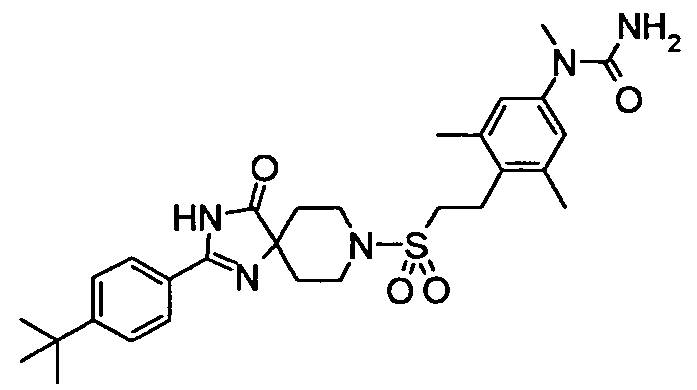
LCMS-F-1 0.99 554 (M+H)+ -

- 1-[3,5-Dimethyl-4-{2-12-[8-(3-methyl-oxetan-3-yl)-octyl]-4-oxo-1,3,8-triaza-spiro[4.5]dec-1-ene-8-sulfonyl}-ethyl)-phenyl]-1-methyl-urea was synthesized by operations similar to those in Reaction 184-1 using appropriate reagents and starting material.
MS (ESI) m/z = 604 (M+H)+. - The example compound shown below was synthesized by operations similar to those in Reaction 238-1 using appropriate reagents and starting material.
-
[Table 152] Compound Structure LCMS condition Retention time (min) MS(m/z) 1032 
LCMS-C-2 2.13 630 (M-H)- -

- {4-[2-(4-Amino-4-carbamoyl-piperidine-1-sulfonyl)-ethyl]-3,5-dimethyl-phenyl}-methyl-carbamic acid tert-butyl ester was synthesized by operations similar to those in Reaction 184-1, Reaction 233-2, Reaction 19-2, Reaction 233-3 and Reaction 233-4 using appropriate reagents and starting material.
MS (ESI) m/z = 469 (M+H)+. -

- 2-(8-{2-[4-(tert-Butoxycarbonyl-methyl-amino)-2,6-dimethyl-phenyl]-ethanesulfonyl}-4-oxo-1,3,8-triaza-spiro[4.5]dec-1-en-2-yl)-pyrrolidine-1-carboxylic acid tert-butyl ester was synthesized by operations similar to those in Reaction 10-14 and Reaction 189-5 using appropriate reagents and starting material.
MS (ESI) m/z = 648 (M+H)+. - The example compound shown below was synthesized by operations similar to those in Reaction 239-2 using appropriate reagents and starting material.
-
[Table 153] Compound Structure LCMS condition Retention time (min) MS (m/z) 1034 
LCMS-F-1 1.01 541 (M-H)- -

- 8-[2-(2,6-Dimethyl-4-methylamino-phenyl)-ethanesulfonyl]-2-(8,8,9,9,9-pentafluoro-nonyl)-1,3,8-triaza-spiro[4.5]dec-1-en-4-one was synthesized by operations similar to those in Reaction 10-14, Reaction 189-5 and Reaction 4-1 using appropriate reagents and starting material.
MS (ESI) m/z = 595 (M+H)+. - The example compound shown below was synthesized by operations similar to those in Reaction 240-1 using appropriate reagents and starting material.
-
[Table 154] Compound Structure LCMS condition Retention time (min) MS (m/z) 1036 
LCMS-C-1 2.93 555 (M+H)+ -

- (4-{2-[2-(4-Isopropylidene-cyclohexyl)-4-oxo-1,3,8-triaza-spiro[4.5]dec-1-ene-8-sulfonyl]-ethyl}-3,5-dimethyl-phenyl)-methyl-carbamic acid tert-butyl ester was synthesized by operations similar to those in Reaction 10-14 and Reaction 189-5 using appropriate reagents and starting material.
MS (ESI) m/z = 601 (M+H)+. -

- About 40 4AMS beads were added to a solution of (4-{2-[2-(4-isopropylidene-cyclohexyl)-4-oxo-1,3,8-triaza-spiro[4.5]dec-1-ene-8-sulfonyl]-ethyl}-3,5-dimethyl-phenyl)-methyl-carbamic acid tert-butyl ester (85.7 mg, 143 µmol) in dichloromethane (1.4 ml), and the mixture was stirred at room temperature for 10 minutes. Thereafter, BF3·Et2O (90.2 µl, 715 µmol) was added to the reaction mixture at 0°C, and the mixture was stirred at room temperature for three hours. The reaction mixture was quenched by adding triethylamine and diluted with ethyl acetate. The organic layer was then washed with a saturated aqueous sodium bicarbonate solution and water, and then dried over MgSO4 and concentrated under reduced pressure. The resulting residue was purified by silica gel column chromatography (dichloromethane/methanol = 100/0 -> 92/8) to give 8-[2-(2,6-dimethyl-4-methylaminophenyl)-ethanesulfonyl]-2-(4-isopropylidene-cyclohexyl)-1,3,8-triaza-spiro[4.5]dec-1-en-4-one (66.0 mg, 92%).
MS (ESI) m/z = 501 (M+H)+. - The carboxylic acid reagent used in the synthesis of Compound 1037 (4-isopropylidene-cyclohexanecarboxylic acid) was synthesized by the following method.
-

- 4-Isopropylidene-cyclohexanecarboxylic acid was synthesized by operations similar to those in Reaction 191-14 and Reaction 189-5 using appropriate reagents and starting material.
MS (ESI) m/z = 169 (M+H)+. -

- 1-[3,5-Dimethyl-4-(2-{4-oxo-2-[3-(1,1,2,2-tetrafluoro-ethoxy)-phenyl]-1,3,8-triaza-spiro[4.5]dec-1-ene-8-sulfonyl}-ethyl)-phenyl]-1-methyl-urea was synthesized by operations similar to those in Reaction 10-14, Reaction 189-5, Reaction 4-1 and Reaction 89-2 using appropriate reagents and starting material.
MS (ESI) m/z = 614 (M+H)+. -

- 1-(3,5-Dimethyl-4-12-[4-oxo-2-(5,6,7,8-tetrahydro-naphthalen-2-yl)-1,3,8-triaza-spiro[4.5]dec-1-ene-8-sulfonyl]-ethyl}-phenyl)-1-methyl-urea was synthesized by operations similar to those in Reaction 10-14, Reaction 236-2, Reaction 4-1 and Reaction 89-2 using appropriate reagents and starting material.
MS (ESI) m/z = 552 (M+H)+. - The example compounds shown below were synthesized by operations similar to those in Reaction 243-1 using appropriate reagents and starting materials.
-
[Table 155] Compound Structure LCMS condition Retention time (min) MS (m/z) 1040 
LCMS-A-1 2.06 532 (M+H)+ 1041 
LCMS-A-1 2.00 520 (M+H)+ 1042 
LCMS-A-1 2.26 636 (M+H)+ - The carboxylic acid reagent used in the synthesis of Compound 1042 (4-(2,2,3,3,3-pentafluoro-propyl)-cyclohexanecarboxylic acid) was synthesized by the following method.
-

- 4-(2,2,3,3,3-Pentafluoro-propyl)-cyclohexanecarboxylic acid was synthesized by operations similar to those in Reaction 193-4, Reaction 193-5, Reaction 193-6 and Reaction 95-18 using appropriate reagents and starting material.
1H-NMR (400 MHz, CDCl3) δ 2.64 (0.6H, qui, J = 4.9 Hz), 2.29 (0.4H, tt, J = 12.2, 3.4 Hz), 2.09-1.06 (11H, m). (cis/trans = ca 6 : 4) -

- 1-(3,5-Dimethyl-4-{2-[4-oxo-2-(6,6,7,7,7-pentafluoro-heptyl)-1,3,8-triaza-spiro[4.5]dec-1-ene-8-sulfonyl]-ethyl}-phenyl)-1-methyl-urea was synthesized by operations similar to those in Reaction 10-1, Reaction 10-12, Reaction 4-1 and Reaction 89-2 (using KOCN) using appropriate reagents and starting material.
MS (ESI) m/z = 610 (M+H)+. - The carboxylic acid reagent used in the synthesis of Compound 1043 (7,7,8,8,8-pentafluoro-octanoic acid) was synthesized by the following method.

- 7,7,8,8,8-Pentafluoro-octanoic acid was synthesized by operations similar to those in Reaction 18-2 using appropriate reagents and starting material.
1H-NMR (400 MHz, CDCl3) δ 1.42-1.48 (2H, m), 1.57-1.73 (4H, m), 2.03 (2H, tt, J = 6.8, 18.2 Hz), 2.39 (2H, t, J = 7.4 Hz). -

- N-(3,5-Dimethyl-4-{2-[4-oxo-2-(7,7,7-trifluoro-heptyl)-1,3,8-triaza-spiro[4.5]dec-1-ene-8-sulfonyl]-ethyl}-phenyl)-N-methyl-acetamide
MS (ESI) m/z = 573 (M+H)+
and
1-(3,5-dimethyl-4-{2-[4-oxo-2-(7,7,7-trifluoro-heptyl)-1,3,8-triaza-spiro[4.5]dec-1-ene-8-sulfonyl]-ethyl}-phenyl)-1-methyl-urea
MS (ESI) m/z = 574 (M+H)+
were synthesized by operations similar to those in Reaction 10-1, Reaction 10-12, Reaction 4-1 and Reaction 89-2 (using KOCN) using appropriate reagents and starting material. - The carboxylic acid reagent used in the synthesis of Compound 1044 and Compound 1045 (8,8,8-trifluoro-octanoic acid) was synthesized by the following method.
-
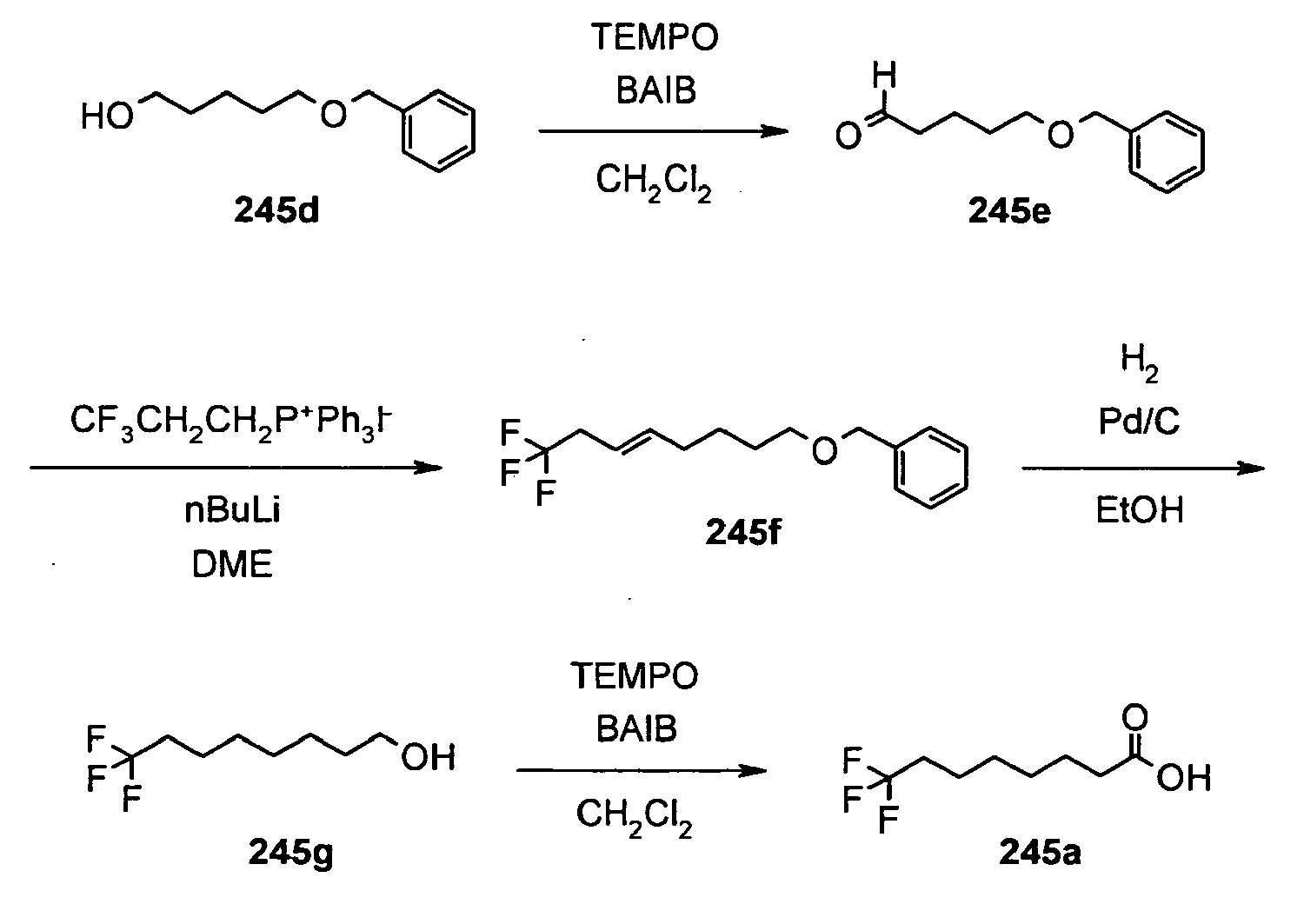
- 8,8,8-Trifluoro-octanoic acid was synthesized by operations similar to those in Reaction 109-1, Reaction 101-1, Reaction 18-2 and Reaction 109-1 using appropriate reagents and starting material.
1H-NMR (400 MHz, CDCl3) δ 1.32-1.46 (4H, br-m), 1.52-1.68 (2H, m), 1.66-1.72 (2H, m), 2.00-2.14 (2H, m), 2.38 (2H, t, J = 7.2 Hz). - The example compounds shown below were synthesized by operations similar to those in Reaction 245-1 using appropriate reagents and starting materials.
-
[Table 156] Compound Structure LCMS condition Retention time (min) MS (m/z) 1046 
LCMS-B-1 2.03 602 (M+H)+ 1047 
LCMS-B-1 2.16 601 (M+H)+ -

- 1-[3,5-Dimethyl-4-(2-{4-oxo-2-[1-(4,4,4-trifluorobutyl)-cyclopropyl]-1,3,8-triaza-spiro[4.5]dec-1-ene-8-sulfonyl}-ethyl)-phenyl]-1-methyl-urea was synthesized by operations similar to those in Reaction 10-14, Reaction 10-12, Reaction 4-1 and Reaction 89-2 (using KOCN) using appropriate reagents and starting material.
MS (ESI) m/z = 572 (M+H)+. -

- 1-(3,5-Dimethyl-4-{2-[4-oxo-2-(3-trifluoromethyl-cyclohexyl)-1,3,8-triaza-spiro[4.5]dec-1-ene-8-sulfonyl]-ethyll-phenyl)-1-methyl-urea was synthesized by operations similar to those in Reaction 10-14, Reaction 189-5, Reaction 5-3 and Reaction 89-2 using appropriate reagents and starting material.
MS (ESI) m/z = 572 (M+H)+. - The carboxylic acid reagent used in the synthesis of Compound 1050 (3-trifluoromethyl-cyclohexanecarboxylic acid) was synthesized by the following method.
-

- 3-Trifluoromethyl-cyclohexanecarboxylic acid was synthesized by operations similar to those in Reaction 193-3 using appropriate reagents and starting material.
1H-NMR (400 MHz, CDCl3) δ 1.22-2.40 (9.57H, m), 2.88 (0.43H, m) (cis : trans = 1.3 : 1) - The example compounds shown below were synthesized by operations similar to those in Reaction 247-1 using appropriate reagents and starting materials.
-
[Table 157] Compound Structure LCMS condition Retention time (min) MS (m/z) 1051 
LCMS-F-1 0.93 518 (M+H)+ 1052 
LCMS-F-1 0.87 516 (M+H)+ 1053 
LCMS-F-1 0.99 544 (M+H)+ 1054 
LCMS-F-1 0.93 530 (M+H)+ 1055 
LCMS-F-1 0.89 504 (M+H)+ 1056 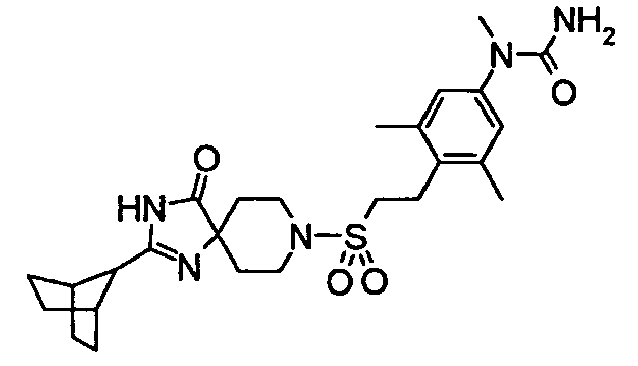
LCMS-F-1 0.91 516 (M+H)+ 1057 
LCMS-F-1 1.08 588 (M+H)+ 1058 
LCMS-F-1 0.94 530 (M+H)+ - The carboxylic acid reagent used in the synthesis of Compound 1051 (cis-3,4-dimethyl-cyclopentanecarboxylic acid) was synthesized by the following method.
-

- cis-3,4-Dimethyl-cyclopentanecarboxylic acid was synthesized by operations similar to those in Reaction 193-12 using appropriate reagents and starting material.
1H-NMR (400 MHz, CDCl3) δ 0.85 (3H, d, J = 7.0 Hz), 0.89 (3H, d, J = 7.0 Hz), 1.58-1.68 (2H, m), 2.00-2.15 (4H, m), 2.78 (0.4H, dd, J = 17.2, 8.8 Hz), 2.92-3.00 (0.6H, m) (cis : trans = 6 : 4). - The carboxylic acid reagent used in the synthesis of Compound 1052 (dicyclopropyl-acetic acid) was synthesized by the following method.
-
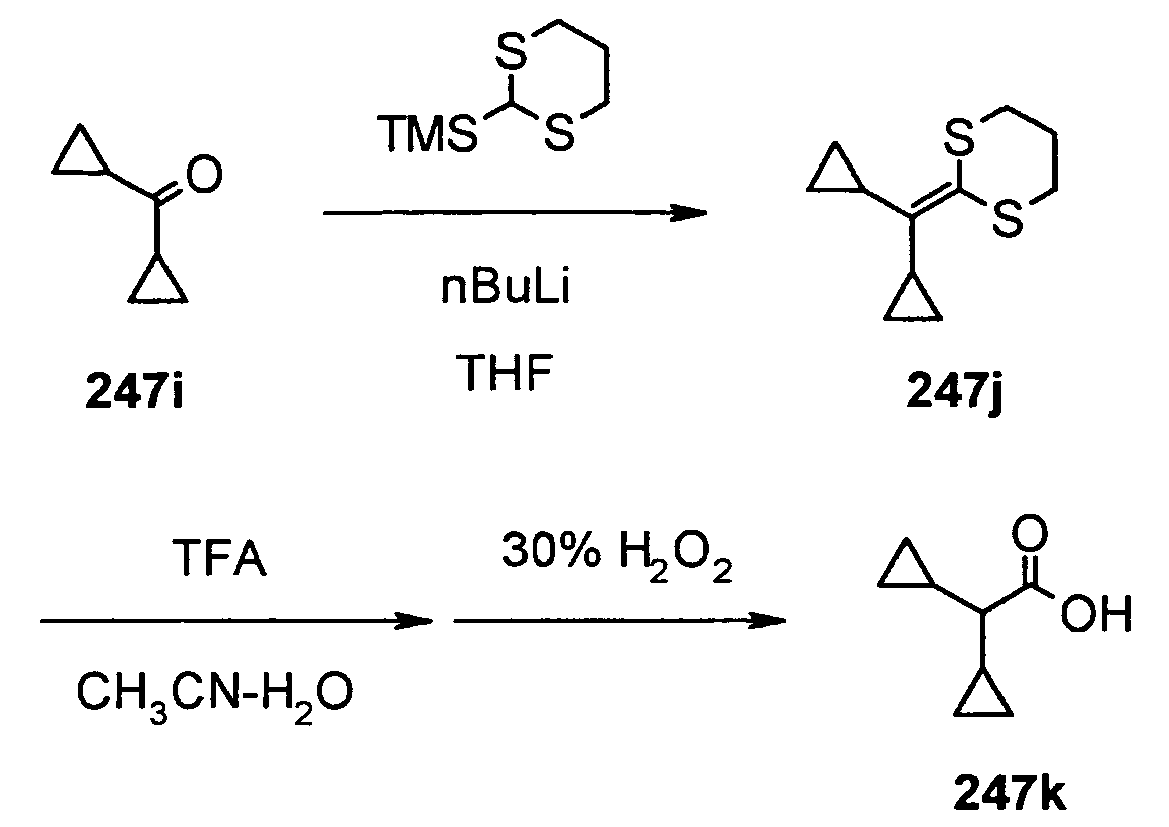
- Dicyclopropyl-acetic acid was synthesized by operations similar to those in Reaction 193-12 using appropriate reagents and starting material.
1H-NMR (400 MHz, CDCl3) δ0.24-0.33 (4H, m), 0.48-0.52 (2H, m), 0.58-0.62 (2H, m), 1.05-1.10 (3H, m). - The carboxylic acid reagent used in the synthesis of Compound 1053 (bicyclo[3.3.1]nonane-9-carboxylic acid) was synthesized by the following method.
-

- Bicyclo[3.3.1]nonane-9-carboxylic acid was synthesized by operations similar to those in Reaction 193-12 using appropriate reagents and starting material.
1H-NMR (400 MHz, CDCl3) δ1.48-1.63 (4H, m), 1.70-1.80 (2H, m), 1.83-1.96 (6H, m), 2.33 (2H, br), 2.46 (1H, br). - The carboxylic acid reagent used in the synthesis of Compound 1057 (2-hexyl-cyclohexanecarboxylic acid) was synthesized by the following method.
-

- 2-Hexyl-cyclohexanecarboxylic acid was synthesized by operations similar to those in Reaction 101-1, Reaction 95-18 and Reaction 193-3 using appropriate reagents and starting material.
1H-NMR (400 MHz, CDCl3) δ 0.88 (3H, t, J = 7.2 Hz), 1.20-1.55 (13H, m), 1.60-1.90 (6H, m), 2.56-2.59 (1H, m). - The carboxylic acid reagent used in the synthesis of Compound 1058 (spiro[2.5]octane-6-carboxylic acid) was synthesized by the following method.
-

- 4-Methylene-cyclohexanecarboxylic acid benzyl ester was synthesized by operations similar to those in Reaction 193-9 using appropriate reagents and starting material.
MS (ESI) m/z = 231 (M+H)+. -

- Et2Zn (1.08 M solution in hexane, 5.23 ml, 5.65 mmol) was added to a solution of 4-methylene-cyclohexanecarboxylic acid benzyl ester (86.3 mg, 375 µmol) in toluene (1.4 ml), and the mixture was stirred at room temperature for 30 minutes. CH2I2 (500 µl, 6.22 mmol) was added to the reaction mixture at 0°C, and the mixture was stirred at 60°C for 28 hours. Thereafter, Et2Zn (1.08 M solution in hexane, 2.60 ml, 2.22 mmol) and CH2I2 (260 µl, 3.23 mmol) were added to the reaction mixture, and the mixture was stirred at 60°C for four days. Further, Et2Zn (1.08 M solution in hexane, 2.60 ml, 2.22 mmol) and CH2I2 (500 µl, 6.22 mmol) were added to the reaction mixture, and the mixture was stirred at 60°C for one day. The reaction mixture was quenched by adding a 1% aqueous HCl solution and diluted with ethyl acetate and Et2O. The organic layer was then washed with a 1% aqueous HCl solution, a saturated aqueous sodium bicarbonate solution and saturated brine, and then dried over MgSO4 and concentrated under reduced pressure. The resulting residue was purified by silica gel column chromatography (hexane/ethyl acetate = 100/0 -> 65/35) to give spiro[2.5]octane-6-carboxylic acid benzyl ester (70.6 mg, 77%).
1H-NMR (400 MHz, CDCl3) δ 0.19-0.22 (2H, m), 0.26-0.30 (2H, m), 0.94-1.00 (2H, m), 1.60-1.72 (4H, m), 1.90-1.95 (2H, m), 2.37-2.42 (1H, m), 5.12 (2H, s), 7.30-7.38 (5H, m). -

- Spiro[2.5]octane-6-carboxylic acid was synthesized by operations similar to those in Reaction 95-18 using appropriate reagents and starting material.
1H-NMR (400 MHz, CDCl3) δ 0.19-0.24 (2H, m), 0.28-0.30 (2H, m), 0.97-1.03 (2H, m), 1.60-1.72 (4H, m), 1.92-1.95 (2H, m), 2.35-2.42 (1H, m). -

- 1-(4-{2-[2-(4-Difluoromethylene-cyclohexyl)-4-oxo-1,3,8-triaza-spiro[4.5]dec-1-ene-8-sulfonyl]-ethyl}-3,5-dimethyl-phenyl)-1-methyl-urea was synthesized by operations similar to those in Reaction 10-14, Reaction 10-12, Reaction 241-2 and Reaction 89-2 using appropriate reagents and starting material.
MS (ESI) m/z = 552 (M+H)+. - The carboxylic acid reagent used in the synthesis of Compound 1059 (4-difluoromethylene-cyclohexanecarboxylic acid) was synthesized by the following method.
-

- HMPT (7.40 ml, 39.5 mmol) was added to a solution of 4-oxo-cyclohexanecarboxylic acid benzyl ester (1.50 g, 6.59 mmol) and CF2Br2 (1.8 ml, 19.8 mmol) in THF (30 ml) at 0°C, and the reaction mixture was stirred at room temperature for 22 hours. Water was added, followed by extraction with ethyl acetate. The organic layer was then dried over MgSO4 and concentrated under reduced pressure. The resulting residue was purified by silica gel column chromatography (hexane/ethyl acetate = 100/0 - > 75/25) to give 4-difluoromethylene-cyclohexanecarboxylic acid benzyl ester (166 mg, 9%).
1H-NMR (400 MHz, CDCl3) δ 1.57 (2H, ddd, J = 12, 12, 4 Hz), 1.80-1.90 (2H, m), 1.97-2.05 (2H, m), 2.43-2.49 (3H, m), 5.12 (2H, s), 7.32-7.40 (5H, m). -

- 4-Difluoromethylene-cyclohexanecarboxylic acid was synthesized by operations similar to those in Reaction 215-2 using appropriate reagents and starting material.
1H-NMR (400 MHz, CDCl3) δ 1.52-1.63 (2H, m), 1.85-1.94 (2H, m), 1.97-2.05 (2H, m), 2.43-2.49 (3H, m). -

- Trifluoroacetic acid (6.17 mL, 83.0 mmol) was added to a solution of 4-amino-4-carbamoyl-piperidine-1-carboxylic acid tert-butyl ester (2.02 g, 8.30 mmol) in dichloromethane (16.6 mL), and the mixture was stirred at room temperature for 1.5 hours. The reaction solution was concentrated under reduced pressure. The residue was dissolved in methanol (2.00 mL), repeatedly concentrated under reduced pressure twice and dried under reduced pressure to give 4-amino-piperidine-4-carboxylic amide 2TFA salt as a colorless substance (3.25 g).
1H-NMR (400 MHz, CD3OD) δ 2.10-2.19 (2H, br-m), 2.56-2.65 (2H, m), 3.34-3.45 (4H, m). -

- 1-[2-(4-Acetylamino-2-methyl-phenyl)-ethanesulfonyl]-4-amino-piperidine-4-carboxylic amide was synthesized by operations similar to those in Reaction 5-4 using appropriate reagents and starting material.
MS (ESI) m/z = 383 (M+H)+. -

- N-[4-(2-{2-[4-(2,2-Difluoro-ethyl)-cyclohexyl]-4-oxo-1,3,8-triaza-spiro[4.5]dec-1-ene-8-sulfonyl}-ethyl)-3-methyl-phenyl]-acetamide was synthesized by operations similar to those in Reaction 10-14 and Reaction 189-5 using appropriate reagents and starting material.
MS (ESI) m/z = 539 (M+H)+. - The carboxylic acid reagent used in the synthesis of Compound 1060 (4-(2,2-difluoro-ethyl)-cyclohexanecarboxylic acid) was synthesized by the following method.
-

- 4-(2,2-Difluoro-ethyl)-cyclohexanecarboxylic acid was synthesized by operations similar to those in Reaction 191-11 and Reaction 95-18 using appropriate reagents and starting material.
1H-NMR (400 MHz, CDCl3) δ 1.00-2.04 (11H, m), 2.27 (0.25H, tt, J = 12.4, 3.2 Hz), 2.60-2.64 (0.75H, m), 5.68-6.01 (1H, m) (cis : trans = 3 : 1). - The example compounds shown below were synthesized by operations similar to those in Reaction 249-3 using appropriate reagents and starting materials.
-
[Table 158] Compound Structure LCMS condition Retention time (min) MS (m/z) 1061 
LCMS-C-1 2.40 521 (M+H)+ 1062 
LCMS-B-1 1.98 549 (M+H)+ 1063 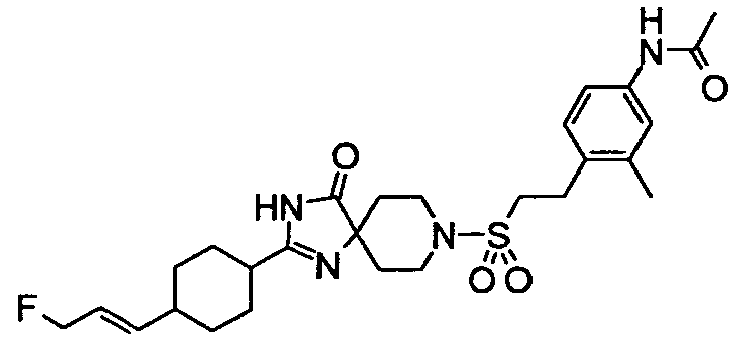
LCMS-B-1 1.76 533 (M+H)+ - The carboxylic acid reagent used in the synthesis of Compound 1061 (4-(2-fluoro-ethyl)-cyclohexanecarboxylic acid) was synthesized by the following method.
-

- Sodium borohydride (89 mg, 2.35 mmol) was added to a solution of 4-(2-oxo-ethyl)-cyclohexanecarboxylic acid benzyl ester (306 mg, 1.18 mmol) in methanol (6 ml) at 0°C. The mixture was stirred at 0°C for one hour, and then quenched with a saturated aqueous ammonium chloride solution and extracted with ethyl acetate. The organic layer was sequentially washed with water and saturated brine, and then dried over anhydrous sodium sulfate and concentrated under reduced pressure. The resulting residue was purified by silica gel column chromatography to give 4-(2-hydroxy-ethyl)-cyclohexanecarboxylic acid benzyl ester (299 mg).
1H-NMR (400 MHz, CDCl3) δ 1.20-1.32 (2H, m), 1.40-1.63 (9H, m), 1.95-2.05 (2H, m), 2.25-2.33 (0.2H, m), 2.55-2.62 (0.8H, m), 3.67 (1.6H, t, J = 6.8 Hz), 3.69 (0.4H, t, J = 6.4 Hz), 7.30-7.40 (5H, m) (cis : trans = 4 : 1). -

- 4-(2-Fluoro-ethyl)-cyclohexanecarboxylic acid was synthesized by operations similar to those in Reaction 191-11 and Reaction 95-18 using appropriate reagents and starting material.
1H-NMR (400 MHz, CDCl3) δ 0.93-2.03 (11H, m), 2.26 (0.2H, tt, J = 12.0, 3.2 Hz), 2.57-2.62 (0.8H, m), 4.39-4.56 (2H, m) (cis : trans = 4 : 1). - The carboxylic acid reagent used in the synthesis of Compound 1062 (4-butyl-4-fluoro-cyclohexanecarboxylic acid) was synthesized by the following method.
-

- A 2.6 M solution of n-BuLi in THF (681 µl, 1.77 mmol) was added to a solution of 4-oxo-cyclohexanecarboxylic acid ethyl ester (186 µl, 1.18 mmol) in Et2O (4.0 ml) at -60°C in an N2 atmosphere, and the mixture was stirred at -60°C for four hours. The reaction mixture was quenched by adding water and then diluted with ethyl acetate. The organic layer was washed with water, and then dried over MgSO4 and concentrated under reduced pressure. The resulting residue was used in the next step without purification.
-

- 4-Butyl-cyclohex-3-enecarboxylic acid ethyl ester was synthesized by operations similar to those in Reaction 25-15 using appropriate reagents and starting material.
MS (ESI) m/z = 211 (M+H)+. -

- HF·Py (0.5 ml) was added to 4-butyl-cyclohex-3-enecarboxylic acid ethyl ester (43.0 mg, 205 µmol) at room temperature, and the reaction mixture was stirred at room temperature for two hours. The reaction mixture was diluted by adding dichloromethane and then quenched by adding a saturated aqueous sodium bicarbonate solution and solid sodium bicarbonate at 0°C. The organic layer was washed with 2 N HCl, and then dried over MgSO4 and concentrated under reduced pressure. The resulting residue was purified by silica gel column chromatography (hexane/ethyl acetate = 100/0 -> 97/3) to give 4-butyl-4-fluoro-cyclohexanecarboxylic acid ethyl ester (22.5 mg, 48%, cis:trans = 1:3).
1H-NMR (400 MHz, CDCl3) δ 0.91 (3H, t, J = 8.0 Hz), 1.25 (3H, t, J = 8.0 Hz), 1.28-1.38 (6H, m), 1.51-1.84 (6H, m), 1.84-2.00 (2H, m), 2.20-2.26 (0.75H, m), 2.48-2.54 (0.25H, m), 4.10-4.16 (2H, m). -

- 4-Butyl-4-fluoro-cyclohexanecarboxylic acid was synthesized by operations similar to those in Reaction 95-18 using appropriate reagnts and starting material.
1H-NMR (400 MHz, CDCl3) δ 0.91 (3H, t, J = 7.0 Hz), 1.25-1.46 (6H, m), 1.50-1.62 (2H, m), 1.69-2.05 (6H, m), 2.25-2.35 (0.75H, m), 2.58-2.70 (0.25H, m). - [2714] The carboxylic acid reagent used in the synthesis of Compound 1063 (4-((E)-3-fluoro-propenyl)-cyclohexanecarboxylic acid) was synthesized by the following method.
-

- 4-((E)-3-Fluoro-propenyl)-cyclohexanecarboxylic acid was synthesized by operations similar to those in Reaction 249-5, Reaction 191-11 and Reaction 95-18 using appropriate reagents and starting material. This was used in the next step without complete purification.
-

- N-[4-(2-{2-[4-(3-Fluoro-propyl)-cyclohexyl]-4-oxo-1,3,8-triaza-spiro[4.5]dec-1-ene-8-sulfonyl}-ethyl)-3-methyl-phenyl]-acetamide
MS (ESI) m/z = 535 (M+H)+
and N-[4-(2-{2-[4-(3-chloro-propyl)-cyclohexyl]-4-oxo-1,3,8-triaza-spiro[4.5]dec-l-ene-8-sulfonyl}-ethyl)-3-methyl-phenyl]-acetamide
MS (ESI) m/z = 551 (M+H)+
were synthesized by operations similar to those in Reaction 10-14 and Reaction 189-5 using appropriate reagents and starting material. - The carboxylic acid reagent used in the synthesis of Compound 1064 and Compound 1065 (a mixture of 4-(3-fluoro-propyl)-cyclohexanecarboxylic acid and 4-(3-chloro-propyl)-cyclohexanecarboxylic acid) was synthesized by the following method.
-

- A mixture of 4-(3-fluoro-propyl)-cyclohexanecarboxylic acid and 4-(3-chloro-propyl)-cyclohexanecarboxylic acid was synthesized by operations similar to those in Reaction 101-1, Reaction 39-2, Reaction 5-4, Reaction 119-3, Reaction 18-2 (using platinum oxide) and Reaction 95-18 using appropriate reagents and starting material. This was used in the next step without complete purification.
-

- N-[4-(2-{2-[4-(3-Fluoro-propylidene)-cyclohexyl]-4-oxo-1,3,8-triaza-spiro[4.5]dec-1-ene-8-sulfonyl}-ethyl)-3-methyl-phenyl]-acetamide was synthesized by operations similar to those in Reaction 10-14 and Reaction 10-12 using appropriate reagents and starting material.
MS (ESI) m/z = 533 (M+H)+. - The example compounds shown below were synthesized by operations similar to those in Reaction 251-1 using appropriate reagents and starting materials.
-
[Table 159] Compound Structure LCMS condition Retention time (min) MS(m/z) 1067 
LCMS-C-2 2.00 551 (M+H)+ 1068 
LCMS-C-2 2.03 551 (M+H)+ 1069 
LCMS-C-2 2.08 607 (M+H)+ 1070 
LCMS-B-1 1.84 533 (M+H)+ 1071 
LCMS-C-1 2.43 539 (M+H)+ 1072 
LCMS-C-1 2.40 521 (M+H)+ 1073 
LCMS-F-1 0.87 553 (M+H)+ 1074 
LCMS-B-1 1.63 499 (M+H)+ 1075 
LCMS-F-1 0.85 525 (M+H)+ 1076 
LCMS-B-1 1.79 551 (M+H)+ 1077 
LCMS-F-1 0.91 535 (M+H)+ - The carboxylic acid reagent used in the synthesis of Compound 1066 (a mixture of 4-(3-fluoro-propylidene)-cyclohexanecarboxylic acid and 4-(3-chloro-propylidene)-cyclohexanecarboxylic acid) was synthesized by the following method.
-

- A mixture of 4-(3-fluoro-propylidene)-cyclohexanecarboxylic acid and 4-(3-chloro-propylidene)-cyclohexanecarboxylic acid was synthesized by operations similar to those in Reaction 95-18 using appropriate reagents and starting material. This was used in the next step without complete purification.
- The carboxylic acid reagent used in the synthesis of Compound 1069 (4-(2,2,3,3,3-pentafluoro-propyl)-cyclohexanecarboxylic acid) was synthesized by the following method.
-

- 4-Trifluoromethanesulfonyloxymethyl-cyclohexanecarboxylic acid benzyl ester (cis:trans = 4:1) was synthesized by operations similar to those in Reaction 12-2 using appropriate reagents and starting material.
1H-NMR (400 MHz, CDCl3) δ 1.10 (0.4H, m), 1.34 (1.6H, m), 1.44-1.72 (4H, m), 1.83 (0.2H, m), 1.92 (0.8H, m), 2.11 (2H, m), 2.32 (0.2H, m), 2.68 (0.8H, m), 4.33 (1.6H, d, J = 6.8 Hz), 4.39 (0.4H, d, J = 5.8 Hz), 5.12 (0.4H, s), 5.14 (1.6H, s), 7.35 (5H, m). -

- (Pentafluoroethyl)trimethylsilane (105 mg, 0.548 mmol) was added to a solution of 4-trifluoromethanesulfonyloxymethyl-cyclohexanecarboxylic acid benzyl ester (cis:trans = 4:1) (67.0 mg, 0.176 mmol) in DME (0.88 ml) at -30°C, and tetramethylammonium fluoride (21 mg, 0.22 mmol) was then added at -30 to - 27°C over one hour. The mixture was stirred for four hours while warming from -30°C to 0°C and further stirred at 0°C for one hour. Water was added to the reaction mixture, followed by extraction with dichloromethane. The organic layer was then dried over MgSO4 and concentrated under reduced pressure. The resulting residue was purified by silica gel column chromatography (hexane/ethyl acetate = 150/1) to give 4-(2,2,3,3,3-pentafluoro-propyl)-cyclohexanecarboxylic acid benzyl ester (cis:trans = 11:1) (11.4 mg, 18%).
1H-NMR (400 MHz, CDCl3) δ 1.32-1.75 (6H, m), 1.80-2.10 (5H, m), 2.26 (0.08H, m), 2.61 (0.92H, m), 5.13 (2H, s), 7.35 (5H, m). -

- LiOH·H2O (3.8 mg, 0.091 mmol) was added to a solution of 4-(2,2,3,3,3-pentafluoro-propyl)-cyclohexanecarboxylic acid benzyl ester (cis:trans = 11:1) (11.4 mg, 0.0325 mmol) in THF (0.15 ml)-H2O (0.15 mL). The mixture was stirred at room temperature for 16 hours, and then adjusted to pH 2 with a 1 N aqueous HCl solution and extracted with dichloromethane. The organic layer was dried over MgSO4 and concentrated under reduced pressure. The resulting residue was dissolved in tert-butanol (0.4 ml), and potassium tert-butoxide (10 mg, 0.089 mmol) was added. The mixture was stirred at room temperature for two hours, and then adjusted to pH 3 with a 1 N aqueous HCl solution and extracted with dichloromethane. The organic layer was then dried over MgSO4 and concentrated under reduced pressure. The resulting residue was purified by column chromatography (hexane/ethyl acetate = 5/1) to give 4-(2,2,3,3,3-pentafluoro-propyl)-cyclohexanecarboxylic acid (cis:trans = 9:1) (8.5 mg, 100%).
1H-NMR (400 MHz, CDCl3) δ 1.11 (0.2H, m), 1.30-1.78 (5.8H, m), 1.83-2.10 (5H, m), 2.26 (0.1H, m), 2.64 (0.9H, m). - The carboxylic acid reagent used in the synthesis of Compound 1070 (4-((E)-3-fluoro-allyl)-cyclohexanecarboxylic acid) was synthesized by the following method.
-

- A 3.3 M Red-Al solution in toluene (0.25 ml, 0.82 mmol) was added to a solution of 4-(3,3-difluoro-allyl)-cyclohexanecarboxylic acid benzyl ester (cis:trans = 5.4:1) (42.8 mg, 0.145 mmol) in toluene (0.12 mL), and the mixture was stirred at 85°C for 17 hours. The reaction mixture was poured into ice water, adjusted to pH 3 with a 4 N aqueous H2SO4 solution and extracted with ether. The organic layer was dried over MgSO4 and concentrated under reduced pressure to give [4-((E)-3-fluoro-allyl)-cyclohexyl]-methanol (25.0 mg, 100%).
1H-NMR (400 MHz, CDCl3) δ 0.92 (0.84H, m), 1.20-1.84 (9.16H, m), 1.87 (1.68H, dd, J = 7.8, 6.8 Hz), 2.10 (0.32H, t, J = 7.3 Hz), 3.45 (0.32H, d, J = 5.8 Hz), 3.54 (1.68H, d, J = 6.8 Hz), 5.31 (1H, m), 6.47 (1H, dd, J = 86.0, 11.0 Hz). -

- 4-((E)-3-Fluoro-allyl)-cyclohexanecarboxylic acid was synthesized by operations similar to those in Reaction 109-1 using appropriate reagents and starting material.
1H-NMR (400 MHz, CDCl3) δ 0.80-2.10 (11H, m), 2.26 (0.15H, m), 2.61 (0.85H, m), 4.71 (0.16H, dm, J = 40.6 Hz), 5.30 (0.84H, m), 6.47 (1H, dd, J = 86.0, 11.0 Hz) (cis : trans = 85 : 15). - The carboxylic acid reagent used in the synthesis of Compound 1073 (4-fluoro-4-(3-fluoro-propyl)-cyclohexanecarboxylic acid) was synthesized by the following method.
-

- 4-Fluoro-4-(3-fluoro-propyl)-cyclohexanecarboxylic acid was synthesized by operations similar to those in Reaction 249-9 and Reaction 95-18 using appropriate reagents and starting material.
1H-NMR (400 MHz, CDCl3) δ 2.36-2.17 (3H, m), 2.05-1.66 (8H, m), 1.47-1.25 (2H, m). - The carboxylic acid reagent used in the synthesis of Compound 1074 (4-ethynyl-cyclohexanecarboxylic acid) was synthesized by the following method.
-

- Dimethyl (1-diazo-2-oxopropyl)phosphonate (Bestmann reagent) (450 mg, 2.34 mmol) was added to a mixture of 4-formyl-cyclohexanecarboxylic acid benzyl ester (390 mg, 1.58 mmol) and potassium carbonate (323 mg, 2.34 mmol) in methanol (10 mL) at 0°C and the mixture was stirred for five hours. Further, the reaction solution was stirred at room temperature for two hours. A saturated aqueous ammonium chloride solution and ethyl acetate were then added at 0°C, and the organic layer and the aqueous layer were separated. The aqueous layer was repeatedly extracted with ethyl acetate three times, and the organic layers were then combined, washed with saturated brine and then concentrated under reduced pressure. The resulting residue was purified by silica gel column chromatography to give a mixture of 4-ethynyl-cyclohexanecarboxylic acid methyl ester and 4-ethynyl-cyclohexanecarboxylic acid benzyl ester as a colorless liquid (220 mg, 78%).
1H-NMR (400 MHz, CDCl3) δ 1.34-1.48 (1.6H, m), 1.48-1.62 (1H, m), 1.65-1.87 (2.6H, m), 1.87-2.10 (3.8H, m), 2.20-2.42 (1.4H, m), 2.65-2.75 (0.6H, m), 3.66 (1.1H, s), 3.68 (1.4H, s), 5.10 (0.05H, s), 5.13 (0.3H, s), 7.29-7.40 (0.9H, m) (Me : Bn = 0.85 : 0.15, cis : trans = 0.6 : 0.4). -

- 4-Ethynyl-cyclohexanecarboxylic acid was synthesized by operations similar to those in Reaction 95-18 using appropriate reagents and starting material.
1H-NMR (400 MHz, CD3OD) δ 1.37-1.50 (1.3H, m), 1.53-1.67 (1.6H, m), 1.67-1.82 (2.8H, m), 1.82-2.05 (2.5H, m), 2.18-2.38 (2.1H, m), 2.62-2.73 (0.7H, m). - The carboxylic acid reagent used in the synthesis of Compound 1077 (4-(2-fluoro-propyl)-cyclohexanecarboxylic acid) was synthesized by the following method.
-

- Methylmagnesium bromide (1 M solution in THF, 0.526 ml, 0.526 mmol) was added dropwise to 4-(2-oxo-ethyl)-cyclohexanecarboxylic acid benzyl ester (114 mg, 0.439 mmol) in THF (2.2 mL) at -78°C, and the mixture was stirred at the same temperature for 30 minutes. Water was added to the reaction mixture at the same temperature and extracted with ethyl acetate. The organic layer was sequentially washed with a saturated aqueous ammonium chloride solution, water and saturated brine and then concentrated under reduced pressure. The resulting residue was purified by silica gel column chromatography (hexane-ethyl acetate) to give 4-(2-hydroxy-propyl)-cyclohexanecarboxylic acid benzyl ester (80.7 mg, 67%).
1H-NMR (300 MHz, CDCl3) δ 1.18 (3H, d, J = 6.1 Hz), 1.22-1.49 (5H, m), 1.50-1.67 (6H, m), 1.95-2.05 (2H, m), 2.58 (1H, dt, J = 9.1, 4.9 Hz), 3.82-3.94 (1H, m), 5.13 (2H, s), 7.29-7.39 (5H, m);
MS (ESI) m/z = 259 (M-H2O+H)+. -

- 4-(2-Fluoro-propyl)-cyclohexanecarboxylic acid was synthesized by operations similar to those in Reaction 191-11 and Reaction 95-18 using appropriate reagents and starting material.
1H-NMR (400 MHz, CDCl3) δ 1.23-2.07 (11H, m), 1.31 (3H, dd, J = 23.9, 7.0 Hz), 2.55-2.64 (1H, m), 4.63-4.87 (1H, m). -

- N-[4-(2-{2-[4-(1-Fluoro-1-methyl-ethyl)-cyclohexyl]-4-oxo-1,3,8-triaza-spiro[4.5]dec-1-ene-8-sulfonyl}-ethyl)-3-methyl-phenyl]-acetamide was synthesized by operations similar to those in Reaction 10-14 and Reaction 101-3 using appropriate reagents and starting material.
MS (ESI) m/z = 535 (M+H)+. - The carboxylic acid reagent used in the synthesis of Compound 1078 (4-(1-fluoro-1-methyl-ethyl)-cyclohexanecarboxylic acid) was synthesized by the following method.
-

- 4-(1-Hydroxy-ethyl)-cyclohexanecarboxylic acid benzyl ester was synthesized by operations similar to those in Reaction 251-11 using appropriate reagents and starting material.
MS (ESI) m/z = 263 (M+H)+. -

- Dess-Martin reagent (151 mg, 0.355 mmol) was added to a solution of 4-(1-hydroxy-ethyl)-cyclohexanecarboxylic acid benzyl ester (71.6 mg, 0.273 mmol) in anhydrous dichloromethane (0.91 ml) at 0°C. The mixture was stirred at the same temperature for 10 minutes, and further warmed to room temperature and stirred for 4.5 hours. An aqueous sodium thiosulfate solution was added to the reaction solution, followed by extraction with dichloromethane. The organic phase was concentrated under reduced pressure, and the resulting residue was purified by silica gel column chromatography (hexane-ethyl acetate) to give 4-acetyl-cyclohexanecarboxylic acid benzyl ester (60.2 mg, 85%).
MS (ESI) m/z = 261 (M+H)+. -

- 4-(1-Fluoro-1-methyl-ethyl)-cyclohexanecarboxylic acid was synthesized by operations similar to those in Reaction 251-11, Reaction 191-11 and Reaction 95-18 using appropriate reagents and starting material.
1H-NMR (300 MHz, CD3OD) δ 1.20-1.32 (2H, m), 1.24 (6H, d, J = 21.9 Hz), 1.45-1.58 (3H, m), 1.62-1.70 (2H, m), 2.17-2.26 (2H, m), 2.60-2.65 (1H, m). -

- N-(4-{2-[2-(4-Butylidene-cyclohexyl)-4-oxo-1,3,8-triaza-spiro[4.5]dec-1-ene-8-sulfonyl]-ethyl}-3-methylphenyl)-acetamide was synthesized by operations similar to those in Reaction 10-1 and Reaction 10-12 using appropriate reagents and starting material.
MS (ESI) m/z = 529 (M+H)+. - The carboxylic acid reagent used in the synthesis of Compound 1079 (4-butylidene-cyclohexanecarboxylic acid) was synthesized by the following method.
-

- 4-Butylidene-cyclohexanecarboxylic acid was synthesized by operations similar to those in Reaction 191-14 and Reaction 95-18 using appropriate reagents and starting material.
1H-NMR (400 MHz, CDCl3) δ 0.88 (3H, t, J = 7.3 Hz), 1.28-1.40 (2H, m), 1.42-1.62 (2H, m), 1.77-1.88 (1H, m), 1.89-2.12 (5H, m), 2.20-2.29 (1H, m), 2.46-2.55 (1H, m), 2.55-2.63 (1H, m), 5.14 (1H, t, J = 7.3 Hz). -

- N-[3-Methyl-4-(2-{4-oxo-2-[4-(2,2,3,3,3-pentafluoropropyl)-cyclohexyl]-1,3,8-triaza-spiro[4.5]dec-1-ene-8-sulfonyl}-ethyl)-phenyl]-acetamide was synthesized by operations similar to those in Reaction 10-14 and Reaction 101-3 using appropriate reagents and starting material.
MS (ESI) m/z = 607 (M+H)+. -

- 4-Amino-1-[2-(2,6-dimethyl-4-methylamino-phenyl)-ethanesulfonyl]-piperidine-4-carboxylic amide was synthesized by operations similar to those in Reaction 184-1 using appropriate reagents and starting material.
MS (ESI) m/z = 369 (M+H)+. -

- 1-{3,5-Dimethyl-4-[2-(2-non-4-ynyl-4-oxo-1,3,8-triaza-spiro[4.5]dec-1-ene-8-sulfonyl)-ethyl]-phenyl}-1-methyl-urea was synthesized by operations similar to those in Reaction 10-14, Reaction 101-3 and Reaction 89-2 using appropriate reagents and starting material.
MS (ESI) m/z = 544 (M+H)+. - The example compounds shown below were synthesized by operations similar to those in Reaction 255-2 using appropriate reagents and starting materials.
-
[Table 160] Compound Structure LCMS condition Retention time (min) MS (m/z) 1082 
LCMS-F-1 1.01 544 (M+H)+ 1083 
LCMS-C-2 2.27 544 (M+H)+ -
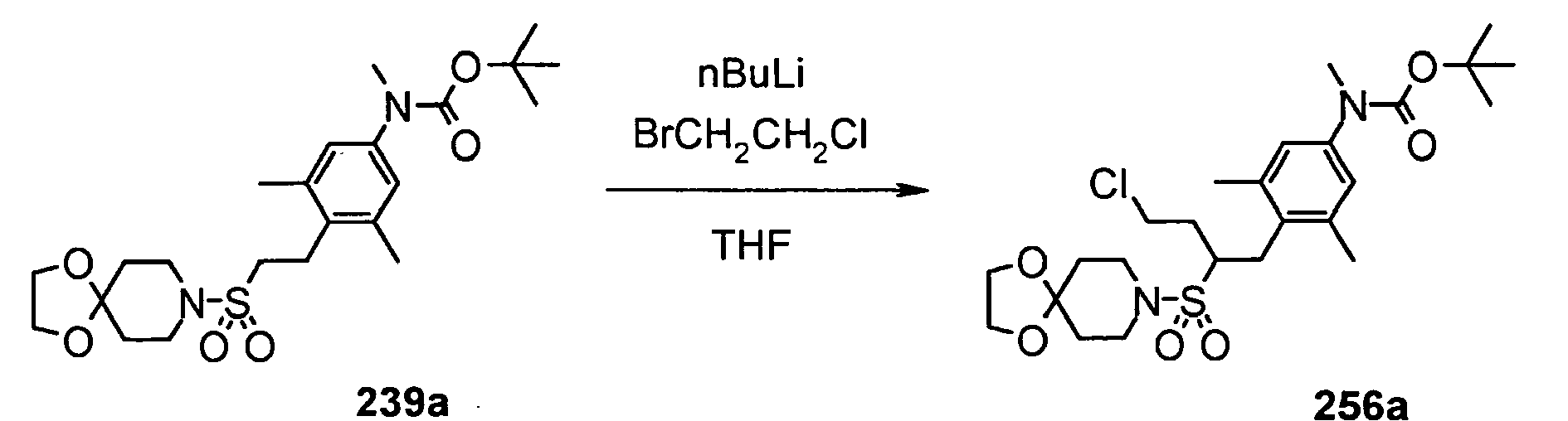
- n-Butyllithium (1.6 M solution in hexane, 0.58 ml, 0.93 mmol) was added to a solution of {4-[2-(1,4-dioxa-8-aza-spiro[4.5]decane-8-sulfonyl)-ethyl]-3,5-dimethyl-phenyl}-methyl-carbamic acid tert-butyl ester (195.7 mg, 0.4176 mmol) in THF (4.2 ml) at -78°C over six minutes, and the mixture was stirred at the same temperature for 20 minutes. 1-Bromo-2-chloro-ethane (105 µl, 1.26 mmol) was added to the reaction solution at -78°C within 10 minutes. The mixture was then stirred while warming from -78°C to 0°C over one hour, and further stirred at room temperature for one hour. A 50% saturated aqueous ammonium chloride solution was added, followed by extraction with ethyl acetate. The organic layer was then dried over MgSO4 and concentrated under reduced pressure. The resulting residue was purified by silica gel column chromatography (hexane/ethyl acetate = 5/2) to give {4-[4-chloro-2-(1,4-dioxa-8-aza-spiro[4.5]decane-8-sulfonyl)-butyl]-3,5-dimethyl-phenyl}-methyl-carbamic acid tert-butyl ester (133 mg, 60%).
1H-NMR (400 MHz, CDCl3) δ 1.44 (9H, s), 1.80 (4H, t, J = 6.0 Hz), 1.85 (1H, m), 2.28 (1H, m), 2.33 (6H, s), 3.00 (1H, dd, J = 14.0, 11.6 Hz), 3.18 (1H, dd, J = 14.0, 4.4 Hz), 3.22 (3H, s), 3.33 (1H, m), 3.52 (4H, t, J = 6.0 Hz), 3.60 (2H, m), 3.98 (4H, s), 6.92 (2H, s). -

- n-Butyllithium (1.6 M solution in hexane, 345 µl, 0.552 mmol) was added to a solution of {4-[4-chloro-2-(1,4-dioxa-8-aza-spiro[4.5]decane-8-sulfonyl)-butyl]-3,5-dimethyl-phenyl}-methyl-carbamic acid tert-butyl ester (115.0 mg, 0.2165 mmol) in THF (3.0 ml) at -78°C over three minutes. The mixture was stirred at the same temperature for five minutes, and then warmed and further stirred at room temperature for one hour. A 50% saturated aqueous ammonium chloride solution was added, followed by extraction with ethyl acetate. The organic layer was then dried over MgSO4 and concentrated under reduced pressure. The resulting residue was purified by silica gel column chromatography (hexane/ethyl acetate = 2/1) to give {4-[1-(1,4-dioxa-8-aza-spiro[4.5]decane-8-sulfonyl)-cyclopropylmethyl]-3,5-dimethyl-phenyl}-methyl-carbamic acid tert-butyl ester and {4-[1-(1,4-dioxa-8-aza-spiro[4.5]decane-8-sulfonyl)-cyclopropylmethyl]-3,5-dimethyl-phenyl}-methyl-amine as a mixture (46.0 mg, 43% and 19.6 mg, 23%). This was used in the next reaction without complete purification.
-
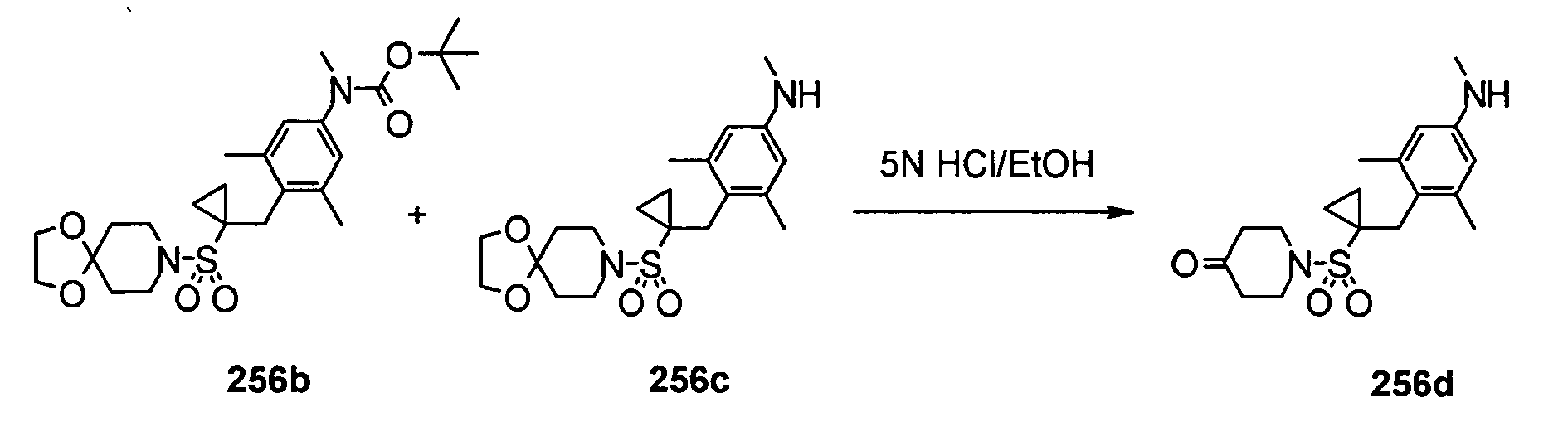
- A 5 N aqueous HCl solution (2.0 ml, 10 mmol) was added to a solution of a mixture of 4-[1-(1,4-dioxa-8-aza-spiro[4.5]decane-8-sulfonyl)-cyclopropylmethyl]-3,5-dimethyl-phenyl]-methyl-carbamic acid tert-butyl ester (54.7 mg, 0.111 mmol) and {4-[1-(1,4-dioxa-8-aza-spiro[4.5]decane-8-sulfonyl)-cyclopropylmethyl]-3,5-dimethyl-phenyl}-methyl-amine (23.1 mg, 0.0585 mmol) in EtOH (2.0 mL), and the mixture was stirred at 80°C for two hours. The reaction mixture was neutralized by adding a 5 N aqueous NaOH solution (1.9 ml) and then extracted with ethyl acetate. The organic layer was dried over MgSO4 and concentrated under reduced pressure to give 1-[1-(2,6-dimethyl-4-methylamino-benzyl)-cyclopropanesulfonyl]-4-piperidinone (58.8 mg, 99%).
1H-NMR (400 MHz, CDCl3) δ 0.44 (2H, m), 1.21 (2H, m), 2.22 (6H, s), 2.60 (4H, t, J = 6.0 Hz), 2.79 (3H, s), 3.27 (2H, s), 3.78 (4H, t, J = 6.0 Hz), 3.99 (4H, s), 6.28 (2H, s). -

- {4-[1-(4-Amino-4-carbamoyl-piperidine-1-sulfonyl)-cyclopropylmethyl]-3,5-dimethyl-phenyl}-methyl-carbamic acid tert-butyl ester was synthesized by operations similar to those in Reaction 127-2 (using toluene as a solvent), Reaction 233-3 and Reaction 233-4 using appropriate reagents and starting material.
1H-NMR (400 MHz, CDCl3) δ 0.37 (2H, m), 1.19 (2H, m), 1.45 (9H, s), 1.59 (2H, m), 2.24 (2H, m), 2.30 (6H, s), 3.20 (3H, s), 3.36 (2H, s), 3.43 (2H, ddd, J = 13.0, 9.6 and 3.2 Hz), 3.77 (2H, ddd, J = 13.0, 5.2 and 4.8 Hz), 5.39 (1H, br), 6.89 (2H, s), 7.27 (1H, br). -

- 1-(3,5-Dimethyl-4-{1-[4-oxo-2-(3-trifluoromethoxy-phenyl)-1,3,8-triaza-spiro[4.5]dec-1-ene-8-sulfonyl]-cyclopropylmethyl}-phenyl)-1-methyl-urea was synthesized by operations similar to those in Reaction 10-14, Reaction 101-3, Reaction 4-1 and Reaction 89-2 using appropriate reagents and starting material.
MS (ESI) m/z = 608 (M+H)+. -

- n-Butyllithium (1.54 M solution in hexane, 5.6 ml, 8.67 mmol) was added to a solution of diisopropyl-amine (1.45 mL, 10.4 mmol) in tetrahydrofuran (30 mL) at 0°C, and the mixture was stirred for 20 minutes. The reaction solution was brought to -78°C, and a solution of {4-[2-(1,4-dioxa-8-aza-spiro[4.5]decane-8-sulfonyl)-ethyl]-3,5-dimethyl-phenyl}-methyl-carbamic acid tert-butyl ester (2.71 g, 5.78 mmol) in tetrahydrofuran (10 mL) was then added dropwise slowly. The reaction solution was stirred at -78°C for 0.5 hour, and N-fluorobenzenesulfonimide (2.73 g, 8.67 mmol) was then added at -78°C, followed by stirring for one hour. A saturated aqueous ammonium chloride solution was added to the reaction solution at - 78°C, and the mixture was brought to room temperature. Ethyl acetate was then added, and the organic layer and the aqueous layer were separated. The aqueous layer was repeatedly extracted with ethyl acetate three times. The organic layers were then combined and washed with saturated brine, and then dried over sodium sulfate and concentrated under reduced pressure. The resulting residue was purified by silica gel column chromatography to give {4-[2-(1,4-dioxa-8-aza-spiro[4.5]decane-8-sulfonyl)-2,2-difluoro-ethyl]-3,5-dimethyl-phenyl}-methyl-carbamic acid tert-butyl ester as a white foamy solid (205 mg, 7%).
MS (ESI) m/z = 505 (M+H)+. -
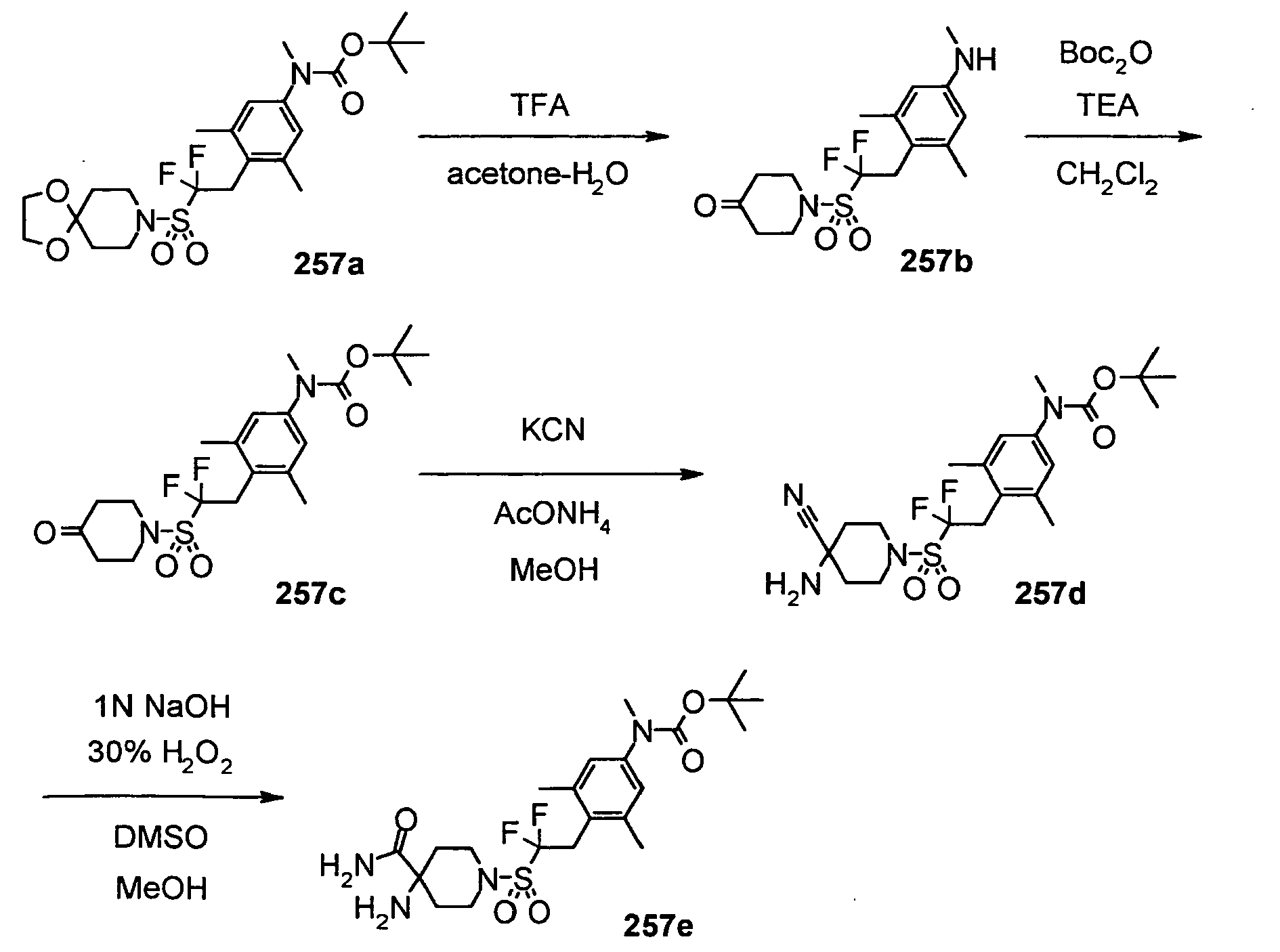
- {4-[2-(4-Amino-4-carbamoyl-piperidine-1-sulfonyl)-2,2-difluoro-ethyl]-3,5-dimethyl-phenyl}-methyl-carbamic acid tert-butyl ester was synthesized by operations similar to those in Reaction 233-2, Reaction 19-2, Reaction 233-3 and Reaction 233-4 using appropriate reagents and starting material.
MS (ESI) m/z = 505 (M+H)+. -

- 1-(4-{2,2-Difluoro-2-[4-oxo-2-(3-trifluoromethoxy-phenyl)-1,3,8-triaza-spiro[4.5]dec-1-ene-8-sulfonyl]-ethyl}-3,5-dimethyl-phenyl)-1-methyl-urea was synthesized by operations similar to those in Reaction 10-14, Reaction 10-12, Reaction 4-1 and Reaction 89-2 using appropriate reagents and starting material.
MS (ESI) m/z = 618 (M+H)+. -

- 1-{4-[2,2-Difluoro-2-(2-nonyl-4-oxo-1,3,8-triaza-spiro[4.5]dec-1-ene-8-sulfonyl)-ethyl]-3,5-dimethyl-phenyl}-1-methyl-urea was synthesized by operations similar to those in Reaction 10-14, Reaction 101-3, Reaction 4-1 and Reaction 89-2 using appropriate reagents and starting material.
MS (ESI) m/z = 584 (M+H)+. -

- 1-{3,5-Dimethyl-4-[2-(4-oxo-2-[1,1';2',1"]terphenyl-3-yl-1,3,8-triaza-spiro[4.5]dec-1-ene-8-sulfonyl)-ethyl]-phenyl}-1-methyl-urea was synthesized by operations similar to those in Reaction 10-14, Reaction 10-11, Reaction 10-12 (using ethanol as a solvent), Reaction 89-2 and Reaction 122-2 using appropriate reagents and starting material.
MS (ESI) m/z = 650 (M+H)+. - The carboxylic acid reagent used in the synthesis of Compound 1087 ([1,1';2',1"]terphenyl-3"-carboxylic acid) was synthesized by the following method.
-

- 3-Boronobenzoic acid (300 mg, 1.81 mmol), palladium acetate (40.4 mg, 0.18 mmol), triphenylphosphine (94.6 mg, 0.36 mmol) and potassium carbonate (374.6 mg, 2.71 mmol) were added to a solution of 2-bromo-1,1'-biphenyl (0.3 ml, 1.81 mmol) in acetonitrile (10 mL)-water (2.5 ml), and the mixture was heated with stirring at 100°C overnight. The reaction mixture was cooled and then filtered through celite, and the filtrate was concentrated under reduced pressure. The resulting residue was purified by silica gel column chromatography (hexane:ethyl acetate = 1:1) to give [1,1';2',1"]terphenyl-3"-carboxylic acid (191 mg, 39%).
MS (ESI) m/z = 275 (M+H)+. -

- 1-[3,5-Dimethyl-4-((E)-2-{4-oxo-2-[4-(4,4,4-trifluoro-butyl)-phenyl]-1,3,8-triaza-spiro[4.5]dec-1-ene-8-sulfonyl}-vinyl)-phenyl]-1-methyl-urea was synthesized by operations similar to those in Reaction 10-14, Reaction 1-4 and Reaction 89-2 using appropriate reagents and starting material.
MS (ESI) m/z = 606 (M+H)+. - The carboxylic acid reagent used in the synthesis of Compound 1088 (4-(4,4,4-trifluoro-butyl)-benzoic acid) was synthesized by the following method.
-

- 4-(4,4,4-Trifluoro-butyl)-benzoic acid was synthesized by operations similar to those in Reaction 191-14, Reaction 18-2 and Reaction 95-18 using appropriate reagents and starting material.
MS (ESI) m/z = 233 (M+H)+. - The example compound shown below was synthesized by operations similar to those in Reaction 260-1 using appropriate reagents and starting material.
-
[Table 161] Compound Structure LCMS condition Retention time (min) MS (m/z) 1089 
LCMS-D-1 2.63 606 (M+H)+ - The carboxylic acid reagent used in the synthesis of Compound 1089 (3-(4,4,4-trifluoro-butyl)-benzoic acid) was synthesized by the following method.
-

- 3-(4,4,4-Trifluoro-butyl)-benzoic acid was synthesized by operations similar to those in Reaction 191-14, Reaction 18-2 and Reaction 95-18 using appropriate reagents and starting material.
MS (ESI) m/z = 233 (M+H)+. -

- {4-[2-(4-Amino-4-carbamoyl-piperidine-1-sulfonyl)-propyl]-3,5-dimethyl-phenyl}-methyl-carbamic acid tert-butyl ester was synthesized by operations similar to those in Reaction 256-1 (using LDA as a base), Reaction 233-2 (using hydrochloric acid as an acid), Reaction 127-2, Reaction 233-3 and Reaction 233-4 using appropriate reagents and starting material.
1H-NMR (400 MHz, CDCl3) δ 1.21 (3H, d, J = 6.4 Hz), 1.46 (9H, s), 1.57 (2H, m), 2.19 (2H, m), 2.32 (6H, s), 2.90 (1H, dd, J = 14.2 and 12.2 Hz), 3.21 (3H, s), 3.26 (2H, m), 3.40 (2H, m), 3.68 (2H, m), 5.33 (1H, br), 6.91 (2H, s), 7.23 (1H, br). -

- 1-(3,5-Dimethyl-4-{2-[4-oxo-2-(3-trifluoromethoxy-phenyl)-1,3,8-triaza-spiro[4.5]dec-1-ene-8-sulfonyl]-propyl}-phenyl)-1-methyl-urea was synthesized by operations similar to those in Reaction 10-14, Reaction 101-3, Reaction 4-1 and Reaction 89-2 using appropriate reagents and starting material.
MS (ESI) m/z = 596 (M+H)+. -

- 4-Amino-1-{(E)-2-[4-(4-hydroxy-piperidine-1-carbonyl)-2,6-dimethyl-phenyl]-ethenesulfonyl}-piperidine-4-carboxylic amide was synthesized by operations similar to those in Reaction 119-1, Reaction 233-2, Reaction 233-3 and Reaction 233-4 using appropriate reagents and starting material.
MS (ESI) m/z = 465 (M+H)+. -

- 2-[4-Fluoro-3-(4,4,5,5,5-pentafluoro-pentyloxy)-phenyl]-8-{(E)-2-[4-(4-hydroxy-piperidine-1-carbonyl)-2,6-dimethyl-phenyl]-ethenesulfonyl}-1,3,8-triaza-spiro[4.5]dec-1-en-4-one was synthesized by operations similar to those in Reaction 10-14 and Reaction 10-12 using appropriate reagents and starting material.
MS (ESI) m/z = 745 (M+H)+. - The carboxylic acid reagent used in the synthesis of Compound 1091 (4-fluoro-3-(4,4,5,5,5-pentafluoro-pentyloxy)-benzoic acid) was synthesized by the following method.
-

- 4-Fluoro-3-(4,4,5,5,5-pentafluoro-pentyloxy)-benzoic acid was synthesized by operations similar to those in Reaction 31-7 and Reaction 95-18 using appropriate reagents and starting material.
1H-NMR (400 MHz, CD3OD) δ 0.21-0.14 (2H, m), 2.30-2.42 (2H, m), 4.19 (2H, t, J = 6.0 Hz), 7.20 (1H, dd, J = 10.8, 8.4 Hz), 7.64-7.68 (1H, m), 7.72 (1H, dd, J = 8.4, 2.0 Hz). -

- 4-Amino-1-{(E)-2-[4-(4-hydroxy-4-methyl-piperidine-1-carbonyl)-2,6-dimethyl-phenyl]-ethenesulfonyl}-piperidine-4-carboxylic amide was synthesized by operations similar to those in Reaction 10-18, Reaction 119-1, Reaction 233-3 and Reaction 233-4 using appropriate reagents and starting material.
MS (ESI) m/z = 479 (M+H)+. -

- 2-[4-Fluoro-3-(4,4,5,5,5-pentafluoro-pentyloxy)-phenyl]-8-{(E)-2-[4-(4-hydroxy-4-methyl-piperidine-1-carbonyl)-2,6-dimethyl-phenyl]-ethenesulfonyl}-1,3,8-triaza-spiro[4.5]dec-1-en-4-one was synthesized by operations similar to those in Reaction 10-14 and Reaction 10-12 using appropriate reagents and starting material.
MS (ESI) m/z = 759 (M+H)+. - The example compounds shown below were synthesized by operations similar to those in Reaction 263-2 using appropriate reagents and starting materials.
-
[Table 162] Compound Structure LCMS condition Retention time (min) MS (m/z) 1093 
LCMS-F1 1.03 683 (M + H)+ 1094 
LCMS-F1 1.01 667 (M + H)+ 1095 
LCMS-F1 1.03 701 (M + H)+ 1096 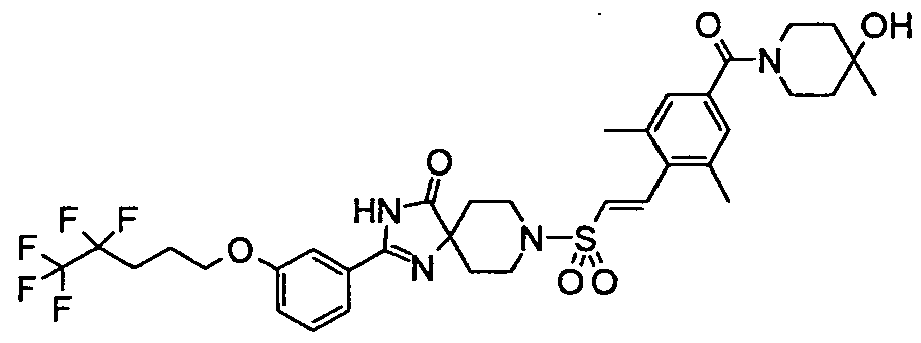
LCMS-F1 1.05 741 (M + H)+ 1097 
LCMS-C1 2.60 647 (M + H)+ 1098 
LCMS-c1 2.60 597 (M + H)+ 1099 
LCMS-F1 1.01 667 (M + H)+ - The carboxylic acid reagent used in the synthesis of Compound 1096 (3-(4,4,5,5,5-pentafluoro-pentyloxy)-benzoic acid) was synthesized by the following method.
-

- 3-(4,4,5,5,5-Pentafluoro-pentyloxy)-benzoic acid was synthesized by operations similar to those in Reaction 31-7 and Reaction 95-18 using appropriate reagents and starting material.
MS (ESI) m/z = 297 (M-H)-. - The carboxylic acid reagent used in the synthesis of Compound 1097 (3-(2,2,2-trifluoro-ethyl)-benzoic acid) was synthesized by the following method.
-

- 3-(2,2,2-Trifluoro-ethyl)-benzoic acid was synthesized by operations similar to those in Reaction 193-4, Reaction 193-5, Reaction 193-6 and Reaction 95-18 using appropriate reagents and starting material.
1H-NMR (400 MHz, CDCl3) δ 3.43 (2H, q, J = 10.8 Hz), 3.93 (3H, s), 7.43-7.51 (2H, m), 7.99-8.04 (2H, m). -

- 8-{(E)-2-[4-(4-Hydroxy-4-methyl-piperidine-1-carbonyl)-2,6-dimethyl-phenyl]-ethenesulfonyl}-2-[3-(1,1,2,2-tetrafluoro-ethoxy)-phenyl]-1,3,8-triaza-spiro[4.5]dec-1-en-4-one was synthesized by operations similar to those in Reaction 10-14 and Reaction 189-5 using appropriate reagents and starting material.
MS (ESI) m/z = 681 (M+H)+. -

- Dehydrated tert-butanol (0.19 ml, 2.0 mmol), 4-dimethylaminopyridine (81 mg, 0.67 mmol) and EDCI (255 mg, 1.33 mmol) were added to a solution of 4-bromo-3, 5-dimethyl-benzoic acid (123 mg, 0.535 mmol) in dichloromethane (1.0 ml) at 0°C, and the mixture was stirred at room temperature for 25 hours. The reaction mixture was diluted with dichloromethane, and the organic layer was washed with water, dried over MgSO4 and concentrated under reduced pressure. The resulting residue was purified by silica gel column chromatography (hexane/ethyl acetate = 100/1 -> 50/1) to give 4-bromo-3,5-dimethyl-benzoic acid tert-butyl ester (106 mg, 70%).
1H-NMR (400 MHz, CDCl3) δ 1.58 (9H, s), 2.45 (6H, s), 7.66 (2H, s). -

- 4-Amino-1-{1,1-difluoro-2-[4-(4-hydroxy-piperidine-1-carbonyl)-2,6-dimethyl-phenyl]-ethanesulfonyl}-piperidine-4-carboxylic amide was synthesized by operations similar to those in Reaction 26-1, Reaction 184-1, Reaction 257-1, Reaction 257-1, Reaction 233-2, Reaction 10-14, Reaction 233-3 and Reaction 233-4 using appropriate reagents and starting material.
1H-NMR (400 MHz, CDCl3) δ 1.07 (2H, br), 1.53 (2H, m), 1.84 and 1.95 (each 1H, br), 2.21 (2H, m), 2.36 (6H, s), 3.21 and 3.33 (each 1H, br), 3.48 (2H, m), 3.68 (2H, dd, J = 20.4 and 18.4 Hz), 3.70 (1H, br), 3.86 (2H, m), 3.97 (1H, m), 4.20 (1H, br), 5.33 (1H, br), 7.07 (2H, s), 7.19 (1H, br). -

- 8-{1,1-Difluoro-2-[4-(4-hydroxy-piperidine-1-carbonyl)-2,6-dimethyl-phenyl]-ethanesulfonyl}-2-(3-trifluoromethoxy-phenyl)-1,3,8-triaza-spiro[4.5]dec-1-en-4-one was synthesized by operations similar to those in Reaction 10-14 and Reaction 101-3 using appropriate reagents and starting material.
MS (ESI) m/z = 673 (M+H)+. -

- 4-Amino-1-{(E)-2-[4-(3-hydroxy-azetidine-1-carbonyl)-2,6-dimethyl-phenyl]-ethenesulfonyl}-piperidine-4-carboxylic amide was synthesized by operations similar to those in Reaction 119-1, Reaction 233-3 and Reaction 233-4 using appropriate reagents and starting material.
MS (ESI) m/z = 437 (M+H)+. -

- 2-(4-Fluoro-3-trifluoromethoxy-phenyl)-8-{(E)-2-[4-(3-hydroxy-azetidine-1-carbonyl)-2,6-dimethyl-phenyl]-ethenesulfonyl}-1,3,8-triaza-spiro[4.5]dec-1-en-4-one was synthesized by operations similar to those in Reaction 10-14 and Reaction 10-12 using appropriate reagents and starting material.
MS (ESI) m/z = 625 (M+H)+. -

- 4-Amino-1-{(E)-2-[4-((R)-2,3-dihydroxy-propoxy)-2,6-dimethyl-phenyl]-ethenesulfonyl}-piperidine-4-carboxylic amide was synthesized by operations similar to those in Reaction 26-1, Reaction 233-3 and Reaction 233-4 using appropriate reagents and starting material.
MS (ESI) m/z = 428 (M+H)+. -
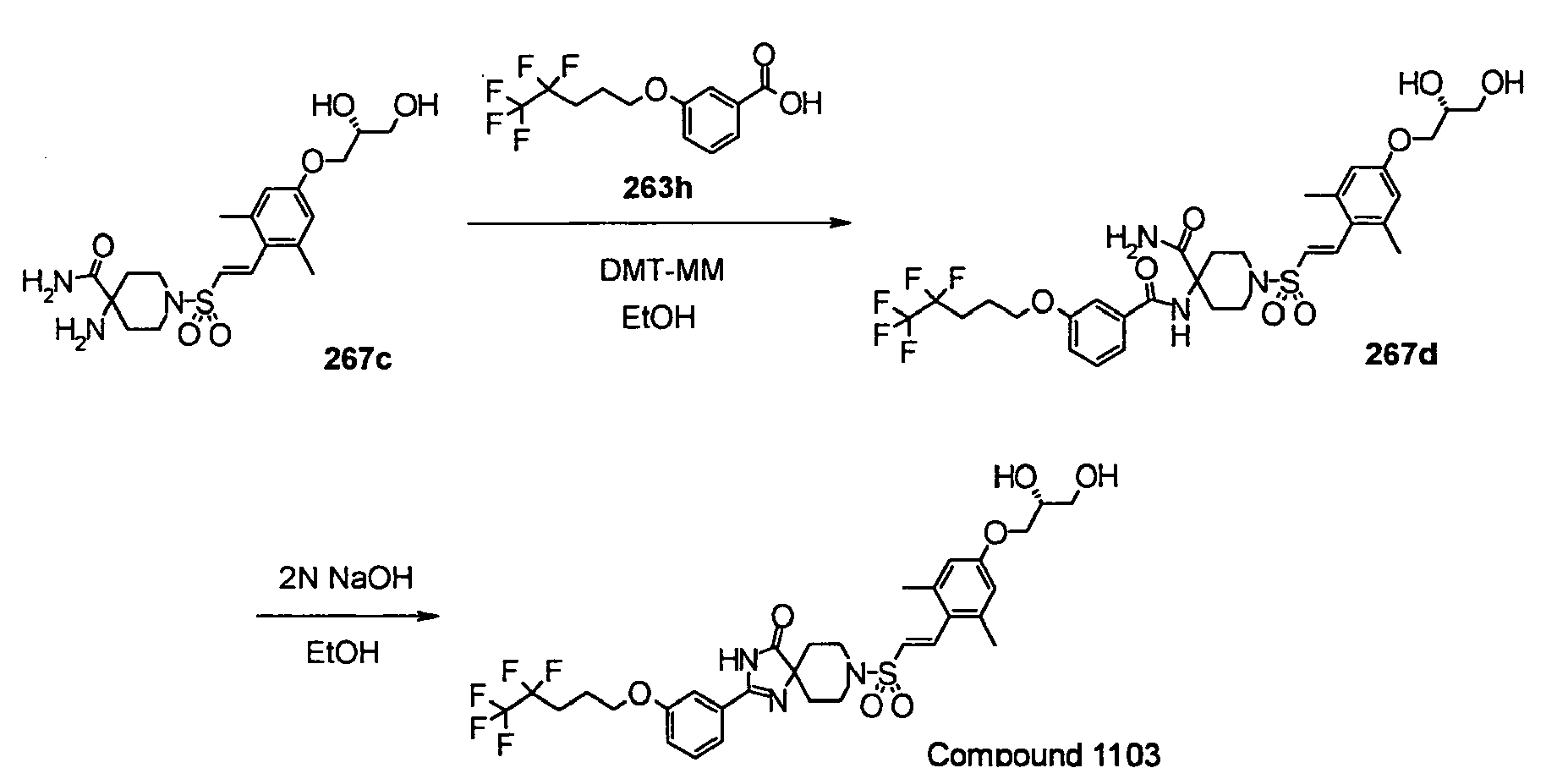
- 8-{(E)-2-[4-((R)-2,3-Dihydroxy-propoxy)-2,6-dimethyl-phenyl]-ethenesulfonyl}-2-[3-(4,4,5,5,5-pentafluoro-pentyloxy)-phenyl]-1,3,8-triaza-spiro[4.5]dec-1-en-4-one was synthesized by operations similar to those in Reaction 10-1 and Reaction 189-5 using appropriate reagents and starting material.
MS (ESI) m/z = 690 (M+H)+. -

- 3-Amino-1-(2-naphthalen-1-yl-ethanesulfonyl)-azetidine-3-carboxylic amide was synthesized by operations similar to those in Reaction 190-1, Reaction 109-1, Reaction 200-2, Reaction 200-3 and Reaction 233-4 using appropriate reagents and starting material.
MS (ESI) m/z = 334 (M+H)+. -

- 6-(4-Methyl-cyclohexyl)-2-(2-naphthalen-1-yl-ethanesulfonyl)-2,5,7-triaza-spiro[3.4]oct-5-en-8-one was synthesized by operations similar to those in Reaction 10-14 and Reaction 10-12 using appropriate reagents and starting material.
MS (ESI) m/z = 440 (M+H)+. -

- HATU (57 mg, 0.149 mmol) was added to a solution of 12-hydroxy-dodecanoic acid (33 mg, 0.149 mol), 4-amino-1-[(E)-2-(2,6-dimethyl-4-methylamino-phenyl)-ethenesulfonyl]-piperidine-4-carboxylic amide (50 mg, 0.136 mmol) and diisopropylethylamine (71 µL, 0.47 mmol) in DMF (1.3 ml) at 0°C, and the mixture was stirred at room temperature for 1.5 hours. Ethanol (2.6 ml) and potassium t-butoxide (76 mg, 0.678 mmol) were added to the reaction mixture, and the mixture was heated with stirring at 70°C for three hours. The reaction mixture was quenched with a saturated aqueous ammonium chloride solution, and water was then added, followed by extraction with ethyl acetate. The organic layer was sequentially washed with water and saturated brine, and then dried over anhydrous sodium sulfate and concentrated under reduced pressure. The resulting residue was purified by silica gel column chromatography (dichloromethane-methanol) to give 8-[(E)-2-(2,6-dimethyl-4-methylamino-phenyl)-ethenesulfonyl]-2-(11-hydroxy-undecyl)-1,3,8-triaza-spiro[4.5]dec-1-en-4-one (58.7 mg, 79%).
MS (ESI) m/z = 547 (M+H)+. - The example compounds shown below were synthesized by operations similar to those in Reaction 269-1 using appropriate reagents and starting materials.
-
[Table 163] Compound Structure LCMS condition Retention time (min) MS (m/z) 1106 
LCMS-C-1 3.12 646 (M+H)+ 1107 
LCMS-G-1 0.93 519 (M+H)+ -

- 1-(3,5-Dimethyl-4-{(E)-2-[4-oxo-2-((1S,3R)-3-propylcyclohexyl)-1,3,8-triaza-spiro[4.5]dec-1-ene-8-sulfonyl]-vinyl}-phenyl)-1-methyl-urea was synthesized by operations similar to those in Reaction 269-1 and Reaction 89-2 (using KOCN) using appropriate reagents and starting material.
MS (ESI) m/z = 544 (M+H)+. - The example compounds shown below were synthesized by operations similar to those in Reaction 270-1 using appropriate reagents and starting materials.
-
[Table 164] Compound Structure LCMS condition Retention time (min) MS (m/z) 1109 
LCMS-C-1 2.72 646 (M+H)+ 1110 
LCMS-F-1 0.93 520 (M+H)+ 1111 
LCMS-F-1 0.93 598 (M+H)+ 1112 
LCMS-F-1 1.03 714 (M+H)+ 1113 
LCMS-F-1 0.99 598 (M+H)+ - The carboxylic acid reagent used in the synthesis of Compound 1110 (4-[1,1,1-2H3]methyl-[4-2H1]cyclohexanecarboxylic acid) was synthesized by the following method.
-

- 4-[1,1,1-2H3]Methylene-cyclohexanecarboxylic acid ethyl ester was synthesized by operations similar to those in Reaction 101-1 using appropriate reagents and starting material.
1H-NMR (400 MHz, CDCl3) δ 1.25 (3H, t, J = 7.2 Hz), 1.52-1.64 (2H, m), 1.95-2.10 (4H, m), 2.34 (2H, ddd, J = 13.6, 4.4, 4.4 Hz), 2.44 (1H, dddd, J = 10.8, 10.8, 3.6, 3.6 Hz), 4.13 (2H, q, J = 7.6 Hz). -

- 20% w/w Pd/C (2.6 mg) was added to a solution of 4-[1,1,1-2H3]methylene-cyclohexanecarboxylic acid ethyl ester (26.0 mg, 153 µmol) in MeOH (1 ml) in an N2 atmosphere. After deuterium substitution, the reaction mixture was stirred at room temperature for one hour. The reaction mixture was filtered through celite, and the filtrate was concentrated under reduced pressure to give 4-[1,1,1-2H3]methyl-[4-2H1]cyclohexanecarboxylic acid ethyl ester. This was used in the next step without further purification.
-

- 4-[1,1,1-2H3]Methyl-[4-2H1]cyclohexanecarboxylic acid was synthesized by operations similar to those in Reaction 95-18 using appropriate reagents and starting material. This was used in the next step without further purification.
-

- 1-(3,5-Dimethyl-4-{(E)-2-[4-oxo-2-(4'-propyl-biphenyl-3-yl)-1,3,8-triaza-spiro[4.5]dec-1-ene-8-sulfonyl]-vinyl}-phenyl)-1-methyl-urea was synthesized by operations similar to those in Reaction 269-1 and Reaction 89-2 using appropriate reagents and starting material.
MS (ESI) m/z = 614 (M+H)+. - The carboxylic acid reagent used in the synthesis of Compound 1114 (4'-propyl-biphenyl-3-carboxylic acid) was synthesized by the following method.
-

- 4'-Propyl-biphenyl-3-carboxylic acid was synthesized by operations similar to those in Reaction 259-2 using appropriate reagents and starting material.
MS (ESI) m/z = 241 (M+H)+. - The example compounds shown below were synthesized by operations similar to those in Reaction 259-1 using appropriate reagents and starting materials.
-
[Table 165] Compound Structure LCMS condition Retention time (min) MS (m/z) 1115 
LCMS-D-1 1.84 548 (M+H)+ 1116 
LVMS-D-1 2.82 634 (M+H)+ 1117 
LCMS-D-1 2.75 634 (M+H)+ 1118 
LCMS-F-1 1.07 592 (M+H)+ 1119 
LCMS-F-1 0.92 502 (M+H)+ 1120 
LCMS-F-1 1.02 578 (M+H)+ 1121 
LCMS-F-1 1.11 620 (M+H)+ 1122 
LCMS-D-1 1.75 564 (M+H)+ 1123 
LCMS-D-1 1.81 548 (M+H)+ 1124 
LCMS-D-1 1.98 548 (M+H)+ 1125 
LCMS-F-1 1.05 610 (M+H)+ 1126 
LCMS-D-1 2.48 588 (M+H)+ 1127 
LCMS-D-1 2.12 578 (M+H)+ 1128 
LCMS-D-1 2.98 596 (M+H)+ 1129 
LCMS-F-1 0.95 533 (M+H)+ 1130 
LCMS-F-1 0.97 536 (M+H)+ - The carboxylic acid reagent used in the synthesis of Compound 1115 (7-ethoxy-heptanoic acid) was synthesized by the following method.
-

- 0.5 M sodium ethoxide (1.6 ml, 4.31 mmol) was added to a solution of ethyl 7-bromoheptanoate (300 mg, 1.44 mmol) in ethanol (7.0 ml), and the mixture was heated under reflux for two hours. The reaction mixture was concentrated under reduced pressure, and the resulting residue was then purified by silica gel column chromatography (hexane:ethyl acetate = 10:1) to give ethyl 7-ethoxyheptanoate (102.4 mg, 40%).
1H-NMR (300 MHz, DMSO-d6) δ 1.18 (t, 3H, J = 7.3 Hz), 1.24 (t, 3H, J = 7.3 Hz), 1.29-1.38 (m, 4H), 1.52-1.68 (m, 4H), 2.28 (t, 2H, J = 7.6 Hz), 3.45-3.51 (m, 4H), 4.05-4.17 (m, 2H). -

- 7-Ethoxy-heptanoic acid was synthesized by operations similar to those in Reaction 95-18 using appropriate reagents and starting material.
1H-NMR (300 MHz, DMSO-d6) δ 1.13 (m, 3H), 1.35 (m, 4H), 1.58 (m, 4H), 2.23 (m, 2H), 3.49 (m, 4H), 12.36 (s, 1H) . - The carboxylic acid reagent used in the synthesis of Compound 1116 (3-(6,6,6-trifluoro-hexyl)-benzoic acid) was synthesized by the following method.
-

- Acrolein (180 µ1, 2.71 mmol), tetrabutylammonium bromide (385 mg, 1.19 mmol), palladium acetate (5 mmol%) and potassium carbonate (450 mg, 3.26 mmol) were added to a solution of methyl 3-iodobenzoate (300 mg, 1.08 mmol) in DMF (6.0 ml), and the mixture was heated with stirring at 80°C for two hours. The reaction mixture was cooled to room temperature and then diluted with ethyl acetate, and the organic layer was washed with water and saturated brine. The organic layer was concentrated under reduced pressure, and the resulting residue was then purified by silica gel column chromatography (hexane:ethyl acetate = 8:1) to give ethyl 3-(3-oxoprop-1-en-1-yl)benzoate as a white solid (280 mg, 96%).
MS (ESI) m/z = 205 (M+H)+. -

- 3-(6,6,6-Trifluoro-hexyl)-benzoic acid was synthesized by operations similar to those in Reaction 191-14, Reaction 18-2 and Reaction 95-18 using appropriate reagents and starting material.
MS (ESI) m/z = 261 (M+H)+. - The carboxylic acid reagent used in the synthesis of Compound 1117 (4-(6,6,6-trifluoro-hexyl)-benzoic acid) was synthesized by the following method.
-

- 4-(6,6,6-Trifluoro-hexyl)-benzoic acid was synthesized by operations similar to those in Reaction 191-14, Reaction 18-2 and Reaction 95-18 using appropriate reagents and starting material.
MS (ESI) m/z = 261 (M+H)+. - The carboxylic acid reagent used in the synthesis of Compound 1120 ((E)-7-phenyl-hept-6-enoic acid) was synthesized by the following method.
-

- (E)-7-Phenyl-hept-6-enoic acid was synthesized by operations similar to those in Reaction 26-1 (using NMP as a solvent) using appropriate reagents and starting material.
MS (ESI) m/z = 203 (M-H)-. - The carboxylic acid reagent used in the synthesis of Compound 1121 ((E)-10-phenyl-dec-9-enoic acid) was synthesized by the following method.
-
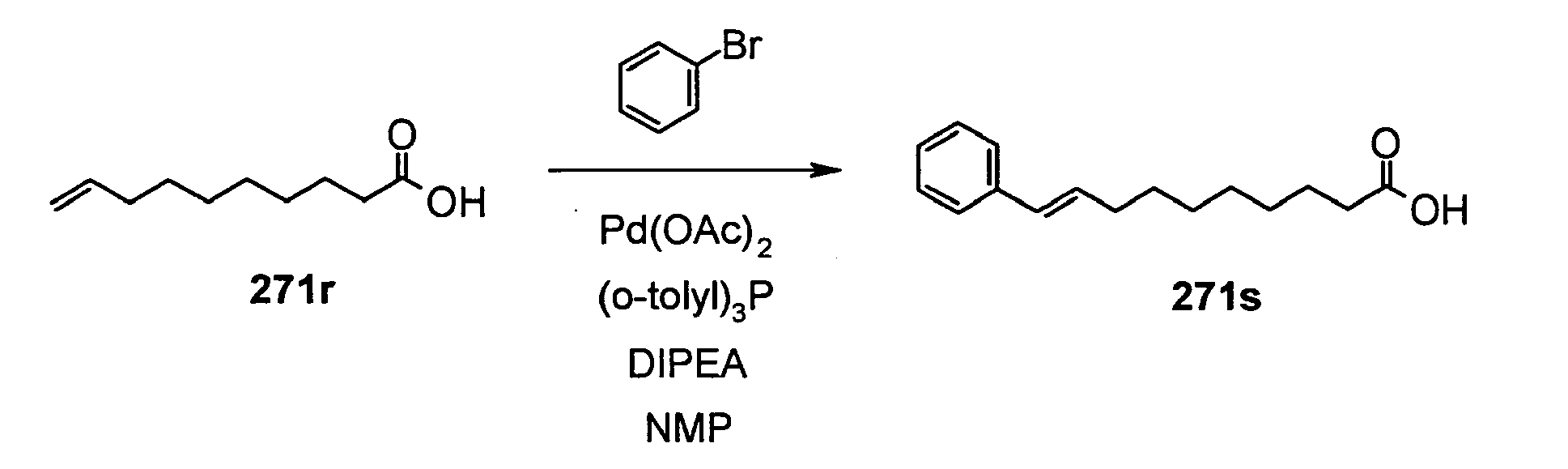
- (E)-10-Phenyl-dec-9-enoic acid was synthesized by operations similar to those in Reaction 26-1 (using NMP as a solvent) using appropriate reagents and starting material.
MS (ESI) m/z = 245 (M-H)-. - The carboxylic acid reagent used in the synthesis of Compound 1122 (6-propylsulfanyl-hexanoic acid) was synthesized by the following method.
-

- A solution of propanethiol (0.609 ml, 6.72 mmol) in anhydrous THF (10 ml) was cooled to -10°C in a nitrogen atmosphere. 2 M nBuLi (4.03 ml, 8.07 mmol) was added dropwise and the mixture was then stirred for 10 minutes. A solution of ethyl 6-bromohexanoate in anhydrous THF (5 ml) was then added and the mixture was stirred for 40 minutes. The reaction mixture was quenched by adding water and then extracted with ethyl acetate. The organic layer was washed with water and saturated brine and dried over sodium sulfate. The organic layer was concentrated under reduced pressure, and the resulting residue was then purified by silica gel column chromatography (hexane:ethyl acetate = 15:1) to give ethyl 6-(propylthio)hexanoate as a colorless oily substance (1.46 g, 100%).
1H-NMR (300 MHz, CDCl3) δ 0.98 (t, 3H, J = 7.6 He), 1.25 (t, 3H, J = 7.2 Hz), 1.46-1.36 (m, 2H), 1.69-1.54 (m, 6H), 2.30 (t, 2H, J = 7.2 Hz), 2.49 (dd, 4H, J = 7.2, 14.3 Hz), 4.12 (dd, 2H, J = 7.2, 14.1 Hz). -

- 6-Propylsulfanyl-hexanoic acid was synthesized by operations similar to those in Reaction 95-18 using appropriate reagents and starting material.
1H-NMR (300 MHz, DMSO-d6) δ 0.92 (m, 3H),1.34 (m, 2H), 1.51 (m, 6H), 2.19 (m, 2H), 2.45 (m, 4H). - The carboxylic acid reagent used in the synthesis of Compound 1123 (8-methoxy-octanoic acid) was synthesized by the following method.
-

- 8-Methoxy-octanoic acid was synthesized by operations similar to those in Reaction 271-3 using appropriate reagents and starting material.
1H-NMR (300 MHz, CDCl3) δ 1.39 (m, 6H), 1.69 (m, 4H), 2.13 (s, 1H), 2.42 (m, 2H), 3.33 (s, 3H), 3.39 (m, 2H). - The carboxylic acid reagent used in the synthesis of Compound 1124 (6-propoxy-hexanoic acid) was synthesized by the following method.
-

- Sodium (354 mg, 15.38 mmol) was added to a solution of 6-bromohexanoic acid (300 mg, 1.54 mmol) in propyl alcohol (15 ml), and the mixture was heated under reflux for two hours. The reaction mixture was cooled to room temperature and then concentrated under reduced pressure. The resulting residue was purified by silica gel column chromatography (dichloromethane:methanol = 30:1) to give 6-propoxy-hexanoic acid (209 mg, 78%).
1H-NMR (300 MHz, CDCl3) δ 0.88 (m, 3H), 1.37 (m, 2H), 1.62 (m, 6H), 2.44 (m, 2H), 3.52 (m, 4H). - The carboxylic acid reagent used in the synthesis of Compound 1126 (4-propyl-decanoic acid) was synthesized by the following method.
-

- 4-Hydroxy-decanoic acid was synthesized by operations similar to those in Reaction 95-18 using appropriate reagents and starting material. This was used in the next step without complete purification.
-

- PCC (1.2 g, 2.71 mmol) was added to a solution of 4-hydroxydecanoic acid (830 mg, 4.4 mmol) in dichloromethane (30 ml), and the mixture was stirred at room temperature for five hours. The reaction mixture was adjusted to pH 1 by adding 1 N hydrochloric acid and then extracted with ethyl acetate. The organic layer was washed with water and saturated brine and then concentrated under reduced pressure. The resulting residue was then dissolved in ethanol (15 ml). Five drops of sulfuric acid were added and the mixture was stirred at 80°C for 18 hours. The reaction mixture was concentrated under reduced pressure, and the resulting residue was purified by silica gel column chromatography (hexane:ethyl acetate = 2:1) to give ethyl 4-oxodecanoate (440 mg, 46% in two steps).
1H-NMR (300 MHz, CDCl3) δ 0.86 (t, 3H, J = 7.2 Hz), 1.26 (m, 9H), 1.57 (m, 2H), 2.43 (t, 2H, J=7.2Hz), 2.56 (m, 2H), 2.70 (m, 2H), 4.11 (dt, 2H, J = 7.2, 7.2 Hz). -

- 4-Propyl-decanoic acid was synthesized by operations similar to those in Reaction 191-14, Reaction 95-18 and Reaction 18-2 using appropriate reagents and starting material.
1H-NMR (300 MHz, CDCl3) δ 0.88 (m, 6H), 1.27 (m, 15H), 2.38 (m, 2H), 2.61 (m, 2H), 8.91 (br, 1H). - The carboxylic acid reagent used in the synthesis of Compound 1127 (2-propyl-benzofuran-6-carboxylic acid) was synthesized by the following method.
-

- 2-Propyl-benzofuran-6-carboxylic acid was synthesized by operations similar to those in Reaction 95-10 (using PdCl2(PPh3)2 as a catalyst) and Reaction 95-18 using appropriate reagents and starting material.
1H-NMR (300 MHz, CDCl3) δ 1.02 (m, 3H), 1.80 (m, 2H), 2.79 (m, 2H), 6.46 (s, 1H), 7.53 (m, 1H), 7.96 (m, 1H), 8.16 (s, 1H). - The carboxylic acid reagent used in the synthesis of Compound 1128 (3-methoxy-4-pentyl-benzoic acid) was synthesized by the following method.
-

- 3-Methoxy-4-pentyl-benzoic acid was synthesized by operations similar to those in Reaction 26-4, Reaction 95-10 (using PdCl2(PPh3)2 as a catalyst), Reaction 122-2 and Reaction 95-18 using appropriate reagents and starting material.
MS (ESI) m/z = 223 (M+H)+. - A mixture of
the carboxylic acid reagent used in the synthesis of the compound 1129 (4-([1,1,2,2,2-2H5]ethyl)-cyclohex-3-enecarboxylic acid)
and the carboxylic acid reagent used in the synthesis of the compound 1130 (4-([1,1,2,2,2-2H5]ethyl)-[4-2H]-cyclohexanecarboxylic acid)
was synthesized by the following method. -

- A solution of iodo-ethane-d5 (3.00 g, 18.6 mmol) and triphenylphosphine (14.6 mg, 55.8 mmol) in toluene (15 ml) was stirred at 110°C for 21 hours. The reaction mixture was filtered, and the solid was washed with toluene and dried to give [1,1,2,2,2-2H5]ethyltriphenylphosphonium iodide as a white solid (7.85 g, 100%). This was used in the next reaction without complete purification.
-

- 4-([1,1,2,2,2-2H5]Ethyl)-cyclohex-3-enecarboxylic acid and 4-([1,1,2,2,2-2H5] ethyl)-[4-2H]-cyclohexanecarboxylic acid were synthesized as a mixture by operations similar to those in Reaction 101-1, Reaction 18-2 and Reaction 95-18 using appropriate reagents and starting material. This was used in the next step without complete purification.
-

- 12-(8-{(E)-2-[2,6-Dimethyl-4-(1-methyl-ureido)-phenyl]-ethenesulfonyl}-4-oxo-1,3,8-triaza-spiro[4.5]dec-1-en-2-yl)-dodecanoic acid
MS (ESI) m/z = 618 (M+H)+
and
12-(8-{(E)-2-[2,6-dimethyl-4-(1-methyl-ureido)-phenyl]-ethenesulfonyl}-4-oxo-1,3,8-triaza-spiro[4.5]dec-1-en-2-yl)-dodecanoic acid ethyl ester
MS (ESI) m/z = 646 (M+H)+
were synthesized by operations similar to those in Reaction 269-1 and Reaction 89-2 (using KOCN) using appropriate reagents and starting material. -

- 1-(3,5-Dimethyl-4-{(E)-2-[4-oxo-2-(5-phenyl-pentyl)-1,3,8-triaza-spiro[4.5]dec-1-ene-8-sulfonyl]-vinyl}-phenyl)-1-methyl-urea trifluoroacetate
MS (ESI) m/z = 566 (M+H)+
and
1-(3,5-dimethyl-4-{(Z)-2-[4-oxo-2-(5-phenyl-pentyl)-1,3,8-triaza-spiro[4.5]dec-1-ene-8-sulfonyl]-vinyl}-phenyl)-1-methyl-urea trifluoroacetate
MS (ESI) m/z = 566 (M+H)+
were synthesized by operations similar to those in Reaction 269-1 and Reaction 89-2 (using KOCN) using appropriate reagents and starting material. -

- 1-[3,5-Dimethyl-4-(2-{4-oxo-2-[3-(4,4,5,5,5-pentafluoro-pentyloxy)-phenyl]-1,3,8-triaza-spiro[4.5]dec-1-ene-8-sulfonyl}-ethyl)-phenyl]-1-methyl-urea was synthesized by operations similar to those in Reaction 269-1, Reaction 89-2 (using KOCN) and Reaction 184-1 using appropriate reagents and starting material.
MS (ESI) m/z = 674 (M+H)+. -

- 1-(3,5-Dimethyl-4-{2-[4-oxo-2-(3'-propyl-biphenyl-3-yl)-1,3,8-triaza-spiro[4.5]dec-1-ene-8-sulfonyl]-ethyl}-phenyl)-1-methyl-urea was synthesized by operations similar to those in Reaction 269-1, Reaction 89-2 (using KOCN) and Reaction 184-1 using appropriate reagents and starting material.
MS (ESI) m/z = 616 (M+H)+. - The carboxylic acid reagent used in the synthesis of Compound 1136 (3'-propyl-biphenyl-3-carboxylic acid) was synthesized by the following method.
-

- 3'-Propyl-biphenyl-3-carboxylic acid was synthesized by operations similar to those in Reaction 259-2, Reaction 191-14, Reaction 18-2 and Reaction 95-18 using appropriate reagents and starting material.
1H-NMR (300 MHz, CDCl3) δ 8.36 (t, 1H, J = 1.5 Hz), 8.10 (dt, 1H, J = 7.6, 1.5 Hz), 7.85 (dt, 1H, J = 7.6, 1.5 Hz), 7.56 (t, 1H, J = 7.6 Hz), 7.46 (dt, 1H, J = 7.3, 1.5 Hz), 7.45 (d, 1H, J = 7.3 Hz), 7.39 (t, 1H, J = 7.3 Hz), 7.23 (dt, 1H, J = 7.3, 1.5 Hz), 2.68 (t, 2H, J = 7.6 Hz), 1.71 (m, 2H), 0.99 (t, 3H, J=7.6Hz). -

- 1-(3,5-Dimethyl-4-{2-[4-oxo-2-(4-trimethylsilanyl-cyclohexyl)-1,3,8-triaza-spiro[4.5]dec-1-ene-8-sulfonyl]-ethyl}-phenyl)-1-methyl-urea was synthesized by operations similar to those in Reaction 269-1 (using LiOH), Reaction 4-1 and Reaction 89-2 (using KOCN) using appropriate reagents and starting material.
MS (ESI) m/z = 576 (M+H)+. - The carboxylic acid reagent used in the synthesis of Compound 1137 (4-trimethylsilanyl-cyclohexanecarboxylic acid) was synthesized by the following method.
-

- 1-Bromo-4-trimethylsilyl-benzene (0.426 ml, 2.18 mmol) was dissolved in THF (20 ml), and n-butyllithium (1.59 M solution in n-hexane, 1.51 ml, 1.40 mmol) was added dropwise at -78°C. After stirring for 20 minutes, crushed dry ice (excess) was added. The reaction solution was stirred at room temperature for one hour, and 1 M hydrochloric acid and water were then added, followed by extraction with ethyl acetate. The organic layer was washed with water and saturated brine, dried over anhydrous sodium sulfate and concentrated under reduced pressure. The resulting residue was purified by silica gel column chromatography (n-hexane/ethyl acetate) to give 4-trimethylsilanyl-benzoic acid (363 mg, 86%).
1H-NMR (400 MHz, DMSO-D6) δ 12.93 (1H, br s), 7.91 (2H, d, J = 8.3 Hz), 7.65 (2H, d, J = 7.8 Hz), 0.27 (9H, t, J = 3.4 Hz). -

- 4-Trimethylsilanyl-cyclohexanecarboxylic acid was synthesized by operations similar to those in Reaction 193-3 using appropriate reagents and starting material.
1H-NMR (400 MHz, CDCl3) δ 2.73-2.66 (0.6H, m), 2.33 (0.4H, tt, J = 11.0, 3.7 Hz), 2.15-0.58 (8H, m), -0.06 (9H, s) (cis : trans = ca 6 : 4). - The example compounds shown below were synthesized by operations similar to those in Reaction 276-1 using appropriate reagents and starting materials.
-
[Table 166] Compound Structure LCMS condition Retention time (min) MS (m/z) 1138 
LCMS-A-1 2.44 640 (M+H)+ 1139 
LCMS-A-1 2.47 570 (M+H)+ 1140 
LCMS-A-1 2.94 604 (M+H)+ 1141 
LCMS-A-1 2.66 576 (M+H)+ 1142 
LCMS-A-1 2.31 534 (M+H)+ - The carboxylic acid reagent used in the synthesis of Compound 1138 (3,5-bis-trifluoromethyl-cyclohexanecarboxylic acid) was synthesized by the following method.
-

- 3,5-Bis-trifluoromethyl-cyclohexanecarboxylic acid was synthesized by operations similar to those in Reaction 193-3 using appropriate reagents and starting material.
1H-NMR (400 MHz, CDCl3) δ 2.51-2.41 (1H, m), 2.35-2.27 (2H, m), 2.24-2.12 (3H, m), 1.52-1.42 (2H, m), 1.41-1.30 (1H, m). -
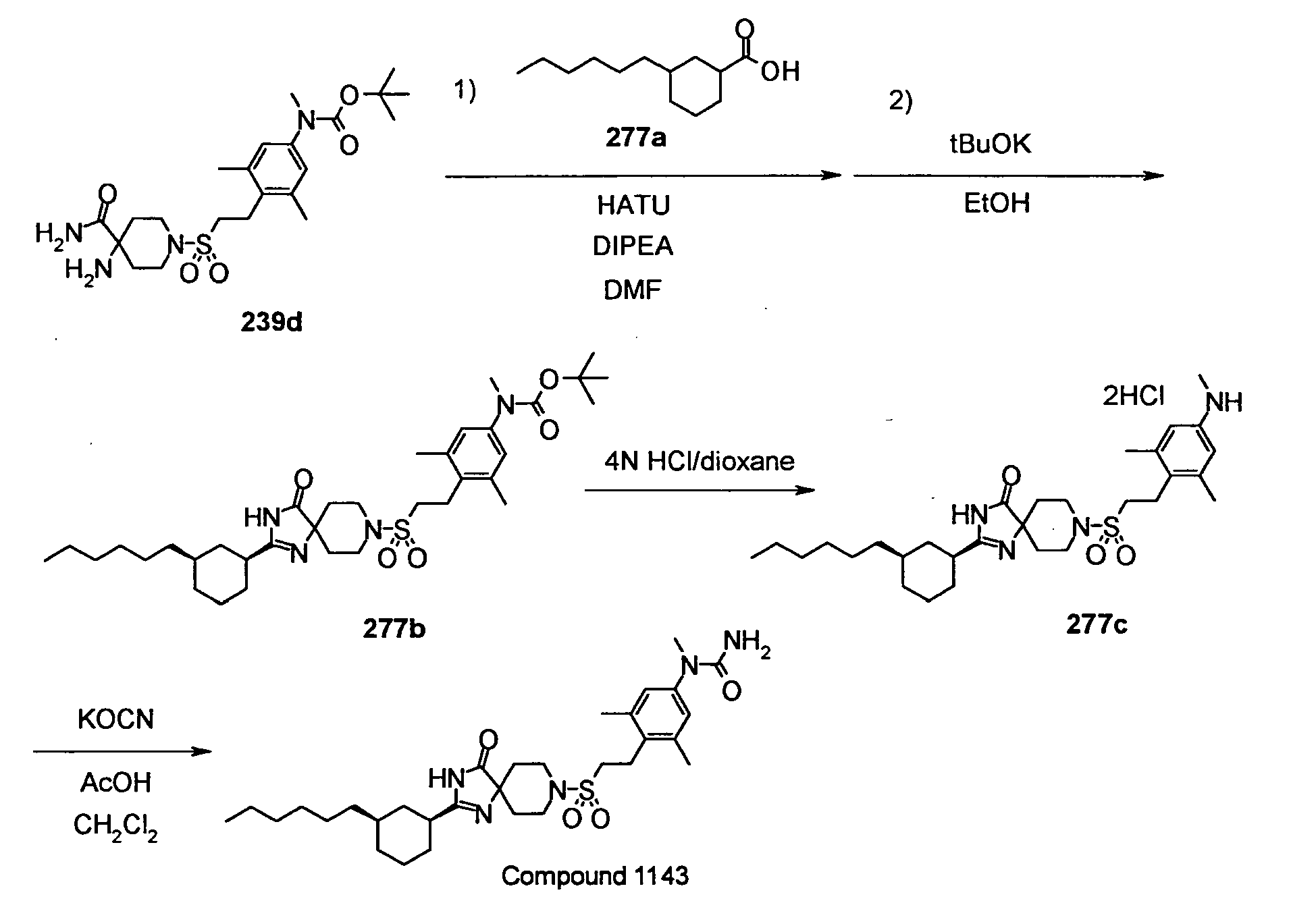
- 1-(4-{2-[2-((1S,3R)-3-Hexyl-cyclohexyl)-4-oxo-1,3,8-triaza-spiro[4.5]dec-1-ene-8-sulfonyl]-ethyl}-3,5-dimethyl-phenyl)-1-methyl-urea was synthesized by operations similar to those in Reaction 269-1, Reaction 5-3 and Reaction 89-2 (using KOCN) using appropriate reagents and starting material.
MS (ESI) m/z = 588 (M+H)+. - The carboxylic acid reagent used in the synthesis of Compound 1143 (3-hexyl-cyclohexanecarboxylic acid) was synthesized by the following method.
-

- 3-Hexyl-cyclohexanecarboxylic acid was synthesized by operations similar to those in Reaction 101-1, Reaction 95-18 and Reaction 193-3 using appropriate reagents and starting material.
1H-NMR (400 MHz, CDCl3) δ 0.84-2.03 (22H, m), 2.32 (0.6H, tt, J = 11.6, 2.8 Hz), 2.67-2.68 (0.4H, m) (cis : trans = 3 : 2). - The example compounds shown below were synthesized by operations similar to those in Reaction 277-1 using appropriate reagents and starting materials.
-
[Table 167] Compound Structure LCMS condition Retention time (min) MS (m/z) 1144 
LCMS-C-1 2.93 568 (M+H)+ 1145 
LCMS-C-1 2.93 560 (M+H)+ 1146 
LCMS-C-1 3.03 574 (M+H)+ 1147 
LCMS-F-1 0.98 638 (M+H)+ 1148 
LCMS-F-1 0.97 538 (M+H)+ 1149 
LCMS-F-1 0.95 535 (M+H)+ - The carboxylic acid reagent used in the synthesis of Compound 1144 (3-(3-methyl-butyl)-benzoic acid) was synthesized by the following method.
-
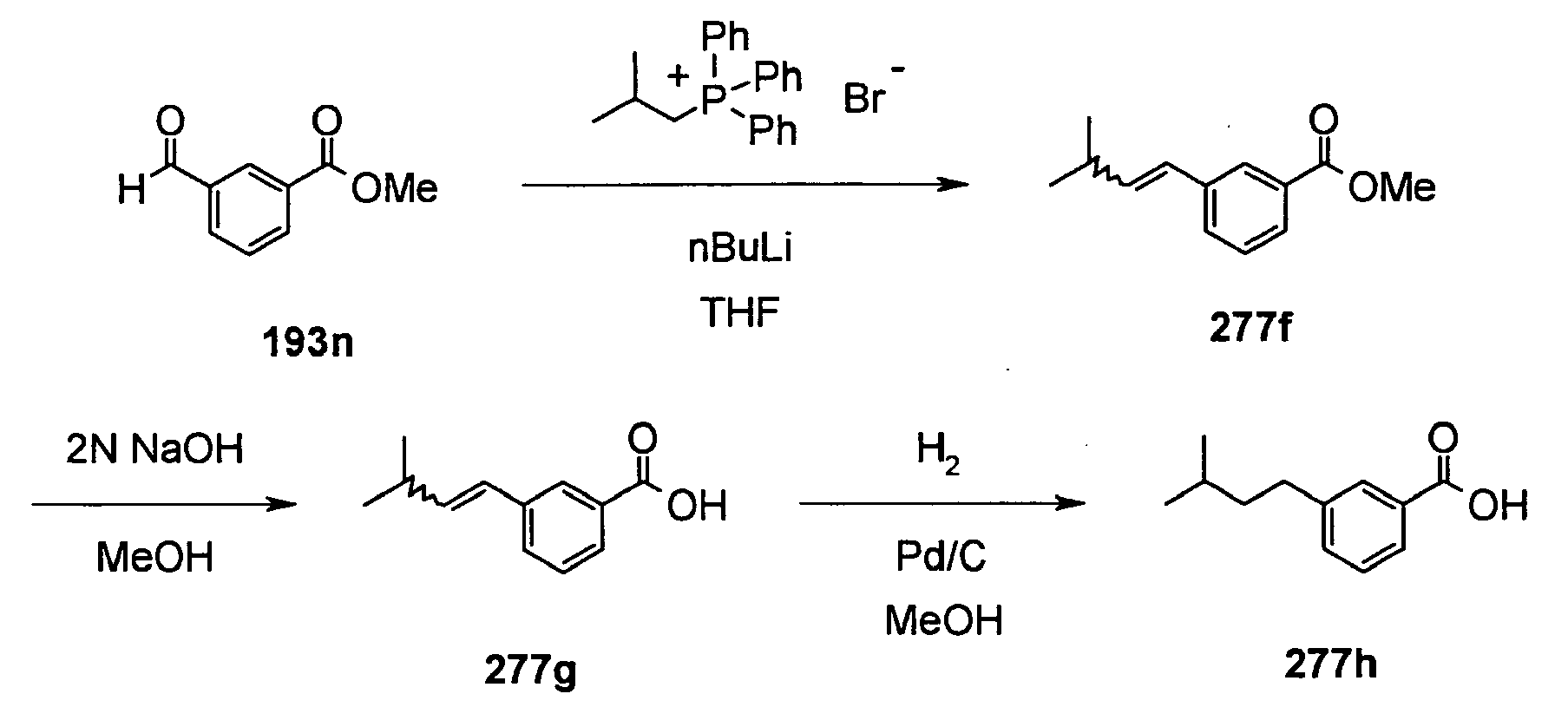
- 3-(3-Methyl-butyl)-benzoic acid was synthesized by operations similar to those in Reaction 101-1, Reaction 95-18 and Reaction 18-2 using appropriate reagents and starting material.
MS (ESI) m/z = 191 (M-H)-. - The carboxylic acid reagent used in the synthesis of Compound 1145 (3-butyl-cyclohexanecarboxylic acid) was synthesized by the following method.
-

- 3-Butyl-cyclohexanecarboxylic acid was synthesized by operations similar to those in Reaction 193-3 using appropriate reagents and starting material.
1H-NMR (400 MHz, CDCl3) δ 0.84-2.03 (18H, m), 2.33 (0.6H, m), 2.68 (0.4H, m) (cis : trans = 3 : 2). - The carboxylic acid reagent used in the synthesis of Compound 1146 (3-(3-methyl-butyl)-cyclohexanecarboxylic acid) was synthesized by the following method.
-

- 3-(3-Methyl-butyl)-cyclohexanecarboxylic acid was synthesized by operations similar to those in Reaction 193-3 using appropriate reagents and starting material.
1H-NMR (400 MHz, CDCl3) δ 0.81-2.04 (20H, m), 2.33 (0.66H, tt, J = 12.0, 3.2 Hz), 2.67-2.68 (0.33H, m) (cis : trans = 2 : 1). - The carboxylic acid reagent used in the synthesis of Compound 1147 (4,4,10,10,10-pentafluoro-decanoic acid) was synthesized by the following method.
-

- One piece of I2 was added to a solution of magnesium (204 mg, 8.40 mmol) in THF (5 ml) in a nitrogen atmosphere, and the reaction mixture was stirred at 45°C for 20 minutes. A solution of 6-bromo-1,1,1-trifluoro-hexane (1.53 g, 7.00 mmol) in THF (2 ml) was added and the reaction mixture was stirred at 45°C for one hour to give Compound 277m (0.875 M solution in THF).
This Compound 277m (0.875 M solution in THF, 5.71 ml, 5.00 mmol) was added dropwise to succinylethyl chloride (1.00 g, 5.00 mmol) and CuI (57.9 mg, 304 µmol) in THF (17 ml) at 0°C. The reaction mixture was stirred at 0°C for 30 minutes. The reaction mixture was quenched with a saturated aqueous ammonium chloride solution and diluted with ethyl acetate. The organic layer was then washed with a saturated aqueous sodium bicarbonate solution, water and saturated brine, and then dried over MgSO4 and concentrated under reduced pressure. The resulting residue was purified by silica gel column chromatography (hexane/ethyl acetate = 100/0 -> 80/20) to give 10,10,10-trifluoro-4-oxo-decanoic acid ethyl ester (926 mg, 69%).
MS (ESI) m/z = 269 (M+H)+. -

1H-NMR (400 MHz, CDCl3) δ 1.41-1.45 (2H, m), 1.50-1.64 (4H, m), 1.79-1.92 (2H, m), 2.02-2.25 (4H, m), 2.58-2. 62 (2H, m). -

- 1-(4-{2-[2-(4-Chloro-3-trifluoromethyl-phenyl)-4-oxo-1,3,8-triaza-spiro[4.5]dec-1-ene-8-sulfonyl]-ethyl}-3,5-dimethyl-phenyl)-1-methyl-urea was synthesized by operations similar to those in Reaction 269-1, Reaction 4-1 and Reaction 89-2 (using KOCN) using appropriate reagents and starting material.
MS (ESI) m/z = 600 (M+H)+. -

- 1-(3,5-Dimethyl-4-{2-[4-oxo-2-(1,9,9,9-tetrafluorononyl)-1,3,8-triaza-spiro[4.5]dec-1-ene-8-sulfonyl]-ethyl}-phenyl)-1-methyl-urea was synthesized by operations similar to those in Reaction 269-1, Reaction 5-3 and Reaction 89-2 (using KOCN) using appropriate reagents and starting material.
MS (ESI) m/z = 620 (M+H)+. - The carboxylic acid reagent used in the synthesis of Compound 1151 (2,10,10,10-tetrafluoro-decanoic acid) was synthesized by the following method.
-

- 2,10,10,10-Tetrafluoro-decanoic acid was synthesized by operations similar to those in Reaction 26-4, Reaction 257-1 (using KHMDS as a base) and Reaction 215-2 using appropriate reagents and starting material.
1H-NMR (400 MHz, CDCl3) δ 1.30-1.40 (6H, m), 1.49-1.57 (4H, m), 1.90-2.13 (4H, m), 4.97 (1H, ddd, J = 48.8, 5.2, 5.2 Hz). -

- 1-(3,5-Dimethyl-4-{2-[4-oxo-2-(4'-propyl-biphenyl-3-yl)-1,3,8-triaza-spiro[4.5]dec-1-ene-8-sulfonyl]-ethyl}-phenyl)-1-methyl-urea was synthesized by operations similar to those in Reaction 269-1 and Reaction 89-2 using appropriate reagents and starting material.
MS (ESI) m/z = 616 (M+H)+. - The example compounds shown below were synthesized by operations similar to those in Reaction 280-1 using appropriate reagents and starting materials.
-
[Table 168] Compound Structure LCMS condition Retention time (min) MS (m/z) 1153 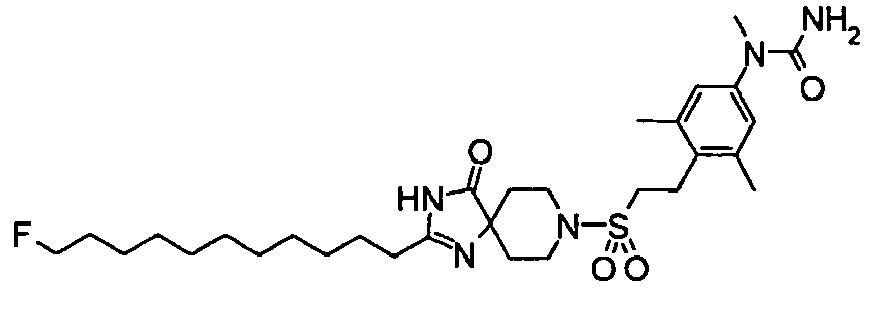
LCMS-F-1 1.08 594 (M+H)+ 1154 
LCMS-D-1 1.72 566 (M+H)+ 1155 
LCMS-D-1 3.12 650 (M+H)+ 1156 
LCMS-F-1 1.05 612 (M+H)+ - The carboxylic acid reagent used in the synthesis of Compound 1154 (7-ethylsulfanyl-heptanoic acid) was synthesized by the following method.
-

- 7-Ethylsulfanyl-heptanoic acid was synthesized by operations similar to those in Reaction 271-10 (using NaOEt as a base) and Reaction 95-18 using appropriate reagents and starting material.
1H-NMR (300 MHz, DMSO-d6) δ 1.24 (m, 3H), 1.39 (m, 4H), 1.56 (m, 4H), 2.24 (m, 2H), 2.49 (m, 4H), 12.05 (s, 1H). -

- 1-{3,5-Dimethyl-4-[(E)-2-(4-oxo-2-[1,1';3',1"]terphenyl-3-yl-1,3,8-triaza-spiro[4.5]dec-1-ene-8-sulfonyl)-vinyl]-phenyl}-1-methyl-urea was synthesized by operations similar to those in Reaction 10-14, Reaction 10-11, Reaction 10-12 (using ethanol as a solvent) and Reaction 89-2 using appropriate reagents and starting material.
MS (ESI) m/z = 648 (M+H)+. - The carboxylic acid reagent used in the synthesis of Compound 1157 ([1,1';3',1"]terphenyl-3-carboxylic acid) was synthesized by the following method.
-

MS (ESI) m/z = 275 (M+H)+. -

- 8-{(E)-2-[4-(4-Hydroxy-piperidine-1-carbonyl)-2,6-dimethyl-phenyl]-ethenesulfonyl}-2-[3-(4,4,5,5,5-pentafluoro-pentyloxy)-phenyl]-1,3,8-triaza-spiro[4.5]dec-1-en-4-one was synthesized by operations similar to those in Reaction 269-1 using appropriate reagents and starting material.
MS (ESI) m/z = 727 (M+H)+. - The example compounds shown below were synthesized by operations similar to those in Reaction 282-1 using appropriate reagents and starting materials.
-
[Table 169] Compound Structure LCMS condition Retention time (min) MS(m/z) 1159 
LCMS-B-1 2.16 653 (M+H)+ 1160 
LCMS-B-1 2.02 631 (M+H)+ -

- 4-Amino-1-{(E)-2-[4-(4-hydroxymethyl-piperidine-1-carbonyl)-2,6-dimethyl-phenyl]-ethenesulfonyl}-piperidine-4-carboxylic amide was synthesized by operations similar to those in Reaction 119-1, Reaction 10-14, Reaction 233-3 and Reaction 233-4 using appropriate reagents and starting material.
MS (ESI) m/z = 479 (M+H)+. -

- 2-(4-Fluoro-3-trifluoromethoxy-phenyl)-8-{(E)-2-[4-(4-hydroxymethyl-piperidine-1-carbonyl)-2,6-dimethyl-phenyl]-ethenesulfonyl}-1,3,8-triaza-spiro[4.5]dec-1-en-4-one was synthesized by operations similar to those in Reaction 269-1 using appropriate reagents and starting material.
MS (ESI) m/z = 667 (M+H)+. - The example compound shown below was synthesized by operations similar to those in Reaction 283-2 using appropriate reagents and starting material.
-
[Table 170] Compound Structure LCMS condition Retention time (min) MS (m/z) 1162 
LCQ-A-1 2.51 651 (M+H)+ -
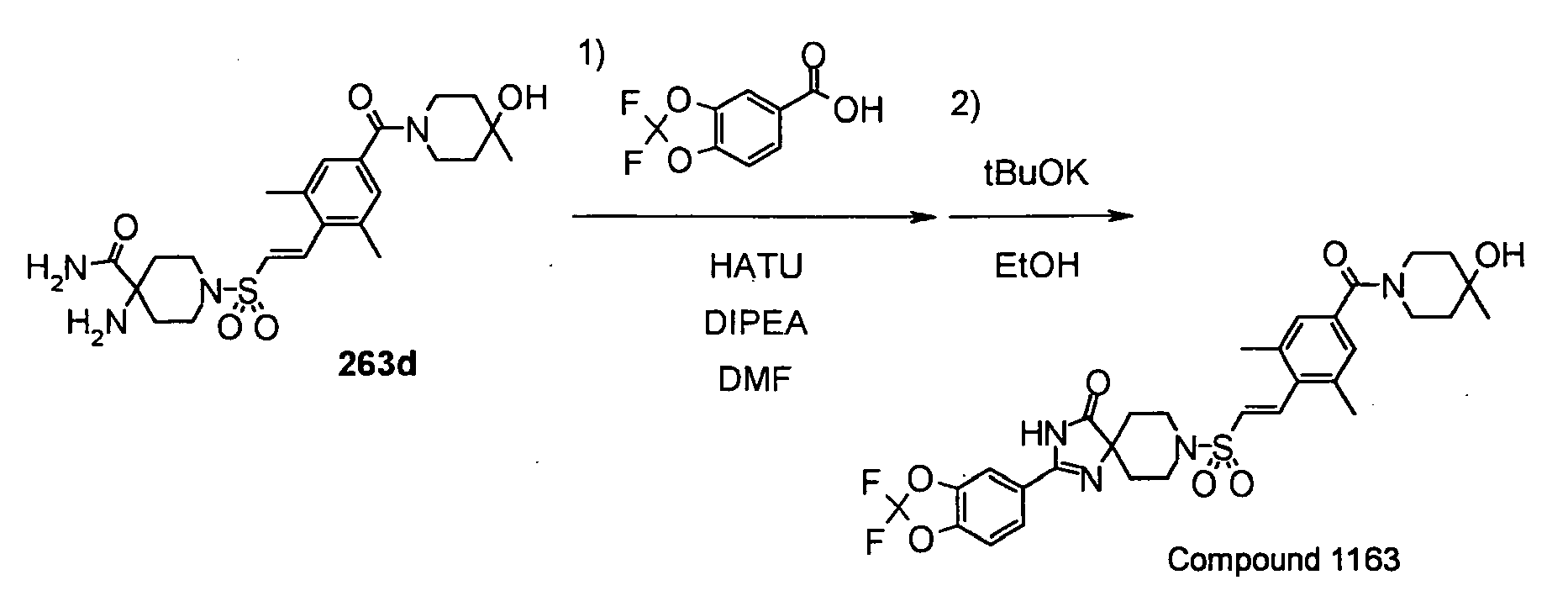
- 2-(2,2-Difluoro-benzo[1,3]dioxol-5-yl)-8-{(E)-2-[4-(4-hydroxy-4-methyl-piperidine-1-carbonyl)-2,6-dimethyl-phenyl]-ethenesulfonyl}-1,3,8-triaza-spiro[4.5]dec-1-en-4-one was synthesized by operations similar to those in Reaction 269-1 using appropriate reagents and starting material.
MS (ESI) m/z = 645 (M+H)+. -

- 8-{(E)-2-[4-((R)-2,3-Dihydroxy-propoxy)-2,6-dimethyl-phenyl]-ethenesulfonyl}-2-(4-fluoro-3-trifluoromethoxy-phenyl)-1,3,8-triaza-spiro[4.5]dec-1-en-4-one was synthesized by operations similar to those in Reaction 269-1 using appropriate reagents and starting material.
MS (ESI) m/z = 616 (M+H)+. - The example compound shown below was synthesized by operations similar to those in Reaction 285-1 using appropriate reagents and starting material.
-
[Table 171] Compound Structure LCMS condition Retention time (min) MS (m/z) 1165 
LCMS-F-1 0.94 594 (M+H)+ -

- 4-Amino-1-{(E)-2-[4-(3,4-dihydroxy-butoxy)-2-methylphenyl]-ethenesulfonyl}-piperidine-4-carboxylic amide was synthesized by operations similar to those in Reaction 26-1, Reaction 233-2, Reaction 233-3 and Reaction 233-4 using appropriate reagents and starting material.
MS (ESI) m/z = 428 (M+H)+. -

- 8-{(E)-2-[4-(3,4-Dihydroxy-butoxy)-2-methyl-phenyl]-ethenesulfonyl}-2-(4-fluoro-3-trifluoromethoxy-phenyl)-1,3,8-triaza-spiro[4.5]dec-1-en-4-one was synthesized by operations similar to those in Reaction 269-1 using appropriate reagents and starting material.
MS (ESI) m/z = 616 (M+H)+. - The example compounds shown below were synthesized by operations similar to those in Reaction 286-2 using appropriate reagents and starting materials.
-
[Table 172] Compound Structure LCMS condition Retention time (min) MS (m/z) 1167 
LCMS-C-1 2.60 594 (M+H)+ -
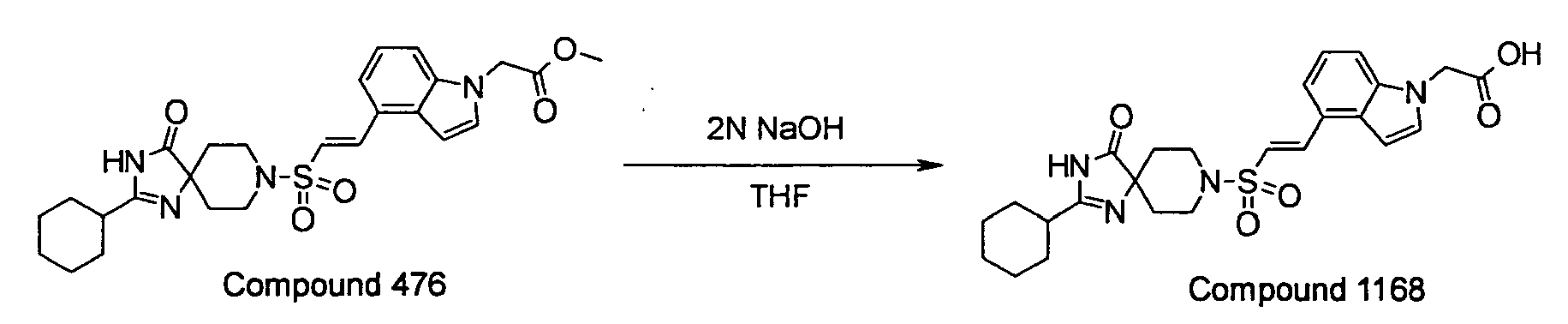
- {4-[(E)-2-(2-Cyclohexyl-4-oxo-1,3,8-triaza-spiro[4.5]dec-1-ene-8-sulfonyl)-vinyl]-indol-1-yl}-acetic acid (Compound 1168) was obtained by operations similar to those in Reaction 95-18 using Compound 476 as a starting material.
MS (ESI) m/z = 499 (M+H)+. - The example compounds shown below were obtained by operations similar to those in Reaction 287-1 using appropriate starting compounds.
[Table 173] Raw material Compound Target Compound Structure LCMS condition Retention time(min) MS (m/z) 504 1169 
LCMS-A-1 1.94 546 (M+H)+ 1347 1170 
LCMS-C-1 2.52 620 (M+H)+ -

- 10-(8-{(E)-2-[2,6-Dimethyl-4-(1-methyl-ureido)-phenyl]-ethenesulfonyl}-4-oxo-1,3,8-triaza-spiro[4.5]dec-1-en-2-yl)-decanoic acid (Compound 1171) was obtained by operations similar to those in Reaction 95-17 (using DMI as a solvent), Reaction 269-1 and Reaction 89-2 (using KOCN as a reagent) using appropriate reagents and starting material.
MS (ESI) m/z = 590 (M+H)+. -

- 10-(8-{(E)-2-[2,6-Dimethyl-4-(1-methyl-ureido)-phenyl]-ethenesulfonyl}-4-oxo-1,3,8-triaza-spiro[4.5]dec-1-en-2-yl)-decanoic amide was obtained by operations similar to those in Reaction 10-14 using Compound 1171 as a starting material.
MS (ESI) m/z = 589 (M+H)+. - The example compounds shown below were obtained by operations similar to those in Reaction 289-1 using appropriate starting compounds.
[Table 174] Raw material Compound Target Compound Structure LCMS condition Retention time (min) MS (m/z) 1131 1173 
LCMS-A-1 2.12 617 (M+H)+ 1170 1174 
LCMS-A-1 2.10 619 (M+H)+ 1109 1175 
LCMS-C-1 2.82 645 (M+H)+ 1350 1176 
LCMS-C-1 2.80 647 (M+H)+ -

- Triethylamine (34.7 µL, 249 µmol) and di-tert-butyl dicarbonate (32.6 mg, 149 µmol) were added to a solution of 8-[2-(5,7-dimethyl-2-oxo-2,3-dihydro-benzoxazol-6-yl)-ethanesulfonyl]-2-(4-methyl-cyclohexyl)-1,3,8-triaza-spiro[4.5]dec-1-en-4-one (25 mg, 49.7 µmol) in dichloromethane/acetonitrile/DMF (1:1:1) (1.0 mL) at room temperature, and the mixture was stirred at room temperature for three hours. The reaction solution was concentrated under reduced pressure, and the resulting residue was dissolved in methanol (1.0 mL) without purification. Potassium carbonate (34.3 mg, 249 µmol) was added to the solution, and the mixture was stirred at room temperature for two hours. H2O (3 mL) was added, followed by extraction with dichloromethane (10 mL) twice. The organic layers were dried over sodium sulfate and concentrated under reduced pressure. The resulting residue was purified by PTLC (CH2Cl2-MeOH) to give (2-hydroxy-3,5-dimethyl-4-{2-[2-(4-methyl-cyclohexyl)-4-oxo-1,3,8-triaza-spiro[4.5]dec-1-ene-8-sulfonyl]-ethyl}-phenyl)-carbamic acid tert-butyl ester as a yellow substance (7.0 mg, 24%).
MS (ESI) m/z = 577, 579 (M+H)+. -

- A mixed solution of (2-hydroxy-3,5-dimethyl-4-{2-[2-(4-methyl-cyclohexyl)-4-oxo-1,3,8-triaza-spiro[4.5]dec-1-ene-8-sulfonyl]-ethyl}-phenyl)-carbamic acid tert-butyl ester (7.0 mg, 12.1 µmol) and dichloromethane/TFA (2:1) (750 µL) was prepared and stirred at room temperature for one hour. The reaction solution was concentrated under reduced pressure, and the resulting residue was dissolved in ethanol (1.00 mL) without purification. Bromocyanide (3.9 mg, 36.3 µmol) and sodium bicarbonate (6.1 mg, 72.6 µmol) were added to the solution, and the mixture was stirred at room temperature for five hours. H2O (2 mL) were added, followed by extraction with ethyl acetate (10 mL) twice. The organic layers were dried over sodium sulfate and concentrated under reduced pressure. The resulting residue was purified by PTLC (CH2Cl2-MeOH-DMF) to give 8-[2-(2-amino-5,7-dimethyl-benzoxazol-6-yl)-ethanesulfonyl]-2-(4-methyl-cyclohexyl)-1,3,8-triaza-spiro[4.5]dec-1-en-4-one as a yellow substance (0.7 mg, 9%).
1H-NMR (400 MHz, CDCl3) δ 0.87 (3H, d, J = 8.0 Hz), 0.85-1.01 (2H, m), 1.20-1.52 (5H, m), 1.68-1.78 (4H, br-m), 1.82-1.90 (2H, br-m), 2.24 (1H, tt, J = 3.6, 12.0 Hz),2.31 (3H, s), 2.33 (3H, s), 2.90-3.06 (2H, br-m), 3.11-3.19 (2H, br-m), 3.20-3.38 (2H, br-m), 3.60-3.68 (2H, br-m), 6.87 (1H, s),7.24 (2H, s), 10.83 (1H, s). -

- 2-Cyclohexyl-8-{2-[2,6-dimethyl-4-(2-oxo-oxazolidine-3-carbonyl)-phenyl]-ethanesulfonyl}-1,3,8-triaza-spiro[4.5]dec-1-en-4-one (Compound 1179) was obtained by operations similar to those in Reaction 122-2 using Compound as a starting material.
MS (ESI) m/z = 545 (M+H)+. - The example compounds shown below were obtained by operations similar to those in Reaction 291-1 using appropriate solvents (acetonitrile or methanol or an acetonitrile-methanol mixed solution) and starting compounds.
[Table 175] Raw material Compound Target Compound Structure LCMS condition Retention time (min) MS(m/z) 998 1180 
LCMS-D-1 2.02 533 (M+H)+ 992 1181 
LCMS-D-1 2.77 627 (M+H)+ 1001 1182 
LCMS-D-1 1.93 545 (M+H)+ 1002 1183 
LCMS-D-1 1.72 607 (M+H)+ 1010 1184 
LCMS-D-1 2.31 731 (M+H)+ -

- 4-Amino-1-{(E)-2-[4-(4-hydroxy-4-methyl-piperidine-1-carbonyl)-2,6-dimethyl-phenyl]-ethenesulfonyl}-piperidine-4-carboxylic amide was obtained by operations similar to those in Reaction 233-3 and Reaction 233-4 using appropriate reagents and starting material.
MS (ESI) m/z = 479 (M+H)+. -

- Di(2-pyridyl) thionocarbonate (0.97 g, 4.2 mmol) was added to a solution of 4-amino-1-{(E)-2-[4-(4-hydroxy-4-methyl-piperidine-1-carbonyl)-2,6-dimethyl-phenyl]-ethenesulfonyl}-piperidine-4-carboxylic amide (1.82 g, 3.8 mmol) in THF (7.6 ml), and the mixture was stirred at 50°C for one hour. The reaction mixture was purified by column chromatography (amine-loaded silica gel, dichloromethane/methanol = 99:1 -> 88:12) to give 8-{(E)-2-[4-(4-hydroxy-4-methyl-piperidine-1-carbonyl)-2,6-dimethyl-phenyl]-ethenesulfonyl}-2-thioxo-1,3,8-triaza-spiro[4.5]decan-4-one as a colorless solid (1.55 g, 78%).
MS (ESI) m/z = 521 (M+H)+. -

- A solution of 8-{(E)-2-[4-(4-hydroxy-4-methylpiperidine-1-carbonyl)-2,6-dimethyl-phenyl]-ethenesulfonyl}-2-thioxo-1,3,8-triaza-spiro[4.5]decan-4-one (25 mg, 0.048 mmol), 3,4-dichlorophenylboronic acid (27.5 mg, 0.144 mmol), palladium tetrakistriphenylphosphine (11.1 mg, 0.0096 mmol) and CuTC (36.8 mg, 0.192 mmol) in NMP (0.1 mL) was heated with stirring at 80°C for 30 minutes in a nitrogen atmosphere. After cooling to room temperature, N-acetylcysteine (33 mg, 0.2 mmol) was added to the reaction mixture. The reaction mixture was purified by silica gel column chromatography (NH silica gel, methylene chloride:methanol = 100:0 -> 90:10) to give 2-(3,4-dichloro-phenyl)-8-{(E)-2-[4-(4-hydroxy-4-methylpiperidine-1-carbonyl)-2,6-dimethyl-phenyl]-ethenesulfonyl}-1,3,8-triaza-spiro[4.5]dec-1-en-4-one as a white solid (13.4 mg, 44%).
MS (ESI) m/z = 633 (M+H)+. - The example compounds shown below were obtained by operations similar to those in Reaction 292-3 using appropriate starting compounds.
-
[Table 176] Target Compound Structure LCMS condition Retention time (min) MS (m/z) 1186 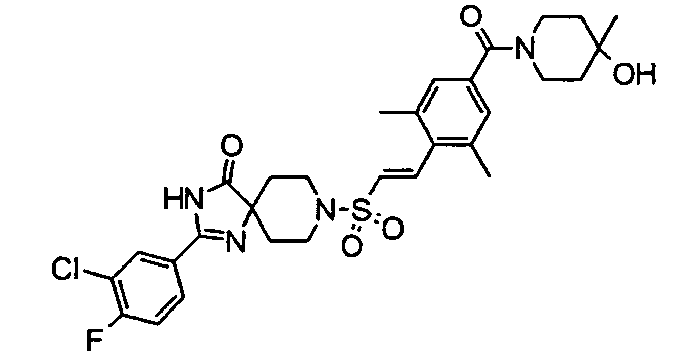
LCMS-F-2 0.72 617 (M+H)+ 1187 
LCMS-F-2 0.63 604 (M+H)+ 1188 
LCMS-F-2 0.79 667 (M+H)+ 1189 
LCMS-F-2 0.77 691 (M+H)+ 1190 
LCMS-F-2 0.76 691 (M+H)+ 1191 
LCMS-F-2 0.84 739 (M+H)+ 1192 
LCMS-F-2 0.69 611 (M+H)+ 1193 
LCMS-F-2 0.78 647 (M+H)+ 1194 
LCMS-F-2 0.61 609 (M+H)+ 1195 
LCMS-F-2 0.79 683 (M+H)+ 1196 
LCMS-F-2 0.78 683 (M+H)+ 1197 
LCMS-F-2 0.84 759 (M+H)+ 1198 
LCMS-G-1 1.11 649 (M+H)+ 1199 
LCMS-G-1 1.10 763 (M+H)+ 1200 
LCMS-G-1 1.10 731 (M+H)+ 1201 
LCMS-G-1 1.13 729 (M+H)+ 1202 
LCMS-G-1 1.15 809 (M+H)+ 1203 
LCMS-G-1 1.17 781 (M+H)+ 1204 
LCMS-G-1 1.15 759 (M+H)+ 1205 
LCMS-G-1 1.13 739 (M+H)+ 1206 
LCMS-G-1 1.09 629 (M+H)+ 1207 
LCMS-G-1 1.17 759 (M+H)+ 1208 
LCMS-F-2 0.57 604 (M+H)+ 1209 
LCMS-F-2 0.86 759 (M+H)+ 1210 
LCMS-F-2 0.83 725 (M+H)+ 1211 
LCMS-F-2 0.80 664 (M+H)+ 1212 
LCMS-F-2 0.81 695 (M+H)+ 1213 
LCMS-F-2 0.74 681 (M+H)+ 1214 
LCMS-F-2 0.79 663 (M+H)+ 1215 
LCMS-F-2 0.72 659 (M+H)+ 1216 
LCMS-G-1 1.09 697 (M+H)+ 1217 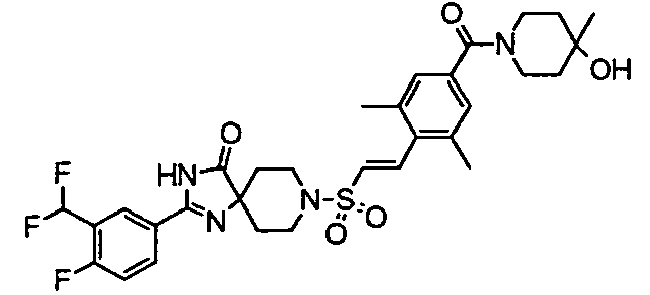
LCMS-F-2 0.72 633 (M+H)+ 1218 
LCMS-F-2 0.79 709 (M+H)+ 1219 
LCMS-F-2 0.72 633 (N+H)+ 1220 
LCMS-F-2 0.86 714 (M+H)+ 1221 
LCMS-F-2 0.76 682 (M+H)+ 1222 
LCMS-F-2 0.80 698 (M+H)+ 1223 
LCMS-F-2 0.83 763 (M+H)+ 1224 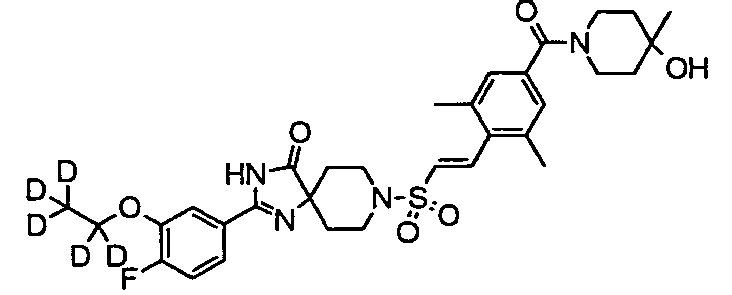
LCMS-F-2 0.71 632 (M+H)+ 1225 
LCMS-F-2 0.74 648 (M+H)+ 1226 
LCMS-F-2 0.83 763 (M+H)+ 1227 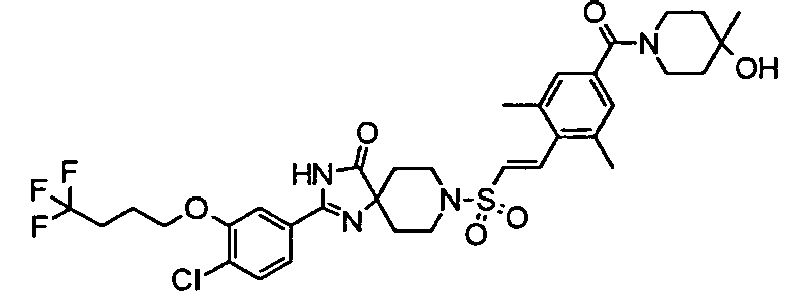
LCMS-F-2 0.84 725 (M+H)+ 1228 
LCMS-F-2 0.87 781 (M+H)+ 1229 
LCMS-F-2 0.79 729 (M+H)+ 1230 
LCMS-F-2 0.84 747 (M+H)+ 1231 
LCMS-F-2 0.85 681 (M+H)+ 1232 
LCMS-F-2 0.87 775 (M+H)+ 1233 
LCMS-F-2 0.90 714 (M+H)+ 1234 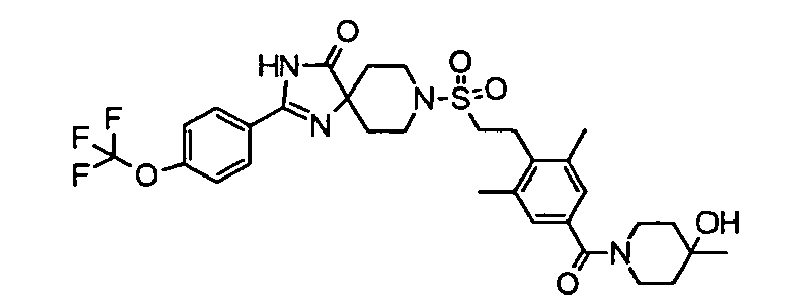
LCMS-G-1 1.10 651 (M+H)+ 1235 
LCMS-G-1 1.13 649 (M+H)+ 1236 
LCMS-G-1 1.15 669 (M+H)+ 1237 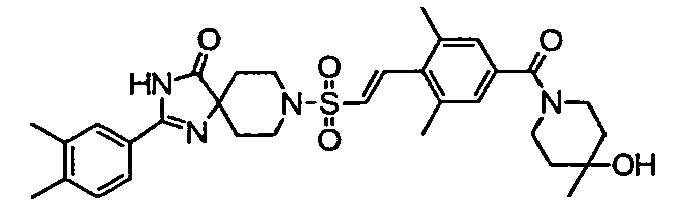
LCMS-C-1 2.63 593 (M+H)+ 1238 
LCMS-C-1 2.58 609 (M+H)+ - The arylboronic acid reagent used in the synthesis of Compound 1195 (4-pentafluoroethylphenylboronic acid) was synthesized by the following method.
-

- A solution of 4-bromo-iodobenzene (500 mg, 1.77 mmol), trimethylsilylpentafluoroethane (679 mg, 3.53 mmol), copper iodide (672 mg, 3.53 mmol) and potassium fluoride (205 mg, 3.53 mmol) in N-methylpyrolidone (1.0 mL) was heated with stirring at 100°C for three hours in a sealed reaction vessel. After cooling to room temperature, the reaction mixture was purified by silica gel column chromatography (hexane:ethyl acetate = 20:1) to give 1-bromo-4-pentafluoroethylbenzene as a colorless liquid (253 mg, 52%).
1H-NMR (270 MHz, CDCl3) δ 7.46 (2H, d, J = 8.6 Hz), 7.65 (2H, d, J = 8.6 Hz). -

- A 1.5 M solution of n-butyllithium in tetrahydrofuran (0.57 mL) was added to a solution of 1-bromo-4-pentafluoroethylbenzene (180 mg, 0.65 mmol) in diethyl ether (1.0 mL) at -78°C, and the mixture was stirred for 20 minutes. Thereafter, trimethyl borate (101 mg, 3.28 mmol) was added and the mixture was stirred at -78°C for 10-minutes and at room temperature for 30 minutes. 6 N aqueous hydrochloric acid (200 µL) was added to the reaction mixture, and the reaction was terminated. The mixture was then purified by silica gel column chromatography to give 4-pentafluoroethylphenylboronic acid as a white solid (111 mg, 71%).
1H-NMR (400 MHz, CDCl3) δ 7.87 (2H, d, J = 8.0 Hz), 7.64 (2H, d, J = 8.0 Hz), 4.61 (s, 2H). - The arylboronic acid reagent used in the synthesis of Compound 1196 (3-pentafluoroethylphenylboronic acid) was synthesized by the following method.
-

- 3-Pentafluoroethylphenylboronic acid was obtained by operations similar to those in Reaction 292-4 and Reaction 292-5 using 1-bromo-3-iodo-benzene as a starting material.
MS (ESI) m/z = 239 (M-H)-. - The arylboronic acid reagent used in the synthesis of Compound 1197 (4-(2,2,2-trifluoro-1,1-dimethyl-ethoxy)-3-trifluoromethylphenylboronic acid) was synthesized by the following method.
-

- Potassium tert-butoxide (236 mg, 2.1 mmol) was added to a solution of 5-bromo-2-fluorobenzotrifluoride (485 mg, 2.0 mmol) and 2-trifluoromethyl-2-propanol (0.24 mL, 2.2 mmol) in DMI (0.5 mL) at room temperature, and the mixture was stirred at 100°C for two hours. The reaction solution was purified by silica gel column chromatography to give 4-bromo-1-(2,2,2-trifluoro-1,1-dimethyl-ethoxy)-2-trifluoromethyl-benzene (349 mg, 50%).
1H-NMR (400 MHz, CDCl3) δ 7.73 (1H, d, J = 2.4 Hz), 7.59 (1H, dd, J = 2.4, 8.9 Hz), 7.14 (1H, d, J = 8.9 Hz), 1.53 (s, 6H). -

- 4-(2,2,2-Trifluoro-1,1-dimethyl-ethoxy)-3-trifluoromethylphenylboronic acid was obtained by operations similar to those in Reaction 292-5 using 4-bromo-1-(2,2,2-trifluoro-1,1-dimethyl-ethoxy)-2-trifluoromethyl-benzene as a starting material.
MS (ESI) m/z = 315 (M-H)-. - The arylboronic acid reagents shown below were synthesized by operations similar to those in Reaction 292-7 and Reaction 292-5 using appropriate starting compounds and used in the synthesis of the compounds in Table 176.
[Table 177] Target Compound Raw material Arylboronic acid structure MS (m/z) 1199 

319 (M-H)- 1200 

287 (M-H)- 1201 
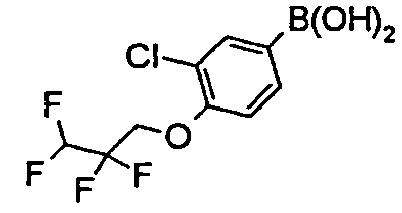
285 (M-H)- 1202 

365 (M-H)- 1203 

337 (M-H)- 1204 

315 (M-H)- 1216 

253 (M-H)- 1220 

270 (M-H)- 1221 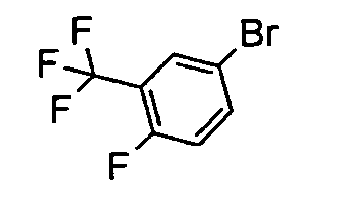

238 (M-H)- 1222 

254 (M-H)- 1232 

331 (M-H)- - The arylboronic acid reagents shown below were synthesized by operations similar to those in Reaction 292-5 using appropriate starting compounds and used in the synthesis of the compounds in Table 176.
[Table 178] Target Compound Raw material Arylboronic acid structure MS (m/z) 1214 

219 (M-H)- 1217 

189 (M-H)- 1219 

189 (M-H)- - The arylboronic acid reagent used in the synthesis of Compound 1229 (4-chloro-3-(2,2,3,3-tetrafluoro-propoxy)-phenylboronic acid) was synthesized by the following method.
-

- 4-Bromo-1-chloro-2-(2,2,3,3-tetrafluoro-propoxy)-benzene was obtained by operations similar to those in Reaction 292-7 using appropriate starting compound and reagents.
1H-NMR (400 MHz, CDCl3) δ 7.27 (1H, d, J = 8.3 Hz), 7.15 (1H, dd, J = 2.0, 8.3 Hz), 7.07 (1H, d, J = 2.0 Hz), 6.15 (1H, dt, J = 5.4, 53.2 Hz), 4.39 (2H, t, J = 11.2 Hz). -

- A 1.5 M solution of n-butyllithium in tetrahydrofuran (0.99 mL) was added to a solution of 4-bromo-1-chloro-2-(2,2,3,3-tetrafluoro-propoxy)-benzene (434 mg, 1.35 mmol) and triisopropyl borate (382 mg, 2.03 mmol) in anhydrous tetrahydrofuran (2.0 mL) at -78°C, and the mixture was stirred for 10 minutes. The reaction mixture was warmed to room temperature and stirred for 30 minutes. 6 N aqueous hydrochloric acid was then added to the reaction mixture, and the reaction was terminated, followed by extraction with ethyl acetate. The organic layer was dried over anhydrous sodium sulfate and concentrated under reduced pressure. The residue was treated with a mixed solution of dichloromethane and hexane to give 4-chloro-3-(2,2,3,3-tetrafluoro-propoxy)-phenylboronic acid as a white solid (246 mg, 64%).
MS (ESI) m/z = 285 (M-H)-. - The arylboronic acid reagents shown below were synthesized by operations similar to those in Reaction 292-7 and Reaction 292-10 using appropriate starting compounds and used in the synthesis of the compounds in Table 176.
[Table 179] Target Compound Raw material Arylboronic acid structure MS (m/z) 1226 

319 (M-H)- 1227 

281 (M-H)- 1228 

337 (M-H)- 1230 

303 (M-H)- 1231 

236 (M-H)- 1233 

270 (M-H)- - The arylboronic acid reagent used in the synthesis of Compound 1213 (4-(1,1,2,2-tetrafluoro-ethoxy)phenylboronic acid) was synthesized by the following method.
-

- 4-(1,1,2,2-Tetrafluoro-ethoxy)phenylboronic acid was obtained by operations similar to those in Reaction 292-10 using appropriate starting compound and reagents.
MS (ESI) m/z = 237 (M-H)-. - The arylboronic acid reagent used in the synthesis of Compound 1223 (3-(2,2,3,3-tetrafluoro-propoxy)-4-trifluoromethylphenylboronic acid) was synthesized by the following method.
-

- 4-Bromo-2-(2,2,3,3-tetrafluoro-propoxy)-1-trifluoromethyl-benzene was obtained by operations similar to those in Reaction 292-7 using appropriate starting compound and reagents.
1H-NMR (400 MHz, CDCl3) δ 7.74 (1H, d, J = 2.4 Hz), 7.65 (1H, dd, J = 2.4, 8.8 Hz), 6.88 (1H, d, J = 8.8 Hz), 6.06 (1H, dt, J = 5.4, 53.2 Hz), 4.40 (2H, t, J = 11.2 Hz). -

- A solution of 4-bromo-2-(2,2,3,3-tetrafluoro-propoxy)-1-trifluoromethyl-benzene (482 mg, 1.36 mmol), pinacol diborane (379 mg, 1.49 mmol), palladium dichloride-diphenylphosphinoferrocene (111 mg, 0.136 mmol) and potassium acetate (400 mg, 4.08 mmol) in cyclopentyl methyl ether (2.41 mL) was heated with stirring at 115°C for one hour in a nitrogen atmosphere. After cooling to room temperature, water (1 mL) was added to the reaction mixture, and the upper cyclopentyl methyl ether layer was extracted. Methanol (1 mL) was added to the organic layer. Periodic acid (1.24 g, 5.44 mmol) was added at 0°C, and the mixture was warmed to room temperature and stirred for one hour. Water was added to the reaction mixture, followed by extraction with ethyl acetate. The organic layer was dried over anhydrous sodium sulfate and concentrated under reduced pressure. The residue was purified by silica gel column chromatography (hexane:ethyl acetate = 3:1 -> 1:1) and further treated with hexane to give 3-(2,2,3,3-tetrafluoro-propoxy)-4-trifluoromethylphenylboronic acid as a pale brown solid (260 mg, 60%).
MS (ESI) m/z = 319 (M-H)-. - The arylboronic acid reagents shown below were synthesized by operations similar to those in Reaction 292-7 and Reaction 292-13 using appropriate starting compounds and used in the synthesis of the compounds in Table 176.
[Table 180] Target Compound Raw material Arylboronic acid structure MS (m/z) 1209 

315 (M-H)- 1210 

281 (M-H)- - The arylboronic acid reagent used in the synthesis of Compound 1224 (4-bromo-3-[1,1,2,2,2-2H5]ethoxy-1-fluorophenylboronic acid) was synthesized by the following method.
-

- Toluene was added to a mixture of 5-bromo-2-fluorophenol (382 mg, 2.0 mmol), ethanol-d5 (0.104 mL, 2.0 mmol) and N,N,N',N'-tetramethylazodicarboxamide (465 mg, 2.7 mmol). Tributylphosphine (0.622 mL, 2.5 mmol) was added at 0°C and the mixture was stirred for 14 hours. The reaction solution was purified by silica gel column chromatography to give 4-bromo-2-[1,1,2,2,2-2H5]ethoxy-1-fluoro-benzene (416 mg, 93%).
1H-NMR (400 MHz, CDCl3) δ 7.07 (1H, dd, J = 2.1, 7.4 Hz), 7.00 (1H, ddd, J = 2.1, 4.1, 8.4 Hz), 6.94 (1H, dd, J = 8.4, 10.7 Hz). -

- 4-Bromo-3-[1,1,2,2,2-2H5]ethoxy-1-fluorophenylboronic acid was obtained by operations similar to those in Reaction 292-5 using 4-bromo-2-[1,1,2,2,2-2H5]ethoxy-1-fluoro-benzene as a starting material.
MS (ESI) m/z = 188 (M-H)-. - The arylboronic acid reagents shown below were synthesized by operations similar to those in Reaction 292-14 and Reaction 292-5 using appropriate starting compounds and used in the synthesis of the compounds in Table 176.
[Table 181] Target Compound Raw material Arylboronic acid structure MS (m/z) 1207 

315 (M-H)- 1211 

220 (M-H)- 1218 

265 (M-H)- 1225 

204 (M-H)- - The arylboronic acid reagent used in the synthesis of Compound 1215 (3-fluoro-4-(3-fluoro-propoxy)phenylboronic acid) was synthesized by the following method.
-
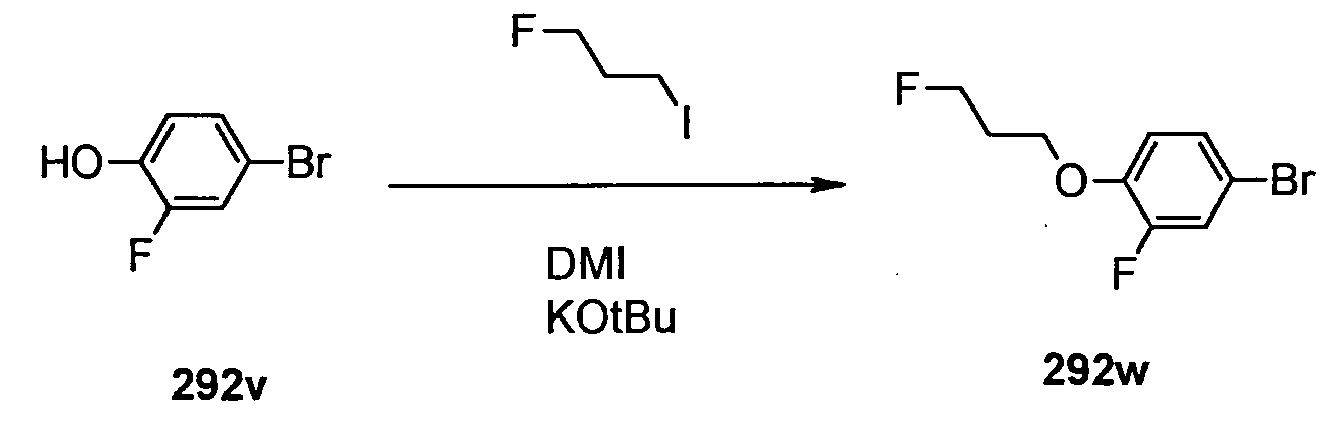
- 4-Bromo-2-fluorophenol (382 mg, 2.0 mmol) was dissolved in DMI (0.5 mL), and potassium tert-butoxide (224 mg, 2.0 mmol) was added at room temperature. 1-Iodo-3-fluoropropane (376 mg, 2.0 mmol) was added to the reaction solution, and the mixture was heated to 60°C and stirred for six hours. The reaction solution was purified by silica gel column chromatography to give 4-bromo-2-fluoro-1-(3-fluoro-propoxy)-benzene (410 mg, 82%).
1H-NMR (400 MHz, CDCl3) δ 7.10 (1H, dd, J = 2.1, 7.4 Hz), 7.03 (1H, ddd, J = 2.4, 3.9, 8.6 Hz), 6.95 (1H, dd, J = 8.7, 10.7 Hz), 4.66 (2H, dt, J = 5.6, 46.9 Hz), 4.15 (2H, t, J = 6.1 Hz), 2.20 (2H, ddt, J = 5.8, 5.8, 26.1 Hz). -

- 3-Fluoro-4-(3-fluoro-propoxy)phenylboronic acid was obtained by operations similar to those in Reaction 292-5 using 4-bromo-2-fluoro-1-(3-fluoro-propoxy)-benzene as a starting material.
MS (ESI) m/z = 215 (M-H)-. - The arylboronic acid reagent used in the synthesis of Compound 1212 (2,2,3,3-tetrafluoro-2,3-dihydro-benzo[1,4]dioxin-6-yl-boronic acid) was synthesized by the following method.
-

- 2,2,3,3-Tetrafluoro-1,4-benzodioxane (484 mg), bis (pinacolato) diboron (295 mg), [Ir (COD) (OMe) ]2 (15.4 mg) and 4,4'di-tert-butyl-2,2'-dipyridyl (12.5 mg) were mixed. 1,4-Dioxane (0.5 mL) was added in a nitrogen atmosphere and stirred at 100°C for two hours. MeOH (0.5 mL) was added to the reaction solution, and metaperiodic acid (1.06 g) was added in four portions under ice-cooling. Water was added to the reaction solution, followed by extraction with ethyl acetate and concentration. The resulting mixture was purified by silica gel column chromatography to give 2,2,3,3-tetrafluoro-2,3-dihydro-benzo[1,4]dioxin-6-yl-boronic acid (230 mg, 39%).
MS (ESI) m/z = 251 (M-H)-. -

- 8-{(E)-2-[4-(4-Fluoromethyl-4-hydroxy-piperidine-1-carbonyl)-2,6-dimethyl-phenyl]-ethenesulfonyl}-2-thioxo-1,3,8-triaza-spiro[4.5]decan-4-one was obtained by operations similar to those in Reaction 119-1, Reaction 233-3, Reaction 233-4 and Reaction 292-2 using 1-ethenesulfonyl-piperidin-4-one as a starting material.
MS (ESI) m/z = 539 (M+H)+. -

- 2-(4-Fluoro-2,5-dimethyl-phenyl)-8-{(E)-2-[4-(4-fluoromethyl-4-hydroxy-piperidine-1-carbonyl)-2,6-dimethyl-phenyl]-ethenesulfonyl}-1,3,8-triaza-spiro[4.5]dec-1-en-4-one was obtained by operations similar to those in Reaction using 8-{(E)-2-[4-(4-fluoromethyl-4-hydroxy-piperidine-1-carbonyl)-2,6-dimethyl-phenyl]-ethenesulfonyl}-2-thioxo-1,3,8-triaza-spiro[4.5]decan-4-one as a starting material.
MS (ESI) m/z = 629 (M+H)+. - The example compounds shown below were obtained by operations similar to those in Reaction 293-2 using appropriate starting compounds.
-
[Table 182] Target Compound Structure LCMS condition Retention time (min) MS (m/z) 1240 
LCMS-F-1 0.94 629 (M+H)+ 1241 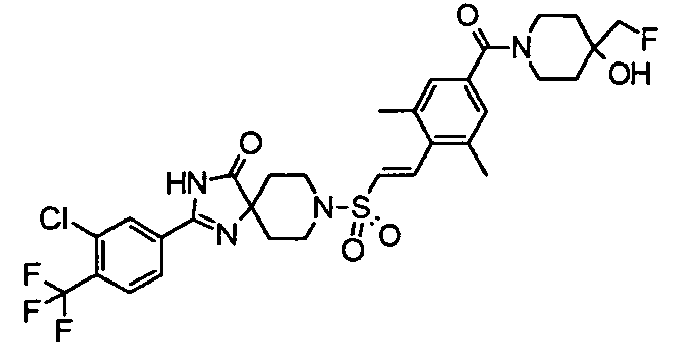
LCMS-B-1 2.38 686 (M+H)+ 1242 
LCMS-F-1 0.73 636 (M+H)+ 1243 
LCMS-F-1 1.01 701 (M+H)+ 1244 
LCMS-F-1 1.02 701 (M+H)+ 1245 
LCMS-F-1 1.01 709 (M+H)+ 1246 
LCMS-F-1 1.00 715 (M+H)+ 1247 
LCMS-F-1 1.01 747 (M+H)+ 1248 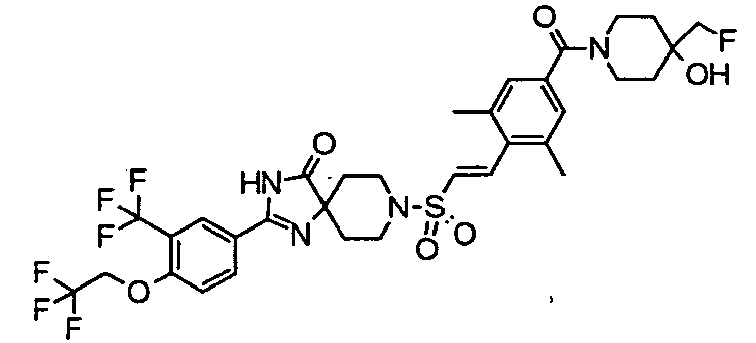
LCMS-F-1 1.01 749 (M+H)+ 1249 
LCMS-B-1 2.48 799 (M+H)+ 1250 
LCMS-B-1 2.41 777 (M+H)+ 1251 
LCMS-F-1 1.00 781 (M+H)+ 1252 
LCMS-F-1 1.06 827 (M+H)+ 1253 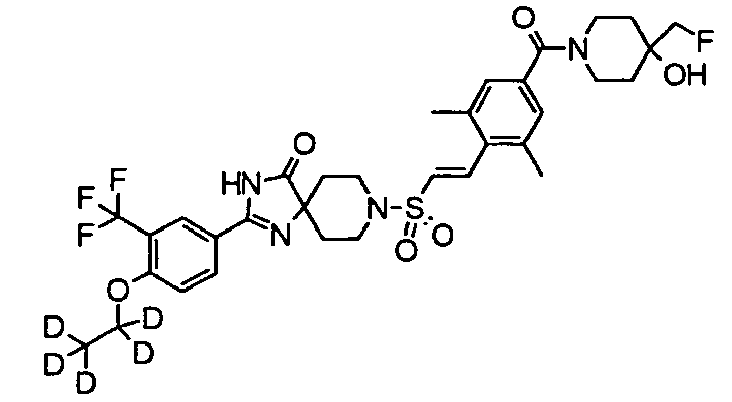
LCMS-F-1 0.99 700 (M+H)+ 1254 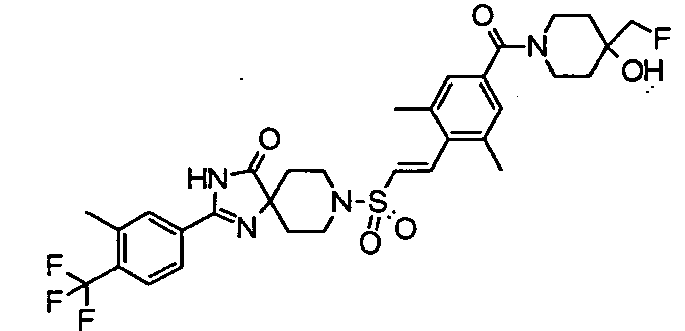
LCMS-F-1 1.00 665 (M+H)+ 1255 
LCMS-F-1 0.93 651 (M+H)+ 1256 
LCMS-F-1 0.92 651 (M+H)+ 1257 
LCMS-F-1 1.00 651 (M+H)+ 1258 
LCMS-F-1 1.01 681 (M+H)+ 1259 
LCMS-F-1 0.96 665 (M+H)+ 1260 
LCMS-F-1 0.95 699 (M+H)+ 1261 
LCMS-F-1 1.04 732 (M+H)+ 1262 
LCMS-F-1 1.01 716 (M+H)+ 1263 
LCMS-F-1 1.05 777 (M+H)+ 1264 
LCMS-F-1 0.95 677 (M+H)+ 1265 
LCMS-F-1 1.04 777 (M+H)+ 1266 
LCMS-F-1 1.04 777 (M+H)+ 1267 
LCMS-F-1 0.93 647 (M+H)+ 1268 
LCMS-F-1 0.88 622 (M+H)+ 1269 
LCMS-F-1 0.98 667 (M+H)+ 1270 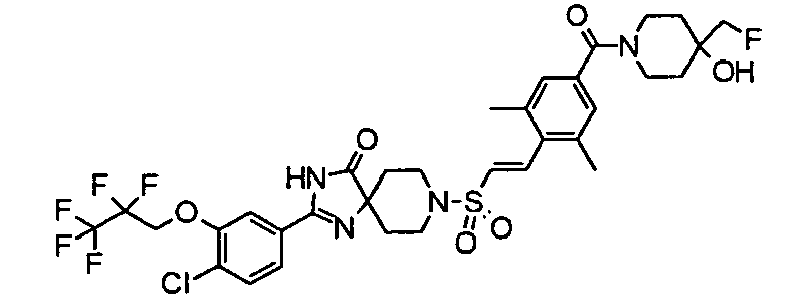
LCMS-F-1 1.04 765 (M+H)+ 1271 
LCMS-F-1 1.04 743 (M+H)+ 1272 
LCMS-F-1 0.95 650 (M+H)+ 1273 
LCMS-F-1 1.06 793 (M+H)+ 1274 
LCMS-F-1 1.02 781 (M+H)+ 1275 
LCMS-G-1 1.11 665 (M+H)+ 1276 
LCMS-G-1 1.11 669 (M+H)+ 1277 
LCMS-G-1 1.13 667 (M+H)+ 1278 
LCMS-G-1 1.16 687 (M+H)+ 1279 
LCMS-G-1 1.17 783 (M+H)+ 1280 
LCMS-G-1 1.11 663 (M+H)+ 1281 
LCMS-F-1 1.03 715 (M+H)+ -

- 8-{(E)-2-[4-(4-Hydroxy-piperidine-1-carbonyl)-2,6-dimethyl-phenyl]-ethenesulfonyl}-2-thioxo-1,3,8-triaza-spiro[4.5]decan-4-one was obtained by operations similar to those in Reaction 292-2 (using 1,1'-thiocarbonyldiimidazole) using appropriate reagents and starting material.
MS (ESI) m/z = 507 (M+H)+. -

- [3-(8-{(E)-2-[4-(4-Hydroxy-piperidine-1-carbonyl)-2,6-dimethyl-phenyl]-ethenesulfonyl}-4-oxo-1,3,8-triaza-spiro[4.5]dec-1-en-2-yl)-phenyl]-acetonitrile was obtained by operations similar to those in Reaction 292-3 using 8-{(E)-2-[4-(4-hydroxy-piperidine-1-carbonyl)-2,6-dimethyl-phenyl]-ethenesulfonyl}-2-thioxo-1,3,8-triaza-spiro[4.5]decan-4-one as a starting material.
MS (ESI) m/z = 590 (M+H)+. -

- 8-{(E)-2-[2-Methyl-4-(piperidin-4-yloxy)-phenyl]-ethenesulfonyl}-2-(3-trifluoromethoxy-phenyl)-1,3,8-triaza-spiro[4.5]dec-1-en-4-one trifluoroacetate (Compound 1283) was obtained by operations similar to those in Reaction 4-1 using Compound 602 as a starting material.
MS (ESI) m/z = 593 (M+H)+. - The example compounds shown below were obtained by operations similar to those in Reaction 295-1 using appropriate starting compounds. Compound 1285 was obtained as a free form by desalination post-treatment.
-
[Table 183] Starting Compound Target Compound Structure LCMS condition Retention time (min) MS(m/z) 928 1284 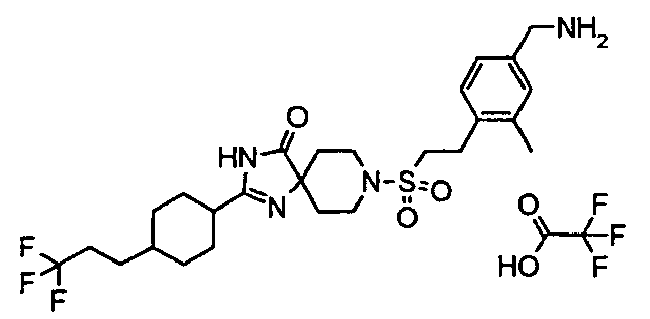
LCMS-B-1 1.67 543 (M+H)+ 578 1285 
LCMS-A-1 1.69 528 (M+H)+ -

- 8-[2-(2,6-Dimethyl-4-methylamino-phenyl)-ethanesulfonyl]-2-pyrrolidin-2-yl-1,3,8-triaza-spiro[4.5]dec-1-en-4-one dihydrochloride (Compound 1286) was obtained by operations similar to those in Reaction 5-3 using Compound 1033 as a starting material.
MS (ESI) m/z = 448 (M+H)+. - The example compounds shown below were obtained by operations similar to those in Reaction 296-1 using appropriate starting compounds.
-
[Table 184] Starting Compound Target Compound Structure LCMS condition Retention time (min) MS (m/z) 1034 1287 
LCMS-B-1 1.44 443 (M+H)+ 640 1288 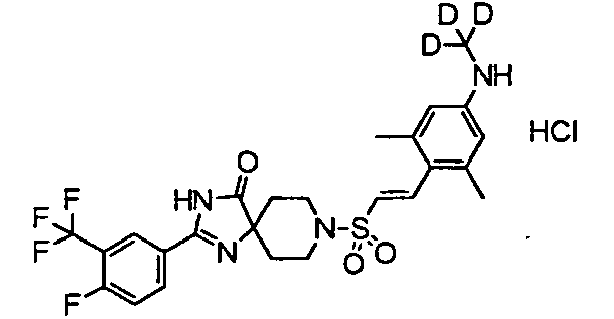
LCMS-F-1 1.05 542 (M+H)+ -

- 8-[(E)-2-(2,6-Dimethyl-4-methylaminomethyl-phenyl)-ethenesulfonyl]-2-(4-methyl-cyclohexyl.)-1,3,8-triaza-spiro[4.5]dec-1-en-4-one (Compound 1289) was obtained by operations similar to those in Reaction 50-2 (conversion to a free form by post-treatment) using Compound 517 as a starting material.
MS (ESI) m/z = 487 (M+H)+. - The example compounds shown below were obtained by operations similar to those in Reaction 297-1 using appropriate starting compounds.
-
[Table 185] Starting Compound Target Compound Structure LCMS condition Retention time (min) MS (m/z) 558 1290 
LCMS-D-1 2.27 555 (M+H)+ 522 1291 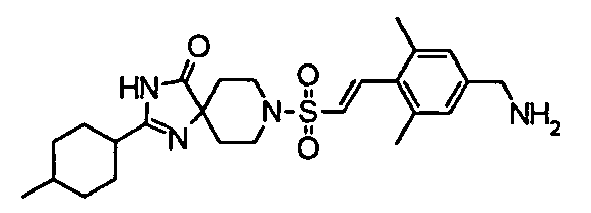
LCMS-D-1 1.93 473 (M+H)+ 559 1292 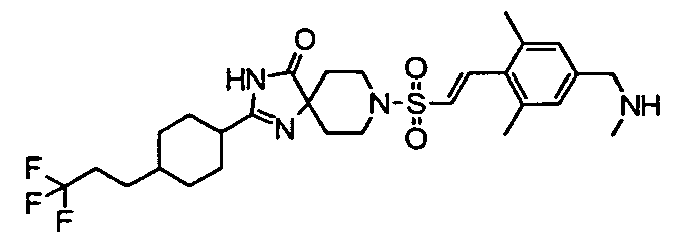
LCMS-D-1 1.77 569 (M+H)+ -

- 8-[2-(4-Amino-3-chloro-2-methyl-phenyl)-ethanesulfonyl]-2-(4-ethyl-cyclohexyl)-1,3,8-triaza-spiro[4.5]dec-1-en-4-one (Compound 1293) was obtained by operations similar to those in Reaction 12-5 using Compound 954 as a starting material.
MS (ESI) m/z = 495 (M+H)+. -
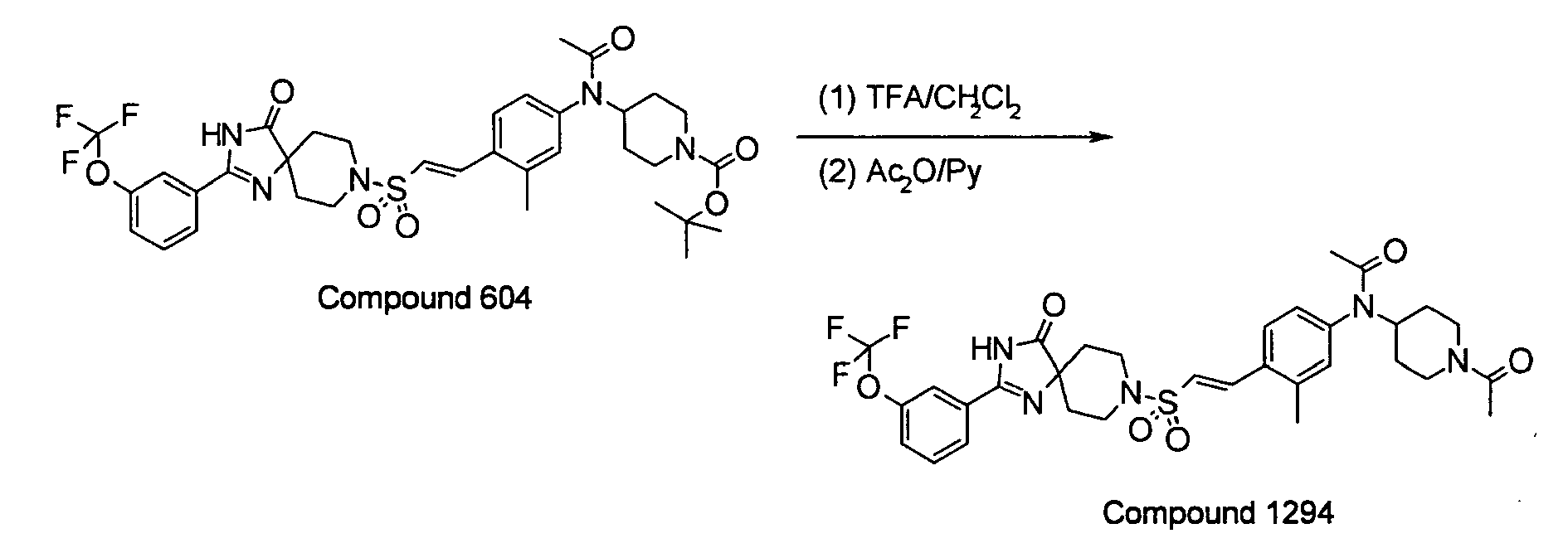
- N-(1-Acetyl-piperidin-4-yl)-N-(3-methyl-4-{(E)-2-[4-oxo-2-(3-trifluoromethoxy-phenyl)-1,3,8-triaza-spiro[4.5]dec-1-ene-8-sulfonyl]-vinyl}-phenyl)-acetamide (Compound 1294) was obtained by operations similar to those in Reaction 4-1 and Reaction 12-2 using Compound 604 as a starting material.
MS (ESI) m/z = 676 (M+H)+. -

- 8-{2-[4-(4,5-Dihydro-thiazol-2-ylamino)-2-methylphenyl]-ethanesulfonyl}-2-(4-ethyl-cyclohexyl)-1,3,8-triaza-spiro[4.5]dec-1-en-4-one (Compound 1295) was obtained by operations similar to those in Reaction 12-5, Reaction 18-2 and Reaction 177-2 using Compound 953 as a starting material.
MS (ESI) m/z = 546 (M+H)+. -

- 2-[4-(4-Fluoro-butyl)-cyclohexyl]-4-oxo-1,3,8-triaza-spiro[4.5]dec-1-ene-8-carboxylic acid tert-butyl ester was obtained by operations similar to those in Reaction 101-1, Reaction 23-2, Reaction 18-2, Reaction 10-1 and Reaction 189-5 using 4-oxo-cyclohexanecarboxylic acid ethyl ester as a starting material.
1H-NMR (400 MHz, CDCl3) δ 0.97-1.05 (1H, m), 1.23-1.35 (4H, m), 1.35-1.50 (3,m), 1.47 (9H, s), 1.60-1.75 (4H, m), 1.75-1.85 (2H, m), 1.85-1.95 (2H, m), 1.95-2.05 (2H, m), 2.35-2.45 (1H, m), 3.35-3.45 (2H, m), 3.90-4.05 (2H, m), 4.35-4.42 (1H, m), 4.45-4.52 (1H, m), 8.85 (1H, s). -

- N-[4-(2-{2-[4-(4-Fluoro-butyl)-cyclohexyl]-4-oxo-1,3,8-triaza-spiro[4.5]dec-1-ene-8-sulfonyl}-ethyl)-3-methyl-phenyl]-acetamide (Compound 1296) was obtained by operations similar to those in Reaction 4-1 and Reaction 5-4 using 2-[4-(4-fluoro-butyl)-cyclohexyl]-4-oxo-1,3,8-triaza-spiro[4.5]dec-1-ene-8-carboxylic acid tert-butyl ester as a starting material.
MS (ESI) m/z = 549 (M+H)+. -
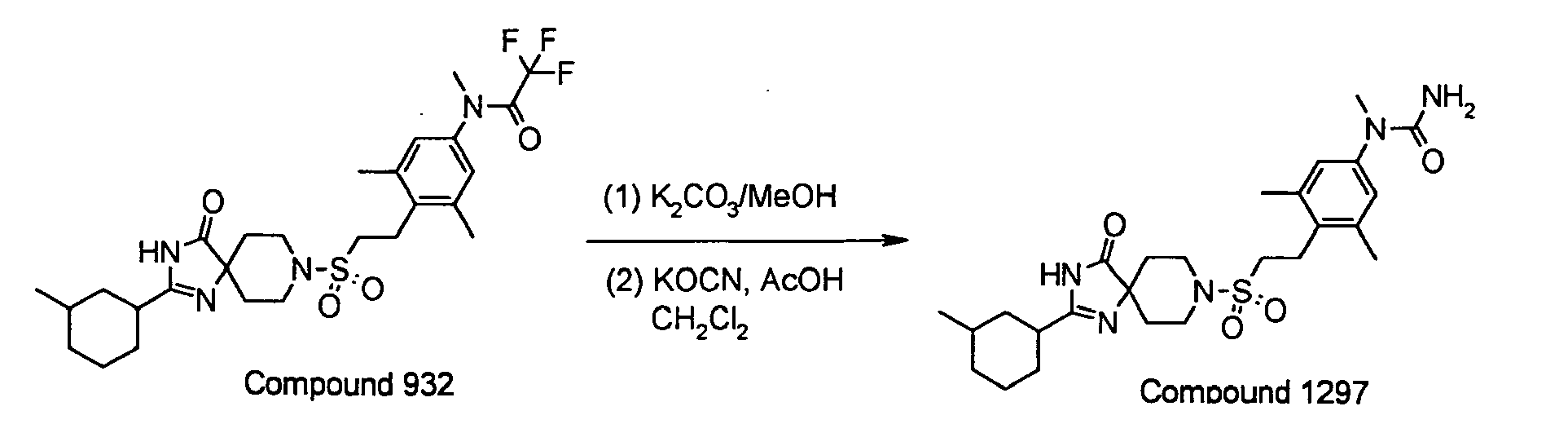
- 1-(3,5-Dimethyl-4-{2-[2-(3-methyl-cyclohexyl)-4-oxo-1,3,8-triaza-spiro[4.5]dec-1-ene-8-sulfonyl]-ethyl}-phenyl)-1-methyl-urea (Compound 1297) was obtained by operations similar to those in Reaction 12-5 and Reaction 89-2 (using KOCN) using Compound 932 as a starting material.
MS (ESI) m/z = 518 (M+H)+. -

- 1-(3,5-Dimethyl-4-{2-[4-oxo-2-(3,3,5,5-tetramethyl-cyclohexyl)-1,3,8-triaza-spiro[4.5]dec-1-ene-8-sulfonyl]-ethyl}-phenyl)-1-methyl-urea (Compound 1298) was obtained by operations similar to those in Reaction 12-5 and Reaction 89-2 (using KOCN) using Compound 933 as a starting material.
MS (ESI) m/z = 560 (M+H)+. -

- 3-(3,5-Dimethyl-4-{2-[2-(4-methyl-cyclohexyl)-4-oxo-1,3,8-triaza-spiro[4.5]dec-1-ene-8-sulfonyl]-ethyl}-phenyl)-5-hydroxymethyl-imidazolidine-2,4-dione (Compound 1299) was obtained by operations similar to those in Reaction 4-1 using Compound 833 as a starting material.
MS (ESI) m/z = 574 (M+H)+. -

- 1-[3,5-Dimethyl-4-((E)-2-14-oxo-2-{4-(3,3,3-trifluoro-propyl)-cyclohexyl]-1,3,8-triaza-spiro[4.5]dec-1-ene-8-sulfonyl}-vinyl)-benzyl]-1-methyl-urea (Compound 1300) was obtained by operations similar to those in Reaction 89-2 (using KOCN) using Compound 1193 as a starting material.
MS (ESI) m/z = 612 (M+H)+. - The example compounds shown below were obtained by operations similar to those in Reaction 305-1 using appropriate starting compounds.
-
[Table 186] Starting Compound Target Compound Structure LCMS condition Retention time (min) MS (m/z) 1289 1301 
LCMS-D-1 1.97 530 (M+H)+ 1035 1302 
LCMS-F-1 1.01 638 (M+H)+ 691 1303 
LCMS-F-1 1.01 636 (M+H)+ 690 1304 
LCMS-F-1 1.00 600 (M+H)+ 1016 1305 
LCMS-C-1 2.75 596 (M+H)+ 1036 1306 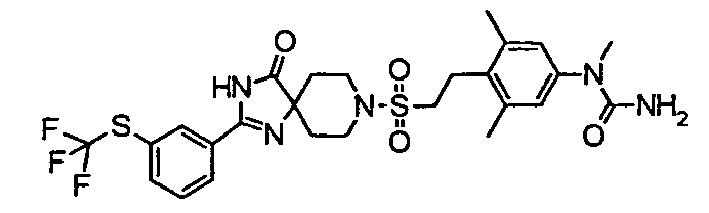
LCMS-F-1 0.98 598 (M+H)+ 1105 1307 
LCMS-C-1 2.70 590 (M+H)+ 1106 1308 
LCMS-C-1 2.98 689 (M+H)+ 1107 1309 
LCMS-F-1 0.92 562 (M+H)+ 1037 1310 
LCMS-A-1 2.10 544 (M+H)+ 1287 1311 
LCMS-B-1 1.71 486 (M+H)+ 1288 1312 
LCMS-F-1 0.99 585 (M+H)+ -

- [3,5-Dimethyl-4-(2-{4-oxo-2-[4-(3,3,3-trifluoro-propyl)-cyclohexyl]-1,3,8-triaza-spiro[4.5]dec-1-ene-8-sulfonyl}-ethyl)-benzyl]-urea (Compound 1313) was obtained by operations similar to those in Reaction 89-2 (using KOCN) and Reaction 122-2 using Compound 1290 as a starting material.
MS (ESI) m/z = 600 (M+H)+. - The example compound shown below was obtained by operations similar to those in Reaction 306-1 using an appropriate starting compound.
-
[Table 187] Starting Compound Target Compound Structure LCMS condition Retention time (min) MS (m/z) 1291 1314 
LCMS-D-1 1.78 518 (M+H)+ -

- 1-(4-{(E)-2-[2-(11-Amino-undecyl)-4-oxo-1,3,8-triaza-spiro[4.5]dec-1-ene-8-sulfonyl]-vinyl}-3,5-dimethyl-phenyl)-1-methyl-urea (Compound 1315) was obtained by operations similar to those in Reaction 4-1 using Compound 1209 as a starting material.
MS (ESI) m/z = 589 (M+H)+. -

- 30% aqueous hydrogen peroxide (0.013 ml) was added to a mixed solution of (E)-1-(3,5-dimethyl-4-(2-((4-oxo-2-(5-(propylthio)pentyl)-1,3,8-triazaspiro[4.5]dec-1-en-8-yl)sulfonyl)vinyl)phenyl)-1-methyl-urea (55 mg) and molybdenum(IV) dichloride dioxide (3 mg) in acetone (1.5 ml)-water (0.5 ml), and the mixture was stirred at room temperature for five minutes in a nitrogen stream. The reaction mixture was quenched with a saturated aqueous sodium bicarbonate solution and then extracted with ethyl acetate. The organic layer was dried over anhydrous sodium sulfate and then concentrated under reduced pressure. The resulting residue was purified by column chromatography (silica gel, CH2Cl2-MeOH) to give 1-[3,5-dimethyl-4-((E)-2-{4-oxo-2-[5-(propane-1-sulfinyl)-pentyl]-1,3,8-triaza-spiro[4.5]dec-1-ene-8-sulfonyl}-vinyl)-phenyl]-1-methyl-urea (64 mg).
1H-NMR (300 MHz, CDCl3) δ 8.77 (s, 1H), 7.55 (d, 1H, J = 15.6 Hz), 7.02 (s, 2H), 6.38 (d, 1H, J = 15.6 Hz), 4.50 (s, 2H), 3.71-3.64 (m, 2H), 3.41-3.32 (m, 2H), 3.26 (s, 3H), 2.76-2.54 (m, 4H), 2.52-2.43 (m, 2H), 2.38 (s, 6H), 2.00-1.61 (m, 12H), 1.09 (t, 3H, J = 7.4 Hz).
MS (ESI) m/z = 580 (M+H)+. - The example compound shown below was obtained by operations similar to those in Reaction 308-1 using an appropriate starting compound.
-
[Table 188] Starting Compound Target Compound Structure LCMS condition Retention time (min) MS (m/z) 1154 1317 
LCMS-D-1 1.42 582 (M+H)+ -

- 30% aqueous hydrogen peroxide (0.047 ml) was added to a mixed solution of (E)-1-(3,5-dimethyl-4-(2-((4-oxo-2-(5-(propylthio)pentyl)-1,3,8-triazaspiro[4.5]dec-1-en-8-yl)sulfonyl)vinyl)phenyl)-1-methylurea (61 mg) and molybdenum(IV) dichloride dioxide (6.5 mg) in acetonitrile (1 ml), and the mixture was stirred at room temperature for two hours in a nitrogen stream. The reaction mixture was quenched with a saturated aqueous sodium bicarbonate solution and then extracted with ethyl acetate. The organic layer was dried over anhydrous sodium sulfate and then concentrated under reduced pressure. The resulting residue was purified by column chromatography (silica gel, CH2Cl2-MeOH) to give 1-[3,5-dimethyl-4-((E)-2-{4-oxo-2-[5-(propane-1-sulfonyl)-pentyl]-1,3,8-triaza-spiro[4.5]dec-1-ene-8-sulfonyl}-vinyl)-phenyl]-1-methyl-urea (64 mg).
1H-NMR (300 MHz, CDCl3) δ 8.96 (s, 1H), 7.54 (d, 1H, J = 15.6 Hz), 7.02 (s, 2H), 6.39 (d, 1H, J = 15.6 Hz), 4.68 (s, 2H), 3.68-3.61 (m, 2H), 3.45-3.37 (m, 2H), 3.25 (s, 3H), 2.98-2.91 (m, 4H), 2.48 (t, 2H, J = 7.4 Hz), 2.37 (s, 6H), 1.98-1.84 (m, 6H), 1.81-1.70 (m, 4H), 1.66-1.57 (m, 2H), 1.09 (t, 3H, J = 7.4 Hz).
MS (ESI) m/z = 596 (M+H)+. - The example compounds shown below were obtained by operations similar to those in Reaction 309-1 using appropriate starting compounds.
-
[Table 189] Starting Compound Target Compound Structure LCMS condition Retention time (min) MS (m/z) 1022 1319 
LCMS-D-1 1.52 596 (M+H)+ 1154 1320 
LCMS-D-1 1.49 598 (M+H)+ -

- NMO (22.0 mg, 0.192 mmol), Molecular Sieves 4A (25.0 mg) and TPAP (0.700 mg, 0.00213 mmol) were added to a solution of 1-(4-{2-[2-(9-hydroxy-nonyl)-4-oxo-1,3,8-triaza-spiro[4.5]dec-1-ene-8-sulfonyl]-ethyl}-3,5-dimethyl-phenyl)-1-methyl-urea (24.0 mg, 0.0426 mmol) in CH2Cl2 (850 µl) at room temperature. The mixture was stirred at room temperature for one hour and then filtered through celite, and the filtrate was concentrated under reduced pressure. The residue was purified by silica gel chromatography to give 1-(3,5-dimethyl-4-{(E)-2-[4-oxo-2-(9-oxo-nonyl)-1,3,8-triaza-spiro[4.5]dec-1-ene-8-sulfonyl]-vinyl}-phenyl)-1-methyl-urea (17.0 mg, 71%).
MS (ESI) m/z = 562 (M+H)+. -

- 1-(4-{(E)-2-[2-(9,9-Difluoro-nonyl)-4-oxo-1,3,8-triaza-spiro[4.5]dec-1-ene-8-sulfonyl]-vinyl}-3,5-dimethyl-phenyl)-1-methyl-urea (Compound 1321) was obtained by operations similar to those in Reaction 191-11 using 1-(3,5-dimethyl-4-{(E)-2-[4-oxo-2-(9-oxo-nonyl)-1,3,8-triaza-spiro[4.5]dec-1-ene-8-sulfonyl]-vinyl}-phenyl)-1-methyl-urea as a starting material.
MS (ESI) m/z = 582 (M+H)+. -

- 1-(4-{2-[2-(9-Hydroxy-nonyl)-4-oxo-1,3,8-triaza-spiro[4.5]dec-1-ene-8-sulfonyl]-ethyl}-3,5-dimethyl-phenyl)-1-methyl-urea (Compound 1322) was obtained by operations similar to those in Reaction 184-1 using Compound 1210 as a starting material and acetonitrile as a solvent.
MS (ESI) m/z = 564 (M+H)+. -

- 1-(4-{2-[2-(9,9-Difluoro-nonyl)-4-oxo-1,3,8-triaza-spiro[4.5]dec-1-ene-8-sulfonyl]-ethyl}-3,5-dimethyl-phenyl)-1-methyl-urea (Compound 1323) was obtained by operations similar to those in Reaction 310-1 and Reaction 191-11 using Compound 1260 as a starting material.
MS (ESI) m/z = 584 (M+H)+. -

- 1-(4-{2-[2-(9-Amino-nonyl)-4-oxo-1,3,8-triaza-spiro[4.5]dec-1-ene-8-sulfonyl]-ethyl}-3,5-dimethyl-phenyl)-1-methyl-urea (Compound 1324) was obtained by operations similar to those in Reaction 310-1 and Reaction 80-1 (using NaBH3CN as a reducing agent and methanol as a solvent) using Compound 1260 as a starting material.
MS (ESI) m/z = 563 (M+H)+. -

- 1-(4-{(E)-2-[2-(9-Fluoro-nonyl)-4-oxo-1,3,8-triaza-spiro[4.5]dec-1-ene-8-sulfonyl]-vinyl}-3,5-dimethyl-phenyl)-1-methyl-urea (Compound 1325)
MS (ESI) m/z = 564 (M+H)+
and 1-(4-{(Z)-2-[2-(9-fluoro-nonyl)-4-oxo-1,3,8-triaza-spiro[4.5]dec-1-ene-8-sulfonyl]-vinyl}-3,5-dimethyl-phenyl)-1-methyl-urea (Compound 1326)
MS (ESI) m/z = 564 (M+H)+
were obtained by operations similar to those in Reaction 191-11 using Compound 1260 as a starting material. -

- 1-(4-{2-[2-(9-Fluoro-nonyl)-4-oxo-1,3,8-triaza-spiro[4.5]dec-1-ene-8-sulfonyl]-ethyl}-3,5-dimethyl-phenyl)-1-methyl-urea (Compound 1327) was obtained by operations similar to those in Reaction 191-11 using Compound 1260 as a starting material.
MS (ESI) m/z = 566 (M+H)+. -

- 8-{2-[4-((R)-2,3-Dihydroxy-propoxy)-2,6-dimethyl-phenyl]-ethanesulfonyl}-2-[3-(4,4,5,5,5-pentafluoro-pentyloxy)-phenyl]-1,3,8-triaza-spiro[4.5]dec-1-en-4-one (Compound 1328) was obtained by operations similar to those in Reaction 122-2 using Compound 1003 as a starting material.
MS (ESI) m/z = 692 (M+H)+. - The example compounds shown below were obtained by operations similar to those in Reaction 316-1 using appropriate solvents (acetonitrile or methanol or an acetonitrile-methanol mixed solution) and starting compounds.
-
[Table 190] Starting Compound Target Compound Structure LCMS condition Retention time (min) MS (m/z) 1164 1329 
LCMS-F-1 0.95 618 (M+H)+ 1165 1330 
LCMS-F-1 0.93 596 (M+H)+ 1167 1331 
LCMS-F-1 0.94 596 (M+H)+ 1166 1332 
LCMS-F-1 0.96 618 (M+H)+ 1160 1333 
LCMS-F-1 0.93 633 (M+H)+ 1159 1334 
LCMS-F-1 0.95 655 (M+H)+ 1099 1335 
LCMS-F-1 1.01 669 (M+H)+ 1163 1336 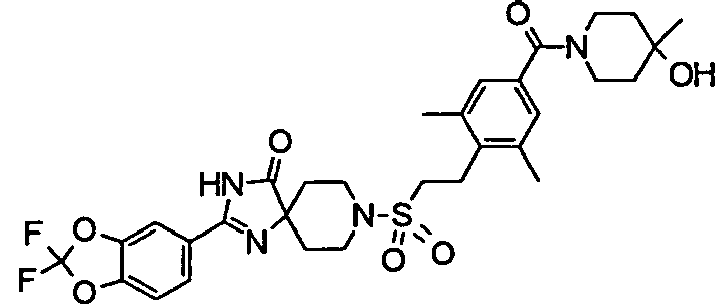
LCMS-F-1 1.00 647 (M+H)+ 1102 1337 
LCMS-F-1 0.96 627 (M+H)+ 1019 1338 
LCMS-F-1 0.98 624 (M+H)+ 1020 1339 
LCMS-F-1 0.97 624 (M+H)+ 1133 1340 
LCMS-F-1 1.01 568 (M+H)+ 1112 1341 
LCMS-F-1 1.07 716 (M+H)+ 1021 1342 
LCMS-F-1 1.06 568 (M+H)+ 1108 1343 
LCMS-F-1 1.01 546 (M+H)+ 1115 1344 
LCMS-D-1 1.76 550 (M+H)+ 1116 1345 
LCMS-D-1 2.82 636 (M+H)+ 1117 1346 
LCMS-D-1 2.73 636 (M+H)+ 1132 1347 
LCMS-C-1 3.02 648 (M+H)+ 1121 1348 
LCMS-C-1 3.17 624 (M+H)+ 1120 1349 
LCMS-C-1 2.87 582 (M+H)+ 1109 1350 
LCMS-C-1 2.73 648 (M+H)+ 1123 1351 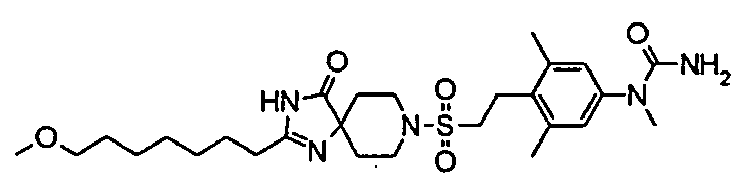
LCMS-D-1 1.77 550 (M+H)+ 1124 1352 
LCMS-D-1 1.58 550 (M+H)+ 1126 1353 
LCMS-D-1 2.45 590 (M+H)+ 1128 1354 
LCMS-D-1 2.98 598 (M+H)+ 1127 1355 
LCMS-D-1 2.10 580 (M+H)+ 1318 1356 
LCMS-D-1 1.55 598 (M+H)+ 1319 1357 
LCMS-D-1 1.52 598 (M+H)+ 1088 1358 
LCMS-D-1 2.40 608 (M+H)+ 1089 1359 
LCMS-D-1 2.48 608 (M+H)+ 1308 1360 
LCMS-C-1 2.98 691 (M+H)+ 1307 1361 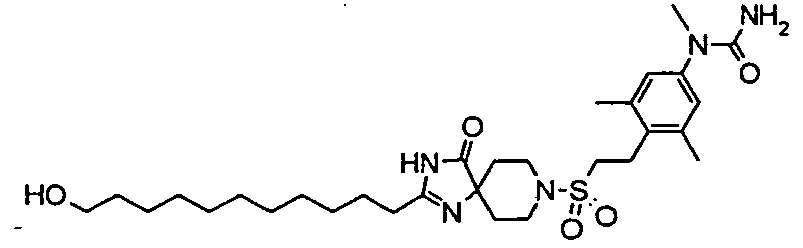
LCMS-C-1 2.68 592 (M+H)+ 1171 1362 
LCMS-F-1 0.85 592 (M+H)+ 1172 1363 
LCMS-F-1 0.88 591 (M+H)+ 1110 1364 
LCMS-F-1 0.93 522 (M+H)+ -

- 1-(3,5-Dimethyl-4-{(E)-2-[4-oxo-2-(9-phenyl-nonyl)-1,3,8-triaza-spiro[4.5]dec-1-ene-8-sulfonyl]-vinyl}-phenyl)-1-methyl-urea (Compound 1365) was obtained by operations similar to those in Reaction 18-2 using Compound 1121 as a starting material.
MS (ESI) m/z = 622 (M+H)+. -

- 1-(4-{2-[2-(11-Amino-undecyl)-4-oxo-1,3,8-triaza-spiro[4.5]dec-1-ene-8-sulfonyl]-ethyl}-3,5-dimethyl-phenyl)-1-methyl-urea (Compound 1366) was obtained by operations similar to those in Reaction 4-1 using Compound 1360 as a starting material.
MS (ESI) m/z = 591 (M+H)+. -

- 3-[(3,5-Dimethyl-4-{2-[2-(4-methyl-cyclohexyl)-4-oxo-1,3,8-triaza-spiro[4.5]dec-1-ene-8-sulfonyl]-ethyl}-phenyl)-methyl-amino]-4-ethoxy-cyclobut-3-ene-1,2-dione (Compound 1367) was obtained by operations similar to those in Reaction 12-5 and Reaction 95-17 (using ethanol as a solvent) using N-(3,5-dimethyl-4-{2-[2-(4-methyl-cyclohexyl)-4-oxo-1,3,8-triaza-spiro[4.5]dec-1-ene-8-sulfonyl]-ethyl}-phenyl)-2,2,2-trifluoro-N-methylacetamide as a starting material.
MS (ESI) m/z = 599 (M+H)+. -

- 3-Amino-4-[(3,5-dimethyl-4-{2-[2-(4-methyl-cyclohexyl)-4-oxo-1,3,8-triaza-spiro[4.5]dec-1-ene-8-sulfonyl]-ethyl}-phenyl)-methyl-amino]-cyclobut-3-ene-1,2-dione (Compound 1368) was obtained by operations similar to those in Reaction 230-3 using Compound 1367 as a starting material.
MS (ESI) m/z = 570 (M+H)+. -

- 3-Dimethylamino-4-[(3,5-dimethyl-4-{2-[2-(4-methyl-cyclohexyl)-4-oxo-1,3,8-triaza-spiro[4.5]dec-1-ene-8-sulfonyl]-ethyl}-phenyl)-methyl-amino]-cyclobut-3-ene-1,2-dione (Compound 1369) was obtained by operations similar to those in Reaction 230-3 using Compound 1367 as a starting material.
MS (ESI) m/z = 598 (M+H)+. -

- Lithium hydroxide monohydrate (4.3 mg, 0.102 mmol) was added to a mixed solution of N-(4-{2-[2-(4-ethynyl-cyclohexyl)-4-oxo-1,3,8-triaza-spiro[4.5]dec-1-ene-8-sulfonyl]-ethyl}-3-methyl-phenyl)-acetamide (17 mg, 0.0341 mmol) in ethanol (1.25 mL) at room temperature. The mixture was stirred at 60°C for 14 hours and then concentrated under reduced pressure. The resulting residue was purified by silica gel column chromatography to give N-(4-{2-[2-(4-ethynyl-cyclohexyl)-4-oxo-1,3,8-triaza-spiro[4.5]dec-1-ene-8-sulfonyl]-ethyl}-3-methylphenyl)-acetamide as a white solid (17 mg, 99%).
MS (ESI) m/z = 499 (M+H)+. -
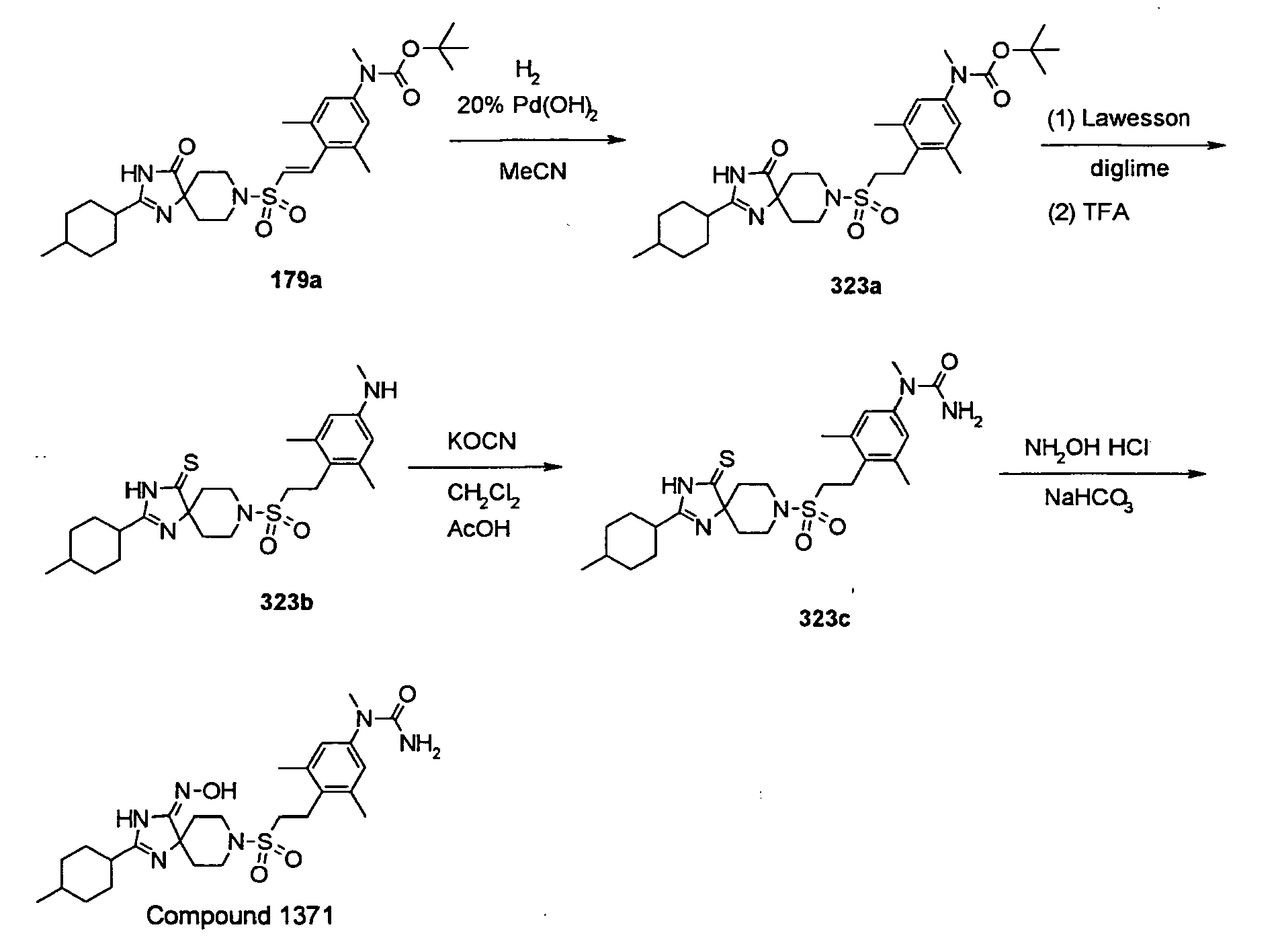
- 1-(4-{2-[4-[(E)-Hydroxyimino]-2-(4-methyl-cyclohexyl)-1,3,8-triaza-spiro[4.5]dec-1-ene-8-sulfonyl]-ethyl}-3,5-dimethyl-phenyl)-1-methyl-urea (Compound 1371) was obtained by operations similar to those in Reaction 184-1, Reaction 88-1, Reaction 89-2 (using KOCN) and Reaction 189-9 using 3,5-dimethyl-4-{(E)-2-[2-(4-methyl-cyclohexyl)-4-oxo-1,3,8-triaza-spiro[4.5]dec-1-ene-8-sulfonyl]-vinyl}-phenyl)-methyl-carbamic acid tert-butyl ester as a starting material.
MS (ESI) m/z = 533 (M+H)+. -

- 2-(4-Methyl-cyclohexyl)-4-oxo-1,3,8-triaza-spiro[4.5]dec-1-ene-8-sulfonic acid 2-methyl-benzylamide (Compound 1372) was obtained by operations similar to those in Reaction 24-2 using 2-(4-methyl-cyclohexyl)-1,3,8-triaza-spiro[4.5]dec-1-en-4-one as a starting material.
MS (ESI) m/z = 433 (M+H)+. -

- 2-(4-Methyl-cyclohexyl)-4-oxo-1,3,8-triaza-spiro[4.5]dec-1-ene-8-sulfonic (2-o-tolyl-ethyl)-amide (Compound 1373) was obtained by operations similar to those in Reaction 24-2 using 2-(4-methyl-cyclohexyl)-1,3,8-triaza-spiro[4.5]dec-1-en-4-one as a starting material.
MS (ESI) m/z = 448 (M+H)+. -

- 1H-Indole-4-carbaldehyde (1.81 g, 12.5 mmol) and cesium carbonate (8.15 g, 25.0 mmol) were added to a solution of methanesulfonic acid (R)-2,2-dimethyl-[1,3]dioxolan-4-yl methyl ester (3.40 g, 16.1 mmol) in 1,3-dimethyl-3,4,5,6-tetrahydro-2(1H)-pyrimidinone (30.8 mL), and the mixture was stirred at 90°C for 40 hours. Water was added, followed by extraction with hexane:ethyl acetate (1:4). The organic layer was washed with water four times and then dried over sodium sulfate. After concentration, the residue was purified by silica gel column chromatography to give 1-((S)-2,2-dimethyl-[1,3]dioxolan-4-ylmethyl)-1H-indole-4-carbaldehyde (2.88 g, 88%) as a yellow oily substance.
MS (ESI) m/z = 260 (M+H)+. -

- A suspension of 2-cyclohexyl-8-methanesulfonyl-1,3,8-triaza-spiro[4.5]dec-1-en-4-one (100 mg, 0.319 mmol) in 1,3-dimethyl-3,4,5,6-tetrahydro-2(1H)-pyrimidinone (0.66 mL) was cooled to 0°C. A 1 M solution of lithium hexamethyldisilazide in tetrahydrofuran (0.989 ml) was then added and the mixture was stirred at room temperature for 30 minutes. After cooling again to 0°C, a solution of 1-((S)-2,2-dimethyl-[1,3]dioxolan-4-ylmethyl)-1H-indole-4-carbaldehyde (87 mg, 0.335 mmol) in tetrahydrofuran (0.4 mL) was added and the mixture was stirred at 0°C for five hours. Water was added and the aqueous layer was extracted with ethyl acetate. The organic layer was washed with water and then dried over sodium sulfate. After concentration, the residue was purified by silica gel column chromatography to give 2-cyclohexyl-8-{2-[1-((S)-2,2-dimethyl-[1,3]dioxolan-4-ylmethyl)-1H indol-4-yl]-2-hydroxy-ethanesulfonyl}-1,3,8-triaza-spiro[4.5]dec-1-en-4-one (113 mg, 62%) as a pale yellow solid.
MS (ESI) m/z = 573 (M+H)+. -

- 2-Cyclohexyl-8-{2-[1-((S)-2,3-dihydroxy-propyl)-1H-indol-4-yl]-2-hydroxy-ethanesulfonyl}-1,3,8-triaza-spiro[4.5]dec-1-en-4-one (Compound 1374) was synthesized by operations similar to those in Reaction 4-1 using appropriate reagents and starting material.
MS (ESI) m/z = 573, 533 (M+H)+. -

- 2-Cyclohexyl-8-(2-oxo-2-o-tolyl-ethanesulfonyl)-1,3,8-triaza-spiro[4.5]dec-1-en-4-one (Compound 1375) was obtained by operations similar to those in Reaction 326-2 using 2-cyclohexyl-8-methanesulfonyl-1,3,8-triaza-spiro[4.5]dec-1-en-4-one as a starting material.
MS (ESI) m/z = 432 (M+H)+. -

- 2-Chloro-1-methyl-pyridinium iodide (18 mg, 0.070 mmol) and triethylamine (0.28 mL, 1.98 mmol) were added to a solution of 2-cyclohexyl-8-(2-oxo-2-o-tolyl-ethanesulfonyl)-1,3,8-triaza-spiro[4.5]dec-1-en-4-one (20 mg, 0.046 mmol) in methylene chloride (1.0 mL), and the mixture was stirred at room temperature for 19 hours. 2-Chloro-1-methylpyridinium iodide (18 mg, 0.070 mmol) and triethylamine (0.28 mL, 1.98 mmol) were further added, and the mixture was stirred at room temperature for five hours. A 1 M aqueous sodium hydroxide solution was added to the reaction mixture, and the mixture was stirred at room temperature for 20 minutes. The aqueous layer was extracted with methylene chloride, and the organic layer was washed with a 1 M aqueous sodium hydroxide solution, water and saturated brine and dried over sodium sulfate. The organic layer was concentrated, and the residue was then silica gel column chromatography to give 2-cyclohexyl-8-(2-o-tolyl-ethynesulfonyl)-1,3,8-triaza-spiro[4.5]dec-1-en-4-one (15 mg, 79%) as a white solid.
1H-NMR (CDCl3) δ 8.39 (1H, s), 7.60 (1H, dd, J = 7.6, 1.2 Hz), 7.38 (1H, td, J = 7.6, 1.4 Hz), 7.28-7.16 (2H, m), 3.80-3.75 (2H, m), 3.42-3.36 (2H, m), 2.52 (3H, s), 2.46-2.38 (1H, m), 2.14-2.07 (2H, m), 1.94-1.56 (8H, m), 1.47-1.22 (6H, m);
MS (ESI) m/z = 414 (M+H)+. -

- 2-Cyclohexyl-8-[2-(1H-indol-4-yl)-ethynesulfonyl]-1,3,8-triaza-spiro[4.5]dec-1-en-4-one (Compound 1377) was obtained by operations similar to those in Reaction 326-2 and Reaction 328-1 using 2-cyclohexyl-8-methanesulfonyl-1,3,8-triaza-spiro[4.5]dec-1-en-4-one as a starting material.
MS (ESI) m/z = 439 (M+H)+. -
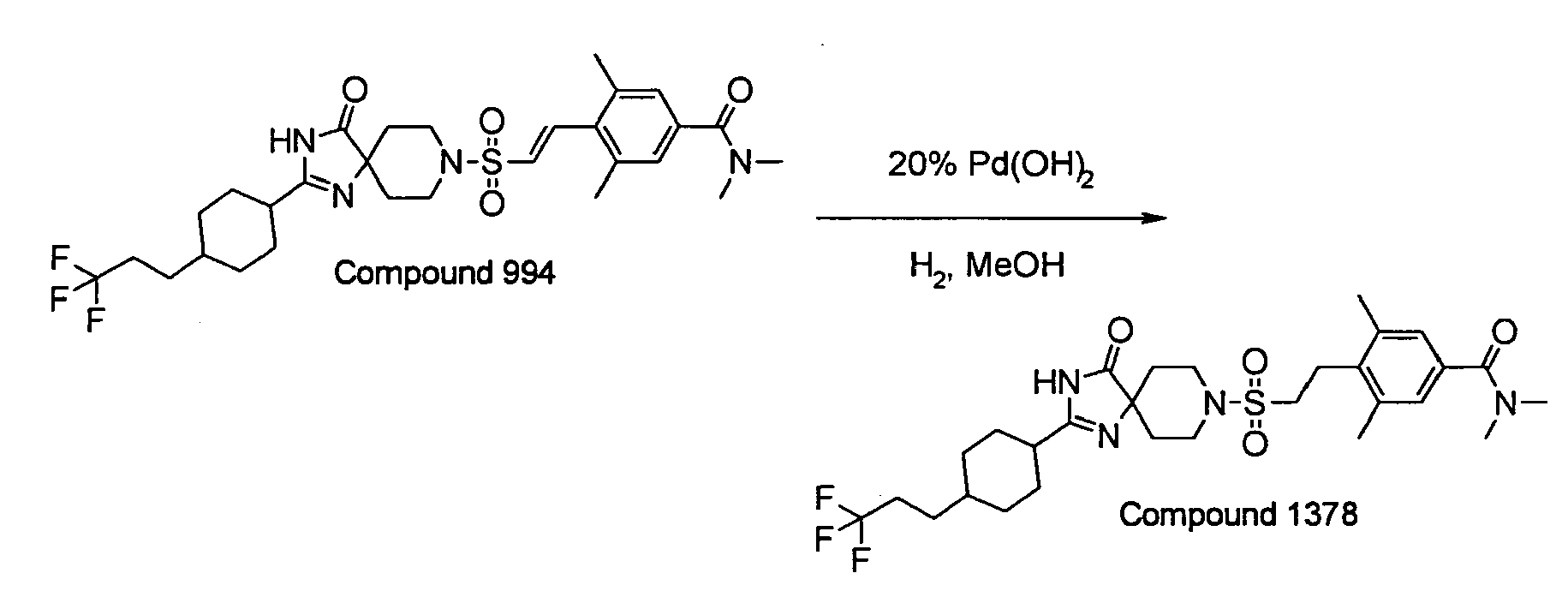
- 3,5,N,N-Tetramethyl-4-(2-{4-oxo-2-[4-(3,3,3-trifluoro-propyl)-cyclohexyl]-1,3,8-triaza-spiro[4.5]dec-1-ene-8-sulfonyl}-ethyl)-benzamide (Compound 1378) was obtained by operations similar to those in Reaction 122-2 using Compound 994 as a starting material.
MS (ESI) m/z = 599 (M+H)+. - The example compounds shown below were obtained by operations similar to those in Reaction 330-1 using appropriate solvents (acetonitrile or methanol or an acetonitrile-methanol mixed solution) and starting compounds.
-
[Table 191] Starting Compound Target Compound Structure LCMS condition Retention time (min) MS (m/z) 1003 1379 
LCMS-D-1 1.91 517 (M+H)+ 989 1380 
LCMS-D-1 2.31 669 (M+H)+ 990 1381 
LCMS-D-1 2.26 687 (M+H)+ 999 1382 
LCMS-C-1 2.62 585 (M-H)- 1000 1383 
LCMS-D-1 2.88 605 (M+H)+ 993 1384 
LCMS-D-1 2.17 729 (M+H)+ 996 1385 
LCMS-D-1 1.87 586 (M+H)+ 997 1386 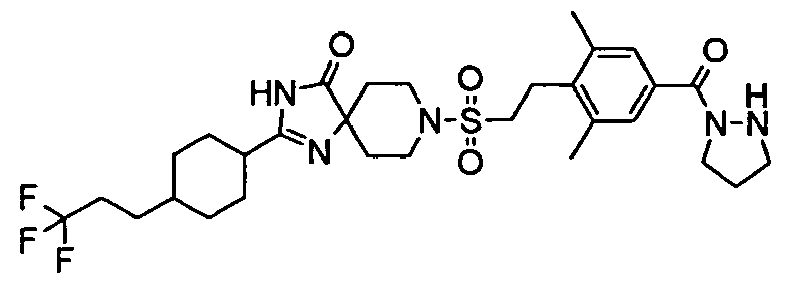
LCMS-D-1 2.00 626 (M+H)+ 987 1387 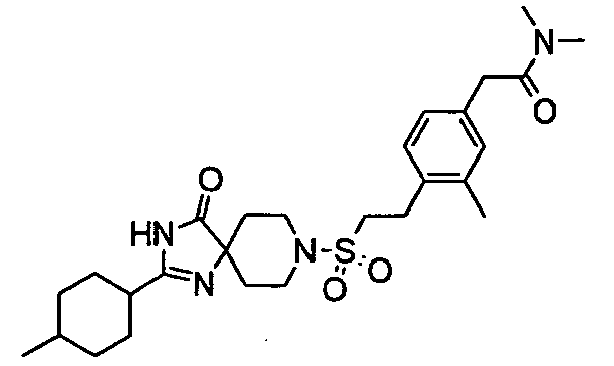
LCMS-F-1 0.94 517 (M+H)+ 988 1388 
LCMS-F-1 0.90 519 (M+H)+ 1300 1389 
LCMS-D-1 2.37 614 (M+H)+ 1301 1390 
LCMS-D-1 1.95 532 (M+H)+ 1312 1391 
LCMS-F-1 0.98 587 (M+H)+ -

- 2-Cyclohexyl-8-{2-[1-((2S,3S)-2,3,4-trihydroxy-butyl)-1H-indol-4-yl]-ethanesulfonyl}-1,3,8-triaza-spiro[4.5]dec-1-en-4-one (Compound 1392)
MS (ESI) m/z = 547 (M+H)+
and 8-{2-[1-((2S,3S)-4-benzyloxy-2,3-dihydroxybutyl)-1H-indol-4-yl]-ethanesulfonyl}-2-cyclohexyl-1,3,8-triaza-spiro[4.5]dec-1-en-4-one (Compound 1393)
MS (ESI) m/z = 637 (M+H)+
were obtained by operations similar to those in Reaction 26-1, Reaction 4-1 and Reaction 42-2 using 2-cyclohexyl-8-ethenesulfonyl-1,3,8-triaza-spiro[4.5]dec-1-en-4-one as a starting material. -

- N-[3-Methyl-4-(2-{4-oxo-2-[4-(3,3,3-trifluoro-propyl)-cyclohexyl]-1,3,8-triaza-spiro[4.5]dec-1-ene-8-sulfonyl}-ethyl)-benzyl]-acetamide (Compound 1394) was obtained by operations similar to those in Reaction 12-2 and Reaction 14-1 (using NaOMe as a base) using Compound 1284 as a starting material.
MS (ESI) m/z = 585 (M+H)+. -

- N,N-Diisopropylethylamine (1.67 ml, 9.84 mmol) was added to a solution of 4-amino-4-carbamoyl-piperidine-1-carboxylic acid tert-butyl ester (1.0 g, 4.1 mmol) in THF (10 ml) at 0°C, and thiophosgene (0.376 ml, 4.9 mmol) was further added dropwise slowly. The reaction solution was warmed to room temperature and stirred overnight. A 10% aqueous citric acid solution was added to the reaction mixture, followed by extraction with ethyl acetate. The organic layers were combined and dried over magnesium sulfate, and the solvent was then distilled off. The residue was purified by silica gel column chromatography to give 4-oxo-2-thioxo-1,3,8-triaza-spiro[4.5]decane-8-carboxylic acid tert-butyl ester (944 mg, 81%).
MS (ESI) m/z = 284 (M-H)-. -
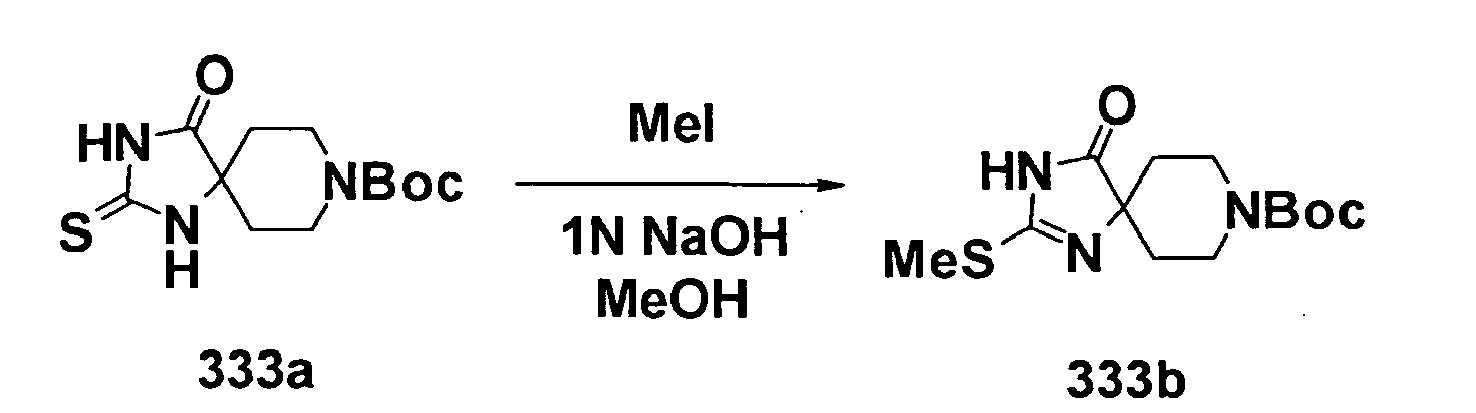
- Iodomethane (0.329 ml, 5.28 mmol) and a 1 N aqueous NaOH solution (3.3 ml, 3.3 mmol) were sequentially added to a solution of 4-oxo-2-thioxo-1,3,8-triaza-spiro[4.5]decane-8-carboxylic acid tert-butyl ester (944 mg, 3.3 mmol) in methanol (33 ml) at room temperature, and the mixture was stirred at the same temperature overnight. Water was added to the reaction mixture, followed by extraction with ethyl acetate. The organic layers were combined and dried over magnesium sulfate, and the solvent was then distilled off. The residue was purified by silica gel column chromatography to give 2-methylsulfanyl-4-oxo-1,3,8-triaza-spiro[4.5]dec-1-ene-8-carboxylic acid tert-butyl ester (762 mg, 77%).
MS (ESI) m/z = 322 (M+Na)+. -

- Acetic acid (0.275 ml, 4.8 mmol) was added to a solution of 2-methylsulfanyl-4-oxo-1,3,8-triaza-spiro[4.5]dec-1-ene-8-carboxylic acid tert-butyl ester (72 mg, 0.24 mmol) and m-trifluoromethylaniline (0.150 ml, 1.2 mmol) in DMA (1.0 ml), and the mixture was irradiated with microwaves at 150°C for 20 minutes. A saturated aqueous sodium bicarbonate solution was added to the reaction mixture, followed by extraction with ethyl acetate. The organic layers were combined, washed with saturated brine and dried over magnesium sulfate, and the solvent was then distilled off. The residue was purified by silica gel column chromatography to give 4-oxo-2-(3-trifluoromethyl-phenylamino)-1,3,8-triaza-spiro[4.5]dec-1-ene-8-carboxylic acid tert-butyl ester (50 mg, 51%).
MS (ESI) m/z = 313 (M-(Boc+H)+H)+. -

- 3,N,N-Trimethyl-4-{2-[4-oxo-2-(3-trifluoromethyl-phenylamino)-1,3,8-triaza-spiro[4.5]dec-1-ene-8-sulfonyl]-ethyl}-benzamide was synthesized by operations similar to those in Reaction 4-1 and Reaction 190-1 using appropriate reagents and starting material.
MS (ESI) m/z = 566 (M+H)+. -

- 3,N,N-Trimethyl-4-{2-[4-oxo-2-(4-trifluoromethyl-phenylamino)-1,3,8-triaza-spiro[4.5]dec-1-ene-8-sulfonyl]-ethyl}-benzamide was synthesized by operations similar to those in Reaction 333-3, Reaction 5-3 and Reaction 190-1 using appropriate reagents and starting material.
MS (ESI) m/z = 566 (M+H)+. - The example compounds shown below were synthesized by operations similar to those in Reaction 334-1 using appropriate reagents and starting materials.
-
[Table 192] Target Compound Structure LCMS condition Retention time (min) MS (m/z) 1397 
LCMS-C-1 2.08 510 (M-H)- 1398 
LCMS-C-1 2.20 524 (M-H)- 1399 
LCMS-C-1 2.17 518(M+H)+ 1400 
LCMS-B-1 1.83 580(M+H)+ -
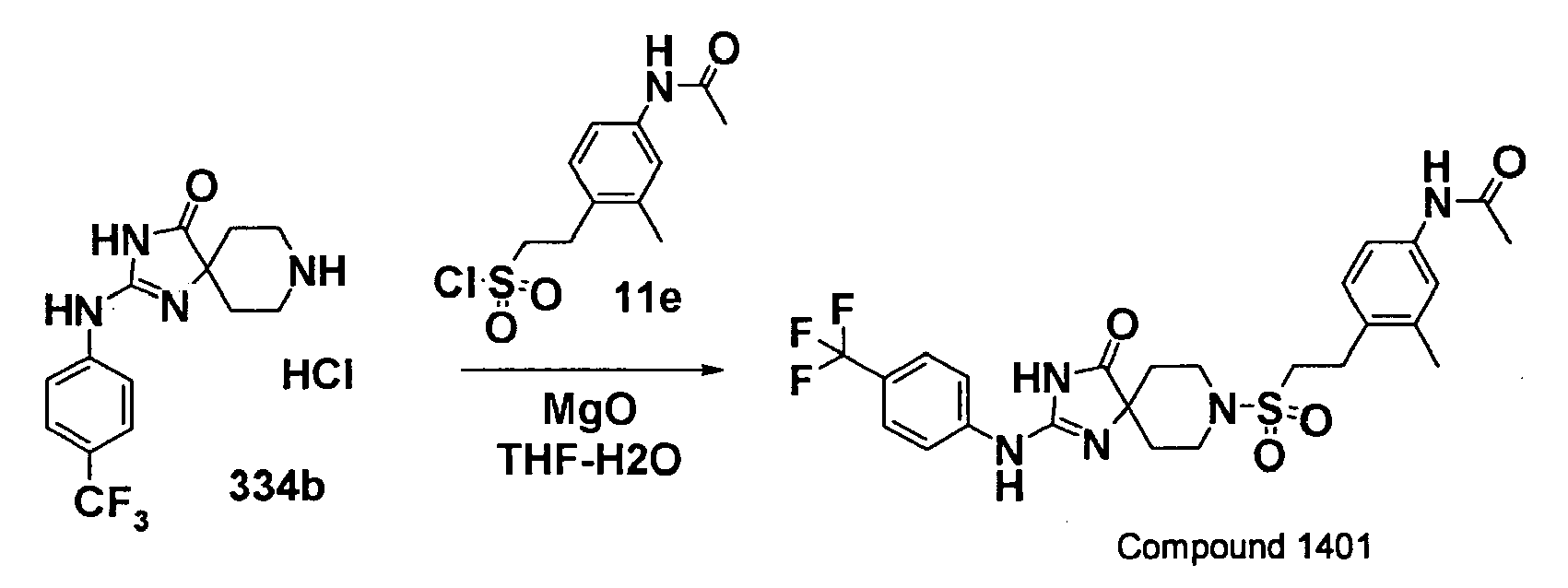
- N-(3-Methyl-4-{2-[4-oxo-2-(4-trifluoromethyl-phenylamino)-1,3,8-triaza-spiro[4.5]dec-1-ene-8-sulfonyl]-ethyl}-phenyl)-acetamide was synthesized by operations similar to those in Reaction 190-1 using appropriate reagents and starting material.
MS (ESI) m/z = 552 (M+H)+. - The example compounds shown below were synthesized by operations similar to those in Reaction 335-1 using appropriate reagents and starting materials.
-
[Table 193] Target Compound Structure LCMS condition Retention time (min) MS (m/z) 1402 
LCMS-B-1 1.85 552(M+H)+ -

- Acetic acid (0.115 ml, 1.336 mmol) and 2-methylsulfanyl-4-oxo-1,3,8-triaza-spiro[4.5]dec-1-ene-8-carboxylic acid tert-butyl ester (20 mg, 0.0668 mmol) were added to a solution of 4-butyl-piperidine hydrochloride (41 mg, 0.200 mmol) and a 10N aqueous sodium hydroxide solution (0.036 ml, 0.360 mmol) in DMI (0.3 ml), and the mixture was stirred at 110°C overnight. The reaction mixture was purified by silica gel column chromatography to give a mixture of 2-(4-butyl-piperidin-1-yl)-4-oxo-1,3,8-triaza-spiro[4.5]dec-1-ene-8-carboxylic acid tert-butyl ester (22.3 mg).
4-{2-[2-(4-Butyl-piperidin-1-yl)-4-oxo-1,3,8-triaza-spiro[4.5]dec-1-ene-8-sulfonyl]-ethyl}-3,N,N-trimethyl-benzamide (23.0 mg, 63% in three steps) was synthesized by operations similar to those in Reaction 4-1 and Reaction 190-1 using this mixture as a starting material.
MS (ESI) m/z = 546 (M+H)+. - The example compounds shown below were synthesized by operations similar to those in Reaction 336-1 using appropriate reagents and starting materials.
-
[Table 194] Target Compound Structure LCMS condition Retention time (min) MS (m/z) 1404 
LCMS-B-1 2.24 560(M+H)+ -
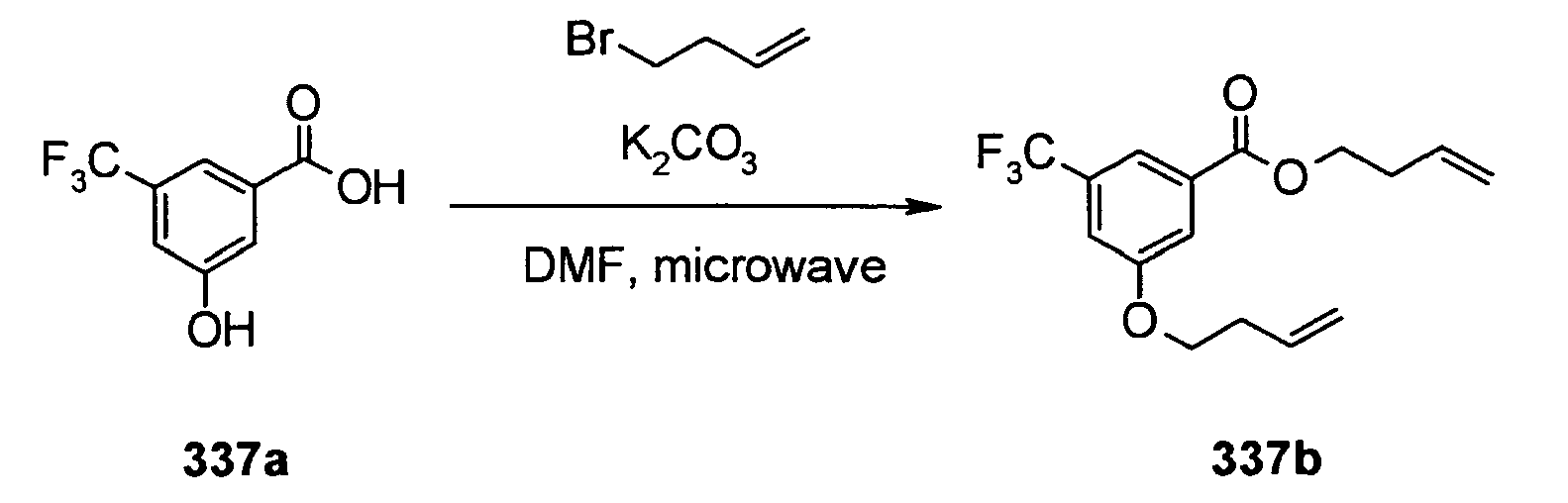
- 3-Hydroxy-5-trifluoromethyl-benzoic acid (2.17 g, 10.6 mmol), potassium carbonate (8.73 g, 63.2 mmol) and 4-bromo-1-butene (4.34 ml, 43.7 mmol) were dissolved in DMF (21 ml), and this mixture was irradiated in a microwave apparatus (100°C, 60 min). The reaction solution was poured into a cooled aqueous dilute hydrochloric acid solution, followed by extraction with ethyl acetate. The organic layer was washed with water and saturated brine, dried over anhydrous sodium sulfate and then concentrated under reduced pressure. The resulting crude product was purified by silica gel column chromatography to give 3-but-3-enyloxy-5-trifluoromethylbenzoic acid but-3-enyl ester (2.64 g, 80%).
1H-NMR (400 MHz, CDCl3) δ 7.86 (1H, s), 7.71 (1H, s), 7.31 (1H, s), 5.95-5.81 (2H, m), 5.22-5.11 (4H, m), 4.40 (2H, t, J = 6.6 Hz), 4.10 (2H, t, J = 6.6 Hz), 2.60-2.51 (4H, m). -

- 3-But-3-enyloxy-5-trifluoromethyl-benzoic acid but-3-enyl ester (2.64 g, 8.39 mmol) was dissolved in methanol. A 5 N aqueous sodium hydroxide solution (5.1 ml, 25.2 mmol) was added and the mixture was stirred at room temperature for two hours. The reaction solution was cooled, quenched with 2 N hydrochloric acid (20 ml, 40 mmol) and then extracted with ethyl acetate. The organic layer was washed with water and saturated brine, and then dried over anhydrous sodium sulfate and concentrated under reduced pressure. The resulting residue was purified by silica gel column chromatography to give 3-but-3-enyloxy-5-trifluoromethyl-benzoic acid (2.13 g, 98%).
1H-NMR (400 MHz, CDCl3) δ 7.95 (1H, s), 7.78 (1H, s), 7.38 (1H, s), 5.96-5.86 (1H, m), 5.23-5.14 (2H, m), 4.12 (2H, t, J = 6.6 Hz), 2.59 (2H, q, J = 6.5 Hz). -

- DMF (one drop) was added to a solution of 3-but-3-enyloxy-5-trifluoromethyl-benzoic acid (1.73 g, 6.65 mmol) in methylene chloride (6.8 ml). Oxalyl dichloride (0.566 ml, 6.60 mmol) was then added dropwise under ice-cooling, and the mixture was stirred at room temperature for three hours.
The reaction solution obtained above was added dropwise to a solution of 4-amino-4-cyano-piperidine-1-carboxylic acid tert-butyl ester (1.49 g, 6.65 mmol) and triethylamine (1.85 ml, 13.3 mmol) in methylene chloride (10 ml) under ice-cooling, and the mixture was stirred at room temperature for two hours. The reaction solution was cooled and water and 2 N hydrochloric acid were then sequentially added, followed by extraction with methylene chloride. The organic layer was dried over anhydrous sodium sulfate and then concentrated under reduced pressure to give 4-(3-but-3-enyloxy-5-trifluoromethyl-benzoylamino)-4-cyano-piperidine-1-carboxylic acid tert-butyl ester as a crude product (3.0 g). This compound was used in the next reaction without further purification. MS (ESI) m/z = 368 (M-Boc+H)+;
HPLC retention time: 3.32 min (analysis condition LCMS-A-1). -

- 4-(3-But-3-enyloxy-5-trifluoromethyl-benzoylamino)-4-cyano-piperidine-1-carboxylic acid tert-butyl ester (3.0 g) was dissolved in ethanol, and a 5 N aqueous sodium hydroxide solution (6.9 ml, 34.5 mmol) and a 30% aqueous hydrogen peroxide solution (3 ml) were added. After stirring at room temperature for two hours, DMSO (19 ml) was added to the reaction solution, and the mixture was stirred at 50°C for four hours. The reaction solution was cooled, and then quenched with a saturated aqueous ammonium chloride solution and extracted with ethyl acetate. The organic layer was sequentially washed with a saturated aqueous ammonium chloride solution, water and saturated brine, and then dried over anhydrous sodium sulfate and concentrated under reduced pressure. The resulting residue was purified by silica gel column chromatography to give 2-(3-but-3-enyloxy-5-trifluoromethyl-phenyl)-4-oxo-1,3,8-triaza-spiro[4.5]dec-1-ene-8-carboxylic acid tert-butyl ester (2.39 g, 67% in two steps).
1H-NMR (400 MHz, CDCl3) δ 10.10 (1H, s), 7.76 (1H, s), 7.63 (1H, s), 7.32 (1H, s), 5.96-5.86 (1H, m), 5.24-5.15 (2H, m), 4.15 (2H, t, J = 6.6 Hz), 4.01 (2H, s), 3.52 (2H, t, J = 11.2 Hz), 2.60 (2H, q, J = 6.7 Hz), 1.96-1.89 (2H, m), 1.65-1.55 (2H, m), 1.50 (9H, s);
MS (ESI) m/z = 368 (M-Boc+H)+, 412 (M-tBu+H)+. -
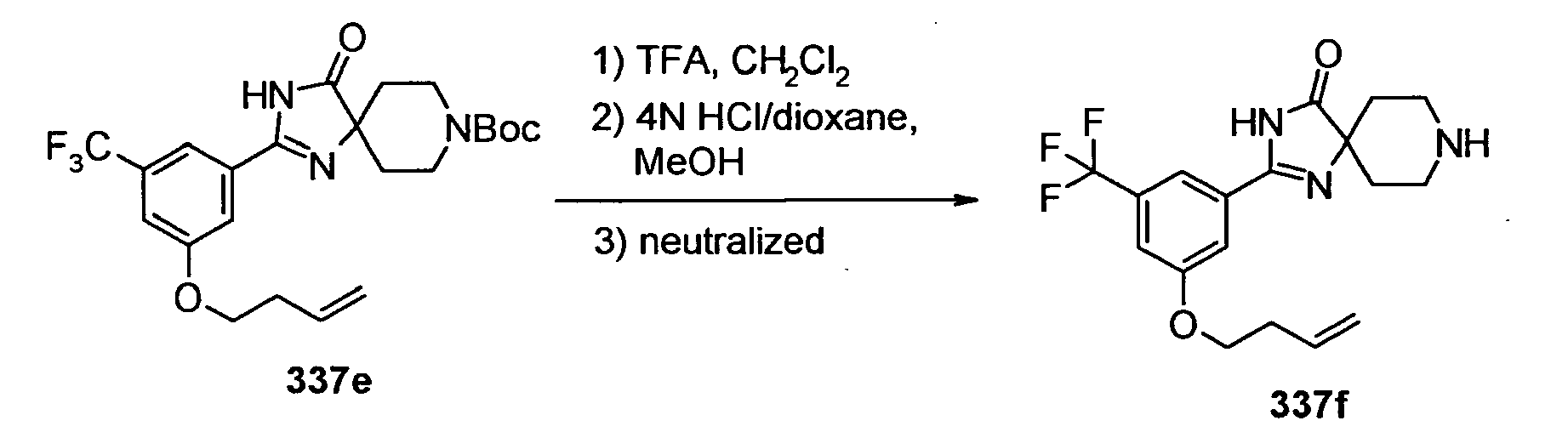
- Trifluoroacetic acid (27 ml) was added to a solution of 2-(3-but-3-enyloxy-5-trifluoromethyl-phenyl)-4-oxo-1,3,8-triaza-spiro[4.5]dec-1-ene-8-carboxylic acid tert-butyl ester (2.39 g, 5.12 mmol) in methylene chloride (54 ml), and the mixture was stirred at room temperature for 1.5 hours. The reaction solution was concentrated under reduced pressure with azeotropic distillation with toluene, and the resulting residue (trifluoroacetate) was then dissolved in methanol (50 ml). A 4 N solution of hydrochloric acid in dioxane (16 ml) was added and the mixture was concentrated under reduced pressure. The resulting residue was dissolved in a mixed solution of ethyl acetate (100 ml)-ethanol (5 ml), followed by washing with a 1 N aqueous K3PO4 solution. The organic layer was dried over anhydrous sodium sulfate and then concentrated under reduced pressure to give 2-(3-but-3-enyloxy-5-trifluoromethyl-phenyl)-1,3,8-triaza-spiro[4.5]dec-1-en-4-one (1.92 g). This compound was used in the next reaction without further purification.
1H-NMR (CDCl3) δ 7.73 (1H, s), 7.63 (1H, s), 7.29 (1H, s), 5.97-5.87 (1H, m), 5.21 (2H, d, J = 17.1 Hz) ; 5.15 (2H, d, J = 10.3 Hz), 4.15 (2H, t, J = 6.8 Hz), 3.25-3.10 (4H, m), 2.60 (2H, q, J = 6.7 Hz), 1.95-1.85 (2H, m), 1.60-1.57 (2H, m);
MS(ESI) m/z = 368 (M+H)+. -

- Triethylamine (1.27 ml, 9.11 mmol) and 4-(2-chlorosulfonyl-ethyl)-3-methyl-benzoic acid methyl ester (1.01 g, 3.65 mmol) were added to a solution of 2-(3-but-3-enyloxy-5-trifluoromethyl-phenyl)-1,3,8-triaza-spiro[4.5]dec-1-en-4-one (1.40 g, 3.83 mmol) in methylene chloride (35 ml) at 0°C. The mixture was stirred at room temperature for two hours, and then quenched with a saturated aqueous ammonium chloride solution and extracted with ethyl acetate. The organic layer was washed with water and saturated brine, dried over anhydrous sodium sulfate and then concentrated under reduced pressure to give 4-12-[2-(3-but-3-enyloxy-5-trifluoromethyl-phenyl)-4-oxo-1,3,8-triaza-spiro[4.5]dec-1-ene-8-sulfonyl]-ethyl}-3-methyl-benzoic acid methyl ester (2.10 g). This compound was used in the next reaction without further purification.
1H-NMR (400 MHz, CDCl3) δ 7.87 (1H, s), 7.85-7.84 (1H, m), 7.68 (1H, s), 7.57 (1H, s), 7.31 (1H, s), 7.26-7.25 (1H, m), 5.96-5.85 (1H, m), 5.22-5.17 (2H, m), 4.14 (2H, t, J = 6.6 Hz), 3.91 (3H, s), 3.83 (2H, td, J = 8.2, 3.9 Hz), 3.54-3.49 (2H, m), 3.25-3.15 (4H, m), 2.60 (1H, q, J = 6.7 Hz), 2.42 (3H, s), 2.13-2.06 (2H, m), 1.77-1.73 (2H, m) ;
MS (ESI) m/z = 608 (M+H)+. -

- A 5 N aqueous sodium hydroxide solution (6.6 ml, 33 mmol) was added to a solution of 4-{2-[2-(3-but-3-enyloxy-5-trifluoromethyl-phenyl)-4-oxo-1,3,8-triaza-spiro[4.5]dec-1-ene-8-sulfonyl]-ethyl}-3-methyl-benzoic acid methyl ester (2.10 g) in methanol (22 ml), and the mixture was stirred at room temperature for two hours. The reaction solution was cooled and then quenched with 2 N hydrochloric acid (25 ml), followed by extraction with ethyl acetate. The organic layer was washed with water and saturated brine, dried over anhydrous sodium sulfate and then concentrated under reduced pressure to give 4-{2-[2-(3-but-3-enyloxy-5-trifluoromethyl-phenyl)-4-oxo-1,3,8-triaza-spiro[4.5]dec-1-ene-8-sulfonyl]-ethyl}-3-methyl-benzoic acid (1.78 g).
1H-NMR (400 MHz, CD3OD) δ 7.85-7.74 (3H, m), 7.41-7.32 (3H, m), 5.99-5.89 (1H, m), 5.19 (1H, dd, J = 17.3, 1.7 Hz), 5.11 (1H, dd, J = 10.3, 2.0 Hz), 4.17 (2H, t, J = 6.6 Hz), 3.84-3.76 (2H, m), 3.56-3.46 (2H, m), 3.41-3.17 (4H, m), 2.58 (2H, q, J = 6.7 Hz), 2.44 (3H, s), 2.07-1.97 (2H, m), 1.78-1.69 (2H, m);
MS (ESI) m/z = 594 (M+H)+. -

- HATU (194 mg, 0.510 mmol), N,N-diisopropylethylamine (143 µL) and methyl-pent-4-enyl-amine (80 mg) were added to a solution of 4-{2-[2-(3-but-3-enyloxy-5-trifluoromethyl-phenyl)-4-oxo-1,3,8-triaza-spiro[4.5]dec-1-ene-8-sulfonyl]-ethyl}-3-methyl-benzoic acid (200 mg, 0.337 mmol) in DMF (3 ml), and the mixture was stirred at room temperature overnight. A saturated aqueous ammonium chloride solution was added to the reaction solution, followed by extraction with ethyl acetate. The organic layer was washed with water and saturated brine, and then dried over anhydrous sodium sulfate and concentrated under reduced pressure. The resulting residue was purified by silica gel column chromatography to give 4-{2-[2-(3-but-3-enyloxy-5-trifluoromethyl-phenyl)-4-oxo-1,3,8-triaza-spiro[4.5]dec-1-ene-8-sulfonyl]-ethyl}-3,N-dimethyl-N-pent-4-enyl-benzamide (192 mg, 84%).
MS (ESI) m/z = 675 (M+H)+;
HPLC retention time: 3.13 min (analysis condition LCMS-A-1). - Methyl-pent-4-enyl-amine used in the above Reaction 337-8 was synthesized by the following method (Angewandte Chemie, International Edition (2004), 43(41), 5542-5546).
-

- A 40% solution of methylamine in methanol(2.74 ml, 26.8 mmol) and NaI (20 mg, 0.134 mmol) were added to a solution of 5-bromo-1-butene (318 µL, 2.68 mmol) in ethanol (2 ml), and the mixture was stirred at 60°C overnight in a sealed tube. The reaction solution was cooled and concentrated hydrochloric acid (2.4 ml) was then added. The mixture was concentrated under reduced pressure. The resulting residue was washed with tert-butyl methyl ether and then made basic with a 5 N aqueous sodium hydroxide solution under ice-cooling, followed by extraction with tert-butyl methyl ether (x 3). The organic layers were dried over anhydrous sodium sulfate and then concentrated under reduced pressure to give methyl-pent-4-enyl-amine (80 mg, 30% as an object).
1H-NMR (400 MHz, CDCl3) δ 5.88-5.77 (1H, m), 5.05-4.99 (1H, m), 4.98-4.93 (1H, m), 2.58 (2H, t, J = 7.1 Hz), 2.43 (3H, s), 2.12-2.03 (2H, m), 1.62-1.49 (2H, m). -

- Grubbs catalyst 2nd generation (44 mg, 0.0519 mmol) was added to a solution of 4-{2-[2-(3-but-3-enyloxy-5-trifluoromethyl-phenyl)-4-oxo-1,3,8-triaza-spiro[4.5]dec-1-ene-8-sulfonyl]-ethyl}-3,N-dimethyl-N-pent-4-enyl-benzamide (175 mg, 0.259 mmol) in 1,2-dichloroethane (260 ml), and the mixture was stirred at 40°C overnight in an argon stream. The reaction solution was concentrated under reduced pressure, and the resulting residue was then purified by silica gel column chromatography to give a macrocyclic olefin compound (Compound 1406) (157 mg, 94%).
1H-NMR (400 MHz, CDCl3) δ 9.76 (0.2H, s), 9.59 (0.8H, s), 8.19 (1H, s), 8.12 (1H, s), 7.35-7.10 (4H, m), 5.61-5.48 (2H, m), 4.20 (0.8H, t, J = 5.4 Hz), 4.09 (0.2H, t, J = 5.1 Hz), 3.67-3.05 (10H, m), 3.03 (0.6H, s), 2.98 (2.4H, s), 2.65-2.48 (2H, m), 2.47 (2.4H, s), 2.41 (0.6H, s), 2.33-2.18 (2H, m), 1.80-1.22 (6H, m);
MS (ESI) m/z = 647 (M+H)+. -
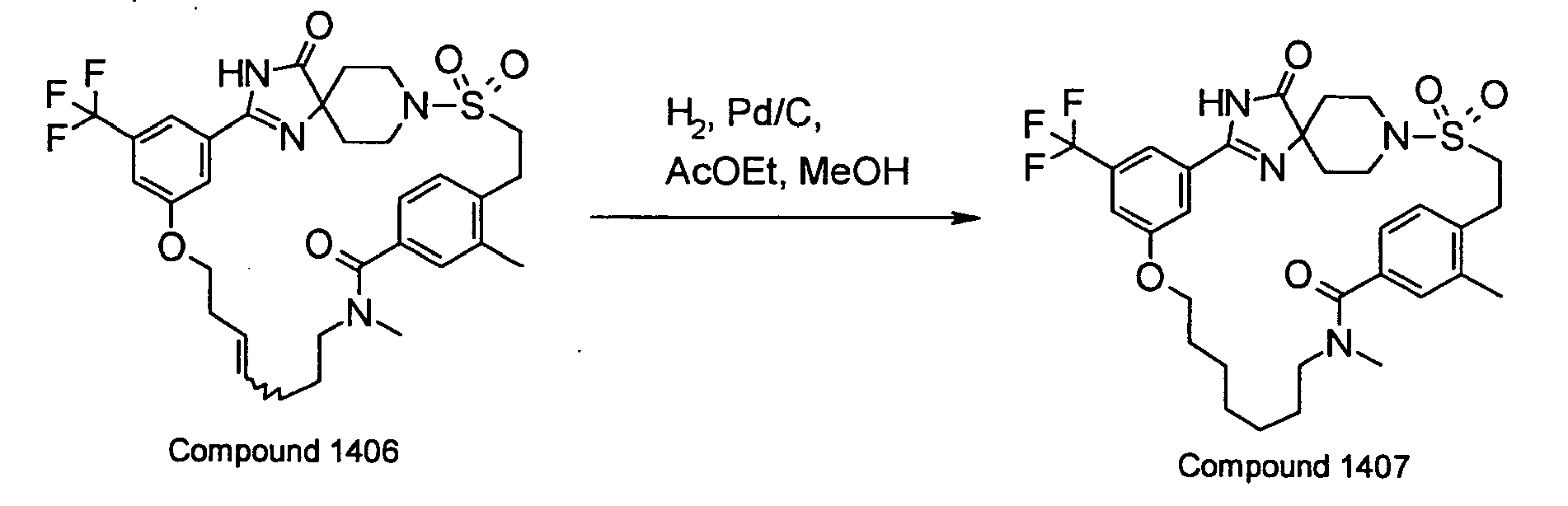
- 10% Pd-C (50% wet) (14.4 mg) was added to a macrocyclic olefin compound (Compound 1406) (36 mg, 0.0551 mmol) in a mixed solvent of methanol and ethyl acetate (1:10, 5.5 ml), and the mixture was stirred overnight in a hydrogen atmosphere. The reaction solution was filtered through celite, and the filtrate was then concentrated. The resulting residue was purified by P-TLC (CH2Cl2-MeOH) to give a saturated macrocyclic compound (Compound 1407) (30 mg, 94%).
1H-NMR (400 MHz, CD3OD) δ 7.93 (1H, s), 7.66 (1H, s), 7.40-7.35 (2H, m), 7.26-7.18 (2H, m), 4.07 (2H, t, J = 5.4 Hz), 3.81 (2H, br d, J = 11.7 Hz), 3.48-3.13 (8H, m), 3.06 (3H, s), 2.44 (3H, s), 2.13-1.10 (14H, m);
MS (ESI) m/z = 649 (M+H)+. -

- N-Allyl-4-{2-[2-(3-but-3-enyloxy-5-trifluoromethyl-phenyl)-4-oxo-1,3,8-triaza-spiro[4.5]dec-1-ene-8-sulfonyl]-ethyl}-3,N-dimethyl-benzamide was obtained by the same method as in Reaction 337-8 using 4-{2-[2-(3-but-3-enyloxy-5-trifluoromethyl-phenyl)-4-oxo-1,3,8-triaza-spiro[4.5]dec-1-ene-8-sulfonyl]-ethyl}-3-methyl-benzoic acid and allyl-methyl-amine as starting materials. MS (ESI) m/z = 647 (M+H)+;
HPLC retention time: 2.95 min (analysis condition LCMS-A-1). -

- A macrocyclic olefin compound (Compound 1408) was obtained by the same method as in Reaction 338-1 using N-allyl-4-{2-[2-(3-but-3-enyloxy-5-trifluoromethyl-phenyl)-4-oxo-1,3,8-triaza-spiro[4.5]dec-1-ene-8-sulfonyl]-ethyl}-3,N-dimethyl-benzamide (151 mg, 0.233 mmmol) as a starting material.
MS (ESI) m/z = 619 (M+H)+;
HPLC retention time: 2.69 min (analysis condition LCMS-A-1). -

- A saturated macrocyclic compound (Compound 1409) was obtained by the same method as in Reaction 339-1 using a macrocyclic olefin compound (Compound 1408) as a starting material.
MS (ESI) m/z = 621 (M+H)+;
HPLC retention time: 2.72 min (analysis condition LCMS-A-1). -

- 4-{2-[2-(3-But-3-enyloxy-5-trifluoromethyl-phenyl)-4-oxo-1,3,8-triaza-spiro[4.5]dec-1-ene-8-sulfonyl]-ethyl}-N-hex-5-enyl-3,N-dimethyl-benzamide was obtained by the same method as in Reaction 337-8 using 4-{2-[2-(3-but-3-enyloxy-5-trifluoromethyl-phenyl)-4-oxo-1,3,8-triaza-spiro[4.5]dec-1-ene-8-sulfonyl]-ethyl}-3-methyl-benzoic acid and hex-5-enyl-methyl-amine as starting materials.
MS (ESI) m/z = 689 (M+H)+;
HPLC retention time: 3.32 min (analysis condition LCMS-A-1). - Hex-5-enyl-methyl-amine used in the above Reaction 342-1 was synthesized in the following manner.
-

- Hex-5-enyl-methyl-amine was obtained by the same method as in Reaction 337-9 using 6-bromo-1-hexene (437 mg, 2.68 mmol) as a raw material.
1H-NMR (400 MHz, CDCl3) δ 5.86-5.76 (1H, m), 5.03-4.93 (2H, m), 2.57 (2H, t, J = 7.0 Hz), 2.43 (3H, s), 2.10-2.04 (2H, m), 1.54-1.38 (4H, m). -

- A macrocyclic olefin compound (Compound 1410, E/Z = 98:2) and a macrocyclic olefin compound (Compound 1411, E/Z = 59:41) were obtained by the same method as in Reaction 338-1 using 4-{2-[2-(3-but-3-enyloxy-5-trifluoromethyl-phenyl)-4-oxo-1,3,8-triaza-spiro[4.5]dec-1-ene-8-sulfonyl]-ethyl}-N-hex-5-enyl-3,N-dimethyl-benzamide as a starting material.
- MS (ESI) m/z = 661 (M+H)+;
HPLC retention time: 3.09 min (analysis condition LCMS-A-1). - MS (ESI) m/z = 661 (M+H)+;
HPLC retention time: 3.08 min (analysis condition LCMS-A-1). -

- A saturated macrocyclic compound (Compound 1412) was obtained by the same method as in Reaction 339-1 using a macrocyclic olefin compound (Compound 1411) as a starting material.
MS (ESI) m/z = 663 (M+H)+;
HPLC retention time: 3.22 min (analysis condition LCMS-A-1). -

- 4-{2-[2-(3-But-3-enyloxy-5-trifluoromethyl-phenyl)-4-oxo-1,3,8-triaza-spiro[4.5]dec-1-ene-8-sulfonyl]-ethyl}-N-hept-6-enyl-3,N-dimethyl-benzamide was obtained by the same method as in Reaction 337-8 using 4-{2-[2-(3-but-3-enyloxy-5-trifluoromethyl-phenyl)-4-oxo-1,3,8-triaza-spiro[4.5]dec-1-ene-8-sulfonyl]-ethyl}-3-methyl-benzoic acid and hept-6-enyl-methyl-amine as starting materials.
MS (ESI) m/z = 703 (M+H)+;
HPLC retention time: 3.45 min (analysis condition LCMS-A-1). - Hept-6-enyl-methyl-amine used in the above Reaction 344-1 was synthesized as follows.
-

- Hept-6-enyl-methyl-amine was obtained by the same method as in Reaction 337-9 using 7-bromo-1-heptene as a raw material.
1H-NMR (CDCl3) δ 5.86-5.76 (1H, m), 5.02-4.97 (1H, m), 4.95-4.92 (1H, m), 2.56 (2H, t, J = 7.1 Hz), 2.43 (3H, s), 2.05 (2H, q, J = 7.0 Hz), 1.52-1.29 (6H, m). -

- A macrocyclic olefin compound (E/Z mixture) was obtained by the same method as in Reaction 338-1 using 4-{2-[2-(3-but-3-enyloxy-5-trifluoromethyl-phenyl)-4-oxo-1,3,8-triaza-spiro[4.5]dec-1-ene-8-sulfonyl]-ethyl}-N-hept-6-enyl-3,N-dimethyl-benzamide as a starting material. This mixture was purified by HPLC to give Compound 1413 (E/Z = 97:3) and Compound 1414 (E/Z = 10:90).
- MS (ESI) m/z = 675 (M+H)+;
HPLC retention time: 3.20 min (analysis condition LCMS-A-1). - MS (ESI) m/z = 675 (M+H)+;
HPLC retention time: 3.18 min (analysis condition LCMS-A-1). -

- A saturated macrocyclic compound (Compound 1415) was obtained by the same method as in Reaction 339-1 using a macrocyclic olefin compound (a mixture of Compound 1413 and Compound 1414) as a starting material.
MS (ESI) m/z = 677 (M+H)+;
HPLC retention time: 3.34 min (analysis condition LCMS-A-1). -

- 4-{2-[2-(3-But-3-enyloxy-5-trifluoromethyl-phenyl)-4-oxo-1,3,8-triaza-spiro[4.5]dec-1-ene-8-sulfonyl]-ethyl}-3,N-dimethyl-N-oct-7-enyl-benzamide was obtained by the same method as in Reaction 337-8 using 4-{2-[2-(3-but-3-enyloxy-5-trifluoromethyl-phenyl)-4-oxo-1,3,8-triaza-spiro[4.5]dec-1-ene-8-sulfonyl]-ethyl}-3-methyl-benzoic acid and methyl-oct-7-enyl-amine as starting materials.
MS (ESI) m/z = 717 (M+H)+;
HPLC retention time: 3.55 min (analysis condition LCMS-A-1) - Methyl-oct-7-enyl-amine used in the above Reaction 346-1 was synthesized as follows.
-

- Methyl-oct-7-enyl-amine was obtained by the same method as in Reaction 337-9 using 8-bromo-1-octene as a raw material.
1H-NMR (400 MHz, CDCl3) δ 5.86-5.76 (1H, m), 5.02-4.96 (1H, m), 4.95-4.91 (1H, m), 2.56 (2H, t, J = 7.1 Hz), 2.43 (3H, s), 2.07-2.01 (2H, m), 1.50-1.30 (8H, m). -

- A macrocyclic olefin compound (E/Z mixture) was obtained by the same method as in Reaction 338-1 using 4-{2-[2-(3-but-3-enyloxy-5-trifluoromethyl-phenyl)-4-oxo-1,3,8-triaza-spiro[4.5]dec-1-ene-8-sulfonyl]-ethyl}-3,N-dimethyl-N-oct-7-enyl-benzamide as a starting material. The resulting mixture was purified by HPLC
(MeOH/MeCN/H2O) to give Compound 1416 (E/Z = 96:4) and Compound 1417 (E/Z = 19:81). - MS (ESI) m/z = 689 (M+H)+;
HPLC retention time: 3.38 min (analysis condition LCMS-A-1). - MS (ESI) m/z = 689 (M+H)+;
HPLC retention time: 3.26 min (analysis condition LCMS-A-1). -

- A saturated macrocyclic compound (Compound 1418) was obtained by the same method as in Reaction 339-1 using a macrocyclic olefin compound (Compound 1416) as a starting material.
MS (ESI) m/z = 691 (M+H)+;
HPLC retention time: 3.56 min (analysis condition LCMS-A-1). -

- N-(2-Allyloxy-ethyl)-4-{2-[2-(3-but-3-enyloxy-5-trifluoromethyl-phenyl)-4-oxo-1,3,8-triaza-spiro[4.5]dec-1-ene-8-sulfonyl]-ethyl}-3,N-dimethyl-benzamide was obtained by the same method as in Reaction 337-8 using 4-{2-[2-(3-but-3-enyloxy-5-trifluoromethyl-phenyl)-4-oxo-1,3,8-triaza-spiro[4.5]dec-1-ene-8-sulfonyl]-ethyl}-3-methyl-benzoic acid and (2-allyloxy-ethyl)-methyl-amine as starting materials.
MS (ESI) m/z = 691 (M+H)+;
HPLC retention time: 3.08 min (analysis condition LCMS-A-1). - (2-Allyloxy-ethyl)-methyl-amine used in the above Reaction 348-1 was synthesized in the following manner.
-

- (2-Allyloxy-ethyl)-methyl-amine was obtained by the same method as in Reaction 337-9 using, as a starting material, methanesulfonic acid 2-allyloxy-ethyl ester synthesized from 2-allyloxy-ethanol by the method described in Journal of Organic Chemistry (2006), 71(21), 8183-8189.
1H-NMR (400 MHz, CDCl3) δ 5.97-5.87 (1H, m), 5.30-5.24 (1H, m), 5.20-5.17 (1H, m), 4.00 (2H, br d, J = 5.9 Hz), 3.55 (2H, t, J = 5.4 Hz), 2.76 (2H, t, J = 5.1 Hz), 2.45 (3H, s). -

- A macrocyclic olefin compound (Compound 1420) and its isomer A (349a) and isomer B (349b) were obtained by the same method as in Reaction 338-1 using N-(2-allyloxy-ethyl)-4-{2-[2-(3-but-3-enyloxy-5-trifluoromethyl-phenyl)-4-oxo-1,3,8-triaza-spiro[4.5]dec-l-ene-8-sulfonyl]-ethyl}-3,N-dimethyl-benzamide as a starting material.
- MS (ESI) m/z = 663 (M+H)+;
HPLC retention time: 2.84 min (analysis condition LCMS-A-1).
Isomer A (349a)
MS (ESI) m/z = 663 (M+H)+
HPLC retention time: 2.77 min (analysis condition LCMS-A-1).
Isomer B (349b)
MS (ESI) m/z = 663 (M+H)+
HPLC retention time: 2.96 min (analysis condition LCMS-A-1). -

- A saturated macrocyclic compound (Compound 1421) was obtained by the same method as in Reaction 339-1 using macrocyclic olefin mixture (Compounds 1420, 349a and 349b) as a starting material.
MS (ESI) m/z = 665 (M+H)+;
HPLC retention time: 2.95 min (analysis condition LCMS-A-1). -

- N-Allylcarbamoylmethyl-4-{2-[2-(3-but-3-enyloxy-5-trifluoromethyl-phenyl)-4-oxo-1,3,8-triaza-spiro[4.5]dec-1-ene-8-sulfonyl]-ethyl}-3,N-dimethyl-benzamide was obtained by the same method as in Reaction 337-8 using 4-{2-[2-(3-but-3-enyloxy-5-trifluoromethyl-phenyl)-4-oxo-1,3,8-triaza-spiro[4.5]dec-1-ene-8-sulfonyl]-ethyl}-3-methyl-benzoic acid and N-allyl-2-methylamino-acetamide hydrochloride as starting materials.
MS (ESI) m/z = 704 (M+H)+;
HPLC retention time: 2.80 min (analysis condition LCMS-A-1). - N-Allyl-2-methylamino-acetamide hydrochloride used in the above reaction was synthesized by the following method.
-

- Allylamine (0.377 ml, 5.03 mmol) and 4-(4,6-dimethoxy-1,3,5-triazin-2-yl)-4-methylmorpholinium chloride n-hydrate (DMT-MM) (1.89 g, 6.04 mmol) were added to a solution of Boc-sarcosine (1.0 g, 5.29 mmol) in ethanol, and the mixture was stirred at room temperature for 18 hours. A saturated aqueous sodium bicarbonate solution and water were added to the reaction solution; followed by extraction with ether. The organic layer was washed with water and saturated brine, dried over anhydrous sodium sulfate and then concentrated under reduced pressure to give allylcarbamoylmethyl-methyl-carbamic acid tert-butyl ester (712 mg).
1H-NMR (400 MHz, CDCl3) δ 6.27 (0.5H, br s), 6.02 (0.5H, br s), 5.88-5.79 (1H, m), 5.18 (1H, br d, J = 17.6 Hz), 5.15 (1H, br d, J = 11.2 Hz), 3.91 (2H, br t, J = 5.6 Hz), 3.88 (2H, s), 2.95 (3H, s), 1.47 (9H, s). - Trifluoroacetic acid (7 ml) was added to a solution of the resulting allylcarbamoylmethyl-methyl-carbamic acid tert-butyl ester in methylene chloride (14 ml), and the mixture was stirred at room temperature for three hours. The reaction solution was concentrated under reduced pressure, and 4 N hydrochloric acid-dioxane was then added to the resulting residue. The mixture was concentrated under reduced pressure again to give N-allyl-2-methylamino-acetamide hydrochloride (577 mg). This was used in the next reaction without complete purification.
1H-NMR (400 MHz, DMSO-d6) δ 8.96 (2H, br s), 8.68 (1H, br t, J = 5.6 Hz), 5.86-5.76 (1H, m), 5.19 (1H, dq, J = 17.1, 1.6 Hz), 5.10 (1H, dq, J = 10.4, 1.5 Hz), 3.79-3.75 (2H, m), 3.71 (2H, br s), 2.55 (2H, br s). -

- A macrocyclic olefin compound (Compound 1422) and its isomer (Compound 1423) were obtained by the same method as in Reaction 338-1 using N-allylcarbamoylmethyl-4-{2-[2-(3-but-3-enyloxy-5-trifluoromethyl-phenyl)-4-oxo-1,3,8-triaza-spiro[4.5]dec-1-ene-8-sulfonyl]-ethyl}-3,N-dimethyl-benzamide as a starting material.
- MS (ESI) m/z = 676 (M+H)+;
HPLC retention time: 2.47 min (analysis condition LCMS-A-1). - MS (ESI) m/z = 676 (M+H)+;
HPLC retention time: 2.61 min (analysis condition LCMS-A-1). -

- 8-{2-[4-((3S,4S)-3-Allyloxy-4-hydroxy-pyrrolidine-1-carbonyl)-2-methyl-phenyl]-ethanesulfonyl}-2-(3-but-3-enyloxy-5-trifluoromethyl-phenyl)-1,3,8-triaza-spiro[4.5]dec-1-en-4-one were obtained by the same method as in Reaction 337-8 using 4-{2-[2-(3-but-3-enyloxy-5-trifluoromethyl-phenyl)-4-oxo-1,3,8-triaza-spiro[4.5]dec-1-ene-8-sulfonyl]-ethyl}-3-methyl-benzoic acid and (3S,4S)-4-allyloxy-pyrrolidin-3-ol hydrochloride as starting materials.
MS (ESI) m/z = 719 (M+H)+;
HPLC retention time: 2.81 min (analysis condition LCMS-A-1). - (3S,4S)-4-Allyloxy-pyrrolidin-3-ol hydrochloride used in the above reaction was synthesized by the following method.
-

- (3S,4S)-3-Allyloxy-4-hydroxy-pyrrolidine-1-carboxylic acid tert-butyl ester synthesized by the method described in the patent literature (
DE4234330 ) (139 mg, 0.57 mmol) was dissolved in methylene chloride (2.4 ml). A 4 N solution of hydrochloric acid in dioxane (0.628 ml, 2.45 mmol) was added and the mixture was stirred at room temperature for two hours. The reaction solution was concentrated under reduced pressure to give (3S,4S)-4-allyloxy-pyrrolidin-3-ol hydrochloride (105 mg). This was used in the next reaction without further purification.
1H-NMR (400 MHz, DMSO-d6) δ 9.43 (2H, br s), 5.93-5.83 (1H, m), 5.72 (1H, br d, J = 2.4 Hz), 5.28 (1H, dq, J = 17.3, 1.8 Hz), 5.17 (1H, dq, J = 10.5, 1.5 Hz), 4.26 (1H, br s), 4.04-4.02 (2H, m), 3.95 (1H, d, J = 4.4 Hz), 3.32-3.06 (4H, m). -

- A macrocyclic olefin compound (Compound 1424) was obtained by the same method as in Reaction 338-1 (using Hoveyda-Grubbs 2nd generation as a catalyst) using 8-{2-[4-((3S,4S)-3-allyloxy-4-hydroxy-pyrrolidine-1-carbonyl)-2-methyl-phenyl]-ethanesulfonyl}-2-(3-but-3-enyloxy-5-trifluoromethyl-phenyl)-1,3,8-triaza-spiro[4.5]dec-1-en-4-one (106 mg, 0.148 mmmol) as a starting material.
MS (ESI) m/z = 691 (M+H)+;
HPLC retention time: 2.48 min (analysis condition LCMS-A-1). -
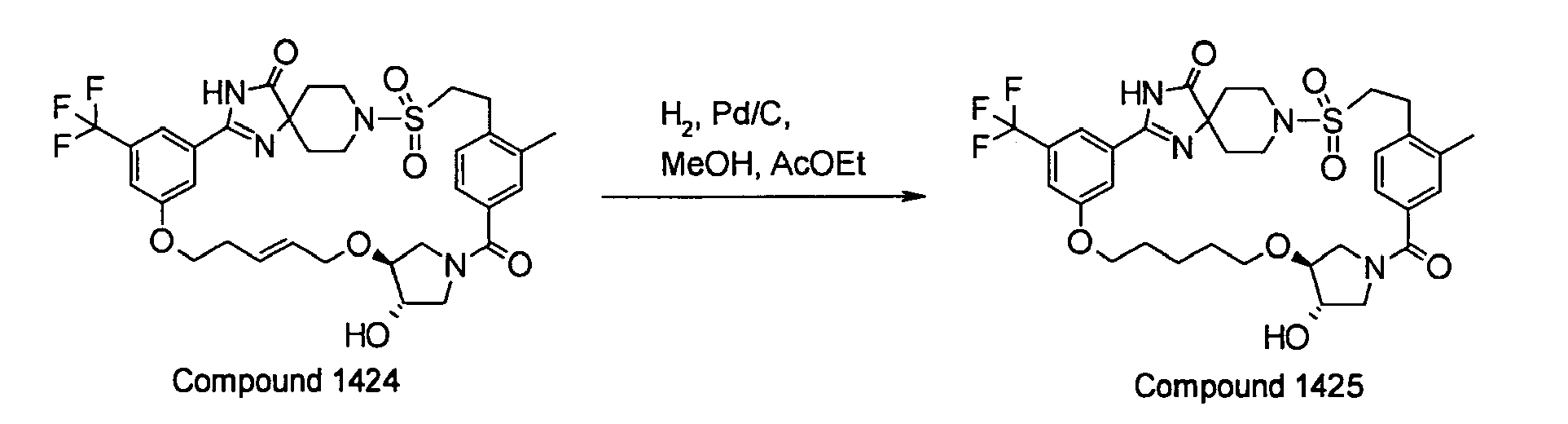
- A saturated macrocyclic compound (Compound 1425) was obtained by the same method as in Reaction 339-1 using a macrocyclic olefin compound (Compound 1424) as a starting material.
MS (ESI) m/z = 693 (M+H)+;
HPLC retention time: 2.54 min (analysis condition LCMS-A-1). -

- N-(2-Allyloxy-ethyl)-4-{2-[2-(3-but-3-enyloxy-5-trifluoromethyl-phenyl)-4-oxo-1,3,8-triaza-spiro[4.5]dec-1-ene-8-sulfonyl]-ethyl}-3-methyl-benzamide was obtained by the same method as in Reaction 337-8 using 4-{2-[2-(3-but-3-enyloxy-5-trifluoromethyl-phenyl)-4-oxo-1,3,8-triaza-spiro[4.5]dec-1-ene-8-sulfonyl]-ethyl}-3-methyl-benzoic acid and 2-allyloxy-ethylamine as starting materials.
MS (ESI) m/z = 677 (M+H)+;
HPLC retention time: 1.08 min (analysis condition LCMS-F-1). -

- A macrocyclic olefin compound (Compound 1426) was obtained by the same method as in Reaction 338-1 using N-(2-allyloxy-ethyl)-4-{2-[2-(3-but-3-enyloxy-5-trifluoromethyl-phenyl)-4-oxo-1,3,8-triaza-spiro[4.5]dec-1-ene-8-sulfonyl]-ethyl}-3-methyl-benzamide as a starting material.
MS (ESI) m/z = 649 (M+H)+;
HPLC retention time: 2.83 min (analysis condition LCMS-C-1). -

- A saturated macrocyclic compound (Compound 1427) was obtained by the same method as in Reaction 339-1 using a macrocyclic olefin compound (Compound 1426) as a starting material.
MS (ESI) m/z = 651 (M+H)+;
HPLC retention time: 1.07 min (analysis condition LCMS-F-1). -

- N-(2-Allyloxy-ethyl)-4-{2-[2-(3-but-3-enyloxy-5-trifluoromethyl-phenyl)-4-oxo-1,3,8-triaza-spiro[4.5]dec-1-ene-8-sulfonyl]-ethyl}-N-(2-hydroxy-ethyl)-3-methyl-benzamide was obtained by the same method as in Reaction 337-8 using 4-{2-[2-(3-but-3-enyloxy-5-trifluoromethyl-phenyl)-4-oxo-1,3,8-triaza-spiro[4.5]dec-1-ene-8-sulfonyl]-ethyl}-3-methyl-benzoic acid and 2-(2-allyloxy-ethylamino)-ethanol as starting materials.
MS (ESI) m/z = 721 (M+H)+;
HPLC retention time: 1.05 min (analysis condition LCMS-F-1). - 2-(2-Allyloxy-ethylamino)-ethanol used in the above Reaction 356-1 was synthesized by the following method.
-

- 2-(2-Allyloxy-ethylamino)-ethanol was obtained by the same method as in Reaction 337-9 using methanesulfonic acid 2-allyloxy-ethyl ester as a raw material.
-

- A macrocyclic olefin compound (Compound 1428) was obtained by the same method as in Reaction 338-1 (using Hoveyda-Grubbs 2nd generation as a catalyst) using N-(2-allyloxy-ethyl)-4-{2-[2-(3-but-3-enyloxy-5-trifluoromethyl-phenyl)-4-oxo-1,3,8-triaza-spiro[4.5]dec-1-ene-8-sulfonyl]-ethyl}-N-(2-hydroxy-ethyl)-3-methyl-benzamide as a starting material.
MS (ESI) m/z = 693 (N+H)+;
HPLC retention time: 1.06 min (analysis condition LCMS-F-1). -

- A saturated macrocyclic compound (Compound 1429) was obtained by the same method as in Reaction 339-1 using a macrocyclic olefin compound (Compound 1428) as a starting material.
MS (ESI) m/z = 695 (M+H)+;
HPLC retention time: 1.09 min (analysis condition LCMS-F-1). -

- A macrocyclic olefin compound (Compound 1406) (20 mg, 0.031 mmol) was dissolved in THF (1 ml). Microcapsulated osmium tetroxide (7.1 mg; 0.79 mg, 3.1 µmoL as osmium tetroxide) and 30% aqueous hydrogen peroxide (0.028 ml) were added and the mixture was stirred at 0°C for 4.5 hours and at room temperature for three hours. An aqueous sodium sulfite solution was added to the reaction solution, followed by extraction with ethyl acetate. The organic layer was washed with water and saturated brine, and then dried over anhydrous sodium sulfate and concentrated under reduced pressure. The resulting residue was purified by P-TLC to give a macrocyclic diol compound (Compound 1430, 2 mg, 10%).
MS (ESI) m/z = 681 (M+H)+;
HPLC retention time: 2.22 min (analysis condition LCMS-F-1). -

- Dicyclohexyl-methyl-amine (34.2 ml, 162.8 mmol) was added to a solution of 8-ethenesulfonyl-1,4-dioxa-8-aza-spiro[4.5]decane (17.3 g, 74.01 mmol), 4-bromo-3-methyl-benzoic acid (19.1 g, 88.82 mmol), Pd(dba)2 (4.26 g, 7.40 mmol) and tri-t-butylphosphonium tetrafluoroborate (2.15 g, 7.40 mmol) in NMP (70.0 ml), and the mixture was stirred at 100°C for one hour in a nitrogen atmosphere. The reaction solution was cooled to room temperature and then diluted with ethyl acetate, and the organic layer was washed with a 1 M aqueous hydrochloric acid solution and saline. The organic layer was allowed to stand for a while, and the precipitated solid was filtered off. The resulting solid was washed with ethyl acetate to give 4-[(E)-2-(1,4-dioxa-8-aza-spiro[4.5]decane-8-sulfonyl)-vinyl]-3-methyl-benzoic acid as a gray solid (25.6 g, 94.1%).
MS (ESI) m/z = 368 (M+H)+;
HPLC retention time: 0.61 min (analysis condition LCMS-F-1). -

- Pd(OH)2-C (20.0 g) was added to a solution of 4-[(E)-2-(1,4-dioxa-8-aza-spiro[4.5]decane-8-sulfonyl)-vinyl]-3-methyl-benzoic acid (20.0 g, 54.43 mmol) in THF (600 ml)-methanol (200 ml), and the mixture was stirred at room temperature overnight in a hydrogen atmosphere. The reaction mixture was filtered through celite, and the filtrate was then concentrated under reduced pressure to give 4-[2-(1,4-dioxa-8-aza-spiro[4.5]decane-8-sulfonyl)-ethyl]-3-methyl-benzoic acid as a white solid (18.23 g, 90.7%).
MS (ESI) m/z = 370 (M+H)+;
HPLC retention time: 1.85 min (analysis condition LCMS-B-1). -

- A 6 M aqueous hydrochloric acid solution (217.9 ml, 1307.4 mmol) was slowly added to a suspension of 4-[2-(1,4-dioxa-8-aza-spiro[4.5]decane-8-sulfonyl)-ethyl]-3-methyl-benzoic acid (16.1 g, 43.58 mmol) in acetone (485 ml) at 0°C, and the mixture was warmed to room temperature and stirred overnight. The reaction mixture was filtered off, and the filtrate was then concentrated under reduced pressure. The precipitated solid was filtered off again. The solids filtered off were combined and dried to give 3-methyl-4-[2-(4-oxo-piperidine-1-sulfonyl)-ethyl]-benzoic acid as a white solid (13.62 g, 91.8%).
MS (ESI) m/z = 326 (M+H)+;
HPLC retention time: 1.57 min (analysis condition LCMS-B-1). -

- HATU (91 mg, 0.239 mmol) was added to a solution of 3-methyl-4-[2-(4-oxo-piperidine-1-sulfonyl)-ethyl]-benzoic acid (50 mg, 0.154 mmol), (2-allyloxy-ethyl)-methyl-amine (36 mg, 0.312 mmol) and diisopropylethylamine (0.065 ml, 0.384 mmol) in DMF (0.5 ml), and the mixture was stirred at room temperature overnight. Water (12 ml) and 1 N hydrochloric acid (1.5 ml) were added to the reaction solution, followed by extraction with ethyl acetate. The organic layer was sequentially washed with 0.1 N hydrochloric acid, water and saturated brine, and then dried over anhydrous sodium sulfate and concentrated under reduced pressure. The resulting residue was purified by silica gel column chromatography (hexane-ethyl acetate) to give N-(2-allyloxy-ethyl)-3,N-dimethyl-4-[2-(4-oxo-piperidine-1-sulfonyl)-ethyl]-benzamide (76 mg, 100%).
MS (ESI) m/z = 423 (M+H)+;
HPLC retention time: 2.15 min (analysis condition LCMS-C-1). -

- Potassium cyanide (382 mg, 5.87 mmol) and ammonium acetate (513 mg, 6.65 mmol) were added to a solution of N-(2-allyloxy-ethyl)-3,N-dimethyl-4-[2-(4-oxo-piperidine-1-sulfonyl)-ethyl]-benzamide (1.65 g, 3.91 mmol) in methanol (20 ml), and the mixture was stirred at 65°C for three hours. Sodium bicarbonate (290 mg) was added to the reaction solution, and the mixture was then concentrated under reduced pressure. Water was added to the resulting residue, followed by extraction with methylene chloride. The organic layer was washed with saturated brine, dried over anhydrous sodium sulfate and concentrated under reduced pressure to give N-(2-allyloxy-ethyl)-4-[2-(4-amino-4-cyano-piperidine-1-sulfonyl)-ethyl]-3,N-dimethyl-benzamide (1.57 g) as a crude compound.
- A 1 N aqueous sodium hydroxide solution (1.41 ml) and 30% aqueous hydrogen peroxide (0.95 ml) were added to a solution of the resulting N-(2-allyloxy-ethyl)-4-[2-(4-amino-4-cyano-piperidine-1-sulfonyl)-ethyl]-3,N-dimethyl-benzamide in methanol (24 ml)-DMSO (1.3 ml), and the mixture was stirred at room temperature for one hour. A 10% (w/w) aqueous sodium sulfite solution (2.64 ml) was added to the reaction solution, and the mixture was stirred at room temperature for 40 minutes. The precipitated insoluble matter was then removed by filtration. The resulting filtrate was concentrated under reduced pressure to give 1-(2-{4-[(2-allyloxy-ethyl)-methyl-carbamoyl]-2-methyl-phenyl}-ethanesulfonyl)-4-amino-piperidine-4-carboxylic amide (2.13 g). This was used in the next reaction without further purification.
MS (ESI) m/z = 467 (M+H)+;
HPLC retention time: 1.59 min (analysis condition LCMS-A-1). -

- Potassium tert-butoxide (816 mg, 7.28 mmol) was added to a solution of 3-fluoro-4-trifluoromethyl-benzoic acid (682 mg, 3.28 mmol) and benzyl alcohol (471 mg, 4.36 mmol) in DMSO (7.3 ml), and the mixture was stirred at room temperature for 16 hours. The reaction solution was made acidic by adding concentrated-hydrochloric acid, and the precipitated insoluble matter was then filtered off. The resulting solid was washed with water and then dried to give 3-benzyloxy-4-trifluoromethyl-benzoic acid as a crude compound.
1H-NMR (400 MHz, CDCl3) δ.77-7.70 (3H, m), 7.48-7.32 (5H, m), 5.27 (2H, s);
MS (ESI) m/z = 295 (M-H)-;
HPLC retention time: 2.37 min (analysis condition LCMS-C-1). - 10% Pd/C (590 mg) was added to 3-benzyloxy-4-trifluoromethyl-benzoic acid in a methanol-ethyl acetate mixed solvent (1:1), and the mixture was stirred at room temperature for two days in a hydrogen atmosphere. The reaction solution was filtered through celite, and the filtrate was then concentrated under reduced pressure. The resulting residue was purified by silica gel column chromatography (n-hexane-ethyl acetate) to give 3-hydroxy-4-trifluoromethyl-benzoic acid (582 mg, 86%).
1H-NMR (400 MHz, DMSO-d6) δ 13.26 (1H, br s), 10.94 (1H, br s), 7.63 (1H, d, J = 8.3 Hz), 7.59 (1H, s), 7.46 (1H, d, J = 8.8 Hz);
MS (ESI) m/z = 205 (M-H)-;
HPLC retention time: 1.15 min (analysis condition LCMS-C-1). -

- 3-But-3-enyloxy-4-trifluoromethyl-benzoic acid but-3-enyl ester was obtained by the same method as in Reaction 337-1 using 3-hydroxy-4-trifluoromethyl-benzoic acid as a raw material.
1H-NMR (400 MHz, CDCl3) δ 7.66-7.61 (3H, m), 5.98-5.81 (2H, m), 5.22-5.15 (2H, m), 5.14-5.10 (2H, m), 4.40 (2H, t, J = 6.8 Hz), 4.16 (2H, t, J = 6.6 Hz), 2.62-2.51 (4H, m). -

- 3-But-3-enyloxy-4-trifluoromethyl-benzoic acid was obtained by the same method as in Reaction 337-2 using 3-but-3-enyloxy-4-trifluoromethyl-benzoic acid but-3-enyl ester as a raw material.
1H-NMR (400 MHz, CDsOD) δ 7.73 (1H, br s), 7.68 (2H, br s), 6.00-5.90 (1H, m), 5.21-5.15 (1H, m), 5.11-5.08 (1H, m), 4.19 (2H, t, J = 6.6 Hz), 2.60-2.55 (2H, m). -

- HATU (245 mg, 0.644 mmol) was added to a solution of 1-(2-{4-[(2-allyloxy-ethyl)-methyl-carbamoyl]-2-methylphenyl}-ethanesulfonyl)-4-amino-piperidine-4-carboxylic amide (250 mg), 3-but-3-enyloxy-4-trifluoromethyl-benzoic acid (155 mg, 0.596 mmol) and diisopropylethylamine (0.140 ml, 0.812 mmol) in DMF (5 ml), and the mixture was stirred at room temperature for 1.5 hours. Water was added to the reaction solution, followed by extraction with ethyl acetate. The organic layer was washed with water and saturated brine, and then dried over anhydrous sodium sulfate and concentrated under reduced pressure to give 1-(2-{4-[(2-allyloxy-ethyl)-methyl-carbamoyl]-2-methyl-phenyl}-ethanesulfonyl)-4-(3-but-3-enyloxy-4-trifluoromethyl-benzoylamino)-piperidine-4-carboxylic amide as a crude compound (381 mg).
- Potassium tert-butoxide (302 mg, 2.69 mmol) was added to a solution of the resulting 1-(2-{4-[(2-allyloxy-ethyl)-methyl-carbamoyl]-2-methyl-phenyl}-ethanesulfonyl)-4-(3-but-3-enyloxy-4-trifluoromethyl-benzoylamino)-piperidine-4-carboxylic amide in ethanol (6 ml), and the mixture was stirred at 80°C for 30 minutes. A saturated aqueous ammonium chloride solution, water and saturated brine were sequentially added to the reaction solution, followed by extraction with ethyl acetate. The organic layer was washed with saturated brine, and then dried over anhydrous sodium sulfate and concentrated under reduced pressure. The resulting residue was purified by silica gel column chromatography to give N-(2-allyloxy-ethyl)-4-{2-[2-(3-but-3-enyloxy-4-trifluoromethyl-phenyl)-4-oxo-1,3,8-triaza-spiro[4.5]dec-1-ene-8-sulfonyl]-ethyl}-3,N-dimethyl-benzamide (176 mg). MS (ESI) m/z = 691 (M+H)+;
HPLC retention time: 3.03 min (analysis condition LCMS-C-1). -

- A macrocyclic olefin compound (Compound 1431) (E/Z = 1:2) was obtained by the same method as in Reaction 338-1 (using Hoveyda-Grubbs 2nd generation as a catalyst) using N-(2-allyloxy-ethyl)-4-{2-[2-(3-but-3-enyloxy-4-trifluoromethyl-phenyl)-4-oxo-1,3,8-triaza-spiro[4.5]dec-1-ene-8-sulfonyl]-ethyl}-3,N-dimethyl-benzamide as a starting material.
MS (ESI) m/z = 663 (M+H)+;
HPLC retention time: 2.90 min (analysis condition LCMS-C-1). -

- A saturated macrocyclic compound (Compound 1432) was obtained by the same method as in Reaction 339-1 using a macrocyclic olefin compound (Compound 1431) as a starting material.
MS (ESI) m/z = 665 (M+H)+;
HPLC retention time: 1.06 min (analysis condition LCMS-C-1). -

- Benzyl bromide (2.17 ml, 18.3 mmol) was added to a solution of 4-formyl-3-hydroxy-benzoic acid (1.01 g, 6.10 mmol) and potassium carbonate (3.37 g, 24.4 mmol) in DMF (10 ml), and the mixture was stirred at 50°C for five hours. The reaction solution was poured into ice water and extracted with ethyl acetate. The organic layer was washed with water and saturated brine, and then dried over anhydrous sodium sulfate and concentrated under reduced pressure. The resulting residue was purified by silica gel column chromatography (hexane-ethyl acetate) to give 3-benzyloxy-4-formyl-benzoic acid benzyl ester (2.01 g, 95%).
1H-NMR (400 MHz, CDCl3) δ 10.58 (1H, s), 7.89 (1H, d, J = 8.3 Hz), 7.78 (1H, d, J = 1.5 Hz), 7.73 (1H, br d, J = 8.3 Hz), 7.46-7.35 (10H, m), 5.38 (2H, s), 5.24 (2H, s). -

- n-Butyllithium (1.65 M solution in n-hexane, 4.22 ml, 6.92 mmol) was added dropwise to a solution of triphenyl-n-propyl-phosphonium bromide (2.91 g, 7.54 mmol) in THF (49 ml) at 0°C, and the mixture was stirred for 30 minutes. Further, a solution of 3-benzyloxy-4-formyl-benzoic acid benzyl ester (2.01 g, 5.80 mmol) in THF (4.9 ml) was added dropwise and then the mixture was stirred at 0°C for 30 minutes and at room temperature for 16 hours. A saturated aqueous ammonium chloride solution, water and saturated brine were added to the reaction solution, and this mixture was extracted with ethyl acetate. The organic layer was washed with water and saturated brine, and then dried over anhydrous sodium sulfate and concentrated under reduced pressure. The resulting residue was purified by silica gel column chromatography (n-hexane-ethyl acetate) to give 3-benzyloxy-4-((E/Z)-but-1-enyl)-benzoic acid benzyl ester (E/Z = 2:3, 1.74 g, 80%).
1H-NMR (400 MHz, CDCl3) δ 7.68-7.60 (2H, m), 7.50-7.30 (11H, m), 6.79 (0.4H, d, J = 16.1 Hz), 6.57 (0.6H, d, J = 11.7 Hz), 6.40 (0.4H, dt, J = 16.0, 6.6 Hz), 5.78 (0.6H, dt, J = 13.7, 5.9 Hz), 5.36 (1.2H, s), 5.35 (0.8H, s), 5.14 (0.8H, s), 5.14 (1.2H, s), 2.32-2.22 (2H, m), 1.09 (1.2H, t, J = 7.3 Hz), 1.04 (1.8H, t, J = 7.6 Hz). -

- 10% Pd/C (174 mg) was added to 3-benzyloxy-4-((E/Z)-but-1-enyl)-benzoic acid benzyl ester (1.74 g, 4.67 mmol) in a methanol-ethyl acetate mixed solvent (1:1), and the mixture was stirred at room temperature for 21 hours in a hydrogen atmosphere. The reaction solution was filtered through celite, and the filtrate was then concentrated under reduced pressure to give 4-butyl-3-hydroxy-benzoic acid (922 mg) as a crude compound.
1H-NMR (400 MHz, CD3OD) δ 7.42-7.39 (2H, m), 7.14-7.11 (1H, m), 2.64 (2H, t, J = 7.6 Hz), 1.62-1.54 (2H, m), 1.42-1.33 (2H, m), 0.94 (3H, t, J = 7.3 Hz). -

- 3-But-3-enyloxy-4-butyl-benzoic acid but-3-enyl ester was obtained by the same method as in Reaction 337-1 using 4-butyl-3-hydroxy-benzoic acid as a raw material.
1H-NMR (400 MHz, CDCl3) δ 7.56 (1H, dd, J = 7.8, 1.5 Hz), 7.47 (1H, d, J = 1.5 Hz), 7.17 (1H, d, J = 7.3 Hz), 5.97-5.82 (2H, m), 5.21-5.14 (2H, m), 5.13-5.08 (2H, m), 4.35 (2H, t, J = 6.8 Hz), 4.07 (2H, t, J = 6.3 Hz), 2.64 (2H, t, J = 7.8 Hz), 2.60-2.49 (4H, m), 1.60-1.52 (2H, m), 1.40-1.30 (2H, m), 0.92 (3H, t, J = 7.3 Hz). -

- 3-But-3-enyloxy-4-butyl-benzoic acid (243 mg, 93%) was obtained by the same method as in Reaction 337-2 using 3-but-3-enyloxy-4-butyl-benzoic acid but-3-enyl ester (318 mg, 1.05 mmol) as a raw material.
1H-NMR (400 MHz, CD3OD) δ 7.53 (1H, dd, J = 7.6, 1.7 Hz), 7.50 (1H, d, J = 1.5 Hz), 7.19 (1H, d, J = 7.8 Hz), 6.01-5.91 (1H, m), 5.21-5.15 (1H, m), 5.11-5.07 (1H, m), 4.08 (2H, t, J = 6.1 Hz), 2.65 (2H, t, J = 7.6 Hz), 2.59-2.54 (2H, m), 1.61-1.53 (2H, m), 1.40-1.31 (2H, m), 0.94 (3H, t, J = 7.3 Hz). -

- N-(2-Allyloxy-ethyl)-4-{2-[2-(3-but-3-enyloxy-4-butyl-phenyl)-4-oxo-1,3,8-triaza-spiro[4.5]dec-1-ene-8-sulfonyl]-ethyl}-3,N-dimethyl-benzamide was obtained by the same method as in Reaction 359-9 using 3-but-3-enyloxy-4-butyl-benzoic acid (117 mg, 0.471 mmol) and 1-(2-{4-[(2-allyloxy-ethyl)-methyl-carbamoyl]-2-methylphenyl}-ethanesulfonyl)-4-amino-piperidine-4-carboxylic amide as starting materials.
MS (ESI) m/z = 677 (M-H)-;
HPLC retention time: 3.23 min (analysis condition LCMS-C-1). -

- A macrocyclic olefin compound (Compound 1433) (E/Z = 1:2) was obtained by the same method as in Reaction 338-1 (using Hoveyda-Grubbs 2nd generation as a catalyst) using N-(2-allyloxy-ethyl)-4-{2-[2-(3-but-3-enyloxy-4-butylphenyl)-4-oxo-1,3,8-triaza-spiro[4.5]dec-1-ene-8-sulfonyl]-ethyl}-3,N-dimethyl-benzamide as a starting material. [3464] MS (ESI) m/z = 651 (M+H)+;
HPLC retention time: 3.13 min (analysis condition LCMS-C-1). -

- A saturated macrocyclic compound (Compound 1434) was obtained by the same method as in Reaction 339-1 using a macrocyclic olefin compound (Compound 1433) as a starting material.
MS (ESI) m/z = 653 (M+H)+;
HPLC retention time: 1.12 min (analysis condition LCMS-F-1) . -
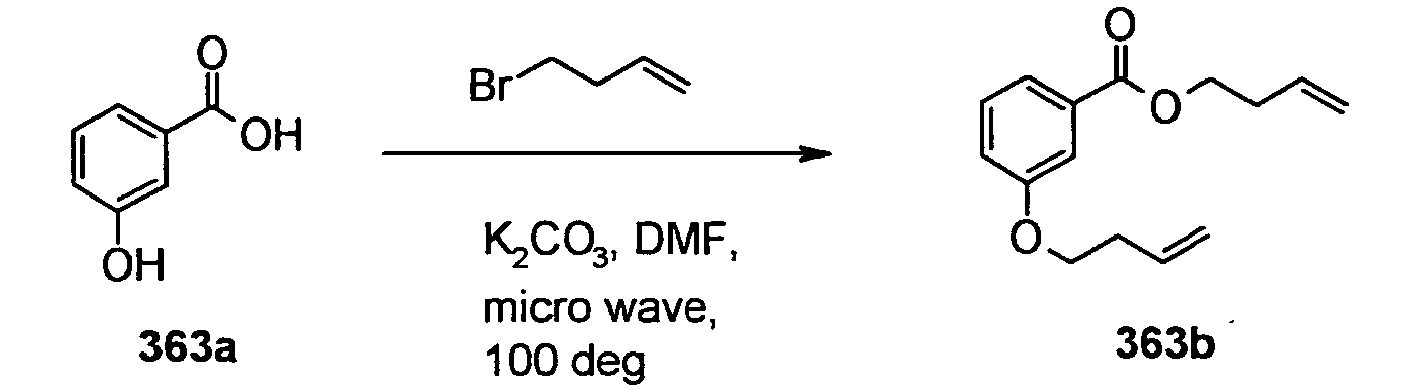
- 3-But-3-enyloxy-benzoic acid but-3-enyl ester was obtained by the same method as in Reaction 337-1 using 3-hydroxy-benzoic acid as a raw material.
1H-NMR (400 MHz, CDCl3) δ 7.62 (1H, br d, J = 7.8 Hz), 7.55 (1H, br s), 7.33 (1H, t, J = 8.1 Hz), 7.09 (1H, br d, J = 8.3 Hz), 5.96-5.82 (2H, m), 5.20-5.10 (4H, m), 4.37 (2H, t, J = 6.8 Hz), 4.06 (2H, t, J = 6.8 Hz), 2.60-2.50 (4H, m). -

- 3-But-3-enyloxy-benzoic acid was obtained by the same method as in Reaction 337-2 using 3-but-3-enyloxy-benzoic acid but-3-enyl ester as a raw material.
1H-NMR (400 MHz, CD3OD) δ 7.61-7.58 (1H, m), 7.53-7.52 (1H, m), 7.36 (1H, t, J = 8.1 Hz), 7.15-7.12 (1H, m), 5.99-5.88 (1H, m), 5.20-5.14 (1H, m), 5.11-5.07 (1H, m), 4.06 (2H, t, J = 6.6 Hz), 2.57-2.51 (2H, m). -
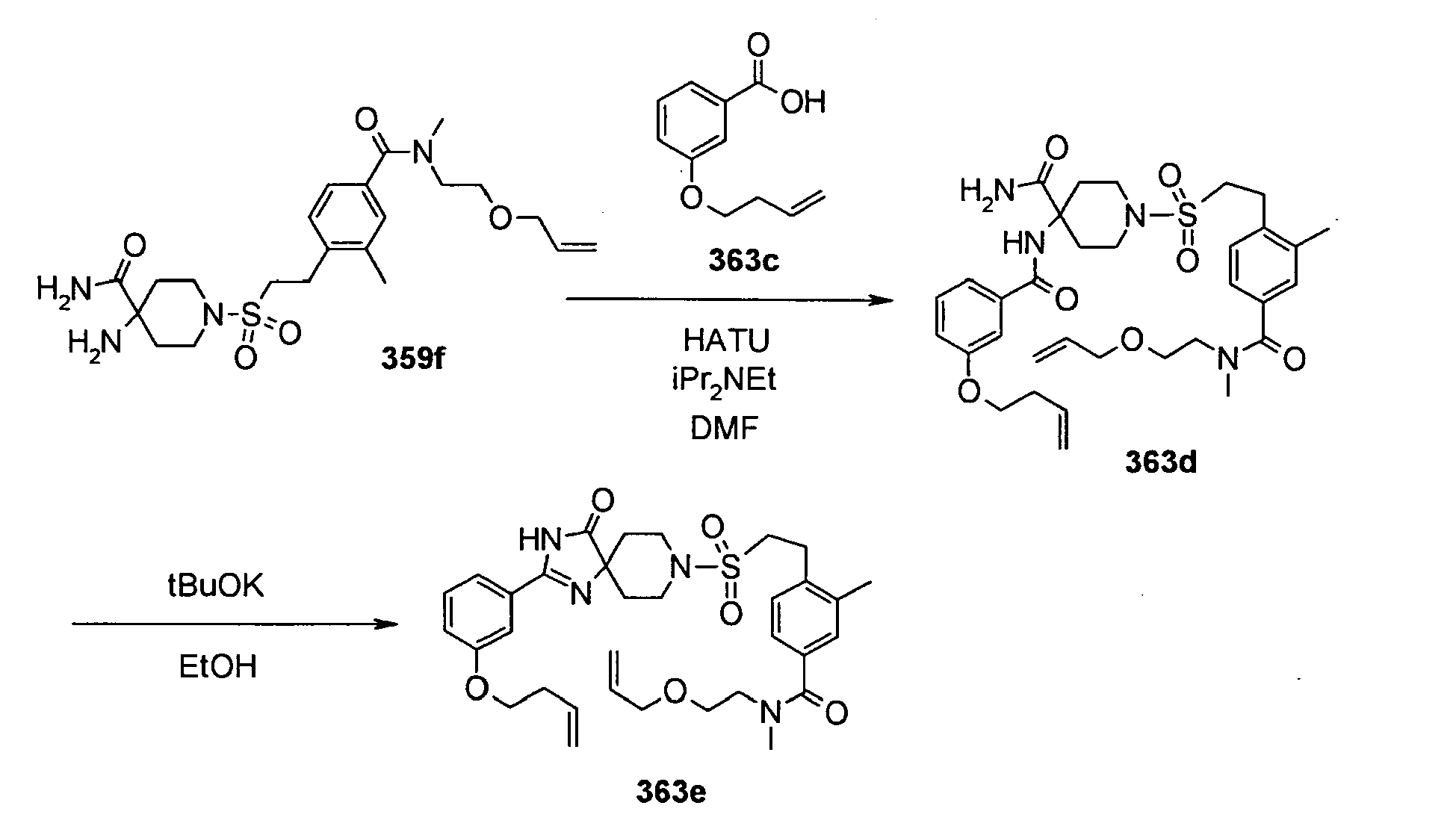
- N-(2-Allyloxy-ethyl)-4-{2-[2-(3-but-3-enyloxy-phenyl)-4-oxo-1,3,8-triaza-spiro[4.5]dec-1-ene-8-sulfonyl]-ethyl}-3,N-dimethyl-benzamide was obtained by the same method as in Reaction 359-9 using 3-but-3-enyloxy-benzoic acid and 1-(2-{4-[(2-allyloxy-ethyl)-methyl-carbamoyl]-2-methyl-phenyl}-ethanesulfonyl)-4-amino-piperidine-4-carboxylic amide as starting materials. MS (ESI) m/z = 621 (M-H)-;
HPLC retention time: 2.85 min (analysis condition LCMS-C-1). -

- A macrocyclic olefin compound (Compound 1435) E/Z = 1:2) was obtained by the same method as in Reaction 338-1 (using Hoveyda-Grubbs 2nd generation as a catalyst) using N-(2-allyloxy-ethyl)-4-{2-[2-(3-but-3-enyloxy-phenyl)-4-oxo-1,3,8-triaza-spiro[4.5]dec-1-ene-8-sulfonyl]-ethyl}-3,N-dimethyl-benzamide as a starting material.
MS (ESI) m/z = 595 (M+H)+;
HPLC retention time: 2.70 min (analysis condition LCMS-C-1). -
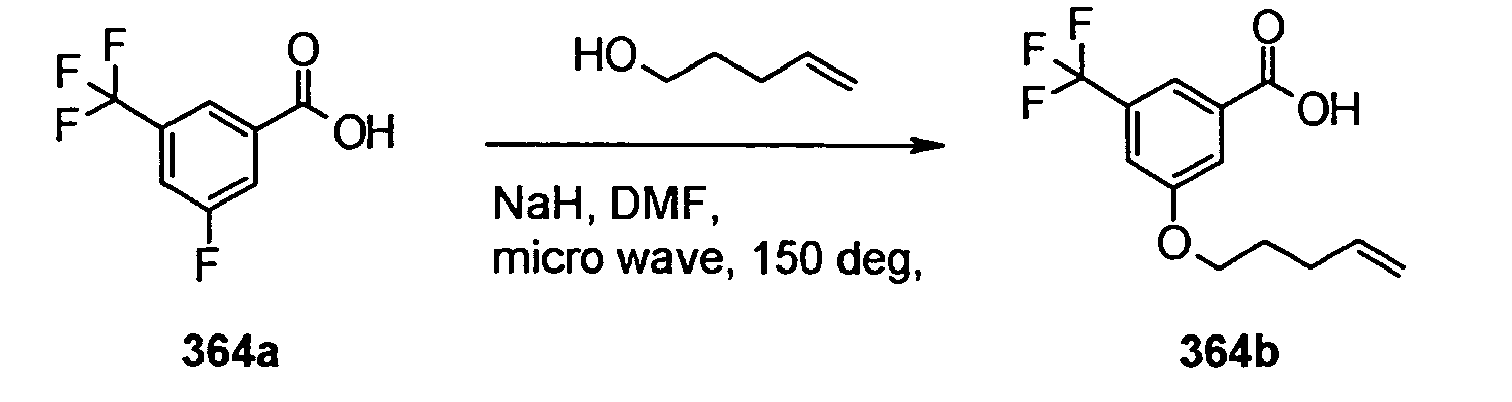
- A solution of 3-fluoro-5-trifluoromethyl-benzoic acid (400 mg, 1.92 mmol) in DMF (2 ml) was added dropwise to a suspension of sodium hydride (60% oily, 235 mg, 5.88 mmol) and pent-4-en-1-ol (506 mg, 5.88 mmol) in DMF (12 ml), and the mixture was stirred at 60°C. Further, this mixture was irradiated in a microwave apparatus (150°C, 20 min). The reaction solution was poured into 0.2 N aqueous hydrochloric acid and then extracted with ethyl acetate. The organic layer was washed with saturated brine, and then dried over anhydrous sodium sulfate and concentrated under reduced pressure. The resulting residue was purified by silica gel column chromatography (hexane-ethyl acetate) to give 3-pent-4-enyloxy-5-trifluoromethyl-benzoic acid (290 mg, 55%).
1H-NMR (CDCl3) δ 7.94 (1H, s), 7.77 (1H, s), 7.37 (1H, s), 5.91-5.81 (1H, m), 5.11-5.06 (1H, m), 5.05-5.02 (1H, m), 4.07 (2H, t, J = 6.3 Hz), 2.30-2.24 (2H, m), 1.97-1.90 (2H, m);
MS (ESI) m/z = 273 (M-H)-;
HPLC retention time: 2.50 min (analysis condition LCMS-C-1). -

- N-(2-Allyloxy-ethyl)-3,N-dimethyl-4-{2-[4-oxo-2-(3-pent-4-enyloxy-5-trifluoromethyl-phenyl)-1,3,8-triaza-spiro[4.5]dec-1-ene-8-sulfonyl]-ethyl}-benzamide was obtained by the same method as in Reaction 359-9 using 3-pent-4-enyloxy-5-trifluoromethyl-benzoic acid and 1-(2-{4-[(2-allyloxy-ethyl)-methyl-carbamoyl]-2-methylphenyl}-ethanesulfonyl)-4-amino-piperidine-4-carboxylic amide as starting materials.
MS (ESI) m/z = 705 (M+H)+
HPLC retention time: 1.12 min (analysis condition LCMS-F-1). -

MS (ESI) m/z = 677 (M+H)+;
HPLC retention time: 1.07 min (analysis condition LCMS-F-1). -

- A saturated macrocyclic compound (Compound 1437) was obtained by the same method as in Reaction 339-1 using a macrocyclic olefin compound (Compound 1436) as a starting material.
MS (ESI) m/z = 679 (M+H)+;
HPLC retention time: 1.11 min (analysis condition LCMS-F-1). -

- 3-Methyl-4-[2-(4-oxo-piperidine-1-sulfonyl)-ethyl]-benzoic acid (1.23 g, 3.78 mmol) was suspended in toluene (20.0 ml). Di-tert-butoxymethyl-dimethyl-amine (3.63 ml, 15.12 mmol) was added and the mixture was stirred at 80°C for 30 minutes. Thereafter, di-tert-butoxymethyl-dimethyl-amine (2.70 ml, 11.34 mmol) was added again and the mixture was stirred at 80°C for 30 minutes. After completion of the reaction, the reaction solution was left to cool and diluted with ethyl acetate. The organic layer was then washed with an aqueous sodium bicarbonate solution and saline. The organic layer was dried over anhydrous magnesium sulfate and then concentrated under reduced pressure. The resulting residue was purified by column chromatography (hexane:ethyl acetate) to give 3-methyl-4-[2-(4-oxo-piperidine-1-sulfonyl)-ethyl]-benzoic acid tert-butyl ester as a white solid (1.01 g, 70.0%). MS (ESI) m/z = 382 (M+H)+;
HPLC retention time: 2.54 min (analysis condition LCMS-B-1) -

- 3-Methyl-4-[2-(4-oxo-piperidine-1-sulfonyl)-ethyl]-benzoic acid tert-butyl ester (969.2 mg, 2.54 mmol), ammonium acetate (469.9 mg, 6.10 mmol) and potassium cyanide (330.9 mg, 5.08 mmol) were dissolved in methanol (12.0 ml), and the mixture was stirred at 65°C for one hour. After completion of the reaction, the mixture was left to cool and an aqueous sodium bicarbonate solution was added, followed by extraction with ethyl acetate. The organic layer was washed with saline, and then dried over anhydrous magnesium sulfate and concentrated under reduced pressure to give 4-[2-(4-amino-4-cyanopiperidine-1-sulfonyl)-ethyl]-3-methyl-benzoic acid tert-butyl ester as an amorphous (1.07 g).
MS (ESI) m/z = 408 (M+H)+;
HPLC retention time: 2.54 min (analysis condition LCMS-F-1). -

- 4-[2-(4-Amino-4-cyano-piperidine-1-sulfonyl)-ethyl]-3-methyl-benzoic acid tert-butyl ester (500.0 mg, 1.23 mmol), 3-benzyloxy-5-trifluoromethyl-benzoic acid (436.1 mg, 1.47 mmol) and DIPEA (0.321 ml, 1.85 mmol) were dissolved in DMF (5.50 ml) HATU (561.2 mg, 1.47 mmol) was added and the mixture was stirred at room temperature for one hour. The reaction solution was diluted with diethyl ether, and the organic layer was washed with a 1 M aqueous hydrochloric acid solution, an aqueous sodium bicarbonate solution and saline. The organic layer was dried over anhydrous magnesium sulfate and then concentrated under reduced pressure. The resulting residue was purified by column chromatography (hexane-ethyl acetate) to give 4-{2-[4-(3-benzyloxy-5-trifluoromethyl-benzoylamino)-4-cyano-piperidine-1-sulfonyl]-ethyl}-3-methyl-benzoic acid tert-butyl ester as a yellow amorphous (796.2 mg, 94.4% in two steps).
MS (ESI) m/z = 685 (M+H)+;
HPLC retention time: 1.16 min (analysis condition LCMS-F-1). -

- 4-{2-[4-(3-Benzyloxy-5-trifluoromethyl-benzoylamino)-4-cyano-piperidine-1-sulfonyl]-ethyl}-3-methyl-benzoic acid tert-butyl ester (1.40 g, 2.04 mmol) was dissolved in DMSO (0.188 ml, 2.65 mmol) and methanol (7.00 ml). A 1 M aqueous sodium hydroxide solution (0.204 ml, 0.204 mmol) and aqueous hydrogen peroxide (30%, 0.265 ml, 2.65 mmol) were added under ice-cooling. The mixture was warmed to room temperature and stirred as such for two hours. After completion of the reaction, an aqueous sodium thiosulfate solution and an aqueous ammonium chloride solution were added, followed by extraction with ethyl acetate. The organic layer was washed with saline, dried over anhydrous magnesium sulfate and then concentrated under reduced pressure to give 4-{2-[4-(3-benzyloxy-5-trifluoromethyl-benzoylamino)-4-carbamoyl-piperidine-1-sulfonyl]-ethyl}-3-methyl-benzoic acid tert-butyl ester as a pale yellow amorphous (1.48 g).
MS (ESI) m/z = 704 (M+H)+;
HPLC retention time: 1.15 min (analysis condition LCMS-F-1). -

- 4-{2-[4-(3-Benzyloxy-5-trifluoromethyl-benzoylamino)-4-carbamoyl-piperidine-1-sulfonyl]-ethyl}-3-methyl-benzoic acid tert-butyl ester (1.23 g, 1.75 mmol) was dissolved in methanol (17.5 ml). A 1 M aqueous sodium hydroxide solution (1.75 ml, 1.75 mmol) was added and the mixture was stirred at 60°C for six hours. After completion of the reaction, the reaction solution was left to cool and an aqueous ammonium chloride solution was added, followed by extraction with ethyl acetate. The organic layer was washed with saline, dried over anhydrous magnesium sulfate and then concentrated under reduced pressure. The residue obtained by concentration was purified by column chromatography (hexane:ethyl acetate) to give 4-{2-[2-(3-benzyloxy-5-trifluoromethyl-phenyl)-4-oxo-1,3,8-triaza-spiro[4.5]dec-1-ene-8-sulfonyl]-ethyl}-3-methyl-benzoic acid tert-butyl ester as a pale yellow amorphous (952.1 mg, yield in two steps: 79.3%).
MS (ESI) m/z = 686 (M+H)+;
HPLC retention time: 1.19 min (analysis condition LCMS-F-1). -

- 4-{2-[2-(3-Benzyloxy-5-trifluoromethyl-phenyl)-4-oxo-1,3,8-triaza-spiro[4.5]dec-1-ene-8-sulfonyl]-ethyl}-3-methyl-benzoic acid tert-butyl ester (1.14 g, 1.66 mmol) was dissolved in THF (8.0 ml). DMAP (60.8 mg, 0.498 mmol) and di-tert-butyl dicarbonate (725.6 mg, 3.32 mmol) were added and the mixture was stirred at room temperature for one hour. Thereafter, di-tert-butyl dicarbonate (181.0 mg, 0.830 mmol) was further added and the mixture was stirred at room temperature for 30 minutes. After completion of the reaction, the reaction solution was diluted with ethyl acetate, and the organic layer was washed with saline. The organic layer was dried over anhydrous magnesium sulfate and then concentrated under reduced pressure. The resulting residue was purified by column chromatography (hexane:ethyl acetate) to give 2-(3-benzyloxy-5-trifluoromethyl-phenyl)-8-[2-(4-tert-butoxycarbonyl-2-methyl-phenyl)-ethanesulfonyl]-4-oxo-1,3,8-triaza-spiro[4.5]dec-1-ene-3-carboxylic acid tert-butyl ester as a white solid (1.11 g, 85.1%).
MS (ESI) m/z = 786 (M+H)+;
HPLC retention time: 1.20 min (analysis condition LCMS-F-1). -

- 2-(3-Benzyloxy-5-trifluoromethyl-phenyl)-8-[2-(4-tert-butoxycarbonyl-2-methyl-phenyl)-ethanesulfonyl]-4-oxo-1,3,8-triaza-spiro[4.5]dec-l-ene-3-carboxylic acid tert-butyl ester (1.11 g, 1.41 mmol) was dissolved in ethyl acetate (45.0 ml)-THF (15.0 ml). Pd-C (222 mg) was added and the mixture was stirred at room temperature and for one hour in a hydrogen atmosphere. After completion of the reaction, the black solid was filtered off through celite, and the filtrate was concentrated under reduced pressure to give 8-[2-(4-tert-butoxycarbonyl-2-methylphenyl)-ethanesulfonyl]-2-(3-hydroxy-5-trifluoromethyl-phenyl)-4-oxo-1,3,8-triaza-spiro[4.5]dec-1-ene-3-carboxylic acid tert-butyl ester as an amorphous (1.01 g, 100%).
1H-NMR (400 MHz, CDCl3) δ 7.80-7.82 (2H, m), 7.22-7.24 (4H, m), 6.83 (1H, br), 3.68-3.74 (2H, m), 3.11-3.27 (6H, m), 2.50 (3H, s), 2.05-2.14 (2H, m), 1.63-1.71 (2H, m), 1.38 (9H, s);
MS (ESI) m/z = 696 (M+H)+;
HPLC retention time: 1.13 min (analysis condition LCMS-F-1). -

- 2-[2-(2-Methylamino-ethoxy)-ethoxy]-ethanol was dissolved in THF (6.88 mL)-water (6.88 mL). Di-tert-butyl dicarbonate (9.01 g, 41.3 mmol) and potassium carbonate (5.71 g, 41.3 mmol) were added at 0°C, and the mixture was stirred at room temperature for 15 hours. A 1 M aqueous hydrochloric acid solution was added to the reaction solution, followed by extraction with ethyl acetate. The organic layer was washed with saturated aqueous sodium bicarbonate and saturated brine, and then dried over sodium sulfate and concentrated under reduced pressure. The resulting residue was purified by silica gel column chromatography (hexane-ethyl acetate) to give {2-[2-(2-hydroxy-ethoxy)-ethoxy]-ethyl}-methyl-carbamic acid tert-butyl ester (1.53 g, 42%).
1H-NMR (CDCl3) δ 3.74-3.72 (2H, m), 3.67-3.60 (8H, m), 3.42-3.39 (2H, br m), 2.91 (3H, s), 1.45 (9H, s). -

MS (ESI) m/z = 941 (M+H)+;
HPLC retention time: 1.18 min (analysis condition LCMS-F-1). -
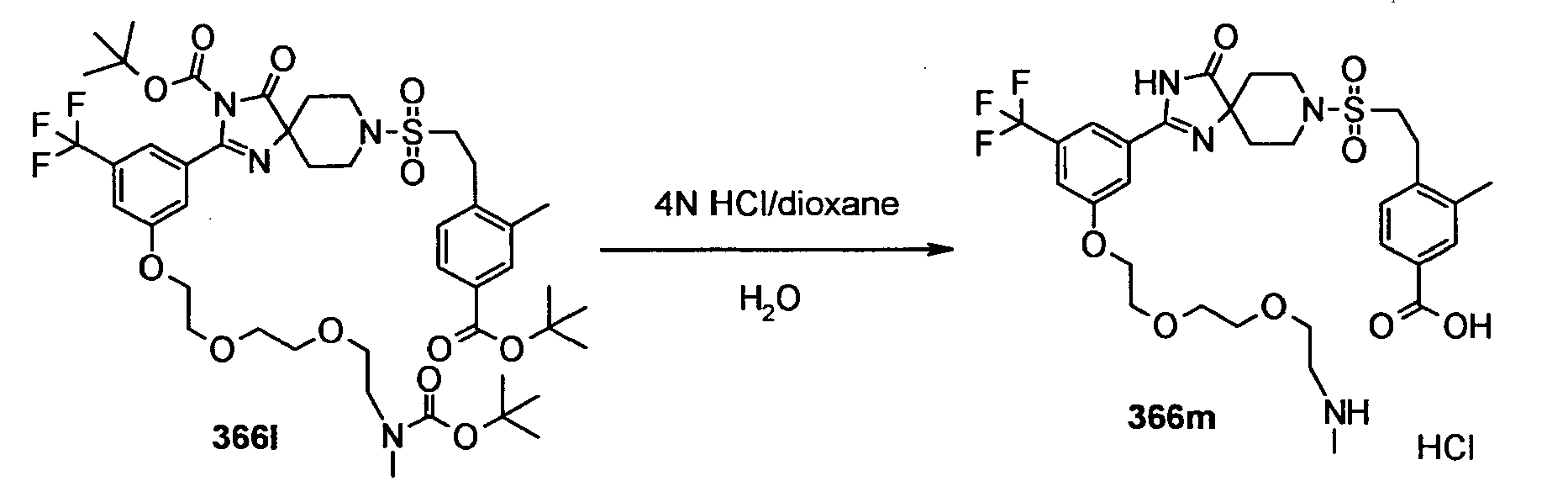
- 2-[3-(2-{2-[2-(tert-Butoxycarbonyl-methyl-amino)-ethoxy]-ethoxy}-ethoxy)-5-trifluoromethyl-phenyl]-8-[2-(4-tert-butoxycarbonyl-2-methyl-phenyl)-ethanesulfonyl]-4-oxo-1,3,8-triaza-spiro[4.5]dec-1-ene-3-carboxylic acid tert-butyl ester (37.4 mg, 39.7 µmol) was dissolved in 4 N hydrochloric acid-dioxane (0.79 mL). Water (14.3 µL, 795 µmol) was added and the mixture was stirred at room temperature for three hours. The reaction solution was concentrated under reduced pressure to give 3-methyl-4-{2-[2-(3-{2-[2-(2-methylamino-ethoxy)-ethoxy]-ethoxy}-5-trifluoromethyl-phenyl)-4-oxo-1,3,8-triaza-spiro[4.5]dec-1-ene-8-sulfonyl]-ethyl}-benzoic acid hydrochloride (28.0 mg, 98%).
MS (ESI) m/z = 685 (M+H)+;
HPLC retention time: 1.88 min (analysis condition LCMS-B-1). -

- 3-Methyl-4-{2-[2-(3-{2-[2-(2-methylamino-ethoxy)-ethoxy]-ethoxy}-5-trifluoromethyl-phenyl)-4-oxo-1,3,8-triaza-spiro[4.5]dec-1-ene-8-sulfonyl]-ethyl}-benzoic acid hydrochloride (26.0 mg, 36.1 µmol) was dissolved in DMF (7.21 mL). DIPEA (62.8 µL, 361 µmol) and HATU (68.6 mg, 180 µmol) were added and the mixture was stirred at 70°C for two hours. A 3 M aqueous hydrochloric acid solution was added to the reaction solution, followed by extraction with ethyl acetate. The organic layer was washed with water, saturated aqueous sodium bicarbonate and saturated brine, and then dried over sodium sulfate and concentrated under reduced pressure. The resulting residue was purified by silica gel column chromatography (dichloromethane-ethyl acetate) to give a saturated macrocyclic compound (Compound 1438) (20.8 mg, 87%).
1H-NMR (CD3OD) δ 7.93 (1H, s), 7.88 (1H, s), 7.61 (1H, s), 7.32 (1H, s), 7.25-7.22 (2H, m), 7.14 (1H, d, J = 7.4 Hz), 4.15 (2H, t, J = 5.4 Hz), 3.78-3.35 (16H, m), 3.11-3.06 (2H, m), 2.97 (3H, s), 2.37 (3H, s), 1.98 (2H, td, J = 13.0, 4.0 Hz), 1.56 (2H, d, J = 12.9 Hz);
MS (ESI) m/z = 667 (M+H)+;
HPLC retention time: 2.25 min (analysis condition LCMS-B-1). -

- {(4R,5S)-5-[2-(tert-Butyl-diphenyl-silanyloxy)-ethyl]-2,2-dimethyl-[1,3]dioxolan-4-yl}-methanol (159 mg, 0.38 mmol) was dissolved in dichloromethane (1.15 mL). Diisopropylethylamine (200 µL, 1.15 mmol) and Tf2O (77.4 µL, 0.46 mmol) were added at 0°C, and the mixture was stirred at room temperature for one hour in a nitrogen atmosphere. Saturated aqueous ammonium chloride was added to the reaction solution, followed by extraction with ethyl acetate. The organic layer was washed with saturated aqueous sodium bicarbonate and saturated brine, dried over sodium sulfate and filtered. The filtrate was concentrated under reduced pressure to give trifluoro-methanesulfonic acid (4R,5S)-5-[2-(tert-butyl-diphenyl-silanyloxy)-ethyl]-2,2-dimethyl-[1,3]dioxolan-4-ylmethyl ester as a crude product.
- (2-Hydroxy-ethyl)-methyl-carbamic acid tert-butyl ester (73.9 mg, 0.42 mmol) was dissolved in THF (1.15 mL). Sodium hydride (50%, 22.1 mg, 0.46 mmol) was added at 0°C and the mixture was stirred at 0°C for 10 minutes in a nitrogen atmosphere. Trifluoro-methanesulfonic acid (4R,5S)-5-[2-(tert-butyl-diphenyl-silanyloxy)-ethyl]-2,2-dimethyl-[1,3]dioxolan-4-ylmethyl ester was added to the reaction solution, and the mixture was stirred at room temperature for two hours in a nitrogen atmosphere. Saturated aqueous ammonium chloride was added to the reaction solution, followed by extraction with ethyl acetate. The organic layer was washed with saturated aqueous sodium bicarbonate and saturated brine, dried over sodium sulfate and filtered, and the filtrate was concentrated under reduced pressure. The resulting residue was purified by silica gel column chromatography (hexane-ethyl acetate) to give (2-{(4R,5S)-5-[2-(tert-butyl-diphenyl-silanyloxy)-ethyl]-2,2-dimethyl-[1,3]dioxolan-4-ylmethoxy}-ethyl)-methyl-carbamic acid tert-butyl ester (82.2 mg, 38%).
MS (ESI) m/z = 572 (M+H)+;
HPLC retention time: 1.27 min (analysis condition LCMS-F-1). -

- (2-{(4R,5S)-5-[2-(tert-Butyl-diphenyl-silanyloxy)-ethyl]-2,2-dimethyl-[1,3]dioxolan-4-ylmethoxy}-ethyl)-methyl-carbamic acid tert-butyl ester (82.2 mg, 0.14 mmol) was dissolved in THF (0.19 mL). TBAF (1.0 M solution in THF, 0.19 mL, 0.19 mmol) was added at 0°C and the mixture was stirred at room temperature for one hour in a nitrogen atmosphere. Saturated aqueous ammonium chloride was added to the reaction solution, followed by extraction with ethyl acetate. The organic layer was washed with saturated aqueous sodium bicarbonate and saturated brine, and then dried over sodium sulfate and concentrated under reduced pressure. The resulting residue was purified by silica gel column chromatography (hexane-ethyl acetate) to give {2-[(4R,5S)-5-(2-hydroxy-ethyl)-2,2-dimethyl-[1,3]dioxolan-4-ylmethoxy]-ethyl}-methyl-carbamic acid tert-butyl ester (41.7 mg, 88%).
1H-NMR (CDCl3) δ 4.34-4.31 (1H, m), 4.25 (1H, q, J = 6.1 Hz), 3.84-3.74 (2H, m), 3.54-3.47 (6H, m), 2.90 (3H, s), 2.46 (1H, dd, J = 7.8, 3.3 Hz), 1.82-1.78 (2H, br m), 1.45-1.44 (12H, m), 1.35 (3H, s). -

- 2-(3-(2-((4S,5R)-5-((2-(tert-Butoxycarbonyl(methyl)amino)ethoxy)methyl)-2,2-dimethyl-1,3-dioxolan-4-yl)ethoxy)-5-(trifluoromethyl)phenyl)-8-(4-(tert-butoxycarbonyl)-2-methylphenethylsulfonyl)-4-oxo-1,3,8-triazaspiro[4.5]dec-1-ene-3-carboxylic acid tert-butyl ester was obtained by the same method as in Reaction 366-9 using 8-[2-(4-tert-butoxycarbonyl-2-methyl-phenyl)-ethanesulfonyl]-2-(3-hydroxy-5-trifluoromethyl-phenyl)-4-oxo-1,3,8-triaza-spiro[4.5]dec-1-ene-3-carboxylic acid tert-butyl ester and {2-[(4R,5S)-5-(2-hydroxy-ethyl)-2,2-dimethyl-[1,3]dioxolan-4-ylmethoxy]-ethyl}-methyl-carbamic acid tert-butyl ester as starting materials.
MS (ESI) m/z = 1012 (M+H)+;
HPLC retention time: 1.21 min (analysis condition LCMS-F-1). -

- 4-[2-(2-{3-[(3S,4R)-3,4-Dihydroxy-5-(2-methylamino-ethoxy)-pentyloxy]-5-trifluoromethyl-phenyl}-4-oxo-1,3,8-triaza-spiro[4.5]dec-1-ene-8-sulfonyl)-ethyl]-3-methyl-benzoic acid hydrochloride was obtained by the same method as in Reaction 366-10 using 2-(3-(2-((4S,5R)-5-((2-(tert-butoxycarbonyl(methyl)amino)ethoxy)methyl)-2,2-dimethyl-1,3-dioxolan-4-yl)ethoxy)-5-(trifluoromethyl)phenyl)-8-(4-(tert-butoxycarbonyl)-2-methylphenethylsulfonyl)-4-oxo-1,3,8-triazaspiro[4.5]dec-1-ene-3-carboxylic acid tert-butyl ester as a starting material.
MS (ESI) m/z = 729 (M+H)+;
HPLC retention time: 0.80 min (analysis condition LCMS-F-1). -

- A saturated macrocyclic compound (Compound 1439) was obtained by the same method as in Reaction 366-11 using 4-[2-(2-{3-[(3S,4R)-3,4-dihydroxy-5-(2-methylamino-ethoxy)-pentyloxy]-5-trifluoromethyl-phenyl}-4-oxo-1,3,8-triaza-spiro[4.5]dec-1-ene-8-sulfonyl)-ethyl]-3-methyl-benzoic acid hydrochloride as a starting material.
MS (ESI) m/z = 697 (M+H)+;
HPLC retention time: 0.92 min (analysis condition LCMS-F-1). -

- BOC-sarcosine (900 mg, 4.76 mmol) was dissolved in ethanol (10 ml). 2-(2-Aminoethoxy)ethanol (0.477 ml, 4.76 mmol) and 4-(4,6-dimethoxy-1,3,5-triazin-2-yl)-4-methylmorpholinium chloride n-hydrate (DMT-MM) (1.79 g, 5.71 mmol) were added and the mixture was stirred at room temperature overnight. The reaction solution was concentrated under reduced pressure, and water was added to the resulting residue, followed by extraction with ethyl acetate. The organic layer was washed with water and saturated brine, dried over anhydrous sodium sulfate and concentrated under reduced pressure. The resulting residue was subjected to silica gel column chromatography (dichloromethane-methanol) to give {[2-(2-hydroxy-ethoxy)-ethylcarbamoyl]-methyl}-methyl-carbamic acid tert-butyl ester. This was used in the next reaction without complete purification.
-

- 8-[2-(4-tert-Butoxycarbonyl-2-methyl-phenyl)-ethanesulfonyl]-2-[3-(2-{2-[2-(tert-butoxycarbonylmethyl-amino)-acetylamino]-ethoxy}-ethoxy)-5-trifluoromethyl-phenyl]-4-oxo-1,3,8-triaza-spiro[4.5]dec-1-ene-3-carboxylic acid tert-butyl ester was obtained by the same method as in Reaction 366-9 using 8-[2-(4-tert-butoxycarbonyl-2-methyl-phenyl)-ethanesulfonyl]-2-(3-hydroxy-5-trifluoromethyl-phenyl)-4-oxo-1,3,8-triaza-spiro[4.5]dec-1-ene-3-carboxylic acid tert-butyl ester and {[2-(2-hydroxy-ethoxy)-ethylcarbamoyl]-methyl}-methyl-carbamic acid tert-butyl ester as starting materials. This was used in the next reaction without complete purification.
-

- 3-Methyl-4-{2-[2-(3-{2-[2-(2-methylamino-acetylamino)-ethoxy]-ethoxy}-5-trifluoromethyl-phenyl)-4-oxo-1,3,8-triaza-spiro[4.5]dec-1-ene-8-sulfonyl]-ethyl}-benzoic acid hydrochloride was obtained by the same method as in Reaction 366-10 using 8-[2-(4-tert-butoxycarbonyl-2-methyl-phenyl)-ethanesulfonyl]-2-[3-(2-{2-[2-(tert-butoxycarbonyl-methyl-amino)-acetylamino]-ethoxy}-ethoxy)-5-trifluoromethyl-phenyl]-4-oxo-1,3,8-triaza-spiro[4.5]dec-1-ene-3-carboxylic acid tert-butyl ester (13 mg, 0.0136 mmol) as a starting material. This was used in the next reaction without complete purification.
-

- A saturated macrocyclic compound (Compound 1440) was obtained by the same method as in Reaction 366-11 using 3-methyl-4-{2-[2-(3-{2-[2-(2-methylamino-acetylamino)-ethoxy]-ethoxy}-5-trifluoromethyl-phenyl)-4-oxo-1,3,8-triaza-spiro[4.5]dec-1-ene-8-sulfonyl]-ethyl}-benzoic acid hydrochloride as a starting material.
MS (ESI) m/z = 680 (M+H)+;
HPLC retention time: 0.89 min (analysis condition LCMS-F-1). -

- A mixture of 2-(methylamino)ethanol (5.2 g, 69.2 mmol) and tert-butyl dicarbonate (15.8 g, 72.7 mmol) in methylene chloride (200 mL) was stirred at room temperature for 16 hours. The reaction mixture was diluted with methylene chloride, and the organic layer was then washed with water, dried over MgSO4 and concentrated under reduced pressure. The resulting residue was purified by silica gel column chromatography to give (2-hydroxyethyl)methylcarbamic acid 1,1-dimethylethyl ester (12.1 g, yield 100%).
1H-NMR (400 MHz, CDCl3) δ 1.47 (9H, m), 2.91 (3H, s), 3.39-3.41 (2H, m), 3.72-3.76 (2H, m). -

- 4-Dimethylaminopyridine (634 mg, 5.2 mmol) was added to a solution of 2,2,3,3,4,4-hexafluoro-pentane-1,5-diol (1 g, 4.7 mmol) and tert-butyldimethylsilyl chloride (708 mg, 4.7 mmol) in methylene chloride (10 ml), and the mixture was stirred at room temperature for 16 hours. The reaction mixture was concentrated under reduced pressure, and the residue was then purified by silica gel column chromatography to give 5-(tert-butyl-dimethyl-silanyloxy)-2,2,3,3,4,4-hexafluoro-pentan-1-ol (770 mg, 50%).
1H-NMR (400 MHz, CDCl3) δ 0.10 (6H, s), 0.90 (9H, m), 4.07-4.11 (4H, m). -

- (2-Hydroxyethyl)methylcarbamic acid 1,1-dimethylethyl ester (350 mg, 2.0 mmol) was dissolved in pyridine (2 ml). Mesyl chloride (0.229 ml, 2.1 mmol) was added at room temperature, and the mixture was stirred at room temperature for 30 minutes. The reaction mixture was diluted with methylene chloride, and the organic layer was washed with a saturated aqueous sodium bicarbonate solution, dried over MgSO4 and concentrated under reduced pressure to give methanesulfonic acid 2-(tert-butoxycarbonyl-methyl-amino)-ethyl ester. This was used in the next reaction without complete purification.
- 5-(tert-Butyl-dimethyl-silanyloxy)-2,2,3,3,4,4-hexafluoro-pentan-1-ol (400 mg, 1.23 mmol) was dissolved in dimethylformamide (2 ml). Sodium hydride (51.5 mg, 1.29 mmol) was added at room temperature, and the mixture was stirred at room temperature for 30 minutes. A solution of methanesulfonic acid 2-(tert-butoxycarbonylmethyl-amino)-ethyl ester obtained above in dimethylformamide (0.5 ml) was then added at room temperature, and the mixture was stirred at room temperature overnight. The reaction mixture was extracted with ethyl acetate, and the organic layer was then washed with water, dried over MgSO4 and concentrated under reduced pressure. The resulting residue was purified by silica gel column chromatography to give {2-[5-(tert-butyl-dimethyl-silanyloxy)-2,2,3,3,4,4-hexafluoro-pentyloxy]-ethyl}-methyl-carbamic acid tert-butyl ester. This was used in the next reaction without complete purification.
- {2-[5-(tert-Butyl-dimethyl-silanyloxy)-2,2,3,3,4,4-hexafluoro-pentyloxy]-ethyl}-methyl-carbamic acid tert-butyl ester obtained above was dissolved in a 1 M solution of tetrabutylammonium fluoride in tetrafuran (0.2 mL), and the mixture was reacted at room temperature for one hour. The reaction mixture was concentrated under reduced pressure, and the residue was then purified by silica gel column chromatography to give [2-(2,2,3,3,4,4-hexafluoro-5-hydroxy-pentyloxy)-ethyl]-methyl-carbamic acid tert-butyl ester (70 mg). This was used in the next reaction without complete purification.
- [2-(2,2,3,3,4,4-Hexafluoro-5-hydroxy-pentyloxy)-ethyl]-methyl-carbamic acid tert-butyl ester obtained above was dissolved in methylene chloride (0.5 ml). Triethylamine (0.0528 ml, 0.38 mmol) and trifluoromethanesulfonyl chloride (0.0212 ml, 0.20 mmol) were added at room temperature, and the mixture was stirred at room temperature for 64 hours. The reaction mixture was extracted with ethyl acetate, and the organic layer was washed with saturated brine, dried over MgSO4 and concentrated under reduced pressure. The resulting residue was purified by silica gel column chromatography to give Trifluoro-methanesulfonic acid 5-[2-(tert-butoxycarbonyl-methyl-amino)-ethoxy]-2,2,3,3,4,4-hexafluoro-pentyl ester (66 mg).
1H-NMR (400 MHz, CDCl3) δ 1.44 (9H, s), 2.89 (3H, s), 3.35-3.42 (m, 2H), 3.65-3.72 (m, 2H), 3.90-3.94 (m, 2H), 4.73-4.83 (m, 2H). -

- 4-{2-[2-(3-Benzyloxy-5-trifluoromethyl-phenyl)-4-oxo-1,3,8-triaza-spiro[4.5]dec-1-ene-8-sulfonyl]-ethyl}-3-methyl-benzoic acid tert-butyl ester (952.0 mg, 1.39 mmol) was dissolved in ethyl acetate (15.0 ml)-THF (5.0 ml). Pd-C (190.4 mg) was added and the mixture was stirred at room temperature for one hour in a hydrogen atmosphere. After completion of the reaction, the precipitated solid was dissolved by adding dichloromethane and methanol, and the remaining black solid was then filtered off through celite. The filtrate was concentrated under reduced pressure to give 4-{2-[2-(3-hydroxy-5-trifluoromethyl-phenyl)-4-oxo-1,3,8-triaza-spiro[4.5]dec-1-ene-8-sulfonyl]-ethyl}-3-methyl-benzoic acid tert-butyl ester as a white solid (776.2 mg, 93.8%).
1H-NMR (400 MHz, DMSO-d6) δ 11.7 (1H, br), 10.6 (1H, br), 7.66-7.80 (4H, m), 7.39 (1H, d, J8.0 Hz), 7.25 (1H, s), 3.59-3.70 (2H, m), 3.27-3.43 (4H, m), 3.04-3.08 (2H, m), 2.39 (3H, s), 1.79-1.88 (2H, m), 1.59 (2H, m), 1.55 (9H, s);
MS (ESI) m/z = 596 (M+H)+;
HPLC retention time: 1.12 min (analysis condition LCMS-F-1). -

- 4-{2-[2-(3-Hydroxy-5-trifluoromethyl-phenyl)-4-oxo-1,3,8-triaza-spiro[4.5]dec-1-ene-8-sulfonyl]-ethyl}-3-methyl-benzoic acid tert-butyl ester (77.0 mg, 0.13 mmol) and trifluoro-methanesulfonic acid 5-[2-(tert-butoxycarbonyl-methyl-amino)-ethoxy]-2,2,3,3,4,4-hexafluoro-pentyl ester (58.0 mg, 0.13 mmol) were dissolved in DMF (1 ml). Potassium carbonate (53.8 mg, 0.39 mmol) was added and the mixture was stirred at 60°C overnight. The reaction mixture was extracted with ethyl acetate, and the organic layer was then washed with saturated brine, dried over MgSO4 and concentrated under reduced pressure. The resulting residue was purified by silica gel column chromatography to give 4-{2-[2-(3-{5-[2-(tert-butoxycarbonyl-methyl-amino)-ethoxy]-2,2,3,3,4,4-hexafluoro-pentyloxy}-5-trifluoromethyl-phenyl)-4-oxo-1,3,8-triaza-spiro[4.5]dec-1-ene-8-sulfonyl]-ethyl}-3-methyl-benzoic acid tert-butyl ester (57 mg, 46%).
MS (ESI) m/z = 947 (M+H)+. -

- 4-{2-[2-(3-{5-[2-(tert-Butoxycarbonyl-methyl-amino)-ethoxy]-2,2,3,3,4,4-hexafluoro-pentyloxy}-5-trifluoromethyl-phenyl)-4-oxo-1,3,8-triaza-spiro[4.5]dec-1-ene-8-sulfonyl]-ethyl}-3-methyl-benzoic acid tert-butyl ester (56 mg, 0.059 mmol) was dissolved in water (0.1 ml) and 4 N hydrochloric acid-dioxane (1 ml), and the mixture was stirred at room temperature for 30 minutes. The reaction mixture was concentrated under reduced pressure, and the residue was then dissolved in DMF (5 ml). Triethylamine (0.053 ml, 0.384 mmol) and O-(benzotriazol-1-yl)-N,N,N',N'-tetramethyluronium hexafluorophosphate (144 mg, 0.384 mmol) were added at room temperature, and the mixture was heated with stirring at 70°C for two hours. The reaction mixture was extracted with ethyl acetate, and the organic layer was washed with water, dried over MgSO4 and concentrated under reduced pressure. The resulting residue was purified by silica gel column chromatography to give a saturated macrocyclic compound (Compound 1441) (12 mg, 21%).
MS (ESI) m/z = 773 (M+H)+;
HPLC retention time: 6.52 min (analysis condition LCMS-A-2). -

- 8-[2-(4-tert-Butoxycarbonyl-2-methyl-phenyl)-ethanesulfonyl]-2-(3-but-3-ynyloxy-5-trifluoromethyl-phenyl)-4-oxo-1,3,8-triaza-spiro[4.5]dec-1-ene-3-carboxylic acid tert-butyl ester (37.9 mg, 71%) was obtained by the same method as in Reaction 366-9 using 8-[2-(4-tert-butoxycarbonyl-2-methyl-phenyl)-ethanesulfonyl]-2-(3-hydroxy-5-trifluoromethyl-phenyl)-4-oxo-1,3,8-triaza-spiro[4.5]dec-1-ene-3-carboxylic acid tert-butyl ester and 3-butyn-1-ol as starting materials. MS (ESI) m/z = 592 (M-Boc-tBu)+;
HPLC retention time: 3.79 min (analysis condition LCMS-A-1). -

- 4 M hydrochloric acid-dioxane (1.80 ml) and water (0.0173 ml, 0.960 mmol) were added to 8-[2-(4-tert-butoxycarbonyl-2-methyl-phenyl)-ethanesulfonyl]-2-(3-but-3-ynyloxy-5-trifluoromethyl-phenyl)-4-oxo-1,3,8-triaza-spiro[4.5]dec-1-ene-3-carboxylic acid tert-butyl ester (35.9 mg, 0.048 mmol), and the mixture was stirred at room temperature for five hours. The reaction solution was concentrated under reduced pressure to give 4-{2-[2-(3-but-3-ynyloxy-5-trifluoromethyl-phenyl)-4-oxo-1,3,8-triaza-spiro[4.5]dec-1-ene-8-sulfonyl]-ethyl}-3-methyl-benzoic acid as a white solid.
MS (ESI) m/z = 592 (M+H)+;
HPLC retention time: 0.91 min (analysis condition LCMS-F-1). -

- 4-{2-[2-(3-But-3-ynyloxy-5-trifluoromethyl-phenyl)-4-oxo-1,3,8-triaza-spiro[4.5]dec-1-ene-8-sulfonyl]-ethyl}-3-methyl-benzoic acid, (3-azido-propyl)-methyl-amine hydrochloride (15.3 mg, 0.101 mmol) and DIPEA (0.044 ml, 0.255 mmol) were dissolved in DMF (0.400 ml). HATU (0.038 mg, 0.101 mmol) was added and the mixture was stirred at room temperature for one hour. The reaction solution was diluted with ethyl acetate, and the organic layer was then washed with a 1 M aqueous hydrochloric acid solution, an aqueous sodium bicarbonate solution and saline. The organic layer was dried over anhydrous magnesium sulfate and then concentrated under reduced pressure. The resulting residue was purified by column chromatography (dichloromethane-ethyl acetate) to give N-(3-azido-propyl)-4-{2-[2-(3-but-3-ynyloxy-5-trifluoromethyl-phenyl)-4-oxo-1,3,8-triaza-spiro[4.5]dec-1-ene-8-sulfonyl]-ethyl}-3,N-dimethyl-benzamide as a colorless oily substance.
MS (ESI) m/z = 688 (M+H)+;
HPLC retention time: 1.05 min (analysis condition LCMS-F-1). -

- N-(3-Azido-propyl)-4-{2-[2-(3-but-3-ynyloxy-5-trifluoromethyl-phenyl)-4-oxo-1,3,8-triaza-spiro[4.5]dec-1-ene-8-sulfonyl]-ethyl}-3,N-dimethyl-benzamide was dissolved in acetonitrile (17.0 ml)-THF (4.0 ml). DMSO (0.022 ml), DIPEA (0.012 ml, 0.069 mmol), 2,6-lutidine (0.0053 ml, 0.046 mmol) and copper(I) iodide (13.2 mg, 0.069 mmol) were added, and the mixture was stirred at room temperature overnight. Thereafter, copper(I) iodide (13.2 mg, 0.069 mmol) was further added and the mixture was stirred at room temperature for one hour. The reaction solution was concentrated under reduced pressure. Ethyl acetate was added and the precipitated solid was filtered off. The filtrate was washed with a 1 M aqueous hydrochloric acid solution, an aqueous sodium bicarbonate solution and saline. The organic layer was dried over anhydrous magnesium sulfate and then concentrated under reduced pressure. The resulting residue was purified by column chromatography (dichloromethane-ethyl acetate and dichloromethane-methanol) to give a macrocyclic compound (Compound 1442) as a white solid (3.2 mg, 20.2% in three steps).
MS (ESI) m/z = 688 (M+H)+;
HPLC retention time: 0.94 min (analysis condition LCMS-F-1). -

- {4-[2-(4-Carbamoyl-4-hept-6-enoylamino-piperidine-1-sulfonyl)-ethyl]-3,5-dimethyl-phenyl}-methyl-carbamic acid tert-butyl ester was obtained as a crude compound by the same method as in Reaction 359-9 using hept-6-enoic acid and {4-[2-(4-amino-4-carbamoyl-piperidine-1-sulfonyl)-ethyl]-3,5-dimethyl-phenyl}-methyl-carbamic acid tert-butyl ester as starting materials.
MS (ESI) m/z = 579 (M+H)+;
HPLC retention time: 2.49 min (analysis condition LCMS-B-1). - {4-[2-(4-Carbamoyl-4-hept-6-enoylamino-piperidine-1-sulfonyl)-ethyl]-3,5-dimethyl-phenyl}-methyl-carbamic acid tert-butyl ester obtained above (Crude compound, 1.00 g) was dissolved in ethanol. Lithium hydroxide monohydrate (188 mg, 4.48 mmol) was added and the mixture was stirred at 40°C for 19 hours. A saturated aqueous ammonium chloride solution and water were added to the reaction solution, followed by extraction with ethyl acetate. The organic layer was washed with water and saturated brine, and then dried over anhydrous sodium sulfate and concentrated under reduced pressure. The resulting residue was purified by silica gel column chromatography to give {4-[2-(2-hex-5-enyl-4-oxo-1,3,8-triaza-spiro[4.5]dec-1-ene-8-sulfonyl)-ethyl]-3,5-dimethyl-phenyl}-methyl-carbamic acid tert-butyl ester (821 mg, 1.47 mmol).
1H-NMR (400 MHz, CDCl3) δ 7.85 (1H, br s), 6.92 (2H, s), 5.83-5.73 (1H, m), 5.04-4.96 (2H, m), 3.80-3.74 (2H, m), 3.45-3.38 (2H, m), 3.22 (3H, s), 3.16-3.12 (2H, m), 3.01-2.97 (2H, m), 2.44 (2H, t, J = 7.6 Hz), 2.34 (6H, s), 2.10 (2H, q, J = 7.2 Hz), 2.02-1.95 (2H, m), 1.71-1.59 (4H, m), 1.46 (9H, s);
MS (ESI) m/z = 561 (M+H)+;
HPLC retention time: 2.61 min (analysis condition LCMS-A-1). -

- {4-[2-(2-Hex-5-enyl-4-oxo-1,3,8-triaza-spiro[4.5]dec-1-ene-8-sulfonyl)-ethyl]-3,5-dimethyl-phenyl}-methyl-carbamic acid tert-butyl ester (820 mg, 1.46 mmol) was dissolved in methylene chloride (16 ml). Trifluoroacetic acid (10 ml) was added and the mixture was stirred at room temperature for two hours. The reaction solution was concentrated, and a saturated aqueous sodium bicarbonate solution was added to the residue. This mixture was extracted with methylene chloride. The organic layer was dried over anhydrous sodium sulfate and then concentrated under reduced pressure to give 8-[2-(2,6-dimethyl-4-methylaminophenyl)-ethanesulfonyl]-2-hex-5-enyl-1,3,8-triaza-spiro[4.5]dec-1-en-4-one (686 mg) as a crude compound.
- The resulting crude product 8-[2-(2,6-dimethyl-4-methylamino-phenyl)-ethanesulfonyl]-2-hex-5-enyl-1,3,8-triaza-spiro[4.5]dec-1-en-4-one (160 mg, 0.35 mmol) was dissolved in methylene chloride. 9-Decenoyl chloride (0.35 mmol) (prepared by allowing oxalyl chloride and a catalytic amount of DMF to act on 9-decenoic acid in methylene chloride) and triethylamine (0.195 ml, 1.4 mmol) were added, and the mixture was stirred at room temperature for 17 hours. A saturated aqueous ammonium chloride solution and water were added to the reaction solution, and the resulting mixture was extracted with ethyl acetate. The organic layer was washed with water and saturated brine, dried over anhydrous sodium sulfate and then concentrated under reduced pressure. The resulting residue was purified by silica gel column chromatography to give dec-9-enoic acid {4-[2-(2-hex-5-enyl-4-oxo-1,3,8-triaza-spiro[4.5]dec-1-ene-8-sulfonyl)-ethyl]-3,5-dimethyl-phenyl}-methyl-amide (Compound 1443) (100 mg, 48% in two steps).
MS (ESI) m/z = 613 (M+H)+;
HPLC retention time: 5.80 min (analysis condition LCMS-C-1). -

- A macrocyclic olefin compound (Compound 1444) was obtained by the same method as in Reaction 338-1 using dec-9-enoic acid {4-[2-(2-hex-5-enyl-4-oxo-1,3,8-triaza-spiro[4.5]dec-1-ene-8-sulfonyl)-ethyl]-3,5-dimethyl-phenyl}-methyl-amide as a starting material.
MS (ESI) m/z = 585 (M+H)+;
HPLC retention time: 5.15 min (analysis condition LCMS-B-2). -

- A saturated macrocyclic compound (Compound 1445) was obtained by the same method as in Reaction 339-1 using a macrocyclic olefin compound (Compound 1444) as a starting material.
MS (ESI) m/z = 587 (M+H)+;
HPLC retention time: 2.70 min (analysis condition LCMS-A-1). -

- Hept-6-enoic acid {4-[2-(2-hex-5-enyl-4-oxo-1,3,8-triaza-spiro[4.5]dec-1-ene-8-sulfonyl)-ethyl]-3,5-dimethyl-phenyl}-methyl-amide (Compound 1446) was obtained by the same method as in Reaction 371-2 using 6-heptenoic acid and 8-[2-(2,6-dimethyl-4-methylaminophenyl)-ethanesulfonyl]-2-hex-5-enyl-1,3,8-triaza-spiro[4.5]dec-1-en-4-one as starting materials.
MS (ESI) m/z = 571 (M+H)+;
HPLC retention time: 2.49 min (analysis condition LCMS-A-1). -

- A macrocyclic olefin compound (Compound 1447) was obtained by the same method as in Reaction 338-1 using hept-6-enoic acid {4-[2-(2-hex-5-enyl-4-oxo-1,3,8-triaza-spiro[4.5]dec-1-ene-8-sulfonyl)-ethyl]-3,5-dimethyl-phenyl}-methyl-amide as a starting material.
MS (ESI) m/z = 543 (M+H)+;
HPLC retention time: 2.25 min (analysis condition LCMS-A-1). -

- A saturated macrocyclic compound (Compound 1448) was obtained by the same method as in Reaction 339-1 using a macrocyclic olefin compound (Compound 1447) as a starting material.
MS (ESI) m/z = 545 (M+H)+;
HPLC retention time: 2.34 min (analysis condition LCMS-A-1). -

- A saturated macrocyclic compound (Compound 1449) was obtained by the same method as in Reaction 339-1 using a macrocyclic olefin compound (Compound 1422) as a starting material.
MS (ESI) m/z = 678 (M+H)+;
HPLC retention time: 2.50 min (analysis condition LCMS-A-1). - Human PTH(1-34) and calcitonin were purchased from Peptide Institute, Inc. (Osaka, Japan), dissolved in 10 mM acetic acid to 1 mM and stored in a -80°C freezer.
- Cells were cultured in Dulbecco's modified Eagle's medium (DMEM) supplemented with 10% fetal bovine serum (Hyclone), 100 units/ml penicillin G and 100 µg/ml streptomycin sulfate (Invitrogen Corp) at 37°C in a humidified atmosphere containing 5% CO2.
- cAMP signal transduction analysis utilized LLC-PK1 cells not expressing the PTH1 receptor, and HKRK-B7 cells, that is, LLC-PK1 cells overexpressing the human PTH1 receptor at 9.5 × 10⁵ receptors/cell (Takasu et al., J. Bone. Miner. Res. 14:11-20, 1999).
- HKRK-B7 or LLC-PK1 cells were seeded in a 96-well plate at 1 × 10⁵ cells/well and incubated overnight. On the following day, 50 µl of cAMP assay buffer (DMEM, 2 mM IBMX, 0.2 mg/ml bovine serum albumin, 35 mM Hepes-NaOH, pH 7.4) containing human PTH(1-34) or Compound was added and the plate was placed in a 37°C incubator. The cells were incubated for 20 minutes. After removing the medium, the cells were washed with 100 µl of cAMP assay buffer once. The plate was placed on dry ice powder to freeze the cells and then removed from the dry ice. The cells were lysed with 40 µl of 50 mM HCl and frozen again on dry ice. The amount of intracellular cAMP produced was measured using a commercially available cAMP EIA kit (Biotrack cAMP EIA system, GE health care).
The compounds of the present invention demonstrated a significant cAMP response in HKRK-B7 cells. Table 195 shows percentage values obtained by dividing the amount of cAMP produced by the compound of the present invention in HKRK-B7 cells at 1 × 10⁻³ M (*at 3 × 10⁻⁴ M for Compound 15) by the amount of cAMP produced by hPTH(1-34) as a positive control at 100 nM. The degree of cAMP response in LLC-PK1 cells was lower than the degree in HKRK-B7 cells.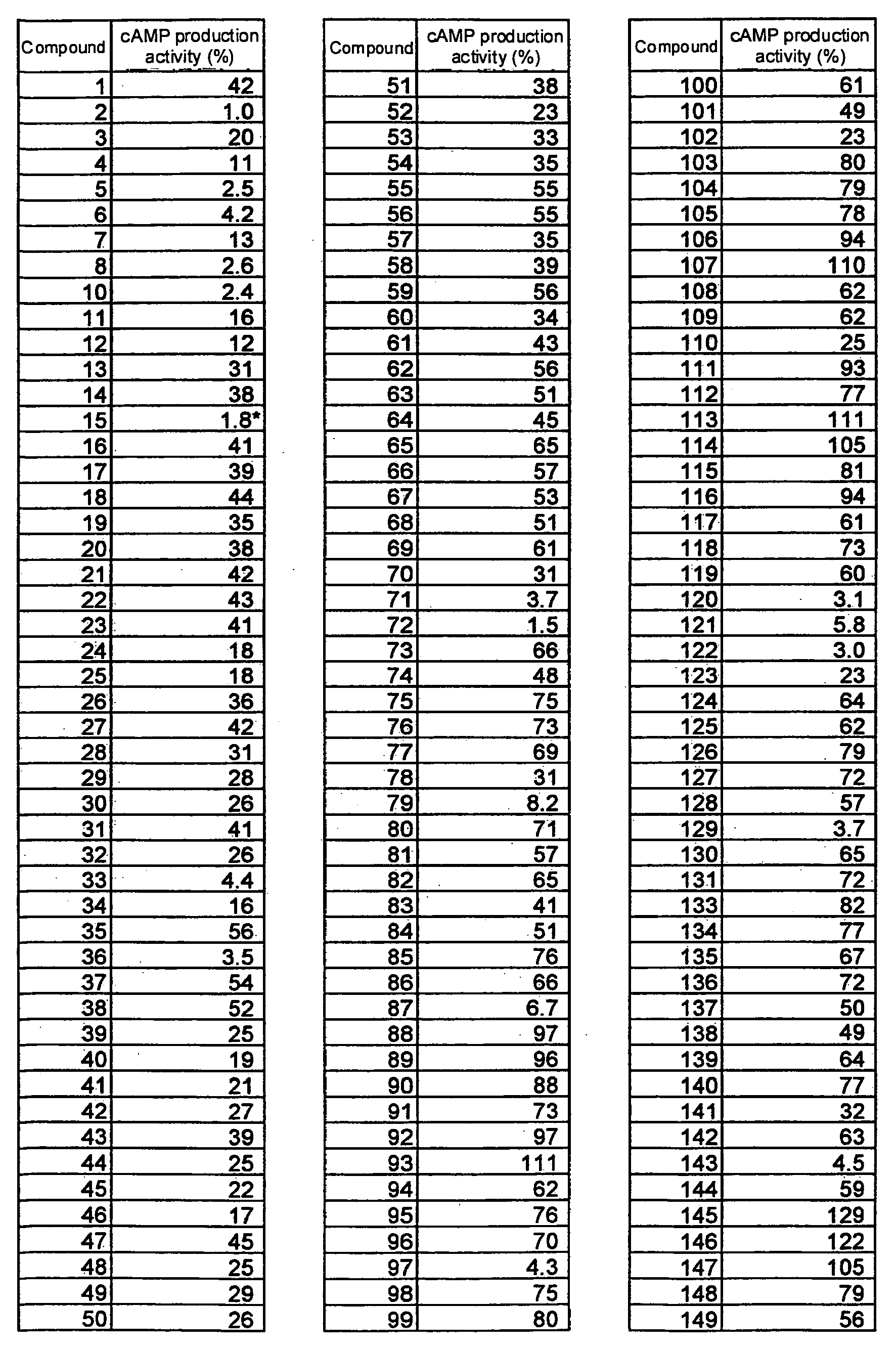


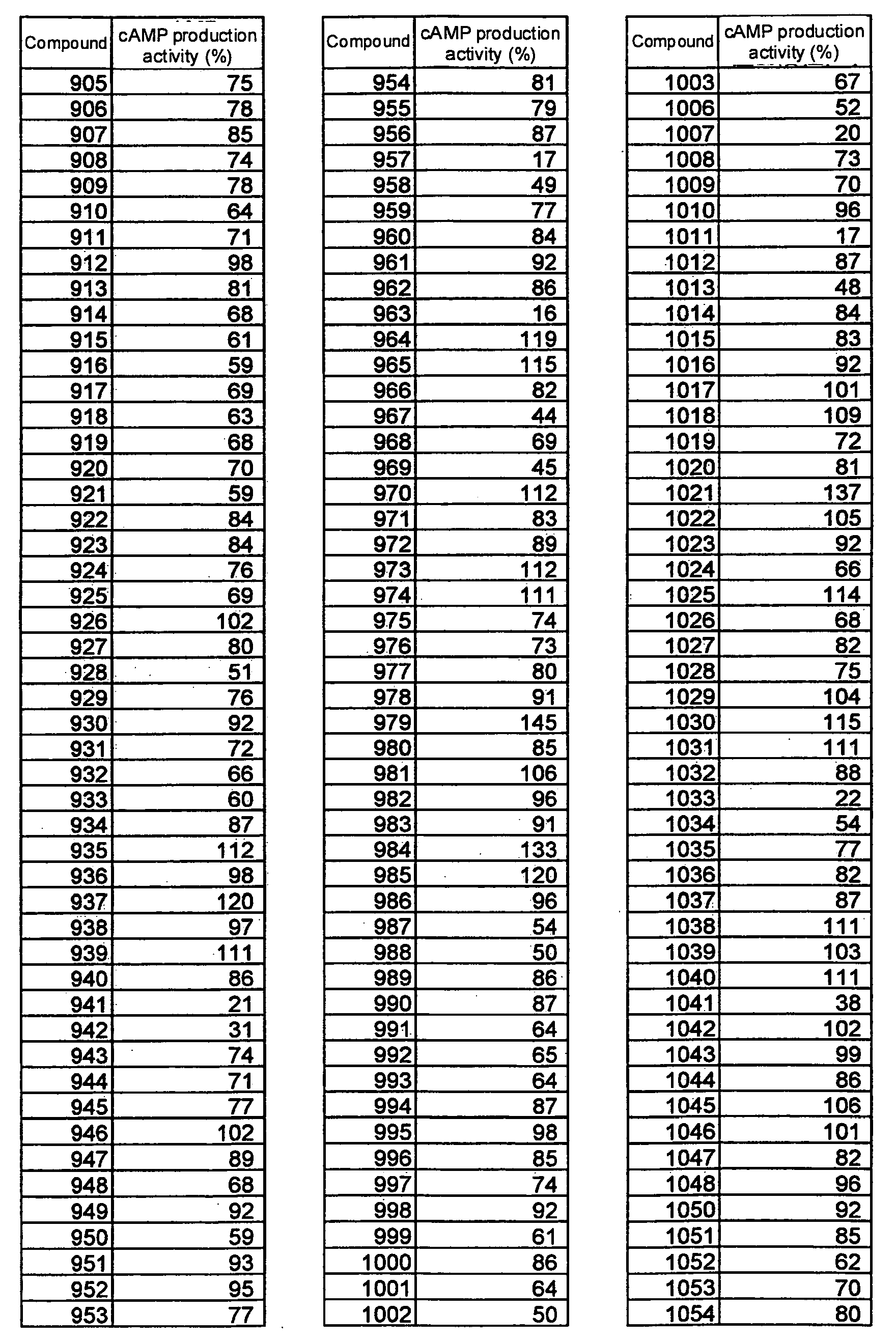


- The present invention provides a compound having a PTH-like effect. The present invention also provides a medicine for the prevention and/or treatment of osteoporosis, fracture, osteomalacia, arthritis, thrombocytopenia, hypoparathyroidism, hyperphosphatemia, tumoral calcinosis or the like, or stem cell mobilization.
In the present specification and claims translated into languages such as English, description with indefinite articles (e.g., "a", "an" in English), definite articles (e.g., "the" in English) and the like includes singular and plural aspects unless otherwise defined. For example, "a group" in English includes one or more groups.
Claims (17)
- A compound represented by the following general formula (1):

W is selected from:1) a single bond,2) C1-C10 alkylene optionally containing a carbonyl group, wherein the alkylene is optionally substituted with a halogen atom(s) and/or a hydroxyl group(s),3) C2-C10 alkenylene optionally substituted with a halogen atom(s),4) C2-C10 alkynylene,5) arylene optionally substituted with a halogen atom(s),6) heteroarylene optionally substituted with a halogen atom(s),7) C1-C10 heteroalkylene optionally substituted with a halogen atom(s),8) -NH-, -NHCH2- or -NHCH2CH2-,9) cycloalkylene and10) -(cycloalkylene)-CH2-;X is selected from the following bond or groups:1) a single bond,2) C1-C10 alkylene optionally substituted with a halogen atom(s) or cycloalkyl,3) C2-C10 alkenylene optionally substituted with a halogen atom(s),4) C2-C10 alkynylene optionally substituted with a halogen atom(s),5) C1-10 oxyalkylene optionally substituted with a halogen atom(s) and6) -NR47-wherein R47 is selected from:i) a hydrogen atom andii) C1-C10 alkyl optionally substituted with a halogen atom(s);Y is selected from:1) an oxygen atom,2) a sulfur atom and3) =NR37,or 4) Y is -NR38R39 shown in the following formula (A):
R37 is selected from:1) hydrogen,2) hydroxy and3) C1-C10 alkoxy;R38 and R39 are independently selected from hydrogen or C1-C10 alkyl optionally substituted with cycloalkyl, or R38 and R39 may be bonded to each other to form a ring selected from the group consisting of azetidinyl, pyrrolidinyl, piperidinyl, piperazinyl and morpholinyl, and the ring is optionally substituted with C1-C10 alkyl;
m represents an integer of 0 to 2;
n represents an integer of 0 to 2;
R1 is selected from:1) hydrogen,2) cycloalkyl optionally substituted with a group(s) selected from R4, R5 and R6,3) a heterocycle optionally substituted with a group(s) selected from R25, R4, R5 and R6,4) aryl optionally substituted with a group(s) selected from R3, R4, R5 and R6 and5) heteroaryl optionally substituted with a group(s) selected from R25, R4, R5 and R6;R3 is selected from:1) -CONR7R8,2) -OR9,3) -NR9R10,4) -N (R9) COR11,5) -N(R9)SO2R12,6) -SO2R15,7) C1-10 alkyl optionally substituted with a group(s) independently selected from a halogen atom, a hydroxyl group, -COR16 and -NR13R14,8) heteroaryl optionally having C1-10 alkyl and/or C1-10 alkoxy as a substituent(s) and9) -N(R9)CSR11;R4 is selected from:1) a halogen atom,2) cyano,3) nitro,4) amino,5) -NHCOR26,6) C1-C10 alkyl optionally substituted with a group(s) independently selected from hydroxycarbonyl, C1-C10 alkoxycarbonyl and aminocarbonyl,7) C1-C10 haloalkyl,8) C1-C10 alkoxy,9) C1-C10 haloalkylcarbonyl,10) -COR16,11) C1-C10 hydroxyalkyl and12) C1-C10 heteroalkyl;R5 is selected from a halogen atom, C1-C10 alkyl, C1-C10 haloalkyl and C1-C10 alkoxy;
R6 is selected from a halogen atom, C1-C10 alkyl and C1-C10 haloalkyl;
R7 is selected from:1) hydrogen,2) C1-C10 alkyl optionally substituted with a group(s) independently selected from amino and C1-C10 alkylamino,3) C1-C10 hydroxyalkyl,4) C1-C10 haloalkyl,5) C1-C10 heteroalkyl,6) C1-C10 heteroalkyl optionally substituted with a group(s) selected from a hydroxyl group, C1-C10 alkylamino and C2-C10 alkenyl,7) aryl,8) heteroaryl,9) aryl C1-C10 alkyl,10) a heterocycle optionally substituted with C1-C10 alkyl,11) -(CH2)LCOR16 (wherein L represents an integer of 1 to 4),12) C1-C10 alkoxy,13) C2-C10 alkenyl and14) -NR40R41;R40 and R41 are independently selected from hydrogen, C1-C10 alkyl and C1-C10 alkylcarbonyl, or R40 and R41 may be bonded to each other to form a ring selected from azetidinyl, pyrrolidinyl, piperidinyl, piperazinyl and morpholinyl, and the heterocycle is optionally substituted with C1-C10 alkyl;
R8 is selected from hydrogen and C1-C10 alkyl optionally substituted with a halogen atom(s) and/or a hydroxyl group(s);
R7 and R8 may be bonded to form a 4- to 7-membered heterocycle optionally containing an additional element(s) or group(s) independently selected from O, N, S, SO and SO2 and the heterocycle optionally contains carbonyl, and the heterocycle is optionally substituted with a substituent(s) independently selected from:1) a halogen atom,2) C1-C10 alkyl optionally having C1-C10 alkylamino as a substituent(s),3) C1-C10 haloalkyl,4) a hydroxyl group,5) C1-C10 hydroxyalkyl,6) C1-C10 alkoxy optionally substituted with a group(s) independently selected from a halogen atom, a hydroxyl group, amino and C1-C10 alkylamino,7) aryl optionally substituted with a group(s) selected from a halogen atom, a hydroxyl group, amino and C1-C10 alkylamino,8) C1-C10 heteroalkyl optionally substituted with a group(s) independently selected from a halogen atom, a hydroxyl group, amino and C1-C10 alkylamino,9) a heterocycle optionally substituted,with C1-C10 alkyl,10) heteroaryl optionally substituted with C1-C10 alkyl,11) heterocyclyl C1-C10 alkyl,12) -COR16,13) -NR19R20,14) -SO2R21,15) C1-C10 alkoxy-C1-C10 alkyl optionally having a hydroxyl group(s) as a substituent(s) and16) C1-C10 hydroxyalkyloxy, wherein the hydrogen atom of the hydroxyl group is optionally replaced by C1-C10 hydroxyalkyl, andthe heterocycle may further form a spiro ring together with a 4- to 6-membered heterocycle, and the bonded 4- to 6-membered heterocycle optionally contains O and N as ring-forming elements in addition to carbon atoms, and the carbon atom(s) may be oxidized to form carbonyl, and the 4- to 6-membered heterocycle is optionally further substituted with C1-C10 alkyl;
R16 is selected from:1) a hydroxyl group,2) C1-C10 alkoxy,3) NR17R18 and4) C1-C10 alkyl optionally substituted with a substituent(s) selected from a halogen atom, a hydroxyl group, C1-C10 alkoxycarbonyl or C1-C10 alkylamino;R17 is selected from:1) hydrogen,2) C1-C10 alkyl optionally substituted with a group(s) selected from aryl, amino, C1-C10 alkylamino, C1-C10 alkylcarbonylamino and a hydroxyl group,3) heteroaryl and4) C1-C10 alkoxy;R18 is selected from hydrogen, C1-C10 alkyl and C1-C10 hydroxyalkyl;
R17 and R18 may be bonded to each other to form a ring selected from azetidinyl, pyrrolidinyl, piperidinyl, piperazinyl and morpholinyl, and the ring is optionally substituted with a group(s) selected independently of each other from C1-C10 alkyl, a halogen atom and C1-C10 alkoxycarbonyl;
R19 is selected from hydrogen, C1-C10 alkyl, C1-C10 haloalkyl, C1-C10 alkylcarbonyl, C1-C10 hydroxyalkyl, C1-C10 aminoalkyl, C1-C10 alkoxycarbonyl and C1-C10 heteroalkyl;
R20 is selected from hydrogen and C1-C10 alkyl;
R19 and R20 may be bonded to form a ring selected from azetidinyl, pyrrolidinyl, piperidinyl, piperazinyl and morpholinyl, and the ring is optionally substituted with a group(s) selected independently of each other from C1-C10 alkyl and a halogen atom;
R21 is selected from:1) C1-C10 alkyl optionally substituted with aryl,2) amino,3) C1-C10 alkylamino and4) aryl optionally substituted with C1-C10 alkyl;R9 is selected from:1) hydrogen,2) C1-C10 alkyl optionally substituted with a group(s) independently selected from R23,3) aryl optionally substituted with a group(s) selected from a halogen atom, a hydroxyl group, amino and C1-C10 alkylamino,4) cycloalkyl optionally substituted with a halogen atom(s) or a hydroxyl group(s),5) a heterocycle optionally substituted with a group(s) independently selected from C1-C10 alkyl, C1-C10 alkylcarbonyl, C1-C10 alkoxy, C1-C10 alkoxycarbonyl, amino and a halogen atom,6) C1-C10 heteroalkyl optionally substituted with a group(s) independently selected from a halogen atom and a hydroxyl group,7) heteroaryl optionally substituted with a group(s) selected from C1-C10 alkyl, C1-C10 alkylcarbonyl, C1-C10 alkoxycarbonyl and a halogen atom and8) cycloalkenyl optionally substituted with a group(s) selected from C1-C10 alkoxy, C1-C10 alkylamino, amino, a hydroxyl group and a halogen atom, wherein the cycloalkenyl optionally contains a carbonyl group;R23 is independently selected from:1) a halogen atom,2) a hydroxyl group,3) a C1-C10 alkylcarbonyloxy group,4) -COR16,5) amino,6) C1-C10 alkylamino,7) a heterocycle optionally substituted with a group(s) selected from C1-C10 alkyl, C1-C10 alkylcarbonyl, C1-C10 alkoxycarbonyl and a halogen atom and8) cyano;R10 is selected from:1) hydrogen and2) C1-C10 alkyl optionally substituted with a group(s) selected from a halogen atom, a hydroxyl group and aryl; R9 and R10 may be bonded to form a 4- to 7-membered heterocycle optionally containing an additional element(s) or group(s) independently selected from N, O, S, SO, SO2, carbonyl and thiocarbonyl, and the heterocycle is optionally substituted with a substituent(s) independently selected from R24;R24 is independently selected from:1) a halogen atom,2) C1-C10 alkyl optionally substituted with a group(s) independently selected from C1-C10 alkylamino and C1-C10 alkylcarbonylamino,3) C1-C10 haloalkyl,4) a hydroxyl group,5) C1-C10 hydroxyalkyl,6) C1-C10 alkoxy optionally substituted with a group(s) independently selected from a halogen atom, a hydroxyl group, amino and C1-C10 alkylamino,7) aryl optionally substituted with a group(s) independently selected from a halogen atom, a hydroxyl group, amino and C1-C10 alkylamino,8) C1-C10 heteroalkyl optionally substituted with a group(s) independently selected from a halogen atom, a hydroxyl group, amino and C1-C10 alkylamino,9) a heterocycle optionally substituted with C1-C10 alkyl,10) heteroaryl,11) heterocyclyl C1-C10 alkyl,12) -COR16,13) -NR19R20 and14) -SO2R21;R11 is selected from:1) C1-C10 alkyl optionally substituted with a group(s) independently selected from:i) a hydroxyl group,ii) -NR17R17R18,iii) a C1-C10 alkoxy group,iv) a halogen atom,v) C1-C10 alkoxycarbonyl,vi) aminocarbonyl andvii) aryl optionally substituted with a group(s) independently selected from a halogen atom, a hydroxyl group, C1-C10 alkoxy, amino, C1-C10 alkylamino and -COR22,2) aryl optionally substituted with a group(s) independently selected from a halogen atom, a hydroxyl group, C1-C10 alkoxy, amino, C1-C10 alkylamino and -COR22,3) cycloalkyl optionally substituted with a halogen atom(s),4) a heterocycle optionally substituted with a group(s) selected from C1-C10 alkyl, C1-C10 alkylcarbonyl, C1-C10 alkoxycarbonyl and a halogen atom,5) C1-C10 alkoxy, wherein the alkyl group is optionally substituted with a group(s) independently selected from C1-C10 alkylcarbonylamino, amino, C1-C10 alkylamino and a hydroxyl group,6) amino,7) C1-C10 alkylamino, wherein the alkyl group is optionally substituted with a group(s) independently selected from C1-C10 alkylcarbonylamino, amino, C1-C10 alkylamino, hydroxycarbonyl and a hydroxyl group and8) C2-C10 alkenyl;R22 is selected from C1-C10 alkoxy, a hydroxyl group, amino and C1-C10 alkylamino;
R12 is selected from:1) C1-C10 alkyl,2) amino and3) C1-C10 alkylamino, wherein the alkyl group is optionally substituted with a group(s) independently selected from amino, C1-C10 alkylamino and a hydroxyl group;R13 is selected from:1) hydrogen,2) C1-C10 alkyl,3) C1-C10 alkylcarbonyl, wherein the alkyl is optionally substituted with a hydroxyl group(s),4) C1-C10 alkoxycarbonyl,5) aminocarbonyl,6) C1-C10 alkylaminocarbonyl and7) heterocyclic carbonyl optionally substituted with C1-C10 alkyl;R14 is selected from:1) hydrogen and2) C1-C10 alkyl optionally substituted with a group(s) independently selected from a halogen atom, a hydroxyl group, amino and C1-C10 alkylamino;R13 and R14 may be bonded to form a 4- to 7-membered heterocycle optionally containing an additional element(s) or group(s) independently selected from O, N, S, SO and SO2, and the heterocycle optionally contains carbonyl, and the heterocycle is optionally substituted with C1-C10 alkyl;
R15 is selected from:1) C1-C10 alkyl and2) -NR35R36;R35 is selected from:1) hydrogen,2) C1-C10 alkyl optionally substituted with a group(s) independently selected from:i) a halogen atom,ii) a hydroxyl group,iii) C1-C10 alkylcarbonylamino,iv) -COR16,v) amino,vi) C1-C10 alkylamino,vii) C1-C10 alkoxy optionally substituted with a halogen atom(s),viii) heteroaryl optionally substituted with a C1-C10 alkyl group(s) andix) a heterocycle,3) aryl optionally substituted with a group(s) independently selected from a halogen atom, a hydroxyl group, amino and C1-C10 alkylamino,4) cycloalkyl optionally substituted with a group(s) independently selected from a halogen atom and a hydroxyl group,5) a heterocycle optionally substituted with a group(s) independently selected from C1-C10 alkyl, a halogen atom and aryl C1-C10 alkyl,6) heteroaryl optionally substituted with C1-C10 alkyl and7) C1-C10 alkylcarbonyl;R36 is selected from:1) hydrogen and2) C1-C10 alkyl optionally substituted with a group(s) independently selected from a halogen atom, a hydroxyl group and aryl;R35 and R36 may be bonded to each other to form a ring selected from azetidinyl, pyrrolidinyl, piperidinyl, piperazinyl and morpholinyl, and the ring is optionally substituted with a group(s) selected independently of each other from C1-C10 alkyl and a halogen atom;
R25 is selected from:1) a halogen atom,2) C1-C10 alkyl optionally substituted with a group(s) independently selected from:i) a halogen atom,ii) aryl,iii) heteroaryl,iv) a heterocycle optionally substituted with a C1-C10 alkyl group(s),v) -COR16,vi) -NR13R14 andvii) -SO2R21,3) C1-C10 heteroalkyl optionally substituted with a hydroxyl group(s),4) C1-C10 hydroxyalkyl, wherein each hydroxyl group may be independently substituted with a group(s) selected from C1-C10 alkyl, aryl C1-C10 alkyl and C1-C10 alkylcarbonyl,5) -COR16,6) -SO2R21,7) aryl and8) cyano;R2 is selected from:1) C1-C10 alkyl optionally substituted with a halogen atom(s), wherein the alkyl group is optionally further substituted with a substituent(s) independently selected from R42,2) C2-C10 alkenyl optionally substituted with a halogen atom(s), wherein the alkenyl group is optionally further substituted with a substituent(s) independently selected from R42,3) C2-C10 alkynyl optionally substituted with a halogen atom(s), wherein the alkynyl group is optionally further substituted with a substituent(s) independently selected from R42,4) cycloalkyl optionally substituted with a group(s) independently selected from:i) a halogen atom,ii) C2-C10 alkenyl or C1-C10 alkyl,iii) aryl optionally substituted with 1 to 3 substituents independently selected from C1-C10 alkyl, a halogen atom, C1-C10 alkoxy, C1-C10 alkylamino and C1-C10 alkylcarbonyl,iv) cycloalkyl,v) C2-C10 alkenyl optionally substituted with halogen,vi) C1-C10 alkylidene, wherein the alkylidene is bonded to the cycloalkyl by a double bond and the alkylidene is optionally substituted with a halogen atom(s),vii) C1-C10 alkoxy optionally substituted with a halogen atom(s),viii) C1-C10 alkyl optionally substituted with a group(s) independently selected from a halogen atom or C1-C10 alkoxy optionally substituted with a halogen atom(s),ix) C2-C10 alkynyl andx) -Si(R43)3,5) a heterocycle, wherein the heterocycle is optionally substituted with a group(s) independently selected from:i) a C1-C10 alkyl group,ii) C1-C10 alkylcarbonyl, wherein the alkyl group is optionally substituted with R27,iii) arylcarbonyl, wherein the aryl group is optionally substituted with a group(s) independently selected from a halogen atom, C1-C10 alkyl and C1-C10 alkoxy,iv) heteroarylcarbonyl,v) C1-C10 alkoxycarbonyl, wherein the alkyl group is optionally substituted with a group(s) independently selected from a halogen atom, aryl and C1-C10 alkoxy,vi) aryloxycarbonyl, wherein the aryl group is optionally substituted with a halogen atom(s) and/or C1-C10 alkyl,vii) -CONR28R29,viii) -SO2R21,ix) a halogen atom,x) cycloalkylcarbonyl optionally fused with an aryl group andxi) C2-C10 alkenylcarbonyl, wherein the alkenyl group is optionally substituted with aryl, wherein the aryl is optionally substituted with a group(s) independently selected from a halogen atom, C1-C10 alkyl or C1-C10 alkoxy,6) aryl optionally substituted with a group(s) independently selected from R44,7) heteroaryl optionally substituted with a group(s) independently selected from:i) a halogen atom,ii) C1-C10 alkyl andiii) C1-C10 alkoxy;8) C1-C10 alkoxy optionally substituted with a halogen atom(s), wherein the alkoxy group is optionally further substituted with a substituent(s) independently selected from R42,9) -S(O)qR43 (wherein q is an integer of 0 to 2) and10) cycloalkenyl optionally substituted with C1-C10 alkyl;R44 is selected from:1) a halogen atom,2) cyano,3) C1-C10 alkyl optionally substituted with a group(s) independently selected from:i) a hydroxyl group,ii) -OR26,iii) cyano,iv) aryloxy optionally substituted with a group(s) independently selected from a halogen atom, C1-C10 alkyl optionally substituted with a halogen atom(s) or C1-C10 alkoxy optionally substituted with a halogen atom(s) andv) a halogen atom,4) cycloalkyl optionally substituted with a group(s) independently selected from a halogen atom or C1-C10 alkyl optionally substituted with a halogen atom(s),5) C1-C10 alkoxy optionally substituted with a halogen atom(s) or a C2-C6 alkenyl group(s),6) -COR30,7) C1-C10 alkylcarbonylamino,8) C1-C10 alkoxycarbonylamino, wherein the alkoxy group is optionally substituted with aryl,9) C1-C10 heteroalkyl optionally substituted with a halogen atom(s),10) aryl optionally substituted with a substituent(s) independently selected from:i) a halogen atom,ii) C1-C10 alkyl,iii) C1-C10 alkoxy andiv) aryl optionally substituted with aryl optionally substituted with C1-C10 alkyl,11) heteroaryl optionally substituted with a C1-C10 alkyl group(s),12) -SO2R43,13) -SOR43,14) C1-C10 alkylthio optionally substituted with a halogen atom(s),15) -Si(R43)3 and16) -SF5;R42 is selected from:1) hydrogen,2) aryl optionally substituted with a group(s) independently selected from C1-C10 alkyl optionally substituted with halogen, a halogen atom and C1-C10 alkoxy,3) hydroxycarbonyl,4) C1-C10 alkoxycarbonyl,5) aminocarbonyl,6) C1-C10 alkylaminocarbonyl,7) C1-C10 alkoxycarbonylamino,8) amino,9) a hydroxyl group and10) oxetane, tetrahydrofuran or tetrahydropyran optionally substituted with C1-C10 alkyl;R43 represents a C1-C10 alkyl group;
R26 is aryl, or C1-C10 alkyl optionally substituted with a halogen atom(s);
R27 is selected from:1) aryl optionally substituted with a group independently selected from a halogen atom, C1-C10 alkyl and C1-C10 alkoxy,2) C1-C10 alkoxy, wherein the alkyl group is optionally substituted with aryl,3) a hydroxyl group,4) amino,5) C1-C10 alkylamino,6) hydroxycarbonyl,7) heteroaryl optionally substituted with a group(s) independently selected from C1-C10 alkyl and/or aryl, and8) heteroaryloxy;R28 is selected from hydrogen or C1-C10 alkyl optionally substituted with aryl;
R29 is selected from hydrogen or C1-C10 alkyl optionally substituted with aryl;
R28 and R29 may be bonded to form a ring selected from azetidinyl, pyrrolidinyl, piperidinyl, piperazinyl and morpholinyl, and the ring is optionally substituted with a group(s) selected independently of each other from C1-C10 alkyl and a halogen atom;
R30 is selected from a hydroxyl group, C1-C10 alkoxy and -NR31R32;
R31 and R32 are independently selected from:1) hydrogen,2) C1-C10 alkyl optionally substituted with aryl and3) aryl;R31 and R32 may be bonded to form a ring selected from azetidinyl, pyrrolidinyl, piperidinyl, piperazinyl and morpholinyl, and the ring is optionally substituted with a group(s) selected independently of each other from C1-C10 alkyl, a halogen atom and C1-C10 alkoxycarbonyl; and
R33 and R34 are independently selected from:1) hydrogen and2) C1-C10 alkyl], or a pharmacologically acceptable salt thereof;or
a compound represented by the following general formula (2) :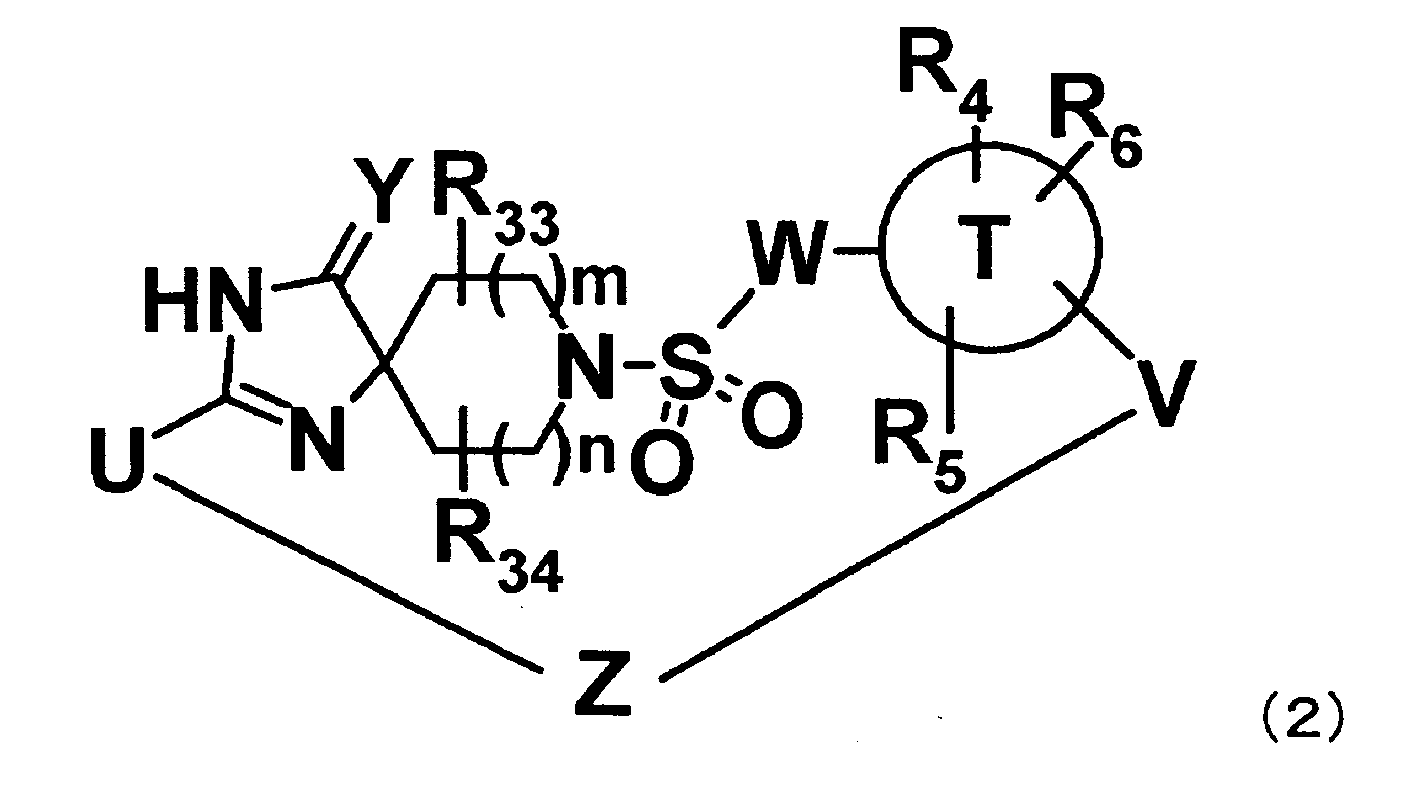
U represents a bond, C1-C10 alkylene or any group selected from groups represented by the following formula: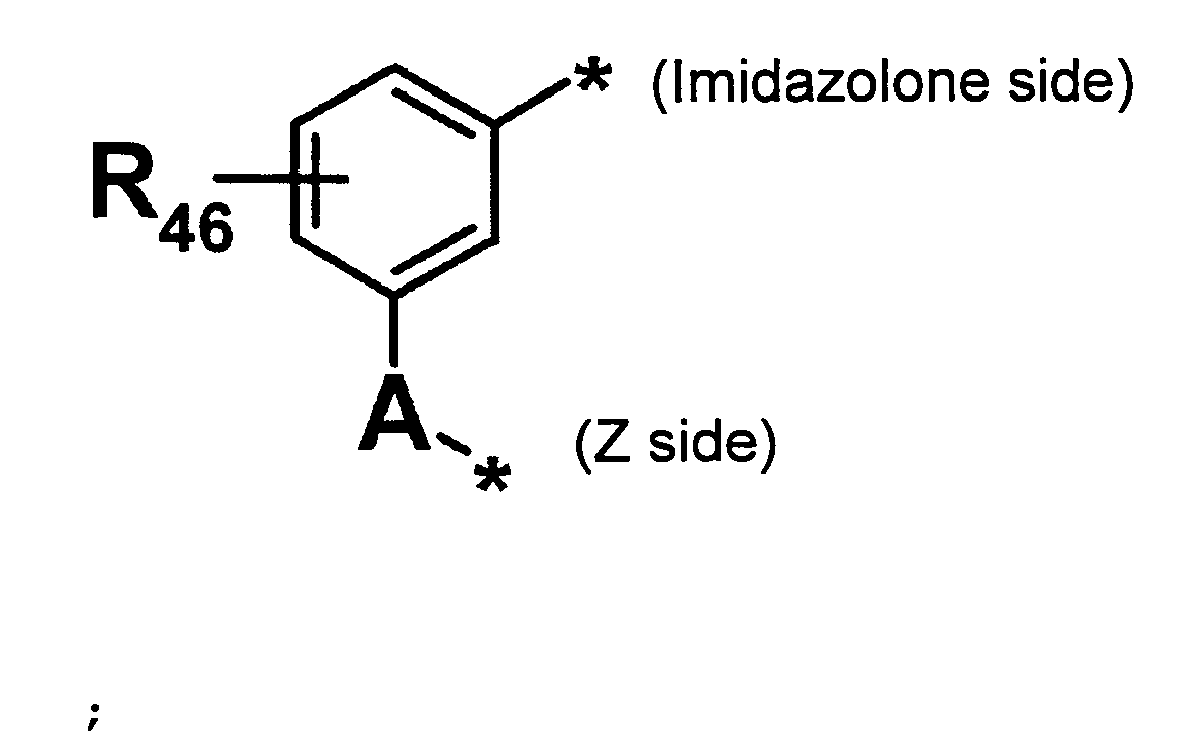
R46 is selected from hydrogen or R49;
T is selected from aryl and heteroaryl; V is selected from:
E is a 4- to 7-membered heterocycle optionally containing an additional element(s) or group(s) selected from O, N, S, SO and SO2, and the heterocycle is optionally substituted with a group(s) selected from:1) hydrogen,2) a halogen atom,3) C1-C10 alkyl optionally having a hydroxyl group(s) independently selected from C1-C10 alkylamino, a halogen atom and a hydroxyl group,4) a hydroxyl group,5) C1-C10 alkoxy optionally substituted with a group(s) independently selected from a halogen atom, a hydroxyl group, amino and C1-C10 alkylamino,6) aryl optionally substituted with a group(s) independently selected from a halogen atom, a hydroxyl group, amino and C1-C10 alkylamino,7) C1-C10 heteroalkyl optionally substituted with a group(s) independently selected from a halogen atom, a hydroxyl group, amino and C1-C10 alkylamino,8) a heterocycle optionally substituted with C1-C10 alkyl,9) heteroaryl optionally substituted with C1-C10 alkyl,10) heterocyclyl C1-C10 alkyl,11) -COR16,12) -NR19R20 and13) -SO2R21;Z is a divalent group selected from:1) C1-C10 alkylene or C1-C10 heteroalkylene optionally substituted with a halogen atom(s) and/or a hydroxyl group(s), wherein the carbon atom(s) may be oxidized to form carbonyl;2) C2-C10 alkenylene or C2-C10 heteroalkenylene optionally substituted with a halogen atom(s) and/or a hydroxyl group(s), wherein the carbon atom(s) may be oxidized to form carbonyl; and3) a group selected from:G is a divalent group selected from: 1) C1-C10 alkylene or C1-C10 heteroalkylene optionally substituted with a halogen atom(s); and2) C2-C10 alkenylene or C2-C10 heteroalkenylene optionally substituted with a halogen atom(s);J is a divalent group selected from:1) C1-C10 alkylene or C1-C10 heteroalkylene optionally substituted with a halogen atom(s); and2) C2-C10 alkenylene or C2-C10 heteroalkenylene optionally substituted with a halogen atom(s);B is selected from a heterocycle or heteroaryl; and R45 is selected from hydrogen or C1-C10 alkyl], or a pharmacologically acceptable salt thereof.
 - The compound or a pharmacologically acceptable salt thereof according to claim 1, wherein
W is selected from:1) a single bond,2) C1-C10 alkylene optionally containing a carbonyl group, wherein the alkylene is optionally substituted with a halogen atom(s) or hydroxy,3) C2-C10 alkenylene optionally substituted with a halogen atom(s),4) C2-C10 alkynylene,5) arylene,6) heteroarylene,7) -NH-, -NHCH2- or -NHCH2CH2-,8) cycloalkylene and9) -(cycloalkylene)-CH2-;X is selected from the following bond or groups:1) a single bond,2) C1-C10 alkylene optionally substituted with cycloalkyl,3) C2-C10 alkenylene,4) C2-C10 alkynylene and5) C1-C10 oxyalkylene;R1 is selected from:1) hydrogen,2) cycloalkyl optionally substituted with a group selected from R4,3) a heterocycle optionally substituted with a group(s) selected from R25 and R4,4) aryl optionally substituted with a group(s) selected from R3, R4, R5 and R6 and5) heteroaryl optionally substituted with a group(s) selected from R25, R4 and R5;R9 is selected from:1) hydrogen,2) C1-C10 alkyl optionally substituted with a group(s) independently selected from R23,3) cycloalkyl optionally substituted with a halogen atom(s) or a hydroxyl group(s),4) a heterocycle optionally substituted with a group(s) selected from C1-C10 alkyl, C1-C10 alkylcarbonyl, C1-C10 alkoxy, C1-C10 alkoxycarbonyl, amino and a halogen atom,5) C1-C10 heteroalkyl optionally substituted with a group(s) selected from a halogen atom and a hydroxyl group,6) heteroaryl optionally substituted with a group(s) independently selected from C1-C10 alkyl, C1-C10 alkylcarbonyl, C1-C10 alkoxycarbonyl and a halogen atom and7) cycloalkenyl optionally substituted with a group(s) selected from C1-C10 alkoxy, C1-C10 alkylamino, amino, 1 to 3 hydroxyl groups and 1 to 4 halogen atoms, wherein the cycloalkenyl optionally contains a carbonyl group;R10 is selected from:1) hydrogen and2) C1-C10 alkyl optionally substituted with a group(s) independently selected from a halogen atom, a hydroxyl group and aryl;R9 and R10 may be bonded to form a 4- to 7-membered heterocycle optionally containing an additional element(s) or group(s) independently selected from N, O, S, SO, SO2, carbonyl and thiocarbonyl, and the heterocycle is optionally substituted with a substituent(s) independently selected from R24;
R24 is selected from:1) a halogen atom,2) C1-C10 alkyl optionally substituted with a group(s) independently selected from C1-C10 alkylamino and C1-C10 alkylcarbonylamino,3) C1-C10 haloalkyl,4) a hydroxyl group,5) C1-C10 hydroxyalkyl,6) C1-C10 alkoxy optionally substituted with a group(s) independently selected from a halogen atom, a hydroxyl group, amino and C1-C10 alkylamino,7) aryl optionally substituted with a group(s) selected from a halogen atom, a hydroxyl group, amino and C1-C10 alkylamino,8) C1-C10 heteroalkyl optionally substituted with 1 to 2 groups selected from a halogen atom, a hydroxyl group, amino and C1-C10 alkylamino,9) -COR16 and10) -NR19R20;R11 is selected from:1) C1-C10 alkyl optionally substituted with 1 to 3 substituents independently selected from:i) a hydroxyl group,ii) -NR17R18,iii) a C1-C10 alkoxy group,iv) a halogen atom,v) C1-C10 alkoxycarbonyl andvi) aminocarbonyl,2) aryl,3) aryl C1-C10 alkyl,4) cycloalkyl optionally substituted with a halogen atom(s),5) a heterocycle optionally substituted with C1-C10 alkyl,6) C1-C10 alkoxy, wherein the alkyl group is optionally substituted with a group(s) independently selected from C1-C10 alkylcarbonylamino, amino, C1-C10 alkylamino and a hydroxyl group,7) amino,8) C1-C10 alkylamino, wherein the alkyl group is optionally substituted with a group(s) independently selected from C1-C10 alkylcarbonylamino, amino, C1-C10 alkylamino, hydroxycarbonyl and a hydroxyl group and9) C2-C10 alkenyl; andR33 and R34 are hydrogen,
wherein R3, R4, R5, R6, R16, R17, R18, R19, R20, R23 and R25 are as defined in claim 1, respectively. - The compound or a pharmacologically acceptable salt thereof according to claim 1 or 2, wherein
W is selected from:1) a single bond,2) C1-C10 alkylene optionally substituted with a halogen atom(s),3) C2-C10 alkenylene,4) C2-C10 alkynylene and5) heteroarylene,X is selected from the following bond or groups:1) a single bond,2) C1-C10 alkylene,3) C2-C10 alkenylene,4) C2-C10 alkynylene and5) C1-C10 oxyalkylene, wherein the oxyalkylene is bonded to a 1,3,8-triaza-spiro[4.5]dec-1-en-4-one ring or a 1,3,8-triaza-spiro[4.5]dec-1-ene-4-thione ring through a carbon atom in the oxyalkylene;R1 is selected from:1) aryl optionally substituted with a group(s) selected from R3, R4 and R5 and2) heteroaryl optionally substituted with a group(s) selected from R25 and R4;R3 is selected from:1) -CONR7R8,2) -OR9,3) -NR9R10,4) -N (R9) COR11,5) -N(R9)SO2R12,6) -SO2R15,7) C1-C10 alkyl optionally substituted with a group(s) selected from -COR16 and -NR13R14 and8) -N(R9)CSNH2;R4 is selected from:1) halogen,2) cyano,3) amino,4) C1-C10 alkyl,5) C1-C10 haloalkyl,6) C1-C10 alkoxy,7) C1-C10 haloalkylcarbonyl,8) -COR16 and9) C1-C10 heteroalkyl;R2 is selected from:1) C1-C10 alkyl optionally substituted with a halogen atom(s), wherein the alkyl group is optionally further substituted with a group selected from R42,2) C2-C10 alkenyl optionally substituted with a halogen atom(s), wherein the alkenyl group is optionally further substituted with a group selected from R42,3) C2-C10 alkynyl optionally substituted with a halogen atom(s), wherein the alkynyl group is optionally further substituted with a group selected from R42,4) cycloalkyl optionally substituted with a group(s) independently selected from:i) a halogen atom,ii) C2-C10 alkenyl or C1-C10 alkyl,iii) aryl optionally substituted with a group(s) independently selected from C1-C10 alkyl, a halogen atom and C1-C10 alkoxy,iv) cycloalkyl,v) C2-C10 haloalkenyl or C1-C10 haloalkyl,vi) C1-C10 alkylidene, wherein the alkylidene is bonded to the cycloalkyl by a double bond and the alkylidene is optionally substituted with a halogen atom(s),vii) C1-C10 alkoxy optionally substituted with a halogen atom(s),viii) C1-C10 alkyl substituted with C1-C10 alkoxy, wherein the alkyl and/or the alkyl in the alkoxy is optionally substituted with a halogen atom(s),ix) C2-C10 alkynyl andx) -Si(R43)3,5) a heterocycle, wherein the heterocycle is optionally substituted with a group(s) selected from:i) a C1-C10 alkyl group,ii) C1-C10 alkylcarbonyl, wherein the alkyl group is optionally substituted with R27,iii) arylcarbonyl, wherein the aryl group is optionally substituted with a group(s) independently selected from a halogen atom, C1-C10 alkyl and C1-C10 alkoxy,iv) heteroarylcarbonyl,v) C1-C10 alkoxycarbonyl, wherein the alkyl group is optionally substituted with a group(s) independently selected from a halogen atom, aryl and C1-C10 alkoxy,vi) aryloxycarbonyl, wherein the aryl group is optionally substituted with a halogen atom(s) and/or C1-C10 alkyl,vii) -CONR28R29 andviii) -SO2R21,6) aryl optionally substituted with a group(s) independently selected from R44,7) heteroaryl optionally substituted with any of the following groups:i) C1-C10 alkyl,8) C1-C10 alkoxy optionally substituted with a halogen atom(s), wherein the alkoxy group is optionally further substituted with a group selected from R42,9) -S(O)qR43 (wherein q is an integer of 0 to 2) and10) cycloalkenyl optionally substituted with C1-C10 alkyl,R44 is selected from:1) a halogen atom,2) cyano,3) C1-C10 alkyl optionally substituted with any of the following groups:i) a hydroxyl group,ii) -OR26,iii) cyano andiv) aryloxy optionally substituted with a group(s) selected from a halogen atom, C1-C10 alkyl, C1-C10 haloalkyl or C1-C10 haloalkoxy,4) C1-C10 haloalkyl,5) cycloalkyl optionally substituted with a group(s) selected from a halogen atom and C1-C10 haloalkyl,6) C1-C10 alkoxy optionally substituted with a halogen atom(s) or a C2-C6 alkenyl group(s),7) -COR30,8) C1-C10 heteroalkyl optionally substituted with a halogen atom(s),9) aryl optionally substituted with a group(s) independently selected from:i) C1-C10 alkyl andii) aryl,10) heteroaryl optionally substituted with a C1-C10 alkyl group(s),11) -SO2R43,12) C1-C10 alkylthio optionally substituted with a halogen atom(s),13) -Si(R43) and14) -SF5; andR27 is selected from:1) aryl optionally substituted with a group(s) independently selected from a halogen atom, C1-C10 alkyl and C1-C10 alkoxy,2) C1-C10 alkoxy, wherein the alkyl group is optionally substituted with aryl,3) heteroaryl optionally substituted with a group(s) independently selected from C1-C10 alkyl and aryl and4) heteroaryloxy,wherein R5, R7, R8, R9, R10, R11, R12, R13, R14, R15, R16, R21, R25, R26, R28, R29, R30, R42 and R43 are as defined in claim 1 or 2 from which claim 3 depends, respectively. - The compound or a pharmacologically acceptable salt thereof according to any of claims 1 to 3, wherein
W is selected from:1) C1-C6 alkylene optionally substituted with a fluorine atom(s),2) C1-C6 alkenylene and3) thiophene,X is selected from the following bond or groups:1) a single bond,2) C1-C6 alkylene and3) C1-C6 oxyalkylene optionally substituted with a halogen atom(s), wherein the oxyalkylene is bonded to a 1,3,8-triaza-spiro[4.5]dec-1-en-4-one ring or a 1,3,8-triaza-spiro[4.5]dec-1-ene-4-thione ring through a carbon atom in the oxyalkylene;Y represents an oxygen atom;
m represents 1; and
n represents 1. - The compound or a pharmacologically acceptable salt thereof according to any of claims 1 to 4, wherein
W is selected from:1) ethylene,2) vinylene and3) thiophene,X represents a single bond;
R3 is selected from:1) -CONR7R8,2) -OR9,3) -NR9R10,4) -N(R9)COR11,5) -N(R9)SO2R12,6) -SO2R15 and7) C1-C6 alkyl optionally substituted with a group(s) selected from -COR16 and -NR13R14;R2 is selected from:1) C1-C10 alkyl optionally substituted with a halogen atom(s), wherein the alkyl group is optionally further substituted with a group selected from R42,2) C2-C10 alkenyl optionally substituted with a halogen atom(s), wherein the alkenyl group is optionally further substituted with a group selected from R42,3) C2-C10 alkynyl optionally substituted with a halogen atom(s), wherein the alkynyl group is optionally further substituted with a group selected from R42,4) cycloalkyl optionally substituted with a group(s) independently selected from:i) a halogen atom,ii) C2-C6 alkenyl or C1-C6 alkyl,iii) aryl optionally substituted with a group(s) independently selected from C1-C6 alkyl, a halogen atom, C1-C6 alkoxy, C1-C6 alkylamino and C1-C6 alkylcarbonyl,iv) cycloalkyl,v) C2-C6 haloalkenyl or C1-C6 haloalkyl,vi) C1-C6 alkylidene, wherein the alkylidene is bonded to the cycloalkyl by a double bond and the alkylidene is optionally substituted with a halogen atom(s),vii) C1-C6 alkoxy optionally substituted with a halogen atom(s),viii) C1-C6 alkyl substituted with C1-C6 alkoxy,
wherein the alkyl and/or the alkyl in the alkoxy is optionally substituted with halogen,ix) C2-C6 alkynyl andx) -Si(R43)3,5) a group represented by the following general formula (B) : i) C1-C6 alkylcarbonyl, wherein the alkyl group is optionally substituted with R27,ii) arylcarbonyl, wherein the aryl group is optionally substituted with a group(s) independently selected from a halogen atom, C1-C6 alkyl and C1-C6 alkoxy,iii) C1-C6 alkoxycarbonyl, wherein the alkyl group is optionally substituted with a group(s) selected from a halogen atom, aryl and C1-C6 alkoxy,iv) aryloxycarbonyl, wherein the aryl group is optionally substituted with a halogen atom(s) or C1-C6 alkyl,v) -CONR28R29 andvi) -SO2R21),6) aryl optionally substituted with a group(s) independently selected from R44,7) heteroaryl optionally substituted with any of the following groups:i) a halogen atom,ii) C1-C6 alkyl andiii) C1-C6 alkoxy;8) C1-C6 alkoxy optionally substituted with a halogen atom(s), wherein the alkoxy group is optionally further substituted with a group selected from R42,9) -S(O)qR43 (wherein q is an integer of 0 to 2) and10) cycloalkenyl optionally substituted with C1-C6 alkyl; andR44 is selected from:1) a halogen atom,2) cyano,3) C1-C6 alkyl optionally substituted with any of the following groups:i) a hydroxyl group,ii) -OR26,iii) cyano andiv) aryloxy optionally substituted with a group(s) selected from a halogen atom, C1-C6 alkyl, C1-C6 haloalkyl or C1-C6 haloalkoxy,4) C1-C6 haloalkyl,5) cycloalkyl optionally substituted with a group(s) selected from a halogen atom and C1-C6 haloalkyl,6) C1-C6 alkoxy optionally substituted with a halogen atom(s),7) -COR30,8) C1-C6 heteroalkyl optionally substituted with a halogen atom(s),9) aryl optionally substituted with a group(s) independently selected from:i) C1-C6 alkyl andii) aryl,10) heteroaryl optionally substituted with a C1-C6 alkyl group(s),11) -SO2R43,12) C1-C6 alkylthio optionally substituted with a halogen atom(s),13) -Si(R43)3 and14) -SF5,wherein R7, R8, R9, R10, R11, R12, R13, R14, R15, R16, R21, R26, R27, R28, R29, R30, R42 and R43 are as defined in claims 1 to 4 from which claim 5 depends, respectively.
 - The compound or a pharmacologically acceptable salt thereof according to claim 3, wherein R1 is a group represented by the following general formula (3):

- The compound or a pharmacologically acceptable salt thereof according to claim 3, wherein R1 is a group represented by the following general formula (4):

- The compound or a pharmacologically acceptable salt thereof according to claim 5, wherein R1 is a group represented by the following general formula (3):

- The compound or a pharmacologically acceptable salt thereof according to claim 5, wherein R1 is a group represented by the following general formula (4):

- A compound:(1) 8-(3-chloro-benzenesulfonyl)-2-cyclohexyl-1,3,8-triaza-spiro[4.5]dec-1-en-4-one;(2) 8-(3-chloro-benzenesulfonyl)-2-pyridin-4-yl-1,3,8-triaza-spiro[4.5]dec-1-en-4-one;(3) 8-(3-chloro-benzenesulfonyl)-2-propyl-1,3,8-triaza-spiro[4.5]dec-1-en-4-one;(4) 8-(3-chloro-benzenesulfonyl)-2-isopropyl-1,3,8-triaza-spiro[4.5]dec-1-en-4-one;(5) 8-(3-chloro-benzenesulfonyl)-2-(3-methoxy-phenyl)-1,3,8-triaza-spiro[4.5]dec-1-en-4-one;(6) 8-(3-chloro-benzenesulfonyl)-2-(3-chloro-phenyl)-1,3,8-triaza-spiro[4.5]dec-1-en-4-one;(7) 2-benzyl-8-(3-chloro-benzenesulfonyl)-1,3,8-triaza-spiro[4.5]dec-1-en-4-one;(8) 8-(3-chloro-benzenesulfonyl)-2-methyl-1,3,8-triaza-spiro[4.5]dec-1-en-4-one;(10) 2-biphenyl-2-yl-8-(3-chloro-benzenesulfonyl)-1,3,8-triaza-spiro[4.5]dec-1-en-4-one;(11) 8-(3-chloro-benzenesulfonyl)-2-o-tolyl-1,3,8-triaza-spiro[4.5]dec-1-en-4-one;(12) 8-(3-chloro-benzenesulfonyl)-2-(4-trifluoromethyl-phenyl)-1,3,8-triaza-spiro[4.5]dec-1-en-4-one;(13) 8-(3-chloro-benzenesulfonyl)-2-(3-trifluoromethoxy-phenyl)-1,3,8-triaza-spiro[4.5]dec-1-en-4-one;(14) 8-(3-chloro-benzenesulfonyl)-2-(1-methyl-cyclohexyl)-1,3,8-triaza-spiro[4.5]dec-1-en-4-one;(15) 2-(1-acetyl-piperidin-4-yl)-8-(3-chloro-benzenesulfonyl)-1,3,8-triaza-spiro[4.5]dec-1-en-4-one;(16) 2-tert-butyl-8-(3-chloro-benzenesulfonyl)-1,3,8-triaza-spiro[4.5]dec-1-en-4-one;(17) 8-(3-chloro-benzenesulfonyl)-2-(4-trifluoromethyl-cyclohexyl)-1,3,8-triaza-spiro[4.5]dec-1-en-4-one;(18) 3-[8-(3-chloro-benzenesulfonyl)-4-oxo-1,3,8-triaza-spiro[4.5]dec-1-en-2-yl]-piperidine-1-carboxylic acid tert-butyl ester;(19) 8-(3-chloro-benzenesulfonyl)-2-(3-methyl-cyclohexyl)-1,3,8-triaza-spiro[4.5]dec-1-en-4-one;(20) 8-(3-chloro-benzenesulfonyl)-2-(2-methyl-cyclohexyl)-1,3,8-triaza-spiro[4.5]dec-1-en-4-one;(21) 8-(3-chloro-benzenesulfonyl)-2-(4-propylcyclohexyl)-1,3,8-triaza-spiro[4.5]dec-1-en-4-one;(22) 2-(1R,2S,4S)-bicyclo[2.2.1]hept-2-yl-8-(3-chloro-benzenesulfonyl)-1,3,8-triaza-spiro[4.5]dec-1-en-4-one;(23) 2-(1R,2R,4S)-bicyclo[2.2.1]hept-2-yl-8-(3-chloro-benzenesulfonyl)-1,3,8-triaza-spiro[4.5]dec-1-en-4-one;(24) 8-(3-chloro-benzenesulfonyl)-2-(4-methoxy-cyclohexyl)-1,3,8-triaza-spiro[4.5]dec-1-en-4-one;(25) 8-(3-chloro-benzenesulfonyl)-2-(4-methoxy-cyclohexyl)-1,3,8-triaza-spiro[4.5]dec-1-en-4-one;(26) 2-(4-tert-butyl-cyclohexyl)-8-(3-chloro-benzenesulfonyl)-1,3,8-triaza-spiro[4.5]dec-1-en-4-one;(27) 8-(3-chloro-benzenesulfonyl)-2-(4-fluoromethyl-cyclohexyl)-1,3,8-triaza-spiro[4.5]dec-1-en-4-one;(28) 8-(3-chloro-benzenesulfonyl)-2-cyclohexylmethyl-1,3,8-triaza-spiro[4.5]dec-1-en-4-one;(29) 8-(3-chloro-benzenesulfonyl)-2-phenethyl-1,3,8-triaza-spiro[4.5]dec-1-en-4-one;(30) 8-(3-chloro-benzenesulfonyl)-2-(2-cyclohexyl-ethyl)-1,3,8-triaza-spiro[4.5]dec-1-en-4-one;(31) 8-(3-chloro-benzenesulfonyl)-2-(3-trifluoromethyl-phenyl)-1,3,8-triaza-spiro[4.5]dec-1-en-4-one;(32) 8-(3-chloro-benzenesulfonyl)-2-(3-methanesulfonylphenyl)-1,3,8-triaza-spiro[4.5]dec-1-en-4-one;(33) 8-(3-chloro-benzenesulfonyl)-2-(1-phenylcyclohexyl)-1,3,8-triaza-spiro[4.5]dec-1-en-4-one;(34) 8-(3-chloro-benzenesulfonyl)-2-(2-naphthalen-1-ylethyl)-1,3,8-triaza-spiro[4.5]dec-1-en-4-one;(35) 8-(2-naphthalen-1-yl-ethanesulfonyl)-2-(3-trifluoromethyl-phenyl)-1,3,8-triaza-spiro[4.5]dec-1-en-4-one;(36) 2-tert-butyl-8-(2-naphthalen-1-yl-ethanesulfonyl)-1,3,8-triaza-spiro[4.5]dec-1-en-4-one;(37) 8-(2-naphthalen-1-yl-ethanesulfonyl)-2-(4-trifluoromethyl-cyclohexyl)-1,3,8-triaza-spiro[4.5]dec-1-en-4-one;(38) 3-[8-(2-naphthalen-1-yl-ethanesulfonyl)-4-oxo-1,3,8-triaza-spiro[4.5]dec-1-en-2-yl]-piperidine-1-carboxylic acid tert-butyl ester;(39) 8-(2-naphthalen-1-yl-ethanesulfonyl)-2-[1-(2-naphthalen-1-yl-ethanesulfonyl)-piperidin-3-yl]-1,3,8-triaza-spiro[4.5]dec-1-en-4-one;(40) 8-(3-chloro-benzenesulfonyl)-2-[1-(propane-1-sulfonyl)-piperidin-3-yl]-1,3,8-triaza-spiro[4.5]dec-1-en-4-one;(41) 2-(1-benzenesulfonyl-piperidin-3-yl)-8-(3-chloro-benzenesulfonyl)-1,3,8-triaza-spiro[4.5]dec-1-en-4-one;(42) 8-(3-chloro-benzenesulfonyl)-2-(1-phenylmethanesulfonyl-piperidin-3-yl)-1,3,8-triaza-spiro[4.5]dec-1-en-4-one;(43) 8-(2-naphthalen-1-yl-ethanesulfonyl)-2-(1-phenylmethanesulfonyl-piperidin-3-yl)-1,3,8-triaza-spiro[4.5]dec-1-en-4-one;(44) 8-(4-chloro-benzenesulfonyl)-2-(2,4-dichloro-phenyl)-1,3,8-triaza-spiro[4.5]dec-1-en-4-one;(45) 2-(2,4-dichloro-phenyl)-8-(2-trifluoromethyl-benzenesulfonyl)-1,3,8-triaza-spiro[4.5]dec-1-en-4-one;(46) 8-(butane-1-sulfonyl)-2-(2,4-dichloro-phenyl)-1,3,8-triaza-spiro[4.5]dec-1-en-4-one;(47) 2-(2,4-dichloro-phenyl)-8-(2-naphthalen-1-yl-ethanesulfonyl)-1,3,8-triaza-spiro[4.5]dec-1-en-4-one;(48) 2-(2,4-dichloro-phenyl)-8-(quinoline-8-sulfonyl)-1,3,8-triaza-spiro[4.5]dec-1-en-4-one;(49) 8-(3-chloro-4-fluoro-benzenesulfonyl)-2-(2,4-dichloro-phenyl)-1,3,8-triaza-spiro[4.5]dec-1-en-4-one;(50) 8-(3-chloro-benzenesulfonyl)-2-(2,4-dichloro-phenyl)-1,3,8-triaza-spiro[4.5]dec-1-en-4-one;(51) 2-(2-cyclohexyl-4-oxo-1,3,8-triaza-spiro[4.5]dec-1-ene-8-sulfonyl)-benzoic acid methyl ester;(52) 2-cyclohexyl-8-(5-methyl-3-phenyl-isoxazole-4-sulfonyl)-1,3,8-triaza-spiro[4.5]dec-1-en-4-one;(53) 8-(benzo[b]thiophene-3-sulfonyl)-2-cyclohexyl-1,3,8-triaza-spiro[4.5]dec-1-en-4-one;(54) 8-(benzo[b]thiophene-2-sulfonyl)-2-cyclohexyl-1,3,8-triaza-spiro[4.5]dec-1-en-4-one;(55) 8-(5-chloro-thiophene-2-sulfonyl)-2-cyclohexyl-1,3,8-triaza-spiro[4.5]dec-1-en-4-one;(56) 2-cyclohexyl-8-(thiophene-2-sulfonyl)-1,3,8-triaza-spiro[4.5]dec-1-en-4-one;(57) 2-cyclohexyl-8-(naphthalene-1-sulfonyl)-1,3,8-triaza-spiro[4.5]dec-1-en-4-one;(58) 2-cyclohexyl-8-(2,4-dimethyl-thiazole-5-sulfonyl)-1,3,8-triaza-spiro[4.5]dec-1-en-4-one;(59) 2-cyclohexyl-8-(3,5-dimethyl-isoxazole-4-sulfonyl)-1,3,8-triaza-spiro[4.5]dec-1-en-4-one;(60) 2-cyclohexyl-8-(2,3-dihydro-benzo[1,4]dioxine-6-sulfonyl)-1,3,8-triaza-spiro[4.5]dec-1-en-4-one;(61) 2-cyclohexyl-8-(2-naphthalen-1-yl-ethanesulfonyl)-1,3,8-triaza-spiro[4.5]dec-1-en-4-one;(62) 3-(2-cyclohexyl-4-oxo-1,3,8-triaza-spiro[4.5]dec-1-ene-8-sulfonyl)-thiophene-2-carboxylic acid methyl ester;(63) 5-(2-cyclohexyl-4-oxo-1,3,8-triaza-spiro[4.5]dec-1-ene-8-sulfonyl)-4-methyl-thiophene-2-carboxylic acid methyl ester;(64) 2-cyclohexyl-8-(2,5-dimethyl-thiophene-3-sulfonyl)-1,3,8-triaza-spiro[4.5]dec-1-en-4-one;(65) 8-(5-bromo-thiophene-2-sulfonyl)-2-cyclohexyl-1,3,8-triaza-spiro[4.5]dec-1-en-4-one;(66) 8-(5-chloro-thiophene-2-sulfonyl)-2-(3-trifluoromethyl-phenyl)-1,3,8-triaza-spiro[4.5]dec-1-en-4-one;(67) 8-(naphthalene-2-sulfonyl)-2-(3-trifluoromethyl-phenyl)-1,3,8-triaza-spiro[4.5]dec-1-en-4-one;(68) 8-(benzo[b]thiophene-2-sulfonyl)-2-(3-trifluoromethyl-phenyl)-1,3,8-triaza-spiro[4.5]dec-1-en-4-one;(69) 8-(5-bromo-thiophene-2-sulfonyl)-2-(3-trifluoromethyl-phenyl)-1,3,8-triaza-spiro[4.5]dec-1-en-4-one;(70) 8-(3-chloro-benzenesulfonyl)-2-cyclohexyl-1,3,8-triaza-spiro[4.6]undec-1-en-4-one;(71) 7-(3-chloro-benzenesulfonyl)-2-cyclohexyl-1,3,7-triaza-spiro[4.5]dec-1-en-4-one;(72) 7-(3-chloro-benzenesulfonyl)-2-cyclohexyl-1,3,7-triaza-spiro[4.4]non-1-en-4-one;(73) 4-{2-[2-(2,4-dichloro-phenyl)-4-oxo-1,3,8-triaza-spiro[4.5]dec-1-ene-8-sulfonyl]-ethyl}-3,N,N-trimethyl-benzamide;(74) 4-[2-(2-tert-butyl-4-oxo-1,3,8-triaza-spiro[4.5]dec-1-ene-8-sulfonyl)-ethyl]-3,N,N-trimethyl-benzamide;(75) 3,N,N-trimethyl-4-{2-[4-oxo-2-(4-trifluoromethyl-phenyl)-1,3,8-triaza-spiro[4.5]dec-1-ene-8-sulfonyl]-ethyl}-benzamide;(76) 3,N,N-trimethyl-4-{2-[2-(4-methyl-cyclohexyl)-4-oxo-1,3,8-triaza-spiro[4.5]dec-1-ene-8-sulfonyl]-ethyl}-benzamide;(77) 4-[2-(2-cyclopentyl-4-oxo-1,3,8-triaza-spiro[4.5]dec-1-ene-8-sulfonyl)-ethyl]-3,N,N-trimethyl-benzamide;(78) 4-{2-[2-(2,6-difluoro-phenyl)-4-oxo-1,3,8-triaza-spiro[4.5]dec-1-ene-8-sulfonyl]-ethyl}-3,N,N-trimethyl-benzamide;(79) 4-{2-[2-(2,6-dimethoxy-phenyl)-4-oxo-1,3,8-triaza-spiro[4.5]dec-1-ene-8-sulfonyl]-ethyl}-3,N,N-trimethyl-benzamide;(80) 4-{2-[2-(3-methoxy-phenyl)-4-oxo-1,3,8-triaza-spiro[4.5]dec-1-ene-8-sulfonyl]-ethyl}-3,N,N-trimethyl-benzamide;(81) 4-{2-[2-(3-chloro-phenyl)-4-oxo-1,3,8-triaza-spiro[4.5]dec-1-ene-8-sulfonyl]-ethyl}-3,N,N-trimethyl-benzamide;(82) 4-{2-[2-(3,5-bis-trifluoromethyl-phenyl)-4-oxo-1,3,8-triaza-spiro[4.5]dec-1-ene-8-sulfonyl]-ethyl}-3,N,N-trimethyl-benzamide;(83) 4-[2-(2-benzyl-4-oxo-1,3,8-triaza-spiro[4.5]dec-1-ene-8-sulfonyl)-ethyl]-3,N,N-trimethyl-benzamide;(84) 3,N,N-trimethyl-4-[2-(4-oxo-2-m-tolyl-1,3,8-triaza-spiro[4.5]dec-1-ene-8-sulfonyl)-ethyl]-benzamide;(85) 4-{2-[2-(2-chloro-5-t-rifluoromethyl-phenyl)-4-oxo-1,3,8-triaza-spiro[4.5]dec-1-ene-8-sulfonyl]-ethyl}-3,N,N-trimethyl-benzamide;(86) 3,N,N-trimethyl-4-{2-[4-oxo-2-(3-trifluoromethyl-phenyl)-1,3,8-triaza-spiro[4.5]dec-1-ene-8-sulfonyl]-ethyl}-benzamide;(87) 4-{2-[2-(4-chloro-phenyl)-4-oxo-1,3,8-triaza-spiro[4.5]dec-1-ene-8-sulfonyl]-ethyl}-3,N,N-trimethyl-benzamide;(88) 4-{2-[2-(2,3-dichloro-phenyl)-4-oxo-1,3,8-triaza-spiro[4.5]dec-1-ene-8-sulfonyl]-ethyl}-3,N,N-trimethyl-benzamide;(89) 4-{2-[2-(3-chloro-4-fluoro-phenyl)-4-oxo-1,3,8-triaza-spiro[4.5]dec-1-ene-8-sulfonyl]-ethyl}-3,N,N-trimethyl-benzamide;(90) 4-{2-[2-(2-chloro-4-fluoro-phenyl)-4-oxo-1,3,8-triaza-spiro[4.5]dec-1-ene-8-sulfonyl]-ethyl}-3,N,N-trimethyl-benzamide;(91) 4-{2-[2-(3-bromo-phenyl)-4-oxo-1,3,8-triaza-spiro[4.5]dec-1-ene-8-sulfonyl]-ethyl}-3,N,N-trimethyl-benzamide;(92) 4-{2-[2-(2,2-difluoro-benzo[1,3]dioxol-4-yl)-4-oxo-1,3,8-triaza-spiro[4.5]dec-1-ene-8-sulfonyl]-ethyl}-3,N,N-trimethyl-benzamide;(93) 4-{2-[2-(3-chloro-2-fluoro-phenyl)-4-oxo-1,3,8-triaza-spiro[4.5]dec-1-ene-8-sulfonyl]-ethyl}-3,N,N-trimethyl-benzamide;(94) 3,N,N-trimethyl-4-(2-{4-oxo-2-[4-(1,1,2,2-tetrafluoro-ethoxy)-phenyl]-1,3,8-triaza-spiro[4.5]dec-1-ene-8-sulfonyl}-ethyl)-benzamide;(95) 4-{2-[2-(4-chloro-3-methyl-phenyl)-4-oxo-1,3,8-triaza-spiro[4.5]dec-1-ene-8-sulfonyl]-ethyl}-3,N,N-trimethyl-benzamide;(96) 4-{2-[2-(3-fluoro-4-trifluoromethyl-phenyl)-4-oxo-1,3,8-triaza-spiro[4.5]dec-1-ene-8-sulfonyl]-ethyl}-3,N,N-trimethyl-benzamide;(97) 3,N,N-trimethyl-4-{2-[2-(6-methyl-pyridin-2-yl)-4-oxo-1,3,8-triaza-spiro[4.5]dec-1-ene-8-sulfonyl]-ethyl}-benzamide;(98) 4-{2-[2-(3,4-dichloro-phenyl)-4-oxo-1,3,8-triaza-spiro[4.5]dec-1-ene-8-sulfonyl]-ethyl}-3,N,N-trimethyl-benzamide;(99) 3,N,N-trimethyl-4-{2-[4-oxo-2-(3-trifluoromethoxy-phenyl)-1,3,8-triaza-spiro[4.5]dec-1-ene-8-sulfonyl]-ethyl}-benzamide;(100) 4-{2-[2-(2,4-bis-trifluoromethyl-phenyl)-4-oxo-1,3,8-triaza-spiro[4.5]dec-1-ene-8-sulfonyl]-ethyl}-3,N,N-trimethyl-benzamide;(101) 3,N,N-trimethyl-4-[2-(4-oxo-2-phenethyl-1,3,8-triaza-spiro[4.5]dec-1-ene-8-sulfonyl)-ethyl]-benzamide;(102) 4-{2-[2-(2,4-dimethyl-thiazol-5-yl)-4-oxo-1,3,8-triaza-spiro[4.5]dec-1-ene-8-sulfonyl]-ethyl}-3,N,N-trimethyl-benzamide;(103) 4-[2-(2-cyclohexylmethyl-4-oxo-1,3,8-triaza-spiro[4.5]dec-1-ene-8-sulfonyl)-ethyl]-3,N,N-trimethyl-benzamide;(104) 3,N,N-trimethyl-4-{2-[4-oxo-2-(4-trifluoromethyl-cyclohexyl)-1,3,8-triaza-spiro[4.5]dec-1-ene-8-sulfonyl]-ethyl}-benzamide;(105) 3,N,N-trimethyl-4-{2-[4-oxo-2-(2-trifluoromethoxy-phenyl)-1,3,8-triaza-spiro[4.5]dec-1-ene-8-sulfonyl]-ethyl}-benzamide;(106) 3,N,N-trimethyl-4-{2-[4-oxo-2-(4-trifluoromethoxy-phenyl)-1,3,8-triaza-spiro[4.5]dec-1-ene-8-sulfonyl]-ethyl}-benzamide;(107) 4-{2-[2-(4-fluoro-3-trifluoromethyl-phenyl)-4-oxo-1,3,8-triaza-spiro[4.5]dec-1-ene-8-sulfonyl]-ethyl}-3,N,N-trimethyl-benzamide;(108) 4-{2-[2-(2-cyclohexyl-ethyl)-4-oxo-1,3,8-triaza-spiro[4.5]dec-1-ene-8-sulfonyl]-ethyl}-3,N,N-trimethyl-benzamide;(109) 4-{2-[2-(3-fluoro-phenyl)-4-oxo-1,3,8-triaza-spiro[4.5]dec-1-ene-8-sulfonyl]-ethyl}-3,N,N-trimethyl-benzamide;(110) 4-{2-[2-(3-methanesulfonyl-phenyl)-4-oxo-1,3,8-triaza-spiro[4.5]dec-1-ene-8-sulfonyl]-ethyl}-3,N,N-trimethyl-benzamide;(111) 3,N,N-trimethyl-4-{2-[2-(2-methyl-3-trifluoromethyl-phenyl)-4-oxo-1,3,8-triaza-spiro[4.5]dec-1-ene-8-sulfonyl]-ethyl}-benzamide;(112) 3,N,N-trimethyl-4-{2-[2-(2-methyl-5-trifluoromethyl-phenyl)-4-oxo-1,3,8-triaza-spiro[4.5]dec-1-ene-8-sulfonyl]-ethyl}-benzamide;(113) 4-{2-[2-(2,3-dimethyl-phenyl)-4-oxo-1,3,8-triaza-spiro[4.5]dec-1-ene-8-sulfonyl]-ethyl}-3,N,N-trimethyl-benzamide;(114) 4-{2-[2-(3-fluoro-2-methyl-phenyl)-4-oxo-1,3,8-triaza-spiro[4.5]dec-1-ene-8-sulfonyl]-ethyl}-3,N,N-trimethyl-benzamide;(115) 4-{2-[2-(3-fluoro-5-trifluoromethyl-phenyl)-4-oxo-1,3,8-triaza-spiro[4.5]dec-1-ene-8-sulfonyl]-ethyl}-3,N,N-trimethyl-benzamide;(116) 4-{2-[2-(2-fluoro-3-trifluoromethyl-phenyl)-4-oxo-1,3,8-triaza-spiro[4.5]dec-1-ene-8-sulfonyl]-ethyl}-3,N,N-trimethyl-benzamide;(117) 4-{2-[2-(4-fluoro-3-methyl-phenyl)-4-oxo-1,3,8-triaza-spiro[4.5]dec-1-ene-8-sulfonyl]-ethyl}-3,N,N-trimethyl-benzamide;(118) 4-{2-[2-(4-difluoromethoxy-phenyl)-4-oxo-1,3,8-triaza-spiro[4.5]dec-1-ene-8-sulfonyl]-ethyl}-3,N,N-trimethyl-benzamide;(119) 4-{2-[2-(2-methoxy-pyridin-4-yl)-4-oxo-1,3,8-triaza-spiro[4.5]dec-1-ene-8-sulfonyl]-ethyl}-3,N,N-trimethyl-benzamide;(120) 3,N,N-trimethyl-4-{2-[2-(5-methyl-pyrazin-2-yl)-4-oxo-1,3,8-triaza-spiro[4.5]dec-1-ene-8-sulfonyl]-ethyl}-benzamide;(121) 3,N,N-trimethyl-4-[2-(4-oxo-2-thiazol-4-yl-1,3,8-triaza-spiro[4.5]dec-1-ene-8-sulfonyl)-ethyl]-benzamide;(122) 3,N,N-trimethyl-4-{2-[2-(1-methyl-1H-imidazol-2-yl)-4-oxo-1,3,8-triaza-spiro[4.5]dec-1-ene-8-sulfonyl]-ethyl}-benzamide;(123) 3,N,N-trimethyl-4-{2-[4-oxo-2-(tetrahydro-pyran-4-yl)-1,3,8-triaza-spiro[4.5]dec-1-ene-8-sulfonyl]-ethyl}-benzamide;(124) 4-{2-[2-(4-chloro-phenoxymethyl)-4-oxo-1,3,8-triaza-spiro[4.5]dec-1-ene-8-sulfonyl]-ethyl}-3,N,N-trimethyl-benzamide;(125) 4-{2-[2-(4-fluoro-phenoxymethyl)-4-oxo-1,3,8-triaza-spiro[4.5]dec-1-ene-8-sulfonyl]-ethyl}-3,N,N-trimethyl-benzamide;(126) 4-{2-[2-(4-chloro-3-trifluoromethyl-phenyl)-4-oxo-1,3,8-triaza-spiro[4.5]dec-1-ene-8-sulfonyl]-ethyl}-3,N,N-trimethyl-benzamide;(127) 4-{2-[2-(3-chloro-5-trifluoromethyl-phenyl)-4-oxo-1,3,8-triaza-spiro[4.5]dec-1-ene-8-sulfonyl]-ethyl}-3,N,N-trimethyl-benzamide;(128) 4-{2-[2-(4-chloro-2-methyl-phenyl)-4-oxo-1,3,8-triaza-spiro[4.5]dec-1-ene-8-sulfonyl]-ethyl}-3,N,N-trimethyl-benzamide;(129) 4-{2-[2-(4-chloro-2-fluoro-phenyl)-4=oxo-1,3,8-triaza-spiro[4.5]dec-1-ene-8-sulfonyl]-ethyl}-3,N,N-trimethyl-benzamide;(130) 4-{2-[2-(3-isopropoxymethyl-phenyl)-4-oxo-1,3,8-triaza-spiro[4.5]dec-1-ene-8-sulfonyl]-ethyl}-3,N,N-trimethyl-benzamide;(131) 4-{2-[2-(2,4-dichloro-phenoxymethyl)-4-oxo-1,3,8-triaza-spiro[4.5]dec-1-ene-8-sulfonyl]-ethyl}-3,N,N-trimethyl-benzamide;(133) 4-{2-[2-(3-chloro-2-methyl-phenyl)-4-oxo-1,3,8-triaza-spiro[4.5]dec-1-ene-8-sulfonyl]-ethyl}-3,N,N-trimethyl-benzamide;(134) 4-{2-[2-(2,4-dichloro-benzyl)-4-oxo-1,3,8-triaza-spiro[4.5]dec-1-ene-8-sulfonyl]-ethyl}-3,N,N-trimethyl-benzamide;(135) 3,N,N-trimethyl-4-{2-[4-oxo-2-(3-trifluoromethylbenzyl)-1,3,8-triaza-spiro[4.5]dec-1-ene-8-sulfonyl]-ethyl}-benzamide;(136) 3,N,N-trimethyl-4-{2-[4-oxo-2-(l-trifluoromethyl-cyclopropyl)-1,3,8-triaza-spiro[4.5]dec-1-ene-8-sulfonyl]-ethyl}-benzamide;(137) 3,N,N-trimethyl-4-{2-[4-oxo-2-(1-trifluoromethyl-cyclobutyl)-1,3,8-triaza-spiro[4.5]dec-1-ene-8-sulfonyl]-ethyl}-benzamide;(138) 3,N,N-trimethyl-4-{2-[4-oxo-2-(1-trifluoromethyl-cyclopentyl)-1,3,8-triaza-spiro[4.5]dec-1-ene-8-sulfonyl]-ethyl}-benzamide;(139) 4-{2-[2-(2-fluoro-4-trifluoromethyl-phenyl)-4-oxo-1,3,8-triaza-spiro[4.5]dec-1-ene-8-sulfonyl]-ethyl}-3,N,N-trimethyl-benzamide;(140) 3,N,N-trimethyl-4-(2-{4-oxo-2-[3-(1,1,2,2-tetrafluoro-ethoxy)-phenyl]-1,3,8-triaza-spiro[4.5]dec-1-ene-8-sulfonyl}-ethyl)-benzamide;(141) 3,N,N-trimethyl-4-{2-[4-oxo-2-((E)-propenyl)-1,3,8-triaza-spiro[4.5]dec-1-ene-8-sulfonyl]-ethyl}-benzamide;(142) 3,N,N-trimethyl-4-{2-[4-oxo-2-((E)-styryl)-1,3,8-triaza-spiro[4.5]dec-1-ene-8-sulfonyl]-ethyl}-benzamide;(143) 4-[2-(2-benzothiazol-6-yl-4-oxo-1,3,8-triaza-spiro[4.5]dec-1-ene-8-sulfonyl)-ethyl]-3,N,N-trimethyl-benzamide;(144) 4-{2-[2-(4-methoxy-3-trifluoromethyl-phenyl)-4-oxo-1,3,8-triaza-spiro[4.5]dec-1-ene-8-sulfonyl]-ethyl}-3,N,N-trimethyl-benzamide;(145) N-{3-methyl-4-[2-(4-oxo-2-m-tolyl-1,3,8-triaza-spiro[4.5]dec-1-ene-8-sulfonyl)-ethyl]-phenyl}-acetamide;(146) N-(4-{2-[2-(2,3-dimethyl-phenyl)-4-oxo-1,3,8-triaza-spiro[4.5]dec-1-ene-8-sulfonyl]-ethyl}-3-methylphenyl)-acetamide;(147) N-(4-{2-[2-(2,3-dichloro-phenyl)-4-oxo-1,3,8-triaza-spiro[4.5]dec-1-ene-8-sulfonyl]-ethyl}-3-methylphenyl)-acetamide;(148) N-(3-methyl-4-{2-[2-(4-methyl-cyclohexyl)-4-oxo-1,3,8-triaza-spiro[4.5]dec-1-ene-8-sulfonyl]-ethyl}-phenyl)-acetamide;(149) N-(2-hydroxy-ethyl)-N-(3-methyl-4-{2-[4-oxo-2-(3-trifluoromethoxy-phenyl)-1,3,8-triaza-spiro[4.5]dec-1-ene-8-sulfonyl]-ethyl}-phenyl)-acetamide;(150) acetic acid (S)-1-acetoxymethyl-2-[acetyl-(3-methyl-4-{2-[4-oxo-2-(3-trifluoromethyl-phenyl)-1,3,8-triaza-spiro[4.5]dec-1-ene-8-sulfonyl]-ethyl}-phenyl)-amino]-ethyl ester;(151) acetic acid (S)-1-acetoxymethyl-2-[acetyl-(3-methyl-4-{2-[4-oxo-2-(4-trifluoromethyl-phenyl)-1,3,8-triaza-spiro[4.5]dec-1-ene-8-sulfonyl]-ethyl}-phenyl)-amino]-ethyl ester;(152) acetic acid (S)-1-acetoxymethyl-2-[acetyl-(3-methyl-4-{2-[4-oxo-2-(4-trifluoromethoxy-phenyl)-1,3,8-triaza-spiro[4.5]dec-1-ene-8-sulfonyl]-ethyl}-phenyl)-amino]-ethyl ester;(153) acetic acid (S)-1-acetoxymethyl-2-[acetyl-(4-{2-[2-(4-fluoro-3-trifluoromethyl-phenyl)-4-oxo-1,3,8-triaza-spiro[4.5]dec-1-ene-8-sulfonyl]-ethyl}-3-methyl-phenyl)-amino]-ethyl ester;(154) 8-{2-[4-((S)-2,3-dihydroxy-propylamino)-2-methylphenyl]-ethanesulfonyl}-2-(4-trifluoromethyl-phenyl)-1,3,8-triaza-spiro[4.5]dec-1-en-4-one;(155) 8-{2-[4-((S)-2,3-dihydroxy-propylamino)-2-methylphenyl]-ethanesulfonyl}-2-(3-trifluoromethyl-phenyl)-1,3,8-triaza-spiro[4.5]dec-1-en-4-one;(156) 8-{2-[4-((S)-2,3-dihydroxy-propylamino)-2-methylphenyl]-ethanesulfonyl}-2-(4-trifluoromethoxy-phenyl)-1,3,8-triaza-spiro[4.5]dec-1-en-4-one;(157) 2-(3-chloro-phenyl)-8-{2-[4-((S)-2,3-dihydroxy-propylamino)-2-methyl-phenyl]-ethanesulfonyl}-1,3,8-triaza-spiro[4.5]dec-1-en-4-one;(158) 2-(4-chloro-phenyl)-8-{2-[4-((S)-2,3-dihydroxy-propylamino)-2-methyl-phenyl]-ethanesulfonyl}-1,3,8-triaza-spiro[4.5]dec-1-en-4-one;(159) 8-{2-[4-(2-hydroxy-ethylamino)-2-methyl-phenyl]-ethanesulfonyl}-2-(3-trifluoromethoxy-phenyl)-1,3,8-triaza-spiro[4.5]dec-1-en-4-one;(160) 8-{2-[4-(2-hydroxy-ethylamino)-2-methyl-phenyl]-ethanesulfonyl}-2-(3-trifluoromethyl-phenyl)-1,3,8-triaza-spiro[4.5]dec-1-en-4-one;(161) 8-{2-[4-(2-hydroxy-ethylamino)-2-methyl-phenyl]-ethanesulfonyl}-2-(4-trifluoromethyl-phenyl)-1,3,8-triaza-spiro[4.5]dec-1-en-4-one;(162) {4-[2-(2-tert-butyl-4-oxo-1,3,8-triaza-spiro[4.5]dec-1-ene-8-sulfonyl)-ethyl]-3-methyl-benzyl}-carbamic acid tert-butyl ester;(163) (4-{2-[2-(4,4-difluoro-cyclohexyl)-4-oxo-1,3,8-triaza-spiro[4.5]dec-1-ene-8-sulfonyl]-ethyl}-3-methylbenzyl)-carbamic acid tert-butyl ester;(164) (4-{2-[2-(4-fluoro-3-trifluoromethyl-phenyl)-4-oxo-1,3,8-triaza-spiro[4.5]dec-1-ene-8-sulfonyl]-ethyl}-3-methyl-benzyl)-carbamic acid tert-butyl ester;(165) (3-methyl-4-{2-[4-oxo-2-(tetrahydro-pyran-4-yl)-1,3,8-triaza-spiro[4.5]dec-1-ene-8-sulfonyl]-ethyl}-benzyl)-carbamic acid tert-butyl ester;(166) 8-[2-(3-amino-phenyl)-ethanesulfonyl]-2-cyclohexyl-1,3,8-triaza-spiro[4.5]dec-1-en-4-one;(167) N-{4-[2-(2-cyclohexyl-4-oxo-1,3,8-triaza-spiro[4.5]dec-1-ene-8-sulfonyl)-ethyl]-phenyl}-acetamide;(168) 3,N,N-trimethyl-4-(2-{4-oxo-2-[3-(2,2,2-trifluoro-ethoxymethyl)-phenyl]-1,3,8-triaza-spiro[4.5]dec-1-ene-8-sulfonyl}-ethyl)-benzamide;(169) 4-(2-{2-[3-(2,2-difluoro-ethoxymethyl)-phenyl]-4-oxo-1,3,8-triaza-spiro[4.5]dec-1-ene-8-sulfonyl}-ethyl)-3,N,N-trimethyl-benzamide;(170) 3,N,N-trimethyl-4-(2-{4-oxo-2-[3-(2,2,3,3-tetrafluoro-propoxymethyl)-phenyl]-1,3,8-triaza-spiro[4.5]dec-1-ene-8-sulfonyl}-ethyl)-benzamide;(171) 4-(2-{2-[3-(3,5-dimethyl-isoxazol-4-yl)-phenyl]-4-oxo-1,3,8-triaza-spiro[4.5]dec-1-ene-8-sulfonyl}-ethyl)-3,N,N-trimethyl-benzamide;(172) 4-[2-(2-biphenyl-3-yl-4-oxo-1,3,8-triaza-spiro[4.5]dec-1-ene-8-sulfonyl)-ethyl]-3,N,N-trimethyl-benzamide;(173) 3,N,N-trimethyl-4-{2-[4-oxo-2-(3-pyridin-3-ylphenyl)-1,3,8-triaza-spiro[4.5]dec-1-ene-8-sulfonyl]-ethyl}-benzamide;(174) 3-{8-[2-(4-dimethylcarbamoyl-2-methyl-phenyl)-ethanesulfonyl]-4-oxo-1,3,8-triaza-spiro[4.5]dec-1-en-2-yl}-benzoic acid methyl ester;(175) 4-(2-{2-[1-(2,4-dichloro-phenoxy)-1-methyl-ethyl]-4-oxo-1,3,8-triaza-spiro[4.5]dec-1-ene-8-sulfonyl}-ethyl)-3,N,N-trimethyl-benzamide;(176) 3,N,N-trimethyl-4-{2-[4-oxo-2-(2,3,4-trifluoro-phenoxymethyl)-1,3,8-triaza-spiro[4.5]dec-1-ene-8-sulfonyl]-ethyl}-benzamide;(177) 2-cyclohexyl-4-oxo-1,3,8-triaza-spiro[4.5]dec-1-ene-8-sulfonic acid (3-ethyl-phenyl)-amide;(178) 2-cyclohexyl-8-[(E)-2-(1H-indol-5-yl)-ethenesulfonyl]-1,3,8-triaza-spiro[4.5]dec-1-en-4-one;(179) 2-cyclohexyl-8-[(E)-2-(2-trifluoromethyl-phenyl)-ethenesulfonyl]-1,3,8-triaza-spiro[4.5]dec-1-en-4-one;(180) 2-cyclohexyl-8-[(E)-2-(3-methoxy-phenyl)-ethenesulfonyl]-1,3,8-triaza-spiro[4.5]dec-1-en-4-one;(181) 2-cyclohexyl-8-[(E)-2-(2-methoxy-phenyl)-ethenesulfonyl]-1,3,8-triaza-spiro[4.5]dec-1-en-4-one;(182) 2-cyclohexyl-8-[(E)-2-(1H-indol-4-yl)-ethenesulfonyl]-1,3,8-triaza-spiro[4.5]dec-1-en-4-one;(183) 2-cyclohexyl-8-[(E)-2-(2-fluoro-6-trifluoromethyl-phenyl)-ethenesulfonyl]-1,3,8-triaza-spiro[4.5]dec-1-en-4-one;(184) 2-cyclohexyl-8-[(E)-2-(2,3-difluoro-phenyl)-ethenesulfonyl]-1,3,8-triaza-spiro[4.5]dec-1-en-4-one;(185) 2-cyclohexyl-8-[(E)-2-(3-fluoro-2-trifluoromethyl-phenyl)-ethenesulfonyl]-1,3,8-triaza-spiro[4.5]dec-1-en-4-one;(186) 2-cyclohexyl-8-((E)-2-o-tolyl-ethenesulfonyl)-1,3,8-triaza-spiro[4.5]dec-1-en-4-one;(187) 2-cyclohexyl-8-{(E)-2-[4-(2-hydroxy-ethyl)-phenyl]-ethenesulfonyl}-1,3,8-triaza-spiro[4.5]dec-1-en-4-one;(188) 2-cyclohexyl-8-[(E)-2-(2-oxo-2,3-dihydro-benzoxazol-7-yl)-ethenesulfonyl]-1,3,8-triaza-spiro[4.5]dec-1-en-4-one;(189) 4-[(E)-2-(2-cyclohexyl-4-oxo-1,3,8-triaza-spiro[4.5]dec-1-ene-8-sulfonyl)-vinyl]-indole-1-carboxylic acid dimethylamide;(190) N-{2-[(E)-2-(2-cyclohexyl-4-oxo-1,3,8-triaza-spiro[4.5]dec-1-ene-8-sulfonyl)-vinyl]-3-methyl-phenyl}-acetamide;(191) 2-cyclohexyl-8-{(E)-2-[1-((S)-2,3-dihydroxy-propyl)-1H-indol-4-yl]-ethenesulfonyl}-1,3,8-triaza-spiro[4.5]dec-1-en-4-one;(192) 2-cyclohexyl-8-{(E)-2-[1-(2-morpholin-4-yl-ethyl)-1H-indol-4-yl]-ethenesulfonyl}-1,3,8-triaza-spiro[4.5]dec-1-en-4-one;(193) 2-{4-[(E)-2-(2-cyclohexyl-4-oxo-1,3,8-triaza-spiro[4.5]dec-1-ene-8-sulfonyl)-vinyl]-indol-1-yl}-N,N-dimethyl-acetamide;(194) 3-{4-[(E)-2-(2-cyclohexyl-4-oxo-1,3,8-triaza-spiro[4.5]dec-1-ene-8-sulfonyl)-vinyl]-3-trifluoromethyl-phenyl}-1,1-dimethyl-urea;(195) cyclopropanecarboxylic acid {4-[(E)-2-(2-cyclohexyl-4-oxo-1,3,8-triaza-spiro[4.5]dec-1-ene-8-sulfonyl)-vinyl]-3-trifluoromethyl-phenyl}-amide;(196) N-{4-[(E)-2-(2-cyclohexyl-4-oxo-1,3,8-triaza-spiro[4.5]dec-1-ene-8-sulfonyl)-vinyl]-3-trifluoromethyl-phenyl}-2-hydroxy-acetamide;(197) {3-[(E)-2-(2-cyclohexyl-4-oxo-1,3,8-triaza-spiro[4.5]dec-1-ene-8-sulfonyl)-vinyl]-4-methyl-phenyl}-carbamic acid methyl ester;(198) 1-{4-[(E)-2-(2-cyclohexyl-4-oxo-1,3,8-triaza-spiro[4.5]dec-1-ene-8-sulfonyl)-vinyl]-3-trifluoromethyl-phenyl}-3-(2-hydroxy-ethyl)-urea;(199) 2-cyclohexyl-8-{(E)-2-[5-(2-hydroxy-ethylamino)-2-methyl-phenyl]-ethenesulfonyl}-1,3,8-triaza-spiro[4.5]dec-1-en-4-one;(200) 2-cyclohexyl-8-{(E)-2-[2-(2-hydroxy-ethylamino)-6-methyl-phenyl]-ethenesulfonyl}-1,3,8-triaza-spiro[4.5]dec-1-en-4-one;(201) 2-{4-[(E)-2-(2-cyclohexyl-4-oxo-1,3,8-triaza-spiro[4.5]dec-1-ene-8-sulfonyl)-vinyl]-3-trifluoromethyl-phenylamino}-N,N-dimethyl-acetamide;(202) 2-cyclohexyl-8-{(E)-2-[1-((S)-2,2-dimethyl-[1,3]dioxolan-4-ylmethyl)-3-fluoro-1H-indol-4-yl]-ethenesulfonyl}-1,3,8-triaza-spiro[4.5]dec-l-en-4-one;(203) 2-cyclohexyl-8-{(E)-2-[2-methyl-4-(3,3,4,4-tetrafluoro-pyrrolidine-1-carbonyl)-phenyl]-ethenesulfonyl}-1,3,8-triaza-spiro[4.5]dec-1-en-4-one;(204) N-{4-[(E)-2-(2-cyclohexyl-4-oxo-1,3,8-triaza-spiro[4.5]dec-1-ene-8-sulfonyl)-vinyl]-3,5-dimethyl-phenyl}-acetamide;(205) {4-[(E)-2-(2-cyclohexyl-4-oxo-1,3,8-triaza-spiro[4.5]dec-1-ene-8-sulfonyl)-vinyl]-3-trifluoromethylbenzyl}-carbamic acid tert-butyl ester;(206) 2-cyclohexyl-8-{(E)-2-[4-((R)-2,3-dihydroxy-propoxy)-2,6-dimethyl-phenyl]-ethenesulfonyl}-1,3,8-triaza-spiro[4.5]dec-1-en-4-one;(207) 2-cyclohexyl-8-((E)-2-{2-methyl-4-[(2-oxo-oxazolidin-5-ylmethyl)-amino]-phenyl}-ethenesulfonyl)-1,3,8-triaza-spiro[4.5]dec-1-en-4-one;(208) 2-{4-[(E)-2-(2-cyclohexyl-4-oxo-1,3,8-triaza-spiro[4.5]dec-1-ene-8-sulfonyl)-vinyl]-phenyl}-N-(2-dimethylamino-ethyl)-acetamide;(209) 3-{(E)-2-[2-(4-methyl-cyclohexyl)-4-oxo-1,3,8-triaza-spiro[4.5]dec-1-ene-8-sulfonyl]-vinyl}-benzonitrile;(210) 8-{(E)-2-[4-(3,4-dihydroxy-butoxy)-2-methylphenyl]-ethenesulfonyl}-2-(3-trifluoromethyl-phenyl)-1,3,8-triaza-spiro[4.5]dec-1-en-4-one;(211) 8-{(E) -2-[4-(2-hydroxy-ethylamino)-2-trifluoromethyl-phenyl]-ethenesulfonyl}-2-(3-trifluoromethyl-phenyl)-1,3,8-triaza-spiro[4.5]dec-1-en-4-one;(212) 8-{(E)-2-[2-methyl-4-(pyrrolidine-1-carbonyl)-phenyl]-ethenesulfonyl}-2-(3-trifluoromethyl-phenyl)-1,3,8-triaza-spiro[4.5]dec-1-en-4-one;(213) 3-methyl-4-{(E)-2-[4-oxo-2-(3-trifluoromethyl-phenyl)-1,3,8-triaza-spiro[4.5]dec-1-ene-8-sulfonyl]-vinyl}-benzenesulfonamide;(214) N-(2-hydroxy-ethyl)-3,N-dimethyl-4-{(E)-2-[4-oxo-2-(3-trifluoromethyl-phenyl)-1,3,8-triaza-spiro[4.5]dec-1-ene-8-sulfonyl]-vinyl}-benzamide;(215) N-(3-methyl-4-{(E)-2-[4-oxo-2-(3-trifluoromethyl-phenyl)-1,3,8-triaza-spiro[4.5]dec-1-ene-8-sulfonyl]-vinyl}-phenyl)-acetamide;(216) 8-{(E)-2-[2-methyl-4-(4-methyl-piperazine-1-carbonyl)-phenyl]-ethenesulfonyl}-2-(3-trifluoromethyl-phenyl)-1,3,8-triaza-spiro[4.5]dec-1-en-4-one;(217) 3-methyl-4-{(E)-2-[4-oxo-2-(3-trifluoromethyl-phenyl)-1,3,8-triaza-spiro[4.5]dec-1-ene-8-sulfonyl]-vinyl}-N-(2,2,2-trifluoro-ethyl)-benzenesulfonamide;(218) 3-methyl-N-(2-morpholin-4-yl-ethyl)-4-{(E)-2-[4-oxo-2-(3-trifluoromethyl-phenyl)-1,3,8-triaza-spiro[4.5]dec-1-ene-8-sulfonyl]-vinyl}-benzenesulfonamide;(219) 3-methyl-4-{(E)-2-[4-oxo-2-(3-trifluoromethyl-phenyl)-1,3,8-triaza-spiro[4.5]dec-1-ene-8-sulfonyl]-vinyl}-N-pyridin-3-yl-benzenesulfonamide;(220) 8-{(E)-2-[4-((R)-4-hydroxy-2-oxo-pyrrolidin-1-yl)-2-methyl-phenyl]-ethenesulfonyl}-2-(3-trifluoromethyl-phenyl)-1,3,8-triaza-spiro[4.5]dec-1-en-4-one;(221) 8-{(E)-2-[4-((R)-2-hydroxymethyl-5-oxo-pyrrolidin-1-yl)-2-methyl-phenyl]-ethenesulfonyl}-2-(3-trifluoromethyl-phenyl)-1,3,8-triaza-spiro[4.5]dec-1-en-4-one;(222) 8-{(E)-2-[4-((R)-5-hydroxymethyl-2-oxo-oxazolidin-3-yl)-2-methyl-phenyl]-ethenesulfonyl}-2-(3-trifluoromethyl-phenyl)-1,3,8-triaza-spiro[4.5]dec-1-en-4-one;(223) 8-((E)-2-{4-[3-(3-dimethylamino-propoxy)-azetidine-1-carbonyl]-2,6-dimethyl-phenyl}-ethenesulfonyl)-2-(3-trifluoromethyl-phenyl)-1,3,8-triaza-spiro[4.5]dec-1-en-4-one;(224) N-(4-hydroxy-butyl)-3-methyl-4-{(E)-2-[4-oxo-2-(3-trifluoromethoxy-phenyl)-1,3,8-triaza-spiro[4.5]dec-1-ene-8-sulfonyl]-vinyl}-benzenesulfonamide;(225) N-methyl-N-(4-methyl-3-{(E)-2-[4-oxo-2-(3-trifluoromethoxy-phenyl)-1,3,8-triaza-spiro[4.5]dec-1-ene-8-sulfonyl]-vinyl}-phenyl)-acetamide;(226) 8-[(E)-2-(3-hydroxy-2-methyl-phenyl)-ethenesulfonyl]-2-(3-trifluoromethoxy-phenyl)-1,3,8-triaza-spiro[4.5]dec-1-en-4-one;(227) 8-[(E)-2-(5-hydroxy-2-methyl-phenyl)-ethenesulfonyl]-2-(3-trifluoromethoxy-phenyl)-1,3,8-triaza-spiro[4.5]dec-1-en-4-one;(228) N-(3-methyl-4-{(E)-2-[4-oxo-2-(3-trifluoromethoxy-phenyl)-1,3,8-triaza-spiro[4.5]dec-1-ene-8-sulfonyl]-vinyl}-phenyl)-N-(1-methyl-piperidin-4-yl)-acetamide;(229) N-(3,5-dimethyl-4-{(E)-2-[4-oxo-2-(3-trifluoromethoxy-phenyl)-1,3,8-triaza-spiro[4.5]dec-1-ene-8-sulfonyl]-vinyl}-phenyl)-methanesulfonamide;(230) 8-{(E)-2-[4-(4-hydroxy-piperidine-1-carbonyl)-2-methyl-phenyl]-ethenesulfonyl}-2-(3-trifluoromethoxy-phenyl)-1,3,8-triaza-spiro[4.5]dec-1-en-4-one;(231) 3,N,N-trimethyl-4-{(E)-2-[4-oxo-2-(3-trifluoromethoxy-phenyl)-1,3,8-triaza-spiro[4.5]dec-1-ene-8-sulfonyl]-vinyl}-benzamide;(232) N-(2-hydroxy-ethyl)-N-(3-methyl-4-{(E)-2-[4-oxo-2-(3-trifluoromethoxy-phenyl)-1,3,8-triaza-spiro[4.5]dec-1-ene-8-sulfonyl]-vinyl}-phenyl)-acetamide;(233) 3-fluoro-N,N-dimethyl-4-{(E)-2-[4-oxo-2-(3-trifluoromethoxy-phenyl)-1,3,8-triaza-spiro[4.5]dec-1-ene-8-sulfonyl]-vinyl}-benzamide;(234) 8-{(E)-2-[2,5-dichloro-4-(3,4-dihydroxy-butoxy)-phenyl]-ethenesulfonyl}-2-(3-trifluoromethoxy-phenyl)-1,3,8-triaza-spiro[4.5]dec-1-en-4-one;(235) 8-{(E)-2-[4-(3-dimethylamino-propoxy)-2-methylphenyl]-ethenesulfonyl}-2-(3-trifluoromethoxy-phenyl)-1,3,8-triaza-spiro[4.5]dec-1-en-4-one;(236) N-methyl-N-(2-methyl-3-{(E)-2-[4-oxo-2-(3-trifluoromethoxy-phenyl)-1,3,8-triaza-spiro[4.5]dec-1-ene-8-sulfonyl]-vinyl}-phenyl)-acetamide;(237) N-methyl-N-(3-methyl-4-{(E)-2-[4-oxo-2-(3-trifluoromethoxy-phenyl)-1,3,8-triaza-spiro[4.5]dec-1-ene-8-sulfonyl]-vinyl}-phenyl)-acetamide;(238) N-(3,5-dimethyl-4-{(E)-2-[4-oxo-2-(3-trifluoromethoxy-phenyl)-1,3,8-triaza-spiro[4.5]dec-1-ene-8-sulfonyl]-vinyl}-phenyl)-acetamide;(239) N-(3,5-dimethyl-4-{(E)-2-[4-oxo-2-(3-trifluoromethoxy-phenyl)-1,3,8-triaza-spiro[4.5]dec-1-ene-8-sulfonyl]-vinyl}-phenyl)-N-methyl-acetamide;(240) 2-cycloheptyl-8-{(E)-2-[1-((S)-2,3-dihydroxy-propyl)-1H-indol-4-yl]-ethenesulfonyl}-1,3,8-triaza-spiro[4.5]dec-1-en-4-one;(241) 2-(4,4-difluoro-cyclohexyl)-8-{(E)-2-[1-((S)-2,3-dihydroxy-propyl)-1H-indol-4-yl]-ethenesulfonyl}-1,3,8-triaza-spiro[4.5]dec-1-en-4-one;(242) 8-{(E)-2-[4-((R)-2,3-dihydroxy-propoxy)-2,6-dimethyl-phenyl]-ethenesulfonyl}-2-(4-fluoro-3-trifluoromethyl-phenyl)-1,3,8-triaza-spiro[4.5]dec-1-en-4-one;(243) 8-{(E)-2-[4-((R)-2,3-dihydroxy-propoxy)-2,6-dimethyl-phenyl]-ethenesulfonyl}-2-(2-fluoro-3-trifluoromethyl-phenyl)-1,3,8-triaza-spiro[4.5]dec-1-en-4-one;(244) 2-(2-fluoro-3-trifluoromethyl-phenyl)-8-{(E)-2-[4-(4-hydroxy-piperidine-1-carbonyl)-2,6-dimethyl-phenyl]-ethenesulfonyl}-1,3,8-triaza-spiro[4.5]dec-1-en-4-one;(245) 8-{(E)-2-[1-((S)-2,2-dimethyl-[1,3]dioxolan-4-ylmethyl)-1H-indol-4-yl]-ethenesulfonyl}-2-(4-trifluoromethyl-cyclohexyl)-1,3,8-triaza-spiro[4.5]dec-1-en-4-one;(246) 8-{(E)-2-[1-(2,2-dimethyl-[1,3]dioxolan-4-ylmethyl)-1H-indol-4-yl]-ethenesulfonyl}-2-(tetrahydropyran-4-yl)-1,3,8-triaza-spiro[4.5]dec-1-en-4-one;(247) 8-{(E)-2-[4-(3,4-dihydroxy-butoxy)-2-methylphenyl]-ethenesulfonyl}-2-(2-fluoro-3-trifluoromethyl-phenyl)-1,3,8-triaza-spiro[4.5]dec-1-en-4-one;(248) 2-(2-fluoro-3-trifluoromethyl-phenyl)-8-{(E)-2-[2-methyl-4-(pyrrolidine-1-carbonyl)-phenyl]-ethenesulfonyl}-1,3,8-triaza-spiro[4.5]dec-1-en-4-one;(249) 2-(2,4-dichloro-phenyl)-8-{(E)-2-[1-((S)-2,3-dihydroxy-propyl)-1H-indol-4-yl]-ethenesulfonyl}-1,3,8-triaza-spiro[4.5]dec-1-en-4-one;(250) 2-(4-chloro-phenyl)-8-{ (E)-2-[1-((S)-2,3-dihydroxy-propyl)-1H-indol-4-yl]-ethenesulfonyl}-1,3,8-triaza-spiro[4.5]dec-1-en-4-one;(251) 2-cyclohexyl-8-[(E)-4-(1H-indol-4-yl)-but-3-ene-1-sulfonyl]-1,3,8-triaza-spiro[4.5]dec-1-en-4-one;(252) 2-cyclohexyl-8-[(E)-5-(1H-indol-4-yl)-pent-4-ene-1-sulfonyl]-1,3,8-triaza-spiro[4.5]dec-1-en-4-one;(253) 2-cyclohexyl-8-{(E)-3-[1-(2,3-dihydroxy-propyl)-1H-indol-4-yl]-prop-2-ene-1-sulfonyl}-1,3,8-triaza-spiro[4.5]dec-1-en-4-one;(254) 8-{(E)-2-[3-(3,4-dihydroxy-butoxy)-2-methylphenyl]-ethenesulfonyl}-2-(3-trifluoromethoxy-phenyl)-1,3,8-triaza-spiro[4.5]dec-1-en-4-one;(255) 8-{(E)-2-[5-(3,4-dihydroxy-butoxy)-2-methylphenyl]-ethenesulfonyl}-2-(3-trifluoromethoxy-phenyl)-1,3,8-triaza-spiro[4.5]dec-1-en-4-one;(256) 8-{(E)-2-[3-(2-hydroxy-ethoxy)-2-methyl-phenyl]-ethenesulfonyl}-2-(3-trifluoromethoxy-phenyl)-1,3,8-triaza-spiro[4.5]dec-1-en-4-one;(257) N-(2-hydroxy-ethyl)-N-(4-methyl-3-{(E)-2-[4-oxo-2-(3-trifluoromethoxy-phenyl)-1,3,8-triaza-spiro[4.5]dec-1-ene-8-sulfonyl]-vinyl}-phenyl)-acetamide;(258) 8-{(E)-2-[4-((R)-2-hydroxymethyl-5-oxo-pyrrolidin-1-yl)-2,6-dimethyl-phenyl]-ethenesulfonyl}-2-(3-trifluoromethoxy-phenyl)-1,3,8-triaza-spiro[4.5]dec-1-en-4-one;(259) N-(4-{(E)-2-[2-(2-fluoro-3-trifluoromethyl-phenyl)-4-oxo-1,3,8-triaza-spiro[4.5]dec-1-ene-8-sulfonyl]-vinyl}-3-methyl-phenyl)-N-(2-hydroxy-ethyl)-acetamide;(260) N-(3-methyl-4-{(E)-2-[4-oxo-2-(3-trifluoromethoxy-phenyl)-1,3,8-triaza-spiro[4.5]dec-1-ene-8-sulfonyl]-vinyl}-phenyl)-N-piperidin-4-yl-acetamide;(261) 2-cyclohexyl-8-[2-(2-oxo-2,3-dihydro-benzoxazol-7-yl)-ethanesulfonyl]-1,3,8-triaza-spiro[4.5]dec-1-en-4-one;(262) 2-cyclohexyl-8-[5-(1H-indol-4-yl)-pentane-1-sulfonyl]-1,3,8-triaza-spiro[4.5]dec-1-en-4-one;(263) 2-cyclohexyl-8-[4-(1H-indol-4-yl)-butane-1-sulfonyl]-1,3,8-triaza-spiro[4.5]dec-1-en-4-one;(264) N-methyl-N-(2-methyl-3-{2-[4-oxo-2-(3-trifluoromethoxy-phenyl)-1,3,8-triaza-spiro[4.5]dec-1-ene-8-sulfonyl]-ethyl}-phenyl)-acetamide;(265) N-methyl-N-(4-methyl-3-{2-[4-oxo-2-(3-trifluoromethoxy-phenyl)-1,3,8-triaza-spiro[4.5]dec-1-ene-8-sulfonyl]-ethyl}-phenyl)-acetamide;(266) 8-{2-[3-(3,4-dihydroxy-butoxy)-2-methyl-phenyl]-ethanesulfonyl}-2-(3-trifluoromethoxy-phenyl)-1,3,8-triaza-spiro[4.5]dec-1-en-4-one;(267) 8-{2-[5-(3,4-dihydroxy-butoxy)-2-methyl-phenyl]-ethanesulfonyl}-2-(3-trifluoromethoxy-phenyl)-1,3,8-triaza-spiro[4.5]dec-1-en-4-one;(268) 8-{2-[4-((R)-2-hydroxymethyl-5-oxo-pyrrolidin-1-yl)-2-methyl-phenyl]-ethanesulfonyl}-2-(3-trifluoromethyl-phenyl)-1,3,8-triaza-spiro[4.5]dec-1-en-4-one;(269) 2-cyclohexyl-8-[2-(1H-indol-5-yl)-ethanesulfonyl]-1,3,8-triaza-spiro[4.5]dec-1-en-4-one;(270) 2-{4-[2-(2-cyclohexyl-4-oxo-1,3,8-triaza-spiro[4.5]dec-1-ene-8-sulfonyl)-ethyl]-3-trifluoromethyl-phenylamino}-N,N-dimethyl-acetamide;(271) cyclopropanecarboxylic acid {4-[2-(2-cyclohexyl-4-oxo-1,3,8-triaza-spiro[4.5]dec-1-ene-8-sulfonyl)-ethyl]-3-trifluoromethyl-phenyl}-amide;(272) {4-[2-(2-cyclohexyl-4-oxo-1,3,8-triaza-spiro[4.5]dec-1-ene-8-sulfonyl)-ethyl]-3-trifluoromethylbenzyl}-carbamic acid tert-butyl ester;(273) 3-{4-[2-(2-cyclohexyl-4-oxo-1,3,8-triaza-spiro[4.5]dec-1-ene-8-sulfonyl)-ethyl]-3-trifluoromethyl-phenyl}-1,1-dimethyl-urea;(274) {3-[2-(2-cyclohexyl-4-oxo-1,3,8-triaza-spiro[4.5]dec-1-ene-8-sulfonyl)-ethyl]-4-methyl-phenyl}-carbamic acid methyl ester;(275) 2-cyclohexyl-8-{2-[5-(2-hydroxy-ethylamino)-2-methyl-phenyl]-ethanesulfonyl}-1,3,8-triaza-spiro[4.5]dec-1-en-4-one;(276) N-{2-[2-(2-cyclohexyl-4-oxo-1,3,8-triaza-spiro[4.5]dec-1-ene-8-sulfonyl)-ethyl]-3-methyl-phenyl}-acetamide;(277) 2-cyclohexyl-8-(2-o-tolyl-ethanesulfonyl)-1,3,8-triaza-spiro[4.5]dec-1-en-4-one;(278) 1-{4-[2-(2-cyclohexyl-4-oxo-1,3,8-triaza-spiro[4.5]dec-1-ene-8-sulfonyl)-ethyl]-3-trifluoromethyl-phenyl}-3-(2-hydroxy-ethyl)-urea;(279) 2-cyclohexyl-8-{2-[4-((R)-2,3-dihydroxy-propoxy)-2,6-dimethyl-phenyl]-ethanesulfonyl}-1,3,8-triaza-spiro[4.5]dec-1-en-4-one;(280) 2-cyclohexyl-8-{2-[4-(2-hydroxy-ethyl)-phenyl]-ethanesulfonyl}-1,3,8-triaza-spiro[4.5]dec-1-en-4-one;(281) 2-cyclohexyl-8-(2-{2-methyl-4-[(2-oxo-oxazolidin-5-ylmethyl)-amino]-phenyl}-ethanesulfonyl)-1,3,8-triaza-spiro[4.5]dec-1-en-4-one;(282) 2-{4-[2-(2-cyclohexyl-4-oxo-1,3,8-triaza-spiro[4.5]dec-1-ene-8-sulfonyl)-ethyl]-phenyl}-N-(2-dimethylamino-ethyl)-acetamide;(283) 2-cyclohexyl-8-{2-[2-methyl-4-(3,3,4,4-tetrafluoro-pyrrolidine-1-carbonyl)-phenyl]-ethanesulfonyl}-1,3,8-triaza-spiro[4.5]dec-1-en-4-one;(284) 8-{2-[4-(3,4-dihydroxy-butoxy)-2-methyl-phenyl]-ethanesulfonyl}-2-(3-trifluoromethyl-phenyl)-1,3,8-triaza-spiro[4.5]dec-1-en-4-one;(285) 8-{2-[4-(4-hydroxy-piperidine-1-carbonyl)-2-methylphenyl]-ethanesulfonyl}-2-(3-trifluoromethoxy-phenyl)-1,3,8-triaza-spiro[4.5]dec-1-en-4-one;(286) 8-{2-[4-(2-hydroxy-ethylamino)-2-trifluoromethyl-phenyl]-ethanesulfonyl}-2-(3-trifluoromethyl-phenyl)-1,3,8-triaza-spiro[4.5]dec-1-en-4-one;(287) N-(4-hydroxy-butyl)-3-methyl-4-{2-[4-oxo-2-(3-trifluoromethoxy-phenyl)-1,3,8-triaza-spiro[4.5]dec-1-ene-8-sulfonyl]-ethyl}-benzenesulfonamide;(288) 8-{2-[2-methyl-4-(pyrrolidine-1-carbonyl)-phenyl]-ethanesulfonyl}-2-(3-trifluoromethyl-phenyl)-1,3,8-triaza-spiro[4.5]dec-1-en-4-one;(289) 8-{2-[2-methyl-4-(4-methyl-piperazine-1-carbonyl)-phenyl]-ethanesulfonyl}-2-(3-trifluoromethyl-phenyl)-1,3,8-triaza-spiro[4.5]dec-1-en-4-one;(290) 3-methyl-4-{2-[4-oxo-2-(3-trifluoromethyl-phenyl)-1,3,8-triaza-spiro[4.5]dec-1-ene-8-sulfonyl]-ethyl}-N-(2,2,2-trifluoro-ethyl)-benzenesulfonamide;(291) 3-methyl-4-{2-[4-oxo-2-(3-trifluoromethyl-phenyl)-1,3,8-triaza-spiro[4.5]dec-1-ene-8-sulfonyl]-ethyl}-benzenesulfonamide;(292) 3-methyl-N-(2-morpholin-4-yl-ethyl)-4-{2-[4-oxo-2-(3-trifluoromethyl-phenyl)-1,3,8-triaza-spiro[4.5]dec-1-ene-8-sulfonyl]-ethyl}-benzenesulfonamide;(293) 3-fluoro-N,N-dimethyl-4-{2-[4-oxo-2-(3-trifluoromethoxy-phenyl)-1,3,8-triaza-spiro[4.5]dec-1-ene-8-sulfonyl]-ethyl}-benzamide;(294) 3-methyl-4-{2-[4-oxo-2-(3-trifluoromethyl-phenyl)-1,3,8-triaza-spiro[4.5]dec-1-ene-8-sulfonyl]-ethyl}-N-pyridin-3-yl-benzenesulfonamide;(295) 8-{2-[4-(3-dimethylamino-propoxy)-2-methyl-phenyl]-ethanesulfonyl}-2-(3-trifluoromethoxy-phenyl)-1,3,8-triaza-spiro[4.5]dec-1-en-4-one;(296) 8-{2-[4-((R)-5-hydroxymethyl-2-oxo-oxazolidin-3-yl)-2-methyl-phenyl]-ethanesulfonyl}-2-(3-trifluoromethyl-phenyl)-1,3,8-triaza-spiro[4.5]dec-1-en-4-one;(297) 8-{2-[4-((R)-4-hydroxy-2-oxo-pyrrolidin-1-yl)-2-methyl-phenyl]-ethanesulfonyl}-2-(3-trifluoromethyl-phenyl)-1,3,8-triaza-spiro[4.5]dec-1-en-4-one;(298) N-(3-methyl-4-{2-[4-oxo-2-(3-trifluoromethyl-phenyl)-1,3,8-triaza-spiro[4.5]dec-1-ene-8-sulfonyl]-ethyl}-phenyl)-acetamide;(299) N-methyl-N-(3-methyl-4-{2-[4-oxo-2-(3-trifluoromethoxy-phenyl)-1,3,8-triaza-spiro[4.5]dec-1-ene-8-sulfonyl]-ethyl}-phenyl)-acetamide;(300) 2-hydroxy-N-methyl-N-(3-methyl-4-{2-[4-oxo-2-(3-trifluoromethoxy-phenyl)-1,3,8-triaza-spiro[4.5]dec-1-ene-8-sulfonyl]-ethyl}-phenyl)-acetamide;(301) 1-methyl-1-(3-methyl-4-{2-[4-oxo-2-(3-trifluoromethoxy-phenyl)-1,3,8-triaza-spiro[4.5]dec-1-ene-8-sulfonyl]-ethyl}-phenyl)-urea;(302) N-{4-[2-(2-cyclohexyl-4-oxo-1,3,8-triaza-spiro[4.5]dec-1-ene-8-sulfonyl)-ethyl]-3,5-dimethyl-phenyl}-acetamide;(303) 2-cyclohexyl-8-[2-(1H-indol-4-yl)-ethanesulfonyl]-1,3,8-triaza-spiro[4.5]dec-1-en-4-one;(304) 2-(3-trifluoromethoxy-phenyl)-8-[2-(2-trifluoromethyl-phenyl)-ethanesulfonyl]-1,3,8-triaza-spiro[4.5]dec-1-en-4-one;(305) 8-[2-(1H-indol-4-yl)-ethanesulfonyl]-2-(3-trifluoromethoxy-phenyl)-1,3,8-triaza-spiro[4.5]dec-1-en-4-one;(306) 8-[2-(1H-indol-4-yl)-ethanesulfonyl]-2-(4-methyl-cyclohexyl)-1,3,8-triaza-spiro[4.5]dec-1-en-4-one;(307) 8-[2-(2,2-difluoro-benzo[1,3]dioxol-4-yl)-ethanesulfonyl]-2-(3-trifluoromethoxy-phenyl)-1,3,8-triaza-spiro[4.5]dec-1-en-4-one;(308) 8-[2-(1-methyl-1H-indol-7-yl)-ethanesulfonyl]-2-(3-trifluoromethoxy-phenyl)-1,3,8-triaza-spiro[4.5]dec-1-en-4-one;(309) 2-cyclohexyl-8-{2-[1-((S)-2,3-dihydroxy-propyl)-1H-indol-4-yl]-ethanesulfonyl}-1,3,8-triaza-spiro[4.5]dec-1-en-4-one;(310) 4-[2-(2-cyclohexyl-4-oxo-1,3,8-triaza-spiro[4.5]dec-1-ene-8-sulfonyl)-ethyl]-indole-1-carboxylic acid dimethylamide;(311) 8-[3-(1H-indol-4-yl)-propane-1-sulfonyl]-2-(4-methyl-cyclohexyl)-1,3,8-triaza-spiro[4.5]dec-1-en-4-one;(312) 2-cyclohexyl-8-[2-(1-methanesulfonyl-1H-indol-4-yl)-ethanesulfonyl]-1,3,8-triaza-spiro[4.5]dec-1-en-4-one;(313) 2-cyclohexyl-8-{2-[1-(2-dimethylamino-ethyl)-1H-indol-4-yl]-ethanesulfonyl}-1,3,8-triaza-spiro[4.5]dec-1-en-4-one;(314) 8-[2-(4-amino-2-trifluoromethyl-phenyl)-ethanesulfonyl]-2-cyclohexyl-1,3,8-triaza-spiro[4.5]dec-1-en-4-one;(315) 2-cyclohexyl-8-[3-(3-trifluoromethyl-phenyl)-propane-1-sulfonyl]-1,3,8-triaza-spiro[4.5]dec-1-en-4-one;(316) 2-cyclohexyl-8-(3-m-tolyl-propane-1-sulfonyl)-1,3,8-triaza-spiro[4.5]dec-1-en-4-one;(317) 2-cyclohexyl-8-[3-(3-hydroxy-phenyl)-propane-1-sulfonyl]-1,3,8-triaza-spiro[4.5]dec-1-en-4-one;(318) 2-cyclohexyl-8-[3-(2-hydroxy-phenyl)-propane-1-sulfonyl]-1,3,8-triaza-spiro[4.5]dec-1-en-4-one;(319) 8-(2-benzo[b]thiophen-3-yl-ethanesulfonyl)-2-cyclohexyl-1,3,8-triaza-spiro[4.5]dec-1-en-4-one;(320) 2-cyclohexyl-8-(2-isoquinolin-5-yl-ethanesulfonyl)-1,3,8-triaza-spiro[4.5]dec-1-en-4-one;(321) 2-cyclohexyl-8-{2-[4-((S)-2,3-dihydroxy-propylamino)-2-methyl-phenyl]-ethanesulfonyl}-1,3,8-triaza-spiro[4.5]dec-1-en-4-one;(322) 8-{2-[1-((S)-2,3-dihydroxy-propyl)-1H-indol-4-yl]-ethanesulfonyl}-2-(4-trifluoromethyl-cyclohexyl)-1,3,8-triaza-spiro[4.5]dec-1-en-4-one;(323) 2-cyclohexyl-8-[2-(2-trifluoromethyl-phenyl)-ethanesulfonyl]-1,3,8-triaza-spiro[4.5]dec-1-en-4-one;(324) 4-[3-(2-cyclohexyl-4-oxo-1,3,8-triaza-spiro[4.5]dec-1-ene-8-sulfonyl)-propyl]-N,N-dimethyl-benzamide;(325) 8-{2-[4-((R)-2,3-dihydroxy-propoxy)-2-methylphenyl]-ethanesulfonyl}-2-(3-trifluoromethoxy-phenyl)-1,3,8-triaza-spiro[4.5]dec-1-en-4-one;(326) N-(2-hydroxy-ethyl)-N-(4-methyl-3-{2-[4-oxo-2-(3-trifluoromethoxy-phenyl)-1,3,8-triaza-spiro[4.5]dec-1-ene-8-sulfonyl]-ethyl}-phenyl)-acetamide;(327) N-(2-hydroxy-ethyl)-N-(2-methyl-3-{2-[4-oxo-2-(3-trifluoromethoxy-phenyl)-1,3,8-triaza-spiro[4.5]dec-1-ene-8-sulfonyl]-ethyl}-phenyl)-acetamide;(328) 8-[3-(3-amino-phenyl)-propane-1-sulfonyl]-2-cyclohexyl-1,3,8-triaza-spiro[4.5]dec-1-en-4-one;(329) N,N-dimethyl-4-{5-[4-oxo-2-(3-trifluoromethyl-phenyl)-1,3,8-triaza-spiro[4.5]dec-1-ene-8-sulfonyl]-thiophen-2-yl}-benzamide;(330) N,N-dimethyl-3-{5-[4-oxo-2-(3-trifluoromethyl-phenyl)-1,3,8-triaza-spiro[4.5]dec-1-ene-8-sulfonyl]-thiophen-2-yl}-benzamide;(331) 3,N,N-trimethyl-4-{5-[4-oxo-2-(3-trifluoromethyl-phenyl)-1,3,8-triaza-spiro[4.5]dec-1-ene-8-sulfonyl]-thiophen-2-yl}-benzamide;(332) N-{4-[5-(2-cyclohexyl-4-oxo-1,3,8-triaza-spiro[4.5]dec-1-ene-8-sulfonyl)-thiophen-2-yl]-3-methylphenyl}-acetamide;(333) 4-{5-[2-(4-fluoro-3-trifluoromethyl-phenyl)-4-oxo-1,3,8-triaza-spiro[4.5]dec-1-ene-8-sulfonyl]-thiophen-2-yl}-3,N,N-trimethyl-benzamide;(334) 3-{5-[2-(4-fluoro-3-trifluoromethyl-phenyl)-4-oxo-1,3,8-triaza-spiro[4.5]dec-1-ene-8-sulfonyl]-thiophen-2-yl}-4,N,N-trimethyl-benzamide;(335) 2-methyl-3'-[4-oxo-2-(3-trifluoromethoxy-phenyl)-1,3,8-triaza-spiro[4.5]dec-1-ene-8-sulfonyl]-biphenyl-4-carboxylic acid dimethylamide;(336) 2-methyl-4'-[4-oxo-2-(3-trifluoromethoxy-phenyl)-1,3,8-triaza-spiro[4.5]dec-1-ene-8-sulfonyl]-biphenyl-4-carboxylic acid dimethylamide;(337) 3,N,N-trimethyl-4-{6-[4-oxo-2-(3-trifluoromethoxy-phenyl)-1,3,8-triaza-spiro[4.5]dec-1-ene-8-sulfonyl]-pyridin-2-yl}-benzamide;(338) 2-cyclohexyl-8-{2-[2-(3,5-dimethyl-isoxazol-4-yl)-phenyl]-ethanesulfonyl}-1,3,8-triaza-spiro[4.5]dec-1-en-4-one;(339) 2-cyclohexyl-8-{2-[2-(6-methoxy-pyridin-3-yl)-phenyl]-ethanesulfonyl}-1,3,8-triaza-spiro[4.5]dec-1-en-4-one;(340) 2-cyclohexyl-8-{2-[2-(1-methyl-1H-pyrazol-4-yl)-phenyl]-ethanesulfonyl}-1,3,8-triaza-spiro[4.5]dec-1-en-4-one;(341) 8-{5-[4-(3,4-dihydroxy-butoxy)-2-methyl-phenyl]-thiophene-2-sulfonyl}-2-(4-fluoro-3-trifluoromethyl-phenyl)-1,3,8-triaza-spiro[4.5]dec-1-en-4-one;(342) N-(4-{5-[2-(4-fluoro-3-trifluoromethyl-phenyl)-4-oxo-1,3,8-triaza-spiro[4.5]dec-1-ene-8-sulfonyl]-thiophen-2-yl}-3-methyl-phenyl)-N-(2-hydroxy-ethyl)-acetamide;(343) 2-cyclohexyl-8-((E)-2-thiazol-2-yl-ethenesulfonyl)-1,3,8-triaza-spiro[4.5]dec-1-en-4-one;(344) 2-cyclohexyl-8-((E)-2-cyclopentyl-ethenesulfonyl)-1,3,8-triaza-spiro[4.5]dec-1-en-4-one;(345) 2-cyclohexyl-8-(2-thiazol-2-yl-ethanesulfonyl)-1,3,8-triaza-spiro[4.5]dec-1-en-4-one;(346) 2-cyclohexyl-8-[3-(4-methoxy-phenyl)-propane-1-sulfonyl]-1,3,8-triaza-spiro[4.5]dec-1-en-4-one;(347) N-benzyl-2-(2-cyclohexyl-4-oxo-1,3,8-triaza-spiro[4.5]dec-1-ene-8-sulfonyl)-benzamide;(348) 8-(3-chloro-benzenesulfonyl)-2-[3-(morpholine-4-carbonyl)-phenyl]-1,3,8-triaza-spiro[4.5]dec-1-en-4-one;(349) 3-[8-(3-chloro-benzenesulfonyl)-4-oxo-1,3,8-triaza-spiro[4.5]dec-1-en-2-yl]-N-methyl-N-phenyl-benzamide;(350) N-benzyl-3-[8-(3-chloro-benzenesulfonyl)-4-oxo-1,3,8-triaza-spiro[4.5]dec-1-en-2-yl]-benzamide;(351) 3-[8-(3-chloro-benzenesulfonyl)-4-oxo-1,3,8-triaza-spiro[4.5]dec-1-en-2-yl]-N,N-dimethyl-benzamide;(352) 8-{2-[4-(4-methanesulfonyl-piperazine-1-carbonyl)-2-methyl-phenyl]-ethanesulfonyl}-2-(3-trifluoromethyl-phenyl)-1,3,8-triaza-spiro[4.5]dec-1-en-4-one;(353) N-[(R)-1-(3-methyl-4-{2-[4-oxo-2-(3-trifluoromethyl-phenyl)-1,3,8-triaza-spiro[4.5]dec-1-ene-8-sulfonyl]-ethyl}-benzoyl)-pyrrolidin-3-yl]-acetamide;(354) 8-{2-[2-methyl-4-((S)-2-trifluoromethyl-pyrrolidine-1-carbonyl)-phenyl]-ethanesulfonyl}-2-(3-trifluoromethyl-phenyl)-1,3,8-triaza-spiro[4.5]dec-1-en-4-one;(355) 8-{2-[4-((R)-3-hydroxy-pyrrolidine-1-carbonyl)-2-methyl-phenyl]-ethanesulfonyl}-2-(3-trifluoromethyl-phenyl)-1,3,8-triaza-spiro[4.5]dec-1-en-4-one;(356) 8-{2-[4-((S)-2-hydroxymethyl-pyrrolidine-1-carbonyl)-2-methyl-phenyl]-ethanesulfonyl}-2-(3-trifluoromethyl-phenyl)-1,3,8-triaza-spiro[4.5]dec-1-en-4-one;(357) 8-(2-{4-[4-(2-hydroxy-ethyl)-piperidine-1-carbonyl]-2-methyl-phenyl}-ethanesulfonyl)-2-(3-trifluoromethyl-phenyl)-1,3,8-triaza-spiro[4.5]dec-1-en-4-one;(358) 8-(2-{2-methyl-4-[4-(3-methyl-[1,2,4]oxadiazol-5-yl)-piperidine-1-carbonyl]-phenyl}-ethanesulfonyl)-2-(3-trifluoromethyl-phenyl)-1,3,8-triaza-spiro[4.5]dec-1-en-4-one;(359) 8-{2-[2-methyl-4-(4-pyrimidin-2-yl-piperazine-1-carbonyl)-phenyl]-ethanesulfonyl}-2-(3-trifluoromethyl-phenyl)-1,3,8-triaza-spiro[4.5]dec-1-en-4-one;(360) 4-(3-methyl-4-{2-[4-oxo-2-(3-trifluoromethyl-phenyl)-1,3,8-triaza-spiro[4.5]dec-1-ene-8-sulfonyl]-ethyl}-benzoyl)-piperazine-1-sulfonic acid dimethylamide;(361) 8-{2-[2-methyl-4-(4-pyridin-2-yl-piperazine-1-carbonyl)-phenyl]-ethanesulfonyl}-2-(3-trifluoromethyl-phenyl)-1,3,8-triaza-spiro[4.5]dec-1-en-4-one;(362) 8-[2-(4-{4-[2-(2-hydroxy-ethoxy)-ethyl]-piperazine-1-carbonyl}-2-methyl-phenyl)-ethanesulfonyl]-2-(3-trifluoromethyl-phenyl)-1,3,8-triaza-spiro[4.5]dec-1-en-4-one;(363) 8-(2-{2-methyl-4-[4-(2-morpholin-4-yl-ethyl)-piperazine-1-carbonyl]-phenyl}-ethanesulfonyl)-2-(3-trifluoromethyl-phenyl)-1,3,8-triaza-spiro[4.5]dec-1-en-4-one;(364) 8-{2-[2-methyl-4-(4-thiazol-2-yl-piperazine-1-carbonyl)-phenyl]-ethanesulfonyl}-2-(3-trifluoromethyl-phenyl)-1,3,8-triaza-spiro[4.5]dec-1-en-4-one;(365) 8-{2-[4-(4,4-difluoro-piperidine-1-carbonyl)-2-methyl-phenyl]-ethanesulfonyl}-2-(3-trifluoromethyl-phenyl)-1,3,8-triaza-spiro[4.5]dec-1-en-4-one;(366) 8-(2-{4-[4-(3-hydroxy-propyl)-piperazine-1-carbonyl]-2-methyl-phenyl}-ethanesulfonyl)-2-(3-trifluoromethyl-phenyl)-1,3,8-triaza-spiro[4.5]dec-1-en-4-one;(367) (S)-1-(3-methyl-4-{2-[4-oxo-2-(3-trifluoromethyl-phenyl)-1,3,8-triaza-spiro[4.5]dec-1-ene-8-sulfonyl]-ethyl}-benzoyl)-pyrrolidine-2-carboxylic acid amide;(368) 8-{2-[2-methyl-4-(3,3,4,4-tetrafluoro-pyrrolidine-1-carbonyl)-phenyl]-ethanesulfonyl}-2-(3-trifluoromethyl-phenyl)-1,3,8-triaza-spiro[4.5]dec-1-en-4-one;(369) (R)-1-(3-methyl-4-{2-[4-oxo-2-(3-trifluoromethyl-phenyl)-1,3,8-triaza-spiro[4.5]dec-1-ene-8-sulfonyl]-ethyl}-benzoyl)-pyrrolidine-2-carboxylic acid amide;(370) 8-{2-[4-((S)-3-hydroxy-pyrrolidine-1-carbonyl)-2-methyl-phenyl]-ethanesulfonyl}-2-(3-trifluoromethyl-phenyl)-1,3,8-triaza-spiro[4.5]dec-1-en-4-one;(371) 8-{2-[4-((R)-2-hydroxymethyl-pyrrolidine-1-carbonyl)-2-methyl-phenyl]-ethanesulfonyl}-2-(3-trifluoromethyl-phenyl)-1,3,8-triaza-spiro[4.5]dec-1-en-4-one;(372) 8-{2-[4-((S)-3-dimethylamino-pyrrolidine-1-carbonyl)-2-methyl-phenyl]-ethanesulfonyl}-2-(3-trifluoromethyl-phenyl)-1,3,8-triaza-spiro[4.5]dec-1-en-4-one;(373) 8-{2-[4-(4-tert-butyl-piperazine-1-carbonyl)-2-methyl-phenyl]-ethanesulfonyl}-2-(3-trifluoromethyl-phenyl)-1,3,8-triaza-spiro[4.5]dec-1-en-4-one;(374) 8-(2-{4-[4-(3-dimethylamino-propyl)-piperazine-1-carbonyl]-2-methyl-phenyl}-ethanesulfonyl)-2-(3-trifluoromethyl-phenyl)-1,3,8-triaza-spiro[4.5]dec-1-en-4-one;(375) 8-(2-{4-[4-(4-fluoro-phenyl)-piperazine-1-carbonyl]-2-methyl-phenyl}-ethanesulfonyl)-2-(3-trifluoromethyl-phenyl)-1,3,8-triaza-spiro[4.5]dec-1-en-4-one;(376) 8-{2-[4-(4-isopropyl-piperazine-1-carbonyl)-2-methyl-phenyl]-ethanesulfonyl}-2-(3-trifluoromethyl-phenyl)-1,3,8-triaza-spiro[4.5]dec-1-en-4-one;(377) 8-{2-[4-(3-hydroxy-azetidine-1-carbonyl)-2-methylphenyl]-ethanesulfonyl}-2-(3-trifluoromethyl-phenyl)-1,3,8-triaza-spiro[4.5]dec-1-en-4-one;(378) 8-{2-[4-(3-fluoro-pyrrolidine-1-carbonyl)-2-methylphenyl]-ethanesulfonyl}-2-(3-trifluoromethyl-phenyl)-1,3,8-triaza-spiro[4.5]dec-1-en-4-one;(379) 8-{2-[4-(3-fluoro-azetidine-1-carbonyl)-2-methylphenyl]-ethanesulfonyl}.-2-(3-trifluoromethyl-phenyl)-1,3,8-triaza-spiro[4.5]dec-1-en-4-one;(380) 8-{2-[2-methyl-4-(piperidine-1-carbonyl)-phenyl]-ethanesulfonyl}-2-(3-trifluoromethyl-phenyl)-1,3,8-triaza-spiro[4.5]dec-1-en-4-one;(381) 8-{2-[4-(azetidine-1-carbonyl)-2-methyl-phenyl]-ethanesulfonyl}-2-(3-trifluoromethyl-phenyl)-1,3,8-triaza-spiro[4.5]dec-1-en-4-one;(382) 4-(3-methyl-4-{2-[4-oxo-2-(3-trifluoromethyl-phenyl)-1,3,8-triaza-spiro[4.5]dec-1-ene-8-sulfonyl]-ethyl}-benzoyl)-piperazine-1-carboxylic acid dimethylamide;(383) 3,5,N,N-tetramethyl-4-{(E)-2-[4-oxo-2-(3-trifluoromethyl-phenyl)-1,3,8-triaza-spiro[4.5]dec-1-ene-8-sulfonyl]-vinyl}-benzamide;(384) 8-{(E)-2-[4-(4-hydroxy-piperidine-1-carbonyl)-2,6-dimethyl-phenyl]-ethenesulfonyl}-2-(3-trifluoromethyl-phenyl)-1,3,8-triaza-spiro[4.5]dec-1-en-4-one;(385) 8-{(E)-2-[4-(3-hydroxy-azetidine-1-carbonyl)-2,6-dimethyl-phenyl]-ethenesulfonyl}-2-(3-trifluoromethyl-phenyl)-1,3,8-triaza-spiro[4.5]dec-1-en-4-one;(386) 8-{(E)-2-[4-(4-hydroxy-4-hydroxymethyl-piperidine-1-carbonyl)-2,6-dimethyl-phenyl]-ethenesulfonyl}-2-(3-trifluoromethyl-phenyl)-1,3,8-triaza-spiro[4.5]dec-1-en-4-one;(387) 8-{(E)-2-[4-((3R,4R)-3-dimethylamino-4-hydroxy-pyrrolidine-1-carbonyl)-2,6-dimethyl-phenyl]-ethenesulfonyl}-2-(3-trifluoromethyl-phenyl)-1,3,8-triaza-spiro[4.5]dec-1-en-4-one;(388) 8-{(E)-2-[2,6-dimethyl-4-(pyrrolidine-1-carbonyl)-phenyl]-ethenesulfonyl}-2-(3-trifluoromethyl-phenyl)-1,3,8-triaza-spiro[4.5]dec-1-en-4-one;(389) N-(3-hydroxy-propyl)-3,5,N-trimethyl-4-{(E)-2-[4-oxo-2-(3-trifluoromethyl-phenyl)-1,3,8-triaza-spiro[4.5]dec-1-ene-8-sulfonyl]-vinyl}-benzamide;(390) N-(2-dimethylamino-ethyl)-3,5,N-trimethyl-4-{(E)-2-[4-oxo-2-(3-trifluoromethyl-phenyl)-1,3,8-triaza-spiro[4.5]dec-1-ene-8-sulfonyl]-vinyl}-benzamide;(391) N-(3-dimethylamino-propyl)-3,5,N-trimethyl-4-{(E)-2-[4-oxo-2-(3-trifluoromethyl-phenyl)-1,3,8-triaza-spiro[4.5]dec-1-ene-8-sulfonyl]-vinyl}-benzamide;(392) N-carbamoylmethyl-3,5,N-trimethyl-4-{(E)-2-[4-oxo-2-(3-trifluoromethyl-phenyl)-1,3,8-triaza-spiro[4.5]dec-1-ene-8-sulfonyl]-vinyl}-benzamide;(393) 3,5,N-trimethyl-N-(1-methyl-piperidin-4-yl)-4-{(E)-2-[4-oxo-2-(3-trifluoromethyl-phenyl)-1,3,8-triaza-spiro[4.5]dec-1-ene-8-sulfonyl]-vinyl}-benzamide;(394) 8-{(E)-2-[4-(4-acetyl-piperazine-1-carbonyl)-2,6-dimethyl-phenyl]-ethenesulfonyl}-2-(3-trifluoromethoxy-phenyl)-1,3,8-triaza-spiro[4.5]dec-1-en-4-one;(395) 4-(3,5-dimethyl-4-{(E)-2-[4-oxo-2-(3-trifluoromethoxy-phenyl)-1,3,8-triaza-spiro[4.5]dec-1-ene-8-sulfonyl]-vinyl}-benzoyl)-piperazine-1-carboxylic acid dimethylamide;(396) 4-(3,5-dimethyl-4-{(E)-2-[4-oxo-2-(3-trifluoromethoxy-phenyl)-1,3,8-triaza-spiro[4.5]dec-1-ene-8-sulfonyl]-vinyl}-benzoyl)-piperazine-1-carboxylic acid amide;(397) 8-((E)-2-{4-[4-(3-dimethylamino-propyl)-piperazine-1-carbonyl]-2,6-dimethyl-phenyl}-ethenesulfonyl)-2-(3-trifluoromethoxy-phenyl)-1,3,8-triaza-spiro[4.5]dec-1-en-4-one;(398) 8-{(E)-2-[2,6-dimethyl-4-((R)-3-methylamino-pyrrolidine-1-carbonyl)-phenyl]-ethenesulfonyl}-2-(3-trifluoromethoxy-phenyl)-1,3,8-triaza-spiro[4.5]dec-1-en-4-one;(399) 8-{(E)-2-[4-((R)-3-dimethylamino-pyrrolidine-1-carbonyl)-2,6-dimethyl-phenyl]-ethenesulfonyl}-2-(3-trifluoromethoxy-phenyl)-1,3,8-triaza-spiro[4.5]dec-1-en-4-one;(400) 8-{(E)-2-[4-(4-hydroxy-piperidine-1-carbonyl)-2,6-dimethyl-phenyl]-ethenesulfonyl}-2-(3-trifluoromethoxy-phenyl)-1,3,8-triaza-spiro[4.5]dec-1-en-4-one;(401) 8-{(E)-2-[4-((R)-3-hydroxy-pyrrolidine-1-carbonyl)-2,6-dimethyl-phenyl]-ethenesulfonyl}-2-(3-trifluoromethoxy-phenyl)-1,3,8-triaza-spiro[4.5]dec-1-en-4-one;(402) 8-{(E)-2-[4-((S)-3-hydroxy-pyrrolidine-1-carbonyl)-2,6-dimethyl-phenyl]-ethenesulfonyl}-2-(3-trifluoromethoxy-phenyl)-1,3,8-triaza-spiro[4.5]dec-1-en-4-one;(403) 8-{(E)-2-[4-(4-hydroxy-4-hydroxymethyl-piperidine-1-carbonyl)-2,6-dimethyl-phenyl]-ethenesulfonyl}-2-(3-trifluoromethoxy-phenyl)-1,3,8-triaza-spiro[4.5]dec-1-en-4-one;(404) 8-{(E)-2-[4-((R)-3-amino-pyrrolidine-1-carbonyl)-2,6-dimethyl-phenyl]-ethenesulfonyl}-2-(3-trifluoromethoxy-phenyl)-1,3,8-triaza-spiro[4.5]dec-1-en-4-one;(405) 8-{(E)-2-[4-(4-dimethylamino-piperidine-1-carbonyl)-2,6-dimethyl-phenyl]-ethenesulfonyl}-2-(3-trifluoromethoxy-phenyl)-1,3,8-triaza-spiro[4.5]dec-1-en-4-one;(406) 8-{(E)-2-[4-((3S,4S)-3-hydroxy-4-isopropylamino-pyrrolidine-1-carbonyl)-2,6-dimethyl-phenyl]-ethenesulfonyl}-2-(3-trifluoromethoxy-phenyl)-1,3,8-triaza-spiro[4.5]dec-1-en-4-one;(407) 8-((E)-2-{4-[4-(2-dimethylamino-ethoxy)-piperidine-1-carbonyl]-2,6-dimethyl-phenyl}-ethenesulfonyl)-2-(3-trifluoromethoxy-phenyl)-1,3,8-triaza-spiro[4.5]dec-1-en-4-one;(408) 8-{(E)-2-[4-(3-hydroxy-azetidine-1-carbonyl)-2,6-dimethyl-phenyl]-ethenesulfonyl}-2-(3-trifluoromethoxy-phenyl)-1,3,8-triaza-spiro[4.5]dec-1-en-4-one;(409) 2,N,N-trimethyl-3-{2-[4-oxo-2-(3-trifluoromethoxy-phenyl)-1,3,8-triaza-spiro[4.5]dec-1-ene-8-sulfonyl]-ethyl}-benzamide;(410) 2-methyl-3-{2-[4-oxo-2-(3-trifluoromethoxy-phenyl)-1,3,8-triaza-spiro[4.5]dec-1-ene-8-sulfonyl]-ethyl}-benzamide;(411) 8-{2-[2-methyl-3-(morpholine-4-carbonyl)-phenyl]-ethanesulfonyl}-2-(3-trifluoromethoxy-phenyl)-1,3,8-triaza-spiro[4.5]dec-1-en-4-one;(412) 4,N,N-trimethyl-3-{2-[4-oxo-2-(3-trifluoromethoxy-phenyl)-1,3,8-triaza-spiro[4.5]dec-1-ene-8-sulfonyl]-ethyl}-benzamide;(413) N-(2-hydroxy-ethyl)-4,N-dimethyl-3-{2-[4-oxo-2-(3-trifluoromethoxy-phenyl)-1,3,8-triaza-spiro[4.5]dec-1-ene-8-sulfonyl]-ethyl}-benzamide;(414) 8-{2-[2-methyl-5-(4-methyl-piperazine-1-carbonyl)-phenyl]-ethanesulfonyl}-2-(3-trifluoromethoxy-phenyl)-1,3,8-triaza-spiro[4.5]dec-1-en-4-one;(415) 4,N-dimethyl-3-{2-[4-oxo-2-(3-trifluoromethoxy-phenyl)-1,3,8-triaza-spiro[4.5]dec-1-ene-8-sulfonyl]-ethyl}-benzamide;(416) 8-(2-{4-[4-(2-hydroxy-ethyl)-piperazine-1-carbonyl]-2-methyl-phenyl}-ethanesulfonyl)-2-(3-trifluoromethoxy-phenyl)-1,3,8-triaza-spiro[4.5]dec-1-en-4-one;(417) 8-{2-[2-methyl-4-(thiazolidine-3-carbonyl)-phenyl]-ethanesulfonyl}-2-(3-trifluoromethoxy-phenyl)-1,3,8-triaza-spiro[4.5]dec-1-en-4-one;(418) 2-fluoro-5,N,N-trimethyl-4-{2-[4-oxo-2-(3-trifluoromethyl-phenyl)-1,3,8-triaza-spiro[4.5]dec-1-ene-8-sulfonyl]-ethyl}-benzamide;(419) 8-{2-[5-fluoro-4-(4-hydroxy-piperidine-1-carbonyl)-2-methyl-phenyl]-ethanesulfonyl}-2-(3-trifluoromethyl-phenyl)-1,3,8-triaza-spiro[4.5]dec-1-en-4-one;(420) N-benzyl-2-{4-[2-(2-cyclohexyl-4-oxo-1,3,8-triaza-spiro[4.5]dec-1-ene-8-sulfonyl)-ethyl]-1H-indol-3-yl}-acetamide;(421) 2-[2-(2-cyclohexyl-4-oxo-1,3,8-triaza-spiro[4.5]dec-1-ene-8-sulfonyl)-ethyl]-N-methyl-benzamide;(422) 3-[2-(2-cyclohexyl-4-oxo-1,3,8-triaza-spiro[4.5]dec-1-ene-8-sulfonyl)-ethyl]-N-pyridin-4-yl-benzamide;(423) 8-(3-chloro-benzenesulfonyl)-2-[1-(3,3-dimethyl-butyryl)-piperidin-3-yl]-1,3,8-triaza-spiro[4.5]dec-1-en-4-one;(424) 8-(3-chloro-benzenesulfonyl)-2-[1-(2-hydroxy-acetyl)-piperidin-3-yl]-1,3,8-triaza-spiro[4.5]dec-1-en-4-one;(425) 8-(3-chloro-benzenesulfonyl)-2-[1-(4-chlorobenzoyl)-piperidin-3-yl]-1,3,8-triaza-spiro[4.5]dec-1-en-4-one;(426) 8-(3-chloro-benzenesulfonyl)-2-[1-(3-methoxybenzoyl)-piperidin-3-yl]-1,3,8-triaza-spiro[4.5]dec-1-en-4-one;(428) 2-[1-(1H-indole-5-carbonyl)-piperidin-3-yl]-8-(2-naphthalen-1-yl-ethanesulfonyl)-1,3,8-triaza-spiro[4.5]dec-1-en-4-one;(429) 8-(2-naphthalen-1-yl-ethanesulfonyl)-2-[1-(3-phenyl-propionyl)-piperidin-3-yl]-1,3,8-triaza-spiro[4.5]dec-1-en-4-one;(430) 8-(2-naphthalen-1-yl-ethanesulfonyl)-2-[1-(1,2,3,4-tetrahydro-naphthalene-2-carbonyl)-piperidin-3-yl]-1,3,8-triaza-spiro[4.5]dec-1-en-4-one;(431) 8-(2-naphthalen-1-yl-ethanesulfonyl)-2-[1-(quinoline-6-carbonyl)-piperidin-3-yl]-1,3,8-triaza-spiro[4.5]dec-1-en-4-one;(432) 2-[1-(2-3H-imidazol-4-yl-acetyl)-piperidin-3-yl]-8-(2-naphthalen-1-yl-ethanesulfonyl)-1,3,8-triaza-spiro[4.5]dec-1-en-4-one;(433) 2-{1-[2-(2,5-dimethyl-thiazol-4-yl)-acetyl]-piperidin-3-yl}-8-(2-naphthalen-1-yl-ethanesulfonyl)-1,3,8-triaza-spiro[4.5]dec-1-en-4-one;(434) 2-{1-[2-(5-methyl-2-phenyl-oxazol-4-yl)-acetyl]-piperidin-3-yl}-8-(2-naphthalen-1-yl-ethanesulfonyl)-1,3,8-triaza-spiro[4.5]dec-1-en-4-one;(435) 8-(2-naphthalen-1-yl-ethanesulfonyl)-2-[1-(2-pyridin-2-yl-acetyl)-piperidin-3-yl]-1,3,8-triaza-spiro[4.5]dec-1-en-4-one;(436) 2-[1-(4-benzyloxy-butyryl)-piperidin-3-yl]-8-(2-naphthalen-1-yl-ethanesulfonyl)-1,3,8-triaza-spiro[4.5]dec-1-en-4-one;(437) 8-(2-naphthalen-1-yl-ethanesulfonyl)-2-[1-(4-phenyl-butyryl)-piperidin-3-yl]-1,3,8-triaza-spiro[4.5]dec-1-en-4-one;(438) 8-(2-naphthalen-1-yl-ethanesulfonyl)-2-[1-(2-pyridin-4-yl-acetyl)-piperidin-3-yl]-1,3,8-triaza-spiro[4.5]dec-1-en-4-one;(439) 2-[1-(2-tert-butoxy-acetyl)-piperidin-3-yl]-8-(2-naphthalen-1-yl-ethanesulfonyl)-1,3,8-triaza-spiro[4.5]dec-1-en-4-one;(441) 8-(2-naphthalen-1-yl-ethanesulfonyl)-2-{1-[(E)-(3-phenyl-acryloyl)]-piperidin-3-yl}-1,3,8-triaza-spiro[4.5]dec-1-en-4-one;(442) 2-[1-(2-amino-acetyl)-piperidin-3-yl]-8-(3-chloro-benzenesulfonyl)-1,3,8-triaza-spiro[4.5]dec-1-en-4-one;(444) 8-{2-[2-methyl-4-(3-methylamino-pyrrolidine-1-carbonyl)-phenyl]-ethanesulfonyl}-2-(3-trifluoromethyl-phenyl)-1,3,8-triaza-spiro[4.5]dec-1-en-4-one;(445) 8-{2-[4-(3-amino-pyrrolidine-1-carbonyl)-2-methylphenyl]-ethanesulfonyl}-2-(3-trifluoromethyl-phenyl)-1,3,8-triaza-spiro[4.5]dec-1-en-4-one hydrochloride;(446) 8-{(E)-2-[2,6-dimethyl-4-(piperazine-l-carbonyl)-phenyl]-ethenesulfonyl}-2-(3-trifluoromethoxy-phenyl)-1,3,8-triaza-spiro[4.5]dec-1-en-4-one hydrochloride;(447) 8-((E)-2-{4-[4-(2-hydroxy-acetyl)-piperazine-1-carbonyl]-2,6-dimethyl-phenyl}-ethenesulfonyl)-2-(3-trifluoromethoxy-phenyl)-1,3,8-triaza-spiro[4.5]dec-1-en-4-one;(448) 4-[4-(3,5-dimethyl-4-{(E)-2-[4-oxo-2-(3-trifluoromethoxy-phenyl)-1,3,8-triaza-spiro[4.5]dec-1-ene-8-sulfonyl]-vinyl}-benzoyl)-piperazin-1-yl]-4-oxo-butyric acid methyl ester;(449) 8-((E)-2-{4-[4-(4-dimethylamino-butyryl)-piperazine-1-carbonyl]-2,6-dimethyl-phenyl}-ethenesulfonyl)-2-(3-trifluoromethoxy-phenyl)-1,3,8-triaza-spiro[4.5]dec-1-en-4-one;(450) 2-methoxy-N-methyl-N-(3-methyl-4-{(E)-2-[4-oxo-2-(3-trifluoromethoxy-phenyl)-1,3,8-triaza-spiro[4.5]dec-1-ene-8-sulfonyl]-vinyl}-phenyl)-acetamide;(451) 2-hydroxy-N-methyl-N-(3-methyl-4-{(E)-2-[4-oxo-2-(3-trifluoromethoxy-phenyl)-1,3,8-triaza-spiro[4.5]dec-1-ene-8-sulfonyl]-vinyl}-phenyl)-acetamide;(452) [(3,5-dimethyl-4-{(E)-2-[4-oxo-2-(3-trifluoromethyl-phenyl)-1,3,8-triaza-spiro[4.5]dec-1-ene-8-sulfonyl]-vinyl}-benzoyl)-methyl-amino]-acetic acid;(453) 8-(3-chloro-benzenesulfonyl)-2-[1-(3,3-dimethyl-butyl)-piperidin-3-yl]-1,3,8-triaza-spiro[4.5]dec-1-en-4-one;(454) 3-[8-(3-chloro-benzenesulfonyl)-4-oxo-1,3,8-triaza-spiro[4.5]dec-1-en-2-yl]-piperidine-1-carboxylic acid tert-butylamide;(455) 3-[8-(2-naphthalen-1-yl-ethanesulfonyl)-4-oxo-1,3,8-triaza-spiro[4.5]dec-1-en-2-yl]-piperidine-1-carboxylic acid phenethyl-amide;(456) 8-(3-chloro-benzenesulfonyl)-2-[1-(piperidine-1-carbonyl)-piperidin-3-yl]-1,3,8-triaza-spiro[4.5]dec-1-en-4-one;(457) 3-(2-dimethylamino-ethyl)-1-methyl-1-(3-methyl-4-{(E)-2-[4-oxo-2-(3-trifluoromethoxy-phenyl)-1,3,8-triaza-spiro[4.5]dec-1-ene-8-sulfonyl]-vinyl}-phenyl)-urea;(458) 1-methyl-1-(3-methyl-4-{(E)-2-[4-oxo-2-(3-trifluoromethoxy-phenyl)-1,3,8-triaza-spiro[4.5]dec-1-ene-8-sulfonyl]-vinyl}-phenyl)-urea;(459) 1-{3-[2-(2-cyclohexyl-4-oxo-1,3,8-triaza-spiro[4.5]dec-1-ene-8-sulfonyl)-ethyl]-2-methyl-phenyl}-3-methyl-urea;(460) 3-[8-(3-chloro-benzenesulfonyl)-4-oxo-1,3,8-triaza-spiro[4.5]dec-1-en-2-yl]-piperidine-1-carboxylic acid 2-methoxy-ethyl ester;(461) 3-[8-(3-chloro-benzenesulfonyl)-4-oxo-1,3,8-triaza-spiro[4.5]dec-1-en-2-yl]-piperidine-1-carboxylic acid benzyl ester;(462) 3-[8-(3-chloro-benzenesulfonyl)-4-oxo-1,3,8-triaza-spiro[4.5]dec-1-en-2-yl]-piperidine-1-carboxylic acid isobutyl ester;(463) 3-[8-(3-chloro-benzenesulfonyl)-4-oxo-1,3,8-triaza-spiro[4.5]dec-1-en-2-yl]-piperidine-1-carboxylic acid methyl ester;(464) 3-[8-(2-naphthalen-1-yl-ethanesulfonyl)-4-oxo-1,3,8-triaza-spiro[4.5]dec-1-en-2-yl]-piperidine-1-carboxylic acid benzyl ester;(465) 3-[8-(2-naphthalen-1-yl-ethanesulfonyl)-4-oxo-1,3,8-triaza-spiro[4.5]dec-1-en-2-yl]-piperidine-1-carboxylic acid 2,2-dimethyl-propyl ester;(466) methyl-(3-methyl-4-{(E)-2-[4-oxo-2-(3-trifluoromethoxy-phenyl)-1,3,8-triaza-spiro[4.5]dec-1-ene-8-sulfonyl]-vinyl}-phenyl)-carbamic acid 2-dimethylamino-ethyl ester;(467) methyl-(3-methyl-4-{(E)-2-[4-oxo-2-(3-trifluoromethoxy-phenyl)-1,3,8-triaza-spiro[4.5]dec-1-ene-8-sulfonyl]-vinyl}-phenyl)-carbamic acid methyl ester;(468) methyl-(3-methyl-4-{2-[4-oxo-2-(3-trifluoromethoxy-phenyl)-1,3,8-triaza-spiro[4.5]dec-1-ene-8-sulfonyl]-ethyl}-phenyl)-carbamic acid methyl ester;(469) 2-cyclohexyl-8-(2-o-tolyl-ethanesulfonyl)-1,3,8-triaza-spiro[4.5]dec-1-ene-4-thione;(470) 1-(3,5-dimethyl-4-{2-[2-(4-methyl-cyclohexyl)-4-oxo-1,3,8-triaza-spiro[4.5]dec-1-ene-8-sulfonyl]-ethyl}-phenyl)-1-methyl-urea;(471) 1-(3,5-dimethyl-4-{(E)-2-[4-oxo-2-(4-trifluoromethyl-cyclohexyl)-1,3,8-triaza-spiro[4.5]dec-1-ene-8-sulfonyl]-vinyl}-phenyl)-1-methyl-urea;(472) 1-(3,5-dimethyl-4-{2-[4-oxo-2-(4-trifluoromethyl-cyclohexyl)-1,3,8-triaza-spiro[4.5]dec-1-ene-8-sulfonyl]-ethyl}-phenyl)-1-methyl-urea;(474) 1-(3,5-dimethyl-4-{2-[2-(4-methyl-cyclohexyl)-4-oxo-1,3,8-triaza-spiro[4.5]dec-1-ene-8-sulfonyl]-ethyl}-phenyl)-1-methyl-thiourea;(475) 8-{2-[2,6-dimethyl-4-(methyl-thiazol-2-yl-amino)-phenyl]-ethanesulfonyl}-2-(4-methyl-cyclohexyl)-1,3,8-triaza-spiro[4.5]dec-1-en-4-one;(476) {4-[(E)-2-(2-cyclohexyl-4-oxo-1,3,8-triaza-spiro[4.5]dec-1-ene-8-sulfonyl)-vinyl]-indol-1-yl}-acetic acid methyl ester;(477) 2-cyclohexyl-8-{(E)-2-[1-(morpholine-4-carbonyl)-1H-indol-4-yl]-ethenesulfonyl}-1,3,8-triaza-spiro[4.5]dec-1-en-4-one;(478) 2-cyclohexyl-8-{(E)-2-[1-(4-hydroxy-butyl)-1H-indol-4-yl]-ethenesulfonyl}-1,3,8-triaza-spiro[4.5]dec-1-en-4-one;(479) 2-cyclohexyl-8-[(E)-2-(1H-indol-7-yl)-ethenesulfonyl]-1,3,8-triaza-spiro[4.5]dec-1-en-4-one;(480) 2-cyclohexyl-8-{(E)-2-[1-(3,4-dihydroxy-butyl)-1H-indol-4-yl]-ethenesulfonyl}-1,3,8-triaza-spiro[4.5]dec-1-en-4-one;(481) N-(2-{4-[(E)-2-(2-cyclohexyl-4-oxo-1,3,8-triaza-spiro[4.5]dec-1-ene-8-sulfonyl)-vinyl]-phenyl}-ethyl)-acetamide;(482) N-(1-{4-[(E)-2-(2-cyclohexyl-4-oxo-1,3,8-triaza-spiro[4.5]dec-1-ene-8-sulfonyl)-vinyl]-phenyl}-ethyl)-acetamide;(483) 2-cyclohexyl-8-[(E)-2-(1-thiazol-2-ylmethyl-1H-indol-4-yl)-ethenesulfonyl]-1,3,8-triaza-spiro[4.5]dec-1-en-4-one;(484) 3-{4-[(E)-2-(2-cyclohexyl-4-oxo-1,3,8-triaza-spiro[4.5]dec-1-ene-8-sulfonyl)-vinyl]-indol-1-yl}-propane-1-sulfonic acid amide;(485) 4-methyl-piperazine-1-carboxylic acid {4-[(E)-2-(2-cyclohexyl-4-oxo-1,3,8-triaza-spiro[4.5]dec-1-ene-8-sulfonyl)-vinyl]-3-trifluoromethyl-phenyl}-amide;(486) {4-[(E)-2-(2-cyclohexyl-4-oxo-1,3,8-triaza-spiro[4.5]dec-1-ene-8-sulfonyl)-vinyl]-benzyl}-carbamic acid isobutyl ester;(487) 2-cyclohexyl-8-((E)-2-{1-[2-(2-hydroxy-ethoxy)-ethyl]-1H-indol-5-yl}-ethenesulfonyl)-1,3,8-triaza-spiro[4.5]dec-1-en-4-one;(488) 2-cyclohexyl-8-[(E)-2-(6-methyl-1H-indol-5-yl)-ethenesulfonyl]-1,3,8-triaza-spiro[4.5]dec-1-en-4-one;(489) N-{4-[(E)-2-(2-cyclohexyl-4-oxo-1,3,8-triaza-spiro[4.5]dec-1-ene-8-sulfonyl)-vinyl]-benzyl}-2-hydroxy-acetamide;(490) 3-(2-{4-[(E)-2-(2-cyclohexyl-4-oxo-1,3,8-triaza-spiro[4.5]dec-1-ene-8-sulfonyl)-vinyl]-phenyl}-ethyl)-1,1-dimethyl-urea;(491) 8-[(E)-2-(4-amino-2,6-bis-trifluoromethyl-phenyl)-ethenesulfonyl]-2-cyclohexyl-1,3,8-triaza-spiro[4.5]dec-1-en-4-one;(492) 2-cyclohexyl-8-[(E)-2-(6-trifluoromethyl-1H-indol-5-yl)-ethenesulfonyl]-1,3,8-triaza-spiro[4.5]dec-1-en-4-one;(493) {4-[(E)-2-(2-cyclohexyl-4-oxo-1,3,8-triaza-spiro[4.5]dec-1-ene-8-sulfonyl)-vinyl]-3-trifluoromethyl-phenylamino}-acetic acid methyl ester;(494) 2-{4-[(E)-2-(2-cyclohexyl-4-oxo-1,3,8-triaza-spiro[4.5]dec-1-ene-8-sulfonyl)-vinyl]-3-trifluoromethyl-phenylamino}-N-(2-hydroxy-ethyl)-acetamide;(495) 4-[(E)-2-(2-cyclohexyl-4-oxo-1,3,8-triaza-spiro[4.5]dec-1-ene-8-sulfonyl)-vinyl]-N-(2-hydroxy-ethyl)-N-methyl-3-trifluoromethyl-benzenesulfonamide;(496) 4-[(E)-2-(2-cyclohexyl-4-oxo-1,3,8-triaza-spiro[4.5]dec-1-ene-8-sulfonyl)-vinyl]-N,N-bis-(2-hydroxy-ethyl)-3-trifluoromethyl-benzenesulfonamide;(497) 2-cyclohexyl-8-{(E)-2-[4-(2-dimethylamino-ethylamino)-2-methyl-phenyl]-ethenesulfonyl}-1,3,8-triaza-spiro[4.5]dec-1-en-4-one;(498) N-(2-acetylamino-ethyl)-2-{4-[(E)-2-(2-cyclohexyl-4-oxo-1,3,8-triaza-spiro[4.5]dec-1-ene-8-sulfonyl)-vinyl]-3-trifluoromethyl-phenylamino}-acetamide;(499) 2-cyclohexyl-8-[(E)-2-(6-trifluoromethyl-1H-benzimidazol-5-yl)-ethenesulfonyl]-1,3,8-triaza-spiro[4.5]dec-1-en-4-one;(500) 2-cyclohexyl-8-{(E)-2-[1-((S)-2,2-dimethyl-[1,3]dioxolan-4-ylmethyl)-5-fluoro-1H-indol-4-yl]-ethenesulfonyl}-1,3,8-triaza-spiro[4.5]dec-1-en-4-one;(501) 2-cyclohexyl-8-((E)-2-{4-[(2-hydroxy-ethyl)-methyl-amino]-2-trifluoromethyl-phenyl}-ethenesulfonyl)-1,3,8-triaza-spiro[4.5]dec-1-en-4-one;(502) 2-cyclohexyl-8-{(E)-2-[4-(1,1-dioxo-1λ6-thiomorpholine-4-carbonyl)-2-methyl-phenyl]-ethenesulfonyl}-1,3,8-triaza-spiro[4.5]dec-1-en-4-one;(503) 4-[(E)-2-(2-cyclohexyl-4-oxo-1,3,8-triaza-spiro[4.5]dec-1-ene-8-sulfonyl)-vinyl]-N-(2-dimethylamino-ethyl)-3-methyl-benzenesulfonamide;(504) 3-(3-methyl-4-{(E)-2-[2-(4-methyl-cyclohexyl)-4-oxo-1,3,8-triaza-spiro[4.5]dec-1-ene-8-sulfonyl]-vinyl}-phenyl)-imidazolidine-2,4-dione;(505) 1-methyl-3-(3-methyl-4-{(E)-2-[2-(4-methyl-cyclohexyl)-4-oxo-1,3,8-triaza-spiro[4.5]dec-1-ene-8-sulfonyl]-vinyl}-phenyl)-imidazolidine-2,4-dione;(506) N-(3-isopropoxy-4-{(E)-2-[2-(4-methyl-cyclohexyl)-4-oxo-1,3,8-triaza-spiro[4.5]dec-1-ene-8-sulfonyl]-vinyl}-phenyl)-acetamide;(507) 3-(3,5-dimethyl-4-{(E)-2-[2-(4-methyl-cyclohexyl)-4-oxo-1,3,8-triaza-spiro[4.5]dec-1-ene-8-sulfonyl]-vinyl}-phenyl)-5,5-dimethyl-imidazolidine-2,4-dione;(508) 3-(3,5-dimethyl-4-{(E)-2-[2-(4-methyl-cyclohexyl)-4-oxo-1,3,8-triaza-spiro[4.5]dec-1-ene-8-sulfonyl]-vinyl}-phenyl)-1,5,5-trimethyl-imidazolidine-2,4-dione;(509) N-(3-ethoxy-4-{(E)-2-[2-(4-methyl-cyclohexyl)-4-oxo-1,3,8-triaza-spiro[4.5]dec-1-ene-8-sulfonyl]-vinyl}-phenyl)-acetamide;(510) N-(3-ethyl-4-{(E)-2-[2-(4-methyl-cyclohexyl)-4-oxo-1,3,8-triaza-spiro[4.5]dec-1-ene-8-sulfonyl]-vinyl}-phenyl)-acetamide;(511) 5,5-dimethyl-3-(3-methyl-4-{(E)-2-[2-(4-methyl-cyclohexyl)-4-oxo-1,3,8-triaza-spiro[4.5]dec-1-ene-8-sulfonyl]-vinyl}-phenyl)-imidazolidine-2,4-dione;(512) N-(3-methoxymethyl-4-{(E)-2-[2-(4-methyl-cyclohexyl)-4-oxo-1,3,8-triaza-spiro[4.5]dec-1-ene-8-sulfonyl]-vinyl}-phenyl)-acetamide;(513) 2-(4-methyl-cyclohexyl)-8-{(E)-2-[2-methyl-4-(2-oxo-oxazolidin-3-yl)-phenyl]-ethenesulfonyl}-1,3,8-triaza-spiro[4.5]dec-1-en-4-one;(514) N-(3,5-dimethyl-4-{(E)-2-[2-(4-methyl-cyclohexyl)-4-oxo-1,3,8-triaza-spiro[4.5]dec-1-ene-8-sulfonyl]-vinyl}-phenyl)-N-(2-methoxy-ethyl)-acetamide;(515) 8-{(E)-2-[2,6-dimethyl-4-(3-oxo-morpholin-4-yl)-phenyl]-ethenesulfonyl}-2-(4-methyl-cyclohexyl)-1,3,8-triaza-spiro[4.5]dec-1-en-4-one;(516) 8-{(E)-2-[2,6-dimethyl-4-(2-oxo-piperidin-1-yl)-phenyl]-ethenesulfonyl}-2-(4-methyl-cyclohexyl)-1,3,8-triaza-spiro[4.5]dec-1-en-4-one;(517) N-(3,5-dimethyl-4-{(E)-2-[2-(4-methyl-cyclohexyl)-4-oxo-1,3,8-triaza-spiro[4.5]dec-1-ene-8-sulfonyl]-vinyl}-benzyl)-N-methyl-acetamide;(518),3-(3,5-dimethyl-4-{(E)-2-[2-(4-methyl-cyclohexyl)-4-oxo-1,3,8-triaza-spiro[4.5]dec-1-ene-8-sulfonyl]-vinyl}-benzyl)-imidazolidine-2,4-dione;(519) 3-(3,5-dimethyl-4-{(E)-2-[2-(4-methyl-cyclohexyl)-4-oxo-1,3,8-triaza-spiro[4.5]dec-1-ene-8-sulfonyl]-vinyl}-benzyl)-5,5-dimethyl-imidazolidine-2,4-dione;(520) 8-{(E)-2-[2,6-dimethyl-4-(2-oxo-pyrrolidin-1-ylmethyl)-phenyl]-ethenesulfonyl}-2-(4-methyl-cyclohexyl)-1,3,8-triaza-spiro[4.5]dec-1-en-4-one;(521) 1-(3,5-dimethyl-4-{(E)-2-[2-(4-methyl-cyclohexyl)-4-oxo-1,3,8-triaza-spiro[4.5]dec-1-ene-8-sulfonyl]-vinyl}-benzyl)-pyrrolidine-2,5-dione;(522) N-(3,5-dimethyl-4-{(E)-2-[2-(4-methyl-cyclohexyl)-4-oxo-1,3,8-triaza-spiro[4.5]dec-1-ene-8-sulfonyl]-vinyl}-benzyl)-acetamide;(523) N-(3,5-difluoro-4-{(E)-2-[2-(4-methyl-cyclohexyl)-4-oxo-1,3,8-triaza-spiro[4.5]dec-1-ene-8-sulfonyl]-vinyl}-phenyl)-N-methyl-acetamide;(524) 8-{(E)-2-[1-((S)-2,3-dihydroxy-propyl)-1H-indol-4-yl]-ethenesulfonyl}-2-(3-trifluoromethyl-phenyl)-1,3,8-triaza-spiro[4.5]dec-1-en-4-one;(525) [(S)-1-(3-methyl-4-{(E)-2-[4-oxo-2-(3-trifluoromethyl-phenyl)-1,3,8-triaza-spiro[4.5]dec-1-ene-8-sulfonyl]-vinyl}-phenyl)-2,5-dioxo-pyrrolidin-3-yl]-carbamic acid tert-butyl ester;(526) 8-{(E)-2-[1-((S)-2,3-dihydroxy-propyl)-1H-indol-4-yl]-ethenesulfonyl}-2-(3-trifluoromethoxy-phenyl)-1,3,8-triaza-spiro[4.5]dec-1-en-4-one;(527) 8-{(E)-2-[2-methyl-4-(4-methyl-piperazine-1-carbonyl)-phenyl]-ethenesulfonyl}-2-(3-trifluoromethoxy-phenyl)-1,3,8-triaza-spiro[4.5]dec-1-en-4-one;(528) 8-((E)-2-{2-methyl-4-[2-(4-methyl-piperazin-1-yl)-2-oxo-ethylamino]-phenyl}-ethenesulfonyl)-2-(3-trifluoromethoxy-phenyl)-1,3,8-triaza-spiro[4.5]dec-1-en-4-one;(529) 2-(3-methyl-4-{(E)-2-[4-oxo-2-(3-trifluoromethoxy-phenyl)-1,3,8-triaza-spiro[4.5]dec-1-ene-8-sulfonyl]-vinyl}-phenylamino)-acetamide;(530) 3-methyl-4-{(E)-2-[4-oxo-2-(3-trifluoromethoxy-phenyl)-1,3,8-triaza-spiro[4.5]dec-1-ene-8-sulfonyl]-vinyl}-N-pyridin-4-yl-benzenesulfonamide;(531) 8-{(E)-2-[4-(3,4-dihydroxy-butoxy)-2-methylphenyl]-ethenesulfonyl}-2-(3-trifluoromethoxy-phenyl)-1,3,8-triaza-spiro[4.5]dec-1-en-4-one;(532) 1-(3,5-dimethyl-4-{(E)-2-[4-oxo-2-(3-trifluoromethoxy-phenyl)-1,3,8-triaza-spiro[4.5]dec-1-ene-8-sulfonyl]-vinyl}-phenyl)-1,3-bis-(2-hydroxy-ethyl)-urea;(533) 1-(3,5-dimethyl-4-{(E)-2-[4-oxo-2-(3-trifluoromethoxy-phenyl)-1,3,8-triaza-spiro[4.5]dec-1-ene-8-sulfonyl]-vinyl}-phenyl)-1,3-bis-(2-hydroxy-ethyl)-3-methyl-urea;(534) N-(3,5-dimethyl-4-{(E)-2-[4-oxo-2-(3-trifluoromethoxy-phenyl)-1,3,8-triaza-spiro[4.5]dec-1-ene-8-sulfonyl]-vinyl}-phenyl)-N-(tetrahydro-pyran-4-yl)-methanesulfonamide;(535) 2-(4-fluoro-3-trifluoromethyl-phenyl)-8-{(E)-2-[4-(4-hydroxy-piperidine-1-carbonyl)-2,6-dimethyl-phenyl]-ethenesulfonyl}-1,3,8-triaza-spiro[4.5]dec-1-en-4-one;(536) 3-{3-methyl-4-[(E)-2-(2-nonyl-4-oxo-1,3,8-triaza-spiro[4.5]dec-1-ene-8-sulfonyl)-vinyl]-phenyl}-imidazolidine-2,4-dione;(537) 3-{4-[(E)-2-(2-nonyl-4-oxo-1,3,8-triaza-spiro[4.5]dec-1-ene-8-sulfonyl)-vinyl]-3-trifluoromethyl-phenyl}-imidazolidine-2,4-dione;(538) 4-{3-methyl-4-[(E)-2-(2-nonyl-4-oxo-1,3,8-triaza-spiro[4.5]dec-1-ene-8-sulfonyl)-vinyl]-phenyl}-morpholine-3,5-dione;(539) 3-{3,5-dimethyl-4-[(E)-2-(2-nonyl-4-oxo-1,3,8-triaza-spiro[4.5]dec-1-ene-8-sulfonyl)-vinyl]-phenyl}-imidazolidine-2,4-dione;(540) 5,5-dimethyl-3-[3-methyl-4-((E)-2-{4-oxo-2-[4-(3,3,3-trifluoro-propyl)-cyclohexyl]-1,3,8-triaza-spiro[4.5]dec-1-ene-8-sulfonyl}-vinyl)-phenyl]-imidazolidine-2,4-dione;(541) 8-{(E)-2-[1-((R)-2,3-dihydroxy-propyl)-1H-indol-4-yl]-ethenesulfonyl}-2-[4-(3,3,3-trifluoro-propyl)-cyclohexyl]-1,3,8-triaza-spiro[4.5]dec-1-en-4-one;(542) N-(2-methoxy-ethyl)-N-[3-methyl-4-((E)-2-{4-oxo-2-[4-(3,3,3-trifluoro-propyl)-cyclohexyl]-1,3,8-triaza-spiro[4.5]dec-1-ene-8-sulfonyl}-vinyl)-phenyl]-acetamide;(543) N-[3,5-dimethyl-4-((E)-2-{4-oxo-2-[4-(3,3,3-trifluoro-propyl)-cyclohexyl]-1,3,8-triaza-spiro[4.5]dec-1-ene-8-sulfonyl}-vinyl)-phenyl]-N-(2-methoxy-ethyl)-acetamide;(544) N-[2-(2-hydroxy-ethoxy)-ethyl]-N-[3-methyl-4-((E)-2-{4-oxo-2-[4-(3,3,3-trifluoro-propyl)-cyclohexyl]-1,3,8-triaza-spiro[4.5]dec-1-ene-8-sulfonyl}-vinyl)-phenyl]-acetamide;(545) N-[2-(2-fluoro-ethoxy)-ethyl]-N-[3-methyl-4-((E)-2-{4-oxo-2-[4-(3,3,3-trifluoro-propyl)-cyclohexyl]-1,3,8-triaza-spiro[4.5]dec-1-ene-8-sulfonyl}-vinyl)-phenyl]-acetamide;(546) N-[3,5-dimethyl-4-((E)-2-{4-oxo-2-[4-(3,3,3-trifluoro-propyl)-cyclohexyl]-1,3,8-triaza-spiro[4.5]dec-1-ene-8-sulfonyl}-vinyl)-phenyl]-N-methyl-acetamide;(547) 3,5-dimethyl-4-((E)-2-{4-oxo-2-[4-(3,3,3-trifluoro-propyl)-cyclohexyl]-1,3,8-triaza-spiro[4.5]dec-1-ene-8-sulfonyl}-vinyl)-benzoic acid;(548) 3-[3,5-dimethyl-4-((E)-2-{4-oxo-2-[4-(3,3,3-trifluoro-propyl)-cyclohexyl]-1,3,8-triaza-spiro[4.5]dec-1-ene-8-sulfonyl}-vinyl)-phenyl]-1-methyl-imidazolidine-2,4-dione;(549) 8-((E)-2-{4-[4-(2-fluoro-ethyl)-piperazine-1-carbonyl]-2,6-dimethyl-phenyl}-ethenesulfonyl)-2-[4-(3,3,3-trifluoro-propyl)-cyclohexyl]-1,3,8-triaza-spiro[4.5]dec-1-en-4-one;(550) 8-{(E)-2-[2,6-dimethyl-4-(3-oxo-morpholin-4-yl)-phenyl]-ethenesulfonyl}-2-[4-(3,3,3-trifluoro-propyl)-cyclohexyl]-1,3,8-triaza-spiro[4.5]dec-1-en-4-one;(551) N-[3,5-dimethyl-4-((E)-2-{4-oxo-2-[4-(3,3,3-trifluoro-propyl)-cyclohexyl]-1,3,8-triaza-spiro[4.5]dec-1-ene-8-sulfonyl}-vinyl)-phenyl]-N-[2-(2-fluoro-ethoxy)-ethyl]-acetamide;(552) 3,5-dimethyl-4-((E)-2-{4-oxo-2-[4-(3,3,3-trifluoro-propyl)-cyclohexyl]-1,3,8-triaza-spiro[4.5]dec-1-ene-8-sulfonyl}-vinyl)-benzoic acid N'-acetyl-hydrazide;(553) 8-[(E)-2-(4-hydroxymethyl-2,6-dimethyl-phenyl)-ethenesulfonyl]-2-[4-(3,3,3-trifluoro-propyl)-cyclohexyl]-1,3,8-triaza-spiro[4.5]dec-1-en-4-one;(554) 3-[3,5-dimethyl-4-((E)-2-{4-oxo-2-[4-(3,3,3-trifluoro-propyl)-cyclohexyl]-1,3,8-triaza-spiro[4.5]dec-1-ene-8-sulfonyl}-vinyl)-benzyl]-imidazolidine-2,4-dione;(555) 3-[3,5-dimethyl-4-((E)-2-{4-oxo-2-[4-(3,3,3-trifluoro-propyl)-cyclohexyl]-1,3,8-triaza-spiro[4.5]dec-1-ene-8-sulfonyl}-vinyl)-benzyl]-5,5-dimethyl-imidazolidine-2,4-dione;(556) 8-{(E)-2-[2,6-dimethyl-4-(2-oxo-pyrrolidin-1-ylmethyl)-phenyl]-ethenesulfonyl}-2-[4-(3,3,3-trifluoro-propyl)-cyclohexyl]-1,3,8-triaza-spiro[4.5]dec-1-en-4-one;(557) 1-[3,5-dimethyl-4-((E)-2-{4-oxo-2-[4-(3,3,3-trifluoro-propyl)-cyclohexyl]-1,3,8-triaza-spiro[4.5]dec-1-ene-8-sulfonyl}-vinyl)-benzyl]-pyrrolidine-2,5-dione;(558) N-[3,5-dimethyl-4-((E)-2-{4-oxo-2-[4-(3,3,3-trifluoro-propyl)-cyclohexyl]-1,3,8-triaza-spiro[4.5]dec-1-ene-8-sulfonyl}-vinyl)-benzyl]-acetamide;(559) N-[3,5-dimethyl-4-((E)-2-{4-oxo-2-[4-(3,3,3-trifluoro-propyl)-cyclohexyl]-1,3,8-triaza-spiro[4.5]dec-1-ene-8-sulfonyl}-vinyl)-benzyl]-N-methyl-acetamide;(560) 3-(4-{(E)-2-[2-(4-butyl-cyclohexyl)-4-oxo-1,3,8-triaza-spiro[4.5]dec-1-ene-8-sulfonyl]-vinyl}-3-methylphenyl)-imidazolidine-2,4-dione;(561) N-(4-{(E)-2-[2-(4-butyl-cyclohexyl)-4-oxo-1,3,8-triaza-spiro[4.5]dec-1-ene-8-sulfonyl]-vinyl}-3,5-dimethyl-phenyl)-N-[2-(2-methoxy-ethoxy)-ethyl]-acetamide;(562) N-(4-{(E)-2-[2-(4-butyl-cyclohexyl)-4-oxo-1,3,8-triaza-spiro[4.5]dec-1-ene-8-sulfonyl]-vinyl}-3,5-dimethyl-phenyl)-N-[2-(2-fluoro-ethoxy)-ethyl]-acetamide;(563) 3-(4-{(E)-2-[2-(4-isopropyl-cyclohexyl)-4-oxo-1,3,8-triaza-spiro[4.5]dec-1-ene-8-sulfonyl]-vinyl}-3-methyl-phenyl)-imidazolidine-2,4-dione;(564) 3-(4-{(E)-2-[2-(4-isopropyl-cyclohexyl)-4-oxo-1,3,8-triaza-spiro[4.5]dec-1-ene-8-sulfonyl]-vinyl}-3,5-dimethyl-phenyl)-imidazolidine-2,4-dione;(565) 3-{4-[(E)-2-(2-cyclohexyl-4-oxo-1,3,8-triaza-spiro[4.5]dec-1-ene-8-sulfonyl)-vinyl]-benzyl}-1,1-dimethyl-urea;(566) (2-{4-[(E)-2-(2-cyclohexyl-4-oxo-1,3,8-triaza-spiro[4.5]dec-1-ene-8-sulfonyl)-vinyl]-phenyl}-ethyl)-carbamic acid methyl ester;(567) 4-methyl-piperazine-1-carboxylic acid 4-[(E)-2-(2-cyclohexyl-4-oxo-1,3,8-triaza-spiro[4.5]dec-1-ene-8-sulfonyl)-vinyl]-benzylamide;(568) N-{4-[(E)-2-(2-cyclohexyl-4-oxo-1,3,8-triaza-spiro[4.5]dec-1-ene-8-sulfonyl)-vinyl]-3-methyl-phenyl}-N',N'-dimethyl-sulfamide;(569) {4-[(E)-2-(2-cyclohexyl-4-oxo-1,3,8-triaza-spiro[4.5]dec-1-ene-8-sulfonyl)-vinyl]-3-methyl-benzyl}-(3-dimethylamino-propyl)-carbamic acid tert-butyl ester;(570) 2-{4-[(E)-2-(2-cyclohexyl-4-oxo-1,3,8-triaza-spiro[4.5]dec-1-ene-8-sulfonyl)-vinyl]-phenyl}-N-(2,2-dimethyl-propyl)-acetamide;(571) 2-{4-[(E)-2-(2-cyclohexyl-4-oxo-1,3,8-triaza-spiro[4.5]dec-1-ene-8-sulfonyl)-vinyl]-phenyl}-N-(2-diisopropylamino-ethyl)-acetamide;(572) 2-cyclohexyl-8-{(E)-2-[2-methyl-4-(2-oxo-azetidin-1-yl)-phenyl]-ethenesulfonyl}-1,3,8-triaza-spiro[4.5]dec-1-en-4-one;(573) 2-cyclohexyl-8-{(E)-2-[2,6-dimethyl-4-(thiazol-2-ylamino)-phenyl]-ethenesulfonyl}-1,3,8-triaza-spiro[4.5]dec-1-en-4-one;(574) N-{4-[(E)-2-(2-cyclohexyl-4-oxo-1,3,8-triaza-spiro[4.5]dec-1-ene-8-sulfonyl)-vinyl]-3,5-dimethyl-phenyl}-N-(3-methyl-oxetan-3-ylmethyl)-acetamide;(575) 3-(3,5-dimethyl-4-{(E)-2-[2-(4-methyl-cyclohexyl)-4-oxo-1,3,8-triaza-spiro[4.5]dec-1-ene-8-sulfonyl]-vinyl}-phenyl)-imidazolidine-2,4-dione;(576) N-(3-ethoxymethyl-4-{(E)-2-[2-(4-methyl-cyclohexyl)-4-oxo-1,3,8-triaza-spiro[4.5]dec-1-ene-8-sulfonyl]-vinyl}-phenyl)-acetamide;(577) 2-(4-methyl-cyclohexyl)-8-{(E)-2-[2-methyl-4-(4-oxo-oxazolidin-3-yl)-phenyl]-ethenesulfonyl}-1,3,8-triaza-spiro[4.5]dec-1-en-4-one;(578) 4-(3-methyl-4-{(E)-2-[2-(4-methyl-cyclohexyl)-4-oxo-1,3,8-triaza-spiro[4.5]dec-1-ene-8-sulfonyl]-vinyl}-phenyl)-3-oxo-piperazine-1-carboxylic acid tert-butyl ester;(579) 2-(4-methyl-cyclohexyl)-8-{(E)-2-[2-methyl-4-(4-methyl-2-oxo-oxazolidin-3-yl)-phenyl]-ethenesulfonyl}-1,3,8-triaza-spiro[4.5]dec-1-en-4-one;(580) 2-(4-methyl-cyclohexyl)-8-{(E)-2-[2-methyl-4-(3-oxo-isoxazolidin-2-yl)-phenyl]-ethenesulfonyl}-1,3,8-triaza-spiro[4.5]dec-1-en-4-one;(581) 3-(2,5-dimethyl-4-{(E)-2-[2-(4-methyl-cyclohexyl)-4-oxo-1,3,8-triaza-spiro[4.5]dec-1-ene-8-sulfonyl]-vinyl}-phenyl)-imidazolidine-2,4-dione;(582) 3-(3,5-dimethyl-4-{(E)-2-[2-(4-methyl-cyclohexyl)-4-oxo-1,3,8-triaza-spiro[4.5]dec-1-ene-8-sulfonyl]-vinyl}-phenyl)-5-methyl-imidazolidine-2,4-dione;(583) 3-(2,6-dimethyl-4-{(E)-2-[2-(4-methyl-cyclohexyl)-4-oxo-1,3,8-triaza-spiro[4.5]dec-1-ene-8-sulfonyl]-vinyl}-phenyl)-imidazolidine-2,4-dione;(584) N-(2,6-dimethyl-4-{(E)-2-[2-(4-methyl-cyclohexyl)-4-oxo-1,3,8-triaza-spiro[4.5]dec-1-ene-8-sulfonyl]-vinyl}-phenyl)-N-methyl-acetamide;(585) 8-[(E)-2-(3-methoxy-2-methyl-phenyl)-ethenesulfonyl]-2-(4-methyl-cyclohexyl)-1,3,8-triaza-spiro[4.5]dec-1-en-4-one;(586) 8-((E)-2-{4-[(1H-imidazol-2-yl)-methyl-amino]-2,6-dimethyl-phenyl}-ethenesulfonyl)-2-(4-methyl-cyclohexyl)-1,3,8-triaza-spiro[4.5]dec-1-en-4-one;(587) 1-(3,5-dimethyl-4-{(E)-2-[2-(4-methyl-cyclohexyl)-4-oxo-1,3,8-triaza-spiro[4.5]dec-1-ene-8-sulfonyl]-vinyl}-phenyl)-dihydro-pyrimidine-2,4-dione;(588) 2-(4-methyl-cyclohexyl)-8-{(E)-2-[2-methyl-4-(5-oxo-pyrazolidin-1-yl)-phenyl]-ethenesulfonyl}-1,3,8-triaza-spiro[4.5]dec-1-en-4-one;(589) 5-tert-butoxymethyl-3-(3,5-dimethyl-4-{(E)-2-[2-(4-methyl-cyclohexyl)-4-oxo-1,3,8-triaza-spiro[4.5]dec-1-ene-8-sulfonyl]-vinyl}-phenyl)-imidazolidine-2,4-dione;(590) N,N-dimethyl-2-(3-methyl-4-{(E)-2-[4-oxo-2-(3-trifluoromethyl-phenyl)-1,3,8-triaza-spiro[4.5]dec-1-ene-8-sulfonyl]-vinyl}-benzenesulfonylamino)-acetamide;(591) 3-methyl-4-{(E)-2-[4-oxo-2-(3-trifluoromethyl-phenyl)-1,3,8-triaza-spiro[4.5]dec-1-ene-8-sulfonyl]-vinyl}-N-pyridin-3-ylmethyl-benzenesulfonamide;(592) N-(4-hydroxy-cyclohexyl)-3-methyl-4-{(E)-2-[4-oxo-2-(3-trifluoromethyl-phenyl)-1,3,8-triaza-spiro[4.5]dec-1-ene-8-sulfonyl]-vinyl}-benzenesulfonamide;(593) 8-[(E)-2-(4-methanesulfonyl-2-methyl-phenyl)-ethenesulfonyl]-2-(3-trifluoromethyl-phenyl)-1,3,8-triaza-spiro[4.5]dec-1-en-4-one;(594) N-acetyl-3-methyl-4-{(E)-2-[4-oxo-2-(3-trifluoromethyl-phenyl)-1,3,8-triaza-spiro[4.5]dec-1-ene-8-sulfonyl]-vinyl}-benzenesulfonamide;(595) N-(2-hydroxy-1,1-bis-hydroxymethyl-ethyl)-3-methyl-4-{(E)-2-[4-oxo-2-(3-trifluoromethyl-phenyl)-1,3,8-triaza-spiro[4.5]dec-1-ene-8-sulfonyl]-vinyl}-benzenesulfonamide;(596) N-(1-benzyl-piperidin-4-yl)-3-methyl-4-{(E)-2-[4-oxo-2-(3-trifluoromethoxy-phenyl)-1,3,8-triaza-spiro[4.5]dec-1-ene-8-sulfonyl]-vinyl}-benzenesulfonamide;(597) 8-{(E)-2-[1-((S)-2,3-dihydroxy-propyl)-1H-indol-5-yl]-ethenesulfonyl}-2-(3-trifluoromethoxy-phenyl)-1,3,8-triaza-spiro[4.5]dec-1-en-4-one;(598) 8-{(E)-2-[4-(4-isopropyl-piperazine-1-carbonyl)-2-methyl-phenyl]-ethenesulfonyl}-2-(3-trifluoromethoxy-phenyl)-1,3,8-triaza-spiro[4.5]dec-1-en-4-one;(599) N-((R)-2,3-dihydroxy-propyl)-3-methyl-4-{(E)-2-[4-oxo-2-(3-trifluoromethoxy-phenyl)-1,3,8-triaza-spiro[4.5]dec-1-ene-8-sulfonyl]-vinyl}-benzenesulfonamide;(600) 8-{(E)-2-[4-(3,4-dihydroxy-butoxy)-3,5-difluorophenyl]-ethenesulfonyl}-2-(3-trifluoromethoxy-phenyl)-1,3,8-triaza-spiro[4.5]dec-1-en-4-one;(601) 8-{(E)-2-[4-(3,4-dihydroxy-butoxy)-3,5-dimethyl-phenyl]-ethenesulfonyl}-2-(3-trifluoromethoxy-phenyl)-1,3,8-triaza-spiro[4.5]dec-1-en-4-one;(602) 4-(3-methyl-4-{(E)-2-[4-oxo-2-(3-trifluoromethoxy-phenyl)-1,3,8-triaza-spiro[4.5]dec-1-ene-8-sulfonyl]-vinyl}-phenoxy)-piperidine-1-carboxylic acid tert-butyl ester;(603) N-isopropyl-N-(3-methyl-4-{(E)-2-[4-oxo-2-(3-trifluoromethoxy-phenyl)-1,3,8-triaza-spiro[4.5]dec-1-ene-8-sulfonyl]-vinyl}-phenyl)-acetamide;(604) 4-[acetyl-(3-methyl-4-{(E)-2-[4-oxo-2-(3-trifluoromethoxy-phenyl)-1,3,8-triaza-spiro[4.5]dec-1-ene-8-sulfonyl]-vinyl}-phenyl)-amino]-piperidine-1-carboxylic acid tert-butyl ester;(605) 1-(3,5-dimethyl-4-{(E)-2-[4-oxo-2-(3-trifluoromethoxy-phenyl)-1,3,8-triaza-spiro[4.5]dec-1-ene-8-sulfonyl]-vinyl}-phenyl)-1-(2-hydroxy-ethyl)-urea;(606) 8-((E)-2-{4-[(R)-2-(isopropylamino-methyl)-5-oxopyrrolidin-1-yl]-2,6-dimethyl-phenyl}-ethenesulfonyl)-2-(3-trifluoromethoxy-phenyl)-1,3,8-triaza-spiro[4.5]dec-1-en-4-one;(607) N-(2-dimethylamino-ethyl)-N-(3,5-dimethyl-4-{(E)-2-[4-oxo-2-(3-trifluoromethoxy-phenyl)-1,3,8-triaza-spiro[4.5]dec-1-ene-8-sulfonyl]-vinyl}-phenyl)-acetamide;(608) 2-dimethylamino-N-(3,5-dimethyl-4-{(E)-2-[4-oxo-2-(3-trifluoromethoxy-phenyl)-1,3,8-triaza-spiro[4.5]dec-1-ene-8-sulfonyl]-vinyl}-phenyl)-N-methyl-acetamide;(609) N-(2-dimethylamino-ethyl)-N-(3,5-dimethyl-4-{(E)-2-[4-oxo-2-(3-trifluoromethoxy-phenyl)-1,3,8-triaza-spiro[4.5]dec-1-ene-8-sulfonyl]-vinyl}-phenyl)-methanesulfonamide;(610) N-[(R)-1-(3,5-dimethyl-4-{(E)-2-[4-oxo-2-(3-trifluoromethoxy-phenyl)-1,3,8-triaza-spiro[4.5]dec-1-ene-8-sulfonyl]-vinyl}-phenyl)-5-oxo-pyrrolidin-2-ylmethyl]-acetamide;(611) 8-{(E)-2-[4-((R)-2-dimethylaminomethyl-5-oxopyrrolidin-1-yl)-2,6-dimethyl-phenyl]-ethenesulfonyl}-2-(3-trifluoromethoxy-phenyl)-1,3,8-triaza-spiro[4.5]dec-1-en-4-one;(612) N-cyanomethyl-N-(3-methyl-4-{(E)-2-[4-oxo-2-(3-trifluoromethoxy-phenyl)-1,3,8-triaza-spiro[4.5]dec-1-ene-8-sulfonyl]-vinyl}-phenyl)-acetamide;(613) N-(3-methyl-4-{(E)-2-[4-oxo-2-(3-trifluoromethoxy-phenyl)-1,3,8-triaza-spiro[4.5]dec-1-ene-8-sulfonyl]-vinyl}-phenyl)-N-(2,2,2-trifluoro-ethyl)-acetamide;(614) 3-(3,5-dimethyl-4-{(E)-2-[4-oxo-2-(3-trifluoromethoxy-phenyl)-1,3,8-triaza-spiro[4.5]dec-1-ene-8-sulfonyl]-vinyl}-phenyl)-1,5,5-trimethyl-imidazolidine-2,4-dione;(615) 3-(3,5-dimethyl-4-{(E)-2-[4-oxo-2-(3-trifluoromethoxy-phenyl)-1,3,8-triaza-spiro[4.5]dec-1-ene-8-sulfonyl]-vinyl}-phenyl)-5,5-dimethyl-imidazolidine-2,4-dione;(616) N-(3,5-dimethyl-4-{(E)-2-[4-oxo-2-(3-trifluoromethoxy-phenyl)-1,3,8-triaza-spiro[4.5]dec-1-ene-8-sulfonyl]-vinyl}-phenyl)-N-(tetrahydro-pyran-4-yl)-acetamide;(617) 8-{(E)-2-[2-methyl-4-(3-oxo-morpholin-4-yl)-phenyl]-ethenesulfonyl}-2-(3-trifluoromethoxy-phenyl)-1,3,8-triaza-spiro[4.5]dec-1-en-4-one;(618) 3-(3-methyl-4-{(E)-2-[4-oxo-2-(3-trifluoromethoxy-phenyl)-1,3,8-triaza-spiro[4.5]dec-1-ene-8-sulfonyl]-vinyl}-phenyl)-imidazolidine-2,4-dione;(619) 2-(4-fluoro-3-trifluoromethyl-phenyl)-8-{(E)-2-[2-methyl-4-(pyrrolidine-1-carbonyl)-phenyl]-ethenesulfonyl}-1,3,8-triaza-spiro[4.5]dec-1-en-4-one;(620) 2-(4-fluoro-3-trifluoromethyl-phenyl)-8-{(E)-2-[4-((R)-2-hydroxymethyl-5-oxo-pyrrolidin-1-yl)-2-methylphenyl]-ethenesulfonyl}-1,3,8-triaza-spiro[4.5]dec-1-en-4-one;(621) 2-(4-fluoro-3-trifluoromethyl-phenyl)-8-{(E)-2-[4-((S)-2-hydroxymethyl-5-oxo-pyrrolidin-1-yl)-2-methylphenyl]-ethenesulfonyl}-1,3,8-triaza-spiro[4.5]dec-1-en-4-one;(622) 8-{(E)-2-[1-((S)-2,3-dihydroxy-propyl)-1H-indol-4-yl]-ethenesulfonyl}-2-(9,9,9-trifluoro-nonyl)-1,3,8-triaza-spiro[4.5]dec-1-en-4-one;(623) 8-{(E)-2-[1-((S)-2,3-dihydroxy-propyl)-1H-indol-4-yl]-ethenesulfonyl}-2-(8,8,9,9,9-pentafluoro-nonyl)-1,3,8-triaza-spiro[4.5]dec-1-en-4-one;(624) 1-(4-{(E)-2-[2-(4-ethyl-cyclohexyl)-4-oxo-1,3,8-triaza-spiro[4.5]dec-1-ene-8-sulfonyl]-vinyl}-3-methylphenyl)-imidazolidine-2,4-dione;(625) 1-(4-{(E)-2-[2-(4-ethyl-cyclohexyl)-4-oxo-1,3,8-triaza-spiro[4.5]dec-1-ene-8-sulfonyl]-vinyl}-3-methylphenyl)-5-methyl-imidazolidine-2,4-dione;(626) 1-(4-{(E)-2-[2-(4-ethyl-cyclohexyl)-4-oxo-1,3,8-triaza-spiro[4.5]dec-1-ene-8-sulfonyl]-vinyl}-3-methylphenyl)-5,5-dimethyl-imidazolidine-2,4-dione;(627) 8-{(E)-2-[4-(3,4-dihydroxy-butoxy)-2,6-dimethyl-phenyl]-ethenesulfonyl}-2-nonyl-1,3,8-triaza-spiro[4.5]dec-1-en-4-one;(628) 3,5-dimethyl-4-[(E)-2-(2-nonyl-4-oxo-1,3,8-triaza-spiro[4.5]dec-1-ene-8-sulfonyl)-vinyl]-benzoic acid;(629) 3,5-dimethyl-4-((E)-2-{4-oxo-2-[4-(3,3,3-trifluoro-propyl)-cyclohexyl]-1,3,8-triaza-spiro[4.5]dec-1-ene-8-sulfonyl}-vinyl)-benzoic acid trimethylhydrazide;(630) 8-{(E)-2-[1-((R)-2,3-dihydroxy-propyl)-4,6-dimethyl-1H-indol-5-yl]-ethenesulfonyl}-2-[4-(3,3,3-trifluoro-propyl)-cyclohexyl]-1,3,8-triaza-spiro[4.5]dec-1-en-4-one;(631) 3-(4-{(E)-2-[2-(4-butyl-cyclohexyl)-4-oxo-1,3,8-triaza-spiro[4.5]dec-1-ene-8-sulfonyl]-vinyl}-3,5-dimethyl-phenyl)-imidazolidine-2,4-dione;(632) N-(4-{(E)-2-[2-(4-butyl-cyclohexyl)-4-oxo-1,3,8-triaza-spiro[4.5]dec-1-ene-8-sulfonyl]-vinyl}-3,5-dimethyl-phenyl)-N-(3-methyl-oxetan-3-ylmethyl)-acetamide;(633) 2-cyclohexyl-8-((E)-2-quinolin-8-yl-ethenesulfonyl)-1,3,8-triaza-spiro[4.5]dec-1-en-4-one;(634) 2-cyclohexyl-8-[(E)-2-(2-oxo-2,3-dihydro-1H-indol-4-yl)-ethenesulfonyl]-1,3,8-triaza-spiro[4.5]dec-1-en-4-one;(635) 3-(3,5-dimethyl-4-{(E)-2-[4-oxo-2-(3-trifluoromethoxy-phenyl)-1,3,8-triaza-spiro[4.5]dec-1-ene-8-sulfonyl]-vinyl}-phenyl)-imidazolidine-2,4-dione;(636) 3-(4-{(E)-2-[2-(4-fluoro-3-trifluoromethyl-phenyl)-4-oxo-1,3,8-triaza-spiro[4.5]dec-1-ene-8-sulfonyl]-vinyl}-3,5-dimethyl-phenyl)-imidazolidine-2,4-dione;(637) 2-cyclohexyl-8-[(E)-2-(2-methyl-1H-indol-4-yl)-ethenesulfonyl]-1,3,8-triaza-spiro[4.5]dec-1-en-4-one;(638) 2-cyclohexyl-8-[(E)-2-(1-methyl-1,2,3,4-tetrahydro-quinolin-5-yl)-ethenesulfonyl]-1,3,8-triaza-spiro[4.5]dec-1-en-4-one;(639) 8-{(E)-2-[4-(3,4-dihydroxy-butoxy)-2,6-dimethyl-phenyl]-ethenesulfonyl}-2-(4-fluoro-3-trifluoromethyl-phenyl)-1,3,8-triaza-spiro[4.5]dec-1-en-4-one;(640) (4-{(E)-2-[2-(4-fluoro-3-trifluoromethyl-phenyl)-4-oxo-1,3,8-triaza-spiro[4.5]dec-1-ene-8-sulfonyl]-vinyl}-3,5-dimethyl-phenyl)-[1,1,1-2H3]methyl-carbamic acid tert-butyl ester;(641) 8-{(E)-2-[4-(4-fluoromethyl-4-hydroxy-piperidine-1-carbonyl)-2,6-dimethyl-phenyl]-ethenesulfonyl}-2-(4-fluoro-3-trifluoromethyl-phenyl)-1,3,8-triaza-spiro[4.5]dec-1-en-4-one;(642) 2-(4-fluoro-3-trifluoromethyl-phenyl)-8-{(E)-2-[4-(4-hydroxy-4-methyl-piperidine-1-carbonyl)-2,6-dimethyl-phenyl]-ethenesulfonyl}-1,3,8-triaza-spiro[4.5]dec-1-en-4-one;(643) 8-{(E)-2-[1-((S)-2,3-dihydroxy-propyl)-1H-indol-4-yl]-ethenesulfonyl}-2-(4-fluoro-3-trifluoromethyl-phenyl)-1,3,8-triaza-spiro[4.5]dec-1-en-4-one;(644) 8-{(E)-2-[2,6-dimethyl-4-(2-oxa-7-aza-spiro[3.5]nonane-7-carbonyl)-phenyl]-ethenesulfonyl}-2-(4-fluoro-3-trifluoromethyl-phenyl)-1,3,8-triaza-spiro[4.5]dec-1-en-4-one;(645) 2-cyclohexyl-8-[2-(1,2,3,4-tetrahydro-quinolin-5-yl)-ethanesulfonyl]-1,3,8-triaza-spiro[4.5]dec-1-en-4-one;(646) 4-[2-(2-cyclohexyl-4-oxo-1,3,8-triaza-spiro[4.5]dec-1-ene-8-sulfonyl)-ethyl]-1H-indole-3-carbonitrile;(647) 7-[2-(2-cyclohexyl-4-oxo-1,3,8-triaza-spiro[4.5]dec-1-ene-8-sulfonyl)-ethyl]-indole-1-carboxylic acid dimethylamide;(648) 2-cyclohexyl-8-(2-quinolin-5-yl-ethanesulfonyl)-1,3,8-triaza-spiro[4.5]dec-1-en-4-one;(649) 2-cyclohexyl-8-{2-[3-(2,2,2-trifluoro-acetyl)-1H-indol-4-yl]-ethanesulfonyl}-1,3,8-triaza-spiro[4.5]dec-1-en-4-one;(650) 2-cyclohexyl-8-[2-(1-isopropyl-1H-indol-4-yl)-ethanesulfonyl]-1,3,8-triaza-spiro[4.5]dec-1-en-4-one;(651) 2-cyclohexyl-8-{2-[1-(4-hydroxy-butyl)-1H-indol-4-yl]-ethanesulfonyl}-1,3,8-triaza-spiro[4.5]dec-1-en-4-one;(652) N-{3-cyano-4-[2-(2-cyclohexyl-4-oxo-1,3,8-triaza-spiro[4.5]dec-1-ene-8-sulfonyl)-ethyl]-phenyl}-acetamide;(653) 8-(2-isoquinolin-5-yl-ethanesulfonyl)-2-(3-trifluoromethoxy-phenyl)-1,3,8-triaza-spiro[4.5]dec-1-en-4-one;(654) 8-(2-quinolin-5-yl-ethanesulfonyl)-2-(3-trifluoromethoxy-phenyl)-1,3,8-triaza-spiro[4.5]dec-1-en-4-one;(655) N-(3-methoxy-4-{2-[2-(4-methyl-cyclohexyl)-4-oxo-1,3,8-triaza-spiro[4.5]dec-1-ene-8-sulfonyl]-ethyl}-phenyl)-acetamide;(656) 8-{2-[4-(3,3-dimethyl-1,1,4-trioxo-1λ6-[1,2,5]thiadiazolidin-2-yl)-2,6-dimethyl-phenyl]-ethanesulfonyl}-2-(4-methyl-cyclohexyl)-1,3,8-triaza-spiro[4.5]dec-1-en-4-one;(657) 8-{2-[2-methyl-4-(3-oxo-morpholin-4-yl)-phenyl]-ethanesulfonyl}-2-nonyl-1,3,8-triaza-spiro[4.5]dec-1-en-4-one;(658) {4-[2-(2-cyclohexyl-4-oxo-1,3,8-triaza-spiro[4.5]dec-1-ene-8-sulfonyl)-ethyl]-benzyl}-carbamic acid isobutyl ester;(659) N-{4-[2-(2-cyclohexyl-4-oxo-1,3,8-triaza-spiro[4.5]dec-1-ene-8-sulfonyl)-ethyl]-benzyl}-2-hydroxy-acetamide;(660) 2-{4-[2-(2-cyclohexyl-4-oxo-1,3,8-triaza-spiro[4.5]dec-1-ene-8-sulfonyl)-ethyl]-3-trifluoromethyl-phenylamino}-N-(4-hydroxy-butyl)-acetamide;(661) {4-[2-(2-cyclohexyl-4-oxo-1,3,8-triaza-spiro[4.5]dec-1-ene-8-sulfonyl)-ethyl]-3-trifluoromethyl-phenyl}-carbamic acid isobutyl ester;(662) N-{4-[2-(2-cyclohexyl-4-oxo-1,3,8-triaza-spiro[4.5]dec-1-ene-8-sulfonyl)-ethyl]-3-trifluoromethyl-phenyl}-benzamide;(663) 2-cyclohexyl-8-[2-(2-oxo-2,3-dihydro-benzothiazol-6-yl)-ethanesulfonyl]-1,3,8-triaza-spiro[4.5]dec-1-en-4-one;(664) N-(2-{4-[2-(2-cyclohexyl-4-oxo-1,3,8-triaza-spiro[4.5]dec-1-ene-8-sulfonyl)-ethyl]-3-methyl-benzenesulfonylamino}-ethyl)-acetamide;(665) N-(2-dimethylamino-ethyl)-2-(3-methyl-4-{2-[4-oxo-2-(3-trifluoromethoxy-phenyl)-1,3,8-triaza-spiro[4.5]dec-1-ene-8-sulfonyl]-ethyl}-phenylamino)-acetamide;(666) 8-{2-[4-((2R,6S)-2,6-dimethyl-morpholine-4-carbonyl)-2-methyl-phenyl]-ethanesulfonyl}-2-(3-trifluoromethoxy-phenyl)-1,3,8-triaza-spiro[4.5]dec-1-en-4-one;(667) N-(2,2,3,3,4,4,4-heptafluoro-butyl)-3-methyl-4-{2-[4-oxo-2-(3-trifluoromethyl-phenyl)-1,3,8-triaza-spiro[4.5]dec-1-ene-8-sulfonyl]-ethyl}-benzenesulfonamide;(668) 8-[2-(3-methoxy-2-methyl-phenyl)-ethanesulfonyl]-2-(4-methyl-cyclohexyl)-1,3,8-triaza-spiro[4.5]dec-1-en-4-one;(669) (2-methoxy-3,5-dimethyl-4-{2-[2-(4-methyl-cyclohexyl)-4-oxo-1,3,8-triaza-spiro[4.5]dec-1-ene-8-sulfonyl]-ethyl}-phenyl)-methyl-carbamic acid tert-butyl ester;(670) 8-{2-[4-((S)-2-hydroxymethyl-5-oxo-pyrrolidin-1-yl)-2-methyl-phenyl]-ethanesulfonyl}-2-nonyl-1,3,8-triaza-spiro[4.5]dec-1-en-4-one;(671) 8-[2-(5,7-dimethyl-2-oxo-2,3-dihydro-benzoxazol-6-yl)-ethanesulfonyl]-2-(4-methyl-cyclohexyl)-1,3,8-triaza-spiro[4.5]dec-1-en-4-one;(672) (2-{4-[2-(2-cyclohexyl-4-oxo-1,3,8-triaza-spiro[4.5]dec-1-ene-8-sulfonyl)-ethyl]-phenyl}-ethyl)-carbamic acid methyl ester;(673) {4-[2-(2-cyclohexyl-4-oxo-1,3,8-triaza-spiro[4.5]dec-1-ene-8-sulfonyl)-ethyl]-3-methyl-benzyl}-methyl-carbamic acid tert-butyl ester;(674) 8-(2-{4-[3-(2-hydroxy-ethyl)-2-oxo-imidazolidin-1-yl]-2-methyl-phenyl}-ethanesulfonyl)-2-(3-trifluoromethyl-phenyl)-1,3,8-triaza-spiro[4.5]dec-1-en-4-one;(675) 2-(3-methyl-4-{2-[4-oxo-2-(3-trifluoromethoxy-phenyl)-1,3,8-triaza-spiro[4.5]dec-1-ene-8-sulfonyl]-ethyl}-benzenesulfonylamino)-acetamide;(676) 8-{2-[4-(3,4-dihydroxy-butoxy)-2,6-dimethyl-phenyl]-ethanesulfonyl}-2-(3-trifluoromethoxy-phenyl)-1,3,8-triaza-spiro[4.5]dec-1-en-4-one;(677) 3-(4-{2-[2-(4-butyl-cyclohexyl)-4-oxo-1,3,8-triaza-spiro[4.5]dec-1-ene-8-sulfonyl]-ethyl}-3,5-dimethyl-phenyl)-imidazolidine-2,4-dione;(678) N-cyclopentyl-N-(3-methyl-4-{2-[4-oxo-2-(3-trifluoromethoxy-phenyl)-1,3,8-triaza-spiro[4.5]dec-1-ene-8-sulfonyl]-ethyl}-phenyl)-acetamide;(679) 1-(2,3-dimethyl-4-{2-[2-(4-methyl-cyclohexyl)-4-oxo-1,3,8-triaza-spiro[4.5]dec-1-ene-8-sulfonyl]-ethyl}-phenyl)-1-methyl-urea;(680) 1-(2,5-dimethyl-4-{2-[2-(4-methyl-cyclohexyl)-4-oxo-1,3,8-triaza-spiro[4.5]dec-1-ene-8-sulfonyl]-ethyl}-phenyl)-1-methyl-urea;(681) {4-[2-(2-cyclohexyl-4-oxo-1,3,8-triaza-spiro[4.5]dec-1-ene-8-sulfonyl)-ethyl]-3-methyl-benzyl}-(2-hydroxy-ethyl)-carbamic acid tert-butyl ester;(682) 1-(3-methoxy-5-methyl-4-{2-[2-(4-methyl-cyclohexyl)-4-oxo-1,3,8-triaza-spiro[4.5]dec-1-ene-8-sulfonyl]-ethyl}-phenyl)-1-methyl-urea;(683) 1-(3-chloro-5-methyl-4-{2-[2-(4-methyl-cyclohexyl)-4-oxo-1,3,8-triaza-spiro[4.5]dec-1-ene-8-sulfonyl]-ethyl}-phenyl)-1-methyl-urea;(684) 1-(2-methoxy-3,5-dimethyl-4-{2-[2-(4-methyl-cyclohexyl)-4-oxo-1,3,8-triaza-spiro[4.5]dec-1-ene-8-sulfonyl]-ethyl}-phenyl)-1-methyl-urea;(685) 5,7-dimethyl-6-{2-[2-(4-methyl-cyclohexyl)-4-oxo-1,3,8-triaza-spiro[4.5]dec-1-ene-8-sulfonyl]-ethyl}-1H-quinazoline-2,4-dione;(686) 8-{(E)-2-[1-(2-amino-ethyl)-1H-indol-4-yl]-ethenesulfonyl}-2-cyclohexyl-1,3,8-triaza-spiro[4.5]dec-1-en-4-one;(687) 8-[(E)-2-(4-aminomethyl-phenyl)-ethenesulfonyl]-2-cyclohexyl-1,3,8-triaza-spiro[4.5]dec-1-en-4-one;(688) (S)-2-amino-3-hydroxy-N-(3-methyl-4-{(E)-2-[4-oxo-2-(3-trifluoromethyl-phenyl)-1,3,8-triaza-spiro[4.5]dec-1-ene-8-sulfonyl]-vinyl}-phenyl)-propionamide;(689) N-(3,5-dimethyl-4-{(E)-2-[4-oxo-2-(3-trifluoromethoxy-phenyl)-1,3,8-triaza-spiro[4.5]dec-1-ene-8-sulfonyl]-vinyl}-phenyl)-N-piperidin-4-yl-methanesulfonamide;(690) 8-[(E)-2-(2,6-dimethyl-4-methylamino-phenyl)-ethenesulfonyl]-2-(9,9,9-trifluoro-nonyl)-1,3,8-triaza-spiro[4.5]dec-1-en-4-one;(691) 8-[(E)-2-(2,6-dimethyl-4-methylamino-phenyl)-ethenesulfonyl]-2-(8,8,9,9,9-pentafluoro-nonyl)-1,3,8-triaza-spiro[4.5]dec-1-en-4-one;(692) 1-{3,5-dimethyl-4-[(E)-2-(2-nonyl-4-oxo-1,3,8-triaza-spiro[4.5]dec-1-ene-8-sulfonyl)-vinyl]-phenyl}-1-methyl-urea;(693) 1-(2-methoxy-3,5-dimethyl-4-{(E)-2-[2-(4-methyl-cyclohexyl)-4-oxo-1,3,8-triaza-spiro[4.5]dec-1-ene-8-sulfonyl]-vinyl}-phenyl)-1-methyl-urea;(694) 1-[3,5-dimethyl-4-((E)-2-{4-oxo-2-[4-(3,3,3-trifluoro-propyl)-cyclohexyl]-1,3,8-triaza-spiro[4.5]dec-1-ene-8-sulfonyl}-vinyl)-phenyl]-1-(2-fluoro-ethyl)-urea;(695) 1-(3-chloro-5-methyl-4-{(E)-2-[2-(4-methyl-cyclohexyl)-4-oxo-1,3,8-triaza-spiro[4.5]dec-1-ene-8-sulfonyl]-vinyl}-phenyl)-1-methyl-urea;(696) 1-[3,5-dimethyl-4-(2-{4-oxo-2-[4-(3,3,3-trifluoro-propyl)-cyclohexyl]-1,3,8-triaza-spiro[4.5]dec-1-ene-8-sulfonyl}-ethyl)-phenyl]-1-methyl-urea;(697) 8-{(E)-2-[4-((R)-2,3-dihydroxy-propoxy)-2,6-dimethyl-phenyl]-ethenesulfonyl}-2-[4-(3,3,3-trifluoro-propyl)-cyclohexyl]-1,3,8-triaza-spiro[4.5]dec-1-en-4-one;(698) 8-((E)-2-{4-[2-((R)-2,3-dihydroxy-propoxy)-ethoxy]-2,6-dimethyl-phenyl}-ethenesulfonyl)-2-[4-(3,3,3-trifluoro-propyl)-cyclohexyl]-1,3,8-triaza-spiro[4.5]dec-1-en-4-one;(699) N-[3,5-dimethyl-4-((E)-2-{4-oxo-2-[4-(3,3,3-trifluoro-propyl)-cyclohexyl]-1,3,8-triaza-spiro[4.5]dec-1-ene-8-sulfonyl}-vinyl)-phenyl]-N-[2-(2-hydroxy-ethoxy)-ethyl]-acetamide;(700) N-[2-(2-hydroxy-ethoxy)-ethyl]-N-{3-methyl-4-[(E)-2-(2-nonyl-4-oxo-1,3,8-triaza-spiro[4.5]dec-1-ene-8-sulfonyl)-vinyl]-phenyl}-acetamide;(701) N-{3,5-dimethyl-4-[(E)-2-(2-nonyl-4-oxo-1,3,8-triaza-spiro[4.5]dec-1-ene-8-sulfonyl)-vinyl]-phenyl}-N-(2-hydroxy-ethyl)-acetamide;(702) 2-cyclohexyl-8-{(E)-2-[1-((S)-2,3-dihydroxy-propyl)-1H-indol-5-yl]-ethenesulfonyl}-1,3,8-triaza-spiro[4.5]dec-1-en-4-one;(704) 8-((E)-2-{1-[2-((S)-2,3-dihydroxy-propoxy)-ethyl]-1H-indol-4-yl}-ethenesulfonyl)-2-[4-(3,3,3-trifluoro-propyl)-cyclohexyl]-1,3,8-triaza-spiro[4.5]dec-1-en-4-one;(705) 8-{(E)-2-[2,6-dimethyl-4-((2S,3S)-2,3,4-trihydroxy-butoxy)-phenyl]-ethenesulfonyl}-2-[4-(3,3,3-trifluoro-propyl)-cyclohexyl]-1,3,8-triaza-spiro[4.5]dec-1-en-4-one;(706) 2-[4-(3,3,3-trifluoro-propyl)-cyclohexyl]-8-((E)-2-{1-[2-((2S,3S)-2,3,4-trihydroxy-butoxy)-ethyl]-1H-indol-4-yl}-ethenesulfonyl)-1,3,8-triaza-spiro[4.5]dec-1-en-4-one;(707) N-((S)-2,3-dihydroxy-propyl)-N-(3,5-dimethyl-4-{(E)-2-[4-oxo-2-(9,9,9-trifluoro-nonyl)-1,3,8-triaza-spiro[4.5]dec-1-ene-8-sulfonyl]-vinyl}-phenyl)-acetamide;(708) {4-[(E)-2-(2-cyclohexyl-4-oxo-1,3,8-triaza-spiro[4.5]dec-1-ene-8-sulfonyl)-vinyl]-3-methyl-benzyl}-(2-hydroxy-ethyl)-carbamic acid tert-butyl ester;(709) N-{4-[(E)-2-(2-cyclohexyl-4-oxo-1,3,8-triaza-spiro[4.5]dec-1-ene-8-sulfonyl)-vinyl]-3,5-dimethyl-phenyl}-N-(4-hydroxy-cyclohexyl)-acetamide;(710) 2-cyclohexyl-8-((E)-2-{4-[(R)-2-(2-hydroxyethoxymethyl)-5-oxo-pyrrolidin-1-yl]-2,6-dimethyl-phenyl}-ethenesulfonyl)-1,3,8-triaza-spiro[4.5]dec-1-en-4-one;(711) N-(2-hydroxy-ethyl)-N-(3-methyl-4-{(E)-2-[4-oxo-2-(3-trifluoromethoxy-phenyl)-1,3,8-triaza-spiro[4.5]dec-1-ene-8-sulfonyl]-vinyl}-phenyl)-isobutylamide;(712) 8-{(E)-2-[4-((R)-5-hydroxymethyl-3,3-dimethyl-2-oxo-pyrrolidin-1-yl)-2,6-dimethyl-phenyl]-ethenesulfonyl}-2-(3-trifluoromethoxy-phenyl)-1,3,8-triaza-spiro[4.5]dec-1-en-4-one;(713) 8-{(E)-2-[4-((R)-5-hydroxymethyl-3-methyl-2-oxopyrrolidin-1-yl)-2,6-dimethyl-phenyl]-ethenesulfonyl}-2-(3-trifluoromethoxy-phenyl)-1,3,8-triaza-spiro[4.5]dec-1-en-4-one;(714) 3-(3,5-dimethyl-4-{(E)-2-[4-oxo-2-(3-trifluoromethoxy-phenyl)-1,3,8-triaza-spiro[4.5]dec-1-ene-8-sulfonyl]-vinyl}-phenyl)-1-(2-hydroxy-ethyl)-5,5-dimethyl-imidazolidine-2,4-dione;(715) N-(3,5-dimethyl-4-{(E)-2-[4-oxo-2-(3-trifluoromethoxy-phenyl)-1,3,8-triaza-spiro[4.5]dec-1-ene-8-sulfonyl]-vinyl}-phenyl)-N-(4-hydroxy-cyclohexyl)-methanesulfonamide;(716) N-(4-{(E)-2-[2-(4-butyl-cyclohexyl)-4-oxo-1,3,8-triaza-spiro[4.5]dec-1-ene-8-sulfonyl]-vinyl}-3,5-dimethyl-phenyl)-N-[2-(2-hydroxy-ethoxy)-ethyl]-acetamide;(717) N-(2-fluoro-5-methyl-4-{(E)-2-[4-oxo-2-(3-trifluoromethoxy-phenyl)-1,3,8-triaza-spiro[4.5]dec-1-ene-8-sulfonyl]-vinyl}-phenyl)-N-(2-hydroxy-ethyl)-acetamide;(718) N-(4-{(E)-2-[2-(4-fluoro-3-trifluoromethyl-phenyl)-4-oxo-1,3,8-triaza-spiro[4.5]dec-1-ene-8-sulfonyl]-vinyl}-3,5-dimethyl-phenyl)-N-(2-hydroxy-ethyl)-acetamide;(719) N-(2-hydroxy-ethyl)-N-(3-methyl-4-{(E)-2-[4-oxo-2-(3-trifluoromethoxy-phenyl)-1,3,8-triaza-spiro[4.5]dec-1-ene-8-sulfonyl]-vinyl}-phenyl)-methanesulfonamide;(720) N-(2-hydroxy-ethyl)-N-{3-methyl-4-[2-(2-nonyl-4-oxo-1,3,8-triaza-spiro[4.5]dec-1-ene-8-sulfonyl)-ethyl]-phenyl}-methanesulfonamide;(721) N-(4-{2-[2-(4-fluoro-3-trifluoromethyl-phenyl)-4-oxo-1,3,8-triaza-spiro[4.5]dec-1-ene-8-sulfonyl]-ethyl}-3-methyl-phenyl)-N-(2-hydroxy-ethyl)-acetamide;(722) 2-hydroxy-N-(2-hydroxy-ethyl)-N-(3-methyl-4-{(E)-2-[4-oxo-2-(3-trifluoromethoxy-phenyl)-1,3,8-triaza-spiro[4.5]dec-1-ene-8-sulfonyl]-vinyl}-phenyl)-acetamide;(723) 1-[3,5-dimethyl-4-((E)-2-{4-oxo-2-[4-(3,3,3-trifluoro-propyl)-cyclohexyl]-1,3,8-triaza-spiro[4.5]dec-1-ene-8-sulfonyl}-vinyl)-phenyl]-1-methyl-urea;(724) 1-[3,5-dimethyl-4-((E)-2-{4-oxo-2-[4-(3,3,3-trifluoro-propyl)-cyclohexyl]-1,3,8-triaza-spiro[4.5]dec-1-ene-8-sulfonyl}-vinyl)-phenyl]-1-[2-(2-hydroxy-ethoxy)-ethyl]-urea;(725) 1-[3,5-dimethyl-4-((E)-2-{4-oxo-2-[4-(3,3,3-trifluoro-propyl)-cyclohexyl]-1,3,8-triaza-spiro[4.5]dec-1-ene-8-sulfonyl}-vinyl)-phenyl]-1-(2-methoxy-ethyl)-urea;(726) 1-(3,5-dimethyl-4-{(E)-2-[2-(4-methyl-cyclohexyl)-4-oxo-1,3,8-triaza-spiro[4.5Jdec-1-ene-8-sulfonyl]-vinyl}-phenyl)-1-isopropyl-urea;(727) 1-(3-ethyl-4-{(E)-2-[2-(4-methyl-cyclohexyl)-4-oxo-1,3,8-triaza-spiro[4.5]dec-1-ene-8-sulfonyl]-vinyl}-phenyl)-1-methyl-urea;(728) 1-(3-methoxy-5-methyl-4-{(E)-2-[2-(4-methyl-cyclohexyl)-4-oxo-1,3,8-triaza-spiro[4.5]dec-1-ene-8-sulfonyl]-vinyl}-phenyl)-1-methyl-urea;(729) 1-cyanomethyl-1-(3-methyl-4-{(E)-2-[4-oxo-2-(3-trifluoromethoxy-phenyl)-1,3,8-triaza-spiro[4.5]dec-1-ene-8-sulfonyl]-vinyl}-phenyl)-urea;(730) 1-cyclopentyl-1-(3-methyl-4-{(E)-2-[4-oxo-2-(3-trifluoromethoxy-phenyl)-1,3,8-triaza-spiro[4.5]dec-1-ene-8-sulfonyl]-vinyl}-phenyl)-urea;(731) 1-(3-methyl-4-{(E)-2-[4-oxo-2-(3-trifluoromethoxy-phenyl)-1,3,8-triaza-spiro[4.5]dec-1-ene-8-sulfonyl]-vinyl}-phenyl)-1-(2,2,2-trifluoro-ethyl)-urea;(732) 1-(4-{2-[2-(4-ethyl-cyclohexyl)-4-oxo-1,3,8-triaza-spiro[4.5]dec-1-ene-8-sulfonyl]-ethyl}-3,5-dimethyl-phenyl)-1-methyl-urea;(733) 1-((S)-2,3-dihydroxy-propyl)-1-(3,5-dimethyl-4-{(E)-2-[2-(4-methyl-cyclohexyl)-4-oxo-1,3,8-triaza-spiro[4.5]dec-1-ene-8-sulfonyl]-vinyl}-phenyl)-urea;(734) N-{4-[(E)-2-(2-cyclohexyl-4-oxo-1,3,8-triaza-spiro[4.5]dec-1-ene-8-sulfonyl)-vinyl]-3-methyl-phenyl}-N-cyclopentyl-acetamide;(735) (S)-2-amino-N-{4-[(E)-2-(2-cyclohexyl-4-oxo-1,3,8-triaza-spiro[4.5]dec-1-ene-8-sulfonyl)-vinyl]-3,5-dimethyl-phenyl}-3-methyl-butylamide;(736) 2-{4-[(E)-2-(2-cyclohexyl-4-oxo-1,3,8-triaza-spiro[4.5]dec-1-ene-8-sulfonyl)-vinyl]-indol-1-yl}-N-pyridin-4-yl-acetamide;(737) 2-(3-methyl-4-{(E)-2-[2-(4-methyl-cyclohexyl)-4-oxo-1,3,8-triaza-spiro[4.5]dec-1-ene-8-sulfonyl]-vinyl}-phenyl)-acetamide;(738) 2-cyclohexyl-8-{(E)-2-[4-(4,5-dihydro-thiazol-2-ylamino)-2,6-dimethyl-phenyl]-ethenesulfonyl}-1,3,8-triaza-spiro[4.5]dec-1-en-4-one;(739) 2-cyclohexyl-8-{(E)-2-[2-methyl-4-(3-methyl-oxetan-3-ylmethoxy)-phenyl]-ethenesulfonyl}-1,3,8-triaza-spiro[4.5]dec-1-en-4-one;(740) 1-(3,5-dimethyl-4-{2-[2-(4-methyl-cyclohexyl)-4-oxo-1,3,8-triaza-spiro[4.5]dec-1-ene-8-sulfonyl]-cyclopropyl}-phenyl)-1-methyl-urea;(741) 1-(3,5-dimethyl-4-{(E)-1-methyl-2-[2-(4-methyl-cyclohexyl)-4-oxo-1,3,8-triaza-spiro[4.5]dec-1-ene-8-sulfonyl]-vinyl}-phenyl)-1-methyl-urea;(742) N-(3-methyl-4-{(E)-2-[4-oxo-2-(3-trifluoromethoxy-phenyl)-1,3,8-triaza-spiro[4.5]dec-1-ene-8-sulfonyl]-vinyl}-phenyl)-sulfamide;(743) N-(3-hydroxy-propyl)-N'-(3-methyl-4-{(E)-2-[4-oxo-2-(3-trifluoromethoxy-phenyl)-1,3,8-triaza-spiro[4.5]dec-1-ene-8-sulfonyl]-vinyl}-phenyl)-sulfamide;(744) N-methyl-N-(3-methyl-4-{(E)-3-[2-(4-methyl-cyclohexyl)-4-oxo-1,3,8-triaza-spiro[4.5]dec-1-ene-8-sulfonyl]-propenyl}-phenyl)-acetamide;(745) 2-cyclohexyl-8-[2-(2-methyl-1H-indol-4-yl)-ethanesulfonyl]-1,3,8-triaza-spiro[4.5]dec-1-en-4-one;(746) 8-{2-[1-((S)-2,3-dihydroxy-propyl)-1H-indol-4-yl]-ethanesulfonyl}-2-(3-trifluoromethoxy-phenyl)-1,3,8-triaza-spiro[4.5]dec-1-en-4-one;(747) 2-cyclohexyl-8-[2-(1-methyl-1,2,3,4-tetrahydro-quinolin-5-yl)-ethanesulfonyl]-1,3,8-triaza-spiro[4.5]dec-1-en-4-one;(748) 2-cyclohexyl-8-{2-[1-(3,4-dihydroxy-butyl)-1H-indol-4-yl]-ethanesulfonyl}-1,3,8-triaza-spiro[4.5]dec-1-en-4-one;(749) 3-(2,6-dimethyl-4-{2-[2-(4-methyl-cyclohexyl)-4-oxo-1,3,8-triaza-spiro[4.5]dec-1-ene-8-sulfonyl]-ethyl}-phenyl)-imidazolidine-2,4-dione;(750) 2-(3-methyl-4-{2-[2-(4-methyl-cyclohexyl)-4-oxo-1,3,8-triaza-spiro[4.5]dec-1-ene-8-sulfonyl]-ethyl}-phenyl)-acetamide;(751) N-(3-ethoxy-4-{2-[2-(4-methyl-cyclohexyl)-4-oxo-1,3,8-triaza-spiro[4.5]dec-1-ene-8-sulfonyl]-ethyl}-phenyl)-acetamide;(752) N-(3-ethyl-4-{2-[2-(4-methyl-cyclohexyl)-4-oxo-1,3,8-triaza-spiro[4.5]dec-1-ene-8-sulfonyl]-ethyl}-phenyl)-acetamide;(753) N-(3-ethoxymethyl-4-{2-[2-(4-methyl-cyclohexyl)-4-oxo-1,3,8-triaza-spiro[4.5]dec-1-ene-8-sulfonyl]-ethyl}-phenyl)-acetamide;(754) N-(3-methoxymethyl-4-{2-[2-(4-methyl-cyclohexyl)-4-oxo-1,3,8-triaza-spiro[4.5]dec-1-ene-8-sulfonyl]-ethyl}-phenyl)-acetamide;(755) N-(2-methoxy-ethyl)-N-[3-methyl-4-(2-{4-oxo-2-[4-(3,3,3-trifluoro-propyl)-cyclohexyl]-1,3,8-triaza-spiro[4.5]dec-1-ene-8-sulfonyl}-ethyl)-phenyl]-acetamide;(756) N-[3,5-dimethyl-4-(2-{4-oxo-2-[4-(3,3,3-trifluoro-propyl)-cyclohexyl]-1,3,8-triaza-spiro[4.5]dec-1-ene-8-sulfonyl}-ethyl)-phenyl]-N-(2-methoxy-ethyl)-acetamide;(757) N-[2-(2-fluoro-ethoxy)-ethyl]-N-[3-methyl-4-(2-{4-oxo-2-[4-(3,3,3-trifluoro-propyl)-cyclohexyl]-1,3,8-triaza-spiro[4.5]dec-1-ene-8-sulfonyl}-ethyl)-phenyl]-acetamide;(758) N-[2-(2-hydroxy-ethoxy)-ethyl]-N-[3-methyl-4-(2-{4-oxo-2-[4-(3,3,3-trifluoro-propyl)-cyclohexyl]-1,3,8-triaza-spiro[4.5]dec-1-ene-8-sulfonyl}-ethyl)-phenyl]-acetamide;(759) N-[3,5-dimethyl-4-(2-{4-oxo-2-[4-(3,3,3-trifluoro-propyl)-cyclohexyl]-1,3,8-triaza-spiro[4.5]dec-1-ene-8-sulfonyl}-ethyl)-phenyl]-N-methyl-acetamide;(760) 3-[3,5-dimethyl-4-(2-{4-oxo-2-[4-(3,3,3-trifluoro-propyl)-cyclohexyl]-1,3,8-triaza-spiro[4.5]dec-1-ene-8-sulfonyl}-ethyl)-phenyl]-1-methyl-imidazolidine-2,4-dione;(761) 8-(2-{4-[4-(2-fluoro-ethyl)-piperazine-1-carbonyl]-2,6-dimethyl-phenyl}-ethanesulfonyl)-2-[4-(3,3,3-trifluoro-propyl)-cyclohexyl]-1,3,8-triaza-spiro[4.5]dec-1-en-4-one;(764) 8-{2-[2,6-dimethyl-4-(3-oxo-morpholin-4-yl)-phenyl]-ethanesulfonyl}-2-[4-(3,3,3-trifluoro-propyl)-cyclohexyl]-1,3,8-triaza-spiro[4.5]dec-1-en-4-one;(765) 8-{2-[2,6-dimethyl-4-(3-oxo-morpholin-4-yl)-phenyl]-ethanesulfonyl}-2-(4-methyl-cyclohexyl)-1,3,8-triaza-spiro[4.5]dec-1-en-4-one;(766) N-[3,5-dimethyl-4-(2-{4-oxo-2-[4-(3,3,3-trifluoro-propyl)-cyclohexyl]-1,3,8-triaza-spiro[4.5]dec-1-ene-8-sulfonyl}-ethyl)-phenyl]-N-[2-(2-fluoro-ethoxy)-ethyl]-acetamide;(767) 3-(3,5-dimethyl-4-{2-[2-(4-methyl-cyclohexyl)-4-oxo-1,3,8-triaza-spiro[4.5]dec-1-ene-8-sulfonyl]-ethyl}-phenyl)-5-methyl-imidazolidine-2,4-dione;(768) 3,5-dimethyl-4-(2-{4-oxo-2-[4-(3,3,3-trifluoro-propyl)-cyclohexyl]-1,3,8-triaza-spiro[4.5]dec-1-ene-8-sulfonyl}-ethyl)-benzoic acid;(769) 3,5-dimethyl-4-(2-{4-oxo-2-[4-(3,3,3-trifluoro-propyl)-cyclohexyl]-1,3,8-triaza-spiro[4.5]dec-1-ene-8-sulfonyl}-ethyl)-benzoic acid N'-acetyl-hydrazide;(770) 8-[2-(4-hydroxymethyl-2,6-dimethyl-phenyl)-ethanesulfonyl]-2-[4-(3,3,3-trifluoro-propyl)-cyclohexyl]-1,3,8-triaza-spiro[4.5]dec-1-en-4-one;(771) 8-{2-[2,6-dimethyl-4-(2-oxo-piperidin-1-yl)-phenyl]-ethanesulfonyl}-2-(4-methyl-cyclohexyl)-1,3,8-triaza-spiro[4.5]dec-1-en-4-one;(772) N-[3,5-dimethyl-4-(2-{4-oxo-2-[4-(3,3,3-trifluoro-propyl)-cyclohexyl]-1,3,8-triaza-spiro[4.5]dec-1-ene-8-sulfonyl}-ethyl)-benzyl]-acetamide;(773) N-(3,5-dimethyl-4-{2-[2-(4-methyl-cyclohexyl)-4-oxo-1,3,8-triaza-spiro[4.5]dec-1-ene-8-sulfonyl]-ethyl}-benzyl)-acetamide;(774) 3-[3,5-dimethyl-4-(2-{4-oxo-2-[4-(3,3,3-trifluoro-propyl)-cyclohexyl]-1,3,8-triaza-spiro[4.5]dec-1-ene-8-sulfonyl}-ethyl)-benzyl]-imidazolidine-2,4-dione;(775) 3-[3,5-dimethyl-4-(2-{4-oxo-2-[4-(3,3,3-trifluoro-propyl)-cyclohexyl]-1,3,8-triaza-spiro[4.5]dec-1-ene-8-sulfonyl}-ethyl)-benzyl]-5,5-dimethyl-imidazolidine-2,4-dione;(776) 8-{2-[2,6-dimethyl-4-(2-oxo-pyrrolidin-1-ylmethyl)-phenyl]-ethanesulfonyl}-2-[4-(3,3,3-trifluoro-propyl)-cyclohexyl]-1,3,8-triaza-spiro[4.5]dec-1-en-4-one;(777) 1-[3,5-dimethyl-4-(2-{4-oxo-2-[4-(3,3,3-trifluoro-propyl)-cyclohexyl]-1,3,8-triaza-spiro[4.5]dec-1-ene-8-sulfonyl}-ethyl)-benzyl]-pyrrolidine-2,5-dione;(778) 3-(2,5-dimethyl-4-{2-[2-(4-methyl-cyclohexyl)-4-oxo-1,3,8-triaza-spiro[4.5]dec-1-ene-8-sulfonyl]-ethyl}-phenyl)-imidazolidine-2,4-dione;(779) 3-(3,5-dimethyl-4-{2-[2-(4-methyl-cyclohexyl)-4-oxo-1,3,8-triaza-spiro[4.5]dec-1-ene-8-sulfonyl]-ethyl}-benzyl)-imidazolidine-2,4-dione;(780) 3-(3,5-dimethyl-4-{2-[2-(4-methyl-cyclohexyl)-4-oxo-1,3,8-triaza-spiro[4.5]dec-1-ene-8-sulfonyl]-ethyl}-benzyl)-5,5-dimethyl-imidazolidine-2,4-dione;(781) 8-{2-[2,6-dimethyl-4-(2-oxo-pyrrolidin-1-ylmethyl)-phenyl]-ethanesulfonyl}-2-(4-methyl-cyclohexyl)-1,3,8-triaza-spiro[4.5]dec-1-en-4-one;(782) 1-(3,5-dimethyl-4-{2-[2-(4-methyl-cyclohexyl)-4-oxo-1,3,8-triaza-spiro[4.5]dec-1-ene-8-sulfonyl]-ethyl}-benzyl)-pyrrolidine-2,5-dione;(783) N-(2,6-dimethyl-4-{2-[2-(4-methyl-cyclohexyl)-4-oxo-1,3,8-triaza-spiro[4.5]dec-1-ene-8-sulfonyl]-ethyl}-phenyl)-N-methyl-acetamide;(784) N-[3,5-dimethyl-4-(2-{4-oxo-2-[4-(3,3,3-trifluoro-propyl)-cyclohexyl]-1,3,8-triaza-spiro[4.5]dec-1-ene-8-sulfonyl}-ethyl)-benzyl]-N-methyl-acetamide;(785) N-(3,5-dimethyl-4-{2-[2-(4-methyl-cyclohexyl)-4-oxo-1,3,8-triaza-spiro[4.5]dec-1-ene-8-sulfonyl]-ethyl}-benzyl)-N-methyl-acetamide;(786) 1-(3,5-dimethyl-4-{2-[2-(4-methyl-cyclohexyl)-4-oxo-1,3,8-triaza-spiro[4.5]dec-1-ene-8-sulfonyl]-ethyl}-phenyl)-dihydro-pyrimidine-2,4-dione;(787) 3,5-dimethyl-4-(2-{4-oxo-2-[4-(3,3,3-trifluoro-propyl)-cyclohexyl]-1,3,8-triaza-spiro[4.5]dec-1-ene-8-sulfonyl}-ethyl)-benzoic acid trimethylhydrazide;(788) 8-{2-[1-((S)-2,3-dihydroxy-propyl)-1H-indol-4-yl]-ethanesulfonyl}-2-(8,8,9,9,9-pentafluoro-nonyl)-1,3,8-triaza-spiro[4.5]dec-1-en-4-one;(789) 8-{2-[1-((S)-2,3-dihydroxy-propyl)-1H-indol-4-yl]-ethanesulfonyl}-2-(9,9,9-trifluoro-nonyl)-1,3,8-triaza-spiro[4.5]dec-1-en-4-one;(790) 3-{3-methyl-4-[2-(2-nonyl-4-oxo-1,3,8-triaza-spiro[4.5]dec-1-ene-8-sulfonyl)-ethyl]-phenyl}-imidazolidine-2,4-dione;(791) 8-{2-[1-((R)-2,3-dihydroxy-propyl)-4,6-dimethyl-1H-indol-5-yl]-ethanesulfonyl}-2-[4-(3,3,3-trifluoro-propyl)-cyclohexyl]-1,3,8-triaza-spiro[4.5]dec-1-en-4-one;(792) 3-(3-methyl-4-{2-[4-oxo-2-(3-trifluoromethoxy-phenyl)-1,3,8-triaza-spiro[4.5]dec-1-ene-8-sulfonyl]-ethyl}-phenyl)-imidazolidine-2,4-dione;(793) 8-{2-[2-methyl-4-(3-oxo-morpholin-4-yl)-phenyl]-ethanesulfonyl}-2-(3-trifluoromethoxy-phenyl)-1,3,8-triaza-spiro[4.5]dec-1-en-4-one;(794) N-(4-{2-[2-(4-fluoro-3-trifluoromethyl-phenyl)-4-oxo-1,3,8-triaza-spiro[4.5]dec-1-ene-8-sulfonyl]-ethyl}-3,5-dimethyl-phenyl)-N-(2-hydroxy-ethyl)-acetamide;(795) 3-{4-[2-(2-nonyl-4-oxo-1,3,8-triaza-spiro[4.5]dec-1-ene-8-sulfonyl)-ethyl]-3-trifluoromethyl-phenyl}-imidazolidine-2,4-dione;(796) 3,5-dimethyl-4-[2-(2-nonyl-4-oxo-1,3,8-triaza-spiro[4.5]dec-1-ene-8-sulfonyl)-ethyl]-benzoic acid;(797) 2-(4-fluoro-3-trifluoromethyl-phenyl)-8-{2-[4-(4-hydroxy-piperidine-1-carbonyl)-2,6-dimethyl-phenyl]-ethanesulfonyl}-1,3,8-triaza-spiro[4.5]dec-1-en-4-one;(798) 8-{2-[4-(3,4-dihydroxy-butoxy)-2,6-dimethyl-phenyl]-ethanesulfonyl}-2-nonyl-1,3,8-triaza-spiro[4.5]dec-1-en-4-one;(799) 3-(3,5-dimethyl-4-{2-[4-oxo-2-(3-trifluoromethoxy-phenyl)-1,3,8-triaza-spiro[4.5]dec-1-ene-8-sulfonyl]-ethyl}-phenyl)-imidazolidine-2,4-dione;(800) 3-(4-{2-[2-(4-fluoro-3-trifluoromethyl-phenyl)-4-oxo-1,3,8-triaza-spiro[4.5]dec-1-ene-8-sulfonyl]-ethyl}-3,5-dimethyl-phenyl)-imidazolidine-2,4-dione;(801) 8-{2-[4-(3,4-dihydroxy-butoxy)-2,6-dimethyl-phenyl]-ethanesulfonyl}-2-(4-fluoro-3-trifluoromethyl-phenyl)-1,3,8-triaza-spiro[4.5]dec-1-en-4-one;(802) 8-{2-[4-(4-fluoromethyl-4-hydroxy-piperidine-1-carbonyl)-2,6-dimethyl-phenyl]-ethanesulfonyl}-2-(4-fluoro-3-trifluoromethyl-phenyl)-1,3,8-triaza-spiro[4.5]dec-1-en-4-one;(803) 2-(4-fluoro-3-trifluoromethyl-phenyl)-8-{2-[4-(4-hydroxy-4-methyl-piperidine-1-carbonyl)-2,6-dimethyl-phenyl]-ethanesulfonyl}-1,3,8-triaza-spiro[4.5]dec-1-en-4-one;(804) 8-{2-[2,6-dimethyl-4-(2-oxa-7-aza-spiro[3.5]nonane-7-carbonyl)-phenyl]-ethanesulfonyl}-2-(4-fluoro-3-trifluoromethyl-phenyl)-1,3,8-triaza-spiro[4.5]dec-1-en-4-one;(812) N-(3-isopropoxy-4-{2-[2-(4-methyl-cyclohexyl)-4-oxo-1,3,8-triaza-spiro[4.5]dec-1-ene-8-sulfonyl]-ethyl}-phenyl)-acetamide;(817) 1-13,5-dimethyl-4-[2-(2-nonyl-4-oxo-1,3,8-triaza-spiro[4.5]dec-1-ene-8-sulfonyl)-ethyl]-phenyl}-1-methyl-urea;(818) 1-[3,5-dimethyl-4-(2-{4-oxo-2-[4-(3,3,3-trifluoro-propyl)-cyclohexyl]-1,3,8-triaza-spiro[4.5]dec-1-ene-8-sulfonyl}-ethyl)-phenyl]-1-(2-fluoro-ethyl)-urea;(820) N-[3,5-dimethyl-4-(2-{4-oxo-2-[4-(3,3,3-trifluoro-propyl)-cyclohexyl]-1,3,8-triaza-spiro[4.5]dec-1-ene-8-sulfonyl}-ethyl)-phenyl]-N-[2-(2-hydroxy-ethoxy)-ethyl]-acetamide;(821) 8-{2-[4-((R)-2,3-dihydroxy-propoxy)-2,6-dimethyl-phenyl]-ethanesulfonyl}-2-[4-(3,3,3-trifluoro-propyl)-cyclohexyl]-1,3,8-triaza-spiro[4.5]dec-1-en-4-one;(822) 8-(2-{1-[2-((S)-2,3-dihydroxy-propoxy)-ethyl]-1H-indol-4-yl}-ethanesulfonyl)-2-[4-(3,3,3-trifluoro-propyl)-cyclohexyl]-1,3,8-triaza-spiro[4.5]dec-1-en-4-one;(823) 2-[4-(3,3,3-trifluoro-propyl)-cyclohexyl]-8-(2-{1-[2-((2S,3S)-2,3,4-trihydroxy-butoxy)-ethyl]-1H-indol-4-yl}-ethanesulfonyl)-1,3,8-triaza-spiro[4.5]dec-1-en-4-one;(824) N-((S)-2,3-dihydroxy-propyl)-N-(3,5-dimethyl-4-{2-[4-oxo-2-(9,9,9-trifluoro-nonyl)-1,3,8-triaza-spiro[4.5]dec-1-ene-8-sulfonyl]-ethyl}-phenyl)-acetamide;(825) N-[2-(2-hydroxy-ethoxy)-ethyl]-N-{3-methyl-4-[2-(2-nonyl-4-oxo-1,3,8-triaza-spiro[4.5]dec-1-ene-8-sulfonyl)-ethyl]-phenyl}-acetamide;(826) 1-[3,5-dimethyl-4-(2-{4-oxo-2-[4-(3,3,3-trifluoro-propyl)-cyclohexyl]-1,3,8-triaza-spiro[4.5]dec-1-ene-8-sulfonyl}-ethyl)-phenyl]-1-[2-(2-hydroxy-ethoxy)-ethyl]-urea;(827) 1-[3,5-dimethyl-4-(2-{4-oxo-2-[4-(3,3,3-trifluoro-propyl)-cyclohexyl]-1,3,8-triaza-spiro[4.5]dec-1-ene-8-sulfonyl}-ethyl)-phenyl]-1-(2-methoxy-ethyl)-urea;(828) 1-(3,5-dimethyl-4-{2-[2-(4-methyl-cyclohexyl)-4-oxo-1,3,8-triaza-spiro[4.5]dec-1-ene-8-sulfonyl]-ethyl}-phenyl)-1-isopropyl-urea;(829) 1-(3-ethyl-4-{2-[2-(4-methyl-cyclohexyl)-4-oxo-1,3,8-triaza-spiro[4.5]dec-1-ene-8-sulfonyl]-ethyl}-phenyl)-1-methyl-urea;(830) 1-((S)-2,3-dihydroxy-propyl)-1-(3,5-dimethyl-4-{2-[2-(4-methyl-cyclohexyl)-4-oxo-1,3,8-triaza-spiro[4.5]dec-1-ene-8-sulfonyl]-ethyl}-phenyl)-urea;(831) 8-{2-[4-(4-hydroxy-4-hydroxymethyl-piperidine-1-carbonyl)-2,6-dimethyl-phenyl]-ethanesulfonyl}-2-(3-trifluoromethoxy-phenyl)-1,3,8-triaza-spiro[4.5]dec-1-en-4-one;(832) 3-{3,5-dimethyl-4-[2-(2-nonyl-4-oxo-1,3,8-triaza-spiro[4.5]dec-1-ene-8-sulfonyl)-ethyl]-phenyl}-imidazolidine-2,4-dione;(833) 5-tert-butoxymethyl-3-(3,5-dimethyl-4-{2-[2-(4-methyl-cyclohexyl)-4-oxo-1,3,8-triaza-spiro[4.5]dec-1-ene-8-sulfonyl]-ethyl}-phenyl)-imidazolidine-2,4-dione;(834) 2-(4-methyl-cyclohexyl)-8-{2-[2-methyl-4-(5-oxo-pyrazolidin-1-yl)-phenyl]-ethanesulfonyl}-1,3,8-triaza-spiro[4.5]dec-1-en-4-one;(835) 2-cyclohexyl-8-[2-(1H-indol-7-yl)-ethanesulfonyl]-1,3,8-triaza-spiro[4.5]dec-1-en-4-one;(836) 2-cyclohexyl-8-[2-(6-trifluoromethyl-1H-indol-5-yl)-ethanesulfonyl]-1,3,8-triaza-spiro[4.5]dec-1-en-4-one;(837) 2-cyclohexyl-8-[2-(6-methyl-1H-indol-5-yl)-ethanesulfonyl]-1,3,8-triaza-spiro[4.5]dec-1-en-4-one;(838) 2-cyclohexyl-8-(2-{1-[2-(2-hydroxy-ethoxy)-ethyl]-1H-indol-5-yl}-ethanesulfonyl)-1,3,8-triaza-spiro[4.5]dec-1-en-4-one;(839) 2-cyclohexyl-8-[2-(6-trifluoromethyl-1H-benzimidazol-5-yl)-ethanesulfonyl]-1,3,8-triaza-spiro[4.5]dec-1-en-4-one;(840) 8-{2-[1-((S)-2,3-dihydroxy-propyl)-1H-indol-4-yl]-ethanesulfonyl}-2-(3-trifluoromethyl-phenyl)-1,3,8-triaza-spiro[4.5]dec-1-en-4-one;(841) 2-cyclohexyl-8-{2-[4-(1,1-dioxo-1λ6-thiomorpholine-4-carbonyl)-2-methyl-phenyl]-ethanesulfonyl}-1,3,8-triaza-spiro[4.5]dec-1-en-4-one;(842) 2-cyclohexyl-8-{2-[4-(2-dimethylamino-ethylamino)-2-methyl-phenyl]-ethanesulfonyl}-1,3,8-triaza-spiro[4.5]dec-1-en-4-one;(843) 8-{2-[2-methyl-4-(4-methyl-piperazine-1-carbonyl)-phenyl]-ethanesulfonyl}-2-(3-trifluoromethoxy-phenyl)-1,3,8-triaza-spiro[4.5]dec-1-en-4-one;(844) 4-[2-(2-cyclohexyl-4-oxo-1,3,8-triaza-spiro[4.5]dec-1-ene-8-sulfonyl)-ethyl]-N-(2-dimethylamino-ethyl)-3-methyl-benzenesulfonamide;(845) 8-(2-{2-methyl-4-[2-(4-methyl-piperazin-1-yl)-2-oxo-ethylamino]-phenyl}-ethanesulfonyl)-2-(3-trifluoromethoxy-phenyl)-1,3,8-triaza-spiro[4.5]dec-1-en-4-one;(846) 3-methyl-4-{2-[4-oxo-2-(3-trifluoromethoxy-phenyl)-1,3,8-triaza-spiro[4.5]dec-1-ene-8-sulfonyl]-ethyl}-N-pyridin-4-yl-benzenesulfonamide;(847) 2-(3-methyl-4-{2-[4-oxo-2-(3-trifluoromethoxy-phenyl)-1,3,8-triaza-spiro[4.5]dec-1-ene-8-sulfonyl]-ethyl}-phenylamino)-acetamide;(848) N-(1-benzyl-piperidin-4-yl)-3-methyl-4-{2-[4-oxo-2-(3-trifluoromethoxy-phenyl)-1,3,8-triaza-spiro[4.5]dec-1-ene-8-sulfonyl]-ethyl}-benzenesulfonamide;(849) 8-{2-[4-(4-isopropyl-piperazine-1-carbonyl)-2-methyl-phenyl]-ethanesulfonyl}-2-(3-trifluoromethoxy-phenyl)-1,3,8-triaza-spiro[4.5]dec-1-en-4-one;(850) 8-{2-[1-((S)-2,3-dihydroxy-propyl)-1H-indol-5-yl]-ethanesulfonyl}-2-(3-trifluoromethoxy-phenyl)-1,3,8-triaza-spiro[4.5]dec-1-en-4-one;(851) N-((R)-2,3-dihydroxy-propyl)-3-methyl-4-{2-[4-oxo-2-(3-trifluoromethoxy-phenyl)-1,3,8-triaza-spiro[4.5]dec-1-ene-8-sulfonyl]-ethyl}-benzenesulfonamide;(852) 3-methyl-4-{2-[4-oxo-2-(3-trifluoromethyl-phenyl)-1,3,8-triaza-spiro[4.5]dec-1-ene-8-sulfonyl]-ethyl}-N-pyridin-3-ylmethyl-benzenesulfonamide;(853) N-(4-hydroxy-cyclohexyl)-3-methyl-4-{2-[4-oxo-2-(3-trifluoromethyl-phenyl)-1,3,8-triaza-spiro[4.5]dec-1-ene-8-sulfonyl]-ethyl}-benzenesulfonamide;(854) N-(2-hydroxy-1,1-bis-hydroxymethyl-ethyl)-3-methyl-4-{2-[4-oxo-2-(3-trifluoromethyl-phenyl)-1,3,8-triaza-spiro[4.5]dec-1-ene-8-sulfonyl]-ethyl}-benzenesulfonamide;(855) 8-{2-[4-(3,4-dihydroxy-butoxy)-3,5-dimethyl-phenyl]-ethanesulfonyl}-2-(3-trifluoromethoxy-phenyl)-1,3,8-triaza-spiro[4.5]dec-1-en-4-one;(856) 2-(4-fluoro-3-trifluoromethyl-phenyl)-8-{2-[2-methyl-4-(pyrrolidine-1-carbonyl)-phenyl]-ethanesulfonyl}-1,3,8-triaza-spiro[4.5]dec-1-en-4-one;(857) 2-(4-fluoro-3-trifluoromethyl-phenyl)-8-{2-[4-((R)-2-hydroxymethyl-5-oxo-pyrrolidin-1-yl)-2-methyl-phenyl]-ethanesulfonyl}-1,3,8-triaza-spiro[4.5]dec-1-en-4-one;(858) 2-(4-fluoro-3-trifluoromethyl-phenyl)-8-{2-[4-((S)-2-hydroxymethyl-5-oxo-pyrrolidin-1-yl)-2-methyl-phenyl]-ethanesulfonyl}-1,3,8-triaza-spiro[4.5]dec-1-en-4-one;(859) 4-(3-methyl-4-{2-[4-oxo-2-(3-trifluoromethoxy-phenyl)-1,3,8-triaza-spiro[4.5]dec-1-ene-8-sulfonyl]-ethyl}-phenoxy)-piperidine-1-carboxylic acid tert-butyl ester;(860) 8-{2-[4-(3,4-dihydroxy-butoxy)-3,5-difluorophenyl]-ethanesulfonyl}-2-(3-trifluoromethoxy-phenyl)-1,3,8-triaza-spiro[4.5]dec-1-en-4-one;(861) 2-cyclohexyl-8-{2-[2-methyl-4-(2-oxo-azetidin-1-yl)-phenyl]-ethanesulfonyl}-1,3,8-triaza-spiro[4.5]dec-1-en-4-one;(862) 1-methyl-3-(3-methyl-4-{2-[2-(4-methyl-cyclohexyl)-4-oxo-1,3,8-triaza-spiro[4.5]dec-1-ene-8-sulfonyl]-ethyl}-phenyl)-imidazolidine-2,4-dione;(863) 5,5-dimethyl-3-(3-methyl-4-{2-[2-(4-methyl-cyclohexyl)-4-oxo-1,3,8-triaza-spiro[4.5]dec-1-ene-8-sulfonyl]-ethyl}-phenyl)-imidazolidine-2,4-dione;(864) 5,5-dimethyl-3-[3-methyl-4-(2-{4-oxo-2-[4-(3,3,3-trifluoro-propyl)-cyclohexyl]-1,3,8-triaza-spiro[4.5]dec-1-ene-8-sulfonyl}-ethyl)-phenyl]-imidazolidine-2,4-dione;(865) 2-(4-methyl-cyclohexyl)-8-{2-[2-methyl-4-(2-oxo-oxazolidin-3-yl)-phenyl]-ethanesulfonyl}-1,3,8-triaza-spiro[4.5]dec-1-en-4-one;(866) 2-(4-methyl-cyclohexyl)-8-{2-[2-methyl-4-(4-oxo-oxazolidin-3-yl)-phenyl]-ethanesulfonyl}-1,3,8-triaza-spiro[4.5]dec-1-en-4-one;(867) 8-{2-[1-((R)-2,3-dihydroxy-propyl)-1H-indol-4-yl]-ethanesulfonyl}-2-[4-(3,3,3-trifluoro-propyl)-cyclohexyl]-1,3,8-triaza-spiro[4.5]dec-1-en-4-one;(868) 8-(2-{4-[(1H-imidazol-2-yl)-methyl-amino]-2,6-dimethyl-phenyl}-ethanesulfonyl)-2-(4-methyl-cyclbhexyl)-1,3,8-triaza-spiro[4.5]dec-1-en-4-one;(869) 3-(3,5-dimethyl-4-{2-[2-(4-methyl-cyclohexyl)-4-oxo-1,3,8-triaza-spiro[4.5]dec-1-ene-8-sulfonyl]-ethyl}-phenyl)-5,5-dimethyl-imidazolidine-2,4-dione;(870) 2-(4-methyl-cyclohexyl)-8-{2-[2-methyl-4-(2-oxo-piperazin-1-yl)-phenyl]-ethanesulfonyl}-1,3,8-triaza-spiro[4.5]dec-1-en-4-one;(872) 2-cyclohexyl-8-{2-[1-((S)-2,3-dihydroxy-propyl)-1H-indol-5-yl]-ethanesulfonyl}-1,3,8-triaza-spiro[4.5]dec-1-en-4-one;(873) N-(2-fluoro-5-methyl-4-{2-[4-oxo-2-(3-trifluoromethoxy-phenyl)-1,3,8-triaza-spiro[4.5]dec-1-ene-8-sulfonyl]-ethyl}-phenyl)-N-(2-hydroxy-ethyl)-acetamide;(874) N-(3-methyl-4-{2-[4-oxo-2-(3-trifluoromethoxy-phenyl)-1,3,8-triaza-spiro[4.5]dec-1-ene-8-sulfonyl]-ethyl}-phenyl)-sulfamide;(875) N-(3-hydroxy-propyl)-N'-(3-methyl-4-{2-[4-oxo-2-(3-trifluoromethoxy-phenyl)-1,3,8-triaza-spiro[4.5]dec-1-ene-8-sulfonyl]-ethyl}-phenyl)-sulfamide;(876) 1-cyanomethyl-1-(3-methyl-4-{2-[4-oxo-2-(3-trifluoromethoxy-phenyl)-1,3,8-triaza-spiro[4.5]dec-1-ene-8-sulfonyl]-ethyl}-phenyl)-urea;(877) 1-(3-methyl-4-{2-[4-oxo-2-(3-trifluoromethoxy-phenyl)-1,3,8-triaza-spiro[4.5]dec-1-ene-8-sulfonyl]-ethyl}-phenyl)-1-(2,2,2-trifluoro-ethyl)-urea;(878) 1-(4-{2-[2-(4-ethyl-cyclohexyl)-4-oxo-1,3,8-triaza-spiro[4.5]dec-1-ene-8-sulfonyl]-ethyl}-3-methyl-phenyl)-imidazolidine-2,4-dione;(879) 1-(4-{2-[2-(4-ethyl-cyclohexyl)-4-oxo-1,3,8-triaza-spiro[4.5]dec-1-ene-8-sulfonyl]-ethyl}-3-methyl-phenyl)-5-methyl-imidazolidine-2,4-dione;(880) 3-(4-{2-[2-(4-butyl-cyclohexyl)-4-oxo-1,3,8-triaza-spiro[4.5]dec-1-ene-8-sulfonyl]-ethyl}-3-methyl-phenyl)-imidazolidine-2,4-dione;(881) 3-(3-methyl-4-{2-[2-(4-methyl-cyclohexyl)-4-oxo-1,3,8-triaza-spiro[4.5]dec-1-ene-8-sulfonyl]-ethyl}-phenyl)-imidazolidine-2,4-dione;(882) 3-(4-{2-[2-(4-isopropyl-cyclohexyl)-4-oxo-1,3,8-triaza-spiro[4.5]dec-1-ene-8-sulfonyl]-ethyl}-3-methylphenyl)-imidazolidine-2,4-dione;(883) 3-(3,5-dimethyl-4-{2-[2-(4-methyl-cyclohexyl)-4-oxo-1,3,8-triaza-spiro[4.5]dec-1-ene-8-sulfonyl]-ethyl}-phenyl)-imidazolidine-2,4-dione;(884) 3-(4-{2-[2-(4-isopropyl-cyclohexyl)-4-oxo-1,3,8-triaza-spiro[4.5]dec-1-ene-8-sulfonyl]-ethyl}-3,5-dimethyl-phenyl)-imidazolidine-2,4-dione;(885) 3-(3,5-dimethyl-4-{2-[2-(4-methyl-cyclohexyl)-4-oxo-1,3,8-triaza-spiro[4.5]dec-1-ene-8-sulfonyl]-ethyl}-phenyl)-1,5,5-trimethyl-imidazolidine-2,4-dione;(886) (S)-2-amino-3-hydroxy-N-(3-methyl-4-{2-[4-oxo-2-(3-trifluoromethyl-phenyl)-1,3,8-triaza-spiro[4.5]dec-1-ene-8-sulfonyl]-ethyl}-phenyl)-propionamide;(887) 1-(4-{2-[2-(4-ethyl-cyclohexyl)-4-oxo-1,3,8-triaza-spiro[4.5]dec-1-ene-8-sulfonyl]-ethyl}-3-methyl-phenyl)-5,5-dimethyl-imidazolidine-2,4-dione;(888) 3,5-dimethyl-4-(2-{4-oxo-2-[4-(3,3,3-trifluoro-propyl)-cyclohexyl]-1,3,8=triaza-spiro[4.5]dec-1-ene-8-sulfonyl}-ethyl)-benzoic acid N,N'-dimethyl-hydrazide;(889) 8-{2-[2-methyl-4-(piperidin-4-yloxy)-phenyl]-ethanesulfonyl}-2-(3-trifluoromethoxy-phenyl)-1,3,8-triaza-spiro[4.5]dec-1-en-4-one hydrochloride;(890) 4-{2-[2-(4,4-difluoro-cyclohexyl)-4-oxo-1,3,8-triaza-spiro[4.5]dec-1-ene-8-sulfonyl]-ethyl}-3,N,N-trimethyl-benzamide;(891) 4-{2-[2-(4-methanesulfonyl-phenyl)-4-oxo-1,3,8-triaza-spiro[4.5]dec-1-ene-8-sulfonyl]-ethyl}-3,N,N-trimethyl-benzamide;(892) 3,N,N-trimethyl-4-(2-{4-oxo-2-[(E)-2-(3-trifluoromethyl-phenyl)-vinyl]-1,3,8-triaza-spiro[4.5]dec-1-ene-8-sulfonyl}-ethyl)-benzamide;(893) 3,N,N-trimethyl-4-[2-(4-oxo-2-phenylethynyl-1,3,8-triaza-spiro[4.5]dec-1-ene-8-sulfonyl)-ethyl]-benzamide;(894) 4-{2-[2-(4-butyl-cyclohexyl)-4-oxo-1,3,8-triaza-spiro[4.5]dec-1-ene-8-sulfonyl]-ethyl}-3,N,N-trimethyl-benzamide;(895) 4-{2-[2-(4-tert-butyl-cyclohexyl)-4-oxo-1,3,8-triaza-spiro[4.5]dec-1-ene-8-sulfonyl]-ethyl}-3,N,N-trimethyl-benzamide;(896) 4-{2-[2-(4-ethyl-cyclohexyl)-4-oxo-1,3,8-triaza-spiro[4.5]dec-1-ene-8-sulfonyl]-ethyl}-3,N,N-trimethyl-benzamide;(897) 3,N,N-trimethyl-4-(2-{4-oxo-2-[4-(4,4,4-trifluorobutyl)-cyclohexyl]-1,3,8-triaza-spiro[4.5]dec-1-ene-8-sulfonyl}-ethyl)-benzamide;(898) 4-{2-[4-(cyclohexylmethyl-amino)-2-(3-trifluoromethoxy-phenyl)-1,3,8-triaza-spiro[4.5]deca-1,3-diene-8-sulfonyl]-ethyl}-3,N,N-trimethyl-benzamide;(899) 4-{2-[4-dimethylamino-2-(3-trifluoromethoxy-phenyl)-1,3,8-triaza-spiro[4.5]deca-1,3-diene-8-sulfonyl]-ethyl}-3,N,N-trimethyl-benzamide;(900) 4-{2-[4-[(Z)-hydroxyimino]-2-(3-trifluoromethoxy-phenyl)-1,3,8-triaza-spiro[4.5]dec-1-ene-8-sulfonyl]-ethyl}-3,N,N-trimethyl-benzamide;(901) 4-{2-[4-[(Z)-methoxyimino]-2-(3-trifluoromethoxy-phenyl)-1,3,8-triaza-spiro[4.5]dec-1-ene-8-sulfonyl]-ethyl}-3,N,N-trimethyl-benzamide;(902) 4-(2-{2-[4-(2-methoxy-ethyl)-cyclohexyl]-4-oxo-1,3,8-triaza-spiro[4.5]dec-1-ene-8-sulfonyl}-ethyl)-3,N,N-trimethyl-benzamide;(903) N-{4-[2-(2-cyclopentyl-4-oxo-1,3,8-triaza-spiro[4.5]dec-1-ene-8-sulfonyl)-ethyl]-3-methyl-phenyl}-acetamide;(904) N-(3-methyl-4-{2-[4-oxo-2-(4-trifluoromethyl-cyclohexyl)-1,3,8-triaza-spiro[4.5]dec-1-ene-8-sulfonyl]-ethyl}-phenyl)-acetamide;(905) N-(4-{2-[2-(4-butyl-cyclohexyl)-4-oxo-1,3,8-triaza-spiro[4.5]dec-1-ene-8-sulfonyl]-ethyl}-3-methyl-phenyl)-acetamide;(906) N-(4-{2-[2-(4-cyano-phenyl)-4-oxo-1,3,8-triaza-spiro[4.5]dec-1-ene-8-sulfonyl]-ethyl}-3-methyl-phenyl)-acetamide;(907) N-(4-{2-[2-(3-cyano-phenyl)-4-oxo-1,3,8-triaza-spiro[4.5]dec-1-ene-8-sulfonyl]-ethyl}-3-methyl-phenyl)-acetamide;(908) N-(4-{2-[2-(2-cyano-phenyl)-4-oxo-1,3,8-triaza-spiro[4.5]dec-1-ene-8-sulfonyl]-ethyl}-3-methyl-phenyl)-acetamide;(909) N-(4-{2-[2-(4-tert-butyl-cyclohexyl)-4-oxo-1,3,8-triaza-spiro[4.5]dec-1-ene-8-sulfonyl]-ethyl}-3-methylphenyl)-acetamide;(910) N-(4-{2-[2-(4-ethoxymethyl-cyclohexyl)-4-oxo-1,3,8-triaza-spiro[4.5]dec-1-ene-8-sulfonyl]-ethyl}-3-methylphenyl)-acetamide;(911) N-(3-methyl-4-{2-[4-oxo-2-(4-propoxy-cyclohexyl)-1,3,8-triaza-spiro[4.5]dec-1-ene-8-sulfonyl]-ethyl}-phenyl)-acetamide;(912) N-(4-{2-[2-(4-butoxy-cyclohexyl)-4-oxo-1,3,8-triaza-spiro[4.5]dec-1-ene-8-sulfonyl]-ethyl}-3-methylphenyl)-acetamide;(913) N-(4-{2-[2-(4-isopropoxymethyl-cyclohexyl)-4-oxo-1,3,8-triaza-spiro[4.5]dec-1-ene-8-sulfonyl]-ethyl}-3-methyl-phenyl)-acetamide;(914) N-[4-(2-{2-[4-(3-fluoro-propoxy)-cyclohexyl]-4-oxo-1,3,8-triaza-spiro[4.5]dec-1-ene-8-sulfonyl}-ethyl)-3-methyl-phenyl]-acetamide;(915) N-[4-(2-{2-[4-(3-fluoro-propoxy)-cyclohexyl]-4-oxo-1,3,8-triaza-spiro[4.5]dec-1-ene-8-sulfonyl}-ethyl)-3-methyl-phenyl]-acetamide;(916) N-[4-(2-{2-[4-((E)-3,3-difluoro-propenyl)-cyclohexyl]-4-oxo-1,3,8-triaza-spiro[4.5]dec-1-ene-8-sulfonyl}-ethyl)-3-methyl-phenyl]-acetamide;(917) N-{4-[2-(2-cycloheptyl-4-oxo-1,3,8-triaza-spiro[4.5]dec-1-ene-8-sulfonyl)-ethyl]-3-methyl-phenyl}-acetamide;(918) N-{4-[2-(2-adamantan-1-yl-4-oxo-1,3,8-triaza-spiro[4.5]dec-1-ene-8-sulfonyl)-ethyl]-3-methyl-phenyl}-acetamide;(919) N-[3-methyl-4-(2-{4-oxo-2-[4-(2,2,2-trifluoro-ethoxymethyl)-cyclohexyl]-1,3,8-triaza-spiro[4.5]dec-1-ene-8-sulfonyl}-ethyl)-phenyl]-acetamide;(920) N-[4-(2-{2-[4-(4-chloro-phenyl)-cyclohexyl]-4-oxo-1,3,8-triaza-spiro[4.5]dec-1-ene-8-sulfonyl}-ethyl)-3-methyl-phenyl]-acetamide;(921) N-[3-methyl-4-(2-{4-oxo-2-[4-(3,3,3-trifluoro-propoxy)-cyclohexyl]-1,3,8-triaza-spiro[4.5]dec-1-ene-8-sulfonyl}-ethyl)-phenyl]-acetamide;(922) N-[3-methyl-4-(2-{4-oxo-2-[4-(2,2,2-trifluoro-ethyl)-cyclohexyl]-1,3,8-triaza-spiro[4.5]dec-1-ene-8-sulfonyl}-ethyl)-phenyl]-acetamide;(923) N-(3-methyl-4-{2-[4-oxo-2-((1S,3R)-3-propylcyclohexyl)-1,3,8-triaza-spiro[4.5]dec-1-ene-8-sulfonyl]-ethyl}-phenyl)-acetamide;(924) N-(3-methyl-4-{2-[2-((1S,3R)-3-methyl-cyclohexyl)-4-oxo-1,3,8-triaza-spiro[4.5]dec-1-ene-8-sulfonyl]-ethyl}-phenyl)=acetamide;(925) N-(4-{2-[2-(4,4-dimethyl-cyclohexyl)-4-oxo-1,3,8-triaza-spiro[4.5]dec-1-ene-8-sulfonyl]-ethyl}-3-methylphenyl)-acetamide;(926) N-(3-methyl-4-{2-[4-oxo-2-(3,3,5,5-tetramethyl-cyclohexyl)-1,3,8-triaza-spiro[4.5]dec-1-ene-8-sulfonyl]-ethyl}-phenyl)-acetamide;(927) N-[4-(2-{2-[4-(2-methoxy-ethyl)-cyclohexyl]-4-oxo-1,3,8-triaza-spiro[4.5]dec-1-ene-8-sulfonyl}-ethyl)-3-methyl-phenyl]-acetamide;(928) [3-methyl-4-(2-{4-oxo-2-[4-(3,3,3-trifluoro-propyl)-cyclohexyl]-1,3,8-triaza-spiro[4.5]dec-1-ene-8-sulfonyl}-ethyl)-benzyl]-carbamic acid tert-butyl ester;(929) N-(2-hydroxy-ethyl)-N-(3-methyl-4-{2-[4-oxo-2-(3-trifluoromethoxy-phenyl)-1,3,8-triaza-spiro[4.5]dec-1-ene-8-sulfonyl]-ethyl}-phenyl)-isobutylamide;(930) 2-hydroxy-N-(2-hydroxy-ethyl)-N-(3-methyl-4-{2-[4-oxo-2-(3-trifluoromethoxy-phenyl)-1,3,8-triaza-spiro[4.5]dec-1-ene-8-sulfonyl]-ethyl}-phenyl)-acetamide;(931) N-(3,5-dimethyl-4-{2-[2-(4-methyl-cyclohexyl)-4-oxo-1,3,8-triaza-spiro[4.5]dec-1-ene-8-sulfonyl]-ethyl}-phenyl)-2,2,2-trifluoro-N-methyl-acetamide;(932) N-(3,5-dimethyl-4-{2-[2-((1S,3R)-3-methyl-cyclohexyl)-4-oxo-1,3,8-triaza-spiro[4.5]dec-1-ene-8-sulfonyl]-ethyl}-phenyl)-2,2,2-trifluoro-N-methylacetamide;(933) N-(3,5-dimethyl-4-{2-[4-oxo-2-(3,3,5,5-tetramethyl-cyclohexyl)-1,3,8-triaza-spiro[4.5]dec-1-ene-8-sulfonyl]-ethyl}-phenyl)-2,2,2-trifluoro-N-methyl-acetamide;(934) 1-14-[2-(2-cycloheptyl-4-oxo-1,3,8-triaza-spiro[4.5]dec-1-ene-8-sulfonyl)-ethyl]-3,5-dimethyl-phenyl}-1-methyl-urea;935) 1-(3,5-dimethyl-4-{2-[4-oxo-2-(3-trifluoromethoxy-phenyl)-1,3,8-triaza-spiro[4.5]dec-1-ene-8-sulfonyl]-ethyl}-phenyl)-1-methyl-urea;(936) 1-[3,5-dimethyl-4-(2-{4-oxo-2-[4-(2,2,2-trifluoro-ethyl)-cyclohexyl]-1,3,8-triaza-spiro[4.5]dec-1-ene-8-sulfonyl}-ethyl)-phenyl]-1-methyl-urea;(937) 1-[2-chloro-3,5-dimethyl-4-(2-{4-oxo-2-[4-(2,2,2-trifluoro-ethyl)-cyclohexyl]-1,3,8-triaza-spiro[4.5]dec-1-ene-8-sulfonyl}-ethyl)-phenyl]-1-methyl-urea;(938) 1-(4-{2-[2-(4,4-dimethyl-cyclohexyl)-4-oxo-1,3,8-triaza-spiro[4.5]dec-l-ene-8-sulfonyl]-ethyl}-3,5-dimethyl-phenyl)-1-methyl-urea;(939) 1-[3,5-dimethyl-4-(2-{4-oxo-2-[4-(3,3,3-trifluoro-propylidene)-cyclohexyl]-1,3,8-triaza-spiro[4.5]dec-1-ene-8-sulfonyl}-ethyl)-phenyl]-1-methyl-urea;(940) 1-[4-(2-{2-[4-(3,3-difluoro-allyl)-cyclohexyl]-4-oxo-1,3,8-triaza-spiro[4.5]dec-1-ene-8-sulfonyl}-ethyl)-3,5-dimethyl-phenyl]-1-methyl-urea;(941) 1-(3,5-dimethyl-4-{2-[8-oxo-6-(3-trifluoromethoxy-phenyl)-2,5,7-triaza-spiro[3.4]oct-5-ene-2-sulfonyl]-ethyl}-phenyl)-1-methyl-urea;(942) N-(4-{(E)-1-fluoro-2-[2-(4-methyl-cyclohexyl)-4-oxo-1,3,8-triaza-spiro[4.5]dec-1-ene-8-sulfonyl]-vinyl}-3-methyl-phenyl)-N-methyl-acetamide;(943) 3-[3-methyl-4-(2-{4-oxo-2-[4-(3,3,3-trifluoro-propyl)-cyclohexyl]-1,3,8-triaza-spiro[4.5]dec-1-ene-8-sulfonyl}-ethyl)-phenyl]-imidazolidine-2,4-dione;(944) 3-[3-methyl-4-(2-{4-oxo-2-[4-(4,4,4-trifluorobutyl)-cyclohexyl]-1,3,8-triaza-spiro[4.5]dec-1-ene-8-sulfonyl}-ethyl)-phenyl]-imidazolidine-2,4-dione;(945) 3-[4-(2-{2-[4-((E)-3,3-difluoro-propenyl)-cyclohexyl]-4-oxo-1,3,8-triaza-spiro[4.5]dec-1-ene-8-sulfonyl}-ethyl)-3-methyl-phenyl]-imidazolidine-2,4-dione;(946) 3-[4-(2-{2-[4-(3,3-difluoro-allyl)-cyclohexyl]-4-oxo-1,3,8-triaza-spiro[4.5]dec-1-ene-8-sulfonyl}-ethyl)-3-methyl-phenyl]-imidazolidine-2,4-dione;(947) 3-(3-methyl-4-{2-[4-oxo-2-(4-trifluoromethyl-cyclohexyl)-1,3,8-triaza-spiro[4.5]dec-1-ene-8-sulfonyl]-ethyl}-phenyl)-imidazolidine-2,4-dione;(948) 3-[3-methyl-4-(2-{4-oxo-2-[4-(2,2,2-trifluoro-ethyl)-cyclohexyl]-1,3,8-triaza-spiro[4.5]dec-1-ene-8-sulfonyl}-ethyl)-phenyl]-imidazolidine-2,4-dione;(949) 3-(3-methyl-4-{2-[4-oxo-2-((1S,3R)-3-propylcyclohexyl)-1,3,8-triaza-spiro[4.5]dec-1-ene-8-sulfonyl]-ethyl}-phenyl)-imidazolidine-2,4-dione;(950) 3-(3-methyl-4-{2-[2-((1S,3R)-3-methyl-cyclohexyl)-4-oxo-1,3,8-triaza-spiro[4.5]dec-1-ene-8-sulfonyl]-ethyl}-phenyl)-imidazolidine-2,4-dione;(951) 3-(4-{2-[2-(4,4-dimethyl-cyclohexyl)-4-oxo-1,3,8-triaza-spiro[4.5]dec-1-ene-8-sulfonyl]-ethyl}-3-methylphenyl)-imidazolidine-2,4-dione;(952) 3-(3-methyl-4-{2-[4-oxo-2-(3,3,5,5-tetramethyl-cyclohexyl)-1,3,8-triaza-spiro[4.5]dec-1-ene-8-sulfonyl]-ethyl}-phenyl)-imidazolidine-2,4-dione;(953) N-(2-chloro-4-{2-[2-(4-ethyl-cyclohexyl)-4-oxo-1,3,8-triaza-spiro[4.5]dec-1-ene-8-sulfonyl]-ethyl}-5-methyl-phenyl)-acetamide;(954) N-(2-chloro-4-{2-[2-(4-ethyl-cyclohexyl)-4-oxo-1,3,8-triaza-spiro[4.5]dec-1-ene-8-sulfonyl]-ethyl}-3-methyl-phenyl)-acetamide;(955) N-[4-(2-{2-[4-(3,3-difluoro-propyl)-cyclohexyl]-4-oxo-1,3,8-triaza-spiro[4.5]dec-1-ene-8-sulfonyl}-ethyl)-3-methyl-phenyl]-acetamide;(956) 3-[4-(2-{2-[4-(3,3-difluoro-propyl)-cyclohexyl]-4-oxo-1,3,8-triaza-spiro[4.5]dec-1-ene-8-sulfonyl}-ethyl)-3-methyl-phenyl]-imidazolidine-2,4-dione;(957) 2-(2-cyclohexyl-4-oxo-1,3,8-triaza-spiro[4.5]dec-1-ene-8-sulfonyl)-N-phenyl-benzamide;(958) 8-(2-{2-methyl-4-[4-(1-methyl-piperidin-4-yl)-piperazine-1-carbonyl]-phenyl}-ethanesulfonyl-2-(3-trifluoromethyl-phenyl)-1,3,8-triaza-spiro[4.5]dec-1-en-4-one;(959) 8-{(E)-2-[4-((R)-3-fluoro-pyrrolidine-1-carbonyl)-2,6-dimethyl-phenyl]-ethenesulfonyl}-2-(3-trifluoromethoxy-phenyl)-1,3,8-triaza-spiro[4.5]dec-1-en-4-one;(960) 8-{(E)-2-[4-(4-hydroxymethyl-piperidine-1-carbonyl)-2,6-dimethyl-phenyl]-ethenesulfonyl}-2-(3-trifluoromethoxy-phenyl)-1,3,8-triaza-spiro[4.5]dec-1-en-4-one;(961) 3,5,N,N-tetramethyl-4-{(E)-2-[4-oxo-2-(3-trifluoromethoxy-phenyl)-1,3,8-triaza-spiro[4.5]dec-1-ene-8-sulfonyl]-vinyl}-benzamide;(962) 3,5-dimethyl-4-{(E)-2-[4-oxo-2-(3-trifluoromethoxy-phenyl)-1,3,8-triaza-spiro[4.5]dec-1-ene-8-sulfonyl]-vinyl}-benzamide;(963) 8-{(E)-2-[4-(3-fluoro-azetidine-1-carbonyl)-2,6-dimethyl-phenyl]-ethenesulfonyl}-2-(3-trifluoromethoxy-phenyl)-1,3,8-triaza-spiro[4.5]dec-1-en-4-one;(964) 8-{2-[4-(4-hydroxy-piperidine-1-carbonyl)-2,6-dimethyl-phenyl]-ethanesulfonyl}-2-(3-trifluoromethoxy-phenyl)-1,3,8-triaza-spiro[4.5]dec-1-en-4-one;(965) 8-{2-[4-(3-hydroxy-azetidine-1-carbonyl)-2,6-dimethyl-phenyl]-ethanesulfonyl}-2-(3-trifluoromethoxy-phenyl)-1,3,8-triaza-spiro[4.5]dec-1-en-4-one;(966) 8-{2-[4-(4-hydroxymethyl-piperidine-1-carbonyl)-2,6-dimethyl-phenyl]-ethanesulfonyl}-2-(3-trifluoromethoxy-phenyl)-1,3,8-triaza-spiro[4.5]dec-1-en-4-one;(967) 8-{(E)-2-[2,6-dimethyl-4-(2-oxa-6-aza-spiro[3.3]heptane-6-carbonyl)-phenyl]-ethenesulfonyl}-2-(4-fluoro-3-trifluoromethyl-phenyl)-1,3,8-triaza-spiro[4.5]dec-1-en-4-one;(968) 8-{(E)-2-[2,6-dimethyl-4-(3-oxo-piperazine-1-carbonyl)-phenyl]-ethenesulfonyl}-2-(4-fluoro-3-trifluoromethyl-phenyl)-1,3,8-triaza-spiro[4.5]dec-1-en-4-one;(969) 8-{(E)-2-[4-((3R,5S)-3,5-dimethyl-piperazine-1-carbonyl)-2,6-dimethyl-phenyl]-ethenesulfonyl}-2-(4-fluoro-3-trifluoromethyl-phenyl)-1,3,8-triaza-spiro[4.5]dec-1-en-4-one;(970) 2-(4-fluoro-3-trifluoromethyl-phenyl)-8-{(E)-2-[4-(3-hydroxy-3-methyl-azetidine-1-carbonyl)-2,6-dimethyl-phenyl]-ethenesulfonyl}-1,3,8-triaza-spiro[4.5]dec-1-en-4-one;(971) 2-(4-fluoro-3-trifluoromethyl-phenyl)-8-{(E)-2-[4-(4-hydroxy-4-hydroxymethyl-piperidine-1-carbonyl)-2,6-dimethyl-phenyl]-ethenesulfonyl}-1,3,8-triaza-spiro[4.5]dec-1-en-4-one;(972) 8-{(E)-2-[2,6-dimethyl-4-(4-oxo-piperidine-1-carbonyl)-phenyl]-ethenesulfonyl}-2-(4-fluoro-3-trifluoromethyl-phenyl)-1,3,8-triaza-spiro[4.5]dec-1-en-4-one;(973) 2-[4-(3,3-difluoro-allyl)-cyclohexyl]-8-{2-[4-(4-fluoro-4-hydroxymethyl-piperidine-1-carbonyl)-2-methylphenyl]-ethanesulfonyl}-1,3,8-triaza-spiro[4.5]dec-1-en-4-one;(974) 2-[4-(3,3-difluoro-allyl)-cyclohexyl]-8-{2-[4-(4-fluoromethyl-4-hydroxy-piperidine-1-carbonyl)-2-methylphenyl]-ethanesulfonyl}-1,3,8-triaza-spiro[4.5]dec-1-en-4-one;(975) 2-(4-ethyl-cyclohexyl)-8-(2-{4-[4-(2-fluoro-ethyl)-piperazine-1-carbonyl]-2-methyl-phenyl}-ethanesulfonyl)-1,3,8-triaza-spiro[4.5]dec-1-en-4-one;(976) 2-(4-ethyl-cyclohexyl)-8-{2-[2-methyl-4-(4-oxetan-3-yl-piperazine-1-carbonyl)-phenyl]-ethanesulfonyl}-1,3,8-triaza-spiro[4.5]dec-1-en-4-one;(977) 8-{2-[2-methyl-4-(pyrrolidine-1-carbonyl)-phenyl]-ethanesulfonyl}-2-nonyl-1,3,8-triaza-spiro[4.5]dec-1-en-4-one;(978) 8-{2-[4-(azetidine-1-carbonyl)-2-methyl-phenyl]-ethanesulfonyl}-2-nonyl-1,3,8-triaza-spiro[4.5]dec-1-en-4-one;(979) 8-{2-[4-((R)-3-hydroxy-pyrrolidine-1-carbonyl)-2-methyl-phenyl]-ethanesulfonyl}-2-nonyl-1,3,8-triaza-spiro[4.5]dec-1-en-4-one;(980) 8-{2-[2,6-dimethyl-4-(pyrrolidine-1-carbonyl)-phenyl]-ethanesulfonyl}-2-nonyl-1,3,8-triaza-spiro[4.5]dec-1-en-4-one;(981) 8-{2-[4-((R)-3-hydroxy-pyrrolidine-1-carbonyl)-2,6-dimethyl-phenyl]-ethanesulfonyl}-2-nonyl-1,3,8-triaza-spiro[4.5]dec-1-en-4-one;(982) 8-{2-[4-(azetidine-1-carbonyl)-2,6-dimethyl-phenyl]-ethanesulfonyl}-2-nonyl-1,3,8-triaza-spiro[4.5]dec-1-en-4-one;(983) 8-{2-[2,6-dimethyl-4-(piperidine-1-carbonyl)-phenyl]-ethanesulfonyl}-2-nonyl-1,3,8-triaza-spiro[4.5]dec-1-en-4-one;(984) 8-{2-[4-(4-hydroxy-piperidine-1-carbonyl)-2,6-dimethyl-phenyl]-ethanesulfonyl}-2-nonyl-1,3,8-triaza-spiro[4.5]dec-1-en-4-one;(985) 8-{2-[4-(3-hydroxy-azetidine-1-carbonyl)-2,6-dimethyl-phenyl]-ethanesulfonyl}-2-nonyl-1,3,8-triaza-spiro[4.5]dec-1-en-4-one;(986) 8-{2-[2,6-dimethyl-4-(4-methyl-piperazine-1-carbonyl)-phenyl]-ethanesulfonyl}-2-nonyl-1,3,8-triaza-spiro[4.5]dec-1-en-4-one;(987) N,N-dimethyl-2-(3-methyl-4-{(E)-2-[2-(4-methyl-cyclohexyl)-4-oxo-1,3,8-triaza-spiro[4.5]dec-1-ene-8-sulfonyl]-vinyl}-phenyl)-acetamide;(988) N-methoxy-2-(3-methyl-4-{(E)-2-[2-(4-methyl-cyclohexyl)-4-oxo-1,3,8-triaza-spiro[4.5]dec-1-ene-8-sulfonyl]-vinyl}-phenyl)-acetamide;(989) 8-{(E)-2-[4-(4-hydroxy-4-methyl-piperidine-1-carbonyl)-2,6-dimethyl-phenyl]-ethenesulfonyl}-2-[4-(3,3,3-trifluoro-propyl)-cyclohexyl]-1,3,8-triaza-spiro[4.5]dec-1-en-4-one;(990) 8-{(E)-2-[4-(4-fluoromethyl-4-hydroxy-piperidine-1-carbonyl)-2,6-dimethyl-phenyl]-ethenesulfonyl}-2-[4-(3,3,3-trifluoro-propyl)-cyclohexyl]-1,3,8-triaza-spiro[4.5]dec-1-en-4-one;(991) 8-{(E)-2-[2,6-dimethyl-4-(4-methyl-piperazine-1-carbonyl)-phenyl]-ethenesulfonyl}-2-[4-(3,3,3-trifluoro-propyl)-cyclohexyl]-1,3,8-triaza-spiro[4.5]dec-1-en-4-one;(992) 8-{(E)-2-[4-(isoxazolidine-2-carbonyl)-2,6-dimethyl-phenyl]-ethenesulfonyl}-2-[4-(3,3,3-trifluoro-propyl)-cyclohexyl]-1,3,8-triaza-spiro[4.5]dec-1-en-4-one;(993) 8-((E)-2-{4-[4-((R)-2,3-dihydroxy-propoxy)-piperidine-1-carbonyl]-2,6-dimethyl-phenyl}-ethenesulfonyl)-2-[4-(3,3,3-trifluoro-propyl)-cyclohexyl]-1,3,8-triaza-spiro[4.5]dec-1-en-4-one;(994) 3,5,N,N-tetramethyl-4-((E)-2-{4-oxo-2-[4-(3,3,3-trifluoro-propyl)-cyclohexyl]-1,3,8-triaza-spiro[4.5]dec-1-ene-8-sulfonyl}-vinyl)-benzamide;(995) 8-{2-[2,6-dimethyl-4-(4-methyl-piperazine-1-carbonyl)-phenyl]-ethanesulfonyl}-2-[4-(3,3,3-trifluoro-propyl)-cyclohexyl]-1,3,8-triaza-spiro[4.5]dec-1-en-4-one;(996) 3,5-dimethyl-4-((E)-2-{4-oxo-2-[4-(3,3,3-trifluoro-propyl)-cyclohexyl]-1,3,8-triaza-spiro[4.5]dec-1-ene-8-sulfonyl}-vinyl)-benzoic acid hydrazide;(997) 8-{(E)-2-[2,6-dimethyl-4-(pyrazolidine-1-carbonyl)-phenyl]-ethenesulfonyl}-2-[4-(3,3,3-trifluoro-propyl)-cyclohexyl]-1,3,8-triaza-spiro[4.5]dec-1-en-4-one;(998) N-methoxy-3,5,N-trimethyl-4-{(E)-2-[2-(4-methyl-cyclohexyl)-4-oxo-1,3,8-triaza-spiro[4.5]dec-1-ene-8-sulfonyl]-vinyl}-benzamide;(999) 8-{(E)-2-[4-(4-hydroxy-4-methyl-piperidine-1-carbonyl)-2,6-dimethyl-phenyl]-ethenesulfonyl}-2-(4-methyl-cyclohexyl)-1,3,8-triaza-spiro[4.5]dec-1-en-4-one;(1000) 8-{(E)-2-[4-(4-fluoromethyl-4-hydroxy-piperidine-1-carbonyl)-2,6-dimethyl-phenyl]-ethenesulfonyl}-2-(4-methyl-cyclohexyl)-1,3,8-triaza-spiro[4.5]dec-1-en-4-one;(1001) 8-{(E)-2-[4-(isoxazolidine-2-carbonyl)-2,6-dimethyl-phenyl]-ethenesulfonyl}-2-(4-methyl-cyclohexyl)-1,3,8-triaza-spiro[4.5]dec-1-en-4-one;(1002) 8-{(E)-2-[4-(1,1-dioxo-1λ6-thiomorpholine-4-carbonyl)-2,6-dimethyl-phenyl]-ethenesulfonyl}-2-(4-methyl-cyclohexyl)-1,3,8-triaza-spiro[4.5]dec-1-en-4-one;(1003) 3,5,N,N-tetramethyl-4-{(E)-2-[2-(4-methyl-cyclohexyl)-4-oxo-1,3,8-triaza-spiro[4.5]dec-1-ene-8-sulfonyl]-vinyl}-benzamide;(1006) 2-cyclohexyl-8-{(E)-2-[4-(4-hydroxy-4-trifluoromethyl-piperidine-1-carbonyl)-2,6-dimethyl-phenyl]-ethenesulfonyl}-1,3,8-triaza-spiro[4.5]dec-1-en-4-one;(1007) 2-cyclohexyl-8-{(E)-2-[2,6-dimethyl-4-(2-oxo-oxazolidine-3-carbonyl)-phenyl]-ethenesulfonyl}-1,3,8-triaza-spiro[4.5]dec-1-en-4-one;(1008) 2-(4-butyl-cyclohexyl)-8-((E)-2-{4-[4-(2-hydroxy-ethoxy)-piperidine-1-carbonyl]-2,6-dimethyl-phenyl}-ethenesulfonyl)-1,3,8-triaza-spiro[4.5]dec-1-en-4-one;(1009) 2-(4-butyl-cyclohexyl)-8-[(E)-2-(4-{4-[2-(2-hydroxy-ethoxy)-ethoxy]-piperidine-1-carbonyl}-2,6-dimethyl-phenyl)-ethenesulfonyl]-1,3,8-triaza-spiro[4.5]dec-1-en-4-one;(1010) 8-((E)-2-{4-[4-((R)-2,3-dihydroxy-propoxy)-piperidine-1-carbonyl]-2,6-dimethyl-phenyl}-ethenesulfonyl)-2-(9,9,9-trifluoro-nonyl)-1,3,8-triaza-spiro[4.5]dec-1-en-4-one;(1011) 2-amino-N-(3,5-dimethyl-4-{(E)-2-[4-oxo-2-(3-trifluoromethoxy-phenyl)-1,3,8-triaza-spiro[4.5]dec-1-ene-8-sulfonyl]-vinyl}-phenyl)-N-methyl-acetamide;(1012) (3,5-dimethyl-4-{(E)-2-[4-oxo-2-(3-trifluoromethoxy-phenyl)-1,3,8-triaza-spiro[4.5]dec-1-ene-8-sulfonyl]-vinyl}-phenyl)-methyl-carbamic acid 2-hydroxy-ethyl ester;(1013) 1-(3,5-dimethyl-4-{(E)-2-[4-oxo-2-(3-trifluoromethoxy-phenyl)-1,3,8-triaza-spiro[4.5]dec-1-ene-8-sulfonyl]-vinyl}-phenyl)-1,3,3-trimethyl-urea;(1014) 1-(3,5-dimethyl-4-{(E)-2-[4-oxo-2-(3-trifluoromethoxy-phenyl)-1,3,8-triaza-spiro[4.5]dec-1-ene-8-sulfonyl]-vinyl}-phenyl)-1,3-dimethyl-urea;(1015) 1-(3,5-dimethyl-4-{(E)-2-[4-oxo-2-(3-trifluoromethoxy-phenyl)-1,3,8-triaza-spiro[4.5]dec-1-ene-8-sulfonyl]-vinyl}-phenyl)-1-methyl-urea;(1016) 8-[(E)-2-(2,6-dimethyl-4-methylamino-phenyl)-ethenesulfonyl]-2-(3-trifluoromethylsulfanyl-phenyl)-1,3,8-triaza-spiro[4.5]dec-1-en-4-one;(1017) 1-(4-{(E)-2-[2-(4-fluoro-3-trifluoromethyl-phenyl)-4-oxo-1,3,8-triaza-spiro[4.5]dec-1-ene-8-sulfonyl]-vinyl}-3,5-dimethyl-phenyl)-1-methyl-urea;(1018) 1-[3,5-dimethyl-4-((E)-2-{4-oxo-2-[3-(1,1,2,2-tetrafluoro-ethoxy)-phenyl]-1,3,8-triaza-spiro[4.5]dec-1-ene-8-sulfonyl}-vinyl)-phenyl]-1-methyl-urea;(1019) 1-[3,5-dimethyl-4-((E)-2-14-oxo-2-[3-(4,4,4-trifluoro-butoxy)-phenyl]-1,3,8-triaza-spiro[4.5]dec-1-ene-8-sulfonyl}-vinyl)-phenyl]-1-methyl-urea;(1020) 1-[3,5-dimethyl-4-((E)-2-{4-oxo-2-[4-(4,4,4-trifluoro-butoxy)-phenyl]-1,3,8-triaza-spiro[4.5]dec-1-ene-8-sulfonyl}-vinyl)-phenyl]-1-methyl-urea;(1021) 1-(3,5-dimethyl-4-{(E)-2-[4-oxo-2-(4-pentylphenyl)-1,3,8-triaza-spiro[4.5]dec-1-ene-8-sulfonyl]-vinyl}-phenyl)-1-methyl-urea;(1022) 1-(3,5-dimethyl-4-{(E)-2-[2-(7-methylsulfanyl-heptyl)-4-oxo-1,3,8-triaza-spiro[4.5]dec-1-ene-8-sulfonyl]-vinyl}-phenyl)-1-methyl-urea;(1023) 1-[3,5-dimethyl-4-((E)-2-{2-[8-(3-methyl-oxetan-3-yl)-octyl]-4-oxo-1,3,8-triaza-spiro[4.5]dec-1-ene-8-sulfonyl}-vinyl)-phenyl]-1-methyl-urea;(1024) 1-{3,5-dimethyl-4-[(E)-2-(2-non-4-ynyl-4-oxo-1,3,8-triaza-spiro[4.5]dec-1-ene-8-sulfonyl)-vinyl]-phenyl}-1-methyl-urea;(1025) 1-{3,5-dimethyl-4-[(E)-2-(2-non-3-ynyl-4-oxo-1,3,8-triaza-spiro[4.5]dec-1-ene-8-sulfonyl)-vinyl]-phenyl}-1-methyl-urea;(1026) 1-[3,5-dimethyl-4-((E)-2-{2-[10-(3-methyl-oxetan-3-yl)-decyl]-4-oxo-1,3,8-triaza-spiro[4.5]dec-1-ene-8-sulfonyl}-vinyl)-phenyl]-1-methyl-urea;(1027) 1-{3,5-dimethyl-4-[(E)-2-(2-non-1-ynyl-4-oxo-1,3,8-triaza-spiro[4.5]dec-1-ene-8-sulfonyl)-vinyl]-phenyl}-1-methyl-urea;(1028) 1-(4-{2-[2-(4-fluoro-3-trifluoromethoxy-phenyl)-4-oxo-1,3,8-triaza-spiro[4.5]dec-1-ene-8-sulfonyl]-ethyl}-3,5-dimethyl-phenyl)-1-methyl-urea;(1029) 1-(4-{2-[2-(2,2-difluoro-benzo[1,3]dioxol-5-yl)-4-oxo-1,3,8-triaza-spiro[4.5]dec-1-ene-8-sulfonyl]-ethyl}-3,5-dimethyl-phenyl)-1-methyl-urea;(1030) 1-(4-{2-[2-(4-tert-butyl-phenyl)-4-oxo-1,3,8-triaza-spiro[4.5]dec-1-ene-8-sulfonyl]-ethyl}-3,5-dimethyl-phenyl)-1-methyl-urea;(1031) 1-[3,5-dimethyl-4-(2-{2-[8-(3-methyl-oxetan-3-yl)-octyl]-4-oxo-1,3,8-triaza-spiro[4.5]dec-1-ene-8-sulfonyl}-ethyl)-phenyl]-1-methyl-urea;(1032) 1-[3,5-dimethyl-4-(2-{2-[10-(3-methyl-oxetan-3-yl)-decyl]-4-oxo-1,3,8-triaza-spiro[4.5]dec-1-ene-8-sulfonyl}-ethyl)-phenyl]-1-methyl-urea;(1033) 2-(8-{2-[4-(tert-butoxycarbonyl-methyl-amino)-2,6-dimethyl-phenyl]-ethanesulfonyl}-4-oxo-1,3,8-triaza-spiro[4.5]dec-1-en-2-yl)-pyrrolidine-1-carboxylic acid tert-butyl ester;(1034) (4-{2-[2-(1,1-difluoro-ethyl)-4-oxo-1,3,8-triaza-spiro[4.5]dec-1-ene-8-sulfonyl]-ethyl}-3,5-dimethyl-phenyl)-methyl-carbamic acid tert-butyl ester;(1035) 8-[2-(2,6-dimethyl-4-methylamino-phenyl)-ethanesulfonyl]-2-(8,8,9,9,9-pentafluoro-nonyl)-1,3,8-triaza-spiro[4.5]dec-1-en-4-one;(1036) 8-[2-(2,6-dimethyl-4-methylamino-phenyl)-ethanesulfonyl]-2-(3-trifluoromethylsulfanyl-phenyl)-1,3,8-triaza-spiro[4.5]dec-1-en-4-one;(1037) 8-[2-(2,6-dimethyl-4-methylamino-phenyl)-ethanesulfonyl]-2-(4-isopropylidene-cyclohexyl)-1,3,8-triaza-spiro[4.5]dec-1-en-4-one;(1038) 1-[3,5-dimethyl-4-(2-{4-oxo-2-[3-(1,1,2,2-tetrafluoro-ethoxy)-phenyl]-1,3,8-triaza-spiro[4.5]dec-1-ene-8-sulfonyl}-ethyl)-phenyl]-1-methyl-urea;(1039) 1-(3,5-dimethyl-4-{2-[4-oxo-2-(5,6,7,8-tetrahydro-naphthalen-2-yl)-1,3,8-triaza-spiro[4.5]dec-1-ene-8-sulfonyl]-ethyl}-phenyl)-1-methyl-urea;(1040) 1-(4-{2-[2-((1S,3S,5R)-3,5-dimethyl-cyclohexyl)-4-oxo-1,3,8-triaza-spiro[4.5]dec-1-ene-8-sulfonyl]-ethyl}-3,5-dimethyl-phenyl)-1-methyl-urea;(1041) 1-(3,5-dimethyl-4-{2-[4-oxo-2-(1-propyl-butyl)-1,3,8-triaza-spiro[4.5]dec-1-ene-8-sulfonyl]-ethyl}-phenyl)-1-methyl-urea;(1042) 1-[3,5-dimethyl-4-(2-{4-oxo-2-[4-(2,2,3,3,3-pentafluoro-propyl)-cyclohexyl]-1,3,8-triaza-spiro[4.5]dec-1-ene-8-sulfonyl}-ethyl)-phenyl]-1-methyl-urea;(1043) 1-(3,5-dimethyl-4-{2-[4-oxo-2-(6,6,7,7,7-pentafluoro-heptyl)-1,3,8-triaza-spiro[4.5]dec-1-ene-8-sulfonyl]-ethyl}-phenyl)-1-methyl-urea;(1044) N-(3,5-dimethyl-4-{2-[4-oxo-2-(7,7,7-trifluoro-heptyl)-1,3,8-triaza-spiro[4.5]dec-1-ene-8-sulfonyl]-ethyl}-phenyl)-N-methyl-acetamide;(1045) 1-(3,5-dimethyl-4-{2-[4-oxo-2-(7,7,7-trifluoro-heptyl)-1,3,8-triaza-spiro[4.5]dec-1-ene-8-sulfonyl]-ethyl}-phenyl)-1-methyl-urea;(1046) 1-(3,5-dimethyl-4-{2-[4-oxo-2-(9,9,9-trifluoro-nonyl)-1,3,8-triaza-spiro[4.5]dec-1-ene-8-sulfonyl]-ethyl}-phenyl)-1-methyl-urea;(1047) N-(3,5-dimethyl-4-{2-[4-oxo-2-(9,9,9-trifluoro-nonyl)-1,3,8-triaza-spiro[4.5]dec-1-ene-8-sulfonyl]-ethyl}-phenyl)-N-methyl-acetamide;(1048) 1-[3,5-dimethyl-4-(2-{4-oxo-2-[1-(4,4,4-trifluorobutyl)-cyclopropyl]-1,3,8-triaza-spiro[4.5]dec-1-ene-8-sulfonyl}-ethyl)-phenyl]-1-methyl-urea;(1050) 1-(3,5-dimethyl-4-{2-[4-oxo-2-(3-trifluoromethyl-cyclohexyl)-1,3,8-triaza-spiro[4.5]dec-1-ene-8-sulfonyl]-ethyl}-phenyl)-1-methyl-urea;(1051) 1-(4-12-[2-(cis-3,4-dimethyl-cyclopentyl)-4-oxo-1,3,8-triaza-spiro[4.5]dec-1-ene-8-sulfonyl]-ethyl}-3,5-dimethyl-phenyl)-1-methyl-urea;(1052) 1-{4-[2-(2-dicyclopropylmethyl-4-oxo-1,3,8-triaza-spiro[4.5]dec-1-ene-8-sulfonyl)-ethyl]-3,5-dimethyl-phenyl}-1-methyl-urea;(1053) 1-{4-[2-(2-bicyclo[3.3.1]non-9-yl-4-oxo-1,3,8-triaza-spiro[4.5]dec-1-ene-8-sulfonyl)-ethyl]-3,5-dimethyl-phenyl}-1-methyl-urea;(1054) 1-{4-[2-((1R,5S)-2-bicyclo[3.2.1]oct-3-yl-4-oxo-1,3,8-triaza-spiro[4.5]dec-1-ene-8-sulfonyl)-ethyl]-3,5-dimethyl-phenyl}-1-methyl-urea;(1055) 1-(3,5-dimethyl-4-{2-[2-(3-methyl-cyclopentyl)-4-oxo-1,3,8-triaza-spiro[4.5]dec-1-ene-8-sulfonyl]-ethyl}-phenyl)-1-methyl-urea;(1056) 1-{4-[2-(2-bicyclo[2.2.1]hept-7-yl-4-oxo-1,3,8-triaza-spiro[4.5]dec-1-ene-8-sulfonyl)-ethyl]-3,5-dimethyl-phenyl}-1-methyl-urea;(1057) 1-(4-{2-[2-((1S,2S)-2-hexyl-cyclohexyl)-4-oxo-1,3,8-triaza-spiro[4.5]dec-1-ene-8-sulfonyl]-ethyl}-3,5-dimethyl-phenyl)-1-methyl-urea;(1058) 1-{3,5-dimethyl-4-[2-(4-oxo-2-spiro[2.5]oct-6-yl-1,3,8-triaza-spiro[4.5]dec-1-ene-8-sulfonyl)-ethyl]-phenyl}-1-methyl-urea;(1059) 1-(4-{2-[2-(4-difluoromethylene-cyclohexyl)-4-oxo-1,3,8-triaza-spiro[4.5]dec-1-ene-8-sulfonyl]-ethyl}-3,5-dimethyl-phenyl)-1-methyl-urea;(1060) N-[4-(2-{2-[4-(2,2-difluoro-ethyl)-cyclohexyl]-4-oxo-1,3,8-triaza-spiro[4.5]dec-1-ene-8-sulfonyl}-ethyl)-3-methyl-phenyl]-acetamide;(1061) N-[4-(2-{2-[4-(2-fluoro-ethyl)-cyclohexyl]-4-oxo-1,3,8-triaza-spiro[4.5]dec-1-ene-8-sulfonyl}-ethyl)-3-methyl-phenyl]-acetamide;(1062) N-(4-{2-[2-(4-butyl-4-fluoro-cyclohexyl)-4-oxo-1,3,8-triaza-spiro[4.5]dec-1-ene-8-sulfonyl]-ethyl}-3-methyl-phenyl)-acetamide;(1063) N-[4-(2-{2-[4-((E)-3-fluoro-propenyl)-cyclohexyl]-4-oxo-1,3,8-triaza-spiro[4.5]dec-1-ene-8-sulfonyl}-ethyl)-3-methyl-phenyl]-acetamide;(1064) N-[4-(2-{2-[4-(3-fluoro-propyl)-cyclohexyl]-4-oxo-1,3,8-triaza-spiro[4.5]dec-1-ene-8-sulfonyl}-ethyl)-3-methyl-phenyl]-acetamide;(1065) N-[4-(2-{2-[4-(3-chloro-propyl)-cyclohexyl]-4-oxo-1,3,8-triaza-spiro[4.5]dec-1-ene-8-sulfonyl}-ethyl)-3-methyl-phenyl]-acetamide;(1066) N-[4-(2-{2-[4-(3-fluoro-propylidene)-cyclohexyl]-4-oxo-1,3,8-triaza-spiro[4.5]dec-1-ene-8-sulfonyl}-ethyl)-3-methyl-phenyl]-acetamide;(1067) N-[4-(2-{2-[4-(3,3-difluoro-allyl)-cyclohexyl]-4-oxo-1,3,8-triaza-spiro[4.5]dec-1-ene-8-sulfonyl}-ethyl)-3-methyl-phenyl]-acetamide;(1068) N-[4-(2-{2-[4-(3,3-difluoro-allyl)-cyclohexyl]-4-oxo-1,3,8-triaza-spiro[4.5]dec-1-ene-8-sulfonyl}-ethyl)-3-methyl-phenyl]-acetamide;(1069) N-[3-methyl-4-(2-{4-oxo-2-[4-(2,2,3,3,3-pentafluoro-propyl)-cyclohexyl]-1,3,8-triaza-spiro[4.5]dec-1-ene-8-sulfonyl}-ethyl)-phenyl]-acetamide;(1070) N-[4-(2-{2-[4-((E)-3-fluoro-allyl)-cyclohexyl]-4-oxo-1,3,8-triaza-spiro[4.5]dec-1-ene-8-sulfonyl}-ethyl)-3-methyl-phenyl]-acetamide;(1071) N-[4-(2-{2-[4-(2,2-difluoro-ethyl)-cyclohexyl]-4-oxo-1,3,8-triaza-spiro[4.5]dec-1-ene-8-sulfonyl}-ethyl)-3-methyl-phenyl]-acetamide;(1072) N-[4-(2-{2-[4-(2-fluoro-ethyl)-cyclohexyl]-4-oxo-1,3,8-triaza-spiro[4.5]dec-1-ene-8-sulfonyl}-ethyl)-3-methyl-phenyl]-acetamide;(1073) N-[4-(2-{2-[4-fluoro-4-(3-fluoro-propyl)-cyclohexyl]-4-oxo-1,3,8-triaza-spiro[4.5]dec-1-ene-8-sulfonyl}-ethyl)-3-methyl-phenyl]-acetamide;(1074) N-(4-{2-[2-(4-ethynyl-cyclohexyl)-4-oxo-1,3,8-triaza-spiro[4.5]dec-1-ene-8-sulfonyl]-ethyl}-3-methylphenyl)-acetamide;(1075) N-(4-{2-[2-(4-difluoromethyl-cyclohexyl)-4-oxo-1,3,8-triaza-spiro[4.5]dec-1-ene-8-sulfonyl]-ethyl}-3-methyl-phenyl)-acetamide;(1076) N-[4-(2-{2-[4-(3,3-difluoro-propylidene)-cyclohexyl]-4-oxo-1,3,8-triaza-spiro[4.5]dec-1-ene-8-sulfonyl}-ethyl)-3-methyl-phenyl]-acetamide;(1077) N-[4-(2-{2-[4-(2-fluoro-propyl)-cyclohexyl]-4-oxo-1,3,8-triaza-spiro[4.5]dec-1-ene-8-sulfonyl}-ethyl)-3-methyl-phenyl]-acetamide;(1078) N-[4-(2-{2-[4-(1-fluoro-1-methyl-ethyl)-cyclohexyl]-4-oxo-1,3,8-triaza-spiro[4.5]dec-1-ene-8-sulfonyl}-ethyl)-3-methyl-phenyl]-acetamide;(1079) N-(4-{2-[2-(4-butylidene-cyclohexyl)-4-oxo-1,3,8-triaza-spiro[4.5]dec-1-ene-8-sulfonyl]-ethyl}-3-methylphenyl)-acetamide;(1080) N-[3-methyl-4-(2-{4-oxo-2-[4-(2,2,3,3,3-pentafluoro-propyl)-cyclohexyl]-1,3,8-triaza-spiro[4.5]dec-1-ene-8-sulfonyl}-ethyl)-phenyl]-acetamide;(1081) 1-13,5-dimethyl-4-[2-(2-non-4-ynyl-4-oxo-1,3,8-triaza-spiro[4.5]dec-1-ene-8-sulfonyl)-ethyl]-phenyl}-1-methyl-urea;(1082) 1-13,5-dimethyl-4-[2-(2-non-3-ynyl-4-oxo-1,3,8-triaza-spiro[4.5]dec-1-ene-8-sulfonyl)-ethyl]-phenyl}-1-methyl-urea;(1083) 1-{3,5-dimethyl-4-[2-(2-non-1-ynyl-4-oxo-1,3,8-triaza-spiro[4.5]dec-1-ene-8-sulfonyl)-ethyl]-phenyl}-1-methyl-urea;(1084) 1-(3,5-dimethyl-4-{1-[4-oxo-2-(3-trifluoromethoxy-phenyl)-1,3,8-triaza-spiro[4.5]-dec-1-ene-8-sulfonyl]-cyclopropylmethyl}-phenyl)-1-methyl-urea;(1085) 1-(4-{2,2-difluoro-2-[4-oxo-2-(3-trifluoromethoxy-phenyl)-1,3,8-triaza-spiro[4.5]dec-1-ene-8-sulfonyl]-ethyl}-3,5-dimethyl-phenyl)-1-methyl-urea;(1086) 1-{4-[2,2-difluoro-2-(2-nonyl-4-oxo-1,3,8-triaza-spiro[4.5]dec-1-ene-8-sulfonyl)-ethyl]-3,5-dimethyl-phenyl}-1-methyl-urea;(1087) 1-{3,5-dimethyl-4-[2-(4-oxo-2-[1,1';2',1"]terphenyl-3-yl-1,3,8-triaza-spiro[4.5]dec-1-ene-8-sulfonyl)-ethyl]-phenyl}-1-methyl-urea;(1088) 1-[3,5-dimethyl-4-((E)-2-{4-oxo-2-[4-(4,4,4-trifluoro-butyl)-phenyl]-1,3,8-triaza-spiro[4.5]dec-1-ene-8-sulfonyl}-vinyl)-phenyl]-1-methyl-urea;(1089) 1-[3,5-dimethyl-4-((E)-2-{4-oxo-2-[3-(4,4,4-trifluoro-butyl)-phenyl]-1,3,8-triaza-spiro[4.5]dec-1-ene-8-sulfonyl}-vinyl)-phenyl]-1-methyl-urea;(1090) 1-(3,5-dimethyl-4-{2-[4-oxo-2-(3-trifluoromethoxy-phenyl)-1,3,8-triaza-spiro[4.5]dec-1-ene-8-sulfonyl]-propyl}-phenyl)-1-methyl-urea;(1091) 2-[4-fluoro-3-(4,4,5,5,5-pentafluoro-pentyloxy)-phenyl]-8-{(E)-2-[4-(4-hydroxy-piperidine-1-carbonyl)-2,6-dimethyl-phenyl]-ethenesulfonyl}-1,3,8-triaza-spiro[4.5]dec-1-en-4-one;(1092) 2-[4-fluoro-3-(4,4,5,5,5-pentafluoro-pentyloxy)-phenyl]-8-{(E)-2-[4-(4-hydroxy-4-methyl-piperidine-1-carbonyl)-2,6-dimethyl-phenyl]-ethenesulfonyl}-1,3,8-triaza-spiro[4.5]dec-1-en-4-one;(1093) 2-(4-chloro-3-trifluoromethoxy-phenyl)-8-{(E)-2-[4-(4-hydroxy-4-methyl-piperidine-1-carbonyl)-2,6-dimethyl-phenyl]-ethenesulfonyl}-1,3,8-triaza-spiro[4.5]dec-1-en-4-one;(1094) 2-(3-fluoro-4-trifluoromethoxy-phenyl)-8-{(E)-2-[4-(4-hydroxy-4-methyl-piperidine-1-carbonyl)-2,6-dimethyl-phenyl]-ethenesulfonyl}-1,3,8-triaza-spiro[4.5]dec-1-en-4-one;(1095) 2-(3,4-bis-trifluoromethyl-phenyl)-8-{(E)-2-[4-(4-hydroxy-4-methyl-piperidine-1-carbonyl)-2,6-dimethyl-phenyl]-ethenesulfonyl}-1,3,8-triaza-spiro[4.5]dec-1-en-4-one;(1096) 8-{(E)-2-[4-(4-hydroxy-4-methyl-piperidine-1-carbonyl)-2,6-dimethyl-phenyl]-ethenesulfonyl}-2-[3-(4,4,5,5,5-pentafluoro-pentyloxy)-phenyl]-1,3,8-triaza-spiro[4.5]dec-1-en-4-one;(1097) 8-{(E)-2-[4-(4-hydroxy-4-methyl-piperidine-1-carbonyl)-2,6-dimethyl-phenyl]-ethenesulfonyl}-2-[3-(2,2,2-trifluoro-ethyl)-phenyl]-1,3,8-triaza-spiro[4.5]dec-1-en-4-one;(1098) 2-(4-fluoro-3-methyl-phenyl)-8-{(E)-2-[4-(4-hydroxy-4-methyl-piperidine-1-carbonyl)-2,6-dimethyl-phenyl]-ethenesulfonyl}-1,3,8-triaza-spiro[4.5]dec-1-en-4-one;(1099) 2-(4-fluoro-3-trifluoromethoxy-phenyl)-8-{(E)-2-[4-(4-hydroxy-4-methyl-piperidine-1-carbonyl)-2,6-dimethyl-phenyl]-ethenesulfonyl}-1,3,8-triaza-spiro[4.5]dec-1-en-4-one;(1100) 8-{(E)-2-[4-(4-hydroxy-4-methyl-piperidine-1-carbonyl)-2,6-dimethyl-phenyl]-ethenesulfonyl}-2-[3-(1,1,2,2-tetrafluoro-ethoxy)-phenyl]-1,3,8-triaza-spiro[4.5]dec-1-en-4-one;(1101) 8-{1,1-difluoro-2-[4-(4-hydroxy-piperidine-1-carbonyl)-2,6-dimethyl-phenyl]-ethanesulfonyl}-2-(3-trifluoromethoxy-phenyl)-1,3,8-triaza-spiro[4.5]dec-1-en-4-one;(1102) 2-(4-fluoro-3-trifluoromethoxy-phenyl)-8-{(E)-2-[4-(3-hydroxy-azetidine-1-carbonyl)-2,6-dimethyl-phenyl]-ethenesulfonyl}-1,3,8-triaza-spiro[4.5]dec-1-en-4-one;(1103) 8-{(E)-2-[4-((R)-2,3-dihydroxy-propoxy)-2,6-dimethyl-phenyl]-ethenesulfonyl}-2-[3-(4,4,5,5,5-pentafluoro-pentyloxy)-phenyl]-1,3,8-triaza-spiro[4.5]dec-1-en-4-one;(1104) 6-(4-methyl-cyclohexyl)-2-(2-naphthalen-1-yl-ethanesulfonyl)-2,5,7-triaza-spiro[3.4]oct-5-en-8-one;(1106) (11-{8-[(E)-2-(2,6-dimethyl-4-methylamino-phenyl)-ethenesulfonyl]-4-oxo-1,3,8-triaza-spiro[4.5]dec-1-en-2-yl}-undecyl)-carbamic acid tert-butyl ester;(1107) 8-[(E)-2-(2,6-dimethyl-4-methylamino-phenyl)-ethenesulfonyl]-2-(9-hydroxy-nonyl)-1,3,8-triaza-spiro[4.5]dec-1-en-4-one;(1108) 1-(3,5-dimethyl-4-{(E)-2-[4-oxo-2-((1S,3R)-3-propyl-cyclohexyl)-1,3,8-triaza-spiro[4.5]dec-1-ene-8-sulfonyl]-vinyl}-phenyl)-1-methyl-urea;(1109) 14-(8-{(E)-2-[2,6-dimethyl-4-(1-methyl-ureido)-phenyl]-ethenesulfonyl}-4-oxo-1,3,8-triaza-spiro[4.5]dec-1-en-2-yl)-tetradecanoic acid;(1110) 1-(3,5-dimethyl-4-{(E)-2-[2-(4-[1,1,1-2H3]methyl-[4-2H1]cyclohexyl)-4-oxo-1,3,8-triaza-spiro[4.5]dec-1-ene-8-sulfonyl]-vinyl}-phenyl)-1-methyl-urea;(1111) 1-(4-{(E)-2-[2-(4-fluoro-3-trifluoromethoxy-phen-yl)-4-oxo-1,3,8-triaza-spiro[4.5]dec-1-ene-8-sulfonyl]-vinyl}-3,5-dimethyl-phenyl)-1-methyl-urea;(1112) 1-(3,5-dimethyl-4-{(E)-2-[2-(3-nonafluorobutyl-phenyl)-4-oxo-1,3,8-triaza-spiro[4.5]dec-1-ene-8-sulfonyl]-vinyl}-phenyl)-1-methyl-urea;(1113) 1-(4-{(E)-2-[2-(4-chloro-3-trifluoromethyl-phenyl)-4-oxo-1,3,8-triaza-spiro[4.5]dec-1-ene-8-sulfonyl]-vinyl}-3,5-dimethyl-phenyl)-1-methyl-urea;(1114) 1-(3,5-dimethyl-4-{(E)-2-[4-oxo-2-(4'-propyl-biphenyl-3-yl)-1,3,8-triaza-spiro[4.5]dec-1-ene-8-sulfonyl]-vinyl}-phenyl)-1-methyl-urea;(1115) 1-(4-{(E)-2-[2-(6-ethoxy-hexyl)-4-oxo-1,3,8-triaza-spiro[4.5]dec-1-ene-8-sulfonyl]-vinyl}-3,5-dimethyl-phenyl)-1-methyl-urea;(1116) 1-[3,5-dimethyl-4-((E)-2-{4-oxo-2-[3-(6,6,6-trifluoro-hexyl)-phenyl]-1,3,8-triaza-spiro[4.5]dec-1-ene-8-sulfonyl}-vinyl)-phenyl]-1-methyl-urea;(1117) 1-[3,5-dimethyl-4-((E)-2-{4-oxo-2-[4-(6,6,6-trifluoro-hexyl)-phenyl]-1,3,8-triaza-spiro[4.5]dec-1-ene-8-sulfonyl}-vinyl)-phenyl]-1-methyl-urea;(1118) 1-(4-{(E)-2-[2-(11-fluoro-undecyl)-4-oxo-1,3,8-triaza-spiro[4.5]dec-1-ene-8-sulfonyl]-vinyl}-3,5-dimethyl-phenyl)-1-methyl-urea;(1119) 1-{4-[(E)-2-(2-hex-5-enyl-4-oxo-1,3,8-triaza-spiro[4.5]dec-1-ene-8-sulfonyl)-vinyl]-3,5-dimethyl-phenyl}-1-methyl-urea;(1120) 1-(3,5-dimethyl-4-{(E)-2-[4-oxo-2-((E)-6-phenyl-hex-5-enyl)-1,3,8-triaza-spiro[4.5]dec-1-ene-8-sulfonyl]-vinyl}-phenyl)-1-methyl-urea;(1121) 1-(3,5-dimethyl-4-{(E)-2-[4-oxo-2-((E)-9-phenyl-non-8-enyl)-1,3,8-triaza-spiro[4.5]dec-1-ene-8-sulfonyl]-vinyl}-phenyl)-1-methyl-urea;(1122) 1-(3,5-dimethyl-4-{(E)-2-[4-oxo-2-(5-propylsulfanyl-pentyl)-1,3,8-triaza-spiro[4.5]dec-1-ene-8-sulfonyl]-vinyl}-phenyl)-1-methyl-urea;(1123) 1-(4-{(E)-2-[2-(7-methoxy-heptyl)-4-oxo-1,3,8-triaza-spiro[4.5]dec-1-ene-8-sulfonyl]-vinyl}-3,5-dimethyl-phenyl)-1-methyl-urea;(1124) 1-(3,5-dimethyl-4-{(E)-2-[4-oxo-2-(5-propoxy-pentyl)-1,3,8-triaza-spiro[4.5]dec-1-ene-8-sulfonyl]-vinyl}-phenyl)-1-methyl-urea;(1125) 1-(4-{(E)-2-[2-(11,11-difluoro-undecyl)-4-oxo-1,3,8-triaza-spiro[4.5]dec-1-ene-8-sulfonyl]-vinyl}-3,5-dimethyl-phenyl)-1-methyl-urea;(1126) 1-(3,5-dimethyl-4-{(E)-2-[4-oxo-2-(3-propyl-nonyl)-1,3,8-triaza-spiro[4.5]dec-1-ene-8-sulfonyl]-vinyl}-phenyl)-1-methyl-urea;(1127) 1-(3,5-dimethyl-4-{(E)-2-[4-oxo-2-(2-propyl-benzofuran-6-yl)-1,3,8-triaza-spiro[4.5]dec-1-ene-8-sulfonyl]-vinyl}-phenyl)-1-methyl-urea;(1128) 1-(4-{(E)-2-[2-(3-methoxy-4-pentyl-phenyl)-4-oxo-1,3,8-triaza-spiro[4.5]dec-1-ene-8-sulfonyl]-vinyl}-3,5-dimethyl-phenyl)-1-methyl-urea;(1129) 1-(4-{(E)-2-[2-(4-[1,1,2,2,2-2H5]ethyl-cyclohex-3-enyl)-4-oxo-1,3,8-triaza-spiro[4.5]dec-1-ene-8-sulfonyl]-vinyl}-3,5-dimethyl-phenyl)-1-methyl-urea;(1130) 1-(4-{(E)-2-[2-(4-[1,1,2,2,2-2H5]ethyl-[4-2H1]cyclohexyl)-4-oxo-1,3,8-triaza-spiro[4.5]dec-1-ene-8-sulfonyl]-vinyl}-3,5-dimethyl-phenyl)-1-methyl-urea;(1131) 12-(8-{(E)-2-[2,6-dimethyl-4-(1-methyl-ureido)-phenyl]-ethenesulfonyl}-4-oxo-1,3,8-triaza-spiro[4.5]dec-1-en-2-yl)-dodecanoic acid;(1132) 12-(8-{(E)-2-[2,6-dimethyl-4-(1-methyl-ureido)-phenyl]-ethenesulfonyl}-4-oxo-1,3,8-triaza-spiro[4.5]dec-1-en-2-yl)-dodecanoic acid ethyl ester;(1133) 1-(3,5-dimethyl-4-{(E)-2-[4-oxo-2-(5-phenylpentyl)-1,3,8-triaza-spiro[4.5]dec-1-ene-8-sulfonyl]-vinyl}-phenyl)-1-methyl-urea;(1134) 1-(3,5-dimethyl-4-{(Z)-2-[4-oxo-2-(5-phenylpentyl)-1,3,8-triaza-spiro[4.5]dec-1-ene-8-sulfonyl]-vinyl}-phenyl)-1-methyl-urea;(1135) 1-[3,5-dimethyl-4-(2-{4-oxo-2-[3-(4,4,5,5,5-pentafluoro-pentyloxy)-phenyl]-1,3,8-triaza-spiro[4.5]dec-1-ene-8-sulfonyl}-ethyl)-phenyl]-1-methyl-urea;(1136) 1-(3,5-dimethyl-4-{2-[4-oxo-2-(3'-propyl-biphenyl-3-yl)-1,3,8-triaza-spiro[4.5]dec-1-ene-8-sulfonyl]-ethyl}-phenyl)-1-methyl-urea;(1137) 1-(3,5-dimethyl-4-12-[4-oxo-2-(4-trimethylsilanyl-cyclohexyl)-1,3,8-triaza-spiro[4.5]dec-1-ene-8-sulfonyl]-ethyl}-phenyl)-1-methyl-urea;(1138) 1-(4-(2-[2-((1R,3R,5S)-3,5-bis-trifluoromethyl-cyclohexyl)-4-oxo-1,3,8-triaza-spiro[4.5]dec-1-ene-8-sulfonyl]-ethyl}-3,5-dimethyl-phenyl)-1-methyl-urea;(1139) 1-(3,5-dimethyl-4-{2-[4-oxo-2-(4-trimethylsilanyl-phenyl)-1,3,8-triaza-spiro[4.5]dec-1-ene-8-sulfonyl]-ethyl}-phenyl)-1-methyl-urea;(1140) 1-{3,5-dimethyl-4-[2-(4-oxo-2-tridecyl-1,-3,8-triaza-spiro[4.5]dec-1-ene-8-sulfonyl)-ethyl]-phenyl}-1-methyl-urea;(1141) 1-{3,5-dimethyl-4-[2-(4-oxo-2-undecyl-1,3,8-triaza-spiro[4.5]dec-1-ene-8-sulfonyl)-ethyl]-phenyl}-1-methyl-urea;(1142) 1-{3,5-dimethyl-4-[2-(2-octyl-4-oxo-1,3,8-triaza-spiro[4.5]dec-1-ene-8-sulfonyl)-ethyl]-phenyl}-1-methyl-urea;(1143) 1-(4-{2-[2-((1S,3R)-3-hexyl-cyclohexyl)-4-oxo-1,3,8-triaza-spiro[4.5]dec-1-ene-8-sulfonyl]-ethyl}-3,5-dimethyl-phenyl)-1-methyl-urea;(1144) 1-[3,5-dimethyl-4-(2-{2-[3-(3-methyl-butyl)-phenyl]-4-oxo-1,3,8-triaza-spiro[4.5]dec-1-ene-8-sulfonyl}-ethyl)-phenyl]-1-methyl-urea;(1145) 1-(4-{2-[2-((1S,3R)-3-butyl-cyclohexyl)-4-oxo-1,3,8-triaza-spiro[4.5]dec-1-ene-8-sulfonyl]-ethyl}-3,5-dimethyl-phenyl)-1-methyl-urea;(1146) 1-[3,5-dimethyl-4-(2-{2-[(1S,3S)-3-(3-methylbutyl)-cyclohexyl]-4-oxo-1,3,8-triaza-spiro[4.5]dec-1-ene-8-sulfonyl}-ethyl)-phenyl]-1-methyl-urea;(1147) 1-(3,5-dimethyl-4-12-[4-oxo-2-(3,3,9,9,9-pentafluoro-nonyl)-1,3,8-triaza-spiro[4.5]dec-1-ene-8-sulfonyl]-ethyl}-phenyl)-1-methyl-urea;(1148) 1-(4-{2-[2-(4-[1,1,2,2,2-2H5]ethyl-[4-2H1]cyclohexyl)-4-oxo-1,3,8-triaza-spiro[4.5]dec-1-ene-8-sulfonyl]-ethyl}-3,5-dimethyl-phenyl)-1-methyl-urea;(1149) 1-(4-{2-[2-(4-[1,1,2,2,2-2H5]ethyl-cyclohex-3-enyl)-4-oxo-1,3,8-triaza-spiro[4.5]dec-1-ene-8-sulfonyl]-ethyl}-3,5-dimethyl-phenyl)-1-methyl-urea;(1150) 1-(4-{2-[2-(4-chloro-3-trifluoromethyl-phenyl)-4-oxo-1,3,8-triaza-spiro[4.5]dec-1-ene-8-sulfonyl]-ethyl}-3,5-dimethyl-phenyl)-1-methyl-urea;(1151) 1-(3,5-dimethyl-4-12-[4-oxo-2-(1,9,9,9-tetrafluoro-nonyl)-1,3,8-triaza-spiro[4.5]dec-1-ene-8-sulfonyl]-ethyl}-phenyl)-1-methyl-urea;(1152) 1-(3,5-dimethyl-4-{2-[4-oxo-2-(4'-propyl-biphenyl-3-yl)-1,3,8-triaza-spiro[4.5]dec-1-ene-8-sulfonyl]-ethyl}-phenyl)-1-methyl-urea;(1153) 1-(4-12-[2-(11-fluoro-undecyl)-4-oxo-1,3,8-triaza-spiro[4.5]dec-1-ene-8-sulfonyl]-ethyl}-3,5-dimethyl-phenyl)-1-methyl-urea;(1154) 1-(4-{2-[2-(6-ethylsulfanyl-hexyl)-4-oxo-1,3,8-triaza-spiro[4.5]dec-1-ene-8-sulfonyl]-ethyl}-3,5-dimethyl-phenyl)-1-methyl-urea;(1155) 1-{3,5-dimethyl-4-[2-(4-oxo-2-[1,1';3',1"]terphenyl-3-yl-1,3,8-triaza-spiro[4.5]dec-1-ene-8-sulfonyl)-ethyl]-phenyl}-1-methyl-urea;(1156) 1-(4-{2-[2-(11,11-difluoro-undecyl)-4-oxo-1,3,8-triaza-spiro[4.5]dec-1-ene-8-sulfonyl]-ethyl}-3,5-dimethyl-phenyl)-1-methyl-urea;(1157) 1-[3,5-dimethyl-4-[(E)-2-(4-oxo-2-[1,1';3',l"]terphenyl-3-yl-1,3,8-triaza-spiro[4.5]dec-1-ene-8-sulfonyl)-vinyl]-phenyl}-1-methyl-urea;(1158) 8-{(E)-2-[4-(4-hydroxy-piperidine-1-carbonyl)-2,6-dimethyl-phenyl]-ethenesulfonyl}-2-[3-(4,4,5,5,5-pentafluoro-pentyloxy)-phenyl]-1,3,8-triaza-spiro[4.5]dec-1-en-4-one;(1159) 2-(4-fluoro-3-trifluoromethoxy-phenyl)-8-{(E)-2-[4-(4-hydroxy-piperidine-1-carbonyl)-2,6-dimethyl-phenyl]-ethenesulfonyl}-1,3,8-triaza-spiro[4.5]dec-1-en-4-one;(1160) 2-(2,2-difluoro-benzo[1,3]dioxol-5-yl)-8-{(E)-2-[4-(4-hydroxy-piperidine-1-carbonyl)-2,6-dimethyl-phenyl]-ethenesulfonyl}-1,3,8-triaza-spiro[4.5]dec-1-en-4-one;(1161) 2-(4-fluoro-3-trifluoromethoxy-phenyl)-8-{(E)-2-[4-(4-hydroxymethyl-piperidine-1-carbonyl)-2,6-dimethyl-phenyl]-ethenesulfonyl}-1,3,8-triaza-spiro[4.5]dec-1-en-4-one;(1162) 2-(4-fluoro-3-trifluoromethyl-phenyl)-8-{(E)-2-[4-(4-hydroxymethyl-piperidine-1-carbonyl)-2,6-dimethyl-phenyl]-ethenesulfonyl}-1,3,8-triaza-spiro[4.5]dec-1-en-4-one;(1163) 2-(2,2-difluoro-benzo[1,3]dioxol-5-yl)-8-{(E)-2-[4-(4-hydroxy-4-methyl-piperidine-1-carbonyl)-2,6-dimethyl-phenyl]-ethenesulfonyl}-1,3,8-triaza-spiro[4.5]dec-1-en-4-one;(1164) 8-{(E)-2-[4-((R)-2,3-dihydroxy-propoxy)-2,6-dimethyl-phenyl]-ethenesulfonyl}-2-(4-fluoro-3-trifluoromethoxy-phenyl)-1,3,8-triaza-spiro[4.5]dec-1-en-4-one;(1165) 2-(2,2-difluoro-benzo[1,3]dioxol-5-yl)-8-{(E)-2-[4-((R)-2,3-dihydroxy-propoxy)-2,6-dimethyl-phenyl]-ethenesulfonyl}-1,3,8-triaza-spiro[4.5]dec-1-en-4-one;(1166) 8-{(E)-2-[4-(3,4-dihydroxy-butoxy)-2-methylphenyl]-ethenesulfonyl}-2-(4-fluoro-3-trifluoromethoxy-phenyl)-1,3,8-triaza-spiro[4.5]dec-1-en-4-one;(1167) 2-(2,2-difluoro-benzo[1,3]dioxol-5-yl)-8-{(E)-2-[4-(3,4-dihydroxy-butoxy)-2-methyl-phenyl]-ethenesulfonyl}-1,3,8-triaza-spiro[4.5]dec-1-en-4-one;(1168) {4-[(E)-2-(2-cyclohexyl-4-oxo-1,3,8-triaza-spiro[4.5]dec-1-ene-8-sulfonyl)-vinyl]-indol-1-yl}-acetic acid;(1169) [3-(3-methyl-4-{(E)-2-[2-(4-methyl-cyclohexyl)-4-oxo-1,3,8-triaza-spiro[4.5]dec-1-ene-8-sulfonyl]-vinyl}-phenyl)-ureido]-acetic acid;(1170) 12-(8-{2-[2,6-dimethyl-4-(1-methyl-ureido)-phenyl]-ethanesulfonyl}-4-oxo-1,3,8-triaza-spiro[4.5]dec-1-en-2-yl)-dodecanoic acid;(1171) 10-(8-{(E)-2-[2,6-dimethyl-4-(1-methyl-ureido)-phenyl]-ethenesulfonyl}-4-oxo-1,3,8-triaza-spiro[4.5]dec-1-en-2-yl)-decanoic acid;(1172) 10-(8-{(E)-2-[2,6-dimethyl-4-(1-methyl-ureido)-phenyl]-ethenesulfonyl}-4-oxo-1,3,8-triaza-spiro[4.5]dec-1-en-2-yl)-decanoic acid amide;(1173) 12-(8-{(E)-2-[2,6-dimethyl-4-(1-methyl-ureido)-phenyl]-ethenesulfonyl}-4-oxo-1,3,8-triaza-spiro[4.5]dec-1-en-2-yl)-dodecanoic acid amide;(1174) 12-(8-{2-[2,6-dimethyl-4-(1-methyl-ureido)-phenyl]-ethanesulfonyl}-4-oxo-1,3,8-triaza-spiro[4.5]dec-1-en-2-yl)-dodecanoic acid amide;(1175) 14-(8-{(E)-2-[2,6-dimethyl-4-(1-methyl-ureido)-phenyl]-ethenesulfonyl}-4-oxo-1,3,8-triaza-spiro[4.5]dec-1-en-2-yl)-tetradecanoic acid amide;(1176) 14-(8-{2-[2,6-dimethyl-4-(1-methyl-ureido)-phenyl]-ethanesulfonyl}-4-oxo-1,3,8-triaza-spiro[4.5]dec-1-en-2-yl)-tetradecanoic acid amide;(1178) 8-[2-(2-amino-5,7-dimethyl-benzoxazol-6-yl)-ethanesulfonyl]-2-(4-methyl-cyclohexyl)-1,3,8-triaza-spiro[4.5]dec-1-en-4-one;(1179) 2-cyclohexyl-8-{2-[2,6-dimethyl-4-(2-oxo-oxazolidine-3-carbonyl)-phenyl]-ethanesulfonyl}-1,3,8-triaza-spiro[4.5]dec-1-en-4-one;(1180) N-methoxy-3,5,N-trimethyl-4-{2-[2-(4-methyl-cyclohexyl)-4-oxo-1,3,8-triaza-spiro[4.5]dec-1-ene-8-sulfonyl]-ethyl}-benzamide;(1181) 8-{2-[4-(isoxazolidine-2-carbonyl)-2,6-dimethyl-phenyl]-ethanesulfonyl}-2-[4-(3,3,3-trifluoro-propyl)-cyclohexyl]-1,3,8-triaza-spiro[4.5]dec-1-en-4-one;(1182) 8-{2-[4-(isoxazolidine-2-carbonyl)-2,6-dimethyl-phenyl]-ethanesulfonyl}-2-(4-methyl-cyclohexyl)-1,3,8-triaza-spiro[4.5]dec-1-en-4-one;(1183) 8-{2-[4-(1,1-dioxo-1λ6-thiomorpholine-4-carbonyl)-2,6-dimethyl-phenyl]-ethanesulfonyl}-2-(4-methyl-cyclohexyl)-1,3,8-triaza-spiro[4.5]dec-1-en-4-one;(1184) 8-(2-{4-[4-((R)-2,3-dihydroxy-propoxy)-piperidine-1-carbonyl]-2,6-dimethyl-phenyl}-ethanesulfonyl)-2-(9,9,9-trifluoro-nonyl)-1,3,8-triaza-spiro[4.5]dec-1-en-4-one;(1185) 2-(3,4-dichloro-phenyl)-8-{(E)-2-[4-(4-hydroxy-4-methyl-piperidine-1-carbonyl)-2,6-dimethyl-phenyl]-ethenesulfonyl}-1,3,8-triaza-spiro[4.5]dec-1-en-4-one;(1186) 2-(3-chloro-4-fluoro-phenyl)-8-{(E)-2-[4-(4-hydroxy-4-methyl-piperidine-1-carbonyl)-2,6-dimethyl-phenyl]-ethenesulfonyl}-1,3,8-triaza-spiro[4.5]dec-1-en-4-one;(1187) [3-(8-{(E)-2-[4-(4-hydroxy-4-methyl-piperidine-1-carbonyl)-2,6-dimethyl-phenyl]-ethenesulfonyl}-4-oxo-1,3,8-triaza-spiro[4.5]dec-1-en-2-yl)-phenyl]-acetonitrile;(1188) 2-(3-chloro-4-trifluoromethyl-phenyl)-8-{(E)-2-[4-(4-hydroxy-4-methyl-piperidine-1-carbonyl)-2,6-dimethyl-phenyl]-ethenesulfonyl}-1,3,8-triaza-spiro[4.5]dec-1-en-4-one;(1189) 8-{(E)-2-[4-(4-hydroxy-4-methyl-piperidine-1-carbonyl)-2,6-dimethyl-phenyl]-ethenesulfonyl}-2-(4-pentafluorosulfanyl-phenyl)-1,3,8-triaza-spiro[4.5]dec-1-en-4-one;(1190) 8-{(E)-2-[4-(4-hydroxy-4-methyl-piperidine-1-carbonyl)-2,6-dimethyl-phenyl]-ethenesulfonyl}-2-(3-pentafluorosulfanyl-phenyl)-1,3,8-triaza-spiro[4.5]dec-1-en-4-one;(1191) 8-{(E)-2-[4-(4-hydroxy-4-methyl-piperidine-1-carbonyl)-2,6-dimethyl-phenyl]-ethenesulfonyl}-2-[4-(3-trifluoromethyl-phenoxymethyl)-phenyl]-1,3,8-triaza-spiro[4.5]dec-1-en-4-one;(1192) 2-(4-fluoro-2,3-dimethyl-phenyl)-8-{(E)-2-[4-(4-hydroxy-4-methyl-piperidine-1-carbonyl)-2,6-dimethyl-phenyl]-ethenesulfonyl}-1,3,8-triaza-spiro[4.5]dec-1-en-4-one;(1193) 8-{(E)-2-[4-(4-hydroxy-4-methyl-piperidine-1-carbonyl)-2,6-dimethyl-phenyl]-ethenesulfonyl}-2-(3-methyl-4-trifluoromethyl-phenyl)-1,3,8-triaza-spiro[4.5]dec-1-en-4-one;(1194) 2-benzo[1,3]dioxol-5-yl-8-{(E)-2-[4-(4-hydroxy-4-methyl-piperidine-1-carbonyl)-2,6-dimethyl-phenyl]-ethenesulfonyl}-1,3,8-triaza-spiro[4.5]dec-1-en-4-one;(1195) 8-{(E)-2-[4-(4-hydroxy-4-methyl-piperidine-1-carbonyl)-2,6-dimethyl-phenyl]-ethenesulfonyl}-2-(4-pentafluoroethyl-phenyl)-1,3,8-triaza-spiro[4.5]dec-1-en-4-one;(1196) 8-{(E)-2-[4-(4-hydroxy-4-methyl-piperidine-1-carbonyl)-2,6-dimethyl-phenyl]-ethenesulfonyl}-2-(3-pentafluoroethyl-phenyl)-1,3,8-triaza-spiro[4.5]dec-1-en-4-one;(1197) 8-{(E)-2-[4-(4-hydroxy-4-methyl-piperidine-1-carbonyl)-2,6-dimethyl-phenyl]-ethenesulfonyl}-2-[4-(2,2,2-trifluoro-1,1-dimethyl-ethoxy)-3-trifluoromethyl-phenyl]-1,3,8-triaza-spiro[4.5]dec-1-en-4-one;(1198) 8-{(E)-2-[4-(4-hydroxy-4-methyl-piperidine-1-carbonyl)-2,6-dimethyl-phenyl]-ethenesulfonyl}-2-(4-trifluoromethoxy-phenyl)-1,3,8-triaza-spiro[4.5]dec-1-en-4-one;(1199) 8-{(E)-2-[4-(4-hydroxy-4-methyl-piperidine-1-carbonyl)-2,6-dimethyl-phenyl]-ethenesulfonyl}-2-[4-(2,2,3,3-tetrafluoro-propoxy)-3-trifluoromethyl-phenyl]-1,3,8-triaza-spiro[4.5]dec-1-en-4-one;(1200) 8-{(E)-2-[4-(4-hydroxy-4-methyl-piperidine-1-carbonyl)-2,6-dimethyl-phenyl]-ethenesulfonyl}-2-[4-(2,2,2-trifluoro-ethoxy)-3-trifluoromethyl-phenyl]-1,3,8-triaza-spiro[4.5]dec-1-en-4-one;(1201) 2-[3-chloro-4-(2,2,3,3-tetrafluoro-propoxy)-phenyl]-8-{(E)-2-[4-(4-hydroxy-4-methyl-piperidine-1-carbonyl)-2,6-dimethyl-phenyl]-ethenesulfonyl}-1,3,8-triaza-spiro[4.5]dec-1-en-4-one;(1202) 8-{(E)-2-[4-(4-hydroxy-4-methyl-piperidine-1-carbonyl)-2,6-dimethyl-phenyl]-ethenesulfonyl}-2-[4-(4,4,5,5,5-pentafluoro-pentyloxy)-3-trifluoromethyl-phenyl]-1,3,8-triaza-spiro[4.5]dec-1-en-4-one;(1203) 8-{(E)-2-[4-(4-hydroxy-4-methyl-piperidine-1-carbonyl)-2,6-dimethyl-phenyl]-ethenesulfonyl}-2-[4-(2,2,3,3,3-pentafluoro-propoxy)-3-trifluoromethyl-phenyl]-1,3,8-triaza-spiro[4.5]dec-1-en-4-one;(1204) 8-{(E)-2-[4-(4-hydroxy-4-methyl-piperidine-1-carbonyl)-2,6-dimethyl-phenyl]-ethenesulfonyl}-2-[4-(4,4,4-trifluoro-butoxy)-3-trifluoromethyl-phenyl]-1,3,8-triaza-spiro[4.5]dec-1-en-4-one;(1205) 8-{(E)-2-[4-(4-hydroxy-4-methyl-piperidine-1-carbonyl)-2,6-dimethyl-phenyl]-ethenesulfonyl}-2-[3-(3-trifluoromethyl-phenoxymethyl)-phenyl]-1,3,8-triaza-spiro[4.5]dec-1-en-4-one;(1206) 2-[3-(1,1-difluoro-ethyl)-phenyl]-8-{(E)-2-[4-(4-hydroxy-4-methyl-piperidine-1-carbonyl)-2,6-dimethyl-phenyl]-ethenesulfonyl}-1,3,8-triaza-spiro[4.5]dec-1-en-4-one;(1207) 2-[3-fluoro-4-(4,4,5,5,5-pentafluoro-pentyloxy)-phenyl]-8-{(E)-2-[4-(4-hydroxy-4-methyl-piperidine-1-carbonyl)-2,6-dimethyl-phenyl]-ethenesulfonyl}-1,3,8-triaza-spiro[4.5]dec-1-en-4-one;(1208) 8-{(E)-2-[4-(4-hydroxy-4-methyl-piperidine-1-carbonyl)-2,6-dimethyl-phenyl]-ethenesulfonyl}-2-(1H-indol-6-yl)-1,3,8-triaza-spiro[4.5]dec-1-en-4-one;(1209) 8-{(E)-2-[4-(4-hydroxy-4-methyl-piperidine-1-carbonyl)-2,6-dimethyl-phenyl]-ethenesulfonyl}-2-[3-(2,2,2-trifluoro-1,1-dimethyl-ethoxy)-4-trifluoromethyl-phenyl]-1,3,8-triaza-spiro[4.5]dec-1-en-4-one;(1210) 2-[4-chloro-3-(2,2,2-trifluoro-1,1-dimethyl-ethoxy)-phenyl]-8-{(E)-2-[4-(4-hydroxy-4-methylpiperidine-1-carbonyl)-2,6-dimethyl-phenyl]-ethenesulfonyl}-1,3,8-triaza-spiro[4.5]dec-1-en-4-one;(1211) 2-(3-[1,1,2,2,3,3,4,4,4-2H9]butoxy-4-fluorophenyl)-8-{(E)-2-[4-(4-hydroxy-4-methyl-piperidine-1-carbonyl)-2,6-dimethyl-phenyl]-ethenesulfonyl}-1,3,8-triaza-spiro[4.5]dec-1-en-4-one;(1212) 8-{(E)-2-[4-(4-hydroxy-4-methyl-piperidine-1-carbonyl)-2,6-dimethyl-phenyl]-ethenesulfonyl}-2-(2,2,3,3-tetrafluoro-2,3-dihydro-benzo[1,4]dioxin-6-yl)-1,3,8-triaza-spiro[4.5]dec-1-en-4-one;(1213) 8-{(E)-2-[4-(4-hydroxy-4-methyl-piperidine-1-carbonyl)-2,6-dimethyl-phenyl]-ethenesulfonyl}-2-[4-(1,1,2,2-tetrafluoro-ethoxy)-phenyl]-1,3,8-triaza-spiro[4.5]dec-1-en-4-one;(1214) 8-{(E)-2-[4-(4-hydroxy-4-methyl-piperidine-1-carbonyl)-2,6-dimethyl-phenyl]-ethenesulfonyl}-2-(3-methyl-4-trifluoromethoxy-phenyl)-1,3,8-triaza-spiro[4.5]dec-1-en-4-one;(1215) 2-[4-fluoro-3-(3-fluoro-propoxy)-phenyl]-8-{(E)-2-[4-(4-hydroxy-4-methyl-piperidine-1-carbonyl)-2,6-dimethyl-phenyl]-ethenesulfonyl}-1,3,8-triaza-spiro[4.5]dec-1-en-4-one;(1216) 2-[3-chloro-4-(2,2,2-trifluoro-ethoxy)-phenyl]-8-{(E)-2-[4-(4-hydroxy-4-methyl-piperidine-1-carbonyl)-2,6-dimethyl-phenyl]-ethenesulfonyl}-1,3,8-triaza-spiro[4.5]dec-1-en-4-one;(1217) 2-(3-difluoromethyl-4-fluoro-phenyl)-8-{(E)-2-[4-(4-hydroxy-4-methyl-piperidine-1-carbonyl)-2,6-dimethyl-phenyl]-ethenesulfonyl}-1,3,8-triaza-spiro[4.5]dec-1-en-4-one;(1218) 2-[4-fluoro-3-(4,4,4-trifluoro-butoxy)-phenyl]-8-{(E)-2-[4-(4-hydroxy-4-methyl-piperidine-1-carbonyl)-2,6-dimethyl-phenyl]-ethenesulfonyl}-1,3,8-triaza-spiro[4.5]dec-1-en-4-one;(1219) 2-(4-difluoromethyl-3-fluoro-phenyl)-8-{(E)-2-[4-(4-hydroxy-4-methyl-piperidine-1-carbonyl)-2,6-dimethyl-phenyl]-ethenesulfonyl}-1,3,8-triaza-spiro[4.5]dec-1-en-4-one;(1220) 2-(4-[1,1,2,2,3,3,4,4,4-2H9]butoxy-3-trifluoromethyl-phenyl)-8-{(E)-2-[4-(4-hydroxy-4-methylpiperidine-1-carbonyl)-2,6-dimethyl-phenyl]-ethenesulfonyl}-1,3,8-triaza-spiro[4.5]dec-1-en-4-one;(1221) 2-(4-[1,1,2,2,2-2H5]ethoxy-3-trifluoromethyl-phenyl)-8-{(E)-2-[4-(4-hydroxy-4-methyl-piperidine-1-carbonyl)-2,6-dimethyl-phenyl]-ethenesulfonyl}-1,3,8-triaza-spiro[4.5]dec-1-en-4-one;(1222) 8-{(E)-2-[4-(4-hydroxy-4-methyl-piperidine-1-carbonyl)-2,6-dimethyl-phenyl]-ethenesulfonyl}-2-(4-[1,2,2,2,2,2,2-2H7]isopropoxy-3-trifluoromethyl-phenyl)-1,3,8-triaza-spiro[4.5]dec-1-en-4-one;(1223) 8-{(E)-2-[4-(4-hydroxy-4-methyl-piperidine-1-carbonyl)-2,6-dimethyl-phenyl]-ethenesulfonyl}-2-[3-(2,2,3,3-tetrafluoro-propoxy)-4-trifluoromethyl-phenyl]-1,3,8-triaza-spiro[4.5]dec-1-en-4-one;(1224) 2-(3-[1,1,2,2,2-2H5]ethoxy-4-fluoro-phenyl)-8-{(E)-2-[4-(4-hydroxy-4-methyl-piperidine-1-carbonyl)-2,6-dimethyl-phenyl]-ethenesulfonyl}-1,3,8-triaza-spiro[4.5]dec-1-en-4-one;(1225) 2-(4-fluoro-3-[1,2,2,2,2,2,2-2H7]isopropoxyphenyl)-8-{(E)-2-[4-(4-hydroxy-4-methyl-piperidine-1-carbonyl)-2,6-dimethyl-phenyl]-ethenesulfonyl}-1,3,8-triaza-spiro[4.5]dec-1-en-4-one;(1226) 8-{(E)-2-[4-(4-hydroxy-4-methyl-piperidine-1-carbonyl)-2,6-dimethyl-phenyl]-ethenesulfonyl}-2-[3-(2,2,3,3-tetrafluoro-propoxy)-5-trifluoromethyl-phenyl]-1,3,8-triaza-spiro[4.5]dec-1-en-4-one;(1227) 2-[4-chloro-3-(4,4,4-trifluoro-butoxy)-phenyl]-8-{(E)-2-[4-(4-hydroxy-4-methyl-piperidine-1-carbonyl)-2,6-dimethyl-phenyl]-ethenesulfonyl}-1,3,8-triaza-spiro[4.5]dec-1-en-4-one;(1228) 8-{(E)-2-[4-(4-hydroxy-4-methyl-piperidine-1-carbonyl)-2,6-dimethyl-phenyl]-ethenesulfonyl}-2-[3-(2,2,3,3,3-pentafluoro-propoxy)-4-trifluoromethyl-phenyl]-1,3,8-triaza-spiro[4.5]dec-1-en-4-one;(1229) 2-[4-chloro-3-(2,2,3,3-tetrafluoro-propoxy)-phenyl]-8-{(E)-2-[4-(4-hydroxy-4-methyl-piperidine-1-carbonyl)-2,6-dimethyl-phenyl]-ethenesulfonyl}-1,3,8-triaza-spiro[4.5]dec-1-en-4-one;(1230) 2-[4-chloro-3-(2,2,3,3,3-pentafluoro-propoxy)-phenyl]-8-{(E)-2-[4-(4-hydroxy-4-methyl-piperidine-1-carbonyl)-2,6-dimethyl-phenyl]-ethenesulfonyl}-1,3,8-triaza-spiro[4.5]dec-1-en-4-one;(1231) 2-(3-[1,1,2,2,3,3,4,4,4-2H9]butoxy-4-chlorophenyl)-8-{(E)-2-[4-(4-hydroxy-4-methyl-piperidine-1-carbonyl)-2,6-dimethyl-phenyl]-ethenesulfonyl}-1,3,8-triaza-spiro[4.5]dec-1-en-4-one;(1232) 8-{(E)-2-[4-(4-hydroxy-4-methyl-piperidine-1-carbonyl)-2,6-dimethyl-phenyl]-ethenesulfonyl}-2-[3-(4,4,4-trifluoro-butoxy)-4-trifluoromethoxy-phenyl]-1,3,8-triaza-spiro[4.5]dec-1-en-4-one;(1233) 2-(3-[1,1,2,2,3,3,4,4,4-2H9]butoxy-5-trifluoromethyl-phenyl)-8-{(E)-2-[4-(4-hydroxy-4-methylpiperidine-1-carbonyl)-2,6-dimethyl-phenyl]-ethenesulfonyl}-1,3,8-triaza-spiro[4.5]dec-1-en-4-one;(1234) 8-{2-[4-(4-hydroxy-4-methyl-piperidine-1-carbonyl)-2,6-dimethyl-phenyl]-ethanesulfonyl}-2-(4-trifluoromethoxy-phenyl)-1,3,8-triaza-spiro[4.5]dec-1-en-4-one;(1235) 8-{2-[4-(4-hydroxy-4-methyl-piperidine-1-carbonyl)-2,6-dimethyl-phenyl]-ethanesulfonyl}-2-(3-methyl-4-trifluoromethyl-phenyl)-1,3,8-triaza-spiro[4.5]dec-1-en-4-one;(1236) 2-(3-chloro-4-trifluoromethyl-phenyl)-8-{2-[4-(4-hydroxy-4-methyl-piperidine-1-carbonyl)-2,6-dimethyl-phenyl]-ethanesulfonyl}-1,3,8-triaza-spiro[4.5]dec-1-en-4-one;(1237) 2-(3,4-dimethyl-phenyl)-8-{(E)-2-[4-(4-hydroxy-4-methyl-piperidine-1-carbonyl)-2,6-dimethyl-phenyl]-ethenesulfonyl}-1,3,8-triaza-spiro[4.5]dec-1-en-4-one;(1238) 8-{(E)-2-[4-(4-hydroxy-4-methyl-piperidine-1-carbonyl)-2,6-dimethyl-phenyl]-ethenesulfonyl}-2-(4-methoxy-3-methyl-phenyl)-1,3,8-triaza-spiro[4.5]dec-1-en-4-one;(1239) 2-(4-fluoro-2,5-dimethyl-phenyl)-8-{(E)-2-[4-(4-fluoromethyl-4-hydroxy-piperidine-1-carbonyl)-2,6-dimethyl-phenyl]-ethenesulfonyl}-1,3,8-triaza-spiro[4.5]dec-1-en-4-one;(1240) 2-(4-fluoro-2,3-dimethyl-phenyl)-8-{(E)-2-[4-(4-fluoromethyl-4-hydroxy-piperidine-1-carbonyl)-2,6-dimethyl-phenyl]-ethenesulfonyl}-1,3,8-triaza-spiro[4.5]dec-1-en-4-one;(1241) 2-(3-chloro-4-trifluoromethyl-phenyl)-8-{(E)-2-[4-(4-fluoromethyl-4-hydroxy-piperidine-1-carbonyl)-2,6-dimethyl-phenyl]-ethenesulfonyl}-1,3,8-triaza-spiro[4.5]dec-1-en-4-one;(1242) 2-(3-chloro-4-fluoro-phenyl)-8-{(E)-2-[4-(4-fluoromethyl-4-hydroxy-piperidine-1-carbonyl)-2,6-dimethyl-phenyl]-ethenesulfonyl}-1,3,8-triaza-spiro[4.5]dec-1-en-4-one;(1243) 8-{(E)-2-[4-(4-fluoromethyl-4-hydroxy-piperidine-1-carbonyl)-2,6-dimethyl-phenyl]-ethenesulfonyl}-2-(3-pentafluoroethyl-phenyl)-1,3,8-triaza-spiro[4.5]dec-1-en-4-one;(1244) 8-{(E)-2-[4-(4-fluoromethyl-4-hydroxy-piperidine-1-carbonyl)-2,6-dimethyl-phenyl]-ethenesulfonyl}-2-(4-pentafluoroethyl-phenyl)-1,3,8-triaza-spiro[4.5]dec-1-en-4-one;(1245) 8-{(E)-2-[4-(4-fluoromethyl-4-hydroxy-piperidine-1-carbonyl)-2,6-dimethyl-phenyl]-ethenesulfonyl}-2-(4-pentafluorosulfanyl-phenyl)-1,3,8-triaza-spiro[4.5]dec-1-en-4-one;(1246) 2-[3-chloro-4-(2,2,2-trifluoro-ethoxy)-phenyl]-8-{(E)-2-[4-(4-fluoromethyl-4-hydroxy-piperidine-1-carbonyl)-2,6-dimethyl-phenyl]-ethenesulfonyl}-1,3,8-triaza-spiro[4.5]dec-1-en-4-one;(1247) 2-[3-chloro-4-(2,2,3,3-tetrafluoro-propoxy)-phenyl]-8-{(E)-2-[4-(4-fluoromethyl-4-hydroxy-piperidine-1-carbonyl)-2,6-dimethyl-phenyl]-ethenesulfonyl}-1,3,8-triaza-spiro[4.5]dec-1-en-4-one;(1248) 8-{(E)-2-[4-(4-fluoromethyl-4-hydroxy-piperidine-1-carbonyl)-2,6-dimethyl-phenyl]-ethenesulfonyl}-2-[4-(2,2,2-trifluoro-ethoxy)-3-trifluoromethyl-phenyl]-1,3,8-triaza-spiro[4.5]dec-1-en-4-one;(1249) 8-{(E)-2-[4-(4-fluoromethyl-4-hydroxy-piperidine-1-carbonyl)-2,6-dimethyl-phenyl]-ethenesulfonyl}-2-[4-(2,2,3,3,3-pentafluoro-propoxy)-3-trifluoromethyl-phenyl]-1,3,8-triaza-spiro[4.5]dec-1-en-4-one;(1250) 8-{(E)-2-[4-(4-fluoromethyl-4-hydroxy-piperidine-1-carbonyl)-2,6-dimethyl-phenyl]-ethenesulfonyl}-2-[4-(4,4,4-trifluoro-butoxy)-3-trifluoromethyl-phenyl]-1,3,8-triaza-spiro[4.5]dec-1-en-4-one;(1251) 8-{(E)-2-[4-(4-fluoromethyl-4-hydroxy-piperidine-1-carbonyl)-2,6-dimethyl-phenyl]-ethenesulfonyl}-2-[4-(2,2,3,3-tetrafluoro-propoxy)-3-trifluoromethyl-phenyl]-1,3,8-triaza-spiro[4.5]dec-1-en-4-one;(1252) 8-{(E)-2-[4-(4-fluoromethyl-4-hydroxy-piperidine-1-carbonyl)-2,6-dimethyl-phenyl]-ethenesulfonyl}-2-[4-(4,4,5,5,5-pentafluoro-pentyloxy)-3-trifluoromethyl-phenyl]-1,3,8-triaza-spiro[4.5]dec-1-en-4-one;(1253) 2-(4-[1,1,2,2,2-2H5]ethoxy-3-trifluoromethyl-phenyl)-8-{(E)-2-[4-(4-fluoromethyl-4-hydroxy-piperidine-1-carbonyl)-2,6-dimethyl-phenyl]-ethenesulfonyl}-1,3,8-triaza-spiro[4.5]dec-1-en-4-one;(1254) 8-{(E)-2-[4-(4-fluoromethyl-4-hydroxy-piperidine-1-carbonyl)-2,6-dimethyl-phenyl]-ethenesulfonyl}-2-(3-methyl-4-trifluoromethyl-phenyl)-1,3,8-triaza-spiro[4.5]dec-1-en-4-one;(1255) 2-(4-difluoromethyl-3-fluoro-phenyl)-8-{(E)-2-[4-(4-fluoromethyl-4-hydroxy-piperidine-1-carbonyl)-2,6-dimethyl-phenyl]-ethenesulfonyl}-1,3,8-triaza-spiro[4.5]dec-1-en-4-one;(1256) 2-(3-difluoromethyl-4-fluoro-phenyl)-8-{(E)-2-[4-(4-fluoromethyl-4-hydroxy-piperidine-1-carbonyl)-2,6-dimethyl-phenyl]-ethenesulfonyl}-1,3,8-triaza-spiro[4.5]dec-1-en-4-one;(1257) 2-(3,4-dichloro-phenyl)-8-{(E)-2-[4-(4-fluoromethyl-4-hydroxy-piperidine-1-carbonyl)-2,6-dimethyl-phenyl]-ethenesulfonyl}-1,3,8-triaza-spiro[4.5]dec-1-en-4-one;(1258) 8-{(E)-2-[4-(4-fluoromethyl-4-hydroxy-piperidine-1-carbonyl)-2,6-dimethyl-phenyl]-ethenesulfonyl}-2-(3-methyl-4-trifluoromethoxy-phenyl)-1,3,8-triaza-spiro[4.5]dec-1-en-4-one;(1259) 8-{(E)-2-[4-(4-fluoromethyl-4-hydroxy-piperidine-1-carbonyl)-2,6-dimethyl-phenyl]-ethenesulfonyl}-2-(2-methyl-4-trifluoromethyl-phenyl)-1,3,8-triaza-spiro[4.5]dec-1-en-4-one;(1260) 8-{(E)-2-[4-(4-fluoromethyl-4-hydroxy-piperidine-1-carbonyl)-2,6-dimethyl-phenyl]-ethenesulfonyl}-2-[3-fluoro-4-(2,2,2-trifluoro-ethoxy)-phenyl]-1,3,8-triaza-spiro[4.5]dec-1-en-4-one;(1261) 2-(4-[1,1,2,2,3,3,4,4,4-2H9]butoxy-3-trifluoromethyl-phenyl)-8-{(E)-2-[4-(4-fluoromethyl-4-hydroxy-piperidine-1-carbonyl)-2,6-dimethyl-phenyl]-ethenesulfonyl}-1,3,8-triaza-spiro[4.5]dec-1-en-4-one;(1262) 8-{(E)-2-[4-(4-fluoromethyl-4-hydroxy-piperidine-1-carbonyl)-2,6-dimethyl-phenyl]-ethenesulfonyl}-2-(4-[1,2,2,2,2,2,2-2H7]isopropoxy-3-trifluoromethyl-phenyl)-1,3,8-triaza-spiro[4.5]dec-1-en-4-one;(1263) 8-{(E)-2-[4-(4-fluoromethyl-4-hydroxy-piperidine-1-carbonyl)-2,6-dimethyl-phenyl]-ethenesulfonyl}-2-[4-fluoro-3-(4,4,5,5,5-pentafluoro-pentyloxy)-phenyl]-1,3,8-triaza-spiro[4.5]dec-1-en-4-one;(1264) 2-[4-fluoro-3-(3-fluoro-propoxy)-phenyl]-8-{(E)-2-[4-(4-fluoromethyl-4-hydroxy-piperidine-1-carbonyl)-2,6-dimethyl-phenyl]-ethenesulfonyl}-1,3,8-triaza-spiro[4.5]dec-1-en-4-one;(1265) 8-{(E)-2-[4-(4-fluoromethyl-4-hydroxy-piperidine-1-carbonyl)-2,6-dimethyl-phenyl]-ethenesulfonyl}-2-[4-(2,2,2-trifluoro-1,1-dimethyl-ethoxy)-3-trifluoromethyl-phenyl]-1,3,8-triaza-spiro[4.5]dec-1-en-4-one;(1266) 8-{(E)-2-[4-(4-fluoromethyl-4-hydroxy-piperidine-1-carbonyl)-2,6-dimethyl-phenyl]-ethenesulfonyl}-2-[3-(2,2,2-trifluoro-1,1-dimethyl-ethoxy)-4-trifluoromethyl-phenyl]-1,3,8-triaza-spiro[4.5]dec-1-en-4-one;(1267) 2-[3-(1,1-difluoro-ethyl)-phenyl]-8-{(E)-2-[4-(4-fluoromethyl-4-hydroxy-piperidine-1-carbonyl)-2,6-dimethyl-phenyl]-ethenesulfonyl}-1,3,8-triaza-spiro[4.5]dec-1-en-4-one;(1268) 8-{(E)-2-[4-(4-fluoromethyl-4-hydroxy-piperidine-1-carbonyl)-2,6-dimethyl-phenyl]-ethenesulfonyl}-2-(1H-indol-6-yl)-1,3,8-triaza-spiro[4.5]dec-1-en-4-one;(1269) 8-{(E)-2-[4-(4-fluoromethyl-4-hydroxy-piperidine-1-carbonyl)-2,6-dimethyl-phenyl]-ethenesulfonyl}-2-(4-trifluoromethoxy-phenyl)-1,3,8-triaza-spiro[4.5]dec-1-en-4-one;(1270) 2-[4-chloro-3-(2,2,3,3,3-pentafluoro-propoxy)-phenyl]-8-{(E)-2-[4-(4-fluoromethyl-4-hydroxy-piperidine-1-carbonyl)-2,6-dimethyl-phenyl]-ethenesulfonyl}-1,3,8-triaza-spiro[4.5]dec-1-en-4-one;(1271) 2-[4-chloro-3-(2,2,2-trifluoro-1,1-dimethyl-ethoxy)-phenyl]-8-{(E)-2-[4-(4-fluoromethyl-4-hydroxy-piperidine-1-carbonyl)-2,6-dimethyl-phenyl]-ethenesulfonyl}-1,3,8-triaza-spiro[4.5]dec-1-en-4-one;(1272) 2-(3-[1,1,2,2,2-2H5]ethoxy-4-fluoro-phenyl)-8-{(E)-2-[4-(4-fluoromethyl-4-hydroxy-piperidine-1-carbonyl)-2,6-dimethyl-phenyl]-ethenesulfonyl}-1,3,8-triaza-spiro[4.5]dec-1-en-4-one;(1273) 8-{(E)-2-[4-(4-fluoromethyl-4-hydroxy-piperidine-1-carbonyl)-2,6-dimethyl-phenyl]-ethenesulfonyl}-2-[3-(4,4,4-trifluoro-butoxy)-4-trifluoromethoxy-phenyl]-1,3,8-triaza-spiro[4.5]dec-1-en-4-one;(1274) 8-{(E)-2-[4-(4-fluoromethyl-4-hydroxy-piperidine-1-carbonyl)-2,6-dimethyl-phenyl]-ethenesulfonyl}-2-[3-(2,2,3,3-tetrafluoro-propoxy)-4-trifluoromethyl-phenyl]-1,3,8-triaza-spiro[4.5]dec-1-en-4-one;(1275) 2-(2,2-difluoro-benzo[1,3]dioxol-5-yl)-8-{2-[4-(4-fluoromethyl-4-hydroxy-piperidine-1-carbonyl)-2,6-dimethyl-phenyl]-ethanesulfonyl}-1,3,8-triaza-spiro[4.5]dec-1-en-4-one;(1276) 8-{2-[4-(4-fluoromethyl-4-hydroxy-piperidine-1-carbonyl)-2,6-dimethyl-phenyl]-ethanesulfonyl}-2-(4-trifluoromethoxy-phenyl)-1,3,8-triaza-spiro[4.5]dec-1-en-4-one;(1277) 8-{2-[4-(4-fluoromethyl-4-hydroxy-piperidine-1-carbonyl)-2,6-dimethyl-phenyl]-ethanesulfonyl}-2-(3-methyl-4-trifluoromethyl-phenyl)-1,3,8-triaza-spiro[4.5]dec-1-en-4-one;(1278) 2-(3-chloro-4-trifluoromethyl-phenyl)-8-{2-[4-(4-fluoromethyl-4-hydroxy-piperidine-1-carbonyl)-2,6-dimethyl-phenyl]-ethanesulfonyl}-1,3,8-triaza-spiro[4.5]dec-1-en-4-one;(1279) 8-{2-[4-(4-fluoromethyl-4-hydroxy-piperidine-1-carbonyl)-2,6-dimethyl-phenyl]-ethanesulfonyl}-2-[3-(2,2,3,3-tetrafluoro-propoxy)-4-trifluoromethyl-phenyl]-1,3,8-triaza-spiro[4.5]dec-1-en-4-one;(1280) 2-(2,2-difluoro-benzo[1,3]dioxol-5-yl)-8-{(E)-2-[4-(4-fluoromethyl-4-hydroxy-piperidine-1-carbonyl)-2,6-dimethyl-phenyl]-ethenesulfonyl}-1,3,8-triaza-spiro[4.5]dec-1-en-4-one;(1281) 8-{2-[4-(4-fluoromethyl-4-hydroxy-piperidine-1-carbonyl)-2,6-dimethyl-phenyl]-ethanesulfonyl}-2-(2,2,3,3-tetrafluoro-2,3-dihydro-benzo[1,4]dioxin-6-yl)-1,3,8-triaza-spiro[4.5]dec-1-en-4-one;(1282) [3-(8-{(E)-2-[4-(4-hydroxy-piperidine-1-carbonyl)-2,6-dimethyl-phenyl]-ethenesulfonyl}-4-oxo-1,3,8-triaza-spiro[4.5]dec-1-en-2-yl)-phenyl]-acetonitrile;(1283) 8-{(E)-2-[2-methyl-4-(piperidin-4-yloxy)-phenyl]-ethenesulfonyl}-2-(3-trifluoromethoxy-phenyl)-1,3,8-triaza-spiro[4.5]dec-1-en-4-one;(1284) 8-[2-(4-aminomethyl-2-methyl-phenyl)-ethanesulfonyl]-2-[4-(3,3,3-trifluoro-propyl)-cyclohexyl]-1,3,8-triaza-spiro[4.5]dec-1-en-4-one;(1285) 2-(4-methyl-cyclohexyl)-8-{(E)-2-[2-methyl-4-(2-oxo-piperazin-1-yl)-phenyl]-ethenesulfonyl}-1,3,8-triaza-spiro[4.5]dec-1-en-4-one;(1286) 8-[2-(2,6-dimethyl-4-methylamino-phenyl)-ethanesulfonyl]-2-pyrrolidin-2-yl-1,3,8-triaza-spiro[4.5]dec-1-en-4-one hydrochloride;(1287) 2-(1,1-difluoro-ethyl)-8-[2-(2,6-dimethyl-4-methylamino-phenyl)-ethanesulfonyl]-1,3,8-triaza-spiro[4.5]dec-1-en-4-one hydrochloride;(1288) 8-[(E)-2-(2,6-dimethyl-4-[1,1,1-2H3]methylaminophenyl)-ethenesulfonyl]-2-(4-fluoro-3-trifluoromethyl-phenyl)-1,3,8-triaza-spiro[4.5]dec-1-en-4-one hydrochloride;(1289) 8-[(E)-2-(2,6-dimethyl-4-methylaminomethyl-phenyl)-ethenesulfonyl]-2-(4-methyl-cyclohexyl)-1,3,8-triaza-spiro[4.5]dec-1-en-4-one;(1290) 8-[(E)-2-(4-aminomethyl-2,6-dimethyl-phenyl)-ethenesulfonyl]-2-[4-(3,3,3-trifluoro-propyl)-cyclohexyl]-1,3,8-triaza-spiro[4.5]dec-1-en-4-one;(1291) 8-[(E)-2-(4-aminomethyl-2,6-dimethyl-phenyl)-ethenesulfonyl]-2-(4-methyl-cyclohexyl)-1,3,8-triaza-spiro[4.5]dec-1-en-4-one;(1292) 8-[(E)-2-(2,6-dimethyl-4-methylaminomethyl-phenyl)-ethenesulfonyl]-2-[4-(3,3,3-trifluoro-propyl)-cyclohexyl]-1,3,8-triaza-spiro[4.5]dec-1-en-4-one;(1293) 8-[2-(4-amino-3-chloro-2-methyl-phenyl)-ethanesulfonyl]-2-(4-ethyl-cyclohexyl)-1,3,8-triaza-spiro[4.5]dec-1-en-4-one;(1294) N-(1-acetyl-piperidin-4-yl)-N-(3-methyl-4-{(E)-2-[4-oxo-2-(3-trifluoromethoxy-phenyl)-1,3,8-triaza-spiro[4.5]dec-1-ene-8-sulfonyl]-vinyl}-phenyl)-acetamide;(1295) 8-{2-[4-(4,5-dihydro-thiazol-2-ylamino)-2-methylphenyl]-ethanesulfonyl}-2-(4-ethyl-cyclohexyl)-1,3,8-triaza-spiro[4.5]dec-1-en-4-one;(1296) N-[4-(2-{2-[4-(4-fluoro-butyl)-cyclohexyl]-4-oxo-1,3,8-triaza-spiro[4.5]dec-1-ene-8-sulfonyl}-ethyl)-3-methyl-phenyl]-acetamide;(1297) 1-(3,5-dimethyl-4-{2-[2-((1S,3R)-3-methyl-cyclohexyl)-4-oxo-1,3,8-triaza-spiro[4.5]dec-1-ene-8-sulfonyl]-ethyl}-phenyl)-1-methyl-urea;(1298) 1-(3,5-dimethyl-4-12-[4-oxo-2-(3,3,5,5-tetramethyl-cyclohexyl)-1,3,8-triaza-spiro[4.5]dec-1-ene-8-sulfonyl]-ethyl}-phenyl)-1-methyl-urea;(1299) 3-(3,5-dimethyl-4-{2-[2-(4-methyl-cyclohexyl)-4-oxo-1,3,8-triaza-spiro[4.5]dec-1-ene-8-sulfonyl]-ethyl}-phenyl)-5-hydroxymethyl-imidazolidine-2,4-dione;(1300) 1-[3,5-dimethyl-4-((E)-2-14-oxo-2-[4-(3,3,3-trifluoro-propyl)-cyclohexyl]-1,3,8-triaza-spiro[4.5]dec-1-ene-8-sulfonyl}-vinyl)-benzyl]-1-methyl-urea;(1301) 1-(3,5-dimethyl-4-{(E)-2-[2-(4-methyl-cyclohexyl)-4-oxo-1,3,8-triaza-spiro[4.5]dec-1-ene-8-sulfonyl]-vinyl}-benzyl)-1-methyl-urea;(1302) 1-(3,5-dimethyl-4-12-[4-oxo-2-(8,8,9,9,9-pentafluoro-nonyl)-1,3,8-triaza-spiro[4.5]dec-1-ene-8-sulfonyl]-ethyl}-phenyl)-1-methyl-urea;(1303) 1-(3,5-dimethyl-4-{(E)-2-[4-oxo-2-(8,8,9,9,9-pentafluoro-nonyl)-1,3,8-triaza-spiro[4.5]dec-1-ene-8-sulfonyl]-vinyl}-phenyl)-1-methyl-urea;(1304) 1-(3,5-dimethyl-4-{(E)-2-[4-oxo-2-(9,9,9-trifluoro-nonyl)-1,3,8-triaza-spiro[4.5]dec-1-ene-8-sulfonyl]-vinyl}-phenyl)-1-methyl-urea;(1305) 1-(3,5-dimethyl-4-{(E)-2-[4-oxo-2-(3-trifluoromethylsulfanyl-phenyl)-1,3,8-triaza-spiro[4.5]dec-1-ene-8-sulfonyl]-vinyl}-phenyl)-1-methyl-urea;(1306) 1-(3,5-dimethyl-4-{2-[4-oxo-2-(3-trifluoromethylsulfanyl-phenyl)-1,3,8-triaza-spiro[4.5]dec-1-ene-8-sulfonyl]-ethyl}-phenyl)-1-methyl-urea;(1307) 1-(4-{(E)-2-[2-(11-hydroxy-undecyl)-4-oxo-1,3,8-triaza-spiro[4.5]dec-1-ene-8-sulfonyl]-vinyl}-3,5-dimethyl-phenyl)-1-methyl-urea;(1308) [11-(8-{(E)-2-[2,6-dimethyl-4-(1-methyl-ureido)-phenyl]-ethenesulfonyl}-4-oxo-1,3,8-triaza-spiro[4.5]dec-1-en-2-yl)-undecyl]-carbamic acid tert-butyl ester;(1309) 1-(4-{(E)-2-[2-(9-hydroxy-nonyl)-4-oxo-1,3,8-triaza-spiro[4.5]dec-1-ene-8-sulfonyl]-vinyl}-3,5-dimethyl-phenyl)-1-methyl-urea;(1310) 1-(4-{2-[2-(4-isopropylidene-cyclohexyl)-4-oxo-1,3,8-triaza-spiro[4.5]dec-1-ene-8-sulfonyl]-ethyl}-3,5-dimethyl-phenyl)-1-methyl-urea;(1311) 1-(4-{2-[2-(1,1-difluoro-ethyl)-4-oxo-1,3,8-triaza-spiro[4.5]dec-1-ene-8-sulfonyl]-ethyl}-3,5-dimethyl-phenyl)-1-methyl-urea;(1312) 1-(4-{(E)-2-[2-(4-fluoro-3-trifluoromethyl-phenyl)-4-oxo-1,3,8-triaza-spiro[4.5]dec-1-ene-8-sulfonyl]-vinyl}-3,5-dimethyl-phenyl)-1-[1,1,1-2H3]methyl-urea;(1313) [3,5-dimethyl-4-(2-{4-oxo-2-[4-(3,3,3-trifluoro-propyl)-cyclohexyl]-1,3,8-triaza-spiro[4.5]dec-1-ene-8-sulfonyl}-ethyl)-benzyl]-urea;(1314) (3,5-dimethyl-4-{2-[2-(4-methyl-cyclohexyl)-4-oxo-1,3,8-triaza-spiro[4.5]dec-1-ene-8-sulfonyl]-ethyl}-benzyl)-urea;(1315) 1-(4-{(E)-2-[2-(11-amino-undecyl)-4-oxo-1,3,8-triaza-spiro[4.5]dec-1-ene-8-sulfonyl]-vinyl}-3,5-dimethyl-phenyl)-1-methyl-urea;(1316) 1-[3,5-dimethyl-4-((E)-2-{4-oxo-2-[5-(propane-1-sulfinyl)-pentyl]-1,3,8-triaza-spiro[4.5]dec-1-ene-8-sulfonyl}-vinyl)-phenyl]-1-methyl-urea;(1317) 1-(4-{2-[2-(6-ethanesulfinyl-hexyl)-4-oxo-1,3,8-triaza-spiro[4.5]dec-1-ene-8-sulfonyl]-ethyl}-3,5-dimethyl-phenyl)-1-methyl-urea;(1318) 1-[3,5-dimethyl-4-((E)-2-{4-oxo-2-[5-(propane-1-sulfonyl)-pentyl]-1,3,8-triaza-spiro[4.5]dec-1-ene-8-sulfonyl}-vinyl)-phenyl]-1-methyl-urea;(1319) 1-(4-{(E)-2-[2-(7-methanesulfonyl-heptyl)-4-oxo-1,3,8-triaza-spiro[4.5]dec-1-ene-8-sulfonyl]-vinyl}-3,5-dimethyl-phenyl)-1-methyl-urea;(1320) 1-(4-{2-[2-(6-ethanesulfonyl-hexyl)-4-oxo-1,3,8-triaza-spiro[4.5]dec-1-ene-8-sulfonyl]-ethyl}-3,5-dimethyl-phenyl)-1-methyl-urea;(1321) 1-(4-{(E)-2-[2-(9,9-difluoro-nonyl)-4-oxo-1,3,8-triaza-spiro[4.5]dec-1-ene-8-sulfonyl]-vinyl}-3,5-dimethyl-phenyl)-1-methyl-urea;(1322) 1-(4-{2-[2-(9-hydroxy-nonyl)-4-oxo-1,3,8-triaza-spiro[4.5]dec-1-ene-8-sulfonyl]-ethyl}-3,5-dimethyl-phenyl)-1-methyl-urea;(1323) 1-(4-{2-[2-(9,9-difluoro-nonyl)-4-oxo-1,3,8-triaza-spiro[4.5]dec-1-ene-8-sulfonyl]-ethyl}-3,5-dimethyl-phenyl)-1-methyl-urea;(1324) 1-(4-(2-[2-(9-amino-nonyl)-4-oxo-1,3,8-triaza-spiro[4.5]dec-1-ene-8-sulfonyl]-ethyl}-3,5-dimethyl-phenyl)-1-methyl-urea;(1325) 1-(4-{(E)-2-[2-(9-fluoro-nonyl)-4-oxo-1,3,8-triaza-spiro[4.5]dec-1-ene-8-sulfonyl]-vinyl}-3,5-dimethyl-phenyl)-1-methyl-urea;(1326) 1-(4-{(Z)-2-[2-(9-fluoro-nonyl)-4-oxo-1,3,8-triaza-spiro[4.5]dec-1-ene-8-sulfonyl]-vinyl}-3,5-dimethyl-phenyl)-1-methyl-urea;(1327) 1-(4-{2-[2-(9-fluoro-nonyl)-4-oxo-1,3,8-triaza-spiro[4.5]dec-1-ene-8-sulfonyl]-ethyl}-3,5-dimethyl-phenyl)-1-methyl-urea;(1328) 8-{2-[4-((R)-2,3-dihydroxy-propoxy)-2,6-dimethyl-phenyl]-ethanesulfonyl}-2-[3-(4,4,5,5,5-pentafluoro-pentyloxy)-phenyl]-1,3,8-triaza-spiro[4.5]dec-1-en-4-one;(1329) 8-{2-[4-((R)-2,3-dihydroxy-propoxy)-2,6-dimethyl-phenyl]-ethanesulfonyl}-2-(4-fluoro-3-trifluoromethoxy-phenyl)-1,3,8-triaza-spiro[4.5]dec-1-en-4-one;(1330) 2-(2,2-difluoro-benzo[1,3]dioxol-5-yl)-8-{2-[4-((R)-2,3-dihydroxy-propoxy)-2,6-dimethyl-phenyl]-ethanesulfonyl}-1,3,8-triaza-spiro[4.5]dec-1-en-4-one;(1331) 2-(2,2-difluoro-benzo[1,3]dioxol-5-yl)-8-{2-[4-(3,4-dihydroxy-butoxy)-2-methyl-phenyl]-ethanesulfonyl}-1,3,8-triaza-spiro[4.5]dec-1-en-4-one;(1332) 8-{2-[4-(3,4-dihydroxy-butoxy)-2-methyl-phenyl]-ethanesulfonyl}-2-(4-fluoro-3-trifluoromethoxy-phenyl)-1,3,8-triaza-spiro[4.5]dec-1-en-4-one;(1333) 2-(2,2-difluoro-benzo[1,3]dioxol-5-yl)-8-{2-[4-(4-hydroxy-piperidine-1-carbonyl)-2,6-dimethyl-phenyl]-ethanesulfonyl}-1,3,8-triaza-spiro[4.5]dec-1-en-4-one;(1334) 2-(4-fluoro-3-trifluoromethoxy-phenyl)-8-{2-[4-(4-hydroxy-piperidine-1-carbonyl)-2,6-dimethyl-phenyl]-ethanesulfonyl}-1,3,8-triaza-spiro[4.5]dec-1-en-4-one;(1335) 2-(4-fluoro-3-trifluoromethoxy-phenyl)-8-{2-[4-(4-hydroxy-4-methyl-piperidine-1-carbonyl)-2,6-dimethyl-phenyl]-ethanesulfonyl}-1,3,8-triaza-spiro[4.5]dec-1-en-4-one;(1336) 2-(2,2-difluoro-benzo[1,3]dioxol-5-yl)-8-{2-[4-(4-hydroxy-4-methyl-piperidine-1-carbonyl)-2,6-dimethyl-phenyl]-ethanesulfonyl}-1,3,8-triaza-spiro[4.5]dec-1-en-4-one;(1337) 2-(4-fluoro-3-trifluoromethoxy-phenyl)-8-{2-[4-(3-hydroxy-azetidine-1-carbonyl)-2,6-dimethyl-phenyl]-ethanesulfonyl}-1,3,8-triaza-spiro[4.5]dec-1-en-4-one;(1338) 1-[3,5-dimethyl-4-(2-14-oxo-2-[3-(4,4,4-trifluoro-butoxy)-phenyl]-1,3,8-triaza-spiro[4.5]dec-1-ene-8-sulfonyl}-ethyl)-phenyl]-1-methyl-urea;(1339) 1-[3,5-dimethyl-4-(2-14-oxo-2-[4-(4,4,4-trifluoro-butoxy)-phenyl]-1,3,8-triaza-spiro[4.5]dec-1-ene-8-sulfonyl}-ethyl)-phenyl]-1-methyl-urea;(1340) 1-(3,5-dimethyl-4-{2-[4-oxo-2-(5-phenyl-pentyl)-1,3,8-triaza-spiro[4.5]dec-1-ene-8-sulfonyl]-ethyl}-phenyl)-1-methyl-urea;(1341) 1-(3,5-dimethyl-4-{2-[2-(3-nonafluorobutyl-phenyl)-4-oxo-1,3,8-triaza-spiro[4.5]dec-1-ene-8-sulfonyl]-ethyl}-phenyl)-1-methyl-urea;(1342) 1-(3,5-dimethyl-4-{2-[4-oxo-2-(4-pentyl-phenyl)-1,3,8-triaza-spiro[4.5]dec-1-ene-8-sulfonyl]-ethyl}-phenyl)-1-methyl-urea;(1343) 1-(3,5-dimethyl-4-{2-[4-oxo-2-((1S,3R)-3-propylcyclohexyl)-1,3,8-triaza-spiro[4.5]dec-1-ene-8-sulfonyl]-ethyl}-phenyl)-1-methyl-urea;(1344) 1-(4-{2-[2-(6-ethoxy-hexyl)-4-oxo-1,3,8-triaza-spiro[4.5]dec-1-ene-8-sulfonyl]-ethyl}-3,5-dimethyl-phenyl)-1-methyl-urea;(1345) 1-[3,5-dimethyl-4-(2-{4-oxo-2-[3-(6,6,6-trifluoro-hexyl-)-phenyl]-1,3,8-triaza-spiro[4.5]dec-1-ene-8-sulfonyl}-ethyl)-phenyl]-1-methyl-urea;(1346) 1-[3,5-dimethyl-4-(2-[4-oxo-2-[4-(6,6,6-trifluoro-hexyl)-phenyl]-1,3,8-triaza-spiro[4.5]dec-1-ene-8-sulfonyl}-ethyl)-phenyl]-1-methyl-urea;(1347) 12-(8-{2-[2,6-dimethyl-4-(1-methyl-ureido)-phenyl]-ethanesulfonyl}-4-oxo-1,3,8-triaza-spiro[4.5]dec-1-en-2-yl)-dodecanoic acid ethyl ester;(1348) 1-(3,5-dimethyl-4-{2-[4-oxo-2-(9-phenyl-nonyl)-1,3,8-triaza-spiro[4.5]dec-1-ene-8-sulfonyl]-ethyl}-phenyl)-1-methyl-urea;(1349) 1-(3,5-dimethyl-4-{2-[4-oxo-2-(6-phenyl-hexyl)-1,3,8-triaza-spiro[4.5]dec-1-ene-8-sulfonyl]-ethyl}-phenyl)-1-methyl-urea;(1350) 14-(8-{2-[2,6-dimethyl-4-(1-methyl-ureido)-phenyl]-ethanesulfonyl}-4-oxo-1,3,8-triaza-spiro[4.5]dec-1-en-2-yl)-tetradecanoic acid;(1351) 1-(4-{2-[2-(7-methoxy-heptyl)-4-oxo-1,3,8-triaza-spiro[4.5]dec-1-ene-8-sulfonyl]-ethyl}-3,5-dimethyl-phenyl)-1-methyl-urea;(1352) 1-(3,5-dimethyl-4-{2-[4-oxo-2-(5-propoxy-pentyl)-1,3,8-triaza-spiro[4.5]dec-1-ene-8-sulfonyl]-ethyl}-phenyl)-1-methyl-urea;(1353) 1-(3,5-dimethyl-4-{2-[4-oxo-2-(3-propyl-nonyl)-1,3,8-triaza-spiro[4.5]dec-1-ene-8-sulfonyl]-ethyl}-phenyl)-1-methyl-urea;(1354) 1-(4-{2-[2-(3-methoxy-4-pentyl-phenyl)-4-oxo-1,3,8-triaza-spiro[4.5]dec-1-ene-8-sulfonyl]-ethyl}-3,5-dimethyl-phenyl)-1-methyl-urea;(1355) 1-(3,5-dimethyl-4-{2-[4-oxo-2-(2-propyl-benzofuran-6-yl)-1,3,8-triaza-spiro[4.5]dec-1-ene-8-sulfonyl]-ethyl}-phenyl)-1-methyl-urea;(1356) 1-[3,5-dimethyl-4-(2-{4-oxo-2-[5-(propane-1-sulfonyl)-pentyl]-1,3,8-triaza-spiro[4.5]dec-1-ene-8-sulfonyl}-ethyl)-phenyl]-1-methyl-urea;(1357) 1-(4-{2-[2-(7-methanesulfonyl-heptyl)-4-oxo-1,3,8-triaza-spiro[4.5]dec-1-ene-8-sulfonyl]-ethyl}-3,5-dimethyl-phenyl)-1-methyl-urea;(1358) 1-[3,5-dimethyl-4-(2-f4-oxo-2-[4-(4,4,4-trifluorobutyl)-phenyl]-1,3,8-triaza-spiro[4.5]dec-1-ene-8-sulfonyl}-ethyl)-phenyl]-1-methyl-urea;(1359) 1-[3,5-dimethyl-4-(2-{4-oxo-2-[3-(4,4,4-trifluorobutyl)-phenyl]-1,3,8-triaza-spiro[4.5]dec-1-ene-8-sulfonyl}-ethyl)-phenyl]-1-methyl-urea;(1360) [11-(8-{2-[2,6-dimethyl-4-(1-methyl-ureido)-phenyl]-ethanesulfonyl}-4-oxo-1,3,8-triaza-spiro[4.5]dec-1-en-2-yl)-undecyl]-carbamic acid tert-butyl ester;(1361) 1-(4-{2-[2-(11-hydroxy-undecyl)-4-oxo-1,3,8-triaza-spiro[4.5]dec-1-ene-8-sulfonyl]-ethyl}-3,5-dimethyl-phenyl)-1-methyl-urea;(1362) 10-(8-{2-[2,6-dimethyl-4-(1-methyl-ureido)-phenyl]-ethanesulfonyl}-4-oxo-1,3,8-triaza-spiro[4.5]dec-1-en-2-yl)-decanoic acid;(1363) 10-(8-{2-[2,6-dimethyl-4-(1-methyl-ureido)-phenyl]-ethanesulfonyl}-4-oxo-1,3,8-triaza-spiro[4.5]dec-1-en-2-yl)-decanoic acid amide;(1364) 1-(3,5-dimethyl-4-{2-[2-(4-[1,1,1-2H3]-methyl-[4-2H1]cyclohexyl)-4-oxo-1,3,8-triaza-spiro[4.5]dec-1-ene-8-sulfonyl]-ethyl}-phenyl)-1-methyl-urea;(1365) 1-(3,5-dimethyl-4-{(E)-2-[4-oxo-2-(9-phenyl-nonyl)-1,3,8-triaza-spiro[4.5]dec-1-ene-8-sulfonyl]-vinyl}-phenyl)-1-methyl-urea;(1366) 1-(4-{2-[2-(11-amino-undecyl)-4-oxo-1,3,8-triaza-spiro[4.5]dec-1-ene-8-sulfonyl]-ethyl}-3,5-dimethyl-phenyl)-1-methyl-urea;(1367) 3-[(3,5-dimethyl-4-{2-[2-(4-methyl-cyclohexyl)-4-oxo-1,3,8-triaza-spiro[4.5]dec-1-ene-8-sulfonyl]-ethyl}-phenyl)-methyl-amino]-4-ethoxy-cyclobut-3-ene-1,2-dione;(1368) 3-amino-4-[(3,5-dimethyl-4-{2-[2-(4-methyl-cyclohexyl)-4-oxo-1,3,8-triaza-spiro[4.5]dec-1-ene-8-sulfonyl]-ethyl}-phenyl)-methyl-amino]-cyclobut-3-ene-1,2-dione;(1369) 3-dimethylamino-4-[(3,5-dimethyl-4-{2-[2-(4-methyl-cyclohexyl)-4-oxo-1,3,8-triaza-spiro[4.5]dec-1-ene-8-sulfonyl]-ethyl}-phenyl)-methyl-amino]-cyclobut-3-ene-1,2-dione;(1370) N-(4-{2-[2-(4-ethynyl-cyclohexyl)-4-oxo-1,3,8-triaza-spiro[4.5]dec-1-ene-8-sulfonyl]-ethyl}-3-methylphenyl)-acetamide;(1371) 1-(4-{2-[4-[(Z)-hydroxyimino]-2-(4-methyl-cyclohexyl)-1,3,8-triaza-spiro[4.5]dec-1-ene-8-sulfonyl]-ethyl}-3,5-dimethyl-phenyl)-1-methyl-urea;(1372) 2-(4-methyl-cyclohexyl)-4-oxo-1,3,8-triaza-spiro[4.5]dec-1-ene-8-sulfonic acid 2-methyl-benzylamide;(1373) 2-(4-methyl-cyclohexyl)-4-oxo-1,3,8-triaza-spiro[4.5]dec-1-ene-8-sulfonic acid (2-o-tolyl-ethyl)-amide;(1374) 2-cyclohexyl-8-{2-[1-((S)-2,3-dihydroxy-propyl)-1H-indol-4-yl]-2-hydroxy-ethanesulfonyl}-1,3,8-triaza-spiro[4.5]dec-1-en-4-one;(1375) 2-cyclohexyl-8-(2-oxo-2-o-tolyl-ethanesulfonyl)-1,3,8-triaza-spiro[4.5]dec-1-en-4-one;(1376) 2-cyclohexyl-8-(2-o-tolyl-ethynesulfonyl)-1,3,8-triaza-spiro[4.5]dec-1-en-4-one;(1377) 2-cyclohexyl-8-[2-(1H-indol-4-yl)-ethynesulfonyl]-1,3,8-triaza-spiro[4.5]dec-1-en-4-one;(1378) 3,5,N,N-tetramethyl-4-(2-{4-oxo-2-[4-(3,3,3-trifluoro-propyl)-cyclohexyl]-1,3,8-triaza-spiro[4.5]dec-1-ene-8-sulfonyl}-ethyl)-benzamide;(1379) 3,5,N,N-tetramethyl-4-{2-[2-(4-methyl-cyclohexyl)-4-oxo-1,3,8-triaza-spiro[4.5]dec-1-ene-8-sulfonyl]-ethyl}-benzamide;(1380) 8-{2-[4-(4-hydroxy-4-methyl-piperidine-1-carbonyl)-2,6-dimethyl-phenyl]-ethanesulfonyl}-2-[4-(3,3,3-trifluoro-propyl)-cyclohexyl]-1,3,8-triaza-spiro[4.5]dec-1-en-4-one;(1381) 8-{2-[4-(4-fluoromethyl-4-hydroxy-piperidine-1-carbonyl)-2,6-dimethyl-phenyl]-ethanesulfonyl}-2-[4-(3,3,3-trifluoro-propyl)-cyclohexyl]-1,3,8-triaza-spiro[4.5]dec-1-en-4-one;(1382) 8-{2-[4-(4-hydroxy-4-methyl-piperidine-1-carbonyl)-2,6-dimethyl-phenyl]-ethanesulfonyl}-2-(4-methyl-cyclohexyl)-1,3,8-triaza-spiro[4.5]dec-1-en-4-one;(1383) 8-{2-[4-(4-fluoromethyl-4-hydroxy-piperidine-1-carbonyl)-2,6-dimethyl-phenyl]-ethanesulfonyl}-2-(4-methyl-cyclohexyl)-1,3,8-triaza-spiro[4.5]dec-1-en-4-one;(1384) 8-(2-{4-[4-((R)-2,3-dihydroxy-propoxy)-piperidine-1-carbonyl]-2,6-dimethyl-phenyl}-ethanesulfonyl)-2-[4-(3,3,3-trifluoro-propyl)-cyclohexyl]-1,3,8-triaza-spiro[4.5]dec-1-en-4-one;(1385) 3,5-dimethyl-4-(2-{4-oxo-2-[4-(3,3,3-trifluoro-propyl)-cyclohexyl]-1,3,8-triaza-spiro[4.5]dec-1-ene-8-sulfonyl}-ethyl)-benzoic acid hydrazide;(1386) 8-{2-[2,6-dimethyl-4-(pyrazolidine-1-carbonyl)-phenyl]-ethanesulfonyl}-2-[4-(3,3,3-trifluoro-propyl)-cyclohexyl]-1,3,8-triaza-spiro[4.5]dec-1-en-4-one;(1387) N,N-dimethyl-2-(3-methyl-4-{2-[2-(4-methyl-cyclohexyl)-4-oxo-1,3,8-triaza-spiro[4.5]dec-1-ene-8-sulfonyl]-ethyl}-phenyl)-acetamide;(1388) N-methoxy-2-(3-methyl-4-{2-[2-(4-methyl-cyclohexyl)-4-oxo-1,3,8-triaza-spiro[4.5]dec-1-ene-8-sulfonyl]-ethyl}-phenyl)-acetamide;(1389) 1-[3,5-dimethyl-4-(2-{4-oxo-2-[4-(3,3,3-trifluoro-propyl)-cyclohexyl]-1,3,8-triaza-spiro[4.5]dec-1-ene-8-sulfonyl}-ethyl)-benzyl]-1-methyl-urea;(1390) 1-(3,5-dimethyl-4-{2-[2-(4-methyl-cyclohexyl)-4-oxo-1,3,8-triaza-spiro[4.5]dec-1-ene-8-sulfonyl]-ethyl}-benzyl)-1-methyl-urea;(1391) 1-(4-{2-[2-(4-fluoro-3-trifluoromethyl-phenyl)-4-oxo-1,3,8-triaza-spiro[4.5]dec-1-ene-8-sulfonyl]-ethyl}-3,5-dimethyl-phenyl)-1-[1,1,1-2H3]methyl-urea;(1392) 2-cyclohexyl-8-{2-[1-((2S,3S)-2,3,4-trihydroxy-butyl)-1H-indol-4-yl]-ethanesulfonyl}-1,3,8-triaza-spiro[4.5]dec-1-en-4-one;(1393) 8-{2-[1-((2S,3S)-4-benzyloxy-2,3-dihydroxy-butyl)-1H-indol-4-yl]-ethanesulfonyl}-2-cyclohexyl-1,3,8-triaza-spiro[4.5]dec-1-en-4-one;(1394) N-[3-methyl-4-(2-{4-oxo-2-[4-(3,3,3-trifluoro-propyl)-cyclohexyl]-1,3,8-triaza-spiro[4.5]dec-1-ene-8-sulfonyl}-ethyl)-benzyl]-acetamide;(1395) 3,N,N-trimethyl-4-{2-[4-oxo-2-(3-trifluoromethyl-phenylamino)-1,3,8-triaza-spiro[4.5]dec-1-ene-8-sulfonyl]-ethyl}-benzamide;(1396) 3,N,N-trimethyl-4-{2-[4-oxo-2-(4-trifluoromethyl-phenylamino)-1,3,8-triaza-spiro[4.5]dec-1-ene-8-sulfonyl]-ethyl}-benzamide;(1397) 3,N,N-trimethyl-4-{2-[2-(methyl-phenyl-amino)-4-oxo-1,3,8-triaza-spiro[4.5]dec-1-ene-8-sulfonyl]-ethyl}-benzamide;(1398) 4-{2-[2-(benzyl-methyl-amino)-4-oxo-1,3,8-triaza-spiro[4.5]dec-1-ene-8-sulfonyl]-ethyl}-3,N,N-trimethyl-benzamide;(1399) 4-{2-[2-(cyclohexylmethyl-amino)-4-oxo-1,3,8-triaza-spiro[4.5]dec-1-ene-8-sulfonyl]-ethyl}-3,N,N-trimethyl-benzamide;(1400) 3,N,N-trimethyl-4-(2-{2-[methyl-(4-trifluoromethyl-phenyl)-amino]-4-oxo-1,3,8-triaza-spiro[4.5]dec-1-ene-8-sulfonyl}-ethyl)-benzamide;(1401) N-(3-methyl-4-{2-[4-oxo-2-(4-trifluoromethyl-phenylamino)-1,3,8-triaza-spiro[4.5]dec-1-ene-8-sulfonyl]-ethyl}-phenyl)-acetamide;(1402) N-(3-methyl-4-{2-[4-oxo-2-(3-trifluoromethyl-phenylamino)-1,3,8-triaza-spiro[4.5]dec-1-ene-8-sulfonyl]-ethyl}-phenyl)-acetamide;(1403) 4-{2-[2-(4-butyl-piperidin-1-yl)-4-oxo-1,3,8-triaza-spiro[4.5]dec-1-ene-8-sulfonyl]-ethyl}-3,N,N-trimethyl-benzamide;(1404) 4-{2-[2-(4-butyl-cyclohexylamino)-4-oxo-1,3,8-triaza-spiro[4.5]dec-1-ene-8-sulfonyl]-ethyl}-3,N,N-trimethyl-benzamide;(1405) 4-{2-[2-(3-but-3-enyloxy-5-trifluoromethyl-phenyl)-4-oxo-1,3,8-triaza-spiro[4.5]dec-1-ene-8-sulfonyl]-ethyl}-3,N-dimethyl-N-pent-4-enyl-benzamide;(1419) N-(2-allyloxy-ethyl)-4-12-[2-(3-but-3-enyloxy-5-trifluoromethyl-phenyl)-4-oxo-1,3,8-triaza-spiro[4.5]dec-1-ene-8-sulfonyl]-ethyl}-3,N-dimethyl-benzamide;(1443) dec-9-enoic acid {4-[2-(2-hex-5-enyl-4-oxo-1,3,8-triaza-spiro[4.5]dec-1-ene-8-sulfonyl)-ethyl]-3,5-dimethyl-phenyl}-methyl-amide; or(1446) hept-6-enoic acid {4-[2-(2-hex-5-enyl-4-oxo-1,3,8-triaza-spiro[4.5]dec-1-ene-8-sulfonyl)-ethyl]-3,5-dimethyl-phenyl}-methyl-amide,or a pharmacologically acceptable salt thereof.
- The compound or a pharmacologically acceptable salt thereof according to any of claims 1 to 5, wherein U represents C1-C6 alkylene or any group selected from groups represented by the following formula:

R46 is selected from hydrogen, C1-C10 alkyl, C1-C10 haloalkyl and C1-C10 hydroxyalkyl;
V is selected from:
R7 is selected from:1) hydrogen,2) C1-C10 alkyl and3) C1-C10 hydroxyalkyl. - A pharmaceutical composition comprising the compound or a pharmacologically acceptable salt thereof according to any of claims 1 to 11 as an active ingredient.
- A pharmaceutical composition for activating intracellular cAMP response, comprising the compound or a pharmacologically acceptable salt thereof according to any of claims 1 to 11 as an active ingredient.
- A prophylactic or therapeutic agent for osteoporosis, fracture, osteomalacia, arthritis, thrombocytopenia, hypoparathyroidism, hyperphosphatemia or tumoral calcinosis, or a stem cell mobilizing agent, comprising the compound or a pharmacologically acceptable salt thereof according to any of claims 1 to 11 as an active ingredient.
- A method for the prevention or treatment of osteoporosis, fracture, osteomalacia, arthritis, thrombocytopenia, hypoparathyroidism, hyperphosphatemia or tumoral calcinosis, or stem cell mobilization, comprising administering a pharmaceutically effective amount of a composition comprising the compound or a pharmacologically acceptable salt thereof according to any of claims 1 to 11 to a patient in need of prevention or treatment of the disease or stem cell mobilization.
- Use of the compound or a pharmacologically acceptable salt thereof according to any of claims 1 to 11 for the manufacture of a prophylactic or therapeutic agent for osteoporosis, fracture, osteomalacia, arthritis, thrombocytopenia, hypoparathyroidism, hyperphosphatemia or tumoral calcinosis, or a stem cell mobilizing agent.
- The compound or a pharmacologically acceptable salt thereof according to any of claims 1 to 11 for the treatment or prevention of osteoporosis, fracture, osteomalacia, arthritis, thrombocytopenia, hypoparathyroidism, hyperphosphatemia or tumoral calcinosis, or stem cell mobilization.
Priority Applications (4)
| Application Number | Priority Date | Filing Date | Title |
|---|---|---|---|
| SI201030824T SI2433940T1 (en) | 2009-04-28 | 2010-04-27 | Spiroimidazolone derivative |
| HRP20141126AT HRP20141126T1 (en) | 2009-04-28 | 2010-04-27 | SPIROIMIDAZOLONA DERIVATIVE |
| PL10769728T PL2433940T3 (en) | 2009-04-28 | 2010-04-27 | Spiroimidazolone derivative |
| CY20141100870T CY1115744T1 (en) | 2009-04-28 | 2014-10-23 | SPIRIMIMAZOLONE PRODUCT |
Applications Claiming Priority (2)
| Application Number | Priority Date | Filing Date | Title |
|---|---|---|---|
| JP2009109256 | 2009-04-28 | ||
| PCT/JP2010/057432 WO2010126030A1 (en) | 2009-04-28 | 2010-04-27 | Spiroimidazolone derivative |
Publications (4)
| Publication Number | Publication Date |
|---|---|
| EP2433940A1 true EP2433940A1 (en) | 2012-03-28 |
| EP2433940A4 EP2433940A4 (en) | 2012-10-10 |
| EP2433940B1 EP2433940B1 (en) | 2014-09-24 |
| EP2433940B9 EP2433940B9 (en) | 2015-10-28 |
Family
ID=43032174
Family Applications (1)
| Application Number | Title | Priority Date | Filing Date |
|---|---|---|---|
| EP10769728.6A Active EP2433940B9 (en) | 2009-04-28 | 2010-04-27 | Spiroimidazolone derivative |
Country Status (12)
| Country | Link |
|---|---|
| US (2) | US9169254B2 (en) |
| EP (1) | EP2433940B9 (en) |
| JP (1) | JP5671453B2 (en) |
| CY (1) | CY1115744T1 (en) |
| DK (1) | DK2433940T3 (en) |
| ES (1) | ES2525353T3 (en) |
| HR (1) | HRP20141126T1 (en) |
| PL (1) | PL2433940T3 (en) |
| PT (1) | PT2433940E (en) |
| SI (1) | SI2433940T1 (en) |
| TW (1) | TWI496782B (en) |
| WO (1) | WO2010126030A1 (en) |
Cited By (5)
| Publication number | Priority date | Publication date | Assignee | Title |
|---|---|---|---|---|
| KR20170010354A (en) * | 2014-06-09 | 2017-01-31 | 추가이 세이야쿠 가부시키가이샤 | Hydantoin derivative-containing pharmaceutical composition |
| CN108003037A (en) * | 2018-01-18 | 2018-05-08 | 上海仁实医药科技有限公司 | A kind of synthesis technique of N- methyl -5- hexene -1- amine |
| RU2678984C2 (en) * | 2012-12-10 | 2019-02-05 | Чугаи Сейяку Кабусики Кайся | Hydantoin derivative |
| US10517849B2 (en) | 2016-10-26 | 2019-12-31 | Constellation Pharmaceuticals, Inc. | LSD1 inhibitors and medical uses thereof |
| US10526287B2 (en) | 2015-04-23 | 2020-01-07 | Constellation Pharmaceuticals, Inc. | LSD1 inhibitors and uses thereof |
Families Citing this family (21)
| Publication number | Priority date | Publication date | Assignee | Title |
|---|---|---|---|---|
| TWI496782B (en) | 2009-04-28 | 2015-08-21 | Chugai Pharmaceutical Co Ltd | Spiro haloperidone derivatives |
| AU2011312490B2 (en) * | 2010-09-28 | 2015-06-25 | Radius Pharmaceuticals, Inc. | Selective androgen receptor modulators |
| ES2464598T3 (en) | 2011-07-22 | 2014-06-03 | Université Joseph Fourier | New bis-indole derivatives, procedure for its preparation, and its uses as a drug |
| JP6290138B2 (en) * | 2014-06-09 | 2018-03-07 | 中外製薬株式会社 | Hydantoin derivative-containing pharmaceutical composition |
| TWI686392B (en) * | 2014-06-09 | 2020-03-01 | 日商中外製藥股份有限公司 | Pharmaceutical composition containing hydantoin derivative |
| CN105017252B (en) * | 2015-06-30 | 2017-04-12 | 河南师范大学 | 1,3,8-triazaspiro[4,5]decane-2-guanidine-4-ketone compound with biological activity, preparation method therefor and application thereof |
| WO2017223115A1 (en) | 2016-06-22 | 2017-12-28 | Radius Health, Inc. | Ar+ breast cancer treatment methods |
| WO2018086993A1 (en) * | 2016-11-14 | 2018-05-17 | Synthon Biopharmaceuticals B.V. | PROCESS FOR THE PREPARATION OF MONO-PROTECTED alpha,omega-DIAMINO ALKANES |
| IT201600130729A1 (en) * | 2016-12-23 | 2018-06-23 | Lundbeck Pharmaceuticals Italy S P A | PROCESS FOR THE PRODUCTION OF DELMOPINOL INTERMEDIATES |
| EP3590927A1 (en) | 2018-07-05 | 2020-01-08 | Bayer Animal Health GmbH | Novel compounds for controlling arthropods |
| AU2019313853A1 (en) | 2018-07-30 | 2021-03-04 | Chugai Seiyaku Kabushiki Kaisha | Solid dispersion of hydantoin derivative |
| CN116997551A (en) * | 2020-10-12 | 2023-11-03 | 密歇根大学董事会 | Synthesis of EGFR modulators |
| CN112142634A (en) * | 2020-11-02 | 2020-12-29 | 广州市科虎生物技术研究开发中心 | Preparation method of (2-carboxyethyl) dimethyl sulfonium chloride |
| CN112574226A (en) * | 2020-12-15 | 2021-03-30 | 海门华祥医药科技有限公司 | Preparation method of 5, 6-methylenedioxy indole |
| CN114409569A (en) * | 2021-12-23 | 2022-04-29 | 江苏长青农化股份有限公司 | Preparation method of chiral fenoxanil |
| TW202440065A (en) | 2022-12-28 | 2024-10-16 | 日商中外製藥股份有限公司 | Solid dispersion containing a dispersed object substance, pharmaceutical composition containing the same and method for producing the same |
| CN116969831B (en) * | 2023-08-01 | 2025-09-23 | 菏泽皓元医药科技有限公司 | A kind of intermediate of monepantel and preparation method thereof |
| CN117263810B (en) * | 2023-09-19 | 2026-01-27 | 上海凌凯科技股份有限公司 | Method for preparing aniline compound and selective iodo aniline compound by reducing nitrobenzene |
| WO2025226892A1 (en) * | 2024-04-24 | 2025-10-30 | Septerna, Inc. | Spirocycle-containing diaminomethylene pyrimidine-2,4,6-trione agonists of parathyroid hormone 1 and incretin receptors |
| TW202606695A (en) * | 2024-04-24 | 2026-02-16 | 美商塞普特納公司 | Agonists of parathyroid hormone 1 and incretin receptors comprising substituted or modified diaminomethylene pyrimidine-2,4,6-triones |
| WO2026107328A1 (en) * | 2024-11-15 | 2026-05-21 | Septerna, Inc. | Agonists of parathyroid hormone 1 and incretin receptors |
Family Cites Families (16)
| Publication number | Priority date | Publication date | Assignee | Title |
|---|---|---|---|---|
| JPH1135470A (en) | 1997-07-23 | 1999-02-09 | Teijin Ltd | Parathyroid hormone production promoter containing vitamin D3 derivative |
| CN1132819C (en) | 1998-12-11 | 2003-12-31 | 霍夫曼-拉罗奇有限公司 | Cyclic hydrazine derivatives as TNF-alpha inhibitors |
| WO2002017911A1 (en) | 2000-08-30 | 2002-03-07 | Teijin Limited | Parathyroid hormone production inhibitors containing vitamin d3 derivatives |
| SE0100902D0 (en) | 2001-03-15 | 2001-03-15 | Astrazeneca Ab | Compounds |
| AR038658A1 (en) | 2001-06-15 | 2005-01-26 | Novartis Ag | DERIVATIVES OF 4-ARIL-2 (1H) QUINAZOLINONA AND 4-ARIL-QUINAZOLINA 2-SUBSTITUTES, A PROCESS FOR THEIR PREPARATION, PHARMACEUTICAL COMPOSITIONS AND THE USE OF SUCH DERIVATIVES FOR THE PREPARATION OF A MEDICINAL PRODUCT |
| EP1713815A4 (en) | 2004-02-11 | 2009-03-11 | Smithkline Beecham Corp | Pth agonists |
| WO2005077918A1 (en) | 2004-02-11 | 2005-08-25 | Smithkline Beecham Corporation | Pth agonists |
| US7659264B2 (en) | 2004-10-07 | 2010-02-09 | Merck Sharp & Dohme Corp. | CGRP receptor antagonists |
| WO2007135417A1 (en) | 2006-05-19 | 2007-11-29 | James Black Foundation | Benzotriazepinone derivatives |
| WO2007149873A2 (en) | 2006-06-20 | 2007-12-27 | Wyeth | Kv1.5 potassium channel inhibitors |
| DE602008003221D1 (en) * | 2007-06-07 | 2010-12-09 | Hoffmann La Roche | PROLINAMIDE DERIVATIVES AS NK3 ANTAGONISTS |
| BRPI0820669A2 (en) * | 2007-12-10 | 2020-08-04 | Novartis Ag | organic compounds |
| US7981904B2 (en) * | 2008-03-20 | 2011-07-19 | Takeda Pharmaceutical Company Limited | Acetyl CoA carboxylase inhibitors |
| EP2349325B1 (en) | 2008-10-13 | 2018-05-30 | University Of Rochester | Teriparatide for use for promoting repair of articular cartilage |
| TWI496782B (en) | 2009-04-28 | 2015-08-21 | Chugai Pharmaceutical Co Ltd | Spiro haloperidone derivatives |
| MY178583A (en) | 2012-12-10 | 2020-10-16 | Chugai Pharmaceutical Co Ltd | Hydantoin derivative |
-
2010
- 2010-04-27 TW TW099113235A patent/TWI496782B/en active
- 2010-04-27 ES ES10769728T patent/ES2525353T3/en active Active
- 2010-04-27 PL PL10769728T patent/PL2433940T3/en unknown
- 2010-04-27 SI SI201030824T patent/SI2433940T1/en unknown
- 2010-04-27 WO PCT/JP2010/057432 patent/WO2010126030A1/en not_active Ceased
- 2010-04-27 PT PT107697286T patent/PT2433940E/en unknown
- 2010-04-27 US US13/266,517 patent/US9169254B2/en active Active
- 2010-04-27 HR HRP20141126AT patent/HRP20141126T1/en unknown
- 2010-04-27 EP EP10769728.6A patent/EP2433940B9/en active Active
- 2010-04-27 DK DK10769728.6T patent/DK2433940T3/en active
- 2010-04-27 JP JP2011511406A patent/JP5671453B2/en active Active
-
2014
- 2014-10-23 CY CY20141100870T patent/CY1115744T1/en unknown
-
2015
- 2015-09-17 US US14/857,005 patent/US9487517B2/en active Active
Cited By (13)
| Publication number | Priority date | Publication date | Assignee | Title |
|---|---|---|---|---|
| RU2678984C2 (en) * | 2012-12-10 | 2019-02-05 | Чугаи Сейяку Кабусики Кайся | Hydantoin derivative |
| CN106572994A (en) * | 2014-06-09 | 2017-04-19 | 中外制药株式会社 | Hydantoin derivative-containing pharmaceutical composition |
| CN106535892A (en) * | 2014-06-09 | 2017-03-22 | 中外制药株式会社 | Pharmaceutical compositions containing hydantoin derivatives |
| KR20170010354A (en) * | 2014-06-09 | 2017-01-31 | 추가이 세이야쿠 가부시키가이샤 | Hydantoin derivative-containing pharmaceutical composition |
| EP3153166A4 (en) * | 2014-06-09 | 2018-01-17 | Chugai Seiyaku Kabushiki Kaisha | Hydantoin derivative-containing pharmaceutical composition |
| KR20170010439A (en) * | 2014-06-09 | 2017-01-31 | 추가이 세이야쿠 가부시키가이샤 | Hydantoin derivative-containing pharmaceutical composition |
| CN106535892B (en) * | 2014-06-09 | 2020-09-18 | 中外制药株式会社 | Pharmaceutical composition containing hydantoin derivatives |
| CN106572994B (en) * | 2014-06-09 | 2020-09-18 | 中外制药株式会社 | Pharmaceutical compositions containing hydantoin derivatives |
| US10526287B2 (en) | 2015-04-23 | 2020-01-07 | Constellation Pharmaceuticals, Inc. | LSD1 inhibitors and uses thereof |
| US10517849B2 (en) | 2016-10-26 | 2019-12-31 | Constellation Pharmaceuticals, Inc. | LSD1 inhibitors and medical uses thereof |
| US11013718B2 (en) | 2016-10-26 | 2021-05-25 | Constellation Pharmaceuticals, Inc. | LSD1 inhibitors and medical uses thereof |
| US11547695B2 (en) | 2016-10-26 | 2023-01-10 | Constellation Pharmaceuticals, Inc. | LSD1 inhibitors and medical uses thereof |
| CN108003037A (en) * | 2018-01-18 | 2018-05-08 | 上海仁实医药科技有限公司 | A kind of synthesis technique of N- methyl -5- hexene -1- amine |
Also Published As
| Publication number | Publication date |
|---|---|
| DK2433940T3 (en) | 2015-01-12 |
| WO2010126030A1 (en) | 2010-11-04 |
| PT2433940E (en) | 2014-12-12 |
| EP2433940A4 (en) | 2012-10-10 |
| EP2433940B1 (en) | 2014-09-24 |
| JPWO2010126030A1 (en) | 2012-11-01 |
| US9487517B2 (en) | 2016-11-08 |
| ES2525353T3 (en) | 2014-12-22 |
| CY1115744T1 (en) | 2017-01-25 |
| SI2433940T1 (en) | 2015-01-30 |
| PL2433940T3 (en) | 2015-03-31 |
| TWI496782B (en) | 2015-08-21 |
| HRP20141126T1 (en) | 2015-01-30 |
| EP2433940B9 (en) | 2015-10-28 |
| US20160016956A1 (en) | 2016-01-21 |
| JP5671453B2 (en) | 2015-02-18 |
| US9169254B2 (en) | 2015-10-27 |
| TW201103938A (en) | 2011-02-01 |
| US20120270838A1 (en) | 2012-10-25 |
Similar Documents
| Publication | Publication Date | Title |
|---|---|---|
| EP2433940B9 (en) | Spiroimidazolone derivative | |
| EP2861595B1 (en) | Substituted tricyclic compounds as fgfr inhibitors | |
| EP2459197B1 (en) | Compounds for the reduction of beta-amyloid production | |
| AU754554B2 (en) | Inhibitors of prenyl-protein transferase | |
| EP2310396B1 (en) | Macrocyclic indole derivatives useful as hepatitis c virus inhibitors | |
| EA024006B1 (en) | Inhibitors of e1 activating enzymes | |
| EP2727920B1 (en) | 1,5-naphthyridine derivative or salt thereof | |
| EP3112370A1 (en) | Tricyclic heterocyclic compounds and jak inhibitors | |
| RS67253B1 (en) | Azaquinolines as inhibitors of cd38 | |
| RS62728B1 (en) | Pyrazole pyrimidine derivative and uses thereof | |
| KR20000005037A (en) | Arylamino fused pyridines and pyrimidines | |
| US20090048239A1 (en) | Therapeutic compounds | |
| AU2007335962A1 (en) | Antiviral indoles | |
| EP4450501A1 (en) | Cdk9 inhibitor and use thereof | |
| WO2008099019A1 (en) | 6-hydroxy-dibenzodiazepinones useful as hepatitis c virus inhibitors | |
| EP3190891B1 (en) | Isoxazolecarboxamide substituted by a cyclohexylamine as smyd protein inhibitors | |
| NO315610B1 (en) | Azolotriazines and pyrimidines | |
| US11072628B2 (en) | Nucleoside analogues for the treatment of parasitic infections | |
| HK40114959A (en) | Cdk9 inhibitor and use thereof | |
| HK40113617A (en) | Substituted tricyclic compounds as fgfr inhibitors | |
| HK40051820B (en) | Substituted tricyclic compounds as fgfr inhibitors | |
| HK40051820A (en) | Substituted tricyclic compounds as fgfr inhibitors | |
| HK40010075A (en) | Substituted tricyclic compounds as fgfr inhibitors | |
| HK1212326B (en) | Substituted tricyclic compounds as fgfr inhibitors | |
| HK1239669A1 (en) | Substituted tricyclic compounds as fgfr inhibitors |
Legal Events
| Date | Code | Title | Description |
|---|---|---|---|
| PUAI | Public reference made under article 153(3) epc to a published international application that has entered the european phase |
Free format text: ORIGINAL CODE: 0009012 |
|
| 17P | Request for examination filed |
Effective date: 20111124 |
|
| AK | Designated contracting states |
Kind code of ref document: A1 Designated state(s): AT BE BG CH CY CZ DE DK EE ES FI FR GB GR HR HU IE IS IT LI LT LU LV MC MK MT NL NO PL PT RO SE SI SK SM TR |
|
| RIN1 | Information on inventor provided before grant (corrected) |
Inventor name: ISSHIKI, YOSHIAKI Inventor name: OHTA, MASATERU Inventor name: OKAMOTO, NAOKI Inventor name: MIZUTANI, AKEMI Inventor name: FURUTA, YOSHIYUKI Inventor name: NISHIMURA, YOSHIKAZU Inventor name: KOTAKE, TOMOYA Inventor name: LAI, WAYNE WEN Inventor name: ESAKI, TORU |
|
| DAX | Request for extension of the european patent (deleted) | ||
| A4 | Supplementary search report drawn up and despatched |
Effective date: 20120907 |
|
| RIC1 | Information provided on ipc code assigned before grant |
Ipc: A61K 31/496 20060101ALI20120903BHEP Ipc: A61K 31/444 20060101ALI20120903BHEP Ipc: C07D 487/10 20060101ALI20120903BHEP Ipc: A61P 5/20 20060101ALI20120903BHEP Ipc: A61P 7/08 20060101ALI20120903BHEP Ipc: A61P 19/02 20060101ALI20120903BHEP Ipc: A61P 19/08 20060101ALI20120903BHEP Ipc: A61K 31/438 20060101ALI20120903BHEP Ipc: C07D 471/10 20060101AFI20120903BHEP Ipc: A61P 43/00 20060101ALI20120903BHEP Ipc: A61K 31/5355 20060101ALI20120903BHEP |
|
| GRAP | Despatch of communication of intention to grant a patent |
Free format text: ORIGINAL CODE: EPIDOSNIGR1 |
|
| INTG | Intention to grant announced |
Effective date: 20130926 |
|
| GRAS | Grant fee paid |
Free format text: ORIGINAL CODE: EPIDOSNIGR3 |
|
| GRAP | Despatch of communication of intention to grant a patent |
Free format text: ORIGINAL CODE: EPIDOSNIGR1 |
|
| INTG | Intention to grant announced |
Effective date: 20140331 |
|
| GRAA | (expected) grant |
Free format text: ORIGINAL CODE: 0009210 |
|
| AK | Designated contracting states |
Kind code of ref document: B1 Designated state(s): AT BE BG CH CY CZ DE DK EE ES FI FR GB GR HR HU IE IS IT LI LT LU LV MC MK MT NL NO PL PT RO SE SI SK SM TR |
|
| REG | Reference to a national code |
Ref country code: GB Ref legal event code: FG4D |
|
| REG | Reference to a national code |
Ref country code: CH Ref legal event code: EP |
|
| REG | Reference to a national code |
Ref country code: AT Ref legal event code: REF Ref document number: 688596 Country of ref document: AT Kind code of ref document: T Effective date: 20141015 |
|
| REG | Reference to a national code |
Ref country code: IE Ref legal event code: FG4D |
|
| REG | Reference to a national code |
Ref country code: SE Ref legal event code: TRGR |
|
| REG | Reference to a national code |
Ref country code: DE Ref legal event code: R096 Ref document number: 602010019151 Country of ref document: DE Effective date: 20141106 |
|
| REG | Reference to a national code |
Ref country code: HR Ref legal event code: TUEP Ref document number: P20141126 Country of ref document: HR |
|
| REG | Reference to a national code |
Ref country code: PT Ref legal event code: SC4A Free format text: AVAILABILITY OF NATIONAL TRANSLATION Effective date: 20141202 |
|
| REG | Reference to a national code |
Ref country code: ES Ref legal event code: FG2A Ref document number: 2525353 Country of ref document: ES Kind code of ref document: T3 Effective date: 20141222 |
|
| REG | Reference to a national code |
Ref country code: CH Ref legal event code: NV Representative=s name: VOSSIUS AND PARTNER, CH |
|
| REG | Reference to a national code |
Ref country code: DK Ref legal event code: T3 Effective date: 20150105 |
|
| REG | Reference to a national code |
Ref country code: GR Ref legal event code: EP Ref document number: 20140402171 Country of ref document: GR Effective date: 20141121 |
|
| REG | Reference to a national code |
Ref country code: NL Ref legal event code: T3 |
|
| REG | Reference to a national code |
Ref country code: HR Ref legal event code: T1PR Ref document number: P20141126 Country of ref document: HR |
|
| REG | Reference to a national code |
Ref country code: NO Ref legal event code: T2 Effective date: 20140924 |
|
| REG | Reference to a national code |
Ref country code: EE Ref legal event code: FG4A Ref document number: E010034 Country of ref document: EE Effective date: 20141210 |
|
| REG | Reference to a national code |
Ref country code: PL Ref legal event code: T3 |
|
| REG | Reference to a national code |
Ref country code: SK Ref legal event code: T3 Ref document number: E 17908 Country of ref document: SK |
|
| PG25 | Lapsed in a contracting state [announced via postgrant information from national office to epo] |
Ref country code: IS Free format text: LAPSE BECAUSE OF FAILURE TO SUBMIT A TRANSLATION OF THE DESCRIPTION OR TO PAY THE FEE WITHIN THE PRESCRIBED TIME-LIMIT Effective date: 20150124 |
|
| REG | Reference to a national code |
Ref country code: DE Ref legal event code: R097 Ref document number: 602010019151 Country of ref document: DE |
|
| PLBE | No opposition filed within time limit |
Free format text: ORIGINAL CODE: 0009261 |
|
| STAA | Information on the status of an ep patent application or granted ep patent |
Free format text: STATUS: NO OPPOSITION FILED WITHIN TIME LIMIT |
|
| 26N | No opposition filed |
Effective date: 20150625 |
|
| REG | Reference to a national code |
Ref country code: RO Ref legal event code: EPE |
|
| REG | Reference to a national code |
Ref country code: HU Ref legal event code: AG4A Ref document number: E023898 Country of ref document: HU |
|
| REG | Reference to a national code |
Ref country code: FR Ref legal event code: PLFP Year of fee payment: 7 |
|
| REG | Reference to a national code |
Ref country code: CH Ref legal event code: PFA Owner name: CHUGAI SEIYAKU KABUSHIKI KAISHA, JP Free format text: FORMER OWNER: CHUGAI SEIYAKU KABUSHIKI KAISHA, JP |
|
| REG | Reference to a national code |
Ref country code: FR Ref legal event code: PLFP Year of fee payment: 8 |
|
| PG25 | Lapsed in a contracting state [announced via postgrant information from national office to epo] |
Ref country code: SM Free format text: LAPSE BECAUSE OF FAILURE TO SUBMIT A TRANSLATION OF THE DESCRIPTION OR TO PAY THE FEE WITHIN THE PRESCRIBED TIME-LIMIT Effective date: 20140924 |
|
| REG | Reference to a national code |
Ref country code: FR Ref legal event code: PLFP Year of fee payment: 9 |
|
| PG25 | Lapsed in a contracting state [announced via postgrant information from national office to epo] |
Ref country code: MK Free format text: LAPSE BECAUSE OF FAILURE TO SUBMIT A TRANSLATION OF THE DESCRIPTION OR TO PAY THE FEE WITHIN THE PRESCRIBED TIME-LIMIT Effective date: 20140924 |
|
| REG | Reference to a national code |
Ref country code: HR Ref legal event code: ODRP Ref document number: P20141126 Country of ref document: HR Payment date: 20190408 Year of fee payment: 10 |
|
| PGFP | Annual fee paid to national office [announced via postgrant information from national office to epo] |
Ref country code: RO Payment date: 20200324 Year of fee payment: 11 Ref country code: PL Payment date: 20200325 Year of fee payment: 11 Ref country code: LT Payment date: 20200320 Year of fee payment: 11 Ref country code: PT Payment date: 20200323 Year of fee payment: 11 |
|
| REG | Reference to a national code |
Ref country code: HR Ref legal event code: ODRP Ref document number: P20141126 Country of ref document: HR Payment date: 20200415 Year of fee payment: 11 |
|
| PGFP | Annual fee paid to national office [announced via postgrant information from national office to epo] |
Ref country code: MT Payment date: 20200326 Year of fee payment: 11 |
|
| PGFP | Annual fee paid to national office [announced via postgrant information from national office to epo] |
Ref country code: NL Payment date: 20200427 Year of fee payment: 11 Ref country code: EE Payment date: 20200420 Year of fee payment: 11 Ref country code: FI Payment date: 20200421 Year of fee payment: 11 Ref country code: MC Payment date: 20200423 Year of fee payment: 11 Ref country code: CY Payment date: 20200422 Year of fee payment: 11 Ref country code: TR Payment date: 20200427 Year of fee payment: 11 Ref country code: GR Payment date: 20200414 Year of fee payment: 11 Ref country code: CH Payment date: 20200420 Year of fee payment: 11 Ref country code: IE Payment date: 20200420 Year of fee payment: 11 Ref country code: DK Payment date: 20200422 Year of fee payment: 11 Ref country code: LU Payment date: 20200420 Year of fee payment: 11 Ref country code: NO Payment date: 20200422 Year of fee payment: 11 Ref country code: CZ Payment date: 20200424 Year of fee payment: 11 |
|
| PGFP | Annual fee paid to national office [announced via postgrant information from national office to epo] |
Ref country code: LV Payment date: 20200423 Year of fee payment: 11 Ref country code: HU Payment date: 20200521 Year of fee payment: 11 Ref country code: SI Payment date: 20200323 Year of fee payment: 11 Ref country code: SE Payment date: 20200427 Year of fee payment: 11 Ref country code: HR Payment date: 20200415 Year of fee payment: 11 Ref country code: BE Payment date: 20200427 Year of fee payment: 11 Ref country code: SK Payment date: 20200424 Year of fee payment: 11 Ref country code: BG Payment date: 20200422 Year of fee payment: 11 |
|
| PGFP | Annual fee paid to national office [announced via postgrant information from national office to epo] |
Ref country code: AT Payment date: 20200421 Year of fee payment: 11 |
|
| REG | Reference to a national code |
Ref country code: FI Ref legal event code: MAE |
|
| REG | Reference to a national code |
Ref country code: EE Ref legal event code: MM4A Ref document number: E010034 Country of ref document: EE Effective date: 20210430 |
|
| REG | Reference to a national code |
Ref country code: HR Ref legal event code: PBON Ref document number: P20141126 Country of ref document: HR Effective date: 20210427 |
|
| REG | Reference to a national code |
Ref country code: DK Ref legal event code: EBP Effective date: 20210430 |
|
| REG | Reference to a national code |
Ref country code: LT Ref legal event code: MM4D Effective date: 20210427 |
|
| REG | Reference to a national code |
Ref country code: NO Ref legal event code: MMEP |
|
| PG25 | Lapsed in a contracting state [announced via postgrant information from national office to epo] |
Ref country code: MC Free format text: LAPSE BECAUSE OF NON-PAYMENT OF DUE FEES Effective date: 20210430 |
|
| REG | Reference to a national code |
Ref country code: SE Ref legal event code: EUG |
|
| REG | Reference to a national code |
Ref country code: NL Ref legal event code: MM Effective date: 20210501 |
|
| REG | Reference to a national code |
Ref country code: AT Ref legal event code: MM01 Ref document number: 688596 Country of ref document: AT Kind code of ref document: T Effective date: 20210427 |
|
| REG | Reference to a national code |
Ref country code: SK Ref legal event code: MM4A Ref document number: E 17908 Country of ref document: SK Effective date: 20210427 |
|
| PG25 | Lapsed in a contracting state [announced via postgrant information from national office to epo] |
Ref country code: LU Free format text: LAPSE BECAUSE OF NON-PAYMENT OF DUE FEES Effective date: 20210427 |
|
| REG | Reference to a national code |
Ref country code: BE Ref legal event code: MM Effective date: 20210430 |
|
| PG25 | Lapsed in a contracting state [announced via postgrant information from national office to epo] |
Ref country code: RO Free format text: LAPSE BECAUSE OF NON-PAYMENT OF DUE FEES Effective date: 20210427 Ref country code: NO Free format text: LAPSE BECAUSE OF NON-PAYMENT OF DUE FEES Effective date: 20210430 Ref country code: PT Free format text: LAPSE BECAUSE OF NON-PAYMENT OF DUE FEES Effective date: 20211027 Ref country code: FI Free format text: LAPSE BECAUSE OF NON-PAYMENT OF DUE FEES Effective date: 20210427 Ref country code: AT Free format text: LAPSE BECAUSE OF NON-PAYMENT OF DUE FEES Effective date: 20210427 Ref country code: BG Free format text: LAPSE BECAUSE OF NON-PAYMENT OF DUE FEES Effective date: 20211031 Ref country code: CH Free format text: LAPSE BECAUSE OF NON-PAYMENT OF DUE FEES Effective date: 20210430 Ref country code: LT Free format text: LAPSE BECAUSE OF NON-PAYMENT OF DUE FEES Effective date: 20210427 Ref country code: LI Free format text: LAPSE BECAUSE OF NON-PAYMENT OF DUE FEES Effective date: 20210430 Ref country code: HR Free format text: LAPSE BECAUSE OF NON-PAYMENT OF DUE FEES Effective date: 20210427 Ref country code: HU Free format text: LAPSE BECAUSE OF NON-PAYMENT OF DUE FEES Effective date: 20210428 Ref country code: SK Free format text: LAPSE BECAUSE OF NON-PAYMENT OF DUE FEES Effective date: 20210427 Ref country code: SE Free format text: LAPSE BECAUSE OF NON-PAYMENT OF DUE FEES Effective date: 20210428 Ref country code: CZ Free format text: LAPSE BECAUSE OF NON-PAYMENT OF DUE FEES Effective date: 20210427 Ref country code: CY Free format text: LAPSE BECAUSE OF NON-PAYMENT OF DUE FEES Effective date: 20210427 Ref country code: EE Free format text: LAPSE BECAUSE OF NON-PAYMENT OF DUE FEES Effective date: 20210430 |
|
| PG25 | Lapsed in a contracting state [announced via postgrant information from national office to epo] |
Ref country code: SI Free format text: LAPSE BECAUSE OF NON-PAYMENT OF DUE FEES Effective date: 20210428 Ref country code: LV Free format text: LAPSE BECAUSE OF NON-PAYMENT OF DUE FEES Effective date: 20210427 Ref country code: GR Free format text: LAPSE BECAUSE OF NON-PAYMENT OF DUE FEES Effective date: 20211108 |
|
| REG | Reference to a national code |
Ref country code: SI Ref legal event code: KO00 Effective date: 20220125 |
|
| PG25 | Lapsed in a contracting state [announced via postgrant information from national office to epo] |
Ref country code: NL Free format text: LAPSE BECAUSE OF NON-PAYMENT OF DUE FEES Effective date: 20210501 |
|
| PG25 | Lapsed in a contracting state [announced via postgrant information from national office to epo] |
Ref country code: IE Free format text: LAPSE BECAUSE OF NON-PAYMENT OF DUE FEES Effective date: 20210427 Ref country code: DK Free format text: LAPSE BECAUSE OF NON-PAYMENT OF DUE FEES Effective date: 20210430 |
|
| PG25 | Lapsed in a contracting state [announced via postgrant information from national office to epo] |
Ref country code: MT Free format text: LAPSE BECAUSE OF NON-PAYMENT OF DUE FEES Effective date: 20210427 |
|
| PG25 | Lapsed in a contracting state [announced via postgrant information from national office to epo] |
Ref country code: BE Free format text: LAPSE BECAUSE OF NON-PAYMENT OF DUE FEES Effective date: 20210430 |
|
| PG25 | Lapsed in a contracting state [announced via postgrant information from national office to epo] |
Ref country code: PL Free format text: LAPSE BECAUSE OF NON-PAYMENT OF DUE FEES Effective date: 20210427 |
|
| PG25 | Lapsed in a contracting state [announced via postgrant information from national office to epo] |
Ref country code: TR Free format text: LAPSE BECAUSE OF NON-PAYMENT OF DUE FEES Effective date: 20210427 |
|
| PGFP | Annual fee paid to national office [announced via postgrant information from national office to epo] |
Ref country code: GB Payment date: 20260319 Year of fee payment: 17 |
|
| PGFP | Annual fee paid to national office [announced via postgrant information from national office to epo] |
Ref country code: IT Payment date: 20260319 Year of fee payment: 17 |
|
| PGFP | Annual fee paid to national office [announced via postgrant information from national office to epo] |
Ref country code: FR Payment date: 20260319 Year of fee payment: 17 |
|
| PGFP | Annual fee paid to national office [announced via postgrant information from national office to epo] |
Ref country code: ES Payment date: 20260504 Year of fee payment: 17 |
|
| PGFP | Annual fee paid to national office [announced via postgrant information from national office to epo] |
Ref country code: DE Payment date: 20260319 Year of fee payment: 17 |