EP2432269A1 - Method and device for optimum configuration of a mesh network considering traffic characteristics - Google Patents
Method and device for optimum configuration of a mesh network considering traffic characteristics Download PDFInfo
- Publication number
- EP2432269A1 EP2432269A1 EP10177396A EP10177396A EP2432269A1 EP 2432269 A1 EP2432269 A1 EP 2432269A1 EP 10177396 A EP10177396 A EP 10177396A EP 10177396 A EP10177396 A EP 10177396A EP 2432269 A1 EP2432269 A1 EP 2432269A1
- Authority
- EP
- European Patent Office
- Prior art keywords
- mesh
- traffic
- links
- mesh network
- ratio
- Prior art date
- Legal status (The legal status is an assumption and is not a legal conclusion. Google has not performed a legal analysis and makes no representation as to the accuracy of the status listed.)
- Granted
Links
Images



Classifications
-
- H—ELECTRICITY
- H04—ELECTRIC COMMUNICATION TECHNIQUE
- H04W—WIRELESS COMMUNICATION NETWORKS
- H04W24/00—Supervisory, monitoring or testing arrangements
- H04W24/02—Arrangements for optimising operational condition
-
- H—ELECTRICITY
- H04—ELECTRIC COMMUNICATION TECHNIQUE
- H04L—TRANSMISSION OF DIGITAL INFORMATION, e.g. TELEGRAPHIC COMMUNICATION
- H04L41/00—Arrangements for maintenance, administration or management of data switching networks, e.g. of packet switching networks
- H04L41/14—Network analysis or design
- H04L41/145—Network analysis or design involving simulating, designing, planning or modelling of a network
-
- H—ELECTRICITY
- H04—ELECTRIC COMMUNICATION TECHNIQUE
- H04W—WIRELESS COMMUNICATION NETWORKS
- H04W16/00—Network planning, e.g. coverage or traffic planning tools; Network deployment, e.g. resource partitioning or cells structures
- H04W16/02—Resource partitioning among network components, e.g. reuse partitioning
-
- H—ELECTRICITY
- H04—ELECTRIC COMMUNICATION TECHNIQUE
- H04W—WIRELESS COMMUNICATION NETWORKS
- H04W24/00—Supervisory, monitoring or testing arrangements
- H04W24/06—Testing, supervising or monitoring using simulated traffic
-
- H—ELECTRICITY
- H04—ELECTRIC COMMUNICATION TECHNIQUE
- H04W—WIRELESS COMMUNICATION NETWORKS
- H04W28/00—Network traffic management; Network resource management
- H04W28/02—Traffic management, e.g. flow control or congestion control
Definitions
- Wireless mesh networks are considered to be a promising technology for cost-efficient establishment of Internet access in both sparse rural areas as well as in densely populated urban areas.
- a WMN mesh routers relay traffic on behalf of clients or other routers and by this form a wireless multi-hop network.
- a challenge to WMNs is the congestion of links between mesh routers and optimization of the network configuration with respect to offering maximum data rate and reliability at low cost.
- the present invention describes a method and network components which allow to determine traffic characteristic parameters and use this information to find and perform the optimum configuration.
- WMNs especially have the capability to provide:
- a wireless mesh network is a network made up of three types of nodes: Those providing access to end users (Access Points, APs), those interconnecting other nodes and forwarding traffic between them (Mesh Points, MPs) and those providing access to a global external network e.g. as gateways to the internet (GateWays, GWs).
- the network may employ different connection arrangements, either full mesh, partial mesh, or tree topology. In the full mesh topology, each node is connected directly to each of the others. In the partial mesh topology, nodes are connected only to some other nodes (e.g. the next ones or those with which they exchange the most data traffic). In the tree topology each node is only connected with the one next neighbour towards the GW as root and the underlying APs as leaves.
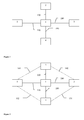
- FIG. 1 An example for a tree topology is shown in Figure 1 where a GW 1 is connected by links 100 to APs 2, 3, 4, and 5.
- Figure 2 a mesh topology is shown where additionally mesh links between some APs (partial mesh with e.g. links 101 between 3 and 4 and between 2 and 5) or between more APs (higher degree mesh with links 101 and 102) are configured.
- WMNs based on standard radio technology may be suffering from congestion on links to the gateway and from adverse conditions for access at a distance of several hops from the gateway, and thus need additional support for provision of QoS and enhanced performance.
- Some effort is made in standardization (e.g. [5], [6], [7]), but additional research effort is currently under way (e.g. [2], [8]).
- enhanced mechanisms for Routing within WMNs have been proposed and patented (e.g. [9]).
- IP packet communication
- each node would be configured with 3 or 4 radio interfaces to other mesh nodes.
- the links 102 to other non-gateway nodes could be omitted without loosing throughput capacity on the average.
- Reason is that these links would only improve the performance if both other links 100 and 101 were congested or degraded.
- the invention analyses and quantifies the potential gain in meshed networks by applying methods of load balancing and traffic shaping enabled by re-attachment of end user terminals (UTs) to adjacent cells. It can be shown that by proper configuration of a mesh network the overall available transmission capacity is exploited more efficiently also in terms of QoS-dependent routing and mobility decisions.
- the achievable capacity improvements thanks to combined access/mesh load balancing has been calculated analytically as a function of amount n of mesh access points (APs) per gateway (GW), the degree of asymmetry between uplink and downlink traffic, and the ratio of traffic within the mesh to total traffic.
- a simulation considering non-homogeneously distributed traffic sources and load shows the advantage of the mesh topology in case of heavily loaded bottleneck links between GW and APs/MPs.
- the figures 6-11 analyse and quantify the potential gain in meshed networks by applying methods of load balancing and traffic shaping enabled by re-attachment of end user terminals (UTs) to adjacent cells.
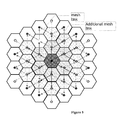
- FIG. 5 An exemplary idealized network is shown in Fig. 5 denoting a central GW (black) surrounded by several tiers of (grey) APs/MPs.
- Minimum amount of inter node links are depicted as solid arrows (tree structure) with violet dashed arrows representing mesh links for minimum mesh configuration, whereas exemplary additional mesh links are denoted by orange dashed arrows.
- n -1 APs with hexagonal cell structure around a GW.
- both the GW as well as all intermediate MPs also serve as APs for user traffic.
- the last term represents traffic from and to most distant APs which would be routed via the GW to reduce hop count and latency.
- This load may be assigned in a balanced way to all inter-MP links between adjacent branches or MP sub clusters made out of k APs. This amount is 1 in case of a scenario with minimum amount of inter-MP links but increases to 2 or 3 in case the amount m of additional mesh links per branch is increased to 1 or 2.
- P mesh Min Max ⁇ k * 1 + ⁇ - ⁇ * p - k * n - 4 * k / n * p ; k 2 * n - 3 * p / n / m + 1 ; Max k * 1 + ⁇ - ⁇ * p - k * n - 2 * k / n * p ; k 2 * n - 2 * p / n / m + 1
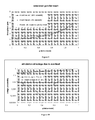
- Fig. 8 a comparison of the achievable average throughput for symmetrical traffic is depicted for different amount of APs per GW at a constant amount of 6 GW links.
Landscapes
- Engineering & Computer Science (AREA)
- Computer Networks & Wireless Communication (AREA)
- Signal Processing (AREA)
- Mobile Radio Communication Systems (AREA)
- Data Exchanges In Wide-Area Networks (AREA)
Abstract
at least one AP or a dedicated central node determines a ratio of uplink and downlink traffic (β) and/or a ratio of internal traffic to total traffic (p)
and depending on pre-defined thresholds for β and/or p additional mesh-links q are added m+q or removed m-q between two of more APs, and the traffic is re-routed correspondingly over the mesh-links.
Description
- Wireless mesh networks (WMNs) are considered to be a promising technology for cost-efficient establishment of Internet access in both sparse rural areas as well as in densely populated urban areas. In a WMN mesh routers relay traffic on behalf of clients or other routers and by this form a wireless multi-hop network. A challenge to WMNs is the congestion of links between mesh routers and optimization of the network configuration with respect to offering maximum data rate and reliability at low cost.
- The present invention describes a method and network components which allow to determine traffic characteristic parameters and use this information to find and perform the optimum configuration.
- WMNs especially have the capability to provide:
- Extension of network coverage without increasing transmit power or receive sensitivity
- Enhanced reliability via route redundancy
- Easier network configuration
- Better device battery life due to fewer retransmissions An overview on current status of technology is given in [1].
- A wireless mesh network is a network made up of three types of nodes: Those providing access to end users (Access Points, APs), those interconnecting other nodes and forwarding traffic between them (Mesh Points, MPs) and those providing access to a global external network e.g. as gateways to the internet (GateWays, GWs). The network may employ different connection arrangements, either full mesh, partial mesh, or tree topology. In the full mesh topology, each node is connected directly to each of the others. In the partial mesh topology, nodes are connected only to some other nodes (e.g. the next ones or those with which they exchange the most data traffic). In the tree topology each node is only connected with the one next neighbour towards the GW as root and the underlying APs as leaves.
- An example for a tree topology is shown in
Figure 1 where aGW 1 is connected bylinks 100 toAPs Figure 2 a mesh topology is shown where additionally mesh links between some APs (partial mesh withe.g. links 101 between 3 and 4 and between 2 and 5) or between more APs (higher degree mesh withlinks 101 and 102) are configured. - For communication systems a fully meshed topology is only relevant for small amounts of nodes (e.g. 4 APs per GW) and the traditional tree and partially meshed structure are most common.
- Although being commercially available nowadays (e.g.[4]), WMNs based on standard radio technology may be suffering from congestion on links to the gateway and from adverse conditions for access at a distance of several hops from the gateway, and thus need additional support for provision of QoS and enhanced performance. Some effort is made in standardization (e.g. [5], [6], [7]), but additional research effort is currently under way (e.g. [2], [8]). Also enhanced mechanisms for Routing within WMNs have been proposed and patented (e.g. [9]).
- The correlation between degree of meshing of network topology and impact on improved performance (e.g. in case of link outage) is well known. However, the amount of mesh links per node also increases equipment cost and network complexity and may degrade performance due to interference distortion. Therefore the amount of mesh links should be kept to a minimum. On the other hand the enhanced performance such as improvements thanks to re-routing and throughput increase by load balancing techniques have been investigated recently (e.g. [11], [12], [13], [14]). By combining these methods with the proposed mechanisms further improvement can be achieved - both in terms of cost saving (since only those interfaces are configured which are really needed to provide the optimum performance) and in overall traffic throughput of the network. Contrary to those this invention does not propose a new routing algorithm but to perform a dynamic network and equipment configuration based on simple network traffic measurements or a priori known traffic characteristics.
- To measure traffic characteristics in packet communication (IP) networks based on IP flows passing through the network elements is often interesting, useful, or even required for administrative or other purposes and are state of the art (see e.g. [10]). However compared to the multitude of information parameter generally collected and analyzed the method disclosed tries to reduce the collection and storage effort to a minimum.
-
-
Figure 1 illustrates an exemplary wireless mesh network consisting of onegateway 1 and fouraccess points access point gateway 1 via amesh link 100. -
Figure 2 is an example for a mesh network with a partly meshed topology. Eachaccess point gateway 1 viamesh links 100 and may also connect to neighboring access points viamesh links 101 and/or 102. -
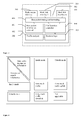
Figure 3 is a functional block diagram of a radiomesh router node 200 in accordance with some embodiments of the present invention. Theradio equipment modules -
Figure 4 is an example of the table structure for analysis of traffic characteristics with respect to the application of the present invention. -
Figure 5 is an example of a symmetrical hexagonal scenario of n APs (mesh access points) around a central GW (gateway) with inter-AP/MP links for tree topology (solid arrows) and mesh links (dashed arrows) for a mesh topology. Some further additional mesh links (m>0) are included exemplarily. Different kinds of grey cells denote the case of n=7, 19, 31, and 37 (APs per GW) . -
Figure 6 shows an achievable relative throughput per AP for 3 compared topologies and gain for mesh as a function of amount of intra-mesh traffic for different parameters (6 GW links) -
Figure 7 shows an achievable relative throughput per AP for 3 compared topologies and gain for mesh as a function of amount of intra-mesh traffic for different parameters (3 GW links) -
Figure 8 shows an achievable relative overall throughput per AP for mesh topology as a function of amount of intra-mesh traffic for different amount of APs per GW - with and without additional m inter-MP links. -
Figure 9 shows results of throughput simulation for a 7-AP mesh scenario with variable traffic demand at each AP, theoretical results for 0% variability and simulation for low and higher variability are shown. -
Figure 10 shows results of outage from simulation for a 7-AP mesh and tree topology scenario at a traffic variability of 5%. -
Figure 11 shows results of simulated gain of mesh/tree throughput for different amount of APs per GW and variabilities of traffic distribution in comparison to theoretical results. - A simple example for application of the proposed method would be the network depicted in
Figure 2 where each node would be configured with 3 or 4 radio interfaces to other mesh nodes. In case a large fraction of traffic is exchanged with corresponding nodes outside the mesh network (via the gateway 1) thelinks 102 to other non-gateway nodes could be omitted without loosing throughput capacity on the average. Reason is that these links would only improve the performance if bothother links - On the other hand in case of high fraction of intra-mesh traffic, i.e. traffic to be exchanged between
nodes links node 2 would be loaded considerably and the corresponding configuration of all 3 or 4 links per node would increase the mesh system's throughput accordingly since load on thegateway link 100 would be released correspondingly. - The invention analyses and quantifies the potential gain in meshed networks by applying methods of load balancing and traffic shaping enabled by re-attachment of end user terminals (UTs) to adjacent cells. It can be shown that by proper configuration of a mesh network the overall available transmission capacity is exploited more efficiently also in terms of QoS-dependent routing and mobility decisions.
- For illustrative purpose the achievable capacity improvements thanks to combined access/mesh load balancing has been calculated analytically as a function of amount n of mesh access points (APs) per gateway (GW), the degree of asymmetry between uplink and downlink traffic, and the ratio of traffic within the mesh to total traffic. A simulation considering non-homogeneously distributed traffic sources and load shows the advantage of the mesh topology in case of heavily loaded bottleneck links between GW and APs/MPs.
- To improve service performance for UTs attached to a mesh network such as reduced session blocking and dropping, the impact of corresponding reconfigurations such as attachment to a new AP and routing via alternative MPs are investigated. For throughput calculation both the amount of available resources (link capacity) on potential access and mesh links, and the minimum QoS provided in terms of multiple hops (delay) for different traffic classes are considered. In the following an analytical expression for the average achievable throughput enhancements thanks to combined access/mesh load balancing technique will be derived for a set of simplified reference scenarios. Aim is to obtain an upper estimation of the relative improvement which can be expected by considering both access and mesh capacity. Unlike for community networks, here the case of a wireless operator mesh network is assumed which has a hexagonal cell structure and provides identical link capacity on each mesh link.
- The
figures 6-11 analyse and quantify the potential gain in meshed networks by applying methods of load balancing and traffic shaping enabled by re-attachment of end user terminals (UTs) to adjacent cells. - An exemplary idealized network is shown in
Fig. 5 denoting a central GW (black) surrounded by several tiers of (grey) APs/MPs. Minimum amount of inter node links are depicted as solid arrows (tree structure) with violet dashed arrows representing mesh links for minimum mesh configuration, whereas exemplary additional mesh links are denoted by orange dashed arrows. - The approach to calculate the average AP capacity supported by a reference mesh scenario of n APs per GW assumes a homogeneous user distribution. Each AP (which serves terminals covered by this unit) generates (and receives) the same unit traffic amount equal to 1. The mesh links between therefore MPs exhibit the largest (composite) traffic load as a multiple of 1 will limit the overall mesh capacity or throughput.
- It is assumed that the mesh link capacity for all inter-MP links of the same length is uniform and that all APs (with lower cell range) offer a considerably higher capacity for user access. Here it is considered that mesh internal source traffic from the APs and traffic terminated at the APs is equal. For mesh external traffic level of symmetry as ratio between downlink and uplink traffic is defined to be denoted by β. As a result the total data rate has to be scaled accordingly and some technology specific overhead has to be accounted for.
- For the purpose of simplicity it is assumed a concentrically placement of n-1 APs with hexagonal cell structure around a GW. Here both the GW as well as all intermediate MPs also serve as APs for user traffic.
- It is distinguished between user traffic remaining inside the mesh (i.e. peer-to-peer or intra-mesh traffic aimed at a connection to another AP within the mesh scenario) and traffic which aims at a corresponding node outside the mesh and thus has to be routed via the GW. By denoting the probability of intra-mesh traffic by p, the portion of traffic which has to be routed via the GW is 1-p per AP, so n* (1-p) of traffic emerging via the GW interface to the outside world. A traffic volume of β*n*(1-p) is received by the GW from outside and has to be forwarded via the mesh internal interfaces. Assuming that on average the intra-mesh portion is equally distributed to all n APs, from each AP 1-p/n of the maximum traffic emerges via each mesh link.
- It is further assumed that within a tree and mesh structure originally on the average the traffic emerging from k APs is aggregated at a MP and that traffic from 1 APs (amount of APs less than half the total without GW, i.e. 1 ≤ (n - 1)/2 ) could be re-routed via mesh-links in order to reduce burden on the links to the GW. For a hexagonal scenario with one tier of (n=6) APs around the GW (each connected by a separate link) one thus obtains k=(n-1)/6=1, for two tiers already 18 CAPs are surrounding the GW, so k=(n-1)/6=3. The maximum average throughput supported by GW connectivity under tree scenarios is dependent on whether the mesh nodes have a routing functionality or not (in the latter case, here denoted as 'hierarchical tree', all traffic has to be routed via the GW).
- In the modelled hexagonal network structure three different parts contribute to the total traffic per mesh link. Represented by three terms the traffic load P consists of the part emerging from k APs, the part aiming at the k APs which emerge from the GW, and the part emerging from the other n-k APs within the mesh


- for hierarchical and routing tree topology, respectively. For a mesh topology assuming that all internal traffic is routed around the loaded GW-link it is obtained

- Here the last term represents traffic from and to most distant APs which would be routed via the GW to reduce hop count and latency. Correspondingly the traffic on the inter-MP links amounts to 2*k2*p/n per branch of k MPs, i.e. in case all n-1 MPs' traffic is forwarded around the central GW, half of them (using the 'second shortest' hop amount) contributes to each link - except the exact opposite one (in case of even number of APs within each tier) so that

- In case the most distant AP is excluded from re-routing the factor n-2 reduces to n-3.
- This load may be assigned in a balanced way to all inter-MP links between adjacent branches or MP sub clusters made out of k APs. This amount is 1 in case of a scenario with minimum amount of inter-MP links but increases to 2 or 3 in case the amount m of additional mesh links per branch is increased to 1 or 2. The overall throughput is determined by the maximum of link loads on GW-link and inter-MP links, Pmesh, GW and Pmesh, MP, but the minimum with respect to the decision on how to proceed with the most distant AP traffic - thus

- Note that it is assumed in the formulas above that both up- and downlink traffic is considered to share the same medium on the mesh links, but any additional overhead for separating both streams is not accounted for here.
- Numerical results of the formulas derived above are given in
Figures 6 - 8 where the invention has defined as gain G the relation between throughput in case of mesh and of tree topology
- for different amounts of n, m, and ß.
- As can be seen from the results shown in
Figures 6 and7 for 7 APs the advantage of mesh increases with the amount of internal traffic. However, with a high amount of down-link traffic from external networks denoted by larger ratio ß the throughput gain for mesh topology is less pronounced and reaches the maximum for even higher values of p denoting the percentage of intra-mesh traffic. As can be seen for very large values of p the gain is decreasing again since the links towards the GW are no longer a bottleneck. As expected the performance is degraded for only 3 GW links inFig. 7 compared to 6 GW links assumed forFig. 6 . - Accordingly in
Fig. 8 a comparison of the achievable average throughput for symmetrical traffic is depicted for different amount of APs per GW at a constant amount of 6 GW links. The upper graph shows the capacity without installing additional mesh links between MPs (m = 0) whereas the lower graphs show that by adding up to 3 mesh links an additional capacity increase for high portion of intra-mesh traffic can be achieved. - Both for a 7-AP and a 13-AP scenario a traffic variability simulation has been performed where for reasons of simplicity only up-link traffic has been considered (ß=0). A variable traffic demand has been assumed to originate randomly at the APs and both the achieved goodput as well as the occurring outage probability due to traffic overload has been registered for tree and mesh topologies and for different percentage of intra-mesh traffic p. The results shown in
Fig. 9 for high (5.6%) and low (0.06%) traffic variability (defined as the ratio between traffic variance and average for each AP) represent the throughput ratio between mesh and tree topology. A comparison with the theoretical values (0% variability) from the formulas above shows a good correlation for low to medium intra-mesh traffic probability and for low variability. For high variability (i.e. very inhomogeneous traffic distribution) the simulated mesh performance exceeds the theoretical values at low probability for intra-mesh traffic since here the gain for a tree topology is worse than in theory, as expected. Deviations for high fraction of intra-mesh traffic result due to the idealistic assumption of perfect reroutability of intra-mesh traffic and the high in-homogeneity causes a worse performance. The simulated outage shown inFig. 10 on one hand proves the performance increase of mesh vs. tree by revealing an outage probability for mesh of less than 10% of that for tree topology for p=0 (which reduces to less than 0.01% for p = 0.4, whereas the outage in case of tree topology steadily increases). Due to the inhomogeneous traffic origination the performance decreases again for high amount of intra-mesh traffic and overload of the inter-AP mesh links. - Also a simulative comparison between 1:7 and 1:13 ratio of GWs and APs has been performed. As can be seen from
Fig. 11 the theoretical calculation again outperforms the simulation results. The throughput ration exhibits a relative maximum in the 13-AP scenario when load on 12 mesh- and 6 gateway links is balanced. This cannot be detected in the 7-AP scenario where the amount of both link types is equal. - Both analytical analysis and numerical simulation results for the throughput gain to be achieved within a mesh network topology have been described above. This shall illustrate the impact of traffic parameters such as amount of intra-mesh traffic (p) and traffic asymmetry (ß) as well as mesh network topology configurations such as amount of nodes (n) and inter-MP links (m) on optimum achievable mesh network performance.
-
- [1] Akyildiz, I.F, Wang, X., A Survey on Wireless Mesh Networks, IEEE Radio Communications, (Sept. 2005), S23-S30.
- [2] T. H. Szymanski,Throughput and QoS optimization in nonuniform multichannel wireless mesh networks, International Workshop on Modeling Analysis and Simulation of Wireless and Mobile Systems, in: Proceedings of the 4th ACM symposium on QoS and security for wireless and mobile networks, p.9-19
- [3] EU-Projekt CARMEN, http://www.ict-carmen.eu/
- [4] MeshDynamics Patented Third Generation Wireless Mesh Technology , http://www.meshdynamics.com/mesh-network-technology.html, accessed on March30, 2010
- [5] IEEE P802.11s/D1.08. Draft amendment to standard - IEEE 802.11: ESS Mesh Networking. IEEE, Jan. 2008
- [6]IEEE 802.15 WPAN™ Task Group 5 (TG5) Mesh Networking, http://www.ieee802.org/15/pub/TG5.html
- [7] IEEE "Air Interface for Fixed and Mobile Broadband Wire-less Access Systems - Multihop Relay Specification.", http://standards.ieee.org/getieee802/download/802.16j-2009.pdf
- [8]Bayer, N. und von Hugo, D., "Challenges for Wireless Mesh Networks to provide reliable carrier-grade services", submitted to ARS 2010 (Kleinheubacher Berichte 2009)
- [9] Method and Device for Routing Mesh Network Traffic, Keith J. Goldberg and Christopher L. Bear, http://www.faqs.org/patents/app/20090028169
- [10] B. Claise, Ed., "Specification of the IP Flow Information Export (IPFIX) Protocol for the Exchange of IP Traffic Flow Information", RFC 5101, IETF January 2008
- [11] Hejiao Huang and Yun Peng, "Throughput Maximization with Traffic Profile in Wireless Mesh Network", Computing and Combinatorics, LCNS 5092/ COCOON 2008, Springer 2008, pp. 532-540
- [12] Ashish Raniwala, Kartik Gopalan, and Tzi-cker Chiueh, "Centralized Channel Assignment and Routing Algorithms for Multi-Channel Wireless Mesh Networks", Mobile Computing and Communications Review, Volume 8,
- [13] Vinh Dien HOANG, Maode MA, Hiroshi HARADA, "Multipaths Routing with Load Balancing for Internet Access in Wireless Mesh Networks", IJWMN, Vol.2, Feb. 2010, pp. 55-75
- [14] Liang Ma, Mieso K. Denko, "A Routing Metric for Load-Balancing in Wireless Mesh Networks," ainaw, vol. 2, pp.409-414, 21st International Conference on Advanced Information Networking and Applications Workshops (AINAW'07), 2007
Claims (16)
- Method improve to a mesh network topology, wherein the mesh network comprises n mesh access points (AP) and at least one gateway (GW), each AP has a least one interface to establish at least m mesh-links, wherein
a least one AP or a dedicated central node determines a ratio of uplink and downlink traffic (ß) and/or a ratio of internal traffic to total traffic (p) and depending on pre-defined thresholds for β and/or p additional mesh-links q are added m+q or removed m-q between two of more APs, and the traffic is re-routed correspondingly over the mesh-links. - The method according claim 1, wherein the ratio of uplink and downlink traffic (β) is calculated as the amount of traffic from a data source located inside the mesh which has to be routed via the gateway (GW) to a destination within an external net relative to the amount of traffic from a data source outside the mesh network which has to be routed via the gateway (GW) to a destination within the mesh network,
and/or
wherein the ratio of internal and total traffic (p) is calculated as the amount of mesh-internal traffic where both data source and destination are located within the mesh network relative to the total amount of mesh-internal and -external traffic from inspection of received and forwarded packets. - The method according to claim 1, wherein the traffic information is measured centrally and distributed to all nodes within the mesh network to adapt the number of mesh-links.
- The method according to claim 1, wherein the traffic information is measured locally and distributed to all nodes within the mesh network to adapt the number of mesh-links.
- The method according to one or more of the preceding claims, wherein the ratio of internal traffic to total traffic (p) defines the number of mesh-links between the mesh access points, wherein a higher internal traffic leads to a higher number of mesh-links between the mesh access points, and vice versa.
- The method according to one or more of the preceding claims, wherein the ratio of uplink and downlink traffic (β) defines the number of mesh-links from the mesh access points to the gateway (GW), wherein a higher downlink traffic leads to a higher number of mesh-links from the GW to the AP and vice versa.
- The method according to one or more of the preceding claims, wherein traffic load balancing methods are used to re-configure a mesh network to achieve an optimum overall network after throughput after a change of the mesh-links.
- The method according to one or more of the preceding claims, wherein the ratio is stored in the intelligent reconfiguration control logic as a function of n, m, ß, measuring the ratio between amount of intra-mesh traffic and total traffic, p, at each AP and transferring this information to a control unit calculating the average figure of p for the mesh network, from a look-up table, storing the relation between average achievable gain and the parameters then the optimum configuration in terms of additional or less activated mesh links q is derived and a signal to switch on or off these links is sent to all AP.
- Mesh network topology, wherein the mesh network comprises n mesh access points (AP) and at least one gateway (GW), each AP has a least one interface to establish at least m mesh-links, wherein
at least one AP or a dedicated central node comprise a determination unit to determine a ratio of uplink and downlink traffic (β) and/or a ration of internal traffic to external traffic (p)
and depending on pre-defined thresholds for β and/or p additional mesh-links q the APs are able to add m+q or remove m-q between two of more APs, and to re-route the traffic correspondingly over the mesh-links. - Mesh network topology, The method according claim 1,
wherein the ratio of uplink and downlink traffic (β) is calculated as the amount of traffic from a data source located inside the mesh which has to be routed via the gateway (GW) to a destination within an external net relative to the amount of traffic from a data source outside the mesh network which has to be routed via the gateway (GW) to a destination within the mesh network,
and/or
wherein the ratio of internal and total traffic (p) is calculated as the amount of mesh-internal traffic where both data source and destination are located within the mesh network relative to the total amount of mesh-internal and -external traffic from inspection of received and forwarded packets. - Mesh network topology according to claim 10, wherein the dedicated central node is adapted to measure the traffic information centrally and to distribute the result to all APs within the mesh network to adapt the number of mesh-links.
- Mesh network topology to claim 10, wherein the traffic information is measured locally and distributed to all APs within the mesh network to adapt the number of mesh-links.
- Mesh network topology according to one or more of the preceding claims 10-12, wherein the ratio of internal traffic to total traffic (p) defines the number of mesh-links between the mesh access points, wherein a higher internal traffic leads to a higher number of mesh-links between the mesh access points, and vice versa.
- Mesh network topology according to one or more of the preceding claims 10-13, wherein the ratio of uplink and downlink traffic (β) defines the number of mesh-links from the mesh access points to the gateway (GW), wherein a higher downlink traffic leads to a higher number of mesh-links from the GW to the AP and vice versa.
- Mesh network topology according to one or more of the preceding claims 10-14, wherein traffic load balancing methods are used to re-configure a mesh network to achieve an optimum overall network after throughput after a change of the mesh-links.
- Mesh network topology according to one or more of the preceding claims 10-15, wherein the ratio is stored in the intelligent reconfiguration control logic of the AP or the central node as a function of n, m, ß, measuring the ratio between amount of intra-mesh traffic and total traffic, p, at each AP and transferring this information a the control unit calculating the average figure of p for the mesh network, from a look-up table, storing the relation between average achievable gain and the parameters then the optimum configuration in terms of additional or less activated mesh links q is derived and a signal to switch on or off these links is sent to all APs.
Priority Applications (3)
| Application Number | Priority Date | Filing Date | Title |
|---|---|---|---|
| ES10177396.8T ES2512691T3 (en) | 2010-09-17 | 2010-09-17 | Procedure and system for the optimal configuration of a mesh network considering traffic characteristics |
| PL10177396T PL2432269T3 (en) | 2010-09-17 | 2010-09-17 | Method and system for optimum configuration of a mesh network considering traffic characteristics |
| EP10177396.8A EP2432269B1 (en) | 2010-09-17 | 2010-09-17 | Method and system for optimum configuration of a mesh network considering traffic characteristics |
Applications Claiming Priority (1)
| Application Number | Priority Date | Filing Date | Title |
|---|---|---|---|
| EP10177396.8A EP2432269B1 (en) | 2010-09-17 | 2010-09-17 | Method and system for optimum configuration of a mesh network considering traffic characteristics |
Publications (2)
| Publication Number | Publication Date |
|---|---|
| EP2432269A1 true EP2432269A1 (en) | 2012-03-21 |
| EP2432269B1 EP2432269B1 (en) | 2014-07-23 |
Family
ID=43567742
Family Applications (1)
| Application Number | Title | Priority Date | Filing Date |
|---|---|---|---|
| EP10177396.8A Active EP2432269B1 (en) | 2010-09-17 | 2010-09-17 | Method and system for optimum configuration of a mesh network considering traffic characteristics |
Country Status (3)
| Country | Link |
|---|---|
| EP (1) | EP2432269B1 (en) |
| ES (1) | ES2512691T3 (en) |
| PL (1) | PL2432269T3 (en) |
Cited By (3)
| Publication number | Priority date | Publication date | Assignee | Title |
|---|---|---|---|---|
| US10142927B2 (en) | 2015-11-10 | 2018-11-27 | Red Hat, Inc. | Selection of a mesh access point in a wireless mesh network |
| US11395126B2 (en) * | 2017-03-25 | 2022-07-19 | Arris Enterprises Llc | Technique for establishing a mesh network |
| CN114980242A (en) * | 2022-05-26 | 2022-08-30 | 烽火通信科技股份有限公司 | Mesh networking multi-service system and implementation method |
Citations (2)
| Publication number | Priority date | Publication date | Assignee | Title |
|---|---|---|---|---|
| US20080181124A1 (en) * | 2007-01-31 | 2008-07-31 | Tropos Networks, Inc. | Conversion of access nodes to gateways within a wireless mesh network |
| US20080225717A1 (en) * | 2007-03-12 | 2008-09-18 | Wei-Peng Chen | Traffic engineering on wireless mesh networks |
-
2010
- 2010-09-17 PL PL10177396T patent/PL2432269T3/en unknown
- 2010-09-17 EP EP10177396.8A patent/EP2432269B1/en active Active
- 2010-09-17 ES ES10177396.8T patent/ES2512691T3/en active Active
Patent Citations (2)
| Publication number | Priority date | Publication date | Assignee | Title |
|---|---|---|---|---|
| US20080181124A1 (en) * | 2007-01-31 | 2008-07-31 | Tropos Networks, Inc. | Conversion of access nodes to gateways within a wireless mesh network |
| US20080225717A1 (en) * | 2007-03-12 | 2008-09-18 | Wei-Peng Chen | Traffic engineering on wireless mesh networks |
Non-Patent Citations (9)
| Title |
|---|
| "RFC 5101", January 2008, article "Specification of the IP Flow Information Export (IPFIX) Protocol for the Exchange of IP Traffic Flow Information" |
| AKYILDIZ, I.FWANG, X.: "A Survey on Wireless Mesh Networks", IEEE RADIO COMMUNICATIONS, September 2005 (2005-09-01), pages S23 - S30 |
| ASHISH RANIWALAKARTIK GOPALANTZI-CKER CHIUEH: "Centralized Channel Assignment and Routing Algorithms for Multi-Channel Wireless Mesh Networks", MOBILE COMPUTING AND COMMUNICATIONS REVIEW, vol. 8, no. 2, pages 50 - 65 |
| BAYER, N.VON HUGO, D.: "Challenges for Wireless Mesh Networks to provide reliable carrier-grade services", ARS 2010, 2009 |
| H. SZYMANSKI: "Throughput and QoS optimization in nonuniform multichannel wireless mesh networks, International Workshop on Modeling Analysis and Simulation of Wireless and Mobile Systems", PROCEEDINGS OF THE 4TH ACM SYMPOSIUM ON QOS AND SECURITY FOR WIRELESS AND MOBILE NETWORKS, 30 March 2010 (2010-03-30), pages 9 - 19 |
| HEJIAO HUANGYUN PENG: "Computing and Combinatorics, LCNS 5092/ COCOON 2008", 2008, SPRINGER, article "Throughput Maximization with Traffic Profile in Wireless Mesh Network", pages: 532 - 540 |
| KEITH J. GOLDBERGCHRISTOPHER L. BEAR, METHOD AND DEVICE FOR ROUTING MESH NETWORK TRAFFIC, Retrieved from the Internet <URL:http://www.faqs.org/patents/app/20090028169> |
| LIANG MAMIESO K. DENKO: "A Routing Metric for Load-Balancing in Wireless Mesh Networks", 21ST INTERNATIONAL CONFERENCE ON ADVANCED INFORMATION NETWORKING AND APPLICATIONS WORKSHOPS (AINAW'07), vol. 2, 2007, pages 409 - 414 |
| VINH DIEN HOANGMAODE MAHIROSHI HARADA: "Multipaths Routing with Load Balancing for Internet Access in Wireless Mesh Networks", IJWMN, no. 2, February 2010 (2010-02-01), pages 55 - 75 |
Cited By (3)
| Publication number | Priority date | Publication date | Assignee | Title |
|---|---|---|---|---|
| US10142927B2 (en) | 2015-11-10 | 2018-11-27 | Red Hat, Inc. | Selection of a mesh access point in a wireless mesh network |
| US11395126B2 (en) * | 2017-03-25 | 2022-07-19 | Arris Enterprises Llc | Technique for establishing a mesh network |
| CN114980242A (en) * | 2022-05-26 | 2022-08-30 | 烽火通信科技股份有限公司 | Mesh networking multi-service system and implementation method |
Also Published As
| Publication number | Publication date |
|---|---|
| EP2432269B1 (en) | 2014-07-23 |
| ES2512691T3 (en) | 2014-10-24 |
| PL2432269T3 (en) | 2014-11-28 |
Similar Documents
| Publication | Publication Date | Title |
|---|---|---|
| Ma et al. | A routing metric for load-balancing in wireless mesh networks | |
| Rath et al. | Energy competent routing protocol design in MANET with real time application provision | |
| Zhao et al. | Admission control with load balancing in IEEE 802.11-based ESS mesh networks | |
| Khan et al. | Backhaul, QoS, and channel-aware load balancing optimization in SDN-based LTE networks | |
| Miao et al. | Study on research challenges and optimization for internetworking of hybrid MANET and satellite networks | |
| EP2432269B1 (en) | Method and system for optimum configuration of a mesh network considering traffic characteristics | |
| Ding et al. | Hybrid multi-channel multi-radio wireless mesh networks | |
| Kapadia et al. | Congestion aware load balancing for multiradio Wireless Mesh Network | |
| Robertsingh et al. | Development and analysis of wireless mesh networks with load-balancing for AMI in smart grid | |
| Gupta et al. | Optimization of routing algorithm in wireless mesh networks | |
| Pan et al. | Multi-path routing for video streaming in multi-radio multi-channel wireless mesh networks | |
| Wang et al. | Dynamic association in IEEE 802.11 based wireless mesh networks | |
| Yu et al. | Network resource aware association control in wireless mesh networks | |
| Houaidia et al. | Towards an optimised traffic-aware routing in wireless mesh networks | |
| Pollak et al. | A channel assignment algorithm for wireless mesh networks with interference minimization | |
| Karia et al. | Review of routing metrics for wireless mesh networks | |
| Mehroze et al. | Fairness Based Dynamic Routing Technique (FsBDRT) in Wireless Mesh Network | |
| Liu et al. | Design of a Routing Protocol with Minimum End-to-End Delay in MR-MC Network | |
| Chakraborty et al. | Beyond conventional routing protocols: Opportunistic path selection for IEEE 802.11 s mesh networks | |
| Zogkou et al. | Energy aware routing in IEEE 802.11 s wireless mesh networks | |
| Keerthi et al. | Buffer based Routing Mechanism for Load Balancing in Wireless Mesh Networks | |
| Chakraborty et al. | MAC layer fairness in IEEE 802.11 DCF based wireless mesh networks | |
| Ma et al. | Enhanced routing metric for load-balancing in wireless mesh networks | |
| Bian et al. | Relative link quality assessment and hybrid routing scheme for wireless mesh networks | |
| Hava et al. | On monitoring overhead impact in wireless mesh networks |
Legal Events
| Date | Code | Title | Description |
|---|---|---|---|
| PUAI | Public reference made under article 153(3) epc to a published international application that has entered the european phase |
Free format text: ORIGINAL CODE: 0009012 |
|
| AK | Designated contracting states |
Kind code of ref document: A1 Designated state(s): AL AT BE BG CH CY CZ DE DK EE ES FI FR GB GR HR HU IE IS IT LI LT LU LV MC MK MT NL NO PL PT RO SE SI SK SM TR |
|
| AX | Request for extension of the european patent |
Extension state: BA ME RS |
|
| 17P | Request for examination filed |
Effective date: 20110617 |
|
| 17Q | First examination report despatched |
Effective date: 20130508 |
|
| GRAP | Despatch of communication of intention to grant a patent |
Free format text: ORIGINAL CODE: EPIDOSNIGR1 |
|
| INTG | Intention to grant announced |
Effective date: 20140228 |
|
| GRAS | Grant fee paid |
Free format text: ORIGINAL CODE: EPIDOSNIGR3 |
|
| GRAA | (expected) grant |
Free format text: ORIGINAL CODE: 0009210 |
|
| AK | Designated contracting states |
Kind code of ref document: B1 Designated state(s): AL AT BE BG CH CY CZ DE DK EE ES FI FR GB GR HR HU IE IS IT LI LT LU LV MC MK MT NL NO PL PT RO SE SI SK SM TR |
|
| REG | Reference to a national code |
Ref country code: GB Ref legal event code: FG4D |
|
| REG | Reference to a national code |
Ref country code: CH Ref legal event code: EP |
|
| REG | Reference to a national code |
Ref country code: IE Ref legal event code: FG4D |
|
| REG | Reference to a national code |
Ref country code: AT Ref legal event code: REF Ref document number: 679437 Country of ref document: AT Kind code of ref document: T Effective date: 20140815 |
|
| REG | Reference to a national code |
Ref country code: DE Ref legal event code: R096 Ref document number: 602010017652 Country of ref document: DE Effective date: 20140904 |
|
| REG | Reference to a national code |
Ref country code: ES Ref legal event code: FG2A Ref document number: 2512691 Country of ref document: ES Kind code of ref document: T3 Effective date: 20141024 |
|
| REG | Reference to a national code |
Ref country code: PL Ref legal event code: T3 |
|
| REG | Reference to a national code |
Ref country code: AT Ref legal event code: MK05 Ref document number: 679437 Country of ref document: AT Kind code of ref document: T Effective date: 20140723 |
|
| REG | Reference to a national code |
Ref country code: NL Ref legal event code: VDEP Effective date: 20140723 |
|
| REG | Reference to a national code |
Ref country code: LT Ref legal event code: MG4D |
|
| PG25 | Lapsed in a contracting state [announced via postgrant information from national office to epo] |
Ref country code: GR Free format text: LAPSE BECAUSE OF FAILURE TO SUBMIT A TRANSLATION OF THE DESCRIPTION OR TO PAY THE FEE WITHIN THE PRESCRIBED TIME-LIMIT Effective date: 20141024 Ref country code: SE Free format text: LAPSE BECAUSE OF FAILURE TO SUBMIT A TRANSLATION OF THE DESCRIPTION OR TO PAY THE FEE WITHIN THE PRESCRIBED TIME-LIMIT Effective date: 20140723 Ref country code: LT Free format text: LAPSE BECAUSE OF FAILURE TO SUBMIT A TRANSLATION OF THE DESCRIPTION OR TO PAY THE FEE WITHIN THE PRESCRIBED TIME-LIMIT Effective date: 20140723 Ref country code: FI Free format text: LAPSE BECAUSE OF FAILURE TO SUBMIT A TRANSLATION OF THE DESCRIPTION OR TO PAY THE FEE WITHIN THE PRESCRIBED TIME-LIMIT Effective date: 20140723 Ref country code: PT Free format text: LAPSE BECAUSE OF FAILURE TO SUBMIT A TRANSLATION OF THE DESCRIPTION OR TO PAY THE FEE WITHIN THE PRESCRIBED TIME-LIMIT Effective date: 20141124 Ref country code: NO Free format text: LAPSE BECAUSE OF FAILURE TO SUBMIT A TRANSLATION OF THE DESCRIPTION OR TO PAY THE FEE WITHIN THE PRESCRIBED TIME-LIMIT Effective date: 20141023 Ref country code: BG Free format text: LAPSE BECAUSE OF FAILURE TO SUBMIT A TRANSLATION OF THE DESCRIPTION OR TO PAY THE FEE WITHIN THE PRESCRIBED TIME-LIMIT Effective date: 20141023 |
|
| PG25 | Lapsed in a contracting state [announced via postgrant information from national office to epo] |
Ref country code: NL Free format text: LAPSE BECAUSE OF FAILURE TO SUBMIT A TRANSLATION OF THE DESCRIPTION OR TO PAY THE FEE WITHIN THE PRESCRIBED TIME-LIMIT Effective date: 20140723 Ref country code: HR Free format text: LAPSE BECAUSE OF FAILURE TO SUBMIT A TRANSLATION OF THE DESCRIPTION OR TO PAY THE FEE WITHIN THE PRESCRIBED TIME-LIMIT Effective date: 20140723 Ref country code: IS Free format text: LAPSE BECAUSE OF FAILURE TO SUBMIT A TRANSLATION OF THE DESCRIPTION OR TO PAY THE FEE WITHIN THE PRESCRIBED TIME-LIMIT Effective date: 20141123 Ref country code: AT Free format text: LAPSE BECAUSE OF FAILURE TO SUBMIT A TRANSLATION OF THE DESCRIPTION OR TO PAY THE FEE WITHIN THE PRESCRIBED TIME-LIMIT Effective date: 20140723 Ref country code: LV Free format text: LAPSE BECAUSE OF FAILURE TO SUBMIT A TRANSLATION OF THE DESCRIPTION OR TO PAY THE FEE WITHIN THE PRESCRIBED TIME-LIMIT Effective date: 20140723 Ref country code: CY Free format text: LAPSE BECAUSE OF FAILURE TO SUBMIT A TRANSLATION OF THE DESCRIPTION OR TO PAY THE FEE WITHIN THE PRESCRIBED TIME-LIMIT Effective date: 20140723 |
|
| REG | Reference to a national code |
Ref country code: DE Ref legal event code: R097 Ref document number: 602010017652 Country of ref document: DE |
|
| PG25 | Lapsed in a contracting state [announced via postgrant information from national office to epo] |
Ref country code: EE Free format text: LAPSE BECAUSE OF FAILURE TO SUBMIT A TRANSLATION OF THE DESCRIPTION OR TO PAY THE FEE WITHIN THE PRESCRIBED TIME-LIMIT Effective date: 20140723 Ref country code: DK Free format text: LAPSE BECAUSE OF FAILURE TO SUBMIT A TRANSLATION OF THE DESCRIPTION OR TO PAY THE FEE WITHIN THE PRESCRIBED TIME-LIMIT Effective date: 20140723 Ref country code: IT Free format text: LAPSE BECAUSE OF FAILURE TO SUBMIT A TRANSLATION OF THE DESCRIPTION OR TO PAY THE FEE WITHIN THE PRESCRIBED TIME-LIMIT Effective date: 20140723 Ref country code: CZ Free format text: LAPSE BECAUSE OF FAILURE TO SUBMIT A TRANSLATION OF THE DESCRIPTION OR TO PAY THE FEE WITHIN THE PRESCRIBED TIME-LIMIT Effective date: 20140723 Ref country code: RO Free format text: LAPSE BECAUSE OF FAILURE TO SUBMIT A TRANSLATION OF THE DESCRIPTION OR TO PAY THE FEE WITHIN THE PRESCRIBED TIME-LIMIT Effective date: 20140723 Ref country code: LU Free format text: LAPSE BECAUSE OF FAILURE TO SUBMIT A TRANSLATION OF THE DESCRIPTION OR TO PAY THE FEE WITHIN THE PRESCRIBED TIME-LIMIT Effective date: 20140917 Ref country code: SK Free format text: LAPSE BECAUSE OF FAILURE TO SUBMIT A TRANSLATION OF THE DESCRIPTION OR TO PAY THE FEE WITHIN THE PRESCRIBED TIME-LIMIT Effective date: 20140723 Ref country code: MC Free format text: LAPSE BECAUSE OF FAILURE TO SUBMIT A TRANSLATION OF THE DESCRIPTION OR TO PAY THE FEE WITHIN THE PRESCRIBED TIME-LIMIT Effective date: 20140723 |
|
| REG | Reference to a national code |
Ref country code: CH Ref legal event code: PL |
|
| PLBE | No opposition filed within time limit |
Free format text: ORIGINAL CODE: 0009261 |
|
| STAA | Information on the status of an ep patent application or granted ep patent |
Free format text: STATUS: NO OPPOSITION FILED WITHIN TIME LIMIT |
|
| REG | Reference to a national code |
Ref country code: IE Ref legal event code: MM4A |
|
| PG25 | Lapsed in a contracting state [announced via postgrant information from national office to epo] |
Ref country code: BE Free format text: LAPSE BECAUSE OF NON-PAYMENT OF DUE FEES Effective date: 20140930 |
|
| 26N | No opposition filed |
Effective date: 20150424 |
|
| PG25 | Lapsed in a contracting state [announced via postgrant information from national office to epo] |
Ref country code: LI Free format text: LAPSE BECAUSE OF NON-PAYMENT OF DUE FEES Effective date: 20140930 Ref country code: CH Free format text: LAPSE BECAUSE OF NON-PAYMENT OF DUE FEES Effective date: 20140930 |
|
| PG25 | Lapsed in a contracting state [announced via postgrant information from national office to epo] |
Ref country code: IE Free format text: LAPSE BECAUSE OF NON-PAYMENT OF DUE FEES Effective date: 20140917 |
|
| PG25 | Lapsed in a contracting state [announced via postgrant information from national office to epo] |
Ref country code: SI Free format text: LAPSE BECAUSE OF FAILURE TO SUBMIT A TRANSLATION OF THE DESCRIPTION OR TO PAY THE FEE WITHIN THE PRESCRIBED TIME-LIMIT Effective date: 20140723 |
|
| PG25 | Lapsed in a contracting state [announced via postgrant information from national office to epo] |
Ref country code: SM Free format text: LAPSE BECAUSE OF FAILURE TO SUBMIT A TRANSLATION OF THE DESCRIPTION OR TO PAY THE FEE WITHIN THE PRESCRIBED TIME-LIMIT Effective date: 20140723 |
|
| PG25 | Lapsed in a contracting state [announced via postgrant information from national office to epo] |
Ref country code: MT Free format text: LAPSE BECAUSE OF FAILURE TO SUBMIT A TRANSLATION OF THE DESCRIPTION OR TO PAY THE FEE WITHIN THE PRESCRIBED TIME-LIMIT Effective date: 20140723 |
|
| PG25 | Lapsed in a contracting state [announced via postgrant information from national office to epo] |
Ref country code: HU Free format text: LAPSE BECAUSE OF FAILURE TO SUBMIT A TRANSLATION OF THE DESCRIPTION OR TO PAY THE FEE WITHIN THE PRESCRIBED TIME-LIMIT; INVALID AB INITIO Effective date: 20100917 Ref country code: BE Free format text: LAPSE BECAUSE OF FAILURE TO SUBMIT A TRANSLATION OF THE DESCRIPTION OR TO PAY THE FEE WITHIN THE PRESCRIBED TIME-LIMIT Effective date: 20140723 |
|
| REG | Reference to a national code |
Ref country code: FR Ref legal event code: PLFP Year of fee payment: 7 |
|
| REG | Reference to a national code |
Ref country code: FR Ref legal event code: PLFP Year of fee payment: 8 |
|
| PG25 | Lapsed in a contracting state [announced via postgrant information from national office to epo] |
Ref country code: MK Free format text: LAPSE BECAUSE OF FAILURE TO SUBMIT A TRANSLATION OF THE DESCRIPTION OR TO PAY THE FEE WITHIN THE PRESCRIBED TIME-LIMIT Effective date: 20140723 |
|
| REG | Reference to a national code |
Ref country code: FR Ref legal event code: PLFP Year of fee payment: 9 |
|
| PG25 | Lapsed in a contracting state [announced via postgrant information from national office to epo] |
Ref country code: AL Free format text: LAPSE BECAUSE OF FAILURE TO SUBMIT A TRANSLATION OF THE DESCRIPTION OR TO PAY THE FEE WITHIN THE PRESCRIBED TIME-LIMIT Effective date: 20140723 |
|
| PGFP | Annual fee paid to national office [announced via postgrant information from national office to epo] |
Ref country code: DE Payment date: 20240919 Year of fee payment: 15 |
|
| PGFP | Annual fee paid to national office [announced via postgrant information from national office to epo] |
Ref country code: GB Payment date: 20240923 Year of fee payment: 15 |
|
| PGFP | Annual fee paid to national office [announced via postgrant information from national office to epo] |
Ref country code: FR Payment date: 20240925 Year of fee payment: 15 |
|
| PGFP | Annual fee paid to national office [announced via postgrant information from national office to epo] |
Ref country code: PL Payment date: 20240906 Year of fee payment: 15 |
|
| PGFP | Annual fee paid to national office [announced via postgrant information from national office to epo] |
Ref country code: TR Payment date: 20240906 Year of fee payment: 15 |
|
| PGFP | Annual fee paid to national office [announced via postgrant information from national office to epo] |
Ref country code: ES Payment date: 20241018 Year of fee payment: 15 |