EP2431591A2 - Bleed valve - Google Patents
Bleed valve Download PDFInfo
- Publication number
- EP2431591A2 EP2431591A2 EP11178269A EP11178269A EP2431591A2 EP 2431591 A2 EP2431591 A2 EP 2431591A2 EP 11178269 A EP11178269 A EP 11178269A EP 11178269 A EP11178269 A EP 11178269A EP 2431591 A2 EP2431591 A2 EP 2431591A2
- Authority
- EP
- European Patent Office
- Prior art keywords
- bleed valve
- vector
- outlet port
- longitudinal
- radial
- Prior art date
- Legal status (The legal status is an assumption and is not a legal conclusion. Google has not performed a legal analysis and makes no representation as to the accuracy of the status listed.)
- Withdrawn
Links
- 239000013598 vector Substances 0.000 claims abstract description 34
- 239000012530 fluid Substances 0.000 claims description 4
- 230000000254 damaging effect Effects 0.000 description 3
- 230000009286 beneficial effect Effects 0.000 description 2
- 238000011144 upstream manufacturing Methods 0.000 description 2
- 230000001427 coherent effect Effects 0.000 description 1
- 150000001875 compounds Chemical class 0.000 description 1
- 230000000694 effects Effects 0.000 description 1
- 230000017525 heat dissipation Effects 0.000 description 1
- 239000000463 material Substances 0.000 description 1
- 230000000149 penetrating effect Effects 0.000 description 1
- 230000001141 propulsive effect Effects 0.000 description 1
- 230000007704 transition Effects 0.000 description 1
- 238000009423 ventilation Methods 0.000 description 1
Images

Classifications
-
- F—MECHANICAL ENGINEERING; LIGHTING; HEATING; WEAPONS; BLASTING
- F16—ENGINEERING ELEMENTS AND UNITS; GENERAL MEASURES FOR PRODUCING AND MAINTAINING EFFECTIVE FUNCTIONING OF MACHINES OR INSTALLATIONS; THERMAL INSULATION IN GENERAL
- F16F—SPRINGS; SHOCK-ABSORBERS; MEANS FOR DAMPING VIBRATION
- F16F5/00—Liquid springs in which the liquid works as a spring by compression, e.g. combined with throttling action; Combinations of devices including liquid springs
-
- F—MECHANICAL ENGINEERING; LIGHTING; HEATING; WEAPONS; BLASTING
- F02—COMBUSTION ENGINES; HOT-GAS OR COMBUSTION-PRODUCT ENGINE PLANTS
- F02C—GAS-TURBINE PLANTS; AIR INTAKES FOR JET-PROPULSION PLANTS; CONTROLLING FUEL SUPPLY IN AIR-BREATHING JET-PROPULSION PLANTS
- F02C6/00—Plural gas-turbine plants; Combinations of gas-turbine plants with other apparatus; Adaptations of gas-turbine plants for special use
- F02C6/04—Gas-turbine plants providing heated or pressurised working fluid for other apparatus, e.g. without mechanical power output
- F02C6/06—Gas-turbine plants providing heated or pressurised working fluid for other apparatus, e.g. without mechanical power output providing compressed gas
- F02C6/08—Gas-turbine plants providing heated or pressurised working fluid for other apparatus, e.g. without mechanical power output providing compressed gas the gas being bled from the gas-turbine compressor
-
- F—MECHANICAL ENGINEERING; LIGHTING; HEATING; WEAPONS; BLASTING
- F02—COMBUSTION ENGINES; HOT-GAS OR COMBUSTION-PRODUCT ENGINE PLANTS
- F02C—GAS-TURBINE PLANTS; AIR INTAKES FOR JET-PROPULSION PLANTS; CONTROLLING FUEL SUPPLY IN AIR-BREATHING JET-PROPULSION PLANTS
- F02C9/00—Controlling gas-turbine plants; Controlling fuel supply in air- breathing jet-propulsion plants
- F02C9/16—Control of working fluid flow
- F02C9/18—Control of working fluid flow by bleeding, bypassing or acting on variable working fluid interconnections between turbines or compressors or their stages
-
- F—MECHANICAL ENGINEERING; LIGHTING; HEATING; WEAPONS; BLASTING
- F02—COMBUSTION ENGINES; HOT-GAS OR COMBUSTION-PRODUCT ENGINE PLANTS
- F02K—JET-PROPULSION PLANTS
- F02K3/00—Plants including a gas turbine driving a compressor or a ducted fan
- F02K3/02—Plants including a gas turbine driving a compressor or a ducted fan in which part of the working fluid by-passes the turbine and combustion chamber
-
- F—MECHANICAL ENGINEERING; LIGHTING; HEATING; WEAPONS; BLASTING
- F02—COMBUSTION ENGINES; HOT-GAS OR COMBUSTION-PRODUCT ENGINE PLANTS
- F02K—JET-PROPULSION PLANTS
- F02K3/00—Plants including a gas turbine driving a compressor or a ducted fan
- F02K3/02—Plants including a gas turbine driving a compressor or a ducted fan in which part of the working fluid by-passes the turbine and combustion chamber
- F02K3/04—Plants including a gas turbine driving a compressor or a ducted fan in which part of the working fluid by-passes the turbine and combustion chamber the plant including ducted fans, i.e. fans with high volume, low pressure outputs, for augmenting the jet thrust, e.g. of double-flow type
- F02K3/075—Plants including a gas turbine driving a compressor or a ducted fan in which part of the working fluid by-passes the turbine and combustion chamber the plant including ducted fans, i.e. fans with high volume, low pressure outputs, for augmenting the jet thrust, e.g. of double-flow type controlling flow ratio between flows
-
- F—MECHANICAL ENGINEERING; LIGHTING; HEATING; WEAPONS; BLASTING
- F04—POSITIVE - DISPLACEMENT MACHINES FOR LIQUIDS; PUMPS FOR LIQUIDS OR ELASTIC FLUIDS
- F04D—NON-POSITIVE-DISPLACEMENT PUMPS
- F04D27/00—Control, e.g. regulation, of pumps, pumping installations or pumping systems specially adapted for elastic fluids
- F04D27/02—Surge control
- F04D27/0207—Surge control by bleeding, bypassing or recycling fluids
- F04D27/0215—Arrangements therefor, e.g. bleed or by-pass valves
-
- F—MECHANICAL ENGINEERING; LIGHTING; HEATING; WEAPONS; BLASTING
- F05—INDEXING SCHEMES RELATING TO ENGINES OR PUMPS IN VARIOUS SUBCLASSES OF CLASSES F01-F04
- F05D—INDEXING SCHEME FOR ASPECTS RELATING TO NON-POSITIVE-DISPLACEMENT MACHINES OR ENGINES, GAS-TURBINES OR JET-PROPULSION PLANTS
- F05D2240/00—Components
- F05D2240/10—Stators
- F05D2240/12—Fluid guiding means, e.g. vanes
- F05D2240/129—Cascades, i.e. assemblies of similar profiles acting in parallel
-
- F—MECHANICAL ENGINEERING; LIGHTING; HEATING; WEAPONS; BLASTING
- F05—INDEXING SCHEMES RELATING TO ENGINES OR PUMPS IN VARIOUS SUBCLASSES OF CLASSES F01-F04
- F05D—INDEXING SCHEME FOR ASPECTS RELATING TO NON-POSITIVE-DISPLACEMENT MACHINES OR ENGINES, GAS-TURBINES OR JET-PROPULSION PLANTS
- F05D2250/00—Geometry
- F05D2250/30—Arrangement of components
- F05D2250/31—Arrangement of components according to the direction of their main axis or their axis of rotation
- F05D2250/312—Arrangement of components according to the direction of their main axis or their axis of rotation the axes being parallel to each other
-
- F—MECHANICAL ENGINEERING; LIGHTING; HEATING; WEAPONS; BLASTING
- F05—INDEXING SCHEMES RELATING TO ENGINES OR PUMPS IN VARIOUS SUBCLASSES OF CLASSES F01-F04
- F05D—INDEXING SCHEME FOR ASPECTS RELATING TO NON-POSITIVE-DISPLACEMENT MACHINES OR ENGINES, GAS-TURBINES OR JET-PROPULSION PLANTS
- F05D2250/00—Geometry
- F05D2250/50—Inlet or outlet
- F05D2250/52—Outlet
Definitions
- the present invention relates to a bleed valve, particularly although not exclusively to a bleed valve for a gas turbine engine.
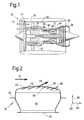
- a gas turbine engine 10 is shown in Figure 1 and comprises an air intake 12 and a propulsive fan 14 that generates two airflows A and B.
- the gas turbine engine 10 comprises, in axial flow A, an intermediate pressure compressor 16, a high pressure compressor 18, a combustor 20, a high pressure turbine 22, an intermediate pressure turbine 24, a low pressure turbine 26 and an exhaust nozzle 28.
- a nacelle 30 surrounds the gas turbine engine 10 and defines, in axial flow B, a bypass duct 32.
- An array of bleed valves 34 of which one is illustrated, is provided to selectively extract air from the intermediate pressure compressor 16 and to expel it into the bypass duct 32.
- the bleed valves 34 are opened to extract air to reduce the surge margin of the compressor.
- An array of bleed valves 34 may also be provided to selectively extract air from the high pressure compressor 18 (not illustrated).
- Conventional bleed valves 34 comprise an outlet port that couples the bleed valve 34 to the bypass duct 32.
- the outlet port causes air to be expelled as a cohesive or disparate plume.
- the bypass duct 32 has relatively restricted radial extent and may comprise a heat intolerant material. Therefore, it is important that the plume of expelled air is turbulently mixed with axial airflow B to reduce its heat before it contacts the radially outer wall 36 of the bypass duct 32. Similarly it is beneficial that the plume is well mixed with airflow B before it is entrained against the radially inner wall 38 of the bypass duct 32 at a location downstream of the bleed valve 34.
- Prior art bleed valves 34 have sought to improve the mixing of the expelled plume with airflow B by providing an outlet port comprising a perforated plate that causes air to be expelled as a plume composed of multiple jets.
- a similar effect has been achieved using vanes.
- the perforations or vanes are typically angled to point either downstream or upstream, relative to axial airflow B in order to increase the plume length in a given radial distance across the bypass duct 32.
- the present invention provides a bleed valve that seeks to address the aforementioned problems.
- the present invention provides a bleed valve having an inlet port and an outlet port, the bleed valve comprising mutually perpendicular radial, longitudinal and tangential axes arranged such that the outlet port is substantially in a plane defined by the longitudinal and tangential axes; and at least one vane spanning the outlet port and having a first side and a second side, the first side being closer to the inlet port than the second side, and the at least one vane defining a vector from its first to its second side that has non-zero radial, longitudinal and tangential components.
- a bleed valve increases the radial distance that a bleed valve plume travels before contacting another component and being more diffused and mixed with another flow in that distance.
- the plume is cooler when it makes contact, reducing the amount of damage caused.
- the bleed valve may comprise multiple vanes that are arranged to be parallel to each other.
- the vector may be greater than 0° and smaller than 180° from the longitudinal axis. More specifically, the vector may be greater than 10° and smaller than 170° from the longitudinal axis. Still more specifically, the vector may be greater than 25° and smaller than 155° from the longitudinal axis. In particular embodiments the vector may be substantially equal to 40° from the longitudinal axis or substantially equal to 140° from the longitudinal axis. The angle may be chosen to optimise the flow path of the air expelled from the bleed valve.
- the radial, longitudinal and tangential vector components may be defined such that a fluid plume expelled through the outlet port has a predetermined radial extent.
- the present invention also provides a gas turbine engine having a principal engine axis and a bleed valve as described wherein the longitudinal axis is parallel to the principal engine axis and the radial axis is parallel to an engine radius.
- the gas turbine engine may comprise a bypass duct wherein the outlet port is located in a radially inner wall of the bypass duct.
- the gas turbine engine may comprise at least one annular array of bleed valves.
- the radial, longitudinal and tangential vector components may be defined such that a fluid plume expelled through the outlet port has a predetermined radial extent relative to the bypass duct.
- a bleed valve 34 is shown in Figure 2 that protrudes through the radially inner bypass duct wall 38, a part of which is shown.
- the bleed valve 34 comprises a body 40 that is bounded by an inlet port 42 and an outlet port 44.
- the body 40 may be cylindrical or may be a prism based on an oval or ellipse, for example, as is well understood in the art.
- the inlet port 42 and outlet port 44 may be different shapes and the body 40 shaped to transition between the ports 42, 44.
- a set of mutually perpendicular co-ordinate axes is defined for the bleed valve 34, being a radial axis 46, a longitudinal axis 48 and a tangential axis 50.
- the vector extending between the inlet port 42 and the outlet port 44 lies on or parallel to the radial axis 46 whilst each of the inlet and outlet ports 42, 44 lie substantially in a plane defined by the longitudinal and tangential axes 48, 50.
- the bleed valve 34 comprises multiple parallel vanes 52 that span the outlet port 44 in an array. Each vane 52 extends between a first side 54 and a second side 56, the first side 54 being positioned closer to the inlet port 42 than the second side 56. The vanes 52 are angled so that bleed flow that enters the body 40 of the bleed valve 34 through the inlet port 42 in a substantially radial direction is diverted to be expelled through the outlet port 44, as shown by arrow 58, in a more downstream direction with respect to the bypass airflow B.
- Each vane 52 defines a vector 60 from its first side 54 to its second side 56.
- the vector 60 has non-zero components in the radial, longitudinal and tangential directions, whereas prior art vanes have always comprised a zero tangential component.
- the vector 60 can be written as [ r,l,t ] where r is the radial component, l is the longitudinal component, t is the tangential component and r,l,t ⁇ 0.
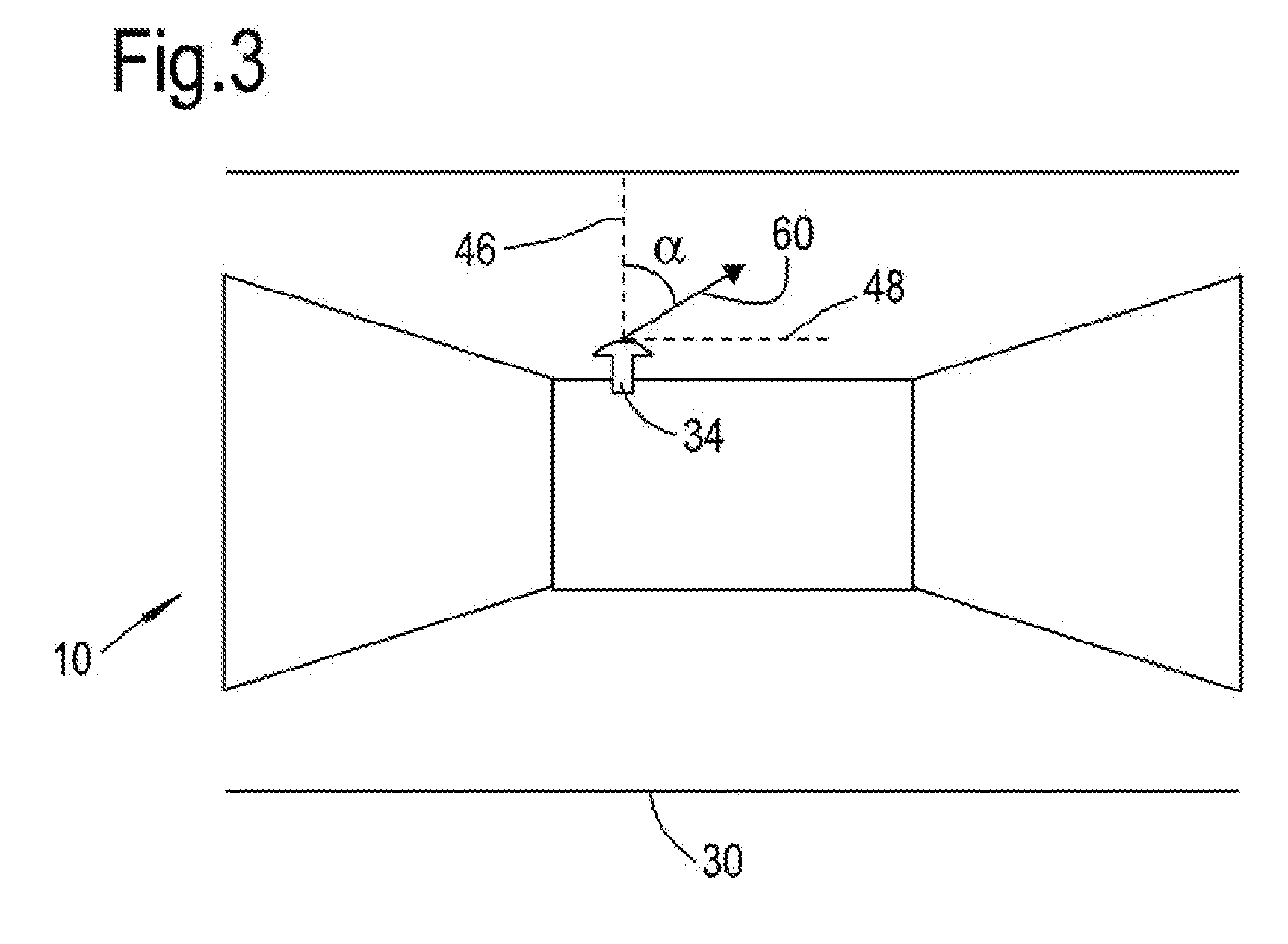
- the vector 60 is illustrated in Figures 3 and 4 .
- Each illustrates a gas turbine engine 10 having a nacelle 30 surrounding the core engine and an exemplary bleed valve 34.
- Figure 3 is a view in a plane parallel to the radial and longitudinal axes 46, 48 of the bleed valve 34.
- the vector 60 defined by the vanes 52 of the bleed valve 34 makes an angle ⁇ with the radial axis 46, or an angle of (90- ⁇ ) degrees with the longitudinal axis 48.
- Figure 4 is a view in a plane parallel to the longitudinal and tangential axes 48, 50 of the bleed valve 34.
- the vector 60 defined by the vanes 52 of the bleed valve 34 makes an angle ⁇ with the longitudinal axis 48, or an angle (90- ⁇ ) degrees with the tangential axis 50.
- the vector 60 extends in three-dimensions at a compound angle comprising ⁇ and ⁇ .
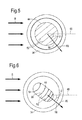
- Figure 5 shows a bleed valve 34 according to the present invention that comprises vanes 52 spanning the outlet port 44.
- the vanes 52 are arranged as an array of multiple parallel vanes 52 to expel air 58 parallel to the vector 60.
- the vector 60 defined between the first and second sides 54, 56 extends perpendicular to the vanes 52 in the plane illustrated. As in Figure 4 , the vector 60 extends at an angle ⁇ to the longitudinal axis 48, which is also the direction of the bypass flow B.
- FIG. 6 shows an alternative form of a bleed valve 34 according to the present invention.
- the outlet port 44 of the bleed valve 34 is an elongate racetrack shape in the illustrated plane, that is, it is formed of a pair of spaced semi-circular portions linked by straight sides to form a closed figure.
- the vanes 52 span the width of the outlet port 44, between the parallel straight sides, and are angled at angle ⁇ to the radial axis 46.
- the racetrack outlet port 44 is arranged so that the straight sides are parallel to the vector 60 and the expelled air 58, and at angle ⁇ to the longitudinal axis 48 and the bypass airflow B.
- the inlet port 42 may be the same shape as the outlet port 44 or may be a different shape. In the latter case, the body 40 of the bleed valve 34 has a complex shape to connect the inlet port 42 to the outlet port 44.
- the bleed valve 34 has been described having an outlet port 44 that is circular or racetrack shaped, it will be apparent to the skilled reader that it is the angles ⁇ , ⁇ made by the vector 60 with the axes 46, 48, 50 that are critical to the invention and not the shape of the outlet port 44.
- the vanes 52 may be substantially rectangular or may have a curved second side 56, depending on the requirements of the specific application of the bleed valve 34.
- vanes 52 will be fixed at specified angles ⁇ , ⁇ in a parallel array relative to the outlet port 44 of the bleed valve 34, it is also within the scope of the claimed invention that the vanes 52 are pivotable to form an array at a different angle ⁇ , a different angle ⁇ or a combination of different angles ⁇ , ⁇ . It is beneficial that the vanes 52 forming an array are aligned parallel to each other so that air expelled 58 through the gaps between adjacent vanes 52 flows in parallel to form a cohesive plume that flows parallel to vector 60.
- the plume expelled from the bleed valve 34 of the present invention travels further in an annular duct such as the bypass duct 32 of a gas turbine engine 10 than the plume expelled from a prior art bleed valve.
- This gives more time and distance for the plume to mix with the bypass flow B which results in more heat dissipation before the plume contacts either the radially outer bypass duct wall 36 or the radially inner bypass duct wall 38.
- less damage to the walls 36, 38 is likely to result.
- setting angle ⁇ to 70° and angle ⁇ to 40°, or 140° for upstream flow is particularly good for dissipating heat from the plume before it contacts the walls 36, 38.
- the vector 60 may advantageously be at an angle ⁇ that is greater than 25° but smaller than 155° or in other applications be at angle ⁇ that is greater than 10° but smaller than 170°. More generally, there is a requirement that angle ⁇ is greater than 0° and smaller than 90° whilst angle ⁇ is greater than 0° and smaller than 180°.
- angle ⁇ is greater than 0° and smaller than 90° whilst angle ⁇ is greater than 0° and smaller than 180°.
- an array of bleed valves 34 around the intermediate pressure compressor 16 may define vectors 60 that are different to the vectors 60 for an array of bleed valves 34 located around the high pressure compressor 18.
- the bleed valve 34 of the present invention is mechanically simpler than previous bleed valves using perforated plates or vanes to split the plume into disparate jets to promote mixing.
- An annular array of bleed valves 34 according to the present invention may comprise identical bleed valves 34 or each may be tailored for its location, for example with the vector 60 aligned so that the expelled plume misses local sensitive hardware such as ventilation inlets, thrust reverser doors and so forth.
Landscapes
- Engineering & Computer Science (AREA)
- General Engineering & Computer Science (AREA)
- Mechanical Engineering (AREA)
- Chemical & Material Sciences (AREA)
- Combustion & Propulsion (AREA)
- Physics & Mathematics (AREA)
- Fluid Mechanics (AREA)
- Life Sciences & Earth Sciences (AREA)
- Sustainable Development (AREA)
- Turbine Rotor Nozzle Sealing (AREA)
- Check Valves (AREA)
- Rotary Pumps (AREA)
- Applications Or Details Of Rotary Compressors (AREA)
- Structures Of Non-Positive Displacement Pumps (AREA)
Abstract
Description
- The present invention relates to a bleed valve, particularly although not exclusively to a bleed valve for a gas turbine engine.
- A
gas turbine engine 10 is shown inFigure 1 and comprises anair intake 12 and apropulsive fan 14 that generates two airflows A and B. Thegas turbine engine 10 comprises, in axial flow A, anintermediate pressure compressor 16, ahigh pressure compressor 18, acombustor 20, a high pressure turbine 22, an intermediate pressure turbine 24, alow pressure turbine 26 and anexhaust nozzle 28. Anacelle 30 surrounds thegas turbine engine 10 and defines, in axial flow B, abypass duct 32. An array ofbleed valves 34, of which one is illustrated, is provided to selectively extract air from theintermediate pressure compressor 16 and to expel it into thebypass duct 32. Thebleed valves 34 are opened to extract air to reduce the surge margin of the compressor. An array ofbleed valves 34 may also be provided to selectively extract air from the high pressure compressor 18 (not illustrated). - Conventional
bleed valves 34 comprise an outlet port that couples the bleedvalve 34 to thebypass duct 32. The outlet port causes air to be expelled as a cohesive or disparate plume. Thebypass duct 32 has relatively restricted radial extent and may comprise a heat intolerant material. Therefore, it is important that the plume of expelled air is turbulently mixed with axial airflow B to reduce its heat before it contacts the radiallyouter wall 36 of thebypass duct 32. Similarly it is beneficial that the plume is well mixed with airflow B before it is entrained against the radiallyinner wall 38 of thebypass duct 32 at a location downstream of thebleed valve 34. - Prior art bleed
valves 34 have sought to improve the mixing of the expelled plume with airflow B by providing an outlet port comprising a perforated plate that causes air to be expelled as a plume composed of multiple jets. A similar effect has been achieved using vanes. The perforations or vanes are typically angled to point either downstream or upstream, relative to axial airflow B in order to increase the plume length in a given radial distance across thebypass duct 32. However, it has been found in use that insufficient mixing occurs and that a substantially coherent plume tends to reach the outerbypass duct wall 36, damaging and potentially penetrating thenacelle 30 inner wall, or to be entrained against the innerbypass duct wall 38 if the downstream angle is more axial than radial, damaging the innerbypass duct wall 38. - Various complex bleed
valve 34 outlet port configurations have been proposed but without successfully alleviating the damaging effects of a bleed valve plume contacting awall bypass duct 32. - The present invention provides a bleed valve that seeks to address the aforementioned problems.
- Accordingly the present invention provides a bleed valve having an inlet port and an outlet port, the bleed valve comprising mutually perpendicular radial, longitudinal and tangential axes arranged such that the outlet port is substantially in a plane defined by the longitudinal and tangential axes; and at least one vane spanning the outlet port and having a first side and a second side, the first side being closer to the inlet port than the second side, and the at least one vane defining a vector from its first to its second side that has non-zero radial, longitudinal and tangential components.
- Advantageously such a bleed valve increases the radial distance that a bleed valve plume travels before contacting another component and being more diffused and mixed with another flow in that distance. Thus the plume is cooler when it makes contact, reducing the amount of damage caused.
- The bleed valve may comprise multiple vanes that are arranged to be parallel to each other.
- The vector may be greater than 0° and smaller than 180° from the longitudinal axis. More specifically, the vector may be greater than 10° and smaller than 170° from the longitudinal axis. Still more specifically, the vector may be greater than 25° and smaller than 155° from the longitudinal axis. In particular embodiments the vector may be substantially equal to 40° from the longitudinal axis or substantially equal to 140° from the longitudinal axis. The angle may be chosen to optimise the flow path of the air expelled from the bleed valve.
- The radial, longitudinal and tangential vector components may be defined such that a fluid plume expelled through the outlet port has a predetermined radial extent.
- The present invention also provides a gas turbine engine having a principal engine axis and a bleed valve as described wherein the longitudinal axis is parallel to the principal engine axis and the radial axis is parallel to an engine radius.
- The gas turbine engine may comprise a bypass duct wherein the outlet port is located in a radially inner wall of the bypass duct. The gas turbine engine may comprise at least one annular array of bleed valves.
- The radial, longitudinal and tangential vector components may be defined such that a fluid plume expelled through the outlet port has a predetermined radial extent relative to the bypass duct.
- The present invention will be more fully described by way of example with reference to the accompanying drawings, in which:
-
Figure 1 is a sectional side view of a gas turbine engine comprising a bleed valve. -
Figure 2 is a schematic side view of a bleed valve according to the present invention. -
Figure 3 is a schematic side view of a gas turbine engine comprising a bleed valve according to the present invention. -
Figure 4 is a schematic plan view of the gas turbine engine ofFigure 3 . -
Figure 5 is a plan view of a bleed valve according to the present invention. -
Figure 6 is a plan view of an alternative bleed valve according to the present invention. - A
bleed valve 34 is shown inFigure 2 that protrudes through the radially innerbypass duct wall 38, a part of which is shown. Thebleed valve 34 comprises abody 40 that is bounded by aninlet port 42 and anoutlet port 44. Thebody 40 may be cylindrical or may be a prism based on an oval or ellipse, for example, as is well understood in the art. Alternatively theinlet port 42 andoutlet port 44 may be different shapes and thebody 40 shaped to transition between theports bleed valve 34, being aradial axis 46, alongitudinal axis 48 and atangential axis 50. The vector extending between theinlet port 42 and theoutlet port 44 lies on or parallel to theradial axis 46 whilst each of the inlet andoutlet ports tangential axes - The
bleed valve 34 comprises multipleparallel vanes 52 that span theoutlet port 44 in an array. Eachvane 52 extends between afirst side 54 and asecond side 56, thefirst side 54 being positioned closer to theinlet port 42 than thesecond side 56. Thevanes 52 are angled so that bleed flow that enters thebody 40 of thebleed valve 34 through theinlet port 42 in a substantially radial direction is diverted to be expelled through theoutlet port 44, as shown byarrow 58, in a more downstream direction with respect to the bypass airflow B. - Each
vane 52 defines avector 60 from itsfirst side 54 to itssecond side 56. Thevector 60 has non-zero components in the radial, longitudinal and tangential directions, whereas prior art vanes have always comprised a zero tangential component. Thus thevector 60 can be written as [r,l,t] where r is the radial component, l is the longitudinal component, t is the tangential component and r,l,t ≠ 0. Thevector 60 is illustrated inFigures 3 and 4 . Each illustrates agas turbine engine 10 having anacelle 30 surrounding the core engine and an exemplary bleedvalve 34. -
Figure 3 is a view in a plane parallel to the radial andlongitudinal axes bleed valve 34. Thevector 60 defined by thevanes 52 of thebleed valve 34 makes an angle α with theradial axis 46, or an angle of (90-α) degrees with thelongitudinal axis 48.Figure 4 is a view in a plane parallel to the longitudinal andtangential axes bleed valve 34. Similarly, thevector 60 defined by thevanes 52 of thebleed valve 34 makes an angle β with thelongitudinal axis 48, or an angle (90-β) degrees with thetangential axis 50. Thus thevector 60 extends in three-dimensions at a compound angle comprising α and β. -
Figure 5 shows ableed valve 34 according to the present invention that comprisesvanes 52 spanning theoutlet port 44. Thevanes 52 are arranged as an array of multipleparallel vanes 52 to expelair 58 parallel to thevector 60. Thevector 60 defined between the first andsecond sides vanes 52 in the plane illustrated. As inFigure 4 , thevector 60 extends at an angle β to thelongitudinal axis 48, which is also the direction of the bypass flow B. -
Figure 6 shows an alternative form of ableed valve 34 according to the present invention. In this embodiment theoutlet port 44 of thebleed valve 34 is an elongate racetrack shape in the illustrated plane, that is, it is formed of a pair of spaced semi-circular portions linked by straight sides to form a closed figure. Thevanes 52 span the width of theoutlet port 44, between the parallel straight sides, and are angled at angle α to theradial axis 46. Theracetrack outlet port 44 is arranged so that the straight sides are parallel to thevector 60 and the expelledair 58, and at angle β to thelongitudinal axis 48 and the bypass airflow B. It will be apparent to the skilled reader that theinlet port 42 may be the same shape as theoutlet port 44 or may be a different shape. In the latter case, thebody 40 of thebleed valve 34 has a complex shape to connect theinlet port 42 to theoutlet port 44. - Although the
bleed valve 34 according to the present invention has been described having anoutlet port 44 that is circular or racetrack shaped, it will be apparent to the skilled reader that it is the angles α, β made by thevector 60 with theaxes outlet port 44. Similarly, thevanes 52 may be substantially rectangular or may have a curvedsecond side 56, depending on the requirements of the specific application of thebleed valve 34. - Although it is envisaged that the
vanes 52 will be fixed at specified angles α, β in a parallel array relative to theoutlet port 44 of thebleed valve 34, it is also within the scope of the claimed invention that thevanes 52 are pivotable to form an array at a different angle α, a different angle β or a combination of different angles α, β. It is beneficial that thevanes 52 forming an array are aligned parallel to each other so that air expelled 58 through the gaps betweenadjacent vanes 52 flows in parallel to form a cohesive plume that flows parallel tovector 60. - Beneficially, the plume expelled from the
bleed valve 34 of the present invention travels further in an annular duct such as thebypass duct 32 of agas turbine engine 10 than the plume expelled from a prior art bleed valve. This gives more time and distance for the plume to mix with the bypass flow B which results in more heat dissipation before the plume contacts either the radially outerbypass duct wall 36 or the radially innerbypass duct wall 38. Thus less damage to thewalls walls vector 60 may advantageously be at an angle β that is greater than 25° but smaller than 155° or in other applications be at angle β that is greater than 10° but smaller than 170°. More generally, there is a requirement that angle α is greater than 0° and smaller than 90° whilst angle β is greater than 0° and smaller than 180°. However, different angles will be more appropriate fordifferent engines 10 and for different locations ofbleed valves 34 in thesame engine 10. For example, an array ofbleed valves 34 around theintermediate pressure compressor 16 may definevectors 60 that are different to thevectors 60 for an array ofbleed valves 34 located around thehigh pressure compressor 18. - The
bleed valve 34 of the present invention is mechanically simpler than previous bleed valves using perforated plates or vanes to split the plume into disparate jets to promote mixing. An annular array ofbleed valves 34 according to the present invention may compriseidentical bleed valves 34 or each may be tailored for its location, for example with thevector 60 aligned so that the expelled plume misses local sensitive hardware such as ventilation inlets, thrust reverser doors and so forth.
Claims (12)
- A bleed valve (34) having an inlet port (42) and an outlet port (44), the bleed valve (34) comprising:- mutually perpendicular radial, longitudinal and tangential axes (46, 48, 50) arranged such that the outlet port (44) is substantially in a plane defined by the longitudinal and tangential axes (48, 50); and- at least one vane (52) spanning the outlet port (44) and having a first side (54) and a second side (56), the first side (54) being closer to the inlet port (42) than the second side (56), and the at least one vane (52) defining a vector (60) from its first side (54) to its second side (56) that has non-zero radial, longitudinal and tangential components.
- A bleed valve (34) as claimed in claim 1 comprising multiple vanes (52) that are arranged to be parallel to each other.
- A bleed valve (34) as claimed in claim 1 or 2 wherein the vector (60) is greater than 0° and smaller than 180° from the longitudinal axis (48).
- A bleed valve (34) as claimed in claim 3 wherein the vector (60) is greater than 10° and smaller than 170° from the longitudinal axis (48).
- A bleed valve (34) as claimed in claim 4 wherein the vector (60) is greater than 25° and smaller than 155° from the longitudinal axis (48).
- A bleed valve (34) as claimed in claim 5 wherein the vector (60) is substantially equal to 40° from the longitudinal axis (48).
- A bleed valve (34) as claimed in claim 5 wherein the vector (60) is substantially equal to 140° from the longitudinal axis (48).
- A bleed valve (34) as claimed in any preceding claim wherein the radial, longitudinal and tangential vector components are defined such that a fluid plume (58) expelled through the outlet port (44) has a predetermined radial extent.
- A gas turbine engine (10) having a principal engine axis and a bleed valve (34) as claimed in any preceding claim wherein the longitudinal axis (48) is parallel to the principal engine axis and the radial axis (46) is parallel to an engine radius.
- A gas turbine engine (10) as claimed in claim 9 further comprising a bypass duct (32) wherein the outlet port (44) is located in a radially inner wall (38) of the bypass duct (32).
- A gas turbine engine (10) as claimed in claim 9 or 10 comprising at least one annular array of bleed valves (34).
- A gas turbine engine (10) as claimed in claim 10 or 11 wherein the radial, longitudinal and tangential vector components are defined such that a fluid plume (58) expelled through the outlet port (44) has a predetermined radial extent relative to the bypass duct (32).
Applications Claiming Priority (1)
| Application Number | Priority Date | Filing Date | Title |
|---|---|---|---|
| GBGB1015743.6A GB201015743D0 (en) | 2010-09-21 | 2010-09-21 | Bleed valve |
Publications (2)
| Publication Number | Publication Date |
|---|---|
| EP2431591A2 true EP2431591A2 (en) | 2012-03-21 |
| EP2431591A3 EP2431591A3 (en) | 2015-08-12 |
Family
ID=43065521
Family Applications (1)
| Application Number | Title | Priority Date | Filing Date |
|---|---|---|---|
| EP11178269.4A Withdrawn EP2431591A3 (en) | 2010-09-21 | 2011-08-22 | Bleed valve |
Country Status (3)
| Country | Link |
|---|---|
| US (1) | US9121465B2 (en) |
| EP (1) | EP2431591A3 (en) |
| GB (1) | GB201015743D0 (en) |
Cited By (4)
| Publication number | Priority date | Publication date | Assignee | Title |
|---|---|---|---|---|
| FR3018096A1 (en) * | 2014-03-03 | 2015-09-04 | Snecma | DISCHARGE DUCT FOR A TURBOMACHINE |
| WO2016156739A1 (en) * | 2015-04-01 | 2016-10-06 | Snecma | Discharge flow duct of a turbine engine comprising a vbv grating with variable setting |
| EP3575578A1 (en) * | 2018-05-31 | 2019-12-04 | Rolls-Royce plc | Gas turbine engine |
| FR3087840A1 (en) * | 2018-10-29 | 2020-05-01 | Safran Aircraft Engines | NACELLE HOOD FOR POWERED AIRCRAFT ASSEMBLY |
Families Citing this family (5)
| Publication number | Priority date | Publication date | Assignee | Title |
|---|---|---|---|---|
| US20140338360A1 (en) * | 2012-09-21 | 2014-11-20 | United Technologies Corporation | Bleed port ribs for turbomachine case |
| GB201322833D0 (en) * | 2013-12-23 | 2014-02-12 | Rolls Royce Plc | |
| US10119477B2 (en) * | 2015-01-20 | 2018-11-06 | United Technologies Corporation | Gas turbine engine with a multi-spool driven fan |
| US10330019B2 (en) | 2015-02-25 | 2019-06-25 | Hamilton Sundstrand Corporation | Self-actuating and dual pivot flapper valve |
| US11149653B2 (en) | 2018-08-14 | 2021-10-19 | Raytheon Technologies Corporation | Bleed valve actuation system having split ring segments and splice bracket |
Family Cites Families (27)
| Publication number | Priority date | Publication date | Assignee | Title |
|---|---|---|---|---|
| US2904972A (en) * | 1957-12-06 | 1959-09-22 | Gen Motors Corp | Room conditioner |
| US3164337A (en) * | 1959-09-29 | 1965-01-05 | Hawker Aircraft Ltd | Jet aircraft with orientable nozzles for vertical or forward movement |
| NL130254C (en) * | 1960-12-15 | |||
| GB1036134A (en) * | 1962-04-25 | 1966-07-13 | Brisiol Siddeley Engines Ltd | Improvements in gas turbine power plant for v.s.t.o.l. aircraft |
| GB1316084A (en) * | 1969-06-19 | 1973-05-09 | Creators Ltd | Nozzles for ventilating and heating systems |
| US4463552A (en) * | 1981-12-14 | 1984-08-07 | United Technologies Corporation | Combined surge bleed and dust removal system for a fan-jet engine |
| US4546605A (en) * | 1983-12-16 | 1985-10-15 | United Technologies Corporation | Heat exchange system |
| US5155993A (en) | 1990-04-09 | 1992-10-20 | General Electric Company | Apparatus for compressor air extraction |
| US5261228A (en) * | 1992-06-25 | 1993-11-16 | General Electric Company | Apparatus for bleeding air |
| DE19959596A1 (en) | 1999-12-10 | 2001-06-13 | Rolls Royce Deutschland | Blow-off valve of a compressor, in particular for a twin-jet aircraft engine |
| US6581217B2 (en) * | 2001-07-25 | 2003-06-24 | Sam M. Marcos | Directional air vents for spas and jetted bathtubs |
| US6565313B2 (en) * | 2001-10-04 | 2003-05-20 | United Technologies Corporation | Bleed deflector for a gas turbine engine |
| WO2006091138A1 (en) * | 2005-02-25 | 2006-08-31 | Volvo Aero Corporation | A bleed structure for a bleed passage in a gas turbine engine |
| EP1856398B1 (en) | 2005-02-25 | 2017-04-12 | GKN Aerospace Sweden AB | A bleed structure for a bleed passage in a gas turbine engine |
| US7946528B2 (en) * | 2005-04-15 | 2011-05-24 | Urban Aeronautics, Ltd. | Flight control system especially suited for VTOL vehicles |
| US7415827B2 (en) * | 2005-05-18 | 2008-08-26 | United Technologies Corporation | Arrangement for controlling fluid jets injected into a fluid stream |
| US7624581B2 (en) * | 2005-12-21 | 2009-12-01 | General Electric Company | Compact booster bleed turbofan |
| GB0614360D0 (en) | 2006-07-20 | 2006-08-30 | Rolls Royce Plc | Aeroengine bleed valve |
| GB0616847D0 (en) * | 2006-08-25 | 2006-10-04 | Rolls Royce Plc | Aeroengine bleed valve |
| US7797945B2 (en) | 2006-09-06 | 2010-09-21 | Honeywell International Inc. | Bleed valve outlet flow deflector |
| US20100281874A1 (en) * | 2007-01-09 | 2010-11-11 | Rolls-Royce Corporation | Airflow vectoring member |
| GB0801301D0 (en) | 2008-01-25 | 2008-03-05 | Rolls Royce Plc | Aeroengine bleed valve |
| GB0810883D0 (en) | 2008-06-16 | 2008-07-23 | Rolls Royce Plc | A bleed valve arrangement |
| GB0820598D0 (en) * | 2008-11-11 | 2008-12-17 | Rolls Royce Plc | A noise reduction device |
| GB2467120B (en) * | 2009-01-21 | 2013-05-15 | Rolls Royce Plc | A gas Turbine engine |
| GB201000378D0 (en) * | 2010-01-12 | 2010-02-24 | Rolls Royce Plc | Flow discharge device |
| US20110265490A1 (en) * | 2010-04-30 | 2011-11-03 | Kevin Samuel Klasing | Flow mixing vent system |
-
2010
- 2010-09-21 GB GBGB1015743.6A patent/GB201015743D0/en not_active Ceased
-
2011
- 2011-08-22 US US13/214,668 patent/US9121465B2/en not_active Expired - Fee Related
- 2011-08-22 EP EP11178269.4A patent/EP2431591A3/en not_active Withdrawn
Non-Patent Citations (1)
| Title |
|---|
| None |
Cited By (8)
| Publication number | Priority date | Publication date | Assignee | Title |
|---|---|---|---|---|
| FR3018096A1 (en) * | 2014-03-03 | 2015-09-04 | Snecma | DISCHARGE DUCT FOR A TURBOMACHINE |
| WO2016156739A1 (en) * | 2015-04-01 | 2016-10-06 | Snecma | Discharge flow duct of a turbine engine comprising a vbv grating with variable setting |
| FR3034461A1 (en) * | 2015-04-01 | 2016-10-07 | Snecma | TURBOMACHINE DISCHARGE VEIN CONDUIT COMPRISING A VARIABLE-SET VBV GRID |
| RU2715766C2 (en) * | 2015-04-01 | 2020-03-03 | Сафран Эркрафт Энджинз | Gas turbine engine bypass channel, containing channel closure grate with different mounting angles |
| US10794218B2 (en) | 2015-04-01 | 2020-10-06 | Safran Aircraft Engines | Discharge flow duct of a turbine engine comprising a VBV grating with variable setting |
| EP3575578A1 (en) * | 2018-05-31 | 2019-12-04 | Rolls-Royce plc | Gas turbine engine |
| US11248535B2 (en) | 2018-05-31 | 2022-02-15 | Rolls-Royce Plc | Gas turbine engine with compressor bleed valve including at least two open positions |
| FR3087840A1 (en) * | 2018-10-29 | 2020-05-01 | Safran Aircraft Engines | NACELLE HOOD FOR POWERED AIRCRAFT ASSEMBLY |
Also Published As
| Publication number | Publication date |
|---|---|
| US9121465B2 (en) | 2015-09-01 |
| GB201015743D0 (en) | 2010-10-27 |
| EP2431591A3 (en) | 2015-08-12 |
| US20120067061A1 (en) | 2012-03-22 |
Similar Documents
| Publication | Publication Date | Title |
|---|---|---|
| US9121465B2 (en) | Bleed outlet structure for a bleed valve | |
| CN105229264B (en) | Turbine and the internal combustion engine with the turbine | |
| US9399951B2 (en) | Modular louver system | |
| EP1965052B1 (en) | Mixer for cooling and sealing air system of turbomachinery | |
| US7921652B2 (en) | Aeroengine bleed valve | |
| US10018121B2 (en) | Flow outlet | |
| WO2010019177A3 (en) | Transition with a linear flow path with exhaust mouths for use in a gas turbine engine | |
| EP1640563B1 (en) | Heat transfer augmentation in a compact heat exchanger pedestral array | |
| US7114920B2 (en) | Shroud and vane segments having edge notches | |
| EP3147464B1 (en) | Expansion turbine and turbocharger | |
| US20100135822A1 (en) | Turbine blade for a gas turbine engine | |
| EP2940270B1 (en) | Variable-geometry turbocharger | |
| GB2545988A (en) | Waste gate assembly | |
| EP3181821B1 (en) | Turbulators for improved cooling of gas turbine engine components | |
| EP3584407B1 (en) | Trip strips for augmented boundary layer mixing | |
| CN115264499B (en) | Burner with a burner body | |
| Sivagnanasundaram et al. | An investigation of compressor map width enhancement and the inducer flow field using various configurations of shroud bleed slot | |
| EP3260694A1 (en) | Gas turbine exhaust cooling system | |
| US20140033733A1 (en) | Flow discharge device | |
| CN120604018A (en) | turbines | |
| JPH04284136A (en) | High pressure compressor flow passage bleeding valve extraction slot | |
| US7273350B2 (en) | Heat transfer arrangement | |
| CN117189267A (en) | Tip clearance structure and compressor | |
| JP2010180811A (en) | Variable displacement turbine | |
| JP5428786B2 (en) | Exhaust gas recirculation device |
Legal Events
| Date | Code | Title | Description |
|---|---|---|---|
| PUAI | Public reference made under article 153(3) epc to a published international application that has entered the european phase |
Free format text: ORIGINAL CODE: 0009012 |
|
| AK | Designated contracting states |
Kind code of ref document: A2 Designated state(s): AL AT BE BG CH CY CZ DE DK EE ES FI FR GB GR HR HU IE IS IT LI LT LU LV MC MK MT NL NO PL PT RO RS SE SI SK SM TR |
|
| AX | Request for extension of the european patent |
Extension state: BA ME |
|
| PUAL | Search report despatched |
Free format text: ORIGINAL CODE: 0009013 |
|
| RAP1 | Party data changed (applicant data changed or rights of an application transferred) |
Owner name: ROLLS-ROYCE PLC |
|
| AK | Designated contracting states |
Kind code of ref document: A3 Designated state(s): AL AT BE BG CH CY CZ DE DK EE ES FI FR GB GR HR HU IE IS IT LI LT LU LV MC MK MT NL NO PL PT RO RS SE SI SK SM TR |
|
| AX | Request for extension of the european patent |
Extension state: BA ME |
|
| RIC1 | Information provided on ipc code assigned before grant |
Ipc: F16F 5/00 20060101ALI20150703BHEP Ipc: F02C 9/18 20060101AFI20150703BHEP Ipc: F04D 15/00 20060101ALI20150703BHEP |
|
| STAA | Information on the status of an ep patent application or granted ep patent |
Free format text: STATUS: THE APPLICATION HAS BEEN WITHDRAWN |
|
| 17P | Request for examination filed |
Effective date: 20160106 |
|
| RBV | Designated contracting states (corrected) |
Designated state(s): AL AT BE BG CH CY CZ DE DK EE ES FI FR GB GR HR HU IE IS IT LI LT LU LV MC MK MT NL NO PL PT RO RS SE SI SK SM TR |
|
| 18W | Application withdrawn |
Effective date: 20160121 |