EP2431353B1 - Process for preparing amine compound - Google Patents
Process for preparing amine compound Download PDFInfo
- Publication number
- EP2431353B1 EP2431353B1 EP11181333.3A EP11181333A EP2431353B1 EP 2431353 B1 EP2431353 B1 EP 2431353B1 EP 11181333 A EP11181333 A EP 11181333A EP 2431353 B1 EP2431353 B1 EP 2431353B1
- Authority
- EP
- European Patent Office
- Prior art keywords
- group
- compound
- general formula
- ring
- hydrogen
- Prior art date
- Legal status (The legal status is an assumption and is not a legal conclusion. Google has not performed a legal analysis and makes no representation as to the accuracy of the status listed.)
- Not-in-force
Links
- -1 amine compound Chemical class 0.000 title claims description 169
- 238000004519 manufacturing process Methods 0.000 title claims description 27
- 125000004435 hydrogen atom Chemical group [H]* 0.000 claims description 60
- 125000001424 substituent group Chemical group 0.000 claims description 54
- 238000006243 chemical reaction Methods 0.000 claims description 49
- 230000002829 reductive effect Effects 0.000 claims description 46
- 125000003118 aryl group Chemical group 0.000 claims description 33
- 229910052741 iridium Chemical group 0.000 claims description 30
- GKOZUEZYRPOHIO-UHFFFAOYSA-N iridium atom Chemical group [Ir] GKOZUEZYRPOHIO-UHFFFAOYSA-N 0.000 claims description 30
- 150000001728 carbonyl compounds Chemical class 0.000 claims description 29
- 150000002466 imines Chemical class 0.000 claims description 28
- 125000000753 cycloalkyl group Chemical group 0.000 claims description 26
- 125000002252 acyl group Chemical group 0.000 claims description 25
- 125000004185 ester group Chemical group 0.000 claims description 25
- 125000003808 silyl group Chemical group [H][Si]([H])([H])[*] 0.000 claims description 25
- 125000003368 amide group Chemical group 0.000 claims description 23
- 125000003342 alkenyl group Chemical group 0.000 claims description 22
- 125000000623 heterocyclic group Chemical group 0.000 claims description 22
- 125000000472 sulfonyl group Chemical group *S(*)(=O)=O 0.000 claims description 22
- UFHFLCQGNIYNRP-UHFFFAOYSA-N Hydrogen Chemical compound [H][H] UFHFLCQGNIYNRP-UHFFFAOYSA-N 0.000 claims description 21
- 125000004646 sulfenyl group Chemical group S(*)* 0.000 claims description 21
- BDAGIHXWWSANSR-UHFFFAOYSA-N methanoic acid Natural products OC=O BDAGIHXWWSANSR-UHFFFAOYSA-N 0.000 claims description 20
- 125000000008 (C1-C10) alkyl group Chemical group 0.000 claims description 19
- QJGQUHMNIGDVPM-UHFFFAOYSA-N nitrogen group Chemical group [N] QJGQUHMNIGDVPM-UHFFFAOYSA-N 0.000 claims description 19
- 150000001875 compounds Chemical class 0.000 claims description 17
- 125000002887 hydroxy group Chemical group [H]O* 0.000 claims description 16
- 150000002902 organometallic compounds Chemical class 0.000 claims description 15
- 125000005843 halogen group Chemical group 0.000 claims description 14
- 125000003545 alkoxy group Chemical group 0.000 claims description 13
- 125000000304 alkynyl group Chemical group 0.000 claims description 13
- 125000003277 amino group Chemical group 0.000 claims description 13
- 229910052757 nitrogen Inorganic materials 0.000 claims description 13
- 239000010948 rhodium Chemical group 0.000 claims description 13
- 229910052721 tungsten Inorganic materials 0.000 claims description 13
- 125000003178 carboxy group Chemical group [H]OC(*)=O 0.000 claims description 12
- 125000004093 cyano group Chemical group *C#N 0.000 claims description 12
- 125000000449 nitro group Chemical group [O-][N+](*)=O 0.000 claims description 12
- 229910052703 rhodium Inorganic materials 0.000 claims description 12
- MHOVAHRLVXNVSD-UHFFFAOYSA-N rhodium atom Chemical group [Rh] MHOVAHRLVXNVSD-UHFFFAOYSA-N 0.000 claims description 12
- 229920006395 saturated elastomer Polymers 0.000 claims description 12
- 125000004433 nitrogen atom Chemical group N* 0.000 claims description 11
- 125000000020 sulfo group Chemical group O=S(=O)([*])O[H] 0.000 claims description 11
- 125000003396 thiol group Chemical group [H]S* 0.000 claims description 11
- OSWFIVFLDKOXQC-UHFFFAOYSA-N 4-(3-methoxyphenyl)aniline Chemical compound COC1=CC=CC(C=2C=CC(N)=CC=2)=C1 OSWFIVFLDKOXQC-UHFFFAOYSA-N 0.000 claims description 10
- RWRDLPDLKQPQOW-UHFFFAOYSA-N Pyrrolidine Chemical group C1CCNC1 RWRDLPDLKQPQOW-UHFFFAOYSA-N 0.000 claims description 10
- 235000019253 formic acid Nutrition 0.000 claims description 10
- 125000004432 carbon atom Chemical group C* 0.000 claims description 9
- 125000003709 fluoroalkyl group Chemical group 0.000 claims description 9
- KJTLSVCANCCWHF-UHFFFAOYSA-N Ruthenium Chemical group [Ru] KJTLSVCANCCWHF-UHFFFAOYSA-N 0.000 claims description 8
- 150000002894 organic compounds Chemical class 0.000 claims description 8
- 229910052707 ruthenium Inorganic materials 0.000 claims description 8
- 125000000475 sulfinyl group Chemical group [*:2]S([*:1])=O 0.000 claims description 8
- 125000000732 arylene group Chemical group 0.000 claims description 7
- 125000004430 oxygen atom Chemical group O* 0.000 claims description 6
- 125000000058 cyclopentadienyl group Chemical group C1(=CC=CC1)* 0.000 claims description 5
- 125000002943 quinolinyl group Chemical group N1=C(C=CC2=CC=CC=C12)* 0.000 claims description 5
- BDAGIHXWWSANSR-UHFFFAOYSA-M Formate Chemical compound [O-]C=O BDAGIHXWWSANSR-UHFFFAOYSA-M 0.000 claims description 4
- JUJWROOIHBZHMG-UHFFFAOYSA-N Pyridine Chemical group C1=CC=NC=C1 JUJWROOIHBZHMG-UHFFFAOYSA-N 0.000 claims description 4
- 150000003863 ammonium salts Chemical class 0.000 claims description 4
- 125000000129 anionic group Chemical group 0.000 claims description 4
- 125000004122 cyclic group Chemical group 0.000 claims description 4
- 125000001183 hydrocarbyl group Chemical group 0.000 claims description 4
- 150000001491 aromatic compounds Chemical class 0.000 claims description 3
- YMWUJEATGCHHMB-UHFFFAOYSA-N Dichloromethane Chemical class ClCCl YMWUJEATGCHHMB-UHFFFAOYSA-N 0.000 description 188
- 239000000243 solution Substances 0.000 description 114
- OKKJLVBELUTLKV-UHFFFAOYSA-N Methanol Chemical compound OC OKKJLVBELUTLKV-UHFFFAOYSA-N 0.000 description 74
- 239000003054 catalyst Substances 0.000 description 62
- QTBSBXVTEAMEQO-UHFFFAOYSA-N Acetic acid Chemical compound CC(O)=O QTBSBXVTEAMEQO-UHFFFAOYSA-N 0.000 description 54
- ZYGHJZDHTFUPRJ-UHFFFAOYSA-N coumarin Chemical compound C1=CC=C2OC(=O)C=CC2=C1 ZYGHJZDHTFUPRJ-UHFFFAOYSA-N 0.000 description 44
- 239000002904 solvent Substances 0.000 description 44
- 230000015572 biosynthetic process Effects 0.000 description 34
- 238000003786 synthesis reaction Methods 0.000 description 34
- 239000007789 gas Substances 0.000 description 32
- 238000005160 1H NMR spectroscopy Methods 0.000 description 29
- XLYOFNOQVPJJNP-UHFFFAOYSA-N water Substances O XLYOFNOQVPJJNP-UHFFFAOYSA-N 0.000 description 28
- 229960000956 coumarin Drugs 0.000 description 22
- 235000001671 coumarin Nutrition 0.000 description 22
- 238000011002 quantification Methods 0.000 description 22
- VZTDIZULWFCMLS-UHFFFAOYSA-N ammonium formate Chemical compound [NH4+].[O-]C=O VZTDIZULWFCMLS-UHFFFAOYSA-N 0.000 description 21
- 239000007864 aqueous solution Substances 0.000 description 21
- 238000010438 heat treatment Methods 0.000 description 21
- HEDRZPFGACZZDS-MICDWDOJSA-N Trichloro(2H)methane Chemical compound [2H]C(Cl)(Cl)Cl HEDRZPFGACZZDS-MICDWDOJSA-N 0.000 description 20
- 238000000034 method Methods 0.000 description 20
- BGNLXETYTAAURD-UHFFFAOYSA-N 4-tert-butylcyclohexan-1-amine Chemical compound CC(C)(C)C1CCC(N)CC1 BGNLXETYTAAURD-UHFFFAOYSA-N 0.000 description 19
- 239000012044 organic layer Substances 0.000 description 19
- 238000006268 reductive amination reaction Methods 0.000 description 19
- OKTJSMMVPCPJKN-UHFFFAOYSA-N Carbon Chemical compound [C] OKTJSMMVPCPJKN-UHFFFAOYSA-N 0.000 description 17
- ZMANZCXQSJIPKH-UHFFFAOYSA-N Triethylamine Chemical compound CCN(CC)CC ZMANZCXQSJIPKH-UHFFFAOYSA-N 0.000 description 15
- 125000002524 organometallic group Chemical group 0.000 description 15
- 125000002496 methyl group Chemical group [H]C([H])([H])* 0.000 description 14
- 125000001997 phenyl group Chemical class [H]C1=C([H])C([H])=C(*)C([H])=C1[H] 0.000 description 14
- 230000000694 effects Effects 0.000 description 13
- 239000000203 mixture Substances 0.000 description 13
- YKFKEYKJGVSEIX-UHFFFAOYSA-N cyclohexanone, 4-(1,1-dimethylethyl)- Chemical compound CC(C)(C)C1CCC(=O)CC1 YKFKEYKJGVSEIX-UHFFFAOYSA-N 0.000 description 12
- 125000001495 ethyl group Chemical group [H]C([H])([H])C([H])([H])* 0.000 description 12
- 239000001257 hydrogen Substances 0.000 description 11
- 229910052739 hydrogen Inorganic materials 0.000 description 11
- UHOVQNZJYSORNB-UHFFFAOYSA-N monobenzene Natural products C1=CC=CC=C1 UHOVQNZJYSORNB-UHFFFAOYSA-N 0.000 description 11
- 230000000052 comparative effect Effects 0.000 description 10
- 239000013078 crystal Substances 0.000 description 10
- ZAFNJMIOTHYJRJ-UHFFFAOYSA-N Diisopropyl ether Chemical compound CC(C)OC(C)C ZAFNJMIOTHYJRJ-UHFFFAOYSA-N 0.000 description 9
- 150000002430 hydrocarbons Chemical group 0.000 description 9
- 125000004076 pyridyl group Chemical group 0.000 description 9
- 230000009257 reactivity Effects 0.000 description 9
- 238000006722 reduction reaction Methods 0.000 description 9
- 125000000391 vinyl group Chemical group [H]C([*])=C([H])[H] 0.000 description 9
- QGZKDVFQNNGYKY-UHFFFAOYSA-N Ammonia Chemical compound N QGZKDVFQNNGYKY-UHFFFAOYSA-N 0.000 description 8
- LFQSCWFLJHTTHZ-UHFFFAOYSA-N Ethanol Chemical compound CCO LFQSCWFLJHTTHZ-UHFFFAOYSA-N 0.000 description 8
- KFZMGEQAYNKOFK-UHFFFAOYSA-N Isopropanol Chemical compound CC(C)O KFZMGEQAYNKOFK-UHFFFAOYSA-N 0.000 description 8
- 125000000217 alkyl group Chemical group 0.000 description 8
- JHIVVAPYMSGYDF-UHFFFAOYSA-N cyclohexanone Chemical compound O=C1CCCCC1 JHIVVAPYMSGYDF-UHFFFAOYSA-N 0.000 description 8
- BGTOWKSIORTVQH-UHFFFAOYSA-N cyclopentanone Chemical compound O=C1CCCC1 BGTOWKSIORTVQH-UHFFFAOYSA-N 0.000 description 8
- 125000001449 isopropyl group Chemical group [H]C([H])([H])C([H])(*)C([H])([H])[H] 0.000 description 8
- 150000001412 amines Chemical class 0.000 description 7
- 125000001797 benzyl group Chemical group [H]C1=C([H])C([H])=C(C([H])=C1[H])C([H])([H])* 0.000 description 7
- 125000000113 cyclohexyl group Chemical group [H]C1([H])C([H])([H])C([H])([H])C([H])(*)C([H])([H])C1([H])[H] 0.000 description 7
- 125000000959 isobutyl group Chemical group [H]C([H])([H])C([H])(C([H])([H])[H])C([H])([H])* 0.000 description 7
- 230000009467 reduction Effects 0.000 description 7
- 239000000758 substrate Substances 0.000 description 7
- RQEUFEKYXDPUSK-UHFFFAOYSA-N 1-phenylethylamine Chemical compound CC(N)C1=CC=CC=C1 RQEUFEKYXDPUSK-UHFFFAOYSA-N 0.000 description 6
- IWIUIWBGNZMKRT-UHFFFAOYSA-N 4-(1-phenylethylamino)adamantan-1-ol Chemical compound C1C(O)(C2)CC3CC2CC1C3NC(C)C1=CC=CC=C1 IWIUIWBGNZMKRT-UHFFFAOYSA-N 0.000 description 6
- YXFVVABEGXRONW-UHFFFAOYSA-N Toluene Chemical compound CC1=CC=CC=C1 YXFVVABEGXRONW-UHFFFAOYSA-N 0.000 description 6
- 125000002777 acetyl group Chemical group [H]C([H])([H])C(*)=O 0.000 description 6
- 238000001914 filtration Methods 0.000 description 6
- 238000004817 gas chromatography Methods 0.000 description 6
- KDLHZDBZIXYQEI-UHFFFAOYSA-N palladium Substances [Pd] KDLHZDBZIXYQEI-UHFFFAOYSA-N 0.000 description 6
- 125000000999 tert-butyl group Chemical group [H]C([H])([H])C(*)(C([H])([H])[H])C([H])([H])[H] 0.000 description 6
- 238000001644 13C nuclear magnetic resonance spectroscopy Methods 0.000 description 5
- ZOXJGFHDIHLPTG-UHFFFAOYSA-N Boron Chemical compound [B] ZOXJGFHDIHLPTG-UHFFFAOYSA-N 0.000 description 5
- 229910052796 boron Inorganic materials 0.000 description 5
- 229910052799 carbon Inorganic materials 0.000 description 5
- 238000005984 hydrogenation reaction Methods 0.000 description 5
- 150000002484 inorganic compounds Chemical class 0.000 description 5
- 229910010272 inorganic material Inorganic materials 0.000 description 5
- 239000003446 ligand Substances 0.000 description 5
- KKUFYUVRYHPVPG-UHFFFAOYSA-N n-[4-(dimethylamino)phenyl]pyridine-2-carboxamide Chemical compound C1=CC(N(C)C)=CC=C1NC(=O)C1=CC=CC=N1 KKUFYUVRYHPVPG-UHFFFAOYSA-N 0.000 description 5
- 239000003960 organic solvent Substances 0.000 description 5
- 125000003367 polycyclic group Chemical group 0.000 description 5
- 239000000843 powder Substances 0.000 description 5
- 230000008569 process Effects 0.000 description 5
- BDERNNFJNOPAEC-UHFFFAOYSA-N propan-1-ol Chemical compound CCCO BDERNNFJNOPAEC-UHFFFAOYSA-N 0.000 description 5
- 239000000376 reactant Substances 0.000 description 5
- 239000000126 substance Substances 0.000 description 5
- 238000006467 substitution reaction Methods 0.000 description 5
- 238000005406 washing Methods 0.000 description 5
- AUHZEENZYGFFBQ-UHFFFAOYSA-N 1,3,5-trimethylbenzene Chemical compound CC1=CC(C)=CC(C)=C1 AUHZEENZYGFFBQ-UHFFFAOYSA-N 0.000 description 4
- NLXLAEXVIDQMFP-UHFFFAOYSA-N Ammonia chloride Chemical compound [NH4+].[Cl-] NLXLAEXVIDQMFP-UHFFFAOYSA-N 0.000 description 4
- 239000007848 Bronsted acid Substances 0.000 description 4
- 125000002723 alicyclic group Chemical group 0.000 description 4
- 229910021529 ammonia Inorganic materials 0.000 description 4
- 125000003236 benzoyl group Chemical group [H]C1=C([H])C([H])=C(C([H])=C1[H])C(*)=O 0.000 description 4
- WGQKYBSKWIADBV-UHFFFAOYSA-N benzylamine Chemical compound NCC1=CC=CC=C1 WGQKYBSKWIADBV-UHFFFAOYSA-N 0.000 description 4
- 150000003997 cyclic ketones Chemical class 0.000 description 4
- 125000002534 ethynyl group Chemical group [H]C#C* 0.000 description 4
- 125000005842 heteroatom Chemical group 0.000 description 4
- TZBDEVBNMSLVKT-UHFFFAOYSA-N idramantone Chemical compound C1C(C2)CC3CC1(O)CC2C3=O TZBDEVBNMSLVKT-UHFFFAOYSA-N 0.000 description 4
- 125000004123 n-propyl group Chemical group [H]C([H])([H])C([H])([H])C([H])([H])* 0.000 description 4
- HFPZCAJZSCWRBC-UHFFFAOYSA-N p-cymene Chemical compound CC(C)C1=CC=C(C)C=C1 HFPZCAJZSCWRBC-UHFFFAOYSA-N 0.000 description 4
- 238000002360 preparation method Methods 0.000 description 4
- 125000000026 trimethylsilyl group Chemical group [H]C([H])([H])[Si]([*])(C([H])([H])[H])C([H])([H])[H] 0.000 description 4
- 229930195735 unsaturated hydrocarbon Natural products 0.000 description 4
- 125000003903 2-propenyl group Chemical group [H]C([*])([H])C([H])=C([H])[H] 0.000 description 3
- 125000004172 4-methoxyphenyl group Chemical group [H]C1=C([H])C(OC([H])([H])[H])=C([H])C([H])=C1* 0.000 description 3
- CSCPPACGZOOCGX-UHFFFAOYSA-N Acetone Chemical compound CC(C)=O CSCPPACGZOOCGX-UHFFFAOYSA-N 0.000 description 3
- WEVYAHXRMPXWCK-UHFFFAOYSA-N Acetonitrile Chemical compound CC#N WEVYAHXRMPXWCK-UHFFFAOYSA-N 0.000 description 3
- RTZKZFJDLAIYFH-UHFFFAOYSA-N Diethyl ether Chemical compound CCOCC RTZKZFJDLAIYFH-UHFFFAOYSA-N 0.000 description 3
- XEKOWRVHYACXOJ-UHFFFAOYSA-N Ethyl acetate Chemical class CCOC(C)=O XEKOWRVHYACXOJ-UHFFFAOYSA-N 0.000 description 3
- VEXZGXHMUGYJMC-UHFFFAOYSA-N Hydrochloric acid Chemical compound Cl VEXZGXHMUGYJMC-UHFFFAOYSA-N 0.000 description 3
- 229910021640 Iridium dichloride Inorganic materials 0.000 description 3
- LRHPLDYGYMQRHN-UHFFFAOYSA-N N-Butanol Chemical compound CCCCO LRHPLDYGYMQRHN-UHFFFAOYSA-N 0.000 description 3
- 238000005481 NMR spectroscopy Methods 0.000 description 3
- 239000002253 acid Substances 0.000 description 3
- 230000002378 acidificating effect Effects 0.000 description 3
- JFDZBHWFFUWGJE-UHFFFAOYSA-N benzonitrile Chemical compound N#CC1=CC=CC=C1 JFDZBHWFFUWGJE-UHFFFAOYSA-N 0.000 description 3
- 125000001309 chloro group Chemical group Cl* 0.000 description 3
- FOCAUTSVDIKZOP-UHFFFAOYSA-N chloroacetic acid Chemical compound OC(=O)CCl FOCAUTSVDIKZOP-UHFFFAOYSA-N 0.000 description 3
- 229940106681 chloroacetic acid Drugs 0.000 description 3
- DCZFGQYXRKMVFG-UHFFFAOYSA-N cyclohexane-1,4-dione Chemical compound O=C1CCC(=O)CC1 DCZFGQYXRKMVFG-UHFFFAOYSA-N 0.000 description 3
- 125000002541 furyl group Chemical group 0.000 description 3
- 125000004051 hexyl group Chemical group [H]C([H])([H])C([H])([H])C([H])([H])C([H])([H])C([H])([H])C([H])([H])* 0.000 description 3
- 125000002636 imidazolinyl group Chemical group 0.000 description 3
- 125000001570 methylene group Chemical group [H]C([H])([*:1])[*:2] 0.000 description 3
- 125000004170 methylsulfonyl group Chemical group [H]C([H])([H])S(*)(=O)=O 0.000 description 3
- 229910052763 palladium Inorganic materials 0.000 description 3
- 125000001147 pentyl group Chemical group C(CCCC)* 0.000 description 3
- 239000003444 phase transfer catalyst Substances 0.000 description 3
- 125000000843 phenylene group Chemical group C1(=C(C=CC=C1)*)* 0.000 description 3
- 150000003141 primary amines Chemical class 0.000 description 3
- 239000000047 product Substances 0.000 description 3
- 125000001436 propyl group Chemical group [H]C([*])([H])C([H])([H])C([H])([H])[H] 0.000 description 3
- 239000002994 raw material Substances 0.000 description 3
- 229920002554 vinyl polymer Polymers 0.000 description 3
- RQEUFEKYXDPUSK-SSDOTTSWSA-N (1R)-1-phenylethanamine Chemical compound C[C@@H](N)C1=CC=CC=C1 RQEUFEKYXDPUSK-SSDOTTSWSA-N 0.000 description 2
- ZMZIQRWISWNDFB-VXGBXAGGSA-N (2r)-3-methyl-n-[(1r)-1-phenylethyl]butan-2-amine Chemical compound CC(C)[C@@H](C)N[C@H](C)C1=CC=CC=C1 ZMZIQRWISWNDFB-VXGBXAGGSA-N 0.000 description 2
- JYEUMXHLPRZUAT-UHFFFAOYSA-N 1,2,3-triazine Chemical group C1=CN=NN=C1 JYEUMXHLPRZUAT-UHFFFAOYSA-N 0.000 description 2
- FLBAYUMRQUHISI-UHFFFAOYSA-N 1,8-naphthyridine Chemical group N1=CC=CC2=CC=CN=C21 FLBAYUMRQUHISI-UHFFFAOYSA-N 0.000 description 2
- XCYJPXQACVEIOS-UHFFFAOYSA-N 1-isopropyl-3-methylbenzene Chemical compound CC(C)C1=CC=CC(C)=C1 XCYJPXQACVEIOS-UHFFFAOYSA-N 0.000 description 2
- 125000001637 1-naphthyl group Chemical group [H]C1=C([H])C([H])=C2C(*)=C([H])C([H])=C([H])C2=C1[H] 0.000 description 2
- YBYIRNPNPLQARY-UHFFFAOYSA-N 1H-indene Chemical group C1=CC=C2CC=CC2=C1 YBYIRNPNPLQARY-UHFFFAOYSA-N 0.000 description 2
- RTZWBJIYBWNJMR-UHFFFAOYSA-N 2-chlorocyclohexan-1-amine Chemical compound NC1CCCCC1Cl RTZWBJIYBWNJMR-UHFFFAOYSA-N 0.000 description 2
- FEUISMYEFPANSS-UHFFFAOYSA-N 2-methylcyclohexan-1-amine Chemical compound CC1CCCCC1N FEUISMYEFPANSS-UHFFFAOYSA-N 0.000 description 2
- LFSAPCRASZRSKS-UHFFFAOYSA-N 2-methylcyclohexan-1-one Chemical compound CC1CCCCC1=O LFSAPCRASZRSKS-UHFFFAOYSA-N 0.000 description 2
- 125000001622 2-naphthyl group Chemical group [H]C1=C([H])C([H])=C2C([H])=C(*)C([H])=C([H])C2=C1[H] 0.000 description 2
- KLJIPLWGNJQJRM-UHFFFAOYSA-N 2-phenylcyclohexan-1-amine Chemical compound NC1CCCCC1C1=CC=CC=C1 KLJIPLWGNJQJRM-UHFFFAOYSA-N 0.000 description 2
- DRLVMOAWNVOSPE-UHFFFAOYSA-N 2-phenylcyclohexan-1-one Chemical compound O=C1CCCCC1C1=CC=CC=C1 DRLVMOAWNVOSPE-UHFFFAOYSA-N 0.000 description 2
- ZMZIQRWISWNDFB-PIJUOVFKSA-N 3-methyl-n-[(1r)-1-phenylethyl]butan-2-amine Chemical compound CC(C)C(C)N[C@H](C)C1=CC=CC=C1 ZMZIQRWISWNDFB-PIJUOVFKSA-N 0.000 description 2
- JYDYHSHPBDZRPU-UHFFFAOYSA-N 3-methylcyclohexan-1-amine Chemical compound CC1CCCC(N)C1 JYDYHSHPBDZRPU-UHFFFAOYSA-N 0.000 description 2
- UJBOOUHRTQVGRU-UHFFFAOYSA-N 3-methylcyclohexan-1-one Chemical compound CC1CCCC(=O)C1 UJBOOUHRTQVGRU-UHFFFAOYSA-N 0.000 description 2
- KSMVBYPXNKCPAJ-UHFFFAOYSA-N 4-Methylcyclohexylamine Chemical compound CC1CCC(N)CC1 KSMVBYPXNKCPAJ-UHFFFAOYSA-N 0.000 description 2
- VGVHNLRUAMRIEW-UHFFFAOYSA-N 4-methylcyclohexan-1-one Chemical compound CC1CCC(=O)CC1 VGVHNLRUAMRIEW-UHFFFAOYSA-N 0.000 description 2
- SJISCEAZUHNOMD-UHFFFAOYSA-N 4-phenylcyclohexan-1-amine Chemical compound C1CC(N)CCC1C1=CC=CC=C1 SJISCEAZUHNOMD-UHFFFAOYSA-N 0.000 description 2
- YKAYMASDSHFOGI-UHFFFAOYSA-N 4-phenylcyclohexan-1-one Chemical compound C1CC(=O)CCC1C1=CC=CC=C1 YKAYMASDSHFOGI-UHFFFAOYSA-N 0.000 description 2
- ZCYVEMRRCGMTRW-UHFFFAOYSA-N 7553-56-2 Chemical group [I] ZCYVEMRRCGMTRW-UHFFFAOYSA-N 0.000 description 2
- USFZMSVCRYTOJT-UHFFFAOYSA-N Ammonium acetate Chemical compound N.CC(O)=O USFZMSVCRYTOJT-UHFFFAOYSA-N 0.000 description 2
- 239000005695 Ammonium acetate Substances 0.000 description 2
- ATRRKUHOCOJYRX-UHFFFAOYSA-N Ammonium bicarbonate Chemical compound [NH4+].OC([O-])=O ATRRKUHOCOJYRX-UHFFFAOYSA-N 0.000 description 2
- VHUUQVKOLVNVRT-UHFFFAOYSA-N Ammonium hydroxide Chemical compound [NH4+].[OH-] VHUUQVKOLVNVRT-UHFFFAOYSA-N 0.000 description 2
- XKRFYHLGVUSROY-UHFFFAOYSA-N Argon Chemical compound [Ar] XKRFYHLGVUSROY-UHFFFAOYSA-N 0.000 description 2
- HEDRZPFGACZZDS-UHFFFAOYSA-N Chloroform Chemical compound ClC(Cl)Cl HEDRZPFGACZZDS-UHFFFAOYSA-N 0.000 description 2
- RYGMFSIKBFXOCR-UHFFFAOYSA-N Copper Chemical compound [Cu] RYGMFSIKBFXOCR-UHFFFAOYSA-N 0.000 description 2
- BWLUMTFWVZZZND-UHFFFAOYSA-N Dibenzylamine Chemical compound C=1C=CC=CC=1CNCC1=CC=CC=C1 BWLUMTFWVZZZND-UHFFFAOYSA-N 0.000 description 2
- IAZDPXIOMUYVGZ-UHFFFAOYSA-N Dimethylsulphoxide Chemical compound CS(C)=O IAZDPXIOMUYVGZ-UHFFFAOYSA-N 0.000 description 2
- 238000005033 Fourier transform infrared spectroscopy Methods 0.000 description 2
- 239000002841 Lewis acid Substances 0.000 description 2
- BZLVMXJERCGZMT-UHFFFAOYSA-N Methyl tert-butyl ether Chemical compound COC(C)(C)C BZLVMXJERCGZMT-UHFFFAOYSA-N 0.000 description 2
- SECXISVLQFMRJM-UHFFFAOYSA-N N-Methylpyrrolidone Chemical compound CN1CCCC1=O SECXISVLQFMRJM-UHFFFAOYSA-N 0.000 description 2
- AMQJEAYHLZJPGS-UHFFFAOYSA-N N-Pentanol Chemical compound CCCCCO AMQJEAYHLZJPGS-UHFFFAOYSA-N 0.000 description 2
- CTQNGGLPUBDAKN-UHFFFAOYSA-N O-Xylene Chemical compound CC1=CC=CC=C1C CTQNGGLPUBDAKN-UHFFFAOYSA-N 0.000 description 2
- URLKBWYHVLBVBO-UHFFFAOYSA-N Para-Xylene Chemical group CC1=CC=C(C)C=C1 URLKBWYHVLBVBO-UHFFFAOYSA-N 0.000 description 2
- ISWSIDIOOBJBQZ-UHFFFAOYSA-N Phenol Chemical compound OC1=CC=CC=C1 ISWSIDIOOBJBQZ-UHFFFAOYSA-N 0.000 description 2
- NBIIXXVUZAFLBC-UHFFFAOYSA-N Phosphoric acid Chemical compound OP(O)(O)=O NBIIXXVUZAFLBC-UHFFFAOYSA-N 0.000 description 2
- NQRYJNQNLNOLGT-UHFFFAOYSA-N Piperidine Chemical compound C1CCNCC1 NQRYJNQNLNOLGT-UHFFFAOYSA-N 0.000 description 2
- KAESVJOAVNADME-UHFFFAOYSA-N Pyrrole Chemical compound C=1C=CNC=1 KAESVJOAVNADME-UHFFFAOYSA-N 0.000 description 2
- NPXOKRUENSOPAO-UHFFFAOYSA-N Raney nickel Chemical compound [Al].[Ni] NPXOKRUENSOPAO-UHFFFAOYSA-N 0.000 description 2
- PMZURENOXWZQFD-UHFFFAOYSA-L Sodium Sulfate Chemical compound [Na+].[Na+].[O-]S([O-])(=O)=O PMZURENOXWZQFD-UHFFFAOYSA-L 0.000 description 2
- DTQVDTLACAAQTR-UHFFFAOYSA-N Trifluoroacetic acid Chemical compound OC(=O)C(F)(F)F DTQVDTLACAAQTR-UHFFFAOYSA-N 0.000 description 2
- 239000003377 acid catalyst Substances 0.000 description 2
- 230000009471 action Effects 0.000 description 2
- 150000001298 alcohols Chemical class 0.000 description 2
- 235000019257 ammonium acetate Nutrition 0.000 description 2
- 229940043376 ammonium acetate Drugs 0.000 description 2
- 239000001099 ammonium carbonate Substances 0.000 description 2
- 235000019270 ammonium chloride Nutrition 0.000 description 2
- 235000011114 ammonium hydroxide Nutrition 0.000 description 2
- 125000005428 anthryl group Chemical group [H]C1=C([H])C([H])=C2C([H])=C3C(*)=C([H])C([H])=C([H])C3=C([H])C2=C1[H] 0.000 description 2
- 239000012298 atmosphere Substances 0.000 description 2
- QVGXLLKOCUKJST-UHFFFAOYSA-N atomic oxygen Chemical group [O] QVGXLLKOCUKJST-UHFFFAOYSA-N 0.000 description 2
- JEPPYVOSGKWVSJ-UHFFFAOYSA-N bicyclo[2.2.1]heptan-3-amine Chemical compound C1CC2C(N)CC1C2 JEPPYVOSGKWVSJ-UHFFFAOYSA-N 0.000 description 2
- 125000001246 bromo group Chemical group Br* 0.000 description 2
- 239000000872 buffer Substances 0.000 description 2
- BTANRVKWQNVYAZ-UHFFFAOYSA-N butan-2-ol Chemical compound CCC(C)O BTANRVKWQNVYAZ-UHFFFAOYSA-N 0.000 description 2
- 125000000484 butyl group Chemical group [H]C([*])([H])C([H])([H])C([H])([H])C([H])([H])[H] 0.000 description 2
- 150000001732 carboxylic acid derivatives Chemical class 0.000 description 2
- 239000007795 chemical reaction product Substances 0.000 description 2
- 229910052802 copper Inorganic materials 0.000 description 2
- 239000010949 copper Substances 0.000 description 2
- 125000000392 cycloalkenyl group Chemical group 0.000 description 2
- 125000001995 cyclobutyl group Chemical group [H]C1([H])C([H])([H])C([H])(*)C1([H])[H] 0.000 description 2
- VKIRRGRTJUUZHS-UHFFFAOYSA-N cyclohexane-1,4-diamine Chemical compound NC1CCC(N)CC1 VKIRRGRTJUUZHS-UHFFFAOYSA-N 0.000 description 2
- 125000004956 cyclohexylene group Chemical group 0.000 description 2
- 125000001511 cyclopentyl group Chemical group [H]C1([H])C([H])([H])C([H])([H])C([H])(*)C1([H])[H] 0.000 description 2
- 125000001559 cyclopropyl group Chemical group [H]C1([H])C([H])([H])C1([H])* 0.000 description 2
- 238000011917 diastereoselective reduction Methods 0.000 description 2
- SQNZJJAZBFDUTD-UHFFFAOYSA-N durene Chemical compound CC1=CC(C)=C(C)C=C1C SQNZJJAZBFDUTD-UHFFFAOYSA-N 0.000 description 2
- 125000003754 ethoxycarbonyl group Chemical group C(=O)(OCC)* 0.000 description 2
- VODUKXHGDCJEOZ-UHFFFAOYSA-N ethyl 2-aminocyclohexane-1-carboxylate Chemical compound CCOC(=O)C1CCCCC1N VODUKXHGDCJEOZ-UHFFFAOYSA-N 0.000 description 2
- FGSGHBPKHFDJOP-UHFFFAOYSA-N ethyl 2-oxocyclohexane-1-carboxylate Chemical compound CCOC(=O)C1CCCCC1=O FGSGHBPKHFDJOP-UHFFFAOYSA-N 0.000 description 2
- 125000000816 ethylene group Chemical group [H]C([H])([*:1])C([H])([H])[*:2] 0.000 description 2
- 125000000524 functional group Chemical group 0.000 description 2
- 125000003187 heptyl group Chemical group [H]C([*])([H])C([H])([H])C([H])([H])C([H])([H])C([H])([H])C([H])([H])C([H])([H])[H] 0.000 description 2
- 239000002638 heterogeneous catalyst Substances 0.000 description 2
- YUWFEBAXEOLKSG-UHFFFAOYSA-N hexamethylbenzene Chemical compound CC1=C(C)C(C)=C(C)C(C)=C1C YUWFEBAXEOLKSG-UHFFFAOYSA-N 0.000 description 2
- ZSIAUFGUXNUGDI-UHFFFAOYSA-N hexan-1-ol Chemical compound CCCCCCO ZSIAUFGUXNUGDI-UHFFFAOYSA-N 0.000 description 2
- 125000002632 imidazolidinyl group Chemical group 0.000 description 2
- 125000003454 indenyl group Chemical group C1(C=CC2=CC=CC=C12)* 0.000 description 2
- 125000003387 indolinyl group Chemical group N1(CCC2=CC=CC=C12)* 0.000 description 2
- 125000001041 indolyl group Chemical group 0.000 description 2
- 239000011261 inert gas Substances 0.000 description 2
- GWVMLCQWXVFZCN-UHFFFAOYSA-N isoindoline Chemical group C1=CC=C2CNCC2=C1 GWVMLCQWXVFZCN-UHFFFAOYSA-N 0.000 description 2
- 125000002183 isoquinolinyl group Chemical group C1(=NC=CC2=CC=CC=C12)* 0.000 description 2
- 150000007517 lewis acids Chemical class 0.000 description 2
- XKPJKVVZOOEMPK-UHFFFAOYSA-M lithium;formate Chemical compound [Li+].[O-]C=O XKPJKVVZOOEMPK-UHFFFAOYSA-M 0.000 description 2
- IVSZLXZYQVIEFR-UHFFFAOYSA-N m-xylene Chemical compound CC1=CC=CC(C)=C1 IVSZLXZYQVIEFR-UHFFFAOYSA-N 0.000 description 2
- UKVIEHSSVKSQBA-UHFFFAOYSA-N methane;palladium Chemical compound C.[Pd] UKVIEHSSVKSQBA-UHFFFAOYSA-N 0.000 description 2
- 125000001160 methoxycarbonyl group Chemical group [H]C([H])([H])OC(*)=O 0.000 description 2
- 238000002156 mixing Methods 0.000 description 2
- 125000004957 naphthylene group Chemical group 0.000 description 2
- 230000007935 neutral effect Effects 0.000 description 2
- KPMKEVXVVHNIEY-UHFFFAOYSA-N norcamphor Chemical compound C1CC2C(=O)CC1C2 KPMKEVXVVHNIEY-UHFFFAOYSA-N 0.000 description 2
- 238000005580 one pot reaction Methods 0.000 description 2
- 239000001301 oxygen Chemical group 0.000 description 2
- 229910052760 oxygen Inorganic materials 0.000 description 2
- 125000004625 phenanthrolinyl group Chemical group N1=C(C=CC2=CC=C3C=CC=NC3=C12)* 0.000 description 2
- 125000005561 phenanthryl group Chemical group 0.000 description 2
- WFIZEGIEIOHZCP-UHFFFAOYSA-M potassium formate Chemical compound [K+].[O-]C=O WFIZEGIEIOHZCP-UHFFFAOYSA-M 0.000 description 2
- UOHMMEJUHBCKEE-UHFFFAOYSA-N prehnitene Chemical compound CC1=CC=C(C)C(C)=C1C UOHMMEJUHBCKEE-UHFFFAOYSA-N 0.000 description 2
- 239000003586 protic polar solvent Substances 0.000 description 2
- 238000000746 purification Methods 0.000 description 2
- 125000004309 pyranyl group Chemical group O1C(C=CC=C1)* 0.000 description 2
- 125000003373 pyrazinyl group Chemical group 0.000 description 2
- 125000003072 pyrazolidinyl group Chemical group 0.000 description 2
- PBMFSQRYOILNGV-UHFFFAOYSA-N pyridazine Chemical group C1=CC=NN=C1 PBMFSQRYOILNGV-UHFFFAOYSA-N 0.000 description 2
- 125000000714 pyrimidinyl group Chemical group 0.000 description 2
- 125000000168 pyrrolyl group Chemical group 0.000 description 2
- 125000002294 quinazolinyl group Chemical group N1=C(N=CC2=CC=CC=C12)* 0.000 description 2
- 238000001953 recrystallisation Methods 0.000 description 2
- YGSDEFSMJLZEOE-UHFFFAOYSA-N salicylic acid Chemical compound OC(=O)C1=CC=CC=C1O YGSDEFSMJLZEOE-UHFFFAOYSA-N 0.000 description 2
- 150000003839 salts Chemical class 0.000 description 2
- HLBBKKJFGFRGMU-UHFFFAOYSA-M sodium formate Chemical compound [Na+].[O-]C=O HLBBKKJFGFRGMU-UHFFFAOYSA-M 0.000 description 2
- 235000019254 sodium formate Nutrition 0.000 description 2
- 229910052938 sodium sulfate Inorganic materials 0.000 description 2
- 235000011152 sodium sulphate Nutrition 0.000 description 2
- 125000001544 thienyl group Chemical group 0.000 description 2
- VXUYXOFXAQZZMF-UHFFFAOYSA-N titanium(IV) isopropoxide Chemical compound CC(C)O[Ti](OC(C)C)(OC(C)C)OC(C)C VXUYXOFXAQZZMF-UHFFFAOYSA-N 0.000 description 2
- JOXIMZWYDAKGHI-UHFFFAOYSA-N toluene-4-sulfonic acid Chemical compound CC1=CC=C(S(O)(=O)=O)C=C1 JOXIMZWYDAKGHI-UHFFFAOYSA-N 0.000 description 2
- 125000002827 triflate group Chemical group FC(S(=O)(=O)O*)(F)F 0.000 description 2
- QQXLDOJGLXJCSE-KNVOCYPGSA-N tropinone Chemical compound C1C(=O)C[C@H]2CC[C@@H]1N2C QQXLDOJGLXJCSE-KNVOCYPGSA-N 0.000 description 2
- 125000004417 unsaturated alkyl group Chemical group 0.000 description 2
- 125000001834 xanthenyl group Chemical group C1=CC=CC=2OC3=CC=CC=C3C(C12)* 0.000 description 2
- YDOPBVXABRLVBX-LBPRGKRZSA-N (2s)-n-[4-(dimethylamino)phenyl]pyrrolidine-2-carboxamide Chemical compound C1=CC(N(C)C)=CC=C1NC(=O)[C@H]1NCCC1 YDOPBVXABRLVBX-LBPRGKRZSA-N 0.000 description 1
- DSSYKIVIOFKYAU-XCBNKYQSSA-N (R)-camphor Chemical compound C1C[C@@]2(C)C(=O)C[C@@H]1C2(C)C DSSYKIVIOFKYAU-XCBNKYQSSA-N 0.000 description 1
- LAXRNWSASWOFOT-UHFFFAOYSA-J (cymene)ruthenium dichloride dimer Chemical compound [Cl-].[Cl-].[Cl-].[Cl-].[Ru+2].[Ru+2].CC(C)C1=CC=C(C)C=C1.CC(C)C1=CC=C(C)C=C1 LAXRNWSASWOFOT-UHFFFAOYSA-J 0.000 description 1
- ZXMGHDIOOHOAAE-UHFFFAOYSA-N 1,1,1-trifluoro-n-(trifluoromethylsulfonyl)methanesulfonamide Chemical group FC(F)(F)S(=O)(=O)NS(=O)(=O)C(F)(F)F ZXMGHDIOOHOAAE-UHFFFAOYSA-N 0.000 description 1
- GKNWQHIXXANPTN-UHFFFAOYSA-N 1,1,2,2,2-pentafluoroethanesulfonic acid Chemical group OS(=O)(=O)C(F)(F)C(F)(F)F GKNWQHIXXANPTN-UHFFFAOYSA-N 0.000 description 1
- BFIMMTCNYPIMRN-UHFFFAOYSA-N 1,2,3,5-tetramethylbenzene Chemical compound CC1=CC(C)=C(C)C(C)=C1 BFIMMTCNYPIMRN-UHFFFAOYSA-N 0.000 description 1
- 125000001399 1,2,3-triazolyl group Chemical group N1N=NC(=C1)* 0.000 description 1
- 125000001376 1,2,4-triazolyl group Chemical group N1N=C(N=C1)* 0.000 description 1
- WWRCMNKATXZARA-UHFFFAOYSA-N 1-Isopropyl-2-methylbenzene Chemical compound CC(C)C1=CC=CC=C1C WWRCMNKATXZARA-UHFFFAOYSA-N 0.000 description 1
- ZKMZPXWMMSBLNO-UHFFFAOYSA-N 1-azabicyclo[2.2.2]octan-3-one Chemical compound C1CC2C(=O)CN1CC2 ZKMZPXWMMSBLNO-UHFFFAOYSA-N 0.000 description 1
- DVWQNBIUTWDZMW-UHFFFAOYSA-N 1-naphthalen-1-ylnaphthalen-2-ol Chemical compound C1=CC=C2C(C3=C4C=CC=CC4=CC=C3O)=CC=CC2=C1 DVWQNBIUTWDZMW-UHFFFAOYSA-N 0.000 description 1
- LNETULKMXZVUST-UHFFFAOYSA-N 1-naphthoic acid Chemical group C1=CC=C2C(C(=O)O)=CC=CC2=C1 LNETULKMXZVUST-UHFFFAOYSA-N 0.000 description 1
- SCEIUGQQBYRBPP-UHFFFAOYSA-N 2,3,4,5-tetrahydro-1h-azepine Chemical compound C1CCC=CNC1 SCEIUGQQBYRBPP-UHFFFAOYSA-N 0.000 description 1
- PAWQVTBBRAZDMG-UHFFFAOYSA-N 2-(3-bromo-2-fluorophenyl)acetic acid Chemical compound OC(=O)CC1=CC=CC(Br)=C1F PAWQVTBBRAZDMG-UHFFFAOYSA-N 0.000 description 1
- XNWFRZJHXBZDAG-UHFFFAOYSA-N 2-METHOXYETHANOL Chemical compound COCCO XNWFRZJHXBZDAG-UHFFFAOYSA-N 0.000 description 1
- XZXYQEHISUMZAT-UHFFFAOYSA-N 2-[(2-hydroxy-5-methylphenyl)methyl]-4-methylphenol Chemical compound CC1=CC=C(O)C(CC=2C(=CC=C(C)C=2)O)=C1 XZXYQEHISUMZAT-UHFFFAOYSA-N 0.000 description 1
- KWIPUXXIFQQMKN-UHFFFAOYSA-N 2-azaniumyl-3-(4-cyanophenyl)propanoate Chemical compound OC(=O)C(N)CC1=CC=C(C#N)C=C1 KWIPUXXIFQQMKN-UHFFFAOYSA-N 0.000 description 1
- CCHNWURRBFGQCD-UHFFFAOYSA-N 2-chlorocyclohexan-1-one Chemical compound ClC1CCCCC1=O CCHNWURRBFGQCD-UHFFFAOYSA-N 0.000 description 1
- UOBYKYZJUGYBDK-UHFFFAOYSA-N 2-naphthoic acid Chemical group C1=CC=CC2=CC(C(=O)O)=CC=C21 UOBYKYZJUGYBDK-UHFFFAOYSA-N 0.000 description 1
- 125000003504 2-oxazolinyl group Chemical group O1C(=NCC1)* 0.000 description 1
- VSWICNJIUPRZIK-UHFFFAOYSA-N 2-piperideine Chemical compound C1CNC=CC1 VSWICNJIUPRZIK-UHFFFAOYSA-N 0.000 description 1
- SYBYTAAJFKOIEJ-UHFFFAOYSA-N 3-Methylbutan-2-one Chemical compound CC(C)C(C)=O SYBYTAAJFKOIEJ-UHFFFAOYSA-N 0.000 description 1
- GDDNTTHUKVNJRA-UHFFFAOYSA-N 3-bromo-3,3-difluoroprop-1-ene Chemical compound FC(F)(Br)C=C GDDNTTHUKVNJRA-UHFFFAOYSA-N 0.000 description 1
- DDFHBQSCUXNBSA-UHFFFAOYSA-N 5-(5-carboxythiophen-2-yl)thiophene-2-carboxylic acid Chemical compound S1C(C(=O)O)=CC=C1C1=CC=C(C(O)=O)S1 DDFHBQSCUXNBSA-UHFFFAOYSA-N 0.000 description 1
- CVDLBKMNONQOHJ-UHFFFAOYSA-N 8-azabicyclo[3.2.1]octan-3-one Chemical compound C1C(=O)CC2CCC1N2 CVDLBKMNONQOHJ-UHFFFAOYSA-N 0.000 description 1
- 229910000013 Ammonium bicarbonate Inorganic materials 0.000 description 1
- 239000004254 Ammonium phosphate Substances 0.000 description 1
- IJGRMHOSHXDMSA-UHFFFAOYSA-N Atomic nitrogen Chemical compound N#N IJGRMHOSHXDMSA-UHFFFAOYSA-N 0.000 description 1
- LSNNMFCWUKXFEE-UHFFFAOYSA-M Bisulfite Chemical compound OS([O-])=O LSNNMFCWUKXFEE-UHFFFAOYSA-M 0.000 description 1
- 241000283690 Bos taurus Species 0.000 description 1
- XMZLXICEKHIYJU-ZDUSSCGKSA-N C1=CC(N(C)C)=CC=C1NC(=O)[C@H]1N(C)CCC1 Chemical compound C1=CC(N(C)C)=CC=C1NC(=O)[C@H]1N(C)CCC1 XMZLXICEKHIYJU-ZDUSSCGKSA-N 0.000 description 1
- 241000723346 Cinnamomum camphora Species 0.000 description 1
- YCKRFDGAMUMZLT-UHFFFAOYSA-N Fluorine atom Chemical compound [F] YCKRFDGAMUMZLT-UHFFFAOYSA-N 0.000 description 1
- VLJNHYLEOZPXFW-BYPYZUCNSA-N L-prolinamide Chemical compound NC(=O)[C@@H]1CCCN1 VLJNHYLEOZPXFW-BYPYZUCNSA-N 0.000 description 1
- YNAVUWVOSKDBBP-UHFFFAOYSA-N Morpholine Chemical group C1COCCN1 YNAVUWVOSKDBBP-UHFFFAOYSA-N 0.000 description 1
- ZMXDDKWLCZADIW-UHFFFAOYSA-N N,N-Dimethylformamide Chemical compound CN(C)C=O ZMXDDKWLCZADIW-UHFFFAOYSA-N 0.000 description 1
- QQXLDOJGLXJCSE-UHFFFAOYSA-N N-methylnortropinone Natural products C1C(=O)CC2CCC1N2C QQXLDOJGLXJCSE-UHFFFAOYSA-N 0.000 description 1
- 229910020889 NaBH3 Inorganic materials 0.000 description 1
- GRYLNZFGIOXLOG-UHFFFAOYSA-N Nitric acid Chemical compound O[N+]([O-])=O GRYLNZFGIOXLOG-UHFFFAOYSA-N 0.000 description 1
- VYPSYNLAJGMNEJ-UHFFFAOYSA-N Silicium dioxide Chemical compound O=[Si]=O VYPSYNLAJGMNEJ-UHFFFAOYSA-N 0.000 description 1
- UIIMBOGNXHQVGW-UHFFFAOYSA-M Sodium bicarbonate Chemical class [Na+].OC([O-])=O UIIMBOGNXHQVGW-UHFFFAOYSA-M 0.000 description 1
- DRHKJLXJIQTDTD-OAHLLOKOSA-N Tamsulosine Chemical compound CCOC1=CC=CC=C1OCCN[C@H](C)CC1=CC=C(OC)C(S(N)(=O)=O)=C1 DRHKJLXJIQTDTD-OAHLLOKOSA-N 0.000 description 1
- WYURNTSHIVDZCO-UHFFFAOYSA-N Tetrahydrofuran Chemical compound C1CCOC1 WYURNTSHIVDZCO-UHFFFAOYSA-N 0.000 description 1
- DPOPAJRDYZGTIR-UHFFFAOYSA-N Tetrazine Chemical group C1=CN=NN=N1 DPOPAJRDYZGTIR-UHFFFAOYSA-N 0.000 description 1
- FZWLAAWBMGSTSO-UHFFFAOYSA-N Thiazole Chemical group C1=CSC=N1 FZWLAAWBMGSTSO-UHFFFAOYSA-N 0.000 description 1
- 125000003668 acetyloxy group Chemical group [H]C([H])([H])C(=O)O[*] 0.000 description 1
- 125000000641 acridinyl group Chemical group C1(=CC=CC2=NC3=CC=CC=C3C=C12)* 0.000 description 1
- IYKFYARMMIESOX-SPJNRGJMSA-N adamantanone Chemical compound C([C@H](C1)C2)[C@H]3C[C@@H]1C(=O)[C@@H]2C3 IYKFYARMMIESOX-SPJNRGJMSA-N 0.000 description 1
- 125000005210 alkyl ammonium group Chemical group 0.000 description 1
- SMZOGRDCAXLAAR-UHFFFAOYSA-N aluminium isopropoxide Chemical compound [Al+3].CC(C)[O-].CC(C)[O-].CC(C)[O-] SMZOGRDCAXLAAR-UHFFFAOYSA-N 0.000 description 1
- 229910000147 aluminium phosphate Inorganic materials 0.000 description 1
- 229940090948 ammonium benzoate Drugs 0.000 description 1
- 235000012538 ammonium bicarbonate Nutrition 0.000 description 1
- SWLVFNYSXGMGBS-UHFFFAOYSA-N ammonium bromide Chemical compound [NH4+].[Br-] SWLVFNYSXGMGBS-UHFFFAOYSA-N 0.000 description 1
- 235000012501 ammonium carbonate Nutrition 0.000 description 1
- 239000000908 ammonium hydroxide Substances 0.000 description 1
- 229940107816 ammonium iodide Drugs 0.000 description 1
- 229910000148 ammonium phosphate Inorganic materials 0.000 description 1
- 235000019289 ammonium phosphates Nutrition 0.000 description 1
- BFNBIHQBYMNNAN-UHFFFAOYSA-N ammonium sulfate Chemical compound N.N.OS(O)(=O)=O BFNBIHQBYMNNAN-UHFFFAOYSA-N 0.000 description 1
- 229910052921 ammonium sulfate Inorganic materials 0.000 description 1
- 235000011130 ammonium sulphate Nutrition 0.000 description 1
- SOIFLUNRINLCBN-UHFFFAOYSA-N ammonium thiocyanate Chemical compound [NH4+].[S-]C#N SOIFLUNRINLCBN-UHFFFAOYSA-N 0.000 description 1
- 229910052786 argon Inorganic materials 0.000 description 1
- 125000004429 atom Chemical group 0.000 description 1
- CBHOOMGKXCMKIR-UHFFFAOYSA-N azane;methanol Chemical compound N.OC CBHOOMGKXCMKIR-UHFFFAOYSA-N 0.000 description 1
- ZSIQJIWKELUFRJ-UHFFFAOYSA-N azepane Chemical compound C1CCCNCC1 ZSIQJIWKELUFRJ-UHFFFAOYSA-N 0.000 description 1
- 125000002393 azetidinyl group Chemical group 0.000 description 1
- 125000001231 benzoyloxy group Chemical group C(C1=CC=CC=C1)(=O)O* 0.000 description 1
- 238000005574 benzylation reaction Methods 0.000 description 1
- KGBXLFKZBHKPEV-UHFFFAOYSA-N boric acid Chemical compound OB(O)O KGBXLFKZBHKPEV-UHFFFAOYSA-N 0.000 description 1
- 239000004327 boric acid Substances 0.000 description 1
- QDHFHIQKOVNCNC-UHFFFAOYSA-N butane-1-sulfonic acid Chemical group CCCCS(O)(=O)=O QDHFHIQKOVNCNC-UHFFFAOYSA-N 0.000 description 1
- 125000004369 butenyl group Chemical group C(=CCC)* 0.000 description 1
- 125000005569 butenylene group Chemical group 0.000 description 1
- 229960000846 camphor Drugs 0.000 description 1
- 229930008380 camphor Natural products 0.000 description 1
- CREMABGTGYGIQB-UHFFFAOYSA-N carbon carbon Chemical compound C.C CREMABGTGYGIQB-UHFFFAOYSA-N 0.000 description 1
- 239000011203 carbon fibre reinforced carbon Substances 0.000 description 1
- 238000006555 catalytic reaction Methods 0.000 description 1
- 239000003153 chemical reaction reagent Substances 0.000 description 1
- 239000007810 chemical reaction solvent Substances 0.000 description 1
- 125000000259 cinnolinyl group Chemical group N1=NC(=CC2=CC=CC=C12)* 0.000 description 1
- 238000004440 column chromatography Methods 0.000 description 1
- 238000006482 condensation reaction Methods 0.000 description 1
- WZCRDVTWUYLPTR-UHFFFAOYSA-N cyclohept-2-en-1-one Chemical compound O=C1CCCCC=C1 WZCRDVTWUYLPTR-UHFFFAOYSA-N 0.000 description 1
- CGZZMOTZOONQIA-UHFFFAOYSA-N cycloheptanone Chemical compound O=C1CCCCCC1 CGZZMOTZOONQIA-UHFFFAOYSA-N 0.000 description 1
- FWFSEYBSWVRWGL-UHFFFAOYSA-N cyclohex-2-enone Chemical compound O=C1CCCC=C1 FWFSEYBSWVRWGL-UHFFFAOYSA-N 0.000 description 1
- HPXRVTGHNJAIIH-UHFFFAOYSA-N cyclohexanol Chemical compound OC1CCCCC1 HPXRVTGHNJAIIH-UHFFFAOYSA-N 0.000 description 1
- XCIXKGXIYUWCLL-UHFFFAOYSA-N cyclopentanol Chemical compound OC1CCCC1 XCIXKGXIYUWCLL-UHFFFAOYSA-N 0.000 description 1
- 238000010511 deprotection reaction Methods 0.000 description 1
- 239000002274 desiccant Substances 0.000 description 1
- 238000011161 development Methods 0.000 description 1
- MNNHAPBLZZVQHP-UHFFFAOYSA-N diammonium hydrogen phosphate Chemical compound [NH4+].[NH4+].OP([O-])([O-])=O MNNHAPBLZZVQHP-UHFFFAOYSA-N 0.000 description 1
- CGDXUTMWWHKMOE-UHFFFAOYSA-N difluoromethanesulfonic acid Chemical group OS(=O)(=O)C(F)F CGDXUTMWWHKMOE-UHFFFAOYSA-N 0.000 description 1
- 125000002147 dimethylamino group Chemical group [H]C([H])([H])N(*)C([H])([H])[H] 0.000 description 1
- 229910001873 dinitrogen Inorganic materials 0.000 description 1
- 238000004821 distillation Methods 0.000 description 1
- 239000011982 enantioselective catalyst Substances 0.000 description 1
- 230000007613 environmental effect Effects 0.000 description 1
- CCIVGXIOQKPBKL-UHFFFAOYSA-N ethanesulfonic acid Chemical group CCS(O)(=O)=O CCIVGXIOQKPBKL-UHFFFAOYSA-N 0.000 description 1
- 125000005678 ethenylene group Chemical group [H]C([*:1])=C([H])[*:2] 0.000 description 1
- 150000002170 ethers Chemical class 0.000 description 1
- 125000001301 ethoxy group Chemical group [H]C([H])([H])C([H])([H])O* 0.000 description 1
- JHZPNBKZPAWCJD-UHFFFAOYSA-N ethyl 2-oxocyclopentane-1-carboxylate Chemical compound CCOC(=O)C1CCCC1=O JHZPNBKZPAWCJD-UHFFFAOYSA-N 0.000 description 1
- ZXYAWONOWHSQRU-UHFFFAOYSA-N ethyl 4-oxocyclohexanecarboxylate Chemical compound CCOC(=O)C1CCC(=O)CC1 ZXYAWONOWHSQRU-UHFFFAOYSA-N 0.000 description 1
- 125000000031 ethylamino group Chemical group [H]C([H])([H])C([H])([H])N([H])[*] 0.000 description 1
- 238000000605 extraction Methods 0.000 description 1
- 229910052731 fluorine Inorganic materials 0.000 description 1
- 239000011737 fluorine Substances 0.000 description 1
- 125000001153 fluoro group Chemical group F* 0.000 description 1
- BTZNPZMHENLISZ-UHFFFAOYSA-N fluoromethanesulfonic acid Chemical group OS(=O)(=O)CF BTZNPZMHENLISZ-UHFFFAOYSA-N 0.000 description 1
- UQSQSQZYBQSBJZ-UHFFFAOYSA-M fluorosulfonate Chemical group [O-]S(F)(=O)=O UQSQSQZYBQSBJZ-UHFFFAOYSA-M 0.000 description 1
- 125000002485 formyl group Chemical group [H]C(*)=O 0.000 description 1
- 229910052736 halogen Inorganic materials 0.000 description 1
- 150000002367 halogens Chemical class 0.000 description 1
- 125000002883 imidazolyl group Chemical group 0.000 description 1
- 238000007866 imination reaction Methods 0.000 description 1
- 229910052500 inorganic mineral Inorganic materials 0.000 description 1
- 239000002608 ionic liquid Substances 0.000 description 1
- 150000002503 iridium Chemical class 0.000 description 1
- ZLTPDFXIESTBQG-UHFFFAOYSA-N isothiazole Chemical group C=1C=NSC=1 ZLTPDFXIESTBQG-UHFFFAOYSA-N 0.000 description 1
- CTAPFRYPJLPFDF-UHFFFAOYSA-N isoxazole Chemical group C=1C=NOC=1 CTAPFRYPJLPFDF-UHFFFAOYSA-N 0.000 description 1
- 238000005259 measurement Methods 0.000 description 1
- 230000007246 mechanism Effects 0.000 description 1
- 229910052751 metal Inorganic materials 0.000 description 1
- 239000002184 metal Substances 0.000 description 1
- AFVFQIVMOAPDHO-UHFFFAOYSA-M methanesulfonate group Chemical group CS(=O)(=O)[O-] AFVFQIVMOAPDHO-UHFFFAOYSA-M 0.000 description 1
- 125000000956 methoxy group Chemical group [H]C([H])([H])O* 0.000 description 1
- MQWCXKGKQLNYQG-UHFFFAOYSA-N methyl cyclohexan-4-ol Natural products CC1CCC(O)CC1 MQWCXKGKQLNYQG-UHFFFAOYSA-N 0.000 description 1
- 125000000250 methylamino group Chemical group [H]N(*)C([H])([H])[H] 0.000 description 1
- 239000011707 mineral Substances 0.000 description 1
- 239000012046 mixed solvent Substances 0.000 description 1
- 125000002950 monocyclic group Chemical group 0.000 description 1
- 125000004108 n-butyl group Chemical group [H]C([H])([H])C([H])([H])C([H])([H])C([H])([H])* 0.000 description 1
- 125000001624 naphthyl group Chemical group 0.000 description 1
- 229910017604 nitric acid Inorganic materials 0.000 description 1
- 125000006574 non-aromatic ring group Chemical group 0.000 description 1
- 150000007524 organic acids Chemical class 0.000 description 1
- 125000002971 oxazolyl group Chemical group 0.000 description 1
- 125000004043 oxo group Chemical group O=* 0.000 description 1
- 125000000352 p-cymenyl group Chemical group C1(=C(C=C(C=C1)C)*)C(C)C 0.000 description 1
- FJKROLUGYXJWQN-UHFFFAOYSA-N papa-hydroxy-benzoic acid Natural products OC(=O)C1=CC=C(O)C=C1 FJKROLUGYXJWQN-UHFFFAOYSA-N 0.000 description 1
- BEZDDPMMPIDMGJ-UHFFFAOYSA-N pentamethylbenzene Chemical compound CC1=CC(C)=C(C)C(C)=C1C BEZDDPMMPIDMGJ-UHFFFAOYSA-N 0.000 description 1
- VLTRZXGMWDSKGL-UHFFFAOYSA-N perchloric acid Chemical group OCl(=O)(=O)=O VLTRZXGMWDSKGL-UHFFFAOYSA-N 0.000 description 1
- RDOWQLZANAYVLL-UHFFFAOYSA-N phenanthridine Chemical group C1=CC=C2C3=CC=CC=C3C=NC2=C1 RDOWQLZANAYVLL-UHFFFAOYSA-N 0.000 description 1
- 150000002989 phenols Chemical class 0.000 description 1
- WVDDGKGOMKODPV-ZQBYOMGUSA-N phenyl(114C)methanol Chemical compound O[14CH2]C1=CC=CC=C1 WVDDGKGOMKODPV-ZQBYOMGUSA-N 0.000 description 1
- LFSXCDWNBUNEEM-UHFFFAOYSA-N phthalazine Chemical group C1=NN=CC2=CC=CC=C21 LFSXCDWNBUNEEM-UHFFFAOYSA-N 0.000 description 1
- 125000004193 piperazinyl group Chemical group 0.000 description 1
- 125000003386 piperidinyl group Chemical group 0.000 description 1
- 125000005936 piperidyl group Chemical group 0.000 description 1
- 125000002924 primary amino group Chemical group [H]N([H])* 0.000 description 1
- 238000012545 processing Methods 0.000 description 1
- KCXFHTAICRTXLI-UHFFFAOYSA-N propane-1-sulfonic acid Chemical group CCCS(O)(=O)=O KCXFHTAICRTXLI-UHFFFAOYSA-N 0.000 description 1
- HNDXKIMMSFCCFW-UHFFFAOYSA-N propane-2-sulphonic acid Chemical group CC(C)S(O)(=O)=O HNDXKIMMSFCCFW-UHFFFAOYSA-N 0.000 description 1
- 125000001325 propanoyl group Chemical group O=C([*])C([H])([H])C([H])([H])[H] 0.000 description 1
- 125000004368 propenyl group Chemical group C(=CC)* 0.000 description 1
- 125000002572 propoxy group Chemical group [*]OC([H])([H])C(C([H])([H])[H])([H])[H] 0.000 description 1
- 125000004805 propylene group Chemical group [H]C([H])([H])C([H])([*:1])C([H])([H])[*:2] 0.000 description 1
- 125000002755 pyrazolinyl group Chemical group 0.000 description 1
- 125000003226 pyrazolyl group Chemical group 0.000 description 1
- 125000001422 pyrrolinyl group Chemical group 0.000 description 1
- 125000001567 quinoxalinyl group Chemical group N1=C(C=NC2=CC=CC=C12)* 0.000 description 1
- SBYHFKPVCBCYGV-UHFFFAOYSA-N quinuclidine Chemical group C1CC2CCN1CC2 SBYHFKPVCBCYGV-UHFFFAOYSA-N 0.000 description 1
- 230000035484 reaction time Effects 0.000 description 1
- 239000012048 reactive intermediate Substances 0.000 description 1
- 238000011160 research Methods 0.000 description 1
- 229960004889 salicylic acid Drugs 0.000 description 1
- 229930195734 saturated hydrocarbon Natural products 0.000 description 1
- 229960002613 tamsulosin Drugs 0.000 description 1
- DZLFLBLQUQXARW-UHFFFAOYSA-N tetrabutylammonium Chemical group CCCC[N+](CCCC)(CCCC)CCCC DZLFLBLQUQXARW-UHFFFAOYSA-N 0.000 description 1
- CZDYPVPMEAXLPK-UHFFFAOYSA-N tetramethylsilane Chemical compound C[Si](C)(C)C CZDYPVPMEAXLPK-UHFFFAOYSA-N 0.000 description 1
- 125000003831 tetrazolyl group Chemical group 0.000 description 1
- 239000010936 titanium Substances 0.000 description 1
- LBLYYCQCTBFVLH-UHFFFAOYSA-M toluenesulfonate group Chemical group C=1(C(=CC=CC1)S(=O)(=O)[O-])C LBLYYCQCTBFVLH-UHFFFAOYSA-M 0.000 description 1
- 125000005425 toluyl group Chemical group 0.000 description 1
- HTSABYAWKQAHBT-UHFFFAOYSA-N trans 3-methylcyclohexanol Natural products CC1CCCC(O)C1 HTSABYAWKQAHBT-UHFFFAOYSA-N 0.000 description 1
- 238000012546 transfer Methods 0.000 description 1
- 125000004950 trifluoroalkyl group Chemical group 0.000 description 1
- 125000002023 trifluoromethyl group Chemical group FC(F)(F)* 0.000 description 1
Images
Classifications
-
- C—CHEMISTRY; METALLURGY
- C07—ORGANIC CHEMISTRY
- C07C—ACYCLIC OR CARBOCYCLIC COMPOUNDS
- C07C209/00—Preparation of compounds containing amino groups bound to a carbon skeleton
- C07C209/24—Preparation of compounds containing amino groups bound to a carbon skeleton by reductive alkylation of ammonia, amines or compounds having groups reducible to amino groups, with carbonyl compounds
- C07C209/26—Preparation of compounds containing amino groups bound to a carbon skeleton by reductive alkylation of ammonia, amines or compounds having groups reducible to amino groups, with carbonyl compounds by reduction with hydrogen
-
- C—CHEMISTRY; METALLURGY
- C07—ORGANIC CHEMISTRY
- C07C—ACYCLIC OR CARBOCYCLIC COMPOUNDS
- C07C213/00—Preparation of compounds containing amino and hydroxy, amino and etherified hydroxy or amino and esterified hydroxy groups bound to the same carbon skeleton
-
- C—CHEMISTRY; METALLURGY
- C07—ORGANIC CHEMISTRY
- C07C—ACYCLIC OR CARBOCYCLIC COMPOUNDS
- C07C213/00—Preparation of compounds containing amino and hydroxy, amino and etherified hydroxy or amino and esterified hydroxy groups bound to the same carbon skeleton
- C07C213/02—Preparation of compounds containing amino and hydroxy, amino and etherified hydroxy or amino and esterified hydroxy groups bound to the same carbon skeleton by reactions involving the formation of amino groups from compounds containing hydroxy groups or etherified or esterified hydroxy groups
-
- C—CHEMISTRY; METALLURGY
- C07—ORGANIC CHEMISTRY
- C07B—GENERAL METHODS OF ORGANIC CHEMISTRY; APPARATUS THEREFOR
- C07B2200/00—Indexing scheme relating to specific properties of organic compounds
- C07B2200/09—Geometrical isomers
-
- C—CHEMISTRY; METALLURGY
- C07—ORGANIC CHEMISTRY
- C07C—ACYCLIC OR CARBOCYCLIC COMPOUNDS
- C07C2601/00—Systems containing only non-condensed rings
- C07C2601/12—Systems containing only non-condensed rings with a six-membered ring
- C07C2601/14—The ring being saturated
-
- C—CHEMISTRY; METALLURGY
- C07—ORGANIC CHEMISTRY
- C07C—ACYCLIC OR CARBOCYCLIC COMPOUNDS
- C07C2602/00—Systems containing two condensed rings
- C07C2602/36—Systems containing two condensed rings the rings having more than two atoms in common
- C07C2602/42—Systems containing two condensed rings the rings having more than two atoms in common the bicyclo ring system containing seven carbon atoms
-
- C—CHEMISTRY; METALLURGY
- C07—ORGANIC CHEMISTRY
- C07C—ACYCLIC OR CARBOCYCLIC COMPOUNDS
- C07C2603/00—Systems containing at least three condensed rings
- C07C2603/56—Ring systems containing bridged rings
- C07C2603/58—Ring systems containing bridged rings containing three rings
- C07C2603/70—Ring systems containing bridged rings containing three rings containing only six-membered rings
- C07C2603/74—Adamantanes
Definitions
- the present invention relates to a practical process for preparing an amine compound by means of diastereoselective and reductive amination reaction of a carbonyl compound, and a practical process for preparing an amine compound by means of diastereoselective reduction or hydrogenation of an imine compound or enamine compound, using a nitrogen-containing organometallic complex as a catalyst.
- a process for preparing an amine compound by means of reaction of ammonia or a primary or secondary amine compound with a carbonyl compound has been known as a reductive amination reaction, which is one of the standard processes for preparing amine compounds.
- a reductive amination reaction except for enantioselective methods using an asymmetric catalyst, the following methods are generally carried out: methods by hydrogenation reaction using heterogenous catalysts such as Raney Ni, Raney Co, Pd/activated carbon, and Pt/activated carbon, as well as methods using boron reactants such as NaBH 3 CN ( J. Am. Chem. Soc. 1971, 93, 2897 ) and NaBH(OAc) 3 ( J. Org. Chem.
- Non-patent Literature 5 As a method to obtain optically active amines using diastereoselective reaction, as described in Non-patent Literature 5, the following method has been known: after diastereoselectively obtaining a corresponding amine by reductive amination reaction of a carbonyl compound with an optically active ⁇ -methylbenzylamine under the presence of a heterogenous catalyst (Raney Ni, Pd/activated carbon, Pt/activated carbon, Ru/activated carbon, or Rh/activated carbon) and a Lewis acid such as Ti(O-i-Pr) 4 etc., an optically active primary amine is obtained by de-benzylation reaction.
- a heterogenous catalyst Raney Ni, Pd/activated carbon, Pt/activated carbon, Ru/activated carbon, or Rh/activated carbon
- a Lewis acid such as Ti(O-i-Pr) 4 etc.
- Non-patent Literature 1 Non-patent Literature 5
- Patent Literature 1 Patent Literature 2
- Patent Literature 1 there are problems of lower diastereoselectivity compared to those of Non-patent Literature 3 and 4.
- Non-patent Literatures 2-4 have excellent operability and safety because no pressure-resistant reactor is required, and have no problem in terms of functional selectivity which is the problem in heterogeneous catalysts; however, they are not superior in terms of economic efficiency and environmental aspect because they are not a catalyzed reaction.
- Non-patent Literatures 3 and 4 although high diastereoselectivity is obtained, an imine must be prepared beforehand, and deprotection of the obtained amine after reduction of the imine is required; and an expensive boron reactant must be used to obtain high diastereoselectivity. Thus, the methods are not a practical preparation process.
- Patent Literature 3 a process for preparing optically active alcohols by asymmetric reduction of carbonyl compounds using an organometallic complex as a catalyst has been described; however, whether or not reductive amination can be catalyzed by such catalyst has not been reported.
- Patent Literature 4 a method to enantioselectively obtain amine compounds using an organometallic complex in reductive amination reaction has been described; however, sufficient enantioselectivity cannot be achieved.
- Patent Literature 5 described a method to enantioselectively obtain amine compounds using an organometallic complex having a chiral prolinamide compound as a ligand, in which nitrogen atom of pyrrolidine in the prolinamide has a hydrogen.
- Patent Literature 6 described a method for manufacturing amines by converting a carbonyl compound with an amine in the presence of a heterogeneous imination catalysts containing copper, a hydrogenation catalyst and hydrogen.
- Patent Literature 7 described diastereoselective conversion of chiral imines in the presence of hydrogen and a heterogeneous catalyst containing copper.
- An object of the present invention is to provide a generalized practical process for preparing amine compounds through highly-diastereoselective reductive amination reaction.
- the present inventors have extensively investigated a process for preparing amine compounds by reductive amination reaction of carbonyl compound and amine compound, and found that ruthenium, rhodium and iridium complexes having a nitrogen-containing ligand enable highly-diastereoselective preparation of amine compounds in the reductive amination reaction; after further research, the inventors have achieved the present invention.
- the present invention relates to the following.
- the present invention provides a practical process for preparing amine compounds by highly-diastereoselective reductive amination reaction of carbonyl compound and amine compound, thereby enabling highly efficient preparation of amine compounds.
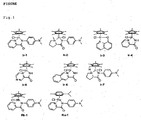
- Figure 1 shows representative organometallic compounds of the present invention.
- the nitrogen-containing organometallic complex used in the present invention is represented by general formula (1).
- Ar is, typically, a cyclopentadienyl group or an aromatic compound in which one or more hydrogen atoms may be substituted; specific examples of Ar include, but are not limited to, unsubstituted benzene, toluene, o-, m- and p-xylene, o-, m-and p-cymene, 1,2,3-, 1,2,4- and 1,3,5-trimethylbenzene, 1,2,4,5-tetramethylbenzene, 1,2,3,4-tetramethylbenzene, 1,3,4,5-tetramethylbenzene, pentamethylbenzene, and benzene having an alkyl group such as hexamethylbenzene, benzene having an unsaturated hydrocarbon group such as benzyl, vinyl, and allyl, benzene having a heteroatom such as hydroxyl group, alkoxy group, ester group, amino group and halogen group.
- the number of substituents in a benzene ring is any number from 1 to 6, and substituents may be at any positions.
- Ar is preferably p-cymene, 1,3,5-trimethylbenzene, and hexamethylbenzene.
- the substituent W is a saturated or unsaturated C1-10 hydrocarbon group, aryl group, heterocyclyl group, alkoxy group, fluoroalkyl group, acyl group, ester group, hydroxyl group, aminogroup, amide group, carboxyl group, sulfonyl group, nitro group, cyano group, sulfenyl group, sulfo group, mercapto group, phosphino group, silyl group or halogen group; in particular, it is a saturated or unsaturated C1-10 hydrocarbon group, aryl group, heterocyclyl group, alkoxy group, acyl group, ester group, hydroxyl group, amino group, sulfonyl group, silyl group or halogen group.
- W include, but are not limited to, methyl group, ethyl group, n-propyl group, i-propyl group, n-butyl group, i-butyl group, pentyl group, hexyl group, cyclohexylene group, ethenyl group, propenyl group, butenyl group, phenyl group, toluyl group, naphthyl group, pyridyl group, furanyl group, methoxy group, ethoxy group, propoxy group, acetyl group, propanoyl group, cyclohexanecarbonyl group, benzoyl group, methoxycarbonyl group, ethoxycarbonyl group, hydroxyl group, methylamino group, ethylamino group, dimethylamino group, methanesulfonyl group, ethanesulfonyl group, methylsilyl-group, dimethyl
- M in general formula (1) is ruthenium, rhodium or iridium. From the viewpoint of high level of catalyst activity, it is preferably rhodium and iridium.
- X in general formula (1) is a hydride group or anionic group.
- Specific examples of X include, but are not limited to, hydride group, hydroxy group, alkoxy group, cross-linked oxo group, fluorine gr.oup, chlorine group, bromine group, iodine group, tetrafluoroborate group, tetrahydroborate group, tetrakis(pentafluorophenyl)borate group, tetrakis [3', 5'-bis (trifluoromethyl) phenyl] borate group, hexafluorophosphate group, hexafluoroantimonate group, hexachloroantimonate group, hexafluoroarsenate group, perchlorate group, acetoxy group, benzoyloxy group, (2',6'-dihydroxybenzoyl)oxy group, (2',5'-dihydroxybenzoyl)oxy group, (3'-amino
- a coordinating neutral molecule may be coordinated to M.
- the neutral molecule coordinated to M include water; alcohols such as methanol, ethanol, n-propanol, isopropanol and 2-methoxyethanol; ethers such as tetrahydrofurane, diethyl ether, diisopropyl ether, and methyl-tert-butyl ether; N,N'-dimethyl formamide, N,N'-dimethyl acetoamide, N-methyl-2-pyrrolidone, dimethylsulfoxide, acetone, chloroform, acetonitrile, benzonitrile, etc.
- the link group E is a saturated, or unsaturated C1-6 hydrocarbon group or an arylene group, in which one or more hydrogen atoms may be substituted.
- Specific examples of E include, but are not limited to, methylene group, ethylene group, propylene group, cyclohexylene group, vinylene group, propynylene group, butenylene group, phenylene group, and naphthalenylene group. From the viewpoints of high catalyst activity and easiness in the synthesis of complex, it is preferably a methylene group, ethylene group, phenylene group, and naphthalenylene group, and more preferably a methylene group and phenylene group.
- examples of the substituents for one or more hydrogen atoms typically include C1-10 alkyl group, cycloalkyl group, aryl group, alkenyl group, acyl group, halogen group, ester group, amino group, amide group, carboxyl group, hydroxyl group, alkoxy group, nitro group, cyano group, phosphino group, sulfonyl group, sulfenyl group, sulfo group, thiol group, or silyl group, and in particular, C1-10 alkyl group, cycloalkyl group, aryl group, alkenyl group, or acyl group.
- One or more hydrogen atoms in these substituents may further be substituted by a substituent W.
- a in general formula (1) is an amide group having a binding mode of "M-NR 1 C(O) -E, " or an oxygen atom.
- R 1 is a hydrogen atom, a C1-10 alkyl group, a cycloalkyl group, an aryl group, a heterocyclyl group, an alkenyl group, an alkynyl group, an ester group, an acyl group, an amide group, a phosphino group, a sulfenyl group, a sulfinyl group, a sulfonyl group or a silyl group, in which one or more hydrogen atoms may be substituted by a substituent W.
- One or more hydrogen atoms of the substituent W in these groups may further be substituted by a substituent W.
- R 1 examples include, but are not limited to, hydrogen atom, methyl group, ethyl group, n-propyl group, i-propyl group, tert-butyl group, isobutyl group, benzyl group, cyclohexyl group, phenyl group, pyridyl group, vinyl group, ethynyl group, group having an ester bond, acetyl group, benzoyl group, methanesulfonyl group, ethanesulfonyl group, p-toluenesulfonyl group, trifluoromethansulfonyl group, methylsilyl group, dimethylsilyl group, trimethylsilyl group, etc.
- A is an oxygen atom
- E is limited to an arylene group wherein one or more hydrogen atoms may be substituted by a substituent W.
- Y and Z in general formula (1) are, typically and independently of each other, an alkyl group, a cycloalkyl group, a heterocyclyl group, a silyl group, an aryl group, or an alkenyl group, in which one or more hydrogen atoms may be substituted by a substituent W.
- Specific examples of Y and Z include methyl group, ethyl group, cyclohexyl group, phenyl group, pyridyl group, vinyl group, and trimethylsilyl group, but are not limited thereto. From the viewpoint of easiness in the synthesis of complex, they are preferably a methyl group, ethyl group and phenyl group.
- Y, Z and E may be mutually bound to form a ring. Specific examples include, but are not limited to, cases wherein Z and E are bound to form a piperidyl group, pyridyl group, or pyrrolidyl group.
- n denotes 0, N-Z or N-E is a double bond.
- an organometallic complex having the structure of the above formula (1) as a catalyst for reductive amination reaction of an imine compound or enamine compound, under the presence of hydrogen gas or a hydrogen-donating organic or inorganic compound, the imine compound or enamine compound can be diastereoselectively reduced.
- Mechanism of this diastereoselective reduction has not yet been clarified, but one cause is considered to be related to the size of the molecular structure of said organometallic complex.
- This organometallic complex is a sterically bulky molecule, so that upon acting as a catalyst for reductive amination, reduction tends to occur from the direction with less steric hindrance against the reaction site of the imine structure.
- the part in the catalyst of formula (1) is preferably a group comprising a nitrogen-containing cyclic group, from the viewpoints of high catalyst activity and diastereoselectivity.
- n is 0, said group is a nitrogen-containing aromatic ring group, and N in general formula (2) is a hetero nitrogen atom in the nitrogen-containing aromatic ring structure, so that Z and E are bound to form a ring structure.
- Examples of the group comprising the nitrogen-containing aromatic ring structure include, not only a nitrogen-containing six-membered monocyclic aromatic ring such as pyridine ring, pyridazine ring, pyrazine ring, pyrimidine ring, triazine ring or tetrazine ring, but also a polycyclic aromatic ring comprising a nitrogen-containing six-membered aromatic ring structure, such as quinoline ring, isoquinoline ring, quinazoline ring, quinoxalinering, acridinering, cinnolinering, phthalazinering, naphthyridine ring.
- such group may be any group comprising a nitrogen-containing aromatic ring structure, and includes, for example, 5,6,7,8-tetrahydroquinolyl group.
- nitrogen-containing 5-membered ring include pyrazole ring, isooxazole ring, isothiazole ring, imidazole ring, oxazole ring, thiazole ring, 1,2,3-triazole ring, 1,2,4-triazole ring, tetrazole ring, etc.
- said nitrogen-containing cyclic group becomes a non-aromatic ring, and N becomes a nitrogen heteroatom in the nitrogen-containing ring, so that a ring structure is formed by binding Z and E.
- the group containing such non-aromatic nitrogen-containing ring structure include, a 4-membered nitrogen-containing ring such as azetidine ring, a 5-membered nitrogen-containing ring or a group containing said ring, such as pyrrolidine ring, pyrroline ring, imidazolidine ring, imidazoline ring, pyrazolidine ring, pyrazoline ring, oxazoline ring, indoline ring, and isoindoline ring, a 6-membered nitrogen-containing ring or a group containing said rind, such as piperidine ring, piperazine ring, morpholine ring, as well as quinuclidine ring.
- R 2 and R 3 are, independently of each other, a hydrogen atom, a halogen atom, or a C1-10 alkyl group, a cycloalkyl group, an aryl group, a heterocyclyl group, an alkenyl group, an alkynyl group, an alkoxy group, an ester group, a fluoroalkyl group, an acyl group, a sulfonyl group, a nitro group, a cyano group, a hydroxy group, a sulfo group, a mercapto group, an amino group, an amide group, a carboxyl group, a phosphino group, a sulfenyl group, or a silyl group, in which one or more hydrogen atoms may:be substituted by a substituent W; in particular, they are
- a plurality of R 2 and R 3 may be introduced, and the numbers of substitution j and k are, independently of each other, an integer from 0 to 3, wherein when j is 2 or more, two or more of R 2 may be linked each other to form a ring such as phenanthridine ring or acridine ring. Furthermore, one or more carbon atoms, which are not bonded to R 2 or R 3 , in the quinoline ring structure may be replaced by a nitrogen atom to form, for example, naphthyridine ring, quinoxaline ring, cinnoline ring, quinazoline ring, phthalazine ring, etc.
- R 2 and R 3 include methyl group, ethyl group, cyclohexyl group, phenyl group, pyridyl group, vinyl group, ethynyl group, group having an ester bond, acetyl group, methanesulfonyl group, ethanesulfonyl group, p-tluenesulfonyl group, and trimethylsilyl group, but are not limited thereto. From the viewpoint of high catalyst activity, they are preferably a methyl group, ethyl group and propyl group.
- R 2 has the same meaning as described above, and its number of substitution 1 is an integer from 0 to 4.
- R 4 is a hydrogen atom, a C1-10 alkyl group, a cycloalkyl group, an aryl group, a heterocyclyl group, an alkenyl group, an alkynyl group, an ester group, an acyl group, an amide group, a phosphino group, a sulfenyl group, a sulfinyl group, a sulfonyl group, or a silyl group, in which one or more hydrogen atoms may be substituted by a substituent W.
- R 4 include, but are not limited to, for example, hydrogen atom, methyl group, ethyl group, n-propylgroup, isopropyl group, tert-butylgroup, isobutyl group, benzyl group, cyclohexylgroup, phenyl group, pyridylgroup, vinyl group, ethynyl group, group having an ester bond, acetyl group, benzoyl group, sulfonyl group, and silyl group.
- R 2 is preferably a hydrogen atom, methyl group, ethyl group, isopropyl group, tert-butyl group, isobutyl group, benzyl group, phenyl group, 4-methoxyphenyl group, and 4-(dimethylamino)phenyl group.
- a plurality of R 2 may be introduced, and the number of substitution 1 denotes an integer from 0 to 4, wherein when 1 is 2 or more, two or more of R 2 may be linked each other to form a ring such as quinoline ring, isoquinoline ring, etc.
- one or more carbon atoms, which are not bonded to R 2 , in the pyridine ring structure may be replaced by a nitrogen atom to form, for example, a pyridazine ring, pyrazine ring, pyrimidine ring, and triazine ring, etc.
- R 2 has the same meaning as described above, and its number of substitution m is an integer from 0 to 7.
- R 4 is a hydrogen atom, a C1-10 alkyl group, a cycloalkyl group, an aryl group, a heterocyclyl group, an alkenyl group, an alkynyl group, an ester group, an acyl group, an amide group, a phosphino group, a sulfenyl group, a sulfinyl group, a sulfonyl group, or a silyl group, in which one or more hydrogen atoms may be substituted by a substituent W.
- R 4 include, but are not limited to, for example, hydrogen atom, methyl group, ethyl group, n-propyl group, isopropyl group, tert-butyl group, isobutyl group, benzyl group, cyclohexylgroup, phenyl group, pyridylgroup, vinyl group, ethynyl group, group having an ester bond, acetyl group, sulfonyl group, and silyl group.
- it is preferably a hydrogen atom, methyl group, ethyl group, isopropyl group, tert-butyl group, isobutyl group, benzyl group, phenyl group, 4-methoxyphenyl group, or 4-(dimethylamino)phenyl group.
- a plurality of R 2 may be introduced, and the number of substitution m denotes an integer from 0 to 7, wherein when m is 2 or more, two or more of R 2 may be linked each other to form a ring, such as indoline ring, isoindoline ring, etc.
- one or more carbon atoms in the pyrrolidine ring structure may be replaced by a nitrogen atom to form, for example, a imidazolidine ring, pyrazolidine ring, etc.
- Patent Literature 3 discloses a process for preparing an optically active alcohol by asymmetric reduction of a carbonyl compound, but not a process for diastereoselectively preparing amine compounds.
- Patent Literature 4 discloses a preparation method of tamsulosin, wherein in its one process, a step to obtain an enantiomer by asymmetric reduction of an imine compound is disclosed.
- the enantioselectivity obtained is 30-40%ee, which is not sufficient, and optically active bodies with sufficient purity can be obtained only after further purification using re-crystallization.
- the organometallic complex used in the process of the present invention is particularly characterized by that the nitrogen atom of the hetero ring coordinated to a metal atom does not have a hydrogen atom, namely, that Y is not H.
- Y is not H
- a reductive amination reaction with extremely high reactivity and diastereoselectivity can be achieved compared to conventional organometallic complexes.
- the organometallic complex wherein Y is H is reacted with a carbonyl compound under a reductive condition
- the following reaction proceeds: the imine compound or enamine compound is rarely reduced, and the carbonyl compound is reduced to generate an alcohol; therefore, a one-pot reductive amination reaction wherein a carboxyl compound is mixed with an amine compound, then the imine compound or enamine compound generated in the system is diastereoselectively reduced, cannot be achieved.
- the present invention enables such one-pot reaction.
- the carbonyl compound used as a raw material for imine compound or enamine compound is, for example, those represented by general formula (8): However, it is not necessarily limited thereto.
- R 5 and R 6 may be mutually identical or different, and denote a hydrogen atom, a hydrocarbyl group, an aryl group, or a heterocyclyl group, a carboxyl group, an ester group, an acyl group, in which one or more hydrogen atoms may be substituted by any substituents.
- R 5 and R 6 include, but are not limited to, alkyl groups such as methyl, ethyl, propyl, butyl, pentyl, hexyl, heptyl, etc., fluoroalkyl groups such as trifluoroalkyl group, etc.
- cycloalkyl groups such as cyclopropyl, cyclobutyl, cyclopentyl, cyclohexyl, etc., unsaturated hydrocarbons such as vinyl and allyl, aromatic mono- or polycyclic groups such as phenyl, 1-naphthyl, 2-naphthyl, anthryl, phenanthryl, indenyl, etc., hetero mono- or polycyclic groups such as thienyl, furyl, pyranyl, xanthenyl, pyridyl, pyrrolyl, imidazolinyl, indolyl, carbazoyl, phenanthrolinyl, etc., ferrocenyl group, carboxylic acid, ester groups such as methoxycarbonyl group, ethoxycarbonyl group, etc., acyl groups such as formyl group, acetyl group, benzoyl group, etc.
- any groups may be contained, including, but not limited to, hydrocarbon groups such as alkyl, alkenyl, cycloalkyl, cycloalkenyl, etc., fluoroalkyl group, halogen atom, oxygen-containing groups such as hydroxyl group, acyl group, alkoxy group, carboxyl group, ester group, etc., amino group, amide group, sulfonyl group, sulfenyl group, sulfo group, mercapto group, silyl group, nitro group, cyano group, etc.
- hydrocarbon groups such as alkyl, alkenyl, cycloalkyl, cycloalkenyl, etc.
- fluoroalkyl group such as hydroxyl group, acyl group, alkoxy group, carboxyl group, ester group, etc.
- oxygen-containing groups such as hydroxyl group, acyl group, alkoxy group, carboxyl group, ester group, etc.
- amino group
- R 5 and R 6 may be bound to form a ring, and examples of such cases include, but are not limited to, saturated and unsaturated alicyclic groups that give cyclic ketones such as cyclopentanone, cyclohexanone, cycloheptanone, cyclopentanone, cyclohexenone, cycloheptenone, as well as saturated and unsaturated alicyclic groups that have a substituent having, at its respective carbon, an alkyl group, an aryl group, an unsaturated alkyl group, or a linear or cyclic hydrocarbon group comprising a heteroatom.
- saturated and unsaturated alicyclic groups that give cyclic ketones such as cyclopentanone, cyclohexanone, cycloheptanone, cyclopentanone, cyclohexenone, cycloheptenone, as well as saturated and unsaturated alicyclic groups that have a substituent having, at its respective carbon, an alky
- cyclic ketones having a substituent at their side chain include cyclohexanone having a substituent at 2-position, cyclohexanone having a substituent at 3-position, cyclohexanone having a substituent at 4-position, cyclopentanone having a substituent at 2-position, cyclopentanone having a substituent at 3-position, azabicycloalkanone, adamantanone; more specifically, examples include 2-methyl cyclohexanone, 2-phenyl cyclohexanone, ethyl 2-cyclohexanone carboxylate, 3-methyl cyclohexanone, 4-phenyl cyclohexanone, 4-tert-butyl cyclohexanone, ethyl 4-cyclohexanone carboxylate, 1,4-cyclohexandion, ethyl cyclopentanone-2
- the amine compound as a raw material of the present invention is, for example, those represented by general formula (9) : However, it is not limited thereto.
- R 7 and R 8 may be mutually identical or different, and they are a hydrogen atom, a hydrocarbyl group in which one or more hydrogen atoms may be substituted by any substituents, or a heterocyclyl group in which one or more hydrogen atoms may be substituted by any substituents.
- R 7 and R 8 include, but are not limited to, alkyl groups such as methyl, ethyl, propyl, butyl, pentyl, hexyl, heptyl, etc., cycloalkyl groups such as cyclopropyl, cyclobutyl, cyclopentyl, cyclohexyl, etc., unsaturated hydrocarbons such as vinyl and allyl, aromatic mono- or polycyclic groups such as phenyl, 1-naphthyl, 2-naphthyl, anthryl, phenanthryl, indenyl, etc., hetero mono- or polycyclic groups such as thienyl, furyl, pyranyl, xanthenyl, pyridyl, pyrrolyl, imidazolinyl, indolyl, carbazoyl, phenanthrolinyl, etc., and ferrocenyl group, etc.
- alkyl groups
- any groups may be contained, including hydrocarbon groups such as alkyl, alkenyl, cycloalkyl, cycloalkenyl, etc., fluoroalkyl group, halogen atom, oxygen-containing groups such as hydroxyl group, acyl group, alkoxy group, carboxyl group, ester group, etc., and amino group, amide group, sulfonyl group, sulfenylgroup, sulfogroup, mercapto group, silyl group, nitro group, cyano group, etc.
- hydrocarbon groups such as alkyl, alkenyl, cycloalkyl, cycloalkenyl, etc.
- fluoroalkyl group such as hydroxyl group, acyl group, alkoxy group, carboxyl group, ester group, etc.
- oxygen-containing groups such as hydroxyl group, acyl group, alkoxy group, carboxyl group, ester group, etc.
- amino group such as hydroxyl
- R 7 and R 8 may be bound to form a ring, and examples of such cases include, but are not limited to, saturated and unsaturated alicyclic groups that give cyclic ketones such as pyrrolidine, piperidine, azepane, pyrrole, tetrahydropyridine, tetrahydroazepine, etc., as well as saturated and unsaturated alicyclic groups that have a substituent having, at its respective carbon, an alkyl group, an aryl group, an unsaturated alkyl group, or a linear or cyclic hydrocarbon group comprising a heteroatom.
- ammonium salt benzylamine, racemic ⁇ -phenylethylamine, and optically-active ⁇ -phenylethylamine are used.
- the carbonyl compound of general formula (8) and/or the amine compound of general formula (9) must have a chiral carbon; by appropriately combining these substrates, amine compounds can be diastereoselectively prepared.
- the imine compound or enamine compound used in the invention may be easily obtained by, under the presence or absence of an acid catalyst, a condensation reaction of a carbonyl compound of general formula (8) with an amine compound of general formula (9).
- Bronsted acid As an acid catalyst, addition of Bronsted acid or Lewis acid is desirable.
- Bronsted acid include organic acid such as carboxylic acid, sulfonic acid, or phenols, or mineral acid such as phosphoric acid, boric acid, hydrochloric acid or nitric acid, and specific examples include, but are not limited to, Bronsted acid such as formic acid, acetic acid, chloroacetic acid, trifluoroacetic acid, salicylic acid, p-toluenesulfonic acid, phenol and binaphthol, or Lexis acid such as titanium tetraisopropoxide and aluminium triisopropoxide. These may be used alone, or a combination of a plurality of these may be used.
- Hydrogen donators used in the present invention refer to a compound that can donate hydrogen by a thermal action or by a catalyst action, and the kind of such hydrogen-donating compound is not particularly limited.
- preferable hydrogen-donating compounds include, but are not limited to, methanol, ethanol, 1-propanol, 2-propanol, 1-butanol, sec-butyl alcohol, n-pentylalcohol, cyclopentylalcohol, n-hexylalcohol, cyclohexyl alcohol, benzyl alcohol, formic acid, HCOOK, HCOONa, HCOOLi and HCOONH 4 . These may be used alone, or a combination of a plurality of these may be used. From the viewpoints of reactivity and economic efficiency, hydrogen-donating compounds are preferably formic acid or formate.
- the amount of a hydrogen-donating compound used may be 1-30 equivalents relative to the carbonyl compound; from the viewpoints of reactivity and economic efficiency, it is preferably 1-10 equivalents.
- a phase-transfer catalyst may be added to carry out the reaction if necessary.
- the phrase-transfer catalyst that can be used may be any salts having a long-chain alkyl ammonium cation; from the viewpoints of reactivity and economic efficiency, it is preferably a tetrabutylammonium salt.
- the amount of the phase-transfer catalyst added is generally between 0.001-10 molar equivalents relative to the carbonyl compound; from the viewpoints of reactivity and economic efficiency, it is preferably 0.01-0.1 molar equivalents.
- the amount of an amine compound used may be generally between 1-30 equivalents relative to the carbonyl compound; from the viewpoints of reactivity and economic efficiency, it is preferably 1-10 equivalents.
- a gas such as ammonia is used as an amine compound, the gas may be used as is, or may be dissolved in an ammonia water or solvent, etc., or may be used as an ammonium salt.
- ammonium salt used may be any salt containing ammonia, including ammonium formate, ammonium acetate, ammonium chloride, ammonium bromide, ammonium fluoride, ammonium iodide, ammonium phosphate, ammonium hexafluorophosphate, ammonium thiocyanate, ammonium benzoate, ammonium hydroxide, ammonium perchlorate, ammonium sulfate, ammonium nitrate, ammonium carbonate, ammonium hydrogen carbonate, etc.; from the viewpoints of reactivity and economic efficiency, it is preferably ammonium formate, ammonium acetate, or ammonium chloride.
- a ruthenium, rhodium or iridium complex of general formula (1) used in the present invention may be prepared by mixing an organometallic compound of general formula (6): (wherein p denotes an integer of 2 or more) with a nitrogen-containing ligand of general formula (7):
- An amount of catalyst used can be expressed by a molar ratio S/C of a carbonyl compound relative to a ruthenium, rhodium or iridium catalyst (S denotes the number of moles of the carbonyl compound, imine compound or enamine compound, and C denotes the number of moles of the catalyst).
- S denotes the number of moles of the carbonyl compound, imine compound or enamine compound
- C denotes the number of moles of the catalyst.
- the highest possible level of S/C varies significantly depending on the structure of a substrate, kind and concentration of a catalyst, reaction temperature, and kind of a hydrogen donator, etc.; practically, the S/C value should desirably be set at approximately 100-20000.
- reaction solvent considering the physical and chemical properties of carbonyl compound, amine compound, imine compound, enamine compound, acid, hydrogen gas and hydrogen-donating compound, a reaction solvent may appropriately be used.
- Proticsolvent, non-proticsolvent, ionic liquid, water and buffer may be used alone, or a combination of a plurality of these may be used.
- reaction can be carried out preferably at approximately from -20°C to 100°C, and more preferably from 20°C to 80°C. Reaction time may vary depending on reaction conditions such as substrate concentration, temperature and pressure, etc.; reaction is completed within several minutes to 100 hours.
- Purification of generated amine compounds may be performed using a publicly known method such as acid-base extraction, column chromatography, distillation, and re-crystallization, or an appropriate combination thereof.
- a publicly known method such as acid-base extraction, column chromatography, distillation, and re-crystallization, or an appropriate combination thereof.
- an organometallic compound of general formula (6) and an organic compound of general formula (7) it is possible to prepare an amine compound by reacting a carbonyl compound, an amine compound, with hydrogen gas or a hydrogen-donating organic or inorganic compound, or by reacting an imine compound or an enamine compound with hydrogen gas or a hydrogen-donating organic or inorganic compound.
- Diastereoselectivity and steric isomers of an amine compound as a reaction product were determined by 1 H-NMR, GC, and using a Fourier transform infrared spectrometer (FT/IR).
- FT/IR Fourier transform infrared spectrometer
- a NMR apparatus JNM-ECX-400P (JEOL Ltd.) was used;
- a GC apparatus GC-17A (Shimadzu Corporation) was used and as a Fourier transform infrared spectrometer, FT/IR-660 plus (JASCO Corporation) was used.
- Structures of the iridium catalyst, rhodium catalyst and ruthenium catalyst used in the preset invention are shown in Fig. 1 .
- the solvent was distilled away from the reaction solution, 7.5 mL of 1M KOH aqueous solution were added, and the resulting solution was extracted with 40 mL of dichloromethane, the organic layer was washed twice with 5 mL of water, and dichloromethane was added to make exactly the 50-mL dichloromethane solution. A 5-mL aliquot of this solution was collected, from which the solvent was distilled away, and the resulting solution was subjected to 1 H NMR quantification using coumarin (MW: 146.14) as the internal standard, giving 2-chlorocyclohexylamine with 61% yield. The obtained objective substance was induced in hydrochloride, and IR measurement was carried out, confirming that the major product was a cis form.
- the solvent was distilled away from the reaction solution, 7.5 mL of saturated NaHCO 3 aqueous solution were added, and the resulting solution was extracted with 50 mL of dichloromethane.
- the organic layer was washed twice with 5 mL of water, dried with sodium sulfate, and after the drying agent was removed by filtration, dichloromethane was added to make exactly the 50-mL dichloromethane solution.
- the solvent was distilled away from the reaction solution, 10 mL of 1M KOH aqueous solution were added, and the resulting solution was extracted with 15 mL of dichloromethane; the organic layer was washed twice with 3 mL of water, and dichloromethane was added to make exactly the 20-mL dichloromethane solution.
- 1.662g (10.0 mmol) of 5-hydroxyadamantane-2-one (MW: 166.22) were introduced in a 50-mL Schlenk tube, dried under reduced pressure, then subjected to argon-gas replacement.
- 20 mL of dehydrated ethyl acetate, 1 .45 mL (11. 5 mmol) of DL- ⁇ -methylbenzylamine (MW: 121.18, d 0.96), 755 ⁇ L (20.0 mmol) of formic acid (MW: 46.03, d 1.220), and 2.54 mg (0.005 mmol, S/C 2000) of iridium catalyst Ir-3 (MW: 507.05) were added and stirred while heating at 50°C for 24 h.
- this invention enables to produce an amine compound efficiently and highly diastereoselectively by reductive amination reaction of carbonyl compound and amine compound.
Landscapes
- Chemical & Material Sciences (AREA)
- Organic Chemistry (AREA)
- Chemical Kinetics & Catalysis (AREA)
- Organic Low-Molecular-Weight Compounds And Preparation Thereof (AREA)
- Low-Molecular Organic Synthesis Reactions Using Catalysts (AREA)
- Catalysts (AREA)
Description
- The present invention relates to a practical process for preparing an amine compound by means of diastereoselective and reductive amination reaction of a carbonyl compound, and a practical process for preparing an amine compound by means of diastereoselective reduction or hydrogenation of an imine compound or enamine compound, using a nitrogen-containing organometallic complex as a catalyst.
- A process for preparing an amine compound by means of reaction of ammonia or a primary or secondary amine compound with a carbonyl compound has been known as a reductive amination reaction, which is one of the standard processes for preparing amine compounds. As the reductive amination reaction, except for enantioselective methods using an asymmetric catalyst, the following methods are generally carried out: methods by hydrogenation reaction using heterogenous catalysts such as Raney Ni, Raney Co, Pd/activated carbon, and Pt/activated carbon, as well as methods using boron reactants such as NaBH3CN (J. Am. Chem. Soc. 1971, 93, 2897) and NaBH(OAc)3 (J. Org. Chem. 1996, 61, 3849). Under the presence of these heterogenous catalysts and boron reactants, when a carbonyl compound or amine compound having a chiral carbon or achiral carbon is used as the reactive substrate, it has been known that a reactive intermediate, i.e., an imine compound or enamine compound, is diastereoselectively reduced.
- For example, in the synthesis of 4-tert-butylcyclohexylamine by reductive amination reaction of 4-tert-butylcyclohexanone and ammonia, as described in
Non-patent Literature 1 andPatent Literature 1, corresponding amines can be obtained with a diastereoselectivity of cis:trans = 90 : 10 by hydrogenation reaction using a non-homogenous catalyst such as rhodium catalyst or palladium catalyst. When 4-tert-butylcyclohexanone is reacted with a primary amine and the obtained imine is subjected to hydrogenation reaction using a heterogenous catalyst or to reductive reaction using a boron reactant as described inPatent Literature 2,Non-patent Literature 2, Non-patentLiterature 3 and Non-patent Literature 4, corresponding amines can be obtained with a selectivity of cis:trans = 99:1 at the maximum. - Furthermore, as a method to obtain optically active amines using diastereoselective reaction, as described in
Non-patent Literature 5, the following method has been known: after diastereoselectively obtaining a corresponding amine by reductive amination reaction of a carbonyl compound with an optically active α-methylbenzylamine under the presence of a heterogenous catalyst (Raney Ni, Pd/activated carbon, Pt/activated carbon, Ru/activated carbon, or Rh/activated carbon) and a Lewis acid such as Ti(O-i-Pr)4 etc., an optically active primary amine is obtained by de-benzylation reaction. - However, with the methods described in
Non-patent Literature 1,Non-patent Literature 5,Patent Literature 1, andPatent Literature 2 using a heterogenous catalyst, when the substrate has a site of carbon-carbon multiple bond and a functional group such as cyano group and nitro group, they are simultaneously hydrogenated, so that the methods cannot be applied to such substrates having functional groups. In addition, with the methods described inNon-patent Literature 1 andPatent Literature 1, there are problems of lower diastereoselectivity compared to those of Non-patentLiterature 3 and 4. - The methods using boron reactants described in Non-patent Literatures 2-4 have excellent operability and safety because no pressure-resistant reactor is required, and have no problem in terms of functional selectivity which is the problem in heterogeneous catalysts; however, they are not superior in terms of economic efficiency and environmental aspect because they are not a catalyzed reaction. In addition, in
Non-patent Literatures 3 and 4, although high diastereoselectivity is obtained, an imine must be prepared beforehand, and deprotection of the obtained amine after reduction of the imine is required; and an expensive boron reactant must be used to obtain high diastereoselectivity. Thus, the methods are not a practical preparation process. - In
Patent Literature 3, a process for preparing optically active alcohols by asymmetric reduction of carbonyl compounds using an organometallic complex as a catalyst has been described; however, whether or not reductive amination can be catalyzed by such catalyst has not been reported. In addition, in Patent Literature 4, a method to enantioselectively obtain amine compounds using an organometallic complex in reductive amination reaction has been described; however, sufficient enantioselectivity cannot be achieved. -
Patent Literature 5 described a method to enantioselectively obtain amine compounds using an organometallic complex having a chiral prolinamide compound as a ligand, in which nitrogen atom of pyrrolidine in the prolinamide has a hydrogen. -
Patent Literature 6 described a method for manufacturing amines by converting a carbonyl compound with an amine in the presence of a heterogeneous imination catalysts containing copper, a hydrogenation catalyst and hydrogen. -
Patent Literature 7 described diastereoselective conversion of chiral imines in the presence of hydrogen and a heterogeneous catalyst containing copper. - As described above, development of a generalized practical process for preparing amine compounds through highly-diastereoselective reductive amination reaction, which exhibits high activity and excellent functional selectivity, has conventionally been desired.
-
- [Patent Literature 1]
EP 0669314 A1 - [Patent Literature 2]
WO99/047987 - [Patent Literature 3]
WO02/010101 - [Patent Literature 4]
WO2006/004093 - [Patent Literature 5]
EP 2172443 A1 - [Patent Literature 6]
WO2009/080512 A1 - [Patent Literature 7]
WO2009/080511 A1 -
- [Non-patent Literature 1] Journal of the Chemical Society of Japan, 1989, p. 641-647
- [Non-patent Literature 2] Tetrahedron Letters (1996), 37(23), 3977-3980.
- [Non-patent Literature 3] Tetrahedron Letters (1984), 25(7), 695-8.
- [Non-patent Literature 4] Tetrahedron Letters (1981), 22(36), 3447-50.
- [Non-patent Literature 5] Adv. Synth. Catal. 2006, 348, 1289-1299.
- An object of the present invention is to provide a generalized practical process for preparing amine compounds through highly-diastereoselective reductive amination reaction.
- The present inventors have extensively investigated a process for preparing amine compounds by reductive amination reaction of carbonyl compound and amine compound, and found that ruthenium, rhodium and iridium complexes having a nitrogen-containing ligand enable highly-diastereoselective preparation of amine compounds in the reductive amination reaction; after further research, the inventors have achieved the present invention.
- Namely, the present invention relates to the following.
- (a) A process for preparing an amine compound, characterized in that an imine compound or an enamine compound is diastereoselectively reduced using hydrogen gas or an organic or inorganic hydrogen-donating compound, under the presence of an organometallic compound of general formula (1):

- (b) The process for preparing an amine compound according to (a), characterized in that a part of formula (1) expressed by general formula (2) below:

- (c) The process for preparing an amine compound according to (a) or (b), characterized in that the organometallic compound of formula (1) is a compound of general formula (3):

or one or more organometallic compounds selected from the group consisting of the organometallic compound of general formula (4) below:
and general formula (5) below:

- (d) A process for preparing an amine compound, characterized in that an imine compound or an enamine compound is diastereoselectively reduced using hydrogen gas or an organic or inorganic hydrogen-donating compound, under the presence of an organometallic compound of general formula (6):


- (e) The process for preparing an amine compound according to any one of (a) - (d), characterized in that a carbonyl compound and an amine compound are mixed, and the imine compound or enamine compound generated in this system is diastereoselectively reduced.
- (f) The process for preparing an amine compound according to any one of (a)-(e), characterized in that M in formula (1) and formula (6) is rhodium or iridium.
- (g) The process for preparing an amine compound according to any one of Claims (a)-(f), characterized in that the organic or inorganic hydrogen-donating compound is formic acid or formate.
- (h) The process for preparing an amine compound according to any one of (a)-(g), characterized in that the amine compound obtained from the reaction is a cyclic amine compound or a cyclic diamine compound.
- The present invention provides a practical process for preparing amine compounds by highly-diastereoselective reductive amination reaction of carbonyl compound and amine compound, thereby enabling highly efficient preparation of amine compounds.
- [
Fig. 1] Figure 1 shows representative organometallic compounds of the present invention. - Hereinafter, the present invention is described in detail. The nitrogen-containing organometallic complex used in the present invention is represented by general formula (1).
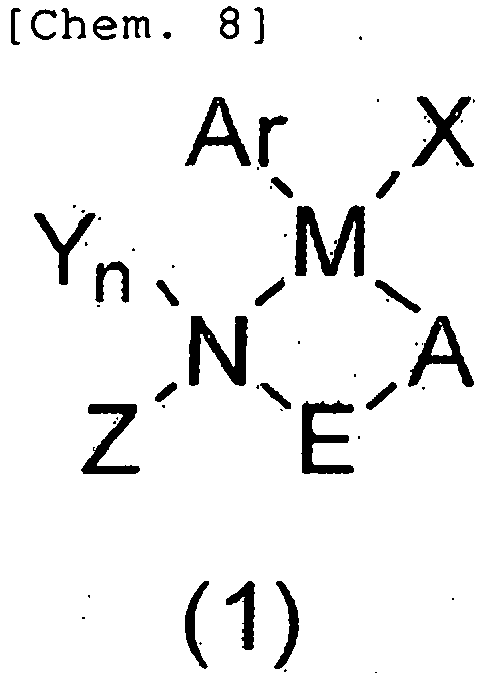
- Ar is, typically, a cyclopentadienyl group or an aromatic compound in which one or more hydrogen atoms may be substituted; specific examples of Ar include, but are not limited to, unsubstituted benzene, toluene, o-, m- and p-xylene, o-, m-and p-cymene, 1,2,3-, 1,2,4- and 1,3,5-trimethylbenzene, 1,2,4,5-tetramethylbenzene, 1,2,3,4-tetramethylbenzene, 1,3,4,5-tetramethylbenzene, pentamethylbenzene, and benzene having an alkyl group such as hexamethylbenzene, benzene having an unsaturated hydrocarbon group such as benzyl, vinyl, and allyl, benzene having a heteroatom such as hydroxyl group, alkoxy group, ester group, amino group and halogen group. The number of substituents in a benzene ring is any number from 1 to 6, and substituents may be at any positions. From the viewpoint of easiness in the synthesis of complex, Ar is preferably p-cymene, 1,3,5-trimethylbenzene, and hexamethylbenzene.
- Examples of cyclopentadienyl group that may have a substituent include, but are not limited to, cyclopentadienyl group, methylcyclopentadienyl group, ethylcyclopentadienyl group, isopropylcyclopentadienyl group, phenylcyclopentadienyl group, benzylcyclopentadienyl group, 1,2-dimethylcyclopentadienyl group, 1,3-dimethylcyclopentadienyl group, 1,2,3-trimethylcyclopentadienyl group, 1,2,4-trimethylcyclopentadienyl group, 1,2,3,4-tetramethylcyclopentadienyl group, and 1,2,3,4,5-pentamethylcyclopentadienyl group (Cp*). From the viewpoint of easiness in the synthesis of complex, it is preferably a 1,2,3,4,5-pentamethylcyclopentadienyl group (Cp*).
- The substituent W is a saturated or unsaturated C1-10 hydrocarbon group, aryl group, heterocyclyl group, alkoxy group, fluoroalkyl group, acyl group, ester group, hydroxyl group, aminogroup, amide group, carboxyl group, sulfonyl group, nitro group, cyano group, sulfenyl group, sulfo group, mercapto group, phosphino group, silyl group or halogen group; in particular, it is a saturated or unsaturated C1-10 hydrocarbon group, aryl group, heterocyclyl group, alkoxy group, acyl group, ester group, hydroxyl group, amino group, sulfonyl group, silyl group or halogen group.
- Specific examples of W include, but are not limited to, methyl group, ethyl group, n-propyl group, i-propyl group, n-butyl group, i-butyl group, pentyl group, hexyl group, cyclohexylene group, ethenyl group, propenyl group, butenyl group, phenyl group, toluyl group, naphthyl group, pyridyl group, furanyl group, methoxy group, ethoxy group, propoxy group, acetyl group, propanoyl group, cyclohexanecarbonyl group, benzoyl group, methoxycarbonyl group, ethoxycarbonyl group, hydroxyl group, methylamino group, ethylamino group, dimethylamino group, methanesulfonyl group, ethanesulfonyl group, methylsilyl-group, dimethylsilyl group, trimethylsilyl group, fluoro group, chloro group, and trifluoromethyl group, etc. From the viewpoint of easiness in the synthesis of complex, it is preferably a saturated or unsaturated hydrocarbon group, and more preferably a methyl group and i-propyl group.
M in general formula (1) is ruthenium, rhodium or iridium. From the viewpoint of high level of catalyst activity, it is preferably rhodium and iridium. - X in general formula (1) is a hydride group or anionic group. Specific examples of X include, but are not limited to, hydride group, hydroxy group, alkoxy group, cross-linked oxo group, fluorine gr.oup, chlorine group, bromine group, iodine group, tetrafluoroborate group, tetrahydroborate group, tetrakis(pentafluorophenyl)borate group, tetrakis [3', 5'-bis (trifluoromethyl) phenyl] borate group, hexafluorophosphate group, hexafluoroantimonate group, hexachloroantimonate group, hexafluoroarsenate group, perchlorate group, acetoxy group, benzoyloxy group, (2',6'-dihydroxybenzoyl)oxy group, (2',5'-dihydroxybenzoyl)oxy group, (3'-aminobenzoyl)oxy group, (2',6'-dimethoxybenzoyl)oxy group, (2',4',6'-triisopropylbenzoyl)oxy group, 1-naphthalenecarboxylic acid group, 2-naphthalenecarboxylic acid group, trifluoroacetoxy group, trifluoromethanesulfonimide group, nitromethyl group, nitroethyl group, toluenesulfonate group, methanesulfonate group, ethanesulfonate group, n-propanesulfonate group, isopropanesulfonate group, n-butanesulfonate group, fluorosulfonate group, fluoromethanesulfonate group, difluoromethanesulfonate group, trifluoromethanesulfonate group, and pentafluoroethanesulfonate group, etc. From the viewpoint of easiness in the synthesis of complex, it is preferably a chlorine group, bromine group, iodine group, and trifluoromethanesulfonate group.
- Furthermore, in addition to an anionic group X, a coordinating neutral molecule may be coordinated to M. Specific examples of the neutral molecule coordinated to M include water; alcohols such as methanol, ethanol, n-propanol, isopropanol and 2-methoxyethanol; ethers such as tetrahydrofurane, diethyl ether, diisopropyl ether, and methyl-tert-butyl ether; N,N'-dimethyl formamide, N,N'-dimethyl acetoamide, N-methyl-2-pyrrolidone, dimethylsulfoxide, acetone, chloroform, acetonitrile, benzonitrile, etc.
- The link group E is a saturated, or unsaturated C1-6 hydrocarbon group or an arylene group, in which one or more hydrogen atoms may be substituted. Specific examples of E include, but are not limited to, methylene group, ethylene group, propylene group, cyclohexylene group, vinylene group, propynylene group, butenylene group, phenylene group, and naphthalenylene group. From the viewpoints of high catalyst activity and easiness in the synthesis of complex, it is preferably a methylene group, ethylene group, phenylene group, and naphthalenylene group, and more preferably a methylene group and phenylene group.
- When E is an arylene group, examples of the substituents for one or more hydrogen atoms typically include C1-10 alkyl group, cycloalkyl group, aryl group, alkenyl group, acyl group, halogen group, ester group, amino group, amide group, carboxyl group, hydroxyl group, alkoxy group, nitro group, cyano group, phosphino group, sulfonyl group, sulfenyl group, sulfo group, thiol group, or silyl group, and in particular, C1-10 alkyl group, cycloalkyl group, aryl group, alkenyl group, or acyl group. One or more hydrogen atoms in these substituents may further be substituted by a substituent W.
- A in general formula (1) is an amide group having a binding mode of "M-NR1C(O) -E, " or an oxygen atom. R1 is a hydrogen atom, a C1-10 alkyl group, a cycloalkyl group, an aryl group, a heterocyclyl group, an alkenyl group, an alkynyl group, an ester group, an acyl group, an amide group, a phosphino group, a sulfenyl group, a sulfinyl group, a sulfonyl group or a silyl group, in which one or more hydrogen atoms may be substituted by a substituent W. One or more hydrogen atoms of the substituent W in these groups may further be substituted by a substituent W.
- Specific examples of R1 include, but are not limited to, hydrogen atom, methyl group, ethyl group, n-propyl group, i-propyl group, tert-butyl group, isobutyl group, benzyl group, cyclohexyl group, phenyl group, pyridyl group, vinyl group, ethynyl group, group having an ester bond, acetyl group, benzoyl group, methanesulfonyl group, ethanesulfonyl group, p-toluenesulfonyl group, trifluoromethansulfonyl group, methylsilyl group, dimethylsilyl group, trimethylsilyl group, etc. From the viewpoints of high catalyst activity and high reaction yield, it is preferably a hydrogen atom, methyl group, isopropyl group, tert-butyl group, isobutyl group, benzyl group, phenyl group, 4-methoxyphenyl group, and 4-(dimethylamino)phenyl group. When A is an oxygen atom, E is limited to an arylene group wherein one or more hydrogen atoms may be substituted by a substituent W.
- Y and Z in general formula (1) are, typically and independently of each other, an alkyl group, a cycloalkyl group, a heterocyclyl group, a silyl group, an aryl group, or an alkenyl group, in which one or more hydrogen atoms may be substituted by a substituent W. Specific examples of Y and Z include methyl group, ethyl group, cyclohexyl group, phenyl group, pyridyl group, vinyl group, and trimethylsilyl group, but are not limited thereto. From the viewpoint of easiness in the synthesis of complex, they are preferably a methyl group, ethyl group and phenyl group. Y, Z and E may be mutually bound to form a ring. Specific examples include, but are not limited to, cases wherein Z and E are bound to form a piperidyl group, pyridyl group, or pyrrolidyl group. When n denotes 0, N-Z or N-E is a double bond.
- By using an organometallic complex having the structure of the above formula (1) as a catalyst for reductive amination reaction of an imine compound or enamine compound, under the presence of hydrogen gas or a hydrogen-donating organic or inorganic compound, the imine compound or enamine compound can be diastereoselectively reduced. Mechanism of this diastereoselective reduction has not yet been clarified, but one cause is considered to be related to the size of the molecular structure of said organometallic complex. This organometallic complex is a sterically bulky molecule, so that upon acting as a catalyst for reductive amination, reduction tends to occur from the direction with less steric hindrance against the reaction site of the imine structure.
- The part in the catalyst of formula (1), the structure of which is expressed by general formula (2) below:
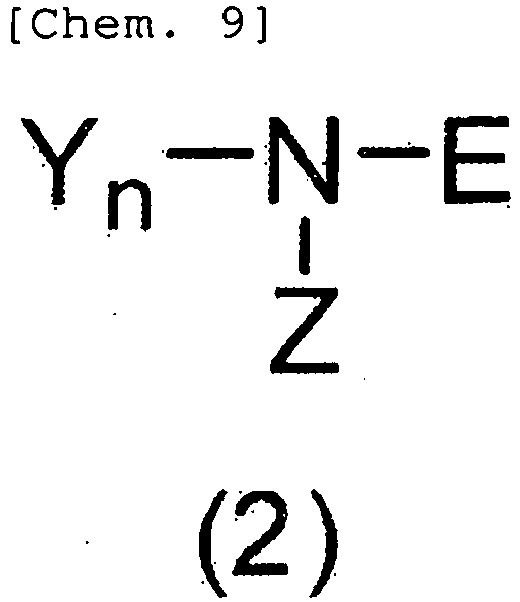
- When n=1, said nitrogen-containing cyclic group becomes a non-aromatic ring, and N becomes a nitrogen heteroatom in the nitrogen-containing ring, so that a ring structure is formed by binding Z and E. Examples of the group containing such non-aromatic nitrogen-containing ring structure include, a 4-membered nitrogen-containing ring such as azetidine ring, a 5-membered nitrogen-containing ring or a group containing said ring, such as pyrrolidine ring, pyrroline ring, imidazolidine ring, imidazoline ring, pyrazolidine ring, pyrazoline ring, oxazoline ring, indoline ring, and isoindoline ring, a 6-membered nitrogen-containing ring or a group containing said rind, such as piperidine ring, piperazine ring, morpholine ring, as well as quinuclidine ring.
- From the viewpoints of high catalyst activity and high diastereoselectivity, a compound of general formula (3):
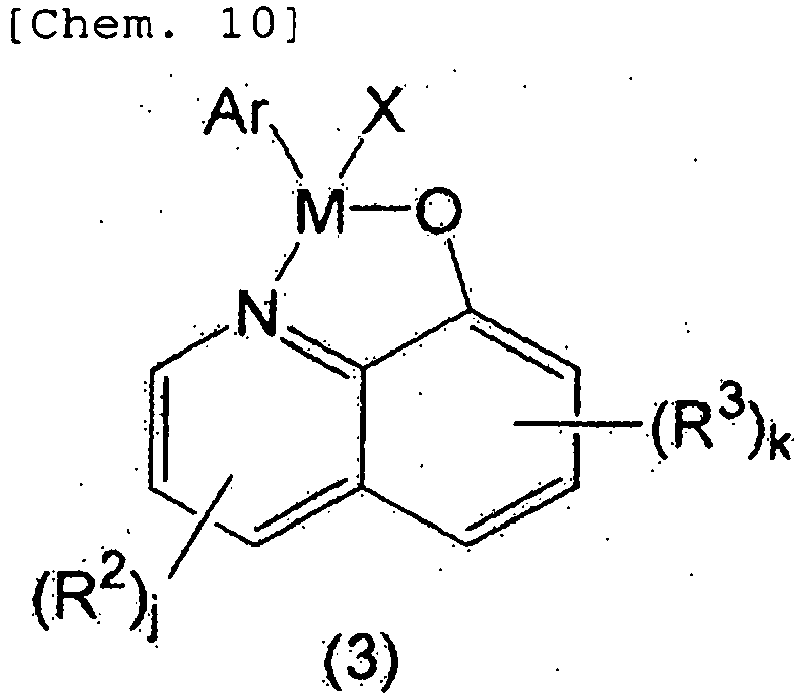
- A plurality of R2 and R3 may be introduced, and the numbers of substitution j and k are, independently of each other, an integer from 0 to 3, wherein when j is 2 or more, two or more of R2 may be linked each other to form a ring such as phenanthridine ring or acridine ring. Furthermore, one or more carbon atoms, which are not bonded to R2 or R3, in the quinoline ring structure may be replaced by a nitrogen atom to form, for example, naphthyridine ring, quinoxaline ring, cinnoline ring, quinazoline ring, phthalazine ring, etc.
- Specific examples of R2 and R3 include methyl group, ethyl group, cyclohexyl group, phenyl group, pyridyl group, vinyl group, ethynyl group, group having an ester bond, acetyl group, methanesulfonyl group, ethanesulfonyl group, p-tluenesulfonyl group, and trimethylsilyl group, but are not limited thereto. From the viewpoint of high catalyst activity, they are preferably a methyl group, ethyl group and propyl group.
- In addition, from the viewpoints of high catalyst activity and high diastereo selectivity, a compound of general formula (4):


substitution 1 is an integer from 0 to 4. R4 is a hydrogen atom, a C1-10 alkyl group, a cycloalkyl group, an aryl group, a heterocyclyl group, an alkenyl group, an alkynyl group, an ester group, an acyl group, an amide group, a phosphino group, a sulfenyl group, a sulfinyl group, a sulfonyl group, or a silyl group, in which one or more hydrogen atoms may be substituted by a substituent W. - Specific examples of R4 include, but are not limited to, for example, hydrogen atom, methyl group, ethyl group, n-propylgroup, isopropyl group, tert-butylgroup, isobutyl group, benzyl group, cyclohexylgroup, phenyl group, pyridylgroup, vinyl group, ethynyl group, group having an ester bond, acetyl group, benzoyl group, sulfonyl group, and silyl group. From the viewpoints of high catalyst activity and high reaction yield, it is preferably a hydrogen atom, methyl group, ethyl group, isopropyl group, tert-butyl group, isobutyl group, benzyl group, phenyl group, 4-methoxyphenyl group, and 4-(dimethylamino)phenyl group. A plurality of R2 may be introduced, and the number of
substitution 1 denotes an integer from 0 to 4, wherein when 1 is 2 or more, two or more of R2 may be linked each other to form a ring such as quinoline ring, isoquinoline ring, etc. Furthermore, one or more carbon atoms, which are not bonded to R2, in the pyridine ring structure may be replaced by a nitrogen atom to form, for example, a pyridazine ring, pyrazine ring, pyrimidine ring, and triazine ring, etc. - In addition, from the viewpoints of high catalyst activity and high diastereoselectivity, a compound of general formula (5) :

- Specific examples of R4 include, but are not limited to, for example, hydrogen atom, methyl group, ethyl group, n-propyl group, isopropyl group, tert-butyl group, isobutyl group, benzyl group, cyclohexylgroup, phenyl group, pyridylgroup, vinyl group, ethynyl group, group having an ester bond, acetyl group, sulfonyl group, and silyl group. From the viewpoints of high catalyst activity and high reaction yield, it is preferably a hydrogen atom, methyl group, ethyl group, isopropyl group, tert-butyl group, isobutyl group, benzyl group, phenyl group, 4-methoxyphenyl group, or 4-(dimethylamino)phenyl group. A plurality of R2 may be introduced, and the number of substitution m denotes an integer from 0 to 7, wherein when m is 2 or more, two or more of R2 may be linked each other to form a ring, such as indoline ring, isoindoline ring, etc. Furthermore, one or more carbon atoms in the pyrrolidine ring structure may be replaced by a nitrogen atom to form, for example, a imidazolidine ring, pyrazolidine ring, etc.
- To use an organometallic complex as an asymmetric reduction catalyst as described above is publicly known. For example, in the
above Patent Literatures 3 and 4, an asymmetric reduction reaction using an organometallic complex that has H as a substituent corresponding to Y in general formula (1) of this application is disclosed.
Patent Literature 3 discloses a process for preparing an optically active alcohol by asymmetric reduction of a carbonyl compound, but not a process for diastereoselectively preparing amine compounds. - Patent Literature 4 discloses a preparation method of tamsulosin, wherein in its one process, a step to obtain an enantiomer by asymmetric reduction of an imine compound is disclosed. However, in the asymmetric reduction reaction of imine compound using an organometallic complex in which the substituent corresponding to Y in general formula (1) of the present invention is a hydrogen atom, the enantioselectivity obtained is 30-40%ee, which is not sufficient, and optically active bodies with sufficient purity can be obtained only after further purification using re-crystallization.
- In contrast, the organometallic complex used in the process of the present invention is particularly characterized by that the nitrogen atom of the hetero ring coordinated to a metal atom does not have a hydrogen atom, namely, that Y is not H. In the process of the present invention, by using an organometallic complex wherein Y is not H, a reductive amination reaction with extremely high reactivity and diastereoselectivity can be achieved compared to conventional organometallic complexes. In addition, when the organometallic complex wherein Y is H is reacted with a carbonyl compound under a reductive condition, the following reaction proceeds: the imine compound or enamine compound is rarely reduced, and the carbonyl compound is reduced to generate an alcohol; therefore, a one-pot reductive amination reaction wherein a carboxyl compound is mixed with an amine compound, then the imine compound or enamine compound generated in the system is diastereoselectively reduced, cannot be achieved. However, the present invention enables such one-pot reaction.
- The reason that high diastereoselectivity can be obtained when Y is not H has not yet been clarified; however, because the organometallic complex of the present invention is sterically bulky, the complex is considered to be significantly affected by the steric environment of substituents in the imine compound or enamine compound to be reduced. In addition, the reason that reduction of carbonyl compound does not occur when Y is not H has not yet been clarified as well; however, this is considered to be because the organometallic complex of the present invention does not have an ability to reduce carbonyl compounds under an acidic condition under which imine or enamine compounds are easily produced.
- Under the presence of the catalyst used in the present invention, using hydrogen gas or a hydrogen-donating organic or inorganic compound, it is possible to prepare an amine compound by diastereoselectively reducing an imine compound or enamine compound. Moreover, under the presence of the catalyst used in the present invention, using hydrogen gas or a hydrogen-donating organic or inorganic compound, it is possible to prepare an amine compound by mixing a carbonyl compound with an amine compound, then diastereoselectively reducing the amine compound or enamine compound generated in the system.
- The carbonyl compound used as a raw material for imine compound or enamine compound is, for example, those represented by general formula (8):

- Specific examples of R5 and R6 include, but are not limited to, alkyl groups such as methyl, ethyl, propyl, butyl, pentyl, hexyl, heptyl, etc., fluoroalkyl groups such as trifluoroalkyl group, etc. , cycloalkyl groups such as cyclopropyl, cyclobutyl, cyclopentyl, cyclohexyl, etc., unsaturated hydrocarbons such as vinyl and allyl, aromatic mono- or polycyclic groups such as phenyl, 1-naphthyl, 2-naphthyl, anthryl, phenanthryl, indenyl, etc., hetero mono- or polycyclic groups such as thienyl, furyl, pyranyl, xanthenyl, pyridyl, pyrrolyl, imidazolinyl, indolyl, carbazoyl, phenanthrolinyl, etc., ferrocenyl group, carboxylic acid, ester groups such as methoxycarbonyl group, ethoxycarbonyl group, etc., acyl groups such as formyl group, acetyl group, benzoyl group, etc.
- As substituents, any groups may be contained, including, but not limited to, hydrocarbon groups such as alkyl, alkenyl, cycloalkyl, cycloalkenyl, etc., fluoroalkyl group, halogen atom, oxygen-containing groups such as hydroxyl group, acyl group, alkoxy group, carboxyl group, ester group, etc., amino group, amide group, sulfonyl group, sulfenyl group, sulfo group, mercapto group, silyl group, nitro group, cyano group, etc. Furthermore, R5 and R6 may be bound to form a ring, and examples of such cases include, but are not limited to, saturated and unsaturated alicyclic groups that give cyclic ketones such as cyclopentanone, cyclohexanone, cycloheptanone, cyclopentanone, cyclohexenone, cycloheptenone, as well as saturated and unsaturated alicyclic groups that have a substituent having, at its respective carbon, an alkyl group, an aryl group, an unsaturated alkyl group, or a linear or cyclic hydrocarbon group comprising a heteroatom.
- In order to achieve higher diastereoselectivity upon carrying out the reaction, they are preferably cyclic ketones having a substituent at their side chain, and such examples include cyclohexanone having a substituent at 2-position, cyclohexanone having a substituent at 3-position, cyclohexanone having a substituent at 4-position, cyclopentanone having a substituent at 2-position, cyclopentanone having a substituent at 3-position, azabicycloalkanone, adamantanone; more specifically, examples include 2-methyl cyclohexanone, 2-phenyl cyclohexanone, ethyl 2-cyclohexanone carboxylate, 3-methyl cyclohexanone, 4-phenyl cyclohexanone, 4-tert-butyl cyclohexanone, ethyl 4-cyclohexanone carboxylate, 1,4-cyclohexandion, ethyl cyclopentanone-2-carboxylate, 2-norbornanone, camphor, 8-azabicyclo[3.2.1]octane-3-on, tropinone, 3-quinuclidinone, 5-hydroxy-2-adamantanone, etc.
When a reductive amination reaction is carried out using the above cyclic ketones, cyclic amines are produced. Accordingly, the amine compound obtained from the reaction is preferably a cyclic amine or a cyclic diamine. - The amine compound as a raw material of the present invention is, for example, those represented by general formula (9) :

- Specific examples of R7 and R8 include, but are not limited to, alkyl groups such as methyl, ethyl, propyl, butyl, pentyl, hexyl, heptyl, etc., cycloalkyl groups such as cyclopropyl, cyclobutyl, cyclopentyl, cyclohexyl, etc., unsaturated hydrocarbons such as vinyl and allyl, aromatic mono- or polycyclic groups such as phenyl, 1-naphthyl, 2-naphthyl, anthryl, phenanthryl, indenyl, etc., hetero mono- or polycyclic groups such as thienyl, furyl, pyranyl, xanthenyl, pyridyl, pyrrolyl, imidazolinyl, indolyl, carbazoyl, phenanthrolinyl, etc., and ferrocenyl group, etc.
- As substituents, any groups may be contained, including hydrocarbon groups such as alkyl, alkenyl, cycloalkyl, cycloalkenyl, etc., fluoroalkyl group, halogen atom, oxygen-containing groups such as hydroxyl group, acyl group, alkoxy group, carboxyl group, ester group, etc., and amino group, amide group, sulfonyl group, sulfenylgroup, sulfogroup, mercapto group, silyl group, nitro group, cyano group, etc. Furthermore, R7 and R8 may be bound to form a ring, and examples of such cases include, but are not limited to, saturated and unsaturated alicyclic groups that give cyclic ketones such as pyrrolidine, piperidine, azepane, pyrrole, tetrahydropyridine, tetrahydroazepine, etc., as well as saturated and unsaturated alicyclic groups that have a substituent having, at its respective carbon, an alkyl group, an aryl group, an unsaturated alkyl group, or a linear or cyclic hydrocarbon group comprising a heteroatom. In particular, in order to synthesize primary amines, in general, ammonium salt, benzylamine, racemic α-phenylethylamine, and optically-active α-phenylethylamine are used.
- To carry out diastereoselective reaction, the carbonyl compound of general formula (8) and/or the amine compound of general formula (9) must have a chiral carbon; by appropriately combining these substrates, amine compounds can be diastereoselectively prepared.
- The imine compound or enamine compound used in the invention may be easily obtained by, under the presence or absence of an acid catalyst, a condensation reaction of a carbonyl compound of general formula (8) with an amine compound of general formula (9).
- As an acid catalyst, addition of Bronsted acid or Lewis acid is desirable. Preferable examples of Bronsted acid include organic acid such as carboxylic acid, sulfonic acid, or phenols, or mineral acid such as phosphoric acid, boric acid, hydrochloric acid or nitric acid, and specific examples include, but are not limited to, Bronsted acid such as formic acid, acetic acid, chloroacetic acid, trifluoroacetic acid, salicylic acid, p-toluenesulfonic acid, phenol and binaphthol, or Lexis acid such as titanium tetraisopropoxide and aluminium triisopropoxide. These may be used alone, or a combination of a plurality of these may be used. In particular, since formic acid reacts also as a hydrogen donator, it is a preferable Bronsted acid for reductive amination reaction of carbonyl compound and amine compound. Since acidic condition is preferred in the generation of imine compounds and enamine compounds, it is possible to use various buffers to make an acidic condition.
- Hydrogen donators used in the present invention refer to a compound that can donate hydrogen by a thermal action or by a catalyst action, and the kind of such hydrogen-donating compound is not particularly limited. Examples of preferable hydrogen-donating compounds include, but are not limited to, methanol, ethanol, 1-propanol, 2-propanol, 1-butanol, sec-butyl alcohol, n-pentylalcohol, cyclopentylalcohol, n-hexylalcohol, cyclohexyl alcohol, benzyl alcohol, formic acid, HCOOK, HCOONa, HCOOLi and HCOONH4. These may be used alone, or a combination of a plurality of these may be used. From the viewpoints of reactivity and economic efficiency, hydrogen-donating compounds are preferably formic acid or formate.
- The amount of a hydrogen-donating compound used may be 1-30 equivalents relative to the carbonyl compound; from the viewpoints of reactivity and economic efficiency, it is preferably 1-10 equivalents.
When formate such as HCOOK, HCOONa, HCOOLi and HCOONH4 is used as a hydrogen donator, a phase-transfer catalyst may be added to carry out the reaction if necessary. The phrase-transfer catalyst that can be used may be any salts having a long-chain alkyl ammonium cation; from the viewpoints of reactivity and economic efficiency, it is preferably a tetrabutylammonium salt.
In many cases, an effect of increased reaction rate is observed by the addition of a phase-transfer catalyst. The amount of the phase-transfer catalyst added is generally between 0.001-10 molar equivalents relative to the carbonyl compound; from the viewpoints of reactivity and economic efficiency, it is preferably 0.01-0.1 molar equivalents. - The amount of an amine compound used may be generally between 1-30 equivalents relative to the carbonyl compound; from the viewpoints of reactivity and economic efficiency, it is preferably 1-10 equivalents. When a gas such as ammonia is used as an amine compound, the gas may be used as is, or may be dissolved in an ammonia water or solvent, etc., or may be used as an ammonium salt.
- Examples of ammonium salt used may be any salt containing ammonia, including ammonium formate, ammonium acetate, ammonium chloride, ammonium bromide, ammonium fluoride, ammonium iodide, ammonium phosphate, ammonium hexafluorophosphate, ammonium thiocyanate, ammonium benzoate, ammonium hydroxide, ammonium perchlorate, ammonium sulfate, ammonium nitrate, ammonium carbonate, ammonium hydrogen carbonate, etc.; from the viewpoints of reactivity and economic efficiency, it is preferably ammonium formate, ammonium acetate, or ammonium chloride.
- A ruthenium, rhodium or iridium complex of general formula (1) used in the present invention may be prepared by mixing an organometallic compound of general formula (6):


- For example, a catalyst of general formula (1) of the present invention comprising the organometallic compound may be obtained as follows: under an inert gas atmosphere, an organometallic compound of general formula (6), a nitrogen-containing ligand of general formula (7), and a base are mixed in a halogen solvent, and stirred at room temperature; the resulting solution is washed with water, from which the solvent is distilled away, then dried under reduced pressure.
- An amount of catalyst used can be expressed by a molar ratio S/C of a carbonyl compound relative to a ruthenium, rhodium or iridium catalyst (S denotes the number of moles of the carbonyl compound, imine compound or enamine compound, and C denotes the number of moles of the catalyst). In this case, the highest possible level of S/C varies significantly depending on the structure of a substrate, kind and concentration of a catalyst, reaction temperature, and kind of a hydrogen donator, etc.; practically, the S/C value should desirably be set at approximately 100-20000.
- In the present invention, considering the physical and chemical properties of carbonyl compound, amine compound, imine compound, enamine compound, acid, hydrogen gas and hydrogen-donating compound, a reaction solvent may appropriately be used. Proticsolvent, non-proticsolvent, ionic liquid, water and buffer may be used alone, or a combination of a plurality of these may be used.
- Regarding the reaction temperature, considering the solubility and reactivity of substrates and products as well as economic efficiency, reaction can be carried out preferably at approximately from -20°C to 100°C, and more preferably from 20°C to 80°C. Reaction time may vary depending on reaction conditions such as substrate concentration, temperature and pressure, etc.; reaction is completed within several minutes to 100 hours.
- Purification of generated amine compounds may be performed using a publicly known method such as acid-base extraction, column chromatography, distillation, and re-crystallization, or an appropriate combination thereof. Under the presence of an organometallic compound of general formula (6) and an organic compound of general formula (7), it is possible to prepare an amine compound by reacting a carbonyl compound, an amine compound, with hydrogen gas or a hydrogen-donating organic or inorganic compound, or by reacting an imine compound or an enamine compound with hydrogen gas or a hydrogen-donating organic or inorganic compound.
- Hereinafter, examples are shown and the present invention is described in more detail; however, the present invention is not limited to these examples. Reactions described in each of the reference examples, comparative examples and examples below were performed under an atmosphere of inert gas such as argon gas or nitrogen gas. As a carbonyl compound and amine compound, commercially-available reagents were used as they were. Identification of ligand complexes and reaction products was performed using a nuclear magnetic resonance (NMR) apparatus, with tetramethylsilane (TMS) as the internal standard substance with its signal as δ=0 (δ denotes chemical shift). Conversion rates to amine compounds were determined by 1H-NMR and gas chromatography (GC). Diastereoselectivity and steric isomers of an amine compound as a reaction product were determined by 1H-NMR, GC, and using a Fourier transform infrared spectrometer (FT/IR). As a NMR apparatus, JNM-ECX-400P (JEOL Ltd.) was used; as a GC apparatus, GC-17A (Shimadzu Corporation) was used and as a Fourier transform infrared spectrometer, FT/IR-660 plus (JASCO Corporation) was used. Structures of the iridium catalyst, rhodium catalyst and ruthenium catalyst used in the preset invention are shown in
Fig. 1 . - 400 mg (0.506 mmol)) of [Cp*IrCl2]2 (MW: 796.67) and 244 mg (1.01 mmol) of N-(4-dimethylaminoph-enyl)-2-pyridylcarboxamide (MW: 241.29) were introduced in a 20-mL Schlenk tube and subjected to argon-gas replacement. 10 mL of dehydrated methylene chloride and 140 µL (1.01 mmol) of triethylamine (MW: 101.19) were added and the mixture was stirred at room temperature for 20 h. After washing four times with a small amount of water, the organic solvent was distilled away, and the mixture was dried under reduced pressure. 20 ml of diisopropyl ether were added and the mixture was stirred at room temperature for 1 h, then the crystal was collected by filtration, washed with a small amount of diisopropyl ether, dried under reduced pressure to give 476 mg of orange powder crystal (78% isolated yield).
1H NMR (400MHz, CDCl3, δ/ppm): 1.42 (s. 15H), 2.92 (s, 6H), 6.74 (d, J=8.2Hz, 2H), 7.46 (ddd, J=7.3, 5.5, 1.8Hz, 1H), 7.50~7.58 (m, 2H), 7.89 (dt, J=7.3, 1.8Hz, 1H), 8:14 (d, J=7.8, 0.9Hz, 1H), 8.55 (d, J=5. 5Hz, 1H).
13C NMR (100MHz, CDCl3, δ/ppm): 8.4, 41.2, 86.5, 112.8, 126.1, 127.0, 127.1, 138.4, 138.4, 147.9, 149.4, 155.8, 168.6. - 250 mg (0.316 mmol) of [Cp*IrCl2]2 (MW: 796.67) and 313 mg (1.27 mmol) of N-(4-dimethylaminophenyl)-(S)-1-methyl-2-pyrrolidinecarboxam ide (MW: 247.34) were introduced in a 20-mL Schlenk tube and subjected to argon-gas replacement. 5 mL of dehydrated methylene chloride and 88 µL (0.6.32 mmol) of triethylamine (MW: 101.19.) were added and the mixture was stirred at room temperature for 24 h. After washing four times with a small amount of water, the organic solvent was distilled away, and the mixture was dried under reduced pressure. 20 ml of diisopropyl ether were added and the mixture was stirred at room temperature for 1 h, then the crystal was collected by filtration, washed with a small amount of diisopropyl ether, dried under reduced pressure to give 189 mg of orange powder crystal (50% isolated yield).
1H NMR (400MHz, CDCl3, δ/ppm): 1.34 (s, 15H), 1.75~2.15 (m, 3H), 2.45~2.60 (m, 1H), 2.89 (s, 6H), 3.03 (s, 3H), 3.25∼3.45 (m, 2H), 4.06 (d, J=8.7Hz, 1H), 6.60∼6.80 (brs, 2H), 6.80∼7.00 (brs, 1H), 7.12∼7.35 (brs, 1H).
13C NMR (100MHz, CDCl3, δ/ppm): 8.6, 22.5, 23.8, 41.3, 47.3, 63.9, 72.8, 85.3, 112.4, 113.7, 127.3, 128.1, 140.1, 148.0, 178.8. - 150 mg (0.243 mmol) of [Cp*RhCl2]2 (MW: 618.08) and 117 mg (0.485 mmol) of N-(4-dimethylaminophenyl)-2-pyridylcarboxamide (MW: 241.29) were introduced in a 20-mL Schlenk tube and subjected to argon-gas replacement. 5 mL of dehydrated methylene chloride and 68 µL (0.485 mmol) of triethylamine (MW: 101.19) were added and the mixture was stirred at room temperature for 20 h. After washing four times with a small amount of water, the organic solvent was distilled away, and the mixture was dried under reduced pressure. 20 ml of diisopropyl ether were added and the mixture was stirred at room temperature for 1 h, then the crystal was collected by filtration, washed with a small amount of diisopropyl ether, dried under reduced pressure to give 211 mg of orange powder crystal (85% isolated yield).
1H NMR (400MHz, CDCl3, δ/ppm): 1.42 (s, 15H), 2.92 (s, 6H), 6.72∼6.81 (m, 2H), 7.49 (ddd, J=7.3, 5.5, 1.8Hz, 1H), 7.60∼7.68 (m, 2H), 7.91 (dt, J=7.8, 1.8Hz, 1H), 8.13 (dd, J=7.8, 0.9Hz, 1H), 8.61 (d, J=5.5Hz, 1H).
13CNMR (100MHz, CDCl3/ δ/ppm) : 8.6, 41.3, 94.5, 94.5, 112.8, 125.7, 126.6, 127.5, 138.5, 138.6, 147.7, 149.5, 156.8, 166.6. - 200 mg (0.327 mmol) of [RuCl2(p-cymene)]2 (MW: 612.39) and 140 mg (0.653 mmol) of N-(4-dimethylaminophenyl)-2-pyridylcarboxamide (MW: 241.29) were introduced in a 20-mL Schlenk tube and subjected to argon-gas replacement. 5 mL of dehydrated methylene chloride and 91 µL (0.653 mmol) of triethylamine (MW: 101.19) were added and the mixture was stirred at room temperature for 20 h. After washing four times with a small amount of water, the organic solvent was distilled away, and the mixture was dried under reduced pressure. 20 ml of the mixed solvent of 2-propanol:dichloromethane = 20:1 were added and stirred at room temperature for 1 h, then the crystal was collected by filtration, dried under reduced pressure to give 199 mg of orange powder crystal (60% isolated yield).
1H NMR (400MHz, CDCl3, δ/ppm) : 1.05 (d, J=6.9Hz, 3H), 1.06 (d, J=6.9Hz, 3H), 2.20 (s, 3H), 2.58 (quintet, J=6.9Hz, 1H), 2.96 (s, 6H), 4.69 (d, J=6.0Hz, 1H), 5.14 (d, J=6.0Hz, 1H), 5.17 (d, J=6.0Hz, 1H), 5.22 (d, J=6.0Hz, 1H), 6.73∼6.84 (m, 2H), 7.42 (ddd, J=7.3, 5.5, 1.8Hz, 1H), 7.50∼7.58 (m, 2H), 7.88 (dt, J=7.8, 1.4Hz, 1H)8.07 (dd, J=7.8, 0.9Hz, 1H) 8.94 (d, J=5.5Hz, 1H). 13C NMR (100MHz, CDCl3, δ/ppm) : 18.8, 21.8, 22.3, 30.7, 41.1, 83.4, 84.1, 85.0, 100.2, 101.2, 112.9, 125.6, 126.2, 126.6, 138.2, 142.7, 147.7, 153.0, 156.1, 167.0. - 200 mg (0.253 mmol) of [Cp*IrCl2]2 (MW: 796.67) and 130 mg (0.556 mmol) of N-(4-dimethylaminophenyl)-(S)-2-pyrrolidinecarboxamide (MW: 233.31) were introduced in a 20-mL Schlenk tube and subjected to argon-gas replacement. 5 mL of dehydrated methylene chloride and 71 µL (0.506 mmol) of triethylamine (MW: 101.19) were added and the mixture was stirred at room temperature for 22 h. After washing four times with a small amount of water, the organic solvent was distilled away, and the mixture was dried under reduced pressure. 20 ml of diisopropylether were added and stirred at room temperature for 1 h, then the crystal was collected by filtration, washed with a small amount of diisopropylether, dried under reduced pressure to give 236 mg of orange powder crystal (71% isolated yield).
1H NMR (400MHz, CDCl3, δ/ppm) : 1.38 (s, 15H), 1.65∼1.85 (m, 1H), 1.85~2.05 (m, 1H), 2.05~2.20 (m, 1H), 2.20~2.35 (m, 1H), 2.89 (s, 6H), 3.00∼3.20 (brs, 1H), 3.40∼3.55 (brs, 1H), 4.12 (quartet, J=8.2Hz, 1H), 4.75~5.25 (brs, 1H), 6.69 (d, J=9.2Hz, 2H), 7.17 (d, J=9.2Hz, 2H).
13C NMR (100MHz, CDCl3, δ/ppm) : 8.7, 26.6, 29.6, 41.4, 54.6, 64.5, 85.2, 112.8, 128.0, 139.7, 147.8, 179.8. - 771 mg (5.0 mmol) of 4-tert-butylcyclohexanone (MW: 154.25) and 154 mg of 10% Pd/C (N. E. Chemcat Corporation, NX type, 50wt% hydrous product) were introduced in a 100-mL pressure-resistant reactor and subjected to argon-gas replacement. 7 mL of a 7N ammonia-methanol solution were added, and stirred under hydrogen pressure of 1.0 MPa and reaction temperature of 30°C for 15 h. The reaction solution was filtered through Celite to remove the 10% Pd/C, and methanol was added to make exactly the 100-mL methanol solution. A 10-mL aliquot of this solution was collected, from which the solvent was distilled away, and the resulting solution was subjected to 1H NMR quantification using coumarin (MW: 146.14) as the internal standard, giving 4-tert-butylcyclohexylamine with 24% yield and a diastereoselectivity of cis:trans = 31:69.
- 0.946 g (15.0 mmol) of ammonium formate (MW: 63.06) were introduced in a 20-mL Schlenk tube, dried under reduced pressure, then subjected to argon-gas replacement. 5 mL of methanol, 771 mg (5.0 mmol) of 4-tert-butylcyclohexanone (MW: 154.25), 286 µL (5.0 mmol) of acetic acid, and 29.8 mg (0.050 mmol, S/C=100) of iridium catalyst Ir-7 (MW: 595.20) were added and stirred while heating at 60°C for 5 h. The solvent was distilled away from the reaction solution, 7.5 mL of 1M KOH aqueous solution were added, and the resulting solution was extracted with 40 mL of dichloromethane, the organic layer was washed twice with 5 mL of water, then dichloromethane was added to make exactly the 50-mL dichloromethane solution. A 5-mL aliquot of this solution was collected, from which the solvent was distilled away, and the resulting solution was subjected to 1H NMR quantification using coumarin (MW: 146.14) as the internal standard; however, no 4-tert-butylcyclohexylamine was generated although the conversion rate of the raw material was 92%.
- 0.946 g (15.0 mmol) of ammonium formate (MW: 63.06) were introduced in a 20-mL Schlenk tube, dried under reduced pressure, then subjected to argon-gas replacement. 5 mL of methanol, 603 µL (5.0 mmol) of 2-methylcyclohexanone (MW: 112.17), 286 µL (5.0 mmol) of acetic acid (MW: 60.05), and 6.03 mg (0.010 mmol, S/C=500) of iridium catalyst Ir-1 (MW: 603.18) were added and stirred while heating at 60°C for 4 h. After the reaction solution was processed with KOH aqueous solution, GC analysis was performed, and 2-methylcyclohexylamine was obtained with 82% yield and a diastereoselectivity of cis:trans = 94:6.
- 0.946 g (15.0 mmol) of ammonium formate (MW: 63.06) were introduced in a 20-mL Schlenk tube, dried under reduced pressure, then subjected to argon-gas replacement. 5 mL of methanol, 871 mg (5.0 mmol) of 2-phenylcyclohexanone (MW: 174.24), 286 µL (5.0 mmol) of acetic acid (MW: 60.05), and 6.03 mg (0.010 mmol, S/C=500) of iridium catalyst Ir-1 (MW: 603.18) were added and stirred while heating at 60°C for 17 h. The solvent was distilled away from the reaction solution, 7.5 mL of 1M KOH aqueous solution were added, and the resulting solution was extracted with 40 mL of dichloromethane, the organic layer was washed twice with 5 mL of water, then dichloromethane was added to make exactly the 50-mL dichloromethane solution. A 5-mL aliquot of this solution was collected, from which the solvent was distilled away, and the resulting solution was subjected to 1H NMR quantification using coumarin (MW: 146.14) as the internal standard, confirming that 2-phenylcyclohexylamine was obtained with 81% yield and a diastereoselectivity of cis:trans = 98:2.
- 0.946g (15.0 mmol) of ammonium formate (MW: 63.06) were introduced in a 20-mL Schlenk tube, dried under reduced pressure, then subjected to argon-gas replacement. 5 mL of methanol, 571 µL (5.0 mmol) of 2-chlorocyclohexanone (MW: 132.59), 286 µL (5.0 mmol) of acetic acid (MW: 60.05), and 6.03 mg (0.010 mmol, S/C=500) of iridium catalyst Ir-1 (MW: 603.18) were added and stirred while heating at 40°C for 18 h. The solvent was distilled away from the reaction solution, 7.5 mL of 1M KOH aqueous solution were added, and the resulting solution was extracted with 40 mL of dichloromethane, the organic layer was washed twice with 5 mL of water, and dichloromethane was added to make exactly the 50-mL dichloromethane solution. A 5-mL aliquot of this solution was collected, from which the solvent was distilled away, and the resulting solution was subjected to 1H NMR quantification using coumarin (MW: 146.14) as the internal standard, giving 2-chlorocyclohexylamine with 61% yield. The obtained objective substance was induced in hydrochloride, and IR measurement was carried out, confirming that the major product was a cis form.
- 0.946 g (15.0 mmol) of ammonium formate (MW: 63.06) were introduced in a 20-mL Schlenk tube, dried under reduced pressure, then subjected to argon-gas replacement. 5 mL of methanol, 795 µL (5.0 mmol) of ethyl 2-cyclohexanone carboxylate (MW: 170.21), 286 µL (5.0 mmol) of acetic acid (MW: 60.05), and 6.03 mg (0.010 mmol, S/C=500) of iridium catalyst Ir-1 (MW: 603.18) were added and stirred while heating at 60°C for 8 h. The solvent was distilled away from the reaction solution, 7.5 mL of saturated NaHCO3 aqueous solution were added, and the resulting solution was extracted with 50 mL of dichloromethane. The organic layer was washed twice with 5 mL of water, dried with sodium sulfate, and after the drying agent was removed by filtration, dichloromethane was added to make exactly the 50-mL dichloromethane solution. A 5-mL aliquot of this solution was collected, from which the solvent was distilled away, and the resulting solution was subjected to 1H NMR quantification using coumarin (MW : 146.14) as the internal standard, confirming that ethyl 2-aminocyclohexane carboxylate was obtained with 54% yield and a diastereoselectivity of cis:trans = 96:4.
- 0.946 g (15.0 mmol) of ammonium formate (MW: 63.06) were introduced in a 20-mL Schlenk tube, dried under reduced pressure, then subjected to argon-gas replacement. 5 mL of methanol, 610 µL (5.0 mmol) of 2-mechylcyclohexanone (MW: 112.17), 286 µL (5.0 mmol) of acetic acid (MW: 60.05) and 6.03 mg (0.010 mmol, S/C=500) of iridium catalyst Ir-1 (MW: 603.18) were added and stirred while heating at 60°C for 4 h. The solvent was distilled away from the reaction solution, 20 mL of 1M KOH solution were added, and the resulting solution was extracted with 40 mL of dichloromethane; the organic layer was washed twice with 5 mL of water, dried with sodium sulfate, filtered, and dichloromethane was added to make exactly the 50-mL dichloromethane solution. A 5-mL aliquot of this solution was collected, from which the solvent was distilled away, and the resulting solution was subjected to 1H NMR quantification using coumarin (MW: 146.14) as the internal standard, giving 3-methylcyclohexylamine with 75% yield and a diastereoselectivity of cis:trans = 4:96.
- 0.946g (15.0 mmol) of ammonium formate (MW: 63.06) were introduced in a 20-mL Schlenk tube, dried under reduced pressure, then subjected to argon-gas replacement. 5 mL of methanol, 771 mg (5.0 mmol) of 4-tert-butylcyclohexanone (MW: 154.25), 286 µL (5.0 mmol) of acetic acid (MW: 60.05) and 6.03 mg (0.010 mmol, S/C=500) of iridium catalyst Ir-1 (MW: 603.18) were added and stirred while heating at 60°C for 4 h. The solvent was distilled away from the reaction solution, 7. 5 mL of 1M KOH aqueous solution were added, and the resulting solution was extracted with 40 mL of dichloromethane; the organic layer was washed twice with 5 mL of water, and dichloromethane was added to make exactly the 50-mL dichloromethane solution. A 5-mL aliquot of this solution was collected, from which the solvent was distilled away, and the resulting solution was subjected to 1H NMR quantification using coumarin (MW: 146.14) as the internal standard, giving 4-tert-butylcyclohexylamine with 97% yield and 99% or more of cis form. Its diastereoselectivity is superior to that of Comparative example 1, showing effectiveness of the present invention.
- 0.946 g (15.0 mmol) of ammonium formate (MW: 63.06) were introduced in a 20-mL Schlenk tube, dried under reduced pressure, then subjected to argon-gas replacement. 5 mL of methanol, 771 mg (5.0 mmol) of 4-tert-butylcyclohexanone (MW: 154.25), 286 µL (5.0 mmol) of acetic acid (MW: 60.05), and 12.7 mg (0.025 mmol, S/C=200) of iridium catalyst Ir-3 (MW: 507.05) were added and stirred while heating at 60°C for 5 h. The solvent was distilled away from the reaction solution, 7. 5 mL of 1M KOH aqueous solution were added, and the resulting solution was extracted with 40 mL of dichloromethane; the organic layer was washed twice with 5 mL of water, and dichloromethane was added to make exactly the 50-mL dichloromethane solution. A 5-mL aliquot of this solution was collected, from which the solvent was distilled away, and the resulting solution was subjected to 1H NMR quantification using coumarin (MW: 146.14) as the internal standard, giving 4-tert-butylcyclohexylamine with 82% yield and a diastereoselectivity of cis:trans = 88:12. This diastereoselectivity is significantly superior to that of Comparative example 1, showing effectiveness of the present invention.
- 0.946g (15.0mmol) of ammonium formate (MW: 63.06) were introduced in a 20-mL Schlenk tube, dried under reduced pressure, then subjected to argon-gas replacement. 5 mL of methanol, 771 mg (5.0 mmol) of 4-tert-butylcyclohexanone (MW: 154.25), 286 µL (5.0 mmol) of acetic acid (MW: 60.05), and 24.2 mg (0.05 mmol, S/C=100) of iridium catalyst Ir-5 (MW: 485.00) were added and stirred while heating at 60°C for 4 h. The solvent was distilled away from the reaction solution, 7. 5 mL of 1M KOH aqueous solution were added, and the resulting solution was extracted with 40 mL of dichloromethane; the organic layer was washed twice with 5 mL of water, and dichloromethane was added to make exactly the 50-mL dichloromethane solution. A 5-mL aliquot of this solution was collected, from which the solvent was distilled away, and the resulting solution was subjected to 1H NMR quantification using coumarin (MW: 146.14) as the internal standard, giving 4-tert-butylcyclohexylamine with 92% yield and a diastereoselectivity of cis:trans = 95:5. This diastereoselectivity is significantly superior to that of Comparative example 1, showing effectiveness of the present invention.
- 0.946 g (15.0 mmol) of ammonium formate (MW: 63.06) were introduced in a 20-mL Schlenk tube, dried under reduced pressure, then subjected to argon-gas replacement. 5 mL of methanol, 771 mg (5.0 mmol) of 4-tert-butylcyclohexanone (MW: 154.25), 286 µL (5.0 mmol) of acetic acid (MW: 60.05), and 26.7 mg (0.05 mmol, S/C=100) of iridium catalyst Ir-6 (MW: 534.07) were added and stirred while heating at 60°C for 4 h. The solvent was distilled away from the reaction solution, 7.5 mL of 1M KOH aqueous solution were added, and the resulting solution was extracted with 40 mL of dichloromethane; the organic layer was washed twice with 5 mL of water, and dichloromethane was added to make exactly the 50-mL dichloromethane solution. A 5-mL aliquot of this solution was collected, from which the solvent was distilled away, and the resulting solution was subjected to 1H NMR quantification using coumarin (MW: 146.14) as the internal standard, giving 4-tert-butylcyclohexylamine with 80% yield and a diastereoselectivity of cis:trans = 93:7. This diastereoselectivity is significantly superior to that of Comparative example 1, showing effectiveness of the present invention.
- 0.946 g (15.0 mmol) of ammonium formate (MW: 63.06) were introduced in a 20-mL Schlenk tube, dried under reduced pressure, then subjected to argon-gas replacement. 5 mL of methanol, 771 mg (5.0 mmol) of 4-tert-butylcyclohexanone (MW: 154.25), 286 µL (5.0 mmol) of acetic acid (MW: 60.05), and 30.5 mg (0.050 mmol, S/C=100) of iridium catalyst Ir-2 (MW: 609.22) were added and stirred while heating at 60°C for 5 h. The solvent was distilled away from the reaction solution, 7.5 mL of 1M KOH aqueous solution were added, and the resulting solution was extracted with 40 mL of dichloromethane; the organic layer was washed twice with 5 mL of water, and dichloromethane was added to make exactly the 50-mL dichloromethane solution. A 5-mL aliquot of this solution was collected, from which the solvent was distilled away, and the resulting solution was subjected to 1H NMR quantification using coumarin (MW: 146.14) as the internal standard, giving 4-tert-butylcyclohexylamine with 93% yield and 99% or more of cis form. Its diastereoselectivity and reactivity are superior to those of Comparative examples 1 and 2, showing effectiveness of the present invention.
- 0.946g (15.0 mmol) of ammonium formate (MW: 63.06) were introduced in a 20-mL Schlenk tube, dried under reduced pressure, then subjected to argon-gas replacement. 5 mL of methanol, 771 mg (5.0 mmol) of 4-tert-butylcyclohexanone (MW: 154.25), 286 µL (5.0 mmol) of acetic acid (MW: 60.05), and 5.14 mg (0.010 mmol, S/C=500) of rhodium catalyst Rh-1 (MW: 513.87) were added and stirred while heating at 60°C for 5 h. The solvent was distilled away from the reaction solution, 7. 5 mL of 1M KOH aqueous solution were added, and the resulting solution was extracted with 40 mL of dichloromethane; the organic layer was washed twice with 5 mL of water, and dichloromethane was added to make exactly the 50-mL dichloromethane solution. A 5-mL aliquot of this solution was collected, from which the solvent was distilled away, and the resulting solution was subjected to 1H NMR quantification using coumarin (MW: 146.14) as the internal standard, giving 4-tert-butylcyclohexylamine with 92% yield and a diastereoselectivity of cis:trans = 98:2. This diastereoselectivity is significantly superior to that of Comparative example 1, showing effectiveness of the present invention.
- 0.946 g (15.0 mmol) of ammonium formate (MW: 63.06) were introduced in a 20-mL Schlenk tube, dried under reduced pressure, then subjected to argon-gas replacement. 5 mL of methanol, 771 mg (5.0 mmol) of 4-tert-butylcyclohexanone (MW: 154.25), 286 µL (5.0 mmol) of acetic acid (MW: 60.05), and 25.5 mg (0.050 mmol, S/C=100) of ruthenium catalyst Ru-1 (MW: 511.02) were added and stirred while heating at 60°C for 7 h. The solvent was distilled away from the reaction solution, 7. 5 mL of 1M KOH aqueous solution were added, and the resulting solution was extracted with 40 mL of dichloromethane; the organic layer was washed twice with 5 mL of water, and dichloromethane was added to make exactly the 50-mL dichloromethane solution. A 5-mL aliquot of this solution was collected, from which the solvent was distilled away, and the resulting solution was subjected to 1H NMR quantification using coumarin (MW: 146.14) as the internal standard, giving 4-tert-butylcyclohexylamine with 74% yield and a diastereoselectivity of cis:trans = 95:5. This diastereoselectivity is significantly superior to that of Comparative example 1, showing effectiveness of the present invention.
- 0.946 g (15.0 mmol) of ammonium formate (MW: 63.06) were introduced in a 20-mL Schlenk tube, dried under reduced pressure, then subjected to argon-gas replacement. 5 mL of methanol, 871 mg (5.0 mmol) of 4-phenylcyclohexanone (MW: 174.24), 286 µL (5.0 mmol) of acetic acid (MW: 60.05), and 6.03 mg (0.010 mmol, S/C=500) of iridium catalyst Ir-1 (MW: 603.18) were added and stirred while heating at 60°C for 4 h. The solvent was distilled away from the reaction solution, 7.5 mL of 1M KOH aqueous solution were added, and the resulting solution was extracted with 40 mL of dichloromethane; the organic layer was washed twice with 5 mL of water, and dichloromethane was added to make exactly the 50-mL dichloromethane solution. A 5-mL aliquot of this solution was collected, from which the solvent was distilled away, and the resulting solution was subjected to 1H NMR quantification using coumarin (MW: 146.14) as the internal standard, giving 4-phenylcyclohexylamine with 99% yield and a diastereoselectivity of cis:trans = 95:5.
- 0.946g (15.0 mmol) of ammonium formate (MW: 63.06) were introduced in a 20-mL Schlenk tube, dried under reduced pressure, then subjected to argon-gas replacement. 5 mL of methanol, 610 µL (5.0 mmol) of 4-methylcyclohexanone (MW: 112.17), 286 µL (5.0 mmol) of acetic acid (MW: 60.05), and 6.03 mg (0.010 mmol, S/C=500) of iridium catalyst Ir-1 (MW: 603.18) were added and stirred while heating at 60°C for 4 h. After processing the reaction solution with a KOH aqueous solution, GC analysis was performed, giving 4-methylcyclohexylamine with 75% yield and a diastereoselectivity of cis:trans = 90:10.
- 0.946 g (15.0 mmol) of ammonium formate (MW: 63.06) where introduced in a 20-mL Schlenk tube, dried under reduced pressure, then subjected to argon-gas replacement. 5 mL of methanol, 551 mg (5.0 mmol) of 2-norbornanone (MW: 110.15), 286 µL (5.0 mmol) of acetic acid (MW: 60.05), and 6.03 mg (0.010 mmol, S/C=500) of iridium catalyst Ir-1 (MW: 603.18) were added and stirred while heating at 40°C for 17 h. The solvent was distilled away from the reaction solution, 7.5 mL of 1M KOH aqueous solution were added, and the resulting solution was extracted with 40 mL of dichloromethane; the organic layer was washed twice with 5 mL of water, and dichloromethane was added to make exactly the 50-mL dichloromethane solution. A 5-mL aliquot of this solution was collected, from which the solvent was distilled away, and the resulting solution was subjected to 1H NMR quantification using coumarin (MW: 146.14) as the internal standard, giving 2-amino norbornane with 62% yield and a diastereoselectivity of exo:endo = 94:6.
- 1.892 g (30.0 mmol) of ammonium formate (MW: 63.06) were introduced in a 20-mL Schlenk tube, dried under reduced pressure, then subjected to argon-gas replacement. 5 mL of methanol, 561 mg (5.0 mmol) of 1,4-cyclohexanedione (MW: 112.13), 573 µL (10.0 mmol) of acetic acid (MW: 60.05), and 6.03 mg (0.010 mmol, S/C=500) of iridium catalyst Ir-1 (MW: 603.18) were added and stirred while heating at 60°C for 4 h. Methanol was added to make exactly the 50-mL methanol solution; a 5-mL aliquot of this solution was collected, from which the solvent was distilled away, and the resulting solution was subjected to 1H NMR quantification using coumarin (MW: 146.14) as the internal standard, giving 1, 4-cyclohexanediamine with 49% yield and 99% or more of cis form.
- 1145 µL (2.1 mmol) of benzylamine (MW: 107.15) were introduced in a 20-mL Schlenk tube, dried under reduced pressure, then subjected to argon-gas replacement. 5 mL of methanol, 561 mg (5.0 mmol) of 1,4-cyclohexanedione (MW: 112.13), 755 µL (20.0 mmol) of formic acid (MW: 46.03), and 6.03 mg (0.010 mmol, S/C=500) of iridium catalyst Ir-1 (MW: 603.18) were added and stirred while heating at 60°C for 21 h. The solvent was distilled away from the reaction solution, 25 mL of 1M KOH aqueous solution were added, and the resulting solution was extracted with 80 mL of dichloromethane; the organic layer was washed twice with 10 mL of water, and dichloromethane was added to make exactly the 100-mL dichloromethane solution. A 10-mL aliquot of this solution was collected, from which the solvent was distilled away, and the resulting solution was subjected to 1H NMR quantification using coumarin (MW: 146.14) as the internal standard, giving 1,4-cyclohexane dibenzylamine with 99% yield and a diastereoselectivity of cis:trans = 97:3.
- 265 µL (2.1 mmol) of (R)-1-phenethylamine (MW: 121.18) was introduced in a 20-mL Schlenk tube, dried under reduced pressure, then subjected to argon-gas replacement. 4 mL of dehydrated ethyl acetate, 214 µL (2.0 mmol) of 3-methyl-2-butanone (MW: 86.13), 226 µtL (6.0 mmol) of formic acid (MW: 46.03), and 12.3 mg (0.020 mmol, S/C=100) of iridium catalyst Ir-1 (MW: 603.18) were added and stirred while heating at 60°C for 21 h. The solvent was distilled away from the reaction solution, 10 mL of 1M KOH aqueous solution were added, and the resulting solution was extracted with 15 mL of dichloromethane; the organic layer was washed twice with 3 mL of water, and dichloromethane was added to make exactly the 20-mL dichloromethane solution. A 5-mL aliquot of this solution was collected, from which the solvent was distilled away, and the resulting solution was subjected to 1H NMR quantification using coumarin (MW: 146.14) as the internal standard, giving 3-methyl-N-((R)-1-phenylethyl)butane-2-amine with 80% yield and a diastereoselectivity of (R,R) : (R,S) = 87:13.
- 290 µL (2.3 mmol) of (R)-1-phenethylamine (MW: 121.18) were introduced in a 20-mL Schlenk tube, dried under reduced pressure, then subjected to argon-gas replacement. 4 mL of dehydrated ethyl acetate, 214 µL (2.0 mmol) of -3-methyl-2-butanone (MW: 86.13), 226 µL (6.0 mmol) of formic acid (MW: 46.03) and 2.0 mg (0.004 mmol, S/C=500) of iridium catalyst Ir-3 (MW: 507.05) were added and stirred while heating at 60°C for 21 h. 10 mL of 1M KOH aqueous solution were added, and the resulting solution was extracted with 15 mL of dichloromethane; the organic layer was washed twice with 3 mL of water, and dichloromethane was added to make exactly the 20-mL dichloromethane solution. A 5-mL aliquot of this solution was collected, from which the solvent was distilled away, and the resulting solution was subjected to 1H NMR quantification using coumarin (MW: 146.14) as the internal standard, giving 3-methyl-N-((R)-1-phenylethyl)butane-2-amine with 96% yield and a diastereoselectivity of (R, R) : (R, S) = 80:20.
- 1.662g (10.0 mmol) of 5-hydroxyadamantane-2-one (MW: 166.22) were introduced in a 50-mL Schlenk tube, dried under reduced pressure, then subjected to argon-gas replacement. 20 mL of dehydrated ethyl acetate, 1 .45 mL (11. 5 mmol) of DL-α-methylbenzylamine (MW: 121.18, d 0.96), 755 µL (20.0 mmol) of formic acid (MW: 46.03, d 1.220), and 2.54 mg (0.005 mmol, S/C=2000) of iridium catalyst Ir-3 (MW: 507.05) were added and stirred while heating at 50°C for 24 h. The solvent was distilled away from the reaction solution, 15 mL of 1M KOH aqueous solution were added, and the resulting solution was extracted with 50 mL of dichloromethane, washed once with 10 mL of water, and methylene chloride was added to make exactly the 100-mL methylene chloride solution. A 10-mL aliquot of this solution was collected, from which the solvent was distilled away, and the resulting solution was subjected to 1H NMR quantification using coumarin (MW: 146.14) as the internal standard, giving 4-(1-phenyl-ethylamino)-adamantane-1-ol with 99% yield and a diastereoselectivity of cis:trans = 75:25.
- 831 mg (5.0 mmol) of 5-hydroxyadamantane-2-one (MW: 166.22) and 25.4 mg (0.05 mmol, S/C=100) of iridium catalyst Ir-3 (MW: 507.05) were introduced in a 100-mL pressure-resistant reactor and subjected to argon-gas replacement. A solution consisting of 631 µL (5.0 mmol) of DL-α-methylbenzylamine (MW: 121.18, d 0.96), 473 mg (5.0 mmol) of chloroacetic acid (MW: 94.50) and 6 mL of dehydrated methanol was added, and stirred under hydrogen pressure of 1.0 MPa and reaction temperature of 50°C for 18 h. The solvent was distilled away from the reaction solution, 8 mL of 1M KOH aqueous solution were added, and the resulting solution was extracted with 50 mL of dichloromethane; the organic layer was washed once with 10 mL of water, and methylene chloride was added to make exactly the 100-mL methylene chloride solution. A 10-mL aliquot of this solution was collected, from which the solvent was distilled away, and the resulting solution was subjected to 1H NMR quantification using coumarin (MW: 146.14) as the internal standard, giving 4-(1-phenyl-ethylamino)-adamantane-1-ol with 99% yield and a diastereoselectivity of cis:trans = 71:29.
- 831 mg (5.0 mmol) of 5-hydroxyadamantane-2-one (MW: 166.22) and 24. 2 mg (0.05 mmol, S/C=100) of iridium catalyst Ir-4 (MW: 483.99) were introduced in a 100-mL pressure-resistant reactor and subjected to argon-gas replacement. A solution consisting of 726 µL (5.75 mmol) of DL-α-methylbenzylamine (MW: 121.18, d0.96), 543 mg (5.75 mmol) of chloroacetic acid (MW: 94.50) and 6 mL of dehydrated methanol was added, and stirred under hydrogen pressure of 1.0 MPa and reaction temperature of 50°C for 18 h. The solvent was distilled away from the reaction solution, 8 mL of 1M KOH aqueous solution were added, and the resulting solution was extracted with 50 mL of dichloromethane; the organic layer was washed once with 10 mL of water, and methylene chloride was added to make exactly the 100-mL methylene chloride solution. A 10-mL aliquot of this solution was collected, from which the solvent was distilled away, and the resulting solution was subjected to 1H NMR quantification using coumarin (MW: 146.14) as the internal standard, giving 4-(1-phenyl-ethylamino)-adamantane-1-ol with 97% yield and a diastereoselectivity of cis:trans = 68:32.
- As described above in detail, this invention enables to produce an amine compound efficiently and highly diastereoselectively by reductive amination reaction of carbonyl compound and amine compound.
Claims (8)
- A process for preparing an amine compound, characterized in that an imine compound or an enamine compound is diastereoselectively reduced using hydrogen gas or an organic or inorganic hydrogen-donating compound, under the presence of an organometallic compound of general formula (1):

- The process for preparing an amine compound according to Claim 1, characterized in that a part of formula (1) expressed by general formula (2) below:


- The process for preparing an amine compound according to Claim 1 or 2, characterized in that the organometallic compound of formula (1) is a compound of general formula (3):

or one or more organometallic compounds selected from the group consisting of the organometallic compound of general formula (4) below:
and general formula (5) below: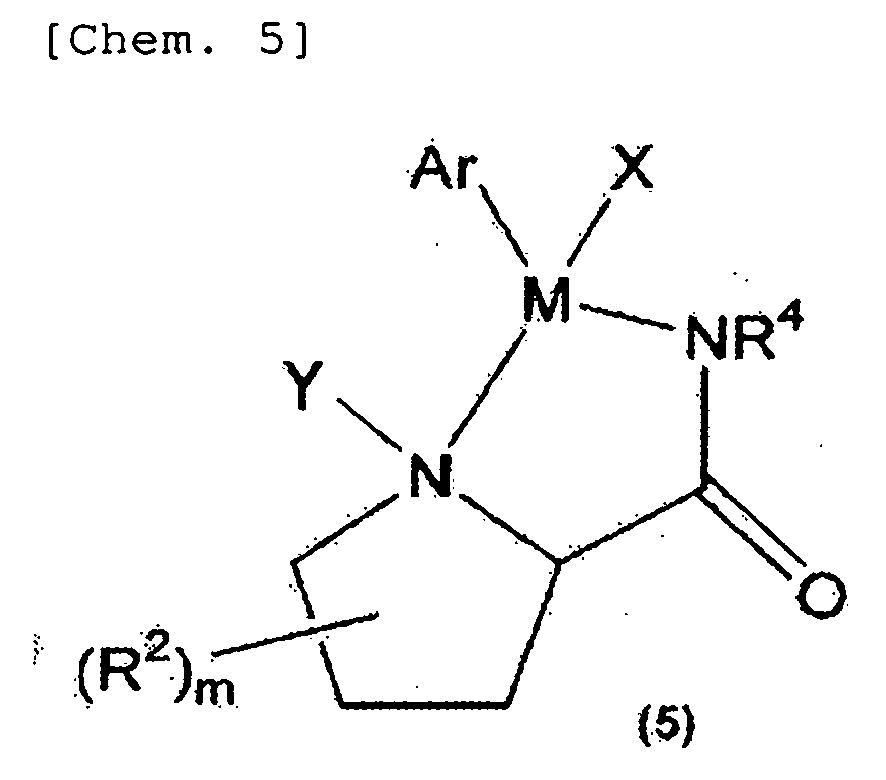
- A process for preparing an amine compound, characterized in that an imine compound or an enamine compound is diastereoselectively reduced using hydrogen gas or an organic or inorganic hydrogen-donating compound, under the presence of an organometallic compound of general formula (6) :


- The process for preparing an amine compound or according to any one of Claims 1 to 4, characterized in that a carbonyl compound is mixed with an amine compound or an ammonium salt, and the imine compound or enamine compound generated in this system is diastereoselectively reduced.
- The process for preparing an amine compound according to any one of Claims 1 to 5, characterized in that M in formula (1) and formula (6) is rhodium or iridium.
- The process for preparing an amine compound according to any one of Claims 1 to 6, characterized in that the organic or inorganic hydrogen-donating compound is formic acid or formate.
- The process for preparing an amine compound according to any one of Claims 1 to 7, characterized in that the amine compound obtained from the reaction is a cyclic amine compound or a cyclic diamine compound.
Applications Claiming Priority (1)
| Application Number | Priority Date | Filing Date | Title |
|---|---|---|---|
| JP2010207142A JP5847386B2 (en) | 2010-09-15 | 2010-09-15 | Method for producing amine compound |
Publications (2)
| Publication Number | Publication Date |
|---|---|
| EP2431353A1 EP2431353A1 (en) | 2012-03-21 |
| EP2431353B1 true EP2431353B1 (en) | 2016-01-20 |
Family
ID=44720636
Family Applications (1)
| Application Number | Title | Priority Date | Filing Date |
|---|---|---|---|
| EP11181333.3A Not-in-force EP2431353B1 (en) | 2010-09-15 | 2011-09-15 | Process for preparing amine compound |
Country Status (3)
| Country | Link |
|---|---|
| US (1) | US20120065426A1 (en) |
| EP (1) | EP2431353B1 (en) |
| JP (1) | JP5847386B2 (en) |
Families Citing this family (14)
| Publication number | Priority date | Publication date | Assignee | Title |
|---|---|---|---|---|
| EP2733138B1 (en) * | 2011-07-15 | 2016-09-28 | Hamari Chemicals, Ltd. | Method for producing optically active tetrahydroquinoline |
| JP6227889B2 (en) | 2013-04-23 | 2017-11-08 | 関東化學株式会社 | Novel organometallic complex and method for producing amine compound |
| EP3301087A1 (en) * | 2016-09-30 | 2018-04-04 | DPx Fine Chemicals Austria GmbH & Co KG | Process for preparing chiral amines |
| JP6890320B2 (en) * | 2017-05-26 | 2021-06-18 | 国立研究開発法人産業技術総合研究所 | Catalyst used for hydrogenation of carbon dioxide, formic acid production method, hydrogen storage method |
| CN107629090B (en) * | 2017-10-20 | 2020-01-31 | 上海应用技术大学 | N,N-coordinated rhodium complexes, synthetic methods and applications |
| PL3788049T3 (en) | 2018-05-01 | 2023-06-19 | Revolution Medicines, Inc. | C40-, c28-, and c-32-linked rapamycin analogs as mtor inhibitors |
| EP3788050B1 (en) | 2018-05-01 | 2024-08-28 | Revolution Medicines, Inc. | C26-linked rapamycin analogs as mtor inhibitors |
| WO2020212399A1 (en) * | 2019-04-15 | 2020-10-22 | Janssen Pharmaceutica Nv | Method for preparing an alkyl trans-3-aminobicyclo[2.2.2]octane-2-carboxylic acid ester compound |
| BR112022008568A2 (en) * | 2019-11-07 | 2022-08-09 | Dsm Ip Assets Bv | TRANSITION METAL CATALYST |
| JP7514465B2 (en) * | 2020-03-24 | 2024-07-11 | 日本ゼオン株式会社 | Method for producing amine compound |
| JP7659382B2 (en) * | 2020-11-06 | 2025-04-09 | 関東化学株式会社 | Method for producing primary and secondary amine compounds |
| CN113522294B (en) * | 2021-08-11 | 2023-08-29 | 中国科学院青岛生物能源与过程研究所 | A kind of Ni base catalyst and preparation method thereof and application in reductive amination |
| CN114957339B (en) * | 2022-03-25 | 2023-11-24 | 大连理工大学 | Synthesis method of a new type of complex and its application in catalyzing formic acid hydrogen storage and release |
| EP4531859A4 (en) | 2022-05-25 | 2026-05-27 | Revolution Medicines Inc | METHOD FOR TREATING CANCER WITH AN MTOR INSHIBITOR |
Family Cites Families (11)
| Publication number | Priority date | Publication date | Assignee | Title |
|---|---|---|---|---|
| DE4405728A1 (en) | 1994-02-23 | 1995-08-24 | Hoechst Schering Agrevo Gmbh | Process for the preparation of substituted cis-cyclohexylamines |
| DE19812054A1 (en) | 1998-03-19 | 1999-09-23 | Hoechst Schering Agrevo Gmbh | Production of cyclohexylamine derivatives by reductive amination of cyclohexanone derivatives |
| DE19933611A1 (en) * | 1999-07-17 | 2001-01-18 | Aventis Res & Tech Gmbh & Co | Process for the preparation of amines by homogeneously catalyzed reductive amination of carbonyl compounds |
| GB9920285D0 (en) * | 1999-08-27 | 1999-10-27 | Johnson Matthey Plc | Improved catalytic process |
| AU2001276690A1 (en) | 2000-08-01 | 2002-02-13 | Shionogi And Co., Ltd. | Process for producing alcohol with transition metal complex having amide compound as ligand |
| DE10138140A1 (en) * | 2001-08-09 | 2003-02-20 | Degussa | Preparation of optionally functionalized enantio-pure/enriched amines useful as intermediates for e.g. pharmaceuticals by reductive hydridotransfer amination of carbonyl compounds comprises use of Group VIII metal complex catalyst |
| WO2006004093A1 (en) | 2004-07-07 | 2006-01-12 | Hamari Chemicals, Ltd. | Process for producing optically active phenylpropylamine derivative |
| JP5208934B2 (en) * | 2007-07-03 | 2013-06-12 | 浜理薬品工業株式会社 | Method for producing optically active amine |
| CN101903329B (en) * | 2007-12-21 | 2014-11-05 | 巴斯夫欧洲公司 | A Method for Diastereoselective Transformation of Chiral Imines |
| CA2708315A1 (en) * | 2007-12-21 | 2009-07-02 | Basf Se | One-stage reductive amination |
| JP5719115B2 (en) * | 2009-03-12 | 2015-05-13 | 関東化学株式会社 | Novel organometallic complex and method for producing amine compound |
-
2010
- 2010-09-15 JP JP2010207142A patent/JP5847386B2/en active Active
-
2011
- 2011-09-14 US US13/232,755 patent/US20120065426A1/en not_active Abandoned
- 2011-09-15 EP EP11181333.3A patent/EP2431353B1/en not_active Not-in-force
Also Published As
| Publication number | Publication date |
|---|---|
| US20120065426A1 (en) | 2012-03-15 |
| JP5847386B2 (en) | 2016-01-20 |
| JP2012062270A (en) | 2012-03-29 |
| EP2431353A1 (en) | 2012-03-21 |
Similar Documents
| Publication | Publication Date | Title |
|---|---|---|
| EP2431353A1 (en) | Process for preparing amine compound | |
| EP2228377B1 (en) | Novel organometallic complex and process for preparing amine compound | |
| Huang et al. | Three-component, interrupted radical Heck/allylic substitution cascade involving unactivated alkyl bromides | |
| EP2990409B1 (en) | Method for producing novel organometallic complex and amine compound | |
| Wang et al. | Unmasking the ligand effect in manganese-catalyzed hydrogenation: mechanistic insight and catalytic application | |
| Corma et al. | Advances in one-pot synthesis through borrowing hydrogen catalysis | |
| EP3710422B1 (en) | Process for the preparation of enantiomerically and diastereomerically enriched cyclobutane amines and amides | |
| Wei et al. | Highly selective hydrogenation of aromatic ketones and phenols enabled by cyclic (amino)(alkyl) carbene rhodium complexes | |
| Shibata et al. | Facile Generation and Isolation of π-Allyl Complexes from Aliphatic Alkenes and an Electron-Deficient Rh (III) Complex: Key Intermediates of Allylic C–H Functionalization | |
| Luo et al. | Oxa-and azabenzonorbornadienes as electrophilic partners under photoredox/nickel dual catalysis | |
| EP2910540B1 (en) | Novel ruthenium complex and method for preparing methanol and diol | |
| Luo et al. | pH-Mediated selective synthesis of N-allylic alkylation or N-alkylation amines with allylic alcohols via an Iridium catalyst in water | |
| Snead et al. | Bis (2-alkylpyrrolidin-1-yl) methylidenes as chiral acyclic diaminocarbene ligands | |
| Long et al. | Ni‐Catalyzed Enantioselective Difunctionalization of Alkynes to Azepine Derivatives Bearing a Quaternary Center and an Unprotected Imine | |
| Zheng et al. | Recent Advances in Saturated N-Heterocycle C–H Bond Functionalization for Alkylated N-Heterocycle Synthesis | |
| EP2865446B1 (en) | Process for producing optically active secondary alcohol | |
| Pérez et al. | Preparation and use of a chiral amine ruthenium hydrogenation catalyst supported on mesoporous silica | |
| Duan et al. | Synthesis of 2-Phosphonylated C3 Spirocyclic Indolines via a Dearomatization–Spirocyclization–Nucleophilic Addition Tandem Approach of Indolyl-ynones with Phosphine Oxides | |
| Wang et al. | Direct synthesis of chiral β-arylamines via additive-free asymmetric reductive amination enabled by tunable bulky phosphoramidite ligands | |
| Yi et al. | Asymmetric hydrogenation of isoquinolines with chiral cationic ruthenium diamine catalysts | |
| JP2912572B2 (en) | Method for producing optically active amines | |
| JP5042438B2 (en) | Process for producing β-aminoalcohols having a syn configuration | |
| JP6173702B2 (en) | Method for producing optically active amine compound | |
| Sun et al. | Cinchona-alkaloid-derived NN ligands for ruthenium catalyzed asymmetric hydrogenation of ketones | |
| Lee et al. | Platinum-catalyzed reductive aldol and Michael reactions |
Legal Events
| Date | Code | Title | Description |
|---|---|---|---|
| PUAI | Public reference made under article 153(3) epc to a published international application that has entered the european phase |
Free format text: ORIGINAL CODE: 0009012 |
|
| AK | Designated contracting states |
Kind code of ref document: A1 Designated state(s): AL AT BE BG CH CY CZ DE DK EE ES FI FR GB GR HR HU IE IS IT LI LT LU LV MC MK MT NL NO PL PT RO RS SE SI SK SM TR |
|
| AX | Request for extension of the european patent |
Extension state: BA ME |
|
| 17P | Request for examination filed |
Effective date: 20120921 |
|
| GRAP | Despatch of communication of intention to grant a patent |
Free format text: ORIGINAL CODE: EPIDOSNIGR1 |
|
| INTG | Intention to grant announced |
Effective date: 20150611 |
|
| GRAS | Grant fee paid |
Free format text: ORIGINAL CODE: EPIDOSNIGR3 |
|
| GRAP | Despatch of communication of intention to grant a patent |
Free format text: ORIGINAL CODE: EPIDOSNIGR1 |
|
| INTG | Intention to grant announced |
Effective date: 20151001 |
|
| GRAA | (expected) grant |
Free format text: ORIGINAL CODE: 0009210 |
|
| AK | Designated contracting states |
Kind code of ref document: B1 Designated state(s): AL AT BE BG CH CY CZ DE DK EE ES FI FR GB GR HR HU IE IS IT LI LT LU LV MC MK MT NL NO PL PT RO RS SE SI SK SM TR |
|
| REG | Reference to a national code |
Ref country code: GB Ref legal event code: FG4D |
|
| REG | Reference to a national code |
Ref country code: CH Ref legal event code: EP |
|
| REG | Reference to a national code |
Ref country code: IE Ref legal event code: FG4D |
|
| REG | Reference to a national code |
Ref country code: AT Ref legal event code: REF Ref document number: 771659 Country of ref document: AT Kind code of ref document: T Effective date: 20160215 |
|
| REG | Reference to a national code |
Ref country code: DE Ref legal event code: R096 Ref document number: 602011022769 Country of ref document: DE |
|
| REG | Reference to a national code |
Ref country code: LT Ref legal event code: MG4D Ref country code: NL Ref legal event code: MP Effective date: 20160120 |
|
| REG | Reference to a national code |
Ref country code: AT Ref legal event code: MK05 Ref document number: 771659 Country of ref document: AT Kind code of ref document: T Effective date: 20160120 |
|
| PG25 | Lapsed in a contracting state [announced via postgrant information from national office to epo] |
Ref country code: NL Free format text: LAPSE BECAUSE OF FAILURE TO SUBMIT A TRANSLATION OF THE DESCRIPTION OR TO PAY THE FEE WITHIN THE PRESCRIBED TIME-LIMIT Effective date: 20160120 |
|
| PG25 | Lapsed in a contracting state [announced via postgrant information from national office to epo] |
Ref country code: IT Free format text: LAPSE BECAUSE OF FAILURE TO SUBMIT A TRANSLATION OF THE DESCRIPTION OR TO PAY THE FEE WITHIN THE PRESCRIBED TIME-LIMIT Effective date: 20160120 Ref country code: HR Free format text: LAPSE BECAUSE OF FAILURE TO SUBMIT A TRANSLATION OF THE DESCRIPTION OR TO PAY THE FEE WITHIN THE PRESCRIBED TIME-LIMIT Effective date: 20160120 Ref country code: ES Free format text: LAPSE BECAUSE OF FAILURE TO SUBMIT A TRANSLATION OF THE DESCRIPTION OR TO PAY THE FEE WITHIN THE PRESCRIBED TIME-LIMIT Effective date: 20160120 Ref country code: FI Free format text: LAPSE BECAUSE OF FAILURE TO SUBMIT A TRANSLATION OF THE DESCRIPTION OR TO PAY THE FEE WITHIN THE PRESCRIBED TIME-LIMIT Effective date: 20160120 Ref country code: GR Free format text: LAPSE BECAUSE OF FAILURE TO SUBMIT A TRANSLATION OF THE DESCRIPTION OR TO PAY THE FEE WITHIN THE PRESCRIBED TIME-LIMIT Effective date: 20160421 Ref country code: NO Free format text: LAPSE BECAUSE OF FAILURE TO SUBMIT A TRANSLATION OF THE DESCRIPTION OR TO PAY THE FEE WITHIN THE PRESCRIBED TIME-LIMIT Effective date: 20160420 |
|
| PG25 | Lapsed in a contracting state [announced via postgrant information from national office to epo] |
Ref country code: PL Free format text: LAPSE BECAUSE OF FAILURE TO SUBMIT A TRANSLATION OF THE DESCRIPTION OR TO PAY THE FEE WITHIN THE PRESCRIBED TIME-LIMIT Effective date: 20160120 Ref country code: IS Free format text: LAPSE BECAUSE OF FAILURE TO SUBMIT A TRANSLATION OF THE DESCRIPTION OR TO PAY THE FEE WITHIN THE PRESCRIBED TIME-LIMIT Effective date: 20160520 Ref country code: LV Free format text: LAPSE BECAUSE OF FAILURE TO SUBMIT A TRANSLATION OF THE DESCRIPTION OR TO PAY THE FEE WITHIN THE PRESCRIBED TIME-LIMIT Effective date: 20160120 Ref country code: LT Free format text: LAPSE BECAUSE OF FAILURE TO SUBMIT A TRANSLATION OF THE DESCRIPTION OR TO PAY THE FEE WITHIN THE PRESCRIBED TIME-LIMIT Effective date: 20160120 Ref country code: SE Free format text: LAPSE BECAUSE OF FAILURE TO SUBMIT A TRANSLATION OF THE DESCRIPTION OR TO PAY THE FEE WITHIN THE PRESCRIBED TIME-LIMIT Effective date: 20160120 Ref country code: RS Free format text: LAPSE BECAUSE OF FAILURE TO SUBMIT A TRANSLATION OF THE DESCRIPTION OR TO PAY THE FEE WITHIN THE PRESCRIBED TIME-LIMIT Effective date: 20160120 Ref country code: AT Free format text: LAPSE BECAUSE OF FAILURE TO SUBMIT A TRANSLATION OF THE DESCRIPTION OR TO PAY THE FEE WITHIN THE PRESCRIBED TIME-LIMIT Effective date: 20160120 Ref country code: PT Free format text: LAPSE BECAUSE OF FAILURE TO SUBMIT A TRANSLATION OF THE DESCRIPTION OR TO PAY THE FEE WITHIN THE PRESCRIBED TIME-LIMIT Effective date: 20160520 |
|
| REG | Reference to a national code |
Ref country code: DE Ref legal event code: R097 Ref document number: 602011022769 Country of ref document: DE |
|
| PG25 | Lapsed in a contracting state [announced via postgrant information from national office to epo] |
Ref country code: EE Free format text: LAPSE BECAUSE OF FAILURE TO SUBMIT A TRANSLATION OF THE DESCRIPTION OR TO PAY THE FEE WITHIN THE PRESCRIBED TIME-LIMIT Effective date: 20160120 Ref country code: DK Free format text: LAPSE BECAUSE OF FAILURE TO SUBMIT A TRANSLATION OF THE DESCRIPTION OR TO PAY THE FEE WITHIN THE PRESCRIBED TIME-LIMIT Effective date: 20160120 |
|
| PLBE | No opposition filed within time limit |
Free format text: ORIGINAL CODE: 0009261 |
|
| STAA | Information on the status of an ep patent application or granted ep patent |
Free format text: STATUS: NO OPPOSITION FILED WITHIN TIME LIMIT |
|
| PG25 | Lapsed in a contracting state [announced via postgrant information from national office to epo] |
Ref country code: SM Free format text: LAPSE BECAUSE OF FAILURE TO SUBMIT A TRANSLATION OF THE DESCRIPTION OR TO PAY THE FEE WITHIN THE PRESCRIBED TIME-LIMIT Effective date: 20160120 Ref country code: CZ Free format text: LAPSE BECAUSE OF FAILURE TO SUBMIT A TRANSLATION OF THE DESCRIPTION OR TO PAY THE FEE WITHIN THE PRESCRIBED TIME-LIMIT Effective date: 20160120 Ref country code: SK Free format text: LAPSE BECAUSE OF FAILURE TO SUBMIT A TRANSLATION OF THE DESCRIPTION OR TO PAY THE FEE WITHIN THE PRESCRIBED TIME-LIMIT Effective date: 20160120 Ref country code: RO Free format text: LAPSE BECAUSE OF FAILURE TO SUBMIT A TRANSLATION OF THE DESCRIPTION OR TO PAY THE FEE WITHIN THE PRESCRIBED TIME-LIMIT Effective date: 20160120 |
|
| 26N | No opposition filed |
Effective date: 20161021 |
|
| PG25 | Lapsed in a contracting state [announced via postgrant information from national office to epo] |
Ref country code: BE Free format text: LAPSE BECAUSE OF FAILURE TO SUBMIT A TRANSLATION OF THE DESCRIPTION OR TO PAY THE FEE WITHIN THE PRESCRIBED TIME-LIMIT Effective date: 20160120 |
|
| PG25 | Lapsed in a contracting state [announced via postgrant information from national office to epo] |
Ref country code: BG Free format text: LAPSE BECAUSE OF FAILURE TO SUBMIT A TRANSLATION OF THE DESCRIPTION OR TO PAY THE FEE WITHIN THE PRESCRIBED TIME-LIMIT Effective date: 20160420 Ref country code: SI Free format text: LAPSE BECAUSE OF FAILURE TO SUBMIT A TRANSLATION OF THE DESCRIPTION OR TO PAY THE FEE WITHIN THE PRESCRIBED TIME-LIMIT Effective date: 20160120 |
|
| REG | Reference to a national code |
Ref country code: DE Ref legal event code: R119 Ref document number: 602011022769 Country of ref document: DE |
|
| PG25 | Lapsed in a contracting state [announced via postgrant information from national office to epo] |
Ref country code: MC Free format text: LAPSE BECAUSE OF FAILURE TO SUBMIT A TRANSLATION OF THE DESCRIPTION OR TO PAY THE FEE WITHIN THE PRESCRIBED TIME-LIMIT Effective date: 20160120 |
|
| REG | Reference to a national code |
Ref country code: CH Ref legal event code: PL |
|
| GBPC | Gb: european patent ceased through non-payment of renewal fee |
Effective date: 20160915 |
|
| REG | Reference to a national code |
Ref country code: IE Ref legal event code: MM4A |
|
| REG | Reference to a national code |
Ref country code: FR Ref legal event code: ST Effective date: 20170531 |
|
| PG25 | Lapsed in a contracting state [announced via postgrant information from national office to epo] |
Ref country code: GB Free format text: LAPSE BECAUSE OF NON-PAYMENT OF DUE FEES Effective date: 20160915 Ref country code: LI Free format text: LAPSE BECAUSE OF NON-PAYMENT OF DUE FEES Effective date: 20160930 Ref country code: DE Free format text: LAPSE BECAUSE OF NON-PAYMENT OF DUE FEES Effective date: 20170401 Ref country code: FR Free format text: LAPSE BECAUSE OF NON-PAYMENT OF DUE FEES Effective date: 20160930 Ref country code: IE Free format text: LAPSE BECAUSE OF NON-PAYMENT OF DUE FEES Effective date: 20160915 Ref country code: CH Free format text: LAPSE BECAUSE OF NON-PAYMENT OF DUE FEES Effective date: 20160930 |
|
| PG25 | Lapsed in a contracting state [announced via postgrant information from national office to epo] |
Ref country code: LU Free format text: LAPSE BECAUSE OF NON-PAYMENT OF DUE FEES Effective date: 20160915 |
|
| PG25 | Lapsed in a contracting state [announced via postgrant information from national office to epo] |
Ref country code: CY Free format text: LAPSE BECAUSE OF FAILURE TO SUBMIT A TRANSLATION OF THE DESCRIPTION OR TO PAY THE FEE WITHIN THE PRESCRIBED TIME-LIMIT Effective date: 20160120 Ref country code: HU Free format text: LAPSE BECAUSE OF FAILURE TO SUBMIT A TRANSLATION OF THE DESCRIPTION OR TO PAY THE FEE WITHIN THE PRESCRIBED TIME-LIMIT; INVALID AB INITIO Effective date: 20110915 |
|
| PG25 | Lapsed in a contracting state [announced via postgrant information from national office to epo] |
Ref country code: TR Free format text: LAPSE BECAUSE OF FAILURE TO SUBMIT A TRANSLATION OF THE DESCRIPTION OR TO PAY THE FEE WITHIN THE PRESCRIBED TIME-LIMIT Effective date: 20160120 Ref country code: MT Free format text: LAPSE BECAUSE OF NON-PAYMENT OF DUE FEES Effective date: 20160930 Ref country code: MK Free format text: LAPSE BECAUSE OF FAILURE TO SUBMIT A TRANSLATION OF THE DESCRIPTION OR TO PAY THE FEE WITHIN THE PRESCRIBED TIME-LIMIT Effective date: 20160120 |
|
| PG25 | Lapsed in a contracting state [announced via postgrant information from national office to epo] |
Ref country code: AL Free format text: LAPSE BECAUSE OF FAILURE TO SUBMIT A TRANSLATION OF THE DESCRIPTION OR TO PAY THE FEE WITHIN THE PRESCRIBED TIME-LIMIT Effective date: 20160120 |