EP2431033A1 - Dronedarone for preventing cardiovascular hospitalization or mortality in patients with lone atrial fibrillation - Google Patents
Dronedarone for preventing cardiovascular hospitalization or mortality in patients with lone atrial fibrillation Download PDFInfo
- Publication number
- EP2431033A1 EP2431033A1 EP10305879A EP10305879A EP2431033A1 EP 2431033 A1 EP2431033 A1 EP 2431033A1 EP 10305879 A EP10305879 A EP 10305879A EP 10305879 A EP10305879 A EP 10305879A EP 2431033 A1 EP2431033 A1 EP 2431033A1
- Authority
- EP
- European Patent Office
- Prior art keywords
- dronedarone
- pharmaceutically acceptable
- patients
- atrial fibrillation
- lone
- Prior art date
- Legal status (The legal status is an assumption and is not a legal conclusion. Google has not performed a legal analysis and makes no representation as to the accuracy of the status listed.)
- Ceased
Links
- 206010003658 Atrial Fibrillation Diseases 0.000 title claims abstract description 125
- ZQTNQVWKHCQYLQ-UHFFFAOYSA-N dronedarone Chemical compound C1=CC(OCCCN(CCCC)CCCC)=CC=C1C(=O)C1=C(CCCC)OC2=CC=C(NS(C)(=O)=O)C=C12 ZQTNQVWKHCQYLQ-UHFFFAOYSA-N 0.000 title claims abstract description 83
- 229960002084 dronedarone Drugs 0.000 title claims abstract description 82
- 230000002526 effect on cardiovascular system Effects 0.000 title claims abstract description 63
- 150000003839 salts Chemical class 0.000 claims abstract description 55
- 230000002265 prevention Effects 0.000 claims abstract description 29
- 239000003814 drug Substances 0.000 claims abstract description 26
- 238000000034 method Methods 0.000 claims description 26
- 229940079593 drug Drugs 0.000 claims description 16
- 210000002216 heart Anatomy 0.000 claims description 14
- 238000011282 treatment Methods 0.000 claims description 9
- DDRJAANPRJIHGJ-UHFFFAOYSA-N creatinine Chemical compound CN1CC(=O)NC1=N DDRJAANPRJIHGJ-UHFFFAOYSA-N 0.000 claims description 8
- 238000002483 medication Methods 0.000 claims description 7
- 230000000694 effects Effects 0.000 claims description 6
- 229940127291 Calcium channel antagonist Drugs 0.000 claims description 5
- 241000208011 Digitalis Species 0.000 claims description 5
- 238000013176 antiplatelet therapy Methods 0.000 claims description 5
- 239000002876 beta blocker Substances 0.000 claims description 5
- 229940097320 beta blocking agent Drugs 0.000 claims description 5
- 230000001684 chronic effect Effects 0.000 claims description 5
- 239000005541 ACE inhibitor Substances 0.000 claims description 4
- 102000004328 Cytochrome P-450 CYP3A Human genes 0.000 claims description 4
- 108010081668 Cytochrome P-450 CYP3A Proteins 0.000 claims description 4
- 229940121710 HMGCoA reductase inhibitor Drugs 0.000 claims description 4
- 229940044094 angiotensin-converting-enzyme inhibitor Drugs 0.000 claims description 4
- 239000003146 anticoagulant agent Substances 0.000 claims description 4
- 229940109239 creatinine Drugs 0.000 claims description 4
- 230000003247 decreasing effect Effects 0.000 claims description 4
- 239000002934 diuretic Substances 0.000 claims description 4
- 229940030606 diuretics Drugs 0.000 claims description 4
- 239000002471 hydroxymethylglutaryl coenzyme A reductase inhibitor Substances 0.000 claims description 4
- 239000003112 inhibitor Substances 0.000 claims description 4
- 239000000041 non-steroidal anti-inflammatory agent Substances 0.000 claims description 4
- 229940021182 non-steroidal anti-inflammatory drug Drugs 0.000 claims description 4
- 239000005022 packaging material Substances 0.000 claims description 4
- 230000010248 tubular secretion Effects 0.000 claims description 4
- 239000002464 receptor antagonist Substances 0.000 claims description 3
- 229940044551 receptor antagonist Drugs 0.000 claims description 3
- 238000004519 manufacturing process Methods 0.000 claims description 2
- 239000000463 material Substances 0.000 claims description 2
- 230000001737 promoting effect Effects 0.000 claims description 2
- 230000001131 transforming effect Effects 0.000 claims description 2
- 238000002360 preparation method Methods 0.000 abstract description 10
- 229940068196 placebo Drugs 0.000 description 15
- 239000000902 placebo Substances 0.000 description 15
- 206010003662 Atrial flutter Diseases 0.000 description 13
- 230000033764 rhythmic process Effects 0.000 description 11
- 208000006011 Stroke Diseases 0.000 description 9
- 230000000747 cardiac effect Effects 0.000 description 8
- HQKMJHAJHXVSDF-UHFFFAOYSA-L magnesium stearate Chemical compound [Mg+2].CCCCCCCCCCCCCCCCCC([O-])=O.CCCCCCCCCCCCCCCCCC([O-])=O HQKMJHAJHXVSDF-UHFFFAOYSA-L 0.000 description 8
- 206010007559 Cardiac failure congestive Diseases 0.000 description 6
- 230000001186 cumulative effect Effects 0.000 description 6
- 208000037265 diseases, disorders, signs and symptoms Diseases 0.000 description 6
- 229940086972 dronedarone 400 mg Drugs 0.000 description 6
- 230000007170 pathology Effects 0.000 description 6
- CPKOXUVSOOKUDA-UHFFFAOYSA-N 1-bromo-5-fluoro-2-iodo-4-methylbenzene Chemical compound CC1=CC(I)=C(Br)C=C1F CPKOXUVSOOKUDA-UHFFFAOYSA-N 0.000 description 4
- 206010019280 Heart failures Diseases 0.000 description 4
- RVGRUAULSDPKGF-UHFFFAOYSA-N Poloxamer Chemical compound C1CO1.CC1CO1 RVGRUAULSDPKGF-UHFFFAOYSA-N 0.000 description 4
- VYPSYNLAJGMNEJ-UHFFFAOYSA-N Silicium dioxide Chemical compound O=[Si]=O VYPSYNLAJGMNEJ-UHFFFAOYSA-N 0.000 description 4
- 239000008119 colloidal silica Substances 0.000 description 4
- 208000035475 disorder Diseases 0.000 description 4
- 229960002919 dronedarone hydrochloride Drugs 0.000 description 4
- 239000004615 ingredient Substances 0.000 description 4
- 235000019359 magnesium stearate Nutrition 0.000 description 4
- 235000012054 meals Nutrition 0.000 description 4
- 208000010125 myocardial infarction Diseases 0.000 description 4
- 239000008194 pharmaceutical composition Substances 0.000 description 4
- 239000000546 pharmaceutical excipient Substances 0.000 description 4
- 229920001992 poloxamer 407 Polymers 0.000 description 4
- 229940044476 poloxamer 407 Drugs 0.000 description 4
- 229920000036 polyvinylpyrrolidone Polymers 0.000 description 4
- 239000001267 polyvinylpyrrolidone Substances 0.000 description 4
- 235000013855 polyvinylpyrrolidone Nutrition 0.000 description 4
- 230000002861 ventricular Effects 0.000 description 4
- 206010047302 ventricular tachycardia Diseases 0.000 description 4
- WSVLPVUVIUVCRA-KPKNDVKVSA-N Alpha-lactose monohydrate Chemical compound O.O[C@@H]1[C@@H](O)[C@@H](O)[C@@H](CO)O[C@H]1O[C@@H]1[C@@H](CO)O[C@H](O)[C@H](O)[C@H]1O WSVLPVUVIUVCRA-KPKNDVKVSA-N 0.000 description 3
- 229920002261 Corn starch Polymers 0.000 description 3
- 208000032843 Hemorrhage Diseases 0.000 description 3
- 206010020772 Hypertension Diseases 0.000 description 3
- 235000019759 Maize starch Nutrition 0.000 description 3
- 229920000168 Microcrystalline cellulose Polymers 0.000 description 3
- 206010067584 Type 1 diabetes mellitus Diseases 0.000 description 3
- 206010047281 Ventricular arrhythmia Diseases 0.000 description 3
- 238000002679 ablation Methods 0.000 description 3
- 239000003416 antiarrhythmic agent Substances 0.000 description 3
- 206010003119 arrhythmia Diseases 0.000 description 3
- 230000006793 arrhythmia Effects 0.000 description 3
- 230000036772 blood pressure Effects 0.000 description 3
- 238000013153 catheter ablation Methods 0.000 description 3
- 239000002131 composite material Substances 0.000 description 3
- 206010012601 diabetes mellitus Diseases 0.000 description 3
- 235000013305 food Nutrition 0.000 description 3
- 208000019622 heart disease Diseases 0.000 description 3
- 229960001021 lactose monohydrate Drugs 0.000 description 3
- 238000001325 log-rank test Methods 0.000 description 3
- 238000007477 logistic regression Methods 0.000 description 3
- 229940016286 microcrystalline cellulose Drugs 0.000 description 3
- 235000019813 microcrystalline cellulose Nutrition 0.000 description 3
- 239000008108 microcrystalline cellulose Substances 0.000 description 3
- 230000000699 topical effect Effects 0.000 description 3
- 208000006017 Cardiac Tamponade Diseases 0.000 description 2
- 206010008190 Cerebrovascular accident Diseases 0.000 description 2
- 206010056370 Congestive cardiomyopathy Diseases 0.000 description 2
- 206010018985 Haemorrhage intracranial Diseases 0.000 description 2
- 208000010496 Heart Arrest Diseases 0.000 description 2
- 208000010378 Pulmonary Embolism Diseases 0.000 description 2
- 208000025747 Rheumatic disease Diseases 0.000 description 2
- 206010049418 Sudden Cardiac Death Diseases 0.000 description 2
- 206010042434 Sudden death Diseases 0.000 description 2
- 206010042600 Supraventricular arrhythmias Diseases 0.000 description 2
- 208000001871 Tachycardia Diseases 0.000 description 2
- 208000007814 Unstable Angina Diseases 0.000 description 2
- 230000002411 adverse Effects 0.000 description 2
- 238000000540 analysis of variance Methods 0.000 description 2
- 230000003288 anthiarrhythmic effect Effects 0.000 description 2
- 230000002763 arrhythmic effect Effects 0.000 description 2
- 208000037849 arterial hypertension Diseases 0.000 description 2
- 230000001746 atrial effect Effects 0.000 description 2
- RYYVLZVUVIJVGH-UHFFFAOYSA-N caffeine Chemical compound CN1C(=O)N(C)C(=O)C2=C1N=CN2C RYYVLZVUVIJVGH-UHFFFAOYSA-N 0.000 description 2
- 208000026106 cerebrovascular disease Diseases 0.000 description 2
- 201000010099 disease Diseases 0.000 description 2
- 230000001747 exhibiting effect Effects 0.000 description 2
- 230000002169 extracardiac Effects 0.000 description 2
- 239000000499 gel Substances 0.000 description 2
- NOESYZHRGYRDHS-UHFFFAOYSA-N insulin Chemical compound N1C(=O)C(NC(=O)C(CCC(N)=O)NC(=O)C(CCC(O)=O)NC(=O)C(C(C)C)NC(=O)C(NC(=O)CN)C(C)CC)CSSCC(C(NC(CO)C(=O)NC(CC(C)C)C(=O)NC(CC=2C=CC(O)=CC=2)C(=O)NC(CCC(N)=O)C(=O)NC(CC(C)C)C(=O)NC(CCC(O)=O)C(=O)NC(CC(N)=O)C(=O)NC(CC=2C=CC(O)=CC=2)C(=O)NC(CSSCC(NC(=O)C(C(C)C)NC(=O)C(CC(C)C)NC(=O)C(CC=2C=CC(O)=CC=2)NC(=O)C(CC(C)C)NC(=O)C(C)NC(=O)C(CCC(O)=O)NC(=O)C(C(C)C)NC(=O)C(CC(C)C)NC(=O)C(CC=2NC=NC=2)NC(=O)C(CO)NC(=O)CNC2=O)C(=O)NCC(=O)NC(CCC(O)=O)C(=O)NC(CCCNC(N)=N)C(=O)NCC(=O)NC(CC=3C=CC=CC=3)C(=O)NC(CC=3C=CC=CC=3)C(=O)NC(CC=3C=CC(O)=CC=3)C(=O)NC(C(C)O)C(=O)N3C(CCC3)C(=O)NC(CCCCN)C(=O)NC(C)C(O)=O)C(=O)NC(CC(N)=O)C(O)=O)=O)NC(=O)C(C(C)CC)NC(=O)C(CO)NC(=O)C(C(C)O)NC(=O)C1CSSCC2NC(=O)C(CC(C)C)NC(=O)C(NC(=O)C(CCC(N)=O)NC(=O)C(CC(N)=O)NC(=O)C(NC(=O)C(N)CC=1C=CC=CC=1)C(C)C)CC1=CN=CN1 NOESYZHRGYRDHS-UHFFFAOYSA-N 0.000 description 2
- 238000007918 intramuscular administration Methods 0.000 description 2
- 238000001990 intravenous administration Methods 0.000 description 2
- 230000001788 irregular Effects 0.000 description 2
- 230000000302 ischemic effect Effects 0.000 description 2
- 238000012423 maintenance Methods 0.000 description 2
- 230000001314 paroxysmal effect Effects 0.000 description 2
- 238000013105 post hoc analysis Methods 0.000 description 2
- 230000000552 rheumatic effect Effects 0.000 description 2
- 238000007920 subcutaneous administration Methods 0.000 description 2
- 206010042772 syncope Diseases 0.000 description 2
- 230000035488 systolic blood pressure Effects 0.000 description 2
- 239000003826 tablet Substances 0.000 description 2
- 230000006794 tachycardia Effects 0.000 description 2
- 230000001225 therapeutic effect Effects 0.000 description 2
- 208000001072 type 2 diabetes mellitus Diseases 0.000 description 2
- 208000003663 ventricular fibrillation Diseases 0.000 description 2
- 206010001029 Acute pulmonary oedema Diseases 0.000 description 1
- GUBGYTABKSRVRQ-XLOQQCSPSA-N Alpha-Lactose Chemical compound O[C@@H]1[C@@H](O)[C@@H](O)[C@@H](CO)O[C@H]1O[C@@H]1[C@@H](CO)O[C@H](O)[C@H](O)[C@H]1O GUBGYTABKSRVRQ-XLOQQCSPSA-N 0.000 description 1
- 206010002383 Angina Pectoris Diseases 0.000 description 1
- 206010002388 Angina unstable Diseases 0.000 description 1
- 201000001320 Atherosclerosis Diseases 0.000 description 1
- 108090000312 Calcium Channels Proteins 0.000 description 1
- 102000003922 Calcium Channels Human genes 0.000 description 1
- 241000283707 Capra Species 0.000 description 1
- 208000004672 Cardiovascular Infections Diseases 0.000 description 1
- 208000024172 Cardiovascular disease Diseases 0.000 description 1
- 206010008479 Chest Pain Diseases 0.000 description 1
- 206010010356 Congenital anomaly Diseases 0.000 description 1
- 206010051055 Deep vein thrombosis Diseases 0.000 description 1
- 201000010046 Dilated cardiomyopathy Diseases 0.000 description 1
- 208000002251 Dissecting Aneurysm Diseases 0.000 description 1
- 206010013975 Dyspnoeas Diseases 0.000 description 1
- 208000005189 Embolism Diseases 0.000 description 1
- LYCAIKOWRPUZTN-UHFFFAOYSA-N Ethylene glycol Chemical compound OCCO LYCAIKOWRPUZTN-UHFFFAOYSA-N 0.000 description 1
- VEXZGXHMUGYJMC-UHFFFAOYSA-N Hydrochloric acid Chemical compound Cl VEXZGXHMUGYJMC-UHFFFAOYSA-N 0.000 description 1
- 208000035150 Hypercholesterolemia Diseases 0.000 description 1
- 208000001953 Hypotension Diseases 0.000 description 1
- DGAQECJNVWCQMB-PUAWFVPOSA-M Ilexoside XXIX Chemical compound C[C@@H]1CC[C@@]2(CC[C@@]3(C(=CC[C@H]4[C@]3(CC[C@@H]5[C@@]4(CC[C@@H](C5(C)C)OS(=O)(=O)[O-])C)C)[C@@H]2[C@]1(C)O)C)C(=O)O[C@H]6[C@@H]([C@H]([C@@H]([C@H](O6)CO)O)O)O.[Na+] DGAQECJNVWCQMB-PUAWFVPOSA-M 0.000 description 1
- 206010061216 Infarction Diseases 0.000 description 1
- 102000004877 Insulin Human genes 0.000 description 1
- 108090001061 Insulin Proteins 0.000 description 1
- LPHGQDQBBGAPDZ-UHFFFAOYSA-N Isocaffeine Natural products CN1C(=O)N(C)C(=O)C2=C1N(C)C=N2 LPHGQDQBBGAPDZ-UHFFFAOYSA-N 0.000 description 1
- 241001465754 Metazoa Species 0.000 description 1
- 102100035593 POU domain, class 2, transcription factor 1 Human genes 0.000 description 1
- 101710084414 POU domain, class 2, transcription factor 1 Proteins 0.000 description 1
- 206010061340 Peripheral embolism Diseases 0.000 description 1
- ZLMJMSJWJFRBEC-UHFFFAOYSA-N Potassium Chemical compound [K] ZLMJMSJWJFRBEC-UHFFFAOYSA-N 0.000 description 1
- 102000004257 Potassium Channel Human genes 0.000 description 1
- 108010052164 Sodium Channels Proteins 0.000 description 1
- 102000018674 Sodium Channels Human genes 0.000 description 1
- 208000007718 Stable Angina Diseases 0.000 description 1
- 208000003734 Supraventricular Tachycardia Diseases 0.000 description 1
- 208000007536 Thrombosis Diseases 0.000 description 1
- 208000024799 Thyroid disease Diseases 0.000 description 1
- 208000018452 Torsade de pointes Diseases 0.000 description 1
- 208000002363 Torsades de Pointes Diseases 0.000 description 1
- 206010047249 Venous thrombosis Diseases 0.000 description 1
- 208000009729 Ventricular Premature Complexes Diseases 0.000 description 1
- 238000010317 ablation therapy Methods 0.000 description 1
- 230000032683 aging Effects 0.000 description 1
- 229960004977 anhydrous lactose Drugs 0.000 description 1
- 239000005557 antagonist Substances 0.000 description 1
- 230000001466 anti-adreneric effect Effects 0.000 description 1
- 208000007474 aortic aneurysm Diseases 0.000 description 1
- 206010002895 aortic dissection Diseases 0.000 description 1
- 238000013459 approach Methods 0.000 description 1
- 230000004872 arterial blood pressure Effects 0.000 description 1
- 210000001367 artery Anatomy 0.000 description 1
- 230000009286 beneficial effect Effects 0.000 description 1
- 230000000740 bleeding effect Effects 0.000 description 1
- 230000000903 blocking effect Effects 0.000 description 1
- 210000004369 blood Anatomy 0.000 description 1
- 239000008280 blood Substances 0.000 description 1
- 210000000601 blood cell Anatomy 0.000 description 1
- 210000004556 brain Anatomy 0.000 description 1
- 229960001948 caffeine Drugs 0.000 description 1
- VJEONQKOZGKCAK-UHFFFAOYSA-N caffeine Natural products CN1C(=O)N(C)C(=O)C2=C1C=CN2C VJEONQKOZGKCAK-UHFFFAOYSA-N 0.000 description 1
- 239000002775 capsule Substances 0.000 description 1
- 210000005242 cardiac chamber Anatomy 0.000 description 1
- 206010007625 cardiogenic shock Diseases 0.000 description 1
- 238000013130 cardiovascular surgery Methods 0.000 description 1
- 238000006243 chemical reaction Methods 0.000 description 1
- 239000003795 chemical substances by application Substances 0.000 description 1
- 208000020832 chronic kidney disease Diseases 0.000 description 1
- 208000022831 chronic renal failure syndrome Diseases 0.000 description 1
- 208000029078 coronary artery disease Diseases 0.000 description 1
- 150000001907 coumarones Chemical class 0.000 description 1
- 239000006071 cream Substances 0.000 description 1
- 230000035487 diastolic blood pressure Effects 0.000 description 1
- 238000002592 echocardiography Methods 0.000 description 1
- 230000007831 electrophysiology Effects 0.000 description 1
- 238000002001 electrophysiology Methods 0.000 description 1
- 230000007717 exclusion Effects 0.000 description 1
- 239000008187 granular material Substances 0.000 description 1
- 210000002837 heart atrium Anatomy 0.000 description 1
- 210000003709 heart valve Anatomy 0.000 description 1
- 208000018578 heart valve disease Diseases 0.000 description 1
- 230000000004 hemodynamic effect Effects 0.000 description 1
- 206010020871 hypertrophic cardiomyopathy Diseases 0.000 description 1
- 230000036543 hypotension Effects 0.000 description 1
- 239000007943 implant Substances 0.000 description 1
- 238000002513 implantation Methods 0.000 description 1
- 229940125396 insulin Drugs 0.000 description 1
- 230000003993 interaction Effects 0.000 description 1
- 201000004332 intermediate coronary syndrome Diseases 0.000 description 1
- 238000013152 interventional procedure Methods 0.000 description 1
- 239000006210 lotion Substances 0.000 description 1
- 229960003511 macrogol Drugs 0.000 description 1
- 239000000203 mixture Substances 0.000 description 1
- 239000002674 ointment Substances 0.000 description 1
- 239000008188 pellet Substances 0.000 description 1
- 230000002093 peripheral effect Effects 0.000 description 1
- 230000002085 persistent effect Effects 0.000 description 1
- 229940124531 pharmaceutical excipient Drugs 0.000 description 1
- 230000000144 pharmacologic effect Effects 0.000 description 1
- 238000011422 pharmacological therapy Methods 0.000 description 1
- 239000011591 potassium Substances 0.000 description 1
- 229910052700 potassium Inorganic materials 0.000 description 1
- 108020001213 potassium channel Proteins 0.000 description 1
- 239000000843 powder Substances 0.000 description 1
- 230000005180 public health Effects 0.000 description 1
- 230000002685 pulmonary effect Effects 0.000 description 1
- 230000000306 recurrent effect Effects 0.000 description 1
- 238000012552 review Methods 0.000 description 1
- 239000011734 sodium Substances 0.000 description 1
- 229910052708 sodium Inorganic materials 0.000 description 1
- 230000002269 spontaneous effect Effects 0.000 description 1
- 238000007619 statistical method Methods 0.000 description 1
- 230000035882 stress Effects 0.000 description 1
- 238000011477 surgical intervention Methods 0.000 description 1
- 238000001356 surgical procedure Methods 0.000 description 1
- 239000000725 suspension Substances 0.000 description 1
- 230000009885 systemic effect Effects 0.000 description 1
- 238000012360 testing method Methods 0.000 description 1
- 238000002560 therapeutic procedure Methods 0.000 description 1
- 230000001052 transient effect Effects 0.000 description 1
- 208000035408 type 1 diabetes mellitus 1 Diseases 0.000 description 1
- 210000005243 upper chamber Anatomy 0.000 description 1
Classifications
-
- A—HUMAN NECESSITIES
- A61—MEDICAL OR VETERINARY SCIENCE; HYGIENE
- A61K—PREPARATIONS FOR MEDICAL, DENTAL OR TOILETRY PURPOSES
- A61K31/00—Medicinal preparations containing organic active ingredients
- A61K31/33—Heterocyclic compounds
- A61K31/335—Heterocyclic compounds having oxygen as the only ring hetero atom, e.g. fungichromin
- A61K31/34—Heterocyclic compounds having oxygen as the only ring hetero atom, e.g. fungichromin having five-membered rings with one oxygen as the only ring hetero atom, e.g. isosorbide
- A61K31/343—Heterocyclic compounds having oxygen as the only ring hetero atom, e.g. fungichromin having five-membered rings with one oxygen as the only ring hetero atom, e.g. isosorbide condensed with a carbocyclic ring, e.g. coumaran, bufuralol, befunolol, clobenfurol, amiodarone
-
- A—HUMAN NECESSITIES
- A61—MEDICAL OR VETERINARY SCIENCE; HYGIENE
- A61P—SPECIFIC THERAPEUTIC ACTIVITY OF CHEMICAL COMPOUNDS OR MEDICINAL PREPARATIONS
- A61P9/00—Drugs for disorders of the cardiovascular system
- A61P9/04—Inotropic agents, i.e. stimulants of cardiac contraction; Drugs for heart failure
-
- A—HUMAN NECESSITIES
- A61—MEDICAL OR VETERINARY SCIENCE; HYGIENE
- A61P—SPECIFIC THERAPEUTIC ACTIVITY OF CHEMICAL COMPOUNDS OR MEDICINAL PREPARATIONS
- A61P9/00—Drugs for disorders of the cardiovascular system
- A61P9/06—Antiarrhythmics
Definitions
- the present invention relates to the use of dronedarone or pharmaceutically acceptable salts thereof, for the preparation of a medicament for the prevention of cardiovascular hospitalization and/or of mortality in patients with lone atrial fibrillation.
- Dronedarone blocks potassium, sodium and calcium channels and also has anti-adrenergic properties.
- Dronedarone is an anti-arrhythmic that is effective in maintaining sinus rhythm in patients presenting atrial fibrillation or atrial flutter.
- dronedarone significantly reduces cardiovascular hospitalizations and/or mortality in patients having a history of atrial fibrillation or of atrial flutter, in a safe and effective way.
- dronedarone has been shown to reduce relevant clinical endpoints such as cardiovascular hospitalizations or death in patients with atrial fibrillation (AF) and additional risk factors and notably in patients with paroxysmal or persistent atrial fibrillation (AF) or atrial flutter (AFL), with a recent episode of AF/AFL and associated cardiovascular risk factors (i.e., age >70, hypertension, diabetes, prior cerebrovascular accident, left atrial diameter ⁇ 50 mm or left ventricular ejection fraction [LVEF] ⁇ 40%), who are in sinus rhythm or who will be cardioverted.
- AF atrial fibrillation
- AFL atrial flutter
- Atrial fibrillation affects about 2.3 million people in North America and 4.5 million people in the European Union and is emerging as a growing public health concern because of the aging of the population AF is a condition in which the upper chambers of the heart beat in an uncoordinated and disorganized fashion, resulting in a very irregular and fast rhythm (i.e., an irregularly, irregular heartbeat).
- AF Atrial fibrillation
- AF is increasingly frequent with advancing age and is often caused by age-related changes in the heart, physical or psychological stress, agents that stimulate the heart, such as caffeine, or as a result of cardiovascular disease. The number is expected to double in the next 20 years. Without appropriate management, AF can lead to serious complications, such as stroke and congestive heart failure.
- Atrial fibrillation itself can cause changes in the electrical parameters of the heart known as electrical remodelling and in the structure of the cardiac chambers known as structural remodelling which tend to decrease the chances of the patient to get back into normal sinus rhythm.
- This vicious circle whereby "atrial fibrillation begets atrial fibrillation” has been well documented since the 1990s ( Wijffels MC, Kirchhof CJ, Dorland R, Allessie MA.Atrial fibrillation begets atrial fibrillation. A study in awake chronically instrumented goats.Circulation. 1995 Oct 1;92(7):1954-68 .). It explains why when patients have been in atrial fibrillation for a long time they develop permanent atrial fibrillation with little or no chance to recover from this arrhythmia which becomes chronic.
- Atrial fibrillation is the most commonly encountered cardiac rhythm disturbance.
- hospitalizations for AF have increased 2- to 3-fold in recent years [1] demonstrating the enormous economic burden of this arrhythmia.
- the most significant consequences of AF include congestive heart failure, a fivefold increase in the risk of stroke, and a twofold increase in mortality.
- the majority of the patients have cardiovascular comorbidities and other risk factors for hospitalization.
- This condition is termed lone AF.
- catheter ablation therapy has evolved as an established therapeutic approach.
- Dronedarone is a new multichannel blocking drug which has been demonstrated in the EURopean trial In atrial fibrillation or flutter patients receiving Dronedarone for the maintenance of Sinus rhythm (EURIDIS) and the American-Australian-African trial with DronedarONe In atrial fibrillation or flutter patients for the maintenance of Sinus rhythm (ADONIS) trials to be more effective than placebo in maintaining normal sinus rhythm after electrical, pharmacological or spontaneous conversion of AF/AFL and in controlling the ventricular rate during AF recurrences but with a comparable side effect profile to placebo.
- EURODIS Sinus rhythm
- ADONIS Sinus rhythm
- dronedarone has been shown to reduce important clinical endpoints such as cardiovascular hospitalizations or death in patients with AF and additional risk factors.
- Lone atrial fibrillation may be defined as atrial fibrillation in patients without structural heart disease and without arterial hypertension (not treated with blood pressure lowering medications).
- a subject of the present invention is therefore the use of dronedarone or a pharmaceutically acceptable salt thereof, for the preparation of a medicament, for the prevention of cardiovascular hospitalizations and/or of mortality in patients with lone atrial fibrillation.
- a subject of the present invention is also the use of dronedarone or a pharmaceutically acceptable salt thereof, for the preparation of a medicament, taken twice a day with a meal, for the prevention of mortality and/or of cardiovascular hospitalizations notably in patients having lone atrial fibrillation.
- a subject of the present invention is the use of dronedarone or a pharmaceutically acceptable salt thereof, for the preparation of a medicament for the prevention of approximately 44% of cardiovascular hospitalizations or of mortality in patients having lone atrial fibrillation.
- a subject of the present invention is also the use of dronedarone or a pharmaceutically acceptable salt thereof, for the preparation of a medicament for the prevention of cardiovascular hospitalizations in patients having lone atrial fibrillation.
- a subject of the present invention is also the use of dronedarone or a pharmaceutically acceptable salt thereof, for the preparation of a medicament for the prevention of approximately 46% of cardiovascular hospitalizations in patients having lone atrial fibrillation.
- a subject of the present invention is also the use of dronedarone or a pharmaceutically acceptable salt thereof, for the preparation of a medicament for the prevention as mentioned above in patients having lone atrial fibrillation and at least one of the following medications:
- Another subject of the invention is performed by providing dronedarone or pharmaceutically acceptable salts thereof, wherein said dronedarone or pharmaceutically acceptable salts thereof is provided along with information indicating that dronedarone or pharmaceutically acceptable salts thereof is indicated in patients having lone atrial fibrillation.
- the information comprises printed matter that advises that dronedarone or pharmaceutically acceptable salts thereof is indicated in patients having lone atrial fibrillation.
- the printed material is a label.
- providing includes selling, distributing, shipping, offering for sell, importing etc.
- dronedarone for the prevention / treatment of may be understood as use of dronedarone for the preparation of a medicament for use in the prevention / treatment of.
- Another object of the invention is dronedarone or a pharmaceutically acceptable salt thereof for the prevention of cardiovascular hospitalizations or of mortality in patients with lone atrial fibrillation.
- a subject of the present invention is also dronedarone or a pharmaceutically acceptable salt thereof for the prevention of mortality and/or of cardiovascular hospitalizations notably in patients having lone atrial fibrillation.
- a subject of the present invention is also dronedarone or a pharmaceutically acceptable salt thereof for the prevention of approximately 44% of cardiovascular hospitalizations or of mortality in patients having lone atrial fibrillation.
- a subject of the present invention is also dronedarone or a pharmaceutically acceptable salt thereof, for the prevention of cardiovascular hospitalizations in patients having lone atrial fibrillation.
- a subject of the present invention is also dronedarone or a pharmaceutically acceptable salt thereof, for the prevention of approximately 46% of cardiovascular hospitalizations in patients having lone atrial fibrillation.
- a subject of the present invention is also dronedarone or a pharmaceutically acceptable salt thereof, for the prevention as mentioned above in patients having lone atrial fibrillation and at least one of the following medications:
- the invention also relates to a method of promoting the use of dronedarone or pharmaceutically acceptable salts thereof, the method comprising the step of conveying to a recipient at least one message selected from the group consisting of dronedarone or pharmaceutically acceptable salts thereof should be prescribed to a patient having lone atrial fibrillation.
- the invention also concerns an article of manufacture comprising
- the invention also relates to a package comprising dronedarone or pharmaceutically acceptable salts thereof and a label, said label comprising a printed statement which informs a prospective user that dronedarone or pharmaceutically acceptable salts thereof is indicated in patients having lone atrial fibrillation.
- Another method of the invention comprises treating a patient having lone atrial fibrillation, said method comprising administrating to said patient a therapeutically effective amount of dronedarone, or a pharmaceutically acceptable salt thereof.
- Another method of the invention relates to transforming a patient having lone atrial fibrillation by decreasing the patient's risk of cardiovascular hospitalizations or mortality, comprising administrating to said patient a therapeutically effective amount of dronedarone, or a pharmaceutically acceptable salt thereof.
- a subject of the invention is a method of decreasing the risk of cardiovascular hospitalizations or mortality in a having lone atrial fibrillation, said method comprising administering dronedarone, or a pharmaceutically acceptable salt thereof.
- cardiovascular hospitalization means a hospitalization which is caused by at least one of the following pathologies ( Hohnloser et al., Journal of cardiovascular electrophysiology, January 2008, vol. 19, No. 1, pages 69-73 ):
- the prevention of cardiovascular hospitalization may be understood as the prevention of cardiovascular hospitalization for at least one of the above mentioned pathologies.
- Mention may be made of the prevention of cardiovascular hospitalization for atrial fibrillation and/or other supraventricular rhythm disorders.
- a subject of the present invention is also the use of dronedarone or a pharmaceutically acceptable salt thereof, for the preparation of a medicament for the prevention of cardiovascular hospitalization for at least one of the above mentioned pathologies in patient with lone atrial fibrillation.
- cardiovascular mortality covers, in the context of the invention, mortality due to any cardiovascular causes (any death except those due to a non-cardiovascular cause), in particular death from an arrhythmic cause, also called arrhythmic death, and more particularly, sudden death from cardiovascular causes, also called sudden death or sudden cardiac death. Cardiovascular mortality may be due for example to :
- prevention of cardiovascular hospitalization and/or mortality results in the reduction of the risk of cardiovascular hospitalization and or mortality or in the reduction of the need of cardiovascular hospitalization and or mortality.
- risks factors may be defined as cardiovascular risk factors which are associated to atrial fibrillation.
- dronedarone and pharmaceutically acceptable salts thereof are generally introduced into pharmaceutical compositions.
- compositions contain an effective dose of dronedarone or of a pharmaceutically acceptable salt thereof, and also at least one pharmaceutically acceptable excipient.
- Said pharmaceutical composition may be given once or twice a day with food.
- the dose of dronedarone administered per day, orally may reach 800 mg, taken in one or more intakes, for example one or two.
- the dose of dronedarone administered may be taken with food.
- the dose of dronedarone administered per day, orally may reach 800 mg, taken in two intakes with a meal.
- the dose of dronedarone administered per day, orally may be taken at a rate of twice a day with a meal for example with the morning and the evening meal.
- the two intakes may comprise same quantity of dronedarone.
- the dosage appropriate for each patient is determined by the physician according to the method of administration, the weight, the pathology, the body surface, the cardiac output and the response of said patient.
- Said excipients are chosen according to the pharmaceutical form and the method of administration desired, from the usual excipients which are known to those skilled in the art.
- compositions for oral, sublingual, subcutaneous, intramuscular, intravenous, topical, local, intratracheal, intranasal, transdermal or rectal administration dronedarone, or the salt thereof, can be administered in unit administration form, as a mixture with conventional pharmaceutical excipients, to animals and to humans in the cases mentioned above.
- the suitable unit administration forms comprise forms for oral administration, such as tablets, soft or hard gel capsules, powders, granules and oral solutions or suspensions, sublingual, buccal, intratracheal, intraocular or intranasal administration forms, forms for administration by inhalation, topical, transdermal, subcutaneous, intramuscular or intravenous administration forms, rectal administration forms, and implants.
- oral administration such as tablets, soft or hard gel capsules, powders, granules and oral solutions or suspensions
- sublingual, buccal, intratracheal intraocular or intranasal administration forms, forms for administration by inhalation, topical, transdermal, subcutaneous, intramuscular or intravenous administration forms, rectal administration forms, and implants.
- dronedarone and pharmaceutically acceptable salts thereof can be used in creams, gels, ointments or lotions.
- a unit administration form of dronedarone or a pharmaceutically acceptable salt thereof, in tablet form may correspond to one of the following examples: Ingredients mg % Dronedarone hydrochloride (corresponding to 400 mg of base) 426 65.5 Methylhydroxypropylcellulose 21.1 3.25 Lactose monohydrate 46.55 7.2 Maize starch 45.5 7 Polyvinylpyrrolidone 65 10 Poloxamer 407 40 6.15 Anhydrous colloidal silica 2.6 0.4 Magnesium stearate 3.25 0.5 650 100 Ingredients mg % Dronedarone hydrochloride (corresponding to 400 mg of base) 426 65.5 Microcrystalline cellulose 65 10 Anhydrous colloidal silica 2.6 0.4 Anhydrous lactose 42.65 6.6 Polyvinylpyrrolidone 13 2 Poloxamer 407 40 6.15 Macrogol 6000 57.5 8.85 Magnesium stearate 3.25 0.5 650 100 Ingredients mg Dronedarone hydrochloride (corresponding to 400 mg of base) 426 6
- the present invention also relates to a method for treating the pathologies indicated above, which comprises the administration, to a patient having lone atrial fibrillation, of an effective dose of dronedarone or a pharmaceutically acceptable salt thereof.
- One method of the invention includes decreasing the risk of mortality, cardiac hospitalizations, or the combination thereof in a patient having lone atrial fibrillation, said method comprising administering to said patient an effective amount of dronedarone or a pharmaceutically acceptable salt thereof, with food.
- the administration of dronedarone or pharmaceutically acceptable salt thereof prevents cardiovascular hospitalizations.
- said patient also exhibits one or more of the above mentioned associated risk factors.
- the present invention is illustrated by data from a post-hoc analysis of patients with lone atrial fibrillation enrolled in the clinical trials called EURIDIS, ADONIS and ATHENA trials with the following endpoints:
- dronedarone has been shown to be effective for the prevention of mortality and/or morbidity (cardiovascular hospitalization) in patients with lone atrial fibrillation.
- Lone AF was defined as AF occurring in patients without structural heart disease or arterial hypertension hypertension (not treated with blood pressure lowering medications), and without extracardiac diseases associated with AF (i.e. thyroid disorders).
- Baseline parameters of patients with and without lone AF were compared with logistic regression analysis for qualitative and an ANOVA test for quantitative variables. All outcomes were estimated with the use of the Kaplan-Meier method and compared by means of the log-rank test. The relative risks and 95% confidence intervals of the composite endpoint and their individual components were calculated separately in patients with and without lone AF. All P values are two-tailed, and statistical significance was assumed at a p-value of 0.05 or smaller.
- the relative risk is the ratio of the rates of occurrence of a hospitalization or of a death among the patients on dronedarone, relative to the patients on placebo.
- the 3 randomized clinical trials comprised a total of 5845 AF patients. Of those, 432 patients (192 on placebo, 240 on dronedarone) met the definition lone AF (prevalence 7%) (see table 1). The effect was homogeneous across the 3 studies contributing to the present analysis.
- Baseline clinical characteristics are depicted in Table 2.
- the mean age was 64 ⁇ 13 years, the mean systolic blood pressure 127 mmHg, 51% received OACs, 33% antiplatelet therapy, 36% betablockers, 15% digitalis and 10 % calcium antagonists (all medications given for rate control).
- patients with lone AF were younger, had lower blood pressure, and received less cardiovascular medications.
- the average study follow-up time of patients with lone AF was 13.8 ⁇ 7.2 months.
- dronedarone when added to standard of care including rate control, leads to a 44% reduction of the risk of CV hospitalizations or death in patients with lone AF (compared with a 23% reduction in patients with other forms of AF).
- cardiovascular hospitalisations The majority of cardiovascular hospitalisations represented hospitalisations for treatment of AF or other supraventricular arrhythmias. In the placebo group 31 of 42 cardiovascular hospitalisations were for AF or other supraventricular arrhythmias compared to 16 of 30 in the dronedarone group.
- TEAE treatment emergent adverse event
- AE adverse event
- IP Investigational product
Landscapes
- Health & Medical Sciences (AREA)
- Pharmacology & Pharmacy (AREA)
- Engineering & Computer Science (AREA)
- Bioinformatics & Cheminformatics (AREA)
- Cardiology (AREA)
- Veterinary Medicine (AREA)
- Chemical & Material Sciences (AREA)
- Public Health (AREA)
- General Health & Medical Sciences (AREA)
- Medicinal Chemistry (AREA)
- Animal Behavior & Ethology (AREA)
- Life Sciences & Earth Sciences (AREA)
- Heart & Thoracic Surgery (AREA)
- Organic Chemistry (AREA)
- Nuclear Medicine, Radiotherapy & Molecular Imaging (AREA)
- General Chemical & Material Sciences (AREA)
- Chemical Kinetics & Catalysis (AREA)
- Hospice & Palliative Care (AREA)
- Epidemiology (AREA)
- Pharmaceuticals Containing Other Organic And Inorganic Compounds (AREA)
- Medicines That Contain Protein Lipid Enzymes And Other Medicines (AREA)
- Acyclic And Carbocyclic Compounds In Medicinal Compositions (AREA)
Abstract
Use of dronedarone or pharmaceutically acceptable salts thereof, for the preparation of a medicament for the prevention of cardiovascular hospitalization or of mortality in patients with lone atrial fibrillation.
Description
- The present invention relates to the use of dronedarone or pharmaceutically acceptable salts thereof, for the preparation of a medicament for the prevention of cardiovascular hospitalization and/or of mortality in patients with lone atrial fibrillation.
- 2-n-Butyl-3-[4-(3-di-n-butylaminopropoxy)benzoyl]-5-methylsulphonamidobenzofuran, or dronedarone, and pharmaceutically acceptable salts thereof are described in European Patent
EP 0 471 609 B1 . - Dronedarone blocks potassium, sodium and calcium channels and also has anti-adrenergic properties.
- Dronedarone is an anti-arrhythmic that is effective in maintaining sinus rhythm in patients presenting atrial fibrillation or atrial flutter.
- The applicant has clinically proven that dronedarone significantly reduces cardiovascular hospitalizations and/or mortality in patients having a history of atrial fibrillation or of atrial flutter, in a safe and effective way.
- In fact, the use of benzofuran derivatives to reduce post-infarction mortality in patients having a reduced left ventricular function after myocardial infarction, without any rhythm disorder requiring an anti-arrhythmic treatment, is known from Patent Applications
WO 98/40067 WO 97/34597 - In
W02009/144550 , dronedarone has been shown to reduce relevant clinical endpoints such as cardiovascular hospitalizations or death in patients with atrial fibrillation (AF) and additional risk factors and notably in patients with paroxysmal or persistent atrial fibrillation (AF) or atrial flutter (AFL), with a recent episode of AF/AFL and associated cardiovascular risk factors (i.e., age >70, hypertension, diabetes, prior cerebrovascular accident, left atrial diameter ≥50 mm or left ventricular ejection fraction [LVEF] <40%), who are in sinus rhythm or who will be cardioverted. - Atrial fibrillation (AF) affects about 2.3 million people in North America and 4.5 million people in the European Union and is emerging as a growing public health concern because of the aging of the population
AF is a condition in which the upper chambers of the heart beat in an uncoordinated and disorganized fashion, resulting in a very irregular and fast rhythm (i.e., an irregularly, irregular heartbeat). When blood is not completely pumped out of the heart's chambers, it can pool and clot. If a blood clot forms in the atria, exits the heart and blocks an artery in the brain, a stroke results. Consequently, about 15 percent of strokes result from AF.
AF is increasingly frequent with advancing age and is often caused by age-related changes in the heart, physical or psychological stress, agents that stimulate the heart, such as caffeine, or as a result of cardiovascular disease. The number is expected to double in the next 20 years. Without appropriate management, AF can lead to serious complications, such as stroke and congestive heart failure. - It is know that atrial fibrillation itself can cause changes in the electrical parameters of the heart known as electrical remodelling and in the structure of the cardiac chambers known as structural remodelling which tend to decrease the chances of the patient to get back into normal sinus rhythm. This vicious circle whereby "atrial fibrillation begets atrial fibrillation" has been well documented since the 1990s (Wijffels MC, Kirchhof CJ, Dorland R, Allessie MA.Atrial fibrillation begets atrial fibrillation. A study in awake chronically instrumented goats.Circulation. 1995 Oct 1;92(7):1954-68.). It explains why when patients have been in atrial fibrillation for a long time they develop permanent atrial fibrillation with little or no chance to recover from this arrhythmia which becomes chronic.
- Atrial fibrillation (AF) is the most commonly encountered cardiac rhythm disturbance. In the US, hospitalizations for AF have increased 2- to 3-fold in recent years [1] demonstrating the enormous economic burden of this arrhythmia. The most significant consequences of AF include congestive heart failure, a fivefold increase in the risk of stroke, and a twofold increase in mortality. The majority of the patients have cardiovascular comorbidities and other risk factors for hospitalization. There is, however, a subset of patients who have AF in the absence of structural heart disease and of extracardiac disorders. This condition is termed lone AF. In younger patients with lone AF, catheter ablation therapy has evolved as an established therapeutic approach. However, ablation therapy is difficult to perform, not widely available, and the rate of major complications is still significant. Therefore, pharmacological therapy remains an option even in these patients. Currently available antiarrhythmic drugs have limited efficacy in preventing AF recurrences, not all of them have rate-controlling properties in case of relapsing AF, and some are known to have unfavourable safety profiles. Dronedarone is a new multichannel blocking drug which has been demonstrated in the EURopean trial In atrial fibrillation or flutter patients receiving Dronedarone for the maintenance of Sinus rhythm (EURIDIS) and the American-Australian-African trial with DronedarONe In atrial fibrillation or flutter patients for the maintenance of Sinus rhythm (ADONIS) trials to be more effective than placebo in maintaining normal sinus rhythm after electrical, pharmacological or spontaneous conversion of AF/AFL and in controlling the ventricular rate during AF recurrences but with a comparable side effect profile to placebo. Moreover, in the ATHENA (A Placebo-Controlled, Double-Blind, Parallel Arm Trial to Assess the Efficacy of Dronedarone 400 mg bid for the Prevention of Cardiovascular Hospitalization or Death from Any Cause in Patients with Atrial Fibrillation/Atrial Flutter) trial, dronedarone has been shown to reduce important clinical endpoints such as cardiovascular hospitalizations or death in patients with AF and additional risk factors.
- However it has not been studied whether similar beneficial effects can be observed in patients with idiopathic (lone) atrial fibrillation. Furthermore there is a paucity of data regarding the prevalence of lone AF in large samples of AF patients and with respect to the associated incidence of major clinical events and about the need for recurrent hospitalization in patients with lone AF.
- Lone atrial fibrillation may be defined as atrial fibrillation in patients without structural heart disease and without arterial hypertension (not treated with blood pressure lowering medications).
- Thus, these applications neither disclose nor suggest the use of dronedarone to reduce cardiovascular hospitalizations and mortality in patients having lone atrial fibrillation or atrial flutter.
- A subject of the present invention is therefore the use of dronedarone or a pharmaceutically acceptable salt thereof, for the preparation of a medicament, for the prevention of cardiovascular hospitalizations and/or of mortality in patients with lone atrial fibrillation.
- A subject of the present invention is also the use of dronedarone or a pharmaceutically acceptable salt thereof, for the preparation of a medicament, taken twice a day with a meal, for the prevention of mortality and/or of cardiovascular hospitalizations notably in patients having lone atrial fibrillation.
- More specifically, a subject of the present invention is the use of dronedarone or a pharmaceutically acceptable salt thereof, for the preparation of a medicament for the prevention of approximately 44% of cardiovascular hospitalizations or of mortality in patients having lone atrial fibrillation.
- A subject of the present invention is also the use of dronedarone or a pharmaceutically acceptable salt thereof, for the preparation of a medicament for the prevention of cardiovascular hospitalizations in patients having lone atrial fibrillation.
- More specifically, a subject of the present invention is also the use of dronedarone or a pharmaceutically acceptable salt thereof, for the preparation of a medicament for the prevention of approximately 46% of cardiovascular hospitalizations in patients having lone atrial fibrillation.
- A subject of the present invention is also the use of dronedarone or a pharmaceutically acceptable salt thereof, for the preparation of a medicament for the prevention as mentioned above in patients having lone atrial fibrillation and at least one of the following medications:
- beta blocking agents,
- ACE inhibitors or A II receptor antagonists,
- oral anticoagulant,
- diuretics,
- statins,
- chronic antiplatelet therapy,
- calcium antagonists with heart rate lowering effects,
- digitalis,
- drugs interacting with the creatinine tubular secretion,
- moderate inhibitors of CYP3A4,
- NSAID.
- NYHA means New York Heart Association.
- Another subject of the invention is performed by providing dronedarone or pharmaceutically acceptable salts thereof, wherein said dronedarone or pharmaceutically acceptable salts thereof is provided along with information indicating that dronedarone or pharmaceutically acceptable salts thereof is indicated in patients having lone atrial fibrillation.
- In an embodiment of the invention, the information comprises printed matter that advises that dronedarone or pharmaceutically acceptable salts thereof is indicated in patients having lone atrial fibrillation. In another embodiment, the printed material is a label.
- The term "providing" includes selling, distributing, shipping, offering for sell, importing etc.
- Mention may be made that "dronedarone for the prevention / treatment of " may be understood as use of dronedarone for the preparation of a medicament for use in the prevention / treatment of".
- Thus another object of the invention is dronedarone or a pharmaceutically acceptable salt thereof for the prevention of cardiovascular hospitalizations or of mortality in patients with lone atrial fibrillation.
- A subject of the present invention is also dronedarone or a pharmaceutically acceptable salt thereof for the prevention of mortality and/or of cardiovascular hospitalizations notably in patients having lone atrial fibrillation.
- More specifically, a subject of the present invention is also dronedarone or a pharmaceutically acceptable salt thereof for the prevention of approximately 44% of cardiovascular hospitalizations or of mortality in patients having lone atrial fibrillation.
- A subject of the present invention is also dronedarone or a pharmaceutically acceptable salt thereof, for the prevention of cardiovascular hospitalizations in patients having lone atrial fibrillation.
- More specifically, a subject of the present invention is also dronedarone or a pharmaceutically acceptable salt thereof, for the prevention of approximately 46% of cardiovascular hospitalizations in patients having lone atrial fibrillation.
- A subject of the present invention is also dronedarone or a pharmaceutically acceptable salt thereof, for the prevention as mentioned above in patients having lone atrial fibrillation and at least one of the following medications:
- beta blocking agents,
- ACE inhibitors or A II receptor antagonists,
- oral anticoagulant,
- diuretics,
- statins,
- chronic antiplatelet therapy,
- calcium antagonists with heart rate lowering effects,
- digitalis,
- drugs interacting with the creatinine tubular secretion,
- moderate inhibitors of CYP3A4,
- NSAID.
- The invention also relates to a method of promoting the use of dronedarone or pharmaceutically acceptable salts thereof, the method comprising the step of conveying to a recipient at least one message selected from the group consisting of dronedarone or pharmaceutically acceptable salts thereof should be prescribed to a patient having lone atrial fibrillation.
- The invention also concerns an article of manufacture comprising
- a) a packaging material;
- b) dronedarone or pharmaceutically acceptable salts thereof, and
- c) a label or package insert contained within the packaging material indicating that dronedarone or pharmaceutically acceptable salts thereof is indicated in patients having lone atrial fibrillation.
- The invention also relates to a package comprising dronedarone or pharmaceutically acceptable salts thereof and a label, said label comprising a printed statement which informs a prospective user that dronedarone or pharmaceutically acceptable salts thereof is indicated in patients having lone atrial fibrillation.
- Another method of the invention comprises treating a patient having lone atrial fibrillation, said method comprising administrating to said patient a therapeutically effective amount of dronedarone, or a pharmaceutically acceptable salt thereof.
- Another method of the invention relates to transforming a patient having lone atrial fibrillation by decreasing the patient's risk of cardiovascular hospitalizations or mortality, comprising administrating to said patient a therapeutically effective amount of dronedarone, or a pharmaceutically acceptable salt thereof.
- A subject of the invention is a method of decreasing the risk of cardiovascular hospitalizations or mortality in a having lone atrial fibrillation, said method comprising administering dronedarone, or a pharmaceutically acceptable salt thereof.
- In terms of clinical study, the prevention of "cardiovascular hospitalizations or of mortality" constitute what are referred to as composite criteria or a combined endpoint.
- All the percentages given above correspond to average values.
- Among the pharmaceutically acceptable salts of dronedarone, mention may be made of the hydrochloride.
- The term "cardiovascular hospitalization" means a hospitalization which is caused by at least one of the following pathologies (Hohnloser et al., Journal of cardiovascular electrophysiology, January 2008, vol. 19, No. 1, pages 69-73):
- relating to atherosclerosis,
- myocardial infarction or unstable angina pectoris,
- stable angina pectoris or atypical thoracic pain,
- syncope,
- transient ischemic event or cerebral stroke (except intracranial haemorrhage),
- atrial fibrillation and other supraventricular rhythm disorders,
- non-fatal cardiac arrest,
- ventricular arrhythmia,
- cardiovascular surgery, except heart transplant,
- heart transplant,
- implantation of a cardiac stimulator (pacemaker), of an implantable defibrillator ("ICD") or of another cardiac device,
- percutaneous coronary, cerebrovascular or peripheral intervention,
- variations in arterial pressure (hypotension, hypertension, except syncope),
- cardiovascular infection,
- major bleeding/haemorrhage (requiring two or more blood cell pellets or any intracranial haemorrhage),
- pulmonary embolism or deep vein thrombosis,
- worsening of congestive heart failure including acute pulmonary oedema or dyspnoea from cardiac causes.
- Consequently, the prevention of cardiovascular hospitalization may be understood as the prevention of cardiovascular hospitalization for at least one of the above mentioned pathologies.
- Mention may be made of the prevention of cardiovascular hospitalization for atrial fibrillation and/or other supraventricular rhythm disorders.
- Thus, a subject of the present invention is also the use of dronedarone or a pharmaceutically acceptable salt thereof, for the preparation of a medicament for the prevention of cardiovascular hospitalization for at least one of the above mentioned pathologies in patient with lone atrial fibrillation.
- The term "mortality" or "death" are equivalent and cover mortality due to any cause, whether cardiovascular or non-cardiovascular or unknown.
- The term "cardiovascular mortality" covers, in the context of the invention, mortality due to any cardiovascular causes (any death except those due to a non-cardiovascular cause), in particular death from an arrhythmic cause, also called arrhythmic death, and more particularly, sudden death from cardiovascular causes, also called sudden death or sudden cardiac death.
Cardiovascular mortality may be due for example to : - Aortic dissection/aneurysm
- Cardiac tamponade
- Cardiogenic shock
- congestive heart failure
- Death during a cardiovascular transcutaneous interventional procedure or cardiovascular surgical intervention
- Hemorrhage (except cardiac tamponade)
- Myocardial infarction or unstable angina (including complications of myocardial infarction, except arrhythmias)
- Pulmonary or peripheral embolism
- Stroke
- Sudden cardiac death (eg, unwitnessed death or documented asystole)
- Ventricular arrhythmia, subclassified as torsades de pointes, ventricular extrasystole, ventricular fibrillation, ventricular tachycardia (non-sustained and sustained ventricular tachycardia), or other ventricular arrhythmia
- Unknown cause
- Of course, it may be understood that "prevention of cardiovascular hospitalization and/or mortality" results in the reduction of the risk of cardiovascular hospitalization and or mortality or in the reduction of the need of cardiovascular hospitalization and or mortality.
- Among the patients, mention may also be made of patients also exhibiting at least one of the following risk factors:
- age notably equal to or above 70, or even above 75,
- diabetes,
- history of cerebral stroke or of systemic embolism, i.e. prior cerebrovascular accident,
- left atrial diameter greater than or equal to 50 mm measured for example by echocardiography,
- left ventricular ejection fraction less than 40%, measured for example by two-dimensional echography.
- The above mentioned risks factors may be defined as cardiovascular risk factors which are associated to atrial fibrillation.
- Among the patients, notably patients having lone atrial fibrillation, mention may also be made of patients also exhibiting additional risk factors, i.e. at least one of the following pathologies:
- tachycardia,
- coronary disease,
- non-rheumatic heart valve disease,
- dilated cardiomyopathy of ischemic origin,
- ablation of atrial fibrillation or flutter, for example catheter ablation or endomyocardial ablation,
- supraventricular tachycardia other than atrial fibrillation or flutter,
- history of heart valve surgery,
- non-ischemic dilated cardiomyopathy,
- hypertrophic cardiomyopathy,
- rheumatic valve disease,
- sustained ventricular tachycardia,
- congenital cardiopathy,
- ablation, for example catheter ablation, for tachycardia other than for atrial fibrillation or flutter,
- ventricular fibrillation,
- a cardiac stimulator,
- an implantable defibrillator ("ICD").
- For their therapeutic use, dronedarone and pharmaceutically acceptable salts thereof are generally introduced into pharmaceutical compositions.
- These pharmaceutical compositions contain an effective dose of dronedarone or of a pharmaceutically acceptable salt thereof, and also at least one pharmaceutically acceptable excipient.
- Said pharmaceutical composition may be given once or twice a day with food.
- The dose of dronedarone administered per day, orally, may reach 800 mg, taken in one or more intakes, for example one or two.
- More specifically, the dose of dronedarone administered may be taken with food.
- More specifically, the dose of dronedarone administered per day, orally, may reach 800 mg, taken in two intakes with a meal.
- The dose of dronedarone administered per day, orally may be taken at a rate of twice a day with a meal for example with the morning and the evening meal.
- More specifically, the two intakes may comprise same quantity of dronedarone.
- There may be specific cases where higher or lower dosages are appropriate; such dosages do not depart from the context of the invention. According to the usual practice, the dosage appropriate for each patient is determined by the physician according to the method of administration, the weight, the pathology, the body surface, the cardiac output and the response of said patient.
- Said excipients are chosen according to the pharmaceutical form and the method of administration desired, from the usual excipients which are known to those skilled in the art.
- In said pharmaceutical compositions for oral, sublingual, subcutaneous, intramuscular, intravenous, topical, local, intratracheal, intranasal, transdermal or rectal administration, dronedarone, or the salt thereof, can be administered in unit administration form, as a mixture with conventional pharmaceutical excipients, to animals and to humans in the cases mentioned above.
- The suitable unit administration forms comprise forms for oral administration, such as tablets, soft or hard gel capsules, powders, granules and oral solutions or suspensions, sublingual, buccal, intratracheal, intraocular or intranasal administration forms, forms for administration by inhalation, topical, transdermal, subcutaneous, intramuscular or intravenous administration forms, rectal administration forms, and implants. For topical application, dronedarone and pharmaceutically acceptable salts thereof can be used in creams, gels, ointments or lotions.
- By way of example, a unit administration form of dronedarone or a pharmaceutically acceptable salt thereof, in tablet form, may correspond to one of the following examples:
Ingredients mg % Dronedarone hydrochloride (corresponding to 400 mg of base) 426 65.5 Methylhydroxypropylcellulose 21.1 3.25 Lactose monohydrate 46.55 7.2 Maize starch 45.5 7 Polyvinylpyrrolidone 65 10 Poloxamer 407 40 6.15 Anhydrous colloidal silica 2.6 0.4 Magnesium stearate 3.25 0.5 650 100 Ingredients mg % Dronedarone hydrochloride (corresponding to 400 mg of base) 426 65.5 Microcrystalline cellulose 65 10 Anhydrous colloidal silica 2.6 0.4 Anhydrous lactose 42.65 6.6 Polyvinylpyrrolidone 13 2 Poloxamer 407 40 6.15 Macrogol 6000 57.5 8.85 Magnesium stearate 3.25 0.5 650 100 Ingredients mg Dronedarone hydrochloride (corresponding to 400 mg of base) 426 Microcrystalline cellulose 26 Maize starch 45.5 Polyvinylpyrrolidone 65 Poloxamer 407 40 Anhydrous colloidal silica 3.25 Magnesium stearate 3.25 Lactose monohydrate 41.65 650 Ingredients mg Dronedarone hydrochloride (corresponding to 400 mg of base) 213 Microcrystalline cellulose 13 Maize starch 22.75 Polyvinylpyrrolidone 32.5 Poloxamer 407 20 Anhydrous colloidal silica 1.3 Magnesium stearate 1.625 Lactose monohydrate 20.825 650 - According to another of its aspects, the present invention also relates to a method for treating the pathologies indicated above, which comprises the administration, to a patient having lone atrial fibrillation, of an effective dose of dronedarone or a pharmaceutically acceptable salt thereof.
- One method of the invention includes decreasing the risk of mortality, cardiac hospitalizations, or the combination thereof in a patient having lone atrial fibrillation, said method comprising administering to said patient an effective amount of dronedarone or a pharmaceutically acceptable salt thereof, with food.
- In some embodiments of the above methods according to the invention, the administration of dronedarone or pharmaceutically acceptable salt thereof prevents cardiovascular hospitalizations. In some embodiments of the above methods according to the invention, said patient also exhibits one or more of the above mentioned associated risk factors.
- The present invention is illustrated by data from a post-hoc analysis of patients with lone atrial fibrillation enrolled in the clinical trials called EURIDIS, ADONIS and ATHENA trials with the following endpoints:
- cardiovascular hospitalization or death from any cause
- cardiovascular hospitalization
- all cause mortality
- cardiovascular mortality
- In these trials, dronedarone has been shown to be effective for the prevention of mortality and/or morbidity (cardiovascular hospitalization) in patients with lone atrial fibrillation.
- The studies designs comprising patients selection, inclusion and exclusion criteria, duration and treatment are described in Hohnloser and al., New England Journal of Medecine, 2009, 360:668-678 and Singh et al., New England Journal of Medecine, 2007, 357:987-999.
- Individual data from patients with lone AF enrolled in the EURIDIS, ADONIS and ATHENA trials were entered in a central database. (SAS version 8.2). The institutional review board at each site approved the study, and all patients gave written informed consent for taking part in the studies. In short, common enrolment criterion for these studies was the presence of paroxysmal or persistent AF. Patients with permanent AF or with unstable hemodynamic conditions were excluded from participation.
- Lone AF was defined as AF occurring in patients without structural heart disease or arterial hypertension hypertension (not treated with blood pressure lowering medications), and without extracardiac diseases associated with AF (i.e. thyroid disorders).
- In all 3 studies, patients were randomly assigned to double-blind treatment with dronedarone 400 mg BID or matching placebo. Hospitalisation was defined as at least one overnight stay. The main outcome measure of this post-hoc analysis was the time to the composite endpoint of first hospitalization for cardiovascular reasons or death from any cause, and their individual components.
- Baseline parameters of patients with and without lone AF were compared with logistic regression analysis for qualitative and an ANOVA test for quantitative variables. All outcomes were estimated with the use of the Kaplan-Meier method and compared by means of the log-rank test. The relative risks and 95% confidence intervals of the composite endpoint and their individual components were calculated separately in patients with and without lone AF. All P values are two-tailed, and statistical significance was assumed at a p-value of 0.05 or smaller.
- The results obtained in this trial were analysed by the Kaplan Meier method for the figures, and the relative risk (RR) was estimated using Cox's proportional-effect regression model.
- The relative risk (RR) is the ratio of the rates of occurrence of a hospitalization or of a death among the patients on dronedarone, relative to the patients on placebo.
- The percentage reduction x of a given event (hospitalization, death, cardiovascular death, etc.) is calculated in the following way:

- All-cause mortality was not different in the two patient groups (HR: 1.02; 95%CI=0.31-3.43, p=0.885).
- All findings were homogeneous across studies and similar to those observed in the overall population.
- The adverse event profile of D in lone AF patients was similar to the one observed in the overall population. Patients with lone AF had similar drug discontinuation rates due to adverse events in the dronedarone and in the placebo arm.
- The 3 randomized clinical trials comprised a total of 5845 AF patients. Of those, 432 patients (192 on placebo, 240 on dronedarone) met the definition lone AF (prevalence 7%) (see table 1). The effect was homogeneous across the 3 studies contributing to the present analysis.
Table 1: Unadjusted analysis of time from randomization to first cardiovascular hospitalization or death from any cause in patients with lone AF Number of patients with endpoint (lone AF) Studies Placebo Dronedarone 400mg BID Relative Risk [95% CI] (a) EURIDIS 6 (N=53) 7 (N=81) 0.681 [0.229;2.030] ADONIS 7 (N=50) 1 (N=64) 0.092 [0.011;0.747] ATHENA 33 (N=89) 26 (N=95) 0.654 [0.391;1.094] Lone AF population (b) 46 (N=192) 34 (N=240) 0.562 [0.361;0.877] (a) Determined from Cox regression model
(b) Relative Risk from Cox model is adjusted on studies - Baseline clinical characteristics are depicted in Table 2. The mean age was 64±13 years, the mean systolic blood pressure 127 mmHg, 51% received OACs, 33% antiplatelet therapy, 36% betablockers, 15% digitalis and 10 % calcium antagonists (all medications given for rate control). Compared to the remaining patients, patients with lone AF were younger, had lower blood pressure, and received less cardiovascular medications. The average study follow-up time of patients with lone AF was 13.8 ± 7.2 months.
Table 2: Baseline characteristics in patients with or without lone AF at baseline Patients with lone AF at baseline Patients without lone AF at baseline P-value Number of Patients N= 432 5413 Age (years) 63.5 (13.3) 70.3 (9.6) <0.001 Male gender (%) 300 / 432 (69.4 %) 3005 / 5413 (55.5 %) 0.001 Heart rate 63.6 (10.2) 64.5 (10.6) 0.183 Systolic blood pressure 127.0 (14.7) 134.3 (17.7) <0.001 Diastolic blood pressure 76.3 (9.0) 78.2 (10.5) <0.001 Hypercholesterolemia (%) 70 / 432 (16.2 %) 2171 / 5413 (40.1 %) <0.001 NIDDM/IDDM (%) 29 / 432 (6.7 %) 1068/5413(19.7%) <0.001 Chronic renal failure (%) 3 / 432 (0.7 %) 171/5413(3.2%) NC CHF (%) 0 / 432 (0.0 %) 1580 / 5413 (29.2 %) NC CHF NYHA class III (%) * 0 / 0 (.%) 200 / 1580 (12.7 %) NC LVEF <35% (%) 0 / 427 (0.0 %) 218 / 5297 (4.1 %) NC Medication at baseline Beta blocking agents 155 (35.9 %) 3666 (67.7 %) <0.001 ACE inhibitors or A II preceptor antagonists 0 (0.0 %) 3748 (69.2 %) NC Oral anticoagulant 221 (51.2 %) 3339 (61.7 %) 0.907 Diuretics 0 (0.0%) 3063 (56.6%) NC Statins 65 (15.0 %) 3724 (68.8 %) <0.001 Chronic antiplatelet therapy 141 (32.6 %) 2416 (44.6 %) 0.016 Calcium antagonists with heart rate lowering effects 43 (10.0 %) 749 (13.8 %) 0.055 Digitalis 66 (15.3 %) 782 (14.4 %) 0.616 Drugs interacting with the creatinine tubular secretion 13 (3.0 %) 609 (11.3%) 0.002 Moderate inhibitors of CYP3A4 36 (8.3 %) 560 (10.3 %) 0.048 NSAID 30 (6.9 %) 315 (5.8 %) 0.124 NIDDM means Non Insulin Dependant Diabetes Mellitus, IDDM means Insulin Dependent Diabetes Mellitus
*NYHA Class III vs Class I or II 1
NC : Non-convergence of the logistic regression
P-value comparing Lone AF population to non-Lone AF population using a logistic regression for qualitative variables and an ANOVA for quantitative variables, both adjusted on study - D led to a 44% reduction of cardiovascular hospitalizations or death (hazard ratio (HR)=0.56; 95%CI=0.36-0.88, p=0.004) and to a 46% reduction in cardiovascular hospitalizations alone (HR=0.54; 95%CI=0.34-0.87, p=0.004) compared to placebo (see scheme 1)).
- In others words, dronedarone when added to standard of care including rate control, leads to a 44% reduction of the risk of CV hospitalizations or death in patients with lone AF (compared with a 23% reduction in patients with other forms of AF).
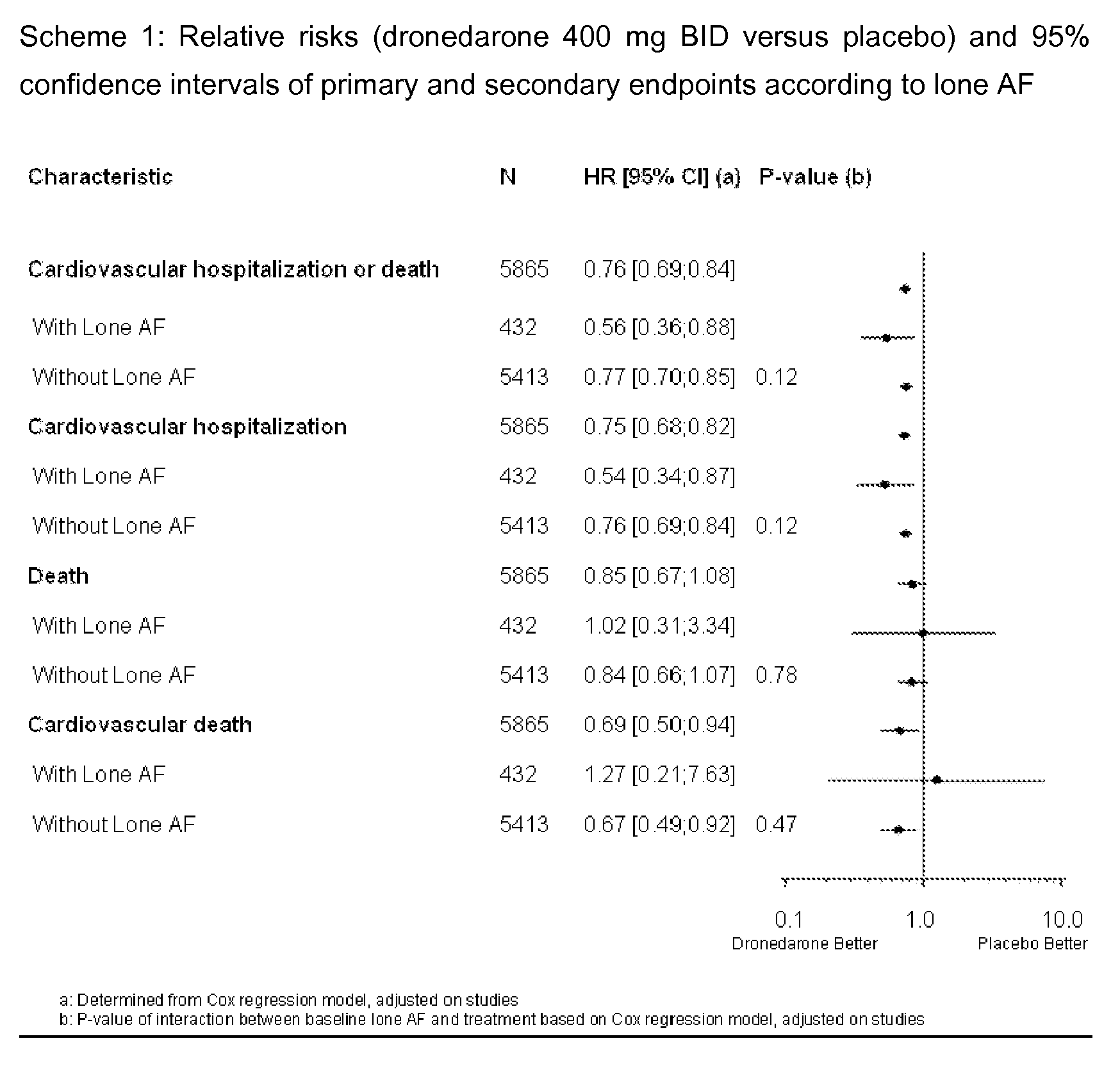
- The risk for cardiovascular hospitalizations or death in the placebo group after 1 year was 25% in the lone atrial fibrillation group compared to 29% the rest of the population (see table 3).
Table 3: Unadjusted analysis of time from randomization to first cardiovascular hospitalization or death from any cause in patients with lone AF: Placebo Dronedarone 400mg BID (N= 192) (N= 240) [Number of events, n 46 34 Cumulative incidence of events at 6 months [95% CI] 0.182 [0.125 ; 0.240] 0.057 [0.027 ; 0.087] Cumulative incidence of events at 1 year [95% CI] 0.249 [0.183 ; 0.315] 0.128 [0.082 ; 0.173] Cumulative incidence of events at 2 years [95% CI] 0.316 [0.227 ; 0.404] 0.230 [0.146; 0.313]] Log-rank test p-value 0.0039 Relative risk [95% CI]a 0.562 [0.361; 0.877] - Patients with lone AF have a 23% risk for CV hospitalization in the first year, compared with 28% in patients without lone AF (see table 4).
Table 4: Secondary Endpoint: Unadjusted analysis of time from randomization to first cardiovascular hospitalization in patients with or without lone AF Patients with lone AF at baseline Patients without lone AF at baseline Placebo Dronedarone 400mg BID Placebo Dronedarone 400mg BID (N= 192) (N= 240) (N= 2532) (N= 2881) Number of events, n 42 30 875 748 Cumulative incidence of events at 6 months [95% CI] 0.165 0.057 0.188 0.135 [0.110 ; 0.220] [0.027 ; 0.087] [0.173 ; 0.203] [0.122;0.148] Cumulative incidence of events at 1 year [95% CI] 0.234 0.113 0.279 0.208 [0.168 ; 0.299] [0.070 ; 0.156] [0.262 ; 0.297] [0.193 ; 0.224] Cumulative incidence of events at 2 years [95% CI] 0.285 0.195 0.393 0.321 [0.200 ; 0.370] [0.121 ; 0.269] [0.371 ; 0.415] [0.299 ; 0.343] Log-rank test p-value 0.0041 12E-10 Relative risk [95% CI]a 0.543 0.758 [0.339; 0.869] [0.687; 0.836] a Determined from cause-specific Cox regression model adjusted on studies - The majority of cardiovascular hospitalisations represented hospitalisations for treatment of AF or other supraventricular arrhythmias. In the placebo group 31 of 42 cardiovascular hospitalisations were for AF or other supraventricular arrhythmias compared to 16 of 30 in the dronedarone group.
- The adverse event profile of dronedarone in lone AF patients was similar to the one observed in the patients not classified as lone AF at baseline. No difference was observed in the risks for adverse events between placebo and dronedarone independent from the AF type. Patients with lone AF had similar drug discontinuation rate in the dronedarone and in the placebo arm (Scheme 2), however drug discontinuation happened more often in the dronedarone arm in the patients with other forms of AF.


- TEAE: treatment emergent adverse event; AE: adverse event; IP: Investigational product
- a: Determined from Cox regression model, adjusted on studies
- b: P-value of interaction between baseline lone AF and treatment based on Cox regression model, adjusted on studies.
Claims (13)
- Dronedarone or a pharmaceutically acceptable salt thereof, for the prevention of cardiovascular hospitalizations and/or of mortality in patients with lone atrial fibrillation.
- Dronedarone or a pharmaceutically acceptable salt thereof according to claim 1, for the prevention of approximately 44% of cardiovascular hospitalizations or of mortality in patients having lone atrial fibrillation.
- Dronedarone or a pharmaceutically acceptable salt thereof to claim 1, for the prevention of cardiovascular hospitalizations in patients having lone atrial fibrillation.
- Dronedarone or a pharmaceutically acceptable salt thereof to claim 1, for the prevention of approximately 46% of cardiovascular hospitalizations in patients having lone atrial fibrillation.
- Dronedarone or a pharmaceutically acceptable salt thereof to claim 1, for the prevention as mentioned above in patients having lone atrial fibrillation and at least one of the following medications:- beta blocking agents,- ACE inhibitors or A II I receptor antagonists,- oral anticoagulant,- diuretics,- statins,- chronic antiplatelet therapy,- calcium antagonists with heart rate lowering effects,- digitalis,- drugs interacting with the creatinine tubular secretion,- moderate inhibitors of CYP3A4,- NSAID.
- Method of providing dronedarone or pharmaceutically acceptable salts thereof, wherein said dronedarone or pharmaceutically acceptable salts thereof is provided along with information indicating that dronedarone or pharmaceutically acceptable salts thereof is indicated in patients having lone atrial fibrillation.
- Method according to claim 6, wherein the information comprises printed matter that advises that dronedarone or pharmaceutically acceptable salts thereof is indicated in patients having lone atrial fibrillation.
- Method according to claim 7, wherein the printed material is a label.
- Method of promoting the use of dronedarone or pharmaceutically acceptable salts thereof, the method comprising the step of conveying to a recipient at least one message selected from the group consisting of dronedarone or pharmaceutically acceptable salts thereof should be prescribed to a patient having lone atrial fibrillation.
- Article of manufacture comprising:a) a packaging material;b) dronedarone or pharmaceutically acceptable salts thereof, andc) a label or package insert contained within the packaging material indicating that dronedarone or pharmaceutically acceptable salts thereof is indicated in patients having lone atrial fibrillation.
- Package comprising dronedarone or pharmaceutically acceptable salts thereof and a label, said label comprising a printed statement which informs a prospective user that dronedarone or pharmaceutically acceptable salts thereof is indicated in patients having lone atrial fibrillation.
- Method of treatment of a patient having lone atrial fibrillation, said method comprising administrating to said patient a therapeutically effective amount of dronedarone, or a pharmaceutically acceptable salt thereof.
- Method of transforming a patient having lone atrial fibrillation by decreasing the patient's risk of cardiovascular hospitalizations or mortality, comprising administrating to said patient a therapeutically effective amount of dronedarone, or a pharmaceutically acceptable salt thereof.
Priority Applications (4)
| Application Number | Priority Date | Filing Date | Title |
|---|---|---|---|
| EP10305879A EP2431033A1 (en) | 2010-08-10 | 2010-08-10 | Dronedarone for preventing cardiovascular hospitalization or mortality in patients with lone atrial fibrillation |
| ARP110102582A AR084975A1 (en) | 2010-08-10 | 2011-07-18 | USE OF DRONEDARONE FOR THE PREPARATION OF A MEDICINAL PRODUCT FOR THE PREVENTION OF CARDIOVASCULAR HOSPITALIZATION OR OF MORTALITY IN PATIENTS WITH ISOLATED HEADPHONES FIBRILATION |
| TW100125504A TW201208676A (en) | 2010-07-19 | 2011-07-19 | Use of dronedarone for the preparation of a medicament for the prevention of cardiovascular hospitalization or of mortality in patients with lone atrial fibrillation |
| PCT/EP2011/062300 WO2012010571A1 (en) | 2010-07-19 | 2011-07-19 | Dronedarone for the prevention of cardiovascular hospitalization or of mortality in patients with lone atrial fibrillation |
Applications Claiming Priority (1)
| Application Number | Priority Date | Filing Date | Title |
|---|---|---|---|
| EP10305879A EP2431033A1 (en) | 2010-08-10 | 2010-08-10 | Dronedarone for preventing cardiovascular hospitalization or mortality in patients with lone atrial fibrillation |
Publications (1)
| Publication Number | Publication Date |
|---|---|
| EP2431033A1 true EP2431033A1 (en) | 2012-03-21 |
Family
ID=42797328
Family Applications (1)
| Application Number | Title | Priority Date | Filing Date |
|---|---|---|---|
| EP10305879A Ceased EP2431033A1 (en) | 2010-07-19 | 2010-08-10 | Dronedarone for preventing cardiovascular hospitalization or mortality in patients with lone atrial fibrillation |
Country Status (4)
| Country | Link |
|---|---|
| EP (1) | EP2431033A1 (en) |
| AR (1) | AR084975A1 (en) |
| TW (1) | TW201208676A (en) |
| WO (1) | WO2012010571A1 (en) |
Citations (4)
| Publication number | Priority date | Publication date | Assignee | Title |
|---|---|---|---|---|
| EP0471609B1 (en) | 1990-08-06 | 1996-11-27 | Sanofi | Benzofuran Derivatives, Benzothiophenes, Indoles or Indolizines, Process for Production and Compositions containing them |
| WO1997034597A1 (en) | 1996-03-18 | 1997-09-25 | Sanofi | Use of antiarrhythmic compounds for reducing post-infarction mortality |
| WO1998040067A1 (en) | 1997-03-10 | 1998-09-17 | Sanofi | Use of benzofuran derivatives for reducing death rate after myocardial infarction |
| WO2009144550A2 (en) | 2008-04-17 | 2009-12-03 | Sanofi-Aventis | Use of dronedarone for the preparation of a medicament for use in the prevention of cardiovascular hospitalization or of mortality |
-
2010
- 2010-08-10 EP EP10305879A patent/EP2431033A1/en not_active Ceased
-
2011
- 2011-07-18 AR ARP110102582A patent/AR084975A1/en unknown
- 2011-07-19 TW TW100125504A patent/TW201208676A/en unknown
- 2011-07-19 WO PCT/EP2011/062300 patent/WO2012010571A1/en not_active Ceased
Patent Citations (4)
| Publication number | Priority date | Publication date | Assignee | Title |
|---|---|---|---|---|
| EP0471609B1 (en) | 1990-08-06 | 1996-11-27 | Sanofi | Benzofuran Derivatives, Benzothiophenes, Indoles or Indolizines, Process for Production and Compositions containing them |
| WO1997034597A1 (en) | 1996-03-18 | 1997-09-25 | Sanofi | Use of antiarrhythmic compounds for reducing post-infarction mortality |
| WO1998040067A1 (en) | 1997-03-10 | 1998-09-17 | Sanofi | Use of benzofuran derivatives for reducing death rate after myocardial infarction |
| WO2009144550A2 (en) | 2008-04-17 | 2009-12-03 | Sanofi-Aventis | Use of dronedarone for the preparation of a medicament for use in the prevention of cardiovascular hospitalization or of mortality |
Non-Patent Citations (6)
| Title |
|---|
| HOHNLOSER ET AL., JOURNAL OF CARDIOVASCULAR ELECTROPHYSIOLOGY, vol. 19, no. 1, January 2008 (2008-01-01), pages 69 - 73 |
| HOHNLOSER STEFAN H ET AL: "Effect of dronedarone on cardiovascular events in atrial fibrillation.", THE NEW ENGLAND JOURNAL OF MEDICINE 12 FEB 2009 LNKD- PUBMED:19213680, vol. 360, no. 7, 12 February 2009 (2009-02-12), pages 668 - 678, XP002604030, ISSN: 1533-4406 * |
| HOHNLOSER, NEW ENGLAND JOURNAL OF MEDECINE, vol. 360, 2009, pages 668 - 678 |
| SINGH ET AL., NEW ENGLAND JOURNAL OF MEDECINE, vol. 357, 2007, pages 987 - 999 |
| WIJFFELS MC; KIRCHHOF CJ; DORLAND R; ALLESSIE MA: "Atrial fibrillation begets atrial fibrillation", A STUDY IN AWAKE CHRONICALLY INSTRUMENTED GOATS.CIRCULATION, vol. 92, no. 7, 1 October 1995 (1995-10-01), pages 1954 - 68 |
| YALTA KENAN ET AL: "Dronedarone: a promising alternative for the management of atrial fibrillation.", October 2009, CARDIOVASCULAR DRUGS AND THERAPY / SPONSORED BY THE INTERNATIONAL SOCIETY OF CARDIOVASCULAR PHARMACOTHERAPY OCT 2009 LNKD- PUBMED:19669399, VOL. 23, NR. 5, PAGE(S) 385 - 393, ISSN: 1573-7241, XP008127681 * |
Also Published As
| Publication number | Publication date |
|---|---|
| TW201208676A (en) | 2012-03-01 |
| AR084975A1 (en) | 2013-07-24 |
| WO2012010571A1 (en) | 2012-01-26 |
Similar Documents
| Publication | Publication Date | Title |
|---|---|---|
| US20210267931A1 (en) | Use of dronedarone for the preparation of a medicament for use in the prevention of cardiovascular hospitalization or of mortality | |
| US20110166220A1 (en) | Dronedarone for the prevention of permanent atrial fibrillation | |
| EP2153830A1 (en) | Use of dronedarone for the preparation of a medicament intended for the prevention of stroke or transient ischemic attack | |
| US8602215B2 (en) | Methods for reducing the risk of an adverse dronedarone/beta-blockers interaction in a patient suffering from atrial fibrillation | |
| AU2009241966A1 (en) | Combination of dronedarone with at least one diuretic, and therapeutic use thereof | |
| EP2386300A1 (en) | Use of dronedarone for the preparation of a medicament for use in the prevention of cardiovascular hospitalization or of mortality in patients having a first recurrence of atrial fibrillation or atrial flutter | |
| WO2012010571A1 (en) | Dronedarone for the prevention of cardiovascular hospitalization or of mortality in patients with lone atrial fibrillation | |
| WO2012020377A1 (en) | Use of dronedarone for the preparation of a medicament for rhythm- and rate-controlling in patients with atrial fibrillation | |
| US20130116586A1 (en) | Use of dronedarone or a pharmaceutically acceptable salt thereof for the preparation of a drug for the prevention of atrial fibrillation | |
| EP2387996A1 (en) | Use of dronedarone for the preparation of a medicament for the prevention of cardiovascular events in patients with permanent atrial fibrillation | |
| WO2012013750A1 (en) | Use of dronedarone for the preparation of a medicament for the hospitalization burden in patient with atrial fibrillation | |
| AU2010202742A1 (en) | Methods for reducing the risk of an adverse dronedarone / beta-blockers interaction in a patient suffering from atrial fibrillation | |
| EP2387997A1 (en) | Use of dronedarone for the preparation of a medicament for the prevention of cardiovascular events in patients who developed permanent atrial fibrillation throughout the period the dronedarone is administered | |
| WO2011141888A1 (en) | Use of dronedarone for the preparation of a medicament for the prevention of cardiovacular hospitalizations or death or cardiovascular events in patients with permanent atrial fibrillation | |
| HK1158984A (en) | Use of dronedarone for the preparation of a medicament for the prevention of stroke or transient ischemic attack | |
| HK1156502A (en) | Use of dronedarone or a pharmaceutically acceptable salt thereof, for the preparation of a medicament for regulating the potassium level in the blood |
Legal Events
| Date | Code | Title | Description |
|---|---|---|---|
| PUAI | Public reference made under article 153(3) epc to a published international application that has entered the european phase |
Free format text: ORIGINAL CODE: 0009012 |
|
| AK | Designated contracting states |
Kind code of ref document: A1 Designated state(s): AL AT BE BG CH CY CZ DE DK EE ES FI FR GB GR HR HU IE IS IT LI LT LU LV MC MK MT NL NO PL PT RO SE SI SK SM TR |
|
| AX | Request for extension of the european patent |
Extension state: BA ME RS |
|
| RAP1 | Party data changed (applicant data changed or rights of an application transferred) |
Owner name: SANOFI |
|
| RAP1 | Party data changed (applicant data changed or rights of an application transferred) |
Owner name: SANOFI |
|
| STAA | Information on the status of an ep patent application or granted ep patent |
Free format text: STATUS: THE APPLICATION HAS BEEN REFUSED |
|
| 18R | Application refused |
Effective date: 20120407 |