EP2431011A1 - Instrument for treating patient with semicircular canal injury and method for producing same - Google Patents
Instrument for treating patient with semicircular canal injury and method for producing same Download PDFInfo
- Publication number
- EP2431011A1 EP2431011A1 EP10775029A EP10775029A EP2431011A1 EP 2431011 A1 EP2431011 A1 EP 2431011A1 EP 10775029 A EP10775029 A EP 10775029A EP 10775029 A EP10775029 A EP 10775029A EP 2431011 A1 EP2431011 A1 EP 2431011A1
- Authority
- EP
- European Patent Office
- Prior art keywords
- instrument
- semicircular
- semicircular canals
- liquid
- patient
- Prior art date
- Legal status (The legal status is an assumption and is not a legal conclusion. Google has not performed a legal analysis and makes no representation as to the accuracy of the status listed.)
- Granted
Links
- 210000002480 semicircular canal Anatomy 0.000 title claims abstract description 121
- 208000027418 Wounds and injury Diseases 0.000 title claims abstract description 29
- 230000006378 damage Effects 0.000 title claims abstract description 29
- 208000014674 injury Diseases 0.000 title claims abstract description 29
- 238000004519 manufacturing process Methods 0.000 title claims description 15
- 230000002842 otolith Effects 0.000 claims abstract description 45
- 239000011347 resin Substances 0.000 claims abstract description 39
- 229920005989 resin Polymers 0.000 claims abstract description 39
- 239000007788 liquid Substances 0.000 claims abstract description 31
- 230000005484 gravity Effects 0.000 claims abstract description 20
- 210000001265 otolithic membrane Anatomy 0.000 claims description 21
- 210000001061 forehead Anatomy 0.000 claims description 9
- 241000356847 Otolithes Species 0.000 claims description 7
- 206010047348 Vertigo positional Diseases 0.000 abstract description 7
- 201000000691 benign paroxysmal positional nystagmus Diseases 0.000 abstract description 7
- 208000001870 benign paroxysmal positional vertigo Diseases 0.000 abstract description 7
- 208000002193 Pain Diseases 0.000 abstract description 6
- 230000003340 mental effect Effects 0.000 abstract description 6
- 230000036407 pain Effects 0.000 abstract description 6
- 210000003128 head Anatomy 0.000 description 11
- 238000000034 method Methods 0.000 description 11
- 210000004556 brain Anatomy 0.000 description 7
- 210000000056 organ Anatomy 0.000 description 6
- 239000011324 bead Substances 0.000 description 4
- 239000011521 glass Substances 0.000 description 4
- 239000002245 particle Substances 0.000 description 4
- 230000001133 acceleration Effects 0.000 description 3
- 210000000988 bone and bone Anatomy 0.000 description 3
- 238000006243 chemical reaction Methods 0.000 description 3
- 239000008157 edible vegetable oil Substances 0.000 description 3
- 238000000605 extraction Methods 0.000 description 3
- 210000002751 lymph Anatomy 0.000 description 3
- 208000012886 Vertigo Diseases 0.000 description 2
- 238000004891 communication Methods 0.000 description 2
- 238000012937 correction Methods 0.000 description 2
- 238000002474 experimental method Methods 0.000 description 2
- 238000007667 floating Methods 0.000 description 2
- 239000011159 matrix material Substances 0.000 description 2
- 238000000465 moulding Methods 0.000 description 2
- 239000011295 pitch Substances 0.000 description 2
- 239000004033 plastic Substances 0.000 description 2
- 229920003023 plastic Polymers 0.000 description 2
- 238000007789 sealing Methods 0.000 description 2
- 229910001220 stainless steel Inorganic materials 0.000 description 2
- 239000010935 stainless steel Substances 0.000 description 2
- 239000000126 substance Substances 0.000 description 2
- 239000010409 thin film Substances 0.000 description 2
- 239000004593 Epoxy Substances 0.000 description 1
- 201000010099 disease Diseases 0.000 description 1
- 208000037265 diseases, disorders, signs and symptoms Diseases 0.000 description 1
- 229940079593 drug Drugs 0.000 description 1
- 239000003814 drug Substances 0.000 description 1
- UHESRSKEBRADOO-UHFFFAOYSA-N ethyl carbamate;prop-2-enoic acid Chemical compound OC(=O)C=C.CCOC(N)=O UHESRSKEBRADOO-UHFFFAOYSA-N 0.000 description 1
- 239000010408 film Substances 0.000 description 1
- 230000009477 glass transition Effects 0.000 description 1
- 210000004209 hair Anatomy 0.000 description 1
- 210000002768 hair cell Anatomy 0.000 description 1
- 238000003384 imaging method Methods 0.000 description 1
- JEIPFZHSYJVQDO-UHFFFAOYSA-N iron(III) oxide Inorganic materials O=[Fe]O[Fe]=O JEIPFZHSYJVQDO-UHFFFAOYSA-N 0.000 description 1
- 238000010030 laminating Methods 0.000 description 1
- 239000000463 material Substances 0.000 description 1
- 239000002184 metal Substances 0.000 description 1
- 229910052751 metal Inorganic materials 0.000 description 1
- 150000002739 metals Chemical class 0.000 description 1
- 230000000704 physical effect Effects 0.000 description 1
- 238000000554 physical therapy Methods 0.000 description 1
- KCTAWXVAICEBSD-UHFFFAOYSA-N prop-2-enoyloxy prop-2-eneperoxoate Chemical compound C=CC(=O)OOOC(=O)C=C KCTAWXVAICEBSD-UHFFFAOYSA-N 0.000 description 1
- 238000011160 research Methods 0.000 description 1
- 230000036421 sense of balance Effects 0.000 description 1
- 210000004872 soft tissue Anatomy 0.000 description 1
- 239000012209 synthetic fiber Substances 0.000 description 1
- 229920002994 synthetic fiber Polymers 0.000 description 1
- 238000012360 testing method Methods 0.000 description 1
- 231100000889 vertigo Toxicity 0.000 description 1
- 230000001720 vestibular Effects 0.000 description 1
Images
Classifications
-
- A—HUMAN NECESSITIES
- A61—MEDICAL OR VETERINARY SCIENCE; HYGIENE
- A61M—DEVICES FOR INTRODUCING MEDIA INTO, OR ONTO, THE BODY; DEVICES FOR TRANSDUCING BODY MEDIA OR FOR TAKING MEDIA FROM THE BODY; DEVICES FOR PRODUCING OR ENDING SLEEP OR STUPOR
- A61M21/00—Other devices or methods to cause a change in the state of consciousness; Devices for producing or ending sleep by mechanical, optical, or acoustical means, e.g. for hypnosis
-
- A—HUMAN NECESSITIES
- A61—MEDICAL OR VETERINARY SCIENCE; HYGIENE
- A61B—DIAGNOSIS; SURGERY; IDENTIFICATION
- A61B5/00—Measuring for diagnostic purposes; Identification of persons
- A61B5/103—Measuring devices for testing the shape, pattern, colour, size or movement of the body or parts thereof, for diagnostic purposes
- A61B5/11—Measuring movement of the entire body or parts thereof, e.g. head or hand tremor or mobility of a limb
-
- G—PHYSICS
- G01—MEASURING; TESTING
- G01C—MEASURING DISTANCES, LEVELS OR BEARINGS; SURVEYING; NAVIGATION; GYROSCOPIC INSTRUMENTS; PHOTOGRAMMETRY OR VIDEOGRAMMETRY
- G01C9/00—Measuring inclination, e.g. by clinometers, by levels
- G01C9/18—Measuring inclination, e.g. by clinometers, by levels by using liquids
-
- A—HUMAN NECESSITIES
- A61—MEDICAL OR VETERINARY SCIENCE; HYGIENE
- A61M—DEVICES FOR INTRODUCING MEDIA INTO, OR ONTO, THE BODY; DEVICES FOR TRANSDUCING BODY MEDIA OR FOR TAKING MEDIA FROM THE BODY; DEVICES FOR PRODUCING OR ENDING SLEEP OR STUPOR
- A61M21/00—Other devices or methods to cause a change in the state of consciousness; Devices for producing or ending sleep by mechanical, optical, or acoustical means, e.g. for hypnosis
- A61M2021/0005—Other devices or methods to cause a change in the state of consciousness; Devices for producing or ending sleep by mechanical, optical, or acoustical means, e.g. for hypnosis by the use of a particular sense, or stimulus
- A61M2021/0022—Other devices or methods to cause a change in the state of consciousness; Devices for producing or ending sleep by mechanical, optical, or acoustical means, e.g. for hypnosis by the use of a particular sense, or stimulus by the tactile sense, e.g. vibrations
-
- A—HUMAN NECESSITIES
- A61—MEDICAL OR VETERINARY SCIENCE; HYGIENE
- A61M—DEVICES FOR INTRODUCING MEDIA INTO, OR ONTO, THE BODY; DEVICES FOR TRANSDUCING BODY MEDIA OR FOR TAKING MEDIA FROM THE BODY; DEVICES FOR PRODUCING OR ENDING SLEEP OR STUPOR
- A61M21/00—Other devices or methods to cause a change in the state of consciousness; Devices for producing or ending sleep by mechanical, optical, or acoustical means, e.g. for hypnosis
- A61M2021/0005—Other devices or methods to cause a change in the state of consciousness; Devices for producing or ending sleep by mechanical, optical, or acoustical means, e.g. for hypnosis by the use of a particular sense, or stimulus
- A61M2021/0044—Other devices or methods to cause a change in the state of consciousness; Devices for producing or ending sleep by mechanical, optical, or acoustical means, e.g. for hypnosis by the use of a particular sense, or stimulus by the sight sense
Definitions
- the present invention relates to an instrument for treating a patient with semicircular canal injury and a method for producing the same. More specifically, the present invention relates to an instrument in the form of an enlarged model of three semicircular canals, which includes a liquid and otolithic models enclosed within a hollow annular member made of a transparent resin; an instrument for treating a patient with semicircular canal injury including the above instrument, which is to be attached to a headband member and used with the headband member being worn around the forehead of a patient; and a method for effectively producing the treatment instrument.
- the three semicircular canals include the following three semicircular canals, i.e., the anterior semicircular canal, the posterior semicircular canal, and the lateral semicircular canal. They have a structure in which they are at right angles to one another.
- otolith organ In the vestibule, further, there is an otolith organ.
- the structure of the otolith organ is such that the organ has a large number of dense short hairs, and minute stones (otoliths) are placed on the end portions thereof. The shaking of such otoliths allows the gravity and linear acceleration to be perceived.
- the lymph in the three semicircular canals also moves, and, together with this movement, hair cells create a nervous impulse to transmit the signal to the brain.
- the movement of the lymph in one semicircular canal corresponding to the direction in which the head moves becomes larger than the movement in the other two semicircular canals, and the brain thus recognizes the rotation of the head.
- the brain can recognize the rotation of the head and the linear movement, as well as acceleration of the body, whereby the brain performs the operation to maintain the balance of the body.
- physiotherapy As a method for removing otoliths that have entered the semicircular canals, physiotherapy is commonly used. In this method, the patient's head is moved back and forth and from side to side to apply acceleration to otoliths floating in the semicircular canals or otoliths adhering to the cupulae, thereby removing the otoliths from the semicircular canals (see, e.g., Nonpatent Document 1).
- this method is a trial-and-error method, and has a problem in that the treatment takes a long period of time and gives physical and mental pains to the patient.
- an object of the present invention is to provide an instrument for treating a patient with semicircular canal injury, whereby physical and mental pains can be alleviated in treating a patient with semicircular canal injury such as benign paroxysmal positional vertigo; and a producing method for obtaining an exact enlarged model for the instrument.
- the present inventors conducted extensive research to achieve the above object. As a result, they found that when an instrument in the form of an exact enlarged model of human three semicircular canals having a specific structure made of a transparent resin is used as an instrument for treating a patient with semicircular canal injury, it is possible to alleviate physical and mental pains caused to the patient.
- the prevent invention provides:
- an instrument for treating a patient with semicircular canal injury whereby physical and mental pains can be reduced in quickly and reliably treating a patient with semicircular canal injury such as benign paroxysmal positional vertigo; and a producing method which can obtain an exact enlarged model for the instrument.
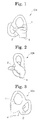
- Fig. 1 shows an enlarged molded body in the form of three semicircular canals, which includes a hollow annular member made of a transparent resin, for producing an instrument in the form of an enlarged model of right three semicircular canals, as seen from the right side (earhole side);
- Fig. 2 shows an enlarged molded body in the form of three semicircular canals, which includes a hollow annular member made of a transparent resin, for producing an instrument in the form of an enlarged model of right three semicircular canals, as seen from the front;
- Fig. 1 shows an enlarged molded body in the form of three semicircular canals, which includes a hollow annular member made of a transparent resin, for producing an instrument in the form of an enlarged model of right three semicircular canals, as seen from the front;
- FIG. 3 shows an enlarged molded body in the form of three semicircular canals, which includes a hollow annular member made of a transparent resin, for producing an instrument in the form of an enlarged model of right three semicircular canals, as seen from the left side (brain side) ;
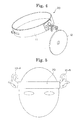
- Fig. 4 is a perspective view of an example of a headband member for the attachment of an instrument for treating a patient with semicircular canal injury of the present invention;
- Fig. 5 is a front view of an example where an instrument for treating a patient with semicircular canal injury of the present invention attached to the headband member is worn around the forehead.
- reference numerals 1, 2, and 3 represent a screen
- 4 represents an opening
- 10a shows the shape of an enlarged molded body in the form of right three semicircular canals, which includes a hollow annular member, as seen from the right side (earhole side)
- 10b shows the shape of an enlarged molded body in the form of right three semicircular canals, which includes a hollow annular member, as seen from the front
- 10c shows the shape of an enlarged molded body in the form of right three semicircular canals, which includes a hollow annular member, as seen from the left side (brain side)
- 10-A represents a treatment instrument I including an instrument in the form of an enlarged model of right three semicircular canals
- 10-B represents a treatment instrument I including an instrument in the form of an enlarged model of left three semicircular canals
- 11 represents a belt-like portion for wearing around the forehead of a patient
- 20 represents a headband member.
- the instrument for treating a patient with semicircular canal injury of the present invention has two aspects.
- An instrument for treating a patient with semicircular canal injury according to the first aspect (hereinafter sometimes simply referred to as treatment instrument I) is an instrument in the form of an exact enlarged model of human three semicircular canals, the instrument which has a structure in which a liquid and a plurality of otolithic models that have a specific gravity larger than the specific gravity of the liquid are enclosed within a hollow annular member made of a transparent resin and equipped with a screen at the position corresponding to the cupula in each of the three semicircular canals, the screen having such a mesh size as allowing the passage of the liquid but not allowing the passage of the otolithic models.
- the screen for use in the present invention may be a wire screen, a screen made of natural or synthetic fibers, or a plastic screen.
- a wire screen stainless steel that is resistant to rust, for example, is preferable.
- the instrument in the form of an exact enlarged model of human three semicircular canals in the present invention means that the shape thereof is just like the shape of the actual human three semicircular canals and is on a proportionally enlarged scale compared with the actual size.
- the joint and combination angles in the three semicircular canals are just like the real ones, and only the dimension is on an enlarged scale compared with the actual size.
- the instrument in the form of an exact enlarged model of three semicircular canals of the present invention does not include a mere geometric combination of three circular or elliptical rings.
- the hollow annular member made of a transparent resin used for the production of the treatment instrument I of the present invention is equipped with a screen at the position corresponding to the cupula in each of the three semicircular canals.
- the enlarged molded body including a hollow annular member made of a transparent resin shown in Fig. 1, Fig. 2, and Fig. 3 and represented by 10a, 10b, and 10c, respectively, can be mentioned.
- the 10a shows the shape of an enlarged molded body in the form of right three semicircular canals, which includes the hollow annular member, as seen from the right side (earhole side), and 10b shows the shape of an enlarged molded body in the form of right three semicircular canals, which includes the hollow annular member, as seen from the front. Further 10c shows the shape of an enlarged molded body in the form of right three semicircular canals, which includes the hollow annular member, as seen from the left side (brain side).
- the reference numerals 1, 2, and 3 each represent a screen provided at the position corresponding to the cupula in each of the three semicircular canals.
- the screen is required to have such a mesh size as allowing the passage of the liquid mentioned below but not allowing the passage of the otolithic models.
- Materials therefor are not particularly limited, and it may be made of plastics or metals. However, in terms of durability, stainless steel is preferable.
- the reference numeral 4 represents an opening in the enlarged molded body.
- the enlarged molded body in the form of three semicircular canals is on a scale three to ten times the actual size of three semicircular canals. Further, in the case of left three semicircular canals, the shape that is symmetrical to the shape shown in Fig. 1 to Fig. 3 above is mentioned.
- the enlarged molded body including the hollow annular member made of a transparent resin can be effectively formed by the below-mentioned producing method according to the present invention.
- the treatment instrument I of the present invention has a structure in which a liquid and a plurality of otolithic models that have a specific gravity larger than the specific gravity of the liquid are enclosed within an enlarged molded body including a hollow annular member that is made of a transparent resin and equipped with a screen at the position corresponding to the cupula in each of the three semicircular canals.
- the kind of the liquid is not particularly limited, but a liquid that is similar to the human lymph is preferable, and an edible oil or the like can be used, for example.
- the specific gravity thereof is larger than the specific gravity of the liquid used.
- the specific gravity of the liquid used it is required that the specific gravity thereof is larger than the specific gravity of the liquid used.
- one having a specific gravity that is 1.1 to 1.5 times the specific gravity of the liquid is preferable.
- the particle diameter of the otolithic models is close to the particle diameter of the human otoliths.
- glass beads having a particle diameter of 0.5 to 5 mm can be used, for example.
- treatment instrument II an instrument for treating a patient with semicircular canal injury according to the second aspect (hereinafter sometimes simply referred to as treatment instrument II) will be explained.
- the treatment instrument II of the present invention is characterized in that the treatment instrument I mentioned above is attached to a headband member, and that the headband member having the treatment instrument I attached thereto is worn around the forehead of a patient.
- FIG. 4 is a perspective view of an example of a headband member for the attachment of the treatment instrument I of the present invention.
- the reference numeral 20 represents a headband member
- 11 represents a belt-like portion for wearing around the forehead of a patient.
- Fig. 5 is a front view of an example where the treatment instrument I of the present invention attached to the headband member is worn around the forehead.
- the reference numeral 10-A represents a treatment instrument I including an instrument in the form of an enlarged model of right three semicircular canals
- 10-B represents a treatment instrument I including an instrument in the form of an enlarged model of left three semicircular canals.
- a treatment instrument I including an instrument in the form of an enlarged model of three semicircular canals of the right or left side, which is the sick side having semicircular canal injury, is attached.
- treatment instruments I including instruments in the form of enlarged models of both right and light three semicircular canals as shown in Fig. 5 .
- the method for producing a treatment instrument I of the present invention is a method for producing an instrument in the form of an enlarged model of human three semicircular canals, and wherein a molded body in the form of the three semicircular canals as enlarged is produced by stereolithography using a photopolymerizable resin that cures upon irradiation with a laser beam, the saped body including a hollow annular member made of a transparent resin and equipped with a screen at the position corresponding to the cupula in each of the three semicircular canals, a plurality of otolith models and a liquid are placed into the molded body through an opening in the molded body; and the opening is sealed.
- a molded body in the form of enlarged three semicircular canals which includes a hollow annular member made of a transparent resin and equipped with a screen at the position corresponding to the cupula in each of the three semicircular canals, is formed by stereolithography.
- the photopolymerizable resin those curable upon irradiation with a UV laser beam are used.
- photopolymerizable resins for example, epoxy-acrylate-based, ester-acrylate-based, urethane-acrylate-based, and polyol-acrylate-based oligomers are usable.
- DICOM data abbreviation of Digital Imaging and Communication in Medicine: a standard developed by the American College of Radiology (ACR) and the National Electrical Manufacturers Association (NEMA), defining the format of medical images taken by CT, MRI, or the like and the communication protocol between medical imagers for such images
- ACR American College of Radiology
- NEMA National Electrical Manufacturers Association
- the target area is the semicircular canals, an area that forms a hollow tube structure in a human bone.
- the extraction threshold (Hounsfield value) is set at a low value that is inapplicable to either bone or soft tissues (here, the extraction lower limit is -1024 set as air, and, while slowly increasing the upper limit, the basic extraction region is set at a value of 225, which is the most desirable as the shape of semicircular canal s). Further, partial corrections are made so that the shape of target area on the data has a desirable hollow tube structure, thereby achieving 3D conversion.
- a molded body in the form of enlarged three semicircular canals formed by stereolithography which includes a hollow annular member equipped with the screen
- the molded body having the shape shown in Fig. 1 to Fig. 3 above can be mentioned, for example.
- the plurality of otolithic models and the liquid are placed inside through the opening (e.g., reference numeral 4 in Fig. 1 to Fig. 3 ) in the molded body, and the opening is sealed in such a manner that the entrance of air can be minimized; as a result, the treatment instrument I of the present invention can be obtained.
- the method for sealing is not particularly limited, and a method in which sealing is achieved with a rubber plug, which is used in a chemical experiment or the like, can be employed, for example.
- the three-dimensional data were enlarged five times the original size and input into the computer in a precise laminating machine [manufactured by CMET Inc., diode-pumped solid-state laser "SOLIFORM-600”] equipped with a head that allows a photopolymerizable resin in the form of a laminate of 0.2-mm-thick thin layers to cure upon irradiation with a laser beam having a spot diameter of 0.25 mm.
- the data of the three semicircular canals' wall portion area which were obtained from the level surface parallel to the bottom of the three-dimensional data by cutting the three-dimensional data in round slices for every 0.2-mm-thick thin-film unit, were output, and the photopolymerizable resin was irradiated with a laser beam (liquid-surface input value: 200 mW, 60k Hz) to form the three-semicircular-canal portion having a thin-film unit thickness, whereby an operation to form a three semicircular canals' wall was performed.
- a laser beam liquid-surface input value: 200 mW, 60k Hz
- This operation was sequentially repeated for every thin-layer unit from the lower end to upper end of the three-dimensional data to give a massive matrix of the photopolymerizable resin in the three-dimensional, three semicircular canals' wall shape corresponding to the three-dimensional data.
- an epoxy-based photopolymerizable resin [trade name "TSR-829", manufactured by CMET Inc., curable with a laser beam from a laser diode, 25°C viscosity: 205 mPa-s, 25°C specific gravity: 1.08] was used.
- the cured resin physical properties are as follows: tensile strength: 46 MPa, tensile elongation: 7 to 10%, tensile modulus: 1750 MPa, flexural strength: 68 MPa, flexural modulus: 2070 MPa, impact strength: 34 J/m, high-load HDT: 49 to 50°C, low-load HDT: 54°C, glass transition temperature: 66°C, surface hardening (Shore D) : 83, shrinkage: 5.1%, appearance: transparent.
- a screen made of a photopolymerizable resin (whose mesh size allows the passage of the edible oil mentioned below but does not allow the passage of the otolithic models (glass beads)) was provided.
- otolithic models (glass beads having a particle diameter of 0.5 to 5 mm) were suitably placed inside, and, at the same time, an edible oil, which was selected to suit the speed of the movement of otoliths within three semicircular canals and also in consideration of the location of use, was placed inside.
- an edible oil which was selected to suit the speed of the movement of otoliths within three semicircular canals and also in consideration of the location of use, was placed inside.
- the opening was sealed with a rubber plug for chemical experiments, whereby a model of right and/or left three semicircular canals made of a transparent resin was produced.
- the three-semicircular-canal model made of a transparent resin is used as an instrument for treating semicircular canal injury
- the three-semicircular-canal model is attached to the headband member 20 shown in Fig. 4 , and the belt-like portion 11 of the headband member is worn around the forehead of a patient with semicircular canal injury, as shown in Fig. 5 .
- the patient's head is moved so that otolithic models move to the predetermined position. The treatment is thus performed.
- the instrument for treating a patient with semicircular canal injury of the present invention makes it possible to alleviate physical and mental pains in treating a patient with semicircular canal injury such as benign paroxysmal positional vertigo.
- a highly transparent and reliable treatment instrument can be produced at a high molding rate.
Landscapes
- Health & Medical Sciences (AREA)
- Life Sciences & Earth Sciences (AREA)
- Engineering & Computer Science (AREA)
- Physics & Mathematics (AREA)
- Biomedical Technology (AREA)
- Veterinary Medicine (AREA)
- Public Health (AREA)
- General Health & Medical Sciences (AREA)
- Animal Behavior & Ethology (AREA)
- Heart & Thoracic Surgery (AREA)
- Medical Informatics (AREA)
- Radar, Positioning & Navigation (AREA)
- Biophysics (AREA)
- Oral & Maxillofacial Surgery (AREA)
- Dentistry (AREA)
- Molecular Biology (AREA)
- Surgery (AREA)
- Physiology (AREA)
- Remote Sensing (AREA)
- Pathology (AREA)
- General Physics & Mathematics (AREA)
- Acoustics & Sound (AREA)
- Psychology (AREA)
- Anesthesiology (AREA)
- Hematology (AREA)
- Dental Tools And Instruments Or Auxiliary Dental Instruments (AREA)
- Instructional Devices (AREA)
- Orthopedics, Nursing, And Contraception (AREA)
Abstract
Description
- The present invention relates to an instrument for treating a patient with semicircular canal injury and a method for producing the same. More specifically, the present invention relates to an instrument in the form of an enlarged model of three semicircular canals, which includes a liquid and otolithic models enclosed within a hollow annular member made of a transparent resin; an instrument for treating a patient with semicircular canal injury including the above instrument, which is to be attached to a headband member and used with the headband member being worn around the forehead of a patient; and a method for effectively producing the treatment instrument.
- As semicircular canal injury, benign paroxysmal positional vertigo is known, for example. In this disease, when the head is quickly moved to change its direction up and down, from side to side, or the like, rotatory vertigo occurs, where the person feels if the head spins.
- Incidentally, in the vestibule, which is the organ responsible for the sense of balance, there are three semicircular canals that play an important role in maintaining the balance of the body. The three semicircular canals include the following three semicircular canals, i.e., the anterior semicircular canal, the posterior semicircular canal, and the lateral semicircular canal. They have a structure in which they are at right angles to one another.
- In the vestibule, further, there is an otolith organ. The structure of the otolith organ is such that the organ has a large number of dense short hairs, and minute stones (otoliths) are placed on the end portions thereof. The shaking of such otoliths allows the gravity and linear acceleration to be perceived.
- When the head is moved, the lymph in the three semicircular canals also moves, and, together with this movement, hair cells create a nervous impulse to transmit the signal to the brain. The movement of the lymph in one semicircular canal corresponding to the direction in which the head moves becomes larger than the movement in the other two semicircular canals, and the brain thus recognizes the rotation of the head.
- Thus, because of the functions of the vestibule and the three semicircular canals, the brain can recognize the rotation of the head and the linear movement, as well as acceleration of the body, whereby the brain performs the operation to maintain the balance of the body.
- It sometimes happens that a large number of otoliths on the otolith organ in the vestibular organ are deviated from the original position for some reason, and float inside the semicircular canals or adhere to a region inside the semicircular canals called cupula (a narrow portion in each semicircular canal, which forms a narrow path for the movement of otoliths). When the head of a person is moved in this state, otoliths extraordinarily irritate the three semicircular canals, whereby the person feels giddy.
- Like this, benign paroxysmal positional vertigo occurs due to the deviation of otoliths in the vestibule, followed by entry into the three semicircular canals, thereby irritating the three semicircular canals. Therefore, once the otoliths that have entered the semicircular canals are taken out in one way or another, vertigo can be eliminated completely.
- As a method for removing otoliths that have entered the semicircular canals, physiotherapy is commonly used. In this method, the patient's head is moved back and forth and from side to side to apply acceleration to otoliths floating in the semicircular canals or otoliths adhering to the cupulae, thereby removing the otoliths from the semicircular canals (see, e.g., Nonpatent Document 1). However, this method is a trial-and-error method, and has a problem in that the treatment takes a long period of time and gives physical and mental pains to the patient.
-
- [Nonpatent Document 1] The canalithrepositioning procedure for treatment of benign paroxysmal positional vertigo. Otolaryngol Head Neck Surg 107: 399-404, 1992
- Under such circumstances, an object of the present invention is to provide an instrument for treating a patient with semicircular canal injury, whereby physical and mental pains can be alleviated in treating a patient with semicircular canal injury such as benign paroxysmal positional vertigo; and a producing method for obtaining an exact enlarged model for the instrument.
- The present inventors conducted extensive research to achieve the above object. As a result, they found that when an instrument in the form of an exact enlarged model of human three semicircular canals having a specific structure made of a transparent resin is used as an instrument for treating a patient with semicircular canal injury, it is possible to alleviate physical and mental pains caused to the patient.
- They also found that the instrument in the form of an exact enlarged model can be effectively produced by stereolithography using a photopolymerizable resin. The present invention was accomplished based on such findings.
- That is, the prevent invention provides:
- (1) an instrument for treating a patient with semicircular canal injury, which is an instrument in the form of an exact enlarged model of human three semicircular canals, and which has a structure in which a liquid and a plurality of otolithic models that have a specific gravity larger than the specific gravity of the liquid are enclosed within a hollow annular member made of a transparent resin and equipped with a screen at the position corresponding to the cupula in each of the three semicircular canals, the screen having such a mesh size as allowing the passage of the liquid but not allowing the passage of the otolithic models;
- (2) an instrument for treating a patient with semicircular canal injury, which is an instrument in the form of an exact enlarged model of human three semicircular canals, and which has a structure in which a liquid and a plurality of otolithic models that have a specific gravity larger than the specific gravity of the liquid are enclosed within a hollow annular member made of a transparent resin and equipped with a screen at the position corresponding to the cupula in each of the three semicircular canals, the screen having such a mesh size as allowing the passage of the liquid but not allowing the passage of the otolithic models, and the instrument is attached to a headband member, and the headband member having the instrument attached thereto is worn around the forehead of a patient; and
- (3) the method for producing an instrument for treating a patient with semicircular canal injury according to (1) or (2) described above, which is a method for producing an instrument in the form of an exact enlarged model of human three semicircular canals, and wherein a molded body in the form of the three semicircular canals as enlarged is produced by stereolithography using a photopolymerizable resin that cures upon irradiation with a laser beam, the molded body including a hollow annular member made of a transparent resin and equipped with a screen at the position corresponding to the cupula in each of the three semicircular canals, a plurality of otolith models and a liquid are placed into the molded body through an opening in the molded body, and the opening is sealed.
- According to the present invention, it is possible to provide an instrument for treating a patient with semicircular canal injury, whereby physical and mental pains can be reduced in quickly and reliably treating a patient with semicircular canal injury such as benign paroxysmal positional vertigo; and a producing method which can obtain an exact enlarged model for the instrument.
-
Fig. 1 shows an enlarged molded body in the form of three semicircular canals, which includes a hollow annular member made of a transparent resin, for producing an instrument in the form of an enlarged model of right three semicircular canals, as seen from the right side (earhole side);Fig. 2 shows an enlarged molded body in the form of three semicircular canals, which includes a hollow annular member made of a transparent resin, for producing an instrument in the form of an enlarged model of right three semicircular canals, as seen from the front;Fig. 3 shows an enlarged molded body in the form of three semicircular canals, which includes a hollow annular member made of a transparent resin, for producing an instrument in the form of an enlarged model of right three semicircular canals, as seen from the left side (brain side) ;Fig. 4 is a perspective view of an example of a headband member for the attachment of an instrument for treating a patient with semicircular canal injury of the present invention; andFig. 5 is a front view of an example where an instrument for treating a patient with semicircular canal injury of the present invention attached to the headband member is worn around the forehead. In the figures,reference numerals - First, the instrument for treating a patient with semicircular canal injury of the present invention will be explained.
- The instrument for treating a patient with semicircular canal injury of the present invention has two aspects. An instrument for treating a patient with semicircular canal injury according to the first aspect (hereinafter sometimes simply referred to as treatment instrument I) is an instrument in the form of an exact enlarged model of human three semicircular canals, the instrument which has a structure in which a liquid and a plurality of otolithic models that have a specific gravity larger than the specific gravity of the liquid are enclosed within a hollow annular member made of a transparent resin and equipped with a screen at the position corresponding to the cupula in each of the three semicircular canals, the screen having such a mesh size as allowing the passage of the liquid but not allowing the passage of the otolithic models.
- The screen for use in the present invention may be a wire screen, a screen made of natural or synthetic fibers, or a plastic screen. As a wire screen, stainless steel that is resistant to rust, for example, is preferable.
- As shown in
Figs. 1 to 3 , the instrument in the form of an exact enlarged model of human three semicircular canals in the present invention means that the shape thereof is just like the shape of the actual human three semicircular canals and is on a proportionally enlarged scale compared with the actual size. The joint and combination angles in the three semicircular canals are just like the real ones, and only the dimension is on an enlarged scale compared with the actual size. The instrument in the form of an exact enlarged model of three semicircular canals of the present invention does not include a mere geometric combination of three circular or elliptical rings. - Unless the shape is nearly identical to the real shape, the otolith movement in the model does not agree with the movement in the human body.
- The hollow annular member made of a transparent resin used for the production of the treatment instrument I of the present invention is equipped with a screen at the position corresponding to the cupula in each of the three semicircular canals.
- As such a hollow annular member, for example, in case of the production of an instrument in the form of an enlarged model of right three semicircular canals, the enlarged molded body including a hollow annular member made of a transparent resin shown in
Fig. 1, Fig. 2, and Fig. 3 and represented by 10a, 10b, and 10c, respectively, can be mentioned. - The 10a shows the shape of an enlarged molded body in the form of right three semicircular canals, which includes the hollow annular member, as seen from the right side (earhole side), and 10b shows the shape of an enlarged molded body in the form of right three semicircular canals, which includes the hollow annular member, as seen from the front. Further 10c shows the shape of an enlarged molded body in the form of right three semicircular canals, which includes the hollow annular member, as seen from the left side (brain side).
- In each figure, the
reference numerals reference numeral 4 represents an opening in the enlarged molded body. - Incidentally, it is preferable that the enlarged molded body in the form of three semicircular canals is on a scale three to ten times the actual size of three semicircular canals. Further, in the case of left three semicircular canals, the shape that is symmetrical to the shape shown in
Fig. 1 to Fig. 3 above is mentioned. - In the present invention, the enlarged molded body including the hollow annular member made of a transparent resin can be effectively formed by the below-mentioned producing method according to the present invention.
- As mentioned above, the treatment instrument I of the present invention has a structure in which a liquid and a plurality of otolithic models that have a specific gravity larger than the specific gravity of the liquid are enclosed within an enlarged molded body including a hollow annular member that is made of a transparent resin and equipped with a screen at the position corresponding to the cupula in each of the three semicircular canals.
- The kind of the liquid is not particularly limited, but a liquid that is similar to the human lymph is preferable, and an edible oil or the like can be used, for example.
- Meanwhile, with respect to the otolithic models, it is required that the specific gravity thereof is larger than the specific gravity of the liquid used. In particular, one having a specific gravity that is 1.1 to 1.5 times the specific gravity of the liquid is preferable. It is preferable that the particle diameter of the otolithic models is close to the particle diameter of the human otoliths. As such otolithic models, glass beads having a particle diameter of 0.5 to 5 mm can be used, for example.
- Next, an instrument for treating a patient with semicircular canal injury according to the second aspect (hereinafter sometimes simply referred to as treatment instrument II) will be explained.
- The treatment instrument II of the present invention is characterized in that the treatment instrument I mentioned above is attached to a headband member, and that the headband member having the treatment instrument I attached thereto is worn around the forehead of a patient.
- An example of the headband member is the member shown in
Fig. 4. Fig. 4 is a perspective view of an example of a headband member for the attachment of the treatment instrument I of the present invention. InFig. 4 , thereference numeral 20 represents a headband member, and 11 represents a belt-like portion for wearing around the forehead of a patient. -
Fig. 5 is a front view of an example where the treatment instrument I of the present invention attached to the headband member is worn around the forehead. InFig. 5 , the reference numeral 10-A represents a treatment instrument I including an instrument in the form of an enlarged model of right three semicircular canals, and 10-B represents a treatment instrument I including an instrument in the form of an enlarged model of left three semicircular canals. - According to the present invention, a treatment instrument I including an instrument in the form of an enlarged model of three semicircular canals of the right or left side, which is the sick side having semicircular canal injury, is attached. However, if necessary, it is also possible to attach treatment instruments I including instruments in the form of enlarged models of both right and light three semicircular canals as shown in
Fig. 5 . - Next, the method for producing a treatment instrument I of the present invention will be explained.
- The method for producing a treatment instrument I of the present invention is a method for producing an instrument in the form of an enlarged model of human three semicircular canals, and wherein a molded body in the form of the three semicircular canals as enlarged is produced by stereolithography using a photopolymerizable resin that cures upon irradiation with a laser beam, the saped body including a hollow annular member made of a transparent resin and equipped with a screen at the position corresponding to the cupula in each of the three semicircular canals, a plurality of otolith models and a liquid are placed into the molded body through an opening in the molded body; and the opening is sealed.
- In the method for producing a treatment instrument I of the present invention, first, using a photopolymerizable resin that cures upon irradiation with a laser beam, a molded body in the form of enlarged three semicircular canals, which includes a hollow annular member made of a transparent resin and equipped with a screen at the position corresponding to the cupula in each of the three semicircular canals, is formed by stereolithography.
- In the present invention, stereolithography is employed, which is excellent in terms of molding rate, the transparency of the resulting molded body, and accuracy. Therefore, as the photopolymerizable resin, those curable upon irradiation with a UV laser beam are used. As such photopolymerizable resins, for example, epoxy-acrylate-based, ester-acrylate-based, urethane-acrylate-based, and polyol-acrylate-based oligomers are usable.
- In the stereolithography, specifically, a series of slice data with as fine pitches as possible (not more than 1 mm, preferably about 0.3 mm), which are obtained by photographing test subjects for the production of an enlarged model of three semicircular canals, are written in CD-R as DICOM data (abbreviation of Digital Imaging and Communication in Medicine: a standard developed by the American College of Radiology (ACR) and the National Electrical Manufacturers Association (NEMA), defining the format of medical images taken by CT, MRI, or the like and the communication protocol between medical imagers for such images), then they are read by "Mimics, software for the 3D conversion and editing of slice data", and calculation parameters for correction and 3D conversion, etc., are adjusted so that the region for modeling (area of interest) will be in satisfactory form.
- In the present invention, the target area is the semicircular canals, an area that forms a hollow tube structure in a human bone. Accordingly, the extraction threshold (Hounsfield value) is set at a low value that is inapplicable to either bone or soft tissues (here, the extraction lower limit is -1024 set as air, and, while slowly increasing the upper limit, the basic extraction region is set at a value of 225, which is the most desirable as the shape of semicircular canal s). Further, partial corrections are made so that the shape of target area on the data has a desirable hollow tube structure, thereby achieving 3D conversion.
- As such a molded body in the form of enlarged three semicircular canals formed by stereolithography, which includes a hollow annular member equipped with the screen, the molded body having the shape shown in
Fig. 1 to Fig. 3 above can be mentioned, for example. - In the present invention, the plurality of otolithic models and the liquid are placed inside through the opening (e.g.,
reference numeral 4 inFig. 1 to Fig. 3 ) in the molded body, and the opening is sealed in such a manner that the entrance of air can be minimized; as a result, the treatment instrument I of the present invention can be obtained. The method for sealing is not particularly limited, and a method in which sealing is achieved with a rubber plug, which is used in a chemical experiment or the like, can be employed, for example. - Next, the present invention will be explained in further detail with reference to the examples, but the present invention is not limited to these examples.
- High-resolution tomographic image data of the human right and/or left cranial bone site [DICOM (as above) data output from CT photographed in a 0.3 mm pitch] was read into a slice-image editing software [manufactured by Materialise, "Mimics"]. On the software, using the threshold corresponding to the internal cavity shape of three semicircular canals (Hounsfield values from -1024 to 225), internal three-dimensional shape data of the three semicircular canals were prepared, and film thickness was added to the surface shape of the internal three-dimensional shape of the three semicircular canals to give three-dimensional shape data of the hollow annular structure of the three semicircular canals. Thus, three-dimensional data were prepared, where the three-dimensional shape data of the hollow annular structure of the three semicircular canals are floating in the air.
- Next, the three-dimensional data were enlarged five times the original size and input into the computer in a precise laminating machine [manufactured by CMET Inc., diode-pumped solid-state laser "SOLIFORM-600"] equipped with a head that allows a photopolymerizable resin in the form of a laminate of 0.2-mm-thick thin layers to cure upon irradiation with a laser beam having a spot diameter of 0.25 mm. Next, based on the three-dimensional data input into the computer, the data of the three semicircular canals' wall portion area, which were obtained from the level surface parallel to the bottom of the three-dimensional data by cutting the three-dimensional data in round slices for every 0.2-mm-thick thin-film unit, were output, and the photopolymerizable resin was irradiated with a laser beam (liquid-surface input value: 200 mW, 60k Hz) to form the three-semicircular-canal portion having a thin-film unit thickness, whereby an operation to form a three semicircular canals' wall was performed. This operation was sequentially repeated for every thin-layer unit from the lower end to upper end of the three-dimensional data to give a massive matrix of the photopolymerizable resin in the three-dimensional, three semicircular canals' wall shape corresponding to the three-dimensional data.
- Next, from the massive matrix, uncured resin present inside was taken out through the opening in the molded body in the form of three semicircular canals, thereby forming a molded body on a scale equivalent to about five times the actual-size three semicircular canals as shown in
Fig. 1 to Fig. 3 , which includes the hollow annular structure made of a transparent resin. - Incidentally, as the photopolymerizable resin, an epoxy-based photopolymerizable resin [trade name "TSR-829", manufactured by CMET Inc., curable with a laser beam from a laser diode, 25°C viscosity: 205 mPa-s, 25°C specific gravity: 1.08] was used. When the photopolymerizable resin is cured with a laser beam, the cured resin physical properties are as follows: tensile strength: 46 MPa, tensile elongation: 7 to 10%, tensile modulus: 1750 MPa, flexural strength: 68 MPa, flexural modulus: 2070 MPa, impact strength: 34 J/m, high-load HDT: 49 to 50°C, low-load HDT: 54°C, glass transition temperature: 66°C, surface hardening (Shore D) : 83, shrinkage: 5.1%, appearance: transparent.
- Further, at the position corresponding to each cupula in three semicircular canals (a narrow portion in each semicircular canal, which forms a narrow path for the movement of otoliths), for example, in the case of the right side, as indicated by
reference numerals Fig. 1 to Fig. 3 , a screen made of a photopolymerizable resin (whose mesh size allows the passage of the edible oil mentioned below but does not allow the passage of the otolithic models (glass beads)) was provided. - Next, through the opening in the thus-formed hollow annular molded body, otolithic models (glass beads having a particle diameter of 0.5 to 5 mm) were suitably placed inside, and, at the same time, an edible oil, which was selected to suit the speed of the movement of otoliths within three semicircular canals and also in consideration of the location of use, was placed inside. After that, the opening was sealed with a rubber plug for chemical experiments, whereby a model of right and/or left three semicircular canals made of a transparent resin was produced.
- In the case where the thus-obtained three-semicircular-canal model made of a transparent resin is used as an instrument for treating semicircular canal injury, for example, the three-semicircular-canal model is attached to the
headband member 20 shown inFig. 4 , and the belt-like portion 11 of the headband member is worn around the forehead of a patient with semicircular canal injury, as shown inFig. 5 . Then, while visually observing the movement of the otolithic models (glass beads) enclosed within the three-semicircular-canal model from the outside, the patient's head is moved so that otolithic models move to the predetermined position. The treatment is thus performed. - The instrument for treating a patient with semicircular canal injury of the present invention makes it possible to alleviate physical and mental pains in treating a patient with semicircular canal injury such as benign paroxysmal positional vertigo.
- Further, according to the method for producing a treatment instrument of the present invention, a highly transparent and reliable treatment instrument can be produced at a high molding rate.
Claims (3)
- An instrument for treating a patient with semicircular canal injury, which is an instrument in the form of an exact enlarged model of human three semicircular canals and which has a structure in which a liquid and a plurality of otolithic models that have a specific gravity larger than the specific gravity of said liquid are enclosed within a hollow annular member made of a transparent resin and equipped with a screen at the position corresponding to the cupula in each of the three semicircular canals, the screen having such a mesh size as allowing the passage of said liquid but not allowing the passage of the otolithic models.
- An instrument for treating a patient with semicircular canal injury, which is an instrument in the form of an exact enlarged model of human three semicircular canals and which has a structure in which a liquid and a plurality of otolithic models that have a specific gravity larger than the specific gravity of said liquid are enclosed within a hollow annular member made of a transparent resin and equipped with a screen at the position corresponding to the cupula in each of the three semicircular canals, the screen having such a mesh size as allowing the passage of said liquid but not allowing the passage of the otolithic models; and the instrument is attached to a headband member, and the headband member having the instrument attached thereto is worn around the forehead of a patient.
- A method for producing an instrument for treating a patient with semicircular canal injury according to claim 1 or 2, which is a method for producing an instrument in the form of an exact enlarged model of human three semicircular canals, and wherein a molded body in the form of the three semicircular canals as enlarged is produced by stereolithography using a photopolymerizable resin that cures upon irradiation with a laser beam, the molded body including a hollow annular member made of a transparent resin and equipped with a screen at the position corresponding to the cupula in each of the three semicircular canals; a plurality of otolith models and a liquid are placed into the molded body through an opening in the molded body; and the opening is sealed.
Applications Claiming Priority (2)
| Application Number | Priority Date | Filing Date | Title |
|---|---|---|---|
| JP2009136688A JP5275910B2 (en) | 2009-05-15 | 2009-05-15 | Apparatus for treating patients with semicircular canal disorder and method for manufacturing the same |
| PCT/JP2010/058572 WO2010131779A1 (en) | 2009-05-15 | 2010-05-13 | Instrument for treating patient with semicircular canal injury and method for producing same |
Publications (3)
| Publication Number | Publication Date |
|---|---|
| EP2431011A1 true EP2431011A1 (en) | 2012-03-21 |
| EP2431011A4 EP2431011A4 (en) | 2013-12-18 |
| EP2431011B1 EP2431011B1 (en) | 2017-05-10 |
Family
ID=43085144
Family Applications (1)
| Application Number | Title | Priority Date | Filing Date |
|---|---|---|---|
| EP10775029.1A Not-in-force EP2431011B1 (en) | 2009-05-15 | 2010-05-13 | Instrument for treating patient with semicircular canal injury and method for producing same |
Country Status (5)
| Country | Link |
|---|---|
| US (1) | US9180272B2 (en) |
| EP (1) | EP2431011B1 (en) |
| JP (1) | JP5275910B2 (en) |
| CN (1) | CN102427781B (en) |
| WO (1) | WO2010131779A1 (en) |
Cited By (1)
| Publication number | Priority date | Publication date | Assignee | Title |
|---|---|---|---|---|
| CN112386228A (en) * | 2020-11-20 | 2021-02-23 | 温州市人民医院 | Semicircular canal plane three-dimensional space rotation indicator and construction method thereof |
Families Citing this family (10)
| Publication number | Priority date | Publication date | Assignee | Title |
|---|---|---|---|---|
| JP5275910B2 (en) * | 2009-05-15 | 2013-08-28 | 株式会社大野興業 | Apparatus for treating patients with semicircular canal disorder and method for manufacturing the same |
| WO2012169642A1 (en) | 2011-06-06 | 2012-12-13 | 株式会社大野興業 | Method for manufacturing registration template |
| WO2014002284A1 (en) | 2012-06-25 | 2014-01-03 | 株式会社大野興業 | Bone-affixing screw template and method for producing same |
| CN105708590A (en) * | 2014-12-03 | 2016-06-29 | 广州南北电子科技有限公司 | Otolithiasis treatment apparatus |
| CN106128256A (en) * | 2016-07-25 | 2016-11-16 | 张扬 | The emulation full head model of semicircular duct otolith |
| JP7191400B2 (en) * | 2018-05-31 | 2022-12-19 | 国立大学法人東海国立大学機構 | vestibular stimulator, dizziness treatment device, health promotion device |
| JP7470310B2 (en) * | 2019-12-23 | 2024-04-18 | 株式会社ジャパン・メディカル・カンパニー | Benign paroxysmal positional vertigo diagnosis and treatment device |
| CN113808466A (en) * | 2021-10-15 | 2021-12-17 | 杭州师范大学附属医院 | 3D cloud platform otolith model that resets |
| JP7045017B1 (en) | 2021-10-26 | 2022-03-31 | 国立大学法人富山大学 | Semicircular canal model |
| CN118320262B (en) * | 2024-06-13 | 2024-09-27 | 福建医科大学附属第一医院 | Vestibular rehabilitation training device |
Family Cites Families (13)
| Publication number | Priority date | Publication date | Assignee | Title |
|---|---|---|---|---|
| US3871104A (en) * | 1973-12-05 | 1975-03-18 | Ii John V Underhill | Alignment sighting device |
| US5966680A (en) | 1996-02-15 | 1999-10-12 | Butnaru; Hanan | Motion sickness/vertigo prevention device and method |
| US6609523B1 (en) | 1999-10-26 | 2003-08-26 | Philip F. Anthony | Computer based business model for a statistical method for the diagnosis and treatment of BPPV |
| US6568396B1 (en) * | 1999-10-26 | 2003-05-27 | Philip F. Anthony | 3 dimensional head apparatus and method for the treatment of BPPV |
| US7225554B2 (en) * | 2004-02-27 | 2007-06-05 | Children's Hospital Boston | Apparatus and method for measuring a human head |
| CA2546829C (en) | 2006-05-12 | 2009-08-11 | Matthew Alexander Bromwich | Device for the treatment of vertigo |
| JP2009022397A (en) * | 2007-07-18 | 2009-02-05 | Nihon Techno-Plus Co Ltd | Floating otolith guidance aid |
| US20100010569A1 (en) * | 2008-03-31 | 2010-01-14 | Cochlear Limited | Mechanical semicircular canal stimulator |
| AU2009236301A1 (en) * | 2008-04-14 | 2009-10-22 | The Johns Hopkins University | Systems and methods for testing vestibular and oculomotor function |
| JP5275910B2 (en) * | 2009-05-15 | 2013-08-28 | 株式会社大野興業 | Apparatus for treating patients with semicircular canal disorder and method for manufacturing the same |
| WO2012083106A1 (en) * | 2010-12-16 | 2012-06-21 | Scion Neurostim, Llc | Combination treatments |
| US20140350640A1 (en) * | 2013-05-22 | 2014-11-27 | Jim Patrick | Implantable Medical Device and Tool Sensors |
| US9080868B2 (en) * | 2013-09-06 | 2015-07-14 | Wesley W. O. Krueger | Mechanical and fluid system and method for the prevention and control of motion sickness, motion-induced vision sickness, and other variants of spatial disorientation and vertigo |
-
2009
- 2009-05-15 JP JP2009136688A patent/JP5275910B2/en not_active Expired - Fee Related
-
2010
- 2010-05-13 EP EP10775029.1A patent/EP2431011B1/en not_active Not-in-force
- 2010-05-13 US US13/319,671 patent/US9180272B2/en active Active
- 2010-05-13 WO PCT/JP2010/058572 patent/WO2010131779A1/en not_active Ceased
- 2010-05-13 CN CN201080021150.0A patent/CN102427781B/en not_active Expired - Fee Related
Cited By (1)
| Publication number | Priority date | Publication date | Assignee | Title |
|---|---|---|---|---|
| CN112386228A (en) * | 2020-11-20 | 2021-02-23 | 温州市人民医院 | Semicircular canal plane three-dimensional space rotation indicator and construction method thereof |
Also Published As
| Publication number | Publication date |
|---|---|
| CN102427781A (en) | 2012-04-25 |
| JP2010264213A (en) | 2010-11-25 |
| EP2431011A4 (en) | 2013-12-18 |
| US9180272B2 (en) | 2015-11-10 |
| EP2431011B1 (en) | 2017-05-10 |
| JP5275910B2 (en) | 2013-08-28 |
| CN102427781B (en) | 2014-09-24 |
| WO2010131779A1 (en) | 2010-11-18 |
| US20120059362A1 (en) | 2012-03-08 |
Similar Documents
| Publication | Publication Date | Title |
|---|---|---|
| EP2431011B1 (en) | Instrument for treating patient with semicircular canal injury and method for producing same | |
| US12232926B2 (en) | Generating a modified patient image for an orthodontic treatment plan | |
| US11864971B2 (en) | Generating a virtual patient depiction of an orthodontic treatment | |
| US12133783B2 (en) | Rendering of post treatment smile image | |
| JP2010264213A5 (en) | ||
| JP2015208361A (en) | Oral model and method for manufacturing oral model | |
| JP2023064640A (en) | semicircular canal model | |
| US20250177095A1 (en) | Multi-dimensional skeletal correction and airway correction | |
| DE102024116965B4 (en) | Technology for manufacturing a customized intelligent dental device and customized intelligent dental device | |
| TWM445431U (en) | Integrated system for dental implant navigation and perspective |
Legal Events
| Date | Code | Title | Description |
|---|---|---|---|
| PUAI | Public reference made under article 153(3) epc to a published international application that has entered the european phase |
Free format text: ORIGINAL CODE: 0009012 |
|
| 17P | Request for examination filed |
Effective date: 20111208 |
|
| AK | Designated contracting states |
Kind code of ref document: A1 Designated state(s): AL AT BE BG CH CY CZ DE DK EE ES FI FR GB GR HR HU IE IS IT LI LT LU LV MC MK MT NL NO PL PT RO SE SI SK SM TR |
|
| DAX | Request for extension of the european patent (deleted) | ||
| A4 | Supplementary search report drawn up and despatched |
Effective date: 20131119 |
|
| RIC1 | Information provided on ipc code assigned before grant |
Ipc: A61F 11/00 20060101AFI20131113BHEP Ipc: A61B 5/11 20060101ALI20131113BHEP Ipc: A61B 5/00 20060101ALI20131113BHEP |
|
| GRAP | Despatch of communication of intention to grant a patent |
Free format text: ORIGINAL CODE: EPIDOSNIGR1 |
|
| INTG | Intention to grant announced |
Effective date: 20160817 |
|
| GRAJ | Information related to disapproval of communication of intention to grant by the applicant or resumption of examination proceedings by the epo deleted |
Free format text: ORIGINAL CODE: EPIDOSDIGR1 |
|
| GRAL | Information related to payment of fee for publishing/printing deleted |
Free format text: ORIGINAL CODE: EPIDOSDIGR3 |
|
| GRAS | Grant fee paid |
Free format text: ORIGINAL CODE: EPIDOSNIGR3 |
|
| INTC | Intention to grant announced (deleted) | ||
| GRAP | Despatch of communication of intention to grant a patent |
Free format text: ORIGINAL CODE: EPIDOSNIGR1 |
|
| INTG | Intention to grant announced |
Effective date: 20170124 |
|
| GRAA | (expected) grant |
Free format text: ORIGINAL CODE: 0009210 |
|
| AK | Designated contracting states |
Kind code of ref document: B1 Designated state(s): AL AT BE BG CH CY CZ DE DK EE ES FI FR GB GR HR HU IE IS IT LI LT LU LV MC MK MT NL NO PL PT RO SE SI SK SM TR |
|
| REG | Reference to a national code |
Ref country code: GB Ref legal event code: FG4D |
|
| REG | Reference to a national code |
Ref country code: AT Ref legal event code: REF Ref document number: 891532 Country of ref document: AT Kind code of ref document: T Effective date: 20170515 Ref country code: CH Ref legal event code: EP |
|
| REG | Reference to a national code |
Ref country code: FR Ref legal event code: PLFP Year of fee payment: 8 |
|
| REG | Reference to a national code |
Ref country code: IE Ref legal event code: FG4D |
|
| REG | Reference to a national code |
Ref country code: DE Ref legal event code: R096 Ref document number: 602010042275 Country of ref document: DE |
|
| REG | Reference to a national code |
Ref country code: NL Ref legal event code: MP Effective date: 20170510 |
|
| REG | Reference to a national code |
Ref country code: LT Ref legal event code: MG4D |
|
| REG | Reference to a national code |
Ref country code: AT Ref legal event code: MK05 Ref document number: 891532 Country of ref document: AT Kind code of ref document: T Effective date: 20170510 |
|
| PG25 | Lapsed in a contracting state [announced via postgrant information from national office to epo] |
Ref country code: NO Free format text: LAPSE BECAUSE OF FAILURE TO SUBMIT A TRANSLATION OF THE DESCRIPTION OR TO PAY THE FEE WITHIN THE PRESCRIBED TIME-LIMIT Effective date: 20170810 Ref country code: HR Free format text: LAPSE BECAUSE OF FAILURE TO SUBMIT A TRANSLATION OF THE DESCRIPTION OR TO PAY THE FEE WITHIN THE PRESCRIBED TIME-LIMIT Effective date: 20170510 Ref country code: GR Free format text: LAPSE BECAUSE OF FAILURE TO SUBMIT A TRANSLATION OF THE DESCRIPTION OR TO PAY THE FEE WITHIN THE PRESCRIBED TIME-LIMIT Effective date: 20170811 Ref country code: AT Free format text: LAPSE BECAUSE OF FAILURE TO SUBMIT A TRANSLATION OF THE DESCRIPTION OR TO PAY THE FEE WITHIN THE PRESCRIBED TIME-LIMIT Effective date: 20170510 Ref country code: FI Free format text: LAPSE BECAUSE OF FAILURE TO SUBMIT A TRANSLATION OF THE DESCRIPTION OR TO PAY THE FEE WITHIN THE PRESCRIBED TIME-LIMIT Effective date: 20170510 Ref country code: LT Free format text: LAPSE BECAUSE OF FAILURE TO SUBMIT A TRANSLATION OF THE DESCRIPTION OR TO PAY THE FEE WITHIN THE PRESCRIBED TIME-LIMIT Effective date: 20170510 Ref country code: ES Free format text: LAPSE BECAUSE OF FAILURE TO SUBMIT A TRANSLATION OF THE DESCRIPTION OR TO PAY THE FEE WITHIN THE PRESCRIBED TIME-LIMIT Effective date: 20170510 |
|
| PG25 | Lapsed in a contracting state [announced via postgrant information from national office to epo] |
Ref country code: SE Free format text: LAPSE BECAUSE OF FAILURE TO SUBMIT A TRANSLATION OF THE DESCRIPTION OR TO PAY THE FEE WITHIN THE PRESCRIBED TIME-LIMIT Effective date: 20170510 Ref country code: PL Free format text: LAPSE BECAUSE OF FAILURE TO SUBMIT A TRANSLATION OF THE DESCRIPTION OR TO PAY THE FEE WITHIN THE PRESCRIBED TIME-LIMIT Effective date: 20170510 Ref country code: IS Free format text: LAPSE BECAUSE OF FAILURE TO SUBMIT A TRANSLATION OF THE DESCRIPTION OR TO PAY THE FEE WITHIN THE PRESCRIBED TIME-LIMIT Effective date: 20170910 Ref country code: BG Free format text: LAPSE BECAUSE OF FAILURE TO SUBMIT A TRANSLATION OF THE DESCRIPTION OR TO PAY THE FEE WITHIN THE PRESCRIBED TIME-LIMIT Effective date: 20170810 Ref country code: LV Free format text: LAPSE BECAUSE OF FAILURE TO SUBMIT A TRANSLATION OF THE DESCRIPTION OR TO PAY THE FEE WITHIN THE PRESCRIBED TIME-LIMIT Effective date: 20170510 Ref country code: NL Free format text: LAPSE BECAUSE OF FAILURE TO SUBMIT A TRANSLATION OF THE DESCRIPTION OR TO PAY THE FEE WITHIN THE PRESCRIBED TIME-LIMIT Effective date: 20170510 |
|
| REG | Reference to a national code |
Ref country code: CH Ref legal event code: PL |
|
| PG25 | Lapsed in a contracting state [announced via postgrant information from national office to epo] |
Ref country code: DK Free format text: LAPSE BECAUSE OF FAILURE TO SUBMIT A TRANSLATION OF THE DESCRIPTION OR TO PAY THE FEE WITHIN THE PRESCRIBED TIME-LIMIT Effective date: 20170510 Ref country code: RO Free format text: LAPSE BECAUSE OF FAILURE TO SUBMIT A TRANSLATION OF THE DESCRIPTION OR TO PAY THE FEE WITHIN THE PRESCRIBED TIME-LIMIT Effective date: 20170510 Ref country code: EE Free format text: LAPSE BECAUSE OF FAILURE TO SUBMIT A TRANSLATION OF THE DESCRIPTION OR TO PAY THE FEE WITHIN THE PRESCRIBED TIME-LIMIT Effective date: 20170510 Ref country code: SK Free format text: LAPSE BECAUSE OF FAILURE TO SUBMIT A TRANSLATION OF THE DESCRIPTION OR TO PAY THE FEE WITHIN THE PRESCRIBED TIME-LIMIT Effective date: 20170510 Ref country code: CZ Free format text: LAPSE BECAUSE OF FAILURE TO SUBMIT A TRANSLATION OF THE DESCRIPTION OR TO PAY THE FEE WITHIN THE PRESCRIBED TIME-LIMIT Effective date: 20170510 |
|
| REG | Reference to a national code |
Ref country code: DE Ref legal event code: R097 Ref document number: 602010042275 Country of ref document: DE |
|
| REG | Reference to a national code |
Ref country code: IE Ref legal event code: MM4A |
|
| PG25 | Lapsed in a contracting state [announced via postgrant information from national office to epo] |
Ref country code: LI Free format text: LAPSE BECAUSE OF NON-PAYMENT OF DUE FEES Effective date: 20170531 Ref country code: CH Free format text: LAPSE BECAUSE OF NON-PAYMENT OF DUE FEES Effective date: 20170531 Ref country code: IT Free format text: LAPSE BECAUSE OF FAILURE TO SUBMIT A TRANSLATION OF THE DESCRIPTION OR TO PAY THE FEE WITHIN THE PRESCRIBED TIME-LIMIT Effective date: 20170510 Ref country code: SM Free format text: LAPSE BECAUSE OF FAILURE TO SUBMIT A TRANSLATION OF THE DESCRIPTION OR TO PAY THE FEE WITHIN THE PRESCRIBED TIME-LIMIT Effective date: 20170510 |
|
| PLBE | No opposition filed within time limit |
Free format text: ORIGINAL CODE: 0009261 |
|
| STAA | Information on the status of an ep patent application or granted ep patent |
Free format text: STATUS: NO OPPOSITION FILED WITHIN TIME LIMIT |
|
| PG25 | Lapsed in a contracting state [announced via postgrant information from national office to epo] |
Ref country code: LU Free format text: LAPSE BECAUSE OF NON-PAYMENT OF DUE FEES Effective date: 20170513 |
|
| 26N | No opposition filed |
Effective date: 20180213 |
|
| REG | Reference to a national code |
Ref country code: BE Ref legal event code: MM Effective date: 20170531 |
|
| PG25 | Lapsed in a contracting state [announced via postgrant information from national office to epo] |
Ref country code: IE Free format text: LAPSE BECAUSE OF NON-PAYMENT OF DUE FEES Effective date: 20170513 |
|
| REG | Reference to a national code |
Ref country code: FR Ref legal event code: PLFP Year of fee payment: 9 |
|
| PG25 | Lapsed in a contracting state [announced via postgrant information from national office to epo] |
Ref country code: SI Free format text: LAPSE BECAUSE OF FAILURE TO SUBMIT A TRANSLATION OF THE DESCRIPTION OR TO PAY THE FEE WITHIN THE PRESCRIBED TIME-LIMIT Effective date: 20170510 |
|
| PG25 | Lapsed in a contracting state [announced via postgrant information from national office to epo] |
Ref country code: BE Free format text: LAPSE BECAUSE OF NON-PAYMENT OF DUE FEES Effective date: 20170531 |
|
| PG25 | Lapsed in a contracting state [announced via postgrant information from national office to epo] |
Ref country code: MT Free format text: LAPSE BECAUSE OF NON-PAYMENT OF DUE FEES Effective date: 20170513 |
|
| PG25 | Lapsed in a contracting state [announced via postgrant information from national office to epo] |
Ref country code: HU Free format text: LAPSE BECAUSE OF FAILURE TO SUBMIT A TRANSLATION OF THE DESCRIPTION OR TO PAY THE FEE WITHIN THE PRESCRIBED TIME-LIMIT; INVALID AB INITIO Effective date: 20100513 Ref country code: MC Free format text: LAPSE BECAUSE OF FAILURE TO SUBMIT A TRANSLATION OF THE DESCRIPTION OR TO PAY THE FEE WITHIN THE PRESCRIBED TIME-LIMIT Effective date: 20170510 |
|
| PG25 | Lapsed in a contracting state [announced via postgrant information from national office to epo] |
Ref country code: CY Free format text: LAPSE BECAUSE OF NON-PAYMENT OF DUE FEES Effective date: 20170510 |
|
| PG25 | Lapsed in a contracting state [announced via postgrant information from national office to epo] |
Ref country code: MK Free format text: LAPSE BECAUSE OF FAILURE TO SUBMIT A TRANSLATION OF THE DESCRIPTION OR TO PAY THE FEE WITHIN THE PRESCRIBED TIME-LIMIT Effective date: 20170510 |
|
| PG25 | Lapsed in a contracting state [announced via postgrant information from national office to epo] |
Ref country code: TR Free format text: LAPSE BECAUSE OF FAILURE TO SUBMIT A TRANSLATION OF THE DESCRIPTION OR TO PAY THE FEE WITHIN THE PRESCRIBED TIME-LIMIT Effective date: 20170510 |
|
| PG25 | Lapsed in a contracting state [announced via postgrant information from national office to epo] |
Ref country code: PT Free format text: LAPSE BECAUSE OF FAILURE TO SUBMIT A TRANSLATION OF THE DESCRIPTION OR TO PAY THE FEE WITHIN THE PRESCRIBED TIME-LIMIT Effective date: 20170510 |
|
| PG25 | Lapsed in a contracting state [announced via postgrant information from national office to epo] |
Ref country code: AL Free format text: LAPSE BECAUSE OF FAILURE TO SUBMIT A TRANSLATION OF THE DESCRIPTION OR TO PAY THE FEE WITHIN THE PRESCRIBED TIME-LIMIT Effective date: 20170510 |
|
| PGFP | Annual fee paid to national office [announced via postgrant information from national office to epo] |
Ref country code: FR Payment date: 20230525 Year of fee payment: 14 Ref country code: DE Payment date: 20230524 Year of fee payment: 14 |
|
| PGFP | Annual fee paid to national office [announced via postgrant information from national office to epo] |
Ref country code: GB Payment date: 20230523 Year of fee payment: 14 |
|
| REG | Reference to a national code |
Ref country code: DE Ref legal event code: R119 Ref document number: 602010042275 Country of ref document: DE |
|
| GBPC | Gb: european patent ceased through non-payment of renewal fee |
Effective date: 20240513 |
|
| PG25 | Lapsed in a contracting state [announced via postgrant information from national office to epo] |
Ref country code: DE Free format text: LAPSE BECAUSE OF NON-PAYMENT OF DUE FEES Effective date: 20241203 |
|
| PG25 | Lapsed in a contracting state [announced via postgrant information from national office to epo] |
Ref country code: FR Free format text: LAPSE BECAUSE OF NON-PAYMENT OF DUE FEES Effective date: 20240531 |
|
| PG25 | Lapsed in a contracting state [announced via postgrant information from national office to epo] |
Ref country code: GB Free format text: LAPSE BECAUSE OF NON-PAYMENT OF DUE FEES Effective date: 20240513 |