EP2430149B1 - High performance metabolic bacteria - Google Patents
High performance metabolic bacteria Download PDFInfo
- Publication number
- EP2430149B1 EP2430149B1 EP10721466.0A EP10721466A EP2430149B1 EP 2430149 B1 EP2430149 B1 EP 2430149B1 EP 10721466 A EP10721466 A EP 10721466A EP 2430149 B1 EP2430149 B1 EP 2430149B1
- Authority
- EP
- European Patent Office
- Prior art keywords
- bacterium
- bacteria
- deinococcus
- ethanol
- carbon source
- Prior art date
- Legal status (The legal status is an assumption and is not a legal conclusion. Google has not performed a legal analysis and makes no representation as to the accuracy of the status listed.)
- Not-in-force
Links
Classifications
-
- C—CHEMISTRY; METALLURGY
- C12—BIOCHEMISTRY; BEER; SPIRITS; WINE; VINEGAR; MICROBIOLOGY; ENZYMOLOGY; MUTATION OR GENETIC ENGINEERING
- C12P—FERMENTATION OR ENZYME-USING PROCESSES TO SYNTHESISE A DESIRED CHEMICAL COMPOUND OR COMPOSITION OR TO SEPARATE OPTICAL ISOMERS FROM A RACEMIC MIXTURE
- C12P7/00—Preparation of oxygen-containing organic compounds
- C12P7/02—Preparation of oxygen-containing organic compounds containing a hydroxy group
- C12P7/04—Preparation of oxygen-containing organic compounds containing a hydroxy group acyclic
- C12P7/06—Ethanol, i.e. non-beverage
- C12P7/065—Ethanol, i.e. non-beverage with microorganisms other than yeasts
-
- C—CHEMISTRY; METALLURGY
- C12—BIOCHEMISTRY; BEER; SPIRITS; WINE; VINEGAR; MICROBIOLOGY; ENZYMOLOGY; MUTATION OR GENETIC ENGINEERING
- C12N—MICROORGANISMS OR ENZYMES; COMPOSITIONS THEREOF; PROPAGATING, PRESERVING, OR MAINTAINING MICROORGANISMS; MUTATION OR GENETIC ENGINEERING; CULTURE MEDIA
- C12N1/00—Microorganisms; Compositions thereof; Processes of propagating, maintaining or preserving microorganisms or compositions thereof; Processes of preparing or isolating a composition containing a microorganism; Culture media therefor
- C12N1/20—Bacteria; Culture media therefor
- C12N1/205—Bacterial isolates
-
- C—CHEMISTRY; METALLURGY
- C12—BIOCHEMISTRY; BEER; SPIRITS; WINE; VINEGAR; MICROBIOLOGY; ENZYMOLOGY; MUTATION OR GENETIC ENGINEERING
- C12P—FERMENTATION OR ENZYME-USING PROCESSES TO SYNTHESISE A DESIRED CHEMICAL COMPOUND OR COMPOSITION OR TO SEPARATE OPTICAL ISOMERS FROM A RACEMIC MIXTURE
- C12P7/00—Preparation of oxygen-containing organic compounds
- C12P7/02—Preparation of oxygen-containing organic compounds containing a hydroxy group
- C12P7/04—Preparation of oxygen-containing organic compounds containing a hydroxy group acyclic
- C12P7/06—Ethanol, i.e. non-beverage
- C12P7/08—Ethanol, i.e. non-beverage produced as by-product or from waste or cellulosic material substrate
- C12P7/10—Ethanol, i.e. non-beverage produced as by-product or from waste or cellulosic material substrate substrate containing cellulosic material
-
- C—CHEMISTRY; METALLURGY
- C12—BIOCHEMISTRY; BEER; SPIRITS; WINE; VINEGAR; MICROBIOLOGY; ENZYMOLOGY; MUTATION OR GENETIC ENGINEERING
- C12P—FERMENTATION OR ENZYME-USING PROCESSES TO SYNTHESISE A DESIRED CHEMICAL COMPOUND OR COMPOSITION OR TO SEPARATE OPTICAL ISOMERS FROM A RACEMIC MIXTURE
- C12P7/00—Preparation of oxygen-containing organic compounds
- C12P7/40—Preparation of oxygen-containing organic compounds containing a carboxyl group including Peroxycarboxylic acids
- C12P7/42—Hydroxy-carboxylic acids
-
- C—CHEMISTRY; METALLURGY
- C12—BIOCHEMISTRY; BEER; SPIRITS; WINE; VINEGAR; MICROBIOLOGY; ENZYMOLOGY; MUTATION OR GENETIC ENGINEERING
- C12P—FERMENTATION OR ENZYME-USING PROCESSES TO SYNTHESISE A DESIRED CHEMICAL COMPOUND OR COMPOSITION OR TO SEPARATE OPTICAL ISOMERS FROM A RACEMIC MIXTURE
- C12P7/00—Preparation of oxygen-containing organic compounds
- C12P7/40—Preparation of oxygen-containing organic compounds containing a carboxyl group including Peroxycarboxylic acids
- C12P7/44—Polycarboxylic acids
- C12P7/46—Dicarboxylic acids having four or less carbon atoms, e.g. fumaric acid, maleic acid
-
- C—CHEMISTRY; METALLURGY
- C12—BIOCHEMISTRY; BEER; SPIRITS; WINE; VINEGAR; MICROBIOLOGY; ENZYMOLOGY; MUTATION OR GENETIC ENGINEERING
- C12P—FERMENTATION OR ENZYME-USING PROCESSES TO SYNTHESISE A DESIRED CHEMICAL COMPOUND OR COMPOSITION OR TO SEPARATE OPTICAL ISOMERS FROM A RACEMIC MIXTURE
- C12P7/00—Preparation of oxygen-containing organic compounds
- C12P7/40—Preparation of oxygen-containing organic compounds containing a carboxyl group including Peroxycarboxylic acids
- C12P7/54—Acetic acid
-
- C—CHEMISTRY; METALLURGY
- C12—BIOCHEMISTRY; BEER; SPIRITS; WINE; VINEGAR; MICROBIOLOGY; ENZYMOLOGY; MUTATION OR GENETIC ENGINEERING
- C12P—FERMENTATION OR ENZYME-USING PROCESSES TO SYNTHESISE A DESIRED CHEMICAL COMPOUND OR COMPOSITION OR TO SEPARATE OPTICAL ISOMERS FROM A RACEMIC MIXTURE
- C12P7/00—Preparation of oxygen-containing organic compounds
- C12P7/40—Preparation of oxygen-containing organic compounds containing a carboxyl group including Peroxycarboxylic acids
- C12P7/56—Lactic acid
-
- C—CHEMISTRY; METALLURGY
- C12—BIOCHEMISTRY; BEER; SPIRITS; WINE; VINEGAR; MICROBIOLOGY; ENZYMOLOGY; MUTATION OR GENETIC ENGINEERING
- C12R—INDEXING SCHEME ASSOCIATED WITH SUBCLASSES C12C - C12Q, RELATING TO MICROORGANISMS
- C12R2001/00—Microorganisms ; Processes using microorganisms
- C12R2001/01—Bacteria or Actinomycetales ; using bacteria or Actinomycetales
-
- Y—GENERAL TAGGING OF NEW TECHNOLOGICAL DEVELOPMENTS; GENERAL TAGGING OF CROSS-SECTIONAL TECHNOLOGIES SPANNING OVER SEVERAL SECTIONS OF THE IPC; TECHNICAL SUBJECTS COVERED BY FORMER USPC CROSS-REFERENCE ART COLLECTIONS [XRACs] AND DIGESTS
- Y02—TECHNOLOGIES OR APPLICATIONS FOR MITIGATION OR ADAPTATION AGAINST CLIMATE CHANGE
- Y02E—REDUCTION OF GREENHOUSE GAS [GHG] EMISSIONS, RELATED TO ENERGY GENERATION, TRANSMISSION OR DISTRIBUTION
- Y02E50/00—Technologies for the production of fuel of non-fossil origin
- Y02E50/10—Biofuels, e.g. bio-diesel
Definitions
- the present invention relates to novel bacteria and the uses thereof. More specifically, the invention relates to isolated Deinococcus bacteria having advantageous properties for the production of alcohols in various culture conditions. The invention also relates to methods of producing alcohols using said bacteria, particularly from biomass.
- Deinococcus bacteria Bacteria having the capacity to reassemble their genome when disrupted by a stress have been reported in the literature, such as Deinococcus bacteria.
- Deinococcus is a gram positive bacterium that was isolated in 1956 by Anderson and collaborators. This extremophile organism is resistant to DNA damage by UV and ionizing radiations or by cross-linking agent (mitomycin C) and is tolerant to dessication.
- WO01/023526 shows the unusual resistance of Deinococcus to radiation and further proposes their engineering and use in bioremediation.
- Patent application n° WO2009/063079 shows that Deinococcus bacteria can resist to solvents and transform biomass to generate ethanol.
- the present application results from the isolation and characterization of novel stress-resistant bacteria having remarkable properties for the production of organic acids or alcohols. More particularly, the present application discloses the isolation of novel stress-resistant bacteria that can utilize various carbon sources to produce organic acids or alcohols of high industrial interest. The application discloses such strains, that have been isolated by the inventors, and can utilize a remarkably broad spectrum of carbon sources and/or have unexpected ability to generate organic acids or alcohols, particularly ethanol. The invention relates to such isolated Deinococcus strains and the uses thereof, particularly for producing ethanol.
- the present invention concerns the subject-matter of the claims.
- a first object of this invention relates to an isolated Deinococcus bacterium, wherein said bacterium can utilize cellulose as a carbon source to produce ethanol in aerobiosis.
- the bacterium is thermophilic (i.e., viable at a temperature of 45°C or more) and viable at a pH comprised between 5 and 9.
- the present application also discloses an isolated stress-resistant bacterium, particularly a Deinococcus bacterium, wherein said bacterium is thermophilic, viable at a pH comprised between 5 and 9, and produces at least 2g/L of lactate.
- the present application further discloses an isolated stress-resistant bacterium, particularly a Deinococcus bacterium, wherein said bacterium is thermophilic, viable at a pH comprised between 5 and 9, and produces at least 0.05 g/L of succinate.
- the present application further discloses an isolated stress-resistant bacterium, particularly a Deinococcus bacterium, wherein said bacterium is thermophilic, viable at a pH comprised between 5 and 9, and produces at least 0.25 g/L of acetate.
- Bacteria of this invention produce at least 0.04% ethanol.
- the invention relates to isolated Deinococcus bacteria producing above 0.04% ethanol when cultured in aerobiosis in the presence of cellulose as carbon source.
- the present invention relates to isolated Deinococcus bacteria of the invention, which can further utilize additional substrates as carbon sources, particularly glucose, starch and sucrose.
- Preferred bacteria of this invention can also utilize, as carbon source, carboxymethylcellulose, cellobiose, hemicellulose and xylose.
- the present application indeed discloses the isolation of stress-resistant bacteria, particularly Deinococcus bacteria, having the remarkable capacity to utilize a very large spectrum of substrates as carbon source.
- Bacteria of this invention are Deinococcus bacteria, which may be selected from e.g., D. geothermalis or D murrayi.
- the present application discloses Deinococcus strain M11-9D, deposited on May 7, 2009 at the CNCM (Collection Nationale de Cultures de Microorganismes - Institut Pasteur - Paris) under No. CNCM I-4155, Deinococcus strain MC2-2A, deposited on May 7, 2009, at the CNCM under No. CNCM I-4156, and Deinococcus strain M13-1A, deposited on May 7, 2009 at the CNCM under No. CNCM I-4157, or a derivative, mutant, transformant or progeny of said bacterium.
- the present invention relates to Deinococcus strain M13-1A, deposited on May 7, 2009 at the CNCM under No. CNCM I
- a further object of this invention is a method of producing ethanol, comprising cultivating a bacterium of the invention in the presence of an appropriate carbon source, and collecting the alcohol.
- a further object of this invention resides in the use of a bacterium of the invention for producing ethanol.
- the present application also discloses a culture device or a fermentor comprising a bacterium as disclosed above.
- the present application discloses stress-resistant bacteria and the uses thereof for producing organic acids or alcohols.
- the term "stress-resistant bacterium” designates more specifically a bacterium having the capacity to reassemble its genome, in full or in part, when disrupted by a stress.
- the stress may be any cell-destructing DNA damaging treatment, i.e., a treatment that is sufficient to cause 90% cell death, or more, in a culture of E. coli bacteria.
- the cell destructing DNA damaging treatment is a treatment that is sufficient to reduce by at least 2 log the bacterial titer in a culture of E. coli. Examples of such treatment include irradiation, preferably repeated and sequential UV irradiation, and/or the use of genotoxic agents.
- a preferred stress treatment is a UV treatment of between 0.5 and 400 mJ/cm2, more preferably of between 1 and 200 mJ/cm2, typically between 1 and 100 mJ/cm2, applied for a period of time of about 5" to 5'.
- a preferred UV treatment is 4 mJ/cm2 for 30 seconds, which may be repeated at an interval of between 1 and 8 hours, preferably 3 to 5 hours, and more preferably of about 4 hours.
- Specific cell stress treatments have been described in patent application EP 2 210 935 .
- Cell-stress resistant bacteria include more specifically Deinococcus bacteria, Tepidimonas bacteria, Truepera bacteria, Porphyrobacter bacteria, Novosphingobium bacteria or Exiguobacterium bacteria.
- Bacteria of this invention are extremophile Deinococcus bacteria, more preferably Deinococcus bacteria selected from D. geothermalis or D. murrayi.
- Deinococcus bacteria have been shown to have the capacity to reassemble their genome, in full or in part, when disrupted by a stress. As previously mentioned, these bacteria, particularly D. radiodurans, have been proposed for bioremediation. The ability of Deinococcus bacteria to produce bioenergy products from biomass is disclosed in WO2009/063079 . The present invention now results from the identification and characterization of high performance stress-resistant bacteria. More particularly, the invention provides isolated Deinococcus bacteria that have been isolated by the inventors from environmental samples, having improved performance for the production of alcohols, particularly in relation to carbon source utilization and/or production levels.
- organic acids designates, more preferably, an organic acid selected from formate, acetate, lactate, butyrate, gluconate, citrate, succinate, propionate, fumarate, malate, pyruvate, itaconic acid and kojic acid. More preferably, the isolated bacteria disclosed in the present document produce at least one, more preferably at least 2 of the above organic acids. Most preferred bacteria produce pyruvate, lactate, succinate, acetate, formate and/or malate.
- a preferred bacterium as disclosed herein is a stress-resistant bacterium, particularly a Deinococcus bacterium, that produces at least 0.1g/L of lactate, more preferably at least 0.5g/L, even more preferably at least 0.8g/L, most preferably at least 2g/L of lactate.
- Another preferred bacterium as disclosed herein is a stress-resistant bacterium, particularly a Deinococcus bacterium, that produces at least 0.05 g/L of succinate.
- Another preferred bacterium as disclosed herein is a stress-resistant bacterium, particularly a Deinococcus bacterium, that produces at least 0.25 g/L of acetate.
- Another preferred bacterium as disclosed herein is a stress-resistant bacterium, particularly a Deinococcus bacterium, that produces formate or malate.
- alcohol designates ethanol
- a preferred bacterium of this invention is a Deinococcus bacterium, that produces at least 0.04% ethanol.
- cellulose derivatives include e.g., microcrystalline cellulose, hydroxypropyl cellulose, methylcellulose, hydroxypropylmethyl cellulose, ethylmethyl cellulose, powdered cellulose and cellulose wadding.
- Commercial sources of such cellulose or derivatives include Whatman paper, Avicel (microcrystalline cellulose) or Solka Floc (powdered cellulose), for instance.
- cellulose The ability of the present bacteria to use cellulose is illustrated e.g., by their unexpected capacity to grow on Whatman paper.
- This paper comprises cellulose or derivatives thereof and its use as carbon source and complete degradation requires an efficient enzymatic complex comprising exoglucanases, endoglucanases and cellobiases.
- bacteria of this invention having the ability to utilize cellulose or Whatman paper as carbon source are expected to be able to grow on and/or transform a very large variety of substrates, including biomass, very efficiently.
- 5 showed the ability to entirely degrade Whatman paper.
- strains of this invention not only exhibit remarkable properties for the production of metabolites, but they also grow on or can utilize particular substrates as carbon source, which makes them particularly advantageous for industrial use.
- An object of this invention relates to a Deinococcus bacterium, wherein said bacterium can utilize cellulose as a carbon source to produce an alcohol in aerobiosis.
- Preferred bacteria of this invention contain an efficient enzymatic system comprising at least one cellobiase and glucanase and are able to degrade cellulose (e.g., Whatman paper), preferably entirely.
- a preferred bacterium of this invention can further utilize additional substrates as carbon sources, particularly glucose, starch and sucrose.
- Preferred bacteria of this invention can also utilize carboxymethylcellulose, cellobiose, hemicellulose and xylose as carbon sources.
- Another aspect disclosed in the present document is an isolated stress-resistant bacterium, particularly a Deinococcus bacterium, wherein said bacterium is thermophilic, viable at a pH comprised between 5 and 9, and produces at least 2g/L lactate.
- Another aspect disclosed in the present document is an isolated stress-resistant bacterium, particularly a Deinococcus bacterium, wherein said bacterium is thermophilic, viable at a pH comprised between 5 and 9, and produces at least 0.05 g/L of succinate.
- Another aspect disclosed in the present document is an isolated stress-resistant bacterium, particularly a Deinococcus bacterium, wherein said bacterium is thermophilic, viable at a pH comprised between 5 and 9, and produces at least 0.25 g/L of acetate.
- Another object of this invention is a Deinococcus bacterium, wherein said bacterium is thermophilic, viable at a pH comprised between 5 and 9, and produces at least 0.04% ethanol.
- bacteria of the invention advantageously utilize cellulose as carbon source. They may, in addition, utilize other substrates such as glucose, starch and sucrose carboxymethylcellulose, cellobiose, hemicellulose and xylose.
- the bacteria may be cultivated and/or maintained in any suitable culture medium and device.
- suitable culture medium include complex glucose medium or defined medium as disclosed in the examples. Suitable medium are also commercially available.
- bacteria as disclosed herein are Deinococcus strain M11-9D, deposited on May 7, 2009 at the CNCM under No. CNCM I-4155, Deinococcus strain MC2-2A, deposited on May 7, 2009, at the CNCM under No. CNCM I-4156, and Deinococcus strain M13-1A, deposited on May 7, 2009 at the CNCM under No. CNCM I-4157, or a derivative, mutant, transformant or progeny of said bacterium.
- these deposited strains are all thermophilic, able to grow at a pH comprised between 5 and 9, and/or can utilize cellulose (as illustrated with Whatman paper) as carbon source.
- MC2-2A has the remarkable ability to utilize a broad spectrum of substrates, such as CMC, cellobiose, xylan or xylose, and to produce valuable organic acids.
- M13-1A has the unexpected ability to produce substantial levels of ethanol when cultured in the presence of Whatman paper as sole carbon source.
- M119-D has the remarkable ability to produce more than 2.5 g/L of lactate, which is unprecedented for Deinococcus bacteria.
- the present document further discloses a method of isolating a stress-resistant bacterium, particularly a Deinococcus bacterium, the method comprising:
- thermophilic Deinoccocus strains able to grow at a pH comprised between 5 and 9 and to produce above 0.3g/L of lactate have been isolated, showing the utility of the above method.
- thermophilic Deinoccocus strains able to grow at a pH comprised between 5 and 9 and to produce ethanol in culture with cellulose.
- examples of such bacterium include:
- the invention thus discloses several Deinococcus bacteria having the ability to use cellulose as carbon source.
- the invention discloses that such bacteria can produce ethanol using cellulose, under stressful culture conditions.
- the present document also discloses an extract of a bacterium as defined above.
- An "extract of a bacterium” designates any fraction obtained from a bacterium, such as a cell supernatant, cell debris, cell walls, DNA extract, enzymes or enzyme preparation or any preparation derived from bacteria by chemical, physical and/or enzymatic treatment, which is essentially free of living bacteria.
- the present document also discloses derivatives, transformants, mutants or progeny of a bacterium as described above.
- transformant designates a strain which contains a recombinant nucleic acid (i.e., a nucleic acid that is not naturally present in said bacterium, or that has been altered or duplicated).
- mutant designates a strain which results from a mutagenic treatment.
- Derivatives designate any strain obtained from a strain of the present invention, e.g., by selection, which retains the ability to utilize the recited carbon source and to produce an organic acid or alcohol.
- the present document also discloses the use of a bacterium as defined above for producing an organic acid or alcohol.
- a further object of the present invention relates to the use of a bacterium of the invention for producing ethanol.
- the invention also relates to a method of producing ethanol comprising cultivating a bacterium of the invention in the presence of an appropriate substrate, and collecting the alcohol.
- the substrate may be any culture medium or various types of biomass or products derived therefrom.
- said acids and alcohols may be produced from renewable resources, especially plant or animal biomass, or from municipal and industrial wastes.
- biomass refers to living and dead biological material that can be used for industrial production. Most commonly, biomass refers to e.g., plant matter, animal matter, biodegradable wastes. Biomass can be derived from numerous types of plants, including miscanthus, switchgrass, hemp, sugarbeet, wheat, corn, poplar, willow, sorghum, sugarcane, and a variety of tree species, ranging from eucalyptus to oil palm.
- Biomass according to the invention can comprise raw biomass and/or secondary biomass.
- the raw biomass is unprocessed material from biological matter. Examples include forestry products, such as mature trees unsuitable for lumber or paper production, agricultural products, such as grasses, crops and animal manure, and aquatic products, such as algae and seaweed.
- the secondary biomass is any material initially derived from raw biomass, which has undergone significant chemical and physical changes. Examples include paper, leather, cotton, hemp, natural rubber products, food processing by-products, and used cooking oils.
- the present document also discloses a method for producing a bioalcohol, comprising exposing a biomass to a bacterium of this invention, or an extract thereof, and, optionally, collecting the bioalcohol.
- the bioalcohol is preferably ethanol.
- the method of the invention may be performed in a reactor of conversion.
- reactor is meant a conventional fermentation tank or any apparatus or system for biomass conversion specially designed to implement the invention and therefore consisting in particular of bioreactors, biofilters, rotary biological contactors, and other gaseous and/or liquid phase bioreactors, especially those adapted for the treatment of biomass or biomass derivatives.
- the apparatus which can be used according to the invention can be used continuously or in batch loads.
- At least one bacterium of the invention, or bacterial extract thereof, is used, whilst said reactor is arranged and supplied so that physicochemical conditions are set up and maintained therein so that said bacterium is operational for the application under consideration and so that, optionally, bacterial growth is possible and preferably promoted therein.
- the process may be conducted under aerobiosis, anaerobiosis or under microaerobiosis, depending on the substrate and bacterium.
- This method enables the evaluation of the ability of micro-organisms to grow in a range of pH.
- the test is to be carried out at 45°C (Thermophilic strains).
- the washed culture is used to seed 200 ⁇ L PGY Medium (5% seeding).
- the test is done in 96 wells microplate.
- PGY contains 10g/L peptone, 5g/L yeast extract, 1g/L glucose.
- pH is mastered with HCl 1M or NaOH 1M using a pH meter.
- pH mastered media are filtered (0,2 ⁇ m).
- the microplate is left in an incubator, at 45°C, under agitation.
- Effective growth result is determined after 7 and 14 days readings. Readings with the naked eye comparing with a positive and a negative control.
- Isolated Deinococcus strains can grow in culture mediums which pH is between 5 and 9.
- This method enables the evaluation of the ability of micro-organisms to use a carbon source of interest (Glucose, sucrose, starch, Whatman paper, CMC, cellobiose, hemi-cellulose, xylose) and to test a range of pH for growth.
- a carbon source of interest Glucose, sucrose, starch, Whatman paper, CMC, cellobiose, hemi-cellulose, xylose
- the test is to be carried out at 45°C (Thermophilic strains).
- Pre-culture (in stationary phase) is prepared in Complex medium Glucose is centrifuged then washed three times with sterile osmosed water.
- the washed culture is used to seed 200 ⁇ L Defined Medium. (5% seeding).
- the test is done in 96 wells microplate.
- MOPS buffer solution (10X) pH7 [acid MOPS 400mM , NH 4 Cl 200mM , NaOH 100mM, KOH 100mM, CaCl 2 5 ⁇ M, Na 2 SO 4 2.76mM, MgCl 2 5.28 mM]; micronutrients (10000X) [(NH 4 ) 6 (Mo 7 )24 300mM, H 3 BO 3 4mM, CoCl 2 0.3mM, CuSO 4 0.1mM, MnCl 2 2.5 mM, ZnSO 4 0.1mM]; FeCl 3 (100X) 2mM in C 6 H 5 Na 3 O 7 20mM; K 2 HPO 4 1g/L: solutions sterilized by filtration (0,2 ⁇ m).
- strains can use Glucose, Sucrose, Starch, Whatman paper, CMC, Cellobiose, Hemi-cellulose as sole carbon source. These strains are particularly useful for second generation ethanol production.
- results presented in Table 2 show that strain MC2-2A is able to utilize Glucose, Sucrose, Starch, Whatman paper, CMC, Cellobiose and Hemi-cellulose as carbon source.
- thermophilic Deinoccocus strains able to grow at a pH comprised between 5 and 9 and to degrade cellulose isolated by the inventors include Deinoccocus M11 12B, Deinoccocus M14 6C; and Deinoccocus M13 8D.
- This method enables the evaluation of the ability of micro-organisms to produce metabolites of interest from Complex medium glucose.
- the test is carried out at 45°C (Thermophilic strains).
- the enriched culture mediums tested are Complex Medium Glucose, Defined Medium Whatman paper.
- Glucose contains: peptone 2g/L, yeast extract 5g/L and glucose 10g/Lin osmosed water: solution sterilized by autoclaving (15 minutes at 120°C). To this solution are added the following solutions: MOPS buffer solution (10X) pH7 [acid MOPS 400mM , NH 4 Cl 200mM , NaOH 100mM , KOH 100mM , CaCl 2 5 ⁇ M, Na 2 SO 4 2.76mM, MgCl 2 5.28 mM]; micronutrients (10000X) [(NH 4 ) 6 (Mo 7 )24 300mM, H 3 BO 3 4mM, CoCl 2 0.3mM, CuSO 4 0.1mM, MnCl 2 2.5 mM, ZnSO 4 0.1mM]; FeCl 3 (100X) 2mM in C 6 H s Na 3 O 7 20mM; K 2 HPO 4 1g/L: solutions sterilized by filtration (0,2 ⁇ m).
- Gas Chromatography FID analysis (Varian CP-WAX 57 CB 25m*0.32mm column) was used to quantify alcohols.
- Organic acids were quantified by Capillary Electrophoresis (5 mM 2,6-pyridinedicarboxylic acid 0,5 mM Cetyltrimethylammonium bromide ; 5.6 pH adjusted buffers / 61cm lenghth , 50 ⁇ m diameter capillary Agilent). Residual glucose was quantified by HPLC coupled with refractometry (Phenomenex LUNA 3u NH 2 100A 150*4.6mm column, ACN/H 2 O 85:15 mobile phase).
- Example 4 Metabolites production - Defined Medium Whatman paper
- This method enables the evaluation of the ability of micro-organisms to produce metabolites of interest from Whatman paper utilization.
- the test is carried out at 45°C (Thermophilic strains).
- Pre-cultures (in stationary phase) prepared in Complex medium Glucose are centriguged then washed three times with sterile osmosed water.
- the washed cultures are used to seed 20mL Defined Medium Whatman paper.
- Glucose contains: peptone 2g/L, yeast extract 5g/L and glucose 10g/Lin osmosed water: solution sterilized by autoclaving (15 minutes at 120°C). To this solution are added the following solutions: MOPS buffer solution (10X) pH7 [acid MOPS 400mM , NH 4 Cl 200mM , NaOH 100mM , KOH 100mM , CaCl 2 5 ⁇ M, Na 2 SO 4 2.76mM, MgCl 2 5.28 mM]; micronutrients (10000X) [(NH 4 ) 6 (Mo 7 )24 300mM, H 3 BO 3 4mM, CoCl 2 0.3mM, CuSO 4 0.1mM, MnCl 2 2.5 mM, ZnSO 4 0.1mM]; FeCl 3 (100X) 2mM in C 6 H 5 Na 3 O 7 20mM; K 2 HPO 4 1g/L: solutions sterilized by filtration (0,2 ⁇ m).
- test is performed in 96 wells microplates in aerobiosis. Ethanol evaporation is avoided using a sterile impermeable film.
- the concentration of solvent at which we consider there is a loss of bacterial viability corresponds to the minimum concentration of solvent at which we observe total growth inhibition.
- strains tested present satisfactory resistance to the solvents from the perspective of an industrial application in a fermenter (cf table 5).
- Glucose contains: peptone 2g/L, yeast extract 5g/L and glucose 10g/Lin osmosed water: solution sterilized by autoclaving (15 minutes at 120°C). To this solution are added the following solutions: MOPS buffer solution (10X) pH7 [acid MOPS 400mM , NH 4 Cl 200mM , NaOH 100mM, KOH 100mM , CaCl 2 5 ⁇ M, Na 2 SO 4 2.76mM, MgCl 2 5.28 mM]; micronutrients (10000X) [(NH 4 ) 6 (Mo 7 )24 300mM, H 3 BO 3 4mM, CoCl 2 0.3mM, CuSO 4 0.1mM, MnCl 2 2.5 mM, ZnSO 4 0.1mM]; FeCl 3 (100X) 2mM in C 6 H s Na 3 O 7 20mM; K 2 HPO 4 1g/L: solutions sterilized by filtration (0,2 ⁇ m).
- OD is read at 600nm using a spectrophotometer (UV Light XS5, SECOMAM).
- the solvent is added.
- the content tested is 0 to 20%. Then, cultures are incubated during 2 hours.
- Count At the end of incubation, and for each concentration in solvent, 20 ⁇ L of culture are transferred onto another microplate and are diluted in cascade (dilutions at 1/10 over 9 wells).
- the dilution culture medium is an enriched medium. 5 ⁇ L of each dilution are laid in triplicate on PGY agar medium, peptone 5g/L, yeast extract 2.5 g/L, glucose 0.5 g/L, agar 14 g/L: medium sterilized by autoclaving 20 minutes at 120°C. Once growth permits, for each percentage of solvent tested, a count is carried out to evaluate the influence of organic solvents on the strain.
- the concentration of solvent at which we consider there is a loss of bacterial viability corresponds to the minimum concentration of solvent at which we observe the loss of one log in relation to the control.
- strains tested present an excellent resistance to the solvents from the perspective of an industrial application in a fermenter (cf table 5).
- M11-9D has been deposited on May 7, 2009 at the CNCM under No. CNCM I-4155
- Deinococcus strain MC2-2A has been deposited on May 7, 2009, at the CNCM under No. CNCM I-4156
- Deinococcus strain M13-1A has been deposited on May 7, 2009 at the CNCM under No. CNCM I-4157.
Landscapes
- Chemical & Material Sciences (AREA)
- Organic Chemistry (AREA)
- Engineering & Computer Science (AREA)
- Life Sciences & Earth Sciences (AREA)
- Zoology (AREA)
- Wood Science & Technology (AREA)
- Health & Medical Sciences (AREA)
- Genetics & Genomics (AREA)
- Bioinformatics & Cheminformatics (AREA)
- Biotechnology (AREA)
- General Health & Medical Sciences (AREA)
- Biochemistry (AREA)
- General Engineering & Computer Science (AREA)
- Microbiology (AREA)
- Chemical Kinetics & Catalysis (AREA)
- General Chemical & Material Sciences (AREA)
- Medicinal Chemistry (AREA)
- Tropical Medicine & Parasitology (AREA)
- Virology (AREA)
- Biomedical Technology (AREA)
- Preparation Of Compounds By Using Micro-Organisms (AREA)
- Micro-Organisms Or Cultivation Processes Thereof (AREA)
- Apparatus Associated With Microorganisms And Enzymes (AREA)
Description
- The present invention relates to novel bacteria and the uses thereof. More specifically, the invention relates to isolated Deinococcus bacteria having advantageous properties for the production of alcohols in various culture conditions. The invention also relates to methods of producing alcohols using said bacteria, particularly from biomass.
- Bacteria having the capacity to reassemble their genome when disrupted by a stress have been reported in the literature, such as Deinococcus bacteria. Deinococcus is a gram positive bacterium that was isolated in 1956 by Anderson and collaborators. This extremophile organism is resistant to DNA damage by UV and ionizing radiations or by cross-linking agent (mitomycin C) and is tolerant to dessication.
-
WO01/023526 WO2009/063079 shows that Deinococcus bacteria can resist to solvents and transform biomass to generate ethanol. - Other stress-resistant bacteria are disclosed in patent application
EP 2 210 935 , as well as methods for their isolation and/or selection, and their ability to produce metabolites such as antibiotics. - The present application results from the isolation and characterization of novel stress-resistant bacteria having remarkable properties for the production of organic acids or alcohols. More particularly, the present application discloses the isolation of novel stress-resistant bacteria that can utilize various carbon sources to produce organic acids or alcohols of high industrial interest. The application discloses such strains, that have been isolated by the inventors, and can utilize a remarkably broad spectrum of carbon sources and/or have unexpected ability to generate organic acids or alcohols, particularly ethanol. The invention relates to such isolated Deinococcus strains and the uses thereof, particularly for producing ethanol.
- The present invention concerns the subject-matter of the claims.
- A first object of this invention relates to an isolated Deinococcus bacterium, wherein said bacterium can utilize cellulose as a carbon source to produce ethanol in aerobiosis. The bacterium is thermophilic (i.e., viable at a temperature of 45°C or more) and viable at a pH comprised between 5 and 9.
- The present application also discloses an isolated stress-resistant bacterium, particularly a Deinococcus bacterium, wherein said bacterium is thermophilic, viable at a pH comprised between 5 and 9, and produces at least 2g/L of lactate.
- The present application further discloses an isolated stress-resistant bacterium, particularly a Deinococcus bacterium, wherein said bacterium is thermophilic, viable at a pH comprised between 5 and 9, and produces at least 0.05 g/L of succinate.
- The present application further discloses an isolated stress-resistant bacterium, particularly a Deinococcus bacterium, wherein said bacterium is thermophilic, viable at a pH comprised between 5 and 9, and produces at least 0.25 g/L of acetate.
- Bacteria of this invention produce at least 0.04% ethanol.
- The invention relates to isolated Deinococcus bacteria producing above 0.04% ethanol when cultured in aerobiosis in the presence of cellulose as carbon source.
- In a further aspect, the present invention relates to isolated Deinococcus bacteria of the invention, which can further utilize additional substrates as carbon sources, particularly glucose, starch and sucrose.
- Preferred bacteria of this invention can also utilize, as carbon source, carboxymethylcellulose, cellobiose, hemicellulose and xylose.
- The present application indeed discloses the isolation of stress-resistant bacteria, particularly Deinococcus bacteria, having the remarkable capacity to utilize a very large spectrum of substrates as carbon source. Bacteria of this invention are Deinococcus bacteria, which may be selected from e.g., D. geothermalis or D murrayi. The present application discloses Deinococcus strain M11-9D, deposited on May 7, 2009 at the CNCM (Collection Nationale de Cultures de Microorganismes - Institut Pasteur - Paris) under No. CNCM I-4155, Deinococcus strain MC2-2A, deposited on May 7, 2009, at the CNCM under No. CNCM I-4156, and Deinococcus strain M13-1A, deposited on May 7, 2009 at the CNCM under No. CNCM I-4157, or a derivative, mutant, transformant or progeny of said bacterium. The present invention relates to Deinococcus strain M13-1A, deposited on May 7, 2009 at the CNCM under No. CNCM I-4157.
- A further object of this invention is a method of producing ethanol, comprising cultivating a bacterium of the invention in the presence of an appropriate carbon source, and collecting the alcohol.
- A further object of this invention resides in the use of a bacterium of the invention for producing ethanol.
- The present application also discloses a culture device or a fermentor comprising a bacterium as disclosed above.
- The present application discloses stress-resistant bacteria and the uses thereof for producing organic acids or alcohols.
- Within the context of the present document, the term "stress-resistant bacterium" designates more specifically a bacterium having the capacity to reassemble its genome, in full or in part, when disrupted by a stress. The stress may be any cell-destructing DNA damaging treatment, i.e., a treatment that is sufficient to cause 90% cell death, or more, in a culture of E. coli bacteria. Even more preferably, the cell destructing DNA damaging treatment is a treatment that is sufficient to reduce by at least 2 log the bacterial titer in a culture of E. coli. Examples of such treatment include irradiation, preferably repeated and sequential UV irradiation, and/or the use of genotoxic agents. A preferred stress treatment is a UV treatment of between 0.5 and 400 mJ/cm2, more preferably of between 1 and 200 mJ/cm2, typically between 1 and 100 mJ/cm2, applied for a period of time of about 5" to 5'. A preferred UV treatment is 4 mJ/cm2 for 30 seconds, which may be repeated at an interval of between 1 and 8 hours, preferably 3 to 5 hours, and more preferably of about 4 hours. Specific cell stress treatments have been described in patent application
EP 2 210 935 . - Cell-stress resistant bacteria include more specifically Deinococcus bacteria, Tepidimonas bacteria, Truepera bacteria, Porphyrobacter bacteria, Novosphingobium bacteria or Exiguobacterium bacteria. Bacteria of this invention are extremophile Deinococcus bacteria, more preferably Deinococcus bacteria selected from D. geothermalis or D. murrayi.
- Deinococcus bacteria have been shown to have the capacity to reassemble their genome, in full or in part, when disrupted by a stress. As previously mentioned, these bacteria, particularly D. radiodurans, have been proposed for bioremediation. The ability of Deinococcus bacteria to produce bioenergy products from biomass is disclosed in
WO2009/063079 . The present invention now results from the identification and characterization of high performance stress-resistant bacteria. More particularly, the invention provides isolated Deinococcus bacteria that have been isolated by the inventors from environmental samples, having improved performance for the production of alcohols, particularly in relation to carbon source utilization and/or production levels. - Within the context of the present document, the term "organic acids" designates, more preferably, an organic acid selected from formate, acetate, lactate, butyrate, gluconate, citrate, succinate, propionate, fumarate, malate, pyruvate, itaconic acid and kojic acid. More preferably, the isolated bacteria disclosed in the present document produce at least one, more preferably at least 2 of the above organic acids. Most preferred bacteria produce pyruvate, lactate, succinate, acetate, formate and/or malate.
- In this regard, a preferred bacterium as disclosed herein is a stress-resistant bacterium, particularly a Deinococcus bacterium, that produces at least 0.1g/L of lactate, more preferably at least 0.5g/L, even more preferably at least 0.8g/L, most preferably at least 2g/L of lactate.
- Another preferred bacterium as disclosed herein is a stress-resistant bacterium, particularly a Deinococcus bacterium, that produces at least 0.05 g/L of succinate.
- Another preferred bacterium as disclosed herein is a stress-resistant bacterium, particularly a Deinococcus bacterium, that produces at least 0.25 g/L of acetate.
- Another preferred bacterium as disclosed herein is a stress-resistant bacterium, particularly a Deinococcus bacterium, that produces formate or malate.
- Within the context of this invention, the term alcohol designates ethanol.
- In this respect, a preferred bacterium of this invention is a Deinococcus bacterium, that produces at least 0.04% ethanol. % ethanol designates g ethanol per g of culture medium (i.e., typically 1% ethanol = 1g ethanol/100g medium = 10g ethanol/L).
- As disclosed in the experimental section, stress-resistant bacteria, particularly Deinococcus bacteria, having such properties have now been isolated, which are particularly useful in various industrial domains. Even more interestingly, the bacteria, in addition to the above production capacity, exhibit one or more of the following properties:
- It is extremophile,
- It is viable at a pH comprised between 4 and 9,
- It is viable in the presence of 2% ethanol,
- It can be grown in aerobiosis or in anaerobiosis, and/or
- It can utilize cellulose or a derivative thereof as carbon source.
- This last property is particularly advantageous and unexpected. Indeed, the use of cellulose (or a derivative thereof) as sole carbon source requires an efficient enzymatic system comprising at least one cellobiase and one glucanase, and illustrates the ability of bacteria of this invention to grow under diverse industrial conditions.
- Examples of cellulose derivatives include e.g., microcrystalline cellulose, hydroxypropyl cellulose, methylcellulose, hydroxypropylmethyl cellulose, ethylmethyl cellulose, powdered cellulose and cellulose wadding. Commercial sources of such cellulose or derivatives include Whatman paper, Avicel (microcrystalline cellulose) or Solka Floc (powdered cellulose), for instance.
- The ability of the present bacteria to use cellulose is illustrated e.g., by their unexpected capacity to grow on Whatman paper. This paper comprises cellulose or derivatives thereof and its use as carbon source and complete degradation requires an efficient enzymatic complex comprising exoglucanases, endoglucanases and cellobiases.
- As a result, bacteria of this invention having the ability to utilize cellulose or Whatman paper as carbon source are expected to be able to grow on and/or transform a very large variety of substrates, including biomass, very efficiently. In this regard, it is striking to note that, among 200 tested new isolates of Deinococcus strains, 5 showed the ability to entirely degrade Whatman paper.
- Therefore, strains of this invention not only exhibit remarkable properties for the production of metabolites, but they also grow on or can utilize particular substrates as carbon source, which makes them particularly advantageous for industrial use.
- An object of this invention relates to a Deinococcus bacterium, wherein said bacterium can utilize cellulose as a carbon source to produce an alcohol in aerobiosis. Preferred bacteria of this invention contain an efficient enzymatic system comprising at least one cellobiase and glucanase and are able to degrade cellulose (e.g., Whatman paper), preferably entirely.
- Moreover, a preferred bacterium of this invention can further utilize additional substrates as carbon sources, particularly glucose, starch and sucrose. Preferred bacteria of this invention can also utilize carboxymethylcellulose, cellobiose, hemicellulose and xylose as carbon sources.
- Another aspect disclosed in the present document is an isolated stress-resistant bacterium, particularly a Deinococcus bacterium, wherein said bacterium is thermophilic, viable at a pH comprised between 5 and 9, and produces at least 2g/L lactate.
- Another aspect disclosed in the present document is an isolated stress-resistant bacterium, particularly a Deinococcus bacterium, wherein said bacterium is thermophilic, viable at a pH comprised between 5 and 9, and produces at least 0.05 g/L of succinate.
- Another aspect disclosed in the present document is an isolated stress-resistant bacterium, particularly a Deinococcus bacterium, wherein said bacterium is thermophilic, viable at a pH comprised between 5 and 9, and produces at least 0.25 g/L of acetate.
- Another object of this invention is a Deinococcus bacterium, wherein said bacterium is thermophilic, viable at a pH comprised between 5 and 9, and produces at least 0.04% ethanol.
- As discussed above, bacteria of the invention advantageously utilize cellulose as carbon source. They may, in addition, utilize other substrates such as glucose, starch and sucrose carboxymethylcellulose, cellobiose, hemicellulose and xylose.
- The bacteria may be cultivated and/or maintained in any suitable culture medium and device. Examples of such medium include complex glucose medium or defined medium as disclosed in the examples. Suitable medium are also commercially available.
- Specific examples of bacteria as disclosed herein are Deinococcus strain M11-9D, deposited on May 7, 2009 at the CNCM under No. CNCM I-4155, Deinococcus strain MC2-2A, deposited on May 7, 2009, at the CNCM under No. CNCM I-4156, and Deinococcus strain M13-1A, deposited on May 7, 2009 at the CNCM under No. CNCM I-4157, or a derivative, mutant, transformant or progeny of said bacterium.
- As disclosed in the examples, these deposited strains are all thermophilic, able to grow at a pH comprised between 5 and 9, and/or can utilize cellulose (as illustrated with Whatman paper) as carbon source.
- MC2-2A has the remarkable ability to utilize a broad spectrum of substrates, such as CMC, cellobiose, xylan or xylose, and to produce valuable organic acids.
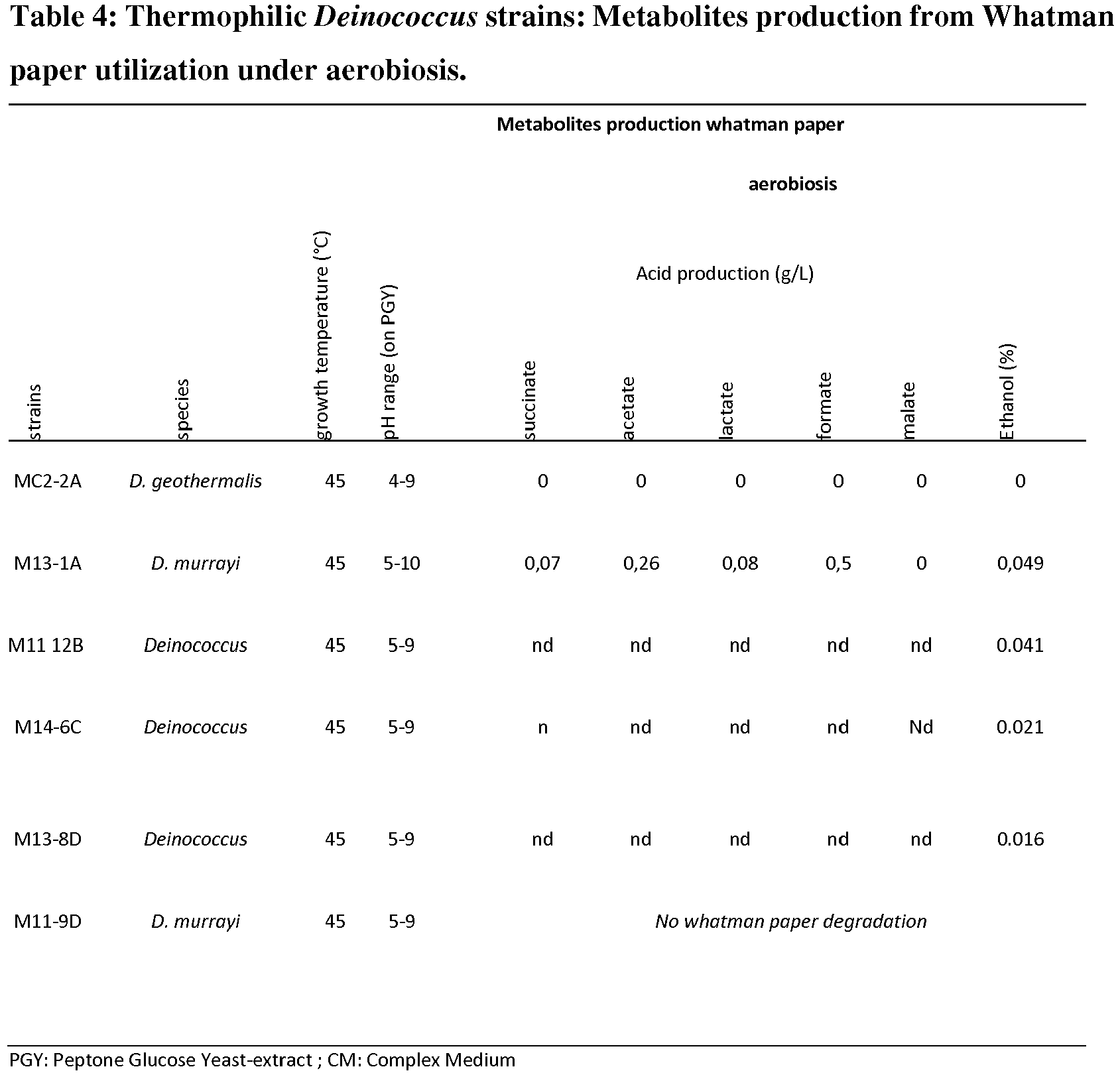
- M13-1A has the unexpected ability to produce substantial levels of ethanol when cultured in the presence of Whatman paper as sole carbon source.
- M119-D has the remarkable ability to produce more than 2.5 g/L of lactate, which is unprecedented for Deinococcus bacteria.
- These bacteria thus exhibit a combination of remarkable properties, in relation to substrate utilization and/or metabolite production, which are particularly useful for industrial purposes.
- It should be understood that, using the teaching of the present invention and following experimental procedures as described e.g., in the experimental section, further stress-resistant bacteria, such as Deinococcus bacteria, having the properties according to this invention may be selected or isolated. In particular, now that the inventors have demonstrated the ability of certain stress-resistant bacteria to grow on Whatman paper, the skilled person, following the protocols provided in the experimental section, can isolate other strains having such property.
- In this regard, the present document further discloses a method of isolating a stress-resistant bacterium, particularly a Deinococcus bacterium, the method comprising:
- Providing a sample that potentially contains bacteria;
- Subjecting said sample to a DNA breaking treatment,
- Culturing said sample in the presence of cellulose or a derivative thereof (e.g., whatman paper), and
- Isolating growing or living bacteria from said culture.
- Following this method, the inventors have isolated additional strains combining the above superior features. In particular, thermophilic Deinoccocus strains, able to grow at a pH comprised between 5 and 9 and to produce above 0.3g/L of lactate have been isolated, showing the utility of the above method.
- Following the above method, the inventors have also been able to isolate additional thermophilic Deinoccocus strains able to grow at a pH comprised between 5 and 9 and to produce ethanol in culture with cellulose. Examples of such bacterium include:
- Deinoccocus M11 12B, which produces 0,041% ethanol in the presence of cellulose as the carbon source;
- Deinoccocus M14 6C, which produces 0,021% ethanol in the presence of cellulose as the carbon source; and
- Deinoccocus M13 8D, which produces 0,016% ethanol in the presence of cellulose as the carbon source.
- The invention thus discloses several Deinococcus bacteria having the ability to use cellulose as carbon source. The invention discloses that such bacteria can produce ethanol using cellulose, under stressful culture conditions.
- The present document also discloses an extract of a bacterium as defined above. An "extract of a bacterium" designates any fraction obtained from a bacterium, such as a cell supernatant, cell debris, cell walls, DNA extract, enzymes or enzyme preparation or any preparation derived from bacteria by chemical, physical and/or enzymatic treatment, which is essentially free of living bacteria.
- The present document also discloses derivatives, transformants, mutants or progeny of a bacterium as described above. The term transformant designates a strain which contains a recombinant nucleic acid (i.e., a nucleic acid that is not naturally present in said bacterium, or that has been altered or duplicated). The term mutant designates a strain which results from a mutagenic treatment. Derivatives designate any strain obtained from a strain of the present invention, e.g., by selection, which retains the ability to utilize the recited carbon source and to produce an organic acid or alcohol.
- The present document also discloses the use of a bacterium as defined above for producing an organic acid or alcohol.
- A further object of the present invention relates to the use of a bacterium of the invention for producing ethanol.
- The invention also relates to a method of producing ethanol comprising cultivating a bacterium of the invention in the presence of an appropriate substrate, and collecting the alcohol.
- The substrate may be any culture medium or various types of biomass or products derived therefrom. In particular, said acids and alcohols may be produced from renewable resources, especially plant or animal biomass, or from municipal and industrial wastes. Within the context of the present invention, the term "biomass" refers to living and dead biological material that can be used for industrial production. Most commonly, biomass refers to e.g., plant matter, animal matter, biodegradable wastes. Biomass can be derived from numerous types of plants, including miscanthus, switchgrass, hemp, sugarbeet, wheat, corn, poplar, willow, sorghum, sugarcane, and a variety of tree species, ranging from eucalyptus to oil palm. Biomass according to the invention can comprise raw biomass and/or secondary biomass. The raw biomass is unprocessed material from biological matter. Examples include forestry products, such as mature trees unsuitable for lumber or paper production, agricultural products, such as grasses, crops and animal manure, and aquatic products, such as algae and seaweed. The secondary biomass is any material initially derived from raw biomass, which has undergone significant chemical and physical changes. Examples include paper, leather, cotton, hemp, natural rubber products, food processing by-products, and used cooking oils.
- The present document also discloses a method for producing a bioalcohol, comprising exposing a biomass to a bacterium of this invention, or an extract thereof, and, optionally, collecting the bioalcohol.
- The bioalcohol is preferably ethanol.
- The method of the invention may be performed in a reactor of conversion. By "reactor" is meant a conventional fermentation tank or any apparatus or system for biomass conversion specially designed to implement the invention and therefore consisting in particular of bioreactors, biofilters, rotary biological contactors, and other gaseous and/or liquid phase bioreactors, especially those adapted for the treatment of biomass or biomass derivatives. The apparatus which can be used according to the invention can be used continuously or in batch loads.
- In the reactor, to implement the method of the invention, at least one bacterium of the invention, or bacterial extract thereof, is used, whilst said reactor is arranged and supplied so that physicochemical conditions are set up and maintained therein so that said bacterium is operational for the application under consideration and so that, optionally, bacterial growth is possible and preferably promoted therein.
- The process may be conducted under aerobiosis, anaerobiosis or under microaerobiosis, depending on the substrate and bacterium.
- Further aspects and advantages of the invention will be disclosed in the following examples, which should be considered as illustrative and do not limit the scope of this application.
- Stress-resistant bacteria have been isolated from environmental samples. Bacteria having the unexpected ability to utilise particular carbon sources and to produce metabolites on interest have been identified and characterized. Examples of such strains have been deposited at the CNCM. The selection protocols and main properties of these bacteria are disclosed in this experimental section.
- This method enables the evaluation of the ability of micro-organisms to grow in a range of pH.
- The test is to be carried out at 45°C (Thermophilic strains).
- Pre-culture (in stationary phase) prepared in Complex medium Glucose is centrifuged then washed three times with sterile osmosed water.
- The washed culture is used to seed 200µL PGY Medium (5% seeding). The test is done in 96 wells microplate.
- PGY contains 10g/L peptone, 5g/L yeast extract, 1g/L glucose.
- pH is mastered with HCl 1M or NaOH 1M using a pH meter.
- pH mastered media are filtered (0,2µm).
- Culture is performed in aerobiosis.
- The microplate is left in an incubator, at 45°C, under agitation.
- Effective growth result is determined after 7 and 14 days readings. Readings with the naked eye comparing with a positive and a negative control.
- Isolated Deinococcus strains can grow in culture mediums which pH is between 5 and 9.
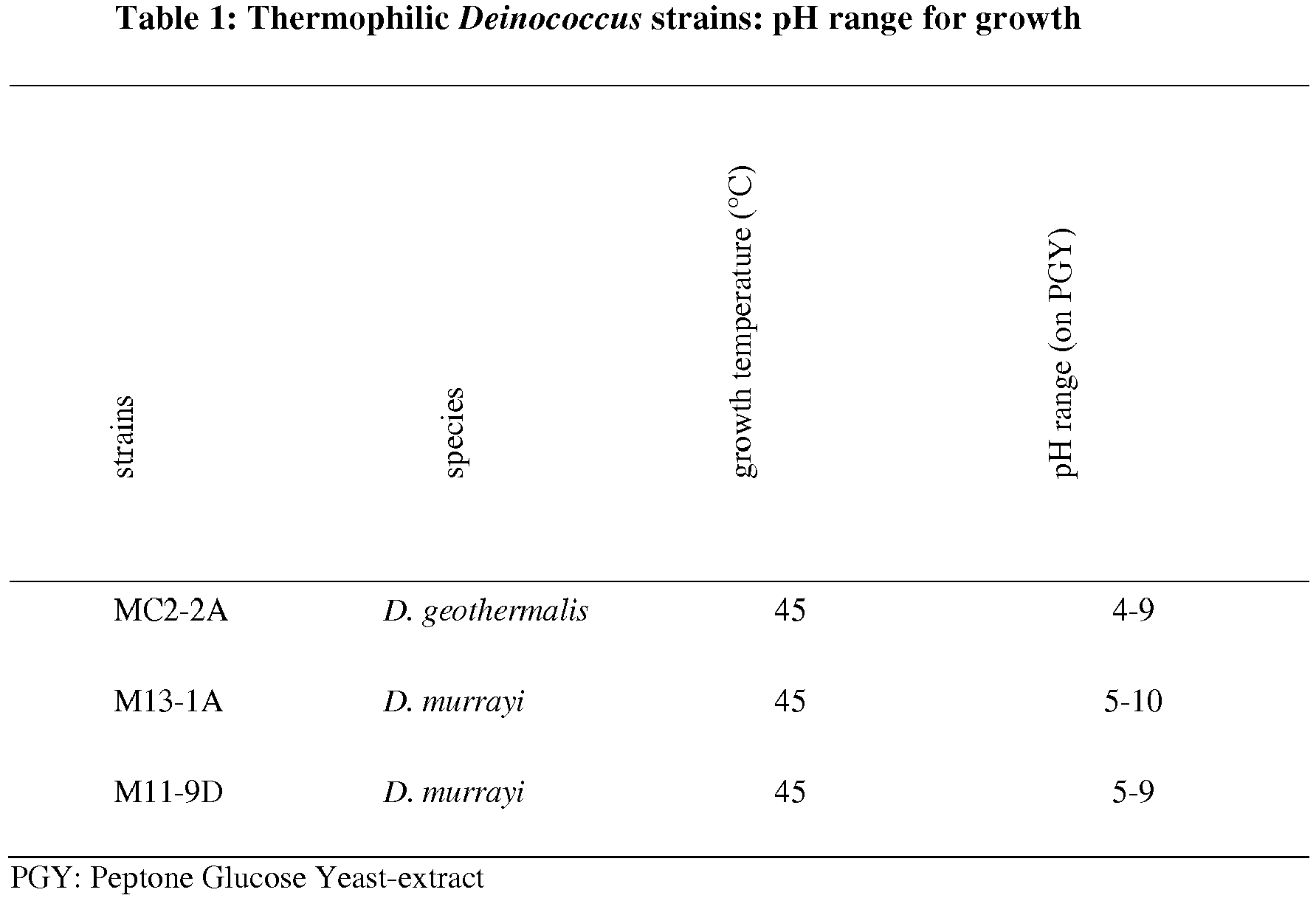
- This method enables the evaluation of the ability of micro-organisms to use a carbon source of interest (Glucose, sucrose, starch, Whatman paper, CMC, cellobiose, hemi-cellulose, xylose) and to test a range of pH for growth.
- The test is to be carried out at 45°C (Thermophilic strains).
- Pre-culture (in stationary phase) is prepared in Complex medium Glucose is centrifuged then washed three times with sterile osmosed water.
- The washed culture is used to seed 200µL Defined Medium. (5% seeding). The test is done in 96 wells microplate.
- Defined medium is prepared with autoclaved osmosed water(15 minutes at 120°C). To the autoclaved osmosed water are added the following solutions: MOPS buffer solution (10X) pH7 [acid MOPS 400mM , NH4Cl 200mM , NaOH 100mM, KOH 100mM, CaCl2 5µM, Na2SO4 2.76mM, MgCl2 5.28 mM]; micronutrients (10000X) [(NH4)6(Mo7)24 300mM, H3BO3 4mM, CoCl2 0.3mM, CuSO4 0.1mM, MnCl2 2.5 mM, ZnSO4 0.1mM]; FeCl3(100X) 2mM in C6H5Na3O7 20mM; K2HPO4 1g/L: solutions sterilized by filtration (0,2µm).
- Carbon source: 10g/L (except from starch 5g/L and Hemi-cellulose 5g/L)
- Culture is performed in aerobiosis .
- The microplate is left in an incubator, at 45°C, under agitation.
- Effective growth result is determined after 7 and 14 days readings. Readings with the naked comparing with a positive and a negative control.
- The results show that strains can use Glucose, Sucrose, Starch, Whatman paper, CMC, Cellobiose, Hemi-cellulose as sole carbon source. These strains are particularly useful for second generation ethanol production. In particular, the results presented in Table 2 show that strain MC2-2A is able to utilize Glucose, Sucrose, Starch, Whatman paper, CMC, Cellobiose and Hemi-cellulose as carbon source.

- Further examples of thermophilic Deinoccocus strains able to grow at a pH comprised between 5 and 9 and to degrade cellulose isolated by the inventors include Deinoccocus M11 12B, Deinoccocus M14 6C; and Deinoccocus M13 8D.
- This method enables the evaluation of the ability of micro-organisms to produce metabolites of interest from Complex medium glucose.
- The test is carried out at 45°C (Thermophilic strains).
- From pre-cultures (in stationary phase) prepared in Complex medium Glucose, 6ml of enriched medium are seeded (seeding at 1% v/v).
- The enriched culture mediums tested are Complex Medium Glucose, Defined Medium Whatman paper.
- Complex Medium Glucose contains: peptone 2g/L, yeast extract 5g/L and glucose 10g/Lin osmosed water: solution sterilized by autoclaving (15 minutes at 120°C). To this solution are added the following solutions: MOPS buffer solution (10X) pH7 [acid MOPS 400mM , NH4Cl 200mM , NaOH 100mM , KOH 100mM , CaCl2 5µM, Na2SO4 2.76mM, MgCl2 5.28 mM]; micronutrients (10000X) [(NH4)6(Mo7)24 300mM, H3BO3 4mM, CoCl2 0.3mM, CuSO4 0.1mM, MnCl2 2.5 mM, ZnSO4 0.1mM]; FeCl3(100X) 2mM in C6HsNa3O7 20mM; K2HPO4 1g/L: solutions sterilized by filtration (0,2µm).
- Cultures are performed both in aerobiosis and anaerobiosis (Biomerieux, Genbag).
- Cultures in aerobiosis condition are left in an incubator, at 45°C, under agitation, for 7 days. The cultures are then centrifuged for 10 minutes at 4000rpm. Supernatants are filtered (0,2µm), poured into other tubes, and placed at -80°C.
- Cultures in anaerobiosis condition are left in an incubator, at 45°C, for 4 weeks. The cultures are then centrifuged for 10 minutes at 4000rpm. Supernatants are filtered (0,2µm), poured into other tubes, and placed at -80°C.
- Gas Chromatography FID analysis (Varian CP-WAX 57 CB 25m*0.32mm column) was used to quantify alcohols. Organic acids were quantified by Capillary Electrophoresis (5 mM 2,6-pyridinedicarboxylic acid 0,5 mM Cetyltrimethylammonium bromide ; 5.6 pH adjusted buffers / 61cm lenghth , 50µm diameter capillary Agilent). Residual glucose was quantified by HPLC coupled with refractometry (Phenomenex LUNA 3u NH2 100A 150*4.6mm column, ACN/H2O 85:15 mobile phase).
- Strains have been identified which can utilize Complex medium glucose in aerobiosis and anaerobiosis. This leads to interesting ethanol and acid production.

- This method enables the evaluation of the ability of micro-organisms to produce metabolites of interest from Whatman paper utilization.
- The test is carried out at 45°C (Thermophilic strains).
- Pre-cultures (in stationary phase) prepared in Complex medium Glucose are centriguged then washed three times with sterile osmosed water.
- The washed cultures are used to seed 20mL Defined Medium Whatman paper.
- Defined Medium Whatman paper:
- Defined medium is prepared with autoclaved osmosed water(15 minutes at 120°C). To the autoclaved osmosed water are added the following solutions:
- MOPS buffer solution (10X) pH7 [acid MOPS 400mM , NH4Cl 200mM , NaOH 100mM, KOH 100mM, CaCl2 5µM, Na2SO4 2.76mM, MgCl2 5.28 mM]; micronutrients (10000X) [(NH4)6(Mo7)24 300mM, H3BO3 4mM, CoCl2 0.3mM, CuSO4 0.1mM, MnCl2 2.5 mM, ZnSO4 0.1mM]; FeCl3(100X) 2mM in C6H5Na3O7 20mM; K2HPO4 1g/L: solutions sterilized by filtration (0,2µm).
- Carbon source: one Whatman filter paper N°1 90mm disk autoclaved (15 minutes, 120°C) added to defined medium
- Cultures are performed in aerobiosis .
- Cultures in aerobiosis condition are left in an incubator, at 45°C, under agitation, for 6 weeks. The cultures are then centrifuged for 10 minutes at 4000rpm. Supernatants are filtered (0,2µm), poured into other tubes, and placed at -80°C. Gas Chromatography FID analysis (Varian CP-WAX 57 CB 25m*0.32mm column) was used to quantify alcohols. Organic acids were quantified by Capillary Electrophoresis (5 mM 2,6-pyridinedicarboxylic acid 0,5 mM Cetyltrimethylammonium bromide ; 5.6 pH adjusted buffers / 61cm lenghth , 50µm diameter capillary Agilent). Residual glucose was quantified by HPLC coupled with refractometry (Phenomenex LUNA 3u NH2 100A 150*4.6mm column, ACN/H2O 85:15 mobile phase).
- Strains having the ability to utilize Whatman paper as sole carbon source under extremophile conditions have been identified. This degradation leads to interesting metabolite production.
- The ability of the bacteria of this invention to resist solvent exposure has been tested. This method enables evaluation of the micro-organism sensitivity to ethanol. The test is carried out at 45°C (Thermophilic strains). Ethanol bactericidy is determined with ethanol added at:
- T0,
- exponential phase,
- stationary phase.
- For ethanol bactericidy at T0, ethanol percentages between 0 to 10 % are tested.
- From a pre-culture in stationary phase in an enriched culture medium, for each ethanol content to be tested, 200 µl of Complex medium Glucose is seeded at 1% v/v.
- Complex Medium Glucose contains: peptone 2g/L, yeast extract 5g/L and glucose 10g/Lin osmosed water: solution sterilized by autoclaving (15 minutes at 120°C). To this solution are added the following solutions: MOPS buffer solution (10X) pH7 [acid MOPS 400mM , NH4Cl 200mM , NaOH 100mM , KOH 100mM , CaCl2 5µM, Na2SO4 2.76mM, MgCl2 5.28 mM]; micronutrients (10000X) [(NH4)6(Mo7)24 300mM, H3BO3 4mM, CoCl2 0.3mM, CuSO4 0.1mM, MnCl2 2.5 mM, ZnSO4 0.1mM]; FeCl3(100X) 2mM in C6H5Na3O7 20mM; K2HPO4 1g/L: solutions sterilized by filtration (0,2µm).
- The test is performed in 96 wells microplates in aerobiosis. Ethanol evaporation is avoided using a sterile impermeable film.
- The reading of the result is done by naked eye.
- The concentration of solvent at which we consider there is a loss of bacterial viability corresponds to the minimum concentration of solvent at which we observe total growth inhibition.
- The strains tested present satisfactory resistance to the solvents from the perspective of an industrial application in a fermenter (cf table 5).
- From a pre-culture in stationary phase in an enriched culture medium, for each ethanol content to be tested, 5mL of Complex medium Glucose is seeded at 1% v/v.
- Complex Medium Glucose contains: peptone 2g/L, yeast extract 5g/L and glucose 10g/Lin osmosed water: solution sterilized by autoclaving (15 minutes at 120°C). To this solution are added the following solutions: MOPS buffer solution (10X) pH7 [acid MOPS 400mM , NH4Cl 200mM , NaOH 100mM, KOH 100mM , CaCl2 5µM, Na2SO4 2.76mM, MgCl2 5.28 mM]; micronutrients (10000X) [(NH4)6(Mo7)24 300mM, H3BO3 4mM, CoCl2 0.3mM, CuSO4 0.1mM, MnCl2 2.5 mM, ZnSO4 0.1mM]; FeCl3(100X) 2mM in C6HsNa3O7 20mM; K2HPO4 1g/L: solutions sterilized by filtration (0,2µm).
- A follow-up of growth is carried out using the control culture (no ethanol add neither at exponential phase nor at stationary phase). OD is read at 600nm using a spectrophotometer (UV Light XS5, SECOMAM).
- Once the exponential growth phase (optical density of 0.5 at 600nm), or once the stationary phase (plateau), is reached, the solvent is added. The content tested is 0 to 20%. Then, cultures are incubated during 2 hours.
- At the end of the incubation period and for each ethanol content tested, a count is taken to assess the influence of the ethanol on the strain.
- Count: At the end of incubation, and for each concentration in solvent, 20µL of culture are transferred onto another microplate and are diluted in cascade (dilutions at 1/10 over 9 wells). The dilution culture medium is an enriched medium. 5µL of each dilution are laid in triplicate on PGY agar medium, peptone 5g/L, yeast extract 2.5 g/L, glucose 0.5 g/L, agar 14 g/L: medium sterilized by autoclaving 20 minutes at 120°C. Once growth permits, for each percentage of solvent tested, a count is carried out to evaluate the influence of organic solvents on the strain.
- The concentration of solvent at which we consider there is a loss of bacterial viability corresponds to the minimum concentration of solvent at which we observe the loss of one log in relation to the control.
- The strains tested present an excellent resistance to the solvents from the perspective of an industrial application in a fermenter (cf table 5).

- Deinococcus bacteria MC2-2A, M13 1A and M11 9D have been deposited at the CNCM under the Budapest treaty.
- M11-9D has been deposited on May 7, 2009 at the CNCM under No. CNCM I-4155, Deinococcus strain MC2-2A has been deposited on May 7, 2009, at the CNCM under No. CNCM I-4156, and Deinococcus strain M13-1A has been deposited on May 7, 2009 at the CNCM under No. CNCM I-4157.
Claims (7)
- An isolated Deinococcus bacterium, wherein said bacterium is thermophilic and grows at a temperature of 45 °C or more, is viable at a pH comprised between 5 and 9 and in the presence of 2% ethanol, and can utilize cellulose as a carbon source to produce above 0.04% ethanol in aerobiosis.
- The bacterium of any one of the preceding claims, wherein said bacterium can utilize glucose, starch and/or sucrose as carbon source.
- The bacterium of any one of the preceding claims, wherein said bacterium can further utilize carboxymethylcellulose, cellobiose, hemicellulose and xylose as carbon source.
- The bacterium of any one of the preceding claims, which is a Deinococcus selected from a strain of D. geothermalis and D murrayi.
- Deinococcus strain M13-1A deposited on May 7, 2009 at the CNCM under No. CNCM I-4157.
- A method of producing ethanol, comprising cultivating a bacterium of any one of claims 1-5, or an extract thereof, in the presence of an appropriate carbon source, and collecting ethanol.
- The use of a bacterium of any one of claims 1-5 for producing ethanol.
Priority Applications (1)
| Application Number | Priority Date | Filing Date | Title |
|---|---|---|---|
| EP10721466.0A EP2430149B1 (en) | 2009-05-14 | 2010-05-12 | High performance metabolic bacteria |
Applications Claiming Priority (3)
| Application Number | Priority Date | Filing Date | Title |
|---|---|---|---|
| EP09160287A EP2251414A1 (en) | 2009-05-14 | 2009-05-14 | High performance metabolic bacteria |
| EP10721466.0A EP2430149B1 (en) | 2009-05-14 | 2010-05-12 | High performance metabolic bacteria |
| PCT/EP2010/056600 WO2010130812A1 (en) | 2009-05-14 | 2010-05-12 | High performance metabolic bacteria |
Publications (2)
| Publication Number | Publication Date |
|---|---|
| EP2430149A1 EP2430149A1 (en) | 2012-03-21 |
| EP2430149B1 true EP2430149B1 (en) | 2018-04-04 |
Family
ID=41078305
Family Applications (2)
| Application Number | Title | Priority Date | Filing Date |
|---|---|---|---|
| EP09160287A Withdrawn EP2251414A1 (en) | 2009-05-14 | 2009-05-14 | High performance metabolic bacteria |
| EP10721466.0A Not-in-force EP2430149B1 (en) | 2009-05-14 | 2010-05-12 | High performance metabolic bacteria |
Family Applications Before (1)
| Application Number | Title | Priority Date | Filing Date |
|---|---|---|---|
| EP09160287A Withdrawn EP2251414A1 (en) | 2009-05-14 | 2009-05-14 | High performance metabolic bacteria |
Country Status (10)
| Country | Link |
|---|---|
| US (1) | US8728777B2 (en) |
| EP (2) | EP2251414A1 (en) |
| JP (1) | JP5766182B2 (en) |
| CN (1) | CN102482637B (en) |
| AU (1) | AU2010247336B2 (en) |
| BR (1) | BRPI1010570A2 (en) |
| CA (1) | CA2761132A1 (en) |
| EA (1) | EA201101626A1 (en) |
| WO (1) | WO2010130812A1 (en) |
| ZA (1) | ZA201109163B (en) |
Families Citing this family (11)
| Publication number | Priority date | Publication date | Assignee | Title |
|---|---|---|---|---|
| FR2923491B1 (en) | 2007-11-14 | 2012-12-14 | Deinove Sa | USE OF BACTERIA FOR THE PRODUCTION OF BIOENERGY SOURCES |
| EP2210935A1 (en) | 2009-01-19 | 2010-07-28 | Deinove | Methods for isolating bacteria |
| EP2218773A1 (en) | 2009-02-17 | 2010-08-18 | Deinove | Compositions and methods for degrading lignocellulosic biomass |
| EP2251415A1 (en) | 2009-05-14 | 2010-11-17 | Deinove | Recombinant bacteria and the uses thereof for producing ethanol |
| EP2542664B1 (en) | 2010-03-02 | 2019-05-01 | Deinove | Bacteria and the uses thereof |
| CA2859718C (en) * | 2011-12-23 | 2021-03-30 | Deinove | Deinococcus bacterium and methods of use thereof for bioconversion of substrates or production of compounds |
| JP2015502168A (en) * | 2011-12-23 | 2015-01-22 | ディノベDeinove | Bacteria having a reconstituted transcription unit and use thereof |
| SG10201805568TA (en) * | 2013-04-26 | 2018-07-30 | Xyleco Inc | Processing biomass to obtain hydroxylcarboxylic acids |
| TWI541353B (en) | 2014-12-25 | 2016-07-11 | 財團法人工業技術研究院 | Method for producing extracellular proteins from genus tepidimonas |
| WO2016207403A1 (en) | 2015-06-24 | 2016-12-29 | Deinove | Method of producing muconic acid |
| FR3049462B1 (en) * | 2016-03-29 | 2020-06-19 | Deinove | USE OF DEINOCOCCUS BACTERIUM EXTRACTS AS COSMETIC OR PHARMACEUTICAL AGENTS |
Citations (1)
| Publication number | Priority date | Publication date | Assignee | Title |
|---|---|---|---|---|
| EP2209900B1 (en) * | 2007-11-14 | 2013-06-05 | Deinove | Use of bacteria for the production of bioenergy |
Family Cites Families (12)
| Publication number | Priority date | Publication date | Assignee | Title |
|---|---|---|---|---|
| US5482846A (en) | 1988-08-31 | 1996-01-09 | University Of Florida | Ethanol production in Gram-positive microbes |
| AU3630895A (en) * | 1995-09-14 | 1997-04-01 | Lockheed Martin Energy Systems, Inc. | Processing of cellulosic materials by cellulase producing bacteria |
| US6102690A (en) | 1997-04-07 | 2000-08-15 | Univ. Of Florida Research Foundation, Inc. | Recombinant organisms capable of fermenting cellobiose |
| AU7720800A (en) | 1999-09-27 | 2001-04-30 | Henry M. Jackson Foundation, The | Engineered radiation resistant bioremediating bacteria |
| AU2002225323A1 (en) | 2001-01-26 | 2002-08-06 | Prokaria Ehf. | Accessing microbial diversity by ecological methods |
| GB0511602D0 (en) | 2005-06-07 | 2005-07-13 | Tmo Biotec Ltd | Microorganisms |
| EP2016183B1 (en) * | 2006-05-10 | 2011-06-15 | Deinove | Process for chromosomal engineering using a novel dna repair system |
| KR100836093B1 (en) | 2007-02-01 | 2008-06-09 | 한국생명공학연구원 | Novel dayinococcus species A2 and method for producing astaxanthin using the same |
| EP2210935A1 (en) | 2009-01-19 | 2010-07-28 | Deinove | Methods for isolating bacteria |
| EP2218773A1 (en) | 2009-02-17 | 2010-08-18 | Deinove | Compositions and methods for degrading lignocellulosic biomass |
| EP2251415A1 (en) | 2009-05-14 | 2010-11-17 | Deinove | Recombinant bacteria and the uses thereof for producing ethanol |
| EP2542664B1 (en) | 2010-03-02 | 2019-05-01 | Deinove | Bacteria and the uses thereof |
-
2009
- 2009-05-14 EP EP09160287A patent/EP2251414A1/en not_active Withdrawn
-
2010
- 2010-05-12 EP EP10721466.0A patent/EP2430149B1/en not_active Not-in-force
- 2010-05-12 JP JP2012510308A patent/JP5766182B2/en not_active Expired - Fee Related
- 2010-05-12 BR BRPI1010570-0A patent/BRPI1010570A2/en not_active Application Discontinuation
- 2010-05-12 EA EA201101626A patent/EA201101626A1/en unknown
- 2010-05-12 AU AU2010247336A patent/AU2010247336B2/en not_active Ceased
- 2010-05-12 CA CA2761132A patent/CA2761132A1/en not_active Abandoned
- 2010-05-12 WO PCT/EP2010/056600 patent/WO2010130812A1/en not_active Ceased
- 2010-05-12 CN CN201080021114.4A patent/CN102482637B/en not_active Expired - Fee Related
- 2010-05-12 US US13/320,048 patent/US8728777B2/en active Active
-
2011
- 2011-12-13 ZA ZA2011/09163A patent/ZA201109163B/en unknown
Patent Citations (1)
| Publication number | Priority date | Publication date | Assignee | Title |
|---|---|---|---|---|
| EP2209900B1 (en) * | 2007-11-14 | 2013-06-05 | Deinove | Use of bacteria for the production of bioenergy |
Also Published As
| Publication number | Publication date |
|---|---|
| CA2761132A1 (en) | 2010-11-18 |
| WO2010130812A1 (en) | 2010-11-18 |
| CN102482637A (en) | 2012-05-30 |
| EA201101626A1 (en) | 2012-05-30 |
| EP2251414A1 (en) | 2010-11-17 |
| JP5766182B2 (en) | 2015-08-19 |
| AU2010247336A1 (en) | 2012-01-19 |
| US8728777B2 (en) | 2014-05-20 |
| EP2430149A1 (en) | 2012-03-21 |
| JP2012526538A (en) | 2012-11-01 |
| CN102482637B (en) | 2016-06-08 |
| BRPI1010570A2 (en) | 2020-12-22 |
| AU2010247336B2 (en) | 2016-01-14 |
| US20120052540A1 (en) | 2012-03-01 |
| ZA201109163B (en) | 2013-01-30 |
Similar Documents
| Publication | Publication Date | Title |
|---|---|---|
| US8728777B2 (en) | High performance metabolic bacteria | |
| JP5916200B2 (en) | Composition and method for degrading lignocellulosic biomass | |
| Lo et al. | Isolation of cellulose-hydrolytic bacteria and applications of the cellulolytic enzymes for cellulosic biohydrogen production | |
| EP2209900B1 (en) | Use of bacteria for the production of bioenergy | |
| Harish et al. | Coculture fermentation of banana agro-waste to ethanol by cellulolytic thermophilic Clostridium thermocellum CT2 | |
| EP2542664B1 (en) | Bacteria and the uses thereof | |
| CN114134077A (en) | Silkworm excrement-derived cellulose degrading bacterium DC11 and screening method and application thereof | |
| WO2011049205A1 (en) | Method for production of lactic acid by non-sterile fermentation | |
| WO2010037018A2 (en) | Selection of cellulolytic microbes with high growth rates | |
| US20120264183A1 (en) | Cellulose and Xylan Fermentation by Novel Anaerobic Thermophilic Clostridia Isolated From Self-Heated Biocompost | |
| WO2010024715A1 (en) | Strain of clostridium acetobutylicum and method of producing organic solvents | |
| Ezeagu et al. | CELLULOLYTIC POTENTIALS OF ASPERGILLUS ORYZAE AND STREPTOMYCES GRISEUS ISOLATED FROM WASTE DUMP SOIL IN NILE UNIVERSITY OF NIGERIA, ABUJA | |
| WO2011038393A2 (en) | Cellulose and xylan fermentation by novel anaerobic thermophilic clostridia isolated from self-heated biocompost | |
| Jafer | Bioethanol Production by Candida tropicalis Isolated from Sheep Dung | |
| CN121427760A (en) | A strain of actinomycete, its isolation and purification method and its application in straw degradation |
Legal Events
| Date | Code | Title | Description |
|---|---|---|---|
| PUAI | Public reference made under article 153(3) epc to a published international application that has entered the european phase |
Free format text: ORIGINAL CODE: 0009012 |
|
| 17P | Request for examination filed |
Effective date: 20111213 |
|
| AK | Designated contracting states |
Kind code of ref document: A1 Designated state(s): AL AT BE BG CH CY CZ DE DK EE ES FI FR GB GR HR HU IE IS IT LI LT LU LV MC MK MT NL NO PL PT RO SE SI SK SM TR |
|
| DAX | Request for extension of the european patent (deleted) | ||
| 17Q | First examination report despatched |
Effective date: 20150709 |
|
| STAA | Information on the status of an ep patent application or granted ep patent |
Free format text: STATUS: EXAMINATION IS IN PROGRESS |
|
| GRAP | Despatch of communication of intention to grant a patent |
Free format text: ORIGINAL CODE: EPIDOSNIGR1 |
|
| STAA | Information on the status of an ep patent application or granted ep patent |
Free format text: STATUS: GRANT OF PATENT IS INTENDED |
|
| RIC1 | Information provided on ipc code assigned before grant |
Ipc: C12N 1/20 20060101AFI20171003BHEP Ipc: C12R 1/01 20060101ALN20171003BHEP Ipc: C12P 7/06 20060101ALI20171003BHEP Ipc: C12P 7/10 20060101ALI20171003BHEP |
|
| RIC1 | Information provided on ipc code assigned before grant |
Ipc: C12N 1/20 20060101AFI20171010BHEP Ipc: C12R 1/01 20060101ALN20171010BHEP Ipc: C12P 7/06 20060101ALI20171010BHEP Ipc: C12P 7/10 20060101ALI20171010BHEP |
|
| INTG | Intention to grant announced |
Effective date: 20171027 |
|
| RAP1 | Party data changed (applicant data changed or rights of an application transferred) |
Owner name: DEINOVE Owner name: UNIVERSITE DE MONTPELLIER I Owner name: CENTRE NATIONAL DE LA RECHERCHE SCIENTIFIQUE |
|
| GRAS | Grant fee paid |
Free format text: ORIGINAL CODE: EPIDOSNIGR3 |
|
| GRAA | (expected) grant |
Free format text: ORIGINAL CODE: 0009210 |
|
| STAA | Information on the status of an ep patent application or granted ep patent |
Free format text: STATUS: THE PATENT HAS BEEN GRANTED |
|
| AK | Designated contracting states |
Kind code of ref document: B1 Designated state(s): AL AT BE BG CH CY CZ DE DK EE ES FI FR GB GR HR HU IE IS IT LI LT LU LV MC MK MT NL NO PL PT RO SE SI SK SM TR |
|
| REG | Reference to a national code |
Ref country code: GB Ref legal event code: FG4D |
|
| REG | Reference to a national code |
Ref country code: CH Ref legal event code: EP |
|
| REG | Reference to a national code |
Ref country code: AT Ref legal event code: REF Ref document number: 985616 Country of ref document: AT Kind code of ref document: T Effective date: 20180415 |
|
| REG | Reference to a national code |
Ref country code: IE Ref legal event code: FG4D |
|
| REG | Reference to a national code |
Ref country code: DE Ref legal event code: R096 Ref document number: 602010049644 Country of ref document: DE |
|
| REG | Reference to a national code |
Ref country code: FR Ref legal event code: PLFP Year of fee payment: 9 |
|
| REG | Reference to a national code |
Ref country code: NL Ref legal event code: MP Effective date: 20180404 |
|
| REG | Reference to a national code |
Ref country code: LT Ref legal event code: MG4D |
|
| PG25 | Lapsed in a contracting state [announced via postgrant information from national office to epo] |
Ref country code: NL Free format text: LAPSE BECAUSE OF FAILURE TO SUBMIT A TRANSLATION OF THE DESCRIPTION OR TO PAY THE FEE WITHIN THE PRESCRIBED TIME-LIMIT Effective date: 20180404 |
|
| PG25 | Lapsed in a contracting state [announced via postgrant information from national office to epo] |
Ref country code: NO Free format text: LAPSE BECAUSE OF FAILURE TO SUBMIT A TRANSLATION OF THE DESCRIPTION OR TO PAY THE FEE WITHIN THE PRESCRIBED TIME-LIMIT Effective date: 20180704 Ref country code: SE Free format text: LAPSE BECAUSE OF FAILURE TO SUBMIT A TRANSLATION OF THE DESCRIPTION OR TO PAY THE FEE WITHIN THE PRESCRIBED TIME-LIMIT Effective date: 20180404 Ref country code: AL Free format text: LAPSE BECAUSE OF FAILURE TO SUBMIT A TRANSLATION OF THE DESCRIPTION OR TO PAY THE FEE WITHIN THE PRESCRIBED TIME-LIMIT Effective date: 20180404 Ref country code: PL Free format text: LAPSE BECAUSE OF FAILURE TO SUBMIT A TRANSLATION OF THE DESCRIPTION OR TO PAY THE FEE WITHIN THE PRESCRIBED TIME-LIMIT Effective date: 20180404 Ref country code: ES Free format text: LAPSE BECAUSE OF FAILURE TO SUBMIT A TRANSLATION OF THE DESCRIPTION OR TO PAY THE FEE WITHIN THE PRESCRIBED TIME-LIMIT Effective date: 20180404 Ref country code: LT Free format text: LAPSE BECAUSE OF FAILURE TO SUBMIT A TRANSLATION OF THE DESCRIPTION OR TO PAY THE FEE WITHIN THE PRESCRIBED TIME-LIMIT Effective date: 20180404 Ref country code: BG Free format text: LAPSE BECAUSE OF FAILURE TO SUBMIT A TRANSLATION OF THE DESCRIPTION OR TO PAY THE FEE WITHIN THE PRESCRIBED TIME-LIMIT Effective date: 20180704 Ref country code: FI Free format text: LAPSE BECAUSE OF FAILURE TO SUBMIT A TRANSLATION OF THE DESCRIPTION OR TO PAY THE FEE WITHIN THE PRESCRIBED TIME-LIMIT Effective date: 20180404 |
|
| PG25 | Lapsed in a contracting state [announced via postgrant information from national office to epo] |
Ref country code: LV Free format text: LAPSE BECAUSE OF FAILURE TO SUBMIT A TRANSLATION OF THE DESCRIPTION OR TO PAY THE FEE WITHIN THE PRESCRIBED TIME-LIMIT Effective date: 20180404 Ref country code: GR Free format text: LAPSE BECAUSE OF FAILURE TO SUBMIT A TRANSLATION OF THE DESCRIPTION OR TO PAY THE FEE WITHIN THE PRESCRIBED TIME-LIMIT Effective date: 20180705 Ref country code: HR Free format text: LAPSE BECAUSE OF FAILURE TO SUBMIT A TRANSLATION OF THE DESCRIPTION OR TO PAY THE FEE WITHIN THE PRESCRIBED TIME-LIMIT Effective date: 20180404 |
|
| REG | Reference to a national code |
Ref country code: DE Ref legal event code: R119 Ref document number: 602010049644 Country of ref document: DE |
|
| REG | Reference to a national code |
Ref country code: CH Ref legal event code: PL |
|
| REG | Reference to a national code |
Ref country code: AT Ref legal event code: MK05 Ref document number: 985616 Country of ref document: AT Kind code of ref document: T Effective date: 20180404 |
|
| PG25 | Lapsed in a contracting state [announced via postgrant information from national office to epo] |
Ref country code: PT Free format text: LAPSE BECAUSE OF FAILURE TO SUBMIT A TRANSLATION OF THE DESCRIPTION OR TO PAY THE FEE WITHIN THE PRESCRIBED TIME-LIMIT Effective date: 20180806 |
|
| REG | Reference to a national code |
Ref country code: BE Ref legal event code: MM Effective date: 20180531 |
|
| PG25 | Lapsed in a contracting state [announced via postgrant information from national office to epo] |
Ref country code: AT Free format text: LAPSE BECAUSE OF FAILURE TO SUBMIT A TRANSLATION OF THE DESCRIPTION OR TO PAY THE FEE WITHIN THE PRESCRIBED TIME-LIMIT Effective date: 20180404 Ref country code: DK Free format text: LAPSE BECAUSE OF FAILURE TO SUBMIT A TRANSLATION OF THE DESCRIPTION OR TO PAY THE FEE WITHIN THE PRESCRIBED TIME-LIMIT Effective date: 20180404 Ref country code: RO Free format text: LAPSE BECAUSE OF FAILURE TO SUBMIT A TRANSLATION OF THE DESCRIPTION OR TO PAY THE FEE WITHIN THE PRESCRIBED TIME-LIMIT Effective date: 20180404 Ref country code: CZ Free format text: LAPSE BECAUSE OF FAILURE TO SUBMIT A TRANSLATION OF THE DESCRIPTION OR TO PAY THE FEE WITHIN THE PRESCRIBED TIME-LIMIT Effective date: 20180404 Ref country code: MC Free format text: LAPSE BECAUSE OF FAILURE TO SUBMIT A TRANSLATION OF THE DESCRIPTION OR TO PAY THE FEE WITHIN THE PRESCRIBED TIME-LIMIT Effective date: 20180404 Ref country code: SK Free format text: LAPSE BECAUSE OF FAILURE TO SUBMIT A TRANSLATION OF THE DESCRIPTION OR TO PAY THE FEE WITHIN THE PRESCRIBED TIME-LIMIT Effective date: 20180404 Ref country code: EE Free format text: LAPSE BECAUSE OF FAILURE TO SUBMIT A TRANSLATION OF THE DESCRIPTION OR TO PAY THE FEE WITHIN THE PRESCRIBED TIME-LIMIT Effective date: 20180404 |
|
| PLBE | No opposition filed within time limit |
Free format text: ORIGINAL CODE: 0009261 |
|
| STAA | Information on the status of an ep patent application or granted ep patent |
Free format text: STATUS: NO OPPOSITION FILED WITHIN TIME LIMIT |
|
| REG | Reference to a national code |
Ref country code: IE Ref legal event code: MM4A |
|
| PG25 | Lapsed in a contracting state [announced via postgrant information from national office to epo] |
Ref country code: IT Free format text: LAPSE BECAUSE OF FAILURE TO SUBMIT A TRANSLATION OF THE DESCRIPTION OR TO PAY THE FEE WITHIN THE PRESCRIBED TIME-LIMIT Effective date: 20180404 Ref country code: CH Free format text: LAPSE BECAUSE OF NON-PAYMENT OF DUE FEES Effective date: 20180531 Ref country code: SM Free format text: LAPSE BECAUSE OF FAILURE TO SUBMIT A TRANSLATION OF THE DESCRIPTION OR TO PAY THE FEE WITHIN THE PRESCRIBED TIME-LIMIT Effective date: 20180404 Ref country code: LI Free format text: LAPSE BECAUSE OF NON-PAYMENT OF DUE FEES Effective date: 20180531 |
|
| 26N | No opposition filed |
Effective date: 20190107 |
|
| GBPC | Gb: european patent ceased through non-payment of renewal fee |
Effective date: 20180704 |
|
| PG25 | Lapsed in a contracting state [announced via postgrant information from national office to epo] |
Ref country code: LU Free format text: LAPSE BECAUSE OF NON-PAYMENT OF DUE FEES Effective date: 20180512 |
|
| PG25 | Lapsed in a contracting state [announced via postgrant information from national office to epo] |
Ref country code: GB Free format text: LAPSE BECAUSE OF NON-PAYMENT OF DUE FEES Effective date: 20180704 Ref country code: IE Free format text: LAPSE BECAUSE OF NON-PAYMENT OF DUE FEES Effective date: 20180512 Ref country code: DE Free format text: LAPSE BECAUSE OF NON-PAYMENT OF DUE FEES Effective date: 20181201 |
|
| PG25 | Lapsed in a contracting state [announced via postgrant information from national office to epo] |
Ref country code: SI Free format text: LAPSE BECAUSE OF FAILURE TO SUBMIT A TRANSLATION OF THE DESCRIPTION OR TO PAY THE FEE WITHIN THE PRESCRIBED TIME-LIMIT Effective date: 20180404 Ref country code: BE Free format text: LAPSE BECAUSE OF NON-PAYMENT OF DUE FEES Effective date: 20180531 |
|
| PG25 | Lapsed in a contracting state [announced via postgrant information from national office to epo] |
Ref country code: MT Free format text: LAPSE BECAUSE OF NON-PAYMENT OF DUE FEES Effective date: 20180512 |
|
| PG25 | Lapsed in a contracting state [announced via postgrant information from national office to epo] |
Ref country code: TR Free format text: LAPSE BECAUSE OF FAILURE TO SUBMIT A TRANSLATION OF THE DESCRIPTION OR TO PAY THE FEE WITHIN THE PRESCRIBED TIME-LIMIT Effective date: 20180404 |
|
| PG25 | Lapsed in a contracting state [announced via postgrant information from national office to epo] |
Ref country code: HU Free format text: LAPSE BECAUSE OF FAILURE TO SUBMIT A TRANSLATION OF THE DESCRIPTION OR TO PAY THE FEE WITHIN THE PRESCRIBED TIME-LIMIT; INVALID AB INITIO Effective date: 20100512 |
|
| PG25 | Lapsed in a contracting state [announced via postgrant information from national office to epo] |
Ref country code: CY Free format text: LAPSE BECAUSE OF FAILURE TO SUBMIT A TRANSLATION OF THE DESCRIPTION OR TO PAY THE FEE WITHIN THE PRESCRIBED TIME-LIMIT Effective date: 20180404 Ref country code: MK Free format text: LAPSE BECAUSE OF NON-PAYMENT OF DUE FEES Effective date: 20180404 |
|
| PG25 | Lapsed in a contracting state [announced via postgrant information from national office to epo] |
Ref country code: IS Free format text: LAPSE BECAUSE OF FAILURE TO SUBMIT A TRANSLATION OF THE DESCRIPTION OR TO PAY THE FEE WITHIN THE PRESCRIBED TIME-LIMIT Effective date: 20180804 |
|
| PGFP | Annual fee paid to national office [announced via postgrant information from national office to epo] |
Ref country code: FR Payment date: 20210421 Year of fee payment: 12 |
|
| PG25 | Lapsed in a contracting state [announced via postgrant information from national office to epo] |
Ref country code: FR Free format text: LAPSE BECAUSE OF NON-PAYMENT OF DUE FEES Effective date: 20220531 |