EP2427016A1 - Wireless base station - Google Patents
Wireless base station Download PDFInfo
- Publication number
- EP2427016A1 EP2427016A1 EP10769848A EP10769848A EP2427016A1 EP 2427016 A1 EP2427016 A1 EP 2427016A1 EP 10769848 A EP10769848 A EP 10769848A EP 10769848 A EP10769848 A EP 10769848A EP 2427016 A1 EP2427016 A1 EP 2427016A1
- Authority
- EP
- European Patent Office
- Prior art keywords
- mobile station
- scheduling
- scheduled
- grant information
- assignment interval
- Prior art date
- Legal status (The legal status is an assumption and is not a legal conclusion. Google has not performed a legal analysis and makes no representation as to the accuracy of the status listed.)
- Withdrawn
Links
Images


Classifications
-
- H—ELECTRICITY
- H04—ELECTRIC COMMUNICATION TECHNIQUE
- H04W—WIRELESS COMMUNICATION NETWORKS
- H04W52/00—Power management, e.g. Transmission Power Control [TPC] or power classes
- H04W52/04—Transmission power control [TPC]
- H04W52/30—Transmission power control [TPC] using constraints in the total amount of available transmission power
- H04W52/36—Transmission power control [TPC] using constraints in the total amount of available transmission power with a discrete range or set of values, e.g. step size, ramping or offsets
- H04W52/367—Power values between minimum and maximum limits, e.g. dynamic range
-
- H—ELECTRICITY
- H04—ELECTRIC COMMUNICATION TECHNIQUE
- H04B—TRANSMISSION
- H04B17/00—Monitoring; Testing
- H04B17/30—Monitoring; Testing of propagation channels
- H04B17/309—Measuring or estimating channel quality parameters
- H04B17/318—Received signal strength
-
- H—ELECTRICITY
- H04—ELECTRIC COMMUNICATION TECHNIQUE
- H04W—WIRELESS COMMUNICATION NETWORKS
- H04W72/00—Local resource management
- H04W72/12—Wireless traffic scheduling
-
- H—ELECTRICITY
- H04—ELECTRIC COMMUNICATION TECHNIQUE
- H04W—WIRELESS COMMUNICATION NETWORKS
- H04W52/00—Power management, e.g. Transmission Power Control [TPC] or power classes
- H04W52/04—Transmission power control [TPC]
- H04W52/06—TPC algorithms
- H04W52/14—Separate analysis of uplink or downlink
- H04W52/146—Uplink power control
-
- H—ELECTRICITY
- H04—ELECTRIC COMMUNICATION TECHNIQUE
- H04W—WIRELESS COMMUNICATION NETWORKS
- H04W52/00—Power management, e.g. Transmission Power Control [TPC] or power classes
- H04W52/04—Transmission power control [TPC]
- H04W52/06—TPC algorithms
- H04W52/16—Deriving transmission power values from another channel
-
- H—ELECTRICITY
- H04—ELECTRIC COMMUNICATION TECHNIQUE
- H04W—WIRELESS COMMUNICATION NETWORKS
- H04W52/00—Power management, e.g. Transmission Power Control [TPC] or power classes
- H04W52/04—Transmission power control [TPC]
- H04W52/18—TPC being performed according to specific parameters
- H04W52/24—TPC being performed according to specific parameters using SIR [Signal to Interference Ratio] or other wireless path parameters
- H04W52/243—TPC being performed according to specific parameters using SIR [Signal to Interference Ratio] or other wireless path parameters taking into account interferences
Definitions
- the present invention relates to a radio base station.
- the 3GPP defines a high-speed uplink communication which is referred to as "EUL (Enhanced Uplink)” or "HSUPA (High-Speed Uplink Packet Access)”.
- EUL Enhanced Uplink
- HSUPA High-Speed Uplink Packet Access
- a mobile station UE is configured to transmit a data signal (MAC-e PDU) via a high-speed uplink communication data channel (E-DPDCH: Enhaneed-Dedieated Physical Data Channel) to a radio base station NodeB.
- MAC-e PDU data signal
- E-DPDCH Enhaneed-Dedieated Physical Data Channel
- the radio base station NodeB determines a mobile station UE scheduled for each time slot (TTI: Transmission Time Interval), and transmits scheduling grant information, (AG: Absolute Grant or RG: Relative Grant), to the scheduled mobile station.
- TTI Transmission Time Interval
- AG Absolute Grant
- RG Relative Grant
- the mobile station UE scheduled for each time slot is configured to transmit MAC-e PDUs of the size (TBS: Transport Block Size) corresponding to the scheduling grant information (AG) received from the radio base station NodeB via E-DPDCH.
- TBS Transport Block Size
- the mobile station UE scheduled for each time slot is configured to transmit MAC-e PDUs via E-DPDCH by a transmission power (or transmission amplitude) determined based on a "transmission power ratio (or transmission amplitude ratio) between E-DPDCH and a general uplink communication dedicated control channel (DPCCH: Dedicated Physical Control Channel)" corresponding to the AG.
- DPCCH Dedicated Physical Control Channel
- EUL of a "Time and Rate” scheme it is configured such that only one mobile station UE is scheduled for each scheduling assignment interval.
- a radio base station includes: a received power range changing unit configured to change a range of a receivable power based on an average total received power at a predetermined timing; a scheduling unit configured to determine one mobile station as a mobile station scheduled for a next scheduling assignment interval and to determine scheduling grant information to be transmitted to the determined mobile station; and a scheduling grant information transmission unit configured to transmit scheduling grant information instructing a first mobile station scheduled for a present time slot to stop transmitting a data signal via a high-speed uplink communication dedicated data channel in the next scheduling assignment interval, when switching scheduled mobile stations, and to transmit the scheduling grant information determined by the scheduling unit to a second mobile station scheduled for the next scheduling assignment interval, wherein the scheduling unit is configured to determine the scheduling grant information to be transmitted to the mobile station scheduled for the next scheduling assignment interval, based on a predicted range of the receivable power at a starting timing of the next scheduling assignment interval.
- the mobile communication system is configured such that EUL is provided between a radio base station NodeB and a mobile station UE.
- an absolute grant channel (E-AGCH: E-DCH Absolute Grant Channel), a relative grant channel (E-RGCH: E-DCH Relative Grant Channel), etc.
- E-AGCH E-DCH Absolute Grant Channel
- E-RGCH E-DCH Relative Grant Channel
- E-AGCH E-DCH Absolute Grant Channel
- E-RGCH E-DCH Relative Grant Channel
- E-AGCH E-DCH Absolute Grant Channel
- E-RGCH E-DCH Relative Grant Channel
- the radio base station NodeB is configured to receive MAC-e PDUs each containing at least one MAC-d PDU of a fixed size transmitted via E-DPDCH by the mobile station UE.
- the radio base station NodeB includes an RTWP (Received Total Wideband Power) measurement unit 11, an AGC (Auto Gain Control) control unit 12, a scheduling unit 13, and a scheduling grant information transmission unit 14.
- RTWP Received Total Wideband Power
- AGC Automatic Gain Control
- the RTWP measurement unit 11 is configured to measure RTWP in the radio base station NodeB so as to calculate the average RTWP at a predetermined timing.
- the average RTWP is a sum of an average received power P1 of signals received from the scheduled mobile station UE of EUL and other average received power P2 (an average value of received powers of signals received from a mobile station UE other than the scheduled mobile station UE of EUL, noise power, and others.)
- the RTWP measurement unit 11 may calculate the average RTWP at a predetermined timing by using a forgetting coefficient, or may calculate the average RTWP at a predetermined timing by using, as an average interval, a predetermined period that precedes the predetermined timing.
- the AGC control unit 12 is configured to change a range of a receivable power in the radio base station NodeB (i.e., a range of power that can be tracked by AGC), based on an average total received power at a predetermined timing.
- the AGC control unit 12 is configured to determine the range of a receivable power at t1 based on the average RTWP at t1 and to determine the range of a receivable power at t2 based on the average RTWP at t2.
- the scheduling unit 13 is configured to determine the mobile station UE scheduled for a next TTI (HARQ process) and to determine the scheduling grant information (AG: Absolute Grant) to be transmitted to the determined mobile station UE. Specifically, the scheduling unit 13 is configured to determine only one mobile station UE scheduled for each TTI, corresponding to EUL of a "Time and Rate" scheme.
- the scheduling unit 13 is configured to determine the scheduling grant information (AG) to be transmitted to the mobile station UE#2 scheduled for a next scheduling assignment interval based on the predicted range of the receivable power at a timing t2 of starting the next scheduling assignment interval.
- AG scheduling grant information
- the scheduling unit 13 may be configured to use the scheduling grant information (AG) corresponding to an upper limit value X in the power range of a receivable power at a timing t2 as the scheduling grant information (AG) to be transmitted to the mobile station UE#2 scheduled for a next scheduling assignment interval, when the scheduling unit 13 switches the scheduled mobile stations at a timing t2.
- AG scheduling grant information
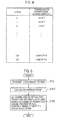
- the radio base station NodeB and the mobile station UE manage a corresponding table as illustrated in Fig. 4 .
- a corresponding table is configured to associate "E-TFCI (E-DCH Transport Format Combination Indicator)" and "transmission power ratio", as illustrated in Fig. 4 .
- E-TFCI is an index defining TBS of MAC-e PDUs
- transmission power ratio indicates a transmission power ratio (or a transmission amplitude ratio) between E-DPDCH and DPCCH.
- the transmission power of DPCCH is configured to be changed by the transmission power control between the radio base station NodeB and the mobile station UE.
- the mobile station UE scheduled for each TTI is configured to transmit MAC-e PDUs of a size (TBS) corresponding to a grant value (SG: Scheduling Grant) stored in the mobile station UE, via E-DPDCH, by the transmission power (or a transmission amplitude ratio) determined by the transmission power ratio corresponding to the grant value (SG).
- TBS size
- SG Scheduling Grant
- the grant value (SG) stored by each mobile station UE is configured to be updated by the scheduling grant information (AG) received in each mobile station UE.
- the scheduling unit 13 may be configured to determine the scheduling grant information (AG) to be transmitted to the mobile station UE#2 scheduled for a next scheduling assignment interval, based on a change characteristic of the range of a receivable power when MAC-e PDUs is not received via E-DPDCH and a time difference between a calculation timing of the scheduling grant information (AG) to be transmitted to the mobile station UE#2 scheduled for a next scheduling assignment interval and a timing t2 of starting a next scheduling assignment interval.
- AG scheduling grant information
- the change characteristic of the range of a receivable power when MAC-e PDUs is not received via E-DPDCH is a decrease range (dB/s) of the range of a receivable power when MAC-e PDUs is not received via E-DPDCH, and corresponds to a slope of the line L illustrated in Fig. 3 . It is noted that such a change characteristic is defined by a time constant of the AGC control unit 11.
- a time difference between a calculating timing of the scheduling grant information (AG) to be transmitted to the mobile station UE#2 scheduled for a next scheduling assignment interval and a timing t2 of starting a next scheduling assignment interval is "t2 - tc", where "tc" denotes the calculating timing of the scheduling grant information (AG) to be transmitted to the mobile station UE#2 scheduled for a next scheduling assignment interval.
- the scheduling grant information notification unit 14 is configured to transmit the scheduling grant information (AG), via E-AGCH, to the mobile station UE scheduled for each TTI (i.e., a serving mobile station that uses a cell subordinate to the radio base station NodeB as a serving cell).
- AG scheduling grant information
- E-AGCH scheduling grant information
- the scheduling grant information notification unit 14 is configured to transmit a "Zero Grant (scheduling grant information)" instructing a mobile station UE (first mobile station) scheduled in the present TTI to stop transmitting MAC-e PDUs in the next TTI and to transmit the scheduling grant information (AG) determined by the scheduling unit 13 to a mobile station UE (second mobile station) scheduled in a next scheduling assignment interval.
- a "Zero Grant (scheduling grant information)" instructing a mobile station UE (first mobile station) scheduled in the present TTI to stop transmitting MAC-e PDUs in the next TTI and to transmit the scheduling grant information (AG) determined by the scheduling unit 13 to a mobile station UE (second mobile station) scheduled in a next scheduling assignment interval.
- the radio base station NodeB determines to switch the scheduled mobile station UE from the mobile station UE#1 to the mobile station UE#2 at a time t1, and thereafter, transmits a "Zero Grant" to the mobile station UE#1 in the next TTI, transmits the scheduling grant information (AG) to the mobile station UE#2 scheduled in a next scheduling assignment interval at a time tc, and starts EUL with the mobile station UE#2 scheduled at a time t2.
- AG scheduling grant information
- step S101 the radio base station NodeB determines to switch the scheduled mobile station UE from the mobile station UE#1 to the mobile station UE#2, and thereafter, transmits a "Zero Grant" to the mobile station UE#1 in the next TTI.
- step S102 the radio base station NodeB calculates the average RTWP at a time tc, at a time tc illustrated in Fig. 3 .
- the radio base station NodeB predicts a range of a receivable power at a starting timing of communication with the mobile station UE#2 scheduled in a next scheduling assignment interval (time t2 illustrated in Fig. 3 ), determines the scheduling grant information (AG) to be transmitted to the mobile station UE#2 scheduled in a next scheduling assignment interval, based on a range of a predicted receivable power at a starting timing of communication with the mobile station UE#2 scheduled for a next scheduling assignment interval (time t2 illustrated in Fig. 3 ), the average RTWP at a time tc, and a time difference between a present timing (time tc illustrated in Fig. 3 ) and a timing (time t2 illustrated in Fig. 3 ) of starting communication with the mobile station UE#2 scheduled for a next scheduling assignment interval, and transmits the information via E-AGCH.
- AG scheduling grant information
- the radio base station NodeB when switching the scheduled mobile station UE, transmits a "Zero Grant" to the mobile station UE scheduled for the present TTI, and transmits an "AG" to the mobile station UE scheduled for a next scheduling assignment interval.
- EUL EUL of a "Time & Rate” scheme.
- the radio base station NodeB when switching the scheduled mobile station UEs, transmits the scheduling grant information (AG) corresponding to the power outside the range of power that can be tracked by AGC to the mobile station UE#2 scheduled for a next scheduling assignment interval, and as a result, it is possible to avoid a situation where the demodulation accuracy of MAC-e PUDS transmitted, via E-DPDCH, from the mobile station UE#2 is deteriorated.
- AG scheduling grant information
- the radio base station NodeB is configured to transmit the scheduling grant information (AG) corresponding to the upper limit value of the range of power that can be tracked by AGC at a starting timing of a next scheduling assignment interval, and hence, it is possible to avoid a decrease in throughput obtained after switching the scheduled mobile station UEs.
- AG scheduling grant information
- a first characteristic of this embodiment is a radio base station NodeB, which includes: an AGC control unit 12 configured to change a range of a receivable power based on an average RTWP (average total received power) at a predetermined timing; a scheduling unit 13 configured to determine one mobile station as a mobile station UE scheduled for a next scheduling assignment interval and to determine an AG (scheduling grant information) to be transmitted to the determined mobile station UE; and a scheduling grant information transmission unit 14 configured to transmit a "Zero Grant (scheduling grant information)" instructing a first mobile station UE#1 scheduled for present TTI to stop transmitting MAC-e PDUs (data signal) via E-DPDCH (high-speed uplink communication dedicated data channel) in the next scheduling assignment interval, when switching scheduled mobile station UEs, and to transmit the "AG (scheduling grant information)" determined by the scheduling unit 13 to a second mobile station UE#2 scheduled for the next scheduling assignment interval, in which the scheduling unit 13 is configured to determine the AG
- the scheduling unit 13 may be configured to use AG corresponding to an upper limit value of the range of a receivable power at a starting timing of the predicted next scheduling assignment interval as the AG to be transmitted to the mobile station UE#2 scheduled for the next scheduling assignment interval.
- the scheduling unit 13 may be configured to determine the AG to be transmitted to the mobile station UE#2 scheduled for the next scheduling assignment interval, based on a change characteristic of the range of a receivable power when not receiving MAC-e PDUs via E-DPDCH and a time difference between a calculating timing of the AG to be transmitted to the mobile station UE#2 scheduled for the next scheduling assignment interval and a starting timing of the next scheduling assignment interval.
- radio base station NodeB and the mobile station UE may be implemented by a hardware, may also be implemented by a software module executed by a processor, and may further be implemented by a combination of the both.
- the software module may be arranged in a storage medium of an arbitrary format such as RAM (Random Access Memory), a flash memory, ROM (Read Only Memory), EPROM (Erasable Programmable ROM), EEPROM (Electronically Erasable and Programmable ROM), a register, a hard disk drive, a removable disk, and a CD-ROM.
- RAM Random Access Memory
- flash memory ROM (Read Only Memory)
- EPROM Erasable Programmable ROM
- EEPROM Electrically Erasable and Programmable ROM
- register a hard disk drive, a removable disk, and a CD-ROM.
- the storage medium is connected to the processor so that the processor can write and read information into and from the storage medium.
- a storage medium may also be integrated in the processor.
- the storage medium and processor may be arranged in an ASIC.
- Such an ASIC may be arranged within the radio base station NodeB and the mobile station UE.
- the storage medium and processor may be arranged within the radio base station NodeB and the mobile station UE as a discrete component.
Landscapes
- Engineering & Computer Science (AREA)
- Computer Networks & Wireless Communication (AREA)
- Signal Processing (AREA)
- Quality & Reliability (AREA)
- Physics & Mathematics (AREA)
- Electromagnetism (AREA)
- Mobile Radio Communication Systems (AREA)
Abstract
A radio base station NodeB), wherein a scheduling unit (13) is configured to determine scheduling grant information to be transmit to a mobile station (UE) scheduled for the next scheduling assignment interval based on the predicted range of receivable power at the starting point of the next scheduling assignment interval.
Description
- The present invention relates to a radio base station.
- The 3GPP defines a high-speed uplink communication which is referred to as "EUL (Enhanced Uplink)" or "HSUPA (High-Speed Uplink Packet Access)".
- In EUL, a mobile station UE is configured to transmit a data signal (MAC-e PDU) via a high-speed uplink communication data channel (E-DPDCH: Enhaneed-Dedieated Physical Data Channel) to a radio base station NodeB.
- Specifically, in EUL, it is configured such that the radio base station NodeB determines a mobile station UE scheduled for each time slot (TTI: Transmission Time Interval), and transmits scheduling grant information, (AG: Absolute Grant or RG: Relative Grant), to the scheduled mobile station.
- The mobile station UE scheduled for each time slot is configured to transmit MAC-e PDUs of the size (TBS: Transport Block Size) corresponding to the scheduling grant information (AG) received from the radio base station NodeB via E-DPDCH.
- In this case, the mobile station UE scheduled for each time slot is configured to transmit MAC-e PDUs via E-DPDCH by a transmission power (or transmission amplitude) determined based on a "transmission power ratio (or transmission amplitude ratio) between E-DPDCH and a general uplink communication dedicated control channel (DPCCH: Dedicated Physical Control Channel)" corresponding to the AG.
- Additionally, in EUL of a "Time and Rate" scheme, it is configured such that only one mobile station UE is scheduled for each scheduling assignment interval.
- However, the above-described EUL of a "Time and Rate" scheme has a problem that when the radio base station NodeB switches the scheduled mobile station UEs, it is not determined as to what scheduling grant information (AG) should be transmitted.
- A radio base station according to a first feature of the present invention includes: a received power range changing unit configured to change a range of a receivable power based on an average total received power at a predetermined timing; a scheduling unit configured to determine one mobile station as a mobile station scheduled for a next scheduling assignment interval and to determine scheduling grant information to be transmitted to the determined mobile station; and a scheduling grant information transmission unit configured to transmit scheduling grant information instructing a first mobile station scheduled for a present time slot to stop transmitting a data signal via a high-speed uplink communication dedicated data channel in the next scheduling assignment interval, when switching scheduled mobile stations, and to transmit the scheduling grant information determined by the scheduling unit to a second mobile station scheduled for the next scheduling assignment interval, wherein the scheduling unit is configured to determine the scheduling grant information to be transmitted to the mobile station scheduled for the next scheduling assignment interval, based on a predicted range of the receivable power at a starting timing of the next scheduling assignment interval.
-
- [
Fig. 1] Fig. 1 is a diagram illustrating the entire configuration of a mobile communication system according to a first embodiment of the present invention. - [
Fig. 2] Fig. 2 is a functional block diagram of a radio base station according to the first embodiment of the present invention. - [
Fig. 3] Fig. 3 is a graph explaining scheduling grant information that the radio base station according to the first embodiment of the present invention should transmit to a mobile station scheduled for a next TTI. - [
Fig. 4] Fig. 4 is a table illustrating one example of a corresponding table between an AG index and a transmission power ratio used in the mobile communication system according to the first embodiment of the present invention. - [
Fig. 5] Fig. 5 is a flowchart illustrating an operation of a radio base station in the mobile communication system according to the first embodiment of the present invention. - With reference to
Fig. 1 through Fig. 4 , the configuration of a mobile communication system according to a first embodiment of the present invention will be described. - As illustrated in
Fig. 1 , the mobile communication system according to this embodiment is configured such that EUL is provided between a radio base station NodeB and a mobile station UE. - That is, in the mobile communication system according to this embodiment, between the radio base station NodeB and the mobile station UE, an absolute grant channel (E-AGCH: E-DCH Absolute Grant Channel), a relative grant channel (E-RGCH: E-DCH Relative Grant Channel), etc., can be set as a downlink channel while a high-speed uplink communication data channel (E-DPDCH: E-DCH Dedicated Physical Data Channel), a high-speed uplink communication control channel (E-DPCCH: E-DCH Dedicated Physical Control Channel), an uplink control channel (DPCCH: Dedicated Physical Control Channel), etc., can be set as an uplink channel.
- In this case, the radio base station NodeB is configured to receive MAC-e PDUs each containing at least one MAC-d PDU of a fixed size transmitted via E-DPDCH by the mobile station UE.
- As illustrated in
Fig. 2 , the radio base station NodeB includes an RTWP (Received Total Wideband Power)measurement unit 11, an AGC (Auto Gain Control)control unit 12, ascheduling unit 13, and a scheduling grantinformation transmission unit 14. - The
RTWP measurement unit 11 is configured to measure RTWP in the radio base station NodeB so as to calculate the average RTWP at a predetermined timing. - As shown in
Fig. 3 , it is noted that the average RTWP is a sum of an average received power P1 of signals received from the scheduled mobile station UE of EUL and other average received power P2 (an average value of received powers of signals received from a mobile station UE other than the scheduled mobile station UE of EUL, noise power, and others.) - The
RTWP measurement unit 11 may calculate the average RTWP at a predetermined timing by using a forgetting coefficient, or may calculate the average RTWP at a predetermined timing by using, as an average interval, a predetermined period that precedes the predetermined timing. - The AGC
control unit 12 is configured to change a range of a receivable power in the radio base station NodeB (i.e., a range of power that can be tracked by AGC), based on an average total received power at a predetermined timing. - For example, as illustrated in
Fig. 3 , theAGC control unit 12 is configured to determine the range of a receivable power at t1 based on the average RTWP at t1 and to determine the range of a receivable power at t2 based on the average RTWP at t2. - The
scheduling unit 13 is configured to determine the mobile station UE scheduled for a next TTI (HARQ process) and to determine the scheduling grant information (AG: Absolute Grant) to be transmitted to the determined mobile station UE. Specifically, thescheduling unit 13 is configured to determine only one mobile station UE scheduled for each TTI, corresponding to EUL of a "Time and Rate" scheme. - Moreover, as illustrated in
Fig. 3 , thescheduling unit 13 is configured to determine the scheduling grant information (AG) to be transmitted to the mobilestation UE# 2 scheduled for a next scheduling assignment interval based on the predicted range of the receivable power at a timing t2 of starting the next scheduling assignment interval. - For example, the
scheduling unit 13 may be configured to use the scheduling grant information (AG) corresponding to an upper limit value X in the power range of a receivable power at a timing t2 as the scheduling grant information (AG) to be transmitted to the mobilestation UE# 2 scheduled for a next scheduling assignment interval, when thescheduling unit 13 switches the scheduled mobile stations at a timing t2. - In this case, the radio base station NodeB and the mobile station UE manage a corresponding table as illustrated in
Fig. 4 . Such a corresponding table is configured to associate "E-TFCI (E-DCH Transport Format Combination Indicator)" and "transmission power ratio", as illustrated inFig. 4 . - In this case, "E-TFCI" is an index defining TBS of MAC-e PDUs, and "transmission power ratio" indicates a transmission power ratio (or a transmission amplitude ratio) between E-DPDCH and DPCCH. It is noted that the transmission power of DPCCH is configured to be changed by the transmission power control between the radio base station NodeB and the mobile station UE. The mobile station UE scheduled for each TTI is configured to transmit MAC-e PDUs of a size (TBS) corresponding to a grant value (SG: Scheduling Grant) stored in the mobile station UE, via E-DPDCH, by the transmission power (or a transmission amplitude ratio) determined by the transmission power ratio corresponding to the grant value (SG).
- It is noted that the grant value (SG) stored by each mobile station UE is configured to be updated by the scheduling grant information (AG) received in each mobile station UE.
- The
scheduling unit 13 may be configured to determine the scheduling grant information (AG) to be transmitted to the mobile station UE#2 scheduled for a next scheduling assignment interval, based on a change characteristic of the range of a receivable power when MAC-e PDUs is not received via E-DPDCH and a time difference between a calculation timing of the scheduling grant information (AG) to be transmitted to the mobilestation UE# 2 scheduled for a next scheduling assignment interval and a timing t2 of starting a next scheduling assignment interval. - In this case, the change characteristic of the range of a receivable power when MAC-e PDUs is not received via E-DPDCH, is a decrease range (dB/s) of the range of a receivable power when MAC-e PDUs is not received via E-DPDCH, and corresponds to a slope of the line L illustrated in
Fig. 3 . It is noted that such a change characteristic is defined by a time constant of theAGC control unit 11. - In
Fig. 3 , a time difference between a calculating timing of the scheduling grant information (AG) to be transmitted to the mobile station UE#2 scheduled for a next scheduling assignment interval and a timing t2 of starting a next scheduling assignment interval is "t2 - tc", where "tc" denotes the calculating timing of the scheduling grant information (AG) to be transmitted to the mobile station UE#2 scheduled for a next scheduling assignment interval. - It is noted that in the example of
Fig. 4 , when the transmission power ratio corresponding to the power that can be permitted as E-DPDCH received power is "(168/15)2x6" within the upper limit value X ("X" inFig. 3 ) of the range of a predicted receivable power at a timing t2 of starting a next scheduling assignment interval, thescheduling unit 13 may be configured to use the scheduling grant information (AG) specified by "E-TFCI=125" corresponding to a maximum "transmission power ratio = (168/15)2x6" smaller than "(168/15)2x6" as the scheduling grant information (AG) corresponding to the upper limit value X of the predicted range of a receivable power at a timing t2 of starting the next scheduling assignment interval. - The scheduling grant
information notification unit 14 is configured to transmit the scheduling grant information (AG), via E-AGCH, to the mobile station UE scheduled for each TTI (i.e., a serving mobile station that uses a cell subordinate to the radio base station NodeB as a serving cell). - It is noted that when switching the scheduled mobile station UEs, the scheduling grant
information notification unit 14 is configured to transmit a "Zero Grant (scheduling grant information)" instructing a mobile station UE (first mobile station) scheduled in the present TTI to stop transmitting MAC-e PDUs in the next TTI and to transmit the scheduling grant information (AG) determined by thescheduling unit 13 to a mobile station UE (second mobile station) scheduled in a next scheduling assignment interval. - In the example of
Fig. 3 , the radio base station NodeB determines to switch the scheduled mobile station UE from the mobile station UE#1 to the mobile station UE#2 at a time t1, and thereafter, transmits a "Zero Grant" to the mobile station UE#1 in the next TTI, transmits the scheduling grant information (AG) to the mobile station UE#2 scheduled in a next scheduling assignment interval at a time tc, and starts EUL with the mobile station UE#2 scheduled at a time t2. - With reference to
Fig. 5 , the operation of the radio base station NodeB used in the mobile communication system according to the first embodiment of the present invention will be described. - As illustrated in
Fig. 5 , in step S101, the radio base station NodeB determines to switch the scheduled mobile station UE from the mobile station UE#1 to the mobile station UE#2, and thereafter, transmits a "Zero Grant" to the mobile station UE#1 in the next TTI. - In step S102, the radio base station NodeB calculates the average RTWP at a time tc, at a time tc illustrated in
Fig. 3 . - In step S103, the radio base station NodeB predicts a range of a receivable power at a starting timing of communication with the mobile station UE#2 scheduled in a next scheduling assignment interval (time t2 illustrated in
Fig. 3 ), determines the scheduling grant information (AG) to be transmitted to the mobile station UE#2 scheduled in a next scheduling assignment interval, based on a range of a predicted receivable power at a starting timing of communication with the mobile station UE#2 scheduled for a next scheduling assignment interval (time t2 illustrated inFig. 3 ), the average RTWP at a time tc, and a time difference between a present timing (time tc illustrated inFig. 3 ) and a timing (time t2 illustrated inFig. 3 ) of starting communication with the mobile station UE#2 scheduled for a next scheduling assignment interval, and transmits the information via E-AGCH. - According to the mobile communication system based on the first embodiment of the present invention, when switching the scheduled mobile station UE, the radio base station NodeB transmits a "Zero Grant" to the mobile station UE scheduled for the present TTI, and transmits an "AG" to the mobile station UE scheduled for a next scheduling assignment interval. As a result, it is possible to realize EUL of a "Time & Rate" scheme.
- According to the mobile communication system based on the first embodiment of the present invention, when switching the scheduled mobile station UEs, the radio base station NodeB transmits the scheduling grant information (AG) corresponding to the power outside the range of power that can be tracked by AGC to the mobile station UE#2 scheduled for a next scheduling assignment interval, and as a result, it is possible to avoid a situation where the demodulation accuracy of MAC-e PUDS transmitted, via E-DPDCH, from the mobile station UE#2 is deteriorated.
- According to the mobile communication system based on the first embodiment of the present invention, the radio base station NodeB is configured to transmit the scheduling grant information (AG) corresponding to the upper limit value of the range of power that can be tracked by AGC at a starting timing of a next scheduling assignment interval, and hence, it is possible to avoid a decrease in throughput obtained after switching the scheduled mobile station UEs.
- The above-mentioned characteristics of the embodiment may be expressed as follows:
- A first characteristic of this embodiment is a radio base station NodeB, which includes: an
AGC control unit 12 configured to change a range of a receivable power based on an average RTWP (average total received power) at a predetermined timing; ascheduling unit 13 configured to determine one mobile station as a mobile station UE scheduled for a next scheduling assignment interval and to determine an AG (scheduling grant information) to be transmitted to the determined mobile station UE; and a scheduling grantinformation transmission unit 14 configured to transmit a "Zero Grant (scheduling grant information)" instructing a first mobile station UE#1 scheduled for present TTI to stop transmitting MAC-e PDUs (data signal) via E-DPDCH (high-speed uplink communication dedicated data channel) in the next scheduling assignment interval, when switching scheduled mobile station UEs, and to transmit the "AG (scheduling grant information)" determined by thescheduling unit 13 to a second mobile station UE#2 scheduled for the next scheduling assignment interval, in which thescheduling unit 13 is configured to determine the AG to be transmitted to the mobile station UE#2 scheduled for the next scheduling assignment interval, based on the predicted range of a receivable power at a starting timing of the next scheduling assignment interval. - In the first characteristic of this embodiment, the
scheduling unit 13 may be configured to use AG corresponding to an upper limit value of the range of a receivable power at a starting timing of the predicted next scheduling assignment interval as the AG to be transmitted to the mobilestation UE# 2 scheduled for the next scheduling assignment interval. - In the first characteristic of this embodiment, the
scheduling unit 13 may be configured to determine the AG to be transmitted to the mobilestation UE# 2 scheduled for the next scheduling assignment interval, based on a change characteristic of the range of a receivable power when not receiving MAC-e PDUs via E-DPDCH and a time difference between a calculating timing of the AG to be transmitted to the mobile station UE#2 scheduled for the next scheduling assignment interval and a starting timing of the next scheduling assignment interval. - It is noted that the operation of the above-described radio base station NodeB and the mobile station UE may be implemented by a hardware, may also be implemented by a software module executed by a processor, and may further be implemented by a combination of the both.
- The software module may be arranged in a storage medium of an arbitrary format such as RAM (Random Access Memory), a flash memory, ROM (Read Only Memory), EPROM (Erasable Programmable ROM), EEPROM (Electronically Erasable and Programmable ROM), a register, a hard disk drive, a removable disk, and a CD-ROM.
- The storage medium is connected to the processor so that the processor can write and read information into and from the storage medium. Such a storage medium may also be integrated in the processor. The storage medium and processor may be arranged in an ASIC. Such an ASIC may be arranged within the radio base station NodeB and the mobile station UE. Moreover, the storage medium and processor may be arranged within the radio base station NodeB and the mobile station UE as a discrete component.
- Thus, the present invention has been explained in detail by using the above-described embodiments; however, it is obvious that for persons skilled in the art, the present invention is not limited to the embodiments explained herein. The present invention can be implemented as a corrected and modified mode without departing from the gist and the scope of the present invention defined by the claims. Therefore, the description of the specification is intended for explaining the example only and does not impose any limited meaning to the present invention.
- As described above, according to the present invention, in EUL of a "Time and Rate" scheme, when switching the scheduled mobile station UEs, it is possible to provide a mobile communication method by which it is possible to notify appropriate scheduling grant information to the mobile station UE scheduled for a next scheduling assignment interval and a radio base station thereof.
Claims (3)
- A radio base station, comprising:a received power range changing unit configured to change a range of a receivable power based on an average total received power at a predetermined timing;a scheduling unit configured to determine one mobile station as a mobile station scheduled for a next scheduling assignment interval and to determine scheduling grant information to be transmitted to the determined mobile station; anda scheduling grant information transmission unit configured to transmit scheduling grant information instructing a first mobile station scheduled for a present time slot to stop transmitting a data signal via a high-speed uplink communication dedicated data channel in the next scheduling assignment interval, when switching scheduled mobile stations, and to transmit the scheduling grant information determined by the scheduling unit to a second mobile station scheduled for the next scheduling assignment interval, whereinthe scheduling unit is configured to determine the scheduling grant information to be transmitted to the mobile station scheduled for the next scheduling assignment interval, based on the predicted range of the receivable power at a starting timing of a next scheduling assignment interval.
- The radio base station according to claim 1, wherein
the scheduling unit is configured to use the scheduling grant information corresponding to an upper limit value of the predicted range of the receivable power at the starting timing of the next scheduling assignment interval as the scheduling grant information to be transmitted to the mobile station scheduled for the next scheduling assignment interval. - The radio base station according to claim 1 or 2, wherein
the scheduling unit is configured to determine the scheduling grant information to be transmitted to the mobile station scheduled for the next time slot, based on a change characteristic of the range of a receivable power when not receiving the data signal via the high-speed uplink communication dedicated data channel and a time difference between a calculating timing of the scheduling grant information to be transmitted to the mobile station scheduled for the next time slot and a starting timing of the next time slot.
Applications Claiming Priority (2)
| Application Number | Priority Date | Filing Date | Title |
|---|---|---|---|
| JP2009112300A JP4776708B2 (en) | 2009-05-01 | 2009-05-01 | Wireless base station |
| PCT/JP2010/057717 WO2010126150A1 (en) | 2009-05-01 | 2010-04-30 | Wireless base station |
Publications (1)
| Publication Number | Publication Date |
|---|---|
| EP2427016A1 true EP2427016A1 (en) | 2012-03-07 |
Family
ID=43032292
Family Applications (1)
| Application Number | Title | Priority Date | Filing Date |
|---|---|---|---|
| EP10769848A Withdrawn EP2427016A1 (en) | 2009-05-01 | 2010-04-30 | Wireless base station |
Country Status (5)
| Country | Link |
|---|---|
| US (1) | US20120051336A1 (en) |
| EP (1) | EP2427016A1 (en) |
| JP (1) | JP4776708B2 (en) |
| CN (1) | CN102415192A (en) |
| WO (1) | WO2010126150A1 (en) |
Family Cites Families (7)
| Publication number | Priority date | Publication date | Assignee | Title |
|---|---|---|---|---|
| JP2005294999A (en) * | 2004-03-31 | 2005-10-20 | Matsushita Electric Ind Co Ltd | Wireless communication system and base station apparatus |
| EP1756974A1 (en) * | 2004-06-16 | 2007-02-28 | Samsung Electronics Co., Ltd. | Method and apparatus for data transmission/scheduling for uplink packet data service in a mobile communication system |
| EP1880483B1 (en) * | 2005-05-11 | 2011-09-14 | Nokia Corporation | Method, apparatus and computer program providing signaling of zero power allocation for high speed uplink packet access (hsupa) |
| CN1933352B (en) * | 2005-12-07 | 2010-04-21 | 上海华为技术有限公司 | A cell load scheduling method |
| US7983687B2 (en) * | 2007-05-11 | 2011-07-19 | Telefonaktiebolaget Lm Ericsson (Publ) | Signal to interference ratio error as a load instability indicator for load control in cellular systems |
| JP5164512B2 (en) * | 2007-10-05 | 2013-03-21 | 株式会社エヌ・ティ・ティ・ドコモ | Wireless communication system, wireless communication method, and base station |
| US8165099B2 (en) * | 2008-12-18 | 2012-04-24 | Telefonaktiebolaget Lm Ericsson | Continuous packet connectivity (CPC) scheduler |
-
2009
- 2009-05-01 JP JP2009112300A patent/JP4776708B2/en not_active Expired - Fee Related
-
2010
- 2010-04-30 US US13/318,461 patent/US20120051336A1/en not_active Abandoned
- 2010-04-30 CN CN2010800192552A patent/CN102415192A/en active Pending
- 2010-04-30 EP EP10769848A patent/EP2427016A1/en not_active Withdrawn
- 2010-04-30 WO PCT/JP2010/057717 patent/WO2010126150A1/en not_active Ceased
Non-Patent Citations (1)
| Title |
|---|
| See references of WO2010126150A1 * |
Also Published As
| Publication number | Publication date |
|---|---|
| CN102415192A (en) | 2012-04-11 |
| JP2010263385A (en) | 2010-11-18 |
| US20120051336A1 (en) | 2012-03-01 |
| WO2010126150A1 (en) | 2010-11-04 |
| JP4776708B2 (en) | 2011-09-21 |
Similar Documents
| Publication | Publication Date | Title |
|---|---|---|
| CN101273568B (en) | Mobile station, fixed station, communication system and communication method | |
| CN100496166C (en) | Radio base station device | |
| EP1811690B1 (en) | Radio communication system, mobile station, base station, radio communication system control method used for the same, and program of the same | |
| EP2088821B1 (en) | Mobile communication method, mobile communication system and radio base station | |
| EP1780904A1 (en) | Communication control using weighted average | |
| US20060111119A1 (en) | Mobile terminal apparatus and transmission power control method | |
| WO2006082627A1 (en) | Transmission control method, mobile station and communication system | |
| JP2009105570A (en) | Wireless communication system, wireless communication method, base station, and wireless terminal | |
| US20110305152A1 (en) | Radio base station and communication control method | |
| US20140341155A1 (en) | Transmission Time Interval Selection Method And User Equipment | |
| EP2493258A1 (en) | Radio base station | |
| US8792442B2 (en) | Mobile communication method and radio base station | |
| EP2091290B1 (en) | Mobile communication method, mobile communication system and radio base station | |
| KR100953580B1 (en) | Transmission rate control method, radio base station and radio network control station | |
| JP4954244B2 (en) | Wireless base station | |
| EP2427016A1 (en) | Wireless base station | |
| US20120051308A1 (en) | Radio base station | |
| US8260309B2 (en) | Transmission rate control method and radio base station | |
| WO2006040930A1 (en) | Base station device | |
| EP2083598A2 (en) | Transmission rate control method and radio base station |
Legal Events
| Date | Code | Title | Description |
|---|---|---|---|
| PUAI | Public reference made under article 153(3) epc to a published international application that has entered the european phase |
Free format text: ORIGINAL CODE: 0009012 |
|
| 17P | Request for examination filed |
Effective date: 20111124 |
|
| AK | Designated contracting states |
Kind code of ref document: A1 Designated state(s): AT BE BG CH CY CZ DE DK EE ES FI FR GB GR HR HU IE IS IT LI LT LU LV MC MK MT NL NO PL PT RO SE SI SK SM TR |
|
| DAX | Request for extension of the european patent (deleted) | ||
| STAA | Information on the status of an ep patent application or granted ep patent |
Free format text: STATUS: THE APPLICATION HAS BEEN WITHDRAWN |
|
| 18W | Application withdrawn |
Effective date: 20131216 |