EP2426157A1 - Diamine compositions and use thereof - Google Patents
Diamine compositions and use thereof Download PDFInfo
- Publication number
- EP2426157A1 EP2426157A1 EP10175023A EP10175023A EP2426157A1 EP 2426157 A1 EP2426157 A1 EP 2426157A1 EP 10175023 A EP10175023 A EP 10175023A EP 10175023 A EP10175023 A EP 10175023A EP 2426157 A1 EP2426157 A1 EP 2426157A1
- Authority
- EP
- European Patent Office
- Prior art keywords
- compounds
- alkyl group
- diamines
- composition according
- cdea
- Prior art date
- Legal status (The legal status is an assumption and is not a legal conclusion. Google has not performed a legal analysis and makes no representation as to the accuracy of the status listed.)
- Withdrawn
Links
- 239000000203 mixture Substances 0.000 title claims abstract description 88
- 150000004985 diamines Chemical class 0.000 title claims abstract description 37
- 150000001875 compounds Chemical class 0.000 claims abstract description 53
- 239000007788 liquid Substances 0.000 claims abstract description 22
- 239000003822 epoxy resin Substances 0.000 claims abstract description 18
- 229920000647 polyepoxide Polymers 0.000 claims abstract description 18
- 229920002635 polyurethane Polymers 0.000 claims abstract description 12
- 239000004814 polyurethane Substances 0.000 claims abstract description 12
- LNEPOXFFQSENCJ-UHFFFAOYSA-N haloperidol Chemical compound C1CC(O)(C=2C=CC(Cl)=CC=2)CCN1CCCC(=O)C1=CC=C(F)C=C1 LNEPOXFFQSENCJ-UHFFFAOYSA-N 0.000 claims abstract description 11
- -1 aromatic diamine compounds Chemical class 0.000 claims abstract description 10
- 238000002360 preparation method Methods 0.000 claims abstract description 10
- 230000009477 glass transition Effects 0.000 claims abstract description 8
- VIOMIGLBMQVNLY-UHFFFAOYSA-N 4-[(4-amino-2-chloro-3,5-diethylphenyl)methyl]-3-chloro-2,6-diethylaniline Chemical compound CCC1=C(N)C(CC)=CC(CC=2C(=C(CC)C(N)=C(CC)C=2)Cl)=C1Cl VIOMIGLBMQVNLY-UHFFFAOYSA-N 0.000 claims description 27
- 125000004178 (C1-C4) alkyl group Chemical group 0.000 claims description 25
- 239000003795 chemical substances by application Substances 0.000 claims description 14
- HGXVKAPCSIXGAK-UHFFFAOYSA-N 2,4-diethyl-6-methylbenzene-1,3-diamine;4,6-diethyl-2-methylbenzene-1,3-diamine Chemical compound CCC1=CC(CC)=C(N)C(C)=C1N.CCC1=CC(C)=C(N)C(CC)=C1N HGXVKAPCSIXGAK-UHFFFAOYSA-N 0.000 claims description 12
- 125000001449 isopropyl group Chemical group [H]C([H])([H])C([H])(*)C([H])([H])[H] 0.000 claims description 11
- 229920000642 polymer Polymers 0.000 claims description 9
- 238000001816 cooling Methods 0.000 claims description 7
- 125000001495 ethyl group Chemical group [H]C([H])([H])C([H])([H])* 0.000 claims description 7
- 125000002496 methyl group Chemical group [H]C([H])([H])* 0.000 claims description 7
- 239000000155 melt Substances 0.000 claims description 5
- 229910052799 carbon Inorganic materials 0.000 claims description 4
- 125000004432 carbon atom Chemical group C* 0.000 claims description 3
- 125000000113 cyclohexyl group Chemical group [H]C1([H])C([H])([H])C([H])([H])C([H])(*)C([H])([H])C1([H])[H] 0.000 claims description 3
- 238000000034 method Methods 0.000 claims description 3
- OJIXCCUMNATMLC-UHFFFAOYSA-N 1-n,2-n,2-n-triethylbenzene-1,2-diamine Chemical compound CCNC1=CC=CC=C1N(CC)CC OJIXCCUMNATMLC-UHFFFAOYSA-N 0.000 claims description 2
- PISLZQACAJMAIO-UHFFFAOYSA-N 2,4-diethyl-6-methylbenzene-1,3-diamine Chemical compound CCC1=CC(C)=C(N)C(CC)=C1N PISLZQACAJMAIO-UHFFFAOYSA-N 0.000 claims description 2
- TXDBDYPHJXUHEO-UHFFFAOYSA-N 2-methyl-4,6-bis(methylsulfanyl)benzene-1,3-diamine Chemical compound CSC1=CC(SC)=C(N)C(C)=C1N TXDBDYPHJXUHEO-UHFFFAOYSA-N 0.000 claims description 2
- RQEOBXYYEPMCPJ-UHFFFAOYSA-N 4,6-diethyl-2-methylbenzene-1,3-diamine Chemical compound CCC1=CC(CC)=C(N)C(C)=C1N RQEOBXYYEPMCPJ-UHFFFAOYSA-N 0.000 claims description 2
- NWIVYGKSHSJHEF-UHFFFAOYSA-N 4-[(4-amino-3,5-diethylphenyl)methyl]-2,6-diethylaniline Chemical compound CCC1=C(N)C(CC)=CC(CC=2C=C(CC)C(N)=C(CC)C=2)=C1 NWIVYGKSHSJHEF-UHFFFAOYSA-N 0.000 claims description 2
- FLNVGZMDLLIECD-UHFFFAOYSA-N 4-[(4-amino-3-methyl-5-propan-2-ylphenyl)methyl]-2-methyl-6-propan-2-ylaniline Chemical compound CC1=C(N)C(C(C)C)=CC(CC=2C=C(C(N)=C(C)C=2)C(C)C)=C1 FLNVGZMDLLIECD-UHFFFAOYSA-N 0.000 claims description 2
- ZDVQGDLMKMWKJS-UHFFFAOYSA-N 4-[(4-amino-3-propan-2-ylphenyl)methyl]-2-propan-2-ylaniline Chemical compound C1=C(N)C(C(C)C)=CC(CC=2C=C(C(N)=CC=2)C(C)C)=C1 ZDVQGDLMKMWKJS-UHFFFAOYSA-N 0.000 claims description 2
- KZTROCYBPMKGAW-UHFFFAOYSA-N 4-[[4-amino-3,5-di(propan-2-yl)phenyl]methyl]-2,6-di(propan-2-yl)aniline Chemical compound CC(C)C1=C(N)C(C(C)C)=CC(CC=2C=C(C(N)=C(C(C)C)C=2)C(C)C)=C1 KZTROCYBPMKGAW-UHFFFAOYSA-N 0.000 claims description 2
- AOFIWCXMXPVSAZ-UHFFFAOYSA-N 4-methyl-2,6-bis(methylsulfanyl)benzene-1,3-diamine Chemical compound CSC1=CC(C)=C(N)C(SC)=C1N AOFIWCXMXPVSAZ-UHFFFAOYSA-N 0.000 claims description 2
- 125000001511 cyclopentyl group Chemical group [H]C1([H])C([H])([H])C([H])([H])C([H])(*)C1([H])[H] 0.000 claims description 2
- 125000002816 methylsulfanyl group Chemical group [H]C([H])([H])S[*] 0.000 claims description 2
- 238000002844 melting Methods 0.000 abstract description 7
- 230000008018 melting Effects 0.000 abstract description 7
- 125000003118 aryl group Chemical group 0.000 abstract description 3
- 239000000126 substance Substances 0.000 description 9
- WSFSSNUMVMOOMR-UHFFFAOYSA-N Formaldehyde Chemical compound O=C WSFSSNUMVMOOMR-UHFFFAOYSA-N 0.000 description 6
- 125000000217 alkyl group Chemical group 0.000 description 6
- 150000004984 aromatic diamines Chemical class 0.000 description 5
- 238000010438 heat treatment Methods 0.000 description 5
- 239000000047 product Substances 0.000 description 5
- 238000006482 condensation reaction Methods 0.000 description 3
- 238000010586 diagram Methods 0.000 description 3
- 239000012467 final product Substances 0.000 description 3
- 239000008240 homogeneous mixture Substances 0.000 description 3
- 238000006116 polymerization reaction Methods 0.000 description 3
- YBRVSVVVWCFQMG-UHFFFAOYSA-N 4,4'-diaminodiphenylmethane Chemical compound C1=CC(N)=CC=C1CC1=CC=C(N)C=C1 YBRVSVVVWCFQMG-UHFFFAOYSA-N 0.000 description 2
- IBOFVQJTBBUKMU-UHFFFAOYSA-N 4,4'-methylene-bis-(2-chloroaniline) Chemical compound C1=C(Cl)C(N)=CC=C1CC1=CC=C(N)C(Cl)=C1 IBOFVQJTBBUKMU-UHFFFAOYSA-N 0.000 description 2
- 239000004970 Chain extender Substances 0.000 description 2
- MQJKPEGWNLWLTK-UHFFFAOYSA-N Dapsone Chemical compound C1=CC(N)=CC=C1S(=O)(=O)C1=CC=C(N)C=C1 MQJKPEGWNLWLTK-UHFFFAOYSA-N 0.000 description 2
- BRLQWZUYTZBJKN-UHFFFAOYSA-N Epichlorohydrin Chemical compound ClCC1CO1 BRLQWZUYTZBJKN-UHFFFAOYSA-N 0.000 description 2
- 125000003277 amino group Chemical group 0.000 description 2
- IISBACLAFKSPIT-UHFFFAOYSA-N bisphenol A Chemical compound C=1C=C(O)C=CC=1C(C)(C)C1=CC=C(O)C=C1 IISBACLAFKSPIT-UHFFFAOYSA-N 0.000 description 2
- 238000006243 chemical reaction Methods 0.000 description 2
- 125000003700 epoxy group Chemical group 0.000 description 2
- 238000004519 manufacturing process Methods 0.000 description 2
- 238000002156 mixing Methods 0.000 description 2
- 125000001436 propyl group Chemical group [H]C([*])([H])C([H])([H])C([H])([H])[H] 0.000 description 2
- 125000002914 sec-butyl group Chemical group [H]C([H])([H])C([H])([H])C([H])(*)C([H])([H])[H] 0.000 description 2
- 239000007787 solid Substances 0.000 description 2
- 239000002904 solvent Substances 0.000 description 2
- 239000007858 starting material Substances 0.000 description 2
- 238000003756 stirring Methods 0.000 description 2
- 125000001424 substituent group Chemical group 0.000 description 2
- YJWWPPMNMFNBHX-UHFFFAOYSA-N 2-chloro-6-ethylaniline Chemical compound CCC1=CC=CC(Cl)=C1N YJWWPPMNMFNBHX-UHFFFAOYSA-N 0.000 description 1
- HLBLWEWZXPIGSM-UHFFFAOYSA-N 4-Aminophenyl ether Chemical compound C1=CC(N)=CC=C1OC1=CC=C(N)C=C1 HLBLWEWZXPIGSM-UHFFFAOYSA-N 0.000 description 1
- IGSBHTZEJMPDSZ-UHFFFAOYSA-N 4-[(4-amino-3-methylcyclohexyl)methyl]-2-methylcyclohexan-1-amine Chemical compound C1CC(N)C(C)CC1CC1CC(C)C(N)CC1 IGSBHTZEJMPDSZ-UHFFFAOYSA-N 0.000 description 1
- ZSQIQUAKDNTQOI-UHFFFAOYSA-N 4-[1-(4-aminophenyl)cyclohexyl]aniline Chemical compound C1=CC(N)=CC=C1C1(C=2C=CC(N)=CC=2)CCCCC1 ZSQIQUAKDNTQOI-UHFFFAOYSA-N 0.000 description 1
- CIZUMWWHWPJAAK-UHFFFAOYSA-N 4-[9-(4-amino-3-chlorophenyl)fluoren-9-yl]-2-chloroaniline Chemical compound C1=C(Cl)C(N)=CC=C1C1(C=2C=C(Cl)C(N)=CC=2)C2=CC=CC=C2C2=CC=CC=C21 CIZUMWWHWPJAAK-UHFFFAOYSA-N 0.000 description 1
- 102100028735 Dachshund homolog 1 Human genes 0.000 description 1
- LFQSCWFLJHTTHZ-UHFFFAOYSA-N Ethanol Chemical compound CCO LFQSCWFLJHTTHZ-UHFFFAOYSA-N 0.000 description 1
- 101000915055 Homo sapiens Dachshund homolog 1 Proteins 0.000 description 1
- 241001112258 Moca Species 0.000 description 1
- 229920001730 Moisture cure polyurethane Polymers 0.000 description 1
- 239000004721 Polyphenylene oxide Substances 0.000 description 1
- 238000002441 X-ray diffraction Methods 0.000 description 1
- 150000001491 aromatic compounds Chemical class 0.000 description 1
- 239000011668 ascorbic acid Substances 0.000 description 1
- 230000015572 biosynthetic process Effects 0.000 description 1
- 238000002425 crystallisation Methods 0.000 description 1
- SSJXIUAHEKJCMH-UHFFFAOYSA-N cyclohexane-1,2-diamine Chemical compound NC1CCCCC1N SSJXIUAHEKJCMH-UHFFFAOYSA-N 0.000 description 1
- 125000005442 diisocyanate group Chemical group 0.000 description 1
- 230000000694 effects Effects 0.000 description 1
- 238000002474 experimental method Methods 0.000 description 1
- 125000000524 functional group Chemical group 0.000 description 1
- 125000003055 glycidyl group Chemical group C(C1CO1)* 0.000 description 1
- 125000001475 halogen functional group Chemical group 0.000 description 1
- 239000012263 liquid product Substances 0.000 description 1
- 239000000463 material Substances 0.000 description 1
- 239000002184 metal Substances 0.000 description 1
- 125000004108 n-butyl group Chemical group [H]C([H])([H])C([H])([H])C([H])([H])C([H])([H])* 0.000 description 1
- 125000004123 n-propyl group Chemical group [H]C([H])([H])C([H])([H])C([H])([H])* 0.000 description 1
- 229920005906 polyester polyol Polymers 0.000 description 1
- 229920000570 polyether Polymers 0.000 description 1
- 229920005862 polyol Polymers 0.000 description 1
- 150000003077 polyols Chemical class 0.000 description 1
- 238000000634 powder X-ray diffraction Methods 0.000 description 1
- 239000011541 reaction mixture Substances 0.000 description 1
- 230000009257 reactivity Effects 0.000 description 1
- 125000000999 tert-butyl group Chemical group [H]C([H])([H])C(*)(C([H])([H])[H])C([H])([H])[H] 0.000 description 1
- 230000000930 thermomechanical effect Effects 0.000 description 1
- 231100000331 toxic Toxicity 0.000 description 1
- 230000002588 toxic effect Effects 0.000 description 1
Images

Classifications
-
- C—CHEMISTRY; METALLURGY
- C08—ORGANIC MACROMOLECULAR COMPOUNDS; THEIR PREPARATION OR CHEMICAL WORKING-UP; COMPOSITIONS BASED THEREON
- C08G—MACROMOLECULAR COMPOUNDS OBTAINED OTHERWISE THAN BY REACTIONS ONLY INVOLVING UNSATURATED CARBON-TO-CARBON BONDS
- C08G59/00—Polycondensates containing more than one epoxy group per molecule; Macromolecules obtained by polymerising compounds containing more than one epoxy group per molecule using curing agents or catalysts which react with the epoxy groups
- C08G59/18—Macromolecules obtained by polymerising compounds containing more than one epoxy group per molecule using curing agents or catalysts which react with the epoxy groups ; e.g. general methods of curing
- C08G59/40—Macromolecules obtained by polymerising compounds containing more than one epoxy group per molecule using curing agents or catalysts which react with the epoxy groups ; e.g. general methods of curing characterised by the curing agents used
- C08G59/50—Amines
- C08G59/5033—Amines aromatic
-
- C—CHEMISTRY; METALLURGY
- C08—ORGANIC MACROMOLECULAR COMPOUNDS; THEIR PREPARATION OR CHEMICAL WORKING-UP; COMPOSITIONS BASED THEREON
- C08G—MACROMOLECULAR COMPOUNDS OBTAINED OTHERWISE THAN BY REACTIONS ONLY INVOLVING UNSATURATED CARBON-TO-CARBON BONDS
- C08G59/00—Polycondensates containing more than one epoxy group per molecule; Macromolecules obtained by polymerising compounds containing more than one epoxy group per molecule using curing agents or catalysts which react with the epoxy groups
- C08G59/18—Macromolecules obtained by polymerising compounds containing more than one epoxy group per molecule using curing agents or catalysts which react with the epoxy groups ; e.g. general methods of curing
- C08G59/40—Macromolecules obtained by polymerising compounds containing more than one epoxy group per molecule using curing agents or catalysts which react with the epoxy groups ; e.g. general methods of curing characterised by the curing agents used
- C08G59/50—Amines
-
- C—CHEMISTRY; METALLURGY
- C08—ORGANIC MACROMOLECULAR COMPOUNDS; THEIR PREPARATION OR CHEMICAL WORKING-UP; COMPOSITIONS BASED THEREON
- C08G—MACROMOLECULAR COMPOUNDS OBTAINED OTHERWISE THAN BY REACTIONS ONLY INVOLVING UNSATURATED CARBON-TO-CARBON BONDS
- C08G59/00—Polycondensates containing more than one epoxy group per molecule; Macromolecules obtained by polymerising compounds containing more than one epoxy group per molecule using curing agents or catalysts which react with the epoxy groups
- C08G59/18—Macromolecules obtained by polymerising compounds containing more than one epoxy group per molecule using curing agents or catalysts which react with the epoxy groups ; e.g. general methods of curing
- C08G59/40—Macromolecules obtained by polymerising compounds containing more than one epoxy group per molecule using curing agents or catalysts which react with the epoxy groups ; e.g. general methods of curing characterised by the curing agents used
- C08G59/50—Amines
- C08G59/5026—Amines cycloaliphatic
-
- C—CHEMISTRY; METALLURGY
- C08—ORGANIC MACROMOLECULAR COMPOUNDS; THEIR PREPARATION OR CHEMICAL WORKING-UP; COMPOSITIONS BASED THEREON
- C08K—Use of inorganic or non-macromolecular organic substances as compounding ingredients
- C08K5/00—Use of organic ingredients
- C08K5/16—Nitrogen-containing compounds
- C08K5/17—Amines; Quaternary ammonium compounds
-
- C—CHEMISTRY; METALLURGY
- C08—ORGANIC MACROMOLECULAR COMPOUNDS; THEIR PREPARATION OR CHEMICAL WORKING-UP; COMPOSITIONS BASED THEREON
- C08K—Use of inorganic or non-macromolecular organic substances as compounding ingredients
- C08K5/00—Use of organic ingredients
- C08K5/16—Nitrogen-containing compounds
- C08K5/17—Amines; Quaternary ammonium compounds
- C08K5/18—Amines; Quaternary ammonium compounds with aromatically bound amino groups
-
- C—CHEMISTRY; METALLURGY
- C08—ORGANIC MACROMOLECULAR COMPOUNDS; THEIR PREPARATION OR CHEMICAL WORKING-UP; COMPOSITIONS BASED THEREON
- C08L—COMPOSITIONS OF MACROMOLECULAR COMPOUNDS
- C08L63/00—Compositions of epoxy resins; Compositions of derivatives of epoxy resins
Definitions
- the present invention relates to diamine compositions and their use as chain extenders or curing agents for polyurethanes and epoxy resins.
- chain extenders and curing agents in the following collectively called curing agents
- curing agents for the preparation of polyurethanes and epoxy resins
- Polyurethanes for example, may be obtained by reacting compounds having H-reactive groups such as polyether polyols or polyester polyols with a diisocyanate to form a prepolymer, which in a second step is then reacted with a curing agent to form the polyurethane.
- Epoxy resins on the other hand, may be obtained by reacting epichlorohydrin with an alcohol to obtain a glycidyl derivative which then is reacted with a curing agent to obtain the cured epoxy resin.
- the structure of the curing agents and the reactivity of their functional groups are often used to modify the properties of the final product or to control the reaction rate of the polymer formation and the processability of the polymer.
- properties such as viscosity, glass transition temperature (T g ) or gel time may depend on the choice of the curing agent, these properties cannot conveniently be adjusted with the available agents.
- T g glass transition temperature
- many conventional curing agents have a high melting point which makes the preparation of polyurethanes or epoxy resins expensive and inconvenient because of the high energy input and high temperatures required to obtain homogenous mixtures of the reaction components. If the curing agent is added in a solvent, the solvent may affect the properties of the final product and must be removed.
- many compounds used to adjust properties such as gel time, for example 4,4'-methylene-bis-(ortho-chloroaniline) (MOCA), are listed as toxic materials.
- MOCA 4,4'-methylene-bis-(ortho-chloroaniline)
- EP-A-0 171 588 discloses compositions containing 2,2'-dichloro-6,6'-diethylmethylene-bis-aniline together with other aromatic diamines, wherein these compositions are obtained by a condensation reaction of 2-ethyl-6-chloroaniline and various 2,6-dialkylanilines with formaldehyde.
- these mixtures are obtained resulting in different pot lives when added to a polyurethane prepolymer.
- these mixtures also contain unreacted educts which must be removed before use as it results in endcapping of the formed polymer.
- the effect on pot life depends on the starting material and is hard to predict.
- the object of the present invention was to provide a curing agent for the production of polyurethanes and epoxy resins which can be used in a simple and precise manner to adjust the properties of the final product or of the reaction mixture according to the demands, which can be easily manufactured and which lowers overall energy costs and allows safe handling.
- this object has been achieved by a curing composition for the preparation of polyurethanes and epoxy resins, said composition comprising at least two diamines selected from compounds of the following formulas:
- the present invention also provides a curing composition
- a curing composition comprising or consisting of an amorphous or liquid mixed phase consisting of at least two diamines selected from compounds of the formulas (I), (II), (III) and (IV) as defined above.
- Aromatic methylene-bis-anilines of the formula (I), for example, can be prepared by subjecting correspondingly substituted mono-aromatic anilines to a condensation reaction with formaldehyde.
- amorphous refers to an isotropic solid or glassy mixed phase.
- mixed phase refers to a homogeneous phase consisting of mixtures of compounds of the formulas (I), (II), (III) and/or (IV).
- C 1 -C 4 alkyl as used herein in the definitions of the residues R, R', R 1 , R 1 ', R 2 , R 2 ', R 3 , R 3 ', R 4 , R 4 ', R 5 , R 6 , R 7 , R 8 , R 9 , R 9 ', R 10 and R 10 ' includes linear or branched alkyl groups, in particular methyl, ethyl, n-propyl, isopropyl, n-butyl, sec-butyl and tert-butyl.
- Examples of preferred alkyl groups include methyl, ethyl, propyl, isopropyl and sec-butyl.
- Most preferred alkyl groups are methyl, ethyl, propyl and isopropyl.
- R and R' are H or together with the carbon atom to which they are bound form a cyclohexane ring. More preferably, R and R' are H.
- R 5 , R 6 , R 7 and R 8 in the compounds of the formula (II) are the same or different and preferably represent H, methyl, ethyl or isopropyl. More preferably, at least two, preferably three of R 5 , R 6 , R 7 and R 8 independently represent methyl, ethyl or isopropyl.
- the curing composition of the present invention comprises or consists of at least two diamines selected from compounds of the formulas (I), (II), (III) and (IV) or of an amorphous or liquid mixed phase thereof.
- the curing composition or the amorphous or liquid mixed phase consists of two to four, preferably of two or three, most preferably of two diamines selected from compounds of the formulas (I), (II), (III) and (IV).
- At least one of the diamines present in the composition is selected from compounds of the formula (I).
- one of the diamines is selected from the compounds of the formula (I) and one may be selected from compounds of the formulas (II), (III) or (IV), preferably of formula (II), or both diamines may be selected from aromatic compounds of the formula (I).
- At least one of the compounds of the formula (I) present in the composition of the invention has at least three substituents on each aromatic ring and/or has at least one substituent on the aromatic ring which is a branched alkyl group, preferably an isopropyl group.
- At least one of the diamines present in the composition is selected from compounds of the formula (I) wherein R 2 and R 2 ' and/or R 3 and R 3 ' are the same and wherein one or both of the pairs R 2 / R 2 ' and R 3 / R 3 ' are Cl.
- R 2 / R 2 ' and R 3 / R 3 ' is Cl and both of R 1 / R 1 ' and R 4 / R 4 ' are a C 1 -C 4 alkyl group.
- At least one of the diamines in the composition is selected from compounds of the formula (I) wherein R 2 / R 2 ' and R 3 / R 3 ' are H.
- R 2 / R 2 ' and R 3 / R 3 ' are H
- both R 1 / R 1 ' and R 4 / R 4 ' are a C 1 -C 4 alkyl group.
- at least one of the C 1 -C 4 alkyl groups is a branched alkyl group, preferably an isopropyl group.
- At least one of the diamines present in the composition is selected from compounds of the formula (I) wherein one or both of R 2 / R 2 ' and R 3 / R 3 ' are Cl and preferably both of R 1 / R 1 ' and R 4 / R 4 ' are a C 1 -C 4 alkyl group, and at least one of the diamines is selected from compounds of the formula (I) wherein R 2 / R 2 ' and R 3 / R 3 ' are H and both of R 1 / R 1 ' and R 4 / R 4 ' are a C 1 -C 4 alkyl group, preferably with at least one of the C 1 -C 4 alkyl groups being a branched alkyl group such as isopropyl.
- At least one of the at least two diamines is selected from the group consisting of 4,4'-methylene-bis-(2,6-diethylaniline) (M-DEA), 4,4'-methylene-bis-(2,6-diisopropylaniline) (M-DIPA), 4,4'-methylene-bis-(2-isopropyl-6-methylaniline) (M-MIPA), 4,4'-methylene-bis-(2-isopropylaniline) (M-bis-IPA), 4,4'-methylene-bis-(3-chloro-2,6-diethylanlinine) (M-CDEA), 3,5-dimethylthio-2,6-toluenediamine and 3,5-dimethylthio-2,4-toluenediamine and isomeric mixtures thereof (available under the trade name E-300), 3,5-diethyl-2,6-toluenediamine and 3,5-diethyl-2,4-toluenediamine and isomeric mixtures thereof (available
- Mixtures of two or more of these compounds are preferred, particularly mixtures wherein one of the diamines is selected from M-MIPA, M-DIPA and M-CDEA.
- Preferred combinations comprising or consisting of two aromatic diamines are M-MIPA/M-CDEA, M-MIPA/M-DIPA, M-CDEA/M-bis-IPA, M-MIPA/DETDA, and M-CDEA/DETDA, with mixtures of M-MIPA and M-CDEA being most preferred.
- Preferred combinations comprising or consisting of three aromatic diamines are M-CDEA/M-MIPA/DETDA and M-CDEA/M-DIPA/DETDA.
- the at least two diamine compounds in the composition are present in a weight ratio allowing these compounds to form an amorphous or liquid mixed phase at a temperature of 25 °C.
- This weight ratio can be determined by the skilled person by routine experiments.
- the weight ratio (w/w) of the two compounds present in the starting composition typically is in a range of from 4:1 to 1:4, preferably of from 3:1 to 1:3, and most preferably of from 7:3 to 3:7.
- the composition comprises more than two compounds, at least two of these compounds will be present in the above weight ratios.
- any of the compounds will be present in the composition in an amount of at least 10 % by weight, preferably of at least 15 % by weight, based on the total weight of the diamines present in the composition.
- compositions comprising or consisting of the amorphous or liquid mixed phase are obtainable starting from the curing compositions of the invention comprising or consisting of the at least two diamines selected from compounds of the formulas (I), (II), (III) and/or (IV) in the above weight ratios.
- the amorphous or liquid mixed phase will form, for example, when a homogeneous melt of a mixture of the at least two compounds of the formulas (I), (II), (III) and/or (IV) in the proper weight ratio as disclosed above is cooled, typically to a temperature of 25 °C or below, for example to a temperature of from 20 °C to 25 °C.
- the amorphous or liquid mixed phase is stable at a temperature of 20 °C to 25 °C, i.e., it does not re-crystallize.
- the amorphous state of the mixed phase of the invention can be verified by X-ray diffraction.
- the amorphous mixed phase consisting of compounds of the formulas (I), (II), (III) and/or (IV) has a softening point which is far below the melting point of the individual substances so that upon heating the amorphous mixed phase the resulting solution will regularly have a viscosity of less than 100000 mPa ⁇ s at 45 °C, determined using a Brookfield Viscosimeter LV-DV-II + Pro with a Thermoseal heating block and spindle number 18 and 34 (Brookfield Engineering, MA, USA).
- the present invention also provides a process for preparing a curing composition comprising or consisting of an amorphous or liquid mixed phase of at least two diamines selected from compounds of the formulas (I), (II), (III) and/or (IV), said process comprising the steps of:
- the melt of the diamine mixture is typically provided by mixing the individual diamines of the formulas (I), (II), (III) and/or (IV) in a proper weight ratio as described above. This mixture is then heated to a temperature sufficient to obtain a molten mixture. Typically, the mixture is heated to a temperature in a range of from 100 °C to 150 °C. Preferably, the mixture is agitated, for example by stirring, to obtain a homogeneous melt. Alternatively, the crystalline compounds of the formulas (I), (II), (III) and/or (IV) can be molten individually and the molten compounds can then be combined.
- the homogeneous mixture thus obtained is then cooled to below the melting point of the individual substances to obtain a composition comprising or consisting of an amorphous or liquid mixed phase.
- the mixture is cooled to a temperature of from 10 °C to 25 °C or below, preferably to a temperature of from 15 °C to 25 °C, for example to about 20 °C. Cooling does not require any specific apparatus. A cooling rate of 4 °C/min will give excellent results, but it is sufficient to allow the molten mixture to stand at room temperature.
- the amorphous or liquid mixed phase results in a low viscosity of the compositions of the invention even and especially at temperatures below the melting point of the individual crystalline substances, these mixtures have the advantage that they can conveniently be used at low temperatures to provide homogeneous mixtures with the polymer components.
- This overcomes the need of heating the complete mixture of polymer components and diamines above the melting point of the crystalline substances, which is unfavourable not only with respect to energy but also for safety reasons.
- the viscosity of the curing compositions at application temperatures can be adjusted to individual needs by varying the relative amounts of the diamines.
- the compositions of the invention can be easily prepared by simple mixing, heating and cooling the components. By varying the relative amounts of the diamines, glass transition temperature and gel time of the polymers can be adjusted within a range which is between the glass transition temperature and the gel time observed for the individual compounds of the formulas (I), (II), (III) and (IV).
- the aromatic methylene-bis-anilines M-MIPA and M-CDEA were mixed in crystalline form at room temperature in weight ratios of 60:40 and 40:60 and then heated to a temperature of 130 °C.
- the molten mixtures were homogenized by stirring and then cooled to 25 °C. Upon cooling, the mixtures stably formed an amorphous mixed phase which did not crystallize over a period of at least 2 months.
- the amorphous products obtained were transferred into a Brookfield Viscosimeter LV-DV-II + Pro with a Thermoseal heating block and spindle number 18 and 34 (Brookfield Engineering, MA, USA).
- the viscosities of the products were determined at different temperatures (40 °C, 45 °C, 60 °C, 75 °C, 90 °C, 105 °C, 120 °C and 135 °C) and compared with the viscosities of M-CDEA and M-MIPA alone. The results are shown in Fig. 1a and 1b .
- the mixture of M-CDEA and M-MIPA in a weight ratio of 40:60 was further subjected to X-ray powder diffraction using a Bruker D8 Advance-System with a Cu K ⁇ -emitter and sample rotation.
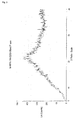
- the diagram obtained for the mixture shows a diffuse scattering (Halo) demonstrating the completely amorphous structure of the product ( Fig. 2 ).
- the X-ray diagram obtained for the individual substances M-CDEA and M-MIPA which was recorded as a control, showed characteristic discrete peaks indicating the crystalline structure as expected (data not shown).
- compositions comprising compounds of the invention were stable for at least 10 days, i.e. no crystallisation was observed, while the compounds which are not part of the present invention, i.e., 4,4'-oxydianiline (ODA), 4,4'-methylenedianiline (DDM) and diaminodiphenylsulfone (DDS), did not result in stable amorphous or liquid products.
- ODA 4,4'-oxydianiline
- DDM 4,4'-methylenedianiline
- DDS diaminodiphenylsulfone
- a commercially available epoxy resin produced from bisphenol A and epichlorohydrin (Epikote ® 828, Resolution Performance Products, OH, USA) was mixed at 50 °C with diamine mixtures obtained as described in Example 1.
- the amounts of epoxy resin and curing agent were adjusted to obtain a molar ratio of epoxy groups to amino groups of 1:1.
- the mixtures were stirred to obtain a homogeneous viscous solution and cooled to 25 °C.
- the obtained mixtures were further mixed with epoxy resin Epikote ® 828 as described in Example 3.
- the amounts of epoxy resin and diamine mixtures were adjusted to obtain a molar ratio of epoxy groups to amino groups of 1:1.
- the gel time of the preparations was determined as described in Example 3, and onset of glass transition (Tg) was determined as described in Example 4.
- Table 6 Components Amount [wt%] Viscosity [mPa ⁇ s] at 60°C Gel time [min] at 150°C Tg onset [°C] M-CDEA 40 M-MIPA 40 1288 73 145 DETDA 20 M-CDEA 40 M-DIPA 40 338 55 170 DETDA 20 TEPDA 40 M-CDEA 40 131 42 140 M-DIPA 20 TEPDA 40 M-CDEA 40 129 50 159 M-DIPA 20
Landscapes
- Chemical & Material Sciences (AREA)
- Health & Medical Sciences (AREA)
- Chemical Kinetics & Catalysis (AREA)
- Medicinal Chemistry (AREA)
- Polymers & Plastics (AREA)
- Organic Chemistry (AREA)
- Epoxy Resins (AREA)
Abstract
The invention describes curing compositions for the preparation of polyurethanes and epoxy resins which comprise at least two aromatic or non-aromatic diamine compounds. The diamine compounds are present in a weight ratio allowing them to form an amorphous or liquid mixed phase when a molten mixture of these compounds is cooled to room temperature. Due to their low viscosity, compositions comprising such an amorphous or liquid mixed phase can conveniently be used in the preparation of polyurethanes and epoxy resins even at temperatures below the melting point of the individual diamines. The compositions can also be used to adjust the gel time and the glass transition temperature of polyurethanes and epoxy resins.
Description
- The present invention relates to diamine compositions and their use as chain extenders or curing agents for polyurethanes and epoxy resins.
- The use of chain extenders and curing agents (in the following collectively called curing agents) for the preparation of polyurethanes and epoxy resins is well known in the art. Polyurethanes, for example, may be obtained by reacting compounds having H-reactive groups such as polyether polyols or polyester polyols with a diisocyanate to form a prepolymer, which in a second step is then reacted with a curing agent to form the polyurethane. Epoxy resins, on the other hand, may be obtained by reacting epichlorohydrin with an alcohol to obtain a glycidyl derivative which then is reacted with a curing agent to obtain the cured epoxy resin.
- The structure of the curing agents and the reactivity of their functional groups are often used to modify the properties of the final product or to control the reaction rate of the polymer formation and the processability of the polymer. However, while properties such as viscosity, glass transition temperature (Tg) or gel time may depend on the choice of the curing agent, these properties cannot conveniently be adjusted with the available agents. From a different practical aspect, many conventional curing agents have a high melting point which makes the preparation of polyurethanes or epoxy resins expensive and inconvenient because of the high energy input and high temperatures required to obtain homogenous mixtures of the reaction components. If the curing agent is added in a solvent, the solvent may affect the properties of the final product and must be removed. Moreover, many compounds used to adjust properties such as gel time, for example 4,4'-methylene-bis-(ortho-chloroaniline) (MOCA), are listed as toxic materials.
-
EP-A-0 171 588 discloses compositions containing 2,2'-dichloro-6,6'-diethylmethylene-bis-aniline together with other aromatic diamines, wherein these compositions are obtained by a condensation reaction of 2-ethyl-6-chloroaniline and various 2,6-dialkylanilines with formaldehyde. Depending on the starting material, various mixtures are obtained resulting in different pot lives when added to a polyurethane prepolymer. Following the condensation reaction, however, these mixtures also contain unreacted educts which must be removed before use as it results in endcapping of the formed polymer. Moreover, the effect on pot life depends on the starting material and is hard to predict. - The object of the present invention was to provide a curing agent for the production of polyurethanes and epoxy resins which can be used in a simple and precise manner to adjust the properties of the final product or of the reaction mixture according to the demands, which can be easily manufactured and which lowers overall energy costs and allows safe handling.
- According to the invention, this object has been achieved by a curing composition for the preparation of polyurethanes and epoxy resins, said composition comprising at least two diamines selected from compounds of the following formulas:
- (a)

- R and R' are the same or different and represent H or a C1-C4 alkyl group, or R and R' together with the carbon atom to which they are bound form a cyclopentane ring or a cyclohexane ring or a fluorene-9,9-diyl group;
- R1 and R1' are the same and represent H or a C1-C4 alkyl group;
R4 and R4' are the same and represent H or a C1-C4 alkyl group; - wherein at least one of R1 / R1' and R4 / R4' is a C1-C4 alkyl group; and
- R2, R2', R3 and R3' are the same or different and represent H, Cl or a C1-C4 alkyl group;
- (b)

- R5, R6, R7 and R8 are the same or different and represent H, a C1-C4 alkyl group, or an -SCH3 group, wherein at least one of R5, R6, R7 and R8 is a C1-C4 alkyl group,
- (c)

- R9, R9', R10 and R10' are the same or different and represent a C1-C4 alkyl group;
and
- R9, R9', R10 and R10' are the same or different and represent a C1-C4 alkyl group;
- (d)

- It has been found that compounds of the formulas (I), (II), (III) and (IV), which normally are crystalline substances in the solid state, upon cooling of molten mixtures thereof are capable of forming an amorphous or liquid mixed phase at a temperature of 25 °C. These amorphous or liquid mixed phases allow adjusting glass transition temperature and gel time of a polymer within a range which is between the values for the individual substances.
- Accordingly, the present invention also provides a curing composition comprising or consisting of an amorphous or liquid mixed phase consisting of at least two diamines selected from compounds of the formulas (I), (II), (III) and (IV) as defined above.
- The compounds of the formulas (I), (II), (III) and/or (IV) are commercially available or can be prepared according to methods known in the art. Aromatic methylene-bis-anilines of the formula (I), for example, can be prepared by subjecting correspondingly substituted mono-aromatic anilines to a condensation reaction with formaldehyde.
- The term "amorphous" as used herein refers to an isotropic solid or glassy mixed phase. The term "mixed phase" as used herein refers to a homogeneous phase consisting of mixtures of compounds of the formulas (I), (II), (III) and/or (IV).
- The term C1-C4 alkyl as used herein in the definitions of the residues R, R', R1, R1', R2, R2', R3, R3', R4, R4', R5, R6, R7, R8, R9, R9', R10 and R10' includes linear or branched alkyl groups, in particular methyl, ethyl, n-propyl, isopropyl, n-butyl, sec-butyl and tert-butyl. Examples of preferred alkyl groups include methyl, ethyl, propyl, isopropyl and sec-butyl. Most preferred alkyl groups are methyl, ethyl, propyl and isopropyl.
- Preferably, R and R' are H or together with the carbon atom to which they are bound form a cyclohexane ring. More preferably, R and R' are H.
- R2, R2', R3 and R3' in the formula (I), which may be the same or different, preferably represent H or Cl. More preferably, R2 and R2' and/or R3 and R3' are the same.
- R5, R6, R7 and R8 in the compounds of the formula (II) are the same or different and preferably represent H, methyl, ethyl or isopropyl. More preferably, at least two, preferably three of R5, R6, R7 and R8 independently represent methyl, ethyl or isopropyl.
- R9, R9', R10 and R10' in the formula (III), which may be the same or different, preferably represent methyl ethyl or isopropyl. More preferably, R9 and R9' and/or R10 and R10' are the same.
- The curing composition of the present invention comprises or consists of at least two diamines selected from compounds of the formulas (I), (II), (III) and (IV) or of an amorphous or liquid mixed phase thereof. Typically, the curing composition or the amorphous or liquid mixed phase consists of two to four, preferably of two or three, most preferably of two diamines selected from compounds of the formulas (I), (II), (III) and (IV).
- Preferably, at least one of the diamines present in the composition is selected from compounds of the formula (I). For example, if two diamines are used, one of the diamines is selected from the compounds of the formula (I) and one may be selected from compounds of the formulas (II), (III) or (IV), preferably of formula (II), or both diamines may be selected from aromatic compounds of the formula (I).
- Preferably, at least one of the compounds of the formula (I) present in the composition of the invention has at least three substituents on each aromatic ring and/or has at least one substituent on the aromatic ring which is a branched alkyl group, preferably an isopropyl group.
- According to one embodiment of the invention, at least one of the diamines present in the composition is selected from compounds of the formula (I) wherein R2 and R2' and/or R3 and R3' are the same and wherein one or both of the pairs R2 / R2' and R3 / R3' are Cl. Preferably, one or both of R2 / R2' and R3 / R3' is Cl and both of R1 / R1' and R4 / R4' are a C1-C4 alkyl group.
- According to a further embodiment of the invention, at least one of the diamines in the composition is selected from compounds of the formula (I) wherein R2 / R2' and R3 / R3' are H. Preferably, if R2 / R2' and R3 / R3' are H, both R1 / R1' and R4 / R4' are a C1-C4 alkyl group. More preferably, at least one of the C1-C4 alkyl groups is a branched alkyl group, preferably an isopropyl group.
- According to a particular preferred embodiment of the invention, at least one of the diamines present in the composition is selected from compounds of the formula (I) wherein one or both of R2 / R2' and R3 / R3' are Cl and preferably both of R1 / R1' and R4 / R4' are a C1-C4 alkyl group, and at least one of the diamines is selected from compounds of the formula (I) wherein R2 / R2' and R3 / R3' are H and both of R1 / R1' and R4 / R4' are a C1-C4 alkyl group, preferably with at least one of the C1-C4 alkyl groups being a branched alkyl group such as isopropyl.
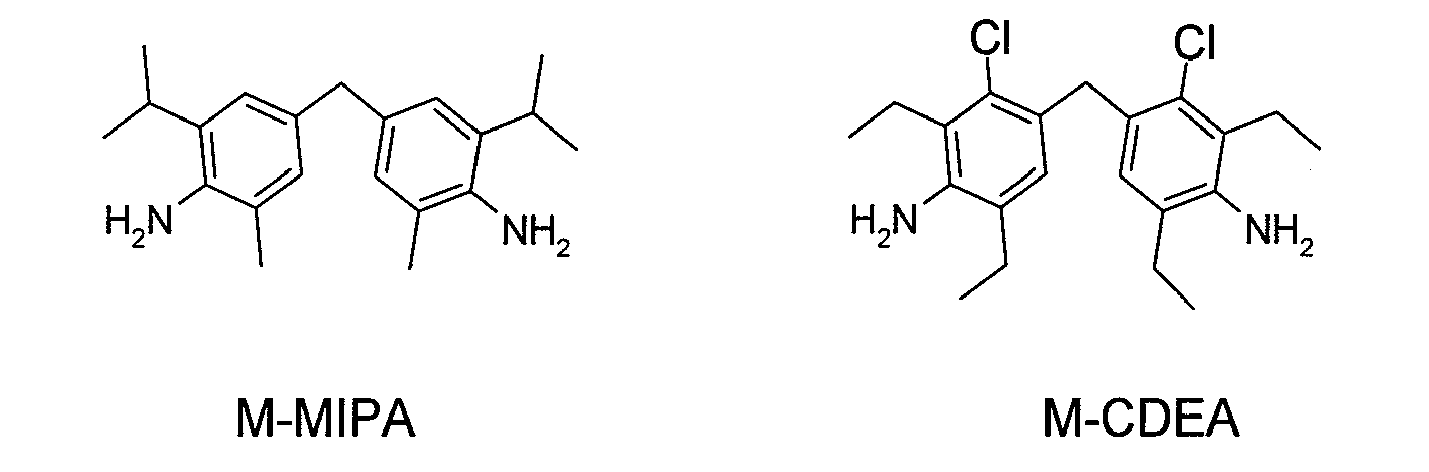
According to a particular preferred embodiment of the invention, at least one of the at least two diamines is selected from the group consisting of 4,4'-methylene-bis-(2,6-diethylaniline) (M-DEA), 4,4'-methylene-bis-(2,6-diisopropylaniline) (M-DIPA), 4,4'-methylene-bis-(2-isopropyl-6-methylaniline) (M-MIPA), 4,4'-methylene-bis-(2-isopropylaniline) (M-bis-IPA), 4,4'-methylene-bis-(3-chloro-2,6-diethylanlinine) (M-CDEA), 3,5-dimethylthio-2,6-toluenediamine and 3,5-dimethylthio-2,4-toluenediamine and isomeric mixtures thereof (available under the trade name E-300), 3,5-diethyl-2,6-toluenediamine and 3,5-diethyl-2,4-toluenediamine and isomeric mixtures thereof (DETDA), and triethylphenylenediamine (TEPDA), 9,9-bis(4-amino-3-chloro-phenyl)-fluorene (CAF), 2,2'-dimethyl-4,4'-methylene-bis(cyclohexylamine) (M-MCHA) and 1,1-bis(4-aminophenyl)cyclohexane (DACH). Mixtures of two or more of these compounds are preferred, particularly mixtures wherein one of the diamines is selected from M-MIPA, M-DIPA and M-CDEA. Preferred combinations comprising or consisting of two aromatic diamines are M-MIPA/M-CDEA, M-MIPA/M-DIPA, M-CDEA/M-bis-IPA, M-MIPA/DETDA, and M-CDEA/DETDA, with mixtures of M-MIPA and M-CDEA being most preferred. Preferred combinations comprising or consisting of three aromatic diamines are M-CDEA/M-MIPA/DETDA and M-CDEA/M-DIPA/DETDA. - In the composition of the invention, the at least two diamine compounds in the composition are present in a weight ratio allowing these compounds to form an amorphous or liquid mixed phase at a temperature of 25 °C. This weight ratio can be determined by the skilled person by routine experiments. For example, if the amorphous or liquid mixed phase to be obtained consists of two compounds of the formulas (I), (II), (III) or (IV), the weight ratio (w/w) of the two compounds present in the starting composition typically is in a range of from 4:1 to 1:4, preferably of from 3:1 to 1:3, and most preferably of from 7:3 to 3:7. If the composition comprises more than two compounds, at least two of these compounds will be present in the above weight ratios. Typically, any of the compounds will be present in the composition in an amount of at least 10 % by weight, preferably of at least 15 % by weight, based on the total weight of the diamines present in the composition.
- As described in more detail below, compositions comprising or consisting of the amorphous or liquid mixed phase are obtainable starting from the curing compositions of the invention comprising or consisting of the at least two diamines selected from compounds of the formulas (I), (II), (III) and/or (IV) in the above weight ratios.
- The amorphous or liquid mixed phase will form, for example, when a homogeneous melt of a mixture of the at least two compounds of the formulas (I), (II), (III) and/or (IV) in the proper weight ratio as disclosed above is cooled, typically to a temperature of 25 °C or below, for example to a temperature of from 20 °C to 25 °C. The amorphous or liquid mixed phase is stable at a temperature of 20 °C to 25 °C, i.e., it does not re-crystallize. The amorphous state of the mixed phase of the invention can be verified by X-ray diffraction. The amorphous mixed phase consisting of compounds of the formulas (I), (II), (III) and/or (IV) has a softening point which is far below the melting point of the individual substances so that upon heating the amorphous mixed phase the resulting solution will regularly have a viscosity of less than 100000 mPa·s at 45 °C, determined using a Brookfield Viscosimeter LV-DV-II + Pro with a Thermoseal heating block and spindle number 18 and 34 (Brookfield Engineering, MA, USA).
- The present invention, therefore, also provides a process for preparing a curing composition comprising or consisting of an amorphous or liquid mixed phase of at least two diamines selected from compounds of the formulas (I), (II), (III) and/or (IV), said process comprising the steps of:
- (a) providing a melt of a mixture of diamines selected from compounds of the formulas (I), (II), (III) and/or (IV) as defined above in a weight ratio allowing these compounds to form an amorphous or liquid mixed phase at a temperature of 25 °C; and
- (b) cooling the melt of step (a) to allow the compounds to form an amorphous or liquid mixed phase.
- According to the invention, the melt of the diamine mixture is typically provided by mixing the individual diamines of the formulas (I), (II), (III) and/or (IV) in a proper weight ratio as described above. This mixture is then heated to a temperature sufficient to obtain a molten mixture. Typically, the mixture is heated to a temperature in a range of from 100 °C to 150 °C. Preferably, the mixture is agitated, for example by stirring, to obtain a homogeneous melt. Alternatively, the crystalline compounds of the formulas (I), (II), (III) and/or (IV) can be molten individually and the molten compounds can then be combined.
- The homogeneous mixture thus obtained is then cooled to below the melting point of the individual substances to obtain a composition comprising or consisting of an amorphous or liquid mixed phase. Typically, the mixture is cooled to a temperature of from 10 °C to 25 °C or below, preferably to a temperature of from 15 °C to 25 °C, for example to about 20 °C. Cooling does not require any specific apparatus. A cooling rate of 4 °C/min will give excellent results, but it is sufficient to allow the molten mixture to stand at room temperature.
- As the amorphous or liquid mixed phase results in a low viscosity of the compositions of the invention even and especially at temperatures below the melting point of the individual crystalline substances, these mixtures have the advantage that they can conveniently be used at low temperatures to provide homogeneous mixtures with the polymer components. This overcomes the need of heating the complete mixture of polymer components and diamines above the melting point of the crystalline substances, which is unfavourable not only with respect to energy but also for safety reasons. The viscosity of the curing compositions at application temperatures can be adjusted to individual needs by varying the relative amounts of the diamines. The compositions of the invention can be easily prepared by simple mixing, heating and cooling the components. By varying the relative amounts of the diamines, glass transition temperature and gel time of the polymers can be adjusted within a range which is between the glass transition temperature and the gel time observed for the individual compounds of the formulas (I), (II), (III) and (IV).
- The present invention will be illustrated in more detail with reference to the following non-limiting examples and Figures, wherein:
- Figure 1
- shows (a) a graph showing the viscosity of M-CDEA and M-MIPA alone as well as of mixtures thereof at different weight ratios (60/40 and 40/60) and temperatures, (b) a summary of the individual values of
Figure 1a . - Figure 2
- shows an X-ray diagram of the amorphous mixed phase of a mixture of M-MIPA and M-CDEA in a weight ratio of 60:40.
- The aromatic methylene-bis-anilines M-MIPA and M-CDEA
- The amorphous products obtained were transferred into a Brookfield Viscosimeter LV-DV-II + Pro with a Thermoseal heating block and spindle number 18 and 34 (Brookfield Engineering, MA, USA). The viscosities of the products were determined at different temperatures (40 °C, 45 °C, 60 °C, 75 °C, 90 °C, 105 °C, 120 °C and 135 °C) and compared with the viscosities of M-CDEA and M-MIPA alone. The results are shown in
Fig. 1a and 1b . - As will be seen from
Fig. 1 , viscosities of the individual substances M-MIPA (Tm = 70 - 73 °C) and M-CDEA (Tm = 87 - 90 °C) could be determined only at temperatures of 60 °C and above, i.e., temperatures close to or above the melting temperature of these substances. - The mixture of M-CDEA and M-MIPA in a weight ratio of 40:60 was further subjected to X-ray powder diffraction using a Bruker D8 Advance-System with a Cu Kα-emitter and sample rotation. The diagram obtained for the mixture shows a diffuse scattering (Halo) demonstrating the completely amorphous structure of the product (
Fig. 2 ). In contrast, the X-ray diagram obtained for the individual substances M-CDEA and M-MIPA, which was recorded as a control, showed characteristic discrete peaks indicating the crystalline structure as expected (data not shown). - Further mixtures consisting of two diamines in weight ratios of 60:40 and 40:60 were prepared as described above. These mixtures and their respective viscosities were determined as above and are summarized in Table 1.

- Various mixtures containing two aromatic diamines in weight ratios of 60:40 and 40:60 were prepared as described in Example 1. The obtained products were kept at room temperature (20 °C to 25 °C) and were visually inspected on a daily basis over a period of at least 10 days. The results are summarized in Table 2.

- As will be seen, all compositions comprising compounds of the invention were stable for at least 10 days, i.e. no crystallisation was observed, while the compounds which are not part of the present invention, i.e., 4,4'-oxydianiline (ODA), 4,4'-methylenedianiline (DDM) and diaminodiphenylsulfone (DDS), did not result in stable amorphous or liquid products.
- A commercially available epoxy resin produced from bisphenol A and epichlorohydrin (Epikote® 828, Resolution Performance Products, OH, USA) was mixed at 50 °C with diamine mixtures obtained as described in Example 1. The amounts of epoxy resin and curing agent were adjusted to obtain a molar ratio of epoxy groups to amino groups of 1:1. The mixtures were stirred to obtain a homogeneous viscous solution and cooled to 25 °C.
- The gel times of the viscous epoxy resin preparations were determined using a GELNORM® Gel Timer (Gel Instrumente AG, Thalwil, Switzerland) according to DIN 16945 Page 1 and DIN 16916 at 130 °C, 150 °C and 180 °C. The results are shown in Table 3.

- Mixtures of Epikote® with M-CDEA and M-MIPA alone were prepared in the same manner for comparison. The results are shown in Table 4 below.
Table 4 Gel time [min] 130°C 150°C 180°C M-CDEA 265 128 48 M-MIPA 74 37 13 - Mixtures of epoxy resin with diamine mixtures obtained as described in Example 1 were prepared as described in Example 3 and transferred into a metal cup and placed into a polymerization oven. The polymerization took place using the following temperature program: 4 h at 130 °C followed by 4 h at 160 °C and 4 h at 190 °C. Following polymerization, the samples were cut and onset of glass transition (Tg) was determined using a Mettler Toledo TMA/SDTA840 Thermomechanical Analyzer (Mettler Toledo, Giessen, Germany). The results are summarized in Table 5 below.

- Mixtures comprising three different aromatic diamines in the weight ratios indicated in Table 6 were prepared as described in Example 1. The viscosity of the mixtures at 60 °C was determined as described in Example 1.
- The obtained mixtures were further mixed with epoxy resin Epikote® 828 as described in Example 3. The amounts of epoxy resin and diamine mixtures were adjusted to obtain a molar ratio of epoxy groups to amino groups of 1:1. The gel time of the preparations was determined as described in Example 3, and onset of glass transition (Tg) was determined as described in Example 4.
- The results are summarized in Table 6.
Table 6 Components Amount [wt%] Viscosity [mPa·s] at 60°C Gel time [min] at 150°C Tg onset [°C] M-CDEA 40 M- MIPA 40 1288 73 145 DETDA 20 M-CDEA 40 M- DIPA 40 338 55 170 DETDA 20 TEPDA 40 M- CDEA 40 131 42 140 M- DIPA 20 TEPDA 40 M- CDEA 40 129 50 159 M- DIPA 20
Claims (14)
- Curing composition for the preparation of polyurethanes and epoxy resins, said composition comprising at least two diamines selected from compounds of the following formulas:(a)
 R and R' are the same or different and represent H or a C1-C4 alkyl group, or R and R' together with the carbon atom to which they are bound form a cyclopentane ring or a cyclohexane ring or a fluorene-9,9-diyl group;R1 and R1' are the same and represent H or a C1-C4 alkyl group;
R4 and R4' are the same and represent H or a C1-C4 alkyl group;wherein at least one of R1 / R1' and R4 / R4' is a C1-C4 alkyl group; andR2, R2', R3 and R3' are the same or different and represent H, Cl or a C1-C4 alkyl group;(b) R5, R6, R7 and R8 are the same or different and represent H, a C1-C4 alkyl group, or an -SCH3 group, wherein at least one of R5, R6, R7 and R8 is a C1-C4 alkyl group,(c)
 R9, R9', R10 and R10' are the same or different and represent a C1-C4 alkyl group;
and(d)
- Composition according to Claim 1, wherein at least one of the diamines is selected from compounds of the formula (I).
- Composition according to Claim 1 or 2, wherein in the compounds of formula (I) R2 / R2' and R3 / R3' are H and R1 / R1' and R4 / R4' are a C1-C4 alkyl group.
- Composition according to Claim 1 or 2, wherein in the compounds of formula (I) one or both of R2 / R2' and R3 / R3' are Cl and both of R1 / R1' and R4 / R4' are a C1-C4 alkyl group.
- Composition according to any one of Claims 1 to 5, wherein at least one of R1 / R1' and R4 / R4' is methyl, ethyl or isopropyl.
- Composition according to any one of Claims 1 to 5, wherein R5, R6, R7 and R8 in the compounds of the formula (II) are the same or different and represent H, methyl, ethyl or isopropyl.
- Composition according to any one of Claims 1 to 6, wherein the at least two diamines are selected from the group consisting of 4,4'-methylene-bis-(2,6-diethylaniline) (M-DEA), 4,4'-methylene-bis-(2,6-diisopropylaniline) (M-DIPA), 4,4'-methylene-bis-(2-isopropyl-6-methylaniline) (M-MIPA), 4,4'-methylene-bis-(2-isopropylaniline) (M-bis-IPA), 4,4'-methylene-bis-(3-chloro-2,6-diethylanlinine) (M-CDEA), 3,5-dimethylthio-2,6-toluenediamine and 3,5-dimethylthio-2,4-toluenediamine and isomeric mixtures thereof, 3,5-diethyl-2,6-toluenediamine and 3,5-diethyl-2,4-toluenediamine and isomeric mixtures thereof (DETDA), and triethylphenylenediamine (TEPDA).
- Composition according to any one of Claims 1 to 7, wherein the at least two diamines are selected from combinations of M-MIPA/M-CDEA, M-MIPA/M-DIPA, M-CDEA/M-bis-IPA, M-MIPA/DETDA, M-CDEA/DETDA, M-CDEA/M-MIPA/DETDA and M-CDEA/M-DIPA/DETDA.
- Composition according to any one of Claims 1 to 8, wherein at least two of the diamines in the composition are present in a weight ratio (w/w) of from 3:1 to 1:3, preferably of from 7:3 to 3:7.
- Composition according to any one of Claims 1 to 9, wherein said composition comprises an amorphous or liquid mixed phase consisting of at least two diamines selected from compounds of the formulas (I), (II), (III) and/or (IV).
- Process for the preparation of a curing composition according to claim 10, comprising:(a) providing a melt of a mixture of diamines selected from compounds of the formulas (I), (II), (III) and/or (IV) as defined in Claim 1 in a weight ratio allowing these compounds to form an amorphous or liquid mixed phase at a temperature of 25 °C; and(b) cooling the melt of step (a) to allow the compounds to form an amorphous or liquid mixed phase.
- Use of a composition according to any one of Claims 1 to 10 as a curing agent in the preparation of polyurethanes and epoxy resins.
- Use according to Claim 12 for adjusting the gel time of the polymers.
- Use according to Claim 12 for adjusting the glass transition temperature of the polymers.
Priority Applications (1)
| Application Number | Priority Date | Filing Date | Title |
|---|---|---|---|
| EP10175023A EP2426157A1 (en) | 2010-09-02 | 2010-09-02 | Diamine compositions and use thereof |
Applications Claiming Priority (1)
| Application Number | Priority Date | Filing Date | Title |
|---|---|---|---|
| EP10175023A EP2426157A1 (en) | 2010-09-02 | 2010-09-02 | Diamine compositions and use thereof |
Publications (1)
| Publication Number | Publication Date |
|---|---|
| EP2426157A1 true EP2426157A1 (en) | 2012-03-07 |
Family
ID=42751737
Family Applications (1)
| Application Number | Title | Priority Date | Filing Date |
|---|---|---|---|
| EP10175023A Withdrawn EP2426157A1 (en) | 2010-09-02 | 2010-09-02 | Diamine compositions and use thereof |
Country Status (1)
| Country | Link |
|---|---|
| EP (1) | EP2426157A1 (en) |
Cited By (7)
| Publication number | Priority date | Publication date | Assignee | Title |
|---|---|---|---|---|
| WO2014114556A3 (en) * | 2013-01-28 | 2014-11-20 | Basf Se | 2,2',6,6'-tetramethyl-4,4'-methylene-bis(cyclohexylamine) as a hardener for epoxy resins |
| GB2524873A (en) * | 2014-02-06 | 2015-10-07 | Hexcel Composites Ltd | 4,4' methylene bis anilines as curing agents for epoxy resins |
| WO2016089724A1 (en) * | 2014-12-02 | 2016-06-09 | Cytec Industries Inc. | Modified amine curing agents, their preparation and use in curable compositions |
| CN106146802A (en) * | 2016-08-19 | 2016-11-23 | 武汉工程大学 | Compound 2 ghiourea group 3,5 2 (methyl mercapto) 4 amino toluene is in the application of epoxy-resin systems |
| CN106316907A (en) * | 2016-08-19 | 2017-01-11 | 武汉工程大学 | Compound 2-thiourea-3,5-bis(methylthio)-4-amino toluene and synthetic method thereof |
| GB2565644A (en) * | 2017-07-12 | 2019-02-20 | Hexcel Composites Ltd | Improvements in resin curative systems |
| US20240117130A1 (en) * | 2021-02-18 | 2024-04-11 | Toray Industries, Inc. | Epoxy resin composition for fiber-reinforced composite material, fiber-reinforced composite material, and method for producing fiber-reinforced composite material |
Citations (3)
| Publication number | Priority date | Publication date | Assignee | Title |
|---|---|---|---|---|
| US4631298A (en) * | 1985-12-16 | 1986-12-23 | Ethyl Corporation | Mixed diamine chain extender |
| WO1991000308A1 (en) * | 1989-06-30 | 1991-01-10 | Martin Marietta Energy Systems, Inc. | Adhesives and method for making same |
| US7540990B1 (en) * | 2004-11-18 | 2009-06-02 | Callaway Golf Company | Cross-linked thermoplastic polyurethane/polyurea and method of making same |
-
2010
- 2010-09-02 EP EP10175023A patent/EP2426157A1/en not_active Withdrawn
Patent Citations (3)
| Publication number | Priority date | Publication date | Assignee | Title |
|---|---|---|---|---|
| US4631298A (en) * | 1985-12-16 | 1986-12-23 | Ethyl Corporation | Mixed diamine chain extender |
| WO1991000308A1 (en) * | 1989-06-30 | 1991-01-10 | Martin Marietta Energy Systems, Inc. | Adhesives and method for making same |
| US7540990B1 (en) * | 2004-11-18 | 2009-06-02 | Callaway Golf Company | Cross-linked thermoplastic polyurethane/polyurea and method of making same |
Cited By (15)
| Publication number | Priority date | Publication date | Assignee | Title |
|---|---|---|---|---|
| WO2014114556A3 (en) * | 2013-01-28 | 2014-11-20 | Basf Se | 2,2',6,6'-tetramethyl-4,4'-methylene-bis(cyclohexylamine) as a hardener for epoxy resins |
| GB2524873B (en) * | 2014-02-06 | 2016-10-12 | Hexcel Composites Ltd | 4,4' methylene bis anilines as curing agents for epoxy resins |
| GB2524873A (en) * | 2014-02-06 | 2015-10-07 | Hexcel Composites Ltd | 4,4' methylene bis anilines as curing agents for epoxy resins |
| US10011679B2 (en) | 2014-12-02 | 2018-07-03 | Cytec Industries Inc. | Modified amine curing agents, their preparation and use in curable compositions |
| WO2016089724A1 (en) * | 2014-12-02 | 2016-06-09 | Cytec Industries Inc. | Modified amine curing agents, their preparation and use in curable compositions |
| US10196479B2 (en) | 2014-12-02 | 2019-02-05 | Cytec Industries Inc. | Modified amine curing agents, their preparation and use in curable compositions |
| AU2015355274B2 (en) * | 2014-12-02 | 2019-07-04 | Cytec Industries Inc. | Modified amine curing agents, their preparation and use in curable compositions |
| CN106146802A (en) * | 2016-08-19 | 2016-11-23 | 武汉工程大学 | Compound 2 ghiourea group 3,5 2 (methyl mercapto) 4 amino toluene is in the application of epoxy-resin systems |
| CN106316907A (en) * | 2016-08-19 | 2017-01-11 | 武汉工程大学 | Compound 2-thiourea-3,5-bis(methylthio)-4-amino toluene and synthetic method thereof |
| CN106146802B (en) * | 2016-08-19 | 2019-05-03 | 武汉工程大学 | Application of compound 2-thioureido-3,5-bis(methylthio)-4-aminotoluene in epoxy resin system |
| GB2565644A (en) * | 2017-07-12 | 2019-02-20 | Hexcel Composites Ltd | Improvements in resin curative systems |
| CN110869412A (en) * | 2017-07-12 | 2020-03-06 | 赫克塞尔合成有限公司 | Improvements in resin curing agent systems |
| JP2020527180A (en) * | 2017-07-12 | 2020-09-03 | ヘクセル コンポジッツ、リミテッド | Improvement of resin curing agent system |
| GB2565644B (en) * | 2017-07-12 | 2022-11-02 | Hexcel Composites Ltd | Improvements in resin curative systems |
| US20240117130A1 (en) * | 2021-02-18 | 2024-04-11 | Toray Industries, Inc. | Epoxy resin composition for fiber-reinforced composite material, fiber-reinforced composite material, and method for producing fiber-reinforced composite material |
Similar Documents
| Publication | Publication Date | Title |
|---|---|---|
| JP5398263B2 (en) | Polyurethane urea elastomer | |
| US8871892B2 (en) | Polyoxazolidone resins | |
| DE69224466T2 (en) | Two component urethane adhesive compositions | |
| EP2621992B1 (en) | Epoxy resin adducts and thermosets thereof | |
| EP2909250B1 (en) | Toughened, curable epoxy compositions for high temperature applications | |
| CA2755856C (en) | Polyisocyanate composition | |
| EP2227500B1 (en) | Impact-resistant polyurethanes | |
| EP2424916B1 (en) | Catalysis of epoxy resin formulations | |
| EP0554823A1 (en) | Epoxy resins cured with mixed methylene bridged poly(cyclohexyl-aromatic)amine curing agents | |
| EP2384345B1 (en) | Divinylarene dioxide formulations for vacuum resin infusion molding | |
| MX2012013529A (en) | Curable compositions. | |
| TW201139486A (en) | Polyoxyalkylenealcohol and polyurethane resin, and a coating agent containing such polyoxyalkylenealcohol and polyurethane resin | |
| US4487948A (en) | Polyglycidyl hindered aromatic amines | |
| TW201231543A (en) | Epoxy resin composition | |
| DK2997061T3 (en) | ISOCYANATE-epoxide HYBRID RESIN | |
| CN112955495A (en) | Thermosetting molding material, fiber-reinforced composite material, thermosetting epoxy resin composition for fiber-reinforced plastic, method for producing thermosetting molding material, and fiber-reinforced plastic | |
| EP2542610B1 (en) | Novel curing agents | |
| EP1399148B1 (en) | Multifunctional carbonates and derivatives | |
| JP6048717B2 (en) | Drip sealant composition | |
| CN114163628A (en) | Etheramines and their use as curing agents or intermediates for polymer synthesis | |
| WO2012028323A1 (en) | Halogenation of 4,4'-methylene-bis-anilines | |
| EP3786206B1 (en) | Urea terminated butadiene polymers and butadiene acrylonitrile copolymers | |
| JP2016056262A (en) | Raw material composition for isocyanurate-oxazolidone resin and isocyanurate-oxazolidone resin | |
| EP4563630A1 (en) | Prepreg, fiber-reinforced composite material, and fiber-reinforced composite material manufacturing method | |
| WO2009101027A1 (en) | Elastomeric materials having a high hardblock content and process for preparing them |
Legal Events
| Date | Code | Title | Description |
|---|---|---|---|
| AK | Designated contracting states |
Kind code of ref document: A1 Designated state(s): AL AT BE BG CH CY CZ DE DK EE ES FI FR GB GR HR HU IE IS IT LI LT LU LV MC MK MT NL NO PL PT RO SE SI SK SM TR |
|
| AX | Request for extension of the european patent |
Extension state: BA ME RS |
|
| PUAI | Public reference made under article 153(3) epc to a published international application that has entered the european phase |
Free format text: ORIGINAL CODE: 0009012 |
|
| STAA | Information on the status of an ep patent application or granted ep patent |
Free format text: STATUS: THE APPLICATION IS DEEMED TO BE WITHDRAWN |
|
| 18D | Application deemed to be withdrawn |
Effective date: 20120908 |