EP2425363B1 - System and method of modeling mono-glycerides, di-glycerides and tryglycerides in biodiesel feedstock - Google Patents
System and method of modeling mono-glycerides, di-glycerides and tryglycerides in biodiesel feedstock Download PDFInfo
- Publication number
- EP2425363B1 EP2425363B1 EP10719478.9A EP10719478A EP2425363B1 EP 2425363 B1 EP2425363 B1 EP 2425363B1 EP 10719478 A EP10719478 A EP 10719478A EP 2425363 B1 EP2425363 B1 EP 2425363B1
- Authority
- EP
- European Patent Office
- Prior art keywords
- constituent
- fragment
- triglycerides
- feedstock
- biodiesel feedstock
- Prior art date
- Legal status (The legal status is an assumption and is not a legal conclusion. Google has not performed a legal analysis and makes no representation as to the accuracy of the status listed.)
- Active
Links
Images












Classifications
-
- C—CHEMISTRY; METALLURGY
- C11—ANIMAL OR VEGETABLE OILS, FATS, FATTY SUBSTANCES OR WAXES; FATTY ACIDS THEREFROM; DETERGENTS; CANDLES
- C11C—FATTY ACIDS FROM FATS, OILS OR WAXES; CANDLES; FATS, OILS OR FATTY ACIDS BY CHEMICAL MODIFICATION OF FATS, OILS, OR FATTY ACIDS OBTAINED THEREFROM
- C11C3/00—Fats, oils, or fatty acids by chemical modification of fats, oils, or fatty acids obtained therefrom
-
- G—PHYSICS
- G16—INFORMATION AND COMMUNICATION TECHNOLOGY [ICT] SPECIALLY ADAPTED FOR SPECIFIC APPLICATION FIELDS
- G16C—COMPUTATIONAL CHEMISTRY; CHEMOINFORMATICS; COMPUTATIONAL MATERIALS SCIENCE
- G16C20/00—Chemoinformatics, i.e. ICT specially adapted for the handling of physicochemical or structural data of chemical particles, elements, compounds or mixtures
- G16C20/30—Prediction of properties of chemical compounds, compositions or mixtures
-
- Y—GENERAL TAGGING OF NEW TECHNOLOGICAL DEVELOPMENTS; GENERAL TAGGING OF CROSS-SECTIONAL TECHNOLOGIES SPANNING OVER SEVERAL SECTIONS OF THE IPC; TECHNICAL SUBJECTS COVERED BY FORMER USPC CROSS-REFERENCE ART COLLECTIONS [XRACs] AND DIGESTS
- Y02—TECHNOLOGIES OR APPLICATIONS FOR MITIGATION OR ADAPTATION AGAINST CLIMATE CHANGE
- Y02E—REDUCTION OF GREENHOUSE GAS [GHG] EMISSIONS, RELATED TO ENERGY GENERATION, TRANSMISSION OR DISTRIBUTION
- Y02E50/00—Technologies for the production of fuel of non-fossil origin
- Y02E50/10—Biofuels, e.g. bio-diesel
-
- Y—GENERAL TAGGING OF NEW TECHNOLOGICAL DEVELOPMENTS; GENERAL TAGGING OF CROSS-SECTIONAL TECHNOLOGIES SPANNING OVER SEVERAL SECTIONS OF THE IPC; TECHNICAL SUBJECTS COVERED BY FORMER USPC CROSS-REFERENCE ART COLLECTIONS [XRACs] AND DIGESTS
- Y02—TECHNOLOGIES OR APPLICATIONS FOR MITIGATION OR ADAPTATION AGAINST CLIMATE CHANGE
- Y02P—CLIMATE CHANGE MITIGATION TECHNOLOGIES IN THE PRODUCTION OR PROCESSING OF GOODS
- Y02P30/00—Technologies relating to oil refining and petrochemical industry
- Y02P30/20—Technologies relating to oil refining and petrochemical industry using bio-feedstock
Definitions
- Biodiesel is a renewable, alternative diesel fuel consisting of long chain alkyl (methyl or ethyl) esters, made by transesterification of vegetable oils such as those from corn, olive, palm, cottonseed and sunflower seed, or animal fats such as tallow, lard, and butter, as well as commercial products, such as margarines.
- Triglycerides also known as triacylglycerols or TAGs, are the major component of nearly all the commercially important biodiesel feedstock, such as, for example, the fats and oils of animals and plant origin listed above. Triglycerides are formed from a single molecule of glycerol, combined with three fatty acids on each of the glycerol OH groups.
- the chemical formula of triglycerides is R 1 COO-CH 2 CH(-OOC-R 2 )CH 2 -OOC-R 3 , where R 1 , R 2 , and R 3 are long alkyl or alkenyl chains.
- the three fatty acids R 1 COOH, R 2 COOH and R 3 COOH can be all different, all the same, or only two the same.
- Triglycerides containing more than one type of fatty acid are denoted as mixed triglycerides.
- Chain lengths of fatty acids in natural triglycerides are variable, but carbon numbers of 16, 18 and 20 carbons are the most common.
- Triglycerides that include fatty acids that contain only single bonds between carbons along the chain length (alkyl chains) are denoted as saturated triglycerides.
- Triglycerides containing carbon-carbon double bonds between carbons along the chain length are denoted as unsaturated triglycerides.
- Unsaturated triglycerides containing a single carbon-carbon double bond are denoted as monounsaturated triglycerides, while those containing two or more carbon-carbon double bonds are denoted as polyunsaturated triglycerides.
- Biodiesel is produced by transesterification of triglycerides.
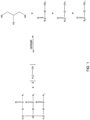
- a representative transesterification reaction that produces biodiesel in the form of methyl esters from a representative triglyceride biodiesel feedstock containing R 1 , R 2 , and R 3 fatty acids, is illustrated in FIG. 1 .
- the triglyceride is reacted with alcohol, such as, for example methanol in FIG. 1 , in the presence of a catalyst, typically a strong alkali such as, for example, sodium hydroxide or potassium hydroxide.
- the reaction can also be acid-catalyzed or enzymatic.
- the reaction products are glycerol and the methyl esters of the R 1 , R 2 , and R 3 fatty acids.
- the methyl esters can then be used as biodiesel fuel.
- Process modeling and simulation technology has become an established practice for rapid process development and optimization in the chemical and petrochemical industry. Such technology can also play a key contributing role in the development and optimization of the process technologies and process plants for biodiesel production.
- One of the challenges limiting the use of process modeling and simulation technology in biodiesel processes is the lack of proven models and databanks for estimating the thermophysical properties of vegetable oils, blends, and, most importantly, the individual triglyceride components that make up the oils.
- thermophysical properties such as, for example, vapor pressure, enthalpy of vaporization, liquid heat capacity and enthalpy of formation, liquid molar volume and viscosity
- thermophysical properties such as, for example, vapor pressure, enthalpy of vaporization, liquid heat capacity and enthalpy of formation, liquid molar volume and viscosity
- Vegetable oils comprise 90-98% triglycerides and small amounts of mono- and diglycerides.
- Monoglycerides (monoacylglycerols or MAGs) are fatty acid monoesters of glycerol and exist in two isomeric forms, 1-monoglycerides and 2-monoglycerides, depending on the position of the ester bond on the glycerol group.
- Diglycerides (diacylglycerols or DAGs) consist of two fatty acid chains bonded to a glycerol molecule by ester linkages. They are typically found as 1,2-diglycerides and 1,3-diglycerides.
- Mono- and diglycerides are also formed as intermediates in the transesterification of triglycerides, which is believed to proceed as the three consecutive and reversible reactions shown in Eqs. 1-3: TAG + ROH ⁇ DAG + R'COOR (1) DAG + ROH ⁇ MAG + R'COOR (2) MAG + ROH ⁇ Glycerol + R'COOR (3) see Freedman, B., Butterfield, R.O., Pryde, E.H., Transesterification Kinetics of Soybean Oil, Journal of the American Oil Chemists' Society, 63, 1375-1380 (1986 ).
- the present invention addresses the foregoing problems.
- the present invention provides a method and system of modeling physical properties of biodiesel feedstock and thus a method and system of blending biodiesel feed stock in the production of biodiesel.
- the constituent fragment-based approach is superior to previous methods of predicting thermophysical properties of mono-, di-, and triglycerides (biodiesel feedstock generally), enabling efficient and reliable estimation of values of thermophysical properties in support of process modeling, simulation, design, and optimization of biodiesel production processes.
- a computer-implemented method or system of modeling physical properties of triglycerides in biodiesel feedstock includes (i) estimating values of a physical property of constituent fatty acid fragments of a triglyceride, and (ii) computing a value of the physical property of the triglyceride by expressing the value of the physical property of the triglyceride as a sum of the estimated values of the physical property of constituent fatty acid fragments of the triglyceride.
- the method/system further includes repeating steps (i) and (ii) for different triglycerides, resulting in a plurality of computed values of the physical property of different triglycerides, and, using the resulting plurality, determining a value of a subject physical property of a biodiesel feedstock.
- This determination is made by expressing the value of the subject physical property of the biodiesel feedstock as a sum of values corresponding to constituent triglycerides of the biodiesel feedstock, wherein the determined value of the subject physical property enables blending of the biodiesel feedstock in production of biodiesel.
- the addends in the sum are from the resulting plurality of the computed triglyceride physical property values.
- the resulting plurality of computed triglyceride physical property values are stored in a searchable database 99 ( FIG. 15 ) operatively coupled to a modeler (modeling engine) 91 of the present invention (detailed later).
- Triglyceride structure is classified by the fatty acids present and the point of attachment of each fatty acid fragment to the glycerol fragment. Triglycerides are designated by an acronym representing the three individual fatty acids and their order on the glycerol fragment of the molecule. Table 1 lists the symbols for various fatty acid fragments discussed below.
- trimyristin is composed of three myristic acid fragments
- tripalmitin is composed of three palmitic acid fragments. Therefore, trimyristin can be denoted by MMM and tripalmitin by PPP.
- a mixed triglyceride made from two palmitic acid fragments in the outer position and one myristic acid fragment in the middle position of the glycerol fragment can be denominated as PMP.
- Triglyceride molecules are also denoted by a convenient shorthand designation, also listed in Table 1, showing the number of carbon atoms and the number of double bonds of the constituent fatty acids.
- Palmitic acid for example, has no carbon-carbon double bonds along its 16 carbon chain, and therefore can be denoted as (C16:0), while palmitoleic acid, which has one double bond, can be denoted as (C16:1), as shown in Table 1.
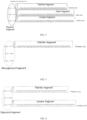
- a monoglyceride component is considered as a compound made up of a backbone monoglycerol fragment with one fatty acid fragment attached.
- a diglyceride component is considered as a compound made up of a backbone diglycerol fragment with two fatty acid fragments attached.
- a biodiesel feedstock such as, for example, crude cottonseed oil
- triglyceride components listed in Table 2 (using the symbols listed in Table 1), based on the estimates of Ceriani and Meirelles, following the composition measurement procedure of Filho et al. See Filho A., N. R., Mendes, O. L., Lancas, F. M., "Computer Prediction of Triacylglycerol Composition of Vegetable Oils by HRGC," Chromatographia, 40, 557-562 (1995 ).
- the triglyceride components in biodiesel feedstock such as, for example, the crude cottonseed oil listed in Table 2 are treated as compounds made up of a backbone glycerol fragment with three fatty acid fragments attached, and the thermophysical properties of a triglyceride component are calculated from the composition of the constituent fragments that make up the triglyceride component and a set of fragment-specific parameters.
- FIG. 2 illustrates a structural characterization of a glycerol fragment and three fatty acid fragments for an example triglyceride compound.
- the fragment approach enables accurate predictions of pure component properties of mixed triglycerides from the available experimental data for simple triglycerides.
- One structural effect not considered in the constituent fragment-based approach is the stereo-specific effect, because the fragment-based approach assumes that the contribution of each fatty acid fragment to the properties of triglyceride compounds is independent of position of the fatty acid fragment on the glycerol backbone fragment.
- the fragment-specific parameters for calculating thermophysical properties of triglycerides are obtained by regression of the limited experimental data available in the literature. The same approach can be applied to calculating thermophysical properties of mono- and diglycerides.
- a monoglyceride component is considered as a compound made up of a backbone monoglycerol fragment with one fatty acid fragment attached.
- a diglyceride component is regarded as a compound made up of a backbone diglycerol fragment with two fatty acid fragments attached. Thermophysical properties of mono- or diglyceride components are then calculated from the composition of the constituent fragments and a set of fragment-specific parameters. As discussed above, the current fragment approach ignores the position isomerism effect because it assumes the contribution of each fatty acid fragment to the properties of mono- and diglyceride components is independent of position of the fatty acid fragment on the glycerol backbone fragment. This assumption is made due to the lack of experimental data available for the position isomerism effect. Therefore, from the perspective of thermophysical property calculations, 1-monoglyceride is regarded as the same as 2-monoglyceride while 1,2-diglyceride is regarded as the same as 1,3-diglyceride.
- Eq. 4 relates vapor pressure and temperature with enthalpy ⁇ H ⁇ vap and Gibbs free energy ⁇ G ⁇ vap of vaporization.
- Clarke, E. C. W., Glew, D. N. "Evaluation of Thermodynamic Functions from Equilibrium Constants," Transactions of the Faraday Society, 62, 539-547 (1966 ).
- Perry reported vapor pressure temperature dependency parameters for some common simple and mixed triglycerides.
- the relationships cover the temperature range from 323.15 K to 573.15 K. ⁇ H ⁇ vap and ⁇ G ⁇ vap values of triglycerides listed in Table 3 were calculated from the parameters reported by Perry for the triglycerides.
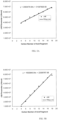
- FIGS. 5A and 5B show the relationships between ⁇ H ⁇ , A vap and ⁇ G ⁇ , A vap parameters, respectively, for the fragments and the carbon number of each fatty acid fragment.
- the trend line equations are displayed on the charts in respective FIGS. 5A and 5B .
- the parameters for the saturated fragments with long chains, such as C20 and C22, can be extrapolated from the trend line equations.
- the calculated parameters ⁇ H ⁇ , A vap and ⁇ G ⁇ , A vap for the glycerol fragment and fatty acid fragments with carbon numbers ranging from 4 to 22 are listed in Table 4.
- the calculated parameters ⁇ H ⁇ , A vap and ⁇ G ⁇ , A vap for the glycerol fragment were calculated from the known values of the enthalpy and Gibbs free energy of vaporization of triglycerides listed in Table 3, by using the fact that the glycerol fragment is one and the same in all of the triglycerides, to calculate the optimal value of the enthalpy and Gibbs free energy of the glycerol fragment that best matches the respective values for the triglycerides listed in Table 3.
- Eqs. (5) and (6) can be used to estimate the enthalpy of vaporization and Gibbs free energy of vaporization for any triglycerides that are composed of the fragments reported in Table 4.
- the value calculated in Eq. (7) of the enthalpy of vaporization of tributyrin is in good agreement with the literature value (8.137E+07) listed in Table 3.
- Eq. (4) can be used to compute the temperature-dependent vapor pressure for the triglyceride component of a biodiesel feedstock.
- the parameters A 1,A and A 2,A for the glycerol fragment and saturated fatty acid fragments with carbon number ranging from 4 to 18 were obtained by regression against literature heat capacity data ranging from 298.15 K to 453.15 K. See Morad, N. A., Kamal, A. A. M., Panau, F., Yew, T. W., "Liquid Specific Heat Capacity Estimation for Fatty Acids, Triacylglycerols, and Vegetable Oils Based on Their Fatty Acid Composition," Journal of the American Oil Chemists' Society, 77, 1001-1005 (2000 ); Phillips, J. C., Mattamal, M.
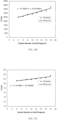
- FIGS. 6A and 6B show the relationship between A 1,A and A 2,A , respectively, and carbon number of each fatty acid fragment respectively.
- the trend line equations are displayed on the chart in respective FIGS. 6A and 6B .
- the parameters for the saturated fragments with long chains, such as C20 and C22, can be extrapolated from the linear equations.
- Applicants choose to use the average heat capacity value at the average temperature instead of the actual experimental data of 1-monostearin.
- the parameter A 1,A for the monoglycerol fragment is then calculated from the average heat capacity value of 1-monostearin based on Eqs. 4 and 5.
- the parameter A 1,A of the diglycerol fragment is calculated by averaging those of the monoglycerol fragment and the triglycerol fragment.
- Table 5 summarizes the calculated parameters A 1,A and A 2,A for the three glycerol fragments and the fatty acid fragments with carbon numbers ranging from 4 to 22.
- the heat of fusion fragment parameters are only valid for the phase transition between liquid triglycerides and their most thermodynamically stable polymorphs. The differences among heat of fusion contributions of the mono-, di- and triglycerol fragments are ignored because experimental data on heats of fusion for mono- and diglycerides are not available. In other words, in one embodiment the ⁇ H A fus values of the mono- and diglycerol fragments are regarded as the same as that of the triglycerol fragment, as listed in Table 6. Eq. 11 is then used to estimate heat of fusion for mono- and diglycerides made up of the fatty acid fragments reported in Table 6.
- ⁇ H monoglyceride fus ⁇ H monoglycerol frag fus + ⁇ H fatty acid frag fus
- FIG. 7 The relationships between enthalpy of formation for simple saturated and monounsaturated triglycerides and carbon numbers of the constituent fatty acids are illustrated in FIG. 7 .
- the linear equations obtained by regression analysis, listed in FIG. 7 can then be used to extrapolate and predict enthalpies of formation for simple triglycerides composed of caproic acid (C6:0) and caprylic acid (C8:0).
- FIG. 8 correlates the enthalpy of formation to the double bond number in each acid chain of simple triglycerides including tristearin (C18:0), triolein (C18: 1), trilinolein (C18:2) and trilinolenin (C18:3).
- Liquid enthalpies of formation for monoglycerides including 1-monocaprin [C10:0], 1-monolaurin [C12:0], 1-monomyristin [C14:0], 1-monopalmitin [C16:0] and 1-monostearin [C18:0] are calculated from their solid enthalpies of formation.
- FIG. 9 The linear relationship between liquid enthalpies of formation for monoglycerides and carbon numbers of the constituent fatty acids is plotted as the dotted line in FIG. 9 .
- the linear equation yielded by regression analysis can then be used to extrapolate and predict liquid enthalpies of formation for monoglycerides composed of caproic acid [C6:0] and arachidic acid [C20:0] and so on.
- FIG. 9 also shows this relationship for simple triglycerides (see solid line). Applicants average out enthalpies of formation for the monoglycerides and the simple triglycerides with the same fatty acid fragments to represent the enthalpy of formation for the corresponding diglycerides.
- the dashed line in FIG. 9 plots the relationship between liquid enthalpy of formation for diglycerides and carbon numbers of the constituent fatty acids.
- the Van Krevelen model is used to estimate the liquid molar volume of fatty acid fragments. See Van Krevelen, D. W., Properties of Polymers. Amsterdam: Elsevier, 3rd ed., (1990 ).
- the parameters B 1,A and B 2,A for the glycerol fragment and saturated fatty acid fragments with carbon numbers ranging from 4 to 18 were obtained by regression against available literature experimental density data in a temperature range from 253.15 K to 516.15 K. See Nilsson, S.-O., Wadso, I., "Thermodynamic Properties of Some Mono-, Di-, and Tri-Esters. Enthalpies of Solution in Water at 288.15 to 318.15 K and Enthalpies of Vaporization and Heat Capacities at 298.15 K," Journal of Chemical Thermodynamics, 1986, 18, 673-681 ; Jaeger, F.
- FIGS. 10A and 10B show the relationship between B 1,A and B 2,4 , respectively, and carbon number of each fatty acid fragment.
- the trend line equations are displayed on the chart of respective Figs. 10A and 10B .
- the parameters of the saturated fragments with long chains, such as C20 and C22, can be extrapolated from the trend line equations.
- the parameters B 1, A and B 2, A , of the oleic fragment (C18:1), the linoleic fragment (C18:2), and the linolenic fragment (C18:3) were obtained by regression against available literature experimental density data. See Sum, A. K., Biddy, M. J., de Pablo, J. J., "Predictive Molecular Model for the Thermodynamics and Transport Properties of Triacylglycerols," Journal of Physical Chemistry B, 107, 14443-14454 (2003 ); Jaeger, F.
- FIGS. 11A and 11B graph B 1, A and B 2, A , respectively, for the fatty acid fragment with carbon number 18 against double bond number.
- Table 7 summarizes the calculated parameters B 1, A and B 2, A for the glycerol fragment and fatty acid fragments with carbon numbers ranging from 4 to 22.
- the parameters B 1,A and B 2, A for the monoglycerol fragment are regressed against experimental density data of monoacetate [C2:0] with a temperature range from 283.15 K to 343.15 K. Morgan, J. L.R., Chazal, P.M., "The Weight of a Falling Drop and the Laws of Tate, XV. The Drop Weights of Certain Organic Liquids and the Surface Tensions and Capillary Constants Calculated from Them," Journal of the American Chemical Society, 35, 1821-1834 (1913 ); Walden, P., Swinne, R., "The Capillary Constants of Liquid Esters," Z. Phys. Chem., 77, 700-758 (1912 ).
- FIG. 12 shows the densities of triacetate [C2:0] predicted by the fragment approach with the extrapolated acetic acid fragment parameters and the experimental density data.
- the parameters C 1, A , C 2 ,A , and C 3, A , for the glycerol fragment and saturated fatty acid fragments with carbon numbers ranging from 4 to 18 were obtained by regression against available experimental viscosity literature data with a temperature range of 298.15 K to 516.15 K. See Rodriguez, M., Galan, M., Munoz, M. J., Martin, R., "Viscosity of Triglycerides + Alcohols from 278 to 313 K," Journal of Chemical and Engineering Data, 39, 102-105 (1994 ); Kishore, K., Shobha, H. K., Mattamal, G.
- FIGS. 13A-C illustrate the relationships between the C 1, A , C 2, A , and C 3, A , parameters and carbon number of each fatty acid fragment.
- the parameters for the saturated fragments with long chains, such as C20 and C22, can be extrapolated from the linear equations on the respective figure's chart shown in Figs. 13A , 13B, and 13C , respectively.
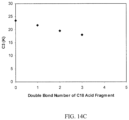
- FIGS. 14A-C illustrate the relationship between viscosity parameters and double bond number for the fatty acid fragment with carbon number 18.
- Table 8 summarizes the calculated parameters C 1, A , C 2 ,A , and C 3, A , for the glycerol fragment and fatty acid fragments with carbon numbers ranging from 4 to 22.
- Liquid viscosities of mono- and diglycerides are not included here due to the lack of necessary experimental data.
- a biodiesel production modeling system 100 ( FIG. 15 ) includes a data store 99 holding a plurality of triglyceride physical property values obtained by, for each of different triglycerides, i) estimating values of a physical property of constituent fatty acid fragments of the triglyceride, and ii) computing the physical property of the triglyceride by expressing a value of the physical property of the triglyceride as a sum of the estimated values of the physical property of constituent fatty acid fragments of the triglyceride.
- mono- and diglyceride data can be indexed and stored in one or more data stores 99 together with or separate from triglyceride data.
- the system 100 further includes a modeler (or modeling engine) 91 that uses the computed mono-, di-, and triglyceride physical property values stored in the data store 99 to determine a value of the physical property of a biodiesel feedstock.
- the modeler 91 expresses the value of the physical property of the biodiesel feedstock as a sum of values from the stored and computed mono-, di-, and triglyceride physical property values corresponding to constituent mono-, di-, and triglycerides of the biodiesel feedstock.
- the data store 99 is configured to be searchable, indexed by triglyceride component name, molecule shorthand, fatty acid acronym and/or the like. Relational databases or other databases can be used to implement data store 99. It is understood that other configurations and implementations of data store 99 are suitable.
- FIG. 15 illustrates a computer network or similar digital processing environment in which the present invention can be implemented.
- Client computer(s)/devices 50 and server computer(s) 60 provide processing, storage, and input/output devices executing application programs and the like.
- Client computer(s)/devices 50 can also be linked through communications network 70 to other computing devices, including other client devices/processes 50 and server computer(s) 60.
- Communications network 70 can be part of a remote access network, a global network (e.g., the Internet), a worldwide collection of computers, Local area or Wide area networks, and gateways that currently use respective protocols (TCP/IP, Bluetooth, etc.) to communicate with one another.
- Other electronic device/computer network architectures are suitable.
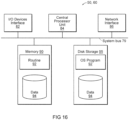
- FIG. 16 is a diagram of the internal structure of a computer (e.g., client processor/device 50 or server computers 60) in the computer system of FIG. 15 .
- Each computer 50, 60 contains system bus 79, where a bus is a set of hardware lines used for data transfer among the components of a computer or processing system.
- Bus 79 is essentially a shared conduit that connects different elements of a computer system (e.g ., processor, disk storage, memory, input/output ports, network ports, etc.) that enables the transfer of information between the elements.
- I/O device interface 82 Attached to system bus 79 is I/O device interface 82 for connecting various input and output devices (e.g ., keyboard, mouse, displays, printers, speakers, etc.) to the computer 50, 60.
- Network interface 86 allows the computer to connect to various other devices attached to a network (e.g ., network 70 of FIG. 11 ).
- Memory 90 provides volatile storage for computer software instructions 92 and data 94 used to implement an embodiment of the present invention (e.g ., modeling engine 91, data store 99, and supporting modules or process code detailed below in FIG. 32 ).
- Disk storage 95 provides non-volatile storage for computer software instructions 92 and data 94 used to implement an embodiment of the present invention.
- Central processor unit 84 is also attached to system bus 79 and provides for the execution of computer instructions.
- the processor routines 92 and data 94 are a computer program product (generally referenced 92), including a computer readable medium (e.g ., a removable storage medium such as one or more DVD-ROM's, CD-ROM's, diskettes, tapes, etc.) that provides at least a portion of the software instructions for the invention system.
- Computer program product 92 can be installed by any suitable software installation procedure, as is well known in the art.
- at least a portion of the software instructions can also be downloaded over a cable, communication and/or wireless connection.
- the invention programs are a computer program propagated signal product 107 embodied on a propagated signal on a propagation medium (e.g ., a radio wave, an infrared wave, a laser wave, a sound wave, or an electrical wave propagated over a global network such as the Internet, or other network(s)).
- a propagation medium e.g ., a radio wave, an infrared wave, a laser wave, a sound wave, or an electrical wave propagated over a global network such as the Internet, or other network(s).
- Such carrier medium or signals provide at least a portion of the software instructions for the present invention routines/program 92.
- the propagated signal is an analog carrier wave or digital signal carried on the propagated medium.
- the propagated signal can be a digitized signal propagated over a global network (e.g ., the Internet), a telecommunications network, or other network.
- the propagated signal is a signal that is transmitted over the propagation medium over a period of time, such as the instructions for a software application sent in packets over a network over a period of milliseconds, seconds, minutes, or longer.
- the computer readable medium of computer program product 92 is a propagation medium that the computer system 50 can receive and read, such as by receiving the propagation medium and identifying a propagated signal embodied in the propagation medium, as described above for computer program propagated signal product.
- carrier medium or transient carrier encompasses the foregoing transient signals, propagated signals, propagated medium, storage medium and the like.
- a biodiesel feedstock (description or other indication thereof) is received as input to modeling engine 91.
- step 23 determines the constituent mono-, di-, and/or triglycerides of the input feedstock of 21.
- step 25 retrieves a physical property value by (a) accessing data store 99 using the constituent as an index, and (ii) obtaining the computed physical property value as stored in the data store 99.
- the modeler 91 at step 27 sums the retrieved computed physical property values of the constituents, i.e., the physical property values produced by step 25. This results in a physical property value 28 of the input (given) feedstock. These results can be reported or otherwise output to a user 31.
- results 28 i.e ., the calculated physical property value of given feedstock
- biodiesel production planner 29 or the like are utilized by a biodiesel production planner 29 or the like.
- biodiesel production planner 29 compares the calculated physical property value 28 with criteria or threshold values. From the comparison, if the comparison biodiesel production planner 29 determines that the calculated physical property value 28 is outside of an acceptable range, then biodiesel production planner module 29 adjusts the input feedstock at 21 (by inputting other feedstock or a blend of feedstock). The modeling process 91 then repeats with the adjusted feedstock constituents.
- modeler 91 outputs an indication to user 31.
- the given input feedstock 21 (or resulting blend) is then used/useable in biodiesel production.
- FIG. 17 The predicted results of vapor pressure for five simple saturated triglycerides are shown in FIG. 17 .
- Heavy-black lines show the vapor pressure of triglycerides as predicted with the fragment approach.
- Light-black lines are the results as predicted by the Li-Ma functional group contribution method. See Li, P., Ma, P.-S., Yi, S.-Z., Zhao, Z.-G., Cong, L.-Z., "A New Corresponding-States Group-Contribution Method (CSGC) for Estimating Vapor Pressure of Pure Compounds," Fluid Phase Equilibria, 1994, 101, 101-119 .
- CSGC Corresponding-States Group-Contribution Method
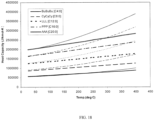
- FIG. 18 shows the predicted results (heavy-black lines) of liquid heat capacity for five simple saturated triglycerides with the constituent fragment-based method. Also shown are the predicted results (light-black lines) from the Ruzicka group contribution method. See Ruzicka, V. Jr., Domalski, E. S., "Estimation of the Heat Capacities of Organic Liquids as a Function of Temperature Using Group Additivity. I. Hydrocarbon Compounds," Journal of Physical and Chemical Reference Data, 22, 597-618 (1993 ); Ruzicka, V. Jr., Domalski, E. S., "Estimation of the Heat Capacities of Organic Liquids as a Function of Temperature Using Group Additivity. II.
- FIG. 19 shows the predicted results of liquid density for five prevalent simple saturated triglycerides. Heavy-black lines show the liquid densities of the triglycerides as predicted with the fragment approach. Also shown are the prediction results from the Le Bas group contribution method (light-black lines). See Poling, B.E., Prausnitz, J.M., O'Connell, J.P., The Properties of Gases and Liquids, New York: McGraw-Hill Companies, 5th ed., 4.33 and 9.59-9.61 (2000 ). As shown in FIG. 19 , densities predicted by the Le Bas group contribution method are approximately 30% too large.
- FIG. 20 shows the predicted results (heavy-black lines) of liquid viscosity for five prevalent simple saturated triglycerides. Also shown are the prediction results (light-black lines) with the Orrick-Erbar group contribution method. See Poling, B.E., Prausnitz, J.M., O'Connell, J.P., The Properties of Gases and Liquids, New York: McGraw-Hill Companies, 5th ed., 4.33 and 9.59-9.61 (2000 ). As shown in FIG. 20 , viscosities predicted by the Orrick-Erbar method are orders of magnitude too large at temperatures of less than about 423.15 K and too small at temperatures above about 473.15 K.
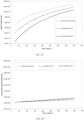
- FIGS. 21-23 show the predicted results of vapor pressure, liquid heat capacity and liquid density for monoglycerides, simple diglycerides and simple triglycerides composed of butyric (C4), lauric (C12), and arachidic (C20) fatty acid fragments.
- Solid lines show the predictions of triglycerides. Dashed lines are the predictions of diglycerides. Dotted lines are the predictions of monoglycerides.
- the mono-, di- and triglycerides composed of the butyric fatty acid fragment are plotted in FIGS. 21-23A .
- the mono-, di- and triglycerides composed of the lauric fatty acid fragment are plotted in FIGS. 21-23B .
- the mono-, di- and triglycerides composed of the arachidic fatty acid fragment are plotted in FIGS. 21-23C .
- the difference between the diglyceride and the triglyceride densities has no obvious change with the increment of carbon number of the constituent fatty acid.
- the gap between the monoglyceride and the triglyceride densities decreases for the components with the longer fatty acid fragments, contrary to vapor pressure and heat capacity.
- the triglyceride composition of soybean oil is shown in Table 9. See Ndiaye, P. M., Tavares, F. W., Dalmolin, I., Dariva, C., Oliveira, D., and Oliveira, J. V., "Vapor Pressure Data of Soybean Oil, Castor Oil, and Their Fatty Acid Ethyl Ester Derivatives," Journal of Chemical and Engineering Data, 50, 330-333 (2005 ).
- FIG. 24 shows the vapor pressure of soybean oil as a function of temperature. Also shown are the predicted results from the Li-Ma group contribution method. As shown in FIG. 24 , the vapor pressure estimates from the constituent fragment-based method are in good agreement with experimental data, while the results from the Li-Ma group contribution method are orders of magnitude too large.
- the heat of vaporization of soybean oil can be estimated based on the triglyceride composition listed in Table 9.
- the standard (298.15 K) heat of vaporization of soybean oil estimated with the constituent fragment-based method at 1.610E+8 J/kmol is in good agreement with the experimental value of 1.847E+8 J/kmol derived from Perry. See Perry, E. S., Weber, W. H., Daubert, B. F., "Vapor Pressure of Phlegmatic Liquids I. Simple and Mixed Triglycerides," Journal of American Chemical Society, 71, 3720-3726 (1949 ).
- Triglyceride compositions and liquid heat capacities of refined, bleached, deodorized palm oil (RBDPO) and cocoa butter are available, and listed in Table 10. See Morad, N. A., Kamal, A. A. M., Panau, F., Yew, T. W., "Liquid Specific Heat Capacity Estimation for Fatty Acids, Triacylglycerols, and Vegetable Oils Based on Their Fatty Acid Composition," Journal of the American Oil Chemists' Society, 77, 1001-1005 (2000 ).
- FIG. 25 shows the predicted heat capacities of RBDPO and cocoa butter as a function of temperature using the constituent fragment-based method and the Ruzicka group contribution method. The results of the constituent fragment-based method are in good agreement with the experimental data.
- the triglyceride compositions of three vegetable oils, Brazil nut, Buriti, and grape seed, are shown in Table 11. Densities of the three vegetable oils are available. See Ceriani, R., Paiva, F. R., Goncalves, C. B., Batista, E. A. C., Meirelles, A. J. A., "Densities and Viscosities of Vegetable Oils of Nutritional Value," Journal of Chemical and Engineering Data, 53, 1846-1853 (2008 ).
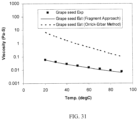
- FIGS. 29-31 show the viscosity of Brazil nut, Buriti, and grape seed oils, respectively, as function of temperature.
- the predicted results from the Orrick-Erbar group contribution method are also graphed as the dashed lines.
- the liquid viscosities predicted with the constituent fragment-based method for the three oils are in good agreement with the experimental data.
Landscapes
- Chemical & Material Sciences (AREA)
- Engineering & Computer Science (AREA)
- Life Sciences & Earth Sciences (AREA)
- Computing Systems (AREA)
- Bioinformatics & Cheminformatics (AREA)
- Bioinformatics & Computational Biology (AREA)
- Crystallography & Structural Chemistry (AREA)
- Theoretical Computer Science (AREA)
- General Chemical & Material Sciences (AREA)
- Chemical Kinetics & Catalysis (AREA)
- Oil, Petroleum & Natural Gas (AREA)
- Wood Science & Technology (AREA)
- Organic Chemistry (AREA)
- Fats And Perfumes (AREA)
- Liquid Carbonaceous Fuels (AREA)
Description
- Interest has grown tremendously over the last decade in the use of fats and vegetable oils as a feedstock for manufacturing biodiesel, and many commercial plants have been built. The economic advantage of using vegetable oils as a feedstock, however, can vary significantly based on a number of factors including the fluctuating cost of crude oil, the limited supply of vegetable oils, and competing demands in food applications. Biodiesel is a renewable, alternative diesel fuel consisting of long chain alkyl (methyl or ethyl) esters, made by transesterification of vegetable oils such as those from corn, olive, palm, cottonseed and sunflower seed, or animal fats such as tallow, lard, and butter, as well as commercial products, such as margarines.
- Triglycerides, also known as triacylglycerols or TAGs, are the major component of nearly all the commercially important biodiesel feedstock, such as, for example, the fats and oils of animals and plant origin listed above. Triglycerides are formed from a single molecule of glycerol, combined with three fatty acids on each of the glycerol OH groups. The chemical formula of triglycerides is R1COO-CH2CH(-OOC-R2)CH2-OOC-R3, where R1, R2, and R3 are long alkyl or alkenyl chains. The three fatty acids R1COOH, R2COOH and R3COOH can be all different, all the same, or only two the same. Triglycerides with three identical fatty acids (R1= R2= R3) are generally denoted as simple triglycerides. Triglycerides containing more than one type of fatty acid are denoted as mixed triglycerides. Chain lengths of fatty acids in natural triglycerides are variable, but carbon numbers of 16, 18 and 20 carbons are the most common. Triglycerides that include fatty acids that contain only single bonds between carbons along the chain length (alkyl chains) are denoted as saturated triglycerides. Triglycerides containing carbon-carbon double bonds between carbons along the chain length (alkenyl chains) are denoted as unsaturated triglycerides. Unsaturated triglycerides containing a single carbon-carbon double bond are denoted as monounsaturated triglycerides, while those containing two or more carbon-carbon double bonds are denoted as polyunsaturated triglycerides.
- Biodiesel is produced by transesterification of triglycerides. A representative transesterification reaction that produces biodiesel in the form of methyl esters from a representative triglyceride biodiesel feedstock containing R1, R2, and R3 fatty acids, is illustrated in
FIG. 1 . In the transesterification reaction, the triglyceride is reacted with alcohol, such as, for example methanol inFIG. 1 , in the presence of a catalyst, typically a strong alkali such as, for example, sodium hydroxide or potassium hydroxide. The reaction can also be acid-catalyzed or enzymatic. The reaction products are glycerol and the methyl esters of the R1, R2, and R3 fatty acids. The methyl esters can then be used as biodiesel fuel. - Most natural fats and oils are complex mixtures of many different triglycerides. The exact triglyceride composition of a fat or oil further varies with the source and growth conditions of the feedstock. Significant research has been focused on the development of new non-food vegetable oil sources as a sustainable feedstock for biodiesel manufacturing. For example, certain species of algae that contain high amounts of oil and have high growth rates are considered a promising potential feedstock for next generation biofuels. New feedstock, combined with new process technologies and optimized production plants can help to alleviate some of the cost pressures and favor the trend toward bio-chemical alternatives.
- Process modeling and simulation technology has become an established practice for rapid process development and optimization in the chemical and petrochemical industry. Such technology can also play a key contributing role in the development and optimization of the process technologies and process plants for biodiesel production. One of the challenges limiting the use of process modeling and simulation technology in biodiesel processes is the lack of proven models and databanks for estimating the thermophysical properties of vegetable oils, blends, and, most importantly, the individual triglyceride components that make up the oils. Accurate estimation of the thermophysical properties, such as, for example, vapor pressure, enthalpy of vaporization, liquid heat capacity and enthalpy of formation, liquid molar volume and viscosity, is an essential first step to developing flowsheet models for design, optimization and control of biodiesel production processes. See Myint, L. L., and El-Halwagi, M. M., "Process analysis and optimization of biodiesel production from soybean oil," Clean Techn. Environ. Policy, DOI 10.1007/s/0098-008-0156-5 (June, 2008).
- There is a limited amount of available information for estimation of thermophysical properties for triglycerides. Most of the data is based on the traditional functional group approach. For example, Ceriani and Meirelles reported a group contribution method for the estimation of the vapor pressure of fatty compounds and the optimized parameters. See Ceriani, R., Meirelles, A. J. A., "Predicting Vapor-liquid Equilibria of Fatty Systems," Fluid Phase Equilibria, 215, 227-236 (2004). All the fatty compounds gathered in the experimental data bank were split into eight functional groups: CH3, CH2, COOH, CH=cis, CH=trans, OH, COO, and CH2-CH-CH2. The same authors later extended this functional group approach to predict the viscosity of triglycerides. See Ceriani, R., Goncalves, C. B., Rabelo, J., Caruso, M., Cunha, A. C. C., Cavaleri, F. W., Batista, E. A. C., Meirelles, A. J. A., "Group Contribution Model for Predicting Viscosity of Fatty Compounds," Journal of Chemical and Engineering Data, 52, 965-972 (2007). Separately, a rather cumbersome group contribution method was developed to predict the melting points and the enthalpies of fusion of saturated triglycerides. See Zéberg-Mikkelsen, C. K., Stenby, E. H., "Predicting the Melting Points and the Enthalpies of Fusion of Saturated Triglycerides by a Group Contribution Method," Fluid Phase Equilibria, 62, 7-17 (1999). Although this approach can be used to identify a unique set of functional groups and parameters to match available experimental data for triglycerides, the functional group approach is too simplistic to model the variations in thermophysical properties of various triglycerides.
- Similar difficulties are encountered in the estimation of thermophysical properties for mono- and diglycerides. Vegetable oils comprise 90-98% triglycerides and small amounts of mono- and diglycerides. Monoglycerides (monoacylglycerols or MAGs) are fatty acid monoesters of glycerol and exist in two isomeric forms, 1-monoglycerides and 2-monoglycerides, depending on the position of the ester bond on the glycerol group. Diglycerides (diacylglycerols or DAGs) consist of two fatty acid chains bonded to a glycerol molecule by ester linkages. They are typically found as 1,2-diglycerides and 1,3-diglycerides. Mono- and diglycerides are also formed as intermediates in the transesterification of triglycerides, which is believed to proceed as the three consecutive and reversible reactions shown in Eqs. 1-3:
TAG + ROH ↔ DAG + R'COOR (1)
DAG + ROH ↔ MAG + R'COOR (2)
MAG + ROH ↔ Glycerol + R'COOR (3)
see Freedman, B., Butterfield, R.O., Pryde, E.H., Transesterification Kinetics of Soybean Oil, Journal of the American Oil Chemists' Society, 63, 1375-1380 (1986). - Due to the importance of mono-, di- and triglycerides for the production of biodiesel, a new approach is needed for accurate and systematic correlation and estimation of the thermophysical properties of individual mono-, di-, and triglyceride components, and of the mixture properties of fats and oils in biodiesel feedstock.
- The present invention addresses the foregoing problems. Generally speaking, the present invention provides a method and system of modeling physical properties of biodiesel feedstock and thus a method and system of blending biodiesel feed stock in the production of biodiesel.
- The invention is set out in the appended set of claims.
- The constituent fragment-based approach is superior to previous methods of predicting thermophysical properties of mono-, di-, and triglycerides (biodiesel feedstock generally), enabling efficient and reliable estimation of values of thermophysical properties in support of process modeling, simulation, design, and optimization of biodiesel production processes.
- The foregoing will be apparent from the following more particular description of example embodiments of the invention, as illustrated in the accompanying drawings in which like reference characters refer to the same parts throughout the different views. The drawings are not necessarily to scale, emphasis instead being placed upon illustrating embodiments of the present invention.
-
FIG. 1 is a representative transesterification reaction used for the production of biodiesel. -
FIG. 2 is a representation of fragments of a triglyceride. -
FIG. 3 is a representation of a monoglyceride component made up of a backbone monoglycerol fragment with one fatty acid fragment attached. -
FIG. 4 is a representation of a diglyceride component made up of a backbone diglycerol fragment with two fatty acid fragments attached. -
FIG. 5A is a graph of the relationship between
-
FIG. 5B is a graph of the relationship between
-
FIG. 6A is a graph of the relationship between fragment parameter A 1,A and carbon number of each saturated acid fragment. -
FIG. 6B is a graph of the relationship between fragment parameter A 2,A and carbon number of each saturated acid fragment. -
FIG. 7 is a graph of the relationship between enthalpy of formation for simple triglycerides and carbon numbers of the constituent fatty acids. -
FIG. 8 is a graph of the relationship between enthalpy of formation and double bond number in C18 acid chains of simple triglycerides. -
FIG. 9 is a graph of the relationship between liquid enthalpies of formation for mono-, di- and triglycerides and carbon number of the constituent fatty acids. -
FIG. 10A is a graph of the relationship between fragment parameter B 1,A and carbon number of each saturated acid fragment. -
FIG. 10B is a graph of the relationship between fragment parameter B 2,A and carbon number of each saturated acid fragment. -
FIG. 11A is a graph of the relationship between fragment parameter B 1,A and double bond number in C18 fatty acid fragments. -
FIG. 11B is a graph of the relationship between fragment parameter B 2,A and double bond number in C18 fatty acid fragments. -
FIG. 12 is a graph of the predicted liquid density of triacetate, experimental data from Rodriguez et al., and Jaeger. -
FIG. 13A is a graph of the relationship between viscosity parameter C 1,A and carbon number of each saturated fatty acid fragment. -
FIG. 13B is a graph of the relationship between viscosity parameter C 2,A and carbon number of each saturated fatty acid fragment. -
FIG. 13C is a graph of the relationship between viscosity parameter C 3,A and carbon number of each saturated fatty acid fragment. -
FIG. 14A is a graph of the relationship between viscosity fragment parameter C 1,A and double bond number in C18 fatty acid fragments. -
FIG. 14B is a graph of the relationship between viscosity fragment parameter C 2,A and double bond number in C18 fatty acid fragments. -
FIG. 14C is a graph of the relationship between viscosity fragment parameter C 3,A and double bond number in C18 fatty acid fragments. -
FIG. 15 is a schematic view of a computer network in which embodiments of the present invention are implemented. -
FIG. 16 is a block diagram of a computer node in the network ofFIG. 15 . -
FIG. 17 is a graph of a comparison of predicted vapor pressure of simple saturated triglycerides; heavy-black lines are predictions with the fragment method, and light-black lines are predicted with the group contribution method; lines with the same legend corresponding to the same triglycerides. -
FIG. 18 is a graph of a comparison of predicted liquid heat capacity of simple saturated triglycerides; heavy-black lines are predictions with the fragment method, and light-black lines are predicted with the group contribution method; lines with the same legend corresponding to the same triglycerides. -
FIG. 19 is a graph of a comparison of predicted liquid density of simple saturated triglycerides; heavy-black lines are predictions with the fragment method, and light-black lines are predicted with the group contribution method; lines with the same legend corresponding to the same triglycerides. -
FIG. 20 is a graph of a comparison of predicted liquid viscosity of simple saturated triglycerides; heavy-black lines are predictions with the fragment method, and light-black lines are predicted with the group contribution method; lines with the same legend corresponding to the same triglycerides. -
FIGS. 21A-C are graphs of comparisons of predicted vapor pressure of mono-, simple di- and triglycerides of (A) butyric, (B) lauric, and (C) arachidic acid; solid lines are triglycerides, dashed lines are diglycerides, dotted lines are monoglycerides. -
FIGS. 22A-C are graphs of comparisons of predicted liquid heat capacity of mono-, simple di- and triglycerides of (A) butyric, (B) lauric, and (C) arachidic acid; solid lines are triglycerides, dashed lines are diglycerides, dotted lines are monoglycerides. -
FIGS. 23A-C are graphs of comparisons of predicted density of mono-, simple di- and triglycerides of (A) butyric, (B) lauric, and (C) arachidic acid; solid lines are triglycerides, dashed lines are diglycerides, dotted lines are monoglycerides. -
FIG. 24 is a graph of predicted vapor pressure of soybean oil, experimental data from Perry et al. -
FIG. 25 is a graph of predicted liquid heat capacity of oils, experimental data from Morad et al. -
FIG. 26 is a graph of predicted density of Brazil nut oil, experimental data from Ceriani et al. -
FIG. 27 is a graph of predicted density of Buriti oil, experimental data from Ceriani et al. -
FIG. 28 is a graph of predicted density of grape seed oil, experimental data from Ceriani et al. -
FIG. 29 is a graph of predicted liquid viscosity of Brazil nut oil, experimental data from Ceriani et al. -
FIG. 30 is a graph of predicted liquid viscosity of Buriti oil, experimental data from Ceriani et al. -
FIG. 31 is a graph of predicted liquid viscosity of grape seed oil, experimental data from Ceriani et al. -
FIG. 32 is a flow diagram of one embodiment of the present invention. - A description of example embodiments of the invention follows. The teachings of all patents, published applications and references cited herein are incorporated by reference in their entirety.
- According to the principles of the present invention, a computer-implemented method or system of modeling physical properties of triglycerides in biodiesel feedstock includes (i) estimating values of a physical property of constituent fatty acid fragments of a triglyceride, and (ii) computing a value of the physical property of the triglyceride by expressing the value of the physical property of the triglyceride as a sum of the estimated values of the physical property of constituent fatty acid fragments of the triglyceride. The method/system further includes repeating steps (i) and (ii) for different triglycerides, resulting in a plurality of computed values of the physical property of different triglycerides, and, using the resulting plurality, determining a value of a subject physical property of a biodiesel feedstock. This determination is made by expressing the value of the subject physical property of the biodiesel feedstock as a sum of values corresponding to constituent triglycerides of the biodiesel feedstock, wherein the determined value of the subject physical property enables blending of the biodiesel feedstock in production of biodiesel. The addends in the sum are from the resulting plurality of the computed triglyceride physical property values. Preferably the resulting plurality of computed triglyceride physical property values are stored in a searchable database 99 (
FIG. 15 ) operatively coupled to a modeler (modeling engine) 91 of the present invention (detailed later). - Triglyceride structure is classified by the fatty acids present and the point of attachment of each fatty acid fragment to the glycerol fragment. Triglycerides are designated by an acronym representing the three individual fatty acids and their order on the glycerol fragment of the molecule. Table 1 lists the symbols for various fatty acid fragments discussed below.

- As illustrative examples, trimyristin is composed of three myristic acid fragments, and tripalmitin is composed of three palmitic acid fragments. Therefore, trimyristin can be denoted by MMM and tripalmitin by PPP. A mixed triglyceride made from two palmitic acid fragments in the outer position and one myristic acid fragment in the middle position of the glycerol fragment can be denominated as PMP. Triglyceride molecules are also denoted by a convenient shorthand designation, also listed in Table 1, showing the number of carbon atoms and the number of double bonds of the constituent fatty acids. Palmitic acid, for example, has no carbon-carbon double bonds along its 16 carbon chain, and therefore can be denoted as (C16:0), while palmitoleic acid, which has one double bond, can be denoted as (C16:1), as shown in Table 1. Following the same approach, as shown in
FIG. 3 , a monoglyceride component is considered as a compound made up of a backbone monoglycerol fragment with one fatty acid fragment attached. As shown inFIG. 4 , a diglyceride component is considered as a compound made up of a backbone diglycerol fragment with two fatty acid fragments attached. - A biodiesel feedstock, such as, for example, crude cottonseed oil, is composed of a mixture of triglyceride components, listed in Table 2 (using the symbols listed in Table 1), based on the estimates of Ceriani and Meirelles, following the composition measurement procedure of Filho et al. See Filho A., N. R., Mendes, O. L., Lancas, F. M., "Computer Prediction of Triacylglycerol Composition of Vegetable Oils by HRGC," Chromatographia, 40, 557-562 (1995).

- In the constituent fragment-based approach, the triglyceride components in biodiesel feedstock, such as, for example, the crude cottonseed oil listed in Table 2, are treated as compounds made up of a backbone glycerol fragment with three fatty acid fragments attached, and the thermophysical properties of a triglyceride component are calculated from the composition of the constituent fragments that make up the triglyceride component and a set of fragment-specific parameters.
FIG. 2 illustrates a structural characterization of a glycerol fragment and three fatty acid fragments for an example triglyceride compound. The fragment approach enables accurate predictions of pure component properties of mixed triglycerides from the available experimental data for simple triglycerides. One structural effect not considered in the constituent fragment-based approach is the stereo-specific effect, because the fragment-based approach assumes that the contribution of each fatty acid fragment to the properties of triglyceride compounds is independent of position of the fatty acid fragment on the glycerol backbone fragment. The fragment-specific parameters for calculating thermophysical properties of triglycerides are obtained by regression of the limited experimental data available in the literature. The same approach can be applied to calculating thermophysical properties of mono- and diglycerides. Following the fragment approach, a monoglyceride component is considered as a compound made up of a backbone monoglycerol fragment with one fatty acid fragment attached. A diglyceride component is regarded as a compound made up of a backbone diglycerol fragment with two fatty acid fragments attached. Thermophysical properties of mono- or diglyceride components are then calculated from the composition of the constituent fragments and a set of fragment-specific parameters. As discussed above, the current fragment approach ignores the position isomerism effect because it assumes the contribution of each fatty acid fragment to the properties of mono- and diglyceride components is independent of position of the fatty acid fragment on the glycerol backbone fragment. This assumption is made due to the lack of experimental data available for the position isomerism effect. Therefore, from the perspective of thermophysical property calculations, 1-monoglyceride is regarded as the same as 2-monoglyceride while 1,2-diglyceride is regarded as the same as 1,3-diglyceride. - The vapor pressure of a triglyceride component is estimated from Eq. (4):

- A and B : Vapor pressure temperature dependency parameters
- Pi : Vapor pressure of triglyceride component i, (Pa)
- T : Temperature, (K)
- R: Gas constant
- θ : Reference temperature, 298.15 K
-

-

- Eq. 4 relates vapor pressure and temperature with enthalpy


- Values of fragment-specific enthalpy and Gibbs free energy of vaporization from fragment compositions of triglycerides were calculated from Eqs. (5) and (6):


- Nfrag : Number of fragments in the triglyceride
- xA : Mole fraction of fragment A in the triglyceride
-

-

-
FIGS. 5A and 5B show the relationships between

FIGS. 5A and 5B . The parameters for the saturated fragments with long chains, such as C20 and C22, can be extrapolated from the trend line equations. The calculated parameters


- To the applicants' knowledge, experimental data for vapor pressures of unsaturated triglycerides such as trilinolein (C18:2) and trilinolenin (C18:3) are not available to identify the fragment-specific parameters. Until such data become available, the effect of double bonds on the vapor pressure of triglyceride molecules is assumed to be negligible. In other words, the vapor pressure of unsaturated triglycerides is regarded as the same as that of the saturated triglyceride with the same carbon number (number of carbon atoms in the fatty acid chain). Likewise, the effect of double bonds per triglyceride molecule on the enthalpy of vaporization is also assumed to be negligible.
- Eqs. (5) and (6) can be used to estimate the enthalpy of vaporization and Gibbs free energy of vaporization for any triglycerides that are composed of the fragments reported in Table 4. For example, the enthalpy of vaporization of tributyrin can be obtained from Eq (5) as:

- Given the enthalpy of vaporization and Gibbs free energy of vaporization for the triglyceride, Eq. (4) can be used to compute the temperature-dependent vapor pressure for the triglyceride component of a biodiesel feedstock. The vapor pressure of the biodiesel feedstock that contains a plurality of triglyceride components can be obtained from Dalton's law:

- P: Vapor pressure of biodiesel feedstock, (Pa)
- N: Number of triglyceride components in the biodiesel feedstock
- Pi : Vapor pressure of triglyceride component i, (Pa)
- xi : Mole fraction of triglyceride component i in the biodiesel feedstock.
-


- To the Applicants' knowledge, experimental data for vapor pressures of diglycerides are not available for the identification of the diglycerol fragment-specific parameters. Until such data become available, Applicants in one embodiment choose to average the


- The heat capacities of triglyceride components are calculated from the fragment composition and the fragment heat capacity parameters:

-

- Nfrag : Number of fragments in the triglyceride component
- xA : Mole fraction of fragment A in the triglyceride component.
- A 1,A and A 2,A: Temperature dependency correlation parameters
- T: Temperature, (K).
- The parameters A 1,A and A 2,A for the glycerol fragment and saturated fatty acid fragments with carbon number ranging from 4 to 18 were obtained by regression against literature heat capacity data ranging from 298.15 K to 453.15 K. See Morad, N. A., Kamal, A. A. M., Panau, F., Yew, T. W., "Liquid Specific Heat Capacity Estimation for Fatty Acids, Triacylglycerols, and Vegetable Oils Based on Their Fatty Acid Composition," Journal of the American Oil Chemists' Society, 77, 1001-1005 (2000); Phillips, J. C., Mattamal, M. M., "Correlation of Liquid Heat Capacities for Carboxylic Esters," Journal of Chemical and Engineering Data, 21, 228-232 (1976).
FIGS. 6A and6B show the relationship between A 1,A and A 2,A, respectively, and carbon number of each fatty acid fragment respectively. The trend line equations are displayed on the chart in respectiveFIGS. 6A and6B . The parameters for the saturated fragments with long chains, such as C20 and C22, can be extrapolated from the linear equations. - Accounting for unsaturated fatty acid fragments is slightly different from the calculation of vapor pressure because heat capacity data is available for the unsaturated triglyceride triolein (C18: 1). Applicants treat heat capacities of the polyunsaturated triglycerides trilinolein (C18:2) and trilinolenin (C18:3) as being equal to that of monounsaturated triolein (C18:1). Table 5 summarizes the calculated parameters A 1,A and A 2,A for the glycerol fragment and fatty acid fragments with carbon numbers ranging from 4 to 22.

- For the mono- and diglycerol fragments, Applicants assume that the dependence on temperature of the heat capacity contribution for mono-, di- and triglycerol fragments is the same. That means that the A 2,A parameters for the mono- and diglycerol fragments are equal to the existing A 2,A parameter for the triglycerol fragment, as listed in Table 5. Available liquid heat capacity data for 1-monostearin [C18:0] show a large variation in heat capacity over a small temperature range. Ward, T.L., Vicknair, E.J., Singleton, W.S., Feuge, R.O., Some Thermal Properties of 1-Monostearin, 1-Aceto 3-stearin and 1,2-Diaceto-3-stearin, Journal of Physical Chemistry, 59, 4-7 (1955). In one embodiment, Applicants choose to use the average heat capacity value at the average temperature instead of the actual experimental data of 1-monostearin. The parameter A1,A for the monoglycerol fragment is then calculated from the average heat capacity value of 1-monostearin based on Eqs. 4 and 5.
- Due to lack of reliable experimental data for diglycerides, the parameter A1,A of the diglycerol fragment is calculated by averaging those of the monoglycerol fragment and the triglycerol fragment. Table 5 summarizes the calculated parameters A1,A and A2,A for the three glycerol fragments and the fatty acid fragments with carbon numbers ranging from 4 to 22.
- The heat of fusion for mono-, di- and triglycerides are calculated from the fragment composition and the heat of fusion contributions for the fragments:

-

- Nfrag,A : Number of fragments A in the component.
- The heat of fusion fragment parameters are only valid for the phase transition between liquid triglycerides and their most thermodynamically stable polymorphs. The differences among heat of fusion contributions of the mono-, di- and triglycerol fragments are ignored because experimental data on heats of fusion for mono- and diglycerides are not available. In other words, in one embodiment the

- For example, as monoglycerides are composed of one monoglycerol fragment and one fatty acid fragment, Eq. 11 is applied for monoglyceride components as

-

-

- Enthalpies of formation for various simple triglycerides were derived from literature data for enthalpy of combustion and enthalpy of fusion. For enthalpy of combustion data see Domalski, E. S., "Selected Values of Heats of Combustion and Heats of Formation of Organic Compounds Containing the Elements C, H, N, O, P, and S," Journal of Physical and Chemical Reference Data, 1, 222-277 (1972); Freedman, B., Bagby, M. O., "Heats of Combustion of Fatty Esters and Triglycerides," Journal of the American Oil Chemists' Society, 66, 1601-1605 (1989); Krisnangkura, K., "Estimation of Heat of Combustion of Triglycerides and Fatty Acid Methyl Esters," Journal of the American Oil Chemists' Society, 68, 56-58 (1991); for enthalpy of combustion data see Zéberg-Mikkelsen, C. K., Stenby, E. H., "Predicting the Melting Points and the Enthalpies of Fusion of Saturated Triglycerides by a Group Contribution Method," Fluid Phase Equilibria, 162, 7-17 (1999); Hampson, J. W., Rothbart, H. L., "Heats of Fusion for Some Triglycerides by Differential Scanning Calorimetry," Journal of the American Oil Chemists' Society, 46, 143-144 (1969); Hagemann, J. W., and Tallent, W. H., "Differential Scanning Calorimetry of Single Acid Triglycerides: Effect of Chain Length and Unsaturation," Journal of the American Oil Chemists' Society, 49, 118-123 (1972).
- The relationships between enthalpy of formation for simple saturated and monounsaturated triglycerides and carbon numbers of the constituent fatty acids are illustrated in
FIG. 7 . The linear equations obtained by regression analysis, listed inFIG. 7 , can then be used to extrapolate and predict enthalpies of formation for simple triglycerides composed of caproic acid (C6:0) and caprylic acid (C8:0). In addition,FIG. 8 correlates the enthalpy of formation to the double bond number in each acid chain of simple triglycerides including tristearin (C18:0), triolein (C18: 1), trilinolein (C18:2) and trilinolenin (C18:3). - The enthalpy of formation for mixed triglycerides is calculated using the constituent fragment-based method by applying Eq. 13, which obtains the average of the values of standard enthalpy of formation of the simple triglycerides that make up the three fatty acid fragments

-

-

- nA : Number of the fatty acid fragment A in the mixed triglyceride.
- Liquid enthalpies of formation for monoglycerides including 1-monocaprin [C10:0], 1-monolaurin [C12:0], 1-monomyristin [C14:0], 1-monopalmitin [C16:0] and 1-monostearin [C18:0] are calculated from their solid enthalpies of formation. Silbert, L.S., Daubert, B.F., Mason, L.S., The Heats of Combustion, Formation, and Isomerization of Isomeric Monoglycerides, The Journal of Physical Chemistry, 69, 2887-2894 (1965). These calculated values for liquid enthalpies of formation are shown in
FIG. 9 . The linear relationship between liquid enthalpies of formation for monoglycerides and carbon numbers of the constituent fatty acids is plotted as the dotted line inFIG. 9 . The linear equation yielded by regression analysis can then be used to extrapolate and predict liquid enthalpies of formation for monoglycerides composed of caproic acid [C6:0] and arachidic acid [C20:0] and so on.FIG. 9 also shows this relationship for simple triglycerides (see solid line). Applicants average out enthalpies of formation for the monoglycerides and the simple triglycerides with the same fatty acid fragments to represent the enthalpy of formation for the corresponding diglycerides. The dashed line inFIG. 9 plots the relationship between liquid enthalpy of formation for diglycerides and carbon numbers of the constituent fatty acids. - Based on the fragment approach, Applicants further estimate the enthalpy of formation for mixed diglycerides, i.e., diglycerides with two different fatty acid fragments using Eq. 14, which obtains the averages of the simple diglycerides with the two fatty acid fragments

-

-

- The liquid molar volume of a triglyceride component is calculated from the fragment composition and the fragment parameters:

-

- Nfrag : Number of fragments in the triglyceride component
- xA : Mole fraction of fragment A in the triglyceride component.
- The Van Krevelen model is used to estimate the liquid molar volume of fatty acid fragments. See Van Krevelen, D. W., Properties of Polymers. Amsterdam: Elsevier, 3rd ed., (1990). The liquid molar volume of fragment A is obtained from Eq. 16:

- B 1,A and B 2,A : Temperature dependency correlation parameters of fragment A
- T: Temperature, (K).
- The parameters B 1,A and B 2,A for the glycerol fragment and saturated fatty acid fragments with carbon numbers ranging from 4 to 18 were obtained by regression against available literature experimental density data in a temperature range from 253.15 K to 516.15 K. See Nilsson, S.-O., Wadso, I., "Thermodynamic Properties of Some Mono-, Di-, and Tri-Esters. Enthalpies of Solution in Water at 288.15 to 318.15 K and Enthalpies of Vaporization and Heat Capacities at 298.15 K," Journal of Chemical Thermodynamics, 1986, 18, 673-681; Jaeger, F. M., "Temperature Dependence of the Free Surface Energy of Liquids in Temperature Range from -80 to 1650 degrees Centigrade," Zeitschrift füer Anorganische und Allgemeine Chemie, 101, 1-214 (1917); Phillips, J.C., Mattamal, G.J., "Effect of Number of Carboxyl Groups on Liquid Density of Esters of Alkylcarboxylic Acids," Journal of Chemical and Engineering Data, 23, 1-6 (1978).
FIGS. 10A and 10B show the relationship between B 1,A and B 2,4, respectively, and carbon number of each fatty acid fragment. The trend line equations are displayed on the chart of respectiveFigs. 10A and 10B . The parameters of the saturated fragments with long chains, such as C20 and C22, can be extrapolated from the trend line equations. - The parameters B 1,A and B2,A , of the oleic fragment (C18:1), the linoleic fragment (C18:2), and the linolenic fragment (C18:3) were obtained by regression against available literature experimental density data. See Sum, A. K., Biddy, M. J., de Pablo, J. J., "Predictive Molecular Model for the Thermodynamics and Transport Properties of Triacylglycerols," Journal of Physical Chemistry B, 107, 14443-14454 (2003); Jaeger, F. M., "Temperature Dependence of the Free Surface Energy of Liquids in Temperature Range from -80 to 1650 degrees Centigrade," Zeitschrift füer Anorganische und Allgemeine Chemie, 101, 1-214 (1917).
FIGS. 11A and 11B graph B 1,A and B 2,A , respectively, for the fatty acid fragment withcarbon number 18 against double bond number. Table 7 summarizes the calculated parameters B 1,A and B 2,A for the glycerol fragment and fatty acid fragments with carbon numbers ranging from 4 to 22. - The parameters B 1,A and B 2,A for the monoglycerol fragment are regressed against experimental density data of monoacetate [C2:0] with a temperature range from 283.15 K to 343.15 K. Morgan, J. L.R., Chazal, P.M., "The Weight of a Falling Drop and the Laws of Tate, XV. The Drop Weights of Certain Organic Liquids and the Surface Tensions and Capillary Constants Calculated from Them," Journal of the American Chemical Society, 35, 1821-1834 (1913); Walden, P., Swinne, R., "The Capillary Constants of Liquid Esters," Z. Phys. Chem., 77, 700-758 (1912). Note that the acetic acid fragment parameters are extrapolated from the relationships between the fragment parameters B1,A, B 2,A and the carbon number of the fatty acid fragments.
FIG. 12 shows the densities of triacetate [C2:0] predicted by the fragment approach with the extrapolated acetic acid fragment parameters and the experimental density data. Rodriguez, M., Galan, M., Munoz, M.J., Martin, R., "Viscosity of Triglycerides + Alcohols from 278 to 313 K," Journal of Chemical & Engineering Data, 39, 102-105 (1994); Jaeger, F.M., "Temperature Dependence of the Free Surface Energy of Liquids in Temperature Range from -80 to 1650 Degrees Centigrade," Zeitschrift füer Anorganische und Allgemeine Chemie, 101, 1-214 (1917). The results show the predictions are in agreement with the experimental data. The parameters B 1,A and B 2,A for the diglycerol fragment are regressed against experimental density data of diacetate. Komandin, A.V., Rosolovskii, V.Y., "Densities and Molar Volumes of Some Organic Compounds over a Broad Temperature Range," Zh. Fiz. Khim, 33, 1280-1282 (1959).
- Liquid viscosity of a triglyceride is calculated using the fragment composition and parameters of fragments:

-

- Nfrag : Number of fragments in the triglyceride component
- xA : Mole fraction of fragment A in the triglyceride component.
- C 1,A , C 2,A , and C 3,A : Temperature dependency correlation parameters
- T: Temperature, K.
- See Reid, R. C., Prausnitz, J. M., Poling, B. E., The Properties of Gases and Liquids, New York: McGraw-Hill, 4th ed., 439 (1987).
- The parameters C 1,A , C 2 ,A, and C 3,A , for the glycerol fragment and saturated fatty acid fragments with carbon numbers ranging from 4 to 18 were obtained by regression against available experimental viscosity literature data with a temperature range of 298.15 K to 516.15 K. See Rodriguez, M., Galan, M., Munoz, M. J., Martin, R., "Viscosity of Triglycerides + Alcohols from 278 to 313 K," Journal of Chemical and Engineering Data, 39, 102-105 (1994); Kishore, K., Shobha, H. K., Mattamal, G. J., "Structural Effects on the Vaporization of High Molecular Weight Esters," Journal of Physical Chemistry, 94, 1642-1648 (1990); Niir, B., Modern Technology of Oils, Fats and Its Derivatives. New Delhi: National Institute of Industrial Research, 9-11 (2000).
FIGS. 13A-C illustrate the relationships between the C 1,A , C 2, A, and C 3,A , parameters and carbon number of each fatty acid fragment. The parameters for the saturated fragments with long chains, such as C20 and C22, can be extrapolated from the linear equations on the respective figure's chart shown inFigs. 13A ,13B, and 13C , respectively. - The effect of double bond number of each fatty acid fragment on the viscosity parameters of the oleic fragment (C18:1), the linoleic fragment (C18:2) and the linolenic fragment (C18:3) were obtained by regression against literature experimental data. See Ceriani, R., Goncalves, C. B., Rabelo, J., Caruso, M., Cunha, A. C. C., Cavaleri, F. W., Batista, E. A. C., Meirelles, A. J. A., "Group Contribution Model for Predicting Viscosity of Fatty Compounds," Journal of Chemical and Engineering Data, 52, 965-972 (2007); Eduljee, G. H., Boyes, A. P., "Viscosity of Some Binary Liquid Mixtures of Oleic Acid and Triolein with Selected Solvents," Journal of Chemical and Engineering Data, 25, 249-252 (1980); Exarchos, N. C., Tasioula-Margari, M., Demetropoulos, I. N., "Viscosities and Densities of Dilute Solutions of Glycerol Trioleate + Octane, + P-xylene, + Toluene, and + Chloroform," Journal of Chemical and Engineering Data, 40, 567-571 (1995); Valeri, D., Meirelles, A. J. A., "Viscosities of Fatty Acids, Triglycerides, and Their Binary Mixtures." Journal of the American Oil Chemists' Society, 74, 1221-1226 (1997).
FIGS. 14A-C illustrate the relationship between viscosity parameters and double bond number for the fatty acid fragment withcarbon number 18. Table 8 summarizes the calculated parameters C 1,A , C 2 ,A, and C 3,A , for the glycerol fragment and fatty acid fragments with carbon numbers ranging from 4 to 22. - Liquid viscosities of mono- and diglycerides are not included here due to the lack of necessary experimental data.

- In embodiments, a biodiesel production modeling system 100 (
FIG. 15 ) includes adata store 99 holding a plurality of triglyceride physical property values obtained by, for each of different triglycerides, i) estimating values of a physical property of constituent fatty acid fragments of the triglyceride, and ii) computing the physical property of the triglyceride by expressing a value of the physical property of the triglyceride as a sum of the estimated values of the physical property of constituent fatty acid fragments of the triglyceride. Similarly, mono- and diglyceride data (physical property values of constituent fatty acid fragments) can be indexed and stored in one ormore data stores 99 together with or separate from triglyceride data. Thesystem 100 further includes a modeler (or modeling engine) 91 that uses the computed mono-, di-, and triglyceride physical property values stored in thedata store 99 to determine a value of the physical property of a biodiesel feedstock. Themodeler 91 expresses the value of the physical property of the biodiesel feedstock as a sum of values from the stored and computed mono-, di-, and triglyceride physical property values corresponding to constituent mono-, di-, and triglycerides of the biodiesel feedstock. - The
data store 99 is configured to be searchable, indexed by triglyceride component name, molecule shorthand, fatty acid acronym and/or the like. Relational databases or other databases can be used to implementdata store 99. It is understood that other configurations and implementations ofdata store 99 are suitable. -
FIG. 15 illustrates a computer network or similar digital processing environment in which the present invention can be implemented. Client computer(s)/devices 50 and server computer(s) 60 provide processing, storage, and input/output devices executing application programs and the like. Client computer(s)/devices 50 can also be linked throughcommunications network 70 to other computing devices, including other client devices/processes 50 and server computer(s) 60.Communications network 70 can be part of a remote access network, a global network (e.g., the Internet), a worldwide collection of computers, Local area or Wide area networks, and gateways that currently use respective protocols (TCP/IP, Bluetooth, etc.) to communicate with one another. Other electronic device/computer network architectures are suitable. -
FIG. 16 is a diagram of the internal structure of a computer (e.g., client processor/device 50 or server computers 60) in the computer system ofFIG. 15 . Eachcomputer O device interface 82 for connecting various input and output devices (e.g., keyboard, mouse, displays, printers, speakers, etc.) to thecomputer Network interface 86 allows the computer to connect to various other devices attached to a network (e.g.,network 70 ofFIG. 11 ).Memory 90 provides volatile storage forcomputer software instructions 92 anddata 94 used to implement an embodiment of the present invention (e.g.,modeling engine 91,data store 99, and supporting modules or process code detailed below inFIG. 32 ).Disk storage 95 provides non-volatile storage forcomputer software instructions 92 anddata 94 used to implement an embodiment of the present invention.Central processor unit 84 is also attached to system bus 79 and provides for the execution of computer instructions. - In one embodiment, the
processor routines 92 anddata 94 are a computer program product (generally referenced 92), including a computer readable medium (e.g., a removable storage medium such as one or more DVD-ROM's, CD-ROM's, diskettes, tapes, etc.) that provides at least a portion of the software instructions for the invention system.Computer program product 92 can be installed by any suitable software installation procedure, as is well known in the art. In another embodiment, at least a portion of the software instructions can also be downloaded over a cable, communication and/or wireless connection. In other embodiments, the invention programs are a computer program propagatedsignal product 107 embodied on a propagated signal on a propagation medium (e.g., a radio wave, an infrared wave, a laser wave, a sound wave, or an electrical wave propagated over a global network such as the Internet, or other network(s)). Such carrier medium or signals provide at least a portion of the software instructions for the present invention routines/program 92. - In alternate embodiments, the propagated signal is an analog carrier wave or digital signal carried on the propagated medium. For example, the propagated signal can be a digitized signal propagated over a global network (e.g., the Internet), a telecommunications network, or other network. In one embodiment, the propagated signal is a signal that is transmitted over the propagation medium over a period of time, such as the instructions for a software application sent in packets over a network over a period of milliseconds, seconds, minutes, or longer. In another embodiment, the computer readable medium of
computer program product 92 is a propagation medium that thecomputer system 50 can receive and read, such as by receiving the propagation medium and identifying a propagated signal embodied in the propagation medium, as described above for computer program propagated signal product. - Generally speaking, the term "carrier medium" or transient carrier encompasses the foregoing transient signals, propagated signals, propagated medium, storage medium and the like.
- With reference to
FIG. 32 , processing and data flow ofmodeler 91 in one embodiment are shown. At 21, a biodiesel feedstock (description or other indication thereof) is received as input tomodeling engine 91. In response,step 23 determines the constituent mono-, di-, and/or triglycerides of the input feedstock of 21. - For each determined constituent, step 25 retrieves a physical property value by (a) accessing
data store 99 using the constituent as an index, and (ii) obtaining the computed physical property value as stored in thedata store 99. - The
modeler 91 atstep 27 sums the retrieved computed physical property values of the constituents, i.e., the physical property values produced bystep 25. This results in aphysical property value 28 of the input (given) feedstock. These results can be reported or otherwise output to auser 31. In a preferred embodiment, results 28 (i.e., the calculated physical property value of given feedstock) are utilized by abiodiesel production planner 29 or the like. - In particular,
biodiesel production planner 29 compares the calculatedphysical property value 28 with criteria or threshold values. From the comparison, if the comparisonbiodiesel production planner 29 determines that the calculatedphysical property value 28 is outside of an acceptable range, then biodieselproduction planner module 29 adjusts the input feedstock at 21 (by inputting other feedstock or a blend of feedstock). Themodeling process 91 then repeats with the adjusted feedstock constituents. - From the comparison, if the
biodiesel production planner 29 accepts the calculatedphysical property value 28 or otherwise qualifies the giveninput feedstock 21 as acceptable, then modeler 91 outputs an indication touser 31. The given input feedstock 21 (or resulting blend) is then used/useable in biodiesel production. - The predicted results of vapor pressure for five simple saturated triglycerides are shown in
FIG. 17 . Heavy-black lines show the vapor pressure of triglycerides as predicted with the fragment approach. Light-black lines are the results as predicted by the Li-Ma functional group contribution method. See Li, P., Ma, P.-S., Yi, S.-Z., Zhao, Z.-G., Cong, L.-Z., "A New Corresponding-States Group-Contribution Method (CSGC) for Estimating Vapor Pressure of Pure Compounds," Fluid Phase Equilibria, 1994, 101, 101-119. As shown inFIG. 17 , vapor pressures predicted by the Li-Ma functional group method are too large by several orders of magnitude. The values obtained from the constituent fragment-based method forcarbon numbers 4 to 16 are obtained by regression of available experimental data. Therefore, the results from the constituent fragment-based approach shown inFIG. 17 andFIGS. 18-20 below are essentially the same as the available experimental data. -
FIG. 18 shows the predicted results (heavy-black lines) of liquid heat capacity for five simple saturated triglycerides with the constituent fragment-based method. Also shown are the predicted results (light-black lines) from the Ruzicka group contribution method. See Ruzicka, V. Jr., Domalski, E. S., "Estimation of the Heat Capacities of Organic Liquids as a Function of Temperature Using Group Additivity. I. Hydrocarbon Compounds," Journal of Physical and Chemical Reference Data, 22, 597-618 (1993); Ruzicka, V. Jr., Domalski, E. S., "Estimation of the Heat Capacities of Organic Liquids as a Function of Temperature Using Group Additivity. II. Compounds of Carbon, Hydrogen, Halogens, Nitrogen, Oxygen, and Sulfur," Journal of Physical and Chemical Reference Data, 22, 619-657 (1993). Heat capacities predicted by the Ruzicka functional group method are relatively close to the results calculated with the fragment-based method. -
FIG. 19 shows the predicted results of liquid density for five prevalent simple saturated triglycerides. Heavy-black lines show the liquid densities of the triglycerides as predicted with the fragment approach. Also shown are the prediction results from the Le Bas group contribution method (light-black lines). See Poling, B.E., Prausnitz, J.M., O'Connell, J.P., The Properties of Gases and Liquids, New York: McGraw-Hill Companies, 5th ed., 4.33 and 9.59-9.61 (2000). As shown inFIG. 19 , densities predicted by the Le Bas group contribution method are approximately 30% too large. -
FIG. 20 shows the predicted results (heavy-black lines) of liquid viscosity for five prevalent simple saturated triglycerides. Also shown are the prediction results (light-black lines) with the Orrick-Erbar group contribution method. See Poling, B.E., Prausnitz, J.M., O'Connell, J.P., The Properties of Gases and Liquids, New York: McGraw-Hill Companies, 5th ed., 4.33 and 9.59-9.61 (2000). As shown inFIG. 20 , viscosities predicted by the Orrick-Erbar method are orders of magnitude too large at temperatures of less than about 423.15 K and too small at temperatures above about 473.15 K. -
FIGS. 21-23 show the predicted results of vapor pressure, liquid heat capacity and liquid density for monoglycerides, simple diglycerides and simple triglycerides composed of butyric (C4), lauric (C12), and arachidic (C20) fatty acid fragments. Solid lines show the predictions of triglycerides. Dashed lines are the predictions of diglycerides. Dotted lines are the predictions of monoglycerides. The mono-, di- and triglycerides composed of the butyric fatty acid fragment are plotted inFIGS. 21-23A . The mono-, di- and triglycerides composed of the lauric fatty acid fragment are plotted inFIGS. 21-23B . The mono-, di- and triglycerides composed of the arachidic fatty acid fragment are plotted inFIGS. 21-23C . - As shown in
FIGS. 21-23 , with the increase of carbon number of mono- and diglycerides, the trends are similar to triglycerides. At the same temperature, the predicted vapor pressures of mono-, di- and triglycerides with the same fatty acid fragment decrease successively. The gaps among them enlarge with the increment of carbon number of the constituent fatty acid fragment. The predicted heat capacities of mono-, di- and triglycerides with the same fatty acid fragment rise in order at the same temperature. The differences among them become larger with higher carbon numbers. The predicted densities of mono-, di- and triglycerides formed with the same fatty acid fragment decline in turn at the same temperature. The difference between the diglyceride and the triglyceride densities has no obvious change with the increment of carbon number of the constituent fatty acid. However, the gap between the monoglyceride and the triglyceride densities decreases for the components with the longer fatty acid fragments, contrary to vapor pressure and heat capacity. - The triglyceride composition of soybean oil is shown in Table 9. See Ndiaye, P. M., Tavares, F. W., Dalmolin, I., Dariva, C., Oliveira, D., and Oliveira, J. V., "Vapor Pressure Data of Soybean Oil, Castor Oil, and Their Fatty Acid Ethyl Ester Derivatives," Journal of Chemical and Engineering Data, 50, 330-333 (2005).

- To predict the vapor pressure of triglyceride mixtures, applicants estimate the vapor pressure for each triglyceride component in the oil using the vapor pressure model and the constituent fragment-based method. The mole fraction average mixing rule described above (Dalton's law) is then used to calculate the vapor pressure of the oil, using Eq. 8. The ideal solution assumption is reasonable given that the triglyceride components are similar in structure and size.
FIG. 24 shows the vapor pressure of soybean oil as a function of temperature. Also shown are the predicted results from the Li-Ma group contribution method. As shown inFIG. 24 , the vapor pressure estimates from the constituent fragment-based method are in good agreement with experimental data, while the results from the Li-Ma group contribution method are orders of magnitude too large. - The heat of vaporization for triglyceride mixtures can be estimated based on heat of vaporization for each triglyceride in the oil and the following mole fraction average mixing rule:

-

- xi : Mole fraction of triglyceride component i
- n : Number of triglyceride components of the oil
-

- The heat of vaporization of soybean oil can be estimated based on the triglyceride composition listed in Table 9. The standard (298.15 K) heat of vaporization of soybean oil estimated with the constituent fragment-based method at 1.610E+8 J/kmol is in good agreement with the experimental value of 1.847E+8 J/kmol derived from Perry. See Perry, E. S., Weber, W. H., Daubert, B. F., "Vapor Pressure of Phlegmatic Liquids I. Simple and Mixed Triglycerides," Journal of American Chemical Society, 71, 3720-3726 (1949).
- Triglyceride compositions and liquid heat capacities of refined, bleached, deodorized palm oil (RBDPO) and cocoa butter are available, and listed in Table 10. See Morad, N. A., Kamal, A. A. M., Panau, F., Yew, T. W., "Liquid Specific Heat Capacity Estimation for Fatty Acids, Triacylglycerols, and Vegetable Oils Based on Their Fatty Acid Composition," Journal of the American Oil Chemists' Society, 77, 1001-1005 (2000).

- The heat capacities of the oils can be estimated using Eq. 20:

-

- wi : Mass fraction of triglyceride component i
- n : Number of triglyceride components in the oil
-

-
FIG. 25 shows the predicted heat capacities of RBDPO and cocoa butter as a function of temperature using the constituent fragment-based method and the Ruzicka group contribution method. The results of the constituent fragment-based method are in good agreement with the experimental data. - The triglyceride compositions of three vegetable oils, Brazil nut, Buriti, and grape seed, are shown in Table 11. Densities of the three vegetable oils are available. See Ceriani, R., Paiva, F. R., Goncalves, C. B., Batista, E. A. C., Meirelles, A. J. A., "Densities and Viscosities of Vegetable Oils of Nutritional Value," Journal of Chemical and Engineering Data, 53, 1846-1853 (2008).

- The mass fraction averaging rule is used to estimate the densities of these three oils:

- ρoil : Liquid density of the oil, (g/cm3)
- wi : Mass fraction of triglyceride component i
- n : Number of triglyceride components in the oil
- ρi : Liquid density of triglyceride component i, (g/cm3).
- Experimental data for the viscosities of three vegetable oils, Brazil nut, Buriti and grape seed, are available. See Ceriani, R., Paiva, F. R., Goncalves, C. B., Batista, E. A. C., Meirelles, A. J. A., "Densities and Viscosities of Vegetable Oils of Nutritional Value," Journal of Chemical and Engineering Data, 53, 1846-1853 (2008). The viscosities were estimated based on the following weight fraction average mixing rule and the triglyceride composition shown in Table 11:

- ηoil : Liquid viscosity of the oil, (Pa-s)
- wi : Mass fraction of triglyceride component i
- n : Number of triglyceride components of the oil
- ηi : Liquid viscosity of triglyceride component i, (Pa-s).
-
FIGS. 29-31 show the viscosity of Brazil nut, Buriti, and grape seed oils, respectively, as function of temperature. The predicted results from the Orrick-Erbar group contribution method are also graphed as the dashed lines. The liquid viscosities predicted with the constituent fragment-based method for the three oils are in good agreement with the experimental data. - While this invention has been particularly shown and described with references to example embodiments thereof, it will be understood by those skilled in the art that various changes in form and details may be made therein without departing from the scope of the invention encompassed by the appended claims.


Calculated Heat of Fusion Fragment Parameters  | |||
| Fragments | Symbols | Carbons |  |
| Monoglycerol | Monogly-frag | 21.569 | |
| Diglycerol | Digly-frag | 21.569 | |
| Triglycerol | Trigly-frag | 21.569 | |
| Acetic acid | Ac-frag | C2:0 | 1.3919 |
| Butyric acid | Bu-frag | C4:0 | 0.9904 |
| Caproic acid | Co-frag | C6:0 | 8.2682 |
| Caprylic acid | Cy-frag | C8:0 | 13.668 |
| Capric acid | C-frag | C10:0 | 24.598 |
| Lauric acid | L-frag | C12:0 | 32.868 |
| Myristic acid | M-frag | C14:0 | 37.199 |
| Palmitic acid | P-frag | C16:0 | 43.789 |
| Palmitoleic acid | Po-frag | C16:1 | 23.766 |
| Stearic acid | S-frag | C18:0 | 46.326 |
| Oleic acid | O-frag | C18:1 | 24.671 |
| Linoleic acid | Li-frag | C18:2 | 21.000 |
| Linolenic acid | Ln-frag | C18:3 | 21.000 |
| Arachidic acid | A-frag | C20:0 | 67.105 |
| Behenic acid | B-frag | C22:0 | 80.166 |
| Erucic acid | E-frag | C22:1 | 41.309 |

Claims (8)
- A computer-implemented method comprising: modelling thermophysical properties of monoglycerides, diglycerides, and triglycerides in biodiesel feedstock wherein the monoglycerides, diglycerides, and triglycerides are respectively constituted of: a monoglycerol fragment and a fatty acid fragment; a diglycerol fragment and two fatty acid fragments; and a glycerol fragment and three fatty acid fragments; the method comprising:(i) estimating fragment-specific parameters for calculating thermophysical properties of a subject monoglyceride, diglyceride, or triglyceride in the biodiesel feedstock, wherein the estimating comprises computing thermophysical property parameters for a constituent fragment by regression of known values of the thermophysical property of literature monoglycerides, diglycerides, and triglycerides containing the constituent fragment;(ii) computing a value of a thermophysical property of the subject monoglyceride, diglyceride, or triglyceride from a composition of constituent fragments of the subject monoglyceride, diglyceride, or triglyceride and the fragment-specific parameters, wherein the thermophysical property of the subject monoglyceride, diglyceride, and triglyceride includes any one of vapour pressure, enthalpy of vaporization, liquid heat capacity, viscosity, or any combination thereof;(iii) repeating steps (i) and (ii) for different constituent monoglycerides, diglycerides, and triglycerides of said biodiesel feedstock, resulting in a plurality of computed values of the thermophysical properties of the different constituent monoglycerides, diglycerides, and triglycerides of the biodiesel feedstock; and(iv) determining a value of a thermophysical property of the biodiesel feedstock using the plurality of computed values of the thermophysical properties of the different constituent monoglycerides, diglycerides, and triglycerides of the biodiesel feedstock, wherein the value of the thermophysical property of the biodiesel feedstock comprises:vapor pressure, where the vapor pressure is calculated as
 enthalpy of vaporization, wherein the enthalpy of vaporization is calculated as
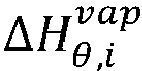 liquid heat capacity, wherein the liquid heat capacity is calculated as
 liquid viscosity, η, wherein η is calculated using the equation In η =
 any combination thereof; and(v) comparing said determined value of the thermophysical property of the biodiesel feedstock with a threshold and as a result from the comparison either:determining that the determined value of the thermophysical property of the biodiesel feedstock is acceptable and outputting an indication to a user; ordetermining that the determined value of the thermophysical property of the biodiesel feedstock is outside of an acceptable range, adjusting the feedstock by inputting other feedstock or a blend of feedstock, and then repeating the modelling with the adjusted feedstock.
 - The method of Claim 1, wherein the thermophysical property of monoglycerides, diglycerides, and triglycerides includes any one of: heat of fusion, enthalpy of formation, liquid molar volume, or any combination thereof.
- The method of Claim 1, wherein the biodiesel feedstock includes any of fats, oils, and combinations thereof.
- A method as claimed in Claim 1, wherein the step of repeating steps (i) and (ii) for different constituent monoglycerides, diglycerides and triglycerides includes:for a given monoglyceride, repeating steps (i) and (ii) to compute values of different thermophysical properties of the given monoglyceride, resulting in a plurality of computed values of the different thermophysical properties of the given monoglyceride;for a given diglyceride, repeating steps (i) and (ii) to compute values of different thermophysical properties of the given diglyceride, resulting in a plurality of computed values of the different thermophysical properties of the given diglyceride; andfor a given triglyceride repeating steps (i) and (ii) to compute values of different thermophysical properties of the given triglyceride, resulting in a plurality of computed values of the different thermophysical properties of the given triglyceride.
- A method as claimed in Claim 4, further comprising the step of storing the resulting plurality of computed values of the different monoglyceride thermophysical properties, diglyceride thermophysical properties, and triglyceride thermophysical properties in a searchable data store.
- A biodiesel system for modelling thermophysical properties of monoglycerides, diglycerides, and triglycerides in biodiesel feedstock wherein the monoglycerides, diglycerides, and triglycerides are respectively constituted of: a monoglycerol fragment and a fatty acid fragment; a diglycerol fragment and two fatty acid fragments; and a glycerol fragment and three fatty acid fragments; the system comprising:a) a data store holding a plurality of thermophysical property values of monoglycerides, diglycerides, and triglycerides, the data store being searchable and formed by, for each of different monoglycerides, diglycerides, and triglycerides:(i) estimating fragment-specific parameters for calculating thermophysical properties of a subject monoglyceride, diglyceride, and triglyceride in the biodiesel feedstock, wherein the estimating comprises computing thermophysical property parameters for a constituent fragment by regression of known values of the thermophysical property of literature monoglycerides, diglycerides, and triglycerides containing the constituent fragment;(ii) computing a value of a thermophysical property of the subject monoglyceride, diglyceride, and triglyceride from a composition of constituent fragments of the subject monoglyceride, diglyceride or triglyceride and the fragment-specific parameters, wherein the thermophysical property of the subject monoglyceride, diglyceride, and triglyceride includes any one of vapour pressure, enthalpy of vaporization, liquid heat capacity, viscosity, or any combination thereof; and(iii) storing in the data store the computed value of the thermophysical property of the subject monoglyceride, diglyceride, and triglyceride;(iv) repeating steps (i) to (iii) for different constituent monoglycerides, diglycerides, and triglycerides of said biodiesel feedstock, resulting in a plurality of stored values of the thermophysical properties of the different constituent monoglycerides, diglycerides, and triglycerides of the biodiesel feedstock; andb) a modeller coupled to receive, from the data store, the plurality of stored computed values of the thermophysical properties values of the different constituent monoglycerides, diglycerides, and triglycerides and use the received values to:
determine a value of the thermophysical property of the biodiesel feedstock using the received values of the thermophysical properties of the different constituent monoglycerides, diglycerides, and triglycerides of the biodiesel feedstock, wherein the value of the thermophysical property of the biodiesel feedstock comprises:vapor pressure, where the vapor pressure is calculated as enthalpy of vaporization, wherein the enthalpy of vaporization is calculated as
 liquid heat capacity, wherein the liquid heat capacity is calculated as
 liquid viscosity, η, wherein η is calculated using the equation In η =
 any combination thereof; andcompare said determined value of the thermophysical property of the biodiesel feedstock with a threshold and as a result from the comparison either:determine that the determined value of the thermophysical property of the biodiesel feedstock is acceptable and outputting an indication to a user; ordetermine that the determined value of the thermophysical property of the biodiesel feedstock is outside of an acceptable range and adjust the feedstock by inputting other feedstock or a blend of feedstock, and then repeating the modelling with the adjusted feedstock.
 - The system of Claim 6, wherein the thermophysical property of a subject monoglycerides, diglycerides, and triglycerides includes any one of: heat of fusion, enthalpy of formation, liquid molar volume, or any combination thereof.
- The system of claim 6, wherein the biodiesel feedstock includes any of fats, oils, and combinations thereof.
Applications Claiming Priority (2)
| Application Number | Priority Date | Filing Date | Title |
|---|---|---|---|
| US17454909P | 2009-05-01 | 2009-05-01 | |
| PCT/US2010/032069 WO2010126776A2 (en) | 2009-05-01 | 2010-04-22 | System and method of modeling mono-glycerides, di-glycerides and tryglycerides in biodiesel feedstock |
Publications (2)
| Publication Number | Publication Date |
|---|---|
| EP2425363A2 EP2425363A2 (en) | 2012-03-07 |
| EP2425363B1 true EP2425363B1 (en) | 2023-04-12 |
Family
ID=42288931
Family Applications (1)
| Application Number | Title | Priority Date | Filing Date |
|---|---|---|---|
| EP10719478.9A Active EP2425363B1 (en) | 2009-05-01 | 2010-04-22 | System and method of modeling mono-glycerides, di-glycerides and tryglycerides in biodiesel feedstock |
Country Status (5)
| Country | Link |
|---|---|
| US (1) | US8515722B2 (en) |
| EP (1) | EP2425363B1 (en) |
| JP (1) | JP2012525473A (en) |
| CA (1) | CA2777466A1 (en) |
| WO (1) | WO2010126776A2 (en) |
Families Citing this family (3)
| Publication number | Priority date | Publication date | Assignee | Title |
|---|---|---|---|---|
| US20190228843A1 (en) * | 2018-01-19 | 2019-07-25 | Aspen Technology, Inc. | Molecule-Based Equation Oriented Reactor Simulation System And Its Model Reduction |
| US12505902B2 (en) | 2020-01-10 | 2025-12-23 | Aspentech Corporation | Hybrid attribute reaction model (ARM) in molecule-based EO reactor (MB EORXR) |
| CN114139643B (en) * | 2021-12-07 | 2022-11-29 | 佳力士添加剂(海安)有限公司 | Monoglyceride quality detection method and system based on machine vision |
Family Cites Families (1)
| Publication number | Priority date | Publication date | Assignee | Title |
|---|---|---|---|---|
| US8921627B2 (en) * | 2008-12-12 | 2014-12-30 | Uop Llc | Production of diesel fuel from biorenewable feedstocks using non-flashing quench liquid |
-
2010
- 2010-04-22 US US12/765,463 patent/US8515722B2/en active Active
- 2010-04-22 WO PCT/US2010/032069 patent/WO2010126776A2/en not_active Ceased
- 2010-04-22 JP JP2012508545A patent/JP2012525473A/en not_active Withdrawn
- 2010-04-22 EP EP10719478.9A patent/EP2425363B1/en active Active
- 2010-04-22 CA CA2777466A patent/CA2777466A1/en not_active Abandoned
Also Published As
| Publication number | Publication date |
|---|---|
| WO2010126776A3 (en) | 2011-02-10 |
| WO2010126776A2 (en) | 2010-11-04 |
| WO2010126776A8 (en) | 2010-12-23 |
| US20100280810A1 (en) | 2010-11-04 |
| CA2777466A1 (en) | 2010-11-04 |
| JP2012525473A (en) | 2012-10-22 |
| US8515722B2 (en) | 2013-08-20 |
| EP2425363A2 (en) | 2012-03-07 |
Similar Documents
| Publication | Publication Date | Title |
|---|---|---|
| Zong et al. | Fragment-based approach for estimating thermophysical properties of fats and vegetable oils for modeling biodiesel production processes | |
| Vicente et al. | Optimisation of integrated biodiesel production. Part I. A study of the biodiesel purity and yield | |
| Maeda et al. | Biodiesel fuels from palm oil via the non-catalytic transesterification in a bubble column reactor at atmospheric pressure: a kinetic study | |
| Tan et al. | A glycerol-free process to produce biodiesel by supercritical methyl acetate technology: an optimization study via response surface methodology | |
| Vicente et al. | Kinetics of sunflower oil methanolysis | |
| Ilham et al. | Optimization of supercritical dimethyl carbonate method for biodiesel production | |
| Makareviciene et al. | The optimization of biodiesel fuel production from microalgae oil using response surface methodology | |
| Valle et al. | Biodiesel production using supercritical alcohols with a non-edible vegetable oil in a batch reactor | |
| Kiss et al. | Supercritical transesterification: impact of different types of alcohol on biodiesel yield and LCA results | |
| Holser | Transesterification of epoxidized soybean oil to prepare epoxy methyl esters | |
| Mustafa et al. | Highly selective synthesis of glyceryl monostearate via lipase catalyzed esterification of triple pressed stearic acid and glycerin | |
| Sarantopoulos et al. | Optimization of biodiesel production from waste lard by a two-step transesterification process under mild conditions | |
| Asoodeh et al. | Liquid–liquid equilibria of systems containing linseed oil biodiesel+ methanol+ glycerol: Experimental data and thermodynamic modeling | |
| Oliveira et al. | Description of the mutual solubilities of fatty acids and water with the CPA EoS | |
| Lanza et al. | Liquid–liquid equilibrium data for reactional systems of ethanolysis at 298.3 K | |
| Bouaid et al. | Enzymatic butanolysis of coconut oil. Biorefinery approach | |
| US8515722B2 (en) | System and method of modeling mono-glycerides, diglycerides and triglycerides in biodiesel feedstock | |
| Zong et al. | Predicting thermophysical properties of mono-and diglycerides with the chemical constituent fragment approach | |
| Bouaid et al. | Optimization of a two-step process for biodiesel production from Jatropha curcas crude oil | |
| Hakim et al. | Novel Approach for Liquid–Liquid Phase Equilibrium of Biodiesel (Canola and Sunflower)+ Glycerol+ Methanol | |
| Ataya et al. | Transesterification of canola oil to fatty acid methyl ester (FAME) in a continuous flow liquid− liquid packed bed reactor | |
| Gaide et al. | Application of snail shells as a heterogeneous catalyst for rapeseed oil butyl esters production | |
| Bollin et al. | Reactive extraction of triglycerides as fatty acid methyl esters using Lewis acidic chloroaluminate ionic liquids | |
| El Kinawy et al. | Studies on esterification kinetics of short chain alcohols with fatty acids to produce biodiesel fuel | |
| da Silva et al. | Liquid− liquid equilibrium data for systems containing Jatropha curcas oil+ oleic acid+ anhydrous ethanol+ water at (288.15 to 318.15) K |
Legal Events
| Date | Code | Title | Description |
|---|---|---|---|
| PUAI | Public reference made under article 153(3) epc to a published international application that has entered the european phase |
Free format text: ORIGINAL CODE: 0009012 |
|
| 17P | Request for examination filed |
Effective date: 20111128 |
|
| AK | Designated contracting states |
Kind code of ref document: A2 Designated state(s): AT BE BG CH CY CZ DE DK EE ES FI FR GB GR HR HU IE IS IT LI LT LU LV MC MK MT NL NO PL PT RO SE SI SK SM TR |
|
| DAX | Request for extension of the european patent (deleted) | ||
| STAA | Information on the status of an ep patent application or granted ep patent |
Free format text: STATUS: EXAMINATION IS IN PROGRESS |
|
| 17Q | First examination report despatched |
Effective date: 20170613 |
|
| RAP1 | Party data changed (applicant data changed or rights of an application transferred) |
Owner name: ASPEN TECHNOLOGY INC. |
|
| REG | Reference to a national code |
Ref country code: DE Ref legal event code: R079 Ref document number: 602010068748 Country of ref document: DE Free format text: PREVIOUS MAIN CLASS: G06F0019000000 Ipc: C11C0003000000 |
|
| RAP3 | Party data changed (applicant data changed or rights of an application transferred) |
Owner name: ASPENTECH CORPORATION |
|
| RIC1 | Information provided on ipc code assigned before grant |
Ipc: G16C 20/30 20190101ALI20220919BHEP Ipc: C11C 3/00 20060101AFI20220919BHEP |
|
| GRAP | Despatch of communication of intention to grant a patent |
Free format text: ORIGINAL CODE: EPIDOSNIGR1 |
|
| STAA | Information on the status of an ep patent application or granted ep patent |
Free format text: STATUS: GRANT OF PATENT IS INTENDED |
|
| INTG | Intention to grant announced |
Effective date: 20221116 |
|
| GRAS | Grant fee paid |
Free format text: ORIGINAL CODE: EPIDOSNIGR3 |
|
| GRAA | (expected) grant |
Free format text: ORIGINAL CODE: 0009210 |
|
| STAA | Information on the status of an ep patent application or granted ep patent |
Free format text: STATUS: THE PATENT HAS BEEN GRANTED |
|
| AK | Designated contracting states |
Kind code of ref document: B1 Designated state(s): AT BE BG CH CY CZ DE DK EE ES FI FR GB GR HR HU IE IS IT LI LT LU LV MC MK MT NL NO PL PT RO SE SI SK SM TR |
|
| REG | Reference to a national code |
Ref country code: GB Ref legal event code: FG4D |
|
| REG | Reference to a national code |
Ref country code: CH Ref legal event code: EP |
|
| REG | Reference to a national code |
Ref country code: DE Ref legal event code: R096 Ref document number: 602010068748 Country of ref document: DE |
|
| REG | Reference to a national code |
Ref country code: IE Ref legal event code: FG4D |
|
| REG | Reference to a national code |
Ref country code: AT Ref legal event code: REF Ref document number: 1559797 Country of ref document: AT Kind code of ref document: T Effective date: 20230515 |
|
| P01 | Opt-out of the competence of the unified patent court (upc) registered |
Effective date: 20230528 |
|
| REG | Reference to a national code |
Ref country code: LT Ref legal event code: MG9D |
|
| REG | Reference to a national code |
Ref country code: AT Ref legal event code: MK05 Ref document number: 1559797 Country of ref document: AT Kind code of ref document: T Effective date: 20230412 |
|
| PG25 | Lapsed in a contracting state [announced via postgrant information from national office to epo] |
Ref country code: NL Free format text: LAPSE BECAUSE OF FAILURE TO SUBMIT A TRANSLATION OF THE DESCRIPTION OR TO PAY THE FEE WITHIN THE PRESCRIBED TIME-LIMIT Effective date: 20230412 |
|
| PG25 | Lapsed in a contracting state [announced via postgrant information from national office to epo] |
Ref country code: SE Free format text: LAPSE BECAUSE OF FAILURE TO SUBMIT A TRANSLATION OF THE DESCRIPTION OR TO PAY THE FEE WITHIN THE PRESCRIBED TIME-LIMIT Effective date: 20230412 Ref country code: PT Free format text: LAPSE BECAUSE OF FAILURE TO SUBMIT A TRANSLATION OF THE DESCRIPTION OR TO PAY THE FEE WITHIN THE PRESCRIBED TIME-LIMIT Effective date: 20230814 Ref country code: NO Free format text: LAPSE BECAUSE OF FAILURE TO SUBMIT A TRANSLATION OF THE DESCRIPTION OR TO PAY THE FEE WITHIN THE PRESCRIBED TIME-LIMIT Effective date: 20230712 Ref country code: ES Free format text: LAPSE BECAUSE OF FAILURE TO SUBMIT A TRANSLATION OF THE DESCRIPTION OR TO PAY THE FEE WITHIN THE PRESCRIBED TIME-LIMIT Effective date: 20230412 Ref country code: AT Free format text: LAPSE BECAUSE OF FAILURE TO SUBMIT A TRANSLATION OF THE DESCRIPTION OR TO PAY THE FEE WITHIN THE PRESCRIBED TIME-LIMIT Effective date: 20230412 |
|
| PG25 | Lapsed in a contracting state [announced via postgrant information from national office to epo] |
Ref country code: PL Free format text: LAPSE BECAUSE OF FAILURE TO SUBMIT A TRANSLATION OF THE DESCRIPTION OR TO PAY THE FEE WITHIN THE PRESCRIBED TIME-LIMIT Effective date: 20230412 Ref country code: LV Free format text: LAPSE BECAUSE OF FAILURE TO SUBMIT A TRANSLATION OF THE DESCRIPTION OR TO PAY THE FEE WITHIN THE PRESCRIBED TIME-LIMIT Effective date: 20230412 Ref country code: LT Free format text: LAPSE BECAUSE OF FAILURE TO SUBMIT A TRANSLATION OF THE DESCRIPTION OR TO PAY THE FEE WITHIN THE PRESCRIBED TIME-LIMIT Effective date: 20230412 Ref country code: IS Free format text: LAPSE BECAUSE OF FAILURE TO SUBMIT A TRANSLATION OF THE DESCRIPTION OR TO PAY THE FEE WITHIN THE PRESCRIBED TIME-LIMIT Effective date: 20230812 Ref country code: HR Free format text: LAPSE BECAUSE OF FAILURE TO SUBMIT A TRANSLATION OF THE DESCRIPTION OR TO PAY THE FEE WITHIN THE PRESCRIBED TIME-LIMIT Effective date: 20230412 Ref country code: GR Free format text: LAPSE BECAUSE OF FAILURE TO SUBMIT A TRANSLATION OF THE DESCRIPTION OR TO PAY THE FEE WITHIN THE PRESCRIBED TIME-LIMIT Effective date: 20230713 |
|
| REG | Reference to a national code |
Ref country code: CH Ref legal event code: PL |
|
| PG25 | Lapsed in a contracting state [announced via postgrant information from national office to epo] |
Ref country code: LU Free format text: LAPSE BECAUSE OF NON-PAYMENT OF DUE FEES Effective date: 20230422 Ref country code: FI Free format text: LAPSE BECAUSE OF FAILURE TO SUBMIT A TRANSLATION OF THE DESCRIPTION OR TO PAY THE FEE WITHIN THE PRESCRIBED TIME-LIMIT Effective date: 20230412 |
|
| REG | Reference to a national code |
Ref country code: BE Ref legal event code: MM Effective date: 20230430 |
|
| REG | Reference to a national code |
Ref country code: DE Ref legal event code: R097 Ref document number: 602010068748 Country of ref document: DE |
|
| PG25 | Lapsed in a contracting state [announced via postgrant information from national office to epo] |
Ref country code: SK Free format text: LAPSE BECAUSE OF FAILURE TO SUBMIT A TRANSLATION OF THE DESCRIPTION OR TO PAY THE FEE WITHIN THE PRESCRIBED TIME-LIMIT Effective date: 20230412 |
|
| PG25 | Lapsed in a contracting state [announced via postgrant information from national office to epo] |
Ref country code: MC Free format text: LAPSE BECAUSE OF FAILURE TO SUBMIT A TRANSLATION OF THE DESCRIPTION OR TO PAY THE FEE WITHIN THE PRESCRIBED TIME-LIMIT Effective date: 20230412 |
|
| PG25 | Lapsed in a contracting state [announced via postgrant information from national office to epo] |
Ref country code: SM Free format text: LAPSE BECAUSE OF FAILURE TO SUBMIT A TRANSLATION OF THE DESCRIPTION OR TO PAY THE FEE WITHIN THE PRESCRIBED TIME-LIMIT Effective date: 20230412 Ref country code: SK Free format text: LAPSE BECAUSE OF FAILURE TO SUBMIT A TRANSLATION OF THE DESCRIPTION OR TO PAY THE FEE WITHIN THE PRESCRIBED TIME-LIMIT Effective date: 20230412 Ref country code: RO Free format text: LAPSE BECAUSE OF FAILURE TO SUBMIT A TRANSLATION OF THE DESCRIPTION OR TO PAY THE FEE WITHIN THE PRESCRIBED TIME-LIMIT Effective date: 20230412 Ref country code: MC Free format text: LAPSE BECAUSE OF FAILURE TO SUBMIT A TRANSLATION OF THE DESCRIPTION OR TO PAY THE FEE WITHIN THE PRESCRIBED TIME-LIMIT Effective date: 20230412 Ref country code: LI Free format text: LAPSE BECAUSE OF NON-PAYMENT OF DUE FEES Effective date: 20230430 Ref country code: EE Free format text: LAPSE BECAUSE OF FAILURE TO SUBMIT A TRANSLATION OF THE DESCRIPTION OR TO PAY THE FEE WITHIN THE PRESCRIBED TIME-LIMIT Effective date: 20230412 Ref country code: DK Free format text: LAPSE BECAUSE OF FAILURE TO SUBMIT A TRANSLATION OF THE DESCRIPTION OR TO PAY THE FEE WITHIN THE PRESCRIBED TIME-LIMIT Effective date: 20230412 Ref country code: CZ Free format text: LAPSE BECAUSE OF FAILURE TO SUBMIT A TRANSLATION OF THE DESCRIPTION OR TO PAY THE FEE WITHIN THE PRESCRIBED TIME-LIMIT Effective date: 20230412 Ref country code: CH Free format text: LAPSE BECAUSE OF NON-PAYMENT OF DUE FEES Effective date: 20230430 |
|
| REG | Reference to a national code |
Ref country code: IE Ref legal event code: MM4A |
|
| PLBE | No opposition filed within time limit |
Free format text: ORIGINAL CODE: 0009261 |
|
| STAA | Information on the status of an ep patent application or granted ep patent |
Free format text: STATUS: NO OPPOSITION FILED WITHIN TIME LIMIT |
|
| PG25 | Lapsed in a contracting state [announced via postgrant information from national office to epo] |
Ref country code: BE Free format text: LAPSE BECAUSE OF NON-PAYMENT OF DUE FEES Effective date: 20230430 |
|
| 26N | No opposition filed |
Effective date: 20240115 |
|
| PG25 | Lapsed in a contracting state [announced via postgrant information from national office to epo] |
Ref country code: IE Free format text: LAPSE BECAUSE OF NON-PAYMENT OF DUE FEES Effective date: 20230422 |
|
| PG25 | Lapsed in a contracting state [announced via postgrant information from national office to epo] |
Ref country code: IE Free format text: LAPSE BECAUSE OF NON-PAYMENT OF DUE FEES Effective date: 20230422 |
|
| PG25 | Lapsed in a contracting state [announced via postgrant information from national office to epo] |
Ref country code: SI Free format text: LAPSE BECAUSE OF FAILURE TO SUBMIT A TRANSLATION OF THE DESCRIPTION OR TO PAY THE FEE WITHIN THE PRESCRIBED TIME-LIMIT Effective date: 20230412 |
|
| PG25 | Lapsed in a contracting state [announced via postgrant information from national office to epo] |
Ref country code: SI Free format text: LAPSE BECAUSE OF FAILURE TO SUBMIT A TRANSLATION OF THE DESCRIPTION OR TO PAY THE FEE WITHIN THE PRESCRIBED TIME-LIMIT Effective date: 20230412 Ref country code: IT Free format text: LAPSE BECAUSE OF FAILURE TO SUBMIT A TRANSLATION OF THE DESCRIPTION OR TO PAY THE FEE WITHIN THE PRESCRIBED TIME-LIMIT Effective date: 20230412 |
|
| PG25 | Lapsed in a contracting state [announced via postgrant information from national office to epo] |
Ref country code: BG Free format text: LAPSE BECAUSE OF FAILURE TO SUBMIT A TRANSLATION OF THE DESCRIPTION OR TO PAY THE FEE WITHIN THE PRESCRIBED TIME-LIMIT Effective date: 20230412 |
|
| PG25 | Lapsed in a contracting state [announced via postgrant information from national office to epo] |
Ref country code: BG Free format text: LAPSE BECAUSE OF FAILURE TO SUBMIT A TRANSLATION OF THE DESCRIPTION OR TO PAY THE FEE WITHIN THE PRESCRIBED TIME-LIMIT Effective date: 20230412 |
|
| PG25 | Lapsed in a contracting state [announced via postgrant information from national office to epo] |
Ref country code: CY Free format text: LAPSE BECAUSE OF FAILURE TO SUBMIT A TRANSLATION OF THE DESCRIPTION OR TO PAY THE FEE WITHIN THE PRESCRIBED TIME-LIMIT; INVALID AB INITIO Effective date: 20100422 |
|
| PG25 | Lapsed in a contracting state [announced via postgrant information from national office to epo] |
Ref country code: HU Free format text: LAPSE BECAUSE OF FAILURE TO SUBMIT A TRANSLATION OF THE DESCRIPTION OR TO PAY THE FEE WITHIN THE PRESCRIBED TIME-LIMIT; INVALID AB INITIO Effective date: 20100422 |
|
| PG25 | Lapsed in a contracting state [announced via postgrant information from national office to epo] |
Ref country code: TR Free format text: LAPSE BECAUSE OF FAILURE TO SUBMIT A TRANSLATION OF THE DESCRIPTION OR TO PAY THE FEE WITHIN THE PRESCRIBED TIME-LIMIT Effective date: 20230412 |
|
| REG | Reference to a national code |
Ref country code: DE Ref legal event code: R082 Ref document number: 602010068748 Country of ref document: DE Representative=s name: WESTPHAL, MUSSGNUG & PARTNER PATENTANWAELTE MI, DE |
|
| PGFP | Annual fee paid to national office [announced via postgrant information from national office to epo] |
Ref country code: GB Payment date: 20260319 Year of fee payment: 17 |
|
| PGFP | Annual fee paid to national office [announced via postgrant information from national office to epo] |
Ref country code: FR Payment date: 20260319 Year of fee payment: 17 |
|
| PGFP | Annual fee paid to national office [announced via postgrant information from national office to epo] |
Ref country code: DE Payment date: 20260319 Year of fee payment: 17 |