EP2424503B1 - Composition for the treatment of prostate cancer - Google Patents
Composition for the treatment of prostate cancer Download PDFInfo
- Publication number
- EP2424503B1 EP2424503B1 EP10726197.6A EP10726197A EP2424503B1 EP 2424503 B1 EP2424503 B1 EP 2424503B1 EP 10726197 A EP10726197 A EP 10726197A EP 2424503 B1 EP2424503 B1 EP 2424503B1
- Authority
- EP
- European Patent Office
- Prior art keywords
- degarelix
- solvent
- concentration
- dose
- days
- Prior art date
- Legal status (The legal status is an assumption and is not a legal conclusion. Google has not performed a legal analysis and makes no representation as to the accuracy of the status listed.)
- Active
Links
Images

Classifications
-
- A—HUMAN NECESSITIES
- A61—MEDICAL OR VETERINARY SCIENCE; HYGIENE
- A61K—PREPARATIONS FOR MEDICAL, DENTAL OR TOILETRY PURPOSES
- A61K9/00—Medicinal preparations characterised by special physical form
- A61K9/0087—Galenical forms not covered by A61K9/02 - A61K9/7023
- A61K9/0095—Drinks; Beverages; Syrups; Compositions for reconstitution thereof, e.g. powders or tablets to be dispersed in a glass of water; Veterinary drenches
-
- A—HUMAN NECESSITIES
- A61—MEDICAL OR VETERINARY SCIENCE; HYGIENE
- A61K—PREPARATIONS FOR MEDICAL, DENTAL OR TOILETRY PURPOSES
- A61K38/00—Medicinal preparations containing peptides
- A61K38/04—Peptides having up to 20 amino acids in a fully defined sequence; Derivatives thereof
- A61K38/08—Peptides having 5 to 11 amino acids
- A61K38/09—Luteinising hormone-releasing hormone [LHRH], i.e. Gonadotropin-releasing hormone [GnRH]; Related peptides
-
- A—HUMAN NECESSITIES
- A61—MEDICAL OR VETERINARY SCIENCE; HYGIENE
- A61K—PREPARATIONS FOR MEDICAL, DENTAL OR TOILETRY PURPOSES
- A61K47/00—Medicinal preparations characterised by the non-active ingredients used, e.g. carriers or inert additives; Targeting or modifying agents chemically bound to the active ingredient
- A61K47/06—Organic compounds, e.g. natural or synthetic hydrocarbons, polyolefins, mineral oil, petrolatum or ozokerite
- A61K47/26—Carbohydrates, e.g. sugar alcohols, amino sugars, nucleic acids, mono-, di- or oligo-saccharides; Derivatives thereof, e.g. polysorbates, sorbitan fatty acid esters or glycyrrhizin
-
- A—HUMAN NECESSITIES
- A61—MEDICAL OR VETERINARY SCIENCE; HYGIENE
- A61K—PREPARATIONS FOR MEDICAL, DENTAL OR TOILETRY PURPOSES
- A61K9/00—Medicinal preparations characterised by special physical form
- A61K9/0012—Galenical forms characterised by the site of application
- A61K9/0019—Injectable compositions; Intramuscular, intravenous, arterial, subcutaneous administration; Compositions to be administered through the skin in an invasive manner
-
- A—HUMAN NECESSITIES
- A61—MEDICAL OR VETERINARY SCIENCE; HYGIENE
- A61K—PREPARATIONS FOR MEDICAL, DENTAL OR TOILETRY PURPOSES
- A61K9/00—Medicinal preparations characterised by special physical form
- A61K9/14—Particulate form, e.g. powders, Processes for size reducing of pure drugs or the resulting products, Pure drug nanoparticles
- A61K9/19—Particulate form, e.g. powders, Processes for size reducing of pure drugs or the resulting products, Pure drug nanoparticles lyophilised, i.e. freeze-dried, solutions or dispersions
-
- A—HUMAN NECESSITIES
- A61—MEDICAL OR VETERINARY SCIENCE; HYGIENE
- A61P—SPECIFIC THERAPEUTIC ACTIVITY OF CHEMICAL COMPOUNDS OR MEDICINAL PREPARATIONS
- A61P33/00—Antiparasitic agents
-
- A—HUMAN NECESSITIES
- A61—MEDICAL OR VETERINARY SCIENCE; HYGIENE
- A61P—SPECIFIC THERAPEUTIC ACTIVITY OF CHEMICAL COMPOUNDS OR MEDICINAL PREPARATIONS
- A61P35/00—Antineoplastic agents
Definitions
- the present invention relates to compositions for the treatment of prostate cancer.
- Prostate cancer is a leading cause of mortality and morbidity for men in the industrialized world.
- the majority of prostate cancers are dependent on testosterone for growth and the current medical approach in the management of advanced prostate cancer involves androgen deprivation.
- the aim is to reduce serum testosterone (T) to below castrate level (T ⁇ 0.5 ng/mL). This may be achieved by, for example, bilateral orchiectomy or by the administration of gonadotrophin releasing hormone (GnRH) receptor agonists.
- GnRH gonadotrophin releasing hormone
- GnRH Gonadotrophin releasing hormone
- LH luteinising hormone
- GnRH-R GnRH receptor
- Lupron leuprolide
- goserelin goserelin
- GnRH-R agonists initially act to stimulate LH release and only after prolonged treatment act to desensitize GnRH-R such that LH is no longer produced, ultimately causing suppression of testosterone production by the testes.
- the initial stimulation of LH production by the agonist leads to an initial surge in the production of male sex hormones.
- testosterone surge or “flare reaction”
- testosterone surge can last for as long as two to four weeks, and may stimulate the prostate cancer; it can lead to a worsening of current symptoms or appearance of new symptoms such as spinal cord compression, bone pain and urethral obstruction.
- an antiandrogen such as flutamide or bicalutamide, known as total androgen ablation therapy (AAT).
- AAT total androgen ablation therapy
- GnRH-R gonadotropin releasing hormone receptor
- FSH Follicle Stimulating Hormone
- compositions provided for the treatment of steroid-dependent and other diseases.
- the compositions are solutions for subcutaneous or intramuscular injection, and the active agent is a GnRH antagonist peptide according to general formula (1): Ac- D Nal- DCpa- D Pal-Ser-Aph(X 1 )- DAph(X 2 )-Leu-Lys(iPr)-Pro- D Ala-NH 2 present at a concentration sufficient to form a gel following administration.
- the present applicants have developed a third generation GnRH antagonist, degarelix, for treatment of prostate cancer.
- Degarelix is a synthetic decapeptide antagonist of GnRH.
- a long term evaluation in a multicentre randomised study demonstrated that degarelix is effective and well-tolerated without evidence of systemic allergic reactions (see Koechling, et al., "Effect of various GnRH antagonists on histamine release from human skin"; Poster, 8th Int. Symp. GnRH Analogues in Cancer & Human Rep .; subm. European J. Pharm., March 2009 ).
- An application for marketing authorisation/new drug application for a formulation for monthly administration was submitted to the FDA and EMEA on 27 February 2008. Marketing Authorisation was granted by the FDA on 24 December 2008, and by EMEA on 27 February 2009.
- Degarelix is formulated as a powder (of degarelix acetate) which is reconstituted as a solution for subcutaneous injection. It is reconstituted with Water for Injection ("WFI") or, depending on the degarelix dose and concentration, with mannitol solution (e.g. 2.5% or 5%) in order to maintain isotonicity.
- WFI Water for Injection
- mannitol solution e.g. 2.5% or 5%
- degarelix acetate In aqueous media, at concentrations of 5 mg/mL or above, degarelix acetate demonstrates nucleation dependent fibrillation, which confers to the substance its ability to form an in vivo gel-like depot at the injection site.
- body tissues such as plasma
- degarelix spontaneously forms a gel depot.
- Degarelix is then released from the depot by diffusion in a sustained manner.
- Degarelix fibrillation follows a nucleation dependent mechanism, and the properties of the depot are therefore primarily related to the degarelix concentration.
- degarelix is released from the depot in two phases: a fast release immediately after dosing, accounting for high initial plasma concentration levels; and a slow release phase which determines the plasma concentration levels in the maintenance phase.
- PK pharmacokinetic
- the area under the concentration-time curve is related to both dose and concentration of the injection solution.
- the AUC increases with increasing dose, but if the concentration of the injection solution is increased there is a decrease in the AUC.
- the absolute bioavailability has been estimated to be 43.4%, 40.0%, 31.1%, 27.4%, and 21.3% when using a dose concentration of 10, 20, 30, 40, and 60 mg/mL, respectively; increasing the concentration decreases the overall bioavailability. It is observed that a practical advantage to increasing the concentration is that the volume of the injection is reduced, with increased likelihood of patient compliance etc.
- compositions for administration of degarelix at a high dose and high concentration which, when administered according to the invention, may provide sustained release of degarelix without requirement for monthly injections.
- a composition comprising degarelix or a pharmaceutically acceptable salt thereof (e.g. acetate) for the treatment of prostate cancer, wherein the composition comprises a lyophilisate of degarelix and an excipient (e.g. co-lyophilisate, e.g. sugar, e.g. mannitol) dissolved in a solvent (e.g. aqueous solvent, e.g.
- a solvent e.g. aqueous solvent, e.g.
- a starting dose of between 200 and 300 mg of degarelix at a concentration of between 20 and 80 mg of degarelix per mL solvent is administered to a patient at a starting dose of between 200 and 300 mg of degarelix at a concentration of between 20 and 80 mg of degarelix per mL solvent; followed 14- 56 days after the starting dose by a maintenance dose of between 320 and 550 mg of degarelix at a concentration of between 50 and 80 mg degarelix per mL solvent; optionally followed by one or more further maintenance doses of between 320 and 550 mg of degarelix at a concentration of between 50 and 80 mg degarelix per mL solvent administered with an interval of 56 days to 112 days between each maintenance dose.
- the composition is administered to the patient at a starting dose of between 200 and 300 mg; followed by a maintenance dose of between 320 and 550 mg administered one month, for example 28 days, after the starting dose; followed by one or more further maintenance dose(s) of between 320 and 550 mg at intervals of three months (for example 84 days) between maintenance doses.
- the starting dose of degarelix may be for example 240 mg, at a concentration of, for example, 40mg degarelix/mL of solvent.
- The, or each, maintenance dose may be for example 360mg or 480 mg, at a concentration of, for example, 60mg degarelix/mL of solvent.
- the degarelix (or pharmaceutically acceptable salt thereof) is for administration as a liquid solution in a solvent, e.g. an aqueous solvent, e.g. water (e.g. WFI), or a solution of water and mannitol etc.
- a solvent e.g. an aqueous solvent, e.g. water (e.g. WFI), or a solution of water and mannitol etc.
- the starting and maintenance doses may be for administration by injection.
- the maintenance dose is preferably administered as two injections, each containing (substantially) half of the maintenance dose.
- the composition may provide a therapeutically active mean plasma trough concentration of degarelix (a plasma concentration of 9 ng/mL or above, preferably 10ng/mL or above, e.g.
- the term “duration of the treatment” means for as long as the maintenance doses are administered; thus “maintain this therapeutically active concentration for the duration of the treatment” means that the therapeutically active concentration is maintained at least until the last maintenance dose is administered.
- the composition may reduce the serum testosterone level of the patient to 0.5 ng/mL or below, for example from 3 days, for example from 7 days, for example from 14 days, for example from 28 days after the starting dose, and may maintain the serum testosterone level at 0.5 ng/mL or below for e.g. at least 365 days and/or the duration of the treatment.
- 240 mg (40 mg/mL) is an effective starting dose.
- two (monthly) maintenance doses 160 mg (40 mg/mL) and 80 mg (20 mg/mL) were demonstrated to be effective with testosterone response rates of 100% and 98%, respectively from Day 28 to Day 364.
- doses of 240 mg, 160 mg or 80 mg will not sustain testosterone suppression for 3 months following an injection.
- an additional dose would be required before 3 months (e.g. at Day 28).
- the defined compositions may provide a therapeutically active mean plasma concentration of degarelix (a plasma trough concentration of 9 ng/mL or above), for example from 28 days after the starting dose, and may maintain this therapeutically active concentration for e.g. at least 365 days and/or the duration of the treatment, without requirement for monthly maintenance doses.
- the applicants' defined composition (when used in this way) and treatment is not associated with a significant increase in injection related side effects (compared to administration of a dose of 240 mg degarelix at a concentration of 40 mg/mL). This is particularly significant bearing in mind the high doses (and concentrations) of degarelix in the defined maintenance dose(s).
- the concentration of the maintenance dose of degarelix or pharmaceutically acceptable salt thereof may be from 50 to 80 mg degarelix/mL solvent, e.g. 50, 51, 52, ,53, 54, 55, 56, 57, 58, 59, 60, 61, 62, 63, 64, 65, 66, 67, 68, 69, 70, 71, 72, 73, 74, 75, 76, 77, 78, 79, 80 mg/mL, e.g. 55 to 65 mg/mL.
- the applicants have found that administration of maintenance doses of degarelix or pharmaceutically acceptable salt thereof (Eg.
- acetate [formed by dissolution of a lyophilisate comprising degarelix and excipient (e.g. a co-lyophilisate e.g. mannitol) in a solvent e.g. water] of e.g. 360mg, 480mg at a concentration of between e.g. 55 to 65 mg degarelix/mL solvent, e.g. 60 mg/mL may be particularly effective.
- the administration of maintenance doses of degarelix or pharmaceutically acceptable salt thereof of 480mg at concentration 60mg degarelix/mL solvent at 84 day (3 monthly) intervals e.g.
- commencing with the first maintenance dose 28 days (one month) after the starting dose) may provide effective suppression of testosterone (i.e swift reduction of testosterone to below 0.5 ng/mL and maintenance below this level with prevention of testosterone breakthrough) for periods of up to 1 year or longer, without significant likelihood of adverse effects.
- the lack of side effects is particularly remarkable given the high doses and two injections; surprisingly, there is no increase in injection related side effects compared with the much lower 1 month doses (which are one injection).
- a pharmaceutical preparation e.g. an injectible preparation
- a lyophilisate of degarelix or pharmaceutically acceptable salt thereof e.g. degarelix acetate
- an excipient e.g. co-lyophilisate e.g. mannitol
- a solvent e.g. aqueous solvent e.g. water
- concentration of degarelix being from 55mg to 65mg degarelix per mL of solvent, wherein the amount of degarelix or pharmaceutically acceptable salt thereof is between 350mg and 550mg.
- the concentration of degarelix or pharmaceutically acceptable salt thereof may be e.g.
- the pharmaceutical preparation may be administered e.g. by injection e.g. as a single injection, preferably as two injections etc.
- a kit of parts for providing a composition comprises a lyophilisate of degarelix or pharmaceutically acceptable salt thereof (e.g. degarelix acetate) and an excipient (e.g. a co-lyophilisate e.g. sugar e.g. mannitol) dissolved in a solvent (e.g. aqueous solvent, e.g. water) at a concentration of from 20mg to 80mg degarelix per mL of solvent; the kit of parts comprising one or more containers (e.g. vials) of a lyophilisate of degarelix or pharmaceutically acceptable salt thereof and excipient; and one or more containers (e.g.
- a lyophilisate of degarelix or pharmaceutically acceptable salt thereof e.g. degarelix acetate
- an excipient e.g. a co-lyophilisate e.g. sugar e.g. mannitol
- a solvent e.g.
- the kit may optionally include means for transfer (improving transfer) of solvent between the container(s) (e.g. prefilled syringe, vial) of solvent and the container(s) (e.g. vial) of degarelix e.g adapter means e.g an adapter).
- the kit may optionally also include a device for further improving or enhancing reconstitution (e.g. a swirling device).
- the kit may provide a solution having concentration of degarelix between 20 and 80 mg/mL, e.g.
- a kit may provide a solution having 480 mg degarelix at a concentration of 60 mg/mL, The kit may comprise, for example, two containers (e.g.
- vials of 240mg degarelix and, for example, a single container (vial) of liquid (e,g, 10mL WFI).
- a single container (vial) of liquid e,g, 10mL WFI.
- WFI liquid
- each vial of degarelix with e.g. 4.2 mL WFI will provide a 4mL solution of about 240mg degarelix at conc 60mg/mL, and the two vials will together make up 8mL of maintenance dose for injection as a single or, more preferably, as two injection(s).
- the kit may comprise two containers (e.g.
- vials of 240mg degarelix (as lyophilisate with excipient) and, for example, two prefilled syringes, each including WFI (4.2mL).
- WFI 4.2mL
- a prefilled syringe including 4.2 mL WFI when mixed with 240mg degarelix from one of the containers, will provide a 4mL solution (injection) of about 240mg degarelix at conc about 60mg/mL, and that two such syringes ands containers will together make up 8mL of maintenance dose (480mg) for injection [as two injection(s)].
- the degarelix may be administered at a starting dose of between 200 and 300 mg; followed by a maintenance dose of between 320 and 550 mg administered 28 days (one month) after the starting dose; followed by one or more further maintenance dose(s) of between 320 and 550 mg at intervals of 84 days (three months) between maintenance dose(s).
- the concentration of the maintenance dose(s) of degarelix or pharmaceutically acceptable salt thereof may be between 50 and 80 mg/mL, for example from 55 to 65 mg/mL.
- a kit may comprise: at least one starting container comprising a lyophilisate of degarelix or pharmaceutically acceptable salt thereof and an excipient, wherein the lyophilisate of degarelix or pharmaceutically acceptable salt thereof is present in an amount ranging from 200 mg to 300 mg; at least one maintenance container comprising a lyophilisate of degarelix or pharmaceutically acceptable salt thereof and an excipient, wherein the lyophilisate of degarelix or pharmaceutically acceptable salt thereof is present in an amount ranging from 320 mg to 550 mg; and at least one container comprising a solvent.
- a kit may provide a solution having 480 mg degarelix at a concentration of 60 mg/mL.
- the kit may comprise, for example, two containers (e.g.
- vials of 240mg degarelix and, for example, a single container (vial) of liquid (e.g., 6 mL or 10mL WFI).
- liquid e.g. 6 mL or 10mL WFI.
- mixing each vial of degarelix with e.g. 4.2 mL WFI will provide a 4mL solution of about 240mg degarelix at a concentration of 60mg/mL of solvent, and the two vials will together make up 8mL of maintenance dose for injection as a single or, more preferably, as two injection(s).
- the kit according to the present disclosure may comprise: at least one first container comprising a lyophilisate of degarelix or pharmaceutically acceptable salt thereof and an excipient, wherein the lyophilisate of degarelix or pharmaceutically acceptable salt thereof is present in an amount ranging from 320 mg to 550 mg; and at least one second container comprising a solvent.
- a method of preparing a starting concentration and a maintenance concentration for treating prostate cancer in a patient in need thereof comprising: combining at least one starting container comprising a lyophilisate of degarelix or pharmaceutically acceptable salt thereof and an excipient with at least one container comprising a solvent, wherein the lyophilisate of degarelix or the pharmaceutically acceptable salt thereof and the excipient are dissolved in the solvent to achieve a concentration range from 20 mg to 80 mg of degarelix per mL of the solvent to form the starting concentration; combining, after an interval ranging from 14 to 56 days of forming the starting dose, at least one maintenance container comprising a lyophilisate of degarelix or pharmaceutically acceptable salt thereof and an excipient with at least one second container comprising a solvent, wherein the lyophilisate of degarelix or the pharmaceutically acceptable salt thereof and the excipient are dissolved in the solvent to achieve a concentration range from 50 mg to 80 mg of degarelix per mL of the solvent to form
- a method of preparing a composition for treating prostate cancer comprising: combining at least one first container comprising a lyophilisate of degarelix or pharmaceutically acceptable salt thereof and an excipient with at least one second container comprising a solvent, wherein the lyophilisate of degarelix or the pharmaceutically acceptable salt thereof and the excipient are dissolved in the solvent to achieve a concentration range from 50 mg to 80 mg of degarelix per mL of the solvent to form a maintenance concentration.
- the method of preparation may provide a solution having concentration of degarelix between 50 and 80 mg/mL, e.g. 55 to 65 mg/mL, e.g. 56, 57, 58, 59, 60, 61, 62, 63, or 64 mg of degarelix per mL of solvent, or any number in between.
- the dose of degarelix may range from 320 mg to 550 mg (e.g. from 350 mg to 520 mg; e.g. from 440 mg to 490 mg).
- the dose of degarelix may be, for example, 240 mg (starting dose), 360 mg (maintenance dose) or 480 mg (maintenance dose).
- plasma concentration means “plasma trough concentration”.
- One treatment month is generally regarded as, and as used in the presently described clinical trial results, is defined as, 28 days. As such, two months refer to 56 days, three months refer to 84 days, four months refer to 112 days, and so on.
- prostate cancer refers to any cancer of the prostate gland in which cells of the prostate mutate and begin to multiply out of control.
- the term “prostate cancer” includes early stage, localized, cancer of the prostate gland; later stage, locally advanced cancer of the prostate gland (in which the cancer cells spread (metastasize) from the prostate to other parts of the body, especially the bones and lymph nodes).
- Degarelix is a potent GnRH antagonist that is an analog of the GnRH decapeptide (pGlu-His-Trp-Ser-Tyr-Gly-Leu-Arg-Pro-Gly-NH 2 ) incorporating p-ureido-phenylalanines at positions 5 and 6 ( Jiang et al. (2001) J. Med. Chem. 44:453-67 ). It is indicated for treatment of patients with prostate cancer in whom androgen deprivation is warranted (including patients with rising PSA levels after having already undergone prostatectomy or radiotherapy).
- Degarelix is a selective GnRH receptor antagonist (blocker) that competitively and reversibly binds to the pituitary GnRH receptors, thereby rapidly reducing the release of gonadotrophins and consequently testosterone (T).
- Prostate cancer is sensitive to testosterone deprivation, a mainstay principle in the treatment of hormone-sensitive prostate cancer.
- GnRH receptor blockers do not induce a luteinizing hormone (LH) surge with subsequent testosterone surge/tumor stimulation and potential symptomatic flare after the initiation of treatment.
- the active ingredient degarelix is a synthetic linear decapeptide amide containing seven unnatural amino acids, five of which are D-amino acids.
- the drug substance is an acetate salt, but the active moiety of the substance is degarelix as the free base.
- the acetate salt of degarelix is a white to off-white amorphous powder (of low density as obtained after lyophilisation).
- the chemical name is D-Alaninamide, N-acetyl-3-(2-naphthalenyl)-D-alanyl-4-chloro-D-phenylalanyl-3-(3-pyridinyl)-D-alanyl-L-seryl-4-[[[(4S)-hexahydro-2,6-dioxo-4-pyrimidinyl]carbonyl]amino]-L-phenylalanyl-4-[(aminocarbonyl)amino]-D-phenylalanyl-L leucyl-N6-(1-methylethyl)-L-lysyl-L-prolyl.
- Degarelix may be formulated for administration subcutaneously (as opposed to intravenously), generally in the abdominal region, as described in further detail below.
- the injection site may vary periodically to adapt the treatment to injection site discomfort.
- injections should be given in areas where the patient will not be exposed to pressure, e.g. not close to waistband or belt and not close to the ribs.
- degarelix by subcutaneous or intramuscular injection works well, but daily injections are generally not preferred by the patient and so a depot formulation of degarelix may be utilized as describe in further detail in WO 03/006049 and U.S. Pub. Nos. 20050245455 and 20040038903 .
- subcutaneous administration of degarelix may be conducted using a depot technology in which the peptide is released from a gel-like depot over a period of (typically) one to three months.
- Degarelix (and related GnRH antagonist peptides) have a high affinity for the GnRH receptor and are much more soluble in water than other GnRH analogues.
- Degarelix and these related GnRH antagonists are capable of forming a gel after subcutaneous injection, and this gel can act as a depot from which the peptide is released over a period of weeks or even months.
- degarelix may be provided as a powder for reconstitution (with a solvent) as solution for injection (e.g., subcutaneous injection, e.g., to form a depot as described above).
- the powder may be provided as a lyophilisate containing degarelix (e.g. as acetate) and mannitol.
- a suitable solvent is water (e.g., water for injection, or WFI).
- the solvent may be provided in vessels (e.g. vials), e.g. containing 6mL solvent.
- degarelix may be provided in a vial containing 120 mg degarelix (acetate) for reconstitution with 3 mL WFI such that each mL of solution contains about 40 mg degarelix; reconstituting gives a 3mL solution for injection containing about 120 mg degarelix. Injection of two such solutions provides a starting dose of about 240 mg degarelix of concentration 40 mg/mL.
- degarelix may be provided in a vial containing 240 mg degarelix (acetate). After reconstitution with about 4 mL WFI, each mL solution contains about 60 mg degarelix. Injection of two such solutions provides a maintenmance dose of about 480 mg degarelix of concentration 60 mg/mL.
- degarelix may be provided in a vial containing 180 mg degarelix (acetate). After reconstitution with about 3 mL WFI, each mL solution contains about 60 mg degarelix. Injection of two such solutions provides a maintenance dose of about 360 mg degarelix of concentration 60 mg/mL. The reconstituted solution ready for injection should be perceived as a visually clear liquid.
- the dosing regimen for degarelix may be administered as a starting dose of 240 mg administered as 2 injections of 3 mL of about 40 mg/mL degarelix formulation, followed by maintenance doses of 480 mg administered as two injections of 4 mL of about 60 mg/mL degarelix formulation.
- a maintenance dose follows at an interval ranging from 14 to 56 days, such as 14 days, 28 days, 56 days, or any interval in between and further for example, at an interval of 28 days.
- the maintenance dose comprises degarelix or pharmaceutically acceptable salt thereof, an excipient, and a solvent.
- the maintenance dose ranges from 320 mg to 550 mg of degarelix or pharmaceutically acceptable salt thereof, for example, from 320 mg, 340 mg, 360 mg, 380 mg, 400 mg, 420 mg, 440 mg, 460 mg, 480 mg, 500 mg, 520 mg, 540 mg, 550 mg, or any number in between, and further for example, 360 mg or 480 mg of degarelix or pharmaceutically acceptable salt thereof.
- the maintenance concentration of degarelix or pharmaceutically acceptable salt thereof ranges from 50 mg/mL to 80 mg/mL, such as from 50 mg/mL, 55 mg/mL, 60 mg/mL, 65 mg/mL, 70 mg/mL, 75 mg/mL, 80 mg/mL, or any number in between and further for example, 60 mg/mL of degarelix or pharmaceutically acceptable salt thereof.
- the dosing regimen for degarelix may be administered as a maintenance dose, after the administration of the starting dose, of 360 mg or 480 mg of degarelix or pharmaceutically acceptable salt thereof as two injections of 4 mL of about 60 mg/mL of solvent.
- a further maintenance dose may be administered after the administration of the first maintenance dose at an interval ranging from 56 days to 112 days, such as 56 days, 84 days, 112 days, or any interval in between and further for example, 84 days.
- the administration of the further maintenance dose(s) may continue as needed (e.g., maintenance doses may be administered from 56-112 days after the previous maintenance dose).
- the further maintenance dose comprises degarelix or pharmaceutically acceptable salt thereof, an excipient, and a solvent.
- the further maintenance dose ranges from 320 mg to 550 mg of degarelix or pharmaceutically acceptable salt thereof, for example, from 320 mg, 340 mg, 360 mg, 380 mg, 400 mg, 420 mg, 440 mg, 460 mg, 480 mg, 500 mg, 520 mg, 540 mg, 550 mg, or any number in between, and further for example, 360 mg or 480 mg of degarelix or pharmaceutically acceptable salt thereof.
- the further maintenance dose concentration of degarelix or pharmaceutically acceptable salt thereof ranges from 50 mg/mL to 80 mg/mL, such as from 50 mg/mL, 55 mg/mL, 60 mg/mL, 65 mg/mL, 70 mg/mL, 75 mg/mL, 80 mg/mL, or any number in between and further for example, 60 mg/mL of degarelix or pharmaceutically acceptable salt thereof.
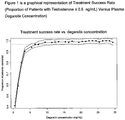
- FIG. 1 The relation between proportion of patients castrated [(T) ⁇ 0.5 ng/mL] and degarelix concentration after day 28 is illustrated in Figure 1 . This is is based on data from 1473 prostate cancer patients in clinical studies by dividing PK levels into intervals 0-1, 1-2, 2-3 ng/mL and so forth and plotting observed proportions against PK interval midpoints together with a smoothing line with 95% confidence interval (CI). This indicates that 97% of the patients are castrated provided that degarelix concentrations stay above a threshold value of 9-10 ng/mL.
- CI 95% confidence interval
- a starting dose of 240 mg (40 mg/mL) provided a suppression of testosterone to castrate level (T ⁇ 0.5 ng/mL) in 95% of the patients for the first 28 days.
- a maintenance dose of 80 mg (20 mg/mL) degarelix was sufficient for the one-month program.
- the mean trough levels for the 80 mg (20 mg/mL) maintenance dose were approximately 12 ng/mL.
- 240 mg (40 mg/mL) was established as the most effective starting dose tested. Consequently, a starting dose of 240 mg (40 mg/mL) was also used for the three-month dosing regimen studies.
- two maintenance doses, 160 mg (40 mg/mL) and 80 mg (20 mg/mL) were demonstrated to be effective with testosterone response rates of 100% and 98%, respectively from Day 28 to Day 364.
- none of the doses tested in the one-month dosing regimen program could sustain testosterone suppression for 3 months following an injection. The applicants found that with a starting dose of 240 mg (40 mg/mL), an additional dose would be required at around day 28.
- the present study therefore included a starting degarelix dose of 240 mg (40 mg/mL), followed by higher maintenance doses of degarelix: i.e., alternatively 360 mg (60 mg/mL) or 480 mg (60 mg/mL), the latter administered at Months 1, 4, 7, and 10.
- the starting dose was administered subcutaneously as two injections of 120 mg (40mg/ml). After 28 days a maintenance dose of 360 mg (conc 60 mg/mL, given as 2x3mL injections) or 480 mg (conc. 60 mg/mL, given as 2x4mL injections) was administered, also in two injections (each of 240 mg). Thereafter, with three monthly intervals, maintenance doses are given, again in the form of two injections.
- the techniques for reconstitution and subsequent subcutaneous injection of degarelix to form a depot are well known to the skilled man, and are discussed earlier in the specification. At each visit, serum testosterone, prostate specific androgen, and plasma concentration of degarelix were measured by techniques well known in the art.
- the cumulative probability of maintaining a testosterone response (T ⁇ 0.5 ng/mL) from Day 28 to Day 364 is displayed in Table 2 by treatment dose.
- the higher dose of 480 mg (60 mg/mL) shows a numerically greater treatment response (93.3% of patients maintained castrate levels of testosterone) compared to the 360 mg (60 mg/mL) dose regimen (89.0%).
- the differences between the two treatment arms in confidence coverage probability of having a true suppression rate greater than the regulatory threshold of 90% is pronounced: the 480 mg treatment arm yields a 79.9 % confidence of the true suppression rate being greater than 90%, whereas for the 360 mg treatment arm it is only 39.7%.
- Table 3 displays the proportion of patients with a testosterone suppression (T ⁇ 0.5 ng/mL) by study visit.
- the degarelix maintenance dose of 480 mg (60 mg/mL) showed sustained testosterone suppression in >95% of patients.
- the maintenance dose of 360 mg (60 mg/mL) has sustained testosterone suppression in at least 90% of patients.
- the lower values occur just before re-dosing at Month 7 (Day 196, 90.6%) and Month 10 (Day 280, 93.3%).
- 125 out of 127 patients (98%) showed suppressed testosterone levels below castrate levels at Day 28.
- Figure 2 is a graphical representation of Median Degarelix Trough Plasma Concentration Levels and Testosterone Responses after Various Three-month Dosing Regimens.
- Table 3 Proportion of Patients with Testosterone ⁇ 0.5 ng/mL by Visit - ITT Analysis Set (CS18) Degarelix 480/60 mg Degarelix 360/60 mg Total N n % N n % N N % ITT Analysis Set 66 67 133 Day 28 62 61 98.4% 65 64 98.5% 127 125 98.4% 56 61 60 98.4% 64 64 100% 84 61 60 98.4% 64 64 100% 112 60 58 96.7% 63 61 96.8% 140 60 59 98.3% 64 64 100% 168 58 57 98.3% 63 62 98.4% 196 59 58 98.3% 64 58 90.6% 224 58 57 98.3% 62 98.4% 252 57 57 100% 62 61
- Table 4 displays the median percentage change in PSA by study visit. There were further reductions in PSA after Month 1 and the median reductions were sustained throughout the study period (median reductions of 96-97%).
- Table 4 Median Percentage Change of PSA by Monthly Visits (CS18) Degarelix 480/60 mg Degarelix 360/60 mg Total N Median % Change from Baseline N Median % Change from Baseline N Median % Change from Baseline ITT Analysis Set 66 67 133 Day 28 63 -78.9% 65 -83.8% 128 -81.2% 56 61 -90.9% 66 -93.8% 127 -92.9% 84 61 -93.4% 63 -95.0% 124 -94.5% 112 60 -95.3% 64 -95.5% 124 -95.4% 140 60 -95.5% 64 -96.2% 124 -95.9% 168 58 -96.5% 63 -96.8% 121 -96.6%
- the applicants have found the pharmacodynamic (PD) dose-response is logically coherent with a pharmacokinetic(PK)/pharmacodynamic association of higher median degarelix trough levels (at the end of the one-year treatment or last available measurement) with increasing degarelix doses.
- Median degarelix trough plasma levels of approximately 7 ng/mL, 10 ng/mL, and 13 ng/mL are found with 240 mg, 360 mg, and 480 mg maintenance doses, respectively.
- the starting and maintenance doses claimed herein and defined below represent an effective three-month dosing regimen.
Landscapes
- Health & Medical Sciences (AREA)
- Life Sciences & Earth Sciences (AREA)
- Chemical & Material Sciences (AREA)
- Veterinary Medicine (AREA)
- Medicinal Chemistry (AREA)
- Pharmacology & Pharmacy (AREA)
- Animal Behavior & Ethology (AREA)
- General Health & Medical Sciences (AREA)
- Public Health (AREA)
- Epidemiology (AREA)
- Engineering & Computer Science (AREA)
- Bioinformatics & Cheminformatics (AREA)
- Gastroenterology & Hepatology (AREA)
- Dermatology (AREA)
- Endocrinology (AREA)
- Immunology (AREA)
- Proteomics, Peptides & Aminoacids (AREA)
- Reproductive Health (AREA)
- Chemical Kinetics & Catalysis (AREA)
- General Chemical & Material Sciences (AREA)
- Nuclear Medicine, Radiotherapy & Molecular Imaging (AREA)
- Organic Chemistry (AREA)
- Tropical Medicine & Parasitology (AREA)
- Biochemistry (AREA)
- Molecular Biology (AREA)
- Oil, Petroleum & Natural Gas (AREA)
- Medicinal Preparation (AREA)
- Medicines That Contain Protein Lipid Enzymes And Other Medicines (AREA)
- Pharmaceuticals Containing Other Organic And Inorganic Compounds (AREA)
- Peptides Or Proteins (AREA)
- Medicines Containing Plant Substances (AREA)
Description
- The present invention relates to compositions for the treatment of prostate cancer.
- Prostate cancer is a leading cause of mortality and morbidity for men in the industrialized world. The majority of prostate cancers are dependent on testosterone for growth and the current medical approach in the management of advanced prostate cancer involves androgen deprivation. The aim is to reduce serum testosterone (T) to below castrate level (T ≤ 0.5 ng/mL). This may be achieved by, for example, bilateral orchiectomy or by the administration of gonadotrophin releasing hormone (GnRH) receptor agonists.
- Gonadotrophin releasing hormone (GnRH) is a natural hormone produced by the hypothalamus that interacts with a receptor in the pituitary to stimulate production of luteinising hormone (LH). To decrease LH production, agonists of the GnRH receptor (GnRH-R), such as leuprolide (Lupron) and goserelin, have been developed. Such GnRH-R agonists initially act to stimulate LH release and only after prolonged treatment act to desensitize GnRH-R such that LH is no longer produced, ultimately causing suppression of testosterone production by the testes. However, the initial stimulation of LH production by the agonist leads to an initial surge in the production of male sex hormones. This phenomenon, known as the "testosterone surge" or "flare reaction," can last for as long as two to four weeks, and may stimulate the prostate cancer; it can lead to a worsening of current symptoms or appearance of new symptoms such as spinal cord compression, bone pain and urethral obstruction. One approach that has been taken to avoid this problem has been to combine administration of a GnRH-R agonist with an antiandrogen, such as flutamide or bicalutamide, known as total androgen ablation therapy (AAT). The use of antiandrogens, however, is associated with serious hepatic and gastrointestinal side effects.
- Antagonists of the gonadotropin releasing hormone receptor (GnRH-R) have been developed to overcome the "testosterone surge" or "flare reaction" associated with GnRH agonists. GnRH antagonists competitively bind to and block the GnRH receptors and cause a rapid decrease of LH and Follicle Stimulating Hormone (FSH) excretion, thereby reducing testosterone production with no initial stimulation/surge. However, GnRH antagonist peptides are frequently associated with the occurrence of histamine-releasing activity.
- While the use of both GnRH agonist and antagonists in androgen deprivation therapy to treat prostate cancer has yielded promising results, there are concerns about the relative safety of the available drugs. For example, the GnRH antagonist Abarelix™ was found to carry a risk of serious allergic reactions, including anaphylaxis with hypotension and syncope, and was also found to lose efficacy over the course of treatment in some cases. Indeed Abarelix™ (Plenaxis™ in the U.S.) was eventually approved, but only for selected patients with advance prostate cancer, and was eventually withdrawn from the market in 2005 for commercial reasons apparently related to these problems. In particular, it has been suggested that certain androgen deprivation therapies could adversely affect cardiovascular health (see Yannucci et al. (2006) J. Urology 176:520-525; and Etzioni et al. (1999) J. Natl. Canc. Inst. 91:1033).
- "Drug evaluation: Degarelix - a potential new therapy for prostate cancer" Christian Doehn, Martin Sommerauer & Dieter Jocham, IDrugs 2006 9(8): 565-572, ISSN 1369-7056, 1 August 2006) describes the following:
- A phase II trial in 187 prostate cancer patients, assessing the safety and efficacy (by measuring testosterone and PSA) of degarelix administered at 200 or 240 mg, followed by one of three different maintenance doses (80, 120 or 160 mg) every 28 days; and
- a randomized phase III trial that was initiated to investigate the efficacy and safety of 1-month dosing regimens of degarelix (initial dose of 240 mg sc followed by 160 mg sc every 28 days versus initial dose of 240 mg sc followed by 80 mg sc every 28 days) in comparison to the GnRH analog leuprolide 7.5 mg im every 28 days beginning at day 0) in patients with prostate cancer requiring antihormonal therapy.
-
WO03/006049 - The present applicants have developed a third generation GnRH antagonist, degarelix, for treatment of prostate cancer. Degarelix is a synthetic decapeptide antagonist of GnRH. A long term evaluation in a multicentre randomised study demonstrated that degarelix is effective and well-tolerated without evidence of systemic allergic reactions (see Koechling, et al., "Effect of various GnRH antagonists on histamine release from human skin"; Poster, 8th Int. Symp. GnRH Analogues in Cancer & Human Rep.; subm. European J. Pharm., March 2009). An application for marketing authorisation/new drug application for a formulation for monthly administration was submitted to the FDA and EMEA on 27 February 2008. Marketing Authorisation was granted by the FDA on 24 December 2008, and by EMEA on 27 February 2009.
- There is, however, a need for a treatment regimen which maintains serum testosterone below 0.5ng/mL long term (e.g. for periods of 1 year or longer) while minimising the administration requirements (and hence reducing the requirement for e.g. monthly hospital visits for the patient).
- The applicants have found that to maintain serum testosterone below 0.5ng/mL (i.e. prevent testosterone breakthrough) over a longer period it is necessary to administer degarelix in such a way that the median plasma trough concentration (of degarelix) is maintained above 9-10 ng/ml, preferably above 11 or 12 or 13 ng/mL (see
Fig 1 ). The prior formulations (e.g. the formulation for monthly administration) do not prevent testosterone breakthrough for periods of 3 months. Simply increasing the dose, however, is not straightforward because of the risk of side effects and also because the dose size may become unmanageable. - Degarelix is formulated as a powder (of degarelix acetate) which is reconstituted as a solution for subcutaneous injection. It is reconstituted with Water for Injection ("WFI") or, depending on the degarelix dose and concentration, with mannitol solution (e.g. 2.5% or 5%) in order to maintain isotonicity.
- In aqueous media, at concentrations of 5 mg/mL or above, degarelix acetate demonstrates nucleation dependent fibrillation, which confers to the substance its ability to form an in vivo gel-like depot at the injection site. Thus, on coming into contact with body tissues such as plasma, degarelix spontaneously forms a gel depot. Degarelix is then released from the depot by diffusion in a sustained manner. Degarelix fibrillation follows a nucleation dependent mechanism, and the properties of the depot are therefore primarily related to the degarelix concentration.
- It has been proposed that degarelix is released from the depot in two phases: a fast release immediately after dosing, accounting for high initial plasma concentration levels; and a slow release phase which determines the plasma concentration levels in the maintenance phase. In the pharmacokinetic (PK) modeling of degarelix, these two distinct phases have been described as two first-order input phases controlling the release from the depot: a fast input to account for the initial fast release described by the fast absorption half-life and a slow input to account for the prolonged phase observed described by the slow absorption half-life.
- The area under the concentration-time curve (AUC) is related to both dose and concentration of the injection solution. The AUC increases with increasing dose, but if the concentration of the injection solution is increased there is a decrease in the AUC. Thus, the absolute bioavailability has been estimated to be 43.4%, 40.0%, 31.1%, 27.4%, and 21.3% when using a dose concentration of 10, 20, 30, 40, and 60 mg/mL, respectively; increasing the concentration decreases the overall bioavailability. It is observed that a practical advantage to increasing the concentration is that the volume of the injection is reduced, with increased likelihood of patient compliance etc.
- The applicants have unexpectedly found that administration of degarelix at high dose and high concentration, for example, as applied at the maintenance phase, is associated with slower release characteristics of degarelix from the resulting depot (as well as the overall decrease in bioavailability of the degarelix discussed above). This surprising effect means that administration of defined doses of degarelix at the defined high concentrations provides a depot which releases sufficient degarelix to have the desired therapeutic effect (i.e. the required plasma concentration), but releases it sufficiently slowly that the plasma concentration is maintained at the therapeutically effective level long term (e.g. three months or above, given sufficient starting dose). Increasing the concentration of the degarelix means the injection size is manageable even at these higher doses, with the unexpected benefit that the sustained release capabilities are actually increased.
- The applicants have developed a composition for administration of degarelix at a high dose and high concentration which, when administered according to the invention, may provide sustained release of degarelix without requirement for monthly injections.
- Thus, according to the present invention in a first aspect there is provided a composition comprising degarelix or a pharmaceutically acceptable salt thereof (e.g. acetate) for the treatment of prostate cancer, wherein the composition comprises a lyophilisate of degarelix and an excipient (e.g. co-lyophilisate, e.g. sugar, e.g. mannitol) dissolved in a solvent (e.g. aqueous solvent, e.g. water), and is administered to a patient at a starting dose of between 200 and 300 mg of degarelix at a concentration of between 20 and 80 mg of degarelix per mL solvent; followed 14- 56 days after the starting dose by a maintenance dose of between 320 and 550 mg of degarelix at a concentration of between 50 and 80 mg degarelix per mL solvent; optionally followed by one or more further maintenance doses of between 320 and 550 mg of degarelix at a concentration of between 50 and 80 mg degarelix per mL solvent administered with an interval of 56 days to 112 days between each maintenance dose.
- In one example, the composition is administered to the patient at a starting dose of between 200 and 300 mg; followed by a maintenance dose of between 320 and 550 mg administered one month, for example 28 days, after the starting dose; followed by one or more further maintenance dose(s) of between 320 and 550 mg at intervals of three months (for example 84 days) between maintenance doses. The starting dose of degarelix may be for example 240 mg, at a concentration of, for example, 40mg degarelix/mL of solvent. The, or each, maintenance dose may be for example 360mg or 480 mg, at a concentration of, for example, 60mg degarelix/mL of solvent.
- The degarelix (or pharmaceutically acceptable salt thereof) is for administration as a liquid solution in a solvent, e.g. an aqueous solvent, e.g. water (e.g. WFI), or a solution of water and mannitol etc. The starting and maintenance doses may be for administration by injection. The maintenance dose is preferably administered as two injections, each containing (substantially) half of the maintenance dose. The composition may provide a therapeutically active mean plasma trough concentration of degarelix (a plasma concentration of 9 ng/mL or above, preferably 10ng/mL or above, e.g. 12 mg/mL or above, as measured by techniques well known in the art), for example from 28 days after the starting dose, and may maintain this therapeutically active concentration for e.g. at least 365 days and/or the duration of the treatment. Herein, the term "duration of the treatment" means for as long as the maintenance doses are administered; thus "maintain this therapeutically active concentration for the duration of the treatment" means that the therapeutically active concentration is maintained at least until the last maintenance dose is administered. The composition may reduce the serum testosterone level of the patient to 0.5 ng/mL or below, for example from 3 days, for example from 7 days, for example from 14 days, for example from 28 days after the starting dose, and may maintain the serum testosterone level at 0.5 ng/mL or below for e.g. at least 365 days and/or the duration of the treatment.
- Studies have established that 240 mg (40 mg/mL) is an effective starting dose. In the one-month dosing regimen studies, two (monthly) maintenance doses, 160 mg (40 mg/mL) and 80 mg (20 mg/mL), were demonstrated to be effective with testosterone response rates of 100% and 98%, respectively from Day 28 to Day 364. However, doses of 240 mg, 160 mg or 80 mg will not sustain testosterone suppression for 3 months following an injection. Thus, with a starting dose of 240 mg (40 mg/mL), an additional dose would be required before 3 months (e.g. at Day 28). Simulation of a 'true' three-month dosing schedule with 480 mg [i.e. starting dose of 480mg with further doses at 3, 6, 9 months] suggests that the trough PK level (degarelix concentration) will be around 8 ng/mL, which is insufficient. With dosing at 0 months and an additional dosage at 1 month, it is believed that a steady state level is reached faster and this is (together with formulation, dose and concentration) important. Use of a higher dose as the starting dose to have a 'true' 3 month depot is not feasible because of the combined requirements of a sufficient starting/loading phase release to allow buildup of degarelix plasma concentration; and at the same time sufficient long term release to achieve sufficiently high steady state concentration for 3 months. The applicants have surprisingly found that the defined compositions may provide a therapeutically active mean plasma concentration of degarelix (a plasma trough concentration of 9 ng/mL or above), for example from 28 days after the starting dose, and may maintain this therapeutically active concentration for e.g. at least 365 days and/or the duration of the treatment, without requirement for monthly maintenance doses. More surprisingly, the applicants' defined composition (when used in this way) and treatment is not associated with a significant increase in injection related side effects (compared to administration of a dose of 240 mg degarelix at a concentration of 40 mg/mL). This is particularly significant bearing in mind the high doses (and concentrations) of degarelix in the defined maintenance dose(s).
- The concentration of the maintenance dose of degarelix or pharmaceutically acceptable salt thereof may be from 50 to 80 mg degarelix/mL solvent, e.g. 50, 51, 52, ,53, 54, 55, 56, 57, 58, 59, 60, 61, 62, 63, 64, 65, 66, 67, 68, 69, 70, 71, 72, 73, 74, 75, 76, 77, 78, 79, 80 mg/mL, e.g. 55 to 65 mg/mL. The applicants have found that administration of maintenance doses of degarelix or pharmaceutically acceptable salt thereof (Eg. acetate) [formed by dissolution of a lyophilisate comprising degarelix and excipient (e.g. a co-lyophilisate e.g. mannitol) in a solvent e.g. water] of e.g. 360mg, 480mg at a concentration of between e.g. 55 to 65 mg degarelix/mL solvent, e.g. 60 mg/mL may be particularly effective. The administration of maintenance doses of degarelix or pharmaceutically acceptable salt thereof of 480mg at concentration 60mg degarelix/mL solvent at 84 day (3 monthly) intervals (e.g. commencing with the first maintenance dose 28 days (one month) after the starting dose) may provide effective suppression of testosterone (i.e swift reduction of testosterone to below 0.5 ng/mL and maintenance below this level with prevention of testosterone breakthrough) for periods of up to 1 year or longer, without significant likelihood of adverse effects. The lack of side effects is particularly remarkable given the high doses and two injections; surprisingly, there is no increase in injection related side effects compared with the much lower 1 month doses (which are one injection).
- According to the present invention in a further aspect there is provided a pharmaceutical preparation (e.g. an injectible preparation) comprising a lyophilisate of degarelix or pharmaceutically acceptable salt thereof (e.g. degarelix acetate) and an excipient (e.g. co-lyophilisate e.g. mannitol) dissolved in a solvent (e.g. aqueous solvent e.g. water), the concentration of degarelix being from 55mg to 65mg degarelix per mL of solvent, wherein the amount of degarelix or pharmaceutically acceptable salt thereof is between 350mg and 550mg. The concentration of degarelix or pharmaceutically acceptable salt thereof may be e.g. 55, 56, 57, 58, 59, 60, 61, 62, 63, 64, 65, mg degarelix/mL solvent. The amount of degarelix may be, for example, 360mg or 480mg. The pharmaceutical preparation may be administered e.g. by injection e.g. as a single injection, preferably as two injections etc.
- A kit of parts for providing a composition comprises a lyophilisate of degarelix or pharmaceutically acceptable salt thereof (e.g. degarelix acetate) and an excipient (e.g. a co-lyophilisate e.g. sugar e.g. mannitol) dissolved in a solvent (e.g. aqueous solvent, e.g. water) at a concentration of from 20mg to 80mg degarelix per mL of solvent; the kit of parts comprising one or more containers (e.g. vials) of a lyophilisate of degarelix or pharmaceutically acceptable salt thereof and excipient; and one or more containers (e.g. vials, prefilled syringes) of solvent; optionally with means for administration (e.g.injection), for example syringe and/or safety needle, canula etc.). The kit may optionally include means for transfer (improving transfer) of solvent between the container(s) (e.g. prefilled syringe, vial) of solvent and the container(s) (e.g. vial) of degarelix e.g adapter means e.g an adapter). The kit may optionally also include a device for further improving or enhancing reconstitution (e.g. a swirling device). The kit may provide a solution having concentration of degarelix between 20 and 80 mg/mL, e.g. between 50 and 80 mg/mL, e.g. 55 to 65 mg/mL, e.g. 56, 57, 58, 59, 60, 61, 62, 63, 64 mg/mL. The amount of degarelix may be between 220mg and 550mg degarelix, for example 320mg and 550mg (e.g. between 350 and 490 mg; e.g. between 440 and 520 mg). The amount of degarelix may be, for example, 240mg, 360mg or 480mg. In one example a kit may provide a solution having 480 mg degarelix at a concentration of 60 mg/mL, The kit may comprise, for example, two containers (e.g. vials) of 240mg degarelix and, for example, a single container (vial) of liquid (e,g, 10mL WFI). The skilled man will readily appreciate that mixing each vial of degarelix with e.g. 4.2 mL WFI will provide a 4mL solution of about 240mg degarelix at conc 60mg/mL, and the two vials will together make up 8mL of maintenance dose for injection as a single or, more preferably, as two injection(s). In a further example the kit may comprise two containers (e.g. vials) of 240mg degarelix (as lyophilisate with excipient) and, for example, two prefilled syringes, each including WFI (4.2mL). The skilled man will readily appreciate that a prefilled syringe including 4.2 mL WFI, when mixed with 240mg degarelix from one of the containers, will provide a 4mL solution (injection) of about 240mg degarelix at conc about 60mg/mL, and that two such syringes ands containers will together make up 8mL of maintenance dose (480mg) for injection [as two injection(s)].
- The degarelix may be administered at a starting dose of between 200 and 300 mg; followed by a maintenance dose of between 320 and 550 mg administered 28 days (one month) after the starting dose; followed by one or more further maintenance dose(s) of between 320 and 550 mg at intervals of 84 days (three months) between maintenance dose(s).
- The concentration of the maintenance dose(s) of degarelix or pharmaceutically acceptable salt thereof may be between 50 and 80 mg/mL, for example from 55 to 65 mg/mL.
- A kit may comprise: at least one starting container comprising a lyophilisate of degarelix or pharmaceutically acceptable salt thereof and an excipient, wherein the lyophilisate of degarelix or pharmaceutically acceptable salt thereof is present in an amount ranging from 200 mg to 300 mg; at least one maintenance container comprising a lyophilisate of degarelix or pharmaceutically acceptable salt thereof and an excipient, wherein the lyophilisate of degarelix or pharmaceutically acceptable salt thereof is present in an amount ranging from 320 mg to 550 mg; and at least one container comprising a solvent. In one example, a kit may provide a solution having 480 mg degarelix at a concentration of 60 mg/mL. The kit may comprise, for example, two containers (e.g. vials) of 240mg degarelix and, for example, a single container (vial) of liquid (e.g., 6 mL or 10mL WFI). The skilled man will readily appreciate that mixing each vial of degarelix with e.g. 4.2 mL WFI will provide a 4mL solution of about 240mg degarelix at a concentration of 60mg/mL of solvent, and the two vials will together make up 8mL of maintenance dose for injection as a single or, more preferably, as two injection(s).
- The kit according to the present disclosure may comprise: at least one first container comprising a lyophilisate of degarelix or pharmaceutically acceptable salt thereof and an excipient, wherein the lyophilisate of degarelix or pharmaceutically acceptable salt thereof is present in an amount ranging from 320 mg to 550 mg; and at least one second container comprising a solvent.
- There is provided a method of preparing a starting concentration and a maintenance concentration for treating prostate cancer in a patient in need thereof comprising: combining at least one starting container comprising a lyophilisate of degarelix or pharmaceutically acceptable salt thereof and an excipient with at least one container comprising a solvent, wherein the lyophilisate of degarelix or the pharmaceutically acceptable salt thereof and the excipient are dissolved in the solvent to achieve a concentration range from 20 mg to 80 mg of degarelix per mL of the solvent to form the starting concentration; combining, after an interval ranging from 14 to 56 days of forming the starting dose, at least one maintenance container comprising a lyophilisate of degarelix or pharmaceutically acceptable salt thereof and an excipient with at least one second container comprising a solvent, wherein the lyophilisate of degarelix or the pharmaceutically acceptable salt thereof and the excipient are dissolved in the solvent to achieve a concentration range from 50 mg to 80 mg of degarelix per mL of the solvent to form the maintenance concentration; and repeating, at least once, the combination of the at least one maintenance container with the at least one container comprising a solvent to form the maintenance concentration, after an interval ranging from 56 days to 112 days from the combination of the prior maintenance dose.
- There is provided, a method of preparing a composition for treating prostate cancer comprising: combining at least one first container comprising a lyophilisate of degarelix or pharmaceutically acceptable salt thereof and an excipient with at least one second container comprising a solvent, wherein the lyophilisate of degarelix or the pharmaceutically acceptable salt thereof and the excipient are dissolved in the solvent to achieve a concentration range from 50 mg to 80 mg of degarelix per mL of the solvent to form a maintenance concentration.
- Regarding the maintenance concentration, the method of preparation may provide a solution having concentration of degarelix between 50 and 80 mg/mL, e.g. 55 to 65 mg/mL, e.g. 56, 57, 58, 59, 60, 61, 62, 63, or 64 mg of degarelix per mL of solvent, or any number in between. The dose of degarelix may range from 320 mg to 550 mg (e.g. from 350 mg to 520 mg; e.g. from 440 mg to 490 mg). The dose of degarelix may be, for example, 240 mg (starting dose), 360 mg (maintenance dose) or 480 mg (maintenance dose).
-
-
Figure 1 is a graphical representation of Treatment Success Rate (Proportion of Patients with Testosterone ≤ 0.5 ng/mL) Versus Plasma Degarelix Concentration) -
Figure 2 is a graphical representation of Median Degarelix Trough Plasma Concentration Levels and Testosterone Responses after Various Three-month Dosing Regimens - Herein, the terms "initial dose", "starting dose" and "loading dose" are used interchangeably. The term "plasma concentration" means "plasma trough concentration".
- One treatment month is generally regarded as, and as used in the presently described clinical trial results, is defined as, 28 days. As such, two months refer to 56 days, three months refer to 84 days, four months refer to 112 days, and so on.
- The term "prostate cancer" refers to any cancer of the prostate gland in which cells of the prostate mutate and begin to multiply out of control. The term "prostate cancer" includes early stage, localized, cancer of the prostate gland; later stage, locally advanced cancer of the prostate gland (in which the cancer cells spread (metastasize) from the prostate to other parts of the body, especially the bones and lymph nodes).
- Degarelix is a potent GnRH antagonist that is an analog of the GnRH decapeptide (pGlu-His-Trp-Ser-Tyr-Gly-Leu-Arg-Pro-Gly-NH2) incorporating p-ureido-phenylalanines at
positions 5 and 6 (Jiang et al. (2001) J. Med. Chem. 44:453-67). It is indicated for treatment of patients with prostate cancer in whom androgen deprivation is warranted (including patients with rising PSA levels after having already undergone prostatectomy or radiotherapy). - Degarelix is a selective GnRH receptor antagonist (blocker) that competitively and reversibly binds to the pituitary GnRH receptors, thereby rapidly reducing the release of gonadotrophins and consequently testosterone (T). Prostate cancer is sensitive to testosterone deprivation, a mainstay principle in the treatment of hormone-sensitive prostate cancer. Unlike GnRH agonists, GnRH receptor blockers do not induce a luteinizing hormone (LH) surge with subsequent testosterone surge/tumor stimulation and potential symptomatic flare after the initiation of treatment.
- The active ingredient degarelix is a synthetic linear decapeptide amide containing seven unnatural amino acids, five of which are D-amino acids. The drug substance is an acetate salt, but the active moiety of the substance is degarelix as the free base. The acetate salt of degarelix is a white to off-white amorphous powder (of low density as obtained after lyophilisation). The chemical name is D-Alaninamide, N-acetyl-3-(2-naphthalenyl)-D-alanyl-4-chloro-D-phenylalanyl-3-(3-pyridinyl)-D-alanyl-L-seryl-4-[[[(4S)-hexahydro-2,6-dioxo-4-pyrimidinyl]carbonyl]amino]-L-phenylalanyl-4-[(aminocarbonyl)amino]-D-phenylalanyl-L leucyl-N6-(1-methylethyl)-L-lysyl-L-prolyl. It has an empirical formula of C82H103N18O16Cl and a molecular weight of 1,632.3 Da. The chemical structure of degarelix has been previously shown (
EP 1003774 ,US 5,925,730 ,U.S. 6,214,798 ) and may be represented by the formula: - Ac-D-2Nal-D-4Cpa-D-3Pal-Ser-4Aph(Hor)-D-4Aph(Cbm)-Leu-Lys(iPr)-Pro-D-Ala-NH2.
- Degarelix may be formulated for administration subcutaneously (as opposed to intravenously), generally in the abdominal region, as described in further detail below. As with other drugs administered by subcutaneous injection, the injection site may vary periodically to adapt the treatment to injection site discomfort. In general, injections should be given in areas where the patient will not be exposed to pressure, e.g. not close to waistband or belt and not close to the ribs.
- Administration of degarelix by subcutaneous or intramuscular injection works well, but daily injections are generally not preferred by the patient and so a depot formulation of degarelix may be utilized as describe in further detail in
WO 03/006049 U.S. Pub. Nos. 20050245455 and20040038903 . Briefly, subcutaneous administration of degarelix may be conducted using a depot technology in which the peptide is released from a gel-like depot over a period of (typically) one to three months. Degarelix (and related GnRH antagonist peptides) have a high affinity for the GnRH receptor and are much more soluble in water than other GnRH analogues. Degarelix and these related GnRH antagonists are capable of forming a gel after subcutaneous injection, and this gel can act as a depot from which the peptide is released over a period of weeks or even months. - Thus, degarelix may be provided as a powder for reconstitution (with a solvent) as solution for injection (e.g., subcutaneous injection, e.g., to form a depot as described above). The powder may be provided as a lyophilisate containing degarelix (e.g. as acetate) and mannitol. A suitable solvent is water (e.g., water for injection, or WFI). The solvent may be provided in vessels (e.g. vials), e.g. containing 6mL solvent. For example, degarelix may be provided in a vial containing 120 mg degarelix (acetate) for reconstitution with 3 mL WFI such that each mL of solution contains about 40 mg degarelix; reconstituting gives a 3mL solution for injection containing about 120 mg degarelix. Injection of two such solutions provides a starting dose of about 240 mg degarelix of concentration 40 mg/mL. In another example, degarelix may be provided in a vial containing 240 mg degarelix (acetate). After reconstitution with about 4 mL WFI, each mL solution contains about 60 mg degarelix. Injection of two such solutions provides a maintenmance dose of about 480 mg degarelix of concentration 60 mg/mL. In another example, degarelix may be provided in a vial containing 180 mg degarelix (acetate). After reconstitution with about 3 mL WFI, each mL solution contains about 60 mg degarelix. Injection of two such solutions provides a maintenance dose of about 360 mg degarelix of concentration 60 mg/mL. The reconstituted solution ready for injection should be perceived as a visually clear liquid.
- The dosing regimen for degarelix may be administered as a starting dose of 240 mg administered as 2 injections of 3 mL of about 40 mg/mL degarelix formulation, followed by maintenance doses of 480 mg administered as two injections of 4 mL of about 60 mg/mL degarelix formulation.
- After administration of the starting dose, a maintenance dose follows at an interval ranging from 14 to 56 days, such as 14 days, 28 days, 56 days, or any interval in between and further for example, at an interval of 28 days. The maintenance dose comprises degarelix or pharmaceutically acceptable salt thereof, an excipient, and a solvent. The maintenance dose ranges from 320 mg to 550 mg of degarelix or pharmaceutically acceptable salt thereof, for example, from 320 mg, 340 mg, 360 mg, 380 mg, 400 mg, 420 mg, 440 mg, 460 mg, 480 mg, 500 mg, 520 mg, 540 mg, 550 mg, or any number in between, and further for example, 360 mg or 480 mg of degarelix or pharmaceutically acceptable salt thereof. The maintenance concentration of degarelix or pharmaceutically acceptable salt thereof ranges from 50 mg/mL to 80 mg/mL, such as from 50 mg/mL, 55 mg/mL, 60 mg/mL, 65 mg/mL, 70 mg/mL, 75 mg/mL, 80 mg/mL, or any number in between and further for example, 60 mg/mL of degarelix or pharmaceutically acceptable salt thereof. In an example, the dosing regimen for degarelix may be administered as a maintenance dose, after the administration of the starting dose, of 360 mg or 480 mg of degarelix or pharmaceutically acceptable salt thereof as two injections of 4 mL of about 60 mg/mL of solvent.
- A further maintenance dose may be administered after the administration of the first maintenance dose at an interval ranging from 56 days to 112 days, such as 56 days, 84 days, 112 days, or any interval in between and further for example, 84 days. The administration of the further maintenance dose(s) may continue as needed (e.g., maintenance doses may be administered from 56-112 days after the previous maintenance dose). The further maintenance dose comprises degarelix or pharmaceutically acceptable salt thereof, an excipient, and a solvent. The further maintenance dose ranges from 320 mg to 550 mg of degarelix or pharmaceutically acceptable salt thereof, for example, from 320 mg, 340 mg, 360 mg, 380 mg, 400 mg, 420 mg, 440 mg, 460 mg, 480 mg, 500 mg, 520 mg, 540 mg, 550 mg, or any number in between, and further for example, 360 mg or 480 mg of degarelix or pharmaceutically acceptable salt thereof. The further maintenance dose concentration of degarelix or pharmaceutically acceptable salt thereof ranges from 50 mg/mL to 80 mg/mL, such as from 50 mg/mL, 55 mg/mL, 60 mg/mL, 65 mg/mL, 70 mg/mL, 75 mg/mL, 80 mg/mL, or any number in between and further for example, 60 mg/mL of degarelix or pharmaceutically acceptable salt thereof.
- Throughout the ongoing degarelix development program, population pharmacokinetic/pharmacodynamic (PK/PD) modeling and simulations have been employed to get a better understanding of the PK and PD data, and the relationship between these and other parameters. Results obtained from the previous studies demonstrated that a median trough plasma degarelix concentration of 7.34 ng/mL resulted in 96% of patients achieving serum testosterone (T) ≤ 0.5 ng/mL at Day 28, and that a median plasma concentration of 4.54 ng/mL resulted in 83% of this same group of patients having T ≤ 0.5 ng/mL at Day 84. Because of the variability in the population, it was considered that this median plasma concentration might not be sufficient to maintain long-term testosterone suppression in approximately 95% of the patients. It was therefore proposed that the dose administered should produce mean serum trough degarelix levels of > 9 ng/ml or higher in the
Phase 3 studies for the one-month dosing regimen program. - The relation between proportion of patients castrated [(T) ≤ 0.5 ng/mL] and degarelix concentration after day 28 is illustrated in
Figure 1 . This is is based on data from 1473 prostate cancer patients in clinical studies by dividing PK levels into intervals 0-1, 1-2, 2-3 ng/mL and so forth and plotting observed proportions against PK interval midpoints together with a smoothing line with 95% confidence interval (CI). This indicates that 97% of the patients are castrated provided that degarelix concentrations stay above a threshold value of 9-10 ng/mL. - Thus, in the one-month dosing regimen clinical program, it was shown that a starting dose of 240 mg (40 mg/mL) provided a suppression of testosterone to castrate level (T ≤ 0.5 ng/mL) in 95% of the patients for the first 28 days. A maintenance dose of 80 mg (20 mg/mL) degarelix was sufficient for the one-month program. The mean trough levels for the 80 mg (20 mg/mL) maintenance dose were approximately 12 ng/mL.
- Thus, in the one-month degarelix dosing program, 240 mg (40 mg/mL) was established as the most effective starting dose tested. Consequently, a starting dose of 240 mg (40 mg/mL) was also used for the three-month dosing regimen studies. In the one-month dosing regimen studies, two maintenance doses, 160 mg (40 mg/mL) and 80 mg (20 mg/mL), were demonstrated to be effective with testosterone response rates of 100% and 98%, respectively from Day 28 to Day 364. However, none of the doses tested in the one-month dosing regimen program could sustain testosterone suppression for 3 months following an injection. The applicants found that with a starting dose of 240 mg (40 mg/mL), an additional dose would be required at around day 28.
- A three-month dosing regimen Phase 2 study investigated three different dosing regimens. After a starting dose of 240 mg/mL (40 mg/mL), a further dose of 240 mg was given on Day 28, and then at
Months Months 4, 7, and 10. Maintenance doses of 240 mg were evaluated initially at concentrations of 40 mg/mL and 60 mg/mL in this study, based on the observed results by different PK profiles of different concentrations. The patients were randomized in parallel to one of three different three-month maintenance dosing regimens of degarelix: - 240 mg (40 mg/mL) at
Months - 240 mg (60 mg/mL) at
Months - 240 mg (60 mg/mL) at
Months 1, 4, 7, 10 - The present study therefore included a starting degarelix dose of 240 mg (40 mg/mL), followed by higher maintenance doses of degarelix: i.e., alternatively 360 mg (60 mg/mL) or 480 mg (60 mg/mL), the latter administered at
Months 1, 4, 7, and 10. - This study recently completed with 133 patients enrolled (planned enrollment 120). The variables for baseline disease characteristics are summarized for the Phase 2 studies for the three-month dosing regimen in Table 1. There were about 10% of patients who had localized cancer where the treatment was of a curative intent. Most patients had a Gleason score of 7-10 and most patients were normally active as rated on the ECOG performance scale. The mean duration of prostate cancer (PCA) from diagnosis is also shown.
Table 1 Stage and Duration of Prostate Cancer at Baseline (Phase 2, Three-Month Dosing Regimen) Late dose finding (CS18) 480 mg (N=66) 360 mg (N=67) Stage of PCa at enrolment N=66 N=67 Localized 19 (29%) 26 (39%) Locally advanced 22 (33%) 17 (25%) Metastatic 16 (24%) 14 (21%) Not complete classification 9 (14%) 10 (15%) Curative Intent N=66 N=67 Yes 6 (9%) 7 (10%) No 60 (91%) 60 (90%) PCa Stage not complete N=9 N=10 Curative Intent 4 (44%) 3 (30%) Gleason Score N=66 N=66 2-4 3 (5%) 8 (12%) 5-6 24 (36%) 19 (29%) 7-10 39 (59%) 39 (59%) PCa Duration N=64 N=67 Mean (SD) years 0.725 (1.37) 1.01 (2.77) Range (0.057-6.03) 0.063-20.3) ECOG Performance Score N=66 N=67 Normal activity 51 (77%) 49 (73%) Symptoms, ambulatory 14 (21%) 15 (22%) Bedridden <50% 1 (2%) 3 (4%) Bedridden > 50% 0 0 Bedridden 100% 0 0 PCa= prostate cancer - The study was open and patients received a starting dose of 240 mg (40 mg/mL) at
Month 0 followed by one of two degarelix maintenance dose treatment regimens: - 360 mg (60 mg/mL) at
Months 1, 4, 7, 10 - 480 mg (60 mg/mL) at
Months 1, 4, 7, 10 - The starting dose was administered subcutaneously as two injections of 120 mg (40mg/ml). After 28 days a maintenance dose of 360 mg (conc 60 mg/mL, given as 2x3mL injections) or 480 mg (conc. 60 mg/mL, given as 2x4mL injections) was administered, also in two injections (each of 240 mg). Thereafter, with three monthly intervals, maintenance doses are given, again in the form of two injections. The techniques for reconstitution and subsequent subcutaneous injection of degarelix to form a depot are well known to the skilled man, and are discussed earlier in the specification. At each visit, serum testosterone, prostate specific androgen, and plasma concentration of degarelix were measured by techniques well known in the art.
- The cumulative probability of maintaining a testosterone response (T ≤ 0.5 ng/mL) from Day 28 to Day 364 is displayed in Table 2 by treatment dose. The higher dose of 480 mg (60 mg/mL) shows a numerically greater treatment response (93.3% of patients maintained castrate levels of testosterone) compared to the 360 mg (60 mg/mL) dose regimen (89.0%). Although not statistically significantly different, the differences between the two treatment arms in confidence coverage probability of having a true suppression rate greater than the regulatory threshold of 90% is pronounced: the 480 mg treatment arm yields a 79.9 % confidence of the true suppression rate being greater than 90%, whereas for the 360 mg treatment arm it is only 39.7%.
Table 2 Cumulative Probability of Testosterone ≤0.5 ng/mL from Day 28 to Day 364 - Kaplan-Meier Estimates of Response Rates - ITT Analysis Set (CS18) Degarelix 480/60mg Degarelix 360/60 mg Total T>0.5 ng/mL Cens % T>0.5 ng/mL Cens % T>0.5 ng/mL Cens % N 66 67 133 Day 28 to >364 4 62 93.3% 7 60 89.0% 11 122 92.8% 95% CI 83.1; 97.4% 78.3; 94.6% 84.5; 95.0% Coverage Probability ÿ% 79.9% 39.7% T>0.5 ng/mL = Number of patients with testosterone > 0.5 ng/mL
Cens = Number of censored observations before or at Day 364
(%) = Estimated probability of all testosterone values <= 0.5 ng/mL Within-treatment group 95 % Confidence Interval (CI) calculated by log-log transformation of survivor function - Table 3 displays the proportion of patients with a testosterone suppression (T ≤ 0.5 ng/mL) by study visit.
- The degarelix maintenance dose of 480 mg (60 mg/mL) showed sustained testosterone suppression in >95% of patients. The maintenance dose of 360 mg (60 mg/mL) has sustained testosterone suppression in at least 90% of patients. The lower values occur just before re-dosing at Month 7 (Day 196, 90.6%) and Month 10 (Day 280, 93.3%). In total, 125 out of 127 patients (98%) showed suppressed testosterone levels below castrate levels at Day 28.
-
Figure 2 is a graphical representation of Median Degarelix Trough Plasma Concentration Levels and Testosterone Responses after Various Three-month Dosing Regimens.Table 3 Proportion of Patients with Testosterone ≤0.5 ng/mL by Visit - ITT Analysis Set (CS18) Degarelix 480/60mg Degarelix 360/60 mg Total N n % N n % N N % ITT Analysis Set 66 67 133 Day 28 62 61 98.4% 65 64 98.5% 127 125 98.4% 56 61 60 98.4% 64 64 100% 84 61 60 98.4% 64 64 100% 112 60 58 96.7% 63 61 96.8% 140 60 59 98.3% 64 64 100% 168 58 57 98.3% 63 62 98.4% 196 59 58 98.3% 64 58 90.6% 224 58 57 98.3% 63 62 98.4% 252 57 57 100% 62 61 98.4% 280 55 54 98.2% 60 56 93.3% 308 54 54 100% 61 61 100% 336 55 55 100% 60 58 96.7% 364 54 52 96.3% 60 57 95.0% N = Number of patients
n = Number of patients with testosterone y 0.5 ng/mL
% = n/N x 100 - Table 4 displays the median percentage change in PSA by study visit. There were further reductions in PSA after Month 1 and the median reductions were sustained throughout the study period (median reductions of 96-97%).
Table 4 Median Percentage Change of PSA by Monthly Visits (CS18) Degarelix 480/60mg Degarelix 360/60 mg Total N Median % Change from Baseline N Median % Change from Baseline N Median % Change from Baseline ITT Analysis Set 66 67 133 Day 28 63 -78.9% 65 -83.8% 128 -81.2% 56 61 -90.9% 66 -93.8% 127 -92.9% 84 61 -93.4% 63 -95.0% 124 -94.5% 112 60 -95.3% 64 -95.5% 124 -95.4% 140 60 -95.5% 64 -96.2% 124 -95.9% 168 58 -96.5% 63 -96.8% 121 -96.6% 196 59 -96.2% 63 -95.9% 122 -96.2% 224 58 -96.6% 62 -96.4% 120 -96.5% 252 57 -96.9% 60 -97.0% 117 -96.9% 280 55 -96.5% 60 -97.0% 115 -97.0% 308 54 -97.0% 60 -97.3% 114 -97.2% 336 55 -97.4 % 61 -97.5 % 116 -97.4% 364 54 -97.1% 60 -96.9 114 -96.9% Last visit 65 -96.5% 66 -96.9% 131 -96.8% N = Number of patients - At the data cut-off date of 02 September 2008, 133 patients with prostate cancer had been exposed to degarelix in the Phase 2, three-month dosing regimen clinical program of the Example described above (CS18).
- The more common treatment-emergent adverse events reported in >5% of patients in any treatment group in CS18 are summarized as follows (% value being the total of both 480 mg and 360 mg dosage arms): hot flush (34%), injection site pain (17%), weight increase (11%), hypertension (8%), injection site erythema (7%), testicular athrophy (6%), asthenia (5%), arthralgia (5%), fatigue (5%), gynaecomastia (5%), pyrexia (4%), weight decrease (5%), pyrexia (4%). Immediate generalized hypersensitivity reactions have been reported with earlier GnRH antagonists. There have been no immediate anaphylactic reactions reported in the degarelix clinical program.
- The potential for hepatotoxicity has been extensively evaluated in the clinical program, and as of the data cut-off date, the data do not show any clinically significant impairment of liver function after degarelix treatment.
- The incidence of any injection site reaction was 26% in Example 1 and the incidence of any injection site reaction was comparable between the two doses. The most frequently reported injection site reaction was injection site pain (17%). Surprisingly, these data are comparable to the results from the one-month dosing regimen clinical program using much lower doses (e.g. 240 mg) of degarelix. Most of the injection site reactions were mild to moderate in intensity (11% each) with 5% of the patients reporting severe injection site reactions. The six patients reporting severe injection site reactions reported injection site pain as the severe event.
- Thus, the applicants have found the pharmacodynamic (PD) dose-response is logically coherent with a pharmacokinetic(PK)/pharmacodynamic association of higher median degarelix trough levels (at the end of the one-year treatment or last available measurement) with increasing degarelix doses. Median degarelix trough plasma levels of approximately 7 ng/mL, 10 ng/mL, and 13 ng/mL are found with 240 mg, 360 mg, and 480 mg maintenance doses, respectively. In addition, there were no major differences in the incidence and pattern of adverse events in patients treated with the 360 mg and 480 mg maintenance doses. On the basis of the testosterone suppression and PK results, the starting and maintenance doses claimed herein and defined below represent an effective three-month dosing regimen.
-
- <110> FERRING INTERNATIONAL CENTER S.A.
- <120> Composition For The Treatment of Prostate Cancer
- <130> P/60977.WO01
- <150>
EP 09251242.5
<151> 2009-05-01 - <150>
US 61/187819
<151> 2009-06-17 - <160> 1
- <170> PatentIn version 3.3
- <210> 1
<211> 10
<212> PRT
<213> Homo sapiens - <220>
<221> PYRROLIDONE CARBOXYLIC ACID
<222> (1)..(1)
<223> N-terminal glutamate which has formed an internal cyclic lactam (Glu modified to pyroGlu) - <400> 1

Claims (15)
- A composition comprising degarelix or a pharmaceutically acceptable salt thereof for use in the treatment of prostate cancer, wherein the composition comprises a lyophilisate of degarelix and an excipient dissolved in a solvent, and is administered to a patient at a starting dose of between 200 and 300 mg of degarelix at a concentration of between 20 and 80 mg of degarelix per mL solvent; followed 14- 56 days after the starting dose by a maintenance dose of between 320 and 550 mg of degarelix at a concentration of between 50 and 80 mg degarelix per mL solvent; optionally followed by one or more further maintenance doses of between 320 and 550 mg of degarelix at a concentration of between 50 and 80 mg degarelix per mL solvent administered with an interval of 56 days to 112 days between each maintenance dose.
- A composition for use according to claim 1 wherein the compostion comprises a lyophilisate of degarelix or pharmaceutically acceptable salt and mannitol dissolved in the solvent.
- A composition for use according to claim 1 wherein the solvent is water.
- A composition for use according to claim 1 for administration at a starting dose of between 200 and 300 mg degarelix; followed 28 days after the starting dose by a maintenance dose of between 320 and 550 mg degarelix; followed by one or more further maintenance dose(s) of between 320 and 550 mg degarelix at intervals of 84 days between maintenance doses.
- A composition for use according to any preceding claim wherein the concentration of the starting dose is 40 mg degarelix per mL of solvent.
- A composition for use according to any preceding claim wherein the concentration of the maintenance dose(s) is between 55 and 65 mg degarelix per mL of solvent.
- A composition for use according to any preceding claim wherein the concentration of the maintenance dose is 60 mg degarelix per mL of solvent.
- A composition for use according to any preceding claim wherein the starting dose of degarelix is 240 mg.
- A composition for use according to any preceding claim wherein the maintenance dose is 360mg or 480 mg.
- A composition comprising degarelix or a pharmaceutically acceptable salt thereof for use according to claim 1, wherein the composition comprises a lyophilisate of degarelix and an excipient dissolved in a solvent, and is administered to a patient at a starting dose of 240 mg of degarelix at a concentration of 40 mg of degarelix per mL solvent; followed 28 days after the starting dose by a maintenance dose of 480 mg of degarelix at a concentration 60 mg degarelix per mL solvent; optionally followed by one or more further maintenance doses of 480 mg of degarelix at a concentration of between 60 mg degarelix per mL solvent, with an interval of 84 days between each maintenance dose.
- A composition comprising degarelix or a pharmaceutically acceptable salt thereof for use according to claim 1, wherein the composition comprises a lyophilisate of degarelix and an excipient dissolved in a solvent, and is administered to a patient at a starting dose of 240 mg of degarelix at a concentration of 40 mg of degarelix per mL solvent; followed 28 days after the starting dose by a maintenance dose of 360 mg of degarelix at a concentration 60 mg degarelix per mL solvent; optionally followed by one or more further maintenance doses of 360 mg of degarelix at a dose concentration of between 60 mg degarelix per mL solvent, with an interval of 84 days between each maintenance dose.
- A pharmaceutical preparation comprising a lyophilisate of degarelix or pharmaceutically acceptable salt thereof and an excipient dissolved in a solvent, the concentration of degarelix being from 55mg to 65mg degarelix per mL of solvent, wherein the amount of degarelix or pharmaceutically acceptable salt thereof is between 350 and 550 mg.
- A preparation according to claim 12 wherein the solvent is water and/or wherein the excipient is mannitol.
- A preparation according to claim 12 or 13 wherein the concentration of degarelix or pharmaceutically acceptable salt thereof is 60 mg degarelix/mL of solvent.
- A preparation according to any of claims 12 to 14 wherein the amount of degarelix or pharmaceutically acceptable salt thereof is 360mg or 480mg.
Priority Applications (1)
| Application Number | Priority Date | Filing Date | Title |
|---|---|---|---|
| EP10726197.6A EP2424503B1 (en) | 2009-05-01 | 2010-04-30 | Composition for the treatment of prostate cancer |
Applications Claiming Priority (4)
| Application Number | Priority Date | Filing Date | Title |
|---|---|---|---|
| EP09251242 | 2009-05-01 | ||
| US18781909P | 2009-06-17 | 2009-06-17 | |
| PCT/IB2010/001063 WO2010125468A1 (en) | 2009-05-01 | 2010-04-30 | Composition for the treatment of prostate cancer |
| EP10726197.6A EP2424503B1 (en) | 2009-05-01 | 2010-04-30 | Composition for the treatment of prostate cancer |
Publications (2)
| Publication Number | Publication Date |
|---|---|
| EP2424503A1 EP2424503A1 (en) | 2012-03-07 |
| EP2424503B1 true EP2424503B1 (en) | 2017-07-05 |
Family
ID=41066059
Family Applications (1)
| Application Number | Title | Priority Date | Filing Date |
|---|---|---|---|
| EP10726197.6A Active EP2424503B1 (en) | 2009-05-01 | 2010-04-30 | Composition for the treatment of prostate cancer |
Country Status (18)
| Country | Link |
|---|---|
| US (1) | US8722088B2 (en) |
| EP (1) | EP2424503B1 (en) |
| JP (6) | JP5973909B2 (en) |
| KR (1) | KR101795643B1 (en) |
| CN (2) | CN105663059A (en) |
| AR (1) | AR078224A1 (en) |
| AU (1) | AU2010243273B2 (en) |
| BR (1) | BRPI1010874A8 (en) |
| CA (1) | CA2759888A1 (en) |
| ES (1) | ES2641767T3 (en) |
| IL (1) | IL215772A (en) |
| MX (1) | MX2011011431A (en) |
| NZ (1) | NZ595767A (en) |
| RU (1) | RU2536245C2 (en) |
| SA (1) | SA110310340B1 (en) |
| TW (2) | TWI583391B (en) |
| WO (1) | WO2010125468A1 (en) |
| ZA (1) | ZA201107879B (en) |
Families Citing this family (16)
| Publication number | Priority date | Publication date | Assignee | Title |
|---|---|---|---|---|
| GB0117057D0 (en) * | 2001-07-12 | 2001-09-05 | Ferring Bv | Pharmaceutical composition |
| TWI539959B (en) | 2008-02-11 | 2016-07-01 | 菲瑞茵國際中心股份有限公司 | Method for treating prostate cancer during metastasis |
| MX2011011431A (en) | 2009-05-01 | 2012-02-23 | Ferring Bv | Composition for the treatment of prostate cancer. |
| US20110039787A1 (en) * | 2009-07-06 | 2011-02-17 | Ferring International Center S.A. | Compositions, kits and methods for treating benign prostate hyperplasia |
| DK3564357T3 (en) | 2010-02-01 | 2022-06-20 | Rebiotix Inc | BACTERIA THERAPY AGAINST CLOSTRIDIUM DIFFICILE COLITIS |
| EP2447276A1 (en) | 2010-10-27 | 2012-05-02 | Ferring B.V. | Process for the manufacture of Degarelix and its intermediates |
| LT2632934T (en) | 2010-10-27 | 2017-01-10 | Ferring B.V. | Process for the manufacture of degarelix and its intermediates |
| JO3755B1 (en) | 2011-01-26 | 2021-01-31 | Ferring Bv | Testosterone formulations |
| CN102204889B (en) * | 2011-05-23 | 2013-09-18 | 蚌埠丰原涂山制药有限公司 | Degarelix acetate lyophilized powder injection and preparation method thereof |
| PL4512390T1 (en) | 2012-06-01 | 2025-09-01 | Ferring B.V. | Manufacture of degarelix |
| KR102099503B1 (en) | 2013-06-05 | 2020-04-09 | 리바이오틱스, 인코퍼레이티드 | Microbiota restoration therapy (mrt) compositions |
| US10828340B2 (en) | 2015-06-09 | 2020-11-10 | Rebiotix, Inc. | Microbiota restoration therapy (MRT) compositions and methods of manufacture |
| TWI571254B (en) * | 2016-01-08 | 2017-02-21 | 誠熱實業股份有限公司 | Medical device for use in radiotherapy |
| CN105769774A (en) * | 2016-03-02 | 2016-07-20 | 张光泉 | Degarelix acetate freeze-dried composition for injection and preparation method thereof |
| US10933134B2 (en) * | 2017-03-16 | 2021-03-02 | Memorial Sloan Kettering Cancer Center | Combination therapies for treatment of cancer |
| RU2731002C1 (en) * | 2019-10-22 | 2020-08-26 | Государственное бюджетное учреждение здравоохранения Московской области "Московский областной научно-исследовательский клинический институт им. М.Ф. Владимирского" (ГБУЗ МО МОНИКИ им. М.Ф. Владимирского) | Method of treating prostate cancer |
Citations (1)
| Publication number | Priority date | Publication date | Assignee | Title |
|---|---|---|---|---|
| WO2003006049A1 (en) | 2001-07-12 | 2003-01-23 | Ferring Bv | Gonadotropin releasing hormone antagonists in gel-forming concentrations |
Family Cites Families (31)
| Publication number | Priority date | Publication date | Assignee | Title |
|---|---|---|---|---|
| US3773919A (en) | 1969-10-23 | 1973-11-20 | Du Pont | Polylactide-drug mixtures |
| DE2862341D1 (en) | 1977-12-26 | 1983-11-24 | Ihara Chemical Ind Co | Process for producing aromatic monocarboxylic acid |
| DE69214818T2 (en) | 1991-04-25 | 1997-02-27 | Romano S.-Cergue Deghenghi | LHRH antagonists |
| EP0556034B2 (en) | 1992-02-12 | 2004-07-21 | Daikyo Gomu Seiko Ltd. | A medical instrument |
| SI9300468A (en) | 1992-10-14 | 1994-06-30 | Hoffmann La Roche | Injectable composition for the sustained release of biologically active compounds |
| US5506207A (en) | 1994-03-18 | 1996-04-09 | The Salk Institute For Biological Studies | GNRH antagonists XIII |
| US5595760A (en) | 1994-09-02 | 1997-01-21 | Delab | Sustained release of peptides from pharmaceutical compositions |
| US5860957A (en) | 1997-02-07 | 1999-01-19 | Sarcos, Inc. | Multipathway electronically-controlled drug delivery system |
| US5925730A (en) | 1997-04-11 | 1999-07-20 | Ferring Bv | GnRH antagonists |
| US5821230A (en) | 1997-04-11 | 1998-10-13 | Ferring Bv | GnRH antagonist decapeptides |
| FR2776520B1 (en) | 1998-03-25 | 2000-05-05 | Sod Conseils Rech Applic | NOVEL PHARMACEUTICAL COMPOSITIONS FOR THE SUSTAINED RELEASE OF PEPTIDES AND THEIR PREPARATION PROCESS |
| US20040198706A1 (en) | 2003-03-11 | 2004-10-07 | Carrara Dario Norberto R. | Methods and formulations for transdermal or transmucosal application of active agents |
| ATE357261T1 (en) * | 2001-07-11 | 2007-04-15 | Sca Hygiene Prod Ab | COUPLING OF CYCLOOLIGOSACCHARIDES TO POLYSACCHARIDES |
| US7098305B2 (en) * | 2001-09-06 | 2006-08-29 | Ardana Bioscience Limited | Sustained release of microcrystalline peptide suspensions |
| CN1411803A (en) | 2002-08-29 | 2003-04-23 | 四川大学 | Method for preparing precursor liposome and its device |
| BRPI0314546B8 (en) * | 2002-09-27 | 2021-05-25 | Zentaris Gmbh | pharmaceutical gel composition comprising pharmaceutically active peptides with sustained release, method for producing the same kit. |
| AR042815A1 (en) | 2002-12-26 | 2005-07-06 | Alza Corp | ACTIVE AGENT SUPPLY DEVICE THAT HAS COMPOUND MEMBERS |
| EP1674082A1 (en) | 2004-12-22 | 2006-06-28 | Zentaris GmbH | Process for the manufacture of sterile suspensions or lyophilisates of low-soluble basic peptide complexes, pharmaceutical formulations comprising these complexes and their use as medicament |
| WO2007130809A2 (en) | 2006-05-06 | 2007-11-15 | Volodymyr Brodskyy | An automatic injectable drug mixing device |
| EP1891964A1 (en) | 2006-08-08 | 2008-02-27 | AEterna Zentaris GmbH | Application of initial doses of LHRH analogues and maintenance doses of LHRH antagonists for the treatment of hormone-dependent cancers and corresponding pharmaceutical kits |
| EP1967202A1 (en) | 2007-03-05 | 2008-09-10 | AEterna Zentaris GmbH | Use of LHRH Antagonists for the Treatment of Lower Urinary Tract Symptoms, in particular Overactive Bladder and/or Detrusor Overactivity |
| IL182922A0 (en) | 2007-05-02 | 2007-09-20 | Medimop Medical Projects Ltd | Automatic liquid drug reconstitution apparatus |
| TWI539959B (en) | 2008-02-11 | 2016-07-01 | 菲瑞茵國際中心股份有限公司 | Method for treating prostate cancer during metastasis |
| ES2589322T3 (en) | 2008-02-11 | 2016-11-11 | Safety Syringes, Inc. | Syringe with needle and clip safety guard to prevent the release of the protector during a reconstitution process |
| MX2011011431A (en) | 2009-05-01 | 2012-02-23 | Ferring Bv | Composition for the treatment of prostate cancer. |
| TW201043221A (en) | 2009-05-06 | 2010-12-16 | Ferring Int Ct Sa | Kit and method for preparation of a Degarelix solution |
| US20110039787A1 (en) | 2009-07-06 | 2011-02-17 | Ferring International Center S.A. | Compositions, kits and methods for treating benign prostate hyperplasia |
| LT2632934T (en) | 2010-10-27 | 2017-01-10 | Ferring B.V. | Process for the manufacture of degarelix and its intermediates |
| EP2447276A1 (en) | 2010-10-27 | 2012-05-02 | Ferring B.V. | Process for the manufacture of Degarelix and its intermediates |
| JO3755B1 (en) | 2011-01-26 | 2021-01-31 | Ferring Bv | Testosterone formulations |
| KR20140063602A (en) | 2011-07-15 | 2014-05-27 | 훼링 비.브이. | Method for timing a colonoscopy wherein a picosulate composition is administered |
-
2010
- 2010-04-30 MX MX2011011431A patent/MX2011011431A/en active IP Right Grant
- 2010-04-30 KR KR1020117025625A patent/KR101795643B1/en active Active
- 2010-04-30 EP EP10726197.6A patent/EP2424503B1/en active Active
- 2010-04-30 CN CN201610082160.4A patent/CN105663059A/en active Pending
- 2010-04-30 NZ NZ595767A patent/NZ595767A/en unknown
- 2010-04-30 RU RU2011142843/15A patent/RU2536245C2/en active
- 2010-04-30 US US12/771,199 patent/US8722088B2/en active Active
- 2010-04-30 CN CN2010800191738A patent/CN102421414A/en active Pending
- 2010-04-30 BR BRPI1010874A patent/BRPI1010874A8/en not_active Application Discontinuation
- 2010-04-30 ES ES10726197.6T patent/ES2641767T3/en active Active
- 2010-04-30 TW TW104130953A patent/TWI583391B/en active
- 2010-04-30 AR ARP100101489A patent/AR078224A1/en not_active Application Discontinuation
- 2010-04-30 TW TW099113849A patent/TWI508734B/en active
- 2010-04-30 WO PCT/IB2010/001063 patent/WO2010125468A1/en not_active Ceased
- 2010-04-30 AU AU2010243273A patent/AU2010243273B2/en active Active
- 2010-04-30 CA CA2759888A patent/CA2759888A1/en not_active Abandoned
- 2010-04-30 JP JP2012507846A patent/JP5973909B2/en active Active
- 2010-05-01 SA SA110310340A patent/SA110310340B1/en unknown
-
2011
- 2011-10-23 IL IL215772A patent/IL215772A/en active IP Right Grant
- 2011-10-27 ZA ZA2011/07879A patent/ZA201107879B/en unknown
-
2015
- 2015-03-24 JP JP2015060929A patent/JP6462447B2/en active Active
-
2020
- 2020-07-30 JP JP2020129078A patent/JP7296922B2/en active Active
-
2022
- 2022-03-29 JP JP2022052785A patent/JP7297116B2/en active Active
-
2023
- 2023-04-21 JP JP2023069860A patent/JP7665674B2/en active Active
-
2025
- 2025-04-09 JP JP2025064140A patent/JP2025106459A/en active Pending
Patent Citations (1)
| Publication number | Priority date | Publication date | Assignee | Title |
|---|---|---|---|---|
| WO2003006049A1 (en) | 2001-07-12 | 2003-01-23 | Ferring Bv | Gonadotropin releasing hormone antagonists in gel-forming concentrations |
Non-Patent Citations (15)
| Title |
|---|
| "Assessment report for Firmagon (doc ref:EMEA/CHMP/63576/2008)", EUROPEAN MEDICINES AGENCY (EMEA), 4 March 2009 (2009-03-04), pages 1 - 67, XP055481967 |
| "monthly, package leaflet for the US", TRELSTAR LA, 2006 |
| "Open-Label, Randomized Parallel-Group Study View of NCT00728533 on 2009_02_19", CLINICAL TRIAL, 19 February 2009 (2009-02-19), XP055481905 |
| "three-monthly, package leaflet for the US", TRELSTAR LA, August 2006 (2006-08-01) |
| ANONYMOUS: "TRADENAME® (degarelix for injection) for subcutaneous administration", FDA, 24 December 2008 (2008-12-24), XP055481950, Retrieved from the Internet <URL:www.accessdata.fda.gov/scripts/cder/daf> |
| BROQUA ET AL.: "Pharmacological Profile of a New, Potent, and Long-Acting Gonadotropin-Releasing Hormone Antagonist: Degarelix", J. PHARAMCOL. EXP. THERAPEUT., vol. 301, 2002, pages 95 - 102, XP055055233 |
| CONN P.M.: "Gonadotropin-releasing hormone and its analogs", ANN. REV. MED., vol. 45, 1994, pages 391 - 405, XP055481996 |
| DOEHN CH. ET AL.: "Drug evaluation: Degarelix - a potential new therapy for prostate cancer, (D3 of IPER of the EPO", IDRUGS, vol. 9, 2006, pages 565 - 572, XP009105353 |
| JIANG G. ET AL.: "GnRH antagonists: A new generation of long acting analogues incorporating p-ureido-phenylalanines at positions 5 and 6", JOURNAL OF MEDICAL CHEMISTRY, vol. 44, no. 3, 2001, pages 453 - 467, XP009119476 |
| LUPRON DEPOT, 3 MONTH AND 4 MONTH, US -LEAFLET, 2005 |
| RIVIER J. ET AL.: "Gonadotropin-releasing hormone antagonists with Nw-triazolylornithine,- lysine, or -p-aminophenylalanine residues at positions 5 and 6", JOURNAL OF MEDICAL CHEMISTRY, vol. 35, 1992, pages 4270 - 4278, XP002071776 |
| SARTOR O.: "Eligard0 6: A New Form of Treatment for Prostate Cancer", EUR. UROLOGY SUPPLEMENTS, vol. 5, no. 18, 2006, pages 905 - 910, XP005684027 |
| SHAYNE COX: "Pharmaceutical Manufacturing Handbook", article SHUNMUGAPERUMAL TAMILVANAN: "5.2 Progress in design of biodegradable polymer-based microspheres for parenteral controlled delivery of therapeutic peptides/protein", pages: 393 - 441, XP055481986 |
| SORBERA L.A. ET AL.: "Degarelix Acetate", DRUGS OF THE FUTURE, vol. 31, 2006, pages 755 - 766, XP002548773 |
| TAMMELA T. ET AL.: "Dega relix - A phase II multicenter, randomized dose-escalating study testing a novel GnRH receptor blocker in prostate cancer patients", EUROP. UROL. SUPPL., vol. 4, no. 3, 2005, pages 228, XP055276667 |
Also Published As
Similar Documents
| Publication | Publication Date | Title |
|---|---|---|
| EP2424503B1 (en) | Composition for the treatment of prostate cancer | |
| JP4845166B2 (en) | Gonadotropin-releasing hormone antagonist at gel-forming concentrations | |
| EP2451469B1 (en) | Composition for the treatment of benign prostate hyperplasia | |
| HU225691B1 (en) | Aqueous formulations of peptides | |
| TW200824704A (en) | Application of initial doses of LHRH analogues and maintenance doses of LHRH antagonists for the treatment of hormone-dependent cancers and corresponding pharmaceutical kits | |
| JP2025004006A (en) | Teverelix-TFA Composition | |
| EP1297850B1 (en) | Medicinal preparations for treating sex hormone-dependent diseases | |
| JP7085958B2 (en) | Composition for treating prostate cancer | |
| HK1169597A (en) | Composition for the treatment of prostate cancer | |
| Engel et al. | Five years' clinical use of GnRH antagonists: evaluation of safety and allergic potential | |
| WO2013104745A1 (en) | Pharmaceutical composition | |
| EP1140132A1 (en) | Gonadotropin releasing hormone antagonist | |
| WO2019110688A1 (en) | A composition comprising degarelix for use in the treatment of breast cancer |
Legal Events
| Date | Code | Title | Description |
|---|---|---|---|
| PUAI | Public reference made under article 153(3) epc to a published international application that has entered the european phase |
Free format text: ORIGINAL CODE: 0009012 |
|
| 17P | Request for examination filed |
Effective date: 20111024 |
|
| AK | Designated contracting states |
Kind code of ref document: A1 Designated state(s): AT BE BG CH CY CZ DE DK EE ES FI FR GB GR HR HU IE IS IT LI LT LU LV MC MK MT NL NO PL PT RO SE SI SK SM TR |
|
| DAX | Request for extension of the european patent (deleted) | ||
| 17Q | First examination report despatched |
Effective date: 20141007 |
|
| GRAP | Despatch of communication of intention to grant a patent |
Free format text: ORIGINAL CODE: EPIDOSNIGR1 |
|
| INTG | Intention to grant announced |
Effective date: 20160810 |
|
| GRAS | Grant fee paid |
Free format text: ORIGINAL CODE: EPIDOSNIGR3 |
|
| STAA | Information on the status of an ep patent application or granted ep patent |
Free format text: STATUS: GRANT OF PATENT IS INTENDED |
|
| GRAJ | Information related to disapproval of communication of intention to grant by the applicant or resumption of examination proceedings by the epo deleted |
Free format text: ORIGINAL CODE: EPIDOSDIGR1 |
|
| GRAL | Information related to payment of fee for publishing/printing deleted |
Free format text: ORIGINAL CODE: EPIDOSDIGR3 |
|
| STAA | Information on the status of an ep patent application or granted ep patent |
Free format text: STATUS: EXAMINATION IS IN PROGRESS |
|
| GRAP | Despatch of communication of intention to grant a patent |
Free format text: ORIGINAL CODE: EPIDOSNIGR1 |
|
| STAA | Information on the status of an ep patent application or granted ep patent |
Free format text: STATUS: GRANT OF PATENT IS INTENDED |
|
| INTC | Intention to grant announced (deleted) | ||
| INTG | Intention to grant announced |
Effective date: 20170125 |
|
| GRAA | (expected) grant |
Free format text: ORIGINAL CODE: 0009210 |
|
| STAA | Information on the status of an ep patent application or granted ep patent |
Free format text: STATUS: THE PATENT HAS BEEN GRANTED |
|
| AK | Designated contracting states |
Kind code of ref document: B1 Designated state(s): AT BE BG CH CY CZ DE DK EE ES FI FR GB GR HR HU IE IS IT LI LT LU LV MC MK MT NL NO PL PT RO SE SI SK SM TR |
|
| REG | Reference to a national code |
Ref country code: GB Ref legal event code: FG4D |
|
| REG | Reference to a national code |
Ref country code: CH Ref legal event code: EP |
|
| REG | Reference to a national code |
Ref country code: AT Ref legal event code: REF Ref document number: 906087 Country of ref document: AT Kind code of ref document: T Effective date: 20170715 |
|
| REG | Reference to a national code |
Ref country code: IE Ref legal event code: FG4D |
|
| REG | Reference to a national code |
Ref country code: DE Ref legal event code: R096 Ref document number: 602010043423 Country of ref document: DE |
|
| REG | Reference to a national code |
Ref country code: CH Ref legal event code: NV Representative=s name: BOVARD AG PATENT- UND MARKENANWAELTE, CH |
|
| REG | Reference to a national code |
Ref country code: NL Ref legal event code: MP Effective date: 20170705 |
|
| REG | Reference to a national code |
Ref country code: ES Ref legal event code: FG2A Ref document number: 2641767 Country of ref document: ES Kind code of ref document: T3 Effective date: 20171113 |
|
| REG | Reference to a national code |
Ref country code: AT Ref legal event code: MK05 Ref document number: 906087 Country of ref document: AT Kind code of ref document: T Effective date: 20170705 |
|
| REG | Reference to a national code |
Ref country code: LT Ref legal event code: MG4D |
|
| PG25 | Lapsed in a contracting state [announced via postgrant information from national office to epo] |
Ref country code: AT Free format text: LAPSE BECAUSE OF FAILURE TO SUBMIT A TRANSLATION OF THE DESCRIPTION OR TO PAY THE FEE WITHIN THE PRESCRIBED TIME-LIMIT Effective date: 20170705 Ref country code: LT Free format text: LAPSE BECAUSE OF FAILURE TO SUBMIT A TRANSLATION OF THE DESCRIPTION OR TO PAY THE FEE WITHIN THE PRESCRIBED TIME-LIMIT Effective date: 20170705 Ref country code: NL Free format text: LAPSE BECAUSE OF FAILURE TO SUBMIT A TRANSLATION OF THE DESCRIPTION OR TO PAY THE FEE WITHIN THE PRESCRIBED TIME-LIMIT Effective date: 20170705 Ref country code: HR Free format text: LAPSE BECAUSE OF FAILURE TO SUBMIT A TRANSLATION OF THE DESCRIPTION OR TO PAY THE FEE WITHIN THE PRESCRIBED TIME-LIMIT Effective date: 20170705 Ref country code: SE Free format text: LAPSE BECAUSE OF FAILURE TO SUBMIT A TRANSLATION OF THE DESCRIPTION OR TO PAY THE FEE WITHIN THE PRESCRIBED TIME-LIMIT Effective date: 20170705 Ref country code: FI Free format text: LAPSE BECAUSE OF FAILURE TO SUBMIT A TRANSLATION OF THE DESCRIPTION OR TO PAY THE FEE WITHIN THE PRESCRIBED TIME-LIMIT Effective date: 20170705 Ref country code: NO Free format text: LAPSE BECAUSE OF FAILURE TO SUBMIT A TRANSLATION OF THE DESCRIPTION OR TO PAY THE FEE WITHIN THE PRESCRIBED TIME-LIMIT Effective date: 20171005 |
|
| PG25 | Lapsed in a contracting state [announced via postgrant information from national office to epo] |
Ref country code: LV Free format text: LAPSE BECAUSE OF FAILURE TO SUBMIT A TRANSLATION OF THE DESCRIPTION OR TO PAY THE FEE WITHIN THE PRESCRIBED TIME-LIMIT Effective date: 20170705 Ref country code: BG Free format text: LAPSE BECAUSE OF FAILURE TO SUBMIT A TRANSLATION OF THE DESCRIPTION OR TO PAY THE FEE WITHIN THE PRESCRIBED TIME-LIMIT Effective date: 20171005 Ref country code: IS Free format text: LAPSE BECAUSE OF FAILURE TO SUBMIT A TRANSLATION OF THE DESCRIPTION OR TO PAY THE FEE WITHIN THE PRESCRIBED TIME-LIMIT Effective date: 20171105 Ref country code: PL Free format text: LAPSE BECAUSE OF FAILURE TO SUBMIT A TRANSLATION OF THE DESCRIPTION OR TO PAY THE FEE WITHIN THE PRESCRIBED TIME-LIMIT Effective date: 20170705 Ref country code: GR Free format text: LAPSE BECAUSE OF FAILURE TO SUBMIT A TRANSLATION OF THE DESCRIPTION OR TO PAY THE FEE WITHIN THE PRESCRIBED TIME-LIMIT Effective date: 20171006 |
|
| REG | Reference to a national code |
Ref country code: DE Ref legal event code: R026 Ref document number: 602010043423 Country of ref document: DE |
|
| PLBI | Opposition filed |
Free format text: ORIGINAL CODE: 0009260 |
|
| REG | Reference to a national code |
Ref country code: FR Ref legal event code: PLFP Year of fee payment: 9 |
|
| PG25 | Lapsed in a contracting state [announced via postgrant information from national office to epo] |
Ref country code: RO Free format text: LAPSE BECAUSE OF FAILURE TO SUBMIT A TRANSLATION OF THE DESCRIPTION OR TO PAY THE FEE WITHIN THE PRESCRIBED TIME-LIMIT Effective date: 20170705 Ref country code: CZ Free format text: LAPSE BECAUSE OF FAILURE TO SUBMIT A TRANSLATION OF THE DESCRIPTION OR TO PAY THE FEE WITHIN THE PRESCRIBED TIME-LIMIT Effective date: 20170705 Ref country code: DK Free format text: LAPSE BECAUSE OF FAILURE TO SUBMIT A TRANSLATION OF THE DESCRIPTION OR TO PAY THE FEE WITHIN THE PRESCRIBED TIME-LIMIT Effective date: 20170705 |
|
| PLAX | Notice of opposition and request to file observation + time limit sent |
Free format text: ORIGINAL CODE: EPIDOSNOBS2 |
|
| 26 | Opposition filed |
Opponent name: SANDOZ AG Effective date: 20180405 |
|
| PG25 | Lapsed in a contracting state [announced via postgrant information from national office to epo] |
Ref country code: SK Free format text: LAPSE BECAUSE OF FAILURE TO SUBMIT A TRANSLATION OF THE DESCRIPTION OR TO PAY THE FEE WITHIN THE PRESCRIBED TIME-LIMIT Effective date: 20170705 Ref country code: SM Free format text: LAPSE BECAUSE OF FAILURE TO SUBMIT A TRANSLATION OF THE DESCRIPTION OR TO PAY THE FEE WITHIN THE PRESCRIBED TIME-LIMIT Effective date: 20170705 Ref country code: EE Free format text: LAPSE BECAUSE OF FAILURE TO SUBMIT A TRANSLATION OF THE DESCRIPTION OR TO PAY THE FEE WITHIN THE PRESCRIBED TIME-LIMIT Effective date: 20170705 |
|
| PG25 | Lapsed in a contracting state [announced via postgrant information from national office to epo] |
Ref country code: SI Free format text: LAPSE BECAUSE OF FAILURE TO SUBMIT A TRANSLATION OF THE DESCRIPTION OR TO PAY THE FEE WITHIN THE PRESCRIBED TIME-LIMIT Effective date: 20170705 |
|
| PLBB | Reply of patent proprietor to notice(s) of opposition received |
Free format text: ORIGINAL CODE: EPIDOSNOBS3 |
|
| PG25 | Lapsed in a contracting state [announced via postgrant information from national office to epo] |
Ref country code: MC Free format text: LAPSE BECAUSE OF FAILURE TO SUBMIT A TRANSLATION OF THE DESCRIPTION OR TO PAY THE FEE WITHIN THE PRESCRIBED TIME-LIMIT Effective date: 20170705 |
|
| REG | Reference to a national code |
Ref country code: BE Ref legal event code: MM Effective date: 20180430 |
|
| REG | Reference to a national code |
Ref country code: IE Ref legal event code: MM4A |
|
| PG25 | Lapsed in a contracting state [announced via postgrant information from national office to epo] |
Ref country code: LU Free format text: LAPSE BECAUSE OF NON-PAYMENT OF DUE FEES Effective date: 20180430 |
|
| PG25 | Lapsed in a contracting state [announced via postgrant information from national office to epo] |
Ref country code: BE Free format text: LAPSE BECAUSE OF NON-PAYMENT OF DUE FEES Effective date: 20180430 |
|
| PG25 | Lapsed in a contracting state [announced via postgrant information from national office to epo] |
Ref country code: IE Free format text: LAPSE BECAUSE OF NON-PAYMENT OF DUE FEES Effective date: 20180430 |
|
| PLCK | Communication despatched that opposition was rejected |
Free format text: ORIGINAL CODE: EPIDOSNREJ1 |
|
| PG25 | Lapsed in a contracting state [announced via postgrant information from national office to epo] |
Ref country code: MT Free format text: LAPSE BECAUSE OF NON-PAYMENT OF DUE FEES Effective date: 20180430 |
|
| APBM | Appeal reference recorded |
Free format text: ORIGINAL CODE: EPIDOSNREFNO |
|
| APBP | Date of receipt of notice of appeal recorded |
Free format text: ORIGINAL CODE: EPIDOSNNOA2O |
|
| APAH | Appeal reference modified |
Free format text: ORIGINAL CODE: EPIDOSCREFNO |
|
| PG25 | Lapsed in a contracting state [announced via postgrant information from national office to epo] |
Ref country code: TR Free format text: LAPSE BECAUSE OF FAILURE TO SUBMIT A TRANSLATION OF THE DESCRIPTION OR TO PAY THE FEE WITHIN THE PRESCRIBED TIME-LIMIT Effective date: 20170705 |
|
| PLAB | Opposition data, opponent's data or that of the opponent's representative modified |
Free format text: ORIGINAL CODE: 0009299OPPO |
|
| APBQ | Date of receipt of statement of grounds of appeal recorded |
Free format text: ORIGINAL CODE: EPIDOSNNOA3O |
|
| PG25 | Lapsed in a contracting state [announced via postgrant information from national office to epo] |
Ref country code: HU Free format text: LAPSE BECAUSE OF FAILURE TO SUBMIT A TRANSLATION OF THE DESCRIPTION OR TO PAY THE FEE WITHIN THE PRESCRIBED TIME-LIMIT; INVALID AB INITIO Effective date: 20100430 Ref country code: PT Free format text: LAPSE BECAUSE OF FAILURE TO SUBMIT A TRANSLATION OF THE DESCRIPTION OR TO PAY THE FEE WITHIN THE PRESCRIBED TIME-LIMIT Effective date: 20170705 |
|
| R26 | Opposition filed (corrected) |
Opponent name: SANDOZ AG Effective date: 20180405 |
|
| PG25 | Lapsed in a contracting state [announced via postgrant information from national office to epo] |
Ref country code: MK Free format text: LAPSE BECAUSE OF NON-PAYMENT OF DUE FEES Effective date: 20170705 Ref country code: CY Free format text: LAPSE BECAUSE OF FAILURE TO SUBMIT A TRANSLATION OF THE DESCRIPTION OR TO PAY THE FEE WITHIN THE PRESCRIBED TIME-LIMIT Effective date: 20170705 |
|
| REG | Reference to a national code |
Ref country code: DE Ref legal event code: R100 Ref document number: 602010043423 Country of ref document: DE |
|
| APBU | Appeal procedure closed |
Free format text: ORIGINAL CODE: EPIDOSNNOA9O |
|
| PLBN | Opposition rejected |
Free format text: ORIGINAL CODE: 0009273 |
|
| STAA | Information on the status of an ep patent application or granted ep patent |
Free format text: STATUS: OPPOSITION REJECTED |
|
| 27O | Opposition rejected |
Effective date: 20220520 |
|
| P01 | Opt-out of the competence of the unified patent court (upc) registered |
Effective date: 20230527 |
|
| PGFP | Annual fee paid to national office [announced via postgrant information from national office to epo] |
Ref country code: DE Payment date: 20250428 Year of fee payment: 16 |
|
| PGFP | Annual fee paid to national office [announced via postgrant information from national office to epo] |
Ref country code: ES Payment date: 20250513 Year of fee payment: 16 Ref country code: GB Payment date: 20250422 Year of fee payment: 16 |
|
| PGFP | Annual fee paid to national office [announced via postgrant information from national office to epo] |
Ref country code: IT Payment date: 20250422 Year of fee payment: 16 |
|
| PGFP | Annual fee paid to national office [announced via postgrant information from national office to epo] |
Ref country code: FR Payment date: 20250424 Year of fee payment: 16 |
|
| PGFP | Annual fee paid to national office [announced via postgrant information from national office to epo] |
Ref country code: CH Payment date: 20250501 Year of fee payment: 16 |