EP2424155A1 - Information generating device, information generating method, and information generating program and storage medium thereof - Google Patents
Information generating device, information generating method, and information generating program and storage medium thereof Download PDFInfo
- Publication number
- EP2424155A1 EP2424155A1 EP10767171A EP10767171A EP2424155A1 EP 2424155 A1 EP2424155 A1 EP 2424155A1 EP 10767171 A EP10767171 A EP 10767171A EP 10767171 A EP10767171 A EP 10767171A EP 2424155 A1 EP2424155 A1 EP 2424155A1
- Authority
- EP
- European Patent Office
- Prior art keywords
- information
- index
- random number
- cyclic group
- derivation
- Prior art date
- Legal status (The legal status is an assumption and is not a legal conclusion. Google has not performed a legal analysis and makes no representation as to the accuracy of the status listed.)
- Granted
Links
Images


Classifications
-
- H—ELECTRICITY
- H04—ELECTRIC COMMUNICATION TECHNIQUE
- H04L—TRANSMISSION OF DIGITAL INFORMATION, e.g. TELEGRAPHIC COMMUNICATION
- H04L9/00—Cryptographic mechanisms or cryptographic arrangements for secret or secure communications; Network security protocols
- H04L9/08—Key distribution or management, e.g. generation, sharing or updating, of cryptographic keys or passwords
-
- H—ELECTRICITY
- H04—ELECTRIC COMMUNICATION TECHNIQUE
- H04L—TRANSMISSION OF DIGITAL INFORMATION, e.g. TELEGRAPHIC COMMUNICATION
- H04L9/00—Cryptographic mechanisms or cryptographic arrangements for secret or secure communications; Network security protocols
- H04L9/30—Public key, i.e. encryption algorithm being computationally infeasible to invert or user's encryption keys not requiring secrecy
- H04L9/3066—Public key, i.e. encryption algorithm being computationally infeasible to invert or user's encryption keys not requiring secrecy involving algebraic varieties, e.g. elliptic or hyper-elliptic curves
- H04L9/3073—Public key, i.e. encryption algorithm being computationally infeasible to invert or user's encryption keys not requiring secrecy involving algebraic varieties, e.g. elliptic or hyper-elliptic curves involving pairings, e.g. identity based encryption [IBE], bilinear mappings or bilinear pairings, e.g. Weil or Tate pairing
-
- H—ELECTRICITY
- H04—ELECTRIC COMMUNICATION TECHNIQUE
- H04L—TRANSMISSION OF DIGITAL INFORMATION, e.g. TELEGRAPHIC COMMUNICATION
- H04L9/00—Cryptographic mechanisms or cryptographic arrangements for secret or secure communications; Network security protocols
- H04L9/08—Key distribution or management, e.g. generation, sharing or updating, of cryptographic keys or passwords
- H04L9/0816—Key establishment, i.e. cryptographic processes or cryptographic protocols whereby a shared secret becomes available to two or more parties, for subsequent use
- H04L9/0819—Key transport or distribution, i.e. key establishment techniques where one party creates or otherwise obtains a secret value, and securely transfers it to the other(s)
- H04L9/083—Key transport or distribution, i.e. key establishment techniques where one party creates or otherwise obtains a secret value, and securely transfers it to the other(s) involving central third party, e.g. key distribution center [KDC] or trusted third party [TTP]
- H04L9/0833—Key transport or distribution, i.e. key establishment techniques where one party creates or otherwise obtains a secret value, and securely transfers it to the other(s) involving central third party, e.g. key distribution center [KDC] or trusted third party [TTP] involving conference or group key
- H04L9/0836—Key transport or distribution, i.e. key establishment techniques where one party creates or otherwise obtains a secret value, and securely transfers it to the other(s) involving central third party, e.g. key distribution center [KDC] or trusted third party [TTP] involving conference or group key using tree structure or hierarchical structure
-
- H—ELECTRICITY
- H04—ELECTRIC COMMUNICATION TECHNIQUE
- H04L—TRANSMISSION OF DIGITAL INFORMATION, e.g. TELEGRAPHIC COMMUNICATION
- H04L9/00—Cryptographic mechanisms or cryptographic arrangements for secret or secure communications; Network security protocols
- H04L9/08—Key distribution or management, e.g. generation, sharing or updating, of cryptographic keys or passwords
- H04L9/0816—Key establishment, i.e. cryptographic processes or cryptographic protocols whereby a shared secret becomes available to two or more parties, for subsequent use
- H04L9/0838—Key agreement, i.e. key establishment technique in which a shared key is derived by parties as a function of information contributed by, or associated with, each of these
- H04L9/0847—Key agreement, i.e. key establishment technique in which a shared key is derived by parties as a function of information contributed by, or associated with, each of these involving identity based encryption [IBE] schemes
Definitions
- the present invention relates to an application of information security technology.
- the present invention relates to hierarchical cryptography in which a decryption key having a limited decryption ability can be derived from another decryption key.
- Non-patent literature 1 is a known conventional technology for hierarchical cryptography.
- Non-patent literature 1 Craig Gentry, Alice Siverberg, "Hierarchical ID-Based Cryptography,” ASIACRYPT 2002, pp. 548-566
- a key corresponding to a child node in a tree structure can be derived from a key corresponding to a parent node, but key derivation cannot be implemented in a general semiordered structure s other than a tree structure.
- key derivation cannot be implemented in a general semiordered structure s other than a tree structure.
- a structure having a parent node A, a parent node B, and a common child node C it is not possible to derive a key of the common child node C from a key of the parent node A or to derive a key of the common child node C from a key of the parent node B.
- G and G T are cyclic groups having a prime number order q; g is a generator of the cyclic group G; the cyclic group G has a
- predicate encryption which is a concept used in a first embodiment, will be described first.
- Matrix A matrix represents a rectangular arrangement of elements of a set in which an operation is defined. Not only elements of a ring but also elements of a group can form the matrix.
- ⁇ 0,1 ⁇ * Binary sequence having a desired bit length.
- An example is a sequence formed of integers 0 and 1.
- ⁇ 0, 1 ⁇ * is not limited to sequences formed of integers 0 and 1.
- ⁇ 0, 1 ⁇ * is a finite field of order 2 or its extention field.
- ⁇ 0, 1 ⁇ ⁇ Binary sequence having a bit length ⁇ ( ⁇ ⁇ Z, ⁇ > 0).
- An example is a sequence formed of integers 0 and 1.
- ⁇ 0, 1 ⁇ ⁇ is not limited to sequences formed of integers 0 and 1.
- (+): Exclusive OR operator between binary sequences. For example, the following is satisfied: 10110011 (+) 11100001 01010010.
- F q Finite field of order q, where q is an integer equal to or larger than 1.
- the order q is a prime number of a power of a prime number.
- the finite field F q is a prime field or an extention field of the prime field, for example.
- the finite field F q is a prime field
- remainder calculations to modulus q can be easily performed, for example.
- the finite field F q is an extention field
- remainder calculations modulo an irreducible polynomial can be easily performed, for example.
- a specific method for configuring a finite field F q is disclosed, for example, in reference literature 1, "ISO/IEC 18033-2: Information technology--Security techniques--Encryption algorithms--Part 2: Asymmetric ciphers".
- a finite set of rational points on the elliptic curve E has a subgroup of order p (p ⁇ 1).
- p is a large prime number that can divide #E without a remainder
- a finite set E[p] of p equally divided points on the elliptic curve E forms a subgroup of the finite set of rational points on the elliptic curve E.
- G 1 , G 2 , G T Cyclic groups of order q.
- the cyclic groups G 1 and G 2 include the finite set E[p] of p equally divided points on the elliptic curve E and subgroups thereof.
- G 1 may equal G 2 , or G 1 may not equal G 2 .
- the cyclic group G T include a finite set constituting an extention field of the finite field F q .
- a specific example thereof is a finite set of the p-th root of 1 in the algebraic closure of the finite field F q .
- operations defined on the cyclic groups G 1 and G 2 are expressed as additions, and an operation defined on the cyclic group G T is expressed as a multiplication. More specifically, ⁇ ⁇ G 1 for ⁇ ⁇ F q and ⁇ ⁇ G 1 means that the operation defined in the cyclic group G 1 is applied to ⁇ ⁇ G 1 ⁇ times, and ⁇ 1 + ⁇ 2 ⁇ G 1 for ⁇ 1 , ⁇ 2 ⁇ G 1 means that the operation defined in the cyclic group G 1 is applied to ⁇ 1 ⁇ G 1 and ⁇ 2 ⁇ G 1 .
- ⁇ ⁇ G 2 for ⁇ ⁇ F q and ⁇ ⁇ G 2 means that the operation defined in the cyclic group G 2 is applied to ⁇ ⁇ G 2 ⁇ times
- ⁇ 2 ⁇ G 2 means that the operation defined in the cyclic group G 2 is applied to ⁇ 1 ⁇ G 2 and ⁇ 2 ⁇ G 2 .
- ⁇ ⁇ ⁇ G T for ⁇ ⁇ F q and ⁇ ⁇ G T means that the operation defined in the cyclic group G T is applied to ⁇ ⁇ G T ⁇ times
- ⁇ 1 ⁇ 2 ⁇ G T for ⁇ 1 , ⁇ 2 ⁇ G T means that the operation defined in the cyclic group G T is applied to ⁇ 1 ⁇ G T and ⁇ 2 ⁇ G T .
- e Function (bilinear function) for calculating a non-degenerate bilinear map that maps the direct product G 1 n+1 ⁇ G 2 n+1 of the direct product G1 n+1 and the direct product G 2 n+1 to the cyclic group G T .
- e G 1 n + 1 ⁇ G 2 n + 1 ⁇ G T
- the following function for calculating a non-degenerate bilinear map that maps the direct product G 1 ⁇ G 2 of the cyclic group G 1 and the cyclic group G 2 to the cyclic group G T constitutes the bilinear function e.
- the bilinear function Pair receives one element of the cyclic group G 1 and one element of the cyclic group G 2 and outputs one element of the cyclic group G T , and satisfies the following characteristics:
- a specific example of the bilinear function Pair is a function for performing a pairing operation such as Weil pairing or Tate pairing.
- a pairing operation such as Weil pairing or Tate pairing.
- a modified pairing function e( ⁇ 1 , phi( ⁇ 2 )) ( ⁇ 1 ⁇ G 1 , ⁇ 2 ⁇ G 2 ) obtained by combining a function for performing a pairing operation, such as Tate pairing, and a predetermined function phi according to the type of the elliptic curve E may be used as the bilinear function Pair (see reference literature 2, for example).
- a i (i 1, ..., n + 1): (n + 1)-dimensional basis vectors having (n + 1) elements of the cyclic group G 1 as elements.
- An example of the basis vectors a i is an (n + 1)-dimensional basis vector having ⁇ 1 ⁇ g 1 ⁇ G 1 as an i-dimensional element and the unit element (expressed as "0" in additive expression) of the cyclic group G 1 as the remaining n elements.
- a n + 1 0 , 0 , 0 , ... , ⁇ 1 ⁇ g 1
- ⁇ 1 is a constant formed of an element of the finite field F q other than the additive unit element 0 F .
- the basis vectors a i are orthogonal bases.
- An example of the basis vectors a i * is an (n + 1)-dimensional basis vector having ⁇ 2 ⁇ g 2 ⁇ G 2 as an i-dimensional element and the unit element (expressed as "0" in additive expression) of the cyclic group G 2 as the remaining n elements.
- a n + 1 * 0 , 0 , 0 , ... , ⁇ 2 ⁇ g 2
- ⁇ 2 is a constant formed of an element of the finite field F q other than the additive unit element 0 F .
- the basis vectors a i * are orthogonal bases.
- e a i , a j * g T ⁇ i j
- the basis vectors a i and the basis vectors a i * are dual normal orthogonal bases
- the vector space V and the vector space V* are a dual vector space that constitutes bilinear mapping (dual pairing vector space (DPVS)).
- DPVS dual pairing vector space
- X ⁇ 1 , 1 ⁇ 1 , 2 ⁇ ⁇ 1 , n + 1 ⁇ 2 , 1 ⁇ 2 , 2 ⁇ ⁇ ⁇ ⁇ n + 1 , 1 ⁇ n + 1 , 2 ⁇ ⁇ n + 1 , n + 1
- each element ⁇ i,j of the matrix X is called a conversion coefficient.
- X* Transposed matrix of the inverse matrix of the matrix X.
- X* (X -1 ) T .
- the matrix X* is used to apply coordinate conversion to the basis vectors a i *.
- the matrix X* is as follows:
- X * ⁇ 1 , 1 * ⁇ 1 , 2 * ⁇ ⁇ 1 , n + 1 * ⁇ 2 , 1 * ⁇ 2 , 2 * ⁇ ⁇ ⁇ ⁇ n + 1 , 1 * ⁇ n + 1 , 2 * ⁇ ⁇ n + 1 , n + 1 *
- each element ⁇ i,j * of the matrix X* is called a conversion coefficient.
- I an (n + 1) row by (n + 1) column unit matrix
- X ⁇ (X*) T I.
- (n + 1)-dimensional vectors will be defined below.
- the inner product of the (n + 1)-dimensional vectors ⁇ i ⁇ and ⁇ j ⁇ * satisfies the following expression from Expression (18).
- ⁇ i ⁇ ⁇ ⁇ j ⁇ * ⁇ i j
- b i ⁇ i , 1 ⁇ ⁇ 1 ⁇ g 1 , ⁇ i , 2 ⁇ ⁇ 1 ⁇ g 1 , ... , ⁇ i , n ⁇ ⁇ 1 ⁇ g 1
- b i * ⁇ i , 1 * ⁇ ⁇ 2 ⁇ g 2 , ⁇ i , 2 * ⁇ ⁇ 2 ⁇ g 2 , ... , ⁇ i , n + 1 * ⁇ ⁇ 2 ⁇ g 2
- the following expression is satisfied from Expressions (6), (21), (23), and (25).
- the basis vectors b i and the basis vectors b i * are the dual normal orthogonal basis of a dual pairing vector space (the vector space V and the vector space V*).
- Expression (26) the basis vectors a i and a i * other than those shown in Expressions (9) and (10) as examples, and the basis vectors b i and b i * other than those shown in Expressions (22) and (24) as examples may be used.
- w ⁇ An n-dimensional vector having elements of the finite field F q as elements.
- v ⁇ An n-dimensional vector having elements of the finite field F q as elements.
- Collision-resistant function A function h that satisfies the following condition with respect to a sufficiently larger security parameter k, or a function regarded as such.
- Pr A h x y
- h x h y ⁇ x ⁇ y ⁇ ⁇ k
- Pr[ ⁇ ] is the probability of the event [ ⁇ ];
- An example collision-resistant function is a hash function such as the cryptographic hash function disclosed in reference literature 1.
- Injective function A function by which each element belonging to a value range is expressed as the image of only one element in the definition range, or a function regarded as such.
- Quasi-random function A function belonging to a subset ⁇ when a probability polynomial time algorithm cannot distinguish between the subset ⁇ and its whole set ⁇ ⁇ , or a function regarded as such.
- the set ⁇ is a set of all functions that map an element of a set ⁇ 0, 1 ⁇ ⁇ to an element of the set ⁇ 0, 1 ⁇ .
- An example quasi-random function is a hash function such as that described above.
- H 1 A collision-resistant function that receives two binary sequences ( ⁇ 1 , ⁇ 2 ) ⁇ ⁇ 0, 1 ⁇ k ⁇ ⁇ 0, 1 ⁇ * and outputs two elements ( ⁇ 1 , ⁇ 2 ) ⁇ F q ⁇ F q of the finite field F q .
- H 1 0 1 k ⁇ 0 1 * ⁇ F q ⁇ F q
- An example of the function H 1 is a function that outputs two elements ( ⁇ 1 , ⁇ 2 ) ⁇ F q ⁇ F q of the finite field F q in response to the connected bits ⁇ 1 ⁇ 2 of input ⁇ 1 and ⁇ 2 .
- This function includes calculations with a hash function such as the cryptographic hash function disclosed in reference literature 1, a binary-sequence-to-integer conversion function (octet string/integer conversion), and a binary-sequence-to-finite-field-element conversion function (octet string and integer/finite field conversion). It is preferred that the function H 1 be a quasi-random function.
- H 2 A collision-resistant function that receives an element of the cyclic group G T and a binary sequence ( ⁇ , ⁇ 2 ) ⁇ G T ⁇ ⁇ 0, 1 ⁇ * and outputs one element ⁇ ⁇ F q of the finite field F q .
- H 2 G T ⁇ 0 1 * ⁇ F q
- An example of the function H 2 is a function that receives an element ⁇ ⁇ G T of the cyclic group G T and a binary sequence ⁇ 2 ⁇ ⁇ 0, 1 ⁇ *, inputs the element ⁇ ⁇ G T of the cyclic group G T to a finite-field-element-to-binary-sequence conversion function (octet string and integer/finite field conversion) disclosed in reference literature 1 to obtain a binary sequence, applies a hash function such as the cryptographic hash function disclosed in reference literature 1 to the connected bits of the obtained binary sequence and the binary sequence ⁇ 2 ⁇ ⁇ 0, 1 ⁇ *, performs the binary-sequence-to-finite-field-element conversion function (octet string and integer/finite field conversion), and outputs one element ⁇ ⁇ F q of the finite field F q . It is preferred from a security viewpoint that the function H 2 be a quasi-random function.
- R An injective function that receives an element ⁇ ⁇ G T of the cyclic group G T and outputs one binary sequence ⁇ ⁇ ⁇ 0, 1 ⁇ k .
- R G T ⁇ 0 1 k
- An example of the injective function R is a function that receives an element ⁇ ⁇ G T of the cyclic group G T , performs calculations with the finite-field-element-to-binary-sequence conversion function (octet string and integer/finite field conversion) and then with a hash function such as the KDF (key derivation function) disclosed in reference literature 1, and outputs one binary sequence ⁇ ⁇ ⁇ 0, 1 ⁇ k .
- the function R be a collision-resistant function, and it is more preferred that the function R be a quasi-random function.
- Enc A common key encryption function that indicates encryption processing of a common key cryptosystem.
- Example common key cryptosystems are Camellia and AES.
- Enc k (M) Ciphertext obtained by encrypting plaintext M by the common key encryption function Enc with the use of a common key K.
- Dec A common key decryption function that indicates decryption processing of the common key cryptosystem.
- Dec k (C) A decryption result obtained by decrypting ciphertext C by the common key decryption function Dec with the use of the common key K.
- Predicate encryption (sometimes called function encryption) means that ciphertext can be decrypted when a combination of attribute information and predicate information makes a predetermined logical expression true.
- One of the attribute information and predicate information is embedded in the ciphertext and the other is embedded in key information.
- the configuration of conventional predicate encryption is, for example, disclosed in reference literature 9, Jonathan Katz, Amit Sahai and Brent Waters, "Predicate Encryption Supporting Disjunctions, Polynomial Equations, and Inner Products", one of four papers from Eurocrypt 2008 invited by the Journal of Cryptology .
- Inner product predicate encryption means that ciphertext can be decrypted when the inner product of attribute information and predicate information handled as vectors is zero.
- inner product predicate encryption an inner product of zero is equivalent to a logical expression of true.
- a logical expression formed of a logical OR(s) and/or a logical AND(s) is expressed by a polynomial.
- the relationships between true values and the function values of Expression (36) are shown in the following table.
- one indeterminate element x is used to express the logical OR.
- a plurality of indeterminate elements can also be used to express a logical OR.
- x 0 - ⁇ 0 ⁇ x 1 - ⁇ 1 Three or more indeterminate elements can also be used to express a logical OR by a polynomial.
- one indeterminate element x is used to express the logical AND.
- a plurality of indeterminate elements can also be used to express a logical AND.
- Three or more indeterminate elements can also be used to express a logical AND by a polynomial.
- the statement indicating that an indeterminate element x h is a constant ⁇ h is expressed by the polynomial indicating the difference between the indeterminate element x h and the constant ⁇ h ;
- the logical OR of statements is expressed by the product of the polynomials indicating the statements;
- the logical AND of statements or the logical ORs of statements is expressed by a linear OR of the polynomials indicating the statements or the logical ORs of statements.
- f x w ⁇ ⁇ v ⁇
- whether the polynomial f(x) indicating a logical expression is zero is equivalent to whether the inner product in Expression (41) is zero.
- One of the attribute information and predicate information is embedded in ciphertext and the other is embedded in key information.
- an n-dimensional vector ( ⁇ 0 , ..., ⁇ n-1 ) is used as predicate information
- another n-dimensional vector (x 0 , ..., x n-1 ) is used as attribute information
- one of the attribute information and predicate information is embedded in ciphertext
- the other is embedded in key information.
- KEM key encapsulation mechanism
- the matrix B* which is the master key information MSK, is used to generate and output key information D* corresponding to the vector w ⁇ in the following way.
- a common key K and a random number ⁇ 1 which is an element of the finite field F q , are generated.
- the public parameter PK such as the matrix B
- an element ⁇ 2 corresponding to a value that includes the common key K, in the finite field F q , the vector v ⁇ , and the random number ⁇ 1 are used to generate ciphertext C 2 in the following way.
- the ciphertext C 2 and the common key K are output.
- An example of the common key K is g T ⁇ 2 ⁇ G T , where ⁇ 2 means ⁇ 2 .
- An example of ⁇ is 1 F , as described above. If it is difficult to solve a discrete logarithmic problem on the cyclic group G 1 , it is difficult to separate and extract the components of v ⁇ ⁇ b ⁇ and ⁇ 2 ⁇ b n+1 from the ciphertext C 2 .
- the common key K is generated and output.
- An example of the common key K is g T ⁇ 2 ⁇ G T .
- An information generation apparatus and method according to a first embodiment implement hierarchical cryptography by using the predicate encryption described above. More specifically, they employ the basis b* used in the predicate encryption described above to implement information derivation expressed in general semiordered structures other than tree structures.
- Fig. 1 is an example of a functional block diagram of the information generation apparatus according to the first embodiment.
- v i * ⁇ corresponding to the index v is defined, where * indicates an indeterminate character.
- the index Y corresponds to information generated from the basis b i *
- the index v corresponds to information of a derivation base
- the index u corresponds to information derived from information of the derivation base.
- the information generation apparatus and method generate information K Y corresponding to the index Y by using the basis b i * in Step A1 to Step A3 in Fig. 2 .
- the information K Y includes main information k Y and derivation information k Yj .
- the main information k Y is used as a decryption key, for example, in predicate encryption.
- the derivation information k Yj is used to generate information lower than the information K Y corresponding to the index Y
- the information generation apparatus receives the index Y ⁇ I.
- a random number generator 1 generates a random number ⁇ Y ⁇ Z q and a random number ⁇ Yj ⁇ Z q corresponding to each element j ⁇ w(Y) of a set w(Y) (in step A1).
- the generated random number ⁇ Y is sent to a main information generator 2.
- the generated random number ⁇ Yj is sent to a derivation information generator 3.
- the calculated main information k Y is stored in a storage 4.
- the calculated derivation information k Yj is stored in the storage 4.
- the information generation apparatus and method generate information K u corresponding to a lower index u from information K v corresponding to an upper index v, where u ⁇ v, in step B1 to step B3 shown in Fig. 3 .
- the information K v corresponding to the index v includes main information k v and derivation information k vj .
- the main information k v is used as a decryption key, for example, in predicate encryption.
- the derivation information k vj is used to generate information lower than the information K v corresponding to the index v.
- the information K u generated in the processing of steps B1 to B3 may be regarded as new information K v to generate information K u' (u' ⁇ u) lower than the information K u corresponding to the index u.
- the information K u corresponding to the index u includes main information k u and derivation information k uj .
- the main information k u is used as a decryption key, for example, in predicate encryption.
- the derivation information k uj is used to generate information lower than the information K u corresponding to the index u.
- the information generation apparatus receives the index v and the index u. It is assumed that the storage 4 has stored the information K v corresponding to the index v.
- the random number generator 1 generates a random number ⁇ u ⁇ Z q and a random number ⁇ uj ⁇ Z q corresponding to each element j ⁇ w(u) of a set w(u) (in step B1).
- the generated random number ⁇ u is sent to a main information deriving unit 5.
- the generated random number ⁇ uj is sent to a derivation information deriving unit 6.
- the calculated main information k u is stored in the storage 4.
- the calculated derivation information k uj is stored in the storage 4.
- the information K Y corresponding to the index Y is generated and information corresponding to a lower index is derived from the information K Y .
- information of the common child node C can be derived from information of the parent node A and information of the common child node C can be derived from information of the parent node B.
- index v 1 , v 2 , and v 3 are examples, and the same things can apply to the other indexes.
- v 1 ⁇ v 1 , v 2 , *, * ⁇
- the index v 2 ⁇ *, *, v 3 , v 4 ⁇
- the index v 3 ⁇ v 1 , v 2 , v 3 , v 4 ⁇ .
- v 1 ⁇ V 3 and v 2 ⁇ v 3 and the index v 1 serving as a parent node
- the index v 2 serving as a parent node
- v 3 a common child node.
- the j-th element of the index v 1 may be indicated by v ⁇ ij.
- N is set to 5, and information K v ⁇ 1 corresponding to the index v 1 and information K v ⁇ 2 corresponding to the index v 2 are generated from N bases b1*, b 2 *, b 3 *, b 4 *, and b 5 *.
- Random numbers ⁇ v ⁇ 1 , ⁇ v ⁇ 13 , ⁇ v ⁇ 14 , ⁇ v ⁇ 2 , ⁇ v ⁇ 23 , ⁇ v ⁇ 24 , ⁇ v ⁇ 3 , and ⁇ v ⁇ 3 ' are generated by the random number generator 1.
- the information K v ⁇ 1 (main information k v ⁇ 1 and derivation information k v ⁇ 13 and k v ⁇ 14 ) corresponding to the index v 1 is as described below.
- k v ⁇ ⁇ 1 ⁇ v ⁇ ⁇ 1 ⁇ v 1 b 1 * + v 2 b 2 * + b 5 *
- k v ⁇ ⁇ 13 ⁇ v ⁇ ⁇ 13 ⁇ v 1 b 1 * + v 2 b 2 * + b 3 *
- k v ⁇ ⁇ 14 ⁇ v ⁇ ⁇ 14 ⁇ v 1 b 1 * + v 2 b 2 * + b 4 *
- the information K v ⁇ 2 (main information k v ⁇ 2 and derivation information k v ⁇ 21 and k v ⁇ 22 ) corresponding to the index v 2 is as described below.
- k v ⁇ ⁇ 2 ⁇ v ⁇ ⁇ 2 ⁇ v 3 ⁇ b 3 * + v 4 ⁇ b 4 * + b 5 *
- the main information k v ⁇ 3 corresponding to the index v 3 is derived from the information K v ⁇ 1 corresponding to the index v 1 as described below.
- Main information k v ⁇ 3 corresponding to the index v 3 is derived from the information K v ⁇ 2 corresponding to the index v 2 as described below.
- the main information k v ⁇ 3 derived from the information K v ⁇ 1 , shown in Expression (A), and the main information k v3 derived from the information K v2 , shown in Expression (B), are not equal in value but are a same-value key in predicate encryption.
- Fig. 4 is an example functional block diagram of an information generation apparatus according to a second embodiment.
- the information generation apparatus and an information generation method generate information K Y corresponding to an index Y by using the public keys in step C1 to step C4 in Fig. 5 .
- the information K Y includes first main information k Y , second main information g rY , and derivation information k Yj .
- the first main information k Y and the second main information g rY are used, for example, as decryption keys.
- the derivation information k Yj is used to generate information lower than the information K Y corresponding to the index Y
- the information generation apparatus receives the index Y ⁇ I.
- a random number generator 1 generates a random number r Y ⁇ Z q (in step C1).
- the generated random number r Y is sent to a first main information generator 21, a second main information generator 22, and a derivation information generator 3.
- the calculated first main information k Y is stored in a storage 4.
- the second main information generator 22 uses the generated random number r Y to calculate second main information g rY (in step C3).
- the calculated second main information g rY is stored in the storage 4.
- the calculated derivation information k Yj is stored in the storage 4.
- the information generation apparatus and method generate information K u corresponding to a lower index u from information K v corresponding to an upper index v, where u ⁇ v, in step D1 to step D4 shown in Fig. 6 .
- the information K v corresponding to the index v includes first main information k v , second main information g ry , and derivation information k vj .
- the first main information k v and the second main information g rv are used, for example, as decryption keys.
- the derivation information k vj is used to generate information lower than the information K v corresponding to the index v.
- the information K u generated in the processing of steps D1 to D4 may be regarded as new information K v to generate information K u' (u' ⁇ u) lower than the information K u corresponding to the index u.
- the information K u corresponding to the index u includes first main information k u , second main information g ru , and derivation information k uj .
- the first main information k u and the second main information g ru are used, for example, as decryption keys.
- the derivation information k uj is used to generate information lower than the information K u corresponding to the index u.
- the information generation apparatus receives the index v and the index u. It is assumed that the storage 4 has stored the information K v corresponding to the index v.
- the random number generator 1 generates a random number r u (in step D1). The generated random number is sent to a first main information deriving unit 51, a second main information deriving unit 52, and a derivation information deriving unit 6.
- the calculated first main information k u is stored in the storage 4.
- the second main information deriving unit 52 uses the generated random number r u to calculate second main information g ru (in step D3).
- the calculated second main information g ru is stored in the storage 4.
- the calculated derivation information k uj is stored in the storage 4.
- the information K Y corresponding to the index Y is generated and information corresponding to a lower index is derived from the information K v .
- information of the common child node C can be derived from information of the parent node A and information of the common child node C can be derived from information of the parent node B.
- index v 1 , v 2 , and v 3 are examples, and the same things can apply to the other indexes.
- v 1 ⁇ v 1 , v 2 , *, * ⁇
- the index v 2 ⁇ *, *, v 3 , V 4 ⁇
- the index v 3 ⁇ v 1 , v 2 , v 3 , v 4 ⁇ .
- v 1 ⁇ v 3 and v 2 ⁇ v 3 and the index v 1 serving as a parent node
- the index v 2 serving as a parent node
- v 3 a common child node.
- the j-th element of the index v i may be indicated by v ⁇ ij.
- the information K v ⁇ 1 (first main information k v ⁇ 1 , second main information g rv ⁇ 1 , and derivation information k v ⁇ 13 and k v ⁇ 14 )corresponding to the index v 1 is as described below.
- the information K v ⁇ 2 (first main information k v ⁇ 2 , second derivation information g rv ⁇ 2 , and derivation information k v ⁇ 21 and k v ⁇ 22 ) corresponding to the index v 2 is as described below.
- First main information k v ⁇ 3 corresponding to the index v 3 is derived from the information K v ⁇ 1 corresponding to the index v 1 as described below.
- r v ⁇ 3 is a random number generated by the random number generator 1
- r r v ⁇ 1 + r v ⁇ 3 .
- First main information k v ⁇ 3 corresponding to the index v 3 is derived from the information K v ⁇ 2 corresponding to the index v 2 as described below.
- the first main information k v ⁇ 3 derived from the information K v ⁇ 1 , shown in Expression (C), and the second main information g rv ⁇ 3 , and the first main information k v ⁇ 3 derived from the information K v ⁇ 2 , shown in Expression (D), and the second main information g rv ⁇ 3' are not equal in value but are a same-value key in predicate encryption because the ratios of the exponents of the public keys g 3 , h 1 , h 2 , h 3 , and h 4 are equal.
- the information generation apparatus includes all of the main information generator 2, the derivation information generator 3, the main information deriving unit 5, and the derivation information deriving unit 6, but the information generation apparatus needs to have at least one of them.
- the information generation apparatus may have only the main information generator 2 and the derivation information generator 3.
- the information generation apparatus may have only the main information deriving unit 5 and the derivation information deriving unit 6, and may use the information K v already generated and stored in the storage 4 to generate the information K u .
- Each operation defined on the finite field F q may be replaced with an operation defined on a finite ring Z q of order q.
- An example of replacing each operation defined on the finite field F q with an operation defined on the finite ring Z q is a method of permitting q other than a prime number or a power thereof.
- Each of the information generation apparatuses described above can be implemented by a computer. In that case, the processing details of the functions that should be provided by the apparatus are described in a program. When the program is executed by a computer, the processing functions of the apparatus are implemented on the computer.
- the information generation program containing the processing details can be recorded in a computer-readable recording medium.
- the information generation apparatus is configured when the program is executed by a computer. At least a part of the processing details may be implemented by hardware.
Landscapes
- Engineering & Computer Science (AREA)
- Signal Processing (AREA)
- Computer Networks & Wireless Communication (AREA)
- Computer Security & Cryptography (AREA)
- Theoretical Computer Science (AREA)
- Mathematical Physics (AREA)
- Physics & Mathematics (AREA)
- Pure & Applied Mathematics (AREA)
- Mathematical Optimization (AREA)
- Computing Systems (AREA)
- Mathematical Analysis (AREA)
- General Physics & Mathematics (AREA)
- Algebra (AREA)
- Information Retrieval, Db Structures And Fs Structures Therefor (AREA)
- Complex Calculations (AREA)
Abstract
Description
- The present invention relates to an application of information security technology. For example, the present invention relates to hierarchical cryptography in which a decryption key having a limited decryption ability can be derived from another decryption key.
- The technology described in Non-patent
literature 1 is a known conventional technology for hierarchical cryptography. - Non-patent literature 1: Craig Gentry, Alice Siverberg, "Hierarchical ID-Based Cryptography," ASIACRYPT 2002, pp. 548-566
- In the technology described in Non-patent
literature 1, a key corresponding to a child node in a tree structure can be derived from a key corresponding to a parent node, but key derivation cannot be implemented in a general semiordered structure s other than a tree structure. For example, in a structure having a parent node A, a parent node B, and a common child node C, it is not possible to derive a key of the common child node C from a key of the parent node A or to derive a key of the common child node C from a key of the parent node B. - To solve the foregoing problem, an information generation apparatus according to
Claim 1 includes a random number generator adapted to generate a random number σY ∈ Zq and a random number σYj ∈ Zq corresponding to each element j ∈ w(Y) of a set w(Y); a main information generator adapted to use the generated random number σY to calculate main information KY that satisfies KY = σYΣi ∈ {1, ..., N - 1} \ w(Y)Yibi* + bN*; and a derivation information generator adapted to use the generated random number σYj to calculate derivation information KYj that satisfies KYj = σYjΣ i ∈ {1, ..., N - 1} \ w(Y)Yibi* + bj* for each element j ∈ w(Y) of the set w(Y); where e is a non-degenerate, bilinear function that outputs one element of a cyclic group GT in response to inputs of N elements γL (L = 1, ..., N) (N ≥ 2) of a cyclic group G1 and N elements γL* (L = 1, ..., N) of a cyclic group G2; bi ∈ G1 N (i = 1, ..., N) is an N-dimensional basis vector having N elements of the cyclic group G1 as elements; bj* ∈ G2 N (j = 1, ..., N) is an N-dimensional basis vector having N elements of the cyclic group G2 as elements; a function value obtained when each element of the basis vector bi ∈ G1 N (i = 1, ..., N) and each element of the basis vector bj* ∈ G2 N (j = 1, ..., N) are put into the bilinear function e is represented by gT τ·δ(i,j) ∈ GT, using a Kronecker's delta function in which δ(i, j) = 1F when i = j and δ(i, j) = 0F when i ≠ j; 0F is an additive unit element of a finite field Fq; 1F is a multiplicative unit element of the finite field Fq; τ is an element of the finite field Fq, other than 0F; and gT is a generator of the cyclic group GT; * indicates an indeterminate character; an index Y is Y = (Y1,..., YN-1) ∈ I = (Fq ∪ {*})N-1; and the set w(Y) corresponds to the index Y, and w(Y) = {i|Yi = *}. - An information generation apparatus according to Claim 4 includes a storage unit adapted to store main information kv serving as main information KY or corresponding to an index v, derived from the main information KY and derivation information KYi, and derivation information Kvj serving as the derivation information KYi or corresponding to the index v, derived from the derivation information KYi; a child random number generator adapted to generate a random number σu ∈ Zq; and a main information deriving unit adapted to use the main information Kv and derivation information Kvi, both of which are read from the storage unit, and the generated random number σu to calculate main information Ku corresponding to an index u, which satisfies Ku = σuΣ i ∈ w(v) \ w(u)uikvi + Kv; where e is a non-degenerate, bilinear function that outputs one element of a cyclic group GT in response to inputs of N elements γL (L = 1, ..., N) (N ≥ 2) of a cyclic group G1 and N elements γL* (L = 1, ..., N) of a cyclic group G2; bi ∈ G1 N (i = 1, ..., N) is an N-dimensional basis vector having N elements of the cyclic group G1 as elements; bj* ∈ G2 N (j = 1, ..., N) is an N-dimensional basis vector having N elements of the cyclic group G2 as elements; a function value obtained when each element of the basis vector bi ∈ G1 N (i = 1, ..., N) and each element of the basis vector bj* ∈ G2 N (j = 1, ..., N) are put into the bilinear function e is represented by gT τ·δ(i,j) ∈ GT, using a Kronecker's delta function in which δ(1, j) = 1F when i = j and δ(1, j) = 0F when i ≠ j; 0F is an additive unit element of a finite field Fq; 1F is a multiplicative unit element of the finite field Fq; τ is an element of the finite field Fq, other than 0F; and gT is a generator of the cyclic group GT; * indicates an indeterminate character; an index Y is Y = (Y1,..., YN-1) ∈ I = (Fq ∪ {*})N-1; a set w(Y) corresponding to the index Y is w(Y) = {i|Yi = *}; σY ∈ Zq is a random number; σYi ∈ Zq is a random number corresponding to each element j ∈ w(Y) of the set w(Y); the main information KY corresponds to the index Y and satisfies KY = σYΣi ∈ {1, ..., N - 1} \ w(Y)Yibi* + bN*; the derivation information KYi corresponds to the index Y and satisfies KYj = σYjΣi ∈ {i, ..., N - 1} \ w(Y)Yibi* + bj*; * indicates an indeterminate character; the index v is v = (v1, ..., vN-1) ∈ I = (Fq ∪ {*})N-1; the index u is u = (u1, ..., uN-1) ∈ I = (Fq ∪ {*}N-1; w(v) is a set corresponding to the index v and w(v) = {i|vi = *}; w(u) is a set corresponding to the index u and w(u) = {i|ui = *}; w(u) c w(v); and vi = ui (i ∈{1, ..., N - 1} \ w(v)).
- An information generation apparatus according to Claim 6 includes a random number generator adapted to generate a random number rY ∈ Zq; a first main information generator adapted to use the generated random number rY to calculate first main information kY that satisfies kY = g2 a(g3Π i ∈ {1, ..., N-1} \ w(y)hi Yi)rY; a second main information generator adapted to use the generated random number rY to calculate second main information grY; and a derivation information generator adapted to use the generated random number rY to calculate derivation information KYj that satisfies KYj = hj rY for each element j ∈ w(Y) of a set w(Y); where G and GT are cyclic groups having a prime number order q; g is a generator of the cyclic group G; the cyclic group G has a pairing function e: G × G → GT, which makes gT = e(g, g) a generator of the cyclic group GT; a is a random number selected at random from Zp; g, g1 = ga ∈ G, and g2, g3, h1, ..., hN-1 ∈ G randomly selected from the cyclic group G are made publicly available as public keys; * indicates an indeterminate character; an index Y is Y = (Y1, ..., YN-1) ∈ I = (Fq ∪ {*})N-1; the set w(Y) corresponds to the index Y; and w(Y) = {i|Yi = *}.
- An information generation apparatus according to Claim 9 includes a random number generator adapted to generate a random number ru ∈ Zq; a storage unit adapted to store main information kv serving as main information KY or corresponding to an index v, derived from first main information kY and derivation information kYi, and derivation information kvj serving as derivation information kYi or corresponding to the index v, derived from the derivation information kYi; a first main information deriving unit adapted to use the first main information Kv and derivation information Kvi, both of which are read from the storage unit, to calculate first main information ku corresponding to an index u, which satisfies ku = kv(Πi ∈ w(v) \ w(u)Kvi u1) (g3Πi ∈ {1, ..., N-1} \ w(v)hi v1Πi ∈ w(v) \ w(u)hi ui)ru; and a second main information deriving unit adapted to use the generated random number ru to calculate second main information gru; where G and GT are cyclic groups having a prime number order q; g is a generator of the cyclic group G; the cyclic group G has a pairing function e: G × G → GT, which makes gT = e(g, g) a generator of the cyclic group GT; a is a random number selected at random from Zp; g, g1 = ga ∈ G, and g2, g3, h1, ..., hN-1 ∈ G randomly selected from the cyclic group G are made publicly available as public keys; * indicates an indeterminate character; an index Y is Y = (Y1, ..., YN-1) ∈ I = (Fq ∪ {*})N-1; a set w(Y) corresponding to the index Y is w(Y) = {i|Yi = *}; rY ∈ Zq is a random number; the first main information kY corresponds to the index Y and satisfies kY = g2 a(g3Πi ∈ {1, ..., N-1} \ w(Y)hi Yi)rY; grY is second main information corresponding to the index Y; the derivation information kYi corresponds to the index Y and satisfies kYj = hj rY; * indicates an indeterminate character; the index v is v = (vi, ..., VN-1) ∈ I = (Fq ∪ {*})N-1; w(v) is a set corresponding to the index v and w(v) = {i|vi = *}; the index u is u = (u1, ..., UN-1) ∈ I = (Fq ∪ {*})N-1; w(u) is a set corresponding to the index u and w(u) = {i|ui = *}; set w(u) ⊂ set w(v); and vi = ui (i ∈ {1, ..., N - 1} \ W(V)).
- In a structure having a parent node A, a parent node B, and a common child node C, it is possible to derive information of the common child node C from information of the parent node A and to derive information of the common child node C from information of the parent node B.
-
-
Fig. 1 is an example functional block diagram of an information generation apparatus according to a first embodiment; -
Fig. 2 is an example flowchart of information generation in the first embodiment; -
Fig. 3 is an example flowchart of information derivation in the first embodiment; -
Fig. 4 is an example functional block diagram of an information generation apparatus according to a second embodiment; -
Fig. 5 is an example flowchart of information generation in the second embodiment; and -
Fig. 6 is an example flowchart of information derivation in the second embodiment. - Embodiments of the present invention will be described below in detail.
- An overview of predicate encryption, which is a concept used in a first embodiment, will be described first.
- Terms and symbols to be used in the embodiments will be defined first.
Matrix: A matrix represents a rectangular arrangement of elements of a set in which an operation is defined. Not only elements of a ring but also elements of a group can form the matrix. -
- (·)T: Transposed matrix of "·"
- (·)-1: Inverse matrix of "·"
- ∧: Logical AND
- ∨: Logical OR
- Z: Set of integers
- k: Security parameter (k ∈ Z, k > 0)
- {0,1}*: Binary sequence having a desired bit length. An example is a sequence formed of
integers 0 and 1. However, {0, 1} * is not limited to sequences formed ofintegers 0 and 1. {0, 1} * is a finite field oforder 2 or its extention field.
{0, 1 }ζ: Binary sequence having a bit length ζ (ζ ∈ Z, ζ > 0). An example is a sequence formed ofintegers 0 and 1. However, {0, 1 }ζ is not limited to sequences formed ofintegers 0 and 1. {0, 1}ζ is a finite field of order 2 (when ζ = 1) or an extention field obtained by extending the finite field by degree ζ (when ζ > 1).
(+): Exclusive OR operator between binary sequences. For example, the following is satisfied: 10110011 (+) 11100001 = 01010010. - Fq: Finite field of order q, where q is an integer equal to or larger than 1. For example, the order q is a prime number of a power of a prime number. In other words, the finite field Fq is a prime field or an extention field of the prime field, for example. When the finite field Fq is a prime field, remainder calculations to modulus q can be easily performed, for example. When the finite field Fq is an extention field, remainder calculations modulo an irreducible polynomial can be easily performed, for example. A specific method for configuring a finite field Fq is disclosed, for example, in
reference literature 1, "ISO/IEC 18033-2: Information technology--Security techniques--Encryption algorithms--Part 2: Asymmetric ciphers". -
- 0F: Additive unit element of the finite field Fq
- 1F: Multiplicative unit element of the finite field Fq
- δ(i, j): Kronecker's delta function. When i = j, δ(i, j) = 1F. When i ≠ j, δ(i, j) = 0F.
- E: Elliptic curve defined on the finite field Fq. It is defined as a special point O called the point of infinity plus a set of points (x, y) satisfying x, y ∈ Fq and the Weierstrass equation in an affine
coordinate system 
where a1, a2, a3, a4, a6 ∈ Fq. A binary operation + called an elliptic addition can be defined for any two points on the elliptic curve E, and a unary operation - called an elliptic inverse can be defined for any one point on the elliptic curve E. It is well known that a finite set of rational points on the elliptic curve E forms a group with respect to the elliptic addition. It is also well known that an operation called an elliptic scalar multiplication can be defined with the elliptic addition. A specific operation method of elliptic operations such as the elliptic addition on a computer is also well known. (For example, seereference literature 1,reference literature 2, "RFC 5091: Identity-Based Cryptography Standard (IBCS) #1: Supersingular Curve Implementations of the BF and BB1 Cryptosystems", andreference literature 3, Ian F. Blake, Gadiel Seroussi, and Nigel P. Smart, "Elliptic Curves in Cryptography", Pearson Education, ISBN 4-89471-431-0.) - A finite set of rational points on the elliptic curve E has a subgroup of order p (p ≥ 1). When the number of elements in a finite set of rational points on the elliptic curve E is #E and p is a large prime number that can divide #E without a remainder, for example, a finite set E[p] of p equally divided points on the elliptic curve E forms a subgroup of the finite set of rational points on the elliptic curve E. The p equally divided points on the elliptic curve E are points A on the elliptic curve E which satisfy the elliptic scalar multiplication pA = O.
- G1, G2, GT: Cyclic groups of order q. Examples of the cyclic groups G1 and G2 include the finite set E[p] of p equally divided points on the elliptic curve E and subgroups thereof. G1 may equal G2, or G1 may not equal G2. Examples of the cyclic group GT include a finite set constituting an extention field of the finite field Fq. A specific example thereof is a finite set of the p-th root of 1 in the algebraic closure of the finite field Fq.
- In the embodiments, operations defined on the cyclic groups G1 and G2 are expressed as additions, and an operation defined on the cyclic group GT is expressed as a multiplication. More specifically, χ·Ω ∈ G1 for χ ∈ Fq and Ω ∈ G1 means that the operation defined in the cyclic group G1 is applied to Ω ∈ G1 χ times, and Ω1 + Ω2 ∈ G1 for Ω1, Ω2 ∈ G1 means that the operation defined in the cyclic group G1 is applied to Ω1 ∈ G1 and Ω2 ∈ G1. In the same way, χ·Ω ∈ G2 for χ ∈ Fq and Ω ∈ G2 means that the operation defined in the cyclic group G2 is applied to Ω ∈ G2 χ times, and Ω1 + Ω2 ∈ G2 for Ω1, Ω2 ∈ G2 means that the operation defined in the cyclic group G2 is applied to Ω1 ∈ G2 and Ω2 ∈ G2. In contrast, Ωχ ∈ GT for χ ∈ Fq and Ω ∈ GT means that the operation defined in the cyclic group GT is applied to Ω ∈ GT χ times, and Ω1·Ω2 ∈ GT for Ω1, Ω2 ∈ GT means that the operation defined in the cyclic group GT is applied to Ω1 ∈ GT and Ω2 ∈ GT.
-
- G1 n+1: Direct product of (n + 1) cyclic groups G1 (n≥1)
- G2 n+1: Direct product of (n + 1) cyclic groups G2
- g1, g2, gT: Generators of the cyclic groups G1, G2, GT
- V: (n + 1)-dimensional vector space formed of the direct product of the (n + 1) cyclic groups G1
- V*: (n + 1)-dimensional vector space formed of the direct product of the (n + 1) cyclic groups G2
- e: Function (bilinear function) for calculating a non-degenerate bilinear map that maps the direct product G1 n+1 × G2 n+1 of the direct product G1n+1 and the direct product G2 n+1 to the cyclic group GT. The bilinear function e receives (n + 1) elements γL (L= 1, ..., n + 1) (n≥1) of the cyclic group G1 and (n + 1) elements γL* (L = 1, ..., n + 1) of the cyclic group G2 and outputs one element of the cyclic group GT.

- The bilinear function e satisfies the following characteristics:
- Bilinearity: The following relationship is satisfied for all Γ1 ∈ G1n+1, Γ2

- Non-degeneracy: This function does not map all

- Computability: There exists an algorithm for efficiently calculating e(Γ1, Γ2) for all Γ1 ∈ G1 n+1, Γ2 ∈ G2 n+1.
- In the embodiments, the following function for calculating a non-degenerate bilinear map that maps the direct product G1 × G2 of the cyclic group G1 and the cyclic group G2 to the cyclic group GT constitutes the bilinear function e.

The bilinear function e receives an (n + 1)-dimensional vector (γ1, ..., γn+1) formed of (n + 1) elements γL (L = 1, ..., n + 1) of the cyclic group G1 and an (n + 1)-dimensional vector (γ1*, ..., γn+1*) formed of (n + 1) elements γL* (i = 1, ..., n + 1) of the cyclic group G2 and outputs one element of the cyclic group GT.
- The bilinear function Pair receives one element of the cyclic group G1 and one element of the cyclic group G2 and outputs one element of the cyclic group GT, and satisfies the following characteristics:
- Bilinearity: The following relationship is satisfied for all Ω1 ∈ G1, Ω2 ∈

- Non-degeneracy: This function does not map all

- Computability: There exists an algorithm for efficiently calculating Pair(Ω1, Ω2)for all Ω1 ∈ G1, Ω2 ∈ G2.
- A specific example of the bilinear function Pair is a function for performing a pairing operation such as Weil pairing or Tate pairing. (See reference literature 4, Alfred. J. Menezes, "Elliptic Curve Public Key Cryptosystems", Kluwer Academic Publishers, ISBN 0-7923-9368-6, pp. 61-81, for example.) A modified pairing function e(Ω1, phi(Ω2)) (Ω1 ∈ G1, Ω2 ∈ G2) obtained by combining a function for performing a pairing operation, such as Tate pairing, and a predetermined function phi according to the type of the elliptic curve E may be used as the bilinear function Pair (see
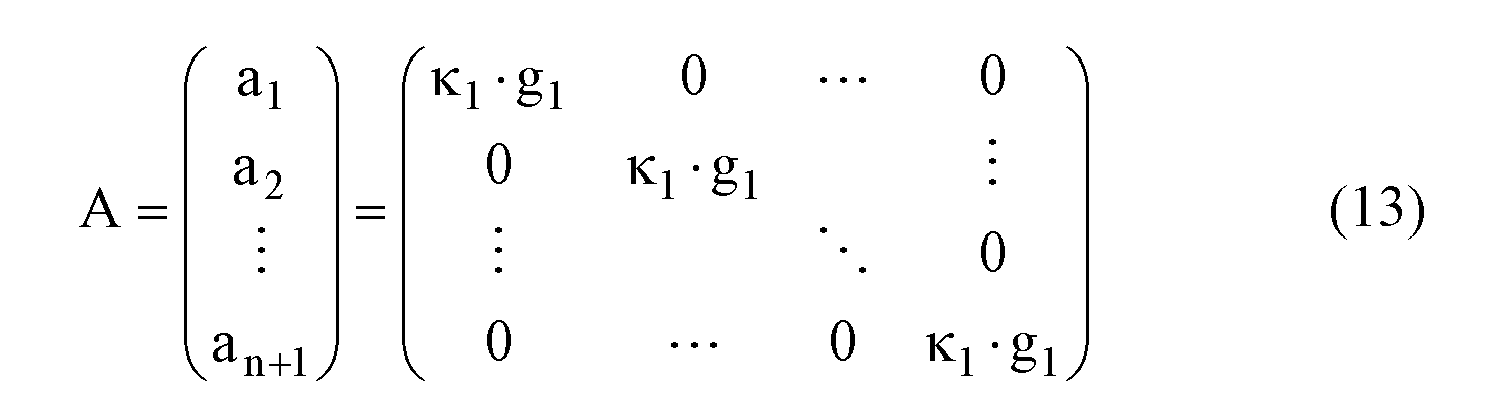
reference literature 2, for example). As the algorithm for performing a pairing operation on a computer, the Miller algorithm (seereference literature 5, V. S. Miller, "Short Programs for Functions on Curves", 1986, http://crypto.stanford.edu/miller/miller.pdf) or some other known algorithm can be used. Methods for configuring a cyclic group and an elliptic curve used to efficiently perform a pairing operation have been known. (For example, seereference literature 2; reference literature 6, A. Miyaji, M. Nakabayashi, and S. Takano, "New Explicit Conditions of Elliptic Curve Traces for FR Reduction", IEICE Trans. Fundamentals, Vol. E84-A, No. 5, pp. 1234-1243, May 2001; reference literature 7, P. S. L. M. Barreto, B. Lynn, M. Scott, "Constructing Elliptic Curves with Prescribed Embedding Degrees", Proc. SCN'2002, LNCS 2576, pp. 257-267, Springer-Verlag. 2003; and reference literature 8, R. Dupont, A. Enge, F. Morain, "Building Curves with Arbitrary Small MOV Degree over Finite Prime Fields", http://eprint.iacr.org/2002/094/). - ai (i = 1, ..., n + 1): (n + 1)-dimensional basis vectors having (n + 1) elements of the cyclic group G1 as elements. An example of the basis vectors ai is an (n + 1)-dimensional basis vector having κ1·g1 ∈ G1 as an i-dimensional element and the unit element (expressed as "0" in additive expression) of the cyclic group G1 as the remaining n elements. In that case, the elements of the (n + 1)-dimensional basis vectors ai (i = 1, ..., n + 1) can be listed as follows:

- Here, κ1 is a constant formed of an element of the finite field Fq other than the additive unit element 0F. An example of κ1 ∈ Fq is κl = 1F. The basis vectors ai are orthogonal bases. Each (n + 1)-dimensional vector having (n + 1) elements of the cyclic group G1 as elements is expressed by a linear sum of (n + 1)-dimensional basis vectors ai (i = 1, ..., n + 1). Therefore, the (n + 1)-dimensional basis vectors ai span the vector space V, described earlier.
- ai* (i = 1, ..., n + 1): (n + 1)-dimensional basis vectors having (n + 1) elements of the cyclic group G2 as elements. An example of the basis vectors ai* is an (n + 1)-dimensional basis vector having κ2·g2 ∈ G2 as an i-dimensional element and the unit element (expressed as "0" in additive expression) of the cyclic group G2 as the remaining n elements. In that case, the elements of the (n + 1)-dimensional basis vectors ai* (i = 1, ..., n + 1) can be listed as follows:

- Here, κ2 is a constant formed of an element of the finite field Fq other than the additive unit element 0F. An example of κ2 ∈ Fq is κ2 = 1F. The basis vectors ai* are orthogonal bases. Each (n + 1)-dimensional vector having (n + 1) elements of the cyclic group G2 as elements is expressed by a linear sum of (n + 1)-dimensional basis vectors ai* (i = 1, ..., n + 1). Therefore, the (n + 1)-dimensional basis vectors ai* span the vector space V*, described earlier.
- The basis vectors ai and the basis vectors ai* satisfy the following expression for an element τ = κ1-κ2 of the finite field Fq other than 0F:


Pair (g1 0) = Pair (0, g2) = Pair(g1 g2)0
Therefore, when i ≠j, the following expression is satisfied.

- Especially when τ = κ1·κ2 =1F (for example, κ1 = κ2 =1F), the following expression is satisfied.

Here, gT 0= 1 is the unit element of the cyclic group GT, and gT 1 = gT is a generator of the cyclic group GT. In that case, the basis vectors ai and the basis vectors ai* are dual normal orthogonal bases, and the vector space V and the vector space V* are a dual vector space that constitutes bilinear mapping (dual pairing vector space (DPVS)). - A: An (n + 1) row by (n + 1) column matrix having the basis vectors ai (i = 1, ..., n + 1) as elements. When the basis vectors ai (i = 1, ..., n + 1) are expressed by Expression (9), for example, the matrix A is as follows:
-
- A*: An (n + 1) row by (n + 1) column matrix having the basis vectors ai* (i = 1, ..., n + 1) as elements. When the basis vectors ai* (i = 1, ..., n + 1) are expressed by Expression (10), for example, the matrix A* is as follows:
-

- X: An (n + 1) row by (n + 1) column matrix having elements of the finite field Fq as elements. The matrix X is used to apply coordinate conversion to the basis vectors ai. When the element located at the i-th row and the j-th column in the matrix X is expressed as χi,j ∈ Fq, the matrix X is as follows:
-

- Here, each element χi,j of the matrix X is called a conversion coefficient.
X*: Transposed matrix of the inverse matrix of the matrix X. X* = (X-1)T. The matrix X* is used to apply coordinate conversion to the basis vectors ai*. When the element located at the i-th row and the j-th column in the matrix X* is expressed as χi,j*∈ Fq, the matrix X* is as follows: -

- Here, each element χi,j* of the matrix X* is called a conversion coefficient.
In that case, when an (n + 1) row by (n + 1) column unit matrix is called I, X·(X*)T = I. In other words, for the unit matrix shown below, -

- the following expression is satisfied.
-

- Here, (n + 1)-dimensional vectors will be defined below.


The inner product of the (n + 1)-dimensional vectors χi → and χj →* satisfies the following expression from Expression (18).
- bi: (n + 1)-dimensional basis vectors having (n + 1) elements of the cyclic group G1 as elements. The basis vectors bi are obtained by applying coordinate conversion to the basis vectors ai (i = 1, ..., n + 1) by using the matrix X. Specifically, the basis vectors bi are obtained by the following calculation

When the basis vectors aj (j = 1, ...,n+1) are expressed by Expression (9), each element of the basis vectors bi is shown below.
- Each (n + 1)-dimensional vector having (n + 1) elements of the cyclic group G1 as elements is expressed by a linear sum of (n + 1)-dimensional basis vectors bi (i = 1, ..., n + 1). Therefore, the (n + 1)-dimensional basis vectors bi span the vector space V, described earlier.
- bi*: (n + 1)-dimensional basis vectors having (n + 1) elements of the cyclic group G2 as elements. The basis vectors bi* are obtained by applying coordinate conversion to the basis vectors ai* (i = 1, ..., n + 1) by using the matrix X*. Specifically, the basis vectors bi* are obtained by the following calculation

When the basis vectors aj (j = 1, ..., n+1) are expressed by Expression (10), each element of the basis vectors bi* are shown below.
Each (n + 1)-dimensional vector having (n + 1) elements of the cyclic group G2 as elements is expressed by a linear sum of (n + 1)-dimensional basis vectors bi* (i = 1, ..., n + 1). Therefore, the (n + 1)-dimensional basis vectors bi* span the vector space V*, described earlier. - The basis vectors bi and the basis vectors bi* satisfy the following expression for the elements τ = κ1·κ2 of the finite field Fq other than 0F:

-

- Especially when τ = κ1·κ2 =1F (for example, κ1 = κ2 =1F), the following expression is satisfied.

In that case, the basis vectors bi and the basis vectors bi* are the dual normal orthogonal basis of a dual pairing vector space (the vector space V and the vector space V*).
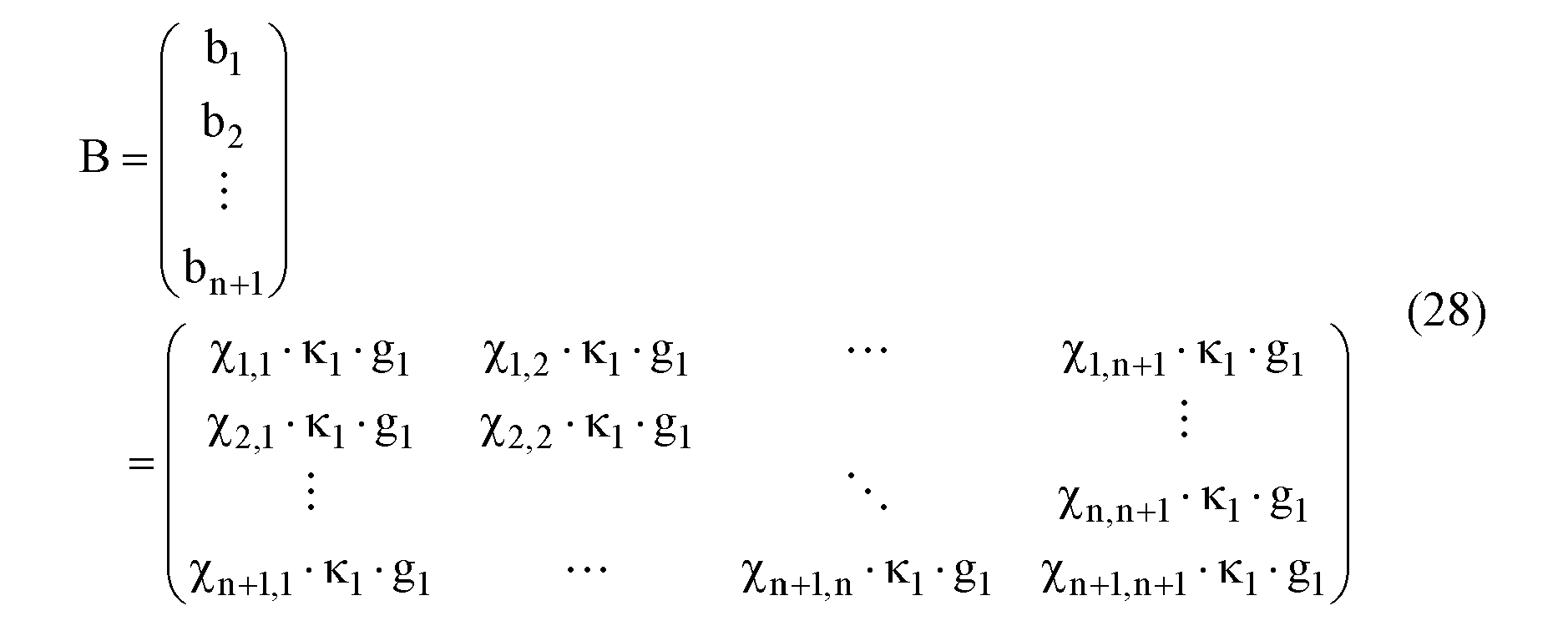
As long as Expression (26) is satisfied, the basis vectors ai and ai* other than those shown in Expressions (9) and (10) as examples, and the basis vectors bi and bi* other than those shown in Expressions (22) and (24) as examples may be used. - B: An (n + 1) row by (n + 1) column matrix having the basis vectors bi (i = 1, ..., n + 1) as elements. B = X·A is satisfied. When the basis vectors bi are expressed by Expression (23), for example, the matrix B is as follows:
-
- B*: An (n + 1) row by (n + 1) column matrix having the basis vectors bi* (i = 1, ..., n + 1) as elements. B* = X*.A* is satisfied. When the basis vectors bi* (i = 1, ..., n + 1) are expressed by Expression (25), for example, the matrix B* is as follows:
-

- w→: An n-dimensional vector having elements of the finite field Fq as elements.

wµ: The µ-th (µ = 1, ..., n) element of the n-dimensional vector.
v→: An n-dimensional vector having elements of the finite field Fq as elements.
Vµ: The µ-th (µ = 1, ..., n) element of the n-dimensional vector. - Collision-resistant function: A function h that satisfies the following condition with respect to a sufficiently larger security parameter k, or a function regarded as such.

Here, Pr[·] is the probability of the event [·]; A(h) is a probability polynomial time algorithm for calculating x and y (x ≠ y) that satisfy h(x) = h(y) for a function h; and ε(k) is a polynomial for the security parameter k. An example collision-resistant function is a hash function such as the cryptographic hash function disclosed inreference literature 1. - Injective function: A function by which each element belonging to a value range is expressed as the image of only one element in the definition range, or a function regarded as such.
- Quasi-random function: A function belonging to a subset φξ when a probability polynomial time algorithm cannot distinguish between the subset φξ and its whole set Φξ, or a function regarded as such. The set Φξ is a set of all functions that map an element of a set {0, 1}ξ to an element of the set {0, 1 }ξ. An example quasi-random function is a hash function such as that described above.
- H1: A collision-resistant function that receives two binary sequences (ω1, ω2) ∈ {0, 1}k × {0, 1}* and outputs two elements (ψ1, ψ2) ∈ Fq × Fq of the finite field Fq.

- An example of the function H1 is a function that outputs two elements (ψ1, ψ2) ∈ Fq × Fq of the finite field Fq in response to the connected bits ω1∥ω2 of input ω1 and ω2. This function includes calculations with a hash function such as the cryptographic hash function disclosed in
reference literature 1, a binary-sequence-to-integer conversion function (octet string/integer conversion), and a binary-sequence-to-finite-field-element conversion function (octet string and integer/finite field conversion). It is preferred that the function H1 be a quasi-random function. - H2: A collision-resistant function that receives an element of the cyclic group GT and a binary sequence (ξ, ω2) ∈ GT × {0, 1}* and outputs one element ψ ∈ Fq of the finite field Fq.

- An example of the function H2 is a function that receives an element ξ ∈ GT of the cyclic group GT and a binary sequence ω2 ∈ {0, 1}*, inputs the element ξ ∈ GT of the cyclic group GT to a finite-field-element-to-binary-sequence conversion function (octet string and integer/finite field conversion) disclosed in
reference literature 1 to obtain a binary sequence, applies a hash function such as the cryptographic hash function disclosed inreference literature 1 to the connected bits of the obtained binary sequence and the binary sequence ω2 ∈ {0, 1}*, performs the binary-sequence-to-finite-field-element conversion function (octet string and integer/finite field conversion), and outputs one element ψ ∈ Fq of the finite field Fq. It is preferred from a security viewpoint that the function H2 be a quasi-random function. - R: An injective function that receives an element ξ ∈ GT of the cyclic group GT and outputs one binary sequence ω ∈ {0, 1}k.

- An example of the injective function R is a function that receives an element ξ ∈ GT of the cyclic group GT, performs calculations with the finite-field-element-to-binary-sequence conversion function (octet string and integer/finite field conversion) and then with a hash function such as the KDF (key derivation function) disclosed in
reference literature 1, and outputs one binary sequence ω ∈ {0, 1}k. From a security viewpoint, it is preferred that the function R be a collision-resistant function, and it is more preferred that the function R be a quasi-random function. - Enc: A common key encryption function that indicates encryption processing of a common key cryptosystem. Example common key cryptosystems are Camellia and AES.
Enck(M): Ciphertext obtained by encrypting plaintext M by the common key encryption function Enc with the use of a common key K.
Dec: A common key decryption function that indicates decryption processing of the common key cryptosystem.
Deck(C): A decryption result obtained by decrypting ciphertext C by the common key decryption function Dec with the use of the common key K. - The basic configuration of inner product predicate encryption will be described below.
- Predicate encryption (sometimes called function encryption) means that ciphertext can be decrypted when a combination of attribute information and predicate information makes a predetermined logical expression true. One of the attribute information and predicate information is embedded in the ciphertext and the other is embedded in key information. The configuration of conventional predicate encryption is, for example, disclosed in reference literature 9, Jonathan Katz, Amit Sahai and Brent Waters, "Predicate Encryption Supporting Disjunctions, Polynomial Equations, and Inner Products", one of four papers from Eurocrypt 2008 invited by the Journal of Cryptology.
- Inner product predicate encryption means that ciphertext can be decrypted when the inner product of attribute information and predicate information handled as vectors is zero. In inner product predicate encryption, an inner product of zero is equivalent to a logical expression of true.
- In inner product predicate encryption, a logical expression formed of a logical OR(s) and/or a logical AND(s) is expressed by a polynomial.
The logical OR (x = η1) ∨ (x = η2) ofstatement 1 indicating that x is η1 andstatement 2 indicating that x is η2 is expressed by the following polynomial.
Then, the relationships between true values and the function values of Expression (36) are shown in the following table. -
Table 1 Statement 1Statement 2Logical OR Function value (x = η1) (x = η2) (x = η1) ∨ (x = η2) (x = η1)·(x = η2) True True True 0 True False True 0 False True True 0 False False False Other than 0 - The logical AND (x = η1) ∧ (x = η2) of
statement 1 indicating that x is η1 andstatement 2 indicating that x is η2 is expressed by the followingpolynomial 
where τ1 and τ2 are random numbers. Then, the relationships between true values and the function values of Expression (37) are shown in the following table. -
Table 2 Statement 1Statement 2Logical AND Function value (x = η1) (x = η2) (x = η1) ∧ (x = η2) τ1·(x - η1) + τ2·(x - η2) True True True 0 True False False Other than 0 False True False Other than 0 False False False Other than 0 - As described above, by using Expressions (36) and (37), a logical expression formed of a logical OR(s) and/or a logical AND(s) can be expressed by a polynomial f(x). An example will be shown below.

- In Expression (36), one indeterminate element x is used to express the logical OR. A plurality of indeterminate elements can also be used to express a logical OR. For example, two indeterminate elements x0 and x1 are used to express the logical OR (x0 = η0)∨(x1 = η1) of
statement 1 indicating that x0 is η0 andstatement 2 indicating that x1 is η1 by the following polynomial.
Three or more indeterminate elements can also be used to express a logical OR by a polynomial. - In Expression (37), one indeterminate element x is used to express the logical AND. A plurality of indeterminate elements can also be used to express a logical AND. For example, the logical AND (x0 = η0) ∧ (x1 = η1) of
statement 1 indicating that x0 is η0 andstatement 2 indicating that x1 is η1 can be expressed by the following polynomial.
Three or more indeterminate elements can also be used to express a logical AND by a polynomial. - A logical expression that includes a logical OR(s) and/or a logical AND(s) is expressed with H (H ≥1) types of indeterminate elements x0, ..., xH-1 as the polynomial f(x0, ..., xH-1). It is assumed that a statement for each of the indeterminate elements x0, ..., xH-1 is "xh is ηh", where ηh (h = 0, ..., H - 1) is a constant determined for each statement. Then, in the polynomial f(x0, ..., xH-1) indicating the logical expression, the statement indicating that an indeterminate element xh is a constant ηh is expressed by the polynomial indicating the difference between the indeterminate element xh and the constant ηh; the logical OR of statements is expressed by the product of the polynomials indicating the statements; and the logical AND of statements or the logical ORs of statements is expressed by a linear OR of the polynomials indicating the statements or the logical ORs of statements. For example, five indeterminate elements x0, ..., x4 are used to express a logical expression

by the following polynomial
- The polynomial f(x0, ..., xH-1) indicating a logical expression can be expressed by the inner product of two n-dimensional vectors. More specifically, a vector having the indeterminate elements of the terms of the polynomial f(x0, ..., xH-1) as elements,


are used to generate the inner product thereof,
which is equal to the polynomial f(x0, ..., xH-1). In other words, whether the polynomial f(x0, ..., xH-1) indicating a logical expression is zero is equivalent to whether the inner product of the vector v→ having the indeterminate elements of the terms of the polynomial f(x0, ..., xH-1) as elements and the vector w→ having the coefficients of the terms of the polynomial f(x0, ..., xH-1) as elements is zero. -

For example, a polynomial f(x) = θ0·x0 + θ1·x + ... + θn-1·xn-1 expressed with one indeterminate element x can be expressed with two n-dimensional vectors

by the inner product thereof.
In other words, whether the polynomial f(x) indicating a logical expression is zero is equivalent to whether the inner product in Expression (41) is zero. -

When a vector having the indeterminate elements of the terms of the polynomial f(x0, ..., xH-1) as elements is expressed by
and a vector having the coefficients of the terms of the polynomial f(x0, ..., xH-1) as elements is expressed by
whether the polynomial f(x0, ..., xH-1) indicating a logical expression is zero is equivalent to whether the inner product of the vector w→ and the vector v→ is zero. - For example, when the following expressions are used instead of Expressions (39) and (40),


whether the polynomial f(x) indicating a logical expression is zero is equivalent to whether the inner product in Expression (41) is zero. - In inner product predicate encryption, one of the vectors v→ = (v0, ..., vn-1) and w→ = (w0, ..., wn-1) is used as attribute information and the other is used as predicate information. One of the attribute information and predicate information is embedded in ciphertext and the other is embedded in key information. For example, an n-dimensional vector (θ0, ..., θn-1) is used as predicate information, another n-dimensional vector (x0, ..., xn-1) is used as attribute information, one of the attribute information and predicate information is embedded in ciphertext, and the other is embedded in key information. It is assumed in the following description that an n-dimensional vector embedded in key information is w→ = (w1, ..., wn) and another n-dimensional vector embedded in ciphertext is v→ = (v1, ..., vn). For example,
Predicate information: w→ = (w1, ..., wn) = (θ0, ..., θn-1)
Attribute information: v→ = (v1, ..., vn) = (x0, ..., xn-1)
Alternatively,
Predicate information: v→ = (v1, ..., vn) = (θ0, ..., θn-1)
Attribute information: w→ = (w1, ..., wn) = (x0, ..., xn-1) - An example basic configuration of a key encapsulation mechanism (KEM) using inner product predicate encryption will be described below. This configuration includes Setup(1k), GenKey(MSK, w→), Enc(PA, v→), and Dec(SKw, C2).
- Setting up Setup(1k)
Input: Security parameter k
Output: Master key information MSK, public parameter PK
In an example of Setup(1k), a security parameter k is used as n, and an (n + 1) row by (n + 1) column matrix A having (n + 1)-dimensional basis vectors ai (i = 1, ..., n + 1) as elements, an (n + 1) row by (n + 1) column matrix A* having basis vectors ai * (i = 1, ..., n + 1) as elements, and (n + 1) row by (n + 1) column matrixes X and X* used for coordinate conversion are selected. Then, (n + 1)-dimensional basis vectors bi (i = 1, ..., n + 1) are calculated through coordinate conversion by Expression (22), and (n + 1)-dimensional basis vectors bi* (i = 1, ..., n + 1) are calculated through coordinate conversion by Expression (24). Then, an (n + 1) row by (n + 1) column matrix B* having the basis vectors bi* (i = 1, ..., n + 1) as elements is output as master key information MSK; and vector spaces V and V*, an (n + 1) row by (n + 1) column matrix B having the basis vectors bi (i = 1, ..., n + 1) as elements, the security parameter k, a finite field Fq, an elliptic curve E, cyclic groups G1, G2, and GT, generators g1, g2, and gT, a bilinear function e, and others are output as a public parameter PK. - Key information generation GenKey(MSK, w→)
Input: Master key information MSK, vector w→
Output: Key information D* corresponding to vector w→
In an example of GenKey(MSK, w→), an element α ∈ Fq is selected from the finite field Fq. Then, the matrix B*, which is the master key information MSK, is used to generate and output key information D* corresponding to the vector w→ in the following way.
If it is difficult to solve a discrete logarithmic problem on the cyclic group G2, it is difficult to separate and extract the components of wµ·bµ* and bn+1* from the key information D*. - Encryption Enc(PA, v→)
Input: Public parameter PK, vector v→
Output: Ciphertext C2, common key K
In an example of Enc(PA, v→), a common key K and a random number υ1, which is an element of the finite field Fq, are generated. Then, the public parameter PK, such as the matrix B, an element υ2 corresponding to a value that includes the common key K, in the finite field Fq, the vector v→, and the random number υ1 are used to generate ciphertext C2 in the following way.
The ciphertext C2 and the common key K are output. An example of the common key K is gT τ·υ2 ∈ GT, where υ2 means υ2. An example of τ is 1F, as described above. If it is difficult to solve a discrete logarithmic problem on the cyclic group G1, it is difficult to separate and extract the components of vµ·bµ and υ2·bn+1 from the ciphertext C2. - Input: Key information D1* corresponding to vector w→, ciphertext C2
Output: Common key K
In an example of Dec(SKw, C2), the ciphertext C2 and the key information D1* are input to the bilinear function e of Expression (2). Then, from the characteristics of Expressions (3) and (26), the following is satisfied. -

- When the inner product w→·v→ is zero, Expression (47) can be changed to the following.
-

- From this result, the common key K is generated and output. An example of the common key K is gT τ·υ2 ∈ GT.
- An information generation apparatus and method according to a first embodiment implement hierarchical cryptography by using the predicate encryption described above. More specifically, they employ the basis b* used in the predicate encryption described above to implement information derivation expressed in general semiordered structures other than tree structures.
Fig. 1 is an example of a functional block diagram of the information generation apparatus according to the first embodiment. - Each piece of information is assigned an index v = (v1, ..., vN-1) ∈ I = (Fq ∪ {*})N-1, and a set w(v) = {i|vi = *} corresponding to the index v is defined, where * indicates an indeterminate character. Indexes that will be described below, such as an index u and an index Y, have the same structure as the index v: u = (u1, ..., uN-1) ∈ I = (Fq ∪ {*})N-1 and Y = (Y1, ..., YN-1) ∈ I = (Fq ∪ {*})N-1. When w(u) c w(v) and vi = ui (i ∈ {1, ..., N - 1} \ w(v)) for the index u ∈ I and the index v ∈ I, in other words, when w(u) c w(v) and vi = ui for any i ∈ {1, ..., N - 1} \ w(v), the index u ≤ the index v and the index v is higher information than the index u, where the symbol \ indicates the subtraction of set and, for example, A \ B = {2, 3} when set A = {1, 2, 3} and set B={1}.
- When the index v = {v1, v2, v3} = {2, *, *} and the index u = {u1, u2, u3} = {2, *, 4}, for example, w(v) = {2, 3} and w(u) = {2} and w(u) c w(v) is satisfied. Here, v1 = u1 = 2. Therefore, the index u ≤ the index v and the index v is higher information than the index u
- In the following description, the index Y corresponds to information generated from the basis bi*, the index v corresponds to information of a derivation base, and the index u corresponds to information derived from information of the derivation base.
- The information generation apparatus and method generate information KY corresponding to the index Y by using the basis bi* in Step A1 to Step A3 in
Fig. 2 . The information KY includes main information kY and derivation information kYj. The main information kY is used as a decryption key, for example, in predicate encryption. The derivation information kYj is used to generate information lower than the information KY corresponding to the index Y - A
random number generator 1 generates a random number σY ∈ Zq and a random number σYj ∈ Zq corresponding to each element j ∈ w(Y) of a set w(Y) (in step A1). The generated random number σY is sent to amain information generator 2. The generated random number σYj is sent to aderivation information generator 3. When the set w(Y) = {2, 3}, for example, therandom number generator 1 generates σY, σY2, and σY3. - The
main information generator 2 uses the generated random number σY to calculate main information kY that satisfies kY = σYΣi ∈ {1, ...,N-1} \ w(Y)Yibi* + bN* (in step A2). The calculated main information kY is stored in a storage 4. - The
derivation information generator 3 uses the generated random number σYj to calculate derivation information kYj that satisfies kYj = σYjΣi ∈ {1, ...,N - 1} \ w(Y)Yibi* + bj * for each element j ∈ w(Y) of the set w(Y) (in step A3). The calculated derivation information kYj is stored in the storage 4. - The information generation apparatus and method generate information Ku corresponding to a lower index u from information Kv corresponding to an upper index v, where u ≤ v, in step B1 to step B3 shown in
Fig. 3 . - The information Kv corresponding to the index v includes main information kv and derivation information kvj. The main information kv is used as a decryption key, for example, in predicate encryption. The derivation information kvj is used to generate information lower than the information Kv corresponding to the index v. For example, the index v = Y and the information Kv = KY. The information Ku generated in the processing of steps B1 to B3 may be regarded as new information Kv to generate information Ku' (u'≤u) lower than the information Ku corresponding to the index u.
- The information Ku corresponding to the index u includes main information ku and derivation information kuj. The main information ku is used as a decryption key, for example, in predicate encryption. The derivation information kuj is used to generate information lower than the information Ku corresponding to the index u.
The information generation apparatus receives the index v and the index u.
It is assumed that the storage 4 has stored the information Kv corresponding to the index v. - The
random number generator 1 generates a random number σu ∈ Zq and a random number σuj ∈ Zq corresponding to each element j ∈ w(u) of a set w(u) (in step B1). The generated random number σu is sent to a maininformation deriving unit 5. The generated random number σuj is sent to a derivation information deriving unit 6. - The main
information deriving unit 5 uses the main information kv and the derivation information kvi, both of which are read from the storage 4, and the generated random number σu to calculate main information ku corresponding to the index u, that satisfies ku = σuΣi ∈ w(v) \ w(u)uikvi + kv (in step B2). The calculated main information ku is stored in the storage 4. - The derivation information deriving unit 6 uses the derivation information kvj read from the storage 4 and the generated random number σuj to calculate derivation information kuj that satisfies kuj = σujΣi ∈ w(v) \ w(u)uikvi + kvj for each element j ∈ w(u) of the set w(u) (in step B3). The calculated derivation information kuj is stored in the storage 4.
- As described above, the information KY corresponding to the index Y is generated and information corresponding to a lower index is derived from the information KY. This means that, for a parent node A and a parent node B both having a common child node C, information of the common child node C can be derived from information of the parent node A and information of the common child node C can be derived from information of the parent node B.
- A case will be described below in which information of each node serves as a key in predicate encryption and information of an index v3, generated from information of an index v1 matches information of the index v3, generated from information of an index v2 in terms of a key in predicate encryption. The indexes v1, v2, and v3, described below, are examples, and the same things can apply to the other indexes.
- It is assumed that the index v1 = {v1, v2, *, *}, the index v2 = {*, *, v3, v4}, and the index v3 = {v1, v2, v3, v4}. From the definition, v1≥ V 3 and v2 ≥ v3 and the index v1, serving as a parent node, and the index v2, serving as a parent node, have the index v3 as a common child node. In the following description, vi (i = 1, 2, 3) may be indicated by v^i, and the j-th element of the index v1 may be indicated by v^ij.
- N is set to 5, and information Kv^1 corresponding to the index v1 and information Kv^2 corresponding to the index v2 are generated from N bases b1*, b2*, b3*, b4*, and b5*. Random numbers σv^1, σv^13, σv^14, σv^2, σ v^23, σv^24, σv^3, and σv^3' are generated by the
random number generator 1. - The information Kv^1 (main information kv^1 and derivation information kv^13 and kv^14) corresponding to the index v1 is as described below.


- The information Kv^2 (main information kv^2 and derivation information kv^21 and kv^22) corresponding to the index v2 is as described below.


- The main information kv^3 corresponding to the index v3 is derived from the information Kv^1 corresponding to the index v1 as described below.

where a = (σv^3(v3σv^13 + v4σv^14) + σv1) and b = σv^3. - Main information kv^3 corresponding to the index v3 is derived from the information Kv^2 corresponding to the index v2 as described below.

where c = σv^3' and d = (σv^3'(v1σv^23 + v4σv^24) + σv^2). - The main information kv^3 derived from the information Kv^1, shown in Expression (A), and the main information kv3 derived from the information Kv2, shown in Expression (B), are not equal in value but are a same-value key in predicate encryption. More specifically, when (v1b1* + v2b2*) is regarded as the inner product of a vector (b1*, b2*) and a vector (v1, v2), the direction of the vector (v1, v2) with respect to the vector (b1*, b2*) is the same in both Expressions (A) and (B); when(v3b3* + v4b4*) is regarded as the inner product of a vector (b3*, b4*) and a vector(v3, v4), the direction of the vector (v3, v4) with respect to the vector (b3*, b4*) is the same in both Expressions (A) and (B). This means that both keys are a same-value key in predicate encryption.
-
Fig. 4 is an example functional block diagram of an information generation apparatus according to a second embodiment. - It is assumed that cyclic groups G and GT has a prime number order q; the cyclic group G has a generator g; the cyclic group G has a pairing function e: G × G → GT, which makes gT = e(g, g) a generator of the cyclic group GT; a random number a is selected from Zp at random; and g, g1 = ga ∈ G, and g2, g3, h1, ..., hN-1 ∈ G randomly selected from the cyclic group G are made publicly available as public keys.
- The information generation apparatus and an information generation method generate information KY corresponding to an index Y by using the public keys in step C1 to step C4 in
Fig. 5 . The information KY includes first main information kY, second main information grY, and derivation information kYj. The first main information kY and the second main information grY are used, for example, as decryption keys. The derivation information kYj is used to generate information lower than the information KY corresponding to the index Y - A
random number generator 1 generates a random number rY ∈ Zq (in step C1). The generated random number rY is sent to a firstmain information generator 21, a secondmain information generator 22, and aderivation information generator 3. - The first
main information generator 21 uses the generated random number rY to calculate first main information kY that satisfies kY = g2 a(g3Πi ∈ {1, ..., N - 1} \ w(Y)hi Yi)rY (in step C2). The calculated first main information kY is stored in a storage 4.
The secondmain information generator 22 uses the generated random number rY to calculate second main information grY (in step C3). The calculated second main information grY is stored in the storage 4. - The
derivation information generator 3 uses the generated random number rY to calculate derivation information kYj that satisfies kYj = hj rY for each element j ∈ w(Y) of a set w(Y) (in step C4). The calculated derivation information kYj is stored in the storage 4. - The information generation apparatus and method generate information Ku corresponding to a lower index u from information Kv corresponding to an upper index v, where u ≤ v, in step D1 to step D4 shown in
Fig. 6 . - The information Kv corresponding to the index v includes first main information kv, second main information gry, and derivation information kvj. The first main information kv and the second main information grv are used, for example, as decryption keys. The derivation information kvj is used to generate information lower than the information Kv corresponding to the index v. For example, the index v = Y and the information Kv = KY. The information Ku generated in the processing of steps D1 to D4 may be regarded as new information Kv to generate information Ku' (u' ≤u) lower than the information Ku corresponding to the index u.
- The information Ku corresponding to the index u includes first main information ku, second main information gru, and derivation information kuj. The first main information ku and the second main information gru are used, for example, as decryption keys. The derivation information kuj is used to generate information lower than the information Ku corresponding to the index u.
- The information generation apparatus receives the index v and the index u.
It is assumed that the storage 4 has stored the information Kv corresponding to the index v.
Therandom number generator 1 generates a random number ru (in step D1). The generated random number is sent to a first maininformation deriving unit 51, a second maininformation deriving unit 52, and a derivation information deriving unit 6. - The first main
information deriving unit 51 uses the first main information kv and the derivation information kvi, both of which are read from the storage 4, and the generated random number ru to calculate first main information ku corresponding to the index u, that satisfies ku = kv(Πi ∈ w(v) \ w(u)kvi u1) (g3Πi ∈ {1,..., N - 1} \ w(v)hi v1Πi ∈ w(v) \ w(u)hi u1)ru (in step D2). The calculated first main information ku is stored in the storage 4. - The second main
information deriving unit 52 uses the generated random number ru to calculate second main information gru (in step D3). The calculated second main information gru is stored in the storage 4. - The derivation information deriving unit 6 uses the derivation information kvi read from the storage and the generated random number ru to calculate derivation information kuj that satisfies kuj = kvjhj ru for each element j ∈ w(u) of a set w(u) (in step D4). The calculated derivation information kuj is stored in the storage 4.
- As described above, the information KY corresponding to the index Y is generated and information corresponding to a lower index is derived from the information Kv. This means that, for a parent node A and a parent node B both having a common child node C, information of the common child node C can be derived from information of the parent node A and information of the common child node C can be derived from information of the parent node B.
- A case will be described below in which information of each node serves as a key in predicate encryption and information of an index v3, generated from information of an index v1 matches information of the index v3, generated from information of an index v2 in terms of a key in predicate encryption. The indexes v1, v2, and v3, described below, are examples, and the same things can apply to the other indexes.
- It is assumed that the index v1 = {v1, v2, *, *}, the index v2 = {*, *, v3, V4}, and the index v3 = {v1, v2, v3, v4}. From the definition, v1 ≥v3 and v2 ≥ v3 and the index v1, serving as a parent node, and the index v2, serving as a parent node, have the index v3 as a common child node. In the following description, vi (i = 1, 2, 3) may be indicated by v^i, and the j-th element of the index vi may be indicated by v^ij.
- It is assumed that N is set to 5 and g1 = ga, g2, g3, h1, h2, h3, h4 ∈ G are made publicly available as public keys. From these public keys, information Kv^1 corresponding to the index v1 and information Kv^2 corresponding to the index v2 are generated. Random numbers rv^1 and rv^ are generated by the
random number generator 1. - The information Kv^1 (first main information kv^1, second main information grv^1, and derivation information kv^13 and kv^14 )corresponding to the index v1 is as described below.


- The information Kv^2 (first main information kv^2, second derivation information grv^2, and derivation information kv^21 and kv^22) corresponding to the index v2 is as described below.


- First main information kv^3 corresponding to the index v3 is derived from the information Kv^1 corresponding to the index v1 as described below.

random number generator 1, and r = rv^1 + rv^3.
First main information kv^3 corresponding to the index v3 is derived from the information Kv^2 corresponding to the index v2 as described below.
where rv^3' is a random number and r' = rv^2 + rv^3'. - The first main information kv^3 derived from the information Kv^1, shown in Expression (C), and the second main information grv^3, and the first main information kv^3 derived from the information Kv^2, shown in Expression (D), and the second main information grv^3' are not equal in value but are a same-value key in predicate encryption because the ratios of the exponents of the public keys g3, h1, h2, h3, and h4 are equal.
- In each of the above described embodiments, the information generation apparatus includes all of the
main information generator 2, thederivation information generator 3, the maininformation deriving unit 5, and the derivation information deriving unit 6, but the information generation apparatus needs to have at least one of them. For example, the information generation apparatus may have only themain information generator 2 and thederivation information generator 3. Alternatively, the information generation apparatus may have only the maininformation deriving unit 5 and the derivation information deriving unit 6, and may use the information Kv already generated and stored in the storage 4 to generate the information Ku. - Each operation defined on the finite field Fq may be replaced with an operation defined on a finite ring Zq of order q. An example of replacing each operation defined on the finite field Fq with an operation defined on the finite ring Zq is a method of permitting q other than a prime number or a power thereof.
- Each of the information generation apparatuses described above can be implemented by a computer. In that case, the processing details of the functions that should be provided by the apparatus are described in a program. When the program is executed by a computer, the processing functions of the apparatus are implemented on the computer.
- The information generation program containing the processing details can be recorded in a computer-readable recording medium. The information generation apparatus is configured when the program is executed by a computer. At least a part of the processing details may be implemented by hardware.
- The present invention is not limited to the above described embodiments. Any modifications are possible within the scope of the present invention.
Claims (14)
- An information generation apparatus comprising:a random number generator adapted to generate a random number σY ∈ Zq and a random number σYj ∈ Zq corresponding to each element j ∈ w(Y) of a set w(Y);a main information generator adapted to use the generated random number σY to calculate main information kY that satisfies kY = σYΣi ∈ {1, ..., N - 1} \ w(Y)Yibi* + bN*; anda derivation information generator adapted to use the generated random number σYj to calculate derivation information kYj that satisfies kYj = σYjΣi ∈ {1, ..., N - 1} \ w(Y)Yibi* + bj* for each element j ∈ w(Y) of the set w(Y);where e is a non-degenerate, bilinear function that outputs one element of a cyclic group GT in response to inputs of N elements γL (L = 1, ..., N) (N ≥ 2) of a cyclic group G1 and N elements γL* (L = 1, ..., N) of a cyclic group G2; bi ∈ G1 N (i = 1, ..., N) is an N-dimensional basis vector having N elements of the cyclic group G1 as elements; bj* ∈ G2 N (j = 1, ..., N) is an N-dimensional basis vector having N elements of the cyclic group G2 as elements; a function value obtained when each element of the basis vector bi ∈ G1 N (i = 1, ..., N) and each element of the basis vector bj* ∈ G2 N (j = 1, ..., N) are put into the bilinear function e is represented by gT τ·δ(i,j) ∈ GT, using a Kronecker's delta function in which δ(i, j) = 1F when i = j and δ(i, j) = 0F when i ≠ j; 0F is an additive unit element of a finite field Fq; 1F is a multiplicative unit element of the finite field Fq; τ is an element of the finite field Fq, other than 0F; and gT is a generator of the cyclic group GT; and
* indicates an indeterminate character, an index Y is Y = (Y1, ..., YN-1) ∈ I = (Fq ∪ { *})N-1, the set w(Y) corresponds to the index Y, and w(Y) = {i|Yi = *}. - The information generation apparatus according to Claim 1, wherein the random number generator further generates a random number σu ∈ Zq,
the information generation apparatus comprising:a storage unit adapted to store main information kv corresponding to an index v and derivation information kvj corresponding to the index v; anda main information deriving unit adapted to use the main information kv and derivation information kvi, both of which are read from the storage unit, and the generated random number σu to calculate main information ku corresponding to an index u, which satisfies ku = σuΣi ∈ w(v) \ w(u)uikvi + kv;where * indicates an indeterminate character; the index v is v = (v1, ..., vN-1) ∈ I = (Fq ∪ {*})N-1; w(v) is a set corresponding to the index v and w(v) = {i|vi = *}; the index u is u = (u1, ..., uN-1) ∈ I = (Fq ∪ {*})N-1; w(u) is a set corresponding to the index u and w(u) = {i|ui = *}; w(u) c w(v); and vi = ui (i ∈ {1, ..., N-1} \ w(v)). - The information generation apparatus according to Claim 2, wherein the random number generator further generates a random number σuj ∈ Zq, corresponding to each element j ∈ w(u) of the set w(u);
the information generation apparatus further comprising:a derivation information deriving unit adapted to use the derivation information kvj read from the storage unit and the generated random number σui to calculate derivation information kuj corresponding to the index u, which satisfies kuj = σujΣi ∈ w(v) \ w(u)uikvi + kvj, for each element j ∈ w(u) of the set w(u). - An information generation apparatus comprising:a storage unit adapted to store main information kv serving as main information kY or corresponding to an index v, derived from the main information kY and derivation information kYi, and derivation information kvj serving as the derivation information kYi or corresponding to the index v, derived from the derivation information kYi;a child random number generator adapted to generate a random number σu ∈ Zq; anda main information deriving unit adapted to use the main information kv and derivation information kvi, both of which are read from the storage unit, and the generated random number σu to calculate main information ku corresponding to an index u, which satisfies ku = σuΣi ∈ w(v) \ w(u)uikvi + kv;where e is a non-degenerate, bilinear function that outputs one element of a cyclic group GT in response to inputs of N elements γL (L = 1, ..., N) (N ≥ 2) of a cyclic group G1 and N elements γL* (L = 1, ..., N) of a cyclic group G2; bi ∈ G1 N (i = 1, ..., N) is an N-dimensional basis vector having N elements of the cyclic group G1 as elements; bj* ∈ G2 N (j = 1, ..., N) is an N-dimensional basis vector having N elements of the cyclic group G2 as elements; a function value obtained when each element of the basis vector bi ∈ G1 N (i = 1, ..., N) and each element of the basis vector bj* ∈ G2 N (j = 1, ..., N) are put into the bilinear function e is represented by gT τ·δ(i,j) ∈ GT, using a Kronecker's delta function in which δ(i, j) = 1F when i = j and δ(i, j) = 0F when i ≠ j; 0F is an additive unit element of a finite field Fq; 1F is a multiplicative unit element of the finite field Fq; τ is an element of the finite field Fq, other than 0F; and gT is a generator of the cyclic group GT; and* indicates an indeterminate character; an index Y is Y = (Y1, ..., YN-1) ∈ I = (Fq ∪ {*})N-1; a set w(Y) corresponding to the index Y is w(Y) = {i|Yi = *}; δY ∈ Zq is a random number; σYi ∈ Zq is a random number corresponding to each element j ∈ w(Y) of the set w(Y); the main information kY corresponds to the index Y and satisfies kY = σYΣi ∈ {1, ..., N-1} \ w(Y)Yibi + bN*; and the derivation information kYi corresponds to the index Y and satisfies kYj = σYjΣi ∈ {1, ..., N-1} \ w(Y)Yibi* + bj*;* indicates an indeterminate character; the index v is v = (v1, ..., vN-1) ∈ I = (Fq ∪ {(*)})N-1; the index u is u = (u1, ..., uN-1) ∈ I = (Fq ∪ {*})N-1; w(v) is a set corresponding to the index v and w(v) = {i|vi = *}; w(u) is a set corresponding to the index u and w(u) = {i|ui = *}; w(u) c w(v); and vi = ui (i ∈ {1, ..., N-1}\w(v)).
- The information generation apparatus according to Claim 4, wherein the random number generator further generates a random number σuj ∈ Zq, corresponding to each element j ∈ w(u) of the set w(u);
the information generation apparatus further comprising:a derivation information deriving unit adapted to use the derivation information kvj read from the storage unit and the generated random number σui to calculate derivation information kuj that satisfies kuj = σujΣi ∈ w(v)\ w(u)uikvi + kvj for each element j ∈ w(u) of the set w(u). - An information generation apparatus comprising:a random number generator adapted to generate a random number rY ∈ Zq;a first main information generator adapted to use the generated random number rY to calculate first main information kY that satisfies kY = g2 a(g3Π i ∈ {1, ..., N - 1} \ w(Y)hi Yi)rY;a second main information generator adapted to use the generated random number rY to calculate second main information grY; anda derivation information generator adapted to use the generated random number rY to calculate derivation information kYj that satisfies kYj = hjrY for each element j ∈ w(Y) of a set w(Y);where G and GT are cyclic groups having a prime number order q; g is a generator of the cyclic group G; the cyclic group G has a pairing function e: G × G → GT, which makes gT = e(g, g) a generator of the cyclic group GT; a is a random number selected at random from Zp; and g, g1 = ga ∈ G, and g2, g3, h1, ... , hN-1 ∈ G randomly selected from the cyclic group G are made publicly available as public keys; and* indicates an indeterminate character; an index Y is Y = (Y1, ..., YN-1) ∈ I = (Fq ∪ {*})N-1; the set w(Y) corresponds to the index Y; and w(Y) = {i|Yi = *},
- The information generation apparatus according to Claim 6, wherein the random number generator further generates a random number ru ∈ Zq,
the information generation apparatus comprising:a storage unit adapted to store first main information kv corresponding to an index v, second main information gr, and derivation information kvj corresponding to the index v;a first main information deriving unit adapted to use the first main information kv and derivation information kvi, both of which are read from the storage unit, to calculate first main information ku corresponding to an index u, which satisfies ku = kv(Πi ∈ w(v) \ w(u)kvi ui) (g3Πi ∈ {1, ..., N- 1} \ w(v)hi v1Πi ∈ w(v) \ w(u)hi u1)ru; anda second main information deriving unit adapted to use the generated random number ru to calculate second main information gru;where * indicates an indeterminate character; the index v is v = (v1, ..., vN-1) ∈ I = (Fq ∪ {*})N-1; w(v) is a set corresponding to the index v and w(v) = {i|vi = *}; the index u is u = (u1, ..., uN-1) ∈ I = (Fq ∪ {*})N-1; and w(u) is a set corresponding to the index u and w(u) = {i|ui = *}; w(u) c w(v); and vi = ui (i ∈ {1, ..., N-1}\ w(v)). - The information generation apparatus according to Claim 7, further comprising a derivation information deriving unit adapted to use the derivation information kvi read from the storage unit and the generated random number ru to calculate derivation information kuj that satisfies kuj = kvjhj ru for element j ∈ w(u) of the set w(u).
- An information generation apparatus comprising:a random number generator adapted to generate a random number ru ∈ Zq;a storage unit adapted to store main information kv serving as main information KY or corresponding to an index v, derived from first main information kY and derivation information kYi, and derivation information kvj serving as derivation information kYi or corresponding to the index v, derived from the derivation information kYi;a first main information deriving unit adapted to use the first main information kv and derivation information kvi, both of which are read from the storage unit, to calculate first main information ku corresponding to an index u, which satisfies ku = kv(Πi ∈ w(v) \ w(u)kvi ui) (g3Π i ∈ {1,..., N - 1} \ w(v)hi viΠi ∈ w(v) \ w(u)hi ui)ru; anda second main information deriving unit adapted to use the generated random number ru to calculate second main information gru;where G and GT are cyclic groups having a prime number order q; g is a generator of the cyclic group G; the cyclic group G has a pairing function e: G × G → GT, which makes gT = e(g, g) a generator of the cyclic group GT; a is a random number selected at random from Zp; and g, g1 = ga ∈ G, and g2, g3, h1, ... , hN-1 ∈ G randomly selected from the cyclic group G are made publicly available as public keys;* indicates an indeterminate character; an index Y is Y = (Y1, ..., YN-1) ∈ I = (Fq ∪ {*})N-1; and a set w(Y) corresponding to the index Y is w(Y) = {i|Yi=*};rY ∈ Zq is a random number; the first main information kY corresponds to the index Y and satisfies kY = g2 a(g3Π i ∈ {1, ..., N - 1}\w(Y)hi Yi)rY; grY is second main information corresponding to the index Y; and the derivation information kYi corresponds to the index Y and satisfies kYj = hj rY; and* indicates an indeterminate character; the index v is v = (v1, ..., vN-1) ∈ I = (Fq ∪ {*})N-1; w(v) is a set corresponding to the index v and w(v) = {i|vi = *}; the index u is u = (u1, ..., uN-1) ∈ I = (Fq ∪ {*})N-1; w(u) is a set corresponding to the index u and w(u) = {i|ui = *}; set w(u) c set w(v); and vi = ui (i ∈ {1, ..., N-1} \ w(v)).
- The information generation apparatus according to Claim 9, further comprising a derivation information deriving unit adapted to use the derivation information kvi read from the storage unit and the generated random number ru to calculate derivation information kuj that satisfies kuj = kvjhj ru for element j ∈ w(u) of the set w(u).
- An information generation method comprising:a random number generation step of generating, in a random number generator, a random number σY ∈ Zq and a random number σYj ∈ Zq corresponding to each element j ∈ w(Y) of a set w(Y);a main information generation step of using, in a main information generator, the generated random number σY to calculate main information kY that satisfies kY = σYΣ i ∈ {1, ..., N - 1} \ w(Y)Yibi* + bN*; anda derivation information generation step of using, in a derivation information generator, the generated random number σYj to calculate derivation information kYj that satisfies kYj = σYjΣ i ∈ {1, ..., N - 1} \ w(Y)Yibi* + bj* for each element j ∈ w(Y) of the set w(Y);where e is a non-degenerate, bilinear function that outputs one element of a cyclic group GT in response to inputs of N elements γL (L = 1, ..., N) (N≥ 2) of a cyclic group G1 and N elements γL* (L = 1, ..., N) of a cyclic group G2; bi ∈ G1 N (i = 1, ..., N) is an N-dimensional basis vector having N elements of the cyclic group G1 as elements; bj* ∈ G2 N (j = 1, ..., N) is an N-dimensional basis vector having N elements of the cyclic group G2 as elements; a function value obtained when each element of the basis vector bi ∈ G1 N (i = 1, ..., N) and each element of the basis vector bj* ∈ G2 N (j = 1, ..., N) are put into the bilinear function e is represented by gT τ·δ(i,j) ∈ GT, using a Kronecker's delta function in which δ(i, j) = 1F when i = j and δ(i,j) = 0F when i ≠j; 0F is an additive unit element of a finite field Fq; 1F is a multiplicative unit element of the finite field Fq; τ is an element of the finite field Fq, other than 0F; and gT is a generator of the cyclic group GT; and* indicates an indeterminate character, an index Y is Y = (Y1, ..., YN-1) ∈ I = (Fq ∪ {*})N-1 and the set w(Y) corresponds to the index Y and w(Y) = {i|Yi= *}.
- An information generation method comprising:a random number generation step of generating, in a random number generator, a random number rY ∈ Zq;a first main information generation step of using, in a first main information generator, the generated random number rY to calculate first main information kY that satisfies kY = g2 a(g3Π i ∈ {1,..., N- 1} \ w(Y)hi Yi)rY;a second main information generation step of using, in a second main information generator, the generated random number rY to calculate second main information grY; anda derivation information generation step of using, in a derivation information generator, the generated random number rY to calculate derivation information kYj that satisfies kYj = hj rY for each element j ∈ w(Y) of a set w(Y);where G and GT are cyclic groups having a prime number order q; g is a generator of the cyclic group G; the cyclic group G has a pairing function e: G × G → GT, which makes gT = e(g, g) a generator of the cyclic group GT; a is a random number selected at random from Zp; and g, g1 = ga ∈ G, and g2, g3, h1, ..., hN-1 ∈ G randomly selected from the cyclic group G are made publicly available as public keys; and* indicates an indeterminate character; an index Y is Y = (Y1, ..., YN-1) ∈ I = (Fq ∪ {*})N-1; and the set w(Y) corresponds to the index Y and w(Y) = {i|Yi=*}.
- An information generation program causing a computer to function as each unit of the information generation apparatus according to one of Claims 1 to 10.
- A computer-readable recording medium having stored thereon the information generation program according to Claim 13.
Applications Claiming Priority (2)
| Application Number | Priority Date | Filing Date | Title |
|---|---|---|---|
| JP2009106009 | 2009-04-24 | ||
| PCT/JP2010/057279 WO2010123116A1 (en) | 2009-04-24 | 2010-04-23 | Information generating device, information generating method, and information generating program and storage medium thereof |
Publications (3)
| Publication Number | Publication Date |
|---|---|
| EP2424155A1 true EP2424155A1 (en) | 2012-02-29 |
| EP2424155A4 EP2424155A4 (en) | 2012-08-15 |
| EP2424155B1 EP2424155B1 (en) | 2014-09-03 |
Family
ID=43011230
Family Applications (1)
| Application Number | Title | Priority Date | Filing Date |
|---|---|---|---|
| EP10767171.1A Active EP2424155B1 (en) | 2009-04-24 | 2010-04-23 | Information generating device, information generating method, and information generating program and storage medium thereof |
Country Status (7)
| Country | Link |
|---|---|
| US (1) | US8619980B2 (en) |
| EP (1) | EP2424155B1 (en) |
| JP (1) | JP5256342B2 (en) |
| KR (1) | KR101351787B1 (en) |
| CN (1) | CN102396178B (en) |
| ES (1) | ES2512115T3 (en) |
| WO (1) | WO2010123116A1 (en) |
Cited By (1)
| Publication number | Priority date | Publication date | Assignee | Title |
|---|---|---|---|---|
| WO2021259933A1 (en) * | 2020-06-22 | 2021-12-30 | Forctis Ag | System and method for controlling access to tokens |
Families Citing this family (25)
| Publication number | Priority date | Publication date | Assignee | Title |
|---|---|---|---|---|
| USD706200S1 (en) | 2010-09-22 | 2014-06-03 | Pylon Manufacturing Corporation | Windshield wiper cover |
| US9174609B2 (en) | 2011-04-21 | 2015-11-03 | Pylon Manufacturing Corp. | Wiper blade with cover |
| US9457768B2 (en) | 2011-04-21 | 2016-10-04 | Pylon Manufacturing Corp. | Vortex damping wiper blade |
| MX345011B (en) | 2011-07-28 | 2017-01-11 | Pylon Mfg Corp | Windshield wiper adapter, connector and assembly. |
| US8806700B2 (en) * | 2011-07-29 | 2014-08-19 | Pylon Manufacturing Corporation | Wiper blade connector |
| WO2013019645A1 (en) | 2011-07-29 | 2013-02-07 | Pylon Manufacturing Corp. | Windshield wiper connector |
| US9108595B2 (en) | 2011-07-29 | 2015-08-18 | Pylon Manufacturing Corporation | Windshield wiper connector |
| JP5677273B2 (en) * | 2011-11-18 | 2015-02-25 | 三菱電機株式会社 | Cryptographic processing system, cryptographic processing method, cryptographic processing program, and key generation apparatus |
| US10723322B2 (en) | 2012-02-24 | 2020-07-28 | Pylon Manufacturing Corp. | Wiper blade with cover |
| US20130219649A1 (en) | 2012-02-24 | 2013-08-29 | Pylon Manufacturing Corp. | Wiper blade |
| RU2577981C1 (en) | 2012-02-24 | 2016-03-20 | Пилон Мануфэкчуринг Корп. | Wiper brush |
| JP5680007B2 (en) * | 2012-03-06 | 2015-03-04 | 三菱電機株式会社 | Cryptographic system, cryptographic method and cryptographic program |
| US10829092B2 (en) | 2012-09-24 | 2020-11-10 | Pylon Manufacturing Corp. | Wiper blade with modular mounting base |
| US10166951B2 (en) | 2013-03-15 | 2019-01-01 | Pylon Manufacturing Corp. | Windshield wiper connector |
| US9505380B2 (en) | 2014-03-07 | 2016-11-29 | Pylon Manufacturing Corp. | Windshield wiper connector and assembly |
| USD777079S1 (en) | 2014-10-03 | 2017-01-24 | Pylon Manufacturing Corp. | Wiper blade frame |
| USD787308S1 (en) | 2014-10-03 | 2017-05-23 | Pylon Manufacturing Corp. | Wiper blade package |
| EP3368383B1 (en) | 2015-10-26 | 2021-08-04 | Pylon Manufacturing Corp. | Wiper blade |
| US11040705B2 (en) | 2016-05-19 | 2021-06-22 | Pylon Manufacturing Corp. | Windshield wiper connector |
| CN109715449A (en) | 2016-05-19 | 2019-05-03 | 电缆塔制造有限公司 | Windscreen wiper connector |
| US10717414B2 (en) | 2016-05-19 | 2020-07-21 | Pylon Manufacturing Corporation | Windshield wiper blade |
| CN109311452A (en) | 2016-05-19 | 2019-02-05 | 电缆塔制造有限公司 | windshield wiper connector |
| AU2017268019A1 (en) | 2016-05-19 | 2018-11-22 | Pylon Manufacturing Corp. | Windshield wiper connector |
| JP2020068437A (en) * | 2018-10-23 | 2020-04-30 | 株式会社アメニディ | Access management device and program |
| US11764940B2 (en) | 2019-01-10 | 2023-09-19 | Duality Technologies, Inc. | Secure search of secret data in a semi-trusted environment using homomorphic encryption |
Family Cites Families (5)
| Publication number | Priority date | Publication date | Assignee | Title |
|---|---|---|---|---|
| US7174013B1 (en) * | 1998-10-20 | 2007-02-06 | Lucent Technologies Inc. | Efficient universal hashing method |
| EP1216536A1 (en) * | 1999-10-01 | 2002-06-26 | France Telecom | Set of particular keys for proving authenticity of an entity or the integrity of a message |
| US7349538B2 (en) * | 2002-03-21 | 2008-03-25 | Ntt Docomo Inc. | Hierarchical identity-based encryption and signature schemes |
| US20040086117A1 (en) * | 2002-06-06 | 2004-05-06 | Petersen Mette Vesterager | Methods for improving unpredictability of output of pseudo-random number generators |
| US8340284B2 (en) | 2007-02-13 | 2012-12-25 | Nec Corporation | Key generation device, key derivation device, encryption device, decryption device, method and program |
-
2010
- 2010-04-23 WO PCT/JP2010/057279 patent/WO2010123116A1/en not_active Ceased
- 2010-04-23 US US13/258,165 patent/US8619980B2/en not_active Expired - Fee Related
- 2010-04-23 CN CN201080016597.9A patent/CN102396178B/en not_active Expired - Fee Related
- 2010-04-23 JP JP2011510383A patent/JP5256342B2/en not_active Expired - Fee Related
- 2010-04-23 KR KR1020117023782A patent/KR101351787B1/en active Active
- 2010-04-23 EP EP10767171.1A patent/EP2424155B1/en active Active
- 2010-04-23 ES ES10767171.1T patent/ES2512115T3/en active Active
Cited By (1)
| Publication number | Priority date | Publication date | Assignee | Title |
|---|---|---|---|---|
| WO2021259933A1 (en) * | 2020-06-22 | 2021-12-30 | Forctis Ag | System and method for controlling access to tokens |
Also Published As
| Publication number | Publication date |
|---|---|
| ES2512115T3 (en) | 2014-10-23 |
| CN102396178B (en) | 2014-12-10 |
| KR20110136841A (en) | 2011-12-21 |
| JPWO2010123116A1 (en) | 2012-10-25 |
| EP2424155A4 (en) | 2012-08-15 |
| JP5256342B2 (en) | 2013-08-07 |
| WO2010123116A1 (en) | 2010-10-28 |
| KR101351787B1 (en) | 2014-01-15 |
| US20120027206A1 (en) | 2012-02-02 |
| US8619980B2 (en) | 2013-12-31 |
| EP2424155B1 (en) | 2014-09-03 |
| CN102396178A (en) | 2012-03-28 |
Similar Documents
| Publication | Publication Date | Title |
|---|---|---|
| EP2424155B1 (en) | Information generating device, information generating method, and information generating program and storage medium thereof | |
| US8515060B2 (en) | Encryption apparatus, decryption apparatus, encryption method, decryption method, security method, program, and recording medium | |
| US8897442B2 (en) | Encryption device, decryption device, encryption method, decryption method, program, and recording medium | |
| EP2582086B1 (en) | Cryptographic system, cryptographic communication method, encryption apparatus, key generation apparatus, decryption apparatus, content server, program, and storage medium | |
| JP5337238B2 (en) | Secret sharing system, distributed device, distributed management device, acquisition device, processing method thereof, secret sharing method, program, and recording medium | |
| Keerthi et al. | Elliptic curve cryptography for secured text encryption | |
| Silverberg | Fully homomorphic encryption for mathematicians | |
| JP5612494B2 (en) | Timed cryptographic system, timed cryptographic method, apparatus, and program using function encryption | |
| Baba et al. | A non-abelian factorization problem and an associated cryptosystem | |
| Huang et al. | Generalized elgamal public key cryptosystem based on a new diffie-hellman problem | |
| Okunbor et al. | Homomorphic encryption: A survey | |
| Zhang | An investigation of some public key exchange cryptosystems | |
| Raulynaitis et al. | Asymmetric cipher protocol using decomposition problem | |
| Mak | Identity-based encryption using supersingular curves with the Weil pairing | |
| Tiplea et al. | Boneh-Gentry-Hamburg's Identity-based Encryption Schemes Revisited. | |
| King | A Simple Encryption Scheme for Binary Elliptic Curves | |
| Meshram | An efficient IBE scheme using IFP and DDLP |
Legal Events
| Date | Code | Title | Description |
|---|---|---|---|
| PUAI | Public reference made under article 153(3) epc to a published international application that has entered the european phase |
Free format text: ORIGINAL CODE: 0009012 |
|
| 17P | Request for examination filed |
Effective date: 20111124 |
|
| AK | Designated contracting states |
Kind code of ref document: A1 Designated state(s): AT BE BG CH CY CZ DE DK EE ES FI FR GB GR HR HU IE IS IT LI LT LU LV MC MK MT NL NO PL PT RO SE SI SK SM TR |
|
| A4 | Supplementary search report drawn up and despatched |
Effective date: 20120718 |
|
| DAX | Request for extension of the european patent (deleted) | ||
| RIC1 | Information provided on ipc code assigned before grant |
Ipc: H04L 9/30 20060101ALI20120712BHEP Ipc: H04L 9/08 20060101AFI20120712BHEP |
|
| 17Q | First examination report despatched |
Effective date: 20130724 |
|
| GRAP | Despatch of communication of intention to grant a patent |
Free format text: ORIGINAL CODE: EPIDOSNIGR1 |
|
| INTG | Intention to grant announced |
Effective date: 20140410 |
|
| GRAS | Grant fee paid |
Free format text: ORIGINAL CODE: EPIDOSNIGR3 |
|
| GRAA | (expected) grant |
Free format text: ORIGINAL CODE: 0009210 |
|
| AK | Designated contracting states |
Kind code of ref document: B1 Designated state(s): AT BE BG CH CY CZ DE DK EE ES FI FR GB GR HR HU IE IS IT LI LT LU LV MC MK MT NL NO PL PT RO SE SI SK SM TR |
|
| REG | Reference to a national code |
Ref country code: GB Ref legal event code: FG4D |
|
| REG | Reference to a national code |
Ref country code: AT Ref legal event code: REF Ref document number: 686075 Country of ref document: AT Kind code of ref document: T Effective date: 20140915 Ref country code: CH Ref legal event code: EP |
|
| REG | Reference to a national code |
Ref country code: IE Ref legal event code: FG4D |
|
| REG | Reference to a national code |
Ref country code: DE Ref legal event code: R096 Ref document number: 602010018764 Country of ref document: DE Effective date: 20141016 |
|
| REG | Reference to a national code |
Ref country code: ES Ref legal event code: FG2A Ref document number: 2512115 Country of ref document: ES Kind code of ref document: T3 Effective date: 20141023 |
|
| REG | Reference to a national code |
Ref country code: AT Ref legal event code: MK05 Ref document number: 686075 Country of ref document: AT Kind code of ref document: T Effective date: 20140903 |
|
| PG25 | Lapsed in a contracting state [announced via postgrant information from national office to epo] |
Ref country code: LT Free format text: LAPSE BECAUSE OF FAILURE TO SUBMIT A TRANSLATION OF THE DESCRIPTION OR TO PAY THE FEE WITHIN THE PRESCRIBED TIME-LIMIT Effective date: 20140903 Ref country code: FI Free format text: LAPSE BECAUSE OF FAILURE TO SUBMIT A TRANSLATION OF THE DESCRIPTION OR TO PAY THE FEE WITHIN THE PRESCRIBED TIME-LIMIT Effective date: 20140903 Ref country code: GR Free format text: LAPSE BECAUSE OF FAILURE TO SUBMIT A TRANSLATION OF THE DESCRIPTION OR TO PAY THE FEE WITHIN THE PRESCRIBED TIME-LIMIT Effective date: 20141204 Ref country code: SE Free format text: LAPSE BECAUSE OF FAILURE TO SUBMIT A TRANSLATION OF THE DESCRIPTION OR TO PAY THE FEE WITHIN THE PRESCRIBED TIME-LIMIT Effective date: 20140903 Ref country code: NO Free format text: LAPSE BECAUSE OF FAILURE TO SUBMIT A TRANSLATION OF THE DESCRIPTION OR TO PAY THE FEE WITHIN THE PRESCRIBED TIME-LIMIT Effective date: 20141203 |
|
| REG | Reference to a national code |
Ref country code: NL Ref legal event code: VDEP Effective date: 20140903 |
|
| REG | Reference to a national code |
Ref country code: LT Ref legal event code: MG4D |
|
| PG25 | Lapsed in a contracting state [announced via postgrant information from national office to epo] |
Ref country code: CY Free format text: LAPSE BECAUSE OF FAILURE TO SUBMIT A TRANSLATION OF THE DESCRIPTION OR TO PAY THE FEE WITHIN THE PRESCRIBED TIME-LIMIT Effective date: 20140903 Ref country code: HR Free format text: LAPSE BECAUSE OF FAILURE TO SUBMIT A TRANSLATION OF THE DESCRIPTION OR TO PAY THE FEE WITHIN THE PRESCRIBED TIME-LIMIT Effective date: 20140903 Ref country code: LV Free format text: LAPSE BECAUSE OF FAILURE TO SUBMIT A TRANSLATION OF THE DESCRIPTION OR TO PAY THE FEE WITHIN THE PRESCRIBED TIME-LIMIT Effective date: 20140903 Ref country code: AT Free format text: LAPSE BECAUSE OF FAILURE TO SUBMIT A TRANSLATION OF THE DESCRIPTION OR TO PAY THE FEE WITHIN THE PRESCRIBED TIME-LIMIT Effective date: 20140903 |
|
| PG25 | Lapsed in a contracting state [announced via postgrant information from national office to epo] |
Ref country code: NL Free format text: LAPSE BECAUSE OF FAILURE TO SUBMIT A TRANSLATION OF THE DESCRIPTION OR TO PAY THE FEE WITHIN THE PRESCRIBED TIME-LIMIT Effective date: 20140903 |
|
| PG25 | Lapsed in a contracting state [announced via postgrant information from national office to epo] |
Ref country code: PT Free format text: LAPSE BECAUSE OF FAILURE TO SUBMIT A TRANSLATION OF THE DESCRIPTION OR TO PAY THE FEE WITHIN THE PRESCRIBED TIME-LIMIT Effective date: 20150105 Ref country code: EE Free format text: LAPSE BECAUSE OF FAILURE TO SUBMIT A TRANSLATION OF THE DESCRIPTION OR TO PAY THE FEE WITHIN THE PRESCRIBED TIME-LIMIT Effective date: 20140903 Ref country code: SK Free format text: LAPSE BECAUSE OF FAILURE TO SUBMIT A TRANSLATION OF THE DESCRIPTION OR TO PAY THE FEE WITHIN THE PRESCRIBED TIME-LIMIT Effective date: 20140903 Ref country code: IS Free format text: LAPSE BECAUSE OF FAILURE TO SUBMIT A TRANSLATION OF THE DESCRIPTION OR TO PAY THE FEE WITHIN THE PRESCRIBED TIME-LIMIT Effective date: 20150103 Ref country code: RO Free format text: LAPSE BECAUSE OF FAILURE TO SUBMIT A TRANSLATION OF THE DESCRIPTION OR TO PAY THE FEE WITHIN THE PRESCRIBED TIME-LIMIT Effective date: 20140903 Ref country code: CZ Free format text: LAPSE BECAUSE OF FAILURE TO SUBMIT A TRANSLATION OF THE DESCRIPTION OR TO PAY THE FEE WITHIN THE PRESCRIBED TIME-LIMIT Effective date: 20140903 |
|
| PG25 | Lapsed in a contracting state [announced via postgrant information from national office to epo] |
Ref country code: PL Free format text: LAPSE BECAUSE OF FAILURE TO SUBMIT A TRANSLATION OF THE DESCRIPTION OR TO PAY THE FEE WITHIN THE PRESCRIBED TIME-LIMIT Effective date: 20140903 |
|
| REG | Reference to a national code |
Ref country code: DE Ref legal event code: R097 Ref document number: 602010018764 Country of ref document: DE |
|
| PLBE | No opposition filed within time limit |
Free format text: ORIGINAL CODE: 0009261 |
|
| STAA | Information on the status of an ep patent application or granted ep patent |
Free format text: STATUS: NO OPPOSITION FILED WITHIN TIME LIMIT |
|
| PG25 | Lapsed in a contracting state [announced via postgrant information from national office to epo] |
Ref country code: DK Free format text: LAPSE BECAUSE OF FAILURE TO SUBMIT A TRANSLATION OF THE DESCRIPTION OR TO PAY THE FEE WITHIN THE PRESCRIBED TIME-LIMIT Effective date: 20140903 |
|
| 26N | No opposition filed |
Effective date: 20150604 |
|
| PG25 | Lapsed in a contracting state [announced via postgrant information from national office to epo] |
Ref country code: SI Free format text: LAPSE BECAUSE OF FAILURE TO SUBMIT A TRANSLATION OF THE DESCRIPTION OR TO PAY THE FEE WITHIN THE PRESCRIBED TIME-LIMIT Effective date: 20140903 Ref country code: LU Free format text: LAPSE BECAUSE OF FAILURE TO SUBMIT A TRANSLATION OF THE DESCRIPTION OR TO PAY THE FEE WITHIN THE PRESCRIBED TIME-LIMIT Effective date: 20150423 Ref country code: MC Free format text: LAPSE BECAUSE OF FAILURE TO SUBMIT A TRANSLATION OF THE DESCRIPTION OR TO PAY THE FEE WITHIN THE PRESCRIBED TIME-LIMIT Effective date: 20140903 |
|
| REG | Reference to a national code |
Ref country code: CH Ref legal event code: PL |
|
| REG | Reference to a national code |
Ref country code: IE Ref legal event code: MM4A |
|
| PG25 | Lapsed in a contracting state [announced via postgrant information from national office to epo] |
Ref country code: LI Free format text: LAPSE BECAUSE OF NON-PAYMENT OF DUE FEES Effective date: 20150430 Ref country code: CH Free format text: LAPSE BECAUSE OF NON-PAYMENT OF DUE FEES Effective date: 20150430 |
|
| REG | Reference to a national code |
Ref country code: FR Ref legal event code: PLFP Year of fee payment: 7 |
|
| PG25 | Lapsed in a contracting state [announced via postgrant information from national office to epo] |
Ref country code: IE Free format text: LAPSE BECAUSE OF NON-PAYMENT OF DUE FEES Effective date: 20150423 |
|
| PG25 | Lapsed in a contracting state [announced via postgrant information from national office to epo] |
Ref country code: BE Free format text: LAPSE BECAUSE OF FAILURE TO SUBMIT A TRANSLATION OF THE DESCRIPTION OR TO PAY THE FEE WITHIN THE PRESCRIBED TIME-LIMIT Effective date: 20140903 |
|
| PG25 | Lapsed in a contracting state [announced via postgrant information from national office to epo] |
Ref country code: MT Free format text: LAPSE BECAUSE OF FAILURE TO SUBMIT A TRANSLATION OF THE DESCRIPTION OR TO PAY THE FEE WITHIN THE PRESCRIBED TIME-LIMIT Effective date: 20140903 |
|
| REG | Reference to a national code |
Ref country code: FR Ref legal event code: PLFP Year of fee payment: 8 |
|
| PG25 | Lapsed in a contracting state [announced via postgrant information from national office to epo] |
Ref country code: BG Free format text: LAPSE BECAUSE OF FAILURE TO SUBMIT A TRANSLATION OF THE DESCRIPTION OR TO PAY THE FEE WITHIN THE PRESCRIBED TIME-LIMIT Effective date: 20140903 Ref country code: SM Free format text: LAPSE BECAUSE OF FAILURE TO SUBMIT A TRANSLATION OF THE DESCRIPTION OR TO PAY THE FEE WITHIN THE PRESCRIBED TIME-LIMIT Effective date: 20140903 Ref country code: HU Free format text: LAPSE BECAUSE OF FAILURE TO SUBMIT A TRANSLATION OF THE DESCRIPTION OR TO PAY THE FEE WITHIN THE PRESCRIBED TIME-LIMIT; INVALID AB INITIO Effective date: 20100423 |
|
| PG25 | Lapsed in a contracting state [announced via postgrant information from national office to epo] |
Ref country code: TR Free format text: LAPSE BECAUSE OF FAILURE TO SUBMIT A TRANSLATION OF THE DESCRIPTION OR TO PAY THE FEE WITHIN THE PRESCRIBED TIME-LIMIT Effective date: 20140903 |
|
| REG | Reference to a national code |
Ref country code: FR Ref legal event code: PLFP Year of fee payment: 9 |
|
| PG25 | Lapsed in a contracting state [announced via postgrant information from national office to epo] |
Ref country code: MK Free format text: LAPSE BECAUSE OF FAILURE TO SUBMIT A TRANSLATION OF THE DESCRIPTION OR TO PAY THE FEE WITHIN THE PRESCRIBED TIME-LIMIT Effective date: 20140903 |
|
| PGFP | Annual fee paid to national office [announced via postgrant information from national office to epo] |
Ref country code: GB Payment date: 20240419 Year of fee payment: 15 |
|
| PGFP | Annual fee paid to national office [announced via postgrant information from national office to epo] |
Ref country code: DE Payment date: 20240418 Year of fee payment: 15 |
|
| PGFP | Annual fee paid to national office [announced via postgrant information from national office to epo] |
Ref country code: ES Payment date: 20240524 Year of fee payment: 15 |
|
| PGFP | Annual fee paid to national office [announced via postgrant information from national office to epo] |
Ref country code: IT Payment date: 20240424 Year of fee payment: 15 Ref country code: FR Payment date: 20240426 Year of fee payment: 15 |
|
| REG | Reference to a national code |
Ref country code: DE Ref legal event code: R119 Ref document number: 602010018764 Country of ref document: DE |
|
| GBPC | Gb: european patent ceased through non-payment of renewal fee |
Effective date: 20250423 |
|
| PG25 | Lapsed in a contracting state [announced via postgrant information from national office to epo] |
Ref country code: DE Free format text: LAPSE BECAUSE OF NON-PAYMENT OF DUE FEES Effective date: 20251104 |
|
| PG25 | Lapsed in a contracting state [announced via postgrant information from national office to epo] |
Ref country code: GB Free format text: LAPSE BECAUSE OF NON-PAYMENT OF DUE FEES Effective date: 20250423 |
|
| PG25 | Lapsed in a contracting state [announced via postgrant information from national office to epo] |
Ref country code: FR Free format text: LAPSE BECAUSE OF NON-PAYMENT OF DUE FEES Effective date: 20250430 |
|
| PG25 | Lapsed in a contracting state [announced via postgrant information from national office to epo] |
Ref country code: IT Free format text: LAPSE BECAUSE OF NON-PAYMENT OF DUE FEES Effective date: 20250423 |