EP2423921A1 - Methods and electronic devices for selecting and displaying thumbnails - Google Patents
Methods and electronic devices for selecting and displaying thumbnails Download PDFInfo
- Publication number
- EP2423921A1 EP2423921A1 EP10174664A EP10174664A EP2423921A1 EP 2423921 A1 EP2423921 A1 EP 2423921A1 EP 10174664 A EP10174664 A EP 10174664A EP 10174664 A EP10174664 A EP 10174664A EP 2423921 A1 EP2423921 A1 EP 2423921A1
- Authority
- EP
- European Patent Office
- Prior art keywords
- graphical representation
- display
- video
- electronic device
- input
- Prior art date
- Legal status (The legal status is an assumption and is not a legal conclusion. Google has not performed a legal analysis and makes no representation as to the accuracy of the status listed.)
- Ceased
Links
Images



Classifications
-
- G—PHYSICS
- G11—INFORMATION STORAGE
- G11B—INFORMATION STORAGE BASED ON RELATIVE MOVEMENT BETWEEN RECORD CARRIER AND TRANSDUCER
- G11B27/00—Editing; Indexing; Addressing; Timing or synchronising; Monitoring; Measuring tape travel
- G11B27/10—Indexing; Addressing; Timing or synchronising; Measuring tape travel
- G11B27/34—Indicating arrangements
-
- G—PHYSICS
- G06—COMPUTING OR CALCULATING; COUNTING
- G06F—ELECTRIC DIGITAL DATA PROCESSING
- G06F16/00—Information retrieval; Database structures therefor; File system structures therefor
- G06F16/70—Information retrieval; Database structures therefor; File system structures therefor of video data
- G06F16/74—Browsing; Visualisation therefor
- G06F16/743—Browsing; Visualisation therefor a collection of video files or sequences
-
- G—PHYSICS
- G11—INFORMATION STORAGE
- G11B—INFORMATION STORAGE BASED ON RELATIVE MOVEMENT BETWEEN RECORD CARRIER AND TRANSDUCER
- G11B27/00—Editing; Indexing; Addressing; Timing or synchronising; Monitoring; Measuring tape travel
- G11B27/10—Indexing; Addressing; Timing or synchronising; Measuring tape travel
- G11B27/19—Indexing; Addressing; Timing or synchronising; Measuring tape travel by using information detectable on the record carrier
- G11B27/28—Indexing; Addressing; Timing or synchronising; Measuring tape travel by using information detectable on the record carrier by using information signals recorded by the same method as the main recording
-
- H—ELECTRICITY
- H04—ELECTRIC COMMUNICATION TECHNIQUE
- H04M—TELEPHONIC COMMUNICATION
- H04M1/00—Substation equipment, e.g. for use by subscribers
- H04M1/72—Mobile telephones; Cordless telephones, i.e. devices for establishing wireless links to base stations without route selection
- H04M1/724—User interfaces specially adapted for cordless or mobile telephones
- H04M1/72403—User interfaces specially adapted for cordless or mobile telephones with means for local support of applications that increase the functionality
- H04M1/72427—User interfaces specially adapted for cordless or mobile telephones with means for local support of applications that increase the functionality for supporting games or graphical animations
-
- H—ELECTRICITY
- H04—ELECTRIC COMMUNICATION TECHNIQUE
- H04M—TELEPHONIC COMMUNICATION
- H04M2250/00—Details of telephonic subscriber devices
- H04M2250/22—Details of telephonic subscriber devices including a touch pad, a touch sensor or a touch detector
Definitions
- Implementations herein relate generally to previewing of multimedia data, and more particularly to methods and electronic devices for previewing video multimedia data using at least one graphical representation.
- a thumbnail or other image may be presented as a graphical representation that corresponds to particular multimedia data (e.g. a video object, a slide-show, a music file, and so on).
- Actions may be performed on the multimedia data by taking some action in relation to the graphical representation (e.g. a user may play a video media object by clicking on an associated thumbnail).
- thumbnails are still pictures such as photographs, drawings or icons.
- a thumbnail may be an image taken from the video itself (e.g. a frame from the video).
- thumbnails are used to represent videos, it may be desirable that the thumbnails give some visual indication of the content of the video. However, sometimes the particular thumbnail being displayed may not provide a desired indication of the video. For example, the thumbnail may not accurately represent the content of the video or may not distinguish the content of that video from other videos.
- the concepts described herein are directed to selection of graphical representations corresponding to multimedia data.
- some of the concepts herein pertain to thumbnails for videos that may be selected and displayed in a randomized manner in response to a user input.
- a first thumbnail may be displayed on a display in association with a particular video.
- An input may be received to indicate whether the first thumbnail is acceptable, or whether a new thumbnail is desired. If a new thumbnail is desired, the new thumbnail can be selected in a randomized manner (e.g. by randomly selecting a frame from the video). The new thumbnail can then be displayed on the display in association with the video.
- another input may be received to indicate whether the new thumbnail is acceptable, or whether another thumbnail is desired.
- This process can generally be repeated until the displayed thumbnail is a desired thumbnail. This may allow a user to select more meaningful or interesting thumbnails to represent particular videos without reviewing the video to locate a desired thumbnail. This may allow for more accurate and less ambiguous identification and more efficient presentation of and access to videos stored on an electronic device, and may reduce the likelihood of incorrect videos being accessed in error, which may be particularly beneficial on electronic devices where computer resources such as memory and processing power are limited.
- randomized manner comprise random or pseudo-random selection of thumbnails.
- randomized manner also includes selection of thumbnails according to some particular pattern or sequence, and which may have some non-random elements. For example, the pattern or sequence may be predetermined.
- implementations as described herein may be implemented on one or more electronic devices, which may comprise a wide range of devices, such as mobile phones, smart phones, personal digital assistants (PDAs), personal or desktop computers, notebooks, laptops, digital audio/video players, digital video recorders, tablet computers, and so on.
- PDAs personal digital assistants
- desktop computers notebooks, laptops, digital audio/video players, digital video recorders, tablet computers, and so on.
- particular computer resources e.g. memory capacity, processing power and screen space
- a portable smart phone for example, may have a smaller display and less memory capacity than a personal computer, which may have a larger display and more memory.
- the concepts as described herein are not limited to any particular kind of electronic device, but are generally suitable for use on various electronic devices with differing computer resources.
- the electronic device may be a portable electronic device, such as a smart phone or PDA, and which may have voice communication capabilities, data communication capabilities, or both, over one or more of a wired connection or a wireless connection.
- the implementation may be carried out using a computer readable medium having stored thereon computer readable instructions comprising instructions which, when executed, cause the electronic device to perform the implementation.
- Figure 1 is a schematic representation of an electronic device according to one implementation
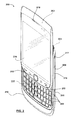
- Figure 2 is a perspective view of a portable electronic device according to one implementation for displaying graphical representations associated with videos;
- Figure 3 is a schematic view of the display of the portable electronic device of Figure 2 ;
- Figure 4 is another schematic view of the display of the portable electronic device of Figure 2 ;
- Figure 5 is a flowchart of a method for displaying graphical representations associated with videos according to one implementation.
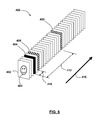
- Figure 6 is a schematic view of a video having a plurality of frames.
- Figure 1 shows a simplified block diagram of components of a portable electronic device 100 according to one implementation.
- the portable electronic device 100 generally has multiple components including a processor 102 that can control operation of the portable electronic device 100.
- the processor 102 may be a microprocessor.
- the processor 102 may be a Central Processing Unit (CPU).
- the processor 102 may be a Field Programmable Gate Array (FPGA).
- communication functions including data communications, voice communications, or both, may be performed on the portable electronic device 100 using a communication subsystem 104.
- data received by the portable electronic device 100 may be decompressed and decrypted by a decoder 106.
- the communication subsystem 104 may be used to send and receives messages over a wireless network 150.
- the wireless network 150 generally may be any type of wireless network, including data-centric wireless networks, voice-centric wireless networks, and dual-mode networks that support both voice and data communications.
- the portable electronic device 100 may be a battery-powered device and may include a battery interface 142 for receiving one or more rechargeable (or non-rechargeable) batteries 144.
- the processor 102 may also interact with additional subsystems, such as a Random Access Memory (RAM) 108, a flash memory 110, a display 112 (which may have a touch-sensitive overlay 114 connected to an electronic controller 116 that together comprise a touch-sensitive display 118), an actuator assembly 120, one or more optional force sensors 122, an auxiliary input/output (I/O) subsystem 124, one or more data ports 126, a speaker 128, a microphone 130, short-range communications subsystems 132, and other device subsystems 134.
- RAM Random Access Memory
- user-interaction with the portable electronic device 100 may be performed through the touch-sensitive display 118.
- the processor 102 may interact with the touch-sensitive overlay 114 via the electronic controller 116.
- Information such as text, characters, symbols, images, icons, and other items may be displayed or rendered on the touch-sensitive display 118.
- the display 112 need not be touch-sensitive. In such cases, user-interaction with the portable electronic device 100 may be performed using one or more other input devices, such as a keypad or buttons.
- the display 112 may be a Liquid Crystal Display (LCD), a Cathode Ray Tube (CRT) display, a plasma display panel, a projection unit, an Organic Light-Emitting Diode (OLED) or a Surface Electron Emitter Display (SED).
- LCD Liquid Crystal Display
- CRT Cathode Ray Tube
- OLED Organic Light-Emitting Diode
- SED Surface Electron Emitter Display
- the processor 102 may also interact with an accelerometer 136 as shown in Figure 1 .
- the accelerometer 136 may be utilized for detecting direction of gravitational forces or gravity-induced reaction forces, and in some cases may be used to determine a position or orientation of the portable electronic device 100.
- the portable electronic device 100 may use a Subscriber Identity Module or a Removable User Identity Module (SIM/RUIM) card 138 inserted into a SIM/RUIM interface 140 for communication with the wireless network 150.
- SIM/RUIM Removable User Identity Module
- user identification information may be programmed into the flash memory 110 or using other suitable techniques.
- the portable electronic device 100 includes an operating system 146 and software components 148 that are executed by the processor 102 and which may be stored in a persistent store, such as the flash memory 110. In some cases, additional applications may be loaded onto the portable electronic device 100 through the wireless network 150, the auxiliary I/O subsystem 124, the data port 126, the short-range communications subsystem 132, or other suitable device subsystems 134.
- a received signal such as a text message, an e-mail message, or web page download may be processed by the communication subsystem 104 and input to the processor 102.
- the processor 102 may then process the received signal for output to the display 112 or to the auxiliary I/O subsystem 124.
- a user may compose data items, such as e-mail messages, which may be transmitted over the wireless network 150 through the communication subsystem 104.
- voice communications may be similarly performed.
- the speaker 128 may output audible information converted from electrical signals
- the microphone 130 may convert audible information into electrical signals for processing.
- Figure 1 is a conceptual or schematic diagram, and that one or more of the components shown therein may be combined into one or more physical electronic components (e.g. one or more hardware components).
- FIG. 2 illustrated generally therein is a portable electronic device 200 for displaying graphical representations associated with multimedia objects, such as videos, according to one implementation.
- the portable electronic device 200 is a "slider” device and generally includes an upper housing 202 (or sliding portion) and a lower housing 204 (or base portion).
- the upper housing 202 and lower housing 204 are coupled together and are slidable between a closed position (not shown) and an open position (e.g. as shown in Figure 2 ).
- the portable electronic device 200 may not be a "slider” device, but may generally have any other suitable configuration.
- the portable electronic device 200 may be a "candy bar” style device, a "flip” style device, and so on.
- the portable electronic device 200 generally includes a display 206, which could be an LCD display or other suitable display, and which may correspond to the display 112 as discussed above.
- the display may have touch screen capabilities (and may correspond to the touch-sensitive display 118 as discussed above). In other implementations, the display 206 may not have touch screen capabilities.
- the portable electronic device 200 may include one or more input devices, such as navigation keys or buttons, a physical or virtual keyboard or keypad, a trackpad, a touchpad, a trackball, multimedia keys, etc.
- input devices such as navigation keys or buttons, a physical or virtual keyboard or keypad, a trackpad, a touchpad, a trackball, multimedia keys, etc.
- the upper housing 202 of the portable electronic device 202 may include an auxiliary input device 212.
- the auxiliary input 212 device may be an optical navigation module (e.g. an optical trackpad) that responds to user interaction, and which may be used for navigating on the display screen 206, to select objects on the display screen 206, or for other purposes.
- an optical navigation module e.g. an optical trackpad
- the auxiliary input device 212 may be a mechanical device that responds to manual user interaction (e.g. a trackball that responds to the movement of a user's finger or thumb).
- the portable electronic device 200 may also include other input devices, such as buttons 208, 210, a dedicated application button 211 (which could be used to automatically launch a particular application, such as a camera application), an "on/off' button 213, etc.
- other input devices such as buttons 208, 210, a dedicated application button 211 (which could be used to automatically launch a particular application, such as a camera application), an "on/off' button 213, etc.
- at least one of these input devices may include optical sensors, mechanical buttons, or both.
- the portable electronic device 200 could also include one or more input or output ports (e.g. I/O ports), such as a microUSB port (and which may correspond to data port 126).
- I/O ports such as a microUSB port (and which may correspond to data port 126).
- the microUSB port may be used for data communication with the portable electronic device 200, for charging a battery, or for both.
- the portable electronic device 200 may also include an audio jack 217.
- the audio jack 217 may be used to couple the portable electronic device 200 to a speaker or a microphone (or both) for use in voice communication, for listening to music or videos, etc.
- the portable electronic device 200 may also include an auxiliary output device 219, which could for example be a speaker (and which may correspond to speaker 128 as described above).
- the portable electronic device 200 may also include a keyboard or keypad 220 (shown here on a lower portion 218 of the lower housing 204).
- the keypad 220 may include a plurality of alphanumeric keys 222, and which may be positioned in various rows and columns.
- the keys 222 may represent at least a portion of an alphabet and may be arranged according to one or more standard keyboard layouts (e.g. QWERTY, QWERTZ, DVORAK, etc.)
- the display 206 may be a touch-sensitive display.
- the touch-sensitive display may be a capacitive touch-sensitive display, for example, and a user's touch on the touch-sensitive display may be determined by determining an X and Y location of the touch, with the X location determined by a signal generated as a result of capacitive coupling with a first touch sensor layer and the Y location determined by the signal generated as a result of capacitive coupling with another touch sensor layer.
- Each of the touch-sensor layers may provide a signal to a controller that represents the respective X and Y touch location values.
- features such as a virtual button or other feature displayed on the touch-sensitive display may be selected by a mapping of the touch location (e.g. from a user's finger) to a feature on the touch-sensitive display.
- the display 206 of the portable electronic device 200 may be used to display at least one graphical representations associated with at least one video or other multimedia data object.
- the display 206 may have a plurality of display regions, including a first display region 230, a second display region 232 and a third display region 234.
- Each display region 230, 232, 234 may display at least one graphical representation that is associated with a particular multimedia object (e.g. a video object, a slide-show, a music file, a music album, a podcast, an audiobooks, a radio station, etc.).
- the first display region 230 currently displays a first graphical representation 231 (e.g. a thumbnail image of a "smiley face") that is associated a first video object.
- the second display region 232 currently displays a graphical representation 233 (e.g. an image of a "sun") associated with a second video object
- the third display region 234 displays a graphical representation 235 (e.g. an image of a "thunderbolt”) associated with a third video object.
- the graphical representations 231, 233, 235 may be thumbnail images selected from one or more frames of their respective video objects.
- actions may be performed on the multimedia objects by taking some action in relation to the associated graphical representation. For example, a user may play the first video object by clicking on the first graphical representation 231.
- the display 206 may present one or more input elements, such as a first control element 236 (e.g. an "OK” button) and a second control element 238 (e.g. a "CHANGE” button) for receiving inputs in association with one or more of the multimedia objects.
- a first control element 236 e.g. an "OK” button
- a second control element 238 e.g. a "CHANGE” button
- the control elements 236, 238 may be activated by a user's touch (e.g. using a finger, stylus, or a pointing device).
- the control elements 236, 238 may be activated using one or more input devices, such as by using the trackpad 212 to manipulate a cursor on the display 206 and activate the control elements 236, 238.
- the display 206 may present related information about the media items being presented.
- metadata 240, 242 may be associated with the second and third videos, respectively (e.g. by presenting the metadata 240 adjacent the second display region 232 and the metadata 242 adjacent the third display region 234).
- the metadata 240, 242 may include information associated with each particular video object.
- the metadata 240, 242 may include data such as the titles of the video, author information for the video, rating information for the video, keywords associated with the video, etc.
- the graphical representations 231, 233, 235 may be thumbnail images taken from the associated video. Generally, it may be desirable that the graphical representations 231, 233, 235 give some visual indication of the content of the videos. However, sometimes the particular graphical representation 231, 233, 235 being displayed may not provide a desired indication of the video.
- the first graphical representation 231 may not present a desired frame of the first video (e.g. the "smiley face” may not be relevant to the nature of the video, or may not convey a relevant meaning for the video).
- an input may be received to indicate that that particular graphical representation is acceptable, or whether it is desired that it should be replaced by another new graphical representation.
- the user may activate the second control element 238 (e.g. the "CHANGE" button) to indicate that the first graphical representation 231 is undesirable and should be changed.
- the first graphical representation 231 can be replaced by another new graphical representation, for example a new graphical representation 237, as shown in Figure 4 .
- the user may activate the first control element 236 (e.g. the "OK" button) to indicate that the displayed graphical representation (e.g. the first graphical representation 231) is acceptable for that particular video.
- the first control element 236 e.g. the "OK" button
- the selection of the new graphical representation may be performed in any suitable manner.
- the new graphical representation e.g. the new graphical representation 237) may be selected in a randomized manner that includes using a random number generator to randomly select one frame from the video object.
- the randomized manner can be purely random, in that the new graphical representation can be any frame selected from the video, and could in fact be the same graphical representation as the currently displayed graphical representation.
- the randomized manner can be constrained according to one or more selection criteria.
- the random selection of the new graphical representation may be limited so that the new graphical representation is different from the original graphical representation (or from at least one previously discarded graphical representation), thus tending to avoid repeating a previously presenting graphical representation.
- the "randomized manner" of selection could include selecting the new graphical representation according to a particular pattern or sequence which may include at least some non-random elements.
- the new graphical representation could be selected to be at least particular number of frames away from the previous graphical representation (e.g. at least ten frames), or a particular quantity of time away from the previous graphical representation (e.g. at least ten seconds). This may increase the likelihood that the new graphical representation is visually distinct from the original graphical representation.
- the new graphical representation could be selected from a frame that occurs in the video after the previous graphical representation, with respect to the normal time sequence for playback of that particular video. In yet another example, the new graphical representation could be selected from a frame that occurs in the video before the previous graphical representation.
- the "randomized manner" could include selecting the new graphical representation according to a non-random process.
- a particular selection scheme could be predetermined (e.g. each new graphical representation should be ten frames after the previous graphical representation).
- the new graphical representation may be selected without performing a detailed analysis of the content of the video (e.g. based on a random number generator). This may help to reduce the consumption of computing resources used (e.g. processor power and memory), particularly on devices where computational resources may be limited.
- computing resources used e.g. processor power and memory
- the selection of the new graphical representation may be based on performing at least some analysis of the content of the video. For example, at least some portion of the video could be analyzed and the new graphical representation selected from a different scene of the video, or from a different angle of the video.
- each new graphical representation can be selected so as to be visually distinct from the previously selected graphical representation (or from at least one of the previously presented graphical representations). In some implementations, this may include selecting a new graphical representation as a candidate for displaying (e.g. in a randomized manner), performing some type of analysis on the new graphical representation to determine whether it is visually distinct from the at least one previous graphical representation, and if the new graphical representation is acceptable then displaying the new graphical representation.
- some implementations as described herein may provide an easier way for a user to generate a new thumbnail or other graphical representation for a particular video or other multimedia object by requesting that the displayed graphical representation be changed, and this process may be repeated until a desired graphical representation is displayed.
- This may be advantageous as opposed to having the user search through the video to manually locate a desired graphical representation, as it may require fewer user inputs to be processed. Additionally, this may add an element of "fun" to the user experience of setting of video thumbnails, and users may be entertained by observing which images are selected and displayed on the display and then deciding whether to accept or change a particular graphical representation.
- the graphical representation when a graphical representation is displayed, if an input is not received within a particular period of time (e.g. ten seconds), the graphical representation may be automatically replaced with a new graphical representation. For example, if the first graphical representation 231 has been displayed on the display 206 for ten seconds without an input being received (e.g. through either of the control elements 236, 238), the first graphical representation 231 may be replaced by the new graphical representation 237 selected from the video in a randomized manner. In such implementations, the displayed graphical representation can be "cycled" at particular time intervals until a desired graphical representation is displayed.
- a particular period of time e.g. ten seconds
- FIG. 5 depicts a flow chart of a method 300 of displaying graphical representations of videos or other multimedia objects.
- the method 300 includes selecting a first graphical representation associated with a particular video or other multimedia item.
- the first graphical representation may be a frame of the video, or another image.
- the first graphical representation may be selected according to particular criteria (e.g. the first graphical representation may be the first frame of the video, the fifth frame of the video, etc.).
- the first graphical representation may be selected according to some randomized manner (e.g. the first graphical representation 231 may be randomly selected from the video or be selected according to a particular non-random pattern).
- this first graphical representation is displayed.
- the first graphical representation 231 may be displayed on the display 206 of the portable electronic device 200.
- an input is received in association with the first graphical representation.
- this could be a user input received through a touchscreen display (e.g. display 206) or using another input device (e.g. auxiliary input device 212).
- the second control element 238 e.g. the "CHANGE" button
- the method 300 may then proceed to step 310.
- the method 300 may indicate that the displayed graphical representation is accepted. The method 300 may then terminate, proceed to another video object, or take some other action (e.g. displaying a dialog box indicating that the displayed graphical representation has been accepted).
- a new graphical representation is selected.
- the new graphical representation may be selected in a "randomized manner", which could include random or pseudo-random selection of a thumbnails, or selection of thumbnails according to some particular non-random pattern or sequence.
- the new graphical representation 237 may be selected from the video.
- the new graphical representation is displayed.
- the new graphical representation 237 may be displayed on the display 206.
- some analysis may be performed to determine whether the new graphical representation 237 is visually distinct from the first graphical representation, and if not the new graphical representation 237 may be discarded and another new graphical representation selected.
- step 314 the method 300 may then return to step 306, where an input may be received to indicate whether the new displayed graphical representation is acceptable, or should be changed.
- the method 300 can be repeated until a desired graphical representation has been identified.
- the video 400 may have a first frame 402 that shows an image 403 of a "smiley face", and which may be used as the first graphical representation 231.
- the video 400 also includes a plurality of other frames, including frames 404, 406 and 408.
- the new graphical representation can be selected from a frame of the video (e.g. video 400) according to some randomized manner.
- the new frame 404 could be selected based on a random or pseudo-random selection.
- the term "randomized manner" could include selecting the new graphical representation based on a non-random pattern.
- the frame 406 could be selected as the new graphical representation by selecting the fifth frame after the previously displayed frame (e.g. frame 402).
- the new frame (e.g. frame 406) could be selected following a scene change, thus providing a visually distinct new graphical representation from a previously presented frame (e.g. frame 404). This may be true even though the frames 404, 406 may only be separated by a small number of frames (e.g. two frames, as indicated generally at 410).
- a new frame 408 could be selected after a previous frame (e.g. frame 404) based on a criteria that the new frame be at least a certain number of frames after the previous frame (e.g. fourteen frames, as indicated generally as 412).
- the frames 402, 404, 406, 408 may be selected in a sequence or order that corresponds to the normal playback sequence of the video 400 (as indicated generally at 416). For example, frame 408 will be selected for display after frame 406, which will be selected for display after frame 404, and so on. In other implementations, the frames 402, 404, 406, 408 may be selected without regard to the order of the frames as they appear in the video 400.
- Some implementations as described herein may provide for more clearly distinguishing the content of a particular video from other videos. This may allow for more efficient presentation of, and access to, particulars video while reducing the likelihood of an incorrect video being accessed. This may be particularly beneficial on electronic devices where computer resources such as memory, battery life and processing power are limited, for example by reducing the number of read requests from a particular memory device, or inhibiting displaying the wrong video on a display screen which can consume significant quantities of battery power.
- selecting thumbnails or other graphical representations in a "randomized manner" may provide the benefit of fewer computational resources being used to select thumbnails that adequately represent particular video multimedia data without performing a detailed analysis of the content of the video. This may reduce processing resources consumed in association with each particular video file, which can reduce overall power consumption and increase speed, which may be particularly beneficial for portable electronic devices where computing resources are limited.
Landscapes
- Engineering & Computer Science (AREA)
- Multimedia (AREA)
- Theoretical Computer Science (AREA)
- Human Computer Interaction (AREA)
- Data Mining & Analysis (AREA)
- Databases & Information Systems (AREA)
- Physics & Mathematics (AREA)
- General Engineering & Computer Science (AREA)
- General Physics & Mathematics (AREA)
- User Interface Of Digital Computer (AREA)
Abstract
Description
- Implementations herein relate generally to previewing of multimedia data, and more particularly to methods and electronic devices for previewing video multimedia data using at least one graphical representation.
- Electronic devices are often used to obtain and store multimedia data, such as video files. On some electronic devices, a thumbnail or other image may be presented as a graphical representation that corresponds to particular multimedia data (e.g. a video object, a slide-show, a music file, and so on). Actions may be performed on the multimedia data by taking some action in relation to the graphical representation (e.g. a user may play a video media object by clicking on an associated thumbnail).
- In some cases, thumbnails are still pictures such as photographs, drawings or icons. In the case of multimedia data that includes video, a thumbnail may be an image taken from the video itself (e.g. a frame from the video).
- When thumbnails are used to represent videos, it may be desirable that the thumbnails give some visual indication of the content of the video. However, sometimes the particular thumbnail being displayed may not provide a desired indication of the video. For example, the thumbnail may not accurately represent the content of the video or may not distinguish the content of that video from other videos.
- Generally, the concepts described herein are directed to selection of graphical representations corresponding to multimedia data. In particular, some of the concepts herein pertain to thumbnails for videos that may be selected and displayed in a randomized manner in response to a user input.
- For example, a first thumbnail may be displayed on a display in association with a particular video. An input may be received to indicate whether the first thumbnail is acceptable, or whether a new thumbnail is desired. If a new thumbnail is desired, the new thumbnail can be selected in a randomized manner (e.g. by randomly selecting a frame from the video). The new thumbnail can then be displayed on the display in association with the video.
- In some cases, another input may be received to indicate whether the new thumbnail is acceptable, or whether another thumbnail is desired.
- This process can generally be repeated until the displayed thumbnail is a desired thumbnail. This may allow a user to select more meaningful or interesting thumbnails to represent particular videos without reviewing the video to locate a desired thumbnail. This may allow for more accurate and less ambiguous identification and more efficient presentation of and access to videos stored on an electronic device, and may reduce the likelihood of incorrect videos being accessed in error, which may be particularly beneficial on electronic devices where computer resources such as memory and processing power are limited.
- Generally, the term "randomized manner" comprise random or pseudo-random selection of thumbnails. The term "randomized manner" also includes selection of thumbnails according to some particular pattern or sequence, and which may have some non-random elements. For example, the pattern or sequence may be predetermined.
- Generally, implementations as described herein may be implemented on one or more electronic devices, which may comprise a wide range of devices, such as mobile phones, smart phones, personal digital assistants (PDAs), personal or desktop computers, notebooks, laptops, digital audio/video players, digital video recorders, tablet computers, and so on.
- On some of these electronic devices, particular computer resources (e.g. memory capacity, processing power and screen space) may be more limited than on other devices. A portable smart phone, for example, may have a smaller display and less memory capacity than a personal computer, which may have a larger display and more memory. However, the concepts as described herein are not limited to any particular kind of electronic device, but are generally suitable for use on various electronic devices with differing computer resources.
- In some implementations, the electronic device may be a portable electronic device, such as a smart phone or PDA, and which may have voice communication capabilities, data communication capabilities, or both, over one or more of a wired connection or a wireless connection.
- In some implementations the implementation may be carried out using a computer readable medium having stored thereon computer readable instructions comprising instructions which, when executed, cause the electronic device to perform the implementation.
- For a better understanding of implementations described herein, and to show how they may be carried into effect, reference will now be made, by way of example, to the accompanying drawings.
-
Figure 1 is a schematic representation of an electronic device according to one implementation; -
Figure 2 is a perspective view of a portable electronic device according to one implementation for displaying graphical representations associated with videos; -
Figure 3 is a schematic view of the display of the portable electronic device ofFigure 2 ; -
Figure 4 is another schematic view of the display of the portable electronic device ofFigure 2 ; -
Figure 5 is a flowchart of a method for displaying graphical representations associated with videos according to one implementation; and -
Figure 6 is a schematic view of a video having a plurality of frames. - For example,
Figure 1 shows a simplified block diagram of components of a portableelectronic device 100 according to one implementation. - The portable
electronic device 100 generally has multiple components including aprocessor 102 that can control operation of the portableelectronic device 100. In some implementations, theprocessor 102 may be a microprocessor. In some implementations, theprocessor 102 may be a Central Processing Unit (CPU). In some implementations, theprocessor 102 may be a Field Programmable Gate Array (FPGA). - In some implementations, communication functions, including data communications, voice communications, or both, may be performed on the portable
electronic device 100 using acommunication subsystem 104. In some implementations, data received by the portableelectronic device 100 may be decompressed and decrypted by adecoder 106. - In some implementations, the
communication subsystem 104 may be used to send and receives messages over awireless network 150. Thewireless network 150 generally may be any type of wireless network, including data-centric wireless networks, voice-centric wireless networks, and dual-mode networks that support both voice and data communications. - In some implementations, the portable
electronic device 100 may be a battery-powered device and may include abattery interface 142 for receiving one or more rechargeable (or non-rechargeable)batteries 144. - The
processor 102 may also interact with additional subsystems, such as a Random Access Memory (RAM) 108, aflash memory 110, a display 112 (which may have a touch-sensitive overlay 114 connected to anelectronic controller 116 that together comprise a touch-sensitive display 118), anactuator assembly 120, one or moreoptional force sensors 122, an auxiliary input/output (I/O)subsystem 124, one ormore data ports 126, aspeaker 128, amicrophone 130, short-range communications subsystems 132, andother device subsystems 134. - In some implementations, user-interaction with the portable
electronic device 100 may be performed through the touch-sensitive display 118. For example, theprocessor 102 may interact with the touch-sensitive overlay 114 via theelectronic controller 116. Information, such as text, characters, symbols, images, icons, and other items may be displayed or rendered on the touch-sensitive display 118. - In other implementations, the
display 112 need not be touch-sensitive. In such cases, user-interaction with the portableelectronic device 100 may be performed using one or more other input devices, such as a keypad or buttons. - In some implementations, the
display 112 may be a Liquid Crystal Display (LCD), a Cathode Ray Tube (CRT) display, a plasma display panel, a projection unit, an Organic Light-Emitting Diode (OLED) or a Surface Electron Emitter Display (SED). - In some implementations, the
processor 102 may also interact with anaccelerometer 136 as shown inFigure 1 . Theaccelerometer 136 may be utilized for detecting direction of gravitational forces or gravity-induced reaction forces, and in some cases may be used to determine a position or orientation of the portableelectronic device 100. - In some implementations, to identify a subscriber for network access, the portable
electronic device 100 may use a Subscriber Identity Module or a Removable User Identity Module (SIM/RUIM)card 138 inserted into a SIM/RUIM interface 140 for communication with thewireless network 150. Alternatively, in other implementations, user identification information may be programmed into theflash memory 110 or using other suitable techniques. - Generally, the portable
electronic device 100 includes anoperating system 146 andsoftware components 148 that are executed by theprocessor 102 and which may be stored in a persistent store, such as theflash memory 110. In some cases, additional applications may be loaded onto the portableelectronic device 100 through thewireless network 150, the auxiliary I/O subsystem 124, thedata port 126, the short-range communications subsystem 132, or othersuitable device subsystems 134. - In use, a received signal such as a text message, an e-mail message, or web page download may be processed by the
communication subsystem 104 and input to theprocessor 102. Theprocessor 102 may then process the received signal for output to thedisplay 112 or to the auxiliary I/O subsystem 124. In some cases, a user may compose data items, such as e-mail messages, which may be transmitted over thewireless network 150 through thecommunication subsystem 104. - In some implementations, voice communications may be similarly performed. For example, the
speaker 128 may output audible information converted from electrical signals, and themicrophone 130 may convert audible information into electrical signals for processing. - It may be noted that
Figure 1 is a conceptual or schematic diagram, and that one or more of the components shown therein may be combined into one or more physical electronic components (e.g. one or more hardware components). - Turning now to
Figure 2 , illustrated generally therein is a portableelectronic device 200 for displaying graphical representations associated with multimedia objects, such as videos, according to one implementation. - In this implementation, the portable
electronic device 200 is a "slider" device and generally includes an upper housing 202 (or sliding portion) and a lower housing 204 (or base portion). Theupper housing 202 andlower housing 204 are coupled together and are slidable between a closed position (not shown) and an open position (e.g. as shown inFigure 2 ). - In other implementations, the portable
electronic device 200 may not be a "slider" device, but may generally have any other suitable configuration. For example, the portableelectronic device 200 may be a "candy bar" style device, a "flip" style device, and so on. - As shown, the portable
electronic device 200 generally includes adisplay 206, which could be an LCD display or other suitable display, and which may correspond to thedisplay 112 as discussed above. In some implementations, the display may have touch screen capabilities (and may correspond to the touch-sensitive display 118 as discussed above). In other implementations, thedisplay 206 may not have touch screen capabilities. - In some implementations, the portable
electronic device 200 may include one or more input devices, such as navigation keys or buttons, a physical or virtual keyboard or keypad, a trackpad, a touchpad, a trackball, multimedia keys, etc. - For example, the
upper housing 202 of the portableelectronic device 202 may include anauxiliary input device 212. In some implementations, theauxiliary input 212 device may be an optical navigation module (e.g. an optical trackpad) that responds to user interaction, and which may be used for navigating on thedisplay screen 206, to select objects on thedisplay screen 206, or for other purposes. - In other implementations, the
auxiliary input device 212 may be a mechanical device that responds to manual user interaction (e.g. a trackball that responds to the movement of a user's finger or thumb). - The portable
electronic device 200 may also include other input devices, such asbuttons button 213, etc. In various implementations, at least one of these input devices may include optical sensors, mechanical buttons, or both. - The portable
electronic device 200 could also include one or more input or output ports (e.g. I/O ports), such as a microUSB port (and which may correspond to data port 126). In some examples, the microUSB port may be used for data communication with the portableelectronic device 200, for charging a battery, or for both. - In some implementations, the portable
electronic device 200 may also include anaudio jack 217. Theaudio jack 217 may be used to couple the portableelectronic device 200 to a speaker or a microphone (or both) for use in voice communication, for listening to music or videos, etc. - The portable
electronic device 200 may also include anauxiliary output device 219, which could for example be a speaker (and which may correspond tospeaker 128 as described above). - As shown, the portable
electronic device 200 may also include a keyboard or keypad 220 (shown here on alower portion 218 of the lower housing 204). Thekeypad 220 may include a plurality ofalphanumeric keys 222, and which may be positioned in various rows and columns. In some implementations, thekeys 222 may represent at least a portion of an alphabet and may be arranged according to one or more standard keyboard layouts (e.g. QWERTY, QWERTZ, DVORAK, etc.) - As discussed above, in some implementations the
display 206 may be a touch-sensitive display. The touch-sensitive display may be a capacitive touch-sensitive display, for example, and a user's touch on the touch-sensitive display may be determined by determining an X and Y location of the touch, with the X location determined by a signal generated as a result of capacitive coupling with a first touch sensor layer and the Y location determined by the signal generated as a result of capacitive coupling with another touch sensor layer. Each of the touch-sensor layers may provide a signal to a controller that represents the respective X and Y touch location values. Thus, features such as a virtual button or other feature displayed on the touch-sensitive display may be selected by a mapping of the touch location (e.g. from a user's finger) to a feature on the touch-sensitive display. - Turning now to
Figure 3 , thedisplay 206 of the portableelectronic device 200 may be used to display at least one graphical representations associated with at least one video or other multimedia data object. - As shown, the
display 206 may have a plurality of display regions, including afirst display region 230, asecond display region 232 and athird display region 234. Eachdisplay region - For example, in this implementation the
first display region 230 currently displays a first graphical representation 231 (e.g. a thumbnail image of a "smiley face") that is associated a first video object. Similarly, thesecond display region 232 currently displays a graphical representation 233 (e.g. an image of a "sun") associated with a second video object, and thethird display region 234 displays a graphical representation 235 (e.g. an image of a "thunderbolt") associated with a third video object. - In some implementations, the
graphical representations - In some implementations, actions may be performed on the multimedia objects by taking some action in relation to the associated graphical representation. For example, a user may play the first video object by clicking on the first
graphical representation 231. - In some implementations, the
display 206 may present one or more input elements, such as a first control element 236 (e.g. an "OK" button) and a second control element 238 (e.g. a "CHANGE" button) for receiving inputs in association with one or more of the multimedia objects. In implementations where thedisplay 206 has touch screen capabilities, thecontrol elements display 206 does not have touch screen capabilities, thecontrol elements trackpad 212 to manipulate a cursor on thedisplay 206 and activate thecontrol elements - In some implementations, the
display 206 may present related information about the media items being presented. For example, as shownmetadata metadata 240 adjacent thesecond display region 232 and themetadata 242 adjacent the third display region 234). Themetadata metadata - As described above, in some cases the
graphical representations graphical representations graphical representation - For example, the first graphical representation 231 (e.g. the "smiley face") may not present a desired frame of the first video (e.g. the "smiley face" may not be relevant to the nature of the video, or may not convey a relevant meaning for the video).
- According to some of the implementations as described herein, when a particular graphical representation is being displayed on the display, an input may be received to indicate that that particular graphical representation is acceptable, or whether it is desired that it should be replaced by another new graphical representation.
- For example, when the first
graphical representation 231 is displayed on thedisplay 206, the user may activate the second control element 238 (e.g. the "CHANGE" button) to indicate that the firstgraphical representation 231 is undesirable and should be changed. In response to the input, the firstgraphical representation 231 can be replaced by another new graphical representation, for example a newgraphical representation 237, as shown inFigure 4 . - Alternatively, the user may activate the first control element 236 (e.g. the "OK" button) to indicate that the displayed graphical representation (e.g. the first graphical representation 231) is acceptable for that particular video.
- Generally, the selection of the new graphical representation may be performed in any suitable manner. For example, in some implementations the new graphical representation (e.g. the new graphical representation 237) may be selected in a randomized manner that includes using a random number generator to randomly select one frame from the video object.
- In some implementations, the randomized manner can be purely random, in that the new graphical representation can be any frame selected from the video, and could in fact be the same graphical representation as the currently displayed graphical representation.
- In other implementations, the randomized manner can be constrained according to one or more selection criteria. For example, the random selection of the new graphical representation may be limited so that the new graphical representation is different from the original graphical representation (or from at least one previously discarded graphical representation), thus tending to avoid repeating a previously presenting graphical representation.
- In some implementations, the "randomized manner" of selection could include selecting the new graphical representation according to a particular pattern or sequence which may include at least some non-random elements. For example, the new graphical representation could be selected to be at least particular number of frames away from the previous graphical representation (e.g. at least ten frames), or a particular quantity of time away from the previous graphical representation (e.g. at least ten seconds). This may increase the likelihood that the new graphical representation is visually distinct from the original graphical representation.
- In another example, the new graphical representation could be selected from a frame that occurs in the video after the previous graphical representation, with respect to the normal time sequence for playback of that particular video. In yet another example, the new graphical representation could be selected from a frame that occurs in the video before the previous graphical representation.
- In some implementations, the "randomized manner" could include selecting the new graphical representation according to a non-random process. For example, a particular selection scheme could be predetermined (e.g. each new graphical representation should be ten frames after the previous graphical representation).
- In some implementations, the new graphical representation may be selected without performing a detailed analysis of the content of the video (e.g. based on a random number generator). This may help to reduce the consumption of computing resources used (e.g. processor power and memory), particularly on devices where computational resources may be limited.
- In other implementations, the selection of the new graphical representation may be based on performing at least some analysis of the content of the video. For example, at least some portion of the video could be analyzed and the new graphical representation selected from a different scene of the video, or from a different angle of the video.
- In some implementations, each new graphical representation can be selected so as to be visually distinct from the previously selected graphical representation (or from at least one of the previously presented graphical representations). In some implementations, this may include selecting a new graphical representation as a candidate for displaying (e.g. in a randomized manner), performing some type of analysis on the new graphical representation to determine whether it is visually distinct from the at least one previous graphical representation, and if the new graphical representation is acceptable then displaying the new graphical representation.
- Accordingly, some implementations as described herein may provide an easier way for a user to generate a new thumbnail or other graphical representation for a particular video or other multimedia object by requesting that the displayed graphical representation be changed, and this process may be repeated until a desired graphical representation is displayed. This may be advantageous as opposed to having the user search through the video to manually locate a desired graphical representation, as it may require fewer user inputs to be processed. Additionally, this may add an element of "fun" to the user experience of setting of video thumbnails, and users may be entertained by observing which images are selected and displayed on the display and then deciding whether to accept or change a particular graphical representation.
- In some implementations, when a graphical representation is displayed, if an input is not received within a particular period of time (e.g. ten seconds), the graphical representation may be automatically replaced with a new graphical representation. For example, if the first
graphical representation 231 has been displayed on thedisplay 206 for ten seconds without an input being received (e.g. through either of thecontrol elements 236, 238), the firstgraphical representation 231 may be replaced by the newgraphical representation 237 selected from the video in a randomized manner. In such implementations, the displayed graphical representation can be "cycled" at particular time intervals until a desired graphical representation is displayed. - Reference is now made to
Figure 5 , which depicts a flow chart of amethod 300 of displaying graphical representations of videos or other multimedia objects. - At
step 302, themethod 300 includes selecting a first graphical representation associated with a particular video or other multimedia item. For example, the first graphical representation may be a frame of the video, or another image. In some implementations, the first graphical representation may be selected according to particular criteria (e.g. the first graphical representation may be the first frame of the video, the fifth frame of the video, etc.). In other implementations, the first graphical representation may be selected according to some randomized manner (e.g. the firstgraphical representation 231 may be randomly selected from the video or be selected according to a particular non-random pattern). - At
step 304, this first graphical representation is displayed. For example, the firstgraphical representation 231 may be displayed on thedisplay 206 of the portableelectronic device 200. - At
step 306, an input is received in association with the first graphical representation. For example, this could be a user input received through a touchscreen display (e.g. display 206) or using another input device (e.g. auxiliary input device 212). - At
step 308, a determination is made as to whether the input is requesting a change of the first graphical representation. For example, the user may select the second control element 238 (e.g. the "CHANGE" button), to indicate that the user wants to change the first graphical representation associated with that video to a different graphical representation. This could for example indicate that the user does not consider the first graphical representation to adequately represent the video. If a change request is detected, themethod 300 then proceeds to step 312. - However, if the input indicates that the first graphical representation is acceptable and does not need to be changed (e.g. the user may select the
first control element 236, the "OK" button), themethod 300 may then proceed to step 310. - At
step 310, themethod 300 may indicate that the displayed graphical representation is accepted. Themethod 300 may then terminate, proceed to another video object, or take some other action (e.g. displaying a dialog box indicating that the displayed graphical representation has been accepted). - At
step 312, a new graphical representation is selected. For example, as discussed the new graphical representation may be selected in a "randomized manner", which could include random or pseudo-random selection of a thumbnails, or selection of thumbnails according to some particular non-random pattern or sequence. For example, the newgraphical representation 237 may be selected from the video. - At
step 314, the new graphical representation is displayed. For example, the newgraphical representation 237 may be displayed on thedisplay 206. - In some implementations, before the new
graphical representation 237 is displayed on thedisplay 206, some analysis may be performed to determine whether the newgraphical representation 237 is visually distinct from the first graphical representation, and if not the newgraphical representation 237 may be discarded and another new graphical representation selected. - In some implementations, after
step 314 themethod 300 may then return to step 306, where an input may be received to indicate whether the new displayed graphical representation is acceptable, or should be changed. - In some implementations, the
method 300 can be repeated until a desired graphical representation has been identified. - Turning now to
Figure 6 , illustrated therein is schematic view of avideo 400 having a number of frames. For example, thevideo 400 may have afirst frame 402 that shows animage 403 of a "smiley face", and which may be used as the firstgraphical representation 231. Thevideo 400 also includes a plurality of other frames, includingframes - As discussed above, in some implementations when an input is received to replace the currently displayed graphical representation with a new graphical representation, the new graphical representation can be selected from a frame of the video (e.g. video 400) according to some randomized manner. For example, the
new frame 404 could be selected based on a random or pseudo-random selection. - In some implementations, the term "randomized manner" could include selecting the new graphical representation based on a non-random pattern. For example, the
frame 406 could be selected as the new graphical representation by selecting the fifth frame after the previously displayed frame (e.g. frame 402). - In some implementations, the new frame (e.g. frame 406) could be selected following a scene change, thus providing a visually distinct new graphical representation from a previously presented frame (e.g. frame 404). This may be true even though the
frames - In some implementations, a
new frame 408 could be selected after a previous frame (e.g. frame 404) based on a criteria that the new frame be at least a certain number of frames after the previous frame (e.g. fourteen frames, as indicated generally as 412). - In some implementations, the
frames frame 408 will be selected for display afterframe 406, which will be selected for display afterframe 404, and so on. In other implementations, theframes video 400. - Some implementations as described herein may provide for more clearly distinguishing the content of a particular video from other videos. This may allow for more efficient presentation of, and access to, particulars video while reducing the likelihood of an incorrect video being accessed. This may be particularly beneficial on electronic devices where computer resources such as memory, battery life and processing power are limited, for example by reducing the number of read requests from a particular memory device, or inhibiting displaying the wrong video on a display screen which can consume significant quantities of battery power.
- In some implementations, selecting thumbnails or other graphical representations in a "randomized manner" may provide the benefit of fewer computational resources being used to select thumbnails that adequately represent particular video multimedia data without performing a detailed analysis of the content of the video. This may reduce processing resources consumed in association with each particular video file, which can reduce overall power consumption and increase speed, which may be particularly beneficial for portable electronic devices where computing resources are limited.
- The foregoing aspects of the method and the electronic device are provided for exemplary purposes only. Those skilled in the art will recognize that various changes may be made thereto without departing from the spirit and scope of the method and the electronic device as defined by the appended claims.
Claims (15)
- A method (300) of previewing multimedia data, comprising:selecting a first graphical representation (231) in association with a multimedia object (302);displaying the first graphical representation (231) (304);receiving an input associated with the first graphical representation (231) (306);in response to the input, determining whether to change the first graphical representation (231) (308), and if so then selecting a second graphical representation (237) from the multimedia object in a randomized manner (312); anddisplaying the second graphical representation (237) (314).
- The method (300) of claim 1, further comprising:receiving an input associated with the second graphical representation (237) (306), and in response to this input, determining whether to change the second graphical representation (237) (308), and if so then selecting a third graphical representation from the multimedia object in a randomized manner (312); anddisplaying the third graphical representation (314).
- The method (300) of claim 1 or claim 2, wherein the multimedia object is a video (400), and wherein the second graphical representation (237) is a frame (404) of the video (400).
- The method (300) of any preceding claim, wherein the randomized manner includes selection of the second graphical representation (237) according to a particular pattern that includes at least some non-random elements.
- The method (300) of any preceding claim, wherein the second graphical representation (237) is visually distinct from the first graphical representation (231).
- The method (300) of any preceding claim, wherein the second graphical representation (237) is selected to be at least a particular number of frames away from the first graphical representation (231).
- The method (300) of any preceding claim, further comprising, before displaying the second graphical representation (237), analyzing the second graphical representation (237) to determine whether it is visually distinct from the first graphical representation (231), and if so then displaying the second graphical representation (237).
- The method (300) of any preceding claim, wherein, if the input is not received within a particular period of time after the first graphical representation (231) is displayed, then automatically selecting and displaying the second graphical representation (237).
- An electronic device (200), comprising:a processor (102);a memory coupled (110) to the processor (102) and configured to store instructions executable by the processor (102);a display (206) coupled to the processor (102);wherein the processor (102) is configured to:display a first graphical representation (231) associated with a multimedia object on the display (206);receive an input in relation to the first graphical representation (231); andin response to the input, determine whether to change the first graphical representation (231), and if so then select a second graphical representation (237) from the multimedia object in a randomized manner; anddisplay the second graphical representation on the display (206).
- The electronic device (200) of claim 9, wherein the processor (102) is further configured to:receive an input in relation to the second graphical representation (237), and in response to this input, determining whether to change the second graphical representation (237), and if so then selecting a third graphical representation from the multimedia object in a randomized manner; anddisplay the third graphical representation on the display (206).
- The electronic device of claim 9 or claim 10, wherein the multimedia object is a video (400), and wherein the second graphical representation (237) is a frame (404) of the video (400).
- The electronic device of any one of claims 9 to 11, wherein the randomized manner includes selection of the second graphical representation (237) according to a particular pattern that includes at least some non-random elements.
- The electronic device of any one of claims 9 to 12, wherein the second graphical representation (237) is selected to be at least a particular number of frames away from the first graphical representation (231).
- The electronic device of any one of claims 9 to 13 further comprising, before displaying the second graphical representation (237), analyzing the second graphical representation (237) to determine whether it is visually distinct from the first graphical representation (231), and if so then displaying the second graphical representation (237) on the display.
- The electronic device of any one of claims 9 to 14, wherein, if the input is not received within a particular period of time after the first graphical representation (231) is displayed, then automatically selecting and displaying the second graphical representation (237).
Priority Applications (3)
| Application Number | Priority Date | Filing Date | Title |
|---|---|---|---|
| EP10174664A EP2423921A1 (en) | 2010-08-31 | 2010-08-31 | Methods and electronic devices for selecting and displaying thumbnails |
| PCT/CA2011/000982 WO2012027828A1 (en) | 2010-08-31 | 2011-08-30 | Methods and electronic devices for selecting and displaying thumbnails |
| CA2751091A CA2751091C (en) | 2010-08-31 | 2011-08-30 | Methods and electronic devices for selecting and displaying thumbnails |
Applications Claiming Priority (1)
| Application Number | Priority Date | Filing Date | Title |
|---|---|---|---|
| EP10174664A EP2423921A1 (en) | 2010-08-31 | 2010-08-31 | Methods and electronic devices for selecting and displaying thumbnails |
Publications (1)
| Publication Number | Publication Date |
|---|---|
| EP2423921A1 true EP2423921A1 (en) | 2012-02-29 |
Family
ID=42829996
Family Applications (1)
| Application Number | Title | Priority Date | Filing Date |
|---|---|---|---|
| EP10174664A Ceased EP2423921A1 (en) | 2010-08-31 | 2010-08-31 | Methods and electronic devices for selecting and displaying thumbnails |
Country Status (3)
| Country | Link |
|---|---|
| EP (1) | EP2423921A1 (en) |
| CA (1) | CA2751091C (en) |
| WO (1) | WO2012027828A1 (en) |
Cited By (3)
| Publication number | Priority date | Publication date | Assignee | Title |
|---|---|---|---|---|
| TWI465919B (en) * | 2012-11-14 | 2014-12-21 | Acer Inc | Electronic device using Thunder interface, connection method thereof and base device |
| EP2662786A3 (en) * | 2012-05-08 | 2015-07-08 | Sony Mobile Communications AB | Electronic device with multimedia content function |
| CN109218819A (en) * | 2018-09-29 | 2019-01-15 | 维沃移动通信有限公司 | A kind of video previewing method and mobile terminal |
Citations (7)
| Publication number | Priority date | Publication date | Assignee | Title |
|---|---|---|---|---|
| EP1045316A2 (en) * | 1999-04-13 | 2000-10-18 | Canon Kabushiki Kaisha | Image processing method and apparatus |
| US20070058876A1 (en) * | 2001-12-28 | 2007-03-15 | Canon Kabushiki Kaisha | Moving image data management apparatus and method |
| US20070071404A1 (en) * | 2005-09-29 | 2007-03-29 | Honeywell International Inc. | Controlled video event presentation |
| EP1830361A1 (en) * | 2006-03-02 | 2007-09-05 | Sony Corporation | Image displaying method and video playback apparatus |
| WO2007133668A2 (en) * | 2006-05-12 | 2007-11-22 | Hewlett-Packard Development Company, L. P. | A video browsing user interface |
| US20080138035A1 (en) * | 2006-12-07 | 2008-06-12 | Hiromi Nishiura | Recording/Reproducing Apparatus and Display Control Method |
| WO2008079587A2 (en) * | 2006-12-22 | 2008-07-03 | Apple Inc. | Two-dimensional timeline display of media items |
Family Cites Families (5)
| Publication number | Priority date | Publication date | Assignee | Title |
|---|---|---|---|---|
| JP3150246B2 (en) * | 1993-12-09 | 2001-03-26 | キヤノン株式会社 | Data management method and device |
| US6456307B1 (en) * | 1998-09-09 | 2002-09-24 | International Business Machines Corporation | Automatic icon generation |
| US20050138574A1 (en) * | 2003-12-17 | 2005-06-23 | Jyh-Han Lin | Interactive icon |
| US7580568B1 (en) * | 2004-03-31 | 2009-08-25 | Google Inc. | Methods and systems for identifying an image as a representative image for an article |
| US9933937B2 (en) * | 2007-06-20 | 2018-04-03 | Apple Inc. | Portable multifunction device, method, and graphical user interface for playing online videos |
-
2010
- 2010-08-31 EP EP10174664A patent/EP2423921A1/en not_active Ceased
-
2011
- 2011-08-30 WO PCT/CA2011/000982 patent/WO2012027828A1/en not_active Ceased
- 2011-08-30 CA CA2751091A patent/CA2751091C/en active Active
Patent Citations (7)
| Publication number | Priority date | Publication date | Assignee | Title |
|---|---|---|---|---|
| EP1045316A2 (en) * | 1999-04-13 | 2000-10-18 | Canon Kabushiki Kaisha | Image processing method and apparatus |
| US20070058876A1 (en) * | 2001-12-28 | 2007-03-15 | Canon Kabushiki Kaisha | Moving image data management apparatus and method |
| US20070071404A1 (en) * | 2005-09-29 | 2007-03-29 | Honeywell International Inc. | Controlled video event presentation |
| EP1830361A1 (en) * | 2006-03-02 | 2007-09-05 | Sony Corporation | Image displaying method and video playback apparatus |
| WO2007133668A2 (en) * | 2006-05-12 | 2007-11-22 | Hewlett-Packard Development Company, L. P. | A video browsing user interface |
| US20080138035A1 (en) * | 2006-12-07 | 2008-06-12 | Hiromi Nishiura | Recording/Reproducing Apparatus and Display Control Method |
| WO2008079587A2 (en) * | 2006-12-22 | 2008-07-03 | Apple Inc. | Two-dimensional timeline display of media items |
Non-Patent Citations (3)
| Title |
|---|
| ANDREW COLLINGTON: "Create a random thumbnail of a video file", AMNUTS, 22 June 2007 (2007-06-22), pages 1/3 - 3/3, XP002604857, Retrieved from the Internet <URL:http://blog.amnuts.com/2007/06/22/create-a-random-thumbnail-of-a-video-file/> [retrieved on 20101013] * |
| JULIE PERRY: "YouTube Change: No More YouTube Video Thumbnail Control!", YOUTUBE SECRET WEAPON, 3 December 2008 (2008-12-03), pages 1/2 - 2/2, XP002604855, Retrieved from the Internet <URL:http://www.youtubesecretweapon.com/blog/youtube-change-no-more-youtube-video-thumbnail-control/> [retrieved on 20101013] * |
| K.I.S.SOFT: "Random Frame 1.0", FILETRANSIT, 22 December 2006 (2006-12-22), pages 1/3-3/3, XP002604856, Retrieved from the Internet <URL:http://www.filetransit.com/view.php?id=5110> [retrieved on 20101013] * |
Cited By (3)
| Publication number | Priority date | Publication date | Assignee | Title |
|---|---|---|---|---|
| EP2662786A3 (en) * | 2012-05-08 | 2015-07-08 | Sony Mobile Communications AB | Electronic device with multimedia content function |
| TWI465919B (en) * | 2012-11-14 | 2014-12-21 | Acer Inc | Electronic device using Thunder interface, connection method thereof and base device |
| CN109218819A (en) * | 2018-09-29 | 2019-01-15 | 维沃移动通信有限公司 | A kind of video previewing method and mobile terminal |
Also Published As
| Publication number | Publication date |
|---|---|
| CA2751091C (en) | 2017-11-07 |
| WO2012027828A1 (en) | 2012-03-08 |
| CA2751091A1 (en) | 2012-02-29 |
Similar Documents
| Publication | Publication Date | Title |
|---|---|---|
| US10896284B2 (en) | Transforming data to create layouts | |
| CN102440065B (en) | Column organization of content | |
| EP2972742B1 (en) | Semantic zoom-based navigation of displayed content | |
| KR102368943B1 (en) | Touch/gesture-enabled interaction with electronic spreadsheets | |
| US9405452B2 (en) | Apparatus and method of searching for contents in touch screen device | |
| KR102223698B1 (en) | Viewing effects of proposed change in document before commiting change | |
| US8751968B2 (en) | Method and system for providing a user interface for accessing multimedia items on an electronic device | |
| KR101343479B1 (en) | Electronic device and method of controlling same | |
| JP2015531530A (en) | In-document navigation based on thumbnails and document maps | |
| US20120180001A1 (en) | Electronic device and method of controlling same | |
| US20150346961A1 (en) | Method, apparatus and computer program product for providing a recommendation for an application | |
| KR20160138573A (en) | Sliding surface | |
| WO2014200715A1 (en) | Incorporating external dynamic content into a whiteboard | |
| EP2788852A1 (en) | Quick analysis tool for spreadsheet application programs | |
| US20100313120A1 (en) | System and method for applying a text prediction algorithm to a virtual keyboard | |
| US20190302973A1 (en) | Computationally efficient human-computer interface for web browser tab user interface button | |
| US20130227463A1 (en) | Electronic device including touch-sensitive display and method of controlling same | |
| CN110377772A (en) | A kind of content search method, relevant device and computer readable storage medium | |
| CA2751091C (en) | Methods and electronic devices for selecting and displaying thumbnails | |
| US9298353B2 (en) | Methods and electronic devices for selecting and displaying thumbnails | |
| CN102591906B (en) | Note management method and system | |
| EP2631818A1 (en) | Method and apparatus for displaying files by categories in a graphical user interface | |
| US20130227485A1 (en) | Method and apparatus for operation of a computing device | |
| EP2631755A1 (en) | Electronic device including touch-sensitive display and method of controlling same | |
| CN103678377A (en) | Content search method of electronic device |
Legal Events
| Date | Code | Title | Description |
|---|---|---|---|
| 17P | Request for examination filed |
Effective date: 20100831 |
|
| AK | Designated contracting states |
Kind code of ref document: A1 Designated state(s): AL AT BE BG CH CY CZ DE DK EE ES FI FR GB GR HR HU IE IS IT LI LT LU LV MC MK MT NL NO PL PT RO SE SI SK SM TR |
|
| AX | Request for extension of the european patent |
Extension state: BA ME RS |
|
| PUAI | Public reference made under article 153(3) epc to a published international application that has entered the european phase |
Free format text: ORIGINAL CODE: 0009012 |
|
| RAP1 | Party data changed (applicant data changed or rights of an application transferred) |
Owner name: BLACKBERRY LIMITED |
|
| RAP1 | Party data changed (applicant data changed or rights of an application transferred) |
Owner name: BLACKBERRY LIMITED |
|
| STAA | Information on the status of an ep patent application or granted ep patent |
Free format text: STATUS: THE APPLICATION HAS BEEN REFUSED |
|
| 18R | Application refused |
Effective date: 20140515 |