EP2423828A2 - Pairing arithmetic device, pairing arithmetic method and recording medium having pairing arithmetic program recorded thereon - Google Patents
Pairing arithmetic device, pairing arithmetic method and recording medium having pairing arithmetic program recorded thereon Download PDFInfo
- Publication number
- EP2423828A2 EP2423828A2 EP10767199A EP10767199A EP2423828A2 EP 2423828 A2 EP2423828 A2 EP 2423828A2 EP 10767199 A EP10767199 A EP 10767199A EP 10767199 A EP10767199 A EP 10767199A EP 2423828 A2 EP2423828 A2 EP 2423828A2
- Authority
- EP
- European Patent Office
- Prior art keywords
- rational
- pairing
- computation
- computes
- cpu
- Prior art date
- Legal status (The legal status is an assumption and is not a legal conclusion. Google has not performed a legal analysis and makes no representation as to the accuracy of the status listed.)
- Granted
Links
Images



Classifications
-
- H—ELECTRICITY
- H04—ELECTRIC COMMUNICATION TECHNIQUE
- H04L—TRANSMISSION OF DIGITAL INFORMATION, e.g. TELEGRAPHIC COMMUNICATION
- H04L9/00—Cryptographic mechanisms or cryptographic arrangements for secret or secure communications; Network security protocols
- H04L9/32—Cryptographic mechanisms or cryptographic arrangements for secret or secure communications; Network security protocols including means for verifying the identity or authority of a user of the system or for message authentication, e.g. authorization, entity authentication, data integrity or data verification, non-repudiation, key authentication or verification of credentials
- H04L9/3247—Cryptographic mechanisms or cryptographic arrangements for secret or secure communications; Network security protocols including means for verifying the identity or authority of a user of the system or for message authentication, e.g. authorization, entity authentication, data integrity or data verification, non-repudiation, key authentication or verification of credentials involving digital signatures
- H04L9/3252—Cryptographic mechanisms or cryptographic arrangements for secret or secure communications; Network security protocols including means for verifying the identity or authority of a user of the system or for message authentication, e.g. authorization, entity authentication, data integrity or data verification, non-repudiation, key authentication or verification of credentials involving digital signatures using DSA or related signature schemes, e.g. elliptic based signatures, ElGamal or Schnorr schemes
-
- H—ELECTRICITY
- H04—ELECTRIC COMMUNICATION TECHNIQUE
- H04L—TRANSMISSION OF DIGITAL INFORMATION, e.g. TELEGRAPHIC COMMUNICATION
- H04L9/00—Cryptographic mechanisms or cryptographic arrangements for secret or secure communications; Network security protocols
- H04L9/30—Public key, i.e. encryption algorithm being computationally infeasible to invert or user's encryption keys not requiring secrecy
- H04L9/3066—Public key, i.e. encryption algorithm being computationally infeasible to invert or user's encryption keys not requiring secrecy involving algebraic varieties, e.g. elliptic or hyper-elliptic curves
- H04L9/3073—Public key, i.e. encryption algorithm being computationally infeasible to invert or user's encryption keys not requiring secrecy involving algebraic varieties, e.g. elliptic or hyper-elliptic curves involving pairings, e.g. identity based encryption [IBE], bilinear mappings or bilinear pairings, e.g. Weil or Tate pairing
-
- G—PHYSICS
- G06—COMPUTING OR CALCULATING; COUNTING
- G06F—ELECTRIC DIGITAL DATA PROCESSING
- G06F17/00—Digital computing or data processing equipment or methods, specially adapted for specific functions
- G06F17/10—Complex mathematical operations
-
- G—PHYSICS
- G06—COMPUTING OR CALCULATING; COUNTING
- G06F—ELECTRIC DIGITAL DATA PROCESSING
- G06F7/00—Methods or arrangements for processing data by operating upon the order or content of the data handled
- G06F7/60—Methods or arrangements for performing computations using a digital non-denominational number representation, i.e. number representation without radix; Computing devices using combinations of denominational and non-denominational quantity representations, e.g. using difunction pulse trains, STEELE computers, phase computers
- G06F7/72—Methods or arrangements for performing computations using a digital non-denominational number representation, i.e. number representation without radix; Computing devices using combinations of denominational and non-denominational quantity representations, e.g. using difunction pulse trains, STEELE computers, phase computers using residue arithmetic
-
- G—PHYSICS
- G06—COMPUTING OR CALCULATING; COUNTING
- G06F—ELECTRIC DIGITAL DATA PROCESSING
- G06F7/00—Methods or arrangements for processing data by operating upon the order or content of the data handled
- G06F7/60—Methods or arrangements for performing computations using a digital non-denominational number representation, i.e. number representation without radix; Computing devices using combinations of denominational and non-denominational quantity representations, e.g. using difunction pulse trains, STEELE computers, phase computers
- G06F7/72—Methods or arrangements for performing computations using a digital non-denominational number representation, i.e. number representation without radix; Computing devices using combinations of denominational and non-denominational quantity representations, e.g. using difunction pulse trains, STEELE computers, phase computers using residue arithmetic
- G06F7/724—Finite field arithmetic
- G06F7/725—Finite field arithmetic over elliptic curves
-
- G—PHYSICS
- G09—EDUCATION; CRYPTOGRAPHY; DISPLAY; ADVERTISING; SEALS
- G09C—CIPHERING OR DECIPHERING APPARATUS FOR CRYPTOGRAPHIC OR OTHER PURPOSES INVOLVING THE NEED FOR SECRECY
- G09C1/00—Apparatus or methods whereby a given sequence of signs, e.g. an intelligible text, is transformed into an unintelligible sequence of signs by transposing the signs or groups of signs or by replacing them by others according to a predetermined system
Definitions
- the present invention relates to a pairing computation device and a pairing computation method which enable to perform pairing computation at high speed, and a recording medium storing a pairing computation program.
- the authentication procedure like this is for confirming, in general, that an individual user is a normal user and the authentication processing for the authentication procedure is performed by an authentication server.
- an individual user transmits anonymously signature data which certifies only that the individual user belongs to a certain group to an authentication server, and the authentication server authenticates that the individual user belongs to a certain group without identifying individual user from the received signature data. Therefore, the authentication server blocks unfair use by individual user who does not belong to the group on one hand, and authenticates individual user without accumulating history information about each individual user on the other hand.
- Paring computation is a computation using a function of two inputs and one output. For example, letting S be a rational point over a prime field F p , Q be a rational point over a k-th extension field F p k , by inputting two rational points S and Q, an element z over an extension field F * p k is outputted. And yet, authentication is performed by using a property of bilinearity that when a times of rational point S and b times of rational point Q are inputted, z to the power of ab is outputted.
- k is called an embedding degree
- F* p k is meant to be correctly displayed in mathematical notation as F p k * However, due to display restrictions, it is denoted as F* p k .
- points on an elliptic curve are used respectively.
- the pairing computation of points on an elliptic curve is constituted of a step which computes using Miller' s algorithm and a step which performs an exponentiation with respect to a result of the computation.
- the inventors in view of the present situation, have done research and development to speed up pairing computation and have made the present invention.
- the pairing computation device is characterized in that the second computation unit computes respective rational points -S, (2 ⁇ -1)S, p 10 ((2 ⁇ -1)S), -pS, (2 ⁇ -1)pS, p 10 ((2 ⁇ -1)pS) in order using previously obtained results, the third computation unit respectively computes a value l 1 at a rational point Q(x Q , y Q ) of a straight line passing through rational points ((2 ⁇ -1)S, -S), a value l 2 at the rational point Q(x Q , y Q ) of a straight line passing through rational points ((2x-1)pS, -pS), a value l 3 at the rational point Q(x Q , y Q ) of a straight line passing through rational points (p 10 ((2 ⁇ -1)S),2 ⁇ S), and a value l 4 at the rational point Q(x Q , y Q ) of a straight line passing through rational points (p 10 ((2 ⁇ -1)pS),2
- the pairing computation method is characterized in that the second computation step computes respective rational points -S, (2 ⁇ -1)S, p 10 ((2 ⁇ -1)S), -pS, (2 ⁇ -1)pS, p 10 ((2 ⁇ -1)pS) in order using previously obtained results, the third computation step respectively computes a value l 1 at a rational point Q(x Q , y Q ) of a straight line passing through rational points ((2x-1)S, -S), a value l 2 at the rational point Q(x Q , y Q ) of a straight line passing through rational points ((2 ⁇ -1)pS, -pS), a value l 3 at the rational point Q(x Q , y Q ) of a straight line passing through rational points (p 10 ((2 ⁇ -1)S),2 ⁇ S), and a value l 4 at the rational point Q(x Q , y Q ) of a straight line passing through rational points (p 10 ((2 ⁇ -1)pS),2
- the pairing computation program is characterized in that the pairing computation program causes:
- E an additive group constituted of rational points on the pairing enabled elliptic curve defined over an extension field F p 8
- E[r] be a set of rational points having a prime order r
- ⁇ p be a Frobenius endomorphism
- G 2 E r ⁇ Ker ⁇ ⁇ p - p , as a non-degenerate bilinear map e : G 1 ⁇ G 2 ⁇ F * p 8 / F * p 8 r
- the pairing computation device comprising a CPU which computes the pairing e(S,Q), by letting S ⁇ G 1 , Q ⁇ G 2
- E an additive group constituted of rational points on the pairing enabled elliptic curve defined over an extension field F p 8
- E[r] be a set of rational points having a prime order r
- ⁇ p be a Frobenius endomorphism
- G 2 E r ⁇ Ker ⁇ ⁇ p - p , as a non-degenerate bilinear map e : G 1 ⁇ G 2 ⁇ F * p 8 / F * p 8 r
- an electronic computer which includes a CPU computes the pairing e(S,Q), by letting S ⁇ G 1 , Q ⁇ G 2 ,
- the pairing computation device is characterized in that the second computation unit computes respective rational points -S, (2 ⁇ -1)S, p 10 ((2 ⁇ -1)S), -pS, (2 ⁇ -1)pS, p 10 ((2 ⁇ -1)pS) in order using previously obtained results, the third computation unit respectively computes a value l 1 at a rational point Q(x Q , y Q ) of a straight line passing through rational points ((2 ⁇ -1)S, -S), a value l 2 at the rational point Q(x Q , y Q ) of a straight line passing through rational points (p 10 ((2 ⁇ -1)S), 2 ⁇ S), a value l 3 at the rational point Q(x Q , y Q ) of a straight line passing through rational points ((2 ⁇ -1)pS, -pS), and a value l 4 at the rational point Q(x Q , y Q ) of a straight line passing through rational points (p 10 ((2 ⁇ -1)pS),
- the pairing computation method is characterized in that the second computation step computes respective rational points -S, (2 ⁇ -1)S, p 10 ((2 ⁇ -1)S), -pS, (2 ⁇ -1)pS, p 10 ((2 ⁇ -1)pS) in order using previously obtained results, the third computation step respectively computes a value l 1 at a rational point Q(x Q , y Q ) of a straight line passing through rational points ((2 ⁇ -1)S, -S), a value l 2 at the rational point Q(x Q , y Q ) of a straight line passing through rational points (p 10 ((2 ⁇ -1)S),2 ⁇ S), a value l 3 at the rational point Q(x Q , y Q ) of a straight line passing through rational points ((2 ⁇ -1)pS, -pS), and a value l 4 at the rational point Q(x Q , y Q ) of a straight line passing through rational points (p 10 ((2 ⁇ -1)pS),
- the pairing computation program is characterized in that the pairing computation program causes:
- E an additive group constituted of rational points on the pairing enabled elliptic curve defined over an extension field F p 8
- E[r] be a set of rational points having a prime order r
- ⁇ p be a Frobenius endomorphism
- G 2 E r ⁇ Ker ⁇ ⁇ p - p , as a non-degenerate bilinear map e : G 1 ⁇ G 2 ⁇ F * p 8 / F * p 8 r
- the pairing computation device comprises a CPU which computes the pairing e(S, Q), by letting S ⁇ G 1 , Q ⁇ G 2
- E an additive group constituted of rational points on the pairing enabled elliptic curve defined over an extension field F p 8
- E[r] be a set of rational points having a prime order r
- ⁇ p be a Frobenius endomorphism
- G 2 E r ⁇ Ker ⁇ ⁇ p - p , as a non-degenerate bilinear map e : G 1 ⁇ G 2 ⁇ F * p 8 / F * p 8 r
- an electronic computer which includes a CPU computes the pairing e(S,Q), by letting S ⁇ G 1 , Q ⁇ G 2 ,
- E an additive group constituted of rational points on the pairing enabled elliptic curve defined over an extension field F p 8
- E[r] be a set of rational points having a prime order r
- ⁇ p be a Frobenius endomorphism
- G 2 E r ⁇ Ker ⁇ ⁇ p - p , as a non-degenerate bilinear map e : G 1 ⁇ G 2 ⁇ F * p 8 / F * p 8 r
- the pairing computation program causes an electronic computer which includes a CPU to compute the pairing e(S,Q), by letting S ⁇ G 1 , Q ⁇
- a pairing computation method and a pairing computation program out of a first step which computes a rational function using Miller' s algorithm in pairing computation and a second step which performs exponentiation of a result of the computation, the first step computes the rational function using an integer variable ⁇ , thereby speeding up the pairing computation.
- the inventors have found out a new pairing which enables fast pairing computation as a non-degenerate bilinear map by using an integer variable ⁇ on an elliptic curve as below e : G 1 ⁇ G 2 ⁇ F * p k / F * p k r .
- This pairing is hereinafter referred to as "Twisted Xate pairing"
- This pairing is hereinafter referred to as "Twisted Xate multi-pairing" That is, the pairing computation device, the pairing computation method, and the pairing computation program all according to the present invention make it possible to perform fast pairing computation by using Twisted Xate pairing and Twisted Xate multi-pairing.
- elliptic curves have been known as pairing friendly curves according to embedding degrees respectively.
- an embedding degree 12
- t ⁇ 6 ⁇ ⁇ 2 + 1.
- 6 ⁇ ⁇ 2 ⁇ - 4 ⁇ ⁇ - 1 ⁇ p 4 + 2 ⁇ ⁇ p 4 + 1 ⁇ - 2 ⁇ ⁇ - 1 ⁇ p 4 + 2 ⁇ ⁇ mod r is obtained.
- Equation 3 and p 6 ⁇ -1 (mod r)
- f' ⁇ ,S (Q) it is possible to obtain f' ⁇ ,S (Q) at high speed by calculating f 2 ⁇ ,S (Q) and f 2 ⁇ ,pS (Q) using an integer variable ⁇ which has a smaller size than (t-1) 2 mod r in a computation using Miller' s algorithm.
- a basic idea of the present invention is to make F 1 and F 2 mutually independent calculations by calculating pS preliminarily. Due to this, Twisted Xate pairing according to the present invention can realize parallel processing. To be more specific, in an environment where a multi-pairing which enables parallel processing of a plurality of Miller' s algorithm calculations and a CPU having a plurality of cores can be used, thread calculation can be applicable.
- pS can be calculated at high speed by means of a scalar multiplication to an extent of (1/4) [log 2 r] from (Equation 11).
- F 1 and F 2 become mutually independent calculations.
- Fig. 8 shows a calculation flow in a case where a thread calculation is applied. In this case, a repetition count of Miller' s algorithm substantially becomes (1/4) [log 2 r] from (Equation 21) and (Equation 22).
- A is obtained by taking a product of the two.
- f p 2 ⁇ ,S can be obtained at an extremely small calculation cost by means of the Frobenius endomorphism. Therefore, since Miller' s algorithm a repetition count of which is given as (1/4) [log 2 r] is performed twice, the calculation cost of processing of Twisted Xate pairing by means of Miller' s algorithm is given as (1/2) [log 2 r].
- the present invention is characterized in that A is obtained by means of Miller' s algorithm with respect to multi-pairing (MMA), although in general, A is obtained by independently calculating Miller' s algorithm.
- MMA multi-pairing
- Equation 23 f 2 ⁇ ⁇ , S pQ ⁇ f 2 ⁇ ⁇ , pS Q .
- F ⁇ 76 f ⁇ ⁇ , S Q F 2 ⁇ ⁇ , Z S Z Q ⁇ g 2 ⁇ ⁇ - 1 ⁇ S , - S p ⁇ g 2 ⁇ ⁇ - 1 ⁇ pS , - pS - 1 p 10 ⁇ F 2 ⁇ ⁇ , Z S Z Q ⁇ g 2 ⁇ ⁇ - 1 ⁇ p 10 ⁇ S , 2 ⁇ ⁇ S p ⁇ g 2 ⁇ ⁇ - 1 ⁇ pS , 2 ⁇ ⁇ pS
- F 2 ⁇ ,ZS is obtained by giving 2 ⁇ to a repetition count of MMA algorithm and by giving Z S and Z Q the following equations respectively.
- a pairing computation device is not limited to a case where the pairing computation device is constituted of an authentication server.
- a device includes at least an arithmetic means such as a CPU and can perform pairing computation, any device may be used as the pairing computation device.
- an electronic computer 10 which constitutes an authentication server includes: a CPU 11; a storage unit 12 such as a hard disk which stores various kinds of programs such as a pairing computation program, data which is used by the pairing computation program and the like; a memory unit 13 which expands the pairing computation program and makes it executable, temporarily stores data generated in the course of execution of the pairing computation program and is constituted of such as a RAM.
- numeral 14 is a bus.
- the electronic computer 10 is connected to a telecommunication line 20 such as the Internet and is configured to be able to receive signature data of digital group signature transmitted from a client device 30 which is connected the telecommunication line 20.
- numeral 15 is an input output control part of the electronic computer 10.
- the electronic computer 10 when signature data of the digital group signature is transmitted from the client device 30, stores temporarily the transmitted signature data in the memory unit 13, starts a pairing computation program and performs pairing computation.
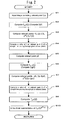
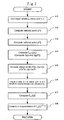
- the electronic computer 10 by means of the started pairing computation program, performs pairing computation based on a flowchart shown in Fig. 2 and realizes the digital group signature.
- an authentication processing in the digital group signature is not explained in detail and only the pairing computation as a subroutine processing in the authentication processing is explained in detail.
- the electronic computer 10 causing the CPU 11 to function as an input unit by means of the started pairing computation program, inputs data of an integer variabte ⁇ and data of a rational point S both of which are stored preliminarily in the memory unit 13, and data of a rational point Q temporarily stored in the memory unit 13 as the signature data into predetermined registers provided inside of the CPU 11 respectively. (Step S1).
- Step S2 the electronic computer 10, causing the CPU 11 to function as a first computation unit by means of the pairing computation program, computes a rational function f 2 ⁇ ,S (Q) by means of Miller' s algorithm and stores a result of the computation in the memory unit 13.
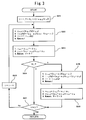
- the electronic computer 10 performs the computation of the rational function f 2 ⁇ ,S (Q) specifically as shown in Fig.3 .
- the electronic computer 10 computes 2 ⁇ S as well as the rational function f 2 ⁇ ,S (Q) and stores results of the computation in the memory unit 13.
- the electronic computer 10 sets f to be 1 and T to be S and also sets the number of bits in a case of binary representation of the integer variable 2 ⁇ to be i (Step S21).
- the electronic computer 10 causing the CPU 11 to function as a second computation unit by means of the pairing computation program, reads a value of 2 ⁇ S stored in the memory unit 13, performs computation of rational points -S, (2 ⁇ -1)S, p 10 ((2 ⁇ -1)S) respectively and stores values of the respective rational points in the memory unit 13 respectively. (Step S3).
- the electronic computer 10 causing the CPU 11 to function as a third computation unit by means of the pairing computation program, reads values of the respective rational points obtained in step S3 from the memory unit 13 respectively, computes l 1 which is a value at a rational point Q(x Q , y Q ) of a straight line passing through rational points ((2 ⁇ -1)S, -S) and l 2 which is a value at the rational point Q (x Q , y Q ) of a straight line passing through rational points (p 10 ((2 ⁇ -1)S),2 ⁇ S) respectively, and stores values of l 1 and l 2 in the memory unit 13 respectively.
- Step S4 Step S4
- Step S5 the electronic computer 10 causing the CPU 11 to function as the second computation unit by means of the pairing computation program, computes rational point pS (Step S5).
- the electronic computer 10 reads values of rational points obtained in step S2 and step S3 from the memory unit 13 and computes using these values as below and stores the value of pS in the memory unit 13.
- pS p 10 ⁇ 2 ⁇ ⁇ - 1 ⁇ S + 2 ⁇ ⁇ S
- Step S6 the electronic computer 10, causing the CPU 11 to function as the first computation unit by means of the pairing computation program, computes the rational function f 2 ⁇ ,pS (Q) by means of Miller' s algorithm and stores a result of the computation in the memory unit 13.
- the electronic computer 10 performs a computation of the rational function f 2 ⁇ ,pS (Q) specifically as shown in Fig. 3 .
- the electronic computer 10 performs computation of 2 ⁇ pS as well as computation of the rational function f 2 ⁇ ,pS (Q) and stores a result of the computation in the memory unit 13.
- the electronic computer 10 causing the CPU 11 to function as the second computation unit by means of the pairing computation program, reads a value of 2 ⁇ pS sored in the memory unit 13, performs computation of rational points -pS, (2 ⁇ -1)pS, p 10 ((2 ⁇ -1)pS) respectively and stores values of the respective rational points in the memory unit 13 respectively. (Step S7).
- the electronic computer 10 causing the CPU 11 to function as the third computation unit by means of the pairing computation program, reads values of the respective rational points obtained in step S7 from the memory unit 13 respectively, computes l 3 which is a value at the rational point Q(x Q , y Q ) of a straight line passing through rational points ((2 ⁇ -1)pS, -pS) and l 4 which is a value at the rational point Q (x Q , y Q ) of a straight line passing through rational points (p 10 ((2 ⁇ -1)pS),2 ⁇ pS) respectively, and stores values of l 3 and l 4 in the memory unit 13 respectively.
- Step S8 the electronic computer 10 causing the CPU 11 to function as the third computation unit by means of the pairing computation program, reads values of the respective rational points obtained in step S7 from the memory unit 13 respectively, computes l 3 which is a value at the rational point Q(x Q , y Q ) of a straight line passing through rational points ((2 ⁇ -1)p
- the electronic computer 10 causing the CPU 11 to function as a fourth computation unit by means of the pairing computation program, reads a result of the computation in the first computation unit (values of f 2 ⁇ ,S (Q) and f 2 ⁇ ,pS (Q)) and a result of the computation in the third computation unit (values of l 1 , l 2 , and l 3 , l 4 ) from the memory unit 13, computes f' ⁇ ,S (Q) expressed as below, and stores a result of the computation in the memory unit 13 (Step S9).
- T 2 ⁇ -T 4 15. T 3 ⁇ T 1 +T 2 16. B ⁇ g T3,T2 17. C ⁇ A ⁇ B -1 18. C ⁇ C ⁇ p 10 19. C ⁇ C ⁇ A 20. T 4 ⁇ p 10 T 3 21. B ⁇ g T4,T1 22. C ⁇ C ⁇ B 23. f ⁇ f ⁇ C 24. Return f. That is, the CPU 11 performs respective computations in the procedure described above using the memory unit 13, obtains f' ⁇ ,S (Q), and stores the value in the memory unit 13. To be more specific, in step 1, the CPU 11 obtains f 2 ⁇ ,S by means of Miller' s algorithm and assigns the result to A and also assigns 2 ⁇ S obtained simultaneously to T 1 .
- step 2 and 3 the CPU 11 obtains rational points -S and (2 ⁇ -1)S, and assigns the results to T 2 and T 3 respectively.
- step 4 since in a case where an embedding degree is an even number, G A,B becomes l A,B , the CPU 11 obtains l 1 which is a value at rational point Q of a straight line passing through rational points ((2 ⁇ -1)S,-S), and assigns the result to B.
- the CPU 11 obtains a ⁇ part in () of (Equation 29) and assign the result to B.
- step 7 the CPU 11 obtains a product of B and A, and assigns the result to f.
- step 8 the CPU 11 obtains rational point p 10 ((2 ⁇ -1)S) and assigns the result to T 4 .
- step 9 the CPU 11 obtains l 2 which is a value at rational point Q of a straight line passing through rational points (p 10 ((2 ⁇ -1)S),2 ⁇ S) and assigns the result to B.
- step 10 the CPU 11 obtains pS using relationship in (Equation 11) and assigns the result to T 4 .
- step 11 and 12 the CPU 11 obtains a () part of (Equation 29) and assigns the result to f.
- step 13 the CPU 11 obtains f 2 ⁇ ,pS by means of Miller' s algorithm and assigns the result to A, and assigns 2 ⁇ pS obtained simultaneously to T 1 .
- step 14 and 15 the CPU 11 obtains rational points -pS and (2 ⁇ -1)pS.
- step 16 the CPU 11 obtains l 3 which is a value at rational point Q of a straight line passing through rational points ((2 ⁇ -1)pS, -pS) and assigns the results to B.
- step 17 and 18 the CPU 11 obtains a ⁇ part accompanying () in (Equation 29) described above.
- step 19 the CPU 11 obtains a product of C and A, and assigns the result to C.
- step 20 the CPU 11 obtains rational point p 10 ((2 ⁇ -1)S) and assigns the result to T 4 .
- step 21 the CPU 11 obtains l 4 which is a value at rational point Q of a atraight line passing through rational points (p 10 ((2 ⁇ -1)S),2 ⁇ pS) and assigns the result to B.
- step 22 and 23 the CPU 11 obtains f' f ⁇ ,S (Q) and assigns the result to f.
- the electronic computer 10 causing the CPU 11 to function as a fifth computation unit by means of the pairing computation program, reads a value of f' ⁇ ,S (Q) obtained in step S9 from the memory unit 13, performs an exponentiation of the final exponentiation in pairing e(S, Q), and stores a result of the computation in the memory unit 13 (Step S10).
- the electronic computer 10 computes as follows and stores f' , that is, a value of e(S, Q) in the memory unit 13. 1. f' ⁇ f' ⁇ p 6 ⁇ f -1 2. f' ⁇ f' ⁇ p 2 ⁇ f' 3. a ⁇ (f' 6 ) ⁇ ⁇ (f' 5 ) ⁇ p 6 4. b ⁇ a p 5. b ⁇ a ⁇ b 6. compute f' ⁇ p, f' ⁇ p 2 , and f' ⁇ p 3 7. c ⁇ b ⁇ (f' ⁇ p) 2 ⁇ f' ⁇ p 2 8. f' ⁇ f' ⁇ p 3 ⁇ (c 6 ) ⁇ 2 ⁇ c ⁇ b ⁇ (f' ⁇ p ⁇ f' ) 9 ⁇ a ⁇ f' ⁇ 4 9. Return f'
- the electronic computer 10 which constitutes an authentication server performs an authentication processing using a result of the pairing computation obtained as mentioned above.
- f' ⁇ ,S (Q) becomes, using l 5 which is a value at a rational point Q(x Q , y Q ) of a straight line passing through rational points (3 ⁇ S,S), l 6 which is a value at the rational point Q(x Q , y Q ) of a straight line passing through rational points (p 2 (S), (3 ⁇ +1)S), l 7 which is a value at the rational point Q(x Q , y Q ) of a straight line passing through rational points (3 ⁇ p 3 S,p 3 S), and 1 8 which is a value at the rational point Q (x Q , y Q ) of a straight line passing through rational points (p 2 (p 3 S), (3 ⁇ +1)p 3 S), as follows.
- f ⁇ ⁇ , S Q f 3 ⁇ ⁇ , S Q ⁇ l 5 ⁇ l 6 p 8 ⁇ f 3 ⁇ ⁇ , p 8 ⁇ S Q ⁇ l 7 ⁇ l 8
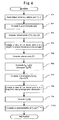
- an authentication server performs pairing computation by means of the started pairing computation program based on a flowchart shown in Fig. 4 .
- the electronic computer 10 causing the CPU 11 to function as an input unit by means of the started pairing computation program, inputs data of an integer variable ⁇ and data of rational point S both of which are stored preliminarily in the memory unit 13, and data of rational point Q temporarily stored in the memory unit 13 as signature data into predetermined registers provided inside of the CPU 11 respectively. (Step T1).
- Step T2 the electronic computer 10, causing the CPU 11 to function as a first computation unit by means of the pairing computation program, computes a rational function f 3 ⁇ ,S (Q) by means of Miller' s algorithm and stores a result of the computation in the memory unit 13.
- the electronic computer 10 performs the same computation processing as in a flowchart shown in Fig. 3 , except that anti-logarithm of logarithm to base two in step S21 in the flowchart shown in Fig.3 is 3 ⁇ and the first expression in step S22 is 1.
- the electronic computer 10 computes 3 ⁇ S as well as the rational function f 3 ⁇ ,S (Q) and stores results of the computation in the memory unit 13.
- the electronic computer 10 After computing rational function f 3 ⁇ ,S (Q) and 3 ⁇ S, the electronic computer 10, causing the CPU 11 to function as a second computation unit by means of the pairing computation program, reads a value of 3 ⁇ S stored in the memory unit 13, performs computation of rational points p 2 (S) and (3 ⁇ +1) S respectively and stores values of the rational points in the memory unit 13 respectively. (Step T3).
- the electronic computer 10 causing the CPU 11 to function as a third computation unit by means of the pairing computation program, reads values of the respective rational points obtained in step T3 from the memory unit 13 respectively, computes l 5 which is a value at a rational point Q(x Q , y Q ) of a straight line passing through rational points (3 ⁇ S,S) and l 6 which is a value at the rational point Q(x Q , y Q ) of a straight line passing through rational points (p 2 (S), (3 ⁇ +1)S) respectively, and stores values of l 5 and l 6 in the memory unit 13 respectively.
- Step T4 the electronic computer 10 causing the CPU 11 to function as a third computation unit by means of the pairing computation program, reads values of the respective rational points obtained in step T3 from the memory unit 13 respectively, computes l 5 which is a value at a rational point Q(x Q , y Q ) of a straight line passing through rational points (3 ⁇ S,S) and l 6 which is a value at the rational
- the electronic computer 10 causing the CPU 11 to function as the second computation unit by means of the pairing computation program, computes rational point p 3 S (Step T5).
- the electronic computer reads values of rational points obtained in step T2 and step T3 from the memory unit 13, computes as below, and stores the value of p 3 S in the memory unit 13.
- p 3 ⁇ S p 2 ⁇ S + 3 ⁇ ⁇ + 1 ⁇ S .
- Step T6 the electronic computer 10, causing the CPU 11 to function as the first computation unit by means of the pairing computation program, computes a rational function f 3 ⁇ ,p ⁇ 3S (Q) by means of Miller' s algorithm and stores a result of the computation in the memory unit 13.
- the electronic computer 10 performs a computation of the rational function f 3 ⁇ ,p ⁇ 3S (Q) specifically as shown in Fig. 3 .
- the electronic computer 10 performs computation of 3 ⁇ p 3 S as well as computation of the rational function f 3 ⁇ ,p ⁇ 3S (Q) and stores results of the computation in the memory unit 13.
- the electronic computer 10 causing the CPU 11 to function as the second computation unit by means of the pairing computation program, reads the value of 3 ⁇ p 3 S stored in the memory unit 13, performs computation of rational points p 2 (p 3 S), (3 ⁇ +1)p 3 S respectively and stores values of the respective rational points in the memory unit 13 respectively. (Step T7).
- the electronic computer 10 causing the CPU 11 to function as the third computation unit by means of the pairing computation program, reads values of respective rational points obtained in step T7 from the memory unit 13 respectively, computes l 7 which is a value at the rational point Q(x Q , y Q ) of a straight line passing through rational points (3 ⁇ p 3 S, p 3 S) and l 8 which is a value at the rational point Q(x Q, y Q ) of a straight line passing through rational points (p 2 (p 3 S), (3 ⁇ +1)p 3 S) respectively, and stores values of l 7 and l 8 in the memory unit 13 respectively. (Step T8).
- the electronic computer 10 causing the CPU 11 to function as a fourth computation unit by means of the pairing computation program, reads a result of the computation in the first computation unit (values of f 3 ⁇ ,S (Q) and f 3 ⁇ ,p ⁇ 3S (Q)), and a result of the computation in the third computation unit (values of l 5 , l 6 , and l 7 , l 8 ) from the memory unit 13 and computes f' ⁇ ,S (Q) expressed as below and stores a result of the computation in the memory unit 13 (Step T9).
- the CPU 11 performs respective computations of the procedure described above using the memory unit 13, obtains a value of f' ⁇ ,S (Q) and stores the value in the memory unit 13.
- the CPU 11 obtains f 3 ⁇ ,S by means of Miller' s algorithm, assigns the result to A, and also assigns 3 ⁇ S obtained simultaneously to T 1 .
- the CPU 11 obtains l 5 which is a value at rational point Q of a straight line passing through rational points (3 ⁇ S,S) and assigns the result to B.
- step 3 and step 4 the CPU 11 obtains rational points (3 ⁇ +1)S and p 2 (S) and assigns the results to T 2 and T 3 respectively.
- step 5 the CPU 11 obtains l 6 which is a value at rational point Q of a straight line passing through rational points (p 2 (S), (3 ⁇ +1)S) and assigns the result to C.
- step 6 the CPU 11 takes a product of A, B and C, obtains a () part of (Equation 30) described above and assigns the result to f.
- step 8 the CPU 11 obtains f 3 ⁇ ,p ⁇ 3S by means of Miller' s algorithm and assigns the result to A and also assigns 3 ⁇ p 3 S obtained simultaneously to T 1 .
- step 9 the CPU 11 obtains l 7 which is a value at rational point Q of a straight line passing through rational points (3 ⁇ p 3 S,p 3 S) and assigns the result to B.
- step 10 and step11 the CPU 11 obtains rational points (3 ⁇ +1)p 3 S, p 2 (p 3 S) and assigns the results to T 2 and T 3 respectively.
- step 12 the CPU 11 obtains l 8 which is a value at rational point Q of a straight line passing through rational points (p 2 (p 3 S), (3 ⁇ +1)p 3 S) and assigns the result to C.
- step 13 the CPU 11 obtains f' ⁇ ,S (Q) and assigns the result to f.
- the electronic computer 10 causing the CPU 11 to function as a fifth computation unit by means of the pairing computation program, reads a value of f' ⁇ ,S (Q) obtained in step T9 from the memory unit 13, performs an exponentiation of the final exponentiation in pairing e(S, Q) and stores a result of the computation in the memory unit 13. (Step T10).
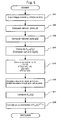
- Twisted Xate multi-pairing in a case where an embedding degree is 12 is explained in detail. Explanation of the parts which are common to Twisted Xate pairing is omitted. Based on Fig. 5 , Twisted Xate multi-pairing in a case where the embedding degree is 12 is explained.
- the electronic computer 10 causing the CPU 11 to function as an input unit by means of the started pairing computation program, inputs data of an integer variable ⁇ and data of rational point S both of which are stored preliminarily in the memory unit 13, and data of rational point Q temporarily stored in the memory unit 13 as signature data into predetermined registers provided inside of the CPU 11 respectively. (Step U1).
- the electronic computer 10 causing the CPU11 to function as a second computation unit by means of the pairing computation program, performs a computation of rational point pS and stores the value of pS in the memory unit 13 (step U2).
- the electronic computer 10 causing the CPU11 to function as the second computation unit by means of the pairing computation program, performs a computation of rational point pQ and stores the value of pQ in the memory unit 13 (step U3).
- the electronic computer 10 causing the CPU 11 to function as a first computation unit by means of the pairing computation program, computes a rational function F 2 ⁇ ,ZS (Z Q ) by means of Miller' s algorithm with respect to multi-pairing and stores a result of the computation in the memory unit 13. (Step U4).
- the electronic computer 10 performs computation of the rational function F 2 ⁇ ,ZS (Z Q ) specifically as shown in Fig. 6 .
- the electronic computer 10 computes 2 ⁇ S and 2 ⁇ pS as well as the rational function F 2 ⁇ ,ZS (Z Q ) and stores results of the computation in the memory unit 13.
- the electronic computer 10 sets f to be 1, T 1 to be S, T 2 to be pS and also sets the number of bits in a case of binary representation of the integer variable 2 ⁇ to be i (Step U41) .
- the electronic computer 10 causing the CPU 11 to function as the second computation unit by means of the pairing computation program, reads values of 2 ⁇ S and 2 ⁇ pS stored in the memory unit 13, performs computation of rational points -S, (2 ⁇ -1)S, p 10 ((2 ⁇ -1)S), -pS, (2 ⁇ -1)pS, and p 10 ((2 ⁇ -1)pS) respectively and stores values of the respective rational points in the memory unit 13 respectively.
- Step U5 the electronic computer 10 causing the CPU 11 to function as the second computation unit by means of the pairing computation program, reads values of 2 ⁇ S and 2 ⁇ pS stored in the memory unit 13, performs computation of rational points -S, (2 ⁇ -1)S, p 10 ((2 ⁇ -1)S), -pS, (2 ⁇ -1)pS, and p 10 ((2 ⁇ -1)pS) respectively and stores values of the respective rational points in the memory unit 13 respectively.
- the electronic computer 10 causing the CPU 11 to function as a third computation unit by means of the pairing computation program, reads values of the respective rational points obtained in step U5 from the memory unit 13 respectively, computes l 1 which is a value at a rational point Q(x Q , y Q ) of a straight line passing through rational points ((2 ⁇ -1)S,-S), l 2 which is a value at the rational point Q(x Q , y Q ) of a straight line passing through rational points ((2 ⁇ -1)pS,-pS), l 3 which is a value at the rational point Q(x Q , y Q ) of a straight line passing through rational points (p 10 ((2 ⁇ -1)S),2 ⁇ S) and l 4 which is a value at the rational point Q (x Q , y Q ) of a straight line passing through rational points (p 10 ((2 ⁇ -1)pS),2 ⁇ pS) respectively, and stores values of l 1 , l 2 , l
- the electronic computer 10 causing the CPU 11 to function as a fourth computation unit by means of the pairing computation program, reads a result of the computation in the first computation unit (Step U4), and a result of the computation in the third computation unit (values of l 1 , l 2 , l 3 , and l 4 ) from the memory unit 13, computes f' ⁇ ,S (Q) expressed as below, and stores a result of the computation in the memory unit 13 (Step U7).
- the electronic computer 10 causing the CPU 11 to function as a fifth computation unit by means of the pairing computation program, reads a value of f' ⁇ ,S (Q) obtained in step U7 from the memory unit 13, performs an exponentiation of the final exponentiation in pairing e(S, Q), and stores a aresult of the computation in the memory unit 13 (Step U8).
- the electronic computer 10 performs a computation of f' ⁇ ,S (Q) as follows.
- input: Z S ⁇ S,pS ⁇ G 1 ⁇
- Z Q ⁇ pQ,Q ⁇ G 2 ⁇ , 2 ⁇
- f f' ⁇ ,S (Q) procedure: 1.
- f ⁇ B p ⁇ C 9. f ⁇ A ⁇ f -1 10.
- the CPU 11 performs respective computations of the procedure described above using the memory unit 13, obtains f' ⁇ ,S (Q), and stores the value in the memory unit 13.
- the CPU 11 obtains F 2 ⁇ ,ZS by means of Miller' s algorithm with respect to multi-pairing , assigns the result to A, and also assigns 2 ⁇ S and 2 ⁇ pS obtained simultaneously to T 1 and T 2 respectively.
- step 2 and step 3 the CPU 11 obtains rational points -S and (2 ⁇ -1)S and assigns the result to T 3 and T 4 respectively.
- step 4 the CPU 11 obtains l 1 which is a value at rational point Q of a straight line passing through rational points ((2 ⁇ -1)S,-S) and assigns the result to B.
- step 5 and 6 the CPU 11 obtains rational points -pS and (2 ⁇ -1)pS and assign the result to T 5 and T 6 respectively.
- step 7 the CPU 11 obtains l 2 which is a value at rational point Q of a straight line passing through rational points (-pS,(2 ⁇ -1)pS) and assigns the result to C.
- step 8 the CPU 11 takes a product of B to the power of p and C, obtains a ⁇ part of the inside of (Equation 31) described above and assigns the result to f.
- step 9 the CPU 11 obtains a ⁇ part of the outside of (Equation 31) described above and assigns the result to f.
- step 10 the CPU 11 obtains a value of rational point p 10 ((2 ⁇ -1)S) and assigns the result to T 3 .
- step 11 the CPU 11 obtains l 3 which is a value at rational point Q of a straight line passing through rational points (p 10 ((2 ⁇ -1)S),2 ⁇ S) and assigns the results to B.
- step 12 the CPU 11 obtains rational point p 10 ((2 ⁇ -1)pS) and assigns the result to T 5 .
- step 13 the CPU 11 obtains l 4 which is a value at rational point Q of a straight line passing through rational points (p 10 ((2 ⁇ -1)pS), 2 ⁇ pS) and assigns the result to C.
- step 14 the CPU 11 obtains a product of B to the power of p and C.
- step 15 the CPU 11 obtains the whole of (Equation 31) described above and assigns the result (f' ⁇ ,S (Q)) to f.
- Twisted Xate multi-pairing in the case where the embedding degree is 12 is explained.
- the electronic computer 10 causing the CPU 11 to function as an input unit by means of the started pairing computation program, inputs data of an integer variable ⁇ and data of rational point S both of which are stored preliminarily in the memory unit 13, and data of rational point Q temporarily stored in the memory unit 13 as signature data into predetermined registers provided inside of the CPU 11 respectively. (Step V1).
- the electronic computer 10 causing the CPU 11 to function as a second computation unit by means of the pairing computation program, performs a computation of rational point p 3 S and stores the value of p 3 S in the memory unit 13 (step V2).
- the electronic computer 10 causing the CPU 11 to function as the second computation unit by means of the pairing computation program, performs a computation of rational point p 3 Q and stores the value of p 3 Q in the memory unit 13 (step V3).
- Step V4 the electronic computer 10, causing the CPU 11 to function as a first computation unit by means of the pairing computation program, computes a rational function F 3 ⁇ ,ZS (Z Q ) by means of Miller' s algorithm with respect to multi-pairing and stores a result of the computation in the memory unit 13.
- Step V4 the electronic computer 10 performs the same computation processing as a flowchart shown in Fig. 6 except that anti-logarithm of logarithm to base two is 3 ⁇ , and all p become p 3 .
- step V4 the electronic computer 10 computes 3 ⁇ S and 3 ⁇ p 3 S as well as the rational function F 3 ⁇ ,ZS (Z Q ) and stores results of the computation in the memory unit 13.
- the electronic computer 10 After computing the rational function F 3 ⁇ ,ZS (Z Q ), and 3 ⁇ S and 3 ⁇ p 3 S , the electronic computer 10, causing the CPU 11 to function as the second computation unit by means of the pairing computation program, reads values of 3 ⁇ S and 3 ⁇ p 3 S stored in the memory unit 13, performs computation of rational points p 2 (S),(3 ⁇ +1)S, p 2 (p 3 S), and (3 ⁇ +1)p 3 S respectively and stores values of the respective rational points in the memory unit 13 respectively. (Step V5).
- the electronic computer 10 causing the CPU 11 to function as a third computation unit by means of the pairing computation program, reads values of the respective rational points obtained in step V5 from the memory unit 13 respectively, computes l 5 which is a value at a rational point Q(x Q, y Q ) of a straight line passing through rational points (3 ⁇ S, S), l 6 which is a value at the rational point Q(x Q, y Q ) of a straight line passing through rational points (p 2 (S), (3 ⁇ +1)S), l 7 which is a value at the rational point Q(x Q , y Q ) of a straight line passing through rational points (3 ⁇ p 3 S, p 3 S) and l 8 which is a value at the rational point Q(x Q , y Q ) of a straight line passing through rational points (p 2 (p 3 S), (3 ⁇ +1)p 3 S) respectively, and stores values of l 5 , l 6 , l 7 , and l 8 in the memory unit 13 respectively.
- the electronic computer 10 causing the CPU 11 to function as a fourth computation unit by means of the pairing computation program, reads a result of the computation in the first computation unit, and a result of the computation in the third computation unit (values of l 5 , l 6 , l 7 , and l 8 ) from the memory unit 13 and computes f' ⁇ ,S (Q) expressed as below and stores a result of the computation in the memory unit 13 (Step V7).
- F ⁇ 82 f ⁇ ⁇ , S Q F 3 ⁇ ⁇ , Z S ⁇ l 5 ⁇ l 6 p 8 ⁇ l 7 ⁇ l 8
- the electric computer 10 performs the computation of f' ⁇ ,S (Q) as follows.
- Z Q ⁇ p 3 Q,Q ⁇ G 2 ⁇ , 3 ⁇
- C ⁇ g T4,T3 6.
- f ⁇ B ⁇ C 7.
- f ⁇ f ⁇ p 3 8. f ⁇ A ⁇ f 9.
- step 1 the CPU 11 performs respective computations of the procedure described above using the memory unit 13, obtains f' ⁇ ,S (Q), and stores the value in the memory unit 13.
- step 1 the CPU 11 obtains F 3 ⁇ ,ZS by means of Miller' s algorithm with respect to multi-pairing and assigns the result to A and also assigns 3 ⁇ S and 3 ⁇ p 3 S obtained simultaneously to T 1 and T 2 respectively.
- step 2 the CPU 11 obtains l 5 which is a value at rational point Q of a straight line passing through rational points (3 ⁇ S,S) and assigns the result to B.
- step 3 and step 4 the CPU 11 obtains rational points (3 ⁇ +1)S and p 2 (S) and assigns the result to T 3 and T 4 respectively.
- step 5 the CPU 11 obtains l 6 which is a value at rational point Q of a straight line passing through rational points (p 2 (S), (3 ⁇ +1)S) and assigns the result to C.
- step 6 the CPU 11 takes a product of B and C, obtains an inside of ⁇ part of (Equation 32) described above and assigns the result to f.
- step 7 the CPU 11 obtains a ⁇ part of (Equation 32) described above.
- step 8 the CPU 11 obtains a result up to the ⁇ part of (Equation 32) described above and assign the result to f.
- step 9 the CPU 11 obtains l 7 which is a value at rational point Q of a straight line passing through rational points (3 ⁇ p 3 S, p 3 S) and assigns the result to B.
- step 10 and step 11 the CPU 11 obtains rational points (3 ⁇ +1)p 3 S and p 2 (p 3 S), and assigns the results to T 3 and T 4 respectively.
- step 12 the CPU 11 obtains l 8 which is a value at rational point Q of a straight line passing through rational points (p 2 (p 3 S),(3 ⁇ +1)p 3 S) and assigns the result to C.
- step 13 the CPU 11 obtains f' ⁇ ,S (Q), and aassigns the result to f.
- the electronic computer 10 causing the CPU 11 to function as a fifth computation unit by means of the pairing computation program, reads the value of f' ⁇ ,S (Q) obtained in step V7, performs an exponentiation of the final exponentiation in pairing e(S, Q), and stores a result of the computation in the memory unit 13 (Step V8).
- the memory unit 13 is used as storage means for storing each computation result.
- registers provided with inside of the CPU 11 may be used as the storage means described above.
Landscapes
- Engineering & Computer Science (AREA)
- Physics & Mathematics (AREA)
- General Physics & Mathematics (AREA)
- Theoretical Computer Science (AREA)
- Mathematical Analysis (AREA)
- Mathematical Optimization (AREA)
- Pure & Applied Mathematics (AREA)
- Computer Security & Cryptography (AREA)
- Mathematical Physics (AREA)
- Computational Mathematics (AREA)
- Signal Processing (AREA)
- Computing Systems (AREA)
- Computer Networks & Wireless Communication (AREA)
- General Engineering & Computer Science (AREA)
- Algebra (AREA)
- Data Mining & Analysis (AREA)
- Software Systems (AREA)
- Databases & Information Systems (AREA)
- Management, Administration, Business Operations System, And Electronic Commerce (AREA)
- Joining Of Glass To Other Materials (AREA)
- Numerical Control (AREA)
- Navigation (AREA)
- Developing Agents For Electrophotography (AREA)
- Pinball Game Machines (AREA)
Abstract
Description
- The present invention relates to a pairing computation device and a pairing computation method which enable to perform pairing computation at high speed, and a recording medium storing a pairing computation program.
- Conventionally, when an individual user uses various kinds of services provided on a network such as the Internet, there are some cases where authentication procedure using ID and password set preliminarily for each individual user is requested. The authentication procedure like this is for confirming, in general, that an individual user is a normal user and the authentication processing for the authentication procedure is performed by an authentication server.
- Recently, with the use of digital signature technology, user-specific digital signature data is added to each individual data per se to make it possible to assure that data used by an individual user is not falsified by a third party or is not leaked to a third party. Accordingly, even high confidential information has been safely handled on a network.
- On the other hand, in the digital signature, since an individual user is identified along with authentication processing by an authentication server, each time the authentication processing is performed, a history of each individual user is sequentially accumulated as information on the authentication server. Therefore, since personal information such as what kind of sites did a user get access to, or what kind of services did a user use is accumulated on the authentication server, adequate attention is paid so that any such information should not be leaked from the point of view of personal information protection.
- In order to resolve the accumulation of history information about an individual user which arises from employing this digital signature, there has been proposed to employ digital group signature which is extended from the digital signature.
- In a case where the digital group signature is employed, an individual user transmits anonymously signature data which certifies only that the individual user belongs to a certain group to an authentication server, and the authentication server authenticates that the individual user belongs to a certain group without identifying individual user from the received signature data. Therefore, the authentication server blocks unfair use by individual user who does not belong to the group on one hand, and authenticates individual user without accumulating history information about each individual user on the other hand.
- In the anonymous authentication in the digital group signature, paring computation is employed.
- Paring computation is a computation using a function of two inputs and one output. For example, letting S be a rational point over a prime field Fp, Q be a rational point over a k-th extension field Fp k, by inputting two rational points S and Q, an element z over an extension field F* p k is outputted. And yet, authentication is performed by using a property of bilinearity that when a times of rational point S and b times of rational point Q are inputted, z to the power of ab is outputted. Here, "k" is called an embedding degree, and "F*p k" is meant to be correctly displayed in mathematical notation as

However, due to display restrictions, it is denoted as F*p k. - Generally, for rational points S and Q, points on an elliptic curve are used respectively. The pairing computation of points on an elliptic curve is constituted of a step which computes using Miller' s algorithm and a step which performs an exponentiation with respect to a result of the computation.
- In the digital group signature, when performing authentication processing of access right of an individual user who belongs to a group, after having performed pairing computation to exclude individual users who have lost access rights, authentication processing is performed by performing pairing computation of the given individual user and hence, it has been possible to respond flexibly to attributes changes due to issuance and expiration of access right for each individual user.
- Therefore, in a case of digital group signature where a group is constituted of, for example, 10,000 individual users, if there are 100 individual users who have lost their access rights, it is necessary to perform 100 pairing computations. Since there needs about 0.1 second per one pairing computation performed by present general electronic computer, 100 pairing computations require about 10 seconds. Accordingly, in practical use, the number of individual users is limited and hence, the digital group signature has not been widely used.
- Accordingly, in order to enhance usefulness of the digital group signature by increasing computation speed of the pairing computation, there have been proposed techniques which try to realize high-speed computation by, for example, employing Tate pairing computation method which is defined on an elliptic curve as pairing computation to reduce computation load (For example, see
JP 2005-316267A - However, speeding up of pairing computation currently proposed is not yet sufficient and further speeding up of the paring computation has been sought.
- The inventors, in view of the present situation, have done research and development to speed up pairing computation and have made the present invention.
- According to an aspect of the present invention, there is provided a pairing computation device, in which, as described in
claim 1,
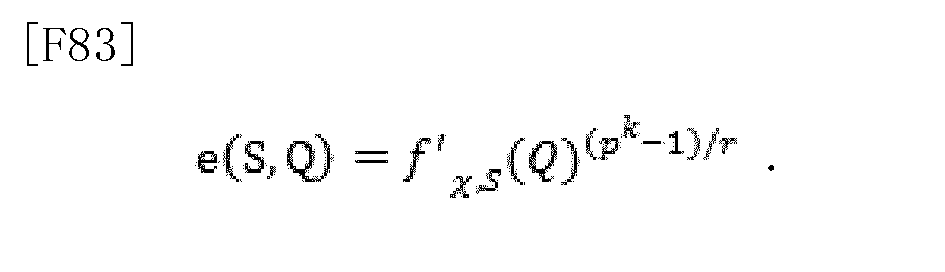
an elliptic curve is given as y2=x3+ax+b, a∈Fp, b∈Fp, letting k be an embedding degree, E be an additive group constituted of rational points on the pairing enabled elliptic curve defined over an extension field Fp k, E[r] be a set of rational points having a prime order r, and φp be a Frobenius endomorphism, a pairing e is defined using

, as a non-degenerate bilinear map
the pairing computation device comprises a CPU which computes the pairing e(S,Q), by letting S∈G1, Q∈G2, χ be a given integer variable, and F be a rational function which is calculated using Miller' s algorithm with respect to multi-pairing (MMA),
the order r and a trace t of the Frobenius endomorphism φp are specified preliminarily according to the embedding degree k using the integer variable χ, and the CPU includes: - an input unit which inputs the integer variable χ, the rational point S, and the rational point Q into respective predetermined registers;
- a computation unit which computes F;
- a computation unit which computes a value of a straight line passing through given rational points at a rational point Q(xQ, yQ);
- a computation unit which computes f' χ,S(Q) using said F and said value; and
- a computation unit which computes the pairing e(S,Q) using said f' χ,S(Q) as

- According to a further aspect of the present invention, there is provided a pairing computation method, in which, as described in
claim 2, an elliptic curve is given as y2=x3+ax+b, a∈Fp, b∈Fp, letting k be an embedding degree, E be an additive group constituted of rational points on the pairing enabled elliptic curve defined over an extension field Fp k, E[r] be a set of rational points having a prime order r, and φp be a Frobenius endomorphism, a pairing e is defined using

, as non-degenerate bilinear map
an electronic computer which includes a CPU computes the pairing e(S,Q), by letting S∈G1, Q∈G2, χ be a given integer variable, and F be a rational function which is calculated using Miller' s algorithm with respect to multi-pairing (MMA),
the order r and a trace t of the Frobenius endomorphism φp are specified preliminarily according to the embedding degree k using the integer variable χ, and the pairing computation method comprises: - a step of inputting the integer variable χ, the rational point S, and the rational point Q into respective predetermined registers by causing the CPU of the electronic computer to function as an input unit;
- a step of computing F by causing the CPU of the electronic computer to function as a computation unit;
- a step of computing a value of a straight line passing through given rational points at a rational point Q(xQ, yQ) by causing the CPU of the electronic computer to function as a computation unit;
- a step of computing f' χ,S(Q) using said F and said value by causing the CPU of the electronic computer to function as a computation unit; and
- a step of computing the pairing e(S,Q) using said f' χ,S(Q) as

by causing the CPU of the electronic computer to function as a computation unit. - According to a further aspect of the present invention, there is provided a pairing computation program stored in a recording medium, in which, as described in
claim 3,
an elliptic curve is given as y2=x3+ax+b, a∈Fp, b∈Fp, letting k be an embedding degree, E be an additive group constituted of rational points on the pairing enabled elliptic curve defined over an extension field Fp k, E[r] be a set of rational points having a prime order r, and φp be a Frobenius endomorphism, a pairing e is defined using

, as non-degenerate bilinear map
the pairing computation program causes an electronic computer which includes a CPU to compute the pairing e(S,Q), by letting S∈G1, Q∈G2, χ be a given integer variable, and F be a rational function which is calculated using Miller' s algorithm with respect to multi-pairing (MMA),
the order r and a trace t of the Frobenius endomorphism φp are specified preliminarily according to the embedding degree k using the integer variable χ, and
the pairing computation program causes the CPU of the electronic computer to function as: - an input unit which inputs the integer variable χ, the rational point S, and the rational point Q into respective predetermined registers;
- a computation unit which computes F;
- a computation unit which computes a value of a straight line passing through given rational points at a rational point Q(xQ, yQ);
- a computation unit which computes f' χ,S(Q) using said F and said value; and
- a computation unit which computes the pairing e(S, Q) using said f' χ,S(Q) as

- According to a further aspect of the present invention, there is provided a pairing computation device, in which, as described in
claim 4, an elliptic curve is given as y2=x3+b, b∈Fp, letting an embedding degree be 12, E be an additive group constituted of rational points on the pairing enabled elliptic curve defined over an extension field Fp 12, E[r] be a set of rational points having a prime order r, and φp be a Frobenius endomorphism, a pairing e is defined using

, as a non-degenerate bilinear map
the pairing computation device comprises a CPU which computes the pairing e(S,Q), by letting S∈G1, Q∈G2, χ be a given integer variable, ZS be a set of rational points S and pS, ZQ be a set of rational points pQ and Q, and F2χ,ZS(ZQ) be a rational function which is calculated using Miller' s algorithm with respect to multi-pairing (MMA),
the order r and a trace t of the Frobenius endomorphism φp are specified using the integer variable χ as,

and a representation of the integer variable χ using p10 with p as a characteristic is
the CPU includes: - an input unit which inputs the integer variable χ, the rational point S, and the rational point Q into respective predetermined registers;
- a first computation unit which computes F2χ,ZS(ZQ);
- a second computation unit which computes given rational points using 2χS and 2χpS which are calculated when computing said F2χ,ZS(ZQ);
- a third computation unit which computes a value at a rational point Q(xQ, yQ) of a straight line passing through the given rational points;
- a fourth computation unit which computes f' χ,S(Q) using said F2 χ,ZS(ZQ) and said value; and
- a fifth computation unit which computes the pairing e(S,Q) using said f' χ,S(Q) as

- In particular, the pairing computation device is characterized in that
the second computation unit computes respective rational points -S, (2χ-1)S, p10((2χ-1)S), -pS, (2χ-1)pS, p10((2χ-1)pS) in order using previously obtained results,
the third computation unit respectively computes a value l1 at a rational point Q(xQ, yQ) of a straight line passing through rational points ((2χ-1)S, -S), a value l2 at the rational point Q(xQ, yQ) of a straight line passing through rational points ((2x-1)pS, -pS), a value l3 at the rational point Q(xQ, yQ) of a straight line passing through rational points (p10((2 χ-1)S),2χS), and a value l4 at the rational point Q(xQ, yQ) of a straight line passing through rational points (p10((2χ-1)pS),2χpS), and
the fourth computation unit computes f' χ,S(Q) as
- According to a further aspect of the present invention, there is provided a pairing computation method, in which, as described in claim 6, an elliptic curve is given as y2=x3+b, b∈Fp, letting an embedding degree be 12, E be an additive group constituted of rational points on the pairing enabled elliptic curve defined over an extension field Fp 12, E[r] be a set of rational points having a prime order r, and φp be a Frobenius endomorphism, a pairing e is defined using


an electronic computer which includes a CPU computes the pairing e(S, Q), by letting S∈G1, Q∈G2, χ be a given integer variable, ZS be a set of rational points S and pS, ZQ be a set of rational points pQ and Q, and F2 χ,ZS(ZQ) be a rational function which is calculated using Miller' s algorithm with respect to multi-pairing (MMA),
the order r and a trace t of the Frobenius endomorphism φp are specified using the integer variable χ as,

and a representation of the integer variable χ using p10 with p as a characteristic is
the pairing computation method comprises: - an input step which inputs the integer variable χ, the rational point S, and the rational point Q into respective predetermined registers by causing the CPU of the electronic computer to function as an input unit;
- a first computation step which computes F2x,ZS(ZQ) by causing the CPU of the electronic computer to function as a first computation unit;
- a second computation step which computes given rational points using 2χS and 2χpS which are calculated when computing said F2χ,ZS(ZQ) by causing the CPU of the electronic computer to function as a second computation unit;
- a third computation step which computes a value at a rational point Q(xQ, yQ) of a straight line passing through the given rational points by causing the CPU of the electronic computer to function as a third computation unit;
- a fourth computation step which computes f' χ,S(Q) using said F2 χ,ZS(ZQ) and said value by causing the CPU of the electronic computer to function as a fourth computation unit; and
- a fifth computation step which computes the pairing e(S,Q) using said f' χ,S(Q) as

by causing the CPU of the electronic computer to function as a fifth computation unit. - In particular, the pairing computation method is characterized in that
the second computation step computes respective rational points -S, (2χ-1)S, p10((2χ-1)S), -pS, (2χ-1)pS, p10((2χ-1)pS) in order using previously obtained results,
the third computation step respectively computes a value l1 at a rational point Q(xQ, yQ) of a straight line passing through rational points ((2x-1)S, -S), a value l2 at the rational point Q(xQ, yQ) of a straight line passing through rational points ((2χ-1)pS, -pS), a value l3 at the rational point Q(xQ, yQ) of a straight line passing through rational points (p10((2 χ-1)S),2χS), and a value l4 at the rational point Q(xQ, yQ) of a straight line passing through rational points (p10((2χ-1)pS),2χpS), and
the fourth computation step computes f' χ,S(Q) as
- According to a further aspect of the present invention, there is provided a pairing computation program, in which, as described in
claim 8, an elliptic curve is given as y2=x3+b, b∈Fp, letting an embedding degree be 12, E be an additive group constituted of rational points on the pairing enabled elliptic curve defined over an extension field Fp 12, E[r] be a set of rational points having a prime order r, and φp be a Frobenius endomorphism, a pairing e is defined using


the pairing computation program causes an electronic computer which includes a CPU to compute the pairing e(S,Q), by letting S∈G1, Q∈G2, χ be a given integer variable, ZS be a set of rational points S and pS, ZQ be a set of rational points pQ and Q, and F2χ,ZS(ZQ) be a rational function which is calculated using Miller' s algorithm with respect to multi-pairing (MMA),
the order r and a trace t of the Frobenius endomorphism φp are specified using the integer variable χ as,

and a representation of the integer variable χ using p10 with p as a characteristic is
- an input unit which inputs the integer variable x, the rational point S, and the rational point Q into respective predetermined registers;
- a first computation unit which computes F2χ,ZS(ZQ);
- a second computation unit which computes given rational points using 2χS and 2χpS which are calculated when computing said F2χ,ZS(ZQ);
- a third computation unit which computes a value at a rational point Q(xQ, yQ) of a straight line passing through the given rational points;
- a fourth computation unit which computes f' χ,S(Q) using said F2 χ,ZS(ZQ) and said value; and
- a fifth computation unit which computes the pairing e(S, Q) using said f' χ,S(Q) as

- In particular, the pairing computation program is characterized in that the pairing computation program causes:
- the CPU of the electronic computer which functions as the second computation unit to compute respective rational points -S, (2χ-1)S, p10((2 χ-1)S), -pS, (2χ-1)pS, p10((2χ-1)pS) in order using previously obtained results;
- the CPU of the electronic computer which functions as the third computation unit to compute respectively a value l1 at a rational point Q(xQ, yQ) of a straight line passing through rational points ((2χ-1)S, -S), a value l2 at the rational point Q(xQ, yQ) of a straight line passing through rational points ((2χ-1)pS,-pS), a value l3 at the rational point Q(xQ, yQ) of a straight line passing through rational points (p10((2χ-1)S),2χS), and a value l4 at the rational point Q(xQ, yQ) of a straight line passing through rational points (p10((2χ-1)pS),2χpS); and
- the CPU of the electronic computer which functions as the fourth computation unit to compute f' χ,S(Q) as

- According to a further aspect of the present invention, there is provided a pairing computation device, in which, as described in
claim 10,
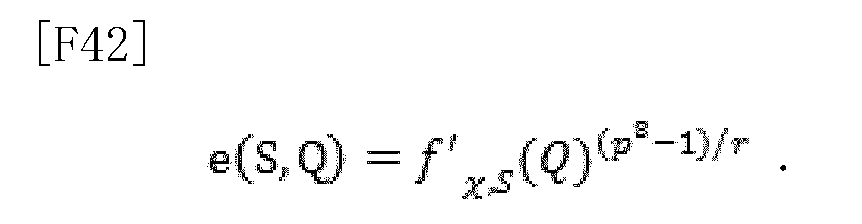
an elliptic curve is given as y2=x3+ax, a∈Fp, letting an embedding degree be 8, E be an additive group constituted of rational points on the pairing enabled elliptic curve defined over an extension field Fp 8, E[r] be a set of rational points having a prime order r, and φp be a Frobenius endomorphism, a pairing e is defined using

, as a non-degenerate bilinear map
the pairing computation device comprising a CPU which computes the pairing e(S,Q), by letting S∈G1, Q∈G2, χ be a given integer variable, ZS be a set of rational points S and p3S, ZQ be a set of rational points p3Q and Q, and F3χ,ZS(ZQ) be a rational function which is calculated using Miller' s algorithm with respect to multi-pairing (MMA),
the order r and a trace t of the Frobenius endomorphism φp are specified using the integer variable χ as,


the CPU includes: - an input unit which inputs the integer variable x, the rational point S, and the rational point Q into respective predetermined registers;
- a first computation unit which computes F3χ,ZS(ZQ);
- a second computation unit which computes respective rational points p2(S), p2(p3S), (3χ+1)S, (3χ+1)p3S in order using previously obtained results;
- a third computation unit which respectively computes a value l5 at a rational point Q(xQ, yQ) of a straight line passing through rational points (3χS, S), a value l6 at the rational point Q(xQ, yQ) of a straight line passing through rational points (p2(S), (3χ+1)S), a value l7 at the rational point Q(xQ, yQ) of a straight line passing through rational points (3χp3S,p3S), and a value l8 at the rational point Q(xQ, yQ) of a straight line passing through rational points (p2(p3S), (3χ +1)p3S);
- the fourth computation unit which computes f' χ,S(Q) using a computation result of the first computation unit and a computation result of the third computation unit as

- a fifth computation unit which computes the pairing e(S,Q) using said f' χ,S(Q) as
- According to a further aspect of the present invention, there is provided a pairing computation method, in which, as described in
claim 11,
an elliptic curve is given as y2=x3+ax, a∈Fp, letting an embedding degree be 8, E be an additive group constituted of rational points on the pairing enabled elliptic curve defined over an extension field Fp 8, E[r] be a set of rational points having a prime order r, and φp be a Frobenius endomorphism, a pairing e is defined using

, as a non-degenerate bilinear map
an electronic computer which includes a CPU computes the pairing e(S,Q), by letting S∈G1, Q∈G2, χ be a given integer variable, ZS be a set of rational points S and p3S, ZQ be a set of rational points p3Q and Q, and F3χ,ZS(ZQ) be a rational function which is calculated using Miller' s algorithm with respect to multi-pairing (MMA),
the order r and a trace t of the Frobenius endomorphism φp are specified using the integer variable χ as,

and a representation of the integer variable χ using p2 and p3 with p as a characteristic is
the pairing computation method comprises: - an input step which inputs the integer variable χ, the rational point S, and the rational point Q into respective predetermined registers by causing the CPU of the electronic computer to function as an input unit;
- a first computation step which computes F3x,ZS(ZQ) by causing the CPU of the electronic computer to function as a first computation unit;
- a second computation step which computes respective rational points p2(S), p2(p3S), (3χ+1)S, (3χ+1)p3S in order using previously obtained results by causing the CPU of the electronic computer to function as a second computation unit;
- a third computation step which respectively computes a value l5 at a rational point Q(xQ, yQ) of a straight line passing through rational points (3χS, S), a value l6 at the rational point Q(xQ, yQ) of a straight line passing through rational points (p2(S), (3χ+1)S), a value l7 at the rational point Q(xQ, yQ) of a straight line passing through rational points (3χp3S, p3S), and a value l8 at the rational point Q(xQ, yQ) of a straight line passing through rational points (p2(p3S), (3χ+1)p3S) by causing the CPU of the electronic computer to function as a third computation unit;
- a fourth computation step which computes f' χ,S(Q) using said F3 χ,ZS(ZQ) and said values l5, l6, l7, l8 as

- by causing the CPU of the electronic computer to function as a fourth computation unit; and
- a fifth computation step which computes the pairing e(S,Q) using said f' χ,S(Q) as

by causing the CPU of the electronic computer to function as a fifth computation unit. - According to a further aspect of the present invention, there is provided a pairing computation program, in which, as described in
claim 12, an elliptic curve is given as y2=x3+ax, a∈Fp, letting an embedding degree be 8, E be an additive group constituted of rational points on the pairing enabled elliptic curve defined over an extension field Fp 8, E[r] be a set of rational points having a prime order r, and φp be a Frobenius endomorphism, a pairing e is defined using

, as a non-degenerate bilinear map
the pairing computation program causes an electronic computer which includes a CPU to compute the pairing e(S,Q), by letting S∈G1, Q∈G2, χ be a given integer variable, ZS be a set of rational points S and p3S, ZQ be a set of rational points p3Q and Q, and F3χ,ZS(ZQ) be a rational function which is calculated using Miller' s algorithm with respect to multi-pairing (MMA),
the order r and a trace t of the Frobenius endomorphism φp are specified using the integer variable χ as,

and a representation of the integer variable χ using p2 and p3 with p as a characteristic is
the pairing computation program causes the CPU of the electronic computer to function as: - an input unit which inputs the integer variable χ, the rational point S, and the rational point Q into respective predetermined registers;
- a first computation unit which computes F3χ,ZS(ZQ);
- a second computation unit which computes respective rational points p2(S), p2(p3S), (3χ+1)S, (3χ+1)p3S in order using previously obtained results;
- a third computation unit which respectively computes a value l5 at a rational point Q(xQ, yQ) of a straight line passing through rational points (3χS, S), a value l6 at the rational point Q(xQ, yQ) of a straight line passing through rational points (p2(S), (3χ+1)S), a value l7 at the rational point Q(xQ, yQ) of a straight line passing through rational points (3χp3S, p3S), and a value l8 at the rational point Q(xQ, yQ) of a straight line passing through rational points (p2(p3S), (3χ+1)p3S);
- a fourth computation unit which computes f' χ,S(Q) using said F3 χ,ZS(ZQ) and said values l5, l6, l7, l8 as

- a fifth computation unit which computes the pairing e(S,Q) using said f' χ,S(Q) as

- According to a further aspect of the present invention, there is provided a pairing computation device, in which, as described in
claim 13,
an elliptic curve is given as y2=x3+ax+b, a∈Fp, b∈Fp, letting k be an embedding degree, E be an additive group constituted of rational points on the pairing enabled elliptic curve defined over an extension field Fp k, E[r] be a set of rational points having a prime order r, and φp be a Frobenius endomorphism, a pairing e is defined using

, as a non-degenerate bilinear map
the order r and a trace t of the Frobenius endomorphism φp are specified preliminarily according to the embedding degree k using the integer variable χ, and
the CPU includes: - an input unit which inputs the integer variable χ, the rational point S, and the rational point Q into respective predetermined registers;
- a computation unit which computes f;
- a computation unit which computes a value of a straight line passing through given rational points at a rational point Q(xQ, yQ);
- a computation unit which computes f' χ,S(Q) using said f and said value; and
- a computation unit which computes the pairing e (S, Q) using said f' χ,S(Q) as

- According to a further aspect of the present invention, there is provided a pairing computation method, in which, as described in
claim 14,
an elliptic curve is given as y2=x3+ax+b, a∈Fp, b∈Fp, letting k be an embedding degree, E be an additive group constituted of rational points on the pairing enabled elliptic curve defined over an extension field Fp k, E[r] be a set of rational points having a prime order r, and φp be a Frobenius endomorphism, a pairing e is defined using

, as non-degenerate bilinear map
an electronic computer which includes a CPU computes the pairing e(S, Q), by letting S∈G1, Q∈G2, χ be a given integer variable, and f be a rational function which is calculated using Miller' s algorithm,
the order r and a trace t of the Frobenius endomorphism φp are specified preliminarily according to the embedding degree k using the integer variable χ, and
the pairing computation method comprises: - a step of inputting the integer variable χ, the rational point S, and the rational point Q into respective predetermined registers by causing the CPU of the electronic computer to function as an input unit;
- a step of computing f by causing the CPU of the electronic computer to function as a computation unit;
- a step of computing a value of a straight line passing through given rational points at a rational point Q(xQ, yQ) by causing the CPU of the electronic computer to function as a computation unit;
- a step of computing f' χ,S(Q) using said f and said value by causing the CPU of the electronic computer to function as a computation unit; and a step of computing the pairing e(S,Q) using said f' χ,S(Q) as

- According to a further aspect of the present invention, there is provided a pairing computation program in which, as described in
claim 15,
an elliptic curve is given as y2=x3+ax+b, a∈Fp, b∈Fp, letting k be an embedding degree, E be an additive group constituted of rational points on the pairing enabled elliptic curve defined over an extension field Fp k, E[r] be a set of rational points having a prime order r, and φp be a Frobenius endomorphism, a pairing e is defined using

, as non-degenerate bilinear map
the pairing computation program causes an electronic computer which includes a CPU to compute the pairing e(S,Q), by letting S∈G1, Q∈G2, χ be a given integer variable, and f be a rational function which is calculated using Miller' s algorithm,
the order r and a trace t of the Frobenius endomorphism φp are specified preliminarily according to the embedding degree k using the integer variable χ, and
the pairing computation program causes the CPU of the electronic computer to function as:
an input unit which inputs the integer variable χ, the rational point S, and the rational point Q into respective predetermined registers;
a computation unit which computes f;
a computation unit which computes a value of a straight line passing through given rational points at a rational point Q(xQ, yQ);
a computation unit which computes f' χ,S(Q) using said f and said value; and
a computation unit which computes the pairing e(S,Q) using said f' χ,S(Q) as
- According to a further aspect of the present invention, there is provided a pairing computation device, in which, as described in claim 16,
an elliptic curve is given as y2=x3+b, b∈Fp, letting an embedding degree be 12, E be an additive group constituted of rational points on the pairing enabled elliptic curve defined over an extension field Fp 12, E[r] be a set of rational points having a prime order r, and φp be a Frobenius endomorphism, a pairing e is defined using

, as a non-degenerate bilinear map
the order r and a trace t of the Frobenius endomorphism φp are specified using the integer variabte χ as,

a representation of the integer variable χ using p10 with p as a characteristic is
the CPU includes:
an input unit which inputs the integer variable χ, the rational point S, and the rational point Q into respective predetermined registers;
a first computation unit which computes f2χ,S(Q) and f2χ,pS(Q);
a second computation unit which computes given rational points using 2χS and 2χpS which are calculated when computing said f2χ,S(Q) and f2 χ,pS(Q);
a third computation unit which computes a value at a rational point Q(xQ, yQ) of a straight line passing through the given rational points;
a fourth computation unit which computes f' χ,S(Q) using said f2χ,S(Q) and said value; and
a fifth computation unit which computes the pairing e(S,Q) using said f' χ,S(Q) as
- In particular, the pairing computation device is characterized in that the second computation unit computes respective rational points -S, (2χ-1)S, p10((2χ-1)S), -pS, (2χ-1)pS, p10((2χ-1)pS) in order using previously obtained results,
the third computation unit respectively computes a value l1 at a rational point Q(xQ, yQ) of a straight line passing through rational points ((2χ-1)S, -S), a value l2 at the rational point Q(xQ, yQ) of a straight line passing through rational points (p10((2χ-1)S), 2χS), a value l3 at the rational point Q(xQ, yQ) of a straight line passing through rational points ((2χ-1)pS, -pS), and a value l4 at the rational point Q(xQ, yQ) of a straight line passing through rational points (p10((2χ-1)pS), 2χpS), and
the fourth computation unit computes f' χ,S(Q) using the values of the rational point Q(xQ, yQ) l1, l2, l3, l4 as
- According to a further aspect of the present invention, there is provided a pairing computation method, in which, as described in claim 18,
an elliptic curve is given as y2=x3+b, b∈Fp, letting an embedding degree be 12, E be an additive group constituted of rational points on the pairing enabled elliptic curve defined over an extension field Fp 12, E[r] be a set of rational points having a prime order r, and φp be a Frobenius endomorphism, a pairing e is defined using

, as a non-degenerate bilinear map
an electronic computer which includes a CPU computes the pairing e(S,Q), by letting S∈G1, Q∈G2, χ be a given integer variable, and f2χ,S(Q) be a rational function which is calculated using Miller' s algorithm,
the order r and a trace t of the Frobenius endomorphism φp are specified using the integer variable χ as,

a representation of the integer variable χ using p10 with p as a characteristic is
and
the pairing computation method comprises:
an input step which inputs the integer variable χ, the rational point S, and the rational point Q into respective predetermined registers by causing the CPU of the electronic computer to function as an input unit;
a first computation step which computes f2χ,S(Q) and f2χ,pS(Q) by causing the CPU of the electronic computer to function as a first computation unit;
a second computation step which computes given rational points using 2χ S and 2χpS which are calculated when computing said f2χ,S (Q) and f2χ,pS(Q) by causing the CPU of the electronic computer to function as a second computation unit;
a third computation step which computes a value at a rational point Q(xQ, yQ) of a straight line passing through the given rational points by causing the CPU of the electronic computer to function as a third computation unit;
a fourth computation step which computes f' χ,S(Q) using said f2χ,S(Q) and said value by causing the CPU of the electronic computer to function as a fourth computation unit; and
a fifth computation step which computes the pairing e(S,Q) using said f' χ,S(Q) as
by causing the CPU of the electronic computer to function as a fifth computation unit. - In particular, the pairing computation method is characterized in that the second computation step computes respective rational points -S, (2χ-1)S, p10((2χ-1)S), -pS, (2χ-1)pS, p10((2χ-1)pS) in order using previously obtained results,
the third computation step respectively computes a value l1 at a rational point Q(xQ, yQ) of a straight line passing through rational points ((2χ-1)S, -S), a value l2 at the rational point Q(xQ, yQ) of a straight line passing through rational points (p10((2χ-1)S),2χS), a value l3 at the rational point Q(xQ, yQ) of a straight line passing through rational points ((2χ-1)pS, -pS), and a value l4 at the rational point Q(xQ, yQ) of a straight line passing through rational points (p10((2χ-1)pS),2χpS), and
the fourth computation step computes f' χ,S(Q) using the values of the rational point Q(xQ, yQ) l1, l2, l3, l4 as
- According to a further aspect of the present invention, there is provided a pairing computation program, in which, as described in
claim 20, an elliptic curve is given as y2=x3+b, b∈Fp, letting an embedding degree be 12, E be an additive group constituted of rational points on the pairing enabled elliptic curve defined over an extension field Fp 12, E[r] be a set of rational points having a prime order r, and φp be a Frobenius endomorphism, a pairing e is defined using

, as a non-degenerate bilinear map
and
the pairing computation program causes an electronic computer which includes a CPU to compute the pairing e(S,Q), by letting S∈G1, Q∈G2, χ be a given integer variable, and f2χ,S(Q) and f2χ,pS(Q) be a rational function which is calculated using Miller' s algorithm,
the order r and a trace t of the Frobenius endomorphism φp are specified using the integer variable χ as,

a representation of the integer variable χ using p10 with p as a characteristic is
the pairing computation program causes the CPU of the electronic computer to function as:
an input unit which inputs the integer variable χ, the rational point S, and the rational point Q into respective predetermined registers;
a first computation unit which computes f2χ,S(Q) and f2χ,pS(Q);
a second computation unit which computes given rational points using 2χS and 2χpS which are calculated when computing said f2χ,S(Q) and f2 χ,pS(Q);
a third computation unit which computes a value at a rational point Q(xQ, yQ) of a straight line passing through the given rational points;
a fourth computation unit which computes f' χ,S(Q) using said f2χ,S(Q) and said value; and
a fifth computation unit which computes the pairing e(S,Q) using said f' χ,S(Q) as
- In particular, the pairing computation program is characterized in that the pairing computation program causes:
- the CPU of the electronic computer which functions as the second computation unit to compute respective rational points -S, (2χ-1)S, p10((2χ-1)S), -pS, (2χ-1)pS, p10((2χ-1)pS) in order using previously obtained results;
- the CPU of the electronic computer which functions as the third computation unit to respectively compute a value l1 at a rational point Q(xQ, yQ) of a straight line passing through rational points ((2χ-1)S, -S), a value l2 at the rational point Q(xQ, yQ) of a straight line passing through rational points (p10((2χ-1)S), 2χS), a value l3 at the rational point Q(xQ, yQ) of a straight line passing through rational points ((2χ-1)pS, -pS), and a value l4 at the rational point Q(xQ, yQ) of a straight line passing through rational points (p10((2χ-1)pS), 2χpS); and
- the CPU of the electronic computer which functions as the fourth computation unit to compute f' χ,S(Q) using the values at the rational point Q(xQ, yQ) l1, l2, l3, l4 as
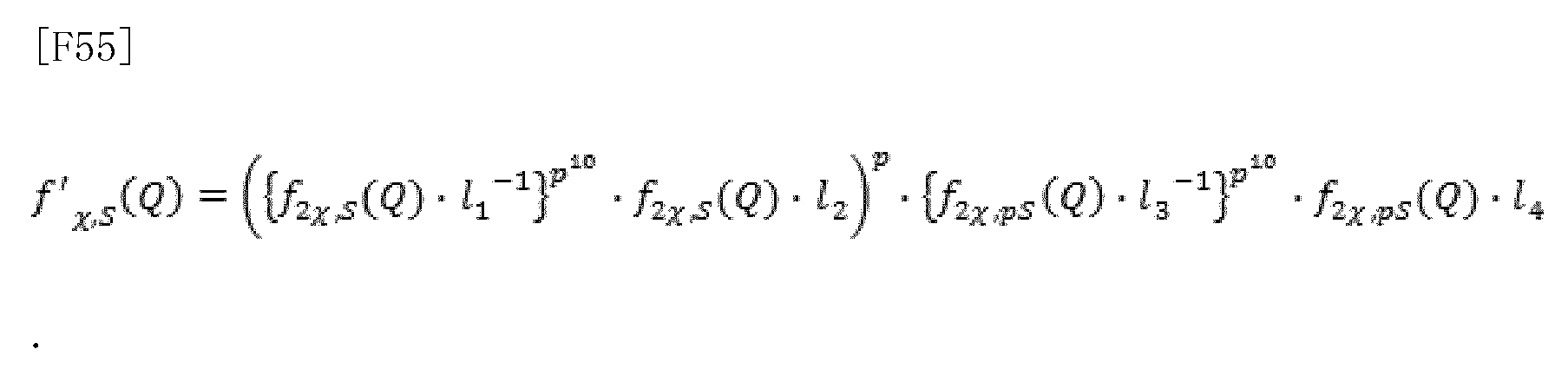
- According to a further aspect of the present invention, there is provided a pairing computation device, in which, as described in claim 22,
an elliptic curve is given as y2=x3+ax, a∈Fp, letting an embedding degree be 8, E be an additive group constituted of rational points on the pairing enabled elliptic curve defined over an extension field Fp 8, E[r] be a set of rational points having a prime order r, and φp be a Frobenius endomorphism, a pairing e is defined using

, as a non-degenerate bilinear map
and
the pairing computation device comprises a CPU which computes the pairing e(S, Q), by letting S∈G1, Q∈G2, χ be a given integer variable, and f3χ,S(Q) be a rational function which is calculated using Miller' s algorithm,
the order r and a trace t of the Frobenius endomorphism φp are specified using the integer variable χ as,

a representation of the integer variable χ using p2 and p3 with p as a characteristic is
the CPU includes: - an input unit which inputs the integer variable χ, the rational point S, and the rational point Q into respective predetermined registers;
- a first computation unit which computes f3χ,S(Q) and f3χ,p∧3S(Q);
- a second computation unit which computes respective rational points p2(S), (3χ+1)S, p2(p3S), (3χ+1)p3S in order using previously obtained results;
- a third computation unit respectively computes a value l5 at a rational point Q(xQ, yQ) of a straight line passing through rational points (3χS, S), a value l6 at the rational point Q(xQ, yQ) of a straight line passing through rational points (p2(S), (3χ+1)S), a value l7 at the rational point Q(xQ, yQ) of a straight line passing through rational points (3χp3S, p3S), and a value l8 at the rational point Q(xQ, yQ) of a straight line passing through rational points (p2(p3S), (3χ+1)p3S); and
- the fourth computation unit which computes f' χ,S(Q) using the computation result of the first computation unit and the computation result of the third computation unit as

- a fifth computation unit which computes the pairing e(S,Q) using said f' χ,S(Q) as

- According to a further aspect of the present invention, there is provided a pairing computation method, in which, as described in claim 23,
an elliptic curve is given as y2=x3+ax, a∈Fp, letting an embedding degree be 8, E be an additive group constituted of rational points on the pairing enabled elliptic curve defined over an extension field Fp 8, E[r] be a set of rational points having a prime order r, and φp be a Frobenius endomorphism, a pairing e is defined using

, as a non-degenerate bilinear map
the order r and a trace t of the Frobenius endomorphism φp are specified using the integer variable χ as,

a representation of the integer variable χ using p2 and p3 with p as a characteristic is
the pairing computation method comprises:
an input step which inputs the integer variable χ, the rational point S, and the rational point Q into respective predetermined registers by causing the CPU of the electronic computer to function as an input unit;
a first computation step which computes f3χ,S(Q) and f3χ,p∧3S(Q) by causing the CPU of the electronic computer to function as a first computation unit;
a second computation step which computes respective rational points p2(S), (3χ+1)S, p2(p3S), (3χ+1)p3S in order using previously obtained results by causing the CPU of the electronic computer to function as a second computation unit;
a third computation step which respectively computes a value l5 at a rational point Q(xQ, yQ) of a straight line passing through rational points (3χ S, S), a value l6 at the rational point Q(xQ, yQ) of a straight line passing through rational points (p2(S), (3χ+1)S), a value l7 at the rational point Q(xQ, yQ) of a straight line passing through rational points (3χp3S, p3S), and a value l8 at the rational point Q(xQ, yQ) of a straight line passing through rational points (p2(p3S), (3χ+1)p3S) by causing the CPU of the electronic computer to function as a third computation unit; and
a fourth computation step which computes f' χ,S(Q) using the values l5, l6, l7, l8 as
by causing the CPU of the electronic computer to function as a fourth computation unit; and
a fifth computation step which computes the pairing e(S,Q) using said f' χ,S(Q) as
- According to a further aspect of the present invention, there is provided a pairing computation program, in which, as described in
claim 24, an elliptic curve is given as y2=x3+ax, a∈Fp, letting an embedding degree be 8, E be an additive group constituted of rational points on the pairing enabled elliptic curve defined over an extension field Fp 8, E[r] be a set of rational points having a prime order r, and φp be a Frobenius endomorphism, a pairing e is defined using

, as a non-degenerate bilinear map
the pairing computation program causes an electronic computer which includes a CPU to compute the pairing e(S,Q), by letting S∈G1, Q∈G2, χ be a given integer variable, and f3χ,S(Q) be a rational function which is calculated using Miller' s algorithm,
the order r and a trace t of the Frobenius endomorphism φp are specified using the integer variable χ as,

a representation of the integer variable χ using p2 and p3 with p as a characteristic is
the pairing computation program causes the CPU of the electronic computer to function as:
an input unit which inputs the integer variable χ, the rational point S, and the rational point Q into respective predetermined registers;
a first computation unit which computes f3χ,S (Q) and f3χ,p∧3S(Q);
a second computation unit which computes respective rational points p2(S), (3χ+1)S, p2(p3S), (3χ+1)p3S in order using previously obtained results;
a third computation unit which respectively computes a value l5 at a rational point Q(xQ, yQ) of a straight line passing through rational points (3χS, S), a value l6 at the rational point Q(xQ, yQ) of a straight line passing through rational points (p2(S), (3χ+1)S), a value l7 at the rational point Q(xQ, yQ) of a straight line passing through rational points (3χp3S, p3S), and a value l8 at the rational point Q(xQ, yQ) of a straight line passing through rational points (p2(p3S), (3χ+1)p3S); and
a fourth computation unit which computes f' χ,S(Q) using the values l5, l6, l7, l8 as
a fifth computation unit which computes the pairing e(S,Q) using said f' χ,S(Q) as
- According to the present invention, it is possible to calculate a rational function at high speed by making the rational function a function of an integer variable χ, thus enabling high speed pairing computation.
-
-
FiG. 1 is a schematic diagram of a pairing computation device according to an embodiment of the present invention; -
FiG. 2 is a flowchart of a Twisted Xate pairing computation program according to the embodiment of the present invention; -
Fig. 3 is a flowchart for computing a rational function f2χ,S(Q); -
Fig. 4 is a flowchart of the Twisted Xate pairing computation program according to the embodiment of the present invention; -
Fig. 5 is a flowchart of the Twisted Xate multi-pairing computation program according to the embodiment of the present invention; -
Fig. 6 is a flowchart for computing a rational function F2χ,ZS(ZQ); -
Fig. 7 is a flowchart of a Twisted Xate multi-pairing computation program according to the embodiment of the present invention; and -
Fig. 8 is a calculation flow in a case where a thread calculation is applied to the Twisted Xate pairing according to the embodiment of the present invention. - In a pairing computation device, a pairing computation method and a pairing computation program according to the present invention, out of a first step which computes a rational function using Miller' s algorithm in pairing computation and a second step which performs exponentiation of a result of the computation, the first step computes the rational function using an integer variable χ, thereby speeding up the pairing computation.
- That is, in a conventional pairing computation, in which
an elliptic curve is given as y2=x3+ax+b, a∈Fp, b∈Fp, letting k be an embedding degree, E be an additive group constituted of rational points on the pairing enabled elliptic curve defined over an extension field Fp k, E[r] be a set of rational points having a prime order r, and φp be a Frobenius endomorphism, a pairing e is defined using


This is known as Twisted Ate pairing. - On the other hand, the inventors have found out a new pairing which enables fast pairing computation as a non-degenerate bilinear map by using an integer variable χ on an elliptic curve as below

This pairing is hereinafter referred to as "Twisted Xate pairing" Further, it is possible to perform further faster pairing computation by applying multi-pairing technique which calculates a plurality of pairing products. This pairing is hereinafter referred to as "Twisted Xate multi-pairing" That is, the pairing computation device, the pairing computation method, and the pairing computation program all according to the present invention make it possible to perform fast pairing computation by using Twisted Xate pairing and Twisted Xate multi-pairing. - In particular, elliptic curves have been known as pairing friendly curves according to embedding degrees respectively. For example, when an embedding degree is 12, there has been known that an order r and a trace t of the Frobenius endomorphism φp are expressed using a integer variable χ as


- Further, when the embedding degree is 8, there has been known that r(χ) and t(χ) are expressed as


- Hereinafter, a case where an embedding degree is 12 is explained as an example. Accordingly, as mentioned above,


Here, it is used that a characteristic p is expressed as
Accordingly, (Equation 1) is transformed as
By squaring both sides of (Equation 5), the following equation is obtained.
Here, from already known relation equation p4 +1 ≡P2 (mod r),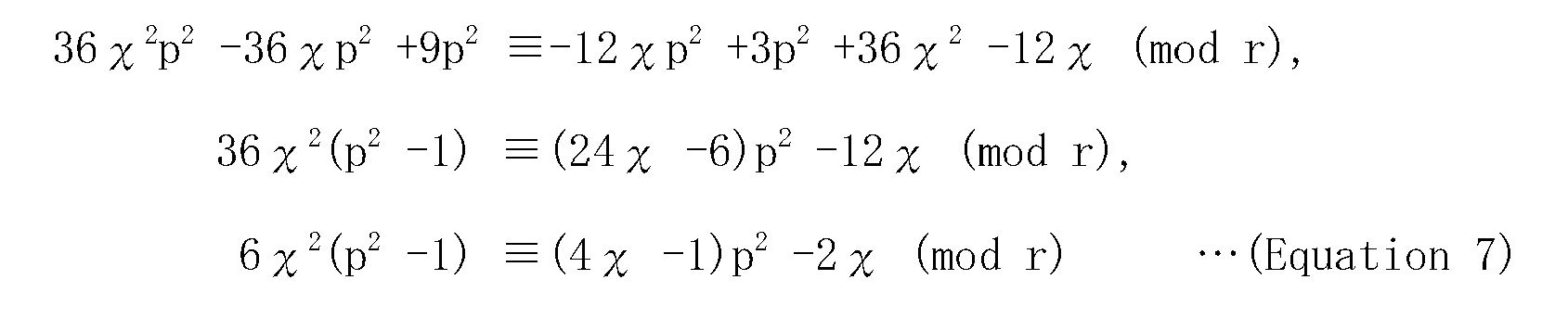
are obtained and by multiplying both sides of (Equation 7) by (p2 -1)-1
is obtained. Here, (p2 -1)-1 can be obtained based on relation equation of p4 -p2 +1 ≡0 (mod r) and gcd(p4 -p2 +1, p2-1)=1, as follows.
From the relation equation p2 ≡p4 +1 (mod r),
is obtained. Based on (Equation 3) and p6 ≡-1 (mod r),
- Next, a rational function f(t-1)∧2 mod r,S(·) of Twisted Ate pairing is considered. In particular, from (Equation 3),

Here, S∈G1 and with respect to Q∈G2,
Further, a rational function has relationships as follows.


Here, gaS,bS =laS,bS /vaS+bS , and laS,bS is a value of a straight line passing through two rational points aS and bS, and vaS+bS is a value of a vertical line at a rational point aS+bS. In a case of the embedding degree being
an even number, calculation of vaS+bS can be omitted.
Based on (Equation 14c), (Equation 12) becomes as follows.
And using (Equation 11), it becomes
Further, based on (Equation 14a) and (Equation 14b), it becomes
In addition, since in (Equation 17),
has a property of bilinearity, (Equation 17) can be transformed as follows.
Here, that the left hand side of (Equation 19) has a property of bilinearity brought the inventors to the fact that the right hand side of (Equation 19) also has a property of bilinearity. Accordingly, the inventors have found out Twisted Xate pairing which, using the right hand side of (Equation 19) as a new rational function f' χ,S(·), computes pairing e(S,Q) as
In this Twisted Xate pairing, it is possible to obtain f' χ,S(Q) at high speed by calculating f2χ,S(Q) and f2χ,pS(Q) using an integer variable χ which has a smaller size than (t-1)2 mod r in a computation using Miller' s algorithm. However, since two rational points used in these two computations using Miller' s algorithm are different respectively, usually (Equation 19) is calculated as follows.
Given F1, F2 as

(Equation 19) can be expressed as f' χ,S=F1 p ·F2 using F1 and F2. Since rational point pS whch is necessary for calculating F2 is obtained in the course of calculating F1, F1 is calculated first and next, F2 is calculated. In this case, a repetition count of Miller' s algorithm becomes 2 [log2χ] ≒ (1/2) [log2r]. - A basic idea of the present invention is to make F1 and F2 mutually independent calculations by calculating pS preliminarily. Due to this, Twisted Xate pairing according to the present invention can realize parallel processing. To be more specific, in an environment where a multi-pairing which enables parallel processing of a plurality of Miller' s algorithm calculations and a CPU having a plurality of cores can be used, thread calculation can be applicable.
- pS can be calculated at high speed by means of a scalar multiplication to an extent of (1/4) [log2r] from (Equation 11). By preliminarily calculating pS, F1 and F2 become mutually independent calculations. Accordingly, in an environment where a CPU having a plurality of cores can be used, parallel processing can be realized by assigning calculations of F1 and F2 to respective different cores.
Fig. 8 shows a calculation flow in a case where a thread calculation is applied. In this case, a repetition count of Miller' s algorithm substantially becomes (1/4) [log2r] from (Equation 21) and (Equation 22). - Further, the right hand side of (Equation 19) can be transformed into


A becomes as below.
By giving A in this way, it can be thought that the calculation of A is a multi-pairing which calculates a product of two pairings. Accordingly, by applying MMA, (Equation 23) can be calculated as follows.
Here, F2χ,ZS is obtained by giving 2χ to a repetition count of MMA algorithm and by giving ZS and ZQ the following equations respectively.

By calculating in this way, it becomes possible to reduce the number of square operations over Fp 12 in Miller' s algorithm and the number of inverse element calculations over Fp required for elliptic addition and elliptic doubling to 1/2 as compared with a case where the calculations by means of Miller' s algorithm are performed independently. Here, from (Equation 27) and (Equation 28), pS and pQ are required to be preliminarily calculated for applying MMA to the calculation of A. Since pS can be calculated at high speed by means of scalar multiplication to an extent of (1/4)[log2r] from (Equation 11) and pQ is obtained by means of the Frobenius endomorphism, a calculation cost required for applying the present invention is extremely smaller than a calculation cost which can be reduced by applying MMA. - Heretofore, an explanation is made in a case where an embedding degree is 12. An explanation in a case where the above mentioned embedding degree is 8 is basically the same and hence, detailed explanation is omitted.
- Hereinafter, an embodiment of the Twisted Xate pairing in a case where the embedding degree is 12 is explained in detail. In addition, in the present embodiment, digital group signature is assumed and an authentication server constituted of required electronic computer is assumed to be a pairing computation device. However, a pairing computation device is not limited to a case where the pairing computation device is constituted of an authentication server. Provided a device includes at least an arithmetic means such as a CPU and can perform pairing computation, any device may be used as the pairing computation device.
- As shown in
Fig. 1 , anelectronic computer 10 which constitutes an authentication server includes: aCPU 11; astorage unit 12 such as a hard disk which stores various kinds of programs such as a pairing computation program, data which is used by the pairing computation program and the like; amemory unit 13 which expands the pairing computation program and makes it executable, temporarily stores data generated in the course of execution of the pairing computation program and is constituted of such as a RAM. InFig. 1 , numeral 14 is a bus. - Further, the
electronic computer 10 is connected to atelecommunication line 20 such as the Internet and is configured to be able to receive signature data of digital group signature transmitted from aclient device 30 which is connected thetelecommunication line 20. InFig. 1 , numeral 15 is an input output control part of theelectronic computer 10. - The
electronic computer 10, when signature data of the digital group signature is transmitted from theclient device 30, stores temporarily the transmitted signature data in thememory unit 13, starts a pairing computation program and performs pairing computation. - That is, the
electronic computer 10, by means of the started pairing computation program, performs pairing computation based on a flowchart shown inFig. 2 and realizes the digital group signature. Here, an authentication processing in the digital group signature is not explained in detail and only the pairing computation as a subroutine processing in the authentication processing is explained in detail. - The
electronic computer 10, causing theCPU 11 to function as an input unit by means of the started pairing computation program, inputs data of an integer variabte χ and data of a rational point S both of which are stored preliminarily in thememory unit 13, and data of a rational point Q temporarily stored in thememory unit 13 as the signature data into predetermined registers provided inside of theCPU 11 respectively. (Step S1). - Next, the
electronic computer 10, causing theCPU 11 to function as a first computation unit by means of the pairing computation program, computes a rational function f2χ,S(Q) by means of Miller' s algorithm and stores a result of the computation in thememory unit 13. (Step S2). - The
electronic computer 10 performs the computation of the rational function f2χ,S(Q) specifically as shown inFig.3 . In particular, in step S2, theelectronic computer 10 computes 2χS as well as the rational function f2χ,S(Q) and stores results of the computation in thememory unit 13. - That is, firstly, the
electronic computer 10, as initial setting, sets f to be 1 and T to be S and also sets the number of bits in a case of binary representation of the integer variable 2χ to be i (Step S21). - Next, the
electronic computer 10 performs predetermined computation of the rational function f2χ,S(Q) part in step S22, performs predetermined computation of 2χS part in step S23, determines whether ui which is a value of i-th bit counted from the least degree of the integer variable 2χ is "1" or "0" (Step S24) and, when ui =1, further performs predetermined computation of f2χ,S(Q) part in step S25 and performs predetermined computation of 2χS part in step S26. - Next, the
electronic computer 10, when i ≠ 1 (Step S27), decrements i (Step S28), returns to step S22, by repeating the processing until i=l in step S27 computes the rational function f2χ,S(Q) and 2χS, and stores results of the computation in thememory unit 13 respectively. - Next, the
electronic computer 10, causing theCPU 11 to function as a second computation unit by means of the pairing computation program, reads a value of 2χS stored in thememory unit 13, performs computation of rational points -S, (2χ-1)S, p10((2χ-1)S) respectively and stores values of the respective rational points in thememory unit 13 respectively. (Step S3). - Next, the
electronic computer 10, causing theCPU 11 to function as a third computation unit by means of the pairing computation program, reads values of the respective rational points obtained in step S3 from thememory unit 13 respectively, computes l1 which is a value at a rational point Q(xQ, yQ) of a straight line passing through rational points ((2χ -1)S, -S) and l2 which is a value at the rational point Q (xQ, yQ) of a straight line passing through rational points (p10((2χ-1)S),2χS) respectively, and stores values of l1 and l2 in thememory unit 13 respectively. (Step S4). - To be more specific, the
electronic computer 10 computes l=lA,B(Q) as

That is, theCPU 11 computes a gradient λA,B using xy coordinates of points A and B and computes 1A,B(Q) using a result of the computation and xy coordinates of points Q and B, and stores a result of the computation in thememory unit 13. - Next, the
electronic computer 10, causing theCPU 11 to function as the second computation unit by means of the pairing computation program, computes rational point pS (Step S5). To be more specific, theelectronic computer 10 reads values of rational points obtained in step S2 and step S3 from thememory unit 13 and computes using these values as below and stores the value of pS in thememory unit 13.
- Next, the
electronic computer 10, causing theCPU 11 to function as the first computation unit by means of the pairing computation program, computes the rational function f2χ,pS(Q) by means of Miller' s algorithm and stores a result of the computation in thememory unit 13. (Step S6). - The
electronic computer 10 performs a computation of the rational function f2χ,pS(Q) specifically as shown inFig. 3 . In particular, in step S6, theelectronic computer 10 performs computation of 2χpS as well as computation of the rational function f2χ,pS(Q) and stores a result of the computation in thememory unit 13. - Next, the
electronic computer 10, causing theCPU 11 to function as the second computation unit by means of the pairing computation program, reads a value of 2χpS sored in thememory unit 13, performs computation of rational points -pS, (2χ-1)pS, p10((2χ-1)pS) respectively and stores values of the respective rational points in thememory unit 13 respectively. (Step S7). - Next, the
electronic computer 10, causing theCPU 11 to function as the third computation unit by means of the pairing computation program, reads values of the respective rational points obtained in step S7 from thememory unit 13 respectively, computes l3 which is a value at the rational point Q(xQ, yQ) of a straight line passing through rational points ((2χ -1)pS, -pS) and l4 which is a value at the rational point Q (xQ, yQ) of a straight line passing through rational points (p10((2χ-1)pS),2χpS) respectively, and stores values of l3 and l4 in thememory unit 13 respectively. (Step S8). - Next, the
electronic computer 10, causing theCPU 11 to function as a fourth computation unit by means of the pairing computation program, reads a result of the computation in the first computation unit (values of f2χ,S(Q) and f2χ,pS(Q)) and a result of the computation in the third computation unit (values of l1 , l2 , and l3 , l4) from thememory unit 13, computes f' χ,S(Q) expressed as below, and stores a result of the computation in the memory unit 13 (Step S9).
- To be more specific, the
electronic computer 10 computes as follows.
input: S∈G1, Q∈G2, 2χ,p
output : f=f' χ,S(Q)
procedure:1. A←f2χ,S //T1←2χS is obtained 2. T2← - S 3. T3←T1 + T 24. B←gT3,T2 5. B←A·B-1 6. B←BΛp10 7. f←B·A 8. T4←p10T3 9. B← g T4,T110. T4←T4 +T1 //T4←pS is obtained 11. f←f· B 12. f← f P13. A←f2χ,T4 //T1←2χpS is obtained 14. T2← - T 415. T3←T1 +T2 16. B←gT3,T2 17. C←A·B-1 18. C←CΛp10 19. C←C·A 20. T4←p10T3 21. B←gT4,T1 22. C←C·B 23. f←f· C 24. Return f. CPU 11 performs respective computations in the procedure described above using thememory unit 13, obtains f' χ,S(Q), and stores the value in thememory unit 13. To be more specific, instep 1, theCPU 11 obtains f2χ,S by means of Miller' s algorithm and assigns the result to A and also assigns 2χS obtained simultaneously to T1. Instep CPU 11 obtains rational points -S and (2χ-1)S, and assigns the results to T2 and T3 respectively. Instep 4, as mentioned above, since in a case where an embedding degree is an even number, GA,B becomes lA,B, theCPU 11 obtains l1 which is a value at rational point Q of a straight line passing through rational points ((2χ-1)S,-S), and assigns the result to B. In step 5 and 6, theCPU 11 obtains a {} part in () of (Equation 29) and assign the result to B. In step 7, theCPU 11 obtains a product of B and A, and assigns the result to f. Instep 8, theCPU 11 obtains rational point p10((2χ-1)S) and assigns the result to T4. In step 9, theCPU 11 obtains l2 which is a value at rational point Q of a straight line passing through rational points (p10((2χ-1)S),2χS) and assigns the result to B. Instep 10, theCPU 11 obtains pS using relationship in (Equation 11) and assigns the result to T4. Instep CPU 11 obtains a () part of (Equation 29) and assigns the result to f. Instep 13, theCPU 11 obtains f2χ,pS by means of Miller' s algorithm and assigns the result to A, and assigns 2 χpS obtained simultaneously to T1. Instep CPU 11 obtains rational points -pS and (2χ-1)pS. In step 16, theCPU 11 obtains l3 which is a value at rational point Q of a straight line passing through rational points ((2χ-1)pS, -pS) and assigns the results to B. In step 17 and 18, theCPU 11 obtains a {} part accompanying () in (Equation 29) described above. In step 19, theCPU 11 obtains a product of C and A, and assigns the result to C. Instep 20, theCPU 11 obtains rational point p10((2χ-1)S) and assigns the result to T4. In step 21, theCPU 11 obtains l4 which is a value at rational point Q of a atraight line passing through rational points (p10((2χ-1)S),2χpS) and assigns the result to B. In step 22 and 23, theCPU 11 obtains f' fχ,S(Q) and assigns the result to f. - Next, the
electronic computer 10, causing theCPU 11 to function as a fifth computation unit by means of the pairing computation program, reads a value of f' χ,S(Q) obtained in step S9 from thememory unit 13, performs an exponentiation of the final exponentiation in pairing e(S, Q), and stores a result of the computation in the memory unit 13 (Step S10). - To be more specific, the
electronic computer 10 computes as follows and stores f' , that is, a value of e(S, Q) in thememory unit 13.1. f' ←f' Λp6 · f -12. f' ←f' Λp2 ·f' 3. a←(f' 6)χ · (f' 5) Λp 64. b←ap 5. b←a·b 6. compute f' Λp, f' Λp2, and f' Λp3 7. c←b·(f' Λp)2 · f' Λp 28. f' ←f' Λp3 · (c6)Λχ2 ·c·b· (f' Λp ·f' )9 ·a·f' Λ4 9. Return f' - The
electronic computer 10 which constitutes an authentication server performs an authentication processing using a result of the pairing computation obtained as mentioned above. - In the present embodiment, an explanation is made in a case where an embedding degree is 12. However, also in a case where the embedding degree is 8 as described in claim 22 to claim 24, it is possible to compute Twisted Xate pairing at high speed by means of the similar algorithm.
- An explanation is made in a case where, that is, the embedding degree is 8, and r(χ) and t(χ) are given as follows.



- In this case, f' χ,S(Q) becomes, using l5 which is a value at a rational point Q(xQ, yQ) of a straight line passing through rational points (3χS,S), l6 which is a value at the rational point Q(xQ, yQ) of a straight line passing through rational points (p2(S), (3χ+1)S), l7 which is a value at the rational point Q(xQ, yQ) of a straight line passing through rational points (3χp3S,p3S), and 18 which is a value at the rational point Q (xQ, yQ) of a straight line passing through rational points (p2(p3S), (3χ+1)p3S), as follows.

- In the similar way as in the case where the embedding degree is 12, in the case where the embedding degree is 8, an authentication server performs pairing computation by means of the started pairing computation program based on a flowchart shown in
Fig. 4 . - The
electronic computer 10, causing theCPU 11 to function as an input unit by means of the started pairing computation program, inputs data of an integer variable χ and data of rational point S both of which are stored preliminarily in thememory unit 13, and data of rational point Q temporarily stored in thememory unit 13 as signature data into predetermined registers provided inside of theCPU 11 respectively. (Step T1). - Next, the
electronic computer 10, causing theCPU 11 to function as a first computation unit by means of the pairing computation program, computes a rational function f3χ,S(Q) by means of Miller' s algorithm and stores a result of the computation in thememory unit 13. (Step T2). In the step T2, theelectronic computer 10 performs the same computation processing as in a flowchart shown inFig. 3 , except that anti-logarithm of logarithm to base two in step S21 in the flowchart shown inFig.3 is 3χ and the first expression in step S22 is
Here, "a" is a coefficient of first degree in an elliptic curve given as y2=x3 + ax, a∈Fp. - Further, also in the step T2, the
electronic computer 10 computes 3χS as well as the rational function f3χ,S(Q) and stores results of the computation in thememory unit 13. - After computing rational function f3χ,S (Q) and 3χS, the
electronic computer 10, causing theCPU 11 to function as a second computation unit by means of the pairing computation program, reads a value of 3χS stored in thememory unit 13, performs computation of rational points p2(S) and (3χ+1) S respectively and stores values of the rational points in thememory unit 13 respectively. (Step T3). - Next, the
electronic computer 10, causing theCPU 11 to function as a third computation unit by means of the pairing computation program, reads values of the respective rational points obtained in step T3 from thememory unit 13 respectively, computes l5 which is a value at a rational point Q(xQ, yQ) of a straight line passing through rational points (3χS,S) and l6 which is a value at the rational point Q(xQ, yQ) of a straight line passing through rational points (p2(S), (3χ+1)S) respectively, and stores values of l5 and l6 in thememory unit 13 respectively. (Step T4). - In the same way as in the case where the embedding degree is 12, to be more specific, the
electronic computer 10 computes l=lA,B(Q) as follows.

- Next, the
electronic computer 10, causing theCPU 11 to function as the second computation unit by means of the pairing computation program, computes rational point p3S (Step T5). To be more specific, the electronic computer reads values of rational points obtained in step T2 and step T3 from thememory unit 13, computes as below, and stores the value of p3S in thememory unit 13.
- Next, the
electronic computer 10, causing theCPU 11 to function as the first computation unit by means of the pairing computation program, computes a rational function f3χ,pΛ3S(Q) by means of Miller' s algorithm and stores a result of the computation in thememory unit 13. (Step T6). - The
electronic computer 10 performs a computation of the rational function f3χ,pΛ3S (Q) specifically as shown inFig. 3 . In particular, in step T6, theelectronic computer 10 performs computation of 3χp3S as well as computation of the rational function f3χ,pΛ3S(Q) and stores results of the computation in thememory unit 13. - Next, the
electronic computer 10, causing theCPU 11 to function as the second computation unit by means of the pairing computation program, reads the value of 3χp3S stored in thememory unit 13, performs computation of rational points p2(p3S), (3χ+1)p3S respectively and stores values of the respective rational points in thememory unit 13 respectively. (Step T7). - Next, the
electronic computer 10, causing theCPU 11 to function as the third computation unit by means of the pairing computation program, reads values of respective rational points obtained in step T7 from thememory unit 13 respectively, computes l7 which is a value at the rational point Q(xQ, yQ) of a straight line passing through rational points (3χ p3S, p3S) and l8 which is a value at the rational point Q(xQ, yQ) of a straight line passing through rational points (p2(p3S), (3χ+1)p3S) respectively, and stores values of l7 and l8 in thememory unit 13 respectively. (Step T8). - Next, the
electronic computer 10, causing theCPU 11 to function as a fourth computation unit by means of the pairing computation program, reads a result of the computation in the first computation unit (values of f3χ,S(Q) and f3χ,pΛ3S(Q)), and a result of the computation in the third computation unit (values of l5 , l6 , and l7 , l8) from thememory unit 13 and computes f' χ,S(Q) expressed as below and stores a result of the computation in the memory unit 13 (Step T9).
- To be more specific, the
electronic computer 10 performs computation of f' χ,S(Q) as follows.
input: S∈G1, Q∈G2, 3χ, p
output : f=f' χ,S(Q)
procedure:1. A←f3χ,S //T1←3χS is obtained 2. B← g T1,S3. T2←T1 + S 4. T3←p2S 5. C←gT3,T2 6. f←A·B·C 7. T4←T3 +T2 //T4←p3S 8. A←f3χ,T4 ///T1←3χp3S 9. B← g T1,T410. T2←T1 + T 411. T3←p2T4 12. C← g T3,T213. f←fΛp3 ·A·B· C 14. Return f CPU 11 performs respective computations of the procedure described above using thememory unit 13, obtains a value of f' χ,S(Q) and stores the value in thememory unit 13. To be more specific, instep 1, theCPU 11 obtains f3χ,S by means of Miller' s algorithm, assigns the result to A, and also assigns 3χS obtained simultaneously to T1. Instep 2, theCPU 11 obtains l5 which is a value at rational point Q of a straight line passing through rational points (3χS,S) and assigns the result to B. Instep 3 andstep 4, theCPU 11 obtains rational points (3χ+1)S and p2(S) and assigns the results to T2 and T3 respectively. In step 5, theCPU 11 obtains l6 which is a value at rational point Q of a straight line passing through rational points (p2(S), (3χ+1)S) and assigns the result to C. In step 6, theCPU 11 takes a product of A, B and C, obtains a () part of (Equation 30) described above and assigns the result to f. In step 7, theCPU 11 obtains p3S using relationship that p3=p2 +3χ +1 and assigns the result to T4. Instep 8, theCPU 11 obtains f3χ,pΛ3S by means of Miller' s algorithm and assigns the result to A and also assigns 3χp3S obtained simultaneously to T1. In step 9, theCPU 11 obtains l7 which is a value at rational point Q of a straight line passing through rational points (3 χp3S,p3S) and assigns the result to B. Instep 10 and step11, theCPU 11 obtains rational points (3χ+1)p3S, p2(p3S) and assigns the results to T2 and T3 respectively. Instep 12, theCPU 11 obtains l8 which is a value at rational point Q of a straight line passing through rational points (p2(p3S), (3χ+1)p3S) and assigns the result to C. Instep 13, theCPU 11 obtains f' χ,S(Q) and assigns the result to f. - Next, the
electronic computer 10, causing theCPU 11 to function as a fifth computation unit by means of the pairing computation program, reads a value of f' χ,S(Q) obtained in step T9 from thememory unit 13, performs an exponentiation of the final exponentiation in pairing e(S, Q) and stores a result of the computation in thememory unit 13. (Step T10). - Hereinafter, an embodiment of Twisted Xate multi-pairing in a case where an embedding degree is 12 is explained in detail. Explanation of the parts which are common to Twisted Xate pairing is omitted. Based on
Fig. 5 , Twisted Xate multi-pairing in a case where the embedding degree is 12 is explained. - The
electronic computer 10, causing theCPU 11 to function as an input unit by means of the started pairing computation program, inputs data of an integer variable χ and data of rational point S both of which are stored preliminarily in thememory unit 13, and data of rational point Q temporarily stored in thememory unit 13 as signature data into predetermined registers provided inside of theCPU 11 respectively. (Step U1). - Next, the
electronic computer 10, causing the CPU11 to function as a second computation unit by means of the pairing computation program, performs a computation of rational point pS and stores the value of pS in the memory unit 13 (step U2). - Next, the
electronic computer 10, causing the CPU11 to function as the second computation unit by means of the pairing computation program, performs a computation of rational point pQ and stores the value of pQ in the memory unit 13 (step U3). - Next, the
electronic computer 10, causing theCPU 11 to function as a first computation unit by means of the pairing computation program, computes a rational function F2χ,ZS(ZQ) by means of Miller' s algorithm with respect to multi-pairing and stores a result of the computation in thememory unit 13. (Step U4). - The
electronic computer 10 performs computation of the rational function F2χ,ZS(ZQ) specifically as shown inFig. 6 . In particular, in Step U4, theelectronic computer 10 computes 2χS and 2χpS as well as the rational function F2χ,ZS(ZQ) and stores results of the computation in thememory unit 13. - That is, firstly, the
electronic computer 10, as initial setting, sets f to be 1, T1 to be S, T2 to be pS and also sets the number of bits in a case of binary representation of the integer variable 2χ to be i (Step U41) . - Next, the
electronic computer 10 performs predetermined computation of the rational function F2χ,ZS(ZQ) part in step U42, performs predetermined computation of 2χS and 2χpS part in step U43, determines whether ui which is a value of i-th bit counted from the least degree of the integer variable 2χ is "1" or "0" (Step U44) and, when ui =1, further performs predetermined computation of F2χZS(ZQ) part in step U45 and predetermined computation of 2χS and 2χpS part in step U46. - Next, the
electronic computer 10, when i ≠ 1 (Step U47), decrements i (Step U48), returns to Step U42 and, by repeating the processing until i=1 in Step U47, computes the rational function F2χ,ZS(ZQ), and 2χS and 2χpS, and stores results of the computation in thememory unit 13 respectively. - Next, the
electronic computer 10, causing theCPU 11 to function as the second computation unit by means of the pairing computation program, reads values of 2χS and 2χpS stored in thememory unit 13, performs computation of rational points -S, (2χ-1)S, p10((2χ-1)S), -pS, (2χ-1)pS, and p10((2χ-1)pS) respectively and stores values of the respective rational points in thememory unit 13 respectively. (Step U5). - Next, the
electronic computer 10, causing theCPU 11 to function as a third computation unit by means of the pairing computation program, reads values of the respective rational points obtained in step U5 from thememory unit 13 respectively, computes l1 which is a value at a rational point Q(xQ, yQ) of a straight line passing through rational points ((2χ -1)S,-S), l2 which is a value at the rational point Q(xQ, yQ) of a straight line passing through rational points ((2χ-1)pS,-pS), l3 which is a value at the rational point Q(xQ, yQ) of a straight line passing through rational points (p10((2χ-1)S),2χS) and l4 which is a value at the rational point Q (xQ, yQ) of a straight line passing through rational points (p10((2χ-1)pS),2 χpS) respectively, and stores values of l1, l2, l3, and l4 in thememory unit 13 respectively. (Step U6). - To be more specific, the
electronic computer 10 computes l=lA,B(Q) as follows.

That is, theCPU 11 computes a gradient λA,B using xy coordinates of points A and B, computes lA,B(Q) using a result of the computation and xy coordinates of the points Q and B, and stores a result of the computation in thememory unit 13. - Next, the
electronic computer 10, causing theCPU 11 to function as a fourth computation unit by means of the pairing computation program, reads a result of the computation in the first computation unit (Step U4), and a result of the computation in the third computation unit (values of l1 , l2 , l3, and l4) from thememory unit 13, computes f' χ,S(Q) expressed as below, and stores a result of the computation in the memory unit 13 (Step U7).
- Next, the
electronic computer 10, causing theCPU 11 to function as a fifth computation unit by means of the pairing computation program, reads a value of f' χ,S(Q) obtained in step U7 from thememory unit 13, performs an exponentiation of the final exponentiation in pairing e(S, Q), and stores a aresult of the computation in the memory unit 13 (Step U8). - To be more specific, the
electronic computer 10 performs a computation of f' χ,S (Q) as follows.
input: ZS={S,pS∈G1}, ZQ={pQ,Q∈G2}, 2χ, p
output : f=f' χ,S(Q)
procedure:1. A←MMA(2χ, 2, ZS, ZQ ) //T1←2χS, T2← 2χpS 2. T3←- S 3. T4←T1 + T 34. B←gT4,T3 5. T5← -pS 6. T6←T2 +T5 7. C← g T5,T68. f←Bp ·C 9. f←A · f -110. T3←p10T4 11. B← g T3,T112. T5←p10T6 13. C← g T5,T214. D←Bp · C 15. f←fΛp10 ·A ·D 16. Return f CPU 11 performs respective computations of the procedure described above using thememory unit 13, obtains f' χ,S(Q), and stores the value in thememory unit 13.
To be more specific, instep 1, theCPU 11 obtains F2χ,ZS by means of Miller' s algorithm with respect to multi-pairing , assigns the result to A, and also assigns 2χS and 2χpS obtained simultaneously to T1 and T2 respectively. Instep 2 andstep 3, theCPU 11 obtains rational points -S and (2χ-1)S and assigns the result to T3 and T4 respectively. Instep 4, theCPU 11 obtains l1 which is a value at rational point Q of a straight line passing through rational points ((2χ-1)S,-S) and assigns the result to B. In step 5 and 6, theCPU 11 obtains rational points -pS and (2χ-1)pS and assign the result to T5 and T6 respectively. In step 7, theCPU 11 obtains l2 which is a value at rational point Q of a straight line passing through rational points (-pS,(2χ-1)pS) and assigns the result to C. Instep 8, theCPU 11 takes a product of B to the power of p and C, obtains a {} part of the inside of (Equation 31) described above and assigns the result to f. In step 9, theCPU 11 obtains a {} part of the outside of (Equation 31) described above and assigns the result to f. Instep 10, theCPU 11 obtains a value of rational point p10((2χ-1)S) and assigns the result to T3. Instep 11, theCPU 11 obtains l3 which is a value at rational point Q of a straight line passing through rational points (p10((2χ-1)S),2χS) and assigns the results to B. Instep 12, theCPU 11 obtains rational point p10((2χ-1)pS) and assigns the result to T5. Instep 13, theCPU 11 obtains l4 which is a value at rational point Q of a straight line passing through rational points (p10((2χ-1)pS), 2χpS) and assigns the result to C. Instep 14, theCPU 11 obtains a product of B to the power of p and C. Instep 15, theCPU 11 obtains the whole of (Equation 31) described above and assigns the result (f' χ,S(Q)) to f. - In the embodiment, Twisted Xate multi-pairing in the case where the embedding degree is 12 is explained. However, it is possible to compute Twisted Xate multi-pairing at high speed also in a case where the embedding degree is 8 by means of the similar algorithm. Explanation of the parts which are common to Twisted Xate pairing is omitted. Computation of multi-pairing in the case where the embedding degree is 8 is explained with reference to
Fig. 7 . - The
electronic computer 10, causing theCPU 11 to function as an input unit by means of the started pairing computation program, inputs data of an integer variable χ and data of rational point S both of which are stored preliminarily in thememory unit 13, and data of rational point Q temporarily stored in thememory unit 13 as signature data into predetermined registers provided inside of theCPU 11 respectively. (Step V1). - Next, the
electronic computer 10, causing theCPU 11 to function as a second computation unit by means of the pairing computation program, performs a computation of rational point p3S and stores the value of p3S in the memory unit 13 (step V2). - Next, the
electronic computer 10, causing theCPU 11 to function as the second computation unit by means of the pairing computation program, performs a computation of rational point p3Q and stores the value of p3Q in the memory unit 13 (step V3). - Next, the
electronic computer 10, causing theCPU 11 to function as a first computation unit by means of the pairing computation program, computes a rational function F3χ,ZS(ZQ) by means of Miller' s algorithm with respect to multi-pairing and stores a result of the computation in thememory unit 13. (Step V4). In this Step V4, theelectronic computer 10 performs the same computation processing as a flowchart shown inFig. 6 except that anti-logarithm of logarithm to base two is 3χ, and all p become p3 . - Also in step V4, the
electronic computer 10 computes 3χS and 3 χp3S as well as the rational function F3χ,ZS(ZQ) and stores results of the computation in thememory unit 13. - After computing the rational function F3χ,ZS(ZQ), and 3χS and 3χ p3S , the
electronic computer 10, causing theCPU 11 to function as the second computation unit by means of the pairing computation program, reads values of 3χS and 3χp3S stored in thememory unit 13, performs computation of rational points p2(S),(3χ+1)S, p2(p3S), and (3χ+1)p3S respectively and stores values of the respective rational points in thememory unit 13 respectively. (Step V5). - Next, the
electronic computer 10, causing theCPU 11 to function as a third computation unit by means of the pairing computation program, reads values of the respective rational points obtained in step V5 from thememory unit 13 respectively, computes l5 which is a value at a rational point Q(xQ, yQ) of a straight line passing through rational points (3χS, S), l6 which is a value at the rational point Q(xQ, yQ) of a straight line passing through rational points (p2(S), (3χ+1)S), l7 which is a value at the rational point Q(xQ, yQ) of a straight line passing through rational points (3χ p3S, p3S) and l8 which is a value at the rational point Q(xQ, yQ) of a straight line passing through rational points (p2(p3S), (3χ+1)p3S) respectively, and stores values of l5 , l6, l7, and l8 in thememory unit 13 respectively. (Step V6). - To be more specific, in the same way as in the case where the embedding degree is 12, the
electronic computer 10 computes l=lA,B(Q) as follows.

- Next, the
electronic computer 10, causing theCPU 11 to function as a fourth computation unit by means of the pairing computation program, reads a result of the computation in the first computation unit, and a result of the computation in the third computation unit (values of l5 , l6, l7 , and l8) from thememory unit 13 and computes f' χ,S(Q) expressed as below and stores a result of the computation in the memory unit 13 (Step V7).
- To be more specific, the
electric computer 10 performs the computation of f' χ,S (Q) as follows.
input : ZS={S,p3S∈G1}, ZQ={p3Q,Q∈G2}, 3χ, p
output : f=f' χ,S(Q)
procedure:1. A←MMA(3χ, 2, ZS, ZQ) //T1←3χS, T2←3χp3S 2. B← g 3χS,S3. T3←T1 + S 4. T4←p2S 5. C← gT4,T3 6. f←B ·C 7. f← fΛp 38. f←A ·f 9. B← g T2,pΛ3S10. T3←T2 +p3S 11. T4←p2p3S 12. C← g T4,T313. f←f ·B · C 14. Return f CPU 11 performs respective computations of the procedure described above using thememory unit 13, obtains f' χ,S(Q), and stores the value in thememory unit 13. To be more specific, Instep 1, theCPU 11 obtains F3χ,ZS by means of Miller' s algorithm with respect to multi-pairing and assigns the result to A and also assigns 3χS and 3χp3S obtained simultaneously to T1 and T2 respectively. Instep 2, theCPU 11 obtains l5 which is a value at rational point Q of a straight line passing through rational points (3χS,S) and assigns the result to B. Instep 3 andstep 4, theCPU 11 obtains rational points (3χ+1)S and p2(S) and assigns the result to T3 and T4 respectively. In step 5, theCPU 11 obtains l6 which is a value at rational point Q of a straight line passing through rational points (p2(S), (3χ+1)S) and assigns the result to C. In step 6, theCPU 11 takes a product of B and C, obtains an inside of {} part of (Equation 32) described above and assigns the result to f. In step 7, theCPU 11 obtains a {} part of (Equation 32) described above. Instep 8, theCPU 11 obtains a result up to the {} part of (Equation 32) described above and assign the result to f. In step 9, theCPU 11 obtains l7 which is a value at rational point Q of a straight line passing through rational points (3χp3S, p3S) and assigns the result to B. Instep 10 andstep 11, theCPU 11 obtains rational points (3χ+1)p3S and p2(p3S), and assigns the results to T3 and T4
respectively. Instep 12, theCPU 11 obtains l8 which is a value at rational point Q of a straight line passing through rational points (p2(p3S),(3χ +1)p3S) and assigns the result to C. Instep 13, theCPU 11 obtains f' χ,S(Q), and aassigns the result to f. - Next, the
electronic computer 10, causing theCPU 11 to function as a fifth computation unit by means of the pairing computation program, reads the value of f' χ,S(Q) obtained in step V7, performs an exponentiation of the final exponentiation in pairing e(S, Q), and stores a result of the computation in the memory unit 13 (Step V8). - In addition, in the explanation made above, the
memory unit 13 is used as storage means for storing each computation result. However, registers provided with inside of theCPU 11 may be used as the storage means described above. -
- 10
- electronic computer
- 11
- CPU
- 12
- storage unit
- 13
- memory unit
- 14
- bus
- 15
- input output control part
- 20
- telecommunication line
- 30
- client device
Claims (24)
- A pairing computation device, wherein an elliptic curve is given as y2=x3+ax+b, a∈Fp, b∈Fp, letting k be an embedding degree, E be an additive group constituted of rational points on the pairing enabled elliptic curve defined over an extension field Fp k, E[r] be a set of rational points having a prime order r, and φp be a Frobenius endomorphism, a pairing e is defined using


, as a non-degenerate bilinear map
the pairing computation device comprising a CPU which computes the pairing e(S, Q), by letting S∈G1, Q∈G2, χ be a given integer variable, and F be a rational function which is calculated using Miller' s algorithm with respect to multi-pairing (MMA), wherein
the order r and a trace t of the Frobenius endomorphism φp are specified preliminarily according to the embedding degree k using the integer variable χ, and
the CPU includes:an input unit which inputs the integer variable χ, the rational point S, and the rational point Q into respective predetermined registers;a computation unit which computes F;a computation unit which computes a value of a straight line passing through given rational points at a rational point Q(xQ, yQ);a computation unit which computes f' χ,S(Q) using said F and said value; anda computation unit which computes the pairing e(S, Q) using said f' χ,S(Q) as
- A pairing computation method, wherein an elliptic curve is given as y2=x3+ax+b, a∈Fp, b∈Fp, letting k be an embedding degree, E be an additive group constituted of rational points on the pairing enabled elliptic curve defined over an extension field Fp k, E[r] be a set of rational points having a prime order r, and φp be a Frobenius endomorphism, a pairing e is defined using


, as non-degenerate bilinear map
an electronic computer which includes a CPU computes the pairing e(S, Q), by letting S∈G1, Q∈G2, χ be a given integer variable, and F be a rational function which is calculated using Miller' s algorithm with respect to multi-pairing (MMA),
the order and a trace t of the Frobenius endomorphism φp being specified preliminarily according to the embedding degree k using the integer variable χ,
the pairing computation method comprising:a step of inputting the integer variable χ, the rational point S, and the rational point Q into respective predetermined registers by causing the CPU of the electronic computer to function as an input unit;a step of computing F by causing the CPU of the electronic computer to function as a computation unit;a step of computing a value of a straight line passing through given rational points at a rational point Q(xQ, yQ) by causing the CPU of the electronic computer to function as a computation unit;a step of computing f' χ,S (Q) using said F and said value by causing the CPU of the electronic computer to function as a computation unit; anda step of computing the pairing e(S, Q) using said f' χ,S (Q) as
by causing the CPU of the electronic computer to function as a computation unit. - A recording medium storing a pairing computation program, wherein an elliptic curve is given as y2=x3+ax+b, a∈Fp, b∈Fp, letting k be an embedding degree, E be an additive group constituted of rational points on the pairing enabled elliptic curve defined over an extension field Fp k, E[r] be a set of rational points having a prime order r, and φp be a Frobenius endomorphism, a pairing e is defined using


, as non-degenerate bilinear map
the order r and a trace t of the Frobenius endomorphism φp being specified preliminarily according to the embedding degree k using the integer variable χ,
the pairing computation program causing the CPU of the electronic computer to function as:an input unit which inputs the integer variable χ, the rational point S, and the rational point Q into respective predetermined registers;a computation unit which computes F;a computation unit which computes a value of a straight line passing through given rational points at a rational point Q(xQ, yQ);a computation unit which computes f' χ,S(Q) using said F and said value; anda computation unit which computes the pairing e (S, Q) using said f' χ,S(Q) as
- A pairing computation device, wherein an elliptic curve is given as y2=x3+b, b∈Fp, letting an embedding degree be 12, E be an additive group constituted of rational points on the pairing enabled elliptic curve defined over an extension field Fp 12, E[r] be a set of rational points having a prime order r, and φp be a Frobenius endomorphism, a pairing e is defined using


, as a non-degenerate bilinear map
the pairing computation device comprising a CPU which computes the pairing e(S, Q), by letting S∈G1, Q∈G2, χ be a given integer variable, ZS be a set of rational points S and pS, ZQ be a set of rational points pQ and Q, and F2χ,ZS(ZQ) be a rational function which is calculated using Miller' s algorithm with respect to multi-pairing (MMA), wherein
the order r and a trace t of the Frobenius endomorphism φp are specified using the integer variabte χ as,

and a representation of the integer variable χ using p10 with p as a characteristic is
and
the CPU includes:an input unit which inputs the integer variable χ, the rational point S, and the rational point Q into respective predetermined registers;a first computation unit which computes F2χ,ZS(ZQ);a second computation unit which computes given rational points using 2χS and 2χpS which are calculated when computing said F2χ,ZS(ZQ);a third computation unit which computes a value at a rational point Q(xQ, yQ) of a straight line passing through the given rational points;a fourth computation unit which computes f' χ,S(Q) using said F2 χ,ZS(ZQ) and said value; anda fifth computation unit which computes the pairing e(S, Q) using said f' χ,S (Q) as
- The pairing computation device according to claim 4, wherein the second computation unit computes respective rational points -S, (2χ-1)S, p10((2χ-1)S), -pS, (2χ-1)pS, p10((2χ-1)pS) in order using previously obtained results,
the third computation unit respectively computes a value l1 at a rational point Q(xQ, yQ) of a straight line passing through rational points ((2χ-1)S,-S), a value l2 at the rational point Q(xQ, yQ) of a straight line passing through rational points ((2χ-1)pS, -pS), a value l3 at the rational point Q(xQ, yQ) of a straight line passing through rational points (p10((2 χ-1)S),2χS), and a value l4 at the rational point Q(xQ, yQ) of a straight line passing through rational points (p10((2χ-1)pS),2χpS), and
the fourth computation unit computes f' χ,S(Q) as
- A pairing computation method, wherein an elliptic curve is given as y2=x3+b, b∈Fp, letting an embedding degree be 12, E be an additive group constituted of rational points on the pairing enabled elliptic curve defined over an extension field Fp 12, E[r] be a set of rational points having a prime order r, and φp be a Frobenius endomorphism, a pairing e is defined using


, as a non-degenerate bilinear map
an electronic computer which includes a CPU computes the pairing e(S, Q), by letting S∈G1, Q∈G2, χ be a given integer variable, ZS be a set of rational points S and pS, ZQ be a set of rational points pQ and Q, and F2 χ,ZS(ZQ) be a rational function which is calculated using Miller' s algorithm with respect to multi-pairing (MMA),
the order r and a trace t of the Frobenius endomorphism φp being specified using the integer variable χ as,

and a representation of the integer variable χ using p10 with p as a characteristic being
the pairing computation method comprising:an input step which inputs the integer variable χ, the rational point S, and the rational point Q into respective predetermined registers by causing the CPU of the electronic computer to function as an input unit;a first computation step which computes F2χ,ZS(ZQ) by causing the CPU of the electronic computer to function as a first computation unit;a second computation step which computes given rational points using 2χS and 2χpS which are calculated when computing said F2χ,ZS(ZQ) by causing the CPU of the electronic computer to function as a second computation unit;a third computation step which computes a value at a rational point Q(xQ, yQ) of a straight line passing through the given rational points by causing the CPU of the electronic computer to function as a third computation unit;a fourth computation step which computes f' χ,S(Q) using said F2 χ,ZS(ZQ) and said value by causing the CPU of the electronic computer to function as a fourth computation unit; anda fifth computation step which computes the pairing e(S, Q) using said f' χ,S(Q) as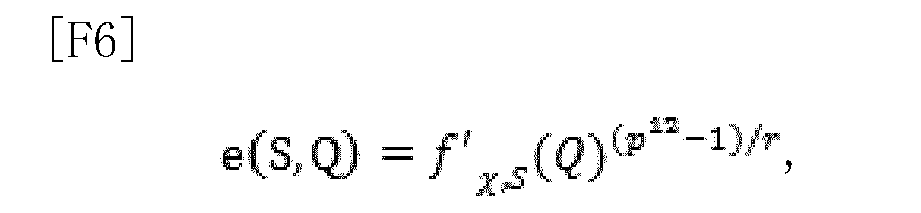
by causing the CPU of the electronic computer to function as a fifth computation unit. - The pairing computation method according to claim 6, wherein the second computation step computes respective rational points -S, (2χ-1)S, p10((2χ-1)S), -pS, (2χ-1)pS, p10((2χ-1)pS) in order using previously obtained results,
the third computation step respectively computes a value l1 at a rational point Q(xQ, yQ) of a straight line passing through rational points ((2χ-1)S, -S), a value l2 at the rational point Q(xQ, yQ) of a straight line passing through rational points ((2χ-1)pS, -pS), a value l3 at the rational point Q(xQ, yQ) of a straight line passing through rational points (p10((2 χ-1)S),2χS), and a value l4 at the rational point Q(xQ, yQ) of a straight line passing through rational points (p10((2χ-1)pS),2χpS), and
the fourth computation step computes f' χ,S(Q) as
- A recording medium storing a pairing computation program, wherein an elliptic curve is given as y2=x3+b, b∈Fp, letting an embedding degree be 12, E be an additive group constituted of rational points on the pairing enabled elliptic curve defined over an extension field Fp 12, E[r] be a set of rational points having a prime order r, and φp be a Frobenius endomorphism, a pairing e is defined using


, as a non-degenerate bilinear map
the pairing computation program causes an electronic computer which includes a CPU to compute the pairing e(S, Q), by letting S∈G1, Q∈G2, χ be a given integer variable, ZS be a set of rational points S and pS, ZQ be a set of rational points pQ and Q, and F2χ,ZS(ZQ) be a rational function which is calculated using Miller' s algorithm with respect to multi-pairing (MMA),
the order r and a trace t of the Frobenius endomorphism φp being specified using the integer variable χ as,

and a representation of the integer variable χ using p10 with p as a characteristic being
the pairing computation program causing the CPU of the electronic computer to function as:an input unit which inputs the integer variable χ, the rational point S, and the rational point Q into respective predetermined registers;a first computation unit which computes F2χ,ZS(ZQ);a second computation unit which computes given rational points using 2χS and 2χpS which are calculated when computing said F2χ,ZS(ZQ);a third computation unit which computes a value at a rational point Q(xQ, yQ) of a straight line passing through the given rational points;a fourth computation unit which computes f' χ,S(Q) using said F2 χ,ZS(ZQ) and said value; anda fifth computation unit which computes the pairing e(S, Q) using said f' χ,S(Q) as
- The recording medium storing a pairing computation program according to claim 8, wherein
the pairing computation program causes:the CPU of the electronic computer which functions as the second computation unit to compute respective rational points -S, (2χ-1)S, p10((2 χ-1)S), -pS, (2χ-1)pS, p10((2χ-1)pS) in order using previously obtained results;the CPU of the electronic computer which functions as the third computation unit to compute respectively a value l1 at a rational point Q(xQ, yQ) of a straight line passing through rational points ((2χ-1)S, -S) , a value l2 at the rational point Q(xQ, yQ) of a straight line passing through rational points ((2χ-1)pS,-pS) , a value l3 at the rational point Q(xQ, yQ) of a straight line passing through rational points (p10((2χ-1)S),2χS), and a value l4 at the rational point Q(xQ, yQ) of a straight line passing through rational points (p10((2χ-1)pS),2χpS); andthe CPU of the electronic computer which functions as the fourth computation unit to compute f' χ,S(Q) as
- A pairing computation device, wherein
an elliptic curve is given as y2=x3+ax, a∈Fp, letting an embedding degree be 8, E be an additive group constituted of rational points on the pairing enabled elliptic curve defined over an extension field Fp 8, E[r] be a set of rational points having a prime order r, and φp be a Frobenius endomorphism, a pairing e is defined using

, as a non-degenerate bilinear map
the pairing computation device comprising a CPU which computes the pairing e(S,Q), by letting S∈G1, Q∈G2, χ be a given integer variable, ZS be a set of rational points S and p3S, ZQ be a set of rational points p3Q and Q, and F3χ,ZS(ZQ) be a rational function which is calculated using Miller' s algorithm with respect to multi-pairing (MMA), wherein
the order r and a trace t of the Frobenius endomorphism φp are specified using the integer variable χ as,

and a representation of the integer variable χ using p2 and p3 with p as a characteristic is
and
the CPU includes:an input unit which inputs the integer variable χ, the rational point S, and the rational point Q into respective predetermined registers;a first computation unit which computes F3χ,ZS(ZQ);a second computation unit which computes respective rational points p2(S), p2(p3S), (3χ+1)S, (3χ+1)p3S in order using previously obtained results;a third computation unit which respectively computes a value l5 at a rational point Q(xQ, yQ) of a straight line passing through rational points (3χ S, S), a value l6 at the rational point Q(xQ, yQ) of a straight line passing through rational points (p2(S), (3χ+1)S), a value l7 at the rational point Q(xQ, yQ) of a straight line passing through rational points (3χp3S, p3S), and a value l8 at the rational point Q(xQ, yQ) of a straight line passing through rational points (p2(p3S), (3χ+1)p3S); andthe fourth computation unit which computes f' χ,S(Q) using a computation result of the first computation unit and a computation result of the third computation unit as
anda fifth computation unit which computes the pairing e(S,Q) using said f' χ,S(Q) as
- A pairing computation method, wherein an elliptic curve is given as y2=x3+ax, a∈Fp, letting an embedding degree be 8, E be an additive group constituted of rational points on the pairing enabled elliptic curve defined over an extension field Fp 8, E[r] be a set of rational points having a prime order r, and φp be a Frobenius endomorphism, a pairing e is defined using


, as a non-degenerate bilinear map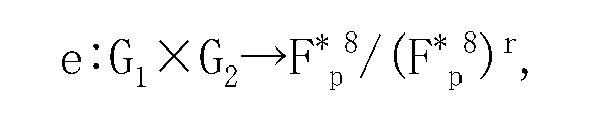
an electronic computer which includes a CPU computes the pairing e(S,Q), by letting S∈G1, Q∈G2, χ be a given integer variable, Zs be a set of rational points S and p3S, ZQ be a set of rational points p3Q and Q, and F3χ,ZS(ZQ) be a rational function which is calculated using Miller' s algorithm with respect to multi-pairing (MMA),
the order r and a trace t of the Frobenius endomorphism φp being specified using the integer variable χ as,

and a representation of the integer variable χ using p2 and p3 with p as a characteristic being
the pairing computation method comprising:an input step which inputs the integer variable χ, the rational point S, and the rational point Q into respective predetermined registers by causing the CPU of the electronic computer to function as an input unit;a first computation step which computes F3χ,ZS(ZQ) by causing the CPU of the electronic computer to function as a first computation unit;a second computation step which computes respective rational points p2(S), p2(p3S), (3χ+1)S, (3χ+1)p3S in order using previously obtained results by causing the CPU of the electronic computer to function as a second computation unit;a third computation step which respectively computes a value l5 at a rational point Q(xQ, yQ) of a straight line passing through rational points (3χS, S), a value l6 at the rational point Q(xQ, yQ) of a straight line passing through rational points (p2(S), (3χ+1)S), a value l7 at the rational point Q(xQ, yQ) of a straight line passing through rational points (3χp3S, p3S), and a value l8 at the rational point Q(xQ, yQ) of a straight line passing through rational points (p2(p3S), (3χ+1)p3S) by causing the CPU of the electronic computer to function as a third computation unit; anda fourth computation step which computes f' χ,S(Q) using said f' χ,S(Q) and said values l5, l6, l7, l8 as by causing the CPU of the electronic computer to function as a fourth computation unit; anda fifth computation step which computes the pairing e(S,Q) using said f' χ,S(Q) as
- A recording medium storing a pairing computation program, wherein an elliptic curve is given as y2=x3+ax, a∈Fp, letting an embedding degree be 8, E be an additive group constituted of rational points on the pairing enabled elliptic curve defined over an extension field Fp 8, E[r] be a set of rational points having a prime order r, and φp be a Frobenius endomorphism, a pairing e is defined using


, as a non-degenerate bilinear map
the order r and a trace t of the Frobenius endomorphism φp being specified using the integer variable χ as,

and a representation of the integer variable χ using p2 and p3 with p as a characteristic being
the pairing computation program causing the CPU of the electronic computer to function as:an input unit which inputs the integer variable χ, the rational point S, and the rational point Q into respective predetermined registers;a first computation unit which computes F3χ,ZS(ZQ);a second computation unit which computes respective rational points p2(S), p2(p3S), (3χ+1)S, (3χ+1)p3S in order using previously obtained results;a third computation unit which respectively computes a value l5 at a rational point Q(xQ, yQ) of a straight line passing through rational points (3χ S, S), a value l6 at the rational point Q (xQ, yQ) of a straight line passing through rational points (p2(S), (3χ+1)S), a value l7 at the rational point Q(xQ, yQ) of a straight line passing through rational points (3χp3S, p3S), and a value l8 at the rational point Q(xQ, yQ) of a straight line passing through rational points (p2(p3S), (3χ+1)p3S); anda fourth computation unit which computes f' χ,S(Q) using said f' χ,S(Q) and said values l5, l6, l7, l8 as a fifth computation unit which computes the pairing e(S,Q) using said f' χ,S(Q) as
- A pairing computation device, wherein an elliptic curve is given as y2=x3+ax+b, a∈Fp, b∈Fp, letting k be an embedding degree, E be an additive group constituted of rational points on the pairing enabled elliptic curve defined over an extension field Fp k, E[r] be a set of rational points having a prime order r, and φp be a Frobenius endomorphism, a pairing e is defined using


, as a non-degenerate bilinear map
the pairing computation device comprising a CPU which computes the pairing e(S, Q), by letting S∈G1, Q∈G2, χ be a given integer variable, and f be a rational function which is calculated using Miller' s algorithm, wherein
the order r and a trace t of the Frobenius endomorphism φp are specified preliminarily according to the embedding degree k using the integer variable χ, and
the CPU includes:an input unit which inputs the integer variable χ, the rational point S, and the rational point Q into respective predetermined registers;a computation unit which computes f;a computation unit which computes a value of a straight line passing through given rational points at a rational point Q(xQ, yQ);a computation unit which computes f' χ,S(Q) using said f and said value; anda computation unit which computes the pairing e(S, Q) using said f' χ,S(Q)as
- A pairing computation method, wherein an elliptic curve is given as y2=x3+ax+b, a∈Fp, b∈Fp, letting k be an embedding degree, E be an additive group constituted of rational points on the pairing enabled elliptic curve defined over an extension field Fp k, E[r] be a set of rational points having a prime order r, and φp be a Frobenius endomorphism, a pairing e is defined using


, as non-degenerate bilinear map
the order r and a trace t of the Frobenius endomorphism φp being specified preliminarily according to the embedding degree k using the integer variable χ,
the pairing computation method comprising:a step of inputting the integer variable χ, the rational point S, and the rational point Q into respective predetermined registers by causing the CPU of the electronic computer to function as an input unit;a step of computing f by causing the CPU of the electronic computer to function as a computation unit;a step of computing a value of a straight line passing through given rational points at a rational point Q(xQ, yQ) by causing the CPU of the electronic computer to function as a computation unit;a step of computing f' χ,S(Q) using said f and said value by causing the CPU of the electronic computer to function as a computation unit; anda step of computing the pairing e(S,Q) using said f' χ,S(Q) as
by causing the CPU of the electronic computer to function as a computation unit. - A recording medium storing a pairing computation program, wherein an elliptic curve is given as y2=x3+ax+b, a∈Fp, b∈Fp, letting k be an embedding degree, E be an additive group constituted of rational points on the pairing enabled elliptic curve defined over an extension field Fp k, E[r] be a set of rational points having a prime order r, and φp be a Frobenius endomorphism, a pairing e is defined using


, as non-degenerate bilinear map
the pairing computation program causes an electronic computer which includes a CPU to compute the pairing e(S,Q), by letting S∈G1, Q∈G2, χ be a given integer variable, and f be a rational function which is calculated using Miller' s algorithm,
the order r and a trace t of the Frobenius endomorphism φp being specified preliminarily according to the embedding degree k using the integer variable χ,
the pairing computation program causing the CPU of the electronic computer to function as:an input unit which inputs the integer variable χ, the rational point S, and the rational point Q into respective predetermined registers;a computation unit which computes f;a computation unit which computes a value of a straight line passing through given rational points at a rational point Q(xQ,yQ);a computation unit which computes f' χ,S(Q) using said f and said value; anda computation unit which computes the pairing e (S, Q) using said f' χ,S(Q) as
- A pairing computation device, wherein an elliptic curve is given as y2=x3+b, b∈Fp, letting an embedding degree be 12, E be an additive group constituted of rational points on the pairing enabled elliptic curve defined over an extension field Fp 12, E[r] be a set of rational points having a prime order r, and φp be a Frobenius endomorphism, a pairing e is defined using


, as a non-degenerate bilinear map
the pairing computation device comprising a CPU which computes the pairing e(S,Q), by letting S∈G1, Q∈G2, χ be a given integer variable, f2 χ,S(Q) be a rational function which is calculated using Miller' s algorithm, wherein
the order r and a trace t of the Frobenius endomorphism φp are specified using the integer variable χ as,

and a representation of the integer variable χ using p10 with p as a characteristic is
and
the CPU includes:an input unit which inputs the integer variable χ, the rational point S, and the rational point Q into respective predetermined registers;a first computation unit which computes f2χ,S(Q) and f2χ,pS(Q);a second computation unit which computes given rational points using 2χS and 2χpS which are calculated when computing said f2χ,S(Q) and f2 χ,pS(Q);a third computation unit which computes a value at a rational point Q(xQ,yQ) of a straight line passing through the given rational points;a fourth computation unit which computes f' χ,S(Q) using said f2χ,S(Q) and said value; anda fifth computation unit which computes the pairing e(S,Q) using said f' χ,S(Q) as
- The pairing computation device according to claim 16, wherein the second computation unit computes respective rational points -S, (2χ-1)S, p10((2χ-1)S), -pS, (2χ-1)pS, p10((2χ-1)pS) in order using previously obtained results,
the third computation unit respectively computes a value l1 at a rational point Q(xQ, yQ) on a straight line passing through rational points ((2χ-1)S, -S), a value l2 at the rational point Q(xQ, yQ) of a straight line passing through rational points (p10((2χ-1)S),2χS), a value l3 at the rational point Q(xQ, yQ) of a straight line passing through rational points ((2χ-1)pS, -pS), and a value l4 at the rational point Q(xQ, yQ) of a straight line passing through rational points (p10((2χ-1)pS), 2 χ pS), and
the fourth computation unit computes f' χ,S(Q) using the values of the rational point Q(xQ, yQ) l1, l2, l3, l4 as
- A pairing computation method, wherein an elliptic curve is given as y2=x3+b, b∈Fp, letting an embedding degree be 12, E be an additive group constituted of rational points on the pairing enabled elliptic curve defined over an extension field Fp 12, E[r] be a set of rational points having a prime order r, and φp be a Frobenius endomorphism, a pairing e is defined using


, as a non-degenerate bilinear map
an electronic computer which includes a CPU computes the pairing e(S,Q), by letting S∈G1, Q∈G2, χ be a given integer variable, and f2χ,S(Q) be a rational function which is calculated using Miller' s algorithm,
the order r and a trace t of the Frobenius endomorphism φp being specified using the integer variable χ as,

and a representation of the integer variable χ using p10 with p as a characteristic being
the pairing computation method comprising:an input step which inputs the integer variable χ, the rational point S, and the rational point Q into respective predetermined registers by causing the CPU of the electronic computer to function as an input unit;a first computation step which computes f2χ,S(Q) and f2χ,pS(Q) by causing the CPU of the electronic computer to function as a first computation unit;a second computation step which computes given rational points using 2 χ S and 2 χ pS which are calculated when computing said f2χ,S(Q) and f2χ,pS(Q) by causing the CPU of the electronic computer to function as a second computation unit;a third computation step which computes a value at a rational point Q(xQ,yQ) of a straight line passing through the given rational points by causing the CPU of the electronic computer to function as a third computation unit;a fourth computation step which computes f' χ,S(Q) using said f2χ,S(Q) and said value by causing the CPU of the electronic computer to function as a fourth computation unit; anda fifth computation step which computes the pairing e(S,Q) using said f' χ,S(Q) asby causing the CPU of the electronic computer to function as a fifth computation unit.
- The pairing computation method according to claim 18, wherein the second computation step computes respective rational points -S, (2χ-1)S, p10((2χ-1)S), -pS, (2χ-1)pS, p10((2χ-1)pS) in order using previously obtained results,
the third computation step respectively computes a value l1 at a rational point Q(xQ, yQ) of a straight line passing through rational points ((2χ-1)S, -S), a value l2 at the rational point Q(xQ, yQ) of a straight line passing through rational points (p10((2χ-1)S),2 χ S), a value l3 at the rational point Q(xQ, yQ) of a straight line passing through rational points ((2χ-1)pS, -pS), and a value l4 at the rational point Q(xQ, yQ) of a straight line passing through rational points (p10((2χ-1)pS),2χpS), and
the fourth computation step computes f' χ,S(Q) using the values of the rational point Q(xQ, yQ) l1, l2, l3, l4 as
- A recording medium storing a pairing computation program, wherein an elliptic curve is given as y2=x3+b, b∈Fp, letting an embedding degree be 12, E be an additive group constituted of rational points on the pairing enabled elliptic curve defined over an extension field Fp l2, E[r] be a set of rational points having a prime order r, and φp be a Frobenius endomorphism, a pairing e is defined using


, as a non-degenerate bilinear map
the pairing computation program causes an electronic computer which includes a CPU to compute the pairing e(S,Q), by letting S∈G1, Q∈G2, χ be a given integer variable, and f2χ,S(Q) and f2χ,pS(Q) be a rational function which is calculated using Miller' s algorithm,
the order r and a trace t of the Frobenius endomorphism φp being specified using the integer variable χ as,

and a representation of the integer variable χ using p10 with p as a characteristic being
the pairing computation program causing the CPU of the electronic computer to function as:an input unit which inputs the integer variable χ, the rational point S, and the rational point Q into respective predetermined registers;a first computation unit which computes f2χ,S(Q) and f2χ,pS(Q);a second computation unit which computes given rational points using 2χS and 2χpS which are calculated when computing said f2χ,S(Q) and f2 χ,pS(Q);a third computation unit which computes a value at a rational point Q(xQ,yQ) of a straight line passing through the given rational points;a fourth computation unit which computes f' χ,S(Q) using said f2χ,S(Q) and said value; anda fifth computation unit which computes the pairing e(S,Q) using said f' χ,S(Q) as
- The recording medium storing a pairing computation program according to claim 20, wherein
The pairing computation program causes:the CPU of the electronic computer which functions as the second computation unit to compute respective rational points -S, (2χ-1)S, p10((2χ-1)S), -pS, (2χ-1)pS, p10((2χ-1)pS) in order using previously obtained results;the CPU of the electronic computer which functions as the third computation unit to respectively compute a value l1 at a rational point Q(xQ,yQ) of a straight line passing through rational points ((2χ-1)S, -S), a value l2 at the rational point Q(xQ, yQ) of a straight line passing through rational points (p10((2χ-1)S),2χS), a value l3 at the rational point Q (xQ, yQ) of a straight line passing through rational points ((2χ-1)pS, -pS), and a value l4 at the rational point Q(xQ, yQ) of a straight line passing through rational points (p10((2χ-1)pS), 2χpS); andthe CPU of the electronic computer which functions as the fourth computation unit to compute f' χ,S(Q) using the values of the rational point Q(xQ, yQ) l1, l2, l3, l4 as
- A pairing computation device, wherein an elliptic curve is given as y2=x3+ax, a∈Fp, letting an embedding degree be 8, E be an additive group constituted of rational points on the pairing enabled elliptic curve defined over an extension field Fp 8, E[r] be a set of rational points having a prime order r, and φp be a Frobenius endomorphism, a pairing e is defined using


, as a non-degenerate bilinear map
the pairing computation device comprising a CPU which computes the pairing e(S,Q), by letting S∈G1, Q∈G2, χ be a given integer variable, and f3χ,S(Q) be a rational function which is calculated using Miller' s algorithm, wherein
the order r and a trace t of the Frobenius endomorphism φp are specified using the integer variable χ as,

and a representation of the integer variable χ using p2 and p3 with p as a characteristic is
and
the CPU includes:
an input unit which inputs the integer variable χ, the rational point S, and the rational point Q into respective predetermined registers;
a first computation unit which computes f3χ,S(Q) and f3χ,p∧3S(Q);
a second computation unit which computes respective rational points p2(S), (3χ+1)S, p2(p3S), (3χ+1)p3S in order using previously obtained results;
a third computation unit respectively computes a value l5 at a rational point Q(xQ, yQ) of a straight line passing through rational points (3χ S, S), a value l6 at the rational point Q (xQ, yQ) of a straight line passing through rational points (p2(S), (3χ+1)S), a value l7 at the rational point Q(xQ, yQ) of a straight line passing through rational points (3χp3S, p3S), and a value l8 at the rational point Q(xQ, yQ) of a straight line passing through rational points (p2(p3S), (3χ+1) p3S); and
the fourth computation unit which computes f' χ,S(Q) using the computation result of the first computation unit and the computation result of the third computation unit as
and
a fifth computation unit which computes the pairing e(S,Q) using said f' χ,S(Q) as
- A pairing computation method, wherein an elliptic curve is given as y2=x3+ax, a∈Fp, letting an embedding degree be 8, E be an additive group constituted of rational points on the pairing enabled elliptic curve defined over an extension field Fp 8, E[r] be a set of rational points having a prime order r, and φp be a Frobenius endomorphism, a pairing e is defined using


, as a non-degenerate bilinear map
an electronic computer which includes a CPU computes the pairing e(S,Q), by letting S∈G1, Q∈G2, χ be a given integer variable, and f3χ,S(Q) be a rational function which is calculated using Miller' s algorithm,
the order r and a trace t of the Frobenius endomorphism φp being specified using the integer variable χ as,

and a representation of the integer variable χ using p2 and p3 with p as a characteristic being
the pairing computation method comprising:an input step which inputs the integer variable χ, the rational point S, and the rational point Q into respective predetermined registers by causing the CPU of the electronic computer to function as an input unit;a first computation step which computes f3χ,S(Q) and f3χ, p∧3S(Q) by causing the CPU of the electronic computer to function as a first computation unit;a second computation step which computes respective rational points p2(S), (3χ+1)S, p2(p3S), (3χ+1)p3S in order using previously obtained results by causing the CPU of the electronic computer to function as a second computation unit;a third computation step which respectively computes a value l5 at a rational point Q(xQ, yQ) of a straight line passing through rational points (3χS, S), a value l6 at the rational point Q (xQ, yQ) of a straight line passing through rational points (p2(S), (3χ+1)S), a value l7 at the rational point Q(xQ, yQ) of a straight line passing through rational points (3χp3S, p3S), and a value l8 at the rational point Q(xQ,yQ) of a straight line passing through rational points (p2(p3S), (3χ+1)p3S) by causing the CPU of the electronic computer to function as a third computation unit; anda fourth computation step which computes f' χ,S(Q) using said f' χ,S(Q) and said values l5, l6, l7, l8 as by causing the CPU of the electronic computer to function as a fourth computation unit; anda fifth computation step which computes the pairing e(S,Q) using said f' χ,S(Q) asby causing the CPU of the electronic computer to function as a fifth computation unit.
- A recording medium storing a pairing computation program, wherein an elliptic curve is given as y2=x3+ax, a∈Fp, letting an embedding degree be 8, E be an additive group constituted of rational points on the pairing enabled elliptic curve defined over an extension field Fp 8, E[r] be a set of rational points having a prime order r, and φp be a Frobenius endomorphism, a pairing e is defined using


, as a non-degenerate bilinear map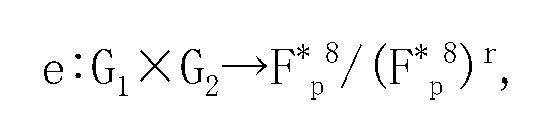
the pairing computation program causes an electronic computer which includes a CPU to compute the pairing e(S,Q), by letting S∈G1, Q∈G2, χ be a given integer variable, and f3χ,S(Q) be a rational function which is calculated using Miller' s algorithm,
the order r and a trace t of the Frobenius endomorphism φp being specified using the integer variable χ as,

and a representation of the integer variable χ using p2 and p3 with p as a characteristic being
the pairing computation program causing the CPU of the electronic computer to function as:an input unit which inputs the integer variable χ, the rational point S, and the rational point Q into respective predetermined registers;a first computation unit which computes f3χ,S(Q) and f3χ,p∧3S(Q);a second computation unit which computes respective rational points p2(S), (3χ+1)S, p2(p3S), (3χ+1)p3S in order using previously obtained results;a third computation unit which respectively computes a value l5 at a rational point Q(xQ, yQ) of a straight line passing through rational points (3χ S, S), a value l6 at the rational point Q (xQ, yQ) of a straight line passing through rational points (p2(S), (3χ+1)S), a value l7 at the rational point Q(xQ, yQ) of a straight line passing through rational points (3χp3S,p3S), and a value l8 at the rational point Q(xQ, yQ) of a straight line passing through rational points (p2(p3S), (3χ+1) p3S); anda fourth computation unit which computes f' χ,S(Q) using said f3χ,S(Q) and said values l5, l6, l7, l8 as
anda fifth computation unit which computes the pairing e(S,Q) using said f' χ,S(Q) as
Applications Claiming Priority (2)
| Application Number | Priority Date | Filing Date | Title |
|---|---|---|---|
| JP2009121398 | 2009-04-21 | ||
| PCT/JP2010/057534 WO2010123151A2 (en) | 2009-04-21 | 2010-04-21 | Pairing arithmetic device, pairing arithmetic method and recording medium having pairing arithmetic program recorded thereon |
Publications (3)
| Publication Number | Publication Date |
|---|---|
| EP2423828A2 true EP2423828A2 (en) | 2012-02-29 |
| EP2423828A4 EP2423828A4 (en) | 2015-03-11 |
| EP2423828B1 EP2423828B1 (en) | 2017-08-09 |
Family
ID=43011556
Family Applications (1)
| Application Number | Title | Priority Date | Filing Date |
|---|---|---|---|
| EP10767199.2A Not-in-force EP2423828B1 (en) | 2009-04-21 | 2010-04-21 | Pairing arithmetic device, pairing arithmetic method and recording medium having pairing arithmetic program recorded thereon |
Country Status (6)
| Country | Link |
|---|---|
| US (1) | US8477934B2 (en) |
| EP (1) | EP2423828B1 (en) |
| JP (1) | JP5549018B2 (en) |
| KR (1) | KR101633148B1 (en) |
| CN (1) | CN102405469A (en) |
| WO (1) | WO2010123151A2 (en) |
Families Citing this family (7)
| Publication number | Priority date | Publication date | Assignee | Title |
|---|---|---|---|---|
| EP2423828B1 (en) | 2009-04-21 | 2017-08-09 | National University Corporation Okayama University | Pairing arithmetic device, pairing arithmetic method and recording medium having pairing arithmetic program recorded thereon |
| US10148285B1 (en) | 2012-07-25 | 2018-12-04 | Erich Schmitt | Abstraction and de-abstraction of a digital data stream |
| JP6057725B2 (en) * | 2013-01-15 | 2017-01-11 | 三菱電機株式会社 | Information processing device |
| US10795858B1 (en) | 2014-02-18 | 2020-10-06 | Erich Schmitt | Universal abstraction and de-abstraction of a digital data stream |
| JP6610277B2 (en) * | 2016-01-15 | 2019-11-27 | 富士通株式会社 | Shared key generation program, shared key generation method, and information processing terminal |
| CN113254985B (en) * | 2021-07-15 | 2021-12-21 | 北京信安世纪科技股份有限公司 | Data encryption method, data processing method, data decryption method and electronic equipment |
| EP4195581A1 (en) * | 2021-12-08 | 2023-06-14 | Nagravision Sàrl | Improvements in and relating to cryptography |
Family Cites Families (8)
| Publication number | Priority date | Publication date | Assignee | Title |
|---|---|---|---|---|
| JP2005316267A (en) | 2004-04-30 | 2005-11-10 | Hitachi Ltd | Elliptic curve pairing arithmetic unit |
| WO2007003230A1 (en) * | 2005-06-30 | 2007-01-11 | Freescale Semiconductor, Inc | Encryption apparatus and method therefor |
| JP4688886B2 (en) * | 2006-01-11 | 2011-05-25 | 三菱電機株式会社 | Elliptic curve encryption parameter generation apparatus, elliptic curve encryption system, and elliptic curve encryption parameter generation program |
| JP4649456B2 (en) * | 2007-09-26 | 2011-03-09 | 株式会社東芝 | Power calculation apparatus, power calculation method and program |
| JP4189828B1 (en) * | 2007-10-30 | 2008-12-03 | 国立大学法人 岡山大学 | Pairing calculation device, pairing calculation method, and pairing calculation program |
| US8356181B2 (en) * | 2007-11-15 | 2013-01-15 | Intel Corporation | Apparatus and method for a direct anonymous attestation scheme from short-group signatures |
| CN102308326B (en) * | 2008-08-29 | 2014-08-13 | 国立大学法人冈山大学 | Pairing computing device, pairing computing method |
| EP2423828B1 (en) | 2009-04-21 | 2017-08-09 | National University Corporation Okayama University | Pairing arithmetic device, pairing arithmetic method and recording medium having pairing arithmetic program recorded thereon |
-
2010
- 2010-04-21 EP EP10767199.2A patent/EP2423828B1/en not_active Not-in-force
- 2010-04-21 KR KR1020117027543A patent/KR101633148B1/en not_active Expired - Fee Related
- 2010-04-21 WO PCT/JP2010/057534 patent/WO2010123151A2/en not_active Ceased
- 2010-04-21 JP JP2011510399A patent/JP5549018B2/en not_active Expired - Fee Related
- 2010-04-21 US US13/264,897 patent/US8477934B2/en not_active Expired - Fee Related
- 2010-04-21 CN CN2010800172506A patent/CN102405469A/en active Pending
Non-Patent Citations (1)
| Title |
|---|
| See references of WO2010123151A2 * |
Also Published As
| Publication number | Publication date |
|---|---|
| WO2010123151A3 (en) | 2010-12-23 |
| EP2423828B1 (en) | 2017-08-09 |
| EP2423828A4 (en) | 2015-03-11 |
| JP5549018B2 (en) | 2014-07-16 |
| US8477934B2 (en) | 2013-07-02 |
| US20120045051A1 (en) | 2012-02-23 |
| CN102405469A (en) | 2012-04-04 |
| KR101633148B1 (en) | 2016-06-23 |
| KR20120014254A (en) | 2012-02-16 |
| WO2010123151A2 (en) | 2010-10-28 |
| JPWO2010123151A1 (en) | 2012-10-25 |
Similar Documents
| Publication | Publication Date | Title |
|---|---|---|
| Liardet et al. | Preventing SPA/DPA in ECC systems using the Jacobi form | |
| EP2423828B1 (en) | Pairing arithmetic device, pairing arithmetic method and recording medium having pairing arithmetic program recorded thereon | |
| US20130202104A1 (en) | Xz-elliptic curve cryptography system and method | |
| US20190251233A1 (en) | Protecting the input/output of modular encoded white-box rsa | |
| US8767955B2 (en) | Protection of a modular exponentiation calculation by multiplication by a random quantity | |
| US10354063B2 (en) | Protection of a modular calculation | |
| US10140437B2 (en) | Array indexing with modular encoded values | |
| Rahman et al. | MAKE: A matrix action key exchange | |
| Brown et al. | Cryptanalysis of “MAKE” | |
| KR102070061B1 (en) | Batch verification method and apparatus thereof | |
| Azarderakhsh et al. | EdSIDH: supersingular isogeny Diffie-Hellman key exchange on Edwards curves | |
| US11038683B1 (en) | Secure data processing | |
| US9419789B2 (en) | Method and apparatus for scalar multiplication secure against differential power attacks | |
| Katyshev et al. | Application of non-associative groupoids to the realization of an open key distribution procedure. | |
| Sauerhoff et al. | Time-space tradeoff lower bounds for integer multiplication and graphs of arithmetic functions | |
| Huang | Trilinear maps for cryptography II | |
| US20160328542A1 (en) | White-box elliptic curve point multiplication | |
| Luykx et al. | On the influence of message length in PMAC’s security bounds | |
| Pomykała et al. | Integer factoring and compositeness witnesses | |
| Kim et al. | Montgomery curve arithmetic revisited | |
| Carls | A generalized artihmetic geometric mean | |
| Hla et al. | Attack experiments on elliptic curves of prime and binary fields | |
| Li et al. | Parallel and Regular Algorithm of Elliptic Curve Scalar Multiplication over Binary Fields | |
| Houben | Efficient post-quantum commutative group actions from orientations of large discriminant | |
| WO2004111833A1 (en) | Method for countermeasuring in an electronic component |
Legal Events
| Date | Code | Title | Description |
|---|---|---|---|
| PUAI | Public reference made under article 153(3) epc to a published international application that has entered the european phase |
Free format text: ORIGINAL CODE: 0009012 |
|
| 17P | Request for examination filed |
Effective date: 20111121 |
|
| AK | Designated contracting states |
Kind code of ref document: A2 Designated state(s): AT BE BG CH CY CZ DE DK EE ES FI FR GB GR HR HU IE IS IT LI LT LU LV MC MK MT NL NO PL PT RO SE SI SK SM TR |
|
| DAX | Request for extension of the european patent (deleted) | ||
| A4 | Supplementary search report drawn up and despatched |
Effective date: 20150205 |
|
| 17Q | First examination report despatched |
Effective date: 20160318 |
|
| GRAP | Despatch of communication of intention to grant a patent |
Free format text: ORIGINAL CODE: EPIDOSNIGR1 |
|
| RIC1 | Information provided on ipc code assigned before grant |
Ipc: G09C 1/00 20060101ALI20170203BHEP Ipc: H04L 9/30 20060101ALI20170203BHEP Ipc: G06F 17/10 20060101AFI20170203BHEP Ipc: G06F 7/72 20060101ALI20170203BHEP |
|
| INTG | Intention to grant announced |
Effective date: 20170220 |
|
| GRAS | Grant fee paid |
Free format text: ORIGINAL CODE: EPIDOSNIGR3 |
|
| GRAJ | Information related to disapproval of communication of intention to grant by the applicant or resumption of examination proceedings by the epo deleted |
Free format text: ORIGINAL CODE: EPIDOSDIGR1 |
|
| GRAL | Information related to payment of fee for publishing/printing deleted |
Free format text: ORIGINAL CODE: EPIDOSDIGR3 |
|
| GRAR | Information related to intention to grant a patent recorded |
Free format text: ORIGINAL CODE: EPIDOSNIGR71 |
|
| GRAA | (expected) grant |
Free format text: ORIGINAL CODE: 0009210 |
|
| INTC | Intention to grant announced (deleted) | ||
| AK | Designated contracting states |
Kind code of ref document: B1 Designated state(s): AT BE BG CH CY CZ DE DK EE ES FI FR GB GR HR HU IE IS IT LI LT LU LV MC MK MT NL NO PL PT RO SE SI SK SM TR |
|
| INTG | Intention to grant announced |
Effective date: 20170705 |
|
| REG | Reference to a national code |
Ref country code: GB Ref legal event code: FG4D |
|
| REG | Reference to a national code |
Ref country code: CH Ref legal event code: EP Ref country code: AT Ref legal event code: REF Ref document number: 917552 Country of ref document: AT Kind code of ref document: T Effective date: 20170815 |
|
| REG | Reference to a national code |
Ref country code: IE Ref legal event code: FG4D |
|
| REG | Reference to a national code |
Ref country code: DE Ref legal event code: R096 Ref document number: 602010044294 Country of ref document: DE |
|
| REG | Reference to a national code |
Ref country code: NL Ref legal event code: MP Effective date: 20170809 |
|
| REG | Reference to a national code |
Ref country code: LT Ref legal event code: MG4D |
|
| REG | Reference to a national code |
Ref country code: AT Ref legal event code: MK05 Ref document number: 917552 Country of ref document: AT Kind code of ref document: T Effective date: 20170809 |
|
| PG25 | Lapsed in a contracting state [announced via postgrant information from national office to epo] |
Ref country code: NL Free format text: LAPSE BECAUSE OF FAILURE TO SUBMIT A TRANSLATION OF THE DESCRIPTION OR TO PAY THE FEE WITHIN THE PRESCRIBED TIME-LIMIT Effective date: 20170809 Ref country code: FI Free format text: LAPSE BECAUSE OF FAILURE TO SUBMIT A TRANSLATION OF THE DESCRIPTION OR TO PAY THE FEE WITHIN THE PRESCRIBED TIME-LIMIT Effective date: 20170809 Ref country code: AT Free format text: LAPSE BECAUSE OF FAILURE TO SUBMIT A TRANSLATION OF THE DESCRIPTION OR TO PAY THE FEE WITHIN THE PRESCRIBED TIME-LIMIT Effective date: 20170809 Ref country code: LT Free format text: LAPSE BECAUSE OF FAILURE TO SUBMIT A TRANSLATION OF THE DESCRIPTION OR TO PAY THE FEE WITHIN THE PRESCRIBED TIME-LIMIT Effective date: 20170809 Ref country code: NO Free format text: LAPSE BECAUSE OF FAILURE TO SUBMIT A TRANSLATION OF THE DESCRIPTION OR TO PAY THE FEE WITHIN THE PRESCRIBED TIME-LIMIT Effective date: 20171109 Ref country code: HR Free format text: LAPSE BECAUSE OF FAILURE TO SUBMIT A TRANSLATION OF THE DESCRIPTION OR TO PAY THE FEE WITHIN THE PRESCRIBED TIME-LIMIT Effective date: 20170809 Ref country code: SE Free format text: LAPSE BECAUSE OF FAILURE TO SUBMIT A TRANSLATION OF THE DESCRIPTION OR TO PAY THE FEE WITHIN THE PRESCRIBED TIME-LIMIT Effective date: 20170809 |
|
| PG25 | Lapsed in a contracting state [announced via postgrant information from national office to epo] |
Ref country code: ES Free format text: LAPSE BECAUSE OF FAILURE TO SUBMIT A TRANSLATION OF THE DESCRIPTION OR TO PAY THE FEE WITHIN THE PRESCRIBED TIME-LIMIT Effective date: 20170809 Ref country code: GR Free format text: LAPSE BECAUSE OF FAILURE TO SUBMIT A TRANSLATION OF THE DESCRIPTION OR TO PAY THE FEE WITHIN THE PRESCRIBED TIME-LIMIT Effective date: 20171110 Ref country code: BG Free format text: LAPSE BECAUSE OF FAILURE TO SUBMIT A TRANSLATION OF THE DESCRIPTION OR TO PAY THE FEE WITHIN THE PRESCRIBED TIME-LIMIT Effective date: 20171109 Ref country code: LV Free format text: LAPSE BECAUSE OF FAILURE TO SUBMIT A TRANSLATION OF THE DESCRIPTION OR TO PAY THE FEE WITHIN THE PRESCRIBED TIME-LIMIT Effective date: 20170809 Ref country code: IS Free format text: LAPSE BECAUSE OF FAILURE TO SUBMIT A TRANSLATION OF THE DESCRIPTION OR TO PAY THE FEE WITHIN THE PRESCRIBED TIME-LIMIT Effective date: 20171209 Ref country code: PL Free format text: LAPSE BECAUSE OF FAILURE TO SUBMIT A TRANSLATION OF THE DESCRIPTION OR TO PAY THE FEE WITHIN THE PRESCRIBED TIME-LIMIT Effective date: 20170809 |
|
| REG | Reference to a national code |
Ref country code: FR Ref legal event code: PLFP Year of fee payment: 9 |
|
| PG25 | Lapsed in a contracting state [announced via postgrant information from national office to epo] |
Ref country code: RO Free format text: LAPSE BECAUSE OF FAILURE TO SUBMIT A TRANSLATION OF THE DESCRIPTION OR TO PAY THE FEE WITHIN THE PRESCRIBED TIME-LIMIT Effective date: 20170809 Ref country code: DK Free format text: LAPSE BECAUSE OF FAILURE TO SUBMIT A TRANSLATION OF THE DESCRIPTION OR TO PAY THE FEE WITHIN THE PRESCRIBED TIME-LIMIT Effective date: 20170809 Ref country code: CZ Free format text: LAPSE BECAUSE OF FAILURE TO SUBMIT A TRANSLATION OF THE DESCRIPTION OR TO PAY THE FEE WITHIN THE PRESCRIBED TIME-LIMIT Effective date: 20170809 |
|
| REG | Reference to a national code |
Ref country code: DE Ref legal event code: R097 Ref document number: 602010044294 Country of ref document: DE |
|
| PG25 | Lapsed in a contracting state [announced via postgrant information from national office to epo] |
Ref country code: EE Free format text: LAPSE BECAUSE OF FAILURE TO SUBMIT A TRANSLATION OF THE DESCRIPTION OR TO PAY THE FEE WITHIN THE PRESCRIBED TIME-LIMIT Effective date: 20170809 Ref country code: SK Free format text: LAPSE BECAUSE OF FAILURE TO SUBMIT A TRANSLATION OF THE DESCRIPTION OR TO PAY THE FEE WITHIN THE PRESCRIBED TIME-LIMIT Effective date: 20170809 Ref country code: IT Free format text: LAPSE BECAUSE OF FAILURE TO SUBMIT A TRANSLATION OF THE DESCRIPTION OR TO PAY THE FEE WITHIN THE PRESCRIBED TIME-LIMIT Effective date: 20170809 Ref country code: SM Free format text: LAPSE BECAUSE OF FAILURE TO SUBMIT A TRANSLATION OF THE DESCRIPTION OR TO PAY THE FEE WITHIN THE PRESCRIBED TIME-LIMIT Effective date: 20170809 |
|
| PLBE | No opposition filed within time limit |
Free format text: ORIGINAL CODE: 0009261 |
|
| STAA | Information on the status of an ep patent application or granted ep patent |
Free format text: STATUS: NO OPPOSITION FILED WITHIN TIME LIMIT |
|
| 26N | No opposition filed |
Effective date: 20180511 |
|
| PG25 | Lapsed in a contracting state [announced via postgrant information from national office to epo] |
Ref country code: SI Free format text: LAPSE BECAUSE OF FAILURE TO SUBMIT A TRANSLATION OF THE DESCRIPTION OR TO PAY THE FEE WITHIN THE PRESCRIBED TIME-LIMIT Effective date: 20170809 |
|
| REG | Reference to a national code |
Ref country code: DE Ref legal event code: R119 Ref document number: 602010044294 Country of ref document: DE |
|
| PG25 | Lapsed in a contracting state [announced via postgrant information from national office to epo] |
Ref country code: MC Free format text: LAPSE BECAUSE OF FAILURE TO SUBMIT A TRANSLATION OF THE DESCRIPTION OR TO PAY THE FEE WITHIN THE PRESCRIBED TIME-LIMIT Effective date: 20170809 |
|
| REG | Reference to a national code |
Ref country code: CH Ref legal event code: PL |
|
| REG | Reference to a national code |
Ref country code: BE Ref legal event code: MM Effective date: 20180430 |
|
| GBPC | Gb: european patent ceased through non-payment of renewal fee |
Effective date: 20180421 |
|
| REG | Reference to a national code |
Ref country code: IE Ref legal event code: MM4A |
|
| PG25 | Lapsed in a contracting state [announced via postgrant information from national office to epo] |
Ref country code: LU Free format text: LAPSE BECAUSE OF NON-PAYMENT OF DUE FEES Effective date: 20180421 Ref country code: DE Free format text: LAPSE BECAUSE OF NON-PAYMENT OF DUE FEES Effective date: 20181101 |
|
| PG25 | Lapsed in a contracting state [announced via postgrant information from national office to epo] |
Ref country code: GB Free format text: LAPSE BECAUSE OF NON-PAYMENT OF DUE FEES Effective date: 20180421 Ref country code: LI Free format text: LAPSE BECAUSE OF NON-PAYMENT OF DUE FEES Effective date: 20180430 Ref country code: CH Free format text: LAPSE BECAUSE OF NON-PAYMENT OF DUE FEES Effective date: 20180430 Ref country code: BE Free format text: LAPSE BECAUSE OF NON-PAYMENT OF DUE FEES Effective date: 20180430 |
|
| PG25 | Lapsed in a contracting state [announced via postgrant information from national office to epo] |
Ref country code: IE Free format text: LAPSE BECAUSE OF NON-PAYMENT OF DUE FEES Effective date: 20180421 |
|
| PG25 | Lapsed in a contracting state [announced via postgrant information from national office to epo] |
Ref country code: MT Free format text: LAPSE BECAUSE OF NON-PAYMENT OF DUE FEES Effective date: 20180421 |
|
| PG25 | Lapsed in a contracting state [announced via postgrant information from national office to epo] |
Ref country code: TR Free format text: LAPSE BECAUSE OF FAILURE TO SUBMIT A TRANSLATION OF THE DESCRIPTION OR TO PAY THE FEE WITHIN THE PRESCRIBED TIME-LIMIT Effective date: 20170809 |
|
| PG25 | Lapsed in a contracting state [announced via postgrant information from national office to epo] |
Ref country code: HU Free format text: LAPSE BECAUSE OF FAILURE TO SUBMIT A TRANSLATION OF THE DESCRIPTION OR TO PAY THE FEE WITHIN THE PRESCRIBED TIME-LIMIT; INVALID AB INITIO Effective date: 20100421 Ref country code: PT Free format text: LAPSE BECAUSE OF FAILURE TO SUBMIT A TRANSLATION OF THE DESCRIPTION OR TO PAY THE FEE WITHIN THE PRESCRIBED TIME-LIMIT Effective date: 20170809 |
|
| PG25 | Lapsed in a contracting state [announced via postgrant information from national office to epo] |
Ref country code: MK Free format text: LAPSE BECAUSE OF NON-PAYMENT OF DUE FEES Effective date: 20170809 Ref country code: CY Free format text: LAPSE BECAUSE OF FAILURE TO SUBMIT A TRANSLATION OF THE DESCRIPTION OR TO PAY THE FEE WITHIN THE PRESCRIBED TIME-LIMIT Effective date: 20170809 |
|
| PGFP | Annual fee paid to national office [announced via postgrant information from national office to epo] |
Ref country code: FR Payment date: 20200420 Year of fee payment: 11 |
|
| PG25 | Lapsed in a contracting state [announced via postgrant information from national office to epo] |
Ref country code: FR Free format text: LAPSE BECAUSE OF NON-PAYMENT OF DUE FEES Effective date: 20210430 |