EP2423227A1 - Human antibodies to human delta like ligand 4 - Google Patents
Human antibodies to human delta like ligand 4 Download PDFInfo
- Publication number
- EP2423227A1 EP2423227A1 EP11190612A EP11190612A EP2423227A1 EP 2423227 A1 EP2423227 A1 EP 2423227A1 EP 11190612 A EP11190612 A EP 11190612A EP 11190612 A EP11190612 A EP 11190612A EP 2423227 A1 EP2423227 A1 EP 2423227A1
- Authority
- EP
- European Patent Office
- Prior art keywords
- antibody
- human
- seq
- fragment
- antibodies
- Prior art date
- Legal status (The legal status is an assumption and is not a legal conclusion. Google has not performed a legal analysis and makes no representation as to the accuracy of the status listed.)
- Withdrawn
Links
Classifications
-
- C—CHEMISTRY; METALLURGY
- C07—ORGANIC CHEMISTRY
- C07K—PEPTIDES
- C07K16/00—Immunoglobulins [IG], e.g. monoclonal or polyclonal antibodies
- C07K16/18—Immunoglobulins [IG], e.g. monoclonal or polyclonal antibodies against material from animals or humans
- C07K16/22—Immunoglobulins [IG], e.g. monoclonal or polyclonal antibodies against material from animals or humans against growth factors ; against growth regulators
-
- A—HUMAN NECESSITIES
- A61—MEDICAL OR VETERINARY SCIENCE; HYGIENE
- A61K—PREPARATIONS FOR MEDICAL, DENTAL OR TOILETRY PURPOSES
- A61K39/00—Medicinal preparations containing antigens or antibodies
- A61K39/395—Antibodies; Immunoglobulins; Immune serum, e.g. antilymphocytic serum
-
- A—HUMAN NECESSITIES
- A61—MEDICAL OR VETERINARY SCIENCE; HYGIENE
- A61K—PREPARATIONS FOR MEDICAL, DENTAL OR TOILETRY PURPOSES
- A61K39/00—Medicinal preparations containing antigens or antibodies
- A61K39/395—Antibodies; Immunoglobulins; Immune serum, e.g. antilymphocytic serum
- A61K39/39533—Antibodies; Immunoglobulins; Immune serum, e.g. antilymphocytic serum against materials from animals
- A61K39/39558—Antibodies; Immunoglobulins; Immune serum, e.g. antilymphocytic serum against materials from animals against tumor tissues, cells, antigens
-
- A—HUMAN NECESSITIES
- A61—MEDICAL OR VETERINARY SCIENCE; HYGIENE
- A61P—SPECIFIC THERAPEUTIC ACTIVITY OF CHEMICAL COMPOUNDS OR MEDICINAL PREPARATIONS
- A61P29/00—Non-central analgesic, antipyretic or antiinflammatory agents, e.g. antirheumatic agents; Non-steroidal antiinflammatory drugs [NSAID]
-
- A—HUMAN NECESSITIES
- A61—MEDICAL OR VETERINARY SCIENCE; HYGIENE
- A61P—SPECIFIC THERAPEUTIC ACTIVITY OF CHEMICAL COMPOUNDS OR MEDICINAL PREPARATIONS
- A61P35/00—Antineoplastic agents
-
- A—HUMAN NECESSITIES
- A61—MEDICAL OR VETERINARY SCIENCE; HYGIENE
- A61P—SPECIFIC THERAPEUTIC ACTIVITY OF CHEMICAL COMPOUNDS OR MEDICINAL PREPARATIONS
- A61P37/00—Drugs for immunological or allergic disorders
- A61P37/02—Immunomodulators
-
- A—HUMAN NECESSITIES
- A61—MEDICAL OR VETERINARY SCIENCE; HYGIENE
- A61P—SPECIFIC THERAPEUTIC ACTIVITY OF CHEMICAL COMPOUNDS OR MEDICINAL PREPARATIONS
- A61P37/00—Drugs for immunological or allergic disorders
- A61P37/02—Immunomodulators
- A61P37/06—Immunosuppressants, e.g. drugs for graft rejection
-
- A—HUMAN NECESSITIES
- A61—MEDICAL OR VETERINARY SCIENCE; HYGIENE
- A61P—SPECIFIC THERAPEUTIC ACTIVITY OF CHEMICAL COMPOUNDS OR MEDICINAL PREPARATIONS
- A61P9/00—Drugs for disorders of the cardiovascular system
-
- C—CHEMISTRY; METALLURGY
- C07—ORGANIC CHEMISTRY
- C07K—PEPTIDES
- C07K16/00—Immunoglobulins [IG], e.g. monoclonal or polyclonal antibodies
- C07K16/18—Immunoglobulins [IG], e.g. monoclonal or polyclonal antibodies against material from animals or humans
-
- A—HUMAN NECESSITIES
- A61—MEDICAL OR VETERINARY SCIENCE; HYGIENE
- A61K—PREPARATIONS FOR MEDICAL, DENTAL OR TOILETRY PURPOSES
- A61K39/00—Medicinal preparations containing antigens or antibodies
- A61K2039/505—Medicinal preparations containing antigens or antibodies comprising antibodies
-
- C—CHEMISTRY; METALLURGY
- C07—ORGANIC CHEMISTRY
- C07K—PEPTIDES
- C07K2317/00—Immunoglobulins specific features
- C07K2317/20—Immunoglobulins specific features characterized by taxonomic origin
- C07K2317/21—Immunoglobulins specific features characterized by taxonomic origin from primates, e.g. man
-
- C—CHEMISTRY; METALLURGY
- C07—ORGANIC CHEMISTRY
- C07K—PEPTIDES
- C07K2317/00—Immunoglobulins specific features
- C07K2317/30—Immunoglobulins specific features characterized by aspects of specificity or valency
-
- C—CHEMISTRY; METALLURGY
- C07—ORGANIC CHEMISTRY
- C07K—PEPTIDES
- C07K2317/00—Immunoglobulins specific features
- C07K2317/30—Immunoglobulins specific features characterized by aspects of specificity or valency
- C07K2317/33—Crossreactivity, e.g. for species or epitope, or lack of said crossreactivity
-
- C—CHEMISTRY; METALLURGY
- C07—ORGANIC CHEMISTRY
- C07K—PEPTIDES
- C07K2317/00—Immunoglobulins specific features
- C07K2317/30—Immunoglobulins specific features characterized by aspects of specificity or valency
- C07K2317/34—Identification of a linear epitope shorter than 20 amino acid residues or of a conformational epitope defined by amino acid residues
-
- C—CHEMISTRY; METALLURGY
- C07—ORGANIC CHEMISTRY
- C07K—PEPTIDES
- C07K2317/00—Immunoglobulins specific features
- C07K2317/50—Immunoglobulins specific features characterized by immunoglobulin fragments
- C07K2317/56—Immunoglobulins specific features characterized by immunoglobulin fragments variable (Fv) region, i.e. VH and/or VL
-
- C—CHEMISTRY; METALLURGY
- C07—ORGANIC CHEMISTRY
- C07K—PEPTIDES
- C07K2317/00—Immunoglobulins specific features
- C07K2317/50—Immunoglobulins specific features characterized by immunoglobulin fragments
- C07K2317/56—Immunoglobulins specific features characterized by immunoglobulin fragments variable (Fv) region, i.e. VH and/or VL
- C07K2317/565—Complementarity determining region [CDR]
-
- C—CHEMISTRY; METALLURGY
- C07—ORGANIC CHEMISTRY
- C07K—PEPTIDES
- C07K2317/00—Immunoglobulins specific features
- C07K2317/70—Immunoglobulins specific features characterized by effect upon binding to a cell or to an antigen
- C07K2317/73—Inducing cell death, e.g. apoptosis, necrosis or inhibition of cell proliferation
-
- C—CHEMISTRY; METALLURGY
- C07—ORGANIC CHEMISTRY
- C07K—PEPTIDES
- C07K2317/00—Immunoglobulins specific features
- C07K2317/70—Immunoglobulins specific features characterized by effect upon binding to a cell or to an antigen
- C07K2317/73—Inducing cell death, e.g. apoptosis, necrosis or inhibition of cell proliferation
- C07K2317/732—Antibody-dependent cellular cytotoxicity [ADCC]
-
- C—CHEMISTRY; METALLURGY
- C07—ORGANIC CHEMISTRY
- C07K—PEPTIDES
- C07K2317/00—Immunoglobulins specific features
- C07K2317/70—Immunoglobulins specific features characterized by effect upon binding to a cell or to an antigen
- C07K2317/73—Inducing cell death, e.g. apoptosis, necrosis or inhibition of cell proliferation
- C07K2317/734—Complement-dependent cytotoxicity [CDC]
-
- C—CHEMISTRY; METALLURGY
- C07—ORGANIC CHEMISTRY
- C07K—PEPTIDES
- C07K2317/00—Immunoglobulins specific features
- C07K2317/70—Immunoglobulins specific features characterized by effect upon binding to a cell or to an antigen
- C07K2317/76—Antagonist effect on antigen, e.g. neutralization or inhibition of binding
-
- C—CHEMISTRY; METALLURGY
- C07—ORGANIC CHEMISTRY
- C07K—PEPTIDES
- C07K2317/00—Immunoglobulins specific features
- C07K2317/90—Immunoglobulins specific features characterized by (pharmaco)kinetic aspects or by stability of the immunoglobulin
- C07K2317/92—Affinity (KD), association rate (Ka), dissociation rate (Kd) or EC50 value
Definitions
- the Notch-signaling pathway is a system for cell-to-cell communication used by a wide range of eukaryotes for many biological processes, such as differentiation, proliferation, and homeostasis.
- Delta like 4 (Dl4) or delta-like ligand 4 (DI14) (hereinafter "Dll4") is a member of the Delta family of Notch ligands which exhibits highly selective expression by vascular endothelium ( Shutter et al. (2000) Genes Develop. 14:1313-1318 ).
- Dll4 is a ligand for Notch receptors, including Notch1 and Notch 4.
- the nucleic acid and amino acid sequences for human Dll4 are shown in SEQ ID NO:1-2, respectively.
- Methods to produce antibodies useful as human therapeutics include generation of chimeric antibodies and humanized antibodies (see, for example, U.S. 6,949,245 ). See, for example, WO 94/02602 (Abgenix) and U.S. 6,596,541 (Regeneron Pharmaceuticals) describing methods of generating nonhuman transgenic mice capable of producing human antibodies.
- Japanese patent application 2003/047470A2 (Asahi Kasei Kogyo ) describes antibodies to the extracellular portion of human Notch ligand protein.
- the invention provides human antibodies, preferably recombinant human antibodies, that specifically bind human delta-like ligand 4 (hDll4). These antibodies are characterized by binding to hDll4 with high affinity and by the ability to neutralize Dll4 activity.
- the antibodies of the invention are capable of blocking Dll4 binding to its Notch receptor(s), and thus inhibit signaling by Dll4.
- the antibodies can be full-length (for example, an IgG1 or IgG4 antibody) or may comprise only an antigen-binding portion (for example, a Fab, F(ab') 2 or scFv fragment), and may be modified to effect functionality, e.g., to eliminate residual effector functions (Glu which eliminates residual effector functions ( Reddy et al. (2000) J. Immunol. 164:1925-1933 ).
- the antibody of the invention comprises a heavy chain variable region (HCVR) selected from the group consisting of SEQ ID NO:4, 20, 36, 52, 68, 84, 100, 116, 132, 148, 164, 180, 196, 212, 228, 244, 260, 276, 292, 308, 324, 340, 356, 372, 397, 413, 429, 445, 461, 477, 493, 509, 525, 541, 557, 573, 589, 605, 621, 637, 653, 669, 685, 701, 717, 733, 749, 765, 781, 797, 813, 893, 897, 901, 905, 909, 913, 917, 921, 925, 935, 939, 943, and 947 or a substantially identical sequence thereof.
- the HCVR is the amino acid sequence of SEQ ID NO:429 or 901.
- the antibody of the invention comprises a light chain variable region (LCVR) selected from the group consisting of SEQ ID NO:12, 28, 44, 60, 76, 92, 108, 124, 140, 156, 172, 188, 204, 220, 236, 252, 268, 284, 300, 316, 332, 348, 364, 380, 405, 421, 437, 453, 469, 485, 501, 517, 533, 549, 565, 581, 597, 613, 629, 645, 661, 677, 693, 709, 725, 741, 757, 773, 789, 805, 821, 895, 899, 903, 907, 911, 915, 919, 923, 927, 937, 941, 945, and 949 or a substantially identical sequence thereof.
- the LCVR is the amino acid sequence of SEQ ID NO:437 or 903.
- the antibody of the invention comprises a HCVR selected from the group consisting of SEQ ID NO: 4, 20, 36, 52, 68, 84, 100, 116, 132, 148, 164, 180, 196, 212, 228, 244, 260, 276, 292, 308, 324, 340, 356, 372, 397, 413, 429, 445, 461, 477, 493, 509, 525, 541, 557, 573, 589, 605, 621, 637, 653, 669, 685, 701, 717, 733, 749, 765, 781, 797, 813, 893, 897, 901, 905, 909, 913, 917, 921, 925, 935, 939, 943, and 947 or a substantially identical sequence thereof, and a LCVR selected from the group consisting of SEQ ID NO:12, 28, 44, 60, 76, 92, 108, 124, 140, 156, 172, 188, 204
- the invention features a human antibody or antibody fragment comprising a heavy chain complementary determining region 1 (CDR1) selected from the group consisting of SEQ ID NO:6, 22, 38, 54, 70, 86, 102, 118, 134, 150, 166, 182, 198, 214, 230, 246, 262, 278 294, 310, 326, 342, 358, 374, 399, 415, 431, 447, 463, 479, 495, 511, 527, 543, 559, 575, 591, 607, 623, 639, 655, 671, 687, 703, 711119, 735, 751, 767, 783, 799, and 815, or a substantially identical sequence thereof.
- CDR1 heavy chain complementary determining region 1
- the invention features a human antibody or antibody fragment comprising a heavy chain CDR2 selected from the group consisting of SEQ ID NO:8, 24, 40, 56, 72, 88, 104, 120, 136, 152, 168, 184, 200, 216, 232, 248, 264, 280, 296, 312, 328, 344, 360, 376, 401, 417, 433, 449, 465, 481, 497, 513, 529, 545, 561, 577, 593, 609, 625, 641, 657, 673, 689, 705, 721, 737, 753, 769, 785, 801, and 817, or a substantially identical sequence thereof.
- a heavy chain CDR2 selected from the group consisting of SEQ ID NO:8, 24, 40, 56, 72, 88, 104, 120, 136, 152, 168, 184, 200, 216, 232, 248, 264, 280, 296, 312, 328, 344, 360, 376, 401
- the invention features a human antibody or antibody fragment comprising a heavy chain CDR3 selected from the group consisting of SEQ ID NO:10, 26, 42, 58, 74, 90, 106, 122, 138, 154, 170, 186, 202, 218, 234, 250, 266, 282, 298, 314, 330, 346, 362, 378, 403, 419, 435, 451, 467, 483, 499, 515, 531, 547, 563, 579, 595, 611, 627, 643, 659, 675, 691, 707, 723, 739, 755, 771, 787, 803, and 819, or a substantially identical sequence thereof.
- the invention features a human antibody or antibody fragment comprising a heavy chain CDR1 selected from the group consisting of SEQ ID NO: 6, 22, 38, 54, 70, 86, 102, 118, 134, 150, 166, 182, 198, 214, 230, 246, 262, 278 294, 310, 326, 342, 358, 374, 399, 415, 431, 447, 463, 479, 495, 511, 527, 543, 559, 575, 591, 607, 623, 639, 655, 671, 687, 703, 711119, 735, 751, 767, 783, 799, and 815, or a substantially identical sequence thereof; a heavy chain CDR2 selected from the group consisting of SEQ ID NO: 8, 24, 40, 56, 72, 88, 104, 120, 136, 152, 168, 184, 200, 216, 232, 248, 264, 280, 296, 312, 328, 344, 360
- the antibody or antibody fragment comprises heavy chain CDR1, CDR2 and CDR3 selected from the group consisting of SEQ ID NO:431/433/435; 374/376/378; 783/785/787; and 799/801/803.
- the invention features a human antibody or antibody fragment comprising a light chain CDR1 selected from the group consisting of SEQ ID NO: 14, 30, 46, 62, 78, 94, 110, 126, 142, 158, 174, 190, 206, 222, 238, 254, 270, 286, 302, 318, 334, 350, 366, 382, 407, 423, 439, 455, 471, 487, 503, 519, 535, 551, 567, 583, 599, 615, 631, 647, 663, 679, 695, 711, 727, 743, 759, 775, 791, 807, 823, or a substantially identical sequence thereof.
- a light chain CDR1 selected from the group consisting of SEQ ID NO: 14, 30, 46, 62, 78, 94, 110, 126, 142, 158, 174, 190, 206, 222, 238, 254, 270, 286, 302, 318, 334, 350, 366
- the invention features a human antibody or antibody fragment comprising a light chain CDR2 selected from the group consisting of SEQ ID NO:16, 32, 48, 64, 80, 96, 112, 128, 144, 160, 176, 192, 208, 224, 240, 256, 272, 288, 304, 320, 336, 352, 368, 384, 409, 425, 441, 457, 473, 489, 505, 521, 537, 553, 569, 585, 601, 617, 633, 649, 665, 681, 697, 713, 729, 745, 761, 777, 793, 809, and 825, or a substantially identical sequence thereof.
- a light chain CDR2 selected from the group consisting of SEQ ID NO:16, 32, 48, 64, 80, 96, 112, 128, 144, 160, 176, 192, 208, 224, 240, 256, 272, 288, 304, 320, 336, 352,
- the invention features a human antibody or antibody fragment comprising a light chain CDR3 selected from the group consisting of SEQ ID NO:18, 34, 50, 66, 82, 98, 11, 130, 146, 162, 178, 194, 210, 226, 242, 258, 274, 290, 306, 322, 338, 354, 370, 386, 411, 427, 443, 459, 475, 491, 507, 523, 539, 555, 571, 587, 603, 619, 635, 651, 667, 683, 699, 715, 731, 747, 763, 779, 795, 811, and 827, or a substantially identical sequence thereof.
- a light chain CDR3 selected from the group consisting of SEQ ID NO:18, 34, 50, 66, 82, 98, 11, 130, 146, 162, 178, 194, 210, 226, 242, 258, 274, 290, 306, 322, 338, 354, 370, 386, 411
- the invention features a human antibody or antibody fragment comprising a light chain CDR1 selected from the group consisting of SEQ ID NO: 14, 30, 46, 62, 78, 94, 110, 126, 142, 158, 174, 190, 206, 222, 238, 254, 270, 286, 302, 318, 334, 350, 366, 382, 407, 423, 439, 455, 471, 487, 503, 519, 535, 551, 567, 583, 599, 615, 631, 647, 663, 679, 695, 711, 727, 743, 759, 775, 791, 807, 823, or a substantially identical sequence thereof; a light chain CDR2 selected from the group consisting of SEQ ID NO: 16, 32, 48, 64, 80, 96, 112, 128, 144, 160, 176, 192, 208, 224, 240, 256, 272, 288, 304, 320, 336, 352, 368
- the antibody or antibody fragment comprises the light chain CDR1, CDR2 and CDR3 selected from the group consisting of SEQ ID NO:439/441/443; 382/384/386; 791/793/795; and 807/809/811.
- the invention provides nucleic acid molecules encoding the antibodies, or antigen-binding portions, of the invention.
- Recombinant expression vectors carrying the antibody-encoding nucleic acids of the invention, and host cells into which such vectors have been introduced, are also encompassed by the invention, as are methods of making the antibodies of the invention by culturing the host cells of the invention.
- the antibody of the invention comprises a HCVR encoded by a nucleotide sequence selected from the group consisting of SEQ ID NO:3, 19, 35, 51, 67, 83, 99, 115, 131, 147, 163, 179, 195, 211, 227, 243, 259, 275, 291, 307, 323, 339, 355, 371, 396, 412, 428, 444, 460, 476, 492, 508, 524, 540, 556, 572, 588, 604, 620, 636, 652, 668, 684, 700, 716, 732, 748, 764, 780, 796, 812, 892, 896, 900, 904, 908, 912, 916, 920, 924, 934, 938, 942, and 946 or a substantially similar sequence having at least 95% homology thereof.
- the antibody of the invention comprises a LCVR encoded by a nucleotide sequence selected from the group consisting of SEQ ID NO:11, 27, 43, 59, 75, 91, 107, 123, 139, 155, 171, 187, 203, 219, 235, 251, 267, 283, 299, 315, 331, 347, 363, 379, 404, 420, 436, 452, 468, 484, 500, 516, 532, 548, 564, 580, 596, 612, 628, 644, 660, 676, 692, 708, 724, 740, 756, 772, 788, 804, 820, 894, 898, 902, 906, 910, 914, 918, 922, 926, 936, 940, 944, and 948 or a substantially similar sequence having at least 95% homology thereof.
- the antibody of the invention comprises a HCVR encoded by a nucleotide sequence selected from the group consisting of SEQ ID NO: 3, 19, 35, 51, 67, 83, 99, 115, 131, 147, 163, 179, 195, 211, 227, 243, 259, 275, 291, 307, 323, 339, 355, 371, 396, 412, 428, 444, 460, 476, 492, 508, 524, 540, 556, 572, 588, 604, 620, 636, 652, 668, 684, 700, 716, 732, 748, 764, 780, 796, 812, 892, 896, 900, 904, 908, 912, 916, 920, 924, 934, 938, 942, and 946 or a substantially similar sequence having at least 95% homology thereof, and a LCVR encoded by a nucleotide sequence selected from the group consisting of SEQ ID NO:
- the invention features a human antibody or antibody fragment comprising a heavy chain CDR1 encoded by a nucleotide sequence selected from the group consisting of SEQ ID NO:5, 21, 37, 53, 69, 85, 101, 117, 133, 149, 165, 181, 197, 213, 229, 245, 261, 277, 293, 309, 325, 341, 357, 373, 398, 414, 430, 446, 462, 478, 494, 510, 526, 542, 558, 574, 590, 606, 622, 638, 654, 670, 686, 702, 718, 734, 750, 766, 782, 798, and 814, or a substantially similar sequence having at least 95% homology thereof.
- the invention features a human antibody or antibody fragment comprising a heavy chain CDR2 encoded by a nucleotide sequence selected from the group consisting of SEQ ID NO:7, 23, 39, 55, 71, 87, 103, 119, 135, 151, 167, 183, 100, 215, 231, 247, 263, 279, 295, 311, 327, 343, 359, 375, 400, 416, 432, 448, 464, 480, 496, 512, 528, 544, 560, 576, 592, 608, 624, 640, 656, 672, 688, 704, 720, 736, 752, 768, 784, 800, and 816, or a substantially similar sequence having at least 95% homology thereof.
- the invention features a human antibody or antibody fragment comprising a heavy chain CDR3 encoded by a nucleotide sequence selected from the group consisting of SEQ ID NO:9, 25, 41, 57, 73, 89, 105, 121, 137, 153, 169, 185, 201, 217, 233, 249, 265, 281, 297, 313, 329, 345, 361, 377, 402, 418, 434, 450, 466, 482, 498, 514, 530, 546, 562, 578, 594, 610, 626, 642, 658, 674, 690, 706, 722, 738, 754, 770, 786, 802, and 818, or a substantially similar sequence having at least 95% homology thereof.
- the invention features a human antibody or antibody fragment comprising a heavy chain CDR1 encoded by a nucleotide sequence selected from the group consisting of SEQ ID NO:5, 21, 37, 53, 69, 85, 101, 117, 133, 149, 165, 181, 197, 213, 229, 245, 261, 277, 293, 309, 325, 341, 357, 373, 398, 414, 430, 446, 462, 478, 494, 510, 526, 542, 558, 574, 590, 606, 622, 638, 654, 670, 686, 702, 718, 734, 750, 766, 782, 798, and 814, or a substantially similar sequence having at least 95% homology thereof; a heavy chain CDR2 encoded by a nucleotide sequence selected from the group consisting of SEQ ID NO:7, 23, 39, 55, 71, 87, 103, 119, 135, 151, 167, 183
- the antibody or antibody fragment comprises heavy chain CDR1, CDR2 and CDR3 encoded b a nucleic acid sequence selected from the group consisting of SEQ ID NO:430/432/434; 373/375/377; 782/784/786; and 798/800/802.
- the invention features a human antibody or antibody fragment comprising a light chain CDR1 encoded by a nucleotide sequence selected from the group consisting of SEQ ID NO:13, 29, 45, 61, 77, 93, 109, 125, 141, 157, 173, 189, 205, 221, 237, 253, 269, 285, 301, 317, 333, 349, 365, 381, 406, 422, 438, 454, 470, 486, 502, 518, 534, 550, 566, 582, 598, 614, 630, 646, 662, 678, 694, 710, 726, 742, 758, 774, 790, 806, and 822, or a substantially similar sequence having at least 95% homology thereof.
- the invention features a human antibody or antibody fragment comprising a light chain CDR2 encoded by a nucleotide sequence selected from the group consisting of SEQ ID NO:15, 31, 47, 63, 79, 95, 111, 127, 143, 159, 175, 191, 207, 223, 239, 255, 271, 287, 303, 319, 335, 351, 367, 383, 408, 424, 440, 456, 472, 488, 504, 520, 536, 552, 568, 584, 600, 616, 632, 648, 664, 680, 696, 712, 728, 744, 760, 776, 792, 808, and 824, or a substantially similar sequence having at least 95% homology thereof.
- the invention features a human antibody or antibody fragment comprising a light chain CDR3 encoded by a nucleotide sequence selected from the group consisting of SEQ ID NO:17, 33, 49, 65, 81, 97, 113, 129, 145, 161, 177, 193, 209, 225, 241, 257, 273, 289, 305, 321, 337, 353, 369, 385, 410, 426, 442, 458, 474, 490, 506, 522, 538, 554, 570, 586, 602, 618, 634, 650, 666, 682, 698, 714, 730, 746, 762, 778, 794, 810, and 826, or a substantially similar sequence having at least 95% homology thereof.
- the invention features a human antibody or antibody fragment comprising a light chain CDR1 encoded by a nucleotide sequence selected from the group consisting of SEQ ID NO:13, 29, 45, 61, 77, 93, 109, 125, 141, 157, 173, 189, 205, 221, 237, 253, 269, 285, 301, 317, 333, 349, 365, 381, 406, 422, 438, 454, 470, 486, 502, 518, 534, 550, 566, 582, 598, 614, 630, 646, 662, 678, 694, 710, 726, 742, 758, 774, 790, 806, and 822, or a substantially similar sequence having at least 95% homology thereof; a light chain CDR2 encoded by a nucleotide sequence selected from the group consisting of SEQ ID NO: 15, 31, 47, 63, 79, 95, 111, 127, 143, 159, 175,
- the antibody or antibody fragment comprises the light chain CDR1, CDR2 and CDR3 encoded by a nucleic acid sequence selected from the group consisting of SEQ ID NO:438/440/442; 381/383/385; 790/792/794; and 806/808/810.
- the invention features an isolated antibody or antibody fragment that specifically binds hDII4, comprising a CDR 1, 2 and 3 selected from the group consisting of (a) a heavy chain CDR1 region comprising an amino acid sequence of the formula X 1 - X 2 - X 3 - X 4 - X 5 - X 6 - X 7 - X 8 (SEQ ID NO:928), wherein X 1 is Gly; X 2 is Phe or Tyr; X 3 is Thr; X 4 is Phe; X 5 is Ser, Thr or Asn; X 6 is Ser, Asn or Tyr; X 7 is Tyr or Phe; and X 8 is Gly or Ala; (b) a heavy chain CDR2 region comprising an amino acid sequence of the formula X 1 - X 2 - X 3 - X 4 - X 5 - X 6 - X 7 - X 8 (SEQ ID NO:929), wherein
- the antibody or antibody fragment comprises heavy chain CDR 1, 2 and 3 selected from the group consisting of (a) a heavy chain CDR1 region comprising an amino acid sequence of the formula X 1 - X 2 - X 3 - X 4 - X 5 - X 6 - X 7 - X 8 (SEQ I D NO:928), wherein X 1 is Gly; X 2 is Phe; X 3 is Thr; X 4 is Phe; X 5 is Ser or Asn; X 6 is Ser or Asn; X 7 is Tyr or Phe; and X 8 is Gly or Ala; (b) a heavy chain CDR2 region comprising an amino acid sequence of the formula X 1 - X 2 - X 3 - X 4 - X 5 - X 6 - X 7 - X 8 (SEQ ID NO:929), wherein X 1 is Ile or Leu; X 2 is Trp or Ser; X 3 is
- the isolated antibody or antibody fragment further comprises (d) a light chain CDR1 region comprising an amino acid sequence of the formula X 1 - X 2 - X 3 - X 4 - X 5 - X 6 - X 7 (SEQ ID NO:931), wherein X 1 is Gln; X 2 is Ser; X 3 is Val; X 4 is Arg, Ser or Thr; X 5 is Ser or Gly; X 6 is Ser or Tyr; and X 7 is Tyr or absent; (e) a light chain CDR2 region comprising an amino acid sequence of the formula X 1 - X 2 - X 3 (SEQ ID NO:932), wherein X 1 is Gly or Asp; X 2 is Ala or Thr; and X 3 is Ser; and (f) a light chain CDR3 region comprising an amino acid sequence of the formula X 1 - X 2 - X 3 - X 4 - X 5 - X
- the isolated antibody or antibody fragment further comprises (d) a light chain CDR1 region comprising an amino acid sequence of the formula X 1 - X 2 - X 3 - X 4 - X 5 - X 6 - X 7 (SEQ ID NO:931), wherein X 1 is Gln; X 2 is Ser; X 3 is Val; X 4 is Arg or Ser; X 5 is Ser; X 6 is Ser or Tyr; and X 7 is Tyr or absent; (e) a light chain CDR2 region comprising an amino acid sequence of the formula X 1 - X 2 - X 3 (SEQ ID NO:932), wherein X 1 is Gly or Asp; X 2 is Ala or Thr; and X 3 is Ser; and (f) a light chain CDR3 region comprising an amino acid sequence of the formula X 1 - X 2 - X 3 - X 4 - X 5 - X 6 - X 7
- the invention features a fully human antibody or antibody fragment which binds hDII4 with an IC 50 of less than about 10 nM, as measured in in vitro assay or ELISA-based DII4 blocking assay (described below).
- the antibody of the invention exhibits an IC 50 of about 500 pM or less. In an even more preferred embodiment, the antibody of the invention exhibits an IC 50 of about 100 pM or less.
- the invention provides a fully human monoclonal antibody which specifically binds and inhibits human DII4 and exhibits an IC 50 of less than or equal to about 150 pM, 100 pM, 75 pM, or 50 pM, as measured by Notch-inducible luciferase bioassay with hDII4-Fc.
- the anti-hDII4 antibodies of the invention do not cross-react with closely related delta proteins, such as hDII1 and hDII3.
- the invention provides an isolated human antibody, or an antigen-binding portion thereof, that binds hDII4 with a K D of less than about 500 pM, preferably less than about 300 pM, even more preferably less than about 100 pM, less than about 50 pM, less than about 10 pM, as determined by surface plasmon resonance (BIACORETM), for example, using dimeric hDII4 (Table 2).
- K D surface plasmon resonance
- the invention encompasses anti-hDII4 antibodies having a modified glycosylation pattern.
- modification to remove undesirable glycosylation sites may be useful, or an antibody lacking a fucose moiety present on the oligosaccharide chain, for example, to increase antibody dependent cellular cytotoxicity (ADCC) function (see Shield et al. (2002) JBC 277:26733 ).
- ADCC antibody dependent cellular cytotoxicity
- modification of a galactosylation can be made in order to modify complement dependent cytotoxicity (CDC).
- the invention includes anti-hDII4 antibodies which bind specific epitopes of hDII4 and are capable of blocking the biological activity of hDII4.
- the extracellular domain of DII4 is composed of an N-terminal domain, a Delta/Serrate/Lag-2 (DSL) domain, and a tandem of eight epidermal growth factor (EGF)-like repeats.
- EGF domains are recognized as occurring at about amino acid residues 218-251 (domain 1), 252-282 (domain 2), 284-322 (domain 3), 324-360 (domain 4), and 362-400 (domain 5), with the DSL domain at about amino acid residues 173-217 and the N-terminal domain at about amino acid residues 27-172 of hDII4 (SEQ ID NO:2).
- a blocking antibody of the invention binds within amino acids residues 27 to 524 of SEQ ID NO:2. In a more specific embodiment, a blocking antibody of the invention binds an epitope within the N-terminus-DSL domains 27-217 of SEQ ID NO:2; in an even more specific embodiment, the blocking antibody binds an epitope within about amino acid residues 27-172 (N-terminal domain) or 173-217 (DSL domain). In another embodiment, a blocking antibody of the invention binds the EGF-2 epitope within about amino acids residues 252-282 of SEQ ID NO:2.
- the invention features a composition comprising a recombinant human anti-human DII4 antibody and an acceptable carrier.
- vectors and host cells comprising vectors which contain nucleic acid molecules encoding the human anti-hDII4 antibody of the invention, as well as methods of producing these novel antibodies, comprising growing a host cell comprising nucleic acid encoding the anti-hDII4 antibody of the invention or an antibody fragment, under conditions permitting production of the protein and recovering the protein so produced.
- the invention features methods for inhibiting hDII4 activity using an antibody, or antigen-binding portion thereof, of the invention.
- the method comprises contacting hDII4 with the instant antibody or antigen-binding portion thereof, such that hDII4 is inhibited from binding to Notch receptor, for example Notch-1.
- the method comprises administering an antibody or antibody fragment of the invention, to a human subject suffering from a disorder which is ameliorated by inhibition of DII4 activity.
- the disorder treated is a disease or condition which is improved, ameliorated, inhibited or prevented by removal, inhibition or reduction of DII4 activity, for example, pathological vascularization associated with tumor angiogenesis and cancer, immunodeficiency diseases, transplant rejection, or inflammation; and neurodegenerative conditions, e.g., associated with prion disease.
- the invention also provides for the use of an antibody or antigen-binding fragment of an antibody, as described above, in the manufacture of a medicament for use to attenuate or inhibit a DII4-mediated disease or disorder in a human.
- Delta-like ligand 4", "DII4", “hDII4" are used interchangeably to refer to the protein encoded by the nucleic acid sequence of SEQ ID NO:1 and the protein having the amino acid sequence of SEQ ID NO:2.
- antibody is intended to refer to immunoglobulin molecules comprised of four polypeptide chains, two heavy (H) chains and two light (L) chains interconnected by disulfide bonds.
- Each heavy chain is comprised of a heavy chain variable region (abbreviated herein as HCVR or VH) and a heavy chain constant region.
- the heavy chain constant region is comprised of three domains, CH1, CH2 and CH3.
- Each light chain is comprised of a light chain variable region (abbreviated herein as LCVR or VL) and a light chain constant region.
- the light chain constant region is comprised of one domain, CL.
- VH and VL regions can be further subdivided into regions of hypervariability, termed complementary determining regions (CDR), interspersed with regions that are more conserved, termed framework regions (FR).
- CDR complementary determining regions
- FR framework regions
- Each VH and VL is composed of three CDRs and four FRs, arranged from amino-terminus to carboxy-terminus in the following order: FR1, CDR1, FR2, CDR2, FR3, CDR3, FR4.
- high affinity antibody refers to those antibodies having a binding affinity to hDII4 of at least 10 -8 M; preferably 10 -9 M; even more preferably 10 -10 M, as measured by surface plasmon resonance, e.g., BIACORETM or solution-affinity ELISA.
- slow off rate or “Koff” is meant an antibody that dissociates from hDII4 with a rate constant of 1 x 10 -3 s -1 or less, preferably 1 x 10 -4 s -1 or less, as determined by surface plasmon resonance, e.g., BIACORETM.
- a “neutralizing” or “blocking” antibody is intended to refer to an antibody whose binding to DII4 results in inhibition of the biological activity of DII4.
- This inhibition of the biological activity of DII4 can be assessed by measuring one or more indicators of DII4 biological activity. These indicators of DII4 biological activity can be assessed by one or more of several standard in vitro or in vivo assays known in the art (see examples below).
- the ability of an antibody to neutralize DII4 activity is assessed by inhibition of DII4 binding to a Notch receptor.
- antigen-binding portion of an antibody refers to one or more fragments of an antibody that retain the ability to specifically bind to an antigen (e.g., hDII4). It has been shown that the antigen-binding function of an antibody can be performed by fragments of a full-length antibody.
- binding fragments encompassed within the term "antigen-binding portion" of an antibody include (i) a Fab fragment, a monovalent fragment consisting of the VL, VH, CL and CH1 domains; (ii) a F(ab') 2 fragment, a bivalent fragment comprising two Fab fragments linked by a disulfide bridge at the hinge region; (iii) a Fd fragment consisting of the VH and CH1 domains; (iv) a Fv fragment consisting of the VL and VH domains of a single arm of an antibody, (v) a dAb fragment ( Ward et al.
- VL and VH are coded for by separate genes, they can be joined, using recombinant methods, by a synthetic linker that enables them to be made as a single protein chain in which the VL and VH regions pair to form monovalent molecules (known as single chain Fv (scFv); see e.g., Bird et al. (1988) Science 242:423-426 ; and Huston et al. (1988) Proc. Natl. Acad. Sci. USA 85:5879-5883 ).
- scFv single chain Fv
- single chain antibodies are also intended to be encompassed within the term "antigen-binding portion" of an antibody.
- Other forms of single chain antibodies, such as diabodies are also encompassed.
- Diabodies are bivalent, bispecific antibodies in which VH and VL domains are expressed on a single polypeptide chain, but using a linker that is too short to allow for pairing between the two domains on the same chain, thereby forcing the domains to pair with complementary domains of another chain and creating two antigen binding sites (see e.g., Holliger et al. (1993) Proc. Natl. Acad Sci. USA 90:6444-6448 ; Poljak et al. (1994) Structure 2:1121-1123 ).
- an antibody or antigen-binding portion thereof may be part of a larger immunoadhesion molecules, formed by covalent or noncovalent association of the antibody or antibody portion with one or more other proteins or peptides.
- immunoadhesion molecules include use of the streptavidin core region to make a tetrameric scFv molecule ( Kipriyanov et al. (1995) Human Antibodies and Hybridomas 6:93-101 ) and use of a cysteine residue, a marker peptide and a C-terminal polyhistidine tag to make bivalent and biotinylated scFv molecules ( Kipriyanov et al. (1994) Mol. Immunol. 31:1047-1058 ).
- Antibody portions such as Fab and F(ab') 2 fragments, can be prepared from whole antibodies using conventional techniques, such as papain or pepsin digestion, respectively, of whole antibodies. Moreover, antibodies, antibody portions and immunoadhesion molecules can be obtained using standard recombinant DNA techniques, as described herein.
- human antibody is intended to include antibodies having variable and constant regions derived from human germline immunoglobulin sequences.
- the human antibodies of the invention may include amino acid residues not encoded by human germline immunoglobulin sequences (e.g., mutations introduced by random or site-specific mutagenesis in vitro or by somatic mutation in vivo), for example in the CDRs and in particular CDR3.
- human antibody as used herein, is not intended to include antibodies in which CDR sequences derived from the germline of another mammalian species, such as a mouse, have been grafted onto human framework sequences.
- recombinant human antibody is intended to include all human antibodies that are prepared, expressed, created or isolated by recombinant means, such as antibodies expressed using a recombinant expression vector transfected into a host cell (described further below), antibodies isolated from a recombinant, combinatorial human antibody library (described further below), antibodies isolated from an animal (e.g., a mouse) that is transgenic for human immunoglobulin genes (see e.g., Taylor et al. (1992) Nucl. Acids Res. 20:6287-6295 ) or antibodies prepared, expressed, created or isolated by any other means that involves splicing of human immunoglobulin gene sequences to other DNA sequences.
- Such recombinant human antibodies have variable and constant regions derived from human germline immunoglobulin sequences.
- such recombinant human antibodies are subjected to in vitro mutagenesis (or, when an animal transgenic for human Ig sequences is used, in vivo somatic mutagenesis) and thus the amino acid sequences of the VH and VL regions of the recombinant antibodies are sequences that, while derived from and related to human germline VH and VL sequences, may not naturally exist within the human antibody germline repertoire in vivo.
- an "isolated antibody”, as used herein, is intended to refer to an antibody that is substantially free of other antibodies having different antigenic specificities (e.g., an isolated antibody that specifically binds hDII4 is substantially free of antibodies that specifically bind antigens other than hDII4).
- An isolated antibody that specifically binds hDII4 may, however, have cross-reactivity to other antigens, such as hDII4 molecules from other species.
- an isolated antibody may be substantially free of other cellular material and/or chemicals.
- surface plasmon resonance refers to an optical phenomenon that allows for the analysis of real-time biospecific interactions by detection of alterations in protein concentrations within a biosensor matrix, for example using the BIACORETM system (Pharmacia Biosensor AB, Uppsala, Sweden and Piscataway, N.J.).
- K D is intended to refer to the dissociation constant of a particular antibody-antigen interaction.
- epitope includes any determinant, preferably a polypeptide determinant, capable of specific binding to an immunoglobulin or T-cell receptor.
- epitope determinants include chemically active surface groupings of molecules such as amino acids, sugar side chains, phosphoryl groups, or sulfonyl groups, and, in certain embodiments, may have specific three-dimensional structural characteristics, and/or specific charge characteristics.
- An epitope is a region of an antigen that is bound by an antibody.
- an antibody is said to specifically bind an antigen when it preferentially recognizes its target antigen in a complex mixture of proteins and/or macromolecules.
- an antibody is said to specifically bind an antigen when the equilibrium dissociation constant is less than or equal to 10 -8 M, more preferably when the equilibrium dissociation constant is less than or equal to 10 -9 M, and most preferably when the dissociation constant is less than or equal to 10 -10 M.
- a protein or polypeptide is "substantially pure,” “substantially homogeneous” or “substantially purified” when at least about 60 to 75% of a sample exhibits a single species of polypeptide.
- the polypeptide or protein may be monomeric or multimeric.
- a substantially pure polypeptide or protein will typically comprise about 50%, 60, 70%, 80% or 90% W/W of a protein sample, more usually about 95%, and preferably will be over 99% pure.
- Protein purity or homogeneity may be indicated by a number of means well known in the art, such as polyacrylamide gel electrophoresis of a protein sample, followed by visualizing a single polypeptide band upon staining the gel with a stain well known in the art. For certain purposes, higher resolution may be provided by using HPLC or other means well known in the art for purification.
- polypeptide analog or variant refers to a polypeptide that is comprised of a segment of at least 25 amino acids that has substantial identity to a portion of an amino acid sequence and that has at least one of the following properties: (1) specific binding to hDII4 under suitable binding conditions, or (2) ability to block DII4 binding to a Notch receptor.
- polypeptide analogs or variants comprise a conservative amino acid substitution (or insertion or deletion) with respect to the naturally-occurring sequence.
- Analogs typically are at least 20 amino acids long, preferably at least 50, 60, 70, 80, 90, 100, 150 or 200 amino acids long or longer, and can often be as long as a full-length naturally-occurring polypeptide.
- Preferred amino acid substitutions are those which: (1) reduce susceptibility to proteolysis, (2) reduce susceptibility to oxidation, (3) alter binding affinity for forming protein complexes, (4) alter binding affinities, and (4) confer or modify other physicochemical or functional properties of such analogs.
- Analogs can include various mutations of a sequence other than the naturally-occurring peptide sequence. For example, single or multiple amino acid substitutions (preferably conservative amino acid substitutions) may be made in the naturally-occurring sequence (preferably in the portion of the polypeptide outside the domain(s) forming intermolecular contacts.
- a conservative amino acid substitution should not substantially change the structural characteristics of the parent sequence (e.g., a replacement amino acid should not tend to break a helix that occurs in the parent sequence, or disrupt other types of secondary structure that characterizes the parent sequence).
- Examples of art-recognized polypeptide secondary and tertiary structures are described in Proteins, Structures and Molecular Principles (Creighton 1984 W. H. Freeman and Company, New York ; Introduction to Protein Structure (Branden & Tooze, eds., 1991, Garland Publishing, NY ); and Thornton et at. 1991 Nature 354:105 .
- Non-peptide analogs are commonly used in the pharmaceutical industry as drugs with properties analogous to those of the template peptide. These types of non-peptide compound are termed "peptide mimetics” or “peptidomimetics” (see, for example, Fauchere (1986) J. Adv. Drug Res. 15:29 ; and Evans et al. (1987) J. Med. Chem. 30:1229 . Systematic substitution of one or more amino acids of a consensus sequence with a D-amino acid of the same type (e.g., D-lysine in place of L-lysine) may also be used to generate more stable peptides.
- constrained peptides comprising a consensus sequence or a substantially identical consensus sequence variation may be generated by methods known in the art ( Rizo et al. (1992) Ann. Rev. Biochem. 61:387 ), for example, by adding internal cysteine residues capable of forming intramolecular disulfide bridges which cyclize the peptide.
- sequence identity in the context of nucleic acid sequences refers to the residues in two sequences which are the same when aligned for maximum correspondence.
- the length of sequence identity comparison may be over a stretch of at least about nine nucleotides or more, usually at least about 18 nucleotides, more usually at least about 24 nucleotides, typically at least about 28 nucleotides, more typically at least about 32 nucleotides, and preferably at least about 36, 48 or more nucleotides.
- polynucleotide sequences can be compared using FASTA, Gap or Bestfit, which are programs in Wisconsin Package Version 10.0, Genetics Computer Group (GCG), Madison, Wis.
- FASTA which includes, e.g., the programs FASTA2 and FASTA3, provides alignments and percent sequence identity of the regions of the best overlap between the query and search sequences ( Pearson (1990) Methods Enzymol. 183:63-98 and ( 2000) Methods Mol. Biol. 132:185-219 ).
- default parameters for a particular program or algorithm are used. For instance, percent sequence identity between nucleic acid sequences can be determined using FASTA with its default parameters (a word size of 6 and the NOPAM factor for the scoring matrix) or using Gap with its default parameters as provided in GCG Version 6.1.
- a reference to a nucleic acid sequence encompasses its complement unless otherwise specified.
- a reference to a nucleic acid molecule having a particular sequence should be understood to encompass its complementary strand, with its complementary sequence.
- the art uses the terms "percent sequence identity”, “percent sequence similarity” and “percent sequence homology” interchangeably. In this application, these terms shall have the same meaning with respect to nucleic acid sequences.
- nucleic acid or fragment thereof indicates that, when optimally aligned with appropriate nucleotide insertions or deletions with another nucleic acid (or its complementary strand), there is nucleotide sequence identity in at least about 90%, preferably at least about 95%, and more preferably at least about 96%, 97%, 98% or 99% of the nucleotide bases, as measured by any well-known algorithm of sequence identity, such as FASTA, BLAST or Gap, as discussed above.
- the term "substantial identity” or “substantially identical” means that two peptide sequences, when optimally aligned, such as by the programs GAP or BESTFIT using default gap weights, share at least 80% sequence identity, preferably at least 90% or 95% sequence identity, even more preferably at least 98% or 99% sequence identity.
- residue positions which are not identical differ by conservative amino acid substitutions.
- a “conservative amino acid substitution” is one in which an amino acid residue is substituted by another amino acid residue having a side chain (R group) with similar chemical properties (e.g., charge or hydrophobicity). In general, a conservative amino acid substitution will not substantially change the functional properties of a protein.
- the percent sequence identity or degree of similarity may be adjusted upwards to correct for the conservative nature of the substitution. Means for making this adjustment are well-known to those of skill in the art. See, e.g., Pearson (1994) Methods Mol. Biol. 24: 307-331 .
- Examples of groups of amino acids that have side chains with similar chemical properties include 1) aliphatic side chains: glycine, alanine, valine, leucine and isoleucine; 2) aliphatic-hydroxyl side chains: serine and threonine; 3) amide-containing side chains: asparagine and glutamine; 4) aromatic side chains: phenylalanine, tyrosine, and tryptophan; 5) basic side chains: lysine, arginine, and histidine; and 6) sulfur-containing side chains are cysteine and methionine.
- Preferred conservative amino acids substitution groups are: valine-leucine-isoleucine, phenylalanine-tyrosine, lysine-arginine, alanine-valine, glutamate-aspartate, and asparagine-glutamine.
- a conservative replacement is any change having a positive value in the PAM250 log-likelihood matrix disclosed in Gonnet et al. (1992) Science 256: 1443 45 .
- a "moderately conservative" replacement is any change having a nonnegative value in the PAM250 log-likelihood matrix.
- Sequence similarity for polypeptides is typically measured using sequence analysis software. Protein analysis software matches similar sequences using measures of similarity assigned to various substitutions, deletions and other modifications, including conservative amino acid substitutions.
- GCG contains programs such as "Gap” and "Bestfit” which can be used with default parameters to determine sequence homology or sequence identity between closely related polypeptides, such as homologous polypeptides from different species of organisms or between a wild type protein and a mutein thereof. See, e.g., GCG Version 6.1. Polypeptide sequences also can be compared using FASTA using default or recommended parameters, a program in GCG Version 6.1.
- FASTA e.g., FASTA2 and FASTA3
- FASTA2 and FASTA3 provides alignments and percent sequence identity of the regions of the best overlap between the query and search sequences (Pearson (2000) supra).
- Another preferred algorithm when comparing a sequence of the invention to a database containing a large number of sequences from different organisms is the computer program BLAST, especially blastp or tblastn, using default parameters. See, e.g., Altschul et al. (1990) J. Mol. Biol. 215: 403 410 and Altschul et al. (1997) Nucleic Acids Res. 25:3389 402 .
- the length of polypeptide sequences compared for homology will generally be at least about 16 amino acid residues, usually at least about 20 residues, more usually at least about 24 residues, typically at least about 28 residues, and preferably more than about 35 residues.
- searching a database containing sequences from a large number of different organisms it is preferable to compare amino acid sequences.
- Methods for generating human antibodies include, for example, VELOCIMMUNE ® (Regeneron Pharmaceuticals), XENOMOUSETM technology (Abgenix), the "minilocus” approach, and phage display.
- the VELOCIMMUNE ® technology ( U.S. 6,596,541 ) encompasses a method of generating a high specificity fully human antibody to a select antigen. This technology involves generation of a transgenic mouse having a genome comprising human heavy and light chain variable regions operably linked to endogenous mouse constant region loci such that the mouse produces an antibody comprising a human variable region and a mouse constant region in response to antigenic stimulation.
- the DNA encoding the variable regions of the heavy and light chains of the antibody are isolated and operably linked to DNA encoding the human heavy and light chain constant regions.
- the DNA is then expressed in a cell capable of expressing the fully human antibody.
- the cell is a CHO cell.
- the XENOMOUSETM technology ( Green et al. (1994) Nature Genetics 7:13-21 ) generates a mouse having both human variable and constant regions from both the heavy chain and kappa light chain loci.
- others have utilized a 'minilocus" approach in which an exogenous Ig locus is mimicked through inclusion of individual genes from the Ig locus (see, for example, U.S. 5,545,807 ).
- the DNA encoding the variable regions can be isolated with or without being operably linked to the DNA encoding the human heavy and light chain constant region.
- Antibodies may be therapeutically useful in blocking a ligand-receptor interaction or inhibiting receptor component interaction, rather than by killing cells through fixation of complement and participation in CDC.
- the constant region of an antibody is important in the ability of an antibody to fix complement and participate in CDC or direct cell killing through antibody-dependent cellular cytoxicity (ADCC).
- ADCC antibody-dependent cellular cytoxicity
- the isotype of an antibody may be selected on the basis of the desirability for the antibody to fix complement.
- an immunoglobulin molecule comprises a stable four chain construct of approximately 150-160 kDa in which the dimers are held together by an interchain heavy chain disulfide bond.
- the dimers are not linked via inter-heavy chain disulfide bonds and a molecule of about 75-80 kDa is formed composed of a single light and heavy chain.
- the frequency of appearance of the second form in various intact IgG isotypes is due to, but not limited to, structural differences associated with the hinge region isotype of the antibody.
- a single amino acid substitution in the hinge region of the human IgG4 hinge can significantly reduce the appearance of the second form ( Angal et al. 1993 Molecular Immunology 30:105 ) to levels typically observed using a human IgG1 hinge.
- the instant invention encompasses antibodies having one or more mutations in the hinge, CH2 or CH3 region which may be desirable, for example, in production to improve the yield, or modulate effector functions.
- Antibodies of the invention are preferably prepared with the use of VELOCIMMUNE ® technology.
- a transgenic mouse in which the endogenous immunoglobulin heavy and light chain variable regions are replaced with the corresponding human variable regions is challenged with the antigen of interest, and lymphatic cells (such as B-cells) recovered from the mice that express antibodies.
- lymphatic cells such as B-cells
- the lymphatic cells may be fused with a myeloid-type cell line to prepare immortal hybridoma cell lines, and such hybridoma cell lines are screened and selected to identify hybridoma cell lines that produce antibodies specific to the antigen of interest.
- DNA encoding the variable regions of the heavy chain and light chain may be isolated and linked to desirable isotypic constant regions of the heavy chain and light chain.
- the transgenic mouse comprises 12 functional human variable heavy chain genes and 11 functional human variable kappa light chain genes; 25 to 30 human variable heavy chain genes and from 18 to 20 human variable kappa light chain genes; 43 to 48 human variable heavy chain genes and 20 to 22 human variable kappa light chain genes; or about 80 human variable heavy chain genes and about 40 human variable kappa light chain genes.
- the antibodies of the instant invention possess very high affinities, typically possessing K D of from about 10 -9 through about 10 -11 M, when measured by binding to antigen either immobilized on solid phase or in solution phase.
- the mouse constant regions are replaced with desired human constant regions to generate the fully human antibodies of the invention, for example wild-type or modified IgG1 or IgG4 (for example, SEQ ID NO:950, 951, or 952). While the constant region selected may vary according to specific use, high affinity antigen-binding and target specificity characteristics reside in the variable region.
- infectious diseases, autoimmunity, immunodeficiency, transplants, inflammation, injury and degenerative conditions can be treated by modulation of the immune system.
- diseases due to inappropriate function or hyperactivity of the immune system such as autoimmunity or inflammation, can be ameliorated through inhibition of immune cell function or reduction of immune cell numbers. This can be accomplished by blockade of positive signals or stimulation of negative signals on immune cell populations critical to the disease process, such as T, B or NK cells, neutrophils, macrophages, antigen presenting cells, mast cells or other cell types.
- Overactivity can also be inhibited through elimination of various immune cell populations by stimulation of apoptosis, targeting of specific surface receptors with depleting antibodies or antibody-drug conjugates, or the blockade or alteration of the differentiation of immune cell lineages or specific cell types. Inefficient or reduced immune function can cause or exacerbate disorders such as cancer, infectious disease, and other immunodeficiencies. Hypoactivity of the immune system can be improved through activation of immune cells by stimulation of positive signals by crosslinking or agonistic antibodies or blockade of negative signals. Immune cell populations can be increased by stimulation of development of some or all immune cell lineages, prevention of apoptosis, or elimination of inhibitory signals.
- the antibodies of the invention are useful for treatment, inhibition or amelioration of a condition or disease such as, for example, cancer, immunodeficiency, transplant rejection, or inflammation.
- a routine cross-blocking assay such as that described in Harlow and Lane (1990) supra can be performed.
- Other methods include alanine scanning mutants, peptide blots ( Reineke (2004) Methods Mol Biol 248:443-63 ), or peptide cleavage analysis.
- methods such as epitope excision, epitope extraction and chemical modification of antigens can be employed ( Tomer (2000) Protein Science 9: 487-496 ).
- epitope refers to a site on an antigen to which B and/or T cells respond.
- B-cell epitopes can be formed both from contiguous amino acids or noncontiguous amino acids juxtaposed by tertiary folding of a protein. Epitopes formed from contiguous amino acids are typically retained on exposure to denaturing solvents, whereas epitopes formed by tertiary folding are typically lost on treatment with denaturing solvents.
- An epitope typically includes at least 3, and more usually, at least 5 or 8-10 amino acids in a unique spatial conformation.
- MAP Modification-Assisted Profiling
- SAP Antigen Structure-based Antibody Profiling
- mAbs monoclonal antibodies
- Each category may reflect a unique epitope either distinctly different from or partially overlapping with epitope represented by another category. This technology allows rapid filtering of genetically identical antibodies, such that characterization can be focused on genetically distinct antibodies.
- MAP may facilitate identification of rare hybridoma clones that produce mAbs having the desired characteristics.
- MAP may be used to sort the hDII4 antibodies of the invention into groups of antibodies binding different epitopes.
- Agents useful for altering the structure of the immobilized antigen are enzymes, such as, for example proteolytic enzymes, for example, trypsin, endoproteinase Glu-C, endoproteinase Asp-N, chymotrypsin, etc.
- Agents useful for altering the structure of the immobilized antigen may also be chemical agents, such as, succinimidyl esters and their derivatives, primary amine-containing compounds, hydrazines and carbohydrazines, free amino acids, etc.
- the antigen protein may be immobilized on either biosensor chip surfaces or polystyrene beads.
- the latter can be processed with, for example, an assay such as multiplex LUMINEXTM detection assay (Luminex Corp., Austin, TX). Because of the capacity of LUMINEXTM to handle multiplex analysis with up to 100 different types of beads, LUMINEXTM provides almost unlimited antigen surfaces with various modifications, resulting in improved resolution in antibody epitope profiling over a biosensor assay.
- formulations include, for example, powders, pastes, ointments, jellies, waxes, oils, lipids, lipid (cationic or anionic) containing vesicles (such as LIPOFECTINTM), DNA conjugates, anhydrous absorption pastes, oil-in-water and water-in-oil emulsions, emulsions carbowax (polyethylene glycols of various molecular weights), semi-solid gels, and semi-solid mixtures containing carbowax. Any of the foregoing mixtures may be appropriate in treatments and therapies in accordance with the present invention, provided that the active ingredient in the formulation is not inactivated by the formulation and the formulation is physiologically compatible and tolerable with the route of administration.
- mice may be immunized by any method known in the art (see, for example, Harlow and Lane supra).
- hDII4 antigen is administered directly to VELOCIMMUNE ® mice comprising DNA loci encoding human Ig heavy chain variable regions and kappa light chain variable regions, with an adjuvant to stimulate the immune response.
- an adjuvant includes complete and incomplete Freund's adjuvant, MPL+TDM adjuvant system (Sigma), or RIBI (muramyl dipeptides) (see O'Hagan 2000 Vaccine Adjuvant, by Human Press, Totawa, NJ ).
- the antibody immune response is monitored by standard antigen specific immunoassay.
- antibody-expressing B cells were harvested and fused with mouse myeloma cells to preserve their viability, forming hybridoma cell lines.
- hybridoma cell lines are screened and selected to identify cell lines that produce antigen-specific antibodies using assays as described below.
- antigen-specific hybridoma cells may be isolated by flow cytometry. Briefly, after fusion to myeloma cells, pooled hybridoma cells were grown for 10 days in HAT medium. The cells were then harvested and stained with biotin-labeled DII4 at 2 mg/ml for one hour, followed by addition of phycoerythrin-streptavidin. The fluorescence-labeled cells were sorted by flow cytometry (single cell per well into 96 well plates containing hybridoma growth medium), cultured for 8-10 days, and conditioned media screened for the presence of functionally desirable monoclonal antibodies, as described below.
- Anti-hDII4 antibodies generated via direct isolation of splenocytes .
- Antigen-specific antibodies may also be isolated directly from antigen-immunized B cells without fusion to myeloma cells, as described in U.S. Patent Publication 2007/0280945A1 .
- Stable recombinant antibody-expressing CHO cell lines were established from the isolated proper recombinants.
- K D values Equilibrium dissociation constants for antigen binding to the selected antibodies described above were determined by surface kinetics on a real-time biosensor surface plasmon resonance assay (BIACORETM 2000). The antibody was captured on a goat anti-mouse IgG polyclonal antibody surface created through direct chemical coupling to a BIACORETM chip to form a captured antibody surface. Varying concentrations of monomeric hDII4 or dimeric hDII4-hFc were injected over the captured antibody surfaces, and antigen-antibody binding and dissociation monitored in real time. Kinetic analysis was performed to calculate K D , dissociation rate constants, and half-life of antigen/antibody complex dissociation (Table 1).
- Antibody-antigen binding affinity may also be assessed using an ELISA based solution competition assay. Briefly, on a 96-well microtiter plate, antibodies (purified proteins or in conditioned medium) were premixed with serial dilutions of antigen protein (monomeric or dimeric) ranging from 0 to 10 mg/ml with a constant concentration of antibody. After a 2 hr incubation of antigen with antibody, the solutions were transferred to an antigen pre-coated microtiter plate for measurement of free antibody (MAXISORBTM, VWR, West Chester, PA).
- the plate was coated with 1 ⁇ g/ml hDII4-hFc protein in PBS solution overnight at 4° C and nonspecific binding sites blocked with BSA for 2 hrs. After a 1 hr incubation following transfer, the plate was washed and the plate-bound antibodies were detected with an HRP-conjugated goat anti-mouse IgG polyclonal antibody reagent (Jackson Immuno Laboratory) and developed using colorimetric substrates (OPTEIATM; BD Biosciences Pharmingen, San Diego, CA).
- HRP-conjugated goat anti-mouse IgG polyclonal antibody reagent Jackson Immuno Laboratory
- OPTIATM colorimetric substrates
- Notch-hFc recombinant protein was coated on a 96-well plate in PBS buffer overnight at 4°C at 1 mg/ml, and the nonspecific binding sites were blocked with BSA. This plate was used to measure free biotin-DII4-hFc from antibody titration sample solutions.
- biotin-DII4-hFc a constant amount of biotin-DII4-hFc at 25 pM was pre-mixed with varied amounts of antibody, either in crude hybridoma condition medium or as purified antibody protein, ranging from 0 to ⁇ 50 nM in serial dilutions, followed by 2 hr incubation at room temperature to allow antibody-antigen binding to reach equilibrium.
- the equilibrated sample solutions were then transferred to the Notch-hFc coated plates for the measurement of free biotin-DII4-hFc.
- biotin-DII4-hFc was detected using HRP conjugated streptavidin (Poly HRP streptavidin, Pierce Endogen), and developed using TMB substrate (BD Pharmigen). Data was analyzed using GraphPad Prism software and IC 50 values were determined as the amount of antibody required to achieve 50% reduction of biotin-DII4-hFc bound to the plate-coated Notch-Fc (Table 3).
- HUVEC human umbilical vein endothelial cells
- RNA level quantification was performed by the use of PCR and the fluorogenic 5' nuclease assay (TAQMAN® assay, Appied Biosystems).
- TAQMAN® assay fluorogenic 5' nuclease assay
- TAQMAN® 2x PCR Mastermix (TAQMAN® 2x PCR Mastermix; ABI) was added to each reaction to a final concentration of 1x. Additionally, TAQMAN® probe and primers for the gene of interest were added to each reaction. Each primer was used at a final concentration of 900 nM and the probe was added at a final concentration of 200 nM. Human genomic DNA was used as a standard. The assays were performed under standard TAQMAN® conditions on a ABI 7900HT instrument. Levels of Hes1 and EphrinB2 were measured and normalized to an endogenous control gene (cyclophilin) (Table 5).
- Probes and primers human Hes1 probe (SEQ ID NO:387); Oligos: hHes1-869F (SEQ ID NO:388); hHes1-940R (SEQ ID NO:389), human ephrinB2 probe: hEphB2-773T (SEQ ID NO:390); Oligos: hEphB2-752F (SEQ ID NO:391) hEphB2-812R (SEQ ID NO:392); human cyclophilin: probe: hCyclophilin-343T (SEQ ID NO:393); Oligos: hCyclophilin-323F (SEQ ID NO:394); hCyclophilin-389R (SEQ ID NO:395).
- HUVEC Proliferation Assay The ability of antibody to block DII4 mediated growth inhibition of Human umbilical vein endothelial cells (HUVEC) cells was tested in an in vitro cell proliferation assay.
- Low passage HUVEC cells were obtained and cultured in MCDB-131 media (Vec Technologies).
- MCDB-131 media Vec Technologies.
- One day prior to analysis 12-well tissue culture plates were coated with hDII4-hFc in PBS at 4°C overnight (0.2 ⁇ g/ml; 0.5 ml PBS/well). Plates were washed 1x with PBS and HUVEC cells were seeded at a density of 4x10 3 cells/well in 1.0 ml total media volume.
- Antibody IC 50 15E10 0.284 VAW9B11-2 1.868 VAW8D8-12 NB 13B6 5.01 VAW2H4-19 NB VAW3A7-2 0.198 VAW8A10-14 0.214 22G12 0.888 318518-06F12-B7 2.067 318518-01A10-D8 0.096 318518-01G04-F3 0.106 318518-01H08-E9 0.188 318518-02A07-B3 0.200 318518-03F04-A6 0.184 318518-03F06-A3 0.188 318518-014A07-C4 0.159 318518-014D08-G1 0.165
- Notch-Inducible Luciferase Assay A bioassay was developed to determine the ability of selected purified antibodies to neutralize DII4-mediated cellular function in vitro using an engineered 293 cell line (ATCC) that constitutively expresses human Notch 1 and contains a Notch-responsive promoter driving luciferase. Inhibition of Notch-inducible luciferase activity was determined as follows: 1 day prior to assay, each well of an opaque 96 well tissue culture plate was coated with 100 ⁇ l of either 1 nM or 1.5 nM hDll4-hFc in PBS overnight at 4°C. Cells were seeded onto the coated plates at 2 x10 4 cells/well in media.
- a bioassay was developed to determine the ability of selected purified antibodies to neutralize DII4-mediated cellular function in vitro using an engineered 293 cell line (ATCC) that constitutively expresses human Notch 1 and contains a Notch-responsive promoter driving luciferase
- HUVEC cells were cultured as described above. One day prior to analysis 6-well plates were coated with hDII4-hFc in PBS at 4°C overnight (0.2 ⁇ g/ml; 1.0 ml PBS/well). Plates were washed 1x with PBS and HUVEC cells were seeded at 7.5 x10 5 cells/well in 2.0 ml total media volume. Immediately following cell seeding, anti-hDll4 antibody was added to each well at 10nM final concentration.
- Antibody-dependent cell-mediated cytotoxicity (ADCC) induced by two test antibodies (REGN421, REGN422) was assessed using a panel of eight target cell lines with varying hDII4 expression levels.
- the eight target cell lines were (1) HUVECs; (2) HUVECs stimulated with 10 nM VEGF for 24 hours; (3) Colo205; (4) engineered C6 rat glioma cells expressing eGFP; (5) engineered C6 rat glioma cells expressing hDll4; (6) engineered HT1080 cells expressing eGFP; (7) engineered HT1080 cells expressing hDll4; and (8) HT29.
- Human DII4 or eGFP was integrated into the C6 cell or HT1080 genome through retroviral transfection. Briefly, cells from each target cell line (10,000 cells/well in 50 ⁇ l) were first mixed with an equal volume of serially diluted REGN421 or REGN422, resulting in a final antibody concentration ranging from 0.169 pM to 10 nM, and incubated for 10 min at room temperature in a 96-well plate format. Separately, human peripheral blood mononuclear cells (PBMCs, effector cells) were prepared following a conventional Ficoll-Hypaque gradient centrifugation enrichment procedure.
- PBMCs peripheral blood mononuclear cells
- PBMCs Approximately 300,000 PBMCs were added to each mixture of antibody and target cells to give a final ratio of effector to target cells of approximately 30:1.
- the 96-well plates were then incubated for 4 h at 37°C, 5% CO 2 followed by centrifugation at 250 x g.
- Supernatants were harvested and assayed for lactate dehydrogenase (LDH) activity using the CYTOTOX 96 ® NonRadioactive Cytotoxicity Assay system (Promega). Results are shown in Table 8.
- REGN421- induced dose dependent cell lysis was only observed in C6 cells expressing hDll4 (col. 5), which exhibited the highest hDll4 expression among all cell lines (as determined by immunoprecipitation and Western blot).
- CDC Complement-dependent cytotoxicity induced by REGN421 was assessed using the same panel of cells lines described above. Briefly, cells from each of the target cell lines (50,000 cells/well in 50 ⁇ l) were first mixed with an equal volume of serially diluted REGN421, resulting in a final antibody concentration ranging from 0.169 pM to 10 nM, and incubated for 10 min at room temperature in a 96-well plate format. Normal human serum, with complement components (Quidel Corp., San Diego, CA) was added to each well to give a final serum concentration of 5%. The plates were then incubated at 37°C, 5% CO 2 for 2 hours followed by addition of CELLTITER-BLUE ® reagent (Promega). The plates were incubated overnight and cell survival (CDC levels) assayed. As a positive control, Daudi cells were treated with rituximab. REGN421 exhibited no CDC toward any of the target cell lines tested (data not shown).
- a series of seven chimeric DII4 proteins were generated in which specific human DII4 domains were substituted into a mouse DII4 protein as follows: #1 contained the human N-terminal and DSL domains (S27-Q218); #2 contained human N-terminal, DSL and EGF-1 domains (S27-N252); #3 contained human N-terminal, DSL, EGF-1 and EGF-2 domains (S27-Q283); #4 contained human N-terminal, DSL, EGF-1, EGF-2, EGF-3, EGF-4 and EGF-5; #5 contained human N-terminal domain (S27-R172); #6 contained human DSL domain (V173-Q218); and #7 contained human EGF-2 domain (E252-D282).
- the chimeric proteins were fused to a mouse IgG2a-Fc fragment and expressed in CHO-K1 cell. The conditioned media were harvested and protein expression confirmed by western blot.
- Binding specificity of test antibodies to hDll4, mDII4, and chimeric proteins #1, #2, #3, and #4 were tested as follows: purified antibodies 22G12, VAW3A7-2, and 15E10 were amine coupled between 5000- 6000 RU on CM5 chip. Conditioned media from CHO K1 cells containing the chimeric DII4 proteins, hDII4-mFc, and mDll4-mFc were injected sequentially followed by surface regeneration over antibody-coupled surfaces. A blank amine coupled flowcell surface was used as a control for nonspecific binding of the conditioned media. Results are summarized in Table 9.
- Control blots were exposed to HRP-conjugated anti-mFc antibody (Pierce).
- Results REGN421 recognized hDll4-mFc and chimeric proteins containing the human N-terminal domain (#5), a human DSL domain (#6), or both (#1, #2, #3, and #4).
- REGN421 did not recognize a chimeric protein containing a human EGF-2 domain (#7).
- the binding affinities of selected purified antibodies to hDII4, M. facscicularis DII4 (mfDll4, SEQ IN NO:956), and M. mulatta DII4 (mmDII4, SEQ ID NO:957) monomers were determined using a BIACORETM 2000 & 3000. Goat anti-hFc polyclonal antibody reagent immobilized on a BIACORETM chip was used to present REGN281, REGN421, and REGN422. Varying concentrations of each proteins, hDII4 (from 12.5 nM to 100 nM), mfDII4 (from 3.13.
- nM to 100 nM 100 nM
- mmDII4 from 12.5 nM to 100 nM
- Antigen-antibody binding and dissociation of bound complex were monitored in real time (Table 13).
- binding affinities of anti-hDll4 antibodies toward hDII4 and mmDII4 dimers were also determined using a BIACORE TM 2000 and the method describe above, except that hDll4 was replaced with hDll4-mFc (from 3.13 nM to 100 nM), or mmDII4 with mmDII4-mFc (from 0.78 nM to 25 nM) as analyte (Table 14).
- BIACORETM format was used to assess cross-reactivity between anti-hDll4 antibody and either hDll1-hFc or hDll3-hFc.
- ligands hDII4-hFc, hDll1-hFc, and hDll3-hFc were each covalently linked to a CM-5 chip, through amine coupling, to an RU range of about 8,000 to 10,000.
- REGN421 at 300 ⁇ g/ml, was injected over the surface of each chip.
- REGN421 bound only to hDll4-hFc; no binding was observed to either hDII1-hFc or hDII3-hFc. The same result was observed for REGN422 instead of REGN421.
- OCTET TM -based binding assays were employed to determine the binding between selected purified anti-hDll4 antibodies and hDII4-hFc, hDll3-hFc, hDll1-hFc, mfDll4-mmh, or mDll4-mFc. Briefly, strepavidin high binding FA biosensors (ForteBio, Inc., Menlo Park, CA) were first incubated with biotin-anti-hK at 5 ⁇ g/ml for 10 min at 30°C, to achieve saturation.
- Biotin-anti-hK-bound biosensors were then incubated with antibodies REGN281, REGN421 or REGN422, at 20 ⁇ g/ml for 10 min at 30°C, to achieve saturation.
- the antibody-bound biosensors were then incubated with either hDII4-hFc or hDII3-hFc, hDII1-hFc, or mDll4-mFc, at 200 nM, or mfDII4-mmh at 100 nM, for 10 min at 30°C. Changes in the thickness of the biological layer after each incubation were measured.
- SCIDxhDll4 Severe Combined Immunodeficiency mice expressing a humanized DII4 protein
- mice were measured and treated with hFc, hDll4-Fc or REGN421.
- the treatments were repeated every 48 hours starting at day 18.
- In vivo tumor measurements were obtained three days before the initial treatment (day 15), on the same day of each treatment (days 18, 20, and 22), and on day 25. Tumor size was calculated using the formula I x w 2 /2. Results are shown in Table 15. On day 25, mice were euthanized and each tumor was removed and measured ex vivo and calculated (length x width x depth) (Table 16).
Landscapes
- Health & Medical Sciences (AREA)
- Chemical & Material Sciences (AREA)
- Organic Chemistry (AREA)
- Medicinal Chemistry (AREA)
- Life Sciences & Earth Sciences (AREA)
- General Health & Medical Sciences (AREA)
- Immunology (AREA)
- Veterinary Medicine (AREA)
- Pharmacology & Pharmacy (AREA)
- Animal Behavior & Ethology (AREA)
- Public Health (AREA)
- Engineering & Computer Science (AREA)
- Bioinformatics & Cheminformatics (AREA)
- Nuclear Medicine, Radiotherapy & Molecular Imaging (AREA)
- Chemical Kinetics & Catalysis (AREA)
- General Chemical & Material Sciences (AREA)
- Proteomics, Peptides & Aminoacids (AREA)
- Molecular Biology (AREA)
- Biochemistry (AREA)
- Biophysics (AREA)
- Genetics & Genomics (AREA)
- Epidemiology (AREA)
- Mycology (AREA)
- Microbiology (AREA)
- Cardiology (AREA)
- Rheumatology (AREA)
- Pain & Pain Management (AREA)
- Transplantation (AREA)
- Heart & Thoracic Surgery (AREA)
- Biomedical Technology (AREA)
- Oncology (AREA)
- Peptides Or Proteins (AREA)
- Medicines Containing Antibodies Or Antigens For Use As Internal Diagnostic Agents (AREA)
- Preparation Of Compounds By Using Micro-Organisms (AREA)
- Micro-Organisms Or Cultivation Processes Thereof (AREA)
Abstract
Description
- The Notch-signaling pathway is a system for cell-to-cell communication used by a wide range of eukaryotes for many biological processes, such as differentiation, proliferation, and homeostasis. Delta like 4 (Dl4) or delta-like ligand 4 (DI14) (hereinafter "Dll4") is a member of the Delta family of Notch ligands which exhibits highly selective expression by vascular endothelium (Shutter et al. (2000) Genes Develop. 14:1313-1318). Dll4 is a ligand for Notch receptors, including Notch1 and Notch 4. The nucleic acid and amino acid sequences for human Dll4 are shown in SEQ ID NO:1-2, respectively.
- Methods to produce antibodies useful as human therapeutics include generation of chimeric antibodies and humanized antibodies (see, for example,
U.S. 6,949,245 ). See, for example,WO 94/02602 U.S. 6,596,541 (Regeneron Pharmaceuticals) describing methods of generating nonhuman transgenic mice capable of producing human antibodies. - Japanese patent application
2003/047470A2 (Asahi Kasei Kogyo - In a first aspect, the invention provides human antibodies, preferably recombinant human antibodies, that specifically bind human delta-like ligand 4 (hDll4). These antibodies are characterized by binding to hDll4 with high affinity and by the ability to neutralize Dll4 activity. The antibodies of the invention are capable of blocking Dll4 binding to its Notch receptor(s), and thus inhibit signaling by Dll4. The antibodies can be full-length (for example, an IgG1 or IgG4 antibody) or may comprise only an antigen-binding portion (for example, a Fab, F(ab')2 or scFv fragment), and may be modified to effect functionality, e.g., to eliminate residual effector functions (Glu which eliminates residual effector functions (Reddy et al. (2000) J. Immunol. 164:1925-1933).
- In one embodiment, the antibody of the invention comprises a heavy chain variable region (HCVR) selected from the group consisting of SEQ ID NO:4, 20, 36, 52, 68, 84, 100, 116, 132, 148, 164, 180, 196, 212, 228, 244, 260, 276, 292, 308, 324, 340, 356, 372, 397, 413, 429, 445, 461, 477, 493, 509, 525, 541, 557, 573, 589, 605, 621, 637, 653, 669, 685, 701, 717, 733, 749, 765, 781, 797, 813, 893, 897, 901, 905, 909, 913, 917, 921, 925, 935, 939, 943, and 947 or a substantially identical sequence thereof. In a preferred embodiment, the HCVR is the amino acid sequence of SEQ ID NO:429 or 901.
- In one embodiment, the antibody of the invention comprises a light chain variable region (LCVR) selected from the group consisting of SEQ ID NO:12, 28, 44, 60, 76, 92, 108, 124, 140, 156, 172, 188, 204, 220, 236, 252, 268, 284, 300, 316, 332, 348, 364, 380, 405, 421, 437, 453, 469, 485, 501, 517, 533, 549, 565, 581, 597, 613, 629, 645, 661, 677, 693, 709, 725, 741, 757, 773, 789, 805, 821, 895, 899, 903, 907, 911, 915, 919, 923, 927, 937, 941, 945, and 949 or a substantially identical sequence thereof. In a preferred embodiment, the LCVR is the amino acid sequence of SEQ ID NO:437 or 903.
- In one embodiment, the antibody of the invention comprises a HCVR selected from the group consisting of SEQ ID NO: 4, 20, 36, 52, 68, 84, 100, 116, 132, 148, 164, 180, 196, 212, 228, 244, 260, 276, 292, 308, 324, 340, 356, 372, 397, 413, 429, 445, 461, 477, 493, 509, 525, 541, 557, 573, 589, 605, 621, 637, 653, 669, 685, 701, 717, 733, 749, 765, 781, 797, 813, 893, 897, 901, 905, 909, 913, 917, 921, 925, 935, 939, 943, and 947 or a substantially identical sequence thereof, and a LCVR selected from the group consisting of SEQ ID NO:12, 28, 44, 60, 76, 92, 108, 124, 140, 156, 172, 188, 204, 220, 236, 252, 268, 284, 300, 316, 332, 348, 364, 380, 405, 421, 437, 453, 469, 485, 501, 517, 533, 549, 565, 581, 597, 613, 629, 645, 661, 677, 693, 709, 725, 741, 757, 773, 789, 805, 821, 895, 899, 903, 907, 911, 915, 919, 923, 927, 937, 941, 945, and 949 or a substantially identical sequence thereof. In a preferred embodiment, the HCVR/LCVR are the amino acid sequence pairs SEQ ID NO:429/437or 901/903.
- In one embodiment, the invention features a human antibody or antibody fragment comprising a heavy chain complementary determining region 1 (CDR1) selected from the group consisting of SEQ ID NO:6, 22, 38, 54, 70, 86, 102, 118, 134, 150, 166, 182, 198, 214, 230, 246, 262, 278 294, 310, 326, 342, 358, 374, 399, 415, 431, 447, 463, 479, 495, 511, 527, 543, 559, 575, 591, 607, 623, 639, 655, 671, 687, 703, 711119, 735, 751, 767, 783, 799, and 815, or a substantially identical sequence thereof.
- In one embodiment, the invention features a human antibody or antibody fragment comprising a heavy chain CDR2 selected from the group consisting of SEQ ID NO:8, 24, 40, 56, 72, 88, 104, 120, 136, 152, 168, 184, 200, 216, 232, 248, 264, 280, 296, 312, 328, 344, 360, 376, 401, 417, 433, 449, 465, 481, 497, 513, 529, 545, 561, 577, 593, 609, 625, 641, 657, 673, 689, 705, 721, 737, 753, 769, 785, 801, and 817, or a substantially identical sequence thereof.
- In one embodiment, the invention features a human antibody or antibody fragment comprising a heavy chain CDR3 selected from the group consisting of SEQ ID NO:10, 26, 42, 58, 74, 90, 106, 122, 138, 154, 170, 186, 202, 218, 234, 250, 266, 282, 298, 314, 330, 346, 362, 378, 403, 419, 435, 451, 467, 483, 499, 515, 531, 547, 563, 579, 595, 611, 627, 643, 659, 675, 691, 707, 723, 739, 755, 771, 787, 803, and 819, or a substantially identical sequence thereof.
- In one embodiment, the invention features a human antibody or antibody fragment comprising a heavy chain CDR1 selected from the group consisting of SEQ ID NO: 6, 22, 38, 54, 70, 86, 102, 118, 134, 150, 166, 182, 198, 214, 230, 246, 262, 278 294, 310, 326, 342, 358, 374, 399, 415, 431, 447, 463, 479, 495, 511, 527, 543, 559, 575, 591, 607, 623, 639, 655, 671, 687, 703, 711119, 735, 751, 767, 783, 799, and 815, or a substantially identical sequence thereof; a heavy chain CDR2 selected from the group consisting of SEQ ID NO: 8, 24, 40, 56, 72, 88, 104, 120, 136, 152, 168, 184, 200, 216, 232, 248, 264, 280, 296, 312, 328, 344, 360, 376, 401, 417, 433, 449, 465, 481, 497, 513, 529, 545, 561, 577, 593, 609, 625, 641, 657, 673, 689, 705, 721, 737, 753, 769, 785, 801, and 817, or a substantially identical sequence thereof; and a heavy chain CDR3 selected from the group consisting of SEQ ID NO: 10, 26, 42, 58, 74, 90, 106, 122, 138, 154, 170, 186, 202, 218, 234, 250, 266, 282, 298, 314, 330, 346, 362, 378, 403, 419, 435, 451, 467, 483, 499, 515, 531, 547, 563, 579, 595, 611, 627, 643, 659, 675, 691, 707, 723, 739, 755, 771, 787, 803, and 819, or a substantially identical sequence thereof. In a preferred embodiment, the antibody or antibody fragment comprises heavy chain CDR1, CDR2 and CDR3 selected from the group consisting of SEQ ID NO:431/433/435; 374/376/378; 783/785/787; and 799/801/803.
- In one embodiment, the invention features a human antibody or antibody fragment comprising a light chain CDR1 selected from the group consisting of SEQ ID NO: 14, 30, 46, 62, 78, 94, 110, 126, 142, 158, 174, 190, 206, 222, 238, 254, 270, 286, 302, 318, 334, 350, 366, 382, 407, 423, 439, 455, 471, 487, 503, 519, 535, 551, 567, 583, 599, 615, 631, 647, 663, 679, 695, 711, 727, 743, 759, 775, 791, 807, 823, or a substantially identical sequence thereof.
- In one embodiment, the invention features a human antibody or antibody fragment comprising a light chain CDR2 selected from the group consisting of SEQ ID NO:16, 32, 48, 64, 80, 96, 112, 128, 144, 160, 176, 192, 208, 224, 240, 256, 272, 288, 304, 320, 336, 352, 368, 384, 409, 425, 441, 457, 473, 489, 505, 521, 537, 553, 569, 585, 601, 617, 633, 649, 665, 681, 697, 713, 729, 745, 761, 777, 793, 809, and 825, or a substantially identical sequence thereof.
- In one embodiment, the invention features a human antibody or antibody fragment comprising a light chain CDR3 selected from the group consisting of SEQ ID NO:18, 34, 50, 66, 82, 98, 11, 130, 146, 162, 178, 194, 210, 226, 242, 258, 274, 290, 306, 322, 338, 354, 370, 386, 411, 427, 443, 459, 475, 491, 507, 523, 539, 555, 571, 587, 603, 619, 635, 651, 667, 683, 699, 715, 731, 747, 763, 779, 795, 811, and 827, or a substantially identical sequence thereof.
- In one embodiment, the invention features a human antibody or antibody fragment comprising a light chain CDR1 selected from the group consisting of SEQ ID NO: 14, 30, 46, 62, 78, 94, 110, 126, 142, 158, 174, 190, 206, 222, 238, 254, 270, 286, 302, 318, 334, 350, 366, 382, 407, 423, 439, 455, 471, 487, 503, 519, 535, 551, 567, 583, 599, 615, 631, 647, 663, 679, 695, 711, 727, 743, 759, 775, 791, 807, 823, or a substantially identical sequence thereof; a light chain CDR2 selected from the group consisting of SEQ ID NO: 16, 32, 48, 64, 80, 96, 112, 128, 144, 160, 176, 192, 208, 224, 240, 256, 272, 288, 304, 320, 336, 352, 368, 384, 409. 425, 441, 457, 473, 489, 505, 521, 537, 553, 569, 585, 601, 617, 633, 649, 665, 681, 697, 713, 729, 745, 761, 777, 793, 809, and 825, or a substantially identical sequence thereof; and a light chain CDR3 selected from the group consisting of SEQ ID NO: 18, 34, 50, 66, 82, 98, 11, 130, 146, 162, 178, 194, 210, 226, 242, 258, 274, 290, 306, 322, 338, 354, 370, 386, 411, 427, 443, 459, 475, 491, 507, 523, 539, 555, 571, 587, 603, 619, 635, 651, 667, 683, 699, 715, 731, 747, 763, 779, 795, 811, and 827, or a substantially identical sequence thereof. In a preferred embodiment, the antibody or antibody fragment comprises the light chain CDR1, CDR2 and CDR3 selected from the group consisting of SEQ ID NO:439/441/443; 382/384/386; 791/793/795; and 807/809/811.
- In a second aspect, the invention provides nucleic acid molecules encoding the antibodies, or antigen-binding portions, of the invention. Recombinant expression vectors carrying the antibody-encoding nucleic acids of the invention, and host cells into which such vectors have been introduced, are also encompassed by the invention, as are methods of making the antibodies of the invention by culturing the host cells of the invention.
- In one embodiment, the antibody of the invention comprises a HCVR encoded by a nucleotide sequence selected from the group consisting of SEQ ID NO:3, 19, 35, 51, 67, 83, 99, 115, 131, 147, 163, 179, 195, 211, 227, 243, 259, 275, 291, 307, 323, 339, 355, 371, 396, 412, 428, 444, 460, 476, 492, 508, 524, 540, 556, 572, 588, 604, 620, 636, 652, 668, 684, 700, 716, 732, 748, 764, 780, 796, 812, 892, 896, 900, 904, 908, 912, 916, 920, 924, 934, 938, 942, and 946 or a substantially similar sequence having at least 95% homology thereof.
- In one embodiment, the antibody of the invention comprises a LCVR encoded by a nucleotide sequence selected from the group consisting of SEQ ID NO:11, 27, 43, 59, 75, 91, 107, 123, 139, 155, 171, 187, 203, 219, 235, 251, 267, 283, 299, 315, 331, 347, 363, 379, 404, 420, 436, 452, 468, 484, 500, 516, 532, 548, 564, 580, 596, 612, 628, 644, 660, 676, 692, 708, 724, 740, 756, 772, 788, 804, 820, 894, 898, 902, 906, 910, 914, 918, 922, 926, 936, 940, 944, and 948 or a substantially similar sequence having at least 95% homology thereof.
- In one embodiment, the antibody of the invention comprises a HCVR encoded by a nucleotide sequence selected from the group consisting of SEQ ID NO: 3, 19, 35, 51, 67, 83, 99, 115, 131, 147, 163, 179, 195, 211, 227, 243, 259, 275, 291, 307, 323, 339, 355, 371, 396, 412, 428, 444, 460, 476, 492, 508, 524, 540, 556, 572, 588, 604, 620, 636, 652, 668, 684, 700, 716, 732, 748, 764, 780, 796, 812, 892, 896, 900, 904, 908, 912, 916, 920, 924, 934, 938, 942, and 946 or a substantially similar sequence having at least 95% homology thereof, and a LCVR encoded by a nucleotide sequence selected from the group consisting of SEQ ID NO: 11, 27, 43, 59, 75, 91, 107, 123, 139, 155, 171, 187, 203, 219, 235, 251, 267, 283, 299, 315, 331, 347, 363, 379, 404, 420, 436, 452, 468, 484, 500, 516, 532, 548, 564, 580, 596, 612, 628, 644, 660, 676, 692, 708, 724, 740, 756, 772, 788, 804, 820, 894, 898, 902, 906, 910, 914, 918, 922, 926, 936, 940, 944, and 948 or a substantially similar sequence having at least 95% homology thereof.
- In one embodiment, the invention features a human antibody or antibody fragment comprising a heavy chain CDR1 encoded by a nucleotide sequence selected from the group consisting of SEQ ID NO:5, 21, 37, 53, 69, 85, 101, 117, 133, 149, 165, 181, 197, 213, 229, 245, 261, 277, 293, 309, 325, 341, 357, 373, 398, 414, 430, 446, 462, 478, 494, 510, 526, 542, 558, 574, 590, 606, 622, 638, 654, 670, 686, 702, 718, 734, 750, 766, 782, 798, and 814, or a substantially similar sequence having at least 95% homology thereof.
- In one embodiment, the invention features a human antibody or antibody fragment comprising a heavy chain CDR2 encoded by a nucleotide sequence selected from the group consisting of SEQ ID NO:7, 23, 39, 55, 71, 87, 103, 119, 135, 151, 167, 183, 100, 215, 231, 247, 263, 279, 295, 311, 327, 343, 359, 375, 400, 416, 432, 448, 464, 480, 496, 512, 528, 544, 560, 576, 592, 608, 624, 640, 656, 672, 688, 704, 720, 736, 752, 768, 784, 800, and 816, or a substantially similar sequence having at least 95% homology thereof.
- In one embodiment, the invention features a human antibody or antibody fragment comprising a heavy chain CDR3 encoded by a nucleotide sequence selected from the group consisting of SEQ ID NO:9, 25, 41, 57, 73, 89, 105, 121, 137, 153, 169, 185, 201, 217, 233, 249, 265, 281, 297, 313, 329, 345, 361, 377, 402, 418, 434, 450, 466, 482, 498, 514, 530, 546, 562, 578, 594, 610, 626, 642, 658, 674, 690, 706, 722, 738, 754, 770, 786, 802, and 818, or a substantially similar sequence having at least 95% homology thereof.
- In one embodiment, the invention features a human antibody or antibody fragment comprising a heavy chain CDR1 encoded by a nucleotide sequence selected from the group consisting of SEQ ID NO:5, 21, 37, 53, 69, 85, 101, 117, 133, 149, 165, 181, 197, 213, 229, 245, 261, 277, 293, 309, 325, 341, 357, 373, 398, 414, 430, 446, 462, 478, 494, 510, 526, 542, 558, 574, 590, 606, 622, 638, 654, 670, 686, 702, 718, 734, 750, 766, 782, 798, and 814, or a substantially similar sequence having at least 95% homology thereof; a heavy chain CDR2 encoded by a nucleotide sequence selected from the group consisting of SEQ ID NO:7, 23, 39, 55, 71, 87, 103, 119, 135, 151, 167, 183, 100, 215, 231, 247, 263, 279, 295, 311, 327, 343, 359, 375, 400, 416, 432, 448, 464, 480, 496, 512, 528, 544, 560, 576, 592, 608, 624, 640, 656, 672, 688, 704, 720, 736, 752, 768, 784, 800, and 816, or a substantially similar sequence having at least 95% homology thereof; and a heavy chain CDR3 encoded by a nucleotide sequence selected from the group consisting of SEQ ID NO: 9, 25, 41, 57, 73, 89, 105, 121, 137, 153, 169, 185, 201, 217, 233, 249, 265, 281, 297, 313, 329, 345, 361, 377, 402, 418, 434, 450, 466, 482, 498, 514, 530, 546, 562, 578, 594, 610, 626, 642, 658, 674, 690, 706, 722, 738, 754, 770, 786, 802, and 818, or a substantially similar sequence having at least 95% homology thereof. In a preferred embodiment, the antibody or antibody fragment comprises heavy chain CDR1, CDR2 and CDR3 encoded b a nucleic acid sequence selected from the group consisting of SEQ ID NO:430/432/434; 373/375/377; 782/784/786; and 798/800/802.
- In one embodiment, the invention features a human antibody or antibody fragment comprising a light chain CDR1 encoded by a nucleotide sequence selected from the group consisting of SEQ ID NO:13, 29, 45, 61, 77, 93, 109, 125, 141, 157, 173, 189, 205, 221, 237, 253, 269, 285, 301, 317, 333, 349, 365, 381, 406, 422, 438, 454, 470, 486, 502, 518, 534, 550, 566, 582, 598, 614, 630, 646, 662, 678, 694, 710, 726, 742, 758, 774, 790, 806, and 822, or a substantially similar sequence having at least 95% homology thereof.
- In one embodiment, the invention features a human antibody or antibody fragment comprising a light chain CDR2 encoded by a nucleotide sequence selected from the group consisting of SEQ ID NO:15, 31, 47, 63, 79, 95, 111, 127, 143, 159, 175, 191, 207, 223, 239, 255, 271, 287, 303, 319, 335, 351, 367, 383, 408, 424, 440, 456, 472, 488, 504, 520, 536, 552, 568, 584, 600, 616, 632, 648, 664, 680, 696, 712, 728, 744, 760, 776, 792, 808, and 824, or a substantially similar sequence having at least 95% homology thereof.
- In one embodiment, the invention features a human antibody or antibody fragment comprising a light chain CDR3 encoded by a nucleotide sequence selected from the group consisting of SEQ ID NO:17, 33, 49, 65, 81, 97, 113, 129, 145, 161, 177, 193, 209, 225, 241, 257, 273, 289, 305, 321, 337, 353, 369, 385, 410, 426, 442, 458, 474, 490, 506, 522, 538, 554, 570, 586, 602, 618, 634, 650, 666, 682, 698, 714, 730, 746, 762, 778, 794, 810, and 826, or a substantially similar sequence having at least 95% homology thereof.
- In one embodiment, the invention features a human antibody or antibody fragment comprising a light chain CDR1 encoded by a nucleotide sequence selected from the group consisting of SEQ ID NO:13, 29, 45, 61, 77, 93, 109, 125, 141, 157, 173, 189, 205, 221, 237, 253, 269, 285, 301, 317, 333, 349, 365, 381, 406, 422, 438, 454, 470, 486, 502, 518, 534, 550, 566, 582, 598, 614, 630, 646, 662, 678, 694, 710, 726, 742, 758, 774, 790, 806, and 822, or a substantially similar sequence having at least 95% homology thereof; a light chain CDR2 encoded by a nucleotide sequence selected from the group consisting of SEQ ID NO: 15, 31, 47, 63, 79, 95, 111, 127, 143, 159, 175, 191, 207, 223, 239, 255, 271, 287, 303, 319, 335, 351, 367, 383, 408, 424, 440, 456, 472, 488, 504, 520, 536, 552, 568, 584, 600, 616, 632, 648, 664, 680, 696, 712, 728, 744, 760, 776, 792, 808, and 824, or a substantially similar sequence having at least 95% homology thereof; and a light chain CDR3 encoded by a nucleotide sequence selected from the group consisting of SEQ ID NO: 17, 33, 49, 65, 81, 97, 113, 129, 145, 161, 177, 193, 209, 225, 241, 257, 273, 289, 305, 321, 337, 353, 369, 385, 410, 426, 442, 458, 474, 490, 506, 522, 538, 554, 570, 586, 602, 618, 634, 650, 666, 682, 698, 714, 730, 746, 762, 778, 794, 810, and 826, or a substantially similar sequence having at least 95% homology thereof. In a preferred embodiment, the antibody or antibody fragment comprises the light chain CDR1, CDR2 and CDR3 encoded by a nucleic acid sequence selected from the group consisting of SEQ ID NO:438/440/442; 381/383/385; 790/792/794; and 806/808/810.
- In a third aspect, the invention features an isolated antibody or antibody fragment that specifically binds hDII4, comprising a CDR 1, 2 and 3 selected from the group consisting of (a) a heavy chain CDR1 region comprising an amino acid sequence of the formula X1 - X2 - X3 - X4 - X5 - X6 - X7 - X8 (SEQ ID NO:928), wherein X1 is Gly; X2 is Phe or Tyr; X3 is Thr; X4 is Phe; X5 is Ser, Thr or Asn; X6 is Ser, Asn or Tyr; X7 is Tyr or Phe; and X8 is Gly or Ala; (b) a heavy chain CDR2 region comprising an amino acid sequence of the formula X1 - X2 - X3 - X4 - X5 - X6 - X7 - X8 (SEQ ID NO:929), wherein X1 is Ile or Leu; X2 is Trp or Ser; X3 is Tyr, Ala or Gly; X4 is Asp, Ser or Tyr; X5 is Gly or Asp; X6 is Ser, Gly, Thr or Val; X7 is Asn or Asp; and X8 is Lys or Arg; (c) a heavy chain CDR3 region comprising an amino acid sequence of the formula X1 - X2 - X3 - X4 - X5 - X6 - X7 - X8 - X9 - X10 - X11 - X12 - X13 - X14 - X15 - X16 (SEQ ID NO:930), wherein X1 is Ala or Ser; X2 is Arg or Lys; X3 is Asp or Tyr; X4 is Ser, Gly or His; X5 is Asp, Ala or Trp; X6 is Asn, or Phe; X7 is Tyr, Arg or Lys; X8 is His or Ser; X9 is Gly or Trp; X10 is Tyr or Phe; X11 is Glu or Asp; X12 is Gly, His or Pro; X13 is Tyr, Trp or absent; X14 is Phe or absent; X15 is Asp or absent; and X16 is Pro or absent.
- In a preferred embodiment, the antibody or antibody fragment comprises heavy chain CDR 1, 2 and 3 selected from the group consisting of (a) a heavy chain CDR1 region comprising an amino acid sequence of the formula X1 - X2 - X3 - X4 - X5 - X6 - X7 - X8 (SEQ I D NO:928), wherein X1 is Gly; X2 is Phe; X3 is Thr; X4 is Phe; X5 is Ser or Asn; X6 is Ser or Asn; X7 is Tyr or Phe; and X8 is Gly or Ala; (b) a heavy chain CDR2 region comprising an amino acid sequence of the formula X1 - X2 - X3 - X4 - X5 - X6 - X7 - X8 (SEQ ID NO:929), wherein X1 is Ile or Leu; X2 is Trp or Ser; X3 is Tyr or Gly; X4 is Asp or Ser; X5 is Gly; X6 is Ser, Thr or Val; X7 is Asn or Asp; and X8 is Lys or Arg; (c) a heavy chain CDR3 region comprising an amino acid sequence of the formula X1 - X2 - X3 - X4 - X5 - X6 - X7 - X8 - X9 - X10 - X11 - X12 - X13 - X14 -X15 - X16 (SEQ ID NO:930), wherein X1 is Ala or Ser; X2 is Arg or Lys; X3 is Asp; X4 is Gly or His; X5 is Asp or Ala; X6 is Phe; X7 is Tyr or Arg; X8 is Ser; X9 is Gly; X10 is Tyr; X11 is Glu; X12 is Gly or His; X13 is Tyr or Trp; X14 is Phe or absent; X15 is Asp or absent; and X16 is Pro or absent.
- In a further embodiment, the isolated antibody or antibody fragment further comprises (d) a light chain CDR1 region comprising an amino acid sequence of the formula X1 - X2 - X3 - X4 - X5 - X6 - X7 (SEQ ID NO:931), wherein X1 is Gln; X2 is Ser; X3 is Val; X4 is Arg, Ser or Thr; X5 is Ser or Gly; X6 is Ser or Tyr; and X7 is Tyr or absent; (e) a light chain CDR2 region comprising an amino acid sequence of the formula X1 - X2 - X3 (SEQ ID NO:932), wherein X1 is Gly or Asp; X2 is Ala or Thr; and X3 is Ser; and (f) a light chain CDR3 region comprising an amino acid sequence of the formula X1 - X2 - X3 - X4 - X5 - X6 - X7 - X8 - X9 (SEQ ID NO:933), wherein X1 is Gln; X2 is Gln or His; X3 is Tyr, Arg or Ser; X4 is Gly, Ser or Ala; X5 is Ser, Asn or Phe; X6 is Trp or Ser; X7 is Pro; X8 is Trp, Pro or Arg; and X9 is Thr.
- In a preferred embodiment, the isolated antibody or antibody fragment further comprises (d) a light chain CDR1 region comprising an amino acid sequence of the formula X1 - X2 - X3 - X4 - X5 - X6 - X7 (SEQ ID NO:931), wherein X1 is Gln; X2 is Ser; X3 is Val; X4 is Arg or Ser; X5 is Ser; X6 is Ser or Tyr; and X7 is Tyr or absent; (e) a light chain CDR2 region comprising an amino acid sequence of the formula X1 - X2 - X3 (SEQ ID NO:932), wherein X1 is Gly or Asp; X2 is Ala or Thr; and X3 is Ser; and (f) a light chain CDR3 region comprising an amino acid sequence of the formula X1 - X2 - X3 - X4 - X5 - X6 - X7 - X8 - X9 (SEQ I D NO:933), wherein X1 is Gln; X2 is Gln or His; X3 is Tyr or Arg; X4 is Gly or Ser; X5 is Ser or Asn; X6 is Trp or Ser; X7 is Pro; X8 is Pro or Arg; and X9 is Thr.
- In a fourth aspect, the invention features a fully human antibody or antibody fragment which binds hDII4 with an IC50 of less than about 10 nM, as measured in in vitro assay or ELISA-based DII4 blocking assay (described below). In a preferred embodiment, the antibody of the invention exhibits an IC50 of about 500 pM or less. In an even more preferred embodiment, the antibody of the invention exhibits an IC50 of about 100 pM or less.
- In one embodiment, the invention provides a fully human monoclonal antibody which specifically binds and inhibits human DII4 and exhibits an IC50 of less than or equal to about 150 pM, 100 pM, 75 pM, or 50 pM, as measured by Notch-inducible luciferase bioassay with hDII4-Fc. As shown in the experimental section below, the anti-hDII4 antibodies of the invention do not cross-react with closely related delta proteins, such as hDII1 and hDII3.
- In one embodiment, the invention provides an isolated human antibody, or an antigen-binding portion thereof, that binds hDII4 with a KD of less than about 500 pM, preferably less than about 300 pM, even more preferably less than about 100 pM, less than about 50 pM, less than about 10 pM, as determined by surface plasmon resonance (BIACORE™), for example, using dimeric hDII4 (Table 2).
- The invention encompasses anti-hDII4 antibodies having a modified glycosylation pattern. In some applications, modification to remove undesirable glycosylation sites may be useful, or an antibody lacking a fucose moiety present on the oligosaccharide chain, for example, to increase antibody dependent cellular cytotoxicity (ADCC) function (see Shield et al. (2002) JBC 277:26733). In other applications, modification of a galactosylation can be made in order to modify complement dependent cytotoxicity (CDC).
- The invention includes anti-hDII4 antibodies which bind specific epitopes of hDII4 and are capable of blocking the biological activity of hDII4. The extracellular domain of DII4 is composed of an N-terminal domain, a Delta/Serrate/Lag-2 (DSL) domain, and a tandem of eight epidermal growth factor (EGF)-like repeats. Generally, the EGF domains are recognized as occurring at about amino acid residues 218-251 (domain 1), 252-282 (domain 2), 284-322 (domain 3), 324-360 (domain 4), and 362-400 (domain 5), with the DSL domain at about amino acid residues 173-217 and the N-terminal domain at about amino acid residues 27-172 of hDII4 (SEQ ID NO:2).
- In one embodiment, a blocking antibody of the invention binds within amino acids residues 27 to 524 of SEQ ID NO:2. In a more specific embodiment, a blocking antibody of the invention binds an epitope within the N-terminus-DSL domains 27-217 of SEQ ID NO:2; in an even more specific embodiment, the blocking antibody binds an epitope within about amino acid residues 27-172 (N-terminal domain) or 173-217 (DSL domain). In another embodiment, a blocking antibody of the invention binds the EGF-2 epitope within about amino acids residues 252-282 of SEQ ID NO:2.
- In a fifth aspect, the invention features a composition comprising a recombinant human anti-human DII4 antibody and an acceptable carrier. Further included in the invention are vectors and host cells comprising vectors which contain nucleic acid molecules encoding the human anti-hDII4 antibody of the invention, as well as methods of producing these novel antibodies, comprising growing a host cell comprising nucleic acid encoding the anti-hDII4 antibody of the invention or an antibody fragment, under conditions permitting production of the protein and recovering the protein so produced.
In a sixth aspect, the invention features methods for inhibiting hDII4 activity using an antibody, or antigen-binding portion thereof, of the invention. In one embodiment, the method comprises contacting hDII4 with the instant antibody or antigen-binding portion thereof, such that hDII4 is inhibited from binding to Notch receptor, for example Notch-1. In another embodiment, the method comprises administering an antibody or antibody fragment of the invention, to a human subject suffering from a disorder which is ameliorated by inhibition of DII4 activity. The disorder treated is a disease or condition which is improved, ameliorated, inhibited or prevented by removal, inhibition or reduction of DII4 activity, for example, pathological vascularization associated with tumor angiogenesis and cancer, immunodeficiency diseases, transplant rejection, or inflammation; and neurodegenerative conditions, e.g., associated with prion disease. The invention also provides for the use of an antibody or antigen-binding fragment of an antibody, as described above, in the manufacture of a medicament for use to attenuate or inhibit a DII4-mediated disease or disorder in a human. - Other objects and advantages will become apparent from a review of the ensuing detailed description.
- Before the present methods are described, it is to be understood that this invention is not limited to particular methods, and experimental conditions described, as such methods and conditions may vary. It is also to be understood that the terminology used herein is for the purpose of describing particular embodiments only, and is not intended to be limiting, since the scope of the present invention will be limited only by the appended claims.
- As used in this specification and the appended claims, the singular forms "a", "an", and "the" include plural references unless the context clearly dictates otherwise. Thus for example, a reference to "a method" includes one or more methods, and/or steps of the type described herein and/or which will become apparent to those persons skilled in the art upon reading this disclosure.
- Unless defined otherwise, all technical and scientific terms used herein have the same meaning as commonly understood by one of ordinary skill in the art to which this invention belongs. Although any methods and materials similar or equivalent to those described herein can be used in the practice or testing of the present invention, the preferred methods and materials are now described.
- "Delta-like ligand 4", "DII4", "hDII4" are used interchangeably to refer to the protein encoded by the nucleic acid sequence of SEQ ID NO:1 and the protein having the amino acid sequence of SEQ ID NO:2.
- The term "antibody", as used herein, is intended to refer to immunoglobulin molecules comprised of four polypeptide chains, two heavy (H) chains and two light (L) chains interconnected by disulfide bonds. Each heavy chain is comprised of a heavy chain variable region (abbreviated herein as HCVR or VH) and a heavy chain constant region. The heavy chain constant region is comprised of three domains, CH1, CH2 and CH3. Each light chain is comprised of a light chain variable region (abbreviated herein as LCVR or VL) and a light chain constant region. The light chain constant region is comprised of one domain, CL. The VH and VL regions can be further subdivided into regions of hypervariability, termed complementary determining regions (CDR), interspersed with regions that are more conserved, termed framework regions (FR). Each VH and VL is composed of three CDRs and four FRs, arranged from amino-terminus to carboxy-terminus in the following order: FR1, CDR1, FR2, CDR2, FR3, CDR3, FR4.
- The term "high affinity" antibody refers to those antibodies having a binding affinity to hDII4 of at least 10-8 M; preferably 10-9 M; even more preferably 10-10 M, as measured by surface plasmon resonance, e.g., BIACORE™ or solution-affinity ELISA.
- By the term "slow off rate" or "Koff" is meant an antibody that dissociates from hDII4 with a rate constant of 1 x 10⁻³ s-1 or less, preferably 1 x 10⁻⁴ s-1 or less, as determined by surface plasmon resonance, e.g., BIACORE™.
- A "neutralizing" or "blocking" antibody, is intended to refer to an antibody whose binding to DII4 results in inhibition of the biological activity of DII4. This inhibition of the biological activity of DII4 can be assessed by measuring one or more indicators of DII4 biological activity. These indicators of DII4 biological activity can be assessed by one or more of several standard in vitro or in vivo assays known in the art (see examples below). Preferably, the ability of an antibody to neutralize DII4 activity is assessed by inhibition of DII4 binding to a Notch receptor.
- The term "antigen-binding portion" of an antibody (or simply "antibody portion" or "antibody fragment"), as used herein, refers to one or more fragments of an antibody that retain the ability to specifically bind to an antigen (e.g., hDII4). It has been shown that the antigen-binding function of an antibody can be performed by fragments of a full-length antibody. Examples of binding fragments encompassed within the term "antigen-binding portion" of an antibody include (i) a Fab fragment, a monovalent fragment consisting of the VL, VH, CL and CH1 domains; (ii) a F(ab')2 fragment, a bivalent fragment comprising two Fab fragments linked by a disulfide bridge at the hinge region; (iii) a Fd fragment consisting of the VH and CH1 domains; (iv) a Fv fragment consisting of the VL and VH domains of a single arm of an antibody, (v) a dAb fragment (Ward et al. (1989) Nature 241:544-546), which consists of a VH domain; and (vi) an isolated CDR. Furthermore, although the two domains of the Fv fragment, VL and VH, are coded for by separate genes, they can be joined, using recombinant methods, by a synthetic linker that enables them to be made as a single protein chain in which the VL and VH regions pair to form monovalent molecules (known as single chain Fv (scFv); see e.g., Bird et al. (1988) Science 242:423-426; and Huston et al. (1988) Proc. Natl. Acad. Sci. USA 85:5879-5883). Such single chain antibodies are also intended to be encompassed within the term "antigen-binding portion" of an antibody. Other forms of single chain antibodies, such as diabodies are also encompassed. Diabodies are bivalent, bispecific antibodies in which VH and VL domains are expressed on a single polypeptide chain, but using a linker that is too short to allow for pairing between the two domains on the same chain, thereby forcing the domains to pair with complementary domains of another chain and creating two antigen binding sites (see e.g., Holliger et al. (1993) Proc. Natl. Acad Sci. USA 90:6444-6448; Poljak et al. (1994) Structure 2:1121-1123).
- Still further, an antibody or antigen-binding portion thereof may be part of a larger immunoadhesion molecules, formed by covalent or noncovalent association of the antibody or antibody portion with one or more other proteins or peptides. Examples of such immunoadhesion molecules include use of the streptavidin core region to make a tetrameric scFv molecule (Kipriyanov et al. (1995) Human Antibodies and Hybridomas 6:93-101) and use of a cysteine residue, a marker peptide and a C-terminal polyhistidine tag to make bivalent and biotinylated scFv molecules (Kipriyanov et al. (1994) Mol. Immunol. 31:1047-1058). Antibody portions, such as Fab and F(ab')2 fragments, can be prepared from whole antibodies using conventional techniques, such as papain or pepsin digestion, respectively, of whole antibodies. Moreover, antibodies, antibody portions and immunoadhesion molecules can be obtained using standard recombinant DNA techniques, as described herein.
- The term "human antibody", as used herein, is intended to include antibodies having variable and constant regions derived from human germline immunoglobulin sequences. The human antibodies of the invention may include amino acid residues not encoded by human germline immunoglobulin sequences (e.g., mutations introduced by random or site-specific mutagenesis in vitro or by somatic mutation in vivo), for example in the CDRs and in particular CDR3. However, the term "human antibody", as used herein, is not intended to include antibodies in which CDR sequences derived from the germline of another mammalian species, such as a mouse, have been grafted onto human framework sequences.
- The term "recombinant human antibody", as used herein, is intended to include all human antibodies that are prepared, expressed, created or isolated by recombinant means, such as antibodies expressed using a recombinant expression vector transfected into a host cell (described further below), antibodies isolated from a recombinant, combinatorial human antibody library (described further below), antibodies isolated from an animal (e.g., a mouse) that is transgenic for human immunoglobulin genes (see e.g., Taylor et al. (1992) Nucl. Acids Res. 20:6287-6295) or antibodies prepared, expressed, created or isolated by any other means that involves splicing of human immunoglobulin gene sequences to other DNA sequences. Such recombinant human antibodies have variable and constant regions derived from human germline immunoglobulin sequences. In certain embodiments, however, such recombinant human antibodies are subjected to in vitro mutagenesis (or, when an animal transgenic for human Ig sequences is used, in vivo somatic mutagenesis) and thus the amino acid sequences of the VH and VL regions of the recombinant antibodies are sequences that, while derived from and related to human germline VH and VL sequences, may not naturally exist within the human antibody germline repertoire in vivo.
- An "isolated antibody", as used herein, is intended to refer to an antibody that is substantially free of other antibodies having different antigenic specificities (e.g., an isolated antibody that specifically binds hDII4 is substantially free of antibodies that specifically bind antigens other than hDII4). An isolated antibody that specifically binds hDII4 may, however, have cross-reactivity to other antigens, such as hDII4 molecules from other species. Moreover, an isolated antibody may be substantially free of other cellular material and/or chemicals.
- The term "surface plasmon resonance", as used herein, refers to an optical phenomenon that allows for the analysis of real-time biospecific interactions by detection of alterations in protein concentrations within a biosensor matrix, for example using the BIACORE™ system (Pharmacia Biosensor AB, Uppsala, Sweden and Piscataway, N.J.).
- The term "KD", as used herein, is intended to refer to the dissociation constant of a particular antibody-antigen interaction.
- The term "epitope" includes any determinant, preferably a polypeptide determinant, capable of specific binding to an immunoglobulin or T-cell receptor. In certain embodiments, epitope determinants include chemically active surface groupings of molecules such as amino acids, sugar side chains, phosphoryl groups, or sulfonyl groups, and, in certain embodiments, may have specific three-dimensional structural characteristics, and/or specific charge characteristics. An epitope is a region of an antigen that is bound by an antibody. In certain embodiments, an antibody is said to specifically bind an antigen when it preferentially recognizes its target antigen in a complex mixture of proteins and/or macromolecules. In preferred embodiments, an antibody is said to specifically bind an antigen when the equilibrium dissociation constant is less than or equal to 10-8 M, more preferably when the equilibrium dissociation constant is less than or equal to 10-9 M, and most preferably when the dissociation constant is less than or equal to 10-10 M.
- A protein or polypeptide is "substantially pure," "substantially homogeneous" or "substantially purified" when at least about 60 to 75% of a sample exhibits a single species of polypeptide. The polypeptide or protein may be monomeric or multimeric. A substantially pure polypeptide or protein will typically comprise about 50%, 60, 70%, 80% or 90% W/W of a protein sample, more usually about 95%, and preferably will be over 99% pure. Protein purity or homogeneity may be indicated by a number of means well known in the art, such as polyacrylamide gel electrophoresis of a protein sample, followed by visualizing a single polypeptide band upon staining the gel with a stain well known in the art. For certain purposes, higher resolution may be provided by using HPLC or other means well known in the art for purification.
- The term "polypeptide analog or variant" as used herein refers to a polypeptide that is comprised of a segment of at least 25 amino acids that has substantial identity to a portion of an amino acid sequence and that has at least one of the following properties: (1) specific binding to hDII4 under suitable binding conditions, or (2) ability to block DII4 binding to a Notch receptor. Typically, polypeptide analogs or variants comprise a conservative amino acid substitution (or insertion or deletion) with respect to the naturally-occurring sequence. Analogs typically are at least 20 amino acids long, preferably at least 50, 60, 70, 80, 90, 100, 150 or 200 amino acids long or longer, and can often be as long as a full-length naturally-occurring polypeptide.
- Preferred amino acid substitutions are those which: (1) reduce susceptibility to proteolysis, (2) reduce susceptibility to oxidation, (3) alter binding affinity for forming protein complexes, (4) alter binding affinities, and (4) confer or modify other physicochemical or functional properties of such analogs. Analogs can include various mutations of a sequence other than the naturally-occurring peptide sequence. For example, single or multiple amino acid substitutions (preferably conservative amino acid substitutions) may be made in the naturally-occurring sequence (preferably in the portion of the polypeptide outside the domain(s) forming intermolecular contacts. A conservative amino acid substitution should not substantially change the structural characteristics of the parent sequence (e.g., a replacement amino acid should not tend to break a helix that occurs in the parent sequence, or disrupt other types of secondary structure that characterizes the parent sequence). Examples of art-recognized polypeptide secondary and tertiary structures are described in Proteins, Structures and Molecular Principles (Creighton 1984 W. H. Freeman and Company, New York; Introduction to Protein Structure (Branden & Tooze, eds., 1991, Garland Publishing, NY); and Thornton et at. 1991 Nature 354:105.
- Non-peptide analogs are commonly used in the pharmaceutical industry as drugs with properties analogous to those of the template peptide. These types of non-peptide compound are termed "peptide mimetics" or "peptidomimetics" (see, for example, Fauchere (1986) J. Adv. Drug Res. 15:29; and Evans et al. (1987) J. Med. Chem. 30:1229. Systematic substitution of one or more amino acids of a consensus sequence with a D-amino acid of the same type (e.g., D-lysine in place of L-lysine) may also be used to generate more stable peptides. In addition, constrained peptides comprising a consensus sequence or a substantially identical consensus sequence variation may be generated by methods known in the art (Rizo et al. (1992) Ann. Rev. Biochem. 61:387), for example, by adding internal cysteine residues capable of forming intramolecular disulfide bridges which cyclize the peptide.
- The term "percent sequence identity" in the context of nucleic acid sequences refers to the residues in two sequences which are the same when aligned for maximum correspondence. The length of sequence identity comparison may be over a stretch of at least about nine nucleotides or more, usually at least about 18 nucleotides, more usually at least about 24 nucleotides, typically at least about 28 nucleotides, more typically at least about 32 nucleotides, and preferably at least about 36, 48 or more nucleotides. There are a number of different algorithms known in the art which can be used to measure nucleotide sequence identity. For instance, polynucleotide sequences can be compared using FASTA, Gap or Bestfit, which are programs in Wisconsin Package Version 10.0, Genetics Computer Group (GCG), Madison, Wis. FASTA, which includes, e.g., the programs FASTA2 and FASTA3, provides alignments and percent sequence identity of the regions of the best overlap between the query and search sequences (Pearson (1990) Methods Enzymol. 183:63-98 and (2000) Methods Mol. Biol. 132:185-219). Unless otherwise specified, default parameters for a particular program or algorithm are used. For instance, percent sequence identity between nucleic acid sequences can be determined using FASTA with its default parameters (a word size of 6 and the NOPAM factor for the scoring matrix) or using Gap with its default parameters as provided in GCG Version 6.1.
- A reference to a nucleic acid sequence encompasses its complement unless otherwise specified. Thus, a reference to a nucleic acid molecule having a particular sequence should be understood to encompass its complementary strand, with its complementary sequence. Generally, the art uses the terms "percent sequence identity", "percent sequence similarity" and "percent sequence homology" interchangeably. In this application, these terms shall have the same meaning with respect to nucleic acid sequences.
- The term "substantial similarity", or "substantial sequence similarity," when referring to a nucleic acid or fragment thereof, indicates that, when optimally aligned with appropriate nucleotide insertions or deletions with another nucleic acid (or its complementary strand), there is nucleotide sequence identity in at least about 90%, preferably at least about 95%, and more preferably at least about 96%, 97%, 98% or 99% of the nucleotide bases, as measured by any well-known algorithm of sequence identity, such as FASTA, BLAST or Gap, as discussed above.
- As applied to polypeptides, the term "substantial identity" or "substantially identical" means that two peptide sequences, when optimally aligned, such as by the programs GAP or BESTFIT using default gap weights, share at least 80% sequence identity, preferably at least 90% or 95% sequence identity, even more preferably at least 98% or 99% sequence identity. Preferably, residue positions which are not identical differ by conservative amino acid substitutions. A "conservative amino acid substitution" is one in which an amino acid residue is substituted by another amino acid residue having a side chain (R group) with similar chemical properties (e.g., charge or hydrophobicity). In general, a conservative amino acid substitution will not substantially change the functional properties of a protein. In cases where two or more amino acid sequences differ from each other by conservative substitutions, the percent sequence identity or degree of similarity may be adjusted upwards to correct for the conservative nature of the substitution. Means for making this adjustment are well-known to those of skill in the art. See, e.g., Pearson (1994) Methods Mol. Biol. 24: 307-331. Examples of groups of amino acids that have side chains with similar chemical properties include 1) aliphatic side chains: glycine, alanine, valine, leucine and isoleucine; 2) aliphatic-hydroxyl side chains: serine and threonine; 3) amide-containing side chains: asparagine and glutamine; 4) aromatic side chains: phenylalanine, tyrosine, and tryptophan; 5) basic side chains: lysine, arginine, and histidine; and 6) sulfur-containing side chains are cysteine and methionine. Preferred conservative amino acids substitution groups are: valine-leucine-isoleucine, phenylalanine-tyrosine, lysine-arginine, alanine-valine, glutamate-aspartate, and asparagine-glutamine. Alternatively, a conservative replacement is any change having a positive value in the PAM250 log-likelihood matrix disclosed in Gonnet et al. (1992) Science 256: 1443 45. A "moderately conservative" replacement is any change having a nonnegative value in the PAM250 log-likelihood matrix.
- Sequence similarity for polypeptides, which is also referred to as sequence identity, is typically measured using sequence analysis software. Protein analysis software matches similar sequences using measures of similarity assigned to various substitutions, deletions and other modifications, including conservative amino acid substitutions. For instance, GCG contains programs such as "Gap" and "Bestfit" which can be used with default parameters to determine sequence homology or sequence identity between closely related polypeptides, such as homologous polypeptides from different species of organisms or between a wild type protein and a mutein thereof. See, e.g., GCG Version 6.1. Polypeptide sequences also can be compared using FASTA using default or recommended parameters, a program in GCG Version 6.1. FASTA (e.g., FASTA2 and FASTA3) provides alignments and percent sequence identity of the regions of the best overlap between the query and search sequences (Pearson (2000) supra). Another preferred algorithm when comparing a sequence of the invention to a database containing a large number of sequences from different organisms is the computer program BLAST, especially blastp or tblastn, using default parameters. See, e.g., Altschul et al. (1990) J. Mol. Biol. 215: 403 410 and Altschul et al. (1997) Nucleic Acids Res. 25:3389 402.
- The length of polypeptide sequences compared for homology will generally be at least about 16 amino acid residues, usually at least about 20 residues, more usually at least about 24 residues, typically at least about 28 residues, and preferably more than about 35 residues. When searching a database containing sequences from a large number of different organisms, it is preferable to compare amino acid sequences.
- Methods for generating human antibodies include, for example, VELOCIMMUNE® (Regeneron Pharmaceuticals), XENOMOUSE™ technology (Abgenix), the "minilocus" approach, and phage display. The VELOCIMMUNE® technology (
U.S. 6,596,541 ) encompasses a method of generating a high specificity fully human antibody to a select antigen. This technology involves generation of a transgenic mouse having a genome comprising human heavy and light chain variable regions operably linked to endogenous mouse constant region loci such that the mouse produces an antibody comprising a human variable region and a mouse constant region in response to antigenic stimulation. The DNA encoding the variable regions of the heavy and light chains of the antibody are isolated and operably linked to DNA encoding the human heavy and light chain constant regions. The DNA is then expressed in a cell capable of expressing the fully human antibody. In specific embodiment, the cell is a CHO cell. - The XENOMOUSE™ technology (Green et al. (1994) Nature Genetics 7:13-21) generates a mouse having both human variable and constant regions from both the heavy chain and kappa light chain loci. In an alternative approach, others have utilized a 'minilocus" approach in which an exogenous Ig locus is mimicked through inclusion of individual genes from the Ig locus (see, for example,
U.S. 5,545,807 ). The DNA encoding the variable regions can be isolated with or without being operably linked to the DNA encoding the human heavy and light chain constant region. - Other methods of generating human antibodies, including isolation from a human donor, are known. See, for example,
U.S. 6,787,637 . - Antibodies may be therapeutically useful in blocking a ligand-receptor interaction or inhibiting receptor component interaction, rather than by killing cells through fixation of complement and participation in CDC. The constant region of an antibody is important in the ability of an antibody to fix complement and participate in CDC or direct cell killing through antibody-dependent cellular cytoxicity (ADCC). Thus, the isotype of an antibody may be selected on the basis of the desirability for the antibody to fix complement.
- Human immunoglobulins can exist in two forms that are associated with hinge heterogeneity. In one form, an immunoglobulin molecule comprises a stable four chain construct of approximately 150-160 kDa in which the dimers are held together by an interchain heavy chain disulfide bond. In a second form, the dimers are not linked via inter-heavy chain disulfide bonds and a molecule of about 75-80 kDa is formed composed of a single light and heavy chain. These forms have been difficult to separate, even after affinity purification.
- The frequency of appearance of the second form in various intact IgG isotypes is due to, but not limited to, structural differences associated with the hinge region isotype of the antibody. In fact, a single amino acid substitution in the hinge region of the human IgG4 hinge can significantly reduce the appearance of the second form (Angal et al. 1993 Molecular Immunology 30:105) to levels typically observed using a human IgG1 hinge. The instant invention encompasses antibodies having one or more mutations in the hinge, CH2 or CH3 region which may be desirable, for example, in production to improve the yield, or modulate effector functions.
- Antibodies of the invention are preferably prepared with the use of VELOCIMMUNE® technology. A transgenic mouse in which the endogenous immunoglobulin heavy and light chain variable regions are replaced with the corresponding human variable regions is challenged with the antigen of interest, and lymphatic cells (such as B-cells) recovered from the mice that express antibodies. The lymphatic cells may be fused with a myeloid-type cell line to prepare immortal hybridoma cell lines, and such hybridoma cell lines are screened and selected to identify hybridoma cell lines that produce antibodies specific to the antigen of interest. DNA encoding the variable regions of the heavy chain and light chain may be isolated and linked to desirable isotypic constant regions of the heavy chain and light chain. Such an antibody protein may be produced in a cell, such as a CHO cell. Alternatively, DNA encoding the antigen-specific chimeric antibodies may be isolated directly from antigen-specific lymphocytes. In various embodiments, the transgenic mouse comprises 12 functional human variable heavy chain genes and 11 functional human variable kappa light chain genes; 25 to 30 human variable heavy chain genes and from 18 to 20 human variable kappa light chain genes; 43 to 48 human variable heavy chain genes and 20 to 22 human variable kappa light chain genes; or about 80 human variable heavy chain genes and about 40 human variable kappa light chain genes.
- In general, the antibodies of the instant invention possess very high affinities, typically possessing KD of from about 10-9 through about 10-11 M, when measured by binding to antigen either immobilized on solid phase or in solution phase. The mouse constant regions are replaced with desired human constant regions to generate the fully human antibodies of the invention, for example wild-type or modified IgG1 or IgG4 (for example, SEQ ID NO:950, 951, or 952). While the constant region selected may vary according to specific use, high affinity antigen-binding and target specificity characteristics reside in the variable region.
- Cancer, infectious diseases, autoimmunity, immunodeficiency, transplants, inflammation, injury and degenerative conditions can be treated by modulation of the immune system. In cases of disease due to inappropriate function or hyperactivity of the immune system, such as autoimmunity or inflammation, can be ameliorated through inhibition of immune cell function or reduction of immune cell numbers. This can be accomplished by blockade of positive signals or stimulation of negative signals on immune cell populations critical to the disease process, such as T, B or NK cells, neutrophils, macrophages, antigen presenting cells, mast cells or other cell types. Overactivity can also be inhibited through elimination of various immune cell populations by stimulation of apoptosis, targeting of specific surface receptors with depleting antibodies or antibody-drug conjugates, or the blockade or alteration of the differentiation of immune cell lineages or specific cell types. Inefficient or reduced immune function can cause or exacerbate disorders such as cancer, infectious disease, and other immunodeficiencies. Hypoactivity of the immune system can be improved through activation of immune cells by stimulation of positive signals by crosslinking or agonistic antibodies or blockade of negative signals. Immune cell populations can be increased by stimulation of development of some or all immune cell lineages, prevention of apoptosis, or elimination of inhibitory signals. In a specific application, the antibodies of the invention are useful for treatment, inhibition or amelioration of a condition or disease such as, for example, cancer, immunodeficiency, transplant rejection, or inflammation.
- To screen for antibodies which bind to a particular epitope (e.g., those which block binding of IgE to its high affinity receptor), a routine cross-blocking assay such as that described in Harlow and Lane (1990) supra can be performed. Other methods include alanine scanning mutants, peptide blots (Reineke (2004) Methods Mol Biol 248:443-63), or peptide cleavage analysis. In addition, methods such as epitope excision, epitope extraction and chemical modification of antigens can be employed (Tomer (2000) Protein Science 9: 487-496).
- The term "epitope" refers to a site on an antigen to which B and/or T cells respond. B-cell epitopes can be formed both from contiguous amino acids or noncontiguous amino acids juxtaposed by tertiary folding of a protein. Epitopes formed from contiguous amino acids are typically retained on exposure to denaturing solvents, whereas epitopes formed by tertiary folding are typically lost on treatment with denaturing solvents. An epitope typically includes at least 3, and more usually, at least 5 or 8-10 amino acids in a unique spatial conformation.
- Modification-Assisted Profiling (MAP), also known as Antigen Structure-based Antibody Profiling (ASAP) is a method that categorizes large numbers of monoclonal antibodies (mAbs) directed against the same antigen according to the similarities of the binding profile of each antibody to chemically or enzymatically modified antigen surfaces (
U.S. patent Publication No. 2004/0101920 ). Each category may reflect a unique epitope either distinctly different from or partially overlapping with epitope represented by another category. This technology allows rapid filtering of genetically identical antibodies, such that characterization can be focused on genetically distinct antibodies. When applied to hybridoma screening, MAP may facilitate identification of rare hybridoma clones that produce mAbs having the desired characteristics. MAP may be used to sort the hDII4 antibodies of the invention into groups of antibodies binding different epitopes. - Agents useful for altering the structure of the immobilized antigen are enzymes, such as, for example proteolytic enzymes, for example, trypsin, endoproteinase Glu-C, endoproteinase Asp-N, chymotrypsin, etc. Agents useful for altering the structure of the immobilized antigen may also be chemical agents, such as, succinimidyl esters and their derivatives, primary amine-containing compounds, hydrazines and carbohydrazines, free amino acids, etc.
- The antigen protein may be immobilized on either biosensor chip surfaces or polystyrene beads. The latter can be processed with, for example, an assay such as multiplex LUMINEX™ detection assay (Luminex Corp., Austin, TX). Because of the capacity of LUMINEX™ to handle multiplex analysis with up to 100 different types of beads, LUMINEX™ provides almost unlimited antigen surfaces with various modifications, resulting in improved resolution in antibody epitope profiling over a biosensor assay.
- The administration of therapeutic entities in accordance with the invention will be administered with suitable carriers, excipients, and other agents that are incorporated into formulations to provide improved transfer, delivery, tolerance, and the like. A multitude of appropriate formulations can be found in the formulary known to all pharmaceutical chemists: Remington's Pharmaceutical Sciences (15th ed, Mack Publishing Company, Easton, PA). These formulations include, for example, powders, pastes, ointments, jellies, waxes, oils, lipids, lipid (cationic or anionic) containing vesicles (such as LIPOFECTIN™), DNA conjugates, anhydrous absorption pastes, oil-in-water and water-in-oil emulsions, emulsions carbowax (polyethylene glycols of various molecular weights), semi-solid gels, and semi-solid mixtures containing carbowax. Any of the foregoing mixtures may be appropriate in treatments and therapies in accordance with the present invention, provided that the active ingredient in the formulation is not inactivated by the formulation and the formulation is physiologically compatible and tolerable with the route of administration. See also Powell et al. "Compendium of excipients for parenteral formulations" PDA (1998) J Pharm Sci Technol. 52:238-311 and the citations therein for additional information related to excipients and carriers well known to pharmaceutical chemists.
- Mice may be immunized by any method known in the art (see, for example, Harlow and Lane supra). In one embodiment, hDII4 antigen is administered directly to VELOCIMMUNE® mice comprising DNA loci encoding human Ig heavy chain variable regions and kappa light chain variable regions, with an adjuvant to stimulate the immune response. Such an adjuvant includes complete and incomplete Freund's adjuvant, MPL+TDM adjuvant system (Sigma), or RIBI (muramyl dipeptides) (see O'Hagan 2000 Vaccine Adjuvant, by Human Press, Totawa, NJ). The antibody immune response is monitored by standard antigen specific immunoassay. When a desired immune response is achieved, antibody-expressing B cells were harvested and fused with mouse myeloma cells to preserve their viability, forming hybridoma cell lines. Such hybridoma cell lines are screened and selected to identify cell lines that produce antigen-specific antibodies using assays as described below.
- Alternatively, antigen-specific hybridoma cells may be isolated by flow cytometry. Briefly, after fusion to myeloma cells, pooled hybridoma cells were grown for 10 days in HAT medium. The cells were then harvested and stained with biotin-labeled DII4 at 2 mg/ml for one hour, followed by addition of phycoerythrin-streptavidin. The fluorescence-labeled cells were sorted by flow cytometry (single cell per well into 96 well plates containing hybridoma growth medium), cultured for 8-10 days, and conditioned media screened for the presence of functionally desirable monoclonal antibodies, as described below.
- Anti-hDII4 antibodies generated via direct isolation of splenocytes. Antigen-specific antibodies may also be isolated directly from antigen-immunized B cells without fusion to myeloma cells, as described in
U.S. Patent Publication 2007/0280945A1 . Stable recombinant antibody-expressing CHO cell lines were established from the isolated proper recombinants. - Equilibrium dissociation constants (KD values) for antigen binding to the selected antibodies described above were determined by surface kinetics on a real-time biosensor surface plasmon resonance assay (BIACORE™ 2000). The antibody was captured on a goat anti-mouse IgG polyclonal antibody surface created through direct chemical coupling to a BIACORE™ chip to form a captured antibody surface. Varying concentrations of monomeric hDII4 or dimeric hDII4-hFc were injected over the captured antibody surfaces, and antigen-antibody binding and dissociation monitored in real time. Kinetic analysis was performed to calculate KD, dissociation rate constants, and half-life of antigen/antibody complex dissociation (Table 1). A similar method was applied to measure single B cell-derived monoclonal antibodies modified to contain a human IgG constant domain. Antibodies were presented by goat anti-hFc polyclonal antibody reagent (Jackson Immuno Research Lab) immobilized on BIACORE™ chip, and exposed to either dimeric DII4-mFc or monomeric DII4 protein (Table 2).
- Antibody-antigen binding affinity may also be assessed using an ELISA based solution competition assay. Briefly, on a 96-well microtiter plate, antibodies (purified proteins or in conditioned medium) were premixed with serial dilutions of antigen protein (monomeric or dimeric) ranging from 0 to 10 mg/ml with a constant concentration of antibody. After a 2 hr incubation of antigen with antibody, the solutions were transferred to an antigen pre-coated microtiter plate for measurement of free antibody (MAXISORB™, VWR, West Chester, PA). The plate was coated with 1 µg/ml hDII4-hFc protein in PBS solution overnight at 4° C and nonspecific binding sites blocked with BSA for 2 hrs. After a 1 hr incubation following transfer, the plate was washed and the plate-bound antibodies were detected with an HRP-conjugated goat anti-mouse IgG polyclonal antibody reagent (Jackson Immuno Laboratory) and developed using colorimetric substrates (OPTEIA™; BD Biosciences Pharmingen, San Diego, CA). The enzymatic reaction was stopped with 1 M phosphoric acid, optical absorptions at 450 nm were recorded and the data were analyzed using a sigmoidal dose-response model and an IC50 values were reported (Table 1).
TABLE 1 Antibody KD DIII4 (nM) KD DII4-Fc (nM) IC50 DII4-Fc (nM) 13B6 2.79 0.188 0.06 15E10 0.55 0.023 0.58 22G12 1.29 0.076 0.03 24C8 0.52 0.047 0.01 VAV 2H4-19 1.51 0.611 0.10 VAV 4H10-9 13.70 0.662 0.30 VAV 7B9-9 0.88 0.021 0.27 VAW 10E4-9 89.00 0.468 0.06 VAW 10G11-2 31.30 1.430 1.66 VAW 1 C6-1 45.80 0.092 0.25 VAW 1 G2-4 83.80 0.035 0.40 VAW 1H2-2 67.00 0.148 0.30 VAW 2H3-2 0.30 0.150 0.26 VAW 3A7-2 1.64 0.162 0.02 VAW 3A9-5 NA 2.510 16.00 VAW 3F12-8 8.12 0.648 0.07 VAW 6B8-12 0.89 0.060 0.43 VAW 6C6-2 91.70 0.092 0.50 VAW 6G12-10 3.74 0.527 0.19 VAW 7C10-11 17.10 0.853 0.28 VAW 8A10-14 1.41 0.648 0.08 VAW 8G1-12 6.09 8.300 8.60 VAW 9B11-2 62.20 0.048 0.00 VAW 9F12-6 16.00 1.350 0.02 VAW 9G10-1 56.10 0.555 0.10 TABLE 2 Antibody KD DII4 (nM) KD DII4-Fc (nM) 314266-06F12-B7 2.17 0.075 318518-01A04-D5 0.237 0.244 318518-01A10-D8 0.399 0.018 318518-01 B09-C3 0.833 0.180 318518-01 B11-D4 0.382 0.088 318518-01 E07-H2 0.165 0.238 318518-01G04-F3 0.501 0.107 318518-01G05-B5 1.06 0.196 318518-02A07-B3 0.208 0.148 318518-02B06-E2 2.15 0.193 318518-02B08-F7 N/A N/A 318518-02C04-D1 0.478 0.331 318518-02F05-D10 1.28 0.035 318518-02G03-F2 1.31 0.042 318518-02G04-B11 0.813 0.048 318518-02G08-F11 N/A N/A 318518-03A03-B2 0.136 0.124 318518-03C10-F2 1.18 0.131 318518-03D04-B5 0.904 0.136 318518-03D07-G11 3.74 0.163 318518-03F04-A6 0.501 0.088 318518-03F06-A3 0.556 0.037 318518-03H03-F3 8.89 0.084 318518-14A06-E7 4.54 0.282 318518-14A07-C4 0.235 0.035 318518-14D08-G1 0.541 0.046 318518-14H08-A2 6.67 0.128 318518-1H08-E9 0.225 0.050 - The ability of the antibodies to block DII4 binding to Notch was evaluated with an ELISA-based immunoassay. Briefly, Notch-hFc recombinant protein was coated on a 96-well plate in PBS buffer overnight at 4°C at 1 mg/ml, and the nonspecific binding sites were blocked with BSA. This plate was used to measure free biotin-DII4-hFc from antibody titration sample solutions. To make the antibody titration samples, a constant amount of biotin-DII4-hFc at 25 pM was pre-mixed with varied amounts of antibody, either in crude hybridoma condition medium or as purified antibody protein, ranging from 0 to ~50 nM in serial dilutions, followed by 2 hr incubation at room temperature to allow antibody-antigen binding to reach equilibrium. The equilibrated sample solutions were then transferred to the Notch-hFc coated plates for the measurement of free biotin-DII4-hFc. After 1 hour binding, the plate was washed and bound biotin-DII4-hFc was detected using HRP conjugated streptavidin (Poly HRP streptavidin, Pierce Endogen), and developed using TMB substrate (BD Pharmigen). Data was analyzed using GraphPad Prism software and IC50 values were determined as the amount of antibody required to achieve 50% reduction of biotin-DII4-hFc bound to the plate-coated Notch-Fc (Table 3).
TABLE 3 Antibody IC50 (nM) VAV 2H4-19 0.01 VAW 3A7-2 0.017 VAW 9G10-1 0.019 VAW 10E4-9 0.032 VAW 8A10-11 0.04 VAW 9F12-6 0.059 VAW 3F12-8 0.066 VAW 1 C6-1 0.086 VAW 1 G2-4 0.11 VAW 6C6-2 0.119 VAV 7B9-4 0.123 VAW 1H2-2 0.154 VAW 2H3-2 0.168 VAW 6B8-12 0.255 VAW 6G12-10 0.257 VAW 7C10-11 0.273 VAV 4H10-9 0.599 VAW 10G11-2 0.931 VAW 3A9-5 3.8 VAW 8G1-12 10.7 VAW 9B11-2 0.015 15E10 0.04 22G12 0.012 13B6 0.013 24C8 0.002 314266-06F12-B7 0.07 318518-01A04-D5 0.11 318518-01A10-D8 0.05 318518-01 B09-C3 0.03 318518-01 B11-D4 0.02 318518-01 E07-H2 1.17 318518-01G04-F3 0.02 318518-01G05-B5 1.08 318518-02A07-B3 0.03 318518-02B06-E2 0.09 318518-02B08-F7 N/A 318518-02C04-D1 0.60 318518-02F05-D10 0.16 318518-02G03-F2 0.07 318518-02G04-B11 1.09 318518-02G08-F11 N/A 318518-03A03-B2 0.57 318518-03C10-F2 0.12 318518-03D04-B5 0.04 318518-03D07-G11 0.45 318518-03F04-A6 0.01 318518-03F06-A3 0.02 318518-03H03-F3 0.17 318518-14A06-E7 0.04 318518-14A07-C4 0.02 318518-14D08-G1 0.14 318518-14H08-A2 0.25 318518-1H08-E9 0.03 - The ability of selected purified anti-hDII4 antibodies to block DII4 binding to Notch was also evaluated with the ELISA-based immunoassay described above, modified by replacing 25 pM of biotin-DII4-hFc with 30 pM of biotin-DII4-hFc, and reducing antibody-antigen incubation duration from 2 hrs to 1 hr. For convenience, antibody 318518-01A10-D8 was renamed "REGN281" (HCVR/LCVR SEQ ID NOs:429/437 and hIgG1 SEQ ID NO:950). Derived antibodies tested included REGN421 (HCVR/LCVR SEQ ID NO:901/903, hIgG1 SEQ ID NO:950); and REGN422 (HCVR/LCVR SEQ ID NO:901/903, with modified hIgG4 SEQ ID NO:952). Results are shown in Table 4.
TABLE 4 Antibody IC50 (nM) REGN281 0.042 REGN421 0.045 REGN422 0.039 - Ability of antibody to neutralize DII4 mediated cellular function was also tested in vitro using DII4 expressing human umbilical vein endothelial cells (HUVEC). Inhibition of Notch mediated hHes1 and EphB2 gene expression in HUVEC with the derived antibodies was monitored as follows: low passage HUVEC were cultured in MCDB-131 media (Vec Technologies). One day prior to analysis, HUVEC cells were seeded at a density of 2 x 10⁵ cells/well in 24-well plates in 1 ml total media volume. The test antibody or other inhibitor was added directly to the individual sample wells in triplicate followed by 5-hour culture at 37°C. At the end of the culture period, media was removed and total RNA was isolated using QIAZOL™ and the RNEASY™ lipid tissue kit (Qiagen). mRNA level quantification was performed by the use of PCR and the fluorogenic 5' nuclease assay (TAQMAN® assay, Appied Biosystems). For each sample, cDNA was synthesized from 1-2 mg of total RNA. cDNA generated from an equivalent amount of starting RNA (typically 25 ng) was loaded in triplicate on ABI PRISM™ optical reaction plates. For each RNA sample a "no RT" control was also run in which no reverse transcriptase was added to allow for subtraction of any potential genomic DNA contributions to the signal. 2x Mastermix (TAQMAN® 2x PCR Mastermix; ABI) was added to each reaction to a final concentration of 1x. Additionally, TAQMAN® probe and primers for the gene of interest were added to each reaction. Each primer was used at a final concentration of 900 nM and the probe was added at a final concentration of 200 nM. Human genomic DNA was used as a standard. The assays were performed under standard TAQMAN® conditions on a ABI 7900HT instrument. Levels of Hes1 and EphrinB2 were measured and normalized to an endogenous control gene (cyclophilin) (Table 5). Probes and primers: human Hes1 probe (SEQ ID NO:387); Oligos: hHes1-869F (SEQ ID NO:388); hHes1-940R (SEQ ID NO:389), human ephrinB2 probe: hEphB2-773T (SEQ ID NO:390); Oligos: hEphB2-752F (SEQ ID NO:391) hEphB2-812R (SEQ ID NO:392); human cyclophilin: probe: hCyclophilin-343T (SEQ ID NO:393); Oligos: hCyclophilin-323F (SEQ ID NO:394); hCyclophilin-389R (SEQ ID NO:395).
TABLE 5 Antibody EphrinB2 Expression IC50 (nM) Hes1 Expression IC50 (nM) 22G12 0.379 0.381 15E10 2.56 4.49 VAW 3A7-2 0.409 0.533 314266-06F12-B7 0.239 0.405 318518-01A10-D8 0.305 0.329 318518-01G04-F3 0.088 0.172 318518-01H08-E9 0.413 0.548 318518-02A07-B3 0.398 0.128 318518-03F04-A6 0.158 0.115 318518-03F06-A3 0.304 0.692 318518-014A07-C4 0.175 0.312 318518-014D08-G1 0.510 0.568 hDII4-hFc 0.843 0.974 - HUVEC Proliferation Assay. The ability of antibody to block DII4 mediated growth inhibition of Human umbilical vein endothelial cells (HUVEC) cells was tested in an in vitro cell proliferation assay. Low passage HUVEC cells were obtained and cultured in MCDB-131 media (Vec Technologies). One day prior to analysis 12-well tissue culture plates were coated with hDII4-hFc in PBS at 4°C overnight (0.2 µg/ml; 0.5 ml PBS/well). Plates were washed 1x with PBS and HUVEC cells were seeded at a density of 4x10³ cells/well in 1.0 ml total media volume. Immediately following addition of cells anti-hDII4 antibodies were added in 0.5 ml total volume over a range of concentrations to generate an inhibition curve. Cells were grown for 96-hours at 37°C. Cell number was quantitated using the CCK-8 reagent (Dojindo). All assays were run in triplicate. (Table 6, NB, not blocking).
TABLE 6 Antibody IC50 (nM) 15E10 0.284 VAW9B11-2 1.868 VAW8D8-12 NB 13B6 5.01 VAW2H4-19 NB VAW3A7-2 0.198 VAW8A10-14 0.214 22G12 0.888 318518-06F12-B7 2.067 318518-01A10-D8 0.096 318518-01G04-F3 0.106 318518-01H08-E9 0.188 318518-02A07-B3 0.200 318518-03F04-A6 0.184 318518-03F06-A3 0.188 318518-014A07-C4 0.159 318518-014D08-G1 0.165 - Notch-Inducible Luciferase Assay. A bioassay was developed to determine the ability of selected purified antibodies to neutralize DII4-mediated cellular function in vitro using an engineered 293 cell line (ATCC) that constitutively expresses human Notch 1 and contains a Notch-responsive promoter driving luciferase. Inhibition of Notch-inducible luciferase activity was determined as follows: 1 day prior to assay, each well of an opaque 96 well tissue culture plate was coated with 100 µl of either 1 nM or 1.5 nM hDll4-hFc in PBS overnight at 4°C. Cells were seeded onto the coated plates at 2 x10⁴ cells/well in media. Purified antibody protein, in serial dilutions starting from 2 nM in cell media, was incubated with the cells at 37°C for 24 hrs. Luciferase activity was determined by adding an equal well volume of STEADY-GLO® Substrate (Promega) (Table 7).
TABLE 7 Antibody IC50(pM) 1 nM hDII4-hFc 1.5 nM hDII4-hFc REGN281 50.5 78.7 REGN421 54.4 87.3 REGN422 88.2 88.2 - The ability of selected anti-hDII4 antibodies to inhibit Notch1 cleavage was tested by examination of total cleaved Notch1 protein by SDS-Page/Western blotting. Low passage HUVEC cells were cultured as described above. One day prior to analysis 6-well plates were coated with hDII4-hFc in PBS at 4°C overnight (0.2 µg/ml; 1.0 ml PBS/well). Plates were washed 1x with PBS and HUVEC cells were seeded at 7.5 x10⁵ cells/well in 2.0 ml total media volume. Immediately following cell seeding, anti-hDll4 antibody was added to each well at 10nM final concentration. Cells were grown for 24 hours at 37°C following which whole cell extracts were prepared and analyzed by SDS-PAGE. Levels of cleaved Notch1 were determined using an anti-cleaved Notch1 (Val1744) antibody (Cell Signaling) and standard western blotting techniques. The anti-hDll4 antibodies were able to entirely block the Notch1 cleavage induced by plate coated hDll4-hFc (data not shown).
- Antibody-dependent cell-mediated cytotoxicity (ADCC) induced by two test antibodies (REGN421, REGN422) was assessed using a panel of eight target cell lines with varying hDII4 expression levels. The eight target cell lines were (1) HUVECs; (2) HUVECs stimulated with 10 nM VEGF for 24 hours; (3) Colo205; (4) engineered C6 rat glioma cells expressing eGFP; (5) engineered C6 rat glioma cells expressing hDll4; (6) engineered HT1080 cells expressing eGFP; (7) engineered HT1080 cells expressing hDll4; and (8) HT29. Human DII4 or eGFP was integrated into the C6 cell or HT1080 genome through retroviral transfection. Briefly, cells from each target cell line (10,000 cells/well in 50 µl) were first mixed with an equal volume of serially diluted REGN421 or REGN422, resulting in a final antibody concentration ranging from 0.169 pM to 10 nM, and incubated for 10 min at room temperature in a 96-well plate format. Separately, human peripheral blood mononuclear cells (PBMCs, effector cells) were prepared following a conventional Ficoll-Hypaque gradient centrifugation enrichment procedure. Approximately 300,000 PBMCs were added to each mixture of antibody and target cells to give a final ratio of effector to target cells of approximately 30:1. The 96-well plates were then incubated for 4 h at 37°C, 5% CO2 followed by centrifugation at 250 x g. Supernatants were harvested and assayed for lactate dehydrogenase (LDH) activity using the CYTOTOX 96® NonRadioactive Cytotoxicity Assay system (Promega). Results are shown in Table 8. REGN421- induced dose dependent cell lysis was only observed in C6 cells expressing hDll4 (col. 5), which exhibited the highest hDll4 expression among all cell lines (as determined by immunoprecipitation and Western blot). The maximum cell cytotoxicity in the C6-hDll4 cell line ranged from 20% to 60%. No REGN421-induced cell lysis was observed in the remaining seven target cell lines. REGN422 did not induce cell lysis in any of the target cell lines.
TABLE 8 Ab % Maximum Cytotoxicity 1 2 3 4 5 6 7 8 REGN421 0 0 0 0 20-60 0 0 0 REGN422 0 0 0 0 0 0 0 0 - Complement-dependent cytotoxicity (CDC) induced by REGN421 was assessed using the same panel of cells lines described above. Briefly, cells from each of the target cell lines (50,000 cells/well in 50 µl) were first mixed with an equal volume of serially diluted REGN421, resulting in a final antibody concentration ranging from 0.169 pM to 10 nM, and incubated for 10 min at room temperature in a 96-well plate format. Normal human serum, with complement components (Quidel Corp., San Diego, CA) was added to each well to give a final serum concentration of 5%. The plates were then incubated at 37°C, 5% CO2 for 2 hours followed by addition of CELLTITER-BLUE® reagent (Promega). The plates were incubated overnight and cell survival (CDC levels) assayed. As a positive control, Daudi cells were treated with rituximab. REGN421 exhibited no CDC toward any of the target cell lines tested (data not shown).
- In order to determine epitope binding specificity, a series of seven chimeric DII4 proteins were generated in which specific human DII4 domains were substituted into a mouse DII4 protein as follows: #1 contained the human N-terminal and DSL domains (S27-Q218); #2 contained human N-terminal, DSL and EGF-1 domains (S27-N252); #3 contained human N-terminal, DSL, EGF-1 and EGF-2 domains (S27-Q283); #4 contained human N-terminal, DSL, EGF-1, EGF-2, EGF-3, EGF-4 and EGF-5; #5 contained human N-terminal domain (S27-R172); #6 contained human DSL domain (V173-Q218); and #7 contained human EGF-2 domain (E252-D282). The chimeric proteins were fused to a mouse IgG2a-Fc fragment and expressed in CHO-K1 cell. The conditioned media were harvested and protein expression confirmed by western blot.
- Binding specificity of test antibodies to hDll4, mDII4, and chimeric proteins #1, #2, #3, and #4 were tested as follows: purified antibodies 22G12, VAW3A7-2, and 15E10 were amine coupled between 5000- 6000 RU on CM5 chip. Conditioned media from CHO K1 cells containing the chimeric DII4 proteins, hDII4-mFc, and mDll4-mFc were injected sequentially followed by surface regeneration over antibody-coupled surfaces. A blank amine coupled flowcell surface was used as a control for nonspecific binding of the conditioned media. Results are summarized in Table 9. 22G12 bound an epitope between S27-Q218 of hDll4; VAW3A7-2 bound an epitope between Q283-E400 hDII4; and 15E10 bound an epitope between E252-D282 of hDII4.
TABLE 9 Antibody hDII4-mFc mDII4-mFc Chimeric Proteins #1 #2 #3 #4 22G12 + - + + + + VAW3A7-2 + - - - - + 15E10 + - - - + + - Binding specificity of purified test mAb to hDll4, mDll4 and the chimeric proteins (described above) was determined (REGN279 = 314266-6F12-B7; REGN287= 318518-1G04-F3; REGN289= 318518-1H08-E9; REGN290=318518-2A07-B3; REGN306= 318518-3F06-A3). Briefly, each DII4 protein was captured (70-130 RU) on goat anti-mouse IgG antibody surfaces, followed by injection of test mAb at a concentration of 100 mg/ml. An antibody that bound mDll4-mFc was used as a positive control (positive control= 6C10). The results (Table 10) show that REGN279 bound an epitope between S27-Q218 of hDll4; REGN287 bound between Q283-E400 of hDll4; REGN289, REGN290 and REGN306 bound between S27-E400 of hDII4.
TABLE 10 Antibody hDII4-mFc mDII4-mFc Chimeric human-mouse DII4 Fusion Proteins #1 #2 #3 #4 #5 #6 #7 REGN279 + - + + + + + - - REGN287 + - - - - + - - - REGN289 + - + + + + - + - REGN290 + - + + + + - + - REGN306 + - + + + + - + - Control + + + + + + + + + - Further epitope binding specificity determinations were conducted as described above with the following purified test antibodies: REGN281=318518-1A10-D8; REGN305=318518-3F04-A6; REGN309=318518-14A07-C4; REGN310=318518-14D08-G1; REGN421, and REGN422. Briefly, each of the DII4 proteins was captured (240-470 RU) on goat anti-mouse IgG antibody surfaces, followed by injection of test antibody at a concentration of 100 mg/ml (Table 11).
TABLE 11 Antibody hDII4-mFc mDII4-mFc Chimeric human-mouse DII4 Fusion Proteins #1 #2 #3 #4 #5 #6 #7 REGN281 + - + + + + + + - REGN305 + - - - - + - - - REGN309 + - + + + - + + - REGN310 + - - - + + - + + REGN421 + - + + + + + + - REGN422 + - + + + + + + - - Western blot analysis. Binding specificity of selected antibodies to chimeric, mouse and human DII4 was determined by Western blot. Briefly, hDII4-mFc (200 ng per lane), mDII4-mFc (200 ng per lane), and chimeric proteins #1 - #7 (approximate 150 ng per lane) were subjected to electrophoresis on duplicate SDS-PAGE gels using non-reducing sample buffer. Each gel was then transferred to a PVDF membrane. Blots were first exposed to REGN421 at 0.2 µg/ml and then to HRP-conjugated anti-hlgG antibody (Pierce). Control blots were exposed to HRP-conjugated anti-mFc antibody (Pierce). Results: REGN421 recognized hDll4-mFc and chimeric proteins containing the human N-terminal domain (#5), a human DSL domain (#6), or both (#1, #2, #3, and #4). REGN421 did not recognize a chimeric protein containing a human EGF-2 domain (#7).
- Protease digestion analysis. Binding between REGN281 and hDII4 was further assessed by protective protease digestion and liquid chromatography/mass spectrometry (LC/MS) using an HPLC1100 (Agilent) and LCQ Classical Ion Trap Mass Spectrometer (Thermo). Briefly, a mixture of hDll4 and REGN281, in a molar ratio of 1:5, or hDll4 alone, was incubated with protease overnight at either 25°C (for GluC protease) or 37°C (for trypsin). Each of the resulting proteolytic digest mixtures was then subjected to LC/MS. Unique peptide peaks present in proteolytic digests performed in the absence of REGN281, which either diminished or disappeared in proteolytic digests performed in the presence of REGN281, indicate potential REGN281 binding sites on hDll4 that were protected from protease digestion by the binding of REGN281 to hDll4. These unique peptide peaks were analyzed by mass spectrometry. The observed mass, predicted mass, and the N-terminal sequences of the peptides are shown in Table 12.
TABLE 12 Peak Observed Mass Predicted Mass hDII4 Peptide (SEQ ID NO:2) Protease G1 521 521.5 N/A GluC G2 1362.8 1363.4 N/A GluC T1 758 760.8 Pro49-Gly53 Trypsin T2 587.1 587.2 Tyr169-Arg172 Trypsin T3 1607.4 1607.6 Val173-Tyr179 Trypsin T4 1399 1400.7 Gly42-Ser47 Trypsin T5 569.2 569.3 Thr56-Arg59 Trypsin T7 2615 2613.4 Ile 143-Leu149 Trypsin T8 1807.2 1806.9 Ser27-Gln33 Trypsin - The binding affinities of selected purified antibodies to hDII4, M. facscicularis DII4 (mfDll4, SEQ IN NO:956), and M. mulatta DII4 (mmDII4, SEQ ID NO:957) monomers were determined using a BIACORE™ 2000 & 3000. Goat anti-hFc polyclonal antibody reagent immobilized on a BIACORE™ chip was used to present REGN281, REGN421, and REGN422. Varying concentrations of each proteins, hDII4 (from 12.5 nM to 100 nM), mfDII4 (from 3.13. nM to 100 nM), or mmDII4 (from 12.5 nM to 100 nM) were used as analyte, and injected over the antibody surfaces. Antigen-antibody binding and dissociation of bound complex were monitored in real time (Table 13).
TABLE 13 ka (M-1s-1) kd (s-1) KD(nM) hDII4 mfDII4 mmDII4 hDII4 mfDII4 mmDII4 hDII4 mfDII4 mmDII4 REGN281 1.56 x 10⁵ 6.64 x 10⁴ 9.27 x 10⁴ 2.30 x 10⁻⁵ 2.04 x 10⁻⁵ 3.05 x 10⁻⁵ 0.148 0.307 0.329 REGN421 1.63 x 10⁵ 7.28 x 10⁴ 9.70 x 10⁴ 2.17 x 10⁻⁵ 2.02 x 10⁻⁵ 3.23 x 10⁻⁵ 0.133 0.278 0.333 REGN422 1.64 x 10⁵ 8.01 x 10⁴ 9.27 x 10⁴ 2.36 x 10⁻⁵ 2.88 x 10⁻⁵ 3.41 x 10⁻⁵ 0.144 0.360 0.375 - The binding affinities of anti-hDll4 antibodies toward hDII4 and mmDII4 dimers were also determined using a BIACORE™ 2000 and the method describe above, except that hDll4 was replaced with hDll4-mFc (from 3.13 nM to 100 nM), or mmDII4 with mmDII4-mFc (from 0.78 nM to 25 nM) as analyte (Table 14).
TABLE 14 ka (M-1s-1) kd (s-1) KD (nM) hDII4-mFc mmDII4-mFc hDII4-mFc mmDII4-mFc hDII4-mFc mmDII4-mFc REGN281 3.02 x 10⁵ 3.16 x 10⁵ 4.96 x 10⁻⁶ 4.64 x 10⁻⁶ 0.0163 0.0147 REGN421 3.43 x 10⁵ 3.35 x 10⁵ 4.70 x 10⁻⁶ 3.80 x 10⁻⁶ 0.0137 0.013 REGN422 3.46 x 10⁵ 4.23 x 10⁵ 4.60 x 10⁻⁶ 4.15 x 10⁻⁶ 0.0133 0.0098 - Cross-reactivity of the antibodies to human delta-like ligand1 (SEQ ID NO:953) and human delta-like ligand 3 (SEQ ID NO:954) proteins was determined. REGN281, REGN421 and REGN422 were presented by a goat anti-human kappa (hK) polyclonal antibody reagent (Southern Biotech) immobilized on a BIACORE™ chip, and either hDII4-hFc or hDII1-hFc protein at 100 µg/ml were used as analyte injected over the antibody surfaces. All three anti-hDll4 antibodies only bound to hDll4-hFc, and did not bind hDll1-hFc.
- An alternative BIACORE™ format was used to assess cross-reactivity between anti-hDll4 antibody and either hDll1-hFc or hDll3-hFc. Briefly, ligands hDII4-hFc, hDll1-hFc, and hDll3-hFc were each covalently linked to a CM-5 chip, through amine coupling, to an RU range of about 8,000 to 10,000. REGN421, at 300 µg/ml, was injected over the surface of each chip. REGN421 bound only to hDll4-hFc; no binding was observed to either hDII1-hFc or hDII3-hFc. The same result was observed for REGN422 instead of REGN421.
- OCTET™-based binding assays were employed to determine the binding between selected purified anti-hDll4 antibodies and hDII4-hFc, hDll3-hFc, hDll1-hFc, mfDll4-mmh, or mDll4-mFc. Briefly, strepavidin high binding FA biosensors (ForteBio, Inc., Menlo Park, CA) were first incubated with biotin-anti-hK at 5 µg/ml for 10 min at 30°C, to achieve saturation. Biotin-anti-hK-bound biosensors were then incubated with antibodies REGN281, REGN421 or REGN422, at 20 µg/ml for 10 min at 30°C, to achieve saturation. The antibody-bound biosensors were then incubated with either hDII4-hFc or hDII3-hFc, hDII1-hFc, or mDll4-mFc, at 200 nM, or mfDII4-mmh at 100 nM, for 10 min at 30°C. Changes in the thickness of the biological layer after each incubation were measured. Human DII4-hFc and mfDII4-mmh bound to anti-hDII4 antibody-bound biosensors, whereas hDII3-hFc, hDII1-hFc, and mDII4-mFc did not bind to anti-hDII4 antibody-bound biosensors.
- The effect of REGN421 on tumor growth was evaluated on tumors implanted in Severe Combined Immunodeficiency (SCID) mice expressing a humanized DII4 protein (SCIDxhDll4). Briefly, the humanized DII4 mouse was made by replacing the entire extracellular domain of the mouse DII4 gene with the corresponding extracellular region of the human DII4 gene (7kb) in embryonic stem (ES) cells. Homozygous hDll4 mice were generated and bred into SCID background. Each mouse was then implanted subcutaneously (SC) with 2.5 x 10⁶ human HT1080 tumor cells. After the tumors were established in the mice (~ 100-150 mm3 18 days after implantation), mice were measured and treated with hFc, hDll4-Fc or REGN421. A total of 7 mice were divided into three groups. The first group (n=3) was treated subcutaneously with hFc at 25 mg/kg; the second group (n=1) was treated with hDll4-Fc at 25 mg/kg; and the third group (n=3) was treated with REGN421 at 10 mg/kg. The treatments were repeated every 48 hours starting at day 18. In vivo tumor measurements were obtained three days before the initial treatment (day 15), on the same day of each treatment (days 18, 20, and 22), and on day 25. Tumor size was calculated using the formula I x w2/2. Results are shown in Table 15. On day 25, mice were euthanized and each tumor was removed and measured ex vivo and calculated (length x width x depth) (Table 16).
- In addition, a group of SCID mice expressing endogenous mDll4 (n=2) was implanted with tumor cells and treated with hDll4-Fc (25 mg/kg) following the same dosing schedule.
TABLE 15 Mouse Treatment Tumor Size (mm3) Day 15 Day 18 Day 20 Day 22 Day 25 SCID hDll4-hFc 162.0 232.8 320.0 336.0 253.1 SCID hDll4-hFc 22.5 117.0 117.0 108.0 68.8 SCIDxhDII4 hDll4-hFc 288.0 320.0 352.0 446.0 320.0 SCIDxhDII4 hFc 162.0 288.0 320.0 500.0 550.0 SCIDxhDII4 hFc 162.0 220.5 352.0 662.0 661.5 SCIDxhDII4 hFc 93.8 135.0 179.6 352.0 726.0 SCIDxhDII4 REGN421 144.0 245.0 320.0 162.0 144.0 SCIDxhDII4 REGN421 87.5 162.0 153.0 225.0 135.0 SCIDxhDII4 REGN421 144.0 196.0 272.0 162.0 152.5 TABLE 16 Mouse Treatment Tumor Size (mm3) SCID hDII4-hFc 308.0 SCID hDll4-hFc 105.0 SCIDxhDll4 hDll4-hFc 480.0 SCIDxhDll4 hFc 924.0 SCIDxhDII4 hFc 1020.0 SCIDxhDII4 hFc 792.0 SCIDxhDII4 REGN421 168.0 SCIDxhDII4 REGN421 84.0 SCIDxhDII4 REGN421 189.0 -
- I. A human antibody or antibody fragment which specifically binds human delta-like ligand 4 (hDll4) with an affinity constant (KD) of equal to or less than about 500 pM, as measured by surface plasmon resonance.
- II. A human antibody or antibody fragment according to item I, wherein the KD is equal to or less than about 400 pM.
- III. A human antibody or antibody fragment according to item I or II, comprising a heavy chain variable region (HCVR) selected from the group consisting of SEQ ID NO:4, 20, 36, 52, 68, 84, 100, 116, 132, 148, 164, 180, 196, 212, 228, 244, 260, 276, 292, 308, 324, 340, 356, 372, 397, 413, 429, 445, 461, 477, 493, 509, 525, 541, 557, 573, 589, 605, 621, 637, 653, 669, 685, 701, 717, 733, 749, 765, 781, 797, 813, 893, 897, 901, 905, 909, 913, 917, 921, 925, 935, 939, 943, and 947.
- IV. A human antibody or antibody fragment according to item III, comprising a light chain variable region (LCVR) selected from the group consisting of SEQ ID NO:12, 28, 44, 60, 76, 92, 108, 124, 140, 156, 172, 188, 204, 220, 236, 252, 268, 284, 300, 316, 332, 348, 364, 380, 405, 421, 437, 453, 469, 485, 501, 517, 533, 549, 565, 581, 597, 613, 629, 645, 661, 677, 693, 709, 725, 741, 757, 773, 789, 805, 821, 895, 899, 903, 907, 911, 915, 919, 923, 927, 937, 941, 945, and 949.
- V. A human antibody or antibody fragment according to item IV, wherein the HCVR/LCVR are selected from the group consisting of SEQ ID NO:429/437 and 901/903.
- VI. A human antibody or antibody fragment of item V, further comprising a constant region selected from the group consisting of SEQ ID NO:950, 951 and 952.
- VII. A human antibody or antibody fragment according to item I or II, comprising a heavy chain complementary determining region 3 (CDR3) and a light chain CDR3, wherein
the heavy chain CDR3 comprising an amino acid sequence of the formula X1 - X2 - X3 - X4 - X5 - X6 - X7 - X8 - X9 - X10 - X11 - X12 - X13 - X14 - X15 - X16 (SEQ ID NO:930)" X1 is Ala or Ser; X2 is Arg or Lys; X3 is Asp; X4 is Gly or His; X5 is Asp or Ala; X6 is Phe; X7 is Tyr or Arg; X8 is Ser; X9 is Gly; X10 is Tyr; X11 is Glu; X12 is Gly or His; X13 is Tyr or Trp; X14 is Phe or absent; X15 is Asp or absent; and X16 is Pro or absent; and
the light chain CDR3 comprising an amino acid sequence of the formula X1 - X2 - X3 - X4 - X5 - X6 - X7 - X8 - X9 (SEQ ID NO:933), X1 is Gln; X2 is Gln or His; X3 is Tyr or Arg; X4 is Gly or Ser; X5 is Ser or Asn; X6 is Trp or Ser; X7 is Pro; X8 is Pro or Arg; and X9 is Thr. - VIII. A human antibody or antibody fragment according to item VII, further comprising
a heavy chain CDR1 region comprising an amino acid sequence of the formula X1 - X2 - X3 - X4 - X5 - X6 - X7 - X8 (SEQ ID NO:928), wherein X1 is Gly; X2 is Phe; X3 is Thr; X4 is Phe; X5 is Ser or Asn; X6 is Ser or Asn; X7 is Tyr or Phe; and X8 is Gly or Ala;
a heavy chain CDR2 region comprising an amino acid sequence of the formula X1 - X2 - X3 - X4 - X5 - X6 - X7 - X8 (SEQ ID NO:929), wherein X1 is Ile or Leu; X2 is Trp or Ser; X3 is Tyr or Gly; X4 is Asp or Ser; X5 is Gly; X6 is Ser, Thr or Val; X7 is Asn or Asp; and X8 is Lys or Arg;
a light chain CDR1 region comprising an amino acid sequence of the formula X1 - X2 - X3 - X4 - X5 - X6 - X7 (SEQ ID NO:931), wherein X1 is Gln; X2 is Ser; X3 is Val; X4 is Arg or Ser; X5 is Ser; X6 is Ser or Tyr; and X7 is Tyr or absent; and
a light chain CDR2 region comprising an amino acid sequence of the formula X1 - X2 - X3 (SEQ ID NO:932), wherein X1 is Gly or Asp; X2 is Ala or Thr; and X3 is Ser. - IX. An antibody or antibody fragment according to item I or II, comprising
a heavy chain CDR3 domain selected from the group consisting of SEQ ID NO: 10, 26, 42, 58, 74, 90, 106, 122, 138, 154, 170, 186, 202, 218, 234, 250, 266, 282, 298, 314, 330, 346, 362, 378, 403, 419, 435, 451, 467, 483, 499, 515, 531, 547, 563, 579, 595, 611, 627, 643, 659, 675, 691, 707, 723, 739, 755, 771, 787, 803, 819, 835, 851, 867 and 883; and
a light chain CDR3 domain selected from the group consisting of SEQ ID NO:18, 34, 50, 66, 82, 98, 11, 130, 146, 162, 178, 194, 210, 226, 242, 258, 274, 290, 306, 322, 338, 354, 370, 386, 411, 427, 443, 459, 475, 491, 507, 523, 539, 555, 571, 587, 603, 619, 635, 651, 667, 683, 699, 715, 731, 747, 763, 779, 795, 811, 827, 843, 859, 875 and 891. - X. A human antibody or antibody fragment according to item IX, further comprising
a heavy chain CDR1 domain selected from the group consisting of SEQ ID NO:6, 22, 38, 54, 70, 86, 102, 118, 134, 150, 166, 182, 198, 214, 230, 246, 262, 278 294, 310, 326, 342, 358, 374, 399, 415, 431, 447, 463, 479, 495, 511, 527, 543, 559, 575, 591, 607, 623, 639, 655, 671, 687, 703, 711119, 735, 751, 767, 783, 799, 815, 831, 847, 863 and 879;
a heavy chain CDR2 domain selected from the group consisting of SEQ ID NO:8, 24, 40, 56, 72, 88, 104, 120, 136, 152, 168, 184, 200, 216, 232, 248, 264, 280, 296, 312, 328, 344, 360, 376, 401, 417, 433, 449, 465, 481, 497, 513, 529, 545, 561, 577, 593, 609, 625, 641, 657, 673, 689, 705, 721, 737, 753, 769, 785, 801, 817, 833, 849, 865 and 881;
a light chain CDR1 domain selected from the group consisting of SEQ ID NO: 14, 30, 46, 62, 78, 94, 110, 126, 142, 158, 174, 190, 206, 222, 238, 254, 270, 286, 302, 318, 334, 350, 366, 382, 407, 423, 439, 455, 471, 487, 503, 519, 535, 551, 567, 583, 599, 615, 631, 647, 663, 679, 695, 711, 727, 743, 759, 775, 791, 807, 823, 839, 855, 871 and 887; and
a light chain CDR2 domain selected from the group consisting of SEQ ID NO:16, 32, 48, 64, 80, 96, 112, 128, 144, 160, 176, 192, 208, 224, 240, 256, 272, 288, 304, 320, 336, 352, 368, 384, 409, 425, 441, 457, 473, 489, 505, 521, 537, 553, 569, 585, 601, 617, 633, 649, 665, 681, 697, 713, 729, 745, 761, 777, 793, 809, 825, 841, 857, 873 and 889. - XI. An isolated nucleic acid molecule encoding an antibody or antigen-binding fragment according to any one of the preceding items.
- XII. A vector comprising the nucleotide sequence according to item XI.
- XIII. A host-vector system for the production of an antibody or antigen-binding fragment of an antibody which specifically binds human DII4, comprising a vector according to item XII, in a suitable host cell.
- XIV. A host-vector system according to claim XI, wherein the host cell is a prokaryotic or eukaryotic cell selected from one of an E. coli or a CHO cell.
- XV. A method for producing an anti-human DII4 antibody or antigen-binding fragment thereof, comprising growing cells of a host-vector system according to items XIII or XIV under conditions permitting production of the antibody or fragment thereof and recovering the antibody or fragment so produced.
- XVI. Use of an antibody or antigen-binding fragment of an antibody according to any one of items I to X in the manufacture of a medicament for use to attenuate or inhibit a DII4-mediated disease or disorder in a human.
- XVII. Use according to item XVI, wherein the DII4-related condition or disease is pathological angiogenesis, cancer, an immunodeficiency disease, transplant rejection, or inflammation.

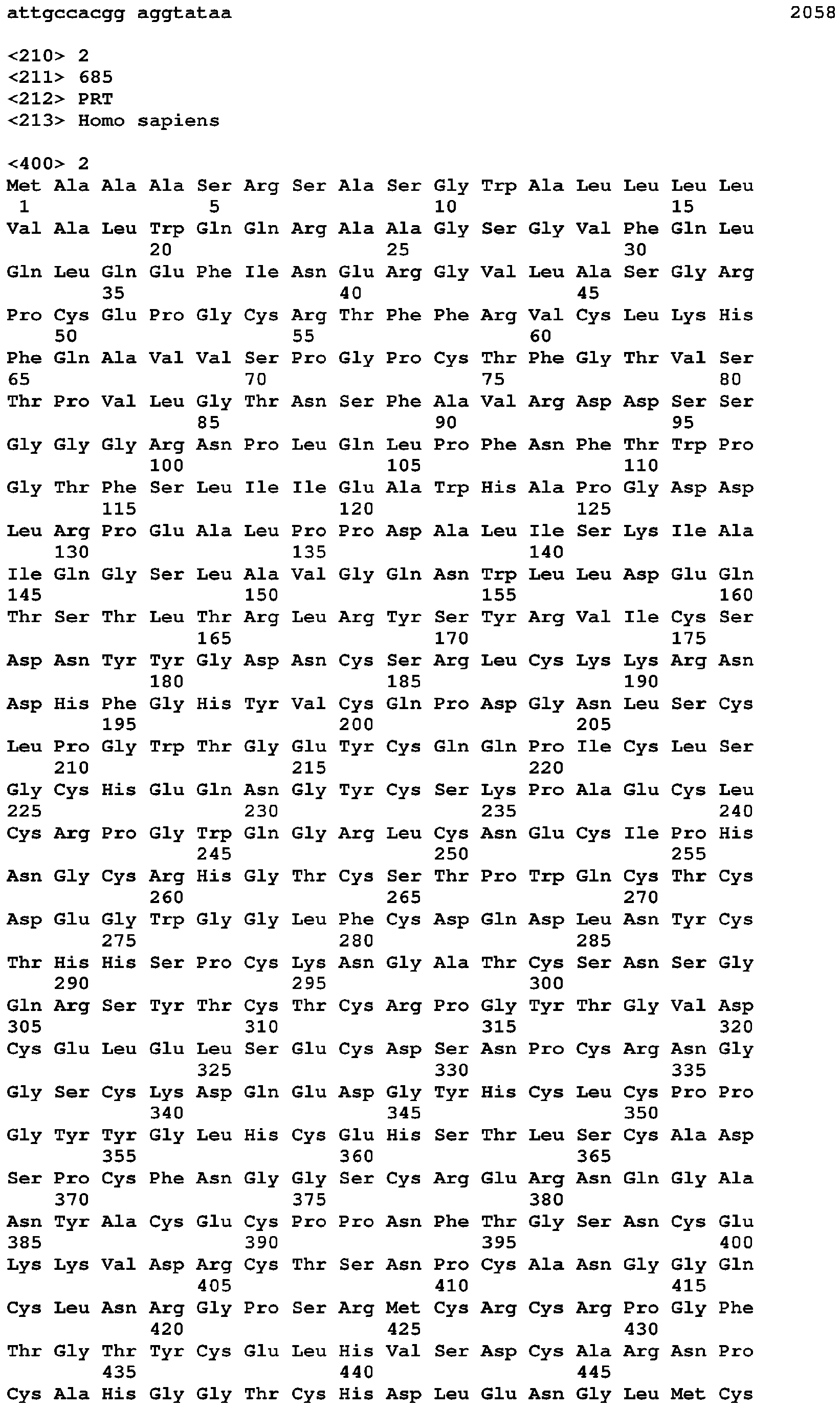


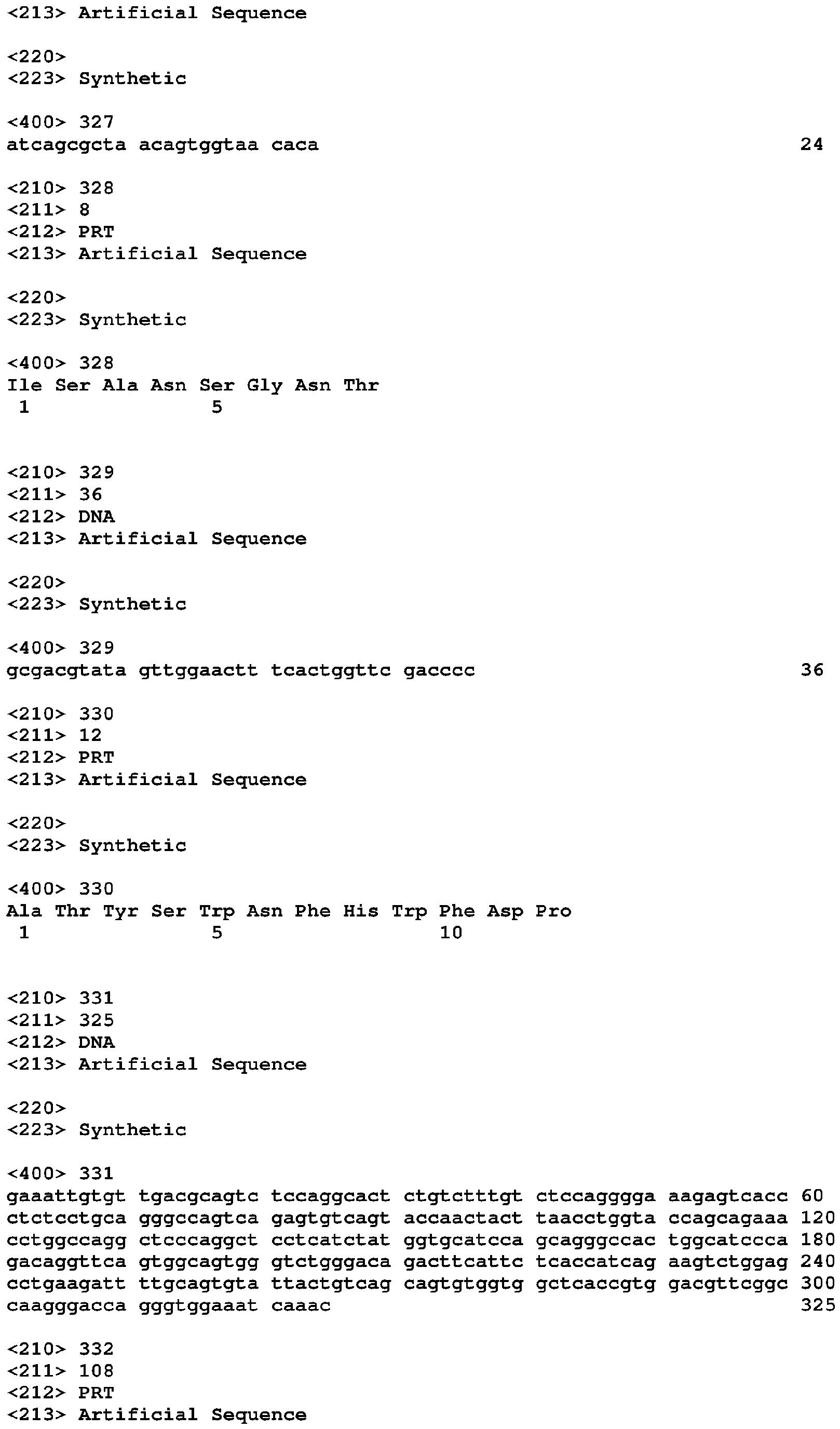

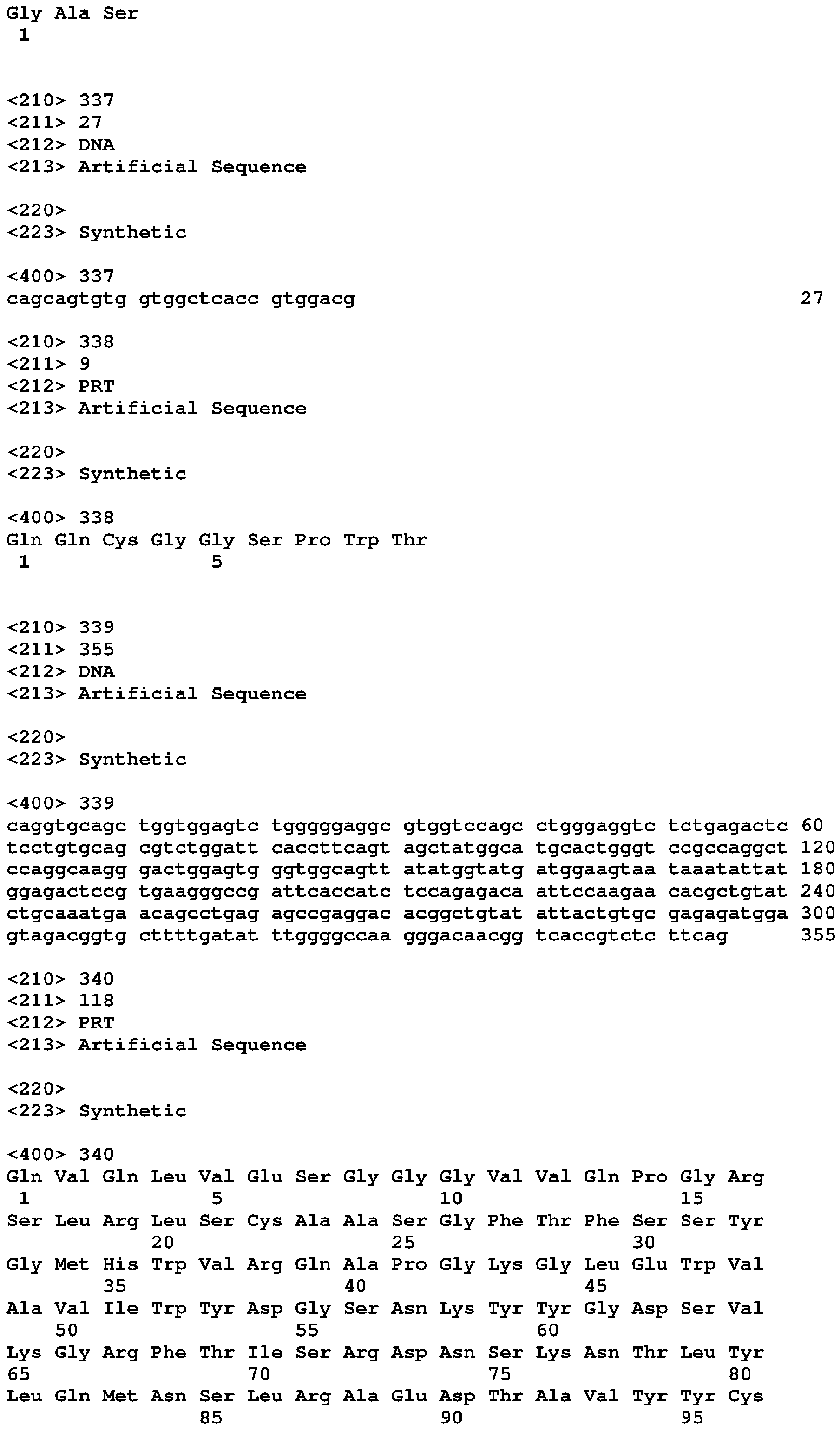

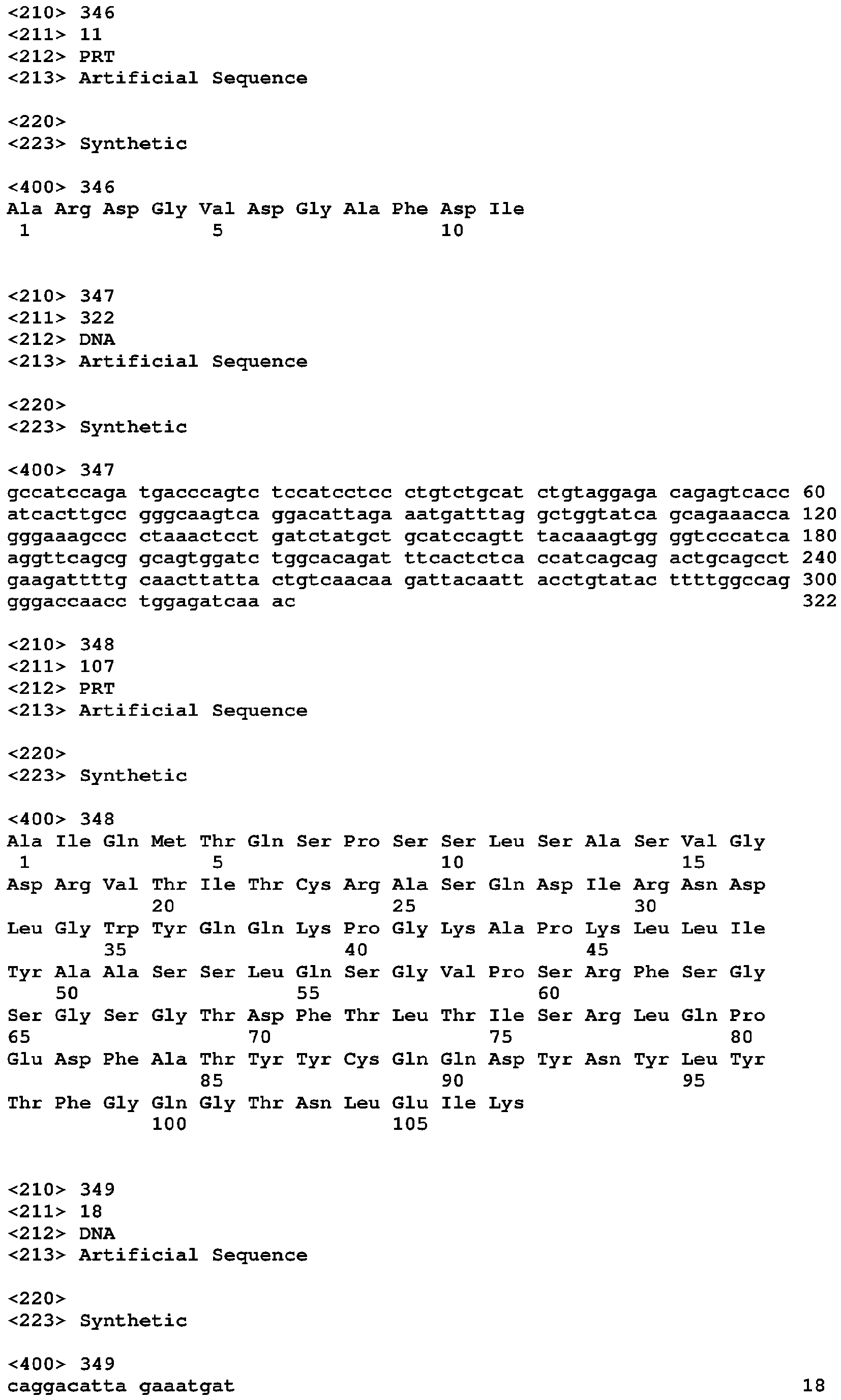

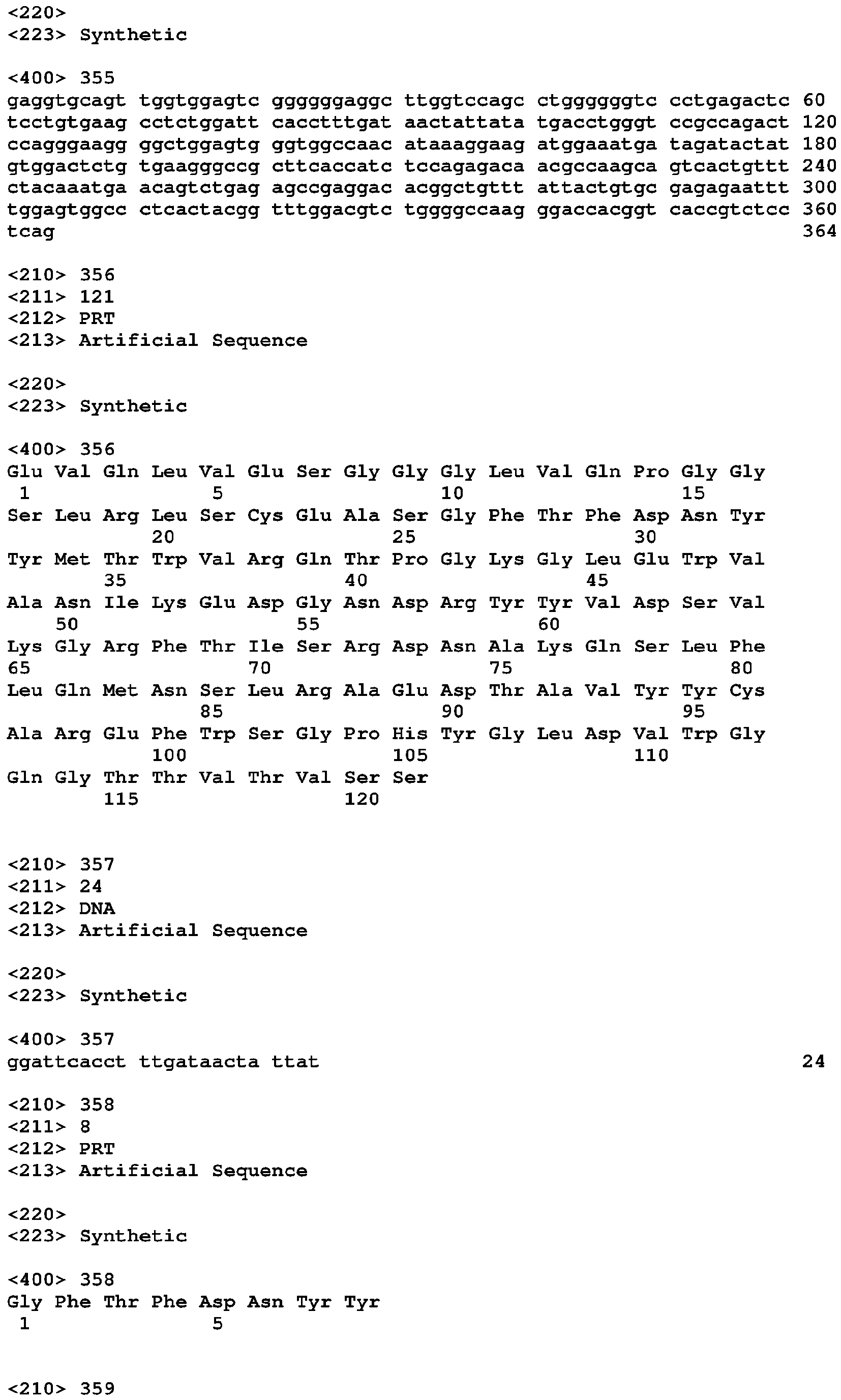


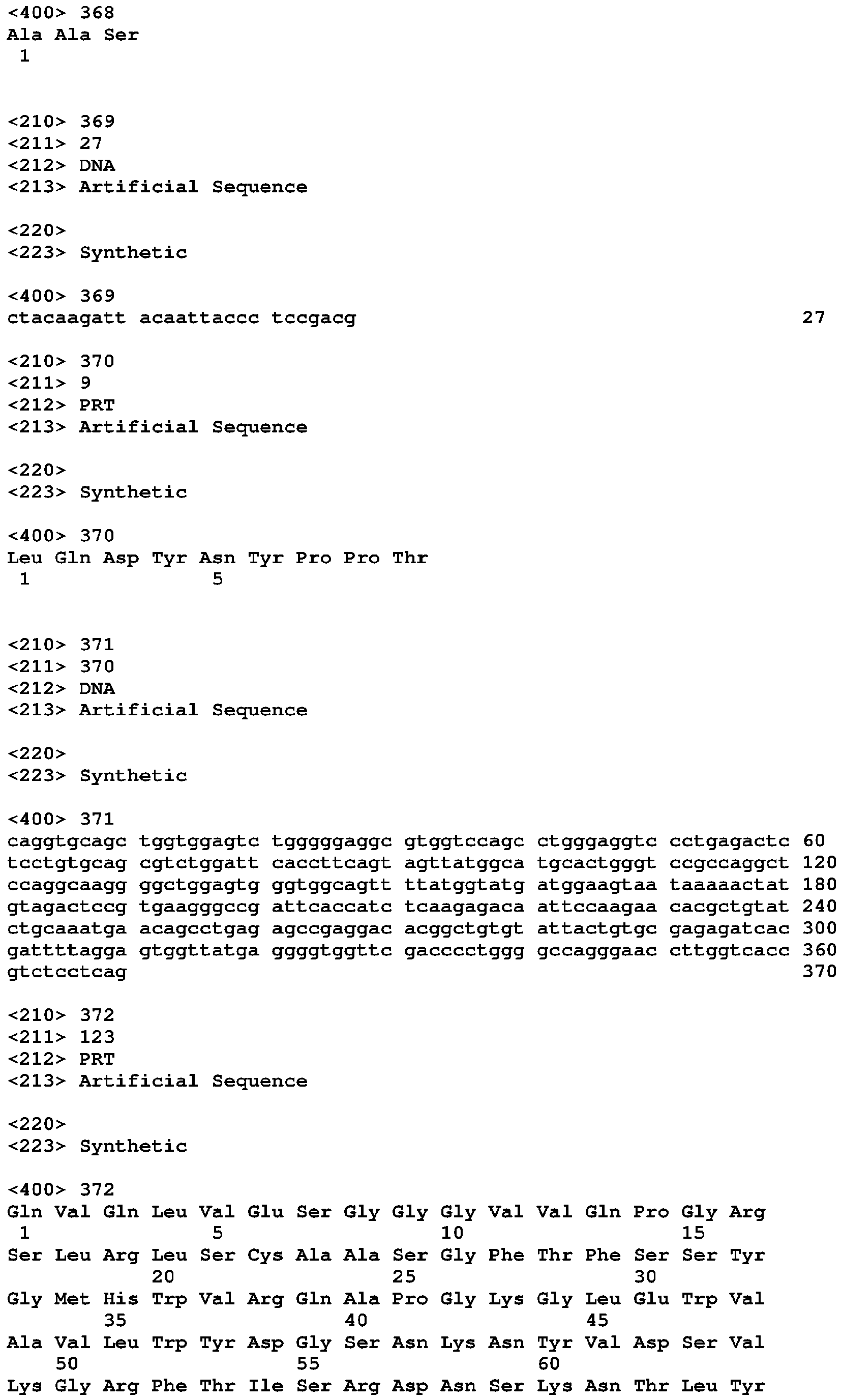


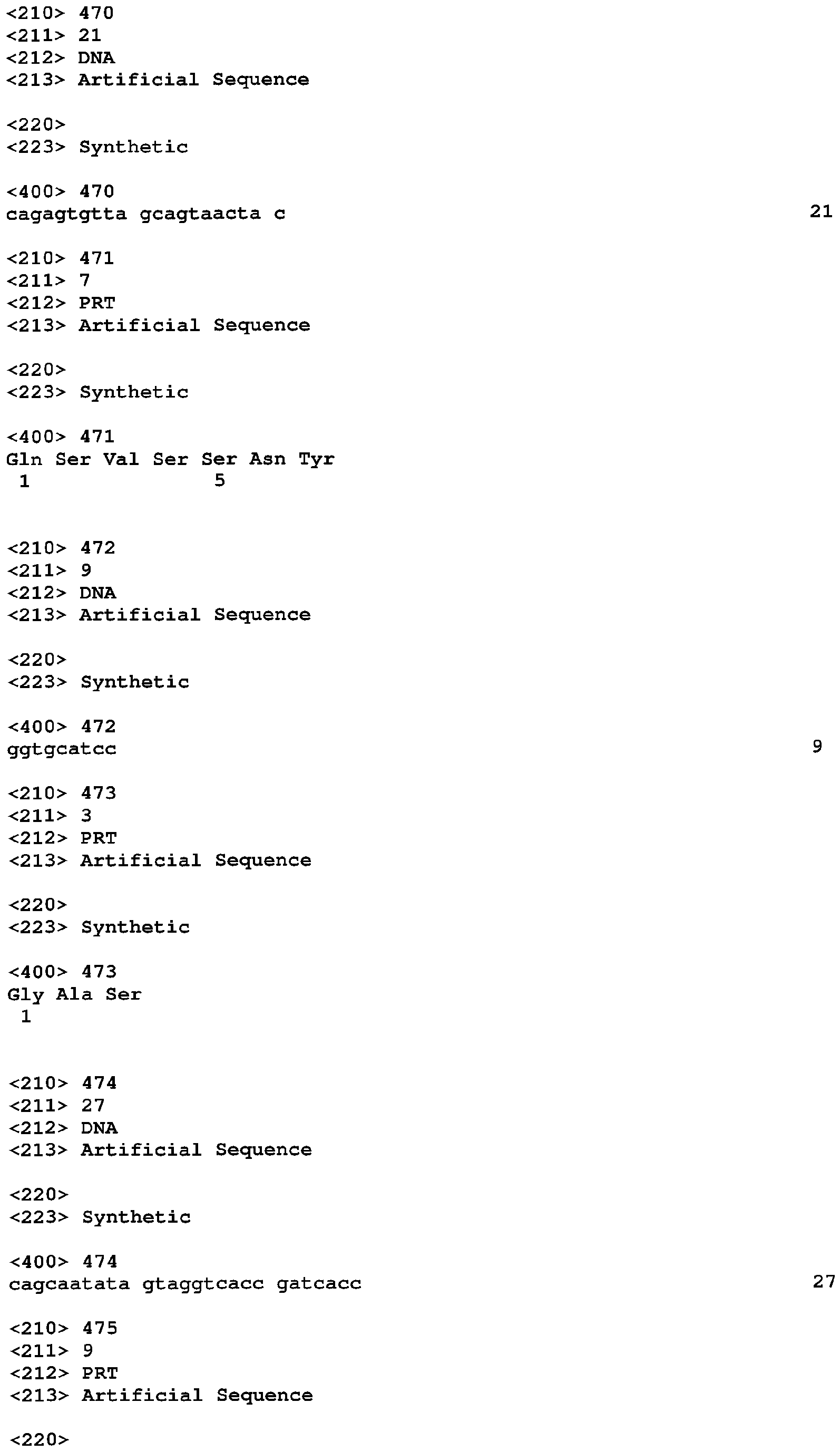


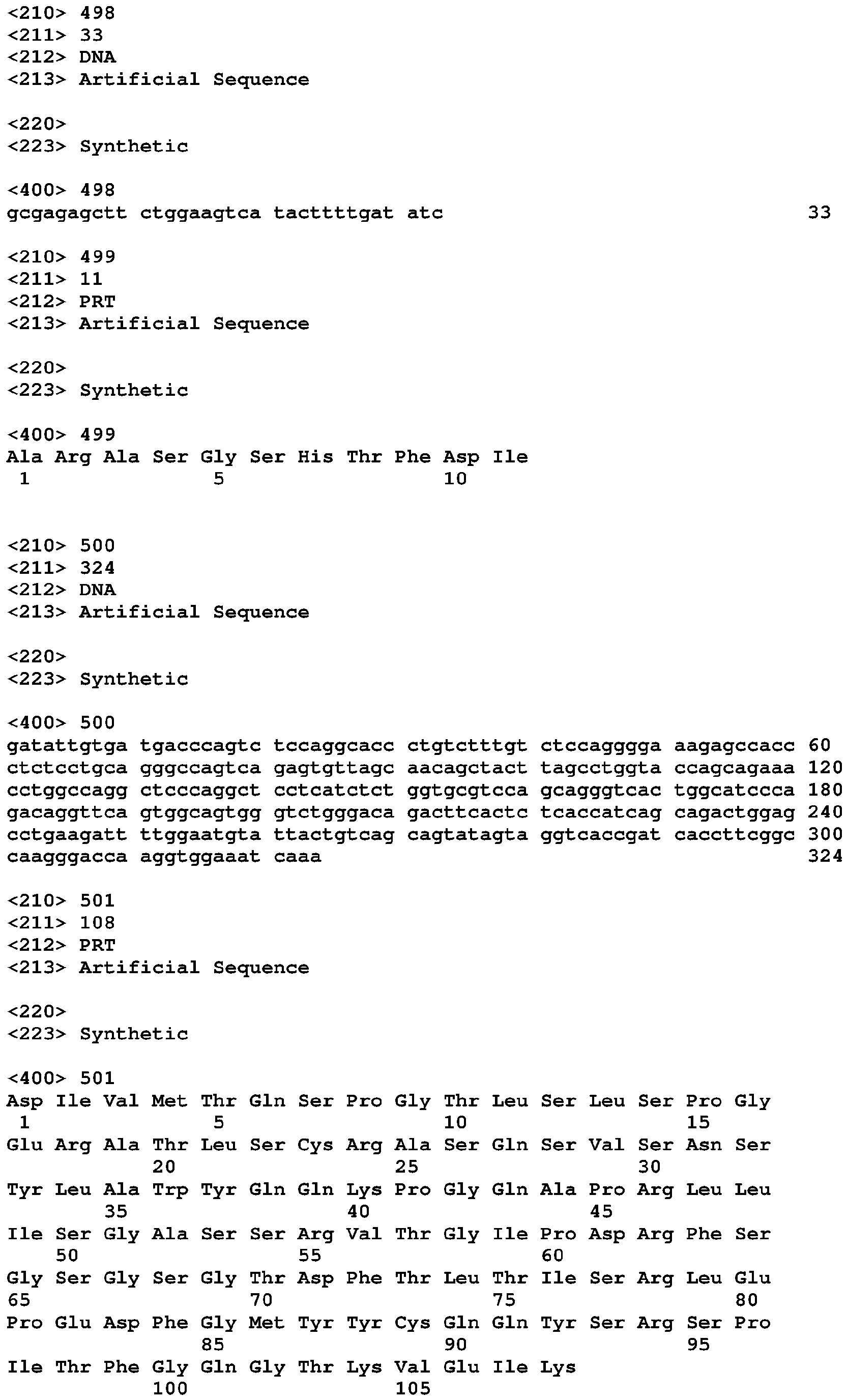


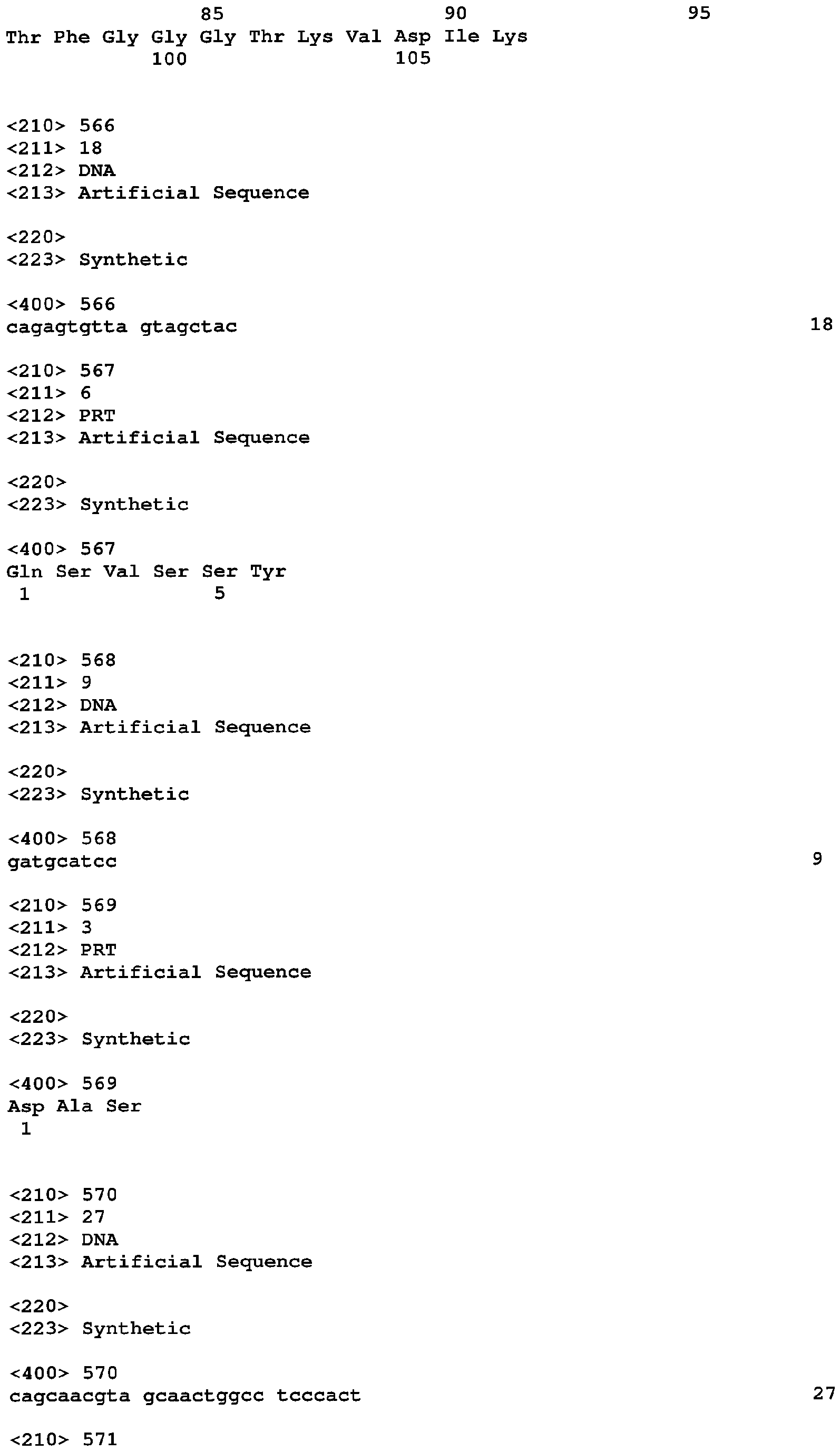


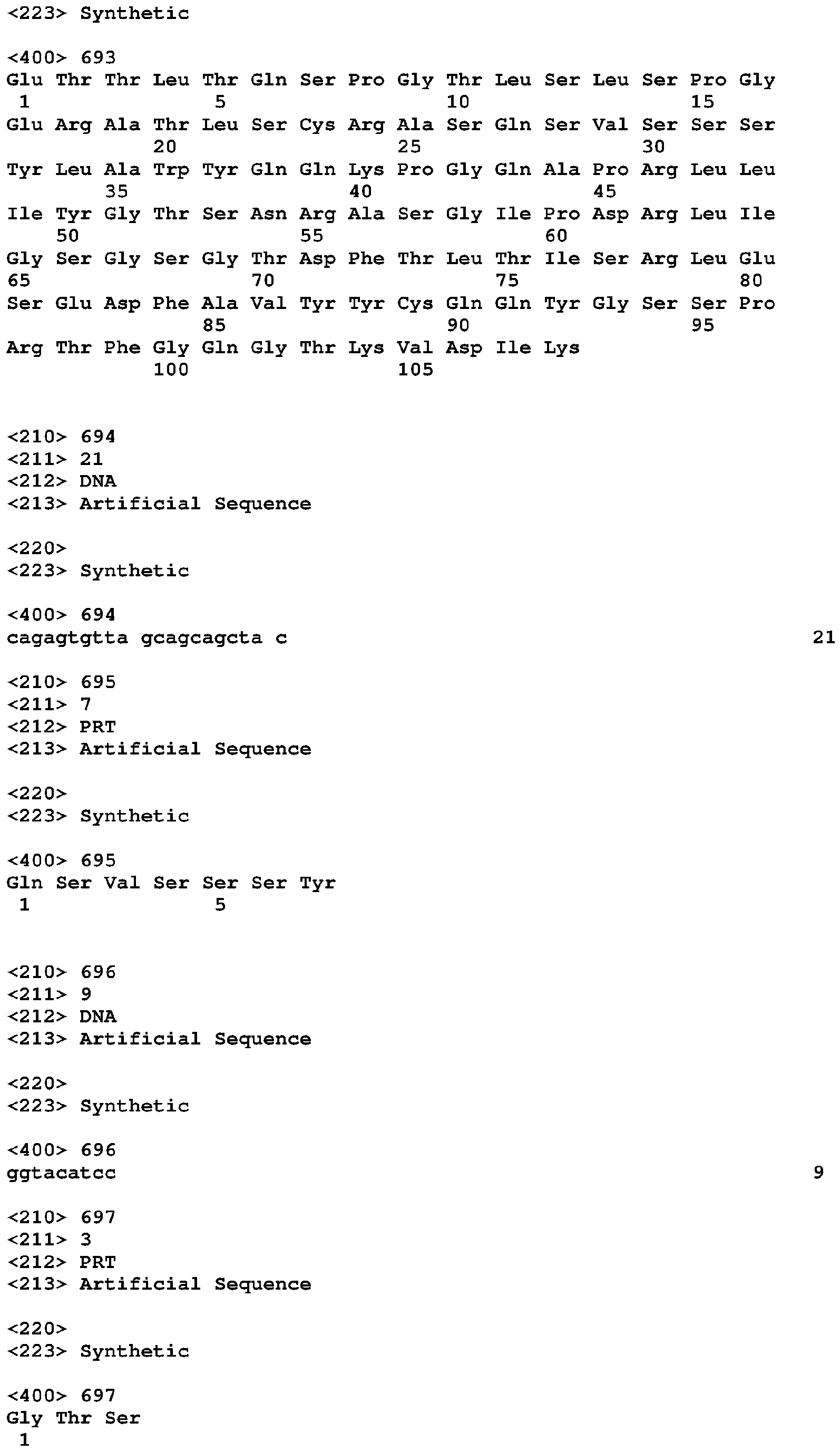


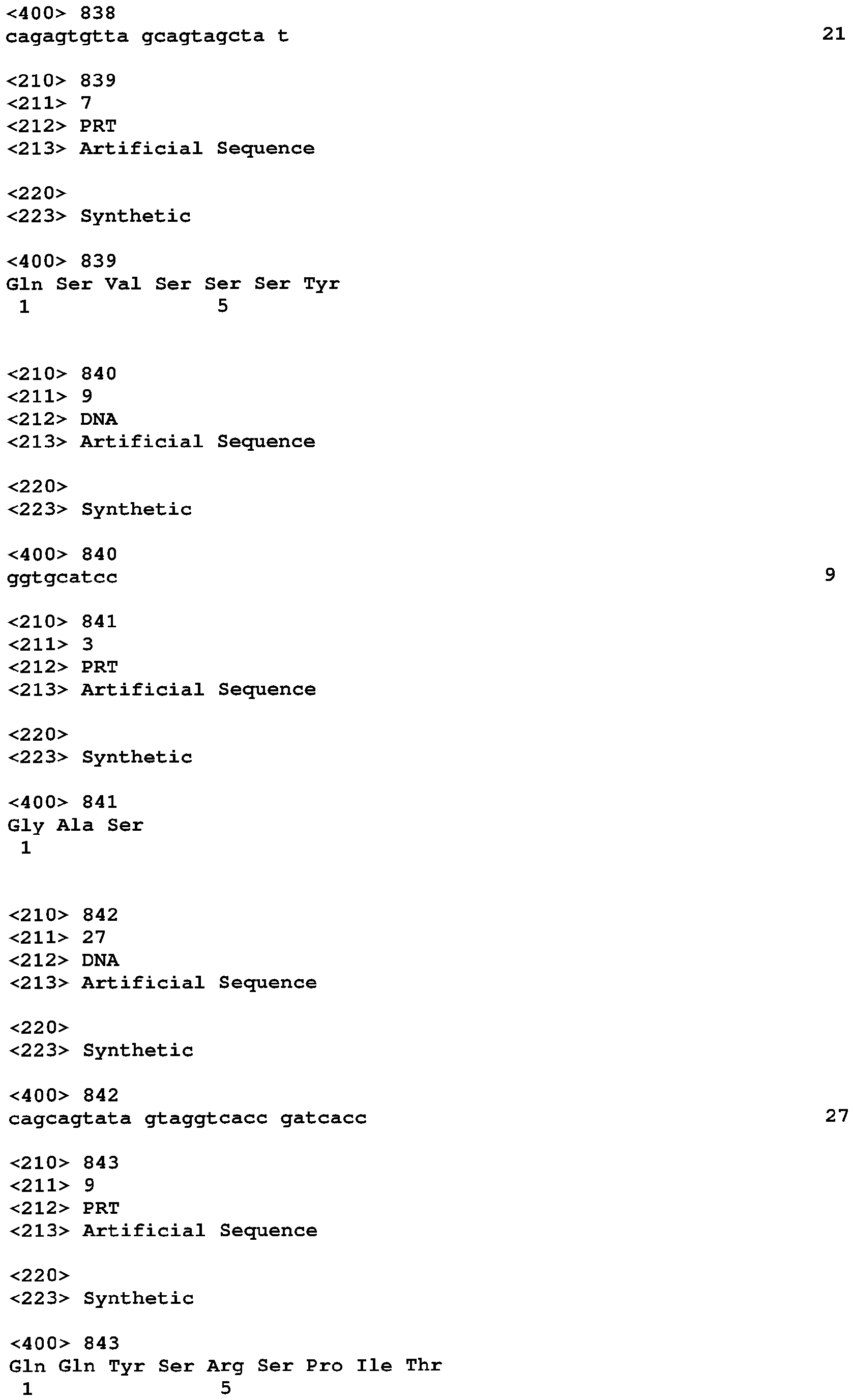


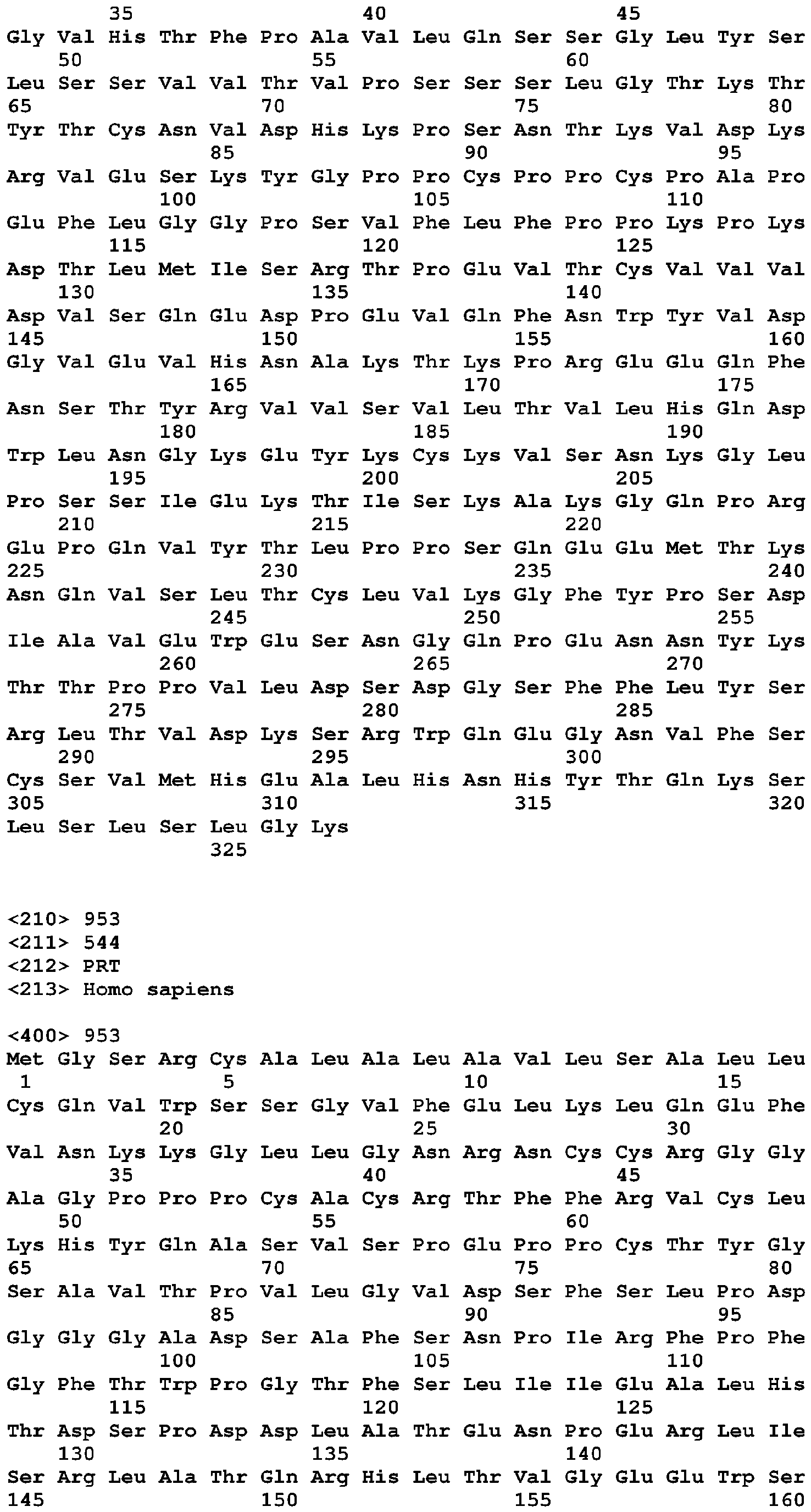


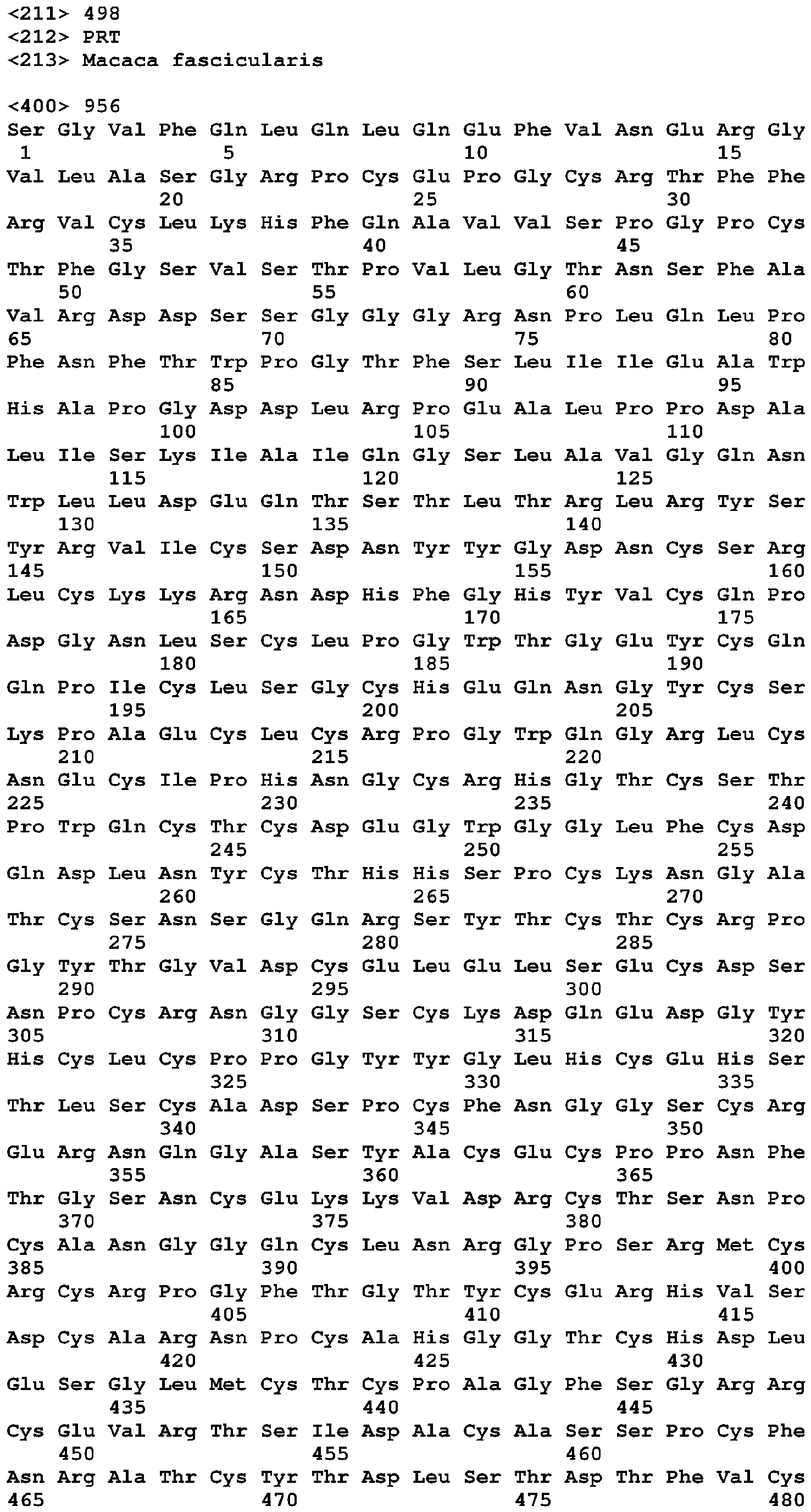


Claims (15)
- An isolated human antibody or antibody fragment which specifically binds human delta-like ligand 4 (hDll4), the antibody or antibody fragment comprising
a heavy chain variable region (HCVR) comprising a CDR1, a CDR2, and a CDR3 comprising the amino acid sequences of SEQ ID NO:431, 433, and 435, respectively, and
a light chain variable region (LCVR) comprising a CDR1, a CDR2, and a CDR3 comprising the amino acid sequences of SEQ NO:439, 441, and 443, respectively. - The antibody or antibody fragment of claim 1, wherein the HCVR comprises SEQ ID NO:429 or 901.
- The antibody or antibody fragment of claim 1, wherein the LCVR comprises SEQ ID NO:437 or 903.
- An isolated human antibody or antibody fragment which specifically binds human delta-like ligand 4 (hDll4), the antibody or antibody fragment comprising
a heavy chain variable region (HCVR) comprising a CDR1, a CDR2, and a CDR3 comprising the amino acid sequences of SEQ ID NO:399, 401, and 403, respectively, and
a light chain variable region (LCVR) comprising a CDR1, a CDR2, and a CDR3 comprising the amino acid sequences of SEQ NO:407, 409, and 411, respectively. - The antibody or antibody fragment of any one of claims 1 to 4, wherein the antibody or antibody fragment binds to an epitope within the N-terminal and DSL domains of hDII4.
- The antibody or antibody fragment of claim 1, wherein said antibody, or antibody fragment, comprises a heavy chain variable region/light chain variable region (HCVR/LCVR) comprising an amino acid sequence having at least 95% identity to either SEQ ID NO:429/437 or 901/903.
- An isolated nucleic acid molecule encoding an antibody or antigen-binding fragment according to any one of the preceding claims.
- A vector comprising the nucleic acid molecule of claim 7.
- An isolated host cell comprising a vector according to claim 8.
- The host cell according to claim 9, which is a prokaryotic or eukaryotic cell selected from one of an E. coli or a CHO cell.
- A method for producing an anti-human DII4 antibody or antigen-binding fragment thereof, comprising growing the host cell according to claim 9 or 10 under conditions permitting production of the antibody or fragment thereof and recovering the antibody or fragment so produced.
- Use of an antibody or antigen-binding fragment of an antibody according to any one of claims 1-6 in the manufacture of a medicament for treating cancer in a human.
- An antibody or antibody fragment according to any one of claims 1-3 for use in a method of treating cancer in a human patient.
- A composition comprising an antibody or antibody fragment according to any one of claims 1-6, and an acceptable carrier.
- An isolated human antibody or antibody fragment which specifically binds human delta-like ligand 4 (hDII4), said antibody or antibody fragment comprising
a HCVR selected from the group consisting of SEQ ID NO: 4, 20, 36, 52, 68, 84, 100, 116, 132, 148, 164, 180, 196, 212, 228, 244, 260, 276, 292, 308, 324, 340, 356, 372, 397, 413, 429, 445, 461, 477, 493, 509, 525, 541, 557, 573, 589, 605, 621, 637, 653, 669, 685, 701, 717, 733, 749, 765, 781, 797, 813, 893, 897, 901, 905, 909, 913, 917, 921, 925, 935, 939, 943, and 947 or a substantially identical sequence thereof, and
a LCVR selected from the group consisting of SEQ ID NO: 12, 28, 44, 60, 76, 92, 108, 124, 140, 156, 172, 188, 204, 220, 236, 252, 268, 284, 300, 316, 332, 348, 364, 380, 405, 421, 437, 453, 469, 485, 501, 517, 533, 549, 565, 581, 597, 613, 629, 645, 661, 677, 693, 709, 725, 741, 757, 773, 789, 805, 821, 895, 899, 903, 907, 911, 915, 919, 923, 927, 937, 941, 945, and 949 or a substantially identical sequence thereof.
Applications Claiming Priority (4)
| Application Number | Priority Date | Filing Date | Title |
|---|---|---|---|
| US87492206P | 2006-12-14 | 2006-12-14 | |
| US91641507P | 2007-05-07 | 2007-05-07 | |
| US98532307P | 2007-11-05 | 2007-11-05 | |
| EP07862940A EP2115003B1 (en) | 2006-12-14 | 2007-12-14 | Human antibodies to human delta like ligand 4 |
Related Parent Applications (1)
| Application Number | Title | Priority Date | Filing Date |
|---|---|---|---|
| EP07862940.9 Division | 2007-12-14 |
Publications (1)
| Publication Number | Publication Date |
|---|---|
| EP2423227A1 true EP2423227A1 (en) | 2012-02-29 |
Family
ID=39491524
Family Applications (2)
| Application Number | Title | Priority Date | Filing Date |
|---|---|---|---|
| EP11190612A Withdrawn EP2423227A1 (en) | 2006-12-14 | 2007-12-14 | Human antibodies to human delta like ligand 4 |
| EP07862940A Active EP2115003B1 (en) | 2006-12-14 | 2007-12-14 | Human antibodies to human delta like ligand 4 |
Family Applications After (1)
| Application Number | Title | Priority Date | Filing Date |
|---|---|---|---|
| EP07862940A Active EP2115003B1 (en) | 2006-12-14 | 2007-12-14 | Human antibodies to human delta like ligand 4 |
Country Status (32)
| Country | Link |
|---|---|
| US (9) | US7919593B2 (en) |
| EP (2) | EP2423227A1 (en) |
| JP (2) | JP5677744B2 (en) |
| KR (1) | KR101516569B1 (en) |
| CN (1) | CN101611055B (en) |
| AU (1) | AU2007334366B2 (en) |
| CA (1) | CA2672622C (en) |
| CR (1) | CR10863A (en) |
| CY (1) | CY1113087T1 (en) |
| DK (1) | DK2115003T3 (en) |
| DO (1) | DOP2009000140A (en) |
| EC (1) | ECSP099404A (en) |
| ES (1) | ES2386480T3 (en) |
| GT (1) | GT200900167A (en) |
| HR (1) | HRP20120536T1 (en) |
| IL (1) | IL198612A (en) |
| MA (1) | MA31092B1 (en) |
| ME (1) | ME00812B (en) |
| MX (2) | MX358410B (en) |
| MY (1) | MY164461A (en) |
| NI (1) | NI200900115A (en) |
| NO (1) | NO347649B1 (en) |
| NZ (1) | NZ577616A (en) |
| PL (1) | PL2115003T3 (en) |
| PT (1) | PT2115003E (en) |
| RS (1) | RS52439B (en) |
| RU (1) | RU2448979C2 (en) |
| SG (2) | SG177189A1 (en) |
| SI (1) | SI2115003T1 (en) |
| SV (1) | SV2009003296A (en) |
| TN (1) | TN2009000245A1 (en) |
| WO (1) | WO2008076379A2 (en) |
Families Citing this family (160)
| Publication number | Priority date | Publication date | Assignee | Title |
|---|---|---|---|---|
| US6984522B2 (en) | 2000-08-03 | 2006-01-10 | Regents Of The University Of Michigan | Isolation and use of solid tumor stem cells |
| US20050144655A1 (en) | 2000-10-31 | 2005-06-30 | Economides Aris N. | Methods of modifying eukaryotic cells |
| US6596541B2 (en) | 2000-10-31 | 2003-07-22 | Regeneron Pharmaceuticals, Inc. | Methods of modifying eukaryotic cells |
| EP2314629B2 (en) | 2002-07-18 | 2022-11-16 | Merus N.V. | Recombinant production of mixtures of antibodies |
| USRE47770E1 (en) | 2002-07-18 | 2019-12-17 | Merus N.V. | Recombinant production of mixtures of antibodies |
| US20100069614A1 (en) | 2008-06-27 | 2010-03-18 | Merus B.V. | Antibody producing non-human mammals |
| WO2004106375A1 (en) | 2003-05-30 | 2004-12-09 | Merus Biopharmaceuticals B.V. I.O. | Fab library for the preparation of anti vegf and anti rabies virus fabs |
| US7906116B2 (en) * | 2005-09-01 | 2011-03-15 | Parkash Gill | Methods for using and identifying modulators of Delta-like 4 |
| HUE028379T2 (en) * | 2006-09-29 | 2016-12-28 | Oncomed Pharm Inc | Compositions and methods for diagnosing and treating cancer |
| RU2448979C2 (en) * | 2006-12-14 | 2012-04-27 | Ридженерон Фармасьютикалз, Инк. | Human antibodies to delta-like human ligand-4 |
| WO2008092002A2 (en) | 2007-01-24 | 2008-07-31 | The Regents Of The University Of Michigan | Compositions and methods for treating and diagnosing pancreatic cancer |
| GB0709333D0 (en) * | 2007-05-15 | 2007-06-20 | Smart Targeting Ltd | Binding protein |
| US20110091447A1 (en) * | 2008-03-13 | 2011-04-21 | The Hospital For Sick Children | Lymphocyte control of obesity and insulin resistance |
| RU2731084C2 (en) | 2008-06-27 | 2020-08-28 | Мерюс Н.В. | Producing non-human mammalian antibodies |
| CA2729602A1 (en) | 2008-07-08 | 2010-01-14 | Oncomed Pharmaceuticals, Inc. | Notch1 receptor binding agents and methods of use thereof |
| PT3009449T (en) | 2008-07-16 | 2018-09-28 | Inst Res Biomedicine | Human cytomegalovirus neutralizing antibodies and use thereof |
| US8871207B2 (en) | 2008-07-25 | 2014-10-28 | Humabs, LLC | Neutralizing anti-influenza A virus antibodies and uses thereof |
| CA2733218A1 (en) | 2008-07-25 | 2010-01-28 | Institute For Research In Biomedicine | Neutralizing anti-influenza a virus antibodies and uses thereof |
| TW201019959A (en) * | 2008-08-19 | 2010-06-01 | Regeneron Pharma | Human antibodies to human RANKL |
| CN102264763B (en) | 2008-09-19 | 2016-04-27 | 米迪缪尼有限公司 | Antibodies directed to DLL4 and uses thereof |
| WO2010054007A1 (en) * | 2008-11-07 | 2010-05-14 | Fabrus Llc | Combinatorial antibody libraries and uses thereof |
| AU2010245011B2 (en) | 2009-04-27 | 2015-09-03 | Oncomed Pharmaceuticals, Inc. | Method for making heteromultimeric molecules |
| TWI513465B (en) * | 2009-06-25 | 2015-12-21 | Regeneron Pharma | Method of treating cancer with dll4 antagonist and chemotherapeutic agent |
| CN102638971B (en) | 2009-07-08 | 2015-10-07 | 科马布有限公司 | Animal Models and Therapeutic Molecules |
| US9445581B2 (en) | 2012-03-28 | 2016-09-20 | Kymab Limited | Animal models and therapeutic molecules |
| JO3182B1 (en) | 2009-07-29 | 2018-03-08 | Regeneron Pharma | Human antibiotics with high pH generation - 2 |
| US8623358B2 (en) * | 2009-08-29 | 2014-01-07 | Abbvie Inc. | Therapeutic DLL4 binding proteins |
| US20110195494A1 (en) | 2009-10-02 | 2011-08-11 | Boehringer Ingelheim International Gmbh | Dll4-binging molecules |
| UY32920A (en) | 2009-10-02 | 2011-04-29 | Boehringer Ingelheim Int | BISPECIFIC UNION MOLECULES FOR ANTI-ANGIOGENESIS THERAPY |
| US8883145B2 (en) | 2009-10-16 | 2014-11-11 | Oncomed Pharmaceuticals, Inc. | Methods of treatment with DLL4 antagonists and an anti-hypertensive agent |
| CA2782299A1 (en) * | 2009-12-01 | 2011-06-09 | Oncomed Pharmaceuticals, Inc. | Methods for treating cancers comprising k-ras mutations |
| JO3274B1 (en) | 2009-12-24 | 2018-09-16 | Regeneron Pharma | Human Antibodies To Human Angiopoietin-Like Protein 4 |
| TWI535445B (en) | 2010-01-12 | 2016-06-01 | 安可美德藥物股份有限公司 | Wnt antagonists and methods of treatment and screening |
| WO2011088215A2 (en) | 2010-01-13 | 2011-07-21 | Oncomed Pharmaceuticals, Inc. | Notch1 binding agents and methods of use thereof |
| JO3183B1 (en) | 2010-01-29 | 2018-03-08 | Regeneron Pharma | Methods for treating autoimmune diseases anti-DLL4 |
| HRP20151188T4 (en) | 2010-02-08 | 2021-10-01 | Regeneron Pharmaceuticals, Inc. | Common light chain mouse |
| US20130045492A1 (en) | 2010-02-08 | 2013-02-21 | Regeneron Pharmaceuticals, Inc. | Methods For Making Fully Human Bispecific Antibodies Using A Common Light Chain |
| US9796788B2 (en) | 2010-02-08 | 2017-10-24 | Regeneron Pharmaceuticals, Inc. | Mice expressing a limited immunoglobulin light chain repertoire |
| EP2542582A4 (en) | 2010-03-02 | 2013-12-04 | Abbvie Inc | Therapeutic dll4 binding proteins |
| EP2547365A1 (en) * | 2010-03-17 | 2013-01-23 | Abbott Research B.V. | Anti-nerve growth factor (ngf) antibody compositions |
| KR101849738B1 (en) * | 2010-06-17 | 2018-04-17 | 트렐리스 바이오싸이언스 인코포레이티드 | Antibodies useful in passive influenza immunization |
| KR102306967B1 (en) | 2010-08-02 | 2021-10-01 | 리제너론 파아마슈티컬스, 인크. | Mice that make binding proteins comprising vl domains |
| US8551479B2 (en) | 2010-09-10 | 2013-10-08 | Oncomed Pharmaceuticals, Inc. | Methods for treating melanoma |
| CN104725507B (en) * | 2010-10-19 | 2018-12-21 | 梅奥医学教育和研究基金会 | For treating the human antibody and its diagnosing and treating purposes of neurological disease |
| WO2012092539A2 (en) * | 2010-12-31 | 2012-07-05 | Takeda Pharmaceutical Company Limited | Antibodies to dll4 and uses thereof |
| US9527925B2 (en) | 2011-04-01 | 2016-12-27 | Boehringer Ingelheim International Gmbh | Bispecific binding molecules binding to VEGF and ANG2 |
| US20130078247A1 (en) | 2011-04-01 | 2013-03-28 | Boehringer Ingelheim International Gmbh | Bispecific binding molecules binding to dii4 and ang2 |
| JO3283B1 (en) | 2011-04-26 | 2018-09-16 | Sanofi Sa | Composition including Afflipersept, Folinic Acid, 5- Fluorouracil (5- Fu) and Irenosetan (FOLFIRI) |
| PH12013502489B1 (en) | 2011-06-03 | 2019-04-24 | Xoma Technology Ltd | Antibodies specific for tgf-beta |
| JO3412B1 (en) | 2011-06-17 | 2019-10-20 | Regeneron Pharma | Anti-angptl3 antibodies and uses thereof |
| EP3418300B1 (en) | 2011-07-18 | 2020-10-28 | Institute for Research in Biomedicine | Neutralizing anti-influenza a virus antibodies and uses thereof |
| PT3865581T (en) | 2011-08-05 | 2024-10-04 | Regeneron Pharma | Humanized universal light chain mice |
| ES2694411T3 (en) | 2011-08-19 | 2018-12-20 | Regeneron Pharmaceuticals, Inc. | Antibodies anti-Tie2 and uses thereof |
| AU2012311286B2 (en) | 2011-09-19 | 2018-07-26 | Kymab Limited | Antibodies, variable domains and chains tailored for human use |
| SI3485903T1 (en) | 2011-09-23 | 2023-02-28 | Mereo Biopharma 5, Inc. | Vegf/dll4 binding agents and uses thereof |
| WO2013045916A1 (en) | 2011-09-26 | 2013-04-04 | Kymab Limited | Chimaeric surrogate light chains (slc) comprising human vpreb |
| CA2791109C (en) | 2011-09-26 | 2021-02-16 | Merus B.V. | Generation of binding molecules |
| PH12014500483A1 (en) | 2011-09-30 | 2014-04-14 | Regeneron Pharma | Anti-erbb3 antibodies and uses thereof |
| RS63220B1 (en) | 2011-10-28 | 2022-06-30 | Regeneron Pharma | GENETICALLY MODIFIED MICE EXPRESSING CHIMERIC CLASS II MOLECULES OF THE MAJOR HISTOCOMPATIBILITY COMPLEX (MHC) |
| JP6325451B2 (en) * | 2011-12-02 | 2018-05-16 | アイム・セラピューティクス・べー・フェー | Antibodies specific for influenza A |
| GB201122047D0 (en) * | 2011-12-21 | 2012-02-01 | Kymab Ltd | Transgenic animals |
| US9253965B2 (en) | 2012-03-28 | 2016-02-09 | Kymab Limited | Animal models and therapeutic molecules |
| PT3527070T (en) | 2011-12-20 | 2025-12-19 | Regeneron Pharma | Humanized light chain mice |
| AU2013215254B2 (en) | 2012-01-31 | 2017-08-31 | Regeneron Pharmaceuticals, Inc. | Anti-ASIC1 antibodies and uses thereof |
| TWI613215B (en) | 2012-02-22 | 2018-02-01 | 再生元醫藥公司 | Anti-big-endothelin-1 (big-et-1) antibodies and uses thereof |
| KR102213535B1 (en) | 2012-03-16 | 2021-02-08 | 리제너론 파마슈티칼스 인코포레이티드 | Non-human animals expressing ph-sensitive immunoglobulin sequences |
| DK2825036T3 (en) | 2012-03-16 | 2018-07-16 | Regeneron Pharma | Histidine engineered light chain antibodies and genetically modified rodents to generate them |
| HK1200271A1 (en) | 2012-03-16 | 2015-08-07 | 瑞泽恩制药公司 | Mice that produce antigen-binding proteins with ph-dependent binding characteristics |
| US20140013456A1 (en) | 2012-03-16 | 2014-01-09 | Regeneron Pharmaceuticals, Inc. | Histidine Engineered Light Chain Antibodies and Genetically Modified Non-Human Animals for Generating the Same |
| GB2502127A (en) | 2012-05-17 | 2013-11-20 | Kymab Ltd | Multivalent antibodies and in vivo methods for their production |
| US10251377B2 (en) | 2012-03-28 | 2019-04-09 | Kymab Limited | Transgenic non-human vertebrate for the expression of class-switched, fully human, antibodies |
| DK2838918T3 (en) | 2012-04-20 | 2019-08-12 | Merus Nv | METHODS AND METHODS FOR PREPARING HETERODIMER IG-LIKE MOLECULES |
| JO3820B1 (en) | 2012-05-03 | 2021-01-31 | Regeneron Pharma | Human antibodies to FEL D1 and methods for their use |
| WO2014062245A2 (en) | 2012-05-31 | 2014-04-24 | Sorrento Therapeutics Inc. | Antigen binding proteins that bind dll-4 |
| AR092325A1 (en) | 2012-05-31 | 2015-04-15 | Regeneron Pharma | STABILIZED FORMULATIONS CONTAINING ANTI-DLL4 ANTIBODIES AND KIT |
| TWI641619B (en) | 2012-06-25 | 2018-11-21 | 美商再生元醫藥公司 | anti-EGFR antibody and use thereof |
| KR101535341B1 (en) | 2012-07-02 | 2015-07-13 | 한화케미칼 주식회사 | Novel monoclonal antibody that specifically binds to DLL4 and use thereof |
| JOP20200236A1 (en) | 2012-09-21 | 2017-06-16 | Regeneron Pharma | Anti-cd3 antibodies, bispecific antigen-binding molecules that bind cd3 and cd20, and uses thereof |
| BR112015006363A2 (en) | 2012-09-28 | 2017-08-08 | Boehringer Ingelheim Int | pharmaceutical combinations comprising dual angiopoietin-2 / dll4 binders and anti-vegf-r agents |
| US9599620B2 (en) | 2012-10-31 | 2017-03-21 | Oncomed Pharmaceuticals, Inc. | Methods and monitoring of treatment with a DLL4 antagonist |
| CN104781280A (en) | 2012-11-13 | 2015-07-15 | 瑞泽恩制药公司 | Conjugates including antibody moiety, a polypeptide transferring blood-brain barrier, and cytotoxin |
| AR093445A1 (en) | 2012-11-14 | 2015-06-10 | Regeneron Pharma | METHODS TO TREAT OVARY CANCER WITH DLL4 ANTAGONISTS |
| JO3405B1 (en) | 2013-01-09 | 2019-10-20 | Regeneron Pharma | ANTI-PDGFR-beta ANTIBODIES AND USES THEREOF |
| CA2900824A1 (en) | 2013-02-22 | 2014-08-28 | Regeneron Pharmaceuticals, Inc. | Mice expressing humanized major histocompatibility complex |
| US9788534B2 (en) | 2013-03-18 | 2017-10-17 | Kymab Limited | Animal models and therapeutic molecules |
| US9783618B2 (en) | 2013-05-01 | 2017-10-10 | Kymab Limited | Manipulation of immunoglobulin gene diversity and multi-antibody therapeutics |
| US11707056B2 (en) | 2013-05-02 | 2023-07-25 | Kymab Limited | Animals, repertoires and methods |
| US9783593B2 (en) | 2013-05-02 | 2017-10-10 | Kymab Limited | Antibodies, variable domains and chains tailored for human use |
| CN105518028B (en) * | 2013-07-09 | 2019-08-13 | Abl生物公司 | Novel dual-targeting protein specifically binding to DLL4 and VEGF and use thereof |
| US10208125B2 (en) * | 2013-07-15 | 2019-02-19 | University of Pittsburgh—of the Commonwealth System of Higher Education | Anti-mucin 1 binding agents and uses thereof |
| US10935554B2 (en) | 2013-08-23 | 2021-03-02 | Regeneron Pharmaceuticals, Inc. | Diagnostic tests and methods for assessing safety, efficacy or outcome of allergen-specific immunotherapy (SIT) |
| CA2925723A1 (en) | 2013-10-01 | 2015-04-09 | Kymab Limited | Animal models and therapeutic molecules |
| PT3052192T (en) | 2013-10-02 | 2020-09-24 | Medimmune Llc | Neutralizing anti-influenza a antibodies and uses thereof |
| MX377714B (en) | 2013-10-18 | 2025-03-11 | Regeneron Pharma | COMPOSITIONS COMPRISING A COMBINATION OF A VEGF ANTAGONIST AND AN ANTI-CTLA-A ANTIBODY. |
| CN103804497A (en) * | 2014-03-06 | 2014-05-21 | 中国药科大学 | Anti-human Delta like4 monoclonal antibody |
| MY178160A (en) | 2014-03-11 | 2020-10-06 | Regeneron Pharma | Anti-egfrviii antibodies and uses thereof |
| TWI754319B (en) | 2014-03-19 | 2022-02-01 | 美商再生元醫藥公司 | Methods and antibody compositions for tumor treatment |
| CN106164092A (en) | 2014-03-21 | 2016-11-23 | 瑞泽恩制药公司 | VL antigen-binding proteins exhibiting different binding characteristics |
| CN106255410B (en) | 2014-03-21 | 2020-01-10 | 瑞泽恩制药公司 | Non-human animals producing single domain binding proteins |
| CA2954780A1 (en) | 2014-07-15 | 2016-01-21 | Medimmune, Llc | Neutralizing anti-influenza b antibodies and uses thereof |
| WO2016008975A1 (en) | 2014-07-18 | 2016-01-21 | Sanofi | Method for predicting the outcome of a treatment with aflibercept of a patient suspected to suffer from a cancer |
| US20160176962A1 (en) | 2014-10-31 | 2016-06-23 | Oncomed Pharmaceuticals, Inc. | Combination Therapy For Treatment Of Disease |
| ES2809455T3 (en) | 2014-11-17 | 2021-03-04 | Regeneron Pharma | Methods for tumor treatment using CD3xCD20 bispecific antibody |
| RU2720688C2 (en) | 2015-01-28 | 2020-05-12 | ПИЕРИС ФАРМАСЬЮТИКАЛС ГмбХ | Novel proteins specific for angiogenesis |
| US11111314B2 (en) | 2015-03-19 | 2021-09-07 | Regeneron Pharmaceuticals, Inc. | Non-human animals that select for light chain variable regions that bind antigen |
| KR20240142591A (en) | 2015-03-27 | 2024-09-30 | 리제너론 파아마슈티컬스, 인크. | Maytansinoid derivatives, conjugates thereof, and methods of use |
| RU2732628C2 (en) | 2015-04-06 | 2020-09-21 | Регенерон Фармасьютикалз, Инк. | Humanized t-cell mediated immune responses in non-human animals |
| EA035412B1 (en) | 2015-05-29 | 2020-06-10 | Бристол-Майерс Сквибб Компани | ANTIBODIES TO OX40 AND THEIR APPLICATION |
| EP3960761A1 (en) | 2015-06-01 | 2022-03-02 | MedImmune, LLC | Neutralizing anti-influenza binding molecules and uses thereof |
| EP3328994A4 (en) * | 2015-07-31 | 2019-04-17 | Memorial Sloan-Kettering Cancer Center | CD56 TARGETING ANTIGEN BINDING PROTEINS AND USES THEREOF |
| JOP20160154B1 (en) | 2015-07-31 | 2021-08-17 | Regeneron Pharma | Anti-psma antibodies, bispecific antigen-binding molecules that bind psma and cd3, and uses thereof |
| KR102777500B1 (en) | 2015-09-23 | 2025-03-11 | 리제너론 파아마슈티컬스, 인크. | Optimized anti-CD3 bispecific antibodies and uses thereof |
| ES2968074T3 (en) | 2015-09-23 | 2024-05-07 | Mereo Biopharma 5 Inc | Bi-specific anti-VEGF/DLL4 antibody for use in the treatment of platinum-resistant ovarian cancer |
| CN108602890A (en) | 2015-12-11 | 2018-09-28 | 瑞泽恩制药公司 | Method for reducing or preventing the tumour growth resistant to EGFR and/or ERBB3 retarding agents |
| IL304940A (en) | 2016-01-13 | 2023-10-01 | Medimmune Llc | Method of treating influenza a |
| MY198605A (en) | 2016-01-25 | 2023-09-08 | Regeneron Pharma | Maytansinoid derivatives conjugates thereof, and methods of use |
| WO2017205651A1 (en) * | 2016-05-25 | 2017-11-30 | The Trustees Of Columbia University In The City Of New York | Human notch1 based fusion proteins as decoy inhibitors of jagged-notch signaling and dll-notch signaling |
| IL263273B2 (en) | 2016-06-10 | 2025-10-01 | Regeneron Pharma | Anti-gitr antibodies and uses thereof |
| US10738130B2 (en) | 2016-09-23 | 2020-08-11 | Regeneron Pharmaceuticals, Inc. | Bispecific antigen-binding molecules that bind MUC16 and CD3, and compositions thereof |
| MA46417A (en) | 2016-09-23 | 2019-07-31 | Regeneron Pharma | ANTI-STEAP2 ANTIBODIES, ANTIBODY-DRUG CONJUGATES, AND BISPECIFIC ANTIGEN-BINDING MOLECULES THAT BIND TO STEAP2 AND CD3, AND THEIR USES |
| TWI782930B (en) | 2016-11-16 | 2022-11-11 | 美商再生元醫藥公司 | Anti-met antibodies, bispecific antigen binding molecules that bind met, and methods of use thereof |
| EP3548514A1 (en) | 2016-11-29 | 2019-10-09 | Regeneron Pharmaceuticals, Inc. | Methods of treating prlr positive breast cancer |
| US11352417B2 (en) | 2016-12-22 | 2022-06-07 | Regeneron Pharmaceuticals, Inc. | Method of treating an allergy with allergen-specific monoclonal antibodies |
| BR112020015112A2 (en) * | 2018-01-26 | 2021-04-06 | Regeneron Pharmaceuticals, Inc. | ANTI-TMPRSS2 ANTIBODIES AND FRAGMENTS THAT BIND ANTIGENS |
| WO2019197676A1 (en) | 2018-04-13 | 2019-10-17 | Ludwig Institute For Cancer Research Ltd | Heterodimeric inactivatable chimeric antigen receptors |
| CN112074538B (en) | 2018-04-30 | 2024-10-18 | 瑞泽恩制药公司 | Antibodies and bispecific antigen binding molecules binding to HER2 and/or APLP2, conjugates thereof and uses thereof |
| CN108752473B (en) * | 2018-05-03 | 2021-08-31 | 陕西师范大学 | An anti-C5 fully human single-chain antibody C5B3 and its application |
| CA3099547A1 (en) | 2018-05-07 | 2019-11-14 | Reshma Abdulla RANGWALA | Methods of treating cancer with a combination of an anti-pd-1 antibody and an anti-tissue factor antibody-drug conjugate |
| PT3844189T (en) | 2018-08-31 | 2025-01-29 | Regeneron Pharma | Dosing strategy that mitigates cytokine release syndrome for cd3/c20 bispecific antibodies |
| TWI844571B (en) | 2018-10-30 | 2024-06-11 | 丹麥商珍美寶股份有限公司 | Methods of treating cancer with a combination of an anti-vegf antibody and an anti-tissue factor antibody-drug conjugate |
| MX2021010114A (en) | 2019-02-21 | 2021-12-10 | Regeneron Pharma | Methods of treating ocular cancer using anti-met antibodies and bispecific antigen binding molecules that bind met. |
| US20220119502A1 (en) * | 2019-02-28 | 2022-04-21 | Ann And Robert H. Lurie Children's Hospital Of Chicago | Kawasaki disease antibodies identify hepacivirus peptides |
| MA56515A (en) | 2019-06-21 | 2022-04-27 | Regeneron Pharma | USE OF B-SPECIFIC ANTIGEN-BINDING MOLECULES BINDING TO PSMA AND CD3 IN COMBINATION WITH 4-1BB CO-STIMULATION |
| IL288916B2 (en) | 2019-06-21 | 2026-03-01 | Regeneron Pharma | Use of bispecific antigen-binding molecules that bind muc16 and cd3 in combination with 4-1bb co-stimulation |
| JP7750828B2 (en) | 2019-09-16 | 2025-10-07 | リジェネロン・ファーマシューティカルズ・インコーポレイテッド | Radiolabeled MET-binding proteins for immunoPET imaging |
| US11814428B2 (en) | 2019-09-19 | 2023-11-14 | Regeneron Pharmaceuticals, Inc. | Anti-PTCRA antibody-drug conjugates and uses thereof |
| US20230141511A1 (en) | 2019-12-20 | 2023-05-11 | Ludwig Institute For Cancer Research Ltd | Car-t cell therapy targeting ngcgm3 |
| CN111234003B (en) * | 2020-02-07 | 2022-02-01 | 中国人民解放军第四军医大学 | Short peptide for cancer targeted therapy, ultrasound response nano drug-loaded microbubble based on short peptide and application of short peptide |
| IL295312A (en) | 2020-02-28 | 2022-10-01 | Regeneron Pharma | Bispecific antigen binding molecules that bind her2 and methods of using them |
| WO2021178814A1 (en) | 2020-03-06 | 2021-09-10 | Regeneron Pharmaceuticals, Inc. | Anti-gitr antibodies and uses thereof |
| CN115515976A (en) * | 2020-03-19 | 2022-12-23 | 帝国理工学院创新有限公司 | Coronavirus antibody |
| WO2021195326A1 (en) * | 2020-03-26 | 2021-09-30 | Vanderbilt University | Human monoclonal antibodies to severe acute respiratory syndrome coronavirus 2 (sars-cov-2) |
| MX2022011892A (en) | 2020-03-26 | 2022-10-18 | Univ Vanderbilt | Human monoclonal antibodies to severe acute respiratory syndrome coronavirus 2 (sars-cov-2). |
| WO2021222316A2 (en) | 2020-04-27 | 2021-11-04 | Twist Bioscience Corporation | Variant nucleic acid libraries for coronavirus |
| KR20230023664A (en) * | 2020-06-19 | 2023-02-17 | 이노벤트 바이오로직스 (쑤저우) 컴퍼니, 리미티드 | Anti-Claudin18.2 Antibodies and Uses Thereof |
| US12605459B2 (en) | 2020-07-13 | 2026-04-21 | Regeneron Pharmaceuticals, Inc. | Protein-drug conjugates comprising camptothecin analogs and methods of use thereof |
| CA3190569A1 (en) | 2020-10-22 | 2022-04-28 | Christopher Daly | Anti-fgfr2 antibodies and methods of use thereof |
| AU2021377185A1 (en) | 2020-11-10 | 2023-06-08 | Regeneron Pharmaceuticals, Inc. | Selenium antibody conjugates |
| JP2024505195A (en) | 2021-01-25 | 2024-02-05 | リジェネロン・ファーマシューティカルズ・インコーポレイテッド | Anti-PDGF-B antibodies and methods of use to treat pulmonary arterial hypertension (PAH) |
| JP2024506315A (en) * | 2021-02-09 | 2024-02-13 | ザ ユナイテッド ステイツ オブ アメリカ アズ リプリゼンテッド バイ ザ セクレタリー、デパートメント オブ ヘルス アンド ヒューマン サービシーズ | Antibodies that target the coronavirus spike protein |
| US12376573B2 (en) | 2021-03-31 | 2025-08-05 | Regeneron Pharmaceuticals, Inc. | Genetically modified mice comprising humanized cellular immune system components with improved diversity of TCRB repertoire |
| IL309048A (en) | 2021-06-22 | 2024-02-01 | Regeneron Pharma | Anti-egfrviii antibody drug conjugates and uses thereof |
| CN118829449A (en) | 2022-01-12 | 2024-10-22 | 瑞泽恩制药公司 | Camptothecin analogs conjugated to glutamine residues in proteins and their uses |
| WO2023196903A1 (en) | 2022-04-06 | 2023-10-12 | Regeneron Pharmaceuticals, Inc. | Bispecific antigen-binding molecules that bind and cd3 and tumor associated antigens (taas) and uses thereof |
| AU2023285085A1 (en) | 2022-06-07 | 2024-12-19 | Regeneron Pharmaceuticals, Inc. | Multispecific molecules for modulating t-cell activity, and uses thereof |
| CN120659785A (en) | 2022-11-30 | 2025-09-16 | 里珍纳龙药品有限公司 | TLR7 agonists and antibody-drug conjugates thereof |
| WO2024130165A1 (en) | 2022-12-16 | 2024-06-20 | Regeneron Pharmaceuticals, Inc. | Angptl3 inhibitors for triglyceride reduction in multifactorial chylomicronemia syndrome |
| CN120752059A (en) | 2022-12-21 | 2025-10-03 | 瑞泽恩制药公司 | Prodrugs for ADC conjugated topoisomerase I inhibitors and methods of use thereof |
| WO2025117727A1 (en) | 2023-11-29 | 2025-06-05 | Regeneron Pharmaceuticals, Inc. | Analogs of quinoxaline/quinoline cytotoxins, linker- payloads, protein-drug conjugates, and uses thereof |
| WO2026078631A2 (en) | 2024-10-10 | 2026-04-16 | University Of Lausanne | Switchable chimeric antigen receptors |
Citations (8)
| Publication number | Priority date | Publication date | Assignee | Title |
|---|---|---|---|---|
| WO1994002602A1 (en) | 1992-07-24 | 1994-02-03 | Cell Genesys, Inc. | Generation of xenogeneic antibodies |
| US5545807A (en) | 1988-10-12 | 1996-08-13 | The Babraham Institute | Production of antibodies from transgenic animals |
| JP2003047470A (en) | 2001-08-01 | 2003-02-18 | Asahi Kasei Corp | Novel antibodies and their uses |
| US6596541B2 (en) | 2000-10-31 | 2003-07-22 | Regeneron Pharmaceuticals, Inc. | Methods of modifying eukaryotic cells |
| US20040101920A1 (en) | 2002-11-01 | 2004-05-27 | Czeslaw Radziejewski | Modification assisted profiling (MAP) methodology |
| US6787637B1 (en) | 1999-05-28 | 2004-09-07 | Neuralab Limited | N-Terminal amyloid-β antibodies |
| US6949245B1 (en) | 1999-06-25 | 2005-09-27 | Genentech, Inc. | Humanized anti-ErbB2 antibodies and treatment with anti-ErbB2 antibodies |
| US20070280945A1 (en) | 2006-06-02 | 2007-12-06 | Sean Stevens | High affinity antibodies to human IL-6 receptor |
Family Cites Families (23)
| Publication number | Priority date | Publication date | Assignee | Title |
|---|---|---|---|---|
| IL101728A (en) * | 1991-05-03 | 2007-08-19 | Univ Yale | Human notch and delta, binding domains in toporythmic proteins, and methods based thereon |
| AU723939B2 (en) * | 1995-06-28 | 2000-09-07 | Imperial Cancer Research Technology Ltd | Nucleotide and protein sequences of vertebrate delta genes and methods based thereon |
| CA2230759C (en) * | 1995-08-29 | 2012-02-21 | Kirin Beer Kabushiki Kaisha | Chimeric animal and method for producing the same |
| ATE319827T1 (en) | 1995-11-17 | 2006-03-15 | Asahi Chemical Ind | POLYPEPTIDE THAT SUPPRESSES DIFFERENTIATION |
| JP2001521382A (en) | 1997-04-04 | 2001-11-06 | ミレニウム ファーマスーティカルズ インコーポレイテッド | Novel human delta-3 compositions and methods for their use in therapy and diagnosis |
| US20030180784A1 (en) * | 1997-04-04 | 2003-09-25 | Millennium Pharmaceuticals, Inc. | Novel human Delta3 compositions and therapeutic and diagnostic uses therefor |
| US6121045A (en) * | 1997-04-04 | 2000-09-19 | Millennium Biotherapeutics, Inc. | Human Delta3 nucleic acid molecules |
| WO1998051799A1 (en) | 1997-05-14 | 1998-11-19 | Asahi Kasei Kogyo Kabushiki Kaisha | Novel differentiation inhibitor |
| WO2000006726A2 (en) | 1998-07-27 | 2000-02-10 | Amgen Inc. | Delta-related polypeptides |
| US6541225B1 (en) * | 2000-01-26 | 2003-04-01 | Raven Biotechnologies, Inc. | Methods and compositions for generating human monoclonal antibodies |
| EP1600459A3 (en) * | 2002-06-28 | 2005-12-07 | Domantis Limited | Ligand |
| CA2497226A1 (en) * | 2002-09-10 | 2004-03-25 | Lorantis Limited | Pharmaceutical compositions and medical treatments comprising notch ligand proteins |
| US20060134121A1 (en) * | 2004-10-29 | 2006-06-22 | Gavin Thurston | DII4 antagonists, assays, and therapeutic methods thereof |
| US20060175847A1 (en) * | 2005-02-07 | 2006-08-10 | Davis Blair C | Magnetic doorknob with interchangeable design discs |
| WO2007028110A2 (en) * | 2005-09-01 | 2007-03-08 | Vasgene Therapeutics, Inc. | Methods for using and identifying modulators of delta-like 4 |
| DK1962895T3 (en) * | 2005-12-16 | 2013-03-04 | Regeneron Pharma | THERAPEUTIC USE OF A Dll4 ANTAGONIST AND A VEGF INHIBITOR TO TUMOR GROWTH |
| AR061246A1 (en) * | 2006-06-06 | 2008-08-13 | Genentech Inc | ANTI-DILL4 ANTIBODIES AND METHODS THAT USE THEM |
| WO2007143689A2 (en) * | 2006-06-06 | 2007-12-13 | Genentech, Inc. | Compositions and methods for modulating vascular development |
| HUE028379T2 (en) | 2006-09-29 | 2016-12-28 | Oncomed Pharm Inc | Compositions and methods for diagnosing and treating cancer |
| RU2448979C2 (en) * | 2006-12-14 | 2012-04-27 | Ридженерон Фармасьютикалз, Инк. | Human antibodies to delta-like human ligand-4 |
| TWI513465B (en) * | 2009-06-25 | 2015-12-21 | Regeneron Pharma | Method of treating cancer with dll4 antagonist and chemotherapeutic agent |
| JO3183B1 (en) * | 2010-01-29 | 2018-03-08 | Regeneron Pharma | Methods for treating autoimmune diseases anti-DLL4 |
| AR093445A1 (en) * | 2012-11-14 | 2015-06-10 | Regeneron Pharma | METHODS TO TREAT OVARY CANCER WITH DLL4 ANTAGONISTS |
-
2007
- 2007-12-13 RU RU2009126766/10A patent/RU2448979C2/en active
- 2007-12-13 NO NO20092596A patent/NO347649B1/en unknown
- 2007-12-14 KR KR1020097013986A patent/KR101516569B1/en active Active
- 2007-12-14 DK DK07862940.9T patent/DK2115003T3/en active
- 2007-12-14 JP JP2009541401A patent/JP5677744B2/en active Active
- 2007-12-14 EP EP11190612A patent/EP2423227A1/en not_active Withdrawn
- 2007-12-14 MX MX2011006348A patent/MX358410B/en unknown
- 2007-12-14 CN CN2007800460304A patent/CN101611055B/en active Active
- 2007-12-14 PL PL07862940T patent/PL2115003T3/en unknown
- 2007-12-14 EP EP07862940A patent/EP2115003B1/en active Active
- 2007-12-14 HR HRP20120536TT patent/HRP20120536T1/en unknown
- 2007-12-14 CA CA2672622A patent/CA2672622C/en active Active
- 2007-12-14 ME MEP-2009-224A patent/ME00812B/en unknown
- 2007-12-14 SG SG2011090172A patent/SG177189A1/en unknown
- 2007-12-14 MX MX2009005963A patent/MX2009005963A/en active IP Right Grant
- 2007-12-14 SG SG2011090719A patent/SG177193A1/en unknown
- 2007-12-14 ES ES07862940T patent/ES2386480T3/en active Active
- 2007-12-14 NZ NZ577616A patent/NZ577616A/en unknown
- 2007-12-14 US US12/002,245 patent/US7919593B2/en active Active
- 2007-12-14 MY MYPI20092051A patent/MY164461A/en unknown
- 2007-12-14 PT PT07862940T patent/PT2115003E/en unknown
- 2007-12-14 AU AU2007334366A patent/AU2007334366B2/en active Active
- 2007-12-14 RS RS20120366A patent/RS52439B/en unknown
- 2007-12-14 WO PCT/US2007/025653 patent/WO2008076379A2/en not_active Ceased
- 2007-12-14 SI SI200730966T patent/SI2115003T1/en unknown
-
2008
- 2008-10-03 US US12/245,392 patent/US7488806B2/en active Active
-
2009
- 2009-02-13 US US12/371,159 patent/US7534868B1/en active Active
- 2009-05-06 IL IL198612A patent/IL198612A/en active IP Right Grant
- 2009-06-11 CR CR10863A patent/CR10863A/en unknown
- 2009-06-11 EC EC2009009404A patent/ECSP099404A/en unknown
- 2009-06-11 SV SV2009003296A patent/SV2009003296A/en unknown
- 2009-06-12 TN TNP2009000245A patent/TN2009000245A1/en unknown
- 2009-06-12 DO DO2009000140A patent/DOP2009000140A/en unknown
- 2009-06-12 GT GT200900167A patent/GT200900167A/en unknown
- 2009-06-12 NI NI200900115A patent/NI200900115A/en unknown
- 2009-07-09 MA MA32084A patent/MA31092B1/en unknown
-
2011
- 2011-02-25 US US13/034,761 patent/US20110150905A1/en not_active Abandoned
-
2012
- 2012-09-04 CY CY20121100786T patent/CY1113087T1/en unknown
-
2014
- 2014-02-10 US US14/176,523 patent/US20150232545A1/en not_active Abandoned
- 2014-08-15 JP JP2014165475A patent/JP2014240412A/en not_active Withdrawn
- 2014-10-27 US US14/524,164 patent/US20150191534A1/en not_active Abandoned
-
2015
- 2015-06-03 US US14/729,218 patent/US20150376267A1/en not_active Abandoned
-
2016
- 2016-10-14 US US15/293,508 patent/US20170029492A1/en not_active Abandoned
-
2020
- 2020-06-04 US US16/892,336 patent/US11820815B2/en active Active
Patent Citations (8)
| Publication number | Priority date | Publication date | Assignee | Title |
|---|---|---|---|---|
| US5545807A (en) | 1988-10-12 | 1996-08-13 | The Babraham Institute | Production of antibodies from transgenic animals |
| WO1994002602A1 (en) | 1992-07-24 | 1994-02-03 | Cell Genesys, Inc. | Generation of xenogeneic antibodies |
| US6787637B1 (en) | 1999-05-28 | 2004-09-07 | Neuralab Limited | N-Terminal amyloid-β antibodies |
| US6949245B1 (en) | 1999-06-25 | 2005-09-27 | Genentech, Inc. | Humanized anti-ErbB2 antibodies and treatment with anti-ErbB2 antibodies |
| US6596541B2 (en) | 2000-10-31 | 2003-07-22 | Regeneron Pharmaceuticals, Inc. | Methods of modifying eukaryotic cells |
| JP2003047470A (en) | 2001-08-01 | 2003-02-18 | Asahi Kasei Corp | Novel antibodies and their uses |
| US20040101920A1 (en) | 2002-11-01 | 2004-05-27 | Czeslaw Radziejewski | Modification assisted profiling (MAP) methodology |
| US20070280945A1 (en) | 2006-06-02 | 2007-12-06 | Sean Stevens | High affinity antibodies to human IL-6 receptor |
Non-Patent Citations (35)
| Title |
|---|
| "Introduction to Protein Structure", 1991, GARLAND PUBLISHING |
| ALTSCHUL ET AL., J. MOL. BIOL., vol. 215, 1990, pages 403 - 410 |
| ALTSCHUL ET AL., NUCLEIC ACIDS RES., vol. 25, 1997, pages 3389 - 402 |
| ANGAL ET AL., MOLECULAR IMMUNOLOGY, vol. 30, 1993, pages 105 |
| BIRD ET AL., SCIENCE, vol. 242, 1988, pages 423 - 426 |
| CREIGHTON: "Proteins, Structures and Molecular Principles", 1984, W. H. FREEMAN AND COMPANY |
| DANDO JONATHAN S ET AL: "Notch/Delta4 interaction in human embryonic liver CD34+ CD38- cells: positive influence on BFU-E production and LTC-IC potential maintenance.", STEM CELLS (DAYTON, OHIO) APR 2005, vol. 23, no. 4, April 2005 (2005-04-01), pages 550 - 560, XP002484536, ISSN: 1066-5099 * |
| DORSCH MARION ET AL: "Ectopic expression of Delta4 impairs hematopoietic development and leads to lymphoproliferative disease.", BLOOD 15 SEP 2002, vol. 100, no. 6, 15 September 2002 (2002-09-15), pages 2046 - 2055, XP002484537, ISSN: 0006-4971 * |
| EVANS ET AL., J. MED. CHEM., vol. 30, 1987, pages 1229 |
| FAUCHERE, J. ADV. DRUG RES., vol. 15, 1986, pages 29 |
| GONNET ET AL., SCIENCE, vol. 256, 1992, pages 1443 - 45 |
| GREEN ET AL., NATURE GENETICS, vol. 7, 1994, pages 13 - 21 |
| HAINAUD PATRICIA ET AL: "The role of the vascular endothelial growth factor-Delta-like 4 ligand/Notch4-ephrin B2 cascade in tumor vessel remodeling and endothelial cell functions.", CANCER RESEARCH 1 SEP 2006, vol. 66, no. 17, 1 September 2006 (2006-09-01), pages 8501 - 8510, XP002484535, ISSN: 1538-7445 * |
| HOLLIGER ET AL., PROC. NATL. ACAD SCI. USA, vol. 90, 1993, pages 6444 - 6448 |
| HUSTON ET AL., PROC. NATL. ACAD. SCI. USA, vol. 85, 1988, pages 5879 - 5883 |
| KIPRIYANOV ET AL., HUMAN ANTIBODIES AND HYBRIDOMAS, vol. 6, 1995, pages 93 - 101 |
| KIPRIYANOV ET AL., MOL. IMMUNOL., vol. 31, 1994, pages 1047 - 1058 |
| LAURET E ET AL: "Membrane-bound Delta-4 Notch ligand reduces the proliferative activity of primitive human hematopoietic CD34+CD38low cells while maintaining their LTC-IC potential", 20040401; 20040400, vol. 18, no. 4, 1 April 2004 (2004-04-01), pages 788 - 797, XP002421237 * |
| LIU ZHAO-JUN ET AL: "Inhibition of endothelial cell proliferation by Notch1 signaling is mediated by repressing MAPK and PI3K/Akt pathways and requires MAML1.", THE FASEB JOURNAL : OFFICIAL PUBLICATION OF THE FEDERATION OF AMERICAN SOCIETIES FOR EXPERIMENTAL BIOLOGY MAY 2006, vol. 20, no. 7, May 2006 (2006-05-01), pages E201 - E210, XP002484538, ISSN: 1530-6860 * |
| METHODS MOL. BIOL., vol. 132, 2000, pages 185 - 219 |
| NOGUERA-TROISE IRENE ET AL: "Blockade of Dll4 inhibits tumour growth by promoting non-productive angiogenesis", NATURE, NATURE PUBLISHING GROUP, LONDON, vol. 444, no. 7122, 21 December 2006 (2006-12-21), pages 1032 - 1037, XP002452162, ISSN: 0028-0836 * |
| PEARSON, METHODS ENZYMOL., vol. 183, 1990, pages 63 - 98 |
| PEARSON, METHODS MOL. BIOL., vol. 24, 1994, pages 307 - 331 |
| POLJAK ET AL., STRUCTURE, vol. 2, 1994, pages 1121 - 1123 |
| POWELL ET AL.: "Compendium of excipients for parenteral formulations", J PHARM SCI TECHNOL., vol. 52, 1998, pages 238 - 311, XP009119027 |
| REDDY ET AL., J. IMMUNOL., vol. 164, 2000, pages 1925 - 1933 |
| REINEKE, METHODS MOL BIOL, vol. 248, 2004, pages 443 - 63 |
| RIZO ET AL., ANN. REV. BIOCHEM., vol. 61, 1992, pages 387 |
| SHUTTER ET AL., GENES DEVELOP., vol. 14, 2000, pages 1313 - 1318 |
| SUGIMOTO ET AL: "Delta-4 Notch ligand promotes erythroid differentiation of human umbilical cord blood CD34<+> cells", EXPERIMENTAL HEMATOLOGY, NEW YORK, NY, US, vol. 34, no. 4, 1 April 2006 (2006-04-01), pages 424 - 432, XP005353748, ISSN: 0301-472X * |
| TAYLOR ET AL., NUCL. ACIDS RES., vol. 20, 1992, pages 6287 - 6295 |
| THORNTON, NATURE, vol. 354, 1991, pages 105 |
| TOMER, PROTEIN SCIENCE, vol. 9, 2000, pages 487 - 496 |
| WARD ET AL., NATURE, vol. 241, 1989, pages 544 - 546 |
| WILLIAMS CASSIN KIMMEL ET AL: "Up-regulation of the Notch ligand Delta-like 4 inhibits VEGF-induced endothelial cell function", BLOOD, W.B.SAUNDERS COMPANY, ORLANDO, FL, vol. 107, no. 3, 1 February 2006 (2006-02-01), pages 931 - 939, XP002457722, ISSN: 0006-4971 * |
Also Published As
Similar Documents
| Publication | Publication Date | Title |
|---|---|---|
| US11820815B2 (en) | Human antibodies to human delta like ligand 4 | |
| JP7824339B2 (en) | High-affinity human antibody against human IL-4 receptor | |
| AU2007314522B2 (en) | High affinity human antibodies to human IL-4 receptor | |
| HK1167665A (en) | Human antibodies to human delta like ligand 4 | |
| HK1138019B (en) | Human antibodies to human delta like ligand 4 | |
| HK40055815A (en) | High affinity human antibodies to human il-4 receptor | |
| BRPI0720021B1 (en) | Isolated human antibody or antigen-binding fragment thereof that binds specifically to human delta-type 4 ligand (HDLL4), method for production and use thereof, isolated nucleic acid molecule, and composition. |
Legal Events
| Date | Code | Title | Description |
|---|---|---|---|
| AC | Divisional application: reference to earlier application |
Ref document number: 2115003 Country of ref document: EP Kind code of ref document: P |
|
| AK | Designated contracting states |
Kind code of ref document: A1 Designated state(s): AT BE BG CH CY CZ DE DK EE ES FI FR GB GR HU IE IS IT LI LT LU LV MC MT NL PL PT RO SE SI SK TR |
|
| AX | Request for extension of the european patent |
Extension state: AL BA HR MK RS |
|
| PUAI | Public reference made under article 153(3) epc to a published international application that has entered the european phase |
Free format text: ORIGINAL CODE: 0009012 |
|
| RIN1 | Information on inventor provided before grant (corrected) |
Inventor name: MARTIN, JOEL Inventor name: THURSTON, GAVIN Inventor name: SMITH, ERIC Inventor name: PAPADOPOULOS, NICHOLAS Inventor name: NOGUERA-TROISE, IRENE |
|
| 17P | Request for examination filed |
Effective date: 20120829 |
|
| 17Q | First examination report despatched |
Effective date: 20121018 |
|
| REG | Reference to a national code |
Ref country code: HK Ref legal event code: DE Ref document number: 1167665 Country of ref document: HK |
|
| STAA | Information on the status of an ep patent application or granted ep patent |
Free format text: STATUS: THE APPLICATION IS DEEMED TO BE WITHDRAWN |
|
| 18D | Application deemed to be withdrawn |
Effective date: 20140103 |
|
| REG | Reference to a national code |
Ref country code: HK Ref legal event code: WD Ref document number: 1167665 Country of ref document: HK |