EP2421970B1 - Pharmaceutical compositions for treatment of hcv patients that are non-responders to interferon - Google Patents
Pharmaceutical compositions for treatment of hcv patients that are non-responders to interferon Download PDFInfo
- Publication number
- EP2421970B1 EP2421970B1 EP10717852.7A EP10717852A EP2421970B1 EP 2421970 B1 EP2421970 B1 EP 2421970B1 EP 10717852 A EP10717852 A EP 10717852A EP 2421970 B1 EP2421970 B1 EP 2421970B1
- Authority
- EP
- European Patent Office
- Prior art keywords
- lna
- hcv
- treatment
- microrna
- acc
- Prior art date
- Legal status (The legal status is an assumption and is not a legal conclusion. Google has not performed a legal analysis and makes no representation as to the accuracy of the status listed.)
- Not-in-force
Links
- 0 B[C@]1OC2(C*)C=*C1[C@]2* Chemical compound B[C@]1OC2(C*)C=*C1[C@]2* 0.000 description 1
Images






Classifications
-
- C—CHEMISTRY; METALLURGY
- C12—BIOCHEMISTRY; BEER; SPIRITS; WINE; VINEGAR; MICROBIOLOGY; ENZYMOLOGY; MUTATION OR GENETIC ENGINEERING
- C12N—MICROORGANISMS OR ENZYMES; COMPOSITIONS THEREOF; PROPAGATING, PRESERVING, OR MAINTAINING MICROORGANISMS; MUTATION OR GENETIC ENGINEERING; CULTURE MEDIA
- C12N15/00—Mutation or genetic engineering; DNA or RNA concerning genetic engineering, vectors, e.g. plasmids, or their isolation, preparation or purification; Use of hosts therefor
- C12N15/09—Recombinant DNA-technology
- C12N15/11—DNA or RNA fragments; Modified forms thereof; Non-coding nucleic acids having a biological activity
- C12N15/113—Non-coding nucleic acids modulating the expression of genes, e.g. antisense oligonucleotides; Antisense DNA or RNA; Triplex- forming oligonucleotides; Catalytic nucleic acids, e.g. ribozymes; Nucleic acids used in co-suppression or gene silencing
- C12N15/1131—Non-coding nucleic acids modulating the expression of genes, e.g. antisense oligonucleotides; Antisense DNA or RNA; Triplex- forming oligonucleotides; Catalytic nucleic acids, e.g. ribozymes; Nucleic acids used in co-suppression or gene silencing against viruses
-
- A—HUMAN NECESSITIES
- A61—MEDICAL OR VETERINARY SCIENCE; HYGIENE
- A61K—PREPARATIONS FOR MEDICAL, DENTAL OR TOILETRY PURPOSES
- A61K31/00—Medicinal preparations containing organic active ingredients
- A61K31/70—Carbohydrates; Sugars; Derivatives thereof
- A61K31/7088—Compounds having three or more nucleosides or nucleotides
- A61K31/7105—Natural ribonucleic acids, i.e. containing only riboses attached to adenine, guanine, cytosine or uracil and having 3'-5' phosphodiester links
-
- A—HUMAN NECESSITIES
- A61—MEDICAL OR VETERINARY SCIENCE; HYGIENE
- A61P—SPECIFIC THERAPEUTIC ACTIVITY OF CHEMICAL COMPOUNDS OR MEDICINAL PREPARATIONS
- A61P1/00—Drugs for disorders of the alimentary tract or the digestive system
- A61P1/16—Drugs for disorders of the alimentary tract or the digestive system for liver or gallbladder disorders, e.g. hepatoprotective agents, cholagogues, litholytics
-
- A—HUMAN NECESSITIES
- A61—MEDICAL OR VETERINARY SCIENCE; HYGIENE
- A61P—SPECIFIC THERAPEUTIC ACTIVITY OF CHEMICAL COMPOUNDS OR MEDICINAL PREPARATIONS
- A61P29/00—Non-central analgesic, antipyretic or antiinflammatory agents, e.g. antirheumatic agents; Non-steroidal antiinflammatory drugs [NSAID]
-
- A—HUMAN NECESSITIES
- A61—MEDICAL OR VETERINARY SCIENCE; HYGIENE
- A61P—SPECIFIC THERAPEUTIC ACTIVITY OF CHEMICAL COMPOUNDS OR MEDICINAL PREPARATIONS
- A61P31/00—Antiinfectives, i.e. antibiotics, antiseptics, chemotherapeutics
- A61P31/12—Antivirals
- A61P31/14—Antivirals for RNA viruses
-
- A—HUMAN NECESSITIES
- A61—MEDICAL OR VETERINARY SCIENCE; HYGIENE
- A61P—SPECIFIC THERAPEUTIC ACTIVITY OF CHEMICAL COMPOUNDS OR MEDICINAL PREPARATIONS
- A61P43/00—Drugs for specific purposes, not provided for in groups A61P1/00-A61P41/00
-
- C—CHEMISTRY; METALLURGY
- C12—BIOCHEMISTRY; BEER; SPIRITS; WINE; VINEGAR; MICROBIOLOGY; ENZYMOLOGY; MUTATION OR GENETIC ENGINEERING
- C12N—MICROORGANISMS OR ENZYMES; COMPOSITIONS THEREOF; PROPAGATING, PRESERVING, OR MAINTAINING MICROORGANISMS; MUTATION OR GENETIC ENGINEERING; CULTURE MEDIA
- C12N2310/00—Structure or type of the nucleic acid
- C12N2310/10—Type of nucleic acid
- C12N2310/11—Antisense
- C12N2310/113—Antisense targeting other non-coding nucleic acids, e.g. antagomirs
-
- C—CHEMISTRY; METALLURGY
- C12—BIOCHEMISTRY; BEER; SPIRITS; WINE; VINEGAR; MICROBIOLOGY; ENZYMOLOGY; MUTATION OR GENETIC ENGINEERING
- C12N—MICROORGANISMS OR ENZYMES; COMPOSITIONS THEREOF; PROPAGATING, PRESERVING, OR MAINTAINING MICROORGANISMS; MUTATION OR GENETIC ENGINEERING; CULTURE MEDIA
- C12N2310/00—Structure or type of the nucleic acid
- C12N2310/30—Chemical structure
- C12N2310/31—Chemical structure of the backbone
- C12N2310/315—Phosphorothioates
-
- C—CHEMISTRY; METALLURGY
- C12—BIOCHEMISTRY; BEER; SPIRITS; WINE; VINEGAR; MICROBIOLOGY; ENZYMOLOGY; MUTATION OR GENETIC ENGINEERING
- C12N—MICROORGANISMS OR ENZYMES; COMPOSITIONS THEREOF; PROPAGATING, PRESERVING, OR MAINTAINING MICROORGANISMS; MUTATION OR GENETIC ENGINEERING; CULTURE MEDIA
- C12N2310/00—Structure or type of the nucleic acid
- C12N2310/30—Chemical structure
- C12N2310/32—Chemical structure of the sugar
- C12N2310/321—2'-O-R Modification
-
- C—CHEMISTRY; METALLURGY
- C12—BIOCHEMISTRY; BEER; SPIRITS; WINE; VINEGAR; MICROBIOLOGY; ENZYMOLOGY; MUTATION OR GENETIC ENGINEERING
- C12N—MICROORGANISMS OR ENZYMES; COMPOSITIONS THEREOF; PROPAGATING, PRESERVING, OR MAINTAINING MICROORGANISMS; MUTATION OR GENETIC ENGINEERING; CULTURE MEDIA
- C12N2310/00—Structure or type of the nucleic acid
- C12N2310/30—Chemical structure
- C12N2310/32—Chemical structure of the sugar
- C12N2310/322—2'-R Modification
-
- C—CHEMISTRY; METALLURGY
- C12—BIOCHEMISTRY; BEER; SPIRITS; WINE; VINEGAR; MICROBIOLOGY; ENZYMOLOGY; MUTATION OR GENETIC ENGINEERING
- C12N—MICROORGANISMS OR ENZYMES; COMPOSITIONS THEREOF; PROPAGATING, PRESERVING, OR MAINTAINING MICROORGANISMS; MUTATION OR GENETIC ENGINEERING; CULTURE MEDIA
- C12N2310/00—Structure or type of the nucleic acid
- C12N2310/30—Chemical structure
- C12N2310/32—Chemical structure of the sugar
- C12N2310/323—Chemical structure of the sugar modified ring structure
- C12N2310/3231—Chemical structure of the sugar modified ring structure having an additional ring, e.g. LNA, ENA
-
- C—CHEMISTRY; METALLURGY
- C12—BIOCHEMISTRY; BEER; SPIRITS; WINE; VINEGAR; MICROBIOLOGY; ENZYMOLOGY; MUTATION OR GENETIC ENGINEERING
- C12N—MICROORGANISMS OR ENZYMES; COMPOSITIONS THEREOF; PROPAGATING, PRESERVING, OR MAINTAINING MICROORGANISMS; MUTATION OR GENETIC ENGINEERING; CULTURE MEDIA
- C12N2310/00—Structure or type of the nucleic acid
- C12N2310/30—Chemical structure
- C12N2310/35—Nature of the modification
- C12N2310/352—Nature of the modification linked to the nucleic acid via a carbon atom
- C12N2310/3521—Methyl
-
- C—CHEMISTRY; METALLURGY
- C12—BIOCHEMISTRY; BEER; SPIRITS; WINE; VINEGAR; MICROBIOLOGY; ENZYMOLOGY; MUTATION OR GENETIC ENGINEERING
- C12N—MICROORGANISMS OR ENZYMES; COMPOSITIONS THEREOF; PROPAGATING, PRESERVING, OR MAINTAINING MICROORGANISMS; MUTATION OR GENETIC ENGINEERING; CULTURE MEDIA
- C12N2310/00—Structure or type of the nucleic acid
- C12N2310/30—Chemical structure
- C12N2310/35—Nature of the modification
- C12N2310/352—Nature of the modification linked to the nucleic acid via a carbon atom
- C12N2310/3525—MOE, methoxyethoxy
-
- C—CHEMISTRY; METALLURGY
- C12—BIOCHEMISTRY; BEER; SPIRITS; WINE; VINEGAR; MICROBIOLOGY; ENZYMOLOGY; MUTATION OR GENETIC ENGINEERING
- C12N—MICROORGANISMS OR ENZYMES; COMPOSITIONS THEREOF; PROPAGATING, PRESERVING, OR MAINTAINING MICROORGANISMS; MUTATION OR GENETIC ENGINEERING; CULTURE MEDIA
- C12N2310/00—Structure or type of the nucleic acid
- C12N2310/30—Chemical structure
- C12N2310/35—Nature of the modification
- C12N2310/353—Nature of the modification linked to the nucleic acid via an atom other than carbon
- C12N2310/3533—Halogen
Definitions
- the present invention provides compounds, compositions and methods of treatment of patients that are sensitive to drugs that down regulate Interferon regulated genes.
- the invention relates to compositions comprising oligonucleotides that modify the activity of microRNA-122, wherein the compositions are made to downregulate Interferon regulated genes (IRG's) in a cell, such as in a primate, such as a human in need thereof.
- IRG's Interferon regulated genes
- the present invention further relates to methods of treatment wherein the compositions of the invention are provided to a primate, preferably a human, and wherein the compositions are administered to an individual suffering from HCV and which are considered Interferon non-responders. Further, compositions are provided, for treatment of organ rejection in liver transplanted Interferon treated patients.
- HCV Hepatitis C virus
- microRNAs are small regulatory RNAs that play important roles in development and disease 1-3 and, thus, represent a potential new class of targets for therapeutic intervention 4 .
- miRNAs are small regulatory RNAs that play important roles in development and disease 1-3 and, thus, represent a potential new class of targets for therapeutic intervention 4 .
- rodents 5,6 the development of effective and safe approaches for sequence-specific antagonism of microRNAs in vivo remains a significant scientific and therapeutic challenge.
- miRNA antagonism in primates.
- LNA-antimiR Locked Nucleic Acid-modified oligonucleotide
- Acute administration by intravenous injections of 3 or 10 mg/kg LNA-antimiR to African green monkeys resulted in uptake of the LNA-antimiR in the cytoplasm of primate hepatocytes and formation of stable heteroduplexes between the LNA-antimiR and miR-122.
- miR-122 The sequence of miR-122 is well conserved between different malian species (mirbase, Sanger Center, UK).
- Joplin et al. also show that blocking miR-122 by an oligonucleotide inhibits HCV genomic replication in vitro.
- miR-122 interacts with a target sequences in the 5'UTR and 3'UTR of the virus, mutations in these sites reduce virus replication. Both the 5'UTR and 3'UTR miR-122 target site is conserved in the HCV genotypes 1a, 1b, 2, 3, 4, 5, and 6. This suggests that all HCV genotype replication can be reduced by blocking miR-122. It has also recently been shown that genotype 2 replication is blocked by targeting miR-122 with a complementary oligonucleotide ( Randall et al. PNAS 2007 ). About 70 % of all infected establish chronic infection.
- the present invention provides a novel treatment for HCV patients that are not responding to treatment by Interferon, wherein an effective dose of an inhibitor of miR-122 is provided to the patient.
- the treatment provided leads to a reduction of an endogenous host factor miR-122 that is needed for the full replication of HCV, and furthermore amend the expression of Interferon regulated gene transcripts.
- Lanford showed that the baseline levels of IP-10 transcripts in the HCV-infected chimpanzees were significantly higher than the baseline levels in the uninfected animals.
- Lanford show lack of induction of several IRGs, referred to therein as interferon stimulated genes in HCV infected livers.
- Ribavirin has been shown by Feld et al. 26 2010 to enhance the response to PEG-interferon, due to an enhanced induction of IRG's.
- the size of the enhanced response that was seen when Ribavirin was combined with Interferon correlated with the size of the initial response to Interferon when administered alone (in terms of decrease in HCV RNA), so that a poor response was enhanced less effective than a good response to Interferon was. Since a poor initial response to Interferon treatment in a patient, will result in a relatively poor enhancement of the response if Ribavirin is added to the treatment.
- Ribavirin is not the solution to the problem of providing a compound or a class of compounds that will make non-responders to Interferon change to become responsive, since the Interferon non-responders (whether they exhibit a low response or no response at all) will have lesser benefit of Ribavirin as compared to the benefit experienced by normal responders.
- Interferon alpha is a major treatment of choice in HCV infected patients, it is also important for the treatment of recurrent hepatitis C in liver transplant recipients.
- one of the potential serious adverse effects of such treatment with Interferon is acute and chronic rejection and subsequent graft loss ( Walter et al. 2007, Americal Journal of Transplantation, 7, 177-184 ).
- HCV recurrence after transplantation is almost universal, and HCV infection impairs patient and allograft survival.
- the course of HCV graft disease is accelerated in transplant recipients, compared with immune-competent patients (review: Samuel, Liver Transplantation, Vol 10, No 7 (July), 2004: pp 868-87 ).
- High expression of the interferon regulated IP-10 (CXCL10) which has been shown to be prognostic for kidney transplant rejection ( Matz et al. Kidney International (2006) 69, 1683-1690 ).
- Krukemeyer et al. 2004, Transplantation, vol 78, 65-70 ) has demonstrated an elevated expressionof IP-10 in rejected liver grafts.
- compositions comprising an anti microRNA-122 oligonucleotide of the invention, may be made and wherein the composition is made for administration to a cell, such as a primate cell, and wherein the administration cause the expression levels of Interferon responsive genes, such as IP-10 (CXCL10), to be altered towards normal levels, to prevent non-responsiveness to interferon in HCV infected individuals, or to prevent organ transplant rejection.
- Interferon responsive genes such as IP-10 (CXCL10)
- WO2009/043354 reports on the use of a combination of an inhibitor of miR-122 and an inhibitor of VLDL assembly, for the treatment of HCV, hyperlipidemia and hypercholesterolemia.
- WO2009/109665 reports on therapeutic administration of microRNA-122 inhibitors with an infrequent administration period of at least 30 days.
- the invention provides for a microRNA-122 antagonist, for use in the treatment of HCV infection in HCV infected subjects, wherein said HCV infected subject is an interferon non-responder.
- the description provides for the use of a microRNA-122 antagonist, in the preparation or manufacture of a medicament for the treatment of HCV infection in HCV infected subjects, wherein said HCV infected subject is an interferon non-responder.
- the microRNA-122 antagonist of the invention may be used in a method of treatment of HCV infection in an interferon non-responder, said method comprising administering an effective amount of a microRNA-122 antagonist to said interferon non-responder, wherein the microRNA-122 antagonist is an antisense oligomer targeting microRNA-122, wherein the oligomer has length of 7-25 contiguous nucleotides.
- the microRNA-122 antagonist may be used in methods of treatment and compositions for such treatment of patients that are sensitive to drugs that down regulate Interferon regulated genes, such as in non limiting example IP-10 (CXCL10), OAS1 and IF144.
- the invention relates to compositions comprising effective dosages of oligonucleotides that modify the activity of microRNA-122, wherein the compositions are made to facilitate down-regulation of Interferon regulated genes (IRG's) in a cell, such as a human in need thereof.
- IRG's Interferon regulated genes
- the microRNA-122 antagonist may be used in methods of treatment wherein the compositions are provided to a cell, such as in a human, and wherein the compositions are made for administration to an individual suffering from HCV and which are considered Interferon non-responders. Further, compositions are provided, for treatment of organ rejection in liver transplanted Interferon treated patients.
- the invention relates to a microRNA-122 antagonist, for use in the treatment of HCV infection in an HCV infected human subject, wherein said HCV infected subject is an interferon non-responder, and wherein the microRNA-122 antagonist is an antisense oligomer targeting microRNA-122, wherein the subject is subjected to an administration regimen which comprises at least two successive administrations of the oligomer or the composition to a subject, wherein the dosage interval between the at least two successive administrations is at least 2 weeks and optionally is no greater than 20 weeks.
- the compound is an antisense oiigonudeotide which is not deaved by RNase H.
- the invention is based on studies in primates using antisense oligonucleotides that inhibit the activity of microRNA-122, where a very long effect is seen on both blood cholesterol levels and on Hepatitis C virus titres.
- compositions of the invention are in some embodiments made for use in combination with existing treatment for HCV infection, such as in non-limiting example, Interferon alpha, and/or ribavirin.
- the present invention relates to compositions, wherein the composition comprises an effective dosage of an antisense oligomer targeting miR-122, for treatment of a cell or an organism (a subject, such as a human), such as a cell infected with HCV, or such as a cell in a subject that has been liver transplanted.
- a cell or an organism a subject, such as a human
- a cell infected with HCV or such as a cell in a subject that has been liver transplanted.
- the HCV infected subjects are further treated with an effective amount of interferon.
- the interferon is pegylated interferon-alpha.
- the HCV infected subjects are further treated with an effective amount of ribavirin.
- the subject is a liver transplant patient.
- the microRNA-122 antagonist is an antisense oligomer targeting microRNA-122 and; wherein, the oligomer has a length of 7 - 25 contiguous nucleotides.
- the oligomer targeting microRNA-122 is a mixmer that comprises a mixture of affinity enhancing nucleotide analogues selected from the group consisting of 2'-O-alkyl-RNA monomers, 2'-amino-DNA monomers, 2'-fluoro-DNA monomers, LNA monomers, arabino nucleic acid (ANA) mononmers, 2'-fluoro-ANA monomers, HNA monomers, INA monomers, 2'-MOE-RNA (2'-O-methoxyethyl-RNA), 2'Fluoro-DNA, and LNA.
- affinity enhancing nucleotide analogues selected from the group consisting of 2'-O-alkyl-RNA monomers, 2'-amino-DNA monomers, 2'-fluoro-DNA monomers, LNA monomers, arabino nucleic acid (ANA) mononmers, 2'-fluoro-ANA monomers, HNA monomers, INA monomers, 2'-MOE-RNA
- the nucleotide analogues are independently selected from the group consisting of 2'-MOE-RNA (2'-O-methoxyethyl-RNA), 2'Fluoro-DNA, and LNA.
- the oligomer comprises of 2'fluoro and 2'MOE nucleotides.
- the oligomer targeting mircroRNA-122 does not comprise RNA or DNA.
- the oligomer comprises LNA and DNA units.
- the oligomer is 8 - 17 nucleotides in length.
- the oligomer is 5'-CcAttGTcaCaCtCC-3', wherein capital letters represent LNA, such as beta-D-oxy-LNA units, lowercase letters are DNA units, LNA cytosines may be 5-methylcytosines, and in some embodiments all internucleoside linkages are phosphorothioate.
- the subject is subjected to an administration regimen which comprises at least two successive administrations of the oligomer or the composition to a subject, wherein the dosage interval between the at least two successive administrations is at least 2 weeks and optionally is no greater than 20 weeks.
- the subject is a primate, such as a human.
- the subject is a poor responder to interferon treatment, e.g., interferon non-responders, slow-responders, partial responders, or relapsers.
- the subject is a organ, such as liver transplanted interferon treated patients.
- the invention relates to a method of treatment of an organ transplanted subject wherein the subject exhibit an elevated expression level of an IRG such as an elevated expression level of IP-10.
- non-responder is, in some non-limiting embodiments, meant to refer to a HCV-infected subject, e.g., an HCV-infected primate, e.g., an HCV-infected human who does not exhibit a significant virologic response as a result of Interferon treatment, and that never becomes virus negative at any point during treatment.
- Primary treatment can involve, but is not limited to, any of the following hepatitis C antiviral regimens: standard interferon (IFN) monotherapy, standard IFN combination treatment with ribavirin (RBV), pegylated IFN alfa-2a monotherapy, pegylated IFN alfa-2b monotherapy, pegylated IFN alfa-2a combination therapy with RBV, pegylated IFN alfa-2b combination therapy with RBV.
- IFN interferon
- RBV ribavirin
- slow responder may refer to a HCV-infected subject, e.g., an HCV-infected primate, e.g., an HCV-infected human who does not develop a virologic response until about 24 weeks after the begining of treatment with interferon therapy.
- partial responder refers to a HCV-infected subject, e.g., an HCV-infected primate, e.g., an HCV-infected human who does not develop a virologic response until about 24 weeks after the begining of treatment with interferon therapy, but the virologic response is not maintained at the end of the treatment.
- relapser may refer to a HCV-infected subject, e.g., an HCV-infected primate, e.g., an HCV-infected human who has a virologic reponse that is HCV RNA negative and is maintained through the end of treatment, but relapse occurs before 6 months post-treatment.
- non-responder e.g., an HCV-infected primate
- virologic reponse that is HCV RNA negative and is maintained through the end of treatment, but relapse occurs before 6 months post-treatment.
- the microRNA-122 antagonist according to the invention is used in a composition, wherein composition is made for modulating the expression of Interferon responsive gene transcripts in a cell or an organism, such as in a primate, such as in a human.
- the interferon responsive gene transcripts are any one or more of IP-10 (CXCL10), OAS1 and IF144.
- the microRNA-122 antagonist according to the invention is used in a composition, wherein composition is made for the treatment of a cell, such as a subject infected with HCV, which is not responding to to, slow responding to, partially responding to, or relapsing after treatment with interferon, in order to render the cell or the subject responsive to interferon treatment.
- a cell such as a subject infected with HCV
- the microRNA-122 antagonist according to the invention is used in a composition, wherein composition is made for the treatment of a subject infected with HCV, wherein the composition is made for administration with a second compound, in combination with which the antimir-122 compound will have an additive effect on virus titre.
- the second compound is interferon.
- the composition is made for use with more than one other compound, such as with Interferon or ribavirin.
- antimiR-122 compound and the second or the second and third compound are in the same formulation. In one embodiment, the antimiR-122 compound and the second or second and third, or the other compounds are in separate formulations
- the microRNA-122 antagonist according to the invention is used in a composition, wherein compositions of the invention are made for treatment of subjects which have elevated levels of IP-10 in the liver.
- the composition of the invention may be used in a method of treating HCV infection in a subject.
- the composition of the invention is made for use in a method of treating transplant rejection in a liver transplanted patient.
- the composition of the invention is made for use in a method of treating transplant rejection in a liver transplanted patient that is under treatment with interferon.
- the composition of the invention is made for use in a method of treating organ transplant rejection.
- the composition of the invention is made for use in a method of treating organ transplant rejection in a subject having high levels of IP-10 (CXCL10) expression.
- kit that measure secretion of Interferon regulated gene products, as a means to evaluate the risk of organ graft rejection in a subject.
- the kit is made to detect the presence of such IRG product in urine.
- the IRG product is selected from those made from the genes listed in Table 5.
- the kit is made to detect one or more of IP-10 (CXCL10), OAS1 and IFI44.
- the kit provides an Enzyme-Linked Immunosorbent Assay (ELISAelisa) assay assay.
- the kit provides a quantitative reverse transcriptase (RT)-PCR assay.
- the kit provides a means of quantification of an IRG transcript or protein, to allow evaluation of risk of graft rejection, and in addition provides a pharmaceutical composition according to the invention for prevention of graft rejection.
- the kit is made for detection of IRG transcript or protein, to allow evaluation of risk of graft rejection in liver transplanted subjects, and in addition provides a pharmaceutical composition according to the invention for prevention of such graft rejection.
- the subject has undergone liver transplantation, and is a subject suffering or which has suffered from HCV infection.
- the microRNA-122 antagonist according to the invention is used in a composition, wherein compositions may provide an effective dosage of the antimiR-122 compound by administration, where maintenance of the treatment is provided by repeated dosing with an interval between each maintenance dosage of 1, 2, 3, 4, 5, 6, 7, 8, 9, 10, 11, 12, 13, or 14 days.
- the microRNA-122 antagonist according to the invention is used in a composition, wherein composition is made for maintaining treatment by administration with a large time interval in between each administration (i.e. dosage, such as an effective dose).
- the administration regimen comprises at least two successive administrations of the oligomer or the composition to a subject, wherein the dosage interval between the at least two successive administrations is at least 2 weeks and optionally is no greater than 20 weeks.
- the composition is in a unit dose form, such as each unit dose forming the whole or part of a single administration to the subject.
- the miR-122 antagonist of the invention may be used in a method of lowering of the activity of a RNA target in vivo in a subject, such as a primate, such as a human, wherein said method comprises the administration of at least two dosages of an antisense oligonucleotides to said RNA target, wherein said antisense oligonucleotide is essentially incapable of recruiting RNAseH, and wherein at least two dosages are administered to the primate with a time interval between each administration of at least two weeks.
- the miR-122 antagonist of the invention may be used in a method of lowering of the activity of a RNA target in vivo in a subject, such as a primate, such as a human, wherein said method comprises the administration of at least two dosages of an antisense oligonucleotide to said RNA target, wherein said antisense oligonucleotide is a totalmer or a mixmer, and wherein at least two dosages are administered to the primate with a time interval between each administration of at least two weeks.
- the at least two administrations are maintenance dosages of the antisense oligomer, such as a dosage which is sufficient to maintain an effective concentration of the oligomer in the subject, such as a primate, such as a human,, such as in a target tissue.
- the number of administrations may be more than 2, such as 3, 4, 5, 6, 7, 8, 9, 10, 11, 12, 13, 14, 15, 16 or more treatments. As described herein, the actual number of administrations will depend on the nature of disease or disorder, for example. Diseases which may be cured will provide a definite end point to the administration regimen, whereas a disease or disorder may be treated over an extended period of time, effectively controlling symptoms, but may, in some embodiments not provide a cure. In such instances routine/regular administration may be continued for several months or years, until treatment is no longer desirable as determined by the medical practitioner. It will be noted that in some embodiments, administration regimens may be interrupted by a treatment pause, such a period of more than 125 days, or in some embodiments, a period of more than 2, 3, 5, or 6 months..
- the microRNA-122 antagonist antisense oligomer according to the invention is in a composition, wherein the antisense oligomer is essentially incapable of recruiting RNAseH, such as totalmers or mixmers, and wherein the compositions are made for maintaining a treatment of a patient, and wherein the dosages, such as the maintenance dosages, are provided with a long time interval in between each dosing.
- the invention in some aspects, provides for the use of an anti microRNA-122 oligonucleotide in the preparation of a medicament for treating a disease or disorder in a primate, wherein the disease or disorder is characterized by being sensitive to downregulation of micro RNA-122,
- the invention in some aspects, provides for the use of an anti microRNA oligonucleotide in the preparation of a medicament for lowering of the activity of micro RNA - 122 in a primate, such as, but not limited to a disease selected from the list of hepatitis C infected subjects that do not respond to treatment with Interferon, and such as prevention of organ transplant rejection, such as liver transplant rejection.
- a primate such as, but not limited to a disease selected from the list of hepatitis C infected subjects that do not respond to treatment with Interferon, and such as prevention of organ transplant rejection, such as liver transplant rejection.
- the oligomer of the invention may be used in invention, in some embodiments, methods of treatment using the oligomers as described herein, such as totalmers or mixmers and compositions containing such oligomers wherein said method of treatment comprises at least two independent administrations of said oligomer or composition, wherein the dosage interval between at least two successive administrations of the oligomer or the composition to a subject, wherein the dosage interval is at least 2 weeks and optionally is no greater than 20 weeks.
- the compositions and methods are typically for use in primates, such as in humans.
- the subject may therefore be a primate, such as a human and may be a patient in need of said treatment.
- MicroRNAs are ⁇ 22 nt endogenous non-coding RNAs that post-transcriptionally repress expression of protein-coding genes by base-pairing with the 3'-untranslated regions of the target mRNAs 1,2,7 . Emerging evidence suggests that animal miRNAs play important roles in the control of many biological processes 1-3,8 . In addition, miRNAs have been implicated in viral infections, cardiovascular disease, and neurological and muscular disorders, as well as in the onset and progression of cancers 9-19 .
- MicroRNA-122 is a liver-expressed miRNA implicated in cholesterol and lipid metabolism 5 ' 6 , and in hepatitis C virus (HCV) replication 14,20 , underscoring miR-122 as a potential therapeutic target for treatment of hypercholesterolemia and hepatitis C infection. Examples of known correlations between microRNA-122 and diseases are listed in Table 1. However, without wishing to be limited to any specific theory, it could be speculated, that since HCV patients that are non responsive to Interferon treatment show elevated levels of IRG transcripts, and these therefore apparently are linked to the lack of effect on viral replication, it would be fair to speculate that the presence of those transcripts would prevent the effect of other compounds on viral replication as well.
- a compound should be able to regulate IRG's towards normalization in such patients.
- the present invention provides antimiR-122 compounds which are able to inhibit HCV replication via a direct action of miR-122 on the viral genome, and additionally via a yet unknown mechanism to amend expression of IRG's in a primate.
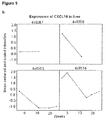
- the expression of IP-10 is decreased by treatment of HCV infected Chimpanzees (that are Interferon non-responders) with a composition according to the invention.
- compositions of the invention lead to a decrease in expression of most of the IRG's in Table 5 (and figure 5 a) , indicating the potential of using the compositions and methods of the invention for treatment of interferon non-responders, slow responding, partial responding, or relapsing subjects, or for changing the ability of the subject to respond to Interferon treatment, or for prevention of graft rejection in organ transplanted subjects.
- MicroRNA-122 antagonists of the invention are compounds, including but not limited to antisense oligonucleotides targeting miR-122, as described below.
- the antimiR-122 compound is an antisense oligomer targeting microRNA-122.
- antimiR-122 oligonucleotide is designed as a mixmer that is essentially incapable of recruiting RNAseH. Oligonucleotides that are essentially incapable of recruiting RNAseH are well known in the literature, in example see WO2007/112754 , WO2007/112753 , or WO2009/043353 .
- Mixmers may be designed to comprise a mixture of affinity enhancing nucleotide analogues, such as in non-limiting example 2'-O-alkyl-RNA monomers, 2'-amino-DNA monomers, 2'-fluoro-DNA monomers, LNA monomers, arabino nucleic acid (ANA) mononmers, 2'-fluoro-ANA monomers, HNA monomers, INA monomers, 2'-MOE-RNA (2'-O-methoxyethyl-RNA), 2'Fluoro-DNA, and LNA.
- affinity enhancing nucleotide analogues such as in non-limiting example 2'-O-alkyl-RNA monomers, 2'-amino-DNA monomers, 2'-fluoro-DNA monomers, LNA monomers, arabino nucleic acid (ANA) mononmers, 2'-fluoro-ANA monomers, HNA monomers, INA monomers, 2'-MOE-RNA (2'-O-methoxye
- the oligonucleotide does not include any DNA or RNA nucleotides, but is solely composed of affinity enhancing nucleotide analogues, such a molecule is may also be termed a totalmers.
- mixmer only comprise one type of affinity enhancing nucleotide analogues together with DNA and/or RNA.
- the oligonucleotide is composed solely of one or more types of nucleotide analogues, such as in non-limiting example 2'-O-alkyl-RNA monomers, 2'-amino-DNA monomers, 2'-fluoro-DNA monomers, LNA monomers, arabino nucleic acid (ANA) mononmers, 2'-fluoro-ANA monomers, HNA monomers, INA monomers, 2'-MOE-RNA (2'-O-methoxyethyl-RNA), 2'Fluoro-DNA, and LNA.
- nucleotide analogues such as in non-limiting example 2'-O-alkyl-RNA monomers, 2'-amino-DNA monomers, 2'-fluoro-DNA monomers, LNA monomers, arabino nucleic acid (ANA) mononmers, 2'-fluor
- the antisense oligonucleotide has a length of 7-25 (contiguous) nucleotides, such as 8, 9, 10, 11, 12, 13, 14, 15, 16, 17, 18, 19, 20, 21, 22, 23, or 24 (contiguous) nucleotides. In some embodiments, the antisense oligonucleotide has a length of 7-10 (contiguous) nucleotide, or in some instances 7-16 nucleotides. In some embodiments, the antisense oligonucleotide at least 8 (contiguous) nucleotides in length, between 10-17 or 10-16 or 10-15 (contiguous) nucleotides, such as between 12-15 (contiguous) nucleotides.
- EP 1 222 309 provides in vitro methods for determining RNaseH activity, which may be used to determine the ability to recruit RNaseH.
- a oligomer is deemed capable of recruiting RNase H if, when provided with the complementary RNA target, it has an initial rate, as measured in pmol/l/min, of at least 1 %, such as at least 5%, such as at least 10% or less than 20% of the equivalent DNA only oligonucleotide, with no 2' substitutions, with phosphorothioate linkage groups between all nucleotides in the oligonucleotide, using the methodology provided by Example 91 - 95 of EP 1 222 309 .
- an oligomer is deemed essentially incapable of recruiting RNaseH if, when provided with the complementary RNA target, and RNaseH, the RNaseH initial rate, as measured in pmol/l/min, is less than 1%, such as less than 5%,such as less than 10% or less than 20% of the initial rate determined using the equivalent DNA only oligonucleotide, with no 2' substitutions, with phosphorothioate linkage groups between all nucleotides in the oligonucleotide, using the methodology provided by Example 91 - 95 of EP 1 222 309 .
- oligonucleotides which are mixmers or totalmers are usually essentially incapable of recruiting RNAseH and as such where we use the term essentially incapable or recruiting RNaseH herein, in some embodiments, such a term may be replaced with the term mixmer or totalmer, as defined herein, even if, in some instances such oligomers actually do possess significant ability to recruit RNaseH, such as when using DNA mixmers with alpha-L-oxy-LNA.
- the oligomer or contiguous nucleotide sequence thereof consists of a contiguous sequence of nucleotide analogues, such as affinity enhancing nucleotide analogues - referred to herein is as a 'totalmers'.
- a totalmer is a single stranded oligomer which only comprises non-naturally occurring nucleotides.
- the oligomer maybe a totalmer- indeed various totalmer designs are highly effective as therapeutic oligomers, particularly when targeting microRNA (antimiRs) or as splice switching oligomers (SSOs).
- the totalmer comprises or consists of at least one XYX or YXY sequence motif, such as a repeated sequence XYX or YXY, wherein X is LNA and Y is an alternative ( i.e. non LNA) nucleotide analogue, such as a 2'-OMe RNA unit and 2'-fluoro DNA unit.
- the above sequence motif may, in some embodiments, be XXY, XYX, YXY or YYX for example.
- the totalmer may comprise or consist of a contiguous nucleotide sequence of between 8 and 16 nucleotides, such as 9, 10, 11, 12, 13, 14, or 15 nucleotides, such as between 8 and 12 nucleotides.
- the contiguous nucleotide sequence of the totalmer comprises of at least 30%, such as at least 40%, such as at least 50%, such as at least 60%, such as at least 70%, such as at least 80%, such as at least 90%, such as 95%, such as 100% LNA units.
- the remaining units may be selected from the non-LNA nucleotide analgues referred to herein in, such those selected from the group consisting of 2'-O_alkyl-RNA unit, 2'-OMe-RNA unit, 2'-amino-DNA unit, 2'-fluoro-DNA unit, LNA unit, PNA unit, HNA unit, INA unit, and a 2'MOE RNA unit, or the group 2'-OMe RNA unit and 2'-fluoro DNA unit.
- the totalmer consist or comprises of a contiguous nucleotide sequence which consists only of LNA units.
- the totalmer may be targeted against a microRNA (i.e. be antimiRs) - as referred to in US provisional applications 60/979217 and 61/028062 , and WO2009/043353 .
- a microRNA i.e. be antimiRs
- 'mixmer' refers to oligomers which comprise both naturally and non-naturally occurring nucleotides, where, as opposed to gapmers, tailmers, headmers and blockmers, there is no contiguous sequence of more than 5 naturally occurring nucleotides, such as DNA units.
- the oligomer according to the invention maybe a mixmer- indeed various mixmer designs are highly effective as therapeutic oligomers, particularly when targeting microRNA (antimiRs), microRNA binding sites on mRNAs (Blockmirs) or as splice switching oligomers (SSOs).
- the oligomer may, in some embodiments, also be a mixmer and indeed, due to the ability of mixmers to effectively and specifically bind to their target, the use of mixmers as therapeutic oligomers are considered to be particularly effective in decreasing the target RNA.
- the mixmer comprises or consists of a contiguous nucleotide sequence of repeating pattern of nucleotide analogue and naturally occurring nucleotides, or one type of nucleotide analogue and a second type of nucleotide analogues.
- the repeating pattern may, for instance be every second or every third nucleotide is a nucleotide analogue, such as LNA, and the remaining nucleotides are naturally occurring nucleotides, such as DNA, or are a 2'substituted nucleotide analogue such as 2'MOE or 2'fluoro analogues as referred to herein, or, in some embodiments selected form the groups of nucleotide analogues referred to herein. It is recognised that the repeating pattern of nucleotide analogues, such as LNA units, may be combined with nucleotide analogues at fixed positions - e.g. at the 5' or 3' termini.
- the first nucleotide of the oligomer, counting from the 3' end is a nucleotide analogue, such as an LNA nucleotide.
- the second nucleotide of the oligomer, counting from the 3' end is a nucleotide analogue, such as an LNA nucleotide.
- the seventh and/or eighth nucleotide of the oligomer, counting from the 3' end are nucleotide analogues, such as LNA nucleotides.
- the ninth and/or the tenth nucleotides of the oligomer, counting from the 3' end are nucleotide analogues, such as LNA nucleotides.
- the 5' terminal of the foligomer is a nucleotide analogue, such as an LNA nucleotide.
- the above design features may, in some embodiments be incorporated into the mixmer design, such as antimiRs mixmers.
- the mixmer does not comprise a region of more than 4 consecutive DNA nucleotide units or 3 consecutive DNA nucleotide units. In some embodiments, the mixmer does not comprise a region of more than 2 consecutive DNA nucleotide units.
- the mixmer comprises a region consisting of at least two consecutive nucleotide analogue units, such as at least two consecutive LNA units.
- the mixmer comprises a region consisting of at least three consecutive nucleotide analogue units, such as at least three consecutive LNA units.
- the mixmer of the invention does not comprise a region of more than 7 consecutive nucleotide analogue units, such as LNA units. In some embodiments, the mixmer of the invention does not comprise a region of more than 6 consecutive nucleotide analogue units, such as LNA units. In some embodiments, the mixmer of the invention does not comprise a region of more than 5 consecutive nucleotide analogue units, such as LNA units. In some embodiments, the mixmer of the invention does not comprise a region of more than 4 consecutive nucleotide analogue units, such as LNA units. In some embodiments, the mixmer of the invention does not comprise a region of more than 3 consecutive nucleotide analogue units, such as LNA units. In some embodiments, the mixmer of the invention does not comprise a region of more than 2 consecutive nucleotide analogue units, such as LNA units.
- the LNA units may be replaced with other nucleotide anlogues, such as those referred to herein.
- "X" may, therefore be selected from the group consisting of 2'-O-alkyl-RNA unit, 2'-OMe-RNA unit, 2'-amino-DNA unit, 2'-fluoro-DNA unit (2'fluoro), 2'-MOE-RNA (2'MOE) unit, LNA unit, PNA unit, HNA unit, INA unit.
- "x" is preferably DNA or RNA, most preferably DNA.
- the mixmer such as an antimiR mixmer
- the mixmer is modified in positions 3 to 8 - i.e. comprises at least one nucleotide analogue in positions 3 to 8, counting from the 3' end.
- the design of this sequence may be defined by the number of non-LNA units present or by the number of LNA units present.
- at least one, such as one, of the nucleotides in positions three to eight, counting from the 3' end is a non-LNA unit.
- at least two, such as two, of the nucleotides in positions three to eight, counting from the 3' end are non-LNA units.
- At least three, such as three, of the nucleotides in positions three to eight, counting from the 3' end, are non-LNA units. In some embodiments, at least four, such as four, of the nucleotides in positions three to eight, counting from the 3' end, are non-LNA units. In some embodiments, at least five, such as five, of the nucleotides in positions three to eight, counting from the 3' end, are non-LNA units. In some embodiments, all six nucleotides in positions three to eight, counting from the 3' end, are non-LNA units.
- the mixmer such as an antimiR mixmer, according to the invention comprises at least one LNA unit in positions three to eight, counting from the 3' end.
- the mixmer such as an antimiR mixmer, comprises one LNA unit in positions three to eight, counting from the 3' end.
- the substitution pattern for the nucleotides in positions three to eight, counting from the 3' end include but are not limited to Xxxxxx, xXxxxx, xxXxxx, xxxXxx, xxxxXx and xxxxxX, wherein "X” denotes an LNA unit and "x" denotes a non-LNA unit.
- the mixmer such as an antimiR mixmer, comprises at least two LNA units in positions three to eight, counting from the 3' end. In some embodiments thereof, the mixmer comprises two LNA units in positions three to eight, counting from the 3' end.
- substitution pattern for the nucleotides in positions three to eight, counting from the 3' end include but are not limited to XXxxxx, XxXxxx, XxxXxx, XxxxXx, XxxxxX, xXxXxx, xXxxxX, xxXXxx, xxXxXx, xxXxxX, xxxXXx, xxxXxX and xxxxXX, wherein "X” denotes an LNA unit and "x” denotes a non-LNA unit.
- the substitution pattern for the nucleotides in positions three to eight, counting from the 3' end include but are not limited to XxXxxx, XxxXxx, XxxxXx, XxxxxX, xXxXxx, xXxxxX, xxXxXx, xxXxxX and xxxXxX, wherein "X” denotes an LNA unit and "x" denotes a non-LNA unit.
- the substitution pattern for the nucleotides in positions three to eight, counting from the 3' end include but are not limited to xXxXxx, xXxxXx, xXxxxX, xxXxXx, xxXxxX and xxxXxX, wherein "X” denotes an LNA unit and "x" denotes a non-LNA unit.
- the substitution pattern for the nucleotides in positions three to eight, counting from the 3' end include but are not limited to xXxXxx, xXxxXx and xxXxXx, wherein "X” denotes an LNA unit and "x” denotes a non-LNA unit.
- the substitution pattern for the nucleotides in positions three to eight, counting from the 3' end is xXxXxx, wherein "X” denotes an LNA unit and "x” denotes a non-LNA unit.
- the mixmer such as an antimiR mixmer, comprises at least three LNA units in positions three to eight, counting from the 3' end. In an embodiment thereof, the mixmer comprises three LNA units in positions three to eight, counting from the 3' end.
- substitution pattern for the nucleotides in positions three to eight, counting from the 3' end include but are not limited to XXXxxx, xXXXxx, xxXXXx, xxxXXX, XXxXxx, XXxxXx, XXxxxX, xXXxXx, xXXxxX, xxXXxX, XxxXXx, XxxxXX, XxxxXX, xXxXXx, xXxxXXX, xxXXXX, xXxXxX and XxXxXx, wherein "X” denotes an LNA unit and "x" denotes a non-LNA unit.
- the substitution pattern for the nucleotides in positions three to eight, counting from the 3' end include but are not limited to XXxXxx, XXxxXx, XXxxxX, xXXxXx, xXXxxX, xxXXxX, XxxXXx, XxxxXX, xXxXXx, xXxxXX, xxXxXX, xXxXxX and XxXxXx, wherein "X” denotes an LNA unit and "x” denotes a non-LNA unit.
- the substitution pattern for the nucleotides in positions three to eight, counting from the 3' end include but are not limited to xXXxXx, xXXxxX, xxXXxX, xXxXXx, xXxxXX, xxXxXX and xXxXxX, wherein "X” denotes an LNA unit and "x” denotes a non-LNA unit.
- the substitution pattern for the nucleotides in positions three to eight, counting from the 3' end is xXxXxX or XxXxXx, wherein "X" denotes an LNA unit and "x” denotes a non-LNA unit.
- the substitution pattern for the nucleotides in positions three to eight, counting from the 3' end is xXxXxX, wherein "X” denotes an LNA unit and "x" denotes a non-LNA unit.
- the mixmer comprises at least four LNA units in positions three to eight, counting from the 3' end. In some embodiments thereof, the mixmer comprises four LNA units in positions three to eight, counting from the 3' end.
- the substitution pattern for the nucleotides in positions three to eight, counting from the 3' end include but are not limited to xxXXXX, xXxXXX, xXXxXX, xXXXxX, xXXXx, XxxX.X, XxXX, XxXxX, XXxXx, XXxXx, XXxxX, XXxXxX, XXxXx, XXxXx, XXXxxX, XXXxXxX, XXXxXx and XXXXxx, wherein "X” denotes an LNA unit and "x" denotes a non-LNA unit.
- the mixmer according to the present invention comprises at least five LNA units in positions three to eight, counting from the 3' end.
- the substitution pattern for the nucleotides in positions three to eight, counting from the 3' end include but are not limited to xXXXXX, XxXXXX, XXxXXX, XXXxXX, XXXxX and XXXXx, wherein "X” denotes an LNA unit and "x" denotes a non-LNA unit.
- said non-LNA unit is another nucleotide analogue unit.
- the non-LNA unit "x" is another nucleotide analogue unit.
- another nucleotide analogue unit can be "Y", wherein Y is as defined herein.
- the substitution pattern for the nucleotides from position 11, counting from the 3' end, to the 5' end may include nucleotide analogue units (such as LNA) or it may not.
- the mixmer comprises at least one nucleotide analogue unit (such as LNA), such as one nucleotide analogue unit, from position 11, counting from the 3' end, to the 5' end.
- the mixmer comprises at least two nucleotide analogue units, such as LNA units, such as two nucleotide analogue units, from position 11, counting from the 3' end, to the 5' end.
- the LNA units may be replaced with other nucleotide anlogues, such as those referred to herein.
- "X" may, therefore be selected from the group consisting of 2'-O-alkyl-RNA unit, 2'-OMe-RNA unit, 2'-amino-DNA unit, 2'-fluoro-DNA unit, LNA unit, PNA unit, HNA unit, INA unit.
- "x” may DNA or RNA, such as DNA. X may also be 2'-MOE-RNA unit.
- the mixmer has the following substitution pattern, which is repeated from nucleotide eleven, counting from the 3' end, to the 5' end: xXxX or XxXx, wherein "X” denotes an LNA unit and "x” denotes a non-LNA unit.
- the mixmer has the following substitution pattern, which is repeated from nucleotide eleven, counting from the 3' end, to the 5' end: XXxXxx, XXxxXx or XxXxxX, wherein "X” denotes an LNA unit and "x” denotes a non-LNA unit.
- the mixmer has the following substitution pattern, which is repeated from nucleotide eleven, counting from the 3' end, to the 5' end: XXXxXXXx, XXxXxXxX, XXXxxxXX or XXxXxxXX, wherein "X” denotes an LNA unit and "x" denotes a non-LNA unit.
- the specific substitution pattern for the nucleotides from position 11, counting from the 3' end, to the 5' end depends on the number of nucleotides in the mixmer.
- the mixmer contains 12 nucleotides and the substitution pattern for positions 11 to 12, counting from the 3' end, include but are not limited to xX and Xx, wherein "X" denotes an LNA unit and "x" denotes a non-LNA unit.
- the substitution pattern for positions 11 to 12, counting from the 3' end is xX, wherein "X" denotes an LNA unit and "x" denotes a non-LNA unit.
- no LNA units are present in positions 11 to 12, counting from the 3' end, i.e. the substitution pattern is xx.
- the substitution pattern for positions 11 to 12, counting from the 3' end is XX, wherein "X" denotes an LNA unit.
- the mixmer contains 12 nucleotides and the substitution pattern for positions 10 to 12, counting from the 3' end, include but are not limited to Xxx, xXx, xxX, XXx, XxX, xXX and XXX, wherein "X” denotes an LNA unit and "x” denotes a non-LNA unit.
- the substitution pattern for positions 10 to 12, counting from the 3' end include but are not limited to xXx, xxX and xXX, wherein "X” denotes an LNA unit and "x” denotes a non-LNA unit.
- the substitution pattern for positions 10 to 12, counting from the 3' end is xxX, wherein "X” denotes an LNA unit and "x" denotes a non-LNA unit.
- the substitution pattern is xxx.
- the oligomer is a mixmer of "'MOE-RNA and 2'fluoro-DNA nucleotides - and as such the patterns of nucleotides X and x may also refer to combinations of the 2'fluor and 2'MOE chemistries.
- X is a 2'MOE-RNA unit and x is 2'fluoro-DNA unit - or alternatively, in some embodiments, x is a 2'MOE-RNA unit and X is 2'fluoro-DNA unit.
- the all the nucleotide units of the oligomer are independantly selected from the group consisting of 2'fluoro-DNA and 2'MOE-RNA.
- the oligomer comprises of both 2'MOE-RNA and 2'fluoro-DNA units. Such oligomers are described in Davis et al., NAR 2009 Vol 37, No 1, pp 70-77 . Further 2'MOE/2'fluro designs are illustrated herein.
- the mixmer contains an LNA unit at the 5' end. In some embodiments, the mixmer contains an LNA unit at the first two positions, counting from the 5' end.
- the mixmer may also contain one or more of the structural features which are specified in the context of the antimiR herein - either the context that the mixmer contains a similar pattern and number of nucleotides/nucleotide analogues (e.g.
- microRNA Possible medical indications miR-122 hypercholesterolemia, hepatitis C infection, hemochromatosis
- the oligomer may, in some embodiments, be either i) fully complementary to a sub-sequence of contiguous nucleotides present in the RNA target, or ii) comprises no more than a single mismatch with the complement of a sub-sequence of contiguous nucleotides present in said RNA target.
- the oligonucleotide is an antisense oligonucleoitde - in that it is either fully complementary to the corresponding region of the target sequence, or comprises no more than a single mismatch with the corresponding region of the target sequence.
- the RNA target is typically associated with a medical condition or disease, and may in some embodiments, be a microRNA or a mRNA, for example.
- the oligomer may therefore be, for example, an antimiR, a microRNA mimic, a microRNA blockmir, or an antisense oligomer.
- the oligomer may therefore be an antimir which targets (i.e. comprises or consists of a contiguous nucleotide sequence which is fully complementary to (a corresponding region of) microRNA-122 or comprises of no more than a single mismatch thereto.
- targets i.e. comprises or consists of a contiguous nucleotide sequence which is fully complementary to (a corresponding region of) microRNA-122 or comprises of no more than a single mismatch thereto.
- Such oligonucleotides may be referred to as anti-microRNA oligonucleotides.
- Specially preferred compounds for use in the present invention are those that target microRNA-122.
- the sequence of miR-122 can be found in the microRNA database "mirbase” (http://microrna.sanger.ac.uk/sequencesl).
- Inhibitors of microRNA-122 have been described in numerous patents and articles and are well known to the person skilled in the art. In a some embodiments, examples of such documents describing useful microRNA-122 modulators are WO2007/112754 , WO2007/112753 , or WO2009/043353 .
- microRNA-122 modulators are those described in WO2009/20771 , WO2008/91703 , WO2008/046911 , WO2008/074328 , WO2007/90073 , WO2007/27775 , WO2007/27894 , WO2007/21896 , WO2006/93526 , WO2006/112872 , WO2005/23986 , or WO2005/13901 .
- the micro-RNA-122 antagonist is an oligomer which is complementary to miR-122 or a (corresponding) contiguous nucleobase sequence thereof.
- oligomers which are complementary to miR-122 comprise or consist of a sequence of at least seven contiguous nucleotides which are complementary to a part of, or the entire length of the human miR-122 sequence.
- a part of is at least 6, such as at least 7 or at least 8 contiguous nucleotides which are 100% complementary to a sequence found within micro-RNA 122 sequence, such as the mature has-miR-122 sequence.
- oligomers which are complementary to miR-122 comprise or consist of a contiguous nucleotide sequence which is complementary to the has-miR-122 seed sequence, i.e. comprises or consists of the contiguous nucleotide sequence 5' - CACTCC - 3' - referred to herein as the "seed match region".
- the sequence 5' - CACTCC - 3' is positioned at positions 1 - 6,2 - 7 or 3 - 8 of the oligomer, counting from the 3' end. In some embodiments, the sequence 5' - CACTCCA - 3' is positioned at positions 1 - 7 or 2 - 8 of the oligomer, counting in from the 3'-end.
- An oligomer which consists of a contiguous nucleotide sequence may further comprise non-nucleotide componens, such as a 5' or 3' non nucleotide conjugation group.
- the oligomer consists of or comprises just the contiguous nucleotide sequence, without, e.g., conjugation groups.
- Oligomers which are complementary to miR-122 may comprise or consist of a contiguous sequence of 7, 8, 9, 10, 11, 12, 13, 14, 15, 16, 17, 18, 19, 20, 21 or 22 nucleotides which are complementary to a part, or the entire, has-miR-122 sequence.
- Complementary oligomers which are complementary to the entire miR-122 are at least 22nts long - i.e .
- the length of the has-miR-122 sequence may therefore comprise further sequences - flanking sequences - which may be complementary to the regions of the pre-has-miR-122 which flank the mature has-miR-122 sequence.
- Complementary oligomers which are complementary to the entire mature has-miR-122 may therefore be longer than 22n nucleotides in length, such as 23, 24, 25, 26, 27, 28, 29 or 30 nucleotides in length.
- Oligomers which are complementary to only a part of the has-miR-122 sequence may be less than 22 nucleotides long, and may consist of or comprise a contiguous nucleotide sequence which consists of the complement of a part of the miR-has-miR122 sequence (i.e. a contiguous nucleotide sequence which is complementary to a corresponding sub-region of has-miR-122).
- oligomers which are complementary to only a part of the has-miR-122 sequence may comprise flanking sequences which, for example, which may be complementary to the regions of the pre-has-miR-122 which flank the mature has-miR-122 sequence.
- Complementary oligomers which are complementary to part of the mature has-miR-122 may therefore be longer than 22 nucleotides in length, such as 23, 24, 25, 26, 27, 28, 29 or 30 nucleotides in length.
- oligomers which are complementary to part of the has-miR-122 are less than 22nts in length.
- the oligomer may consist of the contiguous nucleotide sequence complementary to has-miR-122.
- oligomers which are complementary to miR-122 consist of or comprise the contiguous nucleotide sequence 5' - ACACTCC - 3'. In some embodiments, oligomers which are complementary to miR-122 consist of or comprise the contiguous nucleotide sequence 5' - CACACTCC - 3'. In some embodiments, oligomers which are complementary to miR-122 consist of or comprise the contiguous nucleotide sequence 5' - CACACTCC - 3'. In some embodiments, oligomers which are complementary to miR-122 consist of or comprise the contiguous nucleotide sequence 5' - TCACACTCC - 3'.
- oligomers which are complementary to miR-122 consist of or comprise the contiguous nucleotide sequence 5' - GTCACACTCC - 3'. In some embodiments, oligomers which are complementary to miR-122 consist of or comprisethe contiguous nucleotide sequence 5'-TGTCACACTCC-3'. In some embodiments oligomers which are complementary to miR-122 consist of or comprisethe contiguous nucleotide sequence 5' - ATTGTCACACTCC - 3'. In some embodiments oligomers which are complementary to miR-122 consist of or comprisethe contiguous nucleotide sequence 5' - CATTGTCACACTCC - 3'.
- oligomers which are complementary to miR-122 consist of or comprisethe contiguous nucleotide sequence 5' - CCATTGTCACACTCC - 3'. In some embodiments oligomers which are complementary to miR-122 consist of or comprise the contiguous nucleotide sequence 5' - ACCATTGTCACACTCC - 3'.
- oligomers which are complementary to miR-122 consist of or comprise the contiguous nucleotide sequence 5' - CACCATTGTCACACTCC - 3'. In some embodiments, oligomers which are complementary to miR-122 consist of or comprise the contiguous nucleotide sequence 5' - ACACCATTGTCACACTCC - 3'. In some embodiments, oligomers which are complementary to miR-122 consist of or comprise the contiguous nucleotide sequence 5' - AACACCATTGTCACACTCC - 3'.
- oligomers which are complementary to miR-122 consist of or comprise the contiguous nucleotide sequence 5' - AAACACCATTGTCACACTCC - 3'. In some embodiments, oligomers which are complementary to miR-122 consist of or comprise the contiguous nucleotide sequence 5' - CAAACACCATTGTCACACTCC - 3'.
- the 3' cytosine nucleotide may, in some embodiments, be the 3' terminal nucleotide. In some embodiments, there may be a single further nucleotide, such as an adenosine nucleotide 3' to the 3' cytosine in the above sequences.
- oligomers which are complementary to miR-122 consist of or comprise the contiguous nucleotide sequence 5' - (C)(A)(A)(A)(C)(A)(C)(C)(A)(T)(T)(G)(T)(C)ACACTCC - 3', wherein the nucleotides in brackets are optional.
- oligomers which are complementary to miR-122 consist of or comprise the contiguous nucleotide sequence 5' - (C)(A)(A)(A)(C)(A)(C)(C)(A)(T)(T)(G)(T)(C)ACACTCCA-3' , wherein the nucleotides in brackets are optional.
- oligomers which are complementary to miR-122 comprise of the seed match region
- the seed match region may be truncated by no more than 2 nucleotides from the 3' end - i.e.
- oligomers which are complementary to miR-122 consist of or comprise the contiguous nucleotide sequence 5' - (C)(A)(A)(A)(C)(A)(C)(C)(A)(T)(T)(G)(T)CACACTC - 3' , wherein the nucleotides in brackets are optional.
- oligomers which are complementary to miR-122 consist of or comprise the contiguous nucleotide sequence 5' - (C)(A)(A)(A)(C)(A)(C)(C)(A)(T)(T)(G)TCACACT - 3' , wherein the nucleotides in brackets are optional.
- oligomers which are complementary to miR-122 consist of or comprise the contiguous nucleotide sequence 5' - CACACTC - 3'.
- oligomers which are complementary to miR-122 consist of or comprise the contiguous nucleotide sequence 5' - TCACACT - 3'.
- oligomers which are complementary to miR-122 consist of or comprise the contiguous nucleotide sequence 5' - TCACACTC - 3'. In some embodiments, oligomers which are complementary to miR-122 consist of or comprise the contiguous nucleotide sequence 5' - TCACACT - 3'. In some embodiments, oligomers which are complementary to miR-122 consist of or comprise the contiguous nucleotide sequence 5' - GTCACACTC - 3'. In some embodiments, oligomers which are complementary to miR-122 consist of or comprise the contiguous nucleotide sequence 5' - GTCACACT - 3'.
- oligomers which are complementary to miR-122 consist of or comprise the contiguous nucleotide sequence 5' -TGTCACACTC - 3'. In some embodiments oligomers which are complementary to miR-122 consist of or comprise the contiguous nucleotide sequence 5' -TGTCACACT - 3'. In some embodiments oligomers which are complementary to miR-122 consist of or comprise the contiguous nucleotide sequence 5' - ATTGTCACACTC - 3'. In some embodiments oligomers which are complementary to miR-122 consist of or comprise the contiguous nucleotide sequence 5' - ATTGTCACACT - 3'.
- oligomers which are complementary to miR-122 consist of or comprise the contiguous nucleotide sequence 5' - CATTGTCACACTC - 3' . In some embodiments oligomers which are complementary to miR-122 consist of or comprise the contiguous nucleotide sequence 5' - CATTGTCACACT- 3'. In some embodiments oligomers which are complementary to miR-122 consist of or comprise the contiguous nucleotide sequence 5' - CCATTGTCACACTC - 3'.
- oligomers which are complementary to miR-122 consist of or comprise the contiguous nucleotide sequence 5' - CCATTGTCACACT - 3'. In some embodiments oligomers which are complementary to miR-122 consist of or comprise the contiguous nucleotide sequence 5' - ACCATTGTCACACTC - 3'. In some embodiments oligomers which are complementary to miR-122 consist of or comprise the contiguous nucleotide sequence 5' - ACCATTGTCACACT - 3'.
- oligomers which are complementary to miR-122 consist of or comprise the contiguous nucleotide sequence 5' - CACCATTGTCACACTC - 3'. In some embodiments oligomers which are complementary to miR-122 consist of or comprise the contiguous nucleotide sequence 5' - CACCATTGTCACACT - 3'. In some embodiments oligomers which are complementary to miR-122 consist of or comprise the contiguous nucleotide sequence 5' - ACACCATTGTCACACTC - 3'. In some embodiments oligomers which are complementary to miR-122 consist of or comprise the contiguous nucleotide sequence 5' - ACACCATTGTCACACT - 3'. In some embodiments oligomers which are complementary to miR-122 consist of or comprise the contiguous nucleotide sequence 5' - AACACCATTGTCACACTC - 3'.
- oligomers which are complementary to miR-122 consist of or comprise the contiguous nucleotide sequence 5' - AACAGCATTGTCACACT - 3'. In some embodiments oligomers which are complementary to miR-122 consist of or comprise the contiguous nucleotide sequence 5' - AAACACCATTGTCACACTC - 3'. In some embodiments oligomers, which are complementary to miR-122 consist of or comprise the contiguous nucleotide sequence 5' - AAACACCATTGTCACACT - 3'. In some embodiments oligomers which are complementary to miR-122 consist of or comprise the contiguous nucleotide sequence 5' - CAAACACCATTGTCACACTC - 3'.
- oligomers which are complementary to miR-122 consist of or comprise the contiguous nucleotide sequence 5' - CAAACACCATTGTCACACT - 3'. In some embodiments oligomers which are complementary to miR-122 consist of or comprise the contiguous nucleotide sequence 5' - CAAACACCATTGTCACACTCCA - 3'.
- the oligomer may comprise or consist of 2' substituted nucleosides, such as 2'MOE, 2'OMe and/or 2'fluro.
- 2'MOE 2'-fluoro/2'-methoxyethyl
- ASO antisense oligonucleotide
- the 2'MOE/2' fluoro mixmer may, in some embodiments be 12, 13, 14, 15, 17, 18, 19, 20, 21 or 22 nucleotides in length.
- the following table illustrates how the 2'MOE and 2'fluoro sugar modifications can be incorporated into an oligomer of up to 22 nucleotides in length such as oligomers whose sequence is provided above:
- the above embodiments may be combined with the teaching above when 'X' is 2'MOE, and 'x' is 2'fluoro or alternatively when 'X' is 2'fluoro and 'x' is 2'MOE.
- the 2'MOE/2'fluorc mixmer may be fully phosphorothioate.
- M represents a 2'-methoxyethyl (2'MOE)
- F represents a 2'fluoro nucleoside unit.
- the sequence 1 - 22 is provided 5' - 3': Internucleoside linkages may be as described herein - for example a fully phosphorothioate backbone may be used.
- the above sequence may, for example be the reverse complement of the mature human has-miR-122 sequence, or part thereof (see above list of anti-miR-122 oligonucleotide sequences).
- the oligonucleotide may, optionally be conjugated, e.g. by a 3' cholesterol conjugate.
- Cytosines may be 5-methyl cytosine.
- the 1st nucleotide is a 2'MOE nucleotide. In some embodiments, the 1 st nucleotide is a 2'fluoro nucleotide. In some embodiments, the 2nd nucleotide is a 2'MOE nucleotide. In some embodiments, the 2 nd nucleotide is a 2'fluoro nucleotide. in some embodiments, the 3rd nucleotide is a 2'MOE nucleotide. In some embodiments, the 3rd nucleotide is a 2'fluoro nucleotide. In some embodiments, the 4 th nucleotide is a 2'MOE nucleotide.
- the 4th nucleotide is a 2'fluoro nucleotide.
- the 5th nucleotides is a 2'MOE nucleotide. In some embodiments, the 5th nucleotide is a 2'fluoro nucleotide.
- the 6th nucleotide is a 2'MOE nucleotide. In some embodiments, the 6th nucleotide is a 2'fluoro nucleotide.
- the 7th nucleotide is a 2'MOE nucleotide. In some embodiments, the 7th nucleotide is a 2'fluoro nucleotide.
- the 8th nucleotide is a 2'MOE nucleotide. In some embodiments, the 8th nucleotide is a 2'fluoro nucleotide. In some embodiments, the 9th nucleotide is a 2'MOE nucleotide. In some embodiments, the 9th nucleotide is a 2'fluoro nucleotide. In some embodiments, the 10th nucleotide is a 2'MOE nucleotide. In some embodiments, the 10th nucleotide is a 2'fluoro nucleotide. In some embodiments, the 11th nucleotide is a 2'MOE nucleotide.
- the 11th nucleotide is a 2'fluoro nucleotide.
- the 12th nucleotide is a 2'MOE nucleotide.
- the 12th nucleotide is a 2'fluoro nucleotide.
- the 13th nucleotide, when present, is a 2'MOE nucleotide.
- the 13th nucleotide, when present, is a 2'fluoro nucleotide.
- the 14th nucleotide, when present, is a 2'MOE nucleotide.
- the 14th nucleotide, when present, is a 2'fluoro nucleotide.
- the 15th nucleotide, when present is a 2'MOE nucleotide.
- the 15th nucleotide, when present is a 2'fluoro nucleotide.
- the 16th nucleotide, when present is a 2'MOE nucleotide.
- the 16th nucleotide, when present is a 2'fluoro nucleotide.
- the 17th nucleotide, when present, is a 2'MOE nucleotide.
- the 17th nucleotide, when present, is a 2'fluoro nucleotide.
- the 18th nucleotide, when present is a 2'MOE nucleotide.
- the 18th, when present, nucleotide is a 2'fluoro nucleotide.
- the 19th nucleotide, when present is a 2'MOE nucleotide.
- the 19th nucleotide, when present, is a 2'fluoro nucleotide.
- the 20th nucleotide, when present, is a 2'MOE nucleotide.
- the 20 th nucleotide, when present, is a 2'fluoro nucleotide.
- the 21 st nucleotide, when present, is a 2'MOE nucleotide.
- the 21 st nucleotide, when present, is a 2'fluoro nucleotide.
- the 22nd nucleotide, when present, is a 2'MOE nucleotide.
- the 22 nd nucleotide, when present, is a 2'fluoro nucleotide.
- the oligomer consists of 1 2'MOE/2'fluoro designs based on those disclosed in Davis et al., 2009, such as shortened versions, or a version with more or less 2'MOE flanks surrounding the 2'F core regions, such as: MFFFFFFFFFM, MMFFFFFFFMM, MMMFFFFFMMM, MFFFFFFFFFFM, MMFFFFFFFFMM, MMMFFFFFFMMM, MFFFFFFFFFM, MMFFFFFFFFFFFMM, MMMFFFFFFFFFMMM, MFFFFFFFFFFFFM, MMFFFFFFFFFFMM, MMMFFFFFFFFFFMMM, MFFFFFFFFFFFM, MMFFFFFFFFFFFFFFFFM, MMFFFFFFFFFFFFFFFMM, MMFFFFFFFFFFFFFFFMM, MMFFFFFFFFFFFFFFFFMMM, MFFFFFFFFFFFFFFM, MMFFFFFFFFFFFMMM, MFFFFFFFFFFFFFFM, MMFFFFFFFFFFMM
- the modulator comprises an antisense LNA oligonucleotide. In some embodiments, the modulator comprises an oligonucleotide which is between 7 and 25 nucleotides long and comprises at least one LNA. In some embodiments, the microRNA modulator comprises an oligonucleotide which is between 7 and 25 nucleotides long and comprises at least one LNA, and further comprises at least one other affinity increasing nucleotide analogue. In some embodiments, the oligonucleotide of the invention comprise phosphorothioate linkages.
- the pharmaceutical composition comprise an anti-miR-122 oligomer having the sequence: 5'-CcAttGTcaCaCtCC-3' (Seq ID # 11), wherein Capital letters indicate LNA units, such as 5'- m C s c s A s t s t s G s T s c s a s m C s a s m C s t s m C s m C-3'.
- the microRNA-122 modulater is an LNA antisense oligomer comprising or consisting of any one of the sequences listed in Tables 2 and 3. Table 2.
- the compounds are preferably fully phosphorothioate and each nuceltode is a LNA nucleotide, such as beta-D-oxy LNA.
- LNA cytosine may be 5'methyl cytosine.
- the compounds are directed towards the seed regions of their target microRNA (i.e. are seedmers).
- the compounds include, but are not limited to, those oligonucletides as disclosed in table 1 of WO2009/043353, which discloses antimiRs targeting the microRNAs as published in miRbase.
- Equivalent antimiRs can be designed by matching the -2 to -8/-9 or -10 positions (for 7, 8 or 9mers) of mature microRNA-122 (counting from the terminal 5' nucleotide of the microRNA (i.e. at the - 1 position).
- microRNA 9-mers SEQ ID 8-mers SEQ ID 7-mers SEQ ID hsa-miR-122 TCACACTCC 18 CACACTCC 68 ACACTCC 118 Table 3.
- Further LNA Compounds Targeting microRNA-122 The following specific compounds, as disclosed in WO2009/043353, which may be used in the methods of the present invention.
- Further specific compounds targeting miR-122 which may be used are those disclosed in Table 1 of WO2007/112754 and WO2007/112753.
- miR-122 inhibiting oligonucleotides include, but are not limited to those in Table 4 below: SEQ ID NO: Sequence 75 tgCatGgaTttGcaCa 76 tgCatGgaTttGcaC 77 CatGgaTttGcaC 78 tGcAtGgAtTtGcAc 79 cAtGgAtTtGcAc 80 CatGGatTtGcAC 81 TgCatGGatTtGcAC 82 TgCaTgGaTTtGcACa 83 cCatTgtCacActCca 84 cCatTgtAacTctCca 85 ccAttGtcAcaCtcCa 86 cCatTgtCacActCc 87 atTgtCacActCc 88 ccAttGtcAcaCtcC 89 AttGtcAcaCtcC 90
- compositions and methods of treatment are provided.
- the antisense oligonucleotide or conjugate or pharmaceutical composition thereof is typically administered to the subject in an effective dose - which may for example be determined by a dose which is sufficient to down-regulate the target RNA, or activity thereof, to a significant level over the time period between successive administration dosages, such as a level which is a therapeutic benefit to the subject.
- the target RNA, or activity thereof is down-regulated by at least 10%, such as at least 20%, at least 30%, at least 40%, at least 50%, at least 60%, at least 70% or at least 80% or at least 90% during the time period between successive administration dosages.
- compositions of the invention may in some embodiments be made for administration to provide for an initial dosage build up phase, which may, depending on the disease pathology, be followed by a maintenance dosage scheme for the purpose of maintaining a concentration of the compound in the subject, such as in a target tissue of the subject, which will be effective in the treatment of the disease.
- the effectiveness of the dosages may for example be measured by observation of a disease parameter indicative of the state of the disease, or may depending on the target tissue, be measurable by observation of various tissue parameters, such as activity of the target RNA or amount of viral genome, or in alternative example on a measurable disease state dependent parameter in plasma.
- a maintenance dosage could be given for a time period wherein the purpose is to maintain a relatively high activity or concentration of the compound in the target tissue, while e.g. the viral titre is decreased or other disease parameters are improved, after which the interval between each dosing could be increased or the dosage given at each dosing could be decreased or both, in order to maintain the disease at the new low level using the minimal needed effective dosage and at the same time obtain minimum side effects and the least inconvenience for the patient by having a high time interval in between administrations. Dosing optimization as described herein may be carried out by a skilled person with only routine adjustments.
- a maintenance dosage will be administered wherein the purpose is to maintain an effective concentration in the target tissue, in order to obtain the desired effect on important disease parameters, wherein the time interval in between each administration is large to avoid the inconvenience for the patient of the administration, and the dosage is kept to a minimum to avoid side effects while still maintaining the effect on the selected disease parameters.
- the time interval between the at least two dosages, such as maintenance dosages is selected, for example, from any one of at least 1 day, such as at least 2, 3, 4, 5, 6, 7, 8, 9, 10, 11, 12, 13, or at least 14 days.
- the time interval between the at least two dosages, such as maintenance dosages is, for example, selected from any one of at least 14 days, such as at least 15, 16, 17, 18, 19, 20, 21, 22, 23, 24, 25, 26, 27, 28, 29, 30, 31, 32, 33, 34, 35, 36, 37, 38, 39, 40, 41, 42, 43, 44, 45, 46, 47, 48, 49, 50, 51, 52, 53, 54, 55, 56, 57, 58, 59, 60, 61, 62, 63, 64, 65, 66, 67, 68, 69, 70, 71, 72, 73, 74, 75, 76, 77, 78, 79, 80, 81, 82, 83, 84, 85, 86, 89, 90, 91, 92, 93, 94, 95, 96, 97, 98, 99, 100, 101, 102, 103, 104, 105, 106, 107, 108, 109, 110, 111, 112,
- the time interval between said at least two dosages, such as maintenance dosages is selected from any one of at least 2 weeks, such as at least 3, 4, 5, 6, 7, 8, 9, 10, 11, 12, 13, 14, 15, 16, 17 or at least 18 weeks. In some embodiments, the time interval between said at least two dosages, such as maintenance dosages, is selected, for example, from any one of at least 1 ⁇ 2 month, such as at least 1, 1 1 ⁇ 2, 2, 2 1 ⁇ 2, 3, 3 1 ⁇ 2, 4 or at least 4 1 ⁇ 2month.
- the treatment will be maintained for as long as the patient has symptoms of active disease.
- the treatment may be paused for a period, and subsequently resumed by an initial period of high or frequent dosing to re-build effective tissue concentrations of the compound, followed by maintenance treatment according to the description.
- the time interval between the at least two dosages, such as the maintenance dosages is at least 14 days. In some embodiments, the time interval between dosages is at least 21 days. In some embodiments, the time interval between dosages is at least 4 weeks. In some embodiments, the time interval between dosages is at least 5 weeks. In some embodiments, the time interval between dosages is at least 6 weeks. In some embodiments, the time interval between dosages is at least 7 weeks. In some embodiments, the time interval between dosages is at least 8 weeks. Such dosages may be maintenance dosages.
- a concentration of the oligomer in circulation in the subject, such as in the blood plasma is maintained at a level of between 0.04 and 25nM, such as between 0.8 and 20nM.
- the dosage of the compound administered at each dosing is within the range of 0.01 mg/kg - 25 mg/kg. In some embodiments, the dosage, such as unit dose, of the compound administered at each dosing is within the range of 0.05 mg/kg - 20 mg/kg. In some embodiments, the dosage (such as unit dose) of the compound administered at each dosing is within the range of 0.1 mg/kg - 15 mg/kg. In some embodiments, the (such as unit dose) dosage of compound administered at each dosing is within the range of 1 mg/kg - 15 mg/kg. In some embodiments, the dosage of the compound administered at each dosing is within the range of 1 mg/kg - 10 mg/kg.
- the dosage (such as unit dose) of the compound administered at each dosing is within the range of 0.01 mg/kg - 25 mg/kg, such as about 0.01, 0.05, 0.1, 0.2, 0.3, 0.4, 0.5, 0.6, 0.7, 0.8, 0.9, 1, 1.25, 1.5, 1.75, 2, 2.25, 2.5, 2.75, 3, 3.25, 3.5, 3.75, 4, 4.25, 4.5, 4.75, 5, 5.25, 5.5, 5.75, 6, 6.25, 6.5, 6.75, 7, 7.25, 7.5, 7.75, 8, 8.25, 8.5, 8.75, 9, 9.25, 9.5, 9.75, 10, 10.25, 10.5, 10.75, 11, 11.25, 11.5, 11.75, 12, 12.25, 12.5, 12.75, 13, 13.25, 13.5, 13.75, 14, 14.25, 14.5, 14.75, 15, 16, 17, 18, 19, 20, 21, 22, 23, 24 or such as about 25 mg/kg, each of which are individual embodiments.
- compositions of the invention are made for parenteral administration methods, such as in non limiting example, intra venous, sub cutaneous, intra peritoneal, intra cerebro vascular, intra nasal.
- parenteral administration methods such as in non limiting example, intra venous, sub cutaneous, intra peritoneal, intra cerebro vascular, intra nasal.
- the administration is oral.
- the oligomer of the invention may be used in pharmaceutical formulations and compositions.
- such compositions comprise a pharmaceutically acceptable diluent, carrier, salt or adjuvant.
- WO2007/031091 provides suitable pharmaceutically acceptable diluent, carrier and adjuvants. Suitable dosages, formulations, administration routes, compositions, dosage forms, combinations with other therapeutic agents, pro-drug formulations are also provided in WO2007/031091 .
- the pharmaceutical composition of the invention further comprises a pharmaceutically acceptable carrier.
- the compound of the invention in some embodiments, be included in a unit formulation (i.e . unit dose) such as in a pharmaceutically acceptable carrier or diluent in an amount sufficient to deliver to a patient a therapeutically effective amount without causing serious side effects in the treated patient.
- a unit formulation i.e . unit dose
- serious side effects may be acceptable in terms of ensuring a positive outcome to the therapeutic treatment.
- the dosage of the pharmaceutical composition is dependent on severity and responsiveness of the disease state to be treated, and the course of treatment lasting from several days to several months, or until a cure is effected or a diminution of the disease state is achieved.
- Optimal dosing schedules can be calculated from measurements of drug accumulation in the body of the patient. Optimum dosages may vary depending on the relative potency of individual oligonucleotides. Generally it can be estimated based on EC 50 s found to be effective in in vitro and in vivo animal models. In general, dosage is from 0.01 ⁇ g to 1 g per kg of body weight, and may be given once or more daily, weekly, monthly or yearly, or even once every 2 to 10 years or by continuous infusion for hours up to several months. The repetition rates for dosing can be estimated based on measured residence times and concentrations of the drug in bodily fluids or tissues. Following successful treatment, it may be desirable to have the patient undergo maintenance therapy to prevent the recurrence of the disease state.
- the formulated drug may comprise pharmaceutically acceptable binding agents and adjuvants.
- Capsules, tablets and pills etc. may contain for example the following compounds: microcrystalline cellulose, gum or gelatin as binders; starch or lactose as excipients; stearates as lubricants; various sweetening or flavouring agents.
- the dosage unit may contain a liquid carrier like fatty oils.
- coatings of sugar or enteric agents may be part of the dosage unit.
- the oligonucleotide formulations may also be emulsions of the active pharmaceutical ingredients and a lipid forming a micellular emulsion.
- compositions of the present invention may be administered in a number of ways depending upon whether local or systemic treatment is desired and upon the area to be treated. Administration may be (a) oral (b) pulmonary, e.g., by inhalation or insufflation of powders or aerosols, including by nebulizer; intratracheal, intranasal, (c) topical including epidermal, transdermal, ophthalmic and to mucous membranes including vaginal and rectal delivery; or (d) parenteral including intravenous, intraarterial, subcutaneous, intraperitoneal or intramuscular injection or infusion; or intracranial, e.g., intrathecal or intraventricular, administration.
- pulmonary e.g., by inhalation or insufflation of powders or aerosols, including by nebulizer
- intratracheal intranasal
- topical including epidermal, transdermal, ophthalmic and to mucous membranes including vaginal and rectal delivery
- the active oligo is administered IV, IP, orally, topically or as a bolus injection or administered directly in to the target organ.
- each dosage is administered in via parenteral injection or infusion, including intravenous, intraarterial, subcutaneous, intraperitoneal or intramuscular injection or infusion; or intracranial, e.g., intrathecal or intraventricular, administration.
- compositions and formulations for topical administration may include transdermal patches, ointments, lotions, creams, gels, drops, sprays, suppositories, liquids and powders.
- Conventional pharmaceutical carriers, aqueous, powder or oily bases, thickeners and the like may be necessary or desirable.
- Some, non-limiting exemplary topical formulations include those in which the oligonucleotides of the invention are in admixture with a topical delivery agent such as lipids, liposomes, fatty acids, fatty acid esters, steroids, chelating agents and surfactants.
- compositions and formulations for oral administration include but is not restricted to powders or granules, microparticulates, nanoparticulates, suspensions or solutions in water or non-aqueous media, capsules, gel capsules, sachets, tablets or minitablets.
- Compositions and formulations for parenteral, intrathecal or intraventricular administration may include sterile aqueous solutions which may also contain buffers, diluents and other suitable additives such as, but not limited to, penetration enhancers, carrier compounds and other pharmaceutically acceptable carriers or excipients.
- compositions of the present invention include, but are not limited to, solutions, emulsions, and liposome-containing formulations. These compositions may be generated from a variety of components that include, but are not limited to, preformed liquids, self- emulsifying solids and self-emulsifying semisolids. Delivery of drug to tumour tissue may be enhanced by carrier-mediated delivery including, but not limited to, cationic liposomes, cyclodextrins, porphyrin derivatives, branched chain dendrimers, polyethylenimine polymers, nanoparticles and microspheres ( Dass CR. J Pharm Pharmacol 2002; 54(1):3-27 ).
- the pharmaceutical formulations of the present invention may be prepared according to conventional techniques well known in the pharmaceutical industry. Such techniques include the step of bringing into association the active ingredients with the pharmaceutical carrier(s) or excipient(s). In general the formulations are prepared by uniformly and intimately bringing into association the active ingredients with liquid carriers or finely divided solid carriers or both, and then, if necessary, shaping the product.
- compositions of the present invention may be formulated into any of many possible dosage forms such as, but not limited to, tablets, capsules, gel capsules, liquid syrups, soft gels and suppositories.
- the compositions of the present invention may also be formulated as suspensions in aqueous, non-aqueous or mixed media.
- Aqueous suspensions may further contain substances, which increase the viscosity of the suspension including, for example, sodium carboxymethylcellulose, sorbitol and/or dextran.
- the suspension may also contain stabilizers.
- the formulation may include a sterile diluent, buffers, regulators of tonicity and antibacterials.
- the active compound may be prepared with carriers that protect against degradation or immediate elimination from the body, including implants or microcapsules with controlled release properties.
- the carriers may be, for example, physiological saline or phosphate buffered saline.
- An oligonucleotide of the invention may be mixed with any material that do not impair the desired action, or with material that supplement the desired action. These could include other drugs including other nucleoside compounds.
- the pharmaceutical according to the invention comprises therapeutic agents, such as further antisense compounds, chemotherapeutic compounds, antiinflammatory compounds, antiviral compounds and/or immuno-modulating compounds.
- therapeutic agents such as further antisense compounds, chemotherapeutic compounds, antiinflammatory compounds, antiviral compounds and/or immuno-modulating compounds.
- Antiinflammatory drugs including but not limited to nonsteroidal anti- inflammatory drugs and corticosteroids, antiviral drugs, and immuno-modulating drugs may also be combined in compositions of the invention.
- Two or more combined compounds may be used together or sequentially, i.e. the compound according to the invention may be used prior to, during or subsequent to one or more of the other therapeuticagents referred to herein.
- Oligonucleotides of the invention may also be conjugated to active drug substances, for example, aspirin, ibuprofen, a sulfa drug, an antidiabetic, an antibacterial or an antibiotic.
- the pharmaceutical composition according to the invention further comprises at least one chemotherapeutic agent.
- Said chemotherapeutic agent may be, for example, selected from the group consisting of adrenocorticosteroids, such as prednisone, dexamethasone or decadron; altretamine (hexalen, hexamethylmelamine (HMM)); amifostine (ethyol); aminoglutethimide (cytadren); amsacrine (M-AMSA); anastrozole (arimidex); androgens, such as testosterone; asparaginase (elspar); bacillus calmette-gurin; bicalutamide (casodex); bleomycin (blenoxane); busulfan (myleran); carboplatin (paraplatin); carmustine (BCNU, BiCNU); chlorambucil (leukeran); chlorodeoxyadenosine (2-CDA, cladribine, leustatin); cisplatin (platinol); cytosine arabinoside (cy
- the present invention provides pharmaceutical compositions containing (a) one or more antisense compounds and (b) one or more other chemotherapeutic agents which function by a non-antisense mechanism.
- chemotherapeutic agents may be used individually (e.g. mithramycin and oligonucleotide), sequentially (e.g. mithramycin and oligonucleotide for a period of time followed by another agent and oligonucleotide), or in combination with one or more other such chemotherapeutic agents or in combination with radiotherapy. All chemotherapeutic agents known to a person skilled in the art are here incorporated as combination treatments with compound according to the invention.
- compositions of the invention may contain one or more antisense compounds, particularly oligonucleotides, targeted to a first nucleic acid and one or more additional antisense compounds targeted to a second nucleic acid target.
- Two or more combined compounds may be used together or sequentially. i.e. the compound according to the invention may be used prior to, during or subsequent to one or more of the other therapeutic agents referred to herein.
- the pharmaceutical composition of the invention may constitute a pro-drug. Therefore, in some embodiments of the invention the compound of the invention may be in the form of a pro-drug.
- Oligonucleotides are by virtue negatively charged ions. Due to the lipophilic nature of cell membranes the cellular uptake of oligonucleotides are reduced compared to neutral or lipophilic equivalents. This polarity "hindrance” can be avoided by using the pro-drug approach (see e.g. Crooke, R. M. (1998) in Crooke, S. T. Antisense research and Application. Springer-Verlag, Berlin, Germany, vol. 131, pp. 103-140 ).
- the oligonucleotides are prepared in a protected manner so that the oligo is neutral when it is administered.
- These protection groups are designed in such a way that so they can be removed then the oligo is taken up be the cells. Examples of such protection groups are S-acetylthioethyl (SATE) or S-pivaloylthioethyl ( t -butyl-SATE). These protection groups are nuclease resistant and are selectively removed intracellulary.
- the pharmaceutical composition of the invention may in some embodiments further comprises anti-inflamatory compounds and/or antiviral compounds.
- the LNA antisense anti microRNA compounds used in the invention are formulated in saline.
- nucleotide refers to a glycoside comprising a sugar moiety, a base moiety and a covalently linked phosphate group and covers both naturally occurring nucleotides, such as DNA or RNA, such as DNA, and non-naturally occurring nucleotides comprising modified sugar and/or base moieties, which are also referred to as “nucleotide analogues" herein.
- Non-naturally occurring nucleotides include nucleotides which have modified sugar moieties, such as bicyclic nucleotides or 2' modified nucleotides, such as 2' substituted nucleotides.
- corresponding to and “corresponds to” refer to the comparison between the nucleotide sequence of the oligomer or contiguous nucleotide sequence (a first sequence) and the equivalent contiguous nucleotide sequence of either the entire or a sub-sequence of the reverse complement of the target RNA - a oligomer sequence or contiguous nucleotide sequence thereof, which corresponds to the RNA target typically comprises no mismatches, or no more than one mismatch, when aligned to the reverse complement of the entire or a sub-sequence of the target RNA.
- nucleotide analogue and “corresponding nucleotide” are intended to indicate that the nucleotide in the nucleotide analogue and the naturally occurring nucleotide are identical.
- the "corresponding nucleotide analogue” contains a pentose unit (different from 2-deoxyribose) linked to an adenine.
- Nucleotide analogues are variants of natural nucleotides, such as DNA or RNA nucleotides, by virtue of modifications in the sugar and/or base moieties. Analogues could in principle be merely “silent” or “equivalent” to the natural nucleotides in the context of the oligomer, i.e. have no functional effect on the way the oligomer works to inhibit target gene expression. Such "equivalent” analogues may nevertheless be useful if, for example, they are easier or cheaper to manufacture, or are more stable to storage or manufacturing conditions, or represent a tag or label.
- the analogues will have a functional effect on the way in which the oligomer works to inhibit expression; for example by producing increased binding affinity to the target and/or increased resistance to intracellular nucleases and/or increased ease of transport into the cell.
- nucleoside analogues are described by e.g. Freier & Altmann; Nucl. Acid Res., 1997, 25, 4429-4443 and Uhlmann; Curr. Opinion in Drug Development, 2000, 3(2), 293-213 , and in Scheme 1:
- the oligomer may thus comprise or consist of a simple sequence of natural occurring nucleotides - e.g. 2'-deoxynucleotides (referred to here generally as "DNA”), but also possibly ribonucleotides (referred to here generally as "RNA”), or a combination of such naturally occurring nucleotides and one or more non-naturally occurring nucleotides, i.e. nucleotide analogues.
- nucleotide analogues may suitably enhance the affinity of the oligomer for the target sequence.
- nucleotide analogues examples include WO2007/031091 or are referenced therein.
- affinity-enhancing nucleotide analogues in the oligomer can allow the size of the specifically binding oligomer to be reduced, and may also reduce the upper limit to the size of the oligomer before non-specific or aberrant binding takes place.
- the oligomer or oligomers comprise at least 2 nucleotide analogues. In some embodiments, the oligomer or oligomers comprises from 3-8 nucleotide analogues, e.g. 6 or 7 nucleotide analogues. In the by far most preferred embodiments, particularly in relation to the second oligomer, but may also refer to the first oligomer, at least one of said nucleotide analogues is a locked nucleic acid (LNA); for example at least 3 or at least 4, or at least 5, or at least 6, or at least 7, or 8, of the nucleotide analogues may be LNA. In some embodiments all the nucleotides analogues may be LNA.
- LNA locked nucleic acid
- modification of the nucleotide include modifying the sugar moiety to provide a 2'-substituent group or to produce a bridged (locked nucleic acid) structure which enhances binding affinity and may also provide increased nuclease resistance.
- a preferred nucleotide analogue is LNA, such as oxy-LNA (such as beta-D-oxy-LNA, and alpha-L-oxy-LNA), and/or amino-LNA (such as beta-D-amino-LNA and alpha-L-amino-LNA) and/or thio-LNA (such as beta-D-thio-LNA and alpha-L-thio-LNA) and/or ENA (such as beta-D-ENA and alpha-L-ENA). Most preferred is beta-D-oxy-LNA.
- oxy-LNA such as beta-D-oxy-LNA, and alpha-L-oxy-LNA
- amino-LNA such as beta-D-amino-LNA and alpha-L-amino-LNA
- thio-LNA such as beta-D-thio-LNA and alpha-L-thio-LNA
- ENA such as beta-D-ENA and alpha-L-ENA
- the nucleotide analogues present within the oligomer or oligomers are independently selected from, for example: 2'-O-alkyl-RNA units, 2'-amino-DNA units, 2'-fluoro-DNA units, LNA units, arabino nucleic acid (ANA) units, 2'-fluoro-ANA units, HNA units, INA (intercalating nucleic acid -Christensen, 2002. Nucl. Acids. Res. 2002 30: 4918-4925 ,) units and 2'MOE units.
- the nucleotide analogues are 2'-O-methoxyethyl-RNA (2'MOE), 2'-fluoro-DNA monomers or LNA nucleotide analogues, and as the oligomer or oligomers may comprise nucleotide analogues which are independently selected from these three types of analogue, or may comprise only one type of analogue selected from the three types.
- at least one of said nucleotide analogues is 2'-MOE-RNA, such as 2, 3, 4, 5, 6, 7, 8, 9 or 10 2'-MOE-RNA nucleotide units.
- at least one of said nucleotide analogues is 2'-fluoro DNA, such as 2, 3, 4, 5, 6, 7, 8, 9 or 10 2'-fluoro-DNA nucleotide units.
- the second oligomer comprises both LNA and 2'-MOE-RNA or 2'-fluoro nucleotides, and may, in some embodiment consist of LNA and 2'-MOE, or LNA and 2'-fluoro nucleotides.
- the oligomer or oligomers comprises at least one Locked Nucleic Acid (LNA) unit, such as 1, 2, 3, 4, 5, 6, 7, or 8 LNA units, such as between 3 - 7 or 4 to 8 LNA units, or 3, 4, 5, 6 or 7 LNA units.
- LNA Locked Nucleic Acid
- all the nucleotide analogues are LNA.
- the oligomer may comprise both beta-D-oxy-LNA, and one or more of the following LNA units: thio-LNA, amino-LNA, oxy-LNA, and/or ENA in either the beta-D or alpha-L configurations or combinations thereof.
- all LNA cytosine units are 5'methyl-Cytosine.
- the oligomer or oligomers may comprise both LNA and DNA units.
- the combined total of LNA and DNA units is 10-25, or 10-20, such as 12-16.
- the nucleotide sequence of the oligomer such as the contiguous nucleotide sequence consists of at least one LNA and the remaining nucleotide units are DNA units.
- the oligomer or oligomers comprises only LNA nucleotide analogues and naturally occurring nucleotides (such as RNA or DNA, most preferably DNA nucleotides), optionally with modified internucleotide linkages such as phosphorothioate.
- nucleobase refers to the base moiety of a nucleotide and covers both naturally occuring a well as non-naturally occurring variants. Thus, “nucleobase” covers not only the known purine and pyrimidine heterocycles but also heterocyclic analogues and tautomeres thereof.
- nucleobases include, but are not limited to adenine, guanine, cytosine, thymidine, uracil, xanthine, hypoxanthine, 5-methylcytosine, isocytosine, pseudoisocytosine, 5-bromouracil, 5-propynyluracil, 6-aminopurine, 2-aminopurine, inosine, diaminopurine, and 2-chloro-6-aminopurine.
- At least one of the nucleobases present in the oligomer or oligomers is a modified nucleobase selected from the group consisting of 5-methylcytosine, isocytosine, pseudoisocytosine, 5-bromouracil, 5-propynyluracil, 6-aminopurine, 2-aminopurine, inosine, diaminopurine, and 2-chloro-6-aminopurine.
- LNA refers to a bicyclic nucleotide analogue, known as "Locked Nucleic Acid”. It may refer to an LNA monomer, or, when used in the context of an "LNA oligonucleotide", LNA refers to an oligonucleotide containing one or more such bicyclic nucleotide analogues.
- LNA nucleotides are characterised by the presence of a biradical 'bridge' between C2' and C4' of the ribose sugar ring - for example as shown as the biradical R 4* - R 2* as described below.
- the LNA used in the oligonucleotide compounds of the invention preferably has the structure of the general formula I
- R 4* and R 2* together designate a biradical consisting of a groups selected from the group consisting of C(R a R b )-C(R a R b )-, C(R a R b )-O-, C(R a R b )-NR a -, C(R a R b )-S-, and C(R a R b )-C(R a R b )-O-, wherein each R a and R b may optionally be independently selected.
- R a and R b may be, optionally independently selected from the group consisting of hydrogen and C1-6 alkyl, such as methyl, such as hydrogen.
- R 4* and R 2* together designate the biradical -O-CH(CH 2 OCH 3 )-(2'O-methoxyethyl bicyclic nucleic acid - Seth at al., 2010, J. Org. Chem ) - in either the R- or S- configuration.
- R 4* and R 2* together designate the biradical -O-CH(CH 2 CH 3 )-(2'O-ethyl bicyclic nucleic acid - Seth at al., 2010, J. Org. Chem ). - in either the R- or S-configuration.
- R 4* and R 2* together designate the biradical -O-CH(CH 3 )-. - in either the R- or S- configuration. In some embodiments, R 4* and R 2* together designate the biradical -O-CH 2 -O-CH 2 - - ( Seth at al., 2010, J. Org. Chem ).
- R 4* and R 2* together designate the biradical -O-NR-CH 3 - - ( Seth at al., 2010, J. Org. Chem ).
- the LNA units have a structure selected from the following group:
- R 1* , R 2 , R 3 , R 5 , R 5* are independently selected from the group consisting of hydrogen, halogen, C 1-6 alkyl, substituted C 1-6 alkyl, C 2-6 alkenyl, substituted C 2 - 6 alkenyl, C 2-6 alkynyl or substituted C 2-6 alkynyl, C 1-6 alkoxyl, substituted C 1-6 alkoxyl, acyl, substituted acyl, C 1-6 aminoalkyl or substituted C 1-6 aminoalkyl.
- asymmetric groups may be found in either R or S orientation.
- R 1* , R 2 , R 3 , R 5 , R 5* are hydrogen.
- R 1* , R 2 , R 3 are independently selected from the group consisting of hydrogen, halogen, C 1-6 alkyl, substituted C 1-6 alkyl, C 2-6 alkenyl, substituted C 2 - 6 alkenyl, C 2-6 alkynyl or substituted C 2-6 alkynyl, C 1-6 alkoxyl, substituted C 1-6 alkoxyl, acyl, substituted acyl, C 1-6 aminoalkyl or substituted C 1-6 aminoalkyl.
- asymmetric groups may be found in either R or S orientation.
- R 1* , R 2 , R 3 are hydrogen.
- R 5 or R 5* is substituted C 1-6 alkyl.
- each J 1 and J 2 is, independently H or C 1-6 alkyl.
- either R 5 or R 5* is methyl, ethyl or methoxymethyl. In some embodiments either R 5 or R 5* is methyl.
- B is a nucleobase, including nucleobase analogues and naturally occurring nucleobases, such as a purine or pyrimidine, or a substituted purine or substituted pyrimidine, such as a nucleobase referred to herein, such as a nucleobase selected from the group consisting of adenine, cytosine, thymine, adenine, uracil, and/or a modified or substituted nucleobase, such as 5-thiazolo-uracil, 2-thio-uracil, 5-propynyl-uracil, 2'thio-thymine, 5-methyl cytosine, 5-thiozolo-cytosine, 5-propynyl-cytosine, and 2,6-diaminopurine.
- nucleobase including nucleobase analogues and naturally occurring nucleobases, such as a purine or pyrimidine, or a substituted purine or substituted pyrimidine, such
- R 4* and R 2* together designate the biradical C(R a R b )-N(R c )-O-, wherein R a and R b are independently selected from the group consisting of hydrogen, halogen, C 1-6 alkyl, substituted C 1-6 alkyl, C 2-6 alkenyl, substituted C 2-6 alkenyl, C 2-6 alkynyl or substituted C 2-6 alkynyl, C 1-6 alkoxyl, substituted C 1-6 alkoxyl, acyl, substituted acyl, C 1-6 aminoalkyl or substituted C 1-6 aminoalkyl, such as hydrogen, and; wherein R c is selected from the group consisting of hydrogen, halogen, C 1-6 alkyl, substituted C 1-6 alkyl, C 2-6 alkenyl, substituted C 2-6 alkenyl, C 2-6 alkynyl or substituted C 2-6 alkynyl, C 1-6 alkoxyl, substituted C
- R 4* and R 2* together designate the biradical C(R a R b )-O-C(R c R d ) -O-, wherein R a , R b , R c , and R d are independently selected from the group consisting of hydrogen, halogen, C 1-6 alkyl, substituted C 1-6 alkyl, C 2-6 alkenyl, substituted C 2-6 alkenyl, C 2-6 alkynyl or substituted C 2-6 alkynyl, C 1-6 Alkoxyl, substituted C 1-6 Alkoxyl, acyl, substituted acyl, C 1-6 aminoalkyl or substituted C 1-6 aminoalkyl, such as hydrogen.
- Z is C 1-6 alkyl or substituted C 1-6 alkyl. In some embodiments Z is methyl. In some embodiments Z is substituted C 1-6 alkyl. In some embodiments said substituent group is C 1-6 alkoxy. In some embodiments Z is CH 3 OCH 2 -. For all chiral centers, asymmetric groups may be found in either R or S orientation. Such bicyclic nucleotides are disclosed in US 7,399,845 .
- R 1* , R 2 , R 3 , R 5 , R 5* are hydrogen. In some some embodiments, R 1* , R 2 , R 3* are hydrogen, and one or both of R 5 , R 5* may be other than hydrogen as referred to above and in WO 2007/134181 .
- R 4* and R 2* together designate a biradical which comprise a substituted amino group in the bridge such as consist or comprise of the biradical -CH 2 -N( R c )-, wherein R c is C 1-12 alkyloxy.
- R 1* , R 2 , R 3 , R 5 , R 5* are independently selected from the group consisting of hydrogen, halogen, C 1-6 alkyl, substituted C 1-6 alkyl, C 2-6 alkenyl, substituted C 2-6 alkenyl, C 2-6 alkynyl or substituted C 2-6 alkynyl, C 1-6 alkoxyl, substituted C 1-6 alkoxyl, acyl, substituted acyl, C 1-6 aminoalkyl or substituted C 1-6 aminoalkyl.
- R 1* , R 2 , R 3 , R 5 , R 5* are hydrogen. In some embodiments, R 1* , R 2 , R 3 are hydrogen and one or both of R 5 , R 5* may be other than hydrogen as referred to above and in WO 2007/134181 .
- each J 1 and J 2 is, independently, H, C 1-6 alkyl, C 2-6 alkenyl, C 2-6 alkynyl, C 1-6 aminoalkyl or a protecting group; and, optionally wherein when Q is C(q 1 )(q 2 )(q 3 )(q 4 ) and one of q 3 or q 4
- R 1* , R 2 , R 3 , R 5 , R 5* are hydrogen.
- asymmetric groups may be found in either R or S orientation.
- Such bicyclic nucleotides are disclosed in WO2008/154401 .
- R 1* , R 2 , R 3 , R 5 , R 5* are independently selected from the group consisting of hydrogen, halogen, C 1-6 alkyl, substituted C 1-6 alkyl, C 2-6 alkenyl, substituted C 2-6 alkenyl, C 2-6 alkynyl or substituted C 2-6 alkynyl, C 1-6 alkoxyl, substituted C 1-6 alkoxyl, acyl, substituted acyl, C 1-6 aminoalkyl or substituted C 1-6 aminoalkyl.
- R 1* , R 2 , R 3 , R 5 , R 5* are hydrogen.
- R 1* , R 2 , R 3 are hydrogen and one or both of R 5 , R 5* may be other than hydrogen as referred to above and in WO 2007/134181 .
- the LNA used in the oligonucleotide compounds of the invention preferably has the structure of the general formula II: wherein Y is selected from the group consisting of -O-, -CH 2 O- -S-, -NH-, N(R e ) and/or-CH 2 -; Z and Z* are independently selected among an internucleotide linkage, R H , a terminal group or a protecting group; B constitutes a natural or non-natural nucleotide base moiety (nucleobase), and R H is selected from hydrogen and C 1-4 -alkyl; R a , R b R c , R d and R e are, optionally independently, selected from the group consisting of hydrogen, optionally substituted C 1-12 -alkyl, optionally substituted C 2-12 -alkenyl, optionally substituted C 2-12 -alkynyl, hydroxy, C 1-12 -alkoxy, C 2-12 -alkoxyalky
- R a , R b R c , R d and R e are, optionally independently, selected from the group consisting of hydrogen and C 1-6 alkyl, such as methyl.
- R a , R b R c , R d and R e are, optionally independently, selected from the group consisting of hydrogen and C 1-6 alkyl, such as methyl.
- C 1-6 alkyl such as methyl.
- asymmetric groups may be found in either R or S orientation, for example, two exemplary stereochemical isomers include the beta-D and alpha-L isoforms, which may be illustrated as follows:
- thio-LNA comprises a locked nucleotide in which Y in the general formula above is selected from S or -CH 2 -S-.
- Thio-LNA can be in both beta-D and alpha-L-configuration.
- amino-LNA comprises a locked nucleotide in which Y in the general formula above is selected from -N(H)-, N(R)-, CH 2 -N(H)-, and -CH 2 -N(R)- where R is selected from hydrogen and C 1-4 -alkyl.
- Amino-LNA can be in both beta-D and alpha-L-configuration.
- Oxy-LNA comprises a locked nucleotide in which Y in the general formula above represents -O-. Oxy-LNA can be in both beta-D and alpha-L-configuration.
- ENA comprises a locked nucleotide in which Y in the general formula above is -CH 2 -O- (where the oxygen atom of -CH 2 -O- is attached to the 2'-position relative to the base B).
- R e is hydrogen or methyl.
- LNA is selected from beta-D-oxy-LNA, alpha-L-oxy-LNA, beta-D-amino-LNA and beta-D-thio-LNA, in particular beta-D-oxy-LNA.
- linkage group or "internucleotide linkage” are intended to mean a group capable of covalently coupling together two nucleotides, two nucleotide analogues, and a nucleotide and a nucleotide analogue, etc.
- Specific and preferred examples include phosphate groups and phosphorothioate groups.
- nucleotides of the oligomer of the invention or contiguous nucleotides sequence thereof are coupled together via linkage groups.
- each nucleotide is linked to the 3' adjacent nucleotide via a linkage group.
- Suitable internucleotide linkages include those listed within WO2007/031091 , for example the internucleotide linkages listed on the first paragraph of page 34 of WO2007/031091 ).
- internucleotide linkage from its normal phosphodiester to one that is more resistant to nuclease attack, such as phosphorothioate or boranophosphate - these two, being cleavable by RNase H, also allow that route of antisense inhibition in reducing the expression of the target gene.
- Suitable sulphur (S) containing internucleotide linkages as provided herein may be preferred.
- Phosphorothioate internucleotide linkages are also preferred.
- the internucleotide linkages in the oligomer may be phosphodiester, phosphorothioate or boranophosphate. Phosphorothioate is preferred, for improved nuclease resistance and other reasons, such as ease of manufacture.
- nucleotides and/or nucleotide analogues are linked to each other by means of phosphorothioate groups.
- all remaining linkage groups are either phosphodiester or phosphorothioate, or a mixture thereof.
- all the internucleotide linkage groups are phosphorothioate.
- linkages are phosphorothioate linkages
- alternative linkages such as those disclosed herein may be used, for example phosphate (phosphodiester) linkages may be used, particularly for linkages between nucleotide analogues, such as LNA, units.
- conjugate is intended to indicate a heterogenous molecule formed by the covalent attachment (“conjugation") of the oligomer as described herein to one or more non-nucleotide, or non-polynucleotide moieties.
- non-nucleotide or non-polynucleotide moieties include macromolecular agents such as proteins, fatty acid chains, sugar residues, glycoproteins, polymers, or combinations thereof.
- proteins may be antibodies for a target protein.
- Typical polymers may be polyethylene glycol.
- the oligomer of the invention may comprise both a polynucleotide region which typically consists of a contiguous sequence of nucleotides, and a further non-nucleotide region.
- the compound may comprise non-nucleotide components, such as a conjugate component.
- the oligomeric compound is linked to ligands/conjugates, which may be used, e.g. to increase the cellular uptake of oligomeric compounds.
- ligands/conjugates which may be used, e.g. to increase the cellular uptake of oligomeric compounds.
- WO2007/031091 provides suitable ligands and conjugates.
- the invention also provides for a conjugate comprising the compound according to the invention as herein described, and at least one non-nucleotide or non-polynucleotide moiety covalently attached to said compound. Therefore, in various embodiments where the compound of the invention comprises or consists of a specified nucleic acid or nucleotide sequence, as herein disclosed, the compound may also comprise at least one non-nucleotide or non-polynucleotide moiety (e.g. not comprising one or more nucleotides or nucleotide analogues) covalently attached to said compound.
- Conjugation may enhance the activity, cellular distribution or cellular uptake of the oligomer of the invention.
- moieties include, but are not limited to, antibodies, polypeptides, lipid moieties such as a cholesterol moiety, cholic acid, a thioether, e.g.
- a phospholipids e.g., di-hexadecyl-rac-glycerol or triethylammonium 1,2-di-o-hexadecyl-rac-glycero-3-h-phosphonate
- the oligomers of the invention may also be conjugated to active drug substances, for example, aspirin, ibuprofen, a sulfa drug, an antidiabetic, an antibacterial or an antibiotic.
- active drug substances for example, aspirin, ibuprofen, a sulfa drug, an antidiabetic, an antibacterial or an antibiotic.
- the conjugated moiety is a sterol, such as cholesterol.
- the conjugated moiety comprises or consists of a positively charged polymer, such as a positively charged peptides of, for example between 1 -50, such as 2 - 20 such as 3 - 10 amino acid residues in length, and/or polyalkylene oxide such as polyethylglycol(PEG) or polypropylene glycol - see WO 2008/034123 .
- a positively charged polymer such as a positively charged peptides of, for example between 1 -50, such as 2 - 20 such as 3 - 10 amino acid residues in length
- polyalkylene oxide such as polyethylglycol(PEG) or polypropylene glycol - see WO 2008/034123 .
- the positively charged polymer, such as a polyalkylene oxide may be attached to the oligomer of the invention via a linker such as the releasable inker described in WO 2008/034123 .
- conjugate moieties may be used in the conjugates of the invention:
- activated oligomer refers to an oligomer of the invention that is covalently linked (i.e., functionalized) to at least one functional moiety that permits covalent linkage of the oligomer to one or more conjugated moieties, i.e., moieties that are not themselves nucleic acids or monomers, to form the conjugates herein described.
- a functional moiety will comprise a chemical group that is capable of covalently bonding to the oligomer via, e.g., a 3'-hydroxyl group or the exocyclic NH 2 group of the adenine base, a spacer that is preferably hydrophilic and a terminal group that is capable of binding to a conjugated moiety (e.g., an amino, sulfhydryl or hydroxyl group).
- this terminal group is not protected, e.g., is an NH 2 group.
- the terminal group is protected, for example, by any suitable protecting group such as those described in " Protective Groups in Organic Synthesis" by Theodora W.
- Suitable hydroxyl protecting groups include esters such as acetate ester, aralkyl groups such as benzyl, diphenylmethyl, or triphenylmethyl, and tetrahydropyranyl.
- suitable amino protecting groups include benzyl, alpha-methylbenzyl, diphenylmethyl, triphenylmethyl, benzyloxycarbonyl, tert-butoxycarbonyl, and acyl groups such as trichloroacetyl or trifluoroacetyl.
- the functional moiety is self-cleaving. In other embodiments, the functional moiety is biodegradable. See e.g., U.S. Patent No. 7,087,229 .
- oligomers of the invention are functionalized at the 5' end in order to allow covalent attachment of the conjugated moiety to the 5' end of the oligomer.
- oligomers of the invention can be functionalized at the 3' end.
- oligomers of the invention can be functionalized along the backbone or on the heterocyclic base moiety.
- oligomers of the invention can be functionalized at more than one position independently selected from the 5' end, the 3' end, the backbone and the base.
- activated oligomers of the invention are synthesized by incorporating during the synthesis one or more monomers that is covalently attached to a functional moiety. In other embodiments, activated oligomers of the invention are synthesized with monomers that have not been functionalized, and the oligomer is functionalized upon completion of synthesis.
- the oligomers are functionalized with a hindered ester containing an aminoalkyl linker, wherein the alkyl portion has the formula (CH 2 ) w , wherein w is an integer ranging from 1 to 10, preferably about 6, wherein the alkyl portion of the alkylamino group can be straight chain or branched chain, and wherein the functional group is attached to the oligomer via an ester group (-O-C(O)-(CH 2 ) w NH).
- the oligomers are functionalized with a hindered ester containing a (CH 2 ) w -sulfhydryl (SH) linker, wherein w is an integer ranging from 1 to 10, preferably about 6, wherein the alkyl portion of the alkylamino group can be straight chain or branched chain, and wherein the functional group attached to the oligomer via an ester group (-O-C(O)-(CH 2 ) w SH)
- sulfhydryl-activated oligonucleotides are conjugated with polymer moieties such as polyethylene glycol or peptides (via formation of a disulfide bond).
- Activated oligomers containing hindered esters as described above can be synthesized by any method known in the art, and in particular by methods disclosed in PCT Publication No. WO 2008/034122 and the examples therein.
- the oligomers of the invention are functionalized by introducing sulfhydryl, amino or hydroxyl groups into the oligomer by means of a functionalizing reagent substantially as described in U.S. Patent Nos. 4,962,029 and 4,914,210 , i.e., a substantially linear reagent having a phosphoramidite at one end linked through a hydrophilic spacer chain to the opposing end which comprises a protected or unprotected sulfhydryl, amino or hydroxyl group.
- a functionalizing reagent substantially as described in U.S. Patent Nos. 4,962,029 and 4,914,210 , i.e., a substantially linear reagent having a phosphoramidite at one end linked through a hydrophilic spacer chain to the opposing end which comprises a protected or unprotected sulfhydryl, amino or hydroxyl group.
- Such reagents primarily react with hydroxyl groups of the oligomer.
- such activated oligomers have a functionalizing reagent coupled to a 5'-hydroxyl group of the oligomer. In other embodiments, the activated oligomers have a functionalizing reagent coupled to a 3'-hydroxyl group. In still other embodiments, the activated oligomers of the invention have a functionalizing reagent coupled to a hydroxyl group on the backbone of the oligomer. In yet further embodiments, the oligomer of the invention is functionalized with more than one of the functionalizing reagents as described in U.S. Patent Nos. 4,962,029 and 4,914,210 . Methods of synthesizing such functionalizing reagents and incorporating them into monomers or oligomers are disclosed in U.S. Patent Nos. 4,962,029 and 4,914,210 .
- the 5'-terminus of a solid-phase bound oligomer is functionalized with a dienyl phosphoramidite derivative, followed by conjugation of the deprotected oligomer with, e.g., an amino acid or peptide via a Diels-Alder cycloaddition reaction.
- the incorporation of monomers containing 2'-sugar modifications, such as a 2'-carbamate substituted sugar or a 2'-(O-pentyl-N-phthalimido)-deoxyribose sugar into the oligomer facilitates covalent attachment of conjugated moieties to the sugars of the oligomer.
- an oligomer with an amino-containing linker at the 2'-position of one or more monomers is prepared using a reagent such as, for example, 5'-dimethoxytrityl-2'-O-(e-phthalimidylaminopentyl)-2'-deoxyadenosine-3'-- N,N-diisopropyl-cyanoethoxy phosphoramidite. See, e.g., Manoharan, et al., Tetrahedron Letters, 1991, 34, 7171 .
- the oligomers of the invention may have amine-containing functional moieties on the nucleobase, including on the N6 purine amino groups, on the exocyclic N2 of guanine, or on the N4 or 5 positions of cytosine.
- such functionalization may be achieved by using a commercial reagent that is already functionalized in the oligomer synthesis.
- Some functional moieties are commercially available, for example, heterobifunctional and homobifunctional linking moieties are available from the Pierce Co. (Rockford, III.).
- Other commercially available linking groups are 5'-Amino-Modifier C6 and 3'-Amino-Modifier reagents, both available from Glen Research Corporation (Sterling, Va.).
- 5'-Amino-Modifier C6 is also available from ABI (Applied Biosystems Inc., Foster City, Calif.) as Aminolink-2
- 3'-Amino-Modifier is also available from Clontech Laboratories Inc. (Palo Alto, Calif.).
- Interferon Stimulated Genes also referred to as interferon Regulated Genes (IRGs).
- ISGs Interferon Stimulated Genes
- IRGs interferon Regulated Genes
- the Ensembl.Gene.ID refer to those found in the Ensembl database at web address: ensemble.org Table 5 Ensembl.Gene.ID Symbol Description ENSPTRG00000000137 MASP2 Mannan-binding lectin serine protease 2 Precursor (EC 3.4.21.104)(Mannose-binding protein-associated serine protease 2)(MASP-2)(MBL-associated serine protease 2) [Contains Mannan-binding lectin serine protease 2 A chain;Mannan-binding lectin serine protease 2 B chain] [Source:UniProtKB/Swiss-Prot;Acc:000187] ENSPTRG00000000264 AKR7A3 Aflatoxin B1 aldehyde reductase member 3 (EC1.-.-.-)(AFB1-AR 2) [Source:UniProtKB/Swiss-Prot;Acc:095154] ENSPTRG00000000265 AKR7A2
- ENSPTRG00000000787 PPAP2B Lipid phosphate phosphohydrolase 3 (EC 3.1.3.4)(Phosphatidic acid phosphatase 2b)(PAP2-beta)(PAP-2b)(PAP2b)(Phosphatidate phosphohydrolase type 2b)(Vascular endothelial growth factor and type I collagen-inducible protein)(VCIP) [Source:UniProtKB/Swiss-Prot;Acc:O14495] ENSPTRG00000000892 IFI44L Interferon-induced protein 44-like [Source:UniProtKB/Swiss-Prot;Acc:Q53G44] ENSPTRG00000000893 IFI44 Interferon-induced protein 44 (Antigen p44) (Non-A non-B hepatitis- associated microtubular aggregates protein).
- ENSPTRG00000002160 GREM2 Gremlin-2 Precursor (Cysteine knot superfamily 1, BMP antagonist 2)(Protein related to DAN and cerberus)(DAN domain family member 3) [Source:UniProtKB/Swiss-Prot;Acc:Q9H772] ENSPTRG00000002245 KLF6 Krueppel-like factor 6 (Core promoter element-binding protein)(B-cell-derived protein 1)(Proto-oncogene BCD1)(Transcription factor Zf9)(GC-rich sites-binding factor GBF) [Source:UniProtKB/Swiss-Prot;Acc:Q99612] ENSPTRG00000002298 OPTN Optineurin (Optic neuropathy-inducing protein)(E3-14.7K-interacting protein)(FIP-2)(Huntingtin-interacting protein L)(Huntingtin yeast partner
- IFIT2 Interferon-induced protein with tetratricopeptide repeats 2 (IFIT-2)(lnterferon-induced 54 kDa protein)(IFI-54K)(ISG-54 K) [Source:UniProtKB/Swiss-Prot;Acc:P09913]
- ENSPTRG00000002735 IFIT1 Interferon-induced protein with tetratricopeptide repeats 1 (IFIT-1)(Interferon-induced 56 kDa protein)(IFI-56K) [Source:UniProtKB/Swiss-Prot;Acc:P09914]
- IFIT5 Interferon-induced protein with tetratricopeptide repeats 5 (IFIT-5)(Retinoic acid- and interferon-inducible 58 kDa protein) [Source:UniProtKB/S
- ENSPTRG00000002900 CYP17A1 Cytochrome P450 17A1 (EC 1.14.99.9)(CYPXVII)(P450-C17)(P450c17)(Steroid 17-alpha-monooxygenase)(Steroid 17-alpha-hydroxylase/17,20 lyase) [Source:UniProtKB/Swiss-Prot;Acc:P05093] ENSPTRG00000003028 OAT PREDICTED: Pan troglodytes hypothetical protein LOC737325 (LOC737325), mRNA.
- ENSPTRG00000003661 UBE2L6 Ubiquitin/ISG15-conjugating enzyme E2 L6 (EC 6.3.2.19)(Ubiquitin-protein ligase L6)(Ubiquitin carrier protein L6)(UbcH8)(Retinoic acid-induced gene B protein)(RIG-B) [Source:UniProtKB/Swiss-Prot;Acc:014933] ENSPTRG00000003727 SLC15A3 Solute carrier family 15 member 3 (Peptide transporter 3)(Peptide/histidine transporter 2)(Osteoclast transporter) [Source:UniProtKB/Swiss-Prot;Acc:Q8IY34] ENSPTRG00000003804 RARRES3 Retinoic acid receptor responder protein 3 (Tazarotene-induced gene 3 protein)(RAR-responsive protein TIG3)(Retinoi
- Proteasome activator complex subunit 1 Proteasome activator 28 subunit alpha)(PA28alpha)(PA28a)(Activator of multicatalytic protease subunit 1)(11S regulator complex subunit alpha)(REG-alpha)(Interferon gamma up-regulated I-5111 protein)(IGUP I-5111) [Source:UniProtKB/Swiss-Prot;Acc:Q06323] ENSPTRG00000006196 PSM E2 Proteasome activator complex subunit 2 (Proteasome activator 28 subunit beta)(PA28beta)(PA28b)(Activator of multicatalytic protease subunit 2)(11S regulator complex subunit beta)(REG-beta) [Source:UniProtKB/Swiss-Prot;Acc:Q9UL46]
- ENSPTRG00000007423 ISG20 Interferon-stimulated gene 20 kDa protein (EC 3.1.13.1)(Promyelocytic leukemia nuclear body-associated protein ISG20)(Estrogen-regulated transcript 45 protein) [Source:UniProtKB/Swiss-Prot;Acc:Q96AZ6] ENSPTRG00000007662 SRRM2 Serine/arginine repetitive matrix protein 2 (Serine/arginine-rich splicing factor-related nuclear matrix protein of 300 kDa)(Ser/Arg-related nuclear matrix protein)(SR-related nuclear matrix protein of 300 kDa)(Splicing coactivator subunit SRm300)(300 kDa nuclear matrix antigen) [Source:UniProtKB/Swiss-Prot;Acc:Q9UQ35] ENSPTRG00000007683 IL32 PREDICTED: Pan troglodytes similar to putative
- ENSPTRG00000007780 GTP-binding subunit ERF3B (Eukaryotic peptide chain release factor subunit 3b)(eRF3b)(G1 to S phase transition protein 2 homolog) [Source:UniProtKB/Swiss-Prot;Acc:Q8IYD1] ENSPTRG00000007839 GPRC5B G-protein coupled receptor family C group 5 member B Precursor (Retinoic acid-induced gene 2 protein)(RAIG-2)(A-69G12.1) [Source:UniProtKB/Swiss-Prot;Acc:Q9NZH0] ENSPTRG00000007983 ALDOA Fructose-bisphosphate aldolase A (EC 4.1.2.13) (Muscle-type aldolase).
- ENSPTRG00000008254 LCAT Phosphatidylcholine-sterol acyltransferase Precursor (EC 2.3.1.43)(Lecithin-cholesterol acyltransferase)(Phospholipid-cholesterol acyltransferase) [Source:UniProiKB/Swiss-Prot;Acc:P04180] ENSPTRG00000008270 CDH1 Epithelial cadherin Precursor (E-cadherin)(Cadherin-1)(Uvomorulin)(CAM 120/80)(CD324 antigen) [Contains E-Cad/CTF1;E-Cad/CTF2;E-Cad/CTF3] [Source:UniProtKB/Swiss-Prot;Acc:P12830] ENSPTRG00000008568 ASPA Aspartoacylase
- ENSPTRG00000009033 CCL16 C-C motif chemokine 16 Precursor (Small-inducible cytokine A16)(IL-10-inducible chemokine)(Chemokine LEC)(Liver-expressed chemokine)(Monotactin-1)(MTN-1)(Chemokine CC-4)(HCC-4)(NCC-4)(Lymphocyte and monocyte chemoattractant)(LMC)(LCC-1) [Source:UniProtKB/Swiss-Prot;Acc:O15467] ENSPTRG00000009037 CCL18 C-C motif chemokine 18 Precursor (Small-inducible cytokine A18)(Macrophage inflammatory protein 4)(MIP-4)(Pulmonary and activation-regulated chemokine)(CC chemokine PARC)(Alternative macrophage
- ENSPTRG00000014048 USP18 Ubl carboxyl-terminal hydrolase 18 (EC 3.1.2.-)(Ubl thioesterase 18)(ISG15-specific-processing protease)(43 kDa ISG15-specific protease)(hUBP43) [Source:UniProtKB/Swiss-Prot;Acc:Q9UMW8] ENSPTRG00000014252 TCN2 Transcobalamin-2 Precursor (Transcobalamin II)(TC II)(TCII) [Source:UniProtKB/Swiss-Prot;Acc:P20062] ENSPTRG00000014258 ENSPTRG00000014306 APOL3 Apolipoprotein L3 (Apolipoprotein L-III)(ApoL-III)(TNF-inducible protein CG12-1)(CG12_1) [Source:UniProtKB/Sw
- ENSPTRG00000016555 FNIP2 Folliculin-interacting protein 2 (FNIP1-like protein) [Source:UniProtKB/Swiss-Prot;Acc:Q9P278] ENSPTRG00000016575 CPE Carboxypeptidase E precursor (EC 3.4.17.10) (CPE) (Carboxypeptidase H) (CPH) (Enkephalin convertase) (Prohormone-processing carboxypeptidase).
- ENSPTRG00000016581 DDX60 Probable ATP-dependent RNA helicase DDX60 (EC 3.6.1.-)(DEAD box protein 60) [Source:UniProtKB/Swiss-Prot;Acc:Q8IY21] ENSPTRG00000016582 DDX60L Probable ATP-dependent RNA helicase DDX60-like (EC 3.6.1.-)(DEAD box protein 60-like) [Source:UniProtKB/Swiss-Prot;Acc:Q5H9U9] ENSPTRG00000017070 GPR98 G-protein coupled receptor 98 Precursor (Monogenic audiogenic seizure susceptibility protein 1 homolog)(Very large G-protein coupled receptor 1)(Usher syndrome type-2C protein) [Source:UniProtKB/Swiss-Prot;Acc:Q8WXG9] ENSPTRG00000016581 DDX60 Probable ATP-dependent RNA helicase DDX60 (EC 3.
- ENSPTRG00000018023 Antigen peptide transporter 1 (APT1)(Peptide transporter TAP1)(ATP-binding cassette sub-family B member 2)(Peptide supply factor 1)(Peptide transporter PSF1)(PSF-1)(Peptide transporter involved in antigen processing 1) [Source:UniProtKB/Swiss-Prot;Acc:Q03518] ENSPTRG00000018024 Proteasome subunit beta type-9 Precursor (EC 3.4.25.1)(Proteasome subunit beta-1i)(proteasome chain 7)(Macropain chain 7)(Multicatalytic endopeptidase complex chain 7)(RING12 protein)(Low molecular mass protein 2) [Source:UniProtKB/Swiss-Prot;Acc:P28065] ENSPTRG00000018107 CDKN1A Cyclin-dependent kinase inhibitor 1 (p21)
- microRNA-122 antagonist provided in the present invention, may be used according to the methods and administration regimens described in the above embodiments.
- the invention may be described by the following embodiments of the invention, which are combined with the embodiments of the invention described in the claims methods described below, the invention encompasses the use of said micro-RNA antagonists, such as micro-RNA-122 antagonists (such as hsa-miR-122), for use the methods, as well as conjugates and pharmaceutical compositions comprising said micro-RNA antagonists for use in said methods. Furthermore the invention comprises the use of the micro-RNA antagonists in the preparation of medicaments for said method of treatment.
- the subject is topically a primate, such as a human, who is in need of treatment - also referred to as a patient.
- the subject or cell may be infected with HCV and may have a history as a non-responder, or a slow-responder, partial responder, or relapse, to interferon and or ribavirin treatment.
- the subject may be treated with the micro-RNA antagonist in combination with another treatment, such as the interferon and/or ribovarin treatment.
- Combination treatment refers to the administration of either combined or separate pharmaceutical compositions comprising an effective dose of each of the combination treatment agents, to the subject. It should be understood that combination agents do not necessarily need to be provided at the same time point to the subject - indeed the second and/or third therapeutic agents may be administered prior to, concurrently, or after the administration of the micro-RNA antagonist.
- the micro-RNA antagonist may be administered prior to the second or third agent (such as interferon and/or ribavirin) - the second and/or third therapeutic agents subsequently being administered at a suitable time point-such as after at least 1 week after the administration of the micro-RNA inhibitor, such as least two weeks, such as at least three weeks.
- the second and/or third therapeutic agents are administered no later than four months (and in some aspects at least 1, 2, 3, 4, 5, 6, 7, 8, 9, or 10 weeks) after the administration of the micro-RNA inhibitor, such as later than three months (and in some aspects at least 1, 2, 3, 4, 5, 6, 7, 8, 9, or 10 weeks) after the administration of the micro-RNA inhibitor.
- the second and/or third treatments are administered once the micro-RNA antagonist has reduced the HCV titer in the patient/cell or as effected the elevated level of an Interferon stimulated gene transcript (i.e. a reduction of the level of the Interferon stimulated gene transcript).
- the reduction in HCV titer and/or reduction of the level of the Interferon stimulated gene transcript may, in some embodiments, be at least 10%, such as at least 20%, such as at least 30%, such as at least 40%, such as at least 50%, such as at least 60%, such as at least 70%, such as at least 80%, such as at least 90%, such as at least 95%, such as at least 96%, such as at least 97%, such as at least 98%, such as at least 99%.
- microRNA-122 antagonist may be use in in :
- microRNA-122 antagonist of the claims may be used in:
- the LNA-modified oligonucleotides used in the examples were synthesized as unconjugated LNA/DNA mixmers with a complete phosphorothioate backbone.
- the 2'-OMe oligonucleotides for HCV replication assays and the antagomir-122 were synthesized as described 14,6 .
- Saline-formulated compounds were administered into normal and hypercholesterolemic C57BL/6J mice by intraperitoneal injections and blood samples were collected for cholesterol and serum transaminase measurements. Liver samples were prepared for RNA extraction, miRNA quantification and liver histopathology. Microarray expression profiling of mouse liver RNAs was carried out according to standard Affymetrix protocols and the data were submitted to the Array Express database.
- PBS phosphate-buffered saline
- LNA-antimiR 1, 3 or 10 mg/kg PBS-formulated LNA-antimiR
- Blood samples were collected for clinical chemistry and hematology measurements.
- Total cholesterol was determined enzymatically in microtitre plates.
- Lipoprotein cholesterol distributions were determined by FPLC and the apolipoprotein levels by ELISA.
- LNA-antimiR In situ detection of LNA-antimiR was performed on frozen liver sections of LNA-antimiR treated and control monkeys using a FAM-labelled LNA probe and HRP-conjugated polyclonal rabbit anti-FITC antibodies (DAKO) combined with Cyanine 3-Plus tyramide (Perkin-Elmer).
- Northern blot analyses of liver RNAs were performed using a 5' FAM-labelled LNA-modified miR-122 probe and an antifluorescein-HRP antibody (PerkinElmer, NEF710) combined with the ECL advanced kit for detection (GE Healthcare Life Sciences).
- the microRNA-122 antagonist may be in the form of
- Oligonucleotides used in the present examples were synthesized with a complete phosphorothioate backbone, except for uptake studies where additional LNA oligonucleotides with a 50% phosphorothioate or a phosphodiester backbone were used.
- the sequence of the high-affinity LNA-antimiR-122 was: 5'-CcAttGTcaCaCtCC-3' (Seq ID # 11), LNA mismatch oligonucleotide used in mouse studies: 5'- CcAttCTcaCaCtGC-3' (Seq ID # 200), and LNA control used in the hepatitis C virus (HCV) replication assays: 5'-CcAttCTgaCcCtAC-3' (Seq ID # 201) (LNA uppercase, DNA lowercase).
- the 2'-OMe oligonucleotides for HCV replication assays and the antagomir-122 were synthesized as described 14 , 6 .
- oligonucleotides were fully thiolated except s10 which is partially thiolated (see antagomir, Kreutzfeldt et al. 2005).
- Mature miR-122 is displayed in 3' to 5' direction with cleavage site marked bold and seed underlined.
- mice C57BL/6J female mice were administered once every second day over a five-day-period with saline or saline-formulated LNA-antimiR, antagomir-122 or LNA mismatch control, allowing the mice to receive an injection volume of 10 ml/kg with daily intraperitoneal doses ranging from 1 to 25 mg/kg.
- the mice were sacrificed 48 hours after treatment. Prior to sacrifice, retro-orbital sinus blood was collected in EDTA-coated tubes followed by isolation of the plasma fraction and measurement of total cholesterol using ABX Pentra Cholesterol CP (Horiba ABX Diagnostics).
- ABX Pentra Cholesterol CP Horiba ABX Diagnostics
- the animals were sedated with ketamine (7.5 mg/kg) and xylazine (1.5 mg/kg) prior to and during dosing and at biopsy and phlebotomy time points.
- Percutaneous liver biopsies were performed one and 90 days post treatment to obtain two core biopsies from the right and left lobe. Half of each biopsy was immediately immersed in RNAlater (Qiagen), while the remaining biopsy was divided into fixation in paraformaldehyde for hematoxylin and eosin staining and into cryopreservation for in situ analysis.
- Blood samples were obtained for the biopsied animals prior to and 24h after treatment via superficial venipuncture, while additional blood samples were collected for all treatment groups throughout the study. Samplings were performed prior to feeding after a period of 12 hours without access to food to minimize dietary effects on cholesterol measurements.
- Hematology measurements were carried out by optical and mechanical methodologies and automated cell counter, whereas clinical chemistries were measured using a Hitachi 747 analysis system by Antech Diagnostics.
- Total plasma cholesterol was determined enzymatically in microtitre plates.
- Lipoprotein cholesterol distributions were determined by fast protein liquid chromatography (FPLC) and apolipoproteins using ELISA by Dr. Martha Wilson at Wake Forest University.
- slides were pre-incubated for 15 min with blocking buffer (0.1 M Tris, 0.15 mM NaCl) and 1% blocking reagent (TNB, Perkin Elmer TSA kit) and subsequently with polyclonal rabbit anti-FITC antibodies conjugated to horseradish peroxidase (DAKO, 1:500 in TNB) for 30 min.
- Slides were rinsed with TN buffer containing 0.3% Triton-X100, and incubated with Cyanine 3-Plus tyramide (Perkin-Elmer, 1:100 in amplification buffer). The slides were rinsed and mounted in Vectashield containing DAPI (Vector Laboratories) and analyzed on a Leica epifluorescence microscope equipped with a CCD camera (Leica Microsystems) and NIS-Elements software.
- DAPI Vector Laboratories
- Microarray expression profiling and miR-122 target site analysis Liver RNAs from hypercholesterolemic mice were labelled and hybridized to Affymetrix Mouse Genome 430 2.0 arrays according to the manufacturer's instructions. The expresso function from the affy -package was used for low level data analysis using rma-based background correction, quantile normalization and summarizing probe sets by Bioconductor's 24 implementation of the Li and Wong summary method. Expression profiles were subjected to hierarchical clustering using Euclidean distance measure and Ward's agglomeration method. The array data were submitted to the Array Express database. Affymetrix probe sets were mapped to Ensembl genes and transcripts using Ensembl-Biomart. Transcript 3'UTRs were searched for miR-122 seed matches 25 using in-house Perl scripts. When genes had alternative 3'UTRs only the longest sequence was used.
- An antifluorescein-HRP antibody (PerkinElmer, NEF710) (1:1000 in blocking solution) was incubated with the membrane for one hour at room temperature, followed by rinsing twice in PBST, wash for 15 min and then 3 x 5 min in PBST at 25°C.
- the ECL advanced kit was used for detection (GE Healthcare Life Sciences), visualized on VersaDoc imaging system (Biorad). mRNA quantification was carried out using TaqMan assays and a 7500 real-time PCR instrument (Applied Biosystems).
- This oligonucleotide showed improved potency compared to a 2'-O-methyl oligonucleotide and two LNA-antimiRs of lower affinity in inhibiting HCV replication in Huh-7 cells harboring the HCV-N replicon NNeo/C-5B. Moreover, when adapted to silencing of three additional miRNAs in HeLa cells, our LNA-antimiR design showed high potency for all targeted miRNAs.
- LNA-mediated antagonism of miR-122 function led to three-fold de-repression of the direct miR-122 target aldolase A 6 ( Aldoa ) ( Fig. 1b ).
- single i.p. injections at doses ranging from 1 mg/kg to 200 mg/kg LNA-antimiR resulted in potent, dose-dependent and sustained reduction of total plasma cholesterol with an effective dose (ED 50 ) of 10 mg/kg ( Fig. 1 c) .
- ED 50 effective dose of 10 mg/kg
- RNA samples extracted from LNA-antimiR treated monkey liver biopsies performed 24 hours after last dose confirmed miR-122 silencing as demonstrated by dose-dependent accumulation of the shifted LNA-antimiR:miR-122 heteroduplex and depletion of mature miR-122 compared to saline-treated control monkey samples ( Fig. 2c ).
- in situ hybridization (ISH) in frozen monkey liver biopsies showed accumulation of the LNA-antimiR in the liver sections of treated monkeys, but not in saline controls ( Fig. 2d ), whereas high resolution ISH showed that the LNA-antimiR was primarily localized in the cytoplasm of primate hepatocytes ( Fig. 2e ).
- LNA-mediated antagonism of miR-122 in primates was effective and long-lasting as measured by reduction of total plasma cholesterol for 7 weeks (p ⁇ 0.05, two-sided t-test) in the high LNA-antimiR dose group and for 5 weeks (p ⁇ 0.05) in the middle dose group ( Fig. 2b ).
- the cholesterol levels gradually returned towards baseline over a period of three months after LNA-antimiR treatment, which is consistent with normalization of mature miR-122 levels and clearance of the LNA-antimiR compound from the liver as detected by Northern blots and ISH, respectively, in a second set of monkey liver biopsies performed 96 days after initiation of LNA-antimiR treatment ( Fig. 2c and data not shown).
- Viremia was assessed as serum viral load once a week, and fortnightly in the last weeks of follow-up. It is reported in genomic equivalents [GE] of viral RNA per mL of serum.
- the oligonucleotide used for treatment in the Chimpanzees was a saline formulated LNA oligonucletide with the sequence: 5'-CcAttGTcaCaCtCC-3'.
- Virus titre was measured by quantitative real time PCR, employing a TaqMan probe.
- Chimpanzee 4x0358 a low dose animal, did not exhibit significant declines in viral titre until day 70 when the level of viremia began to decline and remained below baseline until day 175, 12 weeks after last dose. The maximum reduction in viral titre occurred on d105 with a decrease of 34-fold. Viremia returned to 1.8-fold below baseline value by the end of the study period, day 210. Chimpanzee 4x0513, a high dose animal, began to decline in viral titre after day 28. This animal exhibited a consistent decrease in viremia with maximum decrease occurring on day 98 with a 395-fold reduction in viremia. Viremia remained below baseline only slowly increasing to within 7.7-fold of baseline by the end of the study.
- Chimpanzee 4x0514 a high dose animal, exhibited a profile similar to 4x0513.
- a consistent decrease in viremia began at day 28 and continued with a maximum decrease occurring on day 92 with a 317-fold reduction in viremia.
- viremia then remained low, slowly increasing to baseline values by the end of the study.
- the treated animals all showed decreased viremia as a consequence of active treatment. Onset of effect became apparent between study day 28 and 70, depending on dose. The viremia remained lowered well beyond end of active treatment, and effect was sustained for a minimum of 8 weeks.
- Targets were divided into 8-mer matches (genes having at least one complementary match to miR-122 8-mer seed, and potentially additional 7-mer or 6-mer matches), 7-mer matches (genes having no 8-mer matches but one or more 7mer-A1 or 7mer-m8, and potentially additional 6-mer sites), 6-mer matches (genes having only one or more 6-mer seed match sites), and no seed match.
- Antagonism of miR-122 with SPC3649 is expected to result in de-repression of miR-122 targets.
Landscapes
- Health & Medical Sciences (AREA)
- Life Sciences & Earth Sciences (AREA)
- Chemical & Material Sciences (AREA)
- Engineering & Computer Science (AREA)
- Genetics & Genomics (AREA)
- Organic Chemistry (AREA)
- General Health & Medical Sciences (AREA)
- Molecular Biology (AREA)
- Biomedical Technology (AREA)
- Bioinformatics & Cheminformatics (AREA)
- Medicinal Chemistry (AREA)
- Pharmacology & Pharmacy (AREA)
- Animal Behavior & Ethology (AREA)
- Public Health (AREA)
- Veterinary Medicine (AREA)
- Biochemistry (AREA)
- Zoology (AREA)
- Wood Science & Technology (AREA)
- General Engineering & Computer Science (AREA)
- Biotechnology (AREA)
- Virology (AREA)
- Chemical Kinetics & Catalysis (AREA)
- Nuclear Medicine, Radiotherapy & Molecular Imaging (AREA)
- General Chemical & Material Sciences (AREA)
- Microbiology (AREA)
- Plant Pathology (AREA)
- Biophysics (AREA)
- Physics & Mathematics (AREA)
- Epidemiology (AREA)
- Rheumatology (AREA)
- Pain & Pain Management (AREA)
- Communicable Diseases (AREA)
- Oncology (AREA)
- Gastroenterology & Hepatology (AREA)
- Pharmaceuticals Containing Other Organic And Inorganic Compounds (AREA)
- Medicines That Contain Protein Lipid Enzymes And Other Medicines (AREA)
Description
- The present invention provides compounds, compositions and methods of treatment of patients that are sensitive to drugs that down regulate Interferon regulated genes. In particular, the invention relates to compositions comprising oligonucleotides that modify the activity of microRNA-122, wherein the compositions are made to downregulate Interferon regulated genes (IRG's) in a cell, such as in a primate, such as a human in need thereof. The present invention further relates to methods of treatment wherein the compositions of the invention are provided to a primate, preferably a human, and wherein the compositions are administered to an individual suffering from HCV and which are considered Interferon non-responders. Further, compositions are provided, for treatment of organ rejection in liver transplanted Interferon treated patients.
- The present application claims priority benefit to
U.S. Provisional Application Serial No. 61/172,486, filed filed April 24, 2009 - Hepatitis C virus (HCV) infections affect approximately 3 percent of the worldwide population and often lead to cirrhosis and hepatocellular carcinoma. The current therapy of pegylated-interferon and ribavirin induces serious side effects and provides viral eradication in less than 50% of patients.
- microRNAs (miRNAs) are small regulatory RNAs that play important roles in development and disease1-3 and, thus, represent a potential new class of targets for therapeutic intervention4. Despite recent progress in silencing of miRNAs in rodents5,6, the development of effective and safe approaches for sequence-specific antagonism of microRNAs in vivo remains a significant scientific and therapeutic challenge. Moreover, there are no reports of miRNA antagonism in primates. Here we show that simple systemic delivery of an unconjugated, saline-formulated Locked Nucleic Acid-modified oligonucleotide (LNA-antimiR) effectively antagonizes the liver-expressed microRNA-122 in non-human primates. Acute administration by intravenous injections of 3 or 10 mg/kg LNA-antimiR to African green monkeys resulted in uptake of the LNA-antimiR in the cytoplasm of primate hepatocytes and formation of stable heteroduplexes between the LNA-antimiR and miR-122.
- This was accompanied by depletion of mature miR-122 and dose-dependent lowering of plasma cholesterol. Efficient silencing of miR-122 was achieved in primates by three doses of 10 mg/kg LNA-antimiR leading to long-lasting and reversible reduction of total plasma cholesterol without any evidence for LNA-associated toxicities or histopathological changes in the study animals. Our findings demonstrate the utility of systemically administered LNA-antimiRs in exploring microRNA function in rodents and primates and support the potential of such compounds as a novel class of therapeutics for disease-associated microRNAs. MiR-122 is a liver specific microRNA, well conserved within vertebrates. MiR-122 is involved in cholesterol metabolism (Esau et al. 2005) and it has recently been shown that miR-122 is important for hepatitis C (HCV) replication in cultured cells (Jopling et al. 2005).
- The sequence of miR-122 is well conserved between different mamalian species (mirbase, Sanger Center, UK).
- >hsa-miR-122 MIMAT0000421 UGGAGUGUGACAAUGGUGUUUG
- >mmu-miR-122 MIMAT0000246 UGGAGUGUGACAAUGGUGUUUG
- >rno-miR-122 MIMAT0000827 UGGAGUGUGACAAUGGUGUUUG
- >dre-miR-122 MIMAT0001818 UGGAGUGUGACAAUGGUGUUUG
- >xtr-miR-122 MIMAT0003585 UGGAGUGUGACAAUGGUGUUUGU
- >gga-miR-122 MIMAT0001190 UGGAGUGUGACAAUGGUGUUUGU
- >bta-miR-122 MIMAT0003849 UGGAGUGUGACAAUGGUGUUUG
- Joplin et al. also show that blocking miR-122 by an oligonucleotide inhibits HCV genomic replication in vitro. miR-122 interacts with a target sequences in the 5'UTR and 3'UTR of the virus, mutations in these sites reduce virus replication. Both the 5'UTR and 3'UTR miR-122 target site is conserved in the
HCV genotypes genotype 2 replication is blocked by targeting miR-122 with a complementary oligonucleotide (Randall et al. PNAS 2007). About 70 % of all infected establish chronic infection. Current antiviral therapy against HCV consist of interferon in combination with ribavirin, which is effective in some patients, however a large group do not respond or do not tolerate the treatment. Therefore, a need for novel treatment modalities for HCV exists. The present invention provides a novel treatment for HCV patients that are not responding to treatment by Interferon, wherein an effective dose of an inhibitor of miR-122 is provided to the patient. The treatment provided leads to a reduction of an endogenous host factor miR-122 that is needed for the full replication of HCV, and furthermore amend the expression of Interferon regulated gene transcripts. - A large proportion of HCV infected patients do not respond to treatment with interferon, why there is a need for novel treatment modalities that can either replace the interferon treatment, or alternatively make the patient respond to such treatment. An inverse relationship has been observed between the pretreatment hepatic levels for some interferon stimulated gene transcripts and the virologic response to therapy (Chen et al. 2005, Gastroenterology, 128; 1437-1444). In particular, in livers of HCV infected Chimpanzees that lack an antiviral response to Interferon, a lack of an Interferon-Gamma-Inducible Protein-10 (IP-10 or CXCL10) transcriptional response to IFN in the liver can be observed (Lanford et al. 2007, Hepatology, vol 46, 999-1008). Moreover, Lanford showed that the baseline levels of IP-10 transcripts in the HCV-infected chimpanzees were significantly higher than the baseline levels in the uninfected animals. In more general, Lanford show lack of induction of several IRGs, referred to therein as interferon stimulated genes in HCV infected livers. Ribavirin has been shown by Feld et al.26 2010 to enhance the response to PEG-interferon, due to an enhanced induction of IRG's. However, the size of the enhanced response that was seen when Ribavirin was combined with Interferon, correlated with the size of the initial response to Interferon when administered alone (in terms of decrease in HCV RNA), so that a poor response was enhanced less effective than a good response to Interferon was. Since a poor initial response to Interferon treatment in a patient, will result in a relatively poor enhancement of the response if Ribavirin is added to the treatment. Therefore, Ribavirin is not the solution to the problem of providing a compound or a class of compounds that will make non-responders to Interferon change to become responsive, since the Interferon non-responders (whether they exhibit a low response or no response at all) will have lesser benefit of Ribavirin as compared to the benefit experienced by normal responders.While Interferon alpha is a major treatment of choice in HCV infected patients, it is also important for the treatment of recurrent hepatitis C in liver transplant recipients. However, one of the potential serious adverse effects of such treatment with Interferon is acute and chronic rejection and subsequent graft loss (Walter et al. 2007, Americal Journal of Transplantation, 7, 177-184). HCV recurrence after transplantation is almost universal, and HCV infection impairs patient and allograft survival. The course of HCV graft disease is accelerated in transplant recipients, compared with immune-competent patients (review: Samuel, Liver Transplantation, ). High expression of the interferon regulated IP-10 (CXCL10) which has been shown to be prognostic for kidney transplant rejection (Matz et al. Kidney International (2006) 69, 1683-1690). Krukemeyer et al. (2004, Transplantation, vol 78, 65-70) has demonstrated an elevated expressionof IP-10 in rejected liver grafts. Therefore, there is a need for treatments that will modulate Interferon Responsive gene transcript expression, in example IP-10, towards normalization, in cells, such as in transplanted organs, i.e. transplanted livers, i.e. in transplanted livers of HCV patients. Further, the findings of the present invention shows that pharmaceutical compositions comprising an anti microRNA-122 oligonucleotide of the invention, may be made and wherein the composition is made for administration to a cell, such as a primate cell, and wherein the administration cause the expression levels of Interferon responsive genes, such as IP-10 (CXCL10), to be altered towards normal levels, to prevent non-responsiveness to interferon in HCV infected individuals, or to prevent organ transplant rejection.
- Sarasin-Filipowicz Magdalena et al., Nature Medicine 2009, reports that individuals with hepatitis C which respond poorly to interferon therapy have decreased levels of microRNA miR-122.
WO2009/043354 reports on the use of a combination of an inhibitor of miR-122 and an inhibitor of VLDL assembly, for the treatment of HCV, hyperlipidemia and hypercholesterolemia.WO2009/109665 reports on therapeutic administration of microRNA-122 inhibitors with an infrequent administration period of at least 30 days. - The invention provides for a microRNA-122 antagonist, for use in the treatment of HCV infection in HCV infected subjects, wherein said HCV infected subject is an interferon non-responder. The description provides for the use of a microRNA-122 antagonist, in the preparation or manufacture of a medicament for the treatment of HCV infection in HCV infected subjects, wherein said HCV infected subject is an interferon non-responder. The microRNA-122 antagonist of the invention may be used in a method of treatment of HCV infection in an interferon non-responder, said method comprising administering an effective amount of a microRNA-122 antagonist to said interferon non-responder, wherein the microRNA-122 antagonist is an antisense oligomer targeting microRNA-122, wherein the oligomer has length of 7-25 contiguous nucleotides.
- The microRNA-122 antagonist may be used in methods of treatment and compositions for such treatment of patients that are sensitive to drugs that down regulate Interferon regulated genes, such as in non limiting example IP-10 (CXCL10), OAS1 and IF144. In particular, the invention relates to compositions comprising effective dosages of oligonucleotides that modify the activity of microRNA-122, wherein the compositions are made to facilitate down-regulation of Interferon regulated genes (IRG's) in a cell, such as a human in need thereof. Down-regulation of IRG's is beneficial in order to prevent organ transplant rejection, and in order to make Interferon non-responding HCV patients responsive to Interferon. The microRNA-122 antagonist may be used in methods of treatment wherein the compositions are provided to a cell, such as in a human, and wherein the compositions are made for administration to an individual suffering from HCV and which are considered Interferon non-responders. Further, compositions are provided, for treatment of organ rejection in liver transplanted Interferon treated patients. In particular, the invention relates to a microRNA-122 antagonist, for use in the treatment of HCV infection in an HCV infected human subject, wherein said HCV infected subject is an interferon non-responder, and wherein the microRNA-122 antagonist is an antisense oligomer targeting microRNA-122, wherein the subject is subjected to an administration regimen which comprises at least two successive administrations of the oligomer or the composition to a subject, wherein the dosage interval between the at least two successive administrations is at least 2 weeks and optionally is no greater than 20 weeks.
- In a preferred embodiment, the compound is an antisense oiigonudeotide which is not deaved by RNase H. The invention is based on studies in primates using antisense oligonucleotides that inhibit the activity of microRNA-122, where a very long effect is seen on both blood cholesterol levels and on Hepatitis C virus titres.
- The compositions of the invention are in some embodiments made for use in combination with existing treatment for HCV infection, such as in non-limiting example, Interferon alpha, and/or ribavirin.
-
-
Figure 1 . Silencing of miR-122 function in normal and hypercholesterolaemic mice by LNA-antimiR. a, Derepression of the direct miR-122 target aldolase A, normalized to GAPDH, mean and SEM, n=5).Northern blot of liver RNA from mice treated with LNA-antimiR with a complete phosphorothioate backbone (PS), a mixed phosphorothioate/phosphodiester backbone (PS/PO) or an unmodified phosphodiester (PO) backbone. The Northern blot was probed for LNA-antimiR and re-probed for miR-122. b, Northern blot of liver RNA from mice treated with LNA-antimiR with a complete phosphorothioate backbone (PS) (same samples as in (a), a mixed phosphorothioate/phosphodiester backbone (PS/PO) or an unmodified phosphodiester (PO) backbone. The Northern blot was probed for LNA-antimiR and re-probed for miR-122.Derepression of the direct miR-122 target aldolase A (same samples as in (a), normalized to GAPDH, mean and SEM, n=5).. c, Total plasma cholesterol in mice after treatment with single i.p. doses of LNA-antimiR ranging from 1 to 200 mg/kg (mean and SEM, n=5, 1 mg/kg n=4). d, Total plasma cholesterol levels in hypercholesterolemic mice treated with saline, LNA-antimiR or LNA mismatch control, respectively, at a dose of 5 mg/kg i.p. twice weekly over a six-week period (mean and SEM, n=10, saline n=9). e, miR-122 Northern blot (same mice as in (d)). f, Quantification of aldolase A mRNA (same samples as (e), mean and SEM, n=10, saline n=9). g, Unsupervised clustering of liver mRNA expression profiles (same mice as in (d)). h, Expression changes of liver mRNAs in LNA-antimiR treated mice relative to controls. mRNAs are grouped by the presence/absence of different types of canonical miR-122 seed matches in the 3' UTR. Separation from mRNAs without seed matches is shown (inset) and was significant for all types of sites (p-values of 1.4 10-6, 2.2*10-13, <10*-15 and 2.4*10-14 (KS-test) for 6mer, 7mer-1A, 7mer-m8 and 8mer sites respectively). -
Figure 2 . Silencing of miR-122 in non-human primates by LNA-antimiR. a, total plasma cholesterol levels in African green monkeys treated with LNA-antimiR or saline by three i.v injections over five days (arrows) (n=5 per group). b, Trend plots of the cholesterol data in (a) normalized to the saline control group, Lowess-smoothened and log2-transformed. c, Northern blot analysis of monkey liver RNA samples from liver biopsies performed onday day 6 liver biopsies (same animals as in (c)). e, Cytoplasmic localization of LNA-antimiR in hepatocytes (day -
Figure 3 . LNA-mediated miR-122 silencing is safe in non-human primates. a, Prothrombin time, partial thromboplastin time (PTT), alanine aminotransferase (ALT), aspartate aminotransferase (AST), total bilirubin and creatinine levels assessed in African green monkeys after treatment with saline or 3x10 mg/kg LNA-antimiR. b, Photomicrographs of hematoxylin and eosin stained sections fromday 6 liver biopsies. -
Figure 4 . AntimiR-122 mediated down-regulation of virus titres in HCV infected Chimpanzees. Chimpanzee 4x0358, a low dose animal, did not exhibit significant declines in viral titre untilday 70 when the level of viremia began to decline and remained below baseline untilday 175, 12 weeks after last dose. The maximum reduction in viral titre occurred on d105 with a decrease of 34-fold. Viremia returned to 1.8-fold below baseline value by the end of the study period, day 210.
Chimpanzee 4x0513, a high dose animal, began to decline in viral titre afterday 28. This animal exhibited a consistent decrease in viremia with maximum decrease occurring on day 98 with a 395-fold reduction in viremia. Viremia remained below baseline only slowly increasing to within 7.7-fold of baseline by the end of the study.
Chimpanzee 4x0514, a high dose animal, exhibited a profile similar to 4x0513. A consistent decrease in viremia began atday 28 and continued with a maximum decrease occurring on day 92 with a 317-fold reduction in viremia. As with 4x0513, viremia then remained low, slowly increasing to baseline values by the end of the study. -
Figure 5 . miR-122 inhibition in livers of HCV infected Chimpanzees leads to an alteration in expression of Interferon Regulated Genes. Data from the Chimpanzee studies as infigure 4 . A. A supervised analysis of interferon responsive genes in the 4 HCV infected Chimpanzees, showed that in response to treatment with an LNA-antimiR-122 compound, both the virus titer and levels of Interferon responsive gene transcripts were affected. B. Levels of CXCL10 (IP-10) in liver of the four HCV infected Chimpanzees, as a measure of the time course of treatment with the LNA antimiR-122 compound. C. Plasma levels of CXCL10 (IP-10) in two HCV infected Chimpanzees as a function of the time course of treatment with the LNA antimiR-122 compound. - The present invention relates to compositions, wherein the composition comprises an effective dosage of an antisense oligomer targeting miR-122, for treatment of a cell or an organism (a subject, such as a human), such as a cell infected with HCV, or such as a cell in a subject that has been liver transplanted.
- In some embodiments, the HCV infected subjects are further treated with an effective amount of interferon. In some embodiments, the interferon is pegylated interferon-alpha. In some embodiments, the HCV infected subjects are further treated with an effective amount of ribavirin. In some embodiments, the subject is a liver transplant patient. In some embodiments, the microRNA-122 antagonist is an antisense oligomer targeting microRNA-122 and; wherein, the oligomer has a length of 7 - 25 contiguous nucleotides. In some embodiments, the oligomer targeting microRNA-122 is a mixmer that comprises a mixture of affinity enhancing nucleotide analogues selected from the group consisting of 2'-O-alkyl-RNA monomers, 2'-amino-DNA monomers, 2'-fluoro-DNA monomers, LNA monomers, arabino nucleic acid (ANA) mononmers, 2'-fluoro-ANA monomers, HNA monomers, INA monomers, 2'-MOE-RNA (2'-O-methoxyethyl-RNA), 2'Fluoro-DNA, and LNA. In some embodiments, the nucleotide analogues are independently selected from the group consisting of 2'-MOE-RNA (2'-O-methoxyethyl-RNA), 2'Fluoro-DNA, and LNA. In some embodiments, the oligomer comprises of 2'fluoro and 2'MOE nucleotides. In some embodiments, the oligomer targeting mircroRNA-122 does not comprise RNA or DNA. The microRNA-122 antagonist according to any one of claims 6 - 10, wherein the oligomer is essentially incapable of recruiting RNaseH. In some embodiments, the oligomer comprises LNA and DNA units. In some embodiments, the oligomer is 8 - 17 nucleotides in length. In some embodiments, the oligomer is 5'-CcAttGTcaCaCtCC-3', wherein capital letters represent LNA, such as beta-D-oxy-LNA units, lowercase letters are DNA units, LNA cytosines may be 5-methylcytosines, and in some embodiments all internucleoside linkages are phosphorothioate. In some embodiments, the subject is subjected to an administration regimen which comprises at least two successive administrations of the oligomer or the composition to a subject, wherein the dosage interval between the at least two successive administrations is at least 2 weeks and optionally is no greater than 20 weeks. In some embodiments the subject is a primate, such as a human. In some embodiments, the subject is a poor responder to interferon treatment, e.g., interferon non-responders, slow-responders, partial responders, or relapsers. In some embodiments, the subject is a organ, such as liver transplanted interferon treated patients. In some embodiments the invention relates to a method of treatment of an organ transplanted subject wherein the subject exhibit an elevated expression level of an IRG such as an elevated expression level of IP-10.
- A significant population of patients with hepatitis C virus (HCV) respond poorly to the standard treatment with interferon. For example, non-responders and relapsers make up a large population of patients with hepatitis C virus (HCV) infection in the United States. For the purposes of the present invention, the term "non-responder" is, in some non-limiting embodiments, meant to refer to a HCV-infected subject, e.g., an HCV-infected primate, e.g., an HCV-infected human who does not exhibit a significant virologic response as a result of Interferon treatment, and that never becomes virus negative at any point during treatment. "Prior treatment" can involve, but is not limited to, any of the following hepatitis C antiviral regimens: standard interferon (IFN) monotherapy, standard IFN combination treatment with ribavirin (RBV), pegylated IFN alfa-2a monotherapy, pegylated IFN alfa-2b monotherapy, pegylated IFN alfa-2a combination therapy with RBV, pegylated IFN alfa-2b combination therapy with RBV. The term "slow responder" may refer to a HCV-infected subject, e.g., an HCV-infected primate, e.g., an HCV-infected human who does not develop a virologic response until about 24 weeks after the begining of treatment with interferon therapy. "Partial responder" refers to a HCV-infected subject, e.g., an HCV-infected primate, e.g., an HCV-infected human who does not develop a virologic response until about 24 weeks after the begining of treatment with interferon therapy, but the virologic response is not maintained at the end of the treatment. The term "relapser" may refer to a HCV-infected subject, e.g., an HCV-infected primate, e.g., an HCV-infected human who has a virologic reponse that is HCV RNA negative and is maintained through the end of treatment, but relapse occurs before 6 months post-treatment. The terms "non-responder", "slow responder", "partial responder", and "relapser" are not necessarily mutually exclusive.
- In some embodiments, the microRNA-122 antagonist according to the invention is used in a composition, wherein composition is made for modulating the expression of Interferon responsive gene transcripts in a cell or an organism, such as in a primate, such as in a human. In some aspects the interferon responsive gene transcripts are any one or more of IP-10 (CXCL10), OAS1 and IF144.
- In some embodiments, the microRNA-122 antagonist according to the invention is used in a composition, wherein composition is made for the treatment of a cell, such as a subject infected with HCV, which is not responding to to, slow responding to, partially responding to, or relapsing after treatment with interferon, in order to render the cell or the subject responsive to interferon treatment.
- In some embodiments, the microRNA-122 antagonist according to the invention is used in a composition, wherein composition is made for the treatment of a subject infected with HCV, wherein the composition is made for administration with a second compound, in combination with which the antimir-122 compound will have an additive effect on virus titre.
- In some embodiments to the previous embodiment, the second compound is interferon. In one embodiment, the composition is made for use with more than one other compound, such as with Interferon or ribavirin.
- In some embodiments antimiR-122 compound and the second or the second and third compound are in the same formulation. In one embodiment, the antimiR-122 compound and the second or second and third, or the other compounds are in separate formulations
- In some embodiments, the microRNA-122 antagonist according to the invention is used in a composition, wherein compositions of the invention are made for treatment of subjects which have elevated levels of IP-10 in the liver.
- In one embodiment, the composition of the invention may be used in a method of treating HCV infection in a subject. In one embodiment, the composition of the invention is made for use in a method of treating transplant rejection in a liver transplanted patient. In one embodiment, the composition of the invention is made for use in a method of treating transplant rejection in a liver transplanted patient that is under treatment with interferon. In one embodiment, the composition of the invention is made for use in a method of treating organ transplant rejection. In one embodiment, the composition of the invention is made for use in a method of treating organ transplant rejection in a subject having high levels of IP-10 (CXCL10) expression.
- In one embodiment kit is provided that measure secretion of Interferon regulated gene products, as a means to evaluate the risk of organ graft rejection in a subject. In one embodiment, the kit is made to detect the presence of such IRG product in urine. In one embodiment, the IRG product is selected from those made from the genes listed in Table 5. In one embodiment, the kit is made to detect one or more of IP-10 (CXCL10), OAS1 and IFI44. In one embodiment, the kit provides an Enzyme-Linked Immunosorbent Assay (ELISAelisa) assay assay. In one embodiment, the kit provides a quantitative reverse transcriptase (RT)-PCR assay. In one embodiment, the kit provides a means of quantification of an IRG transcript or protein, to allow evaluation of risk of graft rejection, and in addition provides a pharmaceutical composition according to the invention for prevention of graft rejection. In one embodiment, the kit is made for detection of IRG transcript or protein, to allow evaluation of risk of graft rejection in liver transplanted subjects, and in addition provides a pharmaceutical composition according to the invention for prevention of such graft rejection. Further, in one embodiment, the subject has undergone liver transplantation, and is a subject suffering or which has suffered from HCV infection.
- In some embodiments, the microRNA-122 antagonist according to the invention is used in a composition, wherein compositions may provide an effective dosage of the antimiR-122 compound by administration, where maintenance of the treatment is provided by repeated dosing with an interval between each maintenance dosage of 1, 2, 3, 4, 5, 6, 7, 8, 9, 10, 11, 12, 13, or 14 days.
- In some embodiments, the microRNA-122 antagonist according to the invention is used in a composition, wherein composition is made for maintaining treatment by administration with a large time interval in between each administration (i.e. dosage, such as an effective dose). The administration regimen comprises at least two successive administrations of the oligomer or the composition to a subject, wherein the dosage interval between the at least two successive administrations is at least 2 weeks and optionally is no greater than 20 weeks. In some embodiments, the composition is in a unit dose form, such as each unit dose forming the whole or part of a single administration to the subject. The miR-122 antagonist of the invention may be used in a method of lowering of the activity of a RNA target in vivo in a subject, such as a primate, such as a human, wherein said method comprises the administration of at least two dosages of an antisense oligonucleotides to said RNA target, wherein said antisense oligonucleotide is essentially incapable of recruiting RNAseH, and wherein at least two dosages are administered to the primate with a time interval between each administration of at least two weeks. the miR-122 antagonist of the invention may be used in a method of lowering of the activity of a RNA target in vivo in a subject, such as a primate, such as a human,, wherein said method comprises the administration of at least two dosages of an antisense oligonucleotide to said RNA target, wherein said antisense oligonucleotide is a totalmer or a mixmer, and wherein at least two dosages are administered to the primate with a time interval between each administration of at least two weeks.
- In some aspects, the at least two administrations are maintenance dosages of the antisense oligomer, such as a dosage which is sufficient to maintain an effective concentration of the oligomer in the subject, such as a primate, such as a human,, such as in a target tissue.
- The number of administrations may be more than 2, such as 3, 4, 5, 6, 7, 8, 9, 10, 11, 12, 13, 14, 15, 16 or more treatments. As described herein, the actual number of administrations will depend on the nature of disease or disorder, for example. Diseases which may be cured will provide a definite end point to the administration regimen, whereas a disease or disorder may be treated over an extended period of time, effectively controlling symptoms, but may, in some embodiments not provide a cure. In such instances routine/regular administration may be continued for several months or years, until treatment is no longer desirable as determined by the medical practitioner. It will be noted that in some embodiments, administration regimens may be interrupted by a treatment pause, such a period of more than 125 days, or in some embodiments, a period of more than 2, 3, 5, or 6 months..
- In some embodiments, the microRNA-122 antagonist antisense oligomer according to the invention is in a composition, wherein the antisense oligomer is essentially incapable of recruiting RNAseH, such as totalmers or mixmers, and wherein the compositions are made for maintaining a treatment of a patient, and wherein the dosages, such as the maintenance dosages, are provided with a long time interval in between each dosing.
- The invention, in some aspects, provides for the use of an anti microRNA-122 oligonucleotide in the preparation of a medicament for treating a disease or disorder in a primate, wherein the disease or disorder is characterized by being sensitive to downregulation of micro RNA-122,
- The invention, in some aspects, provides for the use of an anti microRNA oligonucleotide in the preparation of a medicament for lowering of the activity of micro RNA - 122 in a primate, such as, but not limited to a disease selected from the list of hepatitis C infected subjects that do not respond to treatment with Interferon, and such as prevention of organ transplant rejection, such as liver transplant rejection.
- Furthermore, the oligomer of the invention may be used in invention, in some embodiments, methods of treatment using the oligomers as described herein, such as totalmers or mixmers and compositions containing such oligomers wherein said method of treatment comprises at least two independent administrations of said oligomer or composition, wherein the dosage interval between at least two successive administrations of the oligomer or the composition to a subject, wherein the dosage interval is at least 2 weeks and optionally is no greater than 20 weeks. The compositions and methods are typically for use in primates, such as in humans. The subject may therefore be a primate, such as a human and may be a patient in need of said treatment.
- MicroRNAs (miRNAs) are ∼22 nt endogenous non-coding RNAs that post-transcriptionally repress expression of protein-coding genes by base-pairing with the 3'-untranslated regions of the target mRNAs1,2,7. Emerging evidence suggests that animal miRNAs play important roles in the control of many biological processes1-3,8. In addition, miRNAs have been implicated in viral infections, cardiovascular disease, and neurological and muscular disorders, as well as in the onset and progression of cancers9-19. MicroRNA-122 is a liver-expressed miRNA implicated in cholesterol and lipid metabolism5 ' 6, and in hepatitis C virus (HCV) replication14,20, underscoring miR-122 as a potential therapeutic target for treatment of hypercholesterolemia and hepatitis C infection. Examples of known correlations between microRNA-122 and diseases are listed in Table 1. However, without wishing to be limited to any specific theory, it could be speculated, that since HCV patients that are non responsive to Interferon treatment show elevated levels of IRG transcripts, and these therefore apparently are linked to the lack of effect on viral replication, it would be fair to speculate that the presence of those transcripts would prevent the effect of other compounds on viral replication as well. Therefore, it could further be speculated that in order to be efficient against viral replication in Interferon non-responding , slow responding, partial responding, or relapsing, subjects, a compound should be able to regulate IRG's towards normalization in such patients. The present invention provides antimiR-122 compounds which are able to inhibit HCV replication via a direct action of miR-122 on the viral genome, and additionally via a yet unknown mechanism to amend expression of IRG's in a primate. In particular, the expression of IP-10 is decreased by treatment of HCV infected Chimpanzees (that are Interferon non-responders) with a composition according to the invention. Furthermore, treatment of HCV infected Chimpanzees with compositions of the invention lead to a decrease in expression of most of the IRG's in Table 5 (and
figure 5 a) , indicating the potential of using the compositions and methods of the invention for treatment of interferon non-responders, slow responding, partial responding, or relapsing subjects, or for changing the ability of the subject to respond to Interferon treatment, or for prevention of graft rejection in organ transplanted subjects. - Taken together, our results demonstrate potent antagonism of mir-122 by administration of an unconjugated high-affinity LNA-antimiR-122 oligonucleotide in mice and non-human primates. The therapeutic value of antagonizing miR-122 was inferred in two species where treatment of hypercholesterolemic mice with two weekly injections of 5 mg/kg LNA-antimiR and treatment of African green monkeys with three i.v. injections of 3 or 10 mg/kg LNA-antimiR resulted in effective and a very long-lasting reduction of plasma cholesterol without any evidence for LNA-associated toxicities. Furthermore, we have successfully shown that inhibiting miR-122 leads to long lasting down-regulation of Hepatitis C virus levels in chimpanzees. It is clear from our results that these long lasting effects are not disease related, but rather related to the modulation of microRNA activity, as seen in the miR-122 case with long lasting effects on both cholesterol levels and on Hepatitis C levels. The effects seen when targeting a microRNA seems not to be related to the use of LNA oligomers, since the length of the effect on mRNA regulation by an LNA oligomer usually is only about one third of that seen in the present experiments. Further, our results demonstrate a long effect of antisense oligonucleotides that are non-cleavable by RNase H when administered to primates.
- MicroRNA-122 antagonists of the invention are compounds, including but not limited to antisense oligonucleotides targeting miR-122, as described below.
- In some embodiments, the antimiR-122 compound is an antisense oligomer targeting microRNA-122.
- In some embodiments antimiR-122 oligonucleotide is designed as a mixmer that is essentially incapable of recruiting RNAseH. Oligonucleotides that are essentially incapable of recruiting RNAseH are well known in the literature, in example see
WO2007/112754 ,WO2007/112753 , orWO2009/043353 . Mixmers may be designed to comprise a mixture of affinity enhancing nucleotide analogues, such as in non-limiting example 2'-O-alkyl-RNA monomers, 2'-amino-DNA monomers, 2'-fluoro-DNA monomers, LNA monomers, arabino nucleic acid (ANA) mononmers, 2'-fluoro-ANA monomers, HNA monomers, INA monomers, 2'-MOE-RNA (2'-O-methoxyethyl-RNA), 2'Fluoro-DNA, and LNA. In a further embodiment, the oligonucleotide does not include any DNA or RNA nucleotides, but is solely composed of affinity enhancing nucleotide analogues, such a molecule is may also be termed a totalmers. - In some embodiments mixmer only comprise one type of affinity enhancing nucleotide analogues together with DNA and/or RNA. In some embodiments, the oligonucleotide is composed solely of one or more types of nucleotide analogues, such as in non-limiting example 2'-O-alkyl-RNA monomers, 2'-amino-DNA monomers, 2'-fluoro-DNA monomers, LNA monomers, arabino nucleic acid (ANA) mononmers, 2'-fluoro-ANA monomers, HNA monomers, INA monomers, 2'-MOE-RNA (2'-O-methoxyethyl-RNA), 2'Fluoro-DNA, and LNA.
- In some embodiments the antisense oligonucleotide has a length of 7-25 (contiguous) nucleotides, such as 8, 9, 10, 11, 12, 13, 14, 15, 16, 17, 18, 19, 20, 21, 22, 23, or 24 (contiguous) nucleotides. In some embodiments, the antisense oligonucleotide has a length of 7-10 (contiguous) nucleotide, or in some instances 7-16 nucleotides. In some embodiments, the antisense oligonucleotide at least 8 (contiguous) nucleotides in length, between 10-17 or 10-16 or 10-15 (contiguous) nucleotides, such as between 12-15 (contiguous) nucleotides.
-
EP 1 222 309EP 1 222 309 - In one embodimentln some embodiments, an oligomer is deemed essentially incapable of recruiting RNaseH if, when provided with the complementary RNA target, and RNaseH, the RNaseH initial rate, as measured in pmol/l/min, is less than 1%, such as less than 5%,such as less than 10% or less than 20% of the initial rate determined using the equivalent DNA only oligonucleotide, with no 2' substitutions, with phosphorothioate linkage groups between all nucleotides in the oligonucleotide, using the methodology provided by Example 91 - 95 of
EP 1 222 309 - It should be recognised that oligonucleotides which are mixmers or totalmers are usually essentially incapable of recruiting RNAseH and as such where we use the term essentially incapable or recruiting RNaseH herein, in some embodiments, such a term may be replaced with the term mixmer or totalmer, as defined herein, even if, in some instances such oligomers actually do possess significant ability to recruit RNaseH, such as when using DNA mixmers with alpha-L-oxy-LNA.
- In some embodiments, the oligomer or contiguous nucleotide sequence thereof consists of a contiguous sequence of nucleotide analogues, such as affinity enhancing nucleotide analogues - referred to herein is as a 'totalmers'.
- A totalmer is a single stranded oligomer which only comprises non-naturally occurring nucleotides.
- The oligomer maybe a totalmer- indeed various totalmer designs are highly effective as therapeutic oligomers, particularly when targeting microRNA (antimiRs) or as splice switching oligomers (SSOs).
- In some embodiments, the totalmer comprises or consists of at least one XYX or YXY sequence motif, such as a repeated sequence XYX or YXY, wherein X is LNA and Y is an alternative (i.e. non LNA) nucleotide analogue, such as a 2'-OMe RNA unit and 2'-fluoro DNA unit. The above sequence motif may, in some embodiments, be XXY, XYX, YXY or YYX for example.
- In some embodiments, the totalmer may comprise or consist of a contiguous nucleotide sequence of between 8 and 16 nucleotides, such as 9, 10, 11, 12, 13, 14, or 15 nucleotides, such as between 8 and 12 nucleotides.
- In some embodiments, the contiguous nucleotide sequence of the totalmer comprises of at least 30%, such as at least 40%, such as at least 50%, such as at least 60%, such as at least 70%, such as at least 80%, such as at least 90%, such as 95%, such as 100% LNA units. The remaining units may be selected from the non-LNA nucleotide analgues referred to herein in, such those selected from the group consisting of 2'-O_alkyl-RNA unit, 2'-OMe-RNA unit, 2'-amino-DNA unit, 2'-fluoro-DNA unit, LNA unit, PNA unit, HNA unit, INA unit, and a 2'MOE RNA unit, or the group 2'-OMe RNA unit and 2'-fluoro DNA unit.
- In some embodiments the totalmer consist or comprises of a contiguous nucleotide sequence which consists only of LNA units.
- In some embodiments, the totalmer may be targeted against a microRNA (i.e. be antimiRs) - as referred to in
US provisional applications 60/97921761/028062 WO2009/043353 . - The term 'mixmer' refers to oligomers which comprise both naturally and non-naturally occurring nucleotides, where, as opposed to gapmers, tailmers, headmers and blockmers, there is no contiguous sequence of more than 5 naturally occurring nucleotides, such as DNA units.
- The oligomer according to the invention maybe a mixmer- indeed various mixmer designs are highly effective as therapeutic oligomers, particularly when targeting microRNA (antimiRs), microRNA binding sites on mRNAs (Blockmirs) or as splice switching oligomers (SSOs).
- The oligomer may, in some embodiments, also be a mixmer and indeed, due to the ability of mixmers to effectively and specifically bind to their target, the use of mixmers as therapeutic oligomers are considered to be particularly effective in decreasing the target RNA.
- In some embodiments, the mixmer comprises or consists of a contiguous nucleotide sequence of repeating pattern of nucleotide analogue and naturally occurring nucleotides, or one type of nucleotide analogue and a second type of nucleotide analogues. The repeating pattern, may, for instance be every second or every third nucleotide is a nucleotide analogue, such as LNA, and the remaining nucleotides are naturally occurring nucleotides, such as DNA, or are a 2'substituted nucleotide analogue such as 2'MOE or 2'fluoro analogues as referred to herein, or, in some embodiments selected form the groups of nucleotide analogues referred to herein. It is recognised that the repeating pattern of nucleotide analogues, such as LNA units, may be combined with nucleotide analogues at fixed positions - e.g. at the 5' or 3' termini.
- In some embodiments the first nucleotide of the oligomer, counting from the 3' end, is a nucleotide analogue, such as an LNA nucleotide.
- In some embodiments, which may be the same or different, the second nucleotide of the oligomer, counting from the 3' end, is a nucleotide analogue, such as an LNA nucleotide.
- In some embodiments, which maybe the same or different, the seventh and/or eighth nucleotide of the oligomer, counting from the 3' end, are nucleotide analogues, such as LNA nucleotides.
- In some embodiments, which may be the same or different, the ninth and/or the tenth nucleotides of the oligomer, counting from the 3' end, are nucleotide analogues, such as LNA nucleotides.
- In some embodiments, which may be the same or different, the 5' terminal of the foligomer is a nucleotide analogue, such as an LNA nucleotide.
- The above design features may, in some embodiments be incorporated into the mixmer design, such as antimiRs mixmers.
- In some embodiments, the mixmer does not comprise a region of more than 4 consecutive DNA nucleotide units or 3 consecutive DNA nucleotide units. In some embodiments, the mixmer does not comprise a region of more than 2 consecutive DNA nucleotide units.
- In some embodiments, the mixmer comprises a region consisting of at least two consecutive nucleotide analogue units, such as at least two consecutive LNA units.
- In some embodiments, the mixmer comprises a region consisting of at least three consecutive nucleotide analogue units, such as at least three consecutive LNA units.
- In some embodiments, the mixmer of the invention does not comprise a region of more than 7 consecutive nucleotide analogue units, such as LNA units. In some embodiments, the mixmer of the invention does not comprise a region of more than 6 consecutive nucleotide analogue units, such as LNA units. In some embodiments, the mixmer of the invention does not comprise a region of more than 5 consecutive nucleotide analogue units, such as LNA units. In some embodiments, the mixmer of the invention does not comprise a region of more than 4 consecutive nucleotide analogue units, such as LNA units. In some embodiments, the mixmer of the invention does not comprise a region of more than 3 consecutive nucleotide analogue units, such as LNA units. In some embodiments, the mixmer of the invention does not comprise a region of more than 2 consecutive nucleotide analogue units, such as LNA units.
- In the mixmer embodiments, which refer to the modification of nucleotides in
positions 3 to 8, counting from the 3' end, the LNA units may be replaced with other nucleotide anlogues, such as those referred to herein. "X" may, therefore be selected from the group consisting of 2'-O-alkyl-RNA unit, 2'-OMe-RNA unit, 2'-amino-DNA unit, 2'-fluoro-DNA unit (2'fluoro), 2'-MOE-RNA (2'MOE) unit, LNA unit, PNA unit, HNA unit, INA unit. "x" is preferably DNA or RNA, most preferably DNA. - In some embodiments, the mixmer, such as an antimiR mixmer, is modified in
positions 3 to 8 - i.e. comprises at least one nucleotide analogue inpositions 3 to 8, counting from the 3' end. The design of this sequence may be defined by the number of non-LNA units present or by the number of LNA units present. In some embodiments of the former, at least one, such as one, of the nucleotides in positions three to eight, counting from the 3' end, is a non-LNA unit. In some embodiments, at least two, such as two, of the nucleotides in positions three to eight, counting from the 3' end, are non-LNA units. In some embodiments, at least three, such as three, of the nucleotides in positions three to eight, counting from the 3' end, are non-LNA units. In some embodiments, at least four, such as four, of the nucleotides in positions three to eight, counting from the 3' end, are non-LNA units. In some embodiments, at least five, such as five, of the nucleotides in positions three to eight, counting from the 3' end, are non-LNA units. In some embodiments, all six nucleotides in positions three to eight, counting from the 3' end, are non-LNA units. - Alternatively defined, in some embodiments, the mixmer, such as an antimiR mixmer, according to the invention comprises at least one LNA unit in positions three to eight, counting from the 3' end. In some embodiments, the mixmer, such as an antimiR mixmer, comprises one LNA unit in positions three to eight, counting from the 3' end. The substitution pattern for the nucleotides in positions three to eight, counting from the 3' end, include but are not limited to Xxxxxx, xXxxxx, xxXxxx, xxxXxx, xxxxXx and xxxxxX, wherein "X" denotes an LNA unit and "x" denotes a non-LNA unit.
- In some embodiments, the mixmer, such as an antimiR mixmer, comprises at least two LNA units in positions three to eight, counting from the 3' end. In some embodiments thereof, the mixmer comprises two LNA units in positions three to eight, counting from the 3' end. The substitution pattern for the nucleotides in positions three to eight, counting from the 3' end, include but are not limited to XXxxxx, XxXxxx, XxxXxx, XxxxXx, XxxxxX, xXXxxx, xXxXxx, xXxxXx, xXxxxX, xxXXxx, xxXxXx, xxXxxX, xxxXXx, xxxXxX and xxxxXX, wherein "X" denotes an LNA unit and "x" denotes a non-LNA unit. In an embodiment, the substitution pattern for the nucleotides in positions three to eight, counting from the 3' end, include but are not limited to XxXxxx, XxxXxx, XxxxXx, XxxxxX, xXxXxx, xXxxXx, xXxxxX, xxXxXx, xxXxxX and xxxXxX, wherein "X" denotes an LNA unit and "x" denotes a non-LNA unit. In some embodiments, the substitution pattern for the nucleotides in positions three to eight, counting from the 3' end, include but are not limited to xXxXxx, xXxxXx, xXxxxX, xxXxXx, xxXxxX and xxxXxX, wherein "X" denotes an LNA unit and "x" denotes a non-LNA unit. In some embodiments, the substitution pattern for the nucleotides in positions three to eight, counting from the 3' end, include but are not limited to xXxXxx, xXxxXx and xxXxXx, wherein "X" denotes an LNA unit and "x" denotes a non-LNA unit. In some embodiments, the substitution pattern for the nucleotides in positions three to eight, counting from the 3' end, is xXxXxx, wherein "X" denotes an LNA unit and "x" denotes a non-LNA unit.
- In some embodiments, the mixmer, such as an antimiR mixmer, comprises at least three LNA units in positions three to eight, counting from the 3' end. In an embodiment thereof, the mixmer comprises three LNA units in positions three to eight, counting from the 3' end. The substitution pattern for the nucleotides in positions three to eight, counting from the 3' end, include but are not limited to XXXxxx, xXXXxx, xxXXXx, xxxXXX, XXxXxx, XXxxXx, XXxxxX, xXXxXx, xXXxxX, xxXXxX, XxXXxx, XxxXXx, XxxxXX, xXxXXx, xXxxXX, xxXxXX, xXxXxX and XxXxXx, wherein "X" denotes an LNA unit and "x" denotes a non-LNA unit. In some embodiments, the substitution pattern for the nucleotides in positions three to eight, counting from the 3' end, include but are not limited to XXxXxx, XXxxXx, XXxxxX, xXXxXx, xXXxxX, xxXXxX, XxXXxx, XxxXXx, XxxxXX, xXxXXx, xXxxXX, xxXxXX, xXxXxX and XxXxXx, wherein "X" denotes an LNA unit and "x" denotes a non-LNA unit. In some embodiments, the substitution pattern for the nucleotides in positions three to eight, counting from the 3' end, include but are not limited to xXXxXx, xXXxxX, xxXXxX, xXxXXx, xXxxXX, xxXxXX and xXxXxX, wherein "X" denotes an LNA unit and "x" denotes a non-LNA unit. In some embodiments, the substitution pattern for the nucleotides in positions three to eight, counting from the 3' end, is xXxXxX or XxXxXx, wherein "X" denotes an LNA unit and "x" denotes a non-LNA unit. In some embodiments, the substitution pattern for the nucleotides in positions three to eight, counting from the 3' end, is xXxXxX, wherein "X" denotes an LNA unit and "x" denotes a non-LNA unit.
- In some embodiments, the mixmer comprises at least four LNA units in positions three to eight, counting from the 3' end. In some embodiments thereof, the mixmer comprises four LNA units in positions three to eight, counting from the 3' end. The substitution pattern for the nucleotides in positions three to eight, counting from the 3' end, include but are not limited to xxXXXX, xXxXXX, xXXxXX, xXXXxX, xXXXXx, XxxX.XX, XxXxXX, XxXXxX, XxXXXx, XXxxXX, XXxXxX, XXxXXx, XXXxxX, XXXxXx and XXXXxx, wherein "X" denotes an LNA unit and "x" denotes a non-LNA unit.
- In some embodiments, the mixmer according to the present invention comprises at least five LNA units in positions three to eight, counting from the 3' end. In some embodiments thereof, the mixmercomprises five LNA units in positions three to eight, counting from the 3' end. The substitution pattern for the nucleotides in positions three to eight, counting from the 3' end, include but are not limited to xXXXXX, XxXXXX, XXxXXX, XXXxXX, XXXXxX and XXXXXx, wherein "X" denotes an LNA unit and "x" denotes a non-LNA unit.
- In some embodiments, said non-LNA unit is another nucleotide analogue unit.
- In some embodiments, the non-LNA unit "x" is another nucleotide analogue unit. In certain embodiments, another nucleotide analogue unit can be "Y", wherein Y is as defined herein.
- In some mixmer embodiments the substitution pattern for the nucleotides from position 11, counting from the 3' end, to the 5' end may include nucleotide analogue units (such as LNA) or it may not. In some embodiments, the mixmer comprises at least one nucleotide analogue unit (such as LNA), such as one nucleotide analogue unit, from position 11, counting from the 3' end, to the 5' end. In some embodiments, the mixmer comprises at least two nucleotide analogue units, such as LNA units, such as two nucleotide analogue units, from position 11, counting from the 3' end, to the 5' end.
- In some embodiments which refer to the modification of nucleotides in the nucleotides from position 11 to the 5' end of the oligomers, the LNA units may be replaced with other nucleotide anlogues, such as those referred to herein. "X" may, therefore be selected from the group consisting of 2'-O-alkyl-RNA unit, 2'-OMe-RNA unit, 2'-amino-DNA unit, 2'-fluoro-DNA unit, LNA unit, PNA unit, HNA unit, INA unit. "x" may DNA or RNA, such as DNA. X may also be 2'-MOE-RNA unit.
- In some non-limiting embodiments, the mixmer has the following substitution pattern, which is repeated from nucleotide eleven, counting from the 3' end, to the 5' end: xXxX or XxXx, wherein "X" denotes an LNA unit and "x" denotes a non-LNA unit. In other non-limiting embodiments, the mixmer has the following substitution pattern, which is repeated from nucleotide eleven, counting from the 3' end, to the 5' end: XXxXxx, XXxxXx or XxXxxX, wherein "X" denotes an LNA unit and "x" denotes a non-LNA unit. In yet another embodiment, the mixmer has the following substitution pattern, which is repeated from nucleotide eleven, counting from the 3' end, to the 5' end: XXXxXXXx, XXxXxXxX, XXXxxxXX or XXxXxxXX, wherein "X" denotes an LNA unit and "x" denotes a non-LNA unit.
- The specific substitution pattern for the nucleotides from position 11, counting from the 3' end, to the 5' end depends on the number of nucleotides in the mixmer. In a preferred embodiment, the mixmer contains 12 nucleotides and the substitution pattern for positions 11 to 12, counting from the 3' end, include but are not limited to xX and Xx, wherein "X" denotes an LNA unit and "x" denotes a non-LNA unit. In some embodiments, the substitution pattern for positions 11 to 12, counting from the 3' end, is xX, wherein "X" denotes an LNA unit and "x" denotes a non-LNA unit. Alternatively, no LNA units are present in positions 11 to 12, counting from the 3' end, i.e. the substitution pattern is xx. In yet other embodiments, the substitution pattern for positions 11 to 12, counting from the 3' end, is XX, wherein "X" denotes an LNA unit.
- In some embodiments, the mixmer contains 12 nucleotides and the substitution pattern for
positions 10 to 12, counting from the 3' end, include but are not limited to Xxx, xXx, xxX, XXx, XxX, xXX and XXX, wherein "X" denotes an LNA unit and "x" denotes a non-LNA unit. In some embodiments thereof, the substitution pattern forpositions 10 to 12, counting from the 3' end, include but are not limited to xXx, xxX and xXX, wherein "X" denotes an LNA unit and "x" denotes a non-LNA unit. In some embodiments, the substitution pattern forpositions 10 to 12, counting from the 3' end, is xxX, wherein "X" denotes an LNA unit and "x" denotes a non-LNA unit. Alternatively, no LNA units are present inpositions 10 to 12, counting from the 3' end, i.e. the substitution pattern is xxx. - In some embodiments the oligomer is a mixmer of "'MOE-RNA and 2'fluoro-DNA nucleotides - and as such the patterns of nucleotides X and x may also refer to combinations of the 2'fluor and 2'MOE chemistries. As such, in some embodiments, X is a 2'MOE-RNA unit and x is 2'fluoro-DNA unit - or alternatively, in some embodiments, x is a 2'MOE-RNA unit and X is 2'fluoro-DNA unit. In some embodiments the all the nucleotide units of the oligomer are independantly selected from the group consisting of 2'fluoro-DNA and 2'MOE-RNA. In some embodiments, the oligomer comprises of both 2'MOE-RNA and 2'fluoro-DNA units. Such oligomers are described in Davis et al., NAR 2009 Vol 37, . Further 2'MOE/2'fluro designs are illustrated herein. In some embodiments, the mixmer contains an LNA unit at the 5' end. In some embodiments, the mixmer contains an LNA unit at the first two positions, counting from the 5' end. The mixmer may also contain one or more of the structural features which are specified in the context of the antimiR herein - either the context that the mixmer contains a similar pattern and number of nucleotides/nucleotide analogues (e.g. X and x or X and Y).
Table 1. Examples of some diseases where specific microRNAs have been indicated. microRNA Possible medical indications miR-122 hypercholesterolemia, hepatitis C infection, hemochromatosis - The oligomer may therefore be an antimir which targets (i.e. comprises or consists of a contiguous nucleotide sequence which is fully complementary to (a corresponding region of) microRNA-122 or comprises of no more than a single mismatch thereto. Such oligonucleotides may be referred to as anti-microRNA oligonucleotides.
- Specially preferred compounds for use in the present invention are those that target microRNA-122. The sequence of miR-122 can be found in the microRNA database "mirbase" (http://microrna.sanger.ac.uk/sequencesl). Inhibitors of microRNA-122 have been described in numerous patents and articles and are well known to the person skilled in the art. In a some embodiments, examples of such documents describing useful microRNA-122 modulators are
WO2007/112754 ,WO2007/112753 , orWO2009/043353 . In some embodiments, such microRNA-122 modulators are those described inWO2009/20771 WO2008/91703 WO2008/046911 ,WO2008/074328 ,WO2007/90073 WO2007/27775 WO2007/27894 WO2007/21896 WO2006/93526 WO2006/112872 ,WO2005/23986 WO2005/13901 - In some embodiments the micro-RNA-122 antagonist is an oligomer which is complementary to miR-122 or a (corresponding) contiguous nucleobase sequence thereof. As such, oligomers which are complementary to miR-122 comprise or consist of a sequence of at least seven contiguous nucleotides which are complementary to a part of, or the entire length of the human miR-122 sequence. In this context a part of is at least 6, such as at least 7 or at least 8 contiguous nucleotides which are 100% complementary to a sequence found within
micro-RNA 122 sequence, such as the mature has-miR-122 sequence. In certain embodiments, oligomers which are complementary to miR-122 comprise or consist of a contiguous nucleotide sequence which is complementary to the has-miR-122 seed sequence, i.e. comprises or consists of the contiguous nucleotide sequence 5' - CACTCC - 3' - referred to herein as the "seed match region". - In some embodiments, the sequence 5' - CACTCC - 3' is positioned at positions 1 - 6,2 - 7 or 3 - 8 of the oligomer, counting from the 3' end. In some embodiments, the sequence 5' - CACTCCA - 3' is positioned at positions 1 - 7 or 2 - 8 of the oligomer, counting in from the 3'-end. An oligomer which consists of a contiguous nucleotide sequence may further comprise non-nucleotide componens, such as a 5' or 3' non nucleotide conjugation group. In some embodiments, the oligomer consists of or comprises just the contiguous nucleotide sequence, without, e.g., conjugation groups. Oligomers which are complementary to miR-122 may comprise or consist of a contiguous sequence of 7, 8, 9, 10, 11, 12, 13, 14, 15, 16, 17, 18, 19, 20, 21 or 22 nucleotides which are complementary to a part, or the entire, has-miR-122 sequence. Complementary oligomers which are complementary to the entire miR-122 are at least 22nts long - i.e. the length of the has-miR-122 sequence, and in some instances may comprise further sequences - flanking sequences - which may be complementary to the regions of the pre-has-miR-122 which flank the mature has-miR-122 sequence. Complementary oligomers which are complementary to the entire mature has-miR-122 may therefore be longer than 22n nucleotides in length, such as 23, 24, 25, 26, 27, 28, 29 or 30 nucleotides in length. Oligomers which are complementary to only a part of the has-miR-122 sequence may be less than 22 nucleotides long, and may consist of or comprise a contiguous nucleotide sequence which consists of the complement of a part of the miR-has-miR122 sequence (i.e. a contiguous nucleotide sequence which is complementary to a corresponding sub-region of has-miR-122).
- In some embodiments, oligomers which are complementary to only a part of the has-miR-122 sequence may comprise flanking sequences which, for example, which may be complementary to the regions of the pre-has-miR-122 which flank the mature has-miR-122 sequence. Complementary oligomers which are complementary to part of the mature has-miR-122 may therefore be longer than 22 nucleotides in length, such as 23, 24, 25, 26, 27, 28, 29 or 30 nucleotides in length. However, in some embodiments, oligomers which are complementary to part of the has-miR-122 are less than 22nts in length. In some embodiments, the oligomer may consist of the contiguous nucleotide sequence complementary to has-miR-122. In some embodiments oligomers which are complementary to miR-122 consist of or comprise the contiguous nucleotide sequence 5' - ACACTCC - 3'. In some embodiments, oligomers which are complementary to miR-122 consist of or comprise the contiguous nucleotide sequence 5' - CACACTCC - 3'. In some embodiments, oligomers which are complementary to miR-122 consist of or comprise the contiguous nucleotide sequence 5' - CACACTCC - 3'. In some embodiments, oligomers which are complementary to miR-122 consist of or comprise the contiguous nucleotide sequence 5' - TCACACTCC - 3'.
- In some embodiments oligomers which are complementary to miR-122 consist of or comprise the contiguous nucleotide sequence 5' - GTCACACTCC - 3'. In some embodiments, oligomers which are complementary to miR-122 consist of or comprisethe contiguous nucleotide sequence 5'-TGTCACACTCC-3'. In some embodiments oligomers which are complementary to miR-122 consist of or comprisethe contiguous nucleotide sequence 5' - ATTGTCACACTCC - 3'. In some embodiments oligomers which are complementary to miR-122 consist of or comprisethe contiguous nucleotide sequence 5' - CATTGTCACACTCC - 3'. In some embodiments oligomers which are complementary to miR-122 consist of or comprisethe contiguous nucleotide sequence 5' - CCATTGTCACACTCC - 3'. In some embodiments oligomers which are complementary to miR-122 consist of or comprise the contiguous nucleotide sequence 5' - ACCATTGTCACACTCC - 3'.
- In some embodiments, oligomers which are complementary to miR-122 consist of or comprise the contiguous nucleotide sequence 5' - CACCATTGTCACACTCC - 3'. In some embodiments, oligomers which are complementary to miR-122 consist of or comprise the contiguous nucleotide sequence 5' - ACACCATTGTCACACTCC - 3'. In some embodiments, oligomers which are complementary to miR-122 consist of or comprise the contiguous nucleotide sequence 5' - AACACCATTGTCACACTCC - 3'. In some embodiments, oligomers which are complementary to miR-122 consist of or comprise the contiguous nucleotide sequence 5' - AAACACCATTGTCACACTCC - 3'. In some embodiments, oligomers which are complementary to miR-122 consist of or comprise the contiguous nucleotide sequence 5' - CAAACACCATTGTCACACTCC - 3'.
- In the above list of embodiments, the 3' cytosine nucleotide may, in some embodiments, be the 3' terminal nucleotide. In some embodiments, there may be a single further nucleotide, such as an adenosine nucleotide 3' to the 3' cytosine in the above sequences. In some embodiments oligomers which are complementary to miR-122 consist of or comprise the contiguous nucleotide sequence 5' - (C)(A)(A)(A)(C)(A)(C)(C)(A)(T)(T)(G)(T)(C)ACACTCC - 3', wherein the nucleotides in brackets are optional. In some embodiments oligomers which are complementary to miR-122 consist of or comprise the contiguous nucleotide sequence 5' - (C)(A)(A)(A)(C)(A)(C)(C)(A)(T)(T)(G)(T)(C)ACACTCCA-3' , wherein the nucleotides in brackets are optional.
- Whilst it is preferable that oligomers which are complementary to miR-122 comprise of the seed match region, it is envisaged that in some embodiments, the seed match region may be truncated by no more than 2 nucleotides from the 3' end - i.e. In some embodiments oligomers which are complementary to miR-122 consist of or comprise the contiguous nucleotide sequence 5' - (C)(A)(A)(A)(C)(A)(C)(C)(A)(T)(T)(G)(T)CACACTC - 3' , wherein the nucleotides in brackets are optional. In some embodiments, oligomers which are complementary to miR-122 consist of or comprise the contiguous nucleotide sequence 5' - (C)(A)(A)(A)(C)(A)(C)(C)(A)(T)(T)(G)TCACACT - 3' , wherein the nucleotides in brackets are optional. in some embodiments oligomers which are complementary to miR-122 consist of or comprise the contiguous nucleotide sequence 5' - CACACTC - 3'. In some embodiments, oligomers which are complementary to miR-122 consist of or comprise the contiguous nucleotide sequence 5' - TCACACT - 3'.
- In some embodiments, oligomers which are complementary to miR-122 consist of or comprise the contiguous nucleotide sequence 5' - TCACACTC - 3'. In some embodiments, oligomers which are complementary to miR-122 consist of or comprise the contiguous nucleotide sequence 5' - TCACACT - 3'. In some embodiments, oligomers which are complementary to miR-122 consist of or comprise the contiguous nucleotide sequence 5' - GTCACACTC - 3'. In some embodiments, oligomers which are complementary to miR-122 consist of or comprise the contiguous nucleotide sequence 5' - GTCACACT - 3'.
- In some embodiments oligomers which are complementary to miR-122 consist of or comprise the contiguous nucleotide sequence 5' -TGTCACACTC - 3'. In some embodiments oligomers which are complementary to miR-122 consist of or comprise the contiguous nucleotide sequence 5' -TGTCACACT - 3'. In some embodiments oligomers which are complementary to miR-122 consist of or comprise the contiguous nucleotide sequence 5' - ATTGTCACACTC - 3'. In some embodiments oligomers which are complementary to miR-122 consist of or comprise the contiguous nucleotide sequence 5' - ATTGTCACACT - 3'. In some embodiments oligomers which are complementary to miR-122 consist of or comprise the contiguous nucleotide sequence 5' - CATTGTCACACTC - 3' . In some embodiments oligomers which are complementary to miR-122 consist of or comprise the contiguous nucleotide sequence 5' - CATTGTCACACT- 3'. In some embodiments oligomers which are complementary to miR-122 consist of or comprise the contiguous nucleotide sequence 5' - CCATTGTCACACTC - 3'.
- In some embodiments oligomers which are complementary to miR-122 consist of or comprise the contiguous nucleotide sequence 5' - CCATTGTCACACT - 3'. In some embodiments oligomers which are complementary to miR-122 consist of or comprise the contiguous nucleotide sequence 5' - ACCATTGTCACACTC - 3'. In some embodiments oligomers which are complementary to miR-122 consist of or comprise the contiguous nucleotide sequence 5' - ACCATTGTCACACT - 3'. In some embodiments oligomers which are complementary to miR-122 consist of or comprise the contiguous nucleotide sequence 5' - CACCATTGTCACACTC - 3'.In some embodiments oligomers which are complementary to miR-122 consist of or comprise the contiguous nucleotide sequence 5' - CACCATTGTCACACT - 3'. In some embodiments oligomers which are complementary to miR-122 consist of or comprise the contiguous nucleotide sequence 5' - ACACCATTGTCACACTC - 3'. In some embodiments oligomers which are complementary to miR-122 consist of or comprise the contiguous nucleotide sequence 5' - ACACCATTGTCACACT - 3'. In some embodiments oligomers which are complementary to miR-122 consist of or comprise the contiguous nucleotide sequence 5' - AACACCATTGTCACACTC - 3'.
- In some embodiments oligomers which are complementary to miR-122 consist of or comprise the contiguous nucleotide sequence 5' - AACAGCATTGTCACACT - 3'. In some embodiments oligomers which are complementary to miR-122 consist of or comprise the contiguous nucleotide sequence 5' - AAACACCATTGTCACACTC - 3'. In some embodiments oligomers, which are complementary to miR-122 consist of or comprise the contiguous nucleotide sequence 5' - AAACACCATTGTCACACT - 3'. In some embodiments oligomers which are complementary to miR-122 consist of or comprise the contiguous nucleotide sequence 5' - CAAACACCATTGTCACACTC - 3'. In some embodiments oligomers which are complementary to miR-122 consist of or comprise the contiguous nucleotide sequence 5' - CAAACACCATTGTCACACT - 3'. In some embodiments oligomers which are complementary to miR-122 consist of or comprise the contiguous nucleotide sequence 5' - CAAACACCATTGTCACACTCCA - 3'.
- In some embodiments the oligomer may comprise or consist of 2' substituted nucleosides, such as 2'MOE, 2'OMe and/or 2'fluro. By way of example, Davis et al, NAR 2008 Vol 37, , discloses 2'-fluoro/2'-methoxyethyl (2'MOE) modified antisense oligonucleotide (ASO) motif with dramatically improved in vivo potency. The 2'MOE/2' fluoro mixmer may, in some embodiments be 12, 13, 14, 15, 17, 18, 19, 20, 21 or 22 nucleotides in length. The following table illustrates how the 2'MOE and 2'fluoro sugar modifications can be incorporated into an oligomer of up to 22 nucleotides in length such as oligomers whose sequence is provided above:The above embodiments may be combined with the teaching above when 'X' is 2'MOE, and 'x' is 2'fluoro or alternatively when 'X' is 2'fluoro and 'x' is 2'MOE. The 2'MOE/2'fluorc mixmer may be fully phosphorothioate.

- M represents a 2'-methoxyethyl (2'MOE), F represents a 2'fluoro nucleoside unit. The sequence 1 - 22 is provided 5' - 3': Internucleoside linkages may be as described herein - for example a fully phosphorothioate backbone may be used. The above sequence may, for example be the reverse complement of the mature human has-miR-122 sequence, or part thereof (see above list of anti-miR-122 oligonucleotide sequences). The oligonucleotide may, optionally be conjugated, e.g. by a 3' cholesterol conjugate. Cytosines may be 5-methyl cytosine. In some embodiments, the 1st nucleotide is a 2'MOE nucleotide. In some embodiments, the 1 st nucleotide is a 2'fluoro nucleotide. In some embodiments, the 2nd nucleotide is a 2'MOE nucleotide. In some embodiments, the 2nd nucleotide is a 2'fluoro nucleotide. in some embodiments, the 3rd nucleotide is a 2'MOE nucleotide. In some embodiments, the 3rd nucleotide is a 2'fluoro nucleotide. In some embodiments, the 4th nucleotide is a 2'MOE nucleotide. In some embodiments, the 4th nucleotide is a 2'fluoro nucleotide. in some embodiments, the 5th nucleotides is a 2'MOE nucleotide. In some embodiments, the 5th nucleotide is a 2'fluoro nucleotide. In some embodiments, the 6th nucleotide is a 2'MOE nucleotide. In some embodiments, the 6th nucleotide is a 2'fluoro nucleotide. In some embodiments, the 7th nucleotide is a 2'MOE nucleotide. In some embodiments, the 7th nucleotide is a 2'fluoro nucleotide. In some embodiments, the 8th nucleotide is a 2'MOE nucleotide. In some embodiments, the 8th nucleotide is a 2'fluoro nucleotide. In some embodiments, the 9th nucleotide is a 2'MOE nucleotide. In some embodiments, the 9th nucleotide is a 2'fluoro nucleotide. In some embodiments, the 10th nucleotide is a 2'MOE nucleotide. In some embodiments, the 10th nucleotide is a 2'fluoro nucleotide. In some embodiments, the 11th nucleotide is a 2'MOE nucleotide. In some embodiments, the 11th nucleotide is a 2'fluoro nucleotide. In some embodiments, the 12th nucleotide is a 2'MOE nucleotide. In some embodiments, the 12th nucleotide is a 2'fluoro nucleotide. In some embodiments, the 13th nucleotide, when present, is a 2'MOE nucleotide. In some embodiments, the 13th nucleotide, when present, is a 2'fluoro nucleotide. In some embodiments, the 14th nucleotide, when present, is a 2'MOE nucleotide. In some embodiments, the 14th nucleotide, when present, is a 2'fluoro nucleotide. In some embodiments, the 15th nucleotide, when present, is a 2'MOE nucleotide. In some embodiments, the 15th nucleotide, when present, is a 2'fluoro nucleotide. In some embodiments, the 16th nucleotide, when present, is a 2'MOE nucleotide. In some embodiments, the 16th nucleotide, when present, is a 2'fluoro nucleotide. In some embodiments, the 17th nucleotide, when present, is a 2'MOE nucleotide. In some embodiments, the 17th nucleotide, when present, is a 2'fluoro nucleotide. In some embodiments, the 18th nucleotide, when present, is a 2'MOE nucleotide. In some embodiments, the 18th, when present, nucleotide is a 2'fluoro nucleotide. In some embodiments, the 19th nucleotide, when present, is a 2'MOE nucleotide. In some embodiments, the 19th nucleotide, when present, is a 2'fluoro nucleotide. In some embodiments, the 20th nucleotide, when present, is a 2'MOE nucleotide. In some embodiments, the 20th nucleotide, when present, is a 2'fluoro nucleotide. In some embodiments, the 21 st nucleotide, when present, is a 2'MOE nucleotide. In some embodiments, the 21st nucleotide, when present, is a 2'fluoro nucleotide. In some embodiments, the 22nd nucleotide, when present, is a 2'MOE nucleotide. In some embodiments, the 22nd nucleotide, when present, is a 2'fluoro nucleotide. In some embodiments the oligomer consists of 1 2'MOE/2'fluoro designs based on those disclosed in Davis et al., 2009, such as shortened versions, or a version with more or less 2'MOE flanks surrounding the 2'F core regions, such as: MFFFFFFFFFM, MMFFFFFFFMM, MMMFFFFFMMM, MFFFFFFFFFFM, MMFFFFFFFFMM, MMMFFFFFFMMM, MFFFFFFFFFFFM, MMFFFFFFFFFMM, MMMFFFFFFFMMM, MFFFFFFFFFFFFM, MMFFFFFFFFFFMM, MMMFFFFFFFFMMM, MFFFFFFFFFFFFFM, MMFFFFFFFFFFFMM, MMMFFFFFFFFFMMM, MFFFFFFFFFFFFFFM, MMFFFFFFFFFFFFMM, MMMFFFFFFFFFFMMM, MFFFFFFFFFFFFFFFM, MMFFFFFFFFFFFFFMM, MMMFFFFFFFFFFFMMM, MFFFFFFFFFFFFFFFFM, MMFFFFFFFFFFFFFFMM, MMMFFFFFFFFFFFFMMM, MFFFFFFFFFFFFFFFFFM, MMFFFFFFFFFFFFFFFMM, MMMFFFFFFFFFFFFFMMM, MFFFFFFFFFFFFFFFFFFM, MMFFFFFFFFFFFFFFFFMM, MMMFFFFFFFFFFFFFFMMM, MFFFFFFFFFFFFFFFFFFFM, MMFFFFFFFFFFFFFFFFFMM, MMMFFFFFFFFFFFFFFFMMM, MFFFFFFFFFFFFFFFFFFFFM, MMFFFFFFFFFFFFFFFFFFMM, or MMMFFFFFFFFFFFFFFFFMMM.
- In some embodiments, the modulator comprises an antisense LNA oligonucleotide. In some embodiments, the modulator comprises an oligonucleotide which is between 7 and 25 nucleotides long and comprises at least one LNA. In some embodiments, the microRNA modulator comprises an oligonucleotide which is between 7 and 25 nucleotides long and comprises at least one LNA, and further comprises at least one other affinity increasing nucleotide analogue. In some embodiments, the oligonucleotide of the invention comprise phosphorothioate linkages. In one specially preferred embodiment, the pharmaceutical composition comprise an anti-miR-122 oligomer having the sequence: 5'-CcAttGTcaCaCtCC-3' (Seq ID # 11), wherein Capital letters indicate LNA units, such as 5'-mCscsAststsGsTscsas mCsas mCsts mCs mC-3'.
- As used herein, capital letters in the sequence represent beta-D-oxy LNA, small letters represent DNA units (2'deoxyribose nucleoside), "mC" represents 5-methyl cytosine beta-D-oxy LNA, and subscript "s" represents a phosphorothioate internucleoside linkage. In a preferred embodiment, the microRNA-122 modulater is an LNA antisense oligomer comprising or consisting of any one of the sequences listed in Tables 2 and 3.
Table 2. The following specific compounds, which may be used in the methods of the present invention. The compounds are preferably fully phosphorothioate and each nuceltode is a LNA nucleotide, such as beta-D-oxy LNA. LNA cytosine may be 5'methyl cytosine. The compounds are directed towards the seed regions of their target microRNA (i.e. are seedmers). The compounds include, but are not limited to, those oligonucletides as disclosed in table 1 of WO2009/043353, which discloses antimiRs targeting the microRNAs as published in miRbase. Equivalent antimiRs can be designed by matching the -2 to -8/-9 or -10 positions (for 7, 8 or 9mers) of mature microRNA-122 (counting from the terminal 5' nucleotide of the microRNA (i.e. at the - 1 position). microRNA 9-mers SEQ ID 8-mers SEQ ID 7-mers SEQ ID hsa-miR-122 TCACACTCC 18 CACACTCC 68 ACACTCC 118 Table 3. Further LNA Compounds Targeting microRNA-122. The following specific compounds, as disclosed in WO2009/043353, which may be used in the methods of the present invention. SEQ ID NO Compound Sequence Target microRNA 166 CcAttGTcaCaCtCC miR-122 167 CACACTCC miR-122 Table 4. Further specific compounds targeting miR-122, which may be used are those disclosed in Table 1 of WO2007/112754 and WO2007/112753. Specific examples of miR-122 inhibiting oligonucleotides include, but are not limited to those in Table 4 below: SEQ ID NO: Sequence 75 tgCatGgaTttGcaCa 76 tgCatGgaTttGcaC 77 CatGgaTttGcaC 78 tGcAtGgAtTtGcAc 79 cAtGgAtTtGcAc 80 CatGGatTtGcAC 81 TgCatGGatTtGcAC 82 TgCaTgGaTTtGcACa 83 cCatTgtCacActCca 84 cCatTgtAacTctCca 85 ccAttGtcAcaCtcCa 86 cCatTgtCacActCc 87 atTgtCacActCc 88 ccAttGtcAcaCtcC 89 AttGtcAcaCtcC 90 aTtGtCaCaCtCc 91 AttGTcaCaCtCC 92 CcAttGTcaCaCtCC 93 CcaTtgTcacActcCa 94 CCAttgtcacacTCCa 95 tCacGatTagCatTaa 96 aTcaCgaTtaGcaTta 97 TcAcGaTtAgCaTtAa 98 AtcAcGaTtAgCaTta 99 gAgcCgaAcgAacAa 100 gcCgaAcgAacAa 101 GaGcCgAaCgAaCaA 102 GcCgAaCgAaCaA - It will be recognised that the design of LNA/DNA nucleobases in the above specific examples may be applied to other oligonucleotides according to the invention.
- The antisense oligonucleotide or conjugate or pharmaceutical composition thereof, is typically administered to the subject in an effective dose - which may for example be determined by a dose which is sufficient to down-regulate the target RNA, or activity thereof, to a significant level over the time period between successive administration dosages, such as a level which is a therapeutic benefit to the subject. In some embodiments, the target RNA, or activity thereof is down-regulated by at least 10%, such as at least 20%, at least 30%, at least 40%, at least 50%, at least 60%, at least 70% or at least 80% or at least 90% during the time period between successive administration dosages. The pharmaceutical compositions of the invention may in some embodiments be made for administration to provide for an initial dosage build up phase, which may, depending on the disease pathology, be followed by a maintenance dosage scheme for the purpose of maintaining a concentration of the compound in the subject, such as in a target tissue of the subject, which will be effective in the treatment of the disease. The effectiveness of the dosages may for example be measured by observation of a disease parameter indicative of the state of the disease, or may depending on the target tissue, be measurable by observation of various tissue parameters, such as activity of the target RNA or amount of viral genome, or in alternative example on a measurable disease state dependent parameter in plasma. However, in some in non limiting examples such a disease could be a viral disease, after the build up phase, a maintenance dosage could be given for a time period wherein the purpose is to maintain a relatively high activity or concentration of the compound in the target tissue, while e.g. the viral titre is decreased or other disease parameters are improved, after which the interval between each dosing could be increased or the dosage given at each dosing could be decreased or both, in order to maintain the disease at the new low level using the minimal needed effective dosage and at the same time obtain minimum side effects and the least inconvenience for the patient by having a high time interval in between administrations. Dosing optimization as described herein may be carried out by a skilled person with only routine adjustments.
- In some embodiments, after the build up phase, a maintenance dosage will be administered wherein the purpose is to maintain an effective concentration in the target tissue, in order to obtain the desired effect on important disease parameters, wherein the time interval in between each administration is large to avoid the inconvenience for the patient of the administration, and the dosage is kept to a minimum to avoid side effects while still maintaining the effect on the selected disease parameters.
- In some embodiments, the time interval between the at least two dosages, such as maintenance dosages, is selected, for example, from any one of at least 1 day, such as at least 2, 3, 4, 5, 6, 7, 8, 9, 10, 11, 12, 13, or at least 14 days.
- In some embodiments, the time interval between the at least two dosages, such as maintenance dosages, is, for example, selected from any one of at least 14 days, such as at least 15, 16, 17, 18, 19, 20, 21, 22, 23, 24, 25, 26, 27, 28, 29, 30, 31, 32, 33, 34, 35, 36, 37, 38, 39, 40, 41, 42, 43, 44, 45, 46, 47, 48, 49, 50, 51, 52, 53, 54, 55, 56, 57, 58, 59, 60, 61, 62, 63, 64, 65, 66, 67, 68, 69, 70, 71, 72, 73, 74, 75, 76, 77, 78, 79, 80, 81, 82, 83, 84, 85, 86, 89, 90, 91, 92, 93, 94, 95, 96, 97, 98, 99, 100, 101, 102, 103, 104, 105, 106, 107, 108, 109, 110, 111, 112, 113, 114, 115, 116, 117, 118, 119, 120, 121, 122, 123, 124 or at least 125 days. In some embodiments, the time interval between said at least two dosages, such as maintenance dosages, is selected from any one of at least 2 weeks, such as at least 3, 4, 5, 6, 7, 8, 9, 10, 11, 12, 13, 14, 15, 16, 17 or at least 18 weeks. In some embodiments, the time interval between said at least two dosages, such as maintenance dosages, is selected, for example, from any one of at least ½ month, such as at least 1, 1 ½, 2, 2 ½, 3, 3 ½, 4 or at least 4 ½month.
- In some embodiments, the treatment will be maintained for as long as the patient has symptoms of active disease. In some embodiments, the treatment may be paused for a period, and subsequently resumed by an initial period of high or frequent dosing to re-build effective tissue concentrations of the compound, followed by maintenance treatment according to the description.
- In some embodiments, the time interval between the at least two dosages, such as the maintenance dosages, is at least 14 days. In some embodiments, the time interval between dosages is at least 21 days. In some embodiments, the time interval between dosages is at least 4 weeks. In some embodiments, the time interval between dosages is at least 5 weeks. In some embodiments, the time interval between dosages is at least 6 weeks. In some embodiments, the time interval between dosages is at least 7 weeks. In some embodiments, the time interval between dosages is at least 8 weeks. Such dosages may be maintenance dosages.
- In some embodiments a concentration of the oligomer in circulation in the subject, such as in the blood plasma, is maintained at a level of between 0.04 and 25nM, such as between 0.8 and 20nM.
- In some embodiments, the dosage of the compound administered at each dosing, such as unit dose, is within the range of 0.01 mg/kg - 25 mg/kg. In some embodiments, the dosage, such as unit dose, of the compound administered at each dosing is within the range of 0.05 mg/kg - 20 mg/kg. In some embodiments, the dosage (such as unit dose) of the compound administered at each dosing is within the range of 0.1 mg/kg - 15 mg/kg. In some embodiments, the (such as unit dose) dosage of compound administered at each dosing is within the range of 1 mg/kg - 15 mg/kg. In some embodiments, the dosage of the compound administered at each dosing is within the range of 1 mg/kg - 10 mg/kg. In some embodiments, the dosage (such as unit dose) of the compound administered at each dosing is within the range of 0.01 mg/kg - 25 mg/kg, such as about 0.01, 0.05, 0.1, 0.2, 0.3, 0.4, 0.5, 0.6, 0.7, 0.8, 0.9, 1, 1.25, 1.5, 1.75, 2, 2.25, 2.5, 2.75, 3, 3.25, 3.5, 3.75, 4, 4.25, 4.5, 4.75, 5, 5.25, 5.5, 5.75, 6, 6.25, 6.5, 6.75, 7, 7.25, 7.5, 7.75, 8, 8.25, 8.5, 8.75, 9, 9.25, 9.5, 9.75, 10, 10.25, 10.5, 10.75, 11, 11.25, 11.5, 11.75, 12, 12.25, 12.5, 12.75, 13, 13.25, 13.5, 13.75, 14, 14.25, 14.5, 14.75, 15, 16, 17, 18, 19, 20, 21, 22, 23, 24 or such as about 25 mg/kg, each of which are individual embodiments.
- In some embodiments, the compositions of the invention (such as unit dose) are made for parenteral administration methods, such as in non limiting example, intra venous, sub cutaneous, intra peritoneal, intra cerebro vascular, intra nasal. In some embodiments, the administration is oral.
- The oligomer of the invention may be used in pharmaceutical formulations and compositions. Suitably, such compositions comprise a pharmaceutically acceptable diluent, carrier, salt or adjuvant.
WO2007/031091 provides suitable pharmaceutically acceptable diluent, carrier and adjuvants. Suitable dosages, formulations, administration routes, compositions, dosage forms, combinations with other therapeutic agents, pro-drug formulations are also provided inWO2007/031091 . In some embodiments, the pharmaceutical composition of the invention further comprises a pharmaceutically acceptable carrier. - The compound of the invention, in some embodiments, be included in a unit formulation (i.e. unit dose) such as in a pharmaceutically acceptable carrier or diluent in an amount sufficient to deliver to a patient a therapeutically effective amount without causing serious side effects in the treated patient.. However, in some forms of therapy, serious side effects may be acceptable in terms of ensuring a positive outcome to the therapeutic treatment.
- The dosage of the pharmaceutical composition is dependent on severity and responsiveness of the disease state to be treated, and the course of treatment lasting from several days to several months, or until a cure is effected or a diminution of the disease state is achieved. Optimal dosing schedules can be calculated from measurements of drug accumulation in the body of the patient. Optimum dosages may vary depending on the relative potency of individual oligonucleotides. Generally it can be estimated based on EC50s found to be effective in in vitro and in vivo animal models. In general, dosage is from 0.01 µg to 1 g per kg of body weight, and may be given once or more daily, weekly, monthly or yearly, or even once every 2 to 10 years or by continuous infusion for hours up to several months. The repetition rates for dosing can be estimated based on measured residence times and concentrations of the drug in bodily fluids or tissues. Following successful treatment, it may be desirable to have the patient undergo maintenance therapy to prevent the recurrence of the disease state.
- The formulated drug may comprise pharmaceutically acceptable binding agents and adjuvants. Capsules, tablets and pills etc. may contain for example the following compounds: microcrystalline cellulose, gum or gelatin as binders; starch or lactose as excipients; stearates as lubricants; various sweetening or flavouring agents. For capsules the dosage unit may contain a liquid carrier like fatty oils. Likewise coatings of sugar or enteric agents may be part of the dosage unit. The oligonucleotide formulations may also be emulsions of the active pharmaceutical ingredients and a lipid forming a micellular emulsion.
- The pharmaceutical compositions of the present invention may be administered in a number of ways depending upon whether local or systemic treatment is desired and upon the area to be treated. Administration may be (a) oral (b) pulmonary, e.g., by inhalation or insufflation of powders or aerosols, including by nebulizer; intratracheal, intranasal, (c) topical including epidermal, transdermal, ophthalmic and to mucous membranes including vaginal and rectal delivery; or (d) parenteral including intravenous, intraarterial, subcutaneous, intraperitoneal or intramuscular injection or infusion; or intracranial, e.g., intrathecal or intraventricular, administration. In some embodiments the active oligo is administered IV, IP, orally, topically or as a bolus injection or administered directly in to the target organ. In an exemplary embodiment, each dosage is administered in via parenteral injection or infusion, including intravenous, intraarterial, subcutaneous, intraperitoneal or intramuscular injection or infusion; or intracranial, e.g., intrathecal or intraventricular, administration.
- Pharmaceutical compositions and formulations for topical administration may include transdermal patches, ointments, lotions, creams, gels, drops, sprays, suppositories, liquids and powders. Conventional pharmaceutical carriers, aqueous, powder or oily bases, thickeners and the like may be necessary or desirable. Some, non-limiting exemplary topical formulations include those in which the oligonucleotides of the invention are in admixture with a topical delivery agent such as lipids, liposomes, fatty acids, fatty acid esters, steroids, chelating agents and surfactants. Compositions and formulations for oral administration include but is not restricted to powders or granules, microparticulates, nanoparticulates, suspensions or solutions in water or non-aqueous media, capsules, gel capsules, sachets, tablets or minitablets. Compositions and formulations for parenteral, intrathecal or intraventricular administration may include sterile aqueous solutions which may also contain buffers, diluents and other suitable additives such as, but not limited to, penetration enhancers, carrier compounds and other pharmaceutically acceptable carriers or excipients.
- Pharmaceutical compositions of the present invention include, but are not limited to, solutions, emulsions, and liposome-containing formulations. These compositions may be generated from a variety of components that include, but are not limited to, preformed liquids, self- emulsifying solids and self-emulsifying semisolids. Delivery of drug to tumour tissue may be enhanced by carrier-mediated delivery including, but not limited to, cationic liposomes, cyclodextrins, porphyrin derivatives, branched chain dendrimers, polyethylenimine polymers, nanoparticles and microspheres (Dass CR. J Pharm Pharmacol 2002; 54(1):3-27). The pharmaceutical formulations of the present invention, which may conveniently be presented in unit dosage form, may be prepared according to conventional techniques well known in the pharmaceutical industry. Such techniques include the step of bringing into association the active ingredients with the pharmaceutical carrier(s) or excipient(s). In general the formulations are prepared by uniformly and intimately bringing into association the active ingredients with liquid carriers or finely divided solid carriers or both, and then, if necessary, shaping the product.
- The compositions of the present invention may be formulated into any of many possible dosage forms such as, but not limited to, tablets, capsules, gel capsules, liquid syrups, soft gels and suppositories. The compositions of the present invention may also be formulated as suspensions in aqueous, non-aqueous or mixed media. Aqueous suspensions may further contain substances, which increase the viscosity of the suspension including, for example, sodium carboxymethylcellulose, sorbitol and/or dextran. The suspension may also contain stabilizers.
- For parenteral, subcutaneous, intradermal or topical administration the formulation may include a sterile diluent, buffers, regulators of tonicity and antibacterials. The active compound may be prepared with carriers that protect against degradation or immediate elimination from the body, including implants or microcapsules with controlled release properties. For intravenous administration the carriers may be, for example, physiological saline or phosphate buffered saline.
- An oligonucleotide of the invention may be mixed with any material that do not impair the desired action, or with material that supplement the desired action. These could include other drugs including other nucleoside compounds.
- Optionally, the pharmaceutical according to the invention comprises therapeutic agents, such as further antisense compounds, chemotherapeutic compounds, antiinflammatory compounds, antiviral compounds and/or immuno-modulating compounds. Antiinflammatory drugs, including but not limited to nonsteroidal anti- inflammatory drugs and corticosteroids, antiviral drugs, and immuno-modulating drugs may also be combined in compositions of the invention.
- Two or more combined compounds may be used together or sequentially, i.e. the compound according to the invention may be used prior to, during or subsequent to one or more of the other therapeuticagents referred to herein.
- Oligonucleotides of the invention may also be conjugated to active drug substances, for example, aspirin, ibuprofen, a sulfa drug, an antidiabetic, an antibacterial or an antibiotic. In some embodiments, the pharmaceutical composition according to the invention further comprises at least one chemotherapeutic agent. Said chemotherapeutic agent may be, for example, selected from the group consisting of adrenocorticosteroids, such as prednisone, dexamethasone or decadron; altretamine (hexalen, hexamethylmelamine (HMM)); amifostine (ethyol); aminoglutethimide (cytadren); amsacrine (M-AMSA); anastrozole (arimidex); androgens, such as testosterone; asparaginase (elspar); bacillus calmette-gurin; bicalutamide (casodex); bleomycin (blenoxane); busulfan (myleran); carboplatin (paraplatin); carmustine (BCNU, BiCNU); chlorambucil (leukeran); chlorodeoxyadenosine (2-CDA, cladribine, leustatin); cisplatin (platinol); cytosine arabinoside (cytarabine); dacarbazine (DTIC); dactinomycin (actinomycin-D, cosmegen); daunorubicin (cerubidine); docetaxel (taxotere); doxorubicin (adriomycin); epirubicin; estramustine (emcyt); estrogens, such as diethylstilbestrol (DES); etopside (VP-16, VePesid, etopophos); fludarabine (fludara); flutamide (eulexin); 5-FUDR (floxuridine); 5-fluorouracil (5-FU); gemcitabine (gemzar); goserelin (zodalex); herceptin (trastuzumab); hydroxyurea (hydrea); idarubicin (idamycin); ifosfamide; IL-2 (proleukin, aldesleukin); interferon alpha (intron A, roferon A); irinotecan (camptosar); leuprolide (lupron); levamisole (ergamisole); lomustine (CCNU); mechlorathamine (mustargen, nitrogen mustard); melphalan (alkeran); mercaptopurine (purinethol, 6-MP); methotrexate (mexate); mitomycin-C (mutamucin); mitoxantrone (novantrone); octreotide (sandostatin); pentostatin (2-deoxycoformycin, nipent); plicamycin (mithramycin, mithracin); prorocarbazine (matulane); streptozocin; tamoxifin (nolvadex); taxol (paclitaxel); teniposide (vumon, VM-26); thiotepa; topotecan (hycamtin); tretinoin (vesanoid, all-trans retinoic acid); vinblastine (valban); vincristine (oncovin) and vinorelbine (navelbine).
- In a certain embodiments, the present invention provides pharmaceutical compositions containing (a) one or more antisense compounds and (b) one or more other chemotherapeutic agents which function by a non-antisense mechanism. When used with the compounds of the invention, such chemotherapeutic agents may be used individually (e.g. mithramycin and oligonucleotide), sequentially (e.g. mithramycin and oligonucleotide for a period of time followed by another agent and oligonucleotide), or in combination with one or more other such chemotherapeutic agents or in combination with radiotherapy. All chemotherapeutic agents known to a person skilled in the art are here incorporated as combination treatments with compound according to the invention.
- In another embodiment, compositions of the invention may contain one or more antisense compounds, particularly oligonucleotides, targeted to a first nucleic acid and one or more additional antisense compounds targeted to a second nucleic acid target. Two or more combined compounds may be used together or sequentially. i.e. the compound according to the invention may be used prior to, during or subsequent to one or more of the other therapeutic agents referred to herein.
- The pharmaceutical composition of the invention may constitute a pro-drug. Therefore, in some embodiments of the invention the compound of the invention may be in the form of a pro-drug. Oligonucleotides are by virtue negatively charged ions. Due to the lipophilic nature of cell membranes the cellular uptake of oligonucleotides are reduced compared to neutral or lipophilic equivalents. This polarity "hindrance" can be avoided by using the pro-drug approach (see e.g. Crooke, R. M. (1998) in Crooke, S. T. Antisense research and Application. Springer-Verlag, Berlin, Germany, vol. 131, pp. 103-140). In this approach the oligonucleotides are prepared in a protected manner so that the oligo is neutral when it is administered. These protection groups are designed in such a way that so they can be removed then the oligo is taken up be the cells. Examples of such protection groups are S-acetylthioethyl (SATE) or S-pivaloylthioethyl (t-butyl-SATE). These protection groups are nuclease resistant and are selectively removed intracellulary.
- The pharmaceutical composition of the invention may in some embodiments further comprises anti-inflamatory compounds and/or antiviral compounds.
- In some embodiments, the LNA antisense anti microRNA compounds used in the invention are formulated in saline.
- The term "nucleotide" as used herein, refers to a glycoside comprising a sugar moiety, a base moiety and a covalently linked phosphate group and covers both naturally occurring nucleotides, such as DNA or RNA, such as DNA, and non-naturally occurring nucleotides comprising modified sugar and/or base moieties, which are also referred to as "nucleotide analogues" herein.
- Non-naturally occurring nucleotides include nucleotides which have modified sugar moieties, such as bicyclic nucleotides or 2' modified nucleotides, such as 2' substituted nucleotides.
- The terms "corresponding to" and "corresponds to" refer to the comparison between the nucleotide sequence of the oligomer or contiguous nucleotide sequence (a first sequence) and the equivalent contiguous nucleotide sequence of either the entire or a sub-sequence of the reverse complement of the target RNA - a oligomer sequence or contiguous nucleotide sequence thereof, which corresponds to the RNA target typically comprises no mismatches, or no more than one mismatch, when aligned to the reverse complement of the entire or a sub-sequence of the target RNA.
- The terms "corresponding nucleotide analogue" and "corresponding nucleotide" are intended to indicate that the nucleotide in the nucleotide analogue and the naturally occurring nucleotide are identical. For example, when the 2-deoxyribose unit of the nucleotide is linked to an adenine, the "corresponding nucleotide analogue" contains a pentose unit (different from 2-deoxyribose) linked to an adenine.
- "Nucleotide analogues" are variants of natural nucleotides, such as DNA or RNA nucleotides, by virtue of modifications in the sugar and/or base moieties. Analogues could in principle be merely "silent" or "equivalent" to the natural nucleotides in the context of the oligomer, i.e. have no functional effect on the way the oligomer works to inhibit target gene expression. Such "equivalent" analogues may nevertheless be useful if, for example, they are easier or cheaper to manufacture, or are more stable to storage or manufacturing conditions, or represent a tag or label. Preferably, however, the analogues will have a functional effect on the way in which the oligomer works to inhibit expression; for example by producing increased binding affinity to the target and/or increased resistance to intracellular nucleases and/or increased ease of transport into the cell. Specific examples of nucleoside analogues are described by e.g. Freier & Altmann; Nucl. Acid Res., 1997, 25, 4429-4443 and Uhlmann; Curr. Opinion in Drug Development, 2000, 3(2), 293-213, and in Scheme 1:

- The oligomer may thus comprise or consist of a simple sequence of natural occurring nucleotides - e.g. 2'-deoxynucleotides (referred to here generally as "DNA"), but also possibly ribonucleotides (referred to here generally as "RNA"), or a combination of such naturally occurring nucleotides and one or more non-naturally occurring nucleotides, i.e. nucleotide analogues. Such nucleotide analogues may suitably enhance the affinity of the oligomer for the target sequence.
- Examples of suitable nucleotide analogues are provided by
WO2007/031091 or are referenced therein. - Incorporation of affinity-enhancing nucleotide analogues in the oligomer, such as LNA or 2'-substituted sugars, can allow the size of the specifically binding oligomer to be reduced, and may also reduce the upper limit to the size of the oligomer before non-specific or aberrant binding takes place.
- In some embodiments the oligomer or oligomers comprise at least 2 nucleotide analogues. In some embodiments, the oligomer or oligomers comprises from 3-8 nucleotide analogues, e.g. 6 or 7 nucleotide analogues. In the by far most preferred embodiments, particularly in relation to the second oligomer, but may also refer to the first oligomer, at least one of said nucleotide analogues is a locked nucleic acid (LNA); for example at least 3 or at least 4, or at least 5, or at least 6, or at least 7, or 8, of the nucleotide analogues may be LNA. In some embodiments all the nucleotides analogues may be LNA.
- Examples of such modification of the nucleotide include modifying the sugar moiety to provide a 2'-substituent group or to produce a bridged (locked nucleic acid) structure which enhances binding affinity and may also provide increased nuclease resistance.
- A preferred nucleotide analogue is LNA, such as oxy-LNA (such as beta-D-oxy-LNA, and alpha-L-oxy-LNA), and/or amino-LNA (such as beta-D-amino-LNA and alpha-L-amino-LNA) and/or thio-LNA (such as beta-D-thio-LNA and alpha-L-thio-LNA) and/or ENA (such as beta-D-ENA and alpha-L-ENA). Most preferred is beta-D-oxy-LNA.
- in some embodiments. the nucleotide analogues present within the oligomer or oligomers are independently selected from, for example: 2'-O-alkyl-RNA units, 2'-amino-DNA units, 2'-fluoro-DNA units, LNA units, arabino nucleic acid (ANA) units, 2'-fluoro-ANA units, HNA units, INA (intercalating nucleic acid -Christensen, 2002. Nucl. Acids. Res. 2002 30: 4918-4925,) units and 2'MOE units. In some embodiments there is only one of the above types of nucleotide analogues present in the oligomer of the invention, or contiguous nucleotide sequence thereof.
- In some embodiments the nucleotide analogues are 2'-O-methoxyethyl-RNA (2'MOE), 2'-fluoro-DNA monomers or LNA nucleotide analogues, and as the oligomer or oligomers may comprise nucleotide analogues which are independently selected from these three types of analogue, or may comprise only one type of analogue selected from the three types. In some embodiments at least one of said nucleotide analogues is 2'-MOE-RNA, such as 2, 3, 4, 5, 6, 7, 8, 9 or 10 2'-MOE-RNA nucleotide units. In some embodiments at least one of said nucleotide analogues is 2'-fluoro DNA, such as 2, 3, 4, 5, 6, 7, 8, 9 or 10 2'-fluoro-DNA nucleotide units.
- In some embodiments, the second oligomer comprises both LNA and 2'-MOE-RNA or 2'-fluoro nucleotides, and may, in some embodiment consist of LNA and 2'-MOE, or LNA and 2'-fluoro nucleotides.
- In some embodiments, the oligomer or oligomers comprises at least one Locked Nucleic Acid (LNA) unit, such as 1, 2, 3, 4, 5, 6, 7, or 8 LNA units, such as between 3 - 7 or 4 to 8 LNA units, or 3, 4, 5, 6 or 7 LNA units. In some embodiments, all the nucleotide analogues are LNA. In some embodiments, the oligomer may comprise both beta-D-oxy-LNA, and one or more of the following LNA units: thio-LNA, amino-LNA, oxy-LNA, and/or ENA in either the beta-D or alpha-L configurations or combinations thereof. In some embodiments all LNA cytosine units are 5'methyl-Cytosine. In some embodiments of the invention, the oligomer or oligomers, may comprise both LNA and DNA units. In some embodiments, the combined total of LNA and DNA units is 10-25, or 10-20, such as 12-16. In some embodiments, the nucleotide sequence of the oligomer, such as the contiguous nucleotide sequence consists of at least one LNA and the remaining nucleotide units are DNA units. In some embodiments, the oligomer or oligomers, comprises only LNA nucleotide analogues and naturally occurring nucleotides (such as RNA or DNA, most preferably DNA nucleotides), optionally with modified internucleotide linkages such as phosphorothioate.
- The term "nucleobase" refers to the base moiety of a nucleotide and covers both naturally occuring a well as non-naturally occurring variants. Thus, "nucleobase" covers not only the known purine and pyrimidine heterocycles but also heterocyclic analogues and tautomeres thereof.
- Examples of nucleobases include, but are not limited to adenine, guanine, cytosine, thymidine, uracil, xanthine, hypoxanthine, 5-methylcytosine, isocytosine, pseudoisocytosine, 5-bromouracil, 5-propynyluracil, 6-aminopurine, 2-aminopurine, inosine, diaminopurine, and 2-chloro-6-aminopurine.
- In some embodiments, at least one of the nucleobases present in the oligomer or oligomers is a modified nucleobase selected from the group consisting of 5-methylcytosine, isocytosine, pseudoisocytosine, 5-bromouracil, 5-propynyluracil, 6-aminopurine, 2-aminopurine, inosine, diaminopurine, and 2-chloro-6-aminopurine.
- The term "LNA" refers to a bicyclic nucleotide analogue, known as "Locked Nucleic Acid". It may refer to an LNA monomer, or, when used in the context of an "LNA oligonucleotide", LNA refers to an oligonucleotide containing one or more such bicyclic nucleotide analogues. LNA nucleotides are characterised by the presence of a biradical 'bridge' between C2' and C4' of the ribose sugar ring - for example as shown as the biradical R4* - R2* as described below.
- The LNA used in the oligonucleotide compounds of the invention preferably has the structure of the general formula I

- wherein for all chiral centers, asymmetric groups may be found in either R or S orientation;
- wherein X is selected from -O-, -S-, -N(RN*)-, -C(R6R6*)-, such as, in some embodiments -O-;
- B is selected from hydrogen, optionally substituted C1-4-alkoxy, optionally substituted C1-4-alkyl, optionally substituted C1-4-acyloxy, nucleobases including naturally occurring and nucleobase analogues, DNA intercalators, photochemically active groups, thermochemically active groups, chelating groups, reporter groups, and ligands;
- P designates an internucleotide linkage to an adjacent monomer, or a 5'-terminal group, such internucleotide linkage or 5'-terminal group optionally including the substituent R5 or equally applicable the substituent R5*;
- P* designates an internucleotide linkage to an adjacent monomer, or a 3'-terminal group;
- R4* and R2* together designate a biradical consisting of 1 - 4 groups/atoms selected from -C(RaRb)-, -C(Ra)=C(Rb)-, -C(Ra)=N-, -O-, -Si(Ra)2-, -S-, -SO2-, -N(Ra)-, and >C=Z, wherein Z is selected from -O-, -S-, and -N(Ra)-, and Ra and Rb each is independently selected from hydrogen, optionally substituted C1-12-alkyl, optionally substituted C2-12-alkenyl, optionally substituted C2-12-alkynyl, hydroxy, C1-12alkoxy, C2-12-alkoxyalkyl, C2-12-alkenyloxy, carboxy, C1-12-alkoxycarbonyl, C1-12-alkylcarbonyl, formyl, aryl, aryloxy-carbonyl, aryloxy, arylcarbonyl, heteroaryl, heteroaryloxy-carbonyl, heteroaryloxy, heteroarylcarbonyl, amino, mono- and di(C1-6-alkyl)amino, carbamoyl, mono- and di(C1-6-alkyl)-amino-carbonyl, amino-C1-6-alkyl-aminocarbonyl, mono- and di(C1-6-alkyl)amino-C1-6-alkyl-aminocarbonyl, C1-6-alkylcarbonylamino, carbamido, C1-6-alkanoyloxy, sulphono, C1-6-alkylsulphonyloxy, nitro, azido, sulphanyl, C1-6-alkylthio, halogen, DNA intercalators, photochemically active groups, thermochemically active groups, chelating groups, reporter groups, and ligands, where aryl and heteroaryl may be optionally substituted and where two geminal substituents Ra and Rb together may designate optionally substituted methylene (=CH2), wherein for all chiral centers, asymmetric groups may be found in either R or S orientation, and;
- each of the substituents R1*, R2, R3, R5, R5*, R6 and R6*, which are present is independently selected from hydrogen, optionally substituted C1-12-alkyl, optionally substituted C2-12-alkenyl, optionally substituted C2-12-alkynyl, hydroxy, C1-12alkoxy, C2-12-alkoxyalkyl, C2-12-alkenyloxy, carboxy, C1-12-alkoxycarbonyl, C1-12-alkylcarbonyl, formyl, aryl, aryloxy-carbonyl, aryloxy, arylcarbonyl, heteroaryl, heteroaryloxy-carbonyl, heteroaryloxy, heteroarylcarbonyl, amino, mono- and di(C1-6-alkyl)amino, carbamoyl, mono- and di(C1-6-alkyl)-amino-carbonyl, amino-C1-6-alkyl-aminocarbonyl, mono- and di(C1-6-alkyl)amino-C1-6-alkyl-aminocarbonyl, C1-6-alkyl-carbonylamino, carbamido, C1-6-alkanoyloxy, sulphono, C1-6-alkylsulphonyloxy, nitro, azido, sulphanyl, C1-6-alkylthio, halogen, DNA intercalators, photochemically active groups, thermochemically active groups, chelating groups, reporter groups, and ligands, where aryl and heteroaryl may be optionally substituted, and where two geminal substituents together may designate oxo, thioxo, imino, or optionally substituted methylene; ; wherein RN is selected from hydrogen and C1-4-alkyl, and where two adjacent (non-geminal) substituents may designate an additional bond resulting in a double bond; and RN*, when present and not involved in a biradical, is selected from hydrogen and C1-4-alkyl; and basic salts and acid addition salts thereof. For all chiral centers, asymmetric groups may be found in either R or S orientation.
- In some embodiments, R4* and R2* together designate a biradical consisting of a groups selected from the group consisting of C(RaRb)-C(RaRb)-, C(RaRb)-O-, C(RaRb)-NRa-, C(RaRb)-S-, and C(RaRb)-C(RaRb)-O-, wherein each Ra and Rb may optionally be independently selected. In some embodiments, Ra and Rb may be, optionally independently selected from the group consisting of hydrogen and C1-6alkyl, such as methyl, such as hydrogen.
- In some embodiments, R4* and R2* together designate the biradical -O-CH(CH2OCH3)-(2'O-methoxyethyl bicyclic nucleic acid - Seth at al., 2010, J. Org. Chem) - in either the R- or S- configuration.
- In some embodiments, R4* and R2* together designate the biradical -O-CH(CH2CH3)-(2'O-ethyl bicyclic nucleic acid - Seth at al., 2010, J. Org. Chem). - in either the R- or S-configuration.
- In some embodiments, R4* and R2* together designate the biradical -O-CH(CH3)-. - in either the R- or S- configuration. In some embodiments, R4* and R2* together designate the biradical -O-CH2-O-CH2- - (Seth at al., 2010, J. Org. Chem).
- In some embodiments, R4* and R2* together designate the biradical -O-NR-CH3- - (Seth at al., 2010, J. Org. Chem).
- In some embodiments, the LNA units have a structure selected from the following group:

- In some embodiments, R1*, R2, R3, R5, R5* are independently selected from the group consisting of hydrogen, halogen, C1-6alkyl, substituted C1-6alkyl, C2-6alkenyl, substituted C2-6 alkenyl, C2-6alkynyl or substituted C2-6alkynyl, C1-6alkoxyl, substituted C1-6alkoxyl, acyl, substituted acyl, C1-6 aminoalkyl or substituted C1-6aminoalkyl. For all chiral centers, asymmetric groups may be found in either R or S orientation.
- In some embodiments, R1*, R2, R3, R5, R5* are hydrogen.
- In some embodiments, R1*, R2, R3 are independently selected from the group consisting of hydrogen, halogen, C1-6alkyl, substituted C1-6alkyl, C2-6alkenyl, substituted C2-6 alkenyl, C2-6alkynyl or substituted C2-6alkynyl, C1-6alkoxyl, substituted C1-6alkoxyl, acyl, substituted acyl, C1-6aminoalkyl or substituted C1-6aminoalkyl. For all chiral centers, asymmetric groups may be found in either R or S orientation.
- In some embodiments, R1*, R2, R3 are hydrogen.
- In some embodiments, R5 and R5* are each independently selected from the group consisting of H, -CH3, -CH2-CH3,- CH2-O-CH3, and -CH=CH2. Suitably in some embodiments, either R5 or R5* are hydrogen, where as the other group (R5 or R5* respectively) is selected from the group consisting of C1-5alkyl, C2-6alkenyl, C2-6alkynyl, substituted C1-6alkyl, substituted C2-6alkenyl, substituted C2-6alkynyl or substituted acyl (-C(=O)-); wherein each substituted group is mono or poly substituted with substituent groups independently selected from halogen, C1-6alkyl, substituted C1-6alkyl, C2-6alkenyl, substituted C2-6alkenyl, C2-6alkynyl, substituted C2-6alkynyl, OJ1, SJ1, NJ1J2, N3, COOJ1, CN, O-C(=O)NJ1J2, N(H)C(=NH)NR,R2 or N(H)C(=X)N(H)J2 wherein X is O or S; and each J1 and J2 is, independently, H, C1-6alkyl, substituted C1-6alkyl, C2-6alkenyl, substituted C2-6alkenyl, C2-6 alkynyl, substituted C2-6alkynyl, C1-6aminoalkyl, substituted C1-6aminoalkyl or a protecting group. in some embodiments either R5 or R5* is substituted C1-6alkyl. In some embodiments either R5 or R5* is substituted methylene wherein preferred substituent groups include one or more groups independently selected from F, NJ1J2, N3, CN, OJ1, SJ1, O-C(=O)NJ1J2, N(H)C(=NH)NJ, J2 or N(H)C(O)N(H)J2. In some embodiments each J1 and J2 is, independently H or C1-6alkyl. In some embodiments either R5 or R5* is methyl, ethyl or methoxymethyl. In some embodiments either R5 or R5* is methyl. In a further embodiment either R5 or R5* is ethylenyl. In some embodiments either R5 or R5* is substituted acyl. In some embodiments either R5 or R5* is C(=O)NJ1J2. For all chiral centers, asymmetric groups may be found in either R or S orientation. Such 5' modified bicyclic nucleotides are disclosed in
WO 2007/134181 . - In some embodiments B is a nucleobase, including nucleobase analogues and naturally occurring nucleobases, such as a purine or pyrimidine, or a substituted purine or substituted pyrimidine, such as a nucleobase referred to herein, such as a nucleobase selected from the group consisting of adenine, cytosine, thymine, adenine, uracil, and/or a modified or substituted nucleobase, such as 5-thiazolo-uracil, 2-thio-uracil, 5-propynyl-uracil, 2'thio-thymine, 5-methyl cytosine, 5-thiozolo-cytosine, 5-propynyl-cytosine, and 2,6-diaminopurine.
- In some embodiments, R4* and R2* together designate a biradical selected from - C(RaRb)-O-, -C(RaRb)-C(RcRd)-O-, -C(RaRb)-C(RcRd)-C(ReRf)-O-, C(RaRb)-O-C(RcRd)-O-,-C(RaRb)-O-C(RcRd)-O-, -C(RaRb)-C(RcRd)-, -C(RaRb)-C(RcRd)-C(ReRf)-, - C(Ra)=C(Rb)-C(RcRd)-, -C(RaRb)-N(Rc)-, -C(RaRb)-C(RcRd)- N(Re)-, -C(RaRb)-N(Rc)-O-, and-C(RaRb)-S-, -C(RaRb)-C(RcRd)-S-, wherein Ra, Rb, Rc, Rd, Re, and Rf each is independently selected from hydrogen, optionally substituted C1-12-alkyl, optionally substituted C2-12-alkenyl, optionally substituted C2-12-alkynyl, hydroxy, C1-12-alkoxy, C2-12-alkoxyalkyl, C2-12-alkenyloxy, carboxy, C1-12-alkoxycarbonyl, C1-12-alkylcarbonyl, formyl, aryl, aryloxy-carbonyl, aryloxy, arylcarbonyl, heteroaryl, heteroaryloxy-carbonyl, heteroaryloxy, heteroarylcarbonyl, amino, mono- and di(C1-6-alkyl)amino, carbamoyl, mono- and di(C1-6-alkyl)-amino-carbonyl, amino-C1-6-alkyl-aminocarbonyl, mono- and di(C1-6-alkyl)amino-C1-6-alkyl-aminocarbonyl, C1-6-alkyl-carbonylamino, carbamido, C1-6-alkanoyloxy, sulphono, C1-6-alkylsulphonyloxy, nitro, azido, sulphanyl, C1-6-alkylthio, halogen, DNA intercalators, photochemically active groups, thermochemically active groups, chelating groups, reporter groups, and ligands, where aryl and heteroaryl may be optionally substituted and where two geminal substituents Ra and Rb together may designate optionally substituted methylene (=CH2). For all chiral centers, asymmetric groups may be found in either R or S orientation.
- In a further embodiment R4* and R2* together designate a biradical (bivalent group) selected from -CH2-O -CH2-S-, -CH2-NH-, -CH2-N(CH3)-, -CH2-CH2-O-, -CH2-CH(CH3)-,-CH2-CH2-S-, -CH2-CH2-NH-, -CH2-CH2-CH2-, -CH2-CH2-CH2-O-, -CH2-CH2-CH(CH3)-,-CH=CH-CH2-, -CH2-O-CH2-O-, -CH2-NH-O-, -CH2-N(CH3)-O-, -CH2-O-CH2-, -CH(CH3)-O-, and -CH(CH2-O-CH3)-O-, and/or, -CH2-CH2-, and -CH=CH- For all chiral centers, asymmetric groups may be found in either R or S orientation.
- In some embodiments, R4* and R2* together designate the biradical C(RaRb)-N(Rc)-O-, wherein Ra and Rb are independently selected from the group consisting of hydrogen, halogen, C1-6alkyl, substituted C1-6 alkyl, C2-6 alkenyl, substituted C2-6 alkenyl, C2-6 alkynyl or substituted C2-6 alkynyl, C1-6 alkoxyl, substituted C1-6 alkoxyl, acyl, substituted acyl, C1-6 aminoalkyl or substituted C1-6 aminoalkyl, such as hydrogen, and; wherein Rc is selected from the group consisting of hydrogen, halogen, C1-6 alkyl, substituted C1-6 alkyl, C2-6 alkenyl, substituted C2-6 alkenyl, C2-6 alkynyl or substituted C2-6 alkynyl, C1-6 alkoxyl, substituted C1-6 alkoxyl, acyl, substituted acyl, C1-6 aminoalkyl or substituted C1-6 aminoalkyl, such as hydrogen.
- In some embodiments, R4* and R2* together designate the biradical C(RaRb)-O-C(RcRd) -O-, wherein Ra, Rb, Rc, and Rd are independently selected from the group consisting of hydrogen, halogen, C1-6 alkyl, substituted C1-6 alkyl, C2-6 alkenyl, substituted C2-6 alkenyl, C2-6 alkynyl or substituted C2-6 alkynyl, C1-6 Alkoxyl, substituted C1-6 Alkoxyl, acyl, substituted acyl, C1-6 aminoalkyl or substituted C1-6 aminoalkyl, such as hydrogen.
- In some embodiments, R4* and R2* form the biradical -CH(Z)-O-, wherein Z is selected from the group consisting of C1-6 alkyl, C2-6 alkenyl, C2-6 alkynyl, substituted C1-6 alkyl, substituted C2-6 alkenyl, substituted C2-6 alkynyl, acyl, substituted acyl, substituted amide, thiol or substituted thio; and wherein each of the substituted groups, is, independently, mono or poly substituted with optionally protected substituent groups independently selected from halogen, oxo, hydroxyl, OJ1, NJ1J2, SJ1, N3, OC(=X)J1, OC(=X)NJ1J2, NJ3C(=X)NJ1J2 and CN, wherein each J1, J2 and J3 is, independently, H or C1-6 alkyl, and X is O, S or NJ1. In some embodiments Z is C1-6 alkyl or substituted C1-6 alkyl. In some embodiments Z is methyl. In some embodiments Z is substituted C1-6 alkyl. In some embodiments said substituent group is C1-6 alkoxy. In some embodiments Z is CH3OCH2-. For all chiral centers, asymmetric groups may be found in either R or S orientation. Such bicyclic nucleotides are disclosed in
US 7,399,845 . In some embodiments, R1*, R2, R3, R5, R5* are hydrogen. In some some embodiments, R1*, R2, R3* are hydrogen, and one or both of R5, R5* may be other than hydrogen as referred to above and inWO 2007/134181 . - In some embodiments, R4* and R2* together designate a biradical which comprise a substituted amino group in the bridge such as consist or comprise of the biradical -CH2-N( Rc)-, wherein Rc is C1-12 alkyloxy. In some embodiments R4* and R2* together designate a biradical -Cq3q4-NQR-, wherein q3 and q4 are independently selected from the group consisting of hydrogen, halogen, C1-6 alkyl, substituted C1-6 alkyl, C2-6 alkenyl, substituted C2-6 alkenyl, C2-6 alkynyl or substituted C2-6 alkynyl, C1-6 alkoxyl, substituted C1-6 alkoxyl, acyl, substituted acyl, C1-6 aminoalkyl or substituted C1-6 aminoalkyl; wherein each substituted group is, independently, mono or poly substituted with substituent groups independently selected from halogen, OJ1, SJ1, NJ1J2, COOJ1, CN, O-C(=O)NJ1J2, N(H)C(=NH)N J1J2 or N(H)C(=X=N(H)J2 wherein X is O or S; and each of J1 and J2 is, independently, H, C1-6alkyl, C2-6 alkenyl, C2-6 alkynyl, C1-6 aminoalkyl or a protecting group. For all chiral centers, asymmetric groups may be found in either R or S orientation. Such bicyclic nucleotides are disclosed in
WO2008/150729 . In some embodiments, R1*, R2, R3, R5, R5* are independently selected from the group consisting of hydrogen, halogen, C1-6 alkyl, substituted C1-6 alkyl, C2-6 alkenyl, substituted C2-6 alkenyl, C2-6alkynyl or substituted C2-6 alkynyl, C1-6 alkoxyl, substituted C1-6 alkoxyl, acyl, substituted acyl, C1-6 aminoalkyl or substituted C1-6 aminoalkyl. In some embodiments, R1*, R2, R3, R5, R5* are hydrogen. In some embodiments, R1*, R2, R3 are hydrogen and one or both of R5, R5* may be other than hydrogen as referred to above and inWO 2007/134181 . - In some embodiments, R4* and R2* form the biradical - Q -, wherein Q is C(q1)(q2)C(q3)(q4), C(q1)=C(q3), C[=C(q1)(q2)]-C(q3)(q4) or C(q1)(q2)-C[=C(q3)(q4)]; q1, q2, q3, q4 are each independently. H, halogen, C1-12alkyl, substituted C1-12 alkyl, C2-12 alkenyl, substituted C1-12 alkoxy, OJ1, SJ1, SOJ1, SO2J1, NJ1J2, N3, CN, C(=O)OJ1, C(=O)-NJ1J2, C(=O) J1, -C(=O)NJ1J2, N(H)C(=NH)NJ1J2, N(H)C(=O)NJ1J2 or N(H)C(=S)NJ1J2; each J1 and J2 is, independently, H, C1-6 alkyl, C2-6 alkenyl, C2-6 alkynyl, C1-6 aminoalkyl or a protecting group; and, optionally wherein when Q is C(q1)(q2)(q3)(q4) and one of q3 or q4 is CH3 then at least one of the other of q3 or q4 or one of q1 and q2 is other than H. In some embodiments, R1*, R2, R3, R5, R5* are hydrogen. For all chiral centers, asymmetric groups may be found in either R or S orientation. Such bicyclic nucleotides are disclosed in
WO2008/154401 . In some embodiments, R1*, R2, R3, R5, R5* are independently selected from the group consisting of hydrogen, halogen, C1-6 alkyl, substituted C1-6 alkyl, C2-6 alkenyl, substituted C2-6 alkenyl, C2-6 alkynyl or substituted C2-6 alkynyl, C1-6 alkoxyl, substituted C1-6 alkoxyl, acyl, substituted acyl, C1-6 aminoalkyl or substituted C1-6 aminoalkyl. In some embodiments, R1*, R2, R3, R5, R5* are hydrogen. In some embodiments, R1*, R2, R3 are hydrogen and one or both of R5, R5* may be other than hydrogen as referred to above and inWO 2007/134181 . - In some embodiments the LNA used in the oligonucleotide compounds of the invention preferably has the structure of the general formula II:


- Specific exemplary LNA units are shown below:


- The term "thio-LNA" comprises a locked nucleotide in which Y in the general formula above is selected from S or -CH2-S-. Thio-LNA can be in both beta-D and alpha-L-configuration.
- The term "amino-LNA" comprises a locked nucleotide in which Y in the general formula above is selected from -N(H)-, N(R)-, CH2-N(H)-, and -CH2-N(R)- where R is selected from hydrogen and C1-4-alkyl. Amino-LNA can be in both beta-D and alpha-L-configuration.
- The term "oxy-LNA" comprises a locked nucleotide in which Y in the general formula above represents -O-. Oxy-LNA can be in both beta-D and alpha-L-configuration.
- The term "ENA" comprises a locked nucleotide in which Y in the general formula above is -CH2-O- (where the oxygen atom of -CH2-O- is attached to the 2'-position relative to the base B). Re is hydrogen or methyl.
- In some exemplary embodiments LNA is selected from beta-D-oxy-LNA, alpha-L-oxy-LNA, beta-D-amino-LNA and beta-D-thio-LNA, in particular beta-D-oxy-LNA.
- The terms "linkage group" or "internucleotide linkage" are intended to mean a group capable of covalently coupling together two nucleotides, two nucleotide analogues, and a nucleotide and a nucleotide analogue, etc. Specific and preferred examples include phosphate groups and phosphorothioate groups.
- The nucleotides of the oligomer of the invention or contiguous nucleotides sequence thereof are coupled together via linkage groups. Suitably each nucleotide is linked to the 3' adjacent nucleotide via a linkage group.
- Suitable internucleotide linkages include those listed within
WO2007/031091 , for example the internucleotide linkages listed on the first paragraph of page 34 ofWO2007/031091 ). - It is, in some embodiments, preferred to modify the internucleotide linkage from its normal phosphodiester to one that is more resistant to nuclease attack, such as phosphorothioate or boranophosphate - these two, being cleavable by RNase H, also allow that route of antisense inhibition in reducing the expression of the target gene.
- Suitable sulphur (S) containing internucleotide linkages as provided herein may be preferred. Phosphorothioate internucleotide linkages are also preferred.
- The internucleotide linkages in the oligomer may be phosphodiester, phosphorothioate or boranophosphate. Phosphorothioate is preferred, for improved nuclease resistance and other reasons, such as ease of manufacture.
- In one aspect of the oligomer of the invention, the nucleotides and/or nucleotide analogues are linked to each other by means of phosphorothioate groups.
- It is recognised that the inclusion of phosphodiester linkages, such as one or two linkages, into an otherwise phosphorothioate oligomer, particularly between or adjacent to nucleotide analogue units can modify the bioavailability and/or bio-distribution of an oligomer - see
WO2008/053314 . - In some embodiments, such as the embodiments referred to above, where suitable and not specifically indicated, all remaining linkage groups are either phosphodiester or phosphorothioate, or a mixture thereof.
- In some embodiments all the internucleotide linkage groups are phosphorothioate.
- When referring to specific gapmer oligonucleotide sequences, such as those provided herein it will be understood that, in various embodiments, when the linkages are phosphorothioate linkages, alternative linkages, such as those disclosed herein may be used, for example phosphate (phosphodiester) linkages may be used, particularly for linkages between nucleotide analogues, such as LNA, units.
- In the context the term "conjugate" is intended to indicate a heterogenous molecule formed by the covalent attachment ("conjugation") of the oligomer as described herein to one or more non-nucleotide, or non-polynucleotide moieties. Examples of non-nucleotide or non-polynucleotide moieties include macromolecular agents such as proteins, fatty acid chains, sugar residues, glycoproteins, polymers, or combinations thereof. Typically proteins may be antibodies for a target protein. Typical polymers may be polyethylene glycol.
- Therefore, in various embodiments, the oligomer of the invention may comprise both a polynucleotide region which typically consists of a contiguous sequence of nucleotides, and a further non-nucleotide region. When referring to the oligomer of the invention consisting of a contiguous nucleotide sequence, the compound may comprise non-nucleotide components, such as a conjugate component.
- In various embodiments of the invention the oligomeric compound is linked to ligands/conjugates, which may be used, e.g. to increase the cellular uptake of oligomeric compounds.
WO2007/031091 provides suitable ligands and conjugates. - The invention also provides for a conjugate comprising the compound according to the invention as herein described, and at least one non-nucleotide or non-polynucleotide moiety covalently attached to said compound. Therefore, in various embodiments where the compound of the invention comprises or consists of a specified nucleic acid or nucleotide sequence, as herein disclosed, the compound may also comprise at least one non-nucleotide or non-polynucleotide moiety (e.g. not comprising one or more nucleotides or nucleotide analogues) covalently attached to said compound.
- Conjugation (to a conjugate moiety) may enhance the activity, cellular distribution or cellular uptake of the oligomer of the invention. Such moieties include, but are not limited to, antibodies, polypeptides, lipid moieties such as a cholesterol moiety, cholic acid, a thioether, e.g. Hexyl-s-tritylthiol, a thiocholesterol, an aliphatic chain, e.g., dodecandiol or undecyl residues, a phospholipids, e.g., di-hexadecyl-rac-glycerol or
triethylammonium 1,2-di-o-hexadecyl-rac-glycero-3-h-phosphonate, a polyamine or a polyethylene glycol chain, an adamantane acetic acid, a palmityl moiety, an octadecylamine or hexylamino-carbonyl-oxycholesterol moiety. - The oligomers of the invention may also be conjugated to active drug substances, for example, aspirin, ibuprofen, a sulfa drug, an antidiabetic, an antibacterial or an antibiotic.
- In certain embodiments the conjugated moiety is a sterol, such as cholesterol.
- In various embodiments, the conjugated moiety comprises or consists of a positively charged polymer, such as a positively charged peptides of, for example between 1 -50, such as 2 - 20 such as 3 - 10 amino acid residues in length, and/or polyalkylene oxide such as polyethylglycol(PEG) or polypropylene glycol - see
WO 2008/034123 . Suitably the positively charged polymer, such as a polyalkylene oxide may be attached to the oligomer of the invention via a linker such as the releasable inker described inWO 2008/034123 . - By way of example, the following conjugate moieties may be used in the conjugates of the invention:


- The term "activated oligomer," as used herein, refers to an oligomer of the invention that is covalently linked (i.e., functionalized) to at least one functional moiety that permits covalent linkage of the oligomer to one or more conjugated moieties, i.e., moieties that are not themselves nucleic acids or monomers, to form the conjugates herein described. Typically, a functional moiety will comprise a chemical group that is capable of covalently bonding to the oligomer via, e.g., a 3'-hydroxyl group or the exocyclic NH2 group of the adenine base, a spacer that is preferably hydrophilic and a terminal group that is capable of binding to a conjugated moiety (e.g., an amino, sulfhydryl or hydroxyl group). In some embodiments, this terminal group is not protected, e.g., is an NH2 group. In other embodiments, the terminal group is protected, for example, by any suitable protecting group such as those described in "Protective Groups in Organic Synthesis" by Theodora W. Greene and Peter G M Wuts, 3rd edition (John Wiley & Sons, 1999). Examples of suitable hydroxyl protecting groups include esters such as acetate ester, aralkyl groups such as benzyl, diphenylmethyl, or triphenylmethyl, and tetrahydropyranyl. Examples of suitable amino protecting groups include benzyl, alpha-methylbenzyl, diphenylmethyl, triphenylmethyl, benzyloxycarbonyl, tert-butoxycarbonyl, and acyl groups such as trichloroacetyl or trifluoroacetyl. In some embodiments, the functional moiety is self-cleaving. In other embodiments, the functional moiety is biodegradable. See e.g.,
U.S. Patent No. 7,087,229 . - In some embodiments, oligomers of the invention are functionalized at the 5' end in order to allow covalent attachment of the conjugated moiety to the 5' end of the oligomer. In other embodiments, oligomers of the invention can be functionalized at the 3' end. In still other embodiments, oligomers of the invention can be functionalized along the backbone or on the heterocyclic base moiety. In yet other embodiments, oligomers of the invention can be functionalized at more than one position independently selected from the 5' end, the 3' end, the backbone and the base.
- In some embodiments, activated oligomers of the invention are synthesized by incorporating during the synthesis one or more monomers that is covalently attached to a functional moiety. In other embodiments, activated oligomers of the invention are synthesized with monomers that have not been functionalized, and the oligomer is functionalized upon completion of synthesis. In some embodiments, the oligomers are functionalized with a hindered ester containing an aminoalkyl linker, wherein the alkyl portion has the formula (CH2)w, wherein w is an integer ranging from 1 to 10, preferably about 6, wherein the alkyl portion of the alkylamino group can be straight chain or branched chain, and wherein the functional group is attached to the oligomer via an ester group (-O-C(O)-(CH2)wNH).
- In other embodiments, the oligomers are functionalized with a hindered ester containing a (CH2)w-sulfhydryl (SH) linker, wherein w is an integer ranging from 1 to 10, preferably about 6, wherein the alkyl portion of the alkylamino group can be straight chain or branched chain, and wherein the functional group attached to the oligomer via an ester group (-O-C(O)-(CH2)wSH)
- In some embodiments, sulfhydryl-activated oligonucleotides are conjugated with polymer moieties such as polyethylene glycol or peptides (via formation of a disulfide bond).
- Activated oligomers containing hindered esters as described above can be synthesized by any method known in the art, and in particular by methods disclosed in PCT Publication No.
WO 2008/034122 and the examples therein. - In still other embodiments, the oligomers of the invention are functionalized by introducing sulfhydryl, amino or hydroxyl groups into the oligomer by means of a functionalizing reagent substantially as described in
U.S. Patent Nos. 4,962,029 and4,914,210 , i.e., a substantially linear reagent having a phosphoramidite at one end linked through a hydrophilic spacer chain to the opposing end which comprises a protected or unprotected sulfhydryl, amino or hydroxyl group. Such reagents primarily react with hydroxyl groups of the oligomer. In some embodiments, such activated oligomers have a functionalizing reagent coupled to a 5'-hydroxyl group of the oligomer. In other embodiments, the activated oligomers have a functionalizing reagent coupled to a 3'-hydroxyl group. In still other embodiments, the activated oligomers of the invention have a functionalizing reagent coupled to a hydroxyl group on the backbone of the oligomer. In yet further embodiments, the oligomer of the invention is functionalized with more than one of the functionalizing reagents as described inU.S. Patent Nos. 4,962,029 and4,914,210 . Methods of synthesizing such functionalizing reagents and incorporating them into monomers or oligomers are disclosed inU.S. Patent Nos. 4,962,029 and4,914,210 . - In some embodiments, the 5'-terminus of a solid-phase bound oligomer is functionalized with a dienyl phosphoramidite derivative, followed by conjugation of the deprotected oligomer with, e.g., an amino acid or peptide via a Diels-Alder cycloaddition reaction.
- In various embodiments, the incorporation of monomers containing 2'-sugar modifications, such as a 2'-carbamate substituted sugar or a 2'-(O-pentyl-N-phthalimido)-deoxyribose sugar into the oligomer facilitates covalent attachment of conjugated moieties to the sugars of the oligomer. In other embodiments, an oligomer with an amino-containing linker at the 2'-position of one or more monomers is prepared using a reagent such as, for example, 5'-dimethoxytrityl-2'-O-(e-phthalimidylaminopentyl)-2'-deoxyadenosine-3'-- N,N-diisopropyl-cyanoethoxy phosphoramidite. See, e.g., Manoharan, et al., Tetrahedron Letters, 1991, 34, 7171.
- In still further embodiments, the oligomers of the invention may have amine-containing functional moieties on the nucleobase, including on the N6 purine amino groups, on the exocyclic N2 of guanine, or on the N4 or 5 positions of cytosine. In various embodiments, such functionalization may be achieved by using a commercial reagent that is already functionalized in the oligomer synthesis.
- Some functional moieties are commercially available, for example, heterobifunctional and homobifunctional linking moieties are available from the Pierce Co. (Rockford, III.). Other commercially available linking groups are 5'-Amino-Modifier C6 and 3'-Amino-Modifier reagents, both available from Glen Research Corporation (Sterling, Va.). 5'-Amino-Modifier C6 is also available from ABI (Applied Biosystems Inc., Foster City, Calif.) as Aminolink-2, and 3'-Amino-Modifier is also available from Clontech Laboratories Inc. (Palo Alto, Calif.).
- Many of the genes that have altered activity during HCV infection are Interferon Stimulated Genes (ISGs) also referred to as interferon Regulated Genes (IRGs). In Table 5 below, is shown a list of genes known to be regulated by interferon treatment. The Ensembl.Gene.ID refer to those found in the Ensembl database at web address: ensemble.org
Table 5 Ensembl.Gene.ID Symbol Description ENSPTRG00000000137 MASP2 Mannan-binding lectin serine protease 2 Precursor (EC 3.4.21.104)(Mannose-binding protein-associated serine protease 2)(MASP-2)(MBL-associated serine protease 2) [Contains Mannan-binding lectin serine protease 2 A chain;Mannan-binding lectin serine protease 2 B chain] [Source:UniProtKB/Swiss-Prot;Acc:000187] ENSPTRG00000000264 AKR7A3 Aflatoxin B1 aldehyde reductase member 3 (EC1.-.-.-)(AFB1-AR 2) [Source:UniProtKB/Swiss-Prot;Acc:095154] ENSPTRG00000000265 AKR7A2 Aflatoxin, B1 aldehyde reductase member 2 (EC1.-.-.-)(AFB1-AR 1)(Aldoketoreductase 7) [Source:UniProtKB/Swiss-Prot;Acc:043488] ENSPTRG00000000379 SH3BGRL3 SH3 domain-binding glutamic acid-rich-like protein 3 (SH3 domain-binding protein 1)(SH3BP-1) [Source:UniProtKB/Swiss-Prot;Acc:Q9H299] ENSPTRG00000000381 CD52 CAMPATH-1 antigen Precursor (Cambridge pathology 1 antigen)(Epididymal secretory protein E5)(CDw52)(CD52 antigen) [Source:UniProtKB/Swiss-Prot;Acc:P31358] ENSPTRG00000000413 IF16 Interferon alpha-inducible protein 6 precursor (Interferon-induced protein 6-16) (lfi-6-16). [Source:UniProtKB/Swiss-Prot;Acc:Q28808] ENSPTRG00000000787 PPAP2B Lipid phosphate phosphohydrolase 3 (EC 3.1.3.4)(Phosphatidic acid phosphatase 2b)(PAP2-beta)(PAP-2b)(PAP2b)(Phosphatidate phosphohydrolase type 2b)(Vascular endothelial growth factor and type I collagen-inducible protein)(VCIP) [Source:UniProtKB/Swiss-Prot;Acc:O14495] ENSPTRG00000000892 IFI44L Interferon-induced protein 44-like [Source:UniProtKB/Swiss-Prot;Acc:Q53G44] ENSPTRG00000000893 IFI44 Interferon-induced protein 44 (Antigen p44) (Non-A non-B hepatitis- associated microtubular aggregates protein). [Source:UniProtKB/Swiss-Prot;Acc:P27473] ENSPTRG00000000935 GBP1 Interferon-induced guanylate-binding protein 1 (Guanine nucleotide-binding protein 1)(GTP-binding protein 1)(HuGBP-1)(GBP-1) [Source:UniProtKB/Swiss-Prot;Acc:P32455] ENSPTRG00000001264 CTSS Cathepsin S Precursor (EC 3.4.22.27) [Source:UniProtKB/Swiss-Prot;Acc:P25774] ENSPTRG00000001518 IFI16 Gamma-interferon-inducible protein Ifi-16 (Interferon-inducible myeloid differentiation transcriptional activator)(IFI 16) [Source:UniProtKB/Swiss-Prot;Acc:Q16666] ENSPTRG00000001527 CRP C-reactive protein Precursor [Contains C-reactive protein(1-205)] [Source:UniProtKB/Swiss-Prot;Acc:P02741] ENSPTRG00000001659 F5 Coagulation factor V Precursor (Activated protein C cofactor)(Proaccelerin, labile factor) [Contains Coagulation factor V heavy chain;Coagulation factor V light chain] [Source:UniProtKB/Swiss-Prot;Acc:P122S9] ENSPTRG00000001799 CFH Complement factor H Precursor (H factor 1) [Source:UniProtKB/Swiss-Prot;Acc:P08603] ENSPTRG00000001800 CFHR3 Complement factor H-related protein 3 Precursor (FHR-3)(H factor-like protein 3)(DOWN16) [Source:UniProtKB/Swiss-Prot;Acc:Q02985] ENSPTRG00000001801 CFHR4 Complement factor H-related protein 4 Precursor (FHR-4) [Source:UniProtKB/Swiss-Prot;Acc:Q92496] ENSPTRG00000001842 TIMM17A Mitochondrial import inner membrane translocase subunit Tim17-A (Inner membrane preprotein translocase Tim17a) [Source:UniProtKB/Swiss-Prot;Acc:Q99595] ENSPTRG00000001870 CHIT1 Chitotriosidase-1 Precursor (EC 3.2.1.14)(Chitinase-1) [Source:UniProtKBjSwiss-Prot;Acc:Q13231] ENSPTRG00000001885 GOLT1A Vesicle transport protein GOT1A (Golgi transport 1 homolog A)(hGOT1b) [Source:UniProtKB/Swiss-Prot;Acc:Q6ZVE7] ENSPTRG00000001922 FCAMR High affinity immunoglobulin alpha and immunoglobulin mu Fc receptor Precursor (Fc alpha/mu receptor) [Source:UniProtKB/Swiss-Prot;Acc:Q8WWV6] ENSPTRG00000001969 VASH2 Vasohibin-2 (Vasohibin-like protein) [Source:UniProtKB/Swiss-Prot;Acc:Q86V25] ENSPTRG00000002016 CAPN2 Calpain-2 catalytic subunit Precursor (EC 3.4.22.53)(Calpain-2 large subunit)(Calcium-activated neutral proteinase 2)(CANP 2)(Calpain M-type)(M-calpain)(Millimolar-calpain)(Calpain large polypeptide L2) [Source:UniProtKB/Swiss-Prot;Acc:P17655] ENSPTRG00000002039 EPHX1 PREDICTED: Pan troglodytes hypothetical LOC457777 (EPHX1), mRNA. [Source:RefSeq_dna;Acc:XR_022976] ENSPTRG00000002160 GREM2 Gremlin-2 Precursor ( Cysteine knot superfamily 1, BMP antagonist 2)(Protein related to DAN and cerberus)(DAN domain family member 3) [Source:UniProtKB/Swiss-Prot;Acc:Q9H772]ENSPTRG00000002245 KLF6 Krueppel-like factor 6 (Core promoter element-binding protein)(B-cell-derived protein 1)(Proto-oncogene BCD1)(Transcription factor Zf9)(GC-rich sites-binding factor GBF) [Source:UniProtKB/Swiss-Prot;Acc:Q99612] ENSPTRG00000002298 OPTN Optineurin (Optic neuropathy-inducing protein)(E3-14.7K-interacting protein)(FIP-2)(Huntingtin-interacting protein L)(Huntingtin yeast partner L)(NEMO-related protein)(Transcription factor IIIA-interacting protein)(TFIIIA-IntP) [Source:UniProtKB/Swiss-Prot;Acc:Q96CV9] ENSPTRG00000002356 ARMC3 Armadillo repeat-containing protein 3 (Beta-catenin-like protein)(KU-CT-1)(Cancer/testis antigen 81)(CT81) [Source:UniProtKB/Swiss-Prot;Acc:Q5W041] ENSPTRG00000002585 PPA1 PREDICTED: Pan troglodytes similar to PP protein (LOC470765), mRNA. [Source:RefSeq_dna;Acc:XR_024742] ENSPTRG00000002733 IFIT2 Interferon-induced protein with tetratricopeptide repeats 2 (IFIT-2)(lnterferon-induced 54 kDa protein)(IFI-54K)(ISG-54 K) [Source:UniProtKB/Swiss-Prot;Acc:P09913] ENSPTRG00000002735 IFIT1 Interferon-induced protein with tetratricopeptide repeats 1 (IFIT-1)(Interferon-induced 56 kDa protein)(IFI-56K) [Source:UniProtKB/Swiss-Prot;Acc:P09914] ENSPTRG00000002736 IFIT5 Interferon-induced protein with tetratricopeptide repeats 5 (IFIT-5)(Retinoic acid- and interferon-inducible 58 kDa protein) [Source:UniProtKB/Swiss-Prot;Acc:Q13325] ENSPTRG00000002798 PIK3AP1 Phosphoinositide 3-kinase adapter protein 1 (B-cell phosphoinositide 3-kinase adapter protein 1)(B-cell adapter for phosphoinositide 3-kinase) [Source:UniProtKB/Swiss-Prot;Acc:Q6ZUJ8] ENSPTRG00000002847 SCD PREDICTED: Pan troglodytes similar to stearoyl-CoA desaturase (LOC746798), mRNA. [Source:RefSeq_dna;Acc:XR_022202] ENSPTRG00000002900 CYP17A1 Cytochrome P450 17A1 (EC 1.14.99.9)(CYPXVII)(P450-C17)(P450c17)(Steroid 17-alpha-monooxygenase)(Steroid 17-alpha-hydroxylase/17,20 lyase) [Source:UniProtKB/Swiss-Prot;Acc:P05093] ENSPTRG00000003028 OAT PREDICTED: Pan troglodytes hypothetical protein LOC737325 (LOC737325), mRNA. [Source:RefSeq_dna;Acc:XR_019970] ENSPTRG00000003111 IFITM1 Interferon-induced transmembrane protein 1 (Interferon-inducible protein 9-27)(Interferon-induced protein 17)(Leu-13 antigen)(CD225 antigen) [Source:UniProtKB/Swiss-Prot;Acc:P13164] ENSPTRG00000003112 IFITM3 PREDICTED: Pan troglodytes hypothetical LOC466688 (LOC466688), mRNA. [Source:RefSeq_dna;Acc:XR_025294] ENSPTRG00000003126 IRF7 IRF7 (Fragment). [Source:UniProtKB/TrEMBL;Acc:A2T7F0] ENSPTRG00000003259 TRIM22 TRIM22. [Source:UniProtKB/TrEMBL;Acc:B0F4N0] ENSPTRG00000003502 SLC1A2 Solute carrier family 1 (Fragment). [Source:UniProtKB/TrEMBL;Acc:Q6UIL8] ENSPTRG00000003661 UBE2L6 Ubiquitin/ISG15-conjugating enzyme E2 L6 (EC 6.3.2.19)(Ubiquitin-protein ligase L6)(Ubiquitin carrier protein L6)(UbcH8)(Retinoic acid-induced gene B protein)(RIG-B) [Source:UniProtKB/Swiss-Prot;Acc:014933] ENSPTRG00000003727 SLC15A3 Solute carrier family 15 member 3 (Peptide transporter3)(Peptide/histidine transporter 2)(Osteoclast transporter) [Source:UniProtKB/Swiss-Prot;Acc:Q8IY34] ENSPTRG00000003804 RARRES3 Retinoic acid receptor responder protein 3 (Tazarotene-induced gene 3 protein)(RAR-responsive protein TIG3)(Retinoid-inducible gene 1 protein) [Source:UniProtKB/Swiss-Prot;Acc:Q9UL19]ENSPTRG00000003864 TM7SF2 PREDICTED: Pan troglodytes similar to putative sterol reductase SR-1 (LOC451314), mRNA. [Source:RefSeq_dna;Acc:XR 023793] ENSPTRG00000003995 CCND1 G1/S-specific cyclin-D1 (PRAD1 oncogene)(BCL-1 oncogene) [Source:UniProtKB/Swiss-Prot;Acc:P24385] ENSPTRG00000004231 CASP1 Caspase-1 Precursor (CASP-1)(EC 3.4.22.36)(Interleukin-1 beta convertase)(IL-1BC)(Interleukin-1 beta-converting enzyme)(IL-1 beta-converting enzyme)(ICE)(p45) [Contains Caspase-1 subunit p20;Caspase-1 subunit p10] [Source:UniProtKB/Swiss-Prot;Acc:P29466] ENSPTRG00000004567 CD9 CD9 antigen (p24)(Leukocyte antigen MIC3)(Motility-related protein)(MRP-1)(Tetraspanin-29)(Tspan-29)(5H9 antigen)(Cell growth-inhibiting gene 2 protein)(CD9 antigen) [Source:UniProtKB/Swiss-Prot;Acc:P21926]ENSPTRG00000004577 GAPDH PREDICTED: Pan troglodytes similar to Glyceraldehyde-3-phosphate dehydrogenase (GAPDH) (LOC739038), mRNA. [Source:RefSeq_dna;Acc:XR_019963] ENSPTRG00000004995 KRT8 PREDICTED: Pan troglodytes similar to KRT8 protein (LOC457411), mRNA. [Source:RefSeq_dna;Acc:XR_023725] EPJSPTRG00000005044 PPP1R1A Protein phosphatase 1 regulatory subunit 1A (Protein phosphatase inhibitor 1)(IPP-1)(I-1) [Source:UniProtKB/Swiss-Prot;Acc:Q13522] ENSPTR600000005095 STAT2 Signal transducer and activator of transcription 2 (p113) [Source:UniProtKB/Swiss-Prot;Acc:P52630] ENSPTRG00000005096 APOF Apolipoprotein F Precursor (Apo-F)(Lipid transfer inhibitor protein)(LTIP) [Source:UniProtKB/Swiss-Prot;Acc:Q13790] ENSPTRG00000005222 TSPAN8 Tetraspanin-8 (Tspan-8)( Transmembrane 4 superfamily member 3)(Tumor-associated antigen CO-029) [Source:UniProtKB/Swiss-Prot;Acc:P19075]ENSPTRG00000005378 TXNRD1 Thioredoxin reductase 1, cytoplasmic (TR)(EC 1.8.1.9)(Thioredoxin reductase TR1)(KM-102-derived reductase-like factor)(Gene associated with retinoid-IFN-induced mortality 12 protein)(GRIM-12) [Source:UniProtKB/Swiss-Prot;Acc:Q16881]ENSPTRG00000005477 OAS1 PREDICTED: Pan troglodytes 2',5'-oligoadenylate synthetase 1 (OAS1), mRNA. [Source:RefSeq_dna;Acc:XR_021144] ENSPTRG00000005479 OAS2 2'-5'-oligoadenylate synthetase 2 ((2-5')oligo(A) synthetase 2)(2-5A synthetase 2)(EC 2.7.7.-)(p69 OAS / p71 OAS)(p690AS / p71OAS) [Source:UniProtKB/Swiss-Prot;Acc:P29728] ENSPTRG00000005545 MLEC Malectin Precursor [Source:UniProtKB/Swiss-Prot;Acc:Q14165] ENSPTRG00000005553 OASL 59 kDa 2'-5'-oligoadenylate synthetase-like protein (p59 OASL)(p59OASL)(Thyroid receptor-interacting protein 14)(TRIP-14) [Source:UniProtKB/Swiss-Prot;Acc:Q15646] ENSPTRG00000005830 EPSTI1 Epithelial-stromal interaction protein 1 [Source:UniProtKB/Swiss-Prot;Acc:Q96J88] ENSPTRG00000006104 RNASE6 Ribonuclease K6 precursor (EC 3.1.27.-) (RNase K6). [Source:UniProtKB/Sw!ss-Prot;Acc:046525] ENSPTRG00000006194 PSME1 Proteasome activator complex subunit 1 (Proteasome activator 28 subunit alpha)(PA28alpha)(PA28a)(Activator of multicatalytic protease subunit 1)(11S regulator complex subunit alpha)(REG-alpha)(Interferon gamma up-regulated I-5111 protein)(IGUP I-5111) [Source:UniProtKB/Swiss-Prot;Acc:Q06323] ENSPTRG00000006196 PSM E2 Proteasome activator complex subunit 2 (Proteasome activator 28 subunit beta)(PA28beta)(PA28b)(Activator of multicatalytic protease subunit 2)(11S regulator complex subunit beta)(REG-beta) [Source:UniProtKB/Swiss-Prot;Acc:Q9UL46] ENSPTRG00000006370 LGALS3 Galectin-3 (Galactose-specific lectin 3)(Mac-2 antigen)(IgE-binding protein)(35 kDa lectin)(Carbohydrate-binding protein 35)(CBP 35)(Laminin-binding protein)(Lectin L-29)(L-31)(Galactoside-binding protein)(GALBP) [Source:UniProtKB/Swiss-Prot;Acc:P17931] ENSPTRG00000006406 DHRS7 Dehydrogenase/reductase SDR family member 7 Precursor (EC 1.1.-.-)(Retinal short-chain dehydrogenase/reductase 4)(retSDR4) [Source:UniProtKB/Swiss-Prot;Acc:Q9Y394] ENSPTRG00000006602 GALC Galactocerebrosidase Precursor (GALCERase)(EC 3.2.1.46)(Galactosylceramidase)(Galactosylceramide beta-galactosidase)(Galactocerebroside beta-galactosidase) [Source:UniProtKB/Swiss-Prot;Acc:P54803] ENSPTRG00000006675 IFI27 Interferon alpha-inducible protein 27 (p27)(Interferon-alpha-induced 11.5 kDa protein)(Interferon-stimulated gene 12a protein)(ISG12(a)) [Source:UniProtKB/Swiss-Prot;Acc:P40305] ENSPTRG00000006743 ANKRD9 Ankyrin repeat domain-containing protein 9 [Source:UniProtKB/Swiss-Prot;Acc:Q96BM1] ENSPTRG00000006831 GABRB3 Gamma-aminobutyric acid receptor subunit beta-3 Precursor (GABA(A) receptor subunit beta-3) [Source:UniProtKB/Swiss-Prot;Acc:P28472] ENSPTRG00000007144 RPS27L 40S ribosomal protein S27-like protein [Source:UniProtKB/Swiss-Prot;Acc:Q71UM5] ENSPTRG00000007281 CYP1A2 Cytochrome P450 (Fragment). [Source:UniProtKB/TrEMBL;Acc:Q9N256] ENSPTRG00000007423 ISG20 Interferon-stimulated gene 20 kDa protein (EC 3.1.13.1)(Promyelocytic leukemia nuclear body-associated protein ISG20)(Estrogen-regulated transcript 45 protein) [Source:UniProtKB/Swiss-Prot;Acc:Q96AZ6]ENSPTRG00000007662 SRRM2 Serine/arginine repetitive matrix protein 2 (Serine/arginine-rich splicing factor-related nuclear matrix protein of 300 kDa)(Ser/Arg-related nuclear matrix protein)(SR-related nuclear matrix protein of 300 kDa)(Splicing coactivator subunit SRm300)(300 kDa nuclear matrix antigen) [Source:UniProtKB/Swiss-Prot;Acc:Q9UQ35] ENSPTRG00000007683 IL32 PREDICTED: Pan troglodytes similar to putative (LOC750189), mRNA. [Source:RefSeq_dna;Acc:XR_022437] ENSPTRG00000007780 GSPT2 Eukaryotic peptide chain release factor GTP-binding subunit ERF3B (Eukaryotic peptide chain release factor subunit 3b)(eRF3b)(G1 to S phase transition protein 2 homolog) [Source:UniProtKB/Swiss-Prot;Acc:Q8IYD1]ENSPTRG00000007839 GPRC5B G-protein coupled receptor family C group 5 member B Precursor (Retinoic acid-inducedgene 2 protein)(RAIG-2)(A-69G12.1) [Source:UniProtKB/Swiss-Prot;Acc:Q9NZH0]ENSPTRG00000007983 ALDOA Fructose-bisphosphate aldolase A (EC 4.1.2.13) (Muscle-type aldolase). [Source:UniProtKB/Swiss-Prot;Acc:A5A6l5] ENSPTRG00000008254 LCAT Phosphatidylcholine-sterol acyltransferase Precursor (EC 2.3.1.43)(Lecithin-cholesterol acyltransferase)(Phospholipid-cholesterol acyltransferase) [Source:UniProiKB/Swiss-Prot;Acc:P04180] ENSPTRG00000008270 CDH1 Epithelial cadherin Precursor (E-cadherin)(Cadherin-1)(Uvomorulin)(CAM 120/80)(CD324 antigen) [Contains E-Cad/CTF1;E-Cad/CTF2;E-Cad/CTF3] [Source:UniProtKB/Swiss-Prot;Acc:P12830] ENSPTRG00000008568 ASPA Aspartoacylase (EC 3.5.1.15)(Aminoacylase-2)(ACY-2) [Souree:UniProtKB/Swiss-Prot;Acc:P45381] ENSPTRG00000008606 TM4SF5 Transmembrane 4 L6 family member 5 (Tetraspan transmembrane protein L6H) [Source:UniProtKB/Swiss-Prot;Acc:O14894] ENSPTRG00000008617 ENO3 Beta-enolase (EC 4.2.1.11)(2-phospho-D-glycerate hydro-lyase)(Muscle-specific enolase)(MSE)(Skeletal muscle enolase)(Enolase 3) [Source:UniProtKB/Swiss-Prot;Acc:P13929] ENSPTRG00000008649 XAF1 XIAP-associated factor 1 (BIRC4-binding protein) [Source:UniProtKB/Swiss-Prot;Acc:Q6GPH4] ENSPTRG00000008909 TMEM97 PREDICTED: Pan troglodytes hypothetical LOC473481 (LOC473481), mRNA. [Source:RefSeq_dna;Acc:XR_022978] ENSPTRG00000009033 CCL16 C-C motif chemokine 16 Precursor (Small-inducible cytokine A16)(IL-10-inducible chemokine)(Chemokine LEC)(Liver-expressed chemokine)(Monotactin-1)(MTN-1)(Chemokine CC-4)(HCC-4)(NCC-4)(Lymphocyte and monocyte chemoattractant)(LMC)(LCC-1) [Source:UniProtKB/Swiss-Prot;Acc:O15467] ENSPTRG00000009037 CCL18 C-C motif chemokine 18 Precursor (Small-inducible cytokine A18)(Macrophage inflammatory protein 4)(MIP-4)(Pulmonary and activation-regulated chemokine)(CC chemokine PARC)(Alternative macrophage activation-associated CC chemokine 1)(AMAC-1)(Dendritic cell chemokine 1)(DC-CK1) [Contains CCL18(1-68);CCL18(3-69);CCL18(4-69)] [Source:UniProtKB/Swiss-Prot;Acc:P55774] ENSPTRG00000009187 CNP 2',3'-cyclic-nucleotide 3'-phosphodiesterase (CNPase)(CNP)(EC 3.1.4.37) [Source:UniProtKB/Swiss-Prot;Acc:P09543] ENSPTRG00000009233 IFI35 Interferon-induced 35 kDa protein (IFP 35) [Source:UniProtKB/Swiss-Prot;Acc:P80217] ENSPTRG00000009273 GRN Granulins Precursor (Proepithelin)(PEPI) [Contains Acrogranin;Paragranulin;Granulin-1(Granulin G);Granulin-2(Granulin F);Granulin-3(Granulin B);Granulin-4(Granulin A);Granulin-5(Granulin C);Granulin-6(Granulin D);Granulin-7(Granulin E)] [Source:UniProtKB/Swiss-Prot;Acc:P28799] ENSPTRG00000009374 ZNF652 Zinc finger protein 652 [Source:UniProtKB/Swiss-Prot;Acc:Q9Y2D9] ENSPTRG00000009620 FDXR NADPH:adrenodoxin oxidoreductase, mitochondrial Precursor (Adrenodoxin reductase)(AR)(EC 1.18.1.2)(Ferredoxin--NADP(+) reductase)(Ferredoxin reductase) [Source:UniProtKB/Swiss-Prot;Acc:P22570] ENSPTRG00000009654 GALK1 Galactokinase (EC 2.7.1.6)(Galactose kinase) [Source:UniProtKB/Swiss-Prot;Acc:P51570] ENSPTRG00000009722 LGALS3BP Galectin-3-binding protein Precursor (Lectin galactoside-binding soluble 3-binding protein)(Mac-2-binding protein)(Mac-2 BP)(MAC2BP)(Tumor-associated antigen 90K)(Basement membrane autoantigen p105) [Source:UniProtKB/Swiss-Prot;Acc:Q08380] ENSPTRG00000009744 RNF213 RING finger protein 213 [Source:UniProtKB/Swiss-Prot;Acc:Q63HN8] ENSPTRG00000010115 CNDP1 Beta-Ala-His dipeptidase Precursor (EC 3.4.13.20)(Carnosine dipeptidase 1)(CNDP dipeptidase 1)(Serum carnosinase)(Glutamate carboxypeptidase-like protein 2) [Source:UniProtKB/Swiss-Prot;Acc:Q96KN2] ENSPTRG00000010490 LDLR Low-density lipoprotein receptor Precursor (LDL receptor) [Source:UniProtK.B/Swiss-Prot;Acc:P011B0] ENSPTRG00000010619 BRD4 Bromodomain-containing protein 4 (HUNK1 protein) [Source:UniProtKB/Swiss-Prot;Acc:O60885] ENSPTRG00000010672 BST2 Bone marrow stromal antigen 2 Precursor (BST-2)(HM1.24 antigen)(CD317 antigen) [Source:UniProtKB/Swiss-Prot;Acc:Q10589] ENSPTRG00000010707 GDF15 Growth/differentiation factor 15 Precursor (GDF-15)(Placental bone morphogenetic protein)(Placental TGF-beta)(Macrophage inhibitory cytokine 1)(MIC-1)(Prostate differentiation factor)(NSAID-activated gene 1 protein)(NAG-1)(NSAID-regulated gene 1 protein)(NRG-1) [Source:UniProtKB/Swiss-Prot;Acc:Q99988] ENSPTRG00000010816 GPI Glucose-6-phosphate isomerase (GPI)(EC 5.3.1.9)(Phosphoglucose isomerase)(PGI)(Phosphohexose isomerase)(PHI)(Neuroleukin)(NLK)(Sperm antigen 36)(SA-36) [Source:UniProtKB/Swiss-Prot;Acc:P06744] ENSPTRG00000010832 FXYD1 Phospholemman Precursor (FXYD domain-containing ion transport regulator 1) [Source:UniProtKB/Swiss-Prot;Acc:O00168] ENSPTRG00000011216 SEPW1 Selenoprotein W (SeIW) [Source:UniProtKB/Swiss-Prot;Acc:P63302] ENSPTRG00000011259 HSD17B14 17-beta-hydroxysteroid dehydrogenase 14 (EC 1.1.1.-)(Dehydrogenase/reductase SDR family member 10)(17-beta-hydroxysteroid dehydrogenase DHRS10)(Retinal short-chain dehydrogenase/reductase retSDR3) [Source:UniProtKB/Swiss-Prot;Acc:Q9BPX1] ENSPTRG00000011596 SLC27A5 Bile acyl-CoA synthetase (BACS)(EC 6.2.1.7)(Bile acid-CoA ligase)(BA-CoA ligase)(BAL)(Cholate--CoA ligase)(Very long-chain acyl-CoA synthetase homolog 2)(VLCS-H2)(VLCSH2)(Very long-chain acyl-CoA synthetase-related protein)(VLACS-related)(VLACSR)(Fatty-acid-coenzyme A ligase, very long-chain 3)(Fatty acid transport protein 5)(FATP-5)(Solute carrier family 27 member 5) [Source:UniProtKB/Swiss-Prot;Acc:Q9Y2P5] ENSPTRG00000011627 CMPK2 UMP-CMP kinase 2, mitochondrial Precursor (EC 2.7.4.14) [Source:UniProtKB/Swiss-Prot;Acc:Q5EBM0] ENSPTRG00000011629 RSAD2 Radical S-adenosyl methionine domain-containing protein 2 (Virus inhibitory protein, endoplasmic reticulum-associated, interferon-inducible)(Viperin)(Cytomegalovirus-induced gene 5 protein) [Source:UniProtKB/Swiss-Prot;Acc:Q8WXG1] ENSPTRG00000011834 EIF2AK2 Interferon-induced, double-stranded RNA-activated protein kinase (EC 2.7.11.1)(Interferon-inducible RNA-dependent protein kinase)(Eukaryotic translation initiation factor 2-alpha kinase 2)(elF-2A protein kinase 2)(Protein kinase RNA-activated)(PKR)(p68 kinase)(P1/eIF-2A protein kinase) [Source:UniProtKB/Swiss-Prot;Acc:P19525] ENSPTRG00000012064 NAT8 Probable N-acetyltransferase 8 (EC 2.3.1.-)(Camello-like protein 1) [Source:UniProtKB/Swiss-Prot;Acc:Q9UHE5] ENSPTRG00000012297 IL1R2 Interleukin-1 receptor type II Precursor (IL-1R-2)(IL-1R-beta)(CD121 antigen-like family member B)(CDw121b)(CD121b antigen)(CD121 antigen) [Source:UniProtKB/Swiss-Prot;Acc:P27930] ENSPTRG00000012318 UXS1 UDP-glucuronic acid decarboxylase 1 (EC 4.1.1.35)(UDP-glucuronate decarboxylase 1)(UXS-1)(UGD) [Source:UniProtKB/Swiss-Prot;Acc:Q8NBZ7] ENSPTRG00000012496 UBXN4 UBX domain-containing protein 4 (UBX domain-containing protein 2)(Erasin) [Source:UniProtKB/Swiss-Prot;Acc:Q92575] ENSPTRG00000012501 CXCR4 C-X-C chemokine receptor type 4 (CXC-R4) (CXCR-4) (Stromal cell- derived factor 1 receptor) (SDF-1 receptor) (Fusin) (CD184 antigen). [Source:UniProtKB/Swiss-Prot;Acc:P61072] ENSPTRG00000012531 NMI N-myc-interactor (Nmi)(N-myc and STAT interactor) [Source:UniProtKB/Swiss-Prot;Acc:Q13287] ENSPTRG00000012582 IFIH1 Interferon-induced helicase C domain-containing protein 1 (EC 3.6.1.-)(Interferon-induced with helicase C domain protein 1)(Helicase with 2 CARD domains)(Helicard)(Melanoma differentiation-associated protein 5)(MDA-5)(RNA helicase-DEAD box protein 116)(Murabutide down-regulated protein) [Source:UniProtKB/Swiss-Prot;Acc:Q9BYX4] ENSPTRG00000012687 OSBPL6 Oxysterol-binding protein-related protein 6 (OSBP-related protein 6)(ORP-6) [Source:UniProtKB/Swiss-Prot;Acc:Q9BZF3] ENSPTRG00000012749 STAT1 Signal transducer and activator of transcription 1-alpha/beta (Transcription factor ISGF-3 components p91/p84) [Source:UniProtKB/Swiss-Prot;Acc:P42224] ENSPTRG00000012830 ABI2 Abl interactor 2 (Abelson interactor 2)(Abi-2)(Abl-binding protein 3)(AblBP3)(Arg-binding protein 1)(ArgBP1) [Source:UniProtKB/Swiss-Prot;Acc:Q9NYB9] ENSPTRG00000012901 IGFBP2 Insulin-like growth factor-binding protein 2 Precursor (IGF-binding protein 2)(IGFBP-2)(IBP-2) [Source:UniProtKB/Swiss-Prot;Acc:P18065] ENSPTRG00000013009 SP110 Sp110 nuclear body protein (Transcriptional coactivator Sp110)(Speckled 110 kDa)(Interferon-induced protein 41/75) [Source:UniProtKB/Swiss-Prot;Acc:Q9HB58] ENSPTRG00000013012 SP100 Nuclear autoantigen Sp-100 (Speckled 100 kDa) (Nuclear dot-associated Sp100 protein) (Fragment). [Source:UniProtKB/Swiss-Prot;Acc:Q9N1Q7] ENSPTRG00000013155 PSMF1 Proteasome inhibitor PI31 subunit (hPI31) [Source:UniProtKB/Swiss-Prot;Acc:Q92530] ENSPTRG00000013417 MAP1LC3A Microtubule-associated proteins 1A/1B light chain 3A Precursor (Microtubule-associated protein 1 light chain 3 alpha)(MAP1A/1B light chain 3 A)(MAP1A/MAP1B LC3 A)(MAP1 light chain 3-like protein 1)(Autophagy-related protein LC3 A)(Autophagy-related ubiquitin-like modifier LC3 A) [Source:UniProtKB/Swiss-Prot;Acc:Q9H492] ENSPTRG00000013603 ZNFX1 NFX1-type zinc finger-containing protein 1 [Source:UniProtKB/Swiss-Prot;Acc:Q9P2E3] ENSPTRG00000013751 SLC2A4RG SLC2A4 regulator (GLUT4 enhancer factor)(GEF)(Huntington disease gene regulatory region-binding protein 1)(HDBP-1) [Source:UniProtKB/Swiss-Prot;Acc:Q9NR83] ENSPTRG00000013811 APP Amyloid beta A4 protein precursor (APP) (ABPP) (Alzheimer disease amyloid protein homolog) [Contains: Soluble APP-alpha (S-APP-alpha); Soluble APP-beta (S-APP-beta); C99; Beta-amyloid protein 42 (Beta-APP42); Beta-amyloid protein 40 (Beta-APP40); C83; P3 [Source:UniProtKB/Swiss-Prot;Acc:Q5lS80] ENSPTRG00000013927 MX1 Interferon-induced GTP-binding protein Mx1 (Myxovirus resistance protein 1)(Interferon-regulated resistance GTP-binding protein MxA)(Interferon-induced protein p78)(lFI-78K) [Source:UniProtKB/Swiss-Prot;Acc:P20591] ENSPTRG00000013953 CRYAA Alpha A-crystallin (Fragment). [Source:UniProtKB/TrEMBL;Acc:Q28790] ENSPTRG00000014048 USP18 Ubl carboxyl-terminal hydrolase 18 (EC 3.1.2.-)(Ubl thioesterase 18)(ISG15-specific-processing protease)(43 kDa ISG15-specific protease)(hUBP43) [Source:UniProtKB/Swiss-Prot;Acc:Q9UMW8] ENSPTRG00000014252 TCN2 Transcobalamin-2 Precursor (Transcobalamin II)(TC II)(TCII) [Source:UniProtKB/Swiss-Prot;Acc:P20062] ENSPTRG00000014258 ENSPTRG00000014306 APOL3 Apolipoprotein L3 (Apolipoprotein L-III)(ApoL-III)(TNF-inducible protein CG12-1)(CG12_1) [Source:UniProtKB/Swiss-Prot;Acc:095236] ENSPTRG00000014547 TYMP Thymidine phosphorylase Precursor (EC 2.4.2.4)(TdRPase)(TP)(Platelet-derived endothelial cell growth factor)(PD-ECGF)(Gliostatin) [Source:UniProtKB/Swiss-Prot;Acc:P19971] ENSPTRG00000014888 SHISA5 Protein shisa-5 Precursor (Scotin)(Putative NF-kappa-B-activating protein 120) [Source:UniProtKB/Swiss-Prot;Acc:Q8N114] ENSPTRG00000014936 UBA7 Ubiquitin-like modifier-activating enzyme 7 (Ubiquitin-activating enzyme 7)(Ubiquitin-activating enzyme E1 homolog)(D8) [Source:UniProtKB/Swiss-Prot;Acc:P41226] ENSPTRG00000015163 TMEM45A Transmembrane protein 45A (DNA polymerase-transactivated protein 4)(Dermal papilla-derived protein 7) [Source:UniProtKB/Swiss-Prot;Acc:Q9NWC5] ENSPTRG00000015258 PLA1A Phospholipase A1 member A Precursor (EC 3.1.1.-)(Phosphatidylserine-specific phospholipase A1)(PS-PLA1) [Source:UniProtKB/Swiss-Prot;Acc:Q53H76] ENSPTRG00000015294 PARP9 Poly [ADP-ribose] polymerase 9 (PARP-9)(EC 2.4.2.30)(B aggressive lymphoma protein) [Source:UniProtKB/Swiss-Prot;Acc:Q8IXQ6] ENSPTRG00000015297 PARP14 Poly [ADP-ribose] polymerase 14 (PARP-14)(EC 2.4.2.30)(B aggressive lymphoma protein 2) [Source:UniProtKB/Swiss-Prot;Acc:Q460N5] ENSPTRG00000015499 PLSCR1 Phospholipid scramblase 1 (PL scramblase 1)(Ca(2+)-dependent phospholipid scramblase 1)(Erythrocyte phospholipid scramblase)(MmTRAlb) [Source:UniProtKB/Swiss-Prot;Acc:015162] ENSPTRG00000015550 MME Neprilysin (EC 3.4.24.11)(Neutral endopeptidase 24.11)(Neutral endopeptidase)(NEP)(Enkephalinase)(Atriopeptidase)(Common acute lymphocytic leukemia antigen)(CALLA)(CD10 antigen) [Source:UniProtKB/Swiss-Prot;Acc:P08473] ENSPTRG00000015572 RARRES1 Retinoic acid receptor responder protein 1 (RAR-responsive protein TIG1)(Tazarotene-induced gene 1 protein) [Source:UniProtKB/Swiss-Prot;Acc:P49788] ENSPTRG00000015593 BCHE Cholinesterase Precursor (EC 3.1.1.8)(Acylcholine acylhydrolase)(Choline esterase II)(Butyrylcholine esterase)(Pseudocholinesterase) [Source:UniProtKB/Swiss-Prot;Acc:P06276] ENSPTRG00000015726 RTP4 PREDICTED: Pan troglodytes 28kD interferon responsive protein (RTP4), mRNA. [Source:RefSeq_dna;Acc:XR_021630] ENSPTRG00000015857 HGFAC Hepatocyte growth factor activator Precursor (HGF activator)(HGFA)(EC 3.4.21.-) [Contains Hepatocyte growth factor activator short chain;Hepatocyte growth factor activator long chain] [Source:UniProtKB/Swiss-Prot;Acc:Q04756] ENSPTRG00000015930 CD38 ADP-ribosyl cyclase 1 (EC 3.2.2.5)(Cyclic ADP-ribose hydrolase 1)(cADPr hydrolase 1)(T10)(CD38 antigen) [Source:UniProtKB/Swiss-Prot;Acc:P28907] ENSPTRG00000015938 LAP3 PREDICTED: Pan troglodytes similar to Cytosol aminopeptidase (Leucine aminopeptidase) (LAP) (Leucyl aminopeptidase) (Proline aminopeptidase) (Prolyl aminopeptidase) (Peptidase S) (LOC462650), mRNA. [Source:RefSeq_dna;Acc:XR_025266] ENSPTRG00000015949 GPR125 Probable G-protein coupled receptor 125 Precursor [Source:UniProtKB/Swiss-Prot;Acc:Q8lWK6] ENSPTRG00000016167 AREGB ENSPTRG00000016182 CXCL10 C-X-C motif chemokine 10 Precursor (Small-inducible cytokine B10)(10 kDa interferon-gamma-induced protein)(Gamma-IP10)(IP-10) [Contains CXCL10(1-73)] [Source:UniProtKB/Swiss-Prot;Acc:P02778] ENSPTRG00000016183 CXCL11 C-X-C motif chemokine 11 Precursor (Small-inducible cytokine B11)(Interferon-inducible T-cell alpha chemoattractant)(l-TAC)(lnterferon-gamma-inducible protein 9)(IP-9)(H174)(Beta-R1) [Source:UniProtKB/Swiss-Prot;Acc:014625] ENSPTRG00000016186 SCARB2 Lysosome membrane protein 2 (Lysosome membrane protein II)(LIMP II)(Scavenger receptor class B member 2)(85 kDa lysosomal membrane sialoglycoprotein)(LGP85)(CD36 antigen-like 2)(CD36 antigen) [Source:UniProtKB/Swiss-Prot;Acc:Q14108] ENSPTRG00000016272 HERC6 Probable E3 ubiquitin-protein ligase HERC6 (EC 6.3.2.-)(HECT domain and RCC1-like domain-containing protein 6) [Source:UniProtKB/Swiss-Prot;Acc:Q8lVU3] ENSPTRG00000016273 HERC5 PREDICTED: Pan troglodytes hect domain and RLD 5 (HERC5), mRNA. [Source:RefSeq_dna;Acc:XR_025606] ENSPTRG00000016555 FNIP2 Folliculin-interacting protein 2 (FNIP1-like protein) [Source:UniProtKB/Swiss-Prot;Acc:Q9P278] ENSPTRG00000016575 CPE Carboxypeptidase E precursor (EC 3.4.17.10) (CPE) (Carboxypeptidase H) (CPH) (Enkephalin convertase) (Prohormone-processing carboxypeptidase). [Source:UniProtK8/Swiss-Prot;Acc:A5A6K7] ENSPTRG00000016581 DDX60 Probable ATP-dependent RNA helicase DDX60 (EC 3.6.1.-)(DEAD box protein 60) [Source:UniProtKB/Swiss-Prot;Acc:Q8IY21] ENSPTRG00000016582 DDX60L Probable ATP-dependent RNA helicase DDX60-like (EC 3.6.1.-)(DEAD box protein 60-like) [Source:UniProtKB/Swiss-Prot;Acc:Q5H9U9] ENSPTRG00000017070 GPR98 G-protein coupled receptor 98 Precursor (Monogenic audiogenic seizure susceptibility protein 1 homolog)(Very large G-protein coupled receptor 1)(Usher syndrome type-2C protein) [Source:UniProtKB/Swiss-Prot;Acc:Q8WXG9] ENSPTRG00000017131 C5orf13 Neuronal protein 3.1 (Protein p311) [Source:UniProtKB/Swiss-Prot;Acc:Q16612] ENSPTRG00000017227 LEAP2 Liver-expressed antimicrobial peptide 2 Precursor (LEAP-2) [Source:UniProtKB/Swiss-Prot;Acc:Q969E1] ENSPTRG00000017417 CD74 HLA class II histocompatibility antigen gamma chain (HLA-DR antigens-associated invariant chain)(la antigen-associated invariant chain)(li)(p33)(CD74 antigen) [Source:UniProtKB/Swiss-Prot;Acc:P04233] ENSPTRG00000017780 C6orf62 Uncharacterized protein C6orf62 (HBV X-transactivated gene 12 protein) [Source:UniProtKB/Swiss-Prot;Acc:Q9GZU0] ENSPTRG00000017795 TRIM38 Tripartite motif-containing protein 38 (RING finger protein 15)(Zinc finger protein RoRet) [Source:UniProtKB/Swiss-Prot;Acc:000635] ENSPTRG00000017809 HIST1H2AC Histone H2A type 1-C (H2A/I) [Source:UniProtKB/Swiss-Prot;Acc:Q93077] ENSPTRG00000017828 BTN3A2 Butyrophilin subfamily 3 member A2 Precursor [Source:UniProtKB/Swiss-Prot;Acc:P78410] ENSPTRG00000017832 BTN3A3 Butyrophilin subfamily 3 member A3 Precursor [Source:UniProtKB/Swiss-Prot;Acc:000478] ENSPTRG00000017901 UBD Ubiquitin D [Source:UniProtKB/TrEMBL;Acc:BOUZT6] ENSPTRG00000017905 CHLA class I histocompatibility antigen, CH28 alpha chain precursor. [Source:UniProtKB/Swiss-Prot;Acc:P16215] ENSPTRG00000017906 HLA class I histocompatibility antigen, alpha chain G precursor (HLA G antigen). [Source:UniProtKB/Swiss-Prot;Acc:Q95IT1] ENSPTRG00000017955 HLA-C CHLA class I histocompatibility antigen, A-5 alpha chain precursor. [Source:UniProtKB/Swiss-Prot;Acc:P16210] ENSPTRG00000018001 HLA-DRB4 MHC class II DR-beta-1*0204 (Fragment). [Source:UniProtKB/TrEMBL;Acc:Q30939] ENSPTRG00000018016 HLA-DRA major histocompatibility complex, class II, DR alpha precursor [Source:RefSeq peptide;Acc:NP_061984] ENSPTRG00000018022 Large multifunctional protease 7 (Fragment). [Source:UniProtKB/TrEMBL;Acc:Q9TSY6] ENSPTRG00000018023 Antigen peptide transporter 1 (APT1)(Peptide transporter TAP1)(ATP-binding cassette sub-family B member 2)(Peptide supply factor 1)(Peptide transporter PSF1)(PSF-1)(Peptide transporter involved in antigen processing 1) [Source:UniProtKB/Swiss-Prot;Acc:Q03518] ENSPTRG00000018024 Proteasome subunit beta type-9 Precursor (EC 3.4.25.1)(Proteasome subunit beta-1i)(proteasome chain 7)(Macropain chain 7)(Multicatalytic endopeptidase complex chain 7)(RING12 protein)(Low molecular mass protein 2) [Source:UniProtKB/Swiss-Prot;Acc:P28065] ENSPTRG00000018107 CDKN1A Cyclin-dependent kinase inhibitor 1 (p21)(CDK-interacting protein 1)(Melanoma differentiation-associated protein 6)(MDA-6) [Source:UniProtKB/Swiss-Prot;Acc:P38936] ENSPTRG00000018122 FTSJD2 FtsJ methyltransferase domain-containing protein 2 (EC 2.1.1.-) [Source:UniProtKB/Swiss-Prot;Acc:Q8N1G2] ENSPTRG00000018575 NCOA7 Nuclear receptor coactivator 7 (140 kDa estrogen receptor-associated protein)(Estrogen nuclear receptor coactivator 1) [Source:UniProtKB/Swiss-Prot;Acc:Q8NI08] ENSPTRG00000018613 VNN1 Pantetheinase Precursor (EC 3.5.1.92)(Pantetheine hydrolase)(Vascular non-inflammatory molecule 1)(Vanin-1)(Tiff66) [Source:UniProtKB/Swiss-Prot;Acc:095497] ENSPTRG00000018642 IFNGR1 Interferon gamma receptor 1 (Fragment). [Source:UniProtKB/TrEMBL;Acc:A1Z2N0] ENSPTRG00000018675 PLAGL1 Zinc finger protein PLAGL1 (Pleiomorphic adenoma-like protein 1)(Tumor supressor ZAC)(Lost on transformation 1)(LOT-1) [Source:UniProtKB/Swiss-Prot;Acc:Q9UM63] ENSPTRG00000018746 DYN LT1 Dynein light chain Tctex-type 1 (T-complex testis- specific protein 1 homolog)(Protein CW-1) [Source:UniProtKB/Swiss-Prot;Acc:P63172]ENSPTRG00000018757 SOD2 Superoxide dismutase [Mn], mitochondrial (EC 1.15.1.1). [Source:UniProtKB/Swiss-Prot;Acc:Q8HXP7] ENSPTRG00000018984 GPNMB Transmembrane glycoprotein NMB Precursor (Transmembrane glycoprotein HGFIN) [Source:UniProtKB/Swiss-Prot;Acc:Q14956] ENSPTRG00000019067 NT5C3 PREDICTED: Pan troglodytes hypothetical protein LOC739661 (LOC739661), mRNA. [Source:RefSeq_dna;Acc:XR_020853] ENSPTRG00000019306 POM121C POM121 (Fragment). [Source:UniProtKB/TrEMBL;Acc:Q3T496] ENSPTRG00000019401 SAMD9L Sterile alpha motif domain-containing protein 9-like [Source:UniProtKB/Swiss-Prot;Acc:Q8IVG5] ENSPTRG00000019465 AZGP1 PREDICTED: Pan troglodytes similar to ZN-alpha-2-glycoprotein (LOC472458), mRNA. [Source:RefSeq_dna;Acc:XR_023516] ENSPTRG00000019718 AKR1B10 PREDICTED: Pan troglodytes similar to aldose reductase-like peptide (LOC466086), mRNA. [Source:RefSeq_dna;Acc:XR_024984] ENSPTRG00000019740 AKR1D1 3-oxo-5-beta-steroid 4-dehydrogenase (EC 1.3.1.3)(Delta(4)-3-ketosteroid 5-beta-reductase)(Delta(4)-3-oxosteroid 5-beta-reductase)(Aldo-keto reductase family 1 member D1) [Source:UniProtKB/Swiss-Prot;Acc:P51857] ENSPTRG00000019761 PARP12 Poly [ADP-ribose] polymerase 12 (PARP-12)(EC 2.4.2.30)(Zinc finger CCCH domain-containing protein 1) [Source: UniProtKB/Swiss-Prot;Acc:Q9H0J9] ENSPTRG00000019863 TMEM176B Transmembrane protein 176B (Protein LR8) [Source:UniProtKB/Swiss-Prot;Acc:Q3YBM2] ENSPTRG00000020085 ADAMDEC1 ADAM DEC1 Precursor (EC 3.4.24.-)(A disintegrin and metalloproteinase domain-like protein decysin 1)(ADAM-like protein decysin 1) [Source:UniProtKB/Swiss-Prot;Acc:015204] ENSPTRG00000020204 DKK4 Dickkopf-related protein 4 Precursor (Dickkopf-4)(Dkk-4)(hDkk-4) [Contains Dickkopf-related protein 4 short form] [Source:UniProtKB/Swiss-Prot;Acc:Q9UBT3] ENSPTRG00000020275 CYP7A1 Cytochrome P450 7A1 (EC 1.14.13.17)(CYPVII)(Cholesterol 7-alpha-monooxygenase)(Cholesterol 7-alpha-hydroxylase) [Source:UniProtKB/Swiss-Prot;Acc:P22680] ENSPTRG00000020534 ENPP2 Ectonucleotide pyrophosphatase/phosphodiesterase family member 2 Precursor (E-NPP 2)(EC 3.1.4.39)(Extracellular lysophospholipase D)(LysoPLD)(Autotaxin) [Source:UniProtKB/Swiss-Prot;Acc:Q13822] ENSPTRG00000020645 LY6E Lymphocyte antigen 6E Precursor (Ly-6E)(Retinoic acid-induced gene E protein)(RIG-E)(Thymic shared antigen 1)(TSA-1)(Stem cell antigen 2)(SCA-2) [Source:UniProtKB/Swiss-Prot;Acc:Q16553] ENSPTRG00000020844 DDX58 Probable ATP-dependent RNA helicase DDX58 (EC 3.6.1.-)(DEAD-box protein 58)(Retinoic acid-inducible gene 1 protein)(RIG-1)(RIG-I) [Source:UniProtKB/Swiss-Prot;Acc:095786] ENSPTRG00000020868 PRSS3 Trypsin-3 Precursor (EC 3.4.21.4)(Trypsin III)(Brain trypsinogen)(Mesotrypsinogen)(Trypsin IV)(Serine protease 3)(Serine protease 4) [Source:UniProtKB/Swiss-Prot;Acc:P35030] ENSPTRG00000021093 CKS2 Cyclin-dependent kinases regulatory subunit 2 (CKS-2) [Source:UniProtKB/Swiss-Prot;Acc:P33552] ENSPTRG00000021122 SUSD3 Sushi domain-containing protein 3 [Source:UniProtKB/Swiss-Prot;Acc:Q96L08] ENSPTRG00000021138 FBP1 Fructose-1,6-bisphosphatase 1 (FBPase 1)(EC 3.1.3.11)(D-fructose-1,6-bisphosphate 1-phosphohydrolase 1) [Source:UniProtKB/Swiss-Prot;Acc:P09467] ENSPTRG00000021155 CDC14B PREDICTED: Pan troglodytes hypothetical protein LOC743528 (LOC743528), mRNA. [Source:RefSeq_dna;Acc:XR_020872] ENSPTRG00000021174 TRIM14 Tripartite motif-containing protein 14 [Source:UniProtKB/Swiss-Prot;Acc:Q14142] ENSPTRG00000021412 LCN2 Neutrophil gelatinase-associated lipocalin Precursor (NGAL)(p25)(25 kDa alpha-2-microglobulin-related subunit of MMP-9)(Lipocalin-2)(Oncogene 24p3) [Source:UniProtKB/Swiss-Prot;Acc:P80188] ENSPTRG00000021690 TMEM27 Collectrin Precursor (Transmembrane protein 27) [Source:UniProtKB/Swiss-Prot;Acc:Q9HBJ8] ENSPTRG00000022145 SERPINA7 Thyroxine-binding globulin precursor (T4-binding globulin) (Serpin A7). [Source:UniProtKB/Swiss-Prot;Acc:P61640] ENSPTRG00000022227 sep-06 Septin-6 [Source:UniProtKB/Swiss-Prot;Acc:Q14141] ENSPTRG00000022349 FMR1 Fragile X mental retardation 1 protein (Protein FMR-1)(FMRP) [Source:UniProtKB/Swiss-Prot;Acc:Q06787]ENSPTRG00000022833 ADAR Double-stranded RNA-specific adenosine deaminase (DRADA)(EC 3.5.4.-)(136 kDa double-stranded RNA-binding protein)(P136)(K88DSRBP)(Interferon-inducible protein 4)(IFI-4) [Source:UniProtKB/Swiss-Prot;Acc:P55265] ENSPTRG00000022912 TDRD7 Tudor domain-containing protein 7 (Tudor repeat associator with PCTAIRE 2)(Trap)(PCTAIRE2-binding protein) [Source:UniProtKB/Swiss-Prot;Acc:Q8NHU6] ENSPTRG00000023135 ISG15 Interferon-induced 17 kDa protein Precursor [Contains Ubiquitin cross-reactive protein(hUCRP)(Interferon-induced 15 kDa protein)] [Source:UniProtKB/Swiss-Prot;Acc:P05161] ENSPTRG00000023584 E2F3 PREDICTED: Pan troglodytes similar to E2F-3 transcription factor (LOC747171), mRNA. [Source:RefSeq_dna;Acc:XR_021509] ENSPTRG00000023735 HLA-DRB5 MHC class II DR-beta-5*0102 (Fragment). [Source:UniProtKB/TrEMBL;Acc:Q30966] ENSPTRG00000024289 MDK Midkine Precursor (MK)(Neurite outgrowth-promoting protein)(Midgestation and kidney protein)(Amphiregulin-associated protein)(ARAP)(Neurite outgrowth-promoting factor 2) [Source:UniProtKB/Swiss-Prot;Acc:P21741] ENSPTRG00000028412 CARD16 Caspase-1 inhibitor COP (CARD only domain-containing protein 1)(Pseudo interleukin-1 beta converting enzyme)(Pseudo-ICE) [Source:UniProtKB/Swiss-Prot;Acc:Q5EG05] ENSPTRG00000028504 SAMD9 Sterile alpha motif domain-containing protein 9 [Source:UniProtKB/Swiss-Prot;Acc:Q5K651] ENSPTRG00000029654 LYZ Lysozyme C precursor (EC 3.2.1.17) (1,4-beta-N-acetylmuramidase C). [Source:UniProtKB/Swiss-Prot;Acc:P61628] ENSPTRG00000029819 HIST1H2BC Histone H2B type 1-C/E/F/G/I (H2B.a/g/h/k/I)(H2B.1 A)(H2B/a)(H2B/g)(H2B/h)(H2B/k)(H2B/l) [Source:UniProtKB/Swiss-Prot;Acc:P62807] ENSPTRG00000029834 IFIT3 Interferon-induced protein with tetratricopeptide repeats 3 (IFIT-3)(IFIT-4)(Interferon-induced 60 kDa protein)(IFI-60K)(ISG-60)(CIG49)(Retinoic acid-induced gene G protein)(RIG-G) [Source:UniProtKB/Swiss-Prot;Acc:014879] ENSPTRG00000030411 HIST2H2AC Histone H2A type 2-C (H2A-GL101)(H2A/q) [Source:UniProtKB/Swiss-Prot;Acc:Q16777] ENSPTRG00000030440 TMSB10 Thymosin beta-10 [Source:UniProtKB/Swiss-Prot;Acc:P63313] ENSPTRG00000030451 ENSPTRG00000032526 AR Androgen receptor (Fragment). [Source:UniProtKB/TrEMBL;Acc:Q95J36] ENSPTRG00000033674 WDR44 WD repeat-containing protein 44 (Rabphilin-11) [Source:UniProtKB/Swiss-Prot;Acc:Q5JSH3] ENSPTRG00000033800 CYP2A7 Cytochrome P450 2A7 (EC 1.14.14.1)(CYPIIA7)(P450-IIA4) [Source:UniProtKB/Swiss-Prot;Acc:P20853] ENSPTRG00000033929 PLN Cardiac phospholamban (PLB) [Source:UniProtKB/Swiss-Prot;Acc:P26678] ENSPTRG00000034011 HLA-J Putative uncharacterized protein HLA-J Fragment [Source:UniProtKB/TrEMBL;Acc:A6NJG7] ENSPTRG00000034203 IGF2 Insulin-like growth factor II Precursor (IGF-II)(Somatomedin-A) [Contains insulin-like growth factor II alma-25 Del] [Source:UniProtKB/Swiss-Prot;Acc:P01344] ENSPTRG00000034314 LEPR Leptin receptor Precursor (LEP-R)(OB receptor)(OB-R)(HuB219)(CD295 antigen) [Source:UniProtKB/Swiss-Prot;Acc:P48357] ENSPTRG00000034356 ODF3B Outer dense fiber protein 3B (Outer dense fiber protein 3-like protein 3) [Source:UniProtKB/Swiss-Prot;Acc:A8MYP8] ENSPTRG00000034437 Gamma-aminobutyric acid type B receptor subunit 1 Precursor (GABA-B receptor 1)(GABA-B-R1)(Gb1) [Source:UniProtKB/Swiss-Prot;Acc:Q9UBS5] -
- 1. A pharmaceutical composition comprising an effective dosage of an anti microRNA oligonucleotides according to the claims, wherein the composition is made for administration to a primate with a time interval between each administration of at least 14 days, such as at least 15, 16, 17, 18, 19, 20, 25, 30, 35, 40, 45, 50, 55, 60, 65, 70, 75, 80, 85, 90, 95, 100, 105, 110, 115, 120, or at least 125 days.
- 2. A pharmaceutical composition according to
embodiment 1, wherein the effective dosage in within the range of 0.01 mg/kg - 25 mg/kg, such as about 0.01, 0.05, 0.1, 0.2, 0.3, 0.4, 0.5, 0.6, 0.7, 0.8, 0.9, 1, 1.25, 1.5, 1.75, 2, 2.25, 2.5, 2.75, 3, 3.25, 3.5, 3.75, 4, 4.25, 4.5, 4.75, 5, 5.25, 5.5, 5.75, 6, 6.25, 6.5, 6.75, 7, 7.25, 7.5, 7.75, 8, 8.25, 8.5, 8.75, 9, 9.25, 9.5, 9.75, 10, 10.25, 10.5, 10.75, 11, 11.25, 11.5, 11.75, 12, 12.25, 12.5, 12.75, 13, 13.25, 13.5, 13.75, 14, 14.25, 14.5, 14.75, 15, 16, 17, 18, 19, 20, 21, 22, 23, 24 or such as about 25 mg/kg. - 3. A pharmaceutical composition according to any one of embodiments 1-2, wherein the oligonucleotide comprises nucleotide analogues
- 4. A pharmaceutical composition according to
embodiment 3, wherein at least one of the nucleotide analogues is selected from the group consisting of: 2'-O-alkyl-RNA monomers, 2'-amino-DNA monomers, 2'-fluoro-DNA monomers, LNA monomers, arabino nucleic acid (ANA) mononmers, 2'-fiuoro-ANA monomers, HNA monomers, INA monomers, and a combination of two or more said analogues. - 5. A pharmaceutical composition according to
embodiment 4, wherein the nucleotide analogues are independently selected from the group consisting of 2'-MOE-RNA (2'-O-methoxyethyl-RNA), 2'Fluoro-DNA, and LNA. - 6. A pharmaceutical composition according to
embodiment 5, wherein the nucleotide analogues is a locked nucleic acid (LNA) - 7. A pharmaceutical composition according to any one of embodiments 1-6, wherein the oligonucleotide is designed as a mixmer that is not cleaved by RNase H.
- 8. A pharmaceutical composition according to any one of embodiments 1-7, wherein the compound is any one of the oligonucleotides listed as SEQ ID NO: 162-199.
- 9. A pharmaceutical composition according to any one of the preceding embodiments, wherein the compound is a modulator of miR-122.
- 10. A pharmaceutical composition according to any one of embodiments 1-9, wherein the composition is administered to an individual suffering from a disease wherein lowering of the activity of a particular microRNA is beneficial, such as, but not limited to a disease selected from the list of cardiac arythmia, cardiac hypertrophy, cancer, hypercholesterolemia, metabolic disorders, psoriasis, diabetes, auto immune disorders, hemochromatosis, organ transplant rejection, hepatitis C infection, or other viral infection.
- 11. A pharmaceutical composition according to any of the preceding embodiments, wherein the composition is made for a dosing schedule where there is an initial build up of an effective dosage by a sequence of administrations of the composition, followed by maintenance administrations with long time intervals between each administration of at least 14 days, such as at least 15, 16, 17, 18, 19, 20, 25, 30, 35, 40, 45, 50, 55, 60, 65, 70, 75, 80, 85, 90, 95, 100, 105, 110, 115, 120, or at least 125 days.
- 12. A pharmaceutical composition according to any one of embodiments 1-11, wherein the initial build up of the effective dosage occur within 1, 2, 3, 4, 5, 6, 7, 8, 9, 10, 11, 12, 13 or 14 days or within 3, 4, 5 or 6 weeks.
- 13. An antisense oligonucleotide according to the claims for administration to a subject, such as primate, such as a human being, wherein the oligonucleotide is complementary to the sequence of a microRNA, a mRNA, a non-coding RNA or a viral genome, and wherein the antisense oligonucleotide is made for administration in a dosage that will provide an effective concentration of the oligonucleotide in the target tissue, and wherein the oligonucleotide may be administered with a time interval between each administration of at least 14 days, such as at least 15, 16, 17, 18, 19, 20, 25, 30, 35, 40, 45, 50, 55, 60, 65, 70, 75, 80, 85, 90, 95, 100, 105, 110, 115, 120, or at least 125 days.
- 14. An antisense oligonucleotide according to embodiment 13, wherein the effective dosage in within the range of 0.01 mg/kg - 25 mg/kg, such as about 0.01, 0.05, 0.1, 0.2, 0.3, 0.4, 0.5, 0.6, 0.7, 0.8, 0.9, 1, 1.25, 1.5, 1.75, 2, 2.25, 2.5, 2.75, 3, 3.25, 3.5, 3.75, 4, 4.25, 4.5, 4.75, 5, 5.25, 5.5, 5.75, 6, 6.25, 6.5, 6.75, 7, 7.25, 7.5, 7.75, 8, 8.25, 8.5, 8.75, 9, 9.25, 9.5, 9.75, 10, 10.25, 10.5, 10.75, 11, 11.25, 11.5, 11.75, 12, 12.25, 12.5, 12.75, 13, 13.25, 13.5, 13.75, 14, 14.25, 14.5, 14.75, 15, 16, 17, 18, 19, 20, 21, 22, 23, 24 or such as about 25 mg/kg.
- 15. An antisense oligonucleotide according to any one of embodiments 13-14, wherein the oligonucleotide comprises nucleotide analogues
- 16. An antisense oligonucleotide according to
embodiment 15, wherein at least one of the nucleotide analogues is chosen from the group consisting of: 2'-O-alkyl-RNA monomers, 2'-amino-DNA monomers, 2'-fluoro-DNA monomers, LNA monomers, arabino nucleic acid (ANA) mononmers, 2'-fluoro-ANA monomers, HNA monomers, INA monomers. - 17. An antisense oligonucleotide according to embodiment 16, wherein the nucleotide analogues are independently selected from the group consisting of 2'-MOE-RNA (2'-O-methoxyethyl-RNA), 2'Fluoro-DNA, and LNA.
- 18. An antisense oligonucleotide according to embodiment 17, wherein the nucleotide analogues is a locked nucleic acid (LNA)
- 19. An antisense oligonucleotide according to any one of embodiments 13-18, wherein the oligonucleotide is designed as a mixmer that is not cleaved by RNase H.
- 20. An antisense oligonucleotide according to any one of embodiments 13-19, wherein the oligonucleotide is any one of SEQ ID NO: 162-199.
- 21. An antisense oligonucleotide according to any one of the preceding embodiments, wherein the oligonucleotide is a modulator of miR-122.
- 22. An antisense oligonucleotide according to any one of embodiments 13-21, wherein the oligonucleotide is made to be administered to an individual suffering from a disease wherein lowering of the activity of a particular microRNA is beneficial, such as, but not limited to a disease selected from the list of organ transplant rejection, cardiac arythmia, cardiac hypertrophy, cancer, hypercholesterolemia, metabolic disorders, psoriasis, diabetes, auto immune disorders, hemochromatosis, hepatitis C infection, or other viral infection.
- 23. An antisense oligonucleotide according to any of embodiments 13-22, wherein the oligonucleotide is made for a dosing schedule wherein there is an initial build up of an effective dosage in the target tissue, by a sequence of one or more administrations of the oligonucleotide, followed by maintenance administrations with long term intervals between each administration of at least 14 days, such as at least 15, 16, 17, 18, 19, 20, 25, 30, 35, 40, 45, 50, 55, 60, 65, 70, 75, 80, 85, 90, 95, 100, 105, 110, 115, 120, or at least 125 days, wherein the maintenance administrations will maintain an effective dosage of the oligonucleotide in the target tissue.
- 24. An antisense oligonucleotide according to any one of embodiments 13-23, wherein the initial build up of the effective dosage occur within 1, 2, 3, 4, 5, 6, 7, 8, 9, 10, 11, 12, 13 or 14 days or within 3, 4, 5 or 6 weeks.
- In some embodiments, use of the microRNA-122 antagonist provided in the present invention, may be used according to the methods and administration regimens described in the above embodiments.
-
- 1. A pharmaceutical composition comprising an effective dosage of an anti microRNA-122 oligonucleotide, wherein the composition is made for administration to a cell.
- 2. A pharmaceutical composition according to
embodiment 1, wherein the cell is in a primate, such as in a human. - 3. A pharmaceutical composition according to any one of
embodiments - 4. A pharmaceutical composition according to any one of embodiments 1-3, wherein the cell is infected with HCV, and wherein the composition is made for treatment of the HCV infection.
- 5. The pharmaceutical composition according to
embodiment 4, wherein the composition is made for treatment or prophylaxis of the HCV infection, in order to prevent the occurrence of liver fibrosis or liver cancer caused by the infection. - 6. A pharmaceutical composition according to any one of embodiments 1-5, wherein the cell is characterized by expressing an elevated level of an Interferon stimulated gene transcript.
- 7. A pharmaceutical composition according to
embodiment 6, wherein the Interferon stimulated gene transcript is any one of those listed in table 5. - 8. A pharmaceutical composition according to embodiment 7, wherein the Interferon Stimulated Gene transcript is any one of IP-10 (CXCL10), OAS1 and IFI44.
- 9. A pharmaceutical composition according to any one of embodiments 1-8, wherein the cell is in a subject that has been organ transplanted, and the composition is made for prevention of transplant rejection.
- 10. A pharmaceutical composition according to
embodiment 9, wherein the organ is a liver. - 11. A pharmaceutical composition according to any one of embodiments 1-10, wherein the anti microRNA oligonucleotide targeting miR-122, is selected from the list of SEQ ID NO'S 2-11, 18, 68, 118, 166, 167, or 75-102.
- 12. A pharmaceutical composition according to embodiment 11, wherein the anti microRNA-122 oligonucleotide comprises or consists of any one of the sequences in SEQ ID NO'S 2-11, 18,68, 118, 166, 167, or 75-102.
- 13. A pharmaceutical composition according to any one of embodiments 1-12, wherein the anti microRNA-122 oligonucleotide comprises nucleotide analogues.
- 14. A pharmaceutical composition according to embodiment 13, wherein at least one of the nucleotide analogues is chosen from the group consisting of: 2'-O-alkyl-RNA monomers, 2'-amino-DNA monomers, 2'-fluoro-DNA monomers, LNA monomers, arabino nucleic acid (ANA) mononmers, 2'-fluoro-ANA monomers, HNA monomers, INA monomers.
- 15. A pharmaceutical composition according to embodiment 14, wherein the nucleotide analogues are independently selected from the group onsisting of 2'-MOE-RNA (2'-O-methoxyethyl-RNA), 2'Fluoro-DNA, and LNA.
- 16. A pharmaceutical composition according to
embodiment 15, wherein the nucleotide analogues are locked nucleic acid (LNA). - 17. The pharmaceutical composition according to any one of embodiments 1-16, wherein the pharmaceutical composition is made for inhibiting the activity of microRNA-122 in the liver in a primate.
- 18. A kit made for diagnosis of a patient that has undergone organ transplantation, and is in danger of transplant rejection, wherein the kit is made to detect any one of the gene transcripts in Table 5.
- 19. A kit according to embodiment 18, wherein the kit is made to detect IP-10 (CXCL10), OAS1 and IFI44.
- 20. A kit according to embodiment 19, wherein the kit is made to detect IP-10 levels in a urine sample from the patient.
- Further embodiments: In some aspects, the invention may be described by the following embodiments of the invention, which are combined with the embodiments of the invention described in the claims methods described below, the invention encompasses the use of said micro-RNA antagonists, such as micro-RNA-122 antagonists (such as hsa-miR-122), for use the methods, as well as conjugates and pharmaceutical compositions comprising said micro-RNA antagonists for use in said methods. Furthermore the invention comprises the use of the micro-RNA antagonists in the preparation of medicaments for said method of treatment. The subject is topically a primate, such as a human, who is in need of treatment - also referred to as a patient. The subject or cell may be infected with HCV and may have a history as a non-responder, or a slow-responder, partial responder, or relapse, to interferon and or ribavirin treatment. The subject may be treated with the micro-RNA antagonist in combination with another treatment, such as the interferon and/or ribovarin treatment. Combination treatment refers to the administration of either combined or separate pharmaceutical compositions comprising an effective dose of each of the combination treatment agents, to the subject. It should be understood that combination agents do not necessarily need to be provided at the same time point to the subject - indeed the second and/or third therapeutic agents may be administered prior to, concurrently, or after the administration of the micro-RNA antagonist. In some embodiments, the micro-RNA antagonist may be administered prior to the second or third agent (such as interferon and/or ribavirin) - the second and/or third therapeutic agents subsequently being administered at a suitable time point-such as after at least 1 week after the administration of the micro-RNA inhibitor, such as least two weeks, such as at least three weeks. Suitably the second and/or third therapeutic agents are administered no later than four months (and in some aspects at least 1, 2, 3, 4, 5, 6, 7, 8, 9, or 10 weeks) after the administration of the micro-RNA inhibitor, such as later than three months (and in some aspects at least 1, 2, 3, 4, 5, 6, 7, 8, 9, or 10 weeks) after the administration of the micro-RNA inhibitor. In some aspects the second and/or third treatments are administered once the micro-RNA antagonist has reduced the HCV titer in the patient/cell or as effected the elevated level of an Interferon stimulated gene transcript (i.e. a reduction of the level of the Interferon stimulated gene transcript). The reduction in HCV titer and/or reduction of the level of the Interferon stimulated gene transcript may, in some embodiments, be at least 10%, such as at least 20%, such as at least 30%, such as at least 40%, such as at least 50%, such as at least 60%, such as at least 70%, such as at least 80%, such as at least 90%, such as at least 95%, such as at least 96%, such as at least 97%, such as at least 98%, such as at least 99%.
- In some aspects, the microRNA-122 antagonist may be use in in :
- 1. A method of treating HCV infected subjects, said method comprising administering an effective amount of a micro-RNA-122 antagonist to said subject, wherein said subject is an interferon non-responder, or a slow-responder, partial responder, or relapse.
- 2. The method according to
embodiment 1, wherein the HCV infected subjects are further treated with an effective amount of interferon. - 3. The method according to
embodiment 2, wherein the interferon is pegylated interferon-alpha. - 4. The method according to any one of embodiments 1 - 3, wherein the HCV infected subjects are further treated with an effective amount of ribavirin.
- 5. A method of prevention of organ transplant rejection in a patient said method comprising administering an effective amount of a micro-RNA-122 antagonist to said subject, wherein said subject is an organ transplant patient
- 6. The method according to
embodiment 5, wherein the patient is further treated with an effective amount of interferon. - 7. The method according to
embodiment - 8. The method according to any one of embodiments 5 - 7, wherein the patient is HCV infected.
- 9. The method according to any one of embodiments 5 - 8, wherein the transplanted organ is the liver.
- 10. A method of reducing the HCV titer in an HCV infected cell, said method comprising administering an effective amount of a micro-RNA-122 antagonist to said cell, wherein said cell is non-responsive to interferon treatment.
- 11. The method according to embodiment 11, wherein the cell is a liver cell.
- 12. The method according to embodiment 11, wherein the cell is characterized by expressing an elevated level of an Interferon stimulated gene transcript.
- 13. The method according to
embodiment 12, wherein the Interferon stimulated gene transcript is any one of those listed in table 5. - 14. The method according to embodiment 13, wherein the Interferon Stimulated Gene transcript is any one of IP-10 (CXCL10), OAS1 and IFI44.
- 15. The method according to any one of embodiments 10-14, wherein the cell is in a subject that has been organ transplanted, and the composition is made for prevention of transplant rejection.
- 16. The method according to any one of embodiments 1 - 4, wherein said method comprises the method of embodiments 5 - 9.
- 17. The method according to any one of embodiments 1 - 4, wherein said method comprises the method of embodiments 10 - 15.
- 18. The method according to any one of embodiments 5 - 9, wherein said method comprises the method of embodiments 10 - 15.
- 19. The method according to any one of embodiments 1 - 18, wherein the subject is a primate such as a human, such as a human in need of treatment.
- The microRNA-122 antagonist of the claims may be used in:
- 1. A method of treating a hepatitis C virus (HCV)-infected subject, who responds poorly to interferon therapy, said method comprising administering an effective amount of a micro-RNA-122 (miR-122) antagonist to the subject.
- 2. The method according to
embodiment 1, wherein the HCV-infected subject is an interferon non-responder, an interferon slow responder, an interferon partial responder, or a relapser. - 3. The method according to
embodiment 1 orembodiment 2, wherein the HCV-infected subject is an interferon non-responder. - 4. The method according to any one of embodiments 1-3, wherein in the absence of treatment said HCV-infected subject exhibits elevated transcription levels of at least one Interferon Regulated Gene (IRG) compared to untreated HCV patients who effectively respond to interferon treatment.
- 5. The method according to
embodiment 4, wherein said at least one IRG is an IRGs listed in Table 5. - 6. The method according to
embodiment 4 orembodiment 5, wherein said at least one IRG is IP-10 (CXCL10), OAS1, IFI44, or a combination thereof. - 7. The method according to any one of embodiments 1-6, wherein said miR-122 antagonist administration reduces IRG transcription levels in said subject.
- 8. The method according to any one of embodiments 1-7, further comprising administering interferon, and wherein said subject exhibits improved responsiveness to said interferon administration.
- 9. The method according to
embodiment 8, wherein the dosage of interferon required for efficacy is reduced compared to treatment of the HCV infected subject with interferon alone. - 10. The method according to
embodiment 8 orembodiment 9, wherein the interferon is pegylated interferon-alpha. - 11. The method according to any one of embodiments 1-10, further comprising administering an effective amount of ribavirin.
- 12. A method of reducing the HCV titer in an HCV-infected cell which responds poorly to interferon treatment, said method comprising administering an effective amount of a micro-RNA-122 antagonist to said cell.
- 13. The method according to
embodiment 12, wherein the cell is a liver cell. - 14. The method according to
embodiment 12 or embodiment 13, wherein in the absence of interferon, said HCV-infected cell exhibits elevated transcription levels of at least one IRG compared to HCV-infected cells which respond to interferon treatment. - 15. The method according to any one of embodiments 1-14, wherein the miR-122 antagonist is an anti-miR-122 oligonucleotide.
- 16. The method according to
embodiment 15, wherein the anti-miR-122 oligonucleotide comprises a nucleotide sequence selected from the group consisting of (SEQ ID NOs in prov shown in parens)- (i) ATTGTCACACTCC (2) (SEQ ID NO: 10)
- (ii)
- CCATTGTCACACTCC (3) (SEQ ID NO: 12)
- ATTGTCACACTCC (4) (SEQ ID NO: 10)
- (iii) CCATTGTCACACTCCA (5) (SEQ ID NO: 76)
- (iv)
- CCATTGTCACCCTCC (6) (SEQ ID NO: 77)
- CCATTGTCACACTCC (7) (SEQ ID NO: 12)
- ATTGTCACACTCC (8) (SEQ ID NO: 10)
- ATTGTCACACTCC (9) (SEQ ID NO: 10)
- CCATTGTCACACTCCA (10) (SEQ ID NO: 76)
- CCATTGTCACACTCC (11 -- 3649)) (SEQ ID NO: 12)
- (v) TCACACTCC (18) (SEQ ID NO: 7)
- (vi) CACACTCC (68) (SEQ ID NO: 6)
- (vii)
- ACACTCC (118) (SEQ ID NO: 5)
- CCATTGTCACACTCC (166) (SEQ ID NO: 12)
- CACACTCC (167) (SEQ ID NO: 6)
- (viii) (75) TGCATGGATTTGCACA(SEQ ID NO: 78)
- (ix) (76) TGCATGGATTTGCAC(SEQ ID NO: 79)
- (x) (77) CATGGATTTGCAC(SEQ ID NO: 80)
- (xi)
- (78) TGCATGGATTTGCAC(SEQ ID NO: 81)
- (79) CATGGATTTGCAC(SEQ ID NO: 80)
- (80) CATGGATTTGCAC(SEQ ID NO: 80)
- (81) TGCATGGATTTGCAC(SEQ ID NO: 79)
- (82) TGCATGGATTTGCACA(SEQ ID NO: 78)
- (83) CCATTGTCACACTCCA(SEQ ID NO: 76)
- (xii)
- (84) CCATTGTAACTCTCCA(SEQ ID NO: 82)
- (85) CCATTGTCACACTCCA(SEQ ID NO: 76)
- (86) CCATTGTCACACTCC(SEQ ID NO: 12)
- (87) ATTGTCACACTCC(SEQ ID NO: 10)
- (88) CCATTGTCACACTCC(SEQ ID NO: 12)
- (89) ATTGTCACACTCC(SEQ ID NO: 10)
- (90) ATTGTCACACTCC(SEQ ID NO: 10)
- (91) ATTGTCACACTCC(SEQ ID NO: 10)
- (92) CCATTGTCACACTCC(SEQ ID NO: 12)
- (93) CCATTGTCACACTCCA(SEQ ID NO: 76)
- (94) CCATTGTCACACTCCA(SEQ ID NO: 76)
- (xiii) (95) TCACGATTAGCATTAA(SEQ ID NO: 83)
- (xiv) (96) ATCACGATTAGCATTA(SEQ ID NO: 84)
- (xv) (97) TCACGATTAGCATTAA(SEQ ID NO: 85)
- (xvi) (98) ATCACGATTAGCATTA(SEQ ID NO: 86)
- (xvii) (99) GAGCCGAACGAACAA(SEQ ID NO: 87)
- (xviii) (100) GCCGAACGAACAA(SEQ ID NO: 88)
- (xix) (101) GAGCCGAACGAACAA(SEQ ID NO: 89)
- (xx) (102) GCCGAACGAACAA, (SEQ ID NO: 90)
- 17. The method according to
embodiment 15, wherein the anti-miR-122 oligonucleotide consists of a nucleotide sequence selected from the group consisting of (SEQ ID NOs in prov shown in parens):- (i) ATTGTCACACTCC (2) (SEQ ID NO: 10)
- (ii)
- CCATTGTCACACTCC (3) (SEQ ID NO: 12)
- ATTGTCACACTCC (4) (SEQ ID NO: 10)
- (iii) CCATTGTCACACTCCA (5) (SEQ ID NO: 76)
- (iv)
- CCATTGTCACCCTCC (6) (SEQ ID NO: 77)
- CCATTGTCACACTCC (7) (SEQ ID NO: 12)
- ATTGTCACACTCC (8) (SEQ ID NO: 10)
- ATTGTCACACTCC (9) (SEQ ID NO: 10)
- CCATTGTCACACTCCA (10) (SEQ ID NO: 76)
- CCATTGTCACACTCC (11 -- 3649)) (SEQ ID NO: 12)
- (v) TCACACTCC (18) (SEQ ID NO: 7)
- (vi) CACACTCC (68) (SEQ ID NO: 6)
- (vii)
- ACACTCC (118) (SEQ ID NO: 5)
- CCATTGTCACACTCC (166) (SEQ ID NO: 12)
- CACACTCC (167) (SEQ ID NO: 6)
- (viii) (75) TGCATGGATTTGCACA(SEQ ID NO: 78)
- (ix) (76) TGCATGGATTTGCAC(SEQ ID NO: 79)
- (x) (77) CATGGATTTGCAC(SEQ ID NO: 80)
- (xi) (78) TGCATGGATTTGCAC(SEQ ID NO: 81)
- (79) CATGGATTTGCAC(SEQ ID NO: 80)
- (80) CATGGATTTGCAC(SEQ ID NO: 80)
- (81) TGCATGGATTTGCAC(SEQ ID NO: 79)
- (82) TGCATGGATTTGCACA(SEQ ID NO: 78)
- (83) CCATTGTCACACTCCA(SEQ ID NO: 76)
- (xii) (84) CCATTGTAACTCTCCA(SEQ ID NO: 82)
- (85) CCATTGTCACACTCCA(SEQ ID NO: 76)
- (86) CCATTGTCACACTCC(SEQ ID NO: 12)
- (87) ATTGTCACACTCC(SEQ ID NO: 10)
- (88) CCATTGTCACACTCC(SEQ ID NO: 12)
- (89) ATTGTCACACTCC(SEQ ID NO: 10)
- (90) ATTGTCACACTCC(SEQ ID NO: 10)
- (91) ATTGTCACACTCC(SEQ ID NO: 10)
- (92) CCATTGTCACACTCC(SEQ ID NO: 12)
- (93) CCATTGTCACACTCCA(SEQ ID NO: 76)
- (94) CCATTGTCACACTCCA(SEQ ID NO: 76)
- (xiii) (95) TCACGATTAGCATTAA(SEQ ID NO: 83)
- (xiv) (96) ATCACGATTAGCATTA(SEQ ID NO: 84)
- (xv) (97) TCACGATTAGCATTAA(SEQ ID NO: 85)
- (xvi) (98) ATCACGATTAGCATTA(SEQ ID NO: 86)
- (xvii) (99) GAGCCGAACGAACAA(SEQ ID NO: 87)
- (xviii) (100) GCCGAACGAACAA(SEQ ID NO: 88)
- (xix) (101) GAGCCGAACGAACAA(SEQ ID NO: 89)
- (xx) (102) GCCGAACGAACAA, (SEQ ID NO: 90)
- 18. A method according to any one of embodiments 15-17, wherein the anti miR-122 oligonucleotide comprises at least one nucleotide analogue.
- 19. The method according to embodiment 18, wherein said at least one nucleotide analogue is selected from the group consisting of: a 2'-O-methoxyethyl-RNA (2'-MOE-RNA) monomer, a 2'-fluoro-DNA monomer, a 2'-O-alkyl-RNA monomer, a 2'-amino-DNA monomer, a locked nucleic acid (LNA) monomer, a cEt monomer, a cMOE monomer, a 5'-Me-LNA monomer, a 2'-(3-hydroxy)propyl-RNA monomer, an arabino nucleic acid (ANA) monomer, a 2'-fluoro-ANA monomer, an anhydrohexitol nucleic acid (HNA) monomer, an intercalating nucleic acid (INA) monomer, and a combination of two or more of said nucleotide analogues.
- 20. The method of embodiment 18 or embodiment 19, wherein said at least one nucleotide analogue is LNA.
- 21. The method according to any one of embodiments 15-20, wherein the anti-miR-122 oligonucleotide comprises a nucleotide sequence selected from the group consisting of (SEQ ID NOs in prov shown in parens)
- (i) AttGtcAcaCtcC (2) (SEQ ID NO: 60)
- (ii) ccAttGtcAcaCtcC (3) (SEQ ID NO: 59)
- (iii) atTgtCacActCc (4) (SEQ ID NO: 58)
- (iv) ccAttGtcAcaCtcCa (5) (SEQ ID NO: 56)
- (v) cCaTtGtCaCcCtCc (6) (SEQ ID NO: 75)
- (vi) cCatTgtCacActCc (7) (SEQ ID NO: 57)
- (vii)AttGTcaCaCtCC (8) (SEQ ID NO: 62)
- (viii) aTtGtCaCaCtCc (9) (SEQ ID NO: 61)
- (ix) cCatTgtCacActCca (10) (SEQ ID NO: 54)
- (x) CcAttGTcaCaCtCC (11 -- 3649)) (SEQ ID NO: 45)
- (xi) TCACACTCC (18) (SEQ ID NO: 7)
- (xii)CACACTCC (68) (SEQ ID NO: 6)
- (xiii)
- ACACTCC (118) (SEQ ID NO: 5)
- CcAttGTcaCaCtCC (166) (SEQ ID NO: 45)
- CACACTCC (167) (SEQ ID NO: 6)
- (xiv) (75) tgCatGgaTttGcaCa(SEQ ID NO: 46)
- (xv) (76) tgCatGgaTttGcaC(SEQ ID NO: 47)
- (xvi) (77) CatGgaTttGcaC(SEQ ID NO: 48)
- (xvii) (78) tGcAtGgAtTtGcAc(SEQ ID NO: 49)
- (xviii) (79) cAtGgAtTtGcAc(SEQ ID NO: 50)
- (xix) (80) CatGGatTtGcAC(SEQ ID NO: 51)
- (xx) (81 TgCatGGatTtGcAC(SEQ ID NO: 52)
- (xxi) (82) TgCaTgGaTTtGcACa(SEQ ID NO: 53)
- (xxii) (83) cCatTgtCacActCca(SEQ ID NO: 54)
- (xxiii) (84) cCatTgtAacTctCca(SEQ ID NO: 55)
- (85) ccAttGtcAcaCtcCa(SEQ ID NO: 56)
- (86) cCatTgtCacActCc(SEQ ID NO: 57)
- (87) atTgtCacActCc(SEQ ID NO: 58)
- (88) ccAttGtcAcaCtcC(SEQ ID NO: 59)
- (89) AttGtcAcaCtcC(SEQ ID NO: 60)
- (90) aTtGtCaCaCtCc(SEQ ID NO: 61)
- (91) AttGTcaCaCtCC(SEQ ID NO: 62)
- (92) CcAttGTcaCaCtCC(SEQ ID NO: 45)
- (xxiv) (93) CcaTtgTcacActcCa(SEQ ID NO: 63)
- (xxv) (94) CCAttgtcacacTCCa(SEQ ID NO: 64)
- (xxvi) (95) tCacGatTagCatTaa(SEQ ID NO: 65)
- (xxvii) (96) aTcaCgaTtaGcaTta(SEQ ID NO: 66)
- (xxviii) (97) TcAcGaTtAgCaTtAa(SEQ ID NO: 67)
- (xxix) (98) AtcAcGaTtAgCaTta(SEQ ID NO: 68)
- (xxx) (99) gAgcCgaAcgAacAa(SEQ ID NO: 69)
- (xxxi) (100) gcCgaAcgAacAa(SEQ ID NO: 70)
- (xxxii) (101) GaGcCgAaCgAaCaA(SEQ ID NO: 71)
- (xxxiii) (102) GcCgAaCgAaCaA, (SEQ ID NO: 72)
- 22. The method according to any one of embodiments 15-20, wherein the anti-miR-122 oligonucleotide consists of a nucleotide sequence selected from the group consisting of (SEQ ID NOs in prov shown in parens):
- (i) AttGtcAcaCtcC (2) (SEQ ID NO: 60)
- (ii) ccAttGtcAcaCtcC (3) (SEQ ID NO: 59)
- (iii) atTgtCacActCc (4) (SEQ ID NO: 58)
- (iv) ccAttGtcAcaCtcCa (5) (SEQ ID NO: 56)
- (v) cCaTtGtCaCcCtCc (6) (SEQ ID NO: 75)
- (vi) cCatTgtCacActCc (7) (SEQ ID NO: 57)
- (vii)AttGTcaCaCtCC (8) (SEQ ID NO: 62)
- (viii) aTtGtCaCaCtCc (9) (SEQ ID NO: 61)
- (ix) cCatTgtCacActCca (10) (SEQ ID NO: 54)
- (x) CcAttGTcaCaCtCC (11 -- 3649)) (SEQ ID NO: 45)
- (xi) TCACACTCC (18) (SEQ ID NO: 7)
- (xii)CACACTCC (68) (SEQ ID NO: 6)
- (xiii)
- ACACTCC (118) (SEQ ID NO: 5)
- CcAttGTcaCaCtCC (166) (SEQ ID NO: 45)
- CACACTCC (167) (SEQ ID NO: 6)
- (xiv) (75) tgCatGgaTttGcaCa(SEQ ID NO: 46)
- (xv) (76) tgCatGgaTttGcaC(SEQ ID NO: 47)
- (xvi) (77) CatGgaTttGcaC(SEQ ID NO: 48)
- (xvii) (78) tGcAtGgAtTtGcAc(SEQ ID NO: 49)
- (xviii) (79) cAtGgAtTtGcAc(SEQ ID NO: 50)
- (xix) (80) CatGGatTtGcAC(SEQ ID NO: 51)
- (xx) (81 TgCatGGatTtGcAC(SEQ ID NO: 52)
- (xxi) (82) TgCaTgGaTTtGcACa(SEQ ID NO: 53)
- (xxii) (83) cCatTgtCacActCca(SEQ ID NO: 54)
- (xxiii) (84) cCatTgtAacTctCca(SEQ ID NO: 55)
- (85) ccAttGtcAcaCtcCa(SEQ ID NO: 56)
- (86) cCatTgtCacActCc(SEQ ID NO: 57)
- (87) atTgtCacActCc(SEQ ID NO: 58)
- (88) ccAttGtcAcaCtcC(SEQ ID NO: 59)
- (89) AttGtcAcaCtcC(SEQ ID NO: 60)
- (90) aTtGtCaCaCtCc(SEQ ID NO: 61)
- (91) AttGTcaCaCtCC(SEQ ID NO: 62)
- (92) CcAttGTcaCaCtCC(SEQ ID NO: 45)
- (xxiv) (93) CcaTtgTcacActcCa(SEQ ID NO: 63)
- (xxv) (94) CCAttgtcacacTCCa(SEQ ID NO: 64)
- (xxvi) (95) tCacGatTagCatTaa(SEQ ID NO: 65)
- (xxvii) (96) aTcaCgaTtaGcaTta(SEQ ID NO: 66)
- (xxviii) (97) TcAcGaTtAgCaTtAa(SEQ ID NO: 67)
- (xxix) (98) AtcAcGaTtAgCaTta(SEQ ID NO: 68)
- (xxx) (99) gAgcCgaAcgAacAa(SEQ ID NO: 69)
- (xxxi) (100) gcCgaAcgAacAa(SEQ ID NO: 70)
- (xxxii) (101) GaGcCgAaCgAaCaA(SEQ ID NO: 71)
- (xxxiii) (102) GcCgAaCgAaCaA, (SEQ ID NO: 72)
- 23. The method according to embodiment 21 or embodiment 22, wherein the uppercase cytosines are MeC.
- 24. The method according to any one of embodiments 15-23, wherein the anti-microRNA oligonucleotide comprises phosphodiester internucleotide linkages, phosphorothioate internucleotide linkages, or a combination thereof.
- 25. The method according to embodiment 24, wherein said anti-microRNA oligonucleotide comprises at least one phosphorothioate internucleotide linkage.
- 26. The method according to embodiment 24 or
embodiment 25, wherein all of the internucleotide linkages of said anti-microRNA oligonuclotide are phosphorothioate internucleotide linkages. - 27. The method according to any one of embodiments 1-11 or 15-26, wherein the subject is a primate.
- 28. The method according to
embodiment 27, wherein the miR-122 antagonist inhibits the activity of microRNA-122 in the liver in a primate. - 29. The method of according to
embodiment 27 orembodiment 28, wherein said primate is a human. - 30. A method according to any one of embodiments 1-11 or 15-29, wherein said subject is an organ transplant patient.
- 31. The method according to
embodiment 30, wherein the transplanted organ is the liver. - The LNA-modified oligonucleotides used in the examples were synthesized as unconjugated LNA/DNA mixmers with a complete phosphorothioate backbone. The 2'-OMe oligonucleotides for HCV replication assays and the antagomir-122 were synthesized as described14,6. Saline-formulated compounds were administered into normal and hypercholesterolemic C57BL/6J mice by intraperitoneal injections and blood samples were collected for cholesterol and serum transaminase measurements. Liver samples were prepared for RNA extraction, miRNA quantification and liver histopathology. Microarray expression profiling of mouse liver RNAs was carried out according to standard Affymetrix protocols and the data were submitted to the Array Express database. For data analysis standard Bioconductor24 packages were used. Transcript 3'UTRs were searched for the presence of miR-122 seed matches25 using in-house Perl scripts. mRNA quantification was carried out using standard TaqMan assays (Applied Biosystems). Thirty female drug-naïve young adult African green monkeys were assigned to six groups (n=5 per group) and dosed once daily on
days
the microRNA-122 antagonist may be in the form of - 1. A pharmaceutical composition comprising an effective dosage of an anti microRNA-122 oligonucleotide, wherein the composition is made for administration to a cell.
- 2. A pharmaceutical composition according to
embodiment 1, wherein the cell is in a primate, such as in a human. - 3. A pharmaceutical composition according to any one of
embodiments - 4. A pharmaceutical composition according to any one of embodiments 1-3, wherein the cell is infected with HCV, and the composition is made for treatment of the HCV infection.
- 5. The pharmaceutical composition according to
embodiment 4, wherein the composition is made for treatment or prophylaxis of the HCV infection, in order to prevent the occurrence of liver fibrosis or liver cancer caused by the infection. - 6. A pharmaceutical composition according to any one of embodiments 1-5, wherein the cell is characterized by expressing an elevated level of an Interferon stimulated gene transcript.
- 7. A pharmaceutical composition according to
embodiment 6, wherein the Interferon stimulated gene transcript is any one of those listed in table 5. - 8. A pharmaceutical composition according to embodiment 7, wherein the Interferon Stimulated Gene transcript is any one of IP-10 (CXCL10), OAS1 and IFI44.
- 9. A pharmaceutical composition according to any one of embodiments 1-8, wherein the cell is in a subject that has been organ transplanted, and the composition is made for prevention of transplant rejection.
- 10. A pharmaceutical composition according to
embodiment 9, wherein the organ is a liver. - 11. A pharmaceutical composition according to any one of embodiments 1-10, wherein the anti microRNA oligonucleotide targeting miR-122, is selected from the list of SEQ ID NO'S 2-11, 18, 68, 118, 166, 167, or 75-102.
- 12. A pharmaceutical composition according to embodiment 11, wherein the anti microRNA-122 oligonucleotide comprises or consists of any one of the sequences in SEQ ID NO'S 2-11, 18, 68, 118, 166, 167, or 75-102.
- 13. A pharmaceutical composition according to any one of embodiments 1-12, wherein the anti microRNA-122 oligonucleotide comprises nucleotide analogues.
- 14. A pharmaceutical composition according to embodiment 13, wherein at least one of the nucleotide analogues is chosen from the group consisting of: 2'-O-alkyl-RNA monomers, 2'-amino-DNA monomers, 2'-fluoro-DNA monomers, LNA monomers, arabino nucleic acid (ANA) mononmers, 2'-fluoro-ANA monomers, HNA monomers, INA monomers.
- 15. A pharmaceutical composition according to embodiment 14, wherein the nucleotide analogues are independently selected from the group onsisting of 2'-MOE-RNA (2'-O-methoxyethyl-RNA), 2'Fluoro-DNA, and LNA.
- 16. A pharmaceutical composition according to
embodiment 15, wherein the nucleotide analogues are locked nucleic acid (LNA). - 17. The pharmaceutical composition according to any one of embodiments 1 - 16, wherein the pharmaceutical composition is made for inhibiting the activity of microRNA-122 in the liver in a primate.
- 18. A kit made for diagnosis of a patient that has undergone organ transplantation, and is in danger of transplant rejection, wherein the kit is made to detect any one of the gene transcripts in Table 5.
- 19. A kit according to
embodiment 8, wherein the kit is made to detect IP-10 (CXCL10), OAS1 and IFI44. - 20. A kit according to
embodiment 9, wherein the kit is made to detect IP-10 levels in a urine sample from the patient. - 21. A method of treatment, wherein a composition according to any one of embodiments 1-17 is used for treatment of HCV infected subjects that are Interferon non-responders.
- 22. The microRNA-122 antagonist may be used in a method of treatment, wherein a composition according to any one of embodiments responders.
- 23. A method of treatment according to embodiment 22, wherein the organ is a liver.
- 24. A method of treating HCV infected subjects, said method comprising administering an effective amount of a micro-RNA-122 antagonist to said subject, wherein said subject is an interferon non-responder.
- 25. The method according to embodiment 24, wherein the HCV infected subjects are further treated with an effective amount of interferon.
- 26. The method according to
embodiment 25, wherein the interferon is pegylated interferon-alpha. - 27. The method according to any one of embodiments 24 - 26, wherein the HCV infected subjects are further treated with an effective amount of ribavirin.
- 28. A method of prevention of organ transplant rejection in a patient said method comprising administering an effective amount of a micro-RNA-122 antagonist to said subject, wherein said subject is an organ transplant patient
- 29. The method according to
embodiment 28, wherein the patient is further treated with an effective amount of interferon. - 30. The method according to
embodiment 28 or 29 wherein the patient is further treated with pegylated interferon-alpha. - 31. The method according to any one of embodiments 28 - 30, wherein the patient is HCV infected.
- 32. The method according to any one of embodiments 28 - 31, wherein the transplanted organ is the liver.
- 33. A method of reducing the HCV titer in an HCV infected cell, said method comprising administering an effective amount of a micro-RNA-122 antagonist to said cell, wherein said cell is non-responsive to interferon treatment.
- 34. The method according to embodiment 33, wherein the cell is a liver cell.
- 35. The method according to embodiment 33, wherein the cell is characterized by expressing an elevated level of an Interferon stimulated gene transcript.
- 36. The method according to embodiment 35, wherein the Interferon stimulated gene transcript is any one of those listed in table 5.
- 37. The method according to
embodiment 36, wherein the Interferon Stimulated Gene transcript is any one of IP-10 (CXCL10), OAS1 and IFI44. - 38. The method according to any one of embodiments 33 - 37, wherein the cell is in a subject that has been organ transplanted, and the composition is made for prevention of transplant rejection.
- 39. The method according to any one of embodiments 24 - 27, wherein said method comprises the method of embodiments 28 - 32.
- 40. The method according to any one of embodiments 24 - 27, wherein said method comprises the method of embodiments 33 - 38.
- 41. The method according to any one of embodiments 28 - 32, wherein said method comprises the method of embodiments 33 - 38.
- 42. The method according to any one of embodiments 24 - 41, wherein the subject is a primate such as a human, such as a human in need of treatment.
-
- 1. Ambros,V. The functions of animal microRNAs. Nature 431, 350-355 (2004).
- 2. Bartel,D.P. MicroRNAs: genomics, biogenesis, mechanism, and function. Cell 116, 281-297 (2004).
- 3. Kloosterman,W.P. & Plasterk,R.H. The diverse functions of microRNAs in animal development and disease. Dev. Cell 11, 441-450 (2006).
- 4. Soifer,H.S., Rossi,J.J. & Saetrom,P. MicroRNAs in Disease and Potential Therapeutic Applications. Mol Ther (2007).
- 5. Esau,C. et al. miR-122 regulation of lipid metabolism revealed by in vivo antisense targeting. ).
- 6. Krutzfeldt,J. et al. Silencing of microRNAs in vivo with 'antagomirs'. Nature 438, 685-689 (2005).
- 7. Grimson,A. et al. MicroRNA targeting specificity in mammals: determinants beyond seed pairing. ).
- 8. Alvarez-Garcia,l. & Miska,E.A. MicroRNA functions in animal development and human disease. Development 132, 4653-4662 (2005).
- 9. Abelson,J.F. et al. Sequence variants in SLITRK1 are associated with Tourette's syndrome. Science 310, 317-320 (2005).
- 10. Calin,G.A. & Croce,C.M. MicroRNA signatures in human cancers. ).
- 11. Eisenberg,l. et al. Distinctive patterns of microRNA expression in primary muscular disorders. Proc Natl ).
- 12. Esquela-Kerscher,A. & Slack,F.J. Oncomirs - microRNAs with a role in cancer. ).
- 13. He,L. et al. A microRNA polycistron as a potential human oncogene. Nature 435, 828-833 (2005).
- 14. Jopling,C.L., Yi,M., Lancaster,A.M., Lemon,S.M. & Sarnow,P. Modulation of hepatitis C virus RNA abundance by a liver-specific MicroRNA. Science 309, 1577-1581 (2005).
- 15. Lu,J. et al. MicroRNA expression profiles classify human cancers. Nature 435, 834-838 (2005).
- 16. Pedersen,I.M. et al. Interferon modulation of cellular microRNAs as an antiviral mechanism. Nature 449, 919-922 (2007).
- 17. Triboulet,R. et al. Suppression of microRNA-silencing pathway by HIV-1 during virus replication. Science 315, 1579-1582 (2007).
- 18. van Rooij,E. et al. Control of stress-dependent cardiac growth and gene expression by a microRNA. Science 316, 575-579 (2007).
- 19. Yang,B. et al. The muscle-specific microRNA miR-1 regulates cardiac arrhythmogenic potential by targeting GJA1 and KCNJ2. Nat. Med. 13, 486-491 (2007).
- 20. Randall,G. et al. Cellular cofactors affecting hepatitis C virus infection and replication. Proc Natl ).
- 21. Krutzfeldt,J. et al. Specificity, duplex degradation and subcellular localization of antagomirs. Nucleic Acids Res 35, 2885-2892 (2007).
- 22. Elmen,J. et al. Antagonism of microRNA-122 in mice by systemically administered LNA-antimiR leads to up-regulation of a large set of predicted target mRNAs in the liver. Nucleic Acids Res (2007).
- 23. Lim,L.P. et al. Microarray analysis shows that some microRNAs downregulate large numbers of target mRNAs. Nature 433, 769-773 (2005).
- 24. Gentleman,R.C. et al. Bioconductor: open software development for computational biology and bioinformatics. ).
- 25. Lewis,B.P., Burge,C.B. & Bartel,D.P. Conserved seed pairing, often flanked by adenosines, indicates that thousands of human genes are microRNA targets. ).
- 26. Feld, J.J., Lutchman, G.A., Heller, T., Hara, K., Pfeiffer, J.K., Leff, R.D., Meek, C., Rivera, M., Ko M., , Koh C.,, Rotman Y., Ghany M.G., Haynes-Williams V., Neumann A.U., Liang, T.J., and Hoofnagle, J.H.. Ribavirin improves early responses to peginterferon through enhanced interferon signaling. Gastroenterology, 2010 in press.
- Oligonucleotides used in the present examples. Unconjugated LNA-modified antimiR-122 DNA oligonucleotides were synthesized with a complete phosphorothioate backbone, except for uptake studies where additional LNA oligonucleotides with a 50% phosphorothioate or a phosphodiester backbone were used. The sequence of the high-affinity LNA-antimiR-122 was: 5'-CcAttGTcaCaCtCC-3' (Seq ID # 11), LNA mismatch oligonucleotide used in mouse studies: 5'- CcAttCTcaCaCtGC-3' (Seq ID # 200), and LNA control used in the hepatitis C virus (HCV) replication assays: 5'-CcAttCTgaCcCtAC-3' (Seq ID # 201) (LNA uppercase, DNA lowercase). The 2'-OMe oligonucleotides for HCV replication assays and the antagomir-122 were synthesized as described14,6.
Table 4 Seq ID# Tm(°C) Seq. 5'-3'
(Uppercase LNA, Lowercase DNA)1 uguuugugguaacagugugaggu miR-1223'-5' 2 62 AttGtcAcaCtcC 3 65 ccAttGtcAcaCtcC 4 66 atTgtCacActCc 5 70 ccAttGtcAcaCtcCa 6 72 cCaTtGtCaCcCtCc 7 73 cCatTgtCacActCc 8 74 AttGTcaCaCtCC 9 75 aTtGtCaCaCtCc 10 76 cCatTgtCacActCca 11 80 CcAttGTcaCaCtCC selected LNA-antimiR, 200 CcAttCTcaCaCtGC LNA mismatch mouse 201 CcAttCTgaCcCtAC LNA control - In vivo experiments. C57BL/6J female mice were administered once every second day over a five-day-period with saline or saline-formulated LNA-antimiR, antagomir-122 or LNA mismatch control, allowing the mice to receive an injection volume of 10 ml/kg with daily intraperitoneal doses ranging from 1 to 25 mg/kg. The mice were sacrificed 48 hours after treatment. Prior to sacrifice, retro-orbital sinus blood was collected in EDTA-coated tubes followed by isolation of the plasma fraction and measurement of total cholesterol using ABX Pentra Cholesterol CP (Horiba ABX Diagnostics). In the mouse dose response study, single i.p. injections ranging from 1 to 200 mg/kg LNA-antimiR were administered and plasma cholesterol was measured 6 days after treatment. Diet-induced obesity mouse model was generated by feeding C57BL/6J female mice on a high fat diet (D12492, Research Diets) for 13 weeks. Hypercholesterolemic mice were treated with two weekly intraperitoneal doses of 5 mg/kg LNA-antimiR or LNA control for six weeks. Serum alanine aminotransferase (ALT) and aspartate aminotransferase (AST) levels were determined using enzymatic assays (Horiba ABX Diagnostics, France).
- Thirty female drug-naïve young adult African green monkeys were assigned to six treatment groups (n=5 per group) and dosed once daily on
days - Primate hematology, clinical chemistry and plasma lipid measurements and lipoprotein analysis. Hematology measurements were carried out by optical and mechanical methodologies and automated cell counter, whereas clinical chemistries were measured using a Hitachi 747 analysis system by Antech Diagnostics. Total plasma cholesterol was determined enzymatically in microtitre plates. Lipoprotein cholesterol distributions were determined by fast protein liquid chromatography (FPLC) and apolipoproteins using ELISA by Dr. Martha Wilson at Wake Forest University.
- In situ hybridization. Detection of LNA-antimiR was performed on 10 µm primate liver cryosections. Slides were thawed, fixed in 4% paraformaldehyde for 10 min at room temperature and treated in acetic anhydride/triethanolamine followed by rinsing in PBS. Slides were pre-hybridized in 50% formamide, 5x SSC, 500 ug/mL yeast tRNA, 1x Denhardt's solution at 48 °C for 30 min. LNA-antimiR was detected using a complementary FAM-labelled LNA probe hybridized to liver sections for 30 min at 48 °C followed by 3x10 min post-hybridization washes in 0.1x SSC at 52 °C. Following a 10 min exposure to 3
% H 202, slides were pre-incubated for 15 min with blocking buffer (0.1 M Tris, 0.15 mM NaCl) and 1% blocking reagent (TNB, Perkin Elmer TSA kit) and subsequently with polyclonal rabbit anti-FITC antibodies conjugated to horseradish peroxidase (DAKO, 1:500 in TNB) for 30 min. Slides were rinsed with TN buffer containing 0.3% Triton-X100, and incubated with Cyanine 3-Plus tyramide (Perkin-Elmer, 1:100 in amplification buffer). The slides were rinsed and mounted in Vectashield containing DAPI (Vector Laboratories) and analyzed on a Leica epifluorescence microscope equipped with a CCD camera (Leica Microsystems) and NIS-Elements software. - Microarray expression profiling and miR-122 target site analysis. Liver RNAs from hypercholesterolemic mice were labelled and hybridized to Affymetrix Mouse Genome 430 2.0 arrays according to the manufacturer's instructions. The expresso function from the affy-package was used for low level data analysis using rma-based background correction, quantile normalization and summarizing probe sets by Bioconductor's24 implementation of the Li and Wong summary method. Expression profiles were subjected to hierarchical clustering using Euclidean distance measure and Ward's agglomeration method. The array data were submitted to the Array Express database. Affymetrix probe sets were mapped to Ensembl genes and transcripts using Ensembl-Biomart. Transcript 3'UTRs were searched for miR-122 seed matches25 using in-house Perl scripts. When genes had alternative 3'UTRs only the longest sequence was used.
- Northern blot analysis and real-time RT-PCR. Trizol-extracted liver RNAs (10-15 µg per sample) were electrophoresed in 15 % denaturing Novex TBE-Urea polyacrylamide gels (Invitrogen), transferred to Zeta Probe plus membrane (Biorad) and hybridized with 5' FAM-labelled LNA-modified miR-122 probe in Ultrahyb-oligo (Ambion) at 45°C overnight. The membranes were washed 2x30 min in Low Stringency wash solution #1 (Ambion) at 45°C, rinsed twice in PBST and blocked in ECL advanced blocking solution (GE Healthcare Life Sciences) for one hour at room temperature and then rinsed twice in PBST. An antifluorescein-HRP antibody (PerkinElmer, NEF710) (1:1000 in blocking solution) was incubated with the membrane for one hour at room temperature, followed by rinsing twice in PBST, wash for 15 min and then 3 x 5 min in PBST at 25°C. The ECL advanced kit was used for detection (GE Healthcare Life Sciences), visualized on VersaDoc imaging system (Biorad). mRNA quantification was carried out using TaqMan assays and a 7500 real-time PCR instrument (Applied Biosystems).
- In vivo targeting of miR-122. To develop an efficient approach for miR-122 targeting in vivo, we first evaluated the potency of different LNA-modified DNA oligonucleotides (LNA-antimiRs) in cultured Huh-7 cells using a luciferase reporter assay for miR-122. Our screen implied that inhibition of miR-122 function was affinity dependent and identified a high-affinity L.NA-antimiR (> 50 % LNA, Tm = 80 °C), which mediated efficient derepression of the luciferase reporter at 5 nM concentration. This oligonucleotide showed improved potency compared to a 2'-O-methyl oligonucleotide and two LNA-antimiRs of lower affinity in inhibiting HCV replication in Huh-7 cells harboring the HCV-N replicon NNeo/C-5B. Moreover, when adapted to silencing of three additional miRNAs in HeLa cells, our LNA-antimiR design showed high potency for all targeted miRNAs.
- Next, we asked whether combining the high-affinity LNA-antimiR with phosphorothioate (PS) modifications could enable in vivo delivery and silencing of miR-122 without additional conjugation chemistries. As shown in
Fig. 1a , uptake of unconjugated LNA-antimiR in the murine liver was achieved by three intraperitoneal (lip.) injections of saline-formulated LNA-antimiR with a complete PS backbone. This coincided with the detection of a shifted band on the Northern blot (Fig 1 a) , indicating that the mature miR-122 is sequestered in a heteroduplex with LNA-antimiR. - LNA-mediated antagonism of miR-122 function led to three-fold de-repression of the direct miR-122 target aldolase A6 (Aldoa) (
Fig. 1b ). Notably, single i.p. injections at doses ranging from 1 mg/kg to 200 mg/kg LNA-antimiR resulted in potent, dose-dependent and sustained reduction of total plasma cholesterol with an effective dose (ED50) of 10 mg/kg (Fig. 1 c) . Moreover, i.p. delivered LNA-antimiR at doses ranging from three injections of 1 to 25 mg/kg showed markedly improved efficiency in antagonizing miR-122 compared to mice that were treated with either cholesterol-conjugated antagomir-1226,21 or a phoshorothiolated LNA-antimiR with only 30 % LNA and lower affinity22 (Tm= 70 °C) using the same dosing regimen. This is consistent with a previous report in mice in which efficient miR-122 silencing by antagomir-122 required much higher doses of 3x40 mg/kg to 3x80 mg/kg21, whereas our findings demonstrate that LNA enables design of highly substituted LNA-antimiR oligonucleotides that can mediate potent miR-122 antagonism in vivo at a considerably lower dose. - Antagonizing miR-122 in diet-induced obesity mice. To validate the conclusion in example 7, we antagonized miR-122 in a diet-induced obesity mouse model using two weekly i.p. doses of 5 mg/kg LNA-antimiR for six weeks, which resulted in efficient sequestration of mature miR-122 and sustained reduction of total cholesterol by 30 % without any elevations in hepatotoxicity markers in the serum or in hepatic lipid accumulation (
Fig. 1 d and 1 e). In contrast, treatment with either saline or LNA mismatch control did not affect the cholesterol levels, concurring with detection of the mature miR-122 by northern blots in both groups (Fig. 1d and1e ). The marked derepression of the miR-122 target genes, Aldoa (Fig. 1f ) and Bckdk 22 (data not shown), in LNA-antimiR treated, but not in LNA mismatch treated mice, implies that antagonism of miR-122 in vivo by LNA-antimiR is specific. Consistent with this notion, clustering of the liver gene expression data revealed that all the LNA-antimiR-treated animals (n= 5 per group) had highly similar expression profiles as shown by a uniform cluster on the same main branch of the dendrogram, which was divergent from the saline and LNA mismatch control groups (Fig. 1g ). Antagonism or ectopic expression of a miRNA has previously been shown to result in increase or decrease of mRNAs, which show enrichment of miRNA seed matches in the 3' UTRs 6,7,22,23. Indeed, correlating the presence of miR-122 seed matches with expression changes confirmed that messages with seed matches to miR-122 tended to be derepressed in the LNA antimiR-treated animals compared to those in control mice (Fig. 1h , Kolmogorod-Smirnov test p=2.4*10-14 for seed+t1A+m8). This demonstrates that the liver mRNA changes in the LNA-antimiR treated mice are mainly due to silencing of miR-122. - Primate studies. To ask if our LNA-antimiR approach could be used for miR-122 antagonism in non-human primates, we undertook an efficacy study in African green monkeys (Chlorocebus aethiops). Systemic administration of phosphate-buffered saline (PBS)-formulated LNA-antimiR in drug-naïve female African green monkeys by three intravenous injections at doses ranging from 1 to 10 mg/kg (n=5 per group) resulted in dose-dependent and sustained reduction of total plasma cholesterol in primates (
Fig. 2a ), which is consistent with the cholesterol lowering observed in miR-122 antagonized mice. Primates that received the high dose LNA-antimiR of 3x10 mg/kg showed maximum cholesterol reduction of 40% 23 days post treatment (p=0.001), whereas the middle dose group (3x3 mg/kg LNA-antimiR) showed 20% cholesterol lowering (p=0.02) at the same time point (Fig. 2a ). Despite the observed fluctuations in total cholesterol levels over time, the effect on cholesterol lowering was clearly dose-dependent as shown by the cholesterol trend plots of each treatment group normalized to control monkeys (Fig. 2b ). Northern blot analyses of RNA samples extracted from LNA-antimiR treated monkey liver biopsies performed 24 hours after last dose confirmed miR-122 silencing as demonstrated by dose-dependent accumulation of the shifted LNA-antimiR:miR-122 heteroduplex and depletion of mature miR-122 compared to saline-treated control monkey samples (Fig. 2c ). In addition, in situ hybridization (ISH) in frozen monkey liver biopsies showed accumulation of the LNA-antimiR in the liver sections of treated monkeys, but not in saline controls (Fig. 2d ), whereas high resolution ISH showed that the LNA-antimiR was primarily localized in the cytoplasm of primate hepatocytes (Fig. 2e ). - Interestingly, LNA-mediated antagonism of miR-122 in primates was effective and long-lasting as measured by reduction of total plasma cholesterol for 7 weeks (p<0.05, two-sided t-test) in the high LNA-antimiR dose group and for 5 weeks (p<0.05) in the middle dose group (
Fig. 2b ). The cholesterol levels gradually returned towards baseline over a period of three months after LNA-antimiR treatment, which is consistent with normalization of mature miR-122 levels and clearance of the LNA-antimiR compound from the liver as detected by Northern blots and ISH, respectively, in a second set of monkey liver biopsies performed 96 days after initiation of LNA-antimiR treatment (Fig. 2c and data not shown). Decreases in both high-density lipoprotein (HDL) and its major Apolipoprotein, Apo A-I as well as in low-density lipoprotein (LDL), and its principal apolipoprotein Apo B were detected in LNA-antimiR-treated monkeys, which concur with previous findings in miR-122 antagonized mice5. Although differences in the Apo A-I/Apo B ratios between the high dose and saline animals did not achieve statistical significance (p>0.05, two-sided t-test on each day), the ratio appeared to be slightly lower in the high dose group, suggesting a more pronounced effect on Apo A-l and HDL. - Tox studies in the primate experiments. We observed no acute or subchronic toxicities in the LNA-antimiR treated primates as shown by the clinical chemistries, which remained within normal limits for all measurements throughout the study in the treatment groups, with the exception of transient, liver biopsy-associated spikes in creatine phosphokinase (CPK), AST, ALT, and bilirubin. Notably, there were no changes in blood coagulation profiles associated with LNA-antimiR treatment (
Fig. 3a ). Moreover, histopathology investigations of the liver biopsies revealed no treatment-correlated abnormalities in the LNA-antimiR treated primates (Fig. 3b ). To dissociate any liver biopsy-associated toxicities in the safety evaluation of LNA-antimiR treatment, two additional non-biopsy groups (n=5) treated either with the high dose of 3x10 mg/kg LNA-antimiR or saline, respectively, were included in the primate study. We did not observe any hepatotoxicity or renal toxicity in these animals as demonstrated by absence of elevations in the plasma transaminases ALT and AST, bilirubin, CPK and creatinine after treatment with 3x10 mg/kg LNA-antimiR compared to saline controls (Fig. 3a ). It is noteworthy, that all study animals tolerated both the LNA-antimiR compound and sample collection procedures well and all were in good health for at least ten months following LNA-antimiR treatment. - Long term downregulation of virus titres in HCV infected Chimpanzees, by use of an anti miR-122 oligonucleotide. The study was designed to demonstrate proof of principle and determine antiviral potency. Each animal served as its own control, ie two placebo doses (saline) were administered during baseline prior to active treatment. The Chimpanzee was selected because, Chimpanzees is the only species (other than man) that can be infected by HCV and consequently the only animal model suitable for efficacy testing of drugs prior to use in humans, and because sequential homology of drug target in chimpanzee is most likely 100% to humans. The animals received 12 doses administered as intravenous infusions over 15 minutes, once a week, for 12 weeks. The low dose animal (4×0358) received 1 mg/kg body weight, the high dose animals (4x0513 and 4x0514) received 5mg/kg body weight. Viremia was assessed as serum viral load once a week, and fortnightly in the last weeks of follow-up. It is reported in genomic equivalents [GE] of viral RNA per mL of serum. The oligonucleotide used for treatment in the Chimpanzees was a saline formulated LNA oligonucletide with the sequence: 5'-CcAttGTcaCaCtCC-3'. Virus titre was measured by quantitative real time PCR, employing a TaqMan probe. Samples were run in TaqMan assays using an ABI 7500 sequence detector as described (Lanford, R. E., Guerra, B., Lee, H., Averett, D. R., Pfeiffer, B., Chavez, D., Notvall, L., and Bigger, C. (2003). Antiviral effect and virus-host interaction in response to alpha interferon, gamma interferon, poly(I)-poly(C), tumor necrosis factor alpha, and ribavirin in hepatitis C virus subgenomic replicons. Journal of Virology 77, 1092-1104)
Data from titre measurements in the experimental animals are shown inFigure 4 . - Chimpanzee 4x0358, a low dose animal, did not exhibit significant declines in viral titre until
day 70 when the level of viremia began to decline and remained below baseline untilday 175, 12 weeks after last dose. The maximum reduction in viral titre occurred on d105 with a decrease of 34-fold. Viremia returned to 1.8-fold below baseline value by the end of the study period, day 210.
Chimpanzee 4x0513, a high dose animal, began to decline in viral titre afterday 28. This animal exhibited a consistent decrease in viremia with maximum decrease occurring on day 98 with a 395-fold reduction in viremia. Viremia remained below baseline only slowly increasing to within 7.7-fold of baseline by the end of the study.
Chimpanzee 4x0514, a high dose animal, exhibited a profile similar to 4x0513. A consistent decrease in viremia began atday 28 and continued with a maximum decrease occurring on day 92 with a 317-fold reduction in viremia. As with 4x0513, viremia then remained low, slowly increasing to baseline values by the end of the study.
In conclusion, the treated animals all showed decreased viremia as a consequence of active treatment. Onset of effect became apparent betweenstudy day - Four adult chimpanzees chronically infected (for eight to ten years) with HCV genotype 1a (female B, male C, female D) or 1 b (female A) were treated with weekly intravenous doses of 1 mg/kg (animals A and B) or 5 mg/kg (animals C and D) for 12 weeks. Animals were their own controls as two infusions of vehicle (saline) were administered in the weeks prior to the period of active treatment. The animals were followed for at least 12 weeks after last infusion. Viral load (viremia) was determined for serum samples regularly. Reduction in viremia, hepatic viral load and biomarkers like cholesterol and IP-10 was dose- and time dependent. Viremia was lowered 2.6 log at the 5 mg/kg dose level and exposed a long-lasting effect up to 10 weeks beyond the end of treatment.
- Total RNA was extracted from a fraction of the liver biopsy tissue of the animals (4x0267 = A; 4x0358 = B; 4x0513 = C; 4x0514 = D) and analyzed on the Affymetrix Human Genome U133 Plus 2.0 Array according to standard procedures. The low level analysis was done using a custom Chip Definition File in which all probes on the array have been BLASTed against the latest Pan Troglodytes UniGene Build and genome sequence resulting in remapping of probes into bono fide chimpanzee probe sets. Three prime untranslated sequence information for all genes represented on the array were analyzed to find presumed miR-122 targets. Targets were divided into 8-mer matches (genes having at least one complementary match to miR-122 8-mer seed, and potentially additional 7-mer or 6-mer matches), 7-mer matches (genes having no 8-mer matches but one or more 7mer-A1 or 7mer-m8, and potentially additional 6-mer sites), 6-mer matches (genes having only one or more 6-mer seed match sites), and no seed match. Antagonism of miR-122 with SPC3649 is expected to result in de-repression of miR-122 targets. For each animal the log2 fold change of expression from pre-treatment to end of treatment was calculated and a Kolmogorov-Smirnov test was used to analyze whether log2 fold ratios of genes with 8-mer, 7-mer or 6-mer seed match were generally higher than log2 fold ratios from genes with no seed match. There was a clear trend of miR-122 targets having generally higher log2 fold ratios (shift of the curve towards the right in plots of the cumulative fraction of each target type) in the responder animals, whereas the non-responder/weak-responder did not show any significant difference. Additionally, a supervised analysis of interferone responsive genes (IRG) (Lanford et al. 2007, Hepatology, vol. 46, 999-1008) showed that upon initiation of treatment with the antimiR-122 oligonucleotide, the drop in viral titer was accompanied by a coordinated downregulation in most of the IRGs (
figure 5 a and b). Serum levels of the chemokine IP-10 corroborated the IRG expression profiles (Figure 5c ). Interestingly, animal animal A appeared to respond very weakly in terms of altered expression of miR-122 targets as well as unaltered IRG response over the course of the study, while liver viral load and cholesterol suggested a certain albeit weak response. The cause for the overall different response in this individual is not known, however, it should be noted that this animal was in the low dose group (1mg/kg). -
- <110> Santaris Pharma A/S
- <120> PHARMACEUTICAL COMPOSITIONS FOR TREATMENT OF HCV PATIENTS THAT ARE
POOR-RESPONDERS TO INTERFERON - <130> P040425WO
- <150>
US 61/172486
<151> 2009-04-24 - <160> 90
- <170> PatentIn version 3.5
- <210> 1
<211> 22
<212> RNA
<213> Homo sapiens - <400> 1
uggaguguga caaugguguu ug 22 - <210> 2
<211> 23
<212> RNA
<213> Gallus gallus - <400> 2
uggaguguga caaugguguu ugu 23 - <210> 3
<211> 6
<212> DNA
<213> Artificial Sequence - <220>
<223> miR-122 inhibiting oligonucleotides - <400> 3
cactcc 6 - <210> 4
<211> 7
<212> DNA
<213> Artificial Sequence - <220>
<223> miR-122 inhibiting oligonucleotides - <400> 4
cactcca 7 - <210> 5
<211> 7
<212> DNA
<213> Artificial Sequence - <220>
<223> miR-122 inhibiting oligonucleotides - <400> 5
acactcc 7 - <210> 6
<211> 8
<212> DNA
<213> Artificial Sequence - <220>
<223> miR-122 inhibiting oligonucleotides - <400> 6
cacactcc 8 - <210> 7
<211> 9
<212> DNA
<213> Artificial Sequence - <220>
<223> miR-122 inhibiting oligonucleotides - <400> 7
tcacactcc 9 - <210> 8
<211> 10
<212> DNA
<213> Artificial Sequence - <220>
<223> miR-122 inhibiting oligonucleotides - <400> 8
gtcacactcc 10 - <210> 9
<211> 11
<212> DNA
<213> Artificial Sequence - <220>
<223> miR-122 inhibiting oligonucleotides - <400> 9
tgtcacactc c 11 - <210> 10
<211> 13
<212> DNA
<213> Artificial Sequence - <220>
<223> miR-122 inhibiting oligonucleotides - <400> 10
attgtcacac tcc 13 - <210> 11
<211> 14
<212> DNA
<213> Artificial Sequence - <220>
<223> miR-122 inhibiting oligonucleotides - <400> 11
cattgtcaca ctcc 14 - <210> 12
<211> 15
<212> DNA
<213> Artificial Sequence - <220>
<223> miR-122 inhibiting oligonucleotides - <400> 12
ccattgtcac actcc 15 - <210> 13
<211> 16
<212> DNA
<213> Artificial Sequence - <220>
<223> miR-122 inhibiting oligonucleotides - <400> 13
accattgtca cactcc 16 - <210> 14
<211> 17
<212> DNA
<213> Artificial Sequence - <220>
<223> miR-122 inhibiting oligonucleotides - <400> 14
caccattgtc acactcc 17 - <210> 15
<211> 18
<212> DNA
<213> Artificial Sequence - <220>
<223> miR-122 inhibiting oligonucleotides - <400> 15
acaccattgt cacactcc 18 - <210> 16
<211> 19
<212> DNA
<213> Artificial Sequence - <220>
<223> miR-122 inhibiting oligonucleotides - <400> 16
aacaccattg tcacactcc 19 - <210> 17
<211> 20
<212> DNA
<213> Artificial Sequence - <220>
<223> miR-122 inhibiting oligonucleotides - <400> 17
aaacaccatt gtcacactcc 20 - <210> 18
<211> 21
<212> DNA
<213> Artificial Sequence - <220>
<223> miR-122 inhibiting oligonucleotides - <400> 18
caaacaccat tgtcacactc c 21 - <210> 19
<211> 22
<212> DNA
<213> Artificial Sequence - <220>
<223> miR-122 inhibiting oligonucleotides - <400> 19
caaacaccat tgtcacactc ca 22 - <210> 20
<211> 20
<212> DNA
<213> Artificial Sequence - <220>
<223> miR-122 inhibiting oligonucleotides - <400> 20
caaacaccat tgtcacactc 20 - <210> 21
<211> 19
<212> DNA
<213> Artificial Sequence - <220>
<223> miR-122 inhibiting oligonucleotides - <400> 21
caaacaccat tgtcacact 19 - <210> 22
<211> 7
<212> DNA
<213> Artificial Sequence - <220>
<223> miR-122 inhibiting oligonucleotides - <400> 22
cacactc 7 - <210> 23
<211> 7
<212> DNA
<213> Artificial Sequence - <220>
<223> miR-122 inhibiting oligonucleotides - <400> 23
tcacact 7 - <210> 24
<211> 8
<212> DNA
<213> Artificial Sequence - <220>
<223> miR-122 inhibiting oligonucleotides - <400> 24
tcacactc 8 - <210> 25
<211> 9
<212> DNA
<213> Artificial Sequence - <220>
<223> miR-122 inhibiting oligonucleotides - <400> 25
gtcacactc 9 - <210> 26
<211> 8
<212> DNA
<213> Artificial Sequence - <220>
<223> miR-122 inhibiting oligonucleotides - <400> 26
gtcacact 8 - <210> 27
<211> 10
<212> DNA
<213> Artificial Sequence - <220>
<223> miR-122 inhibiting oligonucleotides - <400> 27
tgtcacactc 10 - <210> 28
<211> 9
<212> DNA
<213> Artificial Sequence - <220>
<223> miR-122 inhibiting oligonucleotides - <400> 28
tgtcacact 9 - <210> 29
<211> 12
<212> DNA
<213> Artificial Sequence - <220>
<223> miR-122 inhibiting oligonucleotides - <400> 29
attgtcacac tc 12 - <210> 30
<211> 11
<212> DNA
<213> Artificial Sequence - <220>
<223> miR-122 inhibiting oligonucleotides - <400> 30
attgtcacac t 11 - <210> 31
<211> 13
<212> DNA
<213> Artificial Sequence - <220>
<223> miR-122 inhibiting oligonucleotides - <400> 31
cattgtcaca ctc 13 - <210> 32
<211> 12
<212> DNA
<213> Artificial Sequence - <220>
<223> miR-122 inhibiting oligonucleotides - <400> 32
cattgtcaca ct 12 - <210> 33
<211> 14
<212> DNA
<213> Artificial Sequence - <220>
<223> miR-122 inhibiting oligonucleotides - <400> 33
ccattgtcac actc 14 - <210> 34
<211> 13
<212> DNA
<213> Artificial Sequence - <220>
<223> miR-122 inhibiting oligonucleotides - <400> 34
ccattgtcac act 13 - <210> 35
<211> 15
<212> DNA
<213> Artificial Sequence - <220>
<223> miR-122 inhibiting oligonucleotides - <400> 35
accattgtca cactc 15 - <210> 36
<211> 14
<212> DNA
<213> Artificial Sequence - <220>
<223> miR-122 inhibiting oligonucleotides - <400> 36
accattgtca cact 14 - <210> 37
<211> 16
<212> DNA
<213> Artificial Sequence - <220>
<223> miR-122 inhibiting oligonucleotides - <400> 37
caccattgtc acactc 16 - <210> 38
<211> 15
<212> DNA
<213> Artificial Sequence - <220>
<223> miR-122 inhibiting oligonucleotides - <400> 38
caccattgtc acact 15 - <210> 39
<211> 17
<212> DNA
<213> Artificial Sequence - <220>
<223> miR-122 inhibiting oligonucleotides - <400> 39
acaccattgt cacactc 17 - <210> 40
<211> 16
<212> DNA
<213> Artificial Sequence - <220>
<223> miR-122 inhibiting oligonucleotides - <400> 40
acaccattgt cacact 16 - <210> 41
<211> 18
<212> DNA
<213> Artificial Sequence - <220>
<223> miR-122 inhibiting oligonucleotides - <400> 41
aacaccattg tcacactc 18 - <210> 42
<211> 17
<212> DNA
<213> Artificial Sequence - <220>
<223> miR-122 inhibiting oligonucleotides - <400> 42
aacaccattg tcacact 17 - <210> 43
<211> 19
<212> DNA
<213> Artificial Sequence - <220>
<223> miR-122 inhibiting oligonucleotides - <400> 43
aaacaccatt gtcacactc 19 - <210> 44
<211> 18
<212> DNA
<213> Artificial Sequence - <220>
<223> miR-122 inhibiting oligonucleotides - <400> 44
aaacaccatt gtcacact 18 - <210> 45
<211> 15
<212> DNA
<213> Artificial Sequence - <220>
<223> miR-122 inhibiting oligonucleotides - <220>
<221> misc_feature
<222> (1)..(1)
<223> LNA nucleobase - <220>
<221> misc_feature
<222> (3)..(3)
<223> LNA nucleobase - <220>
<221> misc_feature
<222> (6)..(7)
<223> LNA nucleobase - <220>
<221> misc_feature
<222> (10)..(10)
<223> LNA nucleobase - <220>
<221> misc_feature
<222> (12)..(12)
<223> LNA nucleobase - <220>
<221> misc_feature
<222> (14)..(15)
<223> LNA nucleobase - <400> 45
ccattgtcac actcc 15 - <210> 46
<211> 16
<212> DNA
<213> Artificial Sequence - <220>
<223> miR-122 inhibiting oligonucleotides - <220>
<221> misc_feature
<222> (3)..(3)
<223> LNA nucleobase - <220>
<221> misc_feature
<222> (6)..(6)
<223> LNA nucleobase - <220>
<221> misc_feature
<222> (9) .. (9)
<223> LNA nucleobase - <220>
<221> misc_feature
<222> (12)..(12)
<223> LNA nucleobase - <220>
<221> misc_feature
<222> (15)..(15)
<223> LNA nucleobase - <400> 46
tgcatggatt tgcaca 16 - <210> 47
<211> 15
<212> DNA
<213> Artificial Sequence - <220>
<223> miR-122 inhibiting oligonucleotides - <220>
<221> misc_feature
<222> (3)..(3)
<223> LNA nucleobase - <220>
<221> misc_feature
<222> (6)..(6)
<223> LNA nucleobase - <220>
<221> misc_feature
<222> (9) .. (9)
<223> LNA nucleobase - <220>
<221> misc_feature
<222> (12)..(12)
<223> LNA nucleobase - <220>
<221> misc_feature
<222> (15)..(15)
<223> LNA nucleobase - <400> 47
tgcatggatt tgcac 15 - <210> 48
<211> 13
<212> DNA
<213> Artificial Sequence - <220>
<223> miR-122 inhibiting oligonucleotides - <220>
<221> misc_feature
<222> (1)..(1)
<223> LNA nucleobase - <220>
<221> misc_feature
<222> (4)..(4)
<223> LNA nucleobase - <220>
<221> misc_feature
<222> (7)..(7)
<223> LNA nucleobase - <220>
<221> misc_feature
<222> (10)..(10)
<223> LNA nucleobase - <220>
<221> misc_feature
<222> (13)..(13)
<223> LNA nucleobase - <400> 48
catggatttg cac 13 - <210> 49
<211> 15
<212> DNA
<213> Artificial Sequence - <220>
<223> miR-122 inhibiting oligonucleotides - <220>
<221> misc_feature
<222> (2)..(2)
<223> LNA nucleobase - <220>
<221> misc_feature
<222> (4)..(4)
<223> LNA nucleobase - <220>
<221> misc_feature
<222> (6)..(6)
<223> LNA nucleobase - <220>
<221> misc_feature
<222> (8)..(8)
<223> LNA nucleobase - <220>
<221> misc_feature
<222> (10)..(10)
<223> LNA nucleobase - <220>
<221> misc_feature
<222> (12)..(12)
<223> LNA nucleobase - <220>
<221> misc_feature
<222> (14)..(14)
<223> LNA nucleobase - <400> 49
tgcatggatt tgcac 15 - <210> 50
<211> 13
<212> DNA
<213> Artificial Sequence - <220>
<223> miR-122 inhibiting oligonucleotides - <220>
<221> misc_feature
<222> (2)..(2)
<223> LNA nucleobase - <220>
<221> misc_feature
<222> (4)..(4)
<223> LNA nucleobase - <220>
<221> misc_feature
<222> (6)..(6)
<223> LNA nucleobase - <220>
<221> misc_feature
<222> (8)..(8)
<223> LNA nucleobase - <220>
<221> misc_feature
<222> (10)..(10)
<223> LNA nucleobase - <220>
<221> misc_feature
<222> (12)..(12)
<223> LNA nucleobase - <400> 50
catggatttg cac 13 - <210> 51
<211> 13
<212> DNA
<213> Artificial Sequence - <220>
<223> miR-122 inhibiting oligonucleotides - <220>
<221> misc_feature
<222> (1)..(1)
<223> LNA nucleobase - <220>
<221> misc_feature
<222> (4)..(5)
<223> LNA nucleobase - <220>
<221> misc_feature
<222> (8)..(8)
<223> LNA nucleobase - <220>
<221> misc_feature
<222> (10)..(10)
<223> LNA nucleobase - <220>
<221> misc_feature
<222> (12)..(13)
<223> LNA nucleobase - <400> 51
catggatttg cac 13 - <210> 52
<211> 15
<212> DNA
<213> Artificial Sequence - <220>
<223> miR-122 inhibiting oligonucleotides - <220>
<221> misc_feature
<222> (1)..(1)
<223> LNA nucleobase - <220>
<221> misc_feature
<222> (3)..(3)
<223> LNA nucleobase - <220>
<221> misc_feature
<222> (6)..(7)
<223> LNA nucleobase - <220>
<221> misc_feature
<222> (10)..(10)
<223> LNA nucleobase - <220>
<221> misc_feature
<222> (12)..(12)
<223> LNA nucleobase - <220>
<221> misc_feature
<222> (14)..(15)
<223> LNA nucleobase - <400> 52
tgcatggatt tgcac 15 - <210> 53
<211> 16
<212> DNA
<213> Artificial Sequence - <220>
<223> miR-122 inhibiting oligonucleotides - <220>
<221> misc_feature
<222> (1) .. (1)
<223> LNA nucleobase - <220>
<221> misc_feature
<222> (3)..(3)
<223> LNA nucleobase - <220>
<221> misc_feature
<222> (5)..(5)
<223> LNA nucleobase - <220>
<221> misc_feature
<222> (7)..(7)
<223> LNA nucleobase - <220>
<221> misc_feature
<222> (9)..(10)
<223> LNA nucleobase - <220>
<221> misc_feature
<222> (12)..(12)
<223> LNA nucleobase - <220>
<221> misc_feature
<222> (14)..(15) - <400> 53
tgcatggatt tgcaca 16 - <210> 54
<211> 16
<212> DNA
<213> Artificial Sequence - <220>
<223> miR-122 inhibiting oligonucleotides - <220>
<221> misc_feature
<222> (2)..(2)
<223> LNA nucleobase - <220>
<221> misc_feature
<222> (5)..(5)
<223> LNA nucleobase - <220>
<221> misc_feature
<222> (8)..(8)
<223> LNA nucleobase - <220>
<221> misc_feature
<222> (11)..(11)
<223> LNA nucleobase - <220>
<221> misc_feature
<222> (14)..(14)
<223> LNA nucleobase - <400> 54
ccattgtcac actcca 16 - <210> 55
<211> 16
<212> DNA
<213> Artificial Sequence - <220>
<223> miR-122 inhibiting oligonucleotides - <220>
<221> misc_feature
<222> (2)..(2)
<223> LNA nucleobase - <220>
<221> misc_feature
<222> (5)..(5)
<223> LNA nucleobase - <220>
<221> misc_feature
<222> (8).. (8)
<223> LNA nucleobase - <220>
<221> misc_feature
<222> (11)..(11)
<223> LNA nucleobase - <220>
<221> misc_feature
<222> (14)..(14)
<223> LNA nucleobase - <400> 55
ccattgtaac tctcca 16 - <210> 56
<211> 16
<212> DNA
<213> Artificial Sequence - <220>
<223> miR-122 inhibiting oligonucleotides - <220>
<221> misc_feature
<222> (3)..(3)
<223> LNA nucleobase - <220>
<221> misc_feature
<222> (6)..(6)
<223> LNA nucleobase - <220>
<221> misc_feature
<222> (9) .. (9)
<223> LNA nucleobase - <220>
<221> misc_feature
<222> (12)..(12)
<223> LNA nucleobase - <220>
<221> misc_feature
<222> (15)..(15)
<223> LNA nucleobase - <400> 56
ccattgtcac actcca 16 - <210> 57
<211> 15
<212> DNA
<213> Artificial Sequence - <220>
<223> miR-122 inhibiting oligonucleotides - <220>
<221> misc_feature
<222> (2)..(2)
<223> LNA nucleobase - <220>
<221> misc_feature
<222> (5)..(5)
<223> LNA nucleobase - <220>
<221> misc_feature
<222> (8)..(8)
<223> LNA nucleobase - <220>
<221> misc_feature
<222> (11)..(11)
<223> LNA nucleobase - <220>
<221> misc_feature
<222> (14)..(14)
<223> LNA nucleobase - <400> 57
ccattgtcac actcc 15 - <210> 58
<211> 13
<212> DNA
<213> Artificial Sequence - <220>
<223> miR-122 inhibiting oligonucleotides - <220>
<221> misc_feature
<222> (3)..(3)
<223> LNA nucleobase - <220>
<221> misc_feature
<222> (6)..(6)
<223> LNA nucleobase - <220>
<221> misc_feature
<222> (9) .. (9)
<223> LNA nucleobase - <220>
<221> misc_feature
<222> (12)..(12)
<223> LNA nucleobase - <400> 58
attgtcacac tcc 13 - <210> 59
<211> 15
<212> DNA
<213> Artificial Sequence - <220>
<223> miR-122 inhibiting oligonucleotides - <220>
<221> misc_feature
<222> (3)..(3)
<223> LNA nucleobase - <220>
<221> misc_feature
<222> (6)..(6)
<223> LNA nucleobase - <220>
<221> misc_feature
<222> (9) .. (9)
<223> LNA nucleobase - <220>
<221> misc_feature
<222> (12)..(12)
<223> LNA nucleobase - <220>
<221> misc_feature
<222> (15)..(15)
<223> LNA nucleobase - <400> 59
ccattgtcac actcc 15 - <210> 60
<211> 13
<212> DNA
<213> Artificial Sequence - <220>
<223> miR-122 inhibiting oligonucleotides - <220>
<221> misc_feature
<222> (1)..(1)
<223> LNA nucleobase - <220>
<221> misc_feature
<222> (4)..(4)
<223> LNA nucleobase - <220>
<221> misc_feature
<222> (7)..(7)
<223> LNA nucleobase - <220>
<221> misc_feature
<222> (10)..(10)
<223> LNA nucleobase - <220>
<221> misc_feature
<222> (13)..(13)
<223> LNA nucleobase - <400> 60
attgtcacac tcc 13 - <210> 61
<211> 13
<212> DNA
<213> Artificial Sequence - <220>
<223> miR-122 inhibiting oligonucleotides - <220>
<221> misc_feature
<222> (2)..(2)
<223> LNA nucleobase - <220>
<221> misc_feature
<222> (4)..(4)
<223> LNA nucleobase - <220>
<221> misc_feature
<222> (6)..(6)
<223> LNA nucleobase - <220>
<221> misc_feature
<222> (8)..(8)
<223> LNA nucleobase - <220>
<221> misc_feature
<222> (10)..(10)
<223> LNA nucleobase - <220>
<221> misc_feature
<222> (12)..(12)
<223> LNA nucleobase - <400> 61
attgtcacac tcc 13 - <210> 62
<211> 13
<212> DNA
<213> Artificial Sequence - <220>
<223> miR-122 inhibiting oligonucleotides - <220>
<221> misc_feature
<222> (1) .. (1)
<223> LNA nucleobase - <220>
<221> misc_feature
<222> (4)..(5)
<223> LNA nucleobase - <220>
<221> misc_feature
<222> (8)..(8)
<223> LNA nucleobase - <220>
<221> misc_feature
<222> (10)..(10)
<223> LNA nucleobase - <220>
<221> misc_feature
<222> (12)..(13)
<223> LNA nucleobase - <400> 62
attgtcacac tcc 13 - <210> 63
<211> 16
<212> DNA
<213> Artificial Sequence - <220>
<223> miR-122 inhibiting oligonucleotides - <220>
<221> misc_feature
<222> (1)..(1)
<223> LNA nucleobase - <220>
<221> misc_feature
<222> (4)..(4)
<223> LNA nucleobase - <220>
<221> misc_feature
<222> (7)..(7)
<223> LNA nucleobase - <220>
<221> misc_feature
<222> (11)..(11)
<223> LNA nucleobase - <220>
<221> misc_feature
<222> (15)..(15)
<223> LNA nucleobase - <400> 63
ccattgtcac actcca 16 - <210> 64
<211> 16
<212> DNA
<213> Artificial Sequence - <220>
<223> miR-122 inhibiting oligonucleotides - <220>
<221> misc_feature
<222> (1)..(3)
<223> LNA nucleobase - <220>
<221> misc_feature
<222> (13)..(15)
<223> LNA nucleobase - <400> 64
ccattgtcac actcca 16 - <210> 65
<211> 16
<212> DNA
<213> Artificial Sequence - <220>
<223> miR-122 inhibiting oligonucleotides - <220>
<221> misc_feature
<222> (2)..(2)
<223> LNA nucleobase - <220>
<221> misc_feature
<222> (5)..(5)
<223> LNA nucleobase - <220>
<221> misc_feature
<222> (8)..(8)
<223> LNA nucleobase - <220>
<221> misc_feature
<222> (11)..(11)
<223> LNA nucleobase - <220>
<221> misc_feature
<222> (14)..(14)
<223> LNA nucleobase - <400> 65
tcacgattag cattaa 16 - <210> 66
<211> 16
<212> DNA
<213> Artificial Sequence - <220>
<223> miR-122 inhibiting oligonucleotides - <220>
<221> misc_feature
<222> (2)..(2)
<223> LNA nucleobase - <220>
<221> misc_feature
<222> (5)..(5)
<223> LNA nucleobase - <220>
<221> misc_feature
<222> (8)..(8)
<223> LNA nucleobase - <220>
<221> misc_feature
<222> (11)..(11)
<223> LNA nucleobase - <220>
<221> misc_feature
<222> (14)..(14)
<223> LNA nucleobase - <400> 66
atcacgatta gcatta 16 - <210> 67
<211> 16
<212> DNA
<213> Artificial Sequence - <220>
<223> miR-122 inhibiting oligonucleotides - <220>
<221> misc_feature
<222> (1) .. (1)
<223> LNA nucleobase - <220>
<221> misc_feature
<222> (3)..(3)
<223> LNA nucleobase - <220>
<221> misc_feature
<222> (5)..(5)
<223> LNA nucleobase - <220>
<221> misc_feature
<222> (7)..(7)
<223> LNA nucleobase - <220>
<221> misc_feature
<222> (9) .. (9)
<223> LNA nucleobase - <220>
<221> misc_feature
<222> (11)..(11) - <220>
<221> misc_feature
<222> (13)..(13)
<223> LNA nucleobase - <220>
<221> misc_feature
<222> (15)..(15)
<223> LNA nucleobase - <400> 67
tcacgattag cattaa 16 - <210> 68
<211> 16
<212> DNA
<213> Artificial Sequence - <220>
<223> miR-122 inhibiting oligonucleotides - <220>
<221> misc_feature
<222> (1) .. (1)
<223> LNA nucleobase - <220>
<221> misc_feature
<222> (4)..(4)
<223> LNA nucleobase - <220>
<221> misc_feature
<222> (6)..(6)
<223> LNA nucleobase - <220>
<221> misc_feature
<222> (8)..(8)
<223> LNA nucleobase - <220>
<221> misc_feature
<222> (10)..(10)
<223> LNA nucleobase - <220>
<221> misc_feature
<222> (12)..(12)
<223> LNA nucleobase - <220>
<221> misc_feature
<222> (14)..(14)
<223> LNA nucleobase - <400> 68
atcacgatta gcatta 16 - <210> 69
<211> 15
<212> DNA
<213> Artificial Sequence - <220>
<223> miR-122 inhibiting oligonucleotides - <220>
<221> misc_feature
<222> (2)..(2)
<223> LNA nucleobase - <220>
<221> misc_feature
<222> (5)..(5)
<223> LNA nucleobase - <220>
<221> misc_feature
<222> (8)..(8)
<223> LNA nucleobase - <220>
<221> misc_feature
<222> (11)..(11)
<223> LNA nucleobase - <220>
<221> misc_feature
<222> (14)..(14)
<223> LNA nucleobase - <400> 69
gagccgaacg aacaa 15 - <210> 70
<211> 13
<212> DNA
<213> Artificial Sequence - <220>
<223> miR-122 inhibiting oligonucleotides - <220>
<221> misc_feature
<222> (3)..(3)
<223> LNA nucleobase - <220>
<221> misc_feature
<222> (6)..(6)
<223> LNA nucleobase - <220>
<221> misc_feature
<222> (9) .. (9)
<223> LNA nucleobase - <220>
<221> misc_feature
<222> (12)..(12)
<223> LNA nucleobase - <400> 70
gccgaacgaa caa 13 - <210> 71
<211> 15
<212> DNA
<213> Artificial Sequence - <220>
<223> miR-122 inhibiting oligonucleotides - <220>
<221> misc_feature
<222> (1) .. (1)
<223> LNA nucleobase - <220>
<221> misc_feature
<222> (3)..(3)
<223> LNA nucleobase - <220>
<221> misc_feature
<222> (5)..(5)
<223> LNA nucleobase - <220>
<221> misc_feature
<222> (7)..(7)
<223> LNA nucleobase - <220>
<221> misc_feature
<222> (9) .. (9)
<223> LNA nucleobase - <220>
<221> misc_feature
<222> (11)..(11)
<223> LNA nucleobase - <220>
<221> misc_feature
<222> (13)..(13)
<223> LNA nucleobase - <220>
<221> misc_feature
<222> (15)..(15)
<223> LNA nucleobase - <400> 71
gagccgaacg aacaa 15 - <210> 72
<211> 13
<212> DNA
<213> Artificial Sequence - <220>
<223> miR-122 inhibiting oligonucleotides - <220>
<221> misc_feature
<222> (1)..(1)
<223> LNA nucleobase - <220>
<221> misc_feature
<222> (3)..(3)
<223> LNA nucleobase - <220>
<221> misc_feature
<222> (5)..(5)
<223> LNA nucleobase - <220>
<221> misc_feature
<222> (7)..(7)
<223> LNA nucleobase - <220>
<221> misc_feature
<222> (9) .. (9)
<223> LNA nucleobase - <220>
<221> misc_feature
<222> (11)..(11)
<223> LNA nucleobase - <220>
<221> misc_feature
<222> (13)..(13)
<223> LNA nucleobase - <400> 72
gccgaacgaa caa 13 - <210> 73
<211> 15
<212> DNA
<213> Artificial Sequence - <220>
<223> miR-122 inhibiting oligonucleotides - <220>
<221> misc_feature
<222> (1) .. (1)
<223> LNA nucleobase - <220>
<221> misc_feature
<222> (3)..(3)
<223> LNA nucleobase - <220>
<221> misc_feature
<222> (6)..(7)
<223> LNA nucleobase - <220>
<221> misc_feature
<222> (10)..(10)
<223> LNA nucleobase - <220>
<221> misc_feature
<222> (12)..(12)
<223> LNA nucleobase - <220>
<221> misc_feature
<222> (14)..(15)
<223> LNA nucleobase - <400> 73
acattctcac actgc 15 - <210> 74
<211> 15
<212> DNA
<213> Artificial Sequence - <220>
<223> LNA mismatch mouse - <220>
<221> misc_feature
<222> (1) .. (1)
<223> LNA nucleobase - <220>
<221> misc_feature
<222> (3)..(3)
<223> LNA nucleobase - <220>
<221> misc_feature
<222> (6)..(7)
<223> LNA nucleobase - <220>
<221> misc_feature
<222> (10)..(10) - <220>
<221> misc_feature
<222> (12)..(12)
<223> LNA nucleobase - <220>
<221> misc_feature
<222> (14)..(15)
<223> LNA nucleobase - <400> 74
ccattctgac cctac 15 - <210> 75
<211> 15
<212> DNA
<213> Artificial Sequence - <220>
<223> LNA control - <220>
<221> misc_feature
<222> (2)..(2)
<223> LNA nucleobase - <220>
<221> misc_feature
<222> (4)..(4)
<223> LNA nucleobase - <220>
<221> misc_feature
<222> (6)..(6)
<223> LNA nucleobase - <220>
<221> misc_feature
<222> (8)..(8)
<223> LNA nucleobase - <220>
<221> misc_feature
<222> (10)..(10)
<223> LNA nucleobase - <220>
<221> misc_feature
<222> (12)..(12)
<223> LNA nucleobase - <220>
<221> misc_feature
<222> (14)..(14)
<223> LNA nucleobase - <400> 75
ccattgtcac cctcc 15 - <210> 76
<211> 16
<212> DNA
<213> Artificial Sequence - <220>
<223> miR-122 inhibiting oligonucleotides - <400> 76
ccattgtcac actcca 16 - <210> 77
<211> 15
<212> DNA
<213> Artificial Sequence - <220>
<223> miR-122 inhibiting oligonucleotides - <400> 77
ccattgtcac cctcc 15 - <210> 78
<211> 16
<212> DNA
<213> Artificial Sequence - <220>
<223> miR-122 inhibiting oligonucleotides - <400> 78
tgcatggatt tgcaca 16 - <210> 79
<211> 15
<212> DNA
<213> Artificial Sequence - <220>
<223> miR-122 inhibiting oligonucleotides - <400> 79
tgcatggatt tgcac 15 - <210> 80
<211> 13
<212> DNA
<213> Artificial Sequence - <220>
<223> miR-122 inhibiting oligonucleotides - <400> 80
catggatttg cac 13 - <210> 81
<211> 15
<212> DNA
<213> Artificial Sequence - <220>
<223> miR-122 inhibiting oligonucleotides - <400> 81
tgcatggatt tgcac 15 - <210> 82
<211> 16
<212> DNA
<213> Artificial Sequence - <220>
<223> miR-122 inhibiting oligonucleotides - <400> 82
ccattgtaac tctcca 16 - <210> 83
<211> 16
<212> DNA
<213> Artificial Sequence - <220>
<223> miR-122 inhibiting oligonucleotides - <400> 83
tcacgattag cattaa 16 - <210> 84
<211> 16
<212> DNA
<213> Artificial Sequence - <220>
<223> miR-122 inhibiting oligonucleotides - <400> 84
atcacgatta gcatta 16 - <210> 85
<211> 16
<212> DNA
<213> Artificial Sequence - <220>
<223> miR-122 inhibiting oligonucleotides - <400> 85
tcacgattag cattaa 16 - <210> 86
<211> 16
<212> DNA
<213> Artificial Sequence - <220>
<223> miR-122 inhibiting oligonucleotides - <400> 86
atcacgatta gcatta 16 - <210> 87
<211> 15
<212> DNA
<213> Artificial Sequence - <220>
<223> miR-122 inhibiting oligonucleotides - <400> 87
gagccgaacg aacaa 15 - <210> 88
<211> 13
<212> DNA
<213> Artificial Sequence - <220>
<223> miR-122 inhibiting oligonucleotides - <400> 88
gccgaacgaa caa 13 - <210> 89
<211> 15
<212> DNA
<213> Artificial Sequence - <220>
<223> miR-122 inhibiting oligonucleotides - <400> 89
gagccgaacg aacaa 15 - <210> 90
<211> 13
<212> DNA
<213> Artificial Sequence - <220>
<223> miR-122 inhibiting oligonucleotides - <400> 90
gccgaacgaa caa 13
Claims (16)
- A microRNA-122 antagonist, for use in the treatment of HCV infection in an HCV infected human subject, wherein said HCV infected subject is an interferon non-responder, and wherein the microRNA-122 antagonist is an antisense oligomer targeting microRNA-122.
- The microRNA-122 antagonist for use in the treatment of HCV infection in HCV infected subjects according to claim 1, wherein the HCV infected subjects are further treated with an effective amount of interferon.
- The microRNA-122 antagonist for use in the treatment of HCV infection in HCV infected subjects according to claim 2, wherein the interferon is pegylated interferon-alpha.
- The microRNA-122 antagonist for use in the treatment of HCV infection in HCV infected subjects according to any one of claims 1 - 3, wherein the HCV infected subjects are further treated with an effective amount of ribavirin.
- The microRNA-122 antagonist for use in the treatment of HCV infection in HCV infected subjects according to any one of claims 1 -4, wherein the oligomer targeting microRNA-122 is a mixmer that comprises a mixture of affinity enhancing nucleotide analogues selected from the group consisting of 2'-O-alkyl-RNA monomers, 2'-amino-DNA monomers, 2'-fluoro-DNA monomers, LNA monomers, arabino nucleic acid (ANA) mononmers, 2'-fluoro-ANA monomers, HNA monomers, INA monomers, 2'-MOE-RNA (2'-O-methoxyethyl-RNA), 2'Fluoro-DNA, and LNA.
- The microRNA-122 antagonist for use in the treatment of HCV infection in HCV infected subjects according to claim 5, wherein the nucleotide analogues are independently selected from the group consisting of 2'-MOE-RNA (2'-O-methoxyethyl-RNA), 2'Fluoro-DNA, and LNA.
- The microRNA-122 antagonist for use in the treatment of HCV infection in HCV infected subjects according to claim 6, wherein the oligomer comprises of 2'fluoro or 2'MOE nucleotides.
- The microRNA-122 antagonist for use in the treatment of HCV infection in HCV infected subjects according to any one of claims 1 - 7, wherein the oligomer is essentially incapable of recruiting RNaseH.
- The microRNA-122 antagonist for use in the treatment of HCV infection in HCV infected subjects according to any one of claims 1 - 8, wherein the oligomer comprises LNA and DNA units.
- The microRNA-122 antagonist for use in the treatment of HCV infection in HCV infected subjects according to claim 9, wherein the oligomer is 8-17 nucleotides in length.
- The microRNA-122 antagonist for use in the treatment of HCV infection in HCV infected subjects according to claim 1, wherein the oligomer is 5'-CcAttGTcaCaCtCC-3', wherein capital letters represent beta-D-oxy-LNA units, lowercase letters are DNA units, LNA cytosines are 5-methylcytosines, and all internucleoside linkages are phosphorothioate.
- The microRNA-122 antagonist for use in the treatment of HCV infection in HCV infected subjects according to any one of claims 1-11, wherein the subject is subjected to an administration regimen which comprises at least two successive administrations of the microRNA-122 antagonist to a subject, wherein the dosage interval between the at least two successive administrations is at least 2 weeks and optionally is no greater than 20 weeks.
- A conjugate comprising the oligomer as defined in any one of claims 1-12, and one or more non-nucleotide moieties, for use in the treatment of HCV infection in HCV infected subjects, wherein said HCV infected subject is an interferon non-responder.
- The conjugate for use in the treatment of HCV infection in HCV infected subjects according to claim 13, wherein the non-nucleotide moiety is selected from the group consisting of protein, fatty acid chains, sugar residues, glycoproteins, and polymers, or combinations thereof.
- The conjugate for use in the treatment of HCV infection in HCV infected subjects according to claims -13 or 14, wherein the conjugate enhances the activity, cellular distribution or cellular uptake of the oligomer.
- A microRNA-122 antagonist according to any one of claims 1 -12, or the conjugate of any one of claims 13 or 14, for use in the treatment of HCV infection in an HCV infected human subject, wherein said HCV infected subject is an interferon non-responder, and wherein the subject has undergone liver transplantation.
Applications Claiming Priority (2)
| Application Number | Priority Date | Filing Date | Title |
|---|---|---|---|
| US17248609P | 2009-04-24 | 2009-04-24 | |
| PCT/IB2010/051822 WO2010122538A1 (en) | 2009-04-24 | 2010-04-26 | Pharmaceutical compositions for treatment of hcv patients that are non-responders to interferon |
Publications (2)
| Publication Number | Publication Date |
|---|---|
| EP2421970A1 EP2421970A1 (en) | 2012-02-29 |
| EP2421970B1 true EP2421970B1 (en) | 2016-09-07 |
Family
ID=42370952
Family Applications (1)
| Application Number | Title | Priority Date | Filing Date |
|---|---|---|---|
| EP10717852.7A Not-in-force EP2421970B1 (en) | 2009-04-24 | 2010-04-26 | Pharmaceutical compositions for treatment of hcv patients that are non-responders to interferon |
Country Status (5)
| Country | Link |
|---|---|
| US (1) | US9034837B2 (en) |
| EP (1) | EP2421970B1 (en) |
| JP (1) | JP5773535B2 (en) |
| ES (1) | ES2599979T3 (en) |
| WO (1) | WO2010122538A1 (en) |
Families Citing this family (40)
| Publication number | Priority date | Publication date | Assignee | Title |
|---|---|---|---|---|
| DK2666859T3 (en) | 2006-04-03 | 2019-04-08 | Roche Innovation Ct Copenhagen As | PHARMACEUTICAL COMPOSITION CONTAINING ANTI-miRNA ANTISENSE OLIGONUCLEOTIDES |
| EP2261333B1 (en) * | 2006-04-03 | 2016-03-30 | Roche Innovation Center Copenhagen A/S | Pharmaceutical composition comprising anti-miRNA antisense oligonucleotides |
| ES2463665T3 (en) | 2007-10-04 | 2014-05-28 | Stella Aps | Combination treatment for the treatment of hepatitis C virus infection |
| EP2268811A1 (en) * | 2008-03-07 | 2011-01-05 | Santaris Pharma A/S | Pharmaceutical compositions for treatment of microrna related diseases |
| US8492357B2 (en) | 2008-08-01 | 2013-07-23 | Santaris Pharma A/S | Micro-RNA mediated modulation of colony stimulating factors |
| HUE052213T2 (en) | 2009-11-06 | 2021-04-28 | Univ Leland Stanford Junior | Non-invasive diagnosis of graft rejection in organ transplant patients |
| AU2011325956B2 (en) | 2010-11-12 | 2016-07-14 | The General Hospital Corporation | Polycomb-associated non-coding RNAs |
| US9920317B2 (en) | 2010-11-12 | 2018-03-20 | The General Hospital Corporation | Polycomb-associated non-coding RNAs |
| WO2013043922A1 (en) * | 2011-09-22 | 2013-03-28 | ImmuMetrix, LLC | Compositions and methods for analyzing heterogeneous samples |
| US8492386B2 (en) | 2011-10-21 | 2013-07-23 | Abbvie Inc. | Methods for treating HCV |
| CA2811203C (en) | 2011-10-21 | 2015-05-05 | Abbvie Inc. | Methods for treating hcv |
| US8466159B2 (en) | 2011-10-21 | 2013-06-18 | Abbvie Inc. | Methods for treating HCV |
| CN104023726A (en) | 2011-10-21 | 2014-09-03 | 艾伯维公司 | Combination therapy with one or more DAAs used to treat HCV (eg, with ABT-072 or ABT-333) |
| AU2012334214A1 (en) | 2011-11-07 | 2014-05-22 | Roche Innovation Center Copenhagen A/S | Prognostic method for checking efficacy of micro RNA-122 inhibitors in HCV+ patients |
| WO2013068348A1 (en) * | 2011-11-07 | 2013-05-16 | Santaris Pharma A/S | Lna oligomers for improvement in hepatic function |
| CN104583398A (en) | 2012-05-16 | 2015-04-29 | Rana医疗有限公司 | Compositions and methods for modulating gene expression |
| US10837014B2 (en) | 2012-05-16 | 2020-11-17 | Translate Bio Ma, Inc. | Compositions and methods for modulating SMN gene family expression |
| AU2013262709A1 (en) | 2012-05-16 | 2015-01-22 | Rana Therapeutics, Inc. | Compositions and methods for modulating MECP2 expression |
| CN104685056A (en) | 2012-06-21 | 2015-06-03 | 米拉根医疗股份有限公司 | Oligonucleotide-based inhibitors comprising locked nucleic acid motifs |
| EP2900822B1 (en) * | 2012-09-26 | 2021-11-24 | Guangdong Maijinjia Biotechnology Co., Ltd | Oligomers with improved off-target profile |
| SG10201804331TA (en) | 2012-11-15 | 2018-07-30 | Roche Innovation Ct Copenhagen As | Oligonucleotide conjugates |
| US20150368642A1 (en) * | 2013-01-30 | 2015-12-24 | Hoffmann-La Roche Inc. | Lna oligonucleotide carbohydrate conjugates |
| EP3611262B1 (en) | 2013-03-15 | 2020-11-11 | Lineage Biosciences, Inc. | Methods of sequencing the immune repertoire |
| EP2992095B1 (en) | 2013-05-01 | 2019-01-09 | Regulus Therapeutics Inc. | Microrna compounds and methods for modulating mir-122 |
| CN105164261B (en) | 2013-05-01 | 2022-03-18 | 莱古路斯治疗法股份有限公司 | Compounds and methods for enhanced cellular uptake |
| WO2015155767A1 (en) * | 2014-04-10 | 2015-10-15 | Yissum Research Development Company Of The Hebrew University Of Jerusalem Ltd. | Prognostic kits, arrays compositions and methods for predicting interferon treatment efficacy in a subject |
| US10858650B2 (en) | 2014-10-30 | 2020-12-08 | The General Hospital Corporation | Methods for modulating ATRX-dependent gene repression |
| WO2016149455A2 (en) | 2015-03-17 | 2016-09-22 | The General Hospital Corporation | The rna interactome of polycomb repressive complex 1 (prc1) |
| EP4678748A2 (en) | 2015-12-21 | 2026-01-14 | Novartis AG | Compositions and methods for decreasing tau expression |
| JP7129703B2 (en) | 2016-04-28 | 2022-09-02 | エモリー ユニバーシティー | Alkyne-Containing Nucleotide and Nucleoside Therapeutic Compositions and Uses Associated Therewith |
| EP3790972A1 (en) | 2018-05-08 | 2021-03-17 | Regulus Therapeutics Inc. | Galnac conjugated modified oligonucleotide as mir-122 inhibitor having hcv antiviral activity with reduced hyperbilirubinemia side-effect |
| WO2020230108A1 (en) | 2019-05-16 | 2020-11-19 | Aptatargets, S.L. | Treatment of ischemic stroke with aptamers targeting tlr-4 |
| DK3990028T3 (en) | 2019-06-26 | 2025-07-21 | Biorchestra Co Ltd | MICELLAR NANOPARTICLES AND THEIR APPLICATION |
| EP4110924A4 (en) * | 2020-02-28 | 2024-03-13 | Ionis Pharmaceuticals, Inc. | Compounds and methods for modulating splicing of pre-mrna |
| CA3213391A1 (en) * | 2021-03-26 | 2022-09-29 | Markus Sakari Kauppinen | Microrna-134 inhibitors |
| MX2023011101A (en) * | 2021-03-26 | 2024-01-10 | Neumirna Therapeutics Aps | Microrna-27b inhibitors. |
| IT202100030629A1 (en) * | 2021-12-03 | 2023-06-03 | Aurora Biosearch Srl | ANTI-CANCER COMPOSITION |
| CN119866224A (en) | 2022-07-28 | 2025-04-22 | 加拿大干细胞技术公司 | Polynucleotide encoding a linking antigen and uses thereof |
| CN114966062B (en) * | 2022-07-29 | 2022-09-30 | 北京大学第三医院(北京大学第三临床医学院) | Molecular marker for predicting anti-MDA 5 antibody positive dermatomyositis combined with interstitial lung disease and application thereof |
| EP4716745A1 (en) | 2023-05-22 | 2026-04-01 | Merck Patent GmbH | New tlr-4 antagonist aptamers |
Citations (4)
| Publication number | Priority date | Publication date | Assignee | Title |
|---|---|---|---|---|
| WO2003070750A2 (en) * | 2002-02-20 | 2003-08-28 | Sirna Therapeutics, Inc | Rna interference mediated inhibition of hepatitis c virus |
| WO2007112754A2 (en) * | 2006-04-03 | 2007-10-11 | Santaris Pharma A/S | Pharmaceutical compositions comprising anti-mirna antisense oligonucleotides |
| WO2009043354A2 (en) * | 2007-10-04 | 2009-04-09 | Santaris Pharma A/S | Combination treatment for the treatment of hepatitis c virus infection |
| WO2009109665A1 (en) * | 2008-03-07 | 2009-09-11 | Santaris Pharma A/S | Pharmaceutical compositions for treatment of microrna related diseases |
Family Cites Families (91)
| Publication number | Priority date | Publication date | Assignee | Title |
|---|---|---|---|---|
| US4914210A (en) * | 1987-10-02 | 1990-04-03 | Cetus Corporation | Oligonucleotide functionalizing reagents |
| US4962029A (en) * | 1987-10-02 | 1990-10-09 | Cetus Corporation | Covalent oligonucleotide-horseradish peroxidase conjugate |
| US4920115A (en) * | 1988-12-28 | 1990-04-24 | Virginia Commonwealth University | Method of lowering LDL cholesterol in blood |
| JPH06311885A (en) | 1992-08-25 | 1994-11-08 | Mitsubishi Kasei Corp | Anti-sense compound complementary with gene of hepatitis c virus |
| US6423489B1 (en) * | 1992-09-10 | 2002-07-23 | Isis Pharmaceuticals, Inc. | Compositions and methods for treatment of Hepatitis C virus-associated diseases |
| US6433159B1 (en) * | 1992-09-10 | 2002-08-13 | Isis Pharmaceuticals, Inc. | Compositions and methods for treatment of Hepatitis C virus associated diseases |
| CA2143678A1 (en) * | 1992-09-10 | 1994-03-17 | Kevin P. Anderson | Compositions and methods for treatment of hepatitis c virus-associated diseases |
| CN1072961C (en) * | 1993-03-05 | 2001-10-17 | 施塞克龙药品公司 | Method of treating hepatitis C in non-responders to interferon treatment |
| JPH10503364A (en) | 1994-05-10 | 1998-03-31 | ザ ジェネラル ホスピタル コーポレーション | Antisense inhibition of hepatitis C virus |
| DK0832069T3 (en) * | 1995-06-07 | 2003-04-22 | Pfizer | Biphenyl-2-carboxylic acid tetrahydroisoquinolin-6-ylamide derivatives, their preparation and their use as inhibitors of secretion of microsomal triglyceride transfer protein and / or apolipoprotein B (Apo B) |
| TR199901180T2 (en) * | 1996-11-27 | 1999-08-23 | Pfizer Inc. | Apo B-Salg�lama / MTP inhibitor amides. |
| AU726374B2 (en) * | 1997-03-05 | 2000-11-02 | University Of Washington | Novel screening methods to identify agents that selectively inhibit hepatitis C virus replication |
| CA2303299C (en) | 1997-09-12 | 2016-02-23 | Exiqon A/S | Oligonucleotide analogues |
| EP1161439B1 (en) | 1999-03-18 | 2010-04-21 | Exiqon A/S | Xylo-lna analogues |
| DK1163250T3 (en) | 1999-03-24 | 2006-11-13 | Exiqon As | Improved synthesis of [2.2.1] bicyclonucleosides |
| NZ514348A (en) | 1999-05-04 | 2004-05-28 | Exiqon As | L-ribo-LNA analogues |
| US6617442B1 (en) | 1999-09-30 | 2003-09-09 | Isis Pharmaceuticals, Inc. | Human Rnase H1 and oligonucleotide compositions thereof |
| IL148916A0 (en) | 1999-10-04 | 2002-09-12 | Exiqon As | Design of high affinity rnase h recruiting oligonucleotide |
| IL139450A0 (en) | 1999-11-10 | 2001-11-25 | Pfizer Prod Inc | Methods of administering apo b-secretion/mtp inhibitors |
| WO2002028875A2 (en) | 2000-10-04 | 2002-04-11 | Cureon A/S | Improved synthesis of purine locked nucleic acid analogues |
| WO2002098370A2 (en) * | 2001-03-02 | 2002-12-12 | Medimmune, Inc. | Methods of administering/dosing cd2 antagonists for the prevention and treatment of autoimmune disorders or inflammatory disorders |
| EP1383782A1 (en) | 2001-03-26 | 2004-01-28 | Sirna Therpeutics, Inc. | Oligonucleotide mediated inhibition of hepatitis b virus and hepatitis c virus replication |
| WO2002094250A2 (en) | 2001-05-18 | 2002-11-28 | Cureon A/S | Therapeutic uses of lna-modified oligonucleotides in infectious diseases |
| JP4402454B2 (en) | 2001-07-12 | 2010-01-20 | サンタリス ファーマ アー/エス | Method for producing LNA phosphoramidite |
| US7407943B2 (en) | 2001-08-01 | 2008-08-05 | Isis Pharmaceuticals, Inc. | Antisense modulation of apolipoprotein B expression |
| CA2462144C (en) | 2001-09-28 | 2016-09-20 | Max-Planck-Gesellschaft Zur Forderung Der Wissenschaften E.V. | Micro-rna molecules |
| JP4476802B2 (en) | 2002-05-08 | 2010-06-09 | サンタリス ファーマ アー/エス | Production of locked nucleic acid derivatives |
| WO2004014852A2 (en) * | 2002-08-12 | 2004-02-19 | Bristol-Myers Squibb Company | Iminothiazolidinones as inhibitors of hcv replication |
| UA79300C2 (en) * | 2002-08-12 | 2007-06-11 | Janssen Pharmaceutica Nv | N-aryl piperidine substituted biphenylcarboxamides as inhibitors of apolipoprotein b secretion |
| US7087229B2 (en) * | 2003-05-30 | 2006-08-08 | Enzon Pharmaceuticals, Inc. | Releasable polymeric conjugates based on aliphatic biodegradable linkers |
| EP2336318B1 (en) | 2002-11-13 | 2013-04-24 | Genzyme Corporation | Antisense modulation of apolipoprotein b expression |
| US9045518B2 (en) | 2002-11-18 | 2015-06-02 | Santaris Pharma A/S | Amino-LNA, thio-LNA and alpha-L-oxy-LN |
| US8124582B2 (en) * | 2002-12-06 | 2012-02-28 | Fibrogen, Inc. | Treatment of diabetes |
| FR2848572B1 (en) * | 2002-12-12 | 2005-12-09 | Univ Joseph Fourier | INHIBITOR MOLECULES OF PROTEIN SYNTHESIS OF HEPATITIS C VIRUS AND METHOD FOR SCREENING THESE INHIBITORY MOLECULES |
| CA2515623A1 (en) | 2003-02-10 | 2004-08-19 | Santaris Pharma A/S | Oligomeric compounds for the modulation of survivin expression |
| CN1768139A (en) | 2003-02-10 | 2006-05-03 | 独立行政法人产业技术总合研究所 | Regulation of gene expression by DNA interference |
| EP2530157B1 (en) * | 2003-07-31 | 2016-09-28 | Regulus Therapeutics Inc. | Oligomeric compounds and compositions for use in modulation of miRNAs |
| WO2005013905A2 (en) | 2003-08-07 | 2005-02-17 | Avi Biopharma, Inc. | SENSE ANTIVIRAL COMPOUND AND METHOD FOR TREATING ssRNA VIRAL INFECTION |
| US20050142581A1 (en) | 2003-09-04 | 2005-06-30 | Griffey Richard H. | Microrna as ligands and target molecules |
| EP1793674B1 (en) | 2003-11-26 | 2018-05-30 | University of Massachusetts | Sequence-specific inhibtion of small rna function |
| UA83510C2 (en) | 2003-12-09 | 2008-07-25 | Янссен Фармацевтика Н.В. | N-aryl piperidine substituted biphenylcarboxamides as inhibitors of apolipoprotein b |
| JP4642775B2 (en) | 2003-12-23 | 2011-03-02 | サンタリス ファーマ アー/エス | Oligomer compounds for modulation of BCL-2 |
| CA2554818A1 (en) | 2004-02-09 | 2005-08-25 | Thomas Jefferson University | Diagnosis and treatment of cancers with microrna located in or near cancer-associated chromosomal features |
| AU2005214904B2 (en) | 2004-02-13 | 2011-07-21 | Rockefeller University | Anti-microRNA oligonucleotide molecules |
| US20050182005A1 (en) * | 2004-02-13 | 2005-08-18 | Tuschl Thomas H. | Anti-microRNA oligonucleotide molecules |
| WO2005098029A2 (en) | 2004-04-07 | 2005-10-20 | Exiqon A/S | Methods for quantification of micrornas and small interfering rnas |
| US7365058B2 (en) * | 2004-04-13 | 2008-04-29 | The Rockefeller University | MicroRNA and methods for inhibiting same |
| CN101056991A (en) | 2004-04-20 | 2007-10-17 | 基因耐克生物医学制品有限公司 | Method for detecting ncRNA |
| PT1747023E (en) * | 2004-05-04 | 2011-04-11 | Univ Leland Stanford Junior | Methods and compositions for reducing hcv viral genome amounts in a target cell |
| WO2006093526A2 (en) | 2004-07-21 | 2006-09-08 | Alnylam Pharmaceuticals, Inc. | Oligonucleotides comprising a modified or non-natural nucleobase |
| US20080213891A1 (en) | 2004-07-21 | 2008-09-04 | Alnylam Pharmaceuticals, Inc. | RNAi Agents Comprising Universal Nucleobases |
| FR2873694B1 (en) | 2004-07-27 | 2006-12-08 | Merck Sante Soc Par Actions Si | NEW AZA-INDOLES INHIBITORS OF MTP AND APOB |
| CA2574603C (en) | 2004-08-04 | 2014-11-04 | Alnylam Pharmaceuticals, Inc. | Oligonucleotides comprising a ligand tethered to a modified or non-natural nucleobase |
| DK1786472T3 (en) | 2004-08-10 | 2013-04-15 | Genzyme Corp | Antisense modulation of apolipoprotein B expression |
| JP5192234B2 (en) * | 2004-08-10 | 2013-05-08 | アルナイラム ファーマシューティカルズ, インコーポレイテッド | Chemically modified oligonucleotide |
| EP1791954A1 (en) | 2004-09-07 | 2007-06-06 | Yissum Research Development Company Of The Hebrew University Of Jerusalem | Agents, compositions and methods for treating pathologies in which regulating an ache-associated biological pathway is beneficial |
| NZ572403A (en) | 2004-09-24 | 2010-03-26 | Alnylam Pharmaceuticals Inc | Rnai modulation of apob and uses thereof |
| CA2857878A1 (en) | 2004-11-12 | 2006-12-28 | Asuragen, Inc. | Methods and compositions involving mirna and mirna inhibitor molecules |
| US20060134189A1 (en) | 2004-11-17 | 2006-06-22 | Protiva Biotherapeutics, Inc | siRNA silencing of apolipoprotein B |
| US20060185027A1 (en) * | 2004-12-23 | 2006-08-17 | David Bartel | Systems and methods for identifying miRNA targets and for altering miRNA and target expression |
| US20070099196A1 (en) | 2004-12-29 | 2007-05-03 | Sakari Kauppinen | Novel oligonucleotide compositions and probe sequences useful for detection and analysis of micrornas and their target mRNAs |
| EA024768B1 (en) | 2005-04-19 | 2016-10-31 | Сюрфэйс Лоджикс, Инк. | Inhibitors of microsomal triglyceride transfer protein and apo-b secretion |
| US20060265771A1 (en) * | 2005-05-17 | 2006-11-23 | Lewis David L | Monitoring microrna expression and function |
| WO2006133022A2 (en) | 2005-06-03 | 2006-12-14 | The Johns Hopkins University | Compositions and methods for decreasing microrna expression for the treatment of neoplasia |
| EP1919512B1 (en) | 2005-08-10 | 2014-11-12 | Alnylam Pharmaceuticals Inc. | Chemically modified oligonucleotides for use in modulating micro rna and uses thereof |
| US20070213292A1 (en) | 2005-08-10 | 2007-09-13 | The Rockefeller University | Chemically modified oligonucleotides for use in modulating micro RNA and uses thereof |
| WO2007027775A2 (en) | 2005-08-29 | 2007-03-08 | Isis Pharmaceuticals, Inc. | Methods for use in modulating mir-122a |
| DK1931780T3 (en) | 2005-08-29 | 2016-01-25 | Regulus Therapeutics Inc | Antisense-forbindelser med forøget anti-microrna-aktivitet |
| WO2007031081A2 (en) | 2005-09-15 | 2007-03-22 | Santaris Pharma A/S | RNA ANTAGONIST COMPOUNDS FOR THE INHIBITION OF APO-Bl00 EXPRESSION |
| WO2007031091A2 (en) | 2005-09-15 | 2007-03-22 | Santaris Pharma A/S | Rna antagonist compounds for the modulation of p21 ras expression |
| US8129515B2 (en) | 2006-01-27 | 2012-03-06 | Isis Pharmaceuticals, Inc. | Oligomeric compounds and compositions for the use in modulation of microRNAs |
| EP2261333B1 (en) * | 2006-04-03 | 2016-03-30 | Roche Innovation Center Copenhagen A/S | Pharmaceutical composition comprising anti-miRNA antisense oligonucleotides |
| DK2021472T3 (en) | 2006-05-05 | 2011-09-19 | Isis Pharmaceuticals Inc | Compounds and Methods for Modeling Gene Expression |
| CA2651453C (en) | 2006-05-11 | 2014-10-14 | Isis Pharmaceuticals, Inc. | 5'-modified bicyclic nucleic acid analogs |
| US20080199961A1 (en) | 2006-08-25 | 2008-08-21 | Avi Biopharma, Inc. | ANTISENSE COMPOSITION AND METHOD FOR INHIBITION OF miRNA BIOGENESIS |
| MX2009002859A (en) | 2006-09-15 | 2009-03-30 | Enzon Pharmaceuticals Inc | Hindered ester-based biodegradable linkers for oligonucleotide delivery. |
| MX2009002856A (en) | 2006-09-15 | 2009-03-30 | Enzon Pharmaceuticals Inc | Polymeric conjugates containing positively-charged moieties. |
| WO2008046911A2 (en) | 2006-10-20 | 2008-04-24 | Exiqon A/S | Novel human micrornas associated with cancer |
| WO2008057234A2 (en) | 2006-10-24 | 2008-05-15 | The Board Of Trustees Of The Leland Stanford Junior University | Modulation of t cell signaling threshold and t cell sensitivity to antigens |
| US20100021914A1 (en) | 2006-11-23 | 2010-01-28 | Querdenker Aps | Oligonucleotides for modulating target rna activity |
| US20090137504A1 (en) | 2006-12-21 | 2009-05-28 | Soren Morgenthaler Echwald | Microrna target site blocking oligos and uses thereof |
| EP1953242A1 (en) * | 2007-02-05 | 2008-08-06 | INSERM (Institut National de la Santé et de la Recherche Medicale) | Methods and kits for determining drug sensitivity in patientsinfected with HCV |
| DK2149605T3 (en) | 2007-03-22 | 2013-09-30 | Santaris Pharma As | Short RNA antagonist compounds to modulate the desired mRNA |
| JP5149528B2 (en) * | 2007-03-30 | 2013-02-20 | 学校法人東京医科大学 | MicroRNAs that control hepatitis C virus replication |
| WO2008124384A2 (en) | 2007-04-03 | 2008-10-16 | Aegerion Pharmaceuticals, Inc. | Combinations of mtp inhibitors with cholesterol absorption inhibitors or interferon for treating hepatitis c |
| EP2170917B1 (en) | 2007-05-30 | 2012-06-27 | Isis Pharmaceuticals, Inc. | N-substituted-aminomethylene bridged bicyclic nucleic acid analogs |
| EP2173760B2 (en) | 2007-06-08 | 2015-11-04 | Isis Pharmaceuticals, Inc. | Carbocyclic bicyclic nucleic acid analogs |
| US20090082297A1 (en) * | 2007-06-25 | 2009-03-26 | Lioy Daniel T | Compositions and Methods for Regulating Gene Expression |
| WO2009032083A1 (en) | 2007-08-29 | 2009-03-12 | President And Fellows Of Harvard College | Methods of increasing gene expression through rna protection |
| US20110172292A1 (en) | 2008-06-30 | 2011-07-14 | Hansen Jens Bo Rode | Antidote oligomers |
| US9364495B2 (en) | 2009-10-20 | 2016-06-14 | Roche Innovation Center Copenhagen A/S | Oral delivery of therapeutically effective LNA oligonucleotides |
-
2010
- 2010-04-26 JP JP2012506632A patent/JP5773535B2/en not_active Expired - Fee Related
- 2010-04-26 WO PCT/IB2010/051822 patent/WO2010122538A1/en not_active Ceased
- 2010-04-26 ES ES10717852.7T patent/ES2599979T3/en active Active
- 2010-04-26 EP EP10717852.7A patent/EP2421970B1/en not_active Not-in-force
- 2010-04-26 US US12/767,631 patent/US9034837B2/en not_active Expired - Fee Related
Patent Citations (5)
| Publication number | Priority date | Publication date | Assignee | Title |
|---|---|---|---|---|
| WO2003070750A2 (en) * | 2002-02-20 | 2003-08-28 | Sirna Therapeutics, Inc | Rna interference mediated inhibition of hepatitis c virus |
| WO2007112754A2 (en) * | 2006-04-03 | 2007-10-11 | Santaris Pharma A/S | Pharmaceutical compositions comprising anti-mirna antisense oligonucleotides |
| WO2007112753A2 (en) * | 2006-04-03 | 2007-10-11 | Santaris Pharma A/S | Pharmaceutical composition comprising anti-mirna antisense oligonucleotides |
| WO2009043354A2 (en) * | 2007-10-04 | 2009-04-09 | Santaris Pharma A/S | Combination treatment for the treatment of hepatitis c virus infection |
| WO2009109665A1 (en) * | 2008-03-07 | 2009-09-11 | Santaris Pharma A/S | Pharmaceutical compositions for treatment of microrna related diseases |
Non-Patent Citations (1)
| Title |
|---|
| TAI A W ET AL: "Treatment failure in hepatitis C: Mechanisms of non-response", JOURNAL OF HEPATOLOGY, ELSEVIER, AMSTERDAM, NL, vol. 50, no. 2, 1 February 2009 (2009-02-01), pages 412 - 420, XP025949534, ISSN: 0168-8278, [retrieved on 20081203], DOI: 10.1016/J.JHEP.2008.11.010 * |
Also Published As
| Publication number | Publication date |
|---|---|
| JP5773535B2 (en) | 2015-09-02 |
| JP2012524539A (en) | 2012-10-18 |
| WO2010122538A1 (en) | 2010-10-28 |
| US9034837B2 (en) | 2015-05-19 |
| US20100330035A1 (en) | 2010-12-30 |
| EP2421970A1 (en) | 2012-02-29 |
| ES2599979T3 (en) | 2017-02-06 |
Similar Documents
| Publication | Publication Date | Title |
|---|---|---|
| US9034837B2 (en) | Pharmaceutical compositions for treatment of HCV patients that are poor-responders to interferon | |
| AU2009221064B2 (en) | Pharmaceutical compositions for treatment of microRNA related diseases | |
| EP2203559B1 (en) | Combination treatment for the treatment of hepatitis c virus infection | |
| EP2638163B1 (en) | Polycomb-associated non-coding rnas | |
| WO2011048125A1 (en) | Oral delivery of therapeutically effective lna oligonucleotides | |
| KR20080108154A (en) | Pharmaceutical compositions containing ANTI-MIRNA antisense oligonucleotides | |
| US20110293653A1 (en) | Antagonists of mir-155 for the treatment of inflammatory liver disease | |
| EP2440215B1 (en) | New potent anti apob antisense compounds | |
| WO2013068348A1 (en) | Lna oligomers for improvement in hepatic function | |
| EP4077668A1 (en) | Use of scamp3 inhibitors for treating hepatitis b virus infection | |
| EP2776590B1 (en) | Prognostic method for checking efficacy of micro rna-122 inhibitors in hcv+ patients | |
| US10378015B2 (en) | Targeting hepatitis B virus (HBV) host factors | |
| US20230287035A1 (en) | Pharmaceutical compositions for treatment of microrna related diseases | |
| WO2012007477A1 (en) | Anti hcv oligomers | |
| EP4077670A1 (en) | Use of cops3 inhibitors for treating hepatitis b virus infection | |
| JP2024512313A (en) | Use of microRNA in the treatment of fibrosis | |
| WO2017000058A1 (en) | Modulation of cyp8b1 for the prevention and treatment of liver fibrosis and metabolic disorders |
Legal Events
| Date | Code | Title | Description |
|---|---|---|---|
| PUAI | Public reference made under article 153(3) epc to a published international application that has entered the european phase |
Free format text: ORIGINAL CODE: 0009012 |
|
| 17P | Request for examination filed |
Effective date: 20111116 |
|
| AK | Designated contracting states |
Kind code of ref document: A1 Designated state(s): AT BE BG CH CY CZ DE DK EE ES FI FR GB GR HR HU IE IS IT LI LT LU LV MC MK MT NL NO PL PT RO SE SI SK SM TR |
|
| DAX | Request for extension of the european patent (deleted) | ||
| 17Q | First examination report despatched |
Effective date: 20121120 |
|
| RAP1 | Party data changed (applicant data changed or rights of an application transferred) |
Owner name: SANTARIS PHARMA A/S |
|
| TPAC | Observations filed by third parties |
Free format text: ORIGINAL CODE: EPIDOSNTIPA |
|
| RAP1 | Party data changed (applicant data changed or rights of an application transferred) |
Owner name: STELLA APS |
|
| TPAA | Information related to observations by third parties modified |
Free format text: ORIGINAL CODE: EPIDOSCTIPA |
|
| TPAA | Information related to observations by third parties modified |
Free format text: ORIGINAL CODE: EPIDOSCTIPA |
|
| RAP1 | Party data changed (applicant data changed or rights of an application transferred) |
Owner name: ROCHE INNOVATION CENTER COPENHAGEN A/S |
|
| RIC1 | Information provided on ipc code assigned before grant |
Ipc: A61K 31/7105 20060101ALI20150915BHEP Ipc: C12N 15/113 20100101AFI20150915BHEP Ipc: A61P 31/14 20060101ALN20150915BHEP |
|
| GRAP | Despatch of communication of intention to grant a patent |
Free format text: ORIGINAL CODE: EPIDOSNIGR1 |
|
| RIC1 | Information provided on ipc code assigned before grant |
Ipc: C12N 15/113 20100101AFI20151013BHEP Ipc: A61P 31/14 20060101ALN20151013BHEP Ipc: A61K 31/7105 20060101ALI20151013BHEP |
|
| INTG | Intention to grant announced |
Effective date: 20151028 |
|
| GRAP | Despatch of communication of intention to grant a patent |
Free format text: ORIGINAL CODE: EPIDOSNIGR1 |
|
| RIC1 | Information provided on ipc code assigned before grant |
Ipc: A61P 31/14 20060101ALN20160317BHEP Ipc: A61K 31/7105 20060101ALI20160317BHEP Ipc: C12N 15/113 20100101AFI20160317BHEP |
|
| INTG | Intention to grant announced |
Effective date: 20160331 |
|
| GRAS | Grant fee paid |
Free format text: ORIGINAL CODE: EPIDOSNIGR3 |
|
| GRAA | (expected) grant |
Free format text: ORIGINAL CODE: 0009210 |
|
| AK | Designated contracting states |
Kind code of ref document: B1 Designated state(s): AT BE BG CH CY CZ DE DK EE ES FI FR GB GR HR HU IE IS IT LI LT LU LV MC MK MT NL NO PL PT RO SE SI SK SM TR |
|
| REG | Reference to a national code |
Ref country code: GB Ref legal event code: FG4D |
|
| REG | Reference to a national code |
Ref country code: CH Ref legal event code: EP Ref country code: CH Ref legal event code: NV Representative=s name: F. HOFFMANN-LA ROCHE AG, CH |
|
| REG | Reference to a national code |
Ref country code: IE Ref legal event code: FG4D |
|
| REG | Reference to a national code |
Ref country code: AT Ref legal event code: REF Ref document number: 826909 Country of ref document: AT Kind code of ref document: T Effective date: 20161015 |
|
| REG | Reference to a national code |
Ref country code: DE Ref legal event code: R096 Ref document number: 602010036180 Country of ref document: DE |
|
| REG | Reference to a national code |
Ref country code: LT Ref legal event code: MG4D |
|
| REG | Reference to a national code |
Ref country code: NL Ref legal event code: MP Effective date: 20160907 |
|
| PG25 | Lapsed in a contracting state [announced via postgrant information from national office to epo] |
Ref country code: HR Free format text: LAPSE BECAUSE OF FAILURE TO SUBMIT A TRANSLATION OF THE DESCRIPTION OR TO PAY THE FEE WITHIN THE PRESCRIBED TIME-LIMIT Effective date: 20160907 Ref country code: FI Free format text: LAPSE BECAUSE OF FAILURE TO SUBMIT A TRANSLATION OF THE DESCRIPTION OR TO PAY THE FEE WITHIN THE PRESCRIBED TIME-LIMIT Effective date: 20160907 Ref country code: NO Free format text: LAPSE BECAUSE OF FAILURE TO SUBMIT A TRANSLATION OF THE DESCRIPTION OR TO PAY THE FEE WITHIN THE PRESCRIBED TIME-LIMIT Effective date: 20161207 Ref country code: LT Free format text: LAPSE BECAUSE OF FAILURE TO SUBMIT A TRANSLATION OF THE DESCRIPTION OR TO PAY THE FEE WITHIN THE PRESCRIBED TIME-LIMIT Effective date: 20160907 |
|
| REG | Reference to a national code |
Ref country code: ES Ref legal event code: FG2A Ref document number: 2599979 Country of ref document: ES Kind code of ref document: T3 Effective date: 20170206 |
|
| REG | Reference to a national code |
Ref country code: AT Ref legal event code: MK05 Ref document number: 826909 Country of ref document: AT Kind code of ref document: T Effective date: 20160907 |
|
| PG25 | Lapsed in a contracting state [announced via postgrant information from national office to epo] |
Ref country code: SE Free format text: LAPSE BECAUSE OF FAILURE TO SUBMIT A TRANSLATION OF THE DESCRIPTION OR TO PAY THE FEE WITHIN THE PRESCRIBED TIME-LIMIT Effective date: 20160907 Ref country code: GR Free format text: LAPSE BECAUSE OF FAILURE TO SUBMIT A TRANSLATION OF THE DESCRIPTION OR TO PAY THE FEE WITHIN THE PRESCRIBED TIME-LIMIT Effective date: 20161208 Ref country code: NL Free format text: LAPSE BECAUSE OF FAILURE TO SUBMIT A TRANSLATION OF THE DESCRIPTION OR TO PAY THE FEE WITHIN THE PRESCRIBED TIME-LIMIT Effective date: 20160907 Ref country code: LV Free format text: LAPSE BECAUSE OF FAILURE TO SUBMIT A TRANSLATION OF THE DESCRIPTION OR TO PAY THE FEE WITHIN THE PRESCRIBED TIME-LIMIT Effective date: 20160907 |
|
| REG | Reference to a national code |
Ref country code: FR Ref legal event code: PLFP Year of fee payment: 8 |
|
| PG25 | Lapsed in a contracting state [announced via postgrant information from national office to epo] |
Ref country code: EE Free format text: LAPSE BECAUSE OF FAILURE TO SUBMIT A TRANSLATION OF THE DESCRIPTION OR TO PAY THE FEE WITHIN THE PRESCRIBED TIME-LIMIT Effective date: 20160907 Ref country code: RO Free format text: LAPSE BECAUSE OF FAILURE TO SUBMIT A TRANSLATION OF THE DESCRIPTION OR TO PAY THE FEE WITHIN THE PRESCRIBED TIME-LIMIT Effective date: 20160907 |
|
| PG25 | Lapsed in a contracting state [announced via postgrant information from national office to epo] |
Ref country code: IS Free format text: LAPSE BECAUSE OF FAILURE TO SUBMIT A TRANSLATION OF THE DESCRIPTION OR TO PAY THE FEE WITHIN THE PRESCRIBED TIME-LIMIT Effective date: 20170107 Ref country code: BG Free format text: LAPSE BECAUSE OF FAILURE TO SUBMIT A TRANSLATION OF THE DESCRIPTION OR TO PAY THE FEE WITHIN THE PRESCRIBED TIME-LIMIT Effective date: 20161207 Ref country code: AT Free format text: LAPSE BECAUSE OF FAILURE TO SUBMIT A TRANSLATION OF THE DESCRIPTION OR TO PAY THE FEE WITHIN THE PRESCRIBED TIME-LIMIT Effective date: 20160907 Ref country code: PL Free format text: LAPSE BECAUSE OF FAILURE TO SUBMIT A TRANSLATION OF THE DESCRIPTION OR TO PAY THE FEE WITHIN THE PRESCRIBED TIME-LIMIT Effective date: 20160907 Ref country code: SK Free format text: LAPSE BECAUSE OF FAILURE TO SUBMIT A TRANSLATION OF THE DESCRIPTION OR TO PAY THE FEE WITHIN THE PRESCRIBED TIME-LIMIT Effective date: 20160907 Ref country code: CZ Free format text: LAPSE BECAUSE OF FAILURE TO SUBMIT A TRANSLATION OF THE DESCRIPTION OR TO PAY THE FEE WITHIN THE PRESCRIBED TIME-LIMIT Effective date: 20160907 Ref country code: SM Free format text: LAPSE BECAUSE OF FAILURE TO SUBMIT A TRANSLATION OF THE DESCRIPTION OR TO PAY THE FEE WITHIN THE PRESCRIBED TIME-LIMIT Effective date: 20160907 Ref country code: BE Free format text: LAPSE BECAUSE OF FAILURE TO SUBMIT A TRANSLATION OF THE DESCRIPTION OR TO PAY THE FEE WITHIN THE PRESCRIBED TIME-LIMIT Effective date: 20160907 Ref country code: PT Free format text: LAPSE BECAUSE OF FAILURE TO SUBMIT A TRANSLATION OF THE DESCRIPTION OR TO PAY THE FEE WITHIN THE PRESCRIBED TIME-LIMIT Effective date: 20170109 |
|
| REG | Reference to a national code |
Ref country code: DE Ref legal event code: R097 Ref document number: 602010036180 Country of ref document: DE |
|
| PLBE | No opposition filed within time limit |
Free format text: ORIGINAL CODE: 0009261 |
|
| STAA | Information on the status of an ep patent application or granted ep patent |
Free format text: STATUS: NO OPPOSITION FILED WITHIN TIME LIMIT |
|
| PG25 | Lapsed in a contracting state [announced via postgrant information from national office to epo] |
Ref country code: DK Free format text: LAPSE BECAUSE OF FAILURE TO SUBMIT A TRANSLATION OF THE DESCRIPTION OR TO PAY THE FEE WITHIN THE PRESCRIBED TIME-LIMIT Effective date: 20160907 |
|
| 26N | No opposition filed |
Effective date: 20170608 |
|
| PG25 | Lapsed in a contracting state [announced via postgrant information from national office to epo] |
Ref country code: SI Free format text: LAPSE BECAUSE OF FAILURE TO SUBMIT A TRANSLATION OF THE DESCRIPTION OR TO PAY THE FEE WITHIN THE PRESCRIBED TIME-LIMIT Effective date: 20160907 |
|
| REG | Reference to a national code |
Ref country code: IE Ref legal event code: MM4A |
|
| PG25 | Lapsed in a contracting state [announced via postgrant information from national office to epo] |
Ref country code: MC Free format text: LAPSE BECAUSE OF FAILURE TO SUBMIT A TRANSLATION OF THE DESCRIPTION OR TO PAY THE FEE WITHIN THE PRESCRIBED TIME-LIMIT Effective date: 20160907 |
|
| PG25 | Lapsed in a contracting state [announced via postgrant information from national office to epo] |
Ref country code: LU Free format text: LAPSE BECAUSE OF NON-PAYMENT OF DUE FEES Effective date: 20170426 |
|
| REG | Reference to a national code |
Ref country code: FR Ref legal event code: PLFP Year of fee payment: 9 |
|
| PG25 | Lapsed in a contracting state [announced via postgrant information from national office to epo] |
Ref country code: IE Free format text: LAPSE BECAUSE OF NON-PAYMENT OF DUE FEES Effective date: 20170426 |
|
| PG25 | Lapsed in a contracting state [announced via postgrant information from national office to epo] |
Ref country code: MT Free format text: LAPSE BECAUSE OF NON-PAYMENT OF DUE FEES Effective date: 20170426 |
|
| PGFP | Annual fee paid to national office [announced via postgrant information from national office to epo] |
Ref country code: GB Payment date: 20190326 Year of fee payment: 10 Ref country code: FR Payment date: 20190320 Year of fee payment: 10 |
|
| PG25 | Lapsed in a contracting state [announced via postgrant information from national office to epo] |
Ref country code: HU Free format text: LAPSE BECAUSE OF FAILURE TO SUBMIT A TRANSLATION OF THE DESCRIPTION OR TO PAY THE FEE WITHIN THE PRESCRIBED TIME-LIMIT; INVALID AB INITIO Effective date: 20100426 |
|
| PGFP | Annual fee paid to national office [announced via postgrant information from national office to epo] |
Ref country code: ES Payment date: 20190503 Year of fee payment: 10 Ref country code: DE Payment date: 20190318 Year of fee payment: 10 Ref country code: IT Payment date: 20190415 Year of fee payment: 10 |
|
| PGFP | Annual fee paid to national office [announced via postgrant information from national office to epo] |
Ref country code: TR Payment date: 20190410 Year of fee payment: 10 |
|
| PGFP | Annual fee paid to national office [announced via postgrant information from national office to epo] |
Ref country code: CH Payment date: 20190425 Year of fee payment: 10 |
|
| PG25 | Lapsed in a contracting state [announced via postgrant information from national office to epo] |
Ref country code: CY Free format text: LAPSE BECAUSE OF NON-PAYMENT OF DUE FEES Effective date: 20160907 |
|
| PG25 | Lapsed in a contracting state [announced via postgrant information from national office to epo] |
Ref country code: MK Free format text: LAPSE BECAUSE OF FAILURE TO SUBMIT A TRANSLATION OF THE DESCRIPTION OR TO PAY THE FEE WITHIN THE PRESCRIBED TIME-LIMIT Effective date: 20160907 |
|
| REG | Reference to a national code |
Ref country code: DE Ref legal event code: R119 Ref document number: 602010036180 Country of ref document: DE |
|
| REG | Reference to a national code |
Ref country code: CH Ref legal event code: PL |
|
| PG25 | Lapsed in a contracting state [announced via postgrant information from national office to epo] |
Ref country code: DE Free format text: LAPSE BECAUSE OF NON-PAYMENT OF DUE FEES Effective date: 20201103 Ref country code: LI Free format text: LAPSE BECAUSE OF NON-PAYMENT OF DUE FEES Effective date: 20200430 Ref country code: FR Free format text: LAPSE BECAUSE OF NON-PAYMENT OF DUE FEES Effective date: 20200430 Ref country code: CH Free format text: LAPSE BECAUSE OF NON-PAYMENT OF DUE FEES Effective date: 20200430 |
|
| GBPC | Gb: european patent ceased through non-payment of renewal fee |
Effective date: 20200426 |
|
| PG25 | Lapsed in a contracting state [announced via postgrant information from national office to epo] |
Ref country code: GB Free format text: LAPSE BECAUSE OF NON-PAYMENT OF DUE FEES Effective date: 20200426 |
|
| REG | Reference to a national code |
Ref country code: ES Ref legal event code: FD2A Effective date: 20210903 |
|
| PG25 | Lapsed in a contracting state [announced via postgrant information from national office to epo] |
Ref country code: IT Free format text: LAPSE BECAUSE OF NON-PAYMENT OF DUE FEES Effective date: 20200426 |
|
| PG25 | Lapsed in a contracting state [announced via postgrant information from national office to epo] |
Ref country code: ES Free format text: LAPSE BECAUSE OF NON-PAYMENT OF DUE FEES Effective date: 20200427 |
|
| PG25 | Lapsed in a contracting state [announced via postgrant information from national office to epo] |
Ref country code: TR Free format text: LAPSE BECAUSE OF NON-PAYMENT OF DUE FEES Effective date: 20200426 |