EP2420917A1 - Localized haptic feedback - Google Patents
Localized haptic feedback Download PDFInfo
- Publication number
- EP2420917A1 EP2420917A1 EP20110187841 EP11187841A EP2420917A1 EP 2420917 A1 EP2420917 A1 EP 2420917A1 EP 20110187841 EP20110187841 EP 20110187841 EP 11187841 A EP11187841 A EP 11187841A EP 2420917 A1 EP2420917 A1 EP 2420917A1
- Authority
- EP
- European Patent Office
- Prior art keywords
- isolated region
- haptic
- gap
- actuator
- button
- Prior art date
- Legal status (The legal status is an assumption and is not a legal conclusion. Google has not performed a legal analysis and makes no representation as to the accuracy of the status listed.)
- Granted
Links
Images

Classifications
-
- G—PHYSICS
- G06—COMPUTING OR CALCULATING; COUNTING
- G06F—ELECTRIC DIGITAL DATA PROCESSING
- G06F3/00—Input arrangements for transferring data to be processed into a form capable of being handled by the computer; Output arrangements for transferring data from processing unit to output unit, e.g. interface arrangements
- G06F3/01—Input arrangements or combined input and output arrangements for interaction between user and computer
- G06F3/016—Input arrangements with force or tactile feedback as computer generated output to the user
-
- H—ELECTRICITY
- H01—ELECTRIC ELEMENTS
- H01H—ELECTRIC SWITCHES; RELAYS; SELECTORS; EMERGENCY PROTECTIVE DEVICES
- H01H13/00—Switches having rectilinearly-movable operating part or parts adapted for pushing or pulling in one direction only, e.g. push-button switch
- H01H13/70—Switches having rectilinearly-movable operating part or parts adapted for pushing or pulling in one direction only, e.g. push-button switch having a plurality of operating members associated with different sets of contacts, e.g. keyboard
- H01H13/84—Switches having rectilinearly-movable operating part or parts adapted for pushing or pulling in one direction only, e.g. push-button switch having a plurality of operating members associated with different sets of contacts, e.g. keyboard characterised by ergonomic functions, e.g. for miniature keyboards; characterised by operational sensory functions, e.g. sound feedback
- H01H13/85—Switches having rectilinearly-movable operating part or parts adapted for pushing or pulling in one direction only, e.g. push-button switch having a plurality of operating members associated with different sets of contacts, e.g. keyboard characterised by ergonomic functions, e.g. for miniature keyboards; characterised by operational sensory functions, e.g. sound feedback characterised by tactile feedback features
-
- H—ELECTRICITY
- H01—ELECTRIC ELEMENTS
- H01H—ELECTRIC SWITCHES; RELAYS; SELECTORS; EMERGENCY PROTECTIVE DEVICES
- H01H3/00—Mechanisms for operating contacts
- H01H2003/008—Mechanisms for operating contacts with a haptic or a tactile feedback controlled by electrical means, e.g. a motor or magnetofriction
-
- H—ELECTRICITY
- H01—ELECTRIC ELEMENTS
- H01H—ELECTRIC SWITCHES; RELAYS; SELECTORS; EMERGENCY PROTECTIVE DEVICES
- H01H2215/00—Tactile feedback
- H01H2215/05—Tactile feedback electromechanical
-
- H—ELECTRICITY
- H01—ELECTRIC ELEMENTS
- H01H—ELECTRIC SWITCHES; RELAYS; SELECTORS; EMERGENCY PROTECTIVE DEVICES
- H01H2219/00—Legends
- H01H2219/002—Legends replaceable; adaptable
- H01H2219/014—LED
-
- H—ELECTRICITY
- H01—ELECTRIC ELEMENTS
- H01H—ELECTRIC SWITCHES; RELAYS; SELECTORS; EMERGENCY PROTECTIVE DEVICES
- H01H2219/00—Legends
- H01H2219/002—Legends replaceable; adaptable
- H01H2219/018—Electroluminescent panel
Definitions
- One embodiment of the present invention is directed to haptic feedback. More particularly, one embodiment of the present invention is directed to localizing haptic feedback to a specific region.
- buttons and dials introduces several disadvantages. For one, any type of mechanical interface is subject to wear and degradation. Second, buttons and dials on an automobile dashboard include cracks and crevices that build up dirt and become unsightly and unsanitary. Finally, many automobile manufacturers attempt to create a dashboard having a futuristic sleek look, and mechanical buttons can detract from this appearance.
- haptic feedback force feedback or vibrotactile feedback
- touchpad or touch control buttons touch control buttons
- known haptic feedback devices tend not to isolate the feedback (i.e., vibration) within the boundaries of a specific "button". In many environments, this might not be a large problem. However, in an automobile environment and other environments where a user is not looking at the button when it is being “pressed”, it is more important to isolate the haptic feedback to only the targeted region.
- One embodiment of the present invention is a surface for generating an isolated haptic feedback.
- the surface includes an isolated region having a perimeter and a gap surrounding the perimeter, with the gap separating the isolated region from the rest of the surface.
- the surface further includes a deformable sealing material that is filled within the gap.
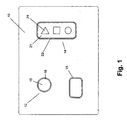
- Fig. 1 is a plan view of the front side of a surface with haptic feedback buttons in accordance with one embodiment of the present invention.
- Fig. 2 is a plan view of the rear side of a surface with haptic feedback buttons in accordance with one embodiment of the present invention.
- One embodiment of the present invention is a surface having a region that is isolated from the remainder of the surface by a surrounding deformable material, and having an actuator coupled to the isolated region.
- the actuator creates an isolated haptic feedback effect within the isolated region so that the isolated region may function as a button.
- the front side of surface, including the area of the button can be contiguous without cracks, thus resulting in a cleaner and sleeker look.
- Fig. 1 is a plan view of the front side of a surface 10 with haptic feedback buttons 12-14 in accordance with one embodiment.
- surface 10 forms a portion of an automotive dashboard.
- surface 10 is formed from wood.
- surface 10 can be formed of other materials such as, for example, glass, plastic, composite materials such as carbon fiber, and stone.
- Buttons 12-14 may include a graphical icon 24 to provide visual information to the user.
- Each button 12-14 is formed from an interior isolated region 21 (for button 14) that is cut from surface 10 by forming a gap around the perimeter of region 21 through the removal of material from surface 10.
- the gap formed around region 21 extends completely through surface 10 (i.e., from the front side to the back side of surface 10), and is filled with a deformable sealing material 22.
- Sealing material 22 allows isolated region 21 to move a small amount relative to the remainder of surface 10 so that a haptic effect can be generated on button 14 that is substantially confined within isolated region 21 of button 14 and generally cannot be felt in other regions of surface 10.
- the sealing material allows a user to see a contiguous surface. In other embodiments, it may be desired to allow flow of air or water through the seal.
- sealing material 22 is room temperature vulcanized ("RTV") silicone rubber.
- the silicone rubber is an ultra soft silicone "00 shore hardness" of 25. In other embodiments, any type of soft material such as rubber foam or felt may be used.
- the internal isolated region 15 of round button 12 has an approximate 1" diameter and the gap 16 around button 12, which is filled with sealing material, is approximately .062". In this embodiment, the seal around button 12 has an effective spring constant of approximately 10,000 N/m.
- Fig. 2 is a plan view of the rear side of a surface 10 with haptic feedback buttons 12-14 in accordance with one embodiment.
- each button 12-14 is coupled to at least one actuator 31-34 for generating haptic effects.
- actuators 31 and 32 are force displacement electromagnetic actuators that are coupled to both interior isolated region 21 of button 14 as well as an area outside of isolated region 21 in order to ground the actuators. The outside area may be adjacent to button 14 on surface 10 as shown in Fig. 2 , or can be any other area that allows the actuators to be grounded.
- An example of actuators 31 and 32 is disclosed in U.S. Pat. Appln. No. 11/128,217 , entitled "Method and Apparatus for Providing Haptic Effects to a Touch Panel".
- Actuator 33 is similar to actuators 31 and 32, and actuator 34 differs because it is only coupled to the isolated region 17 of button 13 (i.e., it is not grounded) and uses inertial mass to create the haptic effect. As a result, less force is required on the interior isolated regions of buttons 12-14 to create a relatively strong haptic effect due to the deformable material filled gap around the perimeter. Therefore, an inertial mass type actuator like actuator 34 may be used to generate a haptic effect.
- a film covers the front side of surface 10.
- the film connects each button to the remainder of the surface by bridging the gap, and provides a seal for the buttons.
- Examples of film that could be used include brass or steel thin stock (having a few thousands of an inch thickness), Mylar, Velum or plastic films.
- Other methods for physically attaching each button to the rest of the surface may be used.
- each button may include a tab that is attached to the surface at one location on the perimeter of the button, while still allowing the button to move relative to the surface.
- actuators 31-34 shown in Fig. 2 are electromagnetic types of actuators, any type of actuator can be used that can apply a haptic effect or force to surface 10 at the isolated interior regions of buttons 12-14.
- actuators 31-34 may be a "smart material” such as piezoelectric, electro-active polymers or shape memory alloys, or may be an Eccentric Rotating Mass (“ERM”) in which an eccentric mass is moved by a motor, or a Linear Resonant Actuator (“LRA”) in which a mass attached to a spring is driven back and forth.
- EEM Eccentric Rotating Mass
- LRA Linear Resonant Actuator
- a controller and other necessary components are coupled to actuators 31-34 in order to create the signals and power to actuators 31-34 to create the haptic effects.
- buttons 12-14 of Fig. 1 on the front side of surface 10 is enhanced by the addition of an electroluminescent luminescent layer and light emitting diodes ("LED's") applied on the rear side of surface 10 at the location of buttons 12-14, and a portion of buttons 12-14 are made translucent.
- the luminescent layer creates illumination allowing the icons for the buttons to be visible at night giving the appearance of back lighting.
- LEDs may be turned on or off to indicate the state of a device controlled by a button, for example the level of heat for a heated seat.
- the deformable sealing material and/or the isolated region may be made translucent to facilite the lighting effect.
- embodiments disclosed above are of an automotive dashboard, other embodiments can be implemented on a surface of any other type of device where isolated haptic effects are desired.
- Other embodiments can include aircraft buttons, buttons on appliances such as refrigerators, and buttons on medical devices where cleanliness concerns dictate having a smooth button surface.
- embodiments create an isolated haptic effect which creates many advantages. Because the haptic effect is isolated, it is stronger and thus can be more easily felt through, for example, a driving glove. Further, multiple buttons 12-14 of Fig. 1 can be pressed at the same time without having the haptic effect from one button bleeding over to the other button, and each button can be separately discernable by the user. These embodiments allow much greater design freedom of switch placement and increased aesthetics along with needed user haptic feedback. Further, these embodiments allow context to be included in the button press because the button does not always have to feel the same due to different available haptic effects. For example, if the button functionality was not permitted at the time of an attempted press, an error buzz effect could be played instead of a standard haptic effect. Further, the isolation of the haptic effect reduces power requirements by localizing the action to a small region, and reduces potential acoustic noise generation.
Landscapes
- Engineering & Computer Science (AREA)
- General Engineering & Computer Science (AREA)
- Theoretical Computer Science (AREA)
- Human Computer Interaction (AREA)
- Physics & Mathematics (AREA)
- General Physics & Mathematics (AREA)
- User Interface Of Digital Computer (AREA)
- Push-Button Switches (AREA)
- Switch Cases, Indication, And Locking (AREA)
- Position Input By Displaying (AREA)
Abstract
Description
- One embodiment of the present invention is directed to haptic feedback. More particularly, one embodiment of the present invention is directed to localizing haptic feedback to a specific region.
- Humans interface with electronic and mechanical devices in a variety of applications, and the need for a more natural, easy-to-use, and informative interface is a constant concern. In an automotive environment, the predominate interface is still a mechanical button or dial. One reason for the popularity of this kind of interface is that the driver of an automobile typically must engage a button or dial while maintaining a view of the road. Mechanical devices allow the driver to feel a mechanical button or dial.
- However, having mechanical buttons and dials introduces several disadvantages. For one, any type of mechanical interface is subject to wear and degradation. Second, buttons and dials on an automobile dashboard include cracks and crevices that build up dirt and become unsightly and unsanitary. Finally, many automobile manufacturers attempt to create a dashboard having a futuristic sleek look, and mechanical buttons can detract from this appearance.
- It is known to use force feedback or vibrotactile feedback (collectively referred to herein as "haptic feedback") in combination with a touchpad or touch control "buttons" in order to eliminate mechanical buttons. However, known haptic feedback devices tend not to isolate the feedback (i.e., vibration) within the boundaries of a specific "button". In many environments, this might not be a large problem. However, in an automobile environment and other environments where a user is not looking at the button when it is being "pressed", it is more important to isolate the haptic feedback to only the targeted region.
- Based on the foregoing, there is a need for a system and method in which haptic feedback is applied to a touch control so that the feedback is isolated to a targeted region.
- One embodiment of the present invention is a surface for generating an isolated haptic feedback. The surface includes an isolated region having a perimeter and a gap surrounding the perimeter, with the gap separating the isolated region from the rest of the surface. The surface further includes a deformable sealing material that is filled within the gap.
-
Fig. 1 is a plan view of the front side of a surface with haptic feedback buttons in accordance with one embodiment of the present invention.
Fig. 2 is a plan view of the rear side of a surface with haptic feedback buttons in accordance with one embodiment of the present invention. - One embodiment of the present invention is a surface having a region that is isolated from the remainder of the surface by a surrounding deformable material, and having an actuator coupled to the isolated region. The actuator creates an isolated haptic feedback effect within the isolated region so that the isolated region may function as a button. Further, the front side of surface, including the area of the button, can be contiguous without cracks, thus resulting in a cleaner and sleeker look.
-
Fig. 1 is a plan view of the front side of asurface 10 with haptic feedback buttons 12-14 in accordance with one embodiment. In one embodiment,surface 10 forms a portion of an automotive dashboard. In one embodiment,surface 10 is formed from wood. In other embodiments,surface 10 can be formed of other materials such as, for example, glass, plastic, composite materials such as carbon fiber, and stone. Buttons 12-14 may include agraphical icon 24 to provide visual information to the user. - Each button 12-14 is formed from an interior isolated region 21 (for button 14) that is cut from
surface 10 by forming a gap around the perimeter ofregion 21 through the removal of material fromsurface 10. The gap formed aroundregion 21 extends completely through surface 10 (i.e., from the front side to the back side of surface 10), and is filled with adeformable sealing material 22.Sealing material 22 allowsisolated region 21 to move a small amount relative to the remainder ofsurface 10 so that a haptic effect can be generated onbutton 14 that is substantially confined within isolatedregion 21 ofbutton 14 and generally cannot be felt in other regions ofsurface 10. The sealing material allows a user to see a contiguous surface. In other embodiments, it may be desired to allow flow of air or water through the seal. - In one embodiment, sealing
material 22 is room temperature vulcanized ("RTV") silicone rubber. In one embodiment, the silicone rubber is an ultra soft silicone "00 shore hardness" of 25. In other embodiments, any type of soft material such as rubber foam or felt may be used. In one embodiment, the internal isolatedregion 15 ofround button 12 has an approximate 1" diameter and thegap 16 aroundbutton 12, which is filled with sealing material, is approximately .062". In this embodiment, the seal aroundbutton 12 has an effective spring constant of approximately 10,000 N/m. -
Fig. 2 is a plan view of the rear side of asurface 10 with haptic feedback buttons 12-14 in accordance with one embodiment. On the rear side, each button 12-14 is coupled to at least one actuator 31-34 for generating haptic effects. In the embodiment shown inFig. 2 ,actuators isolated region 21 ofbutton 14 as well as an area outside ofisolated region 21 in order to ground the actuators. The outside area may be adjacent tobutton 14 onsurface 10 as shown inFig. 2 , or can be any other area that allows the actuators to be grounded. An example ofactuators U.S. Pat. Appln. No. 11/128,217 , entitled "Method and Apparatus for Providing Haptic Effects to a Touch Panel". -
Actuator 33 is similar toactuators actuator 34 differs because it is only coupled to theisolated region 17 of button 13 (i.e., it is not grounded) and uses inertial mass to create the haptic effect. As a result, less force is required on the interior isolated regions of buttons 12-14 to create a relatively strong haptic effect due to the deformable material filled gap around the perimeter. Therefore, an inertial mass type actuator likeactuator 34 may be used to generate a haptic effect. - In one embodiment, a film covers the front side of
surface 10. The film connects each button to the remainder of the surface by bridging the gap, and provides a seal for the buttons. Examples of film that could be used include brass or steel thin stock (having a few thousands of an inch thickness), Mylar, Velum or plastic films. Other methods for physically attaching each button to the rest of the surface may be used. For example, each button may include a tab that is attached to the surface at one location on the perimeter of the button, while still allowing the button to move relative to the surface. - Although actuators 31-34 shown in
Fig. 2 are electromagnetic types of actuators, any type of actuator can be used that can apply a haptic effect or force tosurface 10 at the isolated interior regions of buttons 12-14. For example, actuators 31-34 may be a "smart material" such as piezoelectric, electro-active polymers or shape memory alloys, or may be an Eccentric Rotating Mass ("ERM") in which an eccentric mass is moved by a motor, or a Linear Resonant Actuator ("LRA") in which a mass attached to a spring is driven back and forth. Further, a controller and other necessary components (not shown) are coupled to actuators 31-34 in order to create the signals and power to actuators 31-34 to create the haptic effects. - In one embodiment, the appearance and state of each of the buttons 12-14 of
Fig. 1 on the front side ofsurface 10 is enhanced by the addition of an electroluminescent luminescent layer and light emitting diodes ("LED's") applied on the rear side ofsurface 10 at the location of buttons 12-14, and a portion of buttons 12-14 are made translucent. The luminescent layer creates illumination allowing the icons for the buttons to be visible at night giving the appearance of back lighting. When a button 12-14 is pressed, to provide further feedback to the user, LEDs may be turned on or off to indicate the state of a device controlled by a button, for example the level of heat for a heated seat. In one embodiment, the deformable sealing material and/or the isolated region may be made translucent to facilite the lighting effect. - Although embodiments disclosed above are of an automotive dashboard, other embodiments can be implemented on a surface of any other type of device where isolated haptic effects are desired. Other embodiments can include aircraft buttons, buttons on appliances such as refrigerators, and buttons on medical devices where cleanliness concerns dictate having a smooth button surface.
- As described, embodiments create an isolated haptic effect which creates many advantages. Because the haptic effect is isolated, it is stronger and thus can be more easily felt through, for example, a driving glove. Further, multiple buttons 12-14 of
Fig. 1 can be pressed at the same time without having the haptic effect from one button bleeding over to the other button, and each button can be separately discernable by the user. These embodiments allow much greater design freedom of switch placement and increased aesthetics along with needed user haptic feedback. Further, these embodiments allow context to be included in the button press because the button does not always have to feel the same due to different available haptic effects. For example, if the button functionality was not permitted at the time of an attempted press, an error buzz effect could be played instead of a standard haptic effect. Further, the isolation of the haptic effect reduces power requirements by localizing the action to a small region, and reduces potential acoustic noise generation.
Claims (15)
- A system for providing haptic feedback in response to a user input, said system comprising:a surface comprising an isolated region having a perimeter, a gap surrounding the perimeter, and a deformable sealing material filled within said gap, andan actuator coupled to said isolated region.
- The system of claim 1, wherein the haptic feedback is generally localized within said isolated region.
- The system of claim 1, wherein said actuator is further coupled to an area that is outside of said isolated region.
- The system of claim 1, wherein said actuator is an electromagnetic actuator.
- The system of claim 2, wherein the haptic feedback comprises a vibration of said isolated region.
- The system of claim 1, wherein said deformable sealing material is silicone.
- The system of claim 1, further comprising a luminescent layer coupled to said surface for illuminating said isolated region.
- The system of claim 1, wherein said isolated region is translucent.
- The system of claim 1, wherein said deformable sealing material is translucent.
- The system of claim 1, wherein said gap separates the isolated region from a remainder of the surface.
- A method of providing feedback for a haptic enabled location on a surface, said method comprising:forming an isolated region on the surface by creating a perimeter gap in the surface and filling the gap with a deformable sealing material;receiving an indication that the haptic enabled location is pressed; andgenerating a haptic effect on the isolated region when the haptic enabled location is pressed.
- The method of claim 11, wherein said generating comprises contacting the isolated region with an actuator on a rear side of the surface.
- The method of claim 11, further comprising generating illumination at the haptic enabled location when the haptic enabled location is pressed.
- The method of claim 11, wherein the haptic effect indicates that a haptic enabled location press event has been recognized.
- The method of claim 11, wherein the haptic effect indicates that the haptic enabled location was pressed in error.
Applications Claiming Priority (2)
| Application Number | Priority Date | Filing Date | Title |
|---|---|---|---|
| US11/618,259 US7973769B2 (en) | 2006-12-29 | 2006-12-29 | Localized haptic feedback |
| EP20070871335 EP2097801B1 (en) | 2006-12-29 | 2007-11-02 | Localized haptic feedback |
Related Parent Applications (3)
| Application Number | Title | Priority Date | Filing Date |
|---|---|---|---|
| EP07871335.1 Division | 2007-11-02 | ||
| EP20070871335 Division-Into EP2097801B1 (en) | 2006-12-29 | 2007-11-02 | Localized haptic feedback |
| EP20070871335 Division EP2097801B1 (en) | 2006-12-29 | 2007-11-02 | Localized haptic feedback |
Publications (2)
| Publication Number | Publication Date |
|---|---|
| EP2420917A1 true EP2420917A1 (en) | 2012-02-22 |
| EP2420917B1 EP2420917B1 (en) | 2016-01-27 |
Family
ID=39474062
Family Applications (2)
| Application Number | Title | Priority Date | Filing Date |
|---|---|---|---|
| EP20070871335 Not-in-force EP2097801B1 (en) | 2006-12-29 | 2007-11-02 | Localized haptic feedback |
| EP11187841.9A Not-in-force EP2420917B1 (en) | 2006-12-29 | 2007-11-02 | Localized haptic feedback |
Family Applications Before (1)
| Application Number | Title | Priority Date | Filing Date |
|---|---|---|---|
| EP20070871335 Not-in-force EP2097801B1 (en) | 2006-12-29 | 2007-11-02 | Localized haptic feedback |
Country Status (4)
| Country | Link |
|---|---|
| US (1) | US7973769B2 (en) |
| EP (2) | EP2097801B1 (en) |
| JP (1) | JP5693007B2 (en) |
| WO (1) | WO2008082776A2 (en) |
Families Citing this family (23)
| Publication number | Priority date | Publication date | Assignee | Title |
|---|---|---|---|---|
| TWI358028B (en) * | 2007-12-25 | 2012-02-11 | Htc Corp | Electronic device capable of transferring object b |
| US8704649B2 (en) * | 2009-01-21 | 2014-04-22 | Korea Institute Of Science And Technology | Vibrotactile device and method using the same |
| WO2010134649A1 (en) * | 2009-05-19 | 2010-11-25 | 한국과학기술연구원 | Vibration haptic mobile apparatus and operating method thereof |
| US8378797B2 (en) * | 2009-07-17 | 2013-02-19 | Apple Inc. | Method and apparatus for localization of haptic feedback |
| US8310349B2 (en) * | 2009-09-29 | 2012-11-13 | Visteon Global Technologies, Inc. | Haptic surface with mechanical buttons |
| US20110267181A1 (en) * | 2010-04-29 | 2011-11-03 | Nokia Corporation | Apparatus and method for providing tactile feedback for user |
| US9477306B1 (en) * | 2010-08-24 | 2016-10-25 | Amazon Technologies, Inc. | Mutamorphic haptic substrate |
| WO2012055564A1 (en) * | 2010-10-28 | 2012-05-03 | Marquardt Gmbh | Switch control panel |
| US8493354B1 (en) | 2012-08-23 | 2013-07-23 | Immersion Corporation | Interactivity model for shared feedback on mobile devices |
| US8711118B2 (en) | 2012-02-15 | 2014-04-29 | Immersion Corporation | Interactivity model for shared feedback on mobile devices |
| US8570296B2 (en) | 2012-05-16 | 2013-10-29 | Immersion Corporation | System and method for display of multiple data channels on a single haptic display |
| DE102012020164B4 (en) | 2012-10-13 | 2026-07-16 | Volkswagen Aktiengesellschaft | Control element for a display device in a motor vehicle |
| KR102214929B1 (en) | 2013-04-15 | 2021-02-10 | 삼성전자주식회사 | Apparatus and method for providing tactile |
| EP2796965B1 (en) | 2013-04-22 | 2019-12-18 | Immersion Corporation | Gaming device having a haptic enabled trigger |
| US10328344B2 (en) | 2013-10-11 | 2019-06-25 | Valve Corporation | Game controller systems and methods |
| US9393493B2 (en) | 2013-11-12 | 2016-07-19 | Immersion Corporation | Gaming device with haptic effect isolated to user input elements |
| US9866149B2 (en) * | 2014-07-28 | 2018-01-09 | Immersion Corporation | Method and apparatus for enabling floating touch screen haptics assemblies |
| KR20160056834A (en) * | 2014-11-12 | 2016-05-20 | 임머숀 코퍼레이션 | Haptic controller |
| US10613629B2 (en) | 2015-03-27 | 2020-04-07 | Chad Laurendeau | System and method for force feedback interface devices |
| US10152132B2 (en) | 2016-02-26 | 2018-12-11 | Immersion Corporation | Method and apparatus for enabling heavy floating touchscreen haptics assembles and passive braking system |
| FR3104762B1 (en) | 2019-12-12 | 2022-09-16 | Actronika | Method for generating tactile sensations localized on a surface and haptic interface implementing this method |
| DE112021000913T5 (en) | 2020-02-06 | 2022-11-24 | Alps Alpine Co., Ltd. | SWITCH, SWITCH MODULE AND METHOD OF MAKING A SWITCH MODULE |
| US11907427B1 (en) | 2022-08-31 | 2024-02-20 | Fca Us Llc | Display with localized haptic response |
Citations (3)
| Publication number | Priority date | Publication date | Assignee | Title |
|---|---|---|---|---|
| US20020044132A1 (en) * | 1999-07-21 | 2002-04-18 | Fish Daniel E. | Force feedback computer input and output device with coordinated haptic elements |
| US20020056614A1 (en) * | 1999-02-26 | 2002-05-16 | Yazaki Corporation | Push switch structure for display |
| US20060256075A1 (en) * | 2005-05-12 | 2006-11-16 | Immersion Corporation | Method and apparatus for providing haptic effects to a touch panel |
Family Cites Families (14)
| Publication number | Priority date | Publication date | Assignee | Title |
|---|---|---|---|---|
| DE2842697C2 (en) * | 1978-09-30 | 1980-08-28 | Varta Batterie Ag, 3000 Hannover | Galvanic element and process for its manufacture |
| JPH01243325A (en) * | 1988-03-25 | 1989-09-28 | Matsushita Electric Ind Co Ltd | Input device |
| JP2559577Y2 (en) * | 1991-12-26 | 1998-01-19 | 住友金属鉱山株式会社 | Mounting structure of push button switch in electronic lock device |
| JPH07270457A (en) * | 1994-04-01 | 1995-10-20 | Seiko Epson Corp | Digital Multimeters |
| JP2000222968A (en) * | 1999-01-29 | 2000-08-11 | Matsushita Electric Ind Co Ltd | Input device |
| JP2003317572A (en) * | 2002-04-25 | 2003-11-07 | Alps Electric Co Ltd | Switch device |
| CN1898051B (en) * | 2003-10-20 | 2010-04-28 | 播磨化成株式会社 | Fine metal particles and fine metal oxide particles in dry powder form and their use |
| WO2006070854A1 (en) * | 2004-12-28 | 2006-07-06 | Sunarrow Limited | Thin key sheet and thin key unit incorporating the thin key sheet |
| US7527403B2 (en) * | 2005-06-14 | 2009-05-05 | Donnelly Corp. | Mirror assembly for vehicle |
| DE102006033014A1 (en) * | 2005-09-13 | 2007-04-05 | Volkswagen Ag | Input device for motor vehicle, has touch screen deflected such that integral of deflection of screen in one direction amounts to four times of integral of deflection of screen in another direction opposite to former direction |
| US20070057928A1 (en) * | 2005-09-14 | 2007-03-15 | Michael Prados | Input device for a vehicle |
| US20080068334A1 (en) * | 2006-09-14 | 2008-03-20 | Immersion Corporation | Localized Haptic Feedback |
| US20080100568A1 (en) * | 2006-10-30 | 2008-05-01 | Koch Paul B | Electronic device providing tactile feedback |
| US8174372B2 (en) * | 2008-06-26 | 2012-05-08 | Immersion Corporation | Providing haptic feedback on a touch surface |
-
2006
- 2006-12-29 US US11/618,259 patent/US7973769B2/en not_active Expired - Fee Related
-
2007
- 2007-11-02 JP JP2009544133A patent/JP5693007B2/en not_active Expired - Fee Related
- 2007-11-02 WO PCT/US2007/083431 patent/WO2008082776A2/en not_active Ceased
- 2007-11-02 EP EP20070871335 patent/EP2097801B1/en not_active Not-in-force
- 2007-11-02 EP EP11187841.9A patent/EP2420917B1/en not_active Not-in-force
Patent Citations (3)
| Publication number | Priority date | Publication date | Assignee | Title |
|---|---|---|---|---|
| US20020056614A1 (en) * | 1999-02-26 | 2002-05-16 | Yazaki Corporation | Push switch structure for display |
| US20020044132A1 (en) * | 1999-07-21 | 2002-04-18 | Fish Daniel E. | Force feedback computer input and output device with coordinated haptic elements |
| US20060256075A1 (en) * | 2005-05-12 | 2006-11-16 | Immersion Corporation | Method and apparatus for providing haptic effects to a touch panel |
Also Published As
| Publication number | Publication date |
|---|---|
| US20080163051A1 (en) | 2008-07-03 |
| JP5693007B2 (en) | 2015-04-01 |
| EP2097801B1 (en) | 2015-05-20 |
| JP2010515228A (en) | 2010-05-06 |
| US7973769B2 (en) | 2011-07-05 |
| WO2008082776A3 (en) | 2008-08-21 |
| EP2097801A2 (en) | 2009-09-09 |
| WO2008082776A2 (en) | 2008-07-10 |
| EP2420917B1 (en) | 2016-01-27 |
Similar Documents
| Publication | Publication Date | Title |
|---|---|---|
| EP2097801B1 (en) | Localized haptic feedback | |
| EP2428871B1 (en) | Localized haptic feedback | |
| CN112714710B (en) | Display device for the interior of a motor vehicle and motor vehicle | |
| US10126928B2 (en) | Vehicle human machine interface with auto-customization | |
| US10795519B2 (en) | Vehicle interior panel with shape-changing surface | |
| US8614683B2 (en) | Touch sensitive input device having first and second display layers | |
| EP2054904B1 (en) | Control module, in particular for an automotive vehicle module | |
| EP3476658A1 (en) | Trim part | |
| US20190310099A1 (en) | Operating system for a motor vehicle, interior part and steering wheel with an operating system | |
| US11021099B2 (en) | Touch module for vehicle interior trim and interior trim comprising such touch module and vehicle | |
| JP2022502802A (en) | Vehicle control device and its manufacturing method | |
| CN112706706A (en) | Opening switch for vehicle | |
| US20210188091A1 (en) | Hidden switch embedded in soft thermoplastic elastomer or polyurethane and method of making | |
| CN117813218A (en) | vehicle decoration device | |
| CN119305493A (en) | Motor vehicle interior parts | |
| US11907427B1 (en) | Display with localized haptic response | |
| JP2005166292A (en) | Shape-changing member and switching device |
Legal Events
| Date | Code | Title | Description |
|---|---|---|---|
| AC | Divisional application: reference to earlier application |
Ref document number: 2097801 Country of ref document: EP Kind code of ref document: P |
|
| AK | Designated contracting states |
Kind code of ref document: A1 Designated state(s): AT BE BG CH CY CZ DE DK EE ES FI FR GB GR HU IE IS IT LI LT LU LV MC MT NL PL PT RO SE SI SK TR |
|
| PUAI | Public reference made under article 153(3) epc to a published international application that has entered the european phase |
Free format text: ORIGINAL CODE: 0009012 |
|
| 17P | Request for examination filed |
Effective date: 20120821 |
|
| RAP1 | Party data changed (applicant data changed or rights of an application transferred) |
Owner name: IMMERSION CORPORATION |
|
| 17Q | First examination report despatched |
Effective date: 20140520 |
|
| 17Q | First examination report despatched |
Effective date: 20140711 |
|
| GRAP | Despatch of communication of intention to grant a patent |
Free format text: ORIGINAL CODE: EPIDOSNIGR1 |
|
| INTG | Intention to grant announced |
Effective date: 20150610 |
|
| RAP1 | Party data changed (applicant data changed or rights of an application transferred) |
Owner name: IMMERSION CORPORATION |
|
| GRAS | Grant fee paid |
Free format text: ORIGINAL CODE: EPIDOSNIGR3 |
|
| GRAA | (expected) grant |
Free format text: ORIGINAL CODE: 0009210 |
|
| AC | Divisional application: reference to earlier application |
Ref document number: 2097801 Country of ref document: EP Kind code of ref document: P |
|
| AK | Designated contracting states |
Kind code of ref document: B1 Designated state(s): AT BE BG CH CY CZ DE DK EE ES FI FR GB GR HU IE IS IT LI LT LU LV MC MT NL PL PT RO SE SI SK TR |
|
| REG | Reference to a national code |
Ref country code: GB Ref legal event code: FG4D |
|
| REG | Reference to a national code |
Ref country code: CH Ref legal event code: EP |
|
| REG | Reference to a national code |
Ref country code: AT Ref legal event code: REF Ref document number: 772986 Country of ref document: AT Kind code of ref document: T Effective date: 20160215 |
|
| REG | Reference to a national code |
Ref country code: IE Ref legal event code: FG4D |
|
| REG | Reference to a national code |
Ref country code: DE Ref legal event code: R096 Ref document number: 602007044754 Country of ref document: DE |
|
| REG | Reference to a national code |
Ref country code: LT Ref legal event code: MG4D |
|
| REG | Reference to a national code |
Ref country code: NL Ref legal event code: MP Effective date: 20160127 |
|
| REG | Reference to a national code |
Ref country code: AT Ref legal event code: MK05 Ref document number: 772986 Country of ref document: AT Kind code of ref document: T Effective date: 20160127 |
|
| PG25 | Lapsed in a contracting state [announced via postgrant information from national office to epo] |
Ref country code: NL Free format text: LAPSE BECAUSE OF FAILURE TO SUBMIT A TRANSLATION OF THE DESCRIPTION OR TO PAY THE FEE WITHIN THE PRESCRIBED TIME-LIMIT Effective date: 20160127 |
|
| PG25 | Lapsed in a contracting state [announced via postgrant information from national office to epo] |
Ref country code: IT Free format text: LAPSE BECAUSE OF FAILURE TO SUBMIT A TRANSLATION OF THE DESCRIPTION OR TO PAY THE FEE WITHIN THE PRESCRIBED TIME-LIMIT Effective date: 20160127 Ref country code: GR Free format text: LAPSE BECAUSE OF FAILURE TO SUBMIT A TRANSLATION OF THE DESCRIPTION OR TO PAY THE FEE WITHIN THE PRESCRIBED TIME-LIMIT Effective date: 20160428 Ref country code: FI Free format text: LAPSE BECAUSE OF FAILURE TO SUBMIT A TRANSLATION OF THE DESCRIPTION OR TO PAY THE FEE WITHIN THE PRESCRIBED TIME-LIMIT Effective date: 20160127 Ref country code: ES Free format text: LAPSE BECAUSE OF FAILURE TO SUBMIT A TRANSLATION OF THE DESCRIPTION OR TO PAY THE FEE WITHIN THE PRESCRIBED TIME-LIMIT Effective date: 20160127 |
|
| PG25 | Lapsed in a contracting state [announced via postgrant information from national office to epo] |
Ref country code: IS Free format text: LAPSE BECAUSE OF FAILURE TO SUBMIT A TRANSLATION OF THE DESCRIPTION OR TO PAY THE FEE WITHIN THE PRESCRIBED TIME-LIMIT Effective date: 20160527 Ref country code: PT Free format text: LAPSE BECAUSE OF FAILURE TO SUBMIT A TRANSLATION OF THE DESCRIPTION OR TO PAY THE FEE WITHIN THE PRESCRIBED TIME-LIMIT Effective date: 20160527 Ref country code: SE Free format text: LAPSE BECAUSE OF FAILURE TO SUBMIT A TRANSLATION OF THE DESCRIPTION OR TO PAY THE FEE WITHIN THE PRESCRIBED TIME-LIMIT Effective date: 20160127 Ref country code: AT Free format text: LAPSE BECAUSE OF FAILURE TO SUBMIT A TRANSLATION OF THE DESCRIPTION OR TO PAY THE FEE WITHIN THE PRESCRIBED TIME-LIMIT Effective date: 20160127 Ref country code: PL Free format text: LAPSE BECAUSE OF FAILURE TO SUBMIT A TRANSLATION OF THE DESCRIPTION OR TO PAY THE FEE WITHIN THE PRESCRIBED TIME-LIMIT Effective date: 20160127 Ref country code: LV Free format text: LAPSE BECAUSE OF FAILURE TO SUBMIT A TRANSLATION OF THE DESCRIPTION OR TO PAY THE FEE WITHIN THE PRESCRIBED TIME-LIMIT Effective date: 20160127 Ref country code: LT Free format text: LAPSE BECAUSE OF FAILURE TO SUBMIT A TRANSLATION OF THE DESCRIPTION OR TO PAY THE FEE WITHIN THE PRESCRIBED TIME-LIMIT Effective date: 20160127 |
|
| REG | Reference to a national code |
Ref country code: DE Ref legal event code: R097 Ref document number: 602007044754 Country of ref document: DE |
|
| PG25 | Lapsed in a contracting state [announced via postgrant information from national office to epo] |
Ref country code: DK Free format text: LAPSE BECAUSE OF FAILURE TO SUBMIT A TRANSLATION OF THE DESCRIPTION OR TO PAY THE FEE WITHIN THE PRESCRIBED TIME-LIMIT Effective date: 20160127 Ref country code: EE Free format text: LAPSE BECAUSE OF FAILURE TO SUBMIT A TRANSLATION OF THE DESCRIPTION OR TO PAY THE FEE WITHIN THE PRESCRIBED TIME-LIMIT Effective date: 20160127 |
|
| REG | Reference to a national code |
Ref country code: FR Ref legal event code: PLFP Year of fee payment: 10 |
|
| PG25 | Lapsed in a contracting state [announced via postgrant information from national office to epo] |
Ref country code: RO Free format text: LAPSE BECAUSE OF FAILURE TO SUBMIT A TRANSLATION OF THE DESCRIPTION OR TO PAY THE FEE WITHIN THE PRESCRIBED TIME-LIMIT Effective date: 20160127 Ref country code: CZ Free format text: LAPSE BECAUSE OF FAILURE TO SUBMIT A TRANSLATION OF THE DESCRIPTION OR TO PAY THE FEE WITHIN THE PRESCRIBED TIME-LIMIT Effective date: 20160127 Ref country code: SK Free format text: LAPSE BECAUSE OF FAILURE TO SUBMIT A TRANSLATION OF THE DESCRIPTION OR TO PAY THE FEE WITHIN THE PRESCRIBED TIME-LIMIT Effective date: 20160127 |
|
| PLBE | No opposition filed within time limit |
Free format text: ORIGINAL CODE: 0009261 |
|
| STAA | Information on the status of an ep patent application or granted ep patent |
Free format text: STATUS: NO OPPOSITION FILED WITHIN TIME LIMIT |
|
| PG25 | Lapsed in a contracting state [announced via postgrant information from national office to epo] |
Ref country code: BE Free format text: LAPSE BECAUSE OF FAILURE TO SUBMIT A TRANSLATION OF THE DESCRIPTION OR TO PAY THE FEE WITHIN THE PRESCRIBED TIME-LIMIT Effective date: 20160127 |
|
| 26N | No opposition filed |
Effective date: 20161028 |
|
| PG25 | Lapsed in a contracting state [announced via postgrant information from national office to epo] |
Ref country code: SI Free format text: LAPSE BECAUSE OF FAILURE TO SUBMIT A TRANSLATION OF THE DESCRIPTION OR TO PAY THE FEE WITHIN THE PRESCRIBED TIME-LIMIT Effective date: 20160127 Ref country code: BG Free format text: LAPSE BECAUSE OF FAILURE TO SUBMIT A TRANSLATION OF THE DESCRIPTION OR TO PAY THE FEE WITHIN THE PRESCRIBED TIME-LIMIT Effective date: 20160427 |
|
| REG | Reference to a national code |
Ref country code: CH Ref legal event code: PL |
|
| PG25 | Lapsed in a contracting state [announced via postgrant information from national office to epo] |
Ref country code: LI Free format text: LAPSE BECAUSE OF NON-PAYMENT OF DUE FEES Effective date: 20161130 Ref country code: CH Free format text: LAPSE BECAUSE OF NON-PAYMENT OF DUE FEES Effective date: 20161130 |
|
| REG | Reference to a national code |
Ref country code: IE Ref legal event code: MM4A |
|
| PG25 | Lapsed in a contracting state [announced via postgrant information from national office to epo] |
Ref country code: LU Free format text: LAPSE BECAUSE OF NON-PAYMENT OF DUE FEES Effective date: 20161130 |
|
| REG | Reference to a national code |
Ref country code: FR Ref legal event code: PLFP Year of fee payment: 11 |
|
| PG25 | Lapsed in a contracting state [announced via postgrant information from national office to epo] |
Ref country code: IE Free format text: LAPSE BECAUSE OF NON-PAYMENT OF DUE FEES Effective date: 20161102 |
|
| PG25 | Lapsed in a contracting state [announced via postgrant information from national office to epo] |
Ref country code: CY Free format text: LAPSE BECAUSE OF FAILURE TO SUBMIT A TRANSLATION OF THE DESCRIPTION OR TO PAY THE FEE WITHIN THE PRESCRIBED TIME-LIMIT Effective date: 20160127 Ref country code: HU Free format text: LAPSE BECAUSE OF FAILURE TO SUBMIT A TRANSLATION OF THE DESCRIPTION OR TO PAY THE FEE WITHIN THE PRESCRIBED TIME-LIMIT; INVALID AB INITIO Effective date: 20071102 |
|
| PG25 | Lapsed in a contracting state [announced via postgrant information from national office to epo] |
Ref country code: TR Free format text: LAPSE BECAUSE OF FAILURE TO SUBMIT A TRANSLATION OF THE DESCRIPTION OR TO PAY THE FEE WITHIN THE PRESCRIBED TIME-LIMIT Effective date: 20160127 Ref country code: MC Free format text: LAPSE BECAUSE OF FAILURE TO SUBMIT A TRANSLATION OF THE DESCRIPTION OR TO PAY THE FEE WITHIN THE PRESCRIBED TIME-LIMIT Effective date: 20160127 |
|
| PG25 | Lapsed in a contracting state [announced via postgrant information from national office to epo] |
Ref country code: MT Free format text: LAPSE BECAUSE OF NON-PAYMENT OF DUE FEES Effective date: 20161102 |
|
| PGFP | Annual fee paid to national office [announced via postgrant information from national office to epo] |
Ref country code: DE Payment date: 20191127 Year of fee payment: 13 |
|
| PGFP | Annual fee paid to national office [announced via postgrant information from national office to epo] |
Ref country code: FR Payment date: 20191125 Year of fee payment: 13 |
|
| PGFP | Annual fee paid to national office [announced via postgrant information from national office to epo] |
Ref country code: GB Payment date: 20191127 Year of fee payment: 13 |
|
| REG | Reference to a national code |
Ref country code: DE Ref legal event code: R119 Ref document number: 602007044754 Country of ref document: DE |
|
| GBPC | Gb: european patent ceased through non-payment of renewal fee |
Effective date: 20201102 |
|
| PG25 | Lapsed in a contracting state [announced via postgrant information from national office to epo] |
Ref country code: FR Free format text: LAPSE BECAUSE OF NON-PAYMENT OF DUE FEES Effective date: 20201130 |
|
| PG25 | Lapsed in a contracting state [announced via postgrant information from national office to epo] |
Ref country code: DE Free format text: LAPSE BECAUSE OF NON-PAYMENT OF DUE FEES Effective date: 20210601 Ref country code: GB Free format text: LAPSE BECAUSE OF NON-PAYMENT OF DUE FEES Effective date: 20201102 |