EP2420909A1 - Procédé de gestion d'un mouvement de lacet d'un aéronef roulant au sol - Google Patents
Procédé de gestion d'un mouvement de lacet d'un aéronef roulant au sol Download PDFInfo
- Publication number
- EP2420909A1 EP2420909A1 EP20110177235 EP11177235A EP2420909A1 EP 2420909 A1 EP2420909 A1 EP 2420909A1 EP 20110177235 EP20110177235 EP 20110177235 EP 11177235 A EP11177235 A EP 11177235A EP 2420909 A1 EP2420909 A1 EP 2420909A1
- Authority
- EP
- European Patent Office
- Prior art keywords
- aircraft
- yaw rate
- yaw
- orientation
- angle
- Prior art date
- Legal status (The legal status is an assumption and is not a legal conclusion. Google has not performed a legal analysis and makes no representation as to the accuracy of the status listed.)
- Granted
Links
Images

Classifications
-
- G—PHYSICS
- G05—CONTROLLING; REGULATING
- G05D—SYSTEMS FOR CONTROLLING OR REGULATING NON-ELECTRIC VARIABLES
- G05D1/00—Control of position, course, altitude or attitude of land, water, air or space vehicles, e.g. using automatic pilots
- G05D1/0083—Control of position, course, altitude or attitude of land, water, air or space vehicles, e.g. using automatic pilots to help an aircraft pilot in the rolling phase
-
- B—PERFORMING OPERATIONS; TRANSPORTING
- B64—AIRCRAFT; AVIATION; COSMONAUTICS
- B64C—AEROPLANES; HELICOPTERS
- B64C25/00—Alighting gear
- B64C25/32—Alighting gear characterised by elements which contact the ground or similar surface
- B64C25/50—Steerable undercarriages; Shimmy-damping
-
- Y—GENERAL TAGGING OF NEW TECHNOLOGICAL DEVELOPMENTS; GENERAL TAGGING OF CROSS-SECTIONAL TECHNOLOGIES SPANNING OVER SEVERAL SECTIONS OF THE IPC; TECHNICAL SUBJECTS COVERED BY FORMER USPC CROSS-REFERENCE ART COLLECTIONS [XRACs] AND DIGESTS
- Y10—TECHNICAL SUBJECTS COVERED BY FORMER USPC
- Y10T—TECHNICAL SUBJECTS COVERED BY FORMER US CLASSIFICATION
- Y10T70/00—Locks
- Y10T70/50—Special application
- Y10T70/5611—For control and machine elements
- Y10T70/5646—Rotary shaft
- Y10T70/565—Locked stationary
- Y10T70/5655—Housing-carried lock
- Y10T70/5664—Latching bolt
Definitions
- the invention relates to a method for managing a yaw movement of an aircraft taxiing on the ground.
- an aircraft comprises a landing gear, which comprises several landing gear, in order to provide an interface between the aircraft and the ground.
- a pilot controls a yaw movement of an aircraft taxiing on the ground by acting on steering members (pedals of a rudder, control wheel, etc.).
- steering members pedals of a rudder, control wheel, etc.
- the steering members directly request, from a control law depending on the speed of the aircraft, the steerable lower part.
- the object of the invention is to provide a method of managing a yaw movement of a taxiing aircraft in which the angle of orientation of the lower part is slaved differently.
- a method for managing a yaw movement of an aircraft taxiing on the ground comprising at least one first undercarriage with a pivotable lower part carrying wheels.
- the lower part is oriented by regulating the orientation angle around a prepositioning position of the lower part.
- the method is applied to an aircraft further comprising at least two main landing gear disposed respectively to the left and right of the fuselage and whose wheels are associated with torque application members, the method comprising the step of generating, to the torque application members of the main landing gear left and right, two instructions acceleration so that the organs thus solicited generate at the aircraft a pair of yaw complementary to the yaw torque generated by the first undercarriage so that the total yaw torque generated at the level of the aircraft allows the aircraft to respond to the yaw rate instruction.
- the torque application members are for example friction brakes and / or autonomous displacement devices, an autonomous displacement device comprising a motor.
- the method according to the invention thus makes it possible to simultaneously manage, by distribution of the yaw torque, both the orientation of the lower part of the first undercarriage and a rotation speed differential of the main undercarriages.
- the pilot no longer has to worry about how the controls are distributed to act on the orientation of the lower part and the acceleration of the wheels of the main landing gear.
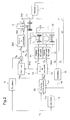
- the method according to the invention is detailed in application to an aircraft 1 comprising at least a first undercarriage with a steerable lower part carrying wheels.
- the aircraft 1 comprises here an auxiliary undercarriage 2 which is located at the front of the fuselage and which comprises a lower part 3 which can be steered by actuators 100.
- a control member 200 controls the actuators 100 of the lower part 3.
- a pilot wishing to make a yaw movement to the aircraft 1 rolling on the ground then acts on different steering members (such as pedals or a control wheel) to generate a set of yaw rate ⁇ c .
- a computer 4 determines an angular prepositioning ⁇ p of the orientation of the wheels of the lower part 3 by a calculation here identical to that explained in the aforementioned thesis.
- mono-variable equalizer 5 determines a yaw torque command M za generating at the aircraft 1 by the auxiliary undercarriage 2 so that the torque M za generated lace allows the aircraft 1 to respond to the yaw rate ⁇ c .
- a second computer 6 translates the yaw torque setpoint M za into an angle setpoint ⁇ z .
- An orientation angle setpoint ⁇ c is then generated to the control member 200, the orientation angle ⁇ c being equal to the sum of the prepositioning ⁇ p and the angle ⁇ z deduced from the set of yaw torque M za .
- the controller 200 controls the actuators 100 so that they guide the lower part 3 of the orientation angle ⁇ c.
- a measurement of the yaw rate ⁇ m of the aircraft 1 is performed. From the measured yaw rate ⁇ m and the yaw rate setpoint ⁇ c , the one-variable corrector 5 determines the yaw torque setpoint M za taking into account an error between the yaw rate setpoint. ⁇ c and the yaw rate measured ⁇ m when the orientable lower part is orientated by the orientation angle ⁇ c .
- the angle setpoint ⁇ z which results from directly to the yaw torque command M za is also determined on the basis of an error between the setpoint yaw rate ⁇ c and the measured yaw speed ⁇ m.
- a yaw rate of the aircraft 1 close to the yaw rate ⁇ c . Then, by a regulation 7 of the orientation angle ⁇ c around the prepositioning, a yaw rate of the aircraft 1 is obtained which conforms to the yaw rate set point ⁇ c , at least under normal operating conditions. orientation of the lower part.
- a measurement of the orientation angle ⁇ m is performed. From the measured orientation angle ⁇ m , the second computer 6 determines the angle setpoint ⁇ z , resulting directly from the yaw torque setpoint M za , taking into account an error between the setpoint of orientation angle ⁇ c and the measured orientation angle ⁇ m . 8 by regulating the orientation angle ⁇ c, one obtains an orientation angle according to the orientation angle ⁇ c setpoint without the first control 7 not directly integrates the error between the setpoint angle of orientation ⁇ c and the measured orientation angle ⁇ m .
- the aircraft 1 further comprises at least two main undercarriages 9, 10 disposed respectively at the rear left and right of the fuselage and whose wheels are associated with torque application members respectively 11, 12.
- said members 11, 12 can create a rotation speed differential between the wheels of the main left undercarriage 9 and the right undercarriage 10.
- the method of the invention integrates the torque application members 11, 12 so simultaneously managing the orientation of the lower part 3 of the undercarriage 1 and a rotation speed differential of the main landing gear 9,10.
- a multi-variable corrector 50 determines simultaneously the yaw torque command M za generating at the aircraft 1 by the auxiliary undercarriage 2 and a complementary yaw torque setpoint M zp to be generated at the level of the aircraft 1 by the torque application members 11, 12 so that the total yaw torque generated by the undercarriage 2 and the application members torque 11,12, allows the aircraft 1 to respond to the yaw rate ⁇ c .
- the torque application members 11, 12 are controlled by a control module 13. From the complementary yaw torque setpoint M zp , the control module 13 generates two acceleration instructions ⁇ g , ⁇ d to the torque application members 11, 12. In certain circumstances (wet track, defective acceleration means, etc.), it may be that one or more of said members can only generate a limited acceleration preventing to achieve the complementary yaw torque setpoint M zp . In this case, a saturation signal Satg, Sat d is sent by the left main landing gear 9 or right 10 to the control module 13 which then takes into account this saturation to generate acceleration instructions ⁇ g , ⁇ d allowing to get as close as possible to the complementary yaw torque setpoint M zp required.
- a saturation signal Satg, Sat d is sent by the left main landing gear 9 or right 10 to the control module 13 which then takes into account this saturation to generate acceleration instructions ⁇ g , ⁇ d allowing to get as close as possible to the complementary yaw torque setpoint M z
- the multi-variable corrector 50 simultaneously determines the yaw torque command M za to be generated by the auxiliary undercarriage 2 and the complementary yaw torque setpoint M zp to be generated by the members application torque 11, 12 so that the total yaw torque allows the aircraft 1 to respond to the yaw rate ⁇ c .
- the multi-variable corrector 50 takes account of an error between the yaw rate instruction ⁇ c and the measured yaw rate ⁇ m when the steerable lower part 3 is oriented from the orientation angle ⁇ c and the torque application members 11, 12 rotated with an acceleration ⁇ g , ⁇ d .
- an acceleration regulation of the torque application members 11, 12 is also obtained.
- a third computer 14 translates the yaw rate setpoint ⁇ c ⁇ in a rotation speed differential setpoint ⁇ c, said target being then transmitted to the multi-variable corrector 50.
- a measurement of the average rotation speeds ⁇ g , ⁇ d of the wheels of the main landing gear respectively left and right 9,10 is performed.
- a fourth computer 15 determines a measured rotation speed differential ⁇ ⁇ m which is then transmitted to the multi-variable corrector 50.
- the multi-variable corrector 50 determines the complementary yaw torque setpoint M zp to be generated by the torque application members 11, 12 taking into account the an error between the rotational speed differential setpoint ⁇ ⁇ c and the measured rotational speed differential ⁇ ⁇ m .
- a third regulation 16 one obtains the accelerations of the wheels of the left and right main undercarriages 9,10 in accordance with the acceleration instructions ⁇ g , ⁇ d without the first regulation 7 directly integrating the error between the rotation speed differential setpoint ⁇ ⁇ c and the rotational speed differential measured ⁇ ⁇ m .
- acceleration of the wheels of the main undercarriages 9,10 is meant as well a positive acceleration of the wheels as a negative acceleration of the wheels, the negative acceleration being also called deceleration.
- the aircraft 1 comprises an auxiliary undercarriage at the front 2 and two main undercarriages at the rear 9, 10, the undercarriages can of course have any other arrangement.
- the aircraft 1 may include a different number of undercarriages and each undercarriage may include a different number of wheels.
Landscapes
- Engineering & Computer Science (AREA)
- Aviation & Aerospace Engineering (AREA)
- Radar, Positioning & Navigation (AREA)
- Remote Sensing (AREA)
- Physics & Mathematics (AREA)
- General Physics & Mathematics (AREA)
- Automation & Control Theory (AREA)
- Mechanical Engineering (AREA)
- Steering Control In Accordance With Driving Conditions (AREA)
- Regulating Braking Force (AREA)
- Control Of Position, Course, Altitude, Or Attitude Of Moving Bodies (AREA)
Abstract
Description
- L'invention concerne un procédé de gestion d'un mouvement de lacet d'un aéronef roulant au sol.
- On rappelle qu'un aéronef comporte un train d'atterrissage, qui comporte plusieurs atterrisseurs, dans le but d'assurer une interface entre l'aéronef et le sol.
- Habituellement, un pilote contrôle un mouvement de lacet d'un aéronef roulant au sol en agissant sur des organes de pilotage (pédales d'un palonnier, volant de commande ...). Dans le cas d'un aéronef comportant au moins un atterrisseur avec une partie basse orientable portant des roues, les organes de pilotage sollicitent directement, à partir d'une loi de pilotage dépendant de la vitesse de l'aéronef, la partie basse orientable.
- Il est connu de la thèse « Automatisation du pilotage au sol pour la navigation portuaire » rédigé par M. Jean DUPREZ pour Airbus France - LAAS en 2004 (accessible sur le site Internet des thèses en ligne http://tel.archives-ouvertes.fr/) de modifier la loi de pilotage afin d'aider davantage le pilote à gérer le mouvement de lacet. La thèse décrit ainsi le procédé suivant :
- à partir d'un ordre généré par des organes de pilotage, déterminer un prépositionnement angulaire d'orientation des roues de la partie basse de l'atterrisseur;
- mettre en oeuvre une boucle d'asservissement ayant pour entrée le prépositionnement et générant une correction de celui-ci;
- orienter la partie basse d'un angle d'orientation égal au prépositionnement duquel on a soustrait la correction.
- L'objet de l'invention est de proposer un procédé de gestion d'un mouvement de lacet d'un aéronef roulant au sol dans lequel l'angle d'orientation de la partie basse est asservi de façon différente.
- En vue de la réalisation de ce but, on propose un procédé de gestion d'un mouvement de lacet d'un aéronef roulant au sol, l'aéronef comportant au moins un premier atterrisseur avec une partie basse orientable portant des roues.
- Selon l'invention, le procédé comporte les étapes de :
- à partir d'une consigne de vitesse de lacet, déterminer un prépositionnement angulaire d'orientation des roues ;
- mettre en oeuvre une boucle d'asservissement ayant pour entrée la consigne de vitesse de lacet et générant un ordre d'orientation de la partie basse pour orienter celle-ci d'un angle d'orientation égal à la somme du prépositionnement et d'un angle qui est déterminé en tenant compte d'une erreur entre la consigne de vitesse de lacet et la vitesse de lacet mesurée lorsque la partie basse orientable est orientée de l'angle d'orientation.
- Ainsi, la partie basse est orientée par régulation de l'angle d'orientation autour d'une position de prépositionnement de la partie basse.
- Selon un mode de réalisation privilégié de l'invention, le procédé est appliqué à un aéronef comportant en outre au moins deux atterrisseurs principaux disposés respectivement à gauche et à droite du fuselage et dont les roues sont associées à des organes d'application de couple, le procédé comportant l'étape de générer, à destination des organes d'application de couple des atterrisseurs principaux gauche et droit, deux consignes d'accélération de sorte que les organes ainsi sollicités génèrent au niveau de l'aéronef un couple de lacet complémentaire au couple de lacet généré par le premier atterrisseur de sorte que le couple de lacet total généré au niveau de l'aéronef permette à l'aéronef de répondre à la consigne de vitesse de lacet.
- Les organes d'application de couple sont par exemple des freins à friction et/ou des dispositifs de déplacement autonome, un dispositif de déplacement autonome comportant un moteur.
- Le procédé selon l'invention permet ainsi de gérer de façon simultanée, par répartition du couple de lacet, à la fois l'orientation de la partie basse du premier atterrisseur et un différentiel de vitesses de rotation des atterrisseurs principaux. Le pilote n'a plus à se soucier de la façon dont les commandes sont réparties pour agir sur l'orientation de la partie basse et sur l'accélération des roues des atterrisseurs principaux.
- L'invention sera mieux comprise à la lumière de la description qui suit d'un mode de réalisation particulier non limitatif de l'invention en référence aux figures des dessins annexés parmi lesquels:
- la
figure 1 est un schéma de principe de mise en oeuvre du procédé selon l'invention ; - la
figure 2 est un schéma de principe de mise en oeuvre du procédé selon l'invention dans un mode de réalisation privilégié. - En référence à la
figure 1 , le procédé selon l'invention est détaillé en application à un aéronef 1 comportant au moins un premier atterrisseur avec une partie basse orientable portant des roues. L'aéronef 1 comporte ici un atterrisseur auxiliaire 2 qui est situé à l'avant du fuselage et qui comporte une partie basse 3 orientable par des actionneurs 100. Un organe de commande 200 contrôle les actionneurs 100 de la partie basse 3. - Un pilote souhaitant faire réaliser un mouvement de lacet à l'aéronef 1 roulant au sol agit alors sur différents organes de pilotage (comme des pédales de palonnier ou un volant de commande) pour générer une consigne de vitesse de lacet ϕ̇ c .
- A partir de la consigne de vitesse de lacet ϕ̇ c , un calculateur 4 détermine un prépositionnement angulaire θp d'orientation des roues de la partie basse 3 par un calcul ici identique à celui explicité dans la thèse précitée.
- Parallèlement, à partir de la consigne de vitesse de lacet ϕ̇ c , un correcteur mono-variable 5 détermine une consigne de couple de lacet Mza à générer au niveau de l'aéronef 1 par l'atterrisseur auxiliaire 2 de sorte que le couple de lacet Mza généré permette à l'aéronef 1 de répondre à la consigne de vitesse de lacet ϕ̇c. Puis, un deuxième calculateur 6 traduit la consigne de couple de lacet Mza en une consigne d'angle θz. Une consigne d'angle d'orientation θc est ensuite générée à destination de l'organe de commande 200, l'angle d'orientation θc étant égal à la somme du prépositionnement θp et de l'angle θz déduit de la consigne de couple de lacet Mza. A partir de la consigne d'orientation θc, l'organe de commande 200 commande les actionneurs 100 pour que ceux-ci orientent la partie basse 3 de l'angle d'orientation θc.
- Selon l'invention, à tout instant du mouvement de lacet, une mesure de la vitesse de lacet ϕ̇ m de l'aéronef 1 est effectuée. A partir de la vitesse de lacet mesurée ϕ̇ m et de la consigne de vitesse de lacet ϕ̇ c , le correcteur mono-variable 5 détermine la consigne de couple de lacet Mza en tenant compte d'une erreur entre la consigne de vitesse de lacet ϕ̇c et la vitesse de lacet mesurée ϕ̇ m lorsque la partie basse orientable est orientée de l'angle d'orientation θc. Ainsi la consigne d'angle θz, découlant directement de la consigne de couple de lacet Mza, est également déterminée en tenant compte d'une erreur entre la consigne de vitesse de lacet ϕ̇ c et la vitesse de lacet mesurée ϕ̇ m .
- Grâce au prépositionnement, on obtient rapidement une vitesse de lacet de l'aéronef 1 proche de la consigne de vitesse de lacet ϕ̇ c . Puis, par une régulation 7 de l'angle d'orientation θc autour du prépositionnement, on obtient une vitesse de lacet de l'aéronef 1 conforme à la consigne de vitesse de lacet ϕ̇ c , au moins dans des conditions normales de fonctionnement d'orientation de la partie basse.
- Ici, à tout instant du mouvement de lacet, une mesure de l'angle d'orientation θm est effectuée. A partir de l'angle d'orientation mesuré θm, le deuxième calculateur 6 détermine la consigne d'angle θz, découlant directement de la consigne de couple de lacet Mza, en tenant compte d'une erreur entre la consigne d'angle d'orientation θc et l'angle d'orientation mesuré θm. Par une régulation 8 de l'angle d'orientation θc, on obtient un angle d'orientation conforme à la consigne d'angle d'orientation θc sans que la première régulation 7 n'intègre directement l'erreur entre la consigne d'angle d'orientation θc et l'angle d'orientation mesuré θm.
- En référence à la
figure 2 , l'aéronef 1 comporte en outre au moins deux atterrisseurs principaux 9, 10 disposés respectivement à l'arrière gauche et droite du fuselage et dont les roues sont associées à des organes d'application de couple respectivement 11, 12. Par application d'un couple au niveau de l'aéronef 1, lesdits organes 11, 12 peuvent créer un différentiel de vitesse de rotation entre les roues de l'atterrisseur principal gauche 9 et l'atterrisseur principal droit 10. Selon un mode de réalisation privilégié, le procédé de l'invention intègre les organes d'application de couple 11,12 de sorte à gérer de façon simultanée l'orientation de la partie basse 3 de l'atterrisseur 1 et un différentiel de vitesses de rotation des atterrisseurs principaux 9,10. - A cet effet, à partir de la consigne de vitesse de lacet ϕ̇ c , un correcteur multi-variables 50 détermine alors simultanément la consigne de couple de lacet Mza à générer au niveau de l'aéronef 1 par l'atterrisseur auxiliaire 2 et une consigne de couple de lacet complémentaire Mzp à générer au niveau de l'aéronef 1 par les organes d'application de couple 11,12 de sorte que le couple de lacet total, généré par l'atterrisseur auxiliaire 2 et les organes d'application de couple 11,12, permette à l'aéronef 1 de répondre à la consigne de vitesse de lacet ϕ̇ c .
- De façon connue en soi, les organes d'application de couple 11, 12 sont commandés par un module de commande 13. A partir de la consigne de couple de lacet complémentaire Mzp, le module de commande 13 génère deux consignes d'accélération Γg, Γd à destination des organes d'application de couple 11, 12. Dans certaines circonstances (piste humide, moyens d'accélération défectueux...), il se peut que l'un ou plusieurs desdits organes ne puissent générer qu'une accélération limitée empêchant de réaliser la consigne de couple de lacet complémentaire Mzp. Dans ce cas, un signal de saturation Satg, Satd est envoyé par l'atterrisseur principal gauche 9 ou droit 10 concerné au module de commande 13 qui tient alors compte de cette saturation pour générer des consignes d'accélération Γg, Γd permettant de s'approcher au mieux de la consigne de couple de lacet complémentaire Mzp requise.
- Selon l'invention à partir de la mesure de la vitesse de lacet ϕ̇ m et de la consigne de vitesse de lacet ϕ̇ c , le correcteur multi-variables 50 détermine simultanément la consigne de couple de lacet Mza à générer par l'atterrisseur auxiliaire 2 et la consigne de couple de lacet complémentaire Mzp à générer par les organes d'application de couple 11, 12 de sorte que le couple de lacet total permette à l'aéronef 1 de répondre à la consigne de vitesse de lacet ϕ̇ c . Pour cela, le correcteur multi-variables 50 tient compte d'une erreur entre la consigne de vitesse de lacet ϕ̇ c et la vitesse de lacet mesurée ϕ̇ m lorsque la partie basse orientable 3 est orientée de l'angle d'orientation θ c et les organes d'application de couple 11, 12 entrainés en rotation avec une accélération Γg, Γd. Par la première régulation 7, on obtient également une régulation en accélération des organes d'application de couple 11, 12.
- Ici, un troisième calculateur 14 traduit la consigne de vitesse de lacet ϕ̇ c en une consigne de différentiel de vitesse de rotation Δωc , ladite consigne étant ensuite transmise au correcteur multi-variables 50. En outre, à tout instant du mouvement de lacet, une mesure des vitesses de rotation moyenne ω̅g,ω̅d des roues des atterrisseurs principaux respectivement gauche et droit 9,10 est effectuée. A partir des vitesses de rotation moyenne mesurées ω̅g,ω̅d un quatrième calculateur 15 détermine un différentiel de vitesse de rotation mesuré Δωm qui est ensuite transmis au correcteur multi-variables 50. A partir de la consigne de différentiel de vitesse de rotation Δωc et du différentiel de vitesse de rotation mesuré Δωm , le correcteur multi-variables 50 détermine alors la consigne de couple de lacet complémentaire Mzp à générer par les organes d'application de couple 11, 12 en tenant compte d'une erreur entre la consigne de différentiel de vitesse de rotation Δωc et le différentiel de vitesse de rotation mesuré Δωm . Par une troisième régulation 16, on obtient les accélérations des roues des atterrisseurs principaux gauche et droit 9,10 conformes aux consignes d'accélération Γg, Γd sans que la première régulation 7 n'intègre directement l'erreur entre la consigne de différentiel de vitesse de rotation Δωc et le différentiel de vitesse de rotation mesuré Δωm .
- Bien entendu l'invention n'est pas limitée au mode de mise en oeuvre décrit et on peut y apporter des variantes de réalisation sans sortir du cadre de l'invention tel que défini par les revendications.
- En particulier, en utilisant ici le terme d'accélération des roues des atterrisseurs principaux 9,10, on entend tout aussi bien une accélération positive des roues qu'une accélération négative des roues, l'accélération négative étant également nommée décélération.
- Bien que l'on ait indiqué que l'aéronef 1 comportait un atterrisseur auxiliaire à l'avant 2 et deux atterrisseurs principaux à l'arrière 9, 10, les atterrisseurs pourront bien entendu avoir une toute autre disposition. En outre, l'aéronef 1 pourra comporter un tout autre nombre d'atterrisseurs et chaque atterrisseur pourra comporter un tout autre nombre de roues.
Claims (6)
- Procédé de gestion d'un mouvement de lacet d'un aéronef (1) roulant au sol, l'aéronef comportant au moins un premier atterrisseur (2) avec une partie basse (3) orientable portant des roues, le procédé étant caractérisé en ce qu'il comporte les étapes de :- à partir d'une consigne de vitesse de lacet ϕ̇ c, déterminer un prépositionnement angulaire d'orientation des roues θp;- mettre en oeuvre une boucle d'asservissement ayant pour entrée la consigne de vitesse de lacet et générant un ordre d'orientation de la partie basse pour orienter celle-ci d'un angle d'orientation θc égal à la somme de ce prépositionnement θp et d'un angle θz qui est déterminé en tenant compte d'une erreur entre la consigne de vitesse de lacet ϕ̇ c et la vitesse de lacet mesurée ϕ̇ m lorsque la partie basse orientable est orientée de l'angle d'orientation θc.
- Procédé selon la revendication 1, dans lequel l'angle d'orientation θc est égal à la somme du prépositionnement θp et de l'angle θz qui est en outre déterminé en tenant compte d'une erreur entre l'angle d'orientation θc requis et un angle d'orientation mesuré θm.
- Procédé selon la revendication 1, appliqué à un aéronef comportant en outre au moins deux atterrisseurs principaux (9,10) disposés respectivement à gauche et à droite du fuselage et dont les roues sont associées à des organes d'application de couple (11,12) le procédé comportant l'étape de générer, à destination des organes d'application de couple des atterrisseurs principaux gauche et droit (9,10), deux consignes d'accélération Γg, Γd de sorte que les organes ainsi sollicités génèrent au niveau de l'aéronef un couple de lacet Mzp complémentaire au couple de lacet Mza généré par le premier atterrisseur (2) de sorte que le couple de lacet total généré au niveau de l'aéronef permette à l'aéronef de répondre à la consigne de vitesse de lacet ϕ̇ c .
- Procédé selon la revendication 3, dans lequel les consignes d'accélération Γg, Γd sont générées en tenant compte d'une erreur entre la consigne de vitesse de lacet
ϕ̇ c et la vitesse de lacet mesurée ϕ̇ m . - Procédé selon la revendication 4, dans lequel les consignes d'accélération Γg, Γd sont générées en tenant compte en outre d'une erreur entre une consigne de différentiel de rotation Δωc entre les roues des atterrisseurs principaux gauche et droit (9,10) et un différentiel de rotation Δωm mesuré entre les roues des atterrisseurs principaux droit et gauche (9,10).
- Procédé selon la revendication 3, dans lequel les consignes d'accélération Γcg, Γcd sont générées en tenant compte de saturations en accélération Satg, Satd des roues des atterrisseurs principaux droit et gauche (9,10).
Applications Claiming Priority (1)
| Application Number | Priority Date | Filing Date | Title |
|---|---|---|---|
| FR1056655A FR2963968B1 (fr) | 2010-08-18 | 2010-08-18 | Procede de gestion d'un mouvement de lacet d'un aeronef roulant au sol. |
Publications (2)
| Publication Number | Publication Date |
|---|---|
| EP2420909A1 true EP2420909A1 (fr) | 2012-02-22 |
| EP2420909B1 EP2420909B1 (fr) | 2014-12-10 |
Family
ID=43506288
Family Applications (1)
| Application Number | Title | Priority Date | Filing Date |
|---|---|---|---|
| EP20110177235 Active EP2420909B1 (fr) | 2010-08-18 | 2011-08-11 | Procédé de gestion d'un mouvement de lacet d'un aéronef roulant au sol |
Country Status (6)
| Country | Link |
|---|---|
| US (1) | US8666598B2 (fr) |
| EP (1) | EP2420909B1 (fr) |
| CN (1) | CN102411370B (fr) |
| BR (1) | BRPI1103811A2 (fr) |
| CA (1) | CA2750071C (fr) |
| FR (1) | FR2963968B1 (fr) |
Families Citing this family (10)
| Publication number | Priority date | Publication date | Assignee | Title |
|---|---|---|---|---|
| GB201220618D0 (en) * | 2012-11-16 | 2013-01-02 | Airbus Operations Ltd | Landing gear force and moment distributer |
| CN105122166B (zh) * | 2013-01-31 | 2017-09-19 | 菲力尔系统公司 | 稳定的方向控制系统和方法 |
| US9472110B2 (en) * | 2013-12-03 | 2016-10-18 | Honeywell International Inc. | Aircraft taxi path guidance and display |
| US20150375854A1 (en) * | 2014-06-27 | 2015-12-31 | Honeywell International Inc. | Differential steering control of electric taxi landing gear |
| GB2534915A (en) | 2015-02-05 | 2016-08-10 | Airbus Operations Ltd | Method and apparatus for control of a steerable landing gear |
| GB2540182A (en) | 2015-07-08 | 2017-01-11 | Airbus Operations Ltd | Aircraft steering system controller |
| CN105083587B (zh) * | 2015-08-14 | 2017-04-19 | 中国航空工业集团公司西安飞机设计研究所 | 一种起落架加载中的载荷修正方法 |
| FR3044811B1 (fr) * | 2015-12-08 | 2018-01-12 | Airbus Operations | Procede et dispositif d'estimation d'une vitesse laterale et d'une position laterale d'un aeronef, lors d'une phase de roulage de l'aeronef. |
| PL3232284T3 (pl) | 2016-04-11 | 2020-06-29 | Airbus Operations Limited | Sposób i urządzenie do sterowania kierowalnym podwoziem |
| CN106586026B (zh) * | 2016-12-06 | 2019-01-08 | 中国航空工业集团公司洛阳电光设备研究所 | 一种飞机相对跑道侧向偏差速率的测量方法 |
Citations (2)
| Publication number | Priority date | Publication date | Assignee | Title |
|---|---|---|---|---|
| US20060186267A1 (en) * | 2005-02-23 | 2006-08-24 | The Boeing Company | Systems and methods for braking aircraft, including braking intermediate main gears and differential braking |
| US20090150010A1 (en) * | 2007-12-11 | 2009-06-11 | Airbus France | Method and device for generating a yaw speed order for an aircraft during a taxiing |
Family Cites Families (9)
| Publication number | Priority date | Publication date | Assignee | Title |
|---|---|---|---|---|
| US3774340A (en) * | 1972-06-19 | 1973-11-27 | Marvin Glass & Associates | System for operating miniature vehicles |
| US4482961A (en) * | 1981-09-18 | 1984-11-13 | The Boeing Company | Automatic control system for directional control of an aircraft during landing rollout |
| US4621833A (en) * | 1985-12-16 | 1986-11-11 | Ford Motor Company | Control system for multistable suspension unit |
| DE19638316C1 (de) * | 1996-09-19 | 1998-02-19 | Lemfoerder Metallwaren Ag | Kraftfahrzeuglenksäulenbaueinheit |
| US5906120A (en) * | 1998-04-09 | 1999-05-25 | Ford Global Technologies, Inc. | Automotive vehicle steering column lock mechanism |
| US6814413B2 (en) * | 2001-05-31 | 2004-11-09 | Delphi Technologies, Inc. | Hydraulic brake and steering assist system |
| US7143864B2 (en) * | 2002-09-27 | 2006-12-05 | Ford Global Technologies, Llc. | Yaw control for an automotive vehicle using steering actuators |
| US7798263B2 (en) * | 2006-05-03 | 2010-09-21 | Tandy Engineering & Associates, Inc. | Stability enhancing system for tow-vehicle and trailer assembly combination with two processors |
| US7731302B2 (en) * | 2006-05-03 | 2010-06-08 | Tandy Engineering & Associates, Inc. | Stability enhancing system for tow-vehicle towing trailer assembly |
-
2010
- 2010-08-18 FR FR1056655A patent/FR2963968B1/fr active Active
-
2011
- 2011-08-11 EP EP20110177235 patent/EP2420909B1/fr active Active
- 2011-08-16 CN CN201110305918.3A patent/CN102411370B/zh active Active
- 2011-08-17 CA CA 2750071 patent/CA2750071C/fr not_active Expired - Fee Related
- 2011-08-17 US US13/211,659 patent/US8666598B2/en active Active
- 2011-08-18 BR BRPI1103811-0A patent/BRPI1103811A2/pt not_active IP Right Cessation
Patent Citations (2)
| Publication number | Priority date | Publication date | Assignee | Title |
|---|---|---|---|---|
| US20060186267A1 (en) * | 2005-02-23 | 2006-08-24 | The Boeing Company | Systems and methods for braking aircraft, including braking intermediate main gears and differential braking |
| US20090150010A1 (en) * | 2007-12-11 | 2009-06-11 | Airbus France | Method and device for generating a yaw speed order for an aircraft during a taxiing |
Non-Patent Citations (3)
| Title |
|---|
| DUPREZ J ET AL: "Control of the aircraft-on-ground lateral motion during low speed roll and manoeuvers", AEROSPACE CONFERENCE, 2004. PROCEEDINGS. 2004 IEEE,, vol. 4, 6 March 2004 (2004-03-06), IEEE, PISCATAWAY, NJ, USA, pages 2656 - 2666, XP010748389, ISBN: 978-0-7803-8155-1, DOI: 10.1109/AERO.2004.1368061 * |
| J DUPREZ: "Chapitre 4 : Etude d'une loi de pilotage latéral de l'avion au sol", 6 March 2007 (2007-03-06), Université toulouse III-Paul Sabatier, pages 1 - 51, XP002620297, Retrieved from the Internet <URL:http://tel.archives-ouvertes.fr/docs/00/13/50/33/PDF/Memoire.pdf> [retrieved on 20110404] * |
| M. JEAN DUPREZ: "Automatisation du pilotage au sol pour la navigation portuaire", 2004, AIRBUS FRANCE - LAAS |
Also Published As
| Publication number | Publication date |
|---|---|
| FR2963968A1 (fr) | 2012-02-24 |
| CN102411370B (zh) | 2014-09-10 |
| US20120046834A1 (en) | 2012-02-23 |
| CA2750071A1 (fr) | 2012-02-18 |
| CA2750071C (fr) | 2014-08-05 |
| EP2420909B1 (fr) | 2014-12-10 |
| FR2963968B1 (fr) | 2013-07-05 |
| CN102411370A (zh) | 2012-04-11 |
| BRPI1103811A2 (pt) | 2015-08-04 |
| US8666598B2 (en) | 2014-03-04 |
Similar Documents
| Publication | Publication Date | Title |
|---|---|---|
| EP2420909B1 (fr) | Procédé de gestion d'un mouvement de lacet d'un aéronef roulant au sol | |
| EP3938260B1 (fr) | Procédé d'élaboration d'une consigne de pilotage mixte d'un système de braquage de roues et d'un système de freinage différentiel d'un véhicule automobile | |
| EP1407335B1 (fr) | Procede et dispositif de pilotage de l'attitude et de guidage d'un satellite par grappe de gyrodynes | |
| EP3282334A1 (fr) | Drone a voilure fixe, notamment de type aile volante, avec pilotage manuel assiste et pilotage automatique | |
| CA2717121C (fr) | Procede et dispositif de pilotage lateral d'un aeronef roulant au sol | |
| FR3072793B1 (fr) | Ensemble d'affichage de trajectoires d'un aeronef | |
| CA2803852C (fr) | Procede de gestion d'une commande d'orientation d'une partie orientable d'un atterrisseur d'aeronef | |
| EP1899212B1 (fr) | Commande de direction de véhicule sans liaison mécanique entre volant et roues directrices | |
| US10486801B2 (en) | System for controlling a ground lateral trajectory of an aircraft | |
| CA2464806A1 (fr) | Procede et dispositif de pilotage d'un aeronef | |
| EP2439604B1 (fr) | Procédé de gestion d'un mouvement au sol d'un aéronef. | |
| FR3022355A1 (fr) | Procede et dispositif de commande d'au moins un systeme de controle d'actionneur d'un aeronef, produit programme d'ordinateur et aeronef associes | |
| CA3021893A1 (fr) | Systeme de controle d'une trajectoire laterale d'un aeronef incluant un palonnier | |
| WO2019135056A1 (fr) | Système de direction assistée de type steer by wire utilisant des actionneurs rendus transparents par l'utilisation de boucles d'asservissement locales en couple et/ou effort | |
| EP3504108A1 (fr) | Procédé de stabilisation par orientation d'un convoi de vehicules | |
| CA2935753A1 (fr) | Systeme de pilotage automatique d'aeronef et procede associe | |
| EP4251484A1 (fr) | Procédé de pilotage automatisé d'un véhicule automobile | |
| EP2668100B1 (fr) | Procédé et système de pilotage d'un engin volant à propulseur arrière | |
| EP3663195A1 (fr) | Procede d'asservissement en vitesse d'un dispositif d'entrainement en rotation des roues d'un aeronef | |
| EP2027004B1 (fr) | Procede et systeme de commande de roue directrice de vehicule | |
| EP4638226A1 (fr) | Procédé de contrôle de la trajectoire d'un véhicule permettant l'évitement d'obstacle | |
| BR102018071751B1 (pt) | Sistema de controle de uma trajetória lateral de uma aeronave e método para controlar uma trajetória lateral de uma aeronave |
Legal Events
| Date | Code | Title | Description |
|---|---|---|---|
| AK | Designated contracting states |
Kind code of ref document: A1 Designated state(s): AL AT BE BG CH CY CZ DE DK EE ES FI FR GB GR HR HU IE IS IT LI LT LU LV MC MK MT NL NO PL PT RO RS SE SI SK SM TR |
|
| AX | Request for extension of the european patent |
Extension state: BA ME |
|
| PUAI | Public reference made under article 153(3) epc to a published international application that has entered the european phase |
Free format text: ORIGINAL CODE: 0009012 |
|
| 17P | Request for examination filed |
Effective date: 20120821 |
|
| 17Q | First examination report despatched |
Effective date: 20121015 |
|
| GRAP | Despatch of communication of intention to grant a patent |
Free format text: ORIGINAL CODE: EPIDOSNIGR1 |
|
| INTG | Intention to grant announced |
Effective date: 20140203 |
|
| GRAP | Despatch of communication of intention to grant a patent |
Free format text: ORIGINAL CODE: EPIDOSNIGR1 |
|
| INTG | Intention to grant announced |
Effective date: 20140723 |
|
| GRAS | Grant fee paid |
Free format text: ORIGINAL CODE: EPIDOSNIGR3 |
|
| GRAA | (expected) grant |
Free format text: ORIGINAL CODE: 0009210 |
|
| AK | Designated contracting states |
Kind code of ref document: B1 Designated state(s): AL AT BE BG CH CY CZ DE DK EE ES FI FR GB GR HR HU IE IS IT LI LT LU LV MC MK MT NL NO PL PT RO RS SE SI SK SM TR |
|
| REG | Reference to a national code |
Ref country code: GB Ref legal event code: FG4D Free format text: NOT ENGLISH |
|
| REG | Reference to a national code |
Ref country code: CH Ref legal event code: EP |
|
| REG | Reference to a national code |
Ref country code: IE Ref legal event code: FG4D Free format text: LANGUAGE OF EP DOCUMENT: FRENCH |
|
| REG | Reference to a national code |
Ref country code: AT Ref legal event code: REF Ref document number: 700946 Country of ref document: AT Kind code of ref document: T Effective date: 20150115 |
|
| REG | Reference to a national code |
Ref country code: DE Ref legal event code: R096 Ref document number: 602011012072 Country of ref document: DE Effective date: 20150122 |
|
| REG | Reference to a national code |
Ref country code: AT Ref legal event code: MK05 Ref document number: 700946 Country of ref document: AT Kind code of ref document: T Effective date: 20141210 Ref country code: NL Ref legal event code: VDEP Effective date: 20141210 |
|
| REG | Reference to a national code |
Ref country code: NL Ref legal event code: VDEP Effective date: 20141210 |
|
| PG25 | Lapsed in a contracting state [announced via postgrant information from national office to epo] |
Ref country code: LT Free format text: LAPSE BECAUSE OF FAILURE TO SUBMIT A TRANSLATION OF THE DESCRIPTION OR TO PAY THE FEE WITHIN THE PRESCRIBED TIME-LIMIT Effective date: 20141210 Ref country code: NO Free format text: LAPSE BECAUSE OF FAILURE TO SUBMIT A TRANSLATION OF THE DESCRIPTION OR TO PAY THE FEE WITHIN THE PRESCRIBED TIME-LIMIT Effective date: 20150310 Ref country code: ES Free format text: LAPSE BECAUSE OF FAILURE TO SUBMIT A TRANSLATION OF THE DESCRIPTION OR TO PAY THE FEE WITHIN THE PRESCRIBED TIME-LIMIT Effective date: 20141210 Ref country code: FI Free format text: LAPSE BECAUSE OF FAILURE TO SUBMIT A TRANSLATION OF THE DESCRIPTION OR TO PAY THE FEE WITHIN THE PRESCRIBED TIME-LIMIT Effective date: 20141210 |
|
| REG | Reference to a national code |
Ref country code: DE Ref legal event code: R082 Ref document number: 602011012072 Country of ref document: DE Representative=s name: SCHAUMBURG & PARTNER PATENTANWAELTE GBR, DE Ref country code: DE Ref legal event code: R082 Ref document number: 602011012072 Country of ref document: DE Representative=s name: SCHAUMBURG & PARTNER PATENTANWAELTE MBB, DE Ref country code: DE Ref legal event code: R082 Ref document number: 602011012072 Country of ref document: DE Representative=s name: SCHAUMBURG UND PARTNER PATENTANWAELTE MBB, DE |
|
| REG | Reference to a national code |
Ref country code: LT Ref legal event code: MG4D |
|
| PG25 | Lapsed in a contracting state [announced via postgrant information from national office to epo] |
Ref country code: RS Free format text: LAPSE BECAUSE OF FAILURE TO SUBMIT A TRANSLATION OF THE DESCRIPTION OR TO PAY THE FEE WITHIN THE PRESCRIBED TIME-LIMIT Effective date: 20141210 Ref country code: SE Free format text: LAPSE BECAUSE OF FAILURE TO SUBMIT A TRANSLATION OF THE DESCRIPTION OR TO PAY THE FEE WITHIN THE PRESCRIBED TIME-LIMIT Effective date: 20141210 Ref country code: AT Free format text: LAPSE BECAUSE OF FAILURE TO SUBMIT A TRANSLATION OF THE DESCRIPTION OR TO PAY THE FEE WITHIN THE PRESCRIBED TIME-LIMIT Effective date: 20141210 Ref country code: GR Free format text: LAPSE BECAUSE OF FAILURE TO SUBMIT A TRANSLATION OF THE DESCRIPTION OR TO PAY THE FEE WITHIN THE PRESCRIBED TIME-LIMIT Effective date: 20150311 Ref country code: HR Free format text: LAPSE BECAUSE OF FAILURE TO SUBMIT A TRANSLATION OF THE DESCRIPTION OR TO PAY THE FEE WITHIN THE PRESCRIBED TIME-LIMIT Effective date: 20141210 Ref country code: LV Free format text: LAPSE BECAUSE OF FAILURE TO SUBMIT A TRANSLATION OF THE DESCRIPTION OR TO PAY THE FEE WITHIN THE PRESCRIBED TIME-LIMIT Effective date: 20141210 |
|
| REG | Reference to a national code |
Ref country code: FR Ref legal event code: PLFP Year of fee payment: 5 |
|
| PG25 | Lapsed in a contracting state [announced via postgrant information from national office to epo] |
Ref country code: NL Free format text: LAPSE BECAUSE OF FAILURE TO SUBMIT A TRANSLATION OF THE DESCRIPTION OR TO PAY THE FEE WITHIN THE PRESCRIBED TIME-LIMIT Effective date: 20141210 |
|
| PG25 | Lapsed in a contracting state [announced via postgrant information from national office to epo] |
Ref country code: CZ Free format text: LAPSE BECAUSE OF FAILURE TO SUBMIT A TRANSLATION OF THE DESCRIPTION OR TO PAY THE FEE WITHIN THE PRESCRIBED TIME-LIMIT Effective date: 20141210 Ref country code: SK Free format text: LAPSE BECAUSE OF FAILURE TO SUBMIT A TRANSLATION OF THE DESCRIPTION OR TO PAY THE FEE WITHIN THE PRESCRIBED TIME-LIMIT Effective date: 20141210 Ref country code: EE Free format text: LAPSE BECAUSE OF FAILURE TO SUBMIT A TRANSLATION OF THE DESCRIPTION OR TO PAY THE FEE WITHIN THE PRESCRIBED TIME-LIMIT Effective date: 20141210 Ref country code: PT Free format text: LAPSE BECAUSE OF FAILURE TO SUBMIT A TRANSLATION OF THE DESCRIPTION OR TO PAY THE FEE WITHIN THE PRESCRIBED TIME-LIMIT Effective date: 20150410 Ref country code: RO Free format text: LAPSE BECAUSE OF FAILURE TO SUBMIT A TRANSLATION OF THE DESCRIPTION OR TO PAY THE FEE WITHIN THE PRESCRIBED TIME-LIMIT Effective date: 20141210 |
|
| PG25 | Lapsed in a contracting state [announced via postgrant information from national office to epo] |
Ref country code: IS Free format text: LAPSE BECAUSE OF FAILURE TO SUBMIT A TRANSLATION OF THE DESCRIPTION OR TO PAY THE FEE WITHIN THE PRESCRIBED TIME-LIMIT Effective date: 20150410 Ref country code: PL Free format text: LAPSE BECAUSE OF FAILURE TO SUBMIT A TRANSLATION OF THE DESCRIPTION OR TO PAY THE FEE WITHIN THE PRESCRIBED TIME-LIMIT Effective date: 20141210 |
|
| REG | Reference to a national code |
Ref country code: DE Ref legal event code: R097 Ref document number: 602011012072 Country of ref document: DE |
|
| PLBE | No opposition filed within time limit |
Free format text: ORIGINAL CODE: 0009261 |
|
| STAA | Information on the status of an ep patent application or granted ep patent |
Free format text: STATUS: NO OPPOSITION FILED WITHIN TIME LIMIT |
|
| PG25 | Lapsed in a contracting state [announced via postgrant information from national office to epo] |
Ref country code: DK Free format text: LAPSE BECAUSE OF FAILURE TO SUBMIT A TRANSLATION OF THE DESCRIPTION OR TO PAY THE FEE WITHIN THE PRESCRIBED TIME-LIMIT Effective date: 20141210 |
|
| 26N | No opposition filed |
Effective date: 20150911 |
|
| PG25 | Lapsed in a contracting state [announced via postgrant information from national office to epo] |
Ref country code: IT Free format text: LAPSE BECAUSE OF FAILURE TO SUBMIT A TRANSLATION OF THE DESCRIPTION OR TO PAY THE FEE WITHIN THE PRESCRIBED TIME-LIMIT Effective date: 20141210 |
|
| PG25 | Lapsed in a contracting state [announced via postgrant information from national office to epo] |
Ref country code: SI Free format text: LAPSE BECAUSE OF FAILURE TO SUBMIT A TRANSLATION OF THE DESCRIPTION OR TO PAY THE FEE WITHIN THE PRESCRIBED TIME-LIMIT Effective date: 20141210 |
|
| PG25 | Lapsed in a contracting state [announced via postgrant information from national office to epo] |
Ref country code: MC Free format text: LAPSE BECAUSE OF FAILURE TO SUBMIT A TRANSLATION OF THE DESCRIPTION OR TO PAY THE FEE WITHIN THE PRESCRIBED TIME-LIMIT Effective date: 20141210 Ref country code: LU Free format text: LAPSE BECAUSE OF FAILURE TO SUBMIT A TRANSLATION OF THE DESCRIPTION OR TO PAY THE FEE WITHIN THE PRESCRIBED TIME-LIMIT Effective date: 20150811 |
|
| REG | Reference to a national code |
Ref country code: CH Ref legal event code: PL |
|
| PG25 | Lapsed in a contracting state [announced via postgrant information from national office to epo] |
Ref country code: CH Free format text: LAPSE BECAUSE OF NON-PAYMENT OF DUE FEES Effective date: 20150831 Ref country code: LI Free format text: LAPSE BECAUSE OF NON-PAYMENT OF DUE FEES Effective date: 20150831 |
|
| REG | Reference to a national code |
Ref country code: IE Ref legal event code: MM4A |
|
| PG25 | Lapsed in a contracting state [announced via postgrant information from national office to epo] |
Ref country code: IE Free format text: LAPSE BECAUSE OF NON-PAYMENT OF DUE FEES Effective date: 20150811 |
|
| REG | Reference to a national code |
Ref country code: FR Ref legal event code: PLFP Year of fee payment: 6 |
|
| PG25 | Lapsed in a contracting state [announced via postgrant information from national office to epo] |
Ref country code: MT Free format text: LAPSE BECAUSE OF FAILURE TO SUBMIT A TRANSLATION OF THE DESCRIPTION OR TO PAY THE FEE WITHIN THE PRESCRIBED TIME-LIMIT Effective date: 20141210 |
|
| PG25 | Lapsed in a contracting state [announced via postgrant information from national office to epo] |
Ref country code: SM Free format text: LAPSE BECAUSE OF FAILURE TO SUBMIT A TRANSLATION OF THE DESCRIPTION OR TO PAY THE FEE WITHIN THE PRESCRIBED TIME-LIMIT Effective date: 20141210 Ref country code: HU Free format text: LAPSE BECAUSE OF FAILURE TO SUBMIT A TRANSLATION OF THE DESCRIPTION OR TO PAY THE FEE WITHIN THE PRESCRIBED TIME-LIMIT; INVALID AB INITIO Effective date: 20110811 Ref country code: BG Free format text: LAPSE BECAUSE OF FAILURE TO SUBMIT A TRANSLATION OF THE DESCRIPTION OR TO PAY THE FEE WITHIN THE PRESCRIBED TIME-LIMIT Effective date: 20141210 |
|
| REG | Reference to a national code |
Ref country code: FR Ref legal event code: CD Owner name: MESSIER-BUGATTI-DOWTY, FR Effective date: 20170518 |
|
| PG25 | Lapsed in a contracting state [announced via postgrant information from national office to epo] |
Ref country code: CY Free format text: LAPSE BECAUSE OF FAILURE TO SUBMIT A TRANSLATION OF THE DESCRIPTION OR TO PAY THE FEE WITHIN THE PRESCRIBED TIME-LIMIT Effective date: 20141210 |
|
| PG25 | Lapsed in a contracting state [announced via postgrant information from national office to epo] |
Ref country code: BE Free format text: LAPSE BECAUSE OF NON-PAYMENT OF DUE FEES Effective date: 20150831 |
|
| REG | Reference to a national code |
Ref country code: FR Ref legal event code: PLFP Year of fee payment: 7 |
|
| PG25 | Lapsed in a contracting state [announced via postgrant information from national office to epo] |
Ref country code: TR Free format text: LAPSE BECAUSE OF FAILURE TO SUBMIT A TRANSLATION OF THE DESCRIPTION OR TO PAY THE FEE WITHIN THE PRESCRIBED TIME-LIMIT Effective date: 20141210 |
|
| PG25 | Lapsed in a contracting state [announced via postgrant information from national office to epo] |
Ref country code: MK Free format text: LAPSE BECAUSE OF FAILURE TO SUBMIT A TRANSLATION OF THE DESCRIPTION OR TO PAY THE FEE WITHIN THE PRESCRIBED TIME-LIMIT Effective date: 20141210 |
|
| REG | Reference to a national code |
Ref country code: FR Ref legal event code: PLFP Year of fee payment: 8 |
|
| PG25 | Lapsed in a contracting state [announced via postgrant information from national office to epo] |
Ref country code: AL Free format text: LAPSE BECAUSE OF FAILURE TO SUBMIT A TRANSLATION OF THE DESCRIPTION OR TO PAY THE FEE WITHIN THE PRESCRIBED TIME-LIMIT Effective date: 20141210 |
|
| PGFP | Annual fee paid to national office [announced via postgrant information from national office to epo] |
Ref country code: DE Payment date: 20250819 Year of fee payment: 15 |
|
| PGFP | Annual fee paid to national office [announced via postgrant information from national office to epo] |
Ref country code: GB Payment date: 20250825 Year of fee payment: 15 |
|
| PGFP | Annual fee paid to national office [announced via postgrant information from national office to epo] |
Ref country code: FR Payment date: 20250821 Year of fee payment: 15 |