EP2419289B2 - Power split tailgate system and method - Google Patents
Power split tailgate system and method Download PDFInfo
- Publication number
- EP2419289B2 EP2419289B2 EP10714621.9A EP10714621A EP2419289B2 EP 2419289 B2 EP2419289 B2 EP 2419289B2 EP 10714621 A EP10714621 A EP 10714621A EP 2419289 B2 EP2419289 B2 EP 2419289B2
- Authority
- EP
- European Patent Office
- Prior art keywords
- door
- open
- tailgate
- closed
- doors
- Prior art date
- Legal status (The legal status is an assumption and is not a legal conclusion. Google has not performed a legal analysis and makes no representation as to the accuracy of the status listed.)
- Active
Links
Images

Classifications
-
- E—FIXED CONSTRUCTIONS
- E05—LOCKS; KEYS; WINDOW OR DOOR FITTINGS; SAFES
- E05F—DEVICES FOR MOVING WINGS INTO OPEN OR CLOSED POSITION; CHECKS FOR WINGS; WING FITTINGS NOT OTHERWISE PROVIDED FOR, CONCERNED WITH THE FUNCTIONING OF THE WING
- E05F15/00—Power-operated mechanisms for wings
- E05F15/60—Power-operated mechanisms for wings using electrical actuators
- E05F15/603—Power-operated mechanisms for wings using electrical actuators using rotary electromotors
- E05F15/632—Power-operated mechanisms for wings using electrical actuators using rotary electromotors for horizontally-sliding wings
- E05F15/655—Power-operated mechanisms for wings using electrical actuators using rotary electromotors for horizontally-sliding wings specially adapted for vehicle wings
-
- B—PERFORMING OPERATIONS; TRANSPORTING
- B60—VEHICLES IN GENERAL
- B60J—WINDOWS, WINDSCREENS, NON-FIXED ROOFS, DOORS, OR SIMILAR DEVICES FOR VEHICLES; REMOVABLE EXTERNAL PROTECTIVE COVERINGS SPECIALLY ADAPTED FOR VEHICLES
- B60J5/00—Doors
- B60J5/10—Doors arranged at the vehicle rear
- B60J5/101—Doors arranged at the vehicle rear for non-load transporting vehicles, i.e. family cars including vans
- B60J5/102—Doors arranged at the vehicle rear for non-load transporting vehicles, i.e. family cars including vans comprising door or part of door being pivotable downwards about horizontal axis to open position
- B60J5/103—Doors arranged at the vehicle rear for non-load transporting vehicles, i.e. family cars including vans comprising door or part of door being pivotable downwards about horizontal axis to open position where lower door part moves independently from other door structures, e.g. by being hinged on the vehicle body
-
- E—FIXED CONSTRUCTIONS
- E05—LOCKS; KEYS; WINDOW OR DOOR FITTINGS; SAFES
- E05F—DEVICES FOR MOVING WINGS INTO OPEN OR CLOSED POSITION; CHECKS FOR WINGS; WING FITTINGS NOT OTHERWISE PROVIDED FOR, CONCERNED WITH THE FUNCTIONING OF THE WING
- E05F15/00—Power-operated mechanisms for wings
- E05F15/70—Power-operated mechanisms for wings with automatic actuation
- E05F15/77—Power-operated mechanisms for wings with automatic actuation using wireless control
-
- E—FIXED CONSTRUCTIONS
- E05—LOCKS; KEYS; WINDOW OR DOOR FITTINGS; SAFES
- E05F—DEVICES FOR MOVING WINGS INTO OPEN OR CLOSED POSITION; CHECKS FOR WINGS; WING FITTINGS NOT OTHERWISE PROVIDED FOR, CONCERNED WITH THE FUNCTIONING OF THE WING
- E05F5/00—Braking devices, e.g. checks; Stops; Buffers
- E05F5/12—Braking devices, e.g. checks; Stops; Buffers specially for preventing the closing of a wing before another wing has been closed
-
- E—FIXED CONSTRUCTIONS
- E05—LOCKS; KEYS; WINDOW OR DOOR FITTINGS; SAFES
- E05Y—INDEXING SCHEME ASSOCIATED WITH SUBCLASSES E05D AND E05F, RELATING TO CONSTRUCTION ELEMENTS, ELECTRIC CONTROL, POWER SUPPLY, POWER SIGNAL OR TRANSMISSION, USER INTERFACES, MOUNTING OR COUPLING, DETAILS, ACCESSORIES, AUXILIARY OPERATIONS NOT OTHERWISE PROVIDED FOR, APPLICATION THEREOF
- E05Y2400/00—Electronic control; Electrical power; Power supply; Power or signal transmission; User interfaces
- E05Y2400/10—Electronic control
- E05Y2400/40—Control units therefor
- E05Y2400/41—Control units therefor for multiple motors
- E05Y2400/415—Control units therefor for multiple motors for multiple wings
-
- E—FIXED CONSTRUCTIONS
- E05—LOCKS; KEYS; WINDOW OR DOOR FITTINGS; SAFES
- E05Y—INDEXING SCHEME ASSOCIATED WITH SUBCLASSES E05D AND E05F, RELATING TO CONSTRUCTION ELEMENTS, ELECTRIC CONTROL, POWER SUPPLY, POWER SIGNAL OR TRANSMISSION, USER INTERFACES, MOUNTING OR COUPLING, DETAILS, ACCESSORIES, AUXILIARY OPERATIONS NOT OTHERWISE PROVIDED FOR, APPLICATION THEREOF
- E05Y2900/00—Application of doors, windows, wings or fittings thereof
- E05Y2900/50—Application of doors, windows, wings or fittings thereof for vehicles
- E05Y2900/53—Type of wing
- E05Y2900/546—Tailboards, tailgates or sideboards opening upwards
Definitions
- the present invention relates to a power split tailgate system and method of controlling the same.
- a five door vehicle such as but not limited to a station wagon, sport utility vehicle (SUV), cross-over vehicle (XUV), van, etc., may include a tailgate at a rear of the vehicle.
- the tailgate gate may include one or more doors that open to provide access to a passenger compartment.
- the passenger compartment When opening the tailgate, the passenger compartment may be exposed to the outside elements in a manner that can cause discomfort to the vehicle occupants, especially those sitting in the rear.
- Exposing occupants to the outside conditions may be unfavourable, especially when the vehicle is used in hot or cold climate countries or ones that suffer from poor air quality. This situation may be considered to be especially unacceptable in a Sirir market sector where occupants are paying a Sirir to drive them to a particular destination. If the tailgate needs to be opened, such as to place into or remove items from the vehicle luggage space, occupants may be exposed to the elements, effecting the conditioned air environment inside the cabin.
- a power, split tailgate system for a vehicle comprising:
- the system may include means to determine whether each of the first and second doors is open or closed.
- the control means may be arranged to cause the first door to articulate from the partially open position to the closed position after the second door has articulated towards the open position or towards the closed position by a predetermined amount.
- the drive means may comprise at least one electric motor, and wherein the motor may be used to articulate the second door is positioned within a watertight interior of the second door.
- the control means may be arranged to cause the first door to articulate through an angle that is less than or equal to approximately 25% of an angle of articulation required to fully articulate the first door from the closed position to the open position.
- the control means may be arranged to cause the first door to articulate between the open and closed positions while the second door remains in either one of the open and closed positions.
- the control means may be arranged to cause the first and second doors to be simultaneously articulated between the open and closed positions thereof.
- the system may comprise a remote control configured to issue wireless signals to the control means that instruct the control means to open and close one or both of the first and second doors.
- door opening and closing executed by the control means may be in response to at least one of the wireless signals received from the remote control are determined from user input to a human machine interface (HMI) included within the vehicle.
- HMI human machine interface
- the remote control may issue the same wireless signals to the control means regardless of the user input to the HMI.
- the system may be a power split tailgate system for a vehicle having a rear storage area.
- the first door may be an upper tailgate door and the second door may be a lower tailgate door.
- the method may comprise, in the event the second door and the first door are in the open position when an open second door command is received, automatically closing the first door without closing the second door.
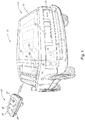
- FIGURE 1 illustrates a vehicle 10 having a split tailgate system 12 embodying one non-limiting aspect of the present invention.
- the split tailgate system 12 may be an electrically driven system configured to articulate an upper tailgate door 14 and a lower tailgate door 16 between open and closed positions.
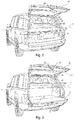
- FIGURES 2-4b illustrate the automatic movement of one or both of the upper and lower tailgate doors 14, 16 between closed and open positions.
- the upper tailgate door 14 may be opened without opening the lower tailgate door 16 (see Figure 2 )
- both of the upper and lower tailgate doors 14, 16 may be opened at the same time (see Figure 3 )
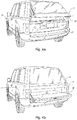
- the lower tailgate door 16 may be opened without opening, or fully opening, the upper tailgate door 14 (see Figures 4a-4b ).
- a controller 18 may be included within the vehicle 10 to control tailgate door opening and closing.
- the controller may be configured to independently control movements of the upper and lower tailgate doors 14, 16. This may include an upper mode control sequence shown in Figure 2 where the upper door 14 is actuated to the open position while the lower door 16 remains closed.
- Another door control sequence may be a dual mode shown in Figure 3 where both of the upper and lower doors 14, 16 are simultaneously articulating. Depending on the shape of the doors 14,16, this may include articulating the upper door 14 slightly ahead of the lower door 16.
- Yet another door control sequence may be a Sirir mode shown in Figures 4a-4b where the lower door 16 is actuated while the upper door 14 remains closed.
- Wireless messages from a remote control 20, such as but not limited to a fob may be used to instruct the controller 18 to instigate tailgate door control.
- Wireline messages from buttons 24, 26, 28, 30, 32 included within a dashboard 34 or a rear of the vehicle 10 may similarly be used to instruct the controller to open and close one or both of the tailgate doors 14, 16.
- the controller 18 may control operations of an upper electric motor 40 and a lower electric motor 42 in order to respectively control upper and lower tailgate door 14, 16 positioning. While the motors 40, 42 may be positioned anywhere within the vehicle 10, they are shown for exemplary purposes to be disposed within a drain channel 46 around an outer perimeter of the upper tailgate door 14 and within a enclosure of the lower tailgate door 16 that may or may not be watertight.
- the present invention is able to sequence tailgate door 14, 16 movement in any suitable manner.
- One of the door control sequences may include limiting occupant exposure to the environment by automatically opening only the lower tailgate door 16. In the past, it was extremely difficult for a user to only open the lower tailgate door 16 since the user was required to partially open the upper tailgate door 14 first.
- the controller 18 is able to automatically open the lower tailgate door 16 in an easier manner and without overly exposing the passenger compartment.
- a compartment cover 50 may be included with a storage area 52 to extend rearwardly from a rear seat 54 to the tailgate doors 14, 16.
- the compartment cover 50 may be positioned above a bottom 56 of the upper tailgate door 14 when closed and below a top 58 of the rear seat 54 in order to separate the storage area 52 into upper and lower storage portions.
- the coverage of the compartment cover 50 may be adjusted manually by pushing or pulling a leading edge 60, or optionally, with related control of a compartment cover motor 62.
- the upper tailgate door 14 may maintain a position below a horizontal plane P defined by the compartment cover 50 while the lower tailgate door 16 is being opened in order to limit exposure of the upper storage area and the rest of the passenger compartment to the outside elements.
- Figures 4a and 4b illustrate a sequence of door movements that maybe coordinated by the controller 18 when opening the lower tailgate door 16 according to the Sirir mode sequence of door controls.
- the bottom portion 56 of the upper tailgate door 14 includes a lock 66 that mates with a latch 68 included on a lip 70 of the lower tailgate door 16.
- a ledge 72 is positioned below the latch 68 to cover the bottom 56 of the upper tailgate door 14 so that an exterior portion 74 of the upper door 14 is flush with an exterior portion 76 of the lower door 16 when both are closed (see Figure 1 ).
- the upper tailgate door 14 may be partially opened, at least until the lip 70 is able to articulate past the bottom 56 of the upper tailgate door 14 (see Figure 4a ), and then the lower tailgate door 16 may be articulated to its open position (see Figure 4b ).
- an angle of articulation ⁇ of the upper door may be from approximately 10° to approximately 25° or, alternatively, as much as 25% of the total angle ⁇ .
- the upper tailgate door 14 may be automatically articulated back to its closed position or it may remain in the partially open position.
- the door controls contemplated by the present invention to manage articulation of the upper and lower tailgate doors 14, 16 may be instigated upon receipt of a message sent from the fob 20 or buttons 24, 26, 28, 30, 32 included on the vehicle 10.
- One of the vehicle buttons 28 may be included on the outside portion 76 of the upper tailgate 14 to control opening and closing of the upper tailgate door 14.
- Another vehicle button 30 having the same functionality of the button 28 may be included on the bottom side 56 of the upper tailgate door 14 to provide easy button access when the upper tailgate door 14 is open.
- Another button 32 to control open and closing of the lower tailgate door 16 may be included on the ledge 72 such that it is concealed from view when the upper door 14 is closed, which may be helpful in providing a more uniform rearward appearance for the vehicle 10 than including the button on the exterior portion 74 of the lower tailgate door 16.
- buttons 24 may be an upper door button included on the dashboard 34 that instructs the controller 18 to open or close the upper tailgate door 14.
- This button 24 may be 'fixed' in that is pre-programmed to control the upper tailgate door 14 at the time of manufacturing.
- Another button 26 included in the dashboard 34 may be a "programmable" button in that it can be programmed by a vehicle occupant to selectively execute an available door control.
- a programming selection menu having a number of available door control sequences may be displayed within a display or other human machine interface (HMI) 80 such that user selection of one of the door control sequences controls whether the button 26 controls both doors 14, 16 (dual mode), only the lower door 16 (chauffer mode), or some other operation, such as but not limited to vehicle illumination, e.g., the interior/exterior of the vehicle 10, including the doors 14, 16, may be illuminated.
- the illumination mode may be "fixed" in vehicles having a single tailgate door or split tailgate doors where the lower tailgate door 16 is powered.
- Buttons 84, 86 included on the fob 20 may mimic the functionality provided by the buttons 24, 26 included within the dashboard 34.
- the fob 20 may include the same "fixed" assignment of an upper door button 84 and the same "programmable” assignment of a programmable button 86.
- the fob 20 may also include buttons 88, 90, 92 to instruct the controller 18 to execute the vehicle controls, such as but not limited to a door unlock button 90, door lock button 88, and panic button 92, which are commonly employed with remote keyless entry (RKE) related systems.
- RKE remote keyless entry
- the fob 20 may also perform other operations, such as but not limited to passive entry (PE), including passively supporting tailgate door control sequences.
- PE passive entry
- Depression of the fob buttons 84, 86, 88, 90, 92 may instruct the fob 20 to issue a specific message depending on the depressed button.
- the message transmitted from the programmable key 86 may be the same regardless of the operation to be controlled by the controller 18 in response to receipt of the message.
- each fob 20 may be configured to issue the same message upon actuation of the same fob button 84, 86, 88, 90, 92. In this manner, the controller 18 need not interpret the messages differently depending on the fob 20 transmitting the message or throughout changes in programming of the programmable button 86.
- the controller 18 can use the identifiers to lookup an associated user in order to execute user specific operations. In this manner, a first user can program the controller 18 to execute a different tailgate door control sequence than a second user associated with another fob 20 even though both fobs 20 transmit the same message upon actuation of the programmable button 86.
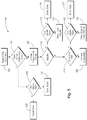
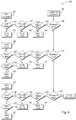
- FIGURE 5 illustrates a flowchart 100 of a method of controlling the power, split tailgate system 12 in accordance with one non-limiting aspect of the present invention.
- the method may be executed with the assistance of the controller 18 executing operations for controlling upper and lower tailgate doors 14, 16 according to instructions included within a computer-readable medium.
- the method may be executed with respect to the system 12 described above or with respect to other systems having arrangements suitable to executing the operations contemplated by the present invention.
- the method is described with respect to articulating upper and lower tailgate doors 14, 16 about a vehicle body.
- the present invention is not intended to be limited to any particular direction of articulation or to articulating only upper and lower tailgate doors 14, 16.
- Block 102 relates to determining a tailgate door command.
- the tailgate door command may relate to a command issued to open or close one or more of the upper and/or lower tailgate doors 14, 16.
- the command may be determined from user interaction with the remote control 20 or a suitable one of the vehicle buttons 24, 26, 28, 30, 32.
- Block 104 relates to assessing whether the command was triggered by one of the "fixed" buttons 24, 28, 30, 32, 84 or "programmable" buttons 26, 86.
- the control sequence associated with a fixed button is assumed to be an upper command that indicates a desire to open or close the upper tailgate door 14.
- the described programming may be limited to that completed by a vehicle owner after purchasing the vehicle, as opposed to at the time of manufacturing.
- Block 106 is reached if the command is triggered by one of the programmable buttons.
- Block 106 includes reviewing a memory or other database accessible to the controller 18 to determine the control sequence associated with the actuated button.
- user interaction with the HMI 80 may be used to assign a control sequence to the programmable button 26, 86.
- the assigned control sequence may be the same for the program button 86 on the fob 20 and the vehicle button 26, or the control sequence may be different for one or the other.
- Block 106 may include interrogating the related message in order to identify the transmitting fob.
- Block 110 relates to determining whether the desired control sequence relates to a Sirir mode where only the lower tailgate door 16 is desired to be opened. If Sirir mode is determined in Block 110, an assessment as to whether either one of the upper or lower tailgate doors 14, 16 is currently in the open position is made in Block 112. If either door 14, 16 is open, any open tailgate door 14, 16 is automatically driven to its closed position in Block 114. The assumption to close any open door in response to button actuation is a selectable design 5 parameter. Another assumption could be made to open the lower tailgate door 16 even if the upper tailgate door 14 is open. If neither one of the tailgate doors 14, 16 are open, the lower tailgate door 16 is opened in Block 116.
- Block 118 an assessment is made in Block 118 as to whether the desired control sequence relates to a dual mode where both of the upper and lower tailgate doors 14, 16 are to be simultaneously controlled. If dual mode is determined, an assessment is made in Block 120 as to whether either one of the upper or lower tailgate doors 14, 16 is currently in the open position. If either door 14, 16 is open, any open tailgate door 14, 16 is automatically driven to its closed position in Block 122, and if both doors 14, 16 are closed, both of an upper and lower tailgate doors 14, 16 are opened in Block 124.
- Block 126 relates to executing another control when the programmable button has not yet been associated with controlling either one of the upper or lower tailgate doors 14, 16.
- this other control is shown with respect to vehicle illumination where one or more of the interior or exterior vehicle lights are temporarily illuminated instead of articulating a tailgate door 14, 16.
- the present invention is not intended to be so limited and fully contemplates executing any other type of control.
- Block 104 if the desired door control is associated with one of the fixed buttons 24, 84, an assessment as to whether either one of the upper or lower tailgate doors 14, 16 is currently in an open position is made in Block 128. If either door 14, 16 is open, any open tailgate door 14, 16 is automatically driven to its closed position in Block 130, and if both doors 14, 16 are closed, the upper tailgate door 14 is opened in Block 132. While the fixed button 24, 84 operations executed above are assigned at the time of manufacturing, the present invention fully contemplates reprogramming the fixed buttons 24, 84 in a manner similar to that used with respect to programming the programmable buttons 26, 86. In this way, the present invention may allow a user to assign door control sequences to each of the two door control buttons 84, 86 included on the fob 20 or each of the two door control buttons 24, 26 provided on the dashboard 34.
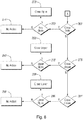
- FIGURE 6 illustrates a flowchart 150 of a method of controlling a power, split tailgate 12 in accordance with one non-limiting aspect of the present invention. This method takes into consideration whether an open door was opened manually or electronically before deciding the door control sequence.
- Block 152 relates to determining a tailgate door command. While the method is described without regard to whether the tailgate door command relates to a programmable or fixed command, such an inquiry can optionally be included in a manner similar to that described above.
- Block 154 relates to assessing whether any tailgate door 14, 16 is open if Block 156 determines the tailgate door command to be a control both doors command. If neither door 14, 16 is currently opened, both doors 14, 16 are opened automatically in Block 158. If at least one of the doors 14, 16 is open, Block 160 determines whether the open door 14, 16 was opened manually or electronically. If opened electronically, any open door 14, 16 is closed in Block 162, and if opened manually, an assessment as to whether the both doors 14, 16 were opened manually is made in Block 164. If both doors 14, 16 were opened manually, then both doors 14, 16 are closed in Block 166, and if one door 14, 16 was opened manually, then the unopened door 14, 16 is opened in Block 168.
- Block 172 relates to assessing whether any tailgate door 14, 16 is open if Block 170 determines the tailgate door command to be a control lower command. If neither door 14, 16 is currently opened, the lower tailgate door 16 is opened automatically in Block 174. If at least one of the doors 14, 16 is open, Block 176 determines whether the open door 14, 16 was opened manually or electronically. If opened electronically, any open door 14, 16 is closed in Block 178, and if opened manually, an assessment as to whether the upper tailgate door 14 was opened manually is made in Block 180. If the upper tailgate door 14 was not opened manually, then only the lower tailgate door 16 must have been opened manually, resulting in the automatic closing of the lower door 16 in Block 182.
- Block 184 If the upper tailgate door 14 was opened manually, then an assessment as to whether the lower tailgate door 16 was also opened manually is made in Block 184. If both doors 14, 16 were opened manually, then both doors 14, 16 are closed in Block 178, and if only the upper door 14 was opened manually, then the lower door 16 is opened in Block 186.
- Block 190 relates to assessing whether any tailgate door 14, 16 is open if Block 188 determines the tailgate door command to be a control upper door command. If neither door 14, 16 is currently opened, the upper tailgate door 14 is opened automatically in Block 192. If at least one of the doors 14, 16 is open, Block 194 determines whether the open door 14, 16 was opened manually or electronically. If opened electronically, any open door 14, 16 is closed in Block 196, and if opened manually, an assessment as to whether the lower tailgate door 16 was opened manually is made in Block 198. If the lower tailgate door 16 was not opened manually, then only the upper tailgate door 14 must have been opened manually, resulting in the automatic closing of the upper door 14 in Block 200.
- Block 202 If the lower tailgate door 16 was opened manually, then an assessment as to whether the upper tailgate door 14 was also opened manually is made in Block 202. If the both doors 14, 16 were opened manually, then both doors 14, 16 are closed in Block 196, and if only the lower door 16 was opened manually, then the upper door 14 is opened in Block 204.
- the first flowchart 100 describes a control method where the tailgate door control commands are executed on the assumption that any open tailgate door 14, 16 should be closed upon receipt of a subsequent door command.
- the second flowchart 150 described a control method where open tailgated doors 14, 16 are not necessarily closed upon receipt of a subsequent door control command, i.e., the doors 14, 16 may remain open if the open door(s) 14, 16 were opened in a manual operation, such as if a user physically moved the doors 14, 16.
- the assumptions made in both methods are design parameters and not intended, unless otherwise noted, to limit the scope and contemplation of the present invention. Other assumptions may be made without deviating from the scope and contemplation of the present invention.
- FIGURE 7 illustrates a flowchart 220 of a method in which decisions to open or close the tailgate doors 14, 16 are made independently of a position of the tailgate doors 14, 16 at the time the door control command is received whether the tailgate doors 14, 16 were opened manually or electronically. Instead, the method assesses the desired door control sequence depending on whether the command was an open or close command. The method begins in Block 222 upon receipt of a tailgate door command message. Block 224 interrogates the door command to determine whether it is an open door command or a close door command. This decision may be based on information included with the door command message or from other information.
- the fob 20 or vehicle 12 may include separate open and close buttons (not shown) for each of the tailgate doors 14, 16 - like the fob 20 lock and unlock buttons 88, 90.
- an inquiry into the result of the last door control command can also be used to determine whether the current door control command is an open or closed command, i.e., if the last command result indoor 14, 16 opening, then it may be presumed that the next door command would result in door 14, 16 closing and vice versa.
- Block 226 interrogates a command of the type intended to open one or more of the doors 14, 16 to determine whether it is an open both command in which both doors 14, 16 are to be opened. If it is an open both command, Block 228 assesses whether any door 14, 16 are currently open such that both doors 14, 16 are automatically opened in Block 230 if no doors are opened and any closed door is opened in Block 232 if at least one door is closed. If the door command was not an open both command, Block 234 interrogates the door command to determine whether it is an open upper command in which only the upper door 14 is to be opened.
- Block 236 If the open upper command is determined, an assessment of whether any door is open is made in Block 236. If no door 14, 16 is open, the upper door 14 is opened in Block 238, else an assessment is made in Block 240 as to whether both doors 14, 16 are open. If both doors are open, the lower door 16 is closed in Block 242, else an assessment is made in Block 244 as to whether the upper door 16 is open. Depending on whether the upper door 14 open, no action is taken in Block 246 or the upper door is opened and the lower door is closed in Block 248.
- Block 250 interrogates the door command to determine whether it is an open lower command in which only the lower door 16 is to be opened. If the open lower command is determined, an assessment of whether any door is open is made in Block 252. If no door 14, 16 is open, the lower door 16 is opened in Block 254, else an assessment is made in Block 254 as to whether both doors 14, 16 are open. If both doors are open, the upper door 14 is closed in Block 258, else an assessment is made in Block 260 as to whether the upper door 14 is open. Depending on whether the upper door 14 open, no action is taken in Block 262 or the lower door is opened and the upper door is closed in Block 264.
- Block 268 assess whether the closed command was a close both command in which both of the upper and lower doors 14, 16 are to be closed. If any door is determined to be open in Block 270, the open doors are closed in Block 272, otherwise no action is taken in Block 274. A similar process is repeated in Blocks 276, 278, 280, and 282, as well as in Blocks 284, 286, 288, and 290, where the upper and lower doors 14, 16 are respectively closed if open at the time the corresponding close door command is received.
- the close door control sequence is described slightly different from the open door control sequence in that the door close operations are instigated with respect to only the commanded door 14, 16, whereas the open door sequence may include commanding a non-commanded door 14, 16.
- the open sequence may include closing an open door 14, 16 upon receipt of another open command, such as if an open lower command is received when both doors are open. This would require the additional command of closing the upper door 14.
- a similar sequence for a close command would only require closing the lower door 16 - the upper door 14 may remain open.
Landscapes
- Engineering & Computer Science (AREA)
- Mechanical Engineering (AREA)
- Computer Networks & Wireless Communication (AREA)
- Power-Operated Mechanisms For Wings (AREA)
Description
- The present invention relates to a power split tailgate system and method of controlling the same.
- A five door vehicle, such as but not limited to a station wagon, sport utility vehicle (SUV), cross-over vehicle (XUV), van, etc., may include a tailgate at a rear of the vehicle. The tailgate gate may include one or more doors that open to provide access to a passenger compartment. When opening the tailgate, the passenger compartment may be exposed to the outside elements in a manner that can cause discomfort to the vehicle occupants, especially those sitting in the rear.
- Exposing occupants to the outside conditions may be unfavourable, especially when the vehicle is used in hot or cold climate countries or ones that suffer from poor air quality. This situation may be considered to be especially unacceptable in a chauffer market sector where occupants are paying a chauffer to drive them to a particular destination. If the tailgate needs to be opened, such as to place into or remove items from the vehicle luggage space, occupants may be exposed to the elements, effecting the conditioned air environment inside the cabin.
- It is an aim of the present invention to address this issue. Other aims and advantages of the invention will become apparent from the following description, claims and drawings.
-
- According to an aspect of the invention for which protection is sought, there is provided a power, split tailgate system for a vehicle, comprising:
- a first tailgate door arranged to articulate between a closed position and an open position;
- a second tailgate door arranged to articulate between a closed position and an open position;
- first and second drive means for moving the first and second doors, respectively, between the closed and open positions; and
- control means for controlling the first and second drive means so as to control movement of the first and second doors between the open and closed positions,
- wherein the control means is arranged to independently control the first and second drive means, and the first and second doors being arranged such that the first door must be at least partially opened to allow opening or closing of the second door,
- the system being adapted such that, in the event that the first door is in the closed position and a command is received to open or close only the second door, the system is adapted to automatically execute a door control sequence in which:
- (a) the first door is partially articulated by the first drive means from the closed position toward the open position, so that the first door is in a partially open position, the articulation amount being sufficient for the second door to clear the first door such that the second door can be opened or closed;
- (b) the second door is moved by the second drive means from the closed position to the open position or from the open position to the closed position.
- The system may include means to determine whether each of the first and second doors is open or closed.
- The control means may be arranged to cause the first door to articulate from the partially open position to the closed position after the second door has articulated towards the open position or towards the closed position by a predetermined amount.
- The drive means may comprise at least one electric motor, and wherein the motor may be used to articulate the second door is positioned within a watertight interior of the second door.
- The control means may be arranged to cause the first door to articulate through an angle that is less than or equal to approximately 25% of an angle of articulation required to fully articulate the first door from the closed position to the open position.
- The control means may be arranged to cause the first door to articulate between the open and closed positions while the second door remains in either one of the open and closed positions.
- The control means may be arranged to cause the first and second doors to be simultaneously articulated between the open and closed positions thereof.
- The system may comprise a remote control configured to issue wireless signals to the control means that instruct the control means to open and close one or both of the first and second doors. In embodiments, door opening and closing executed by the control means may be in response to at least one of the wireless signals received from the remote control are determined from user input to a human machine interface (HMI) included within the vehicle. The remote control may issue the same wireless signals to the control means regardless of the user input to the HMI.
- The system may be a power split tailgate system for a vehicle having a rear storage area.
- The first door may be an upper tailgate door and the second door may be a lower tailgate door.
- According to another aspect of the invention for which protection is sought, there is provided a method of articulating a power, split tailgate system of a vehicle,
- wherein the system includes a first tailgate door arranged to articulate between a closed position and an open position;
- a second tailgate door arranged to articulate between a closed position and an open position; the first and second doors being arranged such that the first door must be at least partially opened to allow opening or closing of the second door,
- first and second drive means for moving the first and second doors, respectively, between the closed and open positions; and
- control means arranged to independently control the first and second drive means so as to control movement of the first and second doors between the open and closed positions,
- the method comprising:
- in the event the first door is in the closed position and a command is received to open or close only the second door, automatically executing a door control sequence in which:
- (a) the first door is moved by the first drive means a portion of a distance required to move to the open position, such that the first door is in a partially open position, the portion of the distance being sufficient for the second door to clear the first door such that the second door can be opened or closed; and
- (b) the second door is moved by the second drive means to from the closed position to the open position or from the open position to the closed position.
- in the event the first door is in the closed position and a command is received to open or close only the second door, automatically executing a door control sequence in which:
- The method may comprise, in the event the second door and the first door are in the open position when an open second door command is received, automatically closing the first door without closing the second door.
- Within the scope of this application it is envisaged that the various aspects, embodiments, examples, features and alternatives set out in the preceding paragraphs, in the claims and in the following description and drawings may be taken independently or in any combination thereof. Features described with reference to one embodiment are applicable to all disclosed embodiments, except where there is incompatibility of features.
- The scope of protection for the invention is defined by the appended claims.
- The present invention will now be described, by way of example only, with reference to the accompanying drawings, in which:
-
FIGURE 1 illustrates a split tailgate system embodying one non-limiting aspect of the present invention; -
FIGURE 2 illustrates articulation of an upper tailgate door to an open position in the system ofFigure 1 ; -
FIGURE 3 illustrates articulation of both of an upper and lower tailgate door to an open position in the system ofFigure 1 ; -
FIGURES 4a-4b illustrate articulation of a lower tailgate door to an open position in the system ofFigure 1 ; -
FIGURE 5 illustrates a flowchart of a method of controlling the split tailgate system wherein open tailgate doors are returned to a closed position in accordance with one non-limiting aspect of the present invention; -
FIGURE 6 illustrates a flowchart of a method of controlling the split tailgate system wherein tailgate door control sequences are determined according to whether any open doors were opened manually or electronically in accordance with one non-limiting aspect of the present invention; and -
FIGURE 7 illustrates a flowchart of a method of controlling the tailgate system as a function of whether a tailgate door control command is intended to be an open command or a close command in accordance with one non-limiting aspect of the present invention. -
FIGURE 1 illustrates avehicle 10 having asplit tailgate system 12 embodying one non-limiting aspect of the present invention. Thesplit tailgate system 12 may be an electrically driven system configured to articulate anupper tailgate door 14 and alower tailgate door 16 between open and closed positions. -
FIGURES 2-4b illustrate the automatic movement of one or both of the upper andlower tailgate doors upper tailgate door 14 may be opened without opening the lower tailgate door 16 (seeFigure 2 ), both of the upper andlower tailgate doors Figure 3 ), and thelower tailgate door 16 may be opened without opening, or fully opening, the upper tailgate door 14 (seeFigures 4a-4b ). - A
controller 18 may be included within thevehicle 10 to control tailgate door opening and closing. The controller may be configured to independently control movements of the upper andlower tailgate doors Figure 2 where theupper door 14 is actuated to the open position while thelower door 16 remains closed. Another door control sequence may be a dual mode shown inFigure 3 where both of the upper andlower doors doors upper door 14 slightly ahead of thelower door 16. Yet another door control sequence may be a chauffer mode shown inFigures 4a-4b where thelower door 16 is actuated while theupper door 14 remains closed. - Wireless messages from a
remote control 20, such as but not limited to a fob, may be used to instruct thecontroller 18 to instigate tailgate door control. Wireline messages frombuttons vehicle 10 may similarly be used to instruct the controller to open and close one or both of thetailgate doors controller 18 may control operations of an upperelectric motor 40 and a lowerelectric motor 42 in order to respectively control upper andlower tailgate door motors vehicle 10, they are shown for exemplary purposes to be disposed within a drain channel 46 around an outer perimeter of theupper tailgate door 14 and within a enclosure of thelower tailgate door 16 that may or may not be watertight. - Because the
motors tailgate doors tailgate door lower tailgate door 16. In the past, it was extremely difficult for a user to only open thelower tailgate door 16 since the user was required to partially open theupper tailgate door 14 first. By automatically sequencing movement of the upper andlower tailgate doors controller 18 is able to automatically open thelower tailgate door 16 in an easier manner and without overly exposing the passenger compartment. - As shown in more detail in
Figure 3 , a compartment cover 50 may be included with astorage area 52 to extend rearwardly from arear seat 54 to thetailgate doors upper tailgate door 14 when closed and below a top 58 of therear seat 54 in order to separate thestorage area 52 into upper and lower storage portions. The coverage of the compartment cover 50 may be adjusted manually by pushing or pulling a leading edge 60, or optionally, with related control of acompartment cover motor 62. When executing door control sequences according to the chauffer mode, theupper tailgate door 14 may maintain a position below a horizontal plane P defined by the compartment cover 50 while thelower tailgate door 16 is being opened in order to limit exposure of the upper storage area and the rest of the passenger compartment to the outside elements. -
Figures 4a and 4b illustrate a sequence of door movements that maybe coordinated by thecontroller 18 when opening thelower tailgate door 16 according to the chauffer mode sequence of door controls. As shown inFigure 2 , thebottom portion 56 of theupper tailgate door 14 includes alock 66 that mates with alatch 68 included on alip 70 of thelower tailgate door 16. A ledge 72 is positioned below thelatch 68 to cover the bottom 56 of theupper tailgate door 14 so that anexterior portion 74 of theupper door 14 is flush with an exterior portion 76 of thelower door 16 when both are closed (seeFigure 1 ). To open thelower tailgate door 16, theupper tailgate door 14 may be partially opened, at least until thelip 70 is able to articulate past the bottom 56 of the upper tailgate door 14 (seeFigure 4a ), and then thelower tailgate door 16 may be articulated to its open position (seeFigure 4b ). Depending on the size and shape of the upper andlower tailgate doors lower tailgate door 16 is clear of theupper tailgate door 14, theupper tailgate door 14 may be automatically articulated back to its closed position or it may remain in the partially open position. - As noted above, the door controls contemplated by the present invention to manage articulation of the upper and
lower tailgate doors fob 20 orbuttons vehicle 10. One of thevehicle buttons 28 may be included on the outside portion 76 of theupper tailgate 14 to control opening and closing of theupper tailgate door 14. Anothervehicle button 30 having the same functionality of thebutton 28 may be included on thebottom side 56 of theupper tailgate door 14 to provide easy button access when theupper tailgate door 14 is open. Anotherbutton 32 to control open and closing of thelower tailgate door 16 may be included on the ledge 72 such that it is concealed from view when theupper door 14 is closed, which may be helpful in providing a more uniform rearward appearance for thevehicle 10 than including the button on theexterior portion 74 of thelower tailgate door 16. - With reference to
Figure 1 , one of the buttons 24 may be an upper door button included on the dashboard 34 that instructs thecontroller 18 to open or close theupper tailgate door 14. This button 24 may be 'fixed' in that is pre-programmed to control theupper tailgate door 14 at the time of manufacturing. Anotherbutton 26 included in the dashboard 34 may be a "programmable" button in that it can be programmed by a vehicle occupant to selectively execute an available door control. For example, a programming selection menu having a number of available door control sequences may be displayed within a display or other human machine interface (HMI) 80 such that user selection of one of the door control sequences controls whether thebutton 26 controls bothdoors 14, 16 (dual mode), only the lower door 16 (chauffer mode), or some other operation, such as but not limited to vehicle illumination, e.g., the interior/exterior of thevehicle 10, including thedoors lower tailgate door 16 is powered. -
Buttons 84, 86 included on thefob 20 may mimic the functionality provided by thebuttons 24, 26 included within the dashboard 34. Thefob 20 may include the same "fixed" assignment of anupper door button 84 and the same "programmable" assignment of a programmable button 86. Thefob 20 may also includebuttons controller 18 to execute the vehicle controls, such as but not limited to a door unlock button 90,door lock button 88, andpanic button 92, which are commonly employed with remote keyless entry (RKE) related systems. Thefob 20 may also perform other operations, such as but not limited to passive entry (PE), including passively supporting tailgate door control sequences. Depression of thefob buttons fob 20 to issue a specific message depending on the depressed button. Optionally, the message transmitted from the programmable key 86 may be the same regardless of the operation to be controlled by thecontroller 18 in response to receipt of the message. - If
multiple fobs 20 are authorized to control thevehicle 10, eachfob 20 may be configured to issue the same message upon actuation of thesame fob button controller 18 need not interpret the messages differently depending on thefob 20 transmitting the message or throughout changes in programming of the programmable button 86. Optionally, while the messages transmitted may be the same for eachfob 20, identifiers of thefob 20 transmitting the message may be included. If user specific control is desired, thecontroller 18 can use the identifiers to lookup an associated user in order to execute user specific operations. In this manner, a first user can program thecontroller 18 to execute a different tailgate door control sequence than a second user associated with anotherfob 20 even though bothfobs 20 transmit the same message upon actuation of the programmable button 86. -
FIGURE 5 illustrates aflowchart 100 of a method of controlling the power, splittailgate system 12 in accordance with one non-limiting aspect of the present invention. The method may be executed with the assistance of thecontroller 18 executing operations for controlling upper andlower tailgate doors system 12 described above or with respect to other systems having arrangements suitable to executing the operations contemplated by the present invention. For exemplary purposes, the method is described with respect to articulating upper andlower tailgate doors lower tailgate doors -
Block 102 relates to determining a tailgate door command. The tailgate door command may relate to a command issued to open or close one or more of the upper and/orlower tailgate doors remote control 20 or a suitable one of thevehicle buttons Block 104 relates to assessing whether the command was triggered by one of the "fixed"buttons buttons 26, 86. For exemplary purposes, the control sequence associated with a fixed button is assumed to be an upper command that indicates a desire to open or close theupper tailgate door 14. Optionally, the described programming may be limited to that completed by a vehicle owner after purchasing the vehicle, as opposed to at the time of manufacturing. -
Block 106 is reached if the command is triggered by one of the programmable buttons.Block 106 includes reviewing a memory or other database accessible to thecontroller 18 to determine the control sequence associated with the actuated button. As noted above, user interaction with theHMI 80 may be used to assign a control sequence to theprogrammable button 26, 86. The assigned control sequence may be the same for the program button 86 on thefob 20 and thevehicle button 26, or the control sequence may be different for one or the other. In some cases, if different control sequences are assigned to the program button 86 ofmultiple fobs 20,Block 106 may include interrogating the related message in order to identify the transmitting fob. -
Block 110 relates to determining whether the desired control sequence relates to a chauffer mode where only thelower tailgate door 16 is desired to be opened. If chauffer mode is determined inBlock 110, an assessment as to whether either one of the upper orlower tailgate doors Block 112. If eitherdoor open tailgate door Block 114. The assumption to close any open door in response to button actuation is a selectable design 5 parameter. Another assumption could be made to open thelower tailgate door 16 even if theupper tailgate door 14 is open. If neither one of thetailgate doors lower tailgate door 16 is opened inBlock 116. - If the chauffer mode is not determined in
Block 110, an assessment is made in Block 118 as to whether the desired control sequence relates to a dual mode where both of the upper andlower tailgate doors Block 120 as to whether either one of the upper orlower tailgate doors door open tailgate door Block 122, and if bothdoors lower tailgate doors Block 124. - Block 126 relates to executing another control when the programmable button has not yet been associated with controlling either one of the upper or
lower tailgate doors tailgate door - Returning to Block 104, if the desired door control is associated with one of the fixed
buttons 24, 84, an assessment as to whether either one of the upper orlower tailgate doors Block 128. If eitherdoor open tailgate door Block 130, and if bothdoors upper tailgate door 14 is opened inBlock 132. While the fixedbutton 24, 84 operations executed above are assigned at the time of manufacturing, the present invention fully contemplates reprogramming the fixedbuttons 24, 84 in a manner similar to that used with respect to programming theprogrammable buttons 26, 86. In this way, the present invention may allow a user to assign door control sequences to each of the twodoor control buttons 84, 86 included on thefob 20 or each of the twodoor control buttons 24, 26 provided on the dashboard 34. -
FIGURE 6 illustrates aflowchart 150 of a method of controlling a power, splittailgate 12 in accordance with one non-limiting aspect of the present invention. This method takes into consideration whether an open door was opened manually or electronically before deciding the door control sequence.Block 152 relates to determining a tailgate door command. While the method is described without regard to whether the tailgate door command relates to a programmable or fixed command, such an inquiry can optionally be included in a manner similar to that described above. -
Block 154 relates to assessing whether anytailgate door Block 156 determines the tailgate door command to be a control both doors command. If neitherdoor doors Block 158. If at least one of thedoors open door open door Block 162, and if opened manually, an assessment as to whether the bothdoors Block 164. If bothdoors doors Block 166, and if onedoor unopened door Block 168. -
Block 172 relates to assessing whether anytailgate door Block 170 determines the tailgate door command to be a control lower command. If neitherdoor lower tailgate door 16 is opened automatically inBlock 174. If at least one of thedoors Block 176 determines whether theopen door open door Block 178, and if opened manually, an assessment as to whether theupper tailgate door 14 was opened manually is made inBlock 180. If theupper tailgate door 14 was not opened manually, then only thelower tailgate door 16 must have been opened manually, resulting in the automatic closing of thelower door 16 inBlock 182. If theupper tailgate door 14 was opened manually, then an assessment as to whether thelower tailgate door 16 was also opened manually is made inBlock 184. If bothdoors doors Block 178, and if only theupper door 14 was opened manually, then thelower door 16 is opened inBlock 186. -
Block 190 relates to assessing whether anytailgate door Block 188 determines the tailgate door command to be a control upper door command. If neitherdoor upper tailgate door 14 is opened automatically inBlock 192. If at least one of thedoors Block 194 determines whether theopen door open door Block 196, and if opened manually, an assessment as to whether thelower tailgate door 16 was opened manually is made inBlock 198. If thelower tailgate door 16 was not opened manually, then only theupper tailgate door 14 must have been opened manually, resulting in the automatic closing of theupper door 14 inBlock 200. If thelower tailgate door 16 was opened manually, then an assessment as to whether theupper tailgate door 14 was also opened manually is made inBlock 202. If the bothdoors doors Block 196, and if only thelower door 16 was opened manually, then theupper door 14 is opened inBlock 204. - The
first flowchart 100 describes a control method where the tailgate door control commands are executed on the assumption that anyopen tailgate door second flowchart 150 described a control method where open tailgateddoors doors doors - For example,
FIGURE 7 illustrates aflowchart 220 of a method in which decisions to open or close thetailgate doors tailgate doors tailgate doors Block 222 upon receipt of a tailgate door command message.Block 224 interrogates the door command to determine whether it is an open door command or a close door command. This decision may be based on information included with the door command message or from other information. For example, thefob 20 orvehicle 12 may include separate open and close buttons (not shown) for each of thetailgate doors 14, 16 - like thefob 20 lock and unlockbuttons 88, 90. Alternatively, an inquiry into the result of the last door control command can also be used to determine whether the current door control command is an open or closed command, i.e., if the last command result indoor 14, 16 opening, then it may be presumed that the next door command would result indoor -
Block 226 interrogates a command of the type intended to open one or more of thedoors doors door doors Block 230 if no doors are opened and any closed door is opened inBlock 232 if at least one door is closed. If the door command was not an open both command,Block 234 interrogates the door command to determine whether it is an open upper command in which only theupper door 14 is to be opened. - If the open upper command is determined, an assessment of whether any door is open is made in
Block 236. If nodoor upper door 14 is opened inBlock 238, else an assessment is made inBlock 240 as to whether bothdoors lower door 16 is closed inBlock 242, else an assessment is made in Block 244 as to whether theupper door 16 is open. Depending on whether theupper door 14 open, no action is taken inBlock 246 or the upper door is opened and the lower door is closed inBlock 248. - If the door command was not an open upper command,
Block 250 interrogates the door command to determine whether it is an open lower command in which only thelower door 16 is to be opened. If the open lower command is determined, an assessment of whether any door is open is made inBlock 252. If nodoor lower door 16 is opened inBlock 254, else an assessment is made inBlock 254 as to whether bothdoors upper door 14 is closed inBlock 258, else an assessment is made inBlock 260 as to whether theupper door 14 is open. Depending on whether theupper door 14 open, no action is taken inBlock 262 or the lower door is opened and the upper door is closed inBlock 264. - If the door command was not an open command, and instead, was a close command,
Block 268 assess whether the closed command was a close both command in which both of the upper andlower doors Block 270, the open doors are closed inBlock 272, otherwise no action is taken inBlock 274. A similar process is repeated inBlocks Blocks lower doors door non-commanded door - In more detail, the open sequence may include closing an
open door upper door 14. In contrast, a similar sequence for a close command would only require closing the lower door 16 - theupper door 14 may remain open. The difference between the open and close command sequences are provided to describe the variability in the door control sequences contemplated by the present invention and is done for exemplary purposes, and unless otherwise noted, without intending to limit the scope and contemplation of the present invention. - As required, detailed embodiments of the present invention are disclosed herein; however, it is to be understood that the disclosed embodiments are merely exemplary of the invention that may be embodied in various and alternative forms. The figures are not necessarily to scale, some features may be exaggerated or minimized to show details of particular components. Therefore, specific structural and functional details disclosed herein are not to be interpreted as limiting, but merely as a representative basis for the claims and/or as a representative basis for teaching one skilled in the art to variously employ the present invention. The features of various implementing embodiments may be combined to form further embodiments of the invention.
- While embodiments of the invention have been illustrated and described, it is not intended that these embodiments illustrate and describe all possible forms of the invention. Rather, the words used in the specification are words of description rather than limitation, and it is understood that various changes may be made without departing from the scope of protection for the invention as defined by the appended claims.
Claims (15)
- A power, split tailgate system (12) for a vehicle (10), comprising:a first tailgate door (14) arranged to articulate between a closed position and an open position;a second tailgate door (16) arranged to articulate between a closed position and an open position;first and second drive means (40, 42) for moving the first and second doors (14, 16), respectively, between the closed and open positions; andcontrol means (18) for controlling the first and second drive means so as to control movement of the first and second doors (14, 16) between the open and closed positions, characterised in that:the control means (18) is arranged to independently control the first and second drive means, and the first and second doors (14, 16) being arranged such that the first door (14) must be at least partially opened to allow opening or closing of the second door (16),the system being adapted such that, in the event that the first door (14) is in the closed position and a command is received to open or close only the second door (16), the system is adapted to automatically execute a door control sequence in which:(a) the first door (14) is partially articulated by the first drive means from the closed position toward the open position, so that the first door (14) is in a partially open position, the articulation amount being sufficient for the second door (16) to clear the first door (14) such that the second door (16) can be opened or closed;(b) the second door (16) is moved by the second drive means from the closed position to the open position or from the open position to the closed position.
- A system as claimed in claim 1, wherein the system includes means to determine whether each of the first and second doors (14, 16) is open or closed.
- A system as claimed in claim 2, wherein the control means (18) is arranged to cause the first door (14) to articulate from the partially open position to the closed position after the second door (16) has articulated towards the open position or towards the closed position by a predetermined amount.
- A system as claimed in any preceding claim, wherein the drive means comprise at least one electric motor (40; 42), and wherein the motor (42) used to articulate the second door (16) is positioned within a watertight interior of the second door (16).
- A system as claimed in any preceding claim wherein the control means (18) is arranged to cause the first door (14) to articulate through an angle that is less than or equal to approximately 25% of an angle of articulation required to fully articulate the first door (14) from the closed position to the open position.
- A system as claimed in any preceding claim, wherein the control means (18) is arranged to cause the first door (14) to articulate between the open and closed positions while the second door (16) remains in either one of the open and closed positions.
- A system as claimed in any preceding claim, wherein the control means (18) is arranged to cause the first and second doors (14, 16) to be simultaneously articulated between the open and closed positions thereof.
- A system as claimed in any preceding claim comprising a remote control (20) configured to issue wireless signals to the control means (18) that instruct the control means (18) to open and close one or both of the first and second doors (14, 16).
- A system as claimed in claim 8, wherein door opening and closing executed by the control means (18) in response to at least one of the wireless signals received from the remote control (20) is determined from user input to a human machine interface (HMI) included within the vehicle (10).
- A system as claimed in claim 9, wherein the remote control issues the same wireless signals to the control means (18) regardless of the user input to the HMI.
- A system as claimed in any preceding claim, wherein the system (12) is for a vehicle (10) having a rear storage area (52).
- A system as claimed in claim 11, wherein the first door (14) is an upper tailgate door and the second door (16) is a lower tailgate door.
- A method of articulating a power, split tailgate system (12) of a vehicle (10),
wherein the system includes a first tailgate door (14) arranged to articulate between a closed position and an open position;
a second tailgate door (16) arranged to articulate between a closed position and an open position; the first and second doors (14, 16) being arranged such that the first door (14) must be at least partially opened to allow opening or closing of the second door (16),
first and second drive means for moving the first and second doors (14, 16), respectively, between the closed and open positions; and
control means (18) arranged to independently control the first and second drive means so as to control movement of the first and second doors (14, 16) between the open and closed positions,
the method comprising:
in the event the first door (14) is in the closed position and a command is received to open or close only the second door (16), automatically executing a door control sequence in which:(a) the first door (14) is moved by the first drive means a portion of a distance required to move to the open position, such that the first door (14) is in a partially open position, the portion of the distance being sufficient for the second door (16) to clear the first door such that the second door (16) can be opened or closed; and(b) the second door (16) is moved to by the second drive means from the closed position to the open position or from the open position to the closed position. - A method as claimed in claim 13 comprising, in the event the second door (16) and the first door (14) are in the open position when an open second door (16) command is received, automatically closing the first door (14) without closing the second door (16).
- A method as claimed in claim 13 or claim 14, wherein the system (12) for a vehicle having a rear storage area (52), and wherein the first door (14) is an upper tailgate door and the second door is a lower tailgate door.
Applications Claiming Priority (2)
| Application Number | Priority Date | Filing Date | Title |
|---|---|---|---|
| US12/425,049 US8174146B2 (en) | 2009-04-16 | 2009-04-16 | Power split tailgate system and method |
| PCT/EP2010/054914 WO2010119080A2 (en) | 2009-04-16 | 2010-04-14 | Power split tailgate system and method |
Publications (3)
| Publication Number | Publication Date |
|---|---|
| EP2419289A2 EP2419289A2 (en) | 2012-02-22 |
| EP2419289B1 EP2419289B1 (en) | 2018-04-04 |
| EP2419289B2 true EP2419289B2 (en) | 2021-06-02 |
Family
ID=42337283
Family Applications (1)
| Application Number | Title | Priority Date | Filing Date |
|---|---|---|---|
| EP10714621.9A Active EP2419289B2 (en) | 2009-04-16 | 2010-04-14 | Power split tailgate system and method |
Country Status (4)
| Country | Link |
|---|---|
| US (3) | US8174146B2 (en) |
| EP (1) | EP2419289B2 (en) |
| CN (1) | CN102438849B (en) |
| WO (1) | WO2010119080A2 (en) |
Families Citing this family (40)
| Publication number | Priority date | Publication date | Assignee | Title |
|---|---|---|---|---|
| CZ200783A3 (en) * | 2007-01-31 | 2008-08-13 | Škoda Auto a. s. | Circuit arrangement of vehicle split hatchback electrical control |
| US8174146B2 (en) | 2009-04-16 | 2012-05-08 | Land Rover | Power split tailgate system and method |
| JP5218578B2 (en) * | 2011-02-14 | 2013-06-26 | トヨタ自動車株式会社 | Parking assistance device |
| DE102011077914A1 (en) * | 2011-06-21 | 2012-12-27 | Bayerische Motoren Werke Aktiengesellschaft | Aerodynamically effective device for a motor vehicle |
| USD684093S1 (en) * | 2011-08-31 | 2013-06-11 | Jaguar Land Rover | Vehicle |
| USD684094S1 (en) * | 2011-09-07 | 2013-06-11 | Land Rover | Motor vehicle |
| DE102011116205B3 (en) * | 2011-10-15 | 2012-12-06 | Audi Ag | External power-operated tailgate assembly for vehicle, has control unit which is activated so as to pivot tailgate from open position to close position, based on occupancy of seat of vehicle |
| DE102011120207B4 (en) | 2011-12-05 | 2019-12-24 | Audi Ag | Power operated tailgate assembly |
| GB201215962D0 (en) * | 2012-09-06 | 2012-10-24 | Jaguar Cars | Power tailgate system and method |
| GB201215965D0 (en) | 2012-09-06 | 2012-10-24 | Jaguar Cars | A system for controlling the doors of a powered tailgate |
| GB2505682B (en) * | 2012-09-06 | 2015-10-14 | Jaguar Land Rover Ltd | A system for controlling the doors of a power split tailgate |
| DE102013002499B4 (en) | 2013-02-13 | 2024-02-01 | Volkswagen Aktiengesellschaft | Device and method for automatically operating a tailgate of a vehicle |
| JP6536787B2 (en) * | 2015-02-20 | 2019-07-03 | 株式会社デンソー | Vehicle control system |
| USD775568S1 (en) * | 2015-02-27 | 2017-01-03 | Jaguar Land Rover Limited | Convertible tail gate |
| DE202015101740U1 (en) * | 2015-04-09 | 2016-07-13 | DESIGNquadrat GbR (vertretungsberechtigte Gesellschafter Alexander Christ, 50679 Köln, Guido Endert, 42799 Leichlingen, Horst Wergen, 42105 Wuppertal) | The vehicle door system |
| US10030431B2 (en) * | 2015-07-29 | 2018-07-24 | Ford Global Technologies, Llc | Automotive door power assist |
| US10384519B1 (en) * | 2016-01-12 | 2019-08-20 | Apple Inc. | Doors with adaptive positioning |
| US9869119B2 (en) * | 2016-02-29 | 2018-01-16 | Faraday&Future Inc. | Systems and methods for operating vehicle doors |
| US9783028B1 (en) | 2016-03-16 | 2017-10-10 | Ford Global Technologies, Llc | Powered dual closure system for vehicles |
| US9945161B2 (en) | 2016-03-22 | 2018-04-17 | Ford Global Technologies, Llc | Lock system for dual vehicle closures |
| US10286873B1 (en) | 2016-03-23 | 2019-05-14 | Kevin Krush | Tailgate lock controller |
| CN106864225A (en) * | 2017-03-10 | 2017-06-20 | 金翌宇锋车业有限公司 | Composite door after electric four-wheel vehicle |
| US10731385B2 (en) * | 2017-04-29 | 2020-08-04 | Bradley Roll Whitham | Bed illumination and tailgate lock system |
| US10332383B1 (en) * | 2017-05-12 | 2019-06-25 | Alarm.Com Incorporated | Connected door hinge |
| CN108045329B (en) * | 2017-12-25 | 2024-05-24 | 南京栖霞科技产业发展有限公司 | Vehicle tailgate ECU controller and control method |
| US10613815B2 (en) * | 2018-05-22 | 2020-04-07 | Uatc, Llc | Apparatus for positioning an interactive-display device within an interior of an autonomous vehicle |
| KR20220101780A (en) * | 2021-01-12 | 2022-07-19 | 현대자동차주식회사 | Vehicle door open structure |
| US11906348B2 (en) | 2021-01-26 | 2024-02-20 | Ford Global Technologies, Llc | Load-sensing closure panel |
| US11440462B1 (en) | 2021-03-10 | 2022-09-13 | Ford Global Technologies, Llc | Liftgate lighting system |
| US11988032B2 (en) | 2021-03-11 | 2024-05-21 | Ford Global Technologies, Llc | Vehicle door control system |
| US12097794B2 (en) | 2021-03-11 | 2024-09-24 | Ford Global Technologies, Llc | Load ramp for a vehicle |
| US11708062B2 (en) | 2021-04-05 | 2023-07-25 | Ford Global Technologies, Llc | Controlling vehicle components to adjust passenger compartment airflow |
| US12370872B2 (en) | 2021-04-13 | 2025-07-29 | Ford Global Technologies, Llc | System for a vehicle operable to enter a reverse mode |
| US12220974B2 (en) | 2021-04-13 | 2025-02-11 | Ford Global Technologies, Llc | System for controlling a closure panel of a vehicle |
| US11247635B1 (en) * | 2021-04-13 | 2022-02-15 | Ford Global Technologies, Llc | System for providing access to a vehicle |
| US12090824B2 (en) | 2021-04-13 | 2024-09-17 | Ford Global Technologies, Llc | System for a vehicle with a trailer coupled thereto |
| US11878654B2 (en) | 2021-04-13 | 2024-01-23 | Ford Global Technologies, Llc | System for sensing a living being proximate to a vehicle |
| US20230182686A1 (en) * | 2021-12-09 | 2023-06-15 | Panasonic Automotive Systems Company Of America, Division Of Panasonic Corporation Of North America | Push button/microphone combo and key fob speech recognition system |
| DE102022128730B4 (en) | 2022-10-28 | 2025-07-31 | Dr. Ing. H.C. F. Porsche Aktiengesellschaft | Motor vehicle with split tailgate arrangement |
| CN116572849A (en) * | 2023-06-27 | 2023-08-11 | 浙江极氪智能科技有限公司 | Vehicle storage mechanism and vehicle |
Citations (1)
| Publication number | Priority date | Publication date | Assignee | Title |
|---|---|---|---|---|
| JP2003278447A (en) † | 2002-03-25 | 2003-10-02 | Toyota Industries Corp | Automatic door device for vehicle |
Family Cites Families (31)
| Publication number | Priority date | Publication date | Assignee | Title |
|---|---|---|---|---|
| US2893727A (en) * | 1956-04-27 | 1959-07-07 | Gen Motors Corp | Power actuated closures |
| US3645043A (en) | 1970-09-16 | 1972-02-29 | Gen Motors Corp | Movement sequencing means |
| US4717196A (en) * | 1986-07-11 | 1988-01-05 | Adelco, Inc. | Pick-up truck bed cover |
| US5417469A (en) * | 1993-10-18 | 1995-05-23 | Hammond; John M. | Modular system for camping in a sport utility vehicle |
| DE4419128C2 (en) * | 1994-06-01 | 1999-05-06 | Opel Adam Ag | Lockable loading space opening of a motor vehicle body |
| IT1279577B1 (en) | 1995-05-31 | 1997-12-16 | Fiat Auto Spa | OSCILLABLE BUMPER FOR MOTOR VEHICLES, PARTICULARLY CARS. |
| WO1998042527A1 (en) | 1997-03-25 | 1998-10-01 | Lear Corporation | Modular vehicle liftgate assembly |
| GB2340527A (en) * | 1998-08-13 | 2000-02-23 | Rover Group | Tailgate Assembly |
| DE19922399B4 (en) | 1999-05-03 | 2013-11-14 | Witte-Velbert Gmbh & Co. Kg | Two-leaf door, in particular tailgate of a motor vehicle, as well as buffer element for this |
| US6315346B1 (en) * | 1999-05-24 | 2001-11-13 | Herbert Martin | Load and lock tailgate |
| WO2002051688A2 (en) | 2000-12-23 | 2002-07-04 | Bayerische Motoren Werke Aktiengesellschaft | Flat section of the outer skin of the bodywork of a motor vehicle |
| FR2821320B1 (en) * | 2001-02-26 | 2003-06-06 | Plastic Omnium Cie | GLASS FRAME OF A MOTOR VEHICLE AND OPENING ELEMENT HAVING SUCH A FRAME |
| US6471284B2 (en) * | 2001-03-05 | 2002-10-29 | General Motors Corporation | Rear end closure assembly for an automotive vehicle |
| DE10117933A1 (en) * | 2001-04-10 | 2002-10-17 | Valeo Sicherheitssysteme Gmbh | Vehicle with automatically-operable door, has drive unit with sensor detecting given door loading and reporting to electronic controller |
| GB2375998B (en) | 2001-06-01 | 2004-09-15 | Ford Global Tech Inc | A motor vehicle and a tailgate assembly therefor |
| JP3813093B2 (en) * | 2002-01-25 | 2006-08-23 | 株式会社ミツバ | Automatic switchgear for vehicles |
| US6814383B2 (en) * | 2002-04-26 | 2004-11-09 | Whirlpool Corporation | Tailgating system and method for tailgating |
| US7548491B2 (en) * | 2002-06-13 | 2009-06-16 | General Motors Corporation | Personalized key system for a mobile vehicle |
| JP3735333B2 (en) * | 2002-09-10 | 2006-01-18 | 三井金属鉱業株式会社 | Door opener |
| ITTO20021079A1 (en) | 2002-12-12 | 2004-06-13 | Comau Spa | DOUBLE REAR DOOR UNIT FOR VEHICLES. |
| DE10321275B4 (en) | 2003-05-13 | 2017-07-27 | Bayerische Motoren Werke Aktiengesellschaft | Lock arrangement for a vehicle |
| JP3789116B2 (en) * | 2003-05-19 | 2006-06-21 | 本田技研工業株式会社 | Opening and closing drive device for vehicle opening and closing body |
| GB2410981B (en) | 2004-02-14 | 2006-08-16 | Nissan Technical Ct Europ Ltd | Opening leaf for vehicle |
| US7034485B2 (en) * | 2004-09-24 | 2006-04-25 | Arvin Technologies, Inc. | Vehicle liftgate control system |
| FR2877307B1 (en) * | 2004-11-02 | 2007-02-09 | Peugeot Citroen Automobiles Sa | HATCH STRUCTURE FOR A MOTOR VEHICLE AND A MOTOR VEHICLE HAVING SUCH AN HATCH STRUCTURE |
| US7086689B2 (en) * | 2004-12-03 | 2006-08-08 | General Motors Corporation | Combination step and storage assembly |
| US20060152029A1 (en) * | 2005-01-07 | 2006-07-13 | Kris Tomasson | Automotive tailgate |
| US7393043B2 (en) * | 2005-09-19 | 2008-07-01 | Chrysler Llc | Method and system for determining full open position of a power liftgate |
| JP4917820B2 (en) | 2006-03-28 | 2012-04-18 | ベバスト ジャパン株式会社 | Roof panel opening and closing system |
| US7357435B2 (en) * | 2006-05-12 | 2008-04-15 | Nissan Technical Center North America, Inc. | Power tailgate anti-theft system |
| US8174146B2 (en) | 2009-04-16 | 2012-05-08 | Land Rover | Power split tailgate system and method |
-
2009
- 2009-04-16 US US12/425,049 patent/US8174146B2/en active Active
-
2010
- 2010-04-14 CN CN201080021576.6A patent/CN102438849B/en active Active
- 2010-04-14 EP EP10714621.9A patent/EP2419289B2/en active Active
- 2010-04-14 WO PCT/EP2010/054914 patent/WO2010119080A2/en not_active Ceased
- 2010-04-14 US US13/264,606 patent/US8838333B2/en active Active
-
2014
- 2014-08-12 US US14/458,020 patent/US9097055B2/en active Active
Patent Citations (1)
| Publication number | Priority date | Publication date | Assignee | Title |
|---|---|---|---|---|
| JP2003278447A (en) † | 2002-03-25 | 2003-10-02 | Toyota Industries Corp | Automatic door device for vehicle |
Also Published As
| Publication number | Publication date |
|---|---|
| CN102438849A (en) | 2012-05-02 |
| US8174146B2 (en) | 2012-05-08 |
| US20100264688A1 (en) | 2010-10-21 |
| WO2010119080A3 (en) | 2011-01-13 |
| CN102438849B (en) | 2015-09-16 |
| US20120191296A1 (en) | 2012-07-26 |
| WO2010119080A2 (en) | 2010-10-21 |
| EP2419289B1 (en) | 2018-04-04 |
| US9097055B2 (en) | 2015-08-04 |
| US20150105983A1 (en) | 2015-04-16 |
| EP2419289A2 (en) | 2012-02-22 |
| US8838333B2 (en) | 2014-09-16 |
Similar Documents
| Publication | Publication Date | Title |
|---|---|---|
| EP2419289B2 (en) | Power split tailgate system and method | |
| EP2892744B1 (en) | A system for controlling the doors of a power split tailgate | |
| EP2892746B1 (en) | A system for controlling the doors of a powered split tailgate | |
| EP2892745B1 (en) | Power tailgate system and method | |
| US20170334380A1 (en) | Method and device for operating a vehicle | |
| US8626357B1 (en) | Method to change driver identification for passive entry vehicle | |
| US11987127B2 (en) | Actuating device and method for operating an actuating device | |
| JP2006225953A (en) | Automatic opening/closing device for vehicle | |
| JP2008019625A (en) | Vehicular automatic opening-closing device | |
| JP6239916B2 (en) | Vehicle opening / closing control device | |
| WO2021176488A1 (en) | Rain-shield system for motor vehicles and related motor vehicle |
Legal Events
| Date | Code | Title | Description |
|---|---|---|---|
| PUAI | Public reference made under article 153(3) epc to a published international application that has entered the european phase |
Free format text: ORIGINAL CODE: 0009012 |
|
| 17P | Request for examination filed |
Effective date: 20111116 |
|
| AK | Designated contracting states |
Kind code of ref document: A2 Designated state(s): AT BE BG CH CY CZ DE DK EE ES FI FR GB GR HR HU IE IS IT LI LT LU LV MC MK MT NL NO PL PT RO SE SI SK SM TR |
|
| DAX | Request for extension of the european patent (deleted) | ||
| RAP1 | Party data changed (applicant data changed or rights of an application transferred) |
Owner name: JAGUAR LAND ROVER LIMITED |
|
| 17Q | First examination report despatched |
Effective date: 20150702 |
|
| GRAP | Despatch of communication of intention to grant a patent |
Free format text: ORIGINAL CODE: EPIDOSNIGR1 |
|
| STAA | Information on the status of an ep patent application or granted ep patent |
Free format text: STATUS: GRANT OF PATENT IS INTENDED |
|
| INTG | Intention to grant announced |
Effective date: 20171103 |
|
| GRAS | Grant fee paid |
Free format text: ORIGINAL CODE: EPIDOSNIGR3 |
|
| GRAA | (expected) grant |
Free format text: ORIGINAL CODE: 0009210 |
|
| STAA | Information on the status of an ep patent application or granted ep patent |
Free format text: STATUS: THE PATENT HAS BEEN GRANTED |
|
| AK | Designated contracting states |
Kind code of ref document: B1 Designated state(s): AT BE BG CH CY CZ DE DK EE ES FI FR GB GR HR HU IE IS IT LI LT LU LV MC MK MT NL NO PL PT RO SE SI SK SM TR |
|
| REG | Reference to a national code |
Ref country code: GB Ref legal event code: FG4D |
|
| REG | Reference to a national code |
Ref country code: CH Ref legal event code: EP |
|
| REG | Reference to a national code |
Ref country code: AT Ref legal event code: REF Ref document number: 985211 Country of ref document: AT Kind code of ref document: T Effective date: 20180415 |
|
| REG | Reference to a national code |
Ref country code: IE Ref legal event code: FG4D |
|
| REG | Reference to a national code |
Ref country code: DE Ref legal event code: R096 Ref document number: 602010049638 Country of ref document: DE |
|
| REG | Reference to a national code |
Ref country code: FR Ref legal event code: PLFP Year of fee payment: 9 |
|
| REG | Reference to a national code |
Ref country code: NL Ref legal event code: MP Effective date: 20180404 |
|
| REG | Reference to a national code |
Ref country code: LT Ref legal event code: MG4D |
|
| PG25 | Lapsed in a contracting state [announced via postgrant information from national office to epo] |
Ref country code: NL Free format text: LAPSE BECAUSE OF FAILURE TO SUBMIT A TRANSLATION OF THE DESCRIPTION OR TO PAY THE FEE WITHIN THE PRESCRIBED TIME-LIMIT Effective date: 20180404 |
|
| PG25 | Lapsed in a contracting state [announced via postgrant information from national office to epo] |
Ref country code: ES Free format text: LAPSE BECAUSE OF FAILURE TO SUBMIT A TRANSLATION OF THE DESCRIPTION OR TO PAY THE FEE WITHIN THE PRESCRIBED TIME-LIMIT Effective date: 20180404 Ref country code: SE Free format text: LAPSE BECAUSE OF FAILURE TO SUBMIT A TRANSLATION OF THE DESCRIPTION OR TO PAY THE FEE WITHIN THE PRESCRIBED TIME-LIMIT Effective date: 20180404 Ref country code: PL Free format text: LAPSE BECAUSE OF FAILURE TO SUBMIT A TRANSLATION OF THE DESCRIPTION OR TO PAY THE FEE WITHIN THE PRESCRIBED TIME-LIMIT Effective date: 20180404 Ref country code: FI Free format text: LAPSE BECAUSE OF FAILURE TO SUBMIT A TRANSLATION OF THE DESCRIPTION OR TO PAY THE FEE WITHIN THE PRESCRIBED TIME-LIMIT Effective date: 20180404 Ref country code: BG Free format text: LAPSE BECAUSE OF FAILURE TO SUBMIT A TRANSLATION OF THE DESCRIPTION OR TO PAY THE FEE WITHIN THE PRESCRIBED TIME-LIMIT Effective date: 20180704 Ref country code: NO Free format text: LAPSE BECAUSE OF FAILURE TO SUBMIT A TRANSLATION OF THE DESCRIPTION OR TO PAY THE FEE WITHIN THE PRESCRIBED TIME-LIMIT Effective date: 20180704 Ref country code: LT Free format text: LAPSE BECAUSE OF FAILURE TO SUBMIT A TRANSLATION OF THE DESCRIPTION OR TO PAY THE FEE WITHIN THE PRESCRIBED TIME-LIMIT Effective date: 20180404 |
|
| PG25 | Lapsed in a contracting state [announced via postgrant information from national office to epo] |
Ref country code: LV Free format text: LAPSE BECAUSE OF FAILURE TO SUBMIT A TRANSLATION OF THE DESCRIPTION OR TO PAY THE FEE WITHIN THE PRESCRIBED TIME-LIMIT Effective date: 20180404 Ref country code: HR Free format text: LAPSE BECAUSE OF FAILURE TO SUBMIT A TRANSLATION OF THE DESCRIPTION OR TO PAY THE FEE WITHIN THE PRESCRIBED TIME-LIMIT Effective date: 20180404 Ref country code: GR Free format text: LAPSE BECAUSE OF FAILURE TO SUBMIT A TRANSLATION OF THE DESCRIPTION OR TO PAY THE FEE WITHIN THE PRESCRIBED TIME-LIMIT Effective date: 20180705 |
|
| REG | Reference to a national code |
Ref country code: CH Ref legal event code: PL |
|
| REG | Reference to a national code |
Ref country code: AT Ref legal event code: MK05 Ref document number: 985211 Country of ref document: AT Kind code of ref document: T Effective date: 20180404 |
|
| REG | Reference to a national code |
Ref country code: BE Ref legal event code: MM Effective date: 20180430 |
|
| PG25 | Lapsed in a contracting state [announced via postgrant information from national office to epo] |
Ref country code: PT Free format text: LAPSE BECAUSE OF FAILURE TO SUBMIT A TRANSLATION OF THE DESCRIPTION OR TO PAY THE FEE WITHIN THE PRESCRIBED TIME-LIMIT Effective date: 20180806 |
|
| REG | Reference to a national code |
Ref country code: DE Ref legal event code: R026 Ref document number: 602010049638 Country of ref document: DE |
|
| PLBI | Opposition filed |
Free format text: ORIGINAL CODE: 0009260 |
|
| REG | Reference to a national code |
Ref country code: IE Ref legal event code: MM4A |
|
| PG25 | Lapsed in a contracting state [announced via postgrant information from national office to epo] |
Ref country code: CZ Free format text: LAPSE BECAUSE OF FAILURE TO SUBMIT A TRANSLATION OF THE DESCRIPTION OR TO PAY THE FEE WITHIN THE PRESCRIBED TIME-LIMIT Effective date: 20180404 Ref country code: RO Free format text: LAPSE BECAUSE OF FAILURE TO SUBMIT A TRANSLATION OF THE DESCRIPTION OR TO PAY THE FEE WITHIN THE PRESCRIBED TIME-LIMIT Effective date: 20180404 Ref country code: MC Free format text: LAPSE BECAUSE OF FAILURE TO SUBMIT A TRANSLATION OF THE DESCRIPTION OR TO PAY THE FEE WITHIN THE PRESCRIBED TIME-LIMIT Effective date: 20180404 Ref country code: SK Free format text: LAPSE BECAUSE OF FAILURE TO SUBMIT A TRANSLATION OF THE DESCRIPTION OR TO PAY THE FEE WITHIN THE PRESCRIBED TIME-LIMIT Effective date: 20180404 Ref country code: DK Free format text: LAPSE BECAUSE OF FAILURE TO SUBMIT A TRANSLATION OF THE DESCRIPTION OR TO PAY THE FEE WITHIN THE PRESCRIBED TIME-LIMIT Effective date: 20180404 Ref country code: LU Free format text: LAPSE BECAUSE OF NON-PAYMENT OF DUE FEES Effective date: 20180414 Ref country code: EE Free format text: LAPSE BECAUSE OF FAILURE TO SUBMIT A TRANSLATION OF THE DESCRIPTION OR TO PAY THE FEE WITHIN THE PRESCRIBED TIME-LIMIT Effective date: 20180404 Ref country code: AT Free format text: LAPSE BECAUSE OF FAILURE TO SUBMIT A TRANSLATION OF THE DESCRIPTION OR TO PAY THE FEE WITHIN THE PRESCRIBED TIME-LIMIT Effective date: 20180404 |
|
| PLAX | Notice of opposition and request to file observation + time limit sent |
Free format text: ORIGINAL CODE: EPIDOSNOBS2 |
|
| 26 | Opposition filed |
Opponent name: DYSON TECHNOLOGY LIMITED Effective date: 20190104 |
|
| PG25 | Lapsed in a contracting state [announced via postgrant information from national office to epo] |
Ref country code: LI Free format text: LAPSE BECAUSE OF NON-PAYMENT OF DUE FEES Effective date: 20180430 Ref country code: IT Free format text: LAPSE BECAUSE OF FAILURE TO SUBMIT A TRANSLATION OF THE DESCRIPTION OR TO PAY THE FEE WITHIN THE PRESCRIBED TIME-LIMIT Effective date: 20180404 Ref country code: BE Free format text: LAPSE BECAUSE OF NON-PAYMENT OF DUE FEES Effective date: 20180430 Ref country code: SM Free format text: LAPSE BECAUSE OF FAILURE TO SUBMIT A TRANSLATION OF THE DESCRIPTION OR TO PAY THE FEE WITHIN THE PRESCRIBED TIME-LIMIT Effective date: 20180404 Ref country code: CH Free format text: LAPSE BECAUSE OF NON-PAYMENT OF DUE FEES Effective date: 20180430 |
|
| PG25 | Lapsed in a contracting state [announced via postgrant information from national office to epo] |
Ref country code: IE Free format text: LAPSE BECAUSE OF NON-PAYMENT OF DUE FEES Effective date: 20180414 |
|
| PG25 | Lapsed in a contracting state [announced via postgrant information from national office to epo] |
Ref country code: SI Free format text: LAPSE BECAUSE OF FAILURE TO SUBMIT A TRANSLATION OF THE DESCRIPTION OR TO PAY THE FEE WITHIN THE PRESCRIBED TIME-LIMIT Effective date: 20180404 |
|
| PLBB | Reply of patent proprietor to notice(s) of opposition received |
Free format text: ORIGINAL CODE: EPIDOSNOBS3 |
|
| PLAB | Opposition data, opponent's data or that of the opponent's representative modified |
Free format text: ORIGINAL CODE: 0009299OPPO |
|
| R26 | Opposition filed (corrected) |
Opponent name: DYSON TECHNOLOGY LIMITED Effective date: 20190104 |
|
| PG25 | Lapsed in a contracting state [announced via postgrant information from national office to epo] |
Ref country code: MT Free format text: LAPSE BECAUSE OF NON-PAYMENT OF DUE FEES Effective date: 20180414 |
|
| PLAB | Opposition data, opponent's data or that of the opponent's representative modified |
Free format text: ORIGINAL CODE: 0009299OPPO |
|
| PG25 | Lapsed in a contracting state [announced via postgrant information from national office to epo] |
Ref country code: TR Free format text: LAPSE BECAUSE OF FAILURE TO SUBMIT A TRANSLATION OF THE DESCRIPTION OR TO PAY THE FEE WITHIN THE PRESCRIBED TIME-LIMIT Effective date: 20180404 |
|
| R26 | Opposition filed (corrected) |
Opponent name: DYSON TECHNOLOGY LIMITED Effective date: 20190104 |
|
| PG25 | Lapsed in a contracting state [announced via postgrant information from national office to epo] |
Ref country code: HU Free format text: LAPSE BECAUSE OF FAILURE TO SUBMIT A TRANSLATION OF THE DESCRIPTION OR TO PAY THE FEE WITHIN THE PRESCRIBED TIME-LIMIT; INVALID AB INITIO Effective date: 20100414 |
|
| PG25 | Lapsed in a contracting state [announced via postgrant information from national office to epo] |
Ref country code: MK Free format text: LAPSE BECAUSE OF NON-PAYMENT OF DUE FEES Effective date: 20180404 Ref country code: CY Free format text: LAPSE BECAUSE OF FAILURE TO SUBMIT A TRANSLATION OF THE DESCRIPTION OR TO PAY THE FEE WITHIN THE PRESCRIBED TIME-LIMIT Effective date: 20180404 |
|
| PG25 | Lapsed in a contracting state [announced via postgrant information from national office to epo] |
Ref country code: IS Free format text: LAPSE BECAUSE OF FAILURE TO SUBMIT A TRANSLATION OF THE DESCRIPTION OR TO PAY THE FEE WITHIN THE PRESCRIBED TIME-LIMIT Effective date: 20180804 |
|
| PUAH | Patent maintained in amended form |
Free format text: ORIGINAL CODE: 0009272 |
|
| STAA | Information on the status of an ep patent application or granted ep patent |
Free format text: STATUS: PATENT MAINTAINED AS AMENDED |
|
| 27A | Patent maintained in amended form |
Effective date: 20210602 |
|
| AK | Designated contracting states |
Kind code of ref document: B2 Designated state(s): AT BE BG CH CY CZ DE DK EE ES FI FR GB GR HR HU IE IS IT LI LT LU LV MC MK MT NL NO PL PT RO SE SI SK SM TR |
|
| REG | Reference to a national code |
Ref country code: DE Ref legal event code: R102 Ref document number: 602010049638 Country of ref document: DE |
|
| P01 | Opt-out of the competence of the unified patent court (upc) registered |
Effective date: 20230528 |
|
| PGFP | Annual fee paid to national office [announced via postgrant information from national office to epo] |
Ref country code: DE Payment date: 20250422 Year of fee payment: 16 |
|
| PGFP | Annual fee paid to national office [announced via postgrant information from national office to epo] |
Ref country code: GB Payment date: 20250423 Year of fee payment: 16 |
|
| PGFP | Annual fee paid to national office [announced via postgrant information from national office to epo] |
Ref country code: FR Payment date: 20250425 Year of fee payment: 16 |