EP2418818A1 - Network entity for managing communications towards a user entity over a communication network - Google Patents
Network entity for managing communications towards a user entity over a communication network Download PDFInfo
- Publication number
- EP2418818A1 EP2418818A1 EP20100172622 EP10172622A EP2418818A1 EP 2418818 A1 EP2418818 A1 EP 2418818A1 EP 20100172622 EP20100172622 EP 20100172622 EP 10172622 A EP10172622 A EP 10172622A EP 2418818 A1 EP2418818 A1 EP 2418818A1
- Authority
- EP
- European Patent Office
- Prior art keywords
- user entity
- specific data
- network
- access domain
- application server
- Prior art date
- Legal status (The legal status is an assumption and is not a legal conclusion. Google has not performed a legal analysis and makes no representation as to the accuracy of the status listed.)
- Granted
Links
Images


Classifications
-
- H—ELECTRICITY
- H04—ELECTRIC COMMUNICATION TECHNIQUE
- H04L—TRANSMISSION OF DIGITAL INFORMATION, e.g. TELEGRAPHIC COMMUNICATION
- H04L65/00—Network arrangements, protocols or services for supporting real-time applications in data packet communication
- H04L65/10—Architectures or entities
- H04L65/1016—IP multimedia subsystem [IMS]
-
- H—ELECTRICITY
- H04—ELECTRIC COMMUNICATION TECHNIQUE
- H04W—WIRELESS COMMUNICATION NETWORKS
- H04W48/00—Access restriction; Network selection; Access point selection
- H04W48/16—Discovering, processing access restriction or access information
-
- H—ELECTRICITY
- H04—ELECTRIC COMMUNICATION TECHNIQUE
- H04L—TRANSMISSION OF DIGITAL INFORMATION, e.g. TELEGRAPHIC COMMUNICATION
- H04L65/00—Network arrangements, protocols or services for supporting real-time applications in data packet communication
- H04L65/1066—Session management
- H04L65/1073—Registration or de-registration
-
- H—ELECTRICITY
- H04—ELECTRIC COMMUNICATION TECHNIQUE
- H04L—TRANSMISSION OF DIGITAL INFORMATION, e.g. TELEGRAPHIC COMMUNICATION
- H04L65/00—Network arrangements, protocols or services for supporting real-time applications in data packet communication
- H04L65/1066—Session management
- H04L65/1083—In-session procedures
- H04L65/1095—Inter-network session transfer or sharing
-
- H—ELECTRICITY
- H04—ELECTRIC COMMUNICATION TECHNIQUE
- H04L—TRANSMISSION OF DIGITAL INFORMATION, e.g. TELEGRAPHIC COMMUNICATION
- H04L65/00—Network arrangements, protocols or services for supporting real-time applications in data packet communication
- H04L65/1066—Session management
- H04L65/1101—Session protocols
-
- H—ELECTRICITY
- H04—ELECTRIC COMMUNICATION TECHNIQUE
- H04L—TRANSMISSION OF DIGITAL INFORMATION, e.g. TELEGRAPHIC COMMUNICATION
- H04L65/00—Network arrangements, protocols or services for supporting real-time applications in data packet communication
- H04L65/80—Responding to QoS
-
- H—ELECTRICITY
- H04—ELECTRIC COMMUNICATION TECHNIQUE
- H04W—WIRELESS COMMUNICATION NETWORKS
- H04W48/00—Access restriction; Network selection; Access point selection
- H04W48/17—Selecting a data network PoA [Point of Attachment]
-
- H—ELECTRICITY
- H04—ELECTRIC COMMUNICATION TECHNIQUE
- H04W—WIRELESS COMMUNICATION NETWORKS
- H04W48/00—Access restriction; Network selection; Access point selection
- H04W48/18—Selecting a network or a communication service
Definitions
- the present invention relates to mobile communications, in particular to mobile voice communications over communication networks.
- the 3GPP specification comprises three distinct layers: an application layer, a network control layer and a connectivity layer.
- the application layer supports end-user applications and may be implemented in mobile stations or application servers in the network.
- the application layer interfaces with the network layer to enable designing and implementing different services and applications.
- the network control layer supports communicating services across e.g. different types of networks such as circuit-switched domain networks based on the GSM standard using e.g. an ISDN-related technology or packet-switched networks employing e.g. IP technologies.
- the connectivity layer is a transport layer capable of transporting any type of service via e.g. voice, data and multimedia streams.
- the 3GPP specification defines the Long Term Evolution (LTE) as an access network technology.
- the LTE comprises a MME (Mobility Management Entity) forming a control-entity suitable for signalling and selecting a serving gateway (SGW) which routes and forwards data packets carrying e.g. multimedia services.
- SGW serving gateway
- IMS IP Multimedia Subsystem
- the IMS comprises a service layer forming an application layer, a control and connectivity layer forming a network control layer, and an access layer forming a connectivity layer.
- the control and connectivity layer comprises call session control functions (CSCF) forming central entities for session initiation protocol (SIP) signalling.
- CSCF call session control functions
- a serving CSCF forms a central node for handling registrations of a user entity (UE) in a communication network.
- the IMS further specifies an access domain selector (ADS) for selecting an access domain to which the user entity is connected.
- the access domain selector may be implemented in a service centralization and continuity application server (SCC-AS) as specified in the 3GPP TS 23.237 specification.
- SCC-AS service centralization and continuity application server
- the IMS further specifies an application server (AS) which is provided for hosting and executing services for user entities.
- An example of an application server is the multimedia telephony service server (MMTel) offering multimedia communications such as voice.
- MMTel multimedia telephony service server
- VCC voice call continuity server
- the application server and the access domain selector may independently query the home subscriber server for user entity specific data e.g. indicating an access domain for accessing to the user entity, which may result in a number of network queries.
- the invention is based on the finding that user entity specific data may efficiently be provided to network entities of a communication network by collocating those network entities which may require the user entity specific data.
- the collocated network entities may directly exchange the user entity specific data so that a number of queries to the communication network may be reduced.
- a collocation of an application server and an access domain selector may reduce the number of queries for the user entity specific data in the IMS communication network.
- the application server may query a home subscriber server to obtain the user entity specific data. Therefore, the access domain selector which is collocated to the application server may directly obtain the user entity specific data from the application server without querying the home subscriber server over the IMS communication network to obtain the user entity specific data.
- the invention relates to a network entity for managing communications towards a user entity over a communication network.
- the network entity has an access domain selector for determining an access domain of the user entity upon the basis of user entity specific data, and an application server for providing the user entity specific data.
- the application server may host and execute services for a user entity, e.g. for a mobile terminal.
- the access domain selector may implement a terminating access domain selection function of the IMS standard.
- the access domain may be formed by a package-switched access network or by a circuit switched access network via which to access to the user entity
- the application server may have received the user entity specific data from a network register such as a home subscriber server according to the IMS technology.
- the application server may then provide the user entity specific data to the access domain selector so that the access domain selector may avoid querying the network register for obtaining the user entity specific data.
- the access domain selector may directly refer to the application server in order to obtain the user entity specific data.
- the application server may also prestore the user entity specific data for the access domain selector. If the data required by the access domain selector cannot be provided by the application server, then the access domain selector may query these data from the home subscriber server according to the IMS technology.
- the access domain selector and the application server may be collocated to form the network entity.
- the access domain selector and the application server may communicate with each other via an interface.
- the functionality of the access domain selector and the functionality of the application server may be mutually implemented in hardware and/or in software.
- the user entity specific data has at least one of: repository data according to the IP multimedia subsystem (IMS), a network identifier associated with the user entity that can be represented by way of example by a visitor location register number, voice support information indicating whether the access domain supports a voice service within a packet-switched access domain, in particular the capability of the access domain to support voice over IP in the case of a packet-switched access domain, information relating to a communication status of the user entity, the communication status indicating whether the user entity is currently communicating, and type information indicating a type of the access domain, the type of the access domain indicating a packet-switched access domain or a circuit-switched access domain, a user entity identifier, in particular an international mobile subscriber identity (IMSI) and/or a Mobile Subscriber ISDN Number (MSISDN).
- the communication status may comprise a busy status, an idle status, a non-available status or a non-network registered status.
- the network entity may have a storage, in particular a storage which is collocated to the network entity, wherein the application server may be configured to store the user entity specific data in the storage and wherein the access domain selector may be configured to retrieve the user entity-specific data from the storage.
- the storage may be implemented in the application server or in the access domain selector. Generally, the storage may be an element of the network entity.
- the access domain selector, the application server and the storage may communicate with each other via an interface.
- the application server may be configured to determine the user entity specific data upon registration of the user entity to the communication network and/or during a session setup.
- the application server may receive the user entity specific data from an HSS in order to determine services, e.g. roaming or billing, for the user entity.
- the application server is an IMS application server which is configured to transmit a request, e.g. an Sh pull request, for the user entity specific data towards the communication network via an Sh interface according to the IMS technology.
- a request e.g. an Sh pull request
- the application server when communicating according to the IMS, may query the HSS to obtain the user entity specific data in order to determine which services are applicable for the user entity.
- the communication between the application server and the HSS may be performed via the Sh interface according to the IMS.
- the application server is an IMS application server being configured to receive the user entity specific data via an Sh interface over the communication network, in particular from an HSS.
- the HSS may transmit the user entity specific data via the Sh interface towards the application server upon receiving a request from the application server to transmit the user entity specific data as mentioned above.
- the network entity may have a storage, e.g. a storage which is collocated to the network entity, and wherein the application server is an IMS application server being configured to transmit a request, in particular an Sh request, for the user entity specific data towards a home subscriber server, to receive the user entity specific data from the home subscriber server upon transmitting the request, and to store the user entity specific data in the storage.
- the access domain selector may retrieve the user entity specific data from the storage when determining the access domain for accessing to the user entity.
- the network entity may have a storage, e.g. the aforementioned storage, for storing the user entity specific data
- the access domain selector may be configured to retrieve the user entity specific data upon receiving a session initiation request, e.g. a session initiation protocol (SIP) request such as SIP invite, the session initiation request requesting to establish a communication link towards the user entity.
- a session initiation request e.g. a session initiation protocol (SIP) request such as SIP invite
- SIP session initiation protocol
- the access domain selector may determine the access domain via which to access to the user entity for establishing the communication link.
- the network entity may have a transmitter for transmitting a request for the user entity specific data towards the communication network.
- the application server may have a transmitter for transmitting a request for the user entity specific data towards the communication network.
- the network entity may have a receiver for receiving the user entity specific data from the communication network.
- the application server may have a receiver for receiving the user entity specific data from the communication network.
- the above-mentioned receivers may respectively comprise a receive filter, a demodulator etc. for receiving communication signals over a communication network.
- the above-mentioned transmitters may respectively comprise transmit filter or modulators.
- the receivers and the transmitters may respectively form communication entities being able to communicate according to the internet protocol (IP).
- IP internet protocol
- the access domain selector is configured to determine upon the basis of the user entity specific data whether the access domain is a packet-switched access network, or whether the access domain is a circuit-switched access network and whether the packet-switched access network supports voice-over-IP.
- the application server is an IMS application server, in particular an IMS multimedia telephone service (MMTel) application server.
- IMS multimedia telephone service MMTel
- the access domain selector is an IMS access domain selector, in particular a service centralization and continuity application server (SCC-AS).
- SCC-AS service centralization and continuity application server
- the access domain selector may implement the terminating access domain selection function according to the IMS.
- the invention relates to a method for managing communications towards a user entity of a communication network.
- the method has determining an access domain by an access domain selector, e.g. by the aforementioned access domain selector, upon the basis of user entity specific data for accessing to the user entity, and providing the user entity specific data for the access domain selector by an application server, e.g. by the afore-mentioned application server. Further method steps may be directly derived from the functionality of the network entity, of the aforementioned access domain selector and/or of the aforementioned application server.
- the method may have transmitting a request, in particular via the Sh interface according to the IMS technology, for the user entity specific data by the application server towards a home subscriber server, receiving the user entity specific data by the application server from the home subscriber server upon transmitting the request, storing the user entity specific data by the application server, and retrieving the user entity specific data from the storage by the access domain selector, in particular upon receiving a session initiation request to establish a communication link towards the user entity.
- Fig. 1 shows a block diagram of a communication system according to the principles described herein with exemplarily reference to the IMS.
- the communication system comprises an interrogating entity 101, e.g. an interrogating call session control function (I-CSCF), a session control entity 103, e.g. a serving CSCF (S-CSCF), a network register 104, e.g. a home subscriber server (HSS), and a network entity 105.
- the network entity 105 comprises an application server 107, e.g. a multimedia telephony service server (MMTel), and an access domain selector 109, e.g. a service centralization and continuity application server (SCC-AS).
- I-CSCF interrogating call session control function
- S-CSCF serving CSCF
- HSS home subscriber server
- the network entity 105 comprises an application server 107, e.g. a multimedia telephony service server (MMTel), and an access domain selector 109
- the network entity 105 communicates with the network register 104 and with the session control entity 103.
- the network entity 105 may further comprise a storage 110 which is in communication with the application server 107 and the access domain selector 109.
- the interrogating entity 101 communicates with the network register 104 and with the session control entity 103.
- Fig. 1 further shows an access domain 111 and a user entity 113 (UE) attached to the access domain 111.
- the session control entity 103 may relay on information provided by the access domain selector 109.
- the information provided by the access domain selector 109 identifies the access domain 111. If the user entity 113 is network registered to an IMS communication network, then the access domain 111 may comprise a proxy CSCF (P-CSCF). If the user entity is network registered to a circuit-switched communication network, then the access domain 111 may comprise an access circuit switch.
- P-CSCF proxy CSCF
- the interrogating entity 101 may receive a session initiation request, e.g. a session initiation protocol (SIP) invite, from a calling party which is not depicted in Fig. 1 . Then, the interrogating entity 101 may query the network register 104 to find out the session control entity 103 to which the user entity 113 is registered.
- a session initiation request e.g. a session initiation protocol (SIP) invite
- the network register 104 informs the interrogating entity 101 accordingly. Then, the interrogating entity 101 forwards the session initiation request towards the session control entity 103. Subsequently, the session control entity 103 may query the application server 107 in order to determine services which are applicable for the user entity 113. Upon receiving the query, the application server 107 may query the network register 104 to obtain user entity specific data relating to the user entity 113. Thereafter, the network register 104 may transmit the requested user entity specific data towards the application server 107. The application server 107 may thereafter store the received user entity specific data in the storage 110. Then, the application server 107 may inform the service control entity 103 about the services which are applicable for the user entity.
- the session control entity 103 may refer to the access domain selector 109 to determine the access domain 111 via which to access to the user entity 113.
- the access domain selector 109 may refer to the storage 110.
- the application server 107 may have knowledge about the active voice call and thus about the access domain where the user entity 113 can be reached for another incoming voice call.
- the information about the packet-switched access domain 111 serving the user entity 113 for an active voice call may be stored as user entity specific data in the storage 110.
- the access domain selector 109 may refer to the storage 110. Thus, an additional request towards the network register 104 to obtain the user entity specific data may be avoided.
- the access domain selector 109 informs the session control entity 103 accordingly.
- the access domain selector 109 may inform the session control entity 103 that the user entity 113 is registered to a packet-switched access domain 111 and is therefore accessible via IMS.
- the access domain selector 109 may provide specific routing information to the session control entity 103 that results into routing towards a circuit-switched access domain 111.
- the user entity 113 is a mobile terminal.
- Fig. 2 shows a block diagram of a network entity 200 according to an embodiment.
- the network entity 200 comprises an application server 201 (AS) and an access domain selector 203 (ADS).
- the network entity 200 comprises a storage 205 in communication with the application server 201 and with the access domain selector 203.
- the storage 205 may be implemented in the application server 201.
- the storage 205 may be implemented in the access domain selector 203.
- the storage 205 may form a network storage being accessible by the network entity 200, in particular by the application server 201 and/or by the access domain selector 203 (ADS), over a communication network.
- the network entity 200 comprises a transmitter 206 (Tx) which is in communication with the application server 201 and with the access domain selector 203.
- the network entity 200 comprises a receiver 207 (Rx) which is in communication with the application server 201 and with the access domain selector 203.
- the application server 201 and the access domain selector 203 may respectively comprise a transmitter and a receiver for communicating over the communication network.
- the receiver 207 is in communication with the storage 205 for e.g. storing user entity specific data obtained from e.g. an HSS.
- the transmitter 206 optionally is in communication with the storage 205.
- the application server 201 may, by means of the transmitter 206, transmit a request 209, e.g. via the an Sh interface according to the IMS, towards a communication network in order to request an home subscriber server which is not depicted in Fig. 2 for user entity specific data 211.
- the user entity specific data 211 may be transmitted by the home subscriber server towards the network entity 200 and may be received by the receiver 207.
- the receiver 207 forwards the received user entity specific data 211 to the application server 201.
- the application server 201 stores the user entity specific data 211 in the storage 205.
- the receiver 207 may be arranged to store the user entity specific data 211 in the storage 205.
- the application server 201 and/or the access domain selector 203 may be implemented in hardware or in software. According to an implementation, the application server 201 and the access domain selector 203 may be separate entities collocated to the network entity 200.
- the application server 201 and the access domain selector 203 may be implemented in the network entity 200.
- the implementation may be performed on a processor, in particular on a digital signal processor.
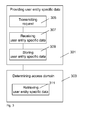
- Fig. 3 shows a diagram of a method for managing communications towards a user entity, e.g. towards the user entity 113 shown in Fig. 1 .
- the method is performed by the aforementioned network entity 200.
- the method has the step of providing 301 user entity specific data e.g. by the application server 201 for access domain selection.
- the method further has determining 303 an access domain upon the basis of the user entity specific data e.g. by the access domain selector 203 shown in Fig. 2 .
- the step of providing 301 user entity specific data comprises transmitting 305 a request for user entity specific data e.g. by the application server 201 shown in Fig. 2 towards a network register, e.g. towards an HSS 104 as shown in Fig. 1 , receiving 307 the user entity specific data e.g. by the application server 201 shown in Fig. 2 from the network register upon transmitting 305 the request, and storing 309 the user entity specific data e.g. by the application server 201 e.g. in the storage 205 shown in Fig. 2 .
- the step of determining 303 the access domain comprises retrieving 311 user entity specific data from e.g. the storage 205 shown in Fig. 2 by the access domain selector 203 shown in Fig. 2 in order to determine the access domain.
- Some of the above-described embodiments and implementations enable to reduce a number of queries in a communication network for obtaining user-specific information.
Landscapes
- Engineering & Computer Science (AREA)
- Computer Networks & Wireless Communication (AREA)
- Signal Processing (AREA)
- Multimedia (AREA)
- Computer Security & Cryptography (AREA)
- Business, Economics & Management (AREA)
- General Business, Economics & Management (AREA)
- Mobile Radio Communication Systems (AREA)
- Telephonic Communication Services (AREA)
Abstract
Description
- The present invention relates to mobile communications, in particular to mobile voice communications over communication networks.
- For mobile data communications, layered communication according to the 3GPP specification (3rd Generation Partnership Project) may be deployed. The 3GPP specification comprises three distinct layers: an application layer, a network control layer and a connectivity layer. The application layer supports end-user applications and may be implemented in mobile stations or application servers in the network. The application layer interfaces with the network layer to enable designing and implementing different services and applications. The network control layer supports communicating services across e.g. different types of networks such as circuit-switched domain networks based on the GSM standard using e.g. an ISDN-related technology or packet-switched networks employing e.g. IP technologies. The connectivity layer is a transport layer capable of transporting any type of service via e.g. voice, data and multimedia streams.
- The 3GPP specification defines the Long Term Evolution (LTE) as an access network technology. The LTE comprises a MME (Mobility Management Entity) forming a control-entity suitable for signalling and selecting a serving gateway (SGW) which routes and forwards data packets carrying e.g. multimedia services. For delivering the multimedia services across the access network, the 3GPP specification defines the IP Multimedia Subsystem (IMS). The IMS comprises a service layer forming an application layer, a control and connectivity layer forming a network control layer, and an access layer forming a connectivity layer. The control and connectivity layer comprises call session control functions (CSCF) forming central entities for session initiation protocol (SIP) signalling. Among the CSCFs, a serving CSCF (S-CSCF) forms a central node for handling registrations of a user entity (UE) in a communication network. The IMS further specifies an access domain selector (ADS) for selecting an access domain to which the user entity is connected. The access domain selector may be implemented in a service centralization and continuity application server (SCC-AS) as specified in the 3GPP TS 23.237 specification. The IMS further specifies an application server (AS) which is provided for hosting and executing services for user entities. An example of an application server is the multimedia telephony service server (MMTel) offering multimedia communications such as voice. Another example of an application server is the voice call continuity server (VCC).
- For establishing a communication link towards the user entity, the application server and the access domain selector may independently query the home subscriber server for user entity specific data e.g. indicating an access domain for accessing to the user entity, which may result in a number of network queries.
- It is the object of the invention to provide an efficient concept for providing user entity specific data to network entities of a communication network.
- This object is achieved by the features of the independent claims. Further embodiments may be based on the features of the dependent claims.
- The invention is based on the finding that user entity specific data may efficiently be provided to network entities of a communication network by collocating those network entities which may require the user entity specific data. The collocated network entities may directly exchange the user entity specific data so that a number of queries to the communication network may be reduced.
- With exemplarily reference to the IMS, a collocation of an application server and an access domain selector may reduce the number of queries for the user entity specific data in the IMS communication network. By way of example, the application server may query a home subscriber server to obtain the user entity specific data. Therefore, the access domain selector which is collocated to the application server may directly obtain the user entity specific data from the application server without querying the home subscriber server over the IMS communication network to obtain the user entity specific data.
- According to an aspect, the invention relates to a network entity for managing communications towards a user entity over a communication network. The network entity has an access domain selector for determining an access domain of the user entity upon the basis of user entity specific data, and an application server for providing the user entity specific data. The application server may host and execute services for a user entity, e.g. for a mobile terminal. The access domain selector may implement a terminating access domain selection function of the IMS standard. The access domain may be formed by a package-switched access network or by a circuit switched access network via which to access to the user entity
- By way of example, the application server may have received the user entity specific data from a network register such as a home subscriber server according to the IMS technology. The application server may then provide the user entity specific data to the access domain selector so that the access domain selector may avoid querying the network register for obtaining the user entity specific data.
- According to an embodiment, the access domain selector may directly refer to the application server in order to obtain the user entity specific data. The application server may also prestore the user entity specific data for the access domain selector. If the data required by the access domain selector cannot be provided by the application server, then the access domain selector may query these data from the home subscriber server according to the IMS technology.
- According to an embodiment, the access domain selector and the application server may be collocated to form the network entity. By way of example, the access domain selector and the application server may communicate with each other via an interface. However, the functionality of the access domain selector and the functionality of the application server may be mutually implemented in hardware and/or in software.
- According to an embodiment, the user entity specific data has at least one of: repository data according to the IP multimedia subsystem (IMS), a network identifier associated with the user entity that can be represented by way of example by a visitor location register number, voice support information indicating whether the access domain supports a voice service within a packet-switched access domain, in particular the capability of the access domain to support voice over IP in the case of a packet-switched access domain, information relating to a communication status of the user entity, the communication status indicating whether the user entity is currently communicating, and type information indicating a type of the access domain, the type of the access domain indicating a packet-switched access domain or a circuit-switched access domain, a user entity identifier, in particular an international mobile subscriber identity (IMSI) and/or a Mobile Subscriber ISDN Number (MSISDN). By way of example, the communication status may comprise a busy status, an idle status, a non-available status or a non-network registered status.
- According to an embodiment, the network entity may have a storage, in particular a storage which is collocated to the network entity, wherein the application server may be configured to store the user entity specific data in the storage and wherein the access domain selector may be configured to retrieve the user entity-specific data from the storage. The storage may be implemented in the application server or in the access domain selector. Generally, the storage may be an element of the network entity. The access domain selector, the application server and the storage may communicate with each other via an interface.
- According to an embodiment, the application server may be configured to determine the user entity specific data upon registration of the user entity to the communication network and/or during a session setup. By way of example, the application server may receive the user entity specific data from an HSS in order to determine services, e.g. roaming or billing, for the user entity.
- According to an embodiment, the application server is an IMS application server which is configured to transmit a request, e.g. an Sh pull request, for the user entity specific data towards the communication network via an Sh interface according to the IMS technology. By way of example, the application server, when communicating according to the IMS, may query the HSS to obtain the user entity specific data in order to determine which services are applicable for the user entity. The communication between the application server and the HSS may be performed via the Sh interface according to the IMS.
- According to an embodiment, the application server is an IMS application server being configured to receive the user entity specific data via an Sh interface over the communication network, in particular from an HSS. The HSS may transmit the user entity specific data via the Sh interface towards the application server upon receiving a request from the application server to transmit the user entity specific data as mentioned above.
- According to an embodiment, the network entity may have a storage, e.g. a storage which is collocated to the network entity, and wherein the application server is an IMS application server being configured to transmit a request, in particular an Sh request, for the user entity specific data towards a home subscriber server, to receive the user entity specific data from the home subscriber server upon transmitting the request, and to store the user entity specific data in the storage. The access domain selector may retrieve the user entity specific data from the storage when determining the access domain for accessing to the user entity.
- According to an embodiment, the network entity may have a storage, e.g. the aforementioned storage, for storing the user entity specific data, wherein the access domain selector may be configured to retrieve the user entity specific data upon receiving a session initiation request, e.g. a session initiation protocol (SIP) request such as SIP invite, the session initiation request requesting to establish a communication link towards the user entity. Upon the basis of the retrieved user entity specific data, the access domain selector may determine the access domain via which to access to the user entity for establishing the communication link.
- According to an embodiment, the network entity may have a transmitter for transmitting a request for the user entity specific data towards the communication network.
- According to an embodiment, the application server may have a transmitter for transmitting a request for the user entity specific data towards the communication network.
- According to an embodiment, the network entity may have a receiver for receiving the user entity specific data from the communication network.
- According to an embodiment, the application server may have a receiver for receiving the user entity specific data from the communication network.
- The above-mentioned receivers may respectively comprise a receive filter, a demodulator etc. for receiving communication signals over a communication network. Correspondingly, the above-mentioned transmitters may respectively comprise transmit filter or modulators. However, the receivers and the transmitters may respectively form communication entities being able to communicate according to the internet protocol (IP).
- According to an embodiment, the access domain selector is configured to determine upon the basis of the user entity specific data whether the access domain is a packet-switched access network, or whether the access domain is a circuit-switched access network and whether the packet-switched access network supports voice-over-IP.
- According to an embodiment, the application server is an IMS application server, in particular an IMS multimedia telephone service (MMTel) application server.
- According to an embodiment, the access domain selector is an IMS access domain selector, in particular a service centralization and continuity application server (SCC-AS). By way of example, the access domain selector may implement the terminating access domain selection function according to the IMS.
- According to a further aspect, the invention relates to a method for managing communications towards a user entity of a communication network. The method has determining an access domain by an access domain selector, e.g. by the aforementioned access domain selector, upon the basis of user entity specific data for accessing to the user entity, and providing the user entity specific data for the access domain selector by an application server, e.g. by the afore-mentioned application server. Further method steps may be directly derived from the functionality of the network entity, of the aforementioned access domain selector and/or of the aforementioned application server.
- According to an embodiment, the method may have transmitting a request, in particular via the Sh interface according to the IMS technology, for the user entity specific data by the application server towards a home subscriber server, receiving the user entity specific data by the application server from the home subscriber server upon transmitting the request, storing the user entity specific data by the application server, and retrieving the user entity specific data from the storage by the access domain selector, in particular upon receiving a session initiation request to establish a communication link towards the user entity.
- Further embodiments will be described with reference to the following figures, in which:
-
Fig. 1 shows a block diagram of a communication system according to an embodiment; -
Fig. 2 further shows a block diagram of a network entity according to an embodiment; and -
Fig. 3 shows a diagram of a method for managing communications towards a user entity according to an embodiment. -
Fig. 1 shows a block diagram of a communication system according to the principles described herein with exemplarily reference to the IMS. The communication system comprises an interrogatingentity 101, e.g. an interrogating call session control function (I-CSCF), asession control entity 103, e.g. a serving CSCF (S-CSCF), anetwork register 104, e.g. a home subscriber server (HSS), and anetwork entity 105. Thenetwork entity 105 comprises anapplication server 107, e.g. a multimedia telephony service server (MMTel), and anaccess domain selector 109, e.g. a service centralization and continuity application server (SCC-AS). According to an implementation, thenetwork entity 105 communicates with thenetwork register 104 and with thesession control entity 103. Thenetwork entity 105 may further comprise astorage 110 which is in communication with theapplication server 107 and theaccess domain selector 109. According to an implementation, the interrogatingentity 101 communicates with thenetwork register 104 and with thesession control entity 103. -
Fig. 1 further shows anaccess domain 111 and a user entity 113 (UE) attached to theaccess domain 111. For a mobile terminating call towards theuser entity 113, thesession control entity 103 may relay on information provided by theaccess domain selector 109. According to an implementation, the information provided by theaccess domain selector 109 identifies theaccess domain 111. If theuser entity 113 is network registered to an IMS communication network, then theaccess domain 111 may comprise a proxy CSCF (P-CSCF). If the user entity is network registered to a circuit-switched communication network, then theaccess domain 111 may comprise an access circuit switch. - In case of a mobile terminating call towards the
user entity 113, the interrogatingentity 101 may receive a session initiation request, e.g. a session initiation protocol (SIP) invite, from a calling party which is not depicted inFig. 1 . Then, the interrogatingentity 101 may query thenetwork register 104 to find out thesession control entity 103 to which theuser entity 113 is registered. - If the
user entity 113 is registered to thesession control entity 103, then thenetwork register 104 informs the interrogatingentity 101 accordingly. Then, the interrogatingentity 101 forwards the session initiation request towards thesession control entity 103. Subsequently, thesession control entity 103 may query theapplication server 107 in order to determine services which are applicable for theuser entity 113. Upon receiving the query, theapplication server 107 may query thenetwork register 104 to obtain user entity specific data relating to theuser entity 113. Thereafter, thenetwork register 104 may transmit the requested user entity specific data towards theapplication server 107. Theapplication server 107 may thereafter store the received user entity specific data in thestorage 110. Then, theapplication server 107 may inform theservice control entity 103 about the services which are applicable for the user entity. In the following, thesession control entity 103 may refer to theaccess domain selector 109 to determine theaccess domain 111 via which to access to theuser entity 113. Instead of requesting thenetwork register 104 for theaccess domain 111 for reaching theuser entity 113, theaccess domain selector 109 may refer to thestorage 110. Thus, an additional request towards thenetwork register 104 to obtain the user entity specific data may be avoided. - If the
user entity 113 is served by the packet-switchedaccess domain 111 for an active voice call, then theapplication server 107 may have knowledge about the active voice call and thus about the access domain where theuser entity 113 can be reached for another incoming voice call. The information about the packet-switchedaccess domain 111 serving theuser entity 113 for an active voice call may be stored as user entity specific data in thestorage 110. Instead of requesting thenetwork register 104 for theaccess domain 111 for reaching theuser entity 113 for another incoming call in parallel to a call that is still active, theaccess domain selector 109 may refer to thestorage 110. Thus, an additional request towards thenetwork register 104 to obtain the user entity specific data may be avoided. - If the
user entity 113 is accessible via theaccess domain 111, then theaccess domain selector 109 informs thesession control entity 103 accordingly. By way of example, theaccess domain selector 109 may inform thesession control entity 103 that theuser entity 113 is registered to a packet-switchedaccess domain 111 and is therefore accessible via IMS. If theuser entity 113 is registered to the circuit-switched domain, then theaccess domain selector 109 may provide specific routing information to thesession control entity 103 that results into routing towards a circuit-switchedaccess domain 111. According to an embodiment, theuser entity 113 is a mobile terminal. -
Fig. 2 shows a block diagram of anetwork entity 200 according to an embodiment. Thenetwork entity 200 comprises an application server 201 (AS) and an access domain selector 203 (ADS). According to an implementation, thenetwork entity 200 comprises astorage 205 in communication with theapplication server 201 and with theaccess domain selector 203. According to another implementation, thestorage 205 may be implemented in theapplication server 201. According to yet another implementation, thestorage 205 may be implemented in theaccess domain selector 203. According to yet another implementation, thestorage 205 may form a network storage being accessible by thenetwork entity 200, in particular by theapplication server 201 and/or by the access domain selector 203 (ADS), over a communication network. - According to an implementation, the
network entity 200 comprises a transmitter 206 (Tx) which is in communication with theapplication server 201 and with theaccess domain selector 203. Correspondingly, thenetwork entity 200 comprises a receiver 207 (Rx) which is in communication with theapplication server 201 and with theaccess domain selector 203. According to another implementation, theapplication server 201 and theaccess domain selector 203 may respectively comprise a transmitter and a receiver for communicating over the communication network. - According to an implementation, the
receiver 207 is in communication with thestorage 205 for e.g. storing user entity specific data obtained from e.g. an HSS. - According to an implementation, the
transmitter 206 optionally is in communication with thestorage 205. - According to an implementation, the
application server 201 may, by means of thetransmitter 206, transmit arequest 209, e.g. via the an Sh interface according to the IMS, towards a communication network in order to request an home subscriber server which is not depicted inFig. 2 for user entityspecific data 211. The user entityspecific data 211 may be transmitted by the home subscriber server towards thenetwork entity 200 and may be received by thereceiver 207. According to an implementation, thereceiver 207 forwards the received user entityspecific data 211 to theapplication server 201. In response to obtaining the user entityspecific data 211, theapplication server 201 stores the user entityspecific data 211 in thestorage 205. According to an implementation, also thereceiver 207 may be arranged to store the user entityspecific data 211 in thestorage 205. - According to an implementation, the
application server 201 and/or theaccess domain selector 203 may be implemented in hardware or in software. According to an implementation, theapplication server 201 and theaccess domain selector 203 may be separate entities collocated to thenetwork entity 200. - According to an implementation, the
application server 201 and theaccess domain selector 203 may be implemented in thenetwork entity 200. By way of example, the implementation may be performed on a processor, in particular on a digital signal processor. -
Fig. 3 shows a diagram of a method for managing communications towards a user entity, e.g. towards theuser entity 113 shown inFig. 1 . According to an implementation, the method is performed by theaforementioned network entity 200. - The method has the step of providing 301 user entity specific data e.g. by the
application server 201 for access domain selection. The method further has determining 303 an access domain upon the basis of the user entity specific data e.g. by theaccess domain selector 203 shown inFig. 2 . - According to an implementation, the step of providing 301 user entity specific data comprises transmitting 305 a request for user entity specific data e.g. by the
application server 201 shown inFig. 2 towards a network register, e.g. towards anHSS 104 as shown inFig. 1 , receiving 307 the user entity specific data e.g. by theapplication server 201 shown inFig. 2 from the network register upon transmitting 305 the request, and storing 309 the user entity specific data e.g. by theapplication server 201 e.g. in thestorage 205 shown inFig. 2 . According to an implementation, the step of determining 303 the access domain comprises retrieving 311 user entity specific data from e.g. thestorage 205 shown inFig. 2 by theaccess domain selector 203 shown inFig. 2 in order to determine the access domain. - Some of the above-described embodiments and implementations enable to reduce a number of queries in a communication network for obtaining user-specific information.
- The above-mentioned embodiments of the methods of the present invention may be embodied by respective means to form a respective embodiment of a device.
- Features of any embodiment or implementation presented herein may be combined with other features and other embodiments or implementations presented herein wherever it seems technologically desirable.
- The previous description of the disclosed embodiments is provided to enable any person skilled in the art to make or use the present invention. Various modifications to these embodiments will be readily apparent to those skilled in the art, and the generic principles defined herein may be applied to other embodiments, arrangements or systems without departing from the scope of the invention. Thus, the present invention is not intended to be limited to the embodiments shown herein but is to be accorded the widest scope consistent with the principles disclosed herein.
Claims (15)
- Network entity for managing communications towards a user entity over a communication network, the network entity having:an access domain selector (109; 203) for determining an access domain of the user entity (113) upon the basis of user entity specific data; andan application server (107; 201) for providing the user entity specific data.
- The network entity of claim 1, wherein the user entity specific data has at least one of:repository data according to the IP Multimedia Subsystem technology,a network identifier, in particular a visitor location register number,voice support information indicating whether the access domain supports a voice service within a packet-switched access domain,information relating to a communication status of the user entity, the communication status indicating whether the user entity is currently communicating,type information indicating a type of the access domain, the type of the access domain indicating a packet-switched access domain or a circuit-switched access domain,a user entity identifier, by example an International Mobile Subscriber Identity.
- The network entity of any of the preceding claims, further having a storage (110; 205), in particular a storage collocated to the network entity (105; 207), wherein the application server (107; 201) is configured to store the user entity specific data in the storage (110; 205), and wherein the access domain selector (109; 203) is configured to retrieve the user entity specific data from the storage (110; 205).
- The network entity of any of the preceding claims, wherein the application server (107; 201) is configured to determine the user entity specific data upon registration of the user entity to the communication network.
- The network entity of any of the preceding claims, wherein the application server (107; 201) is an IP Multimedia Subsystem application server being configured to transmit a request, in particular via an Sh interface according to the IMS, for the user entity specific data towards the communication network.
- The network entity of any of the preceding claims, wherein the application server (107; 201) is an IP Multimedia Subsystem application server being configured to receive the user entity specific data via an Sh interface over the communication network.
- The network entity of any of the preceding claims, wherein the network entity has a storage (110; 205), in particular a storage collocated to the network entity (105; 207), and wherein the application server (107; 201) is an IP Multimedia Subsystem application server being configured
to transmit a request, in particular via the Sh interface according to the IP Multimedia Subsystem, for the user entity specific data towards a home subscriber server (104);
to receive the user entity specific data from the home subscriber server (104) upon transmitting the request; and
to store the user entity specific data in the storage (110; 205). - The network entity of any of the preceding claims, further having a storage (110; 205) for storing the user entity specific data, wherein the access domain selector (109; 203) is configured to retrieve the user entity specific data upon receiving a session initiation request, in particular a session initiation protocol request, the session initiation request requesting to establish a communication link towards the access domain (111) serving the user entity (113) for the incoming session.
- The network entity of any of the preceding claims, wherein the network entity or the application server (107; 201) and the access domain selector (109; 203) has a transmitter for transmitting a request for the user entity specific data towards the communication network.
- The network entity of any of the preceding claims, wherein the network entity or the application server (107; 201) or the access domain selector (109; 203) has a receiver (207) for receiving the user entity specific data from the communication network.
- The network entity of any of the preceding claims, wherein the access domain selector (109; 203) is configured to determine upon the basis of the user entity specific data
whether the access domain is a packet-switched access network; or
whether the access domain is a circuit-switched access network. - The network entity of any of the preceding claims, wherein the application server (107; 201) is an IP Multimedia Subsystem application server, in particular an IP Multimedia Subsystem multimedia telephony service application server.
- The network entity of any of the preceding claims, wherein the access domain selector (109; 203) is an IP Multimedia Subsystem access domain selector, in particular a service centralization and continuity application server.
- Method for managing communications towards a user entity (113) over a communication network, the method being performed by the network entity (105; 207) according to anyone of the preceding claims, the method having:providing (301) user entity specific data by the application server (107; 201) for access domain selection; anddetermining (303) an access domain (111) of the user entity (113) by the access domain selector (109; 203) upon the basis of the user entity specific data (309; 311).
- The method of claim 14, having:transmitting (305) a request, in particular via an Sh interface according to the IP Multimedia Subsystem, for the user entity specific data by the application server (107; 201) towards a home subscriber server (104);receiving (307) the user entity specific data by the application server (107; 201) from the home subscriber server (104) upon transmitting (305) the request;storing (309) the user entity specific data by the application server (107; 201) in the storage (110:205); andretrieving (311) the user entity specific data by the access domain selector (109; 203).
Priority Applications (8)
| Application Number | Priority Date | Filing Date | Title |
|---|---|---|---|
| EP10172622.2A EP2418818B1 (en) | 2010-08-12 | 2010-08-12 | Network entity for managing communications towards a user entity over a communication network |
| CN201180046231.0A CN103125106B (en) | 2010-08-12 | 2011-08-10 | For managing network entity and the method for the communication to user subject on a communication network |
| PCT/EP2011/063772 WO2012020055A1 (en) | 2010-08-12 | 2011-08-10 | Network entity for managing communications towards a user entity over a communication network |
| KR1020137005999A KR20130042607A (en) | 2010-08-12 | 2011-08-10 | Network entity for managing communications towards a user entity over a communication network |
| US13/816,597 US10484933B2 (en) | 2010-08-12 | 2011-08-10 | Network entity for managing communications towards a user entity over a communication network |
| RU2013109210/08A RU2580061C2 (en) | 2010-08-12 | 2011-08-10 | Network entity for controlling communication with user object via communication network |
| BR112013003069A BR112013003069A2 (en) | 2010-08-12 | 2011-08-10 | network entity to manage communications towards a user entity over a communication network, method for managing communications toward a user entity over a communication network |
| KR1020150173431A KR101740826B1 (en) | 2010-08-12 | 2015-12-07 | Network entity for managing communications towards a user entity over a communication network |
Applications Claiming Priority (1)
| Application Number | Priority Date | Filing Date | Title |
|---|---|---|---|
| EP10172622.2A EP2418818B1 (en) | 2010-08-12 | 2010-08-12 | Network entity for managing communications towards a user entity over a communication network |
Publications (2)
| Publication Number | Publication Date |
|---|---|
| EP2418818A1 true EP2418818A1 (en) | 2012-02-15 |
| EP2418818B1 EP2418818B1 (en) | 2018-02-14 |
Family
ID=43259869
Family Applications (1)
| Application Number | Title | Priority Date | Filing Date |
|---|---|---|---|
| EP10172622.2A Not-in-force EP2418818B1 (en) | 2010-08-12 | 2010-08-12 | Network entity for managing communications towards a user entity over a communication network |
Country Status (6)
| Country | Link |
|---|---|
| US (1) | US10484933B2 (en) |
| EP (1) | EP2418818B1 (en) |
| KR (2) | KR20130042607A (en) |
| BR (1) | BR112013003069A2 (en) |
| RU (1) | RU2580061C2 (en) |
| WO (1) | WO2012020055A1 (en) |
Families Citing this family (2)
| Publication number | Priority date | Publication date | Assignee | Title |
|---|---|---|---|---|
| CN107911390A (en) * | 2017-12-14 | 2018-04-13 | 浪潮软件股份有限公司 | Handle method, proxy server, application server and the system of service request |
| US12495335B2 (en) | 2022-12-20 | 2025-12-09 | T-Mobile Usa, Inc. | Selective routing control for circuit switched fallback |
Citations (4)
| Publication number | Priority date | Publication date | Assignee | Title |
|---|---|---|---|---|
| WO2008120028A1 (en) * | 2007-03-30 | 2008-10-09 | Telefonaktiebolaget Lm Ericsson (Publ) | System and method for indicating circuit switched access at ims registration |
| WO2008145610A2 (en) * | 2007-05-29 | 2008-12-04 | Nokia Siemens Networks Oy | Method, system and server for domain selection in communication system |
| WO2008152133A2 (en) * | 2007-06-15 | 2008-12-18 | Telefonaktiebolaget Lm Ericsson (Publ) | Access domain selection in a communications network |
| EP2061269A1 (en) * | 2006-10-12 | 2009-05-20 | Huawei Technologies Co Ltd | Method for providing access mode selection to multimode terminal, system and apparatus thereof |
Family Cites Families (44)
| Publication number | Priority date | Publication date | Assignee | Title |
|---|---|---|---|---|
| US5907544A (en) | 1996-05-10 | 1999-05-25 | Rypinski; Chandos A. | Hub controller architecture and function for a multiple access-point wireless communication network |
| EP1104960B1 (en) | 1999-12-02 | 2009-08-26 | Sony Deutschland GmbH | Message authentication |
| SG99886A1 (en) | 2000-02-24 | 2003-11-27 | Ibm | System and method for collaborative multi-device web browsing |
| US7013125B2 (en) | 2001-06-08 | 2006-03-14 | Lucent Technologies Inc. | Replenishment of prepaid accounts during multimedia sessions |
| WO2003047297A1 (en) | 2001-11-21 | 2003-06-05 | Nokia Corporation | A telecommunications system and method for controlling privacy |
| WO2003092218A1 (en) | 2002-04-26 | 2003-11-06 | Thomson Licensing S.A. | Transitive authentication authorization accounting in interworking between access networks |
| US7395336B1 (en) | 2002-05-14 | 2008-07-01 | Sprint Spectrum L.P. | Method for managing SIP registrations in a telecommunications network |
| US7239864B2 (en) | 2002-08-14 | 2007-07-03 | Thomson Licensing | Session key management for public wireless LAN supporting multiple virtual operators |
| US8812382B2 (en) | 2003-01-15 | 2014-08-19 | Nokia Corporation | Charging for a communication system |
| US7369839B2 (en) | 2003-03-14 | 2008-05-06 | Nokia Siemens Networks Oy | Method and apparatus for determining individual or common mobile subscriber number in mobile network for handling multiple subscribers having the same calling line identity |
| US7421732B2 (en) | 2003-05-05 | 2008-09-02 | Nokia Corporation | System, apparatus, and method for providing generic internet protocol authentication |
| EP1665719B1 (en) | 2003-07-18 | 2012-06-13 | NTT DoCoMo, Inc. | Context propagation in data network |
| DE60308029T2 (en) | 2003-09-11 | 2006-12-21 | Alcatel | Registration of a dual-mode terminal in a cellular network and a WLAN network |
| FI20040444A0 (en) | 2004-03-23 | 2004-03-23 | Nokia Corp | Selection of network connection unit in a communication system |
| US9503528B2 (en) * | 2004-06-14 | 2016-11-22 | Alcatel-Lucent Usa Inc. | System for provisioning service data utilizing the IMS defined Sh interface's transparent data |
| US8260257B2 (en) | 2005-02-07 | 2012-09-04 | Cisco Technology, Inc. | Key distribution for wireless devices |
| FI20050500A0 (en) | 2005-05-11 | 2005-05-11 | Nokia Corp | A method for implementing inter-system handovers in a mobile communication system |
| CN1869877A (en) | 2005-05-28 | 2006-11-29 | 鸿富锦精密工业(深圳)有限公司 | Electric saving device and method |
| CN100379315C (en) * | 2005-06-21 | 2008-04-02 | 华为技术有限公司 | Method for authenticating a user terminal |
| US8083586B2 (en) | 2005-06-22 | 2011-12-27 | Nokia Corporation | System and method for providing interoperability of independently-operable electronic games |
| WO2007010010A1 (en) * | 2005-07-19 | 2007-01-25 | Telefonaktiebolaget Lm Ericsson (Publ) | Method and apparatus for allocating a server in an ims network |
| US8811954B1 (en) * | 2005-10-31 | 2014-08-19 | Genband Us Llc | Network domain selection |
| US7995565B2 (en) * | 2006-10-03 | 2011-08-09 | Research In Motion Limited | System and method for managing call continuity in IMS network environment using SIP messaging |
| CN101018353A (en) * | 2006-02-10 | 2007-08-15 | 朗迅科技公司 | Service data configuration based on the mobile unit |
| US8005073B2 (en) | 2006-02-13 | 2011-08-23 | Nokia Corporation | Representing network availability status information in presence information |
| KR100886548B1 (en) | 2006-04-26 | 2009-03-02 | 삼성전자주식회사 | Method and system of forwarding capability information of user equipment in internet protocol multimedia subsystem network |
| CA2550698A1 (en) | 2006-06-19 | 2007-12-19 | Daniel Mccann | Method and apparatus for encryption and pass-through handling of confidential information in software applications |
| US9054909B2 (en) | 2006-06-30 | 2015-06-09 | Microsoft Technology Licensing, Llc | Forwarding calls in real time communications |
| CN101132405A (en) | 2006-08-21 | 2008-02-27 | 华为技术有限公司 | Communication network system and method for providing service agent function and service agent device |
| CA2672266A1 (en) | 2006-12-13 | 2008-06-19 | Sharp Kabushiki Kaisha | Mobile communication control system, method, and communication terminal |
| US10171998B2 (en) | 2007-03-16 | 2019-01-01 | Qualcomm Incorporated | User profile, policy, and PMIP key distribution in a wireless communication network |
| US7668159B2 (en) * | 2007-04-25 | 2010-02-23 | Research In Motion Limited | Methods and apparatus for obtaining variable call parameters suitable for use in originating a SIP call via a circuit-switched network from a user equipment device |
| US8935407B2 (en) | 2007-05-31 | 2015-01-13 | Alcatel Lucent | Providing supplemental content to an IMS user during registration |
| US8738907B2 (en) | 2007-08-02 | 2014-05-27 | Motorola Solutiions, Inc. | Wireless device authentication and security key management |
| CN101437093B (en) | 2007-11-12 | 2011-09-14 | 朗讯科技公司 | Implementation of calling address transmission in IMS network |
| EP2068529A1 (en) | 2007-12-03 | 2009-06-10 | France Telecom | Method of triggering a plurality of services and related session controller |
| WO2009074846A1 (en) | 2007-12-13 | 2009-06-18 | Nokia Corporation | Location tagging method for packet based signalling |
| US8358647B2 (en) * | 2008-09-18 | 2013-01-22 | Futurewei Technologies, Inc. | System and method for provision of IMS based services for legacy CS UE with home node B access |
| CN101577884B (en) | 2008-09-19 | 2012-06-13 | 中兴通讯股份有限公司 | Media negotiation method for IP multimedia link |
| US9300628B2 (en) * | 2008-10-10 | 2016-03-29 | Nokia Technologies Oy | Correlating communication sessions |
| US8520689B2 (en) | 2009-01-14 | 2013-08-27 | Starhome Gmbh | Network interoperability between IP communications networks or sub-networks |
| US20100215018A1 (en) * | 2009-02-26 | 2010-08-26 | Alcatel-Lucent Usa Inc. | Cs handover from ims femto to macro |
| US8549040B2 (en) | 2009-03-10 | 2013-10-01 | Telefonaktiebolaget L M Ericsson (Publ) | IP multimedia subsystem service configuration |
| US9144050B2 (en) * | 2009-12-17 | 2015-09-22 | Telefonaktiebolaget L M Ericsson (Publ) | Methods and apparatus for use in a communications network |
-
2010
- 2010-08-12 EP EP10172622.2A patent/EP2418818B1/en not_active Not-in-force
-
2011
- 2011-08-10 US US13/816,597 patent/US10484933B2/en active Active
- 2011-08-10 BR BR112013003069A patent/BR112013003069A2/en active Search and Examination
- 2011-08-10 RU RU2013109210/08A patent/RU2580061C2/en active
- 2011-08-10 WO PCT/EP2011/063772 patent/WO2012020055A1/en not_active Ceased
- 2011-08-10 KR KR1020137005999A patent/KR20130042607A/en not_active Ceased
-
2015
- 2015-12-07 KR KR1020150173431A patent/KR101740826B1/en active Active
Patent Citations (4)
| Publication number | Priority date | Publication date | Assignee | Title |
|---|---|---|---|---|
| EP2061269A1 (en) * | 2006-10-12 | 2009-05-20 | Huawei Technologies Co Ltd | Method for providing access mode selection to multimode terminal, system and apparatus thereof |
| WO2008120028A1 (en) * | 2007-03-30 | 2008-10-09 | Telefonaktiebolaget Lm Ericsson (Publ) | System and method for indicating circuit switched access at ims registration |
| WO2008145610A2 (en) * | 2007-05-29 | 2008-12-04 | Nokia Siemens Networks Oy | Method, system and server for domain selection in communication system |
| WO2008152133A2 (en) * | 2007-06-15 | 2008-12-18 | Telefonaktiebolaget Lm Ericsson (Publ) | Access domain selection in a communications network |
Non-Patent Citations (1)
| Title |
|---|
| ERICSSON: "Consideration of the relationship between Domain Selection and Personal Network Management", 3GPP DRAFT; S2-070157, 3RD GENERATION PARTNERSHIP PROJECT (3GPP), MOBILE COMPETENCE CENTRE ; 650, ROUTE DES LUCIOLES ; F-06921 SOPHIA-ANTIPOLIS CEDEX ; FRANCE, vol. SA WG2, no. Florence; 20070109, 9 January 2007 (2007-01-09), XP050258961 * |
Also Published As
| Publication number | Publication date |
|---|---|
| US10484933B2 (en) | 2019-11-19 |
| RU2013109210A (en) | 2014-09-20 |
| RU2580061C2 (en) | 2016-04-10 |
| KR20150145214A (en) | 2015-12-29 |
| BR112013003069A2 (en) | 2016-06-28 |
| KR20130042607A (en) | 2013-04-26 |
| CN103125106A (en) | 2013-05-29 |
| KR101740826B1 (en) | 2017-06-08 |
| WO2012020055A1 (en) | 2012-02-16 |
| US20130142126A1 (en) | 2013-06-06 |
| EP2418818B1 (en) | 2018-02-14 |
Similar Documents
| Publication | Publication Date | Title |
|---|---|---|
| US12273843B2 (en) | Support for IMS routing with multiple IMS PDU sessions over different 5GC slices | |
| EP2418817B1 (en) | Application server for managing communications towards a set of user entities | |
| WO2011100166A2 (en) | Methods, systems, and computer readable media for dynamic subscriber profile adaptation | |
| US8335485B2 (en) | Call routing | |
| KR101818881B1 (en) | Network entity and method for managing session initiation protocol communications towards a user entity in a communication network | |
| JP5470464B2 (en) | Emergency signaling of IP multimedia subsystem network | |
| CN106941669B (en) | Wireless communication method and P-CSCF (proxy Call Session control function) equipment | |
| US10484933B2 (en) | Network entity for managing communications towards a user entity over a communication network | |
| KR101107948B1 (en) | Service provisioning in a communication system | |
| KR100447412B1 (en) | The Apparatus and Method for the Mobility Management of IP Multimedia Service Subscriber | |
| CN114845276B (en) | Method and platform for realizing network capability opening | |
| KR20090009925A (en) | Selecting S-CPF for Application Server Outgoing Requests | |
| EP3094059B1 (en) | Routing voice over lte call invites in a terminating ims | |
| CN103125106B (en) | For managing network entity and the method for the communication to user subject on a communication network | |
| EP2139156A1 (en) | Method, system and device for realizing user equipment registering in personal network | |
| US9173184B2 (en) | Mobile communication system supporting service centralization and continuity and method thereof | |
| KR20170076401A (en) | System and method for processing call forwarding services of smart phone |
Legal Events
| Date | Code | Title | Description |
|---|---|---|---|
| AK | Designated contracting states |
Kind code of ref document: A1 Designated state(s): AL AT BE BG CH CY CZ DE DK EE ES FI FR GB GR HR HU IE IS IT LI LT LU LV MC MK MT NL NO PL PT RO SE SI SK SM TR |
|
| AX | Request for extension of the european patent |
Extension state: BA ME RS |
|
| PUAI | Public reference made under article 153(3) epc to a published international application that has entered the european phase |
Free format text: ORIGINAL CODE: 0009012 |
|
| 17P | Request for examination filed |
Effective date: 20120801 |
|
| 17Q | First examination report despatched |
Effective date: 20150326 |
|
| STAA | Information on the status of an ep patent application or granted ep patent |
Free format text: STATUS: EXAMINATION IS IN PROGRESS |
|
| GRAP | Despatch of communication of intention to grant a patent |
Free format text: ORIGINAL CODE: EPIDOSNIGR1 |
|
| STAA | Information on the status of an ep patent application or granted ep patent |
Free format text: STATUS: GRANT OF PATENT IS INTENDED |
|
| RIC1 | Information provided on ipc code assigned before grant |
Ipc: H04W 48/00 20090101ALI20170823BHEP Ipc: H04W 36/00 20090101ALI20170823BHEP Ipc: H04W 48/16 20090101ALI20170823BHEP Ipc: H04W 48/18 20090101ALI20170823BHEP Ipc: H04L 29/06 20060101AFI20170823BHEP |
|
| INTG | Intention to grant announced |
Effective date: 20170914 |
|
| GRAS | Grant fee paid |
Free format text: ORIGINAL CODE: EPIDOSNIGR3 |
|
| GRAA | (expected) grant |
Free format text: ORIGINAL CODE: 0009210 |
|
| STAA | Information on the status of an ep patent application or granted ep patent |
Free format text: STATUS: THE PATENT HAS BEEN GRANTED |
|
| AK | Designated contracting states |
Kind code of ref document: B1 Designated state(s): AL AT BE BG CH CY CZ DE DK EE ES FI FR GB GR HR HU IE IS IT LI LT LU LV MC MK MT NL NO PL PT RO SE SI SK SM TR |
|
| REG | Reference to a national code |
Ref country code: GB Ref legal event code: FG4D |
|
| REG | Reference to a national code |
Ref country code: CH Ref legal event code: EP |
|
| REG | Reference to a national code |
Ref country code: IE Ref legal event code: FG4D |
|
| REG | Reference to a national code |
Ref country code: DE Ref legal event code: R096 Ref document number: 602010048452 Country of ref document: DE Ref country code: AT Ref legal event code: REF Ref document number: 970563 Country of ref document: AT Kind code of ref document: T Effective date: 20180315 |
|
| REG | Reference to a national code |
Ref country code: NL Ref legal event code: MP Effective date: 20180214 |
|
| REG | Reference to a national code |
Ref country code: AT Ref legal event code: MK05 Ref document number: 970563 Country of ref document: AT Kind code of ref document: T Effective date: 20180214 |
|
| PG25 | Lapsed in a contracting state [announced via postgrant information from national office to epo] |
Ref country code: ES Free format text: LAPSE BECAUSE OF FAILURE TO SUBMIT A TRANSLATION OF THE DESCRIPTION OR TO PAY THE FEE WITHIN THE PRESCRIBED TIME-LIMIT Effective date: 20180214 Ref country code: HR Free format text: LAPSE BECAUSE OF FAILURE TO SUBMIT A TRANSLATION OF THE DESCRIPTION OR TO PAY THE FEE WITHIN THE PRESCRIBED TIME-LIMIT Effective date: 20180214 Ref country code: NO Free format text: LAPSE BECAUSE OF FAILURE TO SUBMIT A TRANSLATION OF THE DESCRIPTION OR TO PAY THE FEE WITHIN THE PRESCRIBED TIME-LIMIT Effective date: 20180514 Ref country code: FI Free format text: LAPSE BECAUSE OF FAILURE TO SUBMIT A TRANSLATION OF THE DESCRIPTION OR TO PAY THE FEE WITHIN THE PRESCRIBED TIME-LIMIT Effective date: 20180214 Ref country code: LT Free format text: LAPSE BECAUSE OF FAILURE TO SUBMIT A TRANSLATION OF THE DESCRIPTION OR TO PAY THE FEE WITHIN THE PRESCRIBED TIME-LIMIT Effective date: 20180214 Ref country code: NL Free format text: LAPSE BECAUSE OF FAILURE TO SUBMIT A TRANSLATION OF THE DESCRIPTION OR TO PAY THE FEE WITHIN THE PRESCRIBED TIME-LIMIT Effective date: 20180214 Ref country code: CY Free format text: LAPSE BECAUSE OF FAILURE TO SUBMIT A TRANSLATION OF THE DESCRIPTION OR TO PAY THE FEE WITHIN THE PRESCRIBED TIME-LIMIT Effective date: 20180214 |
|
| REG | Reference to a national code |
Ref country code: FR Ref legal event code: PLFP Year of fee payment: 9 |
|
| PG25 | Lapsed in a contracting state [announced via postgrant information from national office to epo] |
Ref country code: SE Free format text: LAPSE BECAUSE OF FAILURE TO SUBMIT A TRANSLATION OF THE DESCRIPTION OR TO PAY THE FEE WITHIN THE PRESCRIBED TIME-LIMIT Effective date: 20180214 Ref country code: LV Free format text: LAPSE BECAUSE OF FAILURE TO SUBMIT A TRANSLATION OF THE DESCRIPTION OR TO PAY THE FEE WITHIN THE PRESCRIBED TIME-LIMIT Effective date: 20180214 Ref country code: BG Free format text: LAPSE BECAUSE OF FAILURE TO SUBMIT A TRANSLATION OF THE DESCRIPTION OR TO PAY THE FEE WITHIN THE PRESCRIBED TIME-LIMIT Effective date: 20180514 Ref country code: AT Free format text: LAPSE BECAUSE OF FAILURE TO SUBMIT A TRANSLATION OF THE DESCRIPTION OR TO PAY THE FEE WITHIN THE PRESCRIBED TIME-LIMIT Effective date: 20180214 |
|
| PG25 | Lapsed in a contracting state [announced via postgrant information from national office to epo] |
Ref country code: RO Free format text: LAPSE BECAUSE OF FAILURE TO SUBMIT A TRANSLATION OF THE DESCRIPTION OR TO PAY THE FEE WITHIN THE PRESCRIBED TIME-LIMIT Effective date: 20180214 Ref country code: IT Free format text: LAPSE BECAUSE OF FAILURE TO SUBMIT A TRANSLATION OF THE DESCRIPTION OR TO PAY THE FEE WITHIN THE PRESCRIBED TIME-LIMIT Effective date: 20180214 Ref country code: EE Free format text: LAPSE BECAUSE OF FAILURE TO SUBMIT A TRANSLATION OF THE DESCRIPTION OR TO PAY THE FEE WITHIN THE PRESCRIBED TIME-LIMIT Effective date: 20180214 Ref country code: AL Free format text: LAPSE BECAUSE OF FAILURE TO SUBMIT A TRANSLATION OF THE DESCRIPTION OR TO PAY THE FEE WITHIN THE PRESCRIBED TIME-LIMIT Effective date: 20180214 Ref country code: PL Free format text: LAPSE BECAUSE OF FAILURE TO SUBMIT A TRANSLATION OF THE DESCRIPTION OR TO PAY THE FEE WITHIN THE PRESCRIBED TIME-LIMIT Effective date: 20180214 |
|
| REG | Reference to a national code |
Ref country code: DE Ref legal event code: R097 Ref document number: 602010048452 Country of ref document: DE |
|
| PG25 | Lapsed in a contracting state [announced via postgrant information from national office to epo] |
Ref country code: CZ Free format text: LAPSE BECAUSE OF FAILURE TO SUBMIT A TRANSLATION OF THE DESCRIPTION OR TO PAY THE FEE WITHIN THE PRESCRIBED TIME-LIMIT Effective date: 20180214 Ref country code: SK Free format text: LAPSE BECAUSE OF FAILURE TO SUBMIT A TRANSLATION OF THE DESCRIPTION OR TO PAY THE FEE WITHIN THE PRESCRIBED TIME-LIMIT Effective date: 20180214 Ref country code: SM Free format text: LAPSE BECAUSE OF FAILURE TO SUBMIT A TRANSLATION OF THE DESCRIPTION OR TO PAY THE FEE WITHIN THE PRESCRIBED TIME-LIMIT Effective date: 20180214 Ref country code: DK Free format text: LAPSE BECAUSE OF FAILURE TO SUBMIT A TRANSLATION OF THE DESCRIPTION OR TO PAY THE FEE WITHIN THE PRESCRIBED TIME-LIMIT Effective date: 20180214 |
|
| PLBE | No opposition filed within time limit |
Free format text: ORIGINAL CODE: 0009261 |
|
| STAA | Information on the status of an ep patent application or granted ep patent |
Free format text: STATUS: NO OPPOSITION FILED WITHIN TIME LIMIT |
|
| 26N | No opposition filed |
Effective date: 20181115 |
|
| PG25 | Lapsed in a contracting state [announced via postgrant information from national office to epo] |
Ref country code: SI Free format text: LAPSE BECAUSE OF FAILURE TO SUBMIT A TRANSLATION OF THE DESCRIPTION OR TO PAY THE FEE WITHIN THE PRESCRIBED TIME-LIMIT Effective date: 20180214 |
|
| PG25 | Lapsed in a contracting state [announced via postgrant information from national office to epo] |
Ref country code: MC Free format text: LAPSE BECAUSE OF FAILURE TO SUBMIT A TRANSLATION OF THE DESCRIPTION OR TO PAY THE FEE WITHIN THE PRESCRIBED TIME-LIMIT Effective date: 20180214 |
|
| REG | Reference to a national code |
Ref country code: CH Ref legal event code: PL |
|
| PG25 | Lapsed in a contracting state [announced via postgrant information from national office to epo] |
Ref country code: CH Free format text: LAPSE BECAUSE OF NON-PAYMENT OF DUE FEES Effective date: 20180831 Ref country code: LI Free format text: LAPSE BECAUSE OF NON-PAYMENT OF DUE FEES Effective date: 20180831 Ref country code: LU Free format text: LAPSE BECAUSE OF NON-PAYMENT OF DUE FEES Effective date: 20180812 |
|
| REG | Reference to a national code |
Ref country code: BE Ref legal event code: MM Effective date: 20180831 |
|
| REG | Reference to a national code |
Ref country code: IE Ref legal event code: MM4A |
|
| PG25 | Lapsed in a contracting state [announced via postgrant information from national office to epo] |
Ref country code: IE Free format text: LAPSE BECAUSE OF NON-PAYMENT OF DUE FEES Effective date: 20180812 |
|
| REG | Reference to a national code |
Ref country code: DE Ref legal event code: R082 Ref document number: 602010048452 Country of ref document: DE |
|
| PG25 | Lapsed in a contracting state [announced via postgrant information from national office to epo] |
Ref country code: BE Free format text: LAPSE BECAUSE OF NON-PAYMENT OF DUE FEES Effective date: 20180831 |
|
| PG25 | Lapsed in a contracting state [announced via postgrant information from national office to epo] |
Ref country code: MT Free format text: LAPSE BECAUSE OF NON-PAYMENT OF DUE FEES Effective date: 20180812 |
|
| PG25 | Lapsed in a contracting state [announced via postgrant information from national office to epo] |
Ref country code: TR Free format text: LAPSE BECAUSE OF FAILURE TO SUBMIT A TRANSLATION OF THE DESCRIPTION OR TO PAY THE FEE WITHIN THE PRESCRIBED TIME-LIMIT Effective date: 20180214 |
|
| PG25 | Lapsed in a contracting state [announced via postgrant information from national office to epo] |
Ref country code: PT Free format text: LAPSE BECAUSE OF FAILURE TO SUBMIT A TRANSLATION OF THE DESCRIPTION OR TO PAY THE FEE WITHIN THE PRESCRIBED TIME-LIMIT Effective date: 20180214 Ref country code: HU Free format text: LAPSE BECAUSE OF FAILURE TO SUBMIT A TRANSLATION OF THE DESCRIPTION OR TO PAY THE FEE WITHIN THE PRESCRIBED TIME-LIMIT; INVALID AB INITIO Effective date: 20100812 |
|
| PG25 | Lapsed in a contracting state [announced via postgrant information from national office to epo] |
Ref country code: GR Free format text: LAPSE BECAUSE OF FAILURE TO SUBMIT A TRANSLATION OF THE DESCRIPTION OR TO PAY THE FEE WITHIN THE PRESCRIBED TIME-LIMIT Effective date: 20180214 Ref country code: MK Free format text: LAPSE BECAUSE OF NON-PAYMENT OF DUE FEES Effective date: 20180214 |
|
| PG25 | Lapsed in a contracting state [announced via postgrant information from national office to epo] |
Ref country code: IS Free format text: LAPSE BECAUSE OF FAILURE TO SUBMIT A TRANSLATION OF THE DESCRIPTION OR TO PAY THE FEE WITHIN THE PRESCRIBED TIME-LIMIT Effective date: 20180614 |
|
| REG | Reference to a national code |
Ref country code: DE Ref legal event code: R079 Ref document number: 602010048452 Country of ref document: DE Free format text: PREVIOUS MAIN CLASS: H04L0029060000 Ipc: H04L0065000000 |
|
| PGFP | Annual fee paid to national office [announced via postgrant information from national office to epo] |
Ref country code: DE Payment date: 20240819 Year of fee payment: 15 |
|
| PGFP | Annual fee paid to national office [announced via postgrant information from national office to epo] |
Ref country code: GB Payment date: 20240822 Year of fee payment: 15 |
|
| PGFP | Annual fee paid to national office [announced via postgrant information from national office to epo] |
Ref country code: FR Payment date: 20240823 Year of fee payment: 15 |
|
| REG | Reference to a national code |
Ref country code: DE Ref legal event code: R119 Ref document number: 602010048452 Country of ref document: DE |
|
| GBPC | Gb: european patent ceased through non-payment of renewal fee |
Effective date: 20250812 |
|
| PG25 | Lapsed in a contracting state [announced via postgrant information from national office to epo] |
Ref country code: GB Free format text: LAPSE BECAUSE OF NON-PAYMENT OF DUE FEES Effective date: 20250812 |
|
| PG25 | Lapsed in a contracting state [announced via postgrant information from national office to epo] |
Ref country code: DE Free format text: LAPSE BECAUSE OF NON-PAYMENT OF DUE FEES Effective date: 20260303 |
|
| PG25 | Lapsed in a contracting state [announced via postgrant information from national office to epo] |
Ref country code: FR Free format text: LAPSE BECAUSE OF NON-PAYMENT OF DUE FEES Effective date: 20250831 |