EP2418009A1 - Simulated moving bed membrane reactor, new hybrid separation process and uses thereof - Google Patents
Simulated moving bed membrane reactor, new hybrid separation process and uses thereof Download PDFInfo
- Publication number
- EP2418009A1 EP2418009A1 EP10724137A EP10724137A EP2418009A1 EP 2418009 A1 EP2418009 A1 EP 2418009A1 EP 10724137 A EP10724137 A EP 10724137A EP 10724137 A EP10724137 A EP 10724137A EP 2418009 A1 EP2418009 A1 EP 2418009A1
- Authority
- EP
- European Patent Office
- Prior art keywords
- process according
- reactor
- stream
- desorbent
- columns
- Prior art date
- Legal status (The legal status is an assumption and is not a legal conclusion. Google has not performed a legal analysis and makes no representation as to the accuracy of the status listed.)
- Granted
Links
- 239000012528 membrane Substances 0.000 title claims abstract description 52
- 238000000926 separation method Methods 0.000 title claims abstract description 21
- 238000006243 chemical reaction Methods 0.000 claims abstract description 51
- 239000000376 reactant Substances 0.000 claims abstract description 22
- 238000005373 pervaporation Methods 0.000 claims abstract description 8
- 239000000126 substance Substances 0.000 claims abstract description 7
- 239000002904 solvent Substances 0.000 claims abstract description 5
- 150000001241 acetals Chemical class 0.000 claims abstract description 4
- 150000001875 compounds Chemical class 0.000 claims abstract description 4
- 238000010924 continuous production Methods 0.000 claims abstract description 4
- 150000002148 esters Chemical class 0.000 claims abstract description 4
- 239000000047 product Substances 0.000 claims description 56
- 238000000034 method Methods 0.000 claims description 28
- 230000008569 process Effects 0.000 claims description 25
- 239000000284 extract Substances 0.000 claims description 23
- 239000007787 solid Substances 0.000 claims description 22
- 239000012466 permeate Substances 0.000 claims description 19
- 239000003463 adsorbent Substances 0.000 claims description 13
- 239000000203 mixture Substances 0.000 claims description 13
- 239000003054 catalyst Substances 0.000 claims description 12
- 230000015572 biosynthetic process Effects 0.000 claims description 9
- 238000001179 sorption measurement Methods 0.000 claims description 9
- 230000008929 regeneration Effects 0.000 claims description 8
- 238000011069 regeneration method Methods 0.000 claims description 8
- 239000006227 byproduct Substances 0.000 claims description 7
- 238000005886 esterification reaction Methods 0.000 claims description 6
- 230000002378 acidificating effect Effects 0.000 claims description 5
- 239000003456 ion exchange resin Substances 0.000 claims description 5
- 229920003303 ion-exchange polymer Polymers 0.000 claims description 5
- 239000010457 zeolite Substances 0.000 claims description 5
- PNEYBMLMFCGWSK-UHFFFAOYSA-N aluminium oxide Inorganic materials [O-2].[O-2].[O-2].[Al+3].[Al+3] PNEYBMLMFCGWSK-UHFFFAOYSA-N 0.000 claims description 4
- 230000032050 esterification Effects 0.000 claims description 4
- 150000004760 silicates Chemical class 0.000 claims description 4
- 239000012465 retentate Substances 0.000 claims description 3
- 230000004913 activation Effects 0.000 claims description 2
- 239000002808 molecular sieve Substances 0.000 claims description 2
- URGAHOPLAPQHLN-UHFFFAOYSA-N sodium aluminosilicate Chemical compound [Na+].[Al+3].[O-][Si]([O-])=O.[O-][Si]([O-])=O URGAHOPLAPQHLN-UHFFFAOYSA-N 0.000 claims description 2
- 239000011949 solid catalyst Substances 0.000 claims description 2
- 230000021736 acetylation Effects 0.000 claims 1
- 238000006640 acetylation reaction Methods 0.000 claims 1
- 239000003049 inorganic solvent Substances 0.000 claims 1
- 229910001867 inorganic solvent Inorganic materials 0.000 claims 1
- 230000010354 integration Effects 0.000 claims 1
- 239000002608 ionic liquid Substances 0.000 claims 1
- 239000003960 organic solvent Substances 0.000 claims 1
- 230000001360 synchronised effect Effects 0.000 claims 1
- 238000005809 transesterification reaction Methods 0.000 claims 1
- 238000005516 engineering process Methods 0.000 abstract description 12
- 230000009467 reduction Effects 0.000 abstract description 4
- 238000004587 chromatography analysis Methods 0.000 abstract description 3
- 150000004649 carbonic acid derivatives Chemical class 0.000 abstract 1
- 150000002170 ethers Chemical class 0.000 abstract 1
- LFQSCWFLJHTTHZ-UHFFFAOYSA-N Ethanol Chemical compound CCO LFQSCWFLJHTTHZ-UHFFFAOYSA-N 0.000 description 28
- LZCLXQDLBQLTDK-UHFFFAOYSA-N ethyl 2-hydroxypropanoate Chemical compound CCOC(=O)C(C)O LZCLXQDLBQLTDK-UHFFFAOYSA-N 0.000 description 18
- XLYOFNOQVPJJNP-UHFFFAOYSA-N water Substances O XLYOFNOQVPJJNP-UHFFFAOYSA-N 0.000 description 16
- IKHGUXGNUITLKF-UHFFFAOYSA-N Acetaldehyde Chemical compound CC=O IKHGUXGNUITLKF-UHFFFAOYSA-N 0.000 description 14
- JVTAAEKCZFNVCJ-UHFFFAOYSA-N lactic acid Chemical compound CC(O)C(O)=O JVTAAEKCZFNVCJ-UHFFFAOYSA-N 0.000 description 10
- 229940116333 ethyl lactate Drugs 0.000 description 9
- DHKHKXVYLBGOIT-UHFFFAOYSA-N 1,1-Diethoxyethane Chemical compound CCOC(C)OCC DHKHKXVYLBGOIT-UHFFFAOYSA-N 0.000 description 8
- 229920001429 chelating resin Polymers 0.000 description 8
- 238000004519 manufacturing process Methods 0.000 description 8
- 239000007788 liquid Substances 0.000 description 7
- 230000000717 retained effect Effects 0.000 description 7
- 239000002253 acid Substances 0.000 description 6
- 235000014655 lactic acid Nutrition 0.000 description 5
- 239000004310 lactic acid Substances 0.000 description 5
- 125000004122 cyclic group Chemical group 0.000 description 4
- 230000007423 decrease Effects 0.000 description 4
- 238000000066 reactive distillation Methods 0.000 description 4
- 238000003786 synthesis reaction Methods 0.000 description 4
- 230000006872 improvement Effects 0.000 description 3
- 230000001965 increasing effect Effects 0.000 description 3
- 230000035699 permeability Effects 0.000 description 3
- 229920006395 saturated elastomer Polymers 0.000 description 3
- 241000894007 species Species 0.000 description 3
- NWUYHJFMYQTDRP-UHFFFAOYSA-N 1,2-bis(ethenyl)benzene;1-ethenyl-2-ethylbenzene;styrene Chemical compound C=CC1=CC=CC=C1.CCC1=CC=CC=C1C=C.C=CC1=CC=CC=C1C=C NWUYHJFMYQTDRP-UHFFFAOYSA-N 0.000 description 2
- VYPSYNLAJGMNEJ-UHFFFAOYSA-N Silicium dioxide Chemical compound O=[Si]=O VYPSYNLAJGMNEJ-UHFFFAOYSA-N 0.000 description 2
- 229910021536 Zeolite Inorganic materials 0.000 description 2
- SPEUIVXLLWOEMJ-UHFFFAOYSA-N acetaldehyde dimethyl acetal Natural products COC(C)OC SPEUIVXLLWOEMJ-UHFFFAOYSA-N 0.000 description 2
- 238000006359 acetalization reaction Methods 0.000 description 2
- 239000007795 chemical reaction product Substances 0.000 description 2
- 230000002860 competitive effect Effects 0.000 description 2
- 238000005907 ketalization reaction Methods 0.000 description 2
- 230000002441 reversible effect Effects 0.000 description 2
- IKGXIBQEEMLURG-NVPNHPEKSA-N rutin Chemical compound O[C@@H]1[C@H](O)[C@@H](O)[C@H](C)O[C@H]1OC[C@@H]1[C@@H](O)[C@H](O)[C@@H](O)[C@H](OC=2C(C3=C(O)C=C(O)C=C3OC=2C=2C=C(O)C(O)=CC=2)=O)O1 IKGXIBQEEMLURG-NVPNHPEKSA-N 0.000 description 2
- 238000011282 treatment Methods 0.000 description 2
- OKTJSMMVPCPJKN-UHFFFAOYSA-N Carbon Chemical compound [C] OKTJSMMVPCPJKN-UHFFFAOYSA-N 0.000 description 1
- XBDQKXXYIPTUBI-UHFFFAOYSA-M Propionate Chemical compound CCC([O-])=O XBDQKXXYIPTUBI-UHFFFAOYSA-M 0.000 description 1
- IKHGUXGNUITLKF-XPULMUKRSA-N acetaldehyde Chemical compound [14CH]([14CH3])=O IKHGUXGNUITLKF-XPULMUKRSA-N 0.000 description 1
- KXKVLQRXCPHEJC-UHFFFAOYSA-N acetic acid trimethyl ester Natural products COC(C)=O KXKVLQRXCPHEJC-UHFFFAOYSA-N 0.000 description 1
- 150000007513 acids Chemical class 0.000 description 1
- 239000000654 additive Substances 0.000 description 1
- 230000000996 additive effect Effects 0.000 description 1
- 239000007864 aqueous solution Substances 0.000 description 1
- 235000012216 bentonite Nutrition 0.000 description 1
- 238000009835 boiling Methods 0.000 description 1
- 229910052799 carbon Inorganic materials 0.000 description 1
- 125000003178 carboxy group Chemical group [H]OC(*)=O 0.000 description 1
- 150000001735 carboxylic acids Chemical class 0.000 description 1
- 239000000919 ceramic Substances 0.000 description 1
- 238000001311 chemical methods and process Methods 0.000 description 1
- 238000012937 correction Methods 0.000 description 1
- 230000009849 deactivation Effects 0.000 description 1
- 230000003247 decreasing effect Effects 0.000 description 1
- 238000013461 design Methods 0.000 description 1
- 238000003795 desorption Methods 0.000 description 1
- 238000010586 diagram Methods 0.000 description 1
- HNPSIPDUKPIQMN-UHFFFAOYSA-N dioxosilane;oxo(oxoalumanyloxy)alumane Chemical compound O=[Si]=O.O=[Al]O[Al]=O HNPSIPDUKPIQMN-UHFFFAOYSA-N 0.000 description 1
- 238000004821 distillation Methods 0.000 description 1
- 239000003480 eluent Substances 0.000 description 1
- 238000005265 energy consumption Methods 0.000 description 1
- 230000002708 enhancing effect Effects 0.000 description 1
- 230000004907 flux Effects 0.000 description 1
- 239000000446 fuel Substances 0.000 description 1
- 230000014509 gene expression Effects 0.000 description 1
- 239000011521 glass Substances 0.000 description 1
- 238000011835 investigation Methods 0.000 description 1
- 239000012035 limiting reagent Substances 0.000 description 1
- 239000000463 material Substances 0.000 description 1
- 239000002184 metal Substances 0.000 description 1
- 229910052751 metal Inorganic materials 0.000 description 1
- 150000002739 metals Chemical class 0.000 description 1
- 238000001471 micro-filtration Methods 0.000 description 1
- 238000001728 nano-filtration Methods 0.000 description 1
- 238000011328 necessary treatment Methods 0.000 description 1
- 231100000252 nontoxic Toxicity 0.000 description 1
- 230000003000 nontoxic effect Effects 0.000 description 1
- 238000005457 optimization Methods 0.000 description 1
- 239000002245 particle Substances 0.000 description 1
- 231100000572 poisoning Toxicity 0.000 description 1
- 230000000607 poisoning effect Effects 0.000 description 1
- 229920001467 poly(styrenesulfonates) Polymers 0.000 description 1
- 239000012429 reaction media Substances 0.000 description 1
- 238000011084 recovery Methods 0.000 description 1
- 230000002829 reductive effect Effects 0.000 description 1
- 229920005989 resin Polymers 0.000 description 1
- 239000011347 resin Substances 0.000 description 1
- 239000000377 silicon dioxide Substances 0.000 description 1
- 239000000243 solution Substances 0.000 description 1
- 238000007669 thermal treatment Methods 0.000 description 1
- 238000000108 ultra-filtration Methods 0.000 description 1
Images




Classifications
-
- B—PERFORMING OPERATIONS; TRANSPORTING
- B01—PHYSICAL OR CHEMICAL PROCESSES OR APPARATUS IN GENERAL
- B01D—SEPARATION
- B01D15/00—Separating processes involving the treatment of liquids with solid sorbents; Apparatus therefor
- B01D15/08—Selective adsorption, e.g. chromatography
- B01D15/10—Selective adsorption, e.g. chromatography characterised by constructional or operational features
- B01D15/18—Selective adsorption, e.g. chromatography characterised by constructional or operational features relating to flow patterns
- B01D15/1814—Recycling of the fraction to be distributed
- B01D15/1821—Simulated moving beds
- B01D15/1842—Simulated moving beds characterised by apparatus features
-
- B—PERFORMING OPERATIONS; TRANSPORTING
- B01—PHYSICAL OR CHEMICAL PROCESSES OR APPARATUS IN GENERAL
- B01D—SEPARATION
- B01D15/00—Separating processes involving the treatment of liquids with solid sorbents; Apparatus therefor
- B01D15/08—Selective adsorption, e.g. chromatography
- B01D15/10—Selective adsorption, e.g. chromatography characterised by constructional or operational features
- B01D15/18—Selective adsorption, e.g. chromatography characterised by constructional or operational features relating to flow patterns
- B01D15/1814—Recycling of the fraction to be distributed
- B01D15/1857—Reactive simulated moving beds
-
- B—PERFORMING OPERATIONS; TRANSPORTING
- B01—PHYSICAL OR CHEMICAL PROCESSES OR APPARATUS IN GENERAL
- B01D—SEPARATION
- B01D61/00—Processes of separation using semi-permeable membranes, e.g. dialysis, osmosis or ultrafiltration; Apparatus, accessories or auxiliary operations specially adapted therefor
- B01D61/36—Pervaporation; Membrane distillation; Liquid permeation
- B01D61/362—Pervaporation
- B01D61/3621—Pervaporation comprising multiple pervaporation steps
Definitions
- the present invention is a new hybrid technology, the simulated moving bed membrane reactor.
- the technology shown here integrates a reactor with two different separation techniques: i) chromatography (simulated moving bed - SMB); ii) selective permeable membrane (namely, pervaporation and permeation, among others) into a single device.
- the simulated moving bed reactor consists of a set of interconnected columns packed with a solid (or a mixture of a solid catalyst and an adsorbent) that catalyzes the reaction and separates the reaction products by selective adsorption of one of the products.
- the technology shown here integrates the SMBR with the membrane reactor by the use of selective permeable membranes incorporated into the columns of the SMBR, enhancing its global performance, since additionally to the products separation by selective adsorption there is, also, the selective membrane removal of one of the products.
- the present invention allows the intensification of a process that involves equilibrium limited reactions where more than one product is formed and their simultaneous separation (by adsorption and membranes), leading to conversions higher than the equilibrium ones, until complete conversion.
- This process is, therefore, appropriate for application to the continuous production and at industrial scale of oxygenated compounds, as esters and acetals.
- reaction and separation in a chemical process are seen, traditionally, as separated steps. This paradigm is still the current thought in the chemical industry.
- the combination of these steps (reaction/separation) in a single device has gain a considerable interest in the investigation and in the chemical industry, mainly for equilibrium limited reactions, since the continuous removal of at least one reaction product shifts the equilibrium in order to increase conversion and reduce by-product formation.
- multifunctional reactor is often used to embrace reactive separations technology, which main advantages are: reduction of energy requirements, decrease of solvents consumption, lower capital investments, higher yields in the formation of the product and improvement in the selectivity, in the case of competitive reactions.
- the custom multifunctional reactors used for that type of reactions are: reactive distillations, membrane reactors and chromatographic reactors.
- reactive distillation the best example is the methyl acetate production developed and patented by the company Eastman Kodak Company (Agreda and Partin, 1984). This technology allowed reducing five times the capital investment and the energy consumption when compared with the traditional process (reaction followed by separation by distillation).
- RD reactive distillation
- This technology allowed reducing five times the capital investment and the energy consumption when compared with the traditional process (reaction followed by separation by distillation).
- Membrane reactors are widely used in several chemical applications. Typical examples are the pervaporation and permeation reactors, where the catalyst is in a fixed (Zhu et al., 1996; Lafarga and Varma, 2000) or fluidized bed (Alonso et al., 2001; Lee et al., 2006). Several times, processes where the reactor and membrane are housed in separate units in series or parallel are also regarded as membrane reactors (Datta and Tsai, 1998; Tsotsis et al., 2007).
- Chromatographic reactors include fixed bed (FBR)(Silva and Rodrigues, 2002; Gyani and Mahajani, 2008), pressure swing adsorption (PSAR) (Harale et al., 2008) and simulated moving bed reactors (SMBR) (Kawase et al., 1996; Rodrigues and Silva, 2005; Silva and Rodrigues, 2005; Pereira et al., 2008).
- FBR fixed bed
- PSAR pressure swing adsorption
- SMBR simulated moving bed reactors
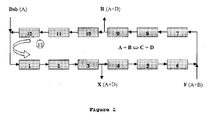
- the SMBR is well-known equipment (Broughton and Gerhold, 1961), that consists of a set of interconnected columns packed with an acid solid or a mixture of solids (catalysts and adsorbents). Typically, are introduced into the unit two inlet streams and are obtained two outlet streams, as shown in Figure 1 .
- One of the inlet streams is the desorbent (Dsb) that is normally one of the reactants (A) and that is used to regenerate the solid (or mixture of solids) in the first zone.
- the reactants (A and B) are introduced in the feed stream (F).
- the products formed are removed from the reactor in two different streams, one comprising the less retained product and the desorbent (raffinate - R), and other stream comprising the most retained product and the desorbent (extract - X). All the inlet/outlet streams are fed/removed from the system through ports positioned between the columns; these ports are periodically shifted in the direction of the liquid flow in order to simulate the counter-current motion between the solid(s) and the liquid.
- the reactor is equipped with a plurality of inlet and outlet ports, and a rotary valve or a plurality of valves arranged in manner such that any feed stream may be introduced to any column and any outlet or effluent stream may be withdraw from any column.
- the position of the inlet/outlet streams defines the different zones existing in the SMBR system, each one accomplishing a certain function and containing a variable number of columns.
- the zone I is comprised between the desorbent stream port (Dsb) and the extract stream port (X); the zone II is comprised between the extract stream port (X) and the feed stream port (F); the zone III is comprised between the feed stream port (F) and the raffinate stream port (R); and the zone IV is comprised between the raffinate stream port (R) and the recycle stream port (Rec).
- the reactants (A and B) introduced in the feed stream (F) are converted within zones II and III.
- the separation of the products formed (C and D) is carried out; the less retained product (C) is removed from the raffinate port and the most retained one (D) is removed from the extract port.
- the equilibrium is shifted towards products formation.
- the reaction proceeds till the complete consumption of the limiting reactant (B), achieving conversion values above the thermodynamic equilibrium, being possible to achieve complete conversion (100 %).
- the regeneration of the solid saturated with product D is performed using a desorbent (reactant A) and in zone IV the desorbent is regenerated since it can contain some product C.
- SMBR SMBR
- the successful design of SMBR involves the right choice of the operation conditions, mainly the switching time period and flow rates in each zone of the unit.
- the appropriate choice of those parameters will ensure the regeneration of acid solid (or mixture of solids) containing adsorbed water, in zone I; the regeneration of the desorbent contaminated with the less retained product in zone IV; and the complete conversion of reactants and the separation of the formed products in zones II and III.
- the switching time, t* is the time necessary to shift all ports from a position P' to a position P. This process of shifting the ports could be made synchronously or asynchronously.
- the SMBR has several advantages, as the ones already mentioned for the reactive separations; however, it has also some disadvantages, as for example, the difficulty in removing the more adsorbed species, which implies high desorbent consumption.
- the feed is a mixture of reactants with one of the products (as for example, in esterifications where the carboxylic acids are aqueous solutions of the acid, being that water is a by-product obtained in the esterification reaction), which will influence the performance of the unit resulting in low reactants conversion and products purity, low unit productivity and high eluent/desorbent consumption, mainly when the product in the feed is the more retained one.
- PermSMBR simulated moving bed membrane reactor
- SMB chromatography
- permeable membrane pervaporation or permeation
- the SMBR unit is integrated with the membrane reactor using selective permeable membranes inside the columns of the SMBR, called the simulated moving bed membrane reactor (PermSMBR).
- PermSMBR simulated moving bed membrane reactor
- the columns are packed with a solid, that should be simultaneously catalyst and selective adsorbent, could be acidic ion exchange resins, zeolites (Y, mordenites, ZSM, ferrierites), alumina silicates (mortmorillonites and bentonites) or hydrotalcites.
- acid resins are: Dowex 50 (Dow Chemical), Amberlite IR 120, Amberlyst A15 and A36 (Rohm & Haas), Lewatit (Bayer).
- a mixture of acid solids as catalyst and as selective adsorbent.
- the membranes must be selective to one of the products and can be classified regarding to the material (polymeric, ceramics, glass, metals and liquids), to the structure (symmetric, asymmetric, microporous, homogeneous) and to the process (microfiltration, ultrafiltration, nanofiltration, inverse osmosis, electrodyalisis, vapour permeation and pervaporation).
- the material polymeric, ceramics, glass, metals and liquids
- the structure symmetric, asymmetric, microporous, homogeneous
- microfiltration, ultrafiltration, nanofiltration, inverse osmosis, electrodyalisis, vapour permeation and pervaporation for application in reactions for the synthesis of organic products will be particularly interesting:
- the permSMBR unit typically, in the permSMBR unit are introduced two inlet streams and are obtained three outlet streams, dividing the reactor in 4 zones ( Figure 4 ), similarly to the traditional SMBR ( Figure 1 ).
- One of the inlet streams is the desorbent (Dsb) that is used to regenerate the solid saturated with the most adsorbed specie; and a feed that contains the reactants (F), and that can also contain the products.
- the products formed are removed from the reactor in three different streams, one rich in the less adsorbed product (raffinate - R), other rich in the most strongly adsorbed product (extract - X) and other that comprises, mainly, the product for which the membranes are selective, (total permeate - P), which combines all the permeate streams removed from each column.
- All the inlet/outlet streams are fed/removed from the system through ports positioned between the columns; these ports are periodically shifted (switching time, t*) in the direction of the liquid flow in order to simulate the counter-current motion between the solid(s) and the liquid.
- the shift of the ports can be made asynchronously.
- the reactor is equipped with a plurality of inlet and outlet ports, and a rotary valve or a plurality of valves arranged in manner such that any feed stream may be introduced to any column and any outlet or effluent stream may be withdraw from any column; and it is also equipped with vacuum in order to remove the permeate of each column. This (vacuum) can be performed in all the columns or just on the selected ones.
- the position of the inlet/outlet streams defines different zones existing in the PermSMBR unit, each one accomplishing a certain function and containing a variable number of columns.
- the zone 1 is comprised between the desorbent (Dsb) and extract nodes (X)
- the zone 2 is comprised between the extract (X) and feed node (F)
- the zone 3 is comprised between the feed (F) and raffinate node (R)
- the zone 4 is comprised between the raffinate (R) and desorbent node.
- the adsorbent is regenerated by desorption of the more strongly adsorbed product from the solid using a desorbent; in zones 2 and 3, reactive zones, the products are separated as they are being formed.
- zone IV before being recycled to zone I, the desorbent is regenerated by adsorption of the less adsorbed product (C).
- the PermSMBR can have different configurations depending on the number of streams fed/removed from the unit.
- the PermSMBR unit can be simplified to a unit of three zones: eliminating the extract stream (X), when the membrane is selective to the more adsorbed product ( Figure 5 ); or eliminating the raffinate stream (R), when the membrane is selective to the less retained product ( Figure 6 ).
- the PermSMBR unit can also be more complex, having five or more zones.
- the schematic diagram of the process represented in Figure 7 is similar to the one described for the Figure 4 , but it has 5 zones since an additional feed stream (F 2 ) is introduced to the system.
- F 2 additional feed stream
- the regeneration of the solid and the desorbent is accomplished in zones 1 and 5, respectively; and the complete conversion of reactants and separation of the products formed occurs in zone 2, 3 and 4.
- the feed F2 can comprise the same reactants as the ones in feed F1 but in different proportions, or other reactants in order to obtain the desired product.
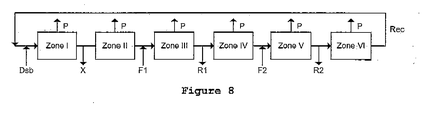
- R2 the case where 3 products are formed, it will be necessary to have other extra stream designed as R2 in Figure 8 .
- the PermSMBR unit can be operated in order to correct those problems, making a bypass to each one of the columns during a cycle to perform the necessary treatments (treatments with acids, solvents, replacement of the solid and/or of the membrane, thermal treatments, ).
- the treatment should be applied to the last column of zone I ( Figure 9 ), since this column is still saturated with the most adsorbed product, avoiding the unnecessary consumption of desorbent if other column of the same zone was selected.
- This procedure can also be performed in other zones in the most appropriate column.
- Other ways of correction along time can be performed to the operational variables of the PermSMBR unit, similarly to the procedure described in literature for the SMB unit (Sá Gomes et al., 2007).
- the present invention the PermSMBR unit
- the examples below show the application of the PermSMBR unit for the ethyl lactate production through the esterification reaction between ethanol and lactic acid; and for the acetaldehyde diethylacetal (or 1,1-dietoxiethane) production from ethanol and acetaldehyde. Both reactions have water has a by-product, as can be seen in the reactions described above.
- the PERMSMBR unit is applied for the ethyl lactate (EL) production.
- the Ethyl lactate is a green solvent, biodegradable, non toxic and FDA approved. Its synthesis comprises a reversible reaction between ethanol and lactic acid having water as by-product. The equilibrium conversion of this reaction at 50°C and for an initial molar ratio between ethanol and lactic acid of 2 is about 66 %.
- the acidic ion exchange resin Amberlyst 15-wet (Rohm & Haas, France) was used as catalyst and selective adsorbent to water. The feed was a commercial lactic acid solution (85 %) in water (15 %) and the desorbent was ethanol p.a. (99.5 %).
- the PermSMBR unit considered consisted in 12 columns packed with the Amberlyst 15-wet (average diameter of 342.5 ⁇ m), where each column had 13 commercial hydrophilic tubular membranes selective to water (Pervatech BV, The Netherlands) in order to dehydrate the reaction medium; the length, the porosity and the bulk density were of 23 cm, 0.424 and 390 kg/m 3 , respectively.
- the water and ethanol membrane permeabilities were of 1.3 ⁇ 10 -1 mol dm -2 min -1 bar -1 and 6.0 ⁇ 10 -4 mol dm -2 min -1 bart -1 , respectively (Sommer and Melin, 2005).
- the switching time was set at 2.1 minutes and the adopted configuration was of 3 columns in zone I, 3 columns in zone II, 4 columns in zone III and 2 columns in zone IV.
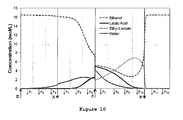
- the internal concentration profiles at the middle of the switching time at cyclic steady state are shown in Figure 10 .
- the lactic acid conversion obtained was of 99.34 % and it was observed the products separation: the ethyl lactate is removed in the raffinate stream (99.19 % purity, without desorbent) and the water is collected in the extract stream (99.98 % purity, without desorbent). Additionally, the water was also removed by the permeate streams in all twelve columns.
- the PermSMBR parameters were chosen in order to compare its performance to the one of the SMBR, since this technology will be the most competitive regarding to the PermSMBR. The same mass of catalyst and effective area was considered.
- This example is related to the acetaldehyde diethylacetal (or 1,1-dietoxiethane) synthesis in the PermSMBR unit.
- This product can be used as green additive for fuel since it decreases the particles emissions.
- the diethylacetal is formed through the reversible reaction between acetaldehyde and ethanol having water as by-product (Rodrigues and Silva, 2005). For this reaction, at room temperature and for a 2.2 initial molar ration of ethanol/acetaldehyde, the equilibrium conversion is of 55 %.
- the acidic ion exchange resin Amberlyst 15-wet (Rohm & Haas, France) was used as catalyst and selective adsorbent to water.
- the feed was a mixture of ethanol (30%) /acetaldehyde (70%) and the desorbent was ethanol (99.5%).
- the switching time was set at 4.2 minutes and the configuration adopted was of 6 columns in zone I, 3 columns in zone II and 3 columns in zone III.
- the pervaporation step was activated just in the first 4 columns of zone I and in all the columns of zone III, since the acetaldehyde is very volatile, having high vapour pressure and, consequently, a high driving force for the membrane flux.
Landscapes
- Chemical & Material Sciences (AREA)
- Chemical Kinetics & Catalysis (AREA)
- Engineering & Computer Science (AREA)
- Water Supply & Treatment (AREA)
- Life Sciences & Earth Sciences (AREA)
- Sustainable Development (AREA)
- Analytical Chemistry (AREA)
- Organic Low-Molecular-Weight Compounds And Preparation Thereof (AREA)
Abstract
Description
- The present invention is a new hybrid technology, the simulated moving bed membrane reactor. The technology shown here integrates a reactor with two different separation techniques: i) chromatography (simulated moving bed - SMB); ii) selective permeable membrane (namely, pervaporation and permeation, among others) into a single device.
- The simulated moving bed reactor (SMBR) consists of a set of interconnected columns packed with a solid (or a mixture of a solid catalyst and an adsorbent) that catalyzes the reaction and separates the reaction products by selective adsorption of one of the products. The technology shown here integrates the SMBR with the membrane reactor by the use of selective permeable membranes incorporated into the columns of the SMBR, enhancing its global performance, since additionally to the products separation by selective adsorption there is, also, the selective membrane removal of one of the products.
- The present invention allows the intensification of a process that involves equilibrium limited reactions where more than one product is formed and their simultaneous separation (by adsorption and membranes), leading to conversions higher than the equilibrium ones, until complete conversion. This process is, therefore, appropriate for application to the continuous production and at industrial scale of oxygenated compounds, as esters and acetals.
- Reaction and separation in a chemical process are seen, traditionally, as separated steps. This paradigm is still the current thought in the chemical industry. However, the combination of these steps (reaction/separation) in a single device has gain a considerable interest in the investigation and in the chemical industry, mainly for equilibrium limited reactions, since the continuous removal of at least one reaction product shifts the equilibrium in order to increase conversion and reduce by-product formation.
- The term multifunctional reactor is often used to embrace reactive separations technology, which main advantages are: reduction of energy requirements, decrease of solvents consumption, lower capital investments, higher yields in the formation of the product and improvement in the selectivity, in the case of competitive reactions. Typical examples of equilibrium limited reactions include:
Esterification: R'-COOH + HO-R = R'COOR + H2O
Acetalization: R'-CHO - 2 HO-R = R'CH-(OR)2 + H2O
Ketalization: R'R"CO + 2 HO-R = R'R"C(OR)2 + H2O
- In the state of the technique, the custom multifunctional reactors used for that type of reactions are: reactive distillations, membrane reactors and chromatographic reactors. Regarding to reactive distillation (RD) the best example is the methyl acetate production developed and patented by the company Eastman Kodak Company (Agreda and Partin, 1984). This technology allowed reducing five times the capital investment and the energy consumption when compared with the traditional process (reaction followed by separation by distillation). However, there are some disadvantages in the use of reactive distillation for systems that exhibit azeotropes formation and/or when the boiling points of the products are similar.
- Membrane reactors are widely used in several chemical applications. Typical examples are the pervaporation and permeation reactors, where the catalyst is in a fixed (Zhu et al., 1996; Lafarga and Varma, 2000) or fluidized bed (Alonso et al., 2001; Lee et al., 2006). Several times, processes where the reactor and membrane are housed in separate units in series or parallel are also regarded as membrane reactors (Datta and Tsai, 1998; Tsotsis et al., 2007). Chromatographic reactors include fixed bed (FBR)(Silva and Rodrigues, 2002; Gyani and Mahajani, 2008), pressure swing adsorption (PSAR) (Harale et al., 2008) and simulated moving bed reactors (SMBR) (Kawase et al., 1996; Rodrigues and Silva, 2005; Silva and Rodrigues, 2005; Pereira et al., 2008). However, from all the mentioned chromatographic reactors, the most common for process intensification for the production of oxygenated products is the SMBR. The SMBR is well-known equipment (Broughton and Gerhold, 1961), that consists of a set of interconnected columns packed with an acid solid or a mixture of solids (catalysts and adsorbents). Typically, are introduced into the unit two inlet streams and are obtained two outlet streams, as shown in
Figure 1 . One of the inlet streams is the desorbent (Dsb) that is normally one of the reactants (A) and that is used to regenerate the solid (or mixture of solids) in the first zone. The reactants (A and B) are introduced in the feed stream (F). The products formed are removed from the reactor in two different streams, one comprising the less retained product and the desorbent (raffinate - R), and other stream comprising the most retained product and the desorbent (extract - X). All the inlet/outlet streams are fed/removed from the system through ports positioned between the columns; these ports are periodically shifted in the direction of the liquid flow in order to simulate the counter-current motion between the solid(s) and the liquid. The reactor is equipped with a plurality of inlet and outlet ports, and a rotary valve or a plurality of valves arranged in manner such that any feed stream may be introduced to any column and any outlet or effluent stream may be withdraw from any column. The position of the inlet/outlet streams defines the different zones existing in the SMBR system, each one accomplishing a certain function and containing a variable number of columns. InFigure 1 , the zone I is comprised between the desorbent stream port (Dsb) and the extract stream port (X); the zone II is comprised between the extract stream port (X) and the feed stream port (F); the zone III is comprised between the feed stream port (F) and the raffinate stream port (R); and the zone IV is comprised between the raffinate stream port (R) and the recycle stream port (Rec). The reactants (A and B) introduced in the feed stream (F) are converted within zones II and III. In these zones, the separation of the products formed (C and D) is carried out; the less retained product (C) is removed from the raffinate port and the most retained one (D) is removed from the extract port. As the products are removed from the reaction zone as they are formed, the equilibrium is shifted towards products formation. As these products are continuously removed, the reaction proceeds till the complete consumption of the limiting reactant (B), achieving conversion values above the thermodynamic equilibrium, being possible to achieve complete conversion (100 %). In the zone I, the regeneration of the solid saturated with product D is performed using a desorbent (reactant A) and in zone IV the desorbent is regenerated since it can contain some product C. The successful design of SMBR involves the right choice of the operation conditions, mainly the switching time period and flow rates in each zone of the unit. The appropriate choice of those parameters will ensure the regeneration of acid solid (or mixture of solids) containing adsorbed water, in zone I; the regeneration of the desorbent contaminated with the less retained product in zone IV; and the complete conversion of reactants and the separation of the formed products in zones II and III. The flowrates for each zone are given by the following expressions: QI = QRec + QDsb; Qn = QI - QX; QIII = QII + QF; QIV = QIII - QR = Q Re c. The switching time, t*, is the time necessary to shift all ports from a position P' to a position P. This process of shifting the ports could be made synchronously or asynchronously. - The SMBR has several advantages, as the ones already mentioned for the reactive separations; however, it has also some disadvantages, as for example, the difficulty in removing the more adsorbed species, which implies high desorbent consumption. Besides, in several applications, the feed is a mixture of reactants with one of the products (as for example, in esterifications where the carboxylic acids are aqueous solutions of the acid, being that water is a by-product obtained in the esterification reaction), which will influence the performance of the unit resulting in low reactants conversion and products purity, low unit productivity and high eluent/desorbent consumption, mainly when the product in the feed is the more retained one. In order to overcome these issues, it is the aim of the present invention to provide a novel technology to perform, simultaneously, reaction and separation into a single device, minimizing the desorbent consumption, increasing the productivity, the reactants conversion and the products purity.
-
-
Figure 1 . SMBR unit, where a reaction of type A+B↔C+D is considered and where the product D is the most adsorbed and C is the less adsorbed one, in which Dsb is the desorbent, R is the raffinate, X is the extract, F is the feed and (13) is the liquid direction and ports shift. -
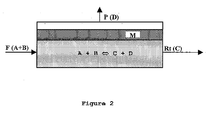
Figure 2 . Membrane reactor where a reaction of type A+B↔C+D is considered and where the membrane is selective to product D, in which P is the permeate, F is the feed, Rt is the retentate and M is the membrane. -
Figure 3 . PermSMBR unit used to produce a product C, from a mixture of reactants, A and B, and a by-product D removed by adsorption, as well as, by selective permeable membranes, in which Dsb is the desorbent, R is the raffinate, X is the extract, F is the feed and (13) is the liquid direction and ports shift. -
Figure 4 . PermSMBR unit with 4 zones: two inlet ports for the feed and the desorbent stream; and two outlet ports for the raffinate and extract streams, in which Dsb is the desorbent, R is the raffinate, X is the extract, F is the feed, P is the permeate and Rec is the recycle stream. -
Figure 5 . PermSMBR unit with 3 zones: two inlet ports for the feed and the desorbent streams; and one outlet port for the raffinate stream, in which Dsb is the desorbent, R is the raffinate, F is the feed, P is the permeate and Rec is the recycle stream. -
Figure 6 . PERMSMBR unit with 3 zones: two inlet ports for the feed and the desorbent streams; and one outlet port for the extract stream, in which Dsb is the desorbent, X is the extract, F is the feed, P is the permeate and Rec is the recycle stream. -
Figure 7 . PermSMBR unit with 5 zones: three inlet ports for two feed streams and one desorbent stream; and two outlet ports for the raffinate and extract streams, in which Dsb is the desorbent, R is the raffinate, X is the extract, F1 and F2 are the feed streams, P is the permeate and Rec is the recycle stream. -
Figure 8 . PermSMBR unit with 6 zones: three inlet ports for two feed streams and one desorbent stream; and three outlet ports for two raffinate streams and one extract stream, in which Dsb is the desorbent, R1 and R2 are the raffinate streams, X is the extract, F1 and F2 are the feed streams, P is the permeate and Rec is the recycle stream. -
Figure 9 . Bypass to perform the regeneration/activation step of the catalyst/adsorbent and/ or of the membranes in zone I of the PermSMBR unit, in which Dsb is the desorbent, Rg is the regeneration step, X is the extract and P is the permeate. -
Figure 10 . Internal concentration profiles at the middle of the switching time at cyclic steady state for the ethyl lactate production in a PermSMBR unit. -
Figure 11 . Internal concentration profiles at the middle of the switching time at cyclic steady state for the 1,1-dietoxiethane production in a PermSMBR unit. - In the present invention, a new hybrid technology is proposed, the simulated moving bed membrane reactor (PermSMBR), which integrates in a single equipment one reaction step with two different separation techniques: chromatography (SMB) and selective permeable membrane (pervaporation or permeation). The PermSMBR technology is particularly suitable for the intensification of processes that involve an equilibrium reaction and where more than one product is formed and where the feed is also comprised by one of the products, since they are removed from the reaction zone by adsorption and membranes processes, leading to higher conversions than the equilibrium ones, till almost complete conversion.
- This process is, therefore, appropriate for application to the continuous production at industrial scale of oxygenated compounds, as esters and acetals, since besides increasing the productivity (by increasing the conversion), increases also the purity and leads to a significant reduction of the desorbent consumption.
- In this invention, the SMBR unit is integrated with the membrane reactor using selective permeable membranes inside the columns of the SMBR, called the simulated moving bed membrane reactor (PermSMBR). The columns are packed with a solid, that should be simultaneously catalyst and selective adsorbent, could be acidic ion exchange resins, zeolites (Y, mordenites, ZSM, ferrierites), alumina silicates (mortmorillonites and bentonites) or hydrotalcites. Examples of acid resins are: Dowex 50 (Dow Chemical), Amberlite IR 120, Amberlyst A15 and A36 (Rohm & Haas), Lewatit (Bayer). Alternatively, it is possible to use a mixture of acid solids as catalyst and as selective adsorbent. The membranes must be selective to one of the products and can be classified regarding to the material (polymeric, ceramics, glass, metals and liquids), to the structure (symmetric, asymmetric, microporous, homogeneous) and to the process (microfiltration, ultrafiltration, nanofiltration, inverse osmosis, electrodyalisis, vapour permeation and pervaporation). For application in reactions for the synthesis of organic products will be particularly interesting:
- the pervaporation membranes:
- zeolite type A, T or Y membranes (Mitsui Engineering & Shipbuilding ltd., Japan);
- hydrophilic membranes, as for example, the Pervap 1000 (Sulzer Chemtech, German);
- PVA membranes, as for example, the Pervap 2201 and 2216 (Sulzer Chemtech, German) and the GFT-1005 (Deutsche Carbone AG);
- silica membranes, commercialized as Pervap SMS (Sulzer chemtech) or supplied by the Pervatech company (The Netherlands).
- the vapour permeation membranes - zeolite type A or T membranes, and carbon molecular sieves (CMS).
- Typically, in the permSMBR unit are introduced two inlet streams and are obtained three outlet streams, dividing the reactor in 4 zones (
Figure 4 ), similarly to the traditional SMBR (Figure 1 ). One of the inlet streams is the desorbent (Dsb) that is used to regenerate the solid saturated with the most adsorbed specie; and a feed that contains the reactants (F), and that can also contain the products. The products formed are removed from the reactor in three different streams, one rich in the less adsorbed product (raffinate - R), other rich in the most strongly adsorbed product (extract - X) and other that comprises, mainly, the product for which the membranes are selective, (total permeate - P), which combines all the permeate streams removed from each column. All the inlet/outlet streams, with exception of the permeate streams, are fed/removed from the system through ports positioned between the columns; these ports are periodically shifted (switching time, t*) in the direction of the liquid flow in order to simulate the counter-current motion between the solid(s) and the liquid. The shift of the ports can be made asynchronously. The reactor is equipped with a plurality of inlet and outlet ports, and a rotary valve or a plurality of valves arranged in manner such that any feed stream may be introduced to any column and any outlet or effluent stream may be withdraw from any column; and it is also equipped with vacuum in order to remove the permeate of each column. This (vacuum) can be performed in all the columns or just on the selected ones. Similarly to the SMBR, the position of the inlet/outlet streams defines different zones existing in the PermSMBR unit, each one accomplishing a certain function and containing a variable number of columns. InFigure 4 , thezone 1 is comprised between the desorbent (Dsb) and extract nodes (X), thezone 2 is comprised between the extract (X) and feed node (F); the zone 3 is comprised between the feed (F) and raffinate node (R), and the zone 4 is comprised between the raffinate (R) and desorbent node. Inzone 1, the adsorbent is regenerated by desorption of the more strongly adsorbed product from the solid using a desorbent; inzones 2 and 3, reactive zones, the products are separated as they are being formed. These products are continuously removed from the unit by adsorption and also through the selective membranes and, therefore, the reaction will proceed beyond the thermodynamic equilibrium, being possible to obtain 100 % % of reactants conversion. In zone IV, before being recycled to zone I, the desorbent is regenerated by adsorption of the less adsorbed product (C). - The PermSMBR can have different configurations depending on the number of streams fed/removed from the unit. The total number of streams, with exception of the permeate streams, corresponds to the total number of zones. For example, the PermSMBR unit can be simplified to a unit of three zones: eliminating the extract stream (X), when the membrane is selective to the more adsorbed product (
Figure 5 ); or eliminating the raffinate stream (R), when the membrane is selective to the less retained product (Figure 6 ). - If necessary, the PermSMBR unit can also be more complex, having five or more zones. For example, the schematic diagram of the process represented in
Figure 7 is similar to the one described for theFigure 4 , but it has 5 zones since an additional feed stream (F2) is introduced to the system. In this case, the regeneration of the solid and the desorbent is accomplished inzones 1 and 5, respectively; and the complete conversion of reactants and separation of the products formed occurs inzone 2, 3 and 4. The feed F2 can comprise the same reactants as the ones in feed F1 but in different proportions, or other reactants in order to obtain the desired product. In the case where 3 products are formed, it will be necessary to have other extra stream designed as R2 inFigure 8 . Additionally, if it is observed a decrease in the PermSMBR unit performance (decrease of products purity, reduction of reactants conversion and/or loss of productivity, among others) due to problems related to deactivation/poisoning of the catalyst/adsorbent and/or of the membranes, the PermSMBR unit can be operated in order to correct those problems, making a bypass to each one of the columns during a cycle to perform the necessary treatments (treatments with acids, solvents, replacement of the solid and/or of the membrane, thermal treatments, ...). For example, if the desorbent is more expensive than the more adsorbed product, the treatment should be applied to the last column of zone I (Figure 9 ), since this column is still saturated with the most adsorbed product, avoiding the unnecessary consumption of desorbent if other column of the same zone was selected. This procedure can also be performed in other zones in the most appropriate column. Other ways of correction along time can be performed to the operational variables of the PermSMBR unit, similarly to the procedure described in literature for the SMB unit (Sá Gomes et al., 2007). - The present invention, the PermSMBR unit, can be applied in a variety of different types of reactions, mainly, in equilibrium limited reactions, as for example, esterifications, acetalizations, and Ketalizations. The examples below show the application of the PermSMBR unit for the ethyl lactate production through the esterification reaction between ethanol and lactic acid; and for the acetaldehyde diethylacetal (or 1,1-dietoxiethane) production from ethanol and acetaldehyde. Both reactions have water has a by-product, as can be seen in the reactions described above.
- In this example, the PERMSMBR unit is applied for the ethyl lactate (EL) production. The Ethyl lactate is a green solvent, biodegradable, non toxic and FDA approved. Its synthesis comprises a reversible reaction between ethanol and lactic acid having water as by-product. The equilibrium conversion of this reaction at 50°C and for an initial molar ratio between ethanol and lactic acid of 2 is about 66 %. The acidic ion exchange resin Amberlyst 15-wet (Rohm & Haas, France) was used as catalyst and selective adsorbent to water. The feed was a commercial lactic acid solution (85 %) in water (15 %) and the desorbent was ethanol p.a. (99.5 %).
- The PermSMBR unit considered consisted in 12 columns packed with the Amberlyst 15-wet (average diameter of 342.5 µm), where each column had 13 commercial hydrophilic tubular membranes selective to water (Pervatech BV, The Netherlands) in order to dehydrate the reaction medium; the length, the porosity and the bulk density were of 23 cm, 0.424 and 390 kg/m3, respectively. The water and ethanol membrane permeabilities were of 1.3×10⁻¹ mol dm-2 min-1 bar-1 and 6.0×10⁻⁴ mol dm-2 min-1 bart-1, respectively (Sommer and Melin, 2005). The flowrates were QDsh = 58.0 mL/min; QRec = 27.0 mL/min ; QF = 9.6 mL/min and QX = 37.0 mL/min. The switching time was set at 2.1 minutes and the adopted configuration was of 3 columns in zone I, 3 columns in zone II, 4 columns in zone III and 2 columns in zone IV. The internal concentration profiles at the middle of the switching time at cyclic steady state are shown in
Figure 10 . The lactic acid conversion obtained was of 99.34 % and it was observed the products separation: the ethyl lactate is removed in the raffinate stream (99.19 % purity, without desorbent) and the water is collected in the extract stream (99.98 % purity, without desorbent). Additionally, the water was also removed by the permeate streams in all twelve columns. The PermSMBR parameters were chosen in order to compare its performance to the one of the SMBR, since this technology will be the most competitive regarding to the PermSMBR. The same mass of catalyst and effective area was considered. - In order to show the PermSMBR unit enhancement when compared with the SMBR unit with the same mass of Amberlyst 15-wet it is presented, in Table 1, the results of a first optimization obtained for the ethyl lactate production in each one of the technologies. The switching time, desorbent and recycle flowrate were kept equal to 2.1 min, 58.0 mL/min and 27.0 mL/min, respectively; while the extract, raffinate and feed flowrates were changed in order to optimize the performance of each unit. As can be observed, the ethyl lactate synthesis in the PermSMBR unit is enhanced in about 42 % and the desorbent consumption is decreased in 25 %, which will reduce the costs associated to the desorbent recovery in the following separation steps.
Table 1 SMBR PermSMBR Improvement EL Productivity (KgL-1day-1 ) 18.06 25.68 42.22 % Desorbent consumption (Lkg-1 ) 4.75 3.57 24.74 % - This example is related to the acetaldehyde diethylacetal (or 1,1-dietoxiethane) synthesis in the PermSMBR unit. This product can be used as green additive for fuel since it decreases the particles emissions. The diethylacetal is formed through the reversible reaction between acetaldehyde and ethanol having water as by-product (Rodrigues and Silva, 2005). For this reaction, at room temperature and for a 2.2 initial molar ration of ethanol/acetaldehyde, the equilibrium conversion is of 55 %. The acidic ion exchange resin Amberlyst 15-wet (Rohm & Haas, France) was used as catalyst and selective adsorbent to water. It were considered 12 columns packed with the Amberlyst 15-welt (average diameter of 342.5 µm), where each column had 13 commercial tubular membranes selective to water (Pervatech BV, The Netherlands); the length, the porosity and the bulk density were of 25.5 cm, 0.424 and 390 kg/M3, respectively. The water and ethanol membrane permeabilities were of 1.3×10⁻¹ mol dm-2 min-1 bar-1 and 6.0×10⁻⁴ mol dm-2 min-1 bar-1, respectively (Sommer and Melin, 2005); and, due to the similarity in terms of size and chemical composition between the acetaldehyde and ethanol, the permeance of this species was considered equal to the one of the ethanol. However, as the acetaldehyde has a high vapour pressure, the vacuum was not performed on the columns where the reaction occurs, in order to avoid the loss of this reactant. Additionally, since the membrane has a high selectivity and permeability to water, it was possible to eliminate the extract stream, removing the water only through the permeate streams.
- The feed was a mixture of ethanol (30%) /acetaldehyde (70%) and the desorbent was ethanol (99.5%). The flowrates were QDsb=19.0 ml/min; QF=10.0 ml/min; Qx=0.0 ml/min and QRec=19.0 ml/min. The switching time was set at 4.2 minutes and the configuration adopted was of 6 columns in zone I, 3 columns in zone II and 3 columns in zone III. The pervaporation step was activated just in the first 4 columns of zone I and in all the columns of zone III, since the acetaldehyde is very volatile, having high vapour pressure and, consequently, a high driving force for the membrane flux. The internal concentration profiles at the middle of the switching time after the cyclic steady state be achieved are shown in
Figure 11 . It was observed, that the acetaldehyde conversion was of 99.93 %, the diethylacetal was obtained in the raffinate stream with 99.78 % purity (without desorbent), the diethylacetal productivity was of 22.51 KgL - 1day - 1 and the desorbent consumption was of 0.57 Lkg - 1. A SMBR unit to have the same purity and diethylacetal productivity as the PermSMBR, would have to operate in the following conditions: QDsb=35.0 mL/min; QRec=19.0 mL/min; QF=10.0 mL/min and QX=16.0 mL/min and switching time of 3.8 minutes. It were considered 12 columns, with 2.6 cm of diameter, length of 23 cm and porosity of 0.4, which corresponds to the same mass of Amberlyst 15-wet used in the PermSMBR unit. The adopted configuration was of 3 columns per zone. As can be seen in Table 2, using the PermSMBR unit the desorbent consumption is reduced in 67 %, and, moreover, it is necessary to separate the ethanol just from one stream, the raffinate stream, reducing the energetic costs, as well as, the initial investment (one separation unit less).Table 2 SMBR PermSMBR Improvement Desorbent consumption (Lkg -1) 1.74 0.57 67.2 % -
- Agreda, V. H. and L. R. Partin. Reactive distillation process for the production of methyl acetate. No. 4435595 1984.
- Alonso, M., M. J. Lorences, M. P. Pina and G. S. Patience. "Butane partial oxidation in an externally fluidized bed-membrane reactor." Catalysis Today 67(1-3): 151-157 (2001).
- Broughton, D. B. and C. G. Gerhold. Continuous Sorption Process Employing Fixed Bed of Sorbent and Moving Inlets and Outlets.
US Patent No. 2 985 5891961 . - Datta, R. and S.-P. Tsai. Esterification of Fermentation-Derived Acids via Pervaporation.
WO Patent No. 98235791998 - Gyani, V. C. and S. Mahajani. "Reactive chromatography for the synthesis of 2-ethylhexyl acetate." Separation Science and Technology 43(9-10): 2245-2268 (2008).
- Harale, A., H. T. Hwang, P. K. T. Liu, M. Sahimi and T. T. Tsotsis ( 2008). Cyclic Hybrid Adsorbent-Membrane Reactor (HAMR) Studies for Hydrogen Production. AIChE Annual Meeting, Philadelphia, USA.
- Kawase, M., T. B. Suzuki, K. Inoue, K. Yoshimoto and K. Hashimoto. "Increased esterification conversion by application of the simulated moving-bed reactor." Chemical Engineering Science 51(11): 2971-2976 (1996).
- Lafarga, D. and A. Varma. "Ethylene epoxidation in a catalytic packed-bed membrane reactor: Effects of reactor configuration and 1,2-dichloroethane addition." Chemical Engineering Science 55(4): 749-758 (2000).
- Lee, W. N., I. J. Kang and C. H. Lee. "Factors affecting filtration characteristics in membrane-coupled moving bed biofilm reactor." Water Research 40(9): 1827-1835 (2006).
- Pereira, C. S. M., P. S. Gomes, G. K. Gandi, V. M. T. M. Silva and A. E. Rodrigues. "Multifunctional Reactor for the Synthesis of Dimethylacetal." Ind. Eng. Chem. Res. 47(10) : 3515-3524 (2008).
- Rodrigues, A. E. and V. M. T. M. Silva. Industrial process for acetals production in a simulated moving bed reactor. Patent No.
PT103123 (2004 WO2005/113476A US2008/0287714 ;EP17489742005 . - Sá Gomes, P., M. Minceva and A. E. Rodrigues. "Operation strategies for simulated moving bed in the presence of adsorbent ageing." Separation Science and Technology 42(16) : 3555-3591 (2007).
- Silva, V. M. T. M. and A. E. Rodrigues. "Dynamics of a fixed-bed adsorptive reactor for synthesis of diethylacetal." AIChE J. 48(3); 625―634 (2002).
- Silva, V. M. T. M. and A. E. Rodrigues. "Novel process for diethylacetal synthesis." AIChE Journal 51(10): 2752-2768 (2005).
- Sommer, S. and T. Melin. "Performance evaluation of microporous inorganic membranes in the dehydration of industrial solvents." Chemical Engineering and Processing: Process Intensification 44(10).: 1138-1156 (2005).
- Tsotsis, T. T., M. Sahimi, B. Fayyaz-Najafi, A. Harale, B-G. Park and P. K. T. Liu. Hybrid adsorptive membrane reactor.
US Patent No. 2007053811 (A1) 2007 . - Zhu, Y., R. G. Minet and T. T. Tsotsis. "A continuous pervaporation membrane reactor for the study of esterification reactions sing a composite polymeric/ceramic membrane." Chemical Engineering Science 51(17): 4103-4113 (1996).
Claims (20)
- Simulated moving bed membrane reactor, comprising the integration into a single equipment of the simulated moving bed reactor (SMBR) with the membrane reactor by including membranes inside the columns of the SMBR.
- Reactor according to claim 1, comprising a finite number of zones connected in series by ports, into/from which inlet/outlet streams are introduced/removed.
- Reactor according to the previous claims, comprising in each zone a finite number of columns connected in series, each column forming a membrane module packed with a solid or a mixture of solids, acting as a catalyst and selective adsorbent, on the retentate side, into which an inlet stream is introduced and from which a retentate stream is removed, the later acting as fed into the subsequent module, and the other acting as a permeate stream, consisting of the formed products.
- Reactor according to the previous claims, wherein the number of zones ranges from 1 to 8, according to the total number of inlet/outlet streams, with exception to the permeate stream, and each zone has a variable number of columns.
- Reactor according to claim 4, wherein the number of zones ranges, preferably, from 3 to 6, and the number of columns per zone ranges, preferably, from 1 to 10.
- Hybrid separation process according to claims 1 to 5, wherein it converts the reactants into products in the presence of a solid, or a mixture of solids, acting as a catalyst and selective adsorbent, with simultaneous separation of the products formed by membranes and adsorption processes.
- Process according to claim 6, comprising the following steps:a) introduction of the reactants by the inlet(s) stream(s) into the simulated moving bed membrane reactor;b) reaction among the reactants so as to obtain the products;c) removal of the most adsorbed product in the extract stream and/or in the permeate streams, the less adsorbed product(s) in the raffinate(s) stream(s) and/or in the permeate streams;d) introduction of a desorbent for the regeneration of the solid or mixture of solids.
- Process according to claims 6 and 7, wherein the permeate is removed from all columns, or just those selected.
- Process according to claims 6 to 8, wherein the inlet/outlet streams periodically switch from one port to another, such period being designated switching time.
- Process according to claim 9, wherein the position switch of inlet/outlet streams is carried out in a synchronous or asynchronous way.
- Process according to claims 6 to 8, wherein the solid catalyst is selected from zeolites, alumina silicates, hydrotalcites or acidic ion exchange resins.
- Process according to claims 6 to 8, wherein the adsorbent is selected from activated c, molecular sieves, zeolites, alumina, silicates, alumina silicates or acidic ion exchange resins.
- Process according to claims 6 to 8, wherein the feed stream(s) comprise(s) a mixture of reactants and products.
- Process according to claims 6 to 8, wherein the desorbent is selected from organic solvents, inorganic solvents, ionic liquids or supercritical solvents.
- Process according to claim 14, wherein the desorbent is preferably selected from one of the reactants fed into the reactor.
- Process according to claims 6 to 8, wherein the membranes are preferably of pervaporation or gaseous permeation.
- Process according to claims 6 to 8, wherein the reactions are preferentially limited by thermodynamic equilibrium reactions and with a by-product formation.
- Process according to claim : 17, wherein the reactions are preferably esterification, acetylation, cetylation or transesterification.
- Process according to claims 6 to 18, comprising a step of activation, regeneration or replacement of the catalyst, adsorbent and/or membranes.
- Use of the reactor according to the previous claims, wherein it is particularly applicable to chemical industry, in continuous production of oxygenated compounds, such as esters and acetals.
Applications Claiming Priority (2)
| Application Number | Priority Date | Filing Date | Title |
|---|---|---|---|
| PT104496A PT104496B (en) | 2009-04-08 | 2009-04-08 | SIMULATED MOBILE BED ADSORPTIVE MEMBRANE REACTOR, NEW HYBRID SAPARATION PROCESS AND THEIR RESPECTIVE USES |
| PCT/IB2010/051510 WO2010116335A1 (en) | 2009-04-08 | 2010-04-07 | Simulated moving bed membrane reactor, new hybrid separation process and uses thereof |
Publications (2)
| Publication Number | Publication Date |
|---|---|
| EP2418009A1 true EP2418009A1 (en) | 2012-02-15 |
| EP2418009B1 EP2418009B1 (en) | 2015-08-05 |
Family
ID=42668579
Family Applications (1)
| Application Number | Title | Priority Date | Filing Date |
|---|---|---|---|
| EP10724137.4A Not-in-force EP2418009B1 (en) | 2009-04-08 | 2010-04-07 | Simulated moving bed membrane reactor, new hybrid separation process and uses thereof |
Country Status (4)
| Country | Link |
|---|---|
| US (1) | US20120108841A1 (en) |
| EP (1) | EP2418009B1 (en) |
| PT (1) | PT104496B (en) |
| WO (1) | WO2010116335A1 (en) |
Cited By (2)
| Publication number | Priority date | Publication date | Assignee | Title |
|---|---|---|---|---|
| CN103657152A (en) * | 2013-12-14 | 2014-03-26 | 山东理工大学 | Novel separation system for simulated moving bed chromatography (SMBC) |
| CN107324977A (en) * | 2017-07-27 | 2017-11-07 | 河南蔚源生物科技有限公司 | A kind of acetal membrane filtration method of purification |
Families Citing this family (3)
| Publication number | Priority date | Publication date | Assignee | Title |
|---|---|---|---|---|
| US8969635B2 (en) * | 2009-10-27 | 2015-03-03 | The United States Of America, As Represented By The Secretary Of The Navy | Alkane enhancement of waste using microbial pre-treatement |
| KR101876612B1 (en) | 2011-12-05 | 2018-07-09 | 사우디 아라비안 오일 컴퍼니 | Hydrophilic Membrane Integrated Olefin Hydration Process |
| FR3073424B1 (en) | 2017-11-16 | 2022-03-25 | Novasep Process | REGULATED PROCESS FOR SEPARATION OF A MIXTURE |
Family Cites Families (4)
| Publication number | Priority date | Publication date | Assignee | Title |
|---|---|---|---|---|
| US6528025B1 (en) * | 2000-06-26 | 2003-03-04 | Roche Vitamins Inc. | Process of manufacturing equipment for preparing acetals and ketals |
| US6476239B1 (en) * | 2002-02-12 | 2002-11-05 | Eastman Chemical Company | Process for the preparation of ascorbic acid |
| US7413660B2 (en) * | 2005-09-30 | 2008-08-19 | 3M Innovative Properties Company | Single pass method and apparatus for separating a target molecule from a liquid mixture |
| US7806137B2 (en) * | 2006-08-30 | 2010-10-05 | Semba Biosciences, Inc. | Control system for simulated moving bed chromatography |
-
2009
- 2009-04-08 PT PT104496A patent/PT104496B/en active IP Right Grant
-
2010
- 2010-04-07 WO PCT/IB2010/051510 patent/WO2010116335A1/en not_active Ceased
- 2010-04-07 EP EP10724137.4A patent/EP2418009B1/en not_active Not-in-force
- 2010-04-07 US US13/263,828 patent/US20120108841A1/en not_active Abandoned
Non-Patent Citations (1)
| Title |
|---|
| See references of WO2010116335A1 * |
Cited By (4)
| Publication number | Priority date | Publication date | Assignee | Title |
|---|---|---|---|---|
| CN103657152A (en) * | 2013-12-14 | 2014-03-26 | 山东理工大学 | Novel separation system for simulated moving bed chromatography (SMBC) |
| CN103657152B (en) * | 2013-12-14 | 2015-06-17 | 山东理工大学 | Novel separation system for simulated moving bed chromatography (SMBC) |
| CN107324977A (en) * | 2017-07-27 | 2017-11-07 | 河南蔚源生物科技有限公司 | A kind of acetal membrane filtration method of purification |
| CN107324977B (en) * | 2017-07-27 | 2020-09-01 | 河南蔚源生物科技有限公司 | Acetal membrane filtration purification method |
Also Published As
| Publication number | Publication date |
|---|---|
| US20120108841A1 (en) | 2012-05-03 |
| WO2010116335A1 (en) | 2010-10-14 |
| EP2418009B1 (en) | 2015-08-05 |
| PT104496B (en) | 2011-03-14 |
| PT104496A (en) | 2010-10-08 |
Similar Documents
| Publication | Publication Date | Title |
|---|---|---|
| EP2418009B1 (en) | Simulated moving bed membrane reactor, new hybrid separation process and uses thereof | |
| KR101104106B1 (en) | Method for preparing isobutene from t-butanol | |
| EP2937328B2 (en) | Alcohol production method | |
| Wu et al. | Performance characterization of nanofiltration, reverse osmosis, and ion exchange technologies for acetic acid separation | |
| US20080210540A1 (en) | Separation and dewatering of organic solvents by integrating distillation and membrane separation operations | |
| WO2019063757A1 (en) | Process for the purification of a neutral human milk oligosaccharide (hmo) from microbial fermentation | |
| SG174171A1 (en) | Method for separation and partial return of rhodium and catalytically effective complex compounds thereof from process streams | |
| Rodrigues et al. | Chromatographic reactors | |
| EP2663385A1 (en) | Method and apparatus for separating mixed gas feed | |
| WO2013177056A1 (en) | Process and adsorbent for separating ethanol and associated oxygenates from a biofermentation system | |
| WO2018139635A1 (en) | Method for producing high concentration alcohol | |
| WO2017184545A1 (en) | Conversion of fructose-containing feedstocks to hmf-containing product | |
| MXPA05001130A (en) | High performance continuous reaction/separation process using a liquid-solid contactor. | |
| CN1285584C (en) | Process for preparing ascorbic acid | |
| EP3908395B1 (en) | Dehydration of a mixture containing a diol with high water content using optimized pervaporation process | |
| CN112236419B (en) | Production of HMF catalyzed by a mixture of salt and acid | |
| US20170015642A1 (en) | Conversion of fructose-containing feedstocks to hmf-containing product | |
| US5571387A (en) | Continuous single vessel distillation and adsorption process | |
| Vankelecom et al. | Membrane processes | |
| Kaspereit et al. | Process concepts | |
| Falasconi et al. | Membranes for the downstream treating of biotechnology processes | |
| JP2011025224A (en) | Separation method of heteropoly acid | |
| WO2021060334A1 (en) | Acetoin production method | |
| Holtbrügge et al. | Pervaporation and vapor permeation–assisted reactive separation processes | |
| Kemmere et al. | Industrial membrane reactors |
Legal Events
| Date | Code | Title | Description |
|---|---|---|---|
| PUAI | Public reference made under article 153(3) epc to a published international application that has entered the european phase |
Free format text: ORIGINAL CODE: 0009012 |
|
| 17P | Request for examination filed |
Effective date: 20111024 |
|
| AK | Designated contracting states |
Kind code of ref document: A1 Designated state(s): AT BE BG CH CY CZ DE DK EE ES FI FR GB GR HR HU IE IS IT LI LT LU LV MC MK MT NL NO PL PT RO SE SI SK SM TR |
|
| DAX | Request for extension of the european patent (deleted) | ||
| 17Q | First examination report despatched |
Effective date: 20140605 |
|
| GRAP | Despatch of communication of intention to grant a patent |
Free format text: ORIGINAL CODE: EPIDOSNIGR1 |
|
| INTG | Intention to grant announced |
Effective date: 20150313 |
|
| GRAS | Grant fee paid |
Free format text: ORIGINAL CODE: EPIDOSNIGR3 |
|
| GRAA | (expected) grant |
Free format text: ORIGINAL CODE: 0009210 |
|
| AK | Designated contracting states |
Kind code of ref document: B1 Designated state(s): AT BE BG CH CY CZ DE DK EE ES FI FR GB GR HR HU IE IS IT LI LT LU LV MC MK MT NL NO PL PT RO SE SI SK SM TR |
|
| REG | Reference to a national code |
Ref country code: GB Ref legal event code: FG4D |
|
| REG | Reference to a national code |
Ref country code: CH Ref legal event code: EP |
|
| REG | Reference to a national code |
Ref country code: AT Ref legal event code: REF Ref document number: 740374 Country of ref document: AT Kind code of ref document: T Effective date: 20150815 |
|
| REG | Reference to a national code |
Ref country code: IE Ref legal event code: FG4D |
|
| REG | Reference to a national code |
Ref country code: DE Ref legal event code: R096 Ref document number: 602010026427 Country of ref document: DE |
|
| REG | Reference to a national code |
Ref country code: AT Ref legal event code: MK05 Ref document number: 740374 Country of ref document: AT Kind code of ref document: T Effective date: 20150805 |
|
| REG | Reference to a national code |
Ref country code: LT Ref legal event code: MG4D |
|
| REG | Reference to a national code |
Ref country code: NL Ref legal event code: MP Effective date: 20150805 |
|
| PG25 | Lapsed in a contracting state [announced via postgrant information from national office to epo] |
Ref country code: NO Free format text: LAPSE BECAUSE OF FAILURE TO SUBMIT A TRANSLATION OF THE DESCRIPTION OR TO PAY THE FEE WITHIN THE PRESCRIBED TIME-LIMIT Effective date: 20151105 Ref country code: LV Free format text: LAPSE BECAUSE OF FAILURE TO SUBMIT A TRANSLATION OF THE DESCRIPTION OR TO PAY THE FEE WITHIN THE PRESCRIBED TIME-LIMIT Effective date: 20150805 Ref country code: FI Free format text: LAPSE BECAUSE OF FAILURE TO SUBMIT A TRANSLATION OF THE DESCRIPTION OR TO PAY THE FEE WITHIN THE PRESCRIBED TIME-LIMIT Effective date: 20150805 Ref country code: GR Free format text: LAPSE BECAUSE OF FAILURE TO SUBMIT A TRANSLATION OF THE DESCRIPTION OR TO PAY THE FEE WITHIN THE PRESCRIBED TIME-LIMIT Effective date: 20151106 Ref country code: LT Free format text: LAPSE BECAUSE OF FAILURE TO SUBMIT A TRANSLATION OF THE DESCRIPTION OR TO PAY THE FEE WITHIN THE PRESCRIBED TIME-LIMIT Effective date: 20150805 |
|
| PG25 | Lapsed in a contracting state [announced via postgrant information from national office to epo] |
Ref country code: SE Free format text: LAPSE BECAUSE OF FAILURE TO SUBMIT A TRANSLATION OF THE DESCRIPTION OR TO PAY THE FEE WITHIN THE PRESCRIBED TIME-LIMIT Effective date: 20150805 Ref country code: AT Free format text: LAPSE BECAUSE OF FAILURE TO SUBMIT A TRANSLATION OF THE DESCRIPTION OR TO PAY THE FEE WITHIN THE PRESCRIBED TIME-LIMIT Effective date: 20150805 Ref country code: PT Free format text: LAPSE BECAUSE OF FAILURE TO SUBMIT A TRANSLATION OF THE DESCRIPTION OR TO PAY THE FEE WITHIN THE PRESCRIBED TIME-LIMIT Effective date: 20151207 Ref country code: ES Free format text: LAPSE BECAUSE OF FAILURE TO SUBMIT A TRANSLATION OF THE DESCRIPTION OR TO PAY THE FEE WITHIN THE PRESCRIBED TIME-LIMIT Effective date: 20150805 Ref country code: IS Free format text: LAPSE BECAUSE OF FAILURE TO SUBMIT A TRANSLATION OF THE DESCRIPTION OR TO PAY THE FEE WITHIN THE PRESCRIBED TIME-LIMIT Effective date: 20151205 Ref country code: PL Free format text: LAPSE BECAUSE OF FAILURE TO SUBMIT A TRANSLATION OF THE DESCRIPTION OR TO PAY THE FEE WITHIN THE PRESCRIBED TIME-LIMIT Effective date: 20150805 Ref country code: HR Free format text: LAPSE BECAUSE OF FAILURE TO SUBMIT A TRANSLATION OF THE DESCRIPTION OR TO PAY THE FEE WITHIN THE PRESCRIBED TIME-LIMIT Effective date: 20150805 |
|
| PG25 | Lapsed in a contracting state [announced via postgrant information from national office to epo] |
Ref country code: NL Free format text: LAPSE BECAUSE OF FAILURE TO SUBMIT A TRANSLATION OF THE DESCRIPTION OR TO PAY THE FEE WITHIN THE PRESCRIBED TIME-LIMIT Effective date: 20150805 |
|
| PG25 | Lapsed in a contracting state [announced via postgrant information from national office to epo] |
Ref country code: SK Free format text: LAPSE BECAUSE OF FAILURE TO SUBMIT A TRANSLATION OF THE DESCRIPTION OR TO PAY THE FEE WITHIN THE PRESCRIBED TIME-LIMIT Effective date: 20150805 Ref country code: EE Free format text: LAPSE BECAUSE OF FAILURE TO SUBMIT A TRANSLATION OF THE DESCRIPTION OR TO PAY THE FEE WITHIN THE PRESCRIBED TIME-LIMIT Effective date: 20150805 Ref country code: IT Free format text: LAPSE BECAUSE OF FAILURE TO SUBMIT A TRANSLATION OF THE DESCRIPTION OR TO PAY THE FEE WITHIN THE PRESCRIBED TIME-LIMIT Effective date: 20150805 Ref country code: DK Free format text: LAPSE BECAUSE OF FAILURE TO SUBMIT A TRANSLATION OF THE DESCRIPTION OR TO PAY THE FEE WITHIN THE PRESCRIBED TIME-LIMIT Effective date: 20150805 Ref country code: CZ Free format text: LAPSE BECAUSE OF FAILURE TO SUBMIT A TRANSLATION OF THE DESCRIPTION OR TO PAY THE FEE WITHIN THE PRESCRIBED TIME-LIMIT Effective date: 20150805 |
|
| REG | Reference to a national code |
Ref country code: DE Ref legal event code: R097 Ref document number: 602010026427 Country of ref document: DE |
|
| PG25 | Lapsed in a contracting state [announced via postgrant information from national office to epo] |
Ref country code: RO Free format text: LAPSE BECAUSE OF FAILURE TO SUBMIT A TRANSLATION OF THE DESCRIPTION OR TO PAY THE FEE WITHIN THE PRESCRIBED TIME-LIMIT Effective date: 20150805 |
|
| PLBE | No opposition filed within time limit |
Free format text: ORIGINAL CODE: 0009261 |
|
| STAA | Information on the status of an ep patent application or granted ep patent |
Free format text: STATUS: NO OPPOSITION FILED WITHIN TIME LIMIT |
|
| 26N | No opposition filed |
Effective date: 20160509 |
|
| PG25 | Lapsed in a contracting state [announced via postgrant information from national office to epo] |
Ref country code: BE Free format text: LAPSE BECAUSE OF NON-PAYMENT OF DUE FEES Effective date: 20160430 Ref country code: SI Free format text: LAPSE BECAUSE OF FAILURE TO SUBMIT A TRANSLATION OF THE DESCRIPTION OR TO PAY THE FEE WITHIN THE PRESCRIBED TIME-LIMIT Effective date: 20150805 |
|
| REG | Reference to a national code |
Ref country code: CH Ref legal event code: PL |
|
| GBPC | Gb: european patent ceased through non-payment of renewal fee |
Effective date: 20160407 |
|
| PG25 | Lapsed in a contracting state [announced via postgrant information from national office to epo] |
Ref country code: LU Free format text: LAPSE BECAUSE OF FAILURE TO SUBMIT A TRANSLATION OF THE DESCRIPTION OR TO PAY THE FEE WITHIN THE PRESCRIBED TIME-LIMIT Effective date: 20160407 Ref country code: BE Free format text: LAPSE BECAUSE OF FAILURE TO SUBMIT A TRANSLATION OF THE DESCRIPTION OR TO PAY THE FEE WITHIN THE PRESCRIBED TIME-LIMIT Effective date: 20150805 |
|
| REG | Reference to a national code |
Ref country code: IE Ref legal event code: MM4A |
|
| REG | Reference to a national code |
Ref country code: FR Ref legal event code: ST Effective date: 20161230 |
|
| PG25 | Lapsed in a contracting state [announced via postgrant information from national office to epo] |
Ref country code: LI Free format text: LAPSE BECAUSE OF NON-PAYMENT OF DUE FEES Effective date: 20160430 Ref country code: FR Free format text: LAPSE BECAUSE OF NON-PAYMENT OF DUE FEES Effective date: 20160502 Ref country code: GB Free format text: LAPSE BECAUSE OF NON-PAYMENT OF DUE FEES Effective date: 20160407 Ref country code: CH Free format text: LAPSE BECAUSE OF NON-PAYMENT OF DUE FEES Effective date: 20160430 |
|
| PG25 | Lapsed in a contracting state [announced via postgrant information from national office to epo] |
Ref country code: IE Free format text: LAPSE BECAUSE OF NON-PAYMENT OF DUE FEES Effective date: 20160407 |
|
| PG25 | Lapsed in a contracting state [announced via postgrant information from national office to epo] |
Ref country code: HU Free format text: LAPSE BECAUSE OF FAILURE TO SUBMIT A TRANSLATION OF THE DESCRIPTION OR TO PAY THE FEE WITHIN THE PRESCRIBED TIME-LIMIT; INVALID AB INITIO Effective date: 20100407 Ref country code: CY Free format text: LAPSE BECAUSE OF FAILURE TO SUBMIT A TRANSLATION OF THE DESCRIPTION OR TO PAY THE FEE WITHIN THE PRESCRIBED TIME-LIMIT Effective date: 20150805 Ref country code: SM Free format text: LAPSE BECAUSE OF FAILURE TO SUBMIT A TRANSLATION OF THE DESCRIPTION OR TO PAY THE FEE WITHIN THE PRESCRIBED TIME-LIMIT Effective date: 20150805 |
|
| PG25 | Lapsed in a contracting state [announced via postgrant information from national office to epo] |
Ref country code: MK Free format text: LAPSE BECAUSE OF FAILURE TO SUBMIT A TRANSLATION OF THE DESCRIPTION OR TO PAY THE FEE WITHIN THE PRESCRIBED TIME-LIMIT Effective date: 20150805 Ref country code: MT Free format text: LAPSE BECAUSE OF NON-PAYMENT OF DUE FEES Effective date: 20160430 Ref country code: MC Free format text: LAPSE BECAUSE OF FAILURE TO SUBMIT A TRANSLATION OF THE DESCRIPTION OR TO PAY THE FEE WITHIN THE PRESCRIBED TIME-LIMIT Effective date: 20150805 Ref country code: TR Free format text: LAPSE BECAUSE OF FAILURE TO SUBMIT A TRANSLATION OF THE DESCRIPTION OR TO PAY THE FEE WITHIN THE PRESCRIBED TIME-LIMIT Effective date: 20150805 |
|
| PG25 | Lapsed in a contracting state [announced via postgrant information from national office to epo] |
Ref country code: BG Free format text: LAPSE BECAUSE OF FAILURE TO SUBMIT A TRANSLATION OF THE DESCRIPTION OR TO PAY THE FEE WITHIN THE PRESCRIBED TIME-LIMIT Effective date: 20150805 |
|
| REG | Reference to a national code |
Ref country code: DE Ref legal event code: R082 Ref document number: 602010026427 Country of ref document: DE Representative=s name: KILBURN & STRODE LLP, NL |
|
| PGFP | Annual fee paid to national office [announced via postgrant information from national office to epo] |
Ref country code: DE Payment date: 20210330 Year of fee payment: 12 |
|
| REG | Reference to a national code |
Ref country code: DE Ref legal event code: R119 Ref document number: 602010026427 Country of ref document: DE |
|
| PG25 | Lapsed in a contracting state [announced via postgrant information from national office to epo] |
Ref country code: DE Free format text: LAPSE BECAUSE OF NON-PAYMENT OF DUE FEES Effective date: 20221103 |