EP2417184B1 - Process for the manufacture of functional pfpe derivative - Google Patents
Process for the manufacture of functional pfpe derivative Download PDFInfo
- Publication number
- EP2417184B1 EP2417184B1 EP10712447.1A EP10712447A EP2417184B1 EP 2417184 B1 EP2417184 B1 EP 2417184B1 EP 10712447 A EP10712447 A EP 10712447A EP 2417184 B1 EP2417184 B1 EP 2417184B1
- Authority
- EP
- European Patent Office
- Prior art keywords
- derivative
- group
- pfpe
- formula
- different
- Prior art date
- Legal status (The legal status is an assumption and is not a legal conclusion. Google has not performed a legal analysis and makes no representation as to the accuracy of the status listed.)
- Not-in-force
Links
Classifications
-
- C—CHEMISTRY; METALLURGY
- C08—ORGANIC MACROMOLECULAR COMPOUNDS; THEIR PREPARATION OR CHEMICAL WORKING-UP; COMPOSITIONS BASED THEREON
- C08G—MACROMOLECULAR COMPOUNDS OBTAINED OTHERWISE THAN BY REACTIONS ONLY INVOLVING UNSATURATED CARBON-TO-CARBON BONDS
- C08G65/00—Macromolecular compounds obtained by reactions forming an ether link in the main chain of the macromolecule
- C08G65/002—Macromolecular compounds obtained by reactions forming an ether link in the main chain of the macromolecule from unsaturated compounds
- C08G65/005—Macromolecular compounds obtained by reactions forming an ether link in the main chain of the macromolecule from unsaturated compounds containing halogens
- C08G65/007—Macromolecular compounds obtained by reactions forming an ether link in the main chain of the macromolecule from unsaturated compounds containing halogens containing fluorine
-
- C—CHEMISTRY; METALLURGY
- C08—ORGANIC MACROMOLECULAR COMPOUNDS; THEIR PREPARATION OR CHEMICAL WORKING-UP; COMPOSITIONS BASED THEREON
- C08G—MACROMOLECULAR COMPOUNDS OBTAINED OTHERWISE THAN BY REACTIONS ONLY INVOLVING UNSATURATED CARBON-TO-CARBON BONDS
- C08G65/00—Macromolecular compounds obtained by reactions forming an ether link in the main chain of the macromolecule
- C08G65/02—Macromolecular compounds obtained by reactions forming an ether link in the main chain of the macromolecule from cyclic ethers by opening of the heterocyclic ring
- C08G65/32—Polymers modified by chemical after-treatment
- C08G65/321—Polymers modified by chemical after-treatment with inorganic compounds
- C08G65/325—Polymers modified by chemical after-treatment with inorganic compounds containing nitrogen
-
- C—CHEMISTRY; METALLURGY
- C08—ORGANIC MACROMOLECULAR COMPOUNDS; THEIR PREPARATION OR CHEMICAL WORKING-UP; COMPOSITIONS BASED THEREON
- C08G—MACROMOLECULAR COMPOUNDS OBTAINED OTHERWISE THAN BY REACTIONS ONLY INVOLVING UNSATURATED CARBON-TO-CARBON BONDS
- C08G65/00—Macromolecular compounds obtained by reactions forming an ether link in the main chain of the macromolecule
- C08G65/02—Macromolecular compounds obtained by reactions forming an ether link in the main chain of the macromolecule from cyclic ethers by opening of the heterocyclic ring
- C08G65/32—Polymers modified by chemical after-treatment
- C08G65/329—Polymers modified by chemical after-treatment with organic compounds
- C08G65/333—Polymers modified by chemical after-treatment with organic compounds containing nitrogen
- C08G65/33303—Polymers modified by chemical after-treatment with organic compounds containing nitrogen containing amino group
-
- C—CHEMISTRY; METALLURGY
- C08—ORGANIC MACROMOLECULAR COMPOUNDS; THEIR PREPARATION OR CHEMICAL WORKING-UP; COMPOSITIONS BASED THEREON
- C08G—MACROMOLECULAR COMPOUNDS OBTAINED OTHERWISE THAN BY REACTIONS ONLY INVOLVING UNSATURATED CARBON-TO-CARBON BONDS
- C08G65/00—Macromolecular compounds obtained by reactions forming an ether link in the main chain of the macromolecule
- C08G65/02—Macromolecular compounds obtained by reactions forming an ether link in the main chain of the macromolecule from cyclic ethers by opening of the heterocyclic ring
- C08G65/32—Polymers modified by chemical after-treatment
- C08G65/329—Polymers modified by chemical after-treatment with organic compounds
- C08G65/337—Polymers modified by chemical after-treatment with organic compounds containing other elements
-
- C—CHEMISTRY; METALLURGY
- C10—PETROLEUM, GAS OR COKE INDUSTRIES; TECHNICAL GASES CONTAINING CARBON MONOXIDE; FUELS; LUBRICANTS; PEAT
- C10M—LUBRICATING COMPOSITIONS; USE OF CHEMICAL SUBSTANCES EITHER ALONE OR AS LUBRICATING INGREDIENTS IN A LUBRICATING COMPOSITION
- C10M2213/00—Organic macromolecular compounds containing halogen as ingredients in lubricant compositions
- C10M2213/06—Perfluoro polymers
Definitions
- the invention pertains to a process for the manufacture of functional perfluoropolyether compounds comprising at least one highly thermally stable triazole group.
- Functionalized PFPE materials currently available in the market are generally derivatives obtained from PFPE comprising -CF 2 CH 2 OH end groups.
- Chemistry of -CH 2 OH group is generally used for introducing further functional moieties, notably via ether, ester, urethane or other similar bridging groups.
- Common feature of this chemistry is that the bridge between the PFPE chain and the (hydrogenated) functionality comprises a -CF 2 CH 2 O- moiety.
- the -CH 2 - group sandwiched between a -CF 2 - group and an oxygen atom has been possibly identified as possible source of thermal failures in these materials, which limits indeed thermal stability of PFPE functional derivatives containing the same.
- PFPE-OH Derivative (PFPE-OH) to be used in the step 1. of the process of the invention is a (per)fluoropolyether hydroxyl derivative, that is to say that it comprises at least one fluoropolyoxyalkene chain (R f ) and at least one hydroxyl group.
- the derivative (PFPE-OH) can comprise one or more than one hydroxyl group. Typically, said hydroxyl groups are comprised as end-groups in the derivative (PFPE-OH).
- Said hydroxyl -containing end- groups of derivative are preferably selected among groups of formula -CF 2 CH 2 O(CH 2 CH 2 O) s' H and -CF 2 CF 2 CH 2 O(CH 2 CH 2 O) s "H, wherein s' and s", equal or different each other and at each occurrence, are integers from 0 to 5, more preferably among groups of formula -CF 2 CH 2 OH and -CF 2 CF 2 CH 2 OH.
- said hydroxyl groups of derivative (PFPE-OH) are chosen among groups of formula - CF 2 CH 2 O(CH 2 CH 2 O) s' H, as above detailed, and most preferably among those of formula -CF 2 CH 2 OH.
- the fluoropolyoxyalkene chain (R f ) of the of derivative (PFPE-OH) is preferably a chain comprising repeating units R°, said repeating units being chosen among the group consisting of :
- the derivative (PFPE-OH) typically complies with formula here below: T 2 -O-R f -T 1 wherein:
- PFPE-OH monofunctional derivatives
- T 1 and T 2 are a non-functional group free from hydroxyl groups
- bifunctional derivatives are those wherein both T 1 and T 2 are functional hydroxyl groups as above detailed.
- the derivative (PFPE-OH) preferably complies with formula here below: T 2 -O-(CFX 1 O) c1 (CFX 2 CFX 3 O) c2 (CF 2 CF 2 CF 2 O) c3 (CF 2 CF 2 CF 2 O) c4 -T 1 wherein
- the (per)fluoropolyether hydroxyl derivatives having at least one hydroxyl group suitable for the purposes of the invention can be notably manufactured by photoinitiated oxidative polymerization (photooxidation reaction) of per(halo)fluoromonomers, as described in US 3442942 (MONTEDISON SPA) 06.05.1969 , US 3650928 (MONTEDISON SPA) 21.03.1972 , and US 3665041 (MONTEDISON SPA) 23.05.1972.
- mixtures of perfluoropolyethers can be obtained by combination of hexafluoropropylene and/or tetrafluoroethylene with oxygen at low temperatures, in general below -40°C, under U.V.
- PFPEs can be obtained by fluorination and simultaneous fragmentation of hydrogenated polyethers, like notably polyethylene oxide, as described in US 4113772 (CENTRAL GLASS) 12.09.1978 or in US 4523039 (THE UNIVERSITY OF TEXAS) 11.06.1985 and subsequent transformation of terminal groups (typically carboxylic acid groups) in corresponding hydroxyl groups.
- PFPEs can be prepared by ring-opening polymerizing 2,2,3,3-tetrafluorooxethane in the presence of a polymerization initiator to give a polyether comprising repeating units of the formula: -CH 2 CF 2 CF 2 O-, and subsequent fluorination of said polyether, as detailed in EP 148482 A (DAIKIN INDUSTRIES) 17.07.1985 , or by ionic hexafluoropropylene epoxide oligomerization as described in US 3242218 (DU PONT) 22.03.1966 . Subsequent conversion of end-groups following procedures detailed herein above for products from photooxidation reaction can be applied here to introduce hydroxyl terminal groups.
- step 1 of the process of the invention the derivative (PFPE-OH) is reacted with an activating agent as above described to yield the activated (per)fluoropolyether hydroxyl derivative comprising an activated hydroxyl group.
- activating should be understood to mean that the reaction of the free hydroxyl group of the derivative (PFPE-OH) transforms said hydroxyl group into a different functionality which has increased reactivity towards nucleophilic substitution, in particular towards reaction with an azide salt.
- the activating agent suitable for the process of the invention is preferably chosen among:
- Non limitative examples of organic sulphonyl halides are notably:
- the activated functional PFPE hydroxyl derivative typically complies with formula here below: T a2 -O-R f -T a1 wherein:
- hydroxyl groups of derivative (PFPE-OH) of formulae -CF 2CH 2 OH and -CF 2 CF 2 CH 2 OH are advantageously transformed in this step to corresponding activated groups of formulae, respectively -CF 2 CH 2 Y and -CF 2 CF 2 CH 2 Y, with Y being a halogen selected from Cl and Br, a group of formula -OSOR t , wherein R t is a C 1 -C 12 hydrocarbon radical, linear or branched, optionally fluorinated, or a group of formula -OSO 2 R s , wherein R s is a C 1 -C 12 hydrocarbon radical, linear or branched, optionally fluorinated.
- step 1. of the process of the invention is carried out in the presence of a base, preferably of an organic base soluble in the reaction medium.
- Non limitative examples of suitable bases are notably trialkyl amines (e.g. triethylamine, trimethylamine) and/or heteroaromatic amines (e.g. pyridine).
- trialkyl amines e.g. triethylamine, trimethylamine
- heteroaromatic amines e.g. pyridine
- step 2 the derivative (a-PFPE-OH) is reacted with an azide salt.
- Step 2. can be analyzed as a nucleophilic substitution on the activated hydroxyl moiety of the activated (per)fluoropolyether by the inorganic azide salt.
- Said inorganic azide salt preferably complies with formula: M(N3)n wherein M represents a monovalent or divalent metal cation, preferably an alkali metal or an alkaline earth metal cation, and n represents 1 or 2.
- An inorganic azide salt which gave particularly good results in the process of the invention is sodium azide.
- the azido PFPE derivative [derivative (PFPE-N 3 )] obtained in this step typically complies with formula here below: T N2 -O-R f -T N1 wherein:
- Organic solvents can be used in step 2. of the process of the invention; said organic solvents can be fluorinated or not fluorinated.
- fluorinated solvents which have been used with success, mention can be notably made of 1,3-bis(trifluoromethyl)benzene, GALDEN ® HT110 and GALDEN ® D100 perfluoropolyethers, commercially available from Solvay Solexis S.p.A., NOVEC ® HFE 7200 fluoroether, commercially available from 3M, trifluoromethyl benzene (benzotrifluoride) and the like.
- non-fluorinated solvents can be used.
- polar organic solvents are preferred.
- the dielectric constant of the solvent is considered to provide a rough measure of a solvent's polarity.
- Polar non-fluorinated organic solvents hereby concerned are thus those who possess a dielectric constant of at least 8 at 25°C.
- solvents for step 2. of the present invention will be selected among aprotic solvents. Among these latter, mention can be made of N,N-dimethylformamide, N-methylacetamide, dimethylsulphoxide, morpholine, acetonitrile, diglyme, tetraglyme, 1,4-dioxane or mixtures thereof.
- step 3 the functional (per)fluoropolyether derivative comprising at least one azido group is reacted with a hydrocarbon compound having a terminal alkyne group to yield a functional (per)fluoropolyether derivative comprising at least one triazole group.
- hydrocarbon compound having terminal alkyne group is not particularly limited.
- Low molecular weight molecules having one or more alkyne groups or oligomeric or polymeric materials having one or more alkyne groups in end groups or in the chain (generally in end groups) can be used.
- a triazole group is a structure of formula: wherein the substituent groups can be located in 1,4- or 1,5-position.
- Step 3 can be described as an azido-alkyne [3+2] cycloaddition.
- Step 3 generally requires the use of a catalyst; while use thereof is not mandatory and cycloaddition may proceed in its absence, it is nevertheless preferred for achieving appreciable reaction rate to carry out step 3. in the presence of a catalyst.
- the triazole PFPE derivative [derivative (PFPE-azole)] obtained in this step typically complies with formula here below: T Az2 -O-R f -T Az1 wherein:
- the derivative (PFPE-azole) complies with formula here below: T Az2 -O-(CFX 1 O) c1 (CFX 2 CFX 3 O) c2 (CF 2 CF 2 CF 2 O) c3 (CF 2 CF 2 CF 2 O)c 4 -T Az1 formula (1) wherein
- Functional triazole groups of the derivative (PFPE-azole) preferably comply with formulae: with R H being a hydrocarbon group, optionally fluorinated.
- Group R H can be a polymeric, oligomeric or monomeric chain. Said group can optionally comprise aromatic moieties and/or functional groups of any type.
- Suitable catalysts for step 3. of the process of the invention are notably transition metal catalysts, more particularly Copper, Nickel, Platinum, Palladium, and Ruthenium-based catalysts.
- Copper catalysts those comprising Cu I are preferred; Cu I can be generated in situ by addition of a reducing agent to Cu II species or of an oxidizing agent to metallic Cu or can be provided in the reaction medium by direct addition of a Cu I salt.
- Sources of Cu II are not particularly limited and include notably CuSO 4 , Cu(NO 3 ) 2 , CuCl 2 , and variously hydrated forms therof.
- Suitable reducing agents for reducing Cu II species to more active Cu I species are notably sodium ascorbate, hydrazine, and tris(2-carboxyethyl)phosphine.
- Cu I salts Among suitable Cu I salts, mention can be notably made of CuBr, Cu I , CuOT f .C 6 H 6 (with OT f being trifluoromethansulfonate), [Cu(NCCH 3 ) 4 ][PF 6 ].
- a base like notably 2,6-lutidine or diisopropylethylamine (DIPEA), this latter being preferred.
- DIPEA diisopropylethylamine
- Nickel catalysts mention can be made of NiCl 2 , NiBr 2 , Ni(OOCCH 3 ) 2 , Ni(acac) 2 (acac being acetylacetonate) and of various organometallic derivatives thereof, like notably phosphine, cyclopentadienyl and other derivatives.
- Pt and Pd catalysts mention can be notably made of corresponding chlorides, bromides, acetates, acetylacetonates and of various organometallic derivatives thereof, like notably phosphine, cyclopentadienyl and other derivatives.
- cyclopentadienyl organometallic complexes thereof are preferred, like notably Cp*Ru, Cp*RuCl(PPh 3 ) 2 , with Cp* being pentamethylcyclopentadienyl.
- Still an object of the invention are (per)fluoropolyether triazole derivatives [derivative (PFPE-azole)] having at least one triazole group, as above described, which can be obtained from the process of the invention.
- Derivative (PFPE-azole) of the invention is a (per)fluoropolyether triazole derivative according to claim 11 that is to say that it comprises at least one fluoropolyoxyalkene chain (R f ) and at least one triazole group.
- the derivative (PFPE-azole) can comprise one or more than one triazole group.
- said hydroxyl groups are comprised as end-groups in the derivative (PFPE-azole).
- Still another object of the invention is the use according to claim 13 of the derivative (PFPE-azole) according to claim 11 as additives in lubricating compositions or in polymer materials.
- the nonaflate-terminated PFPE derivative obtained in Step 1. (10 g, 0.0049 mol), MW 2040, C2/C1 ratio 1.9, and two functional end-groups per molecule; NaN 3 (0.78 g, 0.0113 mol) and dry dimethylformamide (DMF) (30 mL).
- the reaction mixture was degassed three times by freeze-pump-thaw cycles and then heated at 110°C for 24 h.
- the reaction mixture was poured into water (300 ml) and extracted with GALDEN ® ZV 60 PFPE solvent (3 x 50 ml).
- reaction mixture was washed with 2.5 % aqueous solution of EDTA disodium salt (4x10 mL) for removal Cul salt.
- the reaction mixture was extracted with GALDEN ® ZV 60 PFPE solvent (3 x 10 mL) and the solution was dried over anhydrous sodium sulphate. The solvent was removed under vacuum at 50°C for 5 h to obtain 1.9 g of bis-[1,2,3]-triazole PFPE derivative as a waxy solid, accordingly to 19 F and 1 H NMR analyses. Yield 85%.
- reaction mixture was extracted with GALDEN ® ZV-60 PFPE (3 x 10 mL) and the solution was dried over anhydrous sodium sulphate. The solvent was removed under vacuum at 60° C for 5 h to obtain as a wax solid 1.9 g of monosubstituted [1,2,3]-triazole PFPE derivative, accordingly to 19 F and 1 H NMR analyses. Yield 85%.
Landscapes
- Chemical & Material Sciences (AREA)
- Health & Medical Sciences (AREA)
- Chemical Kinetics & Catalysis (AREA)
- Medicinal Chemistry (AREA)
- Polymers & Plastics (AREA)
- Organic Chemistry (AREA)
- General Chemical & Material Sciences (AREA)
- Inorganic Chemistry (AREA)
- Organic Low-Molecular-Weight Compounds And Preparation Thereof (AREA)
- Polyethers (AREA)
Description
- The invention pertains to a process for the manufacture of functional perfluoropolyether compounds comprising at least one highly thermally stable triazole group.
- Functionalized PFPE materials currently available in the market, in particular those commercialized by Solvay Solexis, are generally derivatives obtained from PFPE comprising -CF2CH2OH end groups. Chemistry of -CH2OH group is generally used for introducing further functional moieties, notably via ether, ester, urethane or other similar bridging groups. Common feature of this chemistry is that the bridge between the PFPE chain and the (hydrogenated) functionality comprises a -CF2CH2O- moiety. The -CH2- group sandwiched between a -CF2- group and an oxygen atom has been possibly identified as possible source of thermal failures in these materials, which limits indeed thermal stability of PFPE functional derivatives containing the same.
- The need was thus felt in the art for a manufacturing process for a new class of functional perfluoropolyether derivatives free from said weak -CF2 CH2O- moiety but comprising highly thermally stable bridging groups.
- It is thus an object of the present invention a process for the manufacture of a functional (per)fluoropolyether derivative comprising at least one triazole group [derivative (PFPE-azole)], said process comprising:
- 1. reacting a (per)fluoropolyether hydroxyl derivative having at least one hydroxyl group [derivative (PFPE-OH)] with an activating agent, to yield an activated (per)fluoropolyether hydroxyl derivative comprising at least one activated hydroxyl group [derivative (a-PFPE-OH)];
- 2. reacting said activated (per)fluoropolyether hydroxyl derivative [derivative (a-PFPE-OH)] with at least one azide salt to yield a functional (per)fluoropolyether derivative comprising at least one azido group [derivative (PFPE-N3)] ;
- 3. reacting said functional (per)fluoropolyether derivative comprising at least one azido group [derivative (PFPE-N3)] with a hydrocarbon compound having a terminal alkyne group to yield a functional (per)fluoropolyether derivative comprising at least one triazole group [derivative (PFPE-azole)].
- The Applicant has found that by means of the process of the invention it is possible to manufacture functional PFPE derivatives having a highly thermally stable triazole group as a bridge between the PFPE chain and a hydrogenated functionality.
- Derivative (PFPE-OH) to be used in the step 1. of the process of the invention is a (per)fluoropolyether hydroxyl derivative, that is to say that it comprises at least one fluoropolyoxyalkene chain (Rf) and at least one hydroxyl group.
- The derivative (PFPE-OH) can comprise one or more than one hydroxyl group. Typically, said hydroxyl groups are comprised as end-groups in the derivative (PFPE-OH).
- Said hydroxyl -containing end- groups of derivative (PFPE-OH) are preferably selected among groups of formula -CF2CH2O(CH2CH2O)s'H and -CF2CF2CH2O(CH2CH2O)s"H, wherein s' and s", equal or different each other and at each occurrence, are integers from 0 to 5, more preferably among groups of formula -CF2CH2OH and -CF2CF2CH2OH.
- More preferably, said hydroxyl groups of derivative (PFPE-OH) are chosen among groups of formula - CF2CH2O(CH2CH2O)s'H, as above detailed, and most preferably among those of formula -CF2CH2OH.
- The fluoropolyoxyalkene chain (Rf) of the of derivative (PFPE-OH) is preferably a chain comprising repeating units R°, said repeating units being chosen among the group consisting of :
- (i) -CFXO-, wherein X is F or CF3,
- (ii) -CFXCFXO-, wherein X, equal or different at each occurrence, is F or CF3, with the provision that at least one of X is -F,
- (iii) -CF2CF2CF2O-,
- (iv) -CF2CF2CF2CF2O-,
- (v) -(CF2)j-CFZ-O- wherein j is an integer from 0 to 3 and Z is a group of general formula -ORf'T3, wherein Rf' is a fluoropolyoxyalkene chain comprising a number of repeating units from 0 to 10, said recurring units being chosen among the followings : -CFXO-, -CF2CFXO-, -CF2CF2CF2 O-, -CF2CF2CF2CF2O-, with each of each of X being independently F or CF3. and T3 being a C1-C3 perfluoroalkyl group.
- Thus, the derivative (PFPE-OH) typically complies with formula here below:
T2-O-Rf-T1
wherein: - Rf is a fluoropolyoxyalkene chain as above detailed, and
- T1 and T2, equal to or different from each other, are independently selected from
- non-functional groups free from hydroxyl groups, preferably of formula -CF3, -CF2-CF3, -CF2Cl, -CF2CF2Cl, -CF2-COF, -COF and mixtures thereof; and
- functional hydroxyl groups comprising at least one hydroxyl group, with the provisio that at least one of T1 and T2 is a functional hydroxyl group.
- Preferably, said functional hydroxyl groups are selected from those of formula -CF2CH2O-(CH2CH2O)S'H and -CF2CF2CH2O-(CH2CH2O)s"H, with s' and s" being an integer from 0 to 5, in particular s' = 0 and s" = 0.
- Among functional PFPE hydroxyl derivative complying with formula T2 -O-Rf-T1 as above detailed, monofunctional derivatives (PFPE-OH) are those wherein at least one of T1 and T2 is a non-functional group free from hydroxyl groups, the remainder being a functional hydroxyl group as above detailed, while bifunctional derivatives (PFPE-OH) are those wherein both T1 and T2 are functional hydroxyl groups as above detailed.
- The derivative (PFPE-OH) preferably complies with formula here below: T2 -O-(CFX1O)c1(CFX2CFX3O)c2(CF2CF2CF2O)c3(CF2CF2CF2CF2O)c4-T1 wherein
- X1, X2, X3 equal or different from each other and at each occurrence are independently -F, -CF3;
- T1 and T2, equal to or different from each other, have same meaning as above detailed;
- c1, c2 , c3, and c4, equal or different from each other, are independently integers ≥0, such that and c1+c2+c3+c4 is in the range 5 to 2000, preferably between 10 and 500; should at least two of c1, c2, c3 and c4 be different from zero, the different recurring units are generally statistically distributed along the chain.
- The (per)fluoropolyether hydroxyl derivatives having at least one hydroxyl group suitable for the purposes of the invention can be notably manufactured by photoinitiated oxidative polymerization (photooxidation reaction) of per(halo)fluoromonomers, as described in
US 3442942 (MONTEDISON SPA) 06.05.1969 ,US 3650928 (MONTEDISON SPA) 21.03.1972 , andUS 3665041 (MONTEDISON SPA) 23.05.1972. Typically, mixtures of perfluoropolyethers can be obtained by combination of hexafluoropropylene and/or tetrafluoroethylene with oxygen at low temperatures, in general below -40°C, under U.V. irradiation, at a wavelength (λ) of less than 3 000 Å. Subsequent conversion of end-groups as described inUS 3847978 (MONTEDISON SPA) 12.11.1974 and inUS 3810874 B (MINNESOTA MINING & MFG) 14.05.1974 is notably carried out on crude products from photooxidation reaction for obtaining derivatives (PFPE-OH). - As an alternative, functional PFPEs can be obtained by fluorination and simultaneous fragmentation of hydrogenated polyethers, like notably polyethylene oxide, as described in
US 4113772 (CENTRAL GLASS) 12.09.1978 or inUS 4523039 (THE UNIVERSITY OF TEXAS) 11.06.1985 and subsequent transformation of terminal groups (typically carboxylic acid groups) in corresponding hydroxyl groups. - Still, functional PFPEs can be prepared by ring-opening polymerizing 2,2,3,3-tetrafluorooxethane in the presence of a polymerization initiator to give a polyether comprising repeating units of the formula: -CH2CF2CF2 O-, and subsequent fluorination of said polyether, as detailed in
EP 148482 A US 3242218 (DU PONT) 22.03.1966 . Subsequent conversion of end-groups following procedures detailed herein above for products from photooxidation reaction can be applied here to introduce hydroxyl terminal groups. - In step 1. of the process of the invention, the derivative (PFPE-OH) is reacted with an activating agent as above described to yield the activated (per)fluoropolyether hydroxyl derivative comprising an activated hydroxyl group. The term "activated" should be understood to mean that the reaction of the free hydroxyl group of the derivative (PFPE-OH) transforms said hydroxyl group into a different functionality which has increased reactivity towards nucleophilic substitution, in particular towards reaction with an azide salt.
- The activating agent suitable for the process of the invention is preferably chosen among:
- thionyl halides of formula:
SO2X
wherein X = Cl, Br; - sulphinyl halides of formula:

- organic sulphonyl halides of formula:

- Non limitative examples of organic sulphonyl halides are notably:
- tosyl halides of formula:

- brosyl halides of formula:

- triflyl halides of formula:

- nonaflyl halides of formula:

- mesyl halides of formula:

- Thus, the activated functional PFPE hydroxyl derivative [derivative (a-PFPE-OH)] typically complies with formula here below:
Ta2-O-Rf-Ta1
wherein: - Rf is a fluoropolyoxyalkene chain as above detailed, and
- Ta1 and Ta2, equal to or different from each other, are independently selected from:
- non-functional groups free from hydroxyl groups, preferably of formula -CF3, -CF2-CF3, -CF2Cl, -CF2CF2Cl, -CF2-COF, -COF and mixtures thereof; and
- activated hydroxyl groups comprising a group Y, with Y being a halogen selected from Cl and Br, a group of formula -OSORt, wherein Rt is a C1-C 12 hydrocarbon radical, linear or branched, optionally fluorinated, or a group of formula -OSO2Rs, wherein Rs is a C1-C12 hydrocarbon radical, linear or branched, optionally fluorinated, with the provisio that at least one of Ta1 and Ta2 is an activated hydroxyl group.
- Most preferred hydroxyl groups of derivative (PFPE-OH) of formulae -CF 2CH2OH and -CF2CF2CH2OH, as above detailed, are advantageously transformed in this step to corresponding activated groups of formulae, respectively -CF2CH2Y and -CF2CF2CH2Y, with Y being a halogen selected from Cl and Br, a group of formula -OSORt, wherein Rt is a C1-C 12 hydrocarbon radical, linear or branched, optionally fluorinated, or a group of formula -OSO2Rs, wherein Rs is a C1-C12 hydrocarbon radical, linear or branched, optionally fluorinated.
- Generally, step 1. of the process of the invention, is carried out in the presence of a base, preferably of an organic base soluble in the reaction medium.
- Non limitative examples of suitable bases are notably trialkyl amines (e.g. triethylamine, trimethylamine) and/or heteroaromatic amines (e.g. pyridine).
- In step 2. the derivative (a-PFPE-OH) is reacted with an azide salt.
- Step 2. can be analyzed as a nucleophilic substitution on the activated hydroxyl moiety of the activated (per)fluoropolyether by the inorganic azide salt.
- Said inorganic azide salt preferably complies with formula:
M(N3)n
wherein M represents a monovalent or divalent metal cation, preferably an alkali metal or an alkaline earth metal cation, and n represents 1 or 2. - An inorganic azide salt which gave particularly good results in the process of the invention is sodium azide.
- The azido PFPE derivative [derivative (PFPE-N3)] obtained in this step typically complies with formula here below:
TN2-O-Rf-TN1
wherein: - Rf is a fluoropolyoxyalkene chain as above detailed, and
- TN1 and TN2, equal to or different from each other, are independently selected from:
- non-functional groups free from hydroxyl groups, preferably of formula -CF3, -CF2-CF3, -CF2Cl, -CF2CF2Cl, -CF2-COF, -COF and mixtures thereof; and
- functional groups comprising an azido group N3, with the provisio that at least one of TN1 and TN2 is an azido-containing group.
- Thus, most preferred activated hydroxyl groups of derivative (a-PFPE-OH) of formulae -CF2CH2Y and -CF2CF2CH2Y, as above detailed, are converted into corresponding -CF2CH2N3 and -CF2CF2CH2N3 groups.
- Organic solvents can be used in step 2. of the process of the invention; said organic solvents can be fluorinated or not fluorinated. Among fluorinated solvents which have been used with success, mention can be notably made of 1,3-bis(trifluoromethyl)benzene, GALDEN® HT110 and GALDEN® D100 perfluoropolyethers, commercially available from Solvay Solexis S.p.A., NOVEC® HFE 7200 fluoroether, commercially available from 3M, trifluoromethyl benzene (benzotrifluoride) and the like. Also non-fluorinated solvents can be used. Among non-fluorinated solvents, polar organic solvents are preferred. Generally, the dielectric constant of the solvent is considered to provide a rough measure of a solvent's polarity. Polar non-fluorinated organic solvents hereby concerned are thus those who possess a dielectric constant of at least 8 at 25°C. More preferably, solvents for step 2. of the present invention will be selected among aprotic solvents. Among these latter, mention can be made of N,N-dimethylformamide, N-methylacetamide, dimethylsulphoxide, morpholine, acetonitrile, diglyme, tetraglyme, 1,4-dioxane or mixtures thereof.
- In step 3. the functional (per)fluoropolyether derivative comprising at least one azido group is reacted with a hydrocarbon compound having a terminal alkyne group to yield a functional (per)fluoropolyether derivative comprising at least one triazole group.
- The selection of the hydrocarbon compound having terminal alkyne group is not particularly limited. Low molecular weight molecules having one or more alkyne groups or oligomeric or polymeric materials having one or more alkyne groups in end groups or in the chain (generally in end groups) can be used.
- For the avoidance of doubts, a triazole group is a structure of formula:

- Step 3. can be described as an azido-alkyne [3+2] cycloaddition.
- Step 3. generally requires the use of a catalyst; while use thereof is not mandatory and cycloaddition may proceed in its absence, it is nevertheless preferred for achieving appreciable reaction rate to carry out step 3. in the presence of a catalyst.
- The triazole PFPE derivative [derivative (PFPE-azole)] obtained in this step typically complies with formula here below:
TAz2-O-Rf-TAz1
wherein: - Rf is a fluoropolyoxyalkene chain as above detailed, and
- TAz1 and TAz2, equal to or different from each other, are independently selected from
- non-functional groups free from hydroxyl groups, preferably of formula -CF3, -CF2-CF3, -CF2Cl, -CF2CF2Cl, -CF2-COF, -COF and mixtures thereof; and
- functional triazole groups comprising an azole group of formula:

- Preferably, the derivative (PFPE-azole) complies with formula here below:
TAz2-O-(CFX1O)c1(CFX2CFX3O)c2(CF2CF2CF2O)c3(CF2CF2CF2CF2O)c4-TAz1 formula (1)
wherein - X1, X2, X3 equal or different from each other and at each occurrence are independently -F, -CF3;
- TAz1 and TAz2, equal to or different from each other, have same meaning as above detailed;
- c1, c2 , c3, and c4, equal or different from each other, are independently integers ≥0, such that and c1+c2+c3+c4 is in the range 5 to 2000, preferably between 10 and 500; should at least two of c1, c2, c3 and c4 be different from zero, the different recurring units are generally statistically distributed along the chain.
- Functional triazole groups of the derivative (PFPE-azole) preferably comply with formulae:
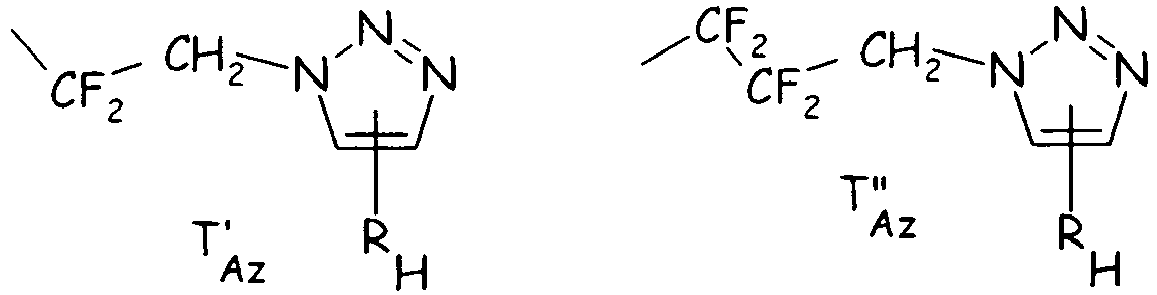
- Group RH can be a polymeric, oligomeric or monomeric chain. Said group can optionally comprise aromatic moieties and/or functional groups of any type.
- The selection of appropriate RH group will be carried out by the skilled in the art as a function of final properties/applications sought for derivative (PFPE-azole).
- Suitable catalysts for step 3. of the process of the invention are notably transition metal catalysts, more particularly Copper, Nickel, Platinum, Palladium, and Ruthenium-based catalysts.
- Among Copper catalysts, those comprising CuI are preferred; CuI can be generated in situ by addition of a reducing agent to CuII species or of an oxidizing agent to metallic Cu or can be provided in the reaction medium by direct addition of a CuI salt.
- Sources of CuII are not particularly limited and include notably CuSO4, Cu(NO3)2, CuCl2, and variously hydrated forms therof. Suitable reducing agents for reducing CuII species to more active CuI species are notably sodium ascorbate, hydrazine, and tris(2-carboxyethyl)phosphine.
- Among suitable CuI salts, mention can be notably made of CuBr, CuI, CuOTf.C6H6 (with OTf being trifluoromethansulfonate), [Cu(NCCH3)4][PF6 ]. In case of addition of CuI salts, it is generally preferred to also add a base, like notably 2,6-lutidine or diisopropylethylamine (DIPEA), this latter being preferred.
- Among Nickel catalysts, mention can be made of NiCl2, NiBr2, Ni(OOCCH 3)2, Ni(acac)2 (acac being acetylacetonate) and of various organometallic derivatives thereof, like notably phosphine, cyclopentadienyl and other derivatives.
- Among Pt and Pd catalysts, mention can be notably made of corresponding chlorides, bromides, acetates, acetylacetonates and of various organometallic derivatives thereof, like notably phosphine, cyclopentadienyl and other derivatives.
- Among Ruthenium catalyst, cyclopentadienyl organometallic complexes thereof are preferred, like notably Cp*Ru, Cp*RuCl(PPh3)2, with Cp* being pentamethylcyclopentadienyl.
- The Applicant has thus surprisingly found that by above sketched sequence of reactions as provided in step 1., 2. and 3., here above, it is surprisingly possibly to successfully apply azido-alkyne click chemistry to the hereby concerned particular hydroxyl derivatives of (per)fluoropolyether, thus enabling access to functionalized PFPE having a triazole bridging group.
- Still an object of the invention are (per)fluoropolyether triazole derivatives [derivative (PFPE-azole)] having at least one triazole group, as above described, which can be obtained from the process of the invention.
- Derivative (PFPE-azole) of the invention is a (per)fluoropolyether triazole derivative according to claim 11 that is to say that it comprises at least one fluoropolyoxyalkene chain (Rf) and at least one triazole group.
- The derivative (PFPE-azole) can comprise one or more than one triazole group. Typically, said hydroxyl groups are comprised as end-groups in the derivative (PFPE-azole).
- Still another object of the invention is the use according to claim 13 of the derivative (PFPE-azole) according to claim 11 as additives in lubricating compositions or in polymer materials.
- The invention will be now described in more detail with reference to the following examples, whose purpose is merely illustrative and not intended to limit the scope of the present invention.
- Into a 100 ml two necked round bottom flask equipped with a magnetic stirrer and a reflux condenser were placed 20 g of (per)fluoropolyether hydroxyl derivative of structure: HOCH2CF2O-(CF2O)c1(CF2CF2O)c2CF2 CH2OH (MW 1476, c2/c1 ratio = 1.9, 0.0135 moles), 20 ml of hexafluoroxylene as reaction solvent. After addition of 3 g of triethylamine (TEA) (0.03 moles), the mass was cooled down to 5 °C. Then, under magnetic stirring, 9 g of perfluorobutan sulphonylfluoride (0.03 moles) drop-wise were added in 3 h. The temperature was increased at 20°C. Then, 10 ml of water and 1 ml of methanol were added to the reaction mixture, the hydro-alcoholic phase was separated and this liquid phase extraction repeated three times. The combined organic layers were collected, solvent was removed under vacuum at 60°C; a final filtration of the organic product gave 27 g of bis-nonaflate-terminated PFPE. The 19F and 1H NMR analyses confirmed the expected structure with a purity > 95%. Yield 96%.
- Into a 100 ml two necked round bottom flask equipped with a magnetic stirrer and a reflux condenser were placed the nonaflate-terminated PFPE derivative obtained in Step 1. (10 g, 0.0049 mol), MW 2040, C2/C1 ratio 1.9, and two functional end-groups per molecule; NaN3 (0.78 g, 0.0113 mol) and dry dimethylformamide (DMF) (30 mL). The reaction mixture was degassed three times by freeze-pump-thaw cycles and then heated at 110°C for 24 h. The reaction mixture was poured into water (300 ml) and extracted with GALDEN® ZV 60 PFPE solvent (3 x 50 ml). The combined organic layers was washed with water and dried over anhydrous sodium sulphate. The solvent was removed under vacuum at 60°C to obtain 5.5 g of diazido-terminated PFPE as free flowing viscous liquid. The NMR 19F and 1H analyses confirmed the expected structure with a purity > 95%. Yield 75%.
- Into a 25 ml two necked round bottom flask equipped with a magnetic stirrer and a reflux condenser were placed azido terminated PFPE from Step 2. (2 g, 0.0013 mol), and phenyl acetylene (0.31g, 0.003 mol). To the reaction mixture were added, N,N-diisopropylethylamine (DIPEA) (0.077g, 0.0006 mol), DMF (12 mL), and Cul (0.06 g, 0.0003 mol) in that order. The reaction mixture was heated at 60° C for 24 h. The reaction mixture was washed with 2.5 % aqueous solution of EDTA disodium salt (4x10 mL) for removal Cul salt. The reaction mixture was extracted with GALDEN® ZV 60 PFPE solvent (3 x 10 mL) and the solution was dried over anhydrous sodium sulphate. The solvent was removed under vacuum at 50°C for 5 h to obtain 1.9 g of bis-[1,2,3]-triazole PFPE derivative as a waxy solid, accordingly to 19F and 1H NMR analyses. Yield 85%.
- Into a 100 ml two necked round bottom flask equipped with a magnetic stirrer and a reflux condenser were placed 30 g of PFPE alcohol of structure: CF3O-(CF2O)c1(CF2CF2O)c2CF2CH2OH (MW 528, c2/c1 ratio = 2.3, 0.0568 moles). Then 30 ml of hexafluoroxylene as reaction solvent were added. After addition of 6.1 g of TEA (0.06 moles), the mass was cooled down to 5 °C. Then, under magnetic stirring, 18 g of perfluorobutan sulphonylfluoride (0.06 moles) drop-wise were added in 3 h. The temperature was increased at 20°C. Then, 10 ml of water and 1 ml of methanol were added to the reaction mixture, the hydro-alcoholic phase was separated and this liquid phase extraction repeated three times. The combined organic layers were collected, solvent was removed under vacuum at 60°C; a final filtration of the organic product gave 44.8 g of nonaflate-terminated PFPE. The 19F and 1H NMR analyses confirmed the expected structure with a purity > 95%. Yield 97%.
- Into a 100 ml two necked round bottom flask equipped with a magnetic stirrer and a reflux condenser were placed 15.40 g, 0.019 mol of PFPE monofunctional-nonaflate (Mw 810, C2/C1 ratio 2.3) from Step 1. and NaN 3 (2.47 g, 0.038 mol). The reaction mixture was degassed three times by freeze-pump-thaw cycles. Dry N,N-dimethylformamide (30 mL) was added to the reaction mixture and the reaction mixture was heated with continuous stirring at 110 ° C for 24 h. The reaction mixture was poured into water (300 ml) and was extracted with GALDEN® ZV 60 PFPE solvent (3 x 50 ml). The combined organic layers was washed with water, dried over anhydrous sodium sulphate and filtered. The solvent was carefully removed by fractional distillation followed by distillation of azido-terminated PFPE. 7.7 g of azido-terminated PFPE derivative was so obtained, accordingly to NMR 19F and 1H analyses. Yield : 70%.
- Into a 50 ml two necked round bottom flask equipped with a magnetic stirrer and a reflux condenser were placed 2 g, 3.1 mmol of azido-terminated PFPE from Step 2. and phenyl acetylene (0.48 g, 4.7 mmol). To the reaction mixture were added DIPEA (0.14 g, 1 mmol), dry N, N-dimethylformamide (20 mL) and Cul (0.137 g, 0.7 mmol) in that order. The reaction mixture was heated at 60° C for 24 h. The reaction mixture was washed with 2.5 % aqueous solution of EDTA disodium salt (4 x 20 mL) for removal of Cul salt. The reaction mixture was extracted with GALDEN® ZV-60 PFPE (3 x 10 mL) and the solution was dried over anhydrous sodium sulphate. The solvent was removed under vacuum at 60° C for 5 h to obtain as a wax solid 1.9 g of monosubstituted [1,2,3]-triazole PFPE derivative, accordingly to 19F and 1H NMR analyses. Yield 85%.
Claims (13)
- process for the manufacture of a functional (per)fluoropolyether derivative comprising at least one triazole group [derivative (PFPE-azole)], said process comprising:1. reacting a (per)fluoropolyether hydroxyl derivative having at least one hydroxyl group [derivative (PFPE-OH)] with an activating agent, to yield an activated (per)fluoropolyether hydroxyl derivative comprising at least one activated hydroxyl group [derivative (a-PFPE-OH)];2. reacting said activated (per)fluoropolyether hydroxyl derivative [derivative (a-PFPE-OH)] with at least one azide salt to yield a functional (per)fluoropolyether derivative comprising at least one azido group [derivative (PFPE-N3)] ;3. reacting said functional (per)fluoropolyether derivative comprising at least one azido group [derivative (PFPE-N3)] with a hydrocarbon compound having a terminal alkyne group to yield a functional (per)fluoropolyether derivative comprising at least one triazole group [derivative (PFPE-azole)].
- The process of claim 1, wherein the derivative (PFPE-OH) comprises at least one fluoropolyoxyalkene chain (Rf) and at least one hydroxyl group, said hydroxyl group being selected among groups of formula - CF2CH2O(CH2CH2O)s'H and -CF2CF2CH2O(CH2CH2O)s"-H, wherein s' and s", equal or different each other and at each occurrence, are integers from 0 to 5.
- The process of claim 2, wherein the fluoropolyoxyalkene chain (Rf) of the of derivative (PFPE-OH) is a chain comprising repeating units R°, said repeating units being chosen among the group consisting of :(i) -CFXO-, wherein X is F or CF3,(ii) -CFXCFXO-, wherein X, equal or different at each occurrence, is F or CF3, with the provision that at least one of X is -F,(iii)-CF2CF2CF2O-,(iv)-CF2CF2CF2CF2O-,(v)-(CF2)j-CFZ-O- wherein j is an integer from 0 to 3 and Z is a group of general formula -ORf'T3, wherein Rf' is a fluoropolyoxyalkene chain comprising a number of repeating units from 0 to 10, said recurring units being chosen among the followings : -CFXO- , -CF2CFXO-, -CF2CF2CF2O-, - CF2CF2CF2CF2O-, with each of each of X being independently F or CF3. and T3 being a C1-C3 perfluoroalkyl group.
- The process of claim 3, wherein the derivative (PFPE-OH) complies with formula here below:
T2-O-Rf-T1
wherein:- Rf is a fluoropolyoxyalkene chain as detailed in claim 3, and- T1 and T2, equal to or different from each other, are independently selected from- non-functional groups free from hydroxyl groups, preferably of formula -CF3, -CF2-CF3, -CF2Cl, -CF2CF2Cl, -CF2-COF, -COF and mixtures thereof; and- functional hydroxyl groups comprising at least one hydroxyl group, with the provisio that at least one of T1 and T2 is a functional hydroxyl group. - The process of claim 4, wherein the derivative (PFPE-OH) complies with formula here below:
T2-O-(CFX1O)c1(CFX2CFX3O)c2(CF2CF2CF2O)c3(CF2CF2CF2CF2O)c4-T1
wherein- X1, X2, X3 equal or different from each other and at each occurrence are independently -F, -CF3;- T1 and T2, equal to or different from each other, have same meaning as defined in claim 4;- c1, c2 , c3, and c4, equal or different from each other, are independently integers ≥0, such that and c1+c2+c3+c4 is in the range 5 to 2000; should at least two of c1, c2, c3 and c4 be different from zero, the different recurring units are generally statistically distributed along the chain. - The process of anyone of the preceding claims, wherein the activating agent of step 1. is chosen among:- thionyl halides of formula:
SO2X
wherein X = Cl, Br;- sulphinyl halides of formula: - organic sulphonyl halides of formula:
- The process according to anyone of the preceding claims, wherein the derivative (a-PFPE-OH) complies with formula here below:
Ta2-O-Rf-Ta1
wherein:- Rf is a fluoropolyoxyalkene chain as defined in claim 3, and- Ta1 and Ta2, equal to or different from each other, are independently selected from- non-functional groups free from hydroxyl groups, preferably of formula -CF3, -CF2-CF3, -CF2Cl, -CF2CF2Cl, -CF2-COF, -COF and mixtures thereof; and- activated hydroxyl groups comprising a group Y, with Y being a halogen selected from Cl and Br, a group of formula -OSORt, wherein Rt is a C1-C12 hydrocarbon radical, linear or branched, optionally fluorinated, or a group of formula -OSO2Rs, wherein Rs is a C1-C12 hydrocarbon radical, linear or branched, optionally fluorinated, with the provisio that at least one of Ta1 and Ta2 is an activated hydroxyl group. - The process according to anyone of the preceding claims, wherein the inorganic azide salt complies with formula:
M(N3)n
wherein M represents a monovalent or divalent metal cation, and n represents 1 or 2. - The process according to anyone of the preceding claims, wherein the derivative (PFPE-N3) complies with formula here below:
TN2-O-Rf-TN1
wherein:- Rf is a fluoropolyoxyalkene chain as defined in claim 3, and- TN1 and TN2, equal to or different from each other, are independently selected from- non-functional groups free from hydroxyl groups, preferably of formula -CF3, -CF2-CF3, -CF2Cl, -CF2CF2Cl, -CF2-COF, -COF and mixtures thereof; and- functional groups comprising an azido group N3, with the provisio that at least one of TN1 and TN2 is an azido-containing group. - The process according to anyone of the preceding claims, wherein the triazole PFPE derivative [derivative (PFPE-azole)] complies with formula here below:
TAz2-O-Rf-TAz1
wherein:- Rf is a fluoropolyoxyalkene chain as defined in claim 3, and- TAz1 and TAz2, equal to or different from each other, are independently selected from- non-functional groups free from hydroxyl groups, preferably of formula -CF3, -CF2-CF3, -CF2Cl, -CF2CF2Cl, -CF2-COF, -COF and mixtures thereof; and- functional triazole groups comprising an azole group of formula:
- (per)fluoropolyether triazole derivative comprising at least one fluoropolyoxyalkene chain (Rf) and at least one triazole group [derivative (PFPE-azole)], said derivative (PFPE-azole) complying with formula: TAz2-O-Rf-TAz1
wherein:- Rf is a fluoropolyoxyalkene chain comprising repeating units R°, said repeating units being selected from the group consisting of :(i) -CFXO-, wherein X is F or CF3,(ii) -CFXCFXO-, wherein X, equal or different at each occurrence, is F or CF3, with the provision that at least one of X is -F,(iii)-CF2CF2CF2O-,(iv)-CF2CF2CF2CF2O-,(v)-(CF2)j-CFZ-O- wherein j is an integer from 0 to 3 and Z is a group of general formula -ORf'T3, wherein Rf' is a fluoropolyoxyalkene chain comprising a number of repeating units from 0 to 10, said recurring units selected from the group consisting of the followings : -CFXO-, -CF2CFXO-, -CF2CF2CF2O-, and - CF2CF2CF2CF2O-, with each of each of X being independently F or CF3, and T3 being a C1-C3 perfluoroalkyl group, and- TAz1 and TAz2, equal to or different from each other, are independently selected from the group consisting of:- non-functional groups free from hydroxyl groups, preferably of formula -CF3, -CF2-CF3, -CF2Cl, -CF2CF2Cl, -CF2-COF, -COF and mixtures thereof; and- functional triazole groups comprising an azole group of formula:with RH being a hydrocarbon group, optionally fluorinated, with the provisio that at least one of TAz1 and TAz2 is an azole-containing group.
- The derivative (PFPE-azole) of claim 11, complying with formula here below:
TAz2-O-(CFX1O)c1(CFX2CFX3O)c2(CF2CF2CF2O)c3(CF2CF2CF2CF2O)c4-TAz1 formula (1)
wherein- X1, X2, X3 equal or different from each other and at each occurrence are independently -F, -CF3;- TAz1 and TAz2, equal to or different from each other, have same meaning as defined in claim 11;- c1, c2 , c3, and c4, equal or different from each other, are independently integers ≥0, such that and c1+c2+c3+c4 is in the range 5 to 2000, preferably between 10 and 500; should at least two of c1, c2, c3 and c4 be different from zero, the different recurring units are generally statistically distributed along the chain. - Use of the derivative (PFPE-azole) of claim 11 or 12 as additives in lubricating compositions or in polymer materials.
Priority Applications (1)
| Application Number | Priority Date | Filing Date | Title |
|---|---|---|---|
| EP10712447.1A EP2417184B1 (en) | 2009-04-06 | 2010-04-02 | Process for the manufacture of functional pfpe derivative |
Applications Claiming Priority (4)
| Application Number | Priority Date | Filing Date | Title |
|---|---|---|---|
| IN709DE2009 | 2009-04-06 | ||
| EP09162507 | 2009-06-11 | ||
| PCT/EP2010/054468 WO2010115855A1 (en) | 2009-04-06 | 2010-04-02 | Process for the manufacture of functional pfpe derivative |
| EP10712447.1A EP2417184B1 (en) | 2009-04-06 | 2010-04-02 | Process for the manufacture of functional pfpe derivative |
Publications (2)
| Publication Number | Publication Date |
|---|---|
| EP2417184A1 EP2417184A1 (en) | 2012-02-15 |
| EP2417184B1 true EP2417184B1 (en) | 2016-01-06 |
Family
ID=42135928
Family Applications (1)
| Application Number | Title | Priority Date | Filing Date |
|---|---|---|---|
| EP10712447.1A Not-in-force EP2417184B1 (en) | 2009-04-06 | 2010-04-02 | Process for the manufacture of functional pfpe derivative |
Country Status (5)
| Country | Link |
|---|---|
| US (1) | US8975445B2 (en) |
| EP (1) | EP2417184B1 (en) |
| JP (1) | JP5507666B2 (en) |
| CN (1) | CN102405249B (en) |
| WO (1) | WO2010115855A1 (en) |
Families Citing this family (14)
| Publication number | Priority date | Publication date | Assignee | Title |
|---|---|---|---|---|
| US8628869B2 (en) | 2012-01-30 | 2014-01-14 | HGST Netherlands B.V. | Magnetic media and magnetic recording devices using fluorine compounds |
| WO2014055406A2 (en) * | 2012-10-02 | 2014-04-10 | 3M Innovative Properties Company | Fluoropolyether-based elastomers having low glass transition temperature |
| US9153268B1 (en) | 2013-02-19 | 2015-10-06 | WD Media, LLC | Lubricants comprising fluorinated graphene nanoribbons for magnetic recording media structure |
| FR3038322B1 (en) * | 2015-07-01 | 2018-10-19 | Universite De Montpellier (Universite Montpellier 2 Sciences Et Techniques) | LOW-THERMOSTABLE AND THERMOSTABLE THERMOSETTING CROSS-LINKABLE MATERIALS BASED ON FLUOROETHERS |
| FR3038321B1 (en) * | 2015-07-01 | 2017-06-23 | Labinal Power Systems | THERMOPLASTIC AND LOW THERMOSTABLE THERMOPLASTIC COPOLYMERS BASED ON PERFLUOROETHERS |
| EP3420014A1 (en) | 2016-02-23 | 2019-01-02 | Solvay Specialty Polymers Italy S.p.A. | Method for the manufacture of fluorinated polymers and polymers obtainable therefrom |
| US11034805B2 (en) | 2017-05-11 | 2021-06-15 | Chem Link, Inc. | Click chemistry for sealants and adhesives |
| JP6907908B2 (en) * | 2017-12-04 | 2021-07-21 | 信越化学工業株式会社 | Azide group-containing fluoropolymer and its production method |
| EP3858890A4 (en) * | 2018-09-28 | 2022-06-22 | Zeon Corporation | COMPOUND OF POLYETHER AND GAS SEPARATION MEMBRANE |
| EP3889220B1 (en) * | 2018-11-28 | 2023-09-20 | Shin-Etsu Chemical Co., Ltd. | Perfluoropolyether-based rubber composition, cured object obtained therefrom, and product including same |
| CN110452371B (en) * | 2019-07-31 | 2020-08-11 | 北京理工大学 | A kind of preparation method of terminal triazole polyether |
| CN110776632A (en) * | 2019-09-19 | 2020-02-11 | 万华化学集团股份有限公司 | A silane-modified polyether resin and its application in MS sealant |
| CN114651028B (en) * | 2019-11-13 | 2024-06-11 | 大金工业株式会社 | Method for producing a compound containing a fluorinated polyether group |
| CN115322362B (en) * | 2022-08-29 | 2023-07-25 | 深圳莱宝高科技股份有限公司 | Silane compound containing perfluoropolyether group, preparation method thereof and surface treating agent |
Family Cites Families (16)
| Publication number | Priority date | Publication date | Assignee | Title |
|---|---|---|---|---|
| US3242218A (en) | 1961-03-29 | 1966-03-22 | Du Pont | Process for preparing fluorocarbon polyethers |
| NL6709067A (en) | 1964-04-09 | 1968-01-08 | ||
| US3442942A (en) | 1964-04-09 | 1969-05-06 | Montedison Spa | Fluorinated oxygen containing acyl fluorides |
| US3665041A (en) | 1967-04-04 | 1972-05-23 | Montedison Spa | Perfluorinated polyethers and process for their preparation |
| US3847978A (en) | 1968-07-01 | 1974-11-12 | Montedison Spa | Perfluorinated linear polyethers having reactive terminal groups at both ends of the chain and process for the preparation thereof |
| US3810874A (en) | 1969-03-10 | 1974-05-14 | Minnesota Mining & Mfg | Polymers prepared from poly(perfluoro-alkylene oxide) compounds |
| US4113772A (en) | 1975-07-21 | 1978-09-12 | Lagow Richard J | Method for producing perfluoroether oligomers having terminal carboxylic acid groups |
| US4523039A (en) | 1980-04-11 | 1985-06-11 | The University Of Texas | Method for forming perfluorocarbon ethers |
| DE3486428T2 (en) | 1983-12-26 | 1996-10-10 | Daikin Ind Ltd | Halogen containing polyether |
| JPS63171422A (en) * | 1987-01-09 | 1988-07-15 | Hitachi Maxell Ltd | Magnetic recording medium |
| JPH0249097A (en) * | 1988-08-11 | 1990-02-19 | Maruwa Bussan Kk | Synthetic lubricant having anticorrosiveness |
| PT1259563E (en) * | 1999-12-22 | 2009-04-14 | Nektar Therapeutics Al Corp | Method for the preparation of 1-benzotriazolyl carbonate esters of water soluble polymers. |
| ITMI20020029A1 (en) | 2002-01-10 | 2003-07-10 | Ausimont Spa | REPELLENT HYDRO-OIL COMPOSITIONS |
| JP2005120146A (en) * | 2003-10-14 | 2005-05-12 | Sony Corp | Lubricant and recording medium |
| US7148360B2 (en) | 2004-01-30 | 2006-12-12 | 3M Innovative Properties Company | Perfluoropolyether benzotriazole compounds |
| US8513471B2 (en) | 2007-10-05 | 2013-08-20 | Solvay Solexis S.P.A. | Process for the manufacture of polyol perfluoropolyether derivative |
-
2010
- 2010-04-02 CN CN201080017405.6A patent/CN102405249B/en not_active Expired - Fee Related
- 2010-04-02 US US13/262,692 patent/US8975445B2/en not_active Expired - Fee Related
- 2010-04-02 JP JP2012503986A patent/JP5507666B2/en not_active Expired - Fee Related
- 2010-04-02 WO PCT/EP2010/054468 patent/WO2010115855A1/en not_active Ceased
- 2010-04-02 EP EP10712447.1A patent/EP2417184B1/en not_active Not-in-force
Also Published As
| Publication number | Publication date |
|---|---|
| CN102405249B (en) | 2014-09-24 |
| US8975445B2 (en) | 2015-03-10 |
| US20120028858A1 (en) | 2012-02-02 |
| EP2417184A1 (en) | 2012-02-15 |
| JP5507666B2 (en) | 2014-05-28 |
| CN102405249A (en) | 2012-04-04 |
| JP2012522881A (en) | 2012-09-27 |
| WO2010115855A1 (en) | 2010-10-14 |
Similar Documents
| Publication | Publication Date | Title |
|---|---|---|
| US8975445B2 (en) | Process for the manufacture of functional PFPE derivative | |
| JP5345066B2 (en) | Fluorinated lubricant | |
| CN102177123B (en) | There is the hydrogen fluorine alcohol of improved heat and chemical stability | |
| CN107849235B (en) | (per) fluoropolyether polymers | |
| CN104125972B (en) | Method for manufacturing (complete) perfluoroalkyl polyether with aromatic series end group | |
| JP5005174B2 (en) | Peroxide perfluoropolyether | |
| EP3224298B1 (en) | Mixtures of mono-, bi- and non-functional fluorinated polymers comprising a plurality of (per)fluoropolyether segments | |
| CN107001610B (en) | Bifunctional fluorinated polymers containing multiple (per)fluoropolyether segments | |
| JP2001049276A (en) | Perfluoropolyether lubricants containing sulfonyl fluoride groups | |
| TW202225258A (en) | Novel ( per ) fluoropolyether polymers and use thereof | |
| CA1339144C (en) | Fluorination of epoxides | |
| JP5005175B2 (en) | Peroxide perfluoropolyether | |
| JP4794321B2 (en) | Method for producing perfluoropolyether peroxide | |
| EP3420014A1 (en) | Method for the manufacture of fluorinated polymers and polymers obtainable therefrom | |
| TW202007707A (en) | (per)fluoropolyether derivatives | |
| TWI825261B (en) | (per)fluoropolyether (pfpe) polymers |
Legal Events
| Date | Code | Title | Description |
|---|---|---|---|
| PUAI | Public reference made under article 153(3) epc to a published international application that has entered the european phase |
Free format text: ORIGINAL CODE: 0009012 |
|
| 17P | Request for examination filed |
Effective date: 20111107 |
|
| AK | Designated contracting states |
Kind code of ref document: A1 Designated state(s): AT BE BG CH CY CZ DE DK EE ES FI FR GB GR HR HU IE IS IT LI LT LU LV MC MK MT NL NO PL PT RO SE SI SK SM TR |
|
| RAP1 | Party data changed (applicant data changed or rights of an application transferred) |
Owner name: SOLVAY SPECIALTY POLYMERS ITALY S.P.A. |
|
| DAX | Request for extension of the european patent (deleted) | ||
| GRAP | Despatch of communication of intention to grant a patent |
Free format text: ORIGINAL CODE: EPIDOSNIGR1 |
|
| INTG | Intention to grant announced |
Effective date: 20150724 |
|
| GRAS | Grant fee paid |
Free format text: ORIGINAL CODE: EPIDOSNIGR3 |
|
| GRAA | (expected) grant |
Free format text: ORIGINAL CODE: 0009210 |
|
| AK | Designated contracting states |
Kind code of ref document: B1 Designated state(s): AT BE BG CH CY CZ DE DK EE ES FI FR GB GR HR HU IE IS IT LI LT LU LV MC MK MT NL NO PL PT RO SE SI SK SM TR |
|
| REG | Reference to a national code |
Ref country code: GB Ref legal event code: FG4D |
|
| REG | Reference to a national code |
Ref country code: CH Ref legal event code: EP |
|
| REG | Reference to a national code |
Ref country code: IE Ref legal event code: FG4D |
|
| REG | Reference to a national code |
Ref country code: AT Ref legal event code: REF Ref document number: 768824 Country of ref document: AT Kind code of ref document: T Effective date: 20160215 |
|
| REG | Reference to a national code |
Ref country code: DE Ref legal event code: R096 Ref document number: 602010029888 Country of ref document: DE |
|
| REG | Reference to a national code |
Ref country code: FR Ref legal event code: PLFP Year of fee payment: 7 |
|
| REG | Reference to a national code |
Ref country code: LT Ref legal event code: MG4D |
|
| REG | Reference to a national code |
Ref country code: NL Ref legal event code: MP Effective date: 20160106 |
|
| REG | Reference to a national code |
Ref country code: AT Ref legal event code: MK05 Ref document number: 768824 Country of ref document: AT Kind code of ref document: T Effective date: 20160106 |
|
| PG25 | Lapsed in a contracting state [announced via postgrant information from national office to epo] |
Ref country code: NL Free format text: LAPSE BECAUSE OF FAILURE TO SUBMIT A TRANSLATION OF THE DESCRIPTION OR TO PAY THE FEE WITHIN THE PRESCRIBED TIME-LIMIT Effective date: 20160106 |
|
| PG25 | Lapsed in a contracting state [announced via postgrant information from national office to epo] |
Ref country code: HR Free format text: LAPSE BECAUSE OF FAILURE TO SUBMIT A TRANSLATION OF THE DESCRIPTION OR TO PAY THE FEE WITHIN THE PRESCRIBED TIME-LIMIT Effective date: 20160106 Ref country code: IT Free format text: LAPSE BECAUSE OF FAILURE TO SUBMIT A TRANSLATION OF THE DESCRIPTION OR TO PAY THE FEE WITHIN THE PRESCRIBED TIME-LIMIT Effective date: 20160106 Ref country code: ES Free format text: LAPSE BECAUSE OF FAILURE TO SUBMIT A TRANSLATION OF THE DESCRIPTION OR TO PAY THE FEE WITHIN THE PRESCRIBED TIME-LIMIT Effective date: 20160106 Ref country code: NO Free format text: LAPSE BECAUSE OF FAILURE TO SUBMIT A TRANSLATION OF THE DESCRIPTION OR TO PAY THE FEE WITHIN THE PRESCRIBED TIME-LIMIT Effective date: 20160406 Ref country code: FI Free format text: LAPSE BECAUSE OF FAILURE TO SUBMIT A TRANSLATION OF THE DESCRIPTION OR TO PAY THE FEE WITHIN THE PRESCRIBED TIME-LIMIT Effective date: 20160106 Ref country code: GR Free format text: LAPSE BECAUSE OF FAILURE TO SUBMIT A TRANSLATION OF THE DESCRIPTION OR TO PAY THE FEE WITHIN THE PRESCRIBED TIME-LIMIT Effective date: 20160407 |
|
| PG25 | Lapsed in a contracting state [announced via postgrant information from national office to epo] |
Ref country code: SE Free format text: LAPSE BECAUSE OF FAILURE TO SUBMIT A TRANSLATION OF THE DESCRIPTION OR TO PAY THE FEE WITHIN THE PRESCRIBED TIME-LIMIT Effective date: 20160106 Ref country code: PL Free format text: LAPSE BECAUSE OF FAILURE TO SUBMIT A TRANSLATION OF THE DESCRIPTION OR TO PAY THE FEE WITHIN THE PRESCRIBED TIME-LIMIT Effective date: 20160106 Ref country code: BE Free format text: LAPSE BECAUSE OF NON-PAYMENT OF DUE FEES Effective date: 20160430 Ref country code: LV Free format text: LAPSE BECAUSE OF FAILURE TO SUBMIT A TRANSLATION OF THE DESCRIPTION OR TO PAY THE FEE WITHIN THE PRESCRIBED TIME-LIMIT Effective date: 20160106 Ref country code: IS Free format text: LAPSE BECAUSE OF FAILURE TO SUBMIT A TRANSLATION OF THE DESCRIPTION OR TO PAY THE FEE WITHIN THE PRESCRIBED TIME-LIMIT Effective date: 20160506 Ref country code: LT Free format text: LAPSE BECAUSE OF FAILURE TO SUBMIT A TRANSLATION OF THE DESCRIPTION OR TO PAY THE FEE WITHIN THE PRESCRIBED TIME-LIMIT Effective date: 20160106 Ref country code: PT Free format text: LAPSE BECAUSE OF FAILURE TO SUBMIT A TRANSLATION OF THE DESCRIPTION OR TO PAY THE FEE WITHIN THE PRESCRIBED TIME-LIMIT Effective date: 20160506 Ref country code: AT Free format text: LAPSE BECAUSE OF FAILURE TO SUBMIT A TRANSLATION OF THE DESCRIPTION OR TO PAY THE FEE WITHIN THE PRESCRIBED TIME-LIMIT Effective date: 20160106 |
|
| REG | Reference to a national code |
Ref country code: DE Ref legal event code: R097 Ref document number: 602010029888 Country of ref document: DE |
|
| PG25 | Lapsed in a contracting state [announced via postgrant information from national office to epo] |
Ref country code: EE Free format text: LAPSE BECAUSE OF FAILURE TO SUBMIT A TRANSLATION OF THE DESCRIPTION OR TO PAY THE FEE WITHIN THE PRESCRIBED TIME-LIMIT Effective date: 20160106 Ref country code: DK Free format text: LAPSE BECAUSE OF FAILURE TO SUBMIT A TRANSLATION OF THE DESCRIPTION OR TO PAY THE FEE WITHIN THE PRESCRIBED TIME-LIMIT Effective date: 20160106 |
|
| PLBE | No opposition filed within time limit |
Free format text: ORIGINAL CODE: 0009261 |
|
| STAA | Information on the status of an ep patent application or granted ep patent |
Free format text: STATUS: NO OPPOSITION FILED WITHIN TIME LIMIT |
|
| PG25 | Lapsed in a contracting state [announced via postgrant information from national office to epo] |
Ref country code: SK Free format text: LAPSE BECAUSE OF FAILURE TO SUBMIT A TRANSLATION OF THE DESCRIPTION OR TO PAY THE FEE WITHIN THE PRESCRIBED TIME-LIMIT Effective date: 20160106 Ref country code: RO Free format text: LAPSE BECAUSE OF FAILURE TO SUBMIT A TRANSLATION OF THE DESCRIPTION OR TO PAY THE FEE WITHIN THE PRESCRIBED TIME-LIMIT Effective date: 20160106 Ref country code: CZ Free format text: LAPSE BECAUSE OF FAILURE TO SUBMIT A TRANSLATION OF THE DESCRIPTION OR TO PAY THE FEE WITHIN THE PRESCRIBED TIME-LIMIT Effective date: 20160106 Ref country code: SM Free format text: LAPSE BECAUSE OF FAILURE TO SUBMIT A TRANSLATION OF THE DESCRIPTION OR TO PAY THE FEE WITHIN THE PRESCRIBED TIME-LIMIT Effective date: 20160106 |
|
| REG | Reference to a national code |
Ref country code: CH Ref legal event code: PL |
|
| 26N | No opposition filed |
Effective date: 20161007 |
|
| PG25 | Lapsed in a contracting state [announced via postgrant information from national office to epo] |
Ref country code: LU Free format text: LAPSE BECAUSE OF FAILURE TO SUBMIT A TRANSLATION OF THE DESCRIPTION OR TO PAY THE FEE WITHIN THE PRESCRIBED TIME-LIMIT Effective date: 20160402 Ref country code: BE Free format text: LAPSE BECAUSE OF FAILURE TO SUBMIT A TRANSLATION OF THE DESCRIPTION OR TO PAY THE FEE WITHIN THE PRESCRIBED TIME-LIMIT Effective date: 20160106 |
|
| REG | Reference to a national code |
Ref country code: IE Ref legal event code: MM4A |
|
| PG25 | Lapsed in a contracting state [announced via postgrant information from national office to epo] |
Ref country code: CH Free format text: LAPSE BECAUSE OF NON-PAYMENT OF DUE FEES Effective date: 20160430 Ref country code: LI Free format text: LAPSE BECAUSE OF NON-PAYMENT OF DUE FEES Effective date: 20160430 |
|
| PG25 | Lapsed in a contracting state [announced via postgrant information from national office to epo] |
Ref country code: BG Free format text: LAPSE BECAUSE OF FAILURE TO SUBMIT A TRANSLATION OF THE DESCRIPTION OR TO PAY THE FEE WITHIN THE PRESCRIBED TIME-LIMIT Effective date: 20160406 Ref country code: SI Free format text: LAPSE BECAUSE OF FAILURE TO SUBMIT A TRANSLATION OF THE DESCRIPTION OR TO PAY THE FEE WITHIN THE PRESCRIBED TIME-LIMIT Effective date: 20160106 |
|
| REG | Reference to a national code |
Ref country code: FR Ref legal event code: PLFP Year of fee payment: 8 |
|
| PGFP | Annual fee paid to national office [announced via postgrant information from national office to epo] |
Ref country code: FR Payment date: 20170313 Year of fee payment: 8 |
|
| PG25 | Lapsed in a contracting state [announced via postgrant information from national office to epo] |
Ref country code: IE Free format text: LAPSE BECAUSE OF NON-PAYMENT OF DUE FEES Effective date: 20160402 |
|
| PGFP | Annual fee paid to national office [announced via postgrant information from national office to epo] |
Ref country code: GB Payment date: 20170329 Year of fee payment: 8 |
|
| PGFP | Annual fee paid to national office [announced via postgrant information from national office to epo] |
Ref country code: DE Payment date: 20170329 Year of fee payment: 8 |
|
| PG25 | Lapsed in a contracting state [announced via postgrant information from national office to epo] |
Ref country code: HU Free format text: LAPSE BECAUSE OF FAILURE TO SUBMIT A TRANSLATION OF THE DESCRIPTION OR TO PAY THE FEE WITHIN THE PRESCRIBED TIME-LIMIT; INVALID AB INITIO Effective date: 20100402 Ref country code: CY Free format text: LAPSE BECAUSE OF FAILURE TO SUBMIT A TRANSLATION OF THE DESCRIPTION OR TO PAY THE FEE WITHIN THE PRESCRIBED TIME-LIMIT Effective date: 20160106 |
|
| PG25 | Lapsed in a contracting state [announced via postgrant information from national office to epo] |
Ref country code: MT Free format text: LAPSE BECAUSE OF NON-PAYMENT OF DUE FEES Effective date: 20160430 Ref country code: MK Free format text: LAPSE BECAUSE OF FAILURE TO SUBMIT A TRANSLATION OF THE DESCRIPTION OR TO PAY THE FEE WITHIN THE PRESCRIBED TIME-LIMIT Effective date: 20160106 Ref country code: TR Free format text: LAPSE BECAUSE OF FAILURE TO SUBMIT A TRANSLATION OF THE DESCRIPTION OR TO PAY THE FEE WITHIN THE PRESCRIBED TIME-LIMIT Effective date: 20160106 Ref country code: MC Free format text: LAPSE BECAUSE OF FAILURE TO SUBMIT A TRANSLATION OF THE DESCRIPTION OR TO PAY THE FEE WITHIN THE PRESCRIBED TIME-LIMIT Effective date: 20160106 |
|
| REG | Reference to a national code |
Ref country code: DE Ref legal event code: R119 Ref document number: 602010029888 Country of ref document: DE |
|
| GBPC | Gb: european patent ceased through non-payment of renewal fee |
Effective date: 20180402 |
|
| PG25 | Lapsed in a contracting state [announced via postgrant information from national office to epo] |
Ref country code: DE Free format text: LAPSE BECAUSE OF NON-PAYMENT OF DUE FEES Effective date: 20181101 |
|
| PG25 | Lapsed in a contracting state [announced via postgrant information from national office to epo] |
Ref country code: GB Free format text: LAPSE BECAUSE OF NON-PAYMENT OF DUE FEES Effective date: 20180402 |
|
| PG25 | Lapsed in a contracting state [announced via postgrant information from national office to epo] |
Ref country code: FR Free format text: LAPSE BECAUSE OF NON-PAYMENT OF DUE FEES Effective date: 20180430 |