EP2417138B1 - Pyrazolo[1, 5-a]pyrimidine derivatives as mtor inhibitors - Google Patents
Pyrazolo[1, 5-a]pyrimidine derivatives as mtor inhibitors Download PDFInfo
- Publication number
- EP2417138B1 EP2417138B1 EP10715010.4A EP10715010A EP2417138B1 EP 2417138 B1 EP2417138 B1 EP 2417138B1 EP 10715010 A EP10715010 A EP 10715010A EP 2417138 B1 EP2417138 B1 EP 2417138B1
- Authority
- EP
- European Patent Office
- Prior art keywords
- pyrimidin
- pyrazolo
- methyl
- amino
- substituted
- Prior art date
- Legal status (The legal status is an assumption and is not a legal conclusion. Google has not performed a legal analysis and makes no representation as to the accuracy of the status listed.)
- Active
Links
- 0 *Nc([n]1ncc(-c(cc23)cnc2[n]cc3Br)c1nc1N(CC2)CCS2(=O)=O)c1Br Chemical compound *Nc([n]1ncc(-c(cc23)cnc2[n]cc3Br)c1nc1N(CC2)CCS2(=O)=O)c1Br 0.000 description 53
- PHGPBRHEGPKVHX-UHFFFAOYSA-N Nc([n]1ncc(-c2cc(cccc3)c3nc2)c1nc1C2CCC(CC(O)=O)CC2)c1C#N Chemical compound Nc([n]1ncc(-c2cc(cccc3)c3nc2)c1nc1C2CCC(CC(O)=O)CC2)c1C#N PHGPBRHEGPKVHX-UHFFFAOYSA-N 0.000 description 2
- ATVDCVRRRWCRSN-UHFFFAOYSA-N Nc([n]1ncc(-c2cc3ccccc3nc2)c1nc1C(CC2)CN2C=O)c1Br Chemical compound Nc([n]1ncc(-c2cc3ccccc3nc2)c1nc1C(CC2)CN2C=O)c1Br ATVDCVRRRWCRSN-UHFFFAOYSA-N 0.000 description 2
- UXGPLZITOIWCIM-UHFFFAOYSA-N Nc([n]1ncc(-c2cc3ccccc3nc2)c1nc1N(CC2)CC(CC3)N2C3=O)c1Br Chemical compound Nc([n]1ncc(-c2cc3ccccc3nc2)c1nc1N(CC2)CC(CC3)N2C3=O)c1Br UXGPLZITOIWCIM-UHFFFAOYSA-N 0.000 description 2
- CKRYMHDGLMFRFL-UHFFFAOYSA-N Nc([n]1ncc(-c2cc3ccccc3nc2)c1nc1N(CC2)CCS2(=O)=O)c1Br Chemical compound Nc([n]1ncc(-c2cc3ccccc3nc2)c1nc1N(CC2)CCS2(=O)=O)c1Br CKRYMHDGLMFRFL-UHFFFAOYSA-N 0.000 description 2
- YGDICLRMNDWZAK-UHFFFAOYSA-N OB(c1cnc(cccc2)c2c1)O Chemical compound OB(c1cnc(cccc2)c2c1)O YGDICLRMNDWZAK-UHFFFAOYSA-N 0.000 description 2
- JOXAOLSMHDLMBM-SQASBSOFSA-N C/C=C(/c1ccccc1)\N=C/C(c1c2nc(C(CC3)CCN3C(c3ncc[nH]3)=O)c(C=C=O)c(N)[n]2nc1)=C Chemical compound C/C=C(/c1ccccc1)\N=C/C(c1c2nc(C(CC3)CCN3C(c3ncc[nH]3)=O)c(C=C=O)c(N)[n]2nc1)=C JOXAOLSMHDLMBM-SQASBSOFSA-N 0.000 description 1
- QQPSRETVFMQXLM-UHFFFAOYSA-N C=NCC1(CN(CC(N(CC2)CCN2c(cc2)ccc2-c2ncccn2)=O)CC1)C(Nc(cc1C(F)(F)F)ccc1O)=O Chemical compound C=NCC1(CN(CC(N(CC2)CCN2c(cc2)ccc2-c2ncccn2)=O)CC1)C(Nc(cc1C(F)(F)F)ccc1O)=O QQPSRETVFMQXLM-UHFFFAOYSA-N 0.000 description 1
- USPPNACGPPOORO-UHFFFAOYSA-N C=Nc([nH]nc1)c1-c(cc1)cnc1-[n]1nccc1 Chemical compound C=Nc([nH]nc1)c1-c(cc1)cnc1-[n]1nccc1 USPPNACGPPOORO-UHFFFAOYSA-N 0.000 description 1
- KGCIEROJLHGSNC-UHFFFAOYSA-N CC(C(CC1)CCN1C(CC(C(N1)=O)NC1=O)=O)(C(C)=C(N)[n]1nc2)Nc1c2-c(cc1)cnc1-c1ccccc1 Chemical compound CC(C(CC1)CCN1C(CC(C(N1)=O)NC1=O)=O)(C(C)=C(N)[n]1nc2)Nc1c2-c(cc1)cnc1-c1ccccc1 KGCIEROJLHGSNC-UHFFFAOYSA-N 0.000 description 1
- LZHPHARVWBNITG-UHFFFAOYSA-N CC(C(CC1)CCN1C(c1cc(C)n[nH]1)=O)(C(C)=C(N)[n]1nc2)Nc1c2-c(cc1)cnc1-c1ccccc1 Chemical compound CC(C(CC1)CCN1C(c1cc(C)n[nH]1)=O)(C(C)=C(N)[n]1nc2)Nc1c2-c(cc1)cnc1-c1ccccc1 LZHPHARVWBNITG-UHFFFAOYSA-N 0.000 description 1
- KSZJXVKLUWZJAI-UHFFFAOYSA-N CC(C)(C(O)=O)c(nc1)ccc1-c(c(Br)c(N)[n]1nc2)nc1c2-c(cc1)cnc1-c1ccccc1 Chemical compound CC(C)(C(O)=O)c(nc1)ccc1-c(c(Br)c(N)[n]1nc2)nc1c2-c(cc1)cnc1-c1ccccc1 KSZJXVKLUWZJAI-UHFFFAOYSA-N 0.000 description 1
- BNWCETAHAJSBFG-UHFFFAOYSA-N CC(C)(C)OC(CBr)=O Chemical compound CC(C)(C)OC(CBr)=O BNWCETAHAJSBFG-UHFFFAOYSA-N 0.000 description 1
- LVGSOVLMLZQUDP-UHFFFAOYSA-N CC(C)(C)OC(CN(CC1)CCC1c(cc(N)[n]1nc2)nc1c2-c1c[n](C)nc1)=O Chemical compound CC(C)(C)OC(CN(CC1)CCC1c(cc(N)[n]1nc2)nc1c2-c1c[n](C)nc1)=O LVGSOVLMLZQUDP-UHFFFAOYSA-N 0.000 description 1
- ZWMPKBJATNHIFV-UHFFFAOYSA-N CC(C)(C)OC(N(CC1)CC1c(c(Br)c(N)[n]1nc2)nc1c2-c1cnc(cccc2)c2c1)=O Chemical compound CC(C)(C)OC(N(CC1)CC1c(c(Br)c(N)[n]1nc2)nc1c2-c1cnc(cccc2)c2c1)=O ZWMPKBJATNHIFV-UHFFFAOYSA-N 0.000 description 1
- RVLGHMLRQLLCPE-UHFFFAOYSA-N CC(C)(C)OC(N(CC1)CCC1c1nc2ccn[n]2c(Cl)c1)=O Chemical compound CC(C)(C)OC(N(CC1)CCC1c1nc2ccn[n]2c(Cl)c1)=O RVLGHMLRQLLCPE-UHFFFAOYSA-N 0.000 description 1
- ZYLZKHNHAUGKMW-UHFFFAOYSA-N CC(C)(C)OC(N(CC1)CCC1c1nc2ccn[n]2c(O)c1)=O Chemical compound CC(C)(C)OC(N(CC1)CCC1c1nc2ccn[n]2c(O)c1)=O ZYLZKHNHAUGKMW-UHFFFAOYSA-N 0.000 description 1
- YRDPAWOTRUQWLB-UHFFFAOYSA-N CC(C)(C)OC(N(Cc(c(I)c(N)[n]1nc2)nc1c2-c1cnc(ccc(F)c2)c2c1)C1(CO)CC1)=O Chemical compound CC(C)(C)OC(N(Cc(c(I)c(N)[n]1nc2)nc1c2-c1cnc(ccc(F)c2)c2c1)C1(CO)CC1)=O YRDPAWOTRUQWLB-UHFFFAOYSA-N 0.000 description 1
- ZZDDCUUBCYXRMD-LJQANCHMSA-N CC(C)(C)Oc1cc(N(CC2)CCN2C(CN(CC2)C[C@@H]2C(Nc(cc2Cl)ccc2O)=O)=O)ccc1 Chemical compound CC(C)(C)Oc1cc(N(CC2)CCN2C(CN(CC2)C[C@@H]2C(Nc(cc2Cl)ccc2O)=O)=O)ccc1 ZZDDCUUBCYXRMD-LJQANCHMSA-N 0.000 description 1
- TXJHFLIADRQQRM-UHFFFAOYSA-N CC(C)(c(cc1)ccc1-c(c(Br)c(N)[n]1nc2)nc1c2-c(cc1)cnc1-c1cnccc1)C#N Chemical compound CC(C)(c(cc1)ccc1-c(c(Br)c(N)[n]1nc2)nc1c2-c(cc1)cnc1-c1cnccc1)C#N TXJHFLIADRQQRM-UHFFFAOYSA-N 0.000 description 1
- ZLSKURYVLJYEIY-UMSFTDKQSA-N CC(C)Oc(nc1)ccc1-c1n[nH]c(cc2)c1cc2NC([C@]1(CN(CC(N(CC2)CC=C2c2ncc(-c3n[n](C)cn3)[s]2)=O)CC1)OC)=O Chemical compound CC(C)Oc(nc1)ccc1-c1n[nH]c(cc2)c1cc2NC([C@]1(CN(CC(N(CC2)CC=C2c2ncc(-c3n[n](C)cn3)[s]2)=O)CC1)OC)=O ZLSKURYVLJYEIY-UMSFTDKQSA-N 0.000 description 1
- FNVHWVILZFLNDW-CVRLYYSRSA-N CC(C1)[C@H]1Sc1ccc(CB2OC(C)(C)C(C)(C)O2)cc1 Chemical compound CC(C1)[C@H]1Sc1ccc(CB2OC(C)(C)C(C)(C)O2)cc1 FNVHWVILZFLNDW-CVRLYYSRSA-N 0.000 description 1
- VJWNSCHOHREKBB-MUMRKEEXSA-N CC(CN(CC1)C(CN(CC2)C[C@@H]2C(Nc(cc2Cl)ccc2O)=O)=O)N1c1cccc(C)c1 Chemical compound CC(CN(CC1)C(CN(CC2)C[C@@H]2C(Nc(cc2Cl)ccc2O)=O)=O)N1c1cccc(C)c1 VJWNSCHOHREKBB-MUMRKEEXSA-N 0.000 description 1
- BBUKMNZOBAAQCG-UHFFFAOYSA-N CC(N1CCN(Cc(c(Br)c(N)[n]2nc3)nc2c3-c2cnc(-c3ccccc3)nc2)CC1)=O Chemical compound CC(N1CCN(Cc(c(Br)c(N)[n]2nc3)nc2c3-c2cnc(-c3ccccc3)nc2)CC1)=O BBUKMNZOBAAQCG-UHFFFAOYSA-N 0.000 description 1
- PBEJVTURVJYGQU-UHFFFAOYSA-N CC(c(c(Br)c(N)[n]1nc2)nc1c2-c(cc1)cnc1-c(cc1)ccc1F)NC1CCOCC1 Chemical compound CC(c(c(Br)c(N)[n]1nc2)nc1c2-c(cc1)cnc1-c(cc1)ccc1F)NC1CCOCC1 PBEJVTURVJYGQU-UHFFFAOYSA-N 0.000 description 1
- WQOIPHVMTZUSHD-UHFFFAOYSA-N CC(c(c(Br)c(N)[n]1nc2)nc1c2-c(cc1)cnc1-c1ccccc1F)NC1CCOCC1 Chemical compound CC(c(c(Br)c(N)[n]1nc2)nc1c2-c(cc1)cnc1-c1ccccc1F)NC1CCOCC1 WQOIPHVMTZUSHD-UHFFFAOYSA-N 0.000 description 1
- RFEHLPZEASKIJA-UHFFFAOYSA-N CC(c(c(Br)c(N)[n]1nc2)nc1c2-c1cc(cc(cc2)F)c2nc1)NC(C(CO)O)=O Chemical compound CC(c(c(Br)c(N)[n]1nc2)nc1c2-c1cc(cc(cc2)F)c2nc1)NC(C(CO)O)=O RFEHLPZEASKIJA-UHFFFAOYSA-N 0.000 description 1
- KDGHBWDAZINYTR-UHFFFAOYSA-N CC(c(c(Br)c(N)[n]1nc2)nc1c2-c1cc2cc(F)ccc2nc1)NC(CCOCC(CO)O)=O Chemical compound CC(c(c(Br)c(N)[n]1nc2)nc1c2-c1cc2cc(F)ccc2nc1)NC(CCOCC(CO)O)=O KDGHBWDAZINYTR-UHFFFAOYSA-N 0.000 description 1
- WCTLAFJCNGDKOJ-UHFFFAOYSA-N CC(c(c(Br)c(N)[n]1nc2)nc1c2-c1cnc(ccc(F)c2)c2c1)NC(CO)=O Chemical compound CC(c(c(Br)c(N)[n]1nc2)nc1c2-c1cnc(ccc(F)c2)c2c1)NC(CO)=O WCTLAFJCNGDKOJ-UHFFFAOYSA-N 0.000 description 1
- DRGGYCZDGSYFHS-UHFFFAOYSA-N CC(c(c(Br)c(N)[n]1nc2)nc1c2-c1cnc(ccc(F)c2)c2c1)NC(CS(C)(=O)=O)=O Chemical compound CC(c(c(Br)c(N)[n]1nc2)nc1c2-c1cnc(ccc(F)c2)c2c1)NC(CS(C)(=O)=O)=O DRGGYCZDGSYFHS-UHFFFAOYSA-N 0.000 description 1
- RMGVTHKJBJNWET-UHFFFAOYSA-N CC(c(c(Br)c(N)[n]1nc2)nc1c2-c1cnc(ccc(F)c2)c2c1)NC1COCCC1 Chemical compound CC(c(c(Br)c(N)[n]1nc2)nc1c2-c1cnc(ccc(F)c2)c2c1)NC1COCCC1 RMGVTHKJBJNWET-UHFFFAOYSA-N 0.000 description 1
- OKBHXCJIAIGRAS-UHFFFAOYSA-N CC(c(c(C(C)=O)c(N)[n]1nc2)nc1c2-c1cc(cc(cc2)F)c2nc1)NC(C(C)(CO)CO)=O Chemical compound CC(c(c(C(C)=O)c(N)[n]1nc2)nc1c2-c1cc(cc(cc2)F)c2nc1)NC(C(C)(CO)CO)=O OKBHXCJIAIGRAS-UHFFFAOYSA-N 0.000 description 1
- BIFWWBZEBHUFQH-UHFFFAOYSA-N CC(c1c(N)[n]2ncc(-c(cc3)cnc3-c(cc3)cnc3OC)c2nc1C1CCNCC1)=O Chemical compound CC(c1c(N)[n]2ncc(-c(cc3)cnc3-c(cc3)cnc3OC)c2nc1C1CCNCC1)=O BIFWWBZEBHUFQH-UHFFFAOYSA-N 0.000 description 1
- BVMVLRSHUQPJPH-UHFFFAOYSA-N CC(c1c(N)[n]2ncc(-c(cc3)cnc3-c3ccccc3)c2nc1-c1c[n](CCO)nc1)=O Chemical compound CC(c1c(N)[n]2ncc(-c(cc3)cnc3-c3ccccc3)c2nc1-c1c[n](CCO)nc1)=O BVMVLRSHUQPJPH-UHFFFAOYSA-N 0.000 description 1
- GHDFLPPBPNTMKG-UHFFFAOYSA-N CC(c1c(N)[n]2ncc(-c(cc3)cnc3-c3ccccc3)c2nc1C(CC1)CCN1C(c1n[o]nc1)=O)=O Chemical compound CC(c1c(N)[n]2ncc(-c(cc3)cnc3-c3ccccc3)c2nc1C(CC1)CCN1C(c1n[o]nc1)=O)=O GHDFLPPBPNTMKG-UHFFFAOYSA-N 0.000 description 1
- KHSDDKSRLGQTRG-UHFFFAOYSA-N CC(c1c(N)[n]2ncc(-c(cc3)cnc3-c3ccccc3)c2nc1C(CC1)CCS1(=O)=O)=O Chemical compound CC(c1c(N)[n]2ncc(-c(cc3)cnc3-c3ccccc3)c2nc1C(CC1)CCS1(=O)=O)=O KHSDDKSRLGQTRG-UHFFFAOYSA-N 0.000 description 1
- AMGLVYLACIDJHF-YGHJBPNISA-N CC(c1c(N)[n]2ncc(-c3c[n](-c4ccccc4)nc3[F]C([C@H](CC3)CC[C@H]3c(c(C(C)=O)c(N)[n]3nc4)nc3c4-c3c[n](-c4ccccc4)nc3)C(O)=O)c2nc1C1CCC(CC(O)=O)CC1)=O Chemical compound CC(c1c(N)[n]2ncc(-c3c[n](-c4ccccc4)nc3[F]C([C@H](CC3)CC[C@H]3c(c(C(C)=O)c(N)[n]3nc4)nc3c4-c3c[n](-c4ccccc4)nc3)C(O)=O)c2nc1C1CCC(CC(O)=O)CC1)=O AMGLVYLACIDJHF-YGHJBPNISA-N 0.000 description 1
- ZCXWVRLLMJUGST-UHFFFAOYSA-N CC(c1c(N)[n]2ncc(-c3cc4cc(F)ccc4nc3)c2nc1N(CC1)Cc2c1[o]c(C)n2)=O Chemical compound CC(c1c(N)[n]2ncc(-c3cc4cc(F)ccc4nc3)c2nc1N(CC1)Cc2c1[o]c(C)n2)=O ZCXWVRLLMJUGST-UHFFFAOYSA-N 0.000 description 1
- TUTNLNUACOGCRJ-UHFFFAOYSA-N CC(c1c(N)[n]2ncc(-c3ccc(-c4ccccc4)nc3)c2nc1C1CCNCC1)=O Chemical compound CC(c1c(N)[n]2ncc(-c3ccc(-c4ccccc4)nc3)c2nc1C1CCNCC1)=O TUTNLNUACOGCRJ-UHFFFAOYSA-N 0.000 description 1
- HQXZGAJKFBVZMM-UHFFFAOYSA-N CC(c1c(N)[n]2ncc(-c3cnc(cccc4)c4c3)c2nc1N(CC1)CCS1(=O)=O)=O Chemical compound CC(c1c(N)[n]2ncc(-c3cnc(cccc4)c4c3)c2nc1N(CC1)CCS1(=O)=O)=O HQXZGAJKFBVZMM-UHFFFAOYSA-N 0.000 description 1
- YLGJXXRUHZFBJU-UHFFFAOYSA-N CC(c1c(N)[n]2ncc(-c3cnc(cccc4)c4c3)c2nc1N1CCOCC1)=O Chemical compound CC(c1c(N)[n]2ncc(-c3cnc(cccc4)c4c3)c2nc1N1CCOCC1)=O YLGJXXRUHZFBJU-UHFFFAOYSA-N 0.000 description 1
- ORXWRTNZEGZZFU-UHFFFAOYSA-N CC(c1c(N)[n]2ncc(-c3cnc(cccc4)c4c3)c2nc1OCCN1CCOCC1)=O Chemical compound CC(c1c(N)[n]2ncc(-c3cnc(cccc4)c4c3)c2nc1OCCN1CCOCC1)=O ORXWRTNZEGZZFU-UHFFFAOYSA-N 0.000 description 1
- JCHWHOHZZYWUMP-UHFFFAOYSA-N CC1(C)OB(C(CC2)=CCC22OCCO2)OC1(C)C Chemical compound CC1(C)OB(C(CC2)=CCC22OCCO2)OC1(C)C JCHWHOHZZYWUMP-UHFFFAOYSA-N 0.000 description 1
- UIWNUNKQDKRSSS-UHFFFAOYSA-N CC1(C)OB(c(cc2)cnc2-[n]2nccc2)OC1(C)C Chemical compound CC1(C)OB(c(cc2)cnc2-[n]2nccc2)OC1(C)C UIWNUNKQDKRSSS-UHFFFAOYSA-N 0.000 description 1
- OBBJUQKLLAEDRT-UHFFFAOYSA-N CCC(N(CC1)CCC1c(c(C(C)=O)c(N)[n]1nc2)nc1c2C(C=CCC1)=CC=C1c1ccccc1)=O Chemical compound CCC(N(CC1)CCC1c(c(C(C)=O)c(N)[n]1nc2)nc1c2C(C=CCC1)=CC=C1c1ccccc1)=O OBBJUQKLLAEDRT-UHFFFAOYSA-N 0.000 description 1
- JVWUQDWCPXQBTF-NIQRUEKDSA-N CCC(c(c(Br)c(N)[n]1nc2)nc1c2-c1cc(cc(cc2)F)c2nc1)NC([C@H](C1)NC[C@H]1O)=O Chemical compound CCC(c(c(Br)c(N)[n]1nc2)nc1c2-c1cc(cc(cc2)F)c2nc1)NC([C@H](C1)NC[C@H]1O)=O JVWUQDWCPXQBTF-NIQRUEKDSA-N 0.000 description 1
- JHAGNMUZKDHAHJ-UHFFFAOYSA-N CCC(c1c(N)[n]2ncc(-c(cc3)cnc3-c(cc3)cnc3O)c2nc1C(CC1)CCN1C(C(CC=[IH])(CO)CO)=O)=O Chemical compound CCC(c1c(N)[n]2ncc(-c(cc3)cnc3-c(cc3)cnc3O)c2nc1C(CC1)CCN1C(C(CC=[IH])(CO)CO)=O)=O JHAGNMUZKDHAHJ-UHFFFAOYSA-N 0.000 description 1
- CGLLTKJXJLQAFB-UHFFFAOYSA-N CCC(c1c(N)[n]2ncc(-c(cc3)cnc3-c3ccccc3)c2nc1C(CC1)CCN1C(CNC)=O)=O Chemical compound CCC(c1c(N)[n]2ncc(-c(cc3)cnc3-c3ccccc3)c2nc1C(CC1)CCN1C(CNC)=O)=O CGLLTKJXJLQAFB-UHFFFAOYSA-N 0.000 description 1
- MZXYOKXXZQTJBX-UHFFFAOYSA-N CCC1(CN(CC(N(CC2)CC=C2c(cc2)ccc2-c2ncc[s]2)=O)CC1)C(Nc(cc1)cc2c1[nH]nc2-c(cc1)ccc1F)=O Chemical compound CCC1(CN(CC(N(CC2)CC=C2c(cc2)ccc2-c2ncc[s]2)=O)CC1)C(Nc(cc1)cc2c1[nH]nc2-c(cc1)ccc1F)=O MZXYOKXXZQTJBX-UHFFFAOYSA-N 0.000 description 1
- BUPRVJCDSNNUPE-TXFUZCNJSA-N CCOC(C([C@H](CC1)CC[C@H]1c(c(Br)c(N)[n]1nc2)nc1c2-c(cc1)cnc1-c1ncccn1)F)O Chemical compound CCOC(C([C@H](CC1)CC[C@H]1c(c(Br)c(N)[n]1nc2)nc1c2-c(cc1)cnc1-c1ncccn1)F)O BUPRVJCDSNNUPE-TXFUZCNJSA-N 0.000 description 1
- DSGYNAAAZSPHKN-PNESKVBLSA-N CCOCCC(C(CC1)CCC1[C@@H](C)OC)=O Chemical compound CCOCCC(C(CC1)CCC1[C@@H](C)OC)=O DSGYNAAAZSPHKN-PNESKVBLSA-N 0.000 description 1
- BMGIOONQOPQPNC-UHFFFAOYSA-N CCOCCCNC(N(CC1)CCC1c(c(Br)c(N)[n]1nc2)nc1c2-c1cc2ccccc2nc1)=O Chemical compound CCOCCCNC(N(CC1)CCC1c(c(Br)c(N)[n]1nc2)nc1c2-c1cc2ccccc2nc1)=O BMGIOONQOPQPNC-UHFFFAOYSA-N 0.000 description 1
- IROKOCXHIVGKGH-BHVANESWSA-N CCc1nc(-c(c2c3)n[nH]c2ccc3NC([C@]2(CN(CC(N(CC3)CCC3c(cc3)ccc3-c3ncccn3)=O)CC2)SC)=O)ccn1 Chemical compound CCc1nc(-c(c2c3)n[nH]c2ccc3NC([C@]2(CN(CC(N(CC3)CCC3c(cc3)ccc3-c3ncccn3)=O)CC2)SC)=O)ccn1 IROKOCXHIVGKGH-BHVANESWSA-N 0.000 description 1
- SOVIAPWCDXDKKI-UHFFFAOYSA-N CN(C1)c(cccc2)c2C=C1c(cn[n]1c(N)c2Br)c1nc2N1CCSCC1 Chemical compound CN(C1)c(cccc2)c2C=C1c(cn[n]1c(N)c2Br)c1nc2N1CCSCC1 SOVIAPWCDXDKKI-UHFFFAOYSA-N 0.000 description 1
- LYARBVMSHUYQBB-ZWKOTPCHSA-N CN([C@@H](CCN(C1)c(c(Br)c(N)[n]2nc3)nc2c3-c2cc3ccccc3nc2)[C@@H]1N1C)C1=O Chemical compound CN([C@@H](CCN(C1)c(c(Br)c(N)[n]2nc3)nc2c3-c2cc3ccccc3nc2)[C@@H]1N1C)C1=O LYARBVMSHUYQBB-ZWKOTPCHSA-N 0.000 description 1
- JEGKYJVSGXGFAK-RBUKOAKNSA-N CN([C@H](CN(CC1)c(c(C#N)c(N)[n]2nc3)nc2c3-c2cc3ccccc3nc2)[C@H]1N1)C1=O Chemical compound CN([C@H](CN(CC1)c(c(C#N)c(N)[n]2nc3)nc2c3-c2cc3ccccc3nc2)[C@H]1N1)C1=O JEGKYJVSGXGFAK-RBUKOAKNSA-N 0.000 description 1
- MXKKOMHAVNJIJW-UHFFFAOYSA-N CN1CCN(Cc(cc(N)[n]2nc3)nc2c3-c2cc3ccccc3nc2)CC1 Chemical compound CN1CCN(Cc(cc(N)[n]2nc3)nc2c3-c2cc3ccccc3nc2)CC1 MXKKOMHAVNJIJW-UHFFFAOYSA-N 0.000 description 1
- UFYFLBNWAMCOML-UHFFFAOYSA-N CNc1ccn[nH]1 Chemical compound CNc1ccn[nH]1 UFYFLBNWAMCOML-UHFFFAOYSA-N 0.000 description 1
- OORMQTZIFLPODC-UHFFFAOYSA-N COC(C(CC1)NCC1c(c(Br)c(N)[n]1nc2)nc1c2-c1cnc(cccc2)c2c1)=O Chemical compound COC(C(CC1)NCC1c(c(Br)c(N)[n]1nc2)nc1c2-c1cnc(cccc2)c2c1)=O OORMQTZIFLPODC-UHFFFAOYSA-N 0.000 description 1
- SENQMLZMNPJWNQ-UHFFFAOYSA-N COC(N(CC1)CCC1NCc(c(Br)c([n]1nc2)N=C)nc1c2-c1cc(cc(cc2)F)c2nc1)=O Chemical compound COC(N(CC1)CCC1NCc(c(Br)c([n]1nc2)N=C)nc1c2-c1cc(cc(cc2)F)c2nc1)=O SENQMLZMNPJWNQ-UHFFFAOYSA-N 0.000 description 1
- GRWFEXYRHVMLBB-UHFFFAOYSA-N COC(N(CC1)CCC1NCc(c(Br)c([n]1nc2)N=C)nc1c2-c1cc2ccccc2nc1)=O Chemical compound COC(N(CC1)CCC1NCc(c(Br)c([n]1nc2)N=C)nc1c2-c1cc2ccccc2nc1)=O GRWFEXYRHVMLBB-UHFFFAOYSA-N 0.000 description 1
- OORMQTZIFLPODC-GUYCJALGSA-N COC([C@H](CC1)NC[C@H]1c(c(Br)c(N)[n]1nc2)nc1c2-c1cc2ccccc2nc1)=O Chemical compound COC([C@H](CC1)NC[C@H]1c(c(Br)c(N)[n]1nc2)nc1c2-c1cc2ccccc2nc1)=O OORMQTZIFLPODC-GUYCJALGSA-N 0.000 description 1
- LVUNTNFVKCHAQT-UHFFFAOYSA-N COC1(CN(CC(N(CC2)CC=C2c(cc2)ccc2-c2ncccn2)=O)CC1)C(Nc(cc1)cc2c1[nH]nc2-c(cc1)ccc1N(CCO1)C1=O)=O Chemical compound COC1(CN(CC(N(CC2)CC=C2c(cc2)ccc2-c2ncccn2)=O)CC1)C(Nc(cc1)cc2c1[nH]nc2-c(cc1)ccc1N(CCO1)C1=O)=O LVUNTNFVKCHAQT-UHFFFAOYSA-N 0.000 description 1
- DJZPNZMPIOSJRU-UHFFFAOYSA-N COC1(CN(CC(N(CC2)CC=C2c(cc2)ccc2-c2ncccn2)=O)CC1)C(Nc(cc1)cc2c1[nH]nc2-c(cc1N(CCO2)C2=O)ccc1F)=O Chemical compound COC1(CN(CC(N(CC2)CC=C2c(cc2)ccc2-c2ncccn2)=O)CC1)C(Nc(cc1)cc2c1[nH]nc2-c(cc1N(CCO2)C2=O)ccc1F)=O DJZPNZMPIOSJRU-UHFFFAOYSA-N 0.000 description 1
- MAEPSYVKFWVUTJ-UHFFFAOYSA-N COCC1CN(CC(N(CC2)CCN2c(cc2)ccc2-c2ncccn2)=O)CC1 Chemical compound COCC1CN(CC(N(CC2)CCN2c(cc2)ccc2-c2ncccn2)=O)CC1 MAEPSYVKFWVUTJ-UHFFFAOYSA-N 0.000 description 1
- GXSUTJUDDCTICA-UHFFFAOYSA-N COCCCNCc(c(Br)c(N)[n]1nc2)nc1c2-c1cc(cccc2)c2nc1 Chemical compound COCCCNCc(c(Br)c(N)[n]1nc2)nc1c2-c1cc(cccc2)c2nc1 GXSUTJUDDCTICA-UHFFFAOYSA-N 0.000 description 1
- QQXOOWAUOTYKQB-KDXMTYKHSA-N COCCOc(c(F)c1)ccc1-c1n[nH]c(cc2)c1cc2NC([C@]1(CN(CC(N(CC2)CC=C2c(cc2)ccc2-c2ncccn2)=O)CC1)SC)=O Chemical compound COCCOc(c(F)c1)ccc1-c1n[nH]c(cc2)c1cc2NC([C@]1(CN(CC(N(CC2)CC=C2c(cc2)ccc2-c2ncccn2)=O)CC1)SC)=O QQXOOWAUOTYKQB-KDXMTYKHSA-N 0.000 description 1
- YIBKKKRVZOSQNW-KDXMTYKHSA-N COCCOc(c(F)c1)ccc1-c1n[nH]c(cc2)c1cc2NC([C@]1(CN(CC(N(CC2)CCC2c(cc2)ccc2-c2ncccn2)=O)CC1)SC)=O Chemical compound COCCOc(c(F)c1)ccc1-c1n[nH]c(cc2)c1cc2NC([C@]1(CN(CC(N(CC2)CCC2c(cc2)ccc2-c2ncccn2)=O)CC1)SC)=O YIBKKKRVZOSQNW-KDXMTYKHSA-N 0.000 description 1
- CPKIAKGAQHZVEG-LHEWISCISA-N COCCOc(cc1)ccc1-c1n[nH]c(cc2)c1cc2NC([C@]1(CN(CC(N(CC2)CC=C2c(ncc(-c2ncccn2)c2)c2F)=O)CC1)OC)=O Chemical compound COCCOc(cc1)ccc1-c1n[nH]c(cc2)c1cc2NC([C@]1(CN(CC(N(CC2)CC=C2c(ncc(-c2ncccn2)c2)c2F)=O)CC1)OC)=O CPKIAKGAQHZVEG-LHEWISCISA-N 0.000 description 1
- KXLZVKBXLDKPFR-PSXMRANNSA-N COC[C@@]1(CN(CC(N(CC2)CCC2c(cc2)ccc2-c2ncccn2)=O)CC1)C(Nc(cc1)cc2c1[nH]nc2-c(cc1)cc[n+]1[O-])=O Chemical compound COC[C@@]1(CN(CC(N(CC2)CCC2c(cc2)ccc2-c2ncccn2)=O)CC1)C(Nc(cc1)cc2c1[nH]nc2-c(cc1)cc[n+]1[O-])=O KXLZVKBXLDKPFR-PSXMRANNSA-N 0.000 description 1
- ISABNUZAFQBGRY-UHFFFAOYSA-N COCc1c(N)[n]2ncc(-c3cnc(ccc(F)c4)c4c3)c2nc1C(CC1)CCS1(=O)=O Chemical compound COCc1c(N)[n]2ncc(-c3cnc(ccc(F)c4)c4c3)c2nc1C(CC1)CCS1(=O)=O ISABNUZAFQBGRY-UHFFFAOYSA-N 0.000 description 1
- QFSOWYDEDFGBIS-QNGWXLTQSA-N CO[C@@]1(CN(CC(N(CC2)CC=C2c(c(F)c2)cc(F)c2-c2ncccn2)=O)CC1)C(Nc(cc1)cc2c1[nH]nc2-c1nc(C2CC2)ncc1)=O Chemical compound CO[C@@]1(CN(CC(N(CC2)CC=C2c(c(F)c2)cc(F)c2-c2ncccn2)=O)CC1)C(Nc(cc1)cc2c1[nH]nc2-c1nc(C2CC2)ncc1)=O QFSOWYDEDFGBIS-QNGWXLTQSA-N 0.000 description 1
- UYMULJDBJSFVTR-BHVANESWSA-N CO[C@@]1(CN(CC(N(CC2)CC=C2c(cc(c(-c2ncccn2)c2)F)c2F)=O)CC1)C(Nc(cc1)cc2c1[nH]nc2-c(cc1)ccc1F)=O Chemical compound CO[C@@]1(CN(CC(N(CC2)CC=C2c(cc(c(-c2ncccn2)c2)F)c2F)=O)CC1)C(Nc(cc1)cc2c1[nH]nc2-c(cc1)ccc1F)=O UYMULJDBJSFVTR-BHVANESWSA-N 0.000 description 1
- ANNGXNQPWIPQQU-QNGWXLTQSA-N CO[C@@]1(CN(CC(N(CC2)CC=C2c(cc2)ccc2-c2ncccn2)=O)CC1)C(Nc(cc1)cc2c1[nH]nc2-c1cc(cncc2)c2[o]1)=O Chemical compound CO[C@@]1(CN(CC(N(CC2)CC=C2c(cc2)ccc2-c2ncccn2)=O)CC1)C(Nc(cc1)cc2c1[nH]nc2-c1cc(cncc2)c2[o]1)=O ANNGXNQPWIPQQU-QNGWXLTQSA-N 0.000 description 1
- AJLWDJDWMFJLHM-BHVANESWSA-N CO[C@@]1(CN(CC(N(CC2)CC=C2c(ccc(-c2ncccn2)c2)c2F)=O)CC1)C(Nc(cc1)cc2c1[nH]nc2-c(cc1)ccc1F)=O Chemical compound CO[C@@]1(CN(CC(N(CC2)CC=C2c(ccc(-c2ncccn2)c2)c2F)=O)CC1)C(Nc(cc1)cc2c1[nH]nc2-c(cc1)ccc1F)=O AJLWDJDWMFJLHM-BHVANESWSA-N 0.000 description 1
- ZVEUPPKQXVYWMF-HKBQPEDESA-N CO[C@@]1(CN(CC(N(CC2)CC=C2c2ncc(-c3ncccn3)[s]2)=O)CC1)C(Nc(cc1)cc2c1[nH]nc2N1CCOCC1)=O Chemical compound CO[C@@]1(CN(CC(N(CC2)CC=C2c2ncc(-c3ncccn3)[s]2)=O)CC1)C(Nc(cc1)cc2c1[nH]nc2N1CCOCC1)=O ZVEUPPKQXVYWMF-HKBQPEDESA-N 0.000 description 1
- YGJZKUPAUVWJFQ-XIFFEERXSA-N CO[C@@]1(CN(CC(N(CC2)CCC2(c2ncc(-c3ncccn3)[s]2)F)=O)CC1)C(Nc(cc1)cc2c1[nH]nc2-c(cc1)ccc1F)=O Chemical compound CO[C@@]1(CN(CC(N(CC2)CCC2(c2ncc(-c3ncccn3)[s]2)F)=O)CC1)C(Nc(cc1)cc2c1[nH]nc2-c(cc1)ccc1F)=O YGJZKUPAUVWJFQ-XIFFEERXSA-N 0.000 description 1
- VRIMJGZVWNRVQG-DHUJRADRSA-N CO[C@@]1(CN(CC(N(CC2)CCC2c(cc2)ccc2-c2ncccn2)=O)CC1)C(Nc(cc1)cc2c1[nH]nc2C1CCOCC1)=O Chemical compound CO[C@@]1(CN(CC(N(CC2)CCC2c(cc2)ccc2-c2ncccn2)=O)CC1)C(Nc(cc1)cc2c1[nH]nc2C1CCOCC1)=O VRIMJGZVWNRVQG-DHUJRADRSA-N 0.000 description 1
- UBWXTHZNJKUQSV-UHFFFAOYSA-N COc(c(CO)c1)ccc1-c(cc1)ncc1-c1c2nc(C(CC3)CCN3C(CO)=O)c(Br)c(N)[n]2nc1 Chemical compound COc(c(CO)c1)ccc1-c(cc1)ncc1-c1c2nc(C(CC3)CCN3C(CO)=O)c(Br)c(N)[n]2nc1 UBWXTHZNJKUQSV-UHFFFAOYSA-N 0.000 description 1
- AJPSNNCBPADPFE-UHFFFAOYSA-N CS(CC(N(CC1)CCC1c(c(CCC=O)c(N)[n]1nc2)nc1c2-c(cc1)cnc1-c1ccccc1)=O)(=O)=O Chemical compound CS(CC(N(CC1)CCC1c(c(CCC=O)c(N)[n]1nc2)nc1c2-c(cc1)cnc1-c1ccccc1)=O)(=O)=O AJPSNNCBPADPFE-UHFFFAOYSA-N 0.000 description 1
- IQCLYBVMUAAWRW-UHFFFAOYSA-N CS(N(CCC1)CC1c(c(Br)c(N)[n]1nc2)nc1c2-c1cc2ccccc2nc1)(=O)=O Chemical compound CS(N(CCC1)CC1c(c(Br)c(N)[n]1nc2)nc1c2-c1cc2ccccc2nc1)(=O)=O IQCLYBVMUAAWRW-UHFFFAOYSA-N 0.000 description 1
- MQHSUHMHIDWDOB-UHFFFAOYSA-N CS(N(CCC1)CC1c(cc(N)[n]1nc2)nc1c2-c1cc2ccccc2nc1)(=O)=O Chemical compound CS(N(CCC1)CC1c(cc(N)[n]1nc2)nc1c2-c1cc2ccccc2nc1)(=O)=O MQHSUHMHIDWDOB-UHFFFAOYSA-N 0.000 description 1
- OHPNEQYDEHGFPE-UHFFFAOYSA-N CS(N1CCN(Cc(c(Br)c(N)[n]2nc3)nc2c3-c(cc2)cnc2-c2ccccc2)CC1)(=O)=O Chemical compound CS(N1CCN(Cc(c(Br)c(N)[n]2nc3)nc2c3-c(cc2)cnc2-c2ccccc2)CC1)(=O)=O OHPNEQYDEHGFPE-UHFFFAOYSA-N 0.000 description 1
- QDSQQQXJTPJFJM-UHFFFAOYSA-N CS(N1CCN(Cc(c(Br)c(N)[n]2nc3)nc2c3-c2cnc(-c3ccccc3)nc2)CC1)(=O)=O Chemical compound CS(N1CCN(Cc(c(Br)c(N)[n]2nc3)nc2c3-c2cnc(-c3ccccc3)nc2)CC1)(=O)=O QDSQQQXJTPJFJM-UHFFFAOYSA-N 0.000 description 1
- WYCCAOOLXCEFTB-BHVANESWSA-N CS([C@@]1(CN(CC(N(CC2)CCC2c(cc2)ccc2-c2ncccn2)=O)CC1)C(Nc(cc12)ccc1[nH]nc2-c(cc1)ccc1F)=O)(=O)=O Chemical compound CS([C@@]1(CN(CC(N(CC2)CCC2c(cc2)ccc2-c2ncccn2)=O)CC1)C(Nc(cc12)ccc1[nH]nc2-c(cc1)ccc1F)=O)(=O)=O WYCCAOOLXCEFTB-BHVANESWSA-N 0.000 description 1
- KXTXCKSNIXDFLC-DHUJRADRSA-N CS([C@@]1(CN(CC(N(CC2)CCN2c(cc2)ccc2-c(nc2)ncc2F)=O)CC1)C(Nc(cc12)ccc1[nH]nc2-c(cc1)ccc1F)=O)(=O)=O Chemical compound CS([C@@]1(CN(CC(N(CC2)CCN2c(cc2)ccc2-c(nc2)ncc2F)=O)CC1)C(Nc(cc12)ccc1[nH]nc2-c(cc1)ccc1F)=O)(=O)=O KXTXCKSNIXDFLC-DHUJRADRSA-N 0.000 description 1
- ONJOUINICDMZJM-UHFFFAOYSA-N CS(c(cc1)ccc1Oc(c(Br)c(N)[n]1nc2)nc1c2-c1cnc(cccc2)c2c1)(=O)=O Chemical compound CS(c(cc1)ccc1Oc(c(Br)c(N)[n]1nc2)nc1c2-c1cnc(cccc2)c2c1)(=O)=O ONJOUINICDMZJM-UHFFFAOYSA-N 0.000 description 1
- OAQYSYGLIZFGFU-UHFFFAOYSA-N CS(c1ccc(Cc(c(Br)c(N)[n]2nc3)nc2c3-c2cc(cccc3)c3nc2)cc1)(=O)=O Chemical compound CS(c1ccc(Cc(c(Br)c(N)[n]2nc3)nc2c3-c2cc(cccc3)c3nc2)cc1)(=O)=O OAQYSYGLIZFGFU-UHFFFAOYSA-N 0.000 description 1
- QASBCTGZKABPKX-UHFFFAOYSA-N CSc(cc1)ccc1O Chemical compound CSc(cc1)ccc1O QASBCTGZKABPKX-UHFFFAOYSA-N 0.000 description 1
- QDLKMRTVELBKFE-UHFFFAOYSA-N CSc1ccc(CBr)cc1 Chemical compound CSc1ccc(CBr)cc1 QDLKMRTVELBKFE-UHFFFAOYSA-N 0.000 description 1
- WFFKBUCVWRPPFC-AWEZNQCLSA-N C[C@@H](C(N(CC1)CCC1NCc(c(Br)c([n]1nc2)N=C)nc1c2-c1cc2cc(F)ccc2nc1)=O)O Chemical compound C[C@@H](C(N(CC1)CCC1NCc(c(Br)c([n]1nc2)N=C)nc1c2-c1cc2cc(F)ccc2nc1)=O)O WFFKBUCVWRPPFC-AWEZNQCLSA-N 0.000 description 1
- SGSPKUAYRYFAAN-VUWPPUDQSA-N C[C@@H](CO)C(NC(C)c(c(Br)c(N)[n]1nc2)nc1c2-c1cnc(ccc(F)c2)c2c1)=O Chemical compound C[C@@H](CO)C(NC(C)c(c(Br)c(N)[n]1nc2)nc1c2-c1cnc(ccc(F)c2)c2c1)=O SGSPKUAYRYFAAN-VUWPPUDQSA-N 0.000 description 1
- CKMRBWCNRYDZJG-JTFAEATFSA-N C[C@@H]([C@H]1CN(CC(N(CC2C3)C3CN2c(cc2)ccc2Cl)=O)CC1)Nc(cc1)cc(Cl)c1O Chemical compound C[C@@H]([C@H]1CN(CC(N(CC2C3)C3CN2c(cc2)ccc2Cl)=O)CC1)Nc(cc1)cc(Cl)c1O CKMRBWCNRYDZJG-JTFAEATFSA-N 0.000 description 1
- IREMKPNILCQFBZ-CYBMUJFWSA-N C[C@H](C(N(CC1)CCC1c(c(Br)c(N)[n]1nc2)nc1c2-c(cc1)cnc1-c(ccc(F)c1)c1F)=O)O Chemical compound C[C@H](C(N(CC1)CCC1c(c(Br)c(N)[n]1nc2)nc1c2-c(cc1)cnc1-c(ccc(F)c1)c1F)=O)O IREMKPNILCQFBZ-CYBMUJFWSA-N 0.000 description 1
- KCXBXXTZWXWYOH-LLVKDONJSA-N C[C@H](C(N(CC1)CCC1c(c(Br)c(N)[n]1nc2)nc1c2-c1cnc(cc[o]2)c2c1)=O)O Chemical compound C[C@H](C(N(CC1)CCC1c(c(Br)c(N)[n]1nc2)nc1c2-c1cnc(cc[o]2)c2c1)=O)O KCXBXXTZWXWYOH-LLVKDONJSA-N 0.000 description 1
- VHIZNUMUOCDFAK-MRXNPFEDSA-N C[C@H](C(N(CC1)CCC1c(c(C(C)=O)c(N)[n]1nc2)nc1c2-c(cc1)cnc1-c1cccnc1)=O)O Chemical compound C[C@H](C(N(CC1)CCC1c(c(C(C)=O)c(N)[n]1nc2)nc1c2-c(cc1)cnc1-c1cccnc1)=O)O VHIZNUMUOCDFAK-MRXNPFEDSA-N 0.000 description 1
- PCZZUASHBCVGNR-OAHLLOKOSA-N C[C@H](CC(N(CC1)CCC1NCc(c(Br)c([n]1nc2)N=C)nc1c2-c1cc(cc(cc2)F)c2nc1)=O)O Chemical compound C[C@H](CC(N(CC1)CCC1NCc(c(Br)c([n]1nc2)N=C)nc1c2-c1cc(cc(cc2)F)c2nc1)=O)O PCZZUASHBCVGNR-OAHLLOKOSA-N 0.000 description 1
- DRGUHQMVYJIWCL-FKHAVUOCSA-N C[C@H](CN(CC1)c2ncc(-c3ncccn3)nc2)N1C(CN(CC1)CC1C(Nc(cc1)cc2c1[nH]nc2-c(cc1)ccc1F)=O)=O Chemical compound C[C@H](CN(CC1)c2ncc(-c3ncccn3)nc2)N1C(CN(CC1)CC1C(Nc(cc1)cc2c1[nH]nc2-c(cc1)ccc1F)=O)=O DRGUHQMVYJIWCL-FKHAVUOCSA-N 0.000 description 1
- OFABHHCPQRAOEY-JHJMLUEUSA-N C[C@H](CO)C(NC(C)c(c(Br)c(NC)[n]1nc2)nc1c2-c1cc(cc(cc2)F)c2nc1)=O Chemical compound C[C@H](CO)C(NC(C)c(c(Br)c(NC)[n]1nc2)nc1c2-c1cc(cc(cc2)F)c2nc1)=O OFABHHCPQRAOEY-JHJMLUEUSA-N 0.000 description 1
- WRPIVTFLPTWXFO-UHFFFAOYSA-N C[n]1ncc(-c2c3nc(C(CC4)CC4C(O)=O)c(Br)c(N)[n]3nc2)c1 Chemical compound C[n]1ncc(-c2c3nc(C(CC4)CC4C(O)=O)c(Br)c(N)[n]3nc2)c1 WRPIVTFLPTWXFO-UHFFFAOYSA-N 0.000 description 1
- XHCAUFLMBUSBKS-UHFFFAOYSA-N C[n]1ncc(-c2c3nc(C(CC4)CC4C(O)=O)cc(N)[n]3nc2)c1 Chemical compound C[n]1ncc(-c2c3nc(C(CC4)CC4C(O)=O)cc(N)[n]3nc2)c1 XHCAUFLMBUSBKS-UHFFFAOYSA-N 0.000 description 1
- ODWRHUFPPRTJIY-UHFFFAOYSA-N C[n]1ncc(-c2c3nc(C(CC4)CNC4C(O)=O)cc(N)[n]3nc2)c1 Chemical compound C[n]1ncc(-c2c3nc(C(CC4)CNC4C(O)=O)cc(N)[n]3nc2)c1 ODWRHUFPPRTJIY-UHFFFAOYSA-N 0.000 description 1
- CRSFLFWGISYQJN-UHFFFAOYSA-N C[n]1ncc(-c2c3nc(C4CCNCC4)cc(N)[n]3nc2)c1 Chemical compound C[n]1ncc(-c2c3nc(C4CCNCC4)cc(N)[n]3nc2)c1 CRSFLFWGISYQJN-UHFFFAOYSA-N 0.000 description 1
- JEODZOXXDIVJCS-GWCFXTLKSA-N C[n]1ncc(-c2c3nc([C@@H](CC4)CN[C@@H]4C(OC)=O)cc(N)[n]3nc2)c1 Chemical compound C[n]1ncc(-c2c3nc([C@@H](CC4)CN[C@@H]4C(OC)=O)cc(N)[n]3nc2)c1 JEODZOXXDIVJCS-GWCFXTLKSA-N 0.000 description 1
- ACXYRQJPEXAEJH-UHFFFAOYSA-N Cc1cc(NC(C2CN(CC(N(CC3)CCN3c3cccc(-c(cccc4)c4Cl)c3)=O)CC2)=O)ccc1O Chemical compound Cc1cc(NC(C2CN(CC(N(CC3)CCN3c3cccc(-c(cccc4)c4Cl)c3)=O)CC2)=O)ccc1O ACXYRQJPEXAEJH-UHFFFAOYSA-N 0.000 description 1
- PQURMOGFVCOSLN-UHFFFAOYSA-N Cc1n[o]c(C(CC2)CN2c(c(Br)c(N)[n]2nc3)nc2c3-c2cc3ccccc3nc2)n1 Chemical compound Cc1n[o]c(C(CC2)CN2c(c(Br)c(N)[n]2nc3)nc2c3-c2cc3ccccc3nc2)n1 PQURMOGFVCOSLN-UHFFFAOYSA-N 0.000 description 1
- NLARNRZHYQEBGP-DHUJRADRSA-N Cc1nnc(-c2ccc(C(CC3)=CCN3C(CN(CC3)C[C@@]3(C(Nc(cc3)cc4c3[nH]nc4-c(cc3)ccc3F)=O)OC)=O)c(F)c2)[o]1 Chemical compound Cc1nnc(-c2ccc(C(CC3)=CCN3C(CN(CC3)C[C@@]3(C(Nc(cc3)cc4c3[nH]nc4-c(cc3)ccc3F)=O)OC)=O)c(F)c2)[o]1 NLARNRZHYQEBGP-DHUJRADRSA-N 0.000 description 1
- VDYFRJBZFCSRBC-UHFFFAOYSA-N Cc1nnc(C)[n]1C(CC1)CCN1c(c(Br)c(N)[n]1nc2)nc1c2-c1cnc(cccc2)c2c1 Chemical compound Cc1nnc(C)[n]1C(CC1)CCN1c(c(Br)c(N)[n]1nc2)nc1c2-c1cnc(cccc2)c2c1 VDYFRJBZFCSRBC-UHFFFAOYSA-N 0.000 description 1
- FPFYVWIXDTYLIH-UHFFFAOYSA-N NC(CO)C(N(CC1)CCC1c(c(Br)c(N)[n]1nc2)nc1c2-c1cnc(cccc2)c2c1)=O Chemical compound NC(CO)C(N(CC1)CCC1c(c(Br)c(N)[n]1nc2)nc1c2-c1cnc(cccc2)c2c1)=O FPFYVWIXDTYLIH-UHFFFAOYSA-N 0.000 description 1
- WPHBGULFXMWYRK-UHFFFAOYSA-N Nc([n]1nc2)c(-c3ccc[s]3)c(C(CC3)CCS3(=O)=O)nc1c2-c(cc1)cnc1-c1ccccc1 Chemical compound Nc([n]1nc2)c(-c3ccc[s]3)c(C(CC3)CCS3(=O)=O)nc1c2-c(cc1)cnc1-c1ccccc1 WPHBGULFXMWYRK-UHFFFAOYSA-N 0.000 description 1
- IEOYWDKLYNVRLK-UHFFFAOYSA-N Nc([n]1nc2)c(C3CC3)c(C(CC3)CCS3(=O)=O)nc1c2-c1cnc(ccc(F)c2)c2c1 Chemical compound Nc([n]1nc2)c(C3CC3)c(C(CC3)CCS3(=O)=O)nc1c2-c1cnc(ccc(F)c2)c2c1 IEOYWDKLYNVRLK-UHFFFAOYSA-N 0.000 description 1
- JLUHRMQKNJNKTL-UHFFFAOYSA-N Nc([n]1nc2)cc(C(CC3)CNC3C(O)=O)nc1c2-c1c[nH]nc1 Chemical compound Nc([n]1nc2)cc(C(CC3)CNC3C(O)=O)nc1c2-c1c[nH]nc1 JLUHRMQKNJNKTL-UHFFFAOYSA-N 0.000 description 1
- FDZAGRNYLPLSHA-UHFFFAOYSA-N Nc([n]1nc2)cc(N(C3)CC3(C(N3)=O)NC3=O)nc1c2-c1cnc(cccc2)c2c1 Chemical compound Nc([n]1nc2)cc(N(C3)CC3(C(N3)=O)NC3=O)nc1c2-c1cnc(cccc2)c2c1 FDZAGRNYLPLSHA-UHFFFAOYSA-N 0.000 description 1
- AESHRLCNOZBHAN-YMBRHYMPSA-N Nc([n]1nc2)cc(N(CC3)CC3([C@H](N3)O)NC3=O)nc1c2-c1cc2ccccc2nc1 Chemical compound Nc([n]1nc2)cc(N(CC3)CC3([C@H](N3)O)NC3=O)nc1c2-c1cc2ccccc2nc1 AESHRLCNOZBHAN-YMBRHYMPSA-N 0.000 description 1
- OCSPRPRVZLZCLW-JOCQHMNTSA-N Nc([n]1ncc(-c(cc2)cc3c2nccc3)c1nc1[C@H](CC2)CC[C@@H]2C(O)=O)c1Br Chemical compound Nc([n]1ncc(-c(cc2)cc3c2nccc3)c1nc1[C@H](CC2)CC[C@@H]2C(O)=O)c1Br OCSPRPRVZLZCLW-JOCQHMNTSA-N 0.000 description 1
- FINBLJROEWBTAN-UHFFFAOYSA-N Nc([n]1ncc(-c(cc2)cnc2-c2ccccc2)c1nc1-c(cc2)cnc2C(O)=O)c1Br Chemical compound Nc([n]1ncc(-c(cc2)cnc2-c2ccccc2)c1nc1-c(cc2)cnc2C(O)=O)c1Br FINBLJROEWBTAN-UHFFFAOYSA-N 0.000 description 1
- VSEYJJOGEUFWBA-UHFFFAOYSA-N Nc([n]1ncc(-c(cc2)cnc2-c2ccccc2)c1nc1-c(cc2)ncc2C(O)=O)c1Br Chemical compound Nc([n]1ncc(-c(cc2)cnc2-c2ccccc2)c1nc1-c(cc2)ncc2C(O)=O)c1Br VSEYJJOGEUFWBA-UHFFFAOYSA-N 0.000 description 1
- DWRSGZDHGAJAJM-UHFFFAOYSA-N Nc([n]1ncc(-c(cc2)cnc2-c2ccccc2)c1nc1-c2ccc(C(O)=O)[o]2)c1Br Chemical compound Nc([n]1ncc(-c(cc2)cnc2-c2ccccc2)c1nc1-c2ccc(C(O)=O)[o]2)c1Br DWRSGZDHGAJAJM-UHFFFAOYSA-N 0.000 description 1
- OATOQBFGHOFBLH-UHFFFAOYSA-N Nc([n]1ncc(-c(cc2)cnc2-c2ccccc2)c1nc1C(CC2)CCC2(C2)C2(C(O)=O)F)c1Br Chemical compound Nc([n]1ncc(-c(cc2)cnc2-c2ccccc2)c1nc1C(CC2)CCC2(C2)C2(C(O)=O)F)c1Br OATOQBFGHOFBLH-UHFFFAOYSA-N 0.000 description 1
- KSJNGRDYJZOSFR-UHFFFAOYSA-N Nc([n]1ncc(-c(cc2)cnc2-c2ccccc2)c1nc1C(CC2)CCC2(C2)C2C(O)=O)c1Br Chemical compound Nc([n]1ncc(-c(cc2)cnc2-c2ccccc2)c1nc1C(CC2)CCC2(C2)C2C(O)=O)c1Br KSJNGRDYJZOSFR-UHFFFAOYSA-N 0.000 description 1
- OIUFNCFHMWIXPA-JOCHJYFZSA-N Nc([n]1ncc(-c(cc2)cnc2-c2ccccc2)c1nc1C(CC2)CCN2C([C@@H](CO)O)=O)c1C#N Chemical compound Nc([n]1ncc(-c(cc2)cnc2-c2ccccc2)c1nc1C(CC2)CCN2C([C@@H](CO)O)=O)c1C#N OIUFNCFHMWIXPA-JOCHJYFZSA-N 0.000 description 1
- FJWHOOMWDCYQEV-UHFFFAOYSA-N Nc([n]1ncc(-c(cc2)cnc2-c2ccccc2)c1nc1Sc2ccc(CC(O)=O)cc2)c1Br Chemical compound Nc([n]1ncc(-c(cc2)cnc2-c2ccccc2)c1nc1Sc2ccc(CC(O)=O)cc2)c1Br FJWHOOMWDCYQEV-UHFFFAOYSA-N 0.000 description 1
- OXIKHFXDMVDAPW-UHFFFAOYSA-N Nc([n]1ncc(-c(cc2)cnc2-c2cnccc2)c1nc1Cc2ccc(CC(O)=O)cc2)c1Br Chemical compound Nc([n]1ncc(-c(cc2)cnc2-c2cnccc2)c1nc1Cc2ccc(CC(O)=O)cc2)c1Br OXIKHFXDMVDAPW-UHFFFAOYSA-N 0.000 description 1
- HKOAFWCDUKEUBE-UHFFFAOYSA-N Nc([n]1ncc(-c(cc2)cnc2-c2cnccc2)c1nc1Sc2ccc(CC(O)=O)cc2)c1Br Chemical compound Nc([n]1ncc(-c(cc2)cnc2-c2cnccc2)c1nc1Sc2ccc(CC(O)=O)cc2)c1Br HKOAFWCDUKEUBE-UHFFFAOYSA-N 0.000 description 1
- WGELBTNZOCOHBZ-ZHZUQJFRSA-N Nc([n]1ncc(-c(cc2)cnc2-c2cnncc2)c1nc1[C@H](CC2)CC[C@H]2C(C(O)=O)F)c1Br Chemical compound Nc([n]1ncc(-c(cc2)cnc2-c2cnncc2)c1nc1[C@H](CC2)CC[C@H]2C(C(O)=O)F)c1Br WGELBTNZOCOHBZ-ZHZUQJFRSA-N 0.000 description 1
- NHPLRTYYZPTHAM-NCNPBXTDSA-N Nc([n]1ncc(-c(cc2)cnc2-c2ncccn2)c1nc1[C@H](CC2)CC[C@H]2C(C(O)=O)F)c1Br Chemical compound Nc([n]1ncc(-c(cc2)cnc2-c2ncccn2)c1nc1[C@H](CC2)CC[C@H]2C(C(O)=O)F)c1Br NHPLRTYYZPTHAM-NCNPBXTDSA-N 0.000 description 1
- YAXKNUOKWLRSPA-UHFFFAOYSA-N Nc([n]1ncc(-c(ccc2c3)cc2ccc3Br)c1nc1C2CCC(CC(O)=O)CC2)c1Br Chemical compound Nc([n]1ncc(-c(ccc2c3)cc2ccc3Br)c1nc1C2CCC(CC(O)=O)CC2)c1Br YAXKNUOKWLRSPA-UHFFFAOYSA-N 0.000 description 1
- IZKJWXNPVOSVQJ-UHFFFAOYSA-N Nc([n]1ncc(-c2c[n](-c3ccccc3)nc2)c1nc1-c(cc2)cnc2C(O)=O)c1Br Chemical compound Nc([n]1ncc(-c2c[n](-c3ccccc3)nc2)c1nc1-c(cc2)cnc2C(O)=O)c1Br IZKJWXNPVOSVQJ-UHFFFAOYSA-N 0.000 description 1
- SVFVOJOZJVATCA-UHFFFAOYSA-N Nc([n]1ncc(-c2c[n](-c3ccccc3)nc2)c1nc1C2CCC(CC(O)=O)CC2)c1Br Chemical compound Nc([n]1ncc(-c2c[n](-c3ccccc3)nc2)c1nc1C2CCC(CC(O)=O)CC2)c1Br SVFVOJOZJVATCA-UHFFFAOYSA-N 0.000 description 1
- ZPPKUNIKEVCGNA-FSWDVZBNSA-N Nc([n]1ncc(-c2c[n](-c3ccccc3)nc2)c1nc1[C@H](CC2)CC[C@H]2C(C(O)=O)F)c1Br Chemical compound Nc([n]1ncc(-c2c[n](-c3ccccc3)nc2)c1nc1[C@H](CC2)CC[C@H]2C(C(O)=O)F)c1Br ZPPKUNIKEVCGNA-FSWDVZBNSA-N 0.000 description 1
- FFMRFYAAURYOSY-WKILWMFISA-N Nc([n]1ncc(-c2c[n](Cc3ccccc3)nc2)c1nc1[C@H](CC2)CC[C@@H]2C(O)=O)c1Br Chemical compound Nc([n]1ncc(-c2c[n](Cc3ccccc3)nc2)c1nc1[C@H](CC2)CC[C@@H]2C(O)=O)c1Br FFMRFYAAURYOSY-WKILWMFISA-N 0.000 description 1
- PVBIFAJCGUQCLK-UHFFFAOYSA-N Nc([n]1ncc(-c2cc(cc(cc3)F)c3nc2)c1nc1CNC2(CO)CC2)c1Br Chemical compound Nc([n]1ncc(-c2cc(cc(cc3)F)c3nc2)c1nc1CNC2(CO)CC2)c1Br PVBIFAJCGUQCLK-UHFFFAOYSA-N 0.000 description 1
- QBXCOVHXZOUMTO-UHFFFAOYSA-N Nc([n]1ncc(-c2cc(cccc3)c3nc2)c1nc1OC(CC2)CCN2C=O)c1Br Chemical compound Nc([n]1ncc(-c2cc(cccc3)c3nc2)c1nc1OC(CC2)CCN2C=O)c1Br QBXCOVHXZOUMTO-UHFFFAOYSA-N 0.000 description 1
- KHFOYTRRYHFZSK-UHFFFAOYSA-N Nc([n]1ncc(-c2cc(cccc3)c3nc2)c1nc1OC(CC2)CCS2(=O)=O)c1Br Chemical compound Nc([n]1ncc(-c2cc(cccc3)c3nc2)c1nc1OC(CC2)CCS2(=O)=O)c1Br KHFOYTRRYHFZSK-UHFFFAOYSA-N 0.000 description 1
- YNWSBXGRHDNZBZ-LRDDRELGSA-N Nc([n]1ncc(-c2cc(cccc3)c3nc2)c1nc1[C@@H](CC[C@H]2C(N3)=O)CN2C3=O)c1Br Chemical compound Nc([n]1ncc(-c2cc(cccc3)c3nc2)c1nc1[C@@H](CC[C@H]2C(N3)=O)CN2C3=O)c1Br YNWSBXGRHDNZBZ-LRDDRELGSA-N 0.000 description 1
- CHLZVECAHYMSNO-UHFFFAOYSA-N Nc([n]1ncc(-c2cc3ccccc3nc2)c1nc1C(CC2)CNC2C(O)=O)c1Br Chemical compound Nc([n]1ncc(-c2cc3ccccc3nc2)c1nc1C(CC2)CNC2C(O)=O)c1Br CHLZVECAHYMSNO-UHFFFAOYSA-N 0.000 description 1
- BXLHAIXQYPDVSX-UHFFFAOYSA-N Nc([n]1ncc(-c2cc3ccccc3nc2)c1nc1C2CCC(CC(NS(C(F)(F)F)(=O)=O)=O)CC2)c1Br Chemical compound Nc([n]1ncc(-c2cc3ccccc3nc2)c1nc1C2CCC(CC(NS(C(F)(F)F)(=O)=O)=O)CC2)c1Br BXLHAIXQYPDVSX-UHFFFAOYSA-N 0.000 description 1
- FGDMGOOJMPZKKY-UHFFFAOYSA-N Nc([n]1ncc(-c2cc3ccccc3nc2)c1nc1C2CN(CO)CC2)c1Br Chemical compound Nc([n]1ncc(-c2cc3ccccc3nc2)c1nc1C2CN(CO)CC2)c1Br FGDMGOOJMPZKKY-UHFFFAOYSA-N 0.000 description 1
- QJPDEIJTAKZENS-UHFFFAOYSA-N Nc([n]1ncc(-c2cc3ccccc3nc2)c1nc1C2CNCC2)c1Br Chemical compound Nc([n]1ncc(-c2cc3ccccc3nc2)c1nc1C2CNCC2)c1Br QJPDEIJTAKZENS-UHFFFAOYSA-N 0.000 description 1
- AVFYMOMQLLOBGI-UHFFFAOYSA-N Nc([n]1ncc(-c2cc3ccccc3nc2)c1nc1CN2CCOCCC2)c1Br Chemical compound Nc([n]1ncc(-c2cc3ccccc3nc2)c1nc1CN2CCOCCC2)c1Br AVFYMOMQLLOBGI-UHFFFAOYSA-N 0.000 description 1
- CEAXUXQNIQEWCQ-UHFFFAOYSA-N Nc([n]1ncc(-c2cc3ccccc3nc2)c1nc1N(CC2)CC(CC(N3)=O)N2C3=O)c1Br Chemical compound Nc([n]1ncc(-c2cc3ccccc3nc2)c1nc1N(CC2)CC(CC(N3)=O)N2C3=O)c1Br CEAXUXQNIQEWCQ-UHFFFAOYSA-N 0.000 description 1
- TWNSNGSRRJMPTK-UHFFFAOYSA-N Nc([n]1ncc(-c2cc3ccccc3nc2)c1nc1N2CCSCC2)c1Br Chemical compound Nc([n]1ncc(-c2cc3ccccc3nc2)c1nc1N2CCSCC2)c1Br TWNSNGSRRJMPTK-UHFFFAOYSA-N 0.000 description 1
- HAKFTXQUSWLQQG-HDJSIYSDSA-N Nc([n]1ncc(-c2cc3ccccc3nc2)c1nc1[C@H]2CC[C@H](Cc3n[nH]nn3)CC2)c1Br Chemical compound Nc([n]1ncc(-c2cc3ccccc3nc2)c1nc1[C@H]2CC[C@H](Cc3n[nH]nn3)CC2)c1Br HAKFTXQUSWLQQG-HDJSIYSDSA-N 0.000 description 1
- HNJZLPPPUFCKBF-UHFFFAOYSA-N Nc([n]1ncc(-c2ccc(-c3ccccc3)nc2)c1nc1C2CCNCC2)c1C#N Chemical compound Nc([n]1ncc(-c2ccc(-c3ccccc3)nc2)c1nc1C2CCNCC2)c1C#N HNJZLPPPUFCKBF-UHFFFAOYSA-N 0.000 description 1
- GZGSRSMYWXHTDL-UHFFFAOYSA-N Nc([n]1ncc(-c2ccc(-c3ccncc3)nc2)c1nc1C(CC2)CCC2C(O)=O)c1Br Chemical compound Nc([n]1ncc(-c2ccc(-c3ccncc3)nc2)c1nc1C(CC2)CCC2C(O)=O)c1Br GZGSRSMYWXHTDL-UHFFFAOYSA-N 0.000 description 1
- HCYZBZYNKWVHSX-XYPYZODXSA-N Nc([n]1ncc(-c2ccc3[nH]ncc3c2)c1nc1[C@H](CC2)CC[C@@H]2C(O)=O)c1Br Chemical compound Nc([n]1ncc(-c2ccc3[nH]ncc3c2)c1nc1[C@H](CC2)CC[C@@H]2C(O)=O)c1Br HCYZBZYNKWVHSX-XYPYZODXSA-N 0.000 description 1
- CSEATMZRCCEJGW-UHFFFAOYSA-N Nc([n]1ncc(-c2cnc(-c3ccccc3)nc2)c1nc1Oc(cc2)ccc2C(O)=O)c1Br Chemical compound Nc([n]1ncc(-c2cnc(-c3ccccc3)nc2)c1nc1Oc(cc2)ccc2C(O)=O)c1Br CSEATMZRCCEJGW-UHFFFAOYSA-N 0.000 description 1
- CJEDKFVZERQVBH-UHFFFAOYSA-N Nc([n]1ncc(-c2cnc(cccc3)c3c2)c1nc1C(CC2)CCS2(=O)=O)c1Br Chemical compound Nc([n]1ncc(-c2cnc(cccc3)c3c2)c1nc1C(CC2)CCS2(=O)=O)c1Br CJEDKFVZERQVBH-UHFFFAOYSA-N 0.000 description 1
- GEOWDUDLSDXGLC-UHFFFAOYSA-N Nc([n]1ncc(-c2cnc(cccc3)c3c2)c1nc1C(CC2)CN2C(C(O)=O)=O)c1Br Chemical compound Nc([n]1ncc(-c2cnc(cccc3)c3c2)c1nc1C(CC2)CN2C(C(O)=O)=O)c1Br GEOWDUDLSDXGLC-UHFFFAOYSA-N 0.000 description 1
- NZVNFQWLPVKGQT-UHFFFAOYSA-N Nc([n]1ncc(-c2cnc(cccc3)c3c2)c1nc1C2CCC(CC(NS(C(F)(F)F)(O)=O)=O)CC2)c1Br Chemical compound Nc([n]1ncc(-c2cnc(cccc3)c3c2)c1nc1C2CCC(CC(NS(C(F)(F)F)(O)=O)=O)CC2)c1Br NZVNFQWLPVKGQT-UHFFFAOYSA-N 0.000 description 1
- VTHNWOKGNFWAOJ-UHFFFAOYSA-N Nc([n]1ncc(-c2cnc(cccc3)c3c2)c1nc1C2CCC(CC(c3ccc[s]3)=O)CC2)c1Br Chemical compound Nc([n]1ncc(-c2cnc(cccc3)c3c2)c1nc1C2CCC(CC(c3ccc[s]3)=O)CC2)c1Br VTHNWOKGNFWAOJ-UHFFFAOYSA-N 0.000 description 1
- PAQKTKJLZZEXAG-UHFFFAOYSA-N Nc([n]1ncc(-c2cnc(cccc3)c3c2)c1nc1CN(CC2)CCN2C(c2ccccc2)=O)c1Br Chemical compound Nc([n]1ncc(-c2cnc(cccc3)c3c2)c1nc1CN(CC2)CCN2C(c2ccccc2)=O)c1Br PAQKTKJLZZEXAG-UHFFFAOYSA-N 0.000 description 1
- JAVJVYAUTBOZKF-UHFFFAOYSA-N Nc([n]1ncc(-c2cnc(cccc3)c3c2)c1nc1CN2CCOCC2)c1Br Chemical compound Nc([n]1ncc(-c2cnc(cccc3)c3c2)c1nc1CN2CCOCC2)c1Br JAVJVYAUTBOZKF-UHFFFAOYSA-N 0.000 description 1
- FIRWUSCJUGIQIZ-UHFFFAOYSA-N Nc([n]1ncc(-c2cnc(cccc3)c3c2)c1nc1N(CC2)CC(C(N3)=O)N2C3=O)c1Cl Chemical compound Nc([n]1ncc(-c2cnc(cccc3)c3c2)c1nc1N(CC2)CC(C(N3)=O)N2C3=O)c1Cl FIRWUSCJUGIQIZ-UHFFFAOYSA-N 0.000 description 1
- AWUGGPGDMRXFNO-UHFFFAOYSA-N Nc([n]1ncc(-c2cnc(cccc3)c3c2)c1nc1N(CC2)CC2(C(N2)=O)NC2=O)c1Cl Chemical compound Nc([n]1ncc(-c2cnc(cccc3)c3c2)c1nc1N(CC2)CC2(C(N2)=O)NC2=O)c1Cl AWUGGPGDMRXFNO-UHFFFAOYSA-N 0.000 description 1
- YGEASTUVUKNLEZ-UHFFFAOYSA-N Nc([n]1ncc(-c2cnc(cccc3)c3c2)c1nc1N(CC2)CCC2(C(N2)=O)NC2=O)c1Cl Chemical compound Nc([n]1ncc(-c2cnc(cccc3)c3c2)c1nc1N(CC2)CCC2(C(N2)=O)NC2=O)c1Cl YGEASTUVUKNLEZ-UHFFFAOYSA-N 0.000 description 1
- BANPGYLKTOACJG-UHFFFAOYSA-N Nc([n]1ncc(-c2cnc(cccc3)c3c2)c1nc1N2CCOCC2)c1C#N Chemical compound Nc([n]1ncc(-c2cnc(cccc3)c3c2)c1nc1N2CCOCC2)c1C#N BANPGYLKTOACJG-UHFFFAOYSA-N 0.000 description 1
- QMLJWCNANWBKLK-UHFFFAOYSA-N Nc([n]1ncc(-c2cnc(cccc3)c3c2)c1nc1Sc2ccc(CC(O)=O)cc2)c1Br Chemical compound Nc([n]1ncc(-c2cnc(cccc3)c3c2)c1nc1Sc2ccc(CC(O)=O)cc2)c1Br QMLJWCNANWBKLK-UHFFFAOYSA-N 0.000 description 1
- DPMKVFRFTBLCQH-UHFFFAOYSA-N Nc([n]1ncc(-c2cnc3[nH]ccc3c2)c1nc1N(CC2)CCS2(=O)=O)c1Br Chemical compound Nc([n]1ncc(-c2cnc3[nH]ccc3c2)c1nc1N(CC2)CCS2(=O)=O)c1Br DPMKVFRFTBLCQH-UHFFFAOYSA-N 0.000 description 1
- SQZCNADPHFVHDD-UHFFFAOYSA-N Nc([n]1ncc(-c2cnccc2)c1nc1N2CCC(CC(O)=O)CC2)c1Br Chemical compound Nc([n]1ncc(-c2cnccc2)c1nc1N2CCC(CC(O)=O)CC2)c1Br SQZCNADPHFVHDD-UHFFFAOYSA-N 0.000 description 1
- RQZHCKWPRFCJFU-UHFFFAOYSA-N Nc1c(C(Cc2ccccc2)=O)c(N(CC2)CCS2(=O)=O)nc2c(C(C3)C=Nc4c3cccc4)cn[n]12 Chemical compound Nc1c(C(Cc2ccccc2)=O)c(N(CC2)CCS2(=O)=O)nc2c(C(C3)C=Nc4c3cccc4)cn[n]12 RQZHCKWPRFCJFU-UHFFFAOYSA-N 0.000 description 1
- IMWLLBAFSFXIBI-UHFFFAOYSA-N Nc1cc(C(CC2)CCC2=O)nc2ccn[n]12 Chemical compound Nc1cc(C(CC2)CCC2=O)nc2ccn[n]12 IMWLLBAFSFXIBI-UHFFFAOYSA-N 0.000 description 1
- AKRRDWDJFBEZDQ-RUZDIDTESA-N O=C(CN(CC1)C[C@@H]1c1ncc(cc(c2c3)[nH]nc2-c2ccncc2)c3n1)N(CC1)CCN1c(cc1)ccc1-c1ncccn1 Chemical compound O=C(CN(CC1)C[C@@H]1c1ncc(cc(c2c3)[nH]nc2-c2ccncc2)c3n1)N(CC1)CCN1c(cc1)ccc1-c1ncccn1 AKRRDWDJFBEZDQ-RUZDIDTESA-N 0.000 description 1
- HMDUWHWFAVYNPC-LJQANCHMSA-N Oc(c(Cl)c1)ccc1NC([C@H]1CN(CC(N(CC2)CCN2c(cc2)ccc2-c2cnc[o]2)=O)CC1)=O Chemical compound Oc(c(Cl)c1)ccc1NC([C@H]1CN(CC(N(CC2)CCN2c(cc2)ccc2-c2cnc[o]2)=O)CC1)=O HMDUWHWFAVYNPC-LJQANCHMSA-N 0.000 description 1
- SNWSGYFCRCPJAR-MRXNPFEDSA-N Oc(c(Cl)c1)ccc1NC([C@H]1CN(CC(N(CC2)CCN2c2cccc(Br)c2)=O)CC1)=O Chemical compound Oc(c(Cl)c1)ccc1NC([C@H]1CN(CC(N(CC2)CCN2c2cccc(Br)c2)=O)CC1)=O SNWSGYFCRCPJAR-MRXNPFEDSA-N 0.000 description 1
- MNBPUPSCUISNHF-UHFFFAOYSA-N Oc(cc1)ccc1NC(C1CN(CC(N(CC2)CCN2C2CCN(Cc3ccccc3)CC2)=O)CC1)=O Chemical compound Oc(cc1)ccc1NC(C1CN(CC(N(CC2)CCN2C2CCN(Cc3ccccc3)CC2)=O)CC1)=O MNBPUPSCUISNHF-UHFFFAOYSA-N 0.000 description 1
- REPMCRZVMARPCL-UHFFFAOYSA-N Oc(cc1)ccc1NC(C1CN(CC(N(CC2)CCN2c2ccccc2Cl)=O)CC1)=O Chemical compound Oc(cc1)ccc1NC(C1CN(CC(N(CC2)CCN2c2ccccc2Cl)=O)CC1)=O REPMCRZVMARPCL-UHFFFAOYSA-N 0.000 description 1
- AAFUQRKUZWHUHU-GOSISDBHSA-N Oc(cc1)ccc1NC([C@H]1CN(CC(N(CC2)CCN2C2CCCCC2)=O)CC1)=O Chemical compound Oc(cc1)ccc1NC([C@H]1CN(CC(N(CC2)CCN2C2CCCCC2)=O)CC1)=O AAFUQRKUZWHUHU-GOSISDBHSA-N 0.000 description 1
- NBLZHSBEFCRISV-GOSISDBHSA-N Oc(cc1)ccc1NC([C@H]1CN(CC(N2CCN(CC(N3CCOCC3)=O)CC2)=O)CC1)=O Chemical compound Oc(cc1)ccc1NC([C@H]1CN(CC(N2CCN(CC(N3CCOCC3)=O)CC2)=O)CC1)=O NBLZHSBEFCRISV-GOSISDBHSA-N 0.000 description 1
- UNCQBAOMXPGBES-UHFFFAOYSA-N [O-][n+](cc1)ccc1-c1n[nH]c(cc2)c1cc2NCO Chemical compound [O-][n+](cc1)ccc1-c1n[nH]c(cc2)c1cc2NCO UNCQBAOMXPGBES-UHFFFAOYSA-N 0.000 description 1
Classifications
-
- C—CHEMISTRY; METALLURGY
- C07—ORGANIC CHEMISTRY
- C07D—HETEROCYCLIC COMPOUNDS
- C07D487/00—Heterocyclic compounds containing nitrogen atoms as the only ring hetero atoms in the condensed system, not provided for by groups C07D451/00 - C07D477/00
- C07D487/02—Heterocyclic compounds containing nitrogen atoms as the only ring hetero atoms in the condensed system, not provided for by groups C07D451/00 - C07D477/00 in which the condensed system contains two hetero rings
- C07D487/04—Ortho-condensed systems
-
- A—HUMAN NECESSITIES
- A61—MEDICAL OR VETERINARY SCIENCE; HYGIENE
- A61P—SPECIFIC THERAPEUTIC ACTIVITY OF CHEMICAL COMPOUNDS OR MEDICINAL PREPARATIONS
- A61P11/00—Drugs for disorders of the respiratory system
-
- A—HUMAN NECESSITIES
- A61—MEDICAL OR VETERINARY SCIENCE; HYGIENE
- A61P—SPECIFIC THERAPEUTIC ACTIVITY OF CHEMICAL COMPOUNDS OR MEDICINAL PREPARATIONS
- A61P29/00—Non-central analgesic, antipyretic or antiinflammatory agents, e.g. antirheumatic agents; Non-steroidal antiinflammatory drugs [NSAID]
-
- A—HUMAN NECESSITIES
- A61—MEDICAL OR VETERINARY SCIENCE; HYGIENE
- A61P—SPECIFIC THERAPEUTIC ACTIVITY OF CHEMICAL COMPOUNDS OR MEDICINAL PREPARATIONS
- A61P35/00—Antineoplastic agents
-
- A—HUMAN NECESSITIES
- A61—MEDICAL OR VETERINARY SCIENCE; HYGIENE
- A61P—SPECIFIC THERAPEUTIC ACTIVITY OF CHEMICAL COMPOUNDS OR MEDICINAL PREPARATIONS
- A61P35/00—Antineoplastic agents
- A61P35/02—Antineoplastic agents specific for leukemia
-
- A—HUMAN NECESSITIES
- A61—MEDICAL OR VETERINARY SCIENCE; HYGIENE
- A61P—SPECIFIC THERAPEUTIC ACTIVITY OF CHEMICAL COMPOUNDS OR MEDICINAL PREPARATIONS
- A61P37/00—Drugs for immunological or allergic disorders
- A61P37/02—Immunomodulators
- A61P37/06—Immunosuppressants, e.g. drugs for graft rejection
-
- A—HUMAN NECESSITIES
- A61—MEDICAL OR VETERINARY SCIENCE; HYGIENE
- A61P—SPECIFIC THERAPEUTIC ACTIVITY OF CHEMICAL COMPOUNDS OR MEDICINAL PREPARATIONS
- A61P37/00—Drugs for immunological or allergic disorders
- A61P37/08—Antiallergic agents
-
- C—CHEMISTRY; METALLURGY
- C07—ORGANIC CHEMISTRY
- C07D—HETEROCYCLIC COMPOUNDS
- C07D519/00—Heterocyclic compounds containing more than one system of two or more relevant hetero rings condensed among themselves or condensed with a common carbocyclic ring system not provided for in groups C07D453/00 or C07D455/00
Definitions
- This invention is directed to pyrazolo pyrimidine derivatives as inhibitors of m ammalian T arget O f R apamycin (mTOR) kinase, which are also known as FRAP, RAFT, RAPT or SEP and as a result have a role in controlling cell cycle progression and mitogenic signals involved in cell growth and proliferation and as a result are useful in the treatment of cancer.
- mTOR m ammalian T arget O f R apamycin
- rapamycin The mammalian target of rapamycin (mTOR) is a central regulator of cell growth and proliferation and plays a gate keeper role in the control of cell cycle progression and mediates mitogenic signals from P13K/AKT through to the downstream targets S6K1 and 4E-BP1 and to Ser 473 on AKT.
- mTOR exists in two complexes, raptor-mTOR complex (mTORC1), a rapamycin-sensitive complex, signaling to S6K1 and 4E-BP1 and rictor-mTOR complex (mTORC2), a rapamycin-insensitive complex that signals to AKT.
- rapamycin partially inhibits mTOR function through mTORC1. It has been found that mTORC2 is involved in the regulation of cell survival and actin cytoskeletal organization in a rapamycin-independent manner, and inhibition of mTOR through inhibition of mTORC1 and mTORC2 is probably important for antitumor activity and better efficacy.
- WO 2007/087395 describes unsaturated mTOR inhibitors useful in treatment of cancer.
- WO-2008/012326 describes 2,4-substituted quinozolines as lipid kinase inhibitors useful in treatment of P13K -related diseases, such as proliferative diseases, inflammatory diseases, obstructive airways disorder and transplant related diseases.
- WO 2006/090169 describes 2,4-diamineo-pyrido-pyrmidine derivatives and their use as mTOR inhibitors.
- WO 2007/066099 describes pyrimidine derivatives useful as mTOR kinase inhibitors for anticancer and various other therapeutic treatments involving mTOR kinase.
- WO 2007044813 describes pyridopyrimidinone inhibitors of PI3Ka protein kinase for anticancer or other PI3Ka protein kinase related diseases.
- US 2002/0041880 describes pyrazolo[1,5 a]pyrimidin-7-yl derivatives to inhibit kinase insert domain-containing receptor to block angiogenesis.
- WO 1998/003510 describes pyrazolo[1,5 a]pyrimidin-7-yl derivatives to treat corticotrophin releasing factor dependent diseases.
- WO 2003/091256 describes pyrazolo[1,5-a]pyrimidine derivatives to treat NAD(P)H oxidase dependent diseases.
- WO 2007/044449 WO 2005/077954 , WO 2004/022560 and WO 2004/022561 describe pyrazolopyrimidine derivatives as cyclin-dependent kinase dependent diseases.
- WO 2004/106341 describes pyrazolopyrimidine derivatives as fungicides
- the present invention discloses novel compounds having mTOR inhibitory activity, methods of preparing such compounds, pharmaceutical compositions comprising one or more of such compounds, such compounds for use in methods of treatment or prevention of one or more diseases associated with mTOR by administering one or more of such compounds or pharmaceutical compositions.
- the present disclosure includes a method of inhibiting mammalian Target Of Rapamycin in a patient, wherein the method comprises administering a therapeutically effective amount of at least one compound of the invention.
- the present invention includes a compound of the invention for use in the treating, or slowing the progression of, a disease by inhibiting mammalian Target Of Rapamycin in a patient, wherein the use comprises administering a therapeutically effective amount of at least one compound of the invention.
- the present invention includes a compound of the invention for use in the treating, or slowing the progression of, a disease by inhibiting mammalian Target Of Rapamycin in a patient, wherein the use comprises administering a therapeutically effective amount of at least one compound of the invention to a patient in need thereof.
- the present invention includes a compound of the invention for use in the treatment of a disease selected from the group consisting of proliferative inflammatory diseases, allergic diseases, obstructive airways diseases, and disorders commonly occurring in connection with transplantation, diseases that respond to inhibition of mammalian Target Of Rapamycin, wherein the use comprises administering a therapeutically effective amount of a compound of the invention to a patient in need of such treatment.
- a disease selected from the group consisting of proliferative inflammatory diseases, allergic diseases, obstructive airways diseases, and disorders commonly occurring in connection with transplantation, diseases that respond to inhibition of mammalian Target Of Rapamycin
- the present invention includes a compound of the invention for use in the treatment of a disease, wherein the use comprises administering a therapeutically effective amount of the compound the invention.
- the present invention includes a compound of the invention for use in the treatment of a disease selected from the group consisting of proliferative inflammatory diseases, allergic diseases, obstructive airways diseases, and disorders commonly occurring in connection with transplantation, diseases that respond to inhibition of mammalian Target Of Rapamycin, wherein the use comprises administering a therapeutically effective amount of the compound represented by the structural Formula I, wherein the disease is a proliferative disease, autoimmune disease, viral disease, fungal disease, neurological/neurodegenerative disorder, arthritis, inflammation, neuronal, alopecia or cardiovascular disease.
- a disease selected from the group consisting of proliferative inflammatory diseases, allergic diseases, obstructive airways diseases, and disorders commonly occurring in connection with transplantation, diseases that respond to inhibition of mammalian Target Of Rapamycin
- the use comprises administering a therapeutically effective amount of the compound represented by the structural Formula I, wherein the disease is a proliferative disease, autoimmune disease, viral disease, fungal disease, neurological/neurodegenerative disorder
- the present invention includes a compound of the invention for use in the treatment of a disease, wherein the use comprises administering a therapeutically effective amount of the compound of the invention, wherein the disease is a proliferative disease.
- the present invention includes a compound of the invention for use in the treatment of a proliferative disease, wherein the use comprises administering a therapeutically effective amount of the compound of the invention, wherein the proliferative disease is selected from the group consisting of: cancer of the bladder, breast, colon, kidney, liver, lung, small cell lung cancer, non-small cell lung cancer, head and neck, esophagus, gall bladder, ovary, pancreas, stomach, cervix, thyroid, prostate, and skin, squamous cell carcinoma; leukemia, acute lymphocytic leukemia, acute lymphoblastic leukemia, B-cell lymphoma, T- cell lymphoma, Hodgkins lymphoma, non-Hodgkins lymphoma, hairy cell lymphoma, mantle cell lymphoma, myeloma, Burkett's lymphoma; acute and chronic myelogenous leukemia, myelodysplastic syndrome, promyelocytic
- the present invention includes a compound of the invention for use in the treatment of a proliferative disease comprising administering a therapeutically effective amount of the compound of the invention, further comprising treatment with radiation therapy.
- the present invention includes a compound of the invention for use in inhibiting a mammalian Target Of Rapamycin, wherein the use comprises administering a therapeutically effective amount of a compound of the invention.
- references examples and non-limiting examples of the compounds of the present invention include: and or pharmaceutically acceptable salt, ester, solvate or prodrug thereof.
- the present invention relates to a compound of the invention or a pharmaceutically acceptable salt or solvate thereof, in purified form.
- the present invention relates to a compound of the invention or a pharmaceutically acceptable salt or solvate thereof, in isolated form.
- the present invention includes a composition comprising a therapeutically effective amount of at least one compound of the invention or a pharmaceutically acceptable salt or solvate thereof, in combination with at least one pharmaceutically acceptable carrier.
- the present invention includes a compound of the invention for use in the treating, or slowing the progression of, a disease by inhibiting mammalian Target Of Rapamycin in a patient, said use comprising administering a therapeutically effective amount of at least one compound of the invention, or a pharmaceutically acceptable salt or solvate of the compound, to a patient in need thereof.
- the present invention includes a composition comprising a therapeutically effective amount of at least one compound of the invention or a pharmaceutically acceptable salt or solvate thereof, and an anti-cancer agent.
- the present invention includes a composition comprising a therapeutically effective amount of at least one compound of the invention or a pharmaceutically acceptable salt or solvate thereof, and an antineoplastic, anti-tumor, anti-angiogenic, or chemotherapeutic agent.
- the present invention includes a compound of the invention for use in the treatment of a disease selected from the group consisting of proliferative inflammatory diseases, allergic diseases, obstructive airways diseases, and disorders commonly occurring in connection with transplantation, diseases that respond to inhibition of mTOR, comprising administering a therapeutically effective amount of at least one compound of the invention or a pharmaceutically salt or solvate thereof to a patient in need of such treatment.
- a disease selected from the group consisting of proliferative inflammatory diseases, allergic diseases, obstructive airways diseases, and disorders commonly occurring in connection with transplantation, diseases that respond to inhibition of mTOR
- the present invention includes a compound of the invention for use in the treatment of a proliferative disease, autoimmune disease, viral disease, fungal disease, neurological/neurodegenerative disorder, arthritis, inflammation, neuronal, alopecia or cardiovascular disease comprising administering a therapeutically effective amount of at least one compound of the invention or a pharmaceutically acceptable salt or solvate thereof to a patient in need of such treatment.
- the present invention includes a compound of the invention for use in the treatment of a proliferative disease.
- the present invention includes a compound of the invention for use in the treatment of a proliferative disease, wherein the proliferative disease is selected from the group consisting of: cancer of the bladder, breast, colon, kidney, liver, lung, head and neck, esophagus, gall bladder, ovary, pancreas, stomach, cervix, thyroid, prostate, and skin; small cell lung cancer, non-small cell lung cancer, squamous cell carcinoma; leukemia, acute lymphocytic leukemia, acute lymphoblastic leukemia, B-cell lymphoma, T- cell lymphoma, Hodgkins lymphoma, non-Hodgkins lymphoma, hairy cell lymphoma, mantle cell lymphoma, myeloma, Burkett's lymphoma; acute and chronic myelogenous leukemia, myelodysplastic syndrome, promyelocytic leukemia; fibrosarcoma, rhabdomyosarcom
- the present invention includes a compound of the invention for use in the treatment of hamartoma syndromes, transplant rejection, bowel disorders, inflammatory bowel disease, multiple sclerosis, immunosuppression, immune tolerance, autoimmune diseases, inflammation, bone loss, rheumatoid arthritis, restinosis, cardiac allograft vasculopathy, psoriasis, ocular conditions such as dry eye, hepatic fibrosis, hepatic necrosis, beta-thalassaemia, comprising administering a therapeutically effective amount of at least one compound of the invention or a pharmaceutically acceptable salt or solvate thereof to a patient in need of such treatment.
- the present invention includes a compound of the invention for use in the treatment of cancer of the bladder, breast, colon, kidney, liver, lung, small cell lung cancer, non-small cell lung cancer, head and neck, esophagus, gall bladder, ovary, pancreas, stomach, cervix, thyroid, prostate, and skin, squamous cell carcinoma; leukemia, acute lymphocytic leukemia, acute lymphoblastic leukemia, B-cell lymphoma, T- cell lymphoma, Hodgkins lymphoma, non-Hodgkins lymphoma, hairy cell lymphoma, mantle cell lymphoma, myeloma, Burkett's lymphoma; acute and chronic myelogenous leukemia, myelodysplastic syndrome, promyelocytic leukemia; fibrosarcoma, rhabdomyosarcoma; astrocytoma, neuroblastoma, glioma and schwannomas
- the present invention includes a compound of the invention for use in the treating a disease by inhibiting a mTOR, comprising administering to a patient in need of such treatment an amount of a first compound of the invention or a pharmaceutically acceptable salt or solvate thereof; and an amount of at least one second compound, said second compound being an anti-cancer agent; wherein said anti-cancer agent is selected from the group consisting of Adriamycin, Altretamine, Amidox, Aminoglutethimide, Amsacrine, Anastrazole, Antibodies to EGFR, 3-AP, Aphidicolon, Ara-C, Arsenic trioxide, L-Asparaginase, Bevacizumab, Bleomycin, BMS 214662, Bortezomib, Busulfan, Campath, Camptostar, Capecitabine, Carboplatin, Carmustine, Centrosome associated protein E (“CENP-E”) inhibitors, Cetuximab, Cladribine, Chloram
- the present invention includes a compound of the invention for use in the treating, or slowing the progression of, a disease by inhibiting mammalian Target Of Rapamycin in a patient, said use comprising administering a therapeutically effective amount of at least one compound of the invention, or a pharmaceutically acceptable salt or solvate of the compound, to a patient in need thereof.
- the present invention includes a compound of the invention for use in the treatment of a disease selected from the group consisting of proliferative inflammatory diseases, allergic diseases, obstructive airways diseases, diseases related to transplant rejection and diseases that respond to inhibition of mTOR, comprising administering a therapeutically effective amount of a compound of the invention or a pharmaceutically acceptable salt or solvate thereof to a patient in need of such treatment.
- a disease selected from the group consisting of proliferative inflammatory diseases, allergic diseases, obstructive airways diseases, diseases related to transplant rejection and diseases that respond to inhibition of mTOR
- the present invention includes a compound of the invention for use in the treatment of a disease selected from the group consisting of proliferative inflammatory diseases, allergic diseases, obstructive airways diseases, diseases related to transplant rejection and diseases that respond to inhibition of mTOR, comprising administering a therapeutically effective amount of at least one compound of the invention or a pharmaceutically acceptable salt or solvate thereof.
- the present invention includes a compound of the invention or a pharmaceutically acceptable salt or solvate thereof exhibiting mTOR inhibition which is at least five-fold the inhibition of CDK2 or CHK-1 by said compound.
- the present invention includes a compound of the invention or a pharmaceutically acceptable salt or solvate thereof exhibiting mTOR inhibition which is at least ten-fold the inhibition of CDK2 or CHK-1 by said compound.
- the present invention includes a compound of the invention or a pharmaceutically acceptable salt or solvate thereof exhibiting mTOR inhibition which is at least fifty-fold the inhibition of CDK2 or CHK-1 by said compound.
- the compounds of this invention can be used to inhibit the following kinases: ABL1, ABL2, AFK, ALK, AMPK, ATM, ATR, Aurora A, Aurora B, Axl, BCKDK, BLK, BMPR1B, BMX, Brk, BRSK1, BTK, CaM-Klalpha, CaM-Kllalpha, CaM-KIV, CaM-KKalpha, CaM-KKbeta, CCDPK, CCRK, CDK1, CDK11, CDK2, CDK4, CDK5, CDK6, CDK7, CDK9, Chak1, CHK1, CHK2, CK1 alpha, CK1 delta, CDk1 epsilon, CDK2 beta, CLK1, CSF1R, Csk, DAPK1, DAPK2, DAPK3, DCAMKL1, DNA-PK, DYRK1A, DYRK1B, DYRK2, DYRK3, eEF2K, Eg3, EGFR,
- “Mammal” means humans and other mammalian animals.
- purified refers to the physical state of said compound after being isolated from a synthetic process (e.g. from a reaction mixture), or natural source or combination thereof.
- purified refers to the physical state of said compound after being obtained from a purification process or processes described herein or well known to the skilled artisan (e.g., chromatography, recrystallization and the like), in sufficient purity to be characterizable by standard analytical techniques described herein or well known to the skilled artisan.
- protecting groups When a functional group in a compound is termed "protected", this means that the group is in modified form to preclude undesired side reactions at the protected site when the compound is subjected to a reaction. Suitable protecting groups will be recognized by those with ordinary skill in the art as well as by reference to standard textbooks such as, for example, T. W. Greene et al, Protective Groups in organic Synthesis (1991), Wiley, New York .
- composition is intended to encompass a product comprising the specified ingredients in the specified amounts, as well as any product which results, directly or indirectly, from combination of the specified ingredients in the specified amounts.
- Prodrugs and solvates of the compounds of the invention are also contemplated herein.
- a discussion of prodrugs is provided in T. Higuchi and V. Stella, Pro-drugs as Novel Delivery Systems (1987) 14 of the A.C.S. Symposium Series, and in Bioreversible Carriers in Drug Design, (1987) Edward B. Roche, ed., American Pharmaceutical Association and Pergamon Press .
- the term "prodrug” means a compound (e.g., a drug precursor) that is transformed in vivo to yield a compound of the present invention or a pharmaceutically acceptable salt, hydrate or solvate of the compound. The transformation may occur by various mechanisms (e.g., by metabolic or chemical processes), such as, for example, through hydrolysis in blood.
- a prodrug can comprise an ester formed by the replacement of the hydrogen atom of the acid group with a group such as, for example, (C 1 -C 8 )alkyl, (C 2 -C 12 )alkanoyloxymethyl, 1-(alkanoyloxy)ethyl having from 4 to 9 carbon atoms, 1-methyl-1-(alkanoyloxy)-ethyl having from 5 to 10 carbon atoms, alkoxycarbonyloxymethyl having from 3 to 6 carbon atoms, 1-(alkoxycarbonyloxy)ethyl having from 4 to 7 carbon atoms, 1-methyl-1-(alkoxycarbonyloxy)ethyl having from 5 to 8 carbon atoms, N-(alkoxycarbonyl)aminomethyl having from 3 to 9 carbon atoms, 1-(N-(alkoxycarbony
- a prodrug can be formed by the replacement of the hydrogen atom of the alcohol group with a group such as, for example, (C 1 -C 6 )alkanoyloxymethyl, 1-((C 1 -C 6 )alkanoyloxy)ethyl, 1-methyl-1-((C 1 -C 6 )alkanoyloxy)ethyl, (C 1 -C 6 )alkoxycarbonyloxymethyl, N-(C 1 -C 6 )alkoxycarbonylaminomethyl, succinoyl, (C 1 -C 6 )alkanoyl, ⁇ -amino(C 1 -C 4 )alkanyl, arylacyl and ⁇ -aminoacyl, or ⁇ -aminoacyl- ⁇ -aminoacyl, where each ⁇ -aminoacyl group is independently selected from the naturally occurring L-amino acids, P(O)
- a prodrug can be formed by the replacement of a hydrogen atom in the amine group with a group such as, for example, R-carbonyl, RO-carbonyl, NRR'-carbonyl where R and R' are each independently (C 1 -C 10 )alkyl, (C 3 -C 7 ) cycloalkyl, benzyl, or R-carbonyl is a natural ⁇ -aminoacyl or natural ⁇ -aminoacyl, -C(OH)C(O)OY 1 wherein Y 1 is H, (C 1 -C 6 )alkyl or benzyl, -C(OY 2 )Y 3 wherein Y 2 is (C 1 -C 4 ) alkyl and Y 3 is (C 1 -C 6 )alkyl, carboxy (C 1 -C 6 )alkyl, amino(C 1 -C 4 )alkyl or mono-
- R-carbonyl RO-carbonyl
- One or more compounds of the invention may exist in unsolvated as well as solvated forms with pharmaceutically acceptable solvents such as water, ethanol, and the like, and it is intended that the invention embrace both solvated and unsolvated forms.
- “Solvate” means a physical association of a compound of this invention with one or more solvent molecules. This physical association involves varying degrees of ionic and covalent bonding, including hydrogen bonding. In certain instances the solvate will be capable of isolation, for example when one or more solvent molecules are incorporated in the crystal lattice of the crystalline solid. "Solvate” encompasses both solution-phase and isolatable solvates. Non-limiting examples of suitable solvates include ethanolates, methanolates, and the like.
- “Hydrate” is a solvate wherein the solvent molecule is H 2 O.
- One or more compounds of the invention may optionally be converted to a solvate.
- Preparation of solvates is generally known.
- M. Caira et al, J. Pharmaceutical Sci., 93(3), 601-611 (2004 ) describes the preparation of the solvates of the antifungal fluconazole in ethyl acetate as well as from water.
- Similar preparations of solvates, hemisolvate, hydrates and the like are described by E. C. van Tonder et al, AAPS PharmSciTech., 5(1), article 12 (2004 ); and A. L. Bingham et al, Chem. Commun., 603-604 (2001 ).
- a typical, non-limiting, process involves dissolving the inventive compound in desired amounts of the desired solvent (organic or water or mixtures thereof) at a higher than ambient temperature, and cooling the solution at a rate sufficient to form crystals which are then isolated by standard methods.
- Analytical techniques such as, for example I. R. spectroscopy, show the presence of the solvent (or water) in the crystals as a solvate (or hydrate).
- Effective amount or “therapeutically effective amount” is meant to describe an amount of compound or a composition of the present invention effective in inhibiting the above-noted diseases and thus producing the desired therapeutic, ameliorative, inhibitory or preventative effect.
- the compounds of the present invention can form salts which are also within the scope of this invention.
- Reference to a compound of the present invention herein is understood to include reference to salts thereof, unless otherwise indicated.
- the term "salt(s)", as employed herein, denotes acidic salts formed with inorganic and/or organic acids, as well as basic salts formed with inorganic and/or organic bases.
- a compound of the present invention contains both a basic moiety, such as, but not limited to a pyridine or imidazole, and an acidic moiety, such as, but not limited to a carboxylic acid, zwitterions (“inner salts”) may be formed and are included within the term "salt(s)" as used herein.
- Salts of the compounds of the The present invention may be formed, for example, by reacting a compound of the present invention with an amount of acid or base, such as an equivalent amount, in a medium such as one in which the salt precipitates or in an aqueous medium followed by lyophilization.
- Exemplary acid addition salts include acetates, ascorbates, benzoates, benzenesulfonates, bisulfates, borates, butyrates, citrates, camphorates, camphorsulfonates, fumarates, hydrochlorides, hydrobromides, hydroiodides, lactates, maleates, methanesulfonates, naphthalenesulfonates, nitrates, oxalates, phosphates, propionates, salicylates, succinates, sulfates, tartarates, thiocyanates, toluenesulfonates (also known as tosylates,) and the like.
- Exemplary basic salts include ammonium salts, alkali metal salts such as sodium, lithium, and potassium salts, alkaline earth metal salts such as calcium and magnesium salts, salts with organic bases (for example, organic amines) such as dicyclohexylamines, t-butyl amines, and salts with amino acids such as arginine, lysine and the like.
- Basic nitrogen-containing groups may be quarternized with agents such as lower alkyl halides (e.g. methyl, ethyl, and butyl chlorides, bromides and iodides), dialkyl sulfates (e.g.
- dimethyl, diethyl, and dibutyl sulfates dimethyl, diethyl, and dibutyl sulfates
- long chain halides e.g. decyl, lauryl, and stearyl chlorides, bromides and iodides
- aralkyl halides e.g. benzyl and phenethyl bromides
- esters of the present compounds include the following groups: (1) carboxylic acid esters obtained by esterification of the hydroxy groups, in which the non-carbonyl moiety of the carboxylic acid portion of the ester grouping is selected from straight or branched chain alkyl (for example, acetyl, n-propyl, t-butyl, or n-butyl), alkoxyalkyl (for example, methoxymethyl), aralkyl (for example, benzyl), aryloxyalkyl (for example, phenoxymethyl), aryl (for example, phenyl optionally substituted with, for example, halogen, C 1-4 alkyl, or C 1-4 alkoxy or amino); (2) sulfonate esters, such as alkyl- or aralkylsulfonyl (for example, methanesulfonyl); (3) amino acid esters (for example, L-valyl or L-isoleucyl); (4) phosphoric acid
- the compounds of the present invention may contain asymmetric or chiral centers, and, therefore, exist in different stereoisomeric forms. All stereoisomeric forms of the compounds of the present invention as well as mixtures thereof, including racemic mixtures, are contemplated herein. In addition, all geometric and positional isomers are contemplated herein. For example, if a compound of the present invention incorporates a double bond or a fused ring, both the cis- and trans-forms, as well as mixtures, are contemplated herein.
- Diastereomeric mixtures can be separated into their individual diastereomers on the basis of their physical chemical differences by methods well known to those skilled in the art, such as, for example, by chromatography and/or fractional crystallization.
- Enantiomers can be separated by converting the enantiomeric mixture into a diastereomeric mixture by reaction with an appropriate optically active compound (e.g., chiral auxiliary such as a chiral alcohol or Mosher's acid chloride), separating the diastereomers and converting (e.g., hydrolyzing) the individual diastereomers to the corresponding pure enantiomers.
- an appropriate optically active compound e.g., chiral auxiliary such as a chiral alcohol or Mosher's acid chloride
- converting e.g., hydrolyzing
- some of the compounds of the present invention may be atropisomers (e.g., substituted biaryls) and are considered as part of this invention.
- Enantiomers can
- the compounds of the present invention may exist in different tautomeric forms, and all such forms are contemplated herein. Also, for example, all keto-enol and imine-enamine forms of the compounds are contemplated herein.
- All stereoisomers for example, geometric isomers, optical isomers and the like
- of the present compounds including those of the salts, solvates, esters and prodrugs of the compounds as well as the salts, solvates and esters of the prodrugs, such as those which may exist due to asymmetric carbons on various substituents, including enantiomeric forms (which may exist even in the absence of asymmetric carbons), rotameric forms, atropisomers, and diastereomeric forms, are contemplated herein, as are positional isomers (such as, for example, 4-pyridyl and 3-pyridyl).
- a compound of the present invention incorporates a double bond or a fused ring, both the cis- and trans-forms, as well as mixtures, are contemplated herein. Also, for example, all keto-enol and imine-enamine forms of the compounds are contemplated herein.
- Individual stereoisomers of the compounds of the invention may, for example, be substantially free of other isomers, or may be admixed, for example, as racemates or with all other, or other selected, stereoisomers.
- the chiral centers of the present invention can have the S or R configuration as defined by the IUPAC 1974 Recommendations.
- salt is intended to equally apply to the salt, solvate, ester and prodrug of enantiomers, stereoisomers, rotamers, tautomers, positional isomers, racemates or prodrugs of the inventive compounds.
- the present invention also contemplates isotopically-labelled compounds of the present invention which are identical to those recited herein, but for the fact that one or more atoms are replaced by an atom having an atomic mass or mass number different from the atomic mass or mass number usually found in nature.
- isotopes that can be incorporated into compounds of the invention include isotopes of hydrogen, carbon, nitrogen, oxygen, phosphorus, fluorine and chlorine and iodine, such as 2 H, 3 H, 11 C, 13 C, 14 C, 15 N, 18 O, 17 O, 31 P, 32 P, 35 S, 18 F, 36 Cl and 123 I, respectively.
- Certain isotopically-labelled compounds of the invention are useful in compound and/or substrate tissue distribution assays. Tritiated (i.e., 3 H) and carbon-14 (i.e., 14 C) isotopes are particularly preferred for their ease of preparation and detectability.
- Certain isotopically-labelled compounds of Formula (I) can be useful for medical imaging purposes. E.g., those labeled with positron-emitting isotopes like 11 C or 18 F can be useful for application in Positron Emission Tomography (PET) and those labeled with gamma ray emitting isotopes like 123 I can be useful for application in Single photon emission computed tomography (SPECT).
- PET Positron Emission Tomography
- SPECT Single photon emission computed tomography
- substitution with heavier isotopes such as deuterium (i.e., 2 H) may afford certain therapeutic advantages resulting from greater metabolic stability (e.g., increased in vivo half-life or reduced dosage requirements) and hence may be preferred in some circumstances.
- substitution with heavier isotopes such as deuterium (i.e., 2 H) may afford certain therapeutic advantages resulting from greater metabolic stability (e.g., increased in vivo half-life or reduced dosage requirements) and hence may be preferred in some circumstances.
- isotopic substitution at a site where epimerization occurs may slow or reduce the epimerization process and thereby retain the more active or efficacious form of the compound for a longer period of time.
- Isotopically labeled compounds of the invention in particular those containing isotopes with longer half lives (T1/2 >1 day), can generally be prepared by following procedures analogous to those disclosed in the Schemes and/or in the Examples herein below, by substituting an appropriate isotopically labeled reagent for a non-isotopically labeled reagent.
- the compounds according to the invention have pharmacological properties; in particular, the compounds of the present invention can be inhibitors, regulators or modulators of mTOR protein kinases.
- the compounds of the present invention can be inhibitors of protein kinases such as, for example, the inhibitors of the mTOR.
- Preferred compounds can exhibit IC 50 values of less than about 5 ⁇ m, preferably about 0.001 to about 1.0 ⁇ m, and more preferably about 0.001 to about 0.1 ⁇ m.
- the assay methods are described in the Examples set forth below.
- the compounds of the present invention can be useful in the therapy of proliferative diseases such as cancer, autoimmune diseases, viral diseases, fungal diseases, neurological/neurodegenerative disorders, arthritis, inflammation, antiproliferative (e.g., ocular retinopathy), neuronal, alopecia and cardiovascular disease.
- proliferative diseases such as cancer, autoimmune diseases, viral diseases, fungal diseases, neurological/neurodegenerative disorders, arthritis, inflammation, antiproliferative (e.g., ocular retinopathy), neuronal, alopecia and cardiovascular disease.
- proliferative diseases such as cancer, autoimmune diseases, viral diseases, fungal diseases, neurological/neurodegenerative disorders, arthritis, inflammation, antiproliferative (e.g., ocular retinopathy), neuronal, alopecia and cardiovascular disease.
- the compounds of the present invention can be useful in the treatment of a variety of cancers, including (but not limited to) the following:
- inhibitors could act as reversible cytostatic agents which may be useful in the treatment of any disease process which features abnormal cellular proliferation, e.g., benign prostate hyperplasia, familial adenomatosis polyposis, neuro-fibromatosis, atherosclerosis, pulmonary fibrosis, arthritis, psoriasis, glomerulonephritis, restenosis following angioplasty or vascular surgery, hypertrophic scar formation, inflammatory bowel disease, transplantation rejection, endotoxic shock, and fungal infections.
- any disease process e.g., benign prostate hyperplasia, familial adenomatosis polyposis, neuro-fibromatosis, atherosclerosis, pulmonary fibrosis, arthritis, psoriasis, glomerulonephritis, restenosis following angioplasty or vascular surgery, hypertrophic scar formation, inflammatory bowel disease, transplantation rejection, endotoxic shock, and fungal infections.
- Compounds of the present invention may induce or inhibit apoptosis.
- the apoptotic response is aberrant in a variety of human diseases.
- Compounds of the present invention, as modulators of apoptosis will be useful in the treatment of cancer (including but not limited to those types mentioned hereinabove), viral infections (including but not limited to herpevirus, poxvirus, Epstein- Barr virus, Sindbis virus and adenovirus), prevention of AIDS development in HIV-infected individuals, autoimmune diseases (including but not limited to systemic lupus, erythematosus, autoimmune mediated glomerulonephritis, rheumatoid arthritis, psoriasis, inflammatory bowel disease, and autoimmune diabetes mellitus), neurodegenerative disorders (including but not limited to Alzheimer's disease, AIDS-related dementia, Parkinson's disease, amyotrophic lateral sclerosis, retinitis pigmentosa, spinal muscular atrophy and cerebellar degeneration), my
- Compounds of the present invention can modulate the level of cellular RNA and DNA synthesis. These agents would therefore be useful in the treatment of viral infections (including but not limited to HIV, human papilloma virus, herpesvirus, poxvirus, Epstein-Barr virus, Sindbis virus and adenovirus).
- viral infections including but not limited to HIV, human papilloma virus, herpesvirus, poxvirus, Epstein-Barr virus, Sindbis virus and adenovirus.
- Chemoprevention is defined as inhibiting the development of invasive cancer by either blocking the initiating mutagenic event or by blocking the progression of pre-malignant cells that have already suffered an insult or inhibiting tumor relapse.
- Compounds of the present invention may also be useful in inhibiting tumor angiogenesis and metastasis.
- Another aspect of this invention is a compound of the invention for use in the treating a mammal (e.g ., human) having a disease or condition associated with mTOR kinases by administering a therapeutically effective amount of at least one compound of the present invention, or a pharmaceutically acceptable salt or solvate of said compound to the mammal.
- a mammal e.g ., human
- a pharmaceutically acceptable salt or solvate of said compound to the mammal.
- a preferred dosage is about 0.001 to 1000 mg/kg of body weight/day of the compound of the present invention.
- An especially preferred dosage is about 0.01 to 25 mg/kg of body weight/day of a compound of the present invention, or a pharmaceutically acceptable salt or solvate of said compound.
- the compounds of this invention may also be useful in combination (administered together or sequentially) with one or more of anti-cancer treatments such as radiation therapy, and/or one or more anti-cancer agents different from the compound of the present invention.
- the compounds of the present invention can be present in the same dosage unit as the anti-cancer agent or in separate dosage units.
- Another aspect of the present disclosure is a method of treating one or more diseases associated with a mTOR protein kinase, comprising administering to a mammal in need of such treatment: an amount of a first compound, which is a compound of the present invention, or a pharmaceutically acceptable salt or solvate thereof; and an amount of at least one second compound, the second compound being an anti-cancer agent different from the compound of the present invention, wherein the amounts of the first compound and the second compound result in a therapeutic effect.
- Non-limiting examples of suitable anti-cancer agent is selected from the group consisting of a Cytostatic agent, Cisplatin, Deforolimus (described in PCT publication No. 2003/064383 ), Doxorubicin, liposomal doxorubicin (e.g., Caelyx®, Myocet®, Doxil®), Taxotere, Taxol, Etoposide, Irinotecan, Camptostar, Topotecan, Paclitaxel, Docetaxel, Epothilones, Tamoxifen, 5-Fluorouracil, Methoxtrexate, Temozolomide, cyclophosphamide, SCH 66336, R115777®, L778,123®, BMS 214662®, Iressa®, Tarceva®, Antibodies to EGFR, antibodies to IGFR (including, for example, those published in US 2005/0136063 published June 23, 2005 ), ESK inhibitors, KSP inhibitors (such as,
- such combination products employ the compounds of this invention within the dosage range described herein and the other pharmaceutically active agent or treatment within its dosage range.
- the CDC2 inhibitor olomucine has been found to act synergistically with known cytotoxic agents in inducing apoptosis ( J. Cell Sci., (1995) 108, 2897 .
- Compounds of the present invention may also be administered sequentially with known anticancer or cytotoxic agents when a combination formulation is inappropriate.
- the invention is not limited in the sequence of administration; compounds of the present invention may be administered either prior to or after administration of the known anticancer or cytotoxic agent.
- cytotoxic activity of the cyclin-dependent kinase inhibitor flavopiridol is affected by the sequence of administration with anticancer agents. Cancer Research, (1997) 57, 3375 . Such techniques are within the skills of persons skilled in the art as well as attending physicians.
- this invention includes combinations comprising an amount of at least one compound of the present invention, or a pharmaceutically acceptable salt or solvate thereof, and an amount of one or more anti-cancer treatments and anti-cancer agents listed above wherein the amounts of the compounds/ treatments result in desired therapeutic effect.
- Another aspect of the present disclosure is a method of inhibiting one or more mTOR protein kinases in a patient in need thereof, comprising administering to the patient a therapeutically effective amount of at least one compound of the present invention or a pharmaceutically acceptable salt or solvate thereof.
- Another aspect of the present invention is a compound of the invention for use in the treating, or slowing the progression of, a disease associated with one or more mTOR protein kinases in a patient in need thereof, comprising administering a therapeutically effective amount of at least one compound of the present invention or a pharmaceutically acceptable salt or solvate thereof.
- Yet another aspect of the present invention is a compound of the invention for use in the treating one or more diseases associated with mTOR protein kinases, comprising administering to a mammal in need of such treatment an amount of a first compound, which is a compound of the present invention, or a pharmaceutically acceptable salt or solvate thereof; and an amount of at least one second compound, the second compound being an anti-cancer agent, wherein the amounts of the first compound and the second compound result in a therapeutic effect.
- a first compound which is a compound of the present invention, or a pharmaceutically acceptable salt or solvate thereof
- Another aspect of the present invention is a compound of the invention for use in the treating, or slowing the progression of, a disease associated with one or more mTOR protein kinases in a patient in need thereof, comprising administering a therapeutically effective amount of a pharmaceutical composition comprising in combination at least one pharmaceutically acceptable carrier and at least one compound according to the present invention, or a pharmaceutically acceptable salt or solvate thereof.
- the mTOR protein kinases to be inhibited can exist in two complexes, mTORC1 and mTORC2.
- ERK inhibitors include but are not limited to the following compounds:
- Non-limiting examples of ERK inhibitors are selected from the group consisting of: or a pharmaceutically acceptable isomer, salt, solvate or co-crystal form thereof. These compounds are described in PCT publication No. WO 2007/070398 , U.S. application No. US 61/030407 , PCT publication No. WO 2008/156739 and U.S. publication No. 2007/0232610 , herein incorporated by reference.
- the pharmacological properties of the compounds of this invention may be confirmed by a number of pharmacological assays.
- the exemplified pharmacological assays which are described herein below have been carried out with compounds according to the invention and their salts, solvates, esters or prodrugs.
- compositions which comprise at least one compound of the present invention, or a pharmaceutically acceptable salt or solvate of said compound and at least one pharmaceutically acceptable carrier.
- inert, pharmaceutically acceptable carriers can be either solid or liquid.
- Solid form preparations include powders, tablets, dispersible granules, capsules, cachets and suppositories.
- the powders and tablets may be comprised of from about 5 to about 95 percent active ingredient.
- Suitable solid carriers are known in the art, e.g., magnesium carbonate, magnesium stearate, talc, sugar or lactose. Tablets, powders, cachets and capsules can be used as solid dosage forms suitable for oral administration. Examples of pharmaceutically acceptable carriers and methods of manufacture for various compositions may be found in A. Gennaro (ed.), Remington's Pharmaceutical Sciences, 18th Edition, (1990), Mack Publishing Co., Easton, Pennsylvania .
- Liquid form preparations include solutions, suspensions and emulsions. As an example may be mentioned water or water-propylene glycol solutions for parenteral injection or addition of sweeteners and opacifiers for oral solutions, suspensions and emulsions. Liquid form preparations may also include solutions for intranasal administration.
- Aerosol preparations suitable for inhalation may include solutions and solids in powder form, which may be in combination with a pharmaceutically acceptable carrier, such as an inert compressed gas, e.g. nitrogen.
- a pharmaceutically acceptable carrier such as an inert compressed gas, e.g. nitrogen.
- solid form preparations that are intended to be converted, shortly before use, to liquid form preparations for either oral or parenteral administration.
- liquid forms include solutions, suspensions and emulsions.
- the compounds of the invention may also be deliverable transdermally.
- the transdermal compositions can take the form of creams, lotions, aerosols and/or emulsions and can be included in a transdermal patch of the matrix or reservoir type as are conventional in the art for this purpose.
- the compounds of this invention may also be delivered subcutaneously.
- the compound is administered orally or intravenously.
- the pharmaceutical preparation is in a unit dosage form.
- the preparation is subdivided into suitably sized unit doses containing appropriate quantities of the active component, e.g., an effective amount to achieve the desired purpose.
- the quantity of active compound in a unit dose of preparation may be varied or adjusted from about 1 mg to about 100 mg, preferably from about 1 mg to about 50 mg, more preferably from about 1 mg to about 25 mg, according to the particular application.
- the actual dosage employed may be varied depending upon the requirements of the patient and the severity of the condition being treated. Determination of the proper dosage regimen for a particular situation is within the skill of the art. For convenience, the total daily dosage may be divided and administered in portions during the day as required.
- a typical recommended daily dosage regimen for oral administration can range from about 1 mg/day to about 500 mg/day, preferably 1 mg/day to 200 mg/day, in two to four divided doses.
- kits comprising a therapeutically effective amount of at least one compound of the present invention, or a pharmaceutically acceptable salt or solvate of said compound and a pharmaceutically acceptable carrier, vehicle or diluent.
- kits comprising an amount of at least one compound of the present invention, or a pharmaceutically acceptable salt or solvate of said compound and an amount of at least one anticancer therapy and/or anti-cancer agent listed above, wherein the amounts of the two or more ingredients result in desired therapeutic effect.
- N-Iodosuccinimide (1.26 g, 5.61 mmol, dissolved in 25 ml acetonitrile) was added into a solution of di-tert-butyl 5-(7-(bis((2-(trimethylsilyl)ethoxy)methyl)amino)pyrazolo[1,5-a]pyrimidin-5-yl)piperidine-1,2-dicarboxylate (3.8 g, 5.61 mmol) in acetonitrile (26 mL). The reaction mixture was stirred at room temperature for 16 hours.
- Table 1 Compound ID Structures M+H (calc.) M+H (observed) Retention time, (min) 1.1 389.17 389.17 2.01 1.7 423.13 423.13 2.15 1.8 389.17 389.17 1.82 1.9 389.17 389.17 1.88 1.10 389.17 389.17 1.87 1.11 389.17 389.17 1.69
- N-Iodosuccinimide (811 mg, 3.6 mmol) was added into a solution of 4- ⁇ 7-[bis-(2-trimethylsilanyl-ethoxymethyl)-amino]-pyrazolo[1,5-a]pyrimidin-5-yl ⁇ -cyclohexanecarboxylic acid methyl ester (1.75 g, 3.27 mmol) in acetonitrile (25 mL). The resulting reaction mixture was stirred at room temperature for 16 hours. The reaction mixture was concentrated in vacuo and purified via silica gel chromatography (0% to 30% ethyl acetate in hexanes gradient) to yield the title compound (1.79 g, 82.8% yield) at clear oil. LC-MS: 661 [M+H].
- N-bromosuccinimide (148 mg, 0.832 mmol) was added to a solution of 4- ⁇ 7-[bis-(2-trimethylsilanyl-ethoxymethyl)-amino]-3-quinolin-3-yl-pyrazolo[1,5-a]pyrimidin-5-yl ⁇ -cyclohexanecarboxylic acid methyl ester (500 mg, 0.756 mmol) in acetonitrile (10 mL). The reaction mixture was stirred at room temperature for 1 hour.
- Bromomalonaldehyde (1 equiv) was added to a solution of the product from Part B (1 equiv) in glacial acetic acid at room temperature. The mixture was stirred at reflux for 1 hour, then allowed to cool to room temperature, then evaporated to dryness. The residue was dissolved in methanol, filtered through a pad of celite, concentrated, and purified on silica gel to afford the product.
- the iodide (6.0 g, 20.0 mmol), Pd(OAc) 2 (45 mg, 0.2 mmol), PPh 3 (105 mg, 0.4 mmol), CuI (76 mg, 0.4 mmol) were added to a round bottom flask under nitrogen. Dry THF (30 mL) was added and the solution was degassed 2 minutes with nitrogen. TMS-acetylene (2.9g, 30 mmol) was added followed with n-BuNH 2 (2.9 g, 40 mmol). The homogeneous green solution was heated to 38 °C for 4 hours. The reaction mixture was cool to 25 °C, concentrated to dryness and then dissolved in EtOAc (100 mL).
- Part A A mixture of 5-bromo-3-iodopyridin-2-ol (1 equiv), copper iodide (3 equiv), palladium catalyst (0.05 equiv), TBAF (1 equiv), triethylamine (3.3 equiv) and alkyne (1 equiv) in toluene was stirred at room temperature until the reaction was deemed complete by TLC analysis. The reaction mixture was diluted with dichloromethane, washed with water, saturated sodium bicarbonate, and brine, dried over sodium bicarbonate, filtered through celite, concentrated, and purified on silica gel to give the product,5-bromo-2-methylfuro[2,3-b]pyridine.
- reaction was allowed to cool to room temperature, filtered through a pad of celite, concentrated to dryness, treated with diethyl ether, filtered through a pad of celite, and then concentrated to afford the desired product, 2-methyl-5-(4,4,5,5-tetramethyl-1,3,2-dioxaborolan-2-yl)furo[2,3-b]pyridine.
- Part B The 5-bromo-2-(trimethylsilyl)thieno[2,3-b]pyridine from Part A (8.99 g, 31.4 mmol) was dissolved in ethanol (70 mL), followed by addition of K 2 CO 3 (10.85g, 78.5 mmol). Reaction was stirred at 65 °C for 1 hour. The reaction mixture was allowed to cool to 25 °C, concentrated to dryness, and dissolved in EtOAc (150 mL). The solution was washed with H 2 O (80 mL), and brine (150mL), dried over Na s SO 4 , filtered, and concentrated to yield white solid, 5-bromothieno[2,3-b]pyridine, 6.57 g (98%).
- Part C A mixture of the product, 5-bromothieno[2,3-b]pyridine, from Part B (1 equiv), bispinacolatodiboron (1.2 equiv), PdCl 2 dppf (0.1 equiv), and potassium acetate (3 equiv) in dioxane was heated at 85 °C until the reaction was deemed complete by TLC, HPLC, or LC-MS analysis.
- reaction was allowed to cool to room temperature, filtered through a pad of celite, concentrated to dryness, treated with diethyl ether, filtered through a pad of celite, and then concentrated to afford the desired product, 5-(4,4,5,5-tetramethyl-1,3,2-dioxaborolan-2-yl)thieno[2,3-b]pyridine.
- R Br: Compound , (1r,4r)-tert-butyl 4-(7-(bis((2-(trimethylsilyl)ethoxy)methyl)amino)-3-aryl-pyrazolo[1,5-a]pyrimidin-5-yl)cyclohexanecarboxylate, was stirred in a mixture of dichloromethane, water, and TFA until the reaction was deemed complete by HPLC, LC-MS, or TLC analysis. The reaction was concentrated and purified on prep-HPLC. The resulting material was stirred with NBS (1.05 equiv) in acetonitrile and DMF at room temperature until the reaction was deemed complete by HPLC, LC-MS, or TLC analysis.
- the resulting material was stirred with a mixture of vinyl stannane (2 equiv), palladium catalyst (0.1 equiv), and potassium fluoride (3 equiv) in dioxane at 85 °C until the reaction was deemed complete by HPLC, LC-MS, or TLC analysis.
- the mixture was allowed to cool to room temperature, diluted with 10% aqueous potassium fluoride, and extracted three times with ethyl acetate. The combined organics were dried over sodium sulfate, filtered, concentrated, and purified on silica gel.
- the resulting material was stirred with a mixture of HCI in methanol and water at 60 °C until the reaction was deemed complete by HPLC, LC-MS, or TLC analysis.
- Methyl 2-(4-(7-(bis((2-(trimethylsilyl)ethoxy)methyl)amino)pyrazolo[1,5-a]pyrimidin-5-yloxy)phenyl)acetate 450 mg, 0.81 mmol was dissolved in ACN (15 mL) and NIS (200 mg, 0.88 mmol) was added. The resulting mixture was stirred at room temperature for 2 h and then the solvent was removed under reduced pressure.
- Methyl 2-(4-(bromomethyl)phenyl)acetate (1.03 g, 4.24 mmol) was mixed with Pd(PPh3)4 (500 mg, 0.4 mmol, 4,4,4',4',5,5,5',5'-octamethyl-2,2'-bi(1,3,2-dioxaborolane) (1.27 g, 5 mmol), K2CO3 (1.75 g, 12.7 mmol) and dioxane (20 mL) under inert Argon atmoshphere. The resulting mixture was heated at 80 °C and stirred over night. After cooled to room temperature, the mixture was diluted with EtOAc (100 mL) and filtered through celite.
- Pd(PPh3)4 500 mg, 0.4 mmol, 4,4,4',4',5,5,5',5'-octamethyl-2,2'-bi(1,3,2-dioxaborolane)
- K2CO3 (1
- Ttile compound 6-bromo-5-(4-(methylsulfonyl)benzyl)-3-(quinolin-3-yl)pyrazolo[1,5-a]pyrimidin-7-amine was prepared with the same deprotection condition described in example 1 Part F.
- HPLC-MS t R 1.49 min (UV 254 nm ); mass calculated for formula C 23 H 18 BrN 5 O 2 S 507.0, observed LCMS m/z 508.0(M+H).
- Methyl 4-(7-(bis((2-(trimethylsilyl)ethoxy)methyl)amino)pyrazolo[1,5-a]pyrimidin-5-yloxy)benzoate 450 mg, 0.81 mmol was dissolved in ACN (15 mL) and NIS (200 mg, 0.88 mmol) was added. The resulting mixture was stirred at room temperature for 2 h and then the solvent was removed under reduced pressure.
- step E The crude from above step E was treated with 50% TFA/H2O (3 mL) and stirred at room temperature for 1 h. Solvent was removed to yield thick oil, methyl 4-(7-(bis((2-(trimethylsilyl)ethoxy)methyl)amino)-6-(1-ethoxyvinyl)-3-(6-phenylpyridin-3-yl)pyrazolo[1,5-a]pyrimidin-5-yloxy)benzoate.
- HPLC-MS t R 1.84 min (UV 254 nm ); mass calculated for formula C 27 H 21 N 5 O 4 479.2, observed LCMS m/z 480.2 (M+H).
- step A The crude from above step A was treated with 50% TFA/H2O (3 mL) and stirred at room temperature for 1 h. Solvent was removed to yield thick oil which was used in the next step directly without further purification.
- HPLC-MS t R 2.15 min (UV 254 nm ); mass calculated for formula C 26 H 18 N 6 O 2 446.1, observed LCMS m/z 447.1 (M+H).
- Ethyl 1,4-dioxaspiro[4.5]decane-8-carboxylate (79.58 mmol, 17.05 g) is taken up in 300 mL 2:1 THF:H 2 O in 500 mL roundbottom flask. Lithium hydroxide monohydrate (120 mmol, 5.01 g) and 100 mL MeOH were added to this solution. The reaction mixture was allowed to stir overnight at room temperature. The reaction mixture was acidified to pH 3 with 1N HCl (aq) and extracted with 100 mL DCM (x5).
- 1,4-Dioxaspiro[4.5]decane-8-carboxylic acid (80.34 mmol, 14.96 g) is charged to a 500 mL roundbottom flask. To this flask is added anhydrous THF (200 mL), followed by N, N'-carbonyldiimidazole (96.41 mmol, 15.63 g). After vigorous release of CO 2 gas, the solution was flushed with argon, sealed, and allowed to stir overnight at room temperature under argon.
- reaction was then quenched with saturated NH 4 Cl (aq) (500 mL) and extracted with Et 2 O (x2). The combined organics are then washed with H 2 O, saturated brine, and dried over Na 2 SO 4 . The solvent is removed in vacuo and the residue is taken up in DCM.
- the reaction mixture was purified with silica gel chromatography (0% to 60% ethyl acetate in hexanes gradient) to yield ethyl 3-oxo-3-(1,4-dioxaspiro[4.5]decan-8-yl)propanoate (11.26 g, 55% yield) as pale yellow oil.
- reaction mixture was stirred for 18 hours at room temperature. After 18 hours, the reaction mixture was diluted with DCM (25 mL) and washed with H 2 O. The aqueous phase was washed with DCM (x2), and the combined organics was dried over Na 2 SO 4 . The solvent was removed in vacuo to yield ethyl 2-(4-(7-(bis((2-(trimethylsilyl)ethoxy)methyl)amino)pyrazolo[1,5-a]pyrimidin-5-yl)cyclohexylidene)acetate (222 mg, 97% yield) as pale yellow oil.
- reaction mixture was concentrated in vacuo and the crude oil was purified via silica gel chromatography (0% to 30% ethyl acetate in hexanes gradient) to yield ethyl 2-(4-(7-(bis((2-(trimethylsilyl)ethoxy)methyl)amino)-3-iodopyrazolo[1,5-a]pyrimidin-5-yl)cyclohexyl)acetate (335 mg, 0.49 mmol, 72% yield) as clear oil.
- reaction mixture was concentrated in vacuo and the resulting oil was then purified via silica gel chromatography (0% to 30% ethyl acetate in hexanes gradient) to yield ethyl 2-(4-(7-(bis((2-(trimethylsilyl)ethoxy)methyl)amino)-6-bromo-3-(quinolin-3-yl)pyrazolo[1,5-a]pyrimidin-5-yl)cyclohexyl)acetate (205 mg, 266 ⁇ mol, 93% yield) as yellow oil.
- (S)-ethyl 2-((1s,4R)-4-(7-(bis((2-(trimethylsilyl)ethoxy)methyl)amino)-3-(6-chloropyridin-3-yl)pyrazolo[1,5-a]pyrimidin-5-yl)cyclohexyl)-2-fluoroacetate is synthesized in a manner similar to the sythesis of (S)-ethyl 2-((1s,4R)-4-(7-(bis((2-(trimethylsilyl)ethoxy)methyl)amino)-3-(6-phenylpyridin-3-yl)pyrazolo[1,5-a]pyrimidin-5-yl)cyclohexyl)-2-fluoroacetate, but with 6-chloropyridine-3-boronic acid pinacol ester substituted for 6-phenylpyridine-3-boronic acid pinacol ester.
- Ethyl 1,4-dioxaspiro[4.5]decane-7-carboxylate was synthesized in a manner similar to the synthesis of ethyl 1,4-dioxaspiro[4.5]decane-8-carboxylate, but with ethyl 3-oxocyclohexanecarboxylate substituted for ethyl 4-oxocyclohexanecarboxylate.
- Ethyl 1,4-dioxaspiro[4.4]nonane-7-carboxylate was synthesized in a manner similar to the synthesis of ethyl 1,4-dioxaspiro[4.5]decane-8-carboxylate, but with ethyl 3-oxocyclopentanecarboxylate substituted for ethyl 4-oxocyclohexanecarboxylate.
- 1,4-Dioxaspiro[4.5]decane-7-carboxylic acid was synthesized in a manner similar to the synthesis of 1,4-dioxaspiro[4.5]decane-8-carboxylic acid, but with ethyl 1,4-dioxaspiro[4.5]decane-7-carboxylate substituted for ethyl 1,4-dioxaspiro[4.5]decane-8-carboxylate.
- 1,4-dioxaspiro[4.4]nonane-7-carboxylic acid was synthesized in a manner similar to the synthesis of 1,4-dioxaspiro[4.5]decane-8-carboxylic acid, but with ethyl 1,4-dioxaspiro[4.4]nonane-7-carboxylate substituted for ethyl 1,4-dioxaspiro[4.5]decane-8-carboxylate.
- Ethyl 3-oxo-3-(1,4-dioxaspiro[4.5]decan-7-yl)propanoate was synthesized in a manner similar to the synthesis of ethyl 3-oxo-3-(1,4-dioxaspiro[4.5]decan-8-yl)propanoate, but with 1,4-dioxaspiro[4.5]decane-7-carboxylic acid substituted for 1,4-dioxaspiro[4.5]decane-8-carboxylic acid.
- Ethyl 3-oxo-3-(1,4-dioxaspiro[4.4]nonan-7-yl)propanoate was synthesized in a manner similar to the synthesis of ethyl 3-oxo-3-(1,4-dioxaspiro[4.5]decan-8-yl)propanoate, but with 1,4-dioxaspiro[4.4]nonane-7-carboxylic acid substituted for 1,4-dioxaspiro[4.5]decane-8-carboxylic acid.
- 5-(1,4-dioxaspiro[4.5]decan-7-yl)pyrazolo[1,5-a]pyrimidin-7-ol was synthesized in a manner similar to the synthesis of 5-(1,4-dioxaspiro[4.5]decan-8-yl)pyrazolo[1,5-a]pyrimidin-7-ol, but with ethyl 3-oxo-3-(1,4-dioxaspiro[4.5]decan-7-yl)propanoate substituted for ethyl 3-oxo-3-(1,4-dioxaspiro[4.5]decan-8-yl)propanoate.
- 5-(1,4-dioxaspiro[4.4]nonan-7-yl)pyrazolo[1,5-a]pyrimidin-7-ol was synthesized in a manner similar to the synthesis of 5-(1,4-dioxaspiro[4.5]decan-8-yl)pyrazolo[1,5-a]pyrimidin-7-ol, but with ethyl 3-oxo-3-(1,4-dioxaspiro[4.4]nonan-7-yl)propanoate substituted for ethyl 3-oxo-3-(1,4-dioxaspiro[4.5]decan-8-yl)propanoate.
- 7-Chloro-5-(1,4-dioxaspiro[4.5]decan-7-yl)pyrazolo[1,5-a]pyrimidine is synthesized in a manner similar to the synthesis of 7-chloro-5-(1,4-dioxaspiro[4.5]decan-8-yl)pyrazolo[1,5-a]pyrimidine, but with 5-(1,4-dioxaspiro[4.5]decan-7-yl)pyrazolo[1,5-a]pyrimidin-7-ol substituted for 5-(1,4-dioxaspiro[4.5]decan-8-yl)pyrazolo[1,5-a]pyrimidin-7-ol.
- 7-Chloro-5-(1,4-dioxaspiro[4.4]nonan-7-yl)pyrazolo[1,5-a]pyrimidine is synthesized in a manner similar to the synthesis of 7-chloro-5-(1,4-dioxaspiro[4.5]decan-8-yl)pyrazolo[1,5-a]pyrimidine, but with 5-(1,4-dioxaspiro[4.4]nonan-7-yl)pyrazolo[1,5-a]pyrimidin-7-ol substituted for 5-(1,4-dioxaspiro[4.5]decan-8-yl)pyrazolo[1,5-a]pyrimidin-7-ol.
- 5-(1,4-Dioxaspiro[4.5]decan-7-yl)pyrazolo[1,5-a]pyrimidin-7-amine is synthesized in a manner similar to the synthesis of 5-(1,4-dioxaspiro[4.5]decan-8-yl)pyrazolo[1,5-a]pyrimidin-7-amine, but with 7-chloro-5-(1,4-dioxaspiro[4.5]decan-7-yl)pyrazolo[1,5-a]pyrimidine substituted for 7-chloro-5-(1,4-dioxaspiro[4.5]decan-8-yl)pyrazolo[1,5-a]pyrimidine.
- 5-(1,4-Dioxaspiro[4.4]nonan-7-yl)pyrazolo[1,5-a]pyrimidin-7-amine was synthesized in a manner similar to the synthesis of 5-(1,4-dioxaspiro[4.5]decan-8-yl)pyrazolo[1,5-a]pyrimidin-7-amine, but with 7-chloro-5-(1,4-dioxaspiro[4.4]nonan-7-yl)pyrazolo[1,5-a]pyrimidine substituted for 7-chloro-5-(1,4-dioxaspiro[4.5]decan-8-yl)pyrazolo[1,5-a]pyrimidine.
- 3-(7-Aminopyrazolo[1,5-a]pyrimidin-5-yl)cyclohexanone was synthesized in a manner similar to the synthesis of 4-(7-aminopyrazolo[1,5-a]pyrimidin-5-yl)cyclohexanone, but 5-(1,4-dioxaspiro[4.5]decan-7-yl)pyrazolo[1,5-a]pyrimidin-7-amine substituted for 5-(1,4-dioxaspiro[4.5]decan-8-yl)pyrazolo[1,5-a]pyrimidin-7-amine.
- 3-(7-Aminopyrazolo[1,5-a]pyrimidin-5-yl)cyclopentanone was synthesized in a manner similar to the synthesis of 4-(7-aminopyrazolo[1,5-a]pyrimidin-5-yl)cyclohexanone, but 5-(1,4-dioxaspiro[4.4]nonan-7-yl)pyrazolo[1,5-a]pyrimidin-7-amine substituted for 5-(1,4-dioxaspiro[4.5]decan-8-yl)pyrazolo[1,5-a]pyrimidin-7-amine.
- Ethyl 2-(3-(7-(bis((2-(trimethylsilyl)ethoxy)methyl)amino)pyrazolo[1,5-a]pyrimidin-5-yl)cyclohexylidene)acetate was synthesized in a manner similar to the synthesis of ethyl 2-(4-(7-(bis((2-(trimethylsilyl)ethoxy)methyl)amino)pyrazolo[1,5-a]pyrimidin-5-yl)cyclohexylidene)acetate, but with 3-(7-(bis((2-(trimethylsilyl)ethoxy)methyl)amino)pyrazolo[1,5-a]pyrimidin-5-yl)cyclohexanone substituted for 4-(7-(bis((2-(trimethylsilyl)ethoxy)methyl)amino)pyrazolo[1,5-a]pyrimidin-5-yl)cyclohexanone.
- Ethyl 2-(3-(7-(bis((2-(trimethylsilyl)ethoxy)methyl)amino)pyrazolo[1,5-a]pyrimidin-5-yl)cyclohexyl)acetate was synthesized in a manner similar to the synthesis of ethyl 2-(4-(7-(bis((2-(trimethylsilyl)ethoxy)methyl)amino)pyrazolo[1,5-a]pyrimidin-5-yl)cyclohexyl)acetate, but with ethyl 2-(3-(7-(bis((2-(trimethylsilyl)ethoxy)methyl)amino)pyrazolo[1,5-a]pyrimidin-5-yl)cyclohexylidene)acetate substituted for ethyl 2-(4-(7-(bis((2-(trimethylsilyl)ethoxy)methyl)amino)pyrazolo[1,5-a]pyrimidin-5-y
- Ethyl 2-(3-(7-(bis((2-(trimethylsilyl)ethoxy)methyl)amino)-3-iodopyrazolo[1,5-a]pyrimidin-5-yl)cyclohexyl)acetate was synthesized in a manner similar to the synthesis of ethyl 2-(4-(7-(bis((2-(trimethylsilyl)ethoxy)methyl)amino)-3-iodopyrazolo[1,5-a]pyrimidin-5-yl)cyclohexyl)acetate, but with 2-(3-(7-(bis((2-(trimethylsilyl)ethoxy)methyl)amino)pyrazolo[1,5-a]pyrimidin-5-yl)cyclopentyl)acetonitrile substituted for ethyl 2-(4-(7-(bis((2-(trimethylsilyl)ethoxy)methyl)amino)pyrazolo[1,5-a
- Ethyl 2-(3-(7-(bis((2-(trimethylsilyl)ethoxy)methyl)amino)-3-(quinolin-3-yl)pyrazolo[1,5-a]pyrimidin-5-yl)cyclohexyl)acetate was synthesized in a manner similar to the synthesis of ethyl 2-(4-(7-(bis((2-(trimethylsilyl)ethoxy)methyl)amino)-3-(quinolin-3-yl)pyrazolo[1,5-a]pyrimidin-5-yl)cyclohexyl)acetate, but with ethyl 2-(3-(7-(bis((2-(trimethylsilyl)ethoxy)methyl)amino)-3-iodopyrazolo[1,5-a]pyrimidin-5-yl)cyclohexyl)acetate substituted for ethyl 2-(4-(7-(bis((2-(trimethylsilyl)
- Ethyl 2-(4-(7-(bis((2-(trimethylsilyl)ethoxy)methyl)amino)-3-(1-methyl-1H-pyrazol-4-yl)pyrazolo[1,5-a]pyrimidin-5-yl)cyclohexyl)acetate was synthesized in a manner similar to the synthesis of ethyl 2-(4-(7-(bis((2-(trimethylsilyl)ethoxy)methyl)amino)-3-(quinolin-3-yl)pyrazolo[1,5-a]pyrimidin-5-yl)cyclohexyl)acetate, but with N-methyl pyrazole-4-boronic acid pinacol ester substituted for quinoline-3-boronic acid.
- tert -Butyl 4-(7-hydroxypyrazolo[1,5-a]pyrimidin-5-yl)piperidine-1-carboxylate was synthesized in a manner similar to the synthesis of 5-(1,4-dioxaspiro[4.5]decan-8-yl)pyrazolo[1,5-a]pyrimidin-7-ol, but with tert -butyl 4-(3-ethoxy-3-oxopropanoyl)piperidine-1-carboxylate substituted for ethyl 3-oxo-3-(1,4-dioxaspiro[4.5]decan-8-yl)propanoate.
- tert-Butyl 4-(7-chloropyrazolo[1,5-a]pyrimidin-5-yl)piperidine-1-carboxylate was synthesized in a manner similar to the synthesis of 7-chloro-5-(1,4-dioxaspiro[4.5]decan-8-yl)pyrazolo[1,5-a]pyrimidine, but with tert -butyl 4-(7-hydroxypyrazolo[1,5-a]pyrimidin-5-yl)piperidine-1-carboxylate substituted for 5-(1,4-dioxaspiro[4.5]decan-8-yl)pyrazolo[1,5-a]pyrimidin-7-ol.
- tert-Butyl 4-(7-aminopyrazolo[1,5-a]pyrimidin-5-yl)piperidine-1-carboxylate was synthesized in a manner similar to the synthesis of 5-(1,4-dioxaspiro[4.5]decan-8-yl)pyrazolo[1,5-a]pyrimidin-7-amine, but tert -butyl 4-(7-chloropyrazolo[1,5-a]pyrimidin-5-yl)piperidine-1-carboxylate substituted for 7-chloro-5-(1,4-dioxaspiro[4.5]decan-8-yl)pyrazolo[1,5-a]pyrimidine.
- tert-Butyl 4-(7-(bis((2-(trimethylsilyl)ethoxy)methyl)amino)pyrazolo[1,5-a]pyrimidin-5-yl)piperidine-1-carboxylate was synthesized in a manner similar to the synthesis of 4-(7-(bis((2-(trimethylsilyl)ethoxy)methyl)amino)pyrazolo[1,5-a]pyrimidin-5-yl)cyclohexanone, but with tert -butyl 4-(7-aminopyrazolo[1,5-a]pyrimidin-5-yl)piperidine-1-carboxylate substituted for 4-(7-aminopyrazolo[1,5-a]pyrimidin-5-yl)cyclohexanone.
- tert-Butyl 4-(7-(bis((2-(trimethylsilyl)ethoxy)methyl)amino)-3-iodopyrazolo[1,5-a]pyrimidin-5-yl)piperidine-1-carboxylate was synthesized in a manner similar to the synthesis of ethyl 2-(4-(7-(bis((2-(trimethylsilyl)ethoxy)methyl)amino)-3-iodopyrazolo[1,5-a]pyrimidin-5-yl)cyclohexyl)acetate, but with tert -butyl 4-(7-(bis((2-(trimethylsilyl)ethoxy)methyl)amino)pyrazolo[1,5-a]pyrimidin-5-yl)piperidine-1-carboxylate substituted for ethyl 2-(4-(7-(bis((2-(trimethylsilyl)ethoxy)methyl)amino)pyrazolo[1,
- reaction mixture was diluted with DCM (10 mL) and washed with NaHCO 3(aq) and extracted with DCM twice more. The combined organics were then dried over Na 2 SO 4 and the solvent was removed in vacuo to yield 5-(piperidin-4-yl)-3-(quinolin-3-yl)pyrazolo[1,5-a]pyrimidin-7-amine (20.3 mg, 59 umol) as cream-colored solid
- reaction mixture was concentrated in vacuo and purified via silica gel chromatography (0% to 20% MeOH in DCM) to yield tert -butyl 2-(4-(7-amino-3-(quinolin-3-yl)pyrazolo[1,5-a]pyrimidin-5-yl)piperidin-1-yl)acetate (41 mg, 90 ⁇ mol).
- tert-Butyl 2-(4-(7-amino-3-(1-methyl-1H-pyrazol-4-yl)pyrazolo[1,5-a]pyrimidin-5-yl)piperidin-1-yl)acetate was synthesized in a manner similar to the synthesis of tert- butyl 2-(4-(7-amino-3-(quinolin-3-yl)pyrazolo[1,5-a]pyrimidin-5-yl)piperidin-1-yl)acetate, but with 3-(1-methyl-1H-pyrazol-4-yl)-5-(piperidin-4-yl)pyrazolo[1,5-a]pyrimidin-7-amine substituted for 5-(piperidin-4-yl)-3-(quinolin-3-yl)pyrazolo[1,5-a]pyrimidin-7-amine.
- Table 8 Compound ID Structures M+H (calc.) M+H (observed) Retention Time, (min) 8.1 487.05 487.05 2.49 8.2 423.15 423.15 3.12 8.3 501.07 501.06 3.42 8.4 465.10 465.10 3.26 8.5 529.09 529.09 3.84 8.6 495.07 495.07 2.84 8.7 451.08 451.08 3.12 8.8 515.08 515.08 3.82 8.9 513.06 513.06 3.44 8.10 487.05 487.05 3.06 8.11 501.06 501.06 3.53 8.12 541.02 541.02 4.44 8.13 481.06 481.06 2.79 8.14 437.06 437.06 3.04 8.15 471.04 471.04 3.05 8.16 456.04 456.04 2.97 8.17 409.0 409.0 2.9 8.18 501.0 501.0 3.53
- tert-butyl 4-(3-(6-(1H-pyrazol-1-yl)pyridin-3-yl)-7-(bis((2-(trimethylsilyl)ethoxy)methyl)amino)pyrazolo[1,5-a]pyrimidin-5-yl)piperidine-1-carboxylate is prepared.
Landscapes
- Health & Medical Sciences (AREA)
- Organic Chemistry (AREA)
- Chemical & Material Sciences (AREA)
- Life Sciences & Earth Sciences (AREA)
- Veterinary Medicine (AREA)
- General Health & Medical Sciences (AREA)
- Chemical Kinetics & Catalysis (AREA)
- General Chemical & Material Sciences (AREA)
- Medicinal Chemistry (AREA)
- Nuclear Medicine, Radiotherapy & Molecular Imaging (AREA)
- Animal Behavior & Ethology (AREA)
- Pharmacology & Pharmacy (AREA)
- Public Health (AREA)
- Immunology (AREA)
- Engineering & Computer Science (AREA)
- Bioinformatics & Cheminformatics (AREA)
- Pulmonology (AREA)
- Transplantation (AREA)
- Hematology (AREA)
- Oncology (AREA)
- Pain & Pain Management (AREA)
- Rheumatology (AREA)
- Pharmaceuticals Containing Other Organic And Inorganic Compounds (AREA)
Description
- This invention is directed to pyrazolo pyrimidine derivatives as inhibitors of mammalian Target Of Rapamycin (mTOR) kinase, which are also known as FRAP, RAFT, RAPT or SEP and as a result have a role in controlling cell cycle progression and mitogenic signals involved in cell growth and proliferation and as a result are useful in the treatment of cancer.
- The mammalian target of rapamycin (mTOR) is a central regulator of cell growth and proliferation and plays a gate keeper role in the control of cell cycle progression and mediates mitogenic signals from P13K/AKT through to the downstream targets S6K1 and 4E-BP1 and to Ser 473 on AKT. Recently it has been shown that mTOR exists in two complexes, raptor-mTOR complex (mTORC1), a rapamycin-sensitive complex, signaling to S6K1 and 4E-BP1 and rictor-mTOR complex (mTORC2), a rapamycin-insensitive complex that signals to AKT. Although the precise mechanism by which rapamycin inhibits mTOR function is not well understood, rapamycin partially inhibits mTOR function through mTORC1. It has been found that mTORC2 is involved in the regulation of cell survival and actin cytoskeletal organization in a rapamycin-independent manner, and inhibition of mTOR through inhibition of mTORC1 and mTORC2 is probably important for antitumor activity and better efficacy.
-
US 2007/0112005 describes the fused bicyclic mTOR inhibitors useful in treatment of cancer. -
WO 2007/087395 describes unsaturated mTOR inhibitors useful in treatment of cancer. -
WO-2008/012326 describes 2,4-substituted quinozolines as lipid kinase inhibitors useful in treatment of P13K -related diseases, such as proliferative diseases, inflammatory diseases, obstructive airways disorder and transplant related diseases. -
WO 2006/090169 describes 2,4-diamineo-pyrido-pyrmidine derivatives and their use as mTOR inhibitors. -
WO 2007/066099 describes pyrimidine derivatives useful as mTOR kinase inhibitors for anticancer and various other therapeutic treatments involving mTOR kinase. -
WO 2007044813 describes pyridopyrimidinone inhibitors of PI3Ka protein kinase for anticancer or other PI3Ka protein kinase related diseases. -
US 2005/0222171 ,WO 2005/070431 ,WO 2007/0570431 WO 2007/009773 describe pyrazolo[1,5 a]pyrimidin-7-yl amine derivatives to treat protein kinase dependent diseases. -
US 2002/0041880 describes pyrazolo[1,5 a]pyrimidin-7-yl derivatives to inhibit kinase insert domain-containing receptor to block angiogenesis. -
WO 1998/003510 describes pyrazolo[1,5 a]pyrimidin-7-yl derivatives to treat corticotrophin releasing factor dependent diseases. -
WO 2003/091256 describes pyrazolo[1,5-a]pyrimidine derivatives to treat NAD(P)H oxidase dependent diseases. -
WO 2007/044449 ,WO 2005/077954 ,WO 2004/022560 andWO 2004/022561 describe pyrazolopyrimidine derivatives as cyclin-dependent kinase dependent diseases. -
WO 2004/106341 describes pyrazolopyrimidine derivatives as fungicides - There is need in the art for small molecule inhibitors of mTOR kinase that block signaling through mTORC1 and mTORC2 as a potential anticancer treatment or a treatment for other cell proliferative disorders.
- In its many embodiments, the present invention discloses novel compounds having mTOR inhibitory activity, methods of preparing such compounds, pharmaceutical compositions comprising one or more of such compounds, such compounds for use in methods of treatment or prevention of one or more diseases associated with mTOR by administering one or more of such compounds or pharmaceutical compositions.
- In another embodiment, the present disclosure includes a method of inhibiting mammalian Target Of Rapamycin in a patient, wherein the method comprises administering a therapeutically effective amount of at least one compound of the invention.
- In another embodiment, the present invention includes a compound of the invention for use in the treating, or slowing the progression of, a disease by inhibiting mammalian Target Of Rapamycin in a patient, wherein the use comprises administering a therapeutically effective amount of at least one compound of the invention.
- In another embodiment, the present invention includes a compound of the invention for use in the treating, or slowing the progression of, a disease by inhibiting mammalian Target Of Rapamycin in a patient, wherein the use comprises administering a therapeutically effective amount of at least one compound of the invention to a patient in need thereof.
- In another embodiment, the present invention includes a compound of the invention for use in the treatment of a disease selected from the group consisting of proliferative inflammatory diseases, allergic diseases, obstructive airways diseases, and disorders commonly occurring in connection with transplantation, diseases that respond to inhibition of mammalian Target Of Rapamycin, wherein the use comprises administering a therapeutically effective amount of a compound of the invention to a patient in need of such treatment.
- In another embodiment, the present invention includes a compound of the invention for use in the treatment of a disease, wherein the use comprises administering a therapeutically effective amount of the compound the invention.
- In another embodiment, the present invention includes a compound of the invention for use in the treatment of a disease selected from the group consisting of proliferative inflammatory diseases, allergic diseases, obstructive airways diseases, and disorders commonly occurring in connection with transplantation, diseases that respond to inhibition of mammalian Target Of Rapamycin, wherein the use comprises administering a therapeutically effective amount of the compound represented by the structural Formula I, wherein the disease is a proliferative disease, autoimmune disease, viral disease, fungal disease, neurological/neurodegenerative disorder, arthritis, inflammation, neuronal, alopecia or cardiovascular disease.
- In another embodiment, the present invention includes a compound of the invention for use in the treatment of a disease, wherein the use comprises administering a therapeutically effective amount of the compound of the invention, wherein the disease is a proliferative disease.
- In another embodiment, the present invention includes a compound of the invention for use in the treatment of a proliferative disease, wherein the use comprises administering a therapeutically effective amount of the compound of the invention, wherein the proliferative disease is selected from the group consisting of: cancer of the bladder, breast, colon, kidney, liver, lung, small cell lung cancer, non-small cell lung cancer, head and neck, esophagus, gall bladder, ovary, pancreas, stomach, cervix, thyroid, prostate, and skin, squamous cell carcinoma; leukemia, acute lymphocytic leukemia, acute lymphoblastic leukemia, B-cell lymphoma, T- cell lymphoma, Hodgkins lymphoma, non-Hodgkins lymphoma, hairy cell lymphoma, mantle cell lymphoma, myeloma, Burkett's lymphoma; acute and chronic myelogenous leukemia, myelodysplastic syndrome, promyelocytic leukemia; fibrosarcoma, rhabdomyosarcoma; astrocytoma, neuroblastoma, glioma and schwannomas; melanoma, seminoma, teratocarcinoma, osteosarcoma, xenoderma pigmentosum, keratoctanthoma, thyroid follicular cancer, endometrial cancer, gastrointestinal tract cancer and Kaposi's sarcoma.
- In another embodiment, the present invention includes a compound of the invention for use in the treatment of a proliferative disease comprising administering a therapeutically effective amount of the compound of the invention, further comprising treatment with radiation therapy.
- In another embodiment, the present invention includes a compound of the invention for use in inhibiting a mammalian Target Of Rapamycin, wherein the use comprises administering a therapeutically effective amount of a compound of the invention.
- Reference examples and non-limiting examples of the compounds of the present invention include:


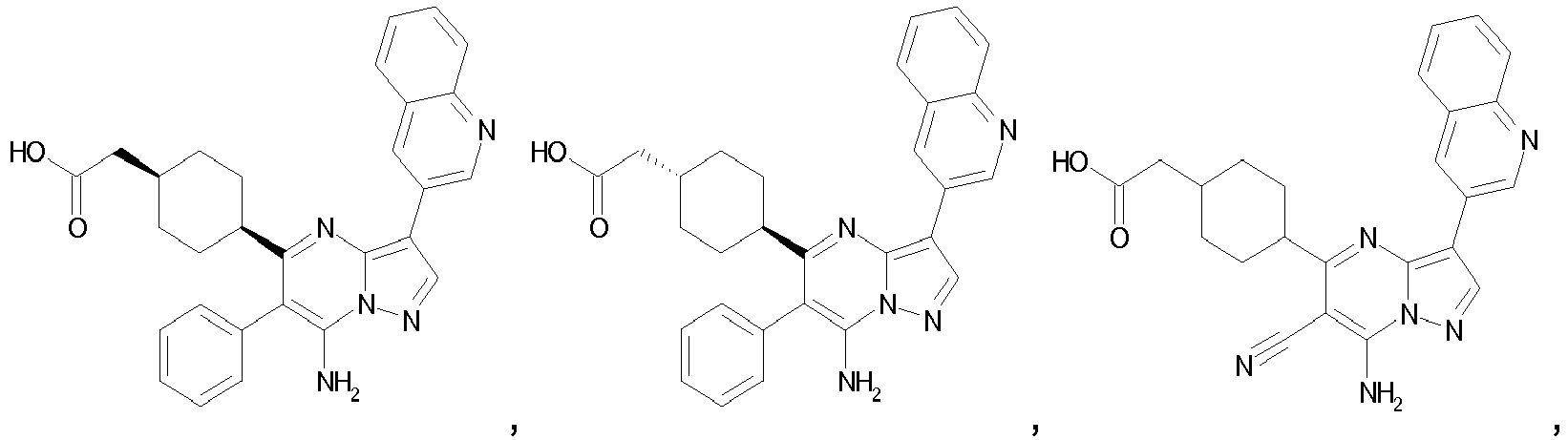


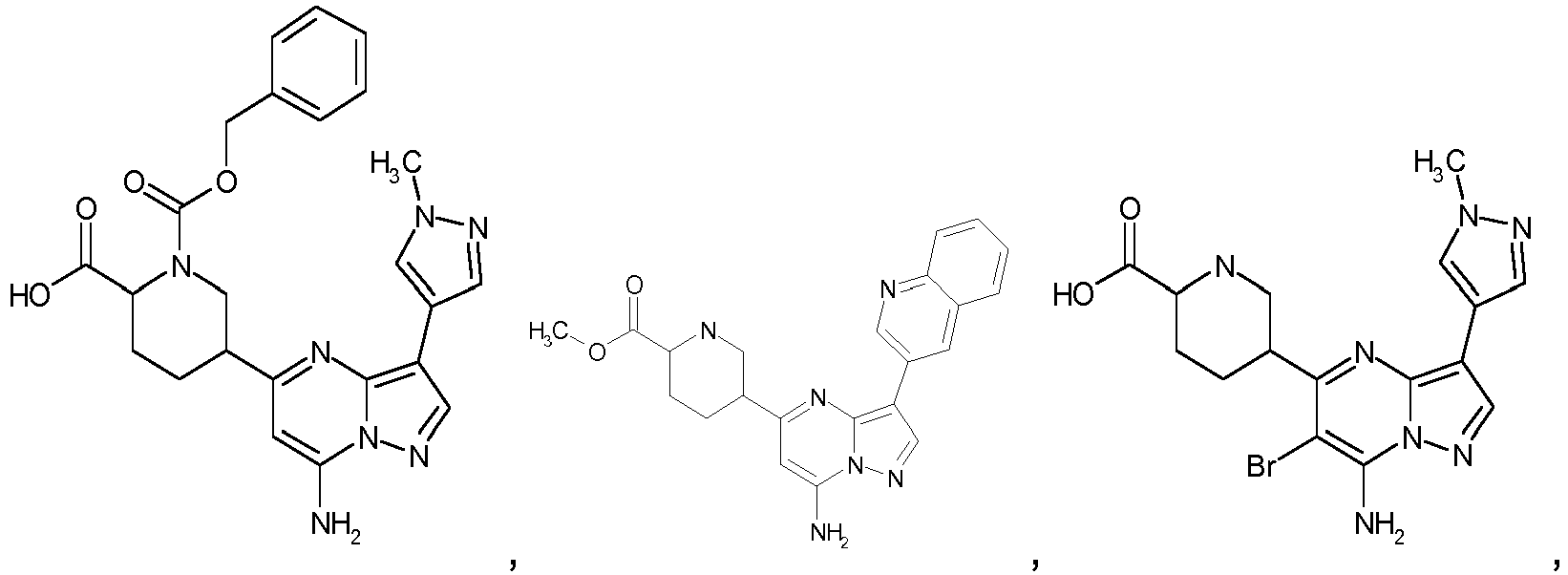


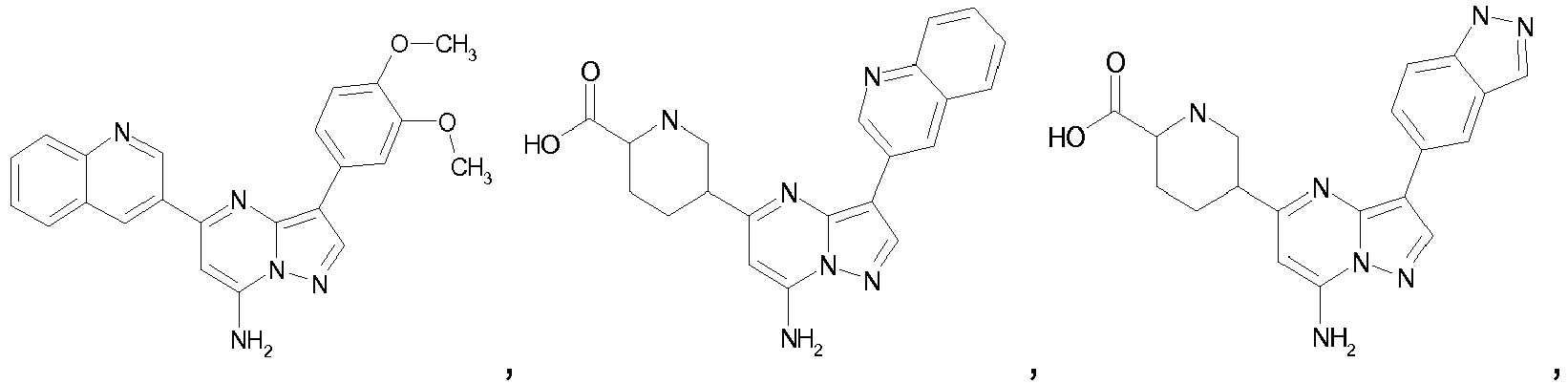


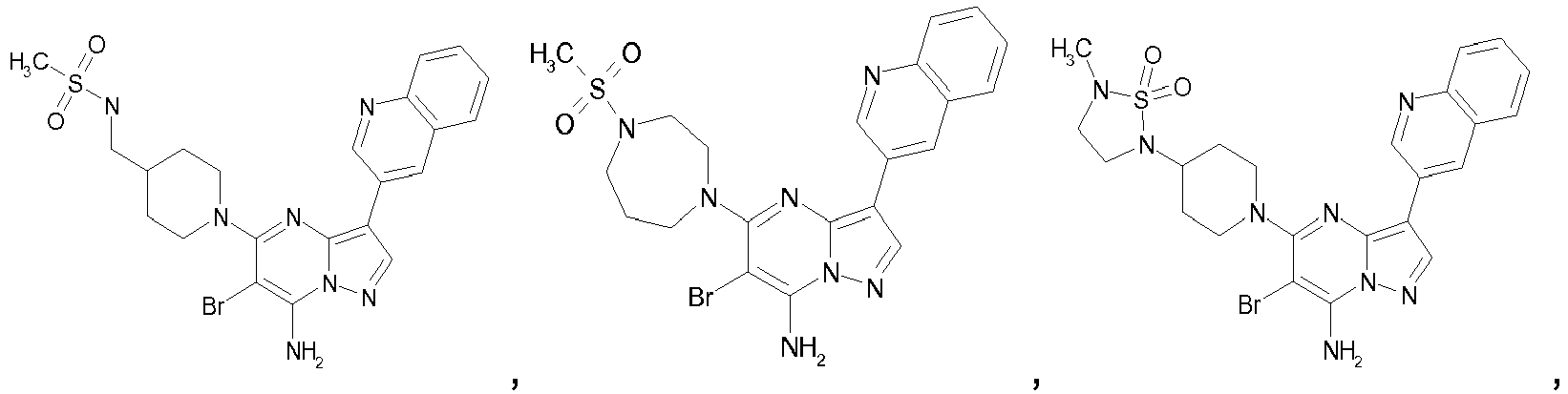


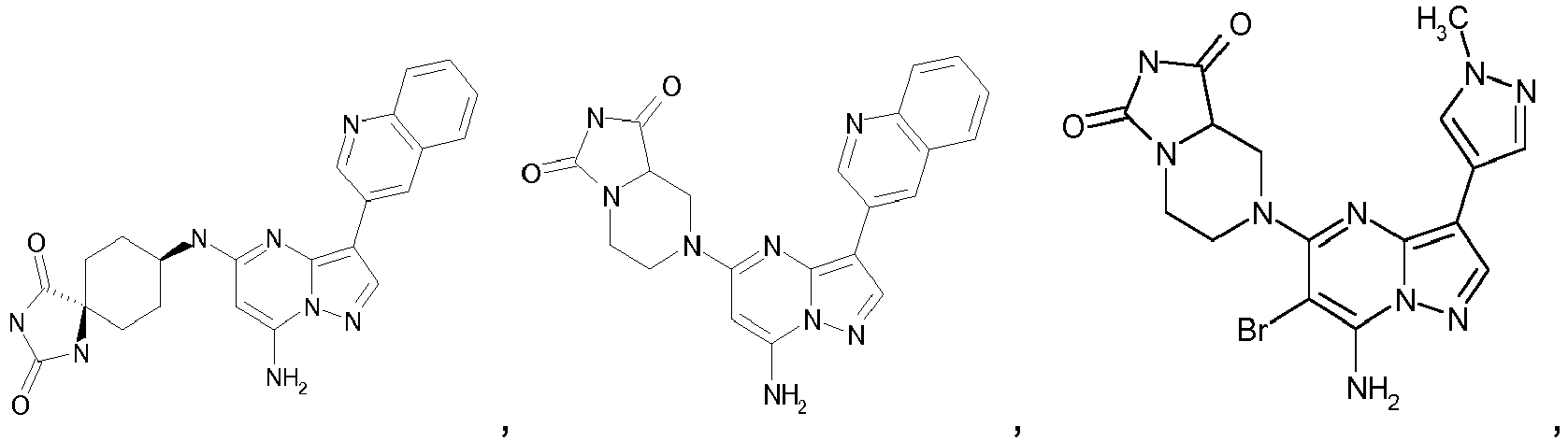


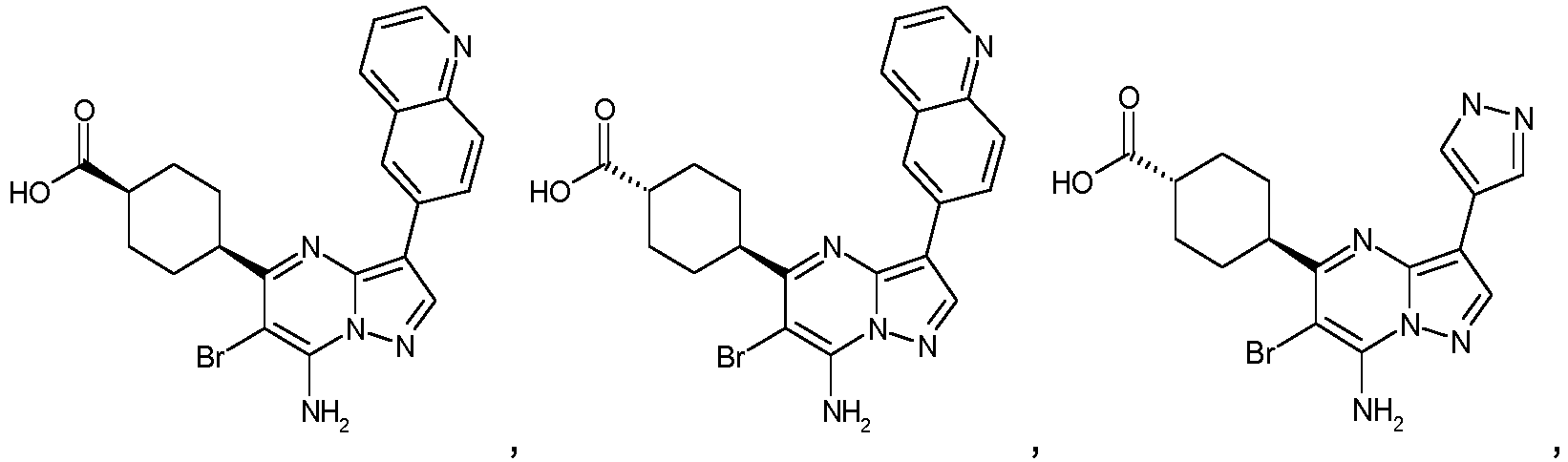


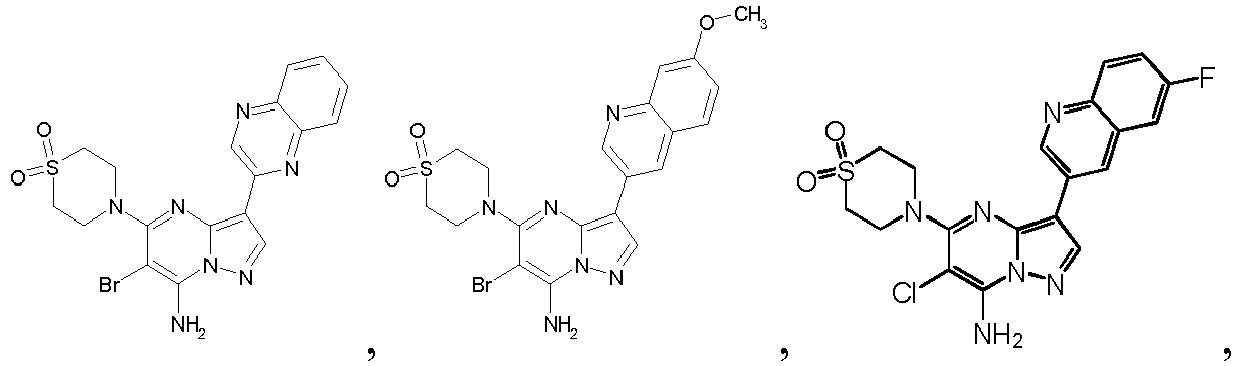


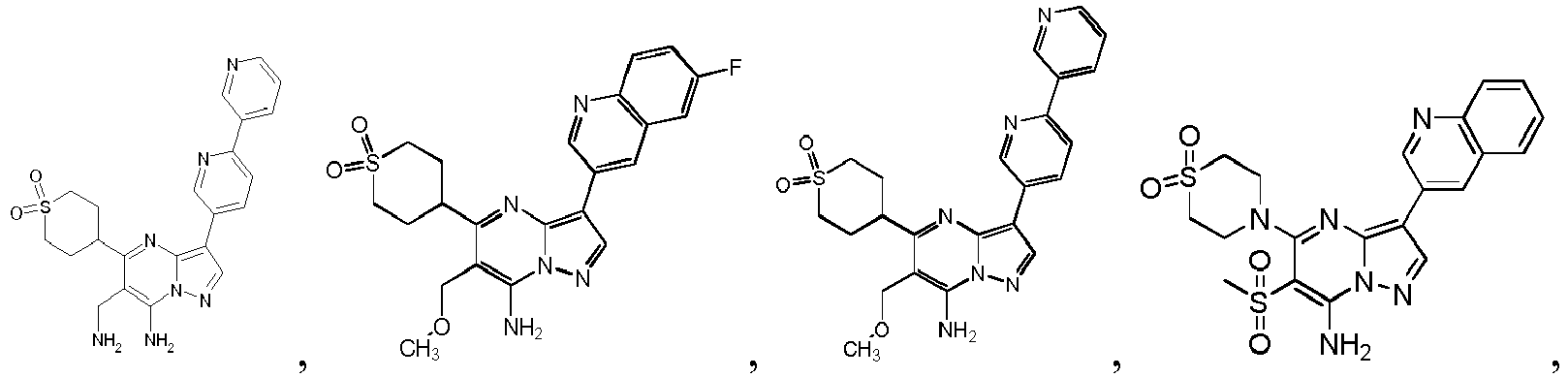


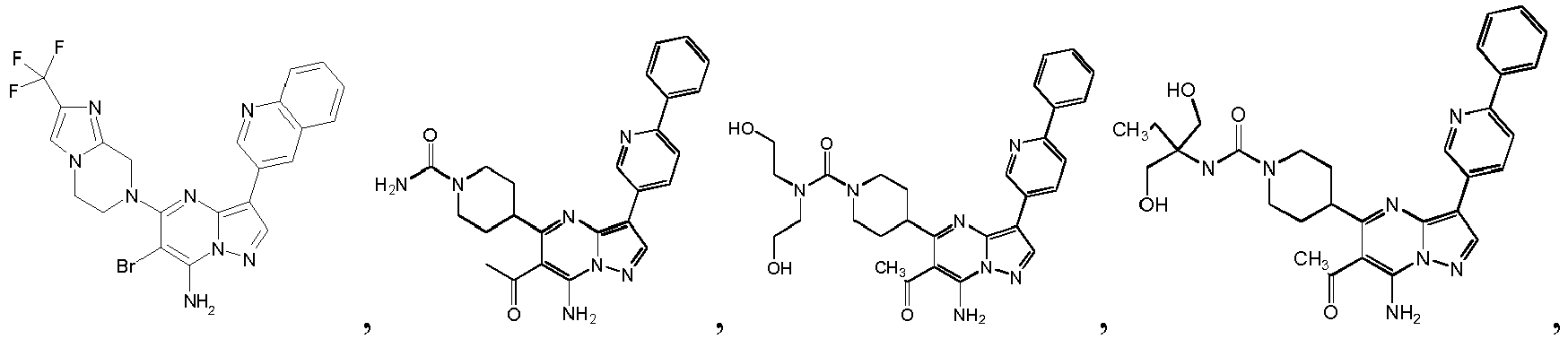


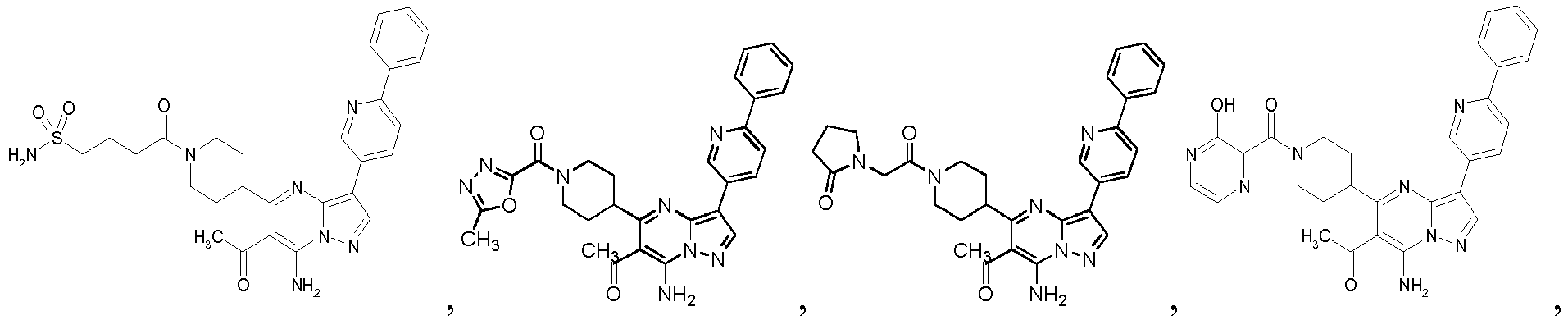


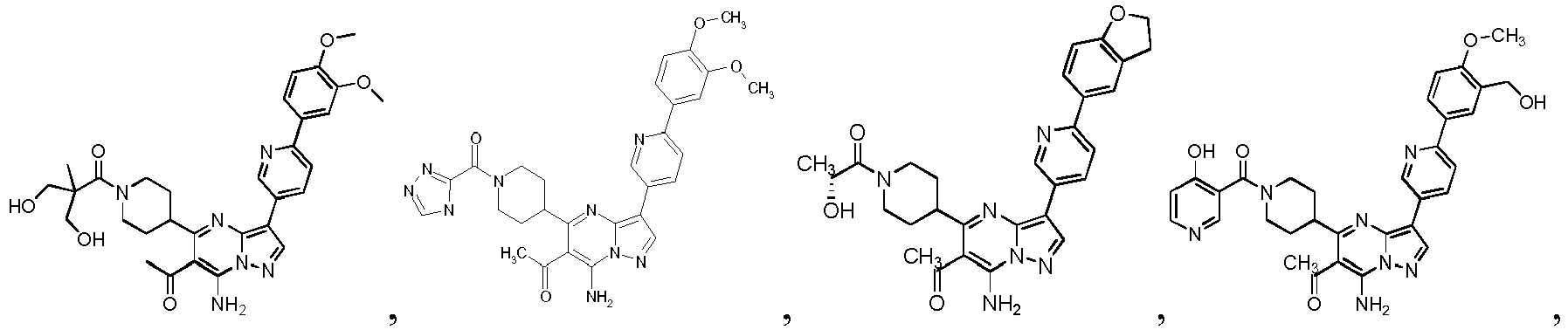


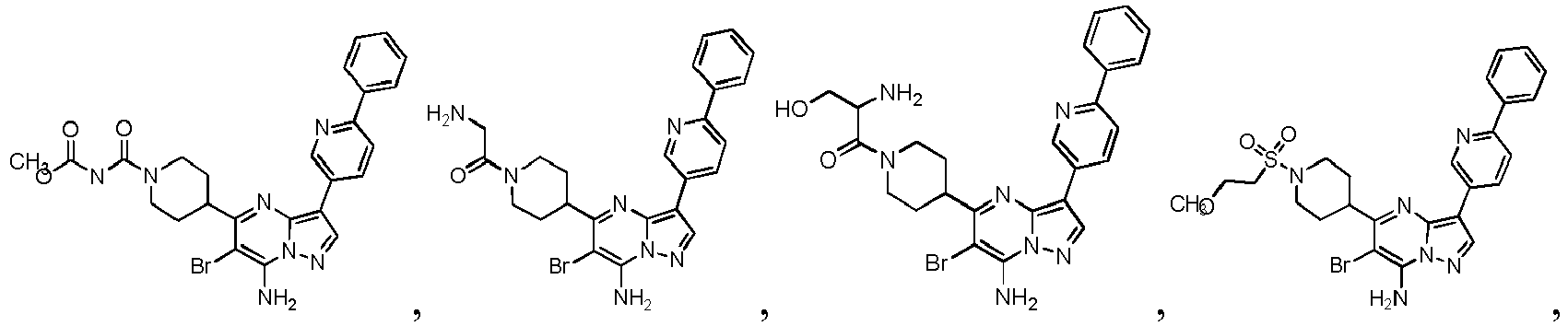





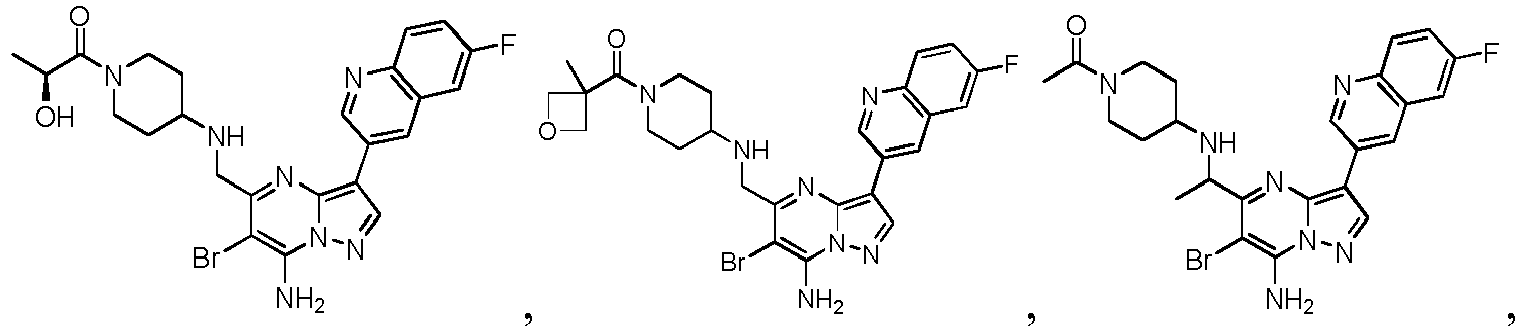





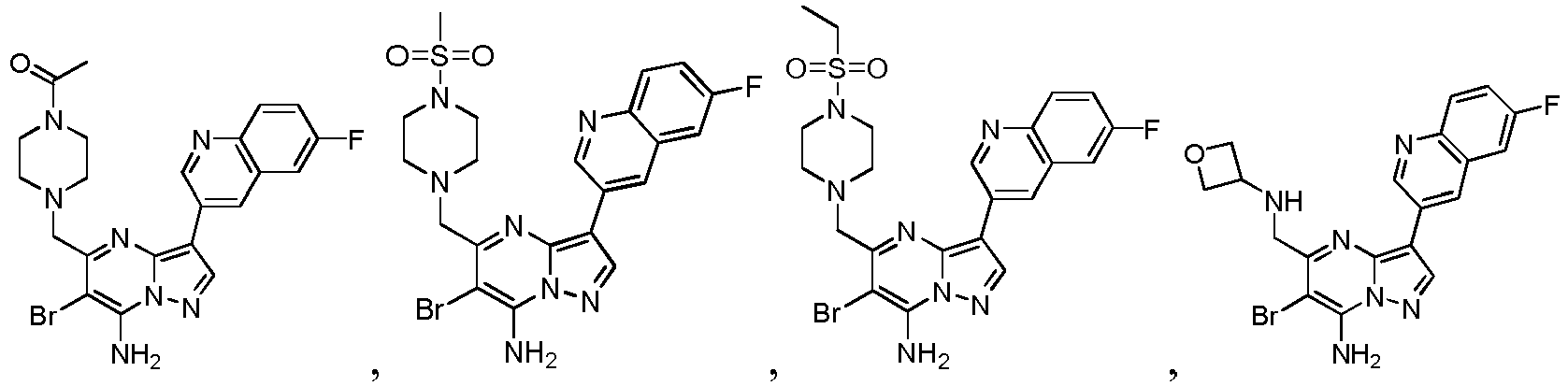

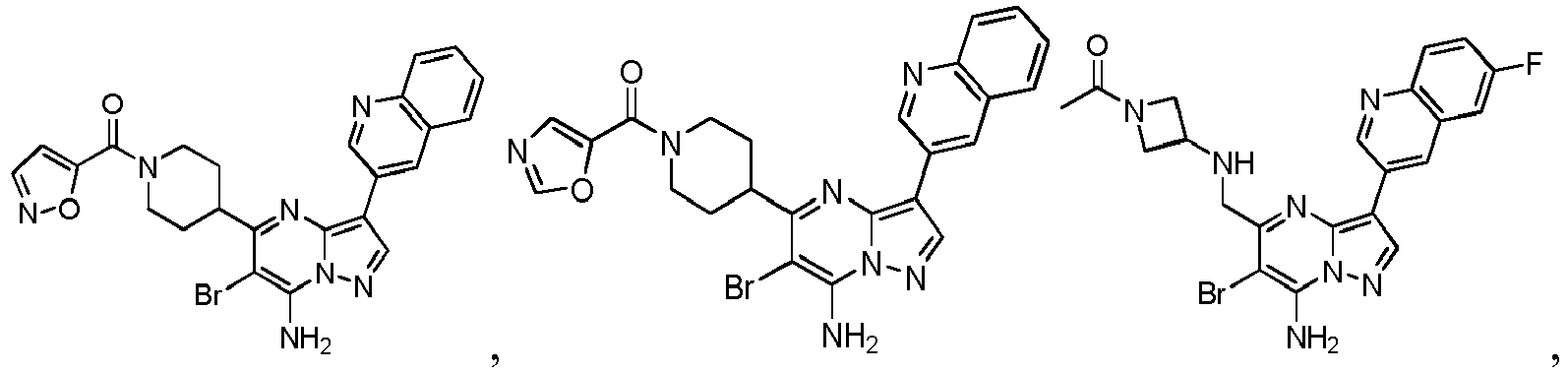


- In another embodiment, the present invention relates to a compound of the invention or a pharmaceutically acceptable salt or solvate thereof, in purified form.
- In another embodiment, the present invention relates to a compound of the invention or a pharmaceutically acceptable salt or solvate thereof, in isolated form.
- In another embodiment, the present invention includes a composition comprising a therapeutically effective amount of at least one compound of the invention or a pharmaceutically acceptable salt or solvate thereof, in combination with at least one pharmaceutically acceptable carrier.
- In another embodiment, the present invention includes a compound of the invention for use in the treating, or slowing the progression of, a disease by inhibiting mammalian Target Of Rapamycin in a patient, said use comprising administering a therapeutically effective amount of at least one compound of the invention, or a pharmaceutically acceptable salt or solvate of the compound, to a patient in need thereof.
- In another embodiment, the present invention includes a composition comprising a therapeutically effective amount of at least one compound of the invention or a pharmaceutically acceptable salt or solvate thereof, and an anti-cancer agent.
- In another embodiment, the present invention includes a composition comprising a therapeutically effective amount of at least one compound of the invention or a pharmaceutically acceptable salt or solvate thereof, and an antineoplastic, anti-tumor, anti-angiogenic, or chemotherapeutic agent.
- In another embodiment, the present invention includes a compound of the invention for use in the treatment of a disease selected from the group consisting of proliferative inflammatory diseases, allergic diseases, obstructive airways diseases, and disorders commonly occurring in connection with transplantation, diseases that respond to inhibition of mTOR, comprising administering a therapeutically effective amount of at least one compound of the invention or a pharmaceutically salt or solvate thereof to a patient in need of such treatment.
- In another embodiment, the present invention includes a compound of the invention for use in the treatment of a proliferative disease, autoimmune disease, viral disease, fungal disease, neurological/neurodegenerative disorder, arthritis, inflammation, neuronal, alopecia or cardiovascular disease comprising administering a therapeutically effective amount of at least one compound of the invention or a pharmaceutically acceptable salt or solvate thereof to a patient in need of such treatment.
- In another embodiment, the present invention includes a compound of the invention for use in the treatment of a proliferative disease.
- In another embodiment, the present invention includes a compound of the invention for use in the treatment of a proliferative disease, wherein the proliferative disease is selected from the group consisting of: cancer of the bladder, breast, colon, kidney, liver, lung, head and neck, esophagus, gall bladder, ovary, pancreas, stomach, cervix, thyroid, prostate, and skin; small cell lung cancer, non-small cell lung cancer, squamous cell carcinoma; leukemia, acute lymphocytic leukemia, acute lymphoblastic leukemia, B-cell lymphoma, T- cell lymphoma, Hodgkins lymphoma, non-Hodgkins lymphoma, hairy cell lymphoma, mantle cell lymphoma, myeloma, Burkett's lymphoma; acute and chronic myelogenous leukemia, myelodysplastic syndrome, promyelocytic leukemia; fibrosarcoma, rhabdomyosarcoma; astrocytoma, neuroblastoma, glioma and schwannomas; melanoma, seminoma, teratocarcinoma, osteosarcoma, xenoderma pigmentosum, keratoctanthoma, thyroid follicular cancer, endometrial cancer, gastrointestinal tract cancer and Kaposi's sarcoma.
- In another embodiment, the present invention includes a compound of the invention for use in the treatment of hamartoma syndromes, transplant rejection, bowel disorders, inflammatory bowel disease, multiple sclerosis, immunosuppression, immune tolerance, autoimmune diseases, inflammation, bone loss, rheumatoid arthritis, restinosis, cardiac allograft vasculopathy, psoriasis, ocular conditions such as dry eye, hepatic fibrosis, hepatic necrosis, beta-thalassaemia, comprising administering a therapeutically effective amount of at least one compound of the invention or a pharmaceutically acceptable salt or solvate thereof to a patient in need of such treatment.
- In another embodiment, the present invention includes a compound of the invention for use in the treatment of cancer of the bladder, breast, colon, kidney, liver, lung, small cell lung cancer, non-small cell lung cancer, head and neck, esophagus, gall bladder, ovary, pancreas, stomach, cervix, thyroid, prostate, and skin, squamous cell carcinoma; leukemia, acute lymphocytic leukemia, acute lymphoblastic leukemia, B-cell lymphoma, T- cell lymphoma, Hodgkins lymphoma, non-Hodgkins lymphoma, hairy cell lymphoma, mantle cell lymphoma, myeloma, Burkett's lymphoma; acute and chronic myelogenous leukemia, myelodysplastic syndrome, promyelocytic leukemia; fibrosarcoma, rhabdomyosarcoma; astrocytoma, neuroblastoma, glioma and schwannomas; melanoma, seminoma, teratocarcinoma, osteosarcoma, xenoderma pigmentosum, keratoctanthoma, thyroid follicular cancer, endometrial cancer, gastrointestinal tract cancer and Kaposi's sarcoma comprising administering a therapeutically effective amount of at least one compound of the invention or a pharmaceutically acceptable salt or solvate thereof, further comprising treatment with radiation therapy to a patient in need of such treatment.
- In another embodiment, the present invention includes a compound of the invention for use in the treating a disease by inhibiting a mTOR, comprising administering to a patient in need of such treatment an amount of a first compound of the invention or a pharmaceutically acceptable salt or solvate thereof; and
an amount of at least one second compound, said second compound being an anti-cancer agent;
wherein said anti-cancer agent is selected from the group consisting of Adriamycin, Altretamine, Amidox, Aminoglutethimide, Amsacrine, Anastrazole, Antibodies to EGFR, 3-AP, Aphidicolon, Ara-C, Arsenic trioxide, L-Asparaginase, Bevacizumab, Bleomycin, BMS 214662, Bortezomib, Busulfan, Campath, Camptostar, Capecitabine, Carboplatin, Carmustine, Centrosome associated protein E ("CENP-E") inhibitors, Cetuximab, Cladribine, Chlorambucil, Chlormethine, Chlorotrianisene, Cisplatin, Clofarabine, cyclophosphamide, Cytarabine, a Cytostatic agent, Cytoxan, Dacarbazine, Dactinomycin, Daunorubicin, Dasatinib, Deforolimus (described inPCT publication No. 2003/064383 ), Deoxycoformycin, Didox, Diethylstilbestrol, Docetaxel, Doxorubicin, Dromostanolone, Droloxafine, Epirubicin, Epothilones, ERK inhibitors, Erlotinib, Etoposide, 17α-Ethinylestradiol, Estramustine, Exemestane, Floxuridine, Fludarabine, Fludarabine phosphate, 5-Fluorouracil, Fluoxymesterone, Flutamide, Fulvestrant, Gefitinib, Gemcitabine, Gemtuzumab ozogamcicin, Goserelin, GSK-923295, Hexamethylmelamine, Hydroxyprogesterone, Hydroxyurea, Ibritumomab Tiuxetan, Idarubicin, Ifosfamide, Imatinib mesylate, Intron, Irinotecan, ispinesib, KSP inhibitors, L778,123, Lapatinib, Leucovirin, Leuprolide, Lerozole, Letrazole, Levamisole, Liposomal Doxorubicin, Liposomal, Lomustine, Lonafarnib, Medroxyprogesteroneacetate, Megestrolacetate, Melphalan, 6-Mercaptopurine, Methoxtrexate, Methylprednisolone, Methyltestosterone, Mithramycin, Mitomycin-C, Mitotane, Mitoxantrone, Navelbene, Nilotinib, Oxaliplatin, Paclitaxel, Panitubimab, Pentostatin, Pipobroman, Porfimer, Prednisolone, Prednisone propionate, Procarbazine, Reloxafine, Rituximab, Satriplatin, SB-743921, Sml1, Sorafinib, Streptozocin, Sunitinib, Tamoxifen, Taxotere, Taxol, Temozolomide, Teniposide, Testolactone, Testosterone, Tezacitabine, 6-Thioguanine, Thiotepa, Tipifarnib, Topotecan, Toremifene, Tositumomab, Trastuzumab, Triamcinolone, Triapine, Triethylenemelamine, Triethylenethiophosphoramine, Trimidox, Uracil mustard, Vinblastine, Vincristine, Vindesine, and Vinorelbine;
wherein the amounts of the first compound and said second compound result in a therapeutic effect. - In another embodiment, the present invention includes a compound of the invention for use in the treating, or slowing the progression of, a disease by inhibiting mammalian Target Of Rapamycin in a patient, said use comprising administering a therapeutically effective amount of at least one compound of the invention, or a pharmaceutically acceptable salt or solvate of the compound, to a patient in need thereof.
- In another embodiment, the present invention includes a compound of the invention for use in the treatment of a disease selected from the group consisting of proliferative inflammatory diseases, allergic diseases, obstructive airways diseases, diseases related to transplant rejection and diseases that respond to inhibition of mTOR, comprising administering a therapeutically effective amount of a compound of the invention or a pharmaceutically acceptable salt or solvate thereof to a patient in need of such treatment.
- In another embodiment, the present invention includes a compound of the invention for use in the treatment of a disease selected from the group consisting of proliferative inflammatory diseases, allergic diseases, obstructive airways diseases, diseases related to transplant rejection and diseases that respond to inhibition of mTOR, comprising administering a therapeutically effective amount of at least one compound of the invention or a pharmaceutically acceptable salt or solvate thereof.
- In another embodiment, the present invention includes a compound of the invention or a pharmaceutically acceptable salt or solvate thereof exhibiting mTOR inhibition which is at least five-fold the inhibition of CDK2 or CHK-1 by said compound.
- In another embodiment, the present invention includes a compound of the invention or a pharmaceutically acceptable salt or solvate thereof exhibiting mTOR inhibition which is at least ten-fold the inhibition of CDK2 or CHK-1 by said compound.
- In another embodiment, the present invention includes a compound of the invention or a pharmaceutically acceptable salt or solvate thereof exhibiting mTOR inhibition which is at least fifty-fold the inhibition of CDK2 or CHK-1 by said compound.
- The compounds of this invention can be used to inhibit the following kinases: ABL1, ABL2, AFK, ALK, AMPK, ATM, ATR, Aurora A, Aurora B, Axl, BCKDK, BLK, BMPR1B, BMX, Brk, BRSK1, BTK, CaM-Klalpha, CaM-Kllalpha, CaM-KIV, CaM-KKalpha, CaM-KKbeta, CCDPK, CCRK, CDK1, CDK11, CDK2, CDK4, CDK5, CDK6, CDK7, CDK9, Chak1, CHK1, CHK2, CK1 alpha, CK1 delta, CDk1 epsilon, CDK2 beta, CLK1, CSF1R, Csk, DAPK1, DAPK2, DAPK3, DCAMKL1, DNA-PK, DYRK1A, DYRK1B, DYRK2, DYRK3, eEF2K, Eg3, EGFR, EIF2AK2, EphA2, EphA3, EphA4, EphA8, EphB1, EphB2, EphB3, EphB5, ErbB2, FAK, Fer, Fes, FGFR1, FGFR3, FGFR4, Fgr, FLT1, FLT3, FLT4, Fyn, GRK-1, GRK-2, GRk-3, GRK-4, GRK-5, GRK-6, GSK-3alpha, GSK-3beta, HCK, HIPK2, HIPK3, HRI, ICK, IGF1R, IKK-alpha, IKK-beta, IKK-epsilon, ILK, InsR, IPL1, IRAK1, IRAK4, ITK, JAK1, JAK2, JAK3, JNK1, JNK2, JNK3, KDR, KIS, Kit, KSR1, Lck, LIMK1, LIMK2, LKB1, LOK, Lyn, MAP2K1, MAP2K2, MAP2K3, MAP2K4, MAP2K6, MAP2K7, MAP3K1, MAP3K11, MAP3K14, MAP3K5, MAP3K7, MAP3K8, MAP4K1, MAP4K2, MAP4K4, MAPK1, MAPK10, MAPK11, MAPK12, MAPK13, MAPK14, MAPK3, MAPK4, MAPK6, MAPK7, MAPK8, MAPK9, MAPKAPK2, Mer, Met, MHCK, MLCK, Mnk1, Mnk2, MOS, MRCKa, MST1, MST3, NDR1, NDR2, NEK1, NEK2, NEK6, NEK9, NLK, NuaK1, p37, p38, p70S6K, p70S6Kb, PAK1, PAK2, PAK2, PAK3, PAK5, PAK6, PASK, P-CIP2, PCTAIRE1, PDGFR alpha, PDGFR beta, PDHK1, PDHK2, PDHK3, PDHK4, PDK-1, PDK-2, PHK, PIK3CA, PIK3CB, PIK3CD, PIK3CG, Pim-1, PKA alpha, PKB beta, PKC alpha, PKC beta, PKC delta, PKC epsilon, PKC eta, PKC gamma, PKC iota, PKC theta, PKC zeta, PKD1, PKD2, PKD3, PKG1/cGK-I, PKG1/cGK-II, PKN1, PLK1, PLK2, PLK3, PRP4, PYK2, RAF1, Ret, ROCK1, ROCK2, Ron, RPL10, RSK-1, RSK-2, RSK-3, RSK-5, SDK1, SIK, Sky, Src, STLK3, Syk, TBK1, Tec, TESK1, TESK2, TGFbR1, TGFbR2, Tie1, Tie2, Titin kinase, TNK2, TRKA, TRB, tropomyosin kinase, TSSK3, TXK, Tyk2, VRK1, Wee1, Wnk1, Yes, and ZAP70.
- As used above, and throughout this disclosure, the following terms, unless otherwise indicated, shall be understood to have the following meanings, including any possible substitutions of the stated groups or moieties:
"Patient" includes both human and animals. - "Mammal" means humans and other mammalian animals.
- The term "purified", "in purified form" or "in isolated and purified form" for a compound refers to the physical state of said compound after being isolated from a synthetic process (e.g. from a reaction mixture), or natural source or combination thereof. Thus, the term "purified", "in purified form" or "in isolated and purified form" for a compound refers to the physical state of said compound after being obtained from a purification process or processes described herein or well known to the skilled artisan (e.g., chromatography, recrystallization and the like), in sufficient purity to be characterizable by standard analytical techniques described herein or well known to the skilled artisan.
- It should also be noted that any carbon as well as heteroatom with unsatisfied valences in the text, schemes, examples and Tables herein is assumed to have the sufficient number of hydrogen atom(s) to satisfy the valences.
- When a functional group in a compound is termed "protected", this means that the group is in modified form to preclude undesired side reactions at the protected site when the compound is subjected to a reaction. Suitable protecting groups will be recognized by those with ordinary skill in the art as well as by reference to standard textbooks such as, for example, T. W. Greene et al, Protective Groups in organic Synthesis (1991), Wiley, New York.
- As used herein, the term "composition" is intended to encompass a product comprising the specified ingredients in the specified amounts, as well as any product which results, directly or indirectly, from combination of the specified ingredients in the specified amounts.
- Prodrugs and solvates of the compounds of the invention are also contemplated herein. A discussion of prodrugs is provided in T. Higuchi and V. Stella, Pro-drugs as Novel Delivery Systems (1987) 14 of the A.C.S. Symposium Series, and in Bioreversible Carriers in Drug Design, (1987) Edward B. Roche, ed., American Pharmaceutical Association and Pergamon Press. The term "prodrug" means a compound (e.g., a drug precursor) that is transformed in vivo to yield a compound of the present invention or a pharmaceutically acceptable salt, hydrate or solvate of the compound. The transformation may occur by various mechanisms (e.g., by metabolic or chemical processes), such as, for example, through hydrolysis in blood. A discussion of the use of prodrugs is provided by T. Higuchi and W. Stella, "Pro-drugs as Novel Delivery Systems," Vol. 14 of the A.C.S. Symposium Series, and in Bioreversible Carriers in Drug Design, ed. Edward B. Roche, American Pharmaceutical Association and Pergamon Press, 1987.
- For example, if a compound of the present invention or a pharmaceutically acceptable salt, hydrate or solvate of the compound contains a carboxylic acid functional group, a prodrug can comprise an ester formed by the replacement of the hydrogen atom of the acid group with a group such as, for example, (C1-C8)alkyl, (C2-C12)alkanoyloxymethyl, 1-(alkanoyloxy)ethyl having from 4 to 9 carbon atoms, 1-methyl-1-(alkanoyloxy)-ethyl having from 5 to 10 carbon atoms, alkoxycarbonyloxymethyl having from 3 to 6 carbon atoms, 1-(alkoxycarbonyloxy)ethyl having from 4 to 7 carbon atoms, 1-methyl-1-(alkoxycarbonyloxy)ethyl having from 5 to 8 carbon atoms, N-(alkoxycarbonyl)aminomethyl having from 3 to 9 carbon atoms, 1-(N-(alkoxycarbonyl)amino)ethyl having from 4 to 10 carbon atoms, 3-phthalidyl, 4-crotonolactonyl, gamma-butyrolacton-4-yl, di-N,N-(C1-C2)alkylamino(C2-C3)alkyl (such as β-dimethylaminoethyl), carbamoyl-(C1-C2)alkyl, N,N-di(C1-C2)alkylcarbamoyl-(C1-C2)alkyl and piperidino-, pyrrolidino- or morpholino(C2-C3)alkyl, and the like.
- Similarly, if a compound of the present invention contains an alcohol functional group, a prodrug can be formed by the replacement of the hydrogen atom of the alcohol group with a group such as, for example, (C1-C6)alkanoyloxymethyl, 1-((C1-C6)alkanoyloxy)ethyl, 1-methyl-1-((C1-C6)alkanoyloxy)ethyl, (C1-C6)alkoxycarbonyloxymethyl, N-(C1-C6)alkoxycarbonylaminomethyl, succinoyl, (C1-C6)alkanoyl, α-amino(C1-C4)alkanyl, arylacyl and α-aminoacyl, or α-aminoacyl-α-aminoacyl, where each α-aminoacyl group is independently selected from the naturally occurring L-amino acids, P(O)(OH)2, -P(O)(O(C1-C6)alkyl)2 or glycosyl (the radical resulting from the removal of a hydroxyl group of the hemiacetal form of a carbohydrate), and the like.
- If a compound of the present invention incorporates an amine functional group, a prodrug can be formed by the replacement of a hydrogen atom in the amine group with a group such as, for example, R-carbonyl, RO-carbonyl, NRR'-carbonyl where R and R' are each independently (C1-C10)alkyl, (C3-C7) cycloalkyl, benzyl, or R-carbonyl is a natural α-aminoacyl or natural α-aminoacyl, -C(OH)C(O)OY1 wherein Y1 is H, (C1-C6)alkyl or benzyl, -C(OY2)Y3 wherein Y2 is (C1-C4) alkyl and Y3 is (C1-C6)alkyl, carboxy (C1-C6)alkyl, amino(C1-C4)alkyl or mono-N-or di-N,N-(C1-C6)alkylaminoalkyl, -C(Y4)Y5 wherein Y4 is H or methyl and Y5 is mono-N- or di-N,N-(C1-C6)alkylamino morpholino, piperidin-1-yl or pyrrolidin-1-yl, and the like.
- One or more compounds of the invention may exist in unsolvated as well as solvated forms with pharmaceutically acceptable solvents such as water, ethanol, and the like, and it is intended that the invention embrace both solvated and unsolvated forms. "Solvate" means a physical association of a compound of this invention with one or more solvent molecules. This physical association involves varying degrees of ionic and covalent bonding, including hydrogen bonding. In certain instances the solvate will be capable of isolation, for example when one or more solvent molecules are incorporated in the crystal lattice of the crystalline solid. "Solvate" encompasses both solution-phase and isolatable solvates. Non-limiting examples of suitable solvates include ethanolates, methanolates, and the like. "Hydrate" is a solvate wherein the solvent molecule is H2O.
- One or more compounds of the invention may optionally be converted to a solvate. Preparation of solvates is generally known. Thus, for example, M. Caira et al, J. Pharmaceutical Sci., 93(3), 601-611 (2004) describes the preparation of the solvates of the antifungal fluconazole in ethyl acetate as well as from water. Similar preparations of solvates, hemisolvate, hydrates and the like are described by E. C. van Tonder et al, AAPS PharmSciTech., 5(1), article 12 (2004); and A. L. Bingham et al, Chem. Commun., 603-604 (2001). A typical, non-limiting, process involves dissolving the inventive compound in desired amounts of the desired solvent (organic or water or mixtures thereof) at a higher than ambient temperature, and cooling the solution at a rate sufficient to form crystals which are then isolated by standard methods. Analytical techniques such as, for example I. R. spectroscopy, show the presence of the solvent (or water) in the crystals as a solvate (or hydrate).
- "Effective amount" or "therapeutically effective amount" is meant to describe an amount of compound or a composition of the present invention effective in inhibiting the above-noted diseases and thus producing the desired therapeutic, ameliorative, inhibitory or preventative effect.
- The compounds of the present invention can form salts which are also within the scope of this invention. Reference to a compound of the present invention herein is understood to include reference to salts thereof, unless otherwise indicated. The term "salt(s)", as employed herein, denotes acidic salts formed with inorganic and/or organic acids, as well as basic salts formed with inorganic and/or organic bases. In addition, when a compound of the present invention contains both a basic moiety, such as, but not limited to a pyridine or imidazole, and an acidic moiety, such as, but not limited to a carboxylic acid, zwitterions ("inner salts") may be formed and are included within the term "salt(s)" as used herein. Pharmaceutically acceptable (i.e., non-toxic, physiologically acceptable) salts are preferred, although other salts are also useful. Salts of the compounds of the The present invention may be formed, for example, by reacting a compound of the present invention with an amount of acid or base, such as an equivalent amount, in a medium such as one in which the salt precipitates or in an aqueous medium followed by lyophilization.
- Exemplary acid addition salts include acetates, ascorbates, benzoates, benzenesulfonates, bisulfates, borates, butyrates, citrates, camphorates, camphorsulfonates, fumarates, hydrochlorides, hydrobromides, hydroiodides, lactates, maleates, methanesulfonates, naphthalenesulfonates, nitrates, oxalates, phosphates, propionates, salicylates, succinates, sulfates, tartarates, thiocyanates, toluenesulfonates (also known as tosylates,) and the like. Additionally, acids which are generally considered suitable for the formation of pharmaceutically useful salts from basic pharmaceutical compounds are discussed, for example, by P. Stahl et al, Camille G. (eds.) Handbook of Pharmaceutical Salts. Properties, Selection and Use. (2002) Zurich: Wiley-VCH; S. Berge et al, Journal of Pharmaceutical Sciences (1977) 66(1) 1-19; P. Gould, International J. of Pharmaceutics (1986) 33 201-217; Anderson et al, The Practice of Medicinal Chemistry (1996), Academic Press, New York; and in The Orange Book (Food & Drug Administration, Washington, D.C. on their website). These disclosures are incorporated herein by reference thereto.
- Exemplary basic salts include ammonium salts, alkali metal salts such as sodium, lithium, and potassium salts, alkaline earth metal salts such as calcium and magnesium salts, salts with organic bases (for example, organic amines) such as dicyclohexylamines, t-butyl amines, and salts with amino acids such as arginine, lysine and the like. Basic nitrogen-containing groups may be quarternized with agents such as lower alkyl halides (e.g. methyl, ethyl, and butyl chlorides, bromides and iodides), dialkyl sulfates (e.g. dimethyl, diethyl, and dibutyl sulfates), long chain halides (e.g. decyl, lauryl, and stearyl chlorides, bromides and iodides), aralkyl halides (e.g. benzyl and phenethyl bromides), and others.
- All such acid salts and base salts are intended to be pharmaceutically acceptable salts within the scope of the invention and all acid and base salts are considered equivalent to the free forms of the corresponding compounds for purposes of the invention.
- Pharmaceutically acceptable esters of the present compounds include the following groups: (1) carboxylic acid esters obtained by esterification of the hydroxy groups, in which the non-carbonyl moiety of the carboxylic acid portion of the ester grouping is selected from straight or branched chain alkyl (for example, acetyl, n-propyl, t-butyl, or n-butyl), alkoxyalkyl (for example, methoxymethyl), aralkyl (for example, benzyl), aryloxyalkyl (for example, phenoxymethyl), aryl (for example, phenyl optionally substituted with, for example, halogen, C1-4alkyl, or C1-4alkoxy or amino); (2) sulfonate esters, such as alkyl- or aralkylsulfonyl (for example, methanesulfonyl); (3) amino acid esters (for example, L-valyl or L-isoleucyl); (4) phosphonate esters and (5) mono-, di- or triphosphate esters. The phosphate esters may be further esterified by, for example, a C1-20 alcohol or reactive derivative thereof, or by a 2,3-di (C6-24)acyl glycerol.
- Compounds of the present invention, and salts, solvates, esters and prodrugs thereof, may exist in their tautomeric form (for example, as an amide or imino ether). All such tautomeric forms are contemplated herein.
- The compounds of the present invention may contain asymmetric or chiral centers, and, therefore, exist in different stereoisomeric forms. All stereoisomeric forms of the compounds of the present invention as well as mixtures thereof, including racemic mixtures, are contemplated herein. In addition, all geometric and positional isomers are contemplated herein. For example, if a compound of the present invention incorporates a double bond or a fused ring, both the cis- and trans-forms, as well as mixtures, are contemplated herein.
- Diastereomeric mixtures can be separated into their individual diastereomers on the basis of their physical chemical differences by methods well known to those skilled in the art, such as, for example, by chromatography and/or fractional crystallization. Enantiomers can be separated by converting the enantiomeric mixture into a diastereomeric mixture by reaction with an appropriate optically active compound (e.g., chiral auxiliary such as a chiral alcohol or Mosher's acid chloride), separating the diastereomers and converting (e.g., hydrolyzing) the individual diastereomers to the corresponding pure enantiomers. Also, some of the compounds of the present invention may be atropisomers (e.g., substituted biaryls) and are considered as part of this invention. Enantiomers can also be separated by use of chiral HPLC column.
- It is also possible that the compounds of the present invention may exist in different tautomeric forms, and all such forms are contemplated herein. Also, for example, all keto-enol and imine-enamine forms of the compounds are contemplated herein.
- All stereoisomers (for example, geometric isomers, optical isomers and the like) of the present compounds (including those of the salts, solvates, esters and prodrugs of the compounds as well as the salts, solvates and esters of the prodrugs), such as those which may exist due to asymmetric carbons on various substituents, including enantiomeric forms (which may exist even in the absence of asymmetric carbons), rotameric forms, atropisomers, and diastereomeric forms, are contemplated herein, as are positional isomers (such as, for example, 4-pyridyl and 3-pyridyl). (For example, if a compound of the present invention incorporates a double bond or a fused ring, both the cis- and trans-forms, as well as mixtures, are contemplated herein. Also, for example, all keto-enol and imine-enamine forms of the compounds are contemplated herein.) Individual stereoisomers of the compounds of the invention may, for example, be substantially free of other isomers, or may be admixed, for example, as racemates or with all other, or other selected, stereoisomers. The chiral centers of the present invention can have the S or R configuration as defined by the IUPAC 1974 Recommendations. The use of the terms "salt", "solvate", "ester", "prodrug" and the like, is intended to equally apply to the salt, solvate, ester and prodrug of enantiomers, stereoisomers, rotamers, tautomers, positional isomers, racemates or prodrugs of the inventive compounds.
- The present invention also contemplates isotopically-labelled compounds of the present invention which are identical to those recited herein, but for the fact that one or more atoms are replaced by an atom having an atomic mass or mass number different from the atomic mass or mass number usually found in nature. Examples of isotopes that can be incorporated into compounds of the invention include isotopes of hydrogen, carbon, nitrogen, oxygen, phosphorus, fluorine and chlorine and iodine, such as 2H, 3H, 11C, 13C, 14C, 15N, 18O, 17O, 31P, 32P, 35S, 18F, 36Cl and 123I, respectively.
- Certain isotopically-labelled compounds of the invention (e.g., those labeled with 3H and 14C) are useful in compound and/or substrate tissue distribution assays. Tritiated (i.e., 3H) and carbon-14 (i.e., 14C) isotopes are particularly preferred for their ease of preparation and detectability. Certain isotopically-labelled compounds of Formula (I) can be useful for medical imaging purposes. E.g., those labeled with positron-emitting isotopes like 11C or 18F can be useful for application in Positron Emission Tomography (PET) and those labeled with gamma ray emitting isotopes like 123I can be useful for application in Single photon emission computed tomography (SPECT). Further, substitution with heavier isotopes such as deuterium (i.e., 2H) may afford certain therapeutic advantages resulting from greater metabolic stability (e.g., increased in vivo half-life or reduced dosage requirements) and hence may be preferred in some circumstances. Further, substitution with heavier isotopes such as deuterium (i.e., 2H) may afford certain therapeutic advantages resulting from greater metabolic stability (e.g., increased in vivo half-life or reduced dosage requirements) and hence may be preferred in some circumstances. Additionally, isotopic substitution at a site where epimerization occurs may slow or reduce the epimerization process and thereby retain the more active or efficacious form of the compound for a longer period of time. Isotopically labeled compounds of the invention, in particular those containing isotopes with longer half lives (T1/2 >1 day), can generally be prepared by following procedures analogous to those disclosed in the Schemes and/or in the Examples herein below, by substituting an appropriate isotopically labeled reagent for a non-isotopically labeled reagent.
- Polymorphic forms of the compounds of the present invention, and of the salts, solvates, esters and prodrugs of the compounds of the present invention, are contemplated herein.
- The compounds according to the invention have pharmacological properties; in particular, the compounds of the present invention can be inhibitors, regulators or modulators of mTOR protein kinases.
- The compounds of the present invention can be inhibitors of protein kinases such as, for example, the inhibitors of the mTOR. Preferred compounds can exhibit IC50 values of less than about 5µm, preferably about 0.001 to about 1.0 µm, and more preferably about 0.001 to about 0.1 µm. The assay methods are described in the Examples set forth below.
- The compounds of the present invention can be useful in the therapy of proliferative diseases such as cancer, autoimmune diseases, viral diseases, fungal diseases, neurological/neurodegenerative disorders, arthritis, inflammation, antiproliferative (e.g., ocular retinopathy), neuronal, alopecia and cardiovascular disease. Many of these diseases and disorders are listed in
U.S. 6,413,974 , incorporated by reference herein. - More specifically, the compounds of the present invention can be useful in the treatment of a variety of cancers, including (but not limited to) the following:
- tumor of the bladder, breast (including BRCA-mutated breast cancer, colorectal, colon, kidney, liver, lung, small cell lung cancer, non-small cell lung cancer, head and neck, esophagus, bladder, gall bladder, ovary, pancreas, stomach, cervix, thyroid, prostate, and skin, including squamous cell carcinoma;
- leukemia, acute lymphocytic leukemia, acute lymphoblastic leukemia, B-cell lymphoma, T- cell lymphoma, Hodgkins lymphoma, non-Hodgkins lymphoma, hairy cell lymphoma, mantle cell lymphoma, myeloma and Burkett's lymphoma;
- chronic lymphocytic leukemia ("CLL"),
- acute and chronic myelogenous leukemia, myelodysplastic syndrome and promyelocytic leukemia;
- fibrosarcoma, rhabdomyosarcoma;
- head and neck, mantle cell lymphoma, myeloma;
- astrocytoma, neuroblastoma, glioma, glioblastoma, malignant glial tumors, astrocytoma, hepatocellular carcinoma, gastrointestinal stromal tumors ("GIST") and schwannomas;
- melanoma, multiple myeloma, seminoma, teratocarcinoma, osteosarcoma, xenoderma pigmentosum, keratoctanthoma, thyroid follicular cancer, endometrial cancer, gastrointestinal tract cancer and Kaposi's sarcoma.
- Due to the key role of kinases in the regulation of cellular proliferation in general, inhibitors could act as reversible cytostatic agents which may be useful in the treatment of any disease process which features abnormal cellular proliferation, e.g., benign prostate hyperplasia, familial adenomatosis polyposis, neuro-fibromatosis, atherosclerosis, pulmonary fibrosis, arthritis, psoriasis, glomerulonephritis, restenosis following angioplasty or vascular surgery, hypertrophic scar formation, inflammatory bowel disease, transplantation rejection, endotoxic shock, and fungal infections.
- Compounds of the present invention may induce or inhibit apoptosis. The apoptotic response is aberrant in a variety of human diseases. Compounds of the present invention, as modulators of apoptosis, will be useful in the treatment of cancer (including but not limited to those types mentioned hereinabove), viral infections (including but not limited to herpevirus, poxvirus, Epstein- Barr virus, Sindbis virus and adenovirus), prevention of AIDS development in HIV-infected individuals, autoimmune diseases (including but not limited to systemic lupus, erythematosus, autoimmune mediated glomerulonephritis, rheumatoid arthritis, psoriasis, inflammatory bowel disease, and autoimmune diabetes mellitus), neurodegenerative disorders (including but not limited to Alzheimer's disease, AIDS-related dementia, Parkinson's disease, amyotrophic lateral sclerosis, retinitis pigmentosa, spinal muscular atrophy and cerebellar degeneration), myelodysplastic syndromes, aplastic anemia, ischemic injury associated with myocardial infarctions, stroke and reperfusion injury, arrhythmia, atherosclerosis, toxin-induced or alcohol related liver diseases, hematological diseases (including but not limited to chronic anemia and aplastic anemia), degenerative diseases of the musculoskeletal system (including but not limited to osteoporosis and arthritis) aspirin-sensitive rhinosinusitis, cystic fibrosis, multiple sclerosis, kidney diseases and cancer pain.
- Compounds of the present invention, as inhibitors of kinases, can modulate the level of cellular RNA and DNA synthesis. These agents would therefore be useful in the treatment of viral infections (including but not limited to HIV, human papilloma virus, herpesvirus, poxvirus, Epstein-Barr virus, Sindbis virus and adenovirus).
- Compounds of the present invention may also be useful in the chemoprevention of cancer. Chemoprevention is defined as inhibiting the development of invasive cancer by either blocking the initiating mutagenic event or by blocking the progression of pre-malignant cells that have already suffered an insult or inhibiting tumor relapse.
- Compounds of the present invention may also be useful in inhibiting tumor angiogenesis and metastasis.
- Another aspect of this invention is a compound of the invention for use in the treating a mammal (e.g., human) having a disease or condition associated with mTOR kinases by administering a therapeutically effective amount of at least one compound of the present invention, or a pharmaceutically acceptable salt or solvate of said compound to the mammal.
- A preferred dosage is about 0.001 to 1000 mg/kg of body weight/day of the compound of the present invention. An especially preferred dosage is about 0.01 to 25 mg/kg of body weight/day of a compound of the present invention, or a pharmaceutically acceptable salt or solvate of said compound.
- The compounds of this invention may also be useful in combination (administered together or sequentially) with one or more of anti-cancer treatments such as radiation therapy, and/or one or more anti-cancer agents different from the compound of the present invention. The compounds of the present invention can be present in the same dosage unit as the anti-cancer agent or in separate dosage units.
- Another aspect of the present disclosure is a method of treating one or more diseases associated with a mTOR protein kinase, comprising administering to a mammal in need of such treatment: an amount of a first compound, which is a compound of the present invention, or a pharmaceutically acceptable salt or solvate thereof; and an amount of at least one second compound, the second compound being an anti-cancer agent different from the compound of the present invention, wherein the amounts of the first compound and the second compound result in a therapeutic effect.
- Non-limiting examples of suitable anti-cancer agent is selected from the group consisting of a Cytostatic agent, Cisplatin, Deforolimus (described in
PCT publication No. 2003/064383 ), Doxorubicin, liposomal doxorubicin (e.g., Caelyx®, Myocet®, Doxil®), Taxotere, Taxol, Etoposide, Irinotecan, Camptostar, Topotecan, Paclitaxel, Docetaxel, Epothilones, Tamoxifen, 5-Fluorouracil, Methoxtrexate, Temozolomide, cyclophosphamide, SCH 66336, R115777®, L778,123®, BMS 214662®, Iressa®, Tarceva®, Antibodies to EGFR, antibodies to IGFR (including, for example, those published inUS 2005/0136063 published June 23, 2005 ), ESK inhibitors, KSP inhibitors (such as, for example, those published inWO 2006/098962 andWO 2006/098961 ; ispinesib, SB-743921 from Cytokinetics), Centrosome associated protein E ("CENP-E") inhibitors (e.g., GSK-923295), Gleevec®, Intron, Ara-C, Adriamycin, Cytoxan, Gemcitabine, Uracil mustard, Chlormethine, Ifosfamide, Melphalan, Chlorambucil, Pipobroman, Triethylenemelamine, Triethylenethiophosphoramine, Busulfan, Carmustine, Lomustine, Streptozocin, Dacarbazine, Floxuridine, Cytarabine, 6-Mercaptopurine, 6-Thioguanine, Fludarabine phosphate, Oxaliplatin, Leucovirin, ELOXATIN™, Vinblastine, Vincristine, Vindesine, Bleomycin, Dactinomycin, Daunorubicin, Doxorubicin, Epirubicin, Idarubicin, Mithramycin, Deoxycoformycin, Mitomycin-C, L-Asparaginase, Teniposide 17α-Ethinylestradiol, Diethylstilbestrol, Testosterone, Prednisone, Fluoxymesterone, Dromostanolone propionate, Testolactone, Megestrolacetate, Methylprednisolone, Methyltestosterone, Prednisolone, Triamcinolone, Chlorotrianisene, Hydroxyprogesterone, Aminoglutethimide, Estramustine, Medroxyprogesteroneacetate, Leuprolide, Flutamide, Toremifene, Goserelin, Cisplatin, Carboplatin, Hydroxyurea, Amsacrine, Procarbazine, Mitotane, Mitoxantrone, Levamisole, Navelbene, Anastrazole, Letrazole, Capecitabine, Reloxafine, Droloxafine, Hexamethylmelamine, Avastin, herceptin, Bexxar, bortezomib ("Velcade"), Zevalin, Trisenox, Xeloda, Vinorelbine, Porfimer, Erbitux, Liposomal, Thiotepa, Altretamine, Melphalan, Trastuzumab, Lerozole, Fulvestrant, Exemestane, Fulvestrant, Ifosfomide, Rituximab, C225®, Satriplatin, mylotarg, Avastin, Rituxan, Panitubimab, Sutent, Sorafinib, Sprycel (dastinib), Nilotinib, Tykerb (Lapatinib) and Campath. - If formulated as a fixed dose, such combination products employ the compounds of this invention within the dosage range described herein and the other pharmaceutically active agent or treatment within its dosage range. For example, the CDC2 inhibitor olomucine has been found to act synergistically with known cytotoxic agents in inducing apoptosis (J. Cell Sci., (1995) 108, 2897. Compounds of the present invention may also be administered sequentially with known anticancer or cytotoxic agents when a combination formulation is inappropriate. The invention is not limited in the sequence of administration; compounds of the present invention may be administered either prior to or after administration of the known anticancer or cytotoxic agent. For example, the cytotoxic activity of the cyclin-dependent kinase inhibitor flavopiridol is affected by the sequence of administration with anticancer agents. Cancer Research, (1997) 57, 3375. Such techniques are within the skills of persons skilled in the art as well as attending physicians.
- Accordingly, in an aspect, this invention includes combinations comprising an amount of at least one compound of the present invention, or a pharmaceutically acceptable salt or solvate thereof, and an amount of one or more anti-cancer treatments and anti-cancer agents listed above wherein the amounts of the compounds/ treatments result in desired therapeutic effect.
- Another aspect of the present disclosure is a method of inhibiting one or more mTOR protein kinases in a patient in need thereof, comprising administering to the patient a therapeutically effective amount of at least one compound of the present invention or a pharmaceutically acceptable salt or solvate thereof.
- Another aspect of the present invention is a compound of the invention for use in the treating, or slowing the progression of, a disease associated with one or more mTOR protein kinases in a patient in need thereof, comprising administering a therapeutically effective amount of at least one compound of the present invention or a pharmaceutically acceptable salt or solvate thereof.
- Yet another aspect of the present invention is a compound of the invention for use in the treating one or more diseases associated with mTOR protein kinases, comprising administering to a mammal in need of such treatment an amount of a first compound, which is a compound of the present invention, or a pharmaceutically acceptable salt or solvate thereof; and an amount of at least one second compound, the second compound being an anti-cancer agent, wherein the amounts of the first compound and the second compound result in a therapeutic effect.
- Another aspect of the present invention is a compound of the invention for use in the treating, or slowing the progression of, a disease associated with one or more mTOR protein kinases in a patient in need thereof, comprising administering a therapeutically effective amount of a pharmaceutical composition comprising in combination at least one pharmaceutically acceptable carrier and at least one compound according to the present invention, or a pharmaceutically acceptable salt or solvate thereof.
- In the above methods, the mTOR protein kinases to be inhibited can exist in two complexes, mTORC1 and mTORC2.
- ERK inhibitors (i.e., ERK1 inhibitors and/or ERK2 inhibitors) include but are not limited to the following compounds:
- a) Formula II

- Y1, Y2, and Y3 are each independently selected from the group consisting of: -CH=, -N= and -CR9=;
- z is 1 to 3;
- Q is a substituent selected from the group consisting of:


- Each Q1 represents a ring independently selected from the group consisting of: cycloalkyl, substituted cycloalkyl, heterocycloalkyl, substituted heterocycloalkyl, aryl, substituted aryl, heteroaryl, and substituted heteroaryl, wherein said substituted rings are substituted with 1 to 3 substituents independently selected from the group consisting of: halo and the R10 moieties; provided that when Q1 is aryl, heteroaryl, substituted aryl or substituted heteroaryl then the carbon atoms at the ring junction are not substituted;
- Q2 represents a ring selected from the group consisting of: cycloalkyl, substituted cycloalkyl, heterocycloalkyl, and substituted heterocycloalkyl, wherein said substituted rings are substituted with 1 to 3 substituents independently selected from the group consisting of: the R10 moieties;
- Z1 represents -(C(R24)2)w- wherein each R24 is independently selected from the group consisting of: H, alkyl and F, and wherein w is 1, 2 or 3;
- Z2 is selected from the group consisting of: -N(R44)-, -O- and -C(R46)2-;
- m is 1 to 6;
- n is 1 to 6;
- p is 0 to 6;
- t is 0, 1, or 2;
- R1 is selected from the group consisting of:
- (1) -CN,
- (2) -NO2,
- (3) -OR10,
- (4) -SR10,
- (5) -N(R10)2,
- (6) R10,
- (7) -C(O)R10,
- (8) -(C(R30)2)n-NR32-C(O)-R10,
- (9) -(C(R30)2)n-NR32-S(O)t-R10,
- (10) -(C(R30)2)n-NR32-C(O)-N(R32)-R10,
- (11)

- (12) -CF3,
- (13) -C(O)OR10,
- (14) -(C(R30)2)nR13 (e.g., -(CH2)nR13),
- (15) alkenyl,
- (16) -NR32-C(O)-R14,
- (17)

- (18)

- (19)

- (20) -C(O)-NR32-(C(R30)2)p-OR10,
- (21) -C(O)N(R10)2 wherein each R10 is independently selected,
- (22) -C(O)-NR32-C(R18)3,
- (23) -C(O)-NR32-(C(R30)2)n-C(O)-N(R10)2,
- (24) heterocycloalkenyl,
- (25)

- (26) arylalkenyl-;
- R2 is selected from the group consisting of:
- (1) H,
- (2) -CN,
- (3) halo,
- (4) alkyl,
- (5) substituted alkyl wherein said substituted alkyl is substituted with 1 to 3 substitutents selected from the group consisting of: (a) -OH, (b) -O-alkyl (e.g., -O-(C1-C3alkyl), (c) -O-alkyl substituted with 1 to 3 F atoms, and (d) -N(R40)2 wherein each R40 is independently selected from the group consisting of: (i) H, (ii) C1-C3 alkyl, (iii) -CF3, and (e) halo,
- (6) alkynyl,
- (7) alkenyl,
- (8) -(CH2)mR11,
- (9) -N(R26)2,
- (10) -OR23,
- (11) -N(R26)C(O)R42,
- (12) cycloalkyl,
- (13) cycloalkylalkyl,
- (14)

- (15) -O-(substituted alkyl) wherein said substituted alkyl is substituted with 1 to 3 F atoms,
- (16) -S(O)t-alkyl,
- (17) -C(O)-alkyl,
- (18)

- (19)

- (20)

- (21)

- (22) -N(R48)-C(O)-R48 wherein each R48 is independently selected from the group consisting of: H and alkyl, and
- (23) -C(O)-alkyl, such as, for example, -C(O)-(C1-C6 alkyl), such as, for example, -C(O)CH3;
- each R3, R4, R5, R6 and R7 is independently selected from the group consisting of:
- (1) H,
- (2) alkenyl,
- (3) substituted alkenyl,
- (4) alkyl,
- (5) substituted alkyl,
- (6) cycloalkyl,
- (7) substituted cycloalkyl,
- (8) cycloalkylalkyl-,
- (9) substituted cycloalkylalkyl-,
- (10) heterocycloalkyl,
- (11) substituted heterocycloalkyl,
- (12) heterocycloalkylalkyl-,
- (13) substituted heterocycloalkylalkyl-,
- (14) -C(O)R10,
- (15) arylheteroaryl-,
- (16) substituted arylheteroaryl-,
- (17) heteroarylaryl-,
- (18) substituted heteroarylaryl-,
- (19) aryl,
- (20) substituted aryl,
- (21) heteroaryl,
- (22) substituted heteroaryl,
- (23) heteroarylheteroaryl-,
- (24) substituted heteroarylheteroaryl-,
- (25) arylaminoheteroaryl-,
- (26) substituted arylaminoheteroaryl-,
- (27) arylalkynyl-,
- (28) substituted arylalkynyl-,
- (29) heteroarylalkynyl-,
- (30) substituted heteroarylalkynyl-, and
- (31) benzoheteroaryl,
- wherein said R3, R4, R5, R6 and R7 substituted groups (7), (9), (11), (13), (16), (18), (20), (22), (24), (26), (28) and (30) are substituted with 1 to 3 substituents independently selected from the group consisting of: -NH2, -NHR20, -N(R20)2 wherein each R20 is independently selected, alkyl, alkenyl, halo, -C(O)-NH-R28, -C(O)OR28, -C(O)R28, and -OR20, and
- wherein said R3, R4, R5, R6 and R7 substituted groups (3) and (5) are substituted with 1 to 3 substituents independently selected from the group consisting of: -NH2, halo (e.g., F, Cl and Br, and in another example F), -C(O)-NH-R28 (e.g., -C(O)-NH-CH3), -C(O)OR28 (e.g., -C(O)OC2H5), and -C(O)R28 (e.g., -C(O)CH3);
- R5A is selected from the group consisting of: halo, -OH, alkyl, and -O-alkyl;
- R8 is selected from the group consisting of: H, -OH, -N(R10)2, -NR10C(O)R12, and alkyl;
- each R9 is independently selected from the group consisting of:halogen, -CN, -NO2, -OR10, -SR10, -N(R10)2, and R10;
- each R10 is independently selected from the group consisting of: H, alkyl, aryl, arylalkyl, heteroaryl, heteroarylalkyl, cycloalkyl, cycloalkylalkyl, heterocycloalkyl, heterocycloalkylalkyl, alkylheteroaryl-, alkylaryl-, substituted alkyl, substituted aryl, substituted arylalkyl, substituted heteroaryl, substituted heteroarylalkyl, substituted cycloalkyl, substituted cycloalkylalkyl, substituted heterocycloalkyl, substituted heterocycloalkylalkyl, substituted alkylheteroaryl-, substituted alkylaryl-, heterocycloalkenyl, and substituted heterocycloalkenyl, and wherein:
- said R10 substituted alkyl is substituted with 1 to 3 substituents independently selected from the group consisting of: -NH2, -NHR20, -NO2, -CN, -OR26, halo, -C(O)-NH-R26, -C(O)OR26, and -C(O)R26, and
- said R10 substituted aryl, substituted arylalkyl, substituted heteroaryl, substituted heteroarylalkyl, substituted cycloalkyl, substituted cycloalkylalkyl, substituted heterocycloalkyl, substituted heterocycloalkylalkyl, substituted alkylheteroaryl- and substituted alkylaryl- are substituted with 1 to 3 substituents independently selected from the group consisting of: (1) -NH2, (2) -NO2, (3) -CN,
(4) -OH, (5) -OR20, (6) -OCF3, (7) alkyl substituted with 1 to 3 independently selected halo atoms, (8) -C(O)R38, (9) alkyl, (10) alkenyl, (11) halo, (12) -C(O)-NH-R26, (13) -C(O)OR38, (14) -C(O)-NR32-(C(R30)2)n-N(R38)2, (15) -S(O)tR38, (16) -C(O)-NR32-R38, (17) -NR32-C(O)-R38,
(18)
- R11 is selected from the group consisting of: F, -OH, -CN, -OR10, -NHNR1R10, -SR10 and heteroaryl;
- R12 is selected from the group consisting of: alkyl, aryl, heteroaryl, cycloalkyl, cycloalkylalkyl, heterocycloalkyl and heterocycloalkylalkyl;
- R14 is selected from the group consisting of: alkyl, aryl, heteroaryl, cycloalkyl, cycloalkylalkyl-, heterocycloalkyl, alkylheterocycloalkyl, heterocycloalkylalkyl-, alkylheteroaryl- and alkylaryl-;
- R15 is selected from the group consisting of: H, -OH, alkyl, aryl, heteroaryl, cycloalkyl, cycloalkylalkyl-, heterocycloalkyl and heterocycloalkylalkyl-, alkylheteroaryl- and alkylaryl-;
- R20 represents alkyl;
- R23 is selected from the group consisting of: H, alkyl, aryl, cycloalkyl, and cycloalkylalkyl-;
- each R26 is independently selected from the group consisting of: H and alkyl;
- R28 is alkyl;
- each R30 is independently selected from the group consisting of: H, alkyl, and F;
- each R32 is independently selected from the group consisting of: H and alkyl, and wherein each R32 is generally H;
- each R35 is independently selected from the group consisting of: H and C1 to C6 alkyl;
- R36 is selected from the group consisting of: H, alkyl, and -O-alkyl;
- each R38 is independently selected from the group consisting of: H, alkyl, aryl, arylalkyl, heteroaryl, heteroarylalkyl, cycloalkyl, cycloalkylalkyl, heterocycloalkyl, heterocycloalkylalkyl, alkylheteroaryl-, alkylaryl-, substituted alkyl, substituted aryl, substituted arylalkyl, substituted heteroaryl, substituted heteroarylalkyl, substituted cycloalkyl, substituted cycloalkylalkyl, substituted heterocycloalkyl, substituted heterocycloalkylalkyl, substituted alkylheteroaryl- and substituted alkylaryl-, and wherein:
- said R38 substituted alkyl is substituted with 1 to 3 substituents independently selected from the group consisting of: -NH2, -NO2, -CN, -OR26, halo, -C(O)-NH-R28, -C(O)OR28, and -C(O)R28, and
- said R38 substituted aryl, substituted arylalkyl, substituted heteroaryl, substituted heteroarylalkyl, substituted cycloalkyl, substituted cycloalkylalkyl, substituted heterocycloalkyl, substituted heterocycloalkylalkyl, substituted alkylheteroaryl- and substituted alkylaryl- are substituted with 1 to 3 substituents independently selected from the group consisting of: (1) -NH2, (2) -NO2, (3) -CN,
(4) -OH, (5) -OR20, (6) -OCF3, (7) -CF3, (8) -C(O)R26, (9) alkyl, (10) alkenyl, (11) halo, (12) -C(O)-NH-R26, (13) -C(O)OR26, (14) -C(O)-NR32-(C(R30)2)n-N(R26)2, (15) -S(O)tR26, (16) -C(O)N(R32)(R26), (17) -NR32C(O)R26,
(18)
(19) -NHR20; - R42 is selected from the group consisting of: alkyl, aryl, heteroaryl, and cycloalkyl;
- R44 is selected from the group consisting of: H, alkyl, cycloalkyl, and cycloalkylalkyl;
- Each R46 is independently selected from the group consisting of: H, alkyl, cycloalkyl, and cycloalkylalkyl; and
- provided that:
- (1) Q1 is a substituted ring wherein at least one substitutent is halo; and/or
- (2) R2 is substituted alkyl wherein said substituent is -OCH3, or R2 is selected from the group consisting of: -CH2OH and -CH2OCH3; and/or
- (3) at least one of R3, R4, R5, R6, and R7 is:
- (i) selected from the group consisting of: oxadiazolylphenyl-, pyridazinylphenyl-, pyrimidinylpyrazinyl-, substituted oxadiazolylphenyl-, substituted pyridazinylphenyl-, substituted pyrimidinylpyrazinyl-, and benzoheteroaryl; or
- (ii) selected from the group consisting of:
- (a) substituted cycloalkyl,
- (b) substituted cycloalkylalkyl-,
- (c) substituted heterocycloalkyl,
- (d) substituted heterocycloalkylalkyl-,
- (e) substituted arylheteroaryl-,
- (f) substituted heteroarylaryl-,
- (g) substituted aryl,
- (h) substituted heteroaryl,
- (i) substituted heteroarylheteroaryl-,
- (j) substituted arylaminoheteroaryl-,
- (k) substituted arylalkynyl-, and
- (l) substituted heteroarylalkynyl-, and
- (4) R5A is alkyl; and/or
- (5) R10 is a substituted aryl, and at least one substitutent is selected from the group consisting of:
- (a) -S(O)tR38 wherein R38 is isopropyl,
- (b) -O-alkyl-O-R20,
- (c) hydroxyalkyl,
- (d) -N(R20)2,
- (e) -alkyl-OR20,
- (f) -O-alkyl-OH,
- (g) -NH(hydroxyalkyl), and
- (h) oxazolidinone; and/or
- (6) R20 is isopropyl;
2007/070398 - b) Formula III

- z is 1 to 3;
- Q is a substituent selected from the group consisting of:
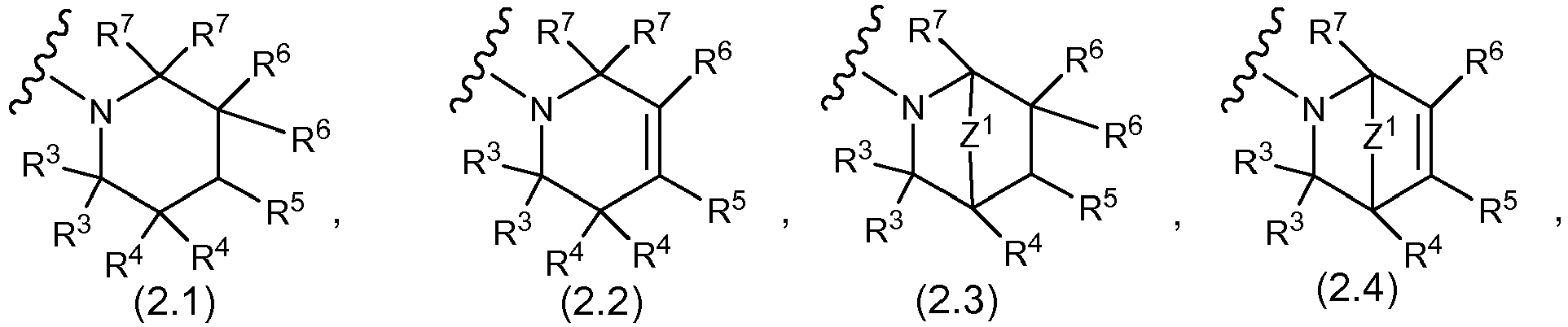


- Each Q1 represents a ring independently selected from the group consisting of: cycloalkyl, substituted cycloalkyl, heterocycloalkyl, substituted heterocycloalkyl, aryl, substituted aryl, heteroaryl, and substituted heteroaryl, wherein said substituted rings are substituted with 1 to 3 substituents independently selected from the group consisting of: halo and the R10 moieties; provided that when Q1 is aryl, heteroaryl, substituted aryl or substituted heteroaryl then the carbon atoms at the ring junction are not substituted;
- Q2 represents a ring selected from the group consisting of: cycloalkyl, substituted cycloalkyl, heterocycloalkyl, and substituted heterocycloalkyl, wherein said substituted rings are substituted with 1 to 3 substituents independently selected from the group consisting of: the R10 moieties;
- Z1 represents -(C(R24)2)w- wherein each R24 is independently selected from the group consisting of: H, alkyl and F, and wherein w is 1, 2 or 3;
- Z2 is selected from the group consisting of: -N(R44)-, -O- and -C(R46)2-;
- m is 1 to 6;
- n is 1 to 6;
- p is 0 to 6;
- t is 0, 1, or 2;
- R1 is selected from the group consisting of:
- (1) -CN,
- (2) -NO2,
- (3) -OR10,
- (4) -SR10,
- (5) -N(R10)2,
- (6) R10,
- (7) -C(O)R10,
- (8) -(C(R30)2)n-NR32-C(O)-R10, wherein in one example n is 1, each R30 is H, R32 is H, and R10 is selected from the group consisting of: cycloalkyl and alkyl,
- (9) -(C(R30)2)n-NR32-S(O)t-R10,
- (10) -(C(R30)2)n-NR32-C(O)-N(R32)-R10,
- (11)

- (12) -CF3,
- (13) -C(O)OR10,
- (14) -(C(R30)2)nR13,
- (15) alkenyl (e.g., -CH=CHCH3),
- (16) -NR32-C(O)-R14,
- (17)

- (18)
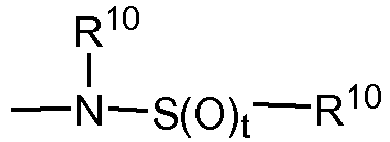
- (19)

- (20) -C(O)-NR32-(C(R30)2)p-OR10,
- (21) -C(O)N(R10)2 wherein each R10 is independently selected,
- (22) -C(O)-NR32-C(R18)3,
- (23) -C(O)-NR32-(C(R30)2)n-C(O)-N(R10)2,
- (24) heterocycloalkenyl, such as, for example:
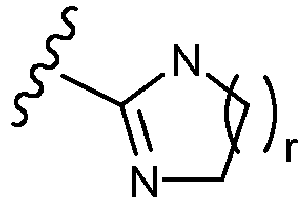
- (25)

- (26) arylalkenyl-, and
- (27) halo;
- R2 is selected from the group consisting of:
- (1) H,
- (2) -CN,
- (3) halo,
- (4) alkyl,
- (5) substituted alkyl wherein said substituted alkyl is substituted with 1 to 3 substitutents selected from the group consisting of: (a) -OH, (b) -O-alkyl, (c) -O-alkyl substituted with 1 to 3 F atoms, and (d) -N(R40)2 wherein each R40 is independently selected from the group consisting of: (i) H, (ii) C1-C3 alkyl, (iii) -CF3, and (e) halo,
- (6) alkynyl,
- (7) alkenyl,
- (8) -(CH2)mR11,
- (9) -N(R26)2,
- (10) -OR23,
- (11) -N(R26)C(O)R42,
- (12) cycloalkyl,
- (13) cycloalkylalkyl,
- (14)

- (15) -O-(substituted alkyl) wherein said substituted alkyl is substituted with 1 to 3 F atoms,
- (16) -S(O)t-alkyl,
- (17) -C(O)-alkyl,
- (18)

- (19)

- (20)

- (21)

- (22) -N(R48)-C(O)-R48 wherein each R48 is independently selected from the group consisting of: H and alkyl, and
- (23) -C(O)-alkyl;
- each R3, R4, R5, R6 and R7 is independently selected from the group consisting of:
- (1) H,
- (2) alkenyl,
- (3) substituted alkenyl,
- (4) alkyl,
- (5) substituted alkyl,
- (6) cycloalkyl,
- (7) substituted cycloalkyl,
- (8) cycloalkylalkyl-,
- (9) substituted cycloalkylalkyl-,
- (10) heterocycloalkyl,
- (11) substituted heterocycloalkyl,
- (12) heterocycloalkylalkyl-,
- (13) substituted heterocycloalkylalkyl-,
- (14) -C(O)R10,
- (15) arylheteroaryl-,
- (16) substituted arylheteroaryl-,
- (17) heteroarylaryl-,
- (18) substituted heteroarylaryl-,
- (19) aryl,
- (20) substituted aryl,
- (21) heteroaryl,
- (22) substituted heteroaryl,
- (23) heteroarylheteroaryl-,
- (24) substituted heteroarylheteroaryl-,
- (25) arylaminoheteroaryl-,
- (26) substituted arylaminoheteroaryl-,
- (27) arylalkynyl-,
- (28) substituted arylalkynyl-,
- (29) heteroarylalkynyl-,
- (30) substituted heteroarylalkynyl-,
- (31) benzoheteroaryl;
- wherein said R3, R4, R5, R6 and R7 substituted groups (7), (9), (11), (13), (16), (18), (20), (22), (24), (26), (28) and (30) are substituted with 1 to 3 substituents independently selected from the group consisting of: -NH2, -NHR20, -N(R20)2 wherein each R20 is independently selected, alkyl, alkenyl, halo, -C(O)-NH-R28, -C(O)OR28, -C(O)R28, and -OR20,
- wherein said R3, R4, R5, R6 and R7 substituted groups (3) and (5) are substituted with 1 to 3 substituents independently selected from the group consisting of: -NH2, halo, -C(O)-NH-R28, -C(O)OR28, and -C(O)R28;
- R5A is selected from the group consisting of: halo, -OH, alkyl, -O-alkyl;
- R8 is selected from the group consisting of: H, -OH, -N(R10)2, -NR10C(O)R12;
- each R9 is independently selected from the group consisting of:halogen, -CN, -NO2, -OR10, -SR10, -N(R10)2, and R10;
- each R10 is independently selected from the group consisting of: H, alkyl, aryl, arylalkyl, heteroaryl, heteroarylalkyl, cycloalkyl, cycloalkylalkyl, heterocycloalkyl, heterocycloalkylalkyl, alkylheteroaryl-, alkylaryl-, substituted alkyl, substituted aryl, substituted arylalkyl, substituted heteroaryl, substituted heteroarylalkyl, substituted cycloalkyl, substituted cycloalkylalkyl, substituted heterocycloalkyl, substituted heterocycloalkylalkyl, substituted alkylheteroaryl-, substituted alkylaryl-, heterocycloalkenyl

- said R10 substituted alkyl is substituted with 1 to 3 substituents independently selected from the group consisting of: -NH2, -NHR20, -NO2, -CN, -OR26, halo, -C(O)-NH-R26, -C(O)OR26, and -C(O)R26, and
- said R10 substituted aryl, substituted arylalkyl, substituted heteroaryl, substituted heteroarylalkyl, substituted cycloalkyl, substituted cycloalkylalkyl, substituted heterocycloalkyl, substituted heterocycloalkylalkyl, substituted alkylheteroaryl- and substituted alkylaryl- are substituted with 1 to 3 substituents independently selected from the group consisting of: (1) -NH2, (2) -NO2, (3) -CN,
(4) -OH, (5) -OR20, (6) -OCF3, (7) alkyl substituted with 1 to 3 independently selected halo atoms, (8) -C(O)R38, (9) alkyl, (10) alkenyl, (11) halo, (12) -C(O)-NH-R26,
(13) -C(O)OR38, (14) -C(O)-NR32-(C(R30)2)n-N(R38)2, (15) -S(O)tR38,
(16) -C(O)-NR32-R38, (17) -NR32-C(O)-R38,
(18)
- R11 is selected from the group consisting of: F, -OH, -CN, -OR10, -NHNR1R10, -SR10 and heteroaryl;
- R12 is selected from the group consisting of: alkyl, aryl, heteroaryl, cycloalkyl, cycloalkylalkyl, heterocycloalkyl and heterocycloalkylalkyl;
- R14 is selected from the group consisting of: alkyl, aryl, heteroaryl, cycloalkyl, cycloalkylalkyl-, heterocycloalkyl, alkylheterocycloalkyl, heterocycloalkylalkyl-, alkylheteroaryl- and alkylaryl-;
- R15 is selected from the group consisting of: H, -OH, alkyl, aryl, heteroaryl, cycloalkyl, cycloalkylalkyl-, heterocycloalkyl and heterocycloalkylalkyl-, alkylheteroaryl- and alkylaryl-;
- R20 represents alkyl;
- R23 is selected from the group consisting of: H, alkyl, aryl, cycloalkyl, and cycloalkylalkyl-;
- each R26 is independently selected from the group consisting of: H and alkyl;
- R28 is alkyl;
- each R30 is independently selected from the group consisting of: H, alkyl, and F;
- each R32 is independently selected from the group consisting of: H and alkyl;
- each R35 is independently selected from the group consisting of: H and C1 to C6 alkyl;
- each R38 is independently selected from the group consisting of: H, alkyl, aryl, arylalkyl, heteroaryl, heteroarylalkyl, cycloalkyl, cycloalkylalkyl, heterocycloalkyl, heterocycloalkylalkyl, alkylheteroaryl-, alkylaryl-, substituted alkyl, substituted aryl, substituted arylalkyl, substituted heteroaryl, substituted heteroarylalkyl, substituted cycloalkyl, substituted cycloalkylalkyl, substituted heterocycloalkyl, substituted heterocycloalkylalkyl, substituted alkylheteroaryl- and substituted alkylaryl-, and wherein:
- said R38 substituted alkyl is substituted with 1 to 3 substituents independently selected from the group consisting of: -NH2, -NO2, -CN, -OR26, halo, -C(O)-NH-R28, -C(O)OR28, and
- said R38 substituted aryl, substituted arylalkyl, substituted heteroaryl, substituted heteroarylalkyl, substituted cycloalkyl, substituted cycloalkylalkyl, substituted heterocycloalkyl, substituted heterocycloalkylalkyl, substituted alkylheteroaryl- and substituted alkylaryl- are substituted with 1 to 3 substituents independently selected from the group consisting of: (1) -NH2, (2) -NO2, (3) -CN,
(4) -OH, (5) -OR20, (6) -OCF3, (7) -CF3, (8) -C(O)R26, (9) alkyl, (10) alkenyl, (11) halo, (12) -C(O)-NH-R26, (13) -C(O)OR26 (14) -C(O)-NR32-(C(R30)2)n-N(R26)2, (15) -S(O)tR26, (16) -C(O)N(R32)(R26), (17) -NR32C(O)R26,
(18)
- R42 is selected from the group consisting of: alkyl, aryl (e.g., phenyl), heteroaryl, and cycloalkyl;
- R44 is selected from the group consisting of: H, alkyl, cycloalkyl, and cycloalkylalkyl; and
Each R46 is independently selected from the group consisting of: H, alkyl, cycloalkyl, and cycloalkylalkyl;
Formula III is described inPCT publication No. 2008/156739 , herein incorporated by reference; or
- c) Formula IV:

- Y1, Y2, and Y3 are each independently selected from the group consisting of: -CH=, -N= and -CR9=;
- z is 1 to 3;
- Q is a substituent selected from the group consisting of:

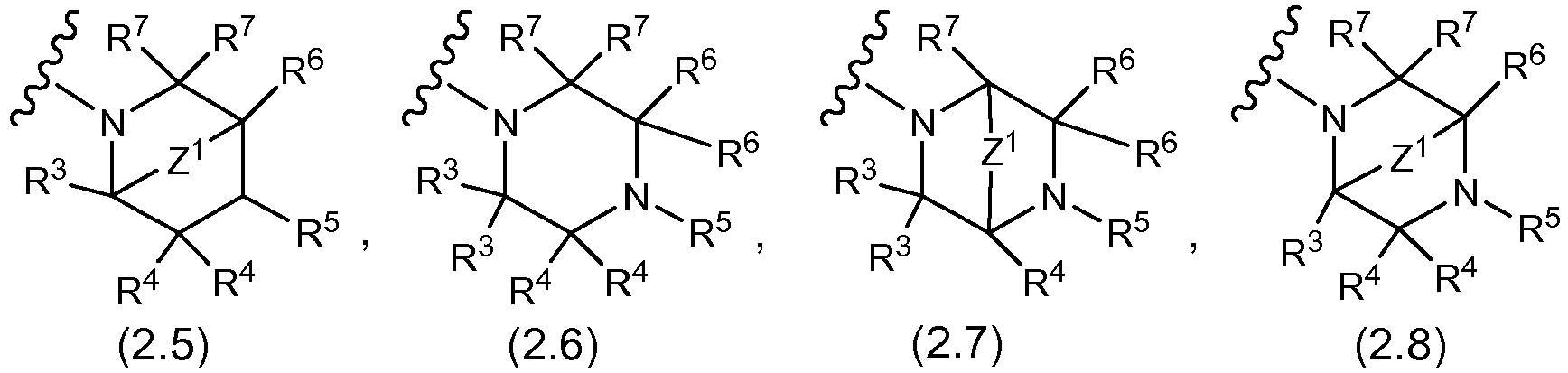


- Each Q1 represents a ring independently selected from the group consisting of: cycloalkyl, substituted cycloalkyl, heterocycloalkyl, substituted heterocycloalkyl, aryl, substituted aryl, heteroaryl, and substituted heteroaryl, wherein said substituted rings are substituted with 1 to 3 substituents independently selected from the group consisting of: the R10 moieties; provided that when Q1 is aryl, heteroaryl, substituted aryl or substituted heteroaryl then the carbon atoms at the ring junction are not substituted;
- Q2 represents a ring selected from the group consisting of: cycloalkyl, substituted cycloalkyl, heterocycloalkyl, and substituted heterocycloalkyl, wherein said substituted rings are substituted with 1 to 3 substituents independently selected from the group consisting of: the R10 moieties;
- Z1 represents -(C(R24)2)w- wherein each R24 is independently selected from the group consisting of: H, alkyl and F, and wherein w is 1, 2 or 3, and generally w is 1 or 2, and usually w is 1, and wherein in one example each R24 is H, and in another example w is 1, and in another example each R24 is H and w is 1, preferably w is 1 and each R24 is H;
- Z2 is selected from the group consisting of: -N(R44)-, -O- and -C(R46)2-;
- m is 1 to 6;
- n is 1 to 6;
- p is 0 to 6;
- t is 0, 1, or 2;
- R1 is selected from the group consisting of:
- (1) -CN,
- (2) -NO2,
- (3) -OR10,
- (4) -SR10,
- (5) -N(R10)2,
- (6) R10,
- (7) halo,
- (8) -CF3;
- (9) alkenyl;
- (10) -C(O)N(R10)2 wherein each R10 is independently selected, and preferably each R10 is independently selected from the group consisting of: (a) H, (b) alkyl, (c) heteroaryl, (d) aryl, and (e) cycloalkyl, wherein for example, each R10 is selected from the group consisting of: H, methyl, butyl, i-propyl, pyridyl, phenyl and cyclopropyl, wherein, for example, said -C(O)N(R10)2 moiety is selected from the group consisting of: -C(O)NH2, -C(O)NH(CH3), -C(O)NH(CH)(CH3)2, -C(O)NH(C4H9), -C(O)NH(C6H5), -C(O)NH(C3H5), and -C(O)NH(C5H4N);
- (11) arylalkenyl-;
- R2 is selected from the group consisting of:
- (1) H,
- (2) -CN,
- (3) halo,
- (4) alkyl,
- (5) substituted alkyl wherein said substituted alkyl is substituted with 1 to 3 substitutents selected from the group consisting of: (a) -OH, (b) -O-alkyl (e.g., -O-(C1-C3alkyl), (c) -O-alkyl (e.g., -O-(C1-C3alkyl)) substituted with 1 to 3 F atoms, and (d)-N(R40)2 wherein each R40 is independently selected from the group consisting of: (i) H, (ii) C1-C3 alkyl and (iii) -CF3,
- (6) alkynyl,
- (7) alkenyl,
- (8) -(CH2)mR11,
- (9) -N(R26)2,
- (10) -OR23,
- (11) -N(R26)C(O)R42,
- (12) cycloalkyl,
- (13) cycloalkylalkyl, and
- (14)

- each R3, R4, R5, R6 and R7 is independently selected from the group consisting of:
- (1) H,
- (2) alkenyl,
- (3) substituted alkenyl,
- (4) alkyl,
- (5) substituted alkyl,
- (6) cycloalkyl,
- (7) substituted cycloalkyl,
- (8) cycloalkylalkyl-,
- (9) substituted cycloalkylalkyl-,
- (10) heterocycloalkyl,
- (11) substituted heterocycloalkyl,
- (12) heterocycloalkylalkyl-,
- (13) substituted heterocycloalkylalkyl-,
- (14) -C(O)R10 wherein in one example R10 is selected from the group consisting of: alkyl,
- (15) arylheteroaryl-,
- (16) substituted arylheteroaryl-,
- (17) heteroarylaryl-, such as, for example, pyrimidinylphenyl-, pyrazinylphenyl-, pyridinylphenyl-, furanylphenyl-, thienylphenyl-, and thiazolylphenyl-,
- (18) substituted heteroarylaryl-, such as, for example, substituted pyrimidinylphenyl-, substituted pyrazinylphenyl-, substituted pyridinylphenyl-, substituted furanylphenyl-, substituted thienylphenyl-, substituted thiazolylphenyl-, and substituted pyrimidinylphenyl,
- (19) aryl,
- (20) substituted aryl,
- (21) heteroaryl,
- (22) substituted heteroaryl,
- (23) heteroarylheteroaryl-,
- (24) substituted heteroarylheteroaryl-,
- (25) arylaminoheteroaryl-,
- (26) substituted arylaminoheteroaryl-,
- (27) arylalkynyl-,
- (28) substituted arylalkynyl-,
- (29) heteroarylalkynyl-,
- (30) substituted heteroarylalkynyl-,
- (31) -C(O)NHR28,
- (32) cycloalkylheteroarylaryl-,
- (33) substituted arylaryl-,
- (34) arylalkenylaryl-,
- (35) arylaryl-,
- (36) substituted arylalkyl-,
- (37) arylalkyl-,
- (38) -SO2aryl,
- (39) benzoheteroaryl-C(O)-(substituted heterocycloalkyl)-,
- (40) substituted heterocycloalkyl,
- (41) heterocycloalkyl-C(O)-alkyl-, and
- (42) benzo[1,3]dioxolyl,
- wherein said R3, R4, R5, R6 and R7 substituted groups (7), (9), (11), (13), (16), (18), (20), (22), (24), (26), (28), (30), (33), (36), (39) and (40) are substituted with 1 to 3 substituents independently selected from the group consisting of: -CH2OH, CN, -OH, -NH2, alkyl, alkenyl, halo, -C(O)-NH-R28, -C(O)NH2, -C(O)OR28, -C(O)R28, -C(alkyl)=NOH, -C(alkyl)=NO(alkyl), alkoxy, hydroxyl substituted alkyl, dialkylamine wherein each alkyl group is independently selected, -CF3, -SO2alkyl, and -NHC(O)H,
- wherein said R3, R4, R5, R6 and R7 substituted groups (3) and (5) are substituted with 1 to 3 substituents independently selected from the group consisting of: -NH2, halo, -C(O)-NH-R28, -C(O)OR28, and -C(O)R28;
- R8 is selected from the group consisting of: H, -OH, alkyl, aryl, -N(R10)2 and -NR10C(O)R12;
- each R9 is independently selected from the group consisting of:halogen, -CN, -NO2, -OR10, -SR10, -N(R10)2, and R10;
- each R10 is independently selected from the group consisting of: H, alkyl, aryl, arylalkyl, heteroaryl, heteroarylalkyl, cycloalkyl, cycloalkylalkyl, heterocycloalkyl, heterocycloalkylalkyl, alkylheteroaryl-, alkylaryl-, substituted alkyl, substituted aryl, substituted arylalkyl, substituted heteroaryl, substituted heteroarylalkyl, substituted cycloalkyl, substituted cycloalkylalkyl, substituted heterocycloalkyl, substituted heterocycloalkylalkyl, substituted alkylheteroaryl- and substituted alkylaryl-, and wherein:
- said R10 substituted alkyl is substituted with 1 to 3 substituents independently selected from the group consisting of: -NH2, -NHR20, -NO2, -CN, -OR26, halo, -C(O)-NH-R26, -C(O)OR26, and -C(O)R26, and
- said R10 substituted aryl, substituted arylalkyl, substituted heteroaryl, substituted heteroarylalkyl, substituted cycloalkyl, substituted cycloalkylalkyl, substituted heterocycloalkyl, substituted heterocycloalkylalkyl, substituted alkylheteroaryl- and substituted alkylaryl- are substituted with 1 to 3 substituents independently selected from the group consisting of: (1) -NH2, (2) -NO2, (3) -CN,
(4) -OH, (5) -OR20, (6) -OCF3, (7) -CF3, (8) -C(O)R38, (9) alkyl, (10) alkenyl, (11) halo, (12) -C(O)-NH-R26, (13) -C(O)OR38, (14) -C(O)-NR32-(C(R30)2)n-N(R38)2,
(15) -S(O)tR38, (16) -C(O)-NR32-R38, (17) -NR32-C(O)-R38,
(18)
(19) -NHR20;
- R11 is selected from the group consisting of: F, -OH, -CN, -OR10, -NHNR1R10, -SR10 and heteroaryl;
- R12 is selected from the group consisting of: alkyl, aryl, heteroaryl, cycloalkyl, cycloalkylalkyl, heterocycloalkyl and heterocycloalkylalkyl;
- R14 is selected from the group consisting of: alkyl, aryl, heteroaryl, cycloalkyl, cycloalkylalkyl-, heterocycloalkyl, alkylheterocycloalkyl, heterocycloalkylalkyl-, alkylheteroaryl- and alkylaryl-;
- R15 is selected from the group consisting of: H, -OH, alkyl, aryl, heteroaryl, cycloalkyl, cycloalkylalkyl-, heterocycloalkyl and heterocycloalkylalkyl-, alkylheteroaryl- and alkylaryl-;
- R20 represents alkyl;
- R23 is selected from the group consisting of: H, alkyl, aryl, cycloalkyl, and cycloalkylalkyl-;
- each R26 is independently selected from the group consisting of: H and alkyl;
- R28 is alkyl;
- each R30 is independently selected from the group consisting of: H, alkyl, and F;
- each R32 is independently selected from the group consisting of: H and alkyl;
- each R35 is independently selected from the group consisting of: H and C1 to C6 alkyl;
- R36 is selected from the group consisting of: H and alkyl;
- each R38 is independently selected from the group consisting of: H, alkyl, aryl, arylalkyl, heteroaryl, heteroarylalkyl, cycloalkyl, cycloalkylalkyl, heterocycloalkyl, heterocycloalkylalkyl, alkylheteroaryl-, alkylaryl-, substituted alkyl, substituted aryl, substituted arylalkyl, substituted heteroaryl, substituted heteroarylalkyl, substituted cycloalkyl, substituted cycloalkylalkyl, substituted heterocycloalkyl, substituted heterocycloalkylalkyl, substituted alkylheteroaryl- and substituted alkylaryl-, and wherein:
- said R38 substituted alkyl is substituted with 1 to 3 substituents independently selected from the group consisting of: -NH2, -NO2, -CN, -OR26, halo, -C(O)-NH-R28, -C(O)OR28, and -C(O)R28, and
- said R38 substituted aryl, substituted arylalkyl, substituted heteroaryl, substituted heteroarylalkyl, substituted cycloalkyl, substituted cycloalkylalkyl, substituted heterocycloalkyl, substituted heterocycloalkylalkyl, substituted alkylheteroaryl- and substituted alkylaryl- are substituted with 1 to 3 substituents independently selected from the group consisting of: (1) -NH2, (2) -NO2, (3) -CN,
(4) -OH, (5) -OR20, (6) -OCF3, (7) -CF3, (8) -C(O)R26, (9) alkyl, (10) alkenyl,
(11) halo, (12) -C(O)-NH-R26, (13) -C(O)OR26, (14) -C(O)-NR32-(C(R30)2)n-N(R26)2, (15) -S(O)tR26, (16) -C(O)N(R32)(R26), (17) -NR32C(O)R26,
(18)
(19) -NHR20;
- R42 is selected from the group consisting of: alkyl, aryl, heteroaryl, and cycloalkyl;
- R44 is selected from the group consisting of: H, alkyl, cycloalkyl, and cycloalkylalkyl; and
Each R46 is independently selected from the group consisting of: H, alkyl, cycloalkyl, and cycloalkylalkyl;
Formula IV is described inU.S. publication No. 2007/0232610 , herein incorporated by reference.
- Non-limiting examples of ERK inhibitors are selected from the group consisting of:


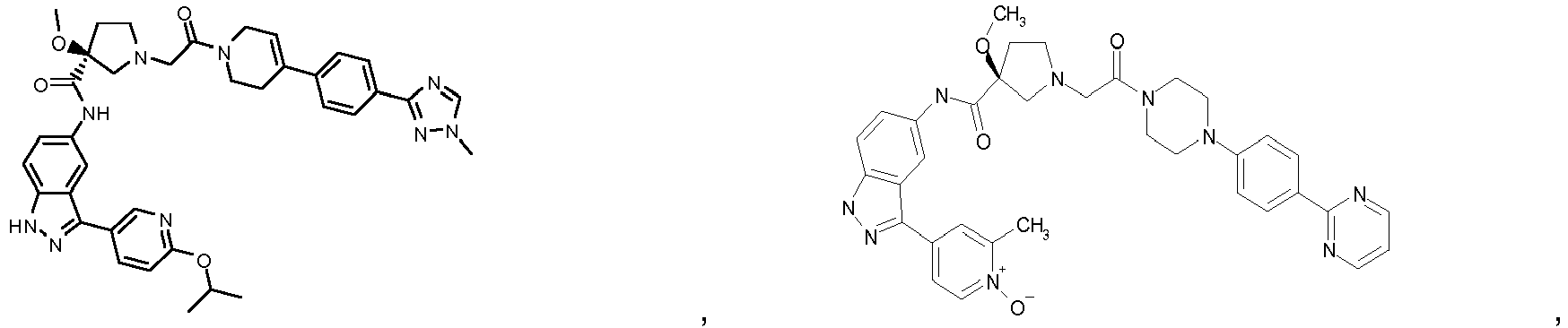


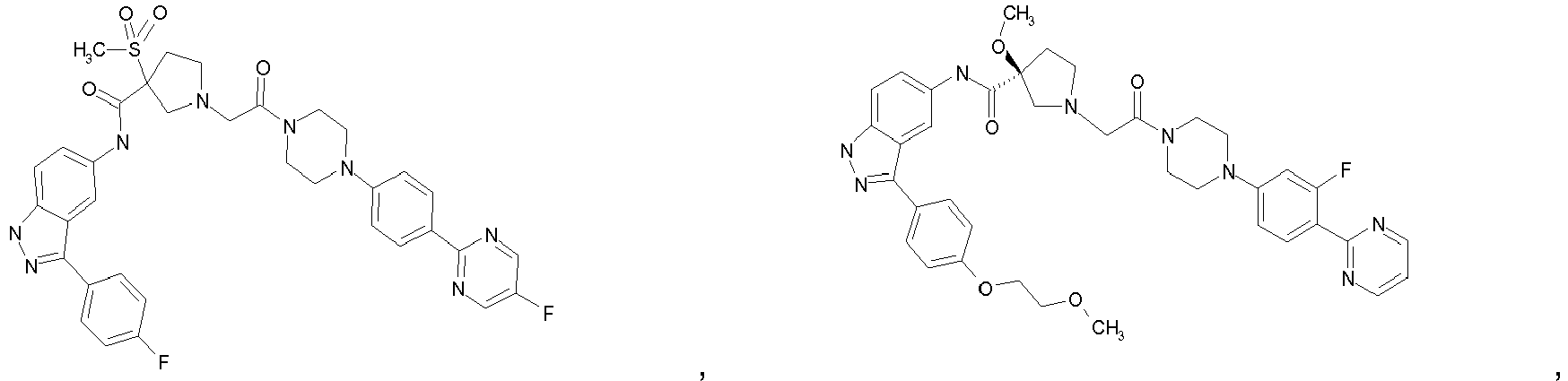


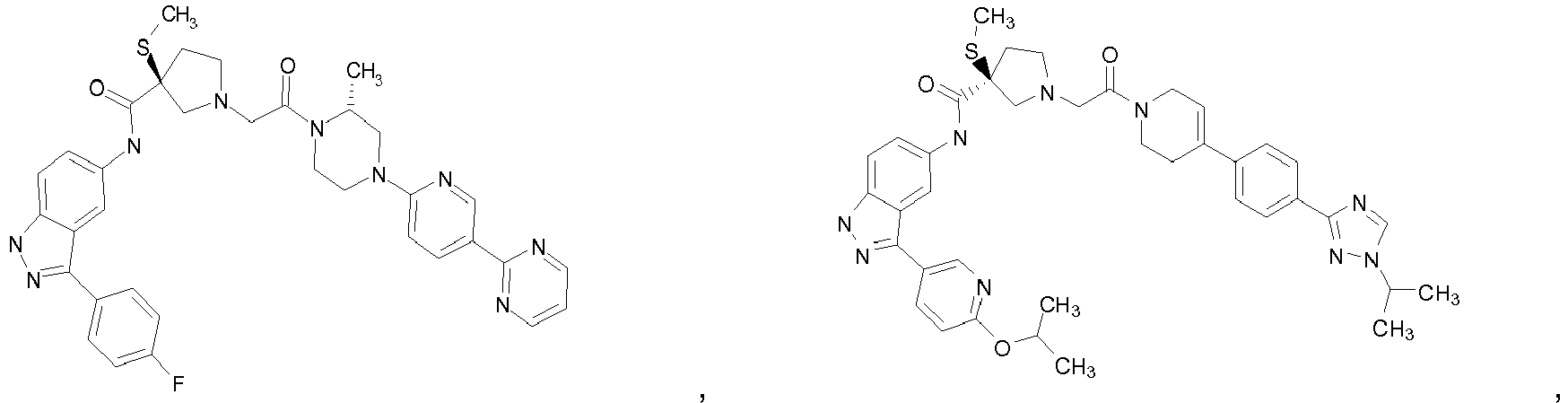


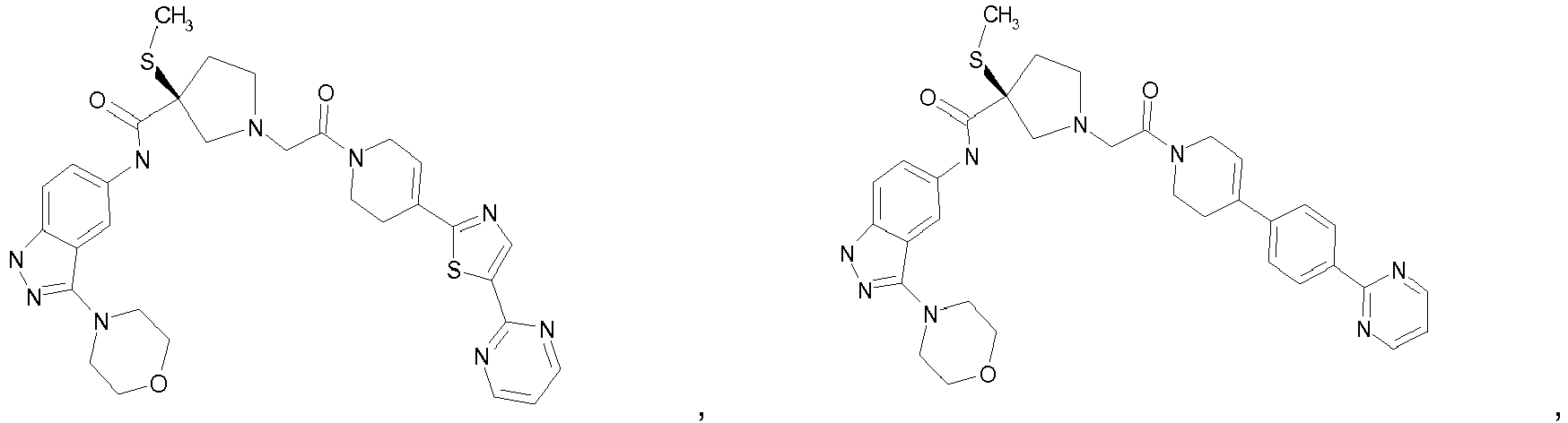


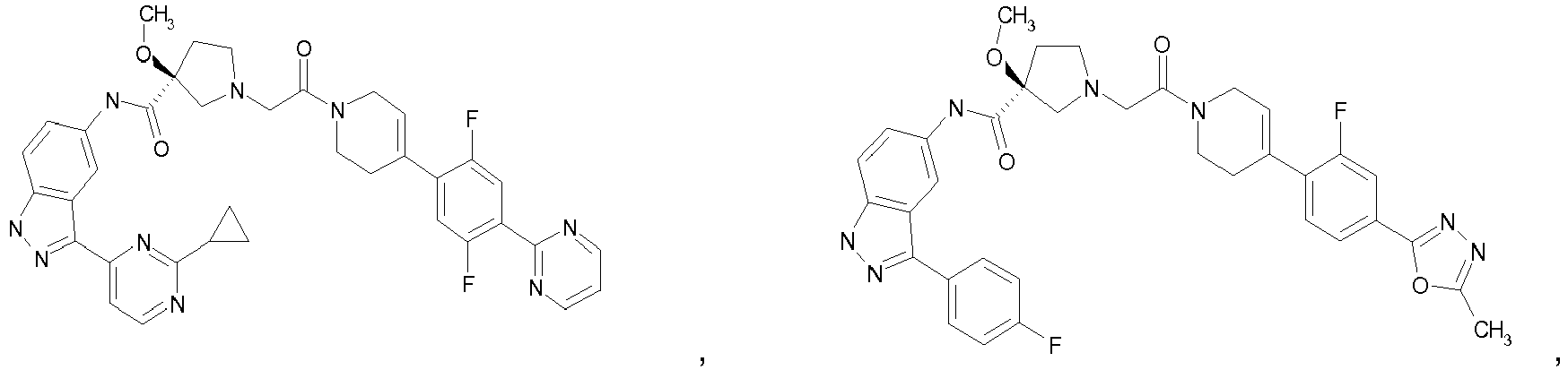


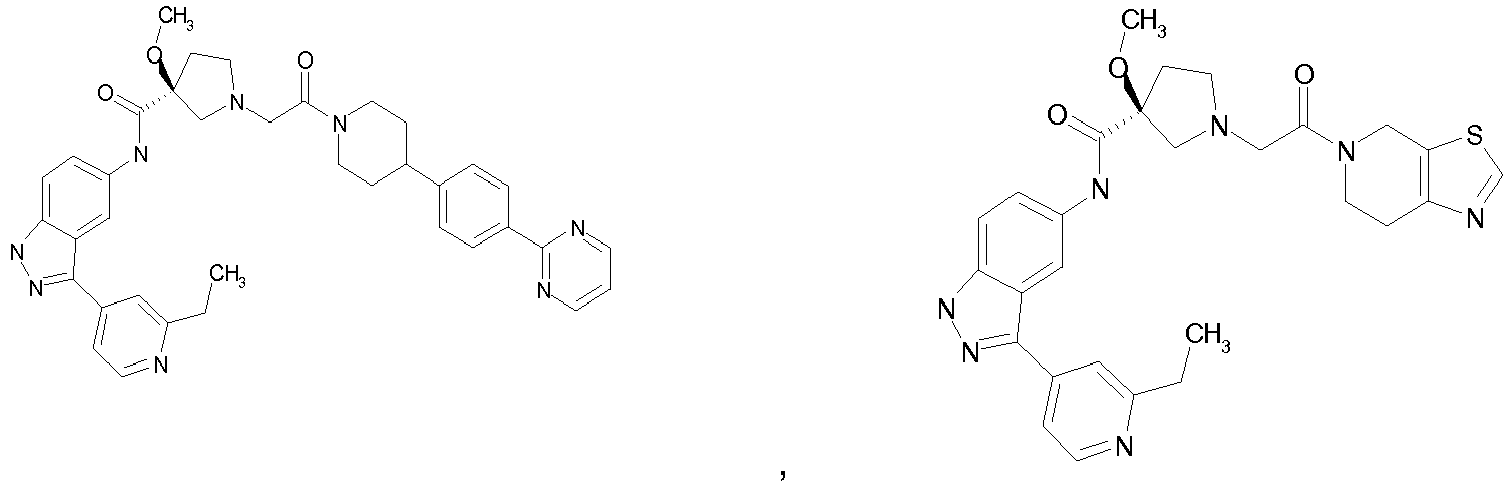




































WO 2007/070398 US 61/030407 PCT publication No. WO 2008/156739 andU.S. publication No. 2007/0232610 , herein incorporated by reference. - The pharmacological properties of the compounds of this invention may be confirmed by a number of pharmacological assays. The exemplified pharmacological assays which are described herein below have been carried out with compounds according to the invention and their salts, solvates, esters or prodrugs.
- This invention is also directed to pharmaceutical compositions which comprise at least one compound of the present invention, or a pharmaceutically acceptable salt or solvate of said compound and at least one pharmaceutically acceptable carrier.
- For preparing pharmaceutical compositions from the compounds described by this invention, inert, pharmaceutically acceptable carriers can be either solid or liquid. Solid form preparations include powders, tablets, dispersible granules, capsules, cachets and suppositories. The powders and tablets may be comprised of from about 5 to about 95 percent active ingredient. Suitable solid carriers are known in the art, e.g., magnesium carbonate, magnesium stearate, talc, sugar or lactose. Tablets, powders, cachets and capsules can be used as solid dosage forms suitable for oral administration. Examples of pharmaceutically acceptable carriers and methods of manufacture for various compositions may be found in A. Gennaro (ed.), Remington's Pharmaceutical Sciences, 18th Edition, (1990), Mack Publishing Co., Easton, Pennsylvania.
- Liquid form preparations include solutions, suspensions and emulsions. As an example may be mentioned water or water-propylene glycol solutions for parenteral injection or addition of sweeteners and opacifiers for oral solutions, suspensions and emulsions. Liquid form preparations may also include solutions for intranasal administration.
- Aerosol preparations suitable for inhalation may include solutions and solids in powder form, which may be in combination with a pharmaceutically acceptable carrier, such as an inert compressed gas, e.g. nitrogen.
- Also included are solid form preparations that are intended to be converted, shortly before use, to liquid form preparations for either oral or parenteral administration. Such liquid forms include solutions, suspensions and emulsions.
- The compounds of the invention may also be deliverable transdermally. The transdermal compositions can take the form of creams, lotions, aerosols and/or emulsions and can be included in a transdermal patch of the matrix or reservoir type as are conventional in the art for this purpose.
- The compounds of this invention may also be delivered subcutaneously.
- Preferably the compound is administered orally or intravenously.
- Also contemplated are delivery methods that are combinations of the above-noted delivery methods, Such methods are typically decided by those skilled in the art.
- Preferably, the pharmaceutical preparation is in a unit dosage form. In such form, the preparation is subdivided into suitably sized unit doses containing appropriate quantities of the active component, e.g., an effective amount to achieve the desired purpose.
- The quantity of active compound in a unit dose of preparation may be varied or adjusted from about 1 mg to about 100 mg, preferably from about 1 mg to about 50 mg, more preferably from about 1 mg to about 25 mg, according to the particular application.
- The actual dosage employed may be varied depending upon the requirements of the patient and the severity of the condition being treated. Determination of the proper dosage regimen for a particular situation is within the skill of the art. For convenience, the total daily dosage may be divided and administered in portions during the day as required.
- The amount and frequency of administration of the compounds of the invention and/or the pharmaceutically acceptable salts thereof will be regulated according to the judgment of the attending clinician considering such factors as age, condition and size of the patient as well as severity of the symptoms being treated. A typical recommended daily dosage regimen for oral administration can range from about 1 mg/day to about 500 mg/day, preferably 1 mg/day to 200 mg/day, in two to four divided doses.
- Another aspect of this invention is a kit comprising a therapeutically effective amount of at least one compound of the present invention, or a pharmaceutically acceptable salt or solvate of said compound and a pharmaceutically acceptable carrier, vehicle or diluent.
- Yet another aspect of this invention is a kit comprising an amount of at least one compound of the present invention, or a pharmaceutically acceptable salt or solvate of said compound and an amount of at least one anticancer therapy and/or anti-cancer agent listed above, wherein the amounts of the two or more ingredients result in desired therapeutic effect.
- The invention disclosed herein is exemplified by the following preparations and examples which should not be construed to limit the scope of the disclosure. Alternative mechanistic pathways and analogous structures will be apparent to those skilled in the art.
- Where LC/MS data are presented, analyses was performed using an Applied Biosystems API-100 mass spectrometer and Shimadzu SCL-10A LC column: Altech platinum C18, 3 micron, 33mm x 7mm ID; gradient flow: 0 min - 10% CH3CN, 5 min - 95% CH3CN, 7 min - 95% CH3CN, 7.5 min - 10% CH3CN, 9 min - stop. The retention time and observed parent ion are given.
- The following solvents, reagents and reaction conditions may be referred to by their abbreviations:
- Aq: aqueous
- g: grams
- psi: pounds per square inch
- pH: percent Hydrogen
- °C: degrees Celsius
- h: hours
- THF: Tetrahydrofuran
- HMDS:
- Et2O: diethyloxide
- SEM: 2-(trimethylsilyl)ethoxymethyl
- LC-MS: Liquid chromatography mass spectrometry
- DCM: dichloromethane
- N: Normal
- ml: milliliter
- NBS: N-Bromosuccinimide
- rt: room temperature
- MeOH: methanol
- DIEA: diisopropylethylamine
- EtOAc: ethyl acetate
- EtOH: ethanol
- DMF: dimethylformamide
- WT%: weight percent
- m/z: mass per charge
- LiOH: lithium hydroxide
- DMSO: dimethylsulfoxide
- HPLC: high performance liquid chromatography
- Ret: retention
- RP: reverse phase
- CH3CN: acetonitrile
- MeCN: acetonitrile
- pTSA: para-toluene sulfonic acid
- RT: retention time
- NaOH: sodium hydroxide
- CDI: N,N'-carbonyldiimidazole
- mg: milligram
- PMA: phosphomolybdic acid
- CO2: carbon dioxide
- LiHMDS: lithium hexamethyldisilazane
- HMDS: hexamethyldisilazane
- Pd/C: palladium on carbon
- H2: hydrogen gas
- NIS: N-iodosuccinimide
- PDCl2(dppf): [1,1'-bis(diphenylphosphino)ferrocene] dichloropalladium(II)
- µmol: micromole
- TFA: trifluoroacetic acid
- NMP: N-methyl-2-pyrrolidone
- min: minute
- NaIO4: sodium periodate
- DME: dimethylethane
- OSO4: osmium tetroxide
- Na2S2O3: sodium thiosulfate
- AcOH: acetic acid
- NaBH3CN: sodium cyanoborohydride
- H2O: water
- BBN: 9-borabicyclo[3.3.1]nonane
- CH2Cl2: dichloromethane
- BOC: tertiary-butyloxycarbonyl
- POCl3: phosphorous oxychloride
- NaHCO3: sodium bicarbonate
- NH4Cl: ammonium chloride
- Na2SO4: sodium sulphate
- HCl: hydrogen chloride
- M: Molar
- mmol: millimolar
- NH3: ammonia
- DIEA: diisopropylethylamine
- Bu3SnCN: tributyltin cyanide
- Pd[P(t-Bu)3]2: bis(tributyl)Phosphine) palladium
- Pd(PPh3)4: tetrakis(triphenylphosphine) palladium
- K2CO3: potassium carbonate
- EDC: 1-ethyl-3-(3-dimethylaminopropyl)-carbodiimide
- UV: ultraviolet
- K3PO4: potassium phosphate
- LDA: lithium diisopropylamide
- Tf: trifluoromethanesulfonyl
- NaH: sodium hydride
-

- 5-(Methoxycarbonyl)pyridine-2-carboxylic acid (7.72 g, 42.65 mmol) was suspended in tert-butanol (70 mL) and pyridine (25 mL) and cooled in an ice-water bath. 4-Toluenesulfonyl chloride (19.4 g, 102 mmol) was added in one portion and the mixture was stirred 30 minutes in the ice-water bath. The reaction mixture was warmed to room temperature and stirred for 16 h. The reaction mixture was then slowly poured into a stirring mixture of saturated aqueous sodium bicarbonate (300 mL) and ethyl ether (150 mL). The resulting two-phase mixture was then extracted with ethyl ether (3×150 mL). The extracts were combined, washed with brine, dried with anhydrous sodium sulfate, filtered and concentrated under reduced pressure. The crude product (5.8 g, 51% yield) was used in the next step without further purification.
-

- Pyridine-2,5-dicarboxylic acid 2-tert-butyl ester 5-methyl ester (5.8 g, 24.45 mmol) was dissolved in glacial acetic acid (30 mL) and hydrogenated at 50-60 psi for 3 days with 10% palladium on carbon catalyst (0.6 g). The reaction mixture was filtered through a pad of Celite which was then washed with methanol. The filtrates were combined and concentrated under reduced pressure. The residue was dissolved in water (100 mL) and solid sodium carbonate (15 g) was added to bring the pH to 8. The solution was extracted with dichloromethane (2x100 mL). The combined organic layers were washed with brine, dried over anhydrous sodium sulfate, filtered and concentrated under reduced pressure to give the title compound (5.2 g, 87%).
-

- Piperidine-2,5-dicarboxylic acid 2-tert-butyl ester 5-methyl ester (9.0 g, 37.0 mmol) and triethylamine (15.5 ml, 111 mmol) were combined in dichloromethane (70 mL) and cooled to 0 °C. Di-tert-butyldicarbonate (12.2 g, 55.5 mmol) was added and reaction mixture was warmed to room temperature and stirred for 16 h. The reaction mixture was diluted with water (100 mL) and extracted with dichloromethane (2×100 mL). The combined extracts were washed with brine, dried over anhydrous sodium sulfate, filtered and concentrated under reduced pressure. The residue was purified by Biotage chromatography column (hexanes/EtOAc, 9:1 to 8:2). A colorless oil was obtained (12.6 g, 99%).
-

- Piperidine-1,2,5-tricarboxylic acid 1,2-di-tert-butyl ester 5-methyl ester (36.7 mmol, 12.6 g) was dissolved in 180 mL of 2:1 THF:H2O. To this solution was added 2N sodium hydroxide solution (52 mL) and the reaction mixture was stirred for 16h at room temperature. The reaction mixture is acidified to pH = 3 with 1N HCl(aq) and extracted with dichloromethane(3×100 mL). The combined organics are then dried over Na2SO4 and the solvent removed in vacuo to yield the title compound (12.0 g, 100% yield).
-

- 1,6-bis(tert-butoxycarbonyl)piperidine-3-carboxylic acid (41.4 mmol, 13.6 g) and N, N'-carbonyldiimidazole (CDI) (51.75 mmol, 8.4 g) in anhydrous THF (140 mL) were stirred 16 h at room temperature under argon. In a separate, sealed and argon-flushed flask, lithium HMDS (1.0 M in THF, 86.9 mmol) is added to 80 mL anhydrous THF stirring at - 78° C. To this solution is added dropwise anhydrous ethyl acetate (89 mmol, 8.69 mL). This solution is allowed to stir at -78° C for 1 hour prior to the dropwise addition of the original CDI/acid solution that had been stirred overnight. The reaction mixture is allowed to stir and warm to room temperature overnight. The reaction is then quenched with saturated NH4Cl(aq) (250 mL) and extracted with Et2O (100x2). The combined organics are then washed with water, saturated brine, and dried over Na2SO4. The solvent is removed in vacuo and the residue (12.6 g) was used in the next step without further purification.

-

- Di-tert-butyl 5-(3-ethoxy-3-oxopropanoyl)piperidine-1,2-dicarboxylate (18.79 mmol, 7.5 g) and 3-amino-1H-pyrazole (15.0 mmol, 1.25g) were mixed and heated neat at 100° C for 16 hours. The resulting residue is dissolved in dichloromethane (100 mL) and concentrated in vacuo to remove water formed during cyclization. LC-MS: 419 [M+H]. This solid is taken forward without further purification.
-

- Di-tert-butyl 5-(7-hydroxypyrazolo[1,5-a]pyrimidin-5-yl)piperidine-1,2-dicarboxylate (16.7 mmol, 7.0 g), N, N'-diisopropylethylamine (51.9 mmol, 9.0 ml) and POCl3 (80 mL) were mixed and stirred at room temperature for 18 hours. The solution is concentrated in vacuo and cooled to 0° C in an ice bath. The reaction is then quenched with sat. NaHCO3(aq) and extracted with DCM (100 mLx3). The combined organics are dried with Na2SO4 and the solvent removed in vacuo. LC-MS: 437 [M+H]. The resulting oil was used in the next step without further purification.
-

- Di-tert-butyl 5-(7-chloropyrazolo[1,5-a]pyrimidin-5-yl)piperidine-1,2-dicarboxylate was dissolved in 30 mL ∼7N ammonia in methanol in a sealed vessel. The reaction mixture was heated at 80° C for 16 hours. After 16 hours, the reaction mixture is cooled to room temperature and concentrated in vacuo to yield a brown solid. LC-MS: 418 [M+H]. The title compound was used in the next step without further purification.
-

- Di-tert-butyl 5-(7-aminopyrazolo[1,5-a]pyrimidin-5-yl)piperidine-1,2-dicarboxylate (5.5 g, 13.18 mmol) was dissolved in 1,2-dichloroethane (60 mL). To this solution was added N, N'-diisopropylethylamine (92.28 mmol, 16.1 mL). The resulting solution was stirred at room temperature while 2-(trimethylsilyl)ethoxymethyl chloride (SEM-Cl, 8.14 mL, 46.14 mmol) was added dropwise. After the addition is completed, the reaction mixture was stirred at 90° C for 2 h. The solvent is removed in vacuo and the residue is purified on silica gel column (0% to 60% ethyl acetate in hexanes gradient) to yield the title compound (3.8 g, 34% yield over three steps) as pale yellow oil. LC-MS: 678 [M+H].
-

- N-Iodosuccinimide (1.26 g, 5.61 mmol, dissolved in 25 ml acetonitrile) was added into a solution of di-tert-butyl 5-(7-(bis((2-(trimethylsilyl)ethoxy)methyl)amino)pyrazolo[1,5-a]pyrimidin-5-yl)piperidine-1,2-dicarboxylate (3.8 g, 5.61 mmol) in acetonitrile (26 mL). The reaction mixture was stirred at room temperature for 16 hours. The reaction mixture was concentrated in vacuo and purified via silica gel chromatography (0% to 30% ethyl acetate in hexanes gradient) to yield the title compound (3.16 g, 70% yield) at clear oil. LC-MS: 804 [M+H].
-

- 3-Quinoline boronic acid (1.25 mmol, 216 mg), K3PO4 (1.87 mmol, 400 mg), and PdCl2(dppf) · CH2Cl2 (0.062 mmol, 51 mg) was added to a solution of di-tert-butyl 5-(7-(bis((2-(trimethylsilyl)ethoxy)methyl)amino)-3-iodopyrazolo[1,5-a]pyrimidin-5-yl)piperidine-1,2-dicarboxylate (0.62 mmol, 500 mg) in dioxane (5 mL). To this suspension was added distilled H2O (0.5 mL). The reaction mixture was stirred at 100° C under an argon atmosphere for 18 hours. The reaction mixture was concentrated in vacuo and then purified via silica gel chromatography (0% to 60% ethyl acetate in hexanes gradient) to yield the title compound (450 mg, 90% yield) as yellow oil. LC-MS: 805 [M+H].
-

- Di-tert-butyl 5-(7-(bis((2-(trimethylsilyl)ethoxy)methyl)amino)-3-(quinolin-3-yl)pyrazolo[1,5-a]pyrimidin-5-yl)piperidine-1,2-dicarboxylate (45 mg, 0.056 mmol) was dissolved in ethanol (1 ml) and treated with 3N hydrochloride solution (1.4 ml) at 65 °C for 4 h. The reaction solution was concentrated and purified by prep-LC to afford the title compound (9.6 mg): LC/MS RT = 2.01 min. Mass calculated for, M+H 389.17, observed 389.17.
- By essentially the same procedure given in Scheme 2, the compounds of the invention and reference compounds listed in Table 1 can be prepared.
Table 1 Compound ID Structures M+H (calc.) M+H (observed) Retention time, (min) 1.1 
389.17 389.17 2.01 1.7 
423.13 423.13 2.15 1.8 
389.17 389.17 1.82 1.9 
389.17 389.17 1.88 1.10 
389.17 389.17 1.87 1.11 
389.17 389.17 1.69 
-

- Di-tert-butyl 5-(7-(bis((2-(trimethylsilyl)ethoxy)methyl)amino)-3-(quinolin-3-yl)pyrazolo[1,5-a]pyrimidin-5-yl)piperidine-1,2-dicarboxylate (370 mg, 0.46 mmol) in methanol (12.6 mL) was treated with 4N hydrogen chloride in dioxane (5.4 ml). The reaction mixture was heated at 80 °C for 16 h, cooled to room temperature and concentrated in vacuo. The residue was purified by prep-LC to afford the title compound: LC/MS RT = 2.31 min. Mass calculated for, M+H 403.18, observed 403.18.

- N-bromosuccinimide (44 mg, 0.249 mmol) was added into a solution of methyl 5-(7-amino-3-(quinolin-3-yl)pyrazolo[1,5-a]pyrimidin-5-yl)piperidine-2-carboxylate (100 mg, 0.249 mmol) in acetonitrile (1.5 mL) and methanol (0.5 ml). The resulting solution is stirred at room temperature for 1 hour. The reaction was concentrated in vacuo and purified by prep-LC to afford the title compound (22.32 mg): LC/MS RT = 2.56 min. Mass calculated for, M+H 481.09, observed 481.09.
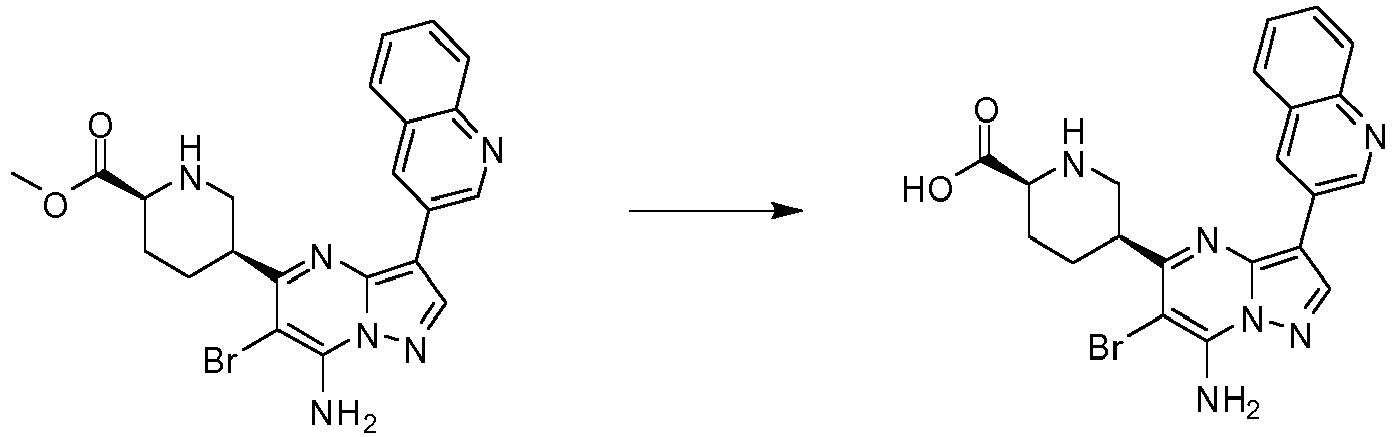
- Methyl 5-(7-amino-6-bromo-3-(quinolin-3-yl)pyrazolo[1,5-a]pyrimidin-5-yl)piperidine-2-carboxylate (11 mg, 0.023 mmol) in 2:1 THF:H2O (1.5 mL) was treated with 2N NaOH(aq) (0.25 mL). The resulting solution was stirred at room temperature for 18 hours. This solution is reduced in vacuo and purified by prep-LC to afford the title compound (8.9 mg): LC/MS RT = 2.16 min. Mass calculated for, M+H 467.08, observed 467.08.
- By essentially the same procedure given in Scheme 3, the compounds of the invention and reference compounds listed in Table 2 can be prepared.
Table 2 Compound ID Structures M+H (calc.) M+H (observed) Retention Time, (min) 2.2 
467.08 467.08 2.16 2.3 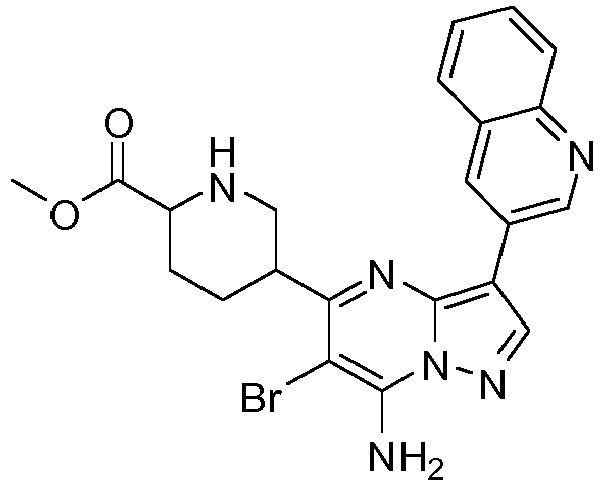
481.09 481.09 2.56 2.6 
481.09 481.09 3.05 2.7 
481.09 491.09 2.85 
- A mixture of 5-(7-amino-6-bromo-3-quinolin-3-yl-pyrazolo[1,5-a]pyrimidin-5-yl)-piperidine-2-carboxylic acid methyl ester (20 mg, 0.042 mmol), methoxy-acetyl chloride (13 mg, 0.071 mmol) and triethylamine (0.024 ml, 0.167 mmol) in THF:DMF (0.5 ml:0.5 ml) was stirred at room temperature for 16 h. The crude mixture was treated with 2.0 N sodium hydroxide solution (0.14 ml) at room temperature for 16 h. The reaction mixture was acidified with 1.0 N aqueous hydrogen chloride solution (0.5 ml), concentrated and purified by prep-LC to afford the title compound (7.94 mg): LC/MS RT = 3.06 min. Mass calculated for, M+H 539.10, observed 539.10.
- By essentially the same procedure given in Scheme 4, the compounds of the invention and reference compounds listed in Table 3 can be prepared.
Table 3 Compound ID Structures M+H (calc.) M+H (observed) Retention Time, (min) 3.5 
539.10 539.10 3.06 3.6 
509.09 509.09 3.02 3.7 
545.05 545.05 3.21 3.8 
577.06 577.06 3.63 3.9 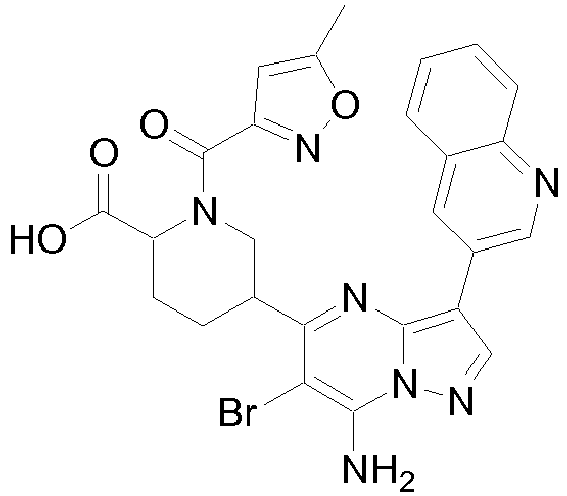
576.09 576.09 3.50 3.10 
492.3 492.10 2.89 3.11 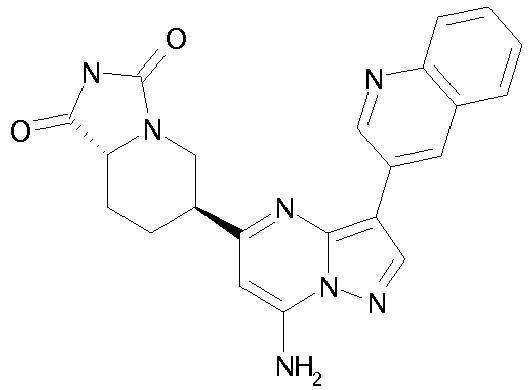
413.4 414.20 2.60 3.12 
492.3 492.10 2.89 3.14 
492.0 492.0 2.9 
-

- Cyclohexane-1,4-dicarboxylic acid monomethyl ester (26.9 mmol, 5.0 g) and N, N'-carbonyldiimidazole (33.6 mmol, 5.44 g) in anhydrous THF (80 mL) were stirred 16 h at room temperature under argon. In a separate, sealed and argon-flushed flask, lithium HMDS (1.0 M in THF, 56.5 ml) is added to 40 mL anhydrous THF stirring at -78° C. To this solution is added dropwise anhydrous ethyl acetate (57.8 mmol, 5.65 mL). This solution is allowed to stir at -78° C for 1 hour prior to dropwise addition of original CDI/acid solution that had been stirring overnight. The reaction mixture was allowed to stir and warm to room temperature overnight. The reaction is then quenched with saturated NH4Cl(aq) (200 mL) and extracted with Et2O (100x2). The combined organics are then washed with water, saturated brine, and dried over Na2SO4. The solvent was removed in vacuo and the crude residue (8.5 g) was used in the next step without further purification.
-

- 4-(2-Ethoxycarbonyl-acetyl)-cyclohexanecarboxylic acid methyl ester (8.5 g) and 3-amino-1H-pyrazole (26.5 mmol, 2.2 g) were mixed and heated neat at 100° C for 16 hours. The resulting residue is dissolved in dichloromethane (100 mL) and concentrated in vacuo to remove water formed during cyclization. This solid is taken forward without further purification. LC-MS: 403 [M+H].
-

- 4-(7-Hydroxy-pyrazolo[1,5-a]pyrimidin-5-yl)-cyclohexanecarboxylic acid methyl ester (10.6 g), N, N-dimethylaniline (15.0 ml) and POCl3 (120 mL) were mixed and stirred at room temperature for 18 hours. The solution is reduced in vacuo and cooled to 0° C in ice bath. The reaction is then quenched with sat. NaHCO3(aq) and extracted with DCM (100 mLx3). The combined organics are dried with Na2SO4 and the solvent removed in vacuo. The resulting oil was purified via silica gel column on 20% to 100% ethyl acetate in hexanes gradient to yield the titled compound (2.5 g, 32% over three steps). LC-MS: 294 [M+H].
-

- 4-(7-Chloro-pyrazolo[1,5-a]pyrimidin-5-yl)-cyclohexanecarboxylic acid methyl ester (2.5 g, 8.51 mmol) was dissolved in 15 mL ∼7N ammonia in methanol in a sealed vessel. The reaction mixture was heated at 80° C for 16 hours. After 16 hours, the reaction mixture is cooled to room temperature and concentrated in vacuo to yield a brown solid (2.58 g). The title compound was used in the next step without further purification. LC-MS: 275 [M+H].
-

- 4-(7-Amino-pyrazolo[1,5-a]pyrimidin-5-yl)-cyclohexanecarboxylic acid methyl ester (2.58 g, 9.4 mmol) was dissolved in 1,2-dichloroethane (20 mL). To this solution was added N, N'-diisopropylethylamine (65.8 mmol, 11.5 mL). The resulting solution was stirred at room temperature while 2-(trimethylsilyl)ethoxymethyl chloride (SEM-Cl, 5.8 mL, 33.0 mmol) was added dropwise. After the addition was completed, the reaction mixture was stirred at 90° C for 2 h. The solvent is removed in vacuo and the residue is purified on silica gel column (0% to 60% ethyl acetate in hexanes gradient) to yield the title compound (2.05 g, 41% yield over two steps) as pale yellow oil. LC-MS: 535 [M+H].
-

- N-Iodosuccinimide (811 mg, 3.6 mmol) was added into a solution of 4-{7-[bis-(2-trimethylsilanyl-ethoxymethyl)-amino]-pyrazolo[1,5-a]pyrimidin-5-yl}-cyclohexanecarboxylic acid methyl ester (1.75 g, 3.27 mmol) in acetonitrile (25 mL). The resulting reaction mixture was stirred at room temperature for 16 hours. The reaction mixture was concentrated in vacuo and purified via silica gel chromatography (0% to 30% ethyl acetate in hexanes gradient) to yield the title compound (1.79 g, 82.8% yield) at clear oil. LC-MS: 661 [M+H].
-

- 3-Quinoline boronic acid (2.42 mmol, 420 mg), K3PO4 (3.63 mmol, 771 mg), and PdCl2(dppf) · CH2Cl2 (0.121 mmol, 100 mg) was added to a solution of 4-{7-[Bis-(2-trimethylsilanyl-ethoxymethyl)-amino]-3-iodo-pyrazolo[1,5-a]pyrimidin-5-yl}-cyclohexanecarboxylic acid methyl ester (1.21 mmol, 800 mg) in dioxane (10 mL). To this suspension was added distilled H2O (1.0 mL). The resulting reaction mixture was stirred at 100° C under an argon atmosphere for 18 hours. The reaction mixture was concentrated in vacuo and then purified via silica gel chromatography (0% to 60% ethyl acetate in hexanes gradient) to yield the title compound (630 mg, 79% yield) as yellow oil. LC-MS: 662 [M+H].
-

- N-bromosuccinimide (148 mg, 0.832 mmol) was added to a solution of 4-{7-[bis-(2-trimethylsilanyl-ethoxymethyl)-amino]-3-quinolin-3-yl-pyrazolo[1,5-a]pyrimidin-5-yl}-cyclohexanecarboxylic acid methyl ester (500 mg, 0.756 mmol) in acetonitrile (10 mL). The reaction mixture was stirred at room temperature for 1 hour. The reaction mixture was concentrated in vacuo and the resulting oil is then purified via silica gel chromatography (0% to 30% ethyl acetate in hexanes gradient) to yield the title compound (530 mg, 95% yield) as yellow oil. LC-MS: 740 [M+H].
-

- 4-{7-[Bis-(2-trimethylsilanyl-ethoxymethyl)-amino]-6-bromo-3-quinolin-3-yl-pyrazolo[1,5-a]pyrimidin-5-yl}-cyclohexanecarboxylic acid methyl ester (100 mg, 0.135 mmol) in 2:1 MeOH:H2O (3 mL) was treated with 2N NaOH(aq) (0.5 mL). The reaction mixture was stirred at room temperature for 18 hours. The reaction mixture was treated with 1N hydrochloride solution (2 ml) at 65 °C for 4 h. The reaction mixture was concentrated and purified by prep-LC to afford the title compound (21.8 mg): LC/MS RT = 3.57 min. Mass calculated for, M+H 466.08, observed 466.08.
- By essentially the same procedure given in Scheme 5, the compounds of the invention and reference compounds listed in Table 4 can be prepared.
Table 4 Compound ID Structures M+H (calc.) M+H (observed) Retention Time, (min) 4.1 
466.08 466.08 3.57 4.2 
374.15 374.15 2.83 4.3 
452.06 452.08 3.4 4.9 
466.08 466.08 3.36 4.11 
493.0 493.0 3.65 4.12 
493.0 493.0 3.69 - Following additional compounds of the invention and reference compounds in table-4a were synthesized following the general experimental procedures described in scheme-5
TABLE-4A Compound ID Structures M+H (calc.) M+H (observed) LC/MS retention time (10 min method) 
466.08 466.08 3.57 4.17 
466.08 466.08 3.36 4.18 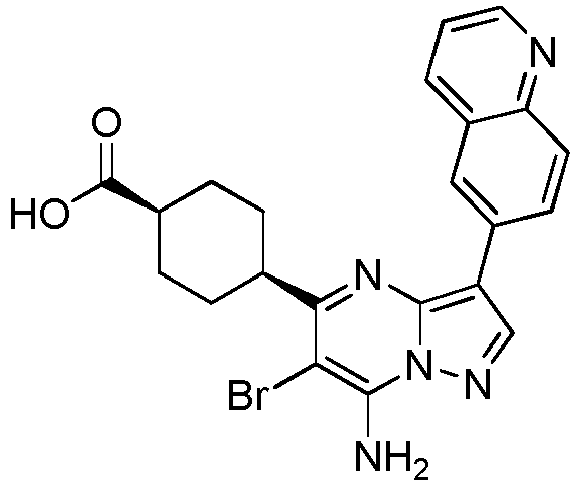
466.08 466.08 3.70 4.20 
569.09 569.09 3.82 4.21 
543.07 543.07 3.56 4.22 
493.09 493.09 3.37 4.23 
493.09 493.09 3.69 4.24 
493.09 493.09 3.36 4.25 
493.09 493.09 3.65 4.28 
523.10 523.10 4.12 4.29 
523.10 523.10 3.81 4.35 
511.08 511.08 4.38 4.36 
511.08 511.08 4.56 4.37 
557.06 557.06 4.89 4.46 
430.18 430.18 3.40 4.47 
430.18 430.18 3.58 
- To a solution of methyl hex-5-enoate (12 mg, 0.1 mmol) in THF (0.5 ml) under argon at 0 °C was added 9-BBN (0.2 mmol, 0.4 ml of 0.5 M solution in THF). The mixture was warmed to room temperature and stirred for 16 h. Potassium phosphate (3 M in H2O, 0.2 mmol) was added followed by the addition of 5-chloro-3-(quinolin-3-yl)-N,N-bis((2-(trimethylsilyl)ethoxy)methyl) pyrazolo[1,5-a]pyrimidin-7-amine (50 mg, 0.09 mmol) in DMF (0.5 ml) and Pd(dppf)Cl2-CH2Cl2 (5 mg, 0.005 mmol). The reaction mixture was heated at 90 °C for 16 h under argon. The solution was cooled to room temperature and concentrated under reduced pressure. The residue was dissolved in 2:1 THF:MeOH (3 mL) and was treated with 2N NaOH(aq) (0.25 mL). The resulting solution was stirred at room temperature for 4 hours followed by the addition of 2N hydrochloride solution (1.0 ml). The solution was heated at 65 °C for 2 h, cooled to room temperature, concentrated and purified by prep-LC to afford the title compound (8.2 mg): LC/MS RT = 2.74 min. Mass calculated for, M+H 376.17, observed 376.17.
- Analogues to the compound 4.87, following compounds in the table-4C can be synthesized as described above in the scheme-5a
Table-4C Compound ID Structures M+H (calc.) M+H (observed) LC/MS retention time (10 min method) 4.88 
376.17 376.17 2.74 4.89 
348.14 348.14 2.41 4.90 
445.07 445.07 2.62 4.91 
529.10 529.10 3.90 4.91 
555.11 555.11 4.21 4.92 
543.11 543.11 4.11 4.93 
493.13 493.13 3.75 4.94 
523.14 523.14 3.72 4.95 
479.11 479.11 3.63 - Following nucleophilic displacement reaction of 5-chloro-3-(quinolin-3-yl)-N,N-bis((2-(trimethylsilyl)ethoxy)methyl) pyrazolo[1,5-a]pyrimidin-7-amine with appropriate amine or alchol (experimental procedure described in Scheme-5a, compounds in the table-4C can be synthesized.
-

- To a stirring solution of thiophenecarboxylic acid (1 equiv) in DMF and t-BuOH at 0 °C was added the DPPA (1 equiv) and TEA (1 equiv). The reaction was then stirred at room temperature for 1 hour, then warmed to reflux and stirred for 15 hours. The reaction was allowed to cool to room temperature, and then evaporated to dryness. The resulting residue was dissolved in EtOAc then washed with sat. aq. NH4Cl, sat. aq. NaHCO3, and brine, dried over sodium sulfate, filtered, and purified on silica gel to afford the product.
- A solution of HCI in dioxane was added to a stirring solution of the product from Part A in methanol at 0 °C. The reaction was then stirred at reflux for 1 hour, then allowed to cool to room temperature and concentrated to afford the product.
- Bromomalonaldehyde (1 equiv) was added to a solution of the product from Part B (1 equiv) in glacial acetic acid at room temperature. The mixture was stirred at reflux for 1 hour, then allowed to cool to room temperature, then evaporated to dryness. The residue was dissolved in methanol, filtered through a pad of celite, concentrated, and purified on silica gel to afford the product.
- A mixture of the product from Part C (1 equiv), bispinacolatodiboron (1.2 equiv), PdCl2dppf (0.1 equiv), and potassium acetate (3 equiv) in dioxane was heated at 85 °C until the reaction was deemed complete by TLC, HPLC, or LC-MS analysis. The reaction was allowed to cool to room temperature, filtered through a pad of celite, concentrated to dryness, treated with diethyl ether, filtered through a pad of celite, then concentrated to afford the desired product, 2-methyl-6-(4,4,5,5-tetramethyl-1,3,2-dioxaborolan-2-yl)thieno[3,2-b]pyridine.
- Essentially utilizing the procedure described above scheme- the title compound 6-(4,4,5,5-tetramethyl-1,3,2-dioxaborolan-2-yl)thieno[3,2-b]pyridine can be synthesized

-

- To a solution of 5-bromo-2-(1H)-pyridone (18.8 g, 10.8 mmol) in dry toluene (400 mL) was added N-iodosuccinimide (24.3 g, 10.8 mmol) under nitrogen. The reaction mixture was stirred at 90 °C for 20 minutes then cooled to 25 °C. The precipitate was filtered off and washed with methanol, dried under vacuum to give the pink-orange color solid 28.0 g (86%). 1H NMR (300 MHz, CDCl3) δ 8.1 (s, 1H), 7.6 (s, 1H). Mass calculated for formula C5H3BrINO 298.84, observe MS ES+: 300.0/302.0.
- The iodide (6.0 g, 20.0 mmol), Pd(OAc)2 (45 mg, 0.2 mmol), PPh3 (105 mg, 0.4 mmol), CuI (76 mg, 0.4 mmol) were added to a round bottom flask under nitrogen. Dry THF (30 mL) was added and the solution was degassed 2 minutes with nitrogen. TMS-acetylene (2.9g, 30 mmol) was added followed with n-BuNH2 (2.9 g, 40 mmol). The homogeneous green solution was heated to 38 °C for 4 hours. The reaction mixture was cool to 25 °C, concentrated to dryness and then dissolved in EtOAc (100 mL). The solution was washed with saturated sodium potassium tartrate (50 mL), followed with 0.1 N HCI (50 mL), saturated NaHCO3 (50 mL), and brine (50mL), dried over NasSO4. Purification by column chromatography (SiO2, 50% ethyl acetate/hexanes) afforded compound as a green solid 4.40 g (81%). 1H NMR (300 MHz, CDCl3) δ 7.85 (s, 1H), 7.5 (s, 1H), 0.2 (s, 9H).
- To a EtOH (8.0 mL) solution of compound from Part B (1.12 g, 4.1 mmol) was added CuI (39 mg, 0.2 mmol) and followed with Et3N (3.5 mL) the resulting mixture was stirred at 70 °C for 3 hours. The reaction mixture was allowed to cool to 25 °C, concentrated to dryness and then dissolved in toluene (30mL). The solution was washed with 0.1 N HCI (20 mL), saturated NaHCO3 (20 mL), and brine (30 mL), dried over Na2SO4. Purification by column chromatography (SiO2, 20% ethyl acetate/hexanes) afforded compound as a white solid 0.26 g (32%). 1H NMR (300 MHz, CDCl3) δ 8.4 (s, 1H), 8.1 (s, 1H), 7.7 (s, 1H), 6.8 (s, 1H).
- A mixture of the product from Part C (1 equiv), bispinacolatodiboron (1.2 equiv), PdCl2dppf (0.1 equiv), and potassium acetate (3 equiv) in dioxane was heated at 85 °C until the reaction was deemed complete by TLC, HPLC, or LC-MS analysis. The reaction was allowed to cool to room temperature, filtered through a pad of celite, concentrated to dryness, treated with diethyl ether, filtered through a pad of celite, then concentrated to afford the desired product, 5-(4,4,5,5-tetramethyl-1,3,2-dioxaborolan-2-yl)furo[2,3-b]pyridine.
-

- Part A: A mixture of 5-bromo-3-iodopyridin-2-ol (1 equiv), copper iodide (3 equiv), palladium catalyst (0.05 equiv), TBAF (1 equiv), triethylamine (3.3 equiv) and alkyne (1 equiv) in toluene was stirred at room temperature until the reaction was deemed complete by TLC analysis. The reaction mixture was diluted with dichloromethane, washed with water, saturated sodium bicarbonate, and brine, dried over sodium bicarbonate, filtered through celite, concentrated, and purified on silica gel to give the product,5-bromo-2-methylfuro[2,3-b]pyridine.
- A mixture of the product, 5-bromo-2-methylfuro[2,3-b]pyridine, from Part A (1 equiv), bispinacolatodiboron (1.2 equiv), PdCl2dppf (0.1 equiv), and potassium acetate (3 equiv) in dioxane was heated at 85 °C until the reaction was deemed complete by TLC, HPLC, or LC-MS analysis. The reaction was allowed to cool to room temperature, filtered through a pad of celite, concentrated to dryness, treated with diethyl ether, filtered through a pad of celite, and then concentrated to afford the desired product, 2-methyl-5-(4,4,5,5-tetramethyl-1,3,2-dioxaborolan-2-yl)furo[2,3-b]pyridine.
-

- To a solution of 5-bromo-3-((trimethylsiyl)ethynyl)pyridin-2-ol (10.63 g, 39.5 mmol) in toluene (195 mL) was added Lawesson's reagent (8.00 g, 19.8 mmol) under nitrogen. The reaction mixture was stirred at 120 °C for 1 hour, and then allowed to cool to 25 °C. Purification by column chromatography (SiO2, 20% ethyl acetate/hexanes) afforded compound as a white solid, 5-bromo-2-(trimethylsilyl)thieno[2,3-b]pyridine, 8.99 g (79%). 1H NMR (300 MHz, CDCl3) δ 8.57 (d, J = 2.2 Hz, 1H), 8.16 (d, J = 2.2 Hz 1H), 7.30 (s, 1H), 0.39 (s, 9H).
- Part B: The 5-bromo-2-(trimethylsilyl)thieno[2,3-b]pyridine from Part A (8.99 g, 31.4 mmol) was dissolved in ethanol (70 mL), followed by addition of K2CO3 (10.85g, 78.5 mmol). Reaction was stirred at 65 °C for 1 hour. The reaction mixture was allowed to cool to 25 °C, concentrated to dryness, and dissolved in EtOAc (150 mL). The solution was washed with H2O (80 mL), and brine (150mL), dried over NasSO4, filtered, and concentrated to yield white solid, 5-bromothieno[2,3-b]pyridine, 6.57 g (98%). 1H NMR (300 MHz, CDCl3) δ 8.60 (d, J = 2.2 Hz, 1H), 8.16 (d, J = 2.2 Hz 1H), 7.57 (d, J = 6.0 Hz 1H), 7.21 (d, J = 6.0 Hz, 1H).
- Part C: A mixture of the product, 5-bromothieno[2,3-b]pyridine, from Part B (1 equiv), bispinacolatodiboron (1.2 equiv), PdCl2dppf (0.1 equiv), and potassium acetate (3 equiv) in dioxane was heated at 85 °C until the reaction was deemed complete by TLC, HPLC, or LC-MS analysis. The reaction was allowed to cool to room temperature, filtered through a pad of celite, concentrated to dryness, treated with diethyl ether, filtered through a pad of celite, and then concentrated to afford the desired product, 5-(4,4,5,5-tetramethyl-1,3,2-dioxaborolan-2-yl)thieno[2,3-b]pyridine.
-

- A mixture of compound (1r,4r)-tert-butyl 4-(7-(bis((2-(trimethylsilyl)ethoxy)methyl)amino)-3-iodopyrazolo[1,5-a]pyrimidin-5-yl)cyclohexanecarboxylate (1 equiv), boronate (1.75 equiv), palladium catalyst (0.1 equiv), and potassium carbonate (3 equiv) in water and dioxane was stirred at 40 °C until the reaction was deemed complete by HPLC, LC-MS, or TLC analysis. The mixture was allowed to cool to room temperature, diluted with water and extracted three times with dichloromethane. The combined organics were dried over sodium sulfate, filtered, concentrated, and purified on silica gel to afford compound (1r,4r)-tert-butyl 4-(7-(bis((2-(trimethylsilyl)ethoxy)methyl)amino)-3-aryl-pyrazolo[1,5-a]pyrimidin-5-yl)cyclohexanecarboxylate.
- When R = Br:
Compound , (1r,4r)-tert-butyl 4-(7-(bis((2-(trimethylsilyl)ethoxy)methyl)amino)-3-aryl-pyrazolo[1,5-a]pyrimidin-5-yl)cyclohexanecarboxylate, was stirred in a mixture of dichloromethane, water, and TFA until the reaction was deemed complete by HPLC, LC-MS, or TLC analysis. The reaction was concentrated and purified on prep-HPLC. The resulting material was stirred with NBS (1.05 equiv) in acetonitrile and DMF at room temperature until the reaction was deemed complete by HPLC, LC-MS, or TLC analysis. The mixture was concentrated, purified on prep-HPLC, and freeze-dried to afford compound, (1r,4r)-4-(7-amino-6-bromo-3-aryl - pyrazolo[1,5-a]pyrimidin-5-yl)cyclohexanecarboxylic acid. - When R = acetyl: Compound, (1r,4r)-tert-butyl 4-(7-(bis((2-(trimethylsilyl)ethoxy)methyl)amino)-3-aryl-pyrazolo[1,5-a]pyrimidin-5-yl)cyclohexanecarboxylate , (1 equiv) was stirred with NBS (1.05 equiv) in DMF at room temperature until the reaction was deemed complete by HPLC, LC-MS, or TLC analysis. The reaction was diluted with ethyl acetate, washed three times with brine, dried over sodium sulfate, filtered, concentrated, and purified on silica gel. The resulting material was stirred with a mixture of vinyl stannane (2 equiv), palladium catalyst (0.1 equiv), and potassium fluoride (3 equiv) in dioxane at 85 °C until the reaction was deemed complete by HPLC, LC-MS, or TLC analysis. The mixture was allowed to cool to room temperature, diluted with 10% aqueous potassium fluoride, and extracted three times with ethyl acetate. The combined organics were dried over sodium sulfate, filtered, concentrated, and purified on silica gel. The resulting material was stirred with a mixture of HCI in methanol and water at 60 °C until the reaction was deemed complete by HPLC, LC-MS, or TLC analysis. The mixture was then allowed to cool to room temperature, concentrated, purified by prep-HPLC, and freeze-dried to afford compound (1r,4r)-4-(6-acetyl-7-amino-3-aryl - pyrazolo[1,5-a]pyrimidin-5-yl)cyclohexanecarboxylic acid.
-

- To a solution of tert-butyl 4-(hydroxymethyl)piperidine-1-carboxylate (311 mg, 1.44 mmol) and sodium hydride (60% in mineral oil, 58 mg, 1.44 mmol) in THF (2 ml) under argon at room temperature was added 5-chloro-3-(quinolin-3-yl)-N,N-bis((2 (trimethylsilyl)ethoxy)methyl) pyrazolo[1,5-a]pyrimidin-7-amine (400 mg, 0.72 mmol). The mixture was heated at 100°C for 30 min in microwave. Ethyl acetate (50 ml) was added and the mixture was washed with brine and water, dried over Na2SO4, and concentrated in vacuo. The crude product was dissolved in acetonitrile, followed by the addition of N-bromosuccinimide (193 mg, 1.08 mmol). The reaction mixture was stirred at room temperature for 2 h, concentrated in vacuo and purified via silica gel chromatography (10% to 50% ethyl acetate in hexanes gradient) to yield the title compound (0.56 g, 95% yield). LC-MS: 813 [M+H].
- tert-Butyl 4-((7-(bis((2-(trimethylsilyl)ethoxy)methyl)amino)-6-bromo-3-(quinolin-3-yl)pyrazolo[1,5-a]pyrimidin-5-yloxy)methyl)piperidine-1-carboxylate (0.56 g, 68.9 mmol) was dissolved in methanol (6 ml) and treated with 4N hydrochloride solution in dioxane (4 ml) at 65 °C for 30 min. The reaction solution was concentrated and the crude product (0.48 g) was used in the next step without further purification. LC-MS: 453 [M+H].
- Cyclopropanesulfonyl chloride (24 mg, 0.167 mmol) was added into a solution of 6-bromo-5-(piperidin-4-ylmethoxy)-3-(quinolin-3-yl)pyrazolo[1,5-a]pyrimidin-7-amine (50 mg, 0.111 mmol) and triethylamine (56 mg, 0.553 mmol) in DMF at room temperature. The resulting reaction mixture was stirred at room temperature for 16 h, concentrated and purified by prep-LC to afford the title compound (21.5 mg): LC/MS RT = 4.17 min. Mass calculated for, M+H 557.09, observed 557.09.
- Compounds in the table-4-E can be synthesized as described following general procedure dscribed above scheme(11)
TABLE-4E Compound ID Structures M+H (calc.) M+H (observed) LC/MS retention time (10 min method) 4.107 
454.08 454.08 3.96 4.108 
453.10 453.10 2.66 4.109 
502.05 502.05 3.35 4.110 
557.09 557.09 4.17 4.111 
525.12 525.12 3.61 4.112 
481.09 481.09 3.54 4.113 
531.07 531.07 3.82 4.114 
545.09 545.09 4.07 4.115 
495.11 495.11 3.65 4.116 
563.08 563.08 4.30 4.117 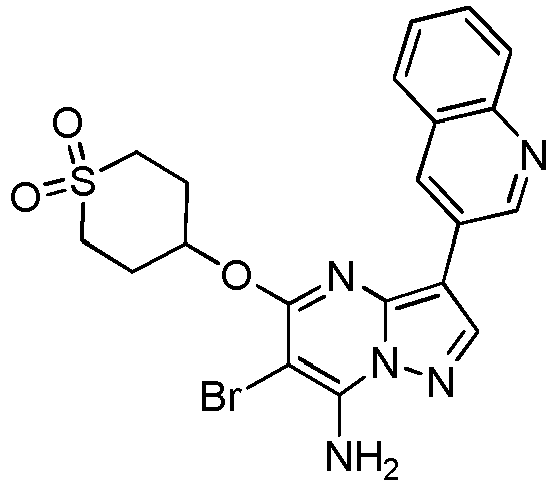
488.03 488.03 3.30 4.118 
440.07 440.07 3.84 4.119 
439.08 439.08 2.57 4.120 
517.06 517.06 3.68 4.121 
543.07 543.07 4.02 4.122 
531.07 531.07 3.90 4.123 
481.09 481.09 3.48 4.124 
511.10 511.10 3.46 4.125 
467.08 467.08 3.37 4.126 
482.08 482.08 3.65 4.127 
496.09 496.09 3.89 -

- The compound methyl 2-(4-hydroxyphenyl) acetate (330 mg, 0.2 mmol) was dissolved in dry DMF (3 mL) and NaH (80 mg, 60% in oil, 0.2 mmol) was added and the mixture was stirred at room temperature for 5 min. Then, 5-chloro-N,N-bis((2-(trimethylsilyl)ethoxy)methyl)pyrazolo[1,5-a]pyrimidin-7-amine (430 mg, 0.1 mmol) was added and the resulting mixture was heated up to 130 °C with microwave and stirred for 30 min. After cooling to room temperature, NH4Cl (aq) was added to quench the reaction and extracted with EtOAc (50 mL x 3). The combined organics were washed with water and brine and dried over Na2SO4. After concentration, the residue was purified with column (silica gel, 20% EtOAc/Hexane) gave the product, methyl 2-(4-(7-(bis((2-(trimethylsilyl)ethoxy)methyl)amino)pyrazolo[1,5-a]pyrimidin-5-yloxy)phenyl)acetate, (490 mg) as clear oil. HPLC-MS tR = 2.77 min (UV254 nm); mass calculated for formula C27H42N4O5Si2 558.3, observed LCMS m/z 559.3 (M+H).
- Methyl 2-(4-(7-(bis((2-(trimethylsilyl)ethoxy)methyl)amino)pyrazolo[1,5-a]pyrimidin-5-yloxy)phenyl)acetate (450 mg, 0.81 mmol) was dissolved in ACN (15 mL) and NIS (200 mg, 0.88 mmol) was added. The resulting mixture was stirred at room temperature for 2 h and then the solvent was removed under reduced pressure. The residue was purified with column (silica gel, 10% EtOAc/Hexane) gave the product, methyl 2-(4-(7-(bis((2-(trimethylsilyl)ethoxy)methyl)amino)-3-iodopyrazolo[1,5-a]pyrimidin-5-yloxy)phenyl)acetate (541 mg) as yellowish oil. HPLC-MS tR = 2.96 min (UV254 nm); mass calculated for formula C27H41IN4O5Si2 684.2, observed LCMS m/z 685.2 (M+H).
- Under Ar, compound, methyl 2-(4-(7-(bis((2-(trimethylsilyl)ethoxy)methyl)amino)-3-iodopyrazolo[1,5-a]pyrimidin-5-yloxy)phenyl)acetate (180 mg, 0.26 mmol) was mixed with Pd(dppf)Cl2 (21 mg, 0.26 mmol, K3PO4 (106 mg, 0.5 mmol), 3-quinoline bornic acid (55 mg, 0.31 mmol) and dioxane (10 mL with 1 ml water). The resulting mixture was heated at 90 °C and stirred over night. After cooled to room temperature, the mixture was diluted with EtOAc (60 mL) and filtered through celite. After concentration, the crude was purified with column (silica gel, 0∼30% EtOAc/Hexane) gave the product, methyl 2-(4-(7-(bis((2-(trimethylsilyl)ethoxy)methyl)amino)-3-(quinolin-3-yl)pyrazolo[1,5-a]pyrimidin-5-yloxy)phenyl)acetate (150 mg). HPLC-MS tR = 2.60 min (UV254 nm); mass calculated for formula C36H47N5O5Si2 685.3, observed LCMS m/z 686.3 (M+H).
- Compound, methyl 2-(4-(7-(bis((2-(trimethylsilyl)ethoxy)methyl)amino)-3-(quinolin-3-yl)pyrazolo[1,5-a]pyrimidin-5-yloxy)phenyl)acetate (150 mg, 0.22 mmol) was dissolved in ACN (10 mL). NBS (40 mg, 0.22 mmol) was added and the mixture was stirred at room temperature for 1 h. After concentration, the product, methyl 2-(4-(7-(bis((2-(trimethylsilyl)ethoxy)methyl)amino)-6-bromo-3-(quinolin-3-yl)pyrazolo[1,5-a]pyrimidin-5-yloxy)phenyl)acetate was used in the next step without further purification. HPLC-MS tR = 2.70 min (UV254 nm); mass calculated for formula C36H46BrN5O5Si2 763.2, observed LCMS m/z 764.2 (M+H).
- The crude methyl 2-(4-(7-(bis((2-(trimethylsilyl)ethoxy)methyl)amino)-6-bromo-3-(quinolin-3-yl)pyrazolo[1,5-a]pyrimidin-5-yloxy)phenyl)acetate from above step D was treated with 50% TFA/H2O (3 mL) and stirred at room temperature for 1 h. Solvent was removed to yield thick oil, methyl 2-(4-(7-amino-6-bromo-3-(quinolin-3-yl)pyrazolo[1,5-a]pyrimidin-5-yloxy)phenyl)acetate, which was used in the next step directly without further purification. HPLC-MS tR = 1.60 min (UV254 nm); Mass calculated for formula C24H18BrN5O3, 503.1, observed LCMS m/z 504.1 (M+ Na).
- Crude compound , methyl 2-(4-(7-amino-6-bromo-3-(quinolin-3-yl)pyrazolo[1,5-a]pyrimidin-5-yloxy)phenyl)acetate from step E was dissolved in THF (5 mL) and LiOH (IN, 1 mL) was added. The mixture was stirred at room temperature overnight. The solvent was removed under vacuo, and the resulting residue was taken over with water and the pH value was adjusted to 5∼6. The solid was collected with filtration and purified with HPLC gave the product, 2-(4-(7-amino-6-bromo-3-(quinolin-3-yl)pyrazolo[1,5-a]pyrimidin-5-yloxy)phenyl)acetic acid. HPLC-MS tR = 1.53 min (UV254 nm); Mass calculated for formula C23H16BrN5O3, 489.0, observed LCMS m/z 490.0 (M+H).
- By essentially the same procedure given in Preparative Example given above, compounds 4.130-4.144 given in Column 2 of Table 4G can be prepared.
TABLE 4G Example Column 2 Exact mass MS m/z (M+H) HPLC MS tR 4.132 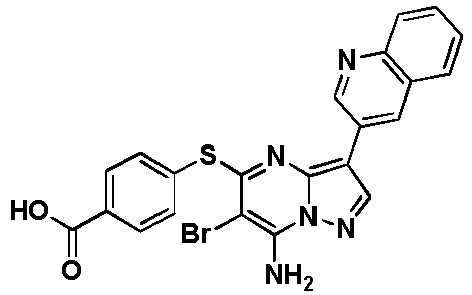
491.0 492.1 1.48 4.134 
518.0 519.1 1.49 4.135 
475.0 475.9 1.49 4.137 
502.0 502.9 1.45 4.138 
505.0 505.9 1.65 4.140 
532.0 532.9 1.61 4.144 
503.0 504.1 1.14 -

- Under Ar, compound, 5-chloro-N,N-bis((2-(trimethylsilyl)ethoxy)methyl)pyrazolo[1,5-a]pyrimidin-7-amine, (430 mg, 1.0 mmol) was mixed with Pd(dppf)Cl2 (82 mg, 0.1 mmol, K3PO4 (636 mg, 3.0 mmol), methyl 4-(4,4,5,5-tetramethyl-l,3,2-dioxaborolan-2-yl)benzoate (200 mg, 1.1 mmol) and dioxane (20 mL with 1 ml water). The resulting mixture was heated at 90 °C and stirred over night. After cooled to room temperature, the mixture was diluted with EtOAc (60 mL) and filtered through celite. After concentration, the crude was purified with column (silica gel, 0∼30% EtOAc/Hexane) gave the product, methyl 4-(7-(bis((2-(trimethylsilyl)ethoxy)methyl)amino)pyrazolo[1,5-a]pyrimidin-5-yl)benzoate (459 mg). HPLC-MS tR = 2.89 min (UV254 nm); mass calculated for formula C26H40N4O4Si2 528.3, observed LCMS m/z 529.2 (M+H).
- Compound, methyl 4-(7-(bis((2-(trimethylsilyl)ethoxy)methyl)amino)-3-iodopyrazolo[1,5-a]pyrimidin-5-yl)benzoate was prepared with the same iodonation condition described in scheme-12 Part B. HPLC-MS tR = 3.09 min (UV254 nm); mass calculated for formula C26H39IN4O4Si2 654.2, observed LCMS m/z 655.2 (M+H).
- Title Compound, methyl 4-(3-(biphenyl-4-yl)-7-(bis((2-(trimethylsilyl)ethoxy)methyl)amino)pyrazolo[1,5-a]pyrimidin-5-yl)benzoate was prepared with the same coupling condition described in the schem-12 Part C. HPLC-MS tR = 2.98 min (UV254 nm); mass calculated for formula C37H47N5O4Si2 681.3, observed LCMS m/z 682.2 (M+H).
- Title Compound was prepared with the same bromonation condition described in Scheme-12, Part D . HPLC-MS tR = 3.11 min (UV254 nm); mass calculated for formula C37H46BrN5O4Si2 759.2, observed LCMS m/z 760.2 (M+H).
- Title compound, methyl 4-(7-amino-6-bromo-3-(6-phenylpyridin-3-yl)pyrazolo[1,5-a]pyrimidin-5-yl)benzoate was prepared with the same deprotection condition described in Scheme-12 Part E. HPLC-MS tR = 1.88 min (UV254 nm); mass calculated for formula C25H18BrN5O2 499.1, observed LCMS m/z 500.1 (M+H).
- Compound, 4-(7-amino-6-bromo-3-(6-phenylpyridin-3-yl)pyrazolo[1,5-a]pyrimidin-5-yl)benzoic acid was prepared with the same hydrolysis condition described in Scheme-12 Part E. HPLC-MS tR = 1.44 min (UV254 nm); mass calculated for formula C24H16BrN5O2 485.0, observed LCMS m/z 486.1 (M+H).
- By essentially the same procedure given in Preparative scheme-13 above, compound 4.145- 4.166 given in Column 2 of Table 4 H can be prepared from compound 2.
TABLE - 4H Example Column 2 Exact mass MS m/z (M+H) HPLC MS tR 4.146 
509.1 510.1 1.50 4.148 
500.1 501.1 1.23 4.150 
486.0 487.0 1.24 4.152 
459.0 460.0 1.41 -

- The 4-(methylthio)phenol (280 mg, 2.0 mmol) was dissolved in dry DMF (3 mL) and NaH (88 mg, 60% in oil, 2.2 mmol) was added and the mixture was stirred at room temperature for 5 min. Then, 5-chloro-N,N-bis((2-(trimethylsilyl)ethoxy)methyl)pyrazolo[1,5-a]pyrimidin-7-amine (430 mg, 0.1 mmol) was added and the resulting mixture was heated up to 130 °C with Microwave and stirred for 30 min. After cooling to room temperature, NH4Cl (aq) was added to quench the reaction and extracted with EtOAc (50 mL x 3). The combined organics were washed with water and brine and dried over Na2SO4. After concentration, the residue was purified with column (silica gel, 20% EtOAc/Hexane) gave the product 5-(4-(methylthio)phenoxy)-N,N-bis((2-(trimethylsilyl)ethoxy)methyl)pyrazolo[1,5-a]pyrimidin-7-amine (490 mg) HPLC-MS tR = 2.98 min (UV254 nm); mass calculated for formula C25H40N4O3SSi2 532.2, observed LCMS m/z 533.2 (M+H).
- 5-(4-(methylthio)phenoxy)-N,N-bis((2-(trimethylsilyl)ethoxy)methyl)pyrazolo[1,5-a]pyrimidin-7-amine (490 mg, 0.81 m) was dissolved in ACN (15 mL) and NIS (200 mg, 0.88 mmol) was added. The resulting mixture was stirred at room temperature for 2 h and then the solvent was removed under reduced pressure. The residue was purified with column (silica gel, 10% EtOAc/Hexane) gave the product, 3-iodo-5-(4-(methylthio)phenoxy)-N,N-bis((2-(trimethylsilyl)ethoxy)methyl)pyrazolo[1,5-a]pyrimidin-7-amine (541 mg) as yellowish oil.. HPLC-MS tR = 3.18 min (UV254 nm); mass calculated for formula C25H39IN4O3SSi2 658.1, observed LCMS m/z 659.2 (M+H).
- 3-iodo-5-(4-(methylthio)phenoxy)-N,N-bis((2-(trimethylsilyl)ethoxy)methyl)pyrazolo[1,5-a]pyrimidin-7-amine (180 mg, 0.26 mmol) under Argon,was mixed with Pd(dppf)Cl2 (21 mg, 0.26 mmol, K3PO4 (106 mg, 0.5 mmol), 3-quinoline bornic acid (55 mg, 0.31 mmol) and dioxane (10 mL with 1 ml water). The resulting mixture was heated at 90 °C and stirred over night. After cooled to room temperature, the mixture was diluted with EtOAc (60 mL) and filtered through celite. After concentration, the crude was purified with column (silica gel, 0∼30% EtOAc/Hexane) gave the product 5-(4-(methylthio)phenoxy)-3-(quinolin-3-yl)-N,N-bis((2-(trimethylsilyl)ethoxy)methyl)pyrazolo[1,5-a]pyrimidin-7-amine (150 mg). HPLC-MS tR = 2.85 min (UV254 nm); mass calculated for formula C34H45N5O3SSi2 659.3, observed LCMS m/z 660.1 (M+H).
- Compound, 5-(4-(methylthio)phenoxy)-3-(quinolin-3-yl)-N,N-bis((2-(trimethylsilyl)ethoxy)methyl)pyrazolo[1,5-a]pyrimidin-7-amine (87 mg, 0.132 mmol) was dissolved in DCM (5 mL) and m-CPBA (66 mg, ∼70%, 0.27 mmol) was added. The result mixture was stirred at room temperature for 1 h. NaHCO3 (aq.) was added and the water was extracted with DCM. The combined organics was dried over Na2SO4 and concentrated. The crude was purified with column (silica gel, 0∼30% EtOAc/Hexane) gave the product, 5-(4-(methylsulfonyl)phenoxy)-3-(quinolin-3-yl)-N,N-bis((2-(trimethylsilyl)ethoxy)methyl)pyrazolo[1,5-a]pyrimidin-7-amine (89 mg). HPLC-MS tR = 2.37 min (UV254 nm); mass calculated for formula C34H45N5O5SSi2 691.3, observed LCMS m/z 692.2 (M+H).
- Compound, 5-(4-(methylsulfonyl)phenoxy)-3-(quinolin-3-yl)-N,N-bis((2-(trimethylsilyl)ethoxy)methyl)pyrazolo[1,5-a]pyrimidin-7-amine (150 mg, 0.22 mmol) was dissolved in ACN (10 mL). NBS (40 mg, 0.22 mmol) was added and the mixture was stirred at room temperature for 1 h. After concentration, the residue, 6-bromo-5-(4-(methylsulfonyl)phenoxy)-3-(quinolin-3-yl)-N,N-bis((2-(trimethylsilyl)ethoxy)methyl)pyrazolo[1,5-a]pyrimidin-7-amine was used in the next step without further purification. HPLC-MS tR = 2.66 min (UV254 nm); mass calculated for formula C34H44BrN5O5SSi2 769.2, observed LCMS m/z 770.0 (M+H).
- The crude, 6-bromo-5-(4-(methylsulfonyl)phenoxy)-3-(quinolin-3-yl)-N,N-bis((2-(trimethylsilyl)ethoxy)methyl)pyrazolo[1,5-a]pyrimidin-7-amine from above step E was treated with 50% TFA/H2O (3 mL) and stirred at room temperature for 1 h. Solvent was removed to yield thick oil which was purified by prep HPLC to give the final product. 6-bromo-5-(4-(methylsulfonyl)phenoxy)-3-(quinolin-3-yl)pyrazolo[1,5-a]pyrimidin-7-amine. HPLC-MS tR = 1.37 min (UV254 nm); mass calculated for formula C22H16BrN5O3S2 509.0, observed LCMS m/z 510.0 (M+H).
- By essentially the same procedure given in Preparative above Example, compounds 4.172-4.174 given in Column 2 of Table 4J can be prepared.
TABLE 4-J Example Column 2 Exact mass MS m/z (M+H) HPLC MS tR 4.172 
493.0 494.0 1.28 4.174 
536.0 537.0 1.44 -

- Methyl 2-(4-(bromomethyl)phenyl)acetate (1.03 g, 4.24 mmol) was mixed with Pd(PPh3)4 (500 mg, 0.4 mmol, 4,4,4',4',5,5,5',5'-octamethyl-2,2'-bi(1,3,2-dioxaborolane) (1.27 g, 5 mmol), K2CO3 (1.75 g, 12.7 mmol) and dioxane (20 mL) under inert Argon atmoshphere. The resulting mixture was heated at 80 °C and stirred over night. After cooled to room temperature, the mixture was diluted with EtOAc (100 mL) and filtered through celite. After concentration, the crude was purified with column (silica gel, 10∼30% EA/hexane) gave the product, methyl 2-(4-((4,4,5,5-tetramethyl-1,3,2-dioxaborolan-2-yl)methyl)phenyl)acetate (721 mg) as semi-solid. HPLC-MS tR = 2.17 min (UV254 nm); mass calculated for formula C16H23BO4 290.2, observed LCMS m/z 291.3 (M+H).
- Under Ar, 5-chloro-N,N-bis((2-(trimethylsilyl)ethoxy)methyl)pyrazolo[1,5-a]pyrimidin-7-amine (429 mg, 1.0 mmol) was mixed with Pd(dppf)Cl2 (82 mg, 0.1 mmol, boronate, methyl 2-(4-((4,4,5,5-tetramethyl-1,3,2-dioxaborolan-2-yl)methyl)phenyl)acetate (480 mg, 1.65 mmol, not very pure), K3PO4 (424 mg, 2.0 mmol) and dioxane (10 mL). The resulting mixture was heated at 100 °C and stirred over night. After cooled to room temperature, the mixture was diluted with EtOAc (100 mL) and filtered through celite. After concentration, the crude was purified with column (silica gel, 10∼30% EA/hexane) gave the product, methyl 2-(4-((7-(bis((2-(trimethylsilyl)ethoxy)methyl)amino)pyrazolo[1,5-a]pyrimidin-5-yl)methyl)phenyl)acetate (188 mg) and recovered the starting material 5-chloro-N,N-bis((2-(trimethylsilyl)ethoxy)methyl)pyrazolo[1,5-a]pyrimidin-7-amine (289 mg). HPLC-MS tR = 2.50 min (UV254 nm); mass calculated for formula C28H44N4O4Si2 556.3, observed LCMS m/z 557.3 (M+H).
- methyl 2-(4-((7-(bis((2-(trimethylsilyl)ethoxy)methyl)amino)pyrazolo[1,5-a]pyrimidin-5-yl)methyl)phenyl)acetate (450 mg, 0.81 mmol) was dissolved in ACN (15 mL) and NIS (200 mg, 0.88 mmol) was added. The resulting mixture was stirred at room temperature for 2 h and then the solvent was removed under reduced pressure. The residue was purified with column (silica gel, 10% EtOAc/Hexane) gave the product methyl 2-(4-((7-(bis((2-(trimethylsilyl)ethoxy)methyl)amino)-3-iodopyrazolo[1,5-a]pyrimidin-5-yl)methyl)phenyl)acetate (541 mg) as yellowish oil. HPLC-MS tR = 2.97 min (UV254 nm); mass calculated for formula C28H43IN4O4Si2 682.2, observed LCMS m/z 683.2 (M+H).
- Under Ar, methyl 2-(4-((7-(bis((2-(trimethylsilyl)ethoxy)methyl)amino)-3-iodopyrazolo[1,5-a]pyrimidin-5-yl)methyl)phenyl)acetate (180 mg, 0.26 mmol) was mixed with Pd(dppf)Cl2 (21 mg, 0.26 mmol, K3PO4 (106 mg, 0.5 mmol), 3-quinoline bornic acid (55 mg, 0.31 mmol) and dioxane (10 mL with 1 ml water). The resulting mixture was heated at 90 °C and stirred over night. After cooled to room temperature, the mixture was diluted with EtOAc (60 mL) and filtered through celite. After concentration, the crude was purified with column (silica gel, 0∼30% EtOAc/Hexane) gave the product methyl 2-(4-((7-(bis((2-(trimethylsilyl)ethoxy)methyl)amino)-3-(quinolin-3-yl)pyrazolo[1,5-a]pyrimidin-5-yl)methyl)phenyl)acetate (150 mg).HPLC-MS tR = 2.50 min (UV254 nm); mass calculated for formula C37H49N5O4Si2 683.3, observed LCMS m/z 684.4 (M+H).
- Methyl 2-(4-((7-(bis((2-(trimethylsilyl)ethoxy)methyl)amino)-3-(quinolin-3-yl)pyrazolo[1,5-a]pyrimidin-5-yl)methyl)phenyl)acetate (150 mg, 0.22 mmol) was dissolved in ACN (10 mL). NBS (40 mg, 0.22 mmol) was added and the mixture was stirred at room temperature for 1 h. After concentration, the product that resulted, methyl 2-(4-((7-(bis((2-(trimethylsilyl)ethoxy)methyl)amino)-6-bromo-3-(quinolin-3-yl)pyrazolo[1,5-a]pyrimidin-5-yl)methyl)phenyl)acetate was used in the next step without further purification HPLC-MS tR = 2.66 min (UV254 nm); mass calculated for formula C37H48BrN5O4Si2 761.2, observed LCMS m/z 762.2 (M+H).
- The crude methyl 2-(4-((7-(bis((2-(trimethylsilyl)ethoxy)methyl)amino)-6-bromo-3-(quinolin-3-yl)pyrazolo[1,5-a]pyrimidin-5-yl)methyl)phenyl)acetate from above step E was treated with 50% TFA/H2O (3 mL) and stirred at room temperature for 1 h. Solvent was removed to yield thick oil, Methyl 2-(4-((7-amino-6-bromo-3-(quinolin-3-yl)pyrazolo[1,5-a]pyrimidin-5-yl)methyl)phenyl)acetate which was used in the next step directly without further purification. HPLC-MS tR = 1.72 min (UV254 nm); mass calculated for formula C25H20BrN5O2 501.1, observed LCMS m/z 502.0(M+H).
- Crude Methyl 2-(4-((7-amino-6-bromo-3-(quinolin-3-yl)pyrazolo[1,5-a]pyrimidin-5-yl)methyl)phenyl)acetate from step F was dissolved in THF (5 mL) and LiOH (IN, 1 mL) was added. The mixture was stirred at room temperature overnight. The solvent was removed under vacuo, and the resulting residue was taken over with water and the pH value was adjusted to 5∼6. The solid was collected with filtration and purified with HPLC gave the product 2-(4-((7-amino-6-bromo-3-(quinolin-3-yl)pyrazolo[1,5-a]pyrimidin-5-yl)methyl)phenyl)acetic acid. HPLC-MS tR = 1.53 min (UV254 nm); mass calculated for formula C24H18BrN5O2 487.1, observed LCMS m/z 487.9 (M+H).
- By essentially same procedure given, in preparative above example, compounds 4.175 & 4.176 given in Column 2 of Table 4K can be prepared.
TABLE-4 K Example Column 2 Exact mass MS m/z (M+H) HPLC MS tR 4.176 
514.1 515.0 1.46 -

- Essentially the steps from A through G described in the example, synthesis of 2-(4-((7-amino-6-bromo-3-(quinolin-3-yl)pyrazolo[1,5-a]pyrimidin-5-yl)methyl)phenyl)acetic acid can be used for this synthesis of 6-bromo-5-(4-(methylsulfonyl)benzyl)-3-(quinolin-3-yl)pyrazolo[1,5-a]pyrimidin-7-amine
- 4,4,5,5-tetramethyl-2-(4-(methylthio)benzyl)-1,3,2-dioxaborolane prepared with the same condition described in above example Part A. HPLC-MS tR = 2.23 min (UV254 nm); mass calculated for formula C14H21BO2S 264.1, observed LCMS m/z 265.2 (M+H).
- Compound, 5-(4-(methylthio)benzyl)-N,N-bis((2-(trimethylsilyl)ethoxy)methyl)pyrazolo[1,5-a]pyrimidin-7-amine was prepared with the same coupling condition described in above example Part B. HPLC-MS tR = 2.74 min (UV254 nm); mass calculated for formula C26H42N4O2SSi2 530.3, observed LCMS m/z 531.2 (M+H).
- Compound, 5-(4-(methylthio)benzyl)-N,N-bis((2-(trimethylsilyl)ethoxy)methyl)pyrazolo[1,5-a]pyrimidin-7-amine (87 mg, 0.132 mmol) was dissolved in DCM (5 mL) and m-CPBA (66 mg, ∼70%, 0.27 mmol) was added. The result mixture was stirred at room temperature for 1 h. NaHCO3 (aq.) was added and the water was extracted with DCM. The combined organics was dried over Na2SO4 and concentrated. The crude was purified with column (silica gel, 0∼30% EtOAc/Hexane) gave the product 5-(4-(methylsulfonyl)benzyl)-N,N-bis((2-(trimethylsilyl)ethoxy)methyl)pyrazolo[1,5-a]pyrimidin-7-amine (89 mg). HPLC-MS tR = 2.52 min (UV254 nm); mass calculated for formula C26H42N4O4SSi2 562.2, observed LCMS m/z 563.3 (M+H).
- Compound, 3-iodo-5-(4-(methylsulfonyl) benzyl)-N,N-bis((2-(trimethylsilyl)ethoxy)methyl) pyrazolo[1,5-a]pyrimidin-7-amine was prepared with the same iodonation condition described in above example part C. HPLC-MS tR = 2.81 min (UV254 nm); mass calculated for formula C26H41IN4O4SSi2 688.1, observed LCMS m/z 689.2 (M+H).
- Compound, 5-(4-(methylsulfonyl)benzyl)-3-(quinolin-3-yl)-N,N-bis((2-(trimethylsilyl)ethoxy)methyl)pyrazolo[1,5-a]pyrimidin-7-amine was prepared with the same coupling condition described in the above example Part D. HPLC-MS tR = 2.35 min (UV254 nm); mass calculated for formula C35H47N5O4SSi2 689.3, observed LCMS m/z 690.3 (M+H).
- Compound, 6-bromo-5-(4-(methylsulfonyl)benzyl)-3-(quinolin-3-yl)-N,N-bis((2-(trimethylsilyl)ethoxy)methyl)pyrazolo[1,5-a]pyrimidin-7-amine was prepared with the same bromonation condition described in the above example 1 Part E. HPLC-MS tR = 2.52 min (UV254 nm); mass calculated for formula C35H46BrN5O4SSi2 767.2, observed LCMS m/z 768.2 (M+H).
- Ttile compound, 6-bromo-5-(4-(methylsulfonyl)benzyl)-3-(quinolin-3-yl)pyrazolo[1,5-a]pyrimidin-7-amine was prepared with the same deprotection condition described in example 1 Part F. HPLC-MS tR = 1.49 min (UV254 nm); mass calculated for formula C23H18BrN5O2S 507.0, observed LCMS m/z 508.0(M+H).
- By essentially the same procedure given in preparative above example, compound 4.177-4.178 given in Column 2 of Table 4L can be prepared.
TABLE 4L Example Column 2 Exact mass MS m/z (M+H) HPLC MS tR 4.178 
534.10 535.10 1.41 - The methyl 4-hydroxybenzoate (330 mg, 0.2 mmol) was dissolved in dry DMF (3 mL) and NaH (8 mg, 60% in oil, 0.2 mmol) was added and the mixture was stirred at room temperature for 5 min. Then, 5-chloro-N,N-bis((2-(trimethylsilyl)ethoxy)methyl)pyrazolo[1,5-a]pyrimidin-7-amine (430 mg, 0.1 mmol) was added and the resulting mixture was heated up to 130 oC with Microwave and stirred for 30 min. After cooling to room temperature, NH4Cl (aq) was added to quench the reaction and extracted with EtOAc (50 mL x 3). The combined organics were washed with water and brine and dried over Na2SO4. After concentration, the residue was purified with column (silica gel, 20% EtOAc/Hexane) gave the product, methyl 4-(7-(bis((2-(trimethylsilyl)ethoxy)methyl)amino)pyrazolo[1,5-a]pyrimidin-5-yloxy)benzoate (490 mg) as clear oil. HPLC-MS tR = 2.84 min (UV254 nm); mass calculated for formula C26H40N4O5Si2 544.3, observed LCMS m/z 545.3 (M+H).
- Methyl 4-(7-(bis((2-(trimethylsilyl)ethoxy)methyl)amino)pyrazolo[1,5-a]pyrimidin-5-yloxy)benzoate (450 mg, 0.81 mmol) was dissolved in ACN (15 mL) and NIS (200 mg, 0.88 mmol) was added. The resulting mixture was stirred at room temperature for 2 h and then the solvent was removed under reduced pressure. The residue was purified with column (silica gel, 10% EtOAc/Hexane) gave the product, methyl 4-(7-(bis((2-(trimethylsilyl)ethoxy)methyl)amino)-3-iodopyrazolo[1,5-a]pyrimidin-5-yloxy)benzoate (541 mg) as yellowish oil. HPLC-MS tR = 3.10 min (UV254 nm); mass calculated for formula C26H39IN4O5Si2 670.2, observed LCMS m/z 671.2 (M+H).
- Under Ar, methyl 4-(7-(bis((2-(trimethylsilyl)ethoxy)methyl)amino)-3-iodopyrazolo[1,5-a]pyrimidin-5-yloxy)benzoate (180 mg, 0.26 mmol) was mixed with Pd(dppf)Cl2 (21 mg, 0.26 mmol, K3PO4 (106 mg, 0.5 mmol), 3-quinoline bornic acid (55 mg, 0.31 mmol) and dioxane (10 mL with 1 ml water). The resulting mixture was heated at 90 °C and stirred over night. After cooled to room temperature, the mixture was diluted with EtOAc (60 mL) and filtered through celite. After concentration, the crude was purified with column (silica gel, 0∼30% EtOAc/Hexane) gave the product methyl 4-(7-(bis((2-(trimethylsilyl)ethoxy)methyl)amino)-3-(6-phenylpyridin-3-yl)pyrazolo[1,5-a]pyrimidin-5-yloxy)benzoate. HPLC-MS tR = 2.77 min (UV254 nm); mass calculated for formula C37H47N5O5Si2 697.3, observed LCMS m/z 698.2 (M+H).
- Compound, methyl 4-(7-(bis((2-(trimethylsilyl)ethoxy)methyl)amino)-3-(6-phenylpyridin-3-yl)pyrazolo[1,5-a]pyrimidin-5-yloxy)benzoate (150 mg, 0.22 mmol) was dissolved in ACN (10 mL). NBS (40 mg, 0.22 mmol) was added and the mixture was stirred at room temperature for 1 h. After concentration, the residue, methyl 4-(7-(bis((2-(trimethylsilyl)ethoxy)methyl)amino)-6-bromo-3-(6-phenylpyridin-3-yl)pyrazolo[1,5-a]pyrimidin-5-yloxy)benzoate was used in the next step without further purification.
HPLC-MS tR = 3.06 min (UV254 nm); mass calculated for formula C37H46BrN5O5Si2 775.2, observed LCMS m/z 776.0 (M+H). - Under Ar, methyl 4-(7-(bis((2-(trimethylsilyl)ethoxy)methyl)amino)-6-bromo-3-(6-phenylpyridin-3-yl)pyrazolo[1,5-a]pyrimidin-5-yloxy)benzoate (180 mg, 0.26 mmol) was mixed with Pd(dppf)Cl2 (21 mg, 0.26 mmol, K3PO4 (106 mg, 0.5 mmol), 3-phenyl pyridyl bornic acid (75 mg, 0.31 mmol) and dioxane (10 mL with 1 ml water). The resulting mixture was heated at 90 °C and stirred over night. After cooled to room temperature, the mixture was diluted with EtOAc (60 mL) and filtered through celite. After concentration, the crude was purified with column (silica gel, 0∼30% EtOAc/Hexane) gave the product 5 (150 mg).which was used in the next step directly without further purification. HPLC-MS tR = 2.96 min (UV254 nm); mass calculated for formula C41H53N5O6Si2 767.4, observed LCMS m/z 768.4 (M+H).
- The crude from above step E was treated with 50% TFA/H2O (3 mL) and stirred at room temperature for 1 h. Solvent was removed to yield thick oil, methyl 4-(7-(bis((2-(trimethylsilyl)ethoxy)methyl)amino)-6-(1-ethoxyvinyl)-3-(6-phenylpyridin-3-yl)pyrazolo[1,5-a]pyrimidin-5-yloxy)benzoate. HPLC-MS tR = 1.84 min (UV254 nm); mass calculated for formula C27H21N5O4 479.2, observed LCMS m/z 480.2 (M+H).
- Crude from step F was dissolved in THF (5 mL) and LiOH (IN, 1 mL) was added. The mixture was stirred at room temperature overnight. The solvent was removed under vacuo, and the resulting residue was taken over with water and the pH value was adjusted to 5∼6. The solid was collected with filtration and purified with HPLC gave the product 4-(6-acetyl-7-amino-3-(6-phenylpyridin-3-yl) pyrazolo[1,5-a]pyrimidin-5-yloxy)benzoic acid.HPLC-MS tR = 1.49 min (UV254 nm); mass calculated for formula C26H19N5O4 465.1, observed LCMS m/z 466.2 (M+H).
- By essentially the same procedure given in preparative above example(scheme-18), compound 4.179 given in Column 2 of Table 4M can be prepared.
TABLE 4M Example Column 2 Exact mass MS m/z (M+H) HPLC MS tR 4.179 
457.1 458.2 1.52 - Under Ar, compound, methyl 4-(7-(bis((2-(trimethylsilyl)ethoxy)methyl)amino)-6-bromo-3-(6-phenylpyridin-3-yl)pyrazolo[1,5-a]pyrimidin-5-yl)benzoate (80 mg, 0.1 mmol) was mixed with Pd(PPh3)4 (12 mg, 0.01 mmol, Pd(t-Bu3P)3 (5 mg, 0.01 mmol), cyanotributylstannane (85 uL, 0.3 mmol) and dioxane (3 mL) in sealed tube. The resulting mixture was heated at 160 °C and stirred 2 hrs. After cooled to room temperature, the mixture was filtered through 10% KF on silica gel and washed with EtOAc. After concentration, the crude was used in the next step directly without further purification. HPLC-MS tR = 3.18 min (UV254 nm); mass calculated for formula C38H46N6O4Si2 706.3, observed LCMS m/z 707.2 (M+H).
- The crude from above step A was treated with 50% TFA/H2O (3 mL) and stirred at room temperature for 1 h. Solvent was removed to yield thick oil which was used in the next step directly without further purification. HPLC-MS tR = 2.15 min (UV254 nm); mass calculated for formula C26H18N6O2 446.1, observed LCMS m/z 447.1 (M+H).
- Crude compound from step B was dissolved in THF (5 mL) and LiOH (1N, 1 mL) was added. The mixture was stirred at room temperature overnight. The solvent was removed under vacuo, and the resulting residue was taken over with water and the pH value was adjusted to 5∼6. The solid was collected with filtration and purified with HPLC gave the product 4-(7-amino-6-cyano-3-(6-phenylpyridin-3-yl) pyrazolo[1,5-a]pyrimidin-5-yl)benzoic acid. HPLC-MS tR = 1.40 min (UV254 nm); mass calculated for formula C25H16N6O2 432.1, observed LCMS m/z 433.1 (M+H).

-
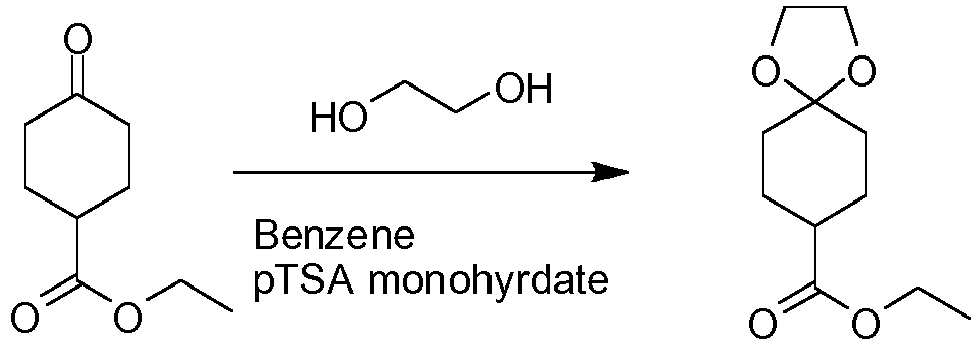
- Ethyl 4-oxocyclohexane carboxylate (122.56 mmol, 20.86 g) and para-toluenesulfonic acid monohydrate (12.56 mmol, 2.33 g) are charged to a 1000 mL roundbottom flask. To this flask was added benzene (300 mL) followed by ethylene glycol (0.37 mol, 20.5 mL). The resulting bi-layer reaction mixture was refluxed overnight in a Dean-Stark trap. Upon cooling, the reaction mixture was diluted in 300 mL DCM and washed with 300 mL saturated NaHCO3(aq). The acqueous layer was washed with DCM (3X) and the combined organics are dried over Na2SO4. The residue was disolved in DCM and purified by silica gel chromatography on 0% to 50% ethyl acetate in hexanes gradient. The product is tracked via PMA stain. Chromatography yields 17.05 grams (79.58 mmol, 65% yield) ethyl 1,4-dioxaspiro[4.5]decane-8-carboxylate.
-

- Ethyl 1,4-dioxaspiro[4.5]decane-8-carboxylate (79.58 mmol, 17.05 g) is taken up in 300 mL 2:1 THF:H2O in 500 mL roundbottom flask. Lithium hydroxide monohydrate (120 mmol, 5.01 g) and 100 mL MeOH were added to this solution. The reaction mixture was allowed to stir overnight at room temperature. The reaction mixture was acidified to pH 3 with 1N HCl(aq) and extracted with 100 mL DCM (x5). The combined organics were combined and then dried over Na2SO4, and the solvent was removed in vacuo to yield 1,4-dioxaspiro[4.5]decane-8-carboxylic acid (14.96 g, 100% yield) as white solid.
-

- 1,4-Dioxaspiro[4.5]decane-8-carboxylic acid (80.34 mmol, 14.96 g) is charged to a 500 mL roundbottom flask. To this flask is added anhydrous THF (200 mL), followed by N, N'-carbonyldiimidazole (96.41 mmol, 15.63 g). After vigorous release of CO2 gas, the solution was flushed with argon, sealed, and allowed to stir overnight at room temperature under argon.
- After 18 hours, in a separate, sealed and argon-flushed 1000 mL roundbottom flask, LiHMDS (1.0 M in THF, 168.7 mmol) is added to 200 mL anhydrous THF stirring at -78° C. To this solution is added dropwise anhydrous ethyl acetate (173 mmol, 16.9 mL). This solution is allowed to stir at -78° C for 1 hour prior to dropwise addition of original CDI/acid solution that has been stirred overnight. The reaction mixture was allowed to stir and warm to room temperature overnight.
- The reaction was then quenched with saturated NH4Cl(aq) (500 mL) and extracted with Et2O (x2). The combined organics are then washed with H2O, saturated brine, and dried over Na2SO4. The solvent is removed in vacuo and the residue is taken up in DCM. The reaction mixture was purified with silica gel chromatography (0% to 60% ethyl acetate in hexanes gradient) to yield ethyl 3-oxo-3-(1,4-dioxaspiro[4.5]decan-8-yl)propanoate (11.26 g, 55% yield) as pale yellow oil.
-

- To a 20 mL scintillation vial containing ethyl 3-oxo-3-(1,4-dioxaspiro[4.5]decan-8-yl)propanoate (11.7 mmol, 3.00 g) is added 3-amino-1H-pyrazole (11.7 mmol, 973 mg). The two oils were mixed and heated neat at 100° C for 3 hours. The resulting off-white solid was dissolved up in EtOH (100 mL) and reduced in vacuo to remove water formed during cyclization. This solid was used in the next step without further purification.
-

- 5-(1,4-dioxaspiro[4.5]decan-8-yl)pyrazolo[1,5-a]pyrimidin-7-ol (11.7 mmol) is charged to 250 mL roundbottom flask. To this flask is added 4 mL N, N-dimethylaniline, followed by 40 mL POCl3. This suspension was sonicated to break up the starting material and stirred at room temperature for 18 hours. After 18 hours, a solution formed. The solution was reduced in vacuo and cooled to 0° C in ice bath. The reaction is then quenched with sat. NaHCO3(aq) and extracted with DCM (x3). The combined organics are dried with Na2SO4 and the solvent was removed in vacuo. The resulting oil was purified via silica gel column on 20% to 100% ethyl acetate in hexanes gradient to yield 7-chloro-5-(1,4-dioxaspiro[4.5]decan-8-yl)pyrazolo[1,5-a]pyrimidine (2.65 grams, 77% across 2 steps) as white solid.
-

- 7-chloro-5-(1,4-dioxaspiro[4.5]decan-8-yl)pyrazolo[1,5-a]pyrimidine (5.58 mmol, 1.64 g) is charged to 10-20 mL microwave vessel. To this vessel is added 10 mL ∼7N NH3 in methanol. The vessel was sealed and heated at 100° C for 18 hours. After 18 hours, the reaction mixture was cooled to room temperature and diluted with 100 mL DCM. The resulting solution is washed with saturated NaHCO3(aq) and extracted with DCM twice more. The combined organics were dried over Na2SO4 and the solvent removed in vacuo to yield 5-(1,4-dioxaspiro[4.5]decan-8-yl)pyrazolo[1,5-a]pyrimidin-7-amine (1.52 g, 99% yield) as pale orange solid.
-

- In a 40 mL scintillation vial is combined 5-(1,4-dioxaspiro[4.5]decan-8-yl)pyrazolo[1,5-a]pyrimidin-7-amine (5.54 mmol, 1.52 g), EtOH (10 mL), H2O (4 mL) and 4N HCl:dioxane (4 mL). The vial was capped, sealed and the reaction was heated to 80° C overnight. After 18 hours, the reaction mixture was cooled to room temperature and diluted with DCM (100 mL). The solution was washed with saturated NaHCO3(aq) and extracted with DCM twice more. The combined organics are dried over Na2SO4 and the solvent removed in vacuo to yield 4-(7-aminopyrazolo[1,5-a]pyrimidin-5-yl)cyclohexanone (1.18 g, 93% yield) as pale orange solid.
-

- 4-(7-aminopyrazolo[1,5-a]pyrimidin-5-yl)cyclohexanone (5.12 mmol, 1.18 g) was dissolved in DCM (15 mL). To this solution was added N, N'-diisopropylethylamine (17.94 mmol, 3.13 mL). The resulting solution was stirred at room temperature while 2-(trimethylsilyl)ethoxymethyl chloride (SEM-Cl, 17.94 mL, 3.17 mL) in DCM (5 mL) was added dropwise. After the addition was completed, the reaction mixture was stirred at 50° C for 10 minutes. The solvent was removed in vacuo, and the residue was purified on silica gel column (0% to 60% ethyl acetate in hexanes gradient) to yield 4-(7-(bis((2-(trimethylsilyl)ethoxy)methyl)amino)pyrazolo[1,5-a]pyrimidin-5-yl)cyclohexanone (1.87 g, 74% yield) as pale yellow oil.
-

- A 20 mL scintillation vial containing 5 mL THF was charged sodium hydride (60% w/w in mineral oil, 448 µmol, 18 mg). This suspension was broken up via sonication. Triethyl phosphonoacetate (448 µmol, 89.3 µL) in THF (2 mL) was added dropwise. The resulting solution was stirred at room temperature for 10 minutes. To this solution was slowly added a solution of 4-(7-(bis((2-(trimethylsilyl)ethoxy)methyl)amino)pyrazolo[1,5-a]pyrimidin-5-yl)cyclohexanone (408 µmol, 200 mg) in THF (2 mL). The reaction mixture was stirred for 18 hours at room temperature. After 18 hours, the reaction mixture was diluted with DCM (25 mL) and washed with H2O. The aqueous phase was washed with DCM (x2), and the combined organics was dried over Na2SO4. The solvent was removed in vacuo to yield ethyl 2-(4-(7-(bis((2-(trimethylsilyl)ethoxy)methyl)amino)pyrazolo[1,5-a]pyrimidin-5-yl)cyclohexylidene)acetate (222 mg, 97% yield) as pale yellow oil.
-

- 2-(4-(7-(Bis((2-(trimethylsilyl)ethoxy)methyl)amino)pyrazolo[1,5-a]pyrimidin-5-yl)cyclohexylidene)acetonitrile was synthesized in a manner similar to the synthesis of ethyl 2-(4-(7-(bis((2-(trimethylsilyl)ethoxy)methyl)amino)pyrazolo[1,5-a]pyrimidin-5-yl)cyclohexylidene)acetate, but with diethyl cyanomethylphosphonate substituted for triethyl phosphonoacetate.
-

- To a 50 mL roundbottom flask was charged ethyl 2-(4-(7-(bis((2-(trimethylsilyl)ethoxy)-methyl)amino)pyrazolo[1,5-a]pyrimidin-5-yl)cyclohexylidene)acetate (800 mg, 1.43 mmol) and ethyl acetate (15 mL). The flask was flushed with argon, and 5% palladium on carbon (100 mg) was added. The flask was sealed and degassed under vacuum. Hydrogen gas was then added via balloon. The reaction was stirred under a hydrogen atmosphere for 18 hours. The reaction was then filtered through celite to yield ethyl 2-(4-(7-(bis((2-(trimethylsilyl)ethoxy)methyl)amino)pyrazolo[1,5-a]pyrimidin-5-yl)cyclohexyl)acetate (761 mg, 1.35 mmol, 95% yield) as pale yellow oil.
-

- 2-(4-(7-(Bis((2-(trimethylsilyl)ethoxy)methyl)amino)pyrazolo[1,5-a]pyrimidin-5-yl)cyclohexyl)acetonitrile was synthesized in a manner similar to the synthesis of ethyl 2-(4-(7-(bis((2-(trimethylsilyl)ethoxy)methyl)amino)pyrazolo[1,5-a]pyrimidin-5-yl)cyclohexyl)acetate, but with 2-(4-(7-(bis((2-(trimethylsilyl)ethoxy)methyl)amino)pyrazolo[1,5-a]pyrimidin-5-yl)cyclohexylidene)acetonitrile substituted for ethyl 2-(4-(7-(bis((2-(trimethylsilyl)ethoxy)methyl)amino)pyrazolo[1,5-a]pyrimidin-5-yl)cyclohexylidene)acetate.
-

- A 50 mL roundbottom flask was charged ethyl 2-(4-(7-(bis((2-(trimethylsilyl)ethoxy)-methyl)amino)pyrazolo[1,5-a]pyrimidin-5-yl)cyclohexyl)acetate (381 mg, 0.68 mmol) and acetonitrile (10 mL). To this solution was added N-Iodosuccinimide (167 mg, 0.74 mmol). The reaction mixture was stirred at room temperature for 18 hours. The reaction mixture was concentrated in vacuo and the crude oil was purified via silica gel chromatography (0% to 30% ethyl acetate in hexanes gradient) to yield ethyl 2-(4-(7-(bis((2-(trimethylsilyl)ethoxy)methyl)amino)-3-iodopyrazolo[1,5-a]pyrimidin-5-yl)cyclohexyl)acetate (335 mg, 0.49 mmol, 72% yield) as clear oil.
-

- 2-(4-(7-(bis((2-(trimethylsilyl)ethoxy)methyl)amino)-3-iodopyrazolo[1,5-a]pyrimidin-5-yl)cyclohexyl)acetonitrile was synthesized in a manner similar to the synthesis of ethyl 2-(4-(7-(bis((2-(trimethylsilyl)ethoxy)methyl)amino)-3-iodopyrazolo[1,5-a]pyrimidin-5-yl)cyclohexyl)acetate, but with 2-(4-(7-(bis((2-(trimethylsilyl)ethoxy)methyl)amino)pyrazolo[1,5-a]pyrimidin-5-yl)cyclohexyl)acetonitrile substituted for ethyl 2-(4-(7-(bis((2-(trimethylsilyl)ethoxy)methyl)amino)pyrazolo[1,5-a]pyrimidin-5-yl)cyclohexyl)acetate.
-

- To a 40 mL scintillation vial was charged 3-quinoline boronic acid (0.73 mmol, 127 mg), K3PO4 (1.46 mmol, 310 mg) and PdCl2(dppf) · CH2Cl2 (.049 mmol, 40 mg). To this mixture was added a solution of ethyl 2-(4-(7-(bis((2-(trimethylsilyl)ethoxy)methyl)amino)-3-iodopyrazolo[1,5-a]pyrimidin-5-yl)cyclohexyl)acetate (335 mg, 0.49 mmol) in dioxane (9 mL). To this suspension was added distilled H2O (1 mL). The resulting solution was stirred at 100° C for 18 hours. The reaction was concentrated in vacuo and then purified via silica gel chromatography (0% to 60% ethyl acetate in hexanes gradient) to yield ethyl 2-(4-(7-(bis((2-(trimethylsilyl)ethoxy)methyl)amino)-3-(quinolin-3-yl)pyrazolo[1,5-a]pyrimidin-5-yl)cyclohexyl)acetate (198 mg, 287 µmol, 59% yield) as yellow oil.
-

- 2-(4-(7-(bis((2-(trimethylsilyl)ethoxy)methyl)amino)-3-(quinolin-3-yl)pyrazolo[1,5-a]pyrimidin-5-yl)cyclohexyl)acetonitrile was synthesized in a manner similar to the synthesis of ethyl 2-(4-(7-(bis((2-(trimethylsilyl)ethoxy)methyl)amino)-3-(quinolin-3-yl)pyrazolo[1,5-a]pyrimidin-5-yl)cyclohexyl)acetate, but with 2-(4-(7-(bis((2-(trimethylsilyl)ethoxy)methyl)amino)-3-iodopyrazolo[1,5-a]pyrimidin-5-yl)cyclohexyl)acetonitrile substituted for ethyl 2-(4-(7-(bis((2-(trimethylsilyl)ethoxy)methyl)amino)-3-iodopyrazolo[1,5-a]pyrimidin-5-yl)cyclohexyl)acetate.
-

- To a 25 mL roundbottom flask was charged ethyl 2-(4-(7-(bis((2-(trimethylsilyl)ethoxy)-methyl)amino)-3-(quinolin-3-yl)pyrazolo[1,5-a]pyrimidin-5-yl)cyclohexyl)acetate (198 mg, 287 µmol) and acetonitrile (10 mL). To this solution was added N-bromosuccinimide (56 mg, 316 µmol). The resulting reaction mixture was stirred at room temperature for 1 hour. The reaction mixture was concentrated in vacuo and the resulting oil was then purified via silica gel chromatography (0% to 30% ethyl acetate in hexanes gradient) to yield ethyl 2-(4-(7-(bis((2-(trimethylsilyl)ethoxy)methyl)amino)-6-bromo-3-(quinolin-3-yl)pyrazolo[1,5-a]pyrimidin-5-yl)cyclohexyl)acetate (205 mg, 266 µmol, 93% yield) as yellow oil.
-

- 2-(4-(7-(bis((2-(trimethylsilyl)ethoxy)methyl)amino)-6-bromo-3-(quinolin-3-yl)pyrazolo[1,5-a]pyrimidin-5-yl)cyclohexyl)acetonitrile was synthesized in a manner similar to the synthesis of ethyl 2-(4-(7-(bis((2-(trimethylsilyl)ethoxy)methyl)amino)-6-bromo-3-(quinolin-3-yl)pyrazolo[1,5-a]pyrimidin-5-yl)cyclohexyl)acetate, but with 2-(4-(7-(bis((2-(trimethylsilyl)ethoxy)methyl)amino)-3-(quinolin-3-yl)pyrazolo[1,5-a]pyrimidin-5-yl)cyclohexyl)acetonitrile substituted ethyl 2-(4-(7-(bis((2-(trimethylsilyl)ethoxy)methyl)amino)-3-(quinolin-3-yl)pyrazolo[1,5-a]pyrimidin-5-yl)cyclohexyl)acetate.
-

- To a 20 mL scintillation vial was charged ethyl 2-(4-(7-(bis((2-(trimethylsilyl)ethoxy)-methyl)amino)-6-bromo-3-(quinolin-3-yl)pyrazolo[1,5-a]pyrimidin-5-yl)cyclohexyl)acetate (100 mg, 130 µmol) and 2:1 THF:H2O (10 mL). To this solution was added 1N LiOH(aq) (200 µL). The resulting reaction mixture was stirred at room temperature for 18 hours. The reaction mixture was concentrated in vacuo and the resulting residue was dissolved in TFA and stirred at room temperature for 1 hour. This solution was concentrated in vacuo and the residue was dissolved in 3:1 DMSO:MeCN. The crude product was purified via reverse-phase preparatory HPLC to yield 2-(4-(7-amino-6-bromo-3-(quinolin-3-yl)pyrazolo[1,5-a]pyrimidin-5-yl)cyclohexyl)acetic acid (m+H = 480.1, retention time = 3.95 min (isomer 1) and 4.03 min (isomer 2))
-

- 2-(4-(7-amino-6-bromo-3-(quinolin-3-yl)pyrazolo[1,5-a]pyrimidin-5-yl)cyclohexyl)acetic acid is taken up in 9:1 MeOH:TFA. The mixture is eluted through chiral column to yield two single isomers. (m+H = 480.1, 10 min. RP HPLC Ret(iso1): 4.03 min., 10 min. RP HPLC Ret(iso2): 3.95 min.)
-

- 2-(4-(7-amino-6-bromo-3-(quinolin-3-yl)pyrazolo[1,5-a]pyrimidin-5-yl)cyclohexyl)acetonitrile (44 µmol, 32 mg) is disolved in 1 mL TFA in a 20 mL scintillation vial. The reaction mixture is allowed to stir 1 hour at room temperature. The reaction mixture is concentrated in vacuo and purified via reverse-phase preparatory HPLC to yield 2-(4-(7-amino-6-bromo-3-(quinolin-3-yl)pyrazolo[1,5-a]pyrimidin-5-yl)cyclohexyl)acetonitrile as a two-isomer mixture. (m+H = 461.2, retention time = 4.13 min (isomer 1) and 4.18 min (isomer 2))
-

- To a solution of 2-(4-(7-(bis((2-(trimethylsilyl)ethoxy)methyl)amino)-3-(quinolin-3-yl)pyrazolo[1,5-a]pyrimidin-5-yl)cyclohexyl)acetonitrile (28 mg, 0.044 mmol) in dioxane (0.50 mL) was added azotributyltin azide (22 mg, 0.066 mmol). The mixture was heated at 105 °C for 20 h. The tin reagent was removed by a short column and the fraction containing the desired product was collected and concentrated in vacuo. The residue was dissolved in CH3CN and NBS (2.0 mg) was added. The mixture was stirred at rt for 1 h and concentrated in vacuo. The residue was purified by prep-LC to give the tran-isomer and the cis-isomer of the title compounds.
LC/MS RT = 3.53 min (trans), 3.73 min (cis). Mass calculated for, M+H 504.12, observed 504.12. - By essentially the same procedures given in the complete synthesis of 2-(4-(7-amino-6-bromo-3-(quinolin-3-yl)pyrazolo[1,5-a]pyrimidin-5-yl)cyclohexyl)acetonitrile, but with cis/trans isomers separated on silica gel after hydrogen reduction. By essentially the same procedure given in Scheme 6, the compounds listed in Table 5 can be prepared.
Table 5 Compound ID Structures M+H (Cal.) M+H (observed) Retention Time, (min) 5.1 
461.4 461.2 4.24 5.2 
461.10 461.2 4.24 5.3 
504.12 504.12 3.73 5.4 
480.4 480.1 3.95 5.7 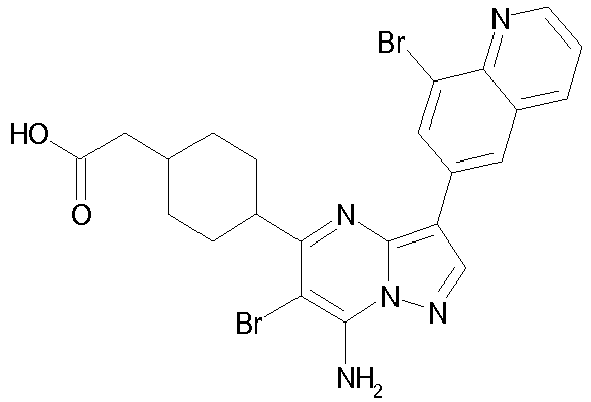
558.01 558.01 4.49 5.8 
514.06 514.06 3.95 5.12 
494.11 494.2 4.05 5.13 
523.14 523.25 4.18 -

- 4-Pyridine boronic acid (0.156 mmol, 20 mg), K2CO3 (0.234 mmol, 33 mg), and Pd(PPh3)4 (0.008 mmol, 10 mg) was added to a solution of (4-{7-[bis-(2-trimethylsilanyl-ethoxymethyl)-amino]-6-bromo-3-quinolin-3-yl-pyrazolo[1,5-a]pyrimidin-5-yl}-cyclohexyl)-acetic acid ethyl ester (0.078 mmol, 60 mg) in dioxane (1 mL). To this suspension was added distilled H2O (0.2 mL). The resulting reaction mixture was stirred at 100° C under argon for 18 hours. The reaction mixture was concentrated in vacuo. The crude mixture was dissolved in 2:1 MeOH:H2O (1.5 mL) and was treated with 2N NaOH(aq) (0.5 mL). The resulting reaction mixture was stirred at room temperature for 18 hours. Aqueous hydrochloride solution (1.0 N, 2 ml) was added to the reaction mixture and the resulting solution was stirred at 65 °C for 2 h. The solution was concentrated in vacuo and purified by prep-LC to afford the title compound (3.6 mg) as a mixture of cis and trans isomers: LC/MS RT = 2.84 min. Mass calculated for, M+H 479.21, observed 479.21.
- A degassed mixture of (4-{7-[bis-(2-trimethylsilanyl-ethoxymethyl)-amino]-6-bromo-3-quinolin-3-yl-pyrazolo[1,5-a]pyrimidin-5-yl}-cyclohexyl)-acetic acid ethyl ester (0.078 mmol, 60 mg), Bu3SnCN (50 mg, 0.156 mmoL), Pd[P(t-Bu)3]2 (8.3 mg, 0.016 mmoL) in Dioxane (1 mL) was heated at 100°C for 18 h. The reaction mixture was concentrated in vacuo. The crude mixture was dissolved in 2:1 MeOH:H2O (1.5 mL) and was treated with 2N NaOH(aq) (0.5 mL). The resulting reaction mixture was stirred at room temperature for 18 hours. Aqueous hydrochloride solution (1.0 N, 2 ml) was added to the reaction mixture and the resulting solution was stirred at 65 °C for 2 h. The solution was concentrated and purified by prep-LC to afford the title compound (8.8 mg) as a mixture of cis and trans isomers: LC/MS RT = 3.88 min. Mass calculated for, M+H 427.18, observed 427.18.
- By essentially the same procedure given in Scheme 7, the compounds listed in Table 6 can be prepared.
Table 6 Compound ID Structures M+H (calc.) M+H (observed) Retention Time, (min) 6.1 
479.21 479.21 2.84 6.2 
496.21 496.21 4.32 6.3 
478.22 478.22 4.12 6.4 
484.17 484.17 4.02 6.5 
482.22 482.22 3.40 6.6 
427.18 427.18 3.49 
-

- A mixture of 2-(4-(7-(bis((2-(trimethylsilyl)ethoxy)methyl)amino)-6-bromo-3-(quinolin-3-yl)pyrazolo[1,5-a]pyrimidin-5-yl)cyclohexyl)acetic acid (60 mg, 0.081 mmol), methanesulfonamide (12 mg, 0.122 mmol), 4-dimethylaminopyridine (20 mg, 0.163 mmol) and 1-ethyl-3-(3-dimethylaminopropyl)carbodiimide hydrochloride (32 mg, 0.163 mmol) in dichloromethane (2.0 ml) was stirred at room temperature for 16 h. The reaction mixture was concentrated in vacuo. The crude mixture was dissolved in methanol (2 ml) and treated with 1N hydrochloride solution (2 ml) at 65 °C for 2 h. The reaction solution was concentrated and purified by prep-LC to afford the title compound (two isomers, cis and trans). Isomer 1: LC/MS RT = 3.63 min. Mass calculated for, M+H 557.09, observed 557.09. Isomer 2: LC/MS RT = 3.88 min. Mass calculated for, M+H 557.09, observed 557.09.
- By essentially the same procedure given in Scheme 22, the compounds listed in Table 7 can be prepared.
TABLE- 7 Compound ID Structures M+H (calc.) M+H (observed) Retention Time, (min) 7.1 
557.09 557.09 3.63 7.2 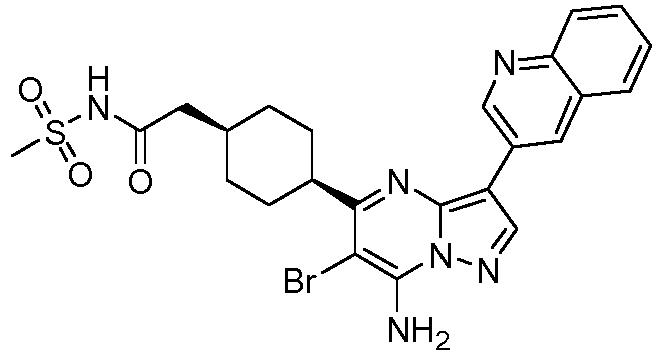
557.09 557.09 3.88 7.3 
583.11 583.11 4.07 7.4 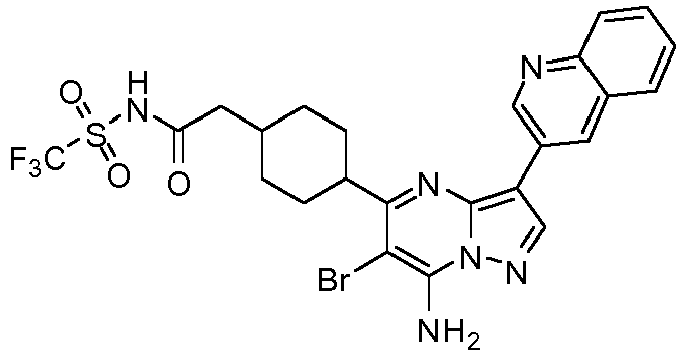
611.06 611.06 Isomer 1: 4.33 Isomer 2: 4.55 7.5 
557.0 557.0 3.88 -

- To a pressure vial was charged (S)-ethyl 2-((1s,4R)-4-(7-(bis((2-(trimethylsilyl)ethoxy)methyl)amino)-6-bromo-3-(6-phenylpyridin-3-yl)pyrazolo[1,5-a]pyrimidin-5-yl)cyclohexyl)-2-fluoroacetate (0.32 mmol, 263 mg), tetrakis(triphenylphosphine)palladium(0) (0.032 mmol, 37 mg), 1,4-dioxane (5 mL), and tributyl(1-ethoxyvinyl)tin (0.97 mmol, 329 µL). The vessel was flushed with argon, sealed, and the reaction stirred at 100° C for 18 hours. At 18 hours, the solvent was removed in vacuo and the residue purified via flash chromatography to yield the title compound.
-

- To a 50 mL roundbottom flask is charged ethyl 7-(bis((2-(trimethylsilyl)ethoxy)methyl)amino)-5-((1 R,4s)-4-((S)-2-ethoxy-1-fluoro-2-oxoethyl)cyclohexyl)-3-(6-phenylpyridin-3-yl)pyrazolo[1,5-a]pyrimidine-6-carboxylate (0.29 mmol, 236 mg), a solution of 2:1 THF:H2O (9 mL), and 1N LiOH(aq) (0.59 mmol, 0.59 mL). The resulting solution was stirred at room temperature for 2 hours. The reaction was then acidified to pH ∼ 4 with 1N HCl(aq) and the solvent removed in vacuo. This residue was dissolved in 10 mL 1,4-dioxane. To this solution was added H2O (3 mL) followed by 4N HCl:dioxane (5 mL). This solution was stirred at room temperature for 18 hours. After 18 hours, the solvent was removed in vacuo and the residue purified via reverse-phase HPLC to yield (S)-2-((1s,4R)-4-(6-acetyl-7-amino-3-(6-phenylpyridin-3-yl)pyrazolo[1,5-a]pyrimidin-5-yl)cyclohexyl)-2-fluoroacetic acid (m+H = 488.62, retention time = 3.71 min).
-

- (S)-2-((1s,4R)-4-(6-acetyl-7-amino-3-(6-(1-(2-hydroxyethyl)-1H-pyrazol-4-yl)pyridin-3-yl)pyrazolo[1,5-a]pyrimidin-5-yl)cyclohexyl)-2-fluoroacetic acid was synthesized in the manner previously described. (m+H = 521.22, retention time = 3.01 min).
-

- To a 50 mL roundbottom flask was charged (S)-ethyl 2-((1s,4R)-4-(7-(bis((2-(trimethylsilyl)ethoxy)methyl)amino)-3-(6-phenylpyridin-3-yl)pyrazolo[1,5-a]pyrimidin-5-yl)cyclohexyl)-2-fluoroacetate (0.27 mmol, 200 mg), 1,4-dioxane (5 mL), H2O (1 mL), and 4N HCI in 1,4-dioxane. The resulting solution was stirred at room temperature for 5 days. At day 5, the solvent was removed in vacuo and the residue taken on without further purification.
-

- To a 50 mL roundbottom flask was charged (S)-2-((1s,4R)-4-(7-amino-3-(6-phenylpyridin-3-yl)pyrazolo[1,5-a]pyrimidin-5-yl)cyclohexyl)-2-fluoroacetic acid hydrochloride (0.27 mmol), DMF (8 mL), and N-chlorosuccinimide (0.30 mmol, 40 mg). The resulting solution was stirred at room temperature for 18 hours. At 18 hours, the solvent was removed in vacuo. The resulting residue was purified via reverse-phase HPLC to yield (S)-2-((1s,4R)-4-(7-amino-6-chloro-3-(6-phenylpyridin-3-yl)pyrazolo[1,5-a]pyrimidin-5-yl)cyclohexyl)-2-fluoroacetic acid (m+H = 480.02, retention time = 4.02 min).
-
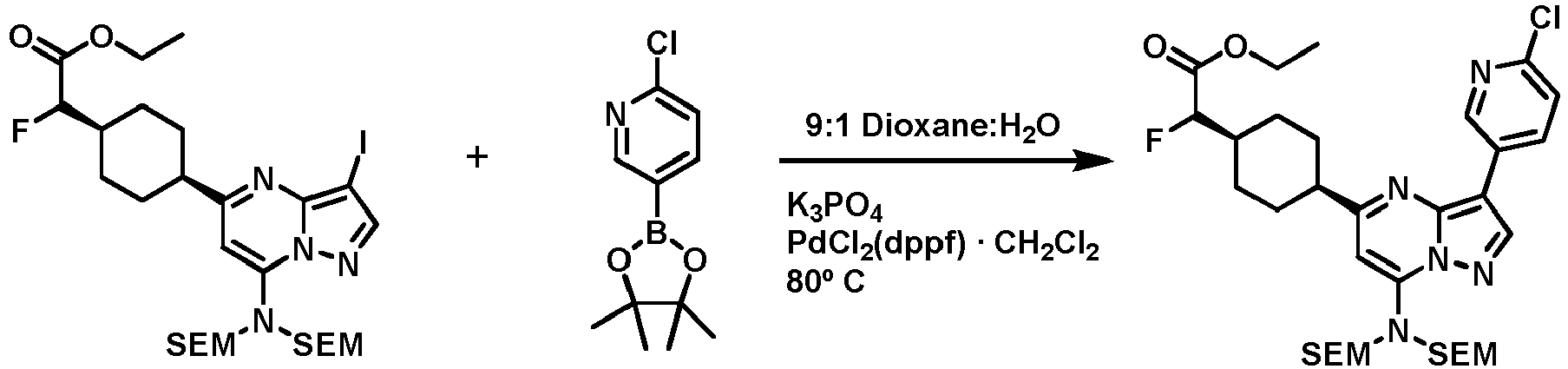
- (S)-ethyl 2-((1s,4R)-4-(7-(bis((2-(trimethylsilyl)ethoxy)methyl)amino)-3-(6-chloropyridin-3-yl)pyrazolo[1,5-a]pyrimidin-5-yl)cyclohexyl)-2-fluoroacetate is synthesized in a manner similar to the sythesis of (S)-ethyl 2-((1s,4R)-4-(7-(bis((2-(trimethylsilyl)ethoxy)methyl)amino)-3-(6-phenylpyridin-3-yl)pyrazolo[1,5-a]pyrimidin-5-yl)cyclohexyl)-2-fluoroacetate, but with 6-chloropyridine-3-boronic acid pinacol ester substituted for 6-phenylpyridine-3-boronic acid pinacol ester.
-

- To a 2-5 mL microwave vessel was charged (S)-ethyl 2-((1s,4R)-4-(7-(bis((2-(trimethylsilyl)ethoxy)methyl)amino)-3-(6-chloropyridin-3-yl)pyrazolo[1,5-a]pyrimidin-5-yl)cyclohexyl)-2-fluoroacetate (0.22 mmol, 150 mg), acetonitrile (3 mL), 2-(tributylstannyl)pyrimidine (0.65 mmol, 240 mg), and tetrakis(triphenylphosphine)palladium(0) (0.02 mmol, 25 mg). The vessel was flushed with argon, sealed and heated to 150° C for 40 minutes in microwave synthesizer. Upon completion, the solvent was removed in vacuo and the residue purified by flash chromatography to yield the title compound.
-

- (S)-2-((1s,4R)-4-(7-amino-6-bromo-3-(6-(pyrimidin-2-yl)pyridin-3-yl)pyrazolo[1,5-a]pyrimidin-5-yl)cyclohexyl)-2-fluoroacetic acid is synthesized in a manner similar to the sythesis of (S)-2-((1s,4R)-4-(7-amino-6-bromo-3-(6-phenylpyridin-3-yl)pyrazolo[1,5-a]pyrimidin-5-yl)cyclohexyl)-2-fluoroacetic acid (m+H = 524.80, retention time = 3.70 min).
- The following compounds (Table-7B) were synthesized using essentially the same procedures used for the total synthesis of (S)-2-((1s,4R)-4-(7-amino-6-bromo-3-(6-(pyrimidin-2-yl)pyridin-3-yl)pyrazolo[1,5-a]pyrimidin-5-yl)cyclohexyl)-2-fluoroacetic acid:
TABLE-7B Compound ID Structures M+H (calc.) M+H (observed) Retention Time, (min) 7.2.5 
524.10 524.78 3.71 -

- Compound, (1r,4r)-tert-butyl 4-(7-(bis((2-(trimethylsilyl)ethoxy)methyl)amino)-3-(1-phenyl-1H-pyrazol-4-yl)pyrazolo[1,5-a]pyrimidin-5-yl)cyclohexanecarboxylate was prepared from compound (1r,4r)-tert-butyl 4-(7-(bis((2-(trimethylsilyl)ethoxy)methyl)amino)-3-iodopyrazolo[1,5-a]pyrimidin-5-yl)cyclohexanecarboxylate and 1-phenyl-4-(4,4,5,5-tetramethyl-1,3,2-dioxaborolan-2-yl)-1H-pyrazole using the coupling conditions described in Part G of Example 8 (68%). HPLC-MS TR = 3.13 min (UV 254 nm, 5 min method); mass calculated for formula C38H58N6O4Si2 718.4, observed LCMS m/z 719.3 (M+H).
- To a solution of compound (1r,4r)-tert-butyl 4-(7-(bis((2-(trimethylsilyl)ethoxy)methyl)amino)-3-(1-phenyl-1H-pyrazol-4-yl)pyrazolo[1,5-a]pyrimidin-5-yl)cyclohexanecarboxylate (1.68 mmol, 1.21 g) in THF (20 mL) at 0 °C was added lithium aluminum hydride solution (1.68 mL, 2.0 M in THF). The resulting reaction mixture was slowly warmed to rt and stirred for 1 h. The reaction quenched with 3 N NaOH and filtered. The filtrate and washes were combined and concentrated. The crude product was purified by a SiO2 column (0-40% EtOAc/Hexanes, Rf = 0.7 in 50% EtOAc) to afford compound, ((1r,4r)-4-(7-(bis((2-(trimethylsilyl)ethoxy)methyl)amino)-3-(1-phenyl-1H-pyrazol-4-yl)pyrazolo[1,5-a]pyrimidin-5-yl)cyclohexyl)methanol, as a pale yellow solid (923 mg, 85%). HPLC-MS TR = 3.08 min (UV 254 nm, 5 min method); mass calculated for formula C34H52N6O3Si2 648.4, observed LCMS m/z 649.3 (M+H).
- To a solution of compound, ((1r,4r)-4-(7-(bis((2-(trimethylsilyl)ethoxy)methyl)amino)-3-(1-phenyl-1H-pyrazol-4-yl)pyrazolo[1,5-a]pyrimidin-5-yl)cyclohexyl)methanol (1.42 mmol, 920 mg) in DCM (10 mL) was added TEA (4.26 mmol, 0.594 mL), followed by MsCl (2.13 mmol, 0.165 mL) at 0 °C and stirred for 1 h. The reaction mixture was washed with H2O and brine, dried over Na2SO4, and concentrated. The crude product was purified by a SiO2 column (0-30% EtOAc/Hexanes, Rf = 0.8 in 50% EtOAc) to afford compound, ((lr,4r)-4-(7-(bis((2-(trimethylsilyl)ethoxy)methyl)amino)-3-(1-phenyl-1H-pyrazol-4-yl)pyrazolo[1,5-a]pyrimidin-5-yl)cyclohexyl)methylmethanesulfonate, as a pale yellow oil (949 mg, 92%).
- A mixture compound((1r,4r)-4-(7-(bis((2-(trimethylsilyl)ethoxy)methyl)amino)-3-(1-phenyl-1H-pyrazol-4-yl)pyrazolo[1,5-a]pyrimidin-5-yl)cyclohexyl)methyl methanesulfonate (1.31 mmol, 949 mg) and NaSMe (2.61 mmol, 183 mg) in DMF (5 mL) was heated at 80 °C for 3 d. The reaction mixture was diluted with EtOAc, washed with H2O and brine, dried over Na2SO4, and concentrated. The crude product was purified by a SiO2 column (0-20% EtOAc/Hexanes, Rf = 0.5 in 20% EtOAc) to afford compound, 5-((1r,4r)-4-(methylthiomethyl)cyclohexyl)-3-(1-phenyl-1H-pyrazol-4-yl)-N,N-bis((2-(trimethylsilyl)ethoxy)methyl)pyrazolo[1,5-a]pyrimidin-7-amine, as a pale yellow oil (804 mg, 90%). HPLC-MS TR = 3.59 min (UV 254 nm, 5 min method); mass calculated for formula C35H54N6O2SSi2 678.4, observed LCMS m/z 679.3 (M+H).
- To a solution of compound, 5-((1r,4r)-4-(methylthiomethyl)cyclohexyl)-3-(1-phenyl-1H-pyrazol-4-yl)-N,N-bis((2-(trimethylsilyl)ethoxy)methyl)pyrazolo[1,5-a]pyrimidin-7-amine (1.18 mmol, 804 mg) in DCM (10 mL) was added mCPBA (2.83 mmol, 699 mg) and the resulting mixture was stirred at rt for overnight. The reaction was quenched with Na2S2O3 (aq.) and diluted with DCM (10 mL). The separated organic layer was washed with NaHCO3 (2*) and brine, dried over Na2SO4, and concentrated. The crude product was purified by a SiO2 column (0-40% EtOAc/Hexanes, Rf = 0.45 in 50% EtOAc) to afford compound, 5-((lr,4r)-4-(methylsulfonylmethyl)cyclohexyl)-3-(1-phenyl-1H-pyrazol-4-yl)-N,N-bis((2-(trimethylsilyl)ethoxy)methyl)pyrazolo[1,5-a]pyrimidin-7-amine, as a pale yellow oil (446 mg, 53%). HPLC-MS TR = 2.99 min (UV 254 nm, 5 min method); mass calculated for formula C35H54N6O4SSi2 710.3, observed LCMS m/z 711.2 (M+H).
- By essentially the same procedures given in Preparative earliar Example compound, 1-(7-amino-5-((1r,4r)-4-(methylsulfonylmethyl)cyclohexyl)-3-(1-phenyl-1H-pyrazol-4-yl)pyrazolo[1,5-a]pyrimidin-6-yl)ethanone was prepared from compound, 5-((1r,4r)-4-(methylsulfonylmethyl)cyclohexyl)-3-(-phenyl-1H-pyrazol-4-yl)-N,N-bis((2-(trimethylsilyl)ethoxy)methyl)pyrazolo[1,5-a]pyrimidin-7-amine. HPLC-MS TR = 4.64 min (UV 254 nm, 10 min method); mass calculated for formula C25H28N6O3S, 492.2, observed LCMS m/z 493.1 (M+H).

-

- Ethyl 1,4-dioxaspiro[4.5]decane-7-carboxylate was synthesized in a manner similar to the synthesis of ethyl 1,4-dioxaspiro[4.5]decane-8-carboxylate, but with ethyl 3-oxocyclohexanecarboxylate substituted for ethyl 4-oxocyclohexanecarboxylate.
-

- Ethyl 1,4-dioxaspiro[4.4]nonane-7-carboxylate was synthesized in a manner similar to the synthesis of ethyl 1,4-dioxaspiro[4.5]decane-8-carboxylate, but with ethyl 3-oxocyclopentanecarboxylate substituted for ethyl 4-oxocyclohexanecarboxylate.
-

- 1,4-Dioxaspiro[4.5]decane-7-carboxylic acid was synthesized in a manner similar to the synthesis of 1,4-dioxaspiro[4.5]decane-8-carboxylic acid, but with ethyl 1,4-dioxaspiro[4.5]decane-7-carboxylate substituted for ethyl 1,4-dioxaspiro[4.5]decane-8-carboxylate.
-

- 1,4-dioxaspiro[4.4]nonane-7-carboxylic acid was synthesized in a manner similar to the synthesis of 1,4-dioxaspiro[4.5]decane-8-carboxylic acid, but with ethyl 1,4-dioxaspiro[4.4]nonane-7-carboxylate substituted for ethyl 1,4-dioxaspiro[4.5]decane-8-carboxylate.
-

- Ethyl 3-oxo-3-(1,4-dioxaspiro[4.5]decan-7-yl)propanoate was synthesized in a manner similar to the synthesis of ethyl 3-oxo-3-(1,4-dioxaspiro[4.5]decan-8-yl)propanoate, but with 1,4-dioxaspiro[4.5]decane-7-carboxylic acid substituted for 1,4-dioxaspiro[4.5]decane-8-carboxylic acid.
-

- Ethyl 3-oxo-3-(1,4-dioxaspiro[4.4]nonan-7-yl)propanoate was synthesized in a manner similar to the synthesis of ethyl 3-oxo-3-(1,4-dioxaspiro[4.5]decan-8-yl)propanoate, but with 1,4-dioxaspiro[4.4]nonane-7-carboxylic acid substituted for 1,4-dioxaspiro[4.5]decane-8-carboxylic acid.
-

- 5-(1,4-dioxaspiro[4.5]decan-7-yl)pyrazolo[1,5-a]pyrimidin-7-ol was synthesized in a manner similar to the synthesis of 5-(1,4-dioxaspiro[4.5]decan-8-yl)pyrazolo[1,5-a]pyrimidin-7-ol, but with ethyl 3-oxo-3-(1,4-dioxaspiro[4.5]decan-7-yl)propanoate substituted for ethyl 3-oxo-3-(1,4-dioxaspiro[4.5]decan-8-yl)propanoate.
-

- 5-(1,4-dioxaspiro[4.4]nonan-7-yl)pyrazolo[1,5-a]pyrimidin-7-ol was synthesized in a manner similar to the synthesis of 5-(1,4-dioxaspiro[4.5]decan-8-yl)pyrazolo[1,5-a]pyrimidin-7-ol, but with ethyl 3-oxo-3-(1,4-dioxaspiro[4.4]nonan-7-yl)propanoate substituted for ethyl 3-oxo-3-(1,4-dioxaspiro[4.5]decan-8-yl)propanoate.
-

- 7-Chloro-5-(1,4-dioxaspiro[4.5]decan-7-yl)pyrazolo[1,5-a]pyrimidine is synthesized in a manner similar to the synthesis of 7-chloro-5-(1,4-dioxaspiro[4.5]decan-8-yl)pyrazolo[1,5-a]pyrimidine, but with 5-(1,4-dioxaspiro[4.5]decan-7-yl)pyrazolo[1,5-a]pyrimidin-7-ol substituted for 5-(1,4-dioxaspiro[4.5]decan-8-yl)pyrazolo[1,5-a]pyrimidin-7-ol.
-

- 7-Chloro-5-(1,4-dioxaspiro[4.4]nonan-7-yl)pyrazolo[1,5-a]pyrimidine is synthesized in a manner similar to the synthesis of 7-chloro-5-(1,4-dioxaspiro[4.5]decan-8-yl)pyrazolo[1,5-a]pyrimidine, but with 5-(1,4-dioxaspiro[4.4]nonan-7-yl)pyrazolo[1,5-a]pyrimidin-7-ol substituted for 5-(1,4-dioxaspiro[4.5]decan-8-yl)pyrazolo[1,5-a]pyrimidin-7-ol.
-

- 5-(1,4-Dioxaspiro[4.5]decan-7-yl)pyrazolo[1,5-a]pyrimidin-7-amine is synthesized in a manner similar to the synthesis of 5-(1,4-dioxaspiro[4.5]decan-8-yl)pyrazolo[1,5-a]pyrimidin-7-amine, but with 7-chloro-5-(1,4-dioxaspiro[4.5]decan-7-yl)pyrazolo[1,5-a]pyrimidine substituted for 7-chloro-5-(1,4-dioxaspiro[4.5]decan-8-yl)pyrazolo[1,5-a]pyrimidine.
-

- 5-(1,4-Dioxaspiro[4.4]nonan-7-yl)pyrazolo[1,5-a]pyrimidin-7-amine was synthesized in a manner similar to the synthesis of 5-(1,4-dioxaspiro[4.5]decan-8-yl)pyrazolo[1,5-a]pyrimidin-7-amine, but with 7-chloro-5-(1,4-dioxaspiro[4.4]nonan-7-yl)pyrazolo[1,5-a]pyrimidine substituted for 7-chloro-5-(1,4-dioxaspiro[4.5]decan-8-yl)pyrazolo[1,5-a]pyrimidine.
-

- 3-(7-Aminopyrazolo[1,5-a]pyrimidin-5-yl)cyclohexanone was synthesized in a manner similar to the synthesis of 4-(7-aminopyrazolo[1,5-a]pyrimidin-5-yl)cyclohexanone, but 5-(1,4-dioxaspiro[4.5]decan-7-yl)pyrazolo[1,5-a]pyrimidin-7-amine substituted for 5-(1,4-dioxaspiro[4.5]decan-8-yl)pyrazolo[1,5-a]pyrimidin-7-amine.
-

- 3-(7-Aminopyrazolo[1,5-a]pyrimidin-5-yl)cyclopentanone was synthesized in a manner similar to the synthesis of 4-(7-aminopyrazolo[1,5-a]pyrimidin-5-yl)cyclohexanone, but 5-(1,4-dioxaspiro[4.4]nonan-7-yl)pyrazolo[1,5-a]pyrimidin-7-amine substituted for 5-(1,4-dioxaspiro[4.5]decan-8-yl)pyrazolo[1,5-a]pyrimidin-7-amine.
-

- 3-(7-(Bis((2-(trimethylsilyl)ethoxy)methyl)amino)pyrazolo[1,5-a]pyrimidin-5-yl)cyclohexanone was synthesized in a manner similar to the synthesis of 4-(7-(bis((2-(trimethylsilyl)ethoxy)methyl)amino)pyrazolo[1,5-a]pyrimidin-5-yl)cyclohexanone, but 3-(7-aminopyrazolo[1,5-a]pyrimidin-5-yl)cyclohexanone substituted for 4-(7-aminopyrazolo[1,5-a]pyrimidin-5-yl)cyclohexanone.
-

- 3-(7-(Bis((2-(trimethylsilyl)ethoxy)methyl)amino)pyrazolo[1,5-a]pyrimidin-5-yl)cyclopentanone was synthesized in a manner similar to the synthesis of 4-(7-(bis((2-(trimethylsilyl)ethoxy)methyl)amino)pyrazolo[1,5-a]pyrimidin-5-yl)cyclohexanone, but 3-(7-aminopyrazolo[1,5-a]pyrimidin-5-yl)cyclopentanone_substituted for 4-(7-aminopyrazolo[1,5-a]pyrimidin-5-yl)cyclohexanone.
-

- Ethyl 2-(3-(7-(bis((2-(trimethylsilyl)ethoxy)methyl)amino)pyrazolo[1,5-a]pyrimidin-5-yl)cyclohexylidene)acetate was synthesized in a manner similar to the synthesis of ethyl 2-(4-(7-(bis((2-(trimethylsilyl)ethoxy)methyl)amino)pyrazolo[1,5-a]pyrimidin-5-yl)cyclohexylidene)acetate, but with 3-(7-(bis((2-(trimethylsilyl)ethoxy)methyl)amino)pyrazolo[1,5-a]pyrimidin-5-yl)cyclohexanone substituted for 4-(7-(bis((2-(trimethylsilyl)ethoxy)methyl)amino)pyrazolo[1,5-a]pyrimidin-5-yl)cyclohexanone.
-

- 2-(3-(7-(bis((2-(trimethylsilyl)ethoxy)methyl)amino)pyrazolo[1,5-a]pyrimidin-5-yl)cyclopentylidene)acetonitrile was synthesized in a manner similar to the synthesis of 2-(4-(7-(Bis((2-(trimethylsilyl)ethoxy)methyl)amino)pyrazolo[1,5-a]pyrimidin-5-yl)cyclohexylidene)acetonitrile, but with 3-(7-(bis((2-(trimethylsilyl)ethoxy)methyl)amino)pyrazolo[1,5-a]pyrimidin-5-yl)cyclopentanone substituted for 4-(7-(bis((2-(trimethylsilyl)ethoxy)methyl)amino)pyrazolo[1,5-a]pyrimidin-5-yl)cyclohexanone.
-

- Ethyl 2-(3-(7-(bis((2-(trimethylsilyl)ethoxy)methyl)amino)pyrazolo[1,5-a]pyrimidin-5-yl)cyclohexyl)acetate was synthesized in a manner similar to the synthesis of ethyl 2-(4-(7-(bis((2-(trimethylsilyl)ethoxy)methyl)amino)pyrazolo[1,5-a]pyrimidin-5-yl)cyclohexyl)acetate, but with ethyl 2-(3-(7-(bis((2-(trimethylsilyl)ethoxy)methyl)amino)pyrazolo[1,5-a]pyrimidin-5-yl)cyclohexylidene)acetate substituted for ethyl 2-(4-(7-(bis((2-(trimethylsilyl)ethoxy)methyl)amino)pyrazolo[1,5-a]pyrimidin-5-yl)cyclohexylidene)acetate.
-

- 2-(3-(7-(Bis((2-(trimethylsilyl)ethoxy)methyl)amino)pyrazolo[1,5-a]pyrimidin-5-yl)cyclopentyl)acetonitrile was synthesized in a manner similar to the synthesis of ethyl 2-(4-(7-(bis((2-(trimethylsilyl)ethoxy)methyl)amino)pyrazolo[1,5-a]pyrimidin-5-yl)cyclohexyl)acetate, but 2-(3-(7-(bis((2-(trimethylsilyl)ethoxy)methyl)amino)pyrazolo[1,5-a]pyrimidin-5-yl)cyclopentylidene)acetonitrile substituted for ethyl 2-(4-(7-(bis((2-(trimethylsilyl)ethoxy)methyl)amino)pyrazolo[1,5-a]pyrimidin-5-yl)cyclohexylidene)acetate.
-

- Ethyl 2-(3-(7-(bis((2-(trimethylsilyl)ethoxy)methyl)amino)-3-iodopyrazolo[1,5-a]pyrimidin-5-yl)cyclohexyl)acetate was synthesized in a manner similar to the synthesis of ethyl 2-(4-(7-(bis((2-(trimethylsilyl)ethoxy)methyl)amino)-3-iodopyrazolo[1,5-a]pyrimidin-5-yl)cyclohexyl)acetate, but with 2-(3-(7-(bis((2-(trimethylsilyl)ethoxy)methyl)amino)pyrazolo[1,5-a]pyrimidin-5-yl)cyclopentyl)acetonitrile substituted for ethyl 2-(4-(7-(bis((2-(trimethylsilyl)ethoxy)methyl)amino)pyrazolo[1,5-a]pyrimidin-5-yl)cyclohexyl)acetate.
-
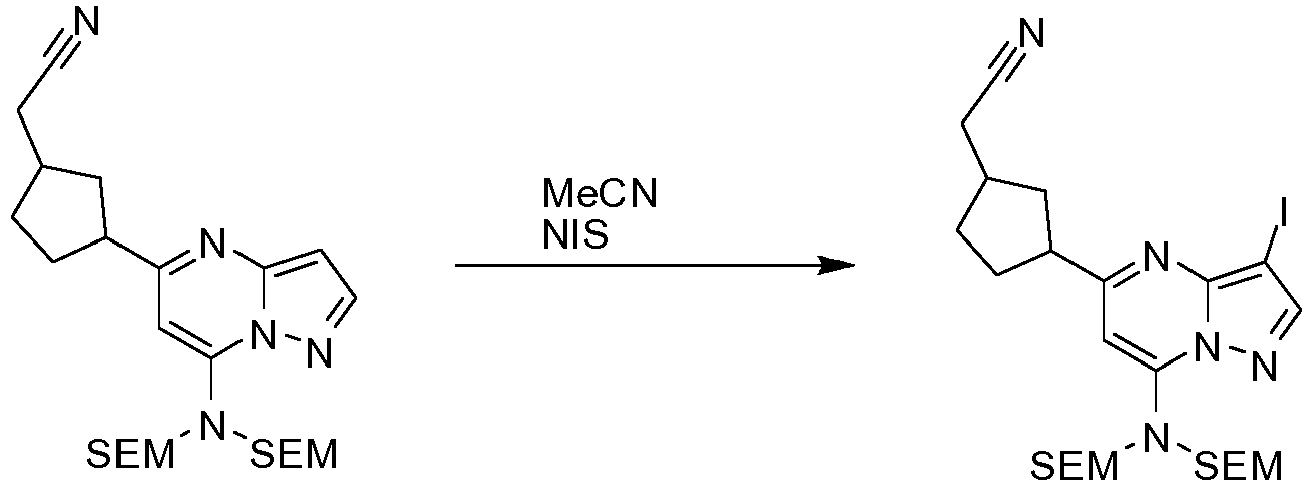
- 2-(3-(7-(Bis((2-(trimethylsilyl)ethoxy)methyl)amino)-3-iodopyrazolo[1,5-a]pyrimidin-5-yl)cyclopentyl)acetonitrile was synthesized in a manner similar to the synthesis of ethyl 2-(4-(7-(bis((2-(trimethylsilyl)ethoxy)methyl)amino)-3-iodopyrazolo[1,5-a]pyrimidin-5-yl)cyclohexyl)acetate, but with ethyl 2-(3-(7-(bis((2-(trimethylsilyl)ethoxy)methyl)amino)pyrazolo[1,5-a]pyrimidin-5-yl)cyclohexyl)acetate substituted for ethyl 2-(4-(7-(bis((2-(trimethylsilyl)ethoxy)methyl)amino)pyrazolo[1,5-a]pyrimidin-5-yl)cyclohexyl)acetate.
-

- Ethyl 2-(3-(7-(bis((2-(trimethylsilyl)ethoxy)methyl)amino)-3-(quinolin-3-yl)pyrazolo[1,5-a]pyrimidin-5-yl)cyclohexyl)acetate was synthesized in a manner similar to the synthesis of ethyl 2-(4-(7-(bis((2-(trimethylsilyl)ethoxy)methyl)amino)-3-(quinolin-3-yl)pyrazolo[1,5-a]pyrimidin-5-yl)cyclohexyl)acetate, but with ethyl 2-(3-(7-(bis((2-(trimethylsilyl)ethoxy)methyl)amino)-3-iodopyrazolo[1,5-a]pyrimidin-5-yl)cyclohexyl)acetate substituted for ethyl 2-(4-(7-(bis((2-(trimethylsilyl)ethoxy)methyl)amino)-3-iodopyrazolo[1,5-a]pyrimidin-5-yl)cyclohexyl)acetate.
-

- 2-(3-(7-(Bis((2-(trimethylsilyl)ethoxy)methyl)amino)-3-(quinolin-3-yl)pyrazolo[1,5-a]pyrimidin-5-yl)cyclopentyl)acetonitrile was synthesized in a manner similar to the synthesis of ethyl 2-(4-(7-(bis((2-(trimethylsilyl)ethoxy)methyl)amino)-3-(quinolin-3-yl)pyrazolo[1,5-a]pyrimidin-5-yl)cyclohexyl)acetate, but with 2-(3-(7-(bis((2-(trimethylsilyl)ethoxy)methyl)amino)-3-iodopyrazolo[1,5-a]pyrimidin-5-yl)cyclopentyl)acetonitrile substituted for ethyl 2-(4-(7-(bis((2-(trimethylsilyl)ethoxy)methyl)amino)-3-iodopyrazolo[1,5-a]pyrimidin-5-yl)cyclohexyl)acetate.
-

- Ethyl 2-(4-(7-(bis((2-(trimethylsilyl)ethoxy)methyl)amino)-3-(1-methyl-1H-pyrazol-4-yl)pyrazolo[1,5-a]pyrimidin-5-yl)cyclohexyl)acetate was synthesized in a manner similar to the synthesis of ethyl 2-(4-(7-(bis((2-(trimethylsilyl)ethoxy)methyl)amino)-3-(quinolin-3-yl)pyrazolo[1,5-a]pyrimidin-5-yl)cyclohexyl)acetate, but with N-methyl pyrazole-4-boronic acid pinacol ester substituted for quinoline-3-boronic acid.
-

- 2-(3-(7-Amino-6-bromo-3-(quinolin-3-yl)pyrazolo[1,5-a]pyrimidin-5-yl)cyclohexyl)acetic acid was synthesized in a manner similar to the synthesis of 2-(4-(7-amino-6-bromo-3-(quinolin-3-yl)pyrazolo[1,5-a]pyrimidin-5-yl)cyclohexyl)acetic acid, but with ethyl 2-(3-(7-(bis((2-(trimethylsilyl)ethoxy)methyl)amino)-3-(quinolin-3-yl)pyrazolo[1,5-a]pyrimidin-5-yl)cyclohexyl)acetate substituted for ethyl 2-(4-(7-(bis((2-(trimethylsilyl)ethoxy)methyl)amino)-3-(quinolin-3-yl)pyrazolo[1,5-a]pyrimidin-5-yl)cyclohexyl)acetate. The reaction was concentrated in vacuo and purified via reverse-phase preparatory HPLC to yield 2-(4-(7-amino-6-bromo-3-(quinolin-3-yl)pyrazolo[1,5-a]pyrimidin-5-yl)cyclohexyl)acetonitrile as a four-isomer mixture. (m+H = 480.1, retention time = 3.51 min)
-

- 2-(3-(7-amino-6-bromo-3-(quinolin-3-yl)pyrazolo[1,5-a]pyrimidin-5-yl)cyclopentyl)acetonitrile was synthesized in a manner similar to the synthesis of 2-(4-(7-amino-6-bromo-3-(quinolin-3-yl)pyrazolo[1,5-a]pyrimidin-5-yl)piperidin-1-yl)acetic acid, but with 2-(3-(7-(bis((2-(trimethylsilyl)ethoxy)methyl)amino)-3-(quinolin-3-yl)pyrazolo[1,5-a]pyrimidin-5-yl)cyclopentyl)acetonitrile substituted for tert-butyl 2-(4-(7-amino-3-(quinolin-3-yl)pyrazolo[1,5-a]pyrimidin-5-yl)piperidin-1-yl)acetate. The reaction was concentrated in vacuo and purified via reverse-phase preparatory HPLC to yield 2-(3-(7-amino-6-bromo-3-(quinolin-3-yl)pyrazolo[1,5-a]pyrimidin-5-yl)cyclopentyl)acetonitrile as a yellow solid. (m+H = 447.22, retention time = 3.99 min).
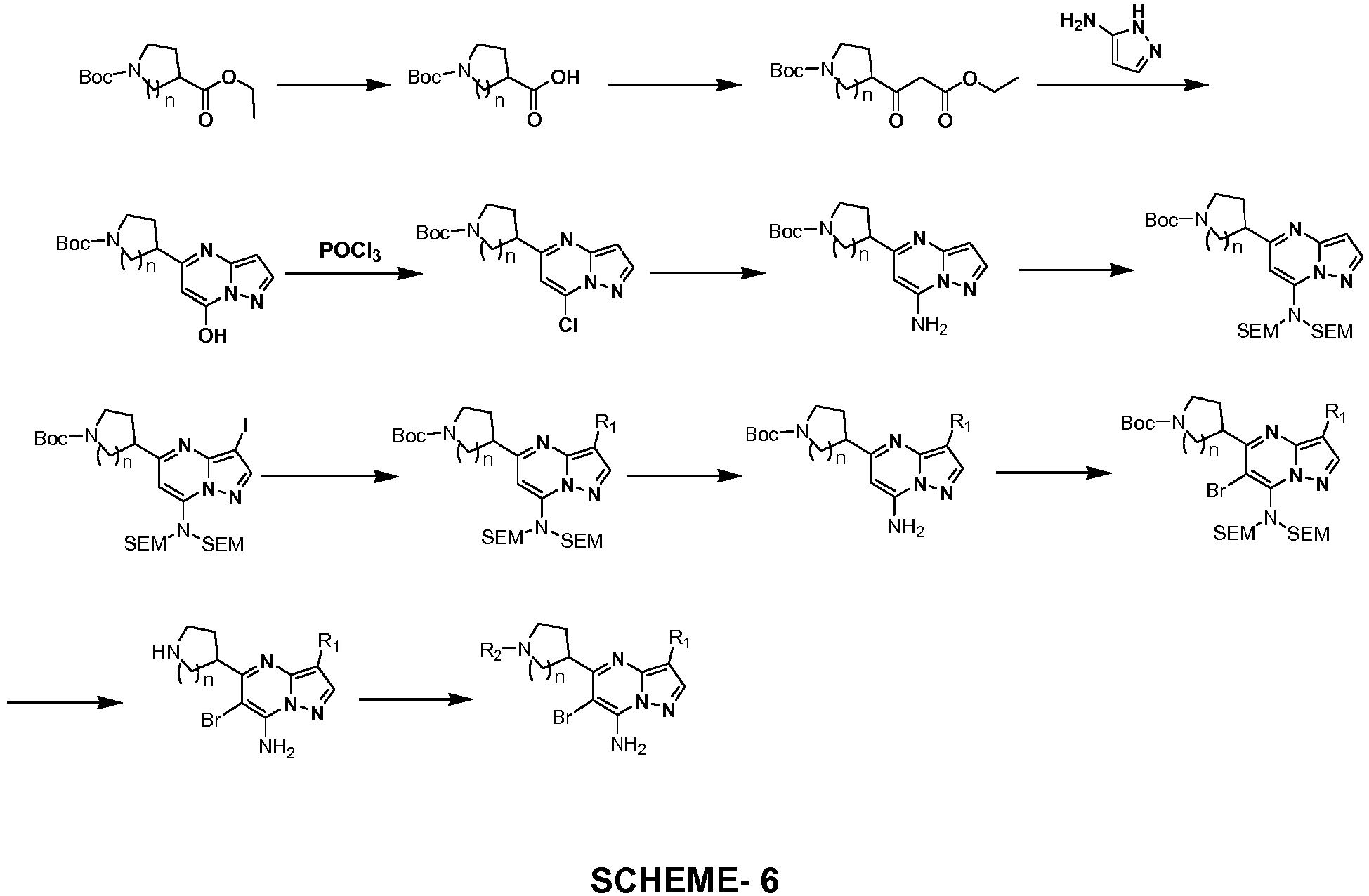
-

- tert-Butyl 4-(7-hydroxypyrazolo[1,5-a]pyrimidin-5-yl)piperidine-1-carboxylate was synthesized in a manner similar to the synthesis of 5-(1,4-dioxaspiro[4.5]decan-8-yl)pyrazolo[1,5-a]pyrimidin-7-ol, but with tert-butyl 4-(3-ethoxy-3-oxopropanoyl)piperidine-1-carboxylate substituted for ethyl 3-oxo-3-(1,4-dioxaspiro[4.5]decan-8-yl)propanoate.
-

- tert-Butyl 4-(7-chloropyrazolo[1,5-a]pyrimidin-5-yl)piperidine-1-carboxylate was synthesized in a manner similar to the synthesis of 7-chloro-5-(1,4-dioxaspiro[4.5]decan-8-yl)pyrazolo[1,5-a]pyrimidine, but with tert-butyl 4-(7-hydroxypyrazolo[1,5-a]pyrimidin-5-yl)piperidine-1-carboxylate substituted for 5-(1,4-dioxaspiro[4.5]decan-8-yl)pyrazolo[1,5-a]pyrimidin-7-ol.
-

- tert-Butyl 4-(7-aminopyrazolo[1,5-a]pyrimidin-5-yl)piperidine-1-carboxylate was synthesized in a manner similar to the synthesis of 5-(1,4-dioxaspiro[4.5]decan-8-yl)pyrazolo[1,5-a]pyrimidin-7-amine, but tert-butyl 4-(7-chloropyrazolo[1,5-a]pyrimidin-5-yl)piperidine-1-carboxylate substituted for 7-chloro-5-(1,4-dioxaspiro[4.5]decan-8-yl)pyrazolo[1,5-a]pyrimidine.
-

- tert-Butyl 4-(7-(bis((2-(trimethylsilyl)ethoxy)methyl)amino)pyrazolo[1,5-a]pyrimidin-5-yl)piperidine-1-carboxylate was synthesized in a manner similar to the synthesis of 4-(7-(bis((2-(trimethylsilyl)ethoxy)methyl)amino)pyrazolo[1,5-a]pyrimidin-5-yl)cyclohexanone, but with tert-butyl 4-(7-aminopyrazolo[1,5-a]pyrimidin-5-yl)piperidine-1-carboxylate substituted for 4-(7-aminopyrazolo[1,5-a]pyrimidin-5-yl)cyclohexanone.
-
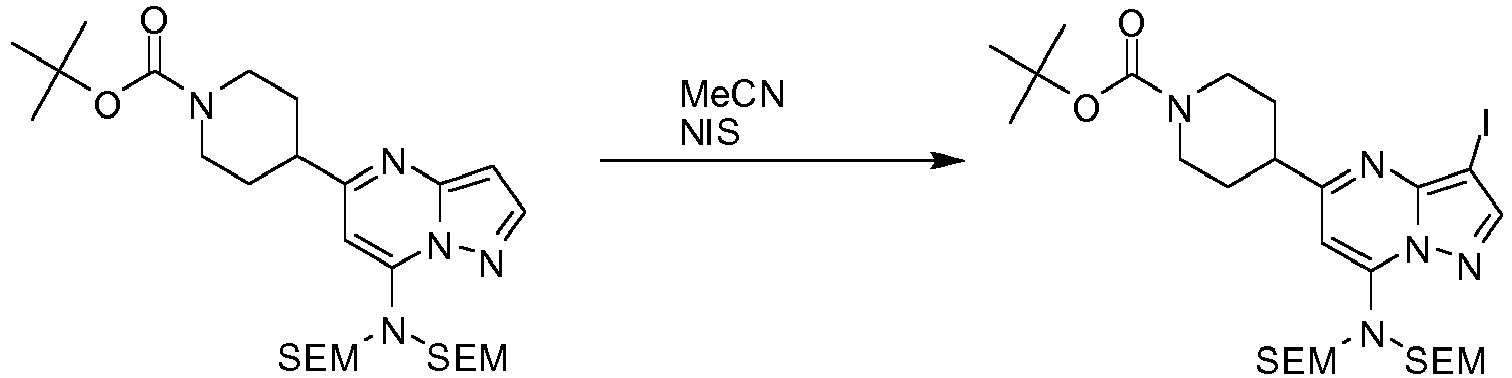
- tert-Butyl 4-(7-(bis((2-(trimethylsilyl)ethoxy)methyl)amino)-3-iodopyrazolo[1,5-a]pyrimidin-5-yl)piperidine-1-carboxylate was synthesized in a manner similar to the synthesis of ethyl 2-(4-(7-(bis((2-(trimethylsilyl)ethoxy)methyl)amino)-3-iodopyrazolo[1,5-a]pyrimidin-5-yl)cyclohexyl)acetate, but with tert-butyl 4-(7-(bis((2-(trimethylsilyl)ethoxy)methyl)amino)pyrazolo[1,5-a]pyrimidin-5-yl)piperidine-1-carboxylate substituted for ethyl 2-(4-(7-(bis((2-(trimethylsilyl)ethoxy)methyl)amino)pyrazolo[1,5-a]pyrimidin-5-yl)cyclohexyl)acetate.
-
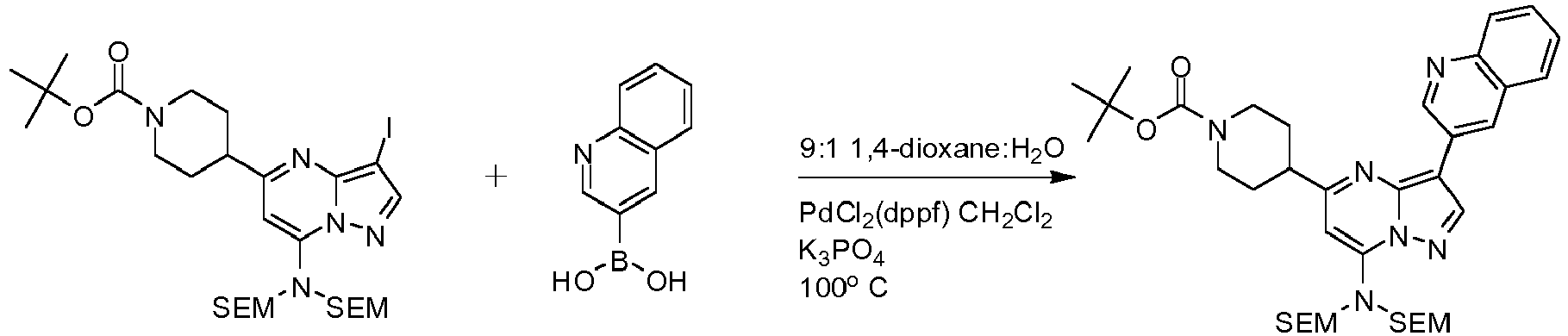
- tert-Butyl 4-(7-(bis((2-(trimethylsilyl)ethoxy)methyl)amino)-3-(quinolin-3-yl)pyrazolo[1,5-a]pyrimidin-5-yl)piperidine-1-carboxylate was synthesized in a manner similar to the synthesis of ethyl 2-(4-(7-(bis((2-(trimethylsilyl)ethoxy)methyl)amino)-3-(quinolin-3-yl)pyrazolo[1,5-a]pyrimidin-5-yl)cyclohexyl)acetate, but with tert-butyl 4-(7-(bis((2-(trimethylsilyl)ethoxy)methyl)amino)-3-iodopyrazolo[1,5-a]pyrimidin-5-yl)piperidine-1-carboxylate substituted for ethyl 2-(4-(7-(bis((2-(trimethylsilyl)ethoxy)methyl)amino)-3-iodopyrazolo[1,5-a]pyrimidin-5-yl)cyclohexyl)acetate.
-

- tert-Butyl 4-(7-(bis((2-(trimethylsilyl)ethoxy)methyl)amino)-3-(1-methyl-1H-pyrazol-4-yl)pyrazolo[1,5-a]pyrimidin-5-yl)piperidine-1-carboxylate was synthesized in a manner similar to the synthesis of ethyl 2-(4-(7-(bis((2-(trimethylsilyl)ethoxy)methyl)amino)-3-(1-methyl-1H-pyrazol-4-yl)pyrazolo[1,5-a]pyrimidin-5-yl)cyclohexyl)acetate, but with tert-butyl 4-(7-(bis((2-(trimethylsilyl)ethoxy)methyl)amino)-3-iodopyrazolo[1,5-a]pyrimidin-5-yl)piperidine-1-carboxylate substituted for ethyl 2-(4-(7-(bis((2-(trimethylsilyl)ethoxy)methyl)amino)-3-iodopyrazolo[1,5-a]pyrimidin-5-yl)cyclohexyl)acetate.
-

- To a 20 mL scintillation vial was charged tert-butyl 4-(7-(bis((2-(trimethylsilyl)ethoxy)methyl)-amino)-3-(quinolin-3-yl)pyrazolo[1,5-a]pyrimidin-5-yl)piperidine-1-carboxylate (80 µmol, 56 mg) followed by ethanol (2 mL) and H2O (500 µL). To this solution was added 2 mL of 4N HCl in 1,4-dioxane. This solution was heated to 60° C for 2 hours. Upon completion, the reaction mixture was diluted with DCM (10 mL) and washed with NaHCO3(aq) and extracted with DCM twice more. The combined organics were then dried over Na2SO4 and the solvent was removed in vacuo to yield 5-(piperidin-4-yl)-3-(quinolin-3-yl)pyrazolo[1,5-a]pyrimidin-7-amine (20.3 mg, 59 umol) as cream-colored solid
-

- To a 20 mL scintillation vial was charged tert-butyl 2-(4-(7-amino-3-(quinolin-3-yl)pyrazolo[1,5-a]pyrimidin-5-yl)piperidin-1-yl)acetatec (100 µmol, 34 mg) followed by a solution of N,N-diisopropylethylamine (150 µmol, 26 µL) in DMF (2 mL). To the resulting solution was added tert-butyl 2-bromoacetate (120 µmol, 18 µL). The reaction mixture was stirred at 60° C for 18 hours. After 18 hours, the reaction mixture was concentrated in vacuo and purified via silica gel chromatography (0% to 20% MeOH in DCM) to yield tert-butyl 2-(4-(7-amino-3-(quinolin-3-yl)pyrazolo[1,5-a]pyrimidin-5-yl)piperidin-1-yl)acetate (41 mg, 90 µmol).
-

- To a 20 mL scintillation vial was charged 2-(4-(7-amino-6-bromo-3-(quinolin-3-yl)pyrazolo[1,5-a]pyrimidin-5-yl)piperidin-1-yl)acetic acid (41 mg, 90 µmol) plus acetonitrile (2 mL). To this solution was added N-bromosuccinimide (90 µmol, 16 mg). This solutionwas allowed to stir at room temperature for 1 hour. The reaction was concentrated in vacuo and dissolved in TFA (2 mL). The reaction mixture was stirred at room temperature for 1 hour. The reaction mixture was concentrated in vacuo and purified via reverse-phase preparatory HPLC to yield 2-(4-(7-amino-6-bromo-3-(quinolin-3-yl)pyrazolo[1,5-a]pyrimidin-5-yl)piperidin-1-yl)acetic acid as yellow solid. (m+H = 481.22, retention time = 2.32 min)
-

- 3-(1-Methyl-1H-pyrazol-4-yl)-5-(piperidin-4-yl)pyrazolo[1,5-a]pyrimidin-7-amine was synthesized in a manner similar to the synthesis of 5-(piperidin-4-yl)-3-(quinolin-3-yl)pyrazolo[1,5-a]pyrimidin-7-amine, but with tert-butyl 4-(7-(bis((2-(trimethylsilyl)ethoxy)methyl)amino)-3-(1-methyl-1H-pyrazol-4-yl)pyrazolo[1 ,5-a]pyrimidin-5-yl)piperidine-1-carboxylate substituted for tert-butyl 4-(7-(bis((2-(trimethylsilyl)ethoxy)methyl)amino)-3-(quinolin-3-yl)pyrazolo[1,5-a]pyrimidin-5-yl)piperidine-1-carboxylate.
-

- tert-Butyl 2-(4-(7-amino-3-(1-methyl-1H-pyrazol-4-yl)pyrazolo[1,5-a]pyrimidin-5-yl)piperidin-1-yl)acetate was synthesized in a manner similar to the synthesis of tert-butyl 2-(4-(7-amino-3-(quinolin-3-yl)pyrazolo[1,5-a]pyrimidin-5-yl)piperidin-1-yl)acetate, but with 3-(1-methyl-1H-pyrazol-4-yl)-5-(piperidin-4-yl)pyrazolo[1,5-a]pyrimidin-7-amine substituted for 5-(piperidin-4-yl)-3-(quinolin-3-yl)pyrazolo[1,5-a]pyrimidin-7-amine.
-

- 2-(4-(7-amino-6-bromo-3-(1-methyl-1H-pyrazol-4-yl)pyrazolo[1,5-a]pyrimidin-5-yl)piperidin-1-yl)acetic acid was synthesized in a manner similar to the synthesis of 2-(4-(7-amino-6-bromo-3-(quinolin-3-yl)pyrazolo[1,5-a]pyrimidin-5-yl)piperidin-1-yl)acetic acid, but with tert-butyl 2-(4-(7-amino-3-(1-methyl-1H-pyrazol-4-yl)pyrazolo[1,5-a]pyrimidin-5-yl)piperidin-1-yl)acetate substituted for tert-butyl 2-(4-(7-amino-3-(quinolin-3-yl)pyrazolo[1,5-a]pyrimidin-5-yl)piperidin-1-yl)acetate. The reaction mixture wass reduced in vacuo and purified via reverse-phase preparatory HPLC to yield 2-(4-(7-amino-6-bromo-3-(1-methyl-1H-pyrazol-4-yl)pyrazolo[1,5-a]pyrimidin-5-yl)piperidin-1-yl)acetic acid as off-yellow solid. (m+H = 434.19, retention time = 2.25 min)
-

- A mixture of tert-butyl 3-(3-ethoxy-3-oxopropanoyl)pyrrolidine-1-carboxylate (7.00 g, 25 mmol) and 1H-pyrazol-3-amine (2.08 g, 25 mmol) in toluene 30 mL) was heated at 110 °C under argon for 18 h and concentrated in vacuo. The residue was triturated with EtOAc and the solid was collected by filtration and dried in high vacuum to give 6.84 g (90%) of the title compound as a white solid. LC/MS RT = 1.40 min (5 min method). Mass calculated for, M+H 305.15, observed 305.15.
-

- To a mixture of tert-butyl 3-(7-hydroxypyrazolo [1, 5-a] pyrimidin-5-yl) pyrrolidine-1-carboxylate (3.70 g, 12.0 mmol) and dimethylaniline (4.0 mL, 30 mml) was added phosphoryl trichloride (40 mL). The mixture was heated at 50 °C for 5 h and concentrated in vacuo. The residue was diluted with methylene chloride (100 mL) and quenched with saturated NaHCO3 (100 mL). The mixture was separated and the aqueous layer was extracted with chloride (100 mL x 2). The combined organic layers were dried over Na2SO4, filtered and concentrated in vacuo. The residue was purified by Biotage (CH2Cl2/EtOAc, 20:1 to 4:1). LC/MS RT = 2.09 min (5 min method). Mass calculated for, M+H 322.12, observed 337.14.
-

- A mixture of tert-butyl 3-(7-chloropyrazolo [1, 5-a] pyrimidin-5-yl) pyrrolidine-1-carboxylate (3.40 g, 10.5 mmol) in a solution of ammonia in MeOH (7N, 20 mL) was heated in sealed vessel at 80 °C for 5 h. The reaction mixture was cooled down and concentrated in vacuo. The residue was dried in high vacuum and used for the next step without further purification. LC/MS RT = 1.30 min (5 min method). Mass calculated for, M+H 303.17, observed 318.19.
-

- To a mixture of tert-butyl 3-(7-aminopyrazolo [1, 5-a]pyrimidin-5-yl)pyrrolidine-1-carboxylate (10.5 mmol) in CH2Cl2 was added DIEA (10.8 mL, 63 mmol) and SEM-CI (5.6 mL, 32 mmol). The mixture was heated at 50 °C for 5 h under an argon atmosphere. The mixture was cooled, and the reaction was quenched with saturated NaHCO3 (100 mL) and extracted with CH2Cl2 (50 mL x 3). The combined organic layers were dried over Na2SO4, filtered and concentrated in vacuo. The residue was purified by Biotage (CH2Cl2/EtOAc, 20:1 to 5:1) to give the title compound as a light brown oil. LC/MS RT = 2.90 min (5 min method). Mass calculated for, M+H 563.33, observed 578.35.
-

- To a solution of tert-butyl 3-(7-(bis((2-(trimethylsilyl)ethoxy)methyl)amino)pyrazolo[1,5-a]pyrimidin-5-yl)pyrrolidine-1-carboxylate 3.95 g, 7.0 mmol) in CH3CN (30 mL) was added NIS (1.65 mg, 7.0 mmol). The mixture was stirred at rt for 2 h and diluted with EtOAC (50 mL) and washed with saturated sodium thiosulfate, dried over Na2SO4, filtered and concentrated in vacuo. The residue was purified by Biotage (CH2Cl2/EtOAc, 100:1 to 10:1) to the title compound as a light brown oil. LC/MS RT = 2.49 min. Mass calculated for, M+H 689.23, observed 389.17.
-

- A mixture of tert-butyl 3-(7-(bis((2-(trimethylsilyl)ethoxy)methyl)amino)-3-iodopyrazolo[1,5-a]pyrimidin-5-yl)pyrrolidine-1-carboxylate (703 mol), quinolin-3-ylboronic acid (350 mg, 2.00 mmol), Pd(dppf)Cl2-CH2Cl2 (82 mg, 0.10 mmol) and potassium phosphate (636 mg, 3.0 mmol) in a mixture of dioxane/H2O (9:1, 20 mL) was heated at 100 °C for 5 h under argon. The reaction mixture was cooled down and diluted with EtOAC, washed with Brine, dried over Na2SO4, filtered and concentrated. The residue was purified by Biotage (CH2Cl2/EtOAc, 10:1 to 3:1) to give the title compound as brown solid. LC/MS RT = 2.49 min. Mass calculated for, M+H 690.37, observed 389.17.
-

- To a solution of tert-butyl 3-(7-(bis((2-(trimethylsilyl)ethoxy)methyl)amino)-3-(quinolin-3-yl)pyrazolo[1,5-a]pyrimidin-5-yl)piperidine-1-carboxylate (350 mg, 0.50 mmol) in CH3CN (5.0 mL) was added NBS (90 mg, 0.50 mmol). The mixture was stirred at rt for 3 h and concentrated in vacuo. The residue was purified by Biotage (CH2Cl2/EtOAc, 100:1 to 10:1) to give the title compound as light yellow solid. LC/MS RT = 2.49 min. Mass calculated for, M+H 768.29, observed 389.17.
-

- To a solution of tert-butyl 3-(7-(bis((2-(trimethylsilyl)ethoxy)methyl)amino)-6-bromo-3-(quinolin-3-yl)pyrazolo[1,5-a]pyrimidin-5-yl)piperidine-1-carboxylate (196 mg, 0.40 mmol) in EtOH (5.0 mL) was added 4 N HCl (5.0 mL). The mixture was heated at 60 °C for 4 h under argon, cooled down and concentrated in vacuo. The residue was dried in high vacuum to give the title compound as yellow solid (HCl salt). LC/MS RT = 2.49 min. Mass calculated for, M+H 408.07, observed 389.17.
-

- To a mixture of 6-bromo-5-(piperidin-3-yl)-3-(quinolin-3-yl)pyrazolo[1,5-a]pyrimidin-7-amine (HCl salt, 46 mg, 0.10 mmol) in DMF (2.0 mL) was added DIEA (0.10 mL, 0.30 mmol) and methylsulfonyl chloride (14 mg, 0.12 mmol). The reaction mixture was stirred at rt for 3 h and concentrated in vacuo. The residue was purified by prep-LC to give the title compound. LC/MS RT = 2.49 min. Mass calculated for, M+H 486.05, observed 389.17.
- By essentially the same procedure given in Schemes 25, the compounds listed in Table 8 can be prepared.
Table 8 Compound ID Structures M+H (calc.) M+H (observed) Retention Time, (min) 8.1 
487.05 487.05 2.49 8.2 
423.15 423.15 3.12 8.3 
501.07 501.06 3.42 8.4 
465.10 465.10 3.26 8.5 
529.09 529.09 3.84 8.6 
495.07 495.07 2.84 8.7 
451.08 451.08 3.12 8.8 
515.08 515.08 3.82 8.9 
513.06 513.06 3.44 8.10 
487.05 487.05 3.06 8.11 
501.06 501.06 3.53 8.12 
541.02 541.02 4.44 8.13 
481.06 481.06 2.79 8.14 
437.06 437.06 3.04 8.15 
471.04 471.04 3.05 8.16 
456.04 456.04 2.97 8.17 
409.0 409.0 2.9 8.18 
501.0 501.0 3.53 - Alternative to the described procedure in the Scheme-14, these compounds can also be made by the scheme 25 given below.
-

-

- To a pressure tube were charged 5-chloro-N,N-bis((2-(trimethylsilyl)ethoxy)methyl)pyrazolo[1,5-a]pyrimidin-7-amine (5.36 g, 12.5 mmols), tert-butyl 4-(4,4,5,5-tetramethyl-1,3,2-dioxaborolan-2-yl)-5,6-dihydropyridine-1(2H)-carboxylate (4.26 g, 13.8 mmols), PdCl2(dppf).CH2Cl2 ([1,1'-bis(diphenylphosphino)ferrocene]dichloropalladium(II) complex with dichloromethane (1:1)) (510 mg, 0.62 mmol), 2M Na2CO3 (30 mL) and DME (60 mL). The tube was degassed with Ar briefly, capped and heated at 100 °C with stirring overnight. After cooling, the reaction mixture was diluted with EtOAc and water, organic layer was isolated, washed with brine and dried (MgSO4). After solvent was removed under reduced pressure, the residue was purified on silica. Elution with EtOAc in hexanes (0-25%) gave tert-butyl 4-(7-(bis((2-(trimethylsilyl)ethoxy)methyl)amino)pyrazolo[1,5-a]pyrimidin-5-yl)-5,6-dihydropyridine-1(2H)-carboxylate (5.76 g, 80%).
-

- A mixture of tert-butyl 4-(7-(bis((2-(trimethylsilyl)ethoxy)methyl)amino)pyrazolo[1,5-a]pyrimidin-5-yl)-5,6-dihydropyridine-1(2H)-carboxylate (5.05 g,8.78 mmol) and 10% Pd/C (100 mg) in EtOAc was stirred at 45 °C under hydrogen (balloon pressure) for three hours. After filtration, washing with EtOAc (3x) and concentration, tert-butyl 4-(7-(bis((2-(trimethylsilyl)ethoxy)methyl)amino)pyrazolo[1,5-a]pyrimidin-5-yl)piperidine-1-carboxylate (5.1 g, 99.5%) was obtained as oil.
-

- To a mixture of tert-butyl 4-(7-(bis((2-(trimethylsilyl)ethoxy)methyl)amino)pyrazolo[1,5-a]pyrimidin-5-yl)piperidine-1-carboxylate (5 g, 8.65 mmol) in DMF (15 mL) was added N-iodosuccinimide (1.86 g, 8.27 mmol) and the resulting mixture was allowed to stir at room temperature for 1 hour. The mixture diluted with EtOAc (100 mL), washed with water (20 mL). The aqueous layer was extracted with EtOAc (20 mL) once, and combined organic layer was washed with water (20 mL) three times, brine once and dried (MgSO4). After concentration, the residue was purified by column chromatography on silica gel. Elution with EtOAc/Hex (0-30%) gave tert-butyl 4-(7-(bis((2-(trimethylsilyl)ethoxy)methyl)amino)-3-iodopyrazolo[1,5-a]pyrimidin-5-yl)piperidine-1-carboxylate (4.55 g, 75%). (Note: DMF could be replaced by acetonitrile.)
-

- To a pressure tube were charged tert-butyl 4-(7-(bis((2-(trimethylsilyl)ethoxy)methyl)amino)-3-iodopyrazolo[1,5-a]pyrimidin-5-yl)piperidine-1-carboxylate (4.2 g, 5.97 mmol), 2-phenyl-5-(4,4,5,5-tetramethyl-1,3,2-dioxaborolan-2-yl)pyridine (2 g, 7.1 mmol), PdCl2(dppf).CH2Cl2 (240 mg, 0.33 mmol), DME (16 mL) and 2M Na2CO3 (8 mL). The mixture was briefly degassed with Argon and the tube was capped and heated at 100 °C for 15 hours. On cooling, H2O (20 mL) and EtOAc (40 mL) and aqueous layer was extracted with EtOAc (3x) and combined organic layers were washed with brine once and dried (MgSO4). After concentration in vacuo the residue was purified on silica gel. Elution with EtOAc/Hexanes (0-40%) gave the title compound (3.24 g, 74%).
-

- To a solution of tert-butyl 4-(7-(bis((2-(trimethylsilyl)ethoxy)methyl)amino)-3-(6-phenylpyridin-3-yl)pyrazolo[1,5-a]pyrimidin-5-yl)piperidine-1-carboxylate (3.24 g, 4.44 mmol) in DMF (20 mL) was added NBS (750 mg, 4.21 mmol). After stirring at rt for one hour, NBS (75 mg 0.42 mmol) was added and the resulting mixture was stirred for another 40 minutes to complete the reaction. The reaction mixture was diluted with EtOAc (200 mL), washed with water (2x50 mL), brine (20 mL) and dried (MgSO4). After concentration in vacuo the residue was purified on silica gel. Elution with EtOAc/Hexanes (0-40%) gave the title compound (3 g, 83%).
-

- To a solution of the piperidine derivative (1 eq), DIEA (4 eq) in DMF was added appropriate coupling reagent (1eq): chloroformate to form carbamate; isocyanate to provide urea; sulfonyl chloride to form sulfonamide; and carboxylic acid/EDCI/HOBt to yield the corresponding amide. The reaction was monitored by HPLC. Once the reaction was complete, the reaction mixture was directly purified by HPLC to furnish the corresponding product.
TABLE-8A Cpd ID Structures M+H (calculated) M+H (observed) Retention Time(min) 8.20 
495.1 495.2 4.16 8.21 
481.1 481.1 3.84 8.22 
529.1 529.1 4.03 8.23 
494.1 494.3 3.44 8.24 
521.1 521.2 2.80 8.25 
480.1 480.2 2.52 8.26 
527.1 527.0 3.96 8.27 
480.1 480.1 2.85 8.28 
508.1 508.1 3.54 8.29 
480.1 480.1 2.88 8.44 
545.1 545.1 3.61 8.45 
554.1 554.1 3.23 8.46 
466.1 466.3 3.00 8.47 
524.1 524.1 3.14 8.48 
510.1 510.1 1.92 8.49 
538.1 538.1 3.42 8.50 
496.1 496.0 2.89 -
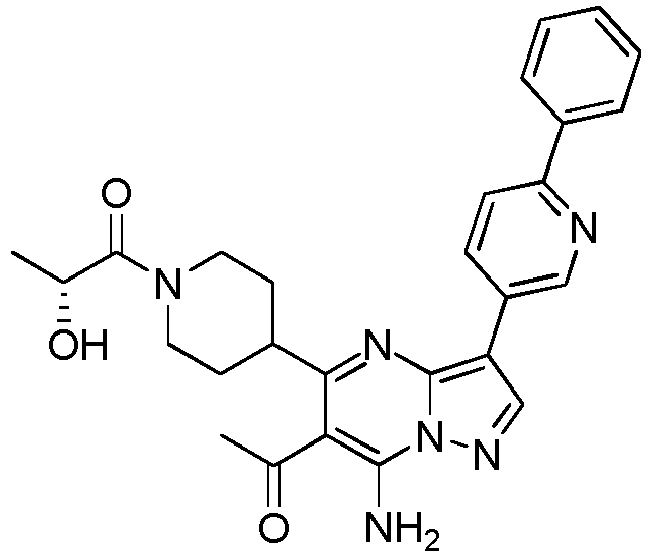
-
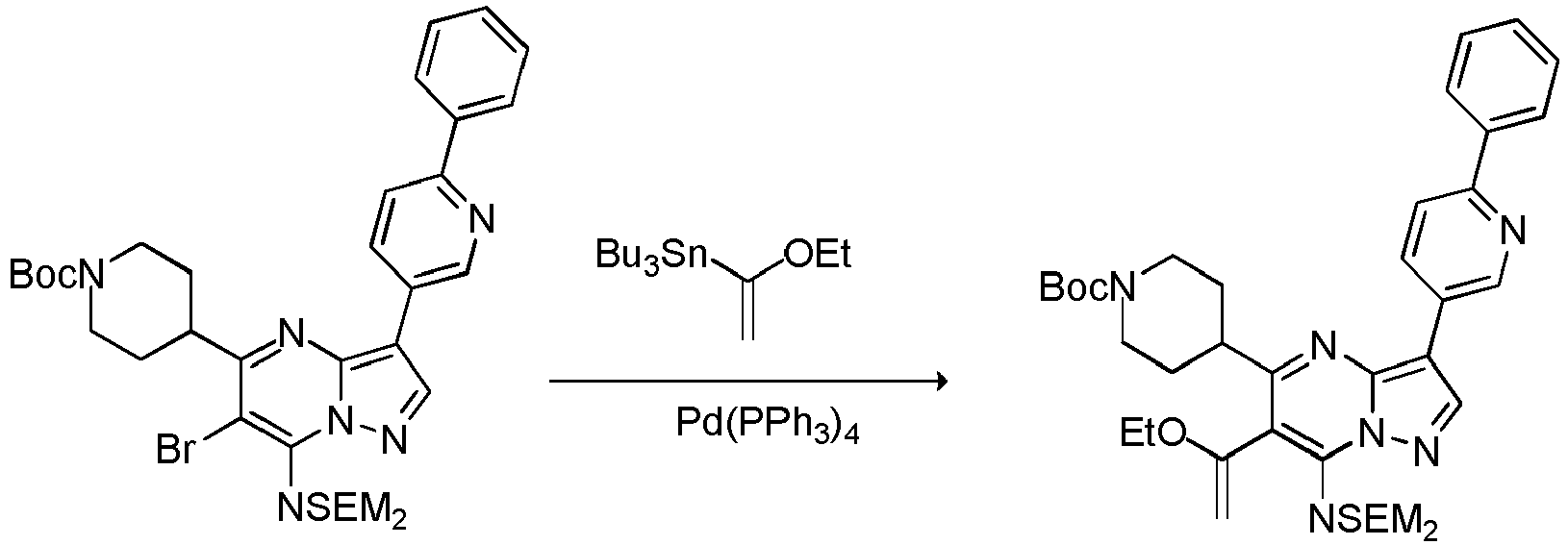
- To a pressure flask were charged compound tert-butyl 4-(7-(bis((2-(trimethylsilyl)ethoxy)methyl)amino)-6-bromo-3-(6-phenylpyridin-3-yl)pyrazolo[1,5-a]pyrimidin-5-yl)piperidine-1-carboxylate (intermediate from Scheme-10A) (13.66 g, 16.86 mmol), tributyl (1-ethoxyvinyl)tin (11.4 mL, 33.74 mmols) and dioxane (150 ml). The flask was degassed with Ar briefly, capped and heated at 100 C with stirring overnight. After cooling, the reaction mixture was concentrated. The residue was taken into ether (200 ml), washed with 0.5 M KF (50 ml), brine and dried (MgSO4). After solvent was removed under reduced pressure, the residue was purified on silica. Elution with EtOAc in hexanes (0-30%) gave compound tert-butyl 4-(7-(bis((2-(trimethylsilyl)ethoxy)methyl)amino)-6-(1-ethoxyvinyl)-3-(6-phenylpyridin-3-yl)pyrazolo[1,5-a]pyrimidin-5-yl)piperidine-1-carboxylate (11.55 g, 85%) as yellow form.
-

- To a solution of tert-butyl 4-(7-(bis((2-(trimethylsilyl)ethoxy)methyl)amino)-6-(1-ethoxyvinyl)-3-(6-phenylpyridin-3-yl)pyrazolo[1,5-a]pyrimidin-5-yl)piperidine-1-carboxylate (11.5 g, 14.4 mmol) in dioxane (60 mL) was added 4M HCl in water (14.4 mL) at 0 °C. After stirring for 30 min at 0 °C, the reaction mixture was allowed to warm to rt in 1.5 hours. 4M HCl in dioxane (10 mL) was added. The reaction mixture was stirred at rt overnight. Solvent was removed in vacuo to get the desired product as an HCl salt (6.97 g).
-

- To a solution of 1-(7-amino-3-(6-phenylpyridin-3-yl)-5-(piperidin-4-yl)pyrazolo[1,5-a]pyrimidin-6-yl)ethanone hydrochloride (0.5 mmol), DIEA (350 µL, 2 mmol) in DMF (5 mL) was added a solution of D-lactic acid (45 mg, 0.5 mmol), HOBt (68 mg, 0.5 mmol), EDCl (144 mg, 0.75 mmol) in DMF (1 mL). The reaction was stirred at rt for 20 min. Another solution of solution of D-lactic acid (45 mg, 0.5 mmol), HOBt (68 mg, 0.5 mmol), EDCl (144 mg, 0.75 mmol) in DMF (2 mL) was added and stirred for 5 minutes. LC-MS indicated the reaction was complete and reaction mixture was directly purified by HPLC to furnish the title compound.
LC/MS RT = 3.22 min. Mass calculated for M+H 485.2, observed 485.4. -
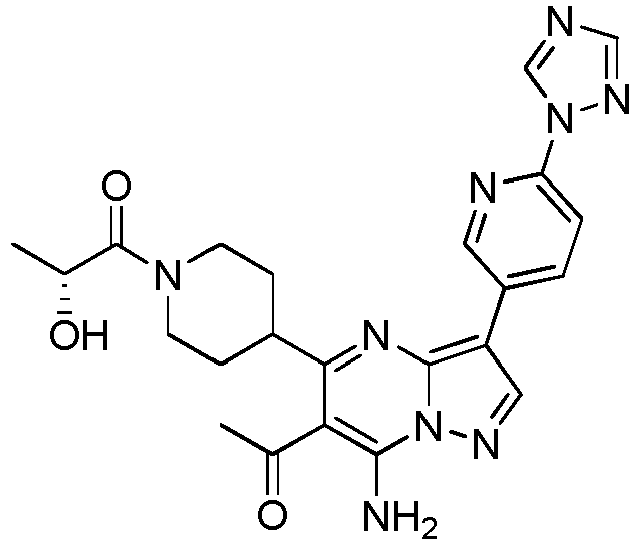
-

- A mixture of 1,2,4-triazole (1.17 g, 16.9 mmol), 2,5-dibromopyridine (2 g, 8.4 mmol) and K2CO3 (1.2 g, 8.7 mmol) in NMP (20 mL) was heated at 100 °C with stirring for 5 hours. After cooling, the reaction mixture was poured into water (100 mL) and solid was collected by filtration and further purified by column chromatography on silica gel. Elution with EtOAc/Hexanes (0-50%) provided the title compound (250 mg, 13%).
-

- A mixture of 5-bromo-2-(1H-1,2,4-triazol-1-yl)pyridine (248 mg, 1.1 mmol), bis(pinacolato)diboron (337 mg, 1.4 mmol), KOAc (324 mg, 3.3 mmol), PdCl2(dppf)2.CH2Cl2 (45 mg, 0.06 mmol) in dioxane (4 mL) was flushed with Argon and stirred at 80 °C for 16h. On cooling, the solvent was rotoevaporated, and the crude was redissolved in dichloromethane (20 mL), washed with water (3 x 10 ml), brine (1 x 101 ml), and dried over MgSO4. Solvent was removed in vacuo and the residue was triturated with hexanes to provide the title compound (287 mg, 96%).
-

- To a pressure tube were charged tert-butyl 4-(7-(bis((2-(trimethylsilyl)ethoxy)methyl)amino)-3-iodopyrazolo[1,5-a]pyrimidin-5-yl)piperidine-1-carboxylate (563 mg, 0.8 mmol), 5-(4,4,5,5-tetramethyl-1,3,2-dioxaborolan-2-yl)-2-(1H-1,2,4-triazol-1-yl)pyridine (287 mg, 1.1 mmol), PdCl2(dppf)2.CH2Cl2 (29 mg, 0.04 mmol), DME (6 mL) and 2M Na2CO3 (2 mL). The resulting mixture was briefly degassed with Argon; the tube was capped, and heated with stirring under 80 ° C overnight. After cooling, solvent was removed. The residue was diluted with EtOAc (20 ml), and organic layer was isolated, washed with brine and dried (MgSO4). After concentration under reduced pressure, the residue was purified on silica gel eluting with EtOAc/Hexanes (0-50%) to provide the title compound (370 mg, 64%).
- The rest of the synthesis is similar to the synthesis of (R)-1-(4-(6-acetyl-7-amino-3-(6-phenylpyridin-3-yl)pyrazolo[1,5-a]pyrimidin-5-yl)piperidin-1-yl)-2-hydroxypropan-1-one.
-

- To a solution of 1-(7-amino-3-(6-phenylpyridin-3-yl)-5-(piperidin-4-yl)pyrazolo[1,5-a]pyrimidin-6-yl)ethanone (25 mg, 0.06 mmol), DIEA (52 µL, 0.3 mmol) in DMF (1 mL) was added Mel (15 µL, 0.24 mmol). The reaction mixture was stirred for one hour and directly purified by HPLC to provide the title compound. LC/MS RT = 2.76 min. Mass calculated for M+H 427.2, observed 427.3.
- General methods described above, compounds in the table 8-B can be synthesized.
TABLE- 8B Compound ID Structures M+H (calculated) M+H (observed) Retention Time(min) 8.106 
521.2 521.2 1.22 8.197 
515.22 516.70 2.77 8.200 
535.20 536.05 2.64 8.202 
534.21 535.2 2.93 8.204 
533.22 534.1 2.73 8.223 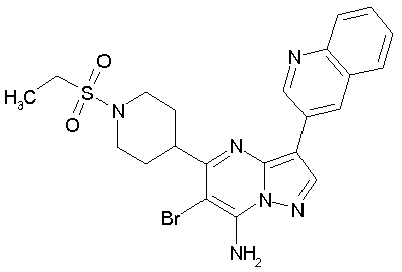
514.07 515 3.82 8.224 
522.13 523.2 3.02 8.225 
549.14 550 3.44 8.226 
534.14 535 3.56 8.227 
506.11 507 2.52 8.228 
510.1 511 2.9 8.232 
506.11 507 3.09 8.234 
580.07 581 3.11 8.235 
536.12 537.1 2.18 8.236 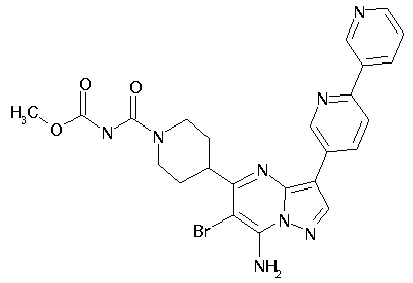
550.1 551 3.04 8.237 
571.1 572 3.49 8.244 
537.11 538 2.78 8.247 
492.1 493 2.91 8.249 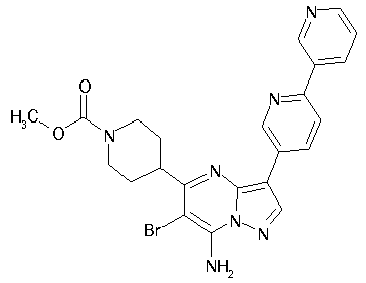
507.1 508 3.67 8.250 
449.09 450 2.27 8.253 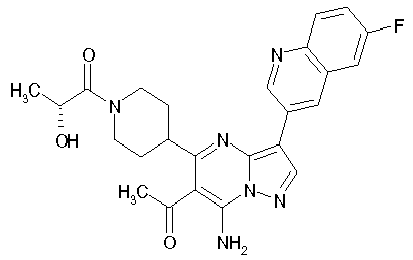
476.19 478 3.25 8.257 
512.09 513 3.52 8.269 
529.24 530.2 2.34 8.270 
485.21 486.1 2.89 8.274 
494.11 496 + 498 3.20 8.275 
517.09 519 + 521 3.37 8.276 
517.09 519 + 521 3.48 8.277 
517.09 519 + 521 3.31 8.281 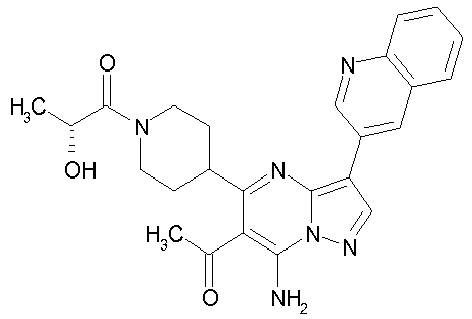
458.21 460 2.92 8.282 
518.07 520 + 522 3.98 8.283 
538.13 539 + 541 1.33 8.293 
501.21 502 2.64 8.294 
545.24 546 2.62 8.295 
429.19 430 2.07 8.296 
443.21 444 2.74 8.297 
559.25 560 3.37 8.298 
515.23 516 3.51 -

- To tert-butyl 4-(7-(bis((2-(trimethylsilyl)ethoxy)methyl)amino)-3-(6-chloropyridin-3-yl)pyrazolo[1,5-a]pyrimidin-5-yl)piperidine-1-carboxylate (2.25g, 3.3mmol) in Dioxane (24ml) and H2O (6ml) was added the 2-fluorophenylboronic acid (0.92g, 6.6mmol), PdCl2(dppf)2.CH2Cl2 (0.32g, 0.39mmol) and K3PO4.H2O (1.7g, 8.2mmol). The reaction was heated at 100 °C for 16 hours, at which time LC/MS analysis confirmed full consumption of starting material. On cooling, H2O (100ml) and EtOAc (100ml) were added and organics were extracted with EtOAc (4 x 50ml), dried (Na2SO4) and concentrated in vacuo to give a crude product. Gradient column chromatography on silica eluting with 0% to 100% EtOAc/hexanes gave tert-butyl 4-(7-(bis((2-(trimethylsilyl) ethoxy)methyl)amino)-3-(6-(2-fluorophenyl)pyridin-3-yl)pyrazolo[1,5-a]pyrimidin-5-yl)piperidine-1-carboxylate (2.3g, 95%).
- By essentially the same procedure as to other related compound, different derivatives of above compound is prepared (Table-8B).
-

- By essentially the same procedure as above, tert-butyl 4-(3-(6-(1H-pyrazol-1-yl)pyridin-3-yl)-7-(bis((2-(trimethylsilyl)ethoxy)methyl)amino)pyrazolo[1,5-a]pyrimidin-5-yl)piperidine-1-carboxylate is prepared.
-
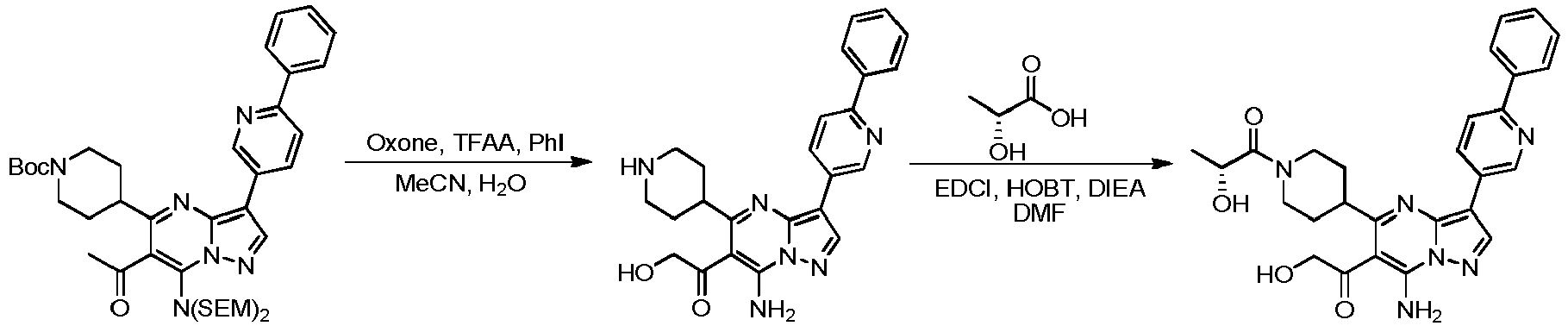
- A solution of oxone (1.9g, 3.1mmol), trifluoroacetic anhydride (1.1ml, 7.9mmol) and H2O (5.7ml) was stirred at 40°C for 7 h, and then cooled to room temperature. To this a solution of tert-butyl 4-(6-acetyl-7-(bis((2-(trimethylsilyl)ethoxy)methyl)amino)-3 -(6-phenylpyridin-3 - yl)pyrazolo[1,5-a]pyrimidin-5-yl)piperidine-1-carboxylate (0.87g, 1.13mmol) and PhI (0.03ml, 0.23mmol) in acetonitrile (17ml) was added. The resulting solution was stirred at 90°C for 15 h. On cooling, the reaction mixture was filtered and solids were washed with DCM. It was then concentrated in vacuo to give a crude product which was submitted to the analytical group for purification to afford the desired 1-(7-amino-3-(6-phenylpyridin-3-yl)-5-(piperidin-4-yl)pyrazolo[1,5-a]pyrimidin-6-yl)-2-hydroxyethanone (94.2mg, 17%).
- A mixture of (R)-2-hydroxypropanoic acid (13.8mg, 0.16mmol), EDCI (46mg, 0.24mmol), and 1-hydroxybenzotriazole (16.22mg, 0.12mmol) in DMF (2ml) was stirred at room temperature for 10min. To this 1-(7-amino-3-(6-phenylpyridin-3-yl)-5-(piperidin-4-yl)pyrazolo[1,5-a]pyrimidin-6-yl)-2-hydroxyethanone (58.77mg, 0.12mmol) was added followed by N,N-diisopropylethylamine (0.1ml, 0.6mmol). It was stirred further for 20min at room temperature at which time LC/MS analysis confirmed full consumption of starting material. This crude compound was submitted to the analytical group for purification to afford the desired (R)-1-(4-(7-amino-6-(2-hydroxyacetyl)-3-(6-phenylpyridin-3-yl)pyrazolo[1,5-a]pyrimidin-5-yl)piperidin-1-yl)-2-hydroxypropan-1-one. LCMS: 3.27 mins, m/z = 501.0 (MH+).
-

-

- To a solution of benzyl 4-(7-(bis((2-(trimethylsilyl)ethoxy)methyl)amino)pyrazolo[1,5-a]pyrimidin-5-yl)piperidine-1-carboxylate (2.27g, 3.7 mmol) in acetonitrile (15 mL) was added NIS (833 mg, 1 eq). After stirring 1.5 hour, solvent was removed and the residue was purified on silica gel. Elution with EtOAc/Hexanes (0-50%) gave the title compound (2.38 g, 86%) as gum.
-

- To a pressure tube were charged benzyl 4-(7-(bis((2-(trimethylsilyl)ethoxy)methyl)amino)-3-iodopyrazolo[1,5-a]pyrimidin-5-yl)piperidine-1-carboxylate (1 g, 2.85 mmol), 2-phenyl-5-(4,4,5,5-tetramethyl-1,3,2-dioxaborolan-2-yl)pyridine (1.2g, 4.1 mmol), Pd(PPh3)4 (164 mg, 0.14 mmol), DME (20 mL) and 2 M Na2CO3 (10 mL). The mixture was briefly degassed with Argon and the tube was capped and heated at 80 °C for 15 hours. On cooling, H2O (40 mL) and EtOAc (100 mL) and aqueous layer was extracted with EtOAc (3x) and combined organic layers were washed with brine once and dried (MgSO4). After concentration in vacuo the residue was purified on silica gel. Elution with EtOAc/Hexanes (0-30%) gave the title compound (1.33 g, 61%).
-

- A mixture of benzyl 4-(7-(bis((2-(trimethylsilyl)ethoxy)methyl)amino)-3-(6-phenylpyridin-3-yl)pyrazolo[1,5-a]pyrimidin-5-yl)piperidine-1-carboxylate (1.33 g, 1.77 mmol), 10% Pd/C (170 mg) in EtOAc (10 mL) was stirred under hydrogen (balloon pressure) for two days, and then at 45 °C for 15 hours. After filtration and washing with EtOAc 4 times the title product (1 g, 93%) was obtained.
-

- A mixture of (R)-methyl 2-(benzyloxy)propanoate (1g, 5.15 mmol), hydrazine monohydrate (250 ul) in MeOH (14 mL) was refluxed 3 hours. Solvent was removed under reduced pressure and the residue was purified on silica gel. Elution with EtOAc yielded title compound (640 mg, 64%).
-

- To a solution of (R)-2-(benzyloxy)propanehydrazide (194 mg, 1 mmol) in anhydrous THF (2 mL) was added CDI (178 mg, 1.1 mmol) and the resulting mixture was allowed to stir one hour.. Solvent was removed under reduced pressure and the residue was purified on silica gel. Elution with EtOAc yielded title product.
-

- To a stirred solution of (R)-5-(1-(benzyloxy)ethyl)-1,3,4-oxadiazol-2(3H)-one (44 mg, 0.2 mmol), 3-(6-phenylpyridin-3-yl)-5-(piperidin-4-yl)-N,N-bis((2-(trimethylsilyl)ethoxy)methyl)pyrazolo[1,5-a]pyrimidin-7-amine (150 mg, 0.24 mmol) and DIEA (70 ul, 0.4 mmol) in DMF (1.4 mL) was added BOP (97 mg,0.22 mmol) and the resulting solution was allowed to stir overnight. Water was added and was extracted with EtOAc (3x) and combined organic layers were washed with water (3x), brine once and dried (MgSO4). After concentration in vacuo the residue was purified on silica gel. Elution with EtOAc/Hexanes (0-10%) gave the title compound (142 mg, 85 %).
-

- A mixture of (R)-5-(1-(5-(1-(benzyloxy)ethyl)-1,3,4-oxadiazol-2-yl)piperidin-4-yl)-3-(6-phenylpyridin-3-yl)-N,N-bis((2-(trimethylsilyl)ethoxy)methyl)pyrazolo[1,5-a]pyrimidin-7-amine (105 mg), 20% Pd(OH)2/C (150 mg) in MeOH (4 mL) was stirred under hydrogen (60 psi) overnight. After filtration, washing with EtOAc 4 times and concentration in vacuo the residue was purified on silica gel. Elution with EtOAc/Hexanes (0-100%) gave the title compound (32 mg,43%).
-
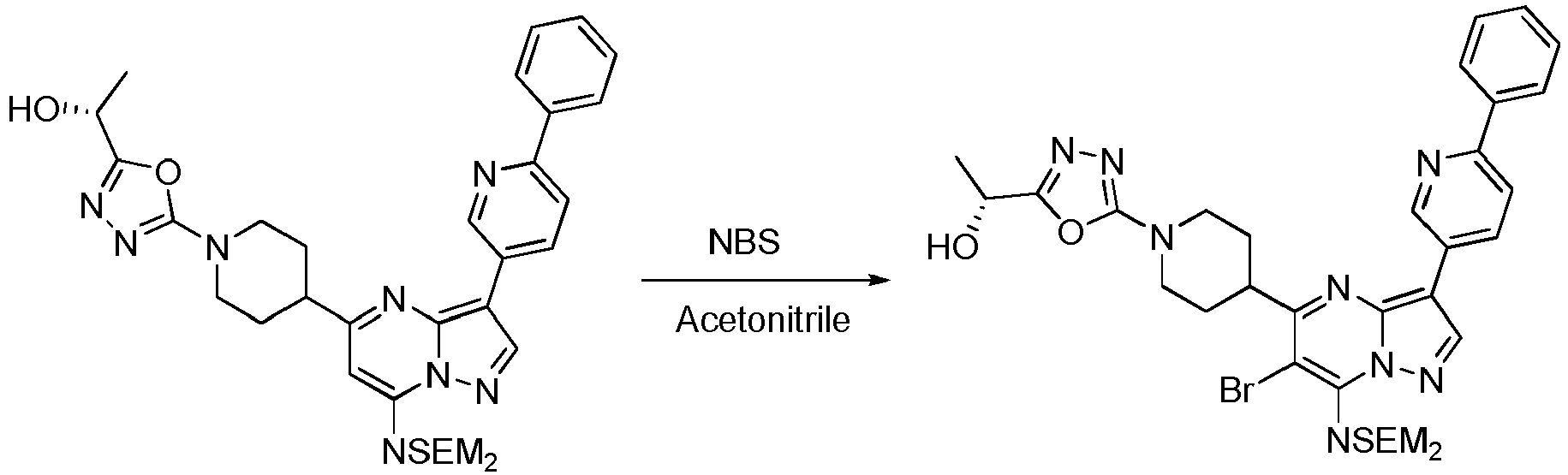
- To a solution of (R)-1-(5-(4-(7-(bis((2-(trimethylsilyl)ethoxy)methyl)amino)-3-(6-phenylpyridin-3-yl)pyrazolo[1,5-a]pyrimidin-5-yl)piperidin-1 -yl)-1,3,4-oxadiazol-2-yl)ethanol (32 mg, 0.04 mmol) in acetonitrile (1 mL) was added NBS (7 mg, 0.04 mmol) and the resulting solution was stirred for 10 minutes and concentrated. the residue was purified on silica gel. Elution with EtOAc provided a relatively pure product (9 mg).

-

- To a pressure tube were charged (R)-1-(5-(4-(7-(bis((2-(trimethylsilyl)ethoxy)methyl)amino)-6-bromo-3-(6-phenylpyridin-3-yl)pyrazolo[1,5-a]pyrimidin-5-yl)piperidin-1-yl)-1,3,4-oxadiazol-2-yl)ethanol (9 mg,∼0.01 mmol), Pd(PPh3)4 (10 mg, 0.087 mmol), tributyl(-ethoxy-vinyl)tin (8 ul, 0.02 mmol) and dioxane (2 mL). The resulting mixture was degassed with Argon briefly, capped with a Teflon cap and stirred at 100 °C overnight. On cooling, the solvent was rotoevaporated, and the crude was redissolved in EtOAc (10 ml), washed with 0.5 M KF solution (1 x 2 ml), water (1 x 3 ml), brine (1 x 3 ml), and dried over MgSO4. Solvent was removed in vacuo and the residue was purified by column chromatography on silica gel. Elution with EtOAc/Hexanes (0-100%) gave the intermediate enol ether which was re-dissolve in dioxane (2 mL) and cooled to 0 °C and treated aqueous 4N HCl (0.2 mL). After the reaction mixture was warmed up to room temperature and stirred for 4 hours, solvents were removed and the residue was directly purified by HPLC to provide the title compound.
-

-

- To a Schlenk tube were charged compound tert-butyl 4-(7-(bis((2-(trimethylsilyl)ethoxy)methyl)amino)-6-bromo-3-(6-phenylpyridin-3-yl)pyrazolo[1,5-a]pyrimidin-5-yl)piperidine-1-carboxylate (81 mg, 0.1 mmol), Bu3SnCN (47 mg, 1.5 eq.), Pd(PPh3)4 (23 mg, 0.2 eq.), Bis(tri-t-butylphosphine)palladium (0) (10 mg, 0.2 eq.). The tube was evacuated and charged with Ar for three cycles. Dioxane (3 ml) was added; the tube was capped and heated at 160 C with stirring for one hour. After cooling, the mixture was diluted with EtOAc and washed with brine once. Organic layer separated, dried over MgSO4 and concentrated. The residue was purified on silica gel. Elution with EtOAc/hexane (0-25%) gave the desired title product (63 mg, 84%).
-

- Tert-butyl 4-(7-(bis((2-(trimethylsilyl)ethoxy)methyl)amino)-6-cyano-3-(6-phenylpyridin-3-yl)pyrazolo[1,5-a]pyrimidin-5-yl)piperidine-1-carboxylate (190 mg) was treated with TFA/water(95:5, 3 ml) with stirring for 10 minutes. The reaction mixture was concentrated and lyophilized to yield the title compound as TFA salt.
-

- To a solution of 7-amino-3-(6-phenylpyridin-3-yl)-5-(piperidin-4-yl)pyrazolo[1,5-a]pyrimidine-6-carbonitrile TFA salt (0.1 mmol), DIEA (87µL, 0.5 mmol) in DMF (2 mL) was added a solution of (R)-2,3-dihydroxypropanoic acid (11 mg, 0.1 mmol), HOBt (14 mg, 0.1 mmol), EDCI (29 mg, 0.15 mmol) in DMF (1 mL). The reaction was stirred at rt for 2.5 hour and the mixture was directly purified by HPLC to furnish the title compound. LC/MS RT = 2.86 min. Mass calculated for M+H 484.2, observed 484.3.

-

- To 1H-pyrazol-3-amine (12.3 g, 148.0 mmol) in EtOH (50 mL) was added diethyl malonate (25.0 mL, 164.7 mmol), 21wt% NaOEt in EtOH (110 mL, 294.6 mmol) and additional EtOH (50 mL). The resulting reaction mixture was then heated at 80 °C under an atmosphere of argon for 16 hours, at which time the reaction was allowed to cool to room temperature. The reaction mixture was then concentrated in vacuo until almost dry, before H2O (500 mL) was added. Vigorous stirring aided the dissolution of solids, at which time conc. HCl was added until pH∼2 was attained (precipitate formed). The precipitate was collected and dried by vacuum filtration giving pyrazolo[1,5-a]pyrimidine-5,7-diol as a tan solid (17.13 g, 113.4 mmol, 77%).
-

- To pyrazolo[1,5-a]pyrimidine-5,7-diol (9.6 g, 63.5 mmol) in a 500 mL flask was added POCl3 (125 mL, 1341.1 mmol). The flask was then cooled to 0 °C and N, N-dimethylaniline (22 mL, 173.6 mmol) was carefully added. On warming to room temperature, the reaction mixture was then heated at 60 °C under an atmosphere of argon for 16 hours. On cooling, the reaction mixture was concentrated in vacuo to give a brown viscous liquid. This brown viscous liquid was carefully poured onto ice and allowed to warm to room temperature overnight. To the brown solution was carefully added saturated NaHCO3 solution until no further effervescence was observed and pH ∼ 8 was attained. Organics were then extracted with CH2Cl2 (4 x 50 mL), dried (Na2SO4) and concentrated in vacuo to give a brown liquid (29.8 g). Gradient column chromatography on silica eluting with 50% CH2Cl2/hexanes (to elute aniline) followed by 75% CH2Cl2/hexanes (to elute product) gave 5,7-dichloropyrazolo[1,5-a]pyrimidine as a white solid (7.7 g, 40.8 mmol, 64%).
-

- To 5,7-dichloropyrazolo[1,5-a]pyrimidine (7.6 g, 40.4 mmol) in a sealed vessel was added NH4OH (100 mL). The vessel was then sealed and heated at 85 °C for 2.5 hours, at which time the consistency of the white solid had changed (from foamy white solid to free-flowing white solid). The vessel was removed from the heat source and allowed to cool to room temperature overnight. On cooling, the contents of the vessel were collected and dried by vacuum filtration giving 5-chloropyrazolo[1,5-a]pyrimidin-7-amine as a yellow-tinged white solid (6.8 g, 40.3 mmol, 100%).
-

- To 5-chloropyrazolo[1,5-a]pyrimidin-7-amine (6.7 g, 39.7 mmol) in CH2Cl2 (30 mL) was added N,N-diisopropylethylamine (48.0 mL, 275.6 mmol) followed by 2-(Trimethylsilyl)ethoxymethyl chloride (25.0 mL, 141.7 mmol). The reaction mixture was heated at 45 °C for 3 hours before being allowed to cool to room temperature. The reaction mixture was then poured into a separatory funnel containing ∼100 mL saturated NaHCO3 solution and CH2Cl2 (50 mL). Organics were then extracted with CH2Cl2 (4 x 50 mL), dried (Na2SO4) and concentrated in vacuo to give a thick orange liquid (33.8 g). Gradient column chromatography on silica eluting with 5% to 15% EtOAc/hexanes gave crude 5-chloro-N,N-bis((2-(trimethylsilyl)ethoxy)methyl)pyrazolo[1,5-a]pyrimidin-7-amine as a colorless liquid (18.7 g).
-

- To crude 5-chloro-N,N-bis((2-(trimethylsilyl)ethoxy)methyl)pyrazolo[1,5-a]pyrimidin-7-amine (7.9 g) in CH3CN (100 mL) was added N-iodosuccinimide (4.3 g, 19.2 mmol) and the resulting mixture was stirred at room temperature for 30 mins, at which time LC/MS confirmed full conversion of starting material to product. Saturated sodium thiosulfate solution (∼20 mL) was added and stirring continued for 5 minutes before the mixture was transferred to a separatory funnel using CH2Cl2 (30 mL) and H2O (30 mL). Brine (50 mL) was added and organics were extracted with CH2Cl2 (4 x 40 mL), dried (Na2SO4) and concentrated in vacuo to give crude 5-chloro-3-iodo-N,N-bis((2-(trimethylsilyl)ethoxy)methyl)pyrazolo[1,5-a]pyrimidin-7-amine as a light brown liquid (10.4 g). LCMS: 2.95 mins, m/z = 555.1 (MH+).
-

- To crude 5-chloro-3-iodo-N,N-bis((2-(trimethylsilyl)ethoxy)methyl)pyrazolo[1,5-a]pyrimi,din-7-amine (7.1 g) in DME (120 mL) and H2O (15 mL) was added the quinoline boronic acid (2.4 g, 14.1 mmol), PdCl2(dppf)2 (1.0 g, 1.2 mmol) and K3PO4.H2O (5.4 g, 25.6 mmol). The reaction mixture was heated at 60 °C for 2 hours, at which time LC/MS analysis confirmed full consumption of starting material. On cooling, H2O (40 mL) and EtOAc (100 mL) were added and organics were extracted with EtOAc (4 x 50 mL), dried (Na2SO4) and concentrated in vacuo to give a brown oil. Gradient column chromatography on silica eluting with 10% to 60% EtOAc/hexanes gave 5-chloro-3-(quinolin-3-yl)-N,N-bis((2-(trimethylsilyl)ethoxy)methyl)pyrazolo[1,5-a]pyrimidin-7-amine as a light yellow solid (4.1 g, 7.4 mmol, 65% over three steps). LCMS: 2.62 mins, m/z = 556.2 (MH+).

-

- To a 2-5 mL microwave vessel is charged 5-chloro-3-(quinolin-3-yl)-N,N-bis((2-(trimethylsilyl)ethoxy)methyl)pyrazolo[1,5-a]pyrimidin-7-amine (72 µmol, 40 mg), N,N-diisopropylethylamine (220 µmol, 38 µL), NMP (2 mL), and morpholine (220 µmol, 19 µL). The reaction vessel is flushed with agron and sealed. The reaction mixture was heated to 200° C in microwave synthesizer for 30 minutes. Upon completion, the NMP was removed in vacuo as an azeotropic using chlorobenzene. The crude product was purified via reverse-phase preparatory HPLC to yield 5-morpholino-3-(quinolin-3-yl)pyrazolo[1,5-a]pyrimidin-7-amine as brown-yellow solid. (m+H = 347.31, retention time = 2.97 min).
- By essentially the same procedure given in the synthesis of 5-morpholino-3-(quinolin-3-yl) pyrazolo[1,5-a]pyrimidin-7-amine, Schemes 27 & 28, the compounds listed in Table 9 can be prepared.
Table 9 Compound ID Structures M+H (calc.) M+H (observed) Retention Time, (min) 9.1 
389.17 389.17 2.86 9.2 
418.5 418.3 2.37 9.3 
417.5 417.3 2.08 9.4 
411.5 411.2 2.42 9.5 
403.19 403.18 3.46 9.7 
417.22 417.21 2.10 9.10 
453.07 453.07 3.27 9.11 
389.17 389.16 2.93 9.13 
442.5 443.20 2.70 -

- A mixture of 5-chloro-3-(quinolin-3-yl)-N,N-bis((2-(trimethylsilyl)ethoxy) methyl)-pyrazolo-[1,5-a]pyrimidin-7-amine (50 mg, 0.09 mmoL), 1,4-diazepan-5-one (36 mg, 0.32 mmoL), EtN(iPr)2 (110 uL, 0.63 mmoL) in NMP (0.8 mL) was heated at 185°C under microwave condition for 45 min. Purification by prep-LC afforded titled compound (32.3 mg, 85%) as its formic acid salt. LCMS tR = 2.49 Min. Mass calculated for, M+ 373.1, observed LC/MS m/z 374.1 (M+H).
-
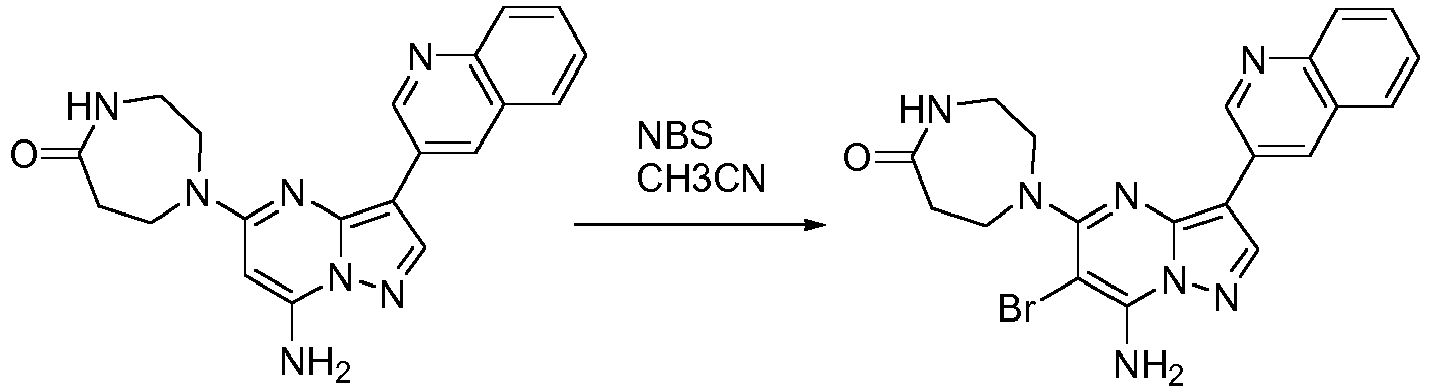
- A solution of NBS (14.6 mg, 0.082 mmoL) in CH3CN (0.5 mL) was added to a mixture of 1-(7-amino-3-(quinolin-3-yl)pyrazolo[1,5-a]pyrimidin-5-yl)-1,4-diazepan-5-one formic acid salt (32.3 mg, 0.077 mmoL) in CH3CN (3 mL). After stirring at room temperature for 10 min, the solvent was evaporated and the residue was purified by prep-LC to afford titled compound (22.6 mg, 59%). LCMS tR =2.78 Min. Mass calculated for, M+ 451.0, observed LC/MS m/z 452.0 (M+H).
-

- A mixture of 5-chloro-3-(quinolin-3-yl)-N,N-bis((2-(trimethylsilyl)ethoxy) methyl)-pyrazolo-[1,5-a]pyrimidin-7-amine (55 mg, 0.10 mmoL), methyl pyrrolidine-3-carboxylate (52 mg, 0.30 mmoL) and EtN(iPr)2 (86 uL, 0.50 mmoL) in DMF (1.0 mL) was heated at 180°C under microwave condition for 45 min. The mixture was purified by prep-LC to afford the title compound. LC/MS RT = 3.30 min. Mass calculated for, M+H 389.17, observed 389.17.
-

- To a solution of methyl 1-(7-amino-3-(quinolin-3-yl)pyrazolo[1,5-a]pyrimidin-5-yl)pyrrolidine-3-carboxylate (19 mg, 0.050 mmol) in a 2:1 mixture of THF and H2O (3 mL) was added 1 N LiOH solution (0.25 mL). The reaction mixture was stirred at rt overnight and concentrated in vacuo. The residue was purified by prep-LC to afford the title compound. LC/MS RT = 2.80 min. Mass calculated for, M+H 375.16, observed 375.15.
-

- To a solution of 1-(7-amino-3-(quinolin-3-yl)pyrazolo[1,5-a]pyrimidin-5-yl)pyrrolidine-3-carboxylic acid (17 mg, 0.033 mmol) in a 2:1 mixture of CH3CN/MeOH (1.0 mL) was added NBS (6.2 mg, 0.033 mmol). The mixture was stirred at rt for 1 h then concentrated in vacuo. The residue was purified by prep-LC to afford the title compound. LC/MS RT = 3.27 min. Mass calculated for, M+H 453.07, observed 453.07
-

- Potassium cyanate (10 mmol, 811 mg) was added to 1-benzyl-3-methyl piperazine-1,3-dicarboxylate (2 mmol, 556 mg) dissolved in methanol-water, and the reaction mixture heated at 75 °C for 2hrs until LCMS showed the completion of the reaction. The solvent was evaporated in vacuo and the crude product was purified by silica gel column chromatography to yield the product, benzyl 1,3- dioxohexahydroimidazo[1,5-a]pyrazine-7(1H)-carboxylate, (290mg, 50%). LCMS tR =2.50 min. Mass calculated for, M+ 289.11, observed LC/MS m/z 288.20 (M-H negative ion mode).
- To benzyl 1, 3- dioxohexahydroimidazo[1,5-a]pyrazine-7(1H)-carboxylate (1.0 mmol, 290 mg) in methanol was added 50 mg of Pd/C(10%). The solution was kept under hydrogen atmospheric by a balloon for 14 hrs at which time LCMS showed the completion of the reaction. The solution was filtered through celite and the solvent was evaporated in vacuo to dryness to yield, tetrahydroimidazo[1,5-a]pyrazine-1,3(2H,5H)-dione. LCMS tR =1.00 min. Mass calculated for, M+ 155.07, observed LC/MS m/z 156 (M+H).
- By essentially the same procedure given in Scheme 28, the compounds listed in Table 10 can be prepared.
Table 10 Compound ID Structures M+H (calc.) M+H (observed) Retention Time, (min) 10.1 
463.14 463.13 2.83 10.2 
403.19 403.18 2.15 10.3 
462.11 462.10 3.84 10.5 
507.4 507.0 3.0 10.6 
507.4 507.0 3.3 10.7 
461.3 461.0 3.6 10.8 
458.3 458.0 3.3 10.9 
447.3 447.0 3.3 10.10 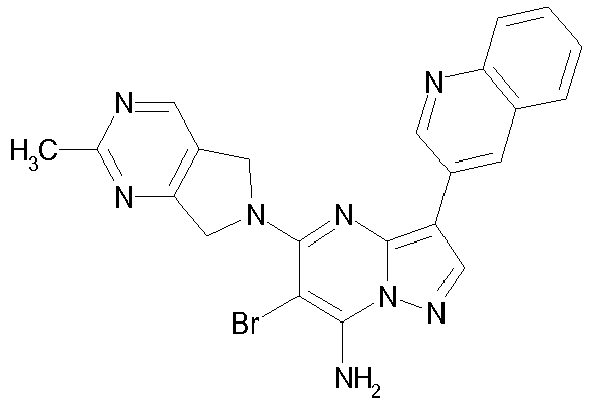
473.3 473.0 3.4 10.11 
439.3 439.0 3.4 10.12 
518.4 518.1 2.6 10.13 
505.4 5.05.1 3.8 10.14 
425.3 425.0 3.2 10.15 
477.4 477.0 4.3 10.16 
461.3 461.0 2.8 10.17 
491.4 491.0 3.6 10.18 
505.4 505.1 3.9 10.19 
461.3 461.0 2.4 10.20 
452.3 452.0 2.8 10.21 
492.4 492.0 3.3 10.22 
479.3 479.0 2.8 10.23 
507.4 507.1 3.3 10.24 
493.4 493.2 4.0 10.25 
453.3 453.0 3.8 10.26 
478.4 478.0 3.2 10.27 
481.4 481.1 3.7 10.28 
489.3 489.0 3.0 10.29 
509.4 509.1 4.7 10.30 
441.4 441.0 4.2 10.31 
473.4 473.0 3.0 10.32 
440.1 440.1 2.76 10.33 
557.1 557.1 3.69 10.34 
516 516 3.47 10.35 
530 530 3.51 10.36 
438 438 2.78 10.37 
506.1 506.1 3.58 10.38 
530 530 3.97 10.39 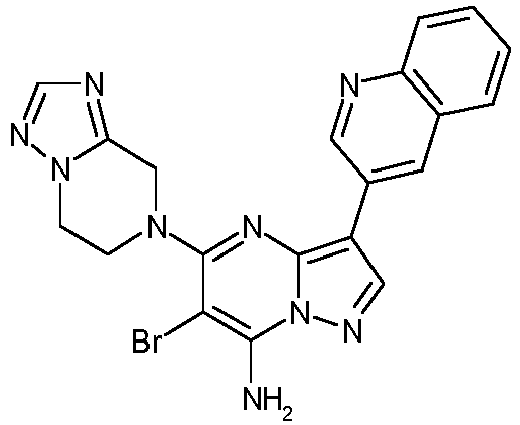
462 462 3.01 10.39a 
476.33 476.11 3.91 10.40 
440.1 440.1 2.71 10.41 
388.1 388.1 3.63 
399.1 399.1 2.64 10.43 
454.2 454.2 2.99 10.44 
420.1 420.1 2.79 10.45 
481.09 481.09 4.00 10.46 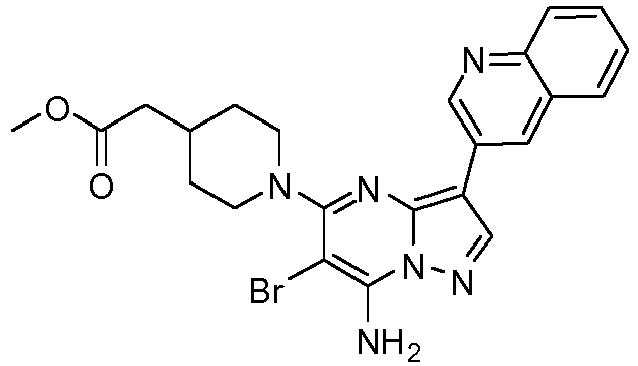
495.11 495.10 4.23 10.47 
481.09 481.09 3.46 10.48 
497.09 497.09 2.99 10.51 
505.11 505.11 3.30 10.54 
415.4 415.20 2.64 10.55 
429.5 429.2 2.61 10.58 
429.18 429.17 2.57 10.60 
493.00 493 2.92 10.61 
449.10 449.1 3.32 10.62 
437.0 437.0 2.88 10.63 
471.0 471.0 2.95 10.64 
487.0 487.0 3.12 10.64.1 
400.1 401.1 1.09 10.64.3 
414.16 415.20 2.46 10.64.4 
448.12 449.20 2.80 10.64.5 
492.07 493.10 2.85 10.64.7 
478.05 479.20 2.59 -

- A solution of NBS (20.6 mg, 0.116 mmoL) in CH3CN (1 mL) was added to a mixture of 5-morpholino-3-(quinolin-3-yl)-N,N-bis((2-(trimethylsilyl)ethoxy)methyl)pyrazolo[1,5-a]pyrimidin-7-amine (70.0 mg, 0.116 mmoL) in CH3CN (6 mL). After stirring at room temperature for 10 min, the reaction mixture was concentrated and purified by column chromatography to afford the desired compound. LCMS tR =2.91 Min (5 min run, UV 254nm). Mass calculated for, M+ 684.2, observed LC/MS m/z 685.2 (M+H).
-

- A degassed mixture of 6-bromo-5-morpholino-3-(quinolin-3-yl)-N,N-bis((2-(trimethylsilyl)ethoxy)methyl)pyrazolo[1,5-a]pyrimidin-7-amine (35 mg, 0.051mmoL), Bu3SnCN (32.3 mg, 0.10 mmoL), Pd[P(t-Bu)3]2 (5.2 mg, 0.010 mmoL) in Dioxane (3 mL) was heated at 100°C overnight. The mixture was cooled to room temperature and the solvent was evaporated in vacuo. Purification by column chromatography afforded the titled compound. LCMS tR = 2.76 Min (5 min run, UV 254nm). Mass calculated for, M+ 631.3, observed LC/MS m/z 632.2 (M+H).
-

- A mixture of 7-(bis((2-(trimethylsilyl)ethoxy)methyl)amino)-5-morpholino-3-(quinolin-3-yl)pyrazolo[1,5-a]pyrimidine-6-carbonitrile (5 mg), EtOH (1mL) and 3N HCl (1mL) was heated at 60°C until LCMS indicated the completed reaction. The mixture was cooled to room temperature and the solvent was evaporated in vacuo. Purification by prep-LC afforded the desired compound. LCMS tR = 3.12 Min (UV 254nm). Mass calculated for, M+ 371.1, observed LC/MS m/z 372.2 (M+H).
-

- A mixture of 5-chloro-3-(quinolin-3-yl)-N,N-bis((2-(trimethylsilyl)ethoxy)methyl)pyrazolo[1,5-a]pyrimidin-7-amine (77.9 mg, 0.14 mmoL), morpholine (36.7 mg, 0.42 mmoL), NaHCO3 (53 mg, 0.63 mmoL) in NMP (3 mL) was heated at 130°C overnight. The mixture was cooled to room temperature and diluted with H2O and then extracted with ethyl acetate (x2). The combined organic layers were washed with brine and dried with Na2SO4. Evaporation of solvent afforded the crude displacement compound. Purification by column chromatography afforded 5-morpholino-3-(quinolin-3-yl)-N,N-bis((2-(trimethylsilyl)ethoxy)methyl)pyrazolo[1,5-a]pyrimidin-7-amine (70 mg, 82%). LCMS tR = 2.72 Min (5 min run, UV 254nm). Mass calculated for, M+ 606.3, observed LC/MS m/z 607.2 (M+H).
-

- A mixture of 5-chloro-3-(quinolin-3-yl)-N,N-bis((2-(trimethylsilyl)ethoxy)methyl)pyrazolo[1,5-a]pyrimidin-7-amine (503.0 mg, 0.91 mmoL), thiomorpholine 1, 1-dioxide (367.1 mg, 2.72 mmoL), NaHCO3 (533.0 mg, 6.34 mmoL) in NMP (8 mL) was heated at 130°C overnight. The mixture was cooled to room temperature and diluted with H2O and then extracted with ethyl acetate (x2). The combined organic layers were washed with brine and dried with Na2SO4. Evaporation of solvent afforded the crude displacement compound. Purification by column chromatography afforded compound 5-thiomorpholinodioxo-3-(quinolin-3-yl)-N,N-bis((2-(trimethylsilyl)ethoxy)methyl)pyrazolo[1 ,5-a]pyrimidin-7-amine LCMS tR = 2.52 Min (5 min run, UV 254nm). Mass calculated for, M+ 654.2, observed m/z 655.2 (M+H).
-

- A solution of NBS (20.6 mg, 0.116 mmoL) in CH3CN (1 mL) was added to a mixture of 5-morpholino-3-(quinolin-3-yl)-N,N-bis((2-(trimethylsilyl)ethoxy)methyl)pyrazolo[1,5-a]pyrimidin-7-amine (70.0 mg, 0.116 mmoL) in CH3CN (6 mL). After stirring at room temperature for 10 min, the reaction mixture was concentrated and purified by column chromatography to afford 6-bromo-5-morpholino-3-(quinolin-3-yl)-N,N-bis((2-(trimethylsilyl)ethoxy)methyl)pyrazolo[1,5-a]pyrimidin-7-amine. LCMS tR =2.91 Min (5 min run, UV 254nm). Mass calculated for, M+ 684.2, observed LC/MS m/z 685.2 (M+H).
-
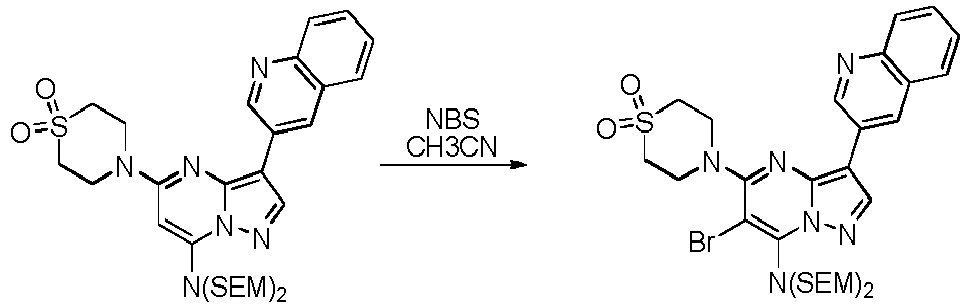
- By essentially the same procedure given in Preparative Example 3-1, 6-bromo-3-(quinolin-3-yl)-5-thiomorpholino-1', 1'-dioxide--N,N-bis((2-(trimethylsilyl)ethoxy)methyl)pyrazolo[1,5-a]pyrimidin-7-amine can be prepared. LCMS tR = 2.90 Min (5 min run, UV 254nm). Mass calculated for, M+ 732.2, observed LC/MS m/z 733.2 (M+H).
-

- A mixture of compound 5-chloro-3-iodo-N,N-bis((2-(trimethylsilyl)ethoxy)methyl)pyrazolo[1,5-a]pyrimidin-7-amine (10.8 mmol, 6.00 g, preparation reported previously), thiomorpholine 1,1-dioxide (32.4 mmol, 4.38 g), and NaHCO3 (48.6 mmol, 4.08 g) in NMP (50 mL) was heated at 130 °C for 28 h. LCMS showed nearly complete consumption of A. The reaction mixture was diluted with EtOAc, washed with H2O and brine, dried over Na2SO4, and concentrated. The crude product was purified by a SiO2 column (0-30% EtOAc/Hexanes) to afford compound 3-iodo-5-thiomorpholin-4-dioxo-N,N-bis((2-(trimethylsilyl)ethoxy)methyl)pyrazolo[1,5-a]pyrimidin-7-amine as a pale yellow solid (6.15 g, 87%). HPLC-MS TR= 2.70 min (UV 254 nm, 5 min method); mass calculated for formula C22H40IN5O4SSi2 653.1, observed LCMS m/z 654.1 (M+H).
- A mixture of compound 3-iodo-5-thiomorpholin-4-dioxo-N,N-bis((2-(trimethylsilyl)ethoxy)methyl)pyrazolo[1,5-a]pyrimidin-7-amine (0.551 mmol, 360 mg), boronate 7 (0.827 mmol, prepared in situ, see below), PdCl2(dppf)CH2Cl2 (0.055 mmol, 45.0 mg), and K2CO3 (1.65 mmol, 229 mg) in DME/H2O (5/1 mL) was degassed and then heated at 90 °C for 24 h. The reaction mixture was diluted with EtOAc and filtered. The filtrate was concentrated and purified by a SiO2 column (0-50% EtOAc/Hexanes) to afford compound 3-(6-fluoroquinolin-3-yl)-5-thiomorpholin-4'-dioxo-N,N-bis((2-(trimethylsilyl)ethoxy)methyl)pyrazolo[1,5-a]pyrimidin-7-amine as a yellow solid (260 mg, 70%). HPLC-MS TR= 2.39 min (UV 254 nm, 5 min method); mass calculated for formula C31H45FN6O4SSi2 672.3, observed LCMS m/z 673.2 (M+H).
-

- A mixture of the corresponding 3-bromo-6-fluoro quinoline (0.827 mmol, 187 mg, 1.0 eq), bis(pinacolato)diboron (1.2 eq), PdCl2(dppf)CH2Cl2 (0.1 eq), and KOAc (3.0 eq) in dioxane (5 mL) was degassed and then heated at 80 °C for 16 h. All the volatiles were removed under reduced pressure and the crude product 6-fluoro-3-(4,4,5,5-tetramethyl-1,3,2-dioxaborolan-2-yl)quinoline was used without further purification.
- To a solution of compound 3-(6-fluoroquinolin-3-yl)-5-thiomorpholin-4'-dioxo-N,N-bis((2-(trimethylsilyl)ethoxy)methyl)pyrazolo[1,5-a]pyrimidin-7-amine (0.169 mmol, 156 mg) in EtOH (4 mL) was added 4 N HCl in dioxane (1 mL) and the resulting mixture was heated at 65 °C for 1 h. All the volatiles were removed under reduced pressure. The residue, which has a very poor solubility in DMSO, was diluted with a small amount of DMSO and basicified with NaHCO3. The resulting slurry was stirred vigorously overnight and filtered. The precipitates were washed with H2O and MeOH to afford compound 3-(6-fluoroquinolin-3-yl)-5-thiomorpholin-4'-dioxo-pyrazolo[1,5-a]pyrimidin-7-amine as a pale yellow solid (60.1 mg, 86%). HPLC-MS TR= 1.17 min (UV 254 nm, 5 min method); mass calculated for formula C19H17FN6O2S 412.1, observed LCMS m/z 413.0 (M+H).
- To a slurry of compound 3-(6-fluoroquinolin-3-yl)-5-thiomorpholin-4'-dioxo- pyrazolo[1,5-a]pyrimidin-7-amine (0.0659 mmol, 27.2 mg) in CH3CN was added NBS (1.0 eq, in a stock solution in CH3CN) and the resulting mixture was stirred at rt for 1 h. The reaction solution was concentrated and purified by prep-HPLC to afford compound 3-(6-fluoroquinolin-3-yl)-5-thiomorpholin-4'-dioxo-6-bromo-pyrazolo[1,5-a]pyrimidin-7-amine as a pale yellow solid (6.1 mg, 19%). HPLC-MS TR= 1.56 min (UV 254 nm, 5 min method); mass calculated for formula C19H16BrFN6O2S 490.0, observed LCMS m/z 491.0 (M+H).
- By essentially the same procedures given in Preparative Example (scheme-29)Part B, Part C and Part D, compounds 10.65-10.85 given in Table 10A can be prepared.
TABLE - 10A Compound Structure M. Wt. (Calcd) MS m/z (M+H) HPLC-MS TR (Method) 10.73 
472.0 473.0 1.22 (5 min) 10.74 
490.0 491.0 1.57 (5 min) 10.82 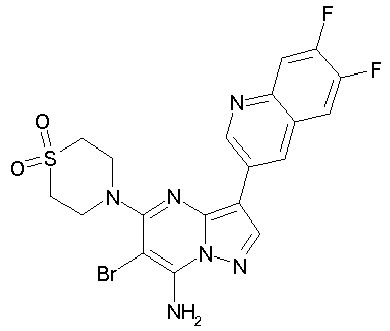
508.0 509 4.06 (10 min) 10.84 
502.0 503 3.21 (10 min) 10.85 
446.1 447.1 1.35 (5 min) -

- Title compound was prepared from compound 3-iodo-5-thiomorpholino4'-dioxo-N,N-bis((2-(trimethylsilyl)ethoxy)methyl)pyrazolo[1,5-a]pyrimidin-7-amine and 6-chloro-3-pyridineboronic acid pinacol ester using the coupling conditions described in Part B of Example 1. HPLC-MS TR = 2.89 min (UV 254 nm, 5 min method); mass calculated for formula C27H43ClN6O4SSi2 638.2, observed LCMS m/z 639.1 (M+H).
- A mixture of 3-(6-chloropyridin-3-yl)-5-thiomorpholino4-dioxo-N,N-bis((2-(trimethylsilyl)ethoxy)methyl)pyrazolo[1,5-a]pyrimidin-7-amine (0.258 mmol, 165 mg), pyridine-3-ylboronic acid (0.516 mmol, 63.4 mg), PdCl2(dppf)CH2Cl2 (0.026 mmol, 21.2 mg), and K2CO3 (0.774 mmol, 107 mg) in DME/H2O (2/0.4 mL) was degassed and then heated at 150 °C under microwave radiation for 1 h. The reaction mixture was diluted with EtOAc and filtered. The filtrate was concentrated and purified by a SiO2 column (20-100% EtOAc/Hexanes) to afford compound 3-(2,3'-bipyridin-5-yl)-5-thiomorpholino-4-dioxo-N,N-bis((2-(trimethylsilyl)ethoxy)methyl)pyrazolo[1,5-a]pyrimidin-7-amine as a pale yellow solid (161 mg, 91%). HPLC-MS TR = 2.15 min (UV 254 nm, 5 min method); mass calculated for formula C32H47N7O4SSi2 681.3, observed LCMS m/z 682.3 (M+H).
- By essentially the same procedures given in Preparative above Example(scheme-30) Compounds given in Table 10B can be prepared.
Table 10B Compound Structure Exact Mass MS m/z (M+H) HPLC-MS TR (Method) 10.86 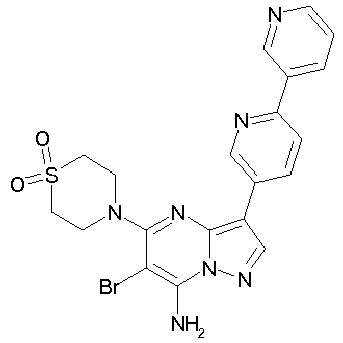
499.0 500.10 2.83 (10 min) 10.87 
529.0 530.10 3.14 (10 min) -

- Compound 3-(5-bromopyridin-3-yl)-5-thiomorpholin-4'-dioxo-N,N-bis((2-(trimethylsilyl)ethoxy)methyl)pyrazolo[1,5-a]pyrimidin-7-amine was prepared from compound 3-iodo-5-thiomorpholino4'-dioxo-N,N-bis((2-(trimethylsilyl)ethoxy)methyl)pyrazolo[1,5-a]pyrimidin-7-amine and 5-bromo-3-pyridineboronic acid pinacol ester using the coupling conditions described in Part B of Example 1. HPLC-MS TR = 2.62 min (UV 254 nm, 5 min method); mass calculated for formula C27H43BrN6O4SSi2 682.2, observed LCMS m/z 683.0 (M+H).
- Compound, 3-(3,3'-bipyridin-5-yl)-5-thiomorpholin-4'-dioxo-N,N-bis((2-(trimethylsilyl)ethoxy)methyl)pyrazolo[1,5-a]pyrimidin-7-amine was prepared from 3-(5-bromopyridin-3-yl)-5-thiomorpholin-4'-dioxo-N,N-bis((2-trimethylsilyl)ethoxy)methyl)pyrazolo[1,5-a]pyrimidin-7-amine using the coupling conditions described in Part B of Preparative Example 3. HPLC-MS TR = 2.50 min (UV 254 nm, 5 min method); mass calculated for formula C27H43BrN6O4SSi2 681.3, observed LCMS m/z 682.2 (M+H).
- By essentially the same procedures given in Preparative Example above(Scheme-31), compounds given in Table-10C can be prepared
Table 10C Compound Structure Exact Mass MS m/z (M+H) HPLC-MS TR (Method) 10.91 
499.0 500 2.36 (10 min) -

- A degassed mixture of 6-bromo-5-morpholino-3-(quinolin-3-yl)-N,N-bis((2-(trimethylsilyl)ethoxy)methyl)pyrazolo[1,5-a]pyrimidin-7-amine (141 mg, 0.20mmoL), tributyl(1-ethoxyvinyl)tin (112 mg, 0.31 mmoL), Pd(PPh3)4 (24 mg, 0.02 mmoL) in Dioxane (4 mL) was heated at 100°C for 2 days. The mixture was cooled to room temperature and filtered through short plug of 10% KF/SiO2. The crude Stille coupling product obtained after concentrating the filtrate was then treated with 3mL of 1: 1 mixture of TFA and H2O at room temperature for 30 min. Concentration and purification by prep-LC afforded 1-(7-amino-5-morpholino-3-(quinolin-3-yl)pyrazolo[1,5-a]pyrimidin-6-yl)ethanone. LCMS tR = 3.32 Min. Mass calculated for, M+ 388.1, observed LC/MS m/z 389.1 (M+H).
- By essentially the same procedure given in Preparative above(Scheme-32), compounds in the table-10-D can be synthesized.
TABLE-10D Compound ID Structures M.Wt (calc.) M+H (observed) Retention Time, 10 min method (min) 10.93 
436.1 437.1 2.88 10.94 
456.16 457.26 2.83 10.95 
425.17 426.23 2.90 10.96 
439.17 440.47 3.57 10.97 
443.16 444.13 3.27 10.98 
457.16 458.13 3.98 -

- A mixture of compound, 3-(5-bromopyridin-3-yl)-5-thiomorpholin-4'-dioxo-N,N-bis((2-(trimethylsilyl)ethoxy)methyl)pyrazolo[1,5-a]pyrimidin-7-amine (1.90 mmol, 1.24 g) 1-Boc-pyrazole-4-boronic acid pinacol ester (2.85 mmol, 838 mg), Pd(PPh3)4 (0.19 mmol, 220 mg), and K2CO3 (5.70 mmol, 788 mg) in dioxane/H2O (20/5 mL) was degassed and heated at 80 °C overnight using an oil bath. Then the reaction mixture was heated at 150 °C under microwave radiation for 1 h. After cooling to rt, the reaction mixture was diluted with EtOAc, washed with H2O and brine, dried over Na2SO4, and concentrated. The residue was purified by a SiO2 column (20-100% EtOAc/Hexanes, Rf = 0.5 in 100% EtOAc/Hexanes) to afford compound, 3-(1H-pyrazol-4-yl)-5-thiomorpholin-4'-dioxo-N,N-bis((2-(trimethylsilyl)ethoxy)methyl)pyrazolo[1,5-a]pyrimidin-7-amine as a brown solid (358 mg, 32%). HPLC-MS TR = 2.39 min (UV 254 nm, 5 min method); mass calculated for formula C25H43N7O4SSi2 593.3, observed LCMS m/z 594.2 (M+H).
- A mixture compound, 3-(1H-pyrazol-4-yl)-5-thiomorpholin-4'-dioxo-N,N-bis((2-(trimethylsilyl)ethoxy)methyl)pyrazolo[1,5-a]pyrimidin-7-amine (0.603 mmol, 358 mg), iodobenzene (0.904 mmol, 101 µL), CuI (0.0603 mmol, 11.5 mg), N,N'dimethylethylenediamine (0.241 mmol, 25.9 µL) and K3PO4 (1.27 mmol, 269 mg) in toluene (6 mL) was stirred at 110 °C under Ar2 for 24 h. After cooling to rt, the crude mixture was diluted with EtOAc and filtered. The filtrate was concentrated and purified by a SiO2 column (0-50% EtOAc/Hexanes, Rf = 0.7 in 50% EtOAc/Hexanes) to afford the compound, 3-(1-phenyl-1H-pyrazol-4-yl)-5-thiomorpholin-4'-dioxo-N,N-bis((2-(trimethylsilyl)ethoxy)methyl)pyrazolo[1,5-a]pyrimidin-7-amine, as a pale yellow solid (365 mg, 90%). HPLC-MS TR = 2.77 min (UV 254 nm, 5 min method); mass calculated for formula C31H47N7O4SSi2 669.3, observed LCMS m/z 670.3 (M+H).
- To a solution of compound 3-(1-phenyl-1H-pyrazol-4-yl)-5-thiomorpholin-4'-dioxo-N,N-bis((2-(trimethylsilyl)ethoxy)methyl)pyrazolo[1,5-a]pyrimidin-7-amine (0.545 mmol, 365 mg) in CH3CN/DCM (3/3 mL) was added NBS (0.545 mmol, 97 mg) and stirred at rt for 1 h. All the volatiles were removed under reduced pressure and the residue was purified by a SiO2 column (0-50% EtOAc/Hexanes, Rf = 0.8 in 50% EtOAc) to afford compound, 6-Bromo-3-(1-phenyl-1H-pyrazol-4-yl)-5-thiomorpholin-4'-dioxo- -N,N-bis((2-(trimethylsilyl)ethoxy)methyl)pyrazolo[1,5-a]pyrimidin-7-amine, as a yellow forming solid (224 mg, 55%). HPLC-MS TR = 3.01 min (UV 254 nm, 5 min method); mass calculated for formula C31H46BrN7O4SSi2 747.2, observed LCMS m/z 748.0 (M+H).
- A mixture of compound 6-Bromo-3-(1-phenyl-1H-pyrazol-4-yl)-5-thiomorpholin-4'-dioxo- - N,N-bis((2-(trimethylsilyl)ethoxy)methyl)pyrazolo[1,5-a]pyrimidin-7-amine (0.299 mmol, 224 mg), tributyl(1-ethoxyvinyl)tin (0.897 mmol, 0.303 mL), Pd(PPh3)4 (0.030 mmol, 34.6 mg) in dioxane (5 mL) was stirred at 100 °C under Ar2 for 16 h. After cooling to rt, the reaction mixture was passed through a short SiO2/KF (9:1) plug to removed majority of the Sn species, and then purified by a SiO2 column (0-40% EtOAc/Hexanes, Rf = 0.7 in 50% EtOAc) to afford compound, 6-(1-ethoxyvinyl)-3-(1-phenyl-1H-pyrazol-4-yl)-5-thiomorpholin-4'-dioxo-N,N-bis((2-(trimethylsilyl)ethoxy)methyl)pyrazolo[1,5-a]pyrimidin-7-amine as a pale yellow oil (185 mg, 84%). HPLC-MS TR = 3.06 min (UV 254 nm, 5 min method); mass calculated for formula C35H53N7O5SSi2 739.3, observed LCMS m/z 622.2 (M-117).
- Compound, 6-(1-ethoxyvinyl)-3-(1-phenyl-1H-pyrazol-4-yl)-5-thiomorpholin-4'-dioxo-N,N-bis((2-(trimethylsilyl)ethoxy)methyl)pyrazolo[1,5-a]pyrimidin-7-amine, (0.250 mmol, 185 mg) was treated with a mixture of TFA/H2O (2/2 mL) at rt for 30 min. All the volatiles were removed under reduced pressure. The residue was dissolved in 3.0 mL of DMSO and purified by a reverse phase HPLC (H2O/CH3CN, 0.1% TFA). The product fraction was concentrated to dryness and converted to HCl salt by adding 1 N HCl (aq) solution to its slurry in MeOH, and then concentrated to dryness. Compound, 1-(7-amino-3-(1-phenyl-1H-pyrazol-4-yl)-5-thiomorpholin-4'-dioxo-pyrazolo [1,5-a]pyrimidin-6-yl)ethanone (HCl salt) was obtained as a pale yellow solid (16.4 mg, 38%). HPLC-MS TR = 1.86 min (UV 254 nm, 5 min method); mass calculated for formula C21H21N7O3S 451.1, observed LCMS m/z 452.0 (M+H).
- By essentially the same procedures given in Preparative Example above(Scheme-33), compounds given in Table-10E can be prepared.
TABLE-10E Compound Structure Exact Mass MS m/z (M+H) HPLC-MS TR (Method) 10.100 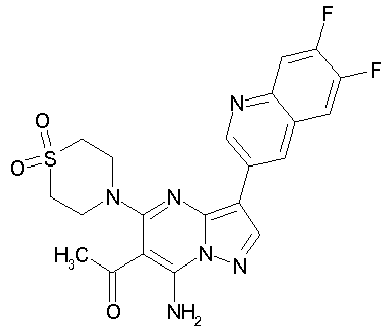
472.1 473 4.01 (10 min) 10.101 
454.1 455 3.35 (10 min) 10.102 
466.1 467 3.03 (10 min) 10.107 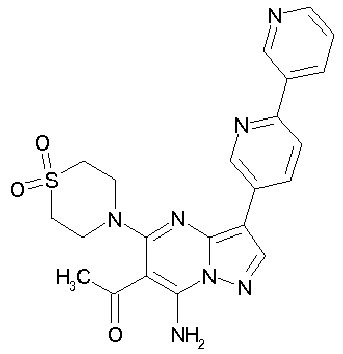
463.1 464 2.68 (10 min) 10.113 
470.1 471.0 1.85 (5 min) -

- A degassed mixture of 6-bromo-3-(quinolin-3-yl)-5-thiomorpholino-1', 1'-dioxide--N,N-bis((2-(trimethylsilyl)ethoxy)methyl)pyrazolo[1,5-a]pyrimidin-7-amine (16 mg, 0.022 mmoL), tributyl(prop-1-ynyl)stannane (22 mg, 0.067 mmoL), Pd(PPh3)4 (2.6 mg, 0.002mmoL) in Dioxane (3 mL) was heated at 100°C overnight. The mixture was cooled to room temperature and filtered through short plug of 10% KF/SiO2. The crude Stille coupling product obtained after concentrating the filtrate was then treated with 1: 1 mixture of TFA and H2O at room temperature for 30 min. Concentration and purification by prep-LC afforded 1-(7-amino-3-(quinolin-3-yl)-5-thiomorpholino-1', 1'-dioxide-pyrazolo[1,5-a]pyrimidin-6-yl)propan-1-one. LCMS tR = 3.20 Min (10 min run, UV 254nm). Mass calculated for, M+ 450.1, observed LC/MS m/z 451.1 (M+H).
-

- By essentially the same procedure given in Preparative Example above, 7-(7-amino-6-propionyl-3-(quinolin-3-yl)pyrazolo[1,5-a]pyrimidin-5-yl)tetrahydroimidazo[1,5-a]pyrazine-1,3(2H,5H)-dione can be prepared from 7-(7-(bis((2-(trimethylsilyl)ethoxy)methyl)amino)-6-bromo-3-(quinolin-3-yl)pyrazolo[1,5-a]pyrimidin-5-yl)tetrahydroimidazo[1,5-a]pyrazine-1,3(2H,5H)-dione. LCMS tR = 3.14 Min (10 min run, UV 254nm). Mass calculated for, M+ 470.18, observed LC/MS m/z 471.28 (M+H).
-

- By essentially the same procedure given in Preparative Example above, 1-(7-amino-3-(quinolin-3-yl)-5-thiomorpholino-1', 1'-dioxide-pyrazolo[,5-a]pyrimidin-6-yl)-2-phenylethanone can be prepared using tributyl(phenylethynyl)stannane instead of tributyl(prop-1-ynyl)stannane. LCMS tR = 3.74 Min (10 min run, UV 254nm). Mass calculated for, M+ 512.16, observed LC/MS m/z 513.18 (M+H).
-

- To a solution of KOH (331 mmol, 21.9 g, 85%) in 250 mL of MeOH was added cystamine hydrochloride (158 mmol, 17.9 g), in small portions, followed by a solution of chloroacetone (158 mmol, 12.6 mL) in 100 mL of MeOH at 0-5 °C. After being stirred for 90 min at 0 °C, the reaction was acidified with 350 mL of 1.25 M HCl in MeOH at 0-5 °C and stirred for 1 h. NaBH4 was then added in small portions at below 5 °C and the mixture was stirred for 30 min. The reaction was quenched with 1 N HCl (aq) and filtered. The filtrate was concentrated and then dissolved in H2O and extracted with DCM (*8). The organic layers were discarded and the aqueous phase was carefully neutralized with NaOH first, and then Na2CO3. The aqueous phase was extracted with DCM, dried over Na2SO4 and concentrated to afford compound, 3-methylthiomorpholine (7.69 g, 42%), which slowly turned into a sticky solid and was used without further purification. HPLC-MS TR = 0.19 min (UV 254 nm, 5 min method); mass calculated for formula C5H11NS 117.1, observed LCMS m/z 118.2 (M+H).
- To a solution of compound, 3-methylthiomorpholine (65.6 mmol, 7.69 g) and TEA (131 mmol, 18.3 mL) in THF (200 mL) was added (Boc)2O (98.4 mmol, 21.5 g), followed by DMAP (13.1 mmol, 1.60 g). The resulting reaction mixture was stirred at rt overnight. THF was removed and the residue was dissolved in DCM and directly purified by a SiO2 column (0-15% EtOAc/Hexanes, Rf = 0.55 in 20% EtOAc, KMnO4 staining) to afford compound tert-butyl 3-methylthiomorpholine-4-carboxylate as a white sticky solid (7.31 g, 51%).
- To a solution of compound, tert-butyl 3-methylthiomorpholine-4-carboxylate (33.6 mmol, 7.31 g) in DCM (170 mL) at 0 °C was added mCPBA (101 mmol, 24.0 g) in small portions. The reaction mixture was warmed to rt and stirred for 1 h. DCM was removed and the residue was then partitioned between EtOAc and NaHCO3 (aq). The aqueous layer was extracted with EtOAc (*3). The combined organic layers were washed with brine, dried over Na2SO4, and concentrated. The crude product was purified by a SiO2 column (0-50% EtOAc/Hexanes, Rf = 0.6 in 50% EtOAc) to afford compound, tert-butyl 3-methylthiomorpholine-4'-dioxo-4-carboxylate as a white solid (6.51 g, 78%).
- Compound tert-butyl 3-methylthiomorpholine-4'-dioxo-4-carboxylate (20.1 mmol, 5.00 g) was treated with TFA/DCM (25/25 mL) at rt for 1 h. The reaction mixture was evaporated to afford compound, 3-methylthiomorpholine-4'-dioxide as a white solid (TFA salt MW:263.23, 5.18 g, 98%), which was used without further purification. HPLC-MS TR = 0.18 min (UV 254 nm, 5 min method); mass calculated for formula C5H11NO2S 149.1, observed LCMS m/z 150.1 (M+H).
- A mixture of compound, 3-methylthiomorpholine-4'-dioxide (1.00 mmol, 263 mg), 5-chloro-N,N-bis[(2-trimethylsilylethoxy)methyl]-pyrazolo[1,5-a]pyrimidin-7-amine (0.667 mmol, 286 mg, preparation was reported previously), Pd(OAc)2 and Cs2CO3 in dioxane (3 mL) was heated at 110 °C for 24 h. The reaction mixture was diluted with EtOAc and washed with H2O and brine, dried over Na2SO4, and concentrated. The crude product was purified by a SiO2 column (0-40% EtOAc/Hexanes, Rf = 0.5 in 50% EtOAc) to afford compound, 5-(3-methylthiomorpholin-4'-dioxo)-N,N-bis((2-(trimethylsilyl)ethoxy)methyl)pyrazolo[1,5-a]pyrimidin-7-amine, as a colorless oil (145 mg, 40%). HPLC-MS TR = 2.75 min (UV 254 nm, 5 min method); mass calculated for formula C23H43N5O4SSi2 541.3, observed LCMS m/z 542.2 (M+H).
- To a solution of compound, 5-(3-methylthiomorpholin-4'-dioxo)-N,N-bis((2-(trimethylsilyl)ethoxy)methyl)pyrazolo[1,5-a]pyrimidin-7-amine (0.268 mmol, 145 mg) in CH3CN (5 mL) was added NIS (0.294 mmol, 66.2 mg). The resulting solution was stirred at rt for 30 min. The reaction mixture was evaporated and directly purified by a SiO2 column (0-15% EtOAc/Hexanes, Rf = 0.55 in 20% EtOAc) to afford compound, 3-iodo-5-(3-methylthiomorpholin-4'-dioxo)-N,N-bis((2-(trimethylsilyl)ethoxy)methyl)pyrazolo[1,5-a]pyrimidin-7-amine, as a pale yellow oil (161 mg, 90.0%). HPLC-MS TR = 7.29 min (UV 254 nm, 10 min method); mass calculated for formula C23H42IN5O4SSi2 667.2, observed LCMS m/z 668.0 (M+H).
- A mixture of compound, 3-iodo-5-(3-methylthiomorpholin-4'-dioxo)-N,N-bis((2-(trimethylsilyl)ethoxy)methyl)pyrazolo[1,5-a]pyrimidin-7-amine (0.428 mmol, 286 mg), 1-phenyl-4-(4,4,5,5-tetramethyl-1,3,2-dioxaborolan-2-yl)-1H-pyrazole (0.557 mmol, 150 mg), PdCl2(dppf)CH2Cl2, and K3PO4 in dioxane/H2O (4/0.4 mL) was degassed and then heated at 100 °C for 16 h. After cooling to r.t., the reaction mixture was diluted with EtOAc and filtered. The filtrate was concentrated and purified by a SiO2 column (0-40% EtOAc/Hexanes, Rf = 0.6 in 50% EtOAc/Hexanes) to afford compound, 5-(3-methylthiomorpholin-4'-dioxo)-3-(1-phenyl-1H-pyrazol-4-yl)-N,N-bis((2-(trimethylsilyl)ethoxy)methyl)pyrazolo[1,5-a]pyrimidin-7-amine, as a pale yellow oil (142 mg, 48%). HPLC-MS TR = 2.92 min (UV 254 nm, 5 min method); mass calculated for formula C32H49N7O4SSi2 683.3, observed LCMS m/z 684.2 (M+H).
- compound, 5-(3-methylthiomorpholin-4'-dioxo)-3-(1-phenyl-1H-pyrazol-4-yl)-N,N-bis((2-(trimethylsilyl)ethoxy)methyl)pyrazolo[1,5-a]pyrimidin-7-amine, bromination with NBS, follwed by on stille reaction with Vinyl triflate and treatment with 4N HCl in dioxane as described in the above example (scheme-???) resulted in a compound, 5-(3-methylthiomorpholin-4'-dioxo)-3-(1-phenyl-1H-pyrazol-4-yl)pyrazolo[1,5-a]pyrimidin-7-amine as HCl salt. Evaporation of dioxane and lyophilization of the product resulted in 5-(3-methylthiomorpholin-4'-dioxo)-3-(1-phenyl-1H-pyrazol-4-yl) pyrazolo [1, 5-a] pyrimidin-7-amine as white powder. HPLC-MS TR = 4.93 min (UV 254 nm, 10 min method); mass calculated for formula C32H49N7O4S 465.16, observed LCMS m/z 466.10 (M+H).
-


- A solution of CH3CN (48.7 mmol, 2.54 mL) in 10 mL of THF was added dropwise to a solution of n BuLi (48.7 mmol) in 15 mL of THF at -78 °C. After stirring for 1 h at -78 °C, a solution of methyl tetrahydro-2H-thiopyran-4-carboxylate (24.3 mmol, 3.90 g) in 10 mL of THF was added dropwise and the resulting reaction mixture was stirred at -78 °C for 1 h, then slowly warmed to - 40 °C in 2 h. The reaction was quench with 1 N HCl (pH<1). THF was removed and the residue was extracted with EtOAC, washed with brine, dried over Na2SO4, and concentrated. The crude product was purified by a SiO2 column (0-50% EtOAc/Hexanes, Rf = 0.45 in 50% EtOAc) to afford compound 3-oxo-3-(tetrahydro-2H-thiopyran-4-yl)propanenitrile (3.60 g, 87.5%) as a light brownish oil. HPLC-MS TR = 1.15 min (UV 254 nm, 5 min method); mass calculated for formula C8H11NOS 169.1 observed LCMS m/z 170.1 (M+H).
- A mixture of 3-aminopyrazole (19.3 mmol, 1.61 g) and compound 3-oxo-3-(tetrahydro-2H-thiopyran-4-yl) propanenitrile (21.3 mmol, 3.60 g) in acetic acid (40 mL) was heated at 100 °C in a sealed tube overnight. After cooling to rt, all the volatiles were removed under reduced pressure to afford a light brownish oil. This brownish oil was dissolve in DCM (60 mL), and then SEMCl (67.6 mmol, 11.9 mL) and DIPEA (135 mmol, 23.5 mL) were added. The resulting reaction mixture was stirred at 45 °C for 1 h. After cooling to rt, all the volatiles were removed under reduced pressure. The residue was diluted with EtOAc (300 mL), filtered and washed with EtOAc. The filtrate was concentrated and the crude product was purified by a SiO2 column (0-30%) to afford compound, 5-(tetrahydro-2H-thiopyran-4-yl)-N,N-bis((2-(trimethylsilyl)ethoxy)methyl)pyrazolo[1,5-a]pyrimidin-7-amine as a light brownish oil (9.23 g, 97%). HPLC-MS TR = 3.09 min (UV 254 nm, 5 min method); mass calculated for formula C23H42N4O2SSi2 494.3, observed LCMS m/z 495.1 (M+H).
- To a solution of compound, 5-(tetrahydro-2H-thiopyran-4-yl)-N,N-bis((2-(trimethylsilyl)ethoxy)methyl)pyrazolo[1,5-a]pyrimidin-7-amine (18.7 mmol, 9.23 g) in DCM (100 mL) was added mCPBA and stirred at rt for 1 h. The reaction was quenched with Na2S2O3 (aq.) and diluted with DCM (100 mL). The separated organic layer was washed with NaHCO3 (2*) and brine, dried over Na2SO4, and concentrated to afford crude compound, 5-(tetrahydro-2H-thiopyran-4-yl-1', 1'-dioxide)-)-N,N-bis((2-(trimethylsilyl)ethoxy)methyl)pyrazolo[1,5-a]pyrimidin-7-amine as a purple oil, which was used without further purification. HPLC-MS TR = 2.72 min (UV 254 nm, 5 min method); mass calculated for formula C23H42N4O4SSi2 526.2, observed LCMS m/z 527.2 (M+H).
- To a solution of all crude compound, 5-(tetrahydro-2H-thiopyran-4-yl-l', 1'-dioxide)-)-N,N-bis((2-(trimethylsilyl)ethoxy)methyl)pyrazolo[1,5-a]pyrimidin-7-amine from Part C (18.7 mmol) in CH3CN (100 mL) was added NIS (20.6 mmol, 4.63 g). The resulting solution was stirred at rt for 30 min. TLC (50% EtOAc/Hexanes) indicated complete conversion to a new spot (Rf = 0.5, less polar than SM Rf = 0.3). The reaction was quenched with Na2S2O3. CH3CN was removed under reduced pressure. The residue was dissolved in DCM, washed with H2O and brine, dried over Na2SO4, and concentrated. The crude product was purified by a SiO2 column (0-50% EtOAc/Hexanes) to afford compound, 3-iodo-5-(tetrahydro-2H-thiopyran-4-yl-1,1-dioxide)-N,N-bis((2-(trimethylsilyl)ethoxy)methyl)pyrazolo [1,5-a]pyrimidin-7-amine:
as a pale yellow oil (6.82 g, 56%). - To a solution of 2-bromo-5-phenylpyridine (0.400 mmol, 93.6 mg) and triisopropyl borate (0.440 mmol, 0.102 mL) in a mixed solvent of toluene/THF (1.6/0.4 mL) was added dropwise n BuLi (0.440 mmol) at -78 °C, then kept at -78 °C for 30 min (sticky mixture, stopped stirring after 5 min). The reaction mixture was allowed to warm to rt and stirred for 4 h. All the volatiles were removed under reduced pressure from rt to 90 °C. The thus formed crude lithium borate was used without further purification. A mixture of the crude lithium borate (0.400 mmol), compound, 3-iodo-5-(tetrahydro-2H-thiopyran-4-yl-1,1-dioxide)-N,N-bis((2-(trimethylsilyl)ethoxy)methyl)pyrazolo[1,5-a]pyrimidin-7-amine (0.267 mmol, 174 mg), PdCl2(dppf) CH2Cl2 (0.027 mmol, 22.0 mg), and KF (0.800 mmol, 46.5 mg) in dioxane (2 mL) was degassed and then heated at 90 °C for 16 h. The reaction mixture was diluted with EtOAc and filtered. The filtrate was concentrated and purified by a SiO2 column (0-40% EtOAc/Hexanes, Rf = 0.5 in 50% EtOAc/Hexanes) to afford compound, 3-(5-phenylpyridin-2-yl)-5-(tetrahydro-2H-thiopyran-4-yl-1,1-dioxide)-N,N-bis((2-(trimethylsilyl)ethoxy)methyl)pyrazolo[1,5-a]pyrimidin-7-amine as a pale yellow solid (32 mg, 18%). HPLC-MS TR = 2.62 min (UV 254 nm, 5 min method); mass calculated for formula C34H49N5O4SSi2 679.3, observed LCMS m/z 680.2 (M+H).
- NBS (176 mg, 0.99 mmoL) was added to a solution of 3-(6-phenylpyridin-3-yl)-5-(tetrahydro-2H-thiopyran-4-yl-1', 1'-dioxide)-N,N-bis((2-(trimethylsilyl)ethoxy)methyl)pyrazolo[1,5-a]pyrimidin-7-amine (679 mg, 0.94 mmoL) in CH3CN (10 mL). The mixture was stirred at room temperature for 1h. Concentration and purification by column chromatography afforded 6-bromo-3-(6-phenylpyridin-3-yl)-5-(tetrahydro-2H-thiopyran-4-yl-1', 1'-dioxide)-N,N-bis((2-(trimethylsilyl)ethoxy)methyl)pyrazolo[1,5-a]pyrimidin-7-amine. LCMS tR = 2.87 Min (5 min run, UV 254nm). Mass calculated for, M+ 757, observed LC/MS m/z 758.2 (M+H).
- 6-bromo-3-(6-phenylpyridin-3-yl)-5-(tetrahydro-2H-thiopyran-4-yl-1', 1'-dioxide)-N,N-bis((2-(trimethylsilyl)ethoxy)methyl)pyrazolo[1,5-a]pyrimidin-7-amine was treated with 4NHCl in dioxane at room temperature for 1 hr and reaction evaporated to dry ness and lyophilized under vacuo to give product in powder form, 6-bromo-3-(6-phenylpyridin-3-yl)-5-(tetrahydro-2H-thiopyran-4-yl-1', 1'-dioxide)-methyl)pyrazolo[1,5-a]pyrimidin-7-amine as HCl salt. LCMS tR = 1.27 Min (5 min run, UV 254nm). Mass calculated for, M+ 497.10, observed LC/MS m/z 498.20 (M+H).
- By essentially the same procedure given in Preparative above(Scheme-35), compounds 10.116 to 10.133 given in the table (10-F) can be prepared.
TABLE-10-F Compound No. Structures M.Wt (calc.) M+H (observed) Retention Time, 10 min method (min) 10.116 
498.05 499.10 1.65(5min) 10.117 
471.04 472.10 2.00(5min) 10.118 
489.03 491.20 2.10(5min) 10.130 
453.1 454.1 1.48 (5 min) -

- A degassed mixture of 6-bromo-3-(6-phenylpyridin-3-yl)-5-(tetrahydro-2H-thiopyran-4-yl-1',1'-dioxide)-N,N-bis((2-(trimethylsilyl)ethoxy)methyl)pyrazolo[1,5-a]pyrimidin-7-amine (203 mg, 0.27mmol), Pd(PPh3)4 (31 mg, 0.027 mmoL), tributyl(vinyl)stannane (255 mg, 0.80 mmoL) in CH3CN (6 mL) was heated at 150°C under microwave condition for 60 min. The reaction mixture was cooled to room temperature, filtered through 9:1 SiO2:KF plug and concentrated in vacuo. Purification by column chromatography afforded 3-(6-phenylpyridin-3-yl)-5-(tetrahydro-2H-thiopyran-4-yl-1',1'-dioxide)-N,N-bis((2-(trimethylsilyl)ethoxy)methyl)-6-vinylpyrazolo[1,5-a]pyrimidin-7-amine: LCMS tR = 2.82 Min (5 min run, UV 254nm). Mass calculated for, M+ 705.3, observed LC/MS m/z 706.3 (M+H).
- To 3-(6-phenylpyridin-3-yl)-5-(tetrahydro-2H-thiopyran-4-yl-1',1'-dioxide)-N,N-bis((2-(trimethylsilyl)ethoxy)methyl)-6-vinylpyrazolo[1,5-a]pyrimidin-7-amine (189 mg, 0.26 mmol) in 1, 4-doixane (3 mL) was added 2.5 wt% OsO4 in 1, 4-dioxane (168 uL, 0.013 mmol), 2,6-lutidine (265 uL, 2.68 mmol) and H2O (1 mL) and the resulting mixture was stirred at room temperature for 20 minutes. NaIO4 (287 mg, 1.34 mmol) was then added and stirring at room temperature continued for 4 days. Saturated Na2S2O3 solution (5 mL) was added and the mixture stirred for 10 minutes. Organics were then extracted with CH2Cl2 (2 x), dried (Na2SO4) and concentrated in vacuo to 7-(bis((2-(trimethylsilyl)ethoxy)methyl)amino)-3-(6-phenylpyridin-3-yl)-5-(tetrahydro-2H-thiopyran-4-yl-1',1'-dioxide)pyrazolo[1,5-a]pyrimidine-6-carbaldehyde, which was used without further purification: LCMS tR = 2.87 Min (5 min run, UV 254nm). Mass calculated for, M+ 707.2, observed LC/MS m/z 708.3 (M+H).
- The crude 7-(bis((2-(trimethylsilyl)ethoxy)methyl)amino)-3-(6-phenylpyridin-3-yl)-5- (tetrahydro-2H-thiopyran-4-yl-1',1'-dioxide)pyrazolo[1,5-a]pyrimidine-6-carbaldehyde (150 mg, 0.21 mmoL) was treated with 50% TFA in H2O (4 mL) until the disappearance of starting material in LCMS. Concentration and purification by prep-LC afforded 7-amino-3-(6-phenylpyridin-3-yl)-5-(tetrahydro-2H-thiopyran-4-yl-1', 1'-dioxide)pyrazolo[1 ,5-a]pyrimidine-6-carbaldehyde, LCMS tR = 3.10 Min (10 min run, UV 254nm). Mass calculated for, M+ 447.1, observed LC/MS m/z 448.1 (M+H).
- By essentially the same procedure given in Preparative Example(Scheme-36) compounds 10.134 - 10.137 (Table-10-G) can be prepared.
TABLE-10 G Compound ID Structures M.Wt (calc.) M+H (observed) Retention Time, 10 min method (min) 10.134 
421.12 422.17 2.75 10.135 
439.11 440.0 3.14 10.136 
448.13 449.0 2.22 -

- By essentially the same procedure given in Preparative Example above(Scheme-36), 1-(7-amino-3-(6-phenylpyridin-3-yl)-5-(tetrahydro-2H-thiopyran-4-yl-1', 1'-dioxide)pyrazolo[1,5-a]pyrimidin-6-yl)propan-1-one can be prepared from 6-bromo-3-(6-phenylpyridin-3-yl)-5-(tetrahydro-2H-thiopyran-4-yl-1', 1'-dioxide)-N,N-bis((2 trimethylsilyl) ethoxy) methyl)pyrazolo[1,5-a]pyrimidin-7-amine. LCMS tR = 3.13 Min (10 min run, UV 254nm). Mass calculated for, M+ 449.15, observed LC/MS m/z 450.40 (M+H).
-

- A degassed mixture of 6-bromo-3-(6-phenylpyridin-3-yl)-5-(tetrahydro-2H-thiopyran-4-yl-1',1'-dioxide)-N,N-bis((2-(trimethylsilyl)ethoxy)methyl)pyrazolo[1,5-a]pyrimidin-7-amine (203 mg, 0.27mmol), Pd(PPh3)4 (31 mg, 0.027 mmoL), tributyl(vinyl)stannane (255 mg, 0.80 mmoL) in CH3CN (6 mL) was heated at 150°C under microwave condition for 60 min. The reaction mixture was cooled to room temperature, filtered through 9:1 SiO2:KF plug and concentrated in vacuo. The crude 6-(1-ethoxyvinyl)-3-(6-phenylpyridin-3-yl)-5-(tetrahydro-2H-thiopyran-4-yl-1,1'-dioxide)-N,N-bis((2-(trimethylsilyl)ethoxy)methyl)pyrazolo[1,5-a]pyrimidin-7-aminewas treated with 50% TFA in H2O (2 mL) for 1h. Concentration and purification afforded 1-(7-amino-3-(6-phenylpyridin-3-yl)-5-(tetrahydro-2H-thiopyran-4-yl-1',1'-dioxide)pyrazolo[1,5-a]pyrimidin-6-yl)ethanone: LCMS tR = 3.18 Min (10 min run, UV 254nm). Mass calculated for, M+ 461.1, observed LC/MS m/z 462.1 (M+H).
-

- A mixture of 6-bromo-3-(quinolin-3-yl)-5-thiomorpholino-1',1'-dioxide-N,N-bis((2-(trimethylsilyl)ethoxy)methyl)pyrazolo[1,5-a]pyrimidin-7-amine (0.061 mmol, 45 mg), CuI (0.49 mmol, 94 mg) and NaSO2Me (0.49 mmol, 50 mg) in NMP (2mL) was heated at 120°C for 1h and then 130°C for 1h under microwave condition. Purification by prep-LC afforded 6-(methylsulfonyl)-3-(quinolin-3-yl)-5-thiomorpholino--1', 1 '-dioxide-pyrazolo [1,5-a]pyrimidin-7-amine: LCMS tR = 2.94 Min (10 min run, UV 254nm). Mass calculated for, M+ 472.0, observed LC/MS m/z 473.0 (M+H).

- A degassed mixture of 6-bromo-5-thiomorpholinodioxo-3-(quinolin-3-yl)-N,N-bis((2-(trimethylsilyl)ethoxy)methyl)pyrazolo[1,5-a]pyrimidin-7-amine (35 mg, 0.051mmoL), Bu3SnCN (32.3 mg, 0.10 mmoL), Pd[P(t-Bu)3]2 (5.2 mg, 0.010 mmoL) in Dioxane (3 mL) was heated at 100°C overnight. The mixture was cooled to room temperature and the solvent was evaporated. Purification by column chromatography afforded 7-(bis((2-(trimethylsilyl)ethoxy)methyl)amino)-5-thiomorpholinodioxo-3-(quinolin-3-yl)pyrazolo[1,5-a]pyrimidine-6-carbonitrile. LCMS tR = 2.76 Min (5 min run, UV 254nm). Mass calculated for, M+ 678.28, observed LC/MS m/z 679.20 (M+H).
- A mixture of 7-(bis((2-(trimethylsilyl)ethoxy)methyl)amino)-5-thiomorpholinodioxo-3-(quinolin-3-yl)pyrazolo[1,5-a]pyrimidine-6-carbonitrile (5 mg), EtOH (1mL) and 3N HCl (1mL) was heated at 60°C until LCMS indicated complete reaction. The mixture was cooled to room temperature and the solvent was evaporated. Purification by prep-LC afforded 7-amino-5-thiomorpholinodioxo-3-(quinolin-3-yl) pyrazolo [1, 5-a] pyrimidine-6-carbonitrile. LCMS tR = 3.12 Min (10 min run, UV 254nm). Mass calculated for, M+ 418.12, observed LC/MS m/z 419.2 (M+H).
- Following the examples described above, the compounds (Scheme-36)) given in the Table-10-H can be synthesized
TABLE-10-H Compound ID Structures M.Wt (calc.) M+H (observed) Retention Time, 10 min method (min) 10.138 
418.12 419.14 2.70 10.139 
436.11 437.1 2.85 10.140 
445.13 446.44 2.52 -

- The 7-amino-3-(quinolin-3-yl)-5-(tetrahydro-2H-thiopyran-4-yl-1',1'-dioxide)pyrazolo[1,5-a]pyrimidine-6-carbonitrilewas stirred in conc. H2SO4 (1mL) at 60°C until LCMS indicated complete conversion. The reaction was quenched with ice and the pH was adjusted to ∼ 8 by 6 N NaOH. The mixture was extratce by 15% i-PrOH/CH2Cl2 (x3). The combined organic layers were dried with Na2SO4. Evaporation of solvent afforded the crude displacement compound. Purification by prep-LC afforded 7-amino-3-(quinolin-3-yl)-5-(tetrahydro-2H-thiopyran-4-yl-1',1'-dioxide)pyrazolo[1,5-a]pyrimidine-6-carboxamide. LCMS tR = 2.27 Min (10 min run, UV 254nm). Mass calculated for, M+ 436.13, observed LC/MS m/z 437.23 (M+H).
-

- By essentially the same procedure given in Preparative above, 7-amino-3-(quinolin-3-yl)-5-(tetrahydro-2H-thiopyran-4-yl) pyrazolo [1,5-a]pyrimidine-6-carboxamide can be prepared. LCMS tR = 3.21 Min (10 min run, UV 254nm). Mass calculated for, M+ 405.13, observed LC/MS m/z 406.15 (M+H).
-

- A mixture of 1-(7-amino-3-(6-phenylpyridin-3-yl)-5-(tetrahydro-2H-thiopyran-4-yl-1',1'-dioxide)pyrazolo [1,5-a]pyrimidin-6-yl)ethanone (4mg) and 50% NH2OH (120 uL) in NMP (1mL) was heated at 100°C for 30 min under microwave condition. Purification by prep-LC afforded 1-(7-amino-3-(6-phenylpyridin-3-yl)-5-(tetrahydro-2H-thiopyran-4-yl-1',1'-dioxide)pyrazolo[1,5-a]pyrimidin-6-yl)ethanone oxime: LCMS tR = 3.04 Min (10 min run, UV 254nm). Mass calculated for, M+ 476.16, observed LC/MS m/z 477.59 (M+H).
-

- By essentially the same procedure given in Preparative Example given above 1-amino-3-(6-phenylpyridin-3-yl)-5-(tetrahydro-2H-thiopyran-4-yl--1',1'-dioxide) pyrazolo [1,5-a]pyrimidine-6-carbaldehyde oximecan be prepared. LCMS tR = 3.15 Min (10 min run, UV 254nm). Mass calculated for, M+ 462.14, observed LC/MS m/z 463.57 (M+H).
-

- NaBH4 (10 mg) was added to a solution of 1-(7-amino-3-(quinolin-3-yl)-5-thiomorpholino-1', 1'-dioxide-pyrazolo [1, 5-a]pyrimidin-6-yl)ethanone (10 mg, 0.023 mmoL) in MeOH (1 mL). After stirring at room temperature for 1h, the mixture was concentrated to dry. Purification by prep-TLC afforded 1-(7-amino-3-(quinolin-3-yl)-5-thiomorpholinopyrazolo-1', 1'-dioxide-[1,5-a]pyrimidin-6-yl)ethanol: LCMS tR = 2.44 Min (5 min run, UV 254nm). Mass calculated for, M+ 438.1, observed LC/MS m/z 439.1 (M+H).
- By essentially the same procedure given in Preparative Example described above(Scheme-37), following compounds 10.142-10.148 in table-10-I can be prepared.
TABLE-10-I Compound ID Structures M.Wt (calc.) M+H (observed) Retention Time, 10 min method (min) 10.142 
452.16 453.3 2.69 10.143 
437.15 438.1 2.94 10.144 
464.16 465.1 2.68 10.145 
441.12 442.0 1.23 10.146 
450.14 451.1 2.41 -

- By essentially the same procedure given in Preparative Example described above(Scheme-36), 3-(6-phenylpyridin-3-yl)-5-(tetrahydro-2H-thiopyran-4-yl-1',1'-dioxide)-6-(thiophen-2-yl)pyrazolo[1,5-a]pyrimidin-7-amine be prepared. LCMS tR = 4.18 Min (10 min run, UV 254nm). Mass calculated for, M+ 501.12, observed LC/MS m/z 502.0 (M+H).
- By essentially the same procedure given in Preparative Example above(36), compounds in table 10-J (10.149 -10.151) can be prepared.
TABLE-10-J Compound ID Structures M.Wt (calc.) M+H (observed) Retention Time, 10 min method (min) 10.149 
475.1 476.0 1.48 (5min run) 10.150 
459.13 460.21 3.25 10.151 
470.15 471.03 2.67 -

- A degassed mixture of 6-bromo-3-(6-phenylpyridin-3-yl)-5-(tetrahydro-2H-thiopyran-4-yl-1',1'-dioxide)-N,N-bis((2-(trimethylsilyl)ethoxy)methyl)pyrazolo[1,5-a]pyrimidin-7-amine (53 mg, 0.07mmol), Pd(OAc)2 (3.1 mg, 0.014 mmoL), P(C6H11)3 (7.9 mg, 0.028 mmoL), 2-cyclopropyl-4,4,5,5-tetramethyl-1,3,2-dioxaborolane (23.5 mg, 0.14 mmoL), K3PO4 (53 mg, 0.25 mmoL) in Toluene (0.4 mL) and H2O (0.02 mL)was heated at 100°C overnight. The reaction mixture was cooled to room temperature, filtered through celite and concentrated in vacuo. The crude coupling product was treated with 50% TFA in H2O (4 mL) for 1h. The reaction mixture was concentrated in vacuo. Concentration and purification afforded 6-cyclopropyl-3-(6-phenylpyridin-3-yl)-5-(tetrahydro-2H-thiopyran-4-yl--1',1'-dioxide)pyrazolo[1,5-a]pyrimidin-7-amine: LCMS tR = 3.49 Min (10 min run, UV 254nm). Mass calculated for, M+ 459.17, observed LC/MS m/z 460.22 (M+H).
- By essentially the same procedure given in Preparative Example above(Scheme-38), compounds 10.152 - 10.154 can be prepared are given in Table-10-K
TABLE-10-K Compound ID Structures M.Wt (calc.) M+H (observed) Retention Time, 10 min method (min) 10.152 
433.15 434.18 3.24 10.153 
451.1 452.0 4.04 
- At 0°C, Et3N (41.7 uL, 0.29 mmol) and MsCl (17.4 uL, 0.22 mmol) were added to a solution of (7-(bis((2-(trimethylsilyl)ethoxy)methyl)amino)-3-(6-phenylpyridin-3-yl)-5-(tetrahydro-2H-thiopyran-4-yl-1',1'-dioxide)pyrazolo[1,5-a]pyrimidin-6-yl)methanol (53 mg, 0.75 mmol)in THF (3mL). After stirring at room temperature for 1h, the compound, (7-(bis((2-(trimethylsilyl)ethoxy)methyl)amino)-3-(6-phenylpyridin-3-yl)-5-(tetrahydro-2H-thiopyran-4-yl-1',1'-dioxide)pyrazolo[1,5-a]pyrimidin-6-yl)methyl methanesulfonate was evenly transferred to three vials.
- 7N NH3 in MeOH (1mL) added was added to vial 1. 6-(aminomethyl)-3-(6-phenylpyridin-3-yl)-5-(tetrahydro-2H-thiopyran-4-yl-1',1'-dioxide) pyrazolo[1,5-a]pyrimidin-7-amine was obtained after concentration and deprotection by treating with 50% TFA in H2O and then prep-LC purification to give the product, 6-(aminomethyl)-3-(6-phenylpyridin-3-yl)-5-(tetrahydro-2H-thiopyran-4-yl-1',1'-dioxide) pyrazolo[1,5-a]pyrimidin-7-amine. LCMS tR = 1.97 Min (10 min run, UV 254nm). Mass calculated for, M+ 448.16, observed LC/MS m/z 449.2 (M+H).
- 2 N MeNH2 in THF (1mL) added was added to vial 2. 6-((methylamino)methyl)-3-(6-phenylpyridin-3-yl)-5-(tetrahydro-2H-thiopyran-4-yl-1', 1'-dioxide)pyrazolo[1,5-a]pyrimidin-7-amine was obtained after concentration and deprotection by treating with 50% TFA in H2O and then prep-LC purification resulted in pure 6-((methylamino)methyl)-3-(6-phenylpyridin-3-yl)-5-(tetrahydro-2H-thiopyran-4-yl-1',1'-dioxide) pyrazolo[1,5-a]pyrimidin-7-amine as TFA salt. LCMS tR = 2.12 Min (10 min run, UV 254nm). Mass calculated for, M+ 462.18, observed LC/MS m/z 463.3 (M+H).
- 0.5 M NaOMe in MeOH (1 mL) added was added to vial 3. 6-(methoxymethyl)-3-(6-phenylpyridin-3-yl)-5-(tetrahydro-2H-thiopyran-4-yl-1', 1'-dioxide)pyrazolo[1,5-a]pyrimidin-7-aminewas obtained after concentration and deprotection by treating with 50% TFA in H2O and then prep-LC purification provided pure compound, 6-(methoxymethyl)-3-(6-phenylpyridin-3-yl)-5-(tetrahydro-2H-thiopyran-4-yl-1',1'-dioxide)pyrazolo[1,5-a]pyrimidin-7-amine. LCMS tR = 2.66 Min (10 min run, UV 254nm). Mass calculated for, M+ 463.1, observed LC/MS m/z 464.1 (M+H).
- By essentially the same procedure given in Scheme-39, following compounds 10.155 to 10.161 can be prepared. (Table-10-L)
TABLE-10-L Compound ID Structures M.Wt (calc.) M+H (observed) Retention Time, 10 min method (min) 10.155 
436.16 437.0 2.12 10.156 
454.15 455.0 2.67 10.157 
463.17 464.2 1.67 10.158 
440.14 441.1 2.62 10.159 
449.16 450.2 1.67 10.160 
455.1 456.1 3.57 10.161 
464.16 465.1 2.34 -

- 1-(tert-butoxycarbonyl)-5-methoxy-1H-indol-2-ylboronic acid (0.24 mmol, 70 mg), K3PO4 (0.36 mmol, 77 mg), and PdCl2(dppf)-CH2Cl2 (0.012 mmol, 9.8 mg) were added to a solution of 5-chloro-3-(6-phenylpyridin-3-yl)-N,N-bis((2-(trimethylsilyl)ethoxy)methyl)pyrazolo[1,5-a]pyrimidin-7-amine (0.12 mmol, 72 mg) in dioxane (4 mL) and H2O (0.5 mL). The resulting solution was stirred at 90° C under argon overnight. The mixture was diluted with H2O and then extracted with ethyl acetate (x2). The combined organic layers were washed with brine and dried with Na2SO4. Evaporation and purification by column chromatography afforded tert-butyl 2-(7-(bis((2-(trimethylsilyl)ethoxy)methyl)amino)-3-(6-phenylpyridin-3-yl)pyrazolo[1,5-a]pyrimidin-5-yl)-5-methoxy-1H-indole-1-carboxylate, LCMS tR = 3.48 Min (5 min run, UV 254nm). Mass calculated for, M+ 792.3, observed LC/MS m/z 793.2 (M+H).
-

- By essentially the same procedure given in Preparative Examples above, 6-bromo-5-(5-methoxy-1H-indol-2-yl)-3-(6-phenylpyridin-3-yl)pyrazolo[1,5-a]pyrimidin-7-amine can be prepared. LCMS tR = 4.59 Min (10 min run, UV 254nm). Mass calculated for, M+ 510.08, observed LC/MS m/z 511.50 (M+H).
-

- 2-phenyl-5-(4,4,5,5-tetramethyl-1,3,2-dioxaborolan-2-yl)pyridine (2.38 mmol, 675 mg), K3PO4 (5.96 mmol, 1264 mg), and PdCl2(dppf)·CH2Cl2 (0.20 mmol, 162 mg) were added to a solution of 5-chloro-3-iodo-N,N-bis((2-(trimethylsilyl)ethoxy)methyl)pyrazolo[1,5-a]pyrimidin-7-amine (1.98 mmol, 1101 mg) in dioxane (18 mL) and H2O (3 mL). The resulting solution was stirred at 70° C under argon overnight. The mixture was diluted with H2O and then extracted with ethyl acetate (x2). The combined organic layers were washed with brine and dried with Na2SO4. Evaporation and purification by column chromatography afforded 5-chloro-3-(6-phenylpyridin-3-yl)-N,N-bis((2 trimethylsilyl)ethoxy)methyl)pyrazolo[1,5-a]pyrimidin-7-amine: LCMS tR = 3.36 Min (5 min run, UV 254nm). Mass calculated for, M+ 581.2, observed LC/MS m/z 582.2 (M+H).
- NaH (120 mg, 3 mmoL) was added to a solution of tert-butyl 4-hydroxypiperidine-1-carboxylate (522 mg, 2.60 mmoL) in THF (8 mL). After stirring at room temperature for 5 min, 5-chloro-3-(6-phenylpyridin-3-yl)-N,N-bis((2-(trimethylsilyl)ethoxy)methyl)pyrazolo[1,5-a]pyrimidin-7-amine (755 mg, 1.30 mmoL) in THF (4 mL) was added dropwise. The mixture was heated under microwave condition at 100°C for 30 min, diluted with H2O and then extracted with ethyl acetate (x2). The combined organic layers were washed with brine and dried with Na2SO4. Evaporation and purification by column chromatography afforded tert-butyl 4-(7-(bis((2-(trimethylsilyl)ethoxy)methyl)amino)-3-(6-phenylpyridin-3-yl)pyrazolo[1,5-a]pyrimidin-5-yloxy)piperidine-1-carboxylate: LCMS tR = 3.53 Min (5 min run, UV 254nm). Mass calculated for, M+ 746.4, observed LC/MS m/z 747.2 (M+H).
-

- NBS (246 mg, 1.38 mmoL) was added to a solution of tert-butyl 4-(7-(bis((2-(trimethylsilyl)ethoxy)methyl)amino)-3-(6-phenylpyridin-3-yl)pyrazolo[1,5-a]pyrimidin-5-yloxy)piperidine-1-carboxylate (1022 mg, 1.38 mmoL) in CH3CN (15 mL). After stirring at room temperature for 30 min, the mixture was concentrated in vacuo. Purification by column chromatography afforded tert-butyl 4-(7-(bis((2-(trimethylsilyl)ethoxy)methyl)amino)-6-bromo-3-(6-phenylpyridin-3-yl)pyrazolo[1,5-a]pyrimidin-5-yloxy)piperidine-1-carboxylate: LCMS tR = 3.59 Min (5 min run, UV 254nm). Mass calculated for, M+ 824.3, observed LC/MS m/z 825.1 (M+H).
- The tert-butyl 4-(7-(bis((2-(trimethylsilyl)ethoxy)methyl)amino)-6-bromo-3-(6-phenylpyridin-3-yl)pyrazolo[1,5-a]pyrimidin-5-yloxy)piperidine-1-carboxylate (143 mg, 0.17 mmoL) was treated with 50% TFA in H2O (6 mL) and stirred overnight. The reaction mixture was concentrated in vacuo.
- A mixture of the crude 6-bromo-3-(6-phenylpyridin-3-yl)-5-(piperidin-4-yloxy)pyrazolo[1,5-a]pyrimidin-7-amine, D-(-)-lactic acid (18.5 mg, 0.20 mmoL), EDC (78.7 mg, 0.41 mmoL), HOBt (27.7 mg, 0.20 mmoL) and DIEA (238 uL, 1.37 mmoL) in DMF (4 mL) was stirred at room temperature for 2 hr. Purification with prep-LC provided (R)-1-(4-(7-amino-6-bromo-3-(6-phenylpyridin-3-yl)pyrazolo[1,5-a]pyrimidin-5-yloxy)piperidin-1-yl)-2-hydroxypropan-1-one, LCMS tR = 4.39 Min (10 min run, UV 254nm). Mass calculated for, M+ 513.0, observed LC/MS m/z 514.43 (M+H).
-

- A degassed mixture of tert-butyl 4-(7-(bis((2-(trimethylsilyl)ethoxy)methyl)amino)-6-bromo-3-(6-phenylpyridin-3-yl)pyrazolo[1,5-a]pyrimidin-5-yloxy)piperidine-1-carboxylate (0.57 mmol, 486 mg), Pd(PPh3)4 (66 mg, 0.056 mmoL), tributyl(1-ethoxyvinyl)stannane (410mg, 1.13 mmoL) in Dioxane (6 mL) was heated at 100°C overnight. The reaction mixture was cooled to room temperature, filtered through 9:1 SiO2:KF plug and concentrated in vacuo.
- The crude tert-butyl 4-(7-(bis((2-(trimethylsilyl)ethoxy)methyl)amino)-6-(1-ethoxyvinyl)-3-(6-phenylpyridin-3-yl)pyrazolo[1,5-a]pyrimidin-5-yloxy)piperidine-1-carboxylate was treated with 50% TFA in H2O (6 mL) and stirred overnight. The reaction mixture was concentrated in vacuo. Purification with prep-LC provided 1-(7-amino-3-(6-phenylpyridin-3-yl)-5-(piperidin-4-yloxy) pyrazolo[1,5-a]pyrimidin-6-yl)ethanone: LCMS tR = 1.11Min (5 min run, UV 254nm). Mass calculated for, M+ 428.1, observed LC/MS m/z 429.1 (M+H).
- A mixture of 1-(7-amino-3-(6-phenylpyridin-3-yl)-5-(piperidin-4-yloxy)pyrazolo[1,5-a]pyrimidin-6-yl)ethanone (211 mg, 0.49 mmoL), D-(-)-lactic acid (53.3 mg, 0.59 mmoL), EDC (189.0 mg, 0.99 mmoL), HOBt (132.0 mg, 0.99 mmoL) and DIEA (514 uL, 2.96 mmoL) in DMF (5 mL) was stirred at room temperature for 2 hr. Purification with prep-LC provided (R)-1-(4-(6-acetyl-7-amino-3-(6-phenylpyridin-3-yl)pyrazolo[1,5-a]pyrimidin-5-yloxy)piperidin-1-yl)-2-hydroxypropan-1-one: LCMS tR = 3.53 Min (10 min run, UV 254nm). Mass calculated for, M+ 500.21, observed LC/MS m/z 501.62 (M+H).

- By essentially the same procedure given in Preparative Examples above and scheme-40, compounds 10.162 and 10.163 can be prepared (Table-10-M).
TABLE-10-M Compound No. Structures FW M+H Retention Time, 5 min method (min) 10.162 
468.0 469.1 2.02 10.163 
486.0 487.0 2.88 
- By essentially the same procedure given in Preparative Example(Scheme-41), 10.164 and 10.165 can be prepared.(Table-10-N)
TABLE-10-N Compound No. Structures FW M+H Retention Time, 5 min method (min) 10.164 
432.1 433.1 2.45 10.165 
450.1 451.1 2.84 -

- At 0°C, TMSCHN2 (2.0 M in ether, 15 mL) was added dropwise to a mixture of 2-(1-(tert-butoxycarbonyl)piperidin-4-yl)acetic acid (6272 mg, 25.78 mmoL) in Toluene (60 mL) and MeOH (60 mL). After stirring at room temperature for 1h, the mixture was concentrated. The crude tert-butyl 4-(2-methoxy-2-oxoethyl)piperidine-1-carboxylate was used as it is without further purification.
-

- At -78°C, CH3CN in THF (1505 uL, 28.82 mmoL) was added dropwise to BuLi (2.5 M in hexane, 11.52 mL) in THF (40 mL). After stirring at -78°C for 1h, tert-butyl 4-(2-methoxy-2-oxoethyl)piperidine-1-carboxylate (3708 mg, 14.41 mmoL) in THF (10 mL) was added dropwise in 5 min. The mixture was stirred at -78°C for 1h and -45°C for 1h. At 0°C, 1N HCl was added carefully to adjust the pH to about 7. The mixture was then extracted with ethyl acetate (x2). The combined organic layers were washed with brine and dried with Na2SO4. Evaporation afforded tert-butyl 4-(3-cyano-2-oxopropyl)piperidine-1-carboxylate.
- The crude tert-butyl 4-(3-cyano-2-oxopropyl)piperidine-1-carboxylate was then heated at 100°C overnight with 1H-pyrazol-5-amine (1197 mg, 14.41 mmoL) in HOAc (25 mL). Concentration provided crude tert-butyl 4-((7-aminopyrazolo[1,5-a]pyrimidin-5-yl)methyl)piperidine-1-carboxylate.
- The amino analog was treated with SEMC1 (72.05 mmoL, 12.71 mL) and DIEA (144.4 mmoL, 25.05 mL) in DCE (100 mL) at 50°C for 1h. The mixture was diluted with H2O and then extracted with CH2Cl2 (x2). The combined organic layers were washed with brine and dried with Na2SO4. Evaporation and purification by column chromatography afforded tert-butyl 4-((7-(bis((2-(trimethylsilyl)ethoxy)methyl)amino)pyrazolo[1,5-a]pyrimidin-5-yl)methyl)piperidine-1-carboxylate: LCMS tR = 3.05 Min (5 min run, UV 254nm). Mass calculated for, M+ 591.3, observed LC/MS m/z 592.3 (M+H).
-

- NIS (288 mg, 1.28 mmoL) was added to a solution of tert-butyl 4-((7-(bis((2-(trimethylsilyl)ethoxy)methyl)amino)pyrazolo[1,5-a]pyrimidin-5-yl)methyl)piperidine-1-carboxylate (741.6 mg, 1.25 mmoL) in CH3CN (10 mL). The mixture was stirred at room temperature for 1h. Purification by column chromatography afforded tert-butyl 4-((7-(bis((2-(trimethylsilyl)ethoxy)methyl)amino)-3-iodopyrazolo[1,5-a]pyrimidin-5-yl)methyl)piperidine-1-carboxylate: LCMS tR = 3.02 Min (5 min run, UV 254nm). Mass calculated for, M+ 717.2, observed LC/MS m/z 718.3 (M+H).
- 2-phenyl-5-(4,4,5,5-tetramethyl-1,3,2-dioxaborolan-2-yl)pyridine (1.32 mmol, 370 mg), K3PO4 (3.04 mmol, 644 mg), and PdCl2(dppf) · CH2Cl2 (0.10 mmol, 83 mg) were added to a solution of tert-butyl 4-((7-(bis((2-(trimethylsilyl)ethoxy)methyl)amino)-3-iodopyrazolo[1,5-a]pyrimidin-5-yl)methyl)piperidine-1-carboxylate (1.02 mmol, 726 mg) in dioxane (6 mL) and H2O (1mL). The resulting solution was stirred at 100° C under argon for 18 hours. The mixture was diluted with H2O and then extracted with ethyl acetate (x2). The combined organic layers were washed with brine and dried with Na2SO4. Evaporation and purification by column chromatography afforded tert-butyl 4-((7-(bis((2-(trimethylsilyl)ethoxy)methyl)amino)-3-(6-phenylpyridin-3-yl)pyrazolo[1,5-a]pyrimidin-5-yl)methyl)piperidine-1-carboxylate: LCMS tR = 3.47 Min (5 min run, UV 254nm). Mass calculated for, M+ 744.2, observed LC/MS m/z 745.2 (M+H).
-

- By essentially the same procedure given in Preparative Example above, (R)-1-(4-((7-amino-6-bromo-3-(6-phenylpyridin-3-yl)pyrazolo[1,5-a]pyrimidin-5-yl)methyl)piperidin-1-yl)-2-hydroxypropan-1-one can be prepared. LCMS tR = 3.58 Min (10 min run, UV 254nm). Mass calculated for, M+ 534.13, observed LC/MS m/z 535.55 (M+H).
-

- By essentially the same procedure given in Preparative Example above, (R)-1-(4-((6-acetyl-7-amino-3-(6-phenylpyridin-3-yl)pyrazolo[1,5-a]pyrimidin-5-yl)methyl)piperidin-1-yl)-2-hydroxypropan-1-one was synthesized in a manner similar: LCMS tR = 3.42 Min (10 min run, UV 254nm). Mass calculated for, M+ 498.23, observed LC/MS m/z 499.64 (M+H).
-

- A mixture of 5-chloro-3-(6-phenylpyridin-3-yl)-N,N-bis((2-(trimethylsilyl)ethoxy)methyl)pyrazolo[1,5-a]pyrimidin-7-amine (200 mg, 0.34 mmoL), tert-butyl piperazine-1-carboxylate (224 mg, 1.20 mmoL) and NaHCO3 (116 mg, 1.38 mmoL) in NMP (5 mL) was heated at 130°C overnight. The mixture was diluted with H2O and then extracted with ethyl acetate (x2). The combined organic layers were washed with brine and dried with Na2SO4. Evaporation and purification by column chromatography afforded tert-butyl 4-(7-(bis((2-(trimethylsilyl)ethoxy)methyl)amino)-3-(6-phenylpyridin-3-yl)pyrazolo[1,5-a]pyrimidin-5-yl)piperazine-1-carboxylate: LCMS tR = 3.04 Min (5 min run, UV 254nm). Mass calculated for, M+ 731.4, observed LC/MS m/z 732.4 (M+H).
-

- By essentially the same procedure given in Preparative Example above scheme, (R)-1-(4-(6-acetyl-7-amino-3-(6-phenylpyridin-3-yl)pyrazolo[1,5-a]pyrimidin-5-yl)piperazin-1-yl)-2-hydroxypropan-1-one can be prepared in 96% yield, LCMS tR = 2.79 Min (10 min run, UV 254nm). Mass calculated for, M+ 485.2, observed LC/MS m/z 486.3 (M+H).
-

- A mixture of 1-(7-amino-3-(6-phenylpyridin-3-yl)-5-(piperidin-4-yl)pyrazolo[1,5-a]pyrimidin-6-yl)ethanone (0.049 mmol, 20 mg), 3-(bromomethyl)pyridine (0.049 mmol, 12 mg) and DIEA (0.29 mmol, 37 mg) in THF (2mL) was stirred at room temperature overnight. Concentration and purification by prep-LC afforded 1-(7-amino-3-(6-phenylpyridin-3-yl)-5-(1-(pyridin-3-ylmethyl)piperidin-4-yl)pyrazolo[1,5-a]pyrimidin-6-yl)ethanone: LCMS tR = 2.71 Min (10 min run, UV 254nm). Mass calculated for, M+ 503.24, observed LC/MS m/z 503.99 (M+H).
-

- DIEA (121 mg, 0.94 mmoL) was added to at 0°C a mixture of 1-(7-amino-3-(6-phenylpyridin-3-yl)-5-(piperidin-4-yl) pyrazolo [1,5-a]pyrimidin-6-yl)ethanone (64.3 mg, 0.15 mmoL) and morpholine-4-sulfonyl chloride (28.9 mg, 0.15 mmol) in DMF (3 mL). After stirring at 0°C for 0.5h and then room temperature for 2 h, the mixture was purified by prep-LC to afford 1-(7-amino-5-(1-(morpholinosulfonyl)piperidin-4-yl)-3-(6-phenylpyridin-3-yl)pyrazolo[1,5-a]pyrimidin-6-yl)ethanone, LCMS tR = 3.83 Min (5 min run, UV 254nm). Mass calculated for, M+ 561.66, observed LC/MS m/z 567.66 (M+H).
-

- To a 20 mL scintillation vial was charged 5-chloro-3-(quinolin-3-yl)-N,N-bis((2-(trimethylsilyl)-ethoxy)methyl)pyrazolo[1,5-a]pyrimidin-7-amine (0.09 mmol, 50 mg), NMP (1 mL), N,N-diisopropylethylamine (0.36 mmol, 63 µL), and 4-N-Boc-piperazine (0.27 mmol, 50 mg). The resulting solution was heated to 200° C in microwave synthesizer for 30 minutes. Upon completion, the NMP was removed in vacuo as an azeotrope using chlorobenzene. This residue was dissolved in acetonitrile (1 mL) to which N-bromosuccinimide (0.10 mmol, 17.7 mg) was added. This reaction mixture was allowed to stir at room temperature for 2 hours. The reaction mixture was concentrated in vacuo and tert-butyl 4-(7-amino-6-bromo-3-(quinolin-3-yl)pyrazolo[1,5-a]pyrimidin-5-yl)piperazine-1-carboxylate used without further purification.
-

- tert-Butyl 4-(7-amino-6-bromo-3-(quinolin-3-yl)pyrazolo[1,5-a]pyrimidin-5-yl)piperazine-1-carboxylate (0.09 mmol) was charged to a 20 mL scintillation vial. To this vial was added 4N HCl in 1,4-dioxane. The reaction mixture was stirred at room temperature for 1 hour. The reaction mixture was concentrated in vacuo and 6-chloro-5-(piperazin-1-yl)-3-(quinolin-3-yl)pyrazolo[1,5-a]pyrimidin-7-amine was used without further purification.
-

- (4-(7-Amino-6-chloro-3-(quinolin-3-yl)pyrazolo[1,5-a]pyrimidin-5-yl)piperazin-1-yl)(thiophen-2-yl)methanone was synthesized in a manner similar to the synthesis of (4-(7-amino-6-bromo-3-(quinolin-3-yl)pyrazolo[1,5-a]pyrimidin-5-yl)-5,6-dihydropyridin-1(2H)-yl)(thiophen-2-yl)methanone, but with 6-chloro-5-(piperazin-1-yl)-3-(quinolin-3-yl)pyrazolo[1,5-a]pyrimidin-7-amine substituted for 6-bromo-3-(quinolin-3-yl)-5-(1,2,3,6-tetrahydropyridin-4-yl)pyrazolo[1,5-a]pyrimidin-7-amine. The reaction was purified via reverse-phase preparatory HPLC to yield (4-(7-amino-6-chloro-3-(quinolin-3-yl)pyrazolo[1,5-a]pyrimidin-5-yl)piperazin-1-yl)(thiophen-2-yl)methanone as yellow solid. (M+H = 490.19, retention time = 3.75 min).

-

- [4-(4,4,5,5-Tetramethyl-[1,3,2]dioxaborolan-2-yl)-phenyl]-acetic acid methyl ester (0.576 mmol, 160 mg), K3PO4 (0.864 mmol, 183 mg), and PdCl2(dppf) · CH2Cl2 (0.029 mmol, 24 mg) was added to a solution of (5-Chloro-3-quinolin-3-yl-pyrazolo[1,5-a]pyrimidin-7-yl)-bis-(2-trimethylsilanyl-ethoxymethyl)-amine (0.288 mmol, 160 mg) in dioxane (2 mL).
- To this suspension was added distilled H2O (0.2 mL). The resulting solution was stirred at 100° C under an argon atmosphere for 18 hours. The reaction mixture was concentrated in vacuo. The crude mixture was dissolved in 2:1 MeOH:H2O (1.5 mL) and was treated with 2N NaOH(aq) (1.0 mL). The resulting solution was stirred at room temperature for 18 hours. Aqueous hydrochloride solution (1.0 N, 4 ml) was added to the reaction mixture and the resulting solution was stirred at 65 °C for 2 h. The reaction mixture was concentrated and purified by prep-LC to afford the title compound (70 mg, 62% yield): LC/MS RT = 3.21 min. Mass calculated for, M+H 396.14, observed 396.14.

- [4-(7-Amino-6-bromo-3-quinolin-3-yl-pyrazolo[1,5-a]pyrimidin-5-yl)-phenyl]-acetic acid A solution of NBS (32 mg, 0.179 mmol) in CH3CN (1 mL) was added to a mixture of [4-(7-amino-3-quinolin-3-yl-pyrazolo[1,5-a]pyrimidin-5-yl)-phenyl]-acetic acid (70 mg, 0.179 mmol) in CH3CN (3 mL). After stirring at room temperature for 1 h, the solvent was evaporated in vacuo and the residue was purified by prep-LC to afford titled compound (22.9 mg, 27%). LC/MS RT = 3.44 min. Mass calculated for, M+H 474.05, observed 474.05.
- By essentially the same procedure given in Scheme 42, the compounds listed in Table 11 can be prepared.
Table 11 Compound ID Structures M+H (calc.) M+H (observed) Retention Time, (min) 11.1 
474.05 474.05 3.44 11.3 
397.13 397.13 3.2 11.4 
384.14 384.14 3.18 11.5 
398.15 398.15 3.57 11.6 
328.12 328.12 2.53 11.7 
342.14 342.14 2.83 11.8 
372.12 372.12 3.2 11.9 
431.12 431.12 3.15 11.10 
369.14 369.14 3.49 11.11 
378.14 378.14 3.09 -

- To a 40 mL scintillation vial was charged 5-chloro-3-(quinolin-3-yl)-N,N-bis((2-(trimethylsilyl)-ethoxy)methyl)pyrazolo[1,5-a]pyrimidin-7-amine (0.86 mmol, 480 mg), tert-butyl 4-(4,4,5,5-tetramethyl-1,3,2-dioxaborolan-2-yl)-5,6-dihydropyridine-1(2H)-carboxylate (1.30 mmol, 400 mg), K3PO4 (2.60 mmol, 550 mg), and PdCl2(dppf)·CH2Cl2 (0.086 mmol, 70 mg). To this reacton mixture was added a 9:1 solution of 1,4-dioxane:H2O (10 mL). The vial was flushed with argon, sealed with Teflon tape, and stirred at 100° C 18 hours. After 18 hours, the reaction was concentrated in vacuo and the residue purified via silica gel chromatography to yield tert-butyl 4-(7-(bis((2-(trimethylsilyl)ethoxy)methyl)amino)-3-(quinolin-3-yl)pyrazolo[1,5-a]pyrimidin-5-yl)-5,6-dihydropyridine-1(2H)-carboxylate (586 mg, 833 mmol, 97% yield) as yellow solid.
-

- tert-Butyl 4-(7-(bis((2-(trimethylsilyl)ethoxy)methyl)amino)-3-(quinolin-3-yl)pyrazolo[1,5-a]pyrimidin-5-yl)-5,6-dihydropyridine-1(2H)-carboxylate (0.057 mmol, 40 mg) was charged to a 20 mL scintillation vial containing 1 mL TFA. The reaction mixture was stirred at room temperature. The reaction mixture was concentrated in vacuo and purified via reverse-phase preparatory HPLC to yield 3-(quinolin-3-yl)-5-(1,2,3,6-tetrahydropyridin-4-yl)pyrazolo[1,5-a]pyrimidin-7-amine (m+H = 343.31, retention time = 2.05 min)
-

- tert-Butyl 4-(7-(bis((2-(trimethylsilyl)ethoxy)methyl)amino)-3-(quinolin-3-yl)pyrazolo[1,5-a]pyrimidin-5-yl)-5,6-dihydropyridine-1(2H)-carboxylate (0.071 mmol, 50 mg) was charged to a 20 mL scintillation vial containing 1 mL acetonitrile. To this solution was added N-bromosuccinimide (0.078 mmol, 14 mg). The reaction mixture was allowed to stir at room temperature for 1 hour. After 1 hour, the reaction was concentrated in vacuo and the crude intermediate was dissolved in 1 mL TFA. The reaction mixture was stirred for 1 hour at room temperature and concentrated in vacuo to yield 6-bromo-3-(quinolin-3-yl)-5-(1,2,3,6-tetrahydropyridin-4-yl)pyrazolo[1,5-a]pyrimidin-7-amine as yellow solid.
-

- 6-Chloro-3-(quinolin-3-yl)-5-(1,2,3,6-tetrahydropyridin-4-yl)pyrazolo[1,5-a]pyrimidin-7-amine was synthesized in a manner similar to the synthesis of 6-bromo-3-(quinolin-3-yl)-5-(1,2,3,6-tetrahydropyridin-4-yl)pyrazolo[1,5-a]pyrimidin-7-amine, but with N-chlorosuccinimide substituted for N-bromosuccinimide.
-

- 6-Bromo-3-(quinolin-3-yl)-5-(1,2,3,6-tetrahydropyridin-4-yl)pyrazolo[1,5-a]pyrimidin-7-amine (0.035 mmol) was charged to a 20 mL scintillation vial. Then DMF (1 ml), N,N-diisopropylethylamine (0.14 mmol, 25 µL), and tert-butyl 2-bromoacetate (0.035 mmol, 5.2 µL) were added, respectively. The resulting reaction mixture was stirred at 50° C 18 hours. After 18 hours, the reaction was concentrated in vacuo and treated with 1 mL TFA. This reaction mixture was stirred at room temperature for 2 hours. The reaction mixture was concentrated in vacuo and purified via reverse-phase preparatory HPLC to yield 2-(4-(7-amino-6-bromo-3-(quinolin-3-yl)pyrazolo[1,5-a]pyrimidin-5-yl)-5,6-dihydropyridin-1(2H)-yl)acetic acid as yellow solid. (m+H = 479.17, retention time = 2.09 min)
-

- 6-Bromo-3-(quinolin-3-yl)-5-(1,2,3,6-tetrahydropyridin-4-yl)pyrazolo[1,5-a]pyrimidin-7-amine (0.035 mmol) was charged to a 20 mL scintillation vial. Then DMF (1 ml), N,N-diisopropylethylamine (0.14 mmol, 25 µL), thiophene-2-carboxylic acid (0.039 mmol, 5 mg), and EDC (0.039 mmol, 7.4 mg) were added, respectively. The resulting reaction mixture was stirred at room temperature for 18 hours. Upon completion, the reaction mixture was concentrated in vacuo and purified via reverse-phase preparatory HPLC to yield (4-(7-amino-6-bromo-3-(quinolin-3-yl)pyrazolo[1,5-a]pyrimidin-5-yl)-5,6-dihydropyridin-1(2H)-yl)(thiophen-2-yl)methanone (m+H = 531.06, retention time = 3.74 min). Also recovered was the dehalogenated product, (4-(7-amino-3-(quinolin-3-yl)pyrazolo[1,5-a]pyrimidin-5-yl)-5,6-dihydropyridin-1(2H)-yl)(thiophen-2-yl)methanone (m+H = 453.24, retention time = 3.51 min).
-

- (4-(7-amino-6-chloro-3-(quinolin-3-yl)pyrazolo[1,5-a]pyrimidin-5-yl)-5,6-dihydropyridin-1(2H)-yl)(thiophen-2-yl)methanone was synthesized in a manner similar to the synthesis of (4-(7-amino-6-bromo-3-(quinolin-3-yl)pyrazolo[1,5-a]pyrimidin-5-yl)-5,6-dihydropyridin-1(2H)-yl)(thiophen-2-yl)methanone, but with 6-chloro-3-(quinolin-3-yl)-5-(1,2,3,6-tetrahydropyridin-4-yl)pyrazolo[1,5-a]pyrimidin-7-amine substituted for 6-bromo-3-(quinolin-3-yl)-5-(1,2,3,6-tetrahydropyridin-4-yl)pyrazolo[1,5-a]pyrimidin-7-amine. The reaction mixture was purified via reverse-phase preparatory HPLC to yield (4-(7-amino-6-chloro-3-(quinolin-3-yl)pyrazolo[1,5-a]pyrimidin-5-yl)-5,6-dihydropyridin-1(2H)-yl)(thiophen-2-yl)methanone as yellow solid. (m+H = 487.17, retention time = 3.73 min)
-

- To a 100 mL roundbottom flask was charged 4-bromopyrazole (13.6 mmol, 2.00 g), K2CO3 (20.4 mmol, 2.82 g), and DMF (20 mL). To this suspension was added 2-(trimethylsilyl)ethoxymethyl chloride (15.0 mmol, 2.64 mL). This suspension was allowed to stir at room temperature 18 hours. The reaction mixture was then concentrated in vacuo, dissolved in 20 mL DCM, and filtered through celite. The crude mixture was purified via silica gel chromatography (0% to 80% ethyl acetate in hexanes gradient) to yield 4-bromo-1-((2-(trimethylsilyl) ethoxy) methyl)-1H-pyrazole (2.53 g, 9.12 mmol, 67% yield) as clear oil.
-

- To a 10-20 mL microwave vessel was charged 4-bromo-1-((2-(trimethylsilyl)ethoxy)methyl)-1H-pyrazole (0.60 mmol, 166 mg), 4,4,5,5-tetramethyl-2-(1,4-dioxaspiro[4.5]dec-7-en-8-yl)-1,3,2-dioxaborolane (0.84 mmol, 224 mg), K3PO4 (1.80 mmol, 382 mg), PdCl2(dppf) · CH2Cl2 (0.06 mmol, 50 mg) and 9:1 Dioxane:H2O (15 mL). The suspension was sonicated to break up salts, flushed with argon, sealed, and heated to 160° C for 45 minutes in microwave synthesizer. The reaction was concentrated in vacuo, and the residue purified via silica gel chromatography (0% to 60% ethyl acetate in hexanes) to yield 4-(1,4-dioxaspiro[4.5]dec-7-en-8-yl)-1-((2-(trimethylsilyl)ethoxy)methyl)-1H-pyrazole (115 mg, 0.34 mmol, 57% yield) as clear oil.
-

- 4-(1,4-Dioxaspiro[4.5]dec-7-en-8-yl)-1-((2-(trimethylsilyl)ethoxy)methyl)-1H-pyrazole (505 µmol, 170 mg) was dissolved in 10 mL EtOAc in a 50 mL roundbottom flask. The flask was flushed with argon and 5% palladium on carbon (50 mg) was added. The flask was sealed, degassed under vacuum, and hydrogen gas was added with a balloon. The reaction mixture was stirred at room temperature under hydrogen atmosphere for 18 hours. The reaction was then filtered through celite to yield 4-(1,4-dioxaspiro[4.5]decan-8-yl)-1-((2-(trimethylsilyl)ethoxy)methyl)-1H-pyrazole (165 mg, 487 µmol, 97% yield) as a clear oil.
-

- 4-(1,4-dioxaspiro[4.5]decan-8-yl)-1-((2-(trimethylsilyl)ethoxy)methyl)-1H-pyrazole (487 µmol, 165 mg) was dissolved in EtOH (10 mL) in a 20 mL scintillation vial. To this solution was added H2O (3 mL) followed by 4N HCl in 1,4-dioxane. The resulting reaction mixture was stirred at room temperature for 60 hours. At this point, the reaction was quenched with saturated NaHCO3(aq) and extracted with DCM (x3). The combined organics were dried over Na2SO4 to yield 4-(1-((2-(trimethylsilyl)ethoxy)methyl)-1H-pyrazol-4-yl)cyclohexanone (141 mg, 480 µmol, 98% yield) as white solid.
-

- 4-(1-((2-(trimethylsilyl)ethoxy)methyl)-1H-pyrazol-4-yl)cyclohexanone (480 µmol, 141 mg) was added to a 50 mL roundbottom flask containing anhydrous THF (5 mL). The flask was flushed with argon, sealed, and cooled to -78° C in dry ice/isopropanol bath. To this solution was added dropwise LDA (1.5 M is cyclohexane, 0.72 mmol, 480 µL). This solution was stirred at -78° C for 30 minutes. To this solution was added 2-[N,N-bis(trifluoromethylsulfonyl)amino]-5-chloropyridine (0.72 mmol, 282 mg). The resulting reaction mixture was allowed to gradually warm to room temperature as it stirs for 18 hours. After 18 hours, the reaction mixture was concentrated in vacuo and purified via silica gel chromatography to yield 4-(1-((2-(trimethylsilyl)ethoxy)methyl)-1H-pyrazol-4-yl)cyclohex-1-enyl trifluoromethanesulfonate (115 mg, 270 µmol, 56% yield) as clear oil.
-

- To a 20 mL scintillation vial was charged 4-(1-((2-(trimethylsilyl)ethoxy)methyl)-1H-pyrazol-4-yl)cyclohex-1-enyl trifluoromethanesulfonate (0.047 mmol, 20 mg), bis(pinacolato)diboron (0.070 mmol, 18 mg), potassium acetate (0.094 mmol, 9.2 mg), PdCl2(PPh3)2 (0.0014 mmol, 1 mg), triphenylphosphine (0.0028 mmol, 0.8 mg), KBr (0.07 mmol, 8.4 mg), and toluene (0.5 mL). The vial was flushed with argon and sealed. The reaction was then stirred at 60° C for 18 hours. After 18 hours, the reaction was filtered through celite, and 4-(4-(4,4,5,5-tetramethyl-1,3,2-dioxaborolan-2-yl)cyclohex-3-enyl)-1-((2-(trimethylsilyl)ethoxy)methyl)-1H-pyrazole was used without further purification.
-

- To a 2 mL microwave vessel was charged 5-chloro-3-(quinolin-3-yl)-N,N-bis((2-(trimethylsilyl)ethoxy)methyl)pyrazolo[1,5-a]pyrimidin-7-amine (0.043 mmol, 23.5 mg), 4-(4-(4,4,5,5-tetramethyl-1,3,2-dioxaborolan-2-yl)cyclohex-3-enyl)-1-((2-(trimethylsilyl)ethoxy)methyl)-1H-pyrazole (0.047 mmol), K3PO4 (130 mmol, 27 mg), and PdCl2(dppf) · CH2Cl2 (0.0043 mmol, 3.5 mg). To this mixuture was added 9:1 dioxane: H2O (1 mL). The vessel was flushed with argon and heated to 160° C for 30 minutes in microwave synthesizer. Upon completion, the reaction was concentrated in vacuo and the residue was dissolved in 1 mL TFA. This reaction mixture was stirred at room temperature for 1 hour. The reaction mixture was concentrated in vacuo and purified via reverse-phase preparatory HPLC to yield 5-(4-(1H-pyrazol-4-yl) cyclohex-1-enyl)-3-(quinolin-3-yl)pyrazolo[1,5-a]pyrimidin-7-amine as yellow solid. (m+H = 408.30, retention time = 3.16 min)
-

- 5-(4-(1H-pyrazol-4-yl)cyclohex-1-enyl)-6-bromo-3-(quinolin-3-yl)pyrazolo[1,5-a]pyrimidin-7-amine was synthesized in a manner similar to the synthesis of 6-bromo-3-(quinolin-3-yl)-5-(1,2,3,6-tetrahydropyridin-4-yl)pyrazolo[1,5-a]pyrimidin-7-amine, but with 6-bromo-3-(quinolin-3-yl)-N,N-bis((2-(trimethylsilyl)ethoxy)methyl)-5-(4-(1-((2-(trimethylsilyl)ethoxy)methyl)-1H-pyrazol-4-yl)cyclohex-1-enyl)pyrazolo[1,5-a]pyrimidin-7-amine substituted for tert-Butyl 4-(7-(bis((2-(trimethylsilyl)ethoxy)methyl)amino)-3-(quinolin-3-yl)pyrazolo[1,5-a]pyrimidin-5-yl)-5,6-dihydropyridine-1(2H)-carboxylate. The reaction mixture was purified via reverse-phase preparatory HPLC to yield 5-(4-(1H-pyrazol-4-yl) cyclohex-1-enyl)-3-(quinolin-3-yl) pyrazolo [1,5-a]pyrimidin-7-amine as yellow solid. (M+H = 486.12, retention time = 3.43 min.
- By essentially the same procedure given in Scheme 43, the compounds listed in Table 12 can be prepared.
Table 12 Compound ID Structures M+H (calc.) M+H (observed) Retention Time, (min) 12.1 
343.15954 343.3 2.05 12.2 
487.10327 487.2 3.73 12.3 
453.1422 453.2 3.51 12.4 
531.05 531.1 3.74 12.5 
479.07 499.1 2.09 
-

- To 5-chloro-3-(quinolin-3-yl)-N,N-bis((2-(trimethylsilyl)ethoxy)methyl)pyrazolo[1,5-a]pyrimidin-7-amine (0.9 g, 1.64 mmol) in a 20 mL vials was added 1,4-dioxane (10 mL), tributyl(vinyl)tin (0.5 mL, 1.71 mmol) and Pd(PPh3)4 (0.1 g, 0.08 mmol). The vial was flushed with argon, sealed and heated at 100 °C for 16 hours, at which time LC/MS analysis confirmed full conversion of the starting material to the product. The reaction mixture was filtered through a mixture of silica (8 g) and KF (2 g), and EtOAc was used to wash the filter pad. Concentration of the filtrate gave a brown oil (1.4 g). Further purification via gradient column chromatography on silica eltuting with 5% to 40% EtOAc/hexanes gave 3-(quinolin-3-yl)-N,N-bis((2-(trimethylsilyl)ethoxy)methyl)-5-vinylpyrazolo[1,5-a]pyrimidin-7-amine as a yellow oil (0.7 g, 1.3 mmol, 78%). LCMS: 2.55 mins, m/z = 548.2 (MH+).
-
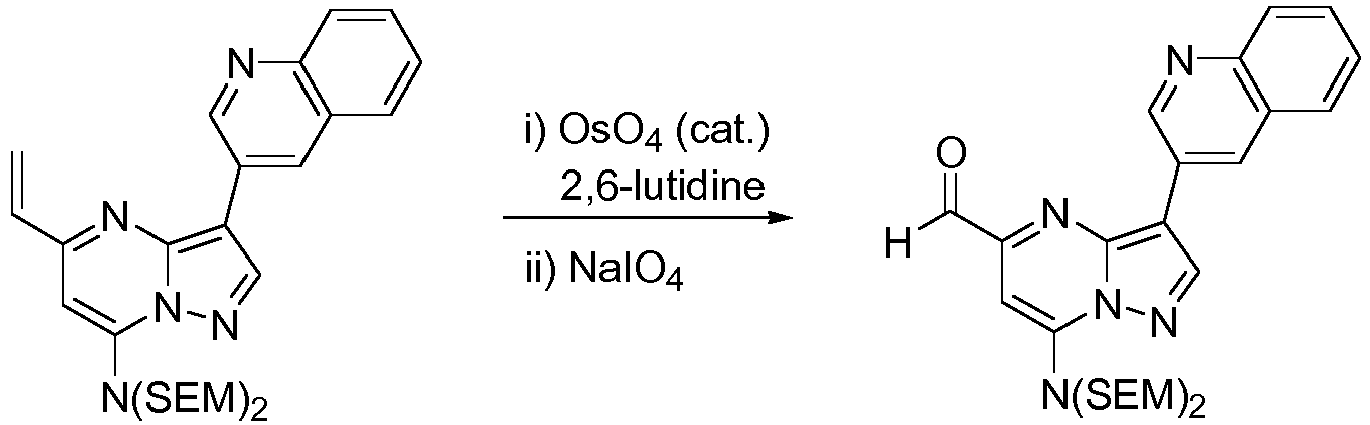
- To 3-(quinolin-3-yl)-N,N-bis((2-(trimethylsilyl)ethoxy)methyl)-5-vinylpyrazolo[1,5-a]pyrimidin-7-amine (0.7 g, 1.3 mmol) in 1,4-doixane (10 mL) was added 2.5 wt% OsO4 in 1,4-dioxane (1.0 g, 0.02 mmol), 2,6-lutidine (0.6 mL, 5.2 mmol) and H2O (2 mL), and the resulting mixture was stirred at room temperature for 20 minutes. NaIO4 (0.8 g, 3.81 mmol) was then added and the reaction mixture was stirred at room temperature for 16 hours. LC/MS analysis at that time showed the diol intermediate still present. Therefore, more NaIO4 (0.3 g, 1.3 mmol) was added, and the reaction mixture was stirred for 12 hours for full conversion to the product. Saturated Na2S2O3 solution (10 mL) was added and the mixture was stirred for 10 minutes. Organics were then extracted with CH2Cl2 (4 x 40 mL), dried (Na2SO4) and concentrated in vacuo to give 7-(bis((2-(trimethylsilyl)ethoxy)methyl)amino)-3-(quinolin-3-yl)pyrazolo[1,5-a]pyrimidine-5-carbaldehyde as a yellow solid (0.6 g, 1.2 mmol, 92%). LCMS: 2.67 mins, m/z = 550.0 (MH+).
-

- To 7-(bis((2-(trimethylsilyl)ethoxy)methyl)amino)-3-(quinolin-3-yl)pyrazolo[1,5-a]pyrimidine-5-carbaldehyde (0.15 g, 0.3 mmol) in EtOH (10 mL) was added morpholine (0.12 mL, 1.4 mmol) and AcOH (0.2 mL), and the resulting mixture was stirred at room temperature for 15 minutes. NaBH3CN (0.12 g, 2.0 mmol) in EtOH (1.5 mL total) was then added and the reaction mixture was stirred at room temperature for 16 hours, at which time LC/MS analysis confirmed full consumption of starting material. Saturated NaHCO3 solution (∼ 20 mL) was added and the mixture was stirred for 30 minutes. The mixture was transferred to a separatory funnel with CH2Cl2 (30 mL) and H2O (10 mL) and brine (20 mL) was then added. Organics were extracted with CH2Cl2 (4 x 30 mL), dried (Na2SO4) and concentrated in vacuo to give crude 5-(morpholinomethyl)-3-(quinolin-3-yl)-N,N-bis((2-(trimethylsilyl)ethoxy)methyl)pyrazolo[1,5-a]pyrimidin-7-amine as a brown oil (0.2 g). LCMS: 2.01 mins, m/z = 621.3 (MH+).
-

- To crude 5-(morpholinomethyl)-3-(quinolin-3-yl)-N,N-bis((2-(trimethylsilyl)-ethoxy)methyl)pyrazolo[1,5-a]pyrimidin-7-amine (0.2 g) in a 20 mL vial was added EtOH (4 mL) and then 4M HCl/dioxane (1.5 mL, 6.0 mmol). The vial was capped and heated at 85 °C for 16 hours. On cooling, saturated NaHCO3 solution (∼5 mL) was added, and the reaction mixture was stirred for 30 minutes. The reaction mixture was then transferred to a separatory funnel using CH2Cl2 (20 mL) and H2O (20 mL) and saturated NaHCO3 solution (20 mL) and brine (20 mL) were added. Organics were extracted with CH2Cl2 (4 x 30 mL), dried (Na2SO4) and concentrated in vacuo to give crude 5-(morpholinomethyl)-3-(quinolin-3-yl) pyrazolo [1, 5-a] pyrimidin-7-amine as a brown solid (0.04 g). LCMS: 0.78 mins, m/z = 361.1 (MH+).
-

- To crude 5-(morpholinomethyl)-3-(quinolin-3-yl) pyrazolo[1,5-a]pyrimidin-7-amine (44 mg) in CH3CN (8 mL) was added N-bromosuccinimide (22 mg, 0.12 mmol), followed by additional CH3CN (4 mL). The reaction was then stirred at room temperature for 30 minutes, at which time LC/MS analysis confirmed full conversion of the starting material to the product. The reaction mixture was concentrated in vacuo and purified by preparative HPLC to give 6-bromo-5-(morpholinomethyl)-3-(quinolin-3-yl)pyrazolo[1,5-a]pyrimidin-7-amine as a yellow solid (8.7 mg, 0.02 mmol, 7% over three steps). LCMS: 0.82 mins, m/z = 439.0 and 441.0 (MH+).
- Related reductive amination analogs were prepared as described in Preparative Example included in the following table. In most cases, reduction of the aldehyde to the primary alcohol was a competing reaction to the desired reductive amination. Generally, reactions giving >80% reductive amination product progressed without purification whereas those with >20 % primary alcohol were purified by silica gel column chromatography before continuing to the de-SEM reaction.
- By essentially the same procedure given in Scheme 44, the compounds listed in Table 13 can be prepared.
Table 13 Compound ID Structures M+H (Calc.) M+H (Observed) Retention Time, (min) 13.1 
361.4 361 2.02 13.2 
439.3 439 + 441 2.26 13.3 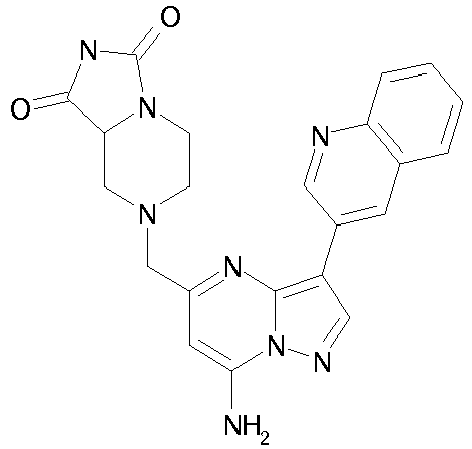
429.5 429 2.06 13.4 
507.4 507 + 509 2.37 13.5 
507.4 507 + 509 2.00 13.6 
452.4 452 + 454 2.26 13.7 
373.5 374 2.00 13.8 
377.15 377 2.12 13.9 
389.20 389 2.14 13.10 
455.06 455 2.32 13.11 
467.11 467 2.36 13.12 
471.05 471 2.03 13.13 
453.10 453 2.15 13.14 
375.19 375 2.07 13.15 
375.19 375 2.02 13.16 
453.1 453 2.12 13.17 
453.1 453 2.26 13.18 
463.17 463 1.89 13.19 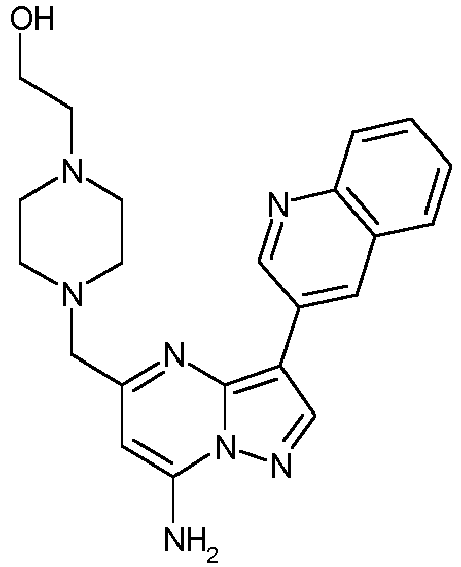
404.21 404 1.92 13.20 
438.16 438 2.12 13.21 
516.07 516 + 518 2.22 13.22 
438.10 438 + 440 2.10 13.23 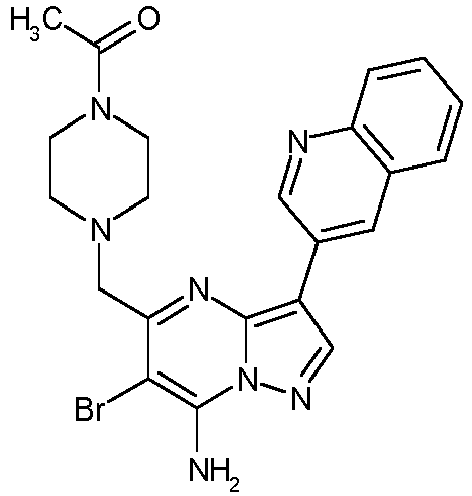
480.11 480 + 482 2.05 13.24 
471.1 471.0 2.67 13.25 
417.13 418.30 2.70 13.26 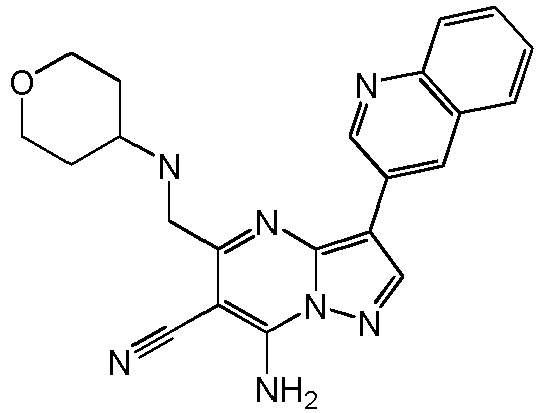
399.18 400.31 2.27 13.27 
414.20 415.32 2.34 13.29 
487.08 487.20 2.75 13.30 
452.08 453.20 2.13 13.31 
485.07 486.20 1.10 13.32 
501.06 502.20 1.99 13.33 
542.12 543.20 2.78 13.34 
509.12 510.20 2.61 13.35 
494.12 495.20 2.15 13.36 
520.08 521.20 2.52 13.37 
486.10 487.20 2.71 13.38 
480.13 481.20 1.23 13.39 
468.07 469.20 2.56 13.40 
470.09 471.20 2.52 13.41 
500.10 501.20 2.90 13.42 
453.10 454.20 2.48 13.43 
426.08 427.20 2.19 13.44 
412.10 413.20 1.88 13.45 
426.10 427.20 1.99 13.45 
440.10 441.20 2.29 13.46 
442.10 443.20 2.12 13.47 
456.10 457.20 2.36 13.48 
451.11 452.20 1.71 13.49 
511.10 512.20 2.46 13.50 
561.10 562.20 2.68 13.51 
547.10 548.20 2.67 13.52 
537.10 538.20 2.03 13.53 
573.10 574.20 3.07 13.54 
497.10 498.20 2.58 13.55 
533.10 534.20 2.85 13.56 
547.10 548.20 2.93 13.57 
483.10 484.20 2.16 -

- To a solution of (2R,6S)-2,6-dimethyldihydro-2H-pyran-4(3H)-one (0.22g, 1.7mmol) in MeOH (11.5ml) at room temperature was added ammonium acetate (1.3g, 16.9mmol) and sodium borohydride (0.07g, 1.8mmol) slowly and the reaction mixture was stirred for16 h, at which time LC/MS analysis confirmed full consumption of starting material. The mixture was transferred to a separatory funnel with CH2Cl2 (30ml) and H2O (10ml) and brine (20ml) was then added. Organics were extracted with CH2Cl2 (4 x 30ml), dried (Na2SO4) and concentrated in vacuo to give crude product 2R,6S)-2,6-dimethyltetrahydro-2H-pyran-4-amine.
-

- To 2R,6S)-2,6-dimethyltetrahydro-2H-pyran-4-amine (crude) in CH3CN (3.2ml) was added N,N-diisopropylethylamine (0.9ml) followed by di-tert-butyl dicarbonate (1.9g) and the resulting mixture was stirred at room temperature for 1h, at which time LC/MS confirmed full conversion of starting material to product. Solvent was removed in vacuo and the crude was redissolved in DCM (20ml), washed with water (1 x 5ml), brine (1 x 5ml), dried over MgSO4. Solvent was removed in vacuo to give tert-butyl (2R,6S)-2,6-dimethyltetrahydro-2H-pyran-4-ylcarbamate as a crude product which was used for the next step without any purification.
-

- To tert-butyl (2R,6S)-2,6-dimethyltetrahydro-2H-pyran-4-ylcarbamate (crude, 0.6g) was added 4M HCl in 1,4-dixoane (15ml) at r.t. It was stirred further at room temperature for 2 h, at which time LC/MS analysis confirmed full consumption of starting material. Solvent was removed in vacuo to get the desired (2R,6S)-2,6-dimethyltetrahydro-2H-pyran-4-amine as an HCl salt.
-

- To crude (2R,6S)-2,6-dimethyltetrahydro-2H-pyran-4-amine (0.18g) in DCE (4.2ml) and Ethanol (4.2ml) was added 7-(bis((2-(trimethylsilyl)ethoxy)methyl)amino)-6-bromo-3-(6-fluoroquinolin-3-yl)pyrazolo[1,5-a]pyrimidine-5-carbaldehyde (0.19g, 0.3mmol) followed by AcOH (0.03ml, 0.6mmol). After stirring for 30 minutes at room temperature, NaBH3CN (37.8mg, 0.6mmol) was added and stirring was continued further for 30 minutes more. LC/MS showed no starting material remaining. After the solvent was rotoevaporated, the crude was dissolved with DCM (20ml), washed with sat. NaHCO3 (1 x 5ml), water (1 x 5ml), brine (1 x 5ml), dried over MgSO4. Solvent was removed in vacuo and the residue was purified by column chromatography on silica gel. Elution with EtOAc/Hexanes (0-60%) gave desired 6-bromo-5-(((2R,6S)-2,6-dimethyltetrahydro-2H-pyran-4-ylamino)methyl)-3-(6-fluoroquinolin-3-yl)-N,N-bis((2-(trimethylsilyl)ethoxy)methyl)pyrazolo[1,5-a]pyrimidin-7-amine (68 mg, 30%).
-

- To a 6-bromo-5-(((2R,6S)-2,6-dimethyltetrahydro-2H-pyran-4-ylamino)methyl)-3-(6-fluoroquinolin-3-yl)-N,N-bis((2-(trimethylsilyl)ethoxy)methyl)pyrazolo[1,5-a]pyrimidin-7-amine (69.3mg, 0.09mmol) in TFA (2ml) was added few drops of water and stirring continued for 2h at room temperature. LC/MS showed no starting material remaining. TFA along with water was rotoevaporated. This crude compound was submitted to the analytical group for purification to afford the desired 6-bromo-5-(((2R,6S)-2,6-dimethyltetrahydro-2H-pyran-4-ylamino)methyl)-3-(6-fluoroquinolin-3-yl)pyrazolo[1,5-a]pyrimidin-7-amine. LCMS: 3.157 mins, m/z = 499.0 (MH+).
-

- Above compound was prepared by essentially the same procedure (1) as to compound 7 is prepared. However exact configuration has not been determined.
- Isomer 1: LCMS: 1.942 mins, m/z = 501.1 (MH+)
- Isomer 2: LCMS: 2.706 mins, m/z = 501.0 (MH+)
-

- To ethyl 1-aminocyclopropane-1-carboxylic acid ethyl ester hydrochloride (7.9g, 48mmol) in DCM (400ml) was added N,N-diisopropylethylamine (21.7ml, 124.7mmol) followed by di-tert-butyl dicarbonate (11.5g, 52.8mmol) at 0°C, and the resulting mixture was stirred at room temperature for 16h, at which time LC/MS confirmed full conversion of starting material to product. Reaction mixture was transferred in to the seperatory funnel and washed with water (1 x 75ml), brine (1 x 75ml), dried over MgSO4. Solvent was removed in vacuo to get desired ethyl 1-(tert-butoxycarbonylamino)cyclopropanecarboxylate as a crude product which was used for the next step without any purification.
- While under argon atmosphere, LiBH4 (0.73g, 33.6mmol) was suspended in Et2O (18ml). To this mixture was added dropwise a solution of ethyl 1-(tert-butoxycarbonylamino)cyclopropane carboxylate (5g, 21.8mmol) in Et2O (18ml). The reaction mixture was stirred at room temperature for 2 h and then quenched by slow addition of MeOH (18ml). After being stirred overnight, the reaction mixture was poured into an equal volume of sat. NH4Cl (54ml). The Et2O layer was separated, and the aqueous layer was extracted four times with Et2O. Solvent was removed in vacuo and the residue was purified by column chromatography on silica gel. Elution with EtOAc/Hexanes (50-100%) gave desired tert-butyl 1-(hydroxymethyl)cyclopropyl carbamate as a white solid (3.14g, 77%).
- To tert-butyl 1-(hydroxymethyl)cyclopropylcarbamate (1.1g, 5.83mmol) in DCM (47ml) was added N,N-diisopropylethylamine (1.3ml, 7.67mmol) followed by methanesulfonylchloride (0.5ml, 6.4mmol) at 0°C, and the resulting mixture was stirred at room temperature for 16h, at which time LC/MS confirmed full conversion of starting material to product. Reaction mixture was transferred in to the seperatory funnel and washed with sat. NaHCO3 (1 x 10ml), water (1 x 10ml), brine (1 x 10ml), dried over MgSO4. Solvent was removed in vacuo to get desired (1-(tert-butoxycarbonylamino)cyclopropyl)methylmethanesulfonate as a crude product (1.38g) which was used for the next step without any purification.
- A mixture of (1-(tert-butoxycarbonylamino)cyclopropyl)methylmethanesulfonate (1.38g, 5.2mmol), and NaSCH3 (0.48g, 6.8mmol) in DMF (21ml) was stireed at room temperature for 2 h, at which time LC/MS confirmed full conversion of starting material to product (No Starting material is present). Reaction mixture was diluted with EtOAc (250ml), and. washed with water (3 x 60ml), brine (1 x 60ml) and dried over MgSO4. Solvent was removed to give the tert-butyl 1-(methylthiomethyl)cyclopropylcarbamate as a crude product which was used for the next step without any purification.
- A mixture of tert-butyl 1-(methylthiomethyl)cyclopropylcarbamate (crude), Oxone (4.8g, 7.8mmol) and NaHCO3 (2.6g, 31.3mmol) in MeOH (28ml) and Water (7ml) was stirred at room temperature for 1.5 h, at which time LC/MS analysis confirmed full consumption of starting material. Solvent was removed in vacuo and the crude was redissolved in EtOAc (100ml), washed with water (1 x 20ml), brine (1 x 20ml), dried over MgSO4. Solvent was removed in vacuo to give tert-butyl 1-(methylsulfonylmethyl) cyclopropylcarbamate as a crude product (white solid, 1.1g) which was used for the next step without any purification.
- To tert-butyl 1-(methylsulfonylmethyl)cyclopropylcarbamate (crude, 1.05g) in DCM (7ml) was added 4M HCl in 1,4-dixoane (16ml) at r.t. It was stirred further at room temperature for 1 h, at which time LC/MS analysis confirmed full consumption of starting material. Solvent was removed in vacuo and the solid was washed with ether to get the desired 1-(methylsulfonylmethyl)cyclopropanamine as an HCl salt.
- 6-bromo-3-(6-fluoroquinolin-3-yl)-5-((1-(methylsulfonylmethyl)cyclo propylamino)methyl)pyrazolo[1,5-a]pyrimidin-7-amine was prepared by essentially the same procedure (1) as to compound 7 is prepared. LCMS: 2.52 mins, m/z = 519.0 (MH+).
-

- To 1-aminocyclopropyl)methanol (0.22g, 2.5mmol) in DCE (7ml) and Ethanol (7ml) was added -(bis((2-(trimethylsilyl)ethoxy)methyl)amino)-6-bromo-3-(6-fluoroquinolin-3-yl)pyrazolo[1,5-a]pyrimidine-5-carbaldehyde (0.32g, 0.5mmol) followed by AcOH (0.064ml, 1mmol). After stirring for 30 minutes at room temperature, NaBH3CN (63mg, 1mmol) was added and stirring was continued further for 30 minutes more. After the solvent was rotoevaporated, the crude was dissolved with DCM (40ml), washed with sat. NaHCO3 (1 x 10ml), water (1 x 10ml), brine (1 x 10ml), dried over MgSO4. Solvent was removed in vacuo and the residue was purified by column chromatography on silica gel. Elution with EtOAc/Hexanes (0-100%) gave slightly impure desired (1-((7-(bis((2-(trimethylsilyl)ethoxy)methyl)amino)-6-bromo-3-(6-fluoroquinolin-3-yl)pyrazolo[1,5-a]pyrimidin-5-yl)methylamino)cyclopropyl)methanol (320mg).
-

- To (1-((7-(bis((2-(trimethylsilyl)ethoxy)methyl)amino)-6-bromo-3-(6-fluoroquinolin-3-yl)pyrazolo[1,5-a]pyrimidin-5-yl)methylamino)cyclopropyl)methanol (0.17g, 0.24mmol) in dichloroethane (2ml) was added N,N-diisopropylethylamine (0.09ml, 0.49mmol) followed by di-tert-butyl dicarbonate (0.16g, 0.73mmol) and the resulting mixture was stirred at room temperature for 16 h, at which time LC/MS confirmed full conversion of starting material to product. The mixture was diluted with DCM (20ml), washed with water (1 x 5ml), brine (1 x 5ml), dried over MgSO4. Solvent was removed in vacuo and the residue was purified by column chromatography on silica gel. Elution with EtOAc/Hexanes (0-60%) gave desired tert-butyl (7-(bis((2-(trimethylsilyl)ethoxy)methyl)amino)-6-bromo-3-(6-fluoroquinolin-3-yl)pyrazolo[1,5-a]pyrimidin-5-yl)methyl(1-(hydroxymethyl)cyclopropyl)carbamate (0.19g, 95%).

- To tert-butyl (7-(bis((2-(trimethylsilyl)ethoxy)methyl)amino)-6-bromo-3-(6-fluoroquinolin-3-yl)pyrazolo[1,5-a]pyrimidin-5-yl)methyl(1-(hydroxymethyl)cyclopropyl)carbamate (0.19g, 0.23mmol) in DCM (2.5ml) was added protonsponge (70mg, 0.33mmol) followed by trimethyloxoniumtetrafluoroborate (48.2mg, 0.33mmol) at room temperature and the resulting mixture was stirred at room temperature for 16 h, at which time LC/MS confirmed full conversion of starting material to product. Reaction mixture was quenched with sat. NH4Cl and diluted with DCM (25ml). Organics were separated and washed with brine (5ml) and dried over MgSO4. Solvent was removed in vacuo and the residue was was purified by column chromatography on silica gel. Elution with DCM/MeOH (0-50%) gave slightly impure desired tert-butyl (7-(bis((2-(trimethylsilyl)ethoxy)methyl)amino)-6-bromo-3-(6-fluoroquinolin-3-yl)pyrazolo[1,5-a]pyrimidin-5-yl)methyl(1-(methoxymethyl)cyclopropyl)carbamate (97mg, 50%).

- By essentially following the the same procedure above compounds prepared. LCMS: 1.87 mins, m/z = 471.0 (MH+).
-

- To benzyl 4-(hydroxymethyl)tetrahydro-2H-pyran-4-ylcarbamate (0.59g, 2.23mmol) in DCM (24ml) was added protonsponge (0.53g, 2.5mmol) followed by trimethyloxoniumtetrafluoroborate (0.36g, 2.5mmol) at 0°C. After 20min at 0°C, reaction mixture was warmed up to room temperature and stirred further for 16 h, at which time LC/MS confirmed full conversion of starting material to product. Reaction mixture was quenched with sat. NH4Cl and with DCM (75ml). Organics were separated and washed with brine (20ml) and dried over MgSO4. Solvent was removed in vacuo and the residue was was purified by column chromatography on silica gel. Elution with EtOAc/Hexanes (66%-100%) gave slightly impure desired benzyl 4-(methoxymethyl)tetrahydro-2H-pyran-4-ylcarbamate (0.31g, 50%).
-

- A mixture of benzyl 4-(methoxymethyl)tetrahydro-2H-pyran-4-ylcarbamate (0.86g, 3.1mmol), 10% Pd/C (0.21g) in EtOAc (25ml) was stirred at room temperature under hydrogen (balloon pressure) for 16 hours. It was then filtered and concentrated to get the desired 4-(methoxymethyl)tetrahydro-2H-pyran-4-amine.

- By essentially the same procedure as to compounds above is prepared. LCMS: 2.173 mins, m/z = 515.2 (MH+).
-

- 5-chloro-N,N-bis((2-(trimethylsilyl)ethoxy)methyl)pyrazolo[1,5-a]pyrimidin-7-amine (1.5 g, 3.5 mmol), tributyltin cyanide (1.7 g, 5.3 mmol), tetrakis (triphenylphosphine) palladium (0.8 g, 0.7 mmol), bis(tri-t-butylphosphine) palladium (0.4 g, 0.7 mmol) were charged in a pressure tube. The tube was evacuated and charged with argon for three cycles. Dioxane (20 ml) was added, and the tube was capped and heated at 150°C with stirring for one hour. After cooling, the mixture was diluted with EtOAc (100 ml) and washed with brine (1 x 20 ml), dried over MgSO4. Solvent was removed in vacuo and the residue was purified by column chromatography on silica gel. Elution with EtOAc/Hexanes (0-35%) gave desired product, 7-(bis((2-(trimethylsilyl) ethoxy)methyl)amino) pyrazolo[1,5-a]pyrimidine-5-carbonitrile (1.3 g, 90%).
-

- To a solution 7-(bis((2-(trimethylsilyl)ethoxy)methyl)amino)pyrazolo[1,5-a]pyrimidine-5-carbonitrile (0.6 g, 1.4 mmol), copper bromide (42 mg, 0.3 mmol), and TBSCl (0.2 g, 1.4 mmol) in THF (14 ml) at 0°C was added methyl magnesium bromide (3M in ether, 0.47 ml, 1.4 mmol) dropwise. Reaction mixture was warmed up to room temperature and stirred further for 6 h. LC/MS showed no starting material (M.W = 419) remaining. A borane.THF solution (1M in THF, 2.8 ml, 2.8 mmol) was then added to the reaction mixture at -78°C, and the resulting solution was stirred for 4 h and allowed to warm at room temperature overnight. Distilled water (0.5 ml) was cautiously added to the solution cooled at -20°C, followed by sat. NH4Cl (0.5 ml). After the THF was rotoevaporated, the aqueous phase was extracted with DCM (60 ml), washed with water (1 x 5 ml), brine (1 x 5 ml), dried over MgSO4. Solvent was removed in vacuo and the crude was used for the next step without any further purification.
- Alternatively, the 5-(1-aminoethyl)-N,N-bis((2-(trimethylsilyl)ethoxy)methyl)pyrazolo[1,5-a]pyrimidin-7-amine can also be synthesized by the following procedure.
-

- An oven-dried 250 mL 3-neck round-bottom flask fitted with a pressure-equalizing addition funnel, temperature probe and septum was charged with 7-(bis{[2-(trimethylsilyl)ethoxy]methyl}amino)pyrazolo[1,5-a]pyrimidine-5-carbonitrile (7.10 g, 16.9 mmol) in dry THF (59 mL), copper(I) bromide (120 mg, 0.84 mmol) and tert-butyldimethylsilyl chloride (2.80 g, 18.6 mmol), and the stirred mixture was cooled in an ice-brine bath. 3M MeMgBr in ether (9.59 mL, 28.8 mmol) was added dropwise over 10 min via the addition funnel, and the resulting heterogeneous mixture was stirred at -5-0 °C for 1.5 h and quenched carefully by the dropwise addition of water until gas evolution ceased. The mixture was diluted with additional water (100 mL) and extracted with diethyl ether (2 x 150 mL), and the combined organic phase was washed with brine (100 mL), dried over Na2SO4 and concentrated under reduced pressure. Purification by chromatography on silica gel (120 g), eluting with 0-20% EtOAc/hexanes, afforded the title compound, 1-(7-(bis((2-(trimethylsilyl)ethoxy)methyl)amino)pyrazolo[1,5-a]pyrimidin-5-yl)ethanone (4.34 g, 59% yield) as a light yellow oil: MS (ESI+) for C20H36N4O3Si2 m/z 437 (M+H)+; R f = 0.70 (25% EtOAc/hexanes).
- A solution of 1-[7-(bis{[2-(trimethylsilyl)ethoxy]methyl}amino)pyrazolo[1,5-a]pyrimidin-5-yl]ethanone (4.34 g, 9.94 mmol) in 1:1 EtOH/pyridine (50 mL) was treated with hydroxylamine hydrochloride (3.45 g, 49.7 mmol). The resulting mixture was stirred at room temperature for 1.5 h and then concentrated under reduced pressure to remove most solvent. The residue was partitioned between EtOAc (100 mL) and water (60 mL), the layers were separated, and the organic phase was washed with water (60 mL) and brine (20 mL), dried over Na2SO4 and concentrated under reduced pressure to give the title compound, 1-(7-(bis((2-(trimethylsilyl)ethoxy)methyl)amino)pyrazolo[1,5-a]pyrimidin-5-yl)ethanone oxime (4.90 g, 85% purity, 93% yield) as an off-white semisolid: MS (ESI+) for C20H37N5O3Si2 m/z 452 (M+H)+.
- : A solution of 1-[7-(bis{[2-(trimethylsilyl)ethoxy]methyl}amino)pyrazolo[1,5-a]pyrimidin-5-yl]ethanone oxime (4.50 g, 8.77 mmol) in 4:1 EtOH/AcOH (90 mL) under nitrogen in a Parr bottle was treated with 10% Pd on carbon (933 mg, 0.877 mmol), and the mixture was shaken on the Parr apparatus under 45 psi hydrogen for 23 h. The catalyst was removed by filtration through Celite, and the filtrate was concentrated under reduced pressure, azeotroping with toluene at 40-45 °C to remove most AcOH. The oily residue was taken up in EtOAc (∼100 mL), washed with saturated aqueous NaHCO3 (2 x 50 mL) and brine (20 mL), dried over Na2SO4, and concentrated under reduced pressure to give the title compound, 5-(1-aminoethyl)-N,N-bis((2-(trimethylsilyl)ethoxy)methyl)pyrazolo[1,5-a]pyrimidin-7-amine (4.02 g, 91% purity, 95% yield) as an oil: MS (ESI+) for C20H39N5O2Si2 m/z 438 (M+H)+.
-

- To a solution of 7-(bis((2-(trimethylsilyl)ethoxy)methyl)amino)-3-(6-fluoroquinolin-3-yl)pyrazolo[1,5-a]pyrimidine-5-carbaldehyde (11.0 g, 19.4 mmol) in anhydrous THF (200 mL, 2 mol) under nitrogen at 0 °C was added 3M methylmagnesium bromide in ether (9.69 mL, 29.0 mmol) dropwise. After 1 hour the reaction was complete by HPLC. Water (10 mL) was added over a 15 minute period to quench the reaction. Removed the flask from the ice bath and concentrated in vacuo. Dissolved the remaining residue in ethyl acetate, washed three times with water and then twice with brine. The organics were dried over sodium sulfate, filtered and concentrated in vacuo. Purified the remaining crude material by flash chromatography (5-40% EtOAc/hex) to afford 1-(7-(bis((2-(trimethylsilyl)ethoxy)methyl)amino)-3-(6-fluoroquinolin-3-yl)pyrazolo[1,5-a]pyrimidin-5-yl)ethanol (6.8 g; 60% yield) as a yellow solid. HPLC: 7.54 min (Method C). LCMS: ESI+ m/z of 584 (M+H)
- To a solution of 1-(7-(bis((2-(trimethylsilyl)ethoxy)methyl)amino)-3-(6-fluoroquinolin-3-yl)pyrazolo[1,5-a]pyrimidin-5-yl)ethanol (6.1 g, 10.4 mmol) in methylene chloride (100 mL) and triethylamine (7.1 mL, 50.9 mmol) under nitrogen was added methanesulfonyl chloride (2.4 mL, 31.0 mmol) dropwise. After 15 minutes the reaction was complete by HPLC. The contents of the flask were transferred to a separatory funnel, washed twice with water and twice with brine. The organics were dried over sodium sulfate, filtered and concentrated in vacuo to afford 1-(7-(bis((2-(trimethylsilyl)ethoxy)methyl)amino)-3-(6-fluoroquinolin-3-yl)pyrazolo[1,5-a]pyrimidin-5-yl)ethylmethanesulfonate (6.8 g; 98% yield) as a dark yellow oil that was used as is for the following step. HPLC: 6.18 min (Method D). LCMS: ESI+ m/z of 662 (M+H)
- To a solution of 1-(7-(bis((2-(trimethylsilyl)ethoxy)methyl)amino)-3-(6-fluoroquinolin-3-yl)pyrazolo[1,5-a]pyrimidin-5-yl)ethylmethanesulfonate (6.8 g, 10.3 mmol) in DMSO (100 mL) and N,N-diisopropyl-ethylamine (8.95 mL, 51.4 mmol) was added sodium azide (2.0 g, 30.8 mmol). After 4 hours the reaction was complete by HPLC. The contents of the flask were transferred to a separatory funnel, washed twice with water and twice with brine. The organics were dried over sodium sulfate, filtered and concentrated in vacuo to afford 5-(1-azidoethyl)-3-(6-fluoroquinolin-3-yl)-N,N-bis((2-(trimethylsilyl)ethoxy)methyl)pyrazolo[1,5-a]pyrimidin-7-amine (6.2 g; 99% yield) as a dark yellow oil. HPLC: 6.67 min (Method D). LCMS: No ion detected.
- To a solution of 5-(1-azidoethyl)-3-(6-fluoroquinolin-3-yl)-N,N-bis((2-(trimethylsilyl)ethoxy)methyl)pyrazolo[1,5-a]pyrimidin-7-amine (6.2 g, 10.3 mmol) and THF (90 mL) was added 1M trimethylphosphine in THF (30.8 mL, 30.8 mmol) dropwise. After 30 minutes the reaction was complete by HPLC. Water (30 mL) was therefore added and the reaction stirred an additional hour. The contents of the flask were transferred to a separatory funnel, diluted with 300 mL of EtOAc and washed three times with water and three times with brine. The organics were dried over sodium sulfate, filtered and concentrated in vacuo. Purified the remaining crude material by flash chromatography (0-2% 0.7N NH3 in MeOH/CHCl3) to afford 5-(1-aminoethyl)-3-(6-fluoroquinolin-3-yl)-N,N-bis((2-(trimethylsilyl)ethoxy)methyl)pyrazolo[1,5-a]pyrimidin-7-amine (4.9 g, 82% yield) as a yellow solid. HPLC: 6.62 min (Method C). LCMS:ESI+ m/z of 583 (M+H)
-

- To crude 5-(1-aminoethyl)-N,N-bis((2-(trimethylsilyl)ethoxy)methyl)pyrazolo[1,5-a]pyrimidin-7-amine (0.6 g) in DCE (20 ml) and Ethanol (20 ml) was added tetrahydro-4H-pyran-4-one (0.6 ml, 7 mmol) followed by AcOH (0.08 ml, 1.4 mmol). After stirring for 30 minutes at room temperature, NaBH3CN (0.18 g, 2.8mmol) was added and stirring was continued further for 30 minutes more. LC/MS showed no starting material (M.W = 437) remaining. After the solvent was rotoevaporated, the crude was dissolved with DCM (60ml), washed with sat. NaHCO3 (1 x 5ml), water (1 x 5ml), brine (1 x 5ml), dried over MgSO4. Solvent was removed in vacuo and the residue was purified by column chromatography on silica gel. Elution with MeOH/EtOAC (0-20%) gave desired product, 5-(1-(tetrahydro-2H-pyran-4-ylamino)ethyl)-N,N-bis((2-(trimethylsilyl) ethoxy)methyl) pyrazolo[1,5-a]pyrimidin-7-amine (0.2 g, 27%).
-

- To a solution of 5-(1-(tetrahydro-2H-pyran-4-ylamino)ethyl)-N,N-bis((2-(trimethylsilyl) ethoxy)methyl) pyrazolo[1,5-a]pyrimidin-7-amine (0.17g, 0.32mmol) in acetonitrile (15 ml) at 0°C was added NIS (78mg, 0.35 mmol) and stirring continued for 10 minutes. LC/MS showed no starting material (M.W = 521) remaining. Saturated sodium thiosulfate solution (∼0.5ml) was added and stirring continued for 5 minutes. After the acetonitrile was rotoevaporated, the aqueous phase was extracted with DCM (25ml), washed with water (1 x 5ml), brine (1 x 5ml), dried over MgSO4. Solvent was removed in vacuo and the residue was purified by column chromatography on silica gel. Elution with MeOH/EtOAC (0-20%) gave desired product, 3-iodo-5-(1-(tetrahydro-2H-pyran-4-ylamino)ethyl)-N,N-bis((2-(trimethylsilyl)ethoxy)methyl)pyrazolo[1,5-a]pyrimidin-7-amine (0.14g, 69%).
-

- To 3-iodo-5-(1-(tetrahydro-2H-pyran-4-ylamino)ethyl)-N,N-bis((2-(trimethylsilyl) ethoxy)methyl)pyrazolo[1,5-a]pyrimidin-7-amine (0.14g, 0.21mmol) was added 6-fluoroquinoline boronate (0.11g, 0.42mmol), K2CO3 (87mg, 0.63mmol), PdCl2(dppf).CH2Cl2 (18mg, 0.02mmol), dioxane (4ml) and H2O (1ml). The resulting mixture was heated at 100 °C for 2 hours, at which time LC/MS analysis confirmed full consumption of starting material. On cooling, the solvent was rotoevaporated, and the crude was redissolved in DCM (40ml), washed with water (1 x 5ml), brine (1 x 5ml), dried over MgSO4. Solvent was removed in vacuo and the residue was purified by column chromatography on silica gel. Elution with MeOH/EtOAC (0-20%) gave desired product, 3-(6-fluoroquinolin-3-yl)-5-(1-(tetrahydro-2H-pyran-4-ylamino)ethyl)-N,N-bis((2-(trimethylsilyl)ethoxy)methyl)pyrazolo[1,5-a]pyrimidin-7-amine (84mg, 60%).
-

- To a solution of 3-(6-fluoroquinolin-3-yl)-5-(1-(tetrahydro-2H-pyran-4-ylamino)ethyl)-N,N-bis((2-(trimethylsilyl)ethoxy)methyl)pyrazolo[1,5-a]pyrimidin-7-amine (84 mg, 0.13mmol) in TFA (2 ml) was added few drops of water and stirring continued for 2h at room temperature. LC/MS showed no starting material (M.W = 666) remaining. TFA along with water was rotoevaporated, and the crude was dried under the high vacuum for 4 h, which was used without further purification for the next step.
-

- To a solution of 3-(6-fluoroquinolin-3-yl)-5-(1-(tetrahydro-2H-pyran-4-ylamino)ethyl)pyrazolo[1,5-a]pyrimidin-7-amine (Crude, ∼0.13mmol) in DMF (2ml) at room temperature was added NBS (25mg, 0.14mmol) and stirring continued for 10 minutes. LC/MS showed no starting material (M.W = 406) remaining. This crude compound was submitted to the analytical group for purification to afford the desired 6-bromo-3-(6-fluoroquinolin-3-yl)-5-(1-(tetrahydro-2H-pyran-4-ylamino)ethyl)pyrazolo[1,5-a]pyrimidin-7-amine.
-

- Methyl chloroformate (289 µL, 3.74 mmol) was added to a solution of 4-(N-Boc-amino)-piperidine (500 mg, 2.50 mmol) in methylene chloride (25 mL) at room temperature. N,N-diisopropylethylamine (1.30 mL, 7.49 mmol) was added and the solution was stirred overnight. The reaction mixture was diluted with sat. ammonium chloride (30 mL) and extracted with methylene chloride (3 × 30 mL). The combined extracts were dried over sodium sulfate and concentrated. The crude material was purified by column chromatography on silica gel (0% to 100% ethyl acetate in methylene chloride) to give 566 mg of a white solid. This solid was taken up in methylene chloride (2 mL) and trifluoroacetic acid (2 mL) was added at room temperature. After 20 min, the solution was concentrated, and then diluted with methylene chloride (2 mL). The solution was basified with sat. sodium carbonate (2 mL) and the mixture was extrated with methylene chloride (5 × 5 mL) and ethyl acetate (5 × 5 mL). The combined extracts were concentrated and the resulting solid was freeze dried from acetonitrile and water to give 290 mg of the title compound as a white solid, 1-(4-aminopiperidin-1-yl)-2-methoxyethanone, (73% over two steps). NMR (300 MHz, D2O) δ 4.79 (s, 2H), 4.12 (d, J = 13.5 Hz, 2H), 3.72 (s, 3H), 3.28-3.14 (m, 1H), 2.95 (t, J = 12.6 Hz, 2H), 1.98 (d, J = 12.0 Hz, 2H), 1.54-1.36 (m, 2H).
-

- 3-Methoxypropanoic acid (225 µL, 2.40 mmol) was added to a solution of 4-(N-Boc-amino)-piperidine (400 mg, 2.00 mmol) in methylene chloride (25 mL) at room temperature. N,N-diisopropylethylamine (1.30 mL, 7.49 mmol) and propylphosphonic anhydride (1.78 mL, 50 wt. % in ethyl acetate, 3.00 mmol) was added, and the solution was stirred for 4.5 h. The reaction mixture was concentrated and partitioned between ethyl acetate (5 mL) and water (5 mL). The organic portion was washed with 0.2M HCl (2 mL), sat. Sodium bicarbonate (5 mL) and brine (5 mL). The solution was then dried over sodium sulfate and concentrated to a white solid. This solid was taken up in methylene chloride (6 mL), and trifluoroacetic acid (3 mL) was added at room temperature. After 1 h the solution was concentrated. The resulting solid was dissolved in methylene chloride (2 mL) and 1M sodium hydroxide (1 mL). This mixture was extracted with methylene chloride (4 × 2 mL) and ethyl acetate (4 × 2 mL). The combined organic extracts were dried over sodium sulfate and concentrated to give 135 mg of the title compound, 1-(4-aminopiperidin-1-yl)-3-methoxypropan-1-one (36% over two steps). 1H NMR (300 MHz, CD3OD) δ 4.51-4.41 (m, 1H), 4.03-3.93 (m, 1H), 3.64 (d, J = 6.3 Hz, 2H), 3.32 (s, 3H), 3.17-3.05 (m, 1H), 2.96-2.83 (m, 1H), 2.75-2.55 (m, 3H), 1.99-1.80 (m, 2H), 1.40-1.14 (m, 2H).
-

- 3,3-Dimethylacryloyl chloride (670 µL, 5.99 mmol) was added to a solution of 4-(N-Boc-amino)-piperidine (1.00 g, 4.99 mmol) in methylene chloride (50 mL) at room temperature. N,N-diisopropylethylamine (1.74 mL, 9.99 mmol) was added and the solution was stirred overnight. The reaction mixture was diluted with sat. ammonium chloride (50 mL) and extracted with methylene chloride (3 × 50 mL). The combined extracts were dried over sodium sulfate and concentrated. The crude material was purified by column chromatography on silica gel (0% to 100% ethyl acetate in methylene chloride) to give 1.39 g of an off white solid. This solid was dissolved in t-butanol (18 mL) and water (18 mL), and the solution was cooled to 0 °C. To this mixture were added AD-mix-α (7.50 g), methanesulfonamide (449 mg, 4.72 mmol), sodium bicarbonate (1.13 g, 13.5 mmol), and potassium osmate dihydrate (15 mg, 0.0450 mmol). The solution was allowed to warm to room temperature overnight. A 1.9M solution of sodium sulfite (40 mL) was added and the mixture was stirred for 1 h. The resulting aqueous solution was extracted with ethyl acetate (4 × 100mL) and dried over sodium sulfate. The solution was concentrated and the crude material was purified by column chromatography on silica gel (0% to 20% methanol in methylene chloride, and 0% to 10% methanol in methylene chloride) to give 670 mg of the diol. A portion of this diol (650 mg, 2.05 mmol) was dissolved in dioxane (10 mL) and HCl in dioxane (5.1 mL, 4M, 20.5 mmol) was added at room temperature. After stirring overnight, the reaction mixture was diluted with ether (20 mL) and filtered to give a white solid. This solid was taken up in methylene chloride (50 mL) and MP-carbonate resin (830 mg, 2.11 mmol) was added. After 1.5 h the solvent was decanted and the resin was washed with methylene chloride (20 mL). Methylene chloride (50 mL) was added to the resin along with additional fresh resin (1.0 g, 2.54 mmol). After stirring for 30 min, the solvent was decanted and the remaining resin was washed with methylene chloride (20 mL). The combined organics were concentrated to 121 mg of the free amine, (R)-1-(4-aminopiperidin-1-yl)-2,3-dihydroxy-3-methylbutan-1-one (13% over three steps). 1H NMR (300 MHz, CD3OD) δ 4.54-4.40 (m, 1H), 4.32-4.26 (m, 1H), 4.26-4.13 (m, 1H), 3.16-3.03 (m, 1H), 2.95-2.81 (m, 1H), 2.80-2.69 (m, 1H), 1.94-1.79 (m, 2H), 1.47-1.28 (m, 2H), 1.25 (d, J = 5.4 Hz, 3H), 1.17 (d, J = 5.1 Hz, 3H).
-

- N,N-diisopropylethylamine (2.54 mL, 14.6 mmol) was added to a solution of 4-(N-Boc-amino)-piperidine (1.75 g, 8.75 mmol) in tetrahydrofuran (36 mL) at 0 °C. Propylphosphonic anhydride (5.92 mL, 50 wt. % in ethyl acetate, 9.48 mmol) and acrylic acid (500 µL, 7.29 mmol) were added, and the solution was allowed to warm to room temperature overnight. The reaction mixture was partitioned between ethyl acetate (20 mL) and water (20 mL). The organic portion was washed with 0.2M HCl (5 mL), sat. sodium bicarbonate (20 mL), and brine (20 mL). The solution was then dried over sodium sulfate and concentrated to a white solid. A portion of this solid (800 mg, 3.15 mmol) was dissolved in t-butanol (13 mL) and water (13 mL) and cooled to 0 °C. To this mixture were added AD-mix-α (5.24 g), methanesulfonamide (314 mg, 3.30 mmol), sodium bicarbonate (793 mg, 9.44 mmol), and potassium osmate dihydrate (52 mg, 0.157 mmol). After 4.5 h, a 0.8M solution of sodium sulfite (100 mL) was added and the mixture was stirred for 1 h at room temperature. The resulting aqueous solution was extracted with ethyl acetate (4 × 100mL) and dried over sodium sulfate. The solution was concentrated and the crude material was purified by column chromatography on silica gel (0% to 20% methanol in methylene chloride) to give a clear syrup. A portion of this syrup (790 mg, 2.74 mmol) was dissolved in dioxane (14 mL) and HCl in dioxane (6.8 mL, 4M, 27.4 mmol) was added at room temperature. After 18 h, the solution was concentrated. The resulting white solid was taken up in methylene chloride (50 mL) and MP-carbonate resin (3.2 g, 8.1 mmol) was added. After stirring for 30 min, the solvent was decanted. The resin was washed with ethyl acetate (10 mL) and methylene chloride (10 mL), and the combined organics were discarded. The remaining resin was diluted with methanol (50 mL) and stirred for 30 min. The methanol was decanted and the resin was washed with methanol (10 mL). The combined methanol portions were concentrated to give clear oil, (R)-1-(4-aminopiperidin-1-yl)-2,3-dihydroxypropan-1-one, 382 mg (60% over three steps). 1H NMR (300 MHz, CD3OD) δ 4.53-4.40 (m, 2H), 4.14-4.04 (m, 1H), 3.77-3.56 (m, 2H), 3.20-3.05 (m, 1H), 3.04-3.92 (m, 1H), 2.84-2.69 (m, 1H), 2.00-1.82 (m, 2H), 1.48-1.20 (m, 2H).
-

- A solution of 3-hydroxymethyl-3-methyloxetane (1.90 mL, 19.1 mmol) in methylene chloride (6 mL) was added to a solution of nickel (II) chloride hexahydrate (113 mg, 0.476 mmol) in water (2 mL). This mixture was cooled to 0 °C and bleach (127 mL) was added over a 30 min period via addition funnel. After 2 h the ice bath was removed and the reaction mixture was stirred at room temperature for an additional 2 h. 2M HCl (120 mL) was added and the solution was extracted with ether (4 × 200 mL). The combined extracts were dried over sodium sulfate and concentrated to a clear oil. A portion of this oil (1.00 g, 8.61 mmol) was dissolved in tetrahydrofuran (43 mL) and 4-(N-Boc-amino)-piperidine (2.07 g, 10.3 mmol) was added at room temperature. Propylphosphonic anhydride (6.99 mL, 50 wt. % in ethyl acetate, 11.2 mmol) and N,N-diisopropylethylamine (3.00 mL, 17.2 mmol) were added, and the reaction mixture was stirred for 24 h. The solution was partitioned between ethyl acetate (35 mL) and water (35 mL). The organic portion was washed with 0.2M HCl (10 mL), sat. sodium bicarbonate (35 mL), and brine (35 mL). The solution was then dried over sodium sulfate and concentrated. The crude material was purified by column chromatography on silica gel (0% to 100% methylene chloride in ethyl acetate). The resulting amide (213 mg, 0.714 mg) was diluted with methylene chloride (7 mL) and trifluoroacetic acid (1.8 mL) was added at room temperature. After 2 h the solution was concentrated and a 2M sodium hydroxide solution was added. The aqueous solution was extracted with ethyl acetate (3 × 10 mL). The combined extracts were dried over sodium sulfate and concetrated to give the title compound as a clear oil, (4-aminopiperidin-1-yl)(3-methyloxetan-3-yl)methanone, 68 mg (4% over three steps). 1H NMR (300 MHz, CD3OD) δ 4.95-4.88 (m, 2H), 4.48-4.38 (m, 1H), 4.38-4.31 (m, 2H), 3.19-2.96 (m, 2H), 2.94-2.81 (m, 1H), 2.81-2.66 (m, 1H), 1.93-1.81 (m, 2H), 1.67-1.60 (m, 3H), 1.36-1.15 (m, 2H).
-

- Crotyl chloride (674 µL, 5.99 mmol) was added to a solution of 4-(N-Boc-amino)-piperidine (1.00 g, 4.99 mmol) in methylene chloride (50 mL) at 0 °C. N,N-diisopropylethylamine (1.74 mL, 9.99 mmol) was added and the solution was stirred for 21 h. The reaction mixture was diluted with sat. ammonium chloride (50 mL) and extracted with methylene chloride (3 × 50 mL). The combined extracts were dried over sodium sulfate and concentrated. The residue was dissolved in methylene chloride (10 mL) and was triturated with hexanes (100 mL). The solvent was filtered off to give an off white solid. This solid was dissolved in t-butanol (16 mL) and water (16 mL) and cooled to 0 °C. To this mixture were added AD-mix-α (6.83 g), methanesulfonamide (409 mg, 4.30 mmol), sodium bicarbonate (1.03 g, 12.3 mmol), and potassium osmate dihydrate (68 mg, 0.205 mmol). The solution was allowed to warm to room temperature overnight. A 0.5M solution of sodium sulfite (100 mL) was added and the mixture was stirred for 1 h. The resulting aqueous solution was extracted with ethyl acetate (4 × 100mL) and dried over sodium sulfate. The solution was concentrated and the crude material was purified by column chromatography on silica gel (0% to 20% methanol in methylene chloride, and 0% to 20% methanol in methylene chloride) to give the diol as a white solid. A portion of the diol (450 mg, 1.49 mmol) was dissolved in dioxane (7 mL) and HCl in dioxane (3.7 mL, 4M, 27.4 mmol) was added at room temperature. After 1.5 h, the solution was concentrated. The resulting white solid was taken up in methylene chloride (30 mL) and MP-carbonate resin (2.0 g, 5.1 mmol) was added. After stirring for 45 min, the solvent was decanted, and the resin was washed with methylene chloride. The remaining resin was washed with methanol (2 × 30 mL) and the combined methanol portions were concentrated to give a clear oil, (2R,3S)-1-(4-aminopiperidin-1-yl)-2,3-dihydroxybutan-1-one, 160 mg (33% over three steps). 1H NMR (300 MHz, CD3OD) δ 4.51-4.35 (m, 1H), 4.32-4.25 (m, 1H), 4.14-4.01 (m, 1H), 3.96-3.84 (m, 1H), 3.19-3.02 (m, 1H), 2.98-2.84 (m, 1H), 2.84-2.67 (m, 1H), 1.97-1.80 (m, 2H), 1.44-1.20 (m, 2H), 1.18 (s, 3H).
-
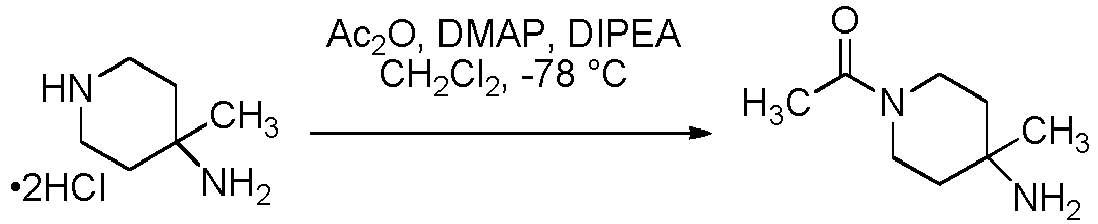
- Methylene chloride (53 mL) was added to a mixture of 4-amino-4-methylpiperidine•2HCl (500 mg, 2.67 mmol) and 4-(dimethylamino)pyridine (33 mg, 0.267 mmol). N,N-diisopropylethylamine (4.65 mL, 26.7 mmol) was added and the mixture was cooled to - 78 °C. Acetic anhydride (126 µL, 1.34 mmol) was added and the solution was allowed to warm to room temperature overnight. 2M sodium hydroxide (10 mL) was added and the mixture was extracted with ethyl acetate (5 × 20 mL) and methylene chloride (5 × 20 mL). The combined organic extracts were dried over sodium sulfate and concentrated. The crude material was purified by column chromatography on silica gel (0% to 20% methanol in methylene chloride w/ 0.1% ammonium hydroxide) to give 181 mg of the title compound, 1-(4-amino-4-methylpiperidin-1-yl)ethanone (87%). 1H NMR (300 MHz, CD3OD) δ 3.67-3.40 (m, 4H), 2.08 (s, 3H), 1.64-1.38 (m, 4H), 1.18 (s, 3H).
-

- 3-hydroxy-3-methyl butyric acid (1.20 equiv), DIPEA (2.00 equiv), and T3P (1.50 equiv) were added to a stirring solution of compound 1 (1.00 equiv) in THF (0.2M) at room temperature under nitrogen. TLC analysis after 2 hours showed almost complete conversion, so reaction was concentrated. Residue was dissolved in ethyl acetate then washed with water, dilute HCl, saturated NaHCO3, and brine. The phases were separated and the organics dried over sodium sulfate, filtered, and concentrated. The resulting residue was purified by flash column chromatography (SiO2, 12 g; 0% to 10% methanol in methylene chloride). The resulting material was dissolved in methylene chloride (0.97M) and TFA (0.97M) was added under nitrogen and the mixture was stirred at room temperature for 1 hour at which time HPLC analysis indicated the reaction was complete. Reaction was concentrated and the resulting residue was dissolved in 1N NaOH and stirred at room temperature for 30 minutes. The aqueous mixture was extracted with methylene chloride. The phases were separated and the organics dried over sodium sulfate, filtered, and concentrated affording the title compound, 1-(4-aminopiperidin-1-yl)-3-hydroxy-3-methylbutan-1-one. 1H NMR (300 MHz, CDCl3) δ 4.40 (d, 1H, J Hz=13.9), 3.73 (d, 1H, J Hz=12.1), 2.99-2.95 (m, 1H), 2.90 (m, 1H), 2.70-2.63 (m, 1H), 2.33 (s, 2H), 1.76 (m, 2H), 1.12 (s, 8H).
-

- DIPEA (3.00 equiv) and propionyl chloride (compound A), isopropyl sulfonyl chloride (compound B), dimethyl carbamyl chloride (compound C), or isobutyryl chloride (compound D) (1.50 equiv) were added to a stirring solution of tert-butyl piperidin-4-ylcarbamate (1.00 equiv) in methylene chloride (0.1M) at 0 °C. Reaction warmed to room temperature. TLC analysis after 16 hours showed no remaining starting material and reaction was diluted in saturated NH4Cl and extracted with methylene chloride. The phases were separated and the organics dried over sodium sulfate, filtered, and concentrated. The resulting residue was purified by flash column chromatography (SiO2, 40 g; 0% to 100% ethyl acetate in hexanes). The resulting material was dissolved in methylene chloride (1.0M) and TFA (1.0M) was added under nitrogen and the mixture was stirred at room temperature for 30 minutes at which time TLC analysis indicated the reaction was complete. Reaction was concentrated and the resulting residue was dissolved in 1N NaOH and stirred at room temperature for 30 minutes. The aqueous mixture was extracted with methylene chloride. The phases were separated and the organics dried over sodium sulfate, filtered, and concentrated affording the title compound.
Compound A: 1H NMR (300 MHz, CDCl3) δ 4.53 (d, 1H, J Hz=13.2), 3.84 (d, 1H, J Hz=13.2), 3.11-3.02 (m, 1H), 2.97-2.87 (m, 1H), 2.76-2.67 (m, 1H), 2.40-2.33 (m, 2H), 1.89-1.83 (m, 2H), 1.37-1.14 (m, 5H);
Compound B: 1H NMR (300 MHz, CDCl3) δ 3.82-3.77 (m, 2H), 3.26-3.12 (m, 1H), 3.02-2.93 (m, 2H), 2.90-2.81 (m, 1H), 1.91-1.86 (m, 2H), 1.47-1.33 (m, 8H); Compound C: 1H NMR (300 MHz, CDCl3) δ 3.54 (d, 2H, J Hz=14.1), 2.77-2.65 (m, 7H), 1.75-1.70 (m, 2H), 1.30-1.61 (m, 4H);
Compound D: 1H NMR (300 MHz, CDCl3) δ 4.50-4.55 (d, J = 13.5 Hz, 1H), 3.89-3.92 (d, J = 12.3, 1 H), 3.03-3.11 (t, J = 12.2 Hz, 1H), 2.76-2.95 (m, 2H), 2.64-2.73 (t, J = 12.9 Hz, 1H) 1.82-1.90 (m, 2H), 1.32 (s, 2H), 1.19-1.32 (m, 2H), 1.11-1.13 (d, J = 6.3 Hz, 6H). -

- Sodium cyanoborohydride (3.5 equiv) was added to a stirring mixture of ketone, 1-(3-argio-7-(bis((2-(trimethylsilyl)ethoxy)methyl)amino)pyrazolo[1,5-a]pyrimidin-5-yl)ethanone (1 equiv) and amine (2 equiv) in ethanol and acetic acid at room temperature. When the reaction was deemed complete by HPLC, LC-MS, or TLC analysis, the mixture was quenched with saturated aqueous sodium bicarbonate, then extracted with dichloromethane (2x). The combined organics were dried over sodium sulfate, filtered, concentrated to dryness, and purified on silica gel to afford compound 3-aryl-5-(1-(disubstitutedamino)ethyl)-N,N-bis((2-(trimethylsilyl)ethoxy)methyl)pyrazolo[1,5-a]pyrimidin-7-amine.
- Compound, 3-aryl-5-(1-(disubstitutedamino)ethyl)-N,N-bis((2-(trimethylsilyl)ethoxy)methyl)pyrazolo[1,5-a]pyrimidin-7-amine, was stirred in a mixture of TFA, dichloromethane, and water, then concentrated to dryness when the reaction was deemed complete by HPLC, LC-MS, or TLC analysis. This material was then treated with NBS (1.05 equiv) in acetonitrile. When the reaction was deemed complete by HPLC, LC-MS, or TLC analysis, the mixture was concentrated to dryness, purified by prep-HPLC, and freeze-dried to afford compound 3-Aryl -6-bromo-5-(1-(disubstitutedamino)ethyl)pyrazolo[1,5-a]pyrimidin-7-amine.
-

- A mixture of compound 3-aryl-5-(1-(disubstitutedamino)ethyl)-N,N-bis((2-(trimethylsilyl)ethoxy)methyl)pyrazolo[1,5-a]pyrimidin-7-amine. (1 equiv) and NBS (1.05 equiv) in acetonitrile was stirred at room temperature until the reaction was deemed complete by HPLC, LC-MS, or TLC analysis. The reaction mixture was concentrated, re-dissolved in dichloromethane, washed with saturated aqueous sodium thiosulfate, dried over sodium sulfate, filtered, concentrated, and purified on silica gel. The resulting material was stirred with a mixture of vinyl stannane (2 equiv), palladium catalyst (0.1 equiv), and potassium fluoride (3 equiv) in dioxane at 85 °C until the reaction was deemed complete by HPLC, LC-MS, or TLC analysis. The mixture was allowed to cool to room temperature, diluted with 10% aqueous potassium fluoride, and extracted three times with ethyl acetate. The combined organics were dried over sodium sulfate, filtered, concentrated, and purified on silica gel. The resulting material was stirred with a mixture of HCI in methanol and water at 60 °C until the reaction was deemed complete by HPLC, LC-MS, or TLC analysis. The mixture was then allowed to cool to room temperature, concentrated, purified by prep-HPLC, and freeze-dried to afford compound 3-aryl-6-acetyl-5-(1-(disubstitutedamino)ethyl)pyrazolo[1,5-a]pyrimidin-7-amine.
-

- Sodium cyanoborohydride (3.5 equiv) was added to a stirring mixture of aldehyde, 7-(bis((2-(trimethylsilyl)ethoxy)methyl)amino)-3-(6-fluoroquinolin-3-yl)pyrazolo[1,5-a]pyrimidine-5-carbaldehyde (1 equiv) and 1-benzylpiperidin-4-yl)methanamine (2 equiv) in ethanol and acetic acid at room temperature. When the reaction was deemed complete by HPLC, LC-MS, or TLC analysis, the mixture was quenched with saturated aqueous sodium bicarbonate, then extracted with dichloromethane (2x). The combined organics were dried over sodium sulfate, filtered, concentrated to dryness, and purified on silica gel to afford the desired product, N5-((1-benzylpiperidin-4-yl)methyl)-3-(6-fluoroquinolin-3-yl)-N7,N7-bis((2-(trimethylsilyl)ethoxy)methyl)pyrazolo[1,5-a]pyrimidine-5,7-diamine.
- The N5-((1-benzylpiperidin-4-yl)methyl)-3-(6-fluoroquinolin-3-yl)-N7,N7-bis((2-(trimethylsilyl)ethoxy)methyl)pyrazolo[1,5-a]pyrimidine-5,7-diamine (1 equiv), Boc2O (2 equiv), DMAP (0.2 equiv), and triethylamine (3 equiv) in dichloromethane was stirred at room temperature until the reaction was deemed complete by TLC, HPLC, or LC-MS analysis. The mixture was diluted with additional dichloromethane, washed with saturated aqueous ammonium chloride, dried over sodium sulfate, filtered, concentrated, and purified on silica gel to give the product, tert-butyl (1-benzylpiperidin-4-yl)methyl(7-(bis((2-(trimethylsilyl)ethoxy)methyl)amino)-3-(6-fluoroquinolin-3-yl)pyrazolo[1,5-a]pyrimidin-5-yl)carbamate.
- This material, tert-butyl (1-benzylpiperidin-4-yl)methyl(7-(bis((2-(trimethylsilyl)ethoxy)methyl)amino)-3-(6-fluoroquinolin-3-yl)pyrazolo[1,5-a]pyrimidin-5-yl)carbamate, was then stirred with Pd(OH)2/C (0.2 equiv) and ammonium formate (20 equiv) in ethanol at 80 °C until the reaction was deemed complete by HPLC, LC-MS, or TLC analysis. The mixture was allowed to cool to room temperature, filtered through a pad of celite, concentrated and purified on silica gel to afford compound tert-butyl 7-(bis((2-(trimethylsilyl)ethoxy)methyl)amino)-3-(6-fluoroquinolin-3-yl)pyrazolo[1,5-a]pyrimidin-5-yl(piperidin-4-ylmethyl)carbamate.
- Compound tert-butyl 7-(bis((2-(trimethylsilyl)ethoxy)methyl)amino)-3-(6-fluoroquinolin-3-yl)pyrazolo[1,5-a]pyrimidin-5-yl(piperidin-4-ylmethyl)carbamate was stirred in a mixture of TFA, dichloromethane, and water, then concentrated to dryness when the reaction was deemed complete by HPLC, LC-MS, or TLC analysis. This material was then treated with NBS (1.05 equiv) in acetonitrile. When the reaction was deemed complete by HPLC, LC-MS, or TLC analysis, the mixture was concentrated to dryness, purified by prep-HPLC, and freeze-dried to afford compound 6-bromo-3-(6-fluoroquinolin-3-yl)-N5-(piperidin-4-ylmethyl)pyrazolo[1,5-a]pyrimidine-5,7-diamine.
- Compound, tert-butyl 7-(bis((2-(trimethylsilyl)ethoxy)methyl)amino)-3-(6-fluoroquinolin-3-yl)pyrazolo[1,5-a]pyrimidin-5-yl(piperidin-4-ylmethyl)carbamate (1 equiv) was stirred in a mixture of isocyanate (1.1 equiv), and triethylamine (1.5 equiv) in dichloromethane at 0 °C until the reaction was deemed complete by TLC, HPLC, or LC-MS analysis. The reaction mixture was poured into saturated aqueous ammonium chloride, and then extracted twice with dichloromethane. The combined organics were dried over sodium sulfate, filtered, concentrated, and purified on silica gel to give the desired product. This material was stirred in a mixture of TFA, dichloromethane, and water, and then concentrated to dryness when the reaction was deemed complete by HPLC, LC-MS, or TLC analysis. This material was then treated with NBS (1.05 equiv) in acetonitrile. When the reaction was deemed complete by HPLC, LC-MS, or TLC analysis, the mixture was concentrated to dryness, purified by prep-HPLC, and freeze-dried to afford compound.
-

- Compound, tert-butyl 7-(bis((2-(trimethylsilyl)ethoxy)methyl)amino)-3-(6-fluoroquinolin-3-yl)pyrazolo[1,5-a]pyrimidin-5-yl(piperidin-4-ylmethyl)carbamate (1 equiv) was stirred in a mixture of methyl isocyanate (1.1 equiv), and triethylamine (1.5 equiv) in dichloromethane at 0 °C until the reaction was deemed complete by TLC, HPLC, or LC-MS analysis. The reaction mixture was poured into saturated aqueous ammonium chloride, and then extracted twice with dichloromethane. The combined organics were dried over sodium sulfate, filtered, concentrated, and purified on silica gel to give the desired product. This material (1 equiv) and NBS (1.05 equiv) in acetonitrile was stirred at room temperature until the reaction was deemed complete by HPLC, LC-MS, or TLC analysis. The reaction mixture was concentrated, re-dissolved in dichloromethane, washed with saturated aqueous sodium thiosulfate, dried over sodium sulfate, filtered, concentrated, and purified on silica gel. The resulting material was stirred with the palladium catalysts (0.2 equiv each) and stannane (1.5 equiv) in dioxane at 160 °C until the reaction was deemed complete by HPLC, LC-MS, or TLC analysis. The reaction was allowed to cool to room temperature, diluted with ethyl acetate, washed with brine, dried over sodium sulfate, filtered, concentrated, and purified in silica gel. The resulting material was stirred in TFA and water at room temperature until the reaction was deemed complete by HPLC, LC-MS, or TLC analysis. The mixture was concentrated, purified by prep-HPLC, and freeze-dried to afford compound 4-((7-amino-6-cyano-3-(6-fluoroquinolin-3-yl) pyrazolo [1, 5-a] pyrimidin-5-ylamino) methyl)-N-methylpiperidine-1-carboxamide.
-

- Sodium cyanoborohydride (3.5 equiv) was added to a stirring mixture of 7-(bis((2-(trimethylsilyl)ethoxy)methyl)amino)-3-(6-fluoroquinolin-3-yl)pyrazolo[1,5-a]pyrimidine-5-carbaldehyde (1 equiv) and amine (2 equiv) in ethanol and acetic acid at room temperature. When the reaction was deemed complete by HPLC, LC-MS, or TLC analysis, the mixture was quenched with saturated aqueous sodium bicarbonate, and then extracted with dichloromethane (2x). The combined organics were dried over sodium sulfate, filtered, concentrated to dryness, and purified on silica gel to afford the desired product, N5-((1-benzylpiperidin-4-yl)methyl)-3-(6-fluoroquinolin-3-yl)-N7,N7-bis((2-(trimethylsilyl)ethoxy)methyl)pyrazolo[1,5-a]pyrimidine-5,7-diamine.
- This material, (1 equiv), Boc2O (2 equiv), DMAP (0.2 equiv), and triethylamine (3 equiv) in dichloromethane was stirred at room temperature until the reaction was deemed complete by TLC, HPLC, or LC-MS analysis. The mixture was diluted with additional dichloromethane, washed with saturated aqueous ammonium chloride, dried over sodium sulfate, filtered, concentrated, and purified on silica gel to give the product, tert-butyl (1-benzylpiperidin-4-yl)methyl(7-(bis((2-(trimethylsilyl)ethoxy)methyl)amino)-3-(6-fluoroquinolin-3-yl)pyrazolo[1,5-a]pyrimidin-5-yl)carbamate.
- This material was then stirred with Pd(OH)2/C (0.2 equiv) and ammonium formate (20 equiv) in ethanol at 80 °C until the reaction was deemed complete by HPLC, LC-MS, or TLC analysis. The mixture was allowed to cool to room temperature, filtered through a pad of celite, concentrated and purified on silica gel to afford compound tert-butyl 7-(bis((2-(trimethylsilyl)ethoxy)methyl)amino)-3-(6-fluoroquinolin-3-yl)pyrazolo[1,5-a]pyrimidin-5-yl(piperidin-4-ylmethyl)carbamate.
- This material was stirred with carboxylic acid (1.5 equiv), HATU (1.5 equiv), and DIPEA (3 equiv) in DMF until the reaction was deemed complete by TLC, HPLC, or LC-MS analysis. The reaction mixture was concentrated, the resulting residue dissolved in ethyl acetate, washed with water, saturated aqueous sodium bicarbonate, and brine, dried over sodium sulfate, filtered, concentrated, and purified on silica gel to give the product. This material was stirred in a mixture of TFA, dichloromethane, and water, then concentrated to dryness when the reaction was deemed complete by HPLC, LC-MS, or TLC analysis. This material was then treated with NBS (1.05 equiv) in acetonitrile. When the reaction was deemed complete by HPLC, LC-MS, or TLC analysis, the mixture was concentrated to dryness, purified by prep-HPLC, and freeze-dried to afford compound 1-(4-((7-amino-6-bromo-3-(6-fluoroquinolin-3-yl)pyrazolo[1,5-a]pyrimidin-5-ylamino)methyl)piperidin-1-yl)ethanone.
-


- To a solution of tert-butyl (7-(bis((2-(trimethylsilyl)ethoxy)methyl)amino)-3-(6-fluoroquinolin-3-yl)pyrazolo[1,5-a]pyrimidin-5-yl)methyl(piperidin-4-yl)carbamate (190 mg, 0.25 mmol) in dichloromethane (3 mL) was added imidazolium salt (84 mg, 0.25mmol) (prepared according to the literature procedure:Grzyb, J.A. et. al. Tetrahedron, 2005, 61, 7153-7175) and Et3N (35 µL, 0.25 mmol). The resulting mixture was stirred at 25 °C for 16 hours to give. The reaction mixture was diluted with CH2Cl2 (50 mL) and was washed with 0.1 N HCl (3 mL), brine (10 mL), dried over Na2SO4. LCMS indicated that the crude product, crude tert-butyl (7-(bis((2-(trimethylsilyl)ethoxy)methyl)amino)-3-(6-fluoroquinolin-3-yl)pyrazolo[1,5-a]pyrimidin-5-yl)methyl(1-(2-methoxypropanoyl)piperidin-4-yl)carbamate was clean, This material was then converted to the final compound, by bromination with NBS and followed by treatment with 4NHCl, to give 1-(4-((7-amino-6-bromo-3-(6-fluoroquinolin-3-yl)pyrazolo[1,5-a]pyrimidin-5-yl)methylamino)piperidin-1-yl)-2-methoxypropan-1-one following a similar procedure as that described above schemes: MW: 556.13; MS MH+ m/z: 557; HPLC tR: 4.17.
. LCMS: 2.67 mins, m/z = 485.0 (MH+). - By essentially the same procedure given in Schemes 45 through 49, the compounds listed in Table 14 can be prepared
TABLE-14 Compound ID Structure M+H (Calc) M+H (Observed) Retention Time(min) 14.1 
474.04 475 1.95 14.2 
488.06 489 2.02 14.3 
482.1 483 2.23 14.4 
482.1 483 2.41 14.5 
518.05 519 2.52 14.6 
500.09 501 2.44 14.7 
456.07 457 2.34 14.8 
500.09 501 2.56 14.9 
498.11 499 3.15 14.10 
470.08 471 1.87 14.11 
514.11 515.2 2.17 14.12 
500.09 501.1 1.94 14.13 
500.09 501 2.7 14.14 
484.1 485 2.67 14.15 
541.12 542.2 4.66 14.16 
521.15 522.2 3.80 14.18 
509.12 510 3.73 14.19 
540.14 541.3 3.93 14.20 
520.13 521.1 3.17 14.22 
539.14 540.2 4.21 14.23 
555.14 556 3.79 14.24 
469.1 470.8 3.23 14.27 
575.11 576.6 4.76 14.28 
525.13 526.5 3.96 14.30 
569.16 570.2 4.13 14.31 
527.11 528 4.30 14.32 
585.15 586 3.71 14.33 
557.12 558 3.44 14.34 
540.14 541.3 3.98 14.35 
526.12 527.5 3.31 14.36 
571.13 572 3.89 14.37 
555.14 556.2 3.49 14.38 
659.14 661.0 4.59 14.39 
553.12 554.5 4.14 14.40 
541.12 542.1 3.83 14.41 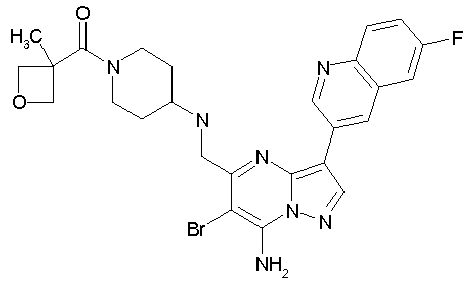
567.14 568 3.64 14.42 
525.13 526.5 4.53 14.43 
525.13 526 4.11 14.44 
541.12 542 3.36 14.45 
555.14 556.3 3.64 14.46 
541.12 542.3 3.56 14.47 
555.14 556.3 3.87 14.48 
463.06 464.2 4.55 14.50 
473.21 474.3 4.13 14.51 
556.13 557 4.17 14.52 
485.36 486.10 2.31 14.59 
45.731 458.20 2.26 14.63 
457.31 458.10 2.29 14.64 
464.30 465.10 2.53 14.65 
471.34 472.10 2.43 14.66 
513.37 514.20 2.35 14.67 
464.30 465.10 2.46 14.69 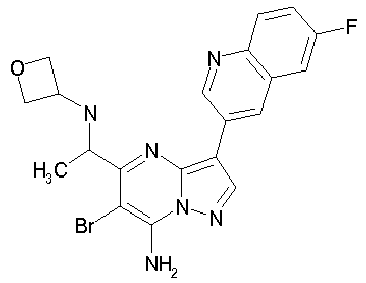
457.31 458.10 3.82 14.70 
471.34 472.10 3.91 14.71 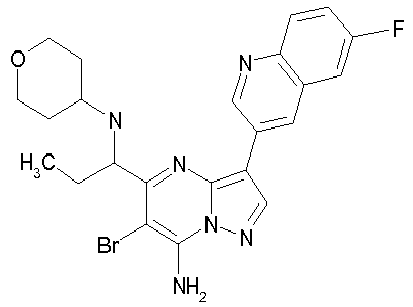
499.39 500.20 4.21 14.72 
471.34 472.10 2.43 14.73 
570.47 571.20 4.22 14.74 
600.50 601.20 2.53 14.75 
572.44 573.10 2.39 14.76 
485.36 486.20 2.53 14.77 
533.43 534.20 3.90 14.78 
517.36 518.10 2.74 14.79 
485.36 486.20 2.55 14.80 
485.36 486.20 2.53 14.81 
533.43 534.10 2.51 14.82 
519.40 520.10 2.42 14.83 
500.33 501.20 2.71 14.84 
586.47 587.20 3.30 14.85 
485.36 486.20 2.60 14.86 
485.36 486.20 2.55 14.87 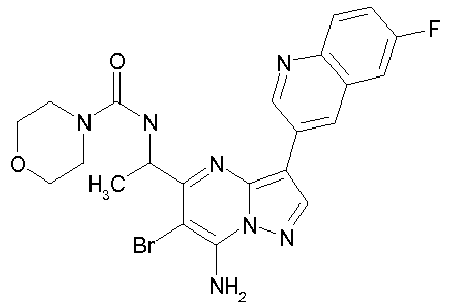
514.36 515.10 4.57 14.88 
533.43 534.20 2.52 14.89 
485.36 486.10 2.60 14.90 
485.36 486.10 2.60 14.91 
473.31 474.20 2.79 14.92 
614.52 615.20 2.58 14.93 
489.31 490.10 3.44 14.94 
586.47 587.20 2.30 14.95 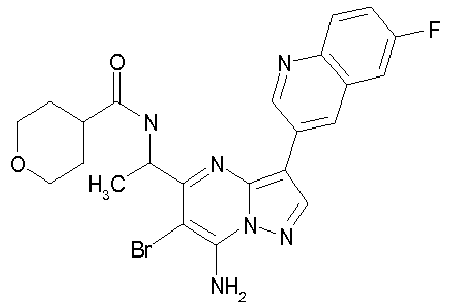
513.37 514.20 2.93 14.96 
514.36 515.10 2.56 14.97 
514.36 515.20 2.51 14.98 
514.36 515.20 2.49 14.99 
514.36 515.10 2.49 14.100 
480.50 481.20 2.68 14.101 
487.33 488.10 2.91 14.102 
521.37 522.10 2.80 14.103 
459.28 460.20 2.71 14.104 
501.36 502.10 3.01 14.105 
496.30 497.20 2.81 14.106 
473.31 474.20 2.80 14.107 
487.33 488.20 2.91 14.108 
473.31 474.10 2.81 14.109 
544.39 545.10 2.73 14.110 
547.39 548.20 2.92 14.111 
527.36 528.10 3.63 14.112 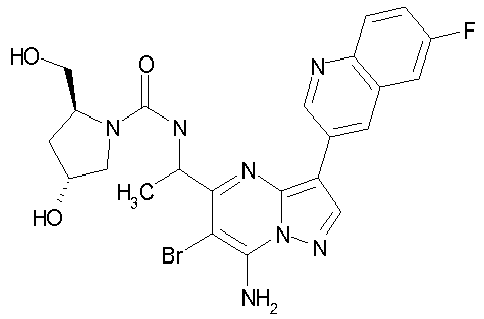
544.39 545.20 2.64 14.113 
544.39 545.20 2.60 14.114 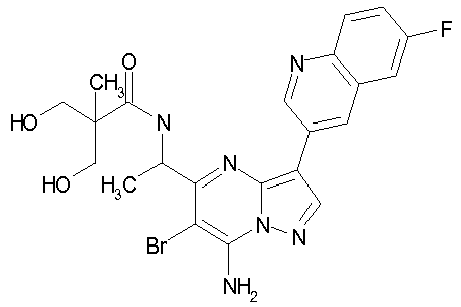
517.36 518.10 2.75 14.115 
517.36 518.20 2.76 14.116 
544.39 545.10 2.94 14.117 
532.38 533.20 2.71 14.118 
489.31 490.10 3.44 -

- To a solution of methyl hex-5-enoate (12 mg, 0.1 mmol) in THF (0.5 ml) under argon at 0 °C was added 9-BBN (0.2 mmol, 0.4 ml of 0.5 M solution in THF). The mixture was warmed to room temperature and stirred for 16 h. Potassium phosphate (3 M in H2O, 0.2 mmol) was added followed by the addition of 5-chloro-3-(quinolin-3-yl)-N,N-bis((2-(trimethylsilyl)ethoxy)methyl) pyrazolo[1,5-a]pyrimidin-7-amine (50 mg, 0.09 mmol) in DMF (0.5 ml) and Pd(dppf)Cl2-CH2Cl2 (5 mg, 0.005 mmol). The reaction mixture was heated at 90 °C for 16 h under argon. The solution was cooled to room temperature and concentrated under reduced pressure. The residue was dissolved in 2:1 THF: MeOH (3 mL) and was treated with 2N NaOH(aq) (0.25 mL). The resulting solution was stirred at room temperature for 4 hours followed by the addition of 2N hydrochloride solution (1.0 ml). The solution was heated at 65 °C for 2 h, cooled to room temperature, concentrated in vacuo and purified by prep-LC to afford the title compound (8.2 mg): LC/MS RT = 2.74 min. Mass calculated for, M+H 376.17, observed 376.17.
- By essentially the same procedure given in Scheme 50, the compounds listed in Table 15 can be prepared.
Table 15 Compound ID Structures M+H (calc.) M+H (observed) Retention Time, (min) 15.1 
376.17 376.17 2.74 15.2 
348.14 348.14 2.41 -

-

- 2-Chloro-5-(4,4,5,5-tetramethyl-1,3,2-dioxaborolan-2-yl)pyridine (0.55 mmol, 131 mg), K3PO4 (1.36 mmol, 290 mg), and PdCl2(dppf) · CH2Cl2 (0.045 mmol, 37 mg) is added to a solution of 4-{7-[Bis-(2-trimethylsilanyl-ethoxymethyl)-amino]-3-iodo-pyrazolo[1,5-a]pyrimidin-5-yl}-cyclohexanecarboxylic acid methyl ester (0.45 mmol, 300 mg) in dioxane (3.8 mL). To this suspension is added distilled H2O (0.38 mL). The resulting solution is stirred at 90° C under argon for 18 hours. The reaction mixture is concentrated in vacuo and then purified via silica gel chromatography (0% to 60% ethyl acetate in hexanes gradient) to yield the title compound (220 mg, 75% yield) as yellow oil. LC-MS: 646 [M+H].
-

- Phenyl-d5-boronic acid (1.08 mmol, 137 mg), K3PO4 (1.63 mmol, 345 mg), and PdCl2(dppf) · CH2Cl2 (0.054 mmol, 45 mg) is added to a solution of methyl 4-(7-(bis((2-(trimethylsilyl)ethoxy)methyl)amino)-3-(6-chloropyridin-3-yl)pyrazolo[1,5-a]pyrimidin-5-yl)cyclohexanecarboxylate (0.54 mmol, 350 mg) in dioxane (6.0 mL). To this suspension is added distilled H2O (0.6 mL). The resulting solution is stirred at 100° C under argon for 18 hours. The reaction mixture is concentrated in vacuo and then purified via silica gel chromatography (0% to 60% ethyl acetate in hexanes gradient) to yield the title compound.
-
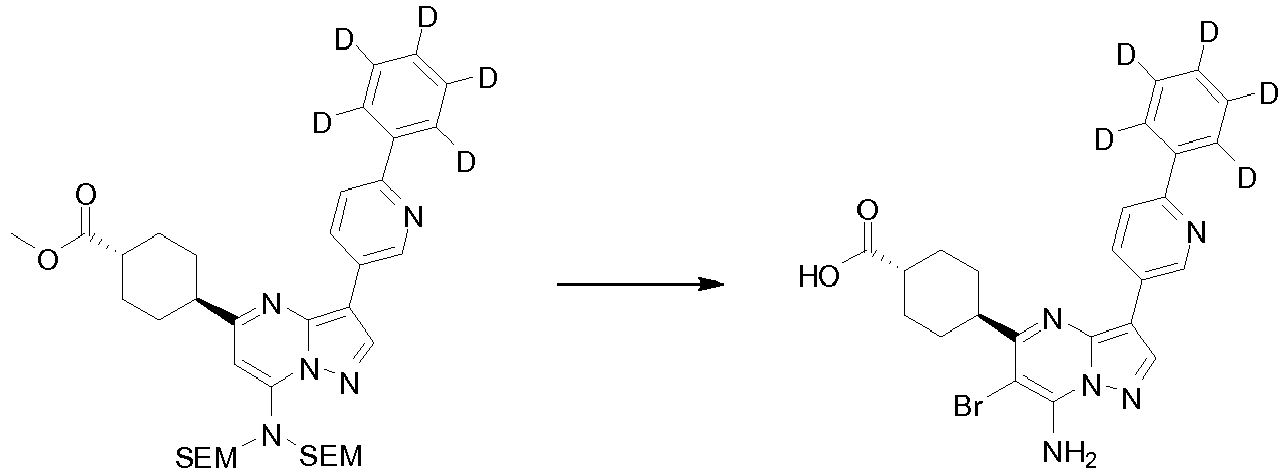
- N-bromosuccinimide (73 mg, 0.41 mmol) is added to a solution of (1r,4r)-methyl 4-(7-(bis((2-(trimethylsilyl)ethoxy)methyl)amino)-3-(6-phenyl-d5-pyridin-3-yl)pyrazolo[1,5-a]pyrimidin-5-yl)cyclohexanecarboxylate (284 mg, 0.41 mmol) in acetonitrile (4 mL). The resulting solution is stirred at room temperature for 1 hour. The reaction mixture is concentrated in vacuo and dissolved in 3:3:2 MeOH:THF:H2O (8 mL), followed by the treatment with 3.75 N NaOH(aq) (0.6 mL). The resulting solution is stirred at room temperature for 18 hours. The reaction mixture is treated with 1N hydrochloride solution (4 ml) at 65 °C for 4 h. The reaction solution is concentrated and purified by prep-LC to afford the title compound.
-

-

- To a 50 mL roundbottom flask is charged ethyl 2-(4-(7-(bis((2-(trimethylsilyl)ethoxy)-methyl)amino)pyrazolo[1,5-a]pyrimidin-5-yl)cyclohexylidene)acetate (800 mg, 1.43 mmol) and ethyl acetate (15 mL). The flask is flushed with argon and 5% palladium on carbon (100 mg) is added. The flask is sealed and degassed under vacuum. Deuterium gas is then added via balloon. The reaction is stirred under D2 atmosphere 18 hours. The reaction is then filtered through celite to yield deuterated ethyl 2-(4-(7-(bis((2-(trimethylsilyl)ethoxy)methyl)amino)pyrazolo[1,5-a]pyrimidin-5-yl)cyclohexyl)acetate (761 mg, 1.35 mmol, 95% yield) as pale yellow oil.
-

-

- By essentially the same procedure given in Schemes 16, 17 and 18, ethyl 2-(4-(7-amino-6-bromo-3-(6-phenylpyridin-3-yl)pyrazolo[1,5-a]pyrimidin-5-yl)cyclohexyl)acetate can be prepared.
- The mTOR assay buffer contains 10 mM hepes (pH 7.4), 50 mM NaCl, 100 µg/ml BSA, 50 mM B-glycerophosphate, 10 mM MnCl2 and 0.5 mM DTT. 20 ng of mTOR enzyme is preincubated with the compound for 10 minutes. 5 µM ATP and 0.1 µM GSTS6K is added. The reaction is incubated for one hour at 30 °C. Anti phospho p70S6K (about 1.7 ng/well) and anti GSTXL665 (1:1 Ratio with the substrate GSTS6K) are added after incubating. The plates are read at least 2 hours after adding the anti phospho p70S6K and the anti GSTXL665.
- IC 50 DETERMINATIONS: Dose-response curves were plotted from inhibition data generated, each in duplicate, from 8 point serial dilutions of inhibitory compounds. Concentration of compound was plotted against % kinase activity, calculated by CPM of treated samples divided by CPM of untreated samples. To generate IC50 values, the dose-response curves were then fitted to a standard sigmoidal curve and IC50 values were derived by nonlinear regression analysis.
- This in vitro assay utilizes recombinant His-CHK1 expressed in the baculovirus expression system as an enzyme source and a biotinylated peptide based on CDC25C as substrate (biotin-RSGLYRSPSMPENLNRPR).
-
- 1) CDC25C Ser 216 C-term Biotinylated peptide substrate (25 mg), stored at -200 C, Custom Synthesis by Research Genetics: biotin-RSGLYRSPSMPENLNRPR 2595.4 MW
- 2) His-CHK1 In House lot P976, 235 µg/mL, stored at -800 C.
- 3) D-PBS (without CaCl and MgCl): GIBCO, Cat.# 14190-144
- 4) SPA beads: Amersham, Cat.# SPQ0032: 500 mg/vial
Add 10 mL of D-PBS to 500 mg of SPA beads to make a working concentration of 50 mg/mL. Store at 4 0C. Use within 2 week after hydration. - 5) 96-Well White Microplate with Bonded GF/B filter: Packard, Cat.# 6005177
- 6) Top seal-A 96 well Adhesive Film: Perkin Elmer, Cat.# 6005185
- 7) 96-well Non-Binding White Polystyrene Plate: Corning, Cat. # 6005177
- 8) MgCl2: Sigma, Cat.# M-8266
- 9) DTT: Promega, Cat.# V3155
- 10) ATP, stored at 4 0C: Sigma, Cat.# A-5394
- 11) γ33P-ATP, 1000-3000 Ci/mMol: Amersham, Cat.# AH9968
- 12) NaCl: Fisher Scientific, Cat.# BP358-212
- 13) H3PO4 85% Fisher, Cat.#A242-500
- 14) Tris-HCL pH 8.0: Bio-Whittaker, Cat. # 16-015V
- 15) Staurosporine, 100 µg: CALBIOCHEM, Cat. # 569397
- 16) Hypure Cell Culture Grade Water, 500 mL: HyClone, Cat.# SH30529.02
-
- 1) Kinase Buffer: 50 mM Tris pH 8.0; 10 mM MgCl2; 1 mM DTT
- 2) His-CHK1, In House Lot P976, MW ∼30KDa, stored at -800 C.
6 nM is required to yield positive controls of ∼5,000 CPM. For 1 plate (100 reaction): dilute 8 µL of 235 µg/mL (7.83 µM) stock in 2 mL Kinase Buffer. This makes a 31 nM mixture. Add 20 µL/well. This makes a final reaction concentration of 6 nM. - 3) CDC25C Biotinylated peptide.
Dilute CDC25C to 1 mg/mL (385 µM) stock and store at -20 0C. For 1 plate (100 reactions): dilute 10 µL of 1 mg/mL peptide stock in 2 mL Kinase Buffer. This gives a 1.925 µM mix. Add 20 µL/reaction. This makes a final reaction concentration of 385 nM. - 4) ATP Mix.
For 1 plate (100 reactions): dilute 10 µL of 1 mM ATP (cold) stock and 2 µL fresh P33-ATP (20 µCi) in 5 mL Kinase Buffer. This gives a 2 µM ATP (cold) solution; add 50 µL/well to start the reaction. Final volume is 100 µL/reaction so the final reaction concentrations will be 1 µM ATP (cold) and 0.2 µCi/reaction. - 5) Stop Solution:
For 1 plate add: To 10 mL Wash Buffer 2 (2M NaCl 1% H3PO4) : 1mL SPA bead slurry (50 mg); Add 100 µL/well - 6) Wash buffer 1: 2 M NaCl
- 7) Wash buffer 2: 2 M NaCl, 1% H3PO4
-
Assay Component Final Concentration Volume CHK1 6nM 20 µl/rxn Compound (10% DMSO) - - 10 µl/rxn CDC25C 0.385 µM 20 µl/rxn γ33P.ATP 0.2 µCi/rxn 50µl/rxn Cold ATP 1 µM Stop solution SPA beads 0.5 mg/rxn 100 µl/rxn* 200 µl/rxn** * Total reaction volume for assay.** Final reaction volume at termination of reaction (after addition of stop solution). - 1) Dilute test compounds to desired concentrations in water/10% DMSO - this will give a final DMSO concentration of 1% in the reaction. Dispense 10 µL/reaction to appropriate wells. Add 10 µL 10% DMSO to positive (CHK1+CDC25C+ATP) and negative (CHK1+ATP only) control wells.
- 2) Thaw enzyme on ice -- dilute enzyme to proper concentration in kinase buffer (see Reaction Mixtures) and dispense 20 µL to each well.
- 3) Thaw the Biotinylated substrate on ice and dilute in kinase buffer (see Reaction Mixtures). Add 20 µL/well except to negative control wells. Instead, add 20 µL Kinase Buffer to these wells.
- 4) Dilute ATP (cold) and P33-ATP in kinase buffer (see Reaction Mixtures). Add 50 µL/well to start the reaction.
- 5) Allow the reaction to run for 2 hours at room temperature.
- 6) Stop reaction by adding 100 µL of the SPA beads/stop solution (see Reaction Mixtures) and leave to incubate for 15 minutes before harvest
- 7) Place a blank Packard GF/B filter plate into the vacuum filter device (Packard plate harvester) and aspirate 200 mL water through to wet the system.
- 8) Take out the blank and put in the Packard GF/B filter plate.
- 9) Aspirate the reaction through the filter plate.
- 10) Wash: 200 mL each wash; 1X with 2M NaCl; 1X with 2M NaCl/ 1% H3PO4
- 11) Allow filter plate to dry 15 minutes.
- 12) Put TopSeal-A adhesive on top of filter plate.
- 13) Run filter plate in Top Count
- IC 50 DETERMINATIONS: Dose-response curves were plotted from inhibition data generated, each in duplicate, from 8 point serial dilutions of inhibitory compounds. Concentration of compound was plotted against % kinase activity, calculated by CPM of treated samples divided by CPM of untreated samples. To generate IC50 values, the dose-response curves were then fitted to a standard sigmoidal curve and IC50 values were derived by nonlinear regression analysis.
- Selected Thiazole Derivatives of the present invention were tested using this assay and provided IC50 values ranging from about 1 nM to about 5500 nM.
- BACULOVIRUS CONSTRUCTIONS: Cyclin E was cloned into pVL1393 (Pharmingen, La Jolla, California) by PCR, with the addition of 5 histidine residues at the amino-terminal end to allow purification on nickel resin. The expressed protein was approximately 45kDa. CDK2 was cloned into pVL1393 by PCR, with the addition of a haemaglutinin epitope tag at the carboxy-terminal end (YDVPDYAS). The expressed protein was approximately 34kDa in size.
- ENZYME PRODUCTION: Recombinant baculoviruses expressing cyclin E and CDK2 were co-infected into SF9 cells at an equal multiplicity of infection (MOI=5), for 48 hrs. Cells were harvested by centrifugation at 1000 RPM for 10 minutes, then pellets lysed on ice for 30 minutes in five times the pellet volume of lysis buffer containing 50mM Tris pH 8.0, 150mM NaCl, 1% NP40, 1mM DTT and protease inhibitors (Roche Diagnostics GmbH, Mannheim, Germany). Lysates were spun down at 15000 RPM for 10 minutes and the supernatant retained. 5mL of nickel beads (for one liter of SF9 cells) were washed three times in lysis buffer (Qiagen GmbH, Germany). Imidazole was added to the baculovirus supernatant to a final concentration of 20mM, then incubated with the nickel beads for 45 minutes at 4° C. Proteins were eluted with lysis buffer containing 250mM imidazole. Eluate was dialyzed about 15 hours in 2 liters of kinase buffer containing 50mM Tris pH 8.0, 1mM DTT, 10mM MgCl2, 100µM sodium orthovanadate and 20% glycerol. Enzyme was stored in aliquots at -70°C.
- Cyclin E/CDK2 kinase assays can be performed as described below in low protein binding 96-well plates (Corning Inc, Corning, New York).
- Enzyme is diluted to a final concentration of 50 µg/mL in kinase buffer containing 50mM Tris pH 8.0, 10 mM MgCl2, 1 mM DTT, and 0.1 mM sodium orthovanadate. The substrate used in these reactions is a biotinylated peptide derived from Histone H1 (from Amersham, UK). The substrate is thawed on ice and diluted to 2 µM in kinase buffer. Test compounds are diluted in 10% DMSO to desirable concentrations. For each kinase reaction, 20 µL of the 50 µg/mL enzyme solution (1 µg of enzyme) and 20 µl of the 2 µM substrate solution are mixed, then combined with 10 µL of diluted compound in each well for testing. The kinase reaction is initiated by addition of 50 µL of 2 µM ATP and 0.1 µCi of 33P-ATP (from Amersham, UK). The reaction iss allowed to run for 1 hour at room temperature, then is stopped by adding 200 µL of stop buffer containing 0.1% Triton X-100, 1 mM ATP, 5mM EDTA, and 5 mg/mL streptavidine coated SPA beads (from Amersham, UK) for 15 minutes. The SPA beads are then captured onto a 96-well GF/B filter plate (Packard/Perkin Elmer Life Sciences) using a Filtermate universal harvester (Packard/Perkin Elmer Life Sciences.). Non-specific signals are eliminated by washing the beads twice with 2M NaCl then twice with 2 M NaCl with 1% phosphoric acid. The radioactive signal can then be measured using, for example, a TopCount 96 well liquid scintillation counter (from Packard/Perkin Elmer Life Sciences).
- IC 50 DETERMINATIONS: Dose-response curves are plotted from inhibition data generated, each in duplicate, from 8 point serial dilutions of inhibitory compounds. Concentration of compound is plotted against % kinase activity, calculated by CPM of treated samples divided by CPM of untreated samples. To generate IC50 values, the dose-response curves are then fitted to a standard sigmoidal curve and IC50 values can be derived using nonlinear regression analysis.
- Compounds of the present invention exhibit mTOR IC50 values of about 1 nM to about 5500 nM, CHK1 IC50 values of about 100 nM to about 55000 nM, and CDK2 IC50 values of about 800 nM to about 30000 nM. In all cases, the compounds are much more selective for mTOR over CHK1 and CDK2. Table 15 shows the activity data for an illustrative list of compounds of the invention and reference examples.
Table 15 Compound ID Structure mTOR IC50 (nM) CHK1 IC50 (nM) CDK2 IC50 (nM) 1.2 
145.6 30000 30000 1.1 
12.4 30000 30000 10.47 
11.3 22000 10000 11.1 
14.8 30000 30000 6.6 
1.4 30000 30000 - Table 16 also lists compounds of the invention and reference examples with activity data whereby the IC50 values are rated "A", "B," "C," "D," "E" or "F." The IC50 values are rated "A" for IC50 values less than 100 nM, "B" for IC50 values in the range from 101 nM to 200 nM, "C" for IC50 values in the range from 201 nM to 500 nM, "D" for IC50 values in the range of about 501 nM to 1000 nM, "E" for IC50 values in the range from 1001 nM to 5000 nM and "F" for IC50 values greater than about 5000 nM.
Table 16 Compound ID Structure mTOR IC50 (nM) CHK1 IC50 (nM) CDK2 IC50 (nM) 2.5 
B D F 1.5 
A F F 2.3 
A E F 2.2 
A F F 11.3 
E F F 2.6 
A E F 2.7 
B F F 2.4 
A B F 10.60 
A F F 3.14 
A F F 3.10 
A F D 4.5 
B F F 5.4 
A F F 10.61 
A F F 8.1 
A F F 8.17 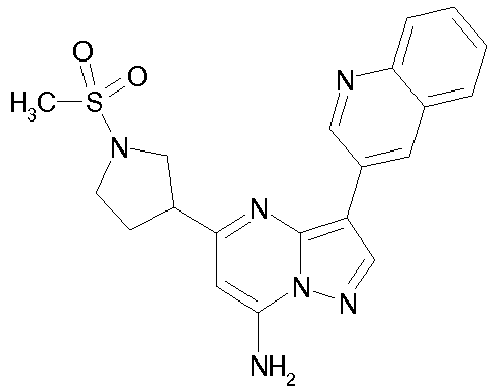
A F F 13.2 
A F F 5.2 
A F F 13.3 
C F F 13.4 
A F F 7.5 
A F F 7.2 
A F F 5.14 
A F F 8.18 
A F E 10.5 
A F D 10.19 
A F F 10.42 
A F F 10.26 
A F F 10.31 
A F F 13.16 
A F F 8.15 
A F F 10.62 
A F F 4.11 
A F F 4.12 
A F F 4.13 
A F F 10.63 
A F F 10.64 
A F F 2.8 
D E F 3.14 
F F 2.9 
E F 8.7 
A F 6.7 
A F

| Data mode: | CPM |
| Radio nuclide: | Manual SPA:P33 |
| Scintillator: | Liq/plast |
| Energy Range: | Low |
Claims (7)
- A compound selected from the following:


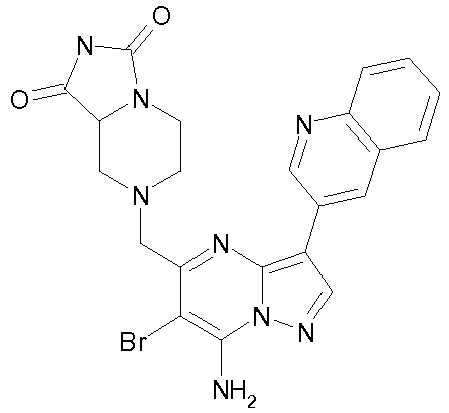


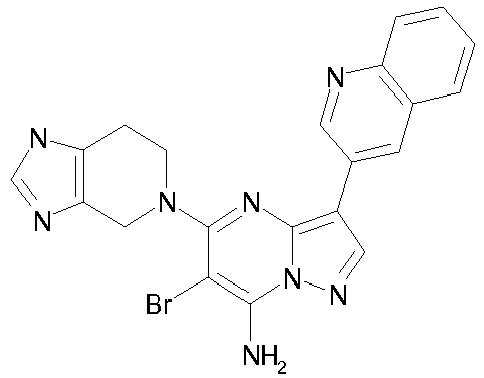


- A pharmaceutical composition comprising a therapeutically effective amount of at least one compound of claim 1 or a pharmaceutically acceptable salt or solvate thereof, in combination with at least one pharmaceutically acceptable carrier.
- The pharmaceutical composition according to claim 2, further comprising one or more anti-cancer agents different from the compounds of claim 1.
- The pharmaceutical composition according to claim 3, wherein the one or more anti-cancer agents are selected from the group consisting of Adriamycin, Altretamine, Amidox, Aminoglutethimide, Amsacrine, Anastrazole, Antibodies to EGFR, 3-AP, Aphidicolon, Ara-C, Arsenic trioxide, L-Asparaginase, Bevacizumab, Bleomycin, BMS 214662, Bortezomib, Busulfan, Campath, Camptostar, Capecitabine, Carboplatin, Carmustine, Centrosome associated protein E ("CENP-E") inhibitors, Cetuximab, Cladribine, Chlorambucil, Chlormethine, Chlorotrianisene, Cisplatin, Clofarabine, cyclophosphamide, Cytarabine, a Cytostatic agent, Cytoxan, Dacarbazine, Dactinomycin, Daunorubicin, Dasatinib, Deforolimus, Deoxycoformycin, Didox, Diethylstilbestrol, Docetaxel, Doxorubicin, Dromostanolone, Droloxafine, Epirubicin, Epothilones, ERK inhibitors, Erlotinib, Etoposide, 17α-Ethinylestradiol, Estramustine, Exemestane, Floxuridine, Fludarabine, Fludarabine phosphate, 5-Fluorouracil, Fluoxymesterone, Flutamide, Fulvestrant, Gefitinib, Gemcitabine, Gemtuzumab ozogamcicin, Goserelin, GSK-923295, Hexamethylmelamine, Hydroxyprogesterone, Hydroxyurea, Ibritumomab Tiuxetan, Idarubicin, Ifosfamide, Imatinib mesylate, Intron, Irinotecan, ispinesib, KSP inhibitors, L778,123, Lapatinib, Leucovirin, Leuprolide, Lerozole, Letrazole, Levamisole, Liposomal Doxorubicin, Liposomal, Lomustine, Ionafornib, Medroxyprogesteroneacetate, Megestrolacetate, Melphalan, 6-Mercaptopurine, Methoxtrexate, Methylprednisolone, Methyltestosterone, Mithramycin, Mitomycin-C, Mitotane, Mitoxantrone, Navelbene, Nilotinib, Oxaliplatin, Paclitaxel, Panitubimab, Pentostatin, Pipobroman, Porfimer, Prednisolone, Prednisone propionate, Procarbazine, Reloxafine, Rituximab, Satriplatin, SB-743921, Sml1, Sorafinib, Streptozocin, Sunitinib, Tamoxifen, Taxotere, Taxol, Temozolomide, Teniposide, Testolactone, Testosterone, Tezacitabine, 6-Thioguanine, Thiotepa, Tipifarnib, Topotecan, Toremifene, Tositumomab, Trastuzumab, Triamcinolone, Triapine, Triethylenemelamine, Triethylenethiophosphoramine, Trimidox, Uracil mustard, Vinblastine, Vincristine, Vindesine, and Vinorelbine.
- A compound of claim 1, or a pharmaceutically acceptable salt or solvate thereof for use in treating, or slowing the progression of, a disease by inhibiting mammalian Target Of Rapamycin in a patient, wherein the disease is selected from the group consisting of proliferative inflammatory diseases, allergic diseases, obstructive airways diseases and diseases related to transplant rejection.
- A compound of claim 1, or a pharmaceutically acceptable salt or solvate thereof for use in treating a cancer.
- The compound for use of claim 6, wherein said cancer is selected from the group consisting of: cancer of the bladder, breast, colon, kidney, liver, lung, small cell lung cancer, non-small cell lung cancer, head and neck, esophagus, gall bladder, ovary, pancreas, stomach, cervix, thyroid, prostate, and skin, including squamous cell carcinoma;
leukemia, acute lymphocytic leukemia, acute lymphoblastic leukemia, B-cell lymphoma, T- cell lymphoma, Hodgkins lymphoma, non-Hodgkins lymphoma, hairy cell lymphoma, mantle cell lymphoma, myeloma and Burkett's lymphoma;
acute and chronic myelogenous leukemia, myelodysplastic syndrome and promyelocytic leukemia;
fibrosarcoma, rhabdomyosarcoma;
mantle cell lymphoma, myeloma;
astrocytoma, neuroblastoma, glioma and schwannomas;
melanoma, seminoma, teratocarcinoma, osteosarcoma, xenoderma pigmentosum, keratoctanthoma, thyroid follicular cancer, endometrial cancer, gastrointestinal tract cancer and Kaposi's sarcoma.
Applications Claiming Priority (2)
| Application Number | Priority Date | Filing Date | Title |
|---|---|---|---|
| US16809309P | 2009-04-09 | 2009-04-09 | |
| PCT/US2010/030350 WO2010118207A1 (en) | 2009-04-09 | 2010-04-08 | Pyrazolo [1, 5-a] pyrimidine derivatives as mtor inhibitors |
Publications (2)
| Publication Number | Publication Date |
|---|---|
| EP2417138A1 EP2417138A1 (en) | 2012-02-15 |
| EP2417138B1 true EP2417138B1 (en) | 2019-11-27 |
Family
ID=42936570
Family Applications (1)
| Application Number | Title | Priority Date | Filing Date |
|---|---|---|---|
| EP10715010.4A Active EP2417138B1 (en) | 2009-04-09 | 2010-04-08 | Pyrazolo[1, 5-a]pyrimidine derivatives as mtor inhibitors |
Country Status (4)
| Country | Link |
|---|---|
| US (1) | US8591943B2 (en) |
| EP (1) | EP2417138B1 (en) |
| TW (1) | TW201102392A (en) |
| WO (1) | WO2010118207A1 (en) |
Families Citing this family (39)
| Publication number | Priority date | Publication date | Assignee | Title |
|---|---|---|---|---|
| US8865726B2 (en) | 2009-09-03 | 2014-10-21 | Array Biopharma Inc. | Substituted pyrazolo[1,5-a]pyrimidine compounds as mTOR inhibitors |
| WO2011090935A1 (en) | 2010-01-19 | 2011-07-28 | Merck Sharp & Dohme Corp. | PYRAZOLO[1,5-a]PYRIMIDINE COMPOUNDS AS mTOR INHIBITORS |
| US8883801B2 (en) | 2010-08-23 | 2014-11-11 | Merck Sharp & Dohme Corp. | Substituted pyrazolo[1,5-a]pyrimidines as mTOR inhibitors |
| US8901142B2 (en) | 2011-07-26 | 2014-12-02 | Merck Sharp & Dohme Corp. | Fused tricyclic compounds as mTOR inhibitors |
| WO2013142817A2 (en) | 2012-03-23 | 2013-09-26 | Dennis Brown | Compositions and methods to improve the therapeutic benefit of indirubin and analogs thereof, including meisoindigo |
| US8940742B2 (en) | 2012-04-10 | 2015-01-27 | Infinity Pharmaceuticals, Inc. | Heterocyclic compounds and uses thereof |
| TWI602820B (en) | 2012-06-06 | 2017-10-21 | 星宿藥物公司 | Bromodomain inhibitors and uses thereof |
| LT2925757T (en) | 2012-11-19 | 2017-12-27 | Novartis Ag | Compounds and compositions for the treatment of parasitic diseases |
| US8871754B2 (en) | 2012-11-19 | 2014-10-28 | Irm Llc | Compounds and compositions for the treatment of parasitic diseases |
| KR102148681B1 (en) * | 2013-02-21 | 2020-08-27 | 칼리토르 사이언시즈, 엘엘씨 | Heteroaromatic compounds as pi3 kinase modulators |
| EP3045448A4 (en) | 2013-09-12 | 2017-01-25 | Sumitomo Chemical Company Limited | Nitrogen-containing saturated heterocyclic compound |
| WO2015051241A1 (en) | 2013-10-04 | 2015-04-09 | Infinity Pharmaceuticals, Inc. | Heterocyclic compounds and uses thereof |
| EP3964507A1 (en) | 2013-10-04 | 2022-03-09 | Infinity Pharmaceuticals, Inc. | Heterocyclic compounds and uses thereof |
| ES2728932T3 (en) * | 2014-01-09 | 2019-10-29 | Intra Cellular Therapies Inc | Organic compounds |
| TW201620911A (en) * | 2014-03-17 | 2016-06-16 | 雷西肯製藥股份有限公司 | Inhibitors of adapter associated kinase 1, compositions comprising them, and methods of their use |
| CN106456628A (en) | 2014-03-19 | 2017-02-22 | 无限药品股份有限公司 | Heterocyclic compounds for the treatment of PI3K‑γ-mediated disorders |
| WO2016054491A1 (en) | 2014-10-03 | 2016-04-07 | Infinity Pharmaceuticals, Inc. | Heterocyclic compounds and uses thereof |
| FR3033499A1 (en) * | 2015-03-11 | 2016-09-16 | Centre Leon-Berard | COMPOSITION FOR THE TREATMENT OF PANCREATIC NEUROENDOCRINE TUMORS |
| CN114230571B (en) | 2015-09-14 | 2025-07-08 | 无限药品股份有限公司 | Solid forms of isoquinolinones, methods of making, compositions comprising, and methods of using the same |
| GB201521767D0 (en) * | 2015-12-10 | 2016-01-27 | Ucb Biopharma Sprl And Katholieke Universiteit Leuven K U Leuven R&D | Therapeutic agents |
| WO2017161116A1 (en) | 2016-03-17 | 2017-09-21 | Infinity Pharmaceuticals, Inc. | Isotopologues of isoquinolinone and quinazolinone compounds and uses thereof as pi3k kinase inhibitors |
| US10919914B2 (en) | 2016-06-08 | 2021-02-16 | Infinity Pharmaceuticals, Inc. | Heterocyclic compounds and uses thereof |
| MY202326A (en) | 2017-09-14 | 2024-04-24 | Daiichi Sankyo Co Ltd | Compound having cyclic structure |
| IL275059B2 (en) | 2017-12-15 | 2023-11-01 | Pyramid Biosciences Inc | 5-(2-(2,5-difluorophenyl)pyrrolidin-1 -yl)-3-(1h-pyrazol-1-yl)pyrazolo[1,5-a]pyrimidine derivatives and related compounds as trk kinase inhibitors for treating cancer |
| EP3305786A3 (en) | 2018-01-22 | 2018-07-25 | Bayer CropScience Aktiengesellschaft | Condensed bicyclic heterocycle derivatives as pesticides |
| TWI820146B (en) * | 2018-06-15 | 2023-11-01 | 瑞典商阿斯特捷利康公司 | Purinone compounds and their use in treating cancer |
| AU2019338207B2 (en) | 2018-09-10 | 2025-01-02 | Mirati Therapeutics, Inc. | Combination therapies |
| SG11202110523XA (en) | 2019-03-26 | 2021-10-28 | Ventyx Biosciences Inc | Tyk2 pseudokinase ligands |
| CN112142744A (en) * | 2019-06-28 | 2020-12-29 | 上海瑛派药业有限公司 | Substituted fused heteroaromatic bicyclic compounds as kinase inhibitors and their applications |
| CN114929226B (en) * | 2019-11-08 | 2024-09-27 | 温缇克斯生物科学公司 | TYK2 pseudokinase ligands |
| GB201918541D0 (en) | 2019-12-16 | 2020-01-29 | Carrick Therapeutics Ltd | Therapeutic compounds and their use |
| US12486274B2 (en) | 2020-01-13 | 2025-12-02 | Verge Analytics, Inc. | Substituted pyrazolo-pyrimidines and uses thereof |
| WO2021216454A1 (en) * | 2020-04-21 | 2021-10-28 | Lexicon Pharmaceuticals, Inc. | 4-(3-(pyridin-3-yl)pyrazolo[1,5-a]pyrimidin-5-yl)piperazine for use in the the treatment of cov-229e or cov-oc43 coronaviruses infections |
| CN112010860B (en) * | 2020-08-05 | 2023-03-10 | 南京纳丁菲医药科技有限公司 | Benzyloxypyrazolopyrimidine compounds, pharmaceutical compositions and uses thereof |
| EP4121431A1 (en) * | 2021-01-09 | 2023-01-25 | Bugworks Research, Inc. | Diaminopyrazolo[1,5-a]pyrimidine-6-carbonitrile compounds as adenosine 2a receptor and adenosine 2b receptor antagonist |
| CN113372531B (en) * | 2021-05-13 | 2022-11-25 | 眉山尤博瑞新材料有限公司 | Polyurethane with increased modulus after water absorption and preparation method and application thereof |
| CN116425757B (en) * | 2022-01-13 | 2025-05-20 | 浙江同源康医药股份有限公司 | Polycyclic compounds and uses thereof |
| AU2024338138A1 (en) * | 2023-09-08 | 2026-03-19 | Satellos Bioscience Inc. | Ap2 associated kinase 1 inhibitors and uses thereof |
| GB202415232D0 (en) | 2024-10-16 | 2024-11-27 | Nacamed As | Composition |
Citations (2)
| Publication number | Priority date | Publication date | Assignee | Title |
|---|---|---|---|---|
| US20050222171A1 (en) * | 2004-01-22 | 2005-10-06 | Guido Bold | Organic compounds |
| WO2011002887A1 (en) * | 2009-07-02 | 2011-01-06 | Schering Corporation | FUSED TRICYCLIC COMPOUNDS AS NOVEL mTOR INHIBITORS |
Family Cites Families (17)
| Publication number | Priority date | Publication date | Assignee | Title |
|---|---|---|---|---|
| AU747708B2 (en) | 1996-07-24 | 2002-05-23 | Du Pont Pharmaceuticals Company | Azolo triazines and pyrimidines |
| US20020041880A1 (en) | 2000-07-05 | 2002-04-11 | Defeo-Jones Deborah | Method of treating cancer |
| CA2483306A1 (en) | 2002-04-23 | 2003-11-06 | Shionogi & Co., Ltd. | Pyrazolo[1,5-a]pyrimidine derivative and nad(p)h oxidase inhibitor containing the same |
| US7196078B2 (en) * | 2002-09-04 | 2007-03-27 | Schering Corpoartion | Trisubstituted and tetrasubstituted pyrazolopyrimidines as cyclin dependent kinase inhibitors |
| US7119200B2 (en) | 2002-09-04 | 2006-10-10 | Schering Corporation | Pyrazolopyrimidines as cyclin dependent kinase inhibitors |
| JP4881558B2 (en) | 2002-09-04 | 2012-02-22 | シェーリング コーポレイション | Pyrazolopyrimidines as cyclin-dependent kinase inhibitors |
| KR20050057139A (en) | 2002-09-04 | 2005-06-16 | 쉐링 코포레이션 | Pyrazolopyrimidines as cyclin dependent kinase inhibitors |
| AU2004242850A1 (en) | 2003-06-03 | 2004-12-09 | Basf Aktiengesellschaft | Substituted pyrazolopyrimidines, methods for the production thereof, use of the same for controlling pathogenic fungi, and agents containing said compounds |
| AR049769A1 (en) | 2004-01-22 | 2006-09-06 | Novartis Ag | DERIVATIVES OF PIRAZOLO (1,5-A) PIRIMIDIN 7-IL-AMINA TO BE USED IN THE TREATMENT OF DEPENDENT DISEASES OF PROTEIN KINASE |
| MX2007010401A (en) * | 2005-02-25 | 2008-02-19 | Kudos Pharm Ltd | 2,4-diamino-pyridopyrimidine derivatives and their use as mtor inhibitors. |
| GB0515026D0 (en) | 2005-07-21 | 2005-08-31 | Novartis Ag | Organic compounds |
| US20070082900A1 (en) * | 2005-10-06 | 2007-04-12 | Schering Corporation | Methods for inhibiting protein kinases |
| HRP20130902T1 (en) | 2005-10-07 | 2013-11-08 | Exelixis Inc. | PYRIDOPYRIMIDINONE INHIBITORS OF PI3Kalpha |
| CA2630271C (en) | 2005-11-17 | 2014-04-08 | Osi Pharmaceuticals, Inc. | Fused bicyclic mtor inhibitors |
| GB0525080D0 (en) | 2005-12-09 | 2006-01-18 | Astrazeneca Ab | Pyrimidine derivatives |
| EP1981890A2 (en) | 2006-01-25 | 2008-10-22 | OSI Pharmaceuticals, Inc. | UNSATURATED mTOR INHIBITORS |
| PT2049502E (en) | 2006-07-28 | 2012-04-02 | Novartis Ag | 2,4-substituted quinazolines as lipid kinase inhibitors |
-
2010
- 2010-04-08 WO PCT/US2010/030350 patent/WO2010118207A1/en not_active Ceased
- 2010-04-08 EP EP10715010.4A patent/EP2417138B1/en active Active
- 2010-04-08 US US13/263,193 patent/US8591943B2/en active Active
- 2010-04-09 TW TW099111183A patent/TW201102392A/en unknown
Patent Citations (2)
| Publication number | Priority date | Publication date | Assignee | Title |
|---|---|---|---|---|
| US20050222171A1 (en) * | 2004-01-22 | 2005-10-06 | Guido Bold | Organic compounds |
| WO2011002887A1 (en) * | 2009-07-02 | 2011-01-06 | Schering Corporation | FUSED TRICYCLIC COMPOUNDS AS NOVEL mTOR INHIBITORS |
Non-Patent Citations (2)
| Title |
|---|
| L.N. BALLOU ET AL.: "Rapamycin and mTor kinase inhibitors", J.CHEM.BIOL., vol. 1, 2008 - 2008, pages 27 - 36 * |
| PANWALKER A ET AL: "MAMMALIAN TARGET OF RAPAMYCIN INHIBITION AS THERAPY FOR HEMATOLOGIC MALIGNANCIES", CANCER, AMERICAN CANCER SOCIETY, PHILADELPHIA, PA, US, vol. 100, no. 4, 15 February 2004 (2004-02-15), pages 657 - 666, XP008043726, ISSN: 0008-543X, DOI: 10.1002/CNCR.20026 * |
Also Published As
| Publication number | Publication date |
|---|---|
| US20120114739A1 (en) | 2012-05-10 |
| WO2010118207A1 (en) | 2010-10-14 |
| TW201102392A (en) | 2011-01-16 |
| EP2417138A1 (en) | 2012-02-15 |
| US8591943B2 (en) | 2013-11-26 |
Similar Documents
| Publication | Publication Date | Title |
|---|---|---|
| US8591943B2 (en) | Pyrazolo[1,5-a]pyrimidine derivatives as mTOR inhibitors | |
| US7576085B2 (en) | Imidazopyrazines as cyclin dependent kinase inhibitors | |
| AU2006315718B2 (en) | Imidazopyrazines as protein kinase inhibitors | |
| EP2069349B1 (en) | Pyrazolopyrimidines as cyclin dependent kinase inhibitors | |
| EP1931676B1 (en) | Pyrazolopyrimidines as protein kinase inhibitors | |
| EP2069348B1 (en) | Novel pyrazolopyrimidines as cyclin dependent kinase inhibitors | |
| AU2006302443B2 (en) | Novel pyrazolopyrimidines as cyclin dependent kinase inhibitors | |
| CN101772500A (en) | Imidazopyrazines as protein kinase inhibitors | |
| US20060040958A1 (en) | Novel pyrazolopyrimidines as cyclin dependent kinase inhibitors | |
| CN101495481A (en) | Pyrazolo [1, 5-alpha] pyrimidines as CDK inhibitors | |
| CA2624500A1 (en) | Pyrazolopyrimidines as protein kinase inhibitors | |
| CN115996929A (en) | Adenosine A2a receptor antagonist | |
| US8609675B2 (en) | Fused Tricyclic Compounds as novel mTOR inhibitors | |
| EP3887372B1 (en) | Further heteroaromatic compounds having activity against rsv | |
| AU2013200310A1 (en) | Pyrazolopyrimidines as Protein Kinase Inhibitors |
Legal Events
| Date | Code | Title | Description |
|---|---|---|---|
| PUAI | Public reference made under article 153(3) epc to a published international application that has entered the european phase |
Free format text: ORIGINAL CODE: 0009012 |
|
| 17P | Request for examination filed |
Effective date: 20111109 |
|
| AK | Designated contracting states |
Kind code of ref document: A1 Designated state(s): AT BE BG CH CY CZ DE DK EE ES FI FR GB GR HR HU IE IS IT LI LT LU LV MC MK MT NL NO PL PT RO SE SI SK SM TR |
|
| DAX | Request for extension of the european patent (deleted) | ||
| RAP1 | Party data changed (applicant data changed or rights of an application transferred) |
Owner name: MERCK SHARP & DOHME CORP. |
|
| 17Q | First examination report despatched |
Effective date: 20160617 |
|
| STAA | Information on the status of an ep patent application or granted ep patent |
Free format text: STATUS: EXAMINATION IS IN PROGRESS |
|
| GRAP | Despatch of communication of intention to grant a patent |
Free format text: ORIGINAL CODE: EPIDOSNIGR1 |
|
| STAA | Information on the status of an ep patent application or granted ep patent |
Free format text: STATUS: GRANT OF PATENT IS INTENDED |
|
| INTG | Intention to grant announced |
Effective date: 20190626 |
|
| GRAS | Grant fee paid |
Free format text: ORIGINAL CODE: EPIDOSNIGR3 |
|
| GRAA | (expected) grant |
Free format text: ORIGINAL CODE: 0009210 |
|
| STAA | Information on the status of an ep patent application or granted ep patent |
Free format text: STATUS: THE PATENT HAS BEEN GRANTED |
|
| AK | Designated contracting states |
Kind code of ref document: B1 Designated state(s): AT BE BG CH CY CZ DE DK EE ES FI FR GB GR HR HU IE IS IT LI LT LU LV MC MK MT NL NO PL PT RO SE SI SK SM TR |
|
| REG | Reference to a national code |
Ref country code: GB Ref legal event code: FG4D |
|
| REG | Reference to a national code |
Ref country code: CH Ref legal event code: EP |
|
| REG | Reference to a national code |
Ref country code: AT Ref legal event code: REF Ref document number: 1206558 Country of ref document: AT Kind code of ref document: T Effective date: 20191215 |
|
| REG | Reference to a national code |
Ref country code: DE Ref legal event code: R096 Ref document number: 602010062132 Country of ref document: DE |
|
| REG | Reference to a national code |
Ref country code: IE Ref legal event code: FG4D |
|
| REG | Reference to a national code |
Ref country code: NL Ref legal event code: MP Effective date: 20191127 |
|
| REG | Reference to a national code |
Ref country code: LT Ref legal event code: MG4D |
|
| PG25 | Lapsed in a contracting state [announced via postgrant information from national office to epo] |
Ref country code: FI Free format text: LAPSE BECAUSE OF FAILURE TO SUBMIT A TRANSLATION OF THE DESCRIPTION OR TO PAY THE FEE WITHIN THE PRESCRIBED TIME-LIMIT Effective date: 20191127 Ref country code: LT Free format text: LAPSE BECAUSE OF FAILURE TO SUBMIT A TRANSLATION OF THE DESCRIPTION OR TO PAY THE FEE WITHIN THE PRESCRIBED TIME-LIMIT Effective date: 20191127 Ref country code: NL Free format text: LAPSE BECAUSE OF FAILURE TO SUBMIT A TRANSLATION OF THE DESCRIPTION OR TO PAY THE FEE WITHIN THE PRESCRIBED TIME-LIMIT Effective date: 20191127 Ref country code: BG Free format text: LAPSE BECAUSE OF FAILURE TO SUBMIT A TRANSLATION OF THE DESCRIPTION OR TO PAY THE FEE WITHIN THE PRESCRIBED TIME-LIMIT Effective date: 20200227 Ref country code: SE Free format text: LAPSE BECAUSE OF FAILURE TO SUBMIT A TRANSLATION OF THE DESCRIPTION OR TO PAY THE FEE WITHIN THE PRESCRIBED TIME-LIMIT Effective date: 20191127 Ref country code: LV Free format text: LAPSE BECAUSE OF FAILURE TO SUBMIT A TRANSLATION OF THE DESCRIPTION OR TO PAY THE FEE WITHIN THE PRESCRIBED TIME-LIMIT Effective date: 20191127 Ref country code: ES Free format text: LAPSE BECAUSE OF FAILURE TO SUBMIT A TRANSLATION OF THE DESCRIPTION OR TO PAY THE FEE WITHIN THE PRESCRIBED TIME-LIMIT Effective date: 20191127 Ref country code: NO Free format text: LAPSE BECAUSE OF FAILURE TO SUBMIT A TRANSLATION OF THE DESCRIPTION OR TO PAY THE FEE WITHIN THE PRESCRIBED TIME-LIMIT Effective date: 20200227 Ref country code: GR Free format text: LAPSE BECAUSE OF FAILURE TO SUBMIT A TRANSLATION OF THE DESCRIPTION OR TO PAY THE FEE WITHIN THE PRESCRIBED TIME-LIMIT Effective date: 20200228 |
|
| PG25 | Lapsed in a contracting state [announced via postgrant information from national office to epo] |
Ref country code: HR Free format text: LAPSE BECAUSE OF FAILURE TO SUBMIT A TRANSLATION OF THE DESCRIPTION OR TO PAY THE FEE WITHIN THE PRESCRIBED TIME-LIMIT Effective date: 20191127 Ref country code: IS Free format text: LAPSE BECAUSE OF FAILURE TO SUBMIT A TRANSLATION OF THE DESCRIPTION OR TO PAY THE FEE WITHIN THE PRESCRIBED TIME-LIMIT Effective date: 20200327 |
|
| PG25 | Lapsed in a contracting state [announced via postgrant information from national office to epo] |
Ref country code: PT Free format text: LAPSE BECAUSE OF FAILURE TO SUBMIT A TRANSLATION OF THE DESCRIPTION OR TO PAY THE FEE WITHIN THE PRESCRIBED TIME-LIMIT Effective date: 20200419 Ref country code: EE Free format text: LAPSE BECAUSE OF FAILURE TO SUBMIT A TRANSLATION OF THE DESCRIPTION OR TO PAY THE FEE WITHIN THE PRESCRIBED TIME-LIMIT Effective date: 20191127 Ref country code: RO Free format text: LAPSE BECAUSE OF FAILURE TO SUBMIT A TRANSLATION OF THE DESCRIPTION OR TO PAY THE FEE WITHIN THE PRESCRIBED TIME-LIMIT Effective date: 20191127 Ref country code: CZ Free format text: LAPSE BECAUSE OF FAILURE TO SUBMIT A TRANSLATION OF THE DESCRIPTION OR TO PAY THE FEE WITHIN THE PRESCRIBED TIME-LIMIT Effective date: 20191127 Ref country code: DK Free format text: LAPSE BECAUSE OF FAILURE TO SUBMIT A TRANSLATION OF THE DESCRIPTION OR TO PAY THE FEE WITHIN THE PRESCRIBED TIME-LIMIT Effective date: 20191127 |
|
| REG | Reference to a national code |
Ref country code: DE Ref legal event code: R097 Ref document number: 602010062132 Country of ref document: DE |
|
| PG25 | Lapsed in a contracting state [announced via postgrant information from national office to epo] |
Ref country code: SM Free format text: LAPSE BECAUSE OF FAILURE TO SUBMIT A TRANSLATION OF THE DESCRIPTION OR TO PAY THE FEE WITHIN THE PRESCRIBED TIME-LIMIT Effective date: 20191127 Ref country code: SK Free format text: LAPSE BECAUSE OF FAILURE TO SUBMIT A TRANSLATION OF THE DESCRIPTION OR TO PAY THE FEE WITHIN THE PRESCRIBED TIME-LIMIT Effective date: 20191127 |
|
| REG | Reference to a national code |
Ref country code: AT Ref legal event code: MK05 Ref document number: 1206558 Country of ref document: AT Kind code of ref document: T Effective date: 20191127 |
|
| PLBE | No opposition filed within time limit |
Free format text: ORIGINAL CODE: 0009261 |
|
| STAA | Information on the status of an ep patent application or granted ep patent |
Free format text: STATUS: NO OPPOSITION FILED WITHIN TIME LIMIT |
|
| 26N | No opposition filed |
Effective date: 20200828 |
|
| PG25 | Lapsed in a contracting state [announced via postgrant information from national office to epo] |
Ref country code: SI Free format text: LAPSE BECAUSE OF FAILURE TO SUBMIT A TRANSLATION OF THE DESCRIPTION OR TO PAY THE FEE WITHIN THE PRESCRIBED TIME-LIMIT Effective date: 20191127 Ref country code: AT Free format text: LAPSE BECAUSE OF FAILURE TO SUBMIT A TRANSLATION OF THE DESCRIPTION OR TO PAY THE FEE WITHIN THE PRESCRIBED TIME-LIMIT Effective date: 20191127 Ref country code: PL Free format text: LAPSE BECAUSE OF FAILURE TO SUBMIT A TRANSLATION OF THE DESCRIPTION OR TO PAY THE FEE WITHIN THE PRESCRIBED TIME-LIMIT Effective date: 20191127 Ref country code: MC Free format text: LAPSE BECAUSE OF FAILURE TO SUBMIT A TRANSLATION OF THE DESCRIPTION OR TO PAY THE FEE WITHIN THE PRESCRIBED TIME-LIMIT Effective date: 20191127 |
|
| REG | Reference to a national code |
Ref country code: CH Ref legal event code: PL |
|
| PG25 | Lapsed in a contracting state [announced via postgrant information from national office to epo] |
Ref country code: LU Free format text: LAPSE BECAUSE OF NON-PAYMENT OF DUE FEES Effective date: 20200408 Ref country code: LI Free format text: LAPSE BECAUSE OF NON-PAYMENT OF DUE FEES Effective date: 20200430 Ref country code: CH Free format text: LAPSE BECAUSE OF NON-PAYMENT OF DUE FEES Effective date: 20200430 Ref country code: IT Free format text: LAPSE BECAUSE OF FAILURE TO SUBMIT A TRANSLATION OF THE DESCRIPTION OR TO PAY THE FEE WITHIN THE PRESCRIBED TIME-LIMIT Effective date: 20191127 |
|
| REG | Reference to a national code |
Ref country code: BE Ref legal event code: MM Effective date: 20200430 |
|
| PG25 | Lapsed in a contracting state [announced via postgrant information from national office to epo] |
Ref country code: BE Free format text: LAPSE BECAUSE OF NON-PAYMENT OF DUE FEES Effective date: 20200430 |
|
| PG25 | Lapsed in a contracting state [announced via postgrant information from national office to epo] |
Ref country code: IE Free format text: LAPSE BECAUSE OF NON-PAYMENT OF DUE FEES Effective date: 20200408 |
|
| PG25 | Lapsed in a contracting state [announced via postgrant information from national office to epo] |
Ref country code: TR Free format text: LAPSE BECAUSE OF FAILURE TO SUBMIT A TRANSLATION OF THE DESCRIPTION OR TO PAY THE FEE WITHIN THE PRESCRIBED TIME-LIMIT Effective date: 20191127 Ref country code: MT Free format text: LAPSE BECAUSE OF FAILURE TO SUBMIT A TRANSLATION OF THE DESCRIPTION OR TO PAY THE FEE WITHIN THE PRESCRIBED TIME-LIMIT Effective date: 20191127 Ref country code: CY Free format text: LAPSE BECAUSE OF FAILURE TO SUBMIT A TRANSLATION OF THE DESCRIPTION OR TO PAY THE FEE WITHIN THE PRESCRIBED TIME-LIMIT Effective date: 20191127 |
|
| PG25 | Lapsed in a contracting state [announced via postgrant information from national office to epo] |
Ref country code: MK Free format text: LAPSE BECAUSE OF FAILURE TO SUBMIT A TRANSLATION OF THE DESCRIPTION OR TO PAY THE FEE WITHIN THE PRESCRIBED TIME-LIMIT Effective date: 20191127 |
|
| REG | Reference to a national code |
Ref country code: DE Ref legal event code: R081 Ref document number: 602010062132 Country of ref document: DE Owner name: MERCK SHARP & DOHME LLC, RAHWAY, US Free format text: FORMER OWNER: MERCK SHARP & DOHME CORP., RAHWAY, N.J., US |
|
| REG | Reference to a national code |
Ref country code: GB Ref legal event code: 732E Free format text: REGISTERED BETWEEN 20220908 AND 20220914 |
|
| PGFP | Annual fee paid to national office [announced via postgrant information from national office to epo] |
Ref country code: FR Payment date: 20250319 Year of fee payment: 16 |
|
| PGFP | Annual fee paid to national office [announced via postgrant information from national office to epo] |
Ref country code: GB Payment date: 20250313 Year of fee payment: 16 |
|
| PGFP | Annual fee paid to national office [announced via postgrant information from national office to epo] |
Ref country code: DE Payment date: 20250317 Year of fee payment: 16 |