EP2415181B1 - Method for beamforming training and communications apparatuses utilizing the same - Google Patents
Method for beamforming training and communications apparatuses utilizing the same Download PDFInfo
- Publication number
- EP2415181B1 EP2415181B1 EP10758073.0A EP10758073A EP2415181B1 EP 2415181 B1 EP2415181 B1 EP 2415181B1 EP 10758073 A EP10758073 A EP 10758073A EP 2415181 B1 EP2415181 B1 EP 2415181B1
- Authority
- EP
- European Patent Office
- Prior art keywords
- communications device
- sector
- time
- bit sequences
- predetermined
- Prior art date
- Legal status (The legal status is an assumption and is not a legal conclusion. Google has not performed a legal analysis and makes no representation as to the accuracy of the status listed.)
- Not-in-force
Links
- 230000006854 communication Effects 0.000 title claims description 178
- 238000004891 communication Methods 0.000 title claims description 178
- 238000000034 method Methods 0.000 title claims description 30
- 239000013598 vector Substances 0.000 claims description 9
- 230000005540 biological transmission Effects 0.000 description 3
- 230000007175 bidirectional communication Effects 0.000 description 2
- 230000001419 dependent effect Effects 0.000 description 1
- 238000005516 engineering process Methods 0.000 description 1
Images

Classifications
-
- H—ELECTRICITY
- H04—ELECTRIC COMMUNICATION TECHNIQUE
- H04B—TRANSMISSION
- H04B7/00—Radio transmission systems, i.e. using radiation field
- H04B7/02—Diversity systems; Multi-antenna system, i.e. transmission or reception using multiple antennas
- H04B7/04—Diversity systems; Multi-antenna system, i.e. transmission or reception using multiple antennas using two or more spaced independent antennas
- H04B7/06—Diversity systems; Multi-antenna system, i.e. transmission or reception using multiple antennas using two or more spaced independent antennas at the transmitting station
- H04B7/0613—Diversity systems; Multi-antenna system, i.e. transmission or reception using multiple antennas using two or more spaced independent antennas at the transmitting station using simultaneous transmission
- H04B7/0615—Diversity systems; Multi-antenna system, i.e. transmission or reception using multiple antennas using two or more spaced independent antennas at the transmitting station using simultaneous transmission of weighted versions of same signal
- H04B7/0619—Diversity systems; Multi-antenna system, i.e. transmission or reception using multiple antennas using two or more spaced independent antennas at the transmitting station using simultaneous transmission of weighted versions of same signal using feedback from receiving side
- H04B7/0621—Feedback content
- H04B7/0632—Channel quality parameters, e.g. channel quality indicator [CQI]
-
- H—ELECTRICITY
- H04—ELECTRIC COMMUNICATION TECHNIQUE
- H04B—TRANSMISSION
- H04B7/00—Radio transmission systems, i.e. using radiation field
- H04B7/02—Diversity systems; Multi-antenna system, i.e. transmission or reception using multiple antennas
- H04B7/04—Diversity systems; Multi-antenna system, i.e. transmission or reception using multiple antennas using two or more spaced independent antennas
- H04B7/0491—Diversity systems; Multi-antenna system, i.e. transmission or reception using multiple antennas using two or more spaced independent antennas using two or more sectors, i.e. sector diversity
-
- H—ELECTRICITY
- H04—ELECTRIC COMMUNICATION TECHNIQUE
- H04B—TRANSMISSION
- H04B7/00—Radio transmission systems, i.e. using radiation field
- H04B7/02—Diversity systems; Multi-antenna system, i.e. transmission or reception using multiple antennas
- H04B7/04—Diversity systems; Multi-antenna system, i.e. transmission or reception using multiple antennas using two or more spaced independent antennas
- H04B7/06—Diversity systems; Multi-antenna system, i.e. transmission or reception using multiple antennas using two or more spaced independent antennas at the transmitting station
- H04B7/0613—Diversity systems; Multi-antenna system, i.e. transmission or reception using multiple antennas using two or more spaced independent antennas at the transmitting station using simultaneous transmission
- H04B7/0615—Diversity systems; Multi-antenna system, i.e. transmission or reception using multiple antennas using two or more spaced independent antennas at the transmitting station using simultaneous transmission of weighted versions of same signal
- H04B7/0619—Diversity systems; Multi-antenna system, i.e. transmission or reception using multiple antennas using two or more spaced independent antennas at the transmitting station using simultaneous transmission of weighted versions of same signal using feedback from receiving side
- H04B7/0621—Feedback content
- H04B7/0634—Antenna weights or vector/matrix coefficients
-
- H—ELECTRICITY
- H04—ELECTRIC COMMUNICATION TECHNIQUE
- H04L—TRANSMISSION OF DIGITAL INFORMATION, e.g. TELEGRAPHIC COMMUNICATION
- H04L25/00—Baseband systems
- H04L25/02—Details ; arrangements for supplying electrical power along data transmission lines
- H04L25/0202—Channel estimation
- H04L25/0224—Channel estimation using sounding signals
-
- H—ELECTRICITY
- H04—ELECTRIC COMMUNICATION TECHNIQUE
- H04L—TRANSMISSION OF DIGITAL INFORMATION, e.g. TELEGRAPHIC COMMUNICATION
- H04L5/00—Arrangements affording multiple use of the transmission path
- H04L5/0001—Arrangements for dividing the transmission path
- H04L5/0014—Three-dimensional division
- H04L5/0023—Time-frequency-space
Definitions
- the invention relates to a method for beamforming training, and more particularly to a method for beamforming training a trainee communications device with one or more trainer communications devices in a communications system.
- Beamforming techniques that use multiple antennas at both the transmitter and receiver ends may be applied in a communications system to improve communications performance.
- the communications devices employing multiple antennas need to be trained in order to obtain optimum Tx and/or Rx antenna configurations before data transmission.
- a communications device transmits one or more predetermined beamforming training bit-sequences to a peer communications device via a one-to-one training procedure.
- conventional beamforming training methods are designed for one-to-one training.
- the conventional beamforming training methods may take O(n ⁇ 2) sessions and at least O(n ⁇ 2) messages to complete the overall beamforming training of the communications system.
- the number of training sessions may be quadrupled in order to establish bi-directional communications paths.
- methods and systems for many-to-one beamforming training methods are introduced.
- one session is needed for one trainee communications device to be trained for its receiving antenna beamforming weighting vectors with a plurality of trainer communications devices allocated in different sectors.
- the disclosed invention may take only O(n) to complete the beamforming training session for a communications system with n communications devices.
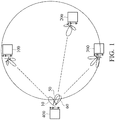
- FIG. 1 shows a communications system according to an embodiment of the invention.
- the communications system comprises a plurality of communications devices, for example, the communications devices 100-400.
- a communications device in the communications system is either a trainer or a trainee communications device.
- the communications devices 100, 200 and 300 are the trainer communications devices and the communications device 400 within the reach of the transmitting signal of the trainer communications devices is the trainee communications device.
- many-to-one beamforming training may be accomplished during one training session. In other words, one or more trainer communications devices may concurrently train a trainee communications device during one training session.
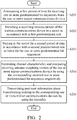
- FIG. 2 shows a flow chart of the beamforming training method, performed by the trainee communications device, according to an embodiment of the invention.
- any one of the communications devices may detect the presence of one or more of the other communications devices.
- the trainee communications device For training the receiving antenna beamforming weighting vectors of the trainee communications device (such as the communications device 400 shown in FIG. 1 ) with the one or more trainer communications devices (such as the communications devices 100-300 shown in FIG. 1 ), after the presence of one or more trainer communications devices are detected, the trainee communications device first announce a first period of time, which is reserved for receiving one or more predetermined bit sequences, namely, beamforming training sequences, from the one or more trainer communications devices (Step S201).
- each of the one or more predetermined bit sequences may carry an identifier, which is a unique identifier identifying a trainer communications device.
- the one or more predetermined bit sequences may be sent by using a method that assures that the trainee communications device will be able to receive the one or more predetermined bit sequences.
- a preferred transmission pattern may be a directional beam.
- a directional beam covers a section of space, that is, a sector, and each sector has a predetermined angle, where the predetermined angle of the sector is set in accordance with the configuration of the transmitting antenna pattern of the communications device transmitting the directional beam.
- the trainee communications device directs its antenna to switch the receiving antenna pattern to one or more sectors, with a predetermined angle set in accordance with the configuration of the receiving antenna pattern, to receive the one or more predetermined bit sequences from the trainer communications devices.
- the trainee communications device estimates channel characteristics of the radio channel between the trainee communications device and the corresponding trainer communications device transmitting the one or more predetermined bit sequences, and computes receiving antenna weighting vectors of the one or more trainer communications devices by using the corresponding received one or more predetermined bit sequences, respectively (Step S204).
- the trainee communications device transmits pertinent information about beamforming training to the corresponding one or more trainer communications devices by using the identifier (Step S205).
- the information comprises the estimated channel characteristics and receiving time of the one or more pre-determined bit sequences, respectively.
- a preferred transmission pattern is a directional beam.
- the one or more predetermined bit-sequences may be sent to a plurality of sectors.
- the plurality of sectors cover the communications space. Therefore, during the first period of time (that is, the training period, or so-called the training session), the trainee communications device switches its receiving antenna pattern to a plurality of sectors, one after another, in accordance with a first predetermined rule, and stay in at least one sector for a second period of time in accordance with a second predetermined rule to receive the one or more predetermined bit sequences.
- steps S202 to S205 may be repeatedly performed by the trainee communications device so as to accomplish the beamforming training process with one or more trainer communications devices in the communications system.
- the first predetermined rule is for the trainee communications device to step through all sectors in a sequentially or random order
- the second predetermined rule is to make sure the duration the trainee communications device stays in the sector should be long enough to receive at least one of the predetermined bit sequence.
- FIG. 3 shows a plurality of exemplary receiving angles of the trainee communications device at different time instances 10, 20... and 60 in the reserved first period of time according to an embodiment of the invention.
- the trainee communications device may switch its receiving antenna pattern to a plurality of sectors at different time instances in the first period of time as shown in FIG. 3 in accordance with the first predetermined rule.
- the trainee communications device may step through all sectors in order sequentially.
- the trainee communications device may step through all sectors in random order.
- the trainee communications device may further stay in the predetermined sector for a second period of time in accordance with a second predetermined rule to listen for the one or more predetermined bit sequences.
- the second predetermined rule may be that the trainee communications device stays in the predetermined sector for the second period of time that is long enough to receive one predetermined bit sequence.
- the second predetermined rule may be that the trainee communications device stays in the predetermined sector for the second period of time that is long enough to receive more than one predetermined bit sequence.
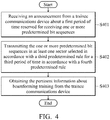
- FIG. 4 shows a flow chart of the beamforming training method, performed at a trainer communications devices, according to an embodiment of the invention.
- the trainer communications device (such as the communications devices 100-300 shown in FIG. 1 ) transmits the one or more predetermined bit sequences in at least one sector selected in accordance with a third predetermined rule for a third period of time in accordance with a fourth predetermined rule (Step S402).
- the third predetermined rule is that the one or more trainers transmit the one or more predetermined bit sequences on all sectors in a sequentially order or random order.
- an angle of the at least one sector is set in accordance with the configuration of transmitting antenna pattern of the corresponding trainer communications device, and each of the one or more predetermined bit sequences carries an identifier, which is a unique identifier identifying the corresponding trainer communications device.
- the trainer communications devices obtain the pertinent information about beamforming training from the trainee communications device (Step 403).
- the trainer communications device transmits the one or more predetermined bit sequences in one or more, or even all sectors covering the space of communications.
- the trainer communications device determines to transmit the one or more predetermined bit sequences in more than one sector
- the trainer communications device transmit the one or more predetermined bit sequences in the sectors in a sequentially order (one embodiment of the third predetermined rule).
- the trainer communications device determines a to transmit the one or more predetermined bit sequences in more than one sector
- the trainer communications device transmits the one or more predetermined bit sequences in the sectors in a random order(another embodiment of the third predetermined rule).
- the one or more trainer communications device transmits the one or more predetermined bit sequences for a third period of time in accordance with a fourth predetermined rule.
- the fourth predetermined rule is that the trainer communications device transmits one predetermined bit sequence in a sector.
- the fourth predetermined rule is that the one or more trainer communications device transmits more than one predetermined bit sequence in a sector.
- the fourth predetermined rule is that the trainer communications device transmits the one or more predetermined bit sequences in a number of sectors.
- the trainee communication device since the one or more trainer communications devices transmit one or more predetermined bit sequences in one or more sectors, the trainee communication device have to know which predetermined bit sequence has been transmitted by what trainee communications device, and/or in which sector has the transmitted predetermined bit sequence been received by the trainee communications device for estimating the channel characteristics. Therefore, according to an embodiment of the invention, the pertinent information obtained by the one or more trainer communications devices in step S403 may comprise the channel characteristics estimated by the trainee communications device and receiving time of the one or more pre-determined bit sequences at the trainee communications device.
- the trainer communications device such as the communications devices 100-300, concurrently transmit the one or more predetermined bit sequences in more than one sector for a period of time so as to train the trainee communications device, such as the communications device 400, in one training session.
- an angle of each sector is set in accordance with the configuration of transmitting antenna pattern of the corresponding transmitting trainer communications device.
- the trainee communications device switches its receiving antenna pattern to one or more sectors and stays in each sector for another period of time in accordance with the second predetermined rule, where an angle of the sector is set in accordance with the configuration of the receiving antenna pattern.
- the periods of time for trainer communications device to transmit the one or more predetermined bit sequences and trainee communications device to switch receiving antenna pattern are within the initial reserved period of time so as to accomplish the overall beamforming training in the reserved training period.
- the transmitting angle of the trainer communications device 100 at time instances 10, 20, 30, 40, 50 and 60 in the reserved first period of time is shown in FIG. 1 , and the predetermined bit sequence sent at time instance 10 is received by the trainee communications device 400.
- the transmitting angle of the trainer communications device 300 at time instances 10, 20, 30, 40, 50 and 60 in the reserved first period of time is shown in FIG. 1 , and the predetermined bit sequence sent at time instance 60 is received by the trainee communications device 400.
- the trainee communications device After receiving the one or more predetermined bit sequences, the trainee communications device estimates channel characteristics and computes receiving antenna weighting vectors (AWVs) of the one or more trainer communications devices by using the corresponding received one or more predetermined bit sequences, respectively.
- the AWVs depicts the characteristics of the one or more transmitting/receiving beams, such as antenna direction or antenna gain pattern. Therefore, different AWVs is associated with different beam patterns.
- the transmitting and/or receiving beam pattern of the communications device is determined according to at least one of the parameters which comprise phase and strength of transmitting and/or receiving signals, and number of antennas, placement of the antennas and individual transmitting and/or receiving beam patterns of each antenna element of the communications device.
- the channel characteristics retrieved according to the received one or more predetermined bit sequences comprises a combination of an antenna direction, a phase rotating vector of the antenna, an optimum antenna configuration... and so on.
- the trainee communications device computes a weighting vector that maximizes the signal to noise ratio as the training result according to the received one or more predetermined bit sequences, and returns the training result to the corresponding trainer communications device.
- the trainee communications device retrieves an optimum antenna code as the training result according to the received one or more predetermined bit sequences, and returns the training result to the corresponding trainer communications device.
- the pertinent information about beamforming training is transmitted to the one or more trainer communications devices by using the unique identifier.
- the pertinent information about beamforming training comprises the estimated channel characteristics, and the receiving time of the one or more predetermined bit sequences at the trainee communications device.
- the trainer communications device knows which predetermined bit sequence is received by the trainee communications device for estimating the channel characteristic, and/or the predetermined bit sequence received by the trainee communications device for estimating the channel characteristic is transmitted in which sector according to the receiving time carried in the pertinent information.
- the beamforming training session may be completed after the one or more trainer communications devices receives the one or more response messages carrying the pertinent information from the trainee communications device.
- more than one trainer communications devices may concurrently train a trainee communications device during one training session so that many-to-one beamforming training is realized.
Landscapes
- Engineering & Computer Science (AREA)
- Computer Networks & Wireless Communication (AREA)
- Signal Processing (AREA)
- Physics & Mathematics (AREA)
- Mathematical Physics (AREA)
- Radio Transmission System (AREA)
- Mobile Radio Communication Systems (AREA)
Description
- The invention relates to a method for beamforming training, and more particularly to a method for beamforming training a trainee communications device with one or more trainer communications devices in a communications system.
- Beamforming techniques that use multiple antennas at both the transmitter and receiver ends may be applied in a communications system to improve communications performance. Generally, the communications devices employing multiple antennas need to be trained in order to obtain optimum Tx and/or Rx antenna configurations before data transmission. For a conventional beamforming training procedure, a communications device transmits one or more predetermined beamforming training bit-sequences to a peer communications device via a one-to-one training procedure. Particularly, for high frequency applications, such as a millimeter wave communications system, it is preferable that only one communications device be trained during a training session due to directionality of the antenna.
- Based on the conventional beamforming training method, when there are more than one communications device in a communications system, a great number, which amounts to the square of the number of communications devices, of sessions and messages are required for the training procedure. For communications devices to exchange data over an asymmetrical channel with asymmetrical configurations, the amount of training sessions and messages are quadrupled in order to establish a bi-directional communications path, which seriously degrades training efficiency. Thus, a novel beamforming training method that is able to solve the foregoing inefficiencies is highly required.
- "Draft Amendment to IEEE Standard for Information technology Telecommunications and information exchange between systems Local and metropolitan area networks Specific requirements Specific requirements- Part 15.3: Wireless Medium Access Control (M AC) and Physical Layer (PH Y) Specifications for H", IEEE DRAFT; P802-15-3C-D02_DRAFT_AMENDMENTCMP, IEEE-SA, PISCATAWAY, NJ USA, (20081024), vol. 802.15.3c, PAGE 1 - 264, XP017634235, discloses a method for beamforming training a trainee communications device with a trainer communications device in a communications system. From N/A, "Merged Proposal New Phy Layer And Enhancement Mac Mmwave System Proposal; 15-07-0934-00-003c-merged-proposal-new-phy-layer-and-enhancement-mac-mmwave-system-proposal", IEEE DRAFT; 15-07-0934-00-003C-MERGED-PROPOSAL-NEW-PHY-LAYER-AND-ENHANCEMENT-MAC-MMWAVE-SYSTEM-PROPOSAL, IEEE-SA MENTOR, PISCATAWAY, NJ USA, (20071114), vol. 802.153c, PAGE 1 - 89, XP017668582, methods for pro-active and on-demand beamforming are known.
- From
US 2009/046010 A1 a training protocol between a phased array antenna device and a switched array antenna device is known. - The present invention is defined by the subject matter of the independent claims 1 and 8. Preferred embodiments are defined in the dependent claims.
- A detailed description is given in the following embodiments with reference to the accompanying drawings.
- The invention can be more fully understood by reading the subsequent detailed description and examples with references made to the accompanying drawings, wherein:
-
FIG. 1 shows a communications system according to an embodiment of the invention; -
FIG. 2 shows a flow chart of the beamforming training method, performed by the trainee communications device, according to an embodiment of the invention; -
FIG. 3 shows a plurality of exemplary receiving angles of the trainee communications device at different time instances in the reserved time period according to an embodiment of the invention; and -
FIG. 4 shows a flow chart of the beamforming training method, performed by the trainer communications devices, according to an embodiment of the invention. - The following description is of the best-contemplated mode of carrying out the invention. This description is made for the purpose of illustrating the general principles of the invention and should not be taken in a limiting sense. The scope of the invention is best determined by reference to the appended claims.
- As previously described, conventional beamforming training methods are designed for one-to-one training. However, for a communications system with n communications devices, the conventional beamforming training methods may take O(n^2) sessions and at least O(n^2) messages to complete the overall beamforming training of the communications system. For communications devices to exchange data over an asymmetrical channel with asymmetrical antenna configurations, the number of training sessions may be quadrupled in order to establish bi-directional communications paths. In the embodiments of the invention, methods and systems for many-to-one beamforming training methods are introduced. For the many-to-one beamforming training method, one session is needed for one trainee communications device to be trained for its receiving antenna beamforming weighting vectors with a plurality of trainer communications devices allocated in different sectors. The disclosed invention may take only O(n) to complete the beamforming training session for a communications system with n communications devices.
-
FIG. 1 shows a communications system according to an embodiment of the invention. The communications system comprises a plurality of communications devices, for example, the communications devices 100-400. A communications device in the communications system is either a trainer or a trainee communications device. In the embodiments of the invention, thecommunications devices communications device 400 within the reach of the transmitting signal of the trainer communications devices is the trainee communications device. According to an embodiment of the invention, many-to-one beamforming training may be accomplished during one training session. In other words, one or more trainer communications devices may concurrently train a trainee communications device during one training session. -
FIG. 2 shows a flow chart of the beamforming training method, performed by the trainee communications device, according to an embodiment of the invention. In the embodiment of the invention, any one of the communications devices may detect the presence of one or more of the other communications devices. For training the receiving antenna beamforming weighting vectors of the trainee communications device (such as thecommunications device 400 shown inFIG. 1 ) with the one or more trainer communications devices (such as the communications devices 100-300 shown inFIG. 1 ), after the presence of one or more trainer communications devices are detected, the trainee communications device first announce a first period of time, which is reserved for receiving one or more predetermined bit sequences, namely, beamforming training sequences, from the one or more trainer communications devices (Step S201). Next, the trainee communications device switches receiving antenna pattern to a sector in accordance with a first predetermined rule, where the predetermined angle of the sector is set in accordance with the configuration of the receiving antenna pattern (Step S202), and stays in the sector for a second period of time in accordance with a second predetermined rule to listen for the one or more predetermined bit sequences (Step S203). According to an embodiment of the invention, each of the one or more predetermined bit sequences may carry an identifier, which is a unique identifier identifying a trainer communications device. - According to an embodiment of the invention, the one or more predetermined bit sequences may be sent by using a method that assures that the trainee communications device will be able to receive the one or more predetermined bit sequences. In order to increase the reach of the one or more predetermined bit sequences, a preferred transmission pattern may be a directional beam. A directional beam covers a section of space, that is, a sector, and each sector has a predetermined angle, where the predetermined angle of the sector is set in accordance with the configuration of the transmitting antenna pattern of the communications device transmitting the directional beam. Accordingly, the trainee communications device directs its antenna to switch the receiving antenna pattern to one or more sectors, with a predetermined angle set in accordance with the configuration of the receiving antenna pattern, to receive the one or more predetermined bit sequences from the trainer communications devices. After receiving the one or more predetermined bit sequences, the trainee communications device estimates channel characteristics of the radio channel between the trainee communications device and the corresponding trainer communications device transmitting the one or more predetermined bit sequences, and computes receiving antenna weighting vectors of the one or more trainer communications devices by using the corresponding received one or more predetermined bit sequences, respectively (Step S204). Lastly, the trainee communications device transmits pertinent information about beamforming training to the corresponding one or more trainer communications devices by using the identifier (Step S205). According to the embodiment of the invention, the information comprises the estimated channel characteristics and receiving time of the one or more pre-determined bit sequences, respectively.
- As previously described, in order to increase the reach of the one or more predetermined bit-sequences, a preferred transmission pattern is a directional beam. When the directional beam is used for beamforming training, the one or more predetermined bit-sequences may be sent to a plurality of sectors. The plurality of sectors cover the communications space. Therefore, during the first period of time (that is, the training period, or so-called the training session), the trainee communications device switches its receiving antenna pattern to a plurality of sectors, one after another, in accordance with a first predetermined rule, and stay in at least one sector for a second period of time in accordance with a second predetermined rule to receive the one or more predetermined bit sequences. Therefore, in the embodiments of the invention, steps S202 to S205 may be repeatedly performed by the trainee communications device so as to accomplish the beamforming training process with one or more trainer communications devices in the communications system. According to the embodiments of the present invention, the first predetermined rule is for the trainee communications device to step through all sectors in a sequentially or random order, and the second predetermined rule is to make sure the duration the trainee communications device stays in the sector should be long enough to receive at least one of the predetermined bit sequence.
-
FIG. 3 shows a plurality of exemplary receiving angles of the trainee communications device atdifferent time instances FIG. 3 in accordance with the first predetermined rule. According to an embodiment of the invention, as shown inFIG. 3 , the trainee communications device may step through all sectors in order sequentially. According to another embodiment of the invention, the trainee communications device may step through all sectors in random order. When switching the receiving antenna pattern to a predetermined sector, the trainee communications device may further stay in the predetermined sector for a second period of time in accordance with a second predetermined rule to listen for the one or more predetermined bit sequences. According to an embodiment of the invention, the second predetermined rule may be that the trainee communications device stays in the predetermined sector for the second period of time that is long enough to receive one predetermined bit sequence. According to another embodiment of the invention, the second predetermined rule may be that the trainee communications device stays in the predetermined sector for the second period of time that is long enough to receive more than one predetermined bit sequence. -
FIG. 4 shows a flow chart of the beamforming training method, performed at a trainer communications devices, according to an embodiment of the invention. After receiving an announcement from a trainee communications device about a first period of time reserved for receiving one or more predetermined bit sequences (Step S401), the trainer communications device (such as the communications devices 100-300 shown inFIG. 1 ) transmits the one or more predetermined bit sequences in at least one sector selected in accordance with a third predetermined rule for a third period of time in accordance with a fourth predetermined rule (Step S402). In addition, the third predetermined rule is that the one or more trainers transmit the one or more predetermined bit sequences on all sectors in a sequentially order or random order. According to an embodiment of the invention, an angle of the at least one sector is set in accordance with the configuration of transmitting antenna pattern of the corresponding trainer communications device, and each of the one or more predetermined bit sequences carries an identifier, which is a unique identifier identifying the corresponding trainer communications device. - Next, after the trainee communication device (such as the
communications device 400 shown inFIG. 1 ) receiveing the one or more predetermined bit sequences, estimating channel characteristics and computing receiving antenna weighting vectors for the trainer communications device by using the corresponding received one or more predetermined bit sequences, and transmiting pertinent information about beamforming training (referring to Steps S203, S204 and S205 inFIG. 2 ), the trainer communications devices obtain the pertinent information about beamforming training from the trainee communications device (Step 403). - According to an embodiment of the invention, in step S402, the trainer communications device transmits the one or more predetermined bit sequences in one or more, or even all sectors covering the space of communications. When the trainer communications device determines to transmit the one or more predetermined bit sequences in more than one sector, the trainer communications device transmit the one or more predetermined bit sequences in the sectors in a sequentially order (one embodiment of the third predetermined rule). In another aspect, according to another embodiment of the invention, when the trainer communications device determine a to transmit the one or more predetermined bit sequences in more than one sector, the trainer communications device transmits the one or more predetermined bit sequences in the sectors in a random order(another embodiment of the third predetermined rule). In addition, according to the embodiments of the invention, in step S402, the one or more trainer communications device transmits the one or more predetermined bit sequences for a third period of time in accordance with a fourth predetermined rule. For example, according to an embodiment of the invention, the fourth predetermined rule is that the trainer communications device transmits one predetermined bit sequence in a sector. According to another embodiment of the invention, the fourth predetermined rule is that the one or more trainer communications device transmits more than one predetermined bit sequence in a sector. According to yet another embodiment of the invention, the fourth predetermined rule is that the trainer communications device transmits the one or more predetermined bit sequences in a number of sectors.
- As previously described, since the one or more trainer communications devices transmit one or more predetermined bit sequences in one or more sectors, the trainee communication device have to know which predetermined bit sequence has been transmitted by what trainee communications device, and/or in which sector has the transmitted predetermined bit sequence been received by the trainee communications device for estimating the channel characteristics. Therefore, according to an embodiment of the invention, the pertinent information obtained by the one or more trainer communications devices in step S403 may comprise the channel characteristics estimated by the trainee communications device and receiving time of the one or more pre-determined bit sequences at the trainee communications device.
- Referring back to
FIG. 1 , according to an embodiment of the invention, the trainer communications device, such as the communications devices 100-300, concurrently transmit the one or more predetermined bit sequences in more than one sector for a period of time so as to train the trainee communications device, such as thecommunications device 400, in one training session. As previously described, an angle of each sector is set in accordance with the configuration of transmitting antenna pattern of the corresponding transmitting trainer communications device. On the other hand, the trainee communications device switches its receiving antenna pattern to one or more sectors and stays in each sector for another period of time in accordance with the second predetermined rule, where an angle of the sector is set in accordance with the configuration of the receiving antenna pattern. The periods of time for trainer communications device to transmit the one or more predetermined bit sequences and trainee communications device to switch receiving antenna pattern are within the initial reserved period of time so as to accomplish the overall beamforming training in the reserved training period. As an example, the transmitting angle of thetrainer communications device 100 attime instances FIG. 1 , and the predetermined bit sequence sent attime instance 10 is received by thetrainee communications device 400. As another example, the transmitting angle of thetrainer communications device 300 attime instances FIG. 1 , and the predetermined bit sequence sent attime instance 60 is received by thetrainee communications device 400. - After receiving the one or more predetermined bit sequences, the trainee communications device estimates channel characteristics and computes receiving antenna weighting vectors (AWVs) of the one or more trainer communications devices by using the corresponding received one or more predetermined bit sequences, respectively. According to the embodiments of the invention, the AWVs depicts the characteristics of the one or more transmitting/receiving beams, such as antenna direction or antenna gain pattern. Therefore, different AWVs is associated with different beam patterns. According to an embodiment of the invention, the transmitting and/or receiving beam pattern of the communications device is determined according to at least one of the parameters which comprise phase and strength of transmitting and/or receiving signals, and number of antennas, placement of the antennas and individual transmitting and/or receiving beam patterns of each antenna element of the communications device. In addition, according to an embodiment of the invention, the channel characteristics retrieved according to the received one or more predetermined bit sequences comprises a combination of an antenna direction, a phase rotating vector of the antenna, an optimum antenna configuration... and so on. As an example, the trainee communications device computes a weighting vector that maximizes the signal to noise ratio as the training result according to the received one or more predetermined bit sequences, and returns the training result to the corresponding trainer communications device. As another example, the trainee communications device retrieves an optimum antenna code as the training result according to the received one or more predetermined bit sequences, and returns the training result to the corresponding trainer communications device.
- As previously described, the pertinent information about beamforming training is transmitted to the one or more trainer communications devices by using the unique identifier. The pertinent information about beamforming training comprises the estimated channel characteristics, and the receiving time of the one or more predetermined bit sequences at the trainee communications device. Thus, the trainer communications device knows which predetermined bit sequence is received by the trainee communications device for estimating the channel characteristic, and/or the predetermined bit sequence received by the trainee communications device for estimating the channel characteristic is transmitted in which sector according to the receiving time carried in the pertinent information.
- According to the embodiment of the invention, the beamforming training session may be completed after the one or more trainer communications devices receives the one or more response messages carrying the pertinent information from the trainee communications device. Based on the proposed beamforming training method, more than one trainer communications devices may concurrently train a trainee communications device during one training session so that many-to-one beamforming training is realized.
Claims (18)
- A method for beamforming training a trainee communications device with one or more trainer communications devices (100, 200, 300) in a communications system, comprising:announcing by the trainee communications device (400) a first period of time for receiving one or more predetermined bit sequences from the corresponding one or more trainer communications devices (100, 200, 300);transmitting by the one or more trainer communications devices (100, 200, 300) said corresponding one or more predetermined bit sequences in the first period of time for beamforming training the trainee communications device (400), wherein the one or more predetermined bit sequences are transmitted in at least one sector selected in accordance with a third predetermined rule for a third period of time in accordance with a fourth predetermined rule, wherein an angle of the at least one sector is set in accordance with the configuration of a transmitting antenna pattern of the corresponding trainer communications device (100, 200, 300), wherein each of the one or more predetermined bit sequences carries an identifier identifying the corresponding trainer communications device (100, 200, 300);switching a receiving antenna pattern of the trainee communications device (400) to a sector in accordance with a first predetermined rule, wherein an angle of the sector is set in accordance with the configuration of the receiving antenna pattern and staying in the sector for a second period of time in accordance with a second predetermined rule and listening for the one or more predetermined bit sequences;receiving by the trainee communications device (400) the one or more predetermined bit sequences and estimating channel characteristics and computing one or more receiving antenna weighting vectors of the trainee communications device (400) with the corresponding one or more trainer communications devices (100, 200, 300) by using the corresponding received one or more predetermined bit sequences, respectively; andtransmitting by the trainee communications device (400) pertinent information about beamforming training to the corresponding one or more trainer communications devices (100, 200, 300) by using the identifier, wherein the information comprises the estimated channel characteristics and a receiving time of the one or more pre-determined bit sequences at the trainee communications device (400), respectively, with the identifier identifying the corresponding transmitting trainer communications device (100, 200, 300).
- The method as claimed in claim 1, further comprising:switching the receiving antenna pattern of the trainee communications device (400) to another sector in accordance with the first predetermined rule; andstaying in the another sector for a third period of time in accordance with the second predetermined rule and listening for the one or more predetermined bit sequences,wherein the switching steps, the staying steps and the listening steps are performed within the first period of time.
- The method as claimed in claim 1, wherein the second predetermined rule is to stay in a sector for the second period of time that is long enough to listen for one predetermined bit sequence.
- The method as claimed in claim 1, wherein the second predetermined rule is to stay in a sector for the second period of time that is long enough to listen for more than one predetermined bit sequence.
- The method as claimed in claim 1, wherein the fourth predetermined rule is transmitting the one or more predetermined bit sequences in one sector in the fourth period of time.
- The method as claimed in claim 1, wherein the fourth predetermined rule is transmitting the one or more predetermined bit sequences in more than one sector in the fourth period of time.
- The method as claimed in claim 1, further comprising:concurrently transmitting the one or more predetermined bit sequences from the plurality of trainer communications devices (100, 200, 300) in more than one sector in the first period of time in accordance with the fourth predetermined rule,wherein an angle of each sector is set in accordance with the configuration of transmitting antenna pattern of the corresponding transmitting trainer communications device (100, 200, 300), andwherein each of the one or more predetermined bit sequences carries the identifier identifying the transmitting trainer communications device (100, 200, 300).
- A communications system with a plurality of communications devices, comprising:a trainee communications device (400) adapted to announce a first period of time for beamforming training with one or more trainer communications devices (100, 200, 300), wherein the trainee communications device (400) is adapted to switch a receiving antenna pattern to a sector in accordance with a first predetermined rule and is adapted to stay in the sector for a second period of time in accordance with a second predetermined rule, wherein an angle of the sector is set in accordance with the configuration of the receiving antenna pattern; andone or more trainer communications devices (100, 200, 300) adapted to transmit corresponding one or more predetermined bit sequences in the first period of time for beamforming training the trainee communications device (400), wherein the one or more predetermined bit sequences are transmitted in at least one sector selected in accordance with a third predetermined rule for a third period of time in accordance with a fourth predetermined rule, wherein an angle of the at least one sector is set in accordance with the configuration of transmitting antenna pattern of the corresponding trainer communications device (100, 200, 300), and wherein each of the one or more predetermined bit sequences carries an identifier identifying the corresponding transmitting trainer communications device (100, 200, 300),wherein the trainee communications device (400) is adapted to receive the one or more predetermined bit sequences in a sector, and is adapted to estimate channel characteristics and to compute one or more receiving antenna weighting vectors of the corresponding one or more trainer communications devices (100, 200, 300) by using the corresponding received one or more predetermined bit sequences, respectively, andwherein the one or more trainer communications devices (100, 200, 300) is adapted to obtain pertinent information about beamforming training from the trainee communications device (400), and the information comprises the estimated channel characteristics and a receiving time of the one or more pre-determined bit sequences at the trainee communications device (400) with the identifier identifying the transmitting trainer communications device (100, 200, 300).
- The system as claimed in claim 8, wherein the trainee communications device (400) is further adapted to switch the receiving antenna pattern to a plurality of sectors in accordance with the first predetermined rule, and the first predetermined rule is to step through all sectors in order sequentially.
- The system as claimed in claim 8, wherein the trainee communications device (400) is further adapted to switch the receiving antenna pattern to a plurality of sectors in accordance with the first predetermined rule, and the first predetermined rule is to step through all sectors in random order.
- The system as claimed in claim 8, the second predetermined rule is that the trainee communications device (400) stays in the sector for the second period of time that is long enough to receive one predetermined bit sequence.
- The system as claimed in claim 8, wherein the second predetermined rule is that the trainee communications device (400) stays in the sector for the second period of time that is long enough to receive more than one predetermined bit sequence.
- The system as claimed in claim 8, wherein the third predetermined rule is to transmit the one or more predetermined bit sequences on all sectors in a sequentially order.
- The system as claimed in claim 8, wherein the third predetermined rule is to transmit the one or more predetermined bit sequences on all sectors in a random order.
- The system as claimed in claim 8, wherein the fourth predetermined rule is to transmit one predetermined bit sequence in a sector.
- The system as claimed in claim 8, wherein the fourth predetermined rule is to transmit more than one predetermined bit sequence in a sector.
- The system as claimed in claim 8, wherein the trainee communications device (400) is further adapted to switch the receiving antenna pattern to a plurality of sectors within the first period of time and stays in each sector to receive the one or more predetermined bit sequences in accordance with the second predetermined rule.
- The system as claimed in claim 8, wherein the second and third periods of time are within the first period of time.
Priority Applications (1)
| Application Number | Priority Date | Filing Date | Title |
|---|---|---|---|
| EP17188535.3A EP3273611A1 (en) | 2009-04-03 | 2010-04-02 | Method for beamforming training and communications apparatuses utilizing the same |
Applications Claiming Priority (3)
| Application Number | Priority Date | Filing Date | Title |
|---|---|---|---|
| US16627909P | 2009-04-03 | 2009-04-03 | |
| US12/753,179 US8195098B2 (en) | 2009-04-03 | 2010-04-02 | Method for beamforming training and communications apparatuses utilizing the same |
| PCT/CN2010/071546 WO2010111971A1 (en) | 2009-04-03 | 2010-04-02 | Method for beamforming training and communications apparatuses utilizing the same |
Related Child Applications (1)
| Application Number | Title | Priority Date | Filing Date |
|---|---|---|---|
| EP17188535.3A Division EP3273611A1 (en) | 2009-04-03 | 2010-04-02 | Method for beamforming training and communications apparatuses utilizing the same |
Publications (3)
| Publication Number | Publication Date |
|---|---|
| EP2415181A1 EP2415181A1 (en) | 2012-02-08 |
| EP2415181A4 EP2415181A4 (en) | 2015-11-25 |
| EP2415181B1 true EP2415181B1 (en) | 2017-09-06 |
Family
ID=42826170
Family Applications (2)
| Application Number | Title | Priority Date | Filing Date |
|---|---|---|---|
| EP17188535.3A Withdrawn EP3273611A1 (en) | 2009-04-03 | 2010-04-02 | Method for beamforming training and communications apparatuses utilizing the same |
| EP10758073.0A Not-in-force EP2415181B1 (en) | 2009-04-03 | 2010-04-02 | Method for beamforming training and communications apparatuses utilizing the same |
Family Applications Before (1)
| Application Number | Title | Priority Date | Filing Date |
|---|---|---|---|
| EP17188535.3A Withdrawn EP3273611A1 (en) | 2009-04-03 | 2010-04-02 | Method for beamforming training and communications apparatuses utilizing the same |
Country Status (6)
| Country | Link |
|---|---|
| US (1) | US8195098B2 (en) |
| EP (2) | EP3273611A1 (en) |
| JP (1) | JP2012523142A (en) |
| CN (1) | CN101939926B (en) |
| TW (1) | TWI418223B (en) |
| WO (1) | WO2010111971A1 (en) |
Families Citing this family (16)
| Publication number | Priority date | Publication date | Assignee | Title |
|---|---|---|---|---|
| CN102396164B (en) * | 2009-04-17 | 2015-11-25 | 马维尔国际贸易有限公司 | The method of Segmented beamforming and device in a communication network |
| US9941940B2 (en) | 2012-07-10 | 2018-04-10 | Mediatek Singapore Pte. Ltd. | Sectorized beam operation for wireless networks |
| US9923702B2 (en) | 2013-01-25 | 2018-03-20 | Mediatek Singapore Pte. Ltd. | Sectorization feedback and multi-sector transmission in wireless networks |
| US9698884B2 (en) * | 2014-09-24 | 2017-07-04 | Mediatek Inc. | Control signaling in a beamforming system |
| US10355761B2 (en) * | 2014-10-07 | 2019-07-16 | Mediatek Inc. | Beam administration methods for cellular/wireless networks |
| KR102324079B1 (en) * | 2015-03-20 | 2021-11-09 | 삼성전자주식회사 | Method for estimating angle and electronic device thereof |
| CN107210802A (en) * | 2015-05-20 | 2017-09-26 | 联发科技股份有限公司 | Effective beam training method, communication device and network control device using the same |
| JP6641937B2 (en) * | 2015-12-01 | 2020-02-05 | 富士通株式会社 | Base station, communication system, and transmission processing method of base station |
| US9872337B2 (en) * | 2015-12-09 | 2018-01-16 | Google Llc | Backhaul-optimized beamforming in IEEE 802.11ad networks |
| WO2017206642A1 (en) * | 2016-06-03 | 2017-12-07 | 华为技术有限公司 | Information transmission method, network device and user equipment |
| CN112910529B (en) * | 2016-06-03 | 2022-09-23 | 华为技术有限公司 | Information transmission method, network equipment and user equipment |
| WO2018014197A1 (en) * | 2016-07-19 | 2018-01-25 | 华为技术有限公司 | Channel estimation method and device |
| EP3273613B1 (en) * | 2016-07-22 | 2019-05-15 | Peraso Technologies Inc. | A method and apparatus for beamforming training using frames |
| US10631288B2 (en) | 2017-05-04 | 2020-04-21 | Lg Electronics Inc. | Beamforming training |
| CN109104220B (en) * | 2017-06-20 | 2021-06-22 | 华为技术有限公司 | Beam training method, initiator device and responder device |
| EP3711200B1 (en) * | 2017-11-17 | 2023-03-22 | Nokia Technologies Oy | Method and device for positioning communication device |
Family Cites Families (10)
| Publication number | Priority date | Publication date | Assignee | Title |
|---|---|---|---|---|
| JP3441256B2 (en) * | 1995-09-06 | 2003-08-25 | 株式会社東芝 | Wireless communication system |
| JPH09200115A (en) * | 1996-01-23 | 1997-07-31 | Toshiba Corp | Antenna directivity control method for wireless base station in wireless communication system and variable directivity antenna |
| US20010016504A1 (en) * | 1998-04-03 | 2001-08-23 | Henrik Dam | Method and system for handling radio signals in a radio base station |
| US20070121751A1 (en) * | 2005-06-09 | 2007-05-31 | Qinghua Li | Methods and apparatus for beamforming training symbols in wireless multiple-input-multiple-output systems |
| JP4356756B2 (en) * | 2006-04-27 | 2009-11-04 | ソニー株式会社 | Wireless communication system, wireless communication apparatus, and wireless communication method |
| EP1912454B1 (en) * | 2006-10-09 | 2013-08-14 | Sony Deutschland Gmbh | Transmitting device, receiving device and method for establishing a wireless communication link |
| US8170617B2 (en) * | 2007-03-26 | 2012-05-01 | Sibeam, Inc. | Extensions to adaptive beam-steering method |
| US8249513B2 (en) * | 2007-08-13 | 2012-08-21 | Samsung Electronics Co., Ltd. | System and method for training different types of directional antennas that adapts the training sequence length to the number of antennas |
| US20090080560A1 (en) * | 2007-09-20 | 2009-03-26 | Cisco Technology, Inc. | Closed-loop beamforming weight estimation in frequency division duplex systems |
| EP3716673B1 (en) * | 2008-10-29 | 2022-09-14 | Marvell Asia Pte, Ltd. | Method and apparatus for performing transmit beamforming sector sweep in a multiantenna communication device |
-
2010
- 2010-04-02 CN CN2010800010817A patent/CN101939926B/en not_active Expired - Fee Related
- 2010-04-02 TW TW099110302A patent/TWI418223B/en not_active IP Right Cessation
- 2010-04-02 WO PCT/CN2010/071546 patent/WO2010111971A1/en not_active Ceased
- 2010-04-02 JP JP2012502441A patent/JP2012523142A/en active Pending
- 2010-04-02 US US12/753,179 patent/US8195098B2/en not_active Expired - Fee Related
- 2010-04-02 EP EP17188535.3A patent/EP3273611A1/en not_active Withdrawn
- 2010-04-02 EP EP10758073.0A patent/EP2415181B1/en not_active Not-in-force
Non-Patent Citations (1)
| Title |
|---|
| None * |
Also Published As
| Publication number | Publication date |
|---|---|
| US8195098B2 (en) | 2012-06-05 |
| US20100254466A1 (en) | 2010-10-07 |
| EP3273611A1 (en) | 2018-01-24 |
| WO2010111971A1 (en) | 2010-10-07 |
| EP2415181A1 (en) | 2012-02-08 |
| CN101939926A (en) | 2011-01-05 |
| JP2012523142A (en) | 2012-09-27 |
| CN101939926B (en) | 2013-03-13 |
| TW201136347A (en) | 2011-10-16 |
| EP2415181A4 (en) | 2015-11-25 |
| TWI418223B (en) | 2013-12-01 |
Similar Documents
| Publication | Publication Date | Title |
|---|---|---|
| US8195098B2 (en) | Method for beamforming training and communications apparatuses utilizing the same | |
| KR101125999B1 (en) | A communication method and apparatus using multi-resolution beamforming based on codebooks in mimo systems | |
| CN110168957B (en) | Base Station Controlled Beam Management | |
| EP2756609B1 (en) | Apparatus and method for beam selecting in beamformed wireless communication system | |
| KR101115246B1 (en) | Mimo wireless communication method and apparatus for transmitting and decoding resource block structures based on a dedicated reference signal mode | |
| US8116694B2 (en) | System for facilitating beam training | |
| JP4770939B2 (en) | COMMUNICATION DEVICE, COMMUNICATION CONTROL METHOD, AND COMMUNICATION SYSTEM | |
| EP2748941B1 (en) | Apparatus and method for selecting beam in wireless communication system | |
| KR101407016B1 (en) | A beamform method, mothod for employing a frame format, a method for selecting beamforming and combining weights, an apparatus for beamforming, a subscriber device, a piconet controller, a computer readable medium | |
| CN104521155A (en) | Communication method and device using beamforming in wireless communication system | |
| JP2010136425A5 (en) | ||
| CN108925142B (en) | Method and device for transmitting common control signal in millimeter wave communication system | |
| KR20100135324A (en) | System and method for discovery and tracking of communication directions in an asymmetric antenna system | |
| EP2291927A1 (en) | Method and system for beamforming training and communications apparatuses utilizing the same | |
| WO2020157040A1 (en) | Multiple antenna panel uplink communication | |
| JP2008523666A (en) | System and method capable of implicit feedback for a device comprising unequal number of transmitter and receiver chains in a wireless local area network | |
| JP5321508B2 (en) | COMMUNICATION DEVICE, COMMUNICATION CONTROL METHOD, AND COMMUNICATION SYSTEM | |
| TW201351909A (en) | MIMO signal transmission and reception device and system comprising at least one such device | |
| US8982714B2 (en) | Methods for exchanging data in a communications system and apparatuses utilizing the same | |
| CN112352388A (en) | Wireless telecommunications network | |
| US7388540B1 (en) | Ad hoc large scale directional networks | |
| Thomas et al. | Broadcast control strategies for mmWave massive MIMO leveraging orthogonal basis functions | |
| CN115694574A (en) | Communication device |
Legal Events
| Date | Code | Title | Description |
|---|---|---|---|
| PUAI | Public reference made under article 153(3) epc to a published international application that has entered the european phase |
Free format text: ORIGINAL CODE: 0009012 |
|
| 17P | Request for examination filed |
Effective date: 20111018 |
|
| AK | Designated contracting states |
Kind code of ref document: A1 Designated state(s): AT BE BG CH CY CZ DE DK EE ES FI FR GB GR HR HU IE IS IT LI LT LU LV MC MK MT NL NO PL PT RO SE SI SK SM TR |
|
| DAX | Request for extension of the european patent (deleted) | ||
| RA4 | Supplementary search report drawn up and despatched (corrected) |
Effective date: 20151022 |
|
| RIC1 | Information provided on ipc code assigned before grant |
Ipc: H04L 5/00 20060101ALI20151016BHEP Ipc: H04B 7/04 20060101AFI20151016BHEP Ipc: H04L 25/02 20060101ALI20151016BHEP Ipc: H04B 7/06 20060101ALI20151016BHEP |
|
| 17Q | First examination report despatched |
Effective date: 20160715 |
|
| REG | Reference to a national code |
Ref country code: DE Ref legal event code: R079 Ref document number: 602010045041 Country of ref document: DE Free format text: PREVIOUS MAIN CLASS: H04B0007040000 Ipc: H04B0007049100 |
|
| GRAP | Despatch of communication of intention to grant a patent |
Free format text: ORIGINAL CODE: EPIDOSNIGR1 |
|
| RIC1 | Information provided on ipc code assigned before grant |
Ipc: H04B 7/06 20060101ALI20170221BHEP Ipc: H04L 5/00 20060101ALI20170221BHEP Ipc: H04L 25/02 20060101ALI20170221BHEP Ipc: H04B 7/0491 20170101AFI20170221BHEP |
|
| INTG | Intention to grant announced |
Effective date: 20170327 |
|
| RIN1 | Information on inventor provided before grant (corrected) |
Inventor name: WANG, CHAO-CHUN Inventor name: JAUH, YUH-REN Inventor name: YEE, CHIH-SHI |
|
| GRAS | Grant fee paid |
Free format text: ORIGINAL CODE: EPIDOSNIGR3 |
|
| GRAA | (expected) grant |
Free format text: ORIGINAL CODE: 0009210 |
|
| AK | Designated contracting states |
Kind code of ref document: B1 Designated state(s): AT BE BG CH CY CZ DE DK EE ES FI FR GB GR HR HU IE IS IT LI LT LU LV MC MK MT NL NO PL PT RO SE SI SK SM TR |
|
| REG | Reference to a national code |
Ref country code: GB Ref legal event code: FG4D |
|
| REG | Reference to a national code |
Ref country code: CH Ref legal event code: EP Ref country code: AT Ref legal event code: REF Ref document number: 926933 Country of ref document: AT Kind code of ref document: T Effective date: 20170915 |
|
| REG | Reference to a national code |
Ref country code: IE Ref legal event code: FG4D |
|
| REG | Reference to a national code |
Ref country code: DE Ref legal event code: R096 Ref document number: 602010045041 Country of ref document: DE |
|
| REG | Reference to a national code |
Ref country code: NL Ref legal event code: MP Effective date: 20170906 |
|
| REG | Reference to a national code |
Ref country code: LT Ref legal event code: MG4D |
|
| PG25 | Lapsed in a contracting state [announced via postgrant information from national office to epo] |
Ref country code: LT Free format text: LAPSE BECAUSE OF FAILURE TO SUBMIT A TRANSLATION OF THE DESCRIPTION OR TO PAY THE FEE WITHIN THE PRESCRIBED TIME-LIMIT Effective date: 20170906 Ref country code: SE Free format text: LAPSE BECAUSE OF FAILURE TO SUBMIT A TRANSLATION OF THE DESCRIPTION OR TO PAY THE FEE WITHIN THE PRESCRIBED TIME-LIMIT Effective date: 20170906 Ref country code: FI Free format text: LAPSE BECAUSE OF FAILURE TO SUBMIT A TRANSLATION OF THE DESCRIPTION OR TO PAY THE FEE WITHIN THE PRESCRIBED TIME-LIMIT Effective date: 20170906 Ref country code: NO Free format text: LAPSE BECAUSE OF FAILURE TO SUBMIT A TRANSLATION OF THE DESCRIPTION OR TO PAY THE FEE WITHIN THE PRESCRIBED TIME-LIMIT Effective date: 20171206 Ref country code: HR Free format text: LAPSE BECAUSE OF FAILURE TO SUBMIT A TRANSLATION OF THE DESCRIPTION OR TO PAY THE FEE WITHIN THE PRESCRIBED TIME-LIMIT Effective date: 20170906 |
|
| REG | Reference to a national code |
Ref country code: AT Ref legal event code: MK05 Ref document number: 926933 Country of ref document: AT Kind code of ref document: T Effective date: 20170906 |
|
| PG25 | Lapsed in a contracting state [announced via postgrant information from national office to epo] |
Ref country code: LV Free format text: LAPSE BECAUSE OF FAILURE TO SUBMIT A TRANSLATION OF THE DESCRIPTION OR TO PAY THE FEE WITHIN THE PRESCRIBED TIME-LIMIT Effective date: 20170906 Ref country code: GR Free format text: LAPSE BECAUSE OF FAILURE TO SUBMIT A TRANSLATION OF THE DESCRIPTION OR TO PAY THE FEE WITHIN THE PRESCRIBED TIME-LIMIT Effective date: 20171207 Ref country code: ES Free format text: LAPSE BECAUSE OF FAILURE TO SUBMIT A TRANSLATION OF THE DESCRIPTION OR TO PAY THE FEE WITHIN THE PRESCRIBED TIME-LIMIT Effective date: 20170906 Ref country code: BG Free format text: LAPSE BECAUSE OF FAILURE TO SUBMIT A TRANSLATION OF THE DESCRIPTION OR TO PAY THE FEE WITHIN THE PRESCRIBED TIME-LIMIT Effective date: 20171206 |
|
| PG25 | Lapsed in a contracting state [announced via postgrant information from national office to epo] |
Ref country code: NL Free format text: LAPSE BECAUSE OF FAILURE TO SUBMIT A TRANSLATION OF THE DESCRIPTION OR TO PAY THE FEE WITHIN THE PRESCRIBED TIME-LIMIT Effective date: 20170906 |
|
| REG | Reference to a national code |
Ref country code: FR Ref legal event code: PLFP Year of fee payment: 9 |
|
| PG25 | Lapsed in a contracting state [announced via postgrant information from national office to epo] |
Ref country code: RO Free format text: LAPSE BECAUSE OF FAILURE TO SUBMIT A TRANSLATION OF THE DESCRIPTION OR TO PAY THE FEE WITHIN THE PRESCRIBED TIME-LIMIT Effective date: 20170906 Ref country code: CZ Free format text: LAPSE BECAUSE OF FAILURE TO SUBMIT A TRANSLATION OF THE DESCRIPTION OR TO PAY THE FEE WITHIN THE PRESCRIBED TIME-LIMIT Effective date: 20170906 Ref country code: PL Free format text: LAPSE BECAUSE OF FAILURE TO SUBMIT A TRANSLATION OF THE DESCRIPTION OR TO PAY THE FEE WITHIN THE PRESCRIBED TIME-LIMIT Effective date: 20170906 |
|
| PG25 | Lapsed in a contracting state [announced via postgrant information from national office to epo] |
Ref country code: SM Free format text: LAPSE BECAUSE OF FAILURE TO SUBMIT A TRANSLATION OF THE DESCRIPTION OR TO PAY THE FEE WITHIN THE PRESCRIBED TIME-LIMIT Effective date: 20170906 Ref country code: AT Free format text: LAPSE BECAUSE OF FAILURE TO SUBMIT A TRANSLATION OF THE DESCRIPTION OR TO PAY THE FEE WITHIN THE PRESCRIBED TIME-LIMIT Effective date: 20170906 Ref country code: IT Free format text: LAPSE BECAUSE OF FAILURE TO SUBMIT A TRANSLATION OF THE DESCRIPTION OR TO PAY THE FEE WITHIN THE PRESCRIBED TIME-LIMIT Effective date: 20170906 Ref country code: SK Free format text: LAPSE BECAUSE OF FAILURE TO SUBMIT A TRANSLATION OF THE DESCRIPTION OR TO PAY THE FEE WITHIN THE PRESCRIBED TIME-LIMIT Effective date: 20170906 Ref country code: EE Free format text: LAPSE BECAUSE OF FAILURE TO SUBMIT A TRANSLATION OF THE DESCRIPTION OR TO PAY THE FEE WITHIN THE PRESCRIBED TIME-LIMIT Effective date: 20170906 Ref country code: IS Free format text: LAPSE BECAUSE OF FAILURE TO SUBMIT A TRANSLATION OF THE DESCRIPTION OR TO PAY THE FEE WITHIN THE PRESCRIBED TIME-LIMIT Effective date: 20180106 |
|
| REG | Reference to a national code |
Ref country code: DE Ref legal event code: R097 Ref document number: 602010045041 Country of ref document: DE |
|
| PLBE | No opposition filed within time limit |
Free format text: ORIGINAL CODE: 0009261 |
|
| STAA | Information on the status of an ep patent application or granted ep patent |
Free format text: STATUS: NO OPPOSITION FILED WITHIN TIME LIMIT |
|
| PG25 | Lapsed in a contracting state [announced via postgrant information from national office to epo] |
Ref country code: DK Free format text: LAPSE BECAUSE OF FAILURE TO SUBMIT A TRANSLATION OF THE DESCRIPTION OR TO PAY THE FEE WITHIN THE PRESCRIBED TIME-LIMIT Effective date: 20170906 |
|
| PGFP | Annual fee paid to national office [announced via postgrant information from national office to epo] |
Ref country code: DE Payment date: 20180427 Year of fee payment: 9 |
|
| 26N | No opposition filed |
Effective date: 20180607 |
|
| PG25 | Lapsed in a contracting state [announced via postgrant information from national office to epo] |
Ref country code: SI Free format text: LAPSE BECAUSE OF FAILURE TO SUBMIT A TRANSLATION OF THE DESCRIPTION OR TO PAY THE FEE WITHIN THE PRESCRIBED TIME-LIMIT Effective date: 20170906 |
|
| PGFP | Annual fee paid to national office [announced via postgrant information from national office to epo] |
Ref country code: FR Payment date: 20180425 Year of fee payment: 9 |
|
| PGFP | Annual fee paid to national office [announced via postgrant information from national office to epo] |
Ref country code: GB Payment date: 20180427 Year of fee payment: 9 |
|
| PG25 | Lapsed in a contracting state [announced via postgrant information from national office to epo] |
Ref country code: MC Free format text: LAPSE BECAUSE OF FAILURE TO SUBMIT A TRANSLATION OF THE DESCRIPTION OR TO PAY THE FEE WITHIN THE PRESCRIBED TIME-LIMIT Effective date: 20170906 |
|
| REG | Reference to a national code |
Ref country code: CH Ref legal event code: PL |
|
| REG | Reference to a national code |
Ref country code: BE Ref legal event code: MM Effective date: 20180430 |
|
| REG | Reference to a national code |
Ref country code: IE Ref legal event code: MM4A |
|
| PG25 | Lapsed in a contracting state [announced via postgrant information from national office to epo] |
Ref country code: LU Free format text: LAPSE BECAUSE OF NON-PAYMENT OF DUE FEES Effective date: 20180402 |
|
| PG25 | Lapsed in a contracting state [announced via postgrant information from national office to epo] |
Ref country code: BE Free format text: LAPSE BECAUSE OF NON-PAYMENT OF DUE FEES Effective date: 20180430 Ref country code: CH Free format text: LAPSE BECAUSE OF NON-PAYMENT OF DUE FEES Effective date: 20180430 Ref country code: LI Free format text: LAPSE BECAUSE OF NON-PAYMENT OF DUE FEES Effective date: 20180430 |
|
| PG25 | Lapsed in a contracting state [announced via postgrant information from national office to epo] |
Ref country code: IE Free format text: LAPSE BECAUSE OF NON-PAYMENT OF DUE FEES Effective date: 20180402 |
|
| REG | Reference to a national code |
Ref country code: DE Ref legal event code: R119 Ref document number: 602010045041 Country of ref document: DE |
|
| GBPC | Gb: european patent ceased through non-payment of renewal fee |
Effective date: 20190402 |
|
| PG25 | Lapsed in a contracting state [announced via postgrant information from national office to epo] |
Ref country code: DE Free format text: LAPSE BECAUSE OF NON-PAYMENT OF DUE FEES Effective date: 20191101 Ref country code: GB Free format text: LAPSE BECAUSE OF NON-PAYMENT OF DUE FEES Effective date: 20190402 Ref country code: MT Free format text: LAPSE BECAUSE OF NON-PAYMENT OF DUE FEES Effective date: 20180402 |
|
| PG25 | Lapsed in a contracting state [announced via postgrant information from national office to epo] |
Ref country code: FR Free format text: LAPSE BECAUSE OF NON-PAYMENT OF DUE FEES Effective date: 20190430 |
|
| PG25 | Lapsed in a contracting state [announced via postgrant information from national office to epo] |
Ref country code: TR Free format text: LAPSE BECAUSE OF FAILURE TO SUBMIT A TRANSLATION OF THE DESCRIPTION OR TO PAY THE FEE WITHIN THE PRESCRIBED TIME-LIMIT Effective date: 20170906 |
|
| PG25 | Lapsed in a contracting state [announced via postgrant information from national office to epo] |
Ref country code: HU Free format text: LAPSE BECAUSE OF FAILURE TO SUBMIT A TRANSLATION OF THE DESCRIPTION OR TO PAY THE FEE WITHIN THE PRESCRIBED TIME-LIMIT; INVALID AB INITIO Effective date: 20100402 Ref country code: PT Free format text: LAPSE BECAUSE OF FAILURE TO SUBMIT A TRANSLATION OF THE DESCRIPTION OR TO PAY THE FEE WITHIN THE PRESCRIBED TIME-LIMIT Effective date: 20170906 |
|
| PG25 | Lapsed in a contracting state [announced via postgrant information from national office to epo] |
Ref country code: MK Free format text: LAPSE BECAUSE OF NON-PAYMENT OF DUE FEES Effective date: 20170906 Ref country code: CY Free format text: LAPSE BECAUSE OF FAILURE TO SUBMIT A TRANSLATION OF THE DESCRIPTION OR TO PAY THE FEE WITHIN THE PRESCRIBED TIME-LIMIT Effective date: 20170906 |