EP2413257B1 - Method for replacing an illegitimate copy of a software program with legitimate copy and corresponding system - Google Patents
Method for replacing an illegitimate copy of a software program with legitimate copy and corresponding system Download PDFInfo
- Publication number
- EP2413257B1 EP2413257B1 EP10007753.6A EP10007753A EP2413257B1 EP 2413257 B1 EP2413257 B1 EP 2413257B1 EP 10007753 A EP10007753 A EP 10007753A EP 2413257 B1 EP2413257 B1 EP 2413257B1
- Authority
- EP
- European Patent Office
- Prior art keywords
- software program
- copy
- metadata
- illegitimate
- replacing
- Prior art date
- Legal status (The legal status is an assumption and is not a legal conclusion. Google has not performed a legal analysis and makes no representation as to the accuracy of the status listed.)
- Not-in-force
Links
Images


Classifications
-
- G—PHYSICS
- G06—COMPUTING OR CALCULATING; COUNTING
- G06F—ELECTRIC DIGITAL DATA PROCESSING
- G06F21/00—Security arrangements for protecting computers, components thereof, programs or data against unauthorised activity
- G06F21/10—Protecting distributed programs or content, e.g. vending or licensing of copyrighted material ; Digital rights management [DRM]
- G06F21/12—Protecting executable software
-
- G—PHYSICS
- G06—COMPUTING OR CALCULATING; COUNTING
- G06F—ELECTRIC DIGITAL DATA PROCESSING
- G06F21/00—Security arrangements for protecting computers, components thereof, programs or data against unauthorised activity
- G06F21/10—Protecting distributed programs or content, e.g. vending or licensing of copyrighted material ; Digital rights management [DRM]
- G06F21/105—Arrangements for software license management or administration, e.g. for managing licenses at corporate level
Definitions
- the invention relates to a method for replacing an illegitimate copy of a software program with a legitimate copy, a corresponding system and a software patch stored on an non-transitory medium.
- US 2007/150417 A1 discloses a method and system for software license management that allows a user to easily move a software license from one computer to another and the software vendor to control unlicensed use.
- a server maintains user account information including computers licensed to run the software and computers no longer licensed to run the software.
- a computer is enabled to run the software in an initialization process, and re-enabled by the server from time to time in an automatic re-enable process. If a non-enabled computer attempts to run the software, the user is given a choice to acquire a new license for the computer, move the license from an existing licensed computer to the current computer, or exit. If a new license is bought or an existing license moved, the server updates the information of enabled and no-longer-enabled computers accordingly.
- EP 1 505 499 A1 discloses systems and methods that enable patching of security vulnerabilities in binary files.
- the detection and patching of vulnerable binary files is automatic, reliable, regression free, and comprehensive across networks on an unlimited scale. These advantages can be realized in various ways including, for example, by leveraging current anti-virus infrastructure that is widely deployed across the Internet.
- Reliable discovery of vulnerable binary files e.g., in operating systems, application programs, etc.
- binary signatures that have been associated with discovered security vulnerabilities.
- a divergence of security patches away from conventional service packs provides for the possibility of production of regression-free fixes for security vulnerabilities in binary files.
- the object is solved by a method for replacing an illegitimate copy of the software program with a legitimate copy according to claim 1, a corresponding system according to claim 13 and a software patch according to claim 15.
- FIG. 1 method steps according to an embodiment of the invention are depicted which might be understood more easily when described in combination with an embodiment of the system shown in Fig. 2 .
- step S100 metadata from characteristics of a first software program 200 stored on a storage medium of a computer 202 is determined, e.g. by a metadata determination unit 204. Metadata might be determined by determining hash values of the first software program 200 files, or for instance taking into account a version number of the software program, a language, a digital signature or a build timestamp of the first software program.
- the term "computer” shall refer as well to devices including micro-processors, e.g. consoles, hand-helds, cellular phones or personal computers for which illegitimate copies of software programs might be distributed.
- the storage medium might be a local drive, a network drive, a disc or a memory drive.
- a hash function is any well-defined procedure or mathematical function that converts a large, possibly variable-sized amount of data into a small datum, usually a single integer.
- the values returned by a hash function are called hash values, hash codes, hash sums, checksums or simply hashes. This function might be implemented in the software program 200 to calculate the hash values of the main executable or any other file(s) from the software program 200.
- the used metadata should reflect features of the software program that are changed when an illegitimate copy of the software program is produced. For instance, when an illegitimate copy is generated, copy protection parts of the software program might be removed so that the illegitimate software program can be distributed freely. Copy protection parts may be copy protection or digital rights management modules, envelopes or layers. Beside this, illegitimate copies of software programs often have files removed or compressed and digital signatures are removed or further files are added.
- the copy protection parts might include an individual customer project application (CPA) number for a respective software program.
- CPA customer project application
- a transaction number may also be used.
- the CPA and the transaction number are available by using an application programming interface (API) when the copy protection is still present, i.e. a legitimate copy or version of the software program is used.
- API application programming interface
- the copy protection is removed, the corresponding API would return a different number or no value at all. Consequently, the CPA together with the transaction number might be used as the metadata to distinguish between an illegitimate copy and a legitimate copy.
- the software program comes with intro movies stored in a lossless video format, often for the illegitimate copy of the software program such video files are re-encoded with a video format allowing higher compression to reduce the size of the software program for easier online distribution.
- the size as well as the changed hash value of such multimedia files i.e. movie, audio, textures
- the software program comes with files like readme text files, etc. Often such files are completely removed for the illegitimate copy of the software program, but other files are added. These changes in the file structure in an installation folder of the software program can also be considered as metadata.
- the executable of a software program as well as software libraries have data embedded called resources, which are read-only and usually set during compilation of the software program.
- Each resource has a type and a name, both being either numeric identifiers or strings. These values are often changed for the illegitimate copy of the software program.
- the values of the resources of the software program can also be considered as metadata.
- the executable of a software program as well as software libraries might be digitally signed.
- the signature is applied by the developer or the publisher of a software program.
- a signature is a mathematical scheme for demonstrating the authenticity of a digital message or document.
- a valid digital signature gives a recipient reason to believe that the message or content was created by a known sender, and that it was not altered in transit. It is comparable to a seal and is destroyed if the executable of a software program or a software library is altered for the illegitimate copy of the software program.
- the existence and integrity of such a signature can also be considered as metadata.
- the software program might be a software application, like e.g. a word processing program, a table sheet calculation program, or a game application.
- the metadata determination unit 204 might be a separate unit or might be included in the first software program 200.
- Metadata of the first software program 200 by a third party software application 206, for instance, a games platform, an antivirus software or an operating system software or a software library.
- a step S102 it is checked whether the determined metadata of the first software program 200 corresponds to metadata of a legitimate copy.
- Metadata of the legitimate copy might be stored in the first software program 200 or might be provided as a service stored in a local or remote database table. For instance, it is possible that the metadata of the legitimate copy is stored in a first server 208 to which the determined metadata of the first software program 200 is transmitted.
- a patch or software patch 214 is transmitted to the computer 202.
- the term patch or software patch 214 is used to describe a piece of software for updating a computer program or its supporting data.
- the patch can contain an updated legitimate executable, software libraries and data files.
- the patch 214 includes a first patch component 216 and a second patch component 218.
- the first patch component 216 is used to replace at least a part of the illegitimate copy with a legitimate software component 242 and the second patch component 218 provides for instance a graphical user interface 244 (GUI) like an authentication dialog, authentication email, short message service (SMS) or multimedia message service (MMS) for submitting information to a user of the software program.
- GUI graphical user interface 244
- the patch 214 might be configured as an archive. Then, the archive has to be unpacked into the software's installation directory on a writable medium used by the computer, e.g. a hard disc, memory stick, USB stick and overwrites the files of the illegitimate copy with genuine files of the legitimate copy. Unpacking and execution (including overwriting such files) of the patch may be performed automatically by the first software program 200 or by the third party software application 206 as explained in more detail with regard to first to fourth scenarios below.
- a writable medium used by the computer
- the first software program 200 downloads the patch 214, for instance from a webserver, a local drive, a network drive, a disc or a memory drive and stores it on the computer 202, wherein the patch 214 is configured as a setup/installer program.
- the first software program 200 executes the patch 214, for instance with the windows API (application program interface): ShellExecute. While executed, the patch 214 copies (and might overwrite) files to a software program installation directory and generates a second software program 240 including the legitimate software component 242.
- the first software program 200 downloads the patch 214, for instance from a webserver, a local drive, a network drive, a disc or a memory drive and stores it on the computer 202, wherein the patch 214 is configured as an archive. Afterwards the first software program 200 extracts (e.g. un-zips) files from the archive (and might overwrite existing files) to the first software program installation directory and generates the second software program 240 including the legitimate software component 242.
- the patch 214 for instance from a webserver, a local drive, a network drive, a disc or a memory drive and stores it on the computer 202, wherein the patch 214 is configured as an archive.
- the first software program 200 extracts (e.g. un-zips) files from the archive (and might overwrite existing files) to the first software program installation directory and generates the second software program 240 including the legitimate software component 242.
- the patch is downloaded via the third party software application 206, for instance from a webserver, a local drive, a network drive, a disc or a memory drive and stored on the computer 202.
- the patch 214 is configured as a setup/installer program and after being stored on the computer 202, it is executed by the third party software application 206, for instance with the windows API: ShellExecute. While executed, the patch 214 copies (and might overwrite) files to the first software program installation directory and generates the second software program 240 including the legitimate software component 242.
- the patch 214 is configured as an archive, and after being stored on the computer 202, it is extracted (un-zipped) by the third party software application 206 (and might overwrite existing files) to the first software program installation directory and generates the second software program 240 including the legitimate software component 242.
- the second software program 240 is generated by applying the patch 214 to the first software program 200.
- the use of the first patch component 216 when replacing at least a part of the illegitimate copy results in the second software program 240 with the corresponding metadata of a legitimate copy.
- the graphical user interface 244 is provided.
- the graphical user interface 244 for instance can show a dialog offering a trial period for testing the legitimate copy of the software program and provide the possibility to acquire (i.e. purchase) an authentication token (i.e. serial number).
- an authentication token i.e. serial number
- Software programs using this feature are also called "try and buy" software.
- the graphical user interface 244 is displayed and the user is asked for an authentication token.
- the display of the graphical user interface 244 might be started not immediately after the second software program 240 has been generated, but only after a predetermined amount of time, e.g. use time of the legitimate copy has been elapsed. Thereby, there is a higher likelihood that a user will get accustomed to the software and, therefore, the user is interested in paying for using it further.
- the second patch component 218 can e.g. show a link to an online shop or can describe any other way of acquiring a legitimate authentication token.
- the user may acquire the authentication token in S110 from a second server 220. Afterwards, the authentication token is verified in S112.
- the authentication token might be a serial number, alphanumeric key, purchase bound to a user account, license file or a similar authentication code.
- the second software program 240 is labeled as a legitimate copy of the software program in S114.
- the verification may be performed by a third server 222 or by a verification software component implemented in the second software program 240.
- the first server 208 includes an address, e.g. a URL/URI (Uniform Resource Locator/Uniform Resource Identifier) of a separate archive 212, through which for instance a server or local program is adapted to transmit the patch 214 to the computer 202 (i.e. download from server or copy from software program installation device like a DVD).
- a URL/URI Uniform Resource Locator/Uniform Resource Identifier
- the illegitimate copy 300 of the software program includes an archive 302 which is adapted to provide the patch 214 including the first patch component 216 and the second patch component 218.
- the archive 302 might be referred to by providing a respective address, e.g. a URL/URI 320 to data stored in the first server 208.
- the authentication token is also acquired from a second server 220 and verified thereafter.
- the first server 208 includes an authentication token providing unit 400 that might be addressed by the second software program 240 of the computer 202 and might provide an authentication token to it.
- the original version of a game application is installed to the hard disk drive of a computer 202.
- a user may download an illegitimate (cracked or pirated) executable file(s), libraries and other files and replaces the original, genuine files with the illegitimate copy. This action might circumvent the protection scheme of the original version of the personal computer game.
- the game application launches a software component 204 which calculates the metadata of the game application (including the illegitimate executable) and sends it to the server 208 which recognizes the running game application as a "cracked" version, i.e. an illegitimate copy.
- the software component 204 stops the actual game application and replaces the illegitimate copy with a genuine one located in the installation folder of the game application and adds a dynamic link library (DLL) which shows a dialog through the GUI upon the next start of the game application indicating where to acquire an authentication token e.g. a serial number for the game application and which also performs an online activation (authentication for a serial number or alphanumeric key on a remote server, this may be performed by using a secure channel between the client personal computer and the activation server transferring xml-based requests and responses).
- DLL dynamic link library
- a further example is that the original version of a software program is installed to the hard disc drive of a computer 202.
- a user may download an illegitimate (cracked or pirated) executable and replaces the original, genuine executable with the illegitimate copy. This action also circumvents the protection scheme of the original version of the software.
- the user downloads and runs auto-patching software (provided by the publisher/developer or distributor of the software or by any authorized third party company).
- the auto-patching software calculates metadata of the application (including the illegitimate executable copy) and transmits it to a server 208 which recognizes the installed software as a cracked version, i.e. an illegitimate copy.
- the auto-patching software replaces the illegitimate copy with a genuine copy downloaded from a given URL (web server) 212 and adds a dynamic link library (DLL) to the installation folder of the software which might show a dialog on the next game start where to create and buy a user account for the personal computer game and which also performs an online activation (authentication for given credentials of a user account). For instance, this involves a user account server where the user of the personal computer creates a user account and procedure to purchase software and bind it to this user account.
- DLL dynamic link library
- the patch may execute code components that identify and extract user data acquired while running an illegitimate copy. The extracted user data may then be inserted or compiled into code components of the generated legitimate copy and stored in the computer.
- nonpaying customers can be turned easily into paying customers. It is easy to prevent unauthorized usage of the metadata, because it is easy to change the metadata and/or the hash function that is used for checking whether a legitimate copy is present and in addition, it is also possible to easily change the archive location of the genuine files of the legitimate copy. For instance, said metadata and/or hash function may be changed upon every execution of the check by metadata determination unit 204, 206 or after the version of the metadata determination unit 204, 206 is changed.
- the metadata values for both the original version of a software program as well as illegitimate copies are stored on the server 208 and can be updated after new illegitimate copies are distributed. This ensures complete coverage and individual patching possibilities for each illegitimate copy.
Landscapes
- Engineering & Computer Science (AREA)
- Theoretical Computer Science (AREA)
- Software Systems (AREA)
- Technology Law (AREA)
- Computer Hardware Design (AREA)
- Computer Security & Cryptography (AREA)
- Physics & Mathematics (AREA)
- General Engineering & Computer Science (AREA)
- General Physics & Mathematics (AREA)
- Multimedia (AREA)
- Stored Programmes (AREA)
- Storage Device Security (AREA)
- Information Transfer Between Computers (AREA)
Description
- The invention relates to a method for replacing an illegitimate copy of a software program with a legitimate copy, a corresponding system and a software patch stored on an non-transitory medium.
- The use of illegitimate copies of software programs is not only a copyright infringement but also a severe concern of software producers and software developers, since they loose a lot of money due to the un-authorized distribution of their intellectual property. Therefore, a plurality of techniques have been developed, which identify illegitimate copies of software programs and, afterwards, disallowing certain features of the software program, for instance update functionality or online play or preventing the overall usage of the software program.
-
US 2007/150417 A1 discloses a method and system for software license management that allows a user to easily move a software license from one computer to another and the software vendor to control unlicensed use. A server maintains user account information including computers licensed to run the software and computers no longer licensed to run the software. A computer is enabled to run the software in an initialization process, and re-enabled by the server from time to time in an automatic re-enable process. If a non-enabled computer attempts to run the software, the user is given a choice to acquire a new license for the computer, move the license from an existing licensed computer to the current computer, or exit. If a new license is bought or an existing license moved, the server updates the information of enabled and no-longer-enabled computers accordingly. -
EP 1 505 499 A1 discloses systems and methods that enable patching of security vulnerabilities in binary files. The detection and patching of vulnerable binary files is automatic, reliable, regression free, and comprehensive across networks on an unlimited scale. These advantages can be realized in various ways including, for example, by leveraging current anti-virus infrastructure that is widely deployed across the Internet. Reliable discovery of vulnerable binary files (e.g., in operating systems, application programs, etc.) is achieved through the use of binary signatures that have been associated with discovered security vulnerabilities. A divergence of security patches away from conventional service packs provides for the possibility of production of regression-free fixes for security vulnerabilities in binary files. - However, with the known copyright protection techniques it is only possible to hinder a user of an illegitimate copy of the software program to use it or at least to decrease the usability of the software program.
- Thus, there is a need for providing a method and a system for changing a user of an illegitimate copy of the software program into a user of a legitimate copy of the software program.
- The object is solved by a method for replacing an illegitimate copy of the software program with a legitimate copy according to claim 1, a corresponding system according to claim 13 and a software patch according to claim 15.
- Further embodiments are defined in the dependent claims.
- Further details of the invention will become apparent from the consideration of the drawings and ensuing description.
-
- Fig. 1
- shows schematically steps of an embodiment of the invention,
- Fig. 2
- shows a schematic block diagram of a system according to an embodiment of the invention,
- Fig. 3
- shows a schematic block diagram of a system according to a further embodiment of the invention, and
- Fig. 4
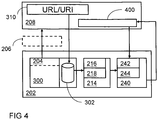
- shows a schematic block diagram of a further embodiment of the invention.
- In the following, embodiments of the invention are described. It is important to note that all described embodiments in the following and their properties and technical features may be combined in any way, i.e. there is no limitation that certain described embodiments, properties and technical features may not be combined than others.
- In
Fig. 1 method steps according to an embodiment of the invention are depicted which might be understood more easily when described in combination with an embodiment of the system shown inFig. 2 . - In step S100 metadata from characteristics of a
first software program 200 stored on a storage medium of acomputer 202 is determined, e.g. by ametadata determination unit 204. Metadata might be determined by determining hash values of thefirst software program 200 files, or for instance taking into account a version number of the software program, a language, a digital signature or a build timestamp of the first software program. The term "computer" shall refer as well to devices including micro-processors, e.g. consoles, hand-helds, cellular phones or personal computers for which illegitimate copies of software programs might be distributed. The storage medium might be a local drive, a network drive, a disc or a memory drive. - A hash function is any well-defined procedure or mathematical function that converts a large, possibly variable-sized amount of data into a small datum, usually a single integer. The values returned by a hash function are called hash values, hash codes, hash sums, checksums or simply hashes. This function might be implemented in the
software program 200 to calculate the hash values of the main executable or any other file(s) from thesoftware program 200. - The used metadata should reflect features of the software program that are changed when an illegitimate copy of the software program is produced. For instance, when an illegitimate copy is generated, copy protection parts of the software program might be removed so that the illegitimate software program can be distributed freely. Copy protection parts may be copy protection or digital rights management modules, envelopes or layers. Beside this, illegitimate copies of software programs often have files removed or compressed and digital signatures are removed or further files are added.
- For instance, the copy protection parts might include an individual customer project application (CPA) number for a respective software program. In order to identify different versions of the software program intended for different territories or languages a transaction number may also be used. In some embodiments of the invention, both, the CPA and the transaction number are available by using an application programming interface (API) when the copy protection is still present, i.e. a legitimate copy or version of the software program is used. However, when the copy protection is removed, the corresponding API would return a different number or no value at all. Consequently, the CPA together with the transaction number might be used as the metadata to distinguish between an illegitimate copy and a legitimate copy.
- For instance, the software program comes with intro movies stored in a lossless video format, often for the illegitimate copy of the software program such video files are re-encoded with a video format allowing higher compression to reduce the size of the software program for easier online distribution. The size as well as the changed hash value of such multimedia files (i.e. movie, audio, textures) can be used as metadata to distinguish between the legitimate copy of the software program and the illegitimate copy of the software program.
- For instance, the software program comes with files like readme text files, etc. Often such files are completely removed for the illegitimate copy of the software program, but other files are added. These changes in the file structure in an installation folder of the software program can also be considered as metadata.
- For instance, the executable of a software program as well as software libraries (i.e. dll files) have data embedded called resources, which are read-only and usually set during compilation of the software program. Each resource has a type and a name, both being either numeric identifiers or strings. These values are often changed for the illegitimate copy of the software program. The values of the resources of the software program can also be considered as metadata.
- For instance, the executable of a software program as well as software libraries (i.e. dll files) might be digitally signed. The signature is applied by the developer or the publisher of a software program. A signature is a mathematical scheme for demonstrating the authenticity of a digital message or document. A valid digital signature gives a recipient reason to believe that the message or content was created by a known sender, and that it was not altered in transit. It is comparable to a seal and is destroyed if the executable of a software program or a software library is altered for the illegitimate copy of the software program. The existence and integrity of such a signature can also be considered as metadata.
- The software program might be a software application, like e.g. a word processing program, a table sheet calculation program, or a game application. The
metadata determination unit 204 might be a separate unit or might be included in thefirst software program 200. - It is also possible to determine metadata of the
first software program 200 by a thirdparty software application 206, for instance, a games platform, an antivirus software or an operating system software or a software library. - In a step S102 it is checked whether the determined metadata of the
first software program 200 corresponds to metadata of a legitimate copy. Metadata of the legitimate copy might be stored in thefirst software program 200 or might be provided as a service stored in a local or remote database table. For instance, it is possible that the metadata of the legitimate copy is stored in afirst server 208 to which the determined metadata of thefirst software program 200 is transmitted. - If the metadata determined from characteristics of the
first software program 200 does not correspond to the metadata of a legitimate copy in a step S104 a patch orsoftware patch 214 is transmitted to thecomputer 202. The term patch orsoftware patch 214 is used to describe a piece of software for updating a computer program or its supporting data. For instance, the patch can contain an updated legitimate executable, software libraries and data files. - The
patch 214 includes afirst patch component 216 and asecond patch component 218. Thefirst patch component 216 is used to replace at least a part of the illegitimate copy with alegitimate software component 242 and thesecond patch component 218 provides for instance a graphical user interface 244 (GUI) like an authentication dialog, authentication email, short message service (SMS) or multimedia message service (MMS) for submitting information to a user of the software program. - The
patch 214 might be configured as an archive. Then, the archive has to be unpacked into the software's installation directory on a writable medium used by the computer, e.g. a hard disc, memory stick, USB stick and overwrites the files of the illegitimate copy with genuine files of the legitimate copy. Unpacking and execution (including overwriting such files) of the patch may be performed automatically by thefirst software program 200 or by the thirdparty software application 206 as explained in more detail with regard to first to fourth scenarios below. - In a first scenario, the
first software program 200 downloads thepatch 214, for instance from a webserver, a local drive, a network drive, a disc or a memory drive and stores it on thecomputer 202, wherein thepatch 214 is configured as a setup/installer program. Afterwards, thefirst software program 200 executes thepatch 214, for instance with the windows API (application program interface): ShellExecute. While executed, thepatch 214 copies (and might overwrite) files to a software program installation directory and generates asecond software program 240 including thelegitimate software component 242. - In a second scenario, the
first software program 200 downloads thepatch 214, for instance from a webserver, a local drive, a network drive, a disc or a memory drive and stores it on thecomputer 202, wherein thepatch 214 is configured as an archive. Afterwards thefirst software program 200 extracts (e.g. un-zips) files from the archive (and might overwrite existing files) to the first software program installation directory and generates thesecond software program 240 including thelegitimate software component 242. - In a third and fourth scenario, the patch is downloaded via the third
party software application 206, for instance from a webserver, a local drive, a network drive, a disc or a memory drive and stored on thecomputer 202. - In the third scenario, the
patch 214 is configured as a setup/installer program and after being stored on thecomputer 202, it is executed by the thirdparty software application 206, for instance with the windows API: ShellExecute. While executed, thepatch 214 copies (and might overwrite) files to the first software program installation directory and generates thesecond software program 240 including thelegitimate software component 242. - In the fourth scenario, the
patch 214 is configured as an archive, and after being stored on thecomputer 202, it is extracted (un-zipped) by the third party software application 206 (and might overwrite existing files) to the first software program installation directory and generates thesecond software program 240 including thelegitimate software component 242. - Consequently, the
second software program 240 is generated by applying thepatch 214 to thefirst software program 200. - It is also possible that after detecting an illegitimate copy on the
computer 202, information about an update for the software program is transmitted to thecomputer 202 and displayed to the user. If the user requests the download and installation of the update, thepatch 214 is delivered to the user and either installed automatically or after confirmation by the user. - The use of the
first patch component 216 when replacing at least a part of the illegitimate copy results in thesecond software program 240 with the corresponding metadata of a legitimate copy. In addition thegraphical user interface 244 is provided. Thegraphical user interface 244, for instance can show a dialog offering a trial period for testing the legitimate copy of the software program and provide the possibility to acquire (i.e. purchase) an authentication token (i.e. serial number). Software programs using this feature are also called "try and buy" software. In S108 thegraphical user interface 244 is displayed and the user is asked for an authentication token. - The display of the
graphical user interface 244 might be started not immediately after thesecond software program 240 has been generated, but only after a predetermined amount of time, e.g. use time of the legitimate copy has been elapsed. Thereby, there is a higher likelihood that a user will get accustomed to the software and, therefore, the user is interested in paying for using it further. - By displaying the
graphical user interface 244 to the user, the user might be informed that he can buy a legitimate copy of the software program or unlock the software program, if the user already owns a legitimate authentication token for the respective software program. Thesecond patch component 218 can e.g. show a link to an online shop or can describe any other way of acquiring a legitimate authentication token. - The user may acquire the authentication token in S110 from a
second server 220. Afterwards, the authentication token is verified in S112. The authentication token might be a serial number, alphanumeric key, purchase bound to a user account, license file or a similar authentication code. - If the authentication token is positively verified, the
second software program 240 is labeled as a legitimate copy of the software program in S114. The verification may be performed by athird server 222 or by a verification software component implemented in thesecond software program 240. - In order to transmit the
patch 214 to thecomputer 202 in the embodiment of the system according toFig. 2 thefirst server 208 includes an address, e.g. a URL/URI (Uniform Resource Locator/Uniform Resource Identifier) of aseparate archive 212, through which for instance a server or local program is adapted to transmit thepatch 214 to the computer 202 (i.e. download from server or copy from software program installation device like a DVD). - In accordance to a further embodiment, depicted in
Fig. 3 , theillegitimate copy 300 of the software program includes anarchive 302 which is adapted to provide thepatch 214 including thefirst patch component 216 and thesecond patch component 218. Thearchive 302 might be referred to by providing a respective address, e.g. a URL/URI 320 to data stored in thefirst server 208. According to the embodiment depicted inFig. 3 the authentication token is also acquired from asecond server 220 and verified thereafter. - With this embodiment less data has to be transmitted from a distant server to the
computer 202, because it is not necessary to transmit thewhole patch 214 to thecomputer 202, since it is already present in theillegitimate copy 300. Therefore, the download time is reduced and the publisher or online retailer of the software program may have reduced or no costs for hosting the archive and for downloading. - However, in accordance to the further embodiment depicted in
Fig. 4 it might also be possible that thefirst server 208 includes an authenticationtoken providing unit 400 that might be addressed by thesecond software program 240 of thecomputer 202 and might provide an authentication token to it. - With the proposed method and system it is possible to implement the following embodiments.
- In an embodiment the original version of a game application is installed to the hard disk drive of a
computer 202. A user may download an illegitimate (cracked or pirated) executable file(s), libraries and other files and replaces the original, genuine files with the illegitimate copy. This action might circumvent the protection scheme of the original version of the personal computer game. After two hours of game play the game application launches asoftware component 204 which calculates the metadata of the game application (including the illegitimate executable) and sends it to theserver 208 which recognizes the running game application as a "cracked" version, i.e. an illegitimate copy. Thesoftware component 204 stops the actual game application and replaces the illegitimate copy with a genuine one located in the installation folder of the game application and adds a dynamic link library (DLL) which shows a dialog through the GUI upon the next start of the game application indicating where to acquire an authentication token e.g. a serial number for the game application and which also performs an online activation (authentication for a serial number or alphanumeric key on a remote server, this may be performed by using a secure channel between the client personal computer and the activation server transferring xml-based requests and responses). - A further example is that the original version of a software program is installed to the hard disc drive of a
computer 202. A user may download an illegitimate (cracked or pirated) executable and replaces the original, genuine executable with the illegitimate copy. This action also circumvents the protection scheme of the original version of the software. Afterwards, the user downloads and runs auto-patching software (provided by the publisher/developer or distributor of the software or by any authorized third party company). The auto-patching software calculates metadata of the application (including the illegitimate executable copy) and transmits it to aserver 208 which recognizes the installed software as a cracked version, i.e. an illegitimate copy. The auto-patching software replaces the illegitimate copy with a genuine copy downloaded from a given URL (web server) 212 and adds a dynamic link library (DLL) to the installation folder of the software which might show a dialog on the next game start where to create and buy a user account for the personal computer game and which also performs an online activation (authentication for given credentials of a user account). For instance, this involves a user account server where the user of the personal computer creates a user account and procedure to purchase software and bind it to this user account. - It is also possible to store user data that has been acquired while running the illegitimate copy and allowing the use of the stored user data when later running the legitimate copy. With this embodiment it is possible to provide a user with added value when he changes from the illegitimate copy to the legitimate copy, because e.g. user setting might be re-used or levels in an adventure game that have been solved when running the illegitimate copy might be considered to be solved when running the legitimate copy, too, so that the user does not have to replay the levels again. The patch may execute code components that identify and extract user data acquired while running an illegitimate copy. The extracted user data may then be inserted or compiled into code components of the generated legitimate copy and stored in the computer.
- With the proposed method and system nonpaying customers can be turned easily into paying customers. It is easy to prevent unauthorized usage of the metadata, because it is easy to change the metadata and/or the hash function that is used for checking whether a legitimate copy is present and in addition, it is also possible to easily change the archive location of the genuine files of the legitimate copy. For instance, said metadata and/or hash function may be changed upon every execution of the check by
metadata determination unit metadata determination unit - The metadata values for both the original version of a software program as well as illegitimate copies are stored on the
server 208 and can be updated after new illegitimate copies are distributed. This ensures complete coverage and individual patching possibilities for each illegitimate copy.
Claims (15)
- Method for replacing an illegitimate copy of a software program with a legitimate copy, comprising:determining metadata from characteristics of a first software program (200) being stored on a storage medium of a computer (202);transmitting a patch (214) from a first server (208) to the computer (202), if the metadata does not correspond to metadata of a legitimate copy of the software program;generating a second software program (240) by replacing at least a part of the first software program (200) using code components of the patch (214);displaying a graphical user interface (244) on launch of the second software program (240);requesting an authentication token through the graphical user interface (244);acquiring the authentication token from a second server (220);verifying the authentication token; andlabeling the second software program (240) as a legitimate copy and unlocking it if the authentication token is positively verified.
- Method for replacing an illegitimate copy according to claim 1, further comprising:transmitting the metadata to the first server (208); andcomparing the metadata with the metadata of the legitimate copy in the first server (208).
- Method for replacing an illegitimate copy according to claim 2, further comprising:comparing the metadata with the metadata of one or more known illegitimate copies in the first server (208).
- Method for replacing an illegitimate copy according to claim 1, further comprising:comparing the metadata with the metadata of the legitimate copy in the computer (202).
- Method for replacing an illegitimate copy according to any one of claims 1 to 4, wherein the patch (214) includes
a first patch component (216) for replacing at least a part of the illegitimate copy that resulted in the metadata not corresponding to the metadata of the legitimate copy, and
a second patch component (218) which provides the graphical user interface (244). - Method for replacing an illegitimate copy according to any one of claims 1 to 4, wherein the illegitimate copy of the software program includes code components representing the graphical user interface (244), the method further comprising:activating the graphical user interface (244) using code components of the patch (214), when the software program is started.
- Method for replacing an illegitimate copy according to any one of claims 1 to 6, wherein the metadata is determined by the illegitimate copy of the software program.
- Method for replacing an illegitimate copy according to any one of claims 1 to 6, wherein the metadata is determined by a third software program (206).
- Method for replacing an illegitimate copy according to any one of claims 1 to 8, further comprising:requesting whether an update of the first software program (200) should be downloaded, if the metadata does not correspond to metadata of a legitimate copy of the software program; andtransmitting the patch (214) from the first server (208) to the computer (202) and performing said step of generating the second software program (240) if it has been accepted to download the update.
- Method for replacing an illegitimate copy according to any one of claims 1 to 9, wherein the metadata is hash data of the executable file of the first software program (200).
- Method for replacing an illegitimate copy according to any one of claims 1 to 10, wherein the graphical user interface (244) is displayed after the software program has been used a predetermined time.
- Method for replacing an illegitimate copy according to any one of claims 1 to 11, further comprising:storing user data that has been acquired while running the illegitimate copy; andallowing the use of the user data when running the legitimate copy.
- System for replacing an illegitimate copy of a software program (200) with a legitimate copy, comprising
a patch (214) including code components adaptedto generate a second software program (240) by replacing at least a part of the illegitimate copy of the software program (200) on a computer (202) and adapted to activate a display of a graphical user interface (244) on the computer (202), to request for an authentication token through the graphical user interface (244);to acquire the authentication token from a second server (220), to verify the authentication token, and to label the second software program (240) as a legitimate copy; andto unlock the second software program (240), if the authentication token is positively verified;a first server (208) adapted to transmit the patch (214) to the computer after having identified that metadata determined from characteristics of the software program (200) being stored on the computer (202) does not correspond to metadata of a legitimate copy of the software program (200); and
the second server (220) adapted to transmit the authentication token to the computer (202) upon receipt of a request from the computer (202) for the authentication token. - System for replacing an illegitimate copy of a software program with a legitimate copy according to claim 13, wherein the first server (208) is further adapted to compare the metadata of the software program (200) with the metadata of the legitimate copy.
- Software patch (214) stored on a non-transitory medium, the software patch (214) for replacing an illegitimate copy of a software program with a legitimate copy and the software patch (214) including code components, which are adapted to
generate a second software program (240) by replacing at least a part of an illegitimate copy of a software program (200) on a computer (202);
activate a display of a graphical user interface (244) on the computer, when the software patch (214) is stored and launched on the computer (202);
initiate a request for an authentication token through the graphical user interface (244);
acquire the authentication token from a server (220);
verify the authentication token; and
label the second software program (240) as a legitimate copy and unlock it if the authentication token is positively verified.
Priority Applications (5)
| Application Number | Priority Date | Filing Date | Title |
|---|---|---|---|
| EP10007753.6A EP2413257B1 (en) | 2010-07-26 | 2010-07-26 | Method for replacing an illegitimate copy of a software program with legitimate copy and corresponding system |
| US13/182,832 US9038057B2 (en) | 2010-07-26 | 2011-07-14 | Method for replacing an illegitimate copy of a software program with a legitimate copy and corresponding system |
| BRPI1103615-0A BRPI1103615B1 (en) | 2010-07-26 | 2011-07-19 | METHOD AND SYSTEM FOR REPLACING AN ILLEGITIMATE COPY OF A SOFTWARE WITH A LEGITIMATE COPY, AND, NON TRANSIENT, COMPUTER-READABLE STORAGE MEANS |
| RU2011131120/08A RU2011131120A (en) | 2010-07-26 | 2011-07-25 | METHOD FOR REPLACING AN ILLEGAL COPY OF A COMPUTER SOFTWARE WITH A LEGAL COPY AND THE RELATED SYSTEM |
| CN201110213014.8A CN102346826B (en) | 2010-07-26 | 2011-07-26 | Method and the corresponding system of illegal copies is replaced by the legal copies of software program |
Applications Claiming Priority (1)
| Application Number | Priority Date | Filing Date | Title |
|---|---|---|---|
| EP10007753.6A EP2413257B1 (en) | 2010-07-26 | 2010-07-26 | Method for replacing an illegitimate copy of a software program with legitimate copy and corresponding system |
Publications (2)
| Publication Number | Publication Date |
|---|---|
| EP2413257A1 EP2413257A1 (en) | 2012-02-01 |
| EP2413257B1 true EP2413257B1 (en) | 2017-04-26 |
Family
ID=42782037
Family Applications (1)
| Application Number | Title | Priority Date | Filing Date |
|---|---|---|---|
| EP10007753.6A Not-in-force EP2413257B1 (en) | 2010-07-26 | 2010-07-26 | Method for replacing an illegitimate copy of a software program with legitimate copy and corresponding system |
Country Status (5)
| Country | Link |
|---|---|
| US (1) | US9038057B2 (en) |
| EP (1) | EP2413257B1 (en) |
| CN (1) | CN102346826B (en) |
| BR (1) | BRPI1103615B1 (en) |
| RU (1) | RU2011131120A (en) |
Cited By (1)
| Publication number | Priority date | Publication date | Assignee | Title |
|---|---|---|---|---|
| US11138018B2 (en) | 2018-12-14 | 2021-10-05 | Nvidia Corporation | Optimizing execution of computer programs using piecemeal profiles |
Families Citing this family (10)
| Publication number | Priority date | Publication date | Assignee | Title |
|---|---|---|---|---|
| CN101984405A (en) * | 2010-10-11 | 2011-03-09 | 中兴通讯股份有限公司 | Method of software version upgrade and terminal and system |
| US20120254857A1 (en) * | 2011-03-31 | 2012-10-04 | Infosys Technologies Limited | System and method for installing an application on client machine |
| US20140208306A1 (en) * | 2013-01-23 | 2014-07-24 | Caterpillar Inc. | Control system having automatic component software management |
| US9686284B2 (en) | 2013-03-07 | 2017-06-20 | T-Mobile Usa, Inc. | Extending and re-using an IP multimedia subsystem (IMS) |
| US9992183B2 (en) * | 2013-03-15 | 2018-06-05 | T-Mobile Usa, Inc. | Using an IP multimedia subsystem for HTTP session authentication |
| US10860303B2 (en) * | 2013-04-24 | 2020-12-08 | Nintendo Co., Ltd. | Selective operating system patching/updating |
| US10216941B2 (en) * | 2015-04-03 | 2019-02-26 | Line Corporation | Method of distributing application with security features and method of operating the application |
| CN111382049B (en) * | 2018-12-28 | 2023-05-02 | 阿里云计算有限公司 | Code submitting method and device and electronic equipment |
| US10715996B1 (en) | 2019-06-06 | 2020-07-14 | T-Mobile Usa, Inc. | Transparent provisioning of a third-party service for a user device on a telecommunications network |
| US11228424B2 (en) * | 2019-06-07 | 2022-01-18 | International Business Machines Corporation | Blu-ray copy service |
Family Cites Families (21)
| Publication number | Priority date | Publication date | Assignee | Title |
|---|---|---|---|---|
| US7370008B1 (en) * | 1992-04-10 | 2008-05-06 | Charles E. Hill & Associates, Inc. | Electronic catalog system and method |
| US5528490A (en) * | 1992-04-10 | 1996-06-18 | Charles E. Hill & Associates, Inc. | Electronic catalog system and method |
| US20020087876A1 (en) * | 2000-12-28 | 2002-07-04 | Larose Gordon Edward | Adaptive software installation process supporting multiple layers of security-related attributes |
| US20040193884A1 (en) * | 2003-03-26 | 2004-09-30 | Sony Corporation | Secure watchdog for embedded systems |
| US7716474B2 (en) * | 2003-05-12 | 2010-05-11 | Byteblaze, Inc. | Anti-piracy software protection system and method |
| US7424706B2 (en) | 2003-07-16 | 2008-09-09 | Microsoft Corporation | Automatic detection and patching of vulnerable files |
| US7673297B1 (en) * | 2003-09-03 | 2010-03-02 | The Directv Group, Inc. | Automatic software update detection and flexible installer for set-top boxes |
| US7331063B2 (en) * | 2004-04-30 | 2008-02-12 | Microsoft Corporation | Method and system for limiting software updates |
| US7904608B2 (en) | 2004-05-04 | 2011-03-08 | Price Robert M | System and method for updating software in electronic devices |
| KR100861822B1 (en) | 2004-07-05 | 2008-10-07 | 싸이언스 파크 가부시키가이샤 | Data management method |
| JP4327698B2 (en) * | 2004-10-19 | 2009-09-09 | 富士通株式会社 | Network type virus activity detection program, processing method and system |
| US7856661B1 (en) * | 2005-07-14 | 2010-12-21 | Mcafee, Inc. | Classification of software on networked systems |
| US20070107057A1 (en) * | 2005-11-10 | 2007-05-10 | Docomo Communications Laboratories Usa, Inc. | Method and apparatus for detecting and preventing unsafe behavior of javascript programs |
| TWI405094B (en) | 2005-11-28 | 2013-08-11 | Ibm | System for preventing unauthorized acquisition of information, and method thereof |
| US7752139B2 (en) * | 2005-12-27 | 2010-07-06 | Michael Noel Hu | Method and system for managing software licenses and reducing unauthorized use of software |
| CN100470570C (en) | 2006-07-27 | 2009-03-18 | 北京飞天诚信科技有限公司 | A Copyright Protection Method for Network Software System |
| WO2008023307A2 (en) * | 2006-08-21 | 2008-02-28 | Koninklijke Philips Electronics N.V. | Controlling distribution of digital content |
| CN101226575B (en) * | 2008-01-28 | 2011-04-20 | 中兴通讯股份有限公司 | Method for locking application program |
| JP5260081B2 (en) * | 2008-02-25 | 2013-08-14 | パナソニック株式会社 | Information processing apparatus and control method thereof |
| US8095987B2 (en) * | 2008-09-04 | 2012-01-10 | Microsoft Corporation | Software anti-piracy protection |
| CN101770794B (en) | 2008-12-26 | 2011-08-03 | 同方股份有限公司 | Digital copyright protection method and management device thereof for digital video disc system |
-
2010
- 2010-07-26 EP EP10007753.6A patent/EP2413257B1/en not_active Not-in-force
-
2011
- 2011-07-14 US US13/182,832 patent/US9038057B2/en active Active
- 2011-07-19 BR BRPI1103615-0A patent/BRPI1103615B1/en not_active IP Right Cessation
- 2011-07-25 RU RU2011131120/08A patent/RU2011131120A/en not_active Application Discontinuation
- 2011-07-26 CN CN201110213014.8A patent/CN102346826B/en not_active Expired - Fee Related
Non-Patent Citations (1)
| Title |
|---|
| None * |
Cited By (1)
| Publication number | Priority date | Publication date | Assignee | Title |
|---|---|---|---|---|
| US11138018B2 (en) | 2018-12-14 | 2021-10-05 | Nvidia Corporation | Optimizing execution of computer programs using piecemeal profiles |
Also Published As
| Publication number | Publication date |
|---|---|
| BRPI1103615A2 (en) | 2013-12-17 |
| CN102346826B (en) | 2016-04-20 |
| US9038057B2 (en) | 2015-05-19 |
| EP2413257A1 (en) | 2012-02-01 |
| RU2011131120A (en) | 2013-01-27 |
| CN102346826A (en) | 2012-02-08 |
| US20120023490A1 (en) | 2012-01-26 |
| BRPI1103615B1 (en) | 2021-08-03 |
Similar Documents
| Publication | Publication Date | Title |
|---|---|---|
| US9038057B2 (en) | Method for replacing an illegitimate copy of a software program with a legitimate copy and corresponding system | |
| US7716474B2 (en) | Anti-piracy software protection system and method | |
| KR101122950B1 (en) | Method and system for limiting software updates | |
| US20100063996A1 (en) | Information processing device, information recording device, information processing system, program update method, program, and integrated circuit | |
| KR101075380B1 (en) | Systems and methods for using machine attributes to deter software piracy in an enterprise environment | |
| KR101301332B1 (en) | Secure machine counting | |
| US20060236122A1 (en) | Secure boot | |
| CN112861191A (en) | Application program monitoring method and device | |
| KR101238572B1 (en) | Automatic update of computer-readable components to support a trusted environment | |
| EP3583536B1 (en) | Securely defining operating system composition without multiple authoring | |
| CN113051036A (en) | Application program licensing method, device, equipment and medium based on Docker container | |
| KR20130114593A (en) | Electronic license management | |
| JP5091925B2 (en) | How to install the license file | |
| CN106355081A (en) | Android program start verification method and device | |
| CN104517054A (en) | Method, device, client and server for detecting malicious APK | |
| CN107632932B (en) | A Multi-level Verification Method for Reliability Detection of Software Repository | |
| US20140366149A1 (en) | System and method for using digital strings to provide secure distribution of digital content | |
| KR20140011021A (en) | Method for preventing unauthorized copying of the android platform-based applications and inserting digital watermarking in order to track the first clone | |
| CA2335298A1 (en) | Bait software | |
| KR101265887B1 (en) | Renewable and individualizable elements of a protected computing environment | |
| EP1436705A1 (en) | Systems and methods for preventing unauthorized copying of software downloaded from a remote server | |
| HK40044561B (en) | An application program monitoring method and device | |
| HK40044561A (en) | An application program monitoring method and device | |
| KR20110111988A (en) | Method and system for controlling application execution installed in portable terminal |
Legal Events
| Date | Code | Title | Description |
|---|---|---|---|
| AK | Designated contracting states |
Kind code of ref document: A1 Designated state(s): AL AT BE BG CH CY CZ DE DK EE ES FI FR GB GR HR HU IE IS IT LI LT LU LV MC MK MT NL NO PL PT RO SE SI SK SM TR |
|
| AX | Request for extension of the european patent |
Extension state: BA ME RS |
|
| PUAI | Public reference made under article 153(3) epc to a published international application that has entered the european phase |
Free format text: ORIGINAL CODE: 0009012 |
|
| 17P | Request for examination filed |
Effective date: 20120731 |
|
| 17Q | First examination report despatched |
Effective date: 20160525 |
|
| REG | Reference to a national code |
Ref country code: DE Ref legal event code: R079 Ref document number: 602010041790 Country of ref document: DE Free format text: PREVIOUS MAIN CLASS: G06F0021000000 Ipc: G06F0021100000 |
|
| GRAP | Despatch of communication of intention to grant a patent |
Free format text: ORIGINAL CODE: EPIDOSNIGR1 |
|
| STAA | Information on the status of an ep patent application or granted ep patent |
Free format text: STATUS: GRANT OF PATENT IS INTENDED |
|
| RIC1 | Information provided on ipc code assigned before grant |
Ipc: G06F 21/12 20130101ALI20161024BHEP Ipc: G06F 21/10 20130101AFI20161024BHEP |
|
| INTG | Intention to grant announced |
Effective date: 20161115 |
|
| GRAS | Grant fee paid |
Free format text: ORIGINAL CODE: EPIDOSNIGR3 |
|
| GRAA | (expected) grant |
Free format text: ORIGINAL CODE: 0009210 |
|
| STAA | Information on the status of an ep patent application or granted ep patent |
Free format text: STATUS: THE PATENT HAS BEEN GRANTED |
|
| AK | Designated contracting states |
Kind code of ref document: B1 Designated state(s): AL AT BE BG CH CY CZ DE DK EE ES FI FR GB GR HR HU IE IS IT LI LT LU LV MC MK MT NL NO PL PT RO SE SI SK SM TR |
|
| REG | Reference to a national code |
Ref country code: GB Ref legal event code: FG4D |
|
| REG | Reference to a national code |
Ref country code: CH Ref legal event code: EP |
|
| REG | Reference to a national code |
Ref country code: AT Ref legal event code: REF Ref document number: 888453 Country of ref document: AT Kind code of ref document: T Effective date: 20170515 |
|
| REG | Reference to a national code |
Ref country code: IE Ref legal event code: FG4D |
|
| REG | Reference to a national code |
Ref country code: DE Ref legal event code: R096 Ref document number: 602010041790 Country of ref document: DE |
|
| REG | Reference to a national code |
Ref country code: NL Ref legal event code: FP |
|
| REG | Reference to a national code |
Ref country code: LT Ref legal event code: MG4D |
|
| REG | Reference to a national code |
Ref country code: AT Ref legal event code: MK05 Ref document number: 888453 Country of ref document: AT Kind code of ref document: T Effective date: 20170426 |
|
| PG25 | Lapsed in a contracting state [announced via postgrant information from national office to epo] |
Ref country code: LT Free format text: LAPSE BECAUSE OF FAILURE TO SUBMIT A TRANSLATION OF THE DESCRIPTION OR TO PAY THE FEE WITHIN THE PRESCRIBED TIME-LIMIT Effective date: 20170426 Ref country code: FI Free format text: LAPSE BECAUSE OF FAILURE TO SUBMIT A TRANSLATION OF THE DESCRIPTION OR TO PAY THE FEE WITHIN THE PRESCRIBED TIME-LIMIT Effective date: 20170426 Ref country code: GR Free format text: LAPSE BECAUSE OF FAILURE TO SUBMIT A TRANSLATION OF THE DESCRIPTION OR TO PAY THE FEE WITHIN THE PRESCRIBED TIME-LIMIT Effective date: 20170727 Ref country code: HR Free format text: LAPSE BECAUSE OF FAILURE TO SUBMIT A TRANSLATION OF THE DESCRIPTION OR TO PAY THE FEE WITHIN THE PRESCRIBED TIME-LIMIT Effective date: 20170426 Ref country code: NO Free format text: LAPSE BECAUSE OF FAILURE TO SUBMIT A TRANSLATION OF THE DESCRIPTION OR TO PAY THE FEE WITHIN THE PRESCRIBED TIME-LIMIT Effective date: 20170726 Ref country code: ES Free format text: LAPSE BECAUSE OF FAILURE TO SUBMIT A TRANSLATION OF THE DESCRIPTION OR TO PAY THE FEE WITHIN THE PRESCRIBED TIME-LIMIT Effective date: 20170426 Ref country code: AT Free format text: LAPSE BECAUSE OF FAILURE TO SUBMIT A TRANSLATION OF THE DESCRIPTION OR TO PAY THE FEE WITHIN THE PRESCRIBED TIME-LIMIT Effective date: 20170426 |
|
| PG25 | Lapsed in a contracting state [announced via postgrant information from national office to epo] |
Ref country code: IS Free format text: LAPSE BECAUSE OF FAILURE TO SUBMIT A TRANSLATION OF THE DESCRIPTION OR TO PAY THE FEE WITHIN THE PRESCRIBED TIME-LIMIT Effective date: 20170826 Ref country code: BG Free format text: LAPSE BECAUSE OF FAILURE TO SUBMIT A TRANSLATION OF THE DESCRIPTION OR TO PAY THE FEE WITHIN THE PRESCRIBED TIME-LIMIT Effective date: 20170726 Ref country code: SE Free format text: LAPSE BECAUSE OF FAILURE TO SUBMIT A TRANSLATION OF THE DESCRIPTION OR TO PAY THE FEE WITHIN THE PRESCRIBED TIME-LIMIT Effective date: 20170426 Ref country code: PL Free format text: LAPSE BECAUSE OF FAILURE TO SUBMIT A TRANSLATION OF THE DESCRIPTION OR TO PAY THE FEE WITHIN THE PRESCRIBED TIME-LIMIT Effective date: 20170426 Ref country code: LV Free format text: LAPSE BECAUSE OF FAILURE TO SUBMIT A TRANSLATION OF THE DESCRIPTION OR TO PAY THE FEE WITHIN THE PRESCRIBED TIME-LIMIT Effective date: 20170426 |
|
| REG | Reference to a national code |
Ref country code: DE Ref legal event code: R097 Ref document number: 602010041790 Country of ref document: DE |
|
| PG25 | Lapsed in a contracting state [announced via postgrant information from national office to epo] |
Ref country code: SK Free format text: LAPSE BECAUSE OF FAILURE TO SUBMIT A TRANSLATION OF THE DESCRIPTION OR TO PAY THE FEE WITHIN THE PRESCRIBED TIME-LIMIT Effective date: 20170426 Ref country code: CZ Free format text: LAPSE BECAUSE OF FAILURE TO SUBMIT A TRANSLATION OF THE DESCRIPTION OR TO PAY THE FEE WITHIN THE PRESCRIBED TIME-LIMIT Effective date: 20170426 Ref country code: DK Free format text: LAPSE BECAUSE OF FAILURE TO SUBMIT A TRANSLATION OF THE DESCRIPTION OR TO PAY THE FEE WITHIN THE PRESCRIBED TIME-LIMIT Effective date: 20170426 Ref country code: EE Free format text: LAPSE BECAUSE OF FAILURE TO SUBMIT A TRANSLATION OF THE DESCRIPTION OR TO PAY THE FEE WITHIN THE PRESCRIBED TIME-LIMIT Effective date: 20170426 Ref country code: RO Free format text: LAPSE BECAUSE OF FAILURE TO SUBMIT A TRANSLATION OF THE DESCRIPTION OR TO PAY THE FEE WITHIN THE PRESCRIBED TIME-LIMIT Effective date: 20170426 |
|
| PG25 | Lapsed in a contracting state [announced via postgrant information from national office to epo] |
Ref country code: SM Free format text: LAPSE BECAUSE OF FAILURE TO SUBMIT A TRANSLATION OF THE DESCRIPTION OR TO PAY THE FEE WITHIN THE PRESCRIBED TIME-LIMIT Effective date: 20170426 Ref country code: IT Free format text: LAPSE BECAUSE OF FAILURE TO SUBMIT A TRANSLATION OF THE DESCRIPTION OR TO PAY THE FEE WITHIN THE PRESCRIBED TIME-LIMIT Effective date: 20170426 |
|
| REG | Reference to a national code |
Ref country code: CH Ref legal event code: PL |
|
| PLBE | No opposition filed within time limit |
Free format text: ORIGINAL CODE: 0009261 |
|
| STAA | Information on the status of an ep patent application or granted ep patent |
Free format text: STATUS: NO OPPOSITION FILED WITHIN TIME LIMIT |
|
| 26N | No opposition filed |
Effective date: 20180129 |
|
| REG | Reference to a national code |
Ref country code: IE Ref legal event code: MM4A |
|
| REG | Reference to a national code |
Ref country code: FR Ref legal event code: ST Effective date: 20180330 |
|
| PG25 | Lapsed in a contracting state [announced via postgrant information from national office to epo] |
Ref country code: CH Free format text: LAPSE BECAUSE OF NON-PAYMENT OF DUE FEES Effective date: 20170731 Ref country code: IE Free format text: LAPSE BECAUSE OF NON-PAYMENT OF DUE FEES Effective date: 20170726 Ref country code: LI Free format text: LAPSE BECAUSE OF NON-PAYMENT OF DUE FEES Effective date: 20170731 |
|
| PG25 | Lapsed in a contracting state [announced via postgrant information from national office to epo] |
Ref country code: SI Free format text: LAPSE BECAUSE OF FAILURE TO SUBMIT A TRANSLATION OF THE DESCRIPTION OR TO PAY THE FEE WITHIN THE PRESCRIBED TIME-LIMIT Effective date: 20170426 Ref country code: FR Free format text: LAPSE BECAUSE OF NON-PAYMENT OF DUE FEES Effective date: 20170731 |
|
| REG | Reference to a national code |
Ref country code: BE Ref legal event code: MM Effective date: 20170731 |
|
| PG25 | Lapsed in a contracting state [announced via postgrant information from national office to epo] |
Ref country code: LU Free format text: LAPSE BECAUSE OF NON-PAYMENT OF DUE FEES Effective date: 20170726 |
|
| PG25 | Lapsed in a contracting state [announced via postgrant information from national office to epo] |
Ref country code: BE Free format text: LAPSE BECAUSE OF NON-PAYMENT OF DUE FEES Effective date: 20170731 |
|
| PG25 | Lapsed in a contracting state [announced via postgrant information from national office to epo] |
Ref country code: MT Free format text: LAPSE BECAUSE OF NON-PAYMENT OF DUE FEES Effective date: 20170726 |
|
| PG25 | Lapsed in a contracting state [announced via postgrant information from national office to epo] |
Ref country code: MC Free format text: LAPSE BECAUSE OF FAILURE TO SUBMIT A TRANSLATION OF THE DESCRIPTION OR TO PAY THE FEE WITHIN THE PRESCRIBED TIME-LIMIT Effective date: 20170426 Ref country code: HU Free format text: LAPSE BECAUSE OF FAILURE TO SUBMIT A TRANSLATION OF THE DESCRIPTION OR TO PAY THE FEE WITHIN THE PRESCRIBED TIME-LIMIT; INVALID AB INITIO Effective date: 20100726 |
|
| PG25 | Lapsed in a contracting state [announced via postgrant information from national office to epo] |
Ref country code: CY Free format text: LAPSE BECAUSE OF NON-PAYMENT OF DUE FEES Effective date: 20170426 |
|
| PG25 | Lapsed in a contracting state [announced via postgrant information from national office to epo] |
Ref country code: MK Free format text: LAPSE BECAUSE OF FAILURE TO SUBMIT A TRANSLATION OF THE DESCRIPTION OR TO PAY THE FEE WITHIN THE PRESCRIBED TIME-LIMIT Effective date: 20170426 |
|
| PG25 | Lapsed in a contracting state [announced via postgrant information from national office to epo] |
Ref country code: TR Free format text: LAPSE BECAUSE OF FAILURE TO SUBMIT A TRANSLATION OF THE DESCRIPTION OR TO PAY THE FEE WITHIN THE PRESCRIBED TIME-LIMIT Effective date: 20170426 |
|
| PG25 | Lapsed in a contracting state [announced via postgrant information from national office to epo] |
Ref country code: PT Free format text: LAPSE BECAUSE OF FAILURE TO SUBMIT A TRANSLATION OF THE DESCRIPTION OR TO PAY THE FEE WITHIN THE PRESCRIBED TIME-LIMIT Effective date: 20170426 |
|
| PG25 | Lapsed in a contracting state [announced via postgrant information from national office to epo] |
Ref country code: AL Free format text: LAPSE BECAUSE OF FAILURE TO SUBMIT A TRANSLATION OF THE DESCRIPTION OR TO PAY THE FEE WITHIN THE PRESCRIBED TIME-LIMIT Effective date: 20170426 |
|
| PGFP | Annual fee paid to national office [announced via postgrant information from national office to epo] |
Ref country code: NL Payment date: 20220621 Year of fee payment: 13 Ref country code: GB Payment date: 20220621 Year of fee payment: 13 |
|
| PGFP | Annual fee paid to national office [announced via postgrant information from national office to epo] |
Ref country code: DE Payment date: 20220621 Year of fee payment: 13 |
|
| REG | Reference to a national code |
Ref country code: DE Ref legal event code: R119 Ref document number: 602010041790 Country of ref document: DE |
|
| REG | Reference to a national code |
Ref country code: NL Ref legal event code: MM Effective date: 20230801 |
|
| GBPC | Gb: european patent ceased through non-payment of renewal fee |
Effective date: 20230726 |
|
| PG25 | Lapsed in a contracting state [announced via postgrant information from national office to epo] |
Ref country code: NL Free format text: LAPSE BECAUSE OF NON-PAYMENT OF DUE FEES Effective date: 20230801 |
|
| PG25 | Lapsed in a contracting state [announced via postgrant information from national office to epo] |
Ref country code: NL Free format text: LAPSE BECAUSE OF NON-PAYMENT OF DUE FEES Effective date: 20230801 Ref country code: DE Free format text: LAPSE BECAUSE OF NON-PAYMENT OF DUE FEES Effective date: 20240201 Ref country code: GB Free format text: LAPSE BECAUSE OF NON-PAYMENT OF DUE FEES Effective date: 20230726 |