EP2412856B1 - Apparatus for fabricating three-dimensional nonwoven fabric structure - Google Patents
Apparatus for fabricating three-dimensional nonwoven fabric structure Download PDFInfo
- Publication number
- EP2412856B1 EP2412856B1 EP11157495.0A EP11157495A EP2412856B1 EP 2412856 B1 EP2412856 B1 EP 2412856B1 EP 11157495 A EP11157495 A EP 11157495A EP 2412856 B1 EP2412856 B1 EP 2412856B1
- Authority
- EP
- European Patent Office
- Prior art keywords
- dimensional
- mold
- nonwoven fabric
- fabric structure
- dimensional mold
- Prior art date
- Legal status (The legal status is an assumption and is not a legal conclusion. Google has not performed a legal analysis and makes no representation as to the accuracy of the status listed.)
- Active
Links
Images

Classifications
-
- B—PERFORMING OPERATIONS; TRANSPORTING
- B29—WORKING OF PLASTICS; WORKING OF SUBSTANCES IN A PLASTIC STATE IN GENERAL
- B29C—SHAPING OR JOINING OF PLASTICS; SHAPING OF MATERIAL IN A PLASTIC STATE, NOT OTHERWISE PROVIDED FOR; AFTER-TREATMENT OF THE SHAPED PRODUCTS, e.g. REPAIRING
- B29C41/00—Shaping by coating a mould, core or other substrate, i.e. by depositing material and stripping-off the shaped article; Apparatus therefor
- B29C41/02—Shaping by coating a mould, core or other substrate, i.e. by depositing material and stripping-off the shaped article; Apparatus therefor for making articles of definite length, i.e. discrete articles
- B29C41/04—Rotational or centrifugal casting, i.e. coating the inside of a mould by rotating the mould
-
- D—TEXTILES; PAPER
- D01—NATURAL OR MAN-MADE THREADS OR FIBRES; SPINNING
- D01D—MECHANICAL METHODS OR APPARATUS IN THE MANUFACTURE OF ARTIFICIAL FILAMENTS, THREADS, FIBRES, BRISTLES OR RIBBONS
- D01D5/00—Formation of filaments, threads, or the like
- D01D5/08—Melt spinning methods
- D01D5/098—Melt spinning methods with simultaneous stretching
- D01D5/0985—Melt spinning methods with simultaneous stretching by means of a flowing gas (e.g. melt-blowing)
-
- D—TEXTILES; PAPER
- D01—NATURAL OR MAN-MADE THREADS OR FIBRES; SPINNING
- D01D—MECHANICAL METHODS OR APPARATUS IN THE MANUFACTURE OF ARTIFICIAL FILAMENTS, THREADS, FIBRES, BRISTLES OR RIBBONS
- D01D7/00—Collecting the newly-spun products
-
- D—TEXTILES; PAPER
- D01—NATURAL OR MAN-MADE THREADS OR FIBRES; SPINNING
- D01F—CHEMICAL FEATURES IN THE MANUFACTURE OF ARTIFICIAL FILAMENTS, THREADS, FIBRES, BRISTLES OR RIBBONS; APPARATUS SPECIALLY ADAPTED FOR THE MANUFACTURE OF CARBON FILAMENTS
- D01F13/00—Recovery of starting material, waste material or solvents during the manufacture of artificial filaments or the like
-
- D—TEXTILES; PAPER
- D04—BRAIDING; LACE-MAKING; KNITTING; TRIMMINGS; NON-WOVEN FABRICS
- D04H—MAKING TEXTILE FABRICS, e.g. FROM FIBRES OR FILAMENTARY MATERIAL; FABRICS MADE BY SUCH PROCESSES OR APPARATUS, e.g. FELTS, NON-WOVEN FABRICS; COTTON-WOOL; WADDING ; NON-WOVEN FABRICS FROM STAPLE FIBRES, FILAMENTS OR YARNS, BONDED WITH AT LEAST ONE WEB-LIKE MATERIAL DURING THEIR CONSOLIDATION
- D04H1/00—Non-woven fabrics formed wholly or mainly of staple fibres or like relatively short fibres
- D04H1/40—Non-woven fabrics formed wholly or mainly of staple fibres or like relatively short fibres from fleeces or layers composed of fibres without existing or potential cohesive properties
- D04H1/54—Non-woven fabrics formed wholly or mainly of staple fibres or like relatively short fibres from fleeces or layers composed of fibres without existing or potential cohesive properties by welding together the fibres, e.g. by partially melting or dissolving
- D04H1/56—Non-woven fabrics formed wholly or mainly of staple fibres or like relatively short fibres from fleeces or layers composed of fibres without existing or potential cohesive properties by welding together the fibres, e.g. by partially melting or dissolving in association with fibre formation, e.g. immediately following extrusion of staple fibres
-
- D—TEXTILES; PAPER
- D04—BRAIDING; LACE-MAKING; KNITTING; TRIMMINGS; NON-WOVEN FABRICS
- D04H—MAKING TEXTILE FABRICS, e.g. FROM FIBRES OR FILAMENTARY MATERIAL; FABRICS MADE BY SUCH PROCESSES OR APPARATUS, e.g. FELTS, NON-WOVEN FABRICS; COTTON-WOOL; WADDING ; NON-WOVEN FABRICS FROM STAPLE FIBRES, FILAMENTS OR YARNS, BONDED WITH AT LEAST ONE WEB-LIKE MATERIAL DURING THEIR CONSOLIDATION
- D04H1/00—Non-woven fabrics formed wholly or mainly of staple fibres or like relatively short fibres
- D04H1/70—Non-woven fabrics formed wholly or mainly of staple fibres or like relatively short fibres characterised by the method of forming fleeces or layers, e.g. reorientation of fibres
- D04H1/76—Non-woven fabrics formed wholly or mainly of staple fibres or like relatively short fibres characterised by the method of forming fleeces or layers, e.g. reorientation of fibres otherwise than in a plane, e.g. in a tubular way
-
- D—TEXTILES; PAPER
- D04—BRAIDING; LACE-MAKING; KNITTING; TRIMMINGS; NON-WOVEN FABRICS
- D04H—MAKING TEXTILE FABRICS, e.g. FROM FIBRES OR FILAMENTARY MATERIAL; FABRICS MADE BY SUCH PROCESSES OR APPARATUS, e.g. FELTS, NON-WOVEN FABRICS; COTTON-WOOL; WADDING ; NON-WOVEN FABRICS FROM STAPLE FIBRES, FILAMENTS OR YARNS, BONDED WITH AT LEAST ONE WEB-LIKE MATERIAL DURING THEIR CONSOLIDATION
- D04H3/00—Non-woven fabrics formed wholly or mainly of yarns or like filamentary material of substantial length
- D04H3/02—Non-woven fabrics formed wholly or mainly of yarns or like filamentary material of substantial length characterised by the method of forming fleeces or layers, e.g. reorientation of yarns or filaments
- D04H3/07—Non-woven fabrics formed wholly or mainly of yarns or like filamentary material of substantial length characterised by the method of forming fleeces or layers, e.g. reorientation of yarns or filaments otherwise than in a plane, e.g. in a tubular way
-
- D—TEXTILES; PAPER
- D04—BRAIDING; LACE-MAKING; KNITTING; TRIMMINGS; NON-WOVEN FABRICS
- D04H—MAKING TEXTILE FABRICS, e.g. FROM FIBRES OR FILAMENTARY MATERIAL; FABRICS MADE BY SUCH PROCESSES OR APPARATUS, e.g. FELTS, NON-WOVEN FABRICS; COTTON-WOOL; WADDING ; NON-WOVEN FABRICS FROM STAPLE FIBRES, FILAMENTS OR YARNS, BONDED WITH AT LEAST ONE WEB-LIKE MATERIAL DURING THEIR CONSOLIDATION
- D04H3/00—Non-woven fabrics formed wholly or mainly of yarns or like filamentary material of substantial length
- D04H3/08—Non-woven fabrics formed wholly or mainly of yarns or like filamentary material of substantial length characterised by the method of strengthening or consolidating
- D04H3/16—Non-woven fabrics formed wholly or mainly of yarns or like filamentary material of substantial length characterised by the method of strengthening or consolidating with bonds between thermoplastic filaments produced in association with filament formation, e.g. immediately following extrusion
-
- Y—GENERAL TAGGING OF NEW TECHNOLOGICAL DEVELOPMENTS; GENERAL TAGGING OF CROSS-SECTIONAL TECHNOLOGIES SPANNING OVER SEVERAL SECTIONS OF THE IPC; TECHNICAL SUBJECTS COVERED BY FORMER USPC CROSS-REFERENCE ART COLLECTIONS [XRACs] AND DIGESTS
- Y02—TECHNOLOGIES OR APPLICATIONS FOR MITIGATION OR ADAPTATION AGAINST CLIMATE CHANGE
- Y02P—CLIMATE CHANGE MITIGATION TECHNOLOGIES IN THE PRODUCTION OR PROCESSING OF GOODS
- Y02P70/00—Climate change mitigation technologies in the production process for final industrial or consumer products
- Y02P70/50—Manufacturing or production processes characterised by the final manufactured product
- Y02P70/62—Manufacturing or production processes characterised by the final manufactured product related technologies for production or treatment of textile or flexible materials or products thereof, including footwear
Definitions
- the present invention relates to an apparatus for fabricating three-dimensional nonwoven fabric structure. More particularly, the present invention relates to an apparatus for fabricating three-dimensional nonwoven fabric structure by using meltblown process.
- a three-dimensional nonwoven fabric structure has been produced to provide a seamless product, but the thickness uniformity and the yield are difficult to improve.
- EP 1 967 219 A2 relates to devices for organ replacement and regenerative medicine providing a biocompatible and biodegradable scaffold capable of integral cell growth that forms a hollow chamber, as well as methods for producing such devices by melt-blowing a web of flexible, polymer fibres in the presence of a porogen to produce a seamless, three-dimensional shape.
- US 2006/276095 A1 discloses a method of forming a portion of an article of footwear includes the steps of providing a last having an exterior surface, extruding a plurality of polymeric fibers, projecting a stream of the extruded polymeric fibers onto the last to form a mat having the shape of the exterior of the last, and subjecting the mat to heat and pressure in a mold.
- US 4 145 388 A discloses a method of manufacturing garments, wherein a mold is provided in the shape and size of the desired garment.
- the mold includes a matrix of conductors by which variable predetermined electrostatic fields can be established over the mold.
- a plurality of fiber layers are electrostatically deposited onto the mold to form a garment wherein at least some of the fibers comprising preselected layers are oriented according to the elasticity requirements of particular areas of the garment.
- the garment is then at least partially precured, after which a plurality of colorants can be applied in sequence electrostatically to the garment to produce predetermined patterns, if desired.
- the garment is then cured to set the fiber layers and colorants, after which the garment is removed from the mold for subsequent finishing.
- An aspect of the invention provides an apparatus for fabricating three-dimensional nonwoven fabric structure, which includes an adjustable frame, a three-dimensional mold, a rotary shaft connecting the three-dimensional mold and the adjustable frame, and a meltblown device.
- the three-dimensional mold is rotated relative to the adjustable frame.
- the meltblown device has plural nozzles for spinning a plurality of fibers, wherein the three-dimensional mold is rotated in front of the nozzles to select the fibers, and a three-dimensional nonwoven fabric structure is formed on the three-dimensional mold. Two largest widths of the three-dimensional mold at opposite sides of the rotary shaft are approximately the same. A density of the nozzles is determined by a shape of the three-dimensional mold.
- the apparatus for fabricating three-dimensional nonwoven fabric structure further includes a sub rotary shaft disposed near the three-dimensional mold for removing a superfluous part of the fibers.
- the apparatus for fabricating three-dimensional nonwoven fabric structure further includes a hot pressing device for hot pressing the three-dimensional nonwoven fabric structure.
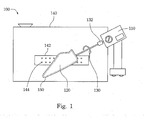
- Fig. 1 is a schematic diagram of a first embodiment of the apparatus for fabricating three-dimensional nonwoven fabric structure of the invention.
- the apparatus for fabricating three-dimensional nonwoven fabric structure 100 includes an adjustable frame 110, a three-dimensional mold 120, a rotary shaft 130 for connecting the adjustable frame 110 and the three-dimensional mold 120, and a meltblown device 140.
- the shape of the three-dimensional mold 120 can be regular or irregular.
- the three-dimensional mold 120 is rotated relative to the adjustable frame 110 by the rotary shaft 130.
- the height and the slanting angle of the three-dimensional mold 120 can be adjusted by the adjustable frame 110.
- the meltblown device 140 would melt a plastic material and spin the plastic melt as fibers.
- a spinner 142 of the meltblown device 140 has plural nozzles 144.
- the fibers are spun from the nozzles 144.
- the three-dimensional mold 120 is disposed in front of the spinner 142.
- the three-dimensional mold 120 is rotated in front of the spinner 142.
- the fibers are collected on the three-dimensional mold 120, and a three-dimensional nonwoven fabric structure 150 is formed on the three-dimensional mold 120.
- the adjustable frame 110 can be used to adjust the height and the slanting angle of the three-dimensional mold 120.
- the adjustable frame 110 is movable to adjust the distance and the spinning angle between the three-dimensional mold 120 and the spinner 142.
- the three-dimensional mold 120 is rotated in front of the spinner 142 by the rotary shaft 130.
- the rotary shaft 130 includes a motor 132.
- the speed of the motor 132 can be adjusted to change the rotary speed of three-dimensional mold 120.
- a thickness of the one piece formed three-dimensional nonwoven fabric structure 150 can be more uniform by adjusting the height, the slanting angle, the rotary speed of the three-dimensional mold 120, and the distance and the spinning angle between the three-dimensional mold 120 and the spinner 142.
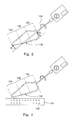
- Fig. 2 is a schematic diagram of the relative position of the three-dimensional mold and the rotary shaft of the apparatus for fabricating three-dimensional nonwoven fabric structure of the invention.
- the rotary shaft 130 can be set along a symmetry axis of the three-dimensional mold 120 if the shape of the three-dimensional mold 120 is regular and has the symmetry axis. However, the shape of the three-dimensional mold 120 could be irregular.
- the angle between the rotary shaft 130 and the three-dimensional mold 120 would determine the distance between the three-dimensional mold 120 and the spinner (see Fig. 1 ) and the thickness uniformity of the three-dimensional nonwoven fabric structure (see Fig. 1 ). Therefore a preferred rule for setting the rotary shaft is required in order to improve the thickness uniformity of the three-dimensional nonwoven fabric structure.
- the three-dimensional mold 120 can be a shoe last mold, wherein the widths and the heights of a shoe body 122, a shoe toe 124, and a shoe heel 126 of the shoe last mold are different.
- the shoe last mold can be regarded as an irregular mold.
- the thickness uniformity would be better when the distance d1 from the shoe toe 124 to the rotary shaft 130 is the same as the distance d2 from the shoe heel 126 to the rotary shaft 130.
- the preferred rule for setting the rotary shaft 130 in the irregular mold is that the two largest widths of the three-dimensional mold 120 at opposite sides of the rotary shaft 130, such as the distance d1 and the distance d2 in this embodiment, are approximately the same.
- Fig. 3 is a schematic diagram of the relation between the density of the nozzles of the spinner and the three-dimensional mold of the apparatus for fabricating three-dimensional nonwoven fabric structure of the invention.
- the surface area of the shoe body 122 is larger than the surface area of the shoe toe 124 or the surface area of the shoe heel 126.
- the area of the shoe body 122 passing the spinner 142 would be larger than the area of the shoe toe 124 passing the spinner 142 or the area of the shoe heel 126 passing the spinner 142 in the same period while the three-dimensional mold 120 is rotated in front of the spinner 142.
- the time of the shoe body 122 collecting the fiber is longer than the time of the shoe toe 124 or the shoe heel 126 collecting the fibers.
- the density of the nozzles 144 can be adjusted according to the shape of the three-dimensional mold 120. More particularly, the number of nozzles 144 related to the shoe body 122, which may have larger fiber thickness, can be reduced to improve the thickness uniformity. Several blank tests can be applied to find at what position of the three-dimensional mold 120 might have the largest fiber thickness, and a part of the nozzles 144 related to the position can be blocked to improve the thickness uniformity of the product.
- the distance between the nozzles 144 and the three-dimensional mold 120 is from 40 cm to 70 cm.
- the preferred distance between the nozzles 144 and the three-dimensional mold 120 is from 50 cm to 60cm.
- the angle between the spinning direction of the fibers and the rotary shaft 130 for the three-dimensional mold 120 is from 0 degree to 180 degree.
- the preferred angle between the spinning direction of the fibers and the rotary shaft 130 for the three-dimensional mold 120 is from 80 degree to 100 degree, wherein 90 degree can be the general operation angle.
- the rotary speed of the three-dimensional mold 120 is from 200 rpm to 500 rpm, wherein the peel strength of the product is preferable when the rotary speed of the three-dimensional mold 120 is from 200 rpm to 250 rpm.
- the spinning time is decided by the desired thickness of the product.
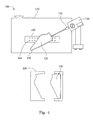
- Fig. 4 is a schematic diagram of a second embodiment of the apparatus for fabricating three-dimensional nonwoven fabric structure of the invention.
- the apparatus for fabricating three-dimensional nonwoven fabric structure 100 includes the adjustable frame 110, the three-dimensional mold 120, the rotary shaft 130 for connecting the adjustable frame 110 and the three-dimensional mold 120, the meltblown device 140, and a hot pressing device 160.
- the fibers spun from the meltblown device 140 are collected on the three-dimensional mold 120, and the three-dimensional nonwoven fabric structure 150 is formed on the three-dimensional mold 120.
- the three-dimensional mold 120 and the three-dimensional nonwoven fabric structure 150 thereon are placed into the hot pressing device 160 and are hot pressed for further fixing the three-dimensional nonwoven fabric structure 150.
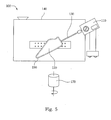
- Fig. 5 is a schematic diagram of a third embodiment of the apparatus for fabricating three-dimensional nonwoven fabric structure of the invention.
- the apparatus for fabricating three-dimensional nonwoven fabric structure 100 includes the adjustable frame 110, the three-dimensional mold 120, the rotary shaft 130 for connecting the adjustable frame 110 and the three-dimensional mold 120, the meltblown device 140, the hot pressing device 160, and a sub rotary shaft 170 disposed near the three-dimensional mold 120.
- the shape of the three-dimensional mold 120 might be irregular, thus some of the fibers may be spun over the three-dimensional mold 120 and are difficult to be collected by the three-dimensional mold 120.
- the superfluous part of the fibers that spun over the three-dimensional mold 120 can be lead toward and collected by the sub rotary shaft 170.
- the sub rotary shaft 170 collects and removes the superfluous part of the fibers to prevent that the superfluous part of the fibers surround but can not be collected by the three-dimensional mold 120 firmly. Therefore, the uniformity and the peel strength of the three-dimensional nonwoven structure 150 can be improved.
- Fig. 6 is a schematic diagram of a fourth embodiment of the apparatus for fabricating three-dimensional nonwoven fabric structure of the invention.
- the apparatus for fabricating three-dimensional nonwoven fabric structure 200 includes the adjustable frame 210, the three-dimensional mold 220, the rotary shaft 230 for connecting the adjustable frame 210 and the three-dimensional mold 220, the meltblown device 240 and the sub rotary shaft 270.
- the length of the three-dimensional mold 220 is larger than the width of the spinner 242 of the meltblown device 240.
- the adjustable frame 210 can be moved related to the meltblown device 240, such that the rotating three dimensional mold 220 can be moved forward related to the spinner 242.
- the fibers spun by the meltblown device 240 can be collected by the three-dimensional mold 220, and the continuing three-dimensional nonwoven fabric structure 250 without seams is formed on the three-dimensional mold 220.
- the moving speed of the three-dimensional mold 220 can be determined according to the shape of the three-dimensional mold 220 for improving the thickness uniformity of the three-dimensional nonwoven fabric structure 250. For example, the section of the three-dimensional mold 220 having a larger diameter spends more time passing through the spinner 242 than the section of the three-dimensional mold 220 having a smaller diameter.
- the sub rotary shaft 270 can remove the superfluous part of the fibers spun through the spinner 242 when the section of the three-dimensional mold 220 having the smaller diameter passes through the spinner 242 to prevent fiber block due to the irregular shape of the three-dimensional mold 220.
- the thickness uniformity and the peel strength of the three-dimensional nonwoven fabric structure 250 can be improved.
- the apparatus for fabricating three-dimensional nonwoven fabric structure of the present invention can be used in shoes, diving suits, masks, head covers, hats, bras, sport bras, knee protectors, wrist protector, etc..
- the shape of the three-dimensional mold can be regular or irregular.
- the material for the meltblown device can be an elastic plastic or an inelastic plastic.
- the material for the meltblown device can be TPU, TPE, TPR, PP, PE, PET, PTT, PBT, PLA, cellulose, PS, PA, PTFE, EMA, or EVA.
- the three-dimensional mold is rotated in front of the spinner to collect the fibers spun from the meltblown device, and the three-dimensional nonwoven fabric structure is formed on the three-dimensional mold.
- the position and the height of the adjustable frame, the angle between the rotary shaft and the three-dimensional mold, the density of the nozzles, and the rotary speed of the three-dimensional mold are adjustable.
- the present invention has the sub rotary shaft or fiber collector to remove the superfluous part of the fibers.
- the thickness uniformity and the peel strength of the three-dimensional nonwoven fabric structure can be improved by using the apparatus for fabricating three-dimensional nonwoven fabric structure of the present invention.
Landscapes
- Engineering & Computer Science (AREA)
- Textile Engineering (AREA)
- Mechanical Engineering (AREA)
- Chemical & Material Sciences (AREA)
- Chemical Kinetics & Catalysis (AREA)
- General Chemical & Material Sciences (AREA)
- Nonwoven Fabrics (AREA)
- Spinning Methods And Devices For Manufacturing Artificial Fibers (AREA)
Description
- This application claims priority to Taiwan Application Serial Number
99125441, filed July 30, 2010 - The present invention relates to an apparatus for fabricating three-dimensional nonwoven fabric structure. More particularly, the present invention relates to an apparatus for fabricating three-dimensional nonwoven fabric structure by using meltblown process.
- With the rapid development of the textile industry, a variety of textiles have been utilized in our daily life. The conventional textiles, such as clothing, hats, socks, etc., need to be cut, sewn, or bonded while processing, therefore there must be some seams on the textiles and would spend much time.
- A three-dimensional nonwoven fabric structure has been produced to provide a seamless product, but the thickness uniformity and the yield are difficult to improve.
-
EP 1 967 219 A2 relates to devices for organ replacement and regenerative medicine providing a biocompatible and biodegradable scaffold capable of integral cell growth that forms a hollow chamber, as well as methods for producing such devices by melt-blowing a web of flexible, polymer fibres in the presence of a porogen to produce a seamless, three-dimensional shape. -
US 2006/276095 A1 discloses a method of forming a portion of an article of footwear includes the steps of providing a last having an exterior surface, extruding a plurality of polymeric fibers, projecting a stream of the extruded polymeric fibers onto the last to form a mat having the shape of the exterior of the last, and subjecting the mat to heat and pressure in a mold. -
US 4 145 388 A discloses a method of manufacturing garments, wherein a mold is provided in the shape and size of the desired garment. The mold includes a matrix of conductors by which variable predetermined electrostatic fields can be established over the mold. A plurality of fiber layers are electrostatically deposited onto the mold to form a garment wherein at least some of the fibers comprising preselected layers are oriented according to the elasticity requirements of particular areas of the garment. Preferably, the garment is then at least partially precured, after which a plurality of colorants can be applied in sequence electrostatically to the garment to produce predetermined patterns, if desired. The garment is then cured to set the fiber layers and colorants, after which the garment is removed from the mold for subsequent finishing. - For the forgoing reasons, there is a need for improving the thickness uniformity and the yield of the seamless three-dimensional nonwoven fabric structure.
- The present invention is provided by appended claim 1. An aspect of the invention provides an apparatus for fabricating three-dimensional nonwoven fabric structure, which includes an adjustable frame, a three-dimensional mold, a rotary shaft connecting the three-dimensional mold and the adjustable frame, and a meltblown device. The three-dimensional mold is rotated relative to the adjustable frame. The meltblown device has plural nozzles for spinning a plurality of fibers, wherein the three-dimensional mold is rotated in front of the nozzles to select the fibers, and a three-dimensional nonwoven fabric structure is formed on the three-dimensional mold. Two largest widths of the three-dimensional mold at opposite sides of the rotary shaft are approximately the same. A density of the nozzles is determined by a shape of the three-dimensional mold. The apparatus for fabricating three-dimensional nonwoven fabric structure further includes a sub rotary shaft disposed near the three-dimensional mold for removing a superfluous part of the fibers. The apparatus for fabricating three-dimensional nonwoven fabric structure further includes a hot pressing device for hot pressing the three-dimensional nonwoven fabric structure.
- The accompanying drawings are included to provide a further understanding of the invention, and are incorporated in and constitute a part of this specification. The drawings illustrate embodiments of the invention and, together with the description, serve to explain the principles of the invention. In the drawings,
-
Fig. 1 is a schematic diagram of a first embodiment of the apparatus for fabricating three-dimensional nonwoven fabric structure of the invention; -
Fig. 2 is a schematic diagram of the relative position of the three-dimensional mold and the rotary shaft of the apparatus for fabricating three-dimensional nonwoven fabric structure of the invention; -
Fig. 3 is a schematic diagram of the relation between the density of the nozzles of the spinner and the three-dimensional mold of the apparatus for fabricating three-dimensional nonwoven fabric structure of the invention; -
Fig. 4 is a schematic diagram of a second embodiment of the apparatus for fabricating three-dimensional nonwoven fabric structure of the invention; -
Fig. 5 is a schematic diagram of a third embodiment of the apparatus for fabricating three-dimensional nonwoven fabric structure of the invention; -
Fig. 6 is a schematic diagram of a fourth embodiment of the apparatus for fabricating three-dimensional nonwoven fabric structure of the invention. - Reference will now be made in detail to the present embodiments of the invention, examples of which are illustrated in the accompanying drawings. Wherever possible, the same reference numbers are used in the drawings and the description to refer to the same or like parts.
-
Fig. 1 is a schematic diagram of a first embodiment of the apparatus for fabricating three-dimensional nonwoven fabric structure of the invention. The apparatus for fabricating three-dimensionalnonwoven fabric structure 100 includes anadjustable frame 110, a three-dimensional mold 120, arotary shaft 130 for connecting theadjustable frame 110 and the three-dimensional mold 120, and ameltblown device 140. The shape of the three-dimensional mold 120 can be regular or irregular. The three-dimensional mold 120 is rotated relative to theadjustable frame 110 by therotary shaft 130. The height and the slanting angle of the three-dimensional mold 120 can be adjusted by theadjustable frame 110. Themeltblown device 140 would melt a plastic material and spin the plastic melt as fibers. Aspinner 142 of themeltblown device 140 hasplural nozzles 144. The fibers are spun from thenozzles 144. The three-dimensional mold 120 is disposed in front of thespinner 142. The three-dimensional mold 120 is rotated in front of thespinner 142. The fibers are collected on the three-dimensional mold 120, and a three-dimensionalnonwoven fabric structure 150 is formed on the three-dimensional mold 120. - The
adjustable frame 110 can be used to adjust the height and the slanting angle of the three-dimensional mold 120. Theadjustable frame 110 is movable to adjust the distance and the spinning angle between the three-dimensional mold 120 and thespinner 142. The three-dimensional mold 120 is rotated in front of thespinner 142 by therotary shaft 130. Therotary shaft 130 includes amotor 132. The speed of themotor 132 can be adjusted to change the rotary speed of three-dimensional mold 120. A thickness of the one piece formed three-dimensionalnonwoven fabric structure 150 can be more uniform by adjusting the height, the slanting angle, the rotary speed of the three-dimensional mold 120, and the distance and the spinning angle between the three-dimensional mold 120 and thespinner 142. -
Fig. 2 is a schematic diagram of the relative position of the three-dimensional mold and the rotary shaft of the apparatus for fabricating three-dimensional nonwoven fabric structure of the invention. Therotary shaft 130 can be set along a symmetry axis of the three-dimensional mold 120 if the shape of the three-dimensional mold 120 is regular and has the symmetry axis. However, the shape of the three-dimensional mold 120 could be irregular. The angle between therotary shaft 130 and the three-dimensional mold 120 would determine the distance between the three-dimensional mold 120 and the spinner (seeFig. 1 ) and the thickness uniformity of the three-dimensional nonwoven fabric structure (seeFig. 1 ). Therefore a preferred rule for setting the rotary shaft is required in order to improve the thickness uniformity of the three-dimensional nonwoven fabric structure. - In this embodiment, for example, the three-
dimensional mold 120 can be a shoe last mold, wherein the widths and the heights of ashoe body 122, ashoe toe 124, and ashoe heel 126 of the shoe last mold are different. The shoe last mold can be regarded as an irregular mold. The thickness uniformity would be better when the distance d1 from theshoe toe 124 to therotary shaft 130 is the same as the distance d2 from theshoe heel 126 to therotary shaft 130. Namely, the preferred rule for setting therotary shaft 130 in the irregular mold is that the two largest widths of the three-dimensional mold 120 at opposite sides of therotary shaft 130, such as the distance d1 and the distance d2 in this embodiment, are approximately the same. -
Fig. 3 is a schematic diagram of the relation between the density of the nozzles of the spinner and the three-dimensional mold of the apparatus for fabricating three-dimensional nonwoven fabric structure of the invention. As to the shoe last mold of the three-dimensional mold 120 disclosed above, the surface area of theshoe body 122 is larger than the surface area of theshoe toe 124 or the surface area of theshoe heel 126. The area of theshoe body 122 passing thespinner 142 would be larger than the area of theshoe toe 124 passing thespinner 142 or the area of theshoe heel 126 passing thespinner 142 in the same period while the three-dimensional mold 120 is rotated in front of thespinner 142. Namely, the time of theshoe body 122 collecting the fiber is longer than the time of theshoe toe 124 or theshoe heel 126 collecting the fibers. - In order to prevent that the thickness of fibers collected on the
shoe body 122 is larger than the thickness of the fibers collected on theshoe toe 124 or theshoe heel 126, the density of thenozzles 144 can be adjusted according to the shape of the three-dimensional mold 120. More particularly, the number ofnozzles 144 related to theshoe body 122, which may have larger fiber thickness, can be reduced to improve the thickness uniformity. Several blank tests can be applied to find at what position of the three-dimensional mold 120 might have the largest fiber thickness, and a part of thenozzles 144 related to the position can be blocked to improve the thickness uniformity of the product. - The distance between the
nozzles 144 and the three-dimensional mold 120 is from 40 cm to 70 cm. The preferred distance between thenozzles 144 and the three-dimensional mold 120 is from 50 cm to 60cm. The angle between the spinning direction of the fibers and therotary shaft 130 for the three-dimensional mold 120 is from 0 degree to 180 degree. The preferred angle between the spinning direction of the fibers and therotary shaft 130 for the three-dimensional mold 120 is from 80 degree to 100 degree, wherein 90 degree can be the general operation angle. The rotary speed of the three-dimensional mold 120 is from 200 rpm to 500 rpm, wherein the peel strength of the product is preferable when the rotary speed of the three-dimensional mold 120 is from 200 rpm to 250 rpm. The spinning time is decided by the desired thickness of the product. -
Fig. 4 is a schematic diagram of a second embodiment of the apparatus for fabricating three-dimensional nonwoven fabric structure of the invention. The apparatus for fabricating three-dimensionalnonwoven fabric structure 100 includes theadjustable frame 110, the three-dimensional mold 120, therotary shaft 130 for connecting theadjustable frame 110 and the three-dimensional mold 120, themeltblown device 140, and a hotpressing device 160. The fibers spun from themeltblown device 140 are collected on the three-dimensional mold 120, and the three-dimensionalnonwoven fabric structure 150 is formed on the three-dimensional mold 120. The three-dimensional mold 120 and the three-dimensionalnonwoven fabric structure 150 thereon are placed into the hotpressing device 160 and are hot pressed for further fixing the three-dimensionalnonwoven fabric structure 150. -
Fig. 5 is a schematic diagram of a third embodiment of the apparatus for fabricating three-dimensional nonwoven fabric structure of the invention. The apparatus for fabricating three-dimensionalnonwoven fabric structure 100 includes theadjustable frame 110, the three-dimensional mold 120, therotary shaft 130 for connecting theadjustable frame 110 and the three-dimensional mold 120, themeltblown device 140, the hotpressing device 160, and asub rotary shaft 170 disposed near the three-dimensional mold 120. The shape of the three-dimensional mold 120 might be irregular, thus some of the fibers may be spun over the three-dimensional mold 120 and are difficult to be collected by the three-dimensional mold 120. The superfluous part of the fibers that spun over the three-dimensional mold 120 can be lead toward and collected by thesub rotary shaft 170. Thesub rotary shaft 170 collects and removes the superfluous part of the fibers to prevent that the superfluous part of the fibers surround but can not be collected by the three-dimensional mold 120 firmly. Therefore, the uniformity and the peel strength of the three-dimensionalnonwoven structure 150 can be improved. -
Fig. 6 is a schematic diagram of a fourth embodiment of the apparatus for fabricating three-dimensional nonwoven fabric structure of the invention. The apparatus for fabricating three-dimensionalnonwoven fabric structure 200 includes theadjustable frame 210, the three-dimensional mold 220, therotary shaft 230 for connecting theadjustable frame 210 and the three-dimensional mold 220, themeltblown device 240 and thesub rotary shaft 270. The length of the three-dimensional mold 220 is larger than the width of thespinner 242 of themeltblown device 240. - The
adjustable frame 210 can be moved related to themeltblown device 240, such that the rotating threedimensional mold 220 can be moved forward related to thespinner 242. The fibers spun by themeltblown device 240 can be collected by the three-dimensional mold 220, and the continuing three-dimensionalnonwoven fabric structure 250 without seams is formed on the three-dimensional mold 220. The moving speed of the three-dimensional mold 220 can be determined according to the shape of the three-dimensional mold 220 for improving the thickness uniformity of the three-dimensionalnonwoven fabric structure 250. For example, the section of the three-dimensional mold 220 having a larger diameter spends more time passing through thespinner 242 than the section of the three-dimensional mold 220 having a smaller diameter. - Similarly, the
sub rotary shaft 270 can remove the superfluous part of the fibers spun through thespinner 242 when the section of the three-dimensional mold 220 having the smaller diameter passes through thespinner 242 to prevent fiber block due to the irregular shape of the three-dimensional mold 220. Thus the thickness uniformity and the peel strength of the three-dimensionalnonwoven fabric structure 250 can be improved. - The apparatus for fabricating three-dimensional nonwoven fabric structure of the present invention can be used in shoes, diving suits, masks, head covers, hats, bras, sport bras, knee protectors, wrist protector, etc.. The shape of the three-dimensional mold can be regular or irregular. The material for the meltblown device can be an elastic plastic or an inelastic plastic. The material for the meltblown device can be TPU, TPE, TPR, PP, PE, PET, PTT, PBT, PLA, cellulose, PS, PA, PTFE, EMA, or EVA.
- According to the disclosed embodiments, the three-dimensional mold is rotated in front of the spinner to collect the fibers spun from the meltblown device, and the three-dimensional nonwoven fabric structure is formed on the three-dimensional mold. The position and the height of the adjustable frame, the angle between the rotary shaft and the three-dimensional mold, the density of the nozzles, and the rotary speed of the three-dimensional mold are adjustable. The present invention has the sub rotary shaft or fiber collector to remove the superfluous part of the fibers. The thickness uniformity and the peel strength of the three-dimensional nonwoven fabric structure can be improved by using the apparatus for fabricating three-dimensional nonwoven fabric structure of the present invention.
Claims (4)
- An apparatus for fabricating three-dimensional nonwoven fabric structure (100) comprising:an adjustable frame (110);a three-dimensional mold (120);a rotary shaft (130) connecting the three-dimensional mold (120) and the adjustable frame (110), thereby the three-dimensional mold (120) is rotated relative to the adjustable frame (110);a meltblown device (140) having a plurality of nozzles (144) for spinning a plurality of fibers, wherein the three-dimensional mold (120) is rotated in front of the nozzles (144) to collect the fibers, and a three-dimensional nonwoven fabric structure (100) is formed on the three-dimensional mold (120); anda sub rotary shaft disposed near the three-dimensional mold (120) for removing a superfluous part of the fibers.
- The apparatus for fabricating three-dimensional nonwoven fabric structure (100) of claim 1, wherein two largest widths of the three-dimensional mold (120) at opposite sides of the rotary shaft (130) are the same.
- The apparatus for fabricating three-dimensional nonwoven fabric structure (100) of claim 1, wherein a density of the nozzles (144) is determined by a shape of the three-dimensional mold (120).
- The apparatus for fabricating three-dimensional nonwoven fabric structure (100) of claim 1, further comprising a hot pressing device for hot pressing the three-dimensional nonwoven fabric structure (100).
Priority Applications (1)
| Application Number | Priority Date | Filing Date | Title |
|---|---|---|---|
| EP13182035.9A EP2669415B1 (en) | 2010-07-30 | 2011-03-09 | Apparatus for fabricating three-dimensional nonwoven fabric structure |
Applications Claiming Priority (1)
| Application Number | Priority Date | Filing Date | Title |
|---|---|---|---|
| TW099125441A TWI414657B (en) | 2010-07-30 | 2010-07-30 | Apparatus and method for fabricating three-dimensional nonwoven structure |
Related Child Applications (2)
| Application Number | Title | Priority Date | Filing Date |
|---|---|---|---|
| EP13182035.9A Division-Into EP2669415B1 (en) | 2010-07-30 | 2011-03-09 | Apparatus for fabricating three-dimensional nonwoven fabric structure |
| EP13182035.9A Division EP2669415B1 (en) | 2010-07-30 | 2011-03-09 | Apparatus for fabricating three-dimensional nonwoven fabric structure |
Publications (2)
| Publication Number | Publication Date |
|---|---|
| EP2412856A1 EP2412856A1 (en) | 2012-02-01 |
| EP2412856B1 true EP2412856B1 (en) | 2014-01-22 |
Family
ID=44280952
Family Applications (2)
| Application Number | Title | Priority Date | Filing Date |
|---|---|---|---|
| EP13182035.9A Active EP2669415B1 (en) | 2010-07-30 | 2011-03-09 | Apparatus for fabricating three-dimensional nonwoven fabric structure |
| EP11157495.0A Active EP2412856B1 (en) | 2010-07-30 | 2011-03-09 | Apparatus for fabricating three-dimensional nonwoven fabric structure |
Family Applications Before (1)
| Application Number | Title | Priority Date | Filing Date |
|---|---|---|---|
| EP13182035.9A Active EP2669415B1 (en) | 2010-07-30 | 2011-03-09 | Apparatus for fabricating three-dimensional nonwoven fabric structure |
Country Status (4)
| Country | Link |
|---|---|
| US (1) | US9260807B2 (en) |
| EP (2) | EP2669415B1 (en) |
| JP (1) | JP5833352B2 (en) |
| TW (1) | TWI414657B (en) |
Cited By (1)
| Publication number | Priority date | Publication date | Assignee | Title |
|---|---|---|---|---|
| DE102016223571A1 (en) | 2016-11-28 | 2018-05-30 | Adidas Ag | Production of nonwovens including a component |
Families Citing this family (11)
| Publication number | Priority date | Publication date | Assignee | Title |
|---|---|---|---|---|
| DE102013221020B4 (en) | 2013-10-16 | 2020-04-02 | Adidas Ag | Speedfactory 3D |
| DE102013221018B4 (en) | 2013-10-16 | 2020-04-02 | Adidas Ag | Speedfactory 2D |
| CN110215015A (en) * | 2014-11-10 | 2019-09-10 | 北面服饰公司 | The footwear and other products formed by jet stream extrusion process |
| CN104477355B (en) * | 2014-11-12 | 2016-12-07 | 中国船舶重工集团公司第七○二研究所 | Deep sea manned submersible foot formula motion control device |
| EP3400132A4 (en) * | 2016-01-08 | 2019-08-07 | Clarcor Inc. | USE OF MICROFIBRES AND / OR NANOFIBRES IN CLOTHES AND SHOES |
| US20190281915A1 (en) * | 2016-07-20 | 2019-09-19 | F.F.P. Technologies Ltd. | Seamless wearable structure garment |
| EP3406781B1 (en) | 2017-05-22 | 2026-02-18 | Groz-Beckert KG | Gripper for tufting machine |
| US20180339445A1 (en) * | 2017-05-26 | 2018-11-29 | Wolverine Outdoors, Inc. | Article of footwear |
| DE102019202385B4 (en) | 2019-02-21 | 2024-08-22 | Adidas Ag | 3D nonwoven bra and manufacturing process |
| JP7553813B2 (en) * | 2021-01-29 | 2024-09-19 | 株式会社ワコール | Clothing component and manufacturing method thereof |
| CN114606695A (en) * | 2022-03-18 | 2022-06-10 | 惠州市众畅汽车部件有限公司 | Lining non-woven fabric thermal forming method |
Family Cites Families (26)
| Publication number | Priority date | Publication date | Assignee | Title |
|---|---|---|---|---|
| GB1383597A (en) | 1971-02-19 | 1974-02-12 | Inmont Corp | Fibrous products |
| JPS4986678A (en) * | 1972-12-25 | 1974-08-20 | ||
| US3922126A (en) * | 1974-11-12 | 1975-11-25 | Du Pont | Apparatus for collecting waste polymer |
| DE2530499C3 (en) * | 1975-07-09 | 1978-05-24 | Akzo Gmbh, 5600 Wuppertal | Mat sheet and process for its manufacture |
| US4145388A (en) | 1977-11-09 | 1979-03-20 | Haggar Company | Method of manufacturing garments |
| DE2806030C2 (en) * | 1978-02-14 | 1984-02-02 | B. Braun Melsungen Ag, 3508 Melsungen | Process for the production of a tubular blood vessel prosthesis |
| US4240864A (en) | 1979-05-25 | 1980-12-23 | Celanese Corporation | Spray spinning collection unit |
| JP2769955B2 (en) * | 1992-11-18 | 1998-06-25 | 森村興産株式会社 | Method for producing spherical three-dimensional net-like aggregate |
| JP2769956B2 (en) * | 1992-11-18 | 1998-06-25 | 森村興産株式会社 | Method for producing spherical three-dimensional net-like aggregate |
| US5429682A (en) | 1993-08-19 | 1995-07-04 | Advanced Robotics Technologies | Automated three-dimensional precision coatings application apparatus |
| JP2711508B2 (en) * | 1993-09-04 | 1998-02-10 | 森村興産株式会社 | Filling material for wastewater treatment |
| US5554394A (en) * | 1994-12-06 | 1996-09-10 | Rototron Corporation | Rotational thermal molding machine |
| US5591335A (en) * | 1995-05-02 | 1997-01-07 | Memtec America Corporation | Filter cartridges having nonwoven melt blown filtration media with integral co-located support and filtration |
| GB9625634D0 (en) | 1996-12-10 | 1997-01-29 | Courtaulds Fibres Holdings Ltd | Method of manufacture of nonwoven fabric |
| GB9625765D0 (en) * | 1996-12-11 | 1997-01-29 | Lrc Products | Process and apparatus for forming a thin-walled article |
| US6514061B1 (en) * | 2000-08-03 | 2003-02-04 | Kenneth C. Hudson | Positioning fixture for a rotary mold |
| WO2002032642A2 (en) | 2000-10-18 | 2002-04-25 | Virginia Commonwealth University Intellectual Property Foundation | Electroprocessing polymers to form footwear and clothing |
| JP4670166B2 (en) * | 2001-03-21 | 2011-04-13 | トヨタ紡織株式会社 | Filter manufacturing method |
| JP2002339221A (en) * | 2001-03-13 | 2002-11-27 | Toyoda Spinning & Weaving Co Ltd | 3-d nonwoven fabric and method for producing the same |
| CN100582343C (en) | 2001-10-23 | 2010-01-20 | Ge奥斯莫尼克斯公司 | Three-dimensional nonwoven media, filters, and methods of processing |
| US6986427B2 (en) | 2001-10-23 | 2006-01-17 | Ge Osmonics, Inc. | Three-dimensional non-woven media |
| TW587114B (en) * | 2002-10-24 | 2004-05-11 | Kang Na Hsiung Entpr Co Ltd | Method for producing composite non-woven cloth by water-jet entangling process, composite non-woven cloth products made therefrom |
| US20060276095A1 (en) | 2005-06-02 | 2006-12-07 | Nike, Inc. | Article of footwear of nonwoven material and method of manufacturing same |
| US20080081323A1 (en) | 2006-09-29 | 2008-04-03 | Daniel Keeley | Regenerative Medicine Devices and Melt-Blown Methods of Manufacture |
| TWI306909B (en) * | 2006-12-21 | 2009-03-01 | Taiwan Textile Res Inst | Electrostatic spinning apparatus |
| JP5007474B2 (en) * | 2008-06-09 | 2012-08-22 | パナソニック株式会社 | Non-bonded cylinder manufacturing apparatus, non-bonded cylinder manufacturing method |
-
2010
- 2010-07-30 TW TW099125441A patent/TWI414657B/en active
-
2011
- 2011-03-07 US US13/041,510 patent/US9260807B2/en active Active
- 2011-03-09 EP EP13182035.9A patent/EP2669415B1/en active Active
- 2011-03-09 EP EP11157495.0A patent/EP2412856B1/en active Active
- 2011-06-24 JP JP2011140809A patent/JP5833352B2/en active Active
Cited By (2)
| Publication number | Priority date | Publication date | Assignee | Title |
|---|---|---|---|---|
| DE102016223571A1 (en) | 2016-11-28 | 2018-05-30 | Adidas Ag | Production of nonwovens including a component |
| DE102016223571B4 (en) * | 2016-11-28 | 2020-08-13 | Adidas Ag | Manufacture of nonwovens including one component |
Also Published As
| Publication number | Publication date |
|---|---|
| US9260807B2 (en) | 2016-02-16 |
| EP2412856A1 (en) | 2012-02-01 |
| TW201204892A (en) | 2012-02-01 |
| EP2669415A1 (en) | 2013-12-04 |
| JP5833352B2 (en) | 2015-12-16 |
| EP2669415B1 (en) | 2015-01-07 |
| TWI414657B (en) | 2013-11-11 |
| US20120025410A1 (en) | 2012-02-02 |
| JP2012031555A (en) | 2012-02-16 |
Similar Documents
| Publication | Publication Date | Title |
|---|---|---|
| EP2412856B1 (en) | Apparatus for fabricating three-dimensional nonwoven fabric structure | |
| US10793983B2 (en) | Footwear and other articles formed by jet extrusion processes | |
| CN102345210B (en) | Equipment and method for preparing three-dimensional nonwoven structure | |
| US10448675B2 (en) | Construction of a gripping fabric | |
| KR101712209B1 (en) | Base material for artificial leather and process for producing the same | |
| HK1244519A1 (en) | Footwear and other articles formed by jet extrusion processes | |
| CN108118446B (en) | Making a nonwoven fabric comprising a component | |
| KR20140144733A (en) | Textured elements incorporating non-woven textile materials and methods for manufacturing the textured elements | |
| CA2801943A1 (en) | A process for making a non-woven web | |
| JP2007056417A (en) | Artificial leather substrate and manufacturing method thereof | |
| US20230116811A1 (en) | Fiber-containing structure, method for manufacturing the same and uses thereof | |
| TWI695102B (en) | Nonwoven fabric and manufacturing method thereof | |
| JP2024516027A (en) | Hydropatterned nonwoven fabric and its manufacturing method | |
| KR200213062Y1 (en) | Non-woven fabric manufacturing system using spray-spinning extrusion | |
| JP2916590B2 (en) | Easily peelable split fiber and production method thereof | |
| MC MK et al. | Vorrichtung zur Herstellung einer dreidimensionalen Faservliesstruktur Appareil pour la fabrication d’une structure non tissée tridimensionnelle | |
| JPH0759785B2 (en) | Nonwoven manufacturing method | |
| EP2572021A1 (en) | Fabric for non-woven web forming process and method of using same |
Legal Events
| Date | Code | Title | Description |
|---|---|---|---|
| 17P | Request for examination filed |
Effective date: 20110309 |
|
| AK | Designated contracting states |
Kind code of ref document: A1 Designated state(s): AL AT BE BG CH CY CZ DE DK EE ES FI FR GB GR HR HU IE IS IT LI LT LU LV MC MK MT NL NO PL PT RO RS SE SI SK SM TR |
|
| AX | Request for extension of the european patent |
Extension state: BA ME |
|
| PUAI | Public reference made under article 153(3) epc to a published international application that has entered the european phase |
Free format text: ORIGINAL CODE: 0009012 |
|
| RIC1 | Information provided on ipc code assigned before grant |
Ipc: D04H 1/00 20060101AFI20120227BHEP Ipc: D04H 3/07 20120101ALI20120227BHEP Ipc: B29C 41/02 20060101ALI20120227BHEP Ipc: D04H 1/56 20060101ALI20120227BHEP |
|
| 17Q | First examination report despatched |
Effective date: 20130605 |
|
| REG | Reference to a national code |
Ref country code: DE Ref legal event code: R079 Ref document number: 602011004755 Country of ref document: DE Free format text: PREVIOUS MAIN CLASS: D04H0001000000 Ipc: D04H0003160000 |
|
| GRAP | Despatch of communication of intention to grant a patent |
Free format text: ORIGINAL CODE: EPIDOSNIGR1 |
|
| RIC1 | Information provided on ipc code assigned before grant |
Ipc: D01F 13/00 20060101ALI20130930BHEP Ipc: D04H 1/56 20060101ALI20130930BHEP Ipc: D01D 5/098 20060101ALI20130930BHEP Ipc: D01D 7/00 20060101ALI20130930BHEP Ipc: D04H 3/07 20120101ALI20130930BHEP Ipc: D04H 3/16 20060101AFI20130930BHEP |
|
| INTG | Intention to grant announced |
Effective date: 20131030 |
|
| GRAS | Grant fee paid |
Free format text: ORIGINAL CODE: EPIDOSNIGR3 |
|
| GRAA | (expected) grant |
Free format text: ORIGINAL CODE: 0009210 |
|
| AK | Designated contracting states |
Kind code of ref document: B1 Designated state(s): AL AT BE BG CH CY CZ DE DK EE ES FI FR GB GR HR HU IE IS IT LI LT LU LV MC MK MT NL NO PL PT RO RS SE SI SK SM TR |
|
| REG | Reference to a national code |
Ref country code: GB Ref legal event code: FG4D |
|
| REG | Reference to a national code |
Ref country code: CH Ref legal event code: EP |
|
| REG | Reference to a national code |
Ref country code: AT Ref legal event code: REF Ref document number: 650899 Country of ref document: AT Kind code of ref document: T Effective date: 20140215 |
|
| REG | Reference to a national code |
Ref country code: IE Ref legal event code: FG4D |
|
| REG | Reference to a national code |
Ref country code: DE Ref legal event code: R096 Ref document number: 602011004755 Country of ref document: DE Effective date: 20140306 |
|
| REG | Reference to a national code |
Ref country code: NL Ref legal event code: VDEP Effective date: 20140122 |
|
| REG | Reference to a national code |
Ref country code: AT Ref legal event code: MK05 Ref document number: 650899 Country of ref document: AT Kind code of ref document: T Effective date: 20140122 |
|
| REG | Reference to a national code |
Ref country code: LT Ref legal event code: MG4D |
|
| PG25 | Lapsed in a contracting state [announced via postgrant information from national office to epo] |
Ref country code: NO Free format text: LAPSE BECAUSE OF FAILURE TO SUBMIT A TRANSLATION OF THE DESCRIPTION OR TO PAY THE FEE WITHIN THE PRESCRIBED TIME-LIMIT Effective date: 20140422 Ref country code: IS Free format text: LAPSE BECAUSE OF FAILURE TO SUBMIT A TRANSLATION OF THE DESCRIPTION OR TO PAY THE FEE WITHIN THE PRESCRIBED TIME-LIMIT Effective date: 20140522 Ref country code: LT Free format text: LAPSE BECAUSE OF FAILURE TO SUBMIT A TRANSLATION OF THE DESCRIPTION OR TO PAY THE FEE WITHIN THE PRESCRIBED TIME-LIMIT Effective date: 20140122 |
|
| PG25 | Lapsed in a contracting state [announced via postgrant information from national office to epo] |
Ref country code: NL Free format text: LAPSE BECAUSE OF FAILURE TO SUBMIT A TRANSLATION OF THE DESCRIPTION OR TO PAY THE FEE WITHIN THE PRESCRIBED TIME-LIMIT Effective date: 20140122 Ref country code: ES Free format text: LAPSE BECAUSE OF FAILURE TO SUBMIT A TRANSLATION OF THE DESCRIPTION OR TO PAY THE FEE WITHIN THE PRESCRIBED TIME-LIMIT Effective date: 20140122 Ref country code: FI Free format text: LAPSE BECAUSE OF FAILURE TO SUBMIT A TRANSLATION OF THE DESCRIPTION OR TO PAY THE FEE WITHIN THE PRESCRIBED TIME-LIMIT Effective date: 20140122 Ref country code: PT Free format text: LAPSE BECAUSE OF FAILURE TO SUBMIT A TRANSLATION OF THE DESCRIPTION OR TO PAY THE FEE WITHIN THE PRESCRIBED TIME-LIMIT Effective date: 20140522 Ref country code: SE Free format text: LAPSE BECAUSE OF FAILURE TO SUBMIT A TRANSLATION OF THE DESCRIPTION OR TO PAY THE FEE WITHIN THE PRESCRIBED TIME-LIMIT Effective date: 20140122 Ref country code: CY Free format text: LAPSE BECAUSE OF FAILURE TO SUBMIT A TRANSLATION OF THE DESCRIPTION OR TO PAY THE FEE WITHIN THE PRESCRIBED TIME-LIMIT Effective date: 20140122 Ref country code: AT Free format text: LAPSE BECAUSE OF FAILURE TO SUBMIT A TRANSLATION OF THE DESCRIPTION OR TO PAY THE FEE WITHIN THE PRESCRIBED TIME-LIMIT Effective date: 20140122 |
|
| PG25 | Lapsed in a contracting state [announced via postgrant information from national office to epo] |
Ref country code: HR Free format text: LAPSE BECAUSE OF FAILURE TO SUBMIT A TRANSLATION OF THE DESCRIPTION OR TO PAY THE FEE WITHIN THE PRESCRIBED TIME-LIMIT Effective date: 20140122 Ref country code: BE Free format text: LAPSE BECAUSE OF FAILURE TO SUBMIT A TRANSLATION OF THE DESCRIPTION OR TO PAY THE FEE WITHIN THE PRESCRIBED TIME-LIMIT Effective date: 20140122 Ref country code: LV Free format text: LAPSE BECAUSE OF FAILURE TO SUBMIT A TRANSLATION OF THE DESCRIPTION OR TO PAY THE FEE WITHIN THE PRESCRIBED TIME-LIMIT Effective date: 20140122 Ref country code: RS Free format text: LAPSE BECAUSE OF FAILURE TO SUBMIT A TRANSLATION OF THE DESCRIPTION OR TO PAY THE FEE WITHIN THE PRESCRIBED TIME-LIMIT Effective date: 20140122 |
|
| REG | Reference to a national code |
Ref country code: DE Ref legal event code: R097 Ref document number: 602011004755 Country of ref document: DE |
|
| PG25 | Lapsed in a contracting state [announced via postgrant information from national office to epo] |
Ref country code: RO Free format text: LAPSE BECAUSE OF FAILURE TO SUBMIT A TRANSLATION OF THE DESCRIPTION OR TO PAY THE FEE WITHIN THE PRESCRIBED TIME-LIMIT Effective date: 20140122 Ref country code: LU Free format text: LAPSE BECAUSE OF FAILURE TO SUBMIT A TRANSLATION OF THE DESCRIPTION OR TO PAY THE FEE WITHIN THE PRESCRIBED TIME-LIMIT Effective date: 20140309 Ref country code: EE Free format text: LAPSE BECAUSE OF FAILURE TO SUBMIT A TRANSLATION OF THE DESCRIPTION OR TO PAY THE FEE WITHIN THE PRESCRIBED TIME-LIMIT Effective date: 20140122 Ref country code: CZ Free format text: LAPSE BECAUSE OF FAILURE TO SUBMIT A TRANSLATION OF THE DESCRIPTION OR TO PAY THE FEE WITHIN THE PRESCRIBED TIME-LIMIT Effective date: 20140122 Ref country code: DK Free format text: LAPSE BECAUSE OF FAILURE TO SUBMIT A TRANSLATION OF THE DESCRIPTION OR TO PAY THE FEE WITHIN THE PRESCRIBED TIME-LIMIT Effective date: 20140122 |
|
| REG | Reference to a national code |
Ref country code: CH Ref legal event code: PL |
|
| PG25 | Lapsed in a contracting state [announced via postgrant information from national office to epo] |
Ref country code: SK Free format text: LAPSE BECAUSE OF FAILURE TO SUBMIT A TRANSLATION OF THE DESCRIPTION OR TO PAY THE FEE WITHIN THE PRESCRIBED TIME-LIMIT Effective date: 20140122 Ref country code: PL Free format text: LAPSE BECAUSE OF FAILURE TO SUBMIT A TRANSLATION OF THE DESCRIPTION OR TO PAY THE FEE WITHIN THE PRESCRIBED TIME-LIMIT Effective date: 20140122 |
|
| PLBE | No opposition filed within time limit |
Free format text: ORIGINAL CODE: 0009261 |
|
| STAA | Information on the status of an ep patent application or granted ep patent |
Free format text: STATUS: NO OPPOSITION FILED WITHIN TIME LIMIT |
|
| 26N | No opposition filed |
Effective date: 20141023 |
|
| REG | Reference to a national code |
Ref country code: IE Ref legal event code: MM4A |
|
| PG25 | Lapsed in a contracting state [announced via postgrant information from national office to epo] |
Ref country code: LI Free format text: LAPSE BECAUSE OF NON-PAYMENT OF DUE FEES Effective date: 20140331 Ref country code: IE Free format text: LAPSE BECAUSE OF NON-PAYMENT OF DUE FEES Effective date: 20140309 Ref country code: CH Free format text: LAPSE BECAUSE OF NON-PAYMENT OF DUE FEES Effective date: 20140331 |
|
| REG | Reference to a national code |
Ref country code: DE Ref legal event code: R097 Ref document number: 602011004755 Country of ref document: DE Effective date: 20141023 |
|
| PG25 | Lapsed in a contracting state [announced via postgrant information from national office to epo] |
Ref country code: SI Free format text: LAPSE BECAUSE OF FAILURE TO SUBMIT A TRANSLATION OF THE DESCRIPTION OR TO PAY THE FEE WITHIN THE PRESCRIBED TIME-LIMIT Effective date: 20140122 |
|
| REG | Reference to a national code |
Ref country code: FR Ref legal event code: PLFP Year of fee payment: 6 |
|
| PG25 | Lapsed in a contracting state [announced via postgrant information from national office to epo] |
Ref country code: MT Free format text: LAPSE BECAUSE OF FAILURE TO SUBMIT A TRANSLATION OF THE DESCRIPTION OR TO PAY THE FEE WITHIN THE PRESCRIBED TIME-LIMIT Effective date: 20140122 |
|
| PG25 | Lapsed in a contracting state [announced via postgrant information from national office to epo] |
Ref country code: SM Free format text: LAPSE BECAUSE OF FAILURE TO SUBMIT A TRANSLATION OF THE DESCRIPTION OR TO PAY THE FEE WITHIN THE PRESCRIBED TIME-LIMIT Effective date: 20140122 |
|
| PG25 | Lapsed in a contracting state [announced via postgrant information from national office to epo] |
Ref country code: MC Free format text: LAPSE BECAUSE OF FAILURE TO SUBMIT A TRANSLATION OF THE DESCRIPTION OR TO PAY THE FEE WITHIN THE PRESCRIBED TIME-LIMIT Effective date: 20140122 |
|
| PG25 | Lapsed in a contracting state [announced via postgrant information from national office to epo] |
Ref country code: BG Free format text: LAPSE BECAUSE OF FAILURE TO SUBMIT A TRANSLATION OF THE DESCRIPTION OR TO PAY THE FEE WITHIN THE PRESCRIBED TIME-LIMIT Effective date: 20140122 Ref country code: GR Free format text: LAPSE BECAUSE OF FAILURE TO SUBMIT A TRANSLATION OF THE DESCRIPTION OR TO PAY THE FEE WITHIN THE PRESCRIBED TIME-LIMIT Effective date: 20140423 Ref country code: IT Free format text: LAPSE BECAUSE OF FAILURE TO SUBMIT A TRANSLATION OF THE DESCRIPTION OR TO PAY THE FEE WITHIN THE PRESCRIBED TIME-LIMIT Effective date: 20140122 |
|
| PG25 | Lapsed in a contracting state [announced via postgrant information from national office to epo] |
Ref country code: HU Free format text: LAPSE BECAUSE OF FAILURE TO SUBMIT A TRANSLATION OF THE DESCRIPTION OR TO PAY THE FEE WITHIN THE PRESCRIBED TIME-LIMIT; INVALID AB INITIO Effective date: 20110309 Ref country code: TR Free format text: LAPSE BECAUSE OF FAILURE TO SUBMIT A TRANSLATION OF THE DESCRIPTION OR TO PAY THE FEE WITHIN THE PRESCRIBED TIME-LIMIT Effective date: 20140122 |
|
| REG | Reference to a national code |
Ref country code: FR Ref legal event code: PLFP Year of fee payment: 7 |
|
| REG | Reference to a national code |
Ref country code: FR Ref legal event code: PLFP Year of fee payment: 8 |
|
| PG25 | Lapsed in a contracting state [announced via postgrant information from national office to epo] |
Ref country code: MK Free format text: LAPSE BECAUSE OF FAILURE TO SUBMIT A TRANSLATION OF THE DESCRIPTION OR TO PAY THE FEE WITHIN THE PRESCRIBED TIME-LIMIT Effective date: 20140122 |
|
| PG25 | Lapsed in a contracting state [announced via postgrant information from national office to epo] |
Ref country code: AL Free format text: LAPSE BECAUSE OF FAILURE TO SUBMIT A TRANSLATION OF THE DESCRIPTION OR TO PAY THE FEE WITHIN THE PRESCRIBED TIME-LIMIT Effective date: 20140122 |
|
| P01 | Opt-out of the competence of the unified patent court (upc) registered |
Effective date: 20230509 |
|
| PGFP | Annual fee paid to national office [announced via postgrant information from national office to epo] |
Ref country code: FR Payment date: 20251231 Year of fee payment: 16 |
|
| PGFP | Annual fee paid to national office [announced via postgrant information from national office to epo] |
Ref country code: GB Payment date: 20260106 Year of fee payment: 16 |
|
| PGFP | Annual fee paid to national office [announced via postgrant information from national office to epo] |
Ref country code: DE Payment date: 20260102 Year of fee payment: 16 |