EP2412706B1 - Novel hydroxamate derivative, a production method for the same, and a pharmaceutical composition comprising the same - Google Patents
Novel hydroxamate derivative, a production method for the same, and a pharmaceutical composition comprising the same Download PDFInfo
- Publication number
- EP2412706B1 EP2412706B1 EP10756300.9A EP10756300A EP2412706B1 EP 2412706 B1 EP2412706 B1 EP 2412706B1 EP 10756300 A EP10756300 A EP 10756300A EP 2412706 B1 EP2412706 B1 EP 2412706B1
- Authority
- EP
- European Patent Office
- Prior art keywords
- phenyl
- indol
- compound
- hydroxyamino
- oxoheptyl
- Prior art date
- Legal status (The legal status is an assumption and is not a legal conclusion. Google has not performed a legal analysis and makes no representation as to the accuracy of the status listed.)
- Active
Links
- 0 CC(*)CCCCC(C1)CC2CC1CC(CCC(C)*)C2 Chemical compound CC(*)CCCCC(C1)CC2CC1CC(CCC(C)*)C2 0.000 description 9
- ZHLVIVBMBBYVEM-RDGCLFCUSA-N C/C(/N=O)=C\C(C=C1)=CCC1C(N(/C=C/CCCCC(NO)=O)c(cc1)ccc1-c1cc([nH]cc2)c2cc1)=O Chemical compound C/C(/N=O)=C\C(C=C1)=CCC1C(N(/C=C/CCCCC(NO)=O)c(cc1)ccc1-c1cc([nH]cc2)c2cc1)=O ZHLVIVBMBBYVEM-RDGCLFCUSA-N 0.000 description 1
- IPBVNPXQWQGGJP-UHFFFAOYSA-N CC(Oc1ccccc1)=O Chemical compound CC(Oc1ccccc1)=O IPBVNPXQWQGGJP-UHFFFAOYSA-N 0.000 description 1
- VJFHVFIAMVMGOV-UHFFFAOYSA-N COc1cc(C(N(CCCCCCC(NO)=O)C2C=CC(c3cc([nH]cc4)c4cc3)=CC2)=O)ccc1 Chemical compound COc1cc(C(N(CCCCCCC(NO)=O)C2C=CC(c3cc([nH]cc4)c4cc3)=CC2)=O)ccc1 VJFHVFIAMVMGOV-UHFFFAOYSA-N 0.000 description 1
- LIICAXPPKIPEDB-UHFFFAOYSA-N C[n](ccc1c2)c1ccc2-c(cc1)ccc1NCCCCCCC(NO)=O Chemical compound C[n](ccc1c2)c1ccc2-c(cc1)ccc1NCCCCCCC(NO)=O LIICAXPPKIPEDB-UHFFFAOYSA-N 0.000 description 1
- HKYDGKNEAVRRQP-UHFFFAOYSA-O Cc1cc(cc(cc2)-c(cc3)ccc3[NH+](C)CCCCCCC(NO)=O)c2[nH]1 Chemical compound Cc1cc(cc(cc2)-c(cc3)ccc3[NH+](C)CCCCCCC(NO)=O)c2[nH]1 HKYDGKNEAVRRQP-UHFFFAOYSA-O 0.000 description 1
- YMFTZDKGHJOHJT-UHFFFAOYSA-N ONC(CCCCCCN(C(c1ccc[s]1)=O)c(cc1)ccc1C1=CC2NCCC2C=C1)=O Chemical compound ONC(CCCCCCN(C(c1ccc[s]1)=O)c(cc1)ccc1C1=CC2NCCC2C=C1)=O YMFTZDKGHJOHJT-UHFFFAOYSA-N 0.000 description 1
- WGGVIGGGEVANMR-UHFFFAOYSA-N ONC(CCCCCCN(CCc1cc2ccccc2cc1)c(cc1)ccc1-c1ccc(cc[nH]2)c2c1)=O Chemical compound ONC(CCCCCCN(CCc1cc2ccccc2cc1)c(cc1)ccc1-c1ccc(cc[nH]2)c2c1)=O WGGVIGGGEVANMR-UHFFFAOYSA-N 0.000 description 1
Images




Classifications
-
- C—CHEMISTRY; METALLURGY
- C07—ORGANIC CHEMISTRY
- C07D—HETEROCYCLIC COMPOUNDS
- C07D401/00—Heterocyclic compounds containing two or more hetero rings, having nitrogen atoms as the only ring hetero atoms, at least one ring being a six-membered ring with only one nitrogen atom
- C07D401/02—Heterocyclic compounds containing two or more hetero rings, having nitrogen atoms as the only ring hetero atoms, at least one ring being a six-membered ring with only one nitrogen atom containing two hetero rings
- C07D401/04—Heterocyclic compounds containing two or more hetero rings, having nitrogen atoms as the only ring hetero atoms, at least one ring being a six-membered ring with only one nitrogen atom containing two hetero rings directly linked by a ring-member-to-ring-member bond
-
- A—HUMAN NECESSITIES
- A61—MEDICAL OR VETERINARY SCIENCE; HYGIENE
- A61P—SPECIFIC THERAPEUTIC ACTIVITY OF CHEMICAL COMPOUNDS OR MEDICINAL PREPARATIONS
- A61P17/00—Drugs for dermatological disorders
- A61P17/06—Antipsoriatics
-
- A—HUMAN NECESSITIES
- A61—MEDICAL OR VETERINARY SCIENCE; HYGIENE
- A61P—SPECIFIC THERAPEUTIC ACTIVITY OF CHEMICAL COMPOUNDS OR MEDICINAL PREPARATIONS
- A61P29/00—Non-central analgesic, antipyretic or antiinflammatory agents, e.g. antirheumatic agents; Non-steroidal antiinflammatory drugs [NSAID]
-
- A—HUMAN NECESSITIES
- A61—MEDICAL OR VETERINARY SCIENCE; HYGIENE
- A61P—SPECIFIC THERAPEUTIC ACTIVITY OF CHEMICAL COMPOUNDS OR MEDICINAL PREPARATIONS
- A61P31/00—Antiinfectives, i.e. antibiotics, antiseptics, chemotherapeutics
- A61P31/04—Antibacterial agents
-
- A—HUMAN NECESSITIES
- A61—MEDICAL OR VETERINARY SCIENCE; HYGIENE
- A61P—SPECIFIC THERAPEUTIC ACTIVITY OF CHEMICAL COMPOUNDS OR MEDICINAL PREPARATIONS
- A61P31/00—Antiinfectives, i.e. antibiotics, antiseptics, chemotherapeutics
- A61P31/12—Antivirals
-
- A—HUMAN NECESSITIES
- A61—MEDICAL OR VETERINARY SCIENCE; HYGIENE
- A61P—SPECIFIC THERAPEUTIC ACTIVITY OF CHEMICAL COMPOUNDS OR MEDICINAL PREPARATIONS
- A61P35/00—Antineoplastic agents
-
- A—HUMAN NECESSITIES
- A61—MEDICAL OR VETERINARY SCIENCE; HYGIENE
- A61P—SPECIFIC THERAPEUTIC ACTIVITY OF CHEMICAL COMPOUNDS OR MEDICINAL PREPARATIONS
- A61P37/00—Drugs for immunological or allergic disorders
- A61P37/02—Immunomodulators
-
- A—HUMAN NECESSITIES
- A61—MEDICAL OR VETERINARY SCIENCE; HYGIENE
- A61P—SPECIFIC THERAPEUTIC ACTIVITY OF CHEMICAL COMPOUNDS OR MEDICINAL PREPARATIONS
- A61P37/00—Drugs for immunological or allergic disorders
- A61P37/02—Immunomodulators
- A61P37/06—Immunosuppressants, e.g. drugs for graft rejection
-
- A—HUMAN NECESSITIES
- A61—MEDICAL OR VETERINARY SCIENCE; HYGIENE
- A61P—SPECIFIC THERAPEUTIC ACTIVITY OF CHEMICAL COMPOUNDS OR MEDICINAL PREPARATIONS
- A61P43/00—Drugs for specific purposes, not provided for in groups A61P1/00-A61P41/00
-
- A—HUMAN NECESSITIES
- A61—MEDICAL OR VETERINARY SCIENCE; HYGIENE
- A61P—SPECIFIC THERAPEUTIC ACTIVITY OF CHEMICAL COMPOUNDS OR MEDICINAL PREPARATIONS
- A61P9/00—Drugs for disorders of the cardiovascular system
-
- A—HUMAN NECESSITIES
- A61—MEDICAL OR VETERINARY SCIENCE; HYGIENE
- A61P—SPECIFIC THERAPEUTIC ACTIVITY OF CHEMICAL COMPOUNDS OR MEDICINAL PREPARATIONS
- A61P9/00—Drugs for disorders of the cardiovascular system
- A61P9/08—Vasodilators for multiple indications
-
- C—CHEMISTRY; METALLURGY
- C07—ORGANIC CHEMISTRY
- C07D—HETEROCYCLIC COMPOUNDS
- C07D209/00—Heterocyclic compounds containing five-membered rings, condensed with other rings, with one nitrogen atom as the only ring hetero atom
- C07D209/02—Heterocyclic compounds containing five-membered rings, condensed with other rings, with one nitrogen atom as the only ring hetero atom condensed with one carbocyclic ring
- C07D209/04—Indoles; Hydrogenated indoles
- C07D209/08—Indoles; Hydrogenated indoles with only hydrogen atoms or radicals containing only hydrogen and carbon atoms, directly attached to carbon atoms of the hetero ring
-
- C—CHEMISTRY; METALLURGY
- C07—ORGANIC CHEMISTRY
- C07D—HETEROCYCLIC COMPOUNDS
- C07D209/00—Heterocyclic compounds containing five-membered rings, condensed with other rings, with one nitrogen atom as the only ring hetero atom
- C07D209/02—Heterocyclic compounds containing five-membered rings, condensed with other rings, with one nitrogen atom as the only ring hetero atom condensed with one carbocyclic ring
- C07D209/04—Indoles; Hydrogenated indoles
- C07D209/10—Indoles; Hydrogenated indoles with substituted hydrocarbon radicals attached to carbon atoms of the hetero ring
- C07D209/14—Radicals substituted by nitrogen atoms, not forming part of a nitro radical
-
- C—CHEMISTRY; METALLURGY
- C07—ORGANIC CHEMISTRY
- C07D—HETEROCYCLIC COMPOUNDS
- C07D209/00—Heterocyclic compounds containing five-membered rings, condensed with other rings, with one nitrogen atom as the only ring hetero atom
- C07D209/02—Heterocyclic compounds containing five-membered rings, condensed with other rings, with one nitrogen atom as the only ring hetero atom condensed with one carbocyclic ring
- C07D209/44—Iso-indoles; Hydrogenated iso-indoles
-
- C—CHEMISTRY; METALLURGY
- C07—ORGANIC CHEMISTRY
- C07D—HETEROCYCLIC COMPOUNDS
- C07D231/00—Heterocyclic compounds containing 1,2-diazole or hydrogenated 1,2-diazole rings
- C07D231/54—Heterocyclic compounds containing 1,2-diazole or hydrogenated 1,2-diazole rings condensed with carbocyclic rings or ring systems
- C07D231/56—Benzopyrazoles; Hydrogenated benzopyrazoles
-
- C—CHEMISTRY; METALLURGY
- C07—ORGANIC CHEMISTRY
- C07D—HETEROCYCLIC COMPOUNDS
- C07D235/00—Heterocyclic compounds containing 1,3-diazole or hydrogenated 1,3-diazole rings, condensed with other rings
- C07D235/02—Heterocyclic compounds containing 1,3-diazole or hydrogenated 1,3-diazole rings, condensed with other rings condensed with carbocyclic rings or ring systems
- C07D235/04—Benzimidazoles; Hydrogenated benzimidazoles
- C07D235/06—Benzimidazoles; Hydrogenated benzimidazoles with only hydrogen atoms, hydrocarbon or substituted hydrocarbon radicals, directly attached in position 2
- C07D235/14—Radicals substituted by nitrogen atoms
-
- C—CHEMISTRY; METALLURGY
- C07—ORGANIC CHEMISTRY
- C07D—HETEROCYCLIC COMPOUNDS
- C07D401/00—Heterocyclic compounds containing two or more hetero rings, having nitrogen atoms as the only ring hetero atoms, at least one ring being a six-membered ring with only one nitrogen atom
- C07D401/02—Heterocyclic compounds containing two or more hetero rings, having nitrogen atoms as the only ring hetero atoms, at least one ring being a six-membered ring with only one nitrogen atom containing two hetero rings
- C07D401/12—Heterocyclic compounds containing two or more hetero rings, having nitrogen atoms as the only ring hetero atoms, at least one ring being a six-membered ring with only one nitrogen atom containing two hetero rings linked by a chain containing hetero atoms as chain links
-
- C—CHEMISTRY; METALLURGY
- C07—ORGANIC CHEMISTRY
- C07D—HETEROCYCLIC COMPOUNDS
- C07D403/00—Heterocyclic compounds containing two or more hetero rings, having nitrogen atoms as the only ring hetero atoms, not provided for by group C07D401/00
- C07D403/02—Heterocyclic compounds containing two or more hetero rings, having nitrogen atoms as the only ring hetero atoms, not provided for by group C07D401/00 containing two hetero rings
- C07D403/04—Heterocyclic compounds containing two or more hetero rings, having nitrogen atoms as the only ring hetero atoms, not provided for by group C07D401/00 containing two hetero rings directly linked by a ring-member-to-ring-member bond
-
- C—CHEMISTRY; METALLURGY
- C07—ORGANIC CHEMISTRY
- C07D—HETEROCYCLIC COMPOUNDS
- C07D403/00—Heterocyclic compounds containing two or more hetero rings, having nitrogen atoms as the only ring hetero atoms, not provided for by group C07D401/00
- C07D403/02—Heterocyclic compounds containing two or more hetero rings, having nitrogen atoms as the only ring hetero atoms, not provided for by group C07D401/00 containing two hetero rings
- C07D403/12—Heterocyclic compounds containing two or more hetero rings, having nitrogen atoms as the only ring hetero atoms, not provided for by group C07D401/00 containing two hetero rings linked by a chain containing hetero atoms as chain links
-
- C—CHEMISTRY; METALLURGY
- C07—ORGANIC CHEMISTRY
- C07D—HETEROCYCLIC COMPOUNDS
- C07D405/00—Heterocyclic compounds containing both one or more hetero rings having oxygen atoms as the only ring hetero atoms, and one or more rings having nitrogen as the only ring hetero atom
- C07D405/02—Heterocyclic compounds containing both one or more hetero rings having oxygen atoms as the only ring hetero atoms, and one or more rings having nitrogen as the only ring hetero atom containing two hetero rings
- C07D405/12—Heterocyclic compounds containing both one or more hetero rings having oxygen atoms as the only ring hetero atoms, and one or more rings having nitrogen as the only ring hetero atom containing two hetero rings linked by a chain containing hetero atoms as chain links
-
- C—CHEMISTRY; METALLURGY
- C07—ORGANIC CHEMISTRY
- C07D—HETEROCYCLIC COMPOUNDS
- C07D409/00—Heterocyclic compounds containing two or more hetero rings, at least one ring having sulfur atoms as the only ring hetero atoms
- C07D409/02—Heterocyclic compounds containing two or more hetero rings, at least one ring having sulfur atoms as the only ring hetero atoms containing two hetero rings
- C07D409/12—Heterocyclic compounds containing two or more hetero rings, at least one ring having sulfur atoms as the only ring hetero atoms containing two hetero rings linked by a chain containing hetero atoms as chain links
Definitions
- the present invention relates to novel hydroxamate derivatives, and more particularly to novel hydroxamate derivatives having histone deacetylase inhibitory activity, isomers thereof, pharmaceutically acceptable salts thereof, hydrates thereof, or solvates thereof, the use thereof for preparing pharmaceutical compositions, pharmaceutical compositions containing the same, a method of treating disease using the compositions, and a method for preparing novel hydroxamate derivatives.
- Histone deacetylase (HDAC) activity is involved in a number of disease states, for example, cancer ( Marks et al., Nature Reviews, 1, 194-202, 2001 ), cystic fibrosis ( Li. S. et al, J. Biol. Chem., 274, 7803-7815, 1999 ), Huntington's chorea ( Steffan, J. S. et al., Nature, 413, 739-743, 2001 ), and sickle cell anaemia ( Gabbianelli. M. et al., Blood, 95, 3555-3561, 2000 ).
- histone acetylases HATs
- histone deacetylases HDACs
- histone deacetylases remove acetyl groups from histones to stabilize chromatin structure so as to interfere with the accession of transcription factors to target genes, thereby inhibiting transcriptional activity.
- Acetylation of histones is regulated by histone deacetylases that catalyze the removal of acetyl groups from the lysine residues of hi stones.
- HDAC histone deacetylase
- histone deacetylases play an important role in tumor formation.
- 11 members-cloned HDAC which is expressed from humans, is over-expressed in several tumor cells, and in this state, the expression of tumor suppressors such as p53 and p21 is inhibited, but tumor activators, such as hypoxia-induced factor-1 and vascular endothelial growth factor (VEGF), are up-regulated.
- tumor activators such as hypoxia-induced factor-1 and vascular endothelial growth factor (VEGF)
- VEGF vascular endothelial growth factor
- inhibition of histone deacetylase activity can be applied for the treatment of cancer and other diseases.
- inhibition of histone deacetylase activity by a specific inhibitor results in changes in the acetylation of proteins at the molecular and cellular levels, the expression of a specific gene, and the morphology, proliferation and migration of cells.
- Histone deacetylase inhibitors found to date can be divided, according to their structure, into four categories: 1) short-chain fatty acids (e.g., butyric acid and valproic acid); 2) hydroxamic acids (e.g., trichostatin A, SAHA and oxamflatin); 3) cyclic peptides (e.g., depsipeptide and Trapoxin); and 4) benzamides (e.g., MS-275, MGCD 0103, and CI-994) ( International Journal of oncology 33, 637-646, 2008 ).
- short-chain fatty acids e.g., butyric acid and valproic acid
- hydroxamic acids e.g., trichostatin A, SAHA and oxamflatin
- 3) cyclic peptides e.g., depsipeptide and Trapoxin
- benzamides e.g., MS-275, MGCD 0103,
- HDAC inhibitors such as SAHA, NVP-LAQ-824 and MS-275
- HDAC inhibitor compounds that are currently known include hydroxamate compounds, such as SAHA ( US 771760 , Zolinza, vorinostat), PXD101 ( WO 02/30879 , Belinostat) and LBH589 ( WO 02/22577 , Panobinostat), and benzamide compounds, such as MS275 ( EP 847992 ) and MGCD0103 ( WO 04/69823 ) and other compounds such as disclosed in WO2008033747 .
- SAHA a typical HDAC inhibitor, was approved in October 2006 by the US FDA and has been used for the treatment of cutaneous T-cell lymphoma (CTCL).
- CTCL cutaneous T-cell lymphoma
- the present inventors have conducted many studies to develop agents for treating the above-mentioned diseases and, as a result, have developed derivatives which are completely different from known compounds, thereby completing the present invention.
- Another object of the present invention is to provide pharmaceutical compositions for prevention or treatment of diseases associated with histone deacetylase activity, which contain novel hydroxamate derivatives, isomers thereof, pharmaceutically acceptable salts thereof, hydrates thereof, or solvates thereof, and methods of preventing or treating the diseases using the compositions.
- Still another object of the present invention is to provide a method for preparing novel hydroxamate derivatives.
- hydroxamate derivatives represented by the following formula I, isomers thereof, pharmaceutically acceptable salts thereof, hydrates thereof, or solvates thereof: wherein n is an integer of 2, 3 or 4;
- the hydroxamate derivatives according to the present invention have histone deacetylase inhibitory activity and kill the actively proliferating cells of malignant tumors.
- the hydroxamate derivatives of the present invention can be used as agents for treating malignant tumors, viral and bacterial infections, vascular restenosis, inflammatory diseases, autoimmune diseases, and psoriasis.
- the present invention provides the following (1) to (12):
- the hydroxamate derivatives of formula I may contain one or asymmetric carbon atoms, and thus may exist as mixtures of two or more stereoisomers.
- Such steroisomers for example, a stereoisomer mixture of each of the hydroxamate derivatives of formula I or pharmaceutically acceptable appropriate salts thereof can be separated by a conventional resolution technique such as fractional crystallization, column chromatography, or HPLC.
- the enantiomer of each of the compounds of formula I can be separated by HPLC separation of a corresponding racemate using a chiral support.
- a mixture formed by allowing the corresponding racemate to react with an appropriate optically active acid or base can be separated by fractional crystallization or column chromatography. All isomers are included in the scope of the present invention.
- hydroxamate derivatives of formula I according to the present invention are generally used in the form of pharmaceutically acceptable salts.
- Pharmaceutically acceptable salts include appropriate pharmaceutically acceptable base-addition or acid-addition salts, for example, metal salts such as alkali metal salts or alkaline earth metal salts, ammonium salts, organic amine salts, amino acid salts, sulfonates, etc.
- Acid addition salts include inorganic acid salts, such as hydrochloride, sulfate or phosphate, and organic acid salts, such as alkyl sulfonate, aryl sulfonate, acetate, malate, fumarate, tartrate, citrate or lactate.
- metal salts include alkali metal salts, such as lithium salt, sodium salt or potassium salt, and examples of alkaline metal salts include magnesium salt, calcium salt, aluminum salt and zinc salt.
- ammonium salt include ammonium salt and tetramethylammonium salt.
- organic amine salts include morpholine or piperidine salt.
- amino acid salts include glycine, phenylalanine, glutamic acid and lysine salts.
- sulfonates include mesylate, tosylate, and benzene sulfonate.
- hydroxamate derivatives of formula I of the present invention can be prepared according to the following reaction scheme 1:
- R 1 1H-indol-6-yl
- R 1 1H-indol-6-yl
- R 1 1H-indol-6-yl
- R 1 1H-methyl-1H-indol-5-yl
- R 1 1H-methyl-1H-indol-5-yl
- R 1 1H-indol-5-yl
- R 1 1-methyl-1H-indazol-6-yl
- reaction scheme 1 potassium carbonate (K 2 CO 3 ) and dimethylformamide (DMF) are added to the compound of formula II that is the starting material, and then a bromoaniline compound is added dropwise thereto, after which the mixture is allowed to react at a temperature of 40 ⁇ 60 °C, thus synthesizing the compound of formula III.
- reaction scheme 1 the obtained compound of formula III is subjected to the Suzuki reaction ( Morris, G. A., et al., Tetrahedron Lett., 2001, 42, 2093 ) using boronic acid, thus preparing the compound of formula IV.
- R 2 is H
- methanol and hydroxylamine hydrochloride (HONH 2 HCl) are sequentially added dropwise to the compound of formula IV, and then allowed to react at room temperature, thus synthesizing desired final compounds 150, 167, 234, 235 and 271.
- R 2 is not H
- acid chloride is added to the compound of formula IV, and potassium carbonate (K 2 CO 3 ) and acetonitrile (CH 3 CN) are added dropwise thereto, after which the mixture is acylated at room temperature, thus preparing an amide derivative of formula V.
- potassium hydroxide (KOH), methanol and hydroxylamine hydrochloride (HONH 2 HCl) are sequentially added dropwise, and the mixture is allowed to react at room temperature, thus preparing desired final compounds 158, 180, 181, 184, 185, 189, 190, 203, 204, 207, 208, 209, 210, 211, 212, 214, 215, 218, 221, 222, 228, 229, 230, 231, 236, 237, 239, 242, 243, 244, 245, 246, 249, 250, 253, 257, 258, 261, 263, 264, 265, 266, 267, 269, 270, 272, 273, 276, 277, 278, 279, 280, 281, 284, 285, 286, 291, 292, 293, 299, 300, 302, 303, 304, 305, 310, 311, 314, 325, 342, 354 and 355.
- hydroxamate derivatives of formula I can be prepared according to the following reaction scheme 2:
- R 1 1H-indol-5-yl
- R 1 1-methyl-1H-indazol-6-yl
- R 1 1-methyl-1H-indazol-5-yl
- R 1 3H-benzo[d]imidazol-5-yl
- R 1 1H-indol-6-yl
- the compound of formula III is synthesized in the same manner as reaction scheme 1, and then allowed to react 4-nitrophenylchloroformate so as to synthesize the compound of formula VI, which is then subjected to the Suzuki reaction ( Morris, G. A., et al., Tetrahedron Lett., 2001, 42, 2093 ) using boronic acid, thus synthesizing the compound of formula VII.
- Various substituents are added to the compound of formula VII, thus synthesizing the compound of formula VIII.
- Reaction scheme 2 shows a general process for synthesizing inventive compounds 255, 256, 259, 260, 262, 268, 274, 275, 282, 283, 287, 288, 289, 290, 294, 295, 306, 309, 312, 313, 315, 316, 317, 318, 319, 323, 324, 329, 330, 335, 336, 339, 340, 343, 344, 345, 346, 347, 348, 349, 350, 351, 352, 353 and 356.
- Other compounds of the present invention can also be prepared according to reaction scheme 2.
- V, X, Y and Z CH
- Reaction scheme 3 above shows a general process for synthesizing inventive compounds 170, 174, 175, 178, 179, 191, 251, 252, 254, 326, 327, 328, 332, 333, 337 and 338.
- the compound of formula IX or X is used as a starting material and subjected to the Suzuki reaction ( Morris, G. A., et al., Tetrahedron Lett., 2001, 42, 2093 ) using boronic acid, thus synthesizing the compound of formula XI.
- KOH potassium hydroxide
- methanol and hydroxylamine hydrochloride HONH 2 HCl
- Reaction scheme 4 above shows a general process of preparing inventive compounds 296, 307 and 334, and other compounds of the present invention can also be prepared according to reaction scheme 4.
- compound 1 is subjected to the Suzuki coupling reaction to prepare compound 2, and the nitro group of compound 2 is reduced to obtain compound 3, which is then allowed to react with ethyl 7-bromoheptanoate, thus synthesizing compound 4.
- compound 4 is sulfonylated or acylated to prepare the compound of formula V-1, after which potassium hydroxide (KOH), methanol and hydroxylamine hydrochloride (HONH 2 HCl) are sequentially added dropwise thereto, or compound 4 is methylated, after which potassium hydroxide (KOH), methanol and hydroxylamine hydrochloride (HONH 2 HCl) are sequentially added dropwise thereto, thus preparing a final compound.
- KOH potassium hydroxide
- HONH 2 HCl methanol and hydroxylamine hydrochloride
- Reaction scheme 5 above shows a general process of synthesizing compounds by introducing methanesulfonyl into compound 5, and other compounds of the present invention can also be prepared according to reaction scheme 5.
- the starting material is allowed to react with methanesulfonyl and ethyl 7-bromoheptanoate sequentially, and the resulting product is subjected to the Suzuki reaction to synthesize the compound of formula XII, which is then N-methylated and hydroxamated, thus synthesizing final compounds 320 and 321.
- Reaction scheme 6 above shows a general process of synthesizing inventive compounds 331 and 341, and other compounds of the present invention can also be prepared according to reaction scheme 6.
- the compound of formula VII-1 is synthesized in the same manner as in reaction scheme 2, after which the compound of formula VII-1 is N-methylated and substituted with piperazine to make the compound of formula VIII-1 which is then hydroxamated, thus synthesizing final compounds.
- Reaction scheme 7 above shows a general process of synthesizing inventive compounds 166, 169, 172 and 176, and other compounds of the present invention can also be prepared according to reaction scheme 7.
- the compound of formula XIII that is the starting material is subjected to the Suzuki reaction to synthesize the compound of formula XIV, which is then N-alkylated with ethyl 7-bromoheptanoate to synthesize the compound of formula XV, which is then hydroxamated, thus synthesizing final compounds.
- Reaction scheme 8 above shows a general process of synthesizing inventive compounds 357, 358 and 359, and other compounds of the present invention can also be prepared according to reaction scheme 8.
- compound 9 is allowed to react with thiophosgene and methylpiperazine so as to synthesize compound 11, which is then subjected to the Suzuki reaction to synthesize the compound of formula XVI, which is then hydroxamated, thus synthesizing final compounds.
- reaction scheme 1 4-bromoaniline and ethyl 7-bromoheptanoate were reacted with each other to obtain a compound of formula III, which was then subjected to the Suzuki reaction to obtain a compound of formula IV, which was then stirred with hydroxylamine and potassium hydroxide for 30 minutes. Then, a 50% water solution of hydroxylamine was added to the stirred solution until the undissolved solids were dissolved so that the solution became clear. Then, the reaction solution was stirred at room temperature for 10 hours.
- reaction product was distilled under reduced pressure to remove the solvent, and the remaining material was extracted using ethyl acetate, washed with brine, dried with anhydrous magnesium sulfate, filtered, and concentrated under reduced pressure. The residue was crystallized, thus obtaining compound 150 (30 mg, 62%).
- reaction scheme 1 4-bromoaniline and ethyl 7-bromoheptanoate were reacted with each other to obtain a compound of formula III, which was then subj ected to the Suzuki reaction with boronic acid, and the resulting compound was stirred with hydroxylamine and potassium hydroxide for 30 minutes. Then, a 50% water solution of hydroxylamine was added to the stirred solution until the undissolved solids were dissolved so that the solution became clear. Then, the reaction solution was stirred at room temperature for 10 hours, and after the completion of the reaction has been confirmed, the reaction product was concentrated under reduced pressure to remove the solvent.
- a compound of formula XIV was obtained through the Suzuki reaction and then was allowed to react with ethyl 7-bromoheptanoate so as to obtain a compound of formula XV, after which the compound of formula XV (10 mg, 0.03 mmol) was stirred with hydroxylamine and potassium hydroxide for 30 minutes. Then, a 50% water solution of hydroxylamine was added to the stirred solution until the undissolved solids were dissolved so that the solution became clear. Then, the reaction solution was stirred at room temperature for 10 hours, and after the completion of the reaction has been confirmed, the reaction product was concentrated under reduced pressure to remove the solvent.
- reaction scheme 3 a compound of formula IX was subjected to the Suzuki reaction to obtain a compound of formula XI, which was then stirred with hydroxylamine and potassium hydroxide for 30 minutes. Then, a 50% water solution of hydroxylamine was added to the stirred solution until the undissolved solids were dissolved so that the solution became clear. Then, the reaction solution was stirred at room temperature for 10 hours, and after the completion of the reaction has been confirmed, the reaction product was concentrated under reduced pressure to remove the solvent. The remaining material was extracted using ethyl acetate, washed with brine, dried with anhydrous magnesium sulfate, filtered, and concentrated under reduced pressure. The residue was crystallized, thus obtaining compound 170 (15 mg, 78%).
- reaction scheme 1 4-bromoaniline and ethyl 7-bromoheptanoate were reacted with each other to obtain a compound of formula III, which was then subjected to the Suzuki reaction with indole 6-boronic acid to obtain a compound of formula IV, which was then acylated with 4-methoxybenzoyl chloride to obtain a compound of formula V, after which the compound (31 mg 0.06 mmol) of formula V was stirred with hydroxylamine and potassium hydroxide for 30 minutes. Then, a 50% water solution of hydroxylamine was added to the stirred solution until the undissolved solids were dissolved so that the solution became clear.
- reaction solution was stirred at room temperature for 10 hours, and after the completion of the reaction has been confirmed, the reaction product was concentrated under reduced pressure to remove the solvent.
- the remaining material was extracted using ethyl acetate, washed with brine, dried with anhydrous magnesium sulfate, filtered, and concentrated under reduced pressure. The residue was crystallized, thus obtaining compound 180 (12 mg, 41%).
- reaction scheme 3 a compound of formula IX was acylated with nicotinoyl chloride to obtain a compound of formula X, which was then subjected to the Suzuki reaction to obtain a compound of formula XI, which was then stirred with hydroxylamine and potassium hydroxide for 30 minutes. Then, a 50% water solution of hydroxylamine was added to the stirred solution until the undissolved solids were dissolved so that the solution became clear. Then, the reaction solution was stirred at room temperature for 10 hours, and after the completion of the reaction has been confirmed, the reaction product was concentrated under reduced pressure to remove the solvent.
- reaction scheme 2 4-bromoaniline and ethyl 7-bromoheptanoate were reacted with each other to obtain a compound of formula III, which was then allowed to react with 4-nitrophenylchloroformate so as to obtain a compound of formula VI, which was then subjected to the Suzuki reaction with boronic acid to obtain a compound of formula VII, which was then allowed to react with 4-methoxybenzenamine so as to obtain a compound of formula VIII, after which the compound of formula VIII (31 mg, 0.06 mmol) was stirred with hydroxylamine and potassium hydroxide for 30 minutes. Then, a 50% water solution of hydroxylamine was added to the stirred solution until the undissolved solids were dissolved so that the solution became clear.
- reaction solution was stirred at room temperature for 10 hours, and after the completion of the reaction has been confirmed, the reaction product was concentrated under reduced pressure to remove the solvent.
- the remaining material was extracted using ethyl acetate, washed with brine, dried with anhydrous magnesium sulfate, filtered, and concentrated under reduced pressure. The residue was crystallized, thus obtaining compound 255 (12 mg, 41%).
- reaction scheme 4 6-bromo-2-methyl-1H-indole and 4-nitrophenylboronic acid were subjected to the Suzuki reaction to obtain compound 2, which was then reduced with palladium/activated carbon to obtain compound 3. Then, compound 3 is allowed to react with ethyl 7-bromoheptanoate to obtain compound 4, which was then allowed to react with methanesulfonyl chloride to obtain a compound of formula V-1, after which the compound of formula V-1 (16 mg, 0.035 mmol) was stirred with hydroxylamine and potassium hydroxide for 30 minutes. Then, a 50% water solution of hydroxylamine was added to the stirred solution until the undissolved solids were dissolved so that the solution became clear.
- reaction solution was stirred at room temperature for 10 hours, and after the completion of the reaction has been confirmed, the reaction product was concentrated under reduced pressure to remove the solvent.
- the remaining material was extracted using ethyl acetate, washed with brine, dried with anhydrous magnesium sulfate, filtered, and concentrated under reduced pressure. The residue was crystallized, thus obtaining compound 296 (12 mg, 77.3%).
- reaction scheme 5 4-bromoaniline and methanesulfonyl chloride were reacted with each other to obtain compound 6, which was then allowed to react with ethyl 7-bromoheptanoate to obtain compound 7. Then, compound 7 was subjected to the Suzuki reaction to obtain a compound of formula XII, after which the compound of formula XII was methylated on the indole ring, and then stirred with hydroxylamine and potassium chloride for 30 minutes. Then, a 50% water solution of hydroxylamine was added to the stirred solution until the undissolved solids were dissolved so that the solution became clear.
- reaction scheme 6 4-bromoaniline and ethyl 7-bromoheptanoate were allowed to react with each other so as to obtain compound 9, which was then allowed to react with 4-nitrophenyl chloride so as to obtain compound 10. Then, compound 10 was subjected to the Suzuki reaction with boronic acid to obtain a compound of formula VII-1, which was then methylated on the indole ring and allowed to react with 4-methylpiperazine, thus obtaining a compound of formula VIII-1. Then, the compound of formula VIII-1 (201 mg, 0.398 mmol) was stirred with hydroxylamine and potassium hydroxide for 30 minutes.
- reaction scheme 8 thiophosgene was added dropwise to compound 9, and then 1-methylpiperazine was added thereto, thus synthesizing compound 11. Then, compound 11 was subjected to the Suzuki reaction to obtain a compound of formula XVI, which was then stirred with hydroxylamine and potassium hydroxide for 30 minutes. Then, a 50% water solution of hydroxylamine was added to the stirred solution until the undissolved solids were dissolved so that the solution became clear. Then, the reaction solution was stirred at room temperature for 10 hours, and after the completion of the reaction has been confirmed, the reaction product was concentrated under reduced pressure to remove the solvent.
- test substances were serially diluted in DMSO to a concentration of 10 mg/ml and serially diluted in PBS to a final concentration ranging from 100 ⁇ g/ml to 0.03 ⁇ g/ml.
- 20 ⁇ l (micro-liter) of each of the serially diluted test substances and 180 ⁇ l (micro-liter) of a medium containing 6.0X10 4 cells/ml were added to a 96-well plate and cultured under conditions of 37 °C and 5% CO 2 for 3 days.
- IC 50 The inhibitory effects (IC 50 ) of the selected compounds of the present invention on the growth of the HL60 cell line are shown in Table 16 below.
- Table 16 Compounds HL-60 IC 50 ( ⁇ M) SAHA 0.6 ⁇ 1.0 PXD 101 0.1 ⁇ 0.2 LBH 589 0.02 ⁇ 0.05 303, 306, 309 0.01 ⁇ 0.02 334, 340 180, 181, 263 0.02 ⁇ 0.05 264, 276, 305 313, 314, 326 328, 341, 342 350, 351, 358 359 211, 256, 260 0.05 ⁇ 0.1 265, 267, 270 275, 277, 284 295, 296, 312 327, 330, 336 357
- IC 50 values The inhibitory effects of the test substances on the growth of the HL60 cell line are indicated by IC 50 values. A lower IC 50 value indicates a better effect on the inhibition of HL60 cancer cells.
- SAHA Merck
- LBH-589 Novartis
- PXD-101 Topic Target
- a kit (BIOMOL International, LP) was used. Each of test substances was dissolved in DMSO to a concentration of 10 mg/ml, and an assay buffer, an enzyme solution, a substrate and a staining reagent were prepared.
- the enzyme solution was a mixture of assay buffer (2/3) and Hela nuclear extract (1/3), and the substrate was a mixture of assay buffer (23/24) and substrate stock (1/24).
- the staining reagent was a mixture of assay buffer (19/20), developer (1/20) and TSA (1/100).
- the assay buffer, the enzyme solution, the test substance and the substrate were added sequentially to a 96-well plate, stirred on a rocker for 3 minutes, and then incubated at 37 °C for 1 hour. After completion of the incubation, the staining reagent was added, and the mixture was stirred on a rocker for 1 minute and then incubated at 37 °C for 20 minutes (the staining reagent was mixed before addition). After completion of the incubation, air bubbles were removed from the 96-well plate, after which the absorbance at 405 nm was measured.
- HDAC inhibitory activities (IC 50 ) of the selected compounds of the present invention are shown in Table 17 below.
- Table 17 Compounds HDAC IC 50 ( ⁇ M) SAHA 0.2 ⁇ 0.5 PXD 101 0.1 ⁇ 0.2 LBH 589 0.01 ⁇ 0.05 263, 264, 279 0.001 ⁇ 0.01 284, 295, 296 303, 305, 306 309, 312, 313 326, 327, 328 334, 336, 340 341, 342, 350 351, 357, 358 359 180, 181, 211 0.01 ⁇ 0.05 256, 260, 267 277 265 0.05 ⁇ 0.1 270 275
- the HDAC inhibitory activities of the test substances are indicated by IC 50 values.
- a lower IC 50 value indicates a better inhibitory effect against HDAC enzymes.
- all the compounds of the present invention showed excellent inhibitory effects on the growth of cancer cells compared to SAHA and PXD 101, and the HDAC inhibitory activities of compounds 263, 264, 279, 284, 295, 303, 305, 306, 309, 312, 313, 326, 327, 328, 334, 336, 340, 341, 342, 350, 351, 357, 358 and 359 were more than 100 times higher than those of SAHA and PXD 101 and were more than 10 times higher than that of LBH 589 known to have the highest HDAC inhibitory activity.
- mice Male BALB/c nude mice (4-week old) used in human tumor transplantation studies were purchased from Central Animal Laboratory Inc. (Korea) or Orient Bio Inc. (Korea). The animals were permitted ad libitum access to sterile feed and water in a sterile breeding system at 23 ⁇ 0.5 °C.
- human cancer cell lines HCT116 human colorectal carcinoma, CCL-247
- PC-3 human prostate adenocarcinoma, CRL-1435
- A549 human lung carcinoma, CCL-185
- ATCC American Type Culture Collection, Rockville, MD, USA.
- HCT116 cells were cultured in an air incubator under conditions of 37 °C and 5% CO 2 using McCoy'5A medium (Gibco BRL) containing 10% heat-inactivated fetal bovine serum (Gibco BRL) and 1% antibiotics-antymycotics (Gibco BRL).
- Cell lines other than the HCT116 cell line were cultured in an air incubator under conditions of 37 °C and 5% CO 2 using RPM1640 medium (Gibco BRL) containing 10% heat-inactivated fetal bovine serum (Gibco BRL) and 1% antibiotics-antymycotics (Gibco BRL).
- mice Studies on the in vivo transplantation of human cancer cells were carried out in the following manner.
- Human cancer cells HCT116, PC-3, and A549 that proliferated in vitro were injected subcutaneously into the abdominal region of BALB/c nude mice and allowed to proliferate in vivo. 20-25 days after the injection, the mice were sacrificed by cervical dislocation, and the solid cancer that proliferated in each of the mice was isolated aseptically, and connective or necrotic tissue and skin was removed therefrom, thus collecting a fresh cancer tissue. 50 mg of a fragment was taken aseptically from the cancer tissue and inserted into a 16-gauge trocar which was then transplanted subcutaneously into the upper abdominal region of mice.
- mice 15-30 days after the human cancer cell lines have been transplanted into the BALB/c nude mice, only mice in which the cancer cells have proliferated to a given size were selected and used in the experiment.
- the tumor size in each of the test groups reached 100-200 mm 3 after cancer cell transplantation, the experiment was started.
- HCT 116 inhibitory effects against actual colon cancer cells
- IR(%) and tumor volume (mm 3 ) are shown in Table 18 above.
- a higher IR(%) value and a larger tumor volume value indicate a better inhibitory effect against cancer cells.
- the drug administration schedule consisted of daily administration for 5 consecutive days, followed by a drug-rest interval of 2 days, for a total of 2 weeks.
- the test substances were compared with control groups, commercially available SAHA (Merck), and PXD 101 (Topo Target) and LBH 589 (Novartis), which are now in clinical trials.
- compound 312 showed excellent colon cancer inhibitory effects over the entire dose range compared to the highest doses of SAHA and PXD 101, and showed excellent colon cancer inhibitory effects at doses of 60 and 80 mg/kg compared to the highest dose of LBH 589 having the most excellent inhibitory effect among the control groups.
- the maximum tolerated doses (MTDs) of the drugs were 100 mg/kg for SAHA, 80 mg/kg for PXD, and 10 mg/kg for LBH 589. At doses higher than maximum tolerated doses, the animals were dead due to toxicity.
- HCT 116 inhibitory effects against actual colon cancer cells
- the drug administration schedule consisted of daily administration for 5 consecutive days, followed by a drug-rest interval of 2 days, for a total of 2 weeks.
- LBH 589 Novartis
- compounds 334 and 336 showed excellent inhibitory effects on colon cancer compared to the control compound LBH 589.
- the maximum tolerated doses (MTDs) of the drugs were 10 mg/kg for LBH 589, 60 mg/kg for compound 334, and 80 mg/kg for compound 336. At doses higher than maximum tolerated doses, the animals were dead due to toxicity.
- HCT116 cancer inhibitory effects against colon cancer
- compound 312 was administered orally twice (Monday and Thursday) a week for 3 weeks, and as a control group for comparison, LBH 589(Novartis) was administered orally five times a week, followed by a drug-rest interval of 2 days, for a total of 3 weeks.
- SAHA, LBH 589, and MGCD 0103 having excellent anticancer effects upon oral administration were used as control groups for comparison.
- compound 312 was convenient to administered and showed an excellent inhibitory effect against colon cancer (HCT116), compared to the control compounds LBH 589, SAHA and MGCD0103.
- P450 is a metabolic enzyme, and non-inhibition of the enzyme by a test compound means that the test substance has a low possibility of causing side effects by interaction with other drugs.
- DMSO fetal sulfate
- Each of compounds used in the test was dissolved in DMSO (10 mg/ml), and the dilution of each test substance to 2 ⁇ 10 -2 mg/ml was additionally performed in 200 ⁇ l (micro-liter) of a test system containing an assay buffer. The final solvent concentration was not higher than 2%.
- the CYP3A4 protein inhibitory test system included a total assay volume (100 ⁇ l (micro-liter)) of a NADPH production system (3.3 mM glucose-6-phosphate, 0.4 units/ml glucose-6-phosphate dehydrogenase, 1.3 mM NADP+ and 3.3 mM MgCl 2 ⁇ 6H 2 O in assay buffer) and a test compound in each well of a 96-well plate.
- compound 312 was compared with the control compounds ketoconazole and LBH 589.
- the results are shown in FIG. 6 , and as can be seen therein, compound 312 did not inhibit P450 3A4 in vivo, and the P450 3A4 inhibitory activity thereofwas lower than that of LBH 589 having excellent anticancer effects, suggesting that compound 312 has a low possibility of causing side effects by interaction with other drugs.
- the hydroxamate derivatives of the present invention have histone deacetylase inhibitory activity and kill the actively proliferating cells of malignant tumors.
- the hydroxamate derivatives of the present invention can be used as agents for treating malignant tumors, viral and bacterial infections, vascular restenosis, inflammatory diseases, autoimmune diseases, and psoriasis.
Landscapes
- Organic Chemistry (AREA)
- Chemical & Material Sciences (AREA)
- Health & Medical Sciences (AREA)
- Life Sciences & Earth Sciences (AREA)
- Veterinary Medicine (AREA)
- General Chemical & Material Sciences (AREA)
- Medicinal Chemistry (AREA)
- Nuclear Medicine, Radiotherapy & Molecular Imaging (AREA)
- Chemical Kinetics & Catalysis (AREA)
- Pharmacology & Pharmacy (AREA)
- Animal Behavior & Ethology (AREA)
- General Health & Medical Sciences (AREA)
- Public Health (AREA)
- Bioinformatics & Cheminformatics (AREA)
- Engineering & Computer Science (AREA)
- Immunology (AREA)
- Communicable Diseases (AREA)
- Cardiology (AREA)
- Oncology (AREA)
- Heart & Thoracic Surgery (AREA)
- Pain & Pain Management (AREA)
- Virology (AREA)
- Rheumatology (AREA)
- Transplantation (AREA)
- Dermatology (AREA)
- Pharmaceuticals Containing Other Organic And Inorganic Compounds (AREA)
- Indole Compounds (AREA)
- Plural Heterocyclic Compounds (AREA)
- Steroid Compounds (AREA)
- Heterocyclic Carbon Compounds Containing A Hetero Ring Having Nitrogen And Oxygen As The Only Ring Hetero Atoms (AREA)
Description
- The present invention relates to novel hydroxamate derivatives, and more particularly to novel hydroxamate derivatives having histone deacetylase inhibitory activity, isomers thereof, pharmaceutically acceptable salts thereof, hydrates thereof, or solvates thereof, the use thereof for preparing pharmaceutical compositions, pharmaceutical compositions containing the same, a method of treating disease using the compositions, and a method for preparing novel hydroxamate derivatives.
- Histone deacetylase (HDAC) activity is involved in a number of disease states, for example, cancer (Marks et al., Nature Reviews, 1, 194-202, 2001), cystic fibrosis (Li. S. et al, J. Biol. Chem., 274, 7803-7815, 1999), Huntington's chorea (Steffan, J. S. et al., Nature, 413, 739-743, 2001), and sickle cell anaemia (Gabbianelli. M. et al., Blood, 95, 3555-3561, 2000).
- Thus, studies on the regulation of transcription of histone acetylases (HATs) and histone deacetylases (HDACs), which are involved in chromatin structure, have been actively conducted. It is known that histone acetylases are enzymes that catalyze the acetylation of N-terminal histone tails to cause an unstable chromatin structure, whereas histone deacetylases remove acetyl groups from histones to stabilize chromatin structure so as to interfere with the accession of transcription factors to target genes, thereby inhibiting transcriptional activity. Acetylation of histones is regulated by histone deacetylases that catalyze the removal of acetyl groups from the lysine residues of hi stones. If acetyl groups are attached to histone proteins, the expression of proteins that are involved in the suppression of cancer will be stimulated, but if the acetyl groups are removed from histone proteins, the expression of proteins that are involved in the suppression of cancer will be inhibited. Thus, inhibition of histone deacetylase (HDAC) activity leads to arrest of the cell cycle, inhibition of blood vessel formation, immune regulation, cell death, etc. Namely, if the enzymatic activity of histone deacetylases is inhibited, the activity of factors associated with the survival of cancer cells in vivo will be inhibited, and the activity of factors associated with the death of cancer cells will be increased, whereby the death of cancer cells will be induced. Recent studies on histone modification enzymes revealed that histone deacetylases play an important role in tumor formation. 11 members-cloned HDAC, which is expressed from humans, is over-expressed in several tumor cells, and in this state, the expression of tumor suppressors such as p53 and p21 is inhibited, but tumor activators, such as hypoxia-induced factor-1 and vascular endothelial growth factor (VEGF), are up-regulated. Particularly, a decrease in tubulin acetylation that is mediated by histone deacetylases was observed in patients suffering from neurodegenerative diseases such as Alzheimers disease.
- Thus, it has been recognized that inhibition of histone deacetylase activity can be applied for the treatment of cancer and other diseases. In fact, inhibition of histone deacetylase activity by a specific inhibitor results in changes in the acetylation of proteins at the molecular and cellular levels, the expression of a specific gene, and the morphology, proliferation and migration of cells.
- Histone deacetylase inhibitors found to date can be divided, according to their structure, into four categories: 1) short-chain fatty acids (e.g., butyric acid and valproic acid); 2) hydroxamic acids (e.g., trichostatin A, SAHA and oxamflatin); 3) cyclic peptides (e.g., depsipeptide and Trapoxin); and 4) benzamides (e.g., MS-275, MGCD 0103, and CI-994) (International Journal of oncology 33, 637-646, 2008). These histone deacetylase inhibitors (SAHA, pyroxamide, scriptide, oxamflatin, NVP-LAQ-824, CHAPs and MS-275) effectively induce the growth inhibition, differentiation and apoptosis of various transformed cells in animal models and media (Marks, P.A et al., Curr Opin. oncol. 2001, 13, 477-483), and HDAC inhibitors, such as SAHA, NVP-LAQ-824 and MS-275, have been evaluated in clinical trials for the treatment of various cancer diseases (Johnstone. R.W Nat. Rev. Drug Discov. 2002, 1, 287-299). Typical examples of HDAC inhibitor compounds that are currently known include hydroxamate compounds, such as SAHA (
US 771760 , Zolinza, vorinostat), PXD101 (WO 02/30879 WO 02/22577 EP 847992 WO 04/69823 WO2008033747 . Of these compounds, SAHA a typical HDAC inhibitor, was approved in October 2006 by the US FDA and has been used for the treatment of cutaneous T-cell lymphoma (CTCL). The range of diseases to which SAHA can be applied is being additionally expanded, but it is known that the effect of SAHA is insufficient (Cancer Res 2006, 66, 5781-5789). - Although many HDAC inhibitors have been reported to date, there has been a continuous need for a more selective, more effective HDAC inhibitor which overcomes the above-described disadvantage (Mol Cancer Res, 5, 981, 2007).
- The present inventors have conducted many studies to develop agents for treating the above-mentioned diseases and, as a result, have developed derivatives which are completely different from known compounds, thereby completing the present invention.
- It is an object of the present invention to provide novel hydroxamate derivatives, isomers thereof, pharmaceutically acceptable salts thereof, hydrates thereof, or solvates thereof.
- Another object of the present invention is to provide pharmaceutical compositions for prevention or treatment of diseases associated with histone deacetylase activity, which contain novel hydroxamate derivatives, isomers thereof, pharmaceutically acceptable salts thereof, hydrates thereof, or solvates thereof, and methods of preventing or treating the diseases using the compositions.
- Still another object of the present invention is to provide a method for preparing novel hydroxamate derivatives.
- In accordance with one aspect of the present invention, there are provided hydroxamate derivatives represented by the following formula I, isomers thereof, pharmaceutically acceptable salts thereof, hydrates thereof, or solvates thereof:


- Ar is a phenyl, pyridine or pyrimidine group which is unsubstituted or substituted with one or more substituents selected from the group consisting of C1-6alkyl, amino, nitro, thiomethyl, hydroxyl, nitrile, carboxyl, C1-4 alkyloxy, aryl C1-4 alkyloxy, halogen, trifluoromethyl, -O-CF3, phenyl and phenoxy groups;
- R1 is an indole, indazole or benzimidazole group which is unsubstituted or substituted with one or more substituents selected from the groups consisting of C1-6 alkyl, formyl, amino, nitro, thiomethyl, hydroxyl, C1-6 alkoxy, nitrile, carboxyl, halogen, trifluoromethyl, -O-CF3 , -C(O)-R5, -S(O2)-R5 and

- R2 is hydrogen, hydroxy C1-6alkyl, C1-8alkyl, -C(O)-R5, -C(O)NH-R5, -S(O2)-R5, -C(S)-R5 or -C(O2)-R5, in which R5 is



- V and W are each independently hydrogen or C1-6 alkyl,
- Each s is independently an integer of 0, 1, 2, 3, 4 or 5, and
- Each m is independently an integer of 0, 1, 2 or 3.
- The hydroxamate derivatives according to the present invention have histone deacetylase inhibitory activity and kill the actively proliferating cells of malignant tumors. Thus, the hydroxamate derivatives of the present invention can be used as agents for treating malignant tumors, viral and bacterial infections, vascular restenosis, inflammatory diseases, autoimmune diseases, and psoriasis.
-
-
FIGs. 1 ,2 ,3 ,4 and5 show the results of measuring the anticancer effects of compounds according to the present invention in xenograft animal models. -
FIG. 6 shows the results of measuring the P450 (CYP3A4) inhibitory activity of a compound according to the present invention. - The present invention provides the following (1) to (12):
- (1) Hydroxamate derivatives represented by the following formula I, isomers thereof, pharmaceutically acceptable salts thereof, hydrates thereof, or solvates thereof:

- (2) The hydroxamate derivatives, isomers thereof, pharmaceutically acceptable salts thereof, hydrates thereof or solvates thereof according to (1), wherein R1 in formula I is an indole or indazole group which is unsubstituted or substituted with one or more substituents selected from the group consisting of C1-6 alkyl, formyl, amino, nitro, thiomethyl, hydroxy, C1-6 alkoxy, nitrile, carboxy,
halogen, trifluoromethyl, -O-CF3, -C(O)-R5, -S(O2)-R5 and
- (3) The hydroxamate derivatives, isomers thereof, pharmaceutically acceptable salts thereof, hydrates thereof or solvates thereof according to (2), wherein Ar is a phenyl group which is unsubstituted or substituted with one or more substituents selected from the group consisting of C1-6 alkyl, amino, nitro, thiomethyl, hydroxyl, nitrile, carboxyl, C1-4 alkyloxyl, aryl C1-4 alkyloxy, halogen, trifluoromethyl, -O-CF3, phenyl and phenoxy groups;
- (4) The hydroxamate derivatives, isomers thereof, pharmaceutically acceptable salts thereof, hydrates thereof or solvates thereof according to (3), wherein n is 3, Ar is an unsubstituted phenyl group, R1 is an indole or indazole group which is substituted with hydrogen or one or more C1-6alkyl groups, and R2 is hydrogen, -C(O)-R5 or -S(O2)-R5, in which R5 is


- Z1 and Z2 are each independently hydrogen, C1-6alkyl, amino, -O-C1-4alkyl, -S(O2)C1-4alkyl, -C(O)C1-4 alkyl, -S-C1-4 alkyl, halogen, trifluoromethyl, -O-CF3, phenyl, -O-phenyl, -O-C1-4 alkylaryl,

- V and W are each independently hydrogen or C1-6alkyl,
- Each s is independently an integer of 0, 1, 2, 3, 4 or 5, and
- Each m is independently an integer of 0, 1, 2 or 3;
- Z1 and Z2 are each independently hydrogen, C1-6alkyl, amino, -O-C1-4alkyl, -S(O2)C1-4alkyl, -C(O)C1-4 alkyl, -S-C1-4 alkyl, halogen, trifluoromethyl, -O-CF3, phenyl, -O-phenyl, -O-C1-4 alkylaryl,
- (5) The hydroxamate derivatives, isomers thereof, pharmaceutically acceptable salts thereof, hydrates thereof or solvates thereof according to (4), wherein n is 3, Ar is an unsubstituted phenyl group, R1 is an indole or indazole group which is substituted with hydrogen or one or more C1-6alkyl groups, and R2 is hydrogen, -C(O)-R5 or -S(O2)-R5, in which R5 is

- The hydroxamate derivatives of formula I may contain one or asymmetric carbon atoms, and thus may exist as mixtures of two or more stereoisomers. Such steroisomers, for example, a stereoisomer mixture of each of the hydroxamate derivatives of formula I or pharmaceutically acceptable appropriate salts thereof can be separated by a conventional resolution technique such as fractional crystallization, column chromatography, or HPLC. The enantiomer of each of the compounds of formula I can be separated by HPLC separation of a corresponding racemate using a chiral support. Alternatively, a mixture formed by allowing the corresponding racemate to react with an appropriate optically active acid or base can be separated by fractional crystallization or column chromatography. All isomers are included in the scope of the present invention.
- The hydroxamate derivatives of formula I according to the present invention are generally used in the form of pharmaceutically acceptable salts. Pharmaceutically acceptable salts include appropriate pharmaceutically acceptable base-addition or acid-addition salts, for example, metal salts such as alkali metal salts or alkaline earth metal salts, ammonium salts, organic amine salts, amino acid salts, sulfonates, etc. Acid addition salts include inorganic acid salts, such as hydrochloride, sulfate or phosphate, and organic acid salts, such as alkyl sulfonate, aryl sulfonate, acetate, malate, fumarate, tartrate, citrate or lactate. Examples of metal salts include alkali metal salts, such as lithium salt, sodium salt or potassium salt, and examples of alkaline metal salts include magnesium salt, calcium salt, aluminum salt and zinc salt. Examples of ammonium salt include ammonium salt and tetramethylammonium salt. Examples of organic amine salts include morpholine or piperidine salt. Examples of amino acid salts include glycine, phenylalanine, glutamic acid and lysine salts. Examples of sulfonates include mesylate, tosylate, and benzene sulfonate.
- (6) Preferred examples of the hydroxamate derivatives of formula I according to the present invention are as follows:
- 7-((4-(1H-indol-5-yl)phenylamino)-N-hydroxyheptanamide;
- N-hydroxy-7-(4-(1-methyl-1H-indol-5-yl)phenylamino)hydroxyheptanamide;
- 7-((3-(1H-indol-6-yl)phenylamino)-N-hydroxyheptanamide;
- 7-((4-(1H-indol-6-yl)phenylamino)-N-hydroxyheptanamide;
- 7-((3-(1H-indol-5-yl)phenylamino)-N-hydroxyheptanamide;
- 7-((4-(1H-indol-4-yl)phenylamino)-N-hydroxyheptanamide;
- 7-((2-(1H-indol-5-yl)phenylamino)-N-hydroxyheptanamide;
- 7-((5-(1H-indol-6-yl)pyridin-2-ylamino)-N-hydroxyheptanamide;
- 7-((6-(1H-indol-6-yl)pyridin-3-ylamino)-N-hydroxyheptanamide;
- 7-((3-(1H-indol-7-yl)phenylamino)-N-hydroxyheptanamide;
- 7-((5-(1H-indol-6-yl)pyrimidin-2-ylamino)-N-hydroxyheptanamide; 7-(4-(1H-indol-7-yl)phenylamino)-N-hydroxyheptanamide;
- N-(4-(1H-indol-6-yl)phenyl)-N-(7-(hydroxyamino)-7-oxoheptyl)-4-methoxybenzamide;
- N-(4-(1Hindol-6-yl)phenyl)-N-(7-(hydroxyamino)-7-oxoheptyl)nicotinamide;
- 7-((N-(4-(1H-indol-6-yl)phenyl)-2-phenylacetamido)-N-hydroxyheptanamide;
- phenyl 4-(1H-indol-6-yl)phenyl(7-(hydroxyamino)-7-oxoheptyl)carbamate;
- benzyl 4-(1H-indol-6-yl)phenyl(7-(hydroxyamino)-7-oxoheptyl)carbamate;
- 7-(((4-(1H-indol-6-yl)phenyl)(2-hydroxyethyl)amino)-N-hydroxyheptanamide;
- N-hydroxy-7-(4-(1-(phenylsulfonyl)-1H-indol-2-yl)phenylamino)heptanamide;
- 7-((N-(4-(1H-indol-6-yl)phenyl)thiophene-2-sulfonamido)-N-hydroxyheptanamide;
- N-(4-(1H-indol-6-yl)henyl)-N-(7-(hydroxyamino)-7-oxoheptyl)furan-2-carboxamide;
- 7-((N-(4-(1H-indol-yl)phenyl)-4-methoxyphenylsulfonamido)-N-hydroxyheptanamide;
- N-(4-(1H-indol-5-yl)phenyl)-N-(7-(hydroxyamino)-7-oxoheptyl)-4-methoxybenzamide;
- N-(4-(1H-indol-6-yl)phenyl)-N-(7-(hydroxyamino)-7-oxoheptyl)-4-methylbenzamide;
- 7-((N-(4-(1H-indol-6-yl)phenyl)phenylsulfonamido)-N-hydroxyheptanamide;
- N-(4-(1H-indol-6-yl)phenyl)-N-(7-(hydroxyamino)-7-oxoheptyl)picolinamide;
- N-(4-(1H-indol-6-yl)phenyl)-N-(7-(hydroxyamino)-7-oxoheptyl)-3-methoxybenzamide;
- N-(4-(1H-indol-6-yl)phenyl)-N-7-(hydroxyamino)-7-oxoheptyl)-3,4,5-trimethylbenzamide;
- N-(4-(1H-indol-6-yl)phenyl)-4-(dimethylamino)-N-(7-hydroxyamino)-7-oxoheptyl)benzamide;
- 7-((N-(4-(1H-indol-6-yl)phenyl)-2-aminoacetamido)-N-hydroxyheptanamide;
- N-(4-(1H-indol-6-yl)phenyl)-6-chloro-N-(7-(hydroxyamino)-7-oxoheptyl)nicotinamnide;
- N-(4-(1H-indol-6-yl)phenyl)-N-(7-(hydroxyamino)-7-oxoheptyl)isonicotinamide;
- (Z)-N-(4-(1H-indol-6-yl)phenyl)-N-(7-(hydroxyamino)-7-oxoheptyl)-4-(N'-hydroxycarbamimidoyl)benzamide;
- N-(4-(1H-indol-6-yl)phenyl)-2,6-difluoro-N-(7-(hydroxyamino)-7-oxoheptyl)benzamide;
- N-(4-(1H-indol-6-yl)phenyl)-4-fluoro-N-(7-(hydroxyamino)-7-oxoheptyl)benzamide;
- N-(4-(1H-indol-6-yl)phenyl)-N-(7-(hydroxyamino)-7-oxoheptyl)-6-(trifluoromethyl)nicotinamide;
- 6-((4-(1H-indol-6-yl)phenylamino)-N-hydroxyhexanamide;
- 8-((4-(1H-indol-6-yl)phenylamino)-N-hydroxyoctanamide;
- N-(4-(1H-indol-6-yl)phenyl)-4-ethoxy-N-(7-(hydroxyamino)-7-oxoheptyl)benzamide;
- 7-(((4-(1H-indol-6-yl)phenyl)(benzyl)amino)-N-hydroxyheptanamide;
- N-(4-1H-indol-6-yl)phenyl)-2,4,6-trifluoro-N-(7-(hydroxyamino)-7-oxoheptyl)benzamide;
- N-(4-(1H-indol-6-yl)phenyl)-4-amino-N-(7-(hydroxyamino)-7-oxoheptyl)benzamide;
- N-(4-(1H indol-6-yl)phenyl)-N-(7-(hydroxyamino)-7-oxoheptyl)piperidin-1-carboxamide;
- N-(4-(1H-indol-6-yl)phenyl)-N-(7-(hydroxyamino)-7-oxoheptyl)-4-methoxy-3-(trifluoromethyl)benzamide;
- N-(4-(1H indol-6-yl)phenyl)-N-(7-(hydroxyamino)-7-oxoheptyl)-4-(trifluoromethyl)benzamide;
- N-(4-(1H-indol-6-yl)phenyl)-N-(7-(hydroxyamino)-7-oxoheptyl)-3,4-dimethoxybenzamide;
- 7-((N-(4-(1H-indol-6-yl)phenyl)-3,4-dimethoxyphenylsulfonamido)-N-hydroxyheptanamide;
- 7-((N-(4-(1H-indol-6-yl)phenyl)-4-(methylsulfonyl)phenylsulfonamido)-N-hydroxyheptanamide;
- 7-((4-(1H-indol-6-yl)-3-(trifluoromethyl)phenylamino)-N-hydroxyheptanamide;
- N-(4-(1H-indol-6-yl)-3-(trifluoromethyl)phenyl)-N-(7-(hydroxyamino)-7-oxoheptyl)nicotinamide;
- 7-((N-4-(1H-indol-6-yl)phenyl)naphthalene-2-sulfonamido)-N-hydroxyheptanamide,
- N-(4-(1H-indol-6-yl)-3-methylphenyl)-N-(7-hydroxyamino)-7-oxoheptyl)4-methoxybenzamide;
- 7-((1-(4-(1H-indo]-6-yl)phenyl)-3-(4-methoxyphenyl)ureido)-N-hydroxyheptanamide,
- 7-((1-(4-(1H-indol-6-yl)phenyl)-3-(3-methoxyphenyl)ureido)-N-hydroxyheptanamide;
- 7-((N-(4-(1H-indol-6-yl)phenyl)acetamido)-N-hydroxyheptanamide;
- methyl 4-(1H-indol-6-yl)phenyl(7-(hydroxyamino)-7-oxoheptyl)carbamate;
- 7-((1-(4-(1H-indol-6-yl)phenyl)-3-(2-methoxyphenyl)ureido)-N-hydroxyheptanamide;
- 7-((1-(4-(1H-indol-6-yl)phenyl)-3-(3,5-dimethoxyphenyl)ureido)-N-hydroxyheptanamide;
- 7-((N-(4-(1H-indol-6-yl)phenyl)-5-amino-2-methoxyphenylsulfonamido)-N-hydroxyheptanamide;
- 7-((1-(4-(1H-indol-6-yl)phenyl)-3-(thiophen-2-yl)ureido)-N-hydroxyheptanamide;
- 7-((N-4-(1H-indol-6-yl)phenyl)pyridine-3-sulfonamido)-N-hydroxyheptanamide;
- 7-((N-(4-(1H-indol-6-yl)phenyl)methylsulfonamido)-N-hydroxyheptanamide;
- 7-((N-(4-(1H-indol-6-yl)henyl)-2-(dimethylamino)acetamido)-N-hydroxyheptanamide;
- 4-methoxyphenyl 4-(1H-indol-6-yl)phenyl(7-(hydroxyamino)-7-oxoheptyl)carbamate;
- ethyl 4-(1H-indol-6-yl)phenyl(7-(hydroxyamino)-7-oxoheptyl)carbamate;
- 7-((1-(4-(1H-indol-6-yl)phenyl)-3,3-dimethylureido)-N-hydroxyheptanamide;
- 2-methoxyethyl 4-(1H-indol-6-yl)phenyl(7-(hydroxyamino)-7-oxoheptyl)carbamate;
- N-(7-(hydroxyamino)-7-oxoheptyl)-N-(4-(1-methyl-1H-indazol-6-yl)phenyl)nicotinamide;
- N-hydroxy-7-(4-(1-methyl-1H-indazol-6-yl)phenylamino)heptanamide;
- 7-((N-(4-(1H-indol-6-yl)phenyl)propionamido)-N-hydroxyheptanamide;
- N-(4-(1H-indol-6-yl)phenyl)-N-(7-(hydroxyamino)-7-oxoheptyl)-1-methyl-1,2,5,6-tetrahydropyridine-3-carboxamide;
- 7-((1-(4-(1H-indol-6-yl)phenyl)-3-(pyridin-3-yl)ureido)-N-hydroxyheptanamide;
- 7-((1-(4-(1H-indol-6-yl)phenyl)-3-methylureido)-N-hydroxyheptanamide;
- 7-((N-(4-(1H-indol-6-yl)phenyl)ethylsulfonamido)-N-hydroxyheptanamide;
- 7-(((4-(1H-indol-6-yl)phenyl)(N,N-dimethylsulfamoyl)amino)-N-hydroxyheptanamide,
- N-(4-(1H indol-6-yl)phenyl)-N-(7-(hydroxyamino)-7-oxoheptyl)cyclohexanecarboxamide;
- N-(4-(1H-indol-6-yl)phenyl)-N-(7-(hydroxyamino)-7-oxoheptyl)cyclopropanecarboxamide;
- 7-((N-(4-(1H-indol-6-yl)phenyl)-2-morpholinoacetamido)-N-hydroxyheptanamide;
- (S)-N-(4-(1H-indol-6-yl)phenyl)-N-(7-hydroxyamino)-7-oxoheptyl)pyrolidine-2-carboxamide;
- 7-((1-(4-(1H-indol-6-yl)phenyl)-3-isopropylureido)-N-hydroxyheptanamide;
- 7-((1-(4-(1H-indol-6-yl)phenyl)-3-isobutylureido)-N-hydroxyheptanamide;
- N-hydroxy-7-(N-(4-(1-methyl-1H-indazol-6-yl)phenyl)methylsulfonamido)heptanamide;
- 7-(((4-(1H-indol-6-yl)phenyl)(propyl)amino)-N-hydroxyheptanamide;
- 7-((N-(4-(1H-indol-6-yl)phenyl)-2-(4-methylpiperazin-1-yl)acetamido)-N-hydroxyheptanamide;
- 7-((1-(4-(1H-indol-6-yl)phenyl)-3-butylureido)-N-hydroxyheptanamide;
- 7-((1-( 4-(1H-indol-6-yl)phenyl)-3-(4-methylpentyl)ureido)-N-hydroxyheptanamide;
- 7-((1-(4-(1H-indol-6-yl)phenyl)-3-(3-(dimethylamino)propyl)ureido)-N-hydroxyheptanamide;
- 7-((1-(4-(1H-indol-6-yl)phenyl)-3-(cyclohexylmethyl)ureido)-N-hydroxyheptanamide;
- 7-((N-(4-(1H-indol-6-yl)phenyl)pentanamido)-N-hydroxyheptanamide;
- 7-((N-(4-(1H-indol-6-yl)phenyl)isobutyramido)-N-hydroxyheptanamide;
- 7-((N-(4-(1H-indol-6-yl)phenyl)-2-(4-(2-methoxyethyl)piperazin-1-yl)acetamido)-N-hydroxyheptanamide;
- 7-((1-(4-(1H-indol-6-yl)phenyl)-3,3-diethylureido)-N-hydroxyheptanamide;
- 7-((1-(4-(1H-indol-6-yl)phenyl)-3-ethylureido)-N-hydroxyheptanamide;
- N-hydroxy-7-(N-(4-(2-methyl-1H-indol-5-yl)phenyl)methylsulfonamido)heptanamide;
- isobutyl 4-(1H-indol-6-yl)phenyl(7-(hydroxyamino)-7-oxoheptylcarbamate;
- N-(4-(1H-indol-6-yl)phenyl)-N-(7-(hydroxyamino)-7-oxoheptyl)thiophene-2-carboxamide;
- N-(7-(hydroxyamino)-7-oxoheptyl)-N-(4-(1-methyl-1H-indazol-yl)phenyl)picolinamide;
- 7-((N-(4-(1H-indol-5-yl)phenyl)methylsulfonamido)-N-hydroxyheptanamide;
- N-(4-(1H-indol-6-yl)phenyl)-N-(7-hydroxyamino)7-oxoheptyl)-1-methylpiperidine -4-carboxamide;
- N-(4-(1H-indol-5-yl)phenyl)-N-(7-(hydroxyamino)-7-oxoheptyl)picolinamide;
- N-(4-(1H-indol-6-yl)phenyl)-N-(7-(hydroxyamino)-7-oxoheptyl)morpholine-4-caqrboxamide;
- 7-((N-(4-(1,2-dimethyl-1H-indol-5-yl)phenyl)methylsulfonamido)-N-hydroxyheptanamide;
- N-(4-(1H-indol-6-yl)phenyl)-N-(7-(hydroxyamino)-7-oxoheptyl)-4-methylpiperazine-1-carboxamide;
- N-hydroxy-7-(N-(4-(1-methyl-1H-indazol-6-yl)phenyl)ethylsulfonamido)heptanamide;
- N-(4-(1H-indol-5-yl)phenyl)-N-(7-(hydroxyamino)-7-oxoheptyl)nicotinamide;
- N-(7-(hydroxyamino)-7-oxoheptyl)-4-methyl-N-(4-(1-methyl-1H-indazol-6-yl)phenyl)piperazine-1-carboxamide;
- N-(4-(1H-indol-5-yl)phenyl)-N-(7-(hydroxyamino)-7-oxoheptyl)-4-methylpiperazine-1-carboxamide;
- 7-((N-(4-(1H-indol-5-yl)phenyl)ethylsulfonamido)-N-hydroxyheptanamide;
- N-(7-(hydroxyamino)-7-oxoheptyl)-N-(4-(1-methyl-1H-indazol-6-yl)phenyl)morpholine-4-carboxamide;
- N-(4-(1H-indol-5-yl)phenyl)-N-(7-hydroxyamino)-7-oxoheptyl)morpholine-4-carboxamide;
- N-(4-(1H-indol-6-yl)phenyl)-N-(7-(hydroxyamino)-7-oxoheptyl)-2,6-dimethylmorpholine-4-carboxamide;
- N-(7-(hydroxyamino)-7-oxoheptyl)-2,6-dimethyl-N-(4-(1-methyl-1H-indazol-6-yl)phenyl)morpholine-4-carboxamide;
- N-(4-(1H-indol-5-yl)phenyl)-N-(7-(hydroxyamino)-7-oxoheptyl)-2,6-dimethylmorpholine-4-carboxamide;
- N-hydroxy-7-(N-(4-(1-methyl-1H-indol-5-yl)phenyl)methylsulfonamido)heptanamide;
- N-hydroxy-7-(N-(4-(1-methyl-1H-indol-6-yl)phenyl)methylsulfonamido)heptanamide;
- N-(4-(1H-indol-6-yl)phenyl)-N-(7-(hydroxyamino)-7-oxoheptyl)-4-isopropylpiperazine-1-carboxamide;
- N-(4-(1H-indol-6-yl)phenyl)-N-(7-(hydroxyamino)-7-oxoheptyl)picolidine-1-carboxamide;
- N-(4-(1H-indol-5-yl)phenyl)-N-(7-(hydroxyamino)-7-oxoheptyl)isonicotinamide;
- 7-((N-(6-(1H-indol-6-yl)pyridin-3-yl)methylsulfonamido)-N-hydroxyheptanamide;
- N-hydroxy-7-(N-(6-(1-methyl-1H-indazol-6-yl)pyridin-3-yl)methylsulfonamido)heptanamide;
- 7-((N-(6-(1H-indol-5-yl)pyridin-3-yl)methylsulfonamido)-N-hydroxyheptanamide;
- N-(4-(1H-indol-6-yl)phenyl)-4-acetyl-N-(7-(hydroxyamino)-7-oxoheptyl)piperazine-1-carboxamide;
- N-(4-(1H-indol-6-yl)phenyl)-N-(7-(hydroxyamino)-7-oxoheptyl)-4-methyl-1,4-diazepane-1-carboxamide;
- N-(7-(hydroxyamino)-7-oxoheptyl)-4-methyl-N-(4-(1-methyl-1H-indol-6-yl)phenyl)piperazine-1-carboxamide;
- 7-((N-(4-(1H-indol-2-yl)phenyl)methylsulfonamido)-N-hydroxyheptanamide;
- tert-butyl 2-(4-(N-(7-(hydroxyamino)-7-oxoheptyl)methylsulfonamido)phenyl)-1H-indole-1-carboxylate;
- N-(7-(hydroxyamino)-7-oxoheptyl)-4-methyl-N-(4-(2-methyl-1H-indol-5-yl)phenyl)piperazine-1-carboxamide;
- N-(4-(1H-indol-6-yl)phenyl)-4-benzyl-N-(7-(hydroxyamino)-7-oxoheptyl)piperazine-1-carboxamide;
- 4-ethyl-N-(7-(hydroxyamino)-7-oxoheptyl)-N-(4-(1-methyl-1H-indazole-6-yl)phenyl)piperazine-1-carboxamide;
- 7-((N-(4-(5-bromo-1H-indol-2-yl)phenyl)methylsulfonamido)-N-hydroxyheptanamide;
- tert-butyl 5-bromo-2-(4-(N-(7-(hydroxyamino)-7-oxoheptyl)methylsulfonamido)phenyl)-1H-indazole-1-carboxylate;
- N-(4-(1H-indol-6-yl)phenyl)-4-ethyl-N-(7-(hydroxyamino)-7-oxoheptyl)piperazine-1-carboxamide;
- N-(4-(1H-indol-5-yl)phenyl)-4-ethyl-N-(7-(hydroxyamino)-7-oxoheptyl)piperazine-1-carboxamide;
- N-(7-(hydroxyamino)-oxoheptyl)4-methyl-N-(4-(1-methyl-1H-indol-5-yl)phenyl)piperine-1-carboxamide;
- N-hydroxy-7-(4-methyl-N-(4-(1-methyl-1H-indazol-6-yl)phenyl)piperazine-1-sulfonamide)heptanamide;
- N-(4-(1H-indol-6-yl)phenyl)-N-(7-(hydroxyamino)-7-oxoheptyl)-4-(2-methoxyphenyl)piperazine-1-carboxamide;
- N-(4-(1H-indol-6-yl)phenyl)-N-(7-(hydroxyamino)-7-oxoheptyl)-4-(3-methoxyphenyl)piperazine-1-carboxamide;
- N-(4-(3H-benzo[d]imidazol-5-yl)phenyl)-N-(7-(hydroxyamino)-7-oxoheptyl)-4-methylpiperazine-1-carboxamide;
- N-(4-(1H-indol-6-yl)phenyl)-N-(7-(hydroxyamino)-7-oxoheptyl)-4-(2-hydroxyethyl)piperazine-1-carboxamide;
- 7-((3-(2-(dimethylamino)ethyl)-1-(4-(1-methyl-1H-indazol-6-yl)phenyl)ureido)-N-hydroxyheptanamide;
- N-hydroxy-7-(1-(4-(1-methyl-1H-indazol-6-yl)phenyl)-3-(2-(1-methylpyrolidin-2-yl)ethyl)ureido)heptanamide;
- N-(4-(1H-indol-6-yl)phenyl)-4-butyl-N-(7-(hydroxyamino)-7-oxoheptyl)piperazine-1-carboxamide;
- N-(7-(hydroxyamino)-7-oxoheptyl)-4-methy]-N-(4-(1-methyl-1H-indazol-5-yl)phenyl)piperazine-1-carboxamide;
- 4-ethyl-N-(7-hydroxyamino)-7-oxoheptyl)-N-(4-(1-methyl-1H-indazol-5-yl)phenyl)piperazine-1-carboxamide;
- N-(4-(1H-indol-6-yl)phenyl)-4-(2-(dimethylamino)ethyl)-N-(7-(hydroxyamino)-7-oxoheptyl)piperazine-1-carboxamide;
- 7-((3-((1-ethylpyrolidin-2-yl)methyl)-1-(4-(1-methyl-1H-indazol-6-yl)phenyl)ureido)-N-hydroxyheptanamide;
- 7-((N-(4-(1H-indol-6-yl)phenyl)-4-methylpiperazine-1-sulfonamido)-N-hydroxyheptanamide;
- 7-((N-(4-(1H-indol-5-yl)phenyl)-4-methylpiperazine-1-sulfonamido)-N-hydroxyheptanamide;
- N-(4-(1H-indol-6-yl)henyl)-N-(7-(hydroxyamino)-7-oxoheptyl)-4-methylpiperazine-1-carboxamide;
- 7-((N-(4-(1H-indol-6-yl)phenyl)-4-methylpiperazine-1-carbothioamido)-N-hydroxyheptanamide;
- 7-((N-(4-(1H indol-5-yl)phenyl)-4-methylpiperazine-1-carbothioamido)-N-hydroxyheptanamide; or
- N-hydroxy-7-(4-methyl-N-(4-(1-methyl-1H-indazol-5-yl)phenyl)piperazine-1-carbothioamido)heptaneamide.
- (7) Particularly preferred examples of the hydroxamate derivatives of formula I according to the present invention are as follows:
- N-(7-(hydroxyamino)-7-oxoheptyl)-4-methyl-N-(4-(1-methyl-1H-indazol-6-yl)phenyl)piperazine-1-carboxamide;
- N-(7-(hydroxyamino)-7-oxoheptyl)-4-methyl-N-(4-(2-methyl-1H-indol-5-yl)phenyl)piperazine-1-carboxamide;
- 4-ethyl-N-(7-(hydroxyamino)-7-oxoheptyl)-N-(4-(1-methyl-1H-indazol-6-yl)phenyl)piperazine-1-carboxamide; or
- N-hydroxy-7-(4-methyl-N-(4-(1-methyl-1H-indazol-6-yl)phenyl)piperazine-1-sulfonamido)heptanamide.
- (8) Use of hydroxamate derivatives of formula I, isomers thereof pharmaceutically acceptable salts thereof, hydrates thereof or solvates thereof according to any one of (1) to (6) for preparing pharmaceutical compositions.
- (9) Pharmaceutical compositions comprising hydroxamate derivatives of formula I, isomers thereof, pharmaceutically acceptable salts thereof, hydrates thereof or solvates thereof according to any one of (1) to (6) together with pharmaceutically acceptable carriers.
- (10) The pharmaceutical compositions according to (9), wherein the compositions are used for prevention or treatment of a disease associated with histone deacetylase activity.
- (11) The pharmaceutical compositions of (10), wherein the disease associated with histone deacetylase activity is malignant tumor, viral and bacterial infection, vascular restenosis, inflammatory disease, autoimmune disease or psoriasis.
- (12) A method for prevention or treatment of disease, the method comprising administering the pharmaceutical compositions according to any one of (9) to (11).
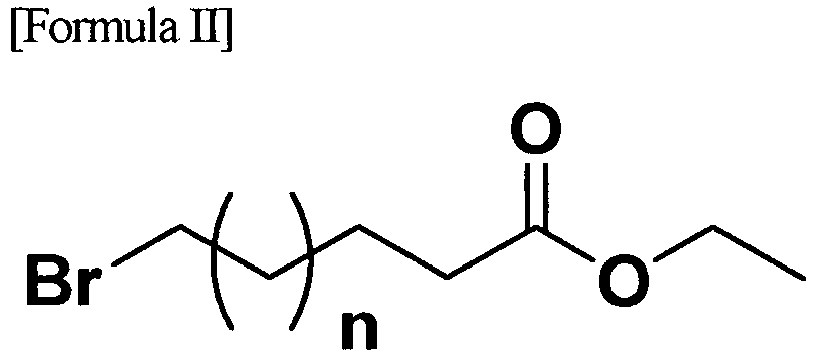
- (13) A method for preparing hydroxamate derivatives, the method comprising the steps of: allowing a compound of the following formula II to react with bromoaniline in the presence of an inorganic salt so as to prepare a compound of the following formula III; allowing the compound of formula III to react with 4-nitrophenylchloroformate so as to prepare a compound of the following formula VI; subjecting the compound of formula VI to the Suzuki reaction with boronic acid in the presence of palladium to prepare a compound of the following formula VII; allowing the compound of formula VII to react with an amine in the presence of an inorganic salt so as to prepare a compound of the following formula VIII; and treating the compound of formula VIII with a hydroxide salt, thus preparing hydroxamate derivatives of the following formula I-2:




- The hydroxamate derivatives of formula I of the present invention can be prepared according to the following reaction scheme 1:


-
- Compound 167. R2 = hydrogen (n=3)
- Compound 180. R2 = 4-methoxybenzoyl (n=3)
- Compound 181. R2 = nicotinoyl (n=3)
- Compound 184. R2 = 2-phenylacetyl (n=3)
- Compound 185. R2 =

- Compound 189. R2 =

- Compound 190. R2 = hydroxyethyl (n=3)
- Compound 203. R2 = thiophene-2-sulfonyl (n=3)
- Compound 204. R2 = furan-2-carbonyl (n=3)
- Compound 207. R2 = 4-methoxybenzene sulfonyl (n=3)
- Compound 209. R2 = 4-methylbenzoyl (n=3)
- Compound 210. R2 = benzenesulfonyl (n=3)
- Compound 211. R2 = picolinoyl (n=3)
- Compound 212. R2 = 3-methoxybenzoyl (n=3)
- Compound 214. R2 = 3,4,5-trimethoxybenzoyl (n=3)
- Compound 215. R2 = 4-dimethylaminobenzoyl (n=3)
- Compound 218. R2 = 2-aminoacetyl (n=3)
- Compound 221. R2 = 6-chloronicotinoyl (n=3)
- Compound 222. R2 = isonicotinoyl (n=3)
- Compound 228. R2 =

- Compound 229. R2 = 2,6-difluorobenzoyl (n=3)
- Compound 230. R2 =4-fluorobenzoyl (n=3)
- Compound 231. R2 = 6-(trifluoromethyl)nicotinoyl (n=3)
- Compound 234. R2 = hydrogen (n=2)
-
- Compound 258. R2 =

- Compound 261. R2 = 5-amino-2-methoxybenzene-1-sulfonyl (n=3)
- Compound 263. R2 = pyridine-3-sulfonyl (n=3)
- Compound 264. R2 = methanesulfonyl (n=3)
- Compound 265. R2 = 2-(dimethylamino)acetyl (n=3)
- Compound 266. R2 =

- Compound 267. R2 =

- Compound 269. R2 =

- Compound 272. R2 = propionyl (n=3)
- Compound 273. R2 = 1-methyl-1,2,5,6-tetrahydropyridine-3-carbonyl (n=3)
- Compound 276. R2 = ethanesulfonyl (n=3)
- Compound 277. R2 = dimethylsulfamoyl (n=3)
- Compound 278. R2 = cyclohexanecarbonyl (n=3)
- Compound 279. R2 = cyclopropanecarbonyl (n=3)
- Compound 280. R2 = 2-morpholinoacetyl (n=3)
- Compound 281. R2 = (S)-pyrrolidine-2-carbonyl (n=3)
- Compound 285. R2 = propane (n=3)
- Compound 286. R2 = 2-(4-methylpiperazin-1-yl)acetyl (n=3)
- Compound 291. R2 = pentanoyl (n=3)
- Compound 292. R2 = isobutyryl (n=3)
- Compound 293. R2 = 2-(4-(2-methoxyethyl)piperazin-1-yl)acetyl (n=3)
- Compound 299. R2 =

-
Compound 300. R2 = thiophene-2-carbonyl (n=3) - Compound 304. R2 =1-methylpiperidine-4-carbonyl (n=3)
- Compound 354. R2 = 4-methylpipereine-1-sulfonyl (n=3)
-
- Compound 235. R2 = hydrogen (n=4)
- Compound 236. R2 = 4-methoxybenzoyl (n=3)
- Compound 237. R2 = benzyl (n=3)
- Compound 239. R2 = 2,4,6-trifluorobenzoyl (n=3)
- Compound 242. R2 = 4-aminobenzoyl (n=3)
- Compound 243. R2 = piperidine-1-carbonyl (n=3)
- Compound 244. R2 = 4-methoxy-3-(trifluoromethyl)benzoyl (n=3)
- Compound 245. R2 = 4-(trifluoromethyl)benzoyl (n=3)
- Compound 246. R2 = 3,4-dimethoxybenzoyl (n=3)
- Compound 249. R2 = 3,4-dimethoxybenzene-1-sulfonyl (n=3)
-
Compound 250. R2 = 4-(methanesulfonyl)benzene-1-sulfonyl (n=3) - Compound 253. R2 = naphthalene-2-sulfonyl (n=3)
- Compound 257. R2 = acetyl (n=3)
- Compound 158. R2 = hydrogen (n=3)
-
-
Compound 150. R2 = hydrogen (n=3) - Compound 208. R2 = 4-methoxybenzoyl (n=3)
- Compound 303. R2 = methanesulfonyl (n=3)
- Compound 305. R2 = picolinoyl (n=3)
- Compound 311. R2 = nicotinoyl (n=3)
- Compound 314. R2 = ethanesulfonyl (n=3)
- Compound 325. R2 = isonicotinoyl (n=3)
- Compound 355. R2 = 4-methylpiperazine-1-sulfonyl (n=3)
-
- Compound 270. R2 = nicotinoyl (n=3)
- Compound 271. R2 = hydrogen (n=3)
- Compound 284. R2 = methanesulfonyl (n=3)
- Compound 302. R2 = picolinoyl (n=3)
- Compound 310. R2 = ethanesulfonyl (n=3)
- Compound 342. R2 = 4-methylpiperazine-1-sulfonyl (n=3)
- As shown
reaction scheme 1 above, potassium carbonate (K2CO3) and dimethylformamide (DMF) are added to the compound of formula II that is the starting material, and then a bromoaniline compound is added dropwise thereto, after which the mixture is allowed to react at a temperature of 40~60 °C, thus synthesizing the compound of formula III. As shown inreaction scheme 1, the obtained compound of formula III is subjected to the Suzuki reaction (Morris, G. A., et al., Tetrahedron Lett., 2001, 42, 2093) using boronic acid, thus preparing the compound of formula IV. Where R2 is H, potassium hydroxide (KOH), methanol and hydroxylamine hydrochloride (HONH2 HCl) are sequentially added dropwise to the compound of formula IV, and then allowed to react at room temperature, thus synthesizing desiredfinal compounds 150, 167, 234, 235 and 271. - Where R2 is not H, acid chloride is added to the compound of formula IV, and potassium carbonate (K2CO3) and acetonitrile (CH3CN) are added dropwise thereto, after which the mixture is acylated at room temperature, thus preparing an amide derivative of formula V. To the amide derivative, potassium hydroxide (KOH), methanol and hydroxylamine hydrochloride (HONH2 HCl) are sequentially added dropwise, and the mixture is allowed to react at room temperature, thus preparing desired
final compounds - Also, the hydroxamate derivatives of formula I can be prepared according to the following reaction scheme 2:


-
- Compound 313. R5 = 1-methylpiperazine(n=3)
- Compound 316. R5 = morpholine (n=3)
- Compound 319. R5 = 2,6-dimethylmorpholine (n=3)
- Compound 340. R5 = 1-ethylpiperazine (n=3)
-
-
Compound 312. R5 = 1-methylpiperazine (n=3) - Compound 315. R5 = morpholine (n=3)
- Compound 318. R5 = 2,6-dimethylmorpholine (n=3)
-
Compound 336. R5 = 1-ethylpiperazine (n=3) - Compound 347. R5 = N,N-dimethylethane-1,2-diamine (n=3)
- Compound 348. R5 = 2-(1-methylpyrrolidin-2-yl)ethanamine (n=3)
- Compound 353. R5 = (1-ethylpyrrolidin-2-yl)methanamine (n=3)
-
- Compound 350. R5 = 1-methylpiperazine (n=3)
- Compound 351. R5 = 1-ethylpiperazine (n=3)
- Compound 345. R; = 1-methylpiperazine (n=3)
-
- Compound 255. R5 = 4-methoxybenzeneamine (n=3)
- Compound 256. R5 = 3-methoxybenzeneamine (n=3)
- Compound 259. R5 = 2-methoxybenzeneamine (n=3)
- Compound 260. R5 = 3,5-dimethoxybenzeneamine (n=3)
- Compound 262. R5 = thiophene-2-amine (n=3)
- Compound 268. R5 = dimethylamine (n=3)
- Compound 274. R5 = pyridine-3-amine (n=3)
- Compound 275. R5 = methylamine (n=3)
- Compound 282. R5 = isopropylamine (n=3)
- Compound 283. R5 = isobutylamine (n=3)
- Compound 287. R5 = butylamine (n=3)
- Compound 288. R5 = 4-methylpentylamine (n=3)
- Compound 289. R5 = N,N-dimethylpropane-1,3-diamine (n=3)
- Compound 290. R5 = cyclohexylmethylamine (n=3)
- Compound 294. R5 = diethylamine (n=3)
- Compound 295. R5 = ethylamine (n=3)
- Compound 306. R5 = morpholine (n=3)
- Compound 309. R5 = 1-methylpiperazine (n=3)
- Compound 317. R5 = 2,6-dimethylmorpholine (n=3)
- Compound 323. R5 = 1-isopropylpiperazine (n=3)
- Compound 324. R5 = pyrrolidine (n=3)
- Compound 329. R5 = 1-(piperazin-1-yl)ethanone (n=3)
- Compound 330. R5 = 1-methylhomopiperazine (n=3)
- Compound 335. R5 = 1-benzylpiperazine (n=3)
- Compound 339. R5 = 1-ethylpiperazine (n=3)
- Compound 343. R5 = 1-(2-methoxyphenyl)piperazine (n=3)
- Compound 344. R5 = 1-(3-methoxyphenyl)piperazine (n=3)
- Compound 346. R5 = 2-(piperazin-1-yl)ethanol (n=3)
- Compound 349. R5 = 1-butylpiperazine (n=3)
- Compound 352. R5 = N,N-dimethyl-2-(piperazin-1-yl)ethanamine (n=3)
- Compound 356 R5 = 4-methylpiperidine (n=3)
- As shown in
reaction scheme 2 above, the compound of formula III is synthesized in the same manner asreaction scheme 1, and then allowed to react 4-nitrophenylchloroformate so as to synthesize the compound of formula VI, which is then subjected to the Suzuki reaction (Morris, G. A., et al., Tetrahedron Lett., 2001, 42, 2093) using boronic acid, thus synthesizing the compound of formula VII. Various substituents are added to the compound of formula VII, thus synthesizing the compound of formula VIII. To the compound of formula VIII, potassium hydroxide (KOH), methanol and hydroxyamine hydrochloride (HONH2 HCl) are sequentially added dropwise, and the mixture is allowed to react at room temperature, thus preparing desired final compounds.Reaction scheme 2 shows a general process for synthesizinginventive compounds reaction scheme 2.

- Compound 170. R1 =1H-indol-4-yl, R2 = hydrogen
- Compound 179. R1 =1H-indol-7-yl, R2 = hydrogen
- Compound 191. R1 = 1-(phenylsulfonyl)-1H-indol-2-yl, R2 = hydrogen
- Compound 332. R1 =1H-indol-2-yl, R2 = methanesulfonyl
- Compound 333. R1 = 1-(tert-butoxycarbonyl)-1H-indol-2-yl, R2 = methanesulfonyl
- Compound 337. R1 = 5-bromo- 1H-indol-2-yl, R2 = methanesulfonyl
- Compound 338. R1 = 5-bromo-1-(tert-butoxycarbonyl)-1H-indol-2-yl, R2 = methanesulfonyl
- Compound 174. R1 =1H-indol-6-yl, R2 = hydrogen
- Compound 175. R1 =1H-indol-6-yl, R2 = hydrogen
- Compound 326. R1 =1H-indol-6-yl, R2 = methanesulfonyl
- Compound 327. R1 = 1-methyl-1H-indazol-6-yl, R2 = methanesulfonyl
- Compound 328. R1 =1H-indol-5-yl, R2 = methanesulfonyl
- Compound 178. R1 =1H-indol-6-yl, R2 = hydrogen
- Compound 251. R1 =1H-indol-6-yl, R2 = hydrogen
- Compound 252 . R1 =1H-indol-6-yl, R2 = nicotinoyl
- Compound 254. R1 = 1H-indol-6-yl, R2 = 4-methoxybenzoyl
- Reaction scheme 3 above shows a general process for synthesizing inventive compounds 170, 174, 175, 178, 179, 191, 251, 252, 254, 326, 327, 328, 332, 333, 337 and 338. As shown in reaction scheme 3, the compound of formula IX or X is used as a starting material and subjected to the Suzuki reaction (Morris, G. A., et al., Tetrahedron Lett., 2001, 42, 2093) using boronic acid, thus synthesizing the compound of formula XI. To the compound of formula XI, potassium hydroxide (KOH), methanol and hydroxylamine hydrochloride (HONH2 HCl) are sequentially added dropwise, and the mixture is allowed to react at room temperature, thus preparing desired final compounds.


-
Reaction scheme 4 above shows a general process of preparinginventive compounds 296, 307 and 334, and other compounds of the present invention can also be prepared according toreaction scheme 4. As shown inreaction scheme 4,compound 1 is subjected to the Suzuki coupling reaction to preparecompound 2, and the nitro group ofcompound 2 is reduced to obtain compound 3, which is then allowed to react with ethyl 7-bromoheptanoate, thus synthesizingcompound 4. Then,compound 4 is sulfonylated or acylated to prepare the compound of formula V-1, after which potassium hydroxide (KOH), methanol and hydroxylamine hydrochloride (HONH2 HCl) are sequentially added dropwise thereto, orcompound 4 is methylated, after which potassium hydroxide (KOH), methanol and hydroxylamine hydrochloride (HONH2 HCl) are sequentially added dropwise thereto, thus preparing a final compound.
-
Reaction scheme 5 above shows a general process of synthesizing compounds by introducing methanesulfonyl intocompound 5, and other compounds of the present invention can also be prepared according toreaction scheme 5. As shown inreaction scheme 5, the starting material is allowed to react with methanesulfonyl and ethyl 7-bromoheptanoate sequentially, and the resulting product is subjected to the Suzuki reaction to synthesize the compound of formula XII, which is then N-methylated and hydroxamated, thus synthesizing final compounds 320 and 321.
-
Reaction scheme 6 above shows a general process of synthesizing inventive compounds 331 and 341, and other compounds of the present invention can also be prepared according toreaction scheme 6. As shown inReaction Scheme 6, the compound of formula VII-1 is synthesized in the same manner as inreaction scheme 2, after which the compound of formula VII-1 is N-methylated and substituted with piperazine to make the compound of formula VIII-1 which is then hydroxamated, thus synthesizing final compounds.
- Reaction scheme 7 above shows a general process of synthesizing inventive compounds 166, 169, 172 and 176, and other compounds of the present invention can also be prepared according to reaction scheme 7. As shown in reaction scheme 7, the compound of formula XIII that is the starting material is subjected to the Suzuki reaction to synthesize the compound of formula XIV, which is then N-alkylated with ethyl 7-bromoheptanoate to synthesize the compound of formula XV, which is then hydroxamated, thus synthesizing final compounds.


-
Reaction scheme 8 above shows a general process of synthesizing inventive compounds 357, 358 and 359, and other compounds of the present invention can also be prepared according toreaction scheme 8. As shown in reaction scheme 9, compound 9 is allowed to react with thiophosgene and methylpiperazine so as to synthesize compound 11, which is then subjected to the Suzuki reaction to synthesize the compound of formula XVI, which is then hydroxamated, thus synthesizing final compounds. - Hereinafter, the present invention will be described in further detail with reference to examples. It is to be understood, however, that these examples are illustrative purposes only and are not construed to limit the scope of the present invention.
- As shown in
reaction scheme 1, 4-bromoaniline and ethyl 7-bromoheptanoate were reacted with each other to obtain a compound of formula III, which was then subjected to the Suzuki reaction to obtain a compound of formula IV, which was then stirred with hydroxylamine and potassium hydroxide for 30 minutes. Then, a 50% water solution of hydroxylamine was added to the stirred solution until the undissolved solids were dissolved so that the solution became clear. Then, the reaction solution was stirred at room temperature for 10 hours. After the completion of the reaction has been confirmed, the reaction product was distilled under reduced pressure to remove the solvent, and the remaining material was extracted using ethyl acetate, washed with brine, dried with anhydrous magnesium sulfate, filtered, and concentrated under reduced pressure. The residue was crystallized, thus obtaining compound 150 (30 mg, 62%).
1H NMR (400 MHz, CD3OD) δ 7.42 (m, 2H), 7.17 (m, 1H), 7.11 (m, 1H), 6.92 (dd, J= 2.4, 0.5 Hz, 1H), 6.70 (d, J = 8.7 Hz, 1H), 6.66 (dd, J = 8.7, 2.3 Hz, 1H), 6.44 (dd, J= 3.1, 0.8 Hz, 1H), 6.26 (dd, J = 3.1,0.8 Hz, 2H), 3.09 (t, J = 7.1 Hz, 2H), 2.09 (t, J = 7.3 Hz, 2H), 1.63 (m, 4H), 1.44 (m, 4H). MS (ESI) m/z 352 (M+ + H). - As shown in
reaction scheme 1, 4-bromoaniline and ethyl 7-bromoheptanoate were reacted with each other to obtain a compound of formula III, which was then subj ected to the Suzuki reaction with boronic acid, and the resulting compound was stirred with hydroxylamine and potassium hydroxide for 30 minutes. Then, a 50% water solution of hydroxylamine was added to the stirred solution until the undissolved solids were dissolved so that the solution became clear. Then, the reaction solution was stirred at room temperature for 10 hours, and after the completion of the reaction has been confirmed, the reaction product was concentrated under reduced pressure to remove the solvent. The remaining material was extracted using ethyl acetate, washed with brine, dried with anhydrous magnesium sulfate, filtered, and concentrated under reduced pressure. The residue was crystallized, thus obtaining 158 (39 mg, 41%).
1H NMR (400 MHz, CD3OD) δ 7.66 (s, 1H), 7.41 (d, J= 8.7 Hz, 2H), 7.35 (s, 1H), 7.11 (d, J= 3.1 Hz, 1H), 6.71 (d, J = 8.7 Hz, 2H), 6.41 (d, J = 3.1 Hz, 1H), 3.19 (s, 3H), 3.10 (t, J = 7.2 Hz, 2H), 2.10 (t, J = 7.5 Hz, 2H), 1.62 (m, 4H), 1.25 (m, 4H). MS (ESI) m/z 366 (M+ + H) - As shown in reaction scheme 7, a compound of formula XIV was obtained through the Suzuki reaction and then was allowed to react with ethyl 7-bromoheptanoate so as to obtain a compound of formula XV, after which the compound of formula XV (10 mg, 0.03 mmol) was stirred with hydroxylamine and potassium hydroxide for 30 minutes. Then, a 50% water solution of hydroxylamine was added to the stirred solution until the undissolved solids were dissolved so that the solution became clear. Then, the reaction solution was stirred at room temperature for 10 hours, and after the completion of the reaction has been confirmed, the reaction product was concentrated under reduced pressure to remove the solvent. The remaining material was extracted using ethyl acetate, washed with brine, dried with anhydrous magnesium sulfate, filtered, and concentrated under reduced pressure. The residue was crystallized, thus obtaining 166 (7 mg, 73%).
1H NMR (400 MHz, CDCl3) δ 7.56(m, 2H), 7.31(m, 3H), 6.92(m, 2H), 6.63(m, 1H), 6.37(m, 1H), 3.14(m, 2H), 2.14(m, 2H), 1.67(m, 4H), 1.41(m, 4H). MS (ESI) m/z 352 (M+ + H). - Compound 167 (35 mg, 52%) as a white solid was obtained according to the same method as the synthesis of
compound 150.
1H NMR (400 MHz, CD3OD) δ 7.52 (d, J = 8.3 Hz, 1H), 7.51 (s, 1H), 7.43 (dd, J = 6.6, 2.0 Hz, 1H), 7.22 (dd, J = 8.3, 1.6Hz, 1H), 7.19 (d, J= 3.1 Hz, 1H), 6.70 (dd, J = 6.7, 2.0 Hz, 2H), 6.40 (dd, J = 3.1, 0.8 Hz, 1H), 3.10 (t, J = 7.1 Hz, 2H), 2.10 (t, J = 7.4 Hz, 2H), 1.62 (m, 4H), 1.41 (m,2H). MS (ESI) m/z 352 (M+ + H). - Compound 169 (8 mg, 70%) as a white solid was obtained according to the same method as the synthesis of compound 166.
1H NMR (400 MHz, CDCl3) δ 7.74 (d, J = 1.4 Hz, 1H), 7.38 (m, 2H), 7.24 (d, J = 3.1 Hz, 1H), 7.15 (m, 2H), 6.92 (m, 2H), 6.60 (m, 1H), 6.47 (d, J = 3.0 Hz, 1H), 3.14 (m, 2H), 2.11 (m, 2H), 1.66 (m, 4H), 1.42 (m, 4H). MS (ESI) m/z 352 (M+ + H). - As shown in reaction scheme 3, a compound of formula IX was subjected to the Suzuki reaction to obtain a compound of formula XI, which was then stirred with hydroxylamine and potassium hydroxide for 30 minutes. Then, a 50% water solution of hydroxylamine was added to the stirred solution until the undissolved solids were dissolved so that the solution became clear. Then, the reaction solution was stirred at room temperature for 10 hours, and after the completion of the reaction has been confirmed, the reaction product was concentrated under reduced pressure to remove the solvent. The remaining material was extracted using ethyl acetate, washed with brine, dried with anhydrous magnesium sulfate, filtered, and concentrated under reduced pressure. The residue was crystallized, thus obtaining compound 170 (15 mg, 78%).
1H NMR (400 MHz, CD3OD) δ 7.45 (dd, J = 6.5, 2.1 Hz, 2H), 7.29 (d, J = 8.2 Hz, 1H), 7.19 (d, J = 3.2 Hz, 1H), 7.17 (t, J = 8.2 Hz, 1H), 7.01 (dd, J= 7.2, 0.8 Hz, 1H), 6.87 (dd, J = 6.5, 2.1 Hz,2H), 6.55 (dd, J = 3.2, 0.8 Hz, 1H), 4.17 (t, J = 7.0 Hz, 2H), 2.05 (t, J = 7.5 Hz, 2H), 1.58 (m, 2H), 1.3 (m, 6H). MS (ESI) m/z 352 (M+ + H). - Compound 172 (3 mg, 21%) as a white solid was obtained according to the same method as the synthesis of compound 166.
1H NMR (400 MHz, CD3OD) δ 7.50 (d, J = 1.3, 1H), 7.45 (d, J = 8.3 Hz, 1H), 7.27 (d, J = 3.2, 1H), 7.15 (m, 1H), 7.06 (m, 2H), 6.71 (m, 2H), 6.46 (dd, J = 3.1, 0.6 Hz, 1H), 3.07 (t, J = 6.9 Hz, 2H), 2.02 (t, J= 7.6 Hz, 2H), 1.51 (m, 4H), 1.29 (m, 4H). MS (ESI) m/z 352 (M+ + H) - Compound 174 (3 mg, 23%) as a white solid was obtained according to the same method as the synthesis of compound 170.
1H NMR (400 MHz, CD3OD) δ 8.19 (d, J = 2.4 Hz, 1H), 7.75 (dd, J = 8.7, 2.5 Hz, 1H), 7.57 (d, J = 8.3 Hz, 1H), 7.50 (d, J = 8.3 Hz, 1H), 7.50 (d, J = 0.7 Hz, 1H), 7.23 (t, J = 3.3 Hz, 1H), 7.18 (dd, J = 8.3,1.6 Hz, 1H), 6.60 (d, J = 8.7 Hz, 1H), 6.43 (dd, J = 3.1, 0.9 Hz, 1H), 3.31 (m, 2H), 2.10 (t, J = 7.4 Hz, 2H), 1.65 (m, 4H), 1.43 (m, 4H). MS (ESI) m/z 353 (M+ + H). - Compound 175 (11 mg, 33%) as a white solid was obtained according to the same method as the synthesis of compound 170.
1H NMR (400 MHz, CD3OD) δ 7.95 (d, J = 2.7 Hz, 1H), 7.79 (s, 1H), 7.59 (d, J = 5.8 Hz, 1H), 7.57 (d, J = 5.5 Hz,1H), 7.45 (dd, J = 8.3, 1.6 Hz, 1H), 7.25 (d, J = 3.1 Hz, 1H), 7.08 (dd, J = 8.7, 2.8 Hz, 1H), 6.44 (dd, J = 3.1, 0.7 Hz, 1H), 3.12 (t, J = 7.0 Hz ,2H), 2.10 (t, J = 7.4 Hz, 2H), 1.64 (m, 4H), 1.42 (m, 4H). MS (ESI) m/z 353 (M+ + H). - Compound 176 (22 mg, 56%) as a white solid was obtained according to the same method as the synthesis of compound 166.
1H NMR (400 MHz, CD3OD) δ 7.51 (d, J = 8.8 Hz, 1H), 7.23 (m, 2H), 7.08 (m, 2H), 6.67 (d, J = 1.4 Hz, 1H), 6.49 (d, J = 3.1 Hz, 1H), 3.12 (t, J = 7.1 Hz, 2H), 2.09 (t, J = 7.4 Hz, 2H), 1.63 (m, 4H), 1.40 (m, 4H). MS (ESI) m/z 352(M+ + H). - Compound 178 (39 mg, 84%) as a white solid was obtained according to the same method as the synthesis of compound 170.
1H NMR (400 MHz, CD3OD) δ 8.56 (s, 2H), 7.58 (d, J = 8.2 Hz, 1H), 7.49 (s, 1H), 7.19 (d, J= 3.1 Hz, 1H), 7.16 (dd, J = 8.2, 1.4 Hz, 1H), 6.42 (d, J = 2.9 Hz, 1H), 4.16 (t, J = 6.9 Hz, 2H), 2.04 (t, J = 7.4Hz, 2H), 1.78 (m, 2H), 1.30 (m, 6H). MS (ESI) m/z 354 (M+ + H). - Compound 179 (12 mg, 82%) as a white solid was obtained according to the same method as the synthesis of compound 170.
1H NMR (400 MHz, CD3OD) δ 7.47 (dd, J = 7.9, 1.0 Hz, 1H), 7.13 (d, J = 8.3 Hz, 2H), 7.08 (d, J = 3.1 Hz, 2H), 6.99 (t, J = 7.8 Hz, 1H), 6.84 (d, J = 6.2 Hz, 1H), 6.80 (d, J = 8.4 Hz, 2H), 6.44 (d, J = 3.2 Hz, 1H), 3.76 (t, J = 7.6 Hz, 2H), 1.98 (t, J = 7.6 Hz, 2H), 1.43 (m, 2H), 1.30 (m, 2H), 1.04 (m, 2H), 0.86 (m, 2H). MS (ESI) m/z 352 (M+ + H). - As shown in
reaction scheme 1, 4-bromoaniline and ethyl 7-bromoheptanoate were reacted with each other to obtain a compound of formula III, which was then subjected to the Suzuki reaction with indole 6-boronic acid to obtain a compound of formula IV, which was then acylated with 4-methoxybenzoyl chloride to obtain a compound of formula V, after which the compound (31 mg 0.06 mmol) of formula V was stirred with hydroxylamine and potassium hydroxide for 30 minutes. Then, a 50% water solution of hydroxylamine was added to the stirred solution until the undissolved solids were dissolved so that the solution became clear. Then, the reaction solution was stirred at room temperature for 10 hours, and after the completion of the reaction has been confirmed, the reaction product was concentrated under reduced pressure to remove the solvent. The remaining material was extracted using ethyl acetate, washed with brine, dried with anhydrous magnesium sulfate, filtered, and concentrated under reduced pressure. The residue was crystallized, thus obtaining compound 180 (12 mg, 41%).
1H NMR (400 MHz, CD3OD) δ 7.57 (m, 4H), 7.27 (m, 4H), 7.13 (d, J = 8.4 Hz, 2H), 6.74 (d, J = 8.8 Hz, 2H), 6.43 (m, 1H), 3.93 (m, 2H), 3.70 (s, 3H), 2.05 (m, 2H), 1.60 (m, 4H), 1.36 (m, 4H). MS (ESI) m/z 352 (M+ + H). - Compound 181 (10 mg, 45%) as a white solid was obtained according to the same method as the synthesis of compound 180.
1H NMR (400 MHz, CD3OD) δ 8.47 (s, 1H), 8.40 (d, J = 3.9 Hz, 1H), 7.79 (d, J = 7.5 Hz, 1H), 7.58 (m, 4H), 7.27 (m, 5H), 6.45 (d, J = 2.9 Hz, 1H), 5.50 (s, 1H), 3.99 (t, J = 6.8 Hz, 2H), 2.09 (t, J = 7.4 Hz, 2H), 1.65 (m, 4H), 1.30 (m, 4H). MS (ESI) m/z 457 (M+ + H). - Compound 184 (27 mg, 82%) as a white solid was obtained according to the same method as the synthesis of compound 180.
1H NMR (400 MHz, CD3OD) δ 7.71 (d, J = 8.4 Hz, 2H), 7.65 (m, 2H), 7.34 (m, 1H), 7.29 (d, J = 3.1 Hz, 1H), 7.21 (m, 5H), 7.04 (d, J = 6.8 Hz, 2H), 6.48 (d, J = 3.1 Hz, 1H), 3.74 (t, J = 7.4 Hz, 2H), 3.51 (s, 2H), 2.07 (t, J = 7.4 Hz, 2H), 1.57 (m, 4H), 1.32 (m, 4H). MS (ESI) m/z 470 (M+ + H). - Compound 185 (20 mg, 51%) as a white solid was obtained according to the same method as the synthesis of compound 180.
1H NMR (400 MHz, CD3OD) δ 7.73 (d, J = 1.9 Hz, 2H), 7.62 (m, 2H), 7.42 (m, 5H), 7.24 (m, 2H), 7.11 (m, 2H), 6.47 (d, J = 1.9 Hz, 1H), 3.81 (m, 2H), 2.10 (m, 2H), 1.62 (m, 4H), 1.38 (m, 4H). MS (ESI) m/z 472 (M+ + H). - Compound 189 (12 mg, 51%) as a white solid was obtained according to the same method as the synthesis of compound 180.
1H NMR (400 MHz, CD3OD) δ 7.63 (m, 4H), 7.29 (m, 9H), 6.47 (s, 1H), 5.15 (s, 2H), 3.73 (t, J = 7.5 Hz, 2H), 2.05 (t, J = 7.5 Hz, 2H), 1.58 (m, 4H), 1.32 (m, 4H). MS (ESI) m/z 486 (M+ + H). - Compound 190 (8 mg, 28%) as a white solid was obtained according to the same method as the synthesis of compound 180.
MS (ESI) m/z 396 (M+ + H). - Compound 191 (320 mg, 39%) as a white solid was obtained according to the same method as the synthesis of compound 170.
1H NMR (400 MHz, CD3OD) δ 8.21 (d, J = 8.3 Hz, 1H), 7.29 (m, 10H), 6.61 (d, J = 8.6 Hz, 2H), 6.40 (s, 1H), 3.10 (t, J = 7.0 Hz, 2H), 2.10 (t, J = 7.4 Hz, 2H), 1.64 (m, 4H), 1.42 (m, 4H). MS (ESI) m/z 492 (M+ + H). - Compound 203 (4 mg, 15%) as a yellow oil was obtained according to the same method as the synthesis of compound 180.
1H NMR (400 MHz, CD3OD) δ 7.79 (m, 2H), 7.64 (s, 1H), 7.61 (m, 2H), 7 43 (s, 1H), 7.26 (m, 4H), 6.48 (m, 1H), 6.31 (m, 1H), 5.94(s, 1H), 3.86 (m, 2H), 2.07 (m, 2H), 1.64 (m, 4H), 1.35 (m, 4H). MS (ESI) m/z 497 (M+ + H). - Compound 204 (4 mg, 14%) as a yellow oil was obtained according to the same method as the synthesis of compound 180.
1H NMR (400 MHz, CD3OD) δ 7.82 (d, J= 4.9 Hz, 1H), 7 62 (m, 4H), 7.43 (d, J = 3.6 Hz, 1H), 7.29 (m, 2H), 7.15 (m, 3H), 6.47 (d, J= 2.7 Hz, 1H), 3.66 (t, J = 6.1 Hz, 2H), 3.07 (t, J = 7.3 Hz, 2H), 1.58 (m, 2H), 1.46 (m, 2H), 1.32 (m, 4H). MS (ESI) m/z 446 (M+ + H). - Compound 207 (54 mg, 6%) as a white solid was obtained according to the same method as the synthesis of compound 180.
1H NMR (400 MHz, CD3OD) δ 7.57 (m, 6H), 7.26 (m, 2H), 7.05 (d, J = 8.4 Hz, 2H), 7.00 (d, J = 8.9 Hz, 2H), 6.45 (d, J = 3.1 Hz, 1H), 3.83 (s, 3H), 3.53 (t, J = 6.2 Hz, 2H), 2.04 (t, J = 7.4 Hz, 2H), 1.54 (m, 2H), 1.36 (m, 4H), 1.29 (m, 2H). MS (ESI) m/z 522 (M+ + H). - Compound 208 (8 mg, 22%) as a white solid was obtained according to the same method as the synthesis of compound 180.
1H NMR (400 MHz, CD3OD) δ 7.75 (d, J = 1.16 Hz, 1H), 7.56 (d, J = 8.44 Hz, 1H), 7.41 (m, 1H), 7.32 (m, 2H), 7.24 (d, J = 3.08 Hz, 1H), 7.13 (d, J = 8.36 Hz, 1H), 6.75 (d, J = 8.76 Hz, 1H), 6.47 (d, J = 2.48 Hz, 1H), 3.94 (t, J = 7.38 Hz, 2H), 2.07 (t, J = 7.38 Hz, 2H), 1.62 (m, 4H), 1.28 (m, 4H). MS (ESI) m/z 486 (M+ + H). - Compound 209 (52 mg, 98%) as a yellow oil was obtained according to the same method as the synthesis of compound 180.
1H NMR (400 MHz, CD3OD) δ 7.54 (m, 4H), 7.22 (m, 4H), 7.10 (d, J = 8.1 Hz, 2H), 7.00 (d, J = 7.6 Hz, 2H), 6.43 (d, J = 2.9 Hz, 2H), 3.91 (t, J = 7.2 Hz, 2H), 2.22 (s, 3H), 2.06 (t, J = 7.2 Hz, 2H), 1.59 (m, 4H), 1.24 (m, 4H). MS (ESI) m/z 470 (M+ + H). - Compound 210 (14 mg, 27%) as a white solid was obtained according to the same method as the synthesis of compound 180.
1H NMR (400 MHz, CD3OD) δ 7.61 (m, 8H), 7.54 (t, J = 7.8 Hz, 1H), 7.28 (dd, J = 8.3, 1.6 Hz, 1H), 7.27 (d, J = 3.1 Hz, 1H), 7.08 (d, J = 8.5 Hz, 2H), 6.45 (dd, J = 3.1, 0.8 Hz, 1H), 3.61 (t, J = 6.4 Hz, 2H), 2.06 (t, J = 7.4 Hz, 2H), 1.57 (m, 2H), 1.42 (m, 4H), 1.31 (m ,2H). MS (ESI) m/z 492(M+ + H). - Compound 211 (10 mg, 74%) as a white solid was obtained according to the same method as the synthesis of compound 180.
1H NMR (400 MHz, CD3OD) δ 8.37 (d, J = 3.8 Hz, 1H), 7.70 (t, J = 7.2 Hz, 1H), 7.52 (m, 4H), 7.39 (d, J = 7.8 Hz, 1H), 7.28 (m, 1H), 7.25 (d, J = 3.0 Hz, 1H), 7.19 (d, J = 8.4 Hz, 1H), 7.15 (d, J = 7.9 Hz, 2H), 6.43 (d, J = 2.6 Hz, 1H), 4.00 (t, J = 7.2 Hz, 2H), 2.09 (t, J = 7.3 Hz, 2H), 1.64 (m, 4H), 1.44 (m, 4H). MS (ESI) m/z 457 (M+ + H). - Compound 212 (52 mg, 98%) as a yellow oil was obtained according to the same method as the synthesis of compound 180.
1H NMR (400 MHz, CD3OD) δ 7.75 (d, J = 1.2 Hz, 1H), 7.56 (d, J = 8.4 Hz, 1H), 7.41 (m, 1H), 7.32 (m, 2H), 7.24 (d, J = 3.1 Hz, 1H), 7.13 (d, J = 8.4 Hz, 1H), 6.75 (d, J = 8.8 Hz, 1H), 6.47 (d, J = 2.5 Hz, 1H), 3.94 (t, J = 7.4 Hz, 2H), 2.07 (t, J = 7.4 Hz, 2H), 1.62 (m, 4H), 1.28 (m, 4H). MS (ESI) m/z 470 (M+ + H). - Compound 214 (10 mg, 25%) as a yellow oil was obtained according to the same method as the synthesis of compound 180.
1H NMR (400 MHz, CD3OD) δ 7.59 (m, 4H), 7.23 (m, 4H), 6.63 (s, 2H), 6.44 (d, 1H, J = 2.2 Hz), 3.96 (t, 2H, J = 7.0 Hz), 3.68 (s, 3H), 3.49 (s, 6H), 2.08 (t, 2H, J = 7.3 Hz), 1.63 (m, 4H), 1.37 (m, 4H). MS (ESI) m/z 546 (M+ + H). - Compound 215 (10 mg, 52%) as a yellow oil was obtained according to the same method as the synthesis of compound 180.
1H NMR (400 MHz, CD3OD) δ 7.57 (m, 4H), 7.24 (m, 4H), 7.13 (d, J = 8.5 Hz, 2H), 6.48 (m, 2H), 6.43 (m, 1H), 3.92 (t, J = 7.5 Hz, 2H), 2.87 (s, 6H), 2.05 (m, 2H), 1.61 (m, 4H), 1.36 (m, 4H). MS (ESI) m/z 451 (M+ + H). - Compound 218 (8 mg, 46%) as a yellow oil was obtained according to the same method as the synthesis of compound 180.
1H NMR (400 MHz, CD3OD) δ 7.78 (d, J = 8.3 Hz, 2H), 7.66 (s, 1H), 7.63 (d, J = 8.3 Hz, 1H), 7.32 (dd, J = 8.3, 1.7 Hz, 2H), 7.31 (m, 1H), 7.28 (d, J = 3.1 Hz, 1H), 6.47 (dd, J = 3.1, 0.7 Hz, 1H), 3.77(t J = 7.3 Hz, 2H), 2.07 (d, J = 7.3 Hz, 2H), 1.59 (m, 4H), 1.36 (m, 4H). MS (ESI) m/z 409 (M+ + H). - Compound 221 (22 mg, 32%) as a yellow oil was obtained according to the same method as the synthesis of compound 180.
1H NMR (400 MHz, CD3OD) δ 8.29 (s, 1H), 7.72 (d, J = 7.6 Hz, 1H), 7.62 (m, 4H), 7.25 (m, 5H), 6.44 (d, J = 2.8 Hz, 2H), 3.97 (m, 2H), 2.08 (t, J = 7.3 Hz, 2H), 1.62 (m, 4H), 1.28 (m, 4H). MS (ESI) m/z 491 (M+ + H). - Compound 222 (45 mg, 57%) as a yellow oil was obtained according to the same method as the synthesis of compound 180.
1H NMR (400 MHz, CD3OD) δ 8.40 (d, J = 5.1 Hz, 2H), 7.56 (m, 4H), 7.27 (m , 3H), 7.16 (m, 3H), 6.44 (d, J = 2.9 Hz, 1H), 3.95 (m, 2H), 2.07 (m, 2H), 1.61 (m, 4H), 1.27 (m, 4H). MS (ESI) m/z 457 (M+ + H). - Compound 228 (51 mg, 41%) as a yellow oil was obtained according to the same method as the synthesis of compound 180.
1H NMR (400 MHz, CD3OD) δ 7.70 (d, J= 7.6 Hz, 1H), 7.49 (m, 5H), 7.40 (d, J= 7.9 Hz, 1H), 7.35 (d, J = 7.9 Hz, 1H), 7.25 (d, J = 3.1 Hz, 1H), 7.14 (d, J = 7.8 Hz, 1H), 6.43 (d, J = 3.0 Hz, 1H), 3.95 (m, 2H), 2.07 (t, J = 7.4 Hz, 2H), 1.62 (m, 4H), 1.28 (m, 4H). MS (ESI) m/z 514 (M+ + H). - Compound 229 (49 mg, 92%) as a yellow oil was obtained according to the same method as the synthesis of compound 180.
1H NMR (400 MHz, CD3OD) δ 7.55 (m, 4H), 7.25 (d, J = 3.1 Hz, 1H), 7.20 (d, J= 8.4 Hz, 1H), 7.16 (d, J = 8.2 Hz, 1H), 6.81 (m, 2H), 6.43 (d, J = 2.9 Hz, 1H), 3.94 (t, J = 7.3 Hz, 2H), 2.04 (m, 2H), 1.61 (m, 4H), 1.31 (m, 4H). MS (ESI) m/z 492 (M+ + H). - Compound 230 (47 mg, 74%) as a yellow oil was obtained according to the same method as the synthesis of compound 180.
1H NMR (400 MHz, CD3OD) δ 7.58 (s, 1H), 7.56 (d, J = 2.8 Hz, 1H), 7.51 (d, J = 8.4 Hz, 2H), 7.32 (m, 2H), 7.25 (d, J = 3.1 Hz, 1H), 7.21 (dd, J = 8.4, 1.0 Hz, 1H), 7.05 (d, J= 8.2 Hz, 2H), 6 88 (t, J = 8.6 Hz, 2H), 6.44 (d, J = 3.0 Hz, 1H), 3.86 (t, J = 7.4 Hz, 2H), 2.06 (t, J = 7 4 Hz, 2H), 1.59 (m, 4H), 1.25 (m, 4H). MS (ESI) m/z 474 (M+ + H). - Compound 231 (52 mg, 52%) as a yellow oil was obtained according to the same method as the synthesis of compound 180
1H NMR (400 MHz, CD3OD)δ 8 60 (s, 1H), 7 87 (d, J= 7.9 Hz, 1H), 7 61 (d, J= 82 Hz, 1H), 7.55 (m, 4H), 7.26 (d, J = 3.1 Hz, 1H), 7.21 (d, J = 9.4 Hz, 1H), 715 (d, J = 8.0 Hz, 1H), 6.44 (d, J = 2.9 Hz, 1H), 3.94 (t, J = 6.8 Hz, 2H), 2..08 (t, J = 7.4 Hz, 2H), 1.68 (m, 4H), 1.35 (m, 4H). MS (ESI) m/z 525 (M+ + H) - Compound 234 (33 mg, 73%) as a yellow oil was obtained according to the same method as the synthesis of
compound 150.
1H NMR (400 MHz, CD3OD) δ 7.52 (m, 2H), 7.44 (d, J = 6.6 Hz, 2H), 7.22 (m, 2H), 6.71 (d, J= 8.5 Hz, 2H), 3.13 (t, J = 7.0 Hz, 2H), 214 (t, J = 7.3 Hz, 2H), 1.67 (m, 4H),147 (m, 4H). MS (ESI) m/z 337 (M+ + H). - Compound 235 (33 mg, 73%) as a yellow oil was obtained according to the same method as the synthesis of
compound 150. - Compound 236 (10 mg, 50%) as a yellow oil was obtained according to the same method as the synthesis of compound 180.
1H NMR (400 MHz, CD3OD) δ 7.56 (m, 4H), 7.24 (m, 4H), 7.13 (d, J = 8.5 Hz, 2H), 6.71 (d, J = 8.8 Hz, 2H), 6.43 (m, 1H), 3.93 (q, J = 7.0 Hz, 2H), 3.57 (t, J = 6.4 Hz, 2H), 2.07 (t, J = 7.5 Hz, 2H), 1.65 (m, 4H), 1.37 (m, 4H), 1.30 (t, J = 7.0 Hz, 3H). MS (ESI) m/z 501 (M+ + H). - Compound 237 (40 mg, 29%) as a yellow solid was obtained according to the same method as the synthesis of compound 180.
1H NMR (400 MHz, CD3OD) δ 7.44 (m, 4H), 7.22 (m, 7H), 6.72 (d, J = 8.8 Hz, 2H), 6.39 (d, J = 2.8 Hz, 1H), 4.53 (s, 2H), 3.40 (t, J = 7.6 Hz, 2H), 2.06 (t, J = 7.5 Hz, 2H), 1.60 (m, 4H), 1.32 (m, 4H). MS (ESI) m/z 442 (M+ + H). - Compound 239 (50 mg, 90%) as a yellow oil was obtained according to the same method as the synthesis of compound 180.
1H NMR (400 MHz, CD3OD) δ 7.56 (m, 4H), 7.24 (m, 4H), 6.79 (m, 2H), 6.44 (m, 1H), 3.97 (t, J = 7.3 Hz, 2H), 2.11 (t, J = 7.3 Hz, 2H), 1.66 (m, 4H), 1.25 (m, 4H). MS (ESI) m/z 509 (M+ + H). - Compound 242 (47 mg, 71%) as a yellow oil was obtained according to the same method as the synthesis of compound 180.
1H NMR (400 MHz, CD3OD) δ 7.56 (m, 4H), 7.25 (m, 2H), 7.12 (m, 4H), 6.44 (m, 3H), 3.91 (t, J = 7.5 Hz, 2H), 2.06 (t, J= 7.5 Hz, 2H), 1.59 (m, 4H), 1.33 (m, 4H). MS (ESI) m/z 471 (M+ + H). - Compound 243 (46 mg, 62%) as a white solid was obtained according to the same method as the synthesis of compound 180.
1H NMR (400 MHz, CD3OD) δ 7.6 (m, 4H), 7.26 (m, 2H), 7.08 (d, J = 8 0 Hz, 2H), 6.45 (d, J = 2.7 Hz, 1H), 3.58 (t, J = 7.8 Hz, 2H), 3.13 (m, 4H), 2.11 (t, J = 7.5 Hz, 2H), 1.56 (m, 4H), 1.44 (m, 4H), 1.24 (m, 4H). MS (ESI) m/z 462 (M+ + H). - Compound 244 (55 mg, 55%) as a yellow oil was obtained according to the same method as the synthesis of compound 180.
MS (ESI) m/z 555 (M+ + H). - Compound 245 (10 mg, 50%) as a yellow oil was obtained according to the same method as the synthesis of compound 180.
MS (ESI) m/z 524 (M+ + H). - Compound 246 mg, 71 %) as a yellow oil was obtained according to the same method as the synthesis of compound 180.
MS (ESI) m/z 517 (M+ + H). - Compound 249 (40 mg, 58%) as a yellow oil was obtained according to the same method as the synthesis of compound 180.
1H NMR (400 MHz, CD3OD) δ 7.60 (m, 4H), 7.27 (m, 3H), 7.06 (q, J = 8.5, 3H), 6.93 (d, J= 21 Hz, 1H), 6.45 (dd, J= 3 1, 06 Hz, 1H), 3.87 (s, 3H), 3.67 (s, 3H), 3.56 (t, J= 6.2 Hz, 2H), 2.07 (t, J= 7.4 Hz, 2H), 1.57 (m, 2H), 1.34 (m, 6H). MS (ESI) m/z 551 (M+ + H). - Compound 250 (56 mg, 69%) as a yellow oil was obtained according to the same method as the synthesis of compound 180.
H NMR (400 MHz, CD3OD) δ 8.12 (d, J = 7.7 Hz, 2H), 7.86 (d, J = 7.7 Hz, 2H), 7.61 (m, 4H), 7.29 (m, 2H), 7.1 (d, J = 8.5 Hz, 2H), 6.46 (d, J= 3.0 Hz, 1H), 3.64 (t, J = 6.3 Hz, 2H), 2..08 (t, J = 7.3 Hz, 2H), 1.58 (m, 2H), 144 (m, 4H), 1.30 (m, 2H). MS (ESI) m/z 569 (M+ + H). - Compound 251 (15 mg, 33%) as a yellow oil was obtained according to the same method as the synthesis of compound 170.
1H NMR (400 MHz, CD3OD) δ 7 48 (d, J= 7.7 Hz, 1H), 7.25 (s, 1H), 7.22 (d, J = 3.1 Hz, 1H), 7.11 (d, J = 8.4 Hz, 1H), 6.93 (d, J = 2.4 Hz,1H), 6.90 (dd, J = 8.2, 0.7 Hz, 6.79 (dd, J = 8.4, 2.4 Hz, 1H), 6.43 (dd, J = 3.1,0.8 Hz, 1H), 3.12 (t, J = 7.0 Hz, 2H), 2.10 (t, J = 7.4 Hz, 2H), 1.63 (m, 4H), 1.41 (m, 4H). MS (ESI) m/z 420 (M+ + H). - As shown in reaction scheme 3, a compound of formula IX was acylated with nicotinoyl chloride to obtain a compound of formula X, which was then subjected to the Suzuki reaction to obtain a compound of formula XI, which was then stirred with hydroxylamine and potassium hydroxide for 30 minutes. Then, a 50% water solution of hydroxylamine was added to the stirred solution until the undissolved solids were dissolved so that the solution became clear. Then, the reaction solution was stirred at room temperature for 10 hours, and after the completion of the reaction has been confirmed, the reaction product was concentrated under reduced pressure to remove the solvent. The remaining material was extracted using ethyl acetate, washed with brine, dried with anhydrous magnesium sulfate, filtered, and concentrated under reduced pressure. The residue was crystallized, thus obtaining compound 252 (25 mg 52%).
1H NMR (400 MHz, CD3OD)δ 8,47 (s, 2H), 7.84 (d, J = 7.3 Hz, 1H), 7.57 (s, 1H), 7.44 (m, 4H), 7.27 (m, 1H), 7.24 (s, 1H), 6.86 (d, J = 8.1 Hz, 1H), 6.46 (dd, J = 3.1, 0.9 Hz, 1H), 4.00 (m, 2H), 2.09 (t, J = 7.4 Hz, 2H), 1.62 (m, 4H), 1.23 (m, 4H). MS (ESI) m/z 525(M+ + H). - Compound 253 (54 mg, 41%) as a yellow oil was obtained according to the same method as the synthesis of compound 180.
1H NMR (400 MHz, CD3OD) δ 8.18 (s, 1H), 7.95 (m, 3H), 7.59 (m, 7H), 7.24 (m, 2H), 7.02 (d, J = 8.4 Hz, 2H), 6.44 (d, J = 2.8 Hz, 1H), 3.61 (t, J = 6.0 Hz, 2H), 2.06 (t, J = 7.4 Hz, 2H), 1.58 (m, 2H), 1.37 (m, 4H), 1.24 (m, 2H). MS (ESI) m/z 541 (M+ + H). - Compound 254 (49 mg, 94%) as a yellow oil was obtained according to the same method as the synthesis of compound 252.
1H NMR (400 MHz, CD3OD) δ 7.53 (d, J = 7.8 Hz, 1H), 7.29 (d, J = 6.8 Hz, 2H), 7.13 (d, J = 8.0 Hz, 1H), 7.03 (d, J = 1.8 Hz, 1H), 6.90 (m, 2H), 6.60 (d, J = 8.8 Hz, 2H), 7.39 (dd, J = 3.1, 0.8 Hz, 1H), 3.92 (t, J = 7.4 Hz, 2H), 3.73 (s,3H), 2.26 (s, 3H), 2.07 (t, J = 7.2 Hz, 2H), 1.62 (m, 4H), 1.33 (m, 4H). MS (ESI) m/z 499 (M+ + H). - As shown in
reaction scheme 2, 4-bromoaniline and ethyl 7-bromoheptanoate were reacted with each other to obtain a compound of formula III, which was then allowed to react with 4-nitrophenylchloroformate so as to obtain a compound of formula VI, which was then subjected to the Suzuki reaction with boronic acid to obtain a compound of formula VII, which was then allowed to react with 4-methoxybenzenamine so as to obtain a compound of formula VIII, after which the compound of formula VIII (31 mg, 0.06 mmol) was stirred with hydroxylamine and potassium hydroxide for 30 minutes. Then, a 50% water solution of hydroxylamine was added to the stirred solution until the undissolved solids were dissolved so that the solution became clear. Then, the reaction solution was stirred at room temperature for 10 hours, and after the completion of the reaction has been confirmed, the reaction product was concentrated under reduced pressure to remove the solvent. The remaining material was extracted using ethyl acetate, washed with brine, dried with anhydrous magnesium sulfate, filtered, and concentrated under reduced pressure. The residue was crystallized, thus obtaining compound 255 (12 mg, 41%).
1H NMR (400 MHz, CD3OD) δ 7.80 (d, J = 8.44 Hz, 2H), 7.68 (s, 1H), 7.64 (d, J = 8.2 Hz, 1H), 7.38 (m, 3H), 7.29 (d, J = 3.1 Hz, 1H), 7.19 (dd, J = 6.8,2.8 Hz, 2H), 6.82 (dd, J = 6.8,2.1 Hz, 2H), 6.48 (d, J = 3.08 Hz, 1H), 3.74 (m, 5H), 2.08 (t, J = 7.3 Hz, 2H), 1.62 (m, 4H), 1.36 (m, 4H). MS (ESI) m/z 500 (M+ + H]. - Compound 256 (39 mg, 50%) as a yellow oil was obtained according to the same method as the synthesis of compound 255.
1H NMR (400 MHz, CD3OD) δ 7.78 (d, J = 8.1 Hz, 2H), 7.69 (s, 1H), 7.63 (d, J = 8.2 Hz, 1H), 7.36 (t, J = 8.3 Hz, 3H), 7.28 (d, J = 2.7 Hz, 1H), 7.11 (t, J = 8.0 Hz, 1H), 7.05 (d, J = 1.8 Hz, 1H), 6.82 (d, J = 7.6 Hz, 1H), 6.58 (m, 1H), 6.47 (d, J = 1.4 Hz, 1H), 3.76 (m, 5H), 2.07 (t, J = 7.3 Hz, 2H), 1.61 (m, 4H), 1.35 (m, 4H). MS (ESI) m/z 500 (M+ + H). - Compound 257 (39 mg, 93%) as a yellow oil was obtained according to the same method as the synthesis of compound 180.
1H NMR (400 MHz, CD3OD) δ 7.75 (d, J = 8.3 Hz, 2H), 7.65 (t, J = 9.0 Hz, 2H), 7.32 (m, 4H), 6.48 (d, J = 3.1 Hz, 1H), 6.48 (d, J = 3.1 Hz, 1H), 3.74 (t, J = 7.4 Hz, 2H), 3.36 (s, 1H), 2.09 (t, J = 7.2 Hz, 2H), 1.58 (m, 4H), 1.34 (m, 4H). MS (ESI) m/z 393 (M+ + H). - Compound 258 (10 mg, 41%) as a yellow oil was obtained according to the same method as the synthesis of compound 180.
1H NMR (400 MHz, CD3OD) δ 7.64 (d, J = 8.6 Hz, 1H), 7.61 (m, 1H), 7.59 (d, J = 8.3 Hz, 1H), 7.28 (dd, J = 8.3, 1.6 Hz, 1H), 7.25 (d, J = 3.2 Hz, 1H), 7.23 (d, J = 8.3 Hz, 2H), 6.45 (dd, J = 3.1,0.8 Hz, 1H), 3.67 (m, 5H), 2.05 (t, J = 7.3 Hz, 2H), 1.56 (m, 4H), 1.30 (m, 4H). MS (ESI) m/z 410 (M+ + H). - Compound 259 (39 mg, 50%) as a yellow oil was obtained according to the same method as the synthesis of compound 255.
1H NMR (400 MHz, CD3OD) δ 7.99 (dd, J = 7.5,18Hz,1H), 7,77 (d, J = 8.4Hz, 2H, 7.68 (s, 1H), 7 61 (d, J = 8.2 Hz, 1H), 7.30 (m, 4H), 7.06 (m, 4H), 7.06 (m, 1H), 6.87 (m, 2H), 6.77 (dd, J= 73, 1.8 Hz, 1H), 6.46 (d, J = 3 0 Hz, 1H), 3.70 (t, J = 7.0 Hz, 2H), 3.52 (s, 3H), 2.06 (t, J = 7.3 Hz, 2H), 1.56 (m, 4H), 1.26 (m, 4H). MS (ESI) m/z 500 (M+ + H). - Compound 260 (35 mg, 75%) as a yellow oil was obtained according to the same method as the synthesis of compound 255.
1H NMR (400 MHz, CD3OD) δ 7.94 (d, J = 4.3 Hz, 2H), 7.75 (s, 1H), 7.61 (d, J = 8.1 Hz, 1H), 7 33 (d, J = 7.8 Hz, 3H), 7.28 (s, 1H), 6.58 (s, 1H), 6.51 (s, 2H), 6.47 (s, 1H), 6.13 (s, 1H), 3.71 (m, 8H), 2.17 (t, J = 7.0 Hz, 2H), 1.47 (m, 4H), 1.21 (m, 4H). MS (ESI) m/z 530 (M+ + H) - Compound 261 (53 mg, 63%) as a yellow oil was obtained according to the same method as the synthesis of compound 180.
MS (ESI) m/z 536 (M+ + H) - Compound 262 (47 mg, 76%) as a yellow oil was obtained according to the same method as the synthesis of compound 255.
1H NMR (400 MHz, CD3OD) δ 7.76 (d, J = 8.2 Hz, 2H), 7 68 (s, 1H), 7.62(d, J= 8 2 Hz, 1H), 7.33 (m, 3H), 7.28 (d, J = 3.0 Hz, 1H), 6.79 (dd, J = 54, 1.1 Hz, 1H), 6 73 (m, 1H), 6.51 (dd, J= 3.6, 1.1 Hz, 1H), 6.46 (d, J = 2.9 Hz, 1H), 3.72 (t, J = 7.5 Hz, 2H), 2 07 (t, J = 7 2 Hz, 2H), 1.58 (m, 4H), 1.33 (m, 4H) MS (ESI) m/z 476 (M+ + H) - Compound 263 (29 mg, 49%) as a yellow oil was obtained according to the same method as the synthesis of compound 180.
1H NMR (400 MHz, CD3OD) δ 8.72 (m, 2H), 7.96 (m, 1H), 7.58 (m, 4H), 7.51 (m, 1H), 7.16 (m, 2H), 7.04 (m, 2H), 6.40 (d, J = 31 Hz, 1H), 3 56 (t, J = 5.9 Hz, 2H), 2.05 (t, J = 3.1 Hz, 2H), 1.56 (m, 4H), 1.34 (m, 4H). MS (ESI) m/z 492 (M+ + H). - Compound 264 (30 mg, 43%) as a yellow oil was obtained according to the same method as the synthesis of compound 180.
1H NMR (400 MHz, CD3OD) δ 7.66 (d, J= 8.5 Hz, 2H), 7.63 (s, 1H), 7.60 (d, J = 8.2 Hz, 1H), 7.37 (d, J = 8.5 Hz, 2H), 7.29 (dd, J = 8.3, 1.5 Hz, 1H), 727 (d, J= 3.1 Hz, 1H), 6.46 (d, J= 3.0 Hz, 1H), 3.63 (t, J = 6 8 Hz, 2H), 2.88 (s, 3H), 2 03 (t, J = 7.4 Hz, 2H), 1.52 (m, 2H), 1.40 (m, 2H), 1.29 (m, 4H) MS (ESI) m/z 430 (M+ + H) - Compound 265 (43 mg, 83%) as a yellow oil was obtained according to the same method as the synthesis of compound 180.
1H NMR (400 MHz, CD3OD) δ 7.75 (d, J = 8.2 Hz, 1H), 7.67 (s, 1H), 7.62 (d, J = 8.2 Hz, 1H), 7.31 (m, 4H), 6.47 (d, J = 2.9 Hz,1H), 3.71 (t, J = 7.3 Hz, 2H), 3.06 (s, 2H), 2.30 (s, 6H), 2.07 (t, J = 7.3 Hz, 2H), 1.55 (m, 4H), 1.33 (m, 4H). MS (ESI) m/z 438 (M+ + H). - Compound 266 (5 mg, 20%) as a yellow oil was obtained according to the same method as the synthesis of compound 180.
1H NMR (400 MHz, CD3OD) δ 7.70 (d, J = 8.4 Hz, 2H), 7.61 (m, 2H), 7.37 (d, J = 8.5 Hz, 2H), 7.30 (dd, J = 1.5,8.3 Hz, 1H), 7.26 (d, J = 3.1 Hz, 2H), 6.99 (m, 2H), 6.87 (m, 2H), 6.45 (d, J = 3.0 Hz, 1H), 4.09 (m, 2H), 4.08 (s, 3H), 2.06 (m, 2H), 1.61 (m, 4H), 1.20 (m, 4H). MS (ESI) m/z 502 (M+ + H). - Compound 267 (42 mg, 32%) as a yellow oil was obtained according to the same method as the synthesis of compound 180.
1H NMR (400 MHz, CD3OD) δ 7.63 (m, 4H), 7.38 (m, 4H), 6.45 (s, 1H), 4.12 (q, J = 6.9 Hz, 2H), 3.69 (t, J = 7.1 Hz, 2H), 2.07 (t, J = 7.2 Hz, 2H), 1.56 (m, 4H), 1.44 (m, 4H), 1.23 (m, 3H). MS (ESI) m/z 423 (M+ + H). - Compound 268 (20 mg, 83%) as a white solid was obtained according to the same method as the synthesis of compound 255.
1H NMR (400 MHz, CD3OD) δ 7.65 (d, J = 6.7 Hz, 2H), 7.61 (s, 1H), 7.59 (d, J = 8.3 Hz, 1H), 7.28 (dd, J = 8.3,1.6 Hz, 1H), 7.25 (d, J = 3.1 Hz, 1H), 7.10 (dd, J = 6.7,2.0 Hz, 2H), 6.44 (dd, J = 3.1, 0.8 Hz, 1H), 3.61 (t, J = 7.5 Hz, 2H), 2.69 (s, 6H), 2.06 (t, J = 7.4 Hz, 2H), 1.59 (m, 4H), 1.32 (m, 4H). MS (ESI) m/z 423 (M+ + H). - Compound 269 (45 mg, 54%) as a yellow oil was obtained according to the same method as the synthesis of compound 180.
1H NMR (400 MHz, CD3OD) δ 7.65 (m, 4H), 7.27 (m, 4H), 6.43 (d, J= 8.24 Hz, 1H), 4.22 (m, 2H), 3.71 (m, 2H), 3 54 (m, 2H), 3.30 (s, 3H), 2 07 (m, 2H), 160 (m, 4H), 134 (m, 4H). MS (ESI) m/z 454 (M+ + H). - Compound 270 (42 mg, 72%) as a yellow oil was obtained according to the same method as the synthesis of compound 180.
1H NMR (400 MHz, CD3OD) δ 8.46 (s, 1H), 8.40 (d, J = 4.6 Hz, 1H), 7 99 (s, 1H), 7.78 (m, 2H), 7 68 (m, 3H), 7.36 (dd, J = 1.3, 8.5 Hz, 1H), 7.30 (m, 3H), 4.08 (s, 3H), 4.00 (t, J = 7.3 Hz, 2H), 2.23 (t, J = 7.4 Hz, 2H), 1.63 (m, 4H), 1.27 (m, 4H). MS (ESI) m/z 472 472 (M+ + H) - Compound 271 (36 mg, 68%) as a yellow oil was obtained according to the same method as the synthesis of
compound 150.
1H NMR (400 MHz, CD3OD) δ 7.93 (s, 1H), 7.71 (d, J = 8.4 Hz, 1H), 7.60 (s, 1H), 7 51 (d, J = 8.2 Hz, 2H), 7.39 (d, J = 8.41Hz,1H), 6.72 (d, J = 82 Hz, 2H), 4 06 (s, 3H), 3.12 (t, J = 6.9 Hz, 2H), 2.10 (t, J = 7.3 Hz, 2H), 1.65 (m, 4H), 1.42 (m, 4H). MS (ESI) m/z 368 (M+ + H). - Compound 272 (40 mg, 70%) as a yellow oil was obtained according to the same method as the synthesis of compound 180.
1H NMR (400 MHz, CD3OD) δ 7.64 (m, 4H), 7.28 (d, J = 8.5 Hz, 2H), 7.16 (d, J = 8.1 Hz, 2H), 6.46 (s, 1H), 3.64 (t, J = 7.1 Hz, 2H), 2.03 (m, 4H), 1.47 (m, 4H), 1.26 (m, 4H), 0.99 (t, J = 7.4 Hz, 3H). MS (ESI) m/z 407 (M+ + H). - Compound 273 (47 mg, 74%) as a yellow oil was obtained according to the same method as the synthesis of compound 180.
1H NMR (400 MHz, DMSO-d6) δ 11.17 (s, 1H), 10.31 (s, 1H), 7.62 (m, 4H), 7.29 (m, 4H), 6.43 (s, 1H), 5.66 (s, 1H), 3.77 (t, J = 7.4 Hz, 2H), 2.98 (S, 2H), 2.35 (t, J = 5.2 Hz, 2H), 2.24 (s, 3H), 2.03 (m, 4H), 1.55 (m, 4H), 1.22 (m, 4H). MS (ESI) m/z 474 (M+ + H). - Compound 274(47 mg, 72%) as a white solid was obtained according to the same method as the synthesis of compound 255.
MS (ESI) m/z 472 (M+ + H). - Compound 275(40 mg, 90%) as a white solid was obtained according to the same method as the synthesis of compound 255.
1H NMR (400 MHz, CD3OD) δ 7.73 (d, J = 8.3 Hz, 2H), 7.64 (s, 1H), 7.60 (d, J = 8.2 Hz, 1H), 7.31 (dd, J = 8.2, 1.0 Hz, 1H), 7.26 (m, 3H), 6.45 (d, J = 3.0 Hz, 1H), 3.66 (t, J = 7.4 Hz, 2H), 2.65 (s, 3H), 2.06 (t, J = 7.4 Hz, 2H), 1.53 (m, 4H), 1.39 (m, 4H). MS (ESI) m/z 409 (M+ + H). - Compound 276 (44 mg, 43%) as a yellow oil was obtained according to the same method as the synthesis of compound 180.
1H NMR (400 MHz, CD3OD) δ 7.68 (d, J = 8.4 Hz, 2H), 7.63 (s, 1H), 7.60 (d, J = 8.2 Hz 1H), 7.42 (d, J = 8.4 Hz, 2H), 7.30 (dd, J = 8.2, 1.4 Hz, 2H), 7.27 (d, J = 3.1 Hz, 2H), 6.45 (d, J = 3.0 Hz, 1H), 3.72 (t, J = 6.7 Hz, 2H), 3.09 (q, J = 7.4 Hz, 2H), 2.06 (t, J = 7.3 Hz, 2H), 1.57 (m, 2H), 1.47 (m, 2H), 1.34 (m, 7H). MS (ESI) m/z 443 (M+ + H). - Compound 277 (45 mg, 58%) as a yellow oil was obtained according to the same method as the synthesis of compound 180.
1H NMR (400 MHz, CD3OD) δ 7.69 (d, J = 8.4 Hz, 2H), 7.64 (s, 1H), 7.60 (d, J = 8.2 Hz 1H), 7.45 (d, J = 8.3 Hz, 2H), 7.31 (d, J = 8.2 Hz, 1H), 7.27 (d, J = 3.0 Hz, 1H), 6.46 (d, J = 2.9 Hz, 1H), 3.67 (t, J = 6.8 Hz, 2H), 2.76 (s, 6H), 2.06 (t, J = 8.0 Hz, 2H), 1.58 (m, 2H), 1.48 (m, 2H), 1.36 (m, 4H). MS (ESI) m/z 458 (M+ + H). - Compound 278 (46 mg, 62%) as a yellow oil was obtained according to the same method as the synthesis of compound 180.
MS (ESI) m/z 462 (M+ + H). - Compound 279 (20 mg, 42%) as a yellow oil was obtained according to the same method as the synthesis of compound 180.
MS (ESI) m/z 420 (M+ + H). - Compound 280 (47 mg, 79%) as a yellow oil was obtained according to the same method as the synthesis of compound 180.
MS (ESI) m/z 479 (M+ + H). - Compound 281 (44 mg, 84%) as a yellow oil was obtained according to the same method as the synthesis of compound 180.
1H NMR (400 MHz, CD3OD) δ 7.76 (d, J = 8.3 Hz, 2H), 7.67 (s, 1H), 7.62 (d, J = 8.2 Hz 1H), 7.30 (m, 4H), 6.46 (d, J = 3.0 Hz, 1H), 3.82 (m, 1H), 3.66 (m, 2H), 3.15 (m, 1H), 2.75 (m, 1H), 2.07 (t, J = 7.2 Hz, 2H), 1.89 (m, 3H), 1.74(m, 4H), 1.53 (m, 4H), 1.33 (m, 4H). MS (ESI) m/z 448 (M+ + H). - Compound 282 (43 mg, 73%) as a white solid was obtained according to the same method as the synthesis of compound 255.
1H NMR (400 MHz, CD3OD) δ 7.75 (d, J= 8.5 Hz, 2H), 7.65 (d, J= 0.7 Hz, 1H), 7.61 (d, J= 8.3 Hz, 1H), 7.32 (dd, J = 8.3, 1.6 Hz, 1H), 7.28 (d, J = 8.6 Hz, 2H), 7.27 (d, J = 3.2 Hz, 1H), 6.45 (dd, J = 3.1, 0.8 Hz, 1H), 3.88 (m, 1H), 3.66 (t, J = 7.6 Hz, 2H), 2.06 (t, J = 7.2 Hz, 2H), 1.59 (m, 4H), 1.32 (m, 4H),1.05 (d, J= 6.6 Hz, 6H). MS (ESI) m/z 437 (M+ + H). - Compound 283 (45 mg, 51%) as a white solid was obtained according to the same method as the synthesis of compound 255.
1H NMR (400 MHz, CD3OD) δ 7.74 (d, J = 8.5 Hz, 2H), 7.65 (s, 1H), 7.60 (d, J = 8 2 Hz, 1H), 731 (dd, J = 8.3, 16 Hz, 1H), 7.28 (d, J= 74 Hz, 2H), 726 (d, J= 21 Hz,1H), 645 (dd, J = 31,08 Hz, 1H), 3.65 (t, J = 7.4 Hz, 2H), 2.91 (t, J = 6.7 Hz, 2H), 2.05 (t, J = 7.5 Hz, 2H), 167 (m, 1H), 1.54 (m, 4H), 1.30 (m, 4H), 0.81 (d, J = 6.7 Hz, 6H) MS (ESI) m/z 451 (M+ + H). - compound 284 (44 mg, 77%) as a yellow oil was obtained according to the same method as the synthesis of compound 180.
1H NMR (400 MHz, CD3OD) δ 8.00 (s, 1H), 7 77 (m, 4H), 7 49 (d, J= 8.2 Hz, 2H), 7.42 (d, J= 8.4 Hz, 3H), 4.08 (s, 3H), 3.72 (t, J = 6.6 Hz, 2H), 2.94 (s, 3H), 2.05 (t, J = 7.2 Hz, 2H), 1.56 (m, 2H), 1.45 (m, 2H), 1.33 (m, 2H), 1.25 (m, 2H). MS (ESI) m/z 444 (M+ + H). - Compound 285 (34 mg, 89%) as a yellow oil was obtained according to the same method as the synthesis of compound 180.
MS (ESI) m/z 444 (M+ + H). - Compound 286 (56 mg, 69%) as a yellow oil was obtained according to the same method as the synthesis of compound 180.
1H NMR (400 MHz, OD) δ 7.75 (d, J = 8.4 Hz, 2H), 7.66 (s, 1H), 6.46 (d, J = 2.7 Hz, 1H), 3.73 (t, J = 7.4 Hz, 2H), 3.00 (s, 2H), 2.48 (m, 8H), 2.27 (s, 3H), 2.07 (t, J = 7.4 Hz, 2H), 1.57 (m, 4H), 1.25 (m, 4H). MS (ESI) m/z 492 (M+ + H). - Compound 287 (45 mg, 51%) as a white solid was obtained according to the same method as the synthesis of compound 255.
1H NMR (400 MHz, CD3OD) δ 7.73 (d, J = 8.5 Hz, 2H), 7.65 (s, 1H), 7.60 (d, J = 8.3 Hz, 1H), 7.31 (dd, J = 8.3, 1.6 Hz, 1H), 7.27 (d, J = 8.3 Hz, 2H), 7.26 (d, J = 3.2 Hz, 1H), 6.45 (dd, J = 3.1, 0.6 Hz, 1H), 3.65 (t, J = 7.4 Hz, 2H), 3.09 (t, J = 7.0 Hz, 2H), 2.06 (t, J = 7.5 Hz, 2H), 1.54 (m, 4H), 1.39 (m, 4H), 1.25 (m 4H), 0.89 (t, J = 7.3 Hz, 3H). MS (ESI) m/z 451 (M+ + H). - Compound 288 (46 mg, 65%) as a white solid was obtained according to the same method as the synthesis of compound 255.
1H NMR (400 MHz, CD3OD) δ 7.74 (d, J= 8.5 Hz, 2H), 7.64 (s, 1H), 7.61 (d, J= 8.3 Hz, 1H), 7.31 (dd, J = 8.2, 1.6 Hz, 1H), 7.27 (d, J = 8.4 Hz, 2H), 7.26 (d, J = 3.1 Hz, 1H), 6.45 (dd, J = 3.1, 0.8 Hz, 1H), 3.66 (t, J = 7.4 Hz, 2H), 3.12 (m, 2H), 2.06 (t, J = 7.5 Hz, 2H), 1.55 (m, 4H), 1.51 (m, 2H), 1.31 (m, 7H), 0.88 (d, J = 6.6 Hz, 6H). MS (ESI) m/z 465 (M+ + H). - Compound 289 (49 mg, 90%) as a white solid was obtained according to the same method as the synthesis of compound 255.
1H NMR (400 MHz, CD3OD) δ 7.74 (d, J = 8.4 Hz, 2H), 7 64 (s, 1H), 7.61 (d, J= 8 6 Hz,1H), 7.31 (dd, J = 8.3, 1.6 Hz, 1H), 727 (d, J = 8.6 Hz, 2H), 7.27 (m, 1H), 6.46 (dd, J = 31, 0.8 Hz, 1H), 3.66 (t, J = 7.4 Hz, 2H), 3.15 (t, J = 6.5 Hz, 2H), 2 30 (t, J = 7.1 Hz, 2H), 210 (s, 6H), 2 06 (t, J = 7.5 Hz, 2H), 157 (m, 6H), 127(m, 6H). MS (ESI) m/z 480 (M+ + H). - Compound 290 (41 mg, 94%) as a white solid was obtained according to the same method as the synthesis of compound 255
1H NMR (400 MHz, CD3OD) δ 7.74 (d, J= 8.4 Hz, 2H), 7.65 (s, 1H), 7 60 (d, J = 8.2 Hz, 1H), 7.31 (dd, J = 8.3, 1.4 Hz, 1H), 7..27 (m, 3H), 6 45 (d, J= 3.0 Hz, 1H), 3.65 (t, J= 7.5 Hz, 2H), 2.92 (d, J= 6.9 Hz, 2H), 2.05 (t, J = 7.4 Hz, 2H), 1.66 (m, 8H), 1.31 (m, 8H), 0.83 (m, 3H). MS (ESI) m/z 491 (M+ + H) - Compound 291 (54 mg, 63%) as a yellow oil was obtained according to the same method as the synthesis of compound 180.
1H NMR (400 MHz, CD3OD) δ 7.73 (d, J = 8.4 Hz, 2H), 766 (s, 1H), 7.62 (d, J = 8.24 Hz, 2H), 6.46 (d, J= 2.5 Hz, 1H), 3.70 (t, J = 7.4 Hz, 2H), 2 15 (m, 4H), 1.56 (m, 6H), 131 (m, 6H), 0.80 (m, 3H) MS (ESI) m/z 436 (M+ + H). - Compound 292 (46 mg, 79%) as a yellow oil was obtained according to the same method as the synthesis of compound 180.
1H NMR (400 MHz, CD3OD) δ 7.75 (d, J = 8.4 Hz, 2H), 7 67 (s, 1H), 7.62 (d, J= 8.2 Hz, 2H), 7.31 (m, 4H), 6.46 (d, J = 2.4 Hz, 1H), 3.69 (t, J = 7.5 Hz, 2H), 2.05 (m, 2H), 158 (m, 4H), 1 02 (s, 3H), 1.01 (s, 3H). MS (ESI) m/z 422 (M+ + H). - Compound 293 (52 mg, 56%) as a yellow oil was obtained according to the same method as the synthesis of compound 180.
MS (ESI) m/z 536 (M+ + H). - Compound 294 (45 mg, 51%) as a white solid was obtained according to the same method as the synthesis of compound 255.
1H NMR (400 MHz, CD3OD) δ 7.65 (d, J= 8.6 Hz, 2H), 7.61 (t, J = 0.8 Hz, 1H), 7.59 (dd, J = 8.3,0.5 Hz, 1H), 7.28 (dd, J = 8.3, 1.6 Hz, 1H), 7.25 (d, J= 3.2 Hz, 1H), 7.14 (d, J= 8.6 Hz, 2H), 6 44 (dd, J= 31, 08 Hz, 1H), 3.56 (t, J = 7.5 Hz, 2H), 3.14 (q, J = 7.0 Hz, 4H), 2.06 (t, J = 7.5 Hz, 2H), 1.59 (m, 4H), 1.33 (m, 4H), 0.94 (t, J = 7.1 Hz, 6H). MS (ESI) m/z 451 (M+ + H). - Compound 295 (42 mg, 76%) as a white solid was obtained according to the same method as the synthesis of compound 255.
1H NMR (400 MHz, CD3OD) δ 7.71 (d, J= 8.4 Hz, 2H), 7.65 (s, 1H), 7.60 (d, J= 8.3 Hz, 1H), 7.30 (dd, J = 8.3, 1.2 Hz, 1H), 7.25 (m, 3H), 6.45 (d, J = 2.9 Hz, 1H), 3.64 (t, J= 7.5 Hz, 2H), 3.14 (m, 2H), 2.05 (t, J = 74 Hz, 2H), 1.55 (m, 4H), 129 (m, 4H), 1.01 (t, J = 7.1 Hz, 3H). MS (ESI) m/z 423 (M+ + H). - As shown in
reaction scheme 4, 6-bromo-2-methyl-1H-indole and 4-nitrophenylboronic acid were subjected to the Suzuki reaction to obtaincompound 2, which was then reduced with palladium/activated carbon to obtain compound 3. Then, compound 3 is allowed to react with ethyl 7-bromoheptanoate to obtaincompound 4, which was then allowed to react with methanesulfonyl chloride to obtain a compound of formula V-1, after which the compound of formula V-1 (16 mg, 0.035 mmol) was stirred with hydroxylamine and potassium hydroxide for 30 minutes. Then, a 50% water solution of hydroxylamine was added to the stirred solution until the undissolved solids were dissolved so that the solution became clear. Then, the reaction solution was stirred at room temperature for 10 hours, and after the completion of the reaction has been confirmed, the reaction product was concentrated under reduced pressure to remove the solvent. The remaining material was extracted using ethyl acetate, washed with brine, dried with anhydrous magnesium sulfate, filtered, and concentrated under reduced pressure. The residue was crystallized, thus obtaining compound 296 (12 mg, 77.3%).
1H NMR (400 MHz, CD3OD) δ 7.67 (d, J = 1.9 Hz, 2H), 7.65 (s, 1H), 7.41 (d, J = 6.6 Hz, 2H), 7.30 (d, J = 3.5 Hz, 2H), 6.17 (s, 1H), 3.71 (t, J = 6.7 Hz, 2H), 2.93 (s, 3H), 2.42 (s, 3H), 2.05 (t, J = 7.3 Hz, 2H), 1.57 (m, 4H), 1.31 (m, 4H). MS (ESI) m/z 443 (M+ + H). - Compound 299 (45 mg, 52%) as a yellow oil was obtained according to the same method as the synthesis of compound 180.
1H NMR (400 MHz, CD3OD) δ 7.63 (m, 4H), 7.28 (m, 4H), 6.45 (d, J = 2.7 Hz, 1H), 3.85 (d, J = 5.9 Hz, 2H), 3.67 (t, J = 7.4 Hz, 2H), 1.59 (m, 4H), 1.23 (m, 4H), 0.87 (m, 6H). MS (ESI) m/z 452 (M+ + H). - Compound 300 (26 mg, 64%) as a yellow oil was obtained according to the same method as the synthesis of compound 180.
1H NMR (400 MHz, CD3OD) δ 7.70 (d, J = 8.4 Hz, 2H), 7.66 (s, 1H), 7.61 (d, J = 8.2 Hz, 2H), 7.43 (d, J = 4.7 Hz, 1H), 7.32 (d, J = 8.5 Hz, 1H), 7.27 (m, 3H), 6.81 (m, 2H), 6..46 (d, J = 3.0 Hz, 1H), 3.65 (t, J = 7.4 Hz, 2H), 2 06 (m, 2H), 1.63 (m, 4H), 1.30 (m, 4H). MS (ESI) m/z 462 (M+ + H). - Compound 302 (47 mg, 71 %) as a yellow oil was obtained according to the same method as the synthesis of compound 180
1H NMR (400 MHz, CD3OD) δ 8.37 (s, 1H), 7.98 (s, 1H), 7.77 (d, J= 8.4 Hz, 2H), 7.66 (m, 3H), 7.35 (m, 5H), 407 (s, 3H), 3.69 (t, J = 7.1 Hz, 2H), 2.07 (t, J= 7.2 Hz, 2H), 1.56 (m, 4H), 1.44 (m, 4H). MS (ESI) m/z 471 (M+ + H). - Compound 303 (42 mg, 92%) as a yellow oil was obtained according to the same method as the synthesis of compound 180
1H NMR (400 MHz, CD3OD) δ 7.81 (t, J = 1.3 Hz, 1H), 7.67 (m, 2H), 7.45 (d, J = 4.3 Hz, 1H), 7.39 (m, 3H), 7.28 (d, J= 3.1 Hz, 1H), 6.51 (t, J = 3.2 Hz, 1H), 3..66 (t, J = 6.6 Hz, 2H), 2 91 (s, 3H), 2.06(t, J = 7.3 Hz, 2H), 1.56 (m, 2H), 1.44 (m, 2H), 1.33 (m, 2H), 1.29 (m, 2H) MS (ESI) m/z 429 (M+ + H). - Compound 304 (47 mg, 77%) as a yellow oil was obtained according to the same method as the synthesis of compound 180.
1H NMR (400 MHz, CD3O) δ 7.78 (d, J= 8.4 Hz, 2H), 7.67 (s, 1H), 7.62 (d, J= 8.2 Hz, 1H), 7.33 (m, 1H), 7.31 (d, J = 8.4 Hz, 2H), 7.28 (d, J = 3.1 Hz,1H), 6.46 (d, J= 2.4 Hz, 1H), 3.70 (1,J= 7.7 Hz, 2H), 2 94 (d, J = 11.5 Hz, 2H), 2.38 (m, 1H), 2 28 (s, 3H), 2.06 (t, J = 7.3 Hz, 2H), 1.50 (m, 6H), 1.20 (m, 8H). MS (ESI) m/z 477 (M+ + H) - Compound 305 (45 mg, 66%) as a yellow oil was obtained according to the same method as the synthesis of compound 180
1H NMR (400 MHz, CD3OD) δ 8.85 (d, J= 3.8 Hz, 1H), 7.65 (m, 2H), 7 47 (d, J= 79Hz, 2H, 7.41 (d, J = 8.4 Hz, 1H), 7.33 (d, J = 7.6 Hz, 1H), 7.22 (m, 3H), 7.10 (d, J = 8.0 Hz, 2H), 6.47 (d, J = 2.5 Hz, 1H), 3.96 (t, J = 6.9 Hz, 2H), 2.08 (t, J = 7.2 Hz, 2H), 1.62 (m, 4H), 1.33 (m, 4H). MS (ESI) m/z 456 (M+ + H) - Compound 306 (43 mg, 65%) as a white solid was obtained according to the same method as the synthesis of compound 255.
1H NMR (400 MHz, DMSO-d6) δ 11.13 (s, 1H), 10.29 (s, 1H), 8 63 (s, 1H), 7..64 (d, J= 6.5 Hz, 2H), 7 60 (s, 1H), 7.57 (d, J= 8.2 Hz, 2H), 7.35 (m, 1H), 7.28 (dd, J = 8 2, 1.4 Hz, 1H), 7.16 (d, J = 8.5 Hz, 2H), 6.41 (s, 1H), 3.54 (t, J = 7.6 Hz, 2H), 3.38 (m, 4H), 3.08 (m, 4H), 1.89 (t, J = 7.2 Hz, 2H), 1.47 (m, 4H), 1.22 (m, 4H). MS (ESI) m/z 465 (M+ + H). - Compound 307 (90 mg, 93%) as a white solid was obtained according to the same method as the synthesis of compound 296.
1H NMR (400 MHz, CD3OD) δ 7.69 (m, 3H), 7.41 (m, 4H), 6.25 (s, 1H), 3.58 (m, 5H), 2.95 (s, 3H), 2.39 (s, 3H), 1.88 (t, J = 6.9 Hz, 2H), 1.46 (m, 4H), 1.16 (m, 4H). MS (ESI) m/z 458 (M+ + H). - Compound 309 (47 mg, 78%) as a white solid was obtained according to the same method as the synthesis of compound 255.
1H NMR (400 MHz, DMSO-d6) δ 11.13 (s, 1H), 10.30 (s, 1H), 8.63 (s, 1H), 7.63 (d, J = 6.5 Hz, 2H), 7.60 (s, 1H), 7.57 (d, J = 8.3 Hz, 1H), 7.35 (t, J = 2.6 Hz, 1H), 7.28 (dd, J = 8.3,1.3 Hz, 1H), 7.12 (d, J = 8.5 Hz, 2H), 6.41 (s, 1H), 3.52 (t, J = 7.2 Hz, 2H), 3.09 (s, 4H), 2.09 (s, 4H), 2.05 (s, 3H), 1.90 (t, J = 7,3 Hz, 2H), 1.45 (m, 4H), 1.22 (m, 4H). MS (ESI) m/z 478 (M+ + H). - Compound 310 (45 mg, 85%) as a yellow oil was obtained according to the same method as the synthesis of compound 180.
1H NMR (400 MHz, CD3OD) δ 8.00 (s, 1H), 7.78 (m, 4H), 7.52 (d, J = 7.4 Hz, 1H), 7.50 (d, J = 8.4 Hz, 1H), 7.44 (d, J = 8.4 Hz, 1H), 4.09 (s, 3H), 3.76 (t, J = 6.6 Hz, 2H), 3.12 (q, J = 8.4 Hz, 2H), 2.06 (t, J = 7.3 Hz, 2H), 1.59 (m, 2H), 1.47 (m, 2H), 1.27 (m, 7H). MS (ESI) m/z 458 (M+ + H). - Compound 311 (45 mg, 65%) as a yellow oil was obtained according to the same method as the synthesis of compound 180.
1H NMR (400 MHz, CD3OD) δ 8.45 (s, 1H), 8.38 (d, J = 3.4 Hz, 1H), 7.75 (d, J = 7.7 Hz, 1H), 7.72 (s, 1H), 7.55 (d, J = 8.2 Hz, 2H), 7.42 (d, J = 8.4 Hz, 1H), 7.30 (d, J = 8.6 Hz, 2H), 7.25 (d, J = 3.1 Hz, 1H), 7.15 (d, J= 8.0 Hz, 2H), 6.48 (d, J = 3.0 Hz, 1H), 3.95 (t, J = 6.9 Hz, 2H), 2.08 (t, J = 7.3 Hz, 2H), 1.59 (m, 4H), 1.37 (m, 4H). MS (ESI) m/z 456 (M+ + H). - Compound 312 (42 mg, 93%) as a yellow oil was obtained according to the same method as the synthesis of compound 255.
1H NMR (400 MHz, CD3OD) δ 7.99 (s, 1H), 7.80 (d, J = 8.4 Hz, 1H), 7.76 (d, J = 8.2 Hz, 2H), 7.75 (s, 1H), 7.45 (dd, J = 8.5,1.2 Hz, 1H), 7.23 (d, J = 8.5 Hz, 2H), 4.10 (s, 3H), 3.66 (t, J = 7.6 Hz, 2H), 3.24 (m, 4H), 2.27 (t, J = 4.5 Hz, 4H), 2.21 (s, 3H), 2.06 (t, J = 7.3 Hz, 2H), 1.42 (m, 4H), 1.28 (m, 4H). MS (ESI) m/z 493 (M+ + H). - Compound 313 (47 mg, 78%) as a yellow oil was obtained according to the same method as the synthesis of compound 255.
1H NMR (400 MHz, CD3OD) δ 7.78 (s, 1H), 7.65 (d, J = 8.6 Hz, 2H), 7.44 (d, J = 8.5 Hz, 1H), 7.37 (dd, J = 8.5, 1.7 Hz, 1H), 7.25 (d, J = 3.1 Hz, 1H), 7.15 (d, J = 8.5 Hz, 2H), 6.49 (dd, J = 3.1, 0.7 Hz , 1H), 3.63 (t, J = 7.5 Hz, 2H), 3.21 (m, 4H), 2.24 (t, J = 4.7 Hz, 4H), 2.19 (s, 3H), 2.06 (t, J = 7.4 Hz, 2H), 1.58 (m, 4H), 1.28 (m, 4H). MS (ESI) m/z 478 (M+ + H). - Compound 314 (44 mg, 43%) as a yellow oil was obtained according to the same method as the synthesis of compound 180.
1H NMR (400 MHz, CD3OD) δ 7.81 (s, 1H), 7.67 (d, J = 8.4 Hz, 2H), 7.46 (d, J= 8.4 Hz, 1H), 7.40 (m, 3H),7.27 (d, J = 3.0 Hz, 1H), 6.51 (d, J = 2.9 Hz, 1H), 3 71 (t, J = 6.6 Hz, 2H), 3.07 (q, J = 7.4 Hz, 2H), 2.05 (t, J = 7.3 Hz, 2H), 1.56 (m, 2H), 1.43 (m, 2H), 1.30 (m, 7H). MS (ESI) m/z 443 (M+ + H) - Compound 315 (9 mg, 40%) as a yellow oil was obtained according to the same method as the synthesis of compound 255.
1H NMR (400 MHz, CD3OD) δ 7.99 (s, 1H), 7 80 (d, J = 8.6 Hz, 1H), 7.72 (d, J= 6.9 Hz, 2H), 7 71 (s, 1H), 7.44 (dd, J= 8.5, 1.2 Hz, 1H), 7.24 (d, J= 8.5 Hz, 2H), 4 09 (s, 3H), 3.66 (t, J= 7.4 Hz, 2H), 3.47 (m, 4H), 3.20 (m, 4H), 2 06 (t, J = 7.3 Hz, 2H), 1.58 (m, 4H), 1.26 (m, 4H). MS (ESI) m/z 480 (M+ + H). - Compound 316 (45 mg, 65%) as a yellow oil was obtained according to the same method as the synthesis of compound 255.
1H NMR (400 MHz, CD3OD) δ 7.78 (d, J = 1.2 Hz, 1H), 7.65 (d, J = 8 4 Hz, 2H), 44 (d, J= 8.4 Hz, 1H), 7.37 (d, J= 8.4 Hz, 1H), 7.25 (d, J= 2.9 Hz, 1H), 7.15 (d, J= 8.4 Hz, 2H), 6.49 (d, J = 2.8 Hz, 1H), 3.62 (t, J = 7.4 Hz, 2H), 3.44 (m, 4H), 3.17 (m, 4H), 2.06 (t, J = 7.4 Hz, 2H), 1.57 (m, 4H), 1.27 (m, 4H). MS (ESI) m/z 465 (M+ + H). - Compound 317 (43 mg, 86%) as a white solid was obtained according to the same method as the synthesis of compound 255.
1H NMR (400 MHz, CD3OD) δ 7 67 (d, J = 8.4 Hz, 2H), 7.62 (s, 1H), 7 60 (d, J = 8.3 Hz, 1H), 7.29 (dd, J = 8.3, 1.2 Hz, 1H), 7.26 (d, J= 3.1 Hz, 1H), 7.16 (d, J = 8.4 Hz, 2H), 6.45 (d, J = 3.0 Hz, 1H), 3.65 (m, 4H), 3.41 (m, 2H), 2.31 (m, 2H), 2.06 (t, J = 7.4 Hz, 2H), 1.58 (m, 4H), 1.17 (m, 4H). MS (ESI) m/z 493 (M+ + H). - Compound 318 (50 mg, 80%) as a yellow oil was obtained according to the same method as the synthesis of compound 255.
1H NMR (400 MHz, CD3OD) δ 7.99 (s, 1H), 7 80 (d, J= 8.5 Hz, 1H), 7.76 (m, 3H), 7.44 (dd, J= 8.5, 1.1 Hz, 1H), 7.22 (d, J= 8 51 Hz, 2H), 4.09 (s, 3H), 3 67 (m, 4H), 3.41 (m, 2H), 2.32 (m, 2H), 2.06 (t, J = 7.3 Hz, 2H), 1.58(m, 4H), 127(m, 4H), 0.98(d, J = 6.2 Hz, 6H)). MS (ESI) m/z 508 (M+ + H) - Compound 319 (49 mg, 39%) as a yellow oil was obtained according to the same method as the synthesis of compound 255.
1H NMR (400 MHz, CD3OD) δ 7.79 (d, J = 1.1 Hz, 1H), 7.66 (d, J = 8.4 Hz, 2H), 7.44 (d, J = 8.4 Hz, 1H), 7.37 (dd, J = 8.4, 1.3 Hz, 1H), 7.25 (d, J = 3..0 Hz, 1H), 7.15 (d, J= 8.4 Hz, 2H), 6.49 (d, J = 2.9 Hz, 1H), 3.61 (m, 4H), 3.40 (m, 2H), 2.06 (m, 2H), 1.58 (m, 4H), 119 (m, 4H), 0.97 (d, J = 6,2 Hz, 6H). MS (ESI) m/z 493 (M+ + H). - As shown in
reaction scheme 5, 4-bromoaniline and methanesulfonyl chloride were reacted with each other to obtaincompound 6, which was then allowed to react with ethyl 7-bromoheptanoate to obtain compound 7. Then, compound 7 was subjected to the Suzuki reaction to obtain a compound of formula XII, after which the compound of formula XII was methylated on the indole ring, and then stirred with hydroxylamine and potassium chloride for 30 minutes. Then, a 50% water solution of hydroxylamine was added to the stirred solution until the undissolved solids were dissolved so that the solution became clear. Then, the reaction solution was stirred at room temperature for 10 hours, and after the completion of the reaction has been confirmed, the reaction product was concentrated under reduced pressure to remove the solvent. The remaining material was extracted using ethyl acetate, washed with brine, dried with anhydrous magnesium sulfate, filtered, and concentrated under reduced pressure. The residue was crystallized, thus obtaining compound 320 (3 mg, 61%).
MS (ESI) m/z 444 (M+ + H). - Compound 321 (8 mg, 69%) as a white solid was obtained according to the same method as the synthesis of compound 320.
MS (ESI) m/z 444 (M+ + H). - Compound 323 (50 mg, 79%) as a white solid was obtained according to the same method as the synthesis of compound 255.
1H NMR (400 MHz, CD3OD) δ 7 69 (d, J = 8.4 Hz, 2H), 7.62 (m, 2H), 7.30 (dd, J = 8.2, 1.4 Hz, 1H), 7 27 (d, J = 3.0 Hz, 1H), 7.19 (d, J = 4.6, 2H), 6.46 (d, J = 2.9 Hz, 1H), 3.68 (t, J = 7.2 Hz, 2H), 3 28 (m, 5H), 2.44 (m, 4H), 2.08 (t, J = 7.2 Hz, 2H), 1.62 (m, 4H), 1.34 (m, 4H), 1.23 (m, 3H), 0.90 (m, 3H). MS (ESI) m/z 505 (M+ + H) - Compound 324 (44 mg, 84%) as a white solid was obtained according to the same method as the synthesis of compound 255.
1H NMR (400 MHz, CD3OD) δ 7.67 (s, 1H), 7.65 (d, J= 4.2 Hz, 2H), 7.60 (d, J= 8.2 Hz, 1H), 7.30 (dd, J = 8.2, 1.4 Hz, 1H), 7.27 (d, J = 3.1 Hz, 1H), 7.15 (m, J = 8.4 Hz 2H), 6.46 (d, J = 2.4 Hz, 1H), 3.62 (t, J = 7.4 Hz, 2H), 3.05 (m, 4H), 2.06 (t, J = 7.2 Hz, 2H), 1.69 (m, 4H), 1.59 (m, 4H), 1.31 (m, 4H). MS (ESI) m/z 448 (M+ + H). - Compound 325 (45 mg, 57%) as a yellow oil was obtained according to the same method as the synthesis of compound 180.
MS (ESI) m/z 457 (M+ + H). - Compound 326 (34 mg, 84%) as a yellow oil was obtained according to the same method as the synthesis of compound 252.
1H NMR (400 MHz, CD3OD) δ 8.57 (d, J = 1.7 Hz, 1H), 8.06 (s, 1H), 7.91 (d, J = 8.4 Hz, 1H), 7 85 (d, J= 6.6 Hz, 1H), 7.65 (m, 2H), 7 34 (d, J= 2.6 Hz, 1H), 6.50 (d, J = 2.6 Hz, 1H), 3.72 (t, J = 6.7 Hz, 2H), 2.97 (s, 3H), 2.05 (t, J = 7.3 Hz, 2H), 1.56 (m, 4H), 1.33 (m, 4H). MS (ESI) m/z 430 (M+ + H). - Compound 327 (44 mg, 64%) as a yellow oil was obtained according to the same method as the synthesis of compound 252.
1H NMR (400 MHz, DMSO-d6) δ 10.31 (s, 1H), 8.67 (d, J = 2.2 Hz, 1H), 8.64 (s, 1H), 8.36 (s, 1H), 8.18 (d, J= 8.4 Hz, 1H), 8.00 (s, 1H), 7.99 (dd, J= 8.4,2.2 Hz, 1H), 7.90 (d, J= 7.3 Hz, 1H), 7.85 (d, J = 8.4 Hz, 1H), 4.12 (s, 3H), 3.71 (t, J = 6.6 Hz, 2H), 3.05 (s, 3H), 1.89 (t, J = 7.3 Hz, 2H), 1.39 (m, 4H), 1.18 (m, 4H). MS (ESI) m/z 445 (M++ H). - Compound 328 (29 mg, 91%) as a yellow oil was obtained according to the same method as the synthesis of compound 252.
1H NMR (400 MHz, CD3OD) δ 8.56 (d, J = 2.0 Hz, 1H), 8.20 (d, J = 1.2 Hz, 1H), 7.88 (d, J = 6.4 Hz, 1H), 7.84 (d, J = 6.0 Hz, 1H), 7.76 (d, J = 6.8 Hz, 1H), 7.49 (d, J = 8.5 Hz, 1H), 7.30 (d, J = 3.1 Hz, 1H), 6.57 (d, J = 2.6 Hz, 1H), 3.72 (t, J = 6.8 Hz, 2H), 2.97 (s, 3H), 2.05 (t, J = 7.3 Hz, 2H), 1.56 (m, 4H), 1.33 (m, 4H). MS (ESI) m/z 430 (M++ H). - Compound 329 (50 mg, 60%) as a white solid was obtained according to the same method as the synthesis of compound 255.
1H NMR (400 MHz, DMSO-d6) δ 7.69 (d, J = 8.6 Hz, 2H), 7.62 (s, 1H), 7.59 (d, J = 8.3 Hz, 1H), 7.29 (dd, J = 8.2, 1.5 Hz, 1H), 7.26 (d, J = 3.1 Hz, 1H), 7.22 (d, J = 8.6 Hz, 2H), 6.44 (m, 1H), 3.66 (t, J = 7.5 Hz, 2H), 3.37 (m, 4H), 3.25 (m, 4H), 2.06 (t, J = 7.4 Hz, 2H), 2.01 (s, 3H), 1.59 (m, 4H), 1.28 (m, 4H). MS (ESI) m/z 506 (M+ + H). - Compound 330 (49 mg, 92%) as a white solid was obtained according to the same method as the synthesis of compound 255.
1H NMR (400 MHz, DMSO-d6) δ 7.66 - 7.58 (m, 4H), 7.29 - 7.25 (m, 2H), 7.11 (d, J = 8.6 Hz, 2H), 6.44 (d, J = 3.1 Hz, 1H), 3.61 (t, J = 7.4 Hz, 2H), 3.35 (m, 2H), 3.18 (t, J = 6.0 Hz, 2H), 2.59 (m, 2H), 2.53 (m, 2H), 2.30 (s, 3H), 2.07 (t, J = 7.3 Hz, 2H), 1.76 (m, 2H), 1.61 (m, 4H), 1.33 (m, 4H). MS (ESI) m/z 492 (M+ + H). - As shown in
reaction scheme 6, 4-bromoaniline and ethyl 7-bromoheptanoate were allowed to react with each other so as to obtain compound 9, which was then allowed to react with 4-nitrophenyl chloride so as to obtaincompound 10. Then, compound 10 was subjected to the Suzuki reaction with boronic acid to obtain a compound of formula VII-1, which was then methylated on the indole ring and allowed to react with 4-methylpiperazine, thus obtaining a compound of formula VIII-1. Then, the compound of formula VIII-1 (201 mg, 0.398 mmol) was stirred with hydroxylamine and potassium hydroxide for 30 minutes. Then, a 50% water solution of hydroxylamine was added to the stirred solution until the undissolved solids were dissolved so that the solution became clear. Then, the reaction solution was stirred at room temperature for 10 hours, and after the completion of the reaction has been confirmed, the reaction product was concentrated under reduced pressure to remove the solvent. The remaining material was extracted using ethyl acetate, washed with brine, dried with anhydrous magnesium sulfate, filtered, and concentrated under reduced pressure. The residue was crystallized, thus obtaining compound 331 (106 mg 54%).
1H NMR (400 MHz, DMSO-d6) δ 7.72 (d, J = 8.6 Hz, 2H), 7.60 - 7.58 (m, 2H), 7.32 (d, J = 8.3 Hz, 1H), 7.19 - 7.17 (m, 3H), 6.43 (d, J = 3.1 Hz, 1H), 3.84 (s, 3H), 3.64 (t, J = 7.4 Hz, 2H), 3.24 (m, 4H), 2.26 (m, 4H), 2.20 (s, 3H), 2.06 (t, J = 7.4 Hz, 2H), 1.59 (m, 4H), 1.35 (m, 4H). MS (ESI) m/z 492 (M+ + H). - Compound 332 (29 mg, 44%) as a yellow oil was obtained according to the same method as the synthesis of compound 252.
MS (ESI) m/z 429 (M+ + H). - Compound 333 (52 mg, 24%) as a yellow oil was obtained according to the same method as the synthesis of compound 252.
MS (ESI) m/z 529 (M+ + H). - Compound 334 (235 mg, 97%) as a white solid was obtained according to the same method as the synthesis of compound 296.
1H NMR (400 MHz, DMSO-d6) δ 7.64 - 7.62 (m, 3H), 7.32 - 7.30 (m, 2H), 7.15 (d, J = 6.7 Hz, 2H), 6.16 (s, 1H), 3.63 (t, J = 7.5 Hz, 2H), 3.23 (m, 4H), 2.42 (s, 3H), 2.25 (m, 4H), 2.20 (s, 3H), 2.06 (t, J = 7.4 Hz, 2H), 1.59 (m, 4H), 1.32 (m, 4H). MS (ESI) m/z 493 (M+ + H). - Compound 335 (5 mg, 54%) as a white solid was obtained according to the same method as the synthesis of compound 255.
1H NMR (400 MHz, CD3OD) δ 7.64 (d, J = 8.6 Hz, 2H), 7.61 (m, 2H), 7.29 (dd, J = 8.3,1.6 Hz, 1H), 7.23 (m, 6H), 7.13 (d, J = 8.6 Hz, 2H), 6.45 (dd, J = 3.1, 0.8 Hz, 1H), 3.61 (t, J = 7.5 Hz, 2H), 3.43 (s, 2H), 3.21 (m, 4H), 2.25 (t, J = 4.8 Hz, 4H), 2.05 (t, J = 7.5 Hz, 2H), 1.58 (m, 4H), 1.31 (m,4H). MS (ESI) m/z 554 (M+ + H). - Compound 336 (39 mg, 70%) as a yellow oil was obtained according to the same method as the synthesis of compound 255.
1H NMR (400 MHz, CD3OD) δ 8.00 (d, J = 0.9 Hz 1H), 7.80 (dd, J = 8.4, 0.6 Hz, 1H), 7.76 (m, 3H), 7.45 (dd, J = 8.5, 1.4 Hz, 1H), 7.23 (d, J = 8.6 Hz, 2H), 4.10 (s, 3H), 3.66 (t, J = 7.5 Hz, 2H), 3.26 (m, 4H), 2.37 (q, J = 7.2 Hz, 2H), 2.31 (m, 4H), 2.06 (t, J = 7.4 Hz, 2H), 1.60 (m, 4H), 1.32 (m, 4H), 1.03 (t, J = 7.2 Hz, 3H). MS (ESI) m/z 507 (M+ + H). - Compound 337 (45 mg, 70%) as a yellow oil was obtained according to the same method as the synthesis of compound 252.
MS (ESI) m/z 507 (M+ + H). - Compound 338 (60 mg, 70%) as a yellow oil was obtained according to the same method as the synthesis of compound 252.
MS (ESI) m/z 607 (M+ + H). - Compound 339 (29 mg, 49%) as a white solid was obtained according to the same method as the synthesis of compound 255.
1H NMR (400 MHz, CD3OD) δ 7.55 (m, 5H), 7.29 (d, J= 7.9 Hz, 1H), 7.26 (s, 1H), 7.16 (d, J = 6.7 Hz, 1H), 6.44 (m, 1H), 3.63 (t, J = 7.0 Hz, 2H), 3.24 (m, 4H), 2.35 (m ,2H), 2.29 (m, 4H), 2.15 (t, J = 7.2 Hz, 2H), 1.58 (m, 4H), 1.28 (m, 4H), 1.02 (t, J = 6.8 Hz, 3H). MS (ESI) m/z 492 (M+ + H). - Compound 340 (42 mg, 90%) as a yellow oil was obtained according to the same method as the synthesis of compound 255.
1H NMR (400 MHz, CD3OD) δ 7.78 (s, 1H), 7.66 (d, J = 7.5 Hz, 2H), 7.56 (m, 2H), 7.43 (m, 1H), 7.25 (m, 1H), 7.16 (d, J = 7.4 Hz, 2H), 6.49 (s, 1H), 3.63 (t, J = 6.6 Hz, 2H), 3.25 (m, 4H), 2.36 (m, 2H), 2.30 (m, 4H), 2.06 (m, 2H), 1.58 (m, 4H), 1.27 (m ,4H), 1.02 (t, J = 6.8 Hz, 3H)). MS (ESI) m/z 492 (M+ + H). - Compound 341 (7 mg, 77%) as a yellow oil was obtained according to the same method as the synthesis of compound 331.
1HNMR (400 MHz, DMSO-d6) δ 7.78 (s, 1H), 7.67 (d, J = 6.6 Hz, 2H), 7.44 (s, 2H), 7.18 - 7.16 (m, 3H), 6.48 (d, J = 3.1 Hz, 1H), 3.82 (s, 3H), 3.64 (t, J = 7.4 Hz, 2H), 3.25 (m, 4H), 2.26 (m, 4H), 2.21 (s, 3H), 2.06 (t, J = 7.4 Hz, 2H), 1.60 (m, 4H), 1.33 (m, 4H). MS (ESI) m/z 492 (N+ + H). - Compound 342 (0.4 g, 42%) as a yellow oil was obtained according to the same method as the synthesis of compound 180.
1H NMR (400 MHz, CD3OD) δ 7.99 (s, 1H), 7.79 (d, J = 8.4 Hz, 1H), 7.75 (d, J = 8.3 Hz, 2H), 7.74 (s, 1H), 7.51 (d, J = 8.4 Hz, 2H), 7.42 (d, J = 8.4 Hz, 1H), 4.08 (s, 3H), 3.70 (t, J = 6.9 Hz, 2H), 3.23 (t J = 4.8 Hz, 4H), 2.40 (t, J = 4.6 Hz, 4H), 2.24 (s, 3H), 2.05 (t, J = 7.4 Hz, 2H), 1.52 (m, 2H), 1.44 (m, 2H), 1.32 (m, 4H). MS (ESI) m/z 529 (M+ + H). - Compound 343 (30 mg, 76%) as a yellow liquid was obtained according to the same method as the synthesis of compound 255.
1H NMR (400 MHz, CD3OD) δ 7.95 (s, 1H), 7.65 (d, J = 8.5 Hz, 2H), 7.62 (s, 1H), 7.58 (d, J = 8.3 Hz, 1H), 7.28 (dd, J = 8.3, 1.2 Hz, 1H), 7.24 (d, J = 3.1 Hz, 1H), 7.14 (d, J = 8.5 Hz, 2H), 6.44 (d, J = 2.9 Hz, 1H), 3.74 (s, 3H), 3.62 (t, J = 7.6 Hz, 2H), 3.32 (m, 4H), 2.77 (m, 4H), 2.05 (t, J = 7.5 Hz, 2H), 1.58 (m, 4H), 1.28 (m, 4H). MS (ESI) m/z 507 (M+ +H). - Compound 344 (35 mg, 92%) as a white solid was obtained according to the same method as the synthesis of compound 255.
1H NMR (400 MHz, CD3OD) δ 7.64 (d, J = 8.5 Hz, 2H), 7.61 (s, 1H), 7.58 (d, J = 8.2 Hz, 1H), 7.28 (dd, J = 8.3, 1.4 Hz, 1H), 7.25 (d, J = 3.1 Hz, 1H), 7.14 (d, J = 8.5 Hz, 2H), 7.05 (d, J = 8.2 Hz, 1H), 3.68 (s, 3H), 3.62 (t, J = 7.5 Hz, 2H), 3.28 (m, 4H), 2.88 (m, 4H), 2.05 (t, J = 7.4 Hz, 2H), 1.57 (m, 4H), 1.30 (m, 4H). MS (ESI) m/z 507 (M+ + H). - Compound 345 (39 mg, 50%) as a yellow oil was obtained according to the same method as the synthesis of compound 255.
1H NMR (400 MHz, CD3OD) δ 8.19 (s, 1H), 7.83 (s, 1H), 7.68 (m, 3H), 7.55 (m, 1H), 7.20 (m, 2H), 3.65 (t, J = 8.0 Hz, 2H), 3.24 (m, 4H), 2.24 (m, 4H), 2.21 (s, 3H), 2.06 (m, 2H), 1.59 (m, 4H), 1.33 (m, 4H). MS (ESI) m/z 479 (M+ + H). - Compound 346 (23 mg, 39%) as a white solid was obtained according to the same method as the synthesis of compound 255.
1H NMR (400 MHz, CD3OD) δ 7.66 (d, J = 8.6 Hz, 2H), 7.61 (s, 1H), 7.59 (d, J = 8.3 Hz, 1H), 7.29 (dd, J = 6.7, 1.6 Hz, 1H), 7.26 (d, J = 3.1 Hz, 1H), 7.16 (d, J = 8.6 Hz, 2H), 6.44 (dd, J = 3.1, 0.8 Hz, 1H), 3.62 (m, 2H), 3.59 (t, J = 5.9 Hz, 2H), 3.24 (m, 4H), 2.45 (t, J = 5.9 Hz, 2H), 2.35 (m, 4H), 2.06 (t, J= 7.3 Hz, 2H), 1.58 (m, 4H), 1.32 (m, 4H). MS (ESI) m/z 508 (M+ + H). - Compound 347 (15 mg, 52%) as a yellow oil was obtained according to the same method as the synthesis of compound 255.
1H NMR (400 MHz, CD3OD) δ 8.01 (s, 1H), 7.82 (d, J = 8.5 Hz, 2H), 7.79 (s, 1H), 7.47 (dd, J = 8.5, 1.3 Hz, 1H), 7.37 (d, J = 8.4 Hz, 2H), 4.11 (s, 3H), 3.69 (t, J = 7.4 Hz, 2H), 3.26 (t, J = 6.7 Hz, 2H), 2.26 (s, 6H), 2.08 (t, J = 7.2 Hz, 2H), 1.65 (m, 4H), 1.32 (m, 4H). MS (ESI) m/z 481 (M+ + H). - Compound 348 (38 mg, 96%) as a yellow oil was obtained according to the same method as the synthesis of compound 255.
+-1H NMR (400 MHz, CD3OD) δ 8.00 (s, 1H), 7.83 (d, J = 8.5 Hz, 2H), 7.82 (m , 1H), 7.78 (s, 1H), 7.47 (dd, J = 8.5, 1.4 Hz, 1H), 7.34 (d, J = 8.5 Hz, 2H), 4.10 (s, 3H), 3.68 (t, J = 7.9 Hz, 2H), 3.18 (m, 2H), 2.93 (m, 1H), 2.20 (s, 3H), 2.06 (t, J = 7.4 Hz, 2H), 2.00 (m, 4H), 1.60 (m, 4H), 1.51 (m, 4H), 1.27 (m, 4H). MS (ESI) m/z 521 (M+ + H). - Compound 349 (82 mg, 74%) as a white solid was obtained according to the same method as the synthesis of compound 255.
1H NMR (400 MHz, CD3OD) δ 7.64 (d, J = 8.6 Hz, 2H), 7.62 (s, 1H), 7.59 (d, J = 8.3 Hz, 1H), 7.28 (d, J = 8.3 Hz, 1H), 7.25 (d, J = 3.0 Hz, 1H), 7.10 (d, J = 8.4 Hz, 2H), 3.59 (t, J = 7.6 Hz, 2H), 3.11 (m, 4H), 2.05 (t, J = 7.4 Hz, 2H), 1.54 (m, 4H), 1.34 (m, 6H), 1.21 (m, 4H), 0.86 (t, J = 7.3 Hz, 3H). MS (ESI) m/z 520 (M+ + H). - Compound 350 (39 mg, 50%) as a yellow oil was obtained according to the same method as the synthesis of compound 255.
1H NMR (400 MHz, CD3OD) δ 8.04 (s, 1H), 7.97 (s, 1H), 7.71 (m, 3H), 7.60 (d, J = 8.8 Hz, 1H), 7.19 (d, J = 8.5 Hz, 2H), 4.06 (s, 3H), 3.64 (t, J = 7.5 Hz, 2H), 3.18 (m, 4H), 2.29 (m, 4H), 2.20 (s, 3H), 2.04 (m, 2H), 1.58 (m, 4H), 1.39 (m, 4H). MS (ESI) m/z 493 (M+ + H). - Compound 351 (39 mg, 50%) as a yellow oil was obtained according to the same method as the synthesis of compound 255.
1H NMR (400 MHz, CD3OD) δ 8.04 (s, 1H), 7.97 (s, 1H), 7.69 (m, 3H), 7.60 (m, 1H), 7.17 (d, J = 13.3 Hz, 2H), 7.07 (s, 3H), 3.64 (t, J = 7.2 Hz, 2H), 3.24 (s, 4H), 2.37 (m ,2H), 2.30 (m ,4H), 2.04 (t, J = 6.4 Hz, 2H), 1.58 (m, 4H), 1.32 (m, 4H), 1.17 (t, J = 7.1 Hz, 3H). MS (ESI) m/z 507 (M+ + H). - Compound 352 (60 mg, 44%) as a yellow oil was obtained according to the same method as the synthesis of compound 255.
1H NMR (400 MHz, CD3OD) δ 7.68 (dd, J = 8.6, 2.4 Hz, 2H), 7.61 (s, 1H), 7.59 (d, J = 8.3 Hz, 1H), 7.29 (dd, J = 8.3, 1.6 Hz, 1H), 7.26 (m, 1H), 7.19 (d, J = 4.6 Hz, 1H), 7.17 (d, J = 4.6, 1H), 6.45 (d, J = 3.1 Hz, 1H), 3.65 (t, J = 6.0 Hz, 2H), 3.25 (m, 4H), 2.39 (m, 2H), 2.34 (m, 2H), 2.06 (t, J = 7.3 Hz, 2H), 2.04 (m, 4H), 1.84 (s, 6H), 1.58 (m, 4H), 1.33 (m, 4H). MS (ESI) m/z 535 (M+ + H). - Compound 353 (40 mg, 51%) as a yellow oil was obtained according to the same method as the synthesis of compound 255.
1H NMR (400 MHz, CD3OD) δ 8.01 (s, 1H), 7.83 (m, 3H), 7.79 (s, 1H), 7.47 (dd, J = 8.5, 1.4 Hz, 1H), 7.36 (d, J = 8.5 Hz, 2H), 4.11 (s, 3H), 3.70 (t, J = 6.6 Hz, 2H), 3.16 (m, 2H), 2.94 (m, 1H), 2.82 (m, 1H), 2.39 (m, 2H), 2.08 (m, 2H), 1.88 (m, 4H), 1.52 (m, 6H), 1.32 (m 4H), 1.11 (t, J = 7.2 Hz, 3H). MS (ESI) m/z 521 (M+ + H). - Compound 354 (45 mg, 36%) as a white solid was obtained according to the same method as the synthesis of compound 180.
1H NMR (400 MHz, CD3OD) δ 7.69 (d, J = 8.6 Hz, 2H), 7.63 (s, 1H), 7.60 (d, J = 8.2 Hz, 1H), 7.46 (d, J = 8.6 Hz, 2H), 7.30 (dd, J = 8.3, 1.6 Hz, 1H), 7.27 (d, J = 3.1 Hz, 1H), 6.45 (dd, J = 3.1, 0.8 Hz, 1H), 3.69 (t, J = 7.0 Hz, 2H), 3.22 (m, 4H), 2.42 (m, 4H), 2.26 (s, 3H), 2.05 (t, J = 7.4 Hz, 2H), 1.57 (m, 2H), 1.45 (m, 2H), 1.30 (m, 4H). MS (ESI) m/z 514 (M+ + H). - Compound 355 (38 mg, 44%) as a white solid was obtained according to the same method as the synthesis of compound 180.
1H NMR (400 MHz, CD3OD) δ 7.80 (d, J = 1.3 Hz, 1H), 7.66 (d, J = 8.5 Hz, 2H), 7.43 (m, 3H), 7.38 (dd, J = 8.5, 1.6 Hz, 1H), 7.26 (d, J = 3.1 Hz, 1H), 3.66 (t, J = 7.0 Hz, 2H), 3.21 (m, 4H), 2.40 (m, 4H), 2.24 (s, 3H), 2.05 (t, J = 7.2 Hz, 2H), 1.56 (m, 2H), 1.44 (m, 2H), 1.31 (m, 4H). MS (ESI) m/z 514 (M+ + H). - Compound 356 (300 mg, 94%) as a white solid was obtained according to the same method as the synthesis of compound 255.
1H NMR (400 MHz, CD3OD) δ 7.65 (dd, J = 6.7, 1.9 Hz, 2H), 7.61 (m, 1H), 7.28 (dd, J = 8.2,1.6 Hz, 1H), 7.25 (m, 1H), 7.13 (d, J = 8.6 Hz, 2H), 6.44 (dd, J = 3.1, 0.8 Hz, 1H), 3.82 (s, 1H), 3.79 (s, 1H), 3.62 (t, J = 7.2 Hz, 2H), 2.57 (m ,2H), 2.06 (t, J = 7.2 Hz, 2H), 1.57 (m, 4H), 1.42 (m, 4H), 0.91 (m, 1H), 0.90 (d, J= 7.2 Hz, 3H). MS (ESI) m/z 477 (M+ + H). - As shown in
reaction scheme 8, thiophosgene was added dropwise to compound 9, and then 1-methylpiperazine was added thereto, thus synthesizing compound 11. Then, compound 11 was subjected to the Suzuki reaction to obtain a compound of formula XVI, which was then stirred with hydroxylamine and potassium hydroxide for 30 minutes. Then, a 50% water solution of hydroxylamine was added to the stirred solution until the undissolved solids were dissolved so that the solution became clear. Then, the reaction solution was stirred at room temperature for 10 hours, and after the completion of the reaction has been confirmed, the reaction product was concentrated under reduced pressure to remove the solvent. The remaining material was extracted using ethyl acetate, washed with brine, dried with anhydrous magnesium sulfate, filtered, and concentrated under reduced pressure. The residue was crystallized, thus obtaining compound 357 (146 mg, 95%).
1H NMR (400 MHz, CD3OD) δ 7.69 (d, J = 6.6 Hz, 2H), 7.60 (m, 2H), 7.29 (m, 2H), 7.14 (d, J = 8.6 Hz, 2H), 6.45 (d, J = 3.1 Hz, 1H), 4.09 (m, 2H), 3.58 (m, 4H), 2.28 (m, 4H), 2.20 (s, 3H), 2.07 (t, J = 7.4 Hz, 2H), 1.73 (m, 2H), 1.59 (m, 2H), 1.34 (m, 4H). MS (ESI) m/z 494 (M+ + H). - Compound 358 (168 mg, 98%) as a brown solid was obtained according to the same method as the synthesis of compound 357.
1H NMR (400 MHz, CD3OD) δ 7.79 (s, 1H), 7.67 (d, J = 6.6 Hz, 2H), 7.44 (d, J = 8.5 Hz, 1H), 7.38 (d, J = 8.5 Hz, 1H), 7.25 (d, J= 3.2 Hz, 1H), 7.14 (m, 2H), 6.49 (d, J = 3.1 Hz, 1H), 4.09 (m, 2H), 3.58 (m, 4H), 2.28 (m, 4H), 2.20 (s, 3H), 2.07 (t, J = 7.4 Hz, 2H), 1.72 (m, 2H), 1.59 (m, 2H), 1.33 (m, 4H). MS (ESI) m/z 494 (M+ + H). - Compound 359 (30 mg, 38%) as a brown oil was obtained according to the same method as the synthesis of compound 357.
1H NMR (400 MHz, CD3OD) δ 8.05 (s, 1H), 7.99 (s, 1H), 7.72 (m, 3H), 7.62 (d, J = 8.8 Hz, 1H), 7.17 (d, J = 8.6 Hz, 2H), 4.09 (m, 5H), 3.59 (m, 4H), 2.29 (m, 4H), 2.21 (s, 3H), 2.07 (t, J = 7.5 Hz, 2H), 1.73 (m,2H), 1.60 (m, 2H), 1.34 (m, 4H). MS (ESI) m/z 509 (M+ + H). - The chemical structures of
compounds 150 to 359 as described above are shown in Tables 1 to 15 below.[Table 1] Compound Structure Compound Structure 150 
158 
166 
167 
169 
170 
172 
174 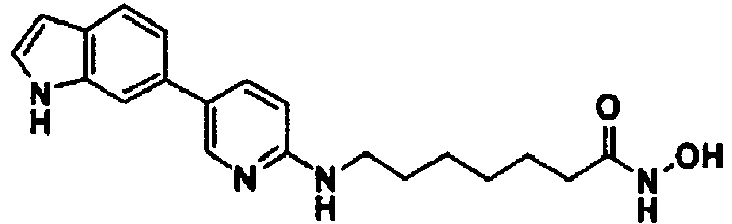
175 
176 
[Table 2] Compound Structure Compound Structure 178 
179 
180 
181 
184 
185 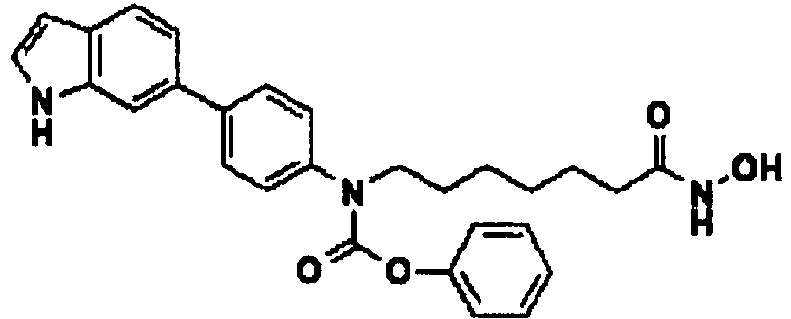
189 
190 
191 
203 
[Table 3] Compound Structure Compound Structure 204 
207 
208 
209 
210 
211 
212 
214 
215 
218 
[Table 4] Compound Structure Compound Structure 221 
222 
228 
229 
230 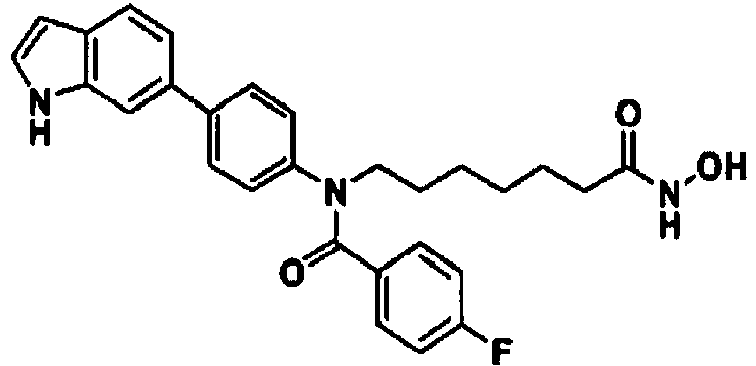
231 
234 
235 
236 
237 
[Table 5] Compound Structure Compound Structure 239 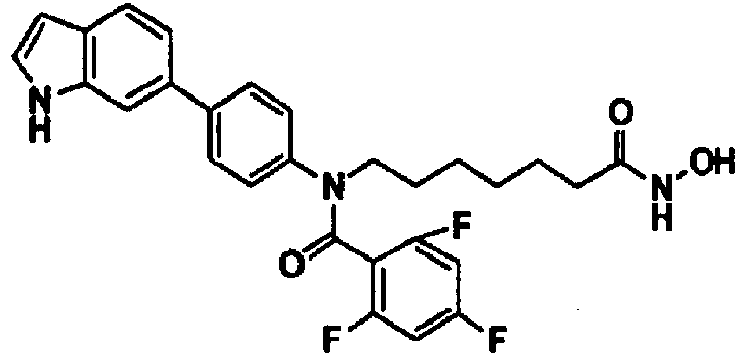
242 
243 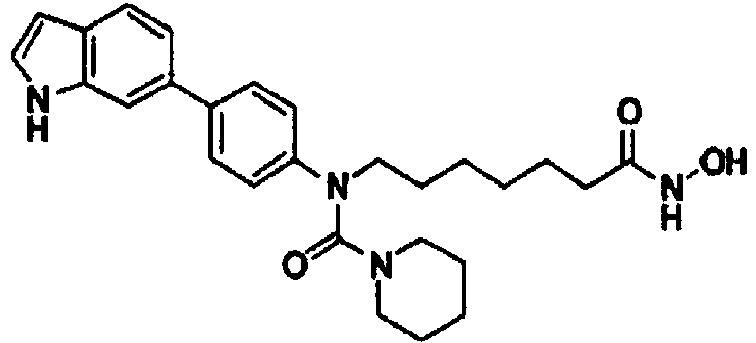
244 
245 
246 
249 
250 
251 
252 
[Table 6] Compound Structure Compound Structure 253 
254 
255 
256 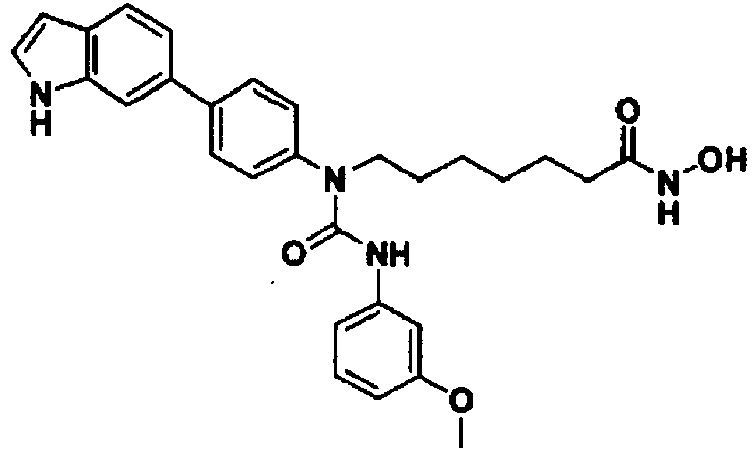
257 
258 
259 
260 
261 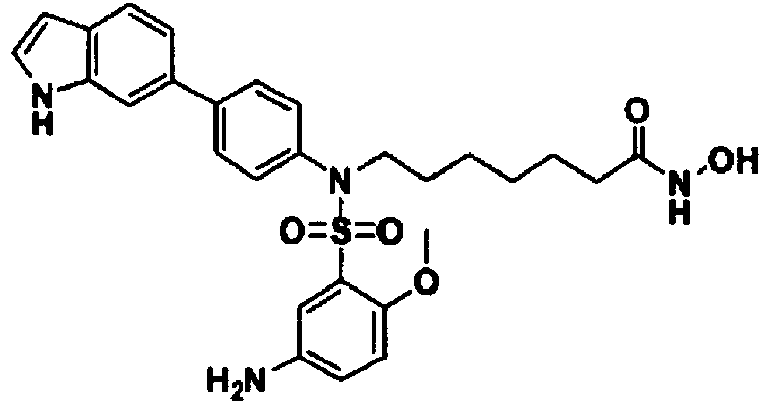
262 
[Table 7] Compound Structure Compound Structure 263 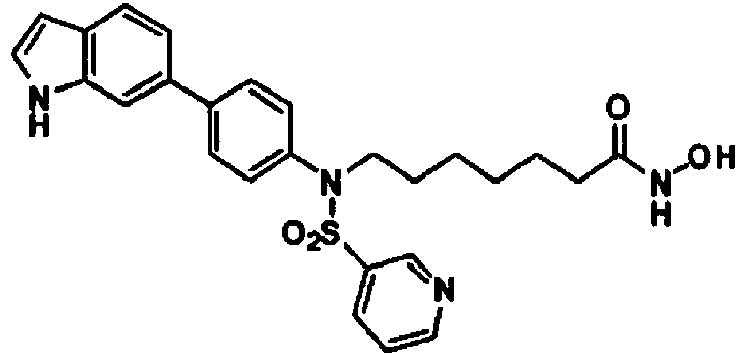
264 
265 
266 
267 
268 
269 
270 
271 
272 
[Table 8] Compound Structure Compound Structure 273 
274 
275 
276 
277 
278 
279 
280 
281 
282 
[Table 9] Compound Structure Compound Structure 283 
284 
285 
286 
287 
288 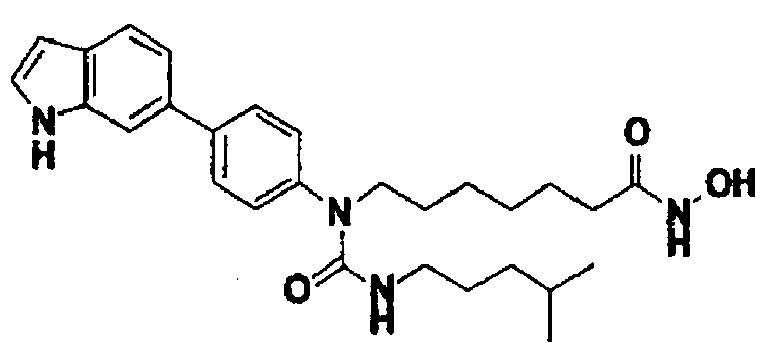
289 
290 
291 
292 
[Table 10] Compound Structure Compound Structure 293 
294 
295 
296 
299 
300 
302 
303 
304 
305 
[Table 11] Compound Structure Compound Structure 306 
307 
309 
310 
311 
312 
313 
314 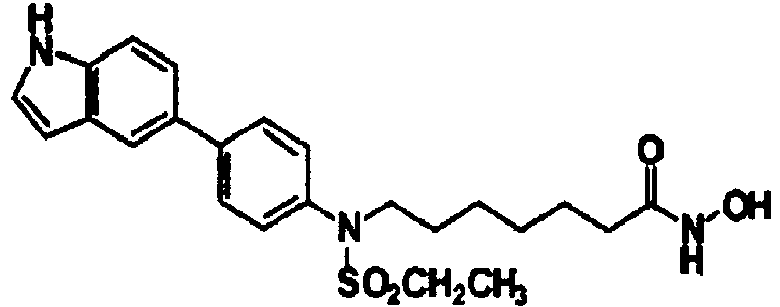
315 
316 
[Table 12] Compound Structure Compound Structure 317 
318 
319 
320 
321 
323 
324 
325 
326 
327 
[Table 13] Compound Structure Compound Structure 328 
329 
330 
331 
332 
333 
334 
335 
336 
337 
[Table 14] Compound Structure Compound Structure 338 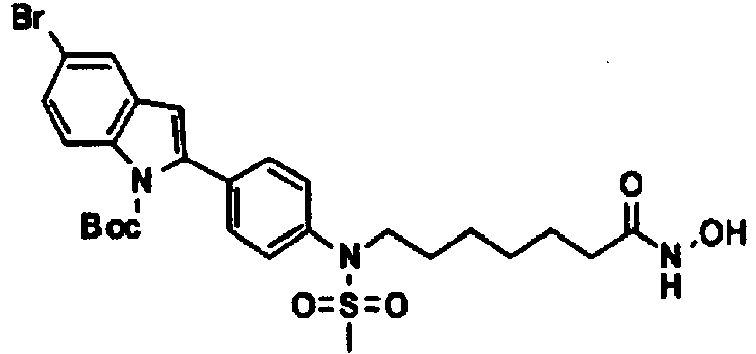
339 
340 
341 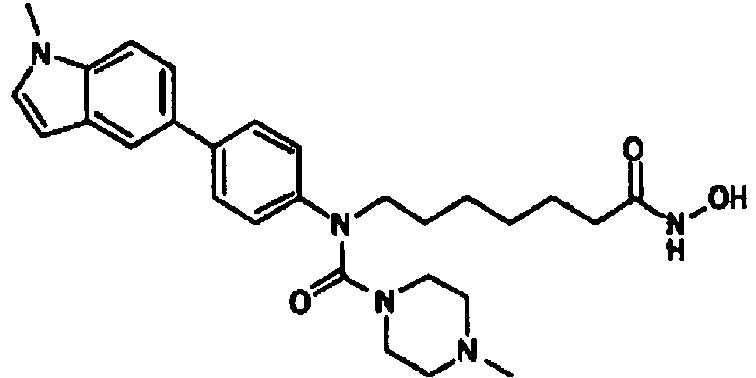
342 
343 
344 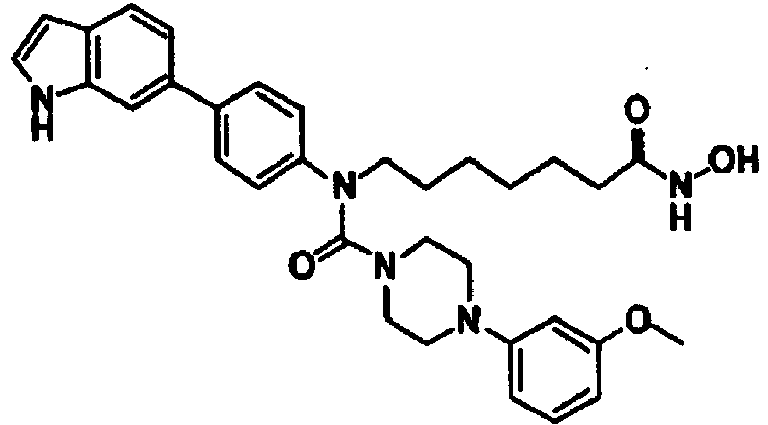
345 
346 
347 
[Table 15] Compound Structure Compound Structure 348 
349 
350 
351 
352 
353 
354 
355 
356 
357 
358 
359 
- In the culture of HL60 cells, 10% FBS-containing RPMI1640 medium was used. Each of test substances was serially diluted in DMSO to a concentration of 10 mg/ml and serially diluted in PBS to a final concentration ranging from 100 µg/ml to 0.03 µg/ml. 20 µl (micro-liter) of each of the serially diluted test substances and 180 µl (micro-liter) of a medium containing 6.0X10⁴ cells/ml were added to a 96-well plate and cultured under conditions of 37 °C and 5% CO2 for 3 days. After completion of the culture, 50 µl (micro-liter) of a solution of 1.25 mg/ml MTT (3-(4,5-dimethylthiazol-2-yl)-2,5-diphenyltetrazolium bromide) in PBS was added to each well of the plate and incubated at 37 °C for 3 hours. The formed formazan crystal was dissolved in 150 µl (micro-liter) of DMSO, and the absorbance at 570 nm was measured.
- The inhibitory effects (IC50) of the selected compounds of the present invention on the growth of the HL60 cell line are shown in Table 16 below.
[Table 16] Compounds HL-60 IC50 (µM) SAHA 0.6 ∼ 1.0 PXD 101 0.1 ∼ 0.2 LBH 5890.02 ∼ 0.05 303, 306, 309 0.01 ∼ 0.02 334, 340 180, 181, 263 0.02 ∼ 0.05 264, 276, 305 313, 314, 326 328, 341, 342 350, 351, 358 359 211, 256, 260 0.05 ∼ 0.1 265, 267, 270 275, 277, 284 295, 296, 312 327, 330, 336 357 - The inhibitory effects of the test substances on the growth of the HL60 cell line are indicated by IC50 values. A lower IC50 value indicates a better effect on the inhibition of HL60 cancer cells. As control drugs, SAHA (Merck), a currently commercially available anticancer agent, and LBH-589 (Novartis) and PXD-101 (Topo Target) that are not in clinical trials, were used. As can be seen from the results of evaluation of inhibitory effects shown in Table 16 above, all the tested compounds showed excellent inhibitory effects on the growth of cancer cells compared to SAHA, PXD 101 and LBH589, and the inhibitory effects of
compounds 303, 306, 309, 334 and 340 were more than 50 times superior to that of SAHA, and more than 10 times superior to that of PXD 101. - To measure effects against HDAC enzymes, a kit (BIOMOL International, LP) was used. Each of test substances was dissolved in DMSO to a concentration of 10 mg/ml, and an assay buffer, an enzyme solution, a substrate and a staining reagent were prepared. The enzyme solution was a mixture of assay buffer (2/3) and Hela nuclear extract (1/3), and the substrate was a mixture of assay buffer (23/24) and substrate stock (1/24). Also, the staining reagent was a mixture of assay buffer (19/20), developer (1/20) and TSA (1/100). The assay buffer, the enzyme solution, the test substance and the substrate were added sequentially to a 96-well plate, stirred on a rocker for 3 minutes, and then incubated at 37 °C for 1 hour. After completion of the incubation, the staining reagent was added, and the mixture was stirred on a rocker for 1 minute and then incubated at 37 °C for 20 minutes (the staining reagent was mixed before addition). After completion of the incubation, air bubbles were removed from the 96-well plate, after which the absorbance at 405 nm was measured.
- The HDAC inhibitory activities (IC50) of the selected compounds of the present invention are shown in Table 17 below. [Table 17]
Compounds HDAC IC50 (µM) SAHA 0.2 ∼ 0.5 PXD 101 0.1 ∼ 0.2 LBH 5890.01 ∼ 0.05 263, 264, 279 0.001 ∼ 0.01 284, 295, 296 303, 305, 306 309, 312, 313 326, 327, 328 334, 336, 340 341, 342, 350 351, 357, 358 359 180, 181, 211 0.01 ∼ 0.05 256, 260, 267 277 265 0.05 ∼ 0.1 270 275 - The HDAC inhibitory activities of the test substances are indicated by IC50 values. A lower IC50 value indicates a better inhibitory effect against HDAC enzymes. As can be seen in Table 17 above, all the compounds of the present invention showed excellent inhibitory effects on the growth of cancer cells compared to SAHA and PXD 101, and the HDAC inhibitory activities of
compounds LBH 589 known to have the highest HDAC inhibitory activity. - Male BALB/c nude mice (4-week old) used in human tumor transplantation studies were purchased from Central Animal Laboratory Inc. (Korea) or Orient Bio Inc. (Korea). The animals were permitted ad libitum access to sterile feed and water in a sterile breeding system at 23±0.5 °C.
- For use in tumor transplantation studies, the human cancer cell lines HCT116 (human colorectal carcinoma, CCL-247), PC-3 (human prostate adenocarcinoma, CRL-1435), and A549 (human lung carcinoma, CCL-185) were purchased from ATCC (American Type Culture Collection, Rockville, MD, USA).
- HCT116 cells were cultured in an air incubator under conditions of 37 °C and 5% CO2 using McCoy'5A medium (Gibco BRL) containing 10% heat-inactivated fetal bovine serum (Gibco BRL) and 1% antibiotics-antymycotics (Gibco BRL). Cell lines other than the HCT116 cell line were cultured in an air incubator under conditions of 37 °C and 5% CO2 using RPM1640 medium (Gibco BRL) containing 10% heat-inactivated fetal bovine serum (Gibco BRL) and 1% antibiotics-antymycotics (Gibco BRL).
- Studies on the in vivo transplantation of human cancer cells were carried out in the following manner. Human cancer cells (HCT116, PC-3, and A549) that proliferated in vitro were injected subcutaneously into the abdominal region of BALB/c nude mice and allowed to proliferate in vivo. 20-25 days after the injection, the mice were sacrificed by cervical dislocation, and the solid cancer that proliferated in each of the mice was isolated aseptically, and connective or necrotic tissue and skin was removed therefrom, thus collecting a fresh cancer tissue. 50 mg of a fragment was taken aseptically from the cancer tissue and inserted into a 16-gauge trocar which was then transplanted subcutaneously into the upper abdominal region of mice.
- 15-30 days after the human cancer cell lines have been transplanted into the BALB/c nude mice, only mice in which the cancer cells have proliferated to a given size were selected and used in the experiment. When the tumor size in each of the test groups reached 100-200 mm3 after cancer cell transplantation, the experiment was started.
- With respect to solvents used for the drugs upon abdominal administration, compounds 312, 334 and 336 were dissolved in saline, and
LBH 589 and PXD 101 were dissolved in a mixture of cremophor: ethanol: saline (1:1:8), and each of the drugs was injected at a dose of 0.1 ml per 10 g of mouse bodyweight according to each administration schedule. SAHA was dissolved in DMSO and injected at a dose of 10 microliter per 10 g of mouse bodyweight. - For oral administration, all the drugs were dissolved in 0.5% MC as a solvent and administered at a dose of 0.1 ml per 10 g of mouse bodyweight. The anticancer effect of each drug was evaluated based on the inhibition rate (IR%) of tumor volume that indicates the tumor volume at reference date in comparison with control groups. As the control drugs, commercially available anticancer drugs, SAHA (Merck), LBH-589 (Novartis), PXD-101 (Topo Target) and MGCD 0103 (Methylgene), were used in the evaluation.


[Table 18] Group (n=10) Dose(/day) Schedule IR (%) SAHA 100 mg/kg 46 PXD 101 80 mg/kg 38 LBH 5895 mg/ kg 40 10 mg/kg qd x 5 65 Compound 31220 mg/ kg 2 wks 51 40 mg/kg ip 58 60 mg/kg 70 80 mg/kg 81 - In this experiment, inhibitory effects against actual colon cancer cells (HCT 116), and the measurement results (IR(%) and tumor volume (mm3) are shown in Table 18 above. A higher IR(%) value and a larger tumor volume value indicate a better inhibitory effect against cancer cells. The drug administration schedule consisted of daily administration for 5 consecutive days, followed by a drug-rest interval of 2 days, for a total of 2 weeks. The test substances were compared with control groups, commercially available SAHA (Merck), and PXD 101 (Topo Target) and LBH 589 (Novartis), which are now in clinical trials. As a result,
compound 312 showed excellent colon cancer inhibitory effects over the entire dose range compared to the highest doses of SAHA and PXD 101, and showed excellent colon cancer inhibitory effects at doses of 60 and 80 mg/kg compared to the highest dose ofLBH 589 having the most excellent inhibitory effect among the control groups. The maximum tolerated doses (MTDs) of the drugs were 100 mg/kg for SAHA, 80 mg/kg for PXD, and 10 mg/kg forLBH 589. At doses higher than maximum tolerated doses, the animals were dead due to toxicity.[Table 19] Group (n=10) Dose(/day) Schedule IR (%) LBH 5895 mg/ kg 40 10 mg/kg qd x 5 65 Compound 33440 mg/ kg 2 wks 47 60 mg/kg ip 66 Compound 33640 mg/kg 56 60 mg/kg 75 80 mg/kg 78 - In this experiment, inhibitory effects against actual colon cancer cells (HCT 116) were measured. The drug administration schedule consisted of daily administration for 5 consecutive days, followed by a drug-rest interval of 2 days, for a total of 2 weeks. As a control group, LBH 589 (Novartis) known to have the most excellent inhibitory effect was used. As can be seen in Table 19,
compounds control compound LBH 589. In this experiment, the maximum tolerated doses (MTDs) of the drugs were 10 mg/kg forLBH compound compound 336. At doses higher than maximum tolerated doses, the animals were dead due to toxicity.[Table 20] Group (n=4) Dose(/day) Schedule IR (%) LBH 58910 mg/kg qd x 5, 3 wks 58 Compound 31260 mg/kg b.i.wk(Mon,Thu) 50 80 mg/kg 3 wks 56 100 mg/kg ip 71 - In this experiment, anticancer effects against non-small cell lung cancer (A549) were measured. In the administration schedule,
compound 312 was administered twice (Monday and Thursday) a week for 3 weeks, and as a control group for comparison, LBH 589(Novartis) known to have the most excellent anticancer effect was administered five times a week, followed by a drug-rest interval of 2 days, for a total of 3 weeks. As can be seen from the results inFIG. 3 ,compound 312 was convenient to administer, because it showed an excellent inhibitory effect against non-small cell lung cancer (A549) even when it was administered twice a week.LBH 589 did not show a cancer inhibitory effect when it was administered twice a week.[Table 21] Group (n=4) Dose(/day) Schedule IR (%) LBH 58910 mg/kg qd x 5, 3 wks 48 Compound 31260 mg/kg b.i.wk(Mon,Thu) 39 80 mg/kg 3 wks 39 100 mg/kg ip 59 - In this experiment, anticancer effects against prostate cancer (PC-3) were measured. In the drug administration schedule,
compound 312 was administered twice (Monday and Thursday) a week for 3 weeks, and as a control group for comparison, LBH 589(Novartis) was administered five times a week, followed by a drug-rest interval of 2 days, for a total of 3 weeks. As can be seen from the results inFIG. 4 ,compound 312 was convenient to administered to administer and had excellent inhibitory effects against prostate cancer (PC-3), compared to thecontrol compound LBH 589.[Table 22] Group (n=6) Dose(/day) Schedule IR (%) LBH 58950 mg/kg qd x 5, 3 wks 0 MGCD 0103 120 mg/ kg 50 SAHA 200mg/kg p.o 26 Compound 312150 mg/kg b.i.wk(Mon,Thu) 52 180 mg/kg 3 wks 55 210 mg/kg p.o 69 - In this experiment, in order to develop anticancer drugs for oral (p.o) administration, cancer inhibitory effects against colon cancer (HCT116) upon oral administration were measured. In the drug administration schedule,
compound 312 was administered orally twice (Monday and Thursday) a week for 3 weeks, and as a control group for comparison, LBH 589(Novartis) was administered orally five times a week, followed by a drug-rest interval of 2 days, for a total of 3 weeks. Also, SAHA,LBH 589, and MGCD 0103 having excellent anticancer effects upon oral administration were used as control groups for comparison. As can be seen from the results inFIG. 5 ,compound 312 was convenient to administered and showed an excellent inhibitory effect against colon cancer (HCT116), compared to thecontrol compounds LBH 589, SAHA and MGCD0103. - P450 (CYP3A4) is a metabolic enzyme, and non-inhibition of the enzyme by a test compound means that the test substance has a low possibility of causing side effects by interaction with other drugs. Each of compounds used in the test was dissolved in DMSO (10 mg/ml), and the dilution of each test substance to 2×10⁻² mg/ml was additionally performed in 200 µl (micro-liter) of a test system containing an assay buffer. The final solvent concentration was not higher than 2%. The CYP3A4 protein inhibitory test system included a total assay volume (100 µl (micro-liter)) of a NADPH production system (3.3 mM glucose-6-phosphate, 0.4 units/ml glucose-6-phosphate dehydrogenase, 1.3 mM NADP+ and 3.3 mM MgCl2·6H2O in assay buffer) and a test compound in each well of a 96-well plate. After pre-incubation at 37 °C for 10 minutes, 100 µl (micro-liter) of a KPO4 assay buffer containing 1.0 pmol P450 protein and 50 uM BFC (7-benzyloxy-trifluoromethylcoumarin) fluorescent probe substrate was added to the test system, and an enzyme reaction in the test system having a total assay volume of 200 µl (micro-liter) was initiated. After the test system has been incubated at 37 °C for 30 minutes, 75 µl (micro-liter) of Tris base (0.5M Tris base 18 ml + 72 ml acetonitrile) containing acetonitrile was added thereto to terminate the reaction. Irradiation with fluorescence was carried out at an excitation wavelength of 409 nm and an emission wavelength of 530 nm. As a reference compound, ketoconazole (IC50 = 5 × 10⁻⁸ M) was used in this experiment.
- In this experiment,
compound 312 was compared with the control compounds ketoconazole andLBH 589. The results are shown inFIG. 6 , and as can be seen therein,compound 312 did not inhibit P450 3A4 in vivo, and the P450 3A4 inhibitory activity thereofwas lower than that ofLBH 589 having excellent anticancer effects, suggesting thatcompound 312 has a low possibility of causing side effects by interaction with other drugs. - As described above, the hydroxamate derivatives of the present invention have histone deacetylase inhibitory activity and kill the actively proliferating cells of malignant tumors. Thus, the hydroxamate derivatives of the present invention can be used as agents for treating malignant tumors, viral and bacterial infections, vascular restenosis, inflammatory diseases, autoimmune diseases, and psoriasis.
Claims (13)
- Hydroxamate derivatives represented by the following formula I, isomers thereof, pharmaceutically acceptable salts thereof, hydrates thereof or solvates thereof:
 Ar is a phenyl, pyridine or pyrimidine group which is unsubstituted or substituted with one or more substituents selected from the group consisting of C1-6alkyl, amino, nitro, thiomethyl, hydroxyl, nitrile, carboxyl, C1-4 alkyloxy, aryl C1-4 alkyloxy, halogen, triffuoromethyl, -O-CF3, phenyl and phenoxy groups;R1 is an indole, indazole or benzimidazole group, which is unsubstituted or substituted with one or more substituents selected from the groups consisting of C1-6 alkyl, formyl, amino, nitro, thiomethyl, hydroxyl, C1-6 alkoxy, nitrile, carboxyl, halogen, trifluoromethyl, -O-CF3, -C(O)-R5, -S(O2)-R5 and
 R2 is hydrogen, hydroxy C1-6alkyl, C1-8alkyl, -C(O)-R5, -C(O)NH-R5, -S(O2)-R5, -C(S)-R5 or -C(O2)-R5, in which R5 is
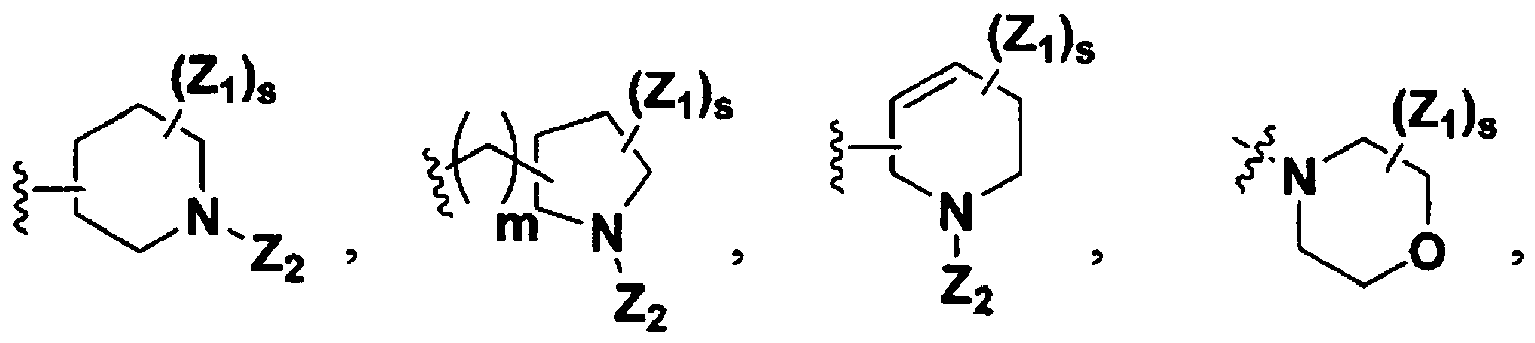
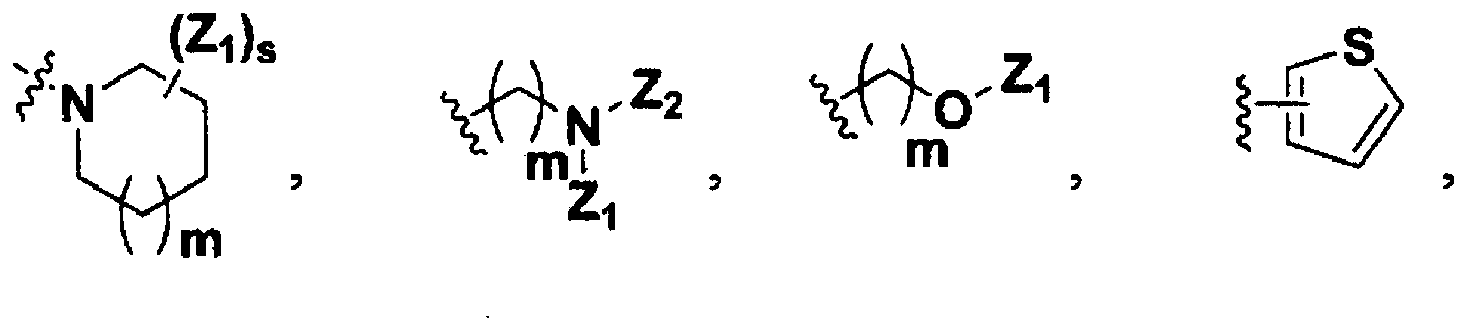

 V and W are each independently hydrogen or C1-6 alkyl,Each s is independently an integer of 0, 1, 2, 3, 4 or 5, andEach m is independently an integer of 0,1,2 or 3.
 - The hydroxamate derivatives of formula I, isomers thereof, pharmaceutically acceptable salts thereof, hydrates thereof or solvates thereof according to claim 1, wherein R1 is an indole or indazole group which is unsubstituted or substituted with one or more substituents selected from the group consisting of C1-6alkyl, formyl, amino, nitro, thiomethyl, hydroxy, C1-6alkoxy, nitrile, carboxy, halogen, trifluoromethyl, -O-CF3, -C(O)-R5, -S(O2)-R5 and

- The hydroxamate derivatives of formula I, isomers thereof, pharmaceutically acceptable salts thereof hydrates thereof or solvates thereof according to claim 2, wherein Ar is a phenyl group which is unsubstituted or substituted with one or more substituents selected from the group consisting of C1-6alkyl, amino, nitro, thiomethyl, hydroxyl, nitrile, carboxyl, C1-4alkyloxyl, aryl C1-4alkyloxy, halogen, trifluoromethyl, -O-CF3, phenyl and phenoxy groups.
- The hydroxamate derivatives of formula I, isomers thereof, pharmaceutically acceptable salts thereof, hydrates thereof or solvates thereof according to claim 3, wherein n is 3, Ar is an unsubstituted phenyl group, R1 is an indole or indazole group which is substituted with hydrogen or one or more C1-6alkyl groups, and R2 is hydrogen, -C(O)-R5 or -S(O2)-R5, in which R5 is


 V and W are each independently hydrogen or C1-6 alkyl,Each s is independently an integer of 0, 1, 2, 3, 4 or 5, andEach m is independently an integer of 0, 1, 2 or 3.
 - The hydroxamate derivatives of formula I, isomers thereof, pharmaceutically acceptable salts thereof, hydrates thereof or solvates thereof according to claim 4, wherein n is 3, Ar is an unsubstituted phenyl group, R1 is an indole or indazole group which is substituted with hydrogen or one or more C1-6 alkyl groups, and R2 is hydrogen, -C(O)-R5 or -S(O2)-R5, in which R5 is
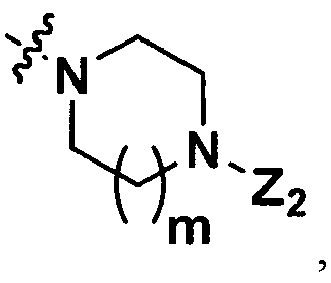
- The hydroxamate derivatives, isomers thereof, pharmaceutically acceptable salts thereof, hydrates thereof or solvates thereof according to claim 1, wherein the hydroxamate derivatives are selected from the group consisting of the following compounds:7-((4-(1H-indol-5-yl)phenylamino)-N-hydroxyheptanamide,N-hydroxy-7-(4-(1-methyl-1H-indol-5-yl)phenylamino)hydroxyheptanamide;7-((3-(1H-indol-6-yl)phenylamino)-N-hydroxyheptanamide;7-((4-(1H-indo]-6-yl)phenylamino)-N-hydroxyheptanamide;7-((3-(1H-indol-5-yl)phenylamino)-N-hydroxyheptanamide-,7-((4-(1H-indol-4-yl)phenylamino)-N-hydroxyheptanamide;7-((2-(1H-indol-5-yl)phenylamino)-N-hydroxyheptanamide;7-((5-(1H-indol-6-yl)pyridin-2-ylamino)-N-hydroxyheptanamide;7-((6-(1H-indol-6-yl)pyridin-3-ylamino)-N-hydroxyheptanamide;7-((3-(1H-indol-7-yl)phenylamino)-N-hydroxyheptanamide;7-((5-(1H-indol-6-yl)pyrimidin-2-ylamino)-N-hydroxyheptanamide;7-((4-(1H-indol-7-yl)phenylamino)-N-hydroxyheptanamide;N-(4-(1H-indol-6-yl)phenyl)-N-(7-(hydroxyamino)-7-oxoheptyl)-4-methoxybenzamide;N-(4-(1H-indol-6-yl)phenyl)-N-(7-(hydroxyamino)-7-oxoheptyl)nicotinamide;7-((N-(4-(1H-indol-6-yl)phenyl)-2-phenylacetamido)-N-hydroxyheptanamide;phenyl 4-(1H-indol-6-yl)phenyl(7-(hydroxyamino)-7-oxoheptyl)carbamate;benzyl 4-(1H-indol-6-yl)phenyl(7-(hydroxyamino)-7-oxoheptyl)carbamate;7-(((4-(1H-indol-6-yl)phenyl)(2-hydroxyethyl)amino)-N-hydroxyheptanamide;N-hydroxy-7-(4-(1-(phenylsulfonyl)-1H-indol-2-yl)phenylamino)heptanamide;7-((N-(4-(1H-indo)-6-yl)phenyl)thiophene-2-sulfonamido)-N-hydroxyheptanamide;N-(4-(1H-indol-6-yl)phenyl)-N-(7-(hydroxyamino)-7-oxoheptyl)furan-2-carboxamide;7-((N-(4-(1H-indol-6-yl)phenyl)-4-methoxyphenylsulfonamido)-N-hydroxyheptanamide;N-(4-(1H-indol-5-yl)phenyl)-N-(7-(hydroxyamino)-7-oxoheptyl)-4-methoxybenzamide;N-(4-(1H-indol-6-yl)phenyl)-N-(7-(hydroxyamino)-7-oxoheptyl)-4-methylbenzamide;7-((N-(4-(1H-indol-6-yl)phenyl)phenylsulfonamido)-N-hydroxyheptanamide;N-(4-(1H-indol-6-yl)phenyl)-N-(7-(hydroxyamino)-7-oxoheptyl)picolinamide;N-(4-(1H-indol-6-yl)phenyl)-N-(7-(hydroxyamino)-7-oxoheptyl)-3-methoxybenzamide;N-(4-(1H-indol-6-yl)phenyl)-N-(7-(hydroxyamino)-7-oxoheptyl)-3,4,5-trimethylbenzamide;N-(4-(1H-indol-6-yl)phenyl)-4-(dimethylamino)-N-(7-(hydroxyamino)-7-oxoheptyl)benzamide;7-((N-(4-(1H-indol-6-yl)phenyl)-2-aminoacetamido)-N-hydroxyheptanamide;N-(4-(1H-indol-6-yl)phenyl)-6-chloro-N-(7-(hydroxyamino)-7-oxoheptyl)nicotinamide;N-(4-(1H-indol-6-yl)phenyl)-N-(7-(hydroxyamino)-7-oxoheptyl)isonicotinamide;(Z)-N-(4-(1H-indol-6-yl)phenyl)-N-(7-(hydroxyamino)-7-oxoheptyl)-4-(N'-hydroxycarbamimidoyl)benzamide;N-(4-(1H-indol-6-yl)-phenyl)-2,6-difluoro-N-(7-(hydroxyamino)-7-oxoheptyl)benzamide;N-(4-(1H-indol-6-yl)phenyl)-4-fluoro-N-(7-(hydroxyamino)-7-oxoheptyl)benzamide;N-(4-(1H-indol-6-yl)phenyl)-N-(7-(hydroxyamino)-7-oxoheptyl)-6-(trifluoromethyl)nicotinamide;6-((4-(1H indol-6-yl)phenylamino)N-hydroxyhexanamide;8-((4-(1H-indol-6-yl)phenylamino)-N-hydroxyoctanamide;N-(4-(1H-indol-6-yl)phenyl)-4-ethoxy-N-(7-(hydroxyamino)-7-oxoheptyl)benzamide;7-(((4-(1H-indol-6-yl)phenyl)(benzyl)amino)-N-hydroxyheptanamide;N-(4-(1H-indol-6-yl)phenyl)-2,4,6-trifluoro-N-(7-(hydroxyamino)-7-oxoheptyl)benzamide;N-(4-(1H-indol-6-yl)phenyl)-4-amino-N-(7-(hydroxyamino)-7-oxoheptyl)benzamide;N-(4-(1H-indol-6-yl)phenyl)-N-(7-(hydroxyamino)-7-oxoheptyl)piperidin-1-carboxamide;N-(4-(1H-indol-6-yl)phenyl)-N-(7-(hydroxyamino)-7-oxoheptyl)-4-methoxy-3-(trifluoromethyl)benzamide;N-(4-(1H-indol-6-yl)phenyl)-N-(7-(hydroxyamino)-7-oxoheptyl)-4-(trifluoromethyl)benzamide;N-(4-(1H-indo)-6-yl)phenyl)-N-(7-(hydroxyamino)-7-oxoheptyl)-3,4-dimethoxybenzamide;7-((N-(4-(1H-indol-6-yl)phenyl)-3,4-dimethoxyphenylsulfonamido)-N-hydroxyheptanamide;7-((N-(4-(1H-indol-6-yl)phenyl)-4-(methylsulfonyl)phenylsulfonamido)-N-hydroxyheptanamide;7-((4-(1H-indol-6-yl)-3-(trifluoromethyl)phenylamino)-N-hydroxyheptanamide;N-(4-(1H-indol-6-yl)-3-(trifluoromethyl)phenyl)-N-(7-(hydroxyamino)-7-oxoheptyl)nicotinamide;7-((N-(4-(1H-indol-6-yl)phenyl)naphthalene-2-sulfonamido)-N-hydroxyheptanamide;N-(4-(1H-indol-6-yl)-3-methylphenyl)-N-(7-(hydroxyamino)-7-oxoheptyl)-4-methoxybenzamide;7-((1-(4-(1H-indol-6-yl)phenyl)-3-(4-methoxyphenyl)ureido)-N-hydroxyheptanamide;7-((1-(4-(1H-indol-6-yl)phenyl)-3-(3-methoxyphenyl)ureido)-N-hydroxyheptanamide;7-((N-(4-(1H-indol-6-yl)phenyl)acetamido)-N-hydroxyheptanamide;methyl 1-(1H-indol-6-yl)phenyl(7-(hydroxyamino)-7-oxoheptyl)carbamate,7-((1-(4-(1H-indol-6-yl)phenyl)-3-(2-methoxyphenyl)ureido)-N-hydroxyheptanamide;7-((1-(4-(1H-indol-6-yl)phenyl)-3-(3,5-dimethoxyphenyl)ureido)-N-hydroxyheptanamide;7-((N-(4-(1H-indol-6-yl)phenyl)-5-amino-2-methoxyphenylsulfonamido)-N-hydroxyheptanamide;7-((1-(4-(1H-indol-6-yl)henyl)-3-(thiophen-2-yl)ureido)-N-hydroxyheptanamide;7-((N-(4-(1H-indol-6-yl)phenyl)pyridine-3-sulfonamido)-N-hydroxyheptanamide;7-((N-(4-(1H-indol-6-yl)phenyl)methylsulfonamido)-N-hydroxyheptanamide;7-((N-(4-(1H-indol-6-yl)phenyl)-2-(dimethylamino)acetamido)-N-hydroxyheptanamide;4-methoxyphenyl 4-(1H-indol-6-yl)phenyl(7-(hydroxyamino)-7-oxoheptyl)carbamate;ethyl 4-(1H-indol-6-yl)phenyl(7-(hydroxyamino)-7-oxoheptyl)carbamate;7-((1-(4-(1H-indol-6-yl)phenyl)-3,3-dimethylureido)-N-hydroxyheptanamide;2-methoxyethyl 4-(1H-indol-6-yl)phenyl(7-(hydroxyamino)-7-oxoheptyl)carbamate;N-(7-(hydroxyamino)-7-oxoheptyl)-N-(4-(1-methyl-1H-indazol-6-yl)phenyl)nicotinamide;N-hydroxy-7-(4-(1-methyl-1H-indazol-6-yl)phenylamino)heptanamide;7-((N-(4-(1H-indol-6-yl)phenyl)propionamido)-N-hydroxyheptanamide,N-(4-(1H-indol-6-yl)phenyl)-N-(7-(hydroxyamino)-7-oxoheptyl)-1-methyl-1,2,5,6-tetrahydropyridine-3-carboxamide;7-((1-(4-(1H-indol-6-yl)phenyl)-3-(pyridin-3-yl)ureido)-N-hydroxyheptanamide;7-((1-(4-(1H-indol-6-yl)phenyl)-3-methylureido)-N-hydroxyheptanamide;7-((N-(4-(1H-indol-6-yl)phenyl)ethylsulfonamido)-N-hydroxyheptanamide;7-(((4-(1H-indol-6-yl)phenyl)(N,N-dimethylsulfamoyl)amino)-N-hydroxyheptanamide;N-(4-(1H-indol-6-yl)phenyl)-N-(7-(hydroxyamino)-7-oxoheptylxyclohexanecarboxamide;N-(4-(1H-indol-6-yl)phenyl)-N-(7-(hydroxyamino)-7-oxoheptyl)cyclopropanecarboxamide;7-((N-(4-(1H-indol-6-yl)phenyl)-2-morpholinoacetamido)-N-hydroxyheptanamide;(S)-N-(4-(1H-indol-6-yl)phenyl)-N-(7-(hydroxyamino)-7-oxoheptyl)pyrolidine-2-carboxamide;7-((1-(4-(1H-indol-6-yl)phenyl)-3-isopropylureido)-N-hydroxyheptanamide;7-((1-(4-(1H-indol-6-yl)phenyl)-3-isobutylureido)-N-hydroxyheptanamide;N-hydroxy-7-(N-(4-(1-methyl-1H-indazol-6-yl)phenyl)methylsulfonamido)heptanamide;7-(((4-(1H-indol-6-yl)phenyl)(propyl)amino)-N-hydroxyheplanamide;7-((N-(4-(1H-indol-6-yl)phenyl)-2-(4-methylpiperazin-1-yl)acetamido)-N-hydroxyheptanamide;7-((1-(4-(1H-indol-6-yl)phenyl)-3-butylureido)-hydroxyheptanamide;7-((1-(4-(1H-indol-6-yl)phenyl)-3-(4-methylpentyl)ureido)-N-hydroxyheptanamide;7-((1-(4-(1H-indol-6-yl)phenyl)-3-(3-(dimethylamino)propyl)ureido)-N-hydroxyheptanamide;7-((1-(4-(1H-indol-6-yl)phenyl)-3-(cyclohexylmethyl)ureido)-N-hydroxyheptanamide;7-((N-(4-(1H-indol-6-yl)phenyl)pentanamido)-N-hydroxyheptanamide;7-((N-(4-(1H-indol-6-yl)phenyl)isobutyramido)-N-hydroxyheptanamide;7-((N-(4-(1H-indol-6-yl)phenyl)-2-(4-(2-methoxyethyl)piperazin-1-yl)acetamido)-N-hydroxyheptanamide;7-((1-(4-(1H-indol-6-yl)phenyl)-3,3-diethylureido)-N-hydroxyheptanamide;7-((1-(4-(1H-indol-6-yl)phenyl)-3-ethylureido)-N-hydroxyheptanamide;N-hydroxy-7-(N-(4-(2-methyl-1H-indol-5-yl)phenyl)methylsulfonamido)heptanamide;isobutyl 4-(1H-indol-6-yl)phenyl(7-(hydroxyamino)-7-oxoheptylcarbamate;N-(4-(1H-indol-6-yl)phenyl)-N-(7-(hydroxyamino)-7-oxoheptyl)thiophene-2-carboxamide;N-(7-(hydroxyamino)-7-oxoheptyl)-N-(4-(1-methyl-1H-indazol-6-yl)phenyl)picolinamide;7-((N-(4-(1H-indol-5-yl)phenyl)methylsulfonamido)-N-hydroxyheptanamide;N-(4-(1H-indol-6-yl)phenyl)-N-(7-(hydroxyamino)-7-oxoheptyl)-1-methylpiperidine-4-carboxamide;N-(4-(1H-indol-5-yl)phenyl)-N-(7-(hydroxyamino)-7-oxoheptyl)picolinamide;N-(4-(1H-indol-6-yl)phenyl)-N-(7-(hydroxyamino)-7-oxoheptyl)morpholine-4-caqrboxamide;7-((N-(4-(1,2-dimethyl-1H-indol-5-yl)phenyl)methylsulfonamido)-N-hydroxyheptanamide;N-(4-(1H-indol-6-yl)phenyl)-N-(7-(hydroxyamino)-7-oxoheptyl)-4-methylpiperazine-1-carboxamide;N-hydroxy-7-(N-(4-(1-methyl-1H-indazol-6-yl)phenyl)ethylsulfonamido)heptanamide;N-(4-(1H-indol-5-yl)phenyl)-N-(7-(hydroxyamino)-7-oxoheptyl)nicotinamide;N-(7-(hydroxyamino)-7-oxoheptyl)-4-methyl-N-(4-(1-methyl-1H-indazol-6-yl)phenyl)piperazine-1-carboxamide;N-(4-(1H-indol-5-yl)phenyl)-N-(7-(hydroxyamino)-7-oxoheptyl)-4-methylpiperazine-1-carboxamide;7-((N-(4-(1H-indol-5-yl)phenyl)ethylsulfonamido)-N-hydroxyheptanamide;N-(7-(hydroxyamino)-7-oxoheptyl)-N-(4-(1-methyl-1H-indazol-6-yl)phenyl)morpholine-4-carboxamide;N-(4-(1H-indol-5-yl)phenyl)-N-(7-(hydroxyamino)-7-oxoheptyl)morpholine-4-carboxamide,N-(4-(1H-indol-6-yl)phenyl)-N-(7-(hydroxyamino)-7-oxoheptyl)-2,6-dimethylmorpholine-4-carboxamide;N-(7-(hydroxyamino)-7-oxoheptyl)-2,6-dimethyl-N-(4-(1-methyl-1H-indazol-6-yl)phenyl)morpholine-4-carboxamide;N-(4-(1H-indol-5-yl)phenyl)-N-(7-(hydroxyamino)-7-oxoheptyl)-2,6-dimethylmorpholine-4-carboxamide;N-hydroxy-7-(N-(4-(1-methyl-1H-indol-5-yl)phenyl)methylsulfonamido)heptanamide;N-hydroxy-7-(N-(4-(1-methyl-1H-indol-6-yl)phenyl)methylsulfonamido)heptanamide;N-(4-(1H-indol-6-yl)phenyl)-N-(7-(hydroxyamino)-7-oxoheptyl)-4-isopropylpiperazine-1-carboxamide;N-(4-(1H-indol-6-yl)phenyl)-N-(7-(hydroxyamino)-7-oxoheply)picolidine-1-carboxamide;N-(4-(1H-indol-5-yl)phenyl)-N-(7-(hydroxyamino)-7-oxoheptyl)isonicotinamide;7-((N-(6-(1H-indol-6-yl)pyridin-3-yl)methylsulfonamido)-N-hydroxyheptanamide;N-hydroxy-7-(N-(6-(1-methyl-1H-indazol-6-yl)pyridin-3-yl)methylsulfonamido)heptanamide;7-((N-(6-(1H-indol-5-yl)pyridin-3-yl)methylsulfonamido)-N-hydroxyheptanamide,N-(4-(1H-indol-6-yl)phenyl)-4-acetyl-N-(7-(hydroxyamino)-7-oxoheptyl)piperazine-1-carboxamide;N-(4-(1H-indol-6-yl)phenyl)-N-(7-(hydroxyamino)-7-oxoheptyl)-4-methyl-1,4-diazepane-1-carboxamide;N-(7-(hydroxyamino)-7-oxoheptyl)-4-methyl-N-(4(1-methyl-1H-indol-6-yl)phenyl)piperazine-1-carboxamide;7-((N-(4-(1H-indol-2-yl)phenyl)methylsulfonamido)-N-hydroxyheptanamide;tert-butyl 2-(4-(N-(7-(hydroxyamino)-7-oxoheptyl)methylsulfonamido)phenyl)-1H-indole-1-carboxylate;N-(7-(hydroxyamino)-7-oxoheptyl)-4-methyl-N-(4-(2-methyl-1H-indol-5-yl)phenyl)piperazine-1-carboxamide;N-(4-(1H-indol-6-yl)phenyl)-4-benzyl-N-(7-(hydroxyamino)-7-oxoheptyl)-piperazine-1-carboxamide;4-ethyl-N-(7-(hydroxyamino)-7-oxoheptyl)-N-(4-(1-methyl-1H-indazole-6-yl)phenyl)piperazine-1-carboxamide;7-((N-(4-(5-bromo-1H-indol-2-yl)phenyl)methylsulfonamido)-N-hydroxyheptanamide;tert-butyl 5-bromo-2-(4-(N-(7-(bydroxyamino)-7-oxoheptyl)methylsulfonamido)phenyl)-1H-indazole-1-carboxylate;N-(4-(1H-indol-6-yl)phenyl)-4-ethyl-N-(7-(hydroxyamino)-7-oxoheptyl)piperazine-1-carboxamide;N-(4-(1H-indol-5-yl)phenyl)-4-ethyl-N-(7-(hydroxyamino)-7-oxoheptyl)piperazine-1-carboxamide;N-(7-(hydroxyamino)-7-oxoheptyl)-4-methyl-N-(4-(1-methyl-1H-indol-5-yl)phenyl)piperazine-1-carboxamide;N-hydroxy-7-(4-methyl-N-(4-(1-methyl-1H-indazol-6-yl)phenyl)piperazine-1-sulfonamide)heptanamide;N-(4-(1H-indol-6-yl)phenyl)-N-(7-(hydroxyamino)-7-oxoheptyl)-4-(2-methoxyphenyl)piperazine-1-carboxamide;N-(4-(1H-indol-6-yl)phenyl)-N-(7-(hydroxyamino)-7-oxoheptyl)-4-(3-methoxyphenyl)piperazine-1-carboxamide;N-(4-(3H-benzo[d]imidazol-5-yl)phenyl)-N-(7-(hydroxyamino)-7-oxoheptyl)-4-methylpiperazine-1-carboxamide;N-(4-(1H-indol-6-yl)phenyl)-N-(7-(hydroxyamino)-7-oxoheptyl)-4-(2-hydroxyethyl)piperazine-1-carboxamide;7-((3-(2-(dimethylamino)ethyl)-1-(4-(1-methyl-1H-indazol-6-yl)phenyl)ureido)-N-hydroxyheptanamide;N-hydroxy-7-(1-(4-(1-methyl-1H-indazol-6-yl)phenyl)-3-(2-(1-methylpyrolidin-2-yl)ethyl)ureido)heptanamide;N-(4-(1H-indol-6-yl)phenyl)-4-butyl-N-(7-(hydroxyamino)-7-oxoheptyl)piperazine-1-carboxamide;N-(7-(hydroxyamino)-7-oxoheptyl)-4-methyl-N-(4-(1-methyl-1H-indazol-5-yl)phenyl)piperazine-1-carboxamide;4-ethyl-N-(7-(hydroxyamino)-7-oxoheptyl)-N-(4-(1-methyl-1H-indazol-5-yl)phenyl)piperazine-1-carboxamide;N-(4-(1H-indol-6-yl)phenyl)-4-(2-(dimethylamino)ethyl)-N-(7-(hydroxyamino)-7-oxoheptyl)piperazine-1-carboxamide;7-((3-((1-ethylpyrolidin-2-yl)methyl)-1-(4-(1-methyl-1H-indazol-6-yl)phenyl)ureido)-N-hydroxyheptanamide;7-((N-(4-(1H-indol-6-yl)phenyl)-4-methylpiperazine-1-sulfonamido)-N-hydroxyheptanamide;7-((N-(4-(1H-indol-5-yl)phenyl)-4-methylpiperazine-1-sulfonamido)-N-hydroxyheptanamide;N-(4-(1H indol-yl)phenyl)-N-(7-(hydroxyamino)-7-oxoheptyl)-4-methylpiperazine-1-carboxamide;7-((N-(4-(1H-indol-6-yl)phenyl)-4-methylpiperazine-1-carbothioamido)-N-hydroxyheptanamide;7-((N-(4-(1H-indol-5-yl)phenyl)-4-methylpiperazine-1-carbothioamido)-N-hydroxyheptanamide; andN-hydroxy-7-(4-methyl-N-(4-(1-methyl-1H-indazol-5-yl)phenyl)piperazine-1-carbothioamido)heptaneamide.
- The hydroxamate derivatives, isomers thereof, pharmaceutically acceptable salts thereof, hydrates thereof or solvates thereof according to claim 6, wherein the hydroxamate derivatives are selected from the group consisting of the following compounds:N-(7-(hydroxyamino)-7-oxoheptyl)-4-methyl-N-(4-(1-methyl-1H-indazol-6-yl)phenyl)piperazine-1-carboxamide;N-(7-(hydroxyamino)-7-oxoheptyl)-4-methyl-N-(4-(2-methyl-1H-indol-5-yl)phenyl)piperazine-1-carboxamide;4-ethyl-N-(7-(hydroxyamino)-7-oxoheptyl)-N-(4-(1-methyl-1H-indazol-6-yl)phenyl)piperazine-1-carboxamide; andN-hydroxy-7-(4-methyl-N-(4-(1-methyl-1H-indazol-6-yl)phenyl)piperazine-1-sulfonamido)heptanamide.
- Use of hydroxamate derivatives of formula I, isomers thereof, pharmaceutically acceptable salts thereof, hydrates thereof or solvates thereof according to any one of claims 1 to 6 for preparing pharmaceutical compositions for prevention or treatment of a disease associated with histone deacetylase activity.
- Pharmaceutical compositions comprising hydroxamate derivatives of formula I, isomers thereof, pharmaceutically acceptable salts thereof, hydrates thereof or solvates thereof according to any one of claims 1 to 6 together with pharmaceutically acceptable carriers.
- The pharmaceutical compositions according to claim 9, wherein the compositions are used for prevention or treatment of a disease associated with histone deacetylase activity.
- The pharmaceutical compositions according to claim 10, wherein the disease associated with histone deacetylase activity is malignant tumor, viral and bacterial infection, vascular restenosis, inflammatory disease, autoimmune disease or psoriasis.
- Hydroxamate derivatives of formula I, isomers thereof, pharmaceutically acceptable salts thereof, hydrates thereof or solvates thereof according to any one of claims 1 to 6 for use as a medicament.
- A method for preparing hydroxamate derivatives, the method comprising the steps of:allowing a compound of the following formula II to react with bromoaniline in the presence of an inorganic salt so as to prepare a compound ofthe following formula III;allowing the compound of formula III to react with 4-nitrophenylchloroformate so as to prepare a compound of the following formula VI;subjecting the compound of formula VI to the Suzuki reaction with boronic acid in the presence of palladium to prepare a compound of the following formula VII;allowing the compound of formula VII to react with an amine in the presence of an inorganic salt so as to prepare a compound of the following formula VIII; andtreating the compound of formula VIII with a hydroxide salt, thus preparing a hydroxamate derivative of the following formula I-2:
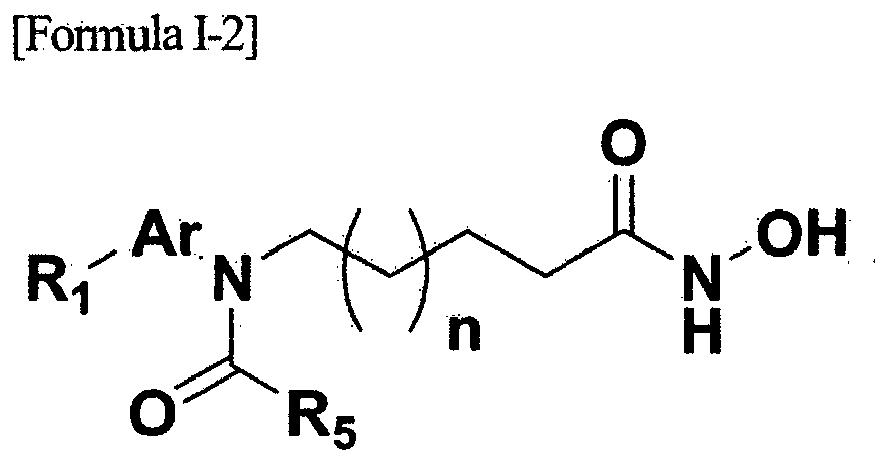


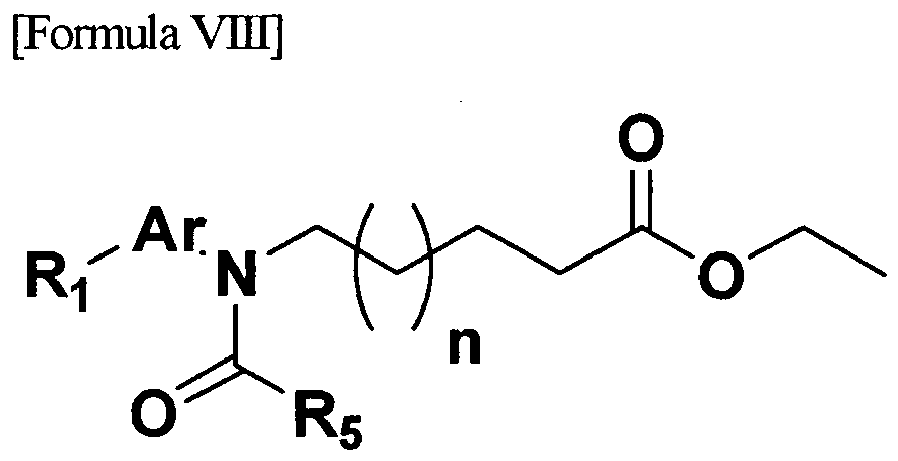
Applications Claiming Priority (2)
| Application Number | Priority Date | Filing Date | Title |
|---|---|---|---|
| KR20090026578 | 2009-03-27 | ||
| PCT/KR2010/001656 WO2010110545A2 (en) | 2009-03-27 | 2010-03-18 | Novel hydroxamate derivative, a production method for the same, and a pharmaceutical composition comprising the same |
Publications (3)
| Publication Number | Publication Date |
|---|---|
| EP2412706A2 EP2412706A2 (en) | 2012-02-01 |
| EP2412706A4 EP2412706A4 (en) | 2012-05-09 |
| EP2412706B1 true EP2412706B1 (en) | 2014-10-29 |
Family
ID=42781631
Family Applications (1)
| Application Number | Title | Priority Date | Filing Date |
|---|---|---|---|
| EP10756300.9A Active EP2412706B1 (en) | 2009-03-27 | 2010-03-18 | Novel hydroxamate derivative, a production method for the same, and a pharmaceutical composition comprising the same |
Country Status (11)
| Country | Link |
|---|---|
| US (1) | US8466161B2 (en) |
| EP (1) | EP2412706B1 (en) |
| JP (1) | JP5555868B2 (en) |
| KR (1) | KR101168801B1 (en) |
| CN (1) | CN102365270B (en) |
| AU (1) | AU2010229591B2 (en) |
| BR (1) | BRPI1007092B8 (en) |
| CA (1) | CA2754085C (en) |
| ES (1) | ES2525566T3 (en) |
| MX (1) | MX2011010065A (en) |
| WO (1) | WO2010110545A2 (en) |
Families Citing this family (13)
| Publication number | Priority date | Publication date | Assignee | Title |
|---|---|---|---|---|
| CA2846066A1 (en) * | 2011-10-28 | 2013-05-02 | Chong Kun Dang Pharmaceutical Corp. | Hydroxamate derivatives for hdac inhibitor, and the pharmaceutical composition comprising thereof |
| JP5976224B2 (en) | 2012-08-31 | 2016-08-23 | ノバドラッグ, エルエルシー | Heterocyclylcarboxamide for treating viral diseases |
| HUE041881T2 (en) * | 2013-04-29 | 2019-06-28 | Chong Kun Dang Pharmaceutical Corp | New compounds as selective histone deacetylase inhibitors and pharmaceutical compositions containing them |
| EP3080125B1 (en) | 2013-12-12 | 2018-10-10 | Chong Kun Dang Pharmaceutical Corp. | Novel azaindole derivatives as selective histone deacetylase (hdac) inhibitors and pharmaceutical compositions comprising the same |
| TW201625620A (en) * | 2014-05-14 | 2016-07-16 | 美國科羅拉多州立大學 | Heterocyclic hydroxamic acids as protein deacetylase inhibitors and dual protein deacetylase-protein kinase inhibitors and methods of use thereof |
| CN108026057B (en) | 2015-05-22 | 2021-08-06 | 株式会社钟根堂 | Heterocycloalkyl derivative compounds useful as selective histone deacetylase inhibitors and pharmaceutical compositions containing the same |
| KR102002581B1 (en) | 2016-10-04 | 2019-07-22 | 주식회사 종근당 | Pharmaceutical combinations of histone deacetylase inhibitor and proteasome inhibitor or immunomodulatory drug for the treatment of hematological cancer |
| US11046715B2 (en) | 2016-11-29 | 2021-06-29 | Xavier University Of Louisiana | Boronic derivatives of hydroxamates as anticancer agents |
| WO2019018562A1 (en) | 2017-07-19 | 2019-01-24 | Ideaya Biosciences, Inc. | AMIDO COMPOUNDS AS AhR MODULATORS |
| EP3697777A1 (en) | 2017-10-19 | 2020-08-26 | eFFECTOR Therapeutics, Inc. | Benzimidazole-indole inhibitors of mnk1 and mnk2 |
| KR102236356B1 (en) * | 2017-11-24 | 2021-04-05 | 주식회사 종근당 | Compositions for Preventing or Treating Lupus |
| CN109096272B (en) * | 2018-09-27 | 2021-04-02 | 沈阳药科大学 | A kind of indole hydroxamic acid compound with antitumor activity and its application |
| US11596612B1 (en) | 2022-03-08 | 2023-03-07 | PTC Innovations, LLC | Topical anesthetics |
Family Cites Families (15)
| Publication number | Priority date | Publication date | Assignee | Title |
|---|---|---|---|---|
| US771760A (en) | 1902-07-12 | 1904-10-04 | David M Balch | Process of treating seaweed. |
| US5369108A (en) | 1991-10-04 | 1994-11-29 | Sloan-Kettering Institute For Cancer Research | Potent inducers of terminal differentiation and methods of use thereof |
| US5700811A (en) | 1991-10-04 | 1997-12-23 | Sloan-Kettering Institute For Cancer Research | Potent inducers of terminal differentiation and method of use thereof |
| IT1283637B1 (en) | 1996-05-14 | 1998-04-23 | Italfarmaco Spa | COMPOUNDS WITH ANTI-INFLAMMATORY AND IMMUNOSOPPRESSIVE ACTIVITY |
| US6174905B1 (en) | 1996-09-30 | 2001-01-16 | Mitsui Chemicals, Inc. | Cell differentiation inducer |
| PE20020354A1 (en) | 2000-09-01 | 2002-06-12 | Novartis Ag | HYDROXAMATE COMPOUNDS AS HISTONE-DESACETILASE (HDA) INHIBITORS |
| JP4975941B2 (en) | 2000-09-29 | 2012-07-11 | トポターゲット ユーケー リミテッド | (E) -N-hydroxy-3- (3-sulfamoyl-phenyl) acrylamide compound and therapeutic use thereof |
| US6897220B2 (en) | 2001-09-14 | 2005-05-24 | Methylgene, Inc. | Inhibitors of histone deacetylase |
| US20070060614A1 (en) | 2002-03-04 | 2007-03-15 | Bacopoulos Nicholas G | Methods of treating cancer with hdac inhibitors |
| TW200418806A (en) * | 2003-01-13 | 2004-10-01 | Fujisawa Pharmaceutical Co | HDAC inhibitor |
| WO2004110989A1 (en) | 2003-05-14 | 2004-12-23 | Bayer Pharmaceuticals Corporation | N-hydroxy-7-(arylamino)heptanamide derivatives useful for treating hyper-proliferative disorders |
| DK1937650T3 (en) * | 2005-09-08 | 2011-10-03 | S Bio Pte Ltd | Heterocyclic Compounds |
| US20080221132A1 (en) | 2006-09-11 | 2008-09-11 | Xiong Cai | Multi-Functional Small Molecules as Anti-Proliferative Agents |
| KR100814098B1 (en) * | 2006-11-03 | 2008-03-14 | 한국화학연구원 | Alkylaminonaphthalenyloxy methyl oct N-hydroxyenamide derivatives having histone deacetylase inhibitory activity, preparation method thereof, and pharmaceutical composition for anticancer agent comprising the same as an active ingredient |
| EP2170882A1 (en) * | 2007-06-26 | 2010-04-07 | Gilead Colorado, Inc. | Imidazopyridinyl thiazolyl histone deacetylase inhibitors |
-
2010
- 2010-03-17 KR KR1020100023575A patent/KR101168801B1/en not_active Expired - Fee Related
- 2010-03-18 AU AU2010229591A patent/AU2010229591B2/en not_active Ceased
- 2010-03-18 ES ES10756300.9T patent/ES2525566T3/en active Active
- 2010-03-18 MX MX2011010065A patent/MX2011010065A/en active IP Right Grant
- 2010-03-18 CN CN201080013979.6A patent/CN102365270B/en not_active Expired - Fee Related
- 2010-03-18 JP JP2012501923A patent/JP5555868B2/en not_active Expired - Fee Related
- 2010-03-18 EP EP10756300.9A patent/EP2412706B1/en active Active
- 2010-03-18 BR BRPI1007092A patent/BRPI1007092B8/en not_active IP Right Cessation
- 2010-03-18 US US13/258,630 patent/US8466161B2/en not_active Expired - Fee Related
- 2010-03-18 CA CA2754085A patent/CA2754085C/en active Active
- 2010-03-18 WO PCT/KR2010/001656 patent/WO2010110545A2/en not_active Ceased
Also Published As
| Publication number | Publication date |
|---|---|
| US8466161B2 (en) | 2013-06-18 |
| EP2412706A4 (en) | 2012-05-09 |
| MX2011010065A (en) | 2011-10-10 |
| BRPI1007092B1 (en) | 2022-07-12 |
| AU2010229591A1 (en) | 2011-10-20 |
| KR20100108220A (en) | 2010-10-06 |
| AU2010229591B2 (en) | 2013-01-31 |
| CN102365270A (en) | 2012-02-29 |
| CN102365270B (en) | 2014-07-30 |
| BRPI1007092A2 (en) | 2015-08-18 |
| WO2010110545A2 (en) | 2010-09-30 |
| CA2754085C (en) | 2014-03-18 |
| ES2525566T3 (en) | 2014-12-26 |
| WO2010110545A3 (en) | 2011-03-24 |
| KR101168801B1 (en) | 2012-07-25 |
| BRPI1007092B8 (en) | 2022-07-26 |
| EP2412706A2 (en) | 2012-02-01 |
| JP2012521982A (en) | 2012-09-20 |
| US20120028963A1 (en) | 2012-02-02 |
| CA2754085A1 (en) | 2010-09-30 |
| JP5555868B2 (en) | 2014-07-23 |
Similar Documents
| Publication | Publication Date | Title |
|---|---|---|
| US8466161B2 (en) | Hydroxamate derivative, a production method for the same, and a pharmaceutical composition comprising the same | |
| RU2528386C2 (en) | New pyrimidine derivatives | |
| KR20120118480A (en) | Reverse amide compounds as protein deacetylase inhibitors and methods of use thereof | |
| CN102574786A (en) | Dihydroorotate dehydrogenase inhibitors | |
| HUE028490T2 (en) | Zn 2+ -chelating motif-tethered short-chain fatty acids as a novel class of histone deacetylase inhibitors | |
| TW201043603A (en) | Substituted phenylureas and phenylamides as vanilloid receptor ligands | |
| CN113527195B (en) | 5-aryl nicotinamide LSD1/HDAC double-target inhibitor, preparation method and application thereof | |
| WO2013066833A1 (en) | Compounds and methods to inhibit histone deacetylase (hdac) enzymes | |
| CN105218532B (en) | Benzotriazole compound, preparation method and its medical usage | |
| WO2010017051A1 (en) | Novel phenylamino isonicotinamide compounds | |
| CN103420917B (en) | Containing the benzamide compound of condensed cyclic structure and apply as antitumor drug | |
| CN104958294A (en) | Sulfonamido derivatives of 3, 4-diarylpyrazoles as protein kinase inhibitors | |
| JP2024528251A (en) | Multi-targeted inhibitors targeting HDAC and NAD synthesis and their uses | |
| CN114685382B (en) | Quinazoline-4-amine derivative with HDACs inhibitory activity, and preparation method and application thereof | |
| CN102341373A (en) | Substituted 2-mercapto-3-aminopyridines as kcnq2/3 modulators | |
| CN109734677A (en) | Small-molecule compounds inhibiting histone lysine methyltransferase NSD2 and their applications | |
| CN102026969A (en) | Novel N-(2-amino-phenyl)-acrylamides | |
| WO2018068357A1 (en) | Novel sirt2 protein inhibitor and pharmaceutical use thereof | |
| CN105801464B (en) | Pyrrole amides class compound and preparation method thereof and purposes | |
| JP2008516976A (en) | Indanamide with antiproliferative activity | |
| JP2005537258A (en) | Novel anthracene derivatives and their use as pharmaceuticals | |
| CN106496132B (en) | N- (4-substituted phenyl) -2-substituted acetamide compound and application thereof as SIRT2 protein inhibitor | |
| Zhou et al. | Discovery of a tetrahydroisoquinoline-based HDAC inhibitor with improved plasma stability | |
| WO2018161476A1 (en) | Amide compound and preparation method and use thereof | |
| WO2016107541A1 (en) | Pyrrole amide compound, preparation method therefor, and use thereof |
Legal Events
| Date | Code | Title | Description |
|---|---|---|---|
| PUAI | Public reference made under article 153(3) epc to a published international application that has entered the european phase |
Free format text: ORIGINAL CODE: 0009012 |
|
| 17P | Request for examination filed |
Effective date: 20110902 |
|
| AK | Designated contracting states |
Kind code of ref document: A2 Designated state(s): AT BE BG CH CY CZ DE DK EE ES FI FR GB GR HR HU IE IS IT LI LT LU LV MC MK MT NL NO PL PT RO SE SI SK SM TR |
|
| A4 | Supplementary search report drawn up and despatched |
Effective date: 20120405 |
|
| RIC1 | Information provided on ipc code assigned before grant |
Ipc: A61K 31/416 20060101ALI20120330BHEP Ipc: C07D 209/04 20060101AFI20120330BHEP Ipc: C07D 209/44 20060101ALI20120330BHEP Ipc: A61K 31/4184 20060101ALI20120330BHEP Ipc: C07D 209/08 20060101ALI20120330BHEP Ipc: A61P 35/00 20060101ALI20120330BHEP Ipc: A61K 31/404 20060101ALI20120330BHEP |
|
| DAX | Request for extension of the european patent (deleted) | ||
| GRAP | Despatch of communication of intention to grant a patent |
Free format text: ORIGINAL CODE: EPIDOSNIGR1 |
|
| INTG | Intention to grant announced |
Effective date: 20140523 |
|
| GRAS | Grant fee paid |
Free format text: ORIGINAL CODE: EPIDOSNIGR3 |
|
| RAP1 | Party data changed (applicant data changed or rights of an application transferred) |
Owner name: CHONG KUN DANG PHARMACEUTICAL CORP. |
|
| GRAA | (expected) grant |
Free format text: ORIGINAL CODE: 0009210 |
|
| AK | Designated contracting states |
Kind code of ref document: B1 Designated state(s): AT BE BG CH CY CZ DE DK EE ES FI FR GB GR HR HU IE IS IT LI LT LU LV MC MK MT NL NO PL PT RO SE SI SK SM TR |
|
| REG | Reference to a national code |
Ref country code: GB Ref legal event code: FG4D |
|
| REG | Reference to a national code |
Ref country code: CH Ref legal event code: EP |
|
| REG | Reference to a national code |
Ref country code: AT Ref legal event code: REF Ref document number: 693503 Country of ref document: AT Kind code of ref document: T Effective date: 20141115 |
|
| REG | Reference to a national code |
Ref country code: IE Ref legal event code: FG4D |
|
| REG | Reference to a national code |
Ref country code: DE Ref legal event code: R096 Ref document number: 602010019837 Country of ref document: DE Effective date: 20141211 |
|
| REG | Reference to a national code |
Ref country code: ES Ref legal event code: FG2A Ref document number: 2525566 Country of ref document: ES Kind code of ref document: T3 Effective date: 20141226 |
|
| REG | Reference to a national code |
Ref country code: AT Ref legal event code: MK05 Ref document number: 693503 Country of ref document: AT Kind code of ref document: T Effective date: 20141029 |
|
| REG | Reference to a national code |
Ref country code: NL Ref legal event code: VDEP Effective date: 20141029 |
|
| REG | Reference to a national code |
Ref country code: LT Ref legal event code: MG4D |
|
| PG25 | Lapsed in a contracting state [announced via postgrant information from national office to epo] |
Ref country code: FI Free format text: LAPSE BECAUSE OF FAILURE TO SUBMIT A TRANSLATION OF THE DESCRIPTION OR TO PAY THE FEE WITHIN THE PRESCRIBED TIME-LIMIT Effective date: 20141029 Ref country code: IS Free format text: LAPSE BECAUSE OF FAILURE TO SUBMIT A TRANSLATION OF THE DESCRIPTION OR TO PAY THE FEE WITHIN THE PRESCRIBED TIME-LIMIT Effective date: 20150228 Ref country code: PT Free format text: LAPSE BECAUSE OF FAILURE TO SUBMIT A TRANSLATION OF THE DESCRIPTION OR TO PAY THE FEE WITHIN THE PRESCRIBED TIME-LIMIT Effective date: 20150302 Ref country code: LT Free format text: LAPSE BECAUSE OF FAILURE TO SUBMIT A TRANSLATION OF THE DESCRIPTION OR TO PAY THE FEE WITHIN THE PRESCRIBED TIME-LIMIT Effective date: 20141029 Ref country code: NO Free format text: LAPSE BECAUSE OF FAILURE TO SUBMIT A TRANSLATION OF THE DESCRIPTION OR TO PAY THE FEE WITHIN THE PRESCRIBED TIME-LIMIT Effective date: 20150129 Ref country code: NL Free format text: LAPSE BECAUSE OF FAILURE TO SUBMIT A TRANSLATION OF THE DESCRIPTION OR TO PAY THE FEE WITHIN THE PRESCRIBED TIME-LIMIT Effective date: 20141029 |
|
| PG25 | Lapsed in a contracting state [announced via postgrant information from national office to epo] |
Ref country code: AT Free format text: LAPSE BECAUSE OF FAILURE TO SUBMIT A TRANSLATION OF THE DESCRIPTION OR TO PAY THE FEE WITHIN THE PRESCRIBED TIME-LIMIT Effective date: 20141029 Ref country code: SE Free format text: LAPSE BECAUSE OF FAILURE TO SUBMIT A TRANSLATION OF THE DESCRIPTION OR TO PAY THE FEE WITHIN THE PRESCRIBED TIME-LIMIT Effective date: 20141029 Ref country code: HR Free format text: LAPSE BECAUSE OF FAILURE TO SUBMIT A TRANSLATION OF THE DESCRIPTION OR TO PAY THE FEE WITHIN THE PRESCRIBED TIME-LIMIT Effective date: 20141029 Ref country code: PL Free format text: LAPSE BECAUSE OF FAILURE TO SUBMIT A TRANSLATION OF THE DESCRIPTION OR TO PAY THE FEE WITHIN THE PRESCRIBED TIME-LIMIT Effective date: 20141029 Ref country code: CY Free format text: LAPSE BECAUSE OF FAILURE TO SUBMIT A TRANSLATION OF THE DESCRIPTION OR TO PAY THE FEE WITHIN THE PRESCRIBED TIME-LIMIT Effective date: 20141029 Ref country code: LV Free format text: LAPSE BECAUSE OF FAILURE TO SUBMIT A TRANSLATION OF THE DESCRIPTION OR TO PAY THE FEE WITHIN THE PRESCRIBED TIME-LIMIT Effective date: 20141029 Ref country code: GR Free format text: LAPSE BECAUSE OF FAILURE TO SUBMIT A TRANSLATION OF THE DESCRIPTION OR TO PAY THE FEE WITHIN THE PRESCRIBED TIME-LIMIT Effective date: 20150130 |
|
| REG | Reference to a national code |
Ref country code: DE Ref legal event code: R097 Ref document number: 602010019837 Country of ref document: DE |
|
| PG25 | Lapsed in a contracting state [announced via postgrant information from national office to epo] |
Ref country code: RO Free format text: LAPSE BECAUSE OF FAILURE TO SUBMIT A TRANSLATION OF THE DESCRIPTION OR TO PAY THE FEE WITHIN THE PRESCRIBED TIME-LIMIT Effective date: 20141029 Ref country code: CZ Free format text: LAPSE BECAUSE OF FAILURE TO SUBMIT A TRANSLATION OF THE DESCRIPTION OR TO PAY THE FEE WITHIN THE PRESCRIBED TIME-LIMIT Effective date: 20141029 Ref country code: EE Free format text: LAPSE BECAUSE OF FAILURE TO SUBMIT A TRANSLATION OF THE DESCRIPTION OR TO PAY THE FEE WITHIN THE PRESCRIBED TIME-LIMIT Effective date: 20141029 Ref country code: DK Free format text: LAPSE BECAUSE OF FAILURE TO SUBMIT A TRANSLATION OF THE DESCRIPTION OR TO PAY THE FEE WITHIN THE PRESCRIBED TIME-LIMIT Effective date: 20141029 Ref country code: SK Free format text: LAPSE BECAUSE OF FAILURE TO SUBMIT A TRANSLATION OF THE DESCRIPTION OR TO PAY THE FEE WITHIN THE PRESCRIBED TIME-LIMIT Effective date: 20141029 |
|
| PLBE | No opposition filed within time limit |
Free format text: ORIGINAL CODE: 0009261 |
|
| STAA | Information on the status of an ep patent application or granted ep patent |
Free format text: STATUS: NO OPPOSITION FILED WITHIN TIME LIMIT |
|
| 26N | No opposition filed |
Effective date: 20150730 |
|
| PG25 | Lapsed in a contracting state [announced via postgrant information from national office to epo] |
Ref country code: LU Free format text: LAPSE BECAUSE OF FAILURE TO SUBMIT A TRANSLATION OF THE DESCRIPTION OR TO PAY THE FEE WITHIN THE PRESCRIBED TIME-LIMIT Effective date: 20150318 Ref country code: MC Free format text: LAPSE BECAUSE OF FAILURE TO SUBMIT A TRANSLATION OF THE DESCRIPTION OR TO PAY THE FEE WITHIN THE PRESCRIBED TIME-LIMIT Effective date: 20141029 |
|
| REG | Reference to a national code |
Ref country code: CH Ref legal event code: PL |
|
| REG | Reference to a national code |
Ref country code: IE Ref legal event code: MM4A |
|
| PG25 | Lapsed in a contracting state [announced via postgrant information from national office to epo] |
Ref country code: LI Free format text: LAPSE BECAUSE OF NON-PAYMENT OF DUE FEES Effective date: 20150331 Ref country code: IE Free format text: LAPSE BECAUSE OF NON-PAYMENT OF DUE FEES Effective date: 20150318 Ref country code: CH Free format text: LAPSE BECAUSE OF NON-PAYMENT OF DUE FEES Effective date: 20150331 |
|
| PG25 | Lapsed in a contracting state [announced via postgrant information from national office to epo] |
Ref country code: SI Free format text: LAPSE BECAUSE OF FAILURE TO SUBMIT A TRANSLATION OF THE DESCRIPTION OR TO PAY THE FEE WITHIN THE PRESCRIBED TIME-LIMIT Effective date: 20141029 |
|
| REG | Reference to a national code |
Ref country code: FR Ref legal event code: PLFP Year of fee payment: 7 |
|
| PG25 | Lapsed in a contracting state [announced via postgrant information from national office to epo] |
Ref country code: MT Free format text: LAPSE BECAUSE OF FAILURE TO SUBMIT A TRANSLATION OF THE DESCRIPTION OR TO PAY THE FEE WITHIN THE PRESCRIBED TIME-LIMIT Effective date: 20141029 |
|
| REG | Reference to a national code |
Ref country code: FR Ref legal event code: PLFP Year of fee payment: 8 |
|
| PG25 | Lapsed in a contracting state [announced via postgrant information from national office to epo] |
Ref country code: IT Free format text: LAPSE BECAUSE OF NON-PAYMENT OF DUE FEES Effective date: 20160318 |
|
| PG25 | Lapsed in a contracting state [announced via postgrant information from national office to epo] |
Ref country code: SM Free format text: LAPSE BECAUSE OF FAILURE TO SUBMIT A TRANSLATION OF THE DESCRIPTION OR TO PAY THE FEE WITHIN THE PRESCRIBED TIME-LIMIT Effective date: 20141029 Ref country code: BG Free format text: LAPSE BECAUSE OF FAILURE TO SUBMIT A TRANSLATION OF THE DESCRIPTION OR TO PAY THE FEE WITHIN THE PRESCRIBED TIME-LIMIT Effective date: 20141029 Ref country code: HU Free format text: LAPSE BECAUSE OF FAILURE TO SUBMIT A TRANSLATION OF THE DESCRIPTION OR TO PAY THE FEE WITHIN THE PRESCRIBED TIME-LIMIT; INVALID AB INITIO Effective date: 20100318 |
|
| PG25 | Lapsed in a contracting state [announced via postgrant information from national office to epo] |
Ref country code: IT Free format text: LAPSE BECAUSE OF NON-PAYMENT OF DUE FEES Effective date: 20160318 Ref country code: TR Free format text: LAPSE BECAUSE OF FAILURE TO SUBMIT A TRANSLATION OF THE DESCRIPTION OR TO PAY THE FEE WITHIN THE PRESCRIBED TIME-LIMIT Effective date: 20141029 |
|
| PGRI | Patent reinstated in contracting state [announced from national office to epo] |
Ref country code: IT Effective date: 20170710 |
|
| PG25 | Lapsed in a contracting state [announced via postgrant information from national office to epo] |
Ref country code: BE Free format text: LAPSE BECAUSE OF FAILURE TO SUBMIT A TRANSLATION OF THE DESCRIPTION OR TO PAY THE FEE WITHIN THE PRESCRIBED TIME-LIMIT Effective date: 20141029 |
|
| REG | Reference to a national code |
Ref country code: FR Ref legal event code: PLFP Year of fee payment: 9 |
|
| PG25 | Lapsed in a contracting state [announced via postgrant information from national office to epo] |
Ref country code: MK Free format text: LAPSE BECAUSE OF FAILURE TO SUBMIT A TRANSLATION OF THE DESCRIPTION OR TO PAY THE FEE WITHIN THE PRESCRIBED TIME-LIMIT Effective date: 20141029 |
|
| PGFP | Annual fee paid to national office [announced via postgrant information from national office to epo] |
Ref country code: FR Payment date: 20221220 Year of fee payment: 14 |
|
| PGFP | Annual fee paid to national office [announced via postgrant information from national office to epo] |
Ref country code: IT Payment date: 20221221 Year of fee payment: 14 Ref country code: GB Payment date: 20230105 Year of fee payment: 14 Ref country code: DE Payment date: 20221220 Year of fee payment: 14 |
|
| PGFP | Annual fee paid to national office [announced via postgrant information from national office to epo] |
Ref country code: ES Payment date: 20230412 Year of fee payment: 14 |
|
| REG | Reference to a national code |
Ref country code: DE Ref legal event code: R119 Ref document number: 602010019837 Country of ref document: DE |
|
| GBPC | Gb: european patent ceased through non-payment of renewal fee |
Effective date: 20240318 |
|
| PG25 | Lapsed in a contracting state [announced via postgrant information from national office to epo] |
Ref country code: DE Free format text: LAPSE BECAUSE OF NON-PAYMENT OF DUE FEES Effective date: 20241001 |
|
| PG25 | Lapsed in a contracting state [announced via postgrant information from national office to epo] |
Ref country code: GB Free format text: LAPSE BECAUSE OF NON-PAYMENT OF DUE FEES Effective date: 20240318 |
|
| PG25 | Lapsed in a contracting state [announced via postgrant information from national office to epo] |
Ref country code: FR Free format text: LAPSE BECAUSE OF NON-PAYMENT OF DUE FEES Effective date: 20240331 |
|
| PG25 | Lapsed in a contracting state [announced via postgrant information from national office to epo] |
Ref country code: GB Free format text: LAPSE BECAUSE OF NON-PAYMENT OF DUE FEES Effective date: 20240318 Ref country code: FR Free format text: LAPSE BECAUSE OF NON-PAYMENT OF DUE FEES Effective date: 20240331 Ref country code: DE Free format text: LAPSE BECAUSE OF NON-PAYMENT OF DUE FEES Effective date: 20241001 |
|
| REG | Reference to a national code |
Ref country code: ES Ref legal event code: FD2A Effective date: 20250506 |
|
| PG25 | Lapsed in a contracting state [announced via postgrant information from national office to epo] |
Ref country code: ES Free format text: LAPSE BECAUSE OF NON-PAYMENT OF DUE FEES Effective date: 20240319 |