EP2412702A1 - Method for producing cyclopropanecarboxylic acid ester - Google Patents
Method for producing cyclopropanecarboxylic acid ester Download PDFInfo
- Publication number
- EP2412702A1 EP2412702A1 EP10755975A EP10755975A EP2412702A1 EP 2412702 A1 EP2412702 A1 EP 2412702A1 EP 10755975 A EP10755975 A EP 10755975A EP 10755975 A EP10755975 A EP 10755975A EP 2412702 A1 EP2412702 A1 EP 2412702A1
- Authority
- EP
- European Patent Office
- Prior art keywords
- group
- carbon atoms
- substituent
- optionally
- groups
- Prior art date
- Legal status (The legal status is an assumption and is not a legal conclusion. Google has not performed a legal analysis and makes no representation as to the accuracy of the status listed.)
- Granted
Links
- 0 *C(C1C(O*)=O)C1(*)N Chemical compound *C(C1C(O*)=O)C1(*)N 0.000 description 1
Classifications
-
- C—CHEMISTRY; METALLURGY
- C07—ORGANIC CHEMISTRY
- C07C—ACYCLIC OR CARBOCYCLIC COMPOUNDS
- C07C253/00—Preparation of carboxylic acid nitriles
- C07C253/30—Preparation of carboxylic acid nitriles by reactions not involving the formation of cyano groups
-
- C—CHEMISTRY; METALLURGY
- C07—ORGANIC CHEMISTRY
- C07B—GENERAL METHODS OF ORGANIC CHEMISTRY; APPARATUS THEREFOR
- C07B61/00—Other general methods
-
- C—CHEMISTRY; METALLURGY
- C07—ORGANIC CHEMISTRY
- C07C—ACYCLIC OR CARBOCYCLIC COMPOUNDS
- C07C255/00—Carboxylic acid nitriles
- C07C255/01—Carboxylic acid nitriles having cyano groups bound to acyclic carbon atoms
- C07C255/31—Carboxylic acid nitriles having cyano groups bound to acyclic carbon atoms having cyano groups bound to acyclic carbon atoms of a carbon skeleton containing rings other than six-membered aromatic rings
-
- C—CHEMISTRY; METALLURGY
- C07—ORGANIC CHEMISTRY
- C07C—ACYCLIC OR CARBOCYCLIC COMPOUNDS
- C07C255/00—Carboxylic acid nitriles
- C07C255/01—Carboxylic acid nitriles having cyano groups bound to acyclic carbon atoms
- C07C255/32—Carboxylic acid nitriles having cyano groups bound to acyclic carbon atoms having cyano groups bound to acyclic carbon atoms of a carbon skeleton containing at least one six-membered aromatic ring
- C07C255/41—Carboxylic acid nitriles having cyano groups bound to acyclic carbon atoms having cyano groups bound to acyclic carbon atoms of a carbon skeleton containing at least one six-membered aromatic ring the carbon skeleton being further substituted by carboxyl groups, other than cyano groups
-
- C—CHEMISTRY; METALLURGY
- C07—ORGANIC CHEMISTRY
- C07C—ACYCLIC OR CARBOCYCLIC COMPOUNDS
- C07C2601/00—Systems containing only non-condensed rings
- C07C2601/02—Systems containing only non-condensed rings with a three-membered ring
Definitions
- the present invention relates to a method for producing a cyclopropanecarboxylate.
- the present invention provides
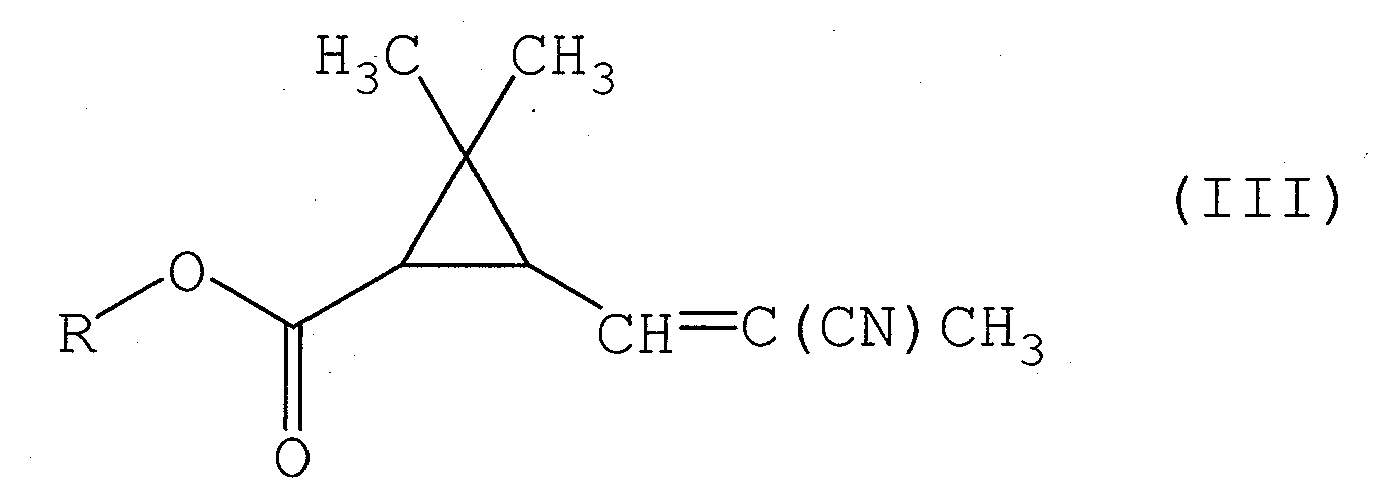
- the present invention is a method for producing a cyclopropanecarboxylate represented by formula (III) (hereinafter, abbreviated as ester (III)): comprising reacting a cyclopropanecarboxylate represented by formula (I) (hereinafter, abbreviated as ester (I)): and 2-cyanopropionic acid and in the presence of a base.
- a cyclopropanecarboxylate represented by formula (III) comprising reacting a cyclopropanecarboxylate represented by formula (I) (hereinafter, abbreviated as ester (I)): and 2-cyanopropionic acid and in the presence of a base.
- R represents a chain hydrocarbon group having 1 to 10 carbon atoms optionally having at least one member selected from the group consisting of halogen atoms, acyl groups having 2 to 7 carbon atoms optionally having a substituent, alkoxy groups having 1 to 7 carbon atoms optionally having a substituent, alkylthio groups having 1 to 3 carbon atoms and phenyl groups optionally having a substituent, a cyclic hydrocarbon group having 3 to 10 carbon atoms or a hydrogen atom.
- the halogen atom includes a chlorine atom and a fluorine atom, preferably a chlorine atom.
- the acyl group having 2 to 7 carbon atoms optionally having a substituent includes unsubstituted acyl groups having 2 to 7 carbon atoms such as a phenacyl group and the like, and acyl groups having 2 to 7 carbon atoms having a halogen atom such as a p-bromophenacyl group and the like.
- the alkoxy group having 1 to 7 carbon atoms optionally having a substituent includes unsubstituted alkoxy groups having 1 to 7 carbon atoms such as a methoxy group, ethoxy group, propoxy group and the like, alkoxy groups having 1 to 7 carbon atoms having an alkoxy group having 1 to 7 carbon atoms such as a methoxymethoxy group and the like, and alkoxy groups having 1 to 7 carbon atoms having a phenyl group such as a benzyloxy group and the like.
- the alkylthio group having 1 to 3 carbon atoms includes a methylthio group.
- the phenyl group optionally having a substituent includes phenyl groups which may have at least one member selected from the group consisting of halogen atoms, alkyl groups having 1 to 7 carbon atoms optionally having an alkoxy group having 1 to 7 carbon atoms, alkoxy groups having 1 to 7 carbon atoms optionally having an alkoxy group having 1 to 7 carbon atoms, a nitro group and a phthaloyl group; such as a 4-bromophenyl group, 4-methoxyphenyl group, 2,3-difluorophenyl group, 2,3,5-trifluorophenyl group, 2,3,5,6-tetrafluoro-4-methoxymethylphenyl group, 2,3,5,6-tetrafluoro-4-methylphenyl group, 2-nitrophenyl group, 4-nitrophenyl group, 2-(9,10-dioxo)anthryl group and the like.
- the chain hydrocarbon group having 1 to 10 carbon atoms which may have at least one member selected from the group consisting of halogen atoms, acyl groups having 2 to 7 carbon atoms optionally having a substituent, alkoxy groups having 1 to 7 carbon atoms optionally having a substituent, alkylthio groups having 1 to 3 carbon atoms and phenyl groups optionally having a substituent includes
- the cyclic hydrocarbon group having 3 to 10 carbon atoms includes a cyclopropyl group, cyclopentyl group and cyclohexyl group.
- R is preferably a chain hydrocarbon group having 1 to 10 carbon atoms or a chain hydrocarbon group having 1 to 10 carbon atoms having a phenyl group optionally having a substituent, more preferably a methyl group or 2,3,5,6-tetrafluoro-4-methoxymethylbenzyl group.
- the ester (I) includes methyl 3-formyl-2,2-dimethylcyclopropanecarboxylate, ethyl 3-formyl-2,2-dimethylcyclopropanecarboxylate, propyl 3-formyl-2,2-dimethylcyclopropanecarboxylate, allyl 3-formyl-2,2-dimethylcyclopropanecarboxylate, propargyl 3-formyl-2,2-dimethylcyclopropanecarboxylate, (2-chloroethyl) 3-formyl-2,2-dimethylcyclopropanecarboxylate, (2,2,2-trichloroethyl) 3-formyl-2,2-dimethylcyclopropanecarboxylate, phenacylmethyl 3-formyl-2,2-dimethylcyclopropanecarboxylate, methoxymethyl 3-formyl-2,2-dimethylcyclopropanecarboxylate, methylthiomethyl 3-formyl-2,2-dimethylcycloprop
- the ester (I) can be obtained by known methods described in JP-A No. 2006-89427 and the like.
- the ester (I) may be a cis form in which a formyl group bonded to a cyclopropane ring and a group represented by -COOR bonded to a cyclopropane ring are present on the same side of the plane of the cyclopropane ring, or a trans form in which a formyl group bonded to a cyclopropane ring and a group represented by -COOR bonded to a cyclopropane ring are present on mutually opposite sides of the plane of the cyclopropane ring.
- the trans form is preferable, and a (1R, 3R) form is more preferable.
- 2-cyanopropionic acid can be used, and those produced by known methods described in Tetrahedron, 50, 4439 (1994 ) and the like can also be used.
- the use amount of 2-cyanopropionic acid is usually 0.8 to 5 mol, preferably 1 to 2 mol with respect to 1 mol of the ester (I) .
- the base includes alkali metal alkoxides such as sodium methoxide, potassium tert-butoxide and the like, alkali metal hydroxides such as sodium hydroxide, potassium hydroxide and the like, secondary amines such as pyrrolidine, piperidine, morpholine, dimethylamine, diethylamine and the like, and primary amines such as butylamine, hexylamine, aniline and the like. Of them, primary amines or secondary amines are preferable, secondary amines are more preferable, pyrrolidine and piperidine are particularly preferable.
- alkali metal alkoxides such as sodium methoxide, potassium tert-butoxide and the like
- alkali metal hydroxides such as sodium hydroxide, potassium hydroxide and the like
- secondary amines such as pyrrolidine, piperidine, morpholine, dimethylamine, diethylamine and the like
- primary amines such as butylamine, hexy
- the use amount of the base is usually 0.01 to 5 mol, preferably 0.1 to 0.5 mol with respect to 1 mol of the ester (I).
- the reaction of the ester (I) and 2-cyanopropionic acid is usually carried out in the presence of a solvent.
- the solvent includes aromatic hydrocarbon solvents such as toluene, xylene, mesitylene, chlorobenzene and the like, aliphatic hydrocarbon solvents such as pentane, hexane, heptane, octane, cyclohexane and the like, ester solvents such as ethyl acetate, dimethyl carbonate and the like, halogenated hydrocarbon solvents such as dichloromethane, dichloroethane, carbon tetrachloride and the like, nitrile solvents such as acetonitrile, benzonitrile and the like, ether solvents such as diethyl ether, tetrahydrofuran, tert-butyl methyl ether and the like, alcohol solvents such as methanol, ethanol, isopropanol and the like, amide
- amide solvents are preferable, N,N-dimethylformamide is more preferable.
- the use amount of the solvent is not limited, it is usually 0.01 to 50 parts by weight, preferably 0.01 to 10 parts by weight with respect to 1 part by weight of the ester (I).
- the reaction temperature is usually -20 to 120°C, preferably 50 to 120°C.
- the reaction time is usually 5 minutes to 72 hours, though varying depending on the reaction temperature.
- the progress of the reaction can be confirmed by usual means such as gas chromatography, high performance liquid chromatography and the like.
- the reaction is carried out by mixing an ester (I), 2-cyanopropionic acid and a base, and the mixing order thereof is not restricted.
- a reaction mixture containing an ester (III) is obtained, and the ester (III) can be taken out, for example, by mixing the reaction mixture and water and if necessary a water-insoluble solvent, and concentrating the resultant organic layer.
- the taken out ester (III) may be further purified by usual purification means such as chromatography, distillation and the like.
- ester (III) includes methyl 3-(2-cyano-1-propenyl)-2,2-dimethylcyclopropanecarboxylate, ethyl 3-(2-cyano-1-propenyl)-2,2-dimethylcyclopropanecarboxylate, propyl 3-(2-cyano-1-propenyl)-2,2-dimethylcyclopropanecarboxylate, allyl 3-(2-cyano-1-propenyl)-2,2-dimethylcyclopropanecarboxylate, propargyl 3-(2-cyano-1-propenyl)-2,2-dimethylcyclopropanecarboxylate, (2-chloroethyl) 3-(2-cyano-1-propenyl)-2,2-dimethylcyclopropanecarboxylate, (2,2,2-trichloroethyl) 3-(2-cyano-1-propenyl)-2,2-dimethylcyclopropanecarboxylate, phenacylmethyl 3-(2-cyano)
- the steric configurations at 1-position and 3-position of a cyclopropane ring are kept.
- a (1R,3R) form of the ester (I) in which the absolute configuration at 1-position of a cyclopropane ring to which a group represented by -COOR is bonded is R configuration and the absolute configuration at 3-position of a cyclopropane ring to which a formyl group is bonded is R configuration
- a (1R,3R) form of the ester (III) is usually obtained in which the absolute configuration at 1-position of a cyclopropane ring to which a group represented by -COOR is bonded is R configuration and the absolute configuration at 3-position of a cyclopropane ring to which a 2-cyano-1-propenyl group is bonded is R configuration.
- the ester (III) is usually a mixture of an ester (III) in which the steric configuration of a double bond of a 2-cyano-1-propenyl group at a 3-position of a cyclopropane ring is E configuration and an ester (III) in which its steric configuration is Z configuration.
- the resultant reaction mixture was cooled down to room temperature, then, 100 g of a 10 wt% sulfuric acid aqueous solution was added, and the mixture was separated into an organic layer and an aqueous layer.
- the resultant aqueous layer was extracted with 100 g of toluene, and the resultant toluene layer was mixed with the organic layer obtained above.
- the resultant solution was washed with 100 g of a 3.0 wt% sodium hydrogen carbonate aqueous solution, further washed with 100 g of water.
- the resultant solution was concentrated under reduced condition to obtain 24.5 g of a coarse product containing methyl (1R,3R)-3-(2-cyano-1-propenyl)-2,2-dimethylcyclopropanecarb oxylate.
- the coarse product was analyzed by a gas chromatography internal standard method to find that the content of methyl (1R,3R)-3-(2-cyano-1-propenyl)-2,2-dimethylcyclopropanecarb oxylate was 72% and the ratio of E form to Z form (hereinafter, abbreviated as E/Z ratio) was 2/1.
- E/Z ratio the ratio of E form to Z form
- the reaction mixture was analyzed by a gas chromatography internal standard method to find that the E/Z ratio of methyl (1R,3R)-3-(2-cyano-1-propenyl)-2,2-dimethylcyclopropanecarb oxylate was 1.4/1 and the yield (total of E form and Z form) of methyl (1R,3R)-3-(2-cyano-1-propenyl)-2,2-dimethylcyclopropanecarb oxylate was 89%.
- Example 3 Example 4 Example 5 Solvent toluene 1.1 g DMF 1.9 g DMF 1.9 g toluene 2.5 g Base pyrrolidine 0.11 g pyrrolidine 0.11 g hexylamine 0.16 g Internal temperature (°C) 80 80 80 80 Time (Hr) 3.5 1.5 6.5 E/Z ratio 1.7/1 1.8/1 1/1.9 Yield (%) 89 90 75
- the resultant aqueous layer was extracted with 5.0 g of toluene, and the resultant toluene layer was mixed with the organic layer obtained above.
- the resultant solution was washed with 5.0 g of a 3.0 wt% sodium hydrogen carbonate aqueous solution, further washed with 5.0 g of water.
- the resultant solution was concentrated under reduced condition to obtain a coarse product containing (2,3,5,6-tetrafluoro-4-methoxymethylbenzyl) (1R,3R)-3-(2-cyano-1-propenyl)-2,2-dimethylcyclopropanecarb oxylate .
- 1 H-NMR of the coarse product was measured to find that the E/Z ratio was 1.9/1.
- the coarse product was purified by silica gel column chromatography to obtain 0.57 g of an E form of (2,3,5,6-tetrafluoro-4-methoxymethylbenzyl) (1R,3R)-3-(2-cyano-1-propenyl)-2,2-dimethylcyclopropanecarb oxylate and 0.30 g of a Z form of (2,3,5,6-tetrafluoro-4-methoxymethylbenzyl) (1R,3R)-3-(2-cyano-1-propenyl)-2,2-dimethylcyclopropanecarb oxylate.
- the present invention is capable of producing a cyclopropanecarboxylate represented by formula (III) in good yield which is a compound useful as a pest control agent and an intermediate thereof, thus, the present invention is industrially advantageous.
Landscapes
- Chemical & Material Sciences (AREA)
- Organic Chemistry (AREA)
- Chemical Kinetics & Catalysis (AREA)
- Organic Low-Molecular-Weight Compounds And Preparation Thereof (AREA)
- Low-Molecular Organic Synthesis Reactions Using Catalysts (AREA)
Abstract
Description
- The present invention relates to a method for producing a cyclopropanecarboxylate.
-
US 2003/0,195,119 A1 discloses a method of reacting (4-methoxymethyl-2,3,5,6-tetrafluorobenzyl) 3-formyl-2,2-dimethylcyclopropanecarboxylate and diethyl (1-cyanoethyl)phosphonate, as a method for producing (4-methoxymethyl-2,3,5,6-tetrafluorobenzyl) 3-(2-cyano-1-propenyl)-2,2-dimethylcyclopropanecarboxylate which is a typical compound of cyclopropanecarboxylates represented by formula (III):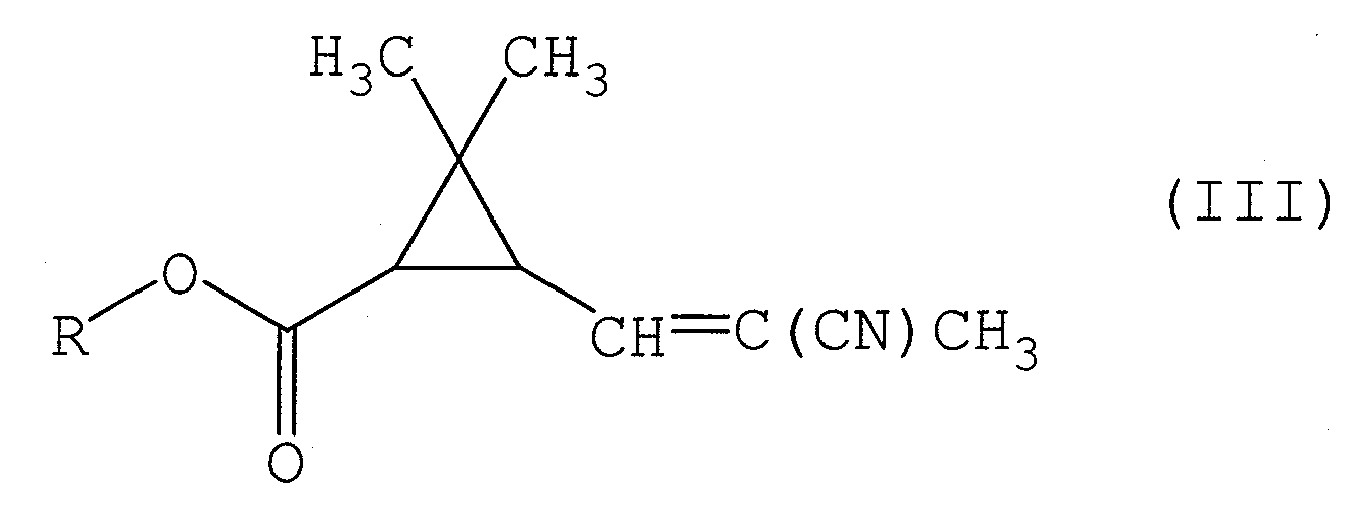
- The present invention provides
- <1> A method for producing a cyclopropanecarboxylate represented by formula (III):
comprising reacting a cyclopropanecarboxylate represented by formula (I):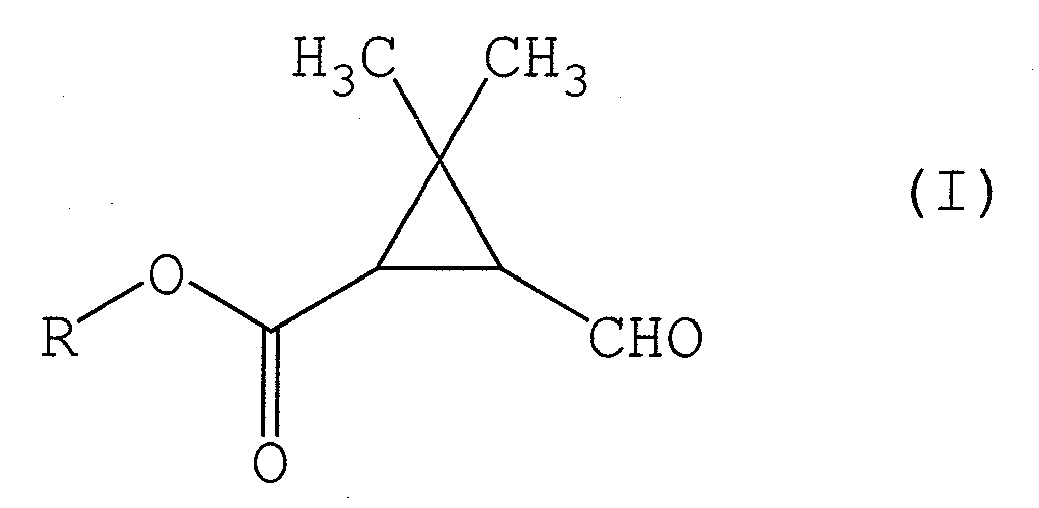
- <2> The method according to <1> wherein the base is a primary amine or a secondary amine;
- <3> The method according to <1> wherein the base is a secondary amine;
- <4> The method according to <1>, <2> or <3> wherein R is a chain hydrocarbon group having 1 to 10 carbon atoms or a chain hydrocarbon group having 1 to 10 carbon atoms having a phenyl group optionally having a substituent;
- <5> The method according to <1>, <2> or <3> wherein R is a methyl group or 2,3,5,6-tetrafluoro-4-methoxymethylbenzyl group;
- The present invention is a method for producing a cyclopropanecarboxylate represented by formula (III) (hereinafter, abbreviated as ester (III)):


- In the above-described formula (I), R represents a chain hydrocarbon group having 1 to 10 carbon atoms optionally having at least one member selected from the group consisting of halogen atoms, acyl groups having 2 to 7 carbon atoms optionally having a substituent, alkoxy groups having 1 to 7 carbon atoms optionally having a substituent, alkylthio groups having 1 to 3 carbon atoms and phenyl groups optionally having a substituent, a cyclic hydrocarbon group having 3 to 10 carbon atoms or a hydrogen atom.
- The halogen atom includes a chlorine atom and a fluorine atom, preferably a chlorine atom.
- The acyl group having 2 to 7 carbon atoms optionally having a substituent includes unsubstituted acyl groups having 2 to 7 carbon atoms such as a phenacyl group and the like, and acyl groups having 2 to 7 carbon atoms having a halogen atom such as a p-bromophenacyl group and the like.
- The alkoxy group having 1 to 7 carbon atoms optionally having a substituent includes unsubstituted alkoxy groups having 1 to 7 carbon atoms such as a methoxy group, ethoxy group, propoxy group and the like, alkoxy groups having 1 to 7 carbon atoms having an alkoxy group having 1 to 7 carbon atoms such as a methoxymethoxy group and the like, and alkoxy groups having 1 to 7 carbon atoms having a phenyl group such as a benzyloxy group and the like.
- The alkylthio group having 1 to 3 carbon atoms includes a methylthio group.
- The phenyl group optionally having a substituent includes phenyl groups which may have at least one member selected from the group consisting of halogen atoms, alkyl groups having 1 to 7 carbon atoms optionally having an alkoxy group having 1 to 7 carbon atoms, alkoxy groups having 1 to 7 carbon atoms optionally having an alkoxy group having 1 to 7 carbon atoms, a nitro group and a phthaloyl group; such as a 4-bromophenyl group, 4-methoxyphenyl group, 2,3-difluorophenyl group, 2,3,5-trifluorophenyl group, 2,3,5,6-tetrafluoro-4-methoxymethylphenyl group, 2,3,5,6-tetrafluoro-4-methylphenyl group, 2-nitrophenyl group, 4-nitrophenyl group, 2-(9,10-dioxo)anthryl group and the like.
- The chain hydrocarbon group having 1 to 10 carbon atoms which may have at least one member selected from the group consisting of halogen atoms, acyl groups having 2 to 7 carbon atoms optionally having a substituent, alkoxy groups having 1 to 7 carbon atoms optionally having a substituent, alkylthio groups having 1 to 3 carbon atoms and phenyl groups optionally having a substituent includes
- unsubstituted chain hydrocarbon groups having 1 to 10 carbon atoms such as a methyl group, ethyl group, propyl group, allyl group, propargyl group and the like;
- chain hydrocarbon groups having 1 to 10 carbon atoms having at least on halogen atom such as a 2-chloroethyl group, 2,2,2-trichloroethyl group and the like;
- chain hydrocarbon groups having 1 to 10 carbon atoms having an acyl groups having 2 to 7 carbon atoms optionally having a substituent such as a phenacyl group, p-bromophenacyl group and the like;
- chain hydrocarbon groups having 1 to 10 carbon atoms having an alkoxy group having 1 to 7 carbon atoms optionally having a substituent such as a methoxymethyl group, methoxymethoxymethyl group, benzyloxymethyl group and the like;
- chain hydrocarbon groups having 1 to 10 carbon atoms having an alkylthio group having 1 to 3 carbon atoms optionally having a substituent such as a methylthiomethyl group, 2-(methylthio)ethyl group and the like; and
- chain hydrocarbon groups having 1 to 10 carbon atoms having a phenyl group optionally having a substituent such as a benzyl group, phenethyl group, 4-bromobenzyl group, 4-methoxybenzyl group, 2,3-difluorobenzyl group, 2,3,5-trifluorobenzyl group, a 2,3,5,6-tetrafluoro-4-methoxymethylbenzyl group, 2,3,5,6-tetrafluoro-4-methylbenzyl group, 2-nitrobenzyl group, 4-nitrobenzyl group, bis(o-nitrophenyl)methyl group, 2-(9,10-dioxo)anthranylmethyl group and the like.
- The cyclic hydrocarbon group having 3 to 10 carbon atoms includes a cyclopropyl group, cyclopentyl group and cyclohexyl group.
- Of them, R is preferably a chain hydrocarbon group having 1 to 10 carbon atoms or a chain hydrocarbon group having 1 to 10 carbon atoms having a phenyl group optionally having a substituent, more preferably a methyl group or 2,3,5,6-tetrafluoro-4-methoxymethylbenzyl group.
- The ester (I) includes methyl 3-formyl-2,2-dimethylcyclopropanecarboxylate, ethyl 3-formyl-2,2-dimethylcyclopropanecarboxylate, propyl 3-formyl-2,2-dimethylcyclopropanecarboxylate, allyl 3-formyl-2,2-dimethylcyclopropanecarboxylate, propargyl 3-formyl-2,2-dimethylcyclopropanecarboxylate, (2-chloroethyl) 3-formyl-2,2-dimethylcyclopropanecarboxylate, (2,2,2-trichloroethyl) 3-formyl-2,2-dimethylcyclopropanecarboxylate, phenacylmethyl 3-formyl-2,2-dimethylcyclopropanecarboxylate, methoxymethyl 3-formyl-2,2-dimethylcyclopropanecarboxylate, methylthiomethyl 3-formyl-2,2-dimethylcyclopropanecarboxylate, benzyl 3-formyl-2,2-dimethylcyclopropanecarboxylate, (2,3-difluorobenzyl) 3-formyl-2,2-dimethylcyclopropanecarboxylate, (2,3,5-trifluorobenzyl) 3-formyl-2,2-dimethylcyclopropanecarboxylate, (2,3,5,6-tetrafluoro-4-methoxymethylbenzyl) 3-formyl-2,2-dimethylcyclopropanecarboxylate and (2,3,5,6-tetrafluoro-4-methylbenzyl) 3-formyl-2,2-dimethylcyclopropanecarboxylate.
- The ester (I) can be obtained by known methods described in
JP-A No. 2006-89427 - Commercially available 2-cyanopropionic acid can be used, and those produced by known methods described in Tetrahedron, 50, 4439 (1994) and the like can also be used.
- The use amount of 2-cyanopropionic acid is usually 0.8 to 5 mol, preferably 1 to 2 mol with respect to 1 mol of the ester (I) .
- The base includes alkali metal alkoxides such as sodium methoxide, potassium tert-butoxide and the like, alkali metal hydroxides such as sodium hydroxide, potassium hydroxide and the like, secondary amines such as pyrrolidine, piperidine, morpholine, dimethylamine, diethylamine and the like, and primary amines such as butylamine, hexylamine, aniline and the like. Of them, primary amines or secondary amines are preferable, secondary amines are more preferable, pyrrolidine and piperidine are particularly preferable.
- The use amount of the base is usually 0.01 to 5 mol, preferably 0.1 to 0.5 mol with respect to 1 mol of the ester (I).
- The reaction of the ester (I) and 2-cyanopropionic acid is usually carried out in the presence of a solvent. The solvent includes aromatic hydrocarbon solvents such as toluene, xylene, mesitylene, chlorobenzene and the like, aliphatic hydrocarbon solvents such as pentane, hexane, heptane, octane, cyclohexane and the like, ester solvents such as ethyl acetate, dimethyl carbonate and the like, halogenated hydrocarbon solvents such as dichloromethane, dichloroethane, carbon tetrachloride and the like, nitrile solvents such as acetonitrile, benzonitrile and the like, ether solvents such as diethyl ether, tetrahydrofuran, tert-butyl methyl ether and the like, alcohol solvents such as methanol, ethanol, isopropanol and the like, amide solvents such as N,N-dimethylformamide, N,N-dimethylacetamide and the like, pyridine, dimethyl sulfoxide, water and mixed solvents thereof. Of them, amide solvents are preferable, N,N-dimethylformamide is more preferable. Though the use amount of the solvent is not limited, it is usually 0.01 to 50 parts by weight, preferably 0.01 to 10 parts by weight with respect to 1 part by weight of the ester (I).
- The reaction temperature is usually -20 to 120°C, preferably 50 to 120°C.
- The reaction time is usually 5 minutes to 72 hours, though varying depending on the reaction temperature.
- The progress of the reaction can be confirmed by usual means such as gas chromatography, high performance liquid chromatography and the like.
- The reaction is carried out by mixing an ester (I), 2-cyanopropionic acid and a base, and the mixing order thereof is not restricted.
- After completion of the reaction, a reaction mixture containing an ester (III) is obtained, and the ester (III) can be taken out, for example, by mixing the reaction mixture and water and if necessary a water-insoluble solvent, and concentrating the resultant organic layer. The taken out ester (III) may be further purified by usual purification means such as chromatography, distillation and the like.
- Thus obtainable ester (III) includes methyl 3-(2-cyano-1-propenyl)-2,2-dimethylcyclopropanecarboxylate, ethyl
3-(2-cyano-1-propenyl)-2,2-dimethylcyclopropanecarboxylate, propyl
3-(2-cyano-1-propenyl)-2,2-dimethylcyclopropanecarboxylate, allyl
3-(2-cyano-1-propenyl)-2,2-dimethylcyclopropanecarboxylate, propargyl
3-(2-cyano-1-propenyl)-2,2-dimethylcyclopropanecarboxylate, (2-chloroethyl)
3-(2-cyano-1-propenyl)-2,2-dimethylcyclopropanecarboxylate, (2,2,2-trichloroethyl)
3-(2-cyano-1-propenyl)-2,2-dimethylcyclopropanecarboxylate, phenacylmethyl
3-(2-cyano-1-propenyl)-2,2-dimethylcyclopropanecarboxylate, methoxymethyl
3-(2-cyano-1-propenyl)-2,2-dimethylcyclopropanecarboxylate, methylthiomethyl
3-(2-cyano-1-propenyl)-2,2-dimethylcyclopropanecarboxylate, benzyl
3-(2-cyano-1-propenyl)-2,2-dimethylcyclopropanecarboxylate, (2,3-difluorobenzyl)
3-(2-cyano-1-propenyl)-2,2-dimethylcyclopropanecarboxylate, (2,3,5-trifluorobenzyl)
3-(2-cyano-1-propenyl)-2,2-dimethylcyclopropanecarboxylate, (2,3,5,6-tetrafluoro-4-methoxymethylbenzyl)
3-(2-cyano-1-propenyl)-2,2-dimethylcyclopropanecarboxylate and (2,3,5,6-tetrafluoro-4-methylbenzyl) 3-(2-cyano-1-propenyl)-2,2-dimethylcyclopropanecarboxylate. - In the above-described reaction, the steric configurations at 1-position and 3-position of a cyclopropane ring are kept. For example, in the case of use of a (1R,3R) form of the ester (I) in which the absolute configuration at 1-position of a cyclopropane ring to which a group represented by -COOR is bonded is R configuration and the absolute configuration at 3-position of a cyclopropane ring to which a formyl group is bonded is R configuration, a (1R,3R) form of the ester (III) is usually obtained in which the absolute configuration at 1-position of a cyclopropane ring to which a group represented by -COOR is bonded is R configuration and the absolute configuration at 3-position of a cyclopropane ring to which a 2-cyano-1-propenyl group is bonded is R configuration.
- The ester (III) is usually a mixture of an ester (III) in which the steric configuration of a double bond of a 2-cyano-1-propenyl group at a 3-position of a cyclopropane ring is E configuration and an ester (III) in which its steric configuration is Z configuration.
- The present invention will be illustrated further in detail by examples below, but the present invention is not limited to these examples. Analysis was carried out by a high performance liquid chromatography internal standard method.
- Under nitrogen atmosphere, a mixture of 20.0 g of methyl (1R,3R)-3-formyl-2,2-dimethylcyclopropanecarboxylate, 100 g of toluene and 5.56 g of piperidine was adjusted to 100°C. Into the mixture, 19.0 g of 2-cyanopropionic acid was dropped over a period of 45 minutes. The resultant mixture was stirred at the same temperature for 8 hours. To the resultant mixture was further added 1.11 g of piperidine, and the mixture was stirred at the same temperature for 1.5 hours. The resultant reaction mixture was cooled down to room temperature, then, 100 g of a 10 wt% sulfuric acid aqueous solution was added, and the mixture was separated into an organic layer and an aqueous layer. The resultant aqueous layer was extracted with 100 g of toluene, and the resultant toluene layer was mixed with the organic layer obtained above. The resultant solution was washed with 100 g of a 3.0 wt% sodium hydrogen carbonate aqueous solution, further washed with 100 g of water. The resultant solution was concentrated under reduced condition to obtain 24.5 g of a coarse product containing methyl (1R,3R)-3-(2-cyano-1-propenyl)-2,2-dimethylcyclopropanecarb oxylate. The coarse product was analyzed by a gas chromatography internal standard method to find that the content of methyl (1R,3R)-3-(2-cyano-1-propenyl)-2,2-dimethylcyclopropanecarb oxylate was 72% and the ratio of E form to Z form (hereinafter, abbreviated as E/Z ratio) was 2/1. The yield (total of E form and Z form) of methyl (1R,3R)-3-(2-cyano-1-propenyl)-2,2-dimethylcyclopropanecarb oxylate was 72%.

- Under nitrogen atmosphere, a mixture of 0.50 g of methyl (1R,3R)-3-formyl-2,2-dimethylcyclopropanecarboxylate, 2.5 g of toluene, 0.50 g of N,N-dimethylformamide, 0.50 g of 2-cyanopropionic acid and 0.14 g of piperidine was stirred at an internal temperature of 100°C for 5.5 hours to obtain a reaction mixture containing methyl (1R,3R)-3-(2-cyano-1-propenyl)-2,2-dimethylcyclopropanecarb oxylate. The reaction mixture was analyzed by a gas chromatography internal standard method to find that the E/Z ratio of methyl (1R,3R)-3-(2-cyano-1-propenyl)-2,2-dimethylcyclopropanecarb oxylate was 1.4/1 and the yield (total of E form and Z form) of methyl (1R,3R)-3-(2-cyano-1-propenyl)-2,2-dimethylcyclopropanecarb oxylate was 89%.
- The reactions were carried out in the same manner as in Example 2 excepting that solvents described in Table 1 were used instead of 2.5 g of toluene and 0.50 g of N,N-dimethylformamide, bases described in Table 1 were used instead of 0.14 g of piperidine, and the mixtures were stirred at internal temperatures for times each described in Table 1, in Example 2, to obtain reaction mixtures containing methyl (1R,3R)-3-(2-cyano-1-propenyl)-2,2-dimethylcyclopropanecarb oxylate. The results are shown in Table 1. In Table 1, "DMF" represents N,N-dimethylformamide.
[Table 1] Example 3 Example 4 Example 5 Solvent toluene 1.1 g DMF 1.9 g DMF 1.9 g toluene 2.5 g Base pyrrolidine 0.11 g pyrrolidine 0.11 g hexylamine 0.16 g Internal temperature (°C) 80 80 80 Time (Hr) 3.5 1.5 6.5 E/Z ratio 1.7/1 1.8/1 1/1.9 Yield (%) 89 90 75 - Under nitrogen atmosphere, a mixture of 1.0 g of (2,3,5,6-tetrafluoro-4-methoxymethylbenzyl) (1R,3R)-3-formyl-2,2-dimethylcyclopropanecarboxylate, 5.0 g of toluene, 1.0 g of N,N-dimethylformamide, 0.41 g of 2-cyanopropionic acid and 92 mg of pyrrolidine was stirred at an internal temperature of 80°C for 6.5 hours. The resultant reaction mixture was cooled down to room temperature, then, 5.0 g of a 10 wt% sulfuric acid aqueous solution was added, and the mixture was separated into an organic layer and an aqueous layer. The resultant aqueous layer was extracted with 5.0 g of toluene, and the resultant toluene layer was mixed with the organic layer obtained above. The resultant solution was washed with 5.0 g of a 3.0 wt% sodium hydrogen carbonate aqueous solution, further washed with 5.0 g of water. The resultant solution was concentrated under reduced condition to obtain a coarse product containing (2,3,5,6-tetrafluoro-4-methoxymethylbenzyl) (1R,3R)-3-(2-cyano-1-propenyl)-2,2-dimethylcyclopropanecarb oxylate . 1H-NMR of the coarse product was measured to find that the E/Z ratio was 1.9/1. The coarse product was purified by silica gel column chromatography to obtain 0.57 g of an E form of (2,3,5,6-tetrafluoro-4-methoxymethylbenzyl) (1R,3R)-3-(2-cyano-1-propenyl)-2,2-dimethylcyclopropanecarb oxylate and 0.30 g of a Z form of (2,3,5,6-tetrafluoro-4-methoxymethylbenzyl) (1R,3R)-3-(2-cyano-1-propenyl)-2,2-dimethylcyclopropanecarb oxylate. The yield (total of Z form and E form) was 79% (E/Z = 1.9/1).

- The present invention is capable of producing a cyclopropanecarboxylate represented by formula (III) in good yield which is a compound useful as a pest control agent and an intermediate thereof, thus, the present invention is industrially advantageous.
Claims (5)
- A method for producing a cyclopropanecarboxylate represented by formula (III):

comprising reacting a cyclopropanecarboxylate represented by formula (I):
- The method according to Claim 1, wherein the base is a primary amine or a secondary amine.
- The method according to Claim 1, wherein the base is a secondary amine.
- The method according to Claim 1, wherein R is a chain hydrocarbon group having 1 to 10 carbon atoms or a chain hydrocarbon group having 1 to 10 carbon atoms having a phenyl group optionally having a substituent.
- The method according to Claim 1, wherein R is a methyl group or 2,3,5,6-tetrafluoro-4-methoxymethylbenzyl group.
Applications Claiming Priority (2)
| Application Number | Priority Date | Filing Date | Title |
|---|---|---|---|
| JP2009069543 | 2009-03-23 | ||
| PCT/JP2010/054721 WO2010110178A1 (en) | 2009-03-23 | 2010-03-12 | Method for producing cyclopropanecarboxylic acid ester |
Publications (3)
| Publication Number | Publication Date |
|---|---|
| EP2412702A1 true EP2412702A1 (en) | 2012-02-01 |
| EP2412702A4 EP2412702A4 (en) | 2014-03-05 |
| EP2412702B1 EP2412702B1 (en) | 2014-12-03 |
Family
ID=42780870
Family Applications (1)
| Application Number | Title | Priority Date | Filing Date |
|---|---|---|---|
| EP10755975.9A Not-in-force EP2412702B1 (en) | 2009-03-23 | 2010-03-12 | Method for producing cyclopropanecarboxylic acid ester |
Country Status (9)
| Country | Link |
|---|---|
| US (1) | US20120029227A1 (en) |
| EP (1) | EP2412702B1 (en) |
| JP (1) | JP5585146B2 (en) |
| KR (1) | KR20110130489A (en) |
| CN (1) | CN102361851B (en) |
| IL (1) | IL214511A (en) |
| TW (1) | TW201105619A (en) |
| WO (1) | WO2010110178A1 (en) |
| ZA (1) | ZA201105996B (en) |
Families Citing this family (2)
| Publication number | Priority date | Publication date | Assignee | Title |
|---|---|---|---|---|
| CN108084054B (en) * | 2017-11-21 | 2020-08-07 | 成都大学 | A kind of polysubstituted chiral alkenyl cyclopropane compound and its crystal and its preparation method and use |
| CN108178716B (en) * | 2017-11-21 | 2021-06-01 | 成都大学 | A kind of chiral cyclopropane compound with multiple substituents and synthetic method thereof |
Family Cites Families (9)
| Publication number | Priority date | Publication date | Assignee | Title |
|---|---|---|---|---|
| US4262117A (en) * | 1978-08-28 | 1981-04-14 | American Cyanamid Company | Cyanovinyl cyclopropanecarboxylic acids |
| ZA793798B (en) * | 1978-08-28 | 1981-02-25 | American Cyanamid Co | Cyanovinyl pyrethroids acid intermediates and pesticidal use |
| JP3991812B2 (en) * | 2001-12-11 | 2007-10-17 | 住友化学株式会社 | Ester compounds and uses thereof |
| ES2211358B1 (en) * | 2002-04-12 | 2005-10-01 | Sumitomo Chemical Company, Limited | ESTER COMPOUND AND ITS USE. |
| JP4285045B2 (en) * | 2002-04-12 | 2009-06-24 | 住友化学株式会社 | Ester compounds and uses thereof |
| JP4548069B2 (en) | 2004-09-27 | 2010-09-22 | 住友化学株式会社 | Method for producing 3,3-dimethyl-2-formylcyclopropanecarboxylic acid ester |
| US7671052B2 (en) * | 2004-10-05 | 2010-03-02 | Adolor Corporation | Phenyl derivatives and methods of use |
| JP5526472B2 (en) * | 2007-02-28 | 2014-06-18 | 住友化学株式会社 | Ester compounds and uses thereof |
| KR20100110863A (en) * | 2008-01-10 | 2010-10-13 | 스미또모 가가꾸 가부시키가이샤 | Method for producing cyclopropane carboxylic acid compound and intermediate therefor |
-
2010
- 2010-03-12 KR KR1020117024553A patent/KR20110130489A/en not_active Withdrawn
- 2010-03-12 EP EP10755975.9A patent/EP2412702B1/en not_active Not-in-force
- 2010-03-12 US US13/203,916 patent/US20120029227A1/en not_active Abandoned
- 2010-03-12 CN CN201080012852.2A patent/CN102361851B/en not_active Expired - Fee Related
- 2010-03-12 WO PCT/JP2010/054721 patent/WO2010110178A1/en not_active Ceased
- 2010-03-17 TW TW099107863A patent/TW201105619A/en unknown
- 2010-03-23 JP JP2010065875A patent/JP5585146B2/en not_active Expired - Fee Related
-
2011
- 2011-08-08 IL IL214511A patent/IL214511A/en not_active IP Right Cessation
- 2011-08-16 ZA ZA2011/05996A patent/ZA201105996B/en unknown
Also Published As
| Publication number | Publication date |
|---|---|
| EP2412702A4 (en) | 2014-03-05 |
| CN102361851A (en) | 2012-02-22 |
| WO2010110178A1 (en) | 2010-09-30 |
| IL214511A0 (en) | 2011-09-27 |
| JP5585146B2 (en) | 2014-09-10 |
| EP2412702B1 (en) | 2014-12-03 |
| CN102361851B (en) | 2014-03-19 |
| TW201105619A (en) | 2011-02-16 |
| JP2010248177A (en) | 2010-11-04 |
| KR20110130489A (en) | 2011-12-05 |
| ZA201105996B (en) | 2012-10-31 |
| IL214511A (en) | 2014-11-30 |
| US20120029227A1 (en) | 2012-02-02 |
Similar Documents
| Publication | Publication Date | Title |
|---|---|---|
| JP5899092B2 (en) | Method for producing hydantoin derivatives | |
| US20090312426A1 (en) | Process of preparing derivatives of 1-(2-halobiphenyl-4-yl)-cyclopropanecarboxylic acid | |
| EP2412702B1 (en) | Method for producing cyclopropanecarboxylic acid ester | |
| CN1839116A (en) | Asymmetric urea compound and method for preparing asymmetric compound by asymmetric conjugate addition reaction using same as catalyst | |
| CN1043229C (en) | β-amino vinyl ketone and its preparation method | |
| CN1097412A (en) | Preparation of halomethylbenzoyl cyanides and novel halomethylbenzoyl cyanides | |
| US8263797B2 (en) | Method for producing cyclopropane carboxylic acid compound and intermediate therefor | |
| US6232475B1 (en) | Process for preparing fluorine-containing phenethylamines and novel fluorine-containing β-iminovinyl-and β-iminoethylbenzenes | |
| US7154003B2 (en) | Process for preparing phthaloyl chloride | |
| CN1136318C (en) | Process for producing optically active amines | |
| JP2001039931A (en) | Production of phenethylamines and new chemical compound | |
| US7700805B2 (en) | Process for preparing amines | |
| US10710972B2 (en) | Method for preparing substituted 2,3-dihydro-1-benzofuran derivatives | |
| JP2001316377A (en) | Production of 2-methyl-4-amino-5-aminomethylpyrimidine | |
| CN1968941A (en) | Method for producing 3-aminomethyltetrahydrofuran derivative | |
| US5276218A (en) | Preparation of β-fluoroalcohols | |
| US20090023941A1 (en) | Method for producing 2-isopropenyl-5-methyl-4-hexen-1-yl 3-methyl-2-butenoate | |
| JP4576585B2 (en) | Production of terpenes | |
| EP1044959B1 (en) | Process for preparing a 1,1,1-trifluoro-2-aminoalkane | |
| KR20110086014A (en) | Method for preparing oxadiazolinone compound and intermediates thereof | |
| JP2016138069A (en) | Optically active fluorine-containing amine compound and method for producing the same | |
| JP2007070362A (en) | Method for producing 2- (5-chloro-2-nitrophenyl) -2-substituted acetate derivative |
Legal Events
| Date | Code | Title | Description |
|---|---|---|---|
| PUAI | Public reference made under article 153(3) epc to a published international application that has entered the european phase |
Free format text: ORIGINAL CODE: 0009012 |
|
| 17P | Request for examination filed |
Effective date: 20110819 |
|
| AK | Designated contracting states |
Kind code of ref document: A1 Designated state(s): AT BE BG CH CY CZ DE DK EE ES FI FR GB GR HR HU IE IS IT LI LT LU LV MC MK MT NL NO PL PT RO SE SI SK SM TR |
|
| DAX | Request for extension of the european patent (deleted) | ||
| A4 | Supplementary search report drawn up and despatched |
Effective date: 20140131 |
|
| RIC1 | Information provided on ipc code assigned before grant |
Ipc: C07C 255/31 20060101ALI20140127BHEP Ipc: C07C 253/30 20060101AFI20140127BHEP Ipc: C07B 61/00 20060101ALI20140127BHEP Ipc: C07C 255/41 20060101ALI20140127BHEP |
|
| GRAP | Despatch of communication of intention to grant a patent |
Free format text: ORIGINAL CODE: EPIDOSNIGR1 |
|
| INTG | Intention to grant announced |
Effective date: 20140616 |
|
| GRAS | Grant fee paid |
Free format text: ORIGINAL CODE: EPIDOSNIGR3 |
|
| GRAA | (expected) grant |
Free format text: ORIGINAL CODE: 0009210 |
|
| AK | Designated contracting states |
Kind code of ref document: B1 Designated state(s): AT BE BG CH CY CZ DE DK EE ES FI FR GB GR HR HU IE IS IT LI LT LU LV MC MK MT NL NO PL PT RO SE SI SK SM TR |
|
| REG | Reference to a national code |
Ref country code: GB Ref legal event code: FG4D |
|
| REG | Reference to a national code |
Ref country code: AT Ref legal event code: REF Ref document number: 699263 Country of ref document: AT Kind code of ref document: T Effective date: 20141215 Ref country code: CH Ref legal event code: EP |
|
| REG | Reference to a national code |
Ref country code: IE Ref legal event code: FG4D |
|
| REG | Reference to a national code |
Ref country code: DE Ref legal event code: R096 Ref document number: 602010020733 Country of ref document: DE Effective date: 20150115 |
|
| REG | Reference to a national code |
Ref country code: NL Ref legal event code: VDEP Effective date: 20141203 |
|
| REG | Reference to a national code |
Ref country code: AT Ref legal event code: MK05 Ref document number: 699263 Country of ref document: AT Kind code of ref document: T Effective date: 20141203 |
|
| PG25 | Lapsed in a contracting state [announced via postgrant information from national office to epo] |
Ref country code: LT Free format text: LAPSE BECAUSE OF FAILURE TO SUBMIT A TRANSLATION OF THE DESCRIPTION OR TO PAY THE FEE WITHIN THE PRESCRIBED TIME-LIMIT Effective date: 20141203 Ref country code: FI Free format text: LAPSE BECAUSE OF FAILURE TO SUBMIT A TRANSLATION OF THE DESCRIPTION OR TO PAY THE FEE WITHIN THE PRESCRIBED TIME-LIMIT Effective date: 20141203 Ref country code: NO Free format text: LAPSE BECAUSE OF FAILURE TO SUBMIT A TRANSLATION OF THE DESCRIPTION OR TO PAY THE FEE WITHIN THE PRESCRIBED TIME-LIMIT Effective date: 20150303 Ref country code: ES Free format text: LAPSE BECAUSE OF FAILURE TO SUBMIT A TRANSLATION OF THE DESCRIPTION OR TO PAY THE FEE WITHIN THE PRESCRIBED TIME-LIMIT Effective date: 20141203 Ref country code: NL Free format text: LAPSE BECAUSE OF FAILURE TO SUBMIT A TRANSLATION OF THE DESCRIPTION OR TO PAY THE FEE WITHIN THE PRESCRIBED TIME-LIMIT Effective date: 20141203 |
|
| REG | Reference to a national code |
Ref country code: LT Ref legal event code: MG4D |
|
| PG25 | Lapsed in a contracting state [announced via postgrant information from national office to epo] |
Ref country code: HR Free format text: LAPSE BECAUSE OF FAILURE TO SUBMIT A TRANSLATION OF THE DESCRIPTION OR TO PAY THE FEE WITHIN THE PRESCRIBED TIME-LIMIT Effective date: 20141203 Ref country code: GR Free format text: LAPSE BECAUSE OF FAILURE TO SUBMIT A TRANSLATION OF THE DESCRIPTION OR TO PAY THE FEE WITHIN THE PRESCRIBED TIME-LIMIT Effective date: 20150304 Ref country code: CY Free format text: LAPSE BECAUSE OF FAILURE TO SUBMIT A TRANSLATION OF THE DESCRIPTION OR TO PAY THE FEE WITHIN THE PRESCRIBED TIME-LIMIT Effective date: 20141203 Ref country code: AT Free format text: LAPSE BECAUSE OF FAILURE TO SUBMIT A TRANSLATION OF THE DESCRIPTION OR TO PAY THE FEE WITHIN THE PRESCRIBED TIME-LIMIT Effective date: 20141203 Ref country code: LV Free format text: LAPSE BECAUSE OF FAILURE TO SUBMIT A TRANSLATION OF THE DESCRIPTION OR TO PAY THE FEE WITHIN THE PRESCRIBED TIME-LIMIT Effective date: 20141203 Ref country code: SE Free format text: LAPSE BECAUSE OF FAILURE TO SUBMIT A TRANSLATION OF THE DESCRIPTION OR TO PAY THE FEE WITHIN THE PRESCRIBED TIME-LIMIT Effective date: 20141203 |
|
| PG25 | Lapsed in a contracting state [announced via postgrant information from national office to epo] |
Ref country code: PT Free format text: LAPSE BECAUSE OF FAILURE TO SUBMIT A TRANSLATION OF THE DESCRIPTION OR TO PAY THE FEE WITHIN THE PRESCRIBED TIME-LIMIT Effective date: 20150403 Ref country code: SK Free format text: LAPSE BECAUSE OF FAILURE TO SUBMIT A TRANSLATION OF THE DESCRIPTION OR TO PAY THE FEE WITHIN THE PRESCRIBED TIME-LIMIT Effective date: 20141203 Ref country code: CZ Free format text: LAPSE BECAUSE OF FAILURE TO SUBMIT A TRANSLATION OF THE DESCRIPTION OR TO PAY THE FEE WITHIN THE PRESCRIBED TIME-LIMIT Effective date: 20141203 Ref country code: RO Free format text: LAPSE BECAUSE OF FAILURE TO SUBMIT A TRANSLATION OF THE DESCRIPTION OR TO PAY THE FEE WITHIN THE PRESCRIBED TIME-LIMIT Effective date: 20141203 Ref country code: EE Free format text: LAPSE BECAUSE OF FAILURE TO SUBMIT A TRANSLATION OF THE DESCRIPTION OR TO PAY THE FEE WITHIN THE PRESCRIBED TIME-LIMIT Effective date: 20141203 |
|
| PG25 | Lapsed in a contracting state [announced via postgrant information from national office to epo] |
Ref country code: IS Free format text: LAPSE BECAUSE OF FAILURE TO SUBMIT A TRANSLATION OF THE DESCRIPTION OR TO PAY THE FEE WITHIN THE PRESCRIBED TIME-LIMIT Effective date: 20150403 Ref country code: PL Free format text: LAPSE BECAUSE OF FAILURE TO SUBMIT A TRANSLATION OF THE DESCRIPTION OR TO PAY THE FEE WITHIN THE PRESCRIBED TIME-LIMIT Effective date: 20141203 |
|
| REG | Reference to a national code |
Ref country code: DE Ref legal event code: R097 Ref document number: 602010020733 Country of ref document: DE |
|
| PLBE | No opposition filed within time limit |
Free format text: ORIGINAL CODE: 0009261 |
|
| STAA | Information on the status of an ep patent application or granted ep patent |
Free format text: STATUS: NO OPPOSITION FILED WITHIN TIME LIMIT |
|
| PG25 | Lapsed in a contracting state [announced via postgrant information from national office to epo] |
Ref country code: MC Free format text: LAPSE BECAUSE OF FAILURE TO SUBMIT A TRANSLATION OF THE DESCRIPTION OR TO PAY THE FEE WITHIN THE PRESCRIBED TIME-LIMIT Effective date: 20141203 Ref country code: DK Free format text: LAPSE BECAUSE OF FAILURE TO SUBMIT A TRANSLATION OF THE DESCRIPTION OR TO PAY THE FEE WITHIN THE PRESCRIBED TIME-LIMIT Effective date: 20141203 Ref country code: LU Free format text: LAPSE BECAUSE OF FAILURE TO SUBMIT A TRANSLATION OF THE DESCRIPTION OR TO PAY THE FEE WITHIN THE PRESCRIBED TIME-LIMIT Effective date: 20150312 |
|
| REG | Reference to a national code |
Ref country code: CH Ref legal event code: PL |
|
| 26N | No opposition filed |
Effective date: 20150904 |
|
| GBPC | Gb: european patent ceased through non-payment of renewal fee |
Effective date: 20150312 |
|
| REG | Reference to a national code |
Ref country code: FR Ref legal event code: ST Effective date: 20151130 |
|
| REG | Reference to a national code |
Ref country code: IE Ref legal event code: MM4A |
|
| PG25 | Lapsed in a contracting state [announced via postgrant information from national office to epo] |
Ref country code: LI Free format text: LAPSE BECAUSE OF NON-PAYMENT OF DUE FEES Effective date: 20150331 Ref country code: GB Free format text: LAPSE BECAUSE OF NON-PAYMENT OF DUE FEES Effective date: 20150312 Ref country code: CH Free format text: LAPSE BECAUSE OF NON-PAYMENT OF DUE FEES Effective date: 20150331 Ref country code: IE Free format text: LAPSE BECAUSE OF NON-PAYMENT OF DUE FEES Effective date: 20150312 |
|
| PG25 | Lapsed in a contracting state [announced via postgrant information from national office to epo] |
Ref country code: FR Free format text: LAPSE BECAUSE OF NON-PAYMENT OF DUE FEES Effective date: 20150331 Ref country code: SI Free format text: LAPSE BECAUSE OF FAILURE TO SUBMIT A TRANSLATION OF THE DESCRIPTION OR TO PAY THE FEE WITHIN THE PRESCRIBED TIME-LIMIT Effective date: 20141203 |
|
| PG25 | Lapsed in a contracting state [announced via postgrant information from national office to epo] |
Ref country code: BE Free format text: LAPSE BECAUSE OF FAILURE TO SUBMIT A TRANSLATION OF THE DESCRIPTION OR TO PAY THE FEE WITHIN THE PRESCRIBED TIME-LIMIT Effective date: 20141203 |
|
| PG25 | Lapsed in a contracting state [announced via postgrant information from national office to epo] |
Ref country code: MT Free format text: LAPSE BECAUSE OF FAILURE TO SUBMIT A TRANSLATION OF THE DESCRIPTION OR TO PAY THE FEE WITHIN THE PRESCRIBED TIME-LIMIT Effective date: 20141203 |
|
| PGFP | Annual fee paid to national office [announced via postgrant information from national office to epo] |
Ref country code: DE Payment date: 20170307 Year of fee payment: 8 |
|
| PG25 | Lapsed in a contracting state [announced via postgrant information from national office to epo] |
Ref country code: BG Free format text: LAPSE BECAUSE OF FAILURE TO SUBMIT A TRANSLATION OF THE DESCRIPTION OR TO PAY THE FEE WITHIN THE PRESCRIBED TIME-LIMIT Effective date: 20141203 Ref country code: SM Free format text: LAPSE BECAUSE OF FAILURE TO SUBMIT A TRANSLATION OF THE DESCRIPTION OR TO PAY THE FEE WITHIN THE PRESCRIBED TIME-LIMIT Effective date: 20141203 Ref country code: HU Free format text: LAPSE BECAUSE OF FAILURE TO SUBMIT A TRANSLATION OF THE DESCRIPTION OR TO PAY THE FEE WITHIN THE PRESCRIBED TIME-LIMIT; INVALID AB INITIO Effective date: 20100312 |
|
| PGFP | Annual fee paid to national office [announced via postgrant information from national office to epo] |
Ref country code: IT Payment date: 20170320 Year of fee payment: 8 |
|
| PG25 | Lapsed in a contracting state [announced via postgrant information from national office to epo] |
Ref country code: TR Free format text: LAPSE BECAUSE OF FAILURE TO SUBMIT A TRANSLATION OF THE DESCRIPTION OR TO PAY THE FEE WITHIN THE PRESCRIBED TIME-LIMIT Effective date: 20141203 |
|
| PG25 | Lapsed in a contracting state [announced via postgrant information from national office to epo] |
Ref country code: MK Free format text: LAPSE BECAUSE OF FAILURE TO SUBMIT A TRANSLATION OF THE DESCRIPTION OR TO PAY THE FEE WITHIN THE PRESCRIBED TIME-LIMIT Effective date: 20141203 |
|
| REG | Reference to a national code |
Ref country code: DE Ref legal event code: R119 Ref document number: 602010020733 Country of ref document: DE |
|
| PG25 | Lapsed in a contracting state [announced via postgrant information from national office to epo] |
Ref country code: DE Free format text: LAPSE BECAUSE OF NON-PAYMENT OF DUE FEES Effective date: 20181002 |
|
| PG25 | Lapsed in a contracting state [announced via postgrant information from national office to epo] |
Ref country code: IT Free format text: LAPSE BECAUSE OF NON-PAYMENT OF DUE FEES Effective date: 20180312 |