EP2410857B1 - P2x3, receptor antagonists for treatment of pain - Google Patents
P2x3, receptor antagonists for treatment of pain Download PDFInfo
- Publication number
- EP2410857B1 EP2410857B1 EP10756586.3A EP10756586A EP2410857B1 EP 2410857 B1 EP2410857 B1 EP 2410857B1 EP 10756586 A EP10756586 A EP 10756586A EP 2410857 B1 EP2410857 B1 EP 2410857B1
- Authority
- EP
- European Patent Office
- Prior art keywords
- chr
- mmol
- alkyl
- cycloalkyl
- mixture
- Prior art date
- Legal status (The legal status is an assumption and is not a legal conclusion. Google has not performed a legal analysis and makes no representation as to the accuracy of the status listed.)
- Not-in-force
Links
- 0 Bc1cc(C(*)=O)c[n]2c1ncc2 Chemical compound Bc1cc(C(*)=O)c[n]2c1ncc2 0.000 description 29
- GOHVMJHIKKCOTE-UHFFFAOYSA-N CC(C)c1nc(C)n[o]1 Chemical compound CC(C)c1nc(C)n[o]1 GOHVMJHIKKCOTE-UHFFFAOYSA-N 0.000 description 4
- QDDBWPMDUZMPFS-UHFFFAOYSA-N CC(C)(C)CCC(F)(F)F Chemical compound CC(C)(C)CCC(F)(F)F QDDBWPMDUZMPFS-UHFFFAOYSA-N 0.000 description 1
- DYYODOGOLNNNIX-UHFFFAOYSA-N CC(C)c1cnc(C(F)(F)F)cc1 Chemical compound CC(C)c1cnc(C(F)(F)F)cc1 DYYODOGOLNNNIX-UHFFFAOYSA-N 0.000 description 1
- MBWQAJNXJFNJEM-GFCCVEGCSA-N CC(C)c1nc(c(C(CC2)=CC=C2F)cc(C(N[C@H](C)c2nc(C)n[o]2)=O)c2)c2[o]1 Chemical compound CC(C)c1nc(c(C(CC2)=CC=C2F)cc(C(N[C@H](C)c2nc(C)n[o]2)=O)c2)c2[o]1 MBWQAJNXJFNJEM-GFCCVEGCSA-N 0.000 description 1
- GPEPNXRUEOKKDO-UHFFFAOYSA-N CC(CO)C(F)(F)F Chemical compound CC(CO)C(F)(F)F GPEPNXRUEOKKDO-UHFFFAOYSA-N 0.000 description 1
- VUYZHZVVPAQDRU-UHFFFAOYSA-N CCC(C)(c1nc(C)n[o]1)N Chemical compound CCC(C)(c1nc(C)n[o]1)N VUYZHZVVPAQDRU-UHFFFAOYSA-N 0.000 description 1
- NPGNBGXSWVCSTK-GCHJQGSQSA-N CC[C@@H](C)C[C@@H]([C@H](C)C1)[C@H](C)N[C@@H]1C(F)(F)F Chemical compound CC[C@@H](C)C[C@@H]([C@H](C)C1)[C@H](C)N[C@@H]1C(F)(F)F NPGNBGXSWVCSTK-GCHJQGSQSA-N 0.000 description 1
- FVELEWMGNFSVQL-LURJTMIESA-N CC[C@H](C)c(c(F)c1)ncc1F Chemical compound CC[C@H](C)c(c(F)c1)ncc1F FVELEWMGNFSVQL-LURJTMIESA-N 0.000 description 1
- GDOZJHARTGLUDL-ZCFIWIBFSA-N C[C@@H](C(C)(C)C)c1nc(C)n[o]1 Chemical compound C[C@@H](C(C)(C)C)c1nc(C)n[o]1 GDOZJHARTGLUDL-ZCFIWIBFSA-N 0.000 description 1
- FSWCCQWDVGZMRD-ZETCQYMHSA-N C[C@H]1CC=CCC1 Chemical compound C[C@H]1CC=CCC1 FSWCCQWDVGZMRD-ZETCQYMHSA-N 0.000 description 1
- JRXZDVDARGZQDM-UHFFFAOYSA-N NC(CC1)=CC=C1F Chemical compound NC(CC1)=CC=C1F JRXZDVDARGZQDM-UHFFFAOYSA-N 0.000 description 1
- KRZCOLNOCZKSDF-UHFFFAOYSA-N Nc(cc1)ccc1F Chemical compound Nc(cc1)ccc1F KRZCOLNOCZKSDF-UHFFFAOYSA-N 0.000 description 1
- WZCQRUWWHSTZEM-UHFFFAOYSA-N Nc1cccc(N)c1 Chemical compound Nc1cccc(N)c1 WZCQRUWWHSTZEM-UHFFFAOYSA-N 0.000 description 1
Classifications
-
- C—CHEMISTRY; METALLURGY
- C07—ORGANIC CHEMISTRY
- C07D—HETEROCYCLIC COMPOUNDS
- C07D471/00—Heterocyclic compounds containing nitrogen atoms as the only ring hetero atoms in the condensed system, at least one ring being a six-membered ring with one nitrogen atom, not provided for by groups C07D451/00 - C07D463/00
- C07D471/02—Heterocyclic compounds containing nitrogen atoms as the only ring hetero atoms in the condensed system, at least one ring being a six-membered ring with one nitrogen atom, not provided for by groups C07D451/00 - C07D463/00 in which the condensed system contains two hetero rings
- C07D471/04—Ortho-condensed systems
-
- A—HUMAN NECESSITIES
- A61—MEDICAL OR VETERINARY SCIENCE; HYGIENE
- A61K—PREPARATIONS FOR MEDICAL, DENTAL OR TOILETRY PURPOSES
- A61K31/00—Medicinal preparations containing organic active ingredients
- A61K31/185—Acids; Anhydrides, halides or salts thereof, e.g. sulfur acids, imidic, hydrazonic or hydroximic acids
- A61K31/19—Carboxylic acids, e.g. valproic acid
- A61K31/195—Carboxylic acids, e.g. valproic acid having an amino group
-
- A—HUMAN NECESSITIES
- A61—MEDICAL OR VETERINARY SCIENCE; HYGIENE
- A61K—PREPARATIONS FOR MEDICAL, DENTAL OR TOILETRY PURPOSES
- A61K31/00—Medicinal preparations containing organic active ingredients
- A61K31/33—Heterocyclic compounds
- A61K31/395—Heterocyclic compounds having nitrogen as a ring hetero atom, e.g. guanethidine or rifamycins
- A61K31/41—Heterocyclic compounds having nitrogen as a ring hetero atom, e.g. guanethidine or rifamycins having five-membered rings with two or more ring hetero atoms, at least one of which being nitrogen, e.g. tetrazole
- A61K31/415—1,2-Diazoles
-
- A—HUMAN NECESSITIES
- A61—MEDICAL OR VETERINARY SCIENCE; HYGIENE
- A61K—PREPARATIONS FOR MEDICAL, DENTAL OR TOILETRY PURPOSES
- A61K33/00—Medicinal preparations containing inorganic active ingredients
-
- A—HUMAN NECESSITIES
- A61—MEDICAL OR VETERINARY SCIENCE; HYGIENE
- A61K—PREPARATIONS FOR MEDICAL, DENTAL OR TOILETRY PURPOSES
- A61K45/00—Medicinal preparations containing active ingredients not provided for in groups A61K31/00 - A61K41/00
- A61K45/06—Mixtures of active ingredients without chemical characterisation, e.g. antiphlogistics and cardiaca
-
- A—HUMAN NECESSITIES
- A61—MEDICAL OR VETERINARY SCIENCE; HYGIENE
- A61P—SPECIFIC THERAPEUTIC ACTIVITY OF CHEMICAL COMPOUNDS OR MEDICINAL PREPARATIONS
- A61P25/00—Drugs for disorders of the nervous system
-
- A—HUMAN NECESSITIES
- A61—MEDICAL OR VETERINARY SCIENCE; HYGIENE
- A61P—SPECIFIC THERAPEUTIC ACTIVITY OF CHEMICAL COMPOUNDS OR MEDICINAL PREPARATIONS
- A61P25/00—Drugs for disorders of the nervous system
- A61P25/04—Centrally acting analgesics, e.g. opioids
-
- A—HUMAN NECESSITIES
- A61—MEDICAL OR VETERINARY SCIENCE; HYGIENE
- A61P—SPECIFIC THERAPEUTIC ACTIVITY OF CHEMICAL COMPOUNDS OR MEDICINAL PREPARATIONS
- A61P25/00—Drugs for disorders of the nervous system
- A61P25/08—Antiepileptics; Anticonvulsants
-
- A—HUMAN NECESSITIES
- A61—MEDICAL OR VETERINARY SCIENCE; HYGIENE
- A61P—SPECIFIC THERAPEUTIC ACTIVITY OF CHEMICAL COMPOUNDS OR MEDICINAL PREPARATIONS
- A61P25/00—Drugs for disorders of the nervous system
- A61P25/20—Hypnotics; Sedatives
-
- A—HUMAN NECESSITIES
- A61—MEDICAL OR VETERINARY SCIENCE; HYGIENE
- A61P—SPECIFIC THERAPEUTIC ACTIVITY OF CHEMICAL COMPOUNDS OR MEDICINAL PREPARATIONS
- A61P29/00—Non-central analgesic, antipyretic or antiinflammatory agents, e.g. antirheumatic agents; Non-steroidal antiinflammatory drugs [NSAID]
-
- A—HUMAN NECESSITIES
- A61—MEDICAL OR VETERINARY SCIENCE; HYGIENE
- A61P—SPECIFIC THERAPEUTIC ACTIVITY OF CHEMICAL COMPOUNDS OR MEDICINAL PREPARATIONS
- A61P43/00—Drugs for specific purposes, not provided for in groups A61P1/00-A61P41/00
-
- C—CHEMISTRY; METALLURGY
- C07—ORGANIC CHEMISTRY
- C07D—HETEROCYCLIC COMPOUNDS
- C07D413/00—Heterocyclic compounds containing two or more hetero rings, at least one ring having nitrogen and oxygen atoms as the only ring hetero atoms
- C07D413/02—Heterocyclic compounds containing two or more hetero rings, at least one ring having nitrogen and oxygen atoms as the only ring hetero atoms containing two hetero rings
- C07D413/12—Heterocyclic compounds containing two or more hetero rings, at least one ring having nitrogen and oxygen atoms as the only ring hetero atoms containing two hetero rings linked by a chain containing hetero atoms as chain links
Definitions
- the invention relates generally to compounds which act as modulators, e.g., antagonists of the P2X 3 receptor, compositions and therapeutic uses thereof.
- Purines acting via an extracellular purinoreceptor, have been implicated as having a variety of physiological and pathological roles. (See, Burnstock (1993) Drug Dev. Res. 28:195-206 .) Purinoreceptors (P2) have been generally categorized as either metabotropic nucleotide receptors or ionotropic receptors for extracellular nucleotides.
- Metabotropic nucleotide receptors (usually designated P2Y or P2Y (n) , where "n" is a subscript integer indicating subtype) are believed to differ from ionotropic receptors (usually designated P2X or P2X (n) in that they are based on a different fundamental means of transmembrane signal transduction: P2Y receptors operate through a G protein-coupled system, while P2X receptors are ligand-gated ion channels.
- P2X 1 cDNA was cloned from the smooth muscle of the rat vas deferens ( Valera et al. (1994) Nature 371:516-519 ) and P2X 2 cDNA was cloned from PC12 cells ( Brake et al. (1994) Nature 371:519-523 ).
- Five other P2X receptors have been found in cDNA libraries by virtue of their sequence similarity to P2X 1 and P2X 2 - P2X 3 : Lewis et al. (1995) Nature 377:432-435 , Chen et al.
- Purinergic receptors in particular, P2X receptors, are known to function as homomultimeric cation-permeable ion channels and, in some cases, as heteromeric channels consisting of two different P2X receptor subtypes ( Lewis et al., Nature 377:432-435 (1995 ); Le et al., J. Neurosci. 18:7152-7159 (1998 ); Torres et al., Mol. Pharmacol. 54:989-993 (1998 )).
- the P2X 2 and P2X 3 subunits form functional channels when expressed alone, and can also form a functional heteromultimeric channel that has properties similar to currents seen in native sensory channels when co-expressed.
- At least one pair of P2X receptor subtypes, P2X 2 and P2X 3 functions as a heteromeric channel in rat nodose ganglion neurons where it exhibits distinct pharmacological and electrophysiological properties (Lewis et al., supra (1995)).
- Native P2X receptors are known to form rapidly activated, nonselective cationic channels upon activation by ATP.
- the channels formed by P2X receptors generally have high Ca 2+ permeability (P (ca) /P (Na) ).
- the P2X 3 purinergic receptor is a ligand-gated cation channel that is selectively permeable to small cations.
- Known ligands for P2X receptors include natural nucleotides, for example, ATP, UTP, UDP, or synthetic nucleotides, for example 2-methylthioATP.
- ATP in addition to its function as an intracellular energy donor, is now recognized as an important neurotransmitter or cotransmitter, in both the central and peripheral nervous system ( Ralevic, V., et al., Pharmacol. Rev., 50:413-492 (1998 )). It is released from a variety of cell types, including nerve fibers, upon stimulation and produces diverse effects on many tissues by activation of specific membrane receptors including purinoreceptors (P2 receptor) (See Burnstock, G., Pharmacol. Rev., 24:509-581 (1972 ); Bumstock, G., Cell Membrane Receptor for Drugs and Hormones: A Multidisciplinary Approach, edited by R. W. Straub and L. Bolid.
- P2 receptor purinoreceptors
- ATP can stimulate sensory nerve endings resulting in intense pain and a pronounced increase in sensory nerve discharge.
- ATP released from damaged cells can evoke pain by activating P2X 3 homomeric receptors, or P2X 2 /P2X 3 heteromeric receptors expressed on nociceptive nerve endings of sensory nerves. This is consistent with reports of the induction of pain by intradermally applied ATP in the human blister-base model; the identification of P2X 3 containing receptor on nociceptive neurons in the tooth pulp; and with reports that P2X antagonists are analgesic in animal models.
- P2X 3 receptor gene disruption results in a diminished sensitivity to noxious chemical stimuli and reduced pain.
- the nociceptive effects of exogenously administered ATP and P2X containing receptor agonists have also been demonstrated in laboratory animals. See Bland-Ward et al., Dr. J. Pharmacol. 122:366-371 (1997 ); Hamilton et al., Br. J. Phamacol. 126:326- 332 (1999 ).
- the peripheral nociceptive actions of P2X activation and stimulation of spinal P2X containing receptor also contribute to nociception as indicated by the ability of intrathecally (i.t.) administered P2 receptor agonists to increase sensitivity to acute and persistent noxious stimuli in rodents.
- P2X 3 containing receptors P2X 3 and/or P2X 2/3
- P2X 3 and/or P2X 2/3 P2X 3 containing receptors
- compounds which block or inhibit activation of P2X 3 receptors serve to block the pain stimulus.
- receptor antagonists to compounds which normally activate the P2X 3 receptor and/or P2X 2 /P2X 3 heteromeric channels, such as ATP could successfully block the transmission of pain.
- modulators of P2X receptors e.g., P2X 3 receptor may find use as analgesics.
- compounds that block or inhibit activation of P2X 3 receptors also serve to treat genitourinary, gastrointestinal and respiratory diseases, conditions and disorders or receptor antagonists to compounds which normally activate the P2X 3 receptor and/or P2X 2 /P2X 3 heteromeric channels, such as ATP are useful for treatment of genitourinary, gastrointestinal and respiratory diseases, conditions and disorders.
- P2X receptors have been studied in a number of neurons including sensory, sympathetic, parasympathetic, mesenteric, and central neurons ( Zhong, et al. (1998) Br. J. Pharmacol. 125:771-781 ). These studies indicate that purinergic receptors play a role in affterent neurotransmission from the bladder, and that modulators of P2X receptors are potentially useful in the treatment of bladder disorders such as urinary incontinence and other genitourinary diseases or conditions.
- P2X 3 receptors have been shown to be expressed in human colon, and are expressed at higher levels in inflamed colon, than in normal colon ( Y. Yiangou et al, Neurokastroenterol Mot (2001) 13:365-69 ). P2X 3 receptors have also been implicated in detection of distension or intraluminal pressure in the intestine and initiation of reflex contractions ( X. Bian et al. J. Physiol (2003) 551.1:309-22 ), and have linked this to coilitis ( G. Wynn et al., Am J. Physiol Gastrointest Liver Physiol (2004) 287:G647-57 ).
- P2X3 receptors also have been shown to be expressed in pulmonary neuroepithelial bodies (NEBs), implicating the receptor in pain transmission in the lung ( Inge Brouns et al., Am J Respir Cell Mol Biol (2000) 23:52061 ). Additionally, P2X 2 and P2X 3 receptors have been implicated in pO 2 detection in pulmonary NEBs ( W. Rong et al., J. Neurosci (2003) 23(36):11315-21 ).
- the present invention aims to overcome some of the aforementioned drawbacks by providing novel P2X 3 receptor antagonists that play a critical role in treating disease states associated with pain, in particular peripheral pain, inflammatory pain, or tissue injury pain that can be treated using a P2X 3 receptor subunit modulator.
- WO-A-2007/020194 discloses heterocyclic compounds for the modulation of P2X3 receptors.
- the present invention relates to a novel P2X 3 type receptor antagonists of structural formula I: or pharmaceutically acceptable salts and individual enantiomers and diastereomers thereof wherein: A represents benzimidazolyl, benzimidazolone, imidazopyridyl, triazolopyridyl, benzotriazolyl, benzoxazolyl, or regioisomers thereof;
- This invention also relates to compositions and methods for using the compounds disclosed herein. These and other embodiments of the present invention will readily occur to those of ordinary skill in the art in view of the disclosure herein.
- the present invention relates to a novel P2X 3 type receptor antagonists of structural formula I that are useful in treating pain and diseases associated with pain.
- One embodiment of the present invention is realized when B is pyridyl and all other variables are as previously described.
- a subembodiment of this invention is realized when the nitrogen on the pyridyl is in the ortho position with respect to attachment to A.
- Another embodiment of the present invention is realized when B is phenyl and all other variables are as previously described.
- A is benzimidazolyl and all other variables are as previously described.
- a subembodiment of this invention is realized when -C(O)NR 2 R 3 is attached to a carbon atom on A.
- Another subembodiment of this invention is realized when B is attached to the benzene portion of the benzimidazolyl.
- A is benzimidazolone and all other variables are as previously described.
- a subembodiment of this invention is realized when -C(O)NR 2 R 3 is attached to a carbon atom on A.
- Another subembodiment of this invention is realized when B is attached to the benzene portion of the benzimidazolone.
- A is imidazopyridyl and all other variables are as previously described.
- a subembodiment of this invention is realized when -C(O)NR 2 R 3 is attached to a carbon atom on A.
- Another subembodiment of this invention is realized when B is attached to the pyridyl portion of the imidazopyridyl.
- A is triazolopyridyl and all other variables are as previously described.
- a subembodiment of this invention is realized when -C(O)NR 2 R 3 is attached to a carbon atom on A.
- Another subembodiment of this invention is realized when B is attached to the pyridyl portion of the triazolopyridyl.
- A is benzotriazolyl and all other variables are as previously described.
- a subembodiment of this invention is realized when -C(O)NR 2 R 3 is attached to a carbon atom on A.
- Another subembodiment of this invention is realized when B is attached to the benzene portion of the benzotriazolyl.
- A is benzoxazolyl and all other variables are as previously described.
- a subembodiment of this invention is realized when -C(O)NR 2 R 3 is attached to a carbon atom on A.
- Another subembodiment of this invention is realized when B is attached to the benzene portion of the benzoxazolyl.
- Still another embodiment of the invention is realized when R6 represents hydrogen, (CH 2 ) n CF 3 , halogen, C 1-6 alkyl, (CH 2 ) n C 3-10 cycloalkyl, (CH 2 ) n C 6-10 aryl, (CH 2 ) n C 5-10 heterocyclyl, said alkyl, cycloalkyl, aryl and heterocyclyl optionally substituted with 1 to 3 groups of R a , and all other variables are as previously described.
- R6 is selected from the group consisting of hydrogen, (CH 2 ) n cyclopropyl, (CH 2 ) n phenyl, (CH 2 ) n pyridyl, (CH 2 ) n pyrimidinyl, (CH 2 ) n imdazolyl, and (CH 2 ) n CF3.
- R2 is hydrogen and R3 is (CHR 2 ) n pyridyl, (CHR 2 ) n oxidopyridyl, (CHR 2 ) n pyrimidinyl, (CHR 2 ) n triazolyl, (CHR 2 ) n phenyl, (CHR 2 ) n pyrazinyl, (CHR 2 ) n pyrazolyl, (CH R 2) n oxadiazolyl, (CHR 2 ) n thiazolyl, C 1-6 alkyl, and (CHR 2 ) n C 3-6 cycloalkyl, all of which are optionally substituted with 1 to 3 groups of R a and all other variables are as previously described.
- R3 is (CHR 2 ) n pyridyl, (CHR 2 ) n oxidopyridyl, (CHR 2 ) n pyrimidinyl, (CHR 2 ) n triazolyl, (CHR 2 ) n pyrazinyl, (CHR 2 ) n pyrazolyl, (CHR 2 ) n oxadiazolyl, all of which are optionally substituted with 1 to 3 groups of R a .
- R 1 represents H, C 1-6 alkyl, or halogen.
- Another embodiment of this invention is realized by the compound of formulas II, III, IV, V, VI, VII, and VIII; wherein R 1 , R2, R3, R6 are as previously described, Y is CH, or N, and X is CR6, or N.
- a sub-embodiment of this invention is realized by anyone of the compound of formulas II, III, IV, V, VI, or VII, VIII, wherein Y is CH, R 1 is H, halogen, or C 1-6 alkyl; R2 is H; R6 is selected from the group consisting of hydrogen, (CH 2 ) n CF 3 , halogen, C 1-6 alkyl, (CH 2 ) n C 3-10 cycloalkyl, (CH 2 ) n C 6-10 aryl, (CH 2 ) n C 5-10 heterocyclyl, said alkyl, cycloalkyl, aryl and heterocyclyl optionally substituted with 1 to 3 groups of R a ; and R3 is selected from the group
- R6 is selected from the group consisting of hydrogen, (CH 2 ) n cyclopropyl, (CH 2 ) n phenyl, (CH 2 ) n pyridyl, (CH 2 ) n pyrimidinyl, (CH 2 ) n imdazolyl, and (CH 2 ) n CF3; all of which are optionally substituted with 1 to 3 groups of R a and R 3 is selected from the group consisting of (CHR 2 ) n pyridyl, (CHR 2 ) n oxidopyridyl, (CHR 2 ) n pyrimidinyl, (CHR 2 ) n triazolyl, (CHR 2 ) n pyrazinyl, (CHR 2 ) n pyrazolyl, and (CHR 2 ) n oxadiazoly
- R 1 is H, halogen, or C 1-6 alkyl
- R 2 is H
- R6 is selected from the group consisting of hydrogen, (CH 2 ) n CF 3 , halogen, C 1-6 alkyl, (CH2) n C 3-10 cycloalkyl, (CH 2 ) n C 6-10 aryl, (CH 2 ) n C 5-10 heterocyclyl, said alkyl, cycloalkyl, aryl and heterocyclyl optionally substituted with 1 to 3 groups of R a
- R3 is selected from the group consisting of (CHR 2 ) n pyridyl, (CHR 2 ) n oxidopyridyl, (CHR 2 ) n pyrimidinyl, (CHR2) n triazolyl, (CHR 2 ) n
- any variable e.g. aryl, heterocycle, R 1 , R 5 etc.
- its definition on each occurrence is independent at every other occurrence.
- combinations of substituents/or variables are permissible only if such combinations result in stable compounds.
- R a is -0- and attached to a carbon it is referred to as a carbonyl group and when it is attached to a nitrogen (e.g., nitrogen atom on a pyridyl group) or sulfur atom it is referred to a N-oxide and sulfoxide group, respectively.
- alkyl encompasses groups having the prefix “alk” such as, for example, alkoxy, alkanoyl, alkenyl, and alkynyl and means carbon chains which may be linear or branched or combinations thereof.
- alkyl groups include methyl, ethyl, propyl, isopropyl, butyl, sec - and tert -butyl, pentyl, hexyl, and heptyl.
- alkenyl refers to a hydrocarbon radical straight, branched or cyclic containing from 2 to 10 carbon atoms and at least one carbon to carbon double bond.
- alkenyl groups include ethenyl, propenyl, butenyl and cyclohexenyl.
- alkenyl is C 2 -C 6 alkenyl.
- Preferred alkynyla are C 2 -C 6 alkynyl.
- Alkenyl “alkynyl” and other like terms include carbon chains containing at least one unsaturated C-C bond.
- fluoroalkyl refers to an alkyl substituent as described herin containing at least one flurine substituent.
- cycloalkyl refers to a saturated hydrocarbon containing one ring having a specified number of carbon atoms.
- examples of cycloalkyl include cyclopropyl, cyclobutyl, cyclopentyl, and cyclobexyl.
- C 1-6 includes alkyls containing 6, 5, 4, 3, 2, or I carbon atoms
- alkoxy as used herein, alone or in combination, includes an alkyl group connected to the oxy connecting atom.
- alkoxy also includes alkyl ether groups, where the term 'alkyl' is defined above, and 'ether' means two alkyl groups with an oxygen atom between them.
- suitable alkoxy groups include methoxy, ethoxy, n-propoxy, i-propoxy, n-butoxy, s-butoxy, t-butoxy, methoxymethane (also referred to as 'dimethyl ether'), and methoxyethane (also referred to as 'ethyl methyl ether').
- aryl is intended to mean any stable monocyclic or bicyclic carbon ring of up to 7 members in each ring, wherein at least one ring is aromatic. Examples of such aryl elements include phenyl, napthyl, tetrahydronapthyl, indanyl, or biphenyl.
- heterocycle, heterocyclyl, or heterocyclic represents a stable 5- to 7-membered monocyclic or stable 8- to 11-membered bicyclic heterocyclic ring which is either saturated or unsaturated, and which consists of carbon atoms and from one to four heteroatoms selected from the group consisting of N, O, and S, and including any bicyclic group in which any of the above-defined heterocyclic rings is fused to a benzene ring.
- the heterocyclic ring may be attached at any heteroatom or carbon atom which results in the creation of a stable structure.
- heterocycle or heterocyclic includes heteroaryl moieties.
- heterocyclic elements include, but are not limited to, azepinyl, benzimidazolyl, benzisoxazolyl, benzofurazanyl, benzopyranyl, benzothiopyranyl, benzofuryl, benzothiazolyl, benzothienyl, benzoxazolyl, chromanyl, cinnolinyl, dihydrobenzofuryl, dihydrobenzothienyl, dihydrobenzothiopyranyl, dihydrobenzothiopyranyl sulfone, 1,3-dioxolanyl, furyl, imidazolidinyl, imidazolinyl, imidazolyl, indolinyl, indolyl, isochromanyl, isoindolinyl, isoquinolinyl, isothiazolidinyl, isothiazolyl, isothiazolidinyl, morpholinyl, naphthyrid
- the heterocyclic group is a heteroaryl group.
- heteroaryl refers to groups having 5 to 14 ring atoms, preferably 5, 6, 9, or 10 ring atoms; having 6, 10, or 14 ⁇ electrons shared in a cyclic array; and having, in addition to carbon atoms, between one and about three heteroatoms selected from the group consisting of N, 0, and S.
- heteroaryl groups include, without limitation, thienyl, benzothienyl, furyl, benzofuryl, dibenzofuryl, pyrrolyl, imidazolyl, pyrazoiyl, pyridyl, pyrazinyl, pyrimidinyl, indolyl, quinolyl, isoquinolyl, quinoxalinyl, tetrazolyl, oxazolyl, thiazolyl, and isoxazolyl.
- the heterocyclic group is fused to an aryl or heteroaryl group.
- fused heterocycles include, without limitation, tetrahydroquinolinyl and dihydrobenzofuranyl.
- heteroaryl represents a stable 5- to 7-membered monocyclic- or stable 9- to 10-membered fused bicyclic heterocyclic ring system which contains an aromatic ring, any ring of which may be saturated, such as piperidinyl, partially saturated, or unsaturated, such as pyridinyl, and which consists of carbon atoms and from one to four heteroatoms selected from the group consisting ofN, O and S, and wherein the nitrogen and sulfur heteroatoms may optionally be oxidized, and the nitrogen heteroatom may optionally be quaternized, and including any bicyclic group in which any of the above-defined heterocyclic rings is fused to a benzene ring.
- the heterocyclic ring may be attached at any heteroatom or carbon atom which results in the creation of a stable structure.
- heteroaryl groups include, but are not limited to, benzimidazole, benzisothiazole, benzisoxazole, benzofuran, benzothiazole, benzothiophene, benzotriazole, benzoxazole, carboline, cinnoline, furan, furazan, imidazole, indazole, indole, indolizine, isoquinoline, isothiazole, isoxazole, naphthyridine, oxadiazole, oxazole, phthalazine, pteridine, purine, pyran, pyrazine, pyrazole, pyridazine, pyridine, pyrimidine, pyrrole, quinazoline, quinoline, quinoxaline, tetrazole, thiadiazole, thiazole,
- hetsrocycloalkyls examples include azetidinyl, pyrrolidinyl, piperidinyl, piperazinyl, morpholinyl, tetrahydrofuranyl, imidazolinyl, pyrolidin-2-one, piperidin-2-one, and thiomorpholinyl.
- heteroatom means O, S or N, selected on an independent basis.
- a moiety that is substituted is one in which one or more hydrogens have been independently replaced with another chemical substituent.
- substituted phenyls include 2-flurophenyl, 3,4-dichlorophenyl, 3-chloro-4-fluoro-phenyl, 2,4fluor-3-propylphenyl.
- substituted n-octyls include 2,4 dimetbyl-5-ethyl-octyl and 3-cyclopentyloctyl. Included within this definition are methylenes (-CH 2 -) substituted with oxygen to form carbonyl (-CO-).
- Suitable substituents include, without limitation, halo, hydroxy, oxo (e.g., an annular -CH- substituted with oxo is -C(O)-), nitro, halohydrocarbyl, hydrocarbyl, aryl, aralkyl, alkoxy, aryloxy, amino, acylamino, alkylcarbamoyl, arylcarbamoyl, aminoalkyl, acyl, carboxy, hydroxyalkyl, , akanesulfonyl, arenesulfonyl, alkanesulfonamido, arenesulfonamido, aralkylsulfonamido, alkylcarbonyl, acyloxy, cyano, and ureido groups.
- Preferred substituents, which are themselves not further substituted are:
- Halogen refers to fluorine, chlorine, bromine and iodine.
- mammal “mammalian” or “mammal” includes humans, as well as animals, such as dogs, cats, horses, pigs and cattle.
- phrases "effective amount” or “therapeutically effective amount” mean a concentration of P2X receptor complex modulator sufficient to inhibit or enhance the effect of the P2X receptor complex.
- Pain means the more or less localized sensation of discomfort, distress, or agony, resulting from the stimulation of specialized nerve endings.
- pain There are many types of pain, including, but not limited to, lightning pains, phantom pains, shooting pains, acute pain, inflammatory pain, neuropathic pain, complex regional pain, neuralgia, neuropathy, tissue injury pain, and the like (Dorland's Illustrated Medical Dictionary, 28th Edition, W. B. Saunders Company, Philadelphia, Pa.).
- the goal of treatment of pain is to reduce the degree or severity of pain perceived by a treatment subject.
- the atoms may exhibit their natural isotopic abundances, or one or more of the atoms may be artificially enriched in a particular isotope having the same atomic number, but an atomic mass or mass number different from the atomic mass or mass number predominantly found in nature.
- the present invention is meant to include all suitable isotopic variations of the compounds of generic Formula I.
- different isotopic forms of hydrogen (H) include protium ( 1 H) and deuterium ( 2 H).
- Protium is the predominant hydrogen isotope found in nature. Enriching for deuterium may afford certain therapeutic advantages, such as increasing in vivo half-life or reducing dosage requirements, or may provide a compound useful as a standard for characterization of biological samples.
- Isotopically-enriched compounds within generic Formula I can be prepared without undue experimentation by conventional techniques well known to those skilled in the art or by processes analogous to those described in the Schemes and Examples herein using appropriate isotopically-enriched reagents and/or intermediates.
- the compounds of the present invention may contain one or more asymmetric centers and may thus occur as racemates, racemic mixtures, single enantiomers, diastereomeric mixtures, and individual diastereomers.
- references to the compounds of structural formula I are meant to also include the pharmaceutically acceptable salts, and also salts that are not pharmaceutically acceptable when they are used as precursors to the free compounds or in other synthetic manipulations.
- the compounds of the present invention may be administered in the form of a pharmaceutically acceptable salt.
- pharmaceutically acceptable salts refers to salts prepared from pharmaceutically acceptable non-toxic bases or acids.
- inorganic bases include aluminum, ammonium, calcium, copper (ic and ous), ferric, ferrous, lithium, magnesium, manganese (ic and ous), potassium, sodium, zinc and the like salts.
- Salts derived from pharmaceutically acceptable organic non-toxic bases include salts of primary, secondary, and tertiary amines, as well as cyclic amines and substituted amines such as naturally occurring and synthesized substituted amines.
- Other pharmaceutically acceptable organic non-toxic bases from which salts can be formed include ion exchange resins such as, for example, arginine, betaine, caffeine, choline, N, N'-dibenzylethylenediamine, diethylamine, 2-diethylaminoethanol, 2-dimethylaminoethanol, ethanolamine, ethylenediamine, N-ethylmorpholine, N-ethylpiperidine, glucamine, glucosamine, histidine, hydrabamine, isopropylamine, lysine, methylglucamine, morpholine, piperazine, piperidine, polyamine resins, procaine, purines, theobromine, triethylamine, trimethylamine,
- the compound of the present invention When the compound of the present invention is basic, its corresponding salt can be conveniently prepared from pharmaceutically acceptable non-toxic acids, including inorganic and organic acids.
- acids include, for example, acetic, benzenesulfonic, benzoic, camphorsulfonic, citric, ethanesulfonic, fumaric, gluconic, glutamic, hydrobromic, hydrochloric, isethionic, lactic, maleic, malic, mandelic, methanesulfonic, mucic, nitric, pamoic, pantothenic, phosphoric, succinic, sulfuric, tartaric, p-toluenesulfonic acid and the like.
- compositions of the present invention comprise compounds of the invention (or pharmaceutically acceptable salts thereof) as an active ingredient, a pharmaceutically acceptable carrier, and optionally one or more additional therapeutic agents or adjuvants.
- additional therapeutic agents can include, for example, i) opiate agonists or antagonists, ii) calcium channel antagonists, iii) 5HT receptor agonists or antagonists, iv) sodium channel antagonists, v) NMDA receptor agonists or antagonists, vi) COX-2 selective inhibitors, vii) NK1 antagonists, viii) non-steroidal anti-inflammatory drugs ("NSAID”), ix) selective serotonin reuptake inhibitors ("SSRI”) and/or selective serotonin and norepinephrine reuptake inhibitors (“SSNRI”), x) tricyclic antidepressant drugs, xi) norepinephrine modulators, xii) lithium, xiii) valproate, xiv) neurontin (gaba
- compositions suitable for oral, rectal, topical, and parenteral (including subcutaneous, intramuscular, and intravenous) administration although the most suitable route in any given case will depend on the particular host, and nature and severity of the conditions for which the active ingredient is being administered.
- the pharmaceutical compositions may be conveniently presented in unit dosage form and prepared by any of the methods well known in the art of pharmacy.
- the present compounds and compositions are useful for the treatment of chronic, visceral, inflammatory and neuropathic pain syndromes. They are useful for the treatment of pain resulting from traumatic nerve injury, nerve compression or entrapment, postherpetic neuralgia, trigeminal neuralgia, small fiber neuropathy, and diabetic neuropathy.
- the present compounds and compositions are also useful for the treatment of chronic lower back pain, phantom limb pain, chronic pelvic pain, neuroma pain, complex regional pain syndrome, chronic arthritic pain and related neuralgias, and pain associated with cancer, chemotherapy, HIV and HIV treatment-induced neuropathy.
- Compounds of this invention may also be utilized as local anesthetics.
- Compounds of this invention are useful for the treatment of irritable bowel syndrome and related disorders, as well as Crohn's disease.
- the instant compounds have clinical uses for the treatment of epilepsy and partial and generalized tonic seizures. They are also useful for neuroprotection under ischaemic conditions caused by stroke or neural trauma and for treating multiple sclerosis.
- the present compounds are useful for the treatment of tachy-arrhythmias.
- the instant compounds are useful for the treatment of neuropsychiatric disorders, including mood disorders, such as depression or more particularly depressive disorders, for example, single episodic or recurrent major depressive disorders and dysthymic disorders, or bipolar disorders, for example, bipolar I disorder, bipolar II disorder and cyclothymic disorder; anxiety disorders, such as panic disorder with or without agoraphobia, agoraphobia without history of panic disorder, specific phobias, for example, specific animal phobias, social phobias, obsessive-compulsive disorder, stress disorders including post-traumatic stress disorder and acute stress disorder, and generalised anxiety disorders.
- mood disorders such as depression or more particularly depressive disorders, for example, single episodic or recurrent major depressive disorders and dysthymic disorders
- bipolar disorders for example, bipolar I disorder, bipolar II disorder and cyclothymic disorder
- anxiety disorders such as panic disorder with or without agoraphobia, agoraphobia without history of panic disorder, specific phobias, for example, specific animal phobias, social phobia
- mammals including, but not limited to, cows, sheep, goats, horses, dogs, cats guinea pigs, or other bovine, ovine, equine, canine, feline, rodent such as mouse, species can be treated.
- the method can also be practiced in other species, such as avian species (e.g., chickens).
- a compound of the present invention may be used in conjunction with other anti-depressant or anti-anxiety agents, such as norepinephrine reuptake inhibitors, selective serotonin reuptake inhibitors (SSRIs), monoamine oxidase inhibitors (MAOIs), reversible inhibitors of monoamine oxidase (RIMAs), serotonin and noradrenaline reuptake inhibitors (SNRIs), ⁇ -adrenoreceptor antagonists, atypical anti-depressants, benzodiazepines, 5-HT 1A agonists or antagonists, especially 5-HT 1A partial agonists, neurokinin-1 receptor antagonists, corticotropin releasing factor (CRF) antagonists, and pharmaceutically acceptable salts thereof.
- SSRIs selective serotonin reuptake inhibitors
- MAOIs monoamine oxidase inhibitors
- RIMAs reversible inhibitors of monoamine oxidase
- SNRIs noradren
- compounds of this invention can be administered at prophylactically effective dosage levels to prevent the above-recited conditions and disorders, as well as to prevent other conditions and disorders associated with calcium channel activity.
- Creams, ointments, jellies, solutions, or suspensions containing the instant compounds can be employed for topical use. Mouth washes and gargles are included within the scope of topical use for the purposes of this invention.
- Dosage levels from about 0.01 mg/kg to about 140 mg/kg of body weight per day are useful in the treatment of inflammatory and neuropathic pain, or alternatively about 0.5 mg to about 7 g per patient per day.
- inflammatory pain may be effectively treated by the administration of from about 0.01 mg to about 75 mg of the compound per kilogram of body weight per day, or alternatively about 0.5 mg to about 3.5 g per patient per day.
- Neuropathic pain may be effectively treated by the administration of from about 0.01 mg to about 125 mg of the compound per kilogram of body weight per day, or alternatively about 0.5 mg to about 5.5 g per patient per day.
- the amount of active ingredient that may be combined with the carrier materials to produce a single dosage form will vary depending upon the host treated and the particular mode of administration.
- a formulation intended for the oral administration to humans may conveniently contain from about 0.5 mg to about 5g of active agent, compounded with an appropriate and convenient amount of carrier material which may ary from about 5 to about 95 percent of the total composition.
- Unit dosage forms will generally contain between from about 1 mg to about 1000 mg of the active ingredient, typically 25 mg, 50 mg, 100 mg, 200 mg, 300 mg, 400 mg, 500 mg, 600 mg, 800 mg or 1000 mg.
- the specific dose level for any particular patient will depend upon a variety of factors. Such patient-related factors include the age, body weight, general health, sex, and diet of the patient. Other factors include the time and route of administration, rate of excretion, drug combination, and the severity of the particular disease undergoing therapy.
- the compounds of the invention can be combined as the active ingredient in intimate admixture with a pharmaceutical carrier according to conventional pharmaceutical compounding techniques.
- the carrier may take a wide variety of forms depending on the form of preparation desired for administration, e.g., oral or parenteral (including intravenous).
- the pharmaceutical compositions of the present invention can be presented as discrete units suitable for oral administration such as capsules, cachets or tablets each containing a predetermined amount of the active ingredient.
- compositions can be presented as a powder, as granules, as a solution, as a suspension in an aqueous liquid, as a non-aqueous liquid, as an oil-in-water emulsion or as a water-in-oil liquid emulsion.
- the compounds of the invention, or pharmaceutically acceptable salts thereof may also be administered by controlled release means and/or delivery devices.
- the compositions may be prepared by any of the methods of pharmacy. In general, such methods include a step of bringing into association the active ingredient with the carrier that constitutes one or more necessary ingredients.
- the compositions are prepared by uniformly and intimately admixing the active ingredient with liquid carriers or finely divided solid carriers or both. The product can then be conveniently shaped into the desired presentation.
- compositions of this invention may include a pharmaceutically acceptable carrier and a compound or a pharmaceutically acceptable salt.
- the compounds of the invention, or pharmaceutically acceptable salts thereof, can also be included in pharmaceutical compositions in combination with one or more therapeutically active compounds.
- the pharmaceutical carrier employed can be, for example, a solid, liquid, or gas.
- solid carriers include lactose, terra alba, sucrose, talc, gelatin, agar, pectin, acacia, magnesium stearate, and stearic acid.
- liquid carriers are sugar syrup, peanut oil, olive oil, and water.
- gaseous carriers include carbon dioxide and nitrogen.
- oral liquid preparations such as suspensions, elixirs and solutions
- water, glycols, oils, alcohols, flavoring agents, preservatives, coloring agents and the like may be used; or in the case of oral solid preparations such as powders, capsules and tablets, carriers such as starches, sugars, microcrystalline cellulose, diluents, granulating agents, lubricants, binders, disintegrating agents, and the like may be included.
- carriers such as starches, sugars, microcrystalline cellulose, diluents, granulating agents, lubricants, binders, disintegrating agents, and the like may be included.
- tablets and capsules represent the most advantageous oral dosage unit form in which solid pharmaceutical carriers are employed.
- tablets may be coated by standard aqueous or nonaqueous techniques.
- controlled release means and/or delivery devices may also be used in administering the instant compounds and compositions.
- any convenient pharmaceutical media may be employed.
- water, glycols, oils, alcohols, flavoring agents, preservatives, coloring agents and the like may be used to form oral liquid preparations such as suspensions, elixirs and solutions; while carriers such as starches, sugars, microcrystalline cellulose, diluents, granulating agents, lubricants, binders, and disintegrating agents can be used to form oral solid preparations such as powders, capsules and tablets.
- carriers such as starches, sugars, microcrystalline cellulose, diluents, granulating agents, lubricants, binders, and disintegrating agents can be used to form oral solid preparations such as powders, capsules and tablets.
- tablets and capsules are advantageous oral dosage units whereby solid pharmaceutical carriers are employed.
- tablets may be coated by standard aqueous or nonaqueous techniques
- a tablet containing the composition of this invention may be prepared by compression or molding, optionally with one or more accessory ingredients or adjuvants.
- Compressed tablets may be prepared by compressing, in a suitable machine, the active ingredient in a free-flowing form such as powder or granules, optionally mixed with a binder, lubricant, inert diluent, surface active or dispersing agent. Molded tablets may be made by molding in a suitable machine, a mixture of the powdered compound moistened with an inert liquid diluent.
- Each tablet advantageously contains from about 0.1 mg to about 500 mg of the active ingredient and each cachet or capsule advantageously containing from about 0.1 mg to about 500 mg of the active ingredient.
- a tablet, cachet, or capsule conveniently contains 0.1 mg, 1 mg, 5 mg, 25 mg, 50 mg, 100 mg, 200 mg, 300 mg, 400 mg, or 500 mg of the active ingredient taken one or two tablets, cachets, or capsules, once, twice, or three times daily.
- compositions of the present invention suitable for parenteral administration may be prepared as solutions or suspensions of the active compounds in water.
- a suitable surfactant can be included such as, for example, hydroxypropylcellulose.
- Dispersions can also be prepared in glycerol, liquid polyethylene glycols, and mixtures thereof in oils. Further, a preservative can be included to prevent the detrimental growth of microorganisms.
- compositions of the present invention suitable for injectable use include sterile aqueous solutions or dispersions.
- the compositions can be in the form of sterile powders for the extemporaneous preparation of such sterile injectable solutions or dispersions.
- the final injectable form must be sterile and must be effectively fluid for easy syringability.
- the pharmaceutical compositions must be stable under the conditions of manufacture and storage, and thus should be preserved against the contaminating action of microorganisms such as bacteria and fungi.
- the carrier can be a solvent or dispersion medium containing, for example, water, ethanol, polyol (e.g. glycerol, propylene glycol and liquid polyethylene glycol), vegetable oils, and suitable mixtures thereof.
- compositions of the present invention can be in a form suitable for topical use such as, for example, an aerosol, cream, ointment, lotion, and dusting powder. Further, the compositions can be in a form suitable for use in transdermal devices. These formulations may be prepared, utilizing a compound represented of the invention, or pharmaceutically acceptable salts thereof, via conventional processing methods. As an example, a cream or ointment is prepared by mixing hydrophilic material and water, together with about 5 wt% to about 10 wt% of the compound, to produce a cream or ointment having a desired consistency.
- compositions of this invention can be in a form suitable for rectal administration wherein the carrier is a solid, such as, for example, where the mixture forms unit dose suppositories.
- suitable carriers include cocoa butter and other materials commonly used in the art.
- the suppositories may be conveniently formed by first admixing the composition with the softened or melted carrier(s) followed by chilling and shaping in moulds.
- the pharmaceutical formulations described above may include, as appropriate, one or more additional carrier ingredients such as diluents, buffers, flavoring agents, binders, surface-active agents, thickeners, lubricants, and preservatives (including anti-oxidants).
- additional carrier ingredients such as diluents, buffers, flavoring agents, binders, surface-active agents, thickeners, lubricants, and preservatives (including anti-oxidants).
- additional carrier ingredients such as diluents, buffers, flavoring agents, binders, surface-active agents, thickeners, lubricants, and preservatives (including anti-oxidants).
- additional carrier ingredients such as diluents, buffers, flavoring agents, binders, surface-active agents, thickeners, lubricants, and preservatives (including anti-oxidants).
- other adjuvants can be included to render the formulation isotonic with the blood of the intended recipient.
- the instant compounds can be utilized in combination with one or more therapeutically active compounds.
- inventive compounds can be advantageously used in combination with i) opiate agonists or antagonists, ii) other calcium channel antagonists, iii) 5HT receptor agonists or antagonists, including 5-HT 1A agonists or antagonists, and 5-HT 1A partial agonists, iv) sodium channel antagonists, v) N-methyl-D-aspartate (NMDA) receptor agonists or antagonists, vi) COX-2 selective inhibitors, vii) neurokinin receptor 1 (NK1) antagonists, viii) non-steroidal anti-inflammatory drugs (UNSAID), ix) selective serotonin reuptake inhibitors (SSRI) and/or selective serotonin and norepinephrine reuptake inhibitors (SSNRI), x) tricyclic antidepressant drugs, xi) norepinephrine modulators, xii) lithium, xiii)
- the present compounds can be prepared according to the procedures provided in the Examples.
- the following Examples further describe, but do not limit, the scope of the invention.
- NMR data is in the form of delta ( ⁇ ) values for major diagnostic protons, given in parts per million (ppm) relative to tetramethylsilane (TMS) as internal standard, determined at 300 MHz, 400 MHz or 500 MHz using the indicated solvent.
- TMS tetramethylsilane
- Conventional abbreviations used for signal shape are: s. singlet; d. doublet; t. triplet; m. multiplet; br. Broad; etc.
- “Ar” signifies an aromatic signal.
- the procedures described herein for synthesizing the compounds may include one or more steps of protecting group manipulations and of purification, such as, re-crystallization, distillation, column chromatography, flash chromatography, thin-layer chromatography (TLC), radial chromatography and high-pressure chromatography (HPLC).
- the products can be characterized using various techniques well known in the chemical arts, including proton and carbon-13 nuclear magnetic resonance ( 1 H and 13 C NMR), infrared and ultraviolet spectroscopy (IR and UV), X-ray crystallography, elemental analysis and HPLC and mass spectrometry (HPLC-MS).
- Methods of protecting group manipulation, purification, structure identification and quantification are well known to one skilled in the art of chemical synthesis.
- solvents are those which will at least partially dissolve one or all of the reactants and will not adversely interact with either the reactants or the product.
- Suitable solvents are aromatic hydrocarbons (e.g, toluene, xylenes), halogenated solvents (e.g, methylene chloride, chloroform, carbontetrachloride, chlorobenzenes), ethers (e.g, diethyl ether, diisopropylether, tert-butyl methyl ether, diglyme, tetrahydrofuran, dioxane, anisole), nitriles (e.g, acetonitrile, propionitrile), ketones (e.g, 2-butanone, dithyl ketone, tert-butyl methyl ketone), alcohols (e.g, methanol, ethanol, n-propanol, iso-propanol, n-butanol, t-butanol
- Suitable bases are, generally, alkali metal hydroxides, alkaline earth metal hydroxides such as lithium hydroxide, sodium hydroxide, potassium hydroxide, barium hydroxide, and calcium hydroxide; alkali metal hydrides and alkaline earth metal hydrides such as lithium hydride, sodium hydride, potassium hydride and calcium hydride; alkali metal amides such as lithium amide, sodium amide and potassium amide; alkali metal carbonates and alkaline earth metal carbonates such as lithium carbonate, sodium carbonate, cesium carbonate, sodium hydrogen carbonate, and cesium hydrogen carbonate; alkali metal allcoxides and alkaline earth metal alkoxides such as sodium methoxide, sodium ethoxide, potassium tert-butoxide and magnesium ethoxide; alkali metal alkyls such as methyllithium, n-butyllithium, sec-butyllithium, t-bultyl
- compounds of this invention contain one or more stereocenters that may be prepared as single enantiomers or diastereomers, or as mixtures containing two or more enantiomers or diastereomers in any proportion.
- the compounds of the present invention can be prepared readily according to the following Schemes and specific examples, or modifications thereof, using readily available starting materials, reagents and conventional synthesis procedures. In these reactions, it is also possible to make use of variants which are themselves known to those of ordinary skill in this art but are not mentioned in greater detail.
- the general procedures for making the compounds claimed in this invention can be readily understood and appreciated by one skilled in the art from viewing the following Schemes.
- Amine intermediates of type 1.5 can be prepared from one of several intermediates as shown in Scheme 1. This method utilizes diastereoselective Ellman sulfinimine addition chemistry to generate a pair of diastereomeric sulfinamides. The diastereomers are separated by silica chromatography prior to HCl deprotection to give 1.5 . Depending on the substrate either the R or S Ellman reagent is utilized to favor the desired alpha methyl amino compound with the preferred stereo configuration shown.
- Scheme 2 depicts the synthesis of imidazolopyridine bicyclic examples of type 2.3 .
- Starting material 2.1 is cyclodehydrated with bromoacetaldehyde dimethyl acetal to give bromo intermediate 2.2 .
- Cross-coupling using an appropriate organometallic in the presence of a Pd(0) catalyst followed by saponification and amide coupling gives amide 2.3 .
- Scheme 3 represents the synthesis of isomeric imidazolopyridine examples of type 3.5.
- Dichloropyridine 3.1 is converted to the amine and then protected with the benzyl group to give precursor 3.2 .
- Cross-coupling of aminopyridine 3.2 using a Pd(0) catalyst and an appropriate organometallic coupling partner followed by ester formation using trimethylsilyl diazomethane gives intermediate 3.3 .
- Hydrogenolysis and subsequent cyclization using bromoacetaldehyde dimethyl acetal gives 3.4 .
- Saponification and amide coupling as before gives final examples of type 3.5 .
- Scheme 4 depicts the synthesis of triazolopyridine examples of type 4.4 starting from dichloroisonicotinic acid. Ester formation using Boc 2 O and DMAP and displacement using hydrazine gives 4.2 . Cyclization, Pd(0) mediated cross-coupling, followed by ester deprotection and amide coupling gives final examples of type 4.4 .
- Scheme 5 represents the route utilized to prepare isomeric triazolopyridine examples of type 5.5 .
- Dichloropyridine 5.1 is converted to the tert -butyl ester and subsequently displaced with hydrazine to give precursor 5.2 .
- One of three methods may be utilized to prepare bicyclic precursors 5.6 .
- R 6 H
- direct cyclodehydrative cyclization (method C) may be performed using trimethylorthoformate to give 5.3 .
- treatment with an appropriate carboxylic acid and a resin based amide coupling reagent and dehydrating agent provides 5.3 ( Y. Yang, et. al. Tetrahedron Lett. 2007, 2237-2240 ).
- Bicyclic 1,2,3-benzotriazoles of type 6.3 are prepared according to Scheme 6. Acid 6.1 is esterified using EtOH and sulfuric acid and subsequently brominated to give intermediate 6.2. As before Pd(0) catalyzed cross coupling installs the biaryl which upon saponification and amide coupling gives final examples of type 6.3 .
- Examples of type 7.4 can be prepared as outlined in Scheme 7 starting with methyl 3-bromo-4-hydroxy-5-nitrobenzoate 7.1.
- Bromide 7.1 undergoes Suzuki coupling with substituted boronic acids followed by the reduction of the nitro group to the aniline 7.2, which undergoes ring closure to give 7.3.
- Ester hydrolysis followed by EDC coupling gives final compounds of type 7.4.
- Examples of type 8.4 can be prepared as outlined in Scheme 8 starting with methyl 4-amino-3-hydroxybenzoate 8.1 . Bromination of 8.1 followed by a Suzuki coupling gives 8.2 . Ester hydrolysis followed by EDC coupling provides intermediate 8.3 , which undergoes ring closure to afford final compounds of type 8.4 .
- Examples of type 9.5 can be prepared as outlined in Scheme 9 starting with 4-amino-3-nitrobenzoic acid. Bromination followed by esterification of 9.1 gives intermediate 9.2 . Suzuki coupling followed by reduction of the nitro group gives 9.3 . Diamine 9.3 undergoes ring closure and methylation of a nitrogen in the ring gives 9.4 . Ester hydrolysis followed by EDC coupling affords final compounds of type 9.5 .
- Step A Benzyl [(1 S )-2-amino-1-methyl-2-thioxoethyl]carbamate
- Step B Benzyl [(1 S )-1-(4 H -1,2,4-triazol-3-yl)ethyl]carbamate
- Step C (1 S )-1-(4 H -1,2,4-Triazol-3-yl)ethanamine
- Step A 2-methyl- N - ⁇ (1 E )-[6-(trifluoromethyl)-3-pyridinyl]methylene ⁇ -2-propanesulfinamide
- Step B 2-Methyl- N - ⁇ (1 R )-1-[6-(trifluoromethyl)-3-pyridinyl]ethyl ⁇ -2-propanesulfinamide
- the reaction mixture was warmed to 0 °C and was quenched with saturated aqueous ammonium chloride (300 mL). The mixture was allowed to warm to ambient temperature. The organic layer was separated and the aqueous layer was extracted with dichloromethane (3x). The combined organic extracts were washed with brine, dried over magnesium sulfate, filtered and concentrated. The concentrate was recrystallized using ethyl alcohol (500 mL). Then white solid was filtered and dried under reduced pressure (41.6 g). MS 295.0 (M+1).
- Step C (1 R )-1-[6-(Trifluoromethyl)-3-pyridinyl]ethanamine
- Step A tert -Butyl ⁇ (1 R )-1-[6-(trifluoromethyl)-3-pyridinyl)ethyl]carbamate
- Step B tert -Butyl ⁇ (1 R )-1-[1-oxido-6-(trifluoromethyl)-3-pyridinyl]ethyl ⁇ carbamate
- Step C (1 R )-1-[1-Oxido-6-(trifluoromethyl)-3-pyridinyl]ethanamine hydrochloride
- Step A tert -Butyl [(1R)-1-(3-methyl-1,2,4-oxadiazol-5-,yl)ethyl]carbamate
- N -( tert -butoxycarbonyl)-D-alanine 20 g, 106 mmol
- acetamide oxime (17.3 g, 234 mmol) in 120 mL of 1,4-dioxane and 30 mL of N
- EDC 44.8 g, 234 mmol
- the mixture was heated at 60 °C for 4 h then at 100 °C for 16 h. After cooling to ambient temperature, 300 mL of ethyl acetate was added. The mixture was washed with aqueous saturated sodium bicarbonate (2x). The combined organic extracts were dried over magnesium sulfate, filtered and concentrated.
- Step B (1R)-1-(3-Methyl-1,2,4-oxadiazol-5-yl)ethanamine
- the vessel was cooled to ambient temperature and the reaction was repressurized with carbon monoxide to 300 psi.
- the vessel was heated to 90 °C for an additional 4 h.
- the vessel was cooled to ambient temperature and the remaining carbon monoxide was vented.
- the mixture was concentrated to half of the volume.
- Ethyl acetate (500 mL) and water (300 mL) were added.
- the organic layer was isolated and the aqueous layer was extracted with ethyl acetate (2x).
- the combined organic extracts were washed with brine, dried over sodium sulfate, filtered and concentrated. Purification by silica gel chromatography (100% hexanes ⁇ 70% hexanes/ ethyl acetate) gave the title compound. MS 170.0 (M+1).
- Step C N -[(1 E )-(5-Fluoropyridin-2-yl)methylene]-2-methylpropane-2-sulfinamide
- Step D N -[(1 R )-1-(5-Fluoropyridin-2-yl)ethyl]-2-methylpropane-2-sulfinamide
- Step E (1 R )-1-(5-Fluoropyridin-2-yl)ethanamine
- Step A tert -Butyl [(1 R )-1-(5-fluoropyridin-2-yl)ethyl]carbamate
- Step B tert -Butyl [(1 R )-1-(5-fluoro-1-oxidopyridin-2-yl)ethyl]carbamate
- Step C (1 R )-1-(5-Fluoro-1-oxidopyrindin-2-yl)ethanamine
- Step A Benzyl [(1 R )-1-cyanoethyl]carbamate
- Step B Benzyl [(1 R , 2 Z )-2-amino-2-(hydroxyimino)-1-methylethyl]carbamate
- Step C Benzyl [(1 R )-1-(5-methyl-1,2,4-oxadiazol-3-yl)ethyl]carbamate
- StepD (1 R )-1-(5-Methyl-1,2,4-oxadiazol-3-yl)ethanamine
- Step C 2-Methyl- N - ⁇ (1 Z )-[2-(trifluoromethyl)pyrimidin-5-yl]methylene ⁇ propane-2-sulfinamide
- Step D 2-Methyl- N - ⁇ (1 R )-2-(trifluoromethyl)pyrimidin-5-yl]ethyl ⁇ propane-2-sulfinamide
- Step E (1 R )-1-[2-(Trifluoromethyl)pyrimidin-5-yl]ethanamine
- Step A ethyl 8-bromoimidazo[1,2- a ]pyridine-6-carboxylate
- Step B 8-(4-methylphenyl)imidazo[1,2- a ]pyridine-6-carboxylic acid
- the mixture was stirred at 90 °C for another 48 h.
- the mixture was cooled to ambient temperature and filtered with Celite.
- the filtrate was concentrated.
- the water was azeotropically removed with repeated concentration from acetonitrile.
- the crude mixture was taken up in methanol and small amount of water and loaded onto a 25 g pre-equilibrated SCX column.
- the column was washed with 5x column volumes of methanol to remove impurities.
- Step C N -[(1 R )-1-(5-fluoropyridin-2-yl)ethyl]-8-(4-methylphenyl)imidazo[1,2- a ]pyridine-6-carboxamide
- Step A 2-(benzylamino)-6-(4-methylphenyl)isonicotinic acid
- Step B tert -butyl 2-(benzylamino)-(4-methylphenyl)isonicotinate
- Step C tert -butyl 2-amino-6-(4-methylphenyl)isonicotinate
- Step D tert -butyl 5-(4-methylphenyl)imidazo[1,2- a ]pyridine-7-carboxylate
- Step E 5-(4-methylphenyl)imidazo[1,2- a ]pyridine-7-carboxylic acid
- Step F N -[(1 R )-(5-fluoropyridin-2-yl)ethyl]-5-(4-methylphenyl)imidazo[1,2- a ]pyridine-7-carboxamide
- Step A tert -butyl 5-chloro-6-hydrazinonicotinate
- Step B tert -butyl 8-chloro[1,2,4]triazolo[4,3- a ]pyridine-6-carboxylate
- Step C tert -butyl 8-(4-methylphenyl)[1,2,4]triazolo[ 4,3-a ] pyridine-6-carboxylate
- Step D 8-(4-methylphenyl)[1,2,4]triazolo[4,3- a ]pyridine-6-carboxylic acid
- Step E N -[(1 R )-1-(5-fluoropyridin-2-yl)ethyl]-8-(4-methylphenyl)[1,2,4]triazolo[4,3- a ]pyridine-6-carboxamide
- Step A tert -butyl 5,6-dichloronicotinate
- Step B tert -butyl 5-chloro-6-hydrazinonicotinate
- Step C tert -butyl 6-(2-benzoylhydrazino-5-chloronicotinate
- Step D tert -butyl 8-chloro- 3-phenyl[1,2,4]triazolo[4,3- a ]pyridine-6-carboxylate
- Step E tert -butyl 8-(4-methylphenyl)-3-phenyl[1,2,4]triazolo[4,3-a]pyridine-6-carboxylate
- Step F 8-(4-methylphenyl)-3-phenyl[ 1 ,2,4]triazolo[4,3- a ]pyridine-6-carboxylic acid
- Step G N- [(1 R )-1-(5-fluoropyridin-2-yl)ethyl]-8-(4-methylphenyl)-3-phenyl[1,2,4]triazolo[4,3- a ]pyridine-6-carboxamide
- Step A tert -butyl 8-(5-methylpyridin-2-yl)-3-phenyl[1,2,4]triazolo[4,3- a ]pyridine-6-carboxylate
- Step B 8-(5-methylpyridin-2-yl)-3-phenyl[1,2,4]triazolo[4,3- a ]pyridine-6-carboxylic acid
- Step C N -[(1 R )-1-(3,5-difluoropyridin-2-yl)ethyl]-8-(5-methylpyridin-2-yl)-3-phenyl[1,2,4]triazolo[4,3- a ]pyridine-6-carboxamide
- Step A tert -butyl 8-chloro-3-pyridin-2-yl[1,2,4]triazolo[4,3- a ]pyridine-6-carboxylate
- Step B tert -butyl 8-(4-fluorophenyl)-3-pyridin-2-yl[1,2,4]triazolo[4,3- a ]pyridine-6-carboxylate
- Step C 8-(4-fluorophenyl)-3-pyridin-2-yl[1,2,4]triazolo[4,3- a ]pyridine-6-carboxylic acid
- Step D 8-(4-fluorophenyl)- N - ⁇ (1 R )-1-[1-oxido-6-(trifluoromethyl)pyridin-3-yl]ethyl ⁇ -3-pyridin-2-yl[1,2,4]triazolo[4,3- a ]pyridine-6-carboxamide
- Step A tert -butyl 2,6-dichloroisonicotinate
- Step B tert -butyl 2-chloro-6-hydrazinoisonicotinate
- Step C tert -butyl 5-chloro[1,2,4]triazolo[4,3-a]pyridine-7-carboxylate
- Step D tert -butyl 5-(4-methylphenyl)[1,2,4]triazolo[4,3- a ]pyridine-7-carboxylate
- Step E 5-(4-methylphenyl)[1,2,4]triazolo[4,3- a ]pyridine-7-carboxylic acid
- Step F 5-(4-methylphenyl)- N - ⁇ (1 R )-1-[6-(trifluoromethyl)pyridin-3-yl]ethyl ⁇ [1,2,4]triazolo[4,3- a ]pyridine-7-carboxamide
- N -[(1 R )-1-(5-fluoropyridin-2-yl)ethyl]-8-(4-methylphenyl)-3-phenyl[1,2,4]triazolo[4,3- a ]pyridine-6-carboxamide (20 mg, 0.04 mmol) in acetonitrile (0.5 mL) was added sodium hydroxide (1.0 M solution in water; 1 mL). The mixture was heated in the microwave reactor at 150 °C for 40 min. Saturated aqueous sodium bicarbonate was added and the mixture was extracted with ethyl acetate (3x). The combined organic layer was washed with brine, dried over sodium sulfate, filtered and concentrated.
- Step A ethyl 1 H -1,2,3-benzotriazole-6-carboxylate
- Step B ethyl 4-bromo-1 H- 1,2,3-benzotriazole-6-carboxylate
- Step C 4-(4-methylphenyl)-1 H -1,2,3-benzotriazole-6-carboxylic acid
- Step D 4-(4-methylphenyl)-N- ⁇ (1 R )-1-[6-(trifluoromethyl)pyridin-3-yl]ethyl ⁇ -1 H -1,2,3-benzotriazole-6-carboxamide
- Step A Ethyl 4'-fluoro-6-hydroxy-5-nitrobiphenyl-3-carboxylate
- Step B Methyl 5-amino-4'-fluoro-6-hydroxybiphenyl-3-carboxylate
- Step C Methyl 7-(4-fluorophenyl)-2-isopropyl-1,3-benzoxazole-5-carboxylate
- Step D 7-(4-Fluorophenyl)-2-isopropyl-1,3-benzoxazole-5-carboxylic acid
- Step E 7-(4-Fluorophenyl)-2-isopropyl- N -[(1 R )-1-(3-methyl- 1, 2,4-oxadiazol-5-yl)ethyl]-1,3-benzoxazole-5-carboxamide
- Step B Methyl 7-bromo-2- tert -butyl-1,3-benzoxazole-5-carboxylate
- Step C Methyl 2- tert -butyl-7-(4-fluorophenyl)-1,3-benzoxazole-5-carboxylate
- Step D 2-Tert -butyl-7- ( 4-fluorophenyl)-1,3-benzoxazole-5-carboxylic acid
- Step E 2- Tert -butyl-7-(4-fluorophenyl)- N - ⁇ (1 R )-1-[2-(trifluoromethyl)pyrimidin-5-yl]ethyl ⁇ -1,3-benzoxazole-5-carboxamide
- Step B Methyl 6-amino-4'-fluoro-5-hydroxybiphenyl-3-carboxylate
- Step D (1 R )-1-(3-Methyl-1,2,4-oxadiazol-5-yl)ethyl 6-amino-4'-fluoro-5-hydroxybiphenyl-3-carboxylate
- Step E (1 R )-(3-Methyl-1,2,4-oxadiazol-5-yl)ethyl4-(4-fluorophenyl)-2-isopropyl-1,3-benzoxazole-6-carboxylate
- Step E Methyl 4-(4-fluorophenyl)-2-isopropyl-1 H -benzimidazole-6-carboxylate
- Step F Methyl4-(4-fluorophenyl)-2-isopropyl-1-methyl-1 H -benzimidazole-6-carboxylate
- Step G 4-(4-Fluorophenyl)-2-isopropyl-1-methyl-1 H -benzimidazole-6-carboxylic acid
- Step H 4-4-Fluorophenyl)-2-isopropyl-1-methyl- N -[(1 R )-1-(3-methyl-1,2,4-oxadiazol-5-Methyl-1 H- benzimidazole-6-carboxamide
- Step A Methyl 4-(4-fluorophenyl)-2-(2-hydroxy-2-methylpropyl)-1 H -benzimidazole-6-carboxylate
- Step B Methyl 4-(4-fluorophenyl)-2-(2-hydroxy-2-methylpropyl)-1-methyl-1 H -benzimidazole-6-carboxylate
- Step C Methyl 4-(4-fluorophenyl)-2-(2-hydroxy-2-methylpropyl)-1-methyl-1 H -benzimidazole-6-carboxylic acid
- Step D 4-(4-Fluorophenyl)-2-(2-hydroxy-2-methylpropyl)-1-methyl- N -[(1 R )-1-(3-methyl-1,2,4-oxadiazole-5-yl)ethyl]-1 H -benzimidazole-6-carboxamide
- Step B Methyl 4-amino-3-[(2-hydroxy-2-methylpropyl)amino]benzoate
- Step D Methyl 6-amino-4'-fluoro-5-[(2-hydroxy-1-methylpropyl)amino]biphenyl-3-carboxylate
- Step E Methyl 7-4-fluorophenyl)-3-(2-hydroxy-2-methylpropyl-2-oxo-2,3-dihydro-1 H -benzimidazole-5-carboxylate
- Step F 7-(4-Fluorophenyl)-3-(2-hydroxy-2-methylpropyl-2-oxo-2,3-dihydro-1 H -benzimidazole-5-carboxylic acid
- Step G 7-(4-Fluorophenyl)-3-(2-hydroxy-2-methylpropyl)- N -[(1 R )-1-(3-methyl-1,2,4-oxadiazol-5-yl)ethyl]-2-oxo-2,3-dihydro-1 H -benzimidazole-5-carboxamide
- mice After overnight food-deprivation, male Sprague-Dawley rats are slightly anesthetized (isoflurane) and injected with 1% acetic acid into the colon (1.5 ml) using a cannula of 5 cm in length. After a recovery period of 75 minutes, rats are again slightly anesthetized (isoflurane) and a latex balloon of 1.5 cm in length tightly attached to a catheter is inserted via the anus into the descending colon and rectum. Anesthesia is then immediately discontinued. 15 minutes later, the test substance is administered p.o. 60 minutes after administration, the balloon is filled with 1.2 ml of water and the number of abdominal contractions is counted for 10 minutes.
- Rats are studied per group. The test is performed blind. The test substance will be evaluated at 3 doses, and compared with the vehicle group. Rats will be euthanized at the end of the experiments by exposure to a mixture of O 2 /CO 2 (20%/80%) followed by CO 2 . Data will be analyzed by comparing treated groups with vehicle control using Mann Whitney U tests.
- SNL spinal nerve ligation
- male Sprague Dawley rats 100-200 g; Harlan
- isoflurane 1-5%; inhalation
- a dorsal midline incision is made from approximately spinal nerve L3 to S2.
- a combination of sharp and blunt dissection is used to expose the L6/S1 posterior interarticular process.
- the L6 transverse process is visualized and removed, and the L4 and L5 spinal nerves are exposed distal to their emergence from the intervertebral foramina.
- the L5 nerve is then tightly ligated with 6-0 silk suture.
- the muscle is closed with 4-0 absorbable suture and the skin is closed with wound clips.
- Postoperative monitoring is carried out to assure that animals are exposed to the least amount of pain as possible. Animals are housed in pairs on bedding and are monitored (2x) daily for three days post-operatively by Laboratory Animal Resource staff and then daily by investigator for any signs of possible distress.
- rats Prior to surgery, rats are tested for pre-surgery mechanical hind paw withdrawal thresholds by applying a series of calibrated von Frey filaments (0.25 - 15 g) to the left hind paw and determining the median withdrawal threshold using the Dixon "up-down" method (Chaplan et al., J Neurosci Meth 53:55, 1934). Rats are placed in individual plastic chambers on an elevated mesh galvanized steel platform and allowed to acclimate for 60 min. Pre-surgery mechanical hind paw withdrawal thresholds are determined, and rats having a threshold ⁇ 15 g are excluded from the study. Following determination of pre-surgery withdrawal thresholds, rats undergo the SNL procedure described above.
- mice are tested for post-surgery thresholds using the procedure described above, and animals displaying a hind paw withdrawal threshold ⁇ 4.0 g are considered allodynic (i.e. mechanical hypersensitivity).
- Effects of test compounds on SNL-induced mechanical hypersensitivity are determined by dosing the compound along with a vehicle control group and a group receiving the positive comparator pregabalin (20 mg/kg, p.o.).
- CFA Complete Freunds adjuvant
- mice Male Sprague Dawley rats (300-400 g; Charles River) receive an intradermal injection of CFA (200 ul, 0.5 mg/ml) into the plantar aspect of the left hind paw and are subsequently returned to their cages where they are maintained on soft bedding. 72 hrs following CFA injection rats are tested for post-CFA mechanical hind paw withdrawal thresholds by wrapping the rat in a towel and placing the hind paw (either left or right) in a modified Randall-Sellito paw pinch apparatus (Stoelting, Wood Dale, IL).
- CFA 200 ul, 0.5 mg/ml
- 72 hrs following CFA injection rats are tested for post-CFA mechanical hind paw withdrawal thresholds by wrapping the rat in a towel and placing the hind paw (either left or right) in a modified Randall-Sellito paw pinch apparatus (Stoelting, Wood Dale, IL).
- a plastic bar attached to a lever is placed on the dorsum of the hind paw, and an increasing force is applied to the hind paw until the rat vocalizes or pulls its hind paw away from the bar.
- the rat's hind paw withdrawal threshold is recorded at that point.
- the mechanical stimulus is applied to each hind paw 2 times, and the average post-CFA mechanical hind paw withdrawal thresholds are determined for both the left and right hind paw.
- rats receive test compound, vehicle, or the positive comparator naproxen (30 mg/kg, p.o.), and effects of compounds on withdrawal thresholds for the inflamed (CFA) hind paw are determined.
- % reversal post - drug threshold left hind paw - post - CFA threshold left hind paw post - CFA threshold left hind paw post - CFA threshold right hind paw - post - CFA threshold left hind paw ⁇ X ⁇ 100
- mice Female Sprague-Dawley rats weighed 250-350 g were housed in a temperature- and light (12-h light/dark cycle)-controlled room, and were allowed access to food and water ad libitum. The animals were anesthetized with urethane (1.0 g/kg, i.p.). Supplemental urethane was given if necessarily. A lower abdominal midline incision was made to expose the bladder, and a polyethylene catheter (PE-50) was inserted into the bladder dome for recording the intravesical pressure and intravesical infusion of physiological saline at the rate of 0.05 ml/min.
- PE-50 polyethylene catheter
- the intravesical pressure was measured using a pressure transducer, and signal was recorded using a multiple channel data acquisition system (Power lab, AD Instruments, Biopac systems, Colorado Springs, CO) at a sampling rate of 10 Hz. After confirming stable inter-micturtion interval and micturition pressure by intravesical infusion of saline, the drugs were administered intravenously (0.25 ml/kg). Intermicturition interval (functional bladder capacity) and micturition pressure (maximum intravesical pressure) were obtained from micturitions prior to dosing (baseline) and between 5 to 30 min after dosing using Chart program (v5.5.4, AD Instruments), and calculated the ratio to baseline.
- Intermicturition interval functional bladder capacity
- micturition pressure maximum intravesical pressure
- mice Female Sprague-Dawley rats weighed 250-350 g were housed in a temperature- and light (12-h light/dark cycle)-controlled room, and were allowed access to food and water ad libitum. The animals were anesthetized with urethane (1.0 g/kg, i.p.). Supplemental urethane was given if necessarily. A lower abdominal midline incision was made to expose the bladder, and a polyethylene catheter (PE-50) was inserted into the bladder dome for recording the intravesical pressure and intravesical infusion at the rate of 0.05 ml/min.
- PE-50 polyethylene catheter
- the intravesical pressure was measured using a pressure transducer, and signal was recorded using a multiple channel data acquisition system (Power lab, AD Instruments, Biopac systems, Colorado Springs, CO) at a sampling rate of 10 Hz. After confirming stable inter-micturtion interval and micturition pressure by intravesical infusion of saline, 0.25% of acetic acid-saline solution was infused at the same infusion rate. After 30-60 min, drugs were intravenously infused using infusion pumps at a rate of 10 ⁇ l/min.
- Intermicturition interval functional bladder capacity
- micturition pressure maximal intravesical pressure
- Human P2X 3 and P2X 2 / 3 Stable Cell Line - Human P2X 3 receptor cDNA (Accession number NM_002559) was subcloned as a 5'XhoI and 3'HindIII fragment into the expression vector pcDNA5/FRT (Invitrogen).
- Human P2X 2 receptor cDNA (Accession number NM_174873) was subcloned as a 5'EcoRI and 3'NotI fragment into the expression vector pIRESneo2 (BD Biosciences Clontech).
- the human P2X 3 expression construct was transfected using Lipofectamine 2000 (Invitrogen) into Flp-in - 293 cells (Invitrogen) according to the manufacturer's directions.
- the stable human P2X 3 cell line was co-transfected with the human P2X 2 expression construct using Lipofectamine 2000 as above and co-transfected cells selected using 100 mg/ml hygromycin and 1 mg/ml G418.
- the stable P2X 3 cell line was propagated in DMEM, 10% FBS, 100 ⁇ g/ml hygromycin, and 100 units/ml penicillin and 100 ⁇ g/ml streptomycin, and maintained at 37° and 95% humidity.
- the stable P2X 2/3 cell line was propagated as above with the addition of 500 ⁇ g/ml G418.
- Intracellular Calcium Measurement to Assess Antagonist Affinity - A fluorescent imaging plate reader (FLIPR; Molecular Devices) was used to monitor intracellular calcium levels using the calcium-chelating dye Fluo-4 (Molecular Probes). The excitation and emission wavelengths used to monitor fluorescence were 488 nm and 530 nm, respectively.
- Cells expressing either human P2X 3 or human P2X 2/3 were plated at a density of 20,000 cells/well (20 ⁇ l/well) in 384-well black-walled plates approximately 20 hours before beginning the assay.
- Electrophysiological Assay Cells expressing human P2X 3 receptors were grown to a confluence of 65-85% 20 to 32 hours prior to assay. The cells were dissociated with trypsin, centrifuged, and resuspended in bath solution at a cell density of 1x10 6 cells/ml and loaded onto PatchXpress.
- the bath solution contained 150 mM NaCl, 4 mM KCl, 2 mM CaCl 2 , 1.2 mM MgCl 2 , 10 mM HEPES, and 11.1 mM glucose, at pH 7.2.
- Agonist stock solutions were prepared in H 2 O and diluted in bath solution prior to use. All antagonists were prepared as 10 mM stock solutions in DMSO and diluted in bath solution prior to use. All experiments were performed on cells under the whole-cell patch clamp configuration at room temperature. Up to 16 individual cells could be patch clamped simultaneously on the PatchXpress instrument.
- a baseline response was established by repeated CTP (100 ⁇ M; for 2 sec.) followed by antagonist incubation for 2 min. in the absence of CTP. After antagonist preincubation 100 ⁇ M CTP and antagonist were co-administered to determine the inhibitory effect of the antagonist. These steps were then repeated on the same cell with a range of concentrations of the antagonist. A maximum of five concentrations of antagonist were tested on any individual cell.
- the control P2X 3 current amplitude (I P2X3-(control) ) was taken as an average of the peak current amplitude from the last two agonist additions prior to incubation with an antagonist.
- concentration of an antagonist was tested on at least two independent cells.
- the compounds of this invention were found to be active for the P2X3 receptor.
- the compounds of formula I have an IC 50 activity of 100 ⁇ M or less for the P2X3 receptor.
- Many of the compounds of formula I have an IC 50 of less than 200 nM.
- the compounds below have IC 50 ⁇ 250 nM in the "Intracellular Calcium Measurement to Assess Antagonist Affinity" assay.
Landscapes
- Health & Medical Sciences (AREA)
- Chemical & Material Sciences (AREA)
- Organic Chemistry (AREA)
- General Health & Medical Sciences (AREA)
- Veterinary Medicine (AREA)
- Public Health (AREA)
- Medicinal Chemistry (AREA)
- Animal Behavior & Ethology (AREA)
- Life Sciences & Earth Sciences (AREA)
- Pharmacology & Pharmacy (AREA)
- Epidemiology (AREA)
- Nuclear Medicine, Radiotherapy & Molecular Imaging (AREA)
- General Chemical & Material Sciences (AREA)
- Chemical Kinetics & Catalysis (AREA)
- Bioinformatics & Cheminformatics (AREA)
- Engineering & Computer Science (AREA)
- Neurology (AREA)
- Biomedical Technology (AREA)
- Neurosurgery (AREA)
- Pain & Pain Management (AREA)
- Inorganic Chemistry (AREA)
- Anesthesiology (AREA)
- Rheumatology (AREA)
- Pharmaceuticals Containing Other Organic And Inorganic Compounds (AREA)
- Nitrogen Condensed Heterocyclic Rings (AREA)
- Medicines That Contain Protein Lipid Enzymes And Other Medicines (AREA)
- Plural Heterocyclic Compounds (AREA)
Abstract
Description
- The invention relates generally to compounds which act as modulators, e.g., antagonists of the P2X3 receptor, compositions and therapeutic uses thereof.
- Purines, acting via an extracellular purinoreceptor, have been implicated as having a variety of physiological and pathological roles. (See, Burnstock (1993) Drug Dev. Res. 28:195-206.) Purinoreceptors (P2) have been generally categorized as either metabotropic nucleotide receptors or ionotropic receptors for extracellular nucleotides. Metabotropic nucleotide receptors (usually designated P2Y or P2Y(n), where "n" is a subscript integer indicating subtype) are believed to differ from ionotropic receptors (usually designated P2X or P2X(n) in that they are based on a different fundamental means of transmembrane signal transduction: P2Y receptors operate through a G protein-coupled system, while P2X receptors are ligand-gated ion channels.
- At least seven P2X receptors, and the cDNA sequences encoding them, have been identified to date. P2X1 cDNA was cloned from the smooth muscle of the rat vas deferens (Valera et al. (1994) Nature 371:516-519) and P2X2 cDNA was cloned from PC12 cells (Brake et al. (1994) Nature 371:519-523). Five other P2X receptors have been found in cDNA libraries by virtue of their sequence similarity to P2X1 and P2X2 - P2X3 : Lewis et al. (1995) Nature 377:432-435, Chen et al. (1995) Nature 377:428-431; P2X4 : Buell et al. (1996) EMBO J. 15:55-62, Seguela et al. (1996) J. Neurosci. 16:448-455, Bo et al. (1995) FEBS Lett. 375:129-133, Soto et al. (1996) Proc. Natl. Acad. Sci. USA 93:3684-3688, Wang et al. (1996) Biochem. Biophys. Res. Commun.220:196-202; P2X5 : Collo et al. (1996) J. Neurosci. 16:2495-2507, Garcia-Guzman et al. (1996) FEBS Lett. 388:123-127; P2X6 : Collo et al. (1996), supra, Soto et al. (1996) Biochem. Biophys. Res. Commun. 223:456-460; P2X7 : Surprenant et al. (1996) Science 272:735-738). For a comparison of the amino acid sequences of rat P2X receptor see Buell et al. (1996) Eur. J. Neurosci. 8:2221-2228.
- Purinergic receptors, in particular, P2X receptors, are known to function as homomultimeric cation-permeable ion channels and, in some cases, as heteromeric channels consisting of two different P2X receptor subtypes (Lewis et al., Nature 377:432-435 (1995); Le et al., J. Neurosci. 18:7152-7159 (1998); Torres et al., Mol. Pharmacol. 54:989-993 (1998)). The P2X2 and P2X3 subunits form functional channels when expressed alone, and can also form a functional heteromultimeric channel that has properties similar to currents seen in native sensory channels when co-expressed. At least one pair of P2X receptor subtypes, P2X2 and P2X3, functions as a heteromeric channel in rat nodose ganglion neurons where it exhibits distinct pharmacological and electrophysiological properties (Lewis et al., supra (1995)).
- Native P2X receptors are known to form rapidly activated, nonselective cationic channels upon activation by ATP. The channels formed by P2X receptors generally have high Ca2+ permeability (P(ca) /P(Na)). With respect to individual receptors, the P2X3 purinergic receptor is a ligand-gated cation channel that is selectively permeable to small cations. Known ligands for P2X receptors include natural nucleotides, for example, ATP, UTP, UDP, or synthetic nucleotides, for example 2-methylthioATP. ATP, in addition to its function as an intracellular energy donor, is now recognized as an important neurotransmitter or cotransmitter, in both the central and peripheral nervous system (Ralevic, V., et al., Pharmacol. Rev., 50:413-492 (1998)). It is released from a variety of cell types, including nerve fibers, upon stimulation and produces diverse effects on many tissues by activation of specific membrane receptors including purinoreceptors (P2 receptor) (See Burnstock, G., Pharmacol. Rev., 24:509-581 (1972); Bumstock, G., Cell Membrane Receptor for Drugs and Hormones: A Multidisciplinary Approach, edited by R. W. Straub and L. Bolid. New York: Raven, 1978, p.107-118). With respect to the P2X purinergic receptor, data suggest that ATP is capable of activating P2X3 homomeric receptors and P2X2 /P2X3 heteromeric receptors where it functions as an excitatory neurotransmitter in the spinal cord dorsal horn and in primary afferents from sensory ganglia. In vitro, co-expression of P2X2 and P2X3 receptor subunits is necessary to produce ATP-gated currents with the properties seen in some sensory neurons. See, Lewis, et al. (1995) Nature 377:432-435.
- ATP, and to a lesser extent, adenosine, can stimulate sensory nerve endings resulting in intense pain and a pronounced increase in sensory nerve discharge. According to available data, ATP released from damaged cells can evoke pain by activating P2X3 homomeric receptors, or P2X2/P2X3 heteromeric receptors expressed on nociceptive nerve endings of sensory nerves. This is consistent with reports of the induction of pain by intradermally applied ATP in the human blister-base model; the identification of P2X3 containing receptor on nociceptive neurons in the tooth pulp; and with reports that P2X antagonists are analgesic in animal models. To date, research data suggests that the mechanism whereby ATP-induced activation of the P2X purinergic receptors on dorsal root ganglion nerve terminals in the spinal cord and on neurons in the brain results in pain sensation is by the stimulation of the release of glutamate, a key neurotransmitter involved in nociceptive signaling.
- It has also been recently demonstrated that P2X3 receptor gene disruption results in a diminished sensitivity to noxious chemical stimuli and reduced pain. The nociceptive effects of exogenously administered ATP and P2X containing receptor agonists have also been demonstrated in laboratory animals. See Bland-Ward et al., Dr. J. Pharmacol. 122:366-371 (1997); Hamilton et al., Br. J. Phamacol. 126:326- 332 (1999). The peripheral nociceptive actions of P2X activation and stimulation of spinal P2X containing receptor also contribute to nociception as indicated by the ability of intrathecally (i.t.) administered P2 receptor agonists to increase sensitivity to acute and persistent noxious stimuli in rodents. See Driessen et al., Brain Res. 666:182-188 (1994); Tsuda et al., Br. J. Pharmacol. 127:449-4S6 (1999); Tsuda et al., Br. J. Pharmacol. 128:1497- 1504 (1999). A selective P2 receptor-mediated increase in ectopic neuronal excitability that is localized to damaged sensory afferents has also been recently reported in rats following chronic constriction nerve injury. See Chen et al., NeuroReport 10:2779-2782 (1999). This role in pain transmission is consistent with the observation that the rat P2X3 receptor expression is found primarily in a subset of neurons of the sensory ganglia, which are involved in pain transmission. See Chen et al., Nature 377:428-430 (1995); Vulchanova et al., Neuropharmacol. 36:1229-1242 (1997). See also
US20080004442 ,US200700409609 WO2007041087 ,WO2006119504 ,WO200112627 WO2007001973 ,USSN 61/132178 USSN 61/001376 USSN 61/197869 WO2007010553 . - Taken together, the functional and immunohistochemical localization of P2X3 containing receptors (P2X3 and/or P2X2/3) on sensory nerves indicates that these P2X receptors may have a primary role in mediating the nociceptive effects of ATP. Thus, compounds which block or inhibit activation of P2X3 receptors serve to block the pain stimulus. More, receptor antagonists to compounds which normally activate the P2X3 receptor and/or P2X2/P2X3 heteromeric channels, such as ATP, could successfully block the transmission of pain. Indeed, modulators of P2X receptors, e.g., P2X3 receptor may find use as analgesics.
- Additionally, compounds that block or inhibit activation of P2X3 receptors also serve to treat genitourinary, gastrointestinal and respiratory diseases, conditions and disorders or receptor antagonists to compounds which normally activate the P2X3 receptor and/or P2X2/P2X3 heteromeric channels, such as ATP are useful for treatment of genitourinary, gastrointestinal and respiratory diseases, conditions and disorders.
- Burnstock (1999) J. Anatomy 194:335-342; and Ferguson et al. (1997) J. Physiol. 505:503-511 disclose that P2X receptor subunits have been found on afferents in rodent and human bladder urothelium. There data suggests that ATP may be released from epithelial/endothelial cells of the urinary bladder or other hollow organs as a result of distention. ATP released in this manner may serve a role in conveying information to sensory neurons located in subepithelial components, e.g., suburothelial lamina propria (Namasibayam, et al. (1999) BJU Intl. 84:854-860). P2X receptors have been studied in a number of neurons including sensory, sympathetic, parasympathetic, mesenteric, and central neurons (Zhong, et al. (1998) Br. J. Pharmacol. 125:771-781). These studies indicate that purinergic receptors play a role in affterent neurotransmission from the bladder, and that modulators of P2X receptors are potentially useful in the treatment of bladder disorders such as urinary incontinence and other genitourinary diseases or conditions.
- P2X3 receptors have been shown to be expressed in human colon, and are expressed at higher levels in inflamed colon, than in normal colon (Y. Yiangou et al, Neurokastroenterol Mot (2001) 13:365-69). P2X3 receptors have also been implicated in detection of distension or intraluminal pressure in the intestine and initiation of reflex contractions (X. Bian et al. J. Physiol (2003) 551.1:309-22), and have linked this to coilitis (G. Wynn et al., Am J. Physiol Gastrointest Liver Physiol (2004) 287:G647-57).
- P2X3 receptors also have been shown to be expressed in pulmonary neuroepithelial bodies (NEBs), implicating the receptor in pain transmission in the lung (Inge Brouns et al., Am J Respir Cell Mol Biol (2000) 23:52061). Additionally, P2X2 and P2X3 receptors have been implicated in pO2 detection in pulmonary NEBs (W. Rong et al., J. Neurosci (2003) 23(36):11315-21).
- However, the utility of available purinergic ligands to evaluate the role of individual P2 receptor subtypes in mammalian physiology has been complicated by the susceptibility of P2 receptor agonists to undergo enzymatic degradation. As well, the study of the role of an individual P2X receptor is hampered by the lack of receptor subtype-specific agonists and antagonists.
- Consequently, the state of the art begs an inquiry into methods and/or compounds which will provide the ability to regulate or control the P2X receptors, for example, P2X3, because control of such receptors will provide the ability to minimize pain in patients in need of such treatment. In addition, for both research and therapeutic purposes there is a need in the art for specific agonists and antagonists for each P2X receptor subtype and, in particular, agents that will be effective in vivo, as well as for methods for identifying purinoreceptor-specific agonist and antagonist compounds.
- The present invention aims to overcome some of the aforementioned drawbacks by providing novel P2X3 receptor antagonists that play a critical role in treating disease states associated with pain, in particular peripheral pain, inflammatory pain, or tissue injury pain that can be treated using a P2X3 receptor subunit modulator.
-
WO-A-2007/020194 discloses heterocyclic compounds for the modulation of P2X3 receptors. - The present invention relates to a novel P2X3 type receptor antagonists of structural formula I:

- B represents phenyl or pyridyl;
- R1 represents H, C1-6 alkyl, halogen, (CH2)nCF3, C3-10 cycloalkyl, C(R2)2OH, -O-, CN, (CH2)nOR2, (CH2)nC5-10 heterocyclyl, (CH2)nC6-10 aryl, or C1-6 alkoxy; said alkyl, cycloalkyl, heterocyclyl and aryl optionally substituted with 1 to 3 groups of C1-6 alkyl, halogen, hydroxyl, (CH2)nCF3, or CN;
- R2 represents H, C1-6 alkyl, CF3, OH;
- R3 represents CR2R4R5, (CHR2)nC3-10 cycloalkyl, (CHR2)nC5-10 heterocycle, said cycloalkyl and heterocyclyl optionally substituted with 1 to 3 groups of Ra;
- or R2 and R3 can be combined with the nitrogen to which they are attached to form a C5-10 heterocyclyl optionally substituted with 1 to 3 groups of Ra;
- R4 and R5 independently represent H, (CH2)nOR2, CHF2, (CH2)nC5-10 heterocyclyl, (CH2)nC6-10 aryl, C3-10 cycloalkyl, C1-6 alkoxy, C2-6 alkenyl, CF3, CF2, C(O)1-2R2, or C1-6 alkyl; said alkyl, cycloalkyl, heterocyclyl and aryl optionally substituted with 1 to 3 groups of Ra;
- R6 represents hydrogen, OR2, (CH2)nCF3, halogen, C(R2)2OR2, C1-6 alkyl, C2-6 alkenyl, C26 alkynyl, C3-10 cycloalkyl, (CH2)nC6-10 aryl, (CH2)nC5-10 heterocyclyl, said alkyl, cycloalkyl, aryl and heterocyclyl optionally substituted with 1 to 3 groups of Ra;
- Ra represents C1-6 alkyl, halogen, hydroxyl, OR2 (CH2)nCF3, -O-, C3-6 cycloalkyl, NR2C(O)R2, C(O)N(R2)2, C(R2)2OR2, C(O)R2, NO2, CN, N(R2)2, C(O)OR2, SO2R2, OR2, (CH2)nC5-10 heterocyclyl, or (CH2)nC6-10 aryl, said heterocyclyl and aryl optionally substituted with 1 to 3 groups of C1-6 alkyl, halogen, hydroxyl, (CH2)nCF3,or CN; and
- n represents 0 to 4.
- This invention also relates to compositions and methods for using the compounds disclosed herein. These and other embodiments of the present invention will readily occur to those of ordinary skill in the art in view of the disclosure herein.
- The present invention relates to a novel P2X3 type receptor antagonists of structural formula I that are useful in treating pain and diseases associated with pain.
- One embodiment of the present invention is realized when B is pyridyl and all other variables are as previously described. A subembodiment of this invention is realized when the nitrogen on the pyridyl is in the ortho position with respect to attachment to A.
- Another embodiment of the present invention is realized when B is phenyl and all other variables are as previously described.
- Another embodiment of the present invention is realized when A is benzimidazolyl and all other variables are as previously described. A subembodiment of this invention is realized when -C(O)NR2R3 is attached to a carbon atom on A. Another subembodiment of this invention is realized when B is attached to the benzene portion of the benzimidazolyl.
- Another embodiment of the present invention is realized when A is benzimidazolone and all other variables are as previously described. A subembodiment of this invention is realized when -C(O)NR2R3 is attached to a carbon atom on A. Another subembodiment of this invention is realized when B is attached to the benzene portion of the benzimidazolone.
- Another embodiment of the present invention is realized when A is imidazopyridyl and all other variables are as previously described. A subembodiment of this invention is realized when -C(O)NR2R3 is attached to a carbon atom on A. Another subembodiment of this invention is realized when B is attached to the pyridyl portion of the imidazopyridyl.
- Another embodiment of the present invention is realized when A is triazolopyridyl and all other variables are as previously described. A subembodiment of this invention is realized when -C(O)NR2R3 is attached to a carbon atom on A. Another subembodiment of this invention is realized when B is attached to the pyridyl portion of the triazolopyridyl.
- Another embodiment of the present invention is realized when A is benzotriazolyl and all other variables are as previously described. A subembodiment of this invention is realized when -C(O)NR2R3 is attached to a carbon atom on A. Another subembodiment of this invention is realized when B is attached to the benzene portion of the benzotriazolyl.
- Another embodiment of the present invention is realized when A is benzoxazolyl and all other variables are as previously described. A subembodiment of this invention is realized when -C(O)NR2R3 is attached to a carbon atom on A. Another subembodiment of this invention is realized when B is attached to the benzene portion of the benzoxazolyl.
- Still another embodiment of the invention is realized when R6 represents hydrogen, (CH2)nCF3, halogen, C1-6 alkyl, (CH2)nC3-10 cycloalkyl, (CH2)nC6-10 aryl, (CH2)nC5-10 heterocyclyl, said alkyl, cycloalkyl, aryl and heterocyclyl optionally substituted with 1 to 3 groups of Ra, and all other variables are as previously described. A sub-embodiment of this invention is realized when R6 is selected from the group consisting of hydrogen, (CH2)ncyclopropyl, (CH2)nphenyl, (CH2)npyridyl, (CH2)npyrimidinyl, (CH2)nimdazolyl, and (CH2)nCF3.
- Another embodiment of the present invention is realized when R2 is hydrogen and R3 is (CHR2)npyridyl, (CHR2)noxidopyridyl, (CHR2)npyrimidinyl, (CHR2)ntriazolyl, (CHR2)nphenyl, (CHR2)npyrazinyl, (CHR2)npyrazolyl, (CHR2)noxadiazolyl, (CHR2)nthiazolyl, C1-6 alkyl, and (CHR2)nC3-6 cycloalkyl, all of which are optionally substituted with 1 to 3 groups of Ra and all other variables are as previously described. A sub-embodiment of this invention is realized when R3 is (CHR2)npyridyl, (CHR2)noxidopyridyl, (CHR2)npyrimidinyl, (CHR2)ntriazolyl, (CHR2)npyrazinyl, (CHR2)npyrazolyl, (CHR2)noxadiazolyl, all of which are optionally substituted with 1 to 3 groups of Ra.
- Another embodiment of the present invention is realized when R1 represents H, C1-6 alkyl, or halogen.
- Another embodiment of this invention is realized by the compound of formulas II, III, IV, V, VI, VII, and VIII;


- Another-embodiment of this invention is realized by anyone of the compound of formulas II, III, IV, V, VI, or VII, VIII, wherein Y is N, R1 is H, halogen, or C1-6 alkyl; R2 is H; R6 is selected from the group consisting of hydrogen, (CH2)nCF3, halogen, C1-6 alkyl, (CH2)nC3-10 cycloalkyl, (CH2)nC6-10 aryl, (CH2)nC5-10 heterocyclyl, said alkyl, cycloalkyl, aryl and heterocyclyl optionally substituted with 1 to 3 groups of Ra; and R3 is selected from the group consisting of (CHR2)npyridyl, (CHR2)noxidopyridyl, (CHR2)npyrimidinyl, (CHR2)ntriazolyl, (CHR2)nphenyl, (CHR2)npxazinyl, (CHR2)npyrazolyl, (CHR2)noxadiazolyl, (CHR2)nthiazolyl, C1-6 alkyl, and (CHR2)nC3-6 cycloalkyl, all of which are optionally substituted with 1 to 3 groups of Ra.
- Examples of compounds of this invention are found in Tables 1-11:
Table 1 
Example R3a B MS (M+1) 1.1 

375.2 1.2 

393.1 1.3 
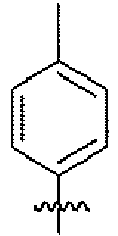
425.1 1.4 

425.1 1.5 

429.1 1.6 

358.1 1.7 

372.1 1.8 

347.1 1.9 

375.1 1.10 

294.1 1.11 

443.1 1.12 

360.1 1.13 

426.2 1.14 

370.2 1.15 

394.2 1.16 

368.1 1.17 

393.2 1.18 
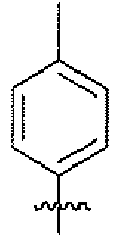
372.1 Table 2 
Example R3a R6 MS (M+1) 2.1 
H 375.2 2.2 
H 412.2 2.3 
H 393.2 2.4 
H 425.2 2.5 
H 347.2 2.6 
F 430.1 Table 3 
Example R3a B R6 MS (M+1) 3.1 

H 376.2 3.2 

H 394.1 3.3 

H 426.1 3.4 

H 348.2 3.5 


434.1 3.6 


416.1 3.7 


467.1 3.8 


452.1 3.9 


502.1 3.10 


503.1 3.11 


424.1 3.12 


470.1 3.13 


404.1 3.14 


422.1 3.15 


454.1 3.16 


455.1 3.17 


376.1 3.18 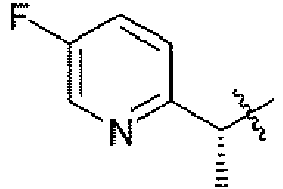


390.0 3.19 


408.0 3.20 


440.0 3.21 
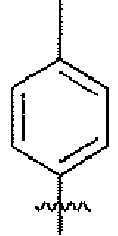

441.0 3.22 


362.1 3.23 


453.0 3.24 
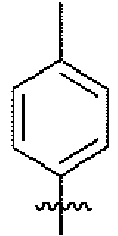

482.0 3.25 


466.0 3.26 


416.0 3.27 


432.0 3.28 


403.1 3.29 


388.1 3.30 


387.1 3.31 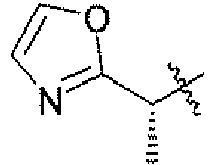


388.1 3.32 


403.1 3.33 


438.1 3.34 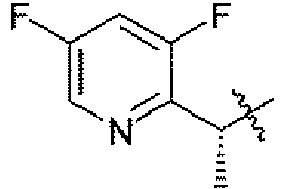


456.0 3.35 


489.0 3.36 

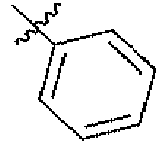
410.0 3.37 


474.0 3.38 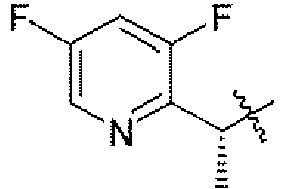


492.0 3.39 


524.9 3.40 


446.0 3.41 


456.0 3.42 


474.0 3.43 


507.0 3.44 


444.1 3.45 


462.0 3.46 

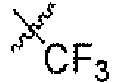
494.0 3.47 


495.0 3.48 


416.1 3.49 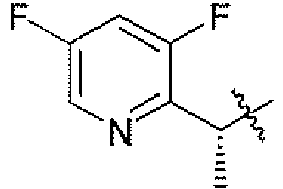


471.1 3.50 


504.1 3.51 


407.0 3.52 


407.0 3.53 


438.0 3.54 


471.0 3.55 


407.1 3.56 


420.1 3.57 


486.0 3.58 


470.1 3.59 


420.1 3.60 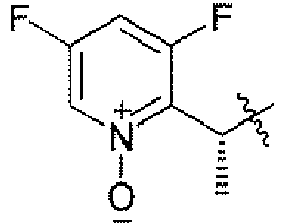


486.0 3.61 


468.1 3.62 


439.1 3.63 


420.1 3.64 


389.1 3.65 


389.1 3.66 


389.1 3.67 


439.1 3.68 


452.1 3.69 


399.1 3.70 


468.1 3.71 


453.1 3.72 


471.0 3.73 

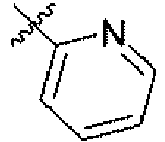
504.0 3.74 


519.0 3.75 


469.0 3.76 


440.0 3.77 


440.0 3.78 


425.1 3.79 

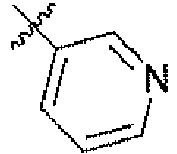
471.0 3.80 


504.0 3.81 


519.0 3.82 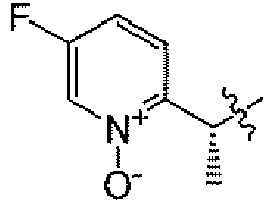


469.0 3.83 


440.1 3.84 


440.1 3.85 


425.1 3.86 


454.0 3.87 


403.1 3.88 


432.1 3.89 


429.1 3.90 


414.1 3.91 


418.1 3.92 


414.1 3.93 


450.1 3.94 


404.2 3.95 


404.2 3.96 


418.2 3.97 


418.2 3.98 


464.2 3.99 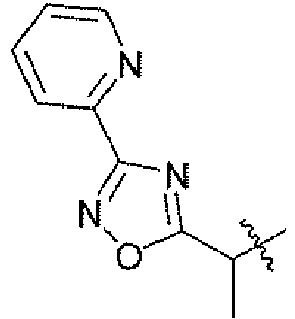


466.2 3.100 


428.3 3.101 


429.3 3.102 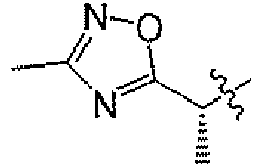


444.3 3.103 
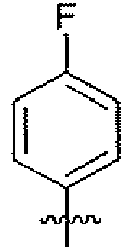

444.3 3.104 


523.3 3.105 


491.3 3.106 


475.3 3.107 


462.1346 3.108 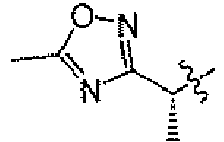


449.1343 3.109 


449.1340 3.110 


512.1315 3.111 


513.1271 3.112 


465.1112 3.113 


488.1707 3.114 


425.1729 3.115 


425.1728 3.116 


789.1654 3.117 


441.1500 3.118 


439.1883 3.119 


439.1885 3.120 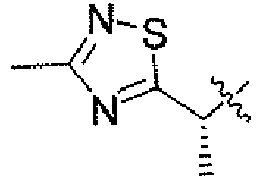


455.1653 3.121 


452.1885 3.122 


502.1861 3.123 


503.1808 3.124 


465.1284 3.125 


465.1285 3.126 


481.1064 3.127 


529.1213 Table 4 
Example R3a B MS (M+1) 4.1 

376.2 4.2 

394.2 4.3 

426.2 4.4 

348.2 4.5 
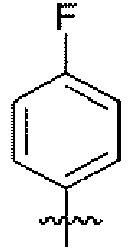
417.0 4.6 

367.1 4.7 

367.0 Table 5 
Example R3a B R6 MS (M+1) 5.1 


390.1 5.2 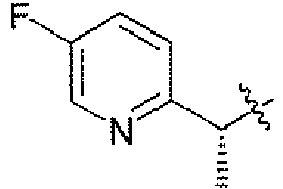


404.2 5.3 


444.0 5.4 


452.1 5.5 


434.1 5.6 


467.1 5.7 


403.1 5.8 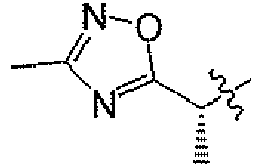


425.1361 5.9 


425.1727 5.10 


489.1653 5.11 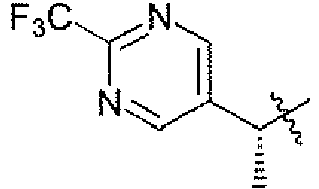


503.1801 5.12 


439.1881 Table 6 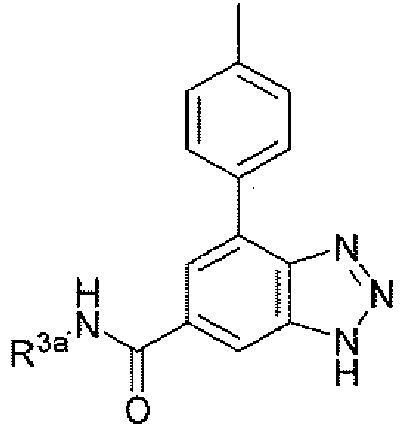
Example R3a MS (M+1) 6.1 
426.1 Table 7 
Example R3a B R6 MS (M+1) 7.1 


409.1662 7.2 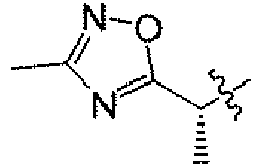


381.1354 7.3 


395.1522 7.4 


409.1680 7.5 

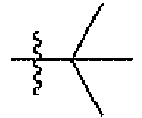
423.1837 7.6 


449.1241 7.7 


475.1396 7.8 


411.1466 7.9 


425.1633 7.10 


439.1794 7.11 


450.1050 7.12 

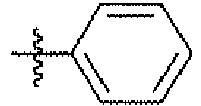
443.1521 7.13 


457.1678 7.14 


444.1474 7.15 


445.1422 7.16 


445.1422 7.17 


447.1577 7.18 


447.1578 7.19 


419.2086 7.20 


439.1543 7.21 


441.1748 7.22 


423.1836 7.23 


439.1785 7.24 


502.1766 7.25 


487.1766 7.26 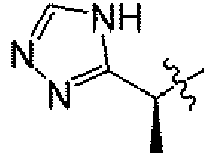
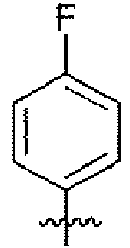

408.1837 7.27 


439.1613 Table 8 
Example R3a B R6 MS (M+1) 8.1 


381.1372 8.2 


409.1683 Table 9 
Example R3a B R6 R6a MS (M+1) 9.1 


H 408.1839 9.2 
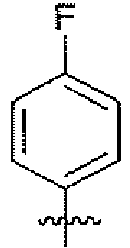

H 487.1746 9.3 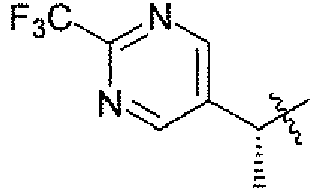


H 472.1750 9.4 


H 408.1825 9.5 


438.2 9.6 


H 471.1796 9.7 


H 422.1976 9.8 


422.1979 9.9 


436.2143 9.10 


408.1823 9.11 


H 462.1541 9.12 


H 448.1388 9.13 


476.1701 9.14 


H 394.1665 9.15 


H 424.1768 9.16 


H 442.1664 9.17 


456.1821 9.18 


462.1540 9.19 


H 443.1626 9.20 


H 443.1625 9.21 


H 443.1628 9.22 


457.1783 9.23 


457.1786 9.24 


457.1782 9.25 
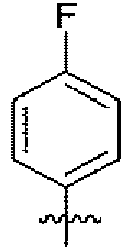


470.1989 9.26 


408.1827 9.27 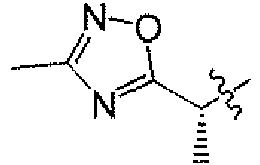


438.1942 9.28 


452.2092 9.29 


422.1989 9.30 


462.1555 9.31 


452.2083 9.32 


474.1555 9.33 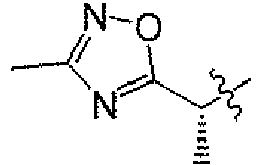


488.1706 9.34 


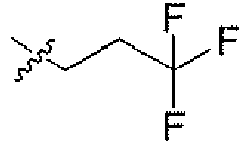
476.1708 9.35 


460.1892 9.36 


H 446.1738 9.37 


H 449.1198 9.38 


463.1346 9.39 


463.1343 9.40 

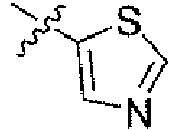
H 449.1189 9.41 


520.1963 9.42 


520.1972 9.43 


536.1735 9.44 


466.2247 9.45 


492.2400 9.46 


482.2205 9.47 


466.2245 9.48 

H 
438.1928 9.49 

H 
448.1387 9.50 


424.1776 9.51 


492.1653 9.52 


438.1941 9.53 
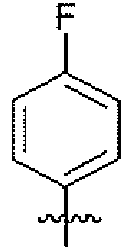


438.1939 9.54 


452.2094 9.55 


516.2023 9.56 


515.2067 9.57 


468.1868 9.58 


420.1825 9.59 


478.2250 9.60 


465.2102 9.61 
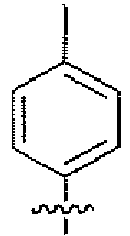


443.2354 9.62 


468.1802 9.63 


448.2340 Table 10 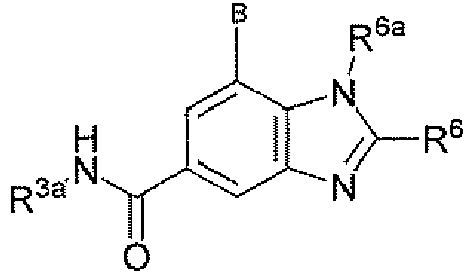
Example R3a B R6a R6 MS (M+1) 10.1 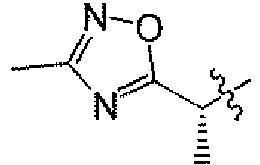


422.1980 10.2 


476.1687 Table 11 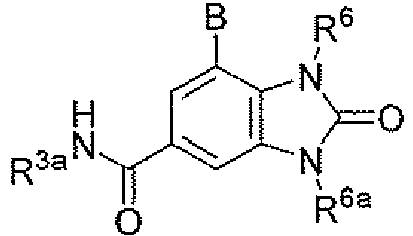
Example R3a B R6 R6a MS (M+1) 11.1 

H 
454.1884 11.2 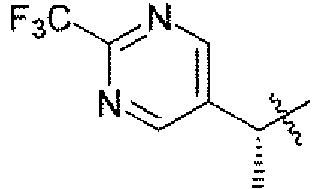

H 
518.3 11.3 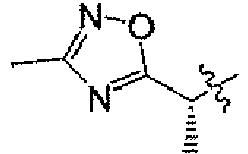


410.1623 11.4 

H H 382.1319 - When any variable (e.g. aryl, heterocycle, R1, R5 etc.) occurs more than one time in any constituent, its definition on each occurrence is independent at every other occurrence. Also, combinations of substituents/or variables are permissible only if such combinations result in stable compounds.
When Ra is -0- and attached to a carbon it is referred to as a carbonyl group and when it is attached to a nitrogen (e.g., nitrogen atom on a pyridyl group) or sulfur atom it is referred to a N-oxide and sulfoxide group, respectively. - As used herein, "alkyl" encompasses groups having the prefix "alk" such as, for example, alkoxy, alkanoyl, alkenyl, and alkynyl and means carbon chains which may be linear or branched or combinations thereof. Examples of alkyl groups include methyl, ethyl, propyl, isopropyl, butyl, sec- and tert-butyl, pentyl, hexyl, and heptyl. "Alkenyl" refers to a hydrocarbon radical straight, branched or cyclic containing from 2 to 10 carbon atoms and at least one carbon to carbon double bond. Preferred alkenyl groups include ethenyl, propenyl, butenyl and cyclohexenyl. Preferably, alkenyl is C2-C6 alkenyl. Preferred alkynyla are C2-C6 alkynyl. "Alkenyl," "alkynyl" and other like terms include carbon chains containing at least one unsaturated C-C bond.
- As used herin, "fluoroalkyl" refers to an alkyl substituent as described herin containing at least one flurine substituent.
- The term "cycloalkyl" refers to a saturated hydrocarbon containing one ring having a specified number of carbon atoms. Examples of cycloalkyl include cyclopropyl, cyclobutyl, cyclopentyl, and cyclobexyl.
- The term "C1-6" includes alkyls containing 6, 5, 4, 3, 2, or I carbon atoms
- The term "alkoxy" as used herein, alone or in combination, includes an alkyl group connected to the oxy connecting atom. The term "alkoxy" also includes alkyl ether groups, where the term 'alkyl' is defined above, and 'ether' means two alkyl groups with an oxygen atom between them. Examples of suitable alkoxy groups include methoxy, ethoxy, n-propoxy, i-propoxy, n-butoxy, s-butoxy, t-butoxy, methoxymethane (also referred to as 'dimethyl ether'), and methoxyethane (also referred to as 'ethyl methyl ether').
- As used herein, "aryl" is intended to mean any stable monocyclic or bicyclic carbon ring of up to 7 members in each ring, wherein at least one ring is aromatic. Examples of such aryl elements include phenyl, napthyl, tetrahydronapthyl, indanyl, or biphenyl.
- The term heterocycle, heterocyclyl, or heterocyclic, as used herein, represents a stable 5- to 7-membered monocyclic or stable 8- to 11-membered bicyclic heterocyclic ring which is either saturated or unsaturated, and which consists of carbon atoms and from one to four heteroatoms selected from the group consisting of N, O, and S, and including any bicyclic group in which any of the above-defined heterocyclic rings is fused to a benzene ring. The heterocyclic ring may be attached at any heteroatom or carbon atom which results in the creation of a stable structure. The term heterocycle or heterocyclic includes heteroaryl moieties. Examples of such heterocyclic elements include, but are not limited to, azepinyl, benzimidazolyl, benzisoxazolyl, benzofurazanyl, benzopyranyl, benzothiopyranyl, benzofuryl, benzothiazolyl, benzothienyl, benzoxazolyl, chromanyl, cinnolinyl, dihydrobenzofuryl, dihydrobenzothienyl, dihydrobenzothiopyranyl, dihydrobenzothiopyranyl sulfone, 1,3-dioxolanyl, furyl, imidazolidinyl, imidazolinyl, imidazolyl, indolinyl, indolyl, isochromanyl, isoindolinyl, isoquinolinyl, isothiazolidinyl, isothiazolyl, isothiazolidinyl, morpholinyl, naphthyridinyl, oxadiazolyl, 2-oxoazepinyl, oxazolyl, 2-oxopiperazinyl, 2-oxopiperdinyl, 2-oxopyrrolidinyl, piperidyl, piperazinyl, pyridyl, pyrazinyl, pyrazolidinyl, pyrazolyl, pyridazinyl, pyrimidinyl, pyrrolidinyl, pyrrolyl, quinazolinyl, quinolinyl, quinoxalinyl, tetrahydrofuryl, tetrahydroisoquinolinyl, tetrahydroquinolinyl, thiamorpholinyl, thiamorpholinyl sulfoxide, thiazolyl, thiazolinyl, thienofuryl, thienothienyl, thienyl, and triazolyl.
- In certain embodiments, the heterocyclic group is a heteroaryl group. As used herein, the term "heteroaryl" refers to groups having 5 to 14 ring atoms, preferably 5, 6, 9, or 10 ring atoms; having 6, 10, or 14 π electrons shared in a cyclic array; and having, in addition to carbon atoms, between one and about three heteroatoms selected from the group consisting of N, 0, and S. heteroaryl groups include, without limitation, thienyl, benzothienyl, furyl, benzofuryl, dibenzofuryl, pyrrolyl, imidazolyl, pyrazoiyl, pyridyl, pyrazinyl, pyrimidinyl, indolyl, quinolyl, isoquinolyl, quinoxalinyl, tetrazolyl, oxazolyl, thiazolyl, and isoxazolyl.
- In certain other embodiments, the heterocyclic group is fused to an aryl or heteroaryl group. Examples of such fused heterocycles include, without limitation, tetrahydroquinolinyl and dihydrobenzofuranyl.
- The term "heteroaryl", as used herein except where noted, represents a stable 5- to 7-membered monocyclic- or stable 9- to 10-membered fused bicyclic heterocyclic ring system which contains an aromatic ring, any ring of which may be saturated, such as piperidinyl, partially saturated, or unsaturated, such as pyridinyl, and which consists of carbon atoms and from one to four heteroatoms selected from the group consisting ofN, O and S, and wherein the nitrogen and sulfur heteroatoms may optionally be oxidized, and the nitrogen heteroatom may optionally be quaternized, and including any bicyclic group in which any of the above-defined heterocyclic rings is fused to a benzene ring. The heterocyclic ring may be attached at any heteroatom or carbon atom which results in the creation of a stable structure. Examples of such heteroaryl groups include, but are not limited to, benzimidazole, benzisothiazole, benzisoxazole, benzofuran, benzothiazole, benzothiophene, benzotriazole, benzoxazole, carboline, cinnoline, furan, furazan, imidazole, indazole, indole, indolizine, isoquinoline, isothiazole, isoxazole, naphthyridine, oxadiazole, oxazole, phthalazine, pteridine, purine, pyran, pyrazine, pyrazole, pyridazine, pyridine, pyrimidine, pyrrole, quinazoline, quinoline, quinoxaline, tetrazole, thiadiazole, thiazole, thiophene, triazine, triazole, and N-oxides thereof.
- Examples of hetsrocycloalkyls include azetidinyl, pyrrolidinyl, piperidinyl, piperazinyl, morpholinyl, tetrahydrofuranyl, imidazolinyl, pyrolidin-2-one, piperidin-2-one, and thiomorpholinyl.
- The term "heteroatom" means O, S or N, selected on an independent basis.
- A moiety that is substituted is one in which one or more hydrogens have been independently replaced with another chemical substituent. As a non-limiting example, substituted phenyls include 2-flurophenyl, 3,4-dichlorophenyl, 3-chloro-4-fluoro-phenyl, 2,4fluor-3-propylphenyl. As another non-limiting example, substituted n-octyls include 2,4 dimetbyl-5-ethyl-octyl and 3-cyclopentyloctyl. Included within this definition are methylenes (-CH2-) substituted with oxygen to form carbonyl (-CO-).
- Unless otherwise stated, as employed herein, when a moiety (e.g., cycloalkyl, hydrocarbyl, aryl, alkyl, heteroaryl, heterocyclic, urea, etc.) is described as "optionally substituted" it is meant that the group optionally has from one to four, preferably from one to three, more preferably one or two, non-hydrogen substituents. Suitable substituents include, without limitation, halo, hydroxy, oxo (e.g., an annular -CH- substituted with oxo is -C(O)-), nitro, halohydrocarbyl, hydrocarbyl, aryl, aralkyl, alkoxy, aryloxy, amino, acylamino, alkylcarbamoyl, arylcarbamoyl, aminoalkyl, acyl, carboxy, hydroxyalkyl, , akanesulfonyl, arenesulfonyl, alkanesulfonamido, arenesulfonamido, aralkylsulfonamido, alkylcarbonyl, acyloxy, cyano, and ureido groups. Preferred substituents, which are themselves not further substituted (unless expressly stated otherwise) are:
- (a) halo, cyano, oxo, carboxy, formyl, nitro, amino, amidino, guanidino, and
- (b) C1-C6 alkyl or alkenyl or arylalkyl amino, carbamoyl, azido, carboxamido, mercapto, hydroxy, hydroxyalkyl, alkylaryl, arylalkyl, C1-C8 alkyl, SO2CF3, CF3, SO2Me, C1-C8 alkenyl, C1-C8 alkoxy, C1-C8 alkoxycarbonyl, aryloxycarbonyl, C2-C8 acyl, C2-C8 acylamino, C1-C8 alkylthio, arylalkylthio, atylthio, C1-C8alkylsulfinyl, arylalkylsulfnyl, arylsulfnyl, C1-C8 alkylsulfonyl, arylalkylsulfonyl, arylsulfonyl, C0-C6 N-alkylcarbamoyl, C2-C15 N,N dialkylcarbamoyl, C3-C7 cycloalkyl, aroyl, aryloxy, arylalkyl ether, aryl, aryl fused to a cycloalkyl or heterocycle or another aryl ring, C3-C7 heterocycle, or any of these rings fused or spiro-fused to a cycloalkyl, heterocyclyl, or aryl, wherein each of the foregoing is further optionally substituted with one more moieties listed in (a), above.
- "Halogen" refers to fluorine, chlorine, bromine and iodine.
- The term "mammal" "mammalian" or "mammal" includes humans, as well as animals, such as dogs, cats, horses, pigs and cattle.
- All patents, patent applications and publications cited herein, whether supra or infra, are hereby incorporated by reference in their entirety and are deemed representative of the prevailing state of the art.
- As used in this specification and the appended claims, the singular forms "a," "an" and "the" include plural references unless the content clearly dictates otherwise. Thus, for example, reference to "a primer" includes two or more such primers, reference to "an amino acid" includes more than one such amino acid, and the like.
- The phrases "effective amount" or "therapeutically effective amount" mean a concentration of P2X receptor complex modulator sufficient to inhibit or enhance the effect of the P2X receptor complex.
- "Pain" means the more or less localized sensation of discomfort, distress, or agony, resulting from the stimulation of specialized nerve endings. There are many types of pain, including, but not limited to, lightning pains, phantom pains, shooting pains, acute pain, inflammatory pain, neuropathic pain, complex regional pain, neuralgia, neuropathy, tissue injury pain, and the like (Dorland's Illustrated Medical Dictionary, 28th Edition, W. B. Saunders Company, Philadelphia, Pa.). The goal of treatment of pain is to reduce the degree or severity of pain perceived by a treatment subject.
- Compounds described herein may contain one or more double bonds and may thus give rise to cis/trans isomers as well as other conformational isomers. The present invention includes all such possible isomers as well as mixtures of such isomers unless specifically stated otherwise.
- In the compounds of generic Formula I, the atoms may exhibit their natural isotopic abundances, or one or more of the atoms may be artificially enriched in a particular isotope having the same atomic number, but an atomic mass or mass number different from the atomic mass or mass number predominantly found in nature. The present invention is meant to include all suitable isotopic variations of the compounds of generic Formula I. For example, different isotopic forms of hydrogen (H) include protium (1H) and deuterium (2H). Protium is the predominant hydrogen isotope found in nature. Enriching for deuterium may afford certain therapeutic advantages, such as increasing in vivo half-life or reducing dosage requirements, or may provide a compound useful as a standard for characterization of biological samples. Isotopically-enriched compounds within generic Formula I can be prepared without undue experimentation by conventional techniques well known to those skilled in the art or by processes analogous to those described in the Schemes and Examples herein using appropriate isotopically-enriched reagents and/or intermediates.
- The compounds of the present invention may contain one or more asymmetric centers and may thus occur as racemates, racemic mixtures, single enantiomers, diastereomeric mixtures, and individual diastereomers.
- It will be understood that, as used herein, references to the compounds of structural formula I are meant to also include the pharmaceutically acceptable salts, and also salts that are not pharmaceutically acceptable when they are used as precursors to the free compounds or in other synthetic manipulations.
- The compounds of the present invention may be administered in the form of a pharmaceutically acceptable salt. The term "pharmaceutically acceptable salts" refers to salts prepared from pharmaceutically acceptable non-toxic bases or acids. When the compound of the present invention is acidic, its corresponding salt can be conveniently prepared from pharmaceutically acceptable non-toxic bases, including inorganic bases and organic bases. Salts derived from such inorganic bases include aluminum, ammonium, calcium, copper (ic and ous), ferric, ferrous, lithium, magnesium, manganese (ic and ous), potassium, sodium, zinc and the like salts. Salts derived from pharmaceutically acceptable organic non-toxic bases include salts of primary, secondary, and tertiary amines, as well as cyclic amines and substituted amines such as naturally occurring and synthesized substituted amines. Other pharmaceutically acceptable organic non-toxic bases from which salts can be formed include ion exchange resins such as, for example, arginine, betaine, caffeine, choline, N, N'-dibenzylethylenediamine, diethylamine, 2-diethylaminoethanol, 2-dimethylaminoethanol, ethanolamine, ethylenediamine, N-ethylmorpholine, N-ethylpiperidine, glucamine, glucosamine, histidine, hydrabamine, isopropylamine, lysine, methylglucamine, morpholine, piperazine, piperidine, polyamine resins, procaine, purines, theobromine, triethylamine, trimethylamine, tripropylamine, and tromethamine.
- When the compound of the present invention is basic, its corresponding salt can be conveniently prepared from pharmaceutically acceptable non-toxic acids, including inorganic and organic acids. Such acids include, for example, acetic, benzenesulfonic, benzoic, camphorsulfonic, citric, ethanesulfonic, fumaric, gluconic, glutamic, hydrobromic, hydrochloric, isethionic, lactic, maleic, malic, mandelic, methanesulfonic, mucic, nitric, pamoic, pantothenic, phosphoric, succinic, sulfuric, tartaric, p-toluenesulfonic acid and the like.
- The pharmaceutical compositions of the present invention comprise compounds of the invention (or pharmaceutically acceptable salts thereof) as an active ingredient, a pharmaceutically acceptable carrier, and optionally one or more additional therapeutic agents or adjuvants. Such additional therapeutic agents can include, for example, i) opiate agonists or antagonists, ii) calcium channel antagonists, iii) 5HT receptor agonists or antagonists, iv) sodium channel antagonists, v) NMDA receptor agonists or antagonists, vi) COX-2 selective inhibitors, vii) NK1 antagonists, viii) non-steroidal anti-inflammatory drugs ("NSAID"), ix) selective serotonin reuptake inhibitors ("SSRI") and/or selective serotonin and norepinephrine reuptake inhibitors ("SSNRI"), x) tricyclic antidepressant drugs, xi) norepinephrine modulators, xii) lithium, xiii) valproate, xiv) neurontin (gabapentin), xv) pregabalin, and xvi) sodium channel blockers. The instant compositions include compositions suitable for oral, rectal, topical, and parenteral (including subcutaneous, intramuscular, and intravenous) administration, although the most suitable route in any given case will depend on the particular host, and nature and severity of the conditions for which the active ingredient is being administered. The pharmaceutical compositions may be conveniently presented in unit dosage form and prepared by any of the methods well known in the art of pharmacy.
- The present compounds and compositions are useful for the treatment of chronic, visceral, inflammatory and neuropathic pain syndromes. They are useful for the treatment of pain resulting from traumatic nerve injury, nerve compression or entrapment, postherpetic neuralgia, trigeminal neuralgia, small fiber neuropathy, and diabetic neuropathy. The present compounds and compositions are also useful for the treatment of chronic lower back pain, phantom limb pain, chronic pelvic pain, neuroma pain, complex regional pain syndrome, chronic arthritic pain and related neuralgias, and pain associated with cancer, chemotherapy, HIV and HIV treatment-induced neuropathy. Compounds of this invention may also be utilized as local anesthetics. Compounds of this invention are useful for the treatment of irritable bowel syndrome and related disorders, as well as Crohn's disease.
- The instant compounds have clinical uses for the treatment of epilepsy and partial and generalized tonic seizures. They are also useful for neuroprotection under ischaemic conditions caused by stroke or neural trauma and for treating multiple sclerosis. The present compounds are useful for the treatment of tachy-arrhythmias. Additionally, the instant compounds are useful for the treatment of neuropsychiatric disorders, including mood disorders, such as depression or more particularly depressive disorders, for example, single episodic or recurrent major depressive disorders and dysthymic disorders, or bipolar disorders, for example, bipolar I disorder, bipolar II disorder and cyclothymic disorder; anxiety disorders, such as panic disorder with or without agoraphobia, agoraphobia without history of panic disorder, specific phobias, for example, specific animal phobias, social phobias, obsessive-compulsive disorder, stress disorders including post-traumatic stress disorder and acute stress disorder, and generalised anxiety disorders. Thus, another aspect of this invention is the use of the compounds of formula I in the manufacture of a medicament to treat pain and other diseases associated with pain.
- In addition to primates, such as humans, a variety of other mammals can be treated according to the method of the present invention. For instance, mammals including, but not limited to, cows, sheep, goats, horses, dogs, cats guinea pigs, or other bovine, ovine, equine, canine, feline, rodent such as mouse, species can be treated. However, the method can also be practiced in other species, such as avian species (e.g., chickens).
- It will be appreciated that for the treatment of depression or anxiety, a compound of the present invention may be used in conjunction with other anti-depressant or anti-anxiety agents, such as norepinephrine reuptake inhibitors, selective serotonin reuptake inhibitors (SSRIs), monoamine oxidase inhibitors (MAOIs), reversible inhibitors of monoamine oxidase (RIMAs), serotonin and noradrenaline reuptake inhibitors (SNRIs), α-adrenoreceptor antagonists, atypical anti-depressants, benzodiazepines, 5-HT1A agonists or antagonists, especially 5-HT1A partial agonists, neurokinin-1 receptor antagonists, corticotropin releasing factor (CRF) antagonists, and pharmaceutically acceptable salts thereof.
- Further, it is understood that compounds of this invention can be administered at prophylactically effective dosage levels to prevent the above-recited conditions and disorders, as well as to prevent other conditions and disorders associated with calcium channel activity.
- Creams, ointments, jellies, solutions, or suspensions containing the instant compounds can be employed for topical use. Mouth washes and gargles are included within the scope of topical use for the purposes of this invention.
- Dosage levels from about 0.01 mg/kg to about 140 mg/kg of body weight per day are useful in the treatment of inflammatory and neuropathic pain, or alternatively about 0.5 mg to about 7 g per patient per day. For example, inflammatory pain may be effectively treated by the administration of from about 0.01 mg to about 75 mg of the compound per kilogram of body weight per day, or alternatively about 0.5 mg to about 3.5 g per patient per day. Neuropathic pain may be effectively treated by the administration of from about 0.01 mg to about 125 mg of the compound per kilogram of body weight per day, or alternatively about 0.5 mg to about 5.5 g per patient per day.
- The amount of active ingredient that may be combined with the carrier materials to produce a single dosage form will vary depending upon the host treated and the particular mode of administration. For example, a formulation intended for the oral administration to humans may conveniently contain from about 0.5 mg to about 5g of active agent, compounded with an appropriate and convenient amount of carrier material which may ary from about 5 to about 95 percent of the total composition. Unit dosage forms will generally contain between from about 1 mg to about 1000 mg of the active ingredient, typically 25 mg, 50 mg, 100 mg, 200 mg, 300 mg, 400 mg, 500 mg, 600 mg, 800 mg or 1000 mg.
- It is understood, however, that the specific dose level for any particular patient will depend upon a variety of factors. Such patient-related factors include the age, body weight, general health, sex, and diet of the patient. Other factors include the time and route of administration, rate of excretion, drug combination, and the severity of the particular disease undergoing therapy.
- In practice, the compounds of the invention, or pharmaceutically acceptable salts thereof, can be combined as the active ingredient in intimate admixture with a pharmaceutical carrier according to conventional pharmaceutical compounding techniques. The carrier may take a wide variety of forms depending on the form of preparation desired for administration, e.g., oral or parenteral (including intravenous). Thus, the pharmaceutical compositions of the present invention can be presented as discrete units suitable for oral administration such as capsules, cachets or tablets each containing a predetermined amount of the active ingredient. Further, the compositions can be presented as a powder, as granules, as a solution, as a suspension in an aqueous liquid, as a non-aqueous liquid, as an oil-in-water emulsion or as a water-in-oil liquid emulsion. In addition to the common dosage forms set out above, the compounds of the invention, or pharmaceutically acceptable salts thereof, may also be administered by controlled release means and/or delivery devices. The compositions may be prepared by any of the methods of pharmacy. In general, such methods include a step of bringing into association the active ingredient with the carrier that constitutes one or more necessary ingredients. In general, the compositions are prepared by uniformly and intimately admixing the active ingredient with liquid carriers or finely divided solid carriers or both. The product can then be conveniently shaped into the desired presentation.
- Thus, the pharmaceutical compositions of this invention may include a pharmaceutically acceptable carrier and a compound or a pharmaceutically acceptable salt. The compounds of the invention, or pharmaceutically acceptable salts thereof, can also be included in pharmaceutical compositions in combination with one or more therapeutically active compounds.
- The pharmaceutical carrier employed can be, for example, a solid, liquid, or gas. Examples of solid carriers include lactose, terra alba, sucrose, talc, gelatin, agar, pectin, acacia, magnesium stearate, and stearic acid. Examples of liquid carriers are sugar syrup, peanut oil, olive oil, and water. Examples of gaseous carriers include carbon dioxide and nitrogen. As described previously, in preparing the compositions for oral dosage form, any of the usual pharmaceutical media can be employed. For example, in the case of oral liquid preparations such as suspensions, elixirs and solutions, water, glycols, oils, alcohols, flavoring agents, preservatives, coloring agents and the like may be used; or in the case of oral solid preparations such as powders, capsules and tablets, carriers such as starches, sugars, microcrystalline cellulose, diluents, granulating agents, lubricants, binders, disintegrating agents, and the like may be included. Because of their ease of administration, tablets and capsules represent the most advantageous oral dosage unit form in which solid pharmaceutical carriers are employed. If desired, tablets may be coated by standard aqueous or nonaqueous techniques. In addition to the common dosage forms set out above, controlled release means and/or delivery devices may also be used in administering the instant compounds and compositions.
- In preparing the compositions for oral dosage form, any convenient pharmaceutical media may be employed. For example, water, glycols, oils, alcohols, flavoring agents, preservatives, coloring agents and the like may be used to form oral liquid preparations such as suspensions, elixirs and solutions; while carriers such as starches, sugars, microcrystalline cellulose, diluents, granulating agents, lubricants, binders, and disintegrating agents can be used to form oral solid preparations such as powders, capsules and tablets. Because of their ease of administration, tablets and capsules are advantageous oral dosage units whereby solid pharmaceutical carriers are employed. Optionally, tablets may be coated by standard aqueous or nonaqueous techniques
- A tablet containing the composition of this invention may be prepared by compression or molding, optionally with one or more accessory ingredients or adjuvants. Compressed tablets may be prepared by compressing, in a suitable machine, the active ingredient in a free-flowing form such as powder or granules, optionally mixed with a binder, lubricant, inert diluent, surface active or dispersing agent. Molded tablets may be made by molding in a suitable machine, a mixture of the powdered compound moistened with an inert liquid diluent. Each tablet advantageously contains from about 0.1 mg to about 500 mg of the active ingredient and each cachet or capsule advantageously containing from about 0.1 mg to about 500 mg of the active ingredient. Thus, a tablet, cachet, or capsule conveniently contains 0.1 mg, 1 mg, 5 mg, 25 mg, 50 mg, 100 mg, 200 mg, 300 mg, 400 mg, or 500 mg of the active ingredient taken one or two tablets, cachets, or capsules, once, twice, or three times daily.
- Pharmaceutical compositions of the present invention suitable for parenteral administration may be prepared as solutions or suspensions of the active compounds in water. A suitable surfactant can be included such as, for example, hydroxypropylcellulose. Dispersions can also be prepared in glycerol, liquid polyethylene glycols, and mixtures thereof in oils. Further, a preservative can be included to prevent the detrimental growth of microorganisms.
- Pharmaceutical compositions of the present invention suitable for injectable use include sterile aqueous solutions or dispersions. Furthermore, the compositions can be in the form of sterile powders for the extemporaneous preparation of such sterile injectable solutions or dispersions. In all cases, the final injectable form must be sterile and must be effectively fluid for easy syringability. The pharmaceutical compositions must be stable under the conditions of manufacture and storage, and thus should be preserved against the contaminating action of microorganisms such as bacteria and fungi. The carrier can be a solvent or dispersion medium containing, for example, water, ethanol, polyol (e.g. glycerol, propylene glycol and liquid polyethylene glycol), vegetable oils, and suitable mixtures thereof.
- Pharmaceutical compositions of the present invention can be in a form suitable for topical use such as, for example, an aerosol, cream, ointment, lotion, and dusting powder. Further, the compositions can be in a form suitable for use in transdermal devices. These formulations may be prepared, utilizing a compound represented of the invention, or pharmaceutically acceptable salts thereof, via conventional processing methods. As an example, a cream or ointment is prepared by mixing hydrophilic material and water, together with about 5 wt% to about 10 wt% of the compound, to produce a cream or ointment having a desired consistency.
- Pharmaceutical compositions of this invention can be in a form suitable for rectal administration wherein the carrier is a solid, such as, for example, where the mixture forms unit dose suppositories. Suitable carriers include cocoa butter and other materials commonly used in the art. The suppositories may be conveniently formed by first admixing the composition with the softened or melted carrier(s) followed by chilling and shaping in moulds.
- In addition to the aforementioned carrier ingredients, the pharmaceutical formulations described above may include, as appropriate, one or more additional carrier ingredients such as diluents, buffers, flavoring agents, binders, surface-active agents, thickeners, lubricants, and preservatives (including anti-oxidants). Furthermore, other adjuvants can be included to render the formulation isotonic with the blood of the intended recipient. Compositions containing a compound of the invention, or pharmaceutically acceptable salts thereof, can also be prepared in powder or liquid concentrate form.
- Further, as described above, the instant compounds can be utilized in combination with one or more therapeutically active compounds. In particular, the inventive compounds can be advantageously used in combination with i) opiate agonists or antagonists, ii) other calcium channel antagonists, iii) 5HT receptor agonists or antagonists, including 5-HT1A agonists or antagonists, and 5-HT1A partial agonists, iv) sodium channel antagonists, v) N-methyl-D-aspartate (NMDA) receptor agonists or antagonists, vi) COX-2 selective inhibitors, vii) neurokinin receptor 1 (NK1) antagonists, viii) non-steroidal anti-inflammatory drugs (UNSAID), ix) selective serotonin reuptake inhibitors (SSRI) and/or selective serotonin and norepinephrine reuptake inhibitors (SSNRI), x) tricyclic antidepressant drugs, xi) norepinephrine modulators, xii) lithium, xiii) valproate, xiv) norepinephrine reuptake inhibitors, xv) monoamine oxidase inhibitors (MAOIs), xvi) reversible inhibitors of monoamine oxidase (RIMAs), xvii)alpha-adrenoreceptor antagonists, xviii) atypical anti-depressants, xix) benzodiazepines, xx) corticotropin releasing factor (CRF) antagonists, xxi) neurontin (gabapentin) and xxii) pregabalin.
- The abbreviations used herein have the following meanings (abbreviations not shown here have their meanings as commonly used unless specifically stated otherwise): Ac (acetyl), Bn (benzyl), Boc (tertiary-butoxy carbonyl), Bop reagent (benzotriazol-1-yloxy)tris(dimethylamino)phosonium hexafluorophosphate, CAMP (cyclic adenosine-3',5'-monophosphate), DAST ((diethylamino)sulfur trifluoride), DBU (1,8-diazabicyclo[5.4.0]undec-7-ene), DIBAL (diisobutylaluminum hydride), DIEA (diisopropylethyl amine), DMAP (4-(dimethylamino)pyridine), DMF (N,N-dimethylformamide), DPPF (1,1'-bisdiphenylphosphino ferrocene), EDC (1-(3-dimethylaminopropyl)-3-ethylcarbodiimide hydrochloride), Et3N (triethylamine), GST (glutathione transferase), HOBt (1-hydroxybenzotriazole), LAH (lithium aluminum hydride), Ms (methanesulfonyl; mesyl; or SO2Me), MsO (methanesulfonate or mesylate), MCPBA (meta-chloro perbenzoic acid), NaHMDS (sodium hexamethyldisilazane), NBS (N-bromosuccinimide), NCS (N-chlorosuccinimide), NSAID (non-steroidal anti-inflammatory drug), PDE (Phosphodiesterase), Ph (phenyl), r.t. or RT (room temperature), Rac (Racemic), SAM (aminosulfonyl; sulfonamide or SO2NH2), SPA (scintillation proximity assay), Th (2- or 3-thienyl), TFA (trifluoroacetic acid), THF (Tetrahydrofuran), Thi (Thiophenediyl), TLC (thin layer chromatography), TMEDA (N,N,N',N'-tetramethylethylenediamine), TMSI (trimethylsilyl iodide), Tr or trityl (N-triphenylmethyl), C3H5 (Allyl), Me (methyl), Et (ethyl), n-Pr (normal propyl), i-Pr (isopropyl), n-Bu (normal butyl), i-Butyl (isobutyl), s-Bu (secondary butyl), t-Bu (tertiary butyl), c-Pr (cyclopropyl), c-Bu (cyclobutyl), c-Pen (cyclopentyl), c-Hex (cyclohexyl).
- The present compounds can be prepared according to the procedures provided in the Examples. The following Examples further describe, but do not limit, the scope of the invention.
- Unless specifically stated otherwise, the experimental procedures were performed under the following conditions: All operations were carried out at room or ambient temperature; that is, at a temperature in the range of 18-25 °C. Inert gas protection was used when reagents or intermediates were air and moisture sensitive. Evaporation of solvent was carried out using a rotary evaporator under reduced pressure (600-4000pascals: 4.5-30 mm Hg) with a bath temperature of up to 60 °C. The course of reactions was followed by thin layer chromatography (TLC) or by high-pressure liquid chromatography-mass spectrometry (HPLC-MS), and reaction times are given for illustration only. The structure and purity of all final products were assured by at least one of the following techniques: TLC, mass spectrometry, nuclear magnetic resonance (NMR) spectrometry or microanalytical data. When given, yields are for illustration only. When given, NMR data is in the form of delta (δ) values for major diagnostic protons, given in parts per million (ppm) relative to tetramethylsilane (TMS) as internal standard, determined at 300 MHz, 400 MHz or 500 MHz using the indicated solvent. Conventional abbreviations used for signal shape are: s. singlet; d. doublet; t. triplet; m. multiplet; br. Broad; etc. In addition, "Ar" signifies an aromatic signal. Chemical symbols have their usual meanings; the following abbreviations are used: v (volume), w (weight), b.p. (boiling point), m.p. (melting point), L (liter(s)), mL (milliliters), g (gram(s)), mg (milligrams(s)), mol (moles), mmol) (millimoles), eq (equivalent(s)).
- The procedures described herein for synthesizing the compounds may include one or more steps of protecting group manipulations and of purification, such as, re-crystallization, distillation, column chromatography, flash chromatography, thin-layer chromatography (TLC), radial chromatography and high-pressure chromatography (HPLC). The products can be characterized using various techniques well known in the chemical arts, including proton and carbon-13 nuclear magnetic resonance (1H and 13C NMR), infrared and ultraviolet spectroscopy (IR and UV), X-ray crystallography, elemental analysis and HPLC and mass spectrometry (HPLC-MS). Methods of protecting group manipulation, purification, structure identification and quantification are well known to one skilled in the art of chemical synthesis.
- Appropriate solvents are those which will at least partially dissolve one or all of the reactants and will not adversely interact with either the reactants or the product. Suitable solvents are aromatic hydrocarbons (e.g, toluene, xylenes), halogenated solvents (e.g, methylene chloride, chloroform, carbontetrachloride, chlorobenzenes), ethers (e.g, diethyl ether, diisopropylether, tert-butyl methyl ether, diglyme, tetrahydrofuran, dioxane, anisole), nitriles (e.g, acetonitrile, propionitrile), ketones (e.g, 2-butanone, dithyl ketone, tert-butyl methyl ketone), alcohols (e.g, methanol, ethanol, n-propanol, iso-propanol, n-butanol, t-butanol), N,N-dimethyl formamide (DMF), dimethylsulfoxide (DMSO) and water. Mixtures of two or more solvents can also be used. Suitable bases are, generally, alkali metal hydroxides, alkaline earth metal hydroxides such as lithium hydroxide, sodium hydroxide, potassium hydroxide, barium hydroxide, and calcium hydroxide; alkali metal hydrides and alkaline earth metal hydrides such as lithium hydride, sodium hydride, potassium hydride and calcium hydride; alkali metal amides such as lithium amide, sodium amide and potassium amide; alkali metal carbonates and alkaline earth metal carbonates such as lithium carbonate, sodium carbonate, cesium carbonate, sodium hydrogen carbonate, and cesium hydrogen carbonate; alkali metal allcoxides and alkaline earth metal alkoxides such as sodium methoxide, sodium ethoxide, potassium tert-butoxide and magnesium ethoxide; alkali metal alkyls such as methyllithium, n-butyllithium, sec-butyllithium, t-bultyllithium, phenyllithium, alkyl magnaesium halides, organic bases such as trimethylamine, triethylamine, triisopropylamine, N,N-diisopropylethyl amines, piperidine, N-methyl piperidine, morpholine, N-methyl morpholine, pyridine, collidines, lutidines, and 4-dimethylaminopyridine; and bicyclic amines such as DBU and DABCO.
- It is understood that the functional groups present in compounds described in the examples below can be further manipulated, when appropriate, using the standard functional group transformation techniques available to those skilled in the art, to provide desired compounds described in this invention.
- It is also understood that compounds of this invention contain one or more stereocenters that may be prepared as single enantiomers or diastereomers, or as mixtures containing two or more enantiomers or diastereomers in any proportion.
- Other variations or modifications, which will be obvious to those skilled in the art, are within the scope and teachings of this invention. This invention is not to be limited except as set forth in the following claims.
- Several methods for preparing the compounds of this invention are illustrated in the following Schemes and Examples. Starting materials are made according to procedures known in the art or as illustrated herein.
- The compounds of the present invention can be prepared readily according to the following Schemes and specific examples, or modifications thereof, using readily available starting materials, reagents and conventional synthesis procedures. In these reactions, it is also possible to make use of variants which are themselves known to those of ordinary skill in this art but are not mentioned in greater detail. The general procedures for making the compounds claimed in this invention can be readily understood and appreciated by one skilled in the art from viewing the following Schemes.
- Amine intermediates of type 1.5 can be prepared from one of several intermediates as shown in Scheme 1. This method utilizes diastereoselective Ellman sulfinimine addition chemistry to generate a pair of diastereomeric sulfinamides. The diastereomers are separated by silica chromatography prior to HCl deprotection to give 1.5. Depending on the substrate either the R or S Ellman reagent is utilized to favor the desired alpha methyl amino compound with the preferred stereo configuration shown.

- Scheme 2 depicts the synthesis of imidazolopyridine bicyclic examples of type 2.3. Starting material 2.1 is cyclodehydrated with bromoacetaldehyde dimethyl acetal to give bromo intermediate 2.2. Cross-coupling using an appropriate organometallic in the presence of a Pd(0) catalyst followed by saponification and amide coupling gives amide 2.3.

- Scheme 3 represents the synthesis of isomeric imidazolopyridine examples of type 3.5. Dichloropyridine 3.1 is converted to the amine and then protected with the benzyl group to give precursor 3.2. Cross-coupling of aminopyridine 3.2 using a Pd(0) catalyst and an appropriate organometallic coupling partner followed by ester formation using trimethylsilyl diazomethane gives intermediate 3.3. Hydrogenolysis and subsequent cyclization using bromoacetaldehyde dimethyl acetal gives 3.4. Saponification and amide coupling as before gives final examples of type 3.5.

- Scheme 4 depicts the synthesis of triazolopyridine examples of type 4.4 starting from dichloroisonicotinic acid. Ester formation using Boc2O and DMAP and displacement using hydrazine gives 4.2. Cyclization, Pd(0) mediated cross-coupling, followed by ester deprotection and amide coupling gives final examples of type 4.4.

- Scheme 5 represents the route utilized to prepare isomeric triazolopyridine examples of type 5.5. Dichloropyridine 5.1 is converted to the tert-butyl ester and subsequently displaced with hydrazine to give precursor 5.2. One of three methods may be utilized to prepare bicyclic precursors 5.6. If R6 = H direct cyclodehydrative cyclization (method C) may be performed using trimethylorthoformate to give 5.3. Alternatively, treatment with an appropriate carboxylic acid and a resin based amide coupling reagent and dehydrating agent provides 5.3 (Y. Yang, et. al. Tetrahedron Lett. 2007, 2237-2240). Alternatively, treatment of 5.2 with an appropriate substituted imidate in MeOH and heat directly provides intermediate 5.3. Subsequent Pd(0) catalyzed cross-coupling using an appropriate organometallic followed by treatment with TFA and amide coupling gives examples of type 5.4. Final compounds 5.4 can optionally be converted into isomeric triazolopyridine examples of type 5.5 through a Dimroth rearrangement using aqueous sodium hydroxide and heat (Potts, K, et al. J. Org. Chem. 1966, 265-273.).

- Bicyclic 1,2,3-benzotriazoles of type 6.3 are prepared according to Scheme 6. Acid 6.1 is esterified using EtOH and sulfuric acid and subsequently brominated to give intermediate 6.2. As before Pd(0) catalyzed cross coupling installs the biaryl which upon saponification and amide coupling gives final examples of type 6.3.

- Examples of type 7.4 can be prepared as outlined in Scheme 7 starting with methyl 3-bromo-4-hydroxy-5-nitrobenzoate 7.1. Bromide 7.1 undergoes Suzuki coupling with substituted boronic acids followed by the reduction of the nitro group to the aniline 7.2, which undergoes ring closure to give 7.3. Ester hydrolysis followed by EDC coupling gives final compounds of type 7.4.

- Examples of type 8.4 can be prepared as outlined in Scheme 8 starting with methyl 4-amino-3-hydroxybenzoate 8.1. Bromination of 8.1 followed by a Suzuki coupling gives 8.2. Ester hydrolysis followed by EDC coupling provides intermediate 8.3, which undergoes ring closure to afford final compounds of type 8.4.

- Examples of type 9.5 can be prepared as outlined in Scheme 9 starting with 4-amino-3-nitrobenzoic acid. Bromination followed by esterification of 9.1 gives intermediate 9.2. Suzuki coupling followed by reduction of the nitro group gives 9.3. Diamine 9.3 undergoes ring closure and methylation of a nitrogen in the ring gives 9.4. Ester hydrolysis followed by EDC coupling affords final compounds of type 9.5.

- The following examples are provided so that the invention might be more fully understood. These examples are illustrative only and should not be construed as limiting the invention in any way.
-

- To a solution of [(1S)-2-amino-1-methyl-2-oxoethyl]carbamate (15.0 g, 67.5 mmol) in dichloromethane (337 mL) was added 2,4-bis-(4-methoxyphenyl)-1,3-dithia-2,4-diphosphetane 2,4-disulfide (15.01 g, 37.1 mmol) and the mixture was heated to 55 °C. After 1.5 h, the reaction was allowed to cool to ambient temperature and concentrated. Recrystallization from dichloromethane gave the title compound (13.4 g). MS 239.1 (M+1).
- To a solution of benzyl[(1S)-2-amino-1-methyl-2-thioxoethyl]carbamate (13.4 g, 56.2 mmol) in ethanol (1.125 L) was added formic acid hydrazide (20.26 g, 337 mmol) and mercury(II) chloride (19.85 g, 73.1 mmol). After 1h the reaction was filtered and concentrated. Saturated aqueous sodium carbonate and ethyl acetate were added. The organic layer was isolated and the aqueous layer was extracted with ethyl acetate (2x). The combined organic extracts were washed with brine, dried over magnesium sulfate, filtered, and concentrated. A solution of the resulting residue in ethanol (1.125 L) was heated to 80 °C. After 16 h, the reaction was concentrated. Purification by silica gel chromatography (100% dichloromethane → 90% dichloromethane / methanol with 1% ammonium hydroxide) gave the title compound (8.7 g). MS 247.1 (M+1).
- To a solution of benzyl[(1S)-1-(4H-1,2,4-triazol-3-yl)ethyl]carbamate (8.6 g, 34.9 mmol) in ethanol (140 mL) was added 4 M hydrochloric acid in 1,4-dioxane (43.7 mL, 175 mmol) and 10% palladium on carbon (1.858 g, 1.746 mmol) and the mixture was pressurized to 47 psi under hydrogen. After 4 h, the reaction was depressurized and filtered. Concentration gave the title compound as a hydrochloride salt (6.6 g). MS 113.0 (M+1). 1H NMR (500 MHz, CD3OD): δ 8.82 (s, 1H); 4.67 (q, J = 6.9 Hz, 1H); 1.70 (dd, J = 6.9, 1.0 Hz, 3H).
-

- To a solution of b-(trifluoromethyl)nicotinaldehyde (45.0 g, 257 mmol) in dichloroethane (640 mL) were added (S)-(-)-2-methyl-2-propanesulfinamide (34.3 g, 283 mmol) and anhydrous copper(II) sulfate (82 g, 514 mmol). The mixture was stirred at 50 °C. After 48 h, the mixture cooled to ambient temperature. The reaction mixture was filtered through Celite. The filtered cake was washed with dichloromethane and the filtrate was concentrated to give the title compound (76.8g). MS 223.1 (M-tert-butyl+1)
- To a solution of 2-methyl-N-{(1E)-[6-(trifluoromethyl)-3-pyridinyl]methylene}-2-propanesulfinamide (76.8 g, 276 mmol) in dichloromethane (920 mL) at -45 °C was added methylmagnesium bromide (3.0 M in THF; 184 mL, 552 mmol). The mixture was stirred at -45 °C for 4 h. The reaction mixture was warmed to -20 °C. Additional methylmagnesium bromide (3.0 M in THF; 276 mL, 828 mmol) was added at -20 °C. The reaction mixture was warmed to 0 °C and was quenched with saturated aqueous ammonium chloride (300 mL). The mixture was allowed to warm to ambient temperature. The organic layer was separated and the aqueous layer was extracted with dichloromethane (3x). The combined organic extracts were washed with brine, dried over magnesium sulfate, filtered and concentrated. The concentrate was recrystallized using ethyl alcohol (500 mL). Then white solid was filtered and dried under reduced pressure (41.6 g). MS 295.0 (M+1).
- To a solution of 2-methyl-N-{(1R)-1-[6-(trifluoromethyl)-3-pyridinyl]ethyl}-2-propanesulfinamide (41.6 g, 141 mmol) in methyl alcohol (470 mL) at 0 °C was added hydrogen chloride (4.0 M in dioxane; 106 mL, 424 mmol). After 30 min, the mixture was concentrated to dryness. The residue was recrystallized using ethyl alcohol (15 mL) and ether (40 mL). The white solid was filtered and dried under reduced pressure to give the hydrochloride salt of the title compound (26.3 g). MS 191.2 (M+1). 1H NlMR (500 MHz, CD3 OD): δ 8.83 (d, J = 2.2 Hz, 1H); 8.17 (d, J = 8.2 Hz, 1H); 7.93 (d, J = 8.2 Hz, 1H); 4.69 (q, J = 6.9 Hz, 1H); 1.70 (d, J = 6.9 Hz, 3 H).
-

- To a solution of (1R)-1-[6-(trifluoromethyl)pyridin-3-yl]ethanamine hydrochloride salt (0.554 g, 0.21 mmol) in dichloromethane (7.0 mL) were added di-tert-butyl dicarbonate (0.506g, 2.32 mmol) and triethylamine (0.969 mL, 6.95 mmol). The reaction mixture was stirred at ambient temperature for 4 h. Saturated aqueous ammonium chloride was added. The mixture was extracted with dichloromethane (3x). The combined organics extracts were washed with brine, dried over magnesium sulfate, filtered and concentrated to give the title compound which was used directly in Step B (0.626 g).
- To a solution of tert-butyl {(1R)-1-[5-(trifluoromethyl)-3-pyridinyl]ethyl}carbamate (0.626 g, 2.157 mmol) in chloroform (10.0 mL) were added 2,6-di-tert-butyl-4-methylphenol (24 mg, 0.108 mmol) and 3-chloroperbenzoic acid (0.665 g, 2.70 mmol). The reaction mixture was stirred at 50 °C for 48 h. The reaction mixture was cooled to ambient temperature. Saturated aqueous sodium thiosulfate and saturated aqueous sodium bicarbonate were added. The mixture was extracted with dichloromethane (3x). The combined organics extracts were washed with brine, dried over magnesium sulfate, filtered and concentrated. Purification by silica gel chromatography (75% hexanes/ ethyl acetate → 100% ethyl acetate) gave the title compound (140 mg). MS 307.0 (M+1).
- To a solution of tert-butyl {(1R)-1-[1-oxido-6-(trifluoromethyl)-3-pyridinyl]ethyl}carbamate (140 mg, 0.457 mmol) in dioxane (2 mL) was added hydrogen chloride (4.0 M in dioxane; 0.343 mL, 1.371 mmol). The reaction mixture was stirred for 4 h. The reaction mixture was concentrated to dryness to give the hydrochloride salt of the title compound (118 mg). MS 207.1 (M+1).
-

- To a solution of N-(tert-butoxycarbonyl)-D-alanine (20 g, 106 mmol), acetamide oxime (17.3 g, 234 mmol) in 120 mL of 1,4-dioxane and 30 mL of N,N-dimethylformamide were added EDC (44.8 g, 234 mmol). The mixture was heated at 60 °C for 4 h then at 100 °C for 16 h. After cooling to ambient temperature, 300 mL of ethyl acetate was added. The mixture was washed with aqueous saturated sodium bicarbonate (2x). The combined organic extracts were dried over magnesium sulfate, filtered and concentrated. The residue was purified by silica gel chromatography (100% dichloromethane → 90% dichloromethane/ methanol) to give pure tert-butyl [(1R)-1-(3-methyl-1,2,4-oxadiazol-5-yl)ethyl]carbamate (6.0 g). MS 172.1 ((M-t-butyl+H)+1).
- To a solution of tert-buty) [(1R)-1-(3-methyl-1,2,4-oxadiazol-5-yl)ethyl]carbamate (6.0 g, 26.4 mmol) in dioxane (40 mL) was added 4 M hydrochloric acid in dioxane (30 mL). The reaction mixture was stirred for 16h. The solution was concentrated and dried by vacuum to give hydrochloride salt of (1R)-1-(3-methyl-1,2,4-oxadiazol-5-yl)ethanamine (5.1 g). 1H NMR (500 MHz, CD3OD): δ 4.90-4.83 (m, 1H); 2.41 (s, 3 H); 1.72 (d, J = 7.0 Hz, 3 H). MS 128.2 (M+1).
-
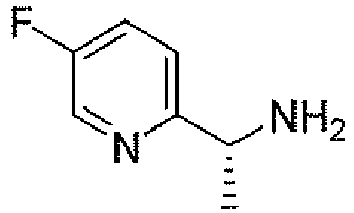
- To a degassed solution of ethyl alcohol (400 mL) in a Parr steel bomb was added sodium acetate (43.3 g, 528 mmol), 2-bromo-5-fluoropyridine (20 g, 114 mmol), 1,1'- bis(diphenylphosphino)ferrocene (2.27 g, 4.09 mnol) and palladium acetate (204 mg, 0.91 mmol). The vessel was put under nitrogen and sealed with Parr top. The atmosphere was displaced with carbon monoxide gas and the pressure was adjusted to 300 psi. The mixture was heated to 90 °C. After 3 h, the pressure dropped to below 100 psi. The vessel was cooled to ambient temperature and the reaction was repressurized with carbon monoxide to 300 psi. The vessel was heated to 90 °C for an additional 4 h. The vessel was cooled to ambient temperature and the remaining carbon monoxide was vented. The mixture was concentrated to half of the volume. Ethyl acetate (500 mL) and water (300 mL) were added. The organic layer was isolated and the aqueous layer was extracted with ethyl acetate (2x). The combined organic extracts were washed with brine, dried over sodium sulfate, filtered and concentrated. Purification by silica gel chromatography (100% hexanes → 70% hexanes/ ethyl acetate) gave the title compound. MS 170.0 (M+1).
- To a solution of ethyl 5-fluoropyridine-2-carboxylate (25 g, 148 mmol) in tetrahydrofuran (250 mL) at -78 °C. was added dropwise diisobutylaluminum hydride (1.0 M in hexanes; 296 mL, 296 mmol). After 1h, the reaction was quenched with ethyl alcohol (10 mL). Saturated aqueous sodium potassium tartrate tetrahydrate (1.3 L) was added and the aqueous layer was extracted with ethyl acetate (2x). The combined organic extracts were washed with brine, dried over sodium sulfate, filtered. The solution mixture (1.4 L) was carried onto the next step without concentration. MS 125.9 (M+1).
- To a solution of 5-fluoropyridine-2-carbaldehyde (18.49 g, 148 mmol) in ethyl acetate (850 mL), THF (250 mL) and hexanes (300 mL) were added (R)-(+)-2-methyl-2-propanesulfinamide (19.71 g, 163 mmol) and anhydrous copper(II) sulfate (59.0 g, 370 mmol). The mixture was stirred at ambient temperature. After 18 h, the mixture was filtered through Celite. The filtered cake was washed with ethyl acetate and the filtrate was concentrated. Purification by silica gel chromatography (100% dichloromethane → 98% dichloromethane/ methanol) gave the title compound.
- To a solution of N-[(1E)-(5-fluoropyridin-2-yl)methylene)-2-methylpropane-2-sulfinamide (52.12 g, 228 mmol) in dichloromethane (1000 mL) at -78 °C was added methylmagnesium bromide (3.0 M in THF; 198 mL, 594 mmol). The mixture was allowed to warm to ambient temperature. After 30 min, the mixture was cooled down to -78 °C and was quenched with saturated aqueous ammonium chloride (100 mL). The mixture was allowed to warm to ambient temperature. The organic layer was separated and the aqueous layer was extracted with dichloromethane (3x). The combined organic extracts were washed with brine, dried over sodium sulfate, filtered and concentrated. Purification by silica gel chromatography (100% ethyl acetate) gave the title compound. MS 245 (M+1).
- To a solution of N-[(1R)-1-(5-fluoropyridin-2-yl)ethyl]-2-methylpropane-2-sulfinamide (34.3 g, 140 mmol) in methyl alcohol (700 mL) at 0°C was added hydrogen chloride (4.0 M in dioxane; 105 mL, 421 mmol). After 30 min, the mixture was concentrated to dryness. The residue was recrytalized using ethyl alcohol (15 mL) and ether (40 mL). The white solid was filtered and dried under reduced pressure to give the hydrochloride salt of the title compound. MS 141.1 (M+1).
-

- To a solution of the toluene sulfonic acid salt of (1R)-1-(5-fluoropyridin-2-yl)ethanamine (7.5 g, 24.0 mmol) in dichloromethane (96 mL) at 0 °C was added triethylamine (7.03 mL, 50.0 mmol) and di-tert-butyl dicarbonate (6.13 mL, 26.4 mmol). The mixture was allowed to warm to ambient temperature. After 16 hours, saturated aqueous sodium bicarbonate was added. The organic layer was isolated and the aqueous layer was extracted with dichloromethane (2x). The combined organic extracts were washed with brine, dried over magnesium sulfate, and filtered. Concentration gave the title compound (7.72 g). MS 241.1 (M+1).
- To a solution of tert-butyl [(1R)-1-(5-fluoropyridin-2-yl)ethyl]carbamate (5.77 g, 24.0 mmol) in dichloromethane (96 mL) was added 3-chloroperbenzoic acid (6.51 g, 26.4 mmol). After 4.5 h, excess 3-chloroperbenzoic acid (0.59 g, 2.6 mmol) was added. After 72 h, saturated aqueous sodium sulfate was added. After 1h, saturated aqueous sodium bicarbonate was added. The organic layer was isolated and the aqueous layer was extracted with dichloromethane (2x). The combined organic extracts were washed with brine, dried over magnesium sulfate, filtered, and concentrated. Purification by silica gel chromatography (100% dichloromethane → 90% dichloromethane / methanol with 1% ammonium hydroxide) gave the title compound (5.45 g). MS 257.1 (M+1).
- To a solution of tert-butyl [(1R)-1-(5-fluoro-1-oxidopyridin-2-yl)ethyl]carbamate (1.47 g, 5.74 mmol) in dichloromethane (28.7 mL) was added 4 M hydrochloric acid in 1,4-dioxane (43.0 mL, 172 mmol). After 2 h, concentration gave the title compound as a hydrochloride salt (1.396 g). MS 157.1(M+1). 1H NMR (500 MHz, CD3OD): δ 8.55 (dd, J = 4.3, 2.4 Hz, 1H); 7.70 (dd, J = 9.0, 6.7 Hz, 1H); 7.52 (ddd, J = 9.1, 7.1, 2.4 Hz, 1H); 4.80 (q, J = 7.0 Hz, 1H); 1.74 (d, J = 7.0 Hz, 3 H).
-

- To a solution of benzyl [(1R)-2-amino-1-methyl-2-oxoethyl]carbamate (10 g, 45 mmol) in 50 mL of N,N-dimethylformamide was added 2,4,5-trichloro-1,3,5-triazine (4.15 g, 22.5 mmol). After 2 h, 104 mL of water was added and the mixture was filtered. The solids were washed with 100 mL aqueous sodium bicarbonate (2x) and dried under vacuum to give pure benzyl [(1R)-1-cyanoethyl]carbamate (7.2 g). MS 205.2 ((M+1).
- To a solution of benzyl [(1R)-1-cyanoethyl]carbamate (2.52 g, 12.3 mmol) in ethanol (30 ml) was added hydroxylamine hydrochloride salt (0.90 g, 13.0 mmol) and triethylamine (3.43 ml, 24.6 mmol) and the mixture heated to 75 °C. After 16 h, the solution was concentrated and the residue was dissolved in 200 mL of dichloromethane. The mixture was washed with 100 mL of saturated aquous sodium bicarbonate (2x) and brine (100 mL). The combined organic extracts were dried over sodium sulfate, filtered and concentrated to give benzyl [(1R, 2Z)-2-amino-2-(hydroxyimino)-1-methylethyl]carbamate (2.9 g). MS 238.2 (M+1).
- To a solution of benzyl [(1R, 2Z)-2-amino-2-(hydroxyimino)-1-methylethyl]carbamate (2.25 g, 9.48 mmol) in dioxane (80 ml) was added 1-acetyl-1H-imidazole (3.13 g, 28.5 mmol) and the mixture heated to 90 °C. After 16 h, the solution was concentrated and the residue was dissolved in 200 mL of dichloromethane. The mixture was washed with 100 mL of aquous saturated sodium bicarbonate (2x) and brine (100 mL). The organic layer was dried over sodium sulfate, filtered and concentrated. The residue was purified by silica gel chromatography (100% dichloromethane → 95% dichloromethane/ methanol) to give the title compound (1.1 g). MS 262.1 (M+1).
- To a solution of benzyl [(1R)-1-(5-methyl-1,2,4-oxadiazol-3-yl)ethyl]carbamate (1.10 g, 4.21 mmol) in dichloromethane (40 mL) was added 1 M boron trichloride solution in dichloromethane (21.1 mL, 21.1 mmol) at 0 °C. The reaction mixture was allowed to warm from 0 °C to 20 °C over 4 h. The solution was quenched by 5 ml of methanol at 0 °C. After warming to ambient temperature, the mixture was concentrated and the residue was washed with 100 mL of diethyl ether (2x) to give the hydrochloride salt of (1R)-1-(5-methyl-1,2-,4-oxadiazol-3-yl)ethanamine was obtained as solid (0.84 g). 1H NMR (500 MHz, CD3OD): δ 4.70-4.61 (m, 1H); 2.63 (s, 3H); 1.67 (d, J = 6.9 Hz, 3 H).
-

- To a solution of ethyl 4-chloro-2-(trifluoromethyl)pyrimidine-5-carboxylate (30.2 g, 119.0 mmol) in ethanol (594 mL) under nitrogen were added palladium (10% on carbon, 50% water wet; 2.58g, 1.21 mmol) and diisopropylethylamine (50.0 mL, 286.0 mmol). The mixture stirred under hydrogen (1 atm). After 6 h, the mixture was filtered with Celite. The filtrate was concentrated and ethyl acetate was added. The mixture was washed with sat. NaHCO3 (2x), brine, dried over Na2SO4, filtered and concentrated to give the title compound (25.6 g). MS 221.1 (M+1).
- To a solution of ethyl 2-(trifluoromethyl)pyrimidine-5-carboxylate (25.5 g, 116.0 mmol) in dichloromethane (580 mL) at -78 °C was slowly added DIBAL-H (1.0 M; 130.0 mL, 130.0 mmol). The mixture was stirred at -78 °C. After 2 h, the mixture was quenched via slow addition of HCl (2.0 M in water). The mixture was allowed to warm to ambient temperature. The mixture was extracted with diethyl ether (3x). The combined organic extracts was dried over Na2SO4, filtered and concentrated to give the title compound (28.2 g).
- To a solution of 2-(trifluoromethyl)pyrirnidine-5-carbaldehyde (27.2 g, 99 mmol) in dichloroethane (250 mL) was added (R)-(+)-2-methyl-2-propanesulfinamide (13.3 g, 109.0 mmol) and copper(II) sulfate (31.5 g, 197.0 mmol). The mixture was heated to 50 °C. After 18 h, the mixture was cooled to ambient temperature and filtered through a pad of silica gel. The filtered cake was washed with dichloromethane and the filtrate was concentrated to give the title compound (27.3 g). MS 224 [(M+1)-56].
- To a solution of 2-methyl-N-{(1Z)-[2-(trifluoromethyl)pyrimidin-5-yl]methylene}propane-2-sulfinamide (14.3 g, 51.2 mmol) in toluene (260 mL) at -70 °C was added methyllithium (1.6 M; 35.0 mL, 56.0 mmol). The mixture was stirred at -70 °C for 15 min. The mixture was quenched with sat. NH4Cl and the reaction was allowed to warm to ambient temperature. The mixture was extracted with dichloromethane (3x). The combined organic extracts was dried over Na2SO4, filtered and concentrated. Purification by silica gel chromatography (100% hexanes → 35% hexanes / ethyl acetate then 100 % ethyl acetate → 94% ethyl acetate / methanol) gave the title compound (7.23 g). MS 240.0 [(M+1)-56].
- To a solution of 2-methyl-N-{(1R)-1-[2-(trifluoromethyl)pyrimidin-5-yl]ethyl}propane-2-sulfinamide (7.23 g, 24.5 mmol) in methanol (100 mL) was added HCl (4.0 M in dioxane; 18.5 mL, 74.0 mmol). The mixture was stirred at ambient temperature. After 1h, the mixture was concentrated to give the title compound (4.6 g).
-

- To a solution of ethyl 6-amino-5-bromonicotinate (5.0 g, 20.4 mmol) in N,N-dimethylformamide (204 mL) were added bromoacetaldehyde dimethylacetal (3.45 g, 20.4 mmol) and p-toluenesulfonic acid (0.53 g, 3.1 mmol). The mixture was heated to 90 °C. After 18 h, additional bromoacetaldehyde dimethylacetal (3.45 g, 20.4 mmol) and 4A° molecular sieves were added. The mixture was stirred at 90 °C for another 24 h. The mixture was warmed to ambient temperature and aqueous LiCl (3.0 M) was added. The mixture was extracted with ethyl acetate (3x). The combined organic layer was washed with brine, dried over sodium sulfate, filtered and concentrated. There was still some DMF in the crude product. Water was added and the mixture was extracted with t-butyl methyl ether, washed with brine, dried over sodium sulfate, filtered and concentrated. The mixture was carried on to the next step: LC-MS [M] = 269.0.
- A degassed solution of n-propanol (40 mL) and water (10 mL) was added to a mixture of ethyl 8-bromoimidazo[1,2-a]pyridine-6-carboxylate (1.0 g, 3.72 mmol), (4-methylphenyl)boronic acid (0.66 g, 4.83 mmol), (tetrakistriphenylphosphine) palladium(0) (0.22 g, 0.19 mmol) and potassium carbonate (1.54 g, 11.2 mmol). The mixture was heated to 90 °C. After 18 h, sodium hydroxide (3N in water; 3 mL) and methanol (20 mL) was added. The mixture was stirred at 90 °C for another 48 h. The mixture was cooled to ambient temperature and filtered with Celite. The filtrate was concentrated. The water was azeotropically removed with repeated concentration from acetonitrile. The crude mixture was taken up in methanol and small amount of water and loaded onto a 25 g pre-equilibrated SCX column. The column was washed with 5x column volumes of methanol to remove impurities. The column was then washed with 3x column volumes of 2 M ammonia/ methanol to elude the titled product (0.90 g): LC-MS [M+1] = 253.2.
- To a solution of 8-(4-methylphenyl)imidazo[1,2-a]pyridine-6-carboxylic acid (25.0 mg, 0.10 mmol) in N,N-dimethylformamide (1 mL) were added (1R)-1-(5-fluroropyridin-2-yl)ethanamine hydrochloride salt (73.9 mg, 0.35 mmol), EDC (28.5 mg, 0.15 mmol), HOAT (0.6 M in DMF; 83 µl, 0.05 mmol) and triethylamine (32.8 µL, 0.20 mmol). The reaction mixture was stirred at ambient temperature. After 18 h, the mixture was filtered. The filtrate was purified by reverse phase HPLC (C-18, 95% water/ acetonitrile → 5% water/ acetonitrile with 0.025% trifluoroacetic acid) gave the trifluoroacetate salt of the title compound (9.5 mg): HRMS [M+1] found = 375.1613; 1H NMR (399 MHz, CD3 OD): δ 9.29 (s, 1H); 8.42-8.35 (m, 2 H); 8.32 (s, 1H); 8.06 (d, J = 2.3 Hz, 1 H); 7.65-7.48 (m, 4H); 7.45 (d, J = 7.6 Hz, 2H); 7.39-7.34 (m, 1H); 5.32 (m, 1H); 2.46 (s, 3H); 1.61 (d, J = 7.0 Hz, 3 H).
-

- To a solution of 2-(benzylamino)-6-chloroisonicotinic acid (0.9 g, 3.43 mmol) in THF (8.57 mL) and water (8.57 mL) were added (4-methylphenyl)boronic acid (0.70 g, 5.14 mmol), dichloro[1,1'-bis(diphenylphosphino)ferrocene]palladium(II) dichloromethane adduct (0.14 g, 0.17 mmol) and cesium carbonate (3.35 g, 10.3 mmol). The mixture was purged with nitrogen and was heated to 120 °C in the microwave reactor for 7 min. The mixture was filtered with Celite and satuarated aqueous sodium bicarbonate was added. The mixture was extracted with ethyl acetate (3x). The combined organic layer was washed with brine, dried over sodium sulfate, filtered and concentrated. Purification by silica gel chromatography (100% dichloromethane → 80% dichloromethane /methanol) gave the title compound (0.63 g): LC-MS [M+1] = 318.9.
- To a solution of 2-(benzylamino)-6-(4-methylphenyl)isonicotinic acid (0.62 g, 1.94 mmol) in THF (7.7 mL) at 0 °C was added dimethylaminopyridine (0.12 g, 0.97 mmol). A solution of di-tert-butyl dicarbonate (0.21 g. 0.97 mmol) in THF (1 mL) was added and the mixture was allowed to warm to ambient temperature. After 18 h, The mixture was cooled to 0 °C and additional dimethylaminopyridine (0.12 g, 0.97 mmol) and di-tert-butyl dicarbonate (0.21 g. 0.97 mmol) were added. The mixture was allowed to warm to ambient temperature. After 18 h, the solvent was removed and HCl (0.1 N aqueous solution) was added and the mixture was extracted with ethyl acetate (3x). The combined organic layer was washed with brine, dried over sodium sulfate, filtered and concentrated. Purification by silica gel chromatography (100% hexanes → 100% ethyl acetate) gave the title compound (0.37 g): LC-MS [M+1] = 374.9.
- To a solution of tert-butyl 2-(benzylamino)-6-(4-methylphenyl)isonicotinate (0.37 g, 0.98 mmol) in ethanol (4.67 mL) were added palladium dihydroxide (3.42 mg, 0.024 mmol) and trifluoroacetic acid (0.08 mL, 1.08 mmol). The mixture was purged with hydrogen and stirred under hydrogen (1 atm) at 60°C. After 30 min, the mixture was cooled to ambient temperature and filtred with Celite. The filtered cake was washed with methanol and the filtrate was concentrated. Purification by silica gel chromatography (100% dichloromethane → 95% dichloromethane/ methanol) gave the title compound (145 mg): LC-MS [M+1] = 285.2.
- To a solution of tert-butyl 2-amino-6-(4-methylphenyl)isonicotinate (57 mg, 0.2 mmol) in N,N-dimethylformamide (1.3 mL) were added 2-bromo-1,1-dimethoxyethane (33.9 mg, 0.2 mmol) and 4-methylbenzenesulfonic acid (5.2 mg, 0.03 mmol). The mixture was heated to 90 °C. After 18 h, the mixture was filtered. The filtrate was purified by reverse phase HPLC (C-18, 95% water/ acetonitrile → 5% water/ acetonitrile with 0.025% trifluoroacetic acid) gave the title compound (30 mg): LC-MS [M+1] = 309.2.
- To a solution of tert-butyl 5-(4-methylphenyl)imidazo[1,2-a]pyridine-7-carboxylate (40 mg, 0.13 mmol) in dichloromethane (0.65 mL) was added trifluoroacetic acid (0.65 mL). The mixture was stirred at ambient temperature. After 1.5 h, the mixture was concentrated. The crude product was purified by reverse phase HPLC (C-18, 95% water/ acetonitrile → 5% water/ acetonitrile with 0.025% trifluoroacetic acid) gave the mixture of the title compound and the impurities. The mixture was carried onto the next step: LC-MS [M+1] = 253.1.
- Step F: N-[(1R)-(5-fluoropyridin-2-yl)ethyl]-5-(4-methylphenyl)imidazo[1,2-a]pyridine-7-carboxamide
- To a solution of the trifluoracetate salt of 5-(4-methylphenyl)imidazo[1,2-a]pyridine-7-carboxylic acid (22, 0.06 mmol) in N,N-dimethylformamide (0.6 mL) were added (1R)-1-(5-fluoropyridin-2-yl)ethanamine hydrochloride salt (25.3 mg, 0.18 mmol), EDC (17.3 mg, 0.09 mmol), HOAT (4.1 mg, 0.03 mmol) and diisopropylethylamine (69.5 µL, 0.42 mmol). The reaction mixture was stirred at ambient temperature. After 18 h, the mixture was filtered. The filtrate was purified by reverse phase HPLC (C-18, 95% water/ acetonitrile → 5% water/ acetonitrile with 0.025% trifluoroacetic acid) gave the trifluoroacetate salt of the title compound (1.5 mg): LC-MS [M+1] = 375.2.
-

- To a solution of tert-butyl 5,6-dichloronicotinate (2.0 g, 8.1 mmol)) in ethanol (40.3 mL) was added hydrazine hydrate (1.18 mL, 24.2 mmol). The mixture was heated 75 °C. After 18 h, the mixture was cooled to ambient temperature. The mixture was concentrated to dryness: LC-MS [M+1] = 244.1.
- Trimethyl orthoformate (19 mL, 172 mmol) was added neat to tert-butyl 5-chloro-6-hydrazinonicotinate (1.9 g, 7.8 mmol). The mixture was heated to 85 °C. After 4 h, the mixture was cooled to ambient temperature and concentrated to dryness: LC-MS [M+1] = 254.1.
- To a solution of tert-butyl 8-chloro[1,2,4]triazolo[4,3-a]pyridine-6-carboxylate (1.7 g, 6.7 mmol) in n-propanol (53.6 mL) and water (13.4 mL) were added (4-methylphenyl)boronic acid (1.37 g, 10.1 mmol), tetrakistriphenylphosphinepalladium (0) (0.39 g, 0.34 mmol) and patassium carbonate (2.78 g, 20.1 mmol). The mixture was purged with nitrogen and heated to 85 °C. After 18 h, the mixture was cooled to ambient temperature and filtered with Celite. The filtrate was concentrated to remove n-propanol. The aqueous mixture was extracted with ethyl acetate (3x). The combined organic layer was washed with brine, dried over sodium sulfate, filtered and concentrated. Purification by silica gel chromatography (100% dichloromethane → 95% dichloromethane /methanol). The product obtained was purified again by reverse phase HPLC (C-18, 95% water/ acetonitrile → 5% water/ acetonitrile with 0.025% trifluoroacetic acid) gave the title compound (0.35 g): LC-MS [M+1] = 310.2.
- To a solution of tert-butyl 8-(4-methylphenyl)[1,2,4]triazolo[4,3-a]pyridine-6-carboxylate (0.35 g, 1.14 mmol) in dichloromethane (5.7 mL) was added trifluoroacetic acid (5.7 mL). After 3 h, the mixture was concentrated to give the trifluoroacetate salt of the title compound: LC-MS [M+1] = 254.1.
- To a solution of the trifluoroacetic salt of 8-(4-methylphenyl)[1,2,4]triazolo[4,3-a]pyridine-6-carboxylic acid (98.0 mg, 0.39 mmol) in N,N-dimethylformamide (1.9 mL) were added (1R)-1-(5-fluoropyridin-2-yl)ethanamine hydrochloride salt (0.16 g, 1.16 mmol), EDC (0.11 g, 0.58 mmol), HOAT (0.6 M in DMF; 0.65 mL, 0.39 mmol) and diisopropylethylamine (0.14 mL, 0.77 mmol). The reaction mixture was stirred at ambient temperature. After 18 h, the mixture was filtered. The filtrate was purified by reverse phase HPLC (C-18, 95% water/ acetonitrile → 5% water/ acetonitrile with 0.025% trifluoroacetic acid) gave the title compound (47 mg): HRMS [M+1] found = 376.1566; 1H NMR (400 MHz, CD3 OD): δ 9.33 (s, 1 H); 9.03 (d, J = 1.5 Hz, 1 H); 8.43 (d, J = 2.8 Hz, 1 H); 7.98 (d, J = 8.2 Hz, 3 H); 7.60 (td, J = 8.5, 2.9 Hz, 1 H); 7.53 (dd, J= 8.7, 4.5 Hz, 1 H); 7.37 (d, J = 7.9 Hz, 2 H); 5.32 (q, J = 7.0 Hz, 1 H); 2.43 (s, 3 H); 1.62 (d, J = 7.1 Hz, 3 H).
-
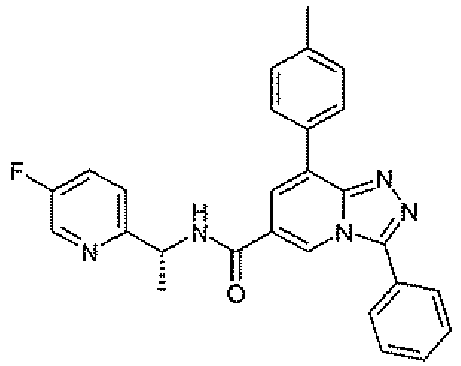
- To a solution of 5,6-dichloronicotinic acid (25.0 g, 130 mmol) in tetrahydrofuran (400 mL) at 0 °C was added dimethylaminopyridine (79.5 g, 65.1 mmol). A solution of di-tert-butyl dicarbonate (31.3 g. 143 mmol) in THF (10 mL) was added dropwise and the mixture was allowed to warm to ambient temperature. After 18 h, the mixture was concentrated. Saturated aqueous sodium bicarbonate was added and the mixture was extracted with ethyl acetate (3x). The combined organic layer was washed with brine, dried over sodium sulfate, filtered and concentrated: LC-MS [M+1-16] = 233.0.
- To a solution of tert-butyl 5,6-dichloronicotinate (32.3 g, 130 mmol)) in ethanol (651 mL) was added hydrazine hydrate (19 mL, 391 mmol). The mixture was heated 75 °C. After 2.5 h, the mixture was cooled to ambient temperature. The mixture was concentrated down to 200 mL of ethanol. The solid crashed out was filtered and washed with dichloromethane to give the hydrochloride salt of the title compound (29 g): LC-MS [M+1] = 244.1.
- To a solution of tert-butyl-5-chloro-6-hydrazinonicotinate hydrochloride salt (3.0 g, 9.5 mmol) in N,N-dimethylformamide (20 mL) were added benzoic acid (1.62 g, 13.3 mmol), EDC (3.63 g, 19.0 mmol), HOAT (1.29 g, 9.48 mmol) and triethylamine (6.6 mL, 48.4 mmol). The reaction mixture was stirred at 60 °C. After 1 h, saturated aqueous sodium bicarbonate was added and the mixture was extracted with ethyl acetate (3x). The combined organic layer was washed with brine, dried over sodium sulfate, filtered and concentrated: LC-MS [M+1] = 348.1.
- To a solution of tert-butyl 6-(2-benzoylhydrazino)-5-chloronicotinate (3.3 g, 9.49 mmol) in toluene (40 mL) was added Lawesson's reagent (1.92 g, 4.74 mmol). The mixture was stirred at 80 °C. After 2 h, the mixture was concentrated. Saturated aqueous sodium bicarbonate was added and the mixture was extracted with ethyl acetate (3x). The combined organic layer was washed with brine, dried over sodium sulfate, filtered and concentrated. Purification by silica gel chromatography (100% dichloromethane → 60% dichloromethane / ethyl acetate) gave the title compound (1.42 g): LC-MS [M+1] = 330.1.
- To a solution of tert-butyl 8-chloro-3-phenyl[1,2,4]triazolo[4,3-a]pyridine-6-carboxylate (0.6 g, 1.82 mmol) in THF (2 mL) and water (2 mL) were added (4-methylphenyl)boronic acid (0.50 g, 3.64 mmol), dichloro[1,1'-bis(diphenylphosphino)ferrocene]palladium(II) dichloromethane adduct (39.9 mg, 55.0 µmol) and cesium carbonate (1.78 g, 5.46 mmol). The mixture was purged with nitrogen and was heated to 140 °C in the microwave reactor for 1h. The mixture was filtered with Celite and satuarated aqueous sodium bicarbonate was added. The mixture was extracted with ethyl acetate (3x). The combined organic layer was washed with brine, dried over sodium sulfate, filtered and concentrated. Purification by silica gel chromatography (100% hexanes → 60% hexanes /ethyl acetate) gave the title compound (0.5 g): LC-MS [M+1] = 386.1.
- To a solution of tert-butyl 8-(4-methylphenyl)-3-phenyl[1,2,4]triazolo[4,3-a]pyridine-6-carboxylate (0.5 g, 1.3 mmol) in dichloromethane (2 mL) was added trifluoroacetic acid (2 mL). The mixture was stirred at ambient temperature. After 4.5 h, the mixture was concentrated to give the trifluoroacetate salt of the title compound (0.46 g): LC-MS [M+1] = 330.1.
- To a solution of the trifluoroacetic salt of 8-(4-methylphenyl)-3-phenyl[1,2,4]triazolo[4,3-a]pyridine-carboxylic acid (35.0 mg, 0.08 mmol) in N,N-dimethylformamide (0.5 mL) were added (1R)-1-(5-fluoropyridin-2-yl)ethanamine hydrochloride salt (25.2 mg, 0.12 mmol), EDC (30.3 mg, 0.16 mmol), HOAT (10.7 mg, 0.08 mmol) and triethylamine (55.0 µL, 0.40 mmol). The reaction mixture was stirred at 60 °C. After 1 h, the mixture was filtered. The filtrate was purified by reverse phase HPLC (C-18, 95% water/ acetonitrile → 5% water/ acetonitrile with 0.025% trifluoroacetic acid) gave the trifluoroacetate salt of the title compound (27 mg): HRMS [M+1] found = 452.1899; 1H NMR (400 MHz, CD3 OD): δ 8.93 (d, J = 1.5 Hz, 1 H); 8.38 (d, J = 2.8 Hz, 1 H); 8.00 (d, J = 1.5 Hz, 1 H); 7.95-7.86 (m, 4 H); 7.68-7.63 (m, 3 H); 7.55 (td, J = 8.5, 2.9 Hz, 1 H); 7.48 (dd, J = 8.7, 4.5 Hz, 1 H); 7.34 (d, J = 7.9 Hz, 2 H); 5.26 (q, J = 7.1 Hz, 1 H); 2.40 (s, 3 H); 1.56 (d, J = 7.1 Hz, 3 H).
-

- To a degassed solution of tert-butyl 8-chloro-3-phenyl[1,2,4]triazolo[4,3-a]pyridine-6-carboxylate (0.22 g, 0.67 mmol) and bis(tri-tert-butylphosphine)palladium(0) (17.1 mg, 33 µmol) in dioxane (2 mL) was added 5-methyl-2-pyridylzinc bromide (0.5 M in THF; 4.0 mL, 2.0 mmol). The mixture was heated 75 °C. After 18 h, the mixture was cooled to ambient temperature and concentrated. Saturated aqueous sodium bicarbonate was added and the mixture was extracted with dichloromethane (3x). The combined organic layer was washed with brine, dried over sodium sulfate, filtered and concentrated. Purification by silica gel chromatography (100% hexanes → 75% hexanes /ethyl acetate) gave the title compound (69 mg): LC-MS [M+1] = 387.1.
- To a solution of tert-butyl 8-(5-methylpyridin-2-yl)-3-phenyl[1,2,4]triazolo[4,3-a]pyridine-6-carboxylate (69.0 mg, 0.18 mmol) in dichloromethane (2 mL) was added trifluoroacetic acid (1 mL). The mixture was stirred at ambient temperature. After 5 h, the mixture was concentrated to give the trifluoroacetate salt of the title compound (100 mg): LC-MS [M+1] = 331.1.
- To a solution of the trifluoroacetic salt of 8-(5-methylpyridin-2-yl)-3-phenyl[1,2,4]triazolo[4,3-a]pyridine-6-carboxylic acid (50.0 mg, 0.09 mmol) in N,N-dimethylformamide (0.7 mL) were added (1R)-1-(3,5-difluoropyridin-2-yl)ethanamine hydrochloride salt (26.9 mg, 0.12 mmol), EDC (34.3 mg, 0.18 mmol), HOAT (12.2 mg, 0.09 mmol) and triethylamine (75.0 µL, 0.54 mmol). The reaction mixture was stirred at 60 °C. After 2 h, the mixture was filtered. The filtrate was purified by reverse phase HPLC (C-18, 95% water/ acetonitrile → 5% water/ acetonitrile with 0.025% trifluoroacetic acid) gave the trifluoroacetate salt of the title compound (22 mg): HRMS [M+1] found = 471.1734; 1H NMR (400 MHz, DMSO): δ 9.63 (s, 1 H); 9.29 (d, J = 7.1 Hz, 1 H); 9.09 (d, J = 8.2 Hz, 1 H); 9.02 (s, 1 H); 8.66 (s, 1 H); 8.51 (s, 1 H); 8.32 (d, J = 7.2 Hz, 2 H); 7.99-7.87 (m, 2 H); 7.64-7.54 (m, 3 H); 5.55-5.46 (m, 1 H); 2.42 (s, 3 H); 1.57 (d, J = 7.0 Hz, 3 H).
-

- To a solution of tert-butyl 5-chloro-6-hydrazinonicotinate hydrochloride salt (5.5 g, 17.4 mmol) in methanol (80 mL) was added methyl pyridine-2-carboximidoate (4.73 g, 34.7 mmol). The mixture was heated to 65 °C. After 2.5 h, the mixture was cooled to ambient temperature. The solid crashed out was filtered off and the filtrate was concentrated. Purification by silica gel chromatography (100% hexanes → 60% hexanes /ethyl acetate) gave 0.44 g of the title compound and 1.3 g of a side product. The side product (1.3 g) was dissolved in methanol (28 mL) and acetic acid (0.53 mL) was added. The mixture was heated to 65 °C. After 7 h, the reaction was cooled to ambient temperature and satuarated aqueous sodium bicarbonate was added. The mixture was extracted with ethyl acetate (3x). The combined organic layer was washed with brine, dried over sodium sulfate, filtered and concentrated to give another 1.0 g of the title compound: LC-MS [M+1] = 331.1.
- To a solution of tert-butyl 8-chloro-3-pyridin-2-yl[1,2,4]triazolo[4,3-a]pyridine-6-carboxylate (0.5 g, 1.51 mmol) in toluene (12 mL) were added (4-fluorophenyl)boronic acid (0.32 g, 2.27 mmol), 2-dicyclohexylphosphino-2',4',6'-triisopropylbiphenyl (72.1 mg, 0.15 mmol), palladium(II) acetate (33.9 mg, 0.15 mmol) and potassium phosphate tribasic (0.96g, 4.53 mmol). The mixture was heated to 110 °C. After 2 h, the mixture was cooled to ambient temperature, filtered with Celite and the filtrate was concentrated. Purification by silica gel chromatography (100% dichloromethane → 60% dichloromethane /ethyl acetate) gave of the title compound (0.53 g): LC-MS [M+1] = 391.2.
- To a solution of tert-butyl 8-(4-fluorophenyl)-3-pyridin-2-yl[1,2,4]triazolo[4,3-a]pyridine-6-carboxylate (0.53 g, 1.36 mmol) in dichloromethane (3 mL) was added trifluoroacetic acid (3 mL). The mixture was stirred at ambient temperature. After 5 h, the mixture was concentrated to give the trifluoroacetate salt of the title compound (0.53 g): LC-MS [M+1] = 335.2.
- To a solution of the trifluoroacetic salt of 8-(4-fluorophenyl)-3-pyridin-2-yl[1,2,4]triazolo[4,3-a]pyridine-6-carboxylic acid (45.0 mg, 0.10 mmol) in N,N-dimethylformamide (0.8 mL) were added (1R)-1-[1-oxido-6-(trifluoromethyl)pyridin-3-yl]ethanamine hydrochloride salt (34.1 mg, 0.14 mmol), EDC (38.5 mg, 0.20 mmol), HOAT (13.7 mg, 0.10 mmol) and triethylamine (84.0 µL, 0.60 mmol). The reaction mixture was stirred at 60 °C. After 1 h, the mixture was filtered. The filtrate was purified by reverse phase HPLC (C-18, 95% water/ acetonitrile → 5% water/ acetonitrile with 0.025% trifluoroacetic acid) gave the trifluoroacetate salt of the title compound (30 mg): HRMS [M+1] found = 523.1500; 1H NMR (400 MHz, CD3 OD): δ 10.36 (s, 1 H); 8.82 (d, J = 4.8 Hz, 1 H); 8.56 (s, 1 H); 8.44 (d, J = 8.1 Hz, 1 H); 8.13 (dd, J = 8.4, 5.3 Hz, 2 H); 8.06-7.99 (m, 2 H); 7.93 (d, J = 8.4 Hz, 1 H); 7.72 (d, J = 8.4 Hz, 1 H); 7.53 (t, J = 6.1 Hz, 1 H); 7.29 (t, J = 8.6 Hz, 2 H); 5.34-5.25 (m, 1 H); 1.69 (d, J = 7.2 Hz, 3 H).
-

- To a solution of 2,6-dichloroisonicotinic acid (10.0 g, 52.1 mmol) in THF (213 mL) at 0 °C was added dimethylaminopyridine (3.18 g, 26.0 mmol). A solution of di-tert-butyl dicarbonate (13.64 g. 62.5 mmol) in THF (20 mL) was added and the mixture was allowed to warm to ambient temperature. After 18 h, the solvent was removed and HCl (0.1 N aqueous solution) was added and the mixture was extracted with ethyl acetate (3x). The combined organic layer was washed with brine, dried over sodium sulfate, filtered and concentrated: LC-MS [M+1-16] = 233.0.
- To a solution of tert-butyl 2,6-dichloroisonicotinate (11.0 g, 44.3 mmol) in ethanol (222 mL) was added hydrazine hydrate (6.46 mL, 133 mmol). The mixture was heated 75 °C. After 18 h, the mixture was cooled to ambient temperature. The mixture was concentrate down to half of the volume. The solid crashed out was filtered off and the filtrate was concentrated to dryness: LC-MS [M+1] = 244.1.
- Trimethyl orthoformate (100 mL, 903 mmol) was added neat to tert-butyl 2-chloro-6-hydrazinoisonicotinate (10.0 g, 41.0 mmol). The mixture was heated to 85 °C. After 5 h, the mixture was cooled to ambient temperature and concentrated. Purification by silica gel chromatography (100% hexanes → 50% hexanes /ethyl acetate) gave the title compound (4.55 g): LC-MS [M+1] = 254.1.
- To a solution of tert-butyl 5-chloro[1,2,4]triazolo[4,3-a]pyridine-7-carboxylate (2.0 g, 7.88 mmol) in n-propanol (63.1 mL) and water (15.8 mL) were added (4-methylphenyl)boronic acid (1.39 g, 10.3 mmol), tetrakistriphenylphosphinepalladium (0) (0.46 g, 0.39 mmol) and patassium carbonate (3.27 g, 23.7 mmol). The mixture was purged with nitrogen and heated to 85 °C. After 4 h, the mixture was cooled to ambient temperature and filtered with Celite. The filtrate was concentrated to remove n-propanol. The aqueous mixture was extracted with ethyl acetate (3x). The combined organic layer was washed with brine, dried over sodium sulfate, filtered and concentrated. Purification by silica gel chromatography (100% hexanes → 50% hexanes /ethyl acetate) gave the title compound (1.9 g): LC-MS [M+1] = 310.2.
- To a solution of tert-butyl 5-(4-methylphenyl)[1,2,4]triazolo[4,3-a]pyridine-7-carboxylate (1.8 g, 5.82 mmol) in dichloromethane (29.1 mL) was added trifluoroacetic acid (29.1 mL). After 5 h, the mixture was concentrated to give the trifluoroacetate salt of the title compound: LC-MS [M+1] = 254.1.
- To a solution of the trifluoroacetic salt of 5-(4-methylphenyl)[1,2,4]triazolo[4,3-a]pyridine-7-carboxylic acid (125 mg, 0.34 mmol) in N,N-dimethylformamide (3.4 mL) were added (1R)-1-[6-(trifluoromethyl)pyridin-3-yl]etanamine hydrochloride salt (0.19 g, 1.02 mmol), EDC (98.0 mg, 0.51 mmol), HOAT (0.6 M in DMF; 0.57 mL, 0.34 mmol) and diisopropylethylamine (0.12 mL, 0.68 mmol). The reaction mixture was stirred at ambient temperature. After 18 h, the mixture was filtered. The filtrate was purified by reverse phase HPLC (C-18, 95% water/ acetonitrile → 5% water/ acetonitrile with 0.025% trifluoroacetic acid) gave the trifluoroacetate salt of the title compound (53 mg): HRMS [M+1] found = 426.1541; 1H NMR (400 MHz, CD3 OD): δ 9.24 (s, 1 H); 8.76 (s, 1 H); 8.28 (s, 1 H); 8.07 (d, J= 8.2 Hz, 1 H); 7.78 (d, J = 8.2 Hz, 1 H); 7.65 (d, J = 7.8 Hz, 2 H); 7.47-7.39 (m, 3 H); 5.36-5.30 (m, 1 H); 1.65 (d, J = 7.1 Hz, 3 H).
-

- To a solution of N-[(1R)-1-(5-fluoropyridin-2-yl)ethyl]-8-(4-methylphenyl)-3-phenyl[1,2,4]triazolo[4,3-a]pyridine-6-carboxamide (20 mg, 0.04 mmol) in acetonitrile (0.5 mL) was added sodium hydroxide (1.0 M solution in water; 1 mL). The mixture was heated in the microwave reactor at 150 °C for 40 min. Saturated aqueous sodium bicarbonate was added and the mixture was extracted with ethyl acetate (3x). The combined organic layer was washed with brine, dried over sodium sulfate, filtered and concentrated. Purified by reverse phase HPLC (C-18, 95% water/ acetonitrile → 5% water/ acetonitrile with 0.025% trifluoroacetic acid) gave the trifluoroacetate salt of the title compound (11 mg): HRMS [M+1] found = 452.1907; 1H NMR (400 MHz, DMSO): δ 9.44 (s, 1 H); 8.49 (d, J = 2.9 Hz, 1 H); 8.29 (s, 1 H); 8.21 (d, J = 7.1 Hz, 2 H); 8.14 (d, J = 7.9 Hz, 2 H); 7.67 (td, J = 8.8, 3.0 Hz, 1 H); 7.57-7.47 (m, 4 H); 7.37 (d, J = 7.9 Hz, 2 H); 5.28-5.19 (m, 1 H); 2.37 (s, 3 H); 1.52 (d, J = 7.1 Hz, 3 H).
-

- To a solution of 1H-1,2,3-benzotriazole-6-carboxylic acid (6.0 g, 36.8 mmol) in ethanol (27.8 mL) was added sulfuric acid (1.5 mL, 28.1 mmol). The mixture was heated to 60 C. After 18 h, the mixture was cooled to ambient temperature. Aqueous sodium hydroxide (3N) and ethyl acetate was added and solid crashed out of the solution. The solid was filtered and dried under hi-vac to give the title compound (5.14 g): LC-MS [M+1] = 192.1.
- A solution of ethyl 1H-1,2,3-benzotriazole-6-carboxylate (5.0 g, 26.2 mmol) in dichloromethane (25.2 mL) was purged with nitrogen and a solution of bromine (1.35 mL, 26.2 mmol) in acetic acid (5.17 mL) was added dropwise. The mixture was stirred at ambient temperature. After 18 h, additional bromine (0.67 mL, 13.1 mmol) was added and the mixture was stirred at ambient temperature. After 18 h, saturated aqueous sodium thiosulfate was added and the mixture was extracted with ethyl acetate. The combined organic layer was washed with brine, dried over sodium sulfate, filtered and concentrated. The crude product was purified by reverse phase HPLC (C-18, 95% water/ acetonitrile → 5% water/ acetonitrile with 0.025% trifluoroacetic acid) gave the title compound (0.73 g): LC-MS [M] = 270.0.
- To a solution of ethyl 4-bromo-1H-1,2,3-benzotriazole-6-carboxylate (50.0 mg, 0.18 mmol) in n-propanol (1.5 mL) and water (0.37 mL) were added (4-methylphenyl)boronic acid (32.5 mg, 0.24 mmol), sodium hydroxide (3 M in water, 92 uL, 0.28 mmol), tetrakistriphenylphosphinepalladium (0) (10.6 mg, 9.2 umol) and patassium carbonate (76.0 mg, 0.55 mmol). The mixture was purged with nitrogen and heated to 85 °C. After 18 h, additional sodium hydroxide (3.0 M in water, 92 uL, 0.28 mmol) and water (0.3 mL) were added and the mixture was heated at 85 °C. After 18 h, the mixture was cooled to ambient temperature and filtered with Celite. The filtrate was concentrated to remove n-propanol. The aqueous mixture was extracted with ethyl acetate (3x). The combined organic layer was washed with brine, dried over sodium sulfate, filtered and concentrated: LC-MS [M+1] = 254.1.
- To a solution of 4-(4-methylphenyl)-1H-1,2,3-benzotriazole-6-carboxylic acid (50 mg, 0.18 mmol) in N,N-dimethylformamide (1.3 mL) were added (1R)-1-[6-(trifluoromethyl)pyridin-3-yl]etanamine hydrochloride salt (156 mg, 0.59 mmol), EDC (56.8 mg, 0.30 mmol), HOAT (0.6 M in DMF; 0.33 mL, 0.20 mmol) and diisopropylethylamine (69 µL, 0.40 mmol). The reaction mixture was stirred at ambient temperature. After 18 h, the mixture was filtered. The filtrate was purified by reverse phase HPLC (C-18, 95% water/ acetonitrile → 5% water/ acetonitrile with 0.025% trifluoroacetic acid) gave the bis trifluoroacetate salt of the title compound (17 mg): HRMS [M+1] found = 426.1540; 1H NMR (400 MHz, CDCl3): δ 11.19 (s, 1 H); 10.78 (s, 1 H); 10.49 (d, J = 8.2 Hz, 1 H); 10.43 (s, 1 H); 10.20 (d, J = 8.0 Hz, 3 H); 9.78 (d, J = 7.8 Hz, 2 H); 7.79-7.76 (m, 1 H); 4.83 (s, 3 H); 4.08 (d, J = 7.1 Hz, 3 H).
-
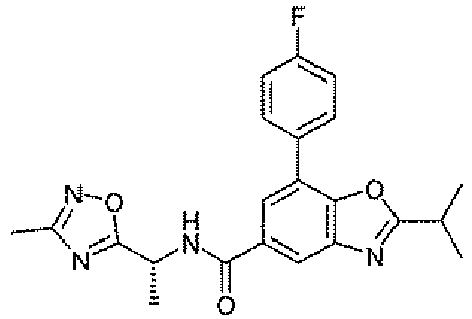
- To a solution of methyl 3-bromo-4-hydroxy-5-nitrobenzoate (1.0 g, 3.62 mmol), (4-fluorophenyl)-boronic acid (0.76g, 5.43 mmol), 3,3',3"-phosphinidynetris (benzensulfonic acid) trisodium salt (0.17 mg, 0.27 mmol), palladium(II) acetate (20.0 mg, 0.09 mmol) and diisopropylamine (0.52 mL, 3.62 mmol) were added N,N-dimethylformamide (13.6 mL) and water (4.5 mL). The mixture was heated to 80 °C. After 18 h, the mixture was cooled to ambient temperature and ethyl acetate was added. The organic layer was washed with water (3x), brine, dried over magnesium sulfate, filtered and concentrated. Purification by silica gel chromatography (100% hexanes → 25% hexanes/ ethyl acetate). Another purification using reverse phase HPLC (C-18, 95% water/ acetonitrile → 5% water/ acetonitrile with 0.1% trifluoroacetic acid) gave the title compound (0.43 g). LC-MS [M+1] = 291.9.
- The solution of methyl 4'-fluoro-6-hydroxy-5-nitrobiphenyl-3-carboxylate (13.0 mg, 45.0 µmol) and palladium (10% on carbon; 4.75 mg, 4.46 µmol) in ethanol (5 mL) was degassed and stirred under hydrogen at 1 atm. After 1h, the mixture was filtered and washed with ethanol. The filtrate was concentrated to dryness to give the title compound (10 mg). LC-MS [M+1] = 262.1.
- To a solution of methyl 5-amino-4'-fluoro-6-hydroxybiphenyl-3-carboxylate (10.0 mg, 38.0 µmol), and isobutyric acid (2.60 mg, 29.0 µmol), and solid support triphenylphosphine (75% by weight; 40.2 mg, 0.12 mmol) in acetonitrile (0.38 mL) was added trichloroacetonitrile (7.68 µL, 77.0 µmol). The mixture was heated in a microwave reactor for 15 min at 150 °C. The mixture was cooled to ambient temperature, filtered and concentrated. Purification by reverse phase HPLC (C-18, 95% water/ acetonitrile → 5% water/ acetonitrile with 0.1% trifluoroacetic acid) gave the title compound (5 mg). LC-MS [M+1] = 332.1.
- To a solution of methyl 7-(4-fluorophenyl)-2-isopropyl-1,3-benzoxazole-5-carboxylate (5.0 mg, 16.0 µmol) in methanol (0.16 mL) was added sodium hydroxide (1.0 M; 63.8 µL, 63.8 µmol). The mixture was stirred at 50 °C. After 18 h, the mixture was cooled to ambient temperature and hydrochloric acid (6.0 M; 10.6 µL, 6.38 µmol) was added. The mixture was concentrated to give the title compound with three equivalents of sodium chloride (8.5 mg). LC-MS [M+1] = 300.1.
- To a solution of 7-(4-fluorophenyl)-2-isopropyl-1,3-benzoxazole-5-carboxylic acid with three equivalents of sodium chloride (8.5 mg, 16.0 µmol), (1R)-1-(3-methyl-1,2,4-oxadiazol-5-yl)ethanamine hydrochloride(3.35 mg, 17.0 µmol) and N-methylmorpholine (8.8 µL, 0.08 mmol) in N,N-dimethylformamide (0.16 mL) were added N-[2-(dimethylamino)ethyl]-N'-ethylcarbodiimide hydrochloride (5.35 mg, 28.0 µmol), 1-hydroxy-7-azabenzotriazole (1.09 mg, 8.0 µmol). The mixture was stirred at 50 °C for 18 h. Purification by reverse phase HPLC (C-18, 95% water/ acetonitrile → 5% water/ acetonitrile with 0.05% ammonium hydroxide) gave the title compound (2 mg). HRMS [M+1] found = 409.1662. 1HNMR (500 MHz, DMSO-d6 ): δ 9.23 (1H, m), 8.16 (3H, m), 7.99 (1H, s), 7.37 (2H, m), 5.44, 1H, m), 3.90 (3 H, s), 3.44 (1H, m), 2.34 (3 H, s), 1.65 (3 H, d, J = 7.11 Hz), 1.37 (6 H, d, J = 6.75 Hz).
-
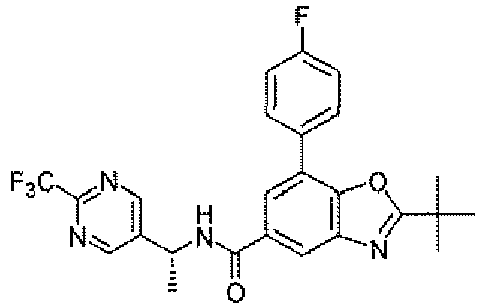
- To a solution of methyl 3-bromo-4-hydroxy-5-nitrobenzoate (2.00 g, 7.25 mmol) in N,N-dimethylformamide (36mL) was slowly added tin(II) chloride dehydrate (5.50 g, 24.4 mmol). The mixture was stirred at ambient temperature. After 10min, water was added, and organics were extracted using ethyl acetate (5x). Combined organics were dried over magnesium sulfate, filtered and concentrated. Purification by silica gel chromatography (100% dichloromethane → 85% dichloromethane/ methanol) gave the title compound (3.657g, 50% purity). LC-MS [M] = 246.1.
- To a solution of methyl 3-amino-5-bromo-4-hydroxybenzoate (2.00g, 4.06 mmol, 50% purity), 2,2-dimethylpropanoic acid (0.83 g, 8.13 mmol), and solid support triphenylphosphine (75% by weight; 4.26 g, 12.2 mmol) in acetonitrile (20 mL) was added trichloroacetonitrile (815 µL, 8.13 mmol). The mixture was heated in a microwave reactor for 10 min at 150 °C. The mixture was cooled to ambient temperature, filtered and concentrated. Purification by silica gel chromatography (100% hexanes → 70% hexanes/ ethyl acetate) gave the title compound (245 mg). LC-MS [M] = 312.1.
- To a mixture of methyl 7-bromo-2-tert-butyl-1,3-benzoxazole-5-carboxylate (218 mg, 0.698 mmol), (4-fluorophenyl)-boronic acid (0.147 g, 1.048 mmol), 3,3',3"-phosphinidynetris (benzensulfonic acid) trisodium salt (34 mg, 0.052 mmol), palladium(II) acetate (3.92 mg, 0.017 mmol) and diisopropylamine (0.100 mL, 0.698 mmol) were added N,N-dimethylformamide (2.62 mL) and water (0.87 mL). The mixture was heated to 80 °C. After 30 min, the mixture was cooled to ambient temperature and ethyl acetate was added. The organic layer was washed with water (3x), brine, dried over magnesium sulfate, filtered and concentrated. Purification by silica gel chromatography (100% hexanes → 70% hexanes/ ethyl acetate) gave the title compound (0.209 g). LC-MS [M+1] = 328.3.
- To a solution of methyl 2-tert-butyl-7-(4-fluorophenyl)-1,3-benzoxazole-5-carboxylate (0.209 g, 0.638 mmol) in methanol (2.1 mL) was added sodium hydroxide (1.0 M; 1.92 mL, 1.92 mmol). The mixture was stirred at 50 °C. After 18 h, the mixture was cooled to ambient temperature and hydrochloric acid (6.0 M; 0.319 mL, 1.92 mmol) was added. The mixture was concentrated to the title compound with three equivalents of sodium chloride (309 mg). LC-MS [M+1] = 314.2.
- To a solution of 2-tert-butyl-7-(4-fluorophenyl)-1,3-benzoxazole-5-carboxylic acid with three equivalents of sodium chloride (30 mg, 74.0 µmol), (1R)-1-[2-(trifluoromethyl)pyrimidin-5-yl]ethanamine dihydrochloride(19.5 mg, 74.0 µmol) and N-methylmorpholine (33.7 µL, 0.307 mmol) in N,N-dimethylformamide (0.409 mL) were added N-[2-(dimethylamino)ethyl]-N'-ethylcarbodiimide hydrochloride (20.6 mg, 107 µmol), 1-hydroxy-7-azabenzotriazole (4.2 mg, 31.0 µmol). The mixture was stirred at 40 °C for 1 h. Purification by reverse phase HPLC (C-18, 95% water/ acetonitrile → 5% water/ acetonitrile with 0.05% ammonium hydroxide) gave the title compound (22.6 mg). HRMS [M+1] found = 487.1766. 1H NMR (500 MHz, DMSO-d6 ): δ 9.15 (2 H, s), 8.20 (1 H, s), 8.14 (1 H, s), 8.02 (2 H, t, J = 6.70 Hz), 7.45 (2 H, t, J = 8.65 Hz), 5.33 (1 H, m, J = 7.09 Hz), 1.63 (3 H, d, J = 7.07 Hz), 1.47 (9 H, s).
-

- To a solution of methyl 4-amino-3-hydroxybenzoate (2.5 g, 15.0 mmol) in dichloromethane (71 mL) and N,N-dimethylformamide (3.6 mL) was added N-bromosuccmamide (2.93 g, 16.5 mmol). The mixture was stirred at ambient temperature. After 15 min, the mixture was quenched with sat. sodium sulfite. Hydrochloric acid (1.0 M) was added and the mixture was extracted with dichloromethane (3x). The combined organic layer was washed with brine, dried over magnesium sulfate, filtered and concentrated. Purification by silica gel chromatography (100% hexanes → 100% ethyl acetate) gave the title compound (1.2 g). LC-MS [M] = 246.0.
- To a mixture of methyl 4-amino-3-bromo-5-hydroxybenzoate (1.0 g, 4.06 mmol), (4-fluorophenyl)-boronic acid (0.85 g, 6.1 mmol), 3,3',3"-phosphinidynetris (benzensulfonic acid) trisodium salt (195.0 mg, 0.31 mmol), palladium(II) acetate (23.0 mg, 0.10 mmol) and diisopropylamine (0.58 mL, 4.06 mmol) were added N,N-dimethylformamide (15.2 mL) and water (5.1 mL). The mixture was heated to 80 °C. After 18 h, the mixture was cooled to ambient temperature and ethyl acetate was added. The organic layer was washed with water (3x), brine, dried over magnesium sulfate, filtered and concentrated. Purification by silica gel chromatography (100% hexanes → 50% hexanes /ethyl acetate) gave the title compound (0.27 g). LC-MS [M+1] = 262.2.
- To a solution of methyl 6-amino-4'-fluoro-5-hydroxybiphenyl-3-carboxylate (0.27 g, 1.04 mmol) in methanol (3.5 mL) was added sodium hydroxide(1.0 M; 6.2 mL, 6.2 mmol). The mixture was stirred at 50 °C. After 18 h, the mixture was cooled to ambient temperature and hydrochloric acid (6.0 M; 1.04 mL, 6.2 mmol) was added. The mixture was concentrated to give the title compound with three equivalents of sodium chloride (615 mg). LC-MS [M+1] = 248.2.
- To a solution of 6-amino-4'-fluoro-5-hydroxybiphenyl-3-carboxylic acid (0.1 g, 0.17 mmol), hydrochloride salt of (1R)-1-(3-methyl-1,2,4-oxadiazol-5-yl)ethanamine (40.2 mg, 0.20 mmol), N-[2-(dimethylamino)ethyl]-N'-ethylcarbodiimide hydrochloride (56.1 mg, 0.29 mmol) and 1-hydroxy-7-azabenzotriazole (11.4 mg, 0.08 mmol) in N,N-dimethylformamide (1.7 mL) was added N-methylmorpholine (92 µL, 0.84 mmol). The mixture was stirred at ambient temperature. After 18 h, the mixture was filtered. Purification by reverse phase HPLC (C-18, 95% water/ acetonitrile → 5% water/ acetonitrile with 0.1 % trifluoroacetic acid) gave the trifluoroacetate salt of the title compound (72 mg). LC-MS [M+1] = 379.2
- To a solution of (1R)-1-(3-methyl-1,2,4-oxadiazol-5-yl)ethyl 6-amino-4'-fluoro-5-hydroxybiphenyl-3-carboxylate (10.0 mg, 28.0 µmol), and isobutyric acid (4.94 mg, 56.0 µmol) and solid support triphenylphosphine (75% by weight; 29.4 mg, 84.0 µmol) in acetonitrile (0.28 mL) was added trichloroacetonitrile (5.63 µL, 56.0 µmol). The mixture was heated in a microwave reactor for 10 min at 150 °C. The mixture was cooled to ambient temperature, filtered and concentrated. Purification by reverse phase HPLC (C-18, 95% water/ acetonitrile → 5% water/ acetonitrile with 0.05% ammonium hydroxide) gave the title compound (3.3 mg). HRMS [M+1] found = 409.1683.
-

- To a solution of 4-amino-3-nitrobenzoic acid (2.50 g, 13.7 mmol) in dichloromethane (65.4 mL) and N,N-dimethylformamide (3.3 mL) was added N-bromosuccinamide (2.69 g, 15.1 mmol). The mixture was stirred at ambient temperature. After 15 min, the mixture was quenched with saturated sodium sulfite. Hydrochloric acid (1.0 M) was added and the mixture was extracted with dichloromethane. The combined organic layer was washed with brine, dried over magnesium sulfate, filtered and concentrated (3.65 g). LC-MS [M] = 261.0.
- To a solution of 4-amino-3-bromo-5-nitrobenzoic acid (3.65 g, 14.0 mmol) in dichloromethane (35 mL) and methanol (35 mL) at 0 °C was slowly added trimethylsilyl-diazomethane (8.74 mL, 17.5 mmol). The mixture was allowed to warm to ambient temperature and concentrated. Purification by silica gel chromatography (100% hexanes → 50% hexanes /ethyl acetate) gave the title compound (1.54 g). LC-MS [M] = 275.1.
- To a solution of methyl 4-amino-3-bromo-5-nitrobenzoate (1.0 g, 3.64 mmol), (4-fluorophenyl)-boronic acid (0.76 g, 5.45 mmol), 3,3',3"-phosphinidynetris (benzensulfonic acid) trisodium salt (0.18 g, 0.27 mmol), palladium(II) acetate (20.0 mg, 0.09 mmol) and diisopropylamine (0.52 mL, 3.64 mmol) were added N,N-dimethylformamide (13.6 mL) and water (4.5 mL). The mixture was heated to 80 °C. After 1 h, the mixture was cooled to ambient temperature and ethyl acetate was added. The organic layer was dried over magnesium sulfate, filtered and concentrated. Purification by silica gel chromatography (100% hexanes → 50% hexanes /ethyl acetate) gave the title compound (0.93 g): LC-MS [M+1] = 291.2.
- To a solution of methyl 6-amino-4'-fluoro-5-nitrobiphenyl-3-carboxylate (0.42 g, 1.44 mmol) in N,N-dimethylformamide (4.8 mL) was added tin(II) chloride dihydrate (1.3 g, 5.8 mmol). The mixture was stirred at ambient temperature for 4 h and stored in the refrigerator for 18 h. Saturated ammonium chloride, water, and ethyl acetate were added. The mixture was extracted with ethyl acetate (3x). The combined organic layer was dried over magnesium sulfate, filtered and concentrated. Purification by silica gel chromatography (100% dichloromethane → 95% dichloromethane/ methanol) gave the title compound (0.17 g): LC-MS [M+1] = 261.2.
- To a solution of methyl 5,6-diamino-4'-fluorobiphenyl-3-carboxylate (0.19 g, 0.73 mmol) and solid support triphenylphosphine (75% by weight; 0.77 g, 2.2 mmol) in acetonitrile (2.4 mL) was added trichloroacetonitrile (0.15 mL, 1.46 mmol). The mixture was heated in a microwave reactor for 10 min at 150 °C. The mixture was cooled to ambient temperature, filtered and concentrated. Purification by reverse phase HPLC (C-18, 95% water/ acetonitrile → 5% water/ acetonitrile with 0.1% trifluoroacetic acid) gave the title compound (186 mg): LC-MS [M+1] = 313.2.
- To a solution of methyl 4-(4-fluorophenyl)-2-isopropyl-1H-benzimidazole-6-carboxylate (10.0 mg, 32.0 µmol) and cesium carbonate (26.1 mg, 80.0 µmol) in N,N-dimethylformamide (64 µL) was added iodomethane (3.0 µL, 48.0 µmol). The mixture was stirred at ambient temperature for 15 min. Purification by reverse phase HPLC (C-18, 95% water/ acetonitrile → 5% water/ acetonitrile with 0.1% trifluoroacetic acid) gave the title compound (6.4 mg): LC-MS [M+1] = 327.1.
- To a solution of methyl 4-(4-fluorophenyl)-2-isopropyl-1-methyl-1H-benzimidazole-6-carboxylate (6.4 mg, 20 µmol) in methanol (65 µL) was added sodium hydroxide (1.0 M; 0.12 mL, 0.12 mmol). The mixture was stirred at 50 °C. After 18 h, the mixture was cooled ambient temperature and hydrochloric acid (6.0 M; 19.6 µL, 0.12 mmol). The mixture was concentrated to give the title compound with three equivalents of sodium chloride (12.5 mg): LC-MS [M+1] = 313.2.
- To a solution of 4-(4-fluorophenyl)-2-isopropyl-1-methyl-1H-benzimidazole-6-carboxylic acid with three equivalents of sodium chloride (12.5 mg, 19.0 µmol), (1R)-1-(3-methyl-1,2,4-oxadiazol-5-yl)ethanamine hydrochloride (4.53 mg, 23.0 µmol) and N-methylmorpholine (10.4 µL, 0.09 mmol) in DMF (0.19 mL) were added N-[2-(dimethylamino)ethyl]-N-ethylcarbodiimide hydrochloride (6.33 mg, 33.0 µmol) and 1-hydroxy-7-azabenzotriazole (1.28 mg, 9.4 µmol). The mixture was stirred at 50 °C. After 1h, a small amount of water and trifluoroacetic acid were added. Purification by reverse phase HPLC (C-18, 95% water/ acetonitrile → 5% water/ acetonitrile with 0.1% trifluoroacetic acid) gave the trifluoroacetate salt of the title compound (6.9 mg): HRMS [M+1] found = 422.1979. 1H NMR (500 MHz, DMSO-d6): δ 9.23 (1H, m), 8.16 (3 H, m), 7.99 (1H, s), 7.37 (2H, m), 5.44 (1H, m), 3.90 (3 H, s), 3.44 (1 H, m), 2.34 (3 H, s), 1.65 (3 H, d, J= 7.11 Hz), 1.37 (6 H, d, J= 6.75 Hz).
-

- To a mixture of methyl 5,6-diamino-4'-fluorobiphenyl-3-carbozylate (2.0 g, 7.68 mmol), 3-hydroxy-3-methylbutanoic acid (1.0 g, 8.45 mmol), 1-hydroxy-7-azabenzotriazols (0.523 g, 3.84 mmol) and 1-ethyl-3-(3-dimethylaminopropyl)carbodiimide (2.58 g, 13.5 mmol) was added N,N-dimethylformamide (15.4 mL) followed by TEA (2.0 mL, 14.4 mmol). Reaction heated at 50 °C for 3 h. HCl (7.68 mL, 4M in dioxane, 30.7 mmol) was added, the reaction was transferred to a microwave vial and heated in the microwave at 125 °C for 15 min. Reaction cooled and filtered. Purification by reverse phase HPLC (C-18, 95% water/acetonitrile → 5% water/acetonitrile with 0.1% TFA) gave the title compound (0.412 g): LC-MS [M+1] = 343.3.
- To a solution of methyl 4-(4-fluorophenyl)-2-(2-hydroxy-2-methylpropyl)-1H-benzimidazole-6-carboxylate (125 mg, 0.365 mmol) and cesium carbonate (297 mg, 0.913 mmol) in N,N-dimethylformamide (0.730 mL) was added methyl iodide (0.025 mL, 0.402 mmol). Stirred at ambient temperature for 2.5 h. Filtered and purification by reverse phase HPLC (C-18, 95% water/acetonitrile → 5% water/acetonitrile with 0.1% TFA) gave the title compound (40 mg): LC-MS [M+1] = 357.2.
- To a solution of methyl 4-(4-fluorophenyl)-2-(2-hydroxy-2-methylpropyl)-1-methyl-1H-benzimidazole-6-carboxylate_(83.7 mg, 0.235 mmol) in MeOH (0.500 mL) was added sodium hydroxide (0.705 mL, 1M, 0.705 mmol). Reaction heated in the microwave at 100 °C for 15 min. HCl (0.352 mL, 2M, 0.705 mmol) was added and the reaction mixture was concentrated. Title compound used as-is with three sodium chloride salts without further purification (122 mg): LC-MS [M +1]=343.2.
- To a mixture of methyl 4-(4-fluorophenyl)-2-(2-hydroxy-2-methylpropyl)-1-methyl-1H-benzimidazole-6-carboxylic acid (122 mg, 0.236 mmol), (1R)-1-(3-methyl-1,2,4-oxadiazol-5-yl)ethanamine hydrochloride (46.3 mg, 0.283 mmol), 1-hydroxy-7-azabenzotriazol (3.21 mg, 0.024 mmol) and 1-ethyl-3-(3-dimethylaminopropyl)carbodiimide (79 mg, 0.412 mmol) was added DMF (0.471 mL) followed by triethylamine (0.099 mL, 0.707 mmol). Reaction heated at 50 °C for 30 min. Reaction cooled and filtered. Purification by reverse phase HPLC (C-18, 95% water/acetonitrile → 5% water/acetonitrile with 0.1% TFA) gave the title compound (87.4 mg): LC-MS [M+1] = 452.4; 1H NMR (500 MHz, CHCl3 -d): δ 7.94 (2 H, m), 7.90 (1H, s), 7.77 (1H, s), 7.20 (1H, d, J = 7.73 Hz), 7.15 (2 H, t, J = 8.51 Hz), 5.66-5.59 (1 H, m), 5.47 (1H, s), 3.78 (3 H, s), 3.02 (2 H, s), 2.39 (3 H, s), 1.74 (5 H, d, J = 7.14 Hz), 1.35 (6H, s).
-

- To a solution of methyl 3-fluoro-4-nitrobenzoate (2.0 g, 10.04 mmol) in DMSO (10.04 mL) was added cesium carbonate (9.82 g, 30.1 mmol) and 1-amino-2-methylpropan-2-ol (0.985 g, 11.05 mmol). The reaction mixture was stirred at ambient temperature for 30 min. Saturated sodium bicarbonate and EtOAc were added to the mixture. The aqueous layer was extracted EtOAc (3x). The combined organics were washed with brine, dried over magnesium sulfate, filtered and concentrated to give the title compound without further purification (3.18 g): LC-MS [M+1] = 269.2.
- To a mixture of methyl 3-[(2-hydroxy-2-methylpropyl)amino]-4-nirobenzoate (2.69 g, 10.03 mmol) and 10% palladium on carbon (2.13 g, 2.005 mmol, 10 %) was added EtOAc (20.0 mL). Reaction was vacuumed and then filled with nitrogen (3x), ending with vacuuming and was then put under a hydrogen balloon. Reaction stirred at ambient temperature for 3 h. Mixture filtered through celite, washing with MeOH. Filtrate concentrated and used without further purification, giving the title compound (2.59 g): LC-MS [M+1] = 239.3.
- To a solution of methyl 4-amino-3-[(2-hydroxy-2-methylpropyl)amino]benzoate (1.5 g, 6.30 mmol) in DCM (12.59 mL) added bromine (0.324 mL, 6.30 mmol) drop-wise. The reaction was complete upon total addition of bromine. Reaction mixture was quenched with sodium sulfite and diluted with EtOAc. The aqueous layer was washed with EtOAc (3x). The combined organics were dried over magnesium sulfate, filtered and concentrated. Purification by reverse phase HPLC (C-18, 95% water/acetonitrile → 5% water/acetonitrile with 0.1% TFA) gave the title compound (0.538 g): LC-MS[M] = 317.2.
- To a mixture of methyl 4-amino-3-bromo-5-[(2-hydroxy-2-methylpropyl)amino]benzoate (513 mg, 1.617 mmol), palladium(II) acetate (7.26 mg, 0.032 mmol), (4-fluorophenyl)boronic acid (453 mg, 3.23 mmol) and 4,4',4"-phosphinetriyltribenzenesulfonic acid - sodium salt (48.8 mg, 0.097 mmol) were added DMF (2.43 mL) and water (0.809 mL) followed by diisopropylamine (0.461 mL, 3.23 mmol). The reaction was capped and heated at 80°C for 2 h. The reaction was cooled, quenched with saturated sodium bicarbonate and diluted with EtOAc. The aqueous layers were washed with EtOAc (2x) and the combined organics were washed with water (3x) and brine (1x). Organics were dried over magnesium sulfate, filtered and concentrated. Purification by reverse phase HPLC (C-18, 95% water/acetonitrile → 5% water/acetonitrile with 0.1% TFA) gave the title compound (377 mg): LC-MS [M+1] = 333.3.
- To a solution of methyl 6-amino-4'-fluoro-5-[(2-hydroxy-2-methylpropyl)amino]biphenyl-3-carboxylate (180 mg, 0.542 mmol) in dichloromethane (16.2 mL) was added triethylamine (0.091 mL, 0.650 mmol) followed by triphosgene (80.0 mg, 0.271 mmol) in dichloromethane (5.42 mL). Reaction heated at 30 °C for 4 h. Reaction was cooled, diluted with saturated sodium bicarbonate and dichloromethane. Adjusted aqueous layer to pH = 14. Wash aqueous with dichloromethane (5x). Combined organics were dried over magnesium sulfate, filtered and concentrated. Purification by reverse phase HPLC (C-18, 95% water/acetonitrile → 5% water/acetonitrile with 0.05% NH4OH) gave the title compound (81.0 mg): LC-MS [M+1] = 359.2.
- To a solution of methyl 7-(4-fluorophenyl)-3-(2-hydroxy-2-methylpropyl)-2-oxo-2,3-dihydro-1H-benzimidazole-5-carboxylate (80.0 mg, 0.223 mmol) in MeOH (0.446 mL) was added sodium hydroxide (0.446 mL, 1M, 0.446 mmol). Reaction heated in the microwave at 100 °C for 15 min. More sodium hydroxide (0.446 mL, 1M, 0.446 mmol) added and heated an additional 20 min in the microwave at 100 °C. HCl (0.446 mL, 2M in ether, 0.892 mmol) was added and the reaction mixture was concentrated to give the title compound with four equivalents of sodium chloride (128 mg): LC-MS [M + 1] = 345.3.
- To a mixture of 7-(4-fluorophenyl)-3-(2-hydroxy-2-methylpropyl)-2-oxo-2,3-dihydro-1H-benzimidazole-5-carboxylic acid (40 mg, 0.069 mmol), (1R)-1-(3-melhyl-1,2,4-oxadiaxol-5-yl)ethanamine hydrochloride (13.6 mg, 0.083 mmol), 1-hydroxy-7-azabenzotriazol (1.88 mg, 0.014 mmol) and 1-ethyl-3-(3-dimethylaminopropyl)carbodiimide (23.2 mg, 0.121 mmol) was added N,N-dimethylformamide (0.138 mL) followed by triethylamine (0.048 mL, 0.346 mmol). Reaction heated at 50 °C for 1.5 h. Reaction cooled and filtered. Purification by reverse phase HPLC (C-18, 95% water/acetonitrile → 5% water/acetonitrile with 0.1% TFA) gave the title compound (12.5 mg): LC-MS [M+1] = 454.4; HRMS [M+1] found = 454.1884; 1H NMR (500 MHz, CHCl3 -d): δ 7.65 (1 H, s), 7.51-7.47 (3 H, m), 7.22-7.15 (2 H, m), 6.97 (1 H, d, J= 7.81 Hz), 5.60-5.52 (1 H, m), 3.85 (2 H, s), 3.12 (1 H, s), 2.35 (3 H, s), 1.69 (3 H, d, J = 7.10 Hz), 1.29 (6 H, s).
- Male Sprague-Dawley rats, weighing 150 - 180 g (max. range per experiment = 40 g) at the beginning of the experiments. Animals will be delivered to the laboratory at least 5 days before the experiments during which time they are acclimatized to laboratory conditions. Rats will be housed in groups of 4, 5 or 6 in macrolon cages (41 x 25 x 14 cm or 44 x 28 x 19 cm) on wood with free access to food and water until tested (or as indicated otherwise). The animal house will be maintained under artiftcial lighting (12 hours) between 7.00 and 19.00 in a controlled ambient temperature of 21 ± 3°C, and relative humidity maintained at 40-70%. Information related to any clinical signs and mortality will be archived with the study materials.
- After overnight food-deprivation, male Sprague-Dawley rats are slightly anesthetized (isoflurane) and injected with 1% acetic acid into the colon (1.5 ml) using a cannula of 5 cm in length. After a recovery period of 75 minutes, rats are again slightly anesthetized (isoflurane) and a latex balloon of 1.5 cm in length tightly attached to a catheter is inserted via the anus into the descending colon and rectum. Anesthesia is then immediately discontinued. 15 minutes later, the test substance is administered p.o. 60 minutes after administration, the balloon is filled with 1.2 ml of water and the number of abdominal contractions is counted for 10 minutes.
- 10 rats are studied per group. The test is performed blind. The test substance will be evaluated at 3 doses, and compared with the vehicle group. Rats will be euthanized at the end of the experiments by exposure to a mixture of O2/CO2 (20%/80%) followed by CO2. Data will be analyzed by comparing treated groups with vehicle control using Mann Whitney U tests.
- For the spinal nerve ligation (SNL) procedure, male Sprague Dawley rats (100-200 g; Harlan) are anesthetized using isoflurane (1-5%; inhalation). Using aseptic technique, a dorsal midline incision is made from approximately spinal nerve L3 to S2. A combination of sharp and blunt dissection is used to expose the L6/S1 posterior interarticular process. The L6 transverse process is visualized and removed, and the L4 and L5 spinal nerves are exposed distal to their emergence from the intervertebral foramina. The L5 nerve is then tightly ligated with 6-0 silk suture. The muscle is closed with 4-0 absorbable suture and the skin is closed with wound clips. Postoperative monitoring is carried out to assure that animals are exposed to the least amount of pain as possible. Animals are housed in pairs on bedding and are monitored (2x) daily for three days post-operatively by Laboratory Animal Resource staff and then daily by investigator for any signs of possible distress.
- Prior to surgery, rats are tested for pre-surgery mechanical hind paw withdrawal thresholds by applying a series of calibrated von Frey filaments (0.25 - 15 g) to the left hind paw and determining the median withdrawal threshold using the Dixon "up-down" method (Chaplan et al., J Neurosci Meth 53:55, 1934). Rats are placed in individual plastic chambers on an elevated mesh galvanized steel platform and allowed to acclimate for 60 min. Pre-surgery mechanical hind paw withdrawal thresholds are determined, and rats having a threshold <15 g are excluded from the study. Following determination of pre-surgery withdrawal thresholds, rats undergo the SNL procedure described above. Between 28-35 days following the surgical procedure, rats are tested for post-surgery thresholds using the procedure described above, and animals displaying a hind paw withdrawal threshold <4.0 g are considered allodynic (i.e. mechanical hypersensitivity). Effects of test compounds on SNL-induced mechanical hypersensitivity are determined by dosing the compound along with a vehicle control group and a group receiving the positive comparator pregabalin (20 mg/kg, p.o.). Efficacy in the SNL model is evaluated by determining the % reversal of mechanical hypersensitivity using the formula:

- At the conclusion of the study, all rats are euthanized using CO2 and plasma and brain tissue are collected for bioanalytical analysis of drug exposures.
- Male Sprague Dawley rats (300-400 g; Charles River) receive an intradermal injection of CFA (200 ul, 0.5 mg/ml) into the plantar aspect of the left hind paw and are subsequently returned to their cages where they are maintained on soft bedding. 72 hrs following CFA injection rats are tested for post-CFA mechanical hind paw withdrawal thresholds by wrapping the rat in a towel and placing the hind paw (either left or right) in a modified Randall-Sellito paw pinch apparatus (Stoelting, Wood Dale, IL). A plastic bar attached to a lever is placed on the dorsum of the hind paw, and an increasing force is applied to the hind paw until the rat vocalizes or pulls its hind paw away from the bar. The rat's hind paw withdrawal threshold is recorded at that point. The mechanical stimulus is applied to each hind paw 2 times, and the average post-CFA mechanical hind paw withdrawal thresholds are determined for both the left and right hind paw. Following determination of post-CFA withdrawal thresholds, rats receive test compound, vehicle, or the positive comparator naproxen (30 mg/kg, p.o.), and effects of compounds on withdrawal thresholds for the inflamed (CFA) hind paw are determined. Efficacy in the CFA model is evaluated by determining the % reversal of mechanical hypersensitivity using the formula:

At the conclusion of the study, all rats are euthanized using CO2 and plasma and brain tissue are collected for bioanalytical analysis of drug exposures. - Female Sprague-Dawley rats weighed 250-350 g were housed in a temperature- and light (12-h light/dark cycle)-controlled room, and were allowed access to food and water ad libitum. The animals were anesthetized with urethane (1.0 g/kg, i.p.). Supplemental urethane was given if necessarily. A lower abdominal midline incision was made to expose the bladder, and a polyethylene catheter (PE-50) was inserted into the bladder dome for recording the intravesical pressure and intravesical infusion of physiological saline at the rate of 0.05 ml/min. The intravesical pressure was measured using a pressure transducer, and signal was recorded using a multiple channel data acquisition system (Power lab, AD Instruments, Biopac systems, Colorado Springs, CO) at a sampling rate of 10 Hz. After confirming stable inter-micturtion interval and micturition pressure by intravesical infusion of saline, the drugs were administered intravenously (0.25 ml/kg). Intermicturition interval (functional bladder capacity) and micturition pressure (maximum intravesical pressure) were obtained from micturitions prior to dosing (baseline) and between 5 to 30 min after dosing using Chart program (v5.5.4, AD Instruments), and calculated the ratio to baseline.
- Female Sprague-Dawley rats weighed 250-350 g were housed in a temperature- and light (12-h light/dark cycle)-controlled room, and were allowed access to food and water ad libitum. The animals were anesthetized with urethane (1.0 g/kg, i.p.). Supplemental urethane was given if necessarily. A lower abdominal midline incision was made to expose the bladder, and a polyethylene catheter (PE-50) was inserted into the bladder dome for recording the intravesical pressure and intravesical infusion at the rate of 0.05 ml/min. The intravesical pressure was measured using a pressure transducer, and signal was recorded using a multiple channel data acquisition system (Power lab, AD Instruments, Biopac systems, Colorado Springs, CO) at a sampling rate of 10 Hz. After confirming stable inter-micturtion interval and micturition pressure by intravesical infusion of saline, 0.25% of acetic acid-saline solution was infused at the same infusion rate. After 30-60 min, drugs were intravenously infused using infusion pumps at a rate of 10 µl/min. Intermicturition interval (functional bladder capacity) and micturition pressure (maximum intravesical pressure) were obtained from micturitions prior to dosing (baseline) and between 30 to 45 min after starting drug infusion using Chart program (v5.5.4, AD Instruments), and calculated the ratio to baseline.
- Generation of a Human P2X3 and P2X 2/ 3 Stable Cell Line - Human P2X3 receptor cDNA (Accession number NM_002559) was subcloned as a 5'XhoI and 3'HindIII fragment into the expression vector pcDNA5/FRT (Invitrogen). Human P2X2 receptor cDNA (Accession number NM_174873) was subcloned as a 5'EcoRI and 3'NotI fragment into the expression vector pIRESneo2 (BD Biosciences Clontech). The human P2X3 expression construct was transfected using Lipofectamine 2000 (Invitrogen) into Flp-in - 293 cells (Invitrogen) according to the manufacturer's directions. Cells positive for flp-mediated recombination of rhesus P2X3 were selected using 150 µg/ml hygromycin. The stable human P2X3 cell line was co-transfected with the human P2X2 expression construct using Lipofectamine 2000 as above and co-transfected cells selected using 100 mg/ml hygromycin and 1 mg/ml G418. The stable P2X3 cell line was propagated in DMEM, 10% FBS, 100 µg/ml hygromycin, and 100 units/ml penicillin and 100 µg/ml streptomycin, and maintained at 37° and 95% humidity. The stable P2X2/3 cell line was propagated as above with the addition of 500 µg/ml G418.
- Intracellular Calcium Measurement to Assess Antagonist Affinity - A fluorescent imaging plate reader (FLIPR; Molecular Devices) was used to monitor intracellular calcium levels using the calcium-chelating dye Fluo-4 (Molecular Probes). The excitation and emission wavelengths used to monitor fluorescence were 488 nm and 530 nm, respectively. Cells expressing either human P2X3 or human P2X2/3 were plated at a density of 20,000 cells/well (20 µl/well) in 384-well black-walled plates approximately 20 hours before beginning the assay. On the day of the assay 20 µl of loading buffer (Hank's balanced salt solution, 2.5 mM CaCl2, 20 mM HEPES, 0.1% BSA, 2.5 mM probenecid, TR-40, Fluo-4, and 138 mM NMDG substituted for NaCl) is added and cells dye-loaded for 60 min in the dark at room temperature. Ten minutes prior to adding agonist, the antagonist was added in a volume of 10 µl and allowed to incubate at room temperature. During this period fluorescence data is collected at 3 sec intervals followed by 10 sec intervals. The agonist, α,β-meATP, is added at a 6x concentration ([α,β-meATP]final = EC50). Following agonist addition fluorescence was measured at 5 sec intervals and analyzed based on the increase in peak relative fluorescence units (RFU) compared to the basal fluorescence. Peak fluorescence was used to determine the inhibitory effect at each concentration of antagonist by the following equation:

- In vitro Electrophysiological Assay - Cells expressing human P2X3 receptors were grown to a confluence of 65-85% 20 to 32 hours prior to assay. The cells were dissociated with trypsin, centrifuged, and resuspended in bath solution at a cell density of 1x10⁶ cells/ml and loaded onto PatchXpress. The bath solution contained 150 mM NaCl, 4 mM KCl, 2 mM CaCl2, 1.2 mM MgCl2, 10 mM HEPES, and 11.1 mM glucose, at pH 7.2. The intracellular solution contained either 140 mM K-aspartate, 20 mM NaCl, 5 mM HEPES, 10 mM EGTA, at pH 7.2 or 30 mM CsCl, 5 mM HEPES, 10 mM EGTA, 120 mM CsF, 5 mM NaF, 2 mM MgCl2, pH=7.3 with CsOH. Agonist stock solutions were prepared in H2O and diluted in bath solution prior to use. All antagonists were prepared as 10 mM stock solutions in DMSO and diluted in bath solution prior to use. All experiments were performed on cells under the whole-cell patch clamp configuration at room temperature. Up to 16 individual cells could be patch clamped simultaneously on the PatchXpress instrument. A baseline response was established by repeated CTP (100 µM; for 2 sec.) followed by antagonist incubation for 2 min. in the absence of CTP. After antagonist preincubation 100 µM CTP and antagonist were co-administered to determine the inhibitory effect of the antagonist. These steps were then repeated on the same cell with a range of concentrations of the antagonist. A maximum of five concentrations of antagonist were tested on any individual cell. The control P2X3 current amplitude (IP2X3-(control)) was taken as an average of the peak current amplitude from the last two agonist additions prior to incubation with an antagonist. The peak P2X3 current amplitude in the presence of an antagonist (IP2X3-(drug)) was used to calculate the inhibitory effect at each concentration of the antagonist according to the following equation:

- Each concentration of an antagonist was tested on at least two independent cells. The concentration of drug required to inhibit P2X3 current by 50% (IC50) was determined by fitting of the Hill equation to the averaged % inhibition data at each concentration:

- In vitro Electrophysiological Assay for P2X 2/ 3 - P2X2/3 was assayed as above with two protocol modifications: 1) 30 µM α,β-meATP used as agonist; and 2) current amplitude was measured at the end of 2-second agonist application.
- Using the assays described herein the compounds of this invention were found to be active for the P2X3 receptor. The compounds of formula I have an IC50 activity of 100 µM or less for the P2X3 receptor. Many of the compounds of formula I have an IC50 of less than 200 nM. For example, the compounds below have IC50 < 250 nM in the "Intracellular Calcium Measurement to Assess Antagonist Affinity" assay. In particular, example 3.14 has an IC50 = 12 nM, example 3.74 has an IC50 = 6.4 nM, example 4.3 has an IC50 = 200 nM and example 5.5 has an IC50 = 61 nM.
Claims (15)
- A compound of structural formula I:structural formula I:
 B represents phenyl or pyridyl;R1 represents H, C1-6 alkyl, halogen, (CH2)nCF3, C3-10 cycloalkyl, C(R2)2OH, -O-, CN, (CH2)nOR2, (CH2)nC5-10 heterocyclyl, (CH2)nC6-10 aryl, or C1-6 alkoxy; said alkyl, cycloalkyl, heterocyclyl and aryl optionally substituted with 1 to 3 groups of C1-6 alkyl, halogen, hydroxyl, (CH2)nCF3, or CN;R2 represents H, C1-6 alkyl, CF3, OH;R3 represents CR2R4R5, (CHR2)nC3-10 cycloalkyl, (CHR2)nC5-10 heterocycle, said cycloalkyl and heterocyclyl optionally substituted with 1 to 3 groups of Ra;or R2 and R3 can be combined with the nitrogen to which they are attached to form a C5-10 heterocyclyl optionally substituted with 1 to 3 groups of Ra;R4 and R5 independently represent H, (CH2)nOR2, CHF2, (CH2)nC5-10 heterocyclyl, (CH2)nC6-10 aryl, C3-10 cycloalkyl, C1-6 alkoxy, C2-6 alkenyl, CF3, CF2, C(O)1-2R2, or C1-6 alkyl; said alkyl, cycloalkyl, heterocyclyl and aryl optionally substituted with 1 to 3 groups of Ra;R6 represents hydrogen, OR2, (CH2)nCF3, halogen, C(R2)2OR2, C1-6 alkyl, C2-6 alkenyl, C2-6 alkynyl, C3-10 cycloalkyl, (CH2)nC6-10 aryl, (CH2)nC5-10 heterocyclyl, said alkyl, cycloalkyl, aryl and heterocyclyl optionally substituted with 1 to 3 groups of Ra;Ra represents C1-6 alkyl, halogen, hydroxyl, OR2 (CH2)nCF3, -O-, C3-6 cycloalkyl, NR2C(O)R2, C(O)N(R2)2, C(R2)2OR2, C(O)R2, NO2, CN, N(R2)2, C(O)OR2, SO2R2, OR2, (CH2)nC5-10 heterocyclyl, or (CH2)nC6-10 aryl, said heterocyclyl and aryl optionally substituted with 1 to 3 groups of C1-6 alkyl, halogen, hydroxyl, (CH2)nCF3, or CN; andn represents 0 to 4.
 - The compound according to claim 1 wherein -C(O)NR2R3 is attached to a carbon atom on A.
- The compound according to claim 1 wherein B is phenyl.
- The compound according to claim 1 wherein B is pyridyl.
- The compound according to claim 2 wherein R6 is selected from the group consisting of hydrogen, (CH2)nCF3, halogen, C1-6 alkyl, (CH2)nC3-10 cycloalkyl, (CH2)nC6-10 aryl, (CH2)nC5-10 heterocyclyl, said alkyl, cycloalkyl, aryl and heterocyclyl optionally substituted with 1 to 3 groups of Ra; R2 is hydrogen and R3 is (CHR2)npyridyl, (CHR2)noxidopyridyl, (CHR2)npyrimidinyl, (CHR2)ntriazolyl, (CHR2)nphenyl, (CHR2)npyrazinyl, (CHR2)npyrazolyl, (CHR2)noxadiazolyl, (CHR2)nthiazolyl, C1-6 alkyl, and (CHR2)nC3-6 cycloalkyl, all of which are optionally substituted with 1 to 3 groups of Ra.
- The compound according to claim 5 wherein R6 is selected from the group consisting of hydrogen, (CH2)ncyclopropyl, (CH2)nphenyl, (CH2)npyridyl, (CH2)npyrimidinyl, (CH2)nimdazolyl, and (CH2)nCF3 said cycloalkyl, aryl and heterocyclyl optionally substituted with 1 to 3 groups of Ra, and R3 is optionally substituted (CHR2)npyridyl, (CHR2)noxidopyridyl, (CHR2)npyrimidinyl, (CHR2)ntriazolyl, (CHR2)npyrazinyl, (CHR2)npyrazolyl, or (CHR2)noxadiazolyl.
- The compound according to claim 1 of formula II:


- The compound according to claim 1 of formula IV:

- The compound according to claim 1 of formula V:

- The compound according to claim 1 of formula VI:


- A compound of claim 1 that is represented by Tables 1 through 11 or pharmaceutically acceptable salts and individual enantioners and diastereomers thereof.
- The compound according to claim 11 which is:
Table 3 
R3a B R6 


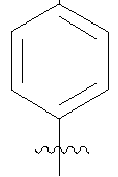


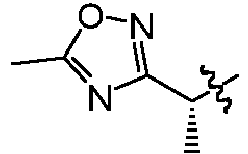


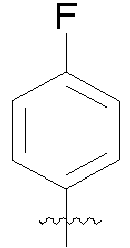


Table 4 
R3a B 

Table 5 
R3a R6 
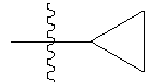
Table 7 
R3a B R6 


Table 9 
R3a B R6 R6a 


Table 11 or pharmaceutically acceptable salts and individual enantiomers and diastereomers thereof.
R3a B R6 R6a 

H 
- A pharmaceutical composition comprising an inert carrier and an effective amount of a compound according to any previous claim.
- A compound according to any of claims 1-12 for use in treating or preventing chronic or acute pain, treating or controlling epilepsy, or enhancing the quality of sleep in a mammalian patient in need thereof.
- The composition according to claim 13 further comprising one or more therapeutically active compounds selected from the group consisting of opiate agonists or antagonists, calcium channel antagonists, 5HT, 5-HT1A complete or partial receptor agonists or antagonists , sodium channel antagonists, N-methyl-D-aspartate (NMDA) receptor agonists or antagonists, COX-2 selective inhibitors, neurokinin receptor 1 (NK1) antagonists, non-steroidal anti-inflammatory drugs (NSAID), selective serotonin reuptake inhibitors (SSRI) and/or selective serotonin and norepinephrine reuptake inhibitors (SSNRI), tricyclic antidepressant drugs, norepinephrine modulators, lithium, valproate, norepinephrine reuptake inhibitors, monoamine oxidase inhibitors (MAOIs), reversible inhibitors of monoamine oxidase (RIMAs), alpha-adrenoreceptor antagonists, atypical anti-depressants, benzodiazepines, corticotropin releasing factor (CRF) antagonists, neurontin (gabapentin) and pregabalin.
Applications Claiming Priority (2)
| Application Number | Priority Date | Filing Date | Title |
|---|---|---|---|
| US21084509P | 2009-03-23 | 2009-03-23 | |
| PCT/US2010/027286 WO2010111058A1 (en) | 2009-03-23 | 2010-03-15 | P2x3, receptor antagonists for treatment of pain |
Publications (3)
| Publication Number | Publication Date |
|---|---|
| EP2410857A1 EP2410857A1 (en) | 2012-02-01 |
| EP2410857A4 EP2410857A4 (en) | 2012-10-31 |
| EP2410857B1 true EP2410857B1 (en) | 2014-01-29 |
Family
ID=42781385
Family Applications (1)
| Application Number | Title | Priority Date | Filing Date |
|---|---|---|---|
| EP10756586.3A Not-in-force EP2410857B1 (en) | 2009-03-23 | 2010-03-15 | P2x3, receptor antagonists for treatment of pain |
Country Status (6)
| Country | Link |
|---|---|
| US (1) | US9238647B2 (en) |
| EP (1) | EP2410857B1 (en) |
| JP (1) | JP2012521428A (en) |
| AU (1) | AU2010229142A1 (en) |
| CA (1) | CA2755680A1 (en) |
| WO (1) | WO2010111058A1 (en) |
Families Citing this family (27)
| Publication number | Priority date | Publication date | Assignee | Title |
|---|---|---|---|---|
| CN101981003B (en) | 2008-02-29 | 2014-07-02 | 伊沃泰克股份公司 | Amide compounds, compositions and uses thereof |
| JP5608655B2 (en) | 2008-09-18 | 2014-10-15 | エヴォテック アーゲー | Modulator of P2X3 receptor activity |
| US20100273805A1 (en) * | 2009-04-23 | 2010-10-28 | Astrazeneca Ab | Sulphide bridged derivatives as modulators of mglur5 733 |
| US8476457B2 (en) * | 2009-06-22 | 2013-07-02 | Roche Palo Alto Llc | Indole, indazole and benzimidazole arylamides as P2X3 and P2X2/3 antagonists |
| CN103298810B (en) * | 2010-11-08 | 2016-03-16 | 杨森制药公司 | The purposes of 1,2,4-triazolo [4,3-a] pyridine derivate and the positive allosteric modulators as MGLUR2 acceptor thereof |
| EP2643320B1 (en) * | 2010-11-08 | 2015-03-04 | Janssen Pharmaceuticals, Inc. | 1,2,4-TRIAZOLO[4,3-a]PYRIDINE DERIVATIVES AND THEIR USE AS POSITIVE ALLOSTERIC MODULATORS OF MGLUR2 RECEPTORS |
| UA111075C2 (en) * | 2011-02-25 | 2016-03-25 | Еррей Біофарма Інк. | Triazolopyridine compounds as pim kinase inhibitors |
| CA2898665C (en) * | 2013-01-31 | 2021-02-16 | Neomed Institute | Imidazopyridine compounds and their use as p2x purinoreceptor modulators |
| WO2015095128A1 (en) | 2013-12-16 | 2015-06-25 | Asana Biosciences, Llc | P2x3 and/or p2x2/3 compounds and methods |
| EP2905282A1 (en) * | 2014-02-05 | 2015-08-12 | AXXAM S.p.A. | Substituted thiazole or oxazole as P2X7 receptor antagonists |
| US9877957B2 (en) | 2014-09-05 | 2018-01-30 | Merck Sharp & Dohme Corp. | Tetrahydroisoquinoline derivatives useful as inhibitors of diacylglyceride O-acyltransferase 2 |
| US10568876B2 (en) | 2014-09-05 | 2020-02-25 | Merck Sharp & Dohme Corp. | Tetrahydroisoquinoline derivatives useful as inhibitors of diacylglyceride O-acyltransferase 2 |
| US9828369B2 (en) | 2014-09-05 | 2017-11-28 | Merck Sharpe & Dohme Corp. | Isoquinoline derivatives useful as inhibitors of diacylglyceride O-acyltransferase 2 |
| JPWO2016088838A1 (en) * | 2014-12-04 | 2017-09-14 | 塩野義製薬株式会社 | Purine derivatives and pharmaceutical compositions thereof |
| JO3637B1 (en) | 2015-04-28 | 2020-08-27 | Janssen Sciences Ireland Uc | Rsv antiviral pyrazolo- and triazolo-pyrimidine compounds |
| WO2017209267A1 (en) * | 2016-06-03 | 2017-12-07 | 塩野義製薬株式会社 | Purine derivative |
| CA3043206A1 (en) | 2016-11-18 | 2018-05-24 | Merck Sharp & Dohme Corp. | Indole derivatives useful as inhibitors of diacylglyceride o-acyltransferase 2 |
| KR20190078646A (en) | 2016-11-18 | 2019-07-04 | 머크 샤프 앤드 돔 코포레이션 | Indazole derivatives useful as inhibitors of diacylglyceride O-acyltransferase 2 |
| CN110612290A (en) * | 2017-03-15 | 2019-12-24 | 大日本住友制药株式会社 | Novel benzimidazolone compounds and their medicinal uses |
| TW201932470A (en) | 2017-11-29 | 2019-08-16 | 愛爾蘭商健生科學愛爾蘭無限公司 | Pyrazolopyrimidines having activity against RSV |
| AU2019216260B2 (en) | 2018-01-31 | 2023-03-02 | Janssen Sciences Ireland Unlimited Company | Cycloalkyl substituted pyrazolopyrimidines having activity against RSV |
| CA3095277A1 (en) | 2018-04-23 | 2019-10-31 | Janssen Sciences Ireland Unlimited Company | Heteroaromatic compounds having activity against rsv |
| KR102389716B1 (en) * | 2019-06-19 | 2022-04-25 | 주식회사 엘지화학 | Method For Preparing Indole Or Indazole Compound |
| JP7693691B2 (en) | 2020-02-14 | 2025-06-17 | グラクソスミスクライン、インテレクチュアル、プロパティー、(ナンバー3)、リミテッド | Preparation of P2X3 antagonists |
| CN115884970B (en) * | 2020-09-24 | 2025-09-23 | 中国医药研究开发中心有限公司 | Aryl formamide compounds, preparation methods and medical uses thereof |
| CN115322143B (en) * | 2022-07-21 | 2023-07-14 | 安徽德诺医药股份有限公司 | Preparation method of 4-tert-butyl piperidine formate hydrochloride |
| EP4638420A1 (en) * | 2022-12-20 | 2025-10-29 | Exelixis, Inc. | Compounds that inhibit pkmyt1 |
Family Cites Families (25)
| Publication number | Priority date | Publication date | Assignee | Title |
|---|---|---|---|---|
| JP4373497B2 (en) * | 1996-06-19 | 2009-11-25 | ローン−プーラン・ロレ・リミテツド | Substituted azabicyclo compounds and their use as inhibitors of TNF and cyclic AMP phosphodiesterase production |
| AU772477B2 (en) * | 1998-08-28 | 2004-04-29 | Scios Inc. | Inhibitors of p38-alpha kinase |
| CN1313465C (en) | 1999-08-19 | 2007-05-02 | Nps药物有限公司 | Heteropolycyclic compounds and their use as metabotropic glutamate receptor antagonists |
| CA2450555A1 (en) * | 2001-06-25 | 2003-01-03 | Merck & Co., Inc. | (pyrimidyl)(phenyl)substituted fused heteroaryl p38 inhibiting and pkg kinase inhibiting compounds |
| US20080033006A1 (en) * | 2004-01-26 | 2008-02-07 | Altana Pharma Ag | 1,2,4-Triazolo[ 1,5-A] Pyridines as Gastric Acid Secretion Inhibitors |
| ZA200709177B (en) | 2005-03-24 | 2009-06-24 | Arrow Coated Products Ltd | Combined multi-layered water soluble film and process for producing the same |
| WO2006119504A2 (en) | 2005-05-04 | 2006-11-09 | Renovis, Inc. | Fused heterocyclic compounds, and compositions and uses thereof |
| MY147756A (en) | 2005-05-25 | 2013-01-15 | Theravance Inc | Benzimidazole-carboxamide compounds as 5-ht4 receptor agonists |
| EP1896011A1 (en) | 2005-06-28 | 2008-03-12 | AstraZeneca AB | New use |
| ATE537169T1 (en) * | 2005-08-15 | 2011-12-15 | Hoffmann La Roche | PIPERIDINE AND PIPERAZINE DERIVATIVES AS P2X3 ANTAGONISTS |
| KR101012926B1 (en) | 2005-09-01 | 2011-02-09 | 에프. 호프만-라 로슈 아게 | Diaminopyrimidines as P2x3 and P2x2 / 3 Modulators |
| WO2007041087A2 (en) | 2005-09-30 | 2007-04-12 | Merck & Co., Inc. | Nucleic acids encoding a functional mammalian purinoreceptor, p2x3, methods of production and use thereof |
| US8394803B2 (en) * | 2005-11-07 | 2013-03-12 | Vertex Pharmaceuticals Incorporated | Gyrase inhibitors and uses thereof |
| WO2007069053A1 (en) * | 2005-12-14 | 2007-06-21 | Pfizer Products Inc. | Benzimidazole antagonists of the h-3 receptor |
| WO2007086080A2 (en) * | 2006-01-30 | 2007-08-02 | Glenmark Pharmaceuticals Limited | NOVEL IMIDAZO[1,2-a]PYRIDINE CANNABINOID RECEPTOR LIGANDS AND PHARMACEUTICAL COMPOSITIONS CONTAINING THEM |
| ES2604542T3 (en) | 2006-06-29 | 2017-03-07 | F. Hoffmann-La Roche Ag | Tetrazol substituted arylamides |
| FR2903107B1 (en) | 2006-07-03 | 2008-08-22 | Sanofi Aventis Sa | IMIDAZOPYRIDINE-2-CARBOXAMIDE DERIVATIVES, THEIR PREPARATION AND THEIR THERAPEUTIC USE |
| US7563797B2 (en) * | 2006-08-28 | 2009-07-21 | Forest Laboratories Holding Limited | Substituted imidazo(1,2-A)pyrimidines and imidazo(1,2-A) pyridines as cannabinoid receptor ligands |
| WO2008085302A1 (en) * | 2006-12-20 | 2008-07-17 | Merck & Co., Inc. | Imidazopyridine analogs as cb2 receptor modulators, useful in the treatment of pain, respiratory and non-respiratory diseases |
| WO2008082490A2 (en) * | 2006-12-20 | 2008-07-10 | Schering Corporation | Novel jnk inhibitors |
| JP2011502148A (en) | 2007-10-31 | 2011-01-20 | メルク・シャープ・エンド・ドーム・コーポレイション | P2X3 receptor antagonist for the treatment of pain |
| US8461185B2 (en) | 2007-10-31 | 2013-06-11 | Merck Sharp & Dohme Corp. | P2X3 receptor antagonists for treatment of pain |
| US8598209B2 (en) | 2008-10-31 | 2013-12-03 | Merck Sharp & Dohme Corp. | P2X3, receptor antagonists for treatment of pain |
| WO2010059836A1 (en) * | 2008-11-20 | 2010-05-27 | Decode Genetics Ehf | Substituted aza-bridged bicyclics for cardiovascular and cns disease |
| US8476457B2 (en) * | 2009-06-22 | 2013-07-02 | Roche Palo Alto Llc | Indole, indazole and benzimidazole arylamides as P2X3 and P2X2/3 antagonists |
-
2010
- 2010-03-15 AU AU2010229142A patent/AU2010229142A1/en not_active Abandoned
- 2010-03-15 EP EP10756586.3A patent/EP2410857B1/en not_active Not-in-force
- 2010-03-15 US US13/259,040 patent/US9238647B2/en active Active
- 2010-03-15 WO PCT/US2010/027286 patent/WO2010111058A1/en not_active Ceased
- 2010-03-15 CA CA2755680A patent/CA2755680A1/en not_active Abandoned
- 2010-03-15 JP JP2012502097A patent/JP2012521428A/en active Pending
Also Published As
| Publication number | Publication date |
|---|---|
| JP2012521428A (en) | 2012-09-13 |
| EP2410857A4 (en) | 2012-10-31 |
| EP2410857A1 (en) | 2012-02-01 |
| CA2755680A1 (en) | 2010-09-30 |
| US20120064181A1 (en) | 2012-03-15 |
| WO2010111058A1 (en) | 2010-09-30 |
| AU2010229142A1 (en) | 2011-10-13 |
| US9238647B2 (en) | 2016-01-19 |
Similar Documents
| Publication | Publication Date | Title |
|---|---|---|
| US9238647B2 (en) | P2X3 receptor antagonists for treatment of pain | |
| EP2358371B1 (en) | P2x3, receptor antagonists for treatment of pain | |
| EP2411001B1 (en) | P2x3, receptor antagonists for treatment of pain | |
| EP2410858B1 (en) | P2x3 receptor antagonists for treatment of pain | |
| EP2215049B1 (en) | P2x3, receptor antagonists for treatment of pain | |
| EP2215048B1 (en) | P2x3 receptor antagonists for treatment of pain | |
| JP6197125B2 (en) | Composition of compounds and uses thereof | |
| CN105517552A (en) | Imidazo[1,2-b]pyridazine-based compounds, compositions comprising them, and methods of their use |
Legal Events
| Date | Code | Title | Description |
|---|---|---|---|
| PUAI | Public reference made under article 153(3) epc to a published international application that has entered the european phase |
Free format text: ORIGINAL CODE: 0009012 |
|
| 17P | Request for examination filed |
Effective date: 20111024 |
|
| AK | Designated contracting states |
Kind code of ref document: A1 Designated state(s): AT BE BG CH CY CZ DE DK EE ES FI FR GB GR HR HU IE IS IT LI LT LU LV MC MK MT NL NO PL PT RO SE SI SK SM TR |
|
| DAX | Request for extension of the european patent (deleted) | ||
| RAP1 | Party data changed (applicant data changed or rights of an application transferred) |
Owner name: MERCK SHARP & DOHME CORP. |
|
| A4 | Supplementary search report drawn up and despatched |
Effective date: 20120928 |
|
| RIC1 | Information provided on ipc code assigned before grant |
Ipc: A61K 31/415 20060101ALI20120924BHEP Ipc: A61K 33/00 20060101ALI20120924BHEP Ipc: A61K 45/06 20060101ALI20120924BHEP Ipc: A01N 43/64 20060101AFI20120924BHEP Ipc: C07D 413/12 20060101ALI20120924BHEP Ipc: A01N 43/52 20060101ALI20120924BHEP Ipc: C07D 471/04 20060101ALI20120924BHEP Ipc: A61K 31/195 20060101ALI20120924BHEP |
|
| RIC1 | Information provided on ipc code assigned before grant |
Ipc: A61K 33/00 20060101ALI20130704BHEP Ipc: A61K 45/06 20060101ALI20130704BHEP Ipc: A01N 43/52 20060101ALI20130704BHEP Ipc: C07D 413/12 20060101ALI20130704BHEP Ipc: A61K 31/195 20060101ALI20130704BHEP Ipc: A61K 31/415 20060101ALI20130704BHEP Ipc: A01N 43/64 20060101AFI20130704BHEP Ipc: C07D 471/04 20060101ALI20130704BHEP |
|
| GRAP | Despatch of communication of intention to grant a patent |
Free format text: ORIGINAL CODE: EPIDOSNIGR1 |
|
| INTG | Intention to grant announced |
Effective date: 20130816 |
|
| GRAS | Grant fee paid |
Free format text: ORIGINAL CODE: EPIDOSNIGR3 |
|
| GRAA | (expected) grant |
Free format text: ORIGINAL CODE: 0009210 |
|
| AK | Designated contracting states |
Kind code of ref document: B1 Designated state(s): AT BE BG CH CY CZ DE DK EE ES FI FR GB GR HR HU IE IS IT LI LT LU LV MC MK MT NL NO PL PT RO SE SI SK SM TR |
|
| REG | Reference to a national code |
Ref country code: GB Ref legal event code: FG4D |
|
| REG | Reference to a national code |
Ref country code: CH Ref legal event code: EP |
|
| REG | Reference to a national code |
Ref country code: AT Ref legal event code: REF Ref document number: 651287 Country of ref document: AT Kind code of ref document: T Effective date: 20140215 |
|
| REG | Reference to a national code |
Ref country code: IE Ref legal event code: FG4D |
|
| REG | Reference to a national code |
Ref country code: DE Ref legal event code: R096 Ref document number: 602010013425 Country of ref document: DE Effective date: 20140313 |
|
| REG | Reference to a national code |
Ref country code: AT Ref legal event code: MK05 Ref document number: 651287 Country of ref document: AT Kind code of ref document: T Effective date: 20140129 |
|
| REG | Reference to a national code |
Ref country code: NL Ref legal event code: VDEP Effective date: 20140129 |
|
| REG | Reference to a national code |
Ref country code: LT Ref legal event code: MG4D |
|
| PG25 | Lapsed in a contracting state [announced via postgrant information from national office to epo] |
Ref country code: NO Free format text: LAPSE BECAUSE OF FAILURE TO SUBMIT A TRANSLATION OF THE DESCRIPTION OR TO PAY THE FEE WITHIN THE PRESCRIBED TIME-LIMIT Effective date: 20140429 Ref country code: IS Free format text: LAPSE BECAUSE OF FAILURE TO SUBMIT A TRANSLATION OF THE DESCRIPTION OR TO PAY THE FEE WITHIN THE PRESCRIBED TIME-LIMIT Effective date: 20140529 Ref country code: LT Free format text: LAPSE BECAUSE OF FAILURE TO SUBMIT A TRANSLATION OF THE DESCRIPTION OR TO PAY THE FEE WITHIN THE PRESCRIBED TIME-LIMIT Effective date: 20140129 |
|
| PG25 | Lapsed in a contracting state [announced via postgrant information from national office to epo] |
Ref country code: CY Free format text: LAPSE BECAUSE OF FAILURE TO SUBMIT A TRANSLATION OF THE DESCRIPTION OR TO PAY THE FEE WITHIN THE PRESCRIBED TIME-LIMIT Effective date: 20140129 Ref country code: NL Free format text: LAPSE BECAUSE OF FAILURE TO SUBMIT A TRANSLATION OF THE DESCRIPTION OR TO PAY THE FEE WITHIN THE PRESCRIBED TIME-LIMIT Effective date: 20140129 Ref country code: SE Free format text: LAPSE BECAUSE OF FAILURE TO SUBMIT A TRANSLATION OF THE DESCRIPTION OR TO PAY THE FEE WITHIN THE PRESCRIBED TIME-LIMIT Effective date: 20140129 Ref country code: ES Free format text: LAPSE BECAUSE OF FAILURE TO SUBMIT A TRANSLATION OF THE DESCRIPTION OR TO PAY THE FEE WITHIN THE PRESCRIBED TIME-LIMIT Effective date: 20140129 Ref country code: FI Free format text: LAPSE BECAUSE OF FAILURE TO SUBMIT A TRANSLATION OF THE DESCRIPTION OR TO PAY THE FEE WITHIN THE PRESCRIBED TIME-LIMIT Effective date: 20140129 Ref country code: PT Free format text: LAPSE BECAUSE OF FAILURE TO SUBMIT A TRANSLATION OF THE DESCRIPTION OR TO PAY THE FEE WITHIN THE PRESCRIBED TIME-LIMIT Effective date: 20140529 Ref country code: AT Free format text: LAPSE BECAUSE OF FAILURE TO SUBMIT A TRANSLATION OF THE DESCRIPTION OR TO PAY THE FEE WITHIN THE PRESCRIBED TIME-LIMIT Effective date: 20140129 |
|
| PG25 | Lapsed in a contracting state [announced via postgrant information from national office to epo] |
Ref country code: LV Free format text: LAPSE BECAUSE OF FAILURE TO SUBMIT A TRANSLATION OF THE DESCRIPTION OR TO PAY THE FEE WITHIN THE PRESCRIBED TIME-LIMIT Effective date: 20140129 Ref country code: BE Free format text: LAPSE BECAUSE OF FAILURE TO SUBMIT A TRANSLATION OF THE DESCRIPTION OR TO PAY THE FEE WITHIN THE PRESCRIBED TIME-LIMIT Effective date: 20140129 Ref country code: HR Free format text: LAPSE BECAUSE OF FAILURE TO SUBMIT A TRANSLATION OF THE DESCRIPTION OR TO PAY THE FEE WITHIN THE PRESCRIBED TIME-LIMIT Effective date: 20140129 |
|
| REG | Reference to a national code |
Ref country code: DE Ref legal event code: R097 Ref document number: 602010013425 Country of ref document: DE |
|
| PG25 | Lapsed in a contracting state [announced via postgrant information from national office to epo] |
Ref country code: LU Free format text: LAPSE BECAUSE OF FAILURE TO SUBMIT A TRANSLATION OF THE DESCRIPTION OR TO PAY THE FEE WITHIN THE PRESCRIBED TIME-LIMIT Effective date: 20140315 Ref country code: RO Free format text: LAPSE BECAUSE OF FAILURE TO SUBMIT A TRANSLATION OF THE DESCRIPTION OR TO PAY THE FEE WITHIN THE PRESCRIBED TIME-LIMIT Effective date: 20140129 Ref country code: EE Free format text: LAPSE BECAUSE OF FAILURE TO SUBMIT A TRANSLATION OF THE DESCRIPTION OR TO PAY THE FEE WITHIN THE PRESCRIBED TIME-LIMIT Effective date: 20140129 Ref country code: CZ Free format text: LAPSE BECAUSE OF FAILURE TO SUBMIT A TRANSLATION OF THE DESCRIPTION OR TO PAY THE FEE WITHIN THE PRESCRIBED TIME-LIMIT Effective date: 20140129 Ref country code: DK Free format text: LAPSE BECAUSE OF FAILURE TO SUBMIT A TRANSLATION OF THE DESCRIPTION OR TO PAY THE FEE WITHIN THE PRESCRIBED TIME-LIMIT Effective date: 20140129 |
|
| REG | Reference to a national code |
Ref country code: CH Ref legal event code: PL |
|
| PG25 | Lapsed in a contracting state [announced via postgrant information from national office to epo] |
Ref country code: PL Free format text: LAPSE BECAUSE OF FAILURE TO SUBMIT A TRANSLATION OF THE DESCRIPTION OR TO PAY THE FEE WITHIN THE PRESCRIBED TIME-LIMIT Effective date: 20140129 Ref country code: SK Free format text: LAPSE BECAUSE OF FAILURE TO SUBMIT A TRANSLATION OF THE DESCRIPTION OR TO PAY THE FEE WITHIN THE PRESCRIBED TIME-LIMIT Effective date: 20140129 |
|
| PLBE | No opposition filed within time limit |
Free format text: ORIGINAL CODE: 0009261 |
|
| STAA | Information on the status of an ep patent application or granted ep patent |
Free format text: STATUS: NO OPPOSITION FILED WITHIN TIME LIMIT |
|
| REG | Reference to a national code |
Ref country code: IE Ref legal event code: MM4A |
|
| 26N | No opposition filed |
Effective date: 20141030 |
|
| PG25 | Lapsed in a contracting state [announced via postgrant information from national office to epo] |
Ref country code: LI Free format text: LAPSE BECAUSE OF NON-PAYMENT OF DUE FEES Effective date: 20140331 Ref country code: IE Free format text: LAPSE BECAUSE OF NON-PAYMENT OF DUE FEES Effective date: 20140315 Ref country code: CH Free format text: LAPSE BECAUSE OF NON-PAYMENT OF DUE FEES Effective date: 20140331 |
|
| REG | Reference to a national code |
Ref country code: DE Ref legal event code: R097 Ref document number: 602010013425 Country of ref document: DE Effective date: 20141030 |
|
| PG25 | Lapsed in a contracting state [announced via postgrant information from national office to epo] |
Ref country code: SI Free format text: LAPSE BECAUSE OF FAILURE TO SUBMIT A TRANSLATION OF THE DESCRIPTION OR TO PAY THE FEE WITHIN THE PRESCRIBED TIME-LIMIT Effective date: 20140129 |
|
| REG | Reference to a national code |
Ref country code: FR Ref legal event code: PLFP Year of fee payment: 7 |
|
| PG25 | Lapsed in a contracting state [announced via postgrant information from national office to epo] |
Ref country code: MT Free format text: LAPSE BECAUSE OF FAILURE TO SUBMIT A TRANSLATION OF THE DESCRIPTION OR TO PAY THE FEE WITHIN THE PRESCRIBED TIME-LIMIT Effective date: 20140129 |
|
| PG25 | Lapsed in a contracting state [announced via postgrant information from national office to epo] |
Ref country code: SM Free format text: LAPSE BECAUSE OF FAILURE TO SUBMIT A TRANSLATION OF THE DESCRIPTION OR TO PAY THE FEE WITHIN THE PRESCRIBED TIME-LIMIT Effective date: 20140129 |
|
| PG25 | Lapsed in a contracting state [announced via postgrant information from national office to epo] |
Ref country code: MC Free format text: LAPSE BECAUSE OF FAILURE TO SUBMIT A TRANSLATION OF THE DESCRIPTION OR TO PAY THE FEE WITHIN THE PRESCRIBED TIME-LIMIT Effective date: 20140129 |
|
| PG25 | Lapsed in a contracting state [announced via postgrant information from national office to epo] |
Ref country code: BG Free format text: LAPSE BECAUSE OF FAILURE TO SUBMIT A TRANSLATION OF THE DESCRIPTION OR TO PAY THE FEE WITHIN THE PRESCRIBED TIME-LIMIT Effective date: 20140129 Ref country code: IT Free format text: LAPSE BECAUSE OF FAILURE TO SUBMIT A TRANSLATION OF THE DESCRIPTION OR TO PAY THE FEE WITHIN THE PRESCRIBED TIME-LIMIT Effective date: 20140129 Ref country code: GR Free format text: LAPSE BECAUSE OF FAILURE TO SUBMIT A TRANSLATION OF THE DESCRIPTION OR TO PAY THE FEE WITHIN THE PRESCRIBED TIME-LIMIT Effective date: 20140430 |
|
| PG25 | Lapsed in a contracting state [announced via postgrant information from national office to epo] |
Ref country code: TR Free format text: LAPSE BECAUSE OF FAILURE TO SUBMIT A TRANSLATION OF THE DESCRIPTION OR TO PAY THE FEE WITHIN THE PRESCRIBED TIME-LIMIT Effective date: 20140129 Ref country code: HU Free format text: LAPSE BECAUSE OF FAILURE TO SUBMIT A TRANSLATION OF THE DESCRIPTION OR TO PAY THE FEE WITHIN THE PRESCRIBED TIME-LIMIT; INVALID AB INITIO Effective date: 20100315 |
|
| REG | Reference to a national code |
Ref country code: FR Ref legal event code: PLFP Year of fee payment: 8 |
|
| REG | Reference to a national code |
Ref country code: FR Ref legal event code: PLFP Year of fee payment: 9 |
|
| PG25 | Lapsed in a contracting state [announced via postgrant information from national office to epo] |
Ref country code: MK Free format text: LAPSE BECAUSE OF FAILURE TO SUBMIT A TRANSLATION OF THE DESCRIPTION OR TO PAY THE FEE WITHIN THE PRESCRIBED TIME-LIMIT Effective date: 20140129 |
|
| REG | Reference to a national code |
Ref country code: DE Ref legal event code: R081 Ref document number: 602010013425 Country of ref document: DE Owner name: MERCK SHARP & DOHME LLC, RAHWAY, US Free format text: FORMER OWNER: MERCK SHARP & DOHME CORP., RAHWAY, N.J., US |
|
| REG | Reference to a national code |
Ref country code: GB Ref legal event code: 732E Free format text: REGISTERED BETWEEN 20220908 AND 20220914 |
|
| PGFP | Annual fee paid to national office [announced via postgrant information from national office to epo] |
Ref country code: DE Payment date: 20240209 Year of fee payment: 15 Ref country code: GB Payment date: 20240208 Year of fee payment: 15 |
|
| PGFP | Annual fee paid to national office [announced via postgrant information from national office to epo] |
Ref country code: FR Payment date: 20240209 Year of fee payment: 15 |
|
| REG | Reference to a national code |
Ref country code: DE Ref legal event code: R119 Ref document number: 602010013425 Country of ref document: DE |
|
| GBPC | Gb: european patent ceased through non-payment of renewal fee |
Effective date: 20250315 |
|
| PG25 | Lapsed in a contracting state [announced via postgrant information from national office to epo] |
Ref country code: DE Free format text: LAPSE BECAUSE OF NON-PAYMENT OF DUE FEES Effective date: 20251001 |
|
| PG25 | Lapsed in a contracting state [announced via postgrant information from national office to epo] |
Ref country code: GB Free format text: LAPSE BECAUSE OF NON-PAYMENT OF DUE FEES Effective date: 20250315 |
|
| PG25 | Lapsed in a contracting state [announced via postgrant information from national office to epo] |
Ref country code: FR Free format text: LAPSE BECAUSE OF NON-PAYMENT OF DUE FEES Effective date: 20250331 |