EP2410603A1 - Recovery of compounds from Li-ion battery electrolyte - Google Patents
Recovery of compounds from Li-ion battery electrolyte Download PDFInfo
- Publication number
- EP2410603A1 EP2410603A1 EP20110179462 EP11179462A EP2410603A1 EP 2410603 A1 EP2410603 A1 EP 2410603A1 EP 20110179462 EP20110179462 EP 20110179462 EP 11179462 A EP11179462 A EP 11179462A EP 2410603 A1 EP2410603 A1 EP 2410603A1
- Authority
- EP
- European Patent Office
- Prior art keywords
- liquid
- phase
- organic carbonates
- ionic liquid
- electrolyte
- Prior art date
- Legal status (The legal status is an assumption and is not a legal conclusion. Google has not performed a legal analysis and makes no representation as to the accuracy of the status listed.)
- Withdrawn
Links
- 239000003792 electrolyte Substances 0.000 title claims abstract description 27
- 229910001416 lithium ion Inorganic materials 0.000 title claims abstract description 10
- 238000011084 recovery Methods 0.000 title claims abstract description 10
- 150000001875 compounds Chemical class 0.000 title abstract description 4
- 239000002608 ionic liquid Substances 0.000 claims abstract description 33
- 150000005677 organic carbonates Chemical class 0.000 claims abstract description 24
- 239000007791 liquid phase Substances 0.000 claims abstract description 19
- KWGKDLIKAYFUFQ-UHFFFAOYSA-M lithium chloride Chemical compound [Li+].[Cl-] KWGKDLIKAYFUFQ-UHFFFAOYSA-M 0.000 claims abstract description 18
- -1 lithium hexafluorophosphate Chemical compound 0.000 claims abstract description 18
- XLYOFNOQVPJJNP-UHFFFAOYSA-N water Substances O XLYOFNOQVPJJNP-UHFFFAOYSA-N 0.000 claims abstract description 18
- 238000000034 method Methods 0.000 claims abstract description 15
- 239000012071 phase Substances 0.000 claims abstract description 11
- 239000007787 solid Substances 0.000 claims abstract description 7
- 239000007864 aqueous solution Substances 0.000 claims abstract description 6
- USJRLGNYCQWLPF-UHFFFAOYSA-N chlorophosphane Chemical compound ClP USJRLGNYCQWLPF-UHFFFAOYSA-N 0.000 claims abstract description 5
- 238000001704 evaporation Methods 0.000 claims abstract description 5
- 239000007790 solid phase Substances 0.000 claims abstract description 4
- 238000003809 water extraction Methods 0.000 claims abstract description 4
- 238000000926 separation method Methods 0.000 claims description 6
- 238000006243 chemical reaction Methods 0.000 claims description 2
- DVERFJXHCKPMNM-UHFFFAOYSA-N fluorophosphane Chemical compound PF DVERFJXHCKPMNM-UHFFFAOYSA-N 0.000 claims 1
- 229910052744 lithium Inorganic materials 0.000 abstract description 12
- WHXSMMKQMYFTQS-UHFFFAOYSA-N Lithium Chemical compound [Li] WHXSMMKQMYFTQS-UHFFFAOYSA-N 0.000 abstract description 11
- 239000003960 organic solvent Substances 0.000 abstract description 2
- 238000000605 extraction Methods 0.000 description 10
- VLKZOEOYAKHREP-UHFFFAOYSA-N n-Hexane Chemical compound CCCCCC VLKZOEOYAKHREP-UHFFFAOYSA-N 0.000 description 9
- 239000000203 mixture Substances 0.000 description 7
- 239000000706 filtrate Substances 0.000 description 6
- 239000007788 liquid Substances 0.000 description 5
- HBBGRARXTFLTSG-UHFFFAOYSA-N Lithium ion Chemical compound [Li+] HBBGRARXTFLTSG-UHFFFAOYSA-N 0.000 description 4
- VEXZGXHMUGYJMC-UHFFFAOYSA-M Chloride anion Chemical compound [Cl-] VEXZGXHMUGYJMC-UHFFFAOYSA-M 0.000 description 3
- YMWUJEATGCHHMB-UHFFFAOYSA-N Dichloromethane Chemical compound ClCCl YMWUJEATGCHHMB-UHFFFAOYSA-N 0.000 description 3
- PXHVJJICTQNCMI-UHFFFAOYSA-N Nickel Chemical compound [Ni] PXHVJJICTQNCMI-UHFFFAOYSA-N 0.000 description 3
- 150000001450 anions Chemical class 0.000 description 3
- XYFCBTPGUUZFHI-UHFFFAOYSA-O phosphonium Chemical compound [PH4+] XYFCBTPGUUZFHI-UHFFFAOYSA-O 0.000 description 3
- RUOJZAUFBMNUDX-UHFFFAOYSA-N propylene carbonate Chemical compound CC1COC(=O)O1 RUOJZAUFBMNUDX-UHFFFAOYSA-N 0.000 description 3
- KMTRUDSVKNLOMY-UHFFFAOYSA-N Ethylene carbonate Chemical compound O=C1OCCO1 KMTRUDSVKNLOMY-UHFFFAOYSA-N 0.000 description 2
- 229910001290 LiPF6 Inorganic materials 0.000 description 2
- 238000005349 anion exchange Methods 0.000 description 2
- 229910052801 chlorine Inorganic materials 0.000 description 2
- 239000000460 chlorine Substances 0.000 description 2
- 229910017052 cobalt Inorganic materials 0.000 description 2
- 239000010941 cobalt Substances 0.000 description 2
- GUTLYIVDDKVIGB-UHFFFAOYSA-N cobalt atom Chemical compound [Co] GUTLYIVDDKVIGB-UHFFFAOYSA-N 0.000 description 2
- 230000008020 evaporation Effects 0.000 description 2
- 230000016507 interphase Effects 0.000 description 2
- 229910003002 lithium salt Inorganic materials 0.000 description 2
- 159000000002 lithium salts Chemical class 0.000 description 2
- 238000001556 precipitation Methods 0.000 description 2
- 239000000243 solution Substances 0.000 description 2
- 239000002904 solvent Substances 0.000 description 2
- OKTJSMMVPCPJKN-UHFFFAOYSA-N Carbon Chemical compound [C] OKTJSMMVPCPJKN-UHFFFAOYSA-N 0.000 description 1
- BVKZGUZCCUSVTD-UHFFFAOYSA-L Carbonate Chemical compound [O-]C([O-])=O BVKZGUZCCUSVTD-UHFFFAOYSA-L 0.000 description 1
- ZAMOUSCENKQFHK-UHFFFAOYSA-N Chlorine atom Chemical compound [Cl] ZAMOUSCENKQFHK-UHFFFAOYSA-N 0.000 description 1
- 241001541138 Cypho Species 0.000 description 1
- 206010011906 Death Diseases 0.000 description 1
- 239000002253 acid Substances 0.000 description 1
- 239000008346 aqueous phase Substances 0.000 description 1
- 239000003125 aqueous solvent Substances 0.000 description 1
- 229910052799 carbon Inorganic materials 0.000 description 1
- 150000004649 carbonic acid derivatives Chemical class 0.000 description 1
- 239000010406 cathode material Substances 0.000 description 1
- CKFRRHLHAJZIIN-UHFFFAOYSA-N cobalt lithium Chemical group [Li].[Co] CKFRRHLHAJZIIN-UHFFFAOYSA-N 0.000 description 1
- 238000000354 decomposition reaction Methods 0.000 description 1
- IEJIGPNLZYLLBP-UHFFFAOYSA-N dimethyl carbonate Chemical compound COC(=O)OC IEJIGPNLZYLLBP-UHFFFAOYSA-N 0.000 description 1
- 238000009854 hydrometallurgy Methods 0.000 description 1
- 239000004615 ingredient Substances 0.000 description 1
- 238000002955 isolation Methods 0.000 description 1
- 239000011244 liquid electrolyte Substances 0.000 description 1
- GELKBWJHTRAYNV-UHFFFAOYSA-K lithium iron phosphate Chemical class [Li+].[Fe+2].[O-]P([O-])([O-])=O GELKBWJHTRAYNV-UHFFFAOYSA-K 0.000 description 1
- WPBNNNQJVZRUHP-UHFFFAOYSA-L manganese(2+);methyl n-[[2-(methoxycarbonylcarbamothioylamino)phenyl]carbamothioyl]carbamate;n-[2-(sulfidocarbothioylamino)ethyl]carbamodithioate Chemical compound [Mn+2].[S-]C(=S)NCCNC([S-])=S.COC(=O)NC(=S)NC1=CC=CC=C1NC(=S)NC(=O)OC WPBNNNQJVZRUHP-UHFFFAOYSA-L 0.000 description 1
- 238000004519 manufacturing process Methods 0.000 description 1
- 239000000155 melt Substances 0.000 description 1
- 230000008018 melting Effects 0.000 description 1
- 238000002844 melting Methods 0.000 description 1
- 229910052759 nickel Inorganic materials 0.000 description 1
- 239000002244 precipitate Substances 0.000 description 1
- 239000000047 product Substances 0.000 description 1
- 230000035755 proliferation Effects 0.000 description 1
- 238000006467 substitution reaction Methods 0.000 description 1
- 229910052723 transition metal Inorganic materials 0.000 description 1
- 229910000314 transition metal oxide Inorganic materials 0.000 description 1
- 150000003624 transition metals Chemical class 0.000 description 1
- 238000005406 washing Methods 0.000 description 1
Images
Classifications
-
- H—ELECTRICITY
- H01—ELECTRIC ELEMENTS
- H01M—PROCESSES OR MEANS, e.g. BATTERIES, FOR THE DIRECT CONVERSION OF CHEMICAL ENERGY INTO ELECTRICAL ENERGY
- H01M10/00—Secondary cells; Manufacture thereof
- H01M10/54—Reclaiming serviceable parts of waste accumulators
-
- H—ELECTRICITY
- H01—ELECTRIC ELEMENTS
- H01M—PROCESSES OR MEANS, e.g. BATTERIES, FOR THE DIRECT CONVERSION OF CHEMICAL ENERGY INTO ELECTRICAL ENERGY
- H01M6/00—Primary cells; Manufacture thereof
- H01M6/52—Reclaiming serviceable parts of waste cells or batteries, e.g. recycling
-
- Y—GENERAL TAGGING OF NEW TECHNOLOGICAL DEVELOPMENTS; GENERAL TAGGING OF CROSS-SECTIONAL TECHNOLOGIES SPANNING OVER SEVERAL SECTIONS OF THE IPC; TECHNICAL SUBJECTS COVERED BY FORMER USPC CROSS-REFERENCE ART COLLECTIONS [XRACs] AND DIGESTS
- Y02—TECHNOLOGIES OR APPLICATIONS FOR MITIGATION OR ADAPTATION AGAINST CLIMATE CHANGE
- Y02W—CLIMATE CHANGE MITIGATION TECHNOLOGIES RELATED TO WASTEWATER TREATMENT OR WASTE MANAGEMENT
- Y02W30/00—Technologies for solid waste management
- Y02W30/50—Reuse, recycling or recovery technologies
- Y02W30/84—Recycling of batteries or fuel cells
Definitions
- the present disclosure concerns the recovery of valuable compounds from electrolytes such as those found in lithium-ion rechargeable batteries.
- the three primary functional components of a lithium-ion battery are the anode, the cathode, and the electrolyte.
- the anode of a conventional lithium-ion cell is made from carbon
- the cathode of transition metal oxides such as cobalt, nickel, manganese is non-aqueous solvent containing a lithium salt.
- Other lithium-ion batteries e.g. based on lithium iron phosphates cathodes, are also present on the market.
- the electrolyte should conduct lithium ions, acting as a carrier between the cathode and the anode when a battery passes an electric current through an external circuit. Solvents in current use decompose on initial charging and form a solid interphase layer, which is electrically insulating, yet provides sufficient ionic conductivity. This interphase prevents further decomposition of the electrolyte in subsequent charge/discharge cycles.
- Such solvents typically consist of a mixture of organic carbonates such as ethylene carbonate (EC), di-methyl carbonate (DMC) and propylene carbonate (PC).
- EC ethylene carbonate
- DMC di-methyl carbonate
- PC propylene carbonate
- the lithium salt normally consists of a hexafluorophosphate, LiPF 6 . Its concentration in the electrolyte typically amounts to 1 mole per liter. In practice, about 10 to 20% of the total battery lithium resides in the electrolyte, the remainder being captive of the anode or the cathode material.
- WO2005101564(A1 ) discloses a process wherein lithium-based batteries are dry-shredded under inert atmosphere, whereupon the shreds are sorted and treated in a hydrometallurgy process. The cobalt- and lithium-bearing shreds are washed with water, thereby releasing the lithium, which is precipitated. The shreds are then subjected to an acid leach to recover the cobalt. The hexafluorophosphate anions are said to be recoverable as complexes with [Ni(NH3) 6] 2+ or with dihydro-1,4-diphenyl-3,5-phenylimino-1,2,4-triazole.
- the aim of the present invention is to provide a process capable of recovering the three above-mentioned ingredients from electrolytes as valuable products.
- a process is offered comprising the steps of:
- This process can be preceded by a step of mechanical separation of the electrolyte from said batteries.
- Spent electrolyte can be obtained as such from battery manufacturers dealing with out-of-spec production lots. It can also be recovered from end-of-life batteries, e.g. by subjecting their shreds to a washing step using an ionic liquid solution according to the present invention.
- the reclamation of the organic carbonates can be performed by other means than by water extraction followed by evaporation.
- the contained carbonates can be recovered by extraction of the ionic liquid using an apolar organic solvent such as hexane.
- a pure liquid carbonate phase is then obtained, and also a hexane/ionic liquid phase, from which the hexane can easily be evaporated.
- the advantage of this scheme is one of higher recovery yields; however, resorting to volatile organics for the extraction is perceived as a drawback.
- the ionic liquid having undergone the substitution of its Cl - anion by a PF6- anion in the contacting step, could be returned to its original form using an anion exchange technique. This would allow closing the loop on the ionic liquid.
- the ionic liquid in its PF6 - form still represents an interesting valuation of the anion, as it has a commercial value in excess of that of the starting Cl - form.
- a commercial phosphonium ionic liquid having a chloride anion was used (Cytec Cyphos ® IL101, by). This anion forms LiCl when the ionic liquid is mixed with electrolyte in stoichiometric amounts. LiCl is not soluble in this mixture and precipitates.
- the phosphonium PF6 is a valuable ionic liquid, also marketted by Cytec.
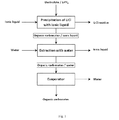
- Step 1 Precipitation of lithium with the IL101ionic liquid, followed by separation of a LiCl residue.
- the electrolyte consists of propylene carbonate in which 1M Li + (as LiPF6) is dissolved.
- IL101 is added in a 1:1 molar ratio of Li + :IL,101.
- the mixture is stirred using a magnetic stirrer during 1 hour at room temperature.
- the mixture is then filtrated on a filter paper under vacuum.
- the residue is washed with 50 ml dichloromethane and dried for 24 hours at 70 °C.
- the filtrate is analysed for Li, the residue is analysed for Li and Cl.
- Step 2 Separation of the organic carbonates and the ionic liquid by extraction with water.
- the filtrate of Step 1 consists of the organic carbonates of the electrolyte and of the phosphonium ionic liquid with PF 6 - as anion instead of Cl - .
- the ionic liquid is insoluble in water, whereas the electrolyte is soluble, (ca. 200 gram electrolyte per litre water), it is possible to extract the latter with water. This separation can be accomplished in a single step or in multiple-steps. Since the ionic liquid melts at 40 °C, a solid phase will start to form during extraction. At the end of the extraction all of the ionic liquid has become solid. Alternatively, the ionic liquid can be kept in the liquid phase by working above its melting point.
- a single extraction step is applied, the filtrate being mixed with 10 times its volume of water and stirred (magnetic stirrer) during 24 hours at room temperature. After 24 hours, the mixture is filtrated on a paper filter under vacuum. The residue on the filter is the solidified ionic liquid, and the filtrate consists of a mixture of water and organic carbonates.
- the filtrate is mixed with 1 time its volume of water and stirred (magnetic stirrer) during 1 to 2 hours at room temperature. After 30 minutes the water, forming a separate top layer, is collected, and a fresh amount of water is added. This extraction is repeated 10 times. After 5 to 6 extraction steps, solid ionic "liquid" begins to appear. All aqueous phases are put together for processing in Step 3.
- Step 3 Evaporation of water, isolation of the organic carbonates.
- the removal of water from the water-phase is performed on a rotary evaporator type Heidolph Laborota ® 4003.
- the solution is placed in the rotary evaporator and heated at 65 °C and 80 mmHg during 30 minutes.
- the water evaporates under these conditions; the remaining liquid consists of organic carbonates.
Landscapes
- Engineering & Computer Science (AREA)
- Manufacturing & Machinery (AREA)
- Chemical & Material Sciences (AREA)
- Chemical Kinetics & Catalysis (AREA)
- Electrochemistry (AREA)
- General Chemical & Material Sciences (AREA)
- Life Sciences & Earth Sciences (AREA)
- Sustainable Development (AREA)
- Manufacture And Refinement Of Metals (AREA)
- Organic Low-Molecular-Weight Compounds And Preparation Thereof (AREA)
- Secondary Cells (AREA)
Abstract
The present disclosure concerns the recovery of valuable compounds from electrolytes of the type found in Li-ion rechargeable batteries.
The process for the recovery of lithium hexafluorophosphate, and organic carbonates from battery electrolyte, comprises the steps of:
- contacting the electrolyte with a phosphonium chloride-based ionic liquid, thereby forming a solid phase comprising LiCl, and a liquid phase comprising a phosphonium hexafluorophosphate-based ionic liquid and the organic carbonates;
- separating the solid and the liquid phases, thereby isolating LiCl;
- water-extraction of the organic carbonates from the liquid phase, thereby obtaining two immiscible liquid phases consisting of a first phase comprising an aqueous solution of the organic carbonates, and a second phase comprising the phosphonium hexafluorophosphate-based ionic liquid;
- separating said immiscible liquid phases, thereby isolating the phosphonium hexafluorophosphate-based ionic liquid;
- evaporating the water from the liquid phase comprising the aqueous solution, thereby recovering the organic carbonates.
- contacting the electrolyte with a phosphonium chloride-based ionic liquid, thereby forming a solid phase comprising LiCl, and a liquid phase comprising a phosphonium hexafluorophosphate-based ionic liquid and the organic carbonates;
- separating the solid and the liquid phases, thereby isolating LiCl;
- water-extraction of the organic carbonates from the liquid phase, thereby obtaining two immiscible liquid phases consisting of a first phase comprising an aqueous solution of the organic carbonates, and a second phase comprising the phosphonium hexafluorophosphate-based ionic liquid;
- separating said immiscible liquid phases, thereby isolating the phosphonium hexafluorophosphate-based ionic liquid;
- evaporating the water from the liquid phase comprising the aqueous solution, thereby recovering the organic carbonates.
Thanks to the exploitation of suitable ionic liquids, lithium, hexafluorophosphate, and the organic carbonates are recovered at high yields. The process is clean and safe, as volatile organic solvents are totally avoided.
Description
- The present disclosure concerns the recovery of valuable compounds from electrolytes such as those found in lithium-ion rechargeable batteries.
- The three primary functional components of a lithium-ion battery are the anode, the cathode, and the electrolyte. The anode of a conventional lithium-ion cell is made from carbon, the cathode of transition metal oxides such as cobalt, nickel, manganese, and the electrolyte is non-aqueous solvent containing a lithium salt. Other lithium-ion batteries, e.g. based on lithium iron phosphates cathodes, are also present on the market.
- The electrolyte should conduct lithium ions, acting as a carrier between the cathode and the anode when a battery passes an electric current through an external circuit. Solvents in current use decompose on initial charging and form a solid interphase layer, which is electrically insulating, yet provides sufficient ionic conductivity. This interphase prevents further decomposition of the electrolyte in subsequent charge/discharge cycles.
- Such solvents typically consist of a mixture of organic carbonates such as ethylene carbonate (EC), di-methyl carbonate (DMC) and propylene carbonate (PC).
- The lithium salt normally consists of a hexafluorophosphate, LiPF6. Its concentration in the electrolyte typically amounts to 1 mole per liter. In practice, about 10 to 20% of the total battery lithium resides in the electrolyte, the remainder being captive of the anode or the cathode material.
- As the market of lithium-based secondary batteries is rapidly expanding, with more to come further to the expected proliferation of electric vehicles, the recovery of valuable compounds from spent batteries is of growing commercial importance. Accordingly, several processes have been described, most of them concerning the recovery of lithium and of the transition metals in the cathode.
-
WO2005101564(A1 ) discloses a process wherein lithium-based batteries are dry-shredded under inert atmosphere, whereupon the shreds are sorted and treated in a hydrometallurgy process. The cobalt- and lithium-bearing shreds are washed with water, thereby releasing the lithium, which is precipitated. The shreds are then subjected to an acid leach to recover the cobalt. The hexafluorophosphate anions are said to be recoverable as complexes with [Ni(NH3) 6]2+ or with dihydro-1,4-diphenyl-3,5-phenylimino-1,2,4-triazole. - This and other known processes do not allow for the simultaneous recovery of lithium, hexafluorophosphate, and organic carbonates from electrolytes.
- The aim of the present invention is to provide a process capable of recovering the three above-mentioned ingredients from electrolytes as valuable products. In particular, a process is offered comprising the steps of:
- contacting the electrolyte with a phosphonium chloride-based ionic liquid, thereby forming a solid phase comprising LiCl, and a liquid phase comprising a phosphonium hexafluorophosphate-based ionic liquid and the organic carbonates;
- separating the solid and the liquid phases, thereby isolating LiCl;
- water-extraction of the organic carbonates from the liquid phase, thereby obtaining two immiscible liquid phases consisting of a first phase comprising an aqueous solution of the organic carbonates, and a second phase comprising the phosphonium hexafluorophosphate-based ionic liquid;
- separating said immiscible liquid phases, thereby isolating the phosphonium hexafluorophosphate-based ionic liquid;
- evaporating the water from the liquid phase comprising the aqueous solution, thereby recovering the organic carbonates.
- This process can be preceded by a step of mechanical separation of the electrolyte from said batteries.
- In some cases, it might be useful to reconvert the phosphonium hexafluorophosphate-based ionic liquid to its original chloride-based form.
- This process relies on a particular behaviour of the elected phosphonium chloride-based ionic liquids, namely:
- such ionic liquids are soluble in the battery electrolyte;
- the chloride anion of the ionic liquids forms with the lithium a LiCl compound that is insoluble in the ionic liquid-electrolyte mixture.
- Consequently, rapid reaction rates are observed, and a simple solid/liquid separation scheme is available to isolate the lithium and the hexafluorophosphate. Also, only a limited amount of water needs to be evaporated in the final step, as the quantity of water added in the extraction step can be kept minimal.
- Spent electrolyte can be obtained as such from battery manufacturers dealing with out-of-spec production lots. It can also be recovered from end-of-life batteries, e.g. by subjecting their shreds to a washing step using an ionic liquid solution according to the present invention.
- It is noteworthy that the reclamation of the organic carbonates can be performed by other means than by water extraction followed by evaporation. The contained carbonates can be recovered by extraction of the ionic liquid using an apolar organic solvent such as hexane. A pure liquid carbonate phase is then obtained, and also a hexane/ionic liquid phase, from which the hexane can easily be evaporated. The advantage of this scheme is one of higher recovery yields; however, resorting to volatile organics for the extraction is perceived as a drawback.
- Furthermore, it should be mentioned that the ionic liquid, having undergone the substitution of its Cl- anion by a PF6- anion in the contacting step, could be returned to its original form using an anion exchange technique. This would allow closing the loop on the ionic liquid.
- Even without anion exchange, the ionic liquid in its PF6- form still represents an interesting valuation of the anion, as it has a commercial value in excess of that of the starting Cl- form. For these tests, a commercial phosphonium ionic liquid having a chloride anion was used (Cytec Cyphos® IL101, by). This anion forms LiCl when the ionic liquid is mixed with electrolyte in stoichiometric amounts. LiCl is not soluble in this mixture and precipitates. The phosphonium PF6 is a valuable ionic liquid, also marketted by Cytec.
- The following example illustrates the three steps of the process.
- The electrolyte consists of propylene carbonate in which 1M Li+ (as LiPF6) is dissolved. To the electrolyte, IL101 is added in a 1:1 molar ratio of Li+:IL,101. The mixture is stirred using a magnetic stirrer during 1 hour at room temperature. The mixture is then filtrated on a filter paper under vacuum. The residue is washed with 50 ml dichloromethane and dried for 24 hours at 70 °C. The filtrate is analysed for Li, the residue is analysed for Li and Cl.
Table: Lithium and chlorine distribution over the phases Li Cl Electrolyte 6300 mg/L - Filtrate 330 mg/L - Residue 15% 72% - During this precipitation step a yield of 95% is obtained for Li.
- The filtrate of Step 1 consists of the organic carbonates of the electrolyte and of the phosphonium ionic liquid with PF6 - as anion instead of Cl-.
- Since the ionic liquid is insoluble in water, whereas the electrolyte is soluble, (ca. 200 gram electrolyte per litre water), it is possible to extract the latter with water. This separation can be accomplished in a single step or in multiple-steps. Since the ionic liquid melts at 40 °C, a solid phase will start to form during extraction. At the end of the extraction all of the ionic liquid has become solid. Alternatively, the ionic liquid can be kept in the liquid phase by working above its melting point.
- In a first embodiment, a single extraction step is applied, the filtrate being mixed with 10 times its volume of water and stirred (magnetic stirrer) during 24 hours at room temperature. After 24 hours, the mixture is filtrated on a paper filter under vacuum. The residue on the filter is the solidified ionic liquid, and the filtrate consists of a mixture of water and organic carbonates.
- In a second embodiment, applying a multi-step extraction, the filtrate is mixed with 1 time its volume of water and stirred (magnetic stirrer) during 1 to 2 hours at room temperature. After 30 minutes the water, forming a separate top layer, is collected, and a fresh amount of water is added. This extraction is repeated 10 times. After 5 to 6 extraction steps, solid ionic "liquid" begins to appear. All aqueous phases are put together for processing in Step 3.
- The removal of water from the water-phase is performed on a rotary evaporator type Heidolph Laborota® 4003. The solution is placed in the rotary evaporator and heated at 65 °C and 80 mmHg during 30 minutes. The water evaporates under these conditions; the remaining liquid consists of organic carbonates.
Claims (3)
- Process for the recovery of lithium hexafluorophosphate, and organic carbonates from battery electrolyte comprising the steps of:- contacting the electrolyte with a phosphonium chloride-based ionic liquid, thereby forming a solid phase comprising LiCl, and a liquid phase comprising a phosphonium hexafluorophosphate-based ionic liquid and the organic carbonates;- separating the solid and the liquid phases, thereby isolating LiCl;- water-extraction of the organic carbonates from the liquid phase, thereby obtaining two immiscible liquid phases consisting of a first phase comprising an aqueous solution of the organic carbonates, and a second phase comprising the phosphonium hexafluorophosphate-based ionic liquid;- separating said immiscible liquid phases, thereby isolating the phosphonium hexafluorophosphate-based ionic liquid;- evaporating the water from the liquid phase comprising the aqueous solution, thereby recovering the organic carbonates.
- Process for the recovery of Li and organic carbonates from spent Li-ion batteries, comprising the step of a mechanical separation of the electrolyte from said batteries, followed by the steps according to claim 1.
- Process according to claims 1 or 2, followed by the conversion of the phosphonium fluoride comprised in said second phase to phosphonium chloride.
Priority Applications (1)
| Application Number | Priority Date | Filing Date | Title |
|---|---|---|---|
| EP20110179462 EP2410603A1 (en) | 2011-08-31 | 2011-08-31 | Recovery of compounds from Li-ion battery electrolyte |
Applications Claiming Priority (1)
| Application Number | Priority Date | Filing Date | Title |
|---|---|---|---|
| EP20110179462 EP2410603A1 (en) | 2011-08-31 | 2011-08-31 | Recovery of compounds from Li-ion battery electrolyte |
Publications (1)
| Publication Number | Publication Date |
|---|---|
| EP2410603A1 true EP2410603A1 (en) | 2012-01-25 |
Family
ID=44582505
Family Applications (1)
| Application Number | Title | Priority Date | Filing Date |
|---|---|---|---|
| EP20110179462 Withdrawn EP2410603A1 (en) | 2011-08-31 | 2011-08-31 | Recovery of compounds from Li-ion battery electrolyte |
Country Status (1)
| Country | Link |
|---|---|
| EP (1) | EP2410603A1 (en) |
Cited By (9)
| Publication number | Priority date | Publication date | Assignee | Title |
|---|---|---|---|---|
| WO2015193261A1 (en) * | 2014-06-18 | 2015-12-23 | Rhodia Operations | Process for recovering an electrolyte salt |
| WO2016012941A1 (en) | 2014-07-22 | 2016-01-28 | Commissariat A L'energie Atomique Et Aux Energies Alternatives | Method for recycling the electrolyte of a li-ion battery and method for recycling li-ion batteries |
| WO2016012943A1 (en) | 2014-07-22 | 2016-01-28 | Commissariat A L'energie Atomique Et Aux Energies Alternatives | Method for recycling the electrolyte of a li-ion battery and method for recycling li-ion batteries |
| CN109694957A (en) * | 2019-02-26 | 2019-04-30 | 中国科学院城市环境研究所 | A method of utilizing ion liquid abstraction lithium ion battery leachate metal ion |
| CN111139499A (en) * | 2019-12-19 | 2020-05-12 | 西安交通大学 | Lithium ion battery heavy metal recovery method based on microwave-assisted eutectic solvent |
| CN115207505A (en) * | 2022-08-04 | 2022-10-18 | 广东光华科技股份有限公司 | Application of metal-chlorine bridge dimer |
| CN117567290A (en) * | 2023-11-13 | 2024-02-20 | 华中科技大学 | A recycling method of used lithium batteries |
| DE102023116962A1 (en) | 2023-06-27 | 2025-01-02 | Technische Universität Bergakademie Freiberg, Körperschaft des öffentlichen Rechts | Process for the recovery of perfluorinated lithium compounds from lithium-ion batteries |
| WO2025081348A1 (en) * | 2023-10-17 | 2025-04-24 | 广东邦普循环科技有限公司 | Method for separating, purifying and recovering electrolyte |
Citations (4)
| Publication number | Priority date | Publication date | Assignee | Title |
|---|---|---|---|---|
| WO1999034473A1 (en) * | 1997-12-23 | 1999-07-08 | Aea Technology Plc | Recycling of galvanic cells |
| WO2003004727A2 (en) * | 2001-07-06 | 2003-01-16 | The Queen's University Of Belfast | Electrosynthesis of organic compounds |
| WO2005101564A1 (en) | 2004-04-06 | 2005-10-27 | Recupyl | Method for the mixed recycling of lithium-based anode batteries and cells |
| JP2007207630A (en) * | 2006-02-03 | 2007-08-16 | Sumitomo Metal Mining Co Ltd | Separation and recovery of hexafluorophosphate ion |
-
2011
- 2011-08-31 EP EP20110179462 patent/EP2410603A1/en not_active Withdrawn
Patent Citations (4)
| Publication number | Priority date | Publication date | Assignee | Title |
|---|---|---|---|---|
| WO1999034473A1 (en) * | 1997-12-23 | 1999-07-08 | Aea Technology Plc | Recycling of galvanic cells |
| WO2003004727A2 (en) * | 2001-07-06 | 2003-01-16 | The Queen's University Of Belfast | Electrosynthesis of organic compounds |
| WO2005101564A1 (en) | 2004-04-06 | 2005-10-27 | Recupyl | Method for the mixed recycling of lithium-based anode batteries and cells |
| JP2007207630A (en) * | 2006-02-03 | 2007-08-16 | Sumitomo Metal Mining Co Ltd | Separation and recovery of hexafluorophosphate ion |
Non-Patent Citations (4)
| Title |
|---|
| LIU J-F ET AL: "Application of ionic liquids in analytical chemistry", TRAC, TRENDS IN ANALYTICAL CHEMISTRY, ELSEVIER, AMSTERDAM, NL, vol. 24, no. 1, 1 January 2005 (2005-01-01), pages 20 - 27, XP004706413, ISSN: 0165-9936, DOI: 10.1016/J.TRAC.2004.09.005 * |
| PANDEY ET AL: "Analytical applications of room-temperature ionic liquids: A review of recent efforts", ANALYTICA CHIMICA ACTA, ELSEVIER, AMSTERDAM, NL, vol. 556, no. 1, 18 January 2006 (2006-01-18), pages 38 - 45, XP025047429, ISSN: 0003-2670, [retrieved on 20060118], DOI: 10.1016/J.ACA.2005.06.038 * |
| PAULINO ET AL: "Recovery of valuable elements from spent Li-batteries", JOURNAL OF HAZARDOUS MATERIALS, ELSEVIER, AMSTERDAM, NL, vol. 150, no. 3, 22 October 2007 (2007-10-22), pages 843 - 849, XP022424344, ISSN: 0304-3894, DOI: 10.1016/J.JHAZMAT.2007.10.048 * |
| SEDDON ET AL: "INFLUENCE OF CHLORIDE,WATER,AND ORGANIC SOLVENTS ON THE PHYSICAL PROPERTIES OF IONIC LIQUIDS", PURE & APPLIED CHEMISTRY, PERGAMON PRESS, OXFORD, GB, vol. 72, no. 12, 1 January 2000 (2000-01-01), pages 2275 - 2287, XP008079481, ISSN: 0033-4545 * |
Cited By (15)
| Publication number | Priority date | Publication date | Assignee | Title |
|---|---|---|---|---|
| US10511068B2 (en) | 2014-06-18 | 2019-12-17 | Rhodia Operations | Process for recovering an electrolyte salt |
| FR3022695A1 (en) * | 2014-06-18 | 2015-12-25 | Rhodia Operations | PROCESS FOR RECOVERING AN ELECTROLYTE SALT |
| KR102336872B1 (en) | 2014-06-18 | 2021-12-08 | 로디아 오퍼레이션스 | Process for recovering an electrolyte salt |
| WO2015193261A1 (en) * | 2014-06-18 | 2015-12-23 | Rhodia Operations | Process for recovering an electrolyte salt |
| KR20170018048A (en) * | 2014-06-18 | 2017-02-15 | 로디아 오퍼레이션스 | Process for recovering an electrolyte salt |
| JP2017525552A (en) * | 2014-06-18 | 2017-09-07 | ローディア オペレーションズ | Method for recovering electrolyte salt |
| WO2016012943A1 (en) | 2014-07-22 | 2016-01-28 | Commissariat A L'energie Atomique Et Aux Energies Alternatives | Method for recycling the electrolyte of a li-ion battery and method for recycling li-ion batteries |
| WO2016012941A1 (en) | 2014-07-22 | 2016-01-28 | Commissariat A L'energie Atomique Et Aux Energies Alternatives | Method for recycling the electrolyte of a li-ion battery and method for recycling li-ion batteries |
| CN109694957A (en) * | 2019-02-26 | 2019-04-30 | 中国科学院城市环境研究所 | A method of utilizing ion liquid abstraction lithium ion battery leachate metal ion |
| CN111139499A (en) * | 2019-12-19 | 2020-05-12 | 西安交通大学 | Lithium ion battery heavy metal recovery method based on microwave-assisted eutectic solvent |
| CN115207505A (en) * | 2022-08-04 | 2022-10-18 | 广东光华科技股份有限公司 | Application of metal-chlorine bridge dimer |
| DE102023116962A1 (en) | 2023-06-27 | 2025-01-02 | Technische Universität Bergakademie Freiberg, Körperschaft des öffentlichen Rechts | Process for the recovery of perfluorinated lithium compounds from lithium-ion batteries |
| WO2025002506A1 (en) | 2023-06-27 | 2025-01-02 | Technische Universität Bergakademie Freiberg, Körperschaft des öffentlichen Rechts | Method for recovering perfluorinated lithium compounds from lithium-ion batteries |
| WO2025081348A1 (en) * | 2023-10-17 | 2025-04-24 | 广东邦普循环科技有限公司 | Method for separating, purifying and recovering electrolyte |
| CN117567290A (en) * | 2023-11-13 | 2024-02-20 | 华中科技大学 | A recycling method of used lithium batteries |
Similar Documents
| Publication | Publication Date | Title |
|---|---|---|
| EP2410603A1 (en) | Recovery of compounds from Li-ion battery electrolyte | |
| US20260055484A1 (en) | Processes for extracting metals from lithium-ion batteries | |
| US12247267B2 (en) | Method of producing lithium hydroxide from lithium concentrate through sodium sulfate addition and roasting | |
| KR101220149B1 (en) | Method for making sulfate solution of valuable metal from used battery and for making cathode active material | |
| KR101708149B1 (en) | A Method For Recovering Lithium Compound From An Anode Material In Spent Lithium Batteries By Wet-Milling | |
| US20130192425A1 (en) | Method for recovering valuable metals from lithium secondary battery wastes | |
| US6120927A (en) | Method of recovering lithium from batteries | |
| KR102689694B1 (en) | Reuse method of active material of positive electrode scrap | |
| KR20190119329A (en) | Manufacturing method of lithium hydroxide monohydrate using waste cathode material of lithium ion secondary battery | |
| US20240339689A1 (en) | Recycling method of positive electrode material for secondary batteries and device using the same | |
| KR101178768B1 (en) | Method of recovery of lithium from cathodic active material of lithium battery | |
| KR20150075247A (en) | Method For Recovering Manganese From Lithium Secondary Battery Cathode | |
| JP2013112859A (en) | Method for manufacturing manganese sulfate | |
| CA3216415A1 (en) | Lithium recovery from lithium-ion batteries | |
| KR20230161987A (en) | Method for dissolving anode material | |
| JP2013209267A (en) | Method of manufacturing manganese sulfate | |
| EP4082973A1 (en) | Method for recovering positive electrode active material precursor | |
| US20250002340A1 (en) | Fluoride removal process | |
| US20240145802A1 (en) | Separation method for separating constituent material from member and method for processing member | |
| KR102367354B1 (en) | Method for purifying waste lithium phosphate and method for manufacturing lithium iron phosphate comprising the same | |
| WO2024107207A1 (en) | Lithium recovery from lithium-ion batteries | |
| KR101568216B1 (en) | Method of manufacturing electrode active material and cathod active material manufactured by the method | |
| Wang et al. | Stage‐Specific Roles of Deep Eutectic Solvents in Recycling of Spent Lithium‐Ion Batteries | |
| EP4596730A1 (en) | Method for recovery of valuable metals | |
| US20250323337A1 (en) | Selective lithium extraction for cathode materials |
Legal Events
| Date | Code | Title | Description |
|---|---|---|---|
| AK | Designated contracting states |
Kind code of ref document: A1 Designated state(s): AL AT BE BG CH CY CZ DE DK EE ES FI FR GB GR HR HU IE IS IT LI LT LU LV MC MK MT NL NO PL PT RO RS SE SI SK SM TR |
|
| AX | Request for extension of the european patent |
Extension state: BA ME |
|
| PUAI | Public reference made under article 153(3) epc to a published international application that has entered the european phase |
Free format text: ORIGINAL CODE: 0009012 |
|
| STAA | Information on the status of an ep patent application or granted ep patent |
Free format text: STATUS: THE APPLICATION IS DEEMED TO BE WITHDRAWN |
|
| 18D | Application deemed to be withdrawn |
Effective date: 20120726 |