EP2409978A2 - A novel process for the synthesis of pemetrexed disodium salt - Google Patents
A novel process for the synthesis of pemetrexed disodium salt Download PDFInfo
- Publication number
- EP2409978A2 EP2409978A2 EP11174646A EP11174646A EP2409978A2 EP 2409978 A2 EP2409978 A2 EP 2409978A2 EP 11174646 A EP11174646 A EP 11174646A EP 11174646 A EP11174646 A EP 11174646A EP 2409978 A2 EP2409978 A2 EP 2409978A2
- Authority
- EP
- European Patent Office
- Prior art keywords
- diethyl ester
- pemetrexed
- mixture
- pemetrexed diethyl
- polar organic
- Prior art date
- Legal status (The legal status is an assumption and is not a legal conclusion. Google has not performed a legal analysis and makes no representation as to the accuracy of the status listed.)
- Granted
Links
- 238000000034 method Methods 0.000 title claims abstract description 40
- 230000015572 biosynthetic process Effects 0.000 title claims abstract description 16
- NYDXNILOWQXUOF-UHFFFAOYSA-L disodium;2-[[4-[2-(2-amino-4-oxo-1,7-dihydropyrrolo[2,3-d]pyrimidin-5-yl)ethyl]benzoyl]amino]pentanedioate Chemical class [Na+].[Na+].C=1NC=2NC(N)=NC(=O)C=2C=1CCC1=CC=C(C(=O)NC(CCC([O-])=O)C([O-])=O)C=C1 NYDXNILOWQXUOF-UHFFFAOYSA-L 0.000 title claims description 28
- 238000003786 synthesis reaction Methods 0.000 title description 8
- DEJAOZLLEHXUBF-KRWDZBQOSA-N diethyl (2s)-2-[[4-[2-(2-amino-4-oxo-1,7-dihydropyrrolo[2,3-d]pyrimidin-5-yl)ethyl]benzoyl]amino]pentanedioate Chemical compound C1=CC(C(=O)N[C@@H](CCC(=O)OCC)C(=O)OCC)=CC=C1CCC1=CNC2=C1C(=O)N=C(N)N2 DEJAOZLLEHXUBF-KRWDZBQOSA-N 0.000 claims abstract description 80
- 239000000203 mixture Substances 0.000 claims abstract description 38
- 238000002360 preparation method Methods 0.000 claims abstract description 21
- 239000003495 polar organic solvent Substances 0.000 claims abstract description 19
- 239000007864 aqueous solution Substances 0.000 claims abstract description 13
- QXNVGIXVLWOKEQ-UHFFFAOYSA-N Disodium Chemical class [Na][Na] QXNVGIXVLWOKEQ-UHFFFAOYSA-N 0.000 claims abstract description 12
- 239000012074 organic phase Substances 0.000 claims abstract description 10
- 150000001875 compounds Chemical class 0.000 claims abstract description 9
- 238000001556 precipitation Methods 0.000 claims abstract description 8
- 239000013043 chemical agent Substances 0.000 claims abstract description 5
- 239000003960 organic solvent Substances 0.000 claims abstract description 5
- 230000001737 promoting effect Effects 0.000 claims abstract description 5
- 238000005406 washing Methods 0.000 claims abstract description 4
- LFQSCWFLJHTTHZ-UHFFFAOYSA-N Ethanol Chemical compound CCO LFQSCWFLJHTTHZ-UHFFFAOYSA-N 0.000 claims description 24
- 238000000634 powder X-ray diffraction Methods 0.000 claims description 10
- 238000005033 Fourier transform infrared spectroscopy Methods 0.000 claims description 7
- 230000007062 hydrolysis Effects 0.000 claims description 7
- 238000006460 hydrolysis reaction Methods 0.000 claims description 7
- 238000010438 heat treatment Methods 0.000 claims description 6
- 238000001816 cooling Methods 0.000 claims description 3
- IAZDPXIOMUYVGZ-UHFFFAOYSA-N Dimethylsulphoxide Chemical compound CS(C)=O IAZDPXIOMUYVGZ-UHFFFAOYSA-N 0.000 claims description 2
- 150000008365 aromatic ketones Chemical class 0.000 claims description 2
- RXKJFZQQPQGTFL-UHFFFAOYSA-N dihydroxyacetone Chemical compound OCC(=O)CO RXKJFZQQPQGTFL-UHFFFAOYSA-N 0.000 claims description 2
- 229960001760 dimethyl sulfoxide Drugs 0.000 claims description 2
- 238000001757 thermogravimetry curve Methods 0.000 claims description 2
- YMWUJEATGCHHMB-UHFFFAOYSA-N Dichloromethane Chemical compound ClCCl YMWUJEATGCHHMB-UHFFFAOYSA-N 0.000 description 24
- ZMXDDKWLCZADIW-UHFFFAOYSA-N N,N-Dimethylformamide Chemical compound CN(C)C=O ZMXDDKWLCZADIW-UHFFFAOYSA-N 0.000 description 24
- 239000000243 solution Substances 0.000 description 17
- HEMHJVSKTPXQMS-UHFFFAOYSA-M Sodium hydroxide Chemical compound [OH-].[Na+] HEMHJVSKTPXQMS-UHFFFAOYSA-M 0.000 description 15
- SJRJJKPEHAURKC-UHFFFAOYSA-N N-Methylmorpholine Chemical compound CN1CCOCC1 SJRJJKPEHAURKC-UHFFFAOYSA-N 0.000 description 12
- 238000004128 high performance liquid chromatography Methods 0.000 description 11
- WBXPDJSOTKVWSJ-ZDUSSCGKSA-N pemetrexed Chemical compound C=1NC=2NC(N)=NC(=O)C=2C=1CCC1=CC=C(C(=O)N[C@@H](CCC(O)=O)C(O)=O)C=C1 WBXPDJSOTKVWSJ-ZDUSSCGKSA-N 0.000 description 11
- 239000000047 product Substances 0.000 description 10
- UIIMBOGNXHQVGW-UHFFFAOYSA-M Sodium bicarbonate Chemical compound [Na+].OC([O-])=O UIIMBOGNXHQVGW-UHFFFAOYSA-M 0.000 description 8
- 239000007787 solid Substances 0.000 description 8
- XLYOFNOQVPJJNP-UHFFFAOYSA-N water Substances O XLYOFNOQVPJJNP-UHFFFAOYSA-N 0.000 description 8
- 239000004480 active ingredient Substances 0.000 description 7
- 239000008367 deionised water Substances 0.000 description 7
- 229910021641 deionized water Inorganic materials 0.000 description 7
- 239000007789 gas Substances 0.000 description 7
- 229960005079 pemetrexed Drugs 0.000 description 7
- GPIQOFWTZXXOOV-UHFFFAOYSA-N 2-chloro-4,6-dimethoxy-1,3,5-triazine Chemical compound COC1=NC(Cl)=NC(OC)=N1 GPIQOFWTZXXOOV-UHFFFAOYSA-N 0.000 description 6
- IJGRMHOSHXDMSA-UHFFFAOYSA-N Atomic nitrogen Chemical compound N#N IJGRMHOSHXDMSA-UHFFFAOYSA-N 0.000 description 6
- 125000001495 ethyl group Chemical group [H]C([H])([H])C([H])([H])* 0.000 description 6
- 125000003236 benzoyl group Chemical group [H]C1=C([H])C([H])=C(C([H])=C1[H])C(*)=O 0.000 description 5
- JOXIMZWYDAKGHI-UHFFFAOYSA-N toluene-4-sulfonic acid Chemical compound CC1=CC=C(S(O)(=O)=O)C=C1 JOXIMZWYDAKGHI-UHFFFAOYSA-N 0.000 description 5
- LMDZBCPBFSXMTL-UHFFFAOYSA-N 1-ethyl-3-(3-dimethylaminopropyl)carbodiimide Chemical compound CCN=C=NCCCN(C)C LMDZBCPBFSXMTL-UHFFFAOYSA-N 0.000 description 4
- QOSSAOTZNIDXMA-UHFFFAOYSA-N Dicylcohexylcarbodiimide Chemical compound C1CCCCC1N=C=NC1CCCCC1 QOSSAOTZNIDXMA-UHFFFAOYSA-N 0.000 description 4
- 238000013019 agitation Methods 0.000 description 4
- 239000011541 reaction mixture Substances 0.000 description 4
- 229910000030 sodium bicarbonate Inorganic materials 0.000 description 4
- 235000017557 sodium bicarbonate Nutrition 0.000 description 4
- 239000002904 solvent Substances 0.000 description 4
- 230000003595 spectral effect Effects 0.000 description 4
- WEVYAHXRMPXWCK-UHFFFAOYSA-N Acetonitrile Chemical compound CC#N WEVYAHXRMPXWCK-UHFFFAOYSA-N 0.000 description 3
- RTZKZFJDLAIYFH-UHFFFAOYSA-N Diethyl ether Chemical compound CCOCC RTZKZFJDLAIYFH-UHFFFAOYSA-N 0.000 description 3
- XEKOWRVHYACXOJ-UHFFFAOYSA-N Ethyl acetate Chemical compound CCOC(C)=O XEKOWRVHYACXOJ-UHFFFAOYSA-N 0.000 description 3
- 239000002253 acid Substances 0.000 description 3
- 238000006243 chemical reaction Methods 0.000 description 3
- 239000000706 filtrate Substances 0.000 description 3
- 238000004519 manufacturing process Methods 0.000 description 3
- 238000005259 measurement Methods 0.000 description 3
- 229910052757 nitrogen Inorganic materials 0.000 description 3
- 239000012071 phase Substances 0.000 description 3
- 150000003839 salts Chemical class 0.000 description 3
- JMTMSDXUXJISAY-UHFFFAOYSA-N 2H-benzotriazol-4-ol Chemical compound OC1=CC=CC2=C1N=NN2 JMTMSDXUXJISAY-UHFFFAOYSA-N 0.000 description 2
- AIZPFZIKHIJCQX-UHFFFAOYSA-N 4-[2-(2-amino-4-oxo-1,7-dihydropyrrolo[2,3-d]pyrimidin-5-yl)ethyl]benzoic acid Chemical compound C=1NC=2NC(N)=NC(=O)C=2C=1CCC1=CC=C(C(O)=O)C=C1 AIZPFZIKHIJCQX-UHFFFAOYSA-N 0.000 description 2
- HEDRZPFGACZZDS-UHFFFAOYSA-N Chloroform Chemical compound ClC(Cl)Cl HEDRZPFGACZZDS-UHFFFAOYSA-N 0.000 description 2
- DTQVDTLACAAQTR-UHFFFAOYSA-N Trifluoroacetic acid Chemical compound OC(=O)C(F)(F)F DTQVDTLACAAQTR-UHFFFAOYSA-N 0.000 description 2
- 150000007513 acids Chemical class 0.000 description 2
- 239000012298 atmosphere Substances 0.000 description 2
- 239000011324 bead Substances 0.000 description 2
- WPYMKLBDIGXBTP-UHFFFAOYSA-N benzoic acid Chemical compound OC(=O)C1=CC=CC=C1 WPYMKLBDIGXBTP-UHFFFAOYSA-N 0.000 description 2
- WSEQLMQNPBNMSL-FJXQXJEOSA-N diethyl (2s)-2-aminopentanedioate;hydron;chloride Chemical compound Cl.CCOC(=O)CC[C@H](N)C(=O)OCC WSEQLMQNPBNMSL-FJXQXJEOSA-N 0.000 description 2
- 239000003085 diluting agent Substances 0.000 description 2
- 238000001035 drying Methods 0.000 description 2
- 231100000024 genotoxic Toxicity 0.000 description 2
- 230000001738 genotoxic effect Effects 0.000 description 2
- NPZTUJOABDZTLV-UHFFFAOYSA-N hydroxybenzotriazole Substances O=C1C=CC=C2NNN=C12 NPZTUJOABDZTLV-UHFFFAOYSA-N 0.000 description 2
- 238000002347 injection Methods 0.000 description 2
- 239000007924 injection Substances 0.000 description 2
- 239000002050 international nonproprietary name Substances 0.000 description 2
- 239000000463 material Substances 0.000 description 2
- 239000012299 nitrogen atmosphere Substances 0.000 description 2
- 208000002154 non-small cell lung carcinoma Diseases 0.000 description 2
- 230000003287 optical effect Effects 0.000 description 2
- -1 pemetrexed ester Chemical class 0.000 description 2
- 239000002244 precipitate Substances 0.000 description 2
- 238000001228 spectrum Methods 0.000 description 2
- 239000000725 suspension Substances 0.000 description 2
- 208000029729 tumor suppressor gene on chromosome 11 Diseases 0.000 description 2
- UNILWMWFPHPYOR-KXEYIPSPSA-M 1-[6-[2-[3-[3-[3-[2-[2-[3-[[2-[2-[[(2r)-1-[[2-[[(2r)-1-[3-[2-[2-[3-[[2-(2-amino-2-oxoethoxy)acetyl]amino]propoxy]ethoxy]ethoxy]propylamino]-3-hydroxy-1-oxopropan-2-yl]amino]-2-oxoethyl]amino]-3-[(2r)-2,3-di(hexadecanoyloxy)propyl]sulfanyl-1-oxopropan-2-yl Chemical compound O=C1C(SCCC(=O)NCCCOCCOCCOCCCNC(=O)COCC(=O)N[C@@H](CSC[C@@H](COC(=O)CCCCCCCCCCCCCCC)OC(=O)CCCCCCCCCCCCCCC)C(=O)NCC(=O)N[C@H](CO)C(=O)NCCCOCCOCCOCCCNC(=O)COCC(N)=O)CC(=O)N1CCNC(=O)CCCCCN\1C2=CC=C(S([O-])(=O)=O)C=C2CC/1=C/C=C/C=C/C1=[N+](CC)C2=CC=C(S([O-])(=O)=O)C=C2C1 UNILWMWFPHPYOR-KXEYIPSPSA-M 0.000 description 1
- 239000005711 Benzoic acid Substances 0.000 description 1
- BVKZGUZCCUSVTD-UHFFFAOYSA-M Bicarbonate Chemical class OC([O-])=O BVKZGUZCCUSVTD-UHFFFAOYSA-M 0.000 description 1
- 0 CC(*)*=C([*@](*)C=C1CCc(cc2)cc*2C(**)=O)C1=C(C)O Chemical compound CC(*)*=C([*@](*)C=C1CCc(cc2)cc*2C(**)=O)C1=C(C)O 0.000 description 1
- WJNOLQZPHAMBEP-UHFFFAOYSA-N CCC(C1)(N)N=C2NC=C(CCc(cc3)ccc3C(O)=O)C2=C1O Chemical compound CCC(C1)(N)N=C2NC=C(CCc(cc3)ccc3C(O)=O)C2=C1O WJNOLQZPHAMBEP-UHFFFAOYSA-N 0.000 description 1
- OLAFFPNXVJANFR-UHFFFAOYSA-N DG Chemical compound N1C(N)=NC(=O)C2=C1NC=C2 OLAFFPNXVJANFR-UHFFFAOYSA-N 0.000 description 1
- 102000004190 Enzymes Human genes 0.000 description 1
- 108090000790 Enzymes Proteins 0.000 description 1
- FXHOOIRPVKKKFG-UHFFFAOYSA-N N,N-Dimethylacetamide Chemical compound CN(C)C(C)=O FXHOOIRPVKKKFG-UHFFFAOYSA-N 0.000 description 1
- 229910019142 PO4 Inorganic materials 0.000 description 1
- PBCJIPOGFJYBJE-UHFFFAOYSA-N acetonitrile;hydrate Chemical compound O.CC#N PBCJIPOGFJYBJE-UHFFFAOYSA-N 0.000 description 1
- 150000001298 alcohols Chemical class 0.000 description 1
- 229940110282 alimta Drugs 0.000 description 1
- 229910052783 alkali metal Inorganic materials 0.000 description 1
- 150000001340 alkali metals Chemical class 0.000 description 1
- 229910052784 alkaline earth metal Inorganic materials 0.000 description 1
- 150000001342 alkaline earth metals Chemical class 0.000 description 1
- 230000002152 alkylating effect Effects 0.000 description 1
- 125000003277 amino group Chemical group 0.000 description 1
- 238000004458 analytical method Methods 0.000 description 1
- 230000003432 anti-folate effect Effects 0.000 description 1
- 230000000259 anti-tumor effect Effects 0.000 description 1
- 229940127074 antifolate Drugs 0.000 description 1
- 238000013459 approach Methods 0.000 description 1
- 239000008346 aqueous phase Substances 0.000 description 1
- 235000010233 benzoic acid Nutrition 0.000 description 1
- 239000006227 byproduct Substances 0.000 description 1
- 230000000711 cancerogenic effect Effects 0.000 description 1
- 150000004649 carbonic acid derivatives Chemical class 0.000 description 1
- 231100000315 carcinogenic Toxicity 0.000 description 1
- 238000012512 characterization method Methods 0.000 description 1
- 229940125898 compound 5 Drugs 0.000 description 1
- 231100000433 cytotoxic Toxicity 0.000 description 1
- 230000001472 cytotoxic effect Effects 0.000 description 1
- 230000000593 degrading effect Effects 0.000 description 1
- 230000001419 dependent effect Effects 0.000 description 1
- 230000001627 detrimental effect Effects 0.000 description 1
- 238000011161 development Methods 0.000 description 1
- LLIOKEUXNHKVHC-ZDUSSCGKSA-N dimethyl (2s)-2-[(4-ethynylbenzoyl)amino]pentanedioate Chemical compound COC(=O)CC[C@@H](C(=O)OC)NC(=O)C1=CC=C(C#C)C=C1 LLIOKEUXNHKVHC-ZDUSSCGKSA-N 0.000 description 1
- 229940088679 drug related substance Drugs 0.000 description 1
- 150000002148 esters Chemical class 0.000 description 1
- 238000001704 evaporation Methods 0.000 description 1
- 230000008020 evaporation Effects 0.000 description 1
- 238000002474 experimental method Methods 0.000 description 1
- 229940014144 folate Drugs 0.000 description 1
- OVBPIULPVIDEAO-LBPRGKRZSA-N folic acid Chemical compound C=1N=C2NC(N)=NC(=O)C2=NC=1CNC1=CC=C(C(=O)N[C@@H](CCC(O)=O)C(O)=O)C=C1 OVBPIULPVIDEAO-LBPRGKRZSA-N 0.000 description 1
- 235000019152 folic acid Nutrition 0.000 description 1
- 239000011724 folic acid Substances 0.000 description 1
- 239000004052 folic acid antagonist Substances 0.000 description 1
- 229960002989 glutamic acid Drugs 0.000 description 1
- 125000001475 halogen functional group Chemical group 0.000 description 1
- 150000004679 hydroxides Chemical class 0.000 description 1
- 239000012535 impurity Substances 0.000 description 1
- 238000011835 investigation Methods 0.000 description 1
- 230000026045 iodination Effects 0.000 description 1
- 238000006192 iodination reaction Methods 0.000 description 1
- 238000002955 isolation Methods 0.000 description 1
- 238000012423 maintenance Methods 0.000 description 1
- 208000006178 malignant mesothelioma Diseases 0.000 description 1
- 201000005282 malignant pleural mesothelioma Diseases 0.000 description 1
- 230000000771 oncological effect Effects 0.000 description 1
- 239000002245 particle Substances 0.000 description 1
- 230000007170 pathology Effects 0.000 description 1
- 229960003349 pemetrexed disodium Drugs 0.000 description 1
- 235000021317 phosphate Nutrition 0.000 description 1
- 150000003013 phosphoric acid derivatives Chemical class 0.000 description 1
- 239000002243 precursor Substances 0.000 description 1
- 150000003212 purines Chemical class 0.000 description 1
- 150000003230 pyrimidines Chemical class 0.000 description 1
- 125000000168 pyrrolyl group Chemical group 0.000 description 1
- 230000035945 sensitivity Effects 0.000 description 1
- 238000000926 separation method Methods 0.000 description 1
- 159000000000 sodium salts Chemical class 0.000 description 1
- 230000007928 solubilization Effects 0.000 description 1
- 238000005063 solubilization Methods 0.000 description 1
- 239000000126 substance Substances 0.000 description 1
- 238000002560 therapeutic procedure Methods 0.000 description 1
Images


Classifications
-
- C—CHEMISTRY; METALLURGY
- C07—ORGANIC CHEMISTRY
- C07D—HETEROCYCLIC COMPOUNDS
- C07D487/00—Heterocyclic compounds containing nitrogen atoms as the only ring hetero atoms in the condensed system, not provided for by groups C07D451/00 - C07D477/00
- C07D487/02—Heterocyclic compounds containing nitrogen atoms as the only ring hetero atoms in the condensed system, not provided for by groups C07D451/00 - C07D477/00 in which the condensed system contains two hetero rings
- C07D487/04—Ortho-condensed systems
Definitions
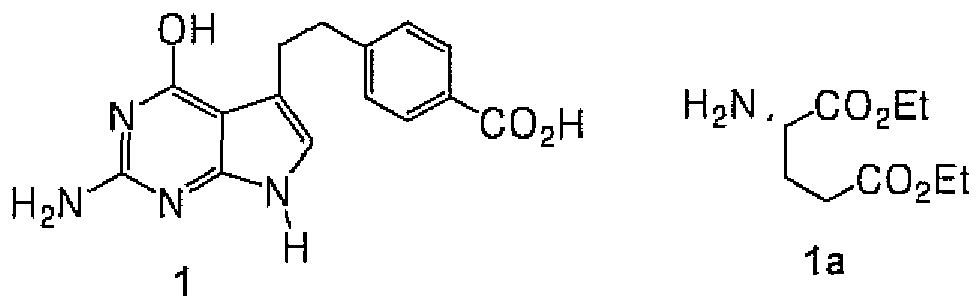
- the present invention relates to a novel process for the preparation of pemetrexed diethyl ester 2 which comprises the step of purifying the mixture obtainable by reacting compounds 1 and 1a in the presence of a chemical agent capable of promoting the formation of a peptide bond in an aprotic organic solvent characterized in that the mixture is subjected to the following steps:
- the present invention relates also to a process for the preparation of the disodium salt 5 comprising the above-mentioned process for the preparation of pemetrexed diethyl ester 2 .
- a further subject of the present invention is the crystalline form of pemetrexed diethyl ester 2 .
- Pemetrexed is the international non-proprietary name (INN) of the active ingredient N-[4-[2-(2-amino-4,7-dihydro-4-oxo-1H-pyrrolo[2,3-d]pyrimidin-5-yl)ethyl]benzoyl]-L-glutamic acid, compound 4 :
- the related disodium salt, compound 5 is the active ingredient contained in the pharmaceutical speciality ALIMTA® which is widely used in the treatment of non-small cell lung cancer (NSCLC) and malignant pleural mesothelioma and is under investigation for application in the therapy of other oncological pathologies.
- Pemetrexed belongs to the class of the multitargeted antifolates, that is to say, those anti-tumour active ingredients which act at the level of several folate-dependent enzyme systems involved in the biosynthesis of purines and pyrimidines, the starting point for the biosynthesis of DNA and RNA.
- pemetrexed can be synthesized from 4-[2-(2-amino-4,7-dihydro-4-oxo-1H-pyrrolo[2,3-d]pyrimidin-5-yl)ethyl]benzoic acid of formula 1 , obtained from simple precursors, in accordance with the following Scheme 1:
- the present invention relates to a novel process for the preparation of pemetrexed diethyl ester 2 which comprises the step of purifying the mixture obtainable by reacting compounds 1 and 1a in the presence of a chemical agent capable of promoting the formation of a peptide bond in an aprotic organic solvent characterized in that the mixture is subjected to the following steps:
- the chemical agent capable of promoting the formation of a peptide bond is preferably selected from CDMT (2-chloro-4,6-dimethoxy-1,3,5-triazine), DCC (N,N'-dicyclohexylcarbodiimide), HOBT (hydroxybenzotriazole), EDC (1-ethyl-3-(3-dimethylaminopropyl) carbodiimide), more preferably CDMT (2-chloro-4,6-dimethoxy-1,3,5-triazine).
- the aprotic organic solvent is preferably selected from dimethylformamide, dimethylacetamide, dichloromethane, chloroform, ethyl acetate and/or a mixture thereof, and is more preferably a mixture of dimethylformamide and dichloromethane.
- the basic aqueous solution is preferably a solution of hydroxides, phosphates, carbonates or bicarbonates of alkali metals or alkaline-earth metals, more preferably of sodium bicarbonate.
- the basic aqueous solution has a pH of preferably from 7 to 10, more preferably greater than 7 and less than or equal to 8.
- the polar organic solvent is preferably a C 1 -C 4 alcohol, an aliphatic or aromatic ketone, dimethyl sulphoxide or mixtures thereof, more preferably ethanol.
- polar organic solvent ml
- the precipitation is preferably effected by heating the mixture obtained in step c) to a temperature of from 50 to 80°C, more preferably from 60 to 65°C, and then cooling it to a temperature of preferably from 0 to 10°C, more preferably to approximately 5°C; this temperature is preferably maintained for a period of from 1 to 10 hours, preferably 4 hours.
- the precipitation takes place at a temperature of from 30 to 60°C, preferably at approximately 45°C.
- a further subject of the present invention is pemetrexed diethyl ester 2 obtainable by the above-mentioned process.
- a further subject of the present invention is pemetrexed diethyl ester 2 in crystalline form.
- Pemetrexed diethyl ester 2 in crystalline form is preferably characterized by a purity greater than 99.0% by weight.
- the purity of pemetrexed diethyl ester 2 can be evaluated by methods known in the art.
- an HPLC method used during the development of the process according to the present invention is given below.
- Figure 1 shows the HPLC purity profile obtained by analyzing pemetrexed diethyl ester 2 obtained in accordance with the process of the present invention by means of the analytical method described above.
- Pemetrexed diethyl ester 2 in crystalline form is also preferably characterized by a PXRD diffractogram, the characteristic peaks of which are given in Table 1.
- Table 1 Pos-
- pemetrexed diethyl ester 2 in crystalline form is characterized by a PXRD diffractogram which comprises the following principal peaks: 3.48; 4.32; 6.32; 6.88; 7.83; 8.51; 9.25; 10.36; 11.55; 13.86; 14.89; 16.64; 17.50; 18.55; 19.76; 21.30; 21.75; 29.58 ⁇ 0.1 2theta, preferably by a PXRD diffractogram as shown in Figure 2 .
- Pemetrexed diethyl ester 2 in crystalline form is also characterized by an FT-IR profile which comprises the following principal peaks: 3456; 3440; 3321; 3193; 2981; 2931; 2910; 2875; 2807; 2763; 1731; 1673; 1634; 1609; 1582; 1530; 1505; 1480; 1445; 1374; 1355; 1318; 1202; 1187; 1167; 1158; 1104; 1023; 833.6; 783.4; 762.2; 725.5; 679.2 ⁇ 2 cm -1 , preferably by an FT-IR profile as shown in Figure 3 .
- Pemetrexed diethyl ester 2 in crystalline form is further characterized by a DSC profile which shows an exothermic peak at 143.2°C with an onset at 135.7°C; an endothermic peak at 151.7°C with an onset at 148.4°C; an exothermic peak at 174.0°C with an onset at 170.7°C, preferably by a DSC profile as shown in Figure 4 and/or by a TGA profile preferably as shown in Figure 5 .
- pemetrexed diethyl ester 2 in crystalline form with a high degree of purity enables the pemetrexed disodium salt 5 to be obtained by a single synthesis step, with a quality complying with the requirements demanded of an active ingredient.
- esters of arylsulphonic and alkylsulphonic acids are alkylating substances classified as genotoxic which are formed from the respective acids by reaction with alcohols. Their content is reduced to within very low limits in a pharmaceutical active ingredient (see Genotoxic and carcinogenic impurities in drug substances: recommended approaches FDA 2008 ).
- a further subject of the present invention is a process for the preparation of the disodium salt 5 comprising the above-mentioned process for the preparation of pemetrexed diethyl ester 2 .
- the process for the preparation of the disodium salt 5 comprises the following steps:
- the protic polar organic solvent is preferably a C 1 -C 4 alcohol, more preferably ethanol.
- the hydrolysis is preferably a basic hydrolysis, more preferably a basic hydrolysis carried out with an aqueous solution of a basic sodium salt, even more preferably of sodium hydroxide.
- the aqueous solution has a pH of preferably from 10 to 13, more preferably from 12 to 13.
- a further subject of the present invention is the pemetrexed disodium salt 5 obtainable by means of the above-mentioned process.
- a further subject of the present invention is the pemetrexed disodium salt 5 having a purity preferably greater than 99.7%.
- the purity of the pemetrexed disodium salt 5 can be evaluated by means of methods known in the art. By way of example, it is possible to use the same HPLC method as that given above for analyzing pemetrexed diethyl ester 2.
- Figure 6 shows the profile of the chromatogram which is obtained by analyzing pemetrexed disodium salt 5 obtained by means of the process according to the present invention by the HPLC method described.
- protic polar organic solvent preferably from 6 to 7 are used to 1 part by weight of pemetrexed diethyl ester 2 (g).
- pemetrexed disodium salt 5 of a quality suitable for an active ingredient in a single step starting from pemetrexed diethyl ester 2 enables a shorter process to be created with fewer operations involving the handling of cytotoxic compounds and a reduced likelihood of coming up against phenomena degrading the product (which is sensitive to air), which could have a detrimental effect on the quality thereof.
- the temperature of the mixture obtained was brought to 5 ⁇ 2°C and a separately prepared solution composed of 31.7 g of 2-chloro-4,6-dimethoxy-1,3,5-triazine, 100 ml of dimethylformamide and 200 ml of dichloromethane was added thereto over a period of approximately one hour, while maintaining the temperature at 5 ⁇ 2°C.
- the temperature was then maintained at 5 ⁇ 2°C for a further hour and, while still maintaining it at 5 ⁇ 2°C, a solution composed of 43.5 g of L-glutamic acid diethyl ester hydrochloride in 100 ml of dimethylformamide was added over a period of approximately 40 minutes.
- the lower organic phase was washed in sequence with 500 ml of deionized water, 500 ml of 10% aqueous sodium bicarbonate solution and 1000 ml of deionized water.
- the organic phase obtained was evaporated to give a readily agitatable oil (weight of the residue 390 g).
- 1000 ml of absolute ethanol were added to the residue and the solvent was distilled to give a readily agitatable oil (weight of the residue 185 g).
- 640 ml of absolute ethanol were poured onto this residue and the mixture was heated to 60-65°C to give a clear solution. Over a period of approximately 2 hours, the solution was cooled from 60-65°C to 5°C, agitation being maintained at that temperature for 4 hours.
- the product obtained was analyzed by PXRD, DSC, TGA and IR and the data obtained can be superimposed on those of Figures 1 , 2 , 3 and 4 , relating to the crystalline form of the diethyl ester of N-[4-[2-(2-amino-4,7-dihydro-4-oxo-1H-pyrrolo[2,3-d]pyrimidin-5-yl)ethyl]benzoyl]-L-glutamic acid.
- the HPLC purity of the product obtained was greater than 99.0%.
- the mixture was placed under agitation at 20 ⁇ 2°C and 360 ml of a 1M aqueous sodium hydroxide solution (prepared from degassed deionized water and sodium hydroxide beads) were added thereto over a period of approximately 10 minutes.
- a 1M aqueous sodium hydroxide solution prepared from degassed deionized water and sodium hydroxide beads
- the mixture was maintained under agitation at 20 ⁇ 2°C for three hours, the complete solubilization of the solid being observed, and then, still at 20 ⁇ 2°C, a 1M aqueous HCl solution was added until the pH of the mixture reached a value of 8.1 ⁇ 0.1 (approximately 100 ml).
- the mixture was filtered over a 0.45 micron filter and 900 ml of degassed absolute ethanol and 125 ml of degassed deionized water were added to the filtrate.
- the filtrate was heated to 55°C and maintained under those conditions for 10 minutes.
- the solution was then cooled to 20 ⁇ 2°C over a period of approximately one hour and the suspension so obtained was maintained under agitation for a further 16 hours.
- the purity of the product evaluated by HPLC was greater than 99.7%.
- the temperature of the mixture is brought to 5 ⁇ 2 °C and a solution prepared separately from 38.7 g of 2-chloro-4 ,6-dimethoxy-1 ,3,5-triazine 120 ml of dimethylformamide and 240 ml of dichloromethane is added to it in about 30 minutes, while maintaining the internal temperature of 5 ⁇ 2 °C.
- the mixture is kept at 5 ⁇ 2°C for another hour, and at the same temperature a solution of 52.8 g of L-glutamic acid diethyl ester hydrochloride in 120 ml of dimethylformamide is added in about 10 minutes.
- 22.3 g of N-methyl-morpholine are added to the reaction mixture.
- the product obtained is analyzed by PXRD, DSC, TGA and IR.
- the data obtained are comparable with those of Figures 1 , 2 , 3 and 4 , relative to the crystalline form A of N-[4 - [2 - (2-amino-4 ,7-dihydro-4-oxo-1H-pyrrole [2,3-d]-pyrimidine-5-yl) ethyl] benzoyl]-L-glutamic acid diethyl ester.
- the HPLC purity of the product obtained is> 99.5%
- the mixture is brought under inert atmosphere to a temperature of 10 ⁇ 2 °C and 760 ml of a 0.6M aqueous solution of sodium hydroxide (prepared from degassed deionized water and sodium hydroxide beads) are added to it.
- a 0.6M aqueous solution of sodium hydroxide prepared from degassed deionized water and sodium hydroxide beads
- the temperature of the mixture is raised to 20 °C in about 30 minutes and then maintained for 1 hour. Then an aqueous solution of HCl 1M until is added to the mixture until the pH of the mixture reaches the value of 7.9 ⁇ 0.1 (about 100 ml).
- the solution is cooled to 20 ⁇ 2 °C in about an hour and the suspension obtained is kept stirred for another 4 hours. Then the precipitate obtained is filtered and washed with two portions of 200 ml of degassed absolute ethanol.
- the solid is downloaded and dried under vacuum (1 mbar) at 35 °C for 3 hours then 50 °C for 3 hours. In this way 64 g of pemetrexed disodium salt are obtained (yield 86%).
Landscapes
- Chemical & Material Sciences (AREA)
- Organic Chemistry (AREA)
- Nitrogen Condensed Heterocyclic Rings (AREA)
- Peptides Or Proteins (AREA)
- Organic Low-Molecular-Weight Compounds And Preparation Thereof (AREA)
- Pharmaceuticals Containing Other Organic And Inorganic Compounds (AREA)
Abstract

a) washing with a basic aqueous solution;
b) concentration of the organic phase;
c) addition of a polar organic solvent and/or a mixture of polar organic solvents;
d) precipitation of the pemetrexed diethyl ester 2.

A further subject of the present invention is the crystalline form of pemetrexed diethyl ester 2.
Description
- The present invention relates to a novel process for the preparation of
pemetrexed diethyl ester 2
compounds 1 and 1a in the presence of a chemical agent capable of promoting the formation of a peptide bond in an aprotic organic solvent
- a) washing with a basic aqueous solution;
- b) concentration of the organic phase;
- c) addition of a polar organic solvent and/or a mixture of polar organic solvents;
- d) precipitation of the
pemetrexed diethyl ester 2. - The present invention relates also to a process for the preparation of the
disodium salt 5
pemetrexed diethyl ester 2. - A further subject of the present invention is the crystalline form of
pemetrexed diethyl ester 2. - Pemetrexed is the international non-proprietary name (INN) of the active ingredient N-[4-[2-(2-amino-4,7-dihydro-4-oxo-1H-pyrrolo[2,3-d]pyrimidin-5-yl)ethyl]benzoyl]-L-glutamic acid, compound 4:

- The related disodium salt,
compound 5,
- Pemetrexed belongs to the class of the multitargeted antifolates, that is to say, those anti-tumour active ingredients which act at the level of several folate-dependent enzyme systems involved in the biosynthesis of purines and pyrimidines, the starting point for the biosynthesis of DNA and RNA.
- The synthesis of pemetrexed was described for the first time in
US 5,344,932 . That synthesis starts from the compound 2-amino-7H-pyrrolo[2,3-d]pyrimidin-4-ol which, after the protection of the amine group and the subsequent iodination of the pyrrole ring, is reacted with (S)-dimethyl 2-(4-ethynylbenzamido)pentane dioate. The product of this reaction, after a sequence of simple reactions, is converted into pemetrexed. - According to the more recent
US 5,416,211 , which is incorporated herein by reference, pemetrexed can be synthesized from 4-[2-(2-amino-4,7-dihydro-4-oxo-1H-pyrrolo[2,3-d]pyrimidin-5-yl)ethyl]benzoic acid offormula 1, obtained from simple precursors, in accordance with the following Scheme 1:
- This second method seems to be used also for the industrial preparation of the active ingredient. In fact, the same type of synthesis scheme is also described in C. J. Barnett, T. W. Wilson and M. E. Kobierski, Org. Proc. Res. & Develop., 1999, 3, 184-188, in which the experimental examples refer to a scale of the order of tens of kgs.
- In the course of experiments aimed at optimizing and improving the synthesis methodology of
Scheme 1, it has now surprisingly been found thatpemetrexed diethyl ester 2 can be isolated with high yields in crystalline form having a high degree of purity. This experimental result is entirely unexpected because the only examples from the literature which report on the isolation ofpemetrexed diethyl ester 2 as a solid refer to analytical preparations in which the crude compound is purified chromatographically, collected in solution and then isolated by the evaporation of the solvent (E. C. Taylor and B. Liu, J. Org. Chem. 2003, 68, 9938-9947 on page 9945, synthesis of compound 25a, m.p. 84-86°C, with IR characterization; C. J. Barnett, T. W. Wilson and M. E. Kobierski, Org. Proc. Res. & Develop., 1999, 3, 184-188 on page 188, synthesis of compound 13, m.p. 169-171). - Therefore, the present invention relates to a novel process for the preparation of
pemetrexed diethyl ester 2
compounds 1 and 1a in the presence of a chemical agent capable of promoting the formation of a peptide bond in an aprotic organic solvent
- a) washing with a basic aqueous solution and subsequent separation of the aqueous phase from the organic phase so obtained;
- b) concentration of the organic phase;
- c) addition of a polar organic solvent and/or a mixture of polar organic solvents;
- d) precipitation of the
pemetrexed diethyl ester 2. - According to the invention, the chemical agent capable of promoting the formation of a peptide bond is preferably selected from CDMT (2-chloro-4,6-dimethoxy-1,3,5-triazine), DCC (N,N'-dicyclohexylcarbodiimide), HOBT (hydroxybenzotriazole), EDC (1-ethyl-3-(3-dimethylaminopropyl) carbodiimide), more preferably CDMT (2-chloro-4,6-dimethoxy-1,3,5-triazine).
- According to the invention, the aprotic organic solvent is preferably selected from dimethylformamide, dimethylacetamide, dichloromethane, chloroform, ethyl acetate and/or a mixture thereof, and is more preferably a mixture of dimethylformamide and dichloromethane.
- According to the invention, the basic aqueous solution is preferably a solution of hydroxides, phosphates, carbonates or bicarbonates of alkali metals or alkaline-earth metals, more preferably of sodium bicarbonate.
- The basic aqueous solution has a pH of preferably from 7 to 10, more preferably greater than 7 and less than or equal to 8.
- According to the invention, the polar organic solvent is preferably a C1-C4 alcohol, an aliphatic or aromatic ketone, dimethyl sulphoxide or mixtures thereof, more preferably ethanol.
- Preferably, from 5 to 15 volumes of polar organic solvent (ml), more preferably from 8 to 12, are used to 1 part by weight of
pemetrexed ester 2 titrated in the residue obtained after concentrating the organic phase (g). - According to the invention, the precipitation is preferably effected by heating the mixture obtained in step c) to a temperature of from 50 to 80°C, more preferably from 60 to 65°C, and then cooling it to a temperature of preferably from 0 to 10°C, more preferably to approximately 5°C; this temperature is preferably maintained for a period of from 1 to 10 hours, preferably 4 hours.
- In a preferred embodiment of the present invention, the precipitation takes place at a temperature of from 30 to 60°C, preferably at approximately 45°C.
- A further subject of the present invention is
pemetrexed diethyl ester 2 obtainable by the above-mentioned process. - A further subject of the present invention is
pemetrexed diethyl ester 2 in crystalline form. -
Pemetrexed diethyl ester 2 in crystalline form is preferably characterized by a purity greater than 99.0% by weight. - The purity of
pemetrexed diethyl ester 2 can be evaluated by methods known in the art. By way of example, an HPLC method used during the development of the process according to the present invention is given below. - The experimental conditions for obtaining the PXRD, FT-IR and DSC/TGS spectrum are also reported.
-
Instrument: • SHIMADZU HPLC: LC-10AD • UV Detector: SPD 10AVP • auto-sampler: SIL-ADVP Wavelength: 254 nm Column: • column: Halo C18 • length: 150 mm • Inside diameter: 4.6 mm • particle size: 2.7µm (HALO Cat.N. 92814-702 or equivalent) Injection volume: 5 µl Column temperature: 30 ± 1.° C Sample temperature: Ambient temperature Flow: 0.4 ml/min Mobile phases: Eluant A: 0.3% v/v trifluoroacetic acid in water for HPLC Eluant B: acetonitrile Run time: 45 minutes (including reconditioning) Diluent: acetonitrile-water for HPLC =1:1 Blank: injection of diluent only is used as blank Run: gradient -
GRADIENT PROGRAMME Time (min) Eluant A % (v/v) Eluant B % (v/v) 00 85 15 2 85 15 15 60 40 30 60 40 35 85 15 36 85 15 45 (end of run) 85 15 -
- Type of instrument:
- X'Pert PRO PANalytical
- Type of measurement:
- One scan
- Measurement wavelength:
- Cu Kαl
- Material constituting the anode:
- Cu
- X-Ray tube voltage:
- 40
- X-Ray tube current (mA):
- 40
- Type of movement of the sample:
- Rotation
- Time of rotation of the sample (s):
- 1.0
- Thickness of the filter (mm):
- 0.020
- Material of the filter:
- Ni
- Name of the detector:
- X'Celerator
- Type of detector:
- RTMS detector
- Scan axis:
- Gonio
- Scan range (°):
- 3.0000 - 39.9987
- Amplitude of the range of measurement (°):
- 0.0167
- N° of points:
- 2214
- Scan mode:
- Continuous
- Time of count (s):
- 12.700
- Application software:
- X'Pert Data Collector vs. 2.2d
- Instrument control software:
- XPERT-PRO vs. 1.9B
- Temperature:
- Ambient temperature
-
- Type of instrument:
- Nicolet FT-IR 6700 ThermoFischer
- Spectral range (Standard):
- 7800 - 350 cm-1
- Spectral range (Option, CsI Optics):
- 6400 - 200 cm-1
- Spectral range (Option, Extended-Range Optics):
- 11000 - 375 cm-1
- Spectral range (Option, Multi-Range Optics):
- 27000 - 15 cm-1
- Optical resolution:
- 0.09 cm-1
- Peak to peak background noise (1 minute scan):
- < 8.68 x 10⁻⁶ AU*
- RMS background noise (1 minute scan):
- < 1.95 x 10⁻⁶ AU*
- Ordinate linearity:
- 0.07 %T
- Wavelength accuracy:
- 0.01 cm-1
- Minimum linear scan speed:
- 0.158 cm/sec
- Maximum linear scan speed:
- 6.33 cm/sec
- Scan speed number:
- 15
- Quick scan (Spectra/second @ 16 cm-1, 32 cm-1):
- 65. 95
- Number of sample scans:
- 32
- Number of background scans:
- 32
- Resolution:
- 4.000 cm-1
- Sample gain:
- 8.0
- Optical speed:
- 0.6329
- Opening:
- 100.00
- Detector:
- DTGS KBr
- Ray baffle:
- KBr
- Source:
- IR
-
- Type of instrument:
- STA 409 PC Luxx® Netzsch
- Heating and cooling speed:
- 0.01 K/min ... 50 K/min
- TG resolution:
- up to 0.00002 %
- DSC resolution:
- < 1 µW (K sensor)
- DSC sensitivity:
- 8 µV/mW (K sensor)
- Atmosphere:
- Inert (Nitrogen)
- Control of the gas flow:
- 2 flush gas and 1 protection gas
- Flush gas:
- Nitrogen
- Flush gas speed:
- 60 ml/min
- Protection gas:
- Nitrogen
- Protection gas speed:
- 20 ml/min
- Crucible:
- DSC/TG pan Al
- Heating speed:
- 10°C/min
- DSC heating ramp:
- 30° C to 280° C
- TGA heating ramp:
- 40° C to 500° C
-
Figure 1 shows the HPLC purity profile obtained by analyzingpemetrexed diethyl ester 2 obtained in accordance with the process of the present invention by means of the analytical method described above. -
Pemetrexed diethyl ester 2 in crystalline form is also preferably characterized by a PXRD diffractogram, the characteristic peaks of which are given in Table 1.Table 1 Pos-|°2Th.| Height |ets| FWHM |°2Th.| d-spacing |Ä| Rel. lm. || 3,4828 7322,70 0,1673 25,36968 100,00 4,3175 2851,38 0.2676 20,46636 38,94 6,3201 165,18 0,2007 13,98519 2,26 6,8751 581,56 0,0836 12,85747 7,94 7,8339 724,89 0,1338 11,28584 9,90 8,5069 433,23 0,2676 10,39445 5,92 9,2030 2302,68 0,0836 9,60968 31,45 9,3205 2917,11 0,1171 9,48880 39,84 10,3643 5158,79 0,2342 8,53536 70,45 10,8300 306,65 0,1004 8,16942 4,19 11,5531 279,84 0,1004 7,65966 3,82 12,8317 264,06 0,1338 6,89914 3,61 13,8636 742,97 0,2676 6,38787 10,15 14,8857 424,56 0,2007 5,95146 5,80 15,7007 102,17 0.2676 5.64434 1,40 16,6393 769,08 0,1004 5,32799 10,50 17,4957 437,48 0,1673 5,06907 5,97 18,5451 807,29 0,2342 4,78454 11,02 19,7584 894,19 0,1338 4,49339 12,21 21,2950 406,77 0,1673 4,17249 5,55 21,7516 506,19 0,3011 4,08593 6,91 22,8449 285,82 0,2342 3,89281 3,90 23,5787 166,50 0,2676 3,77330 2,27 24,4555 172,28 0,2676 3,63996 2,35 24,9439 141,55 0,2007 3,56979 1,93 25,3845 135,00 0,2007 3,50881 1,84 26,6139 297,79 0,2342 3,34946 4,07 28,8597 71,07 0,4015 3,09372 0,97 29,5835 615,24 0,1004 3,01965 8,40 31,0042 66,51 0,2007 2,88445 0,91 33,3343 25,21 0,6691 2,68796 0,34 35,3382 28,02 0.5353 2,53999 0,38 - In particular,
pemetrexed diethyl ester 2 in crystalline form is characterized by a PXRD diffractogram which comprises the following principal peaks: 3.48; 4.32; 6.32; 6.88; 7.83; 8.51; 9.25; 10.36; 11.55; 13.86; 14.89; 16.64; 17.50; 18.55; 19.76; 21.30; 21.75; 29.58 ± 0.1 2theta, preferably by a PXRD diffractogram as shown inFigure 2 .Pemetrexed diethyl ester 2 in crystalline form is also characterized by an FT-IR profile which comprises the following principal peaks: 3456; 3440; 3321; 3193; 2981; 2931; 2910; 2875; 2807; 2763; 1731; 1673; 1634; 1609; 1582; 1530; 1505; 1480; 1445; 1374; 1355; 1318; 1202; 1187; 1167; 1158; 1104; 1023; 833.6; 783.4; 762.2; 725.5; 679.2 ± 2 cm-1, preferably by an FT-IR profile as shown inFigure 3 . -
Pemetrexed diethyl ester 2 in crystalline form is further characterized by a DSC profile which shows an exothermic peak at 143.2°C with an onset at 135.7°C; an endothermic peak at 151.7°C with an onset at 148.4°C; an exothermic peak at 174.0°C with an onset at 170.7°C, preferably by a DSC profile as shown inFigure 4 and/or by a TGA profile preferably as shown inFigure 5 . - It was then surprisingly found that the production, by means of the process of the invention, of
pemetrexed diethyl ester 2 in crystalline form with a purity greater than 99.0% by weight enables it to be used as such for the production of thepemetrexed disodium salt 5; that is to say, without having to purify it, as known in the art, by the preparation of derivatives or salts, such as, for example, the salt of p-toluenesulphonic acid. - It was then unexpectedly found that the availability of
pemetrexed diethyl ester 2 in crystalline form with a high degree of purity enables thepemetrexed disodium salt 5 to be obtained by a single synthesis step, with a quality complying with the requirements demanded of an active ingredient. - In the methods described in the literature, starting from pemetrexed diethyl ester in the form of a salt of p-
toluenesulphonic acid 3, first of all the pemetrexed is isolated inacid form 4 and then thepemetrexed disodium salt 5 is isolated, as indicated inScheme 1. In the process for the production of thepemetrexed disodium salt 5 according to the present invention, the fact that p-toluenesulphonic acid is not used is an advantage over the prior art because it enables the formation of p-toluenesulphonic acid esters as possible by-products to be avoided. In fact, the esters of arylsulphonic and alkylsulphonic acids, such as precisely those of para-toluenesulphonic acid, are alkylating substances classified as genotoxic which are formed from the respective acids by reaction with alcohols. Their content is reduced to within very low limits in a pharmaceutical active ingredient (see Genotoxic and carcinogenic impurities in drug substances: recommended approaches FDA 2008 ). - Therefore, a further subject of the present invention is a process for the preparation of the
disodium salt 5
pemetrexed diethyl ester 2. - In a preferred embodiment of the present invention, the process for the preparation of the
disodium salt 5 comprises the following steps: - e) dissolving the
pemetrexed diethyl ester 2 in a protic polar organic solvent and/or a mixture of protic polar organic solvents and - f) subsequent hydrolysis.
- According to the invention, the protic polar organic solvent is preferably a C1-C4 alcohol, more preferably ethanol.
- According to the invention, the hydrolysis is preferably a basic hydrolysis, more preferably a basic hydrolysis carried out with an aqueous solution of a basic sodium salt, even more preferably of sodium hydroxide.
- The aqueous solution has a pH of preferably from 10 to 13, more preferably from 12 to 13.
- A further subject of the present invention is the
pemetrexed disodium salt 5 obtainable by means of the above-mentioned process. - A further subject of the present invention is the
pemetrexed disodium salt 5 having a purity preferably greater than 99.7%. - The purity of the
pemetrexed disodium salt 5 can be evaluated by means of methods known in the art. By way of example, it is possible to use the same HPLC method as that given above for analyzingpemetrexed diethyl ester 2. -
Figure 6 shows the profile of the chromatogram which is obtained by analyzingpemetrexed disodium salt 5 obtained by means of the process according to the present invention by the HPLC method described. - According to a preferred aspect of the invention, from 5 to 8 volumes of protic polar organic solvent (ml), preferably from 6 to 7, are used to 1 part by weight of pemetrexed diethyl ester 2 (g).
- According to a further preferred aspect of the invention, from 0.5 to 2 volumes of basic aqueous solution (ml), preferably from 0.7 to 1.3, are used per volume of polar organic solvent (ml).
- The ability to obtain
pemetrexed disodium salt 5 of a quality suitable for an active ingredient in a single step starting frompemetrexed diethyl ester 2 enables a shorter process to be created with fewer operations involving the handling of cytotoxic compounds and a reduced likelihood of coming up against phenomena degrading the product (which is sensitive to air), which could have a detrimental effect on the quality thereof. - The following Examples provide a detailed illustration of the process to which the present invention relates and do not in any way constitute a limitation thereof.
- EXAMPLES
- 200 ml of dimethylformamide, followed by 200 ml of dichloromethane and 18.5 g of N-methylmorpholine, were added to 50 g of 4-[2-(2-amino-4,7-dihydro-4-oxo-1H-pyrrolo[2,3-d]pyrimidin-5-yl)ethyl]benzoic acid introduced into a 2000 ml flask maintained under a nitrogen atmosphere. The temperature of the mixture obtained was brought to 5 ± 2°C and a separately prepared solution composed of 31.7 g of 2-chloro-4,6-dimethoxy-1,3,5-triazine, 100 ml of dimethylformamide and 200 ml of dichloromethane was added thereto over a period of approximately one hour, while maintaining the temperature at 5 ± 2°C. The temperature was then maintained at 5 ± 2°C for a further hour and, while still maintaining it at 5 ± 2°C, a solution composed of 43.5 g of L-glutamic acid diethyl ester hydrochloride in 100 ml of dimethylformamide was added over a period of approximately 40 minutes. Immediately after this addition, 18.5 g of N-methylmorpholine were poured into the reaction mixture. The temperature was allowed to rise to 20 ± 2°C over a period of approximately 30 minutes, those conditions being maintained for three hours. 500 ml of dichloromethane were then added to the reaction mixture and the mixture obtained was poured onto a solution composed of 500 ml of deionized water and 500 ml of a 10% sodium bicarbonate solution, over a period of approximately 15 minutes. The whole was agitated at 20 ± 2°C for 10 minutes, and then the phases were left to separate. The lower organic phase was washed in sequence with 500 ml of deionized water, 500 ml of 10% aqueous sodium bicarbonate solution and 1000 ml of deionized water. The organic phase obtained was evaporated to give a readily agitatable oil (weight of the residue 390 g). 1000 ml of absolute ethanol were added to the residue and the solvent was distilled to give a readily agitatable oil (weight of the residue 185 g). 640 ml of absolute ethanol were poured onto this residue and the mixture was heated to 60-65°C to give a clear solution. Over a period of approximately 2 hours, the solution was cooled from 60-65°C to 5°C, agitation being maintained at that temperature for 4 hours. At approximately 45°C, a white solid started to precipitate. When maintenance at 5°C was terminated, the solid obtained was filtered off over a Gooch filter and washed with two portions of 50 ml of absolute ethanol at 5°C. After drying at 60°C under vacuum (1 mbar) for 16 hours, 48.3 g of the expected product were obtained (yield 63%).
- The product obtained was analyzed by PXRD, DSC, TGA and IR and the data obtained can be superimposed on those of
Figures 1 ,2 ,3 and4 , relating to the crystalline form of the diethyl ester of N-[4-[2-(2-amino-4,7-dihydro-4-oxo-1H-pyrrolo[2,3-d]pyrimidin-5-yl)ethyl]benzoyl]-L-glutamic acid. The HPLC purity of the product obtained was greater than 99.0%. - 56 g of the diethyl ester of N-[4-[2-(2-amino-4,7-dihydro-4-oxo-1H-pyrrolo[2,3-d]pyrimidin-5-yl)ethyl]benzoyl]-L-glutamic acid and 360 ml of degassed absolute ethanol were introduced into a 2000 ml flask.
- The mixture was placed under agitation at 20 ± 2°C and 360 ml of a 1M aqueous sodium hydroxide solution (prepared from degassed deionized water and sodium hydroxide beads) were added thereto over a period of approximately 10 minutes.
- The mixture was maintained under agitation at 20 ± 2°C for three hours, the complete solubilization of the solid being observed, and then, still at 20 ± 2°C, a 1M aqueous HCl solution was added until the pH of the mixture reached a value of 8.1 ± 0.1 (approximately 100 ml). The mixture was filtered over a 0.45 micron filter and 900 ml of degassed absolute ethanol and 125 ml of degassed deionized water were added to the filtrate. The filtrate was heated to 55°C and maintained under those conditions for 10 minutes. The solution was then cooled to 20 ± 2°C over a period of approximately one hour and the suspension so obtained was maintained under agitation for a further 16 hours. The precipitate obtained was then filtered off and washed with two portions of 200 ml of degassed absolute ethanol. The solid was discharged and dried under vacuum (1 mbar) at 60°C for 3 hours. 54 g of
pemetrexed disodium salt 5 were thus obtained (yield 90%). - The purity of the product evaluated by HPLC was greater than 99.7%.
- To 60 g of 4-[2-(2-amino-4,7-dihydro-4-oxo-1H-pyrrole [2,3-d]-pyrimidine-5-yl) ethyl] benzoic acid charged in a 3000 ml reactor maintained under a nitrogen atmosphere, 240 ml of dimethylformamide are added, followed by 240 ml of dichloromethane and 22.3 g of N-methyl-morpholine. The temperature of the mixture is brought to 5 ± 2 °C and a solution prepared separately from 38.7 g of 2-chloro-4 ,6-dimethoxy-1 ,3,5-triazine 120 ml of dimethylformamide and 240 ml of dichloromethane is added to it in about 30 minutes, while maintaining the internal temperature of 5 ± 2 °C. The mixture is kept at 5 ± 2°C for another hour, and at the same temperature a solution of 52.8 g of L-glutamic acid diethyl ester hydrochloride in 120 ml of dimethylformamide is added in about 10 minutes. Immediately after this addition 22.3 g of N-methyl-morpholine are added to the reaction mixture. Then the temperature is raised in about 30 minutes to 20 ± 2°C, maintaining these conditions for three hours. To the reaction mixture 600 ml of dichloromethane are then added and this mixture is poured over 1200 ml of a solution of
sodium bicarbonate 5%, in about 15 minutes. The mixture is stirred at 20 ± 2 °C for 10 minutes, then the phases are allowed to separate. The lower organic phase is washed twice with 600 ml of deionized water. The organic phase thus obtained is distilled at 40°C (about 700 ml of distillate are obtained) to leave a well stirrable residue to which 1800 ml of absolute ethanol are added. The mixture is distilled at T = 78°C (about 900 ml of solvent are recovered). Then additional 900 ml of absolute ethanol are added and about 900 ml of solvent are distilled at T = 78 °C. The obtained solution is cooled to 5 °C, and maintained at this temperature for 4 hours. At about 45° C a white solid starts to precipitate. The obtained solid is filtered on a gooch and washed with two portions of 60 ml of absolute ethanol at 5 °C. After drying at 60 °C under vacuum (1 mbar) for 16 hours 74 g of the expected product are obtained (yield 80%). - The product obtained is analyzed by PXRD, DSC, TGA and IR. The data obtained are comparable with those of
Figures 1 ,2 ,3 and4 , relative to the crystalline form A of N-[4 - [2 - (2-amino-4 ,7-dihydro-4-oxo-1H-pyrrole [2,3-d]-pyrimidine-5-yl) ethyl] benzoyl]-L-glutamic acid diethyl ester.
The HPLC purity of the product obtained is> 99.5% - In a 2000 ml flask are charged 70 g of N-[4 - [2 - (2-amino-4,7-dihydro-4-oxo-1H-pyrrole [2,3-d]-pyrimidine-5-yl) ethyl] benzoyl]-L-glutamic acid diethyl ester and 460 ml of degassed absolute ethanol.
- The mixture is brought under inert atmosphere to a temperature of 10 ± 2 °C and 760 ml of a 0.6M aqueous solution of sodium hydroxide (prepared from degassed deionized water and sodium hydroxide beads) are added to it.
- The temperature of the mixture is raised to 20 °C in about 30 minutes and then maintained for 1 hour. Then an aqueous solution of HCl 1M until is added to the mixture until the pH of the mixture reaches the value of 7.9 ± 0.1 (about 100 ml). The mixture is heated to 55 ± 2 °C then filtered through 0.45 micron filter and to the filtrate 1130 ml of degassed absolute ethanol are added at T= 55 °C) and the mixture is maintained in such conditions for 10 minutes. The solution is cooled to 20 ± 2 °C in about an hour and the suspension obtained is kept stirred for another 4 hours. Then the precipitate obtained is filtered and washed with two portions of 200 ml of degassed absolute ethanol. The solid is downloaded and dried under vacuum (1 mbar) at 35 °C for 3 hours then 50 °C for 3 hours. In this way 64 g of pemetrexed disodium salt are obtained (yield 86%).
- The product purity evaluated by HPLC is > 99.8%.
Claims (17)
- A process for the preparation of pemetrexed diethyl ester 2

 a) washing with a basic aqueous solution;b) concentration of the organic phase;c) addition of a polar organic solvent and/or a mixture of polar organic solvents;d) precipitation of the pemetrexed diethyl ester 2.
 - A process according to claim 1, characterized in that the basic aqueous solution has a pH of from 7 to 10, preferably greater than 7 and less than or equal to 8.
- A process according to claim 1, characterized in that the polar organic solvent is a C1-C4 alcohol, an aliphatic or aromatic ketone, dimethyl sulphoxide or mixtures thereof, preferably ethanol.
- A process according to claim 1, characterized in that the precipitation is effected by heating the mixture obtained in step c) to a temperature of from 50 to 80°C, preferably from 60 to 65°C, and then cooling it to a temperature of from 0 to 10°C, preferably to approximately 5°C.
- A process according to claim 1, characterized in that the precipitation takes place at a temperature of from 30 to 60°C, preferably at approximately 45°C.
- A process for the preparation of the disodium salt 5

- A process for the preparation of the disodium salt 5 according to claim 6, comprising the following steps:e) dissolving the pemetrexed diethyl ester 2 in a protic polar organic solvent and/or a mixture of protic polar organic solvents andf) subsequent hydrolysis.
- A process according to claim 7, characterized in that the protic polar organic solvent is a C1-C4 alcohol, preferably ethanol.
- A process according to claim 7, characterized in that the hydrolysis is a basic hydrolysis, preferably obtained with an aqueous solution having a pH of from 10 to 13, preferably from 12 to 13.
- Pemetrexed diethyl ester 2 obtainable by the process of claims 1 to 5.
- Pemetrexed diethyl ester 2 in crystalline form.
- Pemetrexed diethyl ester 2 according to claim 11, characterized by having a purity greater than 99.0% by weight.
- Pemetrexed diethyl ester 2 according to claim 11, characterized by a PXRD diffractogram which comprises the following principal peaks: 3.48; 4.32; 6.32; 6.88; 7.83; 8.51; 9.25; 10.36; 11.55; 13.86; 14.89; 16.64; 17.50; 18.55; 19.76; 21.30; 21.75; 29.58 ± 0.1 2theta, preferably by a PXRD diffractogram as shown in Figure 2.
- Pemetrexed diethyl ester 2 according to claim 11, characterized by an FT-IR profile which comprises the following principal peaks: 3456; 3440; 3321; 3193; 2981; 2931; 2910; 2875; 2807; 2763; 1731; 1673; 1634; 1609; 1582; 1530; 1505; 1480; 1445; 1374; 1355; 1318; 1202; 1187; 1167; 1158; 1104; 1023; 833.6; 783.4; 762.2; 725.5; 679.2 ± 2 cm-1, preferably by an FT-IR profile as shown in Figure 3.
- Pemetrexed diethyl ester 2 according to claim 11, characterized by a DSC profile which shows an exothermic peak at 143.2°C with an onset at 135.7°C; an endothermic peak at 151.7°C with an onset at 148.4°C; an exothermic peak at 174.0°C with an onset at 170.7°C, preferably by a DSC profile as shown in Figure 4.
- Pemetrexed diethyl ester 2 according to claim 11, characterized by a TGA profile as shown in Figure 5.
- Pemetrexed disodium salt 5 obtainable by the process according to any one of claims 7 to 9, preferably characterized by a purity greater than 99.7% by weight.
Applications Claiming Priority (1)
| Application Number | Priority Date | Filing Date | Title |
|---|---|---|---|
| ITMI2010A001351A IT1401677B1 (en) | 2010-07-22 | 2010-07-22 | NEW PROCESS FOR THE SYNTHESIS OF PEMETREXED DISODIUM SALT |
Publications (3)
| Publication Number | Publication Date |
|---|---|
| EP2409978A2 true EP2409978A2 (en) | 2012-01-25 |
| EP2409978A3 EP2409978A3 (en) | 2012-03-14 |
| EP2409978B1 EP2409978B1 (en) | 2013-09-11 |
Family
ID=43608125
Family Applications (1)
| Application Number | Title | Priority Date | Filing Date |
|---|---|---|---|
| EP20110174646 Not-in-force EP2409978B1 (en) | 2010-07-22 | 2011-07-20 | A novel process for the synthesis of pemetrexed disodium salt |
Country Status (5)
| Country | Link |
|---|---|
| US (1) | US8981090B2 (en) |
| EP (1) | EP2409978B1 (en) |
| ES (1) | ES2438720T3 (en) |
| IT (1) | IT1401677B1 (en) |
| TW (1) | TW201209058A (en) |
Cited By (3)
| Publication number | Priority date | Publication date | Assignee | Title |
|---|---|---|---|---|
| ITRM20120398A1 (en) * | 2012-08-08 | 2014-02-09 | Berlin Chemie Ag | PEMETREXED SYNTHESIS PROCESS AND ITS LYSINE SALT. |
| KR101372788B1 (en) * | 2013-08-12 | 2014-03-10 | 제일약품주식회사 | Preparation method of highly pure pemetrexed disodium salt |
| EP3749317A1 (en) | 2018-02-07 | 2020-12-16 | L.E.A.F Holdings Group LLC | Alpha polyglutamated pemetrexed and uses thereof |
Families Citing this family (2)
| Publication number | Priority date | Publication date | Assignee | Title |
|---|---|---|---|---|
| CN104119345B (en) * | 2014-06-18 | 2016-04-27 | 威海昊同医药科技有限公司 | A kind of purification process of injection stage pemetrexed disodium |
| EP3749311A4 (en) | 2018-02-07 | 2022-07-06 | L.E.A.F Holdings Group LLC | GAMMA POLYGLUTAMATED PEMETREXED AND USES THEREOF |
Citations (2)
| Publication number | Priority date | Publication date | Assignee | Title |
|---|---|---|---|---|
| US5344932A (en) | 1989-12-11 | 1994-09-06 | Trustees Of Princeton University | N-(pyrrolo(2,3-d)pyrimidin-3-ylacyl)-glutamic acid derivatives |
| US5416211A (en) | 1992-09-25 | 1995-05-16 | Eli Lilly And Company | Process for preparing 5-substituted pyrrolo-[2,3-d]pyrimidines |
Family Cites Families (3)
| Publication number | Priority date | Publication date | Assignee | Title |
|---|---|---|---|---|
| CN1246295C (en) * | 1997-09-26 | 2006-03-22 | 伊莱利利公司 | Method and intermdeiate used for manufacturing antifolic acid agent |
| US6262262B1 (en) * | 1997-09-26 | 2001-07-17 | Eli Lilly And Company | Processes and intermediates useful to make antifolates |
| KR101045616B1 (en) * | 2006-08-14 | 2011-07-01 | 시코르, 인크. | Crystal form of pemetrexed diacid and preparation method thereof |
-
2010
- 2010-07-22 IT ITMI2010A001351A patent/IT1401677B1/en active
-
2011
- 2011-07-05 US US13/176,199 patent/US8981090B2/en not_active Expired - Fee Related
- 2011-07-20 TW TW100125549A patent/TW201209058A/en unknown
- 2011-07-20 EP EP20110174646 patent/EP2409978B1/en not_active Not-in-force
- 2011-07-20 ES ES11174646T patent/ES2438720T3/en active Active
Patent Citations (2)
| Publication number | Priority date | Publication date | Assignee | Title |
|---|---|---|---|---|
| US5344932A (en) | 1989-12-11 | 1994-09-06 | Trustees Of Princeton University | N-(pyrrolo(2,3-d)pyrimidin-3-ylacyl)-glutamic acid derivatives |
| US5416211A (en) | 1992-09-25 | 1995-05-16 | Eli Lilly And Company | Process for preparing 5-substituted pyrrolo-[2,3-d]pyrimidines |
Non-Patent Citations (2)
| Title |
|---|
| C. J. BARNETT, T. W. WILSON, M. E. KOBIERSKI, ORG. PROC. RES. & DEVELOP., vol. 3, 1999, pages 184 - 188 |
| E. C. TAYLOR, B. LIU, J. ORG. CHEM., vol. 68, 2003, pages 9938 - 9947 |
Cited By (6)
| Publication number | Priority date | Publication date | Assignee | Title |
|---|---|---|---|---|
| ITRM20120398A1 (en) * | 2012-08-08 | 2014-02-09 | Berlin Chemie Ag | PEMETREXED SYNTHESIS PROCESS AND ITS LYSINE SALT. |
| WO2014024164A1 (en) | 2012-08-08 | 2014-02-13 | Berlin-Chemie Ag | Process for the preparation of pemetrexed and lysin salt thereof |
| RU2609006C2 (en) * | 2012-08-08 | 2017-01-30 | Берлин-Хеми Аг | Process for preparation of pemetrexed and lysin salt thereof |
| KR101372788B1 (en) * | 2013-08-12 | 2014-03-10 | 제일약품주식회사 | Preparation method of highly pure pemetrexed disodium salt |
| WO2015023064A1 (en) * | 2013-08-12 | 2015-02-19 | 제일약품주식회사 | Method for preparing highly-pure pemetrexed disodium salt |
| EP3749317A1 (en) | 2018-02-07 | 2020-12-16 | L.E.A.F Holdings Group LLC | Alpha polyglutamated pemetrexed and uses thereof |
Also Published As
| Publication number | Publication date |
|---|---|
| ITMI20101351A1 (en) | 2012-01-23 |
| EP2409978B1 (en) | 2013-09-11 |
| US8981090B2 (en) | 2015-03-17 |
| US20120172595A1 (en) | 2012-07-05 |
| TW201209058A (en) | 2012-03-01 |
| ES2438720T3 (en) | 2014-01-20 |
| CN102344452A (en) | 2012-02-08 |
| EP2409978A3 (en) | 2012-03-14 |
| IT1401677B1 (en) | 2013-08-02 |
Similar Documents
| Publication | Publication Date | Title |
|---|---|---|
| JP6985367B2 (en) | New compounds and methods | |
| EP2409978B1 (en) | A novel process for the synthesis of pemetrexed disodium salt | |
| US7157576B2 (en) | Crystalline acid salts of cefdinir and process for preparing cefdinir using same | |
| EP1934226A2 (en) | Highly pure pemetrexed diacid and processes for the preparation thereof | |
| CN103025735B (en) | Process for the preparation of 5-substituted-8-alkoxy[1,2,4]triazolo[1,5-c]pyrimidin-2-amines | |
| US11332467B2 (en) | Solid state forms of palbociclib dimesylate | |
| US20170129895A1 (en) | Amorphous form of baricitinib | |
| US20180334429A1 (en) | Process for preparation of apremilast and its intermediates | |
| US20180179207A1 (en) | Process for the preparation of a xanthine-based compound | |
| US20110105751A1 (en) | Conversion of tryptophan into beta-carboline derivatives | |
| KR20040007683A (en) | Process for the production of zaleplon | |
| US10590133B2 (en) | Dimer impurities of Apixaban and method to remove them | |
| WO2007100387A2 (en) | Process for preparing tadalafil | |
| CN110831944B (en) | Method for preparing sitagliptin by preparing intermediate 2,4, 5-trifluoro-phenylacetic acid | |
| US20120059179A1 (en) | Palladium-catalyzed ortho-fluorination | |
| US8357803B2 (en) | Process for the preparation of 2,3,4,9-tetrahydro-1H-β-carbolin-3-carboxylic acid esters | |
| KR101386530B1 (en) | Preparation method for 3-amino-9,13b-dihydro-1H-dibenz-[c,f]imidazo[1,5-a]-azepine hydrochloride having improved purity and yield | |
| CN102344452B (en) | The new method of synthesis pemetrexed disodium | |
| CZ2019458A3 (en) | Method of preparation of bictegravir and solid form of bictegravir | |
| ES2685837T3 (en) | Process and intermediate products for the synthesis of (3-alkyl-5-piperidin-1-yl-3,3a-dihydropyrazolo [1,5-a] pyrimidin-7-yl) -amino derivatives | |
| US10252999B2 (en) | Process for preparing alkyl esters of 4-(5-(bis(2-hydroxyethyl)amino-1-methyl-1H-benzo[D]imidazol-2-yl)butyric acid | |
| US20220041589A1 (en) | Method for preparing apixaban | |
| WO2025243322A1 (en) | A process for preparation of praziquantel and intermediates therefor | |
| JP2007519700A6 (en) | Method for the synthesis of N- [3- (3-cyanopyrazolo [1,5-a] pyrimidin-7-yl) -phenyl] -N-ethyl-acetamide | |
| HUP0400325A2 (en) | Pure n-[3-(-cyanopyrazolo[1,5-a]pyrimidin-7-yl)phenyl]-n-ethyl-acetamide, process for its preparation and intermediates |
Legal Events
| Date | Code | Title | Description |
|---|---|---|---|
| AK | Designated contracting states |
Kind code of ref document: A2 Designated state(s): AL AT BE BG CH CY CZ DE DK EE ES FI FR GB GR HR HU IE IS IT LI LT LU LV MC MK MT NL NO PL PT RO RS SE SI SK SM TR |
|
| AX | Request for extension of the european patent |
Extension state: BA ME |
|
| PUAI | Public reference made under article 153(3) epc to a published international application that has entered the european phase |
Free format text: ORIGINAL CODE: 0009012 |
|
| PUAL | Search report despatched |
Free format text: ORIGINAL CODE: 0009013 |
|
| AK | Designated contracting states |
Kind code of ref document: A3 Designated state(s): AL AT BE BG CH CY CZ DE DK EE ES FI FR GB GR HR HU IE IS IT LI LT LU LV MC MK MT NL NO PL PT RO RS SE SI SK SM TR |
|
| AX | Request for extension of the european patent |
Extension state: BA ME |
|
| RIC1 | Information provided on ipc code assigned before grant |
Ipc: C07D 487/04 20060101AFI20120206BHEP |
|
| 17P | Request for examination filed |
Effective date: 20120731 |
|
| 17Q | First examination report despatched |
Effective date: 20121114 |
|
| GRAP | Despatch of communication of intention to grant a patent |
Free format text: ORIGINAL CODE: EPIDOSNIGR1 |
|
| INTG | Intention to grant announced |
Effective date: 20130506 |
|
| GRAS | Grant fee paid |
Free format text: ORIGINAL CODE: EPIDOSNIGR3 |
|
| GRAA | (expected) grant |
Free format text: ORIGINAL CODE: 0009210 |
|
| AK | Designated contracting states |
Kind code of ref document: B1 Designated state(s): AL AT BE BG CH CY CZ DE DK EE ES FI FR GB GR HR HU IE IS IT LI LT LU LV MC MK MT NL NO PL PT RO RS SE SI SK SM TR |
|
| REG | Reference to a national code |
Ref country code: GB Ref legal event code: FG4D |
|
| REG | Reference to a national code |
Ref country code: CH Ref legal event code: EP |
|
| REG | Reference to a national code |
Ref country code: AT Ref legal event code: REF Ref document number: 631561 Country of ref document: AT Kind code of ref document: T Effective date: 20130915 |
|
| REG | Reference to a national code |
Ref country code: IE Ref legal event code: FG4D |
|
| REG | Reference to a national code |
Ref country code: DE Ref legal event code: R096 Ref document number: 602011002998 Country of ref document: DE Effective date: 20131107 |
|
| REG | Reference to a national code |
Ref country code: ES Ref legal event code: FG2A Ref document number: 2438720 Country of ref document: ES Kind code of ref document: T3 Effective date: 20140120 |
|
| PG25 | Lapsed in a contracting state [announced via postgrant information from national office to epo] |
Ref country code: HR Free format text: LAPSE BECAUSE OF FAILURE TO SUBMIT A TRANSLATION OF THE DESCRIPTION OR TO PAY THE FEE WITHIN THE PRESCRIBED TIME-LIMIT Effective date: 20130911 Ref country code: LT Free format text: LAPSE BECAUSE OF FAILURE TO SUBMIT A TRANSLATION OF THE DESCRIPTION OR TO PAY THE FEE WITHIN THE PRESCRIBED TIME-LIMIT Effective date: 20130911 Ref country code: CY Free format text: LAPSE BECAUSE OF FAILURE TO SUBMIT A TRANSLATION OF THE DESCRIPTION OR TO PAY THE FEE WITHIN THE PRESCRIBED TIME-LIMIT Effective date: 20130807 Ref country code: NO Free format text: LAPSE BECAUSE OF FAILURE TO SUBMIT A TRANSLATION OF THE DESCRIPTION OR TO PAY THE FEE WITHIN THE PRESCRIBED TIME-LIMIT Effective date: 20131211 Ref country code: SE Free format text: LAPSE BECAUSE OF FAILURE TO SUBMIT A TRANSLATION OF THE DESCRIPTION OR TO PAY THE FEE WITHIN THE PRESCRIBED TIME-LIMIT Effective date: 20130911 |
|
| REG | Reference to a national code |
Ref country code: NL Ref legal event code: VDEP Effective date: 20130911 |
|
| REG | Reference to a national code |
Ref country code: AT Ref legal event code: MK05 Ref document number: 631561 Country of ref document: AT Kind code of ref document: T Effective date: 20130911 |
|
| REG | Reference to a national code |
Ref country code: LT Ref legal event code: MG4D |
|
| PG25 | Lapsed in a contracting state [announced via postgrant information from national office to epo] |
Ref country code: SI Free format text: LAPSE BECAUSE OF FAILURE TO SUBMIT A TRANSLATION OF THE DESCRIPTION OR TO PAY THE FEE WITHIN THE PRESCRIBED TIME-LIMIT Effective date: 20130911 Ref country code: LV Free format text: LAPSE BECAUSE OF FAILURE TO SUBMIT A TRANSLATION OF THE DESCRIPTION OR TO PAY THE FEE WITHIN THE PRESCRIBED TIME-LIMIT Effective date: 20130911 Ref country code: GR Free format text: LAPSE BECAUSE OF FAILURE TO SUBMIT A TRANSLATION OF THE DESCRIPTION OR TO PAY THE FEE WITHIN THE PRESCRIBED TIME-LIMIT Effective date: 20131212 Ref country code: FI Free format text: LAPSE BECAUSE OF FAILURE TO SUBMIT A TRANSLATION OF THE DESCRIPTION OR TO PAY THE FEE WITHIN THE PRESCRIBED TIME-LIMIT Effective date: 20130911 |
|
| PG25 | Lapsed in a contracting state [announced via postgrant information from national office to epo] |
Ref country code: CY Free format text: LAPSE BECAUSE OF FAILURE TO SUBMIT A TRANSLATION OF THE DESCRIPTION OR TO PAY THE FEE WITHIN THE PRESCRIBED TIME-LIMIT Effective date: 20130911 Ref country code: BE Free format text: LAPSE BECAUSE OF FAILURE TO SUBMIT A TRANSLATION OF THE DESCRIPTION OR TO PAY THE FEE WITHIN THE PRESCRIBED TIME-LIMIT Effective date: 20130911 |
|
| PG25 | Lapsed in a contracting state [announced via postgrant information from national office to epo] |
Ref country code: CZ Free format text: LAPSE BECAUSE OF FAILURE TO SUBMIT A TRANSLATION OF THE DESCRIPTION OR TO PAY THE FEE WITHIN THE PRESCRIBED TIME-LIMIT Effective date: 20130911 Ref country code: EE Free format text: LAPSE BECAUSE OF FAILURE TO SUBMIT A TRANSLATION OF THE DESCRIPTION OR TO PAY THE FEE WITHIN THE PRESCRIBED TIME-LIMIT Effective date: 20130911 Ref country code: RO Free format text: LAPSE BECAUSE OF FAILURE TO SUBMIT A TRANSLATION OF THE DESCRIPTION OR TO PAY THE FEE WITHIN THE PRESCRIBED TIME-LIMIT Effective date: 20130911 Ref country code: SK Free format text: LAPSE BECAUSE OF FAILURE TO SUBMIT A TRANSLATION OF THE DESCRIPTION OR TO PAY THE FEE WITHIN THE PRESCRIBED TIME-LIMIT Effective date: 20130911 Ref country code: IS Free format text: LAPSE BECAUSE OF FAILURE TO SUBMIT A TRANSLATION OF THE DESCRIPTION OR TO PAY THE FEE WITHIN THE PRESCRIBED TIME-LIMIT Effective date: 20140111 Ref country code: NL Free format text: LAPSE BECAUSE OF FAILURE TO SUBMIT A TRANSLATION OF THE DESCRIPTION OR TO PAY THE FEE WITHIN THE PRESCRIBED TIME-LIMIT Effective date: 20130911 |
|
| PG25 | Lapsed in a contracting state [announced via postgrant information from national office to epo] |
Ref country code: PL Free format text: LAPSE BECAUSE OF FAILURE TO SUBMIT A TRANSLATION OF THE DESCRIPTION OR TO PAY THE FEE WITHIN THE PRESCRIBED TIME-LIMIT Effective date: 20130911 Ref country code: AT Free format text: LAPSE BECAUSE OF FAILURE TO SUBMIT A TRANSLATION OF THE DESCRIPTION OR TO PAY THE FEE WITHIN THE PRESCRIBED TIME-LIMIT Effective date: 20130911 |
|
| REG | Reference to a national code |
Ref country code: DE Ref legal event code: R097 Ref document number: 602011002998 Country of ref document: DE |
|
| PG25 | Lapsed in a contracting state [announced via postgrant information from national office to epo] |
Ref country code: PT Free format text: LAPSE BECAUSE OF FAILURE TO SUBMIT A TRANSLATION OF THE DESCRIPTION OR TO PAY THE FEE WITHIN THE PRESCRIBED TIME-LIMIT Effective date: 20140113 |
|
| PLBE | No opposition filed within time limit |
Free format text: ORIGINAL CODE: 0009261 |
|
| STAA | Information on the status of an ep patent application or granted ep patent |
Free format text: STATUS: NO OPPOSITION FILED WITHIN TIME LIMIT |
|
| 26N | No opposition filed |
Effective date: 20140612 |
|
| REG | Reference to a national code |
Ref country code: DE Ref legal event code: R097 Ref document number: 602011002998 Country of ref document: DE Effective date: 20140612 |
|
| PG25 | Lapsed in a contracting state [announced via postgrant information from national office to epo] |
Ref country code: DK Free format text: LAPSE BECAUSE OF FAILURE TO SUBMIT A TRANSLATION OF THE DESCRIPTION OR TO PAY THE FEE WITHIN THE PRESCRIBED TIME-LIMIT Effective date: 20130911 |
|
| PGFP | Annual fee paid to national office [announced via postgrant information from national office to epo] |
Ref country code: DE Payment date: 20140729 Year of fee payment: 4 |
|
| PGFP | Annual fee paid to national office [announced via postgrant information from national office to epo] |
Ref country code: ES Payment date: 20140728 Year of fee payment: 4 Ref country code: FR Payment date: 20140717 Year of fee payment: 4 |
|
| PGFP | Annual fee paid to national office [announced via postgrant information from national office to epo] |
Ref country code: IT Payment date: 20140731 Year of fee payment: 4 |
|
| PG25 | Lapsed in a contracting state [announced via postgrant information from national office to epo] |
Ref country code: LU Free format text: LAPSE BECAUSE OF FAILURE TO SUBMIT A TRANSLATION OF THE DESCRIPTION OR TO PAY THE FEE WITHIN THE PRESCRIBED TIME-LIMIT Effective date: 20140720 |
|
| REG | Reference to a national code |
Ref country code: CH Ref legal event code: PL |
|
| REG | Reference to a national code |
Ref country code: IE Ref legal event code: MM4A |
|
| PG25 | Lapsed in a contracting state [announced via postgrant information from national office to epo] |
Ref country code: LI Free format text: LAPSE BECAUSE OF NON-PAYMENT OF DUE FEES Effective date: 20140731 Ref country code: CH Free format text: LAPSE BECAUSE OF NON-PAYMENT OF DUE FEES Effective date: 20140731 |
|
| PG25 | Lapsed in a contracting state [announced via postgrant information from national office to epo] |
Ref country code: IE Free format text: LAPSE BECAUSE OF NON-PAYMENT OF DUE FEES Effective date: 20140720 |
|
| REG | Reference to a national code |
Ref country code: DE Ref legal event code: R119 Ref document number: 602011002998 Country of ref document: DE |
|
| GBPC | Gb: european patent ceased through non-payment of renewal fee |
Effective date: 20150720 |
|
| PG25 | Lapsed in a contracting state [announced via postgrant information from national office to epo] |
Ref country code: IT Free format text: LAPSE BECAUSE OF NON-PAYMENT OF DUE FEES Effective date: 20150720 Ref country code: SM Free format text: LAPSE BECAUSE OF FAILURE TO SUBMIT A TRANSLATION OF THE DESCRIPTION OR TO PAY THE FEE WITHIN THE PRESCRIBED TIME-LIMIT Effective date: 20130911 Ref country code: MC Free format text: LAPSE BECAUSE OF FAILURE TO SUBMIT A TRANSLATION OF THE DESCRIPTION OR TO PAY THE FEE WITHIN THE PRESCRIBED TIME-LIMIT Effective date: 20130911 Ref country code: DE Free format text: LAPSE BECAUSE OF NON-PAYMENT OF DUE FEES Effective date: 20160202 Ref country code: GB Free format text: LAPSE BECAUSE OF NON-PAYMENT OF DUE FEES Effective date: 20150720 |
|
| REG | Reference to a national code |
Ref country code: FR Ref legal event code: ST Effective date: 20160331 |
|
| PG25 | Lapsed in a contracting state [announced via postgrant information from national office to epo] |
Ref country code: FR Free format text: LAPSE BECAUSE OF NON-PAYMENT OF DUE FEES Effective date: 20150731 |
|
| PG25 | Lapsed in a contracting state [announced via postgrant information from national office to epo] |
Ref country code: RS Free format text: LAPSE BECAUSE OF FAILURE TO SUBMIT A TRANSLATION OF THE DESCRIPTION OR TO PAY THE FEE WITHIN THE PRESCRIBED TIME-LIMIT Effective date: 20130911 Ref country code: BG Free format text: LAPSE BECAUSE OF FAILURE TO SUBMIT A TRANSLATION OF THE DESCRIPTION OR TO PAY THE FEE WITHIN THE PRESCRIBED TIME-LIMIT Effective date: 20130911 |
|
| PGFP | Annual fee paid to national office [announced via postgrant information from national office to epo] |
Ref country code: MT Payment date: 20140915 Year of fee payment: 4 |
|
| PG25 | Lapsed in a contracting state [announced via postgrant information from national office to epo] |
Ref country code: TR Free format text: LAPSE BECAUSE OF FAILURE TO SUBMIT A TRANSLATION OF THE DESCRIPTION OR TO PAY THE FEE WITHIN THE PRESCRIBED TIME-LIMIT Effective date: 20130911 Ref country code: HU Free format text: LAPSE BECAUSE OF FAILURE TO SUBMIT A TRANSLATION OF THE DESCRIPTION OR TO PAY THE FEE WITHIN THE PRESCRIBED TIME-LIMIT; INVALID AB INITIO Effective date: 20110720 |
|
| REG | Reference to a national code |
Ref country code: ES Ref legal event code: FD2A Effective date: 20160826 |
|
| PG25 | Lapsed in a contracting state [announced via postgrant information from national office to epo] |
Ref country code: ES Free format text: LAPSE BECAUSE OF NON-PAYMENT OF DUE FEES Effective date: 20150721 |
|
| PG25 | Lapsed in a contracting state [announced via postgrant information from national office to epo] |
Ref country code: MT Free format text: LAPSE BECAUSE OF NON-PAYMENT OF DUE FEES Effective date: 20150731 |
|
| PG25 | Lapsed in a contracting state [announced via postgrant information from national office to epo] |
Ref country code: MK Free format text: LAPSE BECAUSE OF FAILURE TO SUBMIT A TRANSLATION OF THE DESCRIPTION OR TO PAY THE FEE WITHIN THE PRESCRIBED TIME-LIMIT Effective date: 20130911 |
|
| PG25 | Lapsed in a contracting state [announced via postgrant information from national office to epo] |
Ref country code: MT Free format text: LAPSE BECAUSE OF NON-PAYMENT OF DUE FEES Effective date: 20150720 |
|
| PG25 | Lapsed in a contracting state [announced via postgrant information from national office to epo] |
Ref country code: AL Free format text: LAPSE BECAUSE OF FAILURE TO SUBMIT A TRANSLATION OF THE DESCRIPTION OR TO PAY THE FEE WITHIN THE PRESCRIBED TIME-LIMIT Effective date: 20130911 |